/










































Автор: Winograd T. Flores F.
Теги: informatics information technology computer science computer engineering computer logic
Год: 1985




Текст
,
Understanding
Computers and
Cognition
. . . . . . . . . . . .. .. . . . .
. . . . . . . . . . . . . . . . . . . . . . . . .
. . . . . . . . . . . . . . .
A
New
Foundation
for Design
TERRY WINOGRAD
FERNANDO FLORES
&
......
Addison- Wesley Publishing Company, rne.
R£ading) Mas.sachu.sett.s Menlo Park) California New YOrk
DonMill5j Ontario Wokingham) England Am.5terdam Bonn
Sydney Singapore Tokyo Madrid San Juan
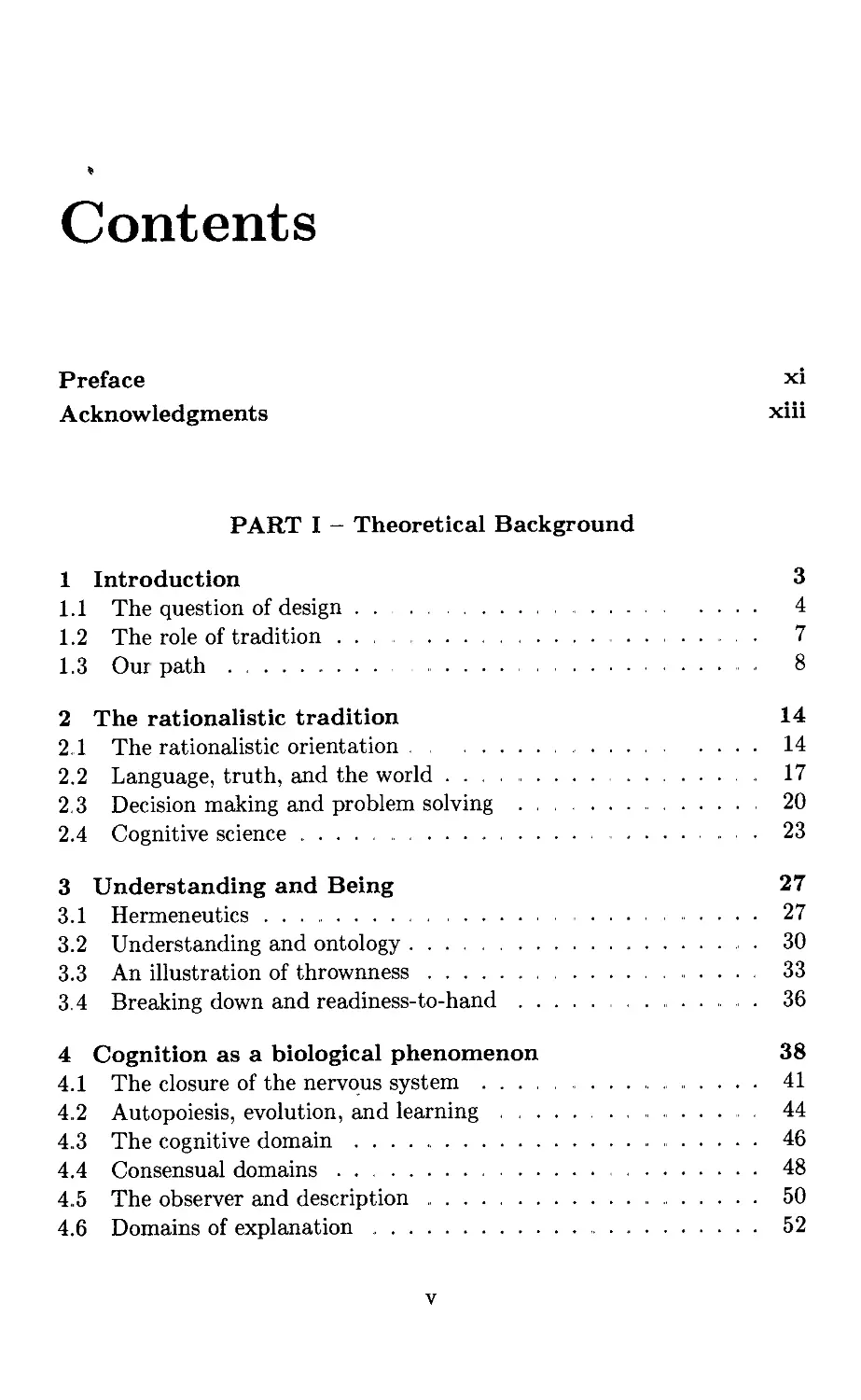
Contents
Preface
Acknowledgments
xi
xiii
PART I - Theoretical Background
1 Introduction
1.1 The question of design
1.2 The role of tradition
1. 3 Our path .
3
4
7
8
2 The rationalistic tradition
2.1 The rationalistic orientation .
2.2 Language, truth, and the world
2.3 Decision making and problem solving
2.4 Cognitive science . . . .
14
14
17
20
23
3 Understanding and Being
3.1 Hermeneutics...
3.2 Understanding and ontology.
3.3 An illustration of thrownness
3.4 Breaking down and readiness-to-hand
27
27
30
33
36
4 Cognition as a biological phenomenon
4.1 The closure of the nerv us system .
4..2 Autopoiesis, evolution, and learning
4..3 The cognitive domain . . . .
4.4 Consensual domains . .
4..5 The observer and description
4.6 Domains of explanation
38
41
44
46
48
50
52
v
VI
5 Language, listening, and commitment
5.1 Listening in a background .
5.2 Meaning, commitment, and speech acts
5.3 Objectivity and tradition ......
5..4 Recurrence and formalization . . . .
5.5 Breakdown, language, and existence
6 Towards a new orientation
6.1 Cognition and being in the world
6..2 Knowledge and representation. ..
6.3 Pre-understanding and background.
6.4 Language and action .
6.5 Breakdown and the ontology of design
CONTENTS
PART II - Computation, Thought, and Language
7 Computers and representation
7.1 Programming as representation
7.2 Levels of representation . . .
73 Can computers do more than you tell them to do?
8 Computation and intelligence
8.1 Why do we ask? ......
8..2 Intelligence as rational problem solving
8.3 The phenomenon of blindness
8.4 What about learning and evolution?
8.5 Can pigs have wings?
9 Understanding language
9.1 Artificial intelligence and language understanding.
9.2 The problem of background
9.3 Understanding as pattern recognition
9.4 What does it mean to understand? . .
10 Current directions in artificial intelligence
10.1 The forking of the paths.
10.2 Expert systems
10.3 The fifth generation computer system
54
54
58
60
64
68
70
70
72
74
76
77
83
84
86
90
93
93
95
97
100
104
107
107
111
115
119
125
126
131
133
CONTENTS
vii
PART III - Design
11 Management and conversation
11.1 Management and decision making
11.2 Decision making and resolution . .
11.3 Organizations as networks of commitments
11.4 Decision support systems
11.5 Tools for conversation .......
143
144
147
150
152
157
12 Using computers: A direction for design
12.1 A background for computer design
12.2 A design example. . . . ..
12 3 Systematic domains ..
12.4 Technology and transformation
163
164
167
174
177
Bibliography
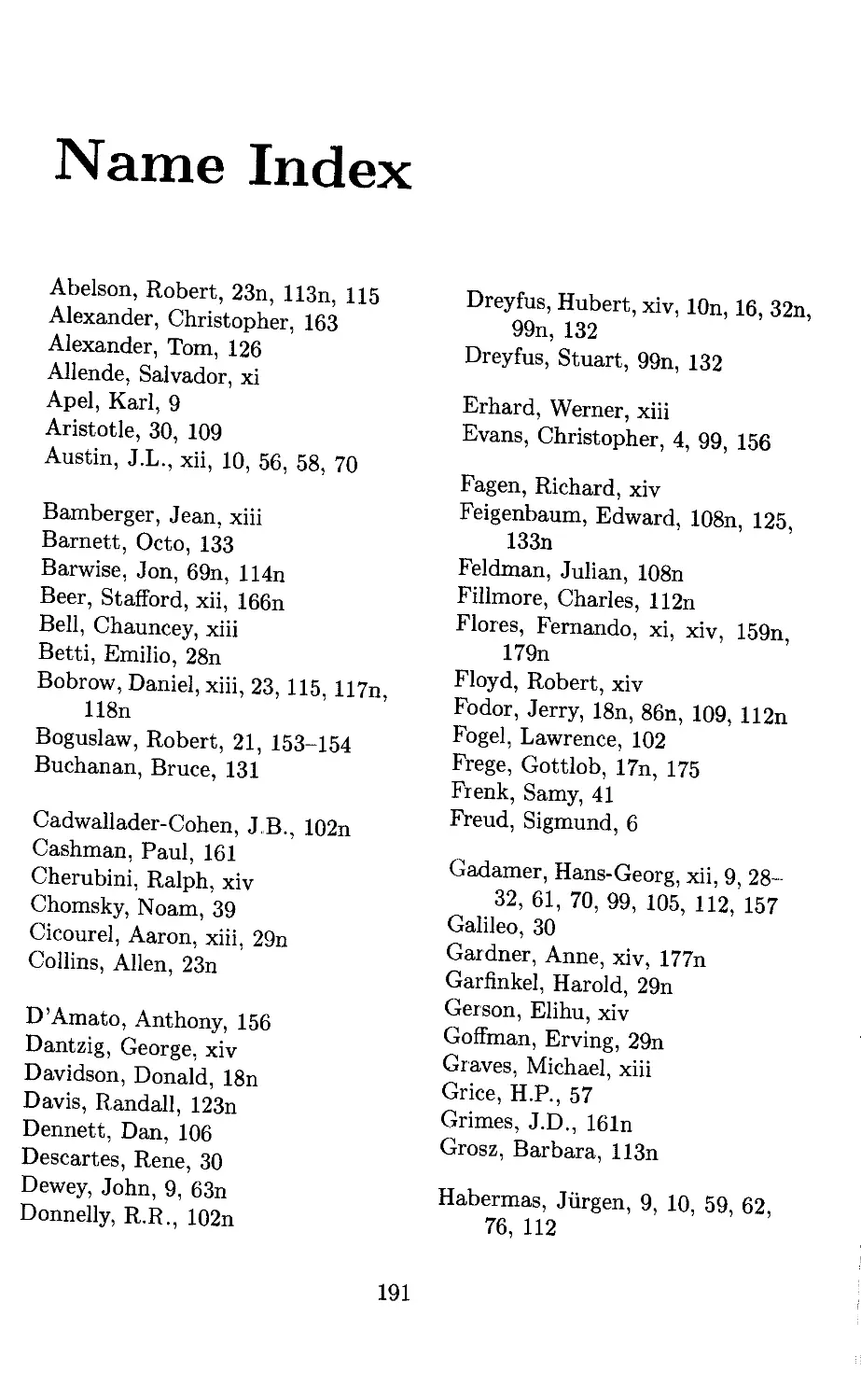
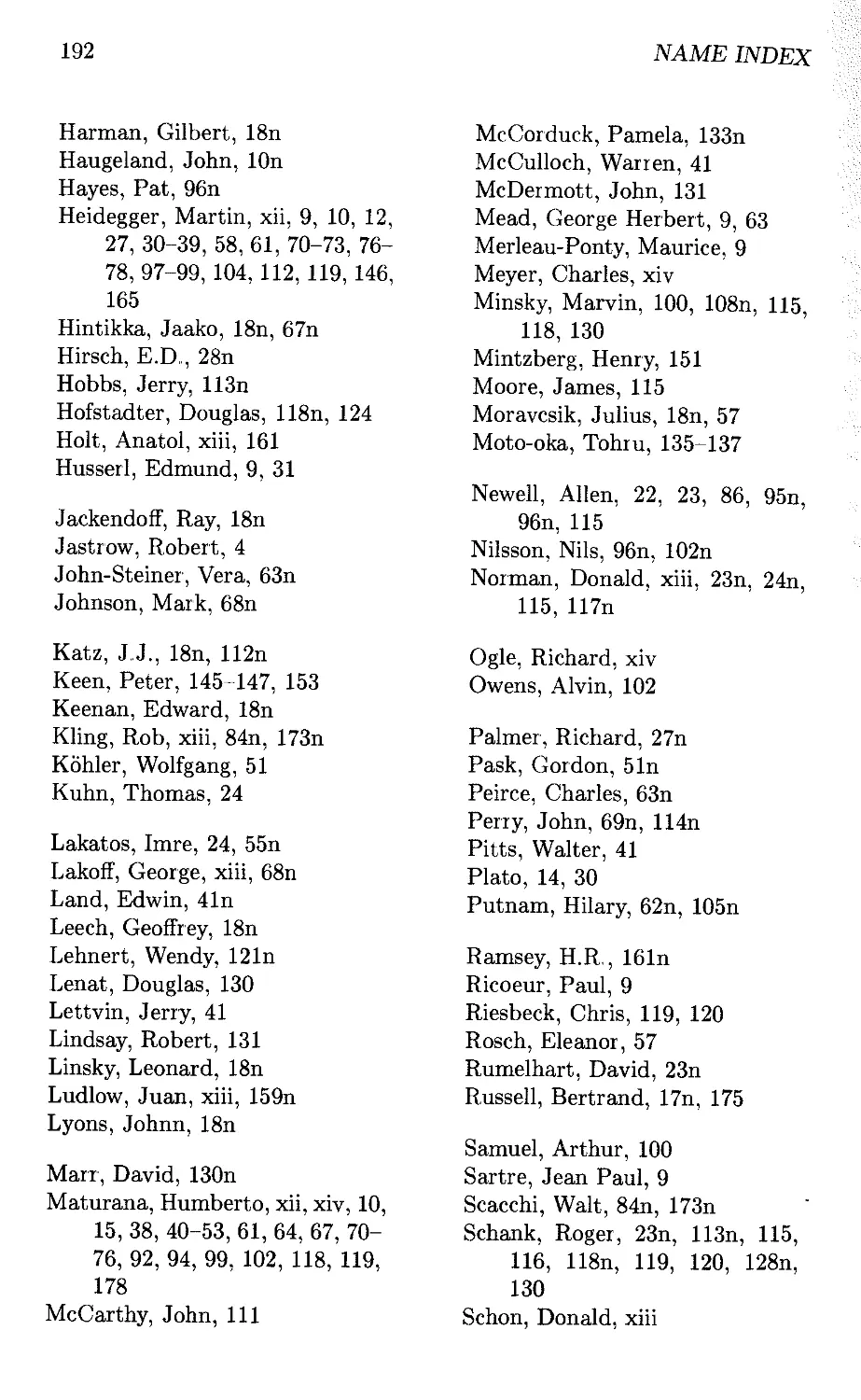
Name Index
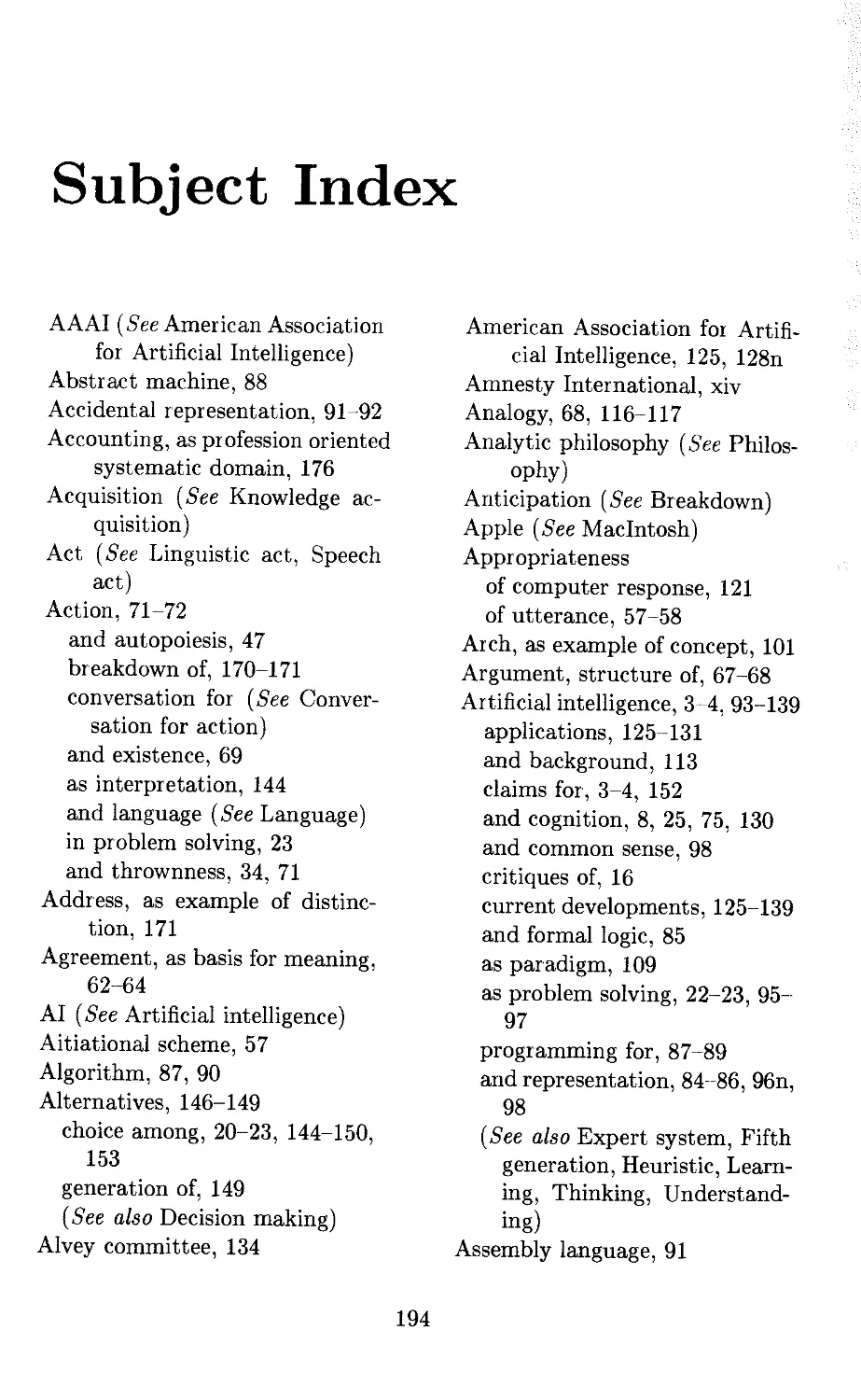
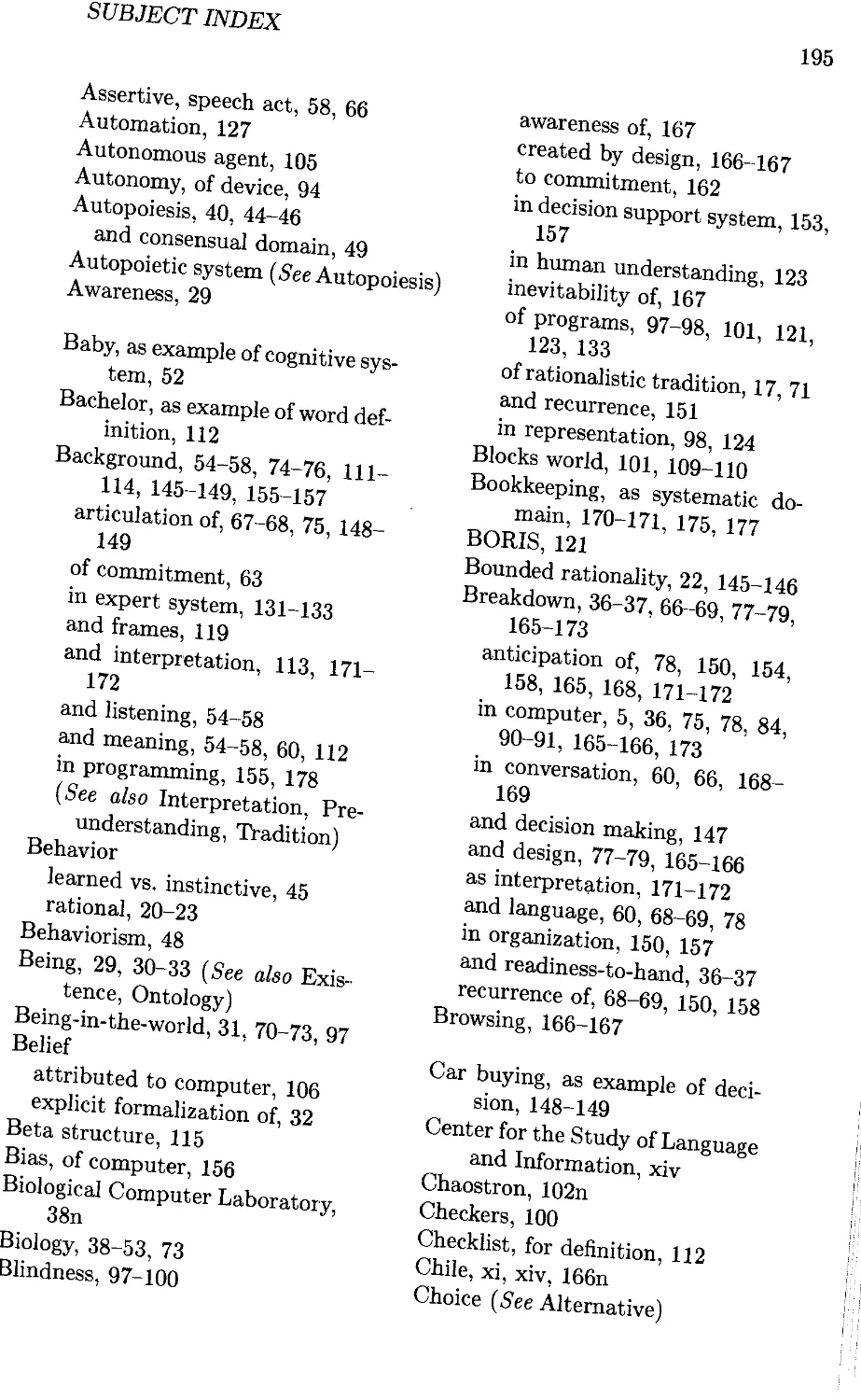
Subject Index
181
191
194
For the people of Chile
Preface
This is a book about the design of computer technology. In it, we look
closely at computers as they exist today and we set out new directions
for future development.. The discourse presented here, however, is not
what one would expect to find in a book of science and engineering. It
moves among topics and purposes that appear to be worlds apart: it is
both theoretical and practical; it is concerned with computer technology
and with the nature of human existence; with the philosophy of language
and with office automation. But it is more than a study in contrasts.
Our intention in bringing together these diverse elements is to generate
understanding-to let the apparent chasms become spaces in which new
possibilities are revealed.
All new technologies develop within the background of a tacit under-
standing of human nature and human work. The use of technology in turn
leads to fundamental changes in what we do, and ultimately in what it is
to be human. We encounter the deep questions of design when we recog-
nize that in designing tools we are designing ways of being. By confronting
these questions directly, we can develop a new background for understand-
ing computer technology-one that can lead to important advances in the
design and use of computer systems.
When we began the collaboration that led to this book, we had no idea
where our discussions would lead. We had lived through very different ex-
periences; we spoke different languages (both literally and metaphorically);
and we had studied in disparate fields. Terry Winograd has been actively
engaged for many years in computer science and artificial intelligence re-
search at the Massachusetts Institute of Technology, Stanford University,
and the Xerox Palo Alto Research Center. His work has consisted primar-
ily of designing systems (both formal languages and computer programs)
for the representation and analysis of language and knowledge. Fernando
Flores has had experience with social and political organization at the
highest level of government, in his posts as director of the state-owned
corporations, Minister of Economics, and Minister of Finance in the gov-
ernment of Salvador Allende in Chile between 1970 and 1973. He was
Xl
xii
PREFACE
instrumental in a large-scale project to apply cybernetic theory to prac-
tical management problems (see Beer, Platform for Change, 1975) and is
primarily interested in the understanding of social reality that we can gain
through combining theory and practice. In spite of these differences, we
had a sense that we shared much in our understanding of the world, and we
entered into a dialog to explore this common ground. The dialog evolved
into a paper, the paper in turn expanded and became a book, and the
book evolved through a series of drafts whose focus shifted dramatically..
In our reading and discussions, we came to the realization that although
our formal training was in the technical fields of mathematics and com-
puter science, many of our guiding intuitions about language and thought
were not compatible with the traditions in those disciplines We found
ourselves in much closer accord with writers who were far removed from
the mathematico-logical paradigm, who identified their interests as bio-
logy, hermeneutics, and phenomenology. One of the initial attractions of
this work was the understanding it provided of the larger human context
in which the study of cognition has meaning. What surprised us was that
the ideas were so relevant to the practical work in which we are engaged:
the design of computer systems and the management of complex organi-
zations. The philosophical ideas of thinkers such as Heidegger, Gadamer,
Maturana, and Austin provided a framework to integrate what we had
previously learned through our practical experience.
As we studied further, we began to formulate new theoretical founda-
tions for the design of computer technologies. In working to clarify the
nature and role of computers we were forced to reject many assumptions
that we had long accepted implicitly and that go unquestioned in most dis-
cussions of computing. We had to address new questions, and these in turn
led to looking more carefully at what people actually do with computers,
and what might be done better.
Readers with a background in science and technology may find it im-
plausible that philosophical considerations have practical relevance for
their work. Philosophy may be an amusing diversion, but it seems that
the theories relevant to technological development are those of the hard
sciences and engineering. We have found quite the opposite.. Theories
about the nature of biological existence, about language, and about the
nature of human action have a profound influence on the shape of what
we build and how we use it. We have accordingly devoted a considerable
amount of space, especially in the first part of the book, to discussing
matters that appear unrelated to computers but that are nonetheless in-
dispensable in the process of opening up for the reader new possibilities
and new directions for what we can do with them.
In the course of developing a new understanding we came across ques-
tions that have long been the subject of debate, such as "Can computers
PREFACE
xiii
think?", "Can computers understand language?", and "What is rational
decision-making?" We address these questions not so much to solve them
as to dissolve them. They arise in a background of understanding about
human thought and language, a background that itself needs to be re-
examined and revised. In the end, we are not concerned with providing
new answers to questions about technology as they have traditionally been
posed. We look towards new questions that can lead to the design and use
of machines that are suited to human purposes.
Our book is intended for a wide audience-not just those who are
professionally involved in computer research, design, and production, or
scholars working in related fields such as cognitive psychology, linguistics,
and management science. We address everyone (expert and layperson
alike) who has a serious interest in understanding what computers are and
how they fit into our lives.
Although we devote a good deal of attention to philosophical back-
ground, we have not attempted to make this a scholarly book. Our in-
tention is to lead the reader through some of the intellectual pathways
that shaped our own understanding, and this process is by necessity selec-
tive. We do not attempt to trace historical antecedents, to assign proper
credit for originality, or to point out the many other thinkers 'who have
dealt with the same topics in related ways. In fact, much of what we cite is
from books intended to provide popularized accounts and from articles ap-
pearing in the popular press. The concern about what computers can do is
not an abstract conundrum to be puzzled over for intellectual amusement,
but a practical question at the center of a significant discourse in society
as a whole. The answer as understood by the public (including those who
make political and business decisions) is ultimately more significant than
the twists and turns of academic debate. By dealing with the understand-
ing that appears in the public discourse about computing, we can better
achieve what we have set out to do-to reveal the pre-understanding we
and others bring to computer technology and by doing so to open a new
clearing in which to glimpse future paths for design.
Acknowledgments
In developing this book over a number of years, we have benefited from
discussions with many people, including Jean Bamberger, Chauncey Bell,
Daniel Bobrow, Aaron Cicourel, Werner Erhard, Michael Graves, Heinz
von Foerster, Anatol Holt, Rob Kling, George Lakoff, Juan Ludlow, Don-
ald Norman, Donald Schon, John Searle, Francisco Varela, and students
in a series of seminars at Stanford University. We are especially grate-
ful to Ralph Cherubini, Hubert Dreyfus, Anne Gardner, Elihu Gerson,
XIV
PREFACE
Humberto Maturana, Brian Smith, Peter Stokoe, and Paul Trachtman
for extended and insightful commentaries on earlier drafts. Our dialogs
with them have been the source of much of our understanding, and we
appreciate their efforts and concern. Richard Ogle's probing discussion
and editorial assistance were vital to the completion of the manuscript.
This work was made possible by support to Terry Winograd from the
System Development Foundation and from Stanford University's Center
for the Study of Language and Information. We owe profound gratitude
to those people at Stanford and in Amnesty International whose efforts
made freedom possible for Fernando Flores. These include George Dantzig,
Richard Fagen, Robert Floyd, and Charles Meyer.
Finally, we want to acknowledge the people of Chile for their courage
to open new conversations for possibility and for their strength in times of
trial. From them we have learned much about language, about meaning,
and about living.
Terry Winograd
Fernando Flores
Palo Alto, California
July, 1985
PART I
Theoretical Background
Chapter 1
Introduction
Computers are everywhere. The versatile silicon chip has found a place
in our homes, our schools, our work, and our leisure. We must cope with
a flood of new devices, bringing with them both benefits and dangers.
Popular books and magazines proclaim that we are witnessing a 'com-
puter revolution,' entering a 'micro-millennium' in which computers will
completely transform our lives.
We search for images that can help us anticipate computer impacts and
direct further development. Are computers merely giant adding machines
or are they electronic brains? Can they only do 'programmed' rote tasks
or can we expect them to learn and create? The popular discourse about
these questions draws heavily on the analogy between computation and
human thought:
While many areas of human endeavor have currently seemed
to flounder-such as understanding and dealing with economic
systems or correcting social injustices-research and technical
developments in the scientific field of artificial intelligence have
exploded. . ... As a result, artificial-intelligence researchers are
developing computers that can listen to spoken sentences and
grasp their meaning; that can read news stories and write suc-
cinct, accurate, grammatical summaries; that employ robots,
who never get bored, to work on assembly lines; that assemble
data about a sick person-and suggest a diagnosis..- Stockton,
"Creating computers to think like humans" (1980), p. 41.
In five or six years-by 1988 or thereabouts-portable, quasi-
human brains, made of silicon or gallium arsenide, will be com-
monplace. They will be an intelligent electronic race, working
3
4
CHAPTER 1. INTRODUCTION
as partners with the human race. We will carry these small
creatures around with us everywhere. Just pick them up, tuck
them under your arm, and go off to attend to your business.
They will be Artoo-Deetoos without wheels: brilliant, but
nice personalities, never sarcastic, always giving you a straight
answer-little electronic friends that can solve all your prob-
lems. - Jastrow, "The thinking computer" (1982), p. 107
We are about to embark on a massive programme to develop
highly intelligent machines, a process by which we will lead
computers by the hand until they reach our own intellectual
level, after which they will proceed to surpass us..... But
what will we do with the Ultra-Intelligent Machines when they
arrive? Clearly, the first thing would be to put them to work on
some of the numerous problems facing society. These could be
economic, medical or educational matters, and also, perhaps,
strategic modelling to forecast trends and produce early warn-
ings of difficulties or crises. . ., It is unlikely that there will be
any serious objections to this apart from those of an emotional
or doctrinaire nature. - Evans, The Micro Millennium (1979),
pp. 195-196, 229.
But focussing on the image of 'computer as brain' can lead us away
from the important questions The concern with giving computers human-
like (or god-like) intelligence rests on a more fundamental discourse about
the nature of technology and of human thinking, language, and being. This
discourse has unfolded within a tradition-a way of understanding-that
is deeply rooted in modern technological society.
In examining this tradition, we came to realize that although it provides
a fertile background for developing new technology, it does not support
an adequate understanding of what computer devices do in a context of
human practice. We were led to a broad critique of what has been said
about computers, and what has been done in disciplines such as linguistics,
psychology, and management science. We developed a new orientation that
provides an alternative basis for understanding computer technology.
1.1 The question of design
In order to understand the phenomena surrounding a new technology, we
must open the question of design-the interaction between understanding
and creation. In speaking here of design, we are not restricting our concern
to the methodology of conscious design. We address the broader question
of how a society engenders inventions whose existence in turn alters that
1.1. THE QUESTION OF DESIGN
5
society. We need to establish a theoretical basis for looking at what the
devices do, not just how they operate
In order to develop such a theoretical basis we must step back and
examine the implicit understanding of design that guides technological
development within our existing tradition of thought. Only by uncon-
cealing that tradition and making explicit its assumptions can we open
ourselves to alternatives and to the new design possibilities that flow from
them The remainder of this introduction provides a guide to how we have
undertaken that task in this book.
We can illustrate the kind of questioning we have in mind by seriously
asking "What is a word processor?" The first thing to recognize is that
different answers grow from the concerns of different individuals. For the
manager of a factory that builds word processors, they are assemblies of
electronic and mechanical devices, to be constructed, tested, and shipped.
For the person who programs the word processor, it is a particular col-
lection of software, dealing with the input, storage, and output of bytes
of information. It operates through some kind of interface to a user who
generates and modifies that information
These are both perfectly valid answers, arising in particular domains
to which the theories of computation and electronics are relevant. If we
want to understand a breakdown of the hardware or software, we operate
in their terms and turn to them for predictions. But these answers do not
deal with what a word processor does-with the fact that it is a medium
for the creation and modification of linguistic structures that playa role in
human communication. For the purchaser of a word processor, this is the
relevant domain. The word processor exists as a collection of hardware or
programs only when it breaks down. I In its use, one is concerned with
the actions of creating and modifying documents and producing physical
presentations of them on a screen or printed page. The relevant domain
is not a computational one, but one that emerged long ago with the first
writing instruments It brings with it concerns of visual presentation-
issues oflayout, type fonts, and integration of text with illustrations. Many
current computer products are designed with a primary concern for this
domain. They deal at length with formats and typography, focussing on
the document as the thing being produced
But still with this, we have not reached a full understanding of the word
processor. We cannot take the activity of writing as an independent phe-
nomenon. Writing is an instrument-a tool we use in our interactions with
other people. The computer, like any other medium, must be understood
in the context of communication and the larger network of equipment and
1 As we will see in later chapters, this includes the initial breakdown implicit in the
condition of unrrodmess that calls for buying and assembling a new system
6
CHAPTER 1.. INTRODUCTION
practices in which it is situated. A person who sits down at a word pro-
cessor is not just creating a document, but is writing a letter or a memo or
a book There is a complex social network in which these activities make
sense. It includes institutions (such as post offices and puplishing compa-
nies), equipment (including word processors and computer networks, but
also all of the older technologies with which they coexist), practices (such
as buying books and reading the daily mail), and conventions (such as the
legal status of written documents).
The significance of a new invention lies in how it fits into and changes
this network Many innovations are minor-they simply improve some
aspect of the network without altering its structure. The automatic trans-
mission made automobiles easier to use, but did not change their role.
Other inventions, such as the computer, are radical innovations that can-
not be understood in terms of the previously existing network. The print-
ing press, the automobile, and television are all examples of radical innova-
tions that opened up whole new domains of possibilities for the network of
human interactions.. Just as the automobile had impacts On our society far
beyond speeding up what had been done with horses, the use of computers
will lead to changes far beyond those of a fancy typewriter. The nature of
publishing, the structure of communication within organizations, and the
social organization of knowledge will all be altered, as they were with the
emergence of other technologies for language, such as the printing press.
One might think that the questioning can stop at this point. It is clear
(and has been widely recognized) that one cannot understand a technol-
ogy without having a functional understanding of how it is used. Further-
more, that understanding must incorporate a holistic view of the network
of technologies and activities into which it fits, rather than treating the
technological devices in isolation.. But this is still not enough. We can
say that the word processor must be understood by virtue of the role it
plays in communication, the distribution of information, and the accu-
mulation of knowledge. But in doing so we take for granted the use of
words like 'communication,' 'information,' and 'knowledge,' which them-
selves require closer examination. In this examination, we find ourselves
being drawn into inquiries about basic human phenomena that have been
called things like 'intelligence,' 'language,' and 'rationality.'
As the use of a new technology changes human practices, our ways of
speaking about that technology change our language and our understand-
ing.. This new way of speaking in turn creates changes in the world we
construct.. As an example of how new language creates new possibilities
for action, consider Freud's introduction of terms such as 'ego,' 'subcon-
scious,' and 'repression.' At one level we might say that he recognized and
labelled phenomena that had always existed. But the innovation in his
language had a major impact on human society, in everything from the
ROLE OF TRADITION
7
treat deviants (such as prisoners and the mentally ill) to the way
teach our children.
Looking at computers we find the same process at work The develop-
of the technology has led to new uses of terms such as 'information,'
, 'output,' 'language,' and 'communication,' while work in areas
as artificial intelligence is bringing new meanings to words like 'intel-
, 'decision,' and 'knowledge.' The technical jargon gives shape to
our commonsense understanding in a way that changes our lives.
In order to become aware of the effects that computers have on society
we must reveal the implicit understanding of human language, thought,
and work that serves as a background for developments in computer tech-
nology. In this endeavor we are doubly concerned with language. First,
we are studying a technology that operates in a domain of language. The
computer is a device for creating, manipulating, and transmitting sym-
bolic (hence linguistic) objects. Second, in looking at the impact of the
computer, we find ourselves thrown back into questions of language-how
practice shapes our language and language in turn generates the space of
possibilities for action.
This book, then, is permeated by a concern for language.. Much of our
theory is a theory of language, and our understanding of the computer
centers on the role it will play in mediating and facilitating linguistic action
as the essential human activity. In asking what computers can do, we
are drawn into asking what people do with them, and in the end into
addressing the fundamental question of what it means to be human.
1.2 The role of tradition
One cannot approach questions like those raised in the previous section
from a neutral or objective standpoint. Every questioning grows out of a
tmdition-a pre-understanding that opens the space of possible answers.
We use the word 'tradition' here in a broad sense, without the connotation
that it belongs to a cohesive social or cultural group, or that it consists of
particular customs or practices. It is a more pervasive, fundamental phe-
nomenon that might be called a 'way of being.' In trying to understand a
tradition, the first thing we must become aware of is how it is concealed
by its obviousness. It is not a set of rules or sayings, or something we
will find catalogued in an encyclopedia. It is a way of understanding, a
background, within which we interpret and act. We use the word 'tradi-
tion' because it emphasizes the historicity of our ways of thinking-the
fact that we always exist within a pre-understanding determined by the
history of our interactions with others who share the tradition.
8
CHAPTER 1. INTRODUCTION
When we encounter people who live in a substantially different tradi-
tion, we are struck by the impression that they have a strange and appar-
ently arbitrary 'world view.' It takes a careful self-awareness to turn the
same gaze on our own lives and 'unconceal' our own tradition-to bring
into conscious observation that which invisibly gives shape to our thought.
In examining how people have thought about and talked about comput-
ers, we become aware of the pervasive effect of a powerful tradition that
emphasizes 'information,' 'representation,' and 'decision making.' This
tradition has been the basis for a great deal of technological progress and
it has also led to many of the problems created by the use of computers.
Even in discussions of what computers can and cannot do, the questions
that are posed reflect a particular blindness about the nature of human
thought and language-a blindness that can lead to a broad misunder-
standing of the role that will be played by computers.
We have labelled this tradition the 'rationalistic tradition' because of
its emphasis on particular styles of consciously rationalized thought and
action. In calling it 'rationalistic' we are not equating it with 'rational.'
We are not interested in a defense of irrationality or a mystic appeal to non-
rational intuition.. The rationalistic tradition is distinguished by its narrow
focus on certain aspects of rationality, which (as we will show throughout
the book) often leads to attitudes and activities that are not rational when
viewed in a broader perspective. Our commitment is to developing a new
ground for rationality-one that is as rigorous as the rationalistic tradition
in its aspirations but that does not share the presuppositions behind it.
The task we have undertaken in this book is to challenge the ratio-
nalistic tradition, introducing an alternative orientation that can lead to
asking new questions. In developing this new orientation, we were led to
a critique of the current mythology of artificial intelligence and its related
cognitive theories, drawing conclusions that contradict the naive optimism
apparent in the quotations at the beginning of the chapter.. Our ultimate
goal, however, is not a debunking but a redirection. The alternative we
pose is not a position in a debate about whether or not computers will be
intelligent, but an attempt to create a new understanding of how to design
computer tools suited to human use and human purposes.
1.3 Our path
Our intention is to provide an opportunity for the reader to develop a new
orientation. No book can embody the result of such a process, but through
entering a dialog with the reader we can help make it possible. We have
attempted to do this in three steps. First we present some previous work
that challenges the theoretical assumptions of the rationalistic tradition,
calling into question much of what is normally taken for granted in our
OUR PATH
9
Next we carefully examine, from the orientation developed in the
part, the phenomena that have emerged in the practice of computer
Finally, we suggest some alternative directions for the design
of computer-based tools.
Part I of the book (Chapters 1-6) describes the rationalistic tradition
and presents three distinct bodies of work, each of which stands in contrast
to that tradition and each of which has deeply influenced our own under-
standing. We do not attempt to provide a philosophical exposition and
critique in which arguments for and against each position are enumerated
and weighed.. We find it more fruitful to present the central points, listen-
ing for their relevance to our own concerns. Our discourse is theoretical
in that it deals with fundamental questions, but it is not directed towards
postulating formal theories that can be systematically used to make pre-
dictions. As will become clear, one of the most prominent illusions of
the rationalistic tradition is the belief that knowledge consists of explicit
theories of that sort.
Chapter 2 describes the rationalistic tradition in some detail, showing
how it serves as a basis for our culture's commonsense understanding of
language, thought, and rationality. Our goal is to reveal biases and as-
sumptions that are concealed by their embodiment in the background of
our language..
Chapter 3 deals with a tradition that includes hermeneutics (the study
of interpretation) and phenomenology (the philosophical examination of
the foundations of experience and action). This tradition has emerged
from humanistic studies, and is concerned with the relation of the individ-
ual to the context-especially the social context-in which he or she lives.
It emphasizes those areas of human experience where individual interpre-
tation and intuitive understanding (as opposed to logical deduction and
conscious reflection) playa central role. Its exponents challenge the belief
that a formal analytical understanding of these phenomena is possible at
all.
We concentrate on the work of Hans-Georg Gadamer and Martin Hei-
degger.. Many other philosophers have explored related ideas, including
phenomenologists such as Husserl, Ricoeur, and Merleau-Ponty, existen-
tialists such as Sartre, pragmatists such as Mead and Dewey, current polit-
ical philosophers such as Habermas and Apel, and even some with a more
analytic background, such as Wittgenstein.. We have selected Heidegger
and Gadamer, partly because of the role their writings played in our own
learning, and partly because of their intrinsic importance within the tradi-
tion they represent. Heidegger stands out as the modern philosopher who
has done the most thorough, penetrating, and radical analysis of everyday
experience. His ideas lie at the root of much of what other philosophers
have said, and at the root of our own orientation. Gadamer has been
10
CHAPTER 1. INTRODUCTION
most articulate in applying this orientation to the problem of language, a
problem that we see as centraL Since it was not our intention to produce
a work of philosophical scholarship, we do not attempt to draw connec-
tions between the discourse developed by these two philosophers and the
many others that preceded and followed them. Our aim is to bring out
the relevant distinctions in the clearest possible way, by focussing on their
central insights.
Chapter 4 presents the work of Humberto R. Maturana, a Chilean
neurobiologist most widely known for his work on the neurophysiology
of vision. His background is that of a biologist, not a philosopher, and
he deals first and foremost with the nature of biological organisms as
mechanistic structure-determined systems. His work was critical in the
development of our understanding of cognition and of our perspective on
the rationalistic tradition.
Writers like Heidegger challenge the dominant view of mind, declaring
that cognition is not based on the systematic manipulation of representa-
tions. This perspective has been the basis for several critiques of artificial
intelligence 2 that initially have a kind of mystical feel to those within
the scientific community. In questioning the common understanding of
the relationship among perception, representation, and thought, these ac-
counts seem at first sight to deny the physical basis of human action.
Maturana provides two useful insights that let us escape from this lim-
ited pre-understanding: the role of the observer in creating phenomenal
domains,. and the concept of structural coupling, which allows us to un-
derstand behavior that is mechanically generated but not programmed.
As a biologist, Maturana sets out a conceptual framework in which phe-
nomena of interpretation arise as a necessary consequence of the structure
of biological beings. At the same time, he compels us to acquire a new
understanding of the way we talk about physical nature and to apply this
understanding to ourselves.
As we pointed out earlier, questions concerning cognition are inter-
twined with questions about the nature of language. Chapter 5 begins by
showing how the insights of hermeneutics are relevant to the issues that
have traditionally been addressed by linguists and analytic philosophers
of language. It emphasizes the role of the listener in the active generation
of meaning, showing how the idealization of 'literal meaning' breaks down
in looking at ordinary language. We then introduce speech act theory, as
developed by Austin and Searle and later adapted by social philosophers
such as Habermas. Although this work grew out of the analytic school of
philosophy, its view of language as speech acts challenges the rationalistic
2For example, see Dreyfus, What Computers Can't Do (1979) and Haugeland, "The
nature and plausibility of cognitivism" (1978)
1.3. OUR PATH
11
tradition by suggesting that language, and therefore thought, is ultimately
based on social interaction Speech act theory is a starting point for an
understanding of language as an act of social creation. In the last part
of the chapter we present our own synthesis of speech act theory and
the hermeneutic understanding of language developed in Chapter 3. This
synthesis is central to our interpretation of computer technology in the
second part of the book It leads us to the conclusion that we create our
world through language, an observation that has important consequences
for design..
Chapter 6, which acts as a transition to the remainder of the book,
draws out and summarizes some common points from the preceding three
chapters. The rejection of cognition as the manipulation of knowledge of an
objective world, the primacy of action and its central role in language, and
the impossibility of completely articulating background assumptions all
playa major role in the critique of current computer technology presented
in Part II and in the new design orientation elaborated in Part III.
Part II (Chapters 7-10) addresses concrete questions about what com-
puters do. Our goal is to understand and reinterpret what is currently
being done and to anticipate future developments.
Chapter 7 describes what people do when they program computers. It
focusses on the relationship between the intentions of programmers and
the behavior of devices that run the programs they create. Programming is
a process of creating symbolic representations that are to be interpreted at
some level within a hierarchy of constructs of varying degrees of abstract-
ness. The interactions between levels of representation can be complex,
since each is implemented in terms of the lower ones. This description lays
the groundwork for the discussion of computer intelligence in the following
chapters.
Chapter 8 examines the computational techniques that have been pro-
posed as a basis for artificial intelligence. Drawing on the ideas outlined
in Part I, we argue-contrary to widespread current belief-that one can-
not construct machines that either exhibit or successfully model intelligent
behavior. We begin by asking why mind-like properties are attributed to
computers but not to other types of machines that can equally be said to
provide or process information. We continue with a more thorough expo-
sition of work in artificial intelligence and an analysis of its limitations
Many of the difficulties with current research derive from a fundamen-
tal orientation that equates intelligence with rationalistic problem solving
based on heuristic procedures.
Chapter 9 takes up the theme of the preceding chapter within the con-
text of computer programs that process natural language. We look at
why the many programs developed during the 1970s do not approach the
human ability to interpret meaning. In spite of a wide variety of inge-
12
CHAPTER 1. INTRODUCTION
nious techniques for making analysis and recognition more flexible, the
scope of comprehension remains severely limited.. There may be practical
applications for computer processing of natural-language-like formalisms
and for limited processing of natural language, but computers will remain
incapable of using language in the way human beings do, both in interpre-
tation and in the generation of commitment that is central to language.
Chapter 10 takes a critical look at some major current research di-
rections in areas such as knowledge engineering, expert systems, and the
so-called 'fifth generation' computers.. It describes the overall shift from
the general goal of creating programs that can understand language and
thought to that of designing software for specialized task domains, and
evaluates the projections being made for the coming years.
Part III (Chapters 11 and 12) presents an alternative orientation to
design, based on the theoretical background we have developed. The rel-
evant questions are not those comparing computers to people, but those
opening up a potential for computers that playa meaningful role in human
life and work Once we move away from the blindness generated by the
old questions, we can take a broader perspective on what computers can
do..
Chapter 11 addresses the task of designing computer tools for use in or-
ganizational contexts. We focus on the activity of people called 'managers,'
but the same concerns arise in all situations involving social interaction
and collaborative effort. Drawing on Heidegger's discussion of , thrown ness'
and 'breakdown,' we conclude that models of rationalistic problem solving
do not reflect how actions are really determined, and that programs based
on such models are unlikely to prove successful. Nevertheless, there is a
role for computer technology in support of managers and as aids in coping
with the complex conversational structures generated within an organiza-
tion.. Much of the work that managers do is concerned with initiating,
monitoring, and above all coordinating the networks of speech acts that
constitute social action.
Chapter 12 returns to the fundamental questions of design and looks
at possibilities for computer technology opened up by the understanding
developed in the preceding chapters. After briefly reviewing the relevant
theoretical ideas outlined earlier, we examine some of the phenomena to
which design must address itself, illustrating our approach with a concrete
example.. We also consider design in relation to systematic domains of
human activity, where the objects of concern are formal structures and
the rules for manipulating them. The challenge posed here for design is
not simply to create tools that accurately reflect existing domains, but to
provide for the creation of new domains. Design serves simultaneously to
bring forth and to transform the objects, relations, and regularities of the
world of our concerns.
OUR PATH
13
In one sense, then, this is a book about computers.. But it reaches
the specific issues of what computers can do. Our larger goal is to
clarify the background of understanding in which the discourse about com-
puters and technology takes place, and to grasp its broader implications.
Ultimately we are seeking a better understanding of what it means to be
human. In this quest, progress is not made by finding the 'right answers,'
but by asking meaningful questions-ones that evoke an openness to new
ways of being. We invite the readers to create with us an openness that
can alter our collective vision of how computer technology will develop in
the coming decades.
Chapter 2
The rationalistic
tradition
Current thinking about computers and their impact on society has been
shaped by a rationalistic tradition that needs to be re-examined and chal-
lenged as a source of understanding. As a first step we will characterize
the tradition of rationalism and logical empiricism that can be traced back
at least to Plato. This tradition has been the mainspring of Western sci-
ence and technology, and has demonstrated its effectiveness most clearly
in the 'hard sciences'-those that explain the operation of deterministic
mechanisms whose principles can be captured in formal systems. The
tradition finds its highest expression in mathematics and logic, and has
greatly influenced the development of linguistics and cognitive psychology.
We will make no attempt to provide a full historical account of this
tradition, or to situate it on some kind of intellectual map.. Instead, we
have chosen to concentrate on understanding its effects on current dis-
course and practice, especially in relation to the development and impact
of computers. The purpose of this chapter is to outline its major points
and illustrate their embodiment in current theories of language, mind, and
action.
2.1 The rationalistic orientation
We can begin to reveal the rationalistic tradition by considering the ques-
tion "What do you do when faced with some problem whose solution you
care about?" The rationalistic orientation can be depicted in a series of
steps:
14
THE RATIONALISTIC ORIENTATION
15
1. Characterize the situation in terms of identifiable objects with well-
defined properties
2. Find general rules that apply to situations in terms of those objects
and properties.
3. Apply the rules logically to the situation of concern, drawing con-
clusions about what should be done.
There are obvious questions about how we set situations into corre-
spondence with systematic 'representations' of objects and properties, and
with how we can come to know general rules. In much of the rationalistic
tradition, however, these are deferred in favor of emphasizing the formu-
lation of systematic rules that can be used to draw logical conclusions.
Much of Western philosophy--from classical rhetoric to modern symbolic
logic-can be seen as a drive to come up with more systematic and precise
formulations of just what constitutes valid reasoning.
Questions of correspondence and knowledge still exercise philosophers,
but in the everyday discourse about thinking and reasoning they are taken
as unproblematic. In fact when they are raised, the discussion is often
characterized as being too philosophical. Even within philosophy, there
are schools (such as analytic philosophy) in which the problems raised by
the first two items are pushed aside, not because they are uninteresting,
but because they are too difficult and open-ended. By concentrating on
formalisms and logical rules, the philosopher can develop clear technical
results whose validity can be judged in terms of internal coherence and
consistency.
There is a close correlation between the rationalistic tradition and the
approach of organized science In a broad sense, we can view any orga-
nized form of inquiry as a science, but in ordinary usage more is implied.
There must be some degree of adherence to the scientific method. This
method consists of a series of basic steps (that can be repeated in succes-
sive refinements of the science):
[The scientific method] can be described as involving the follow-
ing operations: (a) observation of a phenomenon that, hence-
forth, is taken as a problem to be explained; (b) proposition
of an explanatory hypothesis in the form of a deterministic
system that can generate a phenomenon isomorphic with the
one observed; (c) proposition of a computed state or process
in the system specified by the hypothesis as a predicted phe-
nomenon to be observed; and (d) observation of the predicted
phenomenon. - Maturana, "Biology of language: The epistemol-
ogy of reality" (1978), p 28
16
CHAPTER 2. THE RATIONALISTIC TRADITION
The scientist first notes some regularity in the phenomena of interest-
some recurring pattern of observations. He or she proposes a conceptual
or concrete system that can be set into correspondence with the obser-
vations and that can be manipulated to make predictions about other
potential observations. Conditions are created in which these observa-
tions can be expected and the results used to modify the theory. Scientific
research consists of setting up situations in which observable activity will
be determined in a clear way by a small number of variables that can be
systematically manipulated. This simplicity is necessary if the modelling
system is to make predictions that can be checked..
The rationalistic orientation not only underlies both pure and applied
science but is also regarded, perhaps because of the prestige and success
that modern science enjoys, as the very paradigm of what it means to
think and be intelligent. In studies of thought, emphasis is placed on
the form of the rules and on the nature of the processes by which they
are logically applied. Areas of mathematics, such as symbolic logic and
automata theory, are taken as the basis for formalizing what goes on when
a person perceives, thinks, and acts. For someone trained in science and
technology it may seem self-evident that this is the right (or even the
only) approach to serious thinking. Indeed, this is why many workers in
artificial intelligence find critiques like that of Dreyfus (What Computers
Can't Do, 1979) obviously wrong, since they challenge this deep-seated pre-
understanding. In defense, they argue that the only conceivable alternative
is some kind of mysticism, religion, or fuzzy thinking that is a throwback
to earlier stages of civilization.
It is scarcely surprising, then, that the rationalistic orientation per-
vades not only artificial intelligence and the rest of computer science, but
also much of linguistics, management theory, and cognitive science-three
areas with which artificial intelligence has been closely associated. In the
next three sections we will examine each of these areas in turn, seeing how
rationalistic styles of discourse and thinking have determined the questions
that have been asked and the theories, methodologies, and assumptions
that have been adopted.
First, however, a caveat is in order. In presenting these elements as
part of an overall rationalistic tradition, we are aware that they are not
uniformly accepted in carefully reasoned work of analytic philosophers. I
However it would be a mistake to therefore not take this tradition seriously.
It pervades the work of those same philosophers and of researchers in
lIn some w ys, the rationalistic tradition might better be termed the 'analytic tra<li-
tion ' We have adopted a more neutral label in order to avoid the impression that we
are engaged in a philosophical debate in which philosophers labelled 'analytic' take
the other side We also are not concerned here with the debate between 'rationalists'
and 'empiricists' The rationalistic tradition spans work in both of these lines
TRUTH, AND THE WORLD
17
science and psychology as well. In moments of careful reflection
the importance of phenomena that are not subject to the
style of analysis, but in their day-to-day work they proceed as
everything were. In gener ating theories and in building programs,
operate in a style that is fully consistent with the naive tradition and
areas in which it breaks down. In the end, we are really concerned
the philosophical arguments, but with a broader phenomenon-
role of a tradition in giving orientation to people who do not consider
philosophers, but whose ways of thinking nevertheless embody
philosophical orientation.
2.2 Language, truth, and the world
Much of our book is an attempt to show the non-obviousness of the ra-
tionalistic orientation and to reveal the blindness that it generates. In
pursuing this, we found ourselves deeply concerned with the question of
language. The rationalistic tradition regards language as a system of sym-
bols that are composed into patterns that stand for things in the world.
Sentences can represent the world truly or falsely, coherently or incoher-
ently, but their ultimate grounding is in their correspondence with the
states of affairs they represent. This concept of correspondence can be
summarized as:
1. Sentences say things about the world, and can be either true or false.
2.. What a sentence says about the world is a function of the words it
contains and the structures into which these are combined.
3. The content words of a sentence (such as its nouns, verbs, and ad-
jectives) can be taken as denoting (in the world) objects, properties,
relationships, or sets of these.
Of course most people will not be able to formulate these assumptions
directly. For example, they may not be aware of the distinction between
'content words' (like "dog" and "disappear") and 'function words' (like
"of" and "the"). But they would find none of these statements surprising
or unintuitive.
The relation of these assumptions to more formal studies of seman-
tics is more complex. During this century a large body of work has been
produced that systematically examines meaning from a formal analytical
perspective. 2 Its goal is to explain the regularities in the correspondence
2 Analysis of this style was developed by such prominent philosophers and logicians
as Frege (1949), Russell (1920), and Tarski (1944) More recent work is presented in
18
CHAPTER 2. THE RATIONALISTIC TRADITION
between what we say and what we mean. There are two levels at which
to define the problem. First, there is the problem of 'semantic corre-
spondence..' Just what is the relationship between a sentence (or a word)
and the objects, properties, and relations we observe in the world? Few
philosophers adhere to the naive view that one can assume the presence of
an objective reality in which objects and their properties are 'simply there.'
They recognize deep ontological problems in deciding just what constitutes
a distinct object or in what sense a relation or event 'exists.' Some limited
aspects (such as the reference of proper names) have been studied within
the philosophy of language, but it is typically assumed that no formal
answers can be given to the general problem of semantic correspondence.
The second, more tractable level at which to study meaning is to take
for granted that some kind of correspondence exists, without making a
commitment to its ontological grounding. Having done this, one can look
at the relatwns among the meanings of different words, phrases, and sen-
tences, without having to answer the difficult question of just what those
meanings are. 3
There are many different styles in which this study can be carried out.
The approach called 'structural semantics' or 'linguistic semantics,4 deals
only with the linguistic objects (words, phrases, and sentences) themselves.
The fact that "Sincerity admires John" is anomalous or that "male parent"
and "father" are synonymous can be encompassed within a theory relating
words (and posited features of words) to their occurrences in certain kinds
of phrases and sentences. Within such a theory there need be no reference
either to the act of uttering the words or to the states of affairs they
describe.
This approach is limited, however, because of its dependence on spe-
cific words and structures as the basis for stating general rules. Most
theories of semantics make use of a formalized language in which deeper
regularities can be expressed. It is assumed that each sentence in a nat-
ural language (such as English) can be set into correspondence with one
or more possible interpretations in a formal language (such as the first-
order predicate calculus) for which the rules of reasoning are well defined.
The study of meaning then includes both the translation of sentences into
the corresponding formal structures and the logical rules associated with
these structures. Thus the sentences "Every dog has a tail," "All dogs
several collections, such as Linsky (1952), Davidson and Harman (1972), Hintikka,
Moravcsik, and Suppes (1973), and some of the papers in Keenan (1975).
3For a critique of recent attempts to extend this methodology, see Winograd, "Moving
the semantic fulcrum" (1985)
4In this category, we include work such as that of Leech (1969), Lyons (1963), Katz
and Fodor (1964), and Jackendoff (1976)
LANGUAGE, TRUTH, AND THE WORLD
19
have tails," and "A dog has a tail" are all translated into the same form,
while "I walked to the bank" will have two possible translations (corre-
sponding to the two meanings of "bank"), as will "Visiting relatives can
be boring" (corresponding to different interpretations of who is doing the
visiting) .
Most current work in this direction adopts some form of 'truth theo-
retic' characterization of meaning. We can summarize its underlying as-
sumptions as follows:
1. There is a system of rules (which may include 'pragmatic' and con-
textual considerations) by which sentences of a natural language
can be translated into formulas of a formal language, such that the
essence of their meaning is preserved.
2. There is another system of rules by which the meanings of formulas
in this formal language are determined in a systematic way by the
meanings of their parts and the structures by which those parts are
combined..
3.. There are systematic rules of logic that account for the interrelation
of the truth conditions for different formulas.
4.. The fundamental kind of sentence is the indicative, which can be
taken as stating that a certain proposition is true.. Its meaning can
be characterized in terms of the conditions in the world under which
it would be true.
In addition to these assumptions, there is a general understanding that
in order for the compositional rules to be of interest, the meanings of the
items being composed should be fixed without reference to the context in
which they appear. If the meaning of each item could vary arbitrarily
with each use, the rules for composing meanings would be vacuous. There
would be no systematic notion of a meaning of the item which applied
to all of its uses. Of course, this context-independence cannot be taken
as an absolute; there are obvious recognized exceptions. 5 But the central
theory of meaning (semantics) deals with words and sentences in terms of
their literal meaning, which is treated as not context-dependent. We will
discuss the consequences of this assumption in Chapter 5..
The correspondence theory of language is one cornerstone on which
other aspects of the rationalistic tradition rest. Rationalistic theories of
5These include indexical pronouns ("I," "you"), place and time adverbs ("here,"
"now"), and the use of tenses (as in "He will go."). It is also clearly understood
that there are dependencies on the linguistic context (as with the anaphoric pro-
nouns "he," "she," "it") and that there are metaphorical and poetic uses of language
which depend on complex personal contexts.
20
CHAPTER 2. THE RATIONALISTIC TRADITION
mind all adopt some form of a 'representation hypothesis,' in which it is as-
sumed that thought is the manipulation of representation structures in the
mind.. Although these representations are not specifically linguistic (that
is, not the sentences of an ordinary human language), they are treated as
sentences in an 'internal language, , whose connection to the world of the
thinker follows the principles outlined above.
2.3 Decision making and problem solving
Another modern embodiment of the rationalistic tradition is in the disci-
pline of management science, a field concerned with mathematical analyses
of decision making and with behavioral analyses of human conduct. In this
discipline, decision making is regarded as the central task of management
and is characterized as a process of information gathering and processing.
Rational behavior is seen as a consequence of choosing among alternatives
according to an evaluation of outcomes. Simon characterizes the basic
assumption of decision-making theory as follows:
At each moment the behaving subject, or the organization com-
posed of numbers of such individuals, is confronted with a large
number of alternative behaviors, some of which are present in
consciousness and some of which are not. Decision, or choice,
as the term is used here, is the process by which one of these al-
ternatives for each moment's behavior is selected to be carried
out. The series of such decisions which determines behavior
over some stretch of time may be called a strategy. . .. If any
one of the possible strategies is chosen and followed out, cer-
tain consequences will result. The task of rational decision is
to select that one of the strategies which is followed by the
preferred set of consequences. - Simon, Admimstrative Behavior
(1976), p. 67.
Simon asserts that rational decision making is a process of choosing
among alternatives, and that it involves a series of steps:
1. Listing all the alternative strategies.
2. Determining all the consequences that follow upon each of these
strategies..
3. Comparatively evaluating these sets of consequences.
In the literature on computers and decision making, a wide range of
human activities and concerns are subjected to this kind of analysis. Re-
searchers in simulation, operations research, and game theory (all within
DECISION MAKING AND PROBLEM SOLVING
21
Boguslaw, in The New Utopians (1965), calls the 'formalist ap-
proach') apply sophisticated mathemati al methods decisio s as varied
as the routing of telephone calls, the choIce of advertlsmg medIa for a new
product, and the selection of targets for bombing.
These techniques are based on the development of a formal model for
the system that will be affected, a set of rules that describe the behavior
of the modelled system, and an objective means of assigning valuations
to the resulting effects When calculations based on the model, rules,
and valuations are performed, alternatives can be compared and the most
highly valued (optimal) one selected
There have been critiques of this idealization, often from people within
management science who object to the narrow assumptions of the formalist
approach. Simon, for example, continues his description of the assump-
tions given above, noting that:
. . . The word 'all' is used advisedly.. It is obviously impossible
for the individual to know 'all' his alternatives or 'all' their con-
sequences, and this impossibility is a very important departure
of actual behavior from the model of objective rationality..
Simon, Administrative Behavwr, p. 67
This caveat is the major contribution of Simon. He treats objective
rationality as an idealization, rarely (if ever) achieved in a real situation.
Practical decision making only roughly approximates this ideal:
It is impossible for the behavior of a single, isolated individual
to reach any high degree of rationality. The number of alter-
natives he must explore is so great, the information he would
need to evaluate them so vast that even an approximation of
objective rationality is hard to conceive .. . Actual behavior
falls short, in at least three ways, of objective rationality as
defined in the last chapter:
1. Rationality requires a complete knowledge and anticipa-
tion of the consequences that will follow on each choice
In fact, knowledge of consequences is always fragmentary.
2. Since these consequences lie in the future, imagination
must supply the lack of experienced feeling in attaching
value to them. But values can be only imperfectly antici-
pated.
3 Rationality requires a choice among all possible alterna-
tive behaviors In actual behavior, only a very few of all
these possible alternatives ever come to mind. - Simon,
Admmzstrative BehavwT, pp 79ff
22
CHAPTER 2. THE RATIONALISTIC TRADITION
It is important to note, however, that this critique is not an objection
to the rationalistic approach, but to the assumption of full knowledge
and rationality in applying optimization techniques Simon argues that
systematic reasoning rules can be applied for effective decision making,
and can be programmed into computers.. Rather than computing all of
the consequences, the computer must operate with 'bounded rationality.'
Simon's decision-making theories developed into more general theories
of 'problem solving' as he and others made the first attempts to build
intelligent computer programs. Rather than concentrating on the kinds
of decisions that managers make, researchers studied tasks (such as prov-
ing logic theorems and solving simple puzzles) that could be viewed as
problems of search in a space of alternatives. The task is characterized in
terms of a 'problem space.' Each 'node' of the space is reached by some
sequence of actions, and has some consequences relevant to structure of
the task. The computer program searches for a solution in this potentially
huge space of possibilities, using 'heuristics' to guide the search and to
provide valuations.. In this search it will explore only some of the possible
alternatives, and will apply its valuation heuristics in the absence of full
knowledge.
Programs of this sort are described more fully in Chapter 8, and are
the textbook examples of artificial intelligence. There is a widely accepted
definition of what constitutes 'general problem-solving behavior:'
A person is confronted with a problem when he wants some-
thing and does not know immediately what series of actions
he can perform to get it.. . . To have a problem implies (at
least) that certain information is given to the problem solver:
information about what is desired, under what conditions, by
means of what tools and operations, starting with what initial
information, and with access to what resourCes. The problem
solver has an interpretation of this information-exactly that
interpretation which lets us label some part of it as goal, an-
other part as side conditzons, and so on. Consequently, if we
provide a representation for this information (in symbol struc-
tures), and assume that the interpretation of these structures
is implicit in the program of the problem solving IPS [Infor-
mation Processing System], then we have defined a problem.
- Newell and Simon, Human Problem Solvmg (1972), pp. 72-73.
There are several key elements to this view of problem solving, which
is generally taken for granted in artificial intelligence research:
1. Task environment. First, we characterize the problem in terms of
a 'task environment' in which there are different potential 'states' of
COGNITIVE SCIENCE
23
affairs, 'actions' available to the problem solver to change the state,
and 'goals' from which rational actions can be derived.
2. Internal representation. Second, the problem solver has some
kind of 'representation' of the task environment This representation
is a collection of 'symbol structures' that are part of the constitution
of the problem solver. They correspond in a systematic way to the
task environment.
3. Search. The problem solver goes through an information process
that can be analyzed as a search among alternative courses of action,
in order to find those that will lead to a desired goaL
4. Choice. Finally, a rational agent will select the course of action
among those found that best achieves the desired goals.. Newell,
in "The knowledge level" (1982, p. 102), calls this the 'principle of
rationality': "If an agent has knowledge that one of its actions will
lead to one of its goals, then the agent will select that action." Of
course we must allow for the case in which more than one action may
lead to one of the goals, so we cannot predict the specific action, but
just that "The action that occurs at any instant is a member of the
selected set of actions."
More formally, we can describe the operation of the problem solver in
terms of a search in a problem space determined by the task environment
and internal representation. Although there is much to be said about just
how this can be applied to different cases (for example, the role played by
having multiple representations, as discussed by Bobrow in "Dimensions
of representation," 1975), the differences are not germane to answering
our larger questions about what computers can do. There is a shared
background that cuts across the detailed schools of artificial intelligence
and that is in general accord with the rationalistic tradition. We will
explore some of these topics more fully in Chapter 11.
2.4 Cognitive science
In recent years there have been efforts to unify theories of human thought
and language from within the rationalistic tradition under a new disci-
pline known as 'cognitive science.' Initially, several books were put forth
as volumes in cognitive science. 6 The journal Cognitive Science began
6Bobrow and Collins's Representatwn and Understandzng (1975), Schank and Abelson's
Scripts Plans Cools and Understanding (1977), and Norman and Rumelhart's Explorations
in Cognition (1975) were among the first
24
CHAPTER 2 THE RATIONALISTIC TRADITION
publication in 1977, and the Cognitive Science Society held its first annual
meeting in 1979. 7 A number of other conferences, journals, and research
funding programs have followed.
Of course cognitive science is not really new. It deals with phenomena
of thought and language that have occupied philosophers and scientists for
thousands of years Its boundaries are vague, but it is clear that much of
linguistics, psychology, artificial intelligence, and the philosophy of mind
fall within its scope. In declaring that it exists as a science, people are
marking the emergence of what Lakatos calls a 'research programme.'8
Lakatos chooses this term in preference to Kuhn's 'paradigm' (The Struc-
ture of Sczentzfic Revolutzons, 1962) to emphasize the active role that a
research programme plays in guiding the activity of scientists He sees the
history of science not as a cyclic pattern of revolution and normal science,
but as a history of competing research programmes. He distinguishes be-
tween 'mature science,' consisting of research programmes, and 'immature
science,' consisting of "a mere patched up pattern of trial and error."
A research programme is more than a set of specific plans for carrying
out scientific activities. The observable details of the programme reflect
a deeper coherence which is not routinely examined. In the day-to-day
business of research, writing, and teaching, scientists operate within a
background of belief about how things are. This background invisibly
shapes what they choose to do and how they choose to do it. A research
programme grows up within a tradition of thought It is the result of
many influences, some recognized explicitly and others concealed in the
social structure and language of the community Efforts to understand
and modify the research programme are made within that same context,
and can never escape it to produce an 'objective' or 'correct' approach..
The research programme of cognitive science encompasses work that
has been done under different disciplinary labels, but is all closely related
through its roots in the rationalistic tradition. Cognitive science needs
to be distinguished from 'cognitive psychology,' which is the branch of
traditional (experimental) psychology dealing with cognition. Although
cognitive psychology constitutes a substantial part of what is seen as cog-
nitive science, it follows specific methodological principles that limit its
scope.. In particular, it is based on an experimental approach in which
progress is made by performing experiments that can directly judge be-
tween competing scientific hypotheses about the nature of cognitive mech-
7Norman, Perspectzves on Cognztzve Sczence (1981), is a collection of presentations from
that conference. They were intended to define the science and explain its significance
8S ee Lakatos, "Falsification and the methodology of scientific research programmes"
(1970). In order to avoid confusion in our discussion of computers and computer pro-
grams, we will consistently follow Lakatos's use of the British spelling, 'programme,'
when using the word in this sense.
COGNITIVE SCIENCE
25
In most experiments, situations are created in which the variety of
is strictly controlled and only a very limited aspect of the situation
considered relevant to the patterns of recurrence (typical examples are
with rats in mazes, nonsense-syllable memorization, and the
matching of geometrical figures to simple descriptions).
The assumption underlying this empirical research is that general laws
can be found in these restricted cases that will apply (albeit in a more
complex way) to a much broader spectrum of cognitive activity. It is also
implicitly assumed that these laws will have the same general form as those
of sciences like physics, and can be subjected to rigid experimental test.
In the last few decades, simple forms of cognitive psychology have been
challenged by advocates of 'information-processing psychology,' who assert
that cognitive systems can be best understood by analogy to programmed
computers. The assumptions behind this approach can be summarized as
follows:
1. All cognitive systems are symbol systems. They achieve their intel-
ligence by symbolizing external and internal situations and events,
and by manipulating those symbols.
2. All cognitive systems share a basic underlying set of symbol manip-
ulating processes..
3. A theory of cognition can be couched as a program in an appro-
priate symbolic formalism such that the program when run in the
appropriate environment will produce the observed behavior.
This approach is not incompatible with the earlier non-computational
models In general the rules postulated as governing recurrences could be
embedded in appropriate programs.. In this sense, a program is a formal
system that has some number of variables and that can be manipulated
(run) to generate predictions about the behavior (outputs) of some natu-
rally occurring system that it is intended to modeL To the extent that the
predicted behavior corresponds to that observed, the theory is supported.
The role of the computer is to enable the scientist to deal with more
complex theories than those whose consequences could be determined by
examination or by manual computation. This makes it feasible for cogni-
tive theories to be more intricate and complicated than their predecessors
and still remain under empirical control.
In trying to deal with phenomena that do not have the obvious limita-
tions of the sparse experimental situations of cognitive psychology, re-
searchers have turned to artificial intelligence-the design and testing
of computer programs that carry out activities patterned after human
thought and language. These programs are then taken as theories of the
26
CHAPTER 2. THE RATIONALISTIC TRADITION
corresponding human behavior.. As Simon says in "Cognitive science: The
newest science of the artificial" (1981, p. 24): "Most of our knowledge
[of intelligence] will have to come from. . . observation of the vast variety
of intelligent systems. . and from formal theories-mainly in the form of
computer programs-induced from that body of observation."
Many difficult issues are raised by the attempt to relate programs to
theory and to cognitive mechanisms Within the cognitive science commu-
nity, there is much debate about just what role computer programs have
in developing and testing theories. We will not present the details of that
debate, however. It is more important to understand how the discourse
is determined by a taken-for-granted background shaped by the underly-
ing assumptions of the rationalistic tradition, as we have outlined in this
chapter.. In the rest of this book we pose challenges to those assumptions,
and in the end argue that we need to replace the rationalistic orientation if
we want to understand human thought, language, and action, or to design
effective computer tools.. Implicit in our critique is a statement about the
cognitive science research programme-not that it is vacuous or useless,
but that it will have important limitations in its scope and in its power to
explain what we are and what we do.. 9
9For an excellent overview of both the history and current direction of cognitive
science, see Gardner, The Mmd's New Science (1985)
Chapter 3
Understanding and Being
In this chapter we introduce Heidegger's analysis of understanding and
Being. Heidegger's writings are both important and difficult, and we will
make no attempt to give a thorough or authoritative exposition.. Our
intention is to bring out those aspects relevant to our examination of lan-
guage and thought and to our understanding of technology.. Before turning
to Heidegger, however, it will be useful to look briefly at issues that arise
in interpreting texts In addition to the obvious relevance of this material
to our discussion of language, we have found that it is easier to grasp the
more radical phenomenological statements about interpretation if we first
consider interpretive activity in a more obvious setting.
When someone speaks of 'interpretation,' the most likely association
is with artistic or literary works. The musician, the literary critic, and
the ordinary reader of a poem or novel are all in some immediate sense
'interpreting' a collection of marks on a page. One of the fundamental
insights of phenomenology is that this activity of interpretation is not
limited to such situations, but pervades our everyday life. In coming to an
understanding of what it means to think, understand, and act, we need to
recognize the role of interpretation.
3.1 Hermeneutics
Hermeneutics i began as the theory of the interpretation of texts, par-
ticularly mythical and sacred texts. Its practitioners struggled with the
problem of characterizing how people find meaning in a text that exists
over many centuries and is understood differently in different epochs. A
IPalmer's He1meneut cs (1969) is an excellent first introduction to hermeneutics, in-
cluding both its historical roots and its current meaning for literary criticism
27
28
CHAPTER 3.. UNDERSTANDING AND BEING
mythical or religious text continues to be spoken or read and to serve as a
source of deep meaning, in spite of changes in the underlying culture and
even in the language. There are obvious questions to be raised. Is the
meaning definable in some absolute sense, independent of the context in
which the text was written? Is it definable only in terms of that original
context? If so, is it possible or desirable for a reader to transcend his or
her own culture and the intervening history in order to recover the correct
interpretation?
If we reject the notion that the meaning is in the text, are we reduced
to saying only that a particular person at a particular moment had a
particular interpretation? If so, have we given up a naive but solid-seeming
view of the reality of the meaning of the text in favor of a relativistic appeal
to individual subjective reaction?
Within hermeneutics there has been an ongoing debate between those
who place the meaning within the text and those who see meaning as
grounded in a process of understanding in which the text, its production,
and its interpretation all playa vital part.. As we will show in Chapter 5,
this debate has close parallels with current issues in linguistic and semantic
theory.
For the objectivist school of hermeneutics, 2 the text must have a mean-
ing that exists independently of the act of interpretation. The goal of a
hermeneutic theory (a theory of interpretation) is to develop methods by
which we rid ourselves of all prejudices and produce an objective analysis
of what is really there. The ideal is to completely 'decontextualize' the
text.
The opposing approach, most clearly formulated by Gadamer,3 takes
the act of interpretation as primary, understanding it as an interaction
between the horizon 4 provided by the text and the horizon that the in-
terpreter brings to it. Gadamer insists that every reading or hearing of a
text constitutes an act of giving meaning to it through interpretation.
Gadamer devotes extensive discussion to the relation of the individual
to tradition, clarifying how tradition and interpretation interact. Any
individual, in understanding his or her world, is continually involved in
activities of interpretation. That interpretation is based on prejudice (or
pre-understanding), which includes assumptions implicit in the language
2Emilio Betti (Teona Generale della Interpretazwne, 1955) ha.s been the most influential
supporter of this approach. Hirsch's Valtdtty in Interpretatwn (1967) applies Betti's
view to problems of literary criticism..
3Gadamer, Truth and Method (1975) and Phuosophical Hermeneutu:s (1976)..
4In his discussions of hermeneutics, Gadamer makes frequent reference to a person's
'horizon.' As with many of the words we will introduce in this chapter, there is no
simple translation into previously understood terms The rest of the chapter will
serve to elucidate its meaning through its use.
HERMENEUTICS
29
the person uses 5 That language in turn is learned through activities
interpretation The individual is changed through the use of language,
the language changes through its use by individuals. This process is
of the first importance, since it constitutes the background of the beliefs
and assumptions that determine the nature of our being. 6 We are social
creatures:
In fact history does not belong to us, but we belong to it.
Long before we understand ourselves through the process of
self-examination, we understand ourselves in a self-evident way
in the family, society and state in which we live. The focus of
subjectivity is a distorting mirror. The self awareness of the
individual is only a flickering in the closed circuits of historical
life That is why the prejudices of the individual, far more than
his judgments, constitute the historical reality of his being.
Gadamer, Truth and Method (1975), p 245.
Gadamer sees in this essential historicity of our being the cause of our
inability to achieve full explicit understanding of ourselves. The nature of
our being is determined by our cultural background, and since it is formed
in our very way of experiencing and living in language, it cannot be made
fully explicit in that language:
To acquire an awareness of a situation is, however, always a
task of particular difficulty. The very idea of a situation means
that we are not standing outside it and hence are unable to
have any objective knowledge of it. We are always within the
situation, and to throw light on it is a task that is never en-
tirely completed. This is true also of the hermeneutic situation,
i.e , the situation in which we find ourselves with regard to the
tradition that we are trying to understand The illumination
of this situation-effective-historical reflection-can never be
completely achieved, but this is not due to a lack in the re-
flection, but lies in the essence of the historical being which is
ours. To exist historically means that knowledge of oneself can
never be complete. -- Gadamer, Truth and Method (1975), pp.
268- 269
5The attempt to elucidate our own pre-understanding is the central focus of the
branch of sociology called 'ethnomethodology,' as exemplified by Garfinkel, "What
is ethnomethodology" (1967), Goffman, The Presentatwn of Selfm Everyday L fe (1959),
and Cicourel, Cogmtwe Socwlogy (1974)
6The widely mentioned 'Sapir-Whorf hypothesis' is a related but somewhat simpler
account, in that it emphasizes the importance of a language-determined 'world view'
without relating it to tradition and interpretation
30
CHAPTER 3. UNDERSTANDING AND BEING
We can become aware of some of our prejudices, and in that way eman-
cipate ourselves from some of the limits they place on our thinking. But we
commit a fallacy in believing we can ever be free of all prejudice. Instead
of striving for a means of getting away from our Own pre-understanding,
a theory of interpretation should aim at revealing the ways in which that
pre-understanding interacts with the text.
Gadamer's approach accepts the inevitability of the hermeneutzc circle.
The meaning of an individual text is contextual, depending on the moment
of interpretation and the horizon brought to it by the interpreter. But
that horizon is itself the product of a history of interactions in language,
interactions which themselves represent texts that had to be understood
in the light of pre-understanding. What we understand is based on what
we already know, and what we already know comes from being able to
understand.
Gadamer's discourse on language and tradition is based on a rather
broad analysis of interpretation and understanding. If we observe the
hermeneutic circle only at the coarse-grained level offered by texts and
societies, we remain blind to its operation at the much finer-grained level
of daily life. If we look only at language, we fail to relate it to the inter-
pretation that constitutes non-linguistic experience as well. It is therefore
necessary to adopt a deeper approach in which interpretation is taken as
relevant to ontology-to our understanding of what it means for something
or someone to exist.
3.2 Understanding and ontology
Gadamer, and before him Heidegger, took the hermeneutic idea of inter-
pretation beyond the domain of textual analysis, placing it at the very
foundation of human cognition. Just as we can ask how interpretation
plays a part in a person's interaction with a text, we can examine its role
in our understanding of the world as a whole.
Heidegger and Gadamer reject the commonsense philosophy of our cul-
ture in a deep and fundamental way. The prevalent understanding is based
on the metaphysical revolution of Galileo and Descartes, which grew out of
a tradition going back to Plato and Aristotle. This understanding, which
goes hand in hand with what we have called the 'rationalistic orientation,'
includes a kind of mind-body dualism that accepts the existence of two
separate domains of phenomena, the objective world of physical reality,
and the subjective mental world of an individual's thoughts and feelings.
Simply put, it rests on several taken-for-granted assumptions:
L We are inhabitants of a 'real world' made up of objects bearing prop-
erties. Our actions take place in that world.
UNDERSTANDING AND ONTOLOGY
31
There are 'objective facts' about that world that do not depend on
the interpretation (or even the presence) of any person.
Perception is a process by which facts about the world are (some-
times inaccurately) registered in our thoughts and feelings.
4. Thoughts and intentions about action can somehow cause physical
(hence real-world) motion of our bodies
Much of philosophy has been an attempt to understand how the men-
tal and physical domains are related-how our perceptions and thoughts
relate to the world toward which they are directed. Some schools have
denied the existence of one or the other. Some argue that we cannot co-
herently talk about the mental domain, but must understand all behavior
in terms of the physical world, which includes the physical structure of our
bodies. Others espouse solipsism, denying that we can establish the exis-
tence of an objective world at all j since our own mental world is the only
thing of which we have immediate knowledge. Kant called it "a scandal
of philosophy and of human reason in general" that over the thousands
of years of Western culture, no philosopher had been able to provide a
sound argument refuting psychological idealism-to answer the question
"How can I know whether anything outside of my subjective consciousness
exists?"
Heidegger argues that "the 'scandal of philosophy' is not that this
proof has yet to be given, but that such proofs are expected and attempted
again and agazn.,,7 He says of Kant's "Refutation of Idealism" that it
shows ". .. . how intricate these questions are and how what one wants to
prove gets muddled with what one does prove and with the means whereby
the proof is carried out."s Heidegger's work grew out of the questions of
phenomenology posed by his teacher Husserl, and developed into a quest for
an understanding of Being. He argues that the separation of subject and
object denies the more fundamental unity of being-in-the-world (Dasein).
By drawing a distinction that I (the subject) am perceiving something
else (the object), I have stepped back from the primacy of experience and
understanding that operates without reflection.
Heidegger rejects both the simple objective stance (the objective phys-
ical world is the primary reality) and the simple subjective stance (my
thoughts and feelings are the primary reality), arguing instead that it is
impossible for one to exist without the other. The interpreted and the
interpreter do not exist independently: existence is interpretation, and in-
terpretation is existence. Prejudice is not a condition in which the subject
7Heidegger, Being and Time (1962), p 249, emphasis in original
8Ibid, p 247
32
CHAPTER 3. UNDERSTANDING AND BEING
is led to interpret the world falsely, but is the necessary condi ion of having
a background for interpretation (hence Being) This is clearly expressed
in the later writings of Gadamer:
It is not so much our judgments as it is our prejudices that con-
stitute our being.. . . the historicity of our existence entails
that prejudices, in the literal sense of the word, constitute the
initial directedness of our whole ability to experience Preju-
dices are biases of our openness to the world. They are simply
conditions whereby we experience something-whereby what
we encounter says something to us. - Gadamer, Phllosophlcal
Hermeneutlcs (1976), p 9.
We cannot present here a thorough discussion of Heidegger's philoso-
phy, but will outline some points that are relevant to our later discussion: 9
Our implicit beliefs and assumptions cannot all be made explicit.
Heidegger argues that the practices in terms of which we render the world
and our own lives intelligible cannot be made exhaustively explicit There
is no neutral viewpoint from which we can see our beliefs as things, since
we always operate within the framework they provide. This is the essential
insight of the hermeneutic circle, applied to understanding as a whole.
The inevitability of this circularity does not negate the importance of
trying to gain greater understanding of our own assumptions so that we
can expand our horizon. But it does preclude the possibility that such
understanding will ever be objective or complete. As Heidegger says in
Bezng and Time (1962, p. 194), "But if we see this circle as a vicious one
and look out for ways of avoiding it, even if we just sense it as an inevitable
imperfection, then the art of understanding has been misunderstood from
the ground up."
Practical understanding is more fundamental than detached the-
oretical understanding. The Western philosophical tradition is based
on the assumption that the detached theoretical point of view is superior
to the involved practical viewpoint. The scientist or philosopher who de-
vises theories is discovering how things really are, while in everyday life we
have only a clouded idea. Heidegger reverses this, insisting that we have
primary access to the world through practical involvement with the ready-
to-hand-the world in which we are always acting unreflectively. Detached
contemplation can be illuminating, but it also obscures the phenomena
9This overview is based on Dreyfus's Being-in-the- World. A Commentary on Di'lll8ion I of
Heuiegger"s Being and Ttme (in press). It uses some of his discussion directly, but also
includes our own interpretations for which he cannot be held responsible.
AN ILLUSTRATION OF THROWNNESS
33
by isolating and categorizing them. Much of the current study
logic, language, and thought gives primacy to activities of detached
Heidegger does not disregard this kind of thinking, but
puts it into a context of c.ognition as r.axis-as concernful acting i he
world. He is concerned wIth our condItIOn of thrown ness-the condItIOn
of understanding in which our actions find some resonance or effectiveness
in the world.
We do not relate to things primarily through having representa-
tions of them. Connected to both of the preceding points is Heidegger's
rejection of mental representations. The common sense of our tradition is
that in order to perceive and relate to things, we must have some content
in our minds that corresponds to our knowledge of them. If we focus on
concernful activity instead of on detached contemplation, the status of this
representation is called into question. In driving a nail with a hammer (as
opposed to thinking about a hammer), I need not make use of any explicit
representation of the hammer. My ability to act comes from my famil-
iarity with hammerzng, not my knowledge of a hammer.. This skepticism
concerning mental representations is in strong opposition to current ap-
proaches in cognitive psychology, linguistics, artificial intelligence, and the
foundation of cognitive science, as described in Chapter 2.. Representation
is so taken for granted that it is hard to imagine what would be left if
it were abandoned. One of the major issues discussed in later chapters
is the connection between representation and mechanism; this discussion
will aid our understanding of what it means to take seriously Heidegger's
questioning of mental representation.
Meaning is fundamentally social and cannot be reduced to the
meaning-giving activity of individual subjects. The rationalistic
view of cognition is individual-centered. We look at language by studying
the characteristics of an individual language learner or language user, and
at reasoning by describing the activity of an individual's deduction process.
Heidegger argues that this is an inappropriate starting point-that we
must take social activity as the ultimate foundation of intelligibility, and
even of existence A person is not an individual subject or ego, but a
manifestation of Dasein within a space of possibilities, situated within a
world and within a tradition.
3.3 An illustration of thrownness
Many people encountering the work of Heidegger for the first time find it
very difficult to comprehend. Abstract terms like 'Dasein' and 'thrown-
ness,' for instance, are hard to relate to reality. This is the opposite of
34
CHAPTER 3. UNDERSTANDING AND BEING
what Heidegger intends. His philosophy is based on a deep awareness of
everyday life. He argues that the issues he discusses are difficult not be-
cause they are abstruse, but because they are concealed by their 'ordinary
everydayness. '
In order to give more of a sense of the importance of thrownness (which
will playa large role in the second half of the book), it may be useful to
consider a simple example that evokes experiences of thrownness for many
readers.
Imagine that you are chairing a meeting of fifteen or so people, at
which some important and controversial issue is to be decided: say, the
decision to bring a new computer system into the organization. As the
meeting goes on you must keep things going in a productive direction,
deciding whom to call on, when to cut a speaker off, when to call for an
end of discussion or a vote, and so forth. There are forcefully expressed
differences of opinion, and if you don't take a strong role the discussion will
quickly deteriorate into a shouting match dominated by the loudest, who
will keep repeating their own fixed positions in hopes of wearing everyone
else down.
We can make a number of observations about your situation:
You cannot avoid acting. At every moment, you are in a position of
authority, and your actions affect the situation. If you just sit there for
a time, letting things go on in the direction they are going, that in itself
constitutes an action, with effects that you mayor may not want. You are
'thrown' into action independent of your will.
You cannot step back and reflect on your actions. Anyone who has
been in this kind of situation has afterwards felt "I should have said. . .. "
or "I shouldn't have let Joe get away with..." In the need to respond
immediately to what people say and do, it is impossible to take time to
analyze things explicitly and choose the best course of action. In fact, if
you stop to do so you will miss some of what is going on, and implicitly
choose to let it go on without interruption. You are thrown on what people
loosely call your 'instincts,' dealing with whatever comes up..
The effects of actions cannot be predicted. Even if you had time to
reflect, it is impossible to know how your actions will affect other people.
If you decide to cut someone off in order to get to another topic, the group
may object to your heavy-handedness, that in itself becoming a topic of
discussion. If you avoid calling on someone whose opinion you don't like,
you may find that he shouts it out, or that a friend feels compelled to take
up his point of view. Of course this doesn't imply that things are total
chaos, but simply that you cannot count on careful rational planning to
AN ILLUSTRATION OF THROWNNESS
35
steps that will achieve your goals. You must, as the idiom goes, 'flow
the situation.'
do not have a stable representation of the situation. In the
post-mortem analysis, you will observe that there were significant patterns.
"There were two factions, with the Smith group trying to oppose the
computer via the strategy of keeping the discussion on costs and away
from an analysis of what we are doing now, and the Wilson group trying
to be sure that whether or not we got the computer, they would remain
in control of the scheduling policies. Evans was the key, since he could
go either way, and they brought up the training issue because that is his
bailiwick and they knew he wouldn't want the extra headaches." In a
sense you have a representation of the situation, with objects (e.g., the
two factions) and properties (their ,goals, Evans's lack of prior loyalty,
etc.), but this was not the understanding you had to work with as it was
developing. Pieces of it may have emerged as the meeting went on, but
they were fragmentary, possibly contradictory, and may have been rejected
for others as things continued.
Every representation is an interpretation. Even in the post-mortem,
your description of what was going on is hardly an objective analysis of the
kind that could be subjected to proof. Two people at the same meeting
could well come away with very different interpretations. Evans might
say "Smith is competing with me for that promotion, and he wanted to
bring up the training issue to point out that we've been having difficulty
in our group lately." There is no ultimate way to determine that anyone
interpretation is really right or wrong, and even the people whose behavior
is in question may well not be in touch with their own deep motivations.
Language is action. Each time you speak you are doing something
quite different from simply 'stating a fact.' If you say "First we have to
address the issue of system development" or "Let's have somebody on
the other side talk," you are not describing the situation but creating it.
The existence of "the issue of system development" or "the other side"
is an interpretation, and in mentioning it you bring your interpretation
into the group discourse. Of course others can object "That isn't really an
issue-you're confusing two things" or "We aren't taking sides, everyone
has his own opinion." But whether or not your characterization is taken
for granted or taken as the basis for argument, you have created the objects
and properties it describes by virtue of making the utterance
Heidegger recognized that ordinary everyday life is like the situation we
have been describing. Our interactions with other people and with the
36
CHAPTER 3. UNDERSTANDING AND BEING
inanimate world we inhabit put us into a situation of thrownness, for which
the metaphor of the meeting is much more apt than the metaphor of th
objective detached scientist who makes observations, forms hypotheses,
and consciously chooses a rational course of action..
3.4 Breaking down and readiness-to-hand
Another aspect of Heidegger's thought that is difficult for many people
to assimilate to their previous understanding is his insistence that objects
and properties are not inherent in the world, but arise only in an event of
breaking down in which they become present-at-hand. One simple example
he gives is that of a hammer being used by someone engaged in driving a
nail. To the person doing the hammering, the hammer as such does not
exist. It is a part of the background of readiness-to-hand that is taken for
granted without explicit recognition or identification as an object. It is
part of the hammerer's world, but is not present any more than are the
tendons of the hammerer's arm.
The hammer presents itself as a hammer only when there is some kind
of breaking down or unreadzness-to-hand Its 'hammerness' emerges if
it breaks or slips from grasp or mars the wood, or if there is a nail to
be driven and the hammer cannot be found. The point is a subtle one,
closely related to the distinction between thrownness and reflection on
one's actions, as discussed above. As observers, we may talk about the
hammer and reflect on its properties, but for the person engaged in the
thrownness of unhampered hammering, it does not exist as an entity.
Some other examples may help convey the importance of this distinc-
tion. As I watch my year-old baby learn to walk and pick up objects, I
may be tempted to say that she is 'learning about gravity..' But if I really
want to deal with her ontology-with the world as it exists for her-there
is no such thing as gravity. It would be inappropriate to view her learning
as having anything to do with a concept or representation of gravity and
its effects, even though she is clearly learning the skills that are necessary
for acting in a physical world that we (as adult observers) characterize in
terms of abstractions like 'gravity.' For the designer of space vehicles, on
the other hand, it is clear that gravity exists. In anticipating the forms
of breaking down that will occur when the normal background of gravity
is altered, the designer must deal with gravity as a phenomenon to be
considered, represented, and manipulated.
If we turn to computer systems, we see that for different people, en-
gaged in different activities, the existence of objects and properties emerges
in different kinds of breaking down. As I sit here typing a draft on a word
processor, I am in the same situation as the hammerer. I think of words
DOWN AND READINESS-TO-HAND
37
appear on my screen. There is a network of equipment that
my arms and hands, a keyboard, and many complex devices that
between it and a screen. None of this equipment is present for
except when there is a breaking down If a letter fails to appear on
screen, the keyboard may emerge with properties such as 'stuck keys.'
I may discover that the program was in fact constructed from sepa-
components such as a 'screen manager' and a 'keyboard handler,' and
certain kinds of 'bugs' can be attributed to the keyboard handler.
the problem is serious, I may be called upon to bring forth a complex
of properties reflecting the design of the system and the details
of computer software and hardware
For me, the writer, this network of objects and properties did not exist
previously. The typing was part of my world, but not the structure that
emerges as I try to cope with the breakdown. But of course it did exist
for someone else-for the people who created the device by a process of
conscious design. They too, though, took for granted a background of
equipment which, in the face of breaking down, they could have further
brought to light.
In sum, Heidegger insists that it is meaningless to talk about the exis-
tence of objects and their properties in the absence of concernful activity,
with its potential for breaking down. What really is is not defined by
an objective omniscient observer, nor is it defined by an individual-the
writer or computer designer-but rather by a space of potential for human
concern and action. In the second part of the book we will show how shift-
ing from a rationalistic to a Heideggerian perspective can radically alter
our conception of computers and our approach to computer design..
Chapter 4
Cognition as a biological
phenomenon
The previous chapter presented the primary basis for our theoretical orien-
tation, but our own understanding initially developed through a different
path. The rationalistic orientation of our prior training in science and tech-
nology made the foundations of hermeneutics and phenomenology nearly
inaccessible to us. Before we could become open to their relevance and
importance we needed to take a preliminary step towards unconcealing the
tradition in which we lived, recognizing that it was in fact open to serious
question.
For us, this first step came through the work of Humberto Maturana,
a biologist who has been concerned with understanding how biological
processes can give rise to the phenomena of cognition and language.. Be-
ginning with a study of the neurophysiology of vision, which led to the
classic work on the functional organization of the frog's retina, I he went
on to develop a theory of the organization of living systems 2 and of lan-
guage and cognition.3
1 Maturana et al , "Anatomy and physiology of vision in the frog" (1960)
2Maturana, "The organization of the living: A theory of the living organization"
(1975); Maturana and Varela, AutopO!eSlS and Cognitwn (1980).
3S ee , for example, Maturana, "Neurophysiology of cognition" (1970), "Cognitive
strategies" (1974), "Biology of language: The epistemology of reality" (1978). Much
of Maturana's theory was developed in conjunction with Francisco Varela, whose own
work is further developed in Varela, Pnnctples of BwlOfJ'tco1 Autonomy (1979), "Living
ways of sense making: A middle way approach to neurosciences" (1984), and El
Arbol de Conoctmtento (forthcoming) Maturana was deeply influenced by work in
cybernetics by von Foerster and others in the Biological Computer Laboratory at
the University of Illinois The book Cybernetics of Cybemet'tCs (von Foerster, 1974),
4. COGNITION AS A BIOLOGICAL PHENOMENON 39
In comparing Maturana's orientation to Heidegger's, it is important to
recognize that they began in very different traditions. As we mentioned in
the previous chapter, there is a long history within philosophy of viewing
mental and physical descriptions as applying in incommensurate domains.
In approaches based on this 'dualism' it is taken for granted that mental
predications (such as "X knows that Y" or "X perceives a Y") are not
expressible in terms of physical descriptions of a nervous system. Having
made this assumption, it becomes a confusion of levels to ask whether
a particular physical activity of the nervous system is a 'perception' or
whether a certain state is one in which the organism 'knows' some 'fact.'
Among the scientists who work in areas such as neurophysiology and
artificial intelligence, however, it is a strongly held working hypothesis that
there is a systematic and recurrent relationship between the two domains.
It is assumed that "X sees a red spot" can be correlated with a particular
pattern of activity in the retina and visual cortex, or that "John believes
that Brutus killed Caesar" can be associated with a particular pattern
of data in John's brain, viewed as a computer with appropriate software
and storage devices. Few researchers adopt the naive approach of looking
for immediate correlations between the mental and the physical except in
peripheral functions like the image manipulation done by the retina. Usu-
ally the argument is based on an analogy to computer programs, in which
the organization of the software provides a level of 'functional description'
that is abstracted away from the specifics of the physical implementation.
An entity counts as being explained when its behavior can be described in
terms of a compositional analysis that postulates parts that are function-
ally identified-that play functionally defined roles in its operation.
It is possible to adopt the position, as Chomsky at times does,4 that
theories of cognition can deal purely with 'competence,' characterizing the
behavior of the cognitive system while making no hypothesis concerning
the generation of that behavior by mechanisms. Most cognitive scientists,
however, find this stance too restrictive. As scientists, they take it for
granted that all observable phenomena are ultimately explainable in terms
of mechanistic systems operating according to regular laws. A cognitive
theory needs to deal with the causal principles by which these systems
operate, not just with abstract characterizations of the behavior they gen-
erate. The appropriate level of description for the causal regularities may
be an abstract level of software, rather than the physical descriptions of
individual components, but nevertheless it has the goal of explaining why
produced in that laboratory, provides a broad insight into its work Since we have
been most directly influenced by Maturana's writings we will refer primarily to them
and to him
4S ee , for example, Chomsky, Reflections on Language (1975)
40 CHAPTER 4. COGNITION AS A BIOLOGICAL PHENOMENON
things happen, not just characterizing what happens.
In creating such an explanation, it has generally been taken for granted
that the distinctions and relations that are applied in describing the men-
tal domain will form a basis for examining the structures in the domain of
causal mechanism.. Maturana, beginning as an experimental neurophysiol-
ogist, came to realize that this naive formulation was inadequate and that
it obscured the phenomena he wanted to study.. However, he also wanted
to adhere to the scientific tradition of explanation in terms of determinis-
tic physical systems, asking how such systems might give rise to cognitive
phenomena. 5 Much of his writing, therefore, is directed toward revealing
the pervasiveness of the pre-understanding that biologists and cognitive
scientists bring to bear, and toward opening possibilities for a different
understanding ..
In his writings, Maturana introduces a good deal of new terminology
which seems puzzling and difficult on first reading. He does this quite
consciously, because he recognizes that the old terminology carries within
it a pre-understanding that is a trap for new understanding. For example,
in describing their use of the word 'autopoiesis' Maturana and Varela say:
Curiously, but not surprisingly, the introduction of this word
proved of great value. It simplified enormously the task of
talking about the organization of the living without falling into
the always gaping trap of not saying anything new because
the language does not permit it. We could not escape being
immersed in a tradition, but with an adequate language we
could orient ourselves differently and, perhaps, from the new
perspective generate a new tradition. - Maturana and Varela,
Autopozesis and Cognztzon (1980), p xvii.
We introduce much of Maturana's terminology, without attempting to
give definitions (indeed our own theory of language denies the possibility of
giving precise definitions). The network of meanings will gradually evolve
as the different ideas are developed and the links of their interdependence
laid out.. We cannot in these few pages give a complete or balanced ac-
count of Maturana's work We have chosen instead to emphasize those
aspects that were most critical in the development of our own understand-
ing, trusting that for many readers this introduction will motivate the
challenging but rewarding task of reading the original sources.
5 As will become obvious in this chapter and throughout the book, the words 'cognitive'
and 'cognition' are used in quite different ways by different writers We will not
attempt to give a simple definition of Maturana's use, but will clarify it through the
discussion in the chapter.
THE CLOSURE OF THE NERVOUS SYSTEM
41
1 The closure of the nervous system
neurophysiological studies of vision, the traditional assumption (based
a rationalistic philosophy of cognition) was that the activity in the optic
nerve was a direct representation of the pattern of light on the retina.
work of Maturana, Lettvin, McCulloch, and Pitts on "Anatomy and
physiology ofvision in the frog" (1960) challenged this, demonstrating that
over large areas of the retina to which single fibers of the optic nerve were
connected, it was not the light intensity itself but rather the pattern of
local variation of intensity that excited the fiber There was, for example,
one type of fiber that responded best to a small dark spot surrounded by
light. When triggered, it led to activity appropriate for catching a fly in
the location corresponding to the spot It became apparent that at least
some of the cognitive processes that we would interpret as relevant to the
survival of the frog actually take place within its visual system, not deeper
in its neuroanatomy
In trying to extend this research to color vision, Maturana, Uribe,
and Frenk ("A biological theory of relativistic color coding in the primate
retina," 1968) made observations that led to further questioning the rela-
tion between perception and the world being perceived.. Making use of a
simple observation that had been noted for many years, they argued that
theories associating colors directly with wavelengths on the spectrum were
inadequate.. When a stick is illuminated by a white light from one side
and a red light from the other, it casts two shadows, one of which appears
red (against a generally pink background) and the other of which appears
green. If we ask about the objective 'thing' being observed, there is no
light with a spectrum of wavelengths normally called green; only various
shades of red, white, and pink However, Maturana and other researchers
have postulated that the patterns of neural activity produced are the same
as those produced by light of a single wavelength normally called green. 6
The presence of 'green' for the nervous system is not a simple correlate of
the presence of certain wavelengths of light, but the result of a complex
pattern of relative activity among different neurons
This example was one of many that led Maturana to question the
validity of our commonsense understanding of perception. On the naive
view, there is some objectively recognizable property of a thing in the
environment, and our perception of it is a capturing of that property in
our mind.. This idea is contained in the very words used in description:
When Jerry Y. Lettvin and I wrote our several articles on frog
vision.. . . , we did it with the implicit assumption that we were
6The original work in this area is described in Land, "The retinex theory of color
vision" (1977)
42 CHAPTER 4. COGNITION AS A BIOLOGICAL PHENOMENON
handling a clearly defined cognitive situation: there was an
objective (absolute) reality, external to the animal, and inde-
pendent of it (not determined by it), which it could perceive
(cognize), and the animal could use the information obtained in
its perception to compute a behavior adeq\Iate to the perceived
situation. This assumption of ours appeared clearly in our lan-
guage. We described the various kinds of retinal ganglion cells
as feature detectors, and we spoke about the detection of prey
and enemy. - Maturana, "Biology of cognition" (1970), p xii
Further examination of visual phenomena, however, suggested a dif-
ferent orientation. In order to deal with the seemingly fundamental per-
ceptual category of color it was necessary to give explanations in terms of
relative patterns of activity within the nervous system
I soon realized in my research that my centr al purpose in the
study of color vision could not be the study of a mapping of
a colorful world on the nervous system, but rather that it had
to be the understanding of the participation of the retina (or
nervous system) in the generation of the color space of the
observer.. - Maturana, "Biology of cognition" (1970), p xii.
Perception, in other words, must be studied from the inside rather
than the outside-looking at the properties of the nervous system as a
generator of phenomena, rather than as a filter on the mapping of reality
Maturana describes the nervous system as a closed network of inter-
acting neurons such that any change in the state of relative activity of a
collection of neurons leads to a change in the state of relative activity of
other or the same collection of neurons. From this standpoint, the ner-
vous system does not have 'inputs' and 'outputs.' It can be perturbed by
structural changes in the network itself, and this will affect its activity, but
the sequence of states of the system is generated by relations of neuronal
activity, as determined by its structure.
When light strikes the retina, it alters the structure of the nervous sys-
tem by triggering chemical changes in the neurons.. This changed structure
will lead to patterns of activity different from those that would have been
generated without the change, but it is a misleading simplification to view
this change as a perception of the light. If we inject an irritant into a
nerve, it triggers a change in the patterns of activity, but one which we
would hesitate to call a 'perception' of the irritant. Maturana argues that
all activity of the nervous system is best understood in this way. The
focus should be on the interactions within the system as a whole, not on
the structure of perturbations. The perturbations do not determine what
happens in the nervous system, but merely trigger changes of state. It is
CLOSURE OF THE NERVOUS SYSTEM
43
of the perturbed system that determines, or better, specifies
structural configurations of the medium 7 can perturb it.
this perspective, there is no difference between perception and
If the injected irritant creates a pattern of neural activity
to that which would be produced by heat applied to the area
by the nerve, then there is no neurophysiological sense to the ques-
of whether the heat was really 'perceived' or was a 'hallucination.'
first, this refusal to distinguish reality from hallucination may seem
but if we think back to color vision it is more plausible. The
of whether the shadow in the stick experiment was 'really green'
meaningless once we give up the notion that the perception of green
in a simple way to a pattern of physical stimuli In giving a
explanation of the operation of the nervous system at the physical
level, we need to explain how the structure of the system at any moment
generates the pattern of activity The physical means by which that struc-
ture is changed by interaction within the physical medium lie outside the
domain of the nervous system itself.
Of course an observer of the nervous system within its medium can
make statements about the nature of the perturbation and its effect on
patterns of activity. For this observer it makes sense to distinguish the
situation of an injected irritant from one of heat But from the standpoint
of the nervous system it is not a relevant, or even possible, distinction
Along with this new understanding of perception, Maturana argues
against what he calls the 'fallacy of instructive interaction.' 'Instructive
interaction' is his term for the commonsense belief that in our interactions
with our environment we acquire a direct representation of it-that prop-
erties of the medium are mapped onto (specify the states of) structures
in the nervous system. He argues that because our interaction is always
through the activity of the entire nervous system, the changes are not
in the nature of a mapping. They are the results of patterns of activity
which, although triggered by changes in the physical medium, are not rep-
resentations of it. The correspondences between the structural changes
and the pattern of events that caused them are historical, not structuraL
They cannot be explained as a kind of reference relation between neural
structures and an external world..
The structure of the organism at any moment determines a domain of
perturbations-a space of possible effects the medium could have on the
sequence of structural states that it could follow.. The medium selects
among these patterns, but does not generate the set of possibilities. In
THere and throughout this chapter we use the term 'medium' rather than 'environ-
ment' to refer to the space in which an organism exists This is to avoid the conno-
tation that there is a separation between an entity and its 'environment' An entity
exists as part of a medium, not as a separate object inside it
44 CHAPTER 4 COGNITION AS A BIOLOGICAL PHENOMENON
understanding an organism as a structure-determined system we view it in
terms of its components and the interactions among them The appropri-
ate domain of description is not the behavior of the organism as a unity,
but the interlocking behaviors of its physical components.
4.2 Autopoiesis, evolution, and learning
Maturana's understanding of an organism's relation to its environment
leads to an epistemological problem In our culture's commonsense theo-
ries of knowledge, what we know is a representation of the external world.
Based on information gathered through perception, our brain somehow
stores facts, uses them to draw conclusions, and updates them on the
basis of experience
If we look at the nervous system as closed, we must ask how an or-
ganism comes to have any knowledge of the world.. How can a history
of independent perturbations lead to the phenomena of cognition that
our introspective intuitions will not let us deny? Maturana seeks to ex-
plain the origins of all phenomena of cognition in terms of the phylogeny
(species history) and ontogeny (individual history) of living systems. To
do this, he must first give an adequate account of the organization of the
living. Maturana and Varela characterize the organization of the living as
'autopoietic..'8 An autopoietic system is defined as:
. . . a network of processes of production (transformation and
destruction) of components that produces the components that:
(i) through their interactions and transformations continuously
regenerate the network of processes (relations) that produced
them; and (ii) constitute it (the machine) as a concrete unity
in the space in which they (the components) exist by specifying
the topological domain of its realization as such a network. -
Maturana and Varela, Autopoiesis and Cognitwn (1980), p. 79.
The terms used in this definition, such as 'unity,' 'component,' and
'space,' have technical meanings in Maturana's work. We will not attempt
to define them here, but will explicate their meaning in the course of
describing the relevance of this definition.
The phenomenon of autopoiesis is quite general. It can apply to sys-
tems existing in any domain in which we can identify unities and compo-
nents. An autopoietic system holds constant its organization and defines
its boundaries through the continuous production of its components. If
8For a collection of papers by Maturana, Varela, and others on autopoiesis, see Zeleny,
A utopoie828, a Theory of the Living Organizatwn (1978).
AUTOPOIESIS, EVOLUTION, AND LEARNING
45
the autopoiesis is interrupted, the system's organization-its identity as a
particular kind of unity-i los.t, and he syste disi t:grates (dies).. An
autopoietic system that eXIsts m physIcal space IS a lIvmg system. 9
At first sight, this definition may seem irrelevant or trivial. But it is in
fact a carefully crafted statement expanding on a simple idea: the essential
characteristic of a living system is that it is a collection of components
constituting a unity that can live or die. Maturana's central observation
is that exactly this simple property leads to the complex phenomena of
life. The functioning of an organism as a structure-determined system
with the potential of disintegration leads to adaptation and evolution.
The mechanism by which an organism comes to function adequately
in its medium is one of selection, which includes both the selection of
structural changes within an individual and the selection of individuals
by the possibilities of survival and disintegration.. A plastic, structure-
determined system (i.e., one whose structure can change over time while
its identity remains) that is autopoietic will by necessity evolve in such a
way that its activities are properly coupled to its medium. Its structure
must change so that it generates appropriate changes of state triggered by
specific perturbing changes in its medium; otherwise it will disintegrate.
Learning is not a process of accumulation of representations of
the environment; it is a continuous process of transformation
of behavior through continuous change in the capacity of the
nervous system to synthesize it. Recall does not depend on the
indefinite retention of a structural invariant that represents an
entity (an idea, image, or symbol), but on the functional ability
of the system to create, when certain recurrent conditions are
given, a behavior that satisfies the recurrent demands or that
the observer would class as a reenacting of a previous one.
Maturana, "Biology of cognition" (1970), p.. 45.
Structural coupling is the basis not only for changes in an individual
during its lifetime (learning) but also for changes carried through repro-
duction (evolution). In fact, all structural change can be viewed as onto-
genetic (occurring in the life of an individual). A genetic mutation is a
structural change to the parent which has no direct effect on its state of
autopoiesis until it plays a, role in the development of an offspring.
If. .. . the observer wants to discriminate between learned and
instinctive behavior, he or she will discover that in their actual
gIn later work, Maturana and Varela distinguish autopoiesis, as a property of cellular
systems, from a more general property of operational closure that applies to a broader
class of systems We will not pursue the distinction here, but it is explicated in
Varela's El Arbol de Conoclmlento (forthcoming).
46 CHAPTER 4. COGNITION AS A BIOLOGICAL PHENOMENON
realization, both modes of behavior are equally determined in
the present by the structures of the nervous system and organ-
ism, and that, in this respect, they are indeed indistinguish-
able. The distinction between learned and instinctive behav-
iors lies exclusively in the history of establishment of the struc-
tures responsible for them.. - Maturana, "Biology of language"
(1978), p. 45
The structural coupling generated by the demands of autopoiesis plays
the role that we naively attribute to having a representation of the world..
The frog with optic fibers responding to small moving dark spots does
not have a representation of flies. As a result of structural coupling, the
structure of the nervous system generates patterns of activity that are
triggered by specific perturbations and that contribute to the continued
autopoiesis of the frog. Of course, the changes of structure that led to
the frog's nervous system would not have been supportive of autopoiesis
if the frog had to compete for food in a flyless environment. But it is an
error to assume that the structure reflects a knowledge of the existence of
flies. An explanation of why a frog catches a fly can be in two different
domains. In the domain of the frog as a physical system we can explain how
the structure determines the action. In the cognitive domain (discussed
below), we can explain how the history of perturbations of the frog (and
its ancestors) led to the structure that determines it.
4.3 The cognitive domain
Maturana's primary concern is to understand what 'cognition' can mean
when we relate it to the fundamental nature of living systems. Reject-
ing the metaphor of information processing as the basis for cognition, he
replaces the question "How does the organism obtain information about
its environment?" with "How does it happen that the organism has the
structure that permits it to operate adequately in the medium in which it
exists?" An answer to this question cannot be generated by comprehend-
ing how a nervous system operates, but must be grounded in a deeper
understanding of how cognitive activity is common to all life, and is de-
termined by the underlying phenomenon of autopoiesis As Maturana ob-
serves ("Neurophysiology of cognition," 1970, p. 8), "Living systems are
cognitive systems, and living, as a process, is a process of cognition.. This
statement is valid for all organisms, with and without a nervous system."
What does it mean, then, to understand an organism as a cognitive
system?
THE COGNITIVE DOMAIN
47
A cognitive system is a system whose organization defines a
domain of interactions in which it can act with relevance to the
maintenance of itself, and the process of cognition is the actual
(inductive) acting or behaving in this domain. - Maturana,
"Biology of cognition" (1970), p.. 13.
A cognitive explanation is one that deals with the relevance of action
to the maintenance of autopoiesis.. It operates in a phenomenal domain
(domain of phenomena) that is distinct from the domain of mechanistic
structure-determined behavior:
. . . as a result of the structural coupling that takes place along
such a history, history becomes embodied both in the struc-
ture of the living system and the structure of the medium even
though both systems necessarily, as structure determined sys-
tems, always operate in the present through locally determined
processes. . ... History is necessary to explain how a given sys-
tem or phenomenon came to be, but it does not participate in
the explanation of the operation of the system or phenomenon
in the present. - Maturana, "Biology of language" (1978), p.. 39..
As observers we can generate descriptions of the activity of living sys-
tems in either of two non-intersecting domains. One description deals with
the structure of the system and how that structure determines behavior.
Such a description is essentially ahistorical. It does not matter how the
system came to be that way, only that it is. We can at the same time
describe (as observers of a history of changes within the structure and the
medium) the pattern of interactions by which the structure came to be,
and the relationship of those changes to effective action.. It is this second
domain of explanation that Maturana calls 'cognitive..' The cognitive do-
main deals with the relevance of the changing structure of the system to
behavior that is effective for its survivaL
It is therefore in this cognitive domain that we can make distinctions
based on words such as 'intention,' 'knowledge,' and 'learning.' As men-
tioned above, philosophers have been careful to distinguish 'mental predi-
cates' such",as these from the physical predicates that apply to the organ-
isms or machines embodying the phenomena they describe. For Maturana
the cognitive domain is not simply a different (mental) level for providing
a mechanistic description of the functioning of an organism. It is a domain
for characterizing effective action through time. It is essentially temporal
and historical. A statement like "The animal knows X" is not a statement
about its state, but a statement about a pattern of actions (past and pro-
jected). One of Maturana's main objectives is to overcome the tendency
48 CHAPTER 4. COGNITION AS A BIOLOGICAL PHENOMENON
(imposed on us by our language) to treat mental terms as though they
could meaningfully be taken as descriptions of state or structure.
In making a distinction between the domain of cognition and the do-
main of the nervous system as a structure-determined system, Maturana
clarifies an issue that has been at the heart of behaviorist approaches to
cognition. The behaviorist describes the behavior of the organism (its re-
sponses) as a function of the sequence of states of the environment-the
relevant stimuli, reinforcements, and punishments In the most extreme
form of behaviorism, it is assumed that stimuli and responses can be de-
scribed externally without reference to the structure of the organism, and
that all of the interesting recurrences of behavior can be explained by the
patterning of the events.. There are many who would call themselves be-
haviorists (or 'neobehaviorists'lO) who postulate an internal state of an
organism as well as the record of inputs and outputs. What is common to
behaviorist approaches is the focus on the organism as a behaving entity
(a unity, in Maturana's terms) subject to external stimuli, rather than as
a composite to be understood through the interactions of its components.
Although he recognizes the significance of a domain that is independent
of the structure of the cognitive system, Maturana rejects the behaviorist
view, arguing that we cannot deal with 'organism' and, 'environment' as
two interacting independent things.. We cannot identify stimuli that exist
independently of the unity and talk about its history of responses to them.
The unity itself specifies the space in which it exists, and in observing it
we must use distinctions within that space.
4.4 Consensual domains
The sources of pertur bation for an organism include other organisms of the
same and different kinds. In the interaction between them, each organism
undergoes a process of structural coupling due to the perturbations gener-
ated by the others. This mutual process can lead to interlocked patterns
of behavior that form a consensual domazn.
When two or more organisms interact recursively as struc-
turally plastic systems, . .. .. the result is mutual ontogenic struc-
tural coupling. .. For an observer, the domain of interactions
specified through such ontogenic structural coupling appears
as a network of sequences of mutually triggering interlocked
conducts. The various conducts or behaviors involved are
both arbitrary and contextual. The behaviors are arbitrary
because they can have any form as long as they operate as
lOFor example, see Suppes, "From behaviorism to neobehaviorism" (1975).
CONSENSUAL DOMAINS
49
triggering perturbations in the interactions; they are contex-
tual because their participation in the interlocked interactions
of the domain is defined only with respect to the interactions
that constitute the domain. . . I shall call the domain of inter-
locked conducts. . a consensual domain..- Maturana, "Biology
of language" (1978), p. 47
For example, when the male and female of a species develop a sequence
of mutual actions of approach and recognition in a mating ritual, we as ob-
servers can understand it as a coherent pattern that includes both animals.
Our description is not a description of what the male and female (viewed
as mechanisms made up of physical components) do, but a description of
the mating dance as a pattern of mutual interactions. The generation of
a consensual domain is determined by the history of states and interac-
tions among the participants (and their progenitors) within the physical
domain. However, as observers of this behavior we can distinguish a new
domain in which the system of behaviors exists. The consensual domain is
reducible neither to the physical domain (the structures of the organisms
that participate in it) nor to the domain of interactions (the history by
which it came to be), but is generated in their interplay through structural
coupling as determined by the demands of autopoiesis for each participant.
Maturana refers to behavior in a consensual domain as 'linguistic be-
havior.' Indeed, human language is a clear example of a consensual do-
main, and the properties of being arbitrary and contextual have at times
been taken as its defining features. But Maturana extends the term 'lin-
guistic' to include any mutually generated domain of interactions. Lan-
guage acts, like any other acts of an organism, can be described in the
domain of structure and in the domain of cognition as welL But their
existence as language is in the consensual domain generated by mutual
interaction. A language exists among a community of individuals, and is
continually regenerated through their linguistic activity and the structural
coupling generated by that activity.
Language, as a consensual domain, is a patterning of 'mutual orienting
behavior,' not a collection of mechanisms in a 'language user' or a 'seman-
tic' coupling between linguistic behavior and non-linguistic perturbations
experienced by the organisms.
Maturana points out that language is connotative and not denotative,
and that its function is to orient the orientee within his or her cognitive
domain, and not to point to independent entities.. An observer will at
times see a correspondence between the language observed and the entities
observed, just as there is a correspondence between the frog's visual system
and the existence of flies. But if we try to understand language purely
within the cognitive domain, we blind ourselves to its role as orienting
4.. COGNITION AS A BIOLOGICAL PHENOMENON
behavior, and make inappropriate assumptions about the necessity and
nature of reference.
The basic function of language as a system of orienting behav-
ior is not the transmission of information or the description of
an independent universe about which we can talk, but the cre-
ation of a consensual domain of behavior between linguistically
interacting systems through the development of a cooperative
domain of interactions.- Maturana, "Biology of language," p. 50
The role of 'listening' in generating the meaning of an utterance is
closely related to Maturana's explanation of consensual domains, and will
be discussed at length in Chapter 5.
4.5 The observer and description
At this point, it is useful to take a step back and apply Maturana's ori-
entation to what we ourselves are doing. In the act of writing down these
words on paper we are engaged in linguistic activity.. In using language,
we are not transmitting information or describing an external universe,
but are creating a cooperative domain of interactions. Our own use of
language carries a possibly misleading pre-understanding.
There is a naive view (as discussed in Chapters 2 and 5) that takes
language as conveying information about an objective reality. Words and
sentences refer to things whose existence is independent of the act of speak-
ing. But we ourselves are biological beings, and the thrust of Maturana's
argument is that we therefore can never have knowledge about external
reality. We can have a structure that reflects our history of interactions in
a medium, but that medium is not composed of 'things' that are knowable.
We can talk about a world, but in doing so we act as 'observers':
An observer is a human being, a person, a living system who
can make distinctions and specify that which he or she distin-
guishes as a unity. .. and is able to operate as if he or she were
external to (distinct from) the circumstances in which the ob-
server finds himself or herself. Everything said is said by an
observer to another observer, who can be himself or herself.-
Maturana, "Biology of language," p. 31
As observers, we generate distinctions in a consensual domain. A de-
scription in any domain (whether it be the domain of goals and intention,
or that of physical systems) is inevitably a statement made by an observer
to another observer, and is grounded not in an external reality but in
THE OBSERVER AND DESCRIPTION
51
consensual domain shared by those observers. Properties of things
fact the recognition of distinct things at all) exist only as operational
in a domain of distinctions specified by an observer. When we
about systems and their medium, components, and structural change,
speak as if there were external things and properties. This is an in-
escapable result of using language, but it is always a speaking 'as if,' not
an ontological claim
This idea that all cognitive distinctions are generated by an observer
(and are relative to the nature of that observer) is not new to Maturana.
Kohler, for example, in his classical book Gestalt Psychology (1929), ar-
gued that phenomena-i.e., ,the way the world presents itself to the naive
observer in everyday situations-are not objective or subjective by virtue
of whether they arise from internal or external events, since all know-
able events are in one sense internal (resulting from internal experiences
and neurophysiological events). More recent work in systems theory and
cybernetics ll also challenges the naive acceptance of modes of interpre-
tation that assume the objectivity of observation What is different and
crucial in Maturana's discourse is the recognition that distinctions lie in a
consensual domain-that they presuppose some kind of social interaction
in which the observer is engaged:
The linguistic domain as a domain of orienting behavior re-
quires at least two interacting organisms with comparable do-
mains of interactions, so that a cooperative system of con-
sensual interactions may be developed in which the emerging
conduct of the two organisms is relevant for both..... The
central feature of human existence is its occurrence in a lin-
guistic cognitive domain This domain is constitutively social.
- Maturana, "Biology of cognition" (1970), pp. 41, xxiv.
In denying the possibility of subject-independent objective knowledge,
Maturana does not adopt the solipsistic position that our discourse can
deal ultimately only with our subjective thoughts and feelings. By virtue
of being a discourse it lies in a consensual domain-a domain that exists for
a social community. Reality is not objective, but neither is it individual:
., cultural differences do not represent different modes of treat-
ing the same objective reality, but legitimately different cog-
nitive domains. Culturally different men live in different cog-
nitive realities that are recursively specified through their liv-
ing in them The question of solipsism arises only as a
llSee, for example, Pask, Conversatwn Theory (1976) and Conversation, Cognuwn and
Learn ng (1975), and von Foerster, Cybernet'ICs oj Cybernetics (1974)
52 CHAPTER 4. COGNITION AS A BIOLOGICAL
pseudo-problem, or does not arise at all, because the necessary
condition for our possibility of talking about it is our having a
language that is a consensual system of interactions in a subject
dependent cognitive domain, and this condition constitutes the
negation of solipsism.- Maturana, "Cognitive strategies" (1974),
p.464.
In going on to deal with consciousness, Maturana again emphasizes
its continuity with other phenomena of cognition, rather than seeing it
as a fundamentally different capacity. He sees consciousness as generated
through the operation of the consensual domain in which language is gen-
erated. Language (shared, not private) is prior to conscious thought.
4.6 Domains of explanation
The relevance of Maturana's work to the design of computers lies in his
account of how biological organisms function. It was a critical perturba-
tion to our understanding of computers because it provided a domain of
concrete examples of systems that were mechanistic but not programmed.
To understand the importance of this, it is useful to look at an example.
Examining a newborn baby's ability to get food, we see a remarkable
collection of extremely successful behaviors. A cry gets mother's attention,
the 'rooting' reflex (a light pressure on one cheek produces a head turn
to that side) positions the baby's mouth over a nipple, and the sUcking
actions eXpress milk. If an AI scientist set out to build such a program,
he or she might propose that the baby be provided with a set of 'goals,'
such as 'drink milk' and 'get nipple in mouth,' a set of 'operators' such
as 'cry,' 'turn head,' and 'suck,' and a model of the world that sets them
into appropriate correspondence. A more sophisticated model might even
include a model of mother's goals and plans, so that the cry could be
analyzed as an attempt to evoke an appropriate plan of action on her
part.
But of course all of this is irrelevant to the actual mechanisms at work.
The baby, like every organism, has a complex set of reflexes whose purposes
can be explained in terms like those above, but whose functioning does not
depend on representations, planning, or analysis. The result is behavior
that is successful for a particular coupling with the medium, but is limited
in its range. If the particular actions don't work, there is no generalized
ability to come up with 'other ways to eat.' In Maturana's terms, we
can describe behavior in either the cognitive domain (in which purposes
and coupling are central) or the domain of the mechanism as a structure-
determined system (in which the actual reflex paths are the key).
OF EXPLANATION
53
trying to build computer systems, it has often been argued that we
move beyond 'baby' systems, which simply do what is appropriate
their structure is properly coupled.. If the computer can manipu-
an explicit model of the goals and potential actions, then it can infer
action sequences that were not initially programmed but that lead
desired goals. Greater flexibility should come from specifying the
and operators instead of the course of action..
To some extent this approach is valid, but in another way it is short-
It assumes that the programmer (or 'knowledge engineer') can
an explicit account of the system's coupling with the world-
is intended to do, and what the consequences of its activities
be. This can be done for idealized 'toy' systems and for those with
circumscribed formal purposes (for example programs that calcu-
mathematical formulas).. But the enterprise breaks down when we
turn to something like a word processor, a time-sharing system, or for
that matter any system with which people interact directly. No simple set
of goals and operators can delimit what can and will be done.. We might,
for example, note that 'goals' of the word processor include allowing a
person to compare two pieces of text, to rapidly skim through a docu-
ment, to copy fragments from one document to another, to move quickly
to some part of a document, etc These might be satisfied by 'window'
and 'scrolling' mechanisms, but they will not operate by explicit analysis
of the user's goals. The person selects among basic mechanisms that the
machine provides, to get the work done If the mechanisms don't do what
is needed, others may have to be added. They will often be used in ways
that were not anticipated in their design.
Similarly, the effects of different 'operators' cannot be fully described
or anticipated when they elicit responses by people (or even by other
computer systems).. We can define the domain of perturbations (the space
of possible effects the interaction can have on the system), but we cannot
model how the system's activity will engender them
The most successful designs are not those that try to fully model the
domain in which they operate, but those that are 'in alignment' with the
fundamental structure of that domain, and that allow for modification
and evolution to generate new structural coupling. As observers (and
programmers), we want to understand to the best of our ability just what
the relevant domain of action is This understanding guides our design
and selection of structural changes, but need not (and in fact cannot) be
embodied in the form of the mechanism .
In Chapters 8 and 12 we will explore more fully the consequences of
Maturana's approach for the design of computer programs, and for the
discourse about machines and intelligence
Chapter 5
Language, listening,
and commitment
The third foundation on which we will build our understanding of compu-
ters is a theory of language that combines the hermeneutic orientation
of Chapter 3 with the theory of speech acts-the analysis of language
as meaningful acts by speakers in situations of shared activity. In this
chapter we show how 'language as action' and 'language as interpretation'
can be reconciled. In doing this we will move back and forth between
two fundamental questions: "How does an utterance have meaning?" and
"What kinds of actions do we perform in language?" The juxtaposition
of these questions leads us to a new grounding for our understanding of
language and the nature of human existence as language.
5.1 Listening in a background
Chapter 2 introduced the concept of 'literal meaning' and its importance
to rationalistic semantic theories. Searle characterizes what he sees as the
'received opinion:'
Sentences have literal meanings. The literal meaning of a sen-
tence is entirely determined by the meanings of its component
words (or morphemes) and the syntactical rules according to
which these elements are combined. . .. For sentences in the
indicative, the meaning of a sentence determines a set of truth
conditions; that is, it determines a set of conditions such that
the literal utterance of the sentence to make a statement will be
the making of a true statement if and only if those conditions
54
LISTENING IN A BACKGROUND
55
are satisfied.... The literal meaning of the sentence is the
meaning it has independently of any context whatever; and,
diachronic changes [changes in the language over time] apart,
it keeps that meaning in any context in which it is uttered.
Searle, "Literal meaning" (1979), p. 117
Formal analytic approaches based on literal meaning often take as their
model the language of mathematics, in which the truth of a statement can
be determined without reference to outside context or situation. 1 But
in real language, one rarely if ever makes a statement that could not be
construed as having an unintended literal meaning. Speaker A says "Snow
is white" and B can point to the murky grey polluted stuff at their feet.
A replies "I meant pure snow," and B responds "You didn't say so, and
anyway no snow is absolutely pure." It is an edifying exercise to look at
the statements made both in writing and in everyday conversation, to see
how few of them can even apparently be judged true or false without an
appeal to an unstated background.
It is impossible to establish a context-independent basis for circum-
scribing the literal use of a term even as seemingly simple as "water," as
shown by the following dialog:
A: Is there any water in the refrigerator?
B: Yes.
A: Where? I don't see it.
B: In the cells of the eggplant.
A claims that B's first response was a lie (or at best 'misleading'),
while B contends that it was literally true. Most semantic theories in the
rationalistic tradition provide formal grounds to support B, but a theory
of language as a human phenomenon needs to deal with the grounds for
A's complaint as well-i.e., with the 'infelicity' of B's reply.
At first, it seems that it might be possible simply to expand the defini-
tion of "water." Perhaps there is a 'sense' of the word that means "water
in its liquid phase in sufficient quantity to act as a fluid," so that a sen-
tence containing the word "water" is ambiguous as to whether it refers
to this sense or to a sense dealing purely with chemical composition. But
this doesn't help us in dealing with some other possible responses of B:
1. B: Yes, condensed on the bottom of the cooling coils.
2.. B: There's no water in the refrigerator, but there's some lemonade.
lIn fact, as pointed out by Lakatos in Proofs and Refutations (1976), this is not really
the case even in mathematics
56 CHAPTER 5. LANGUAGE, LISTENING, AND COMMITMENT
3 B: Yes, there's a bottle of water in the refrigerator, with a little
lemon in it to cover up the taste of the rust from the pipes
Response 1 is facetious, like the one about eggplants But that is
only because of background It might be appropriate if person A were
checking for sources of humidity that ruined some photographic plates
being stored in the refrigerator. Similarly, in responses 2 and 3, subtle
cultural issues are at stake in deciding whether a certain amount of lemon
should disqualify a substance as being "water.." We cannot come up with
a situation-independent definition of what qualifies as water, since after
any amount of fiddling with the definition, one can always come up with a
new context in which it is inadequate. In making the statement "There's
Some water in the refrigerator," a person is not stating an objective fact.
Every speech act occurs in a context, with a background shared by speaker
and hearer. The 'felicity conditions' depend on mutual knowledge and
intentions.
Some other simple examples illustrate a variety of ways in which the
background can be relevant.
1. Joan has never failed a student in Linguistics 265.
3. There's an animal over there in the bushes
2. I'm sorry I missed the meeting yesterday. My car had a flat tire..
Sentence 1 is formally true in many circumstances, including the one
in which Joan has never taught Linguistics 265. However, in ordinary con-
versation, the hearer makes the additional inference that Joan has taught
the course, and is justified in accusing the speaker of bad faith if the in-
ference is not true. Similarly in sentence 2, the hearer assumes that there
is a coherence to the events being described. If the second sentence were
"There are fifteen million people in Mexico City," the hearer would be puz-
zled, and if the flat tire had nothing to do with missing the meeting (even
though it actually was flat), the speaker is practicing deception. Sentence
3 is a more subtle case. If the hearer looks over and sees a dog in the
bushes, and finds out that the speaker knew it was a dog, he or she will
feel that the statement was inappropriate, and might say "If you knew it
was a dog, why didn't you say so?" On the other hand, the statement
"There's a dog over there in the bushes" is perfectly appropriate even if
both speaker and hearer know that it is a beagle, and sentence 3 would be
fine for a dog if it were a response to something like "There are no animals
anywhere around here.."
Austin (whose work on speech acts is described below) summed matters
up as follows:
IN A BACKGROUND
57
It is essential to realize that 'true' and 'false,' like 'free' and
'unfree,' do not stand for anything simple at all; but only for
a gener al dimension of being a right or proper thing to say
as opposed to a wrong thing, in these circumstances, to this
audience, for these purposes, and with these intentions.
Austin, How to Do Things with Words (1962), p.. 145.
There have been attempts to give theoretical accounts of these phe-
Some, such as Grice's conversational principles ("Logic and con-
versation," 1975), are in the form of 'pragmatic' rules followed by speakers
of a language. Others, such as Rosch's analysis of human categorization
systems,2 look toward psychological explanations. Moravcsik ("How do
words get their meanings," 1981) has proposed 'aitiational schemes,' which
include functional and causal factors in defining meaning. Although such
analyses point to important phenomena, they cannot provide a full ac-
count of background and the listening that lives within it. To do so they
would have to make explicit the conditions that distinguish those situa-
tions in which the use of a particular word or phrase is appropriate. For
example, in Searle's paper on literal meaning, truth conditions still playa
central role, although they are seen as relative to a background:
For a large class of unambiguous sentences such as "The cat is
on the mat," the notion of the literal meaning of the sentence
only has application relative to a set of background assump-
tions. The truth conditions of the sentence will vary with vari-
ations in these background assumptions; and given the absence
or presence of some background assumptions the sentence does
not have determinate truth conditions. These variations have
nothing to do with indexicality, change of meaning, ambigu-
ity, conversational implication, vagueness or presupposition as
these notions are standardly discussed in the philosophical and
linguistic literature. - Searle, "Literal meaning" (1979), p. 125.
We must be cautious with this statement. In speaking of 'a set of back-
ground assumptions,' Searle suggests that background can be accounted
for by adding the appropriate set of further propositions to a formal se-
mantic account. As we argued in Chapter 3, however, background is a
pervasive and fundamental phenomenon. Background is the space of pos-
sibilities that allows us to listen to both what is spoken and what is un-
spoken. Meaning is created by an active listening, in which the linguistic
form triggers interpretation, rather than conveying information. The back-
ground is not a set of propositions, but is our basic orientation of 'care'
2The example of Sentence 3 above is like those studied in Rosch, "Cognitive repre-
sentations of semantic categories" (1975).
58 CHAPTER 5. LANGUAGE, LISTENING) AND COMMITMENT
for the world.. This world is always already organized around fundamen-
tal human projects, and depends upon these projects for its being and
organization.
To recapitulate in more explicitly Heideggerian language, the world is
encountered as something always already lived in, worked in, and acted
upon. World as the background of obviousness is manifest in our everyday
dealings as the familiarity that pervades our situation, and every possible
utterance presupposes this.. Listening for our possibilities in a world in
which we already dwell allows us to speak and to elicit the cooperation
of others. That which is not obvious is made manifest through language.
What is unspoken is as much a part of the meaning as what is spoken.
5.2 Meaning, commitment, and speech acts
Having posed the problem of meaning, we turn for a moment to the struc-
ture of language acts. In doing so, we draw on speech act theory, as orig-
inated by the philosopher J. L. Austin (How to Do Things with Words,
1962).. Austin studied a class of utterances (which he termed 'performa-
tives') that do not refer to states of the world, but that in themselves
constitute acts such as promising, threatening, and naming. He argued
that the generally accepted view of the truth and falsity of propositions
was not applicable to many of these speech acts.. It does not make sense to
ask whether a particular utterance of "I pronounce you man and wife" or
"Get me a hamburger" is true or false, but rather whether it is felicitous--
whether it is appropriate to the context in which it is uttered..
Austin's student Searle (Speech Acts, 1969) formalized the structure
of the felicity conditions associated with a variety of speech acts, such as
promising and requesting. In "A taxonomy of illocutionary acts" (1975) he
classified all speech acts as embodying one of five fundamental illocutzon-
ary points. These categories cover all utterances, not just sentences with
explicit performative verbs such as "I promise. . . " and "I declare.. . ." For
example, we can talk about a speech act as being a promise even though
its form may be a simple statement, as in "I'll be there.."
The five categories of illocutionary point are:
Assertives: commit the speaker (in varying degrees) to something's being
the case-to the truth of the expressed proposition.
Directives: attempt (in varying degrees) to get the hearer to do some-
thing.. These include both questions (which can direct the hearer to
make an assertive speech act in response) and commands (which at-
tempt to get the hearer to carry out some linguistic or non-linguistic
act).
5.2. MEANING, COMMITMENT, AND SPEECH ACTS
59
Commissives: commit the speaker (again in varying degrees) to some
future course of action
Expressives: express a psychological state about a state of affairs. This
class includes acts such as apologizing and praising..
Declarations: bring about the correspondence between the propositional
content of the speech act and reality, as illustrated by the example
of pronouncing a couple married.
Searle distinguishes among the illocutionary point of an utterance, its
illocutionary force, and its propositional content. The illocutionary point
is one of the five categories above Two speech acts (such as a polite
question and a demand for information) may differ in their illocutionary
force (manner and degree) while having the same illocutionary point (in
this case a directive). The fact that an utterance involves a proposition
about some topic, such as the speaker's attendance at a particular meeting
at a particular time, is its propositional content
The essential importance of illocutionary point is the specification of
meaning in terms of patterns of commitment entered into by speaker and
hearer by virtue of taking part in the conversation The taxonomy classifies
the possibilities for what a speaker can do with an utterance. It is not a
set of cultural conventions like those governing polite behavior It is based
on the underlying set of possibilities for how words can be related to the
world Each culture or language may have its unique ways of expressing
the different speech acts, but the space of possibilities is the universal basis
of our existence in language.
The centrality of commitment in speech act theory has been brought
out particularly clearly by Habermas in discussing what he calls the 'va-
lidity claims' of an utterance:
The essential presupposition for the success of an illocutionary
act consists in the speaker's entering into a specific engage-
ment, so that the hearer can rely on him An utterance can
count as a promise, assertion, request, question, or avowal, if
and only if the speaker makes an offer that he is ready to make
good insofar as it is accepted by the hearer. The speaker must
engage himself, that is, indicate that in certain situations he
will draw certain consequences for action. - Habermas, "What
is universal pragmatics?" (1979), p. 61
Habermas argues that every language act has consequences for the
participants, leading to other immediate actions and to commitments for
future action In making a statement, a speaker is doing something like
60 CHAPTER 5. LANGUAGE, LISTENING, AND COMMITMENT
making a promise-making a commitment to act in appropriate ways in
the future.. Of course, a statement has a different kind of satisfaction con-
dition from a promise No specific action is anticipated, but there is a
structure of potential dialog in the face of a breakdown. If the speaker
says "Yes, there is water in the refrigerator" and the hearer can't find any,
the speaker is committed to give an account. Either they reach agreement
that the statement was inappropriate, or they articulate part of the as-
sumed background ("I thought you were looking for something to drink,"
"I assumed we were talking about chemical composition..")
Speech act theory, then, recognizes the importance of commitment
and is a first step towards dealing more adequately with meaning. But
as we have described it so far, it does not go outside of the rationalistic
tradition. Our emphasis on interpretation and background was not part of
that theory as originally developed and is not shared by all those currently
working on it. Much of the work on speech acts attempts to extend rather
than reject the notion that the meaning of an utterance can be described
in terms of conditions stated independently of context. For example, in
precisely specifying the 'sincerity conditions' that are necessary for an act
of promising, one must refer to the intentional states of the speaker (e.. g.,
the speaker believes that it is possible to do the promised act and intends
to do it). In extending simple truth-conditional accounts to include mental
states, one is still treating the conditions of appropriate meaning as though
it were an objective state of affairs.. In order to understand how meaning
is shared, we must look at the social rather than the mental dimension.
5.3 Objectivity and tradition
Readers with a background in the rationalistic tradition may well be get-
ting impatient at this point. Surely there must be some way of talking
about meaning that isn't tied up with the fuzziness of background and
social commitment. If the meaning of an utterance can be described only
in terms of its interpretation by a particular speaker or listener in a partic-
ular situation with a particular history, how do we talk about regularities
of meaning at all? Since no two situations are identical and no two people
have identical histories, we are in danger of being left with no grounds
for generalization. If every aspect of the situation or of the individual
backgrounds can potentially bear on a meaning, how can we talk about
regularities that go across situations and speakers?
As a simple example, consider the appropriateness of using a common
noun, such as "dog," in referring to a particular object of interest or using
the preposition "on" to describe a relationship between two objects. The
naive view of language is that it simply reflects reality. Nature (or at least
OBJECTIVITY AND TRADITION
61
nature as perceived by the human organism) comes carved up into objects
of various kinds, and the role of language is to give them labels and to
state facts about them. A language can be arbitrary in using the words
"dog" and "on" or "chien" and "sur," but it is constrained by the nature
of the world to group a certain set of objects or properties together under
whichever names it uses.
As long as we stick to the rather idealized isolated sentences used as
examples in philosophy books, it may seem plausible to ground the mean-
ing of words in a language-prior categorization. Whether a given object
is a "bachelor" or a "lemon" is taken to be a matter of definition or of
science, not one of utterance context.. But as soon as we look at real sit-
uated language, the foundation crumbles. Examples like the ones in the
previous sections usually convince people that the naive view of language
as description cannot account for the way they actually use language (al-
though some will continue to maintain that it accounts for the way people
should use language).
But even many sophisticated linguists and philosophers are genuinely
puzzled when one proposes that the basis for the meaning of words and sen-
tences is not ultimately definable in terms of an objective external world..
There may be some difficult cases, but most of the time for most purposes,
the correspondence seems pretty close to what you would naively expect.
How can we reconcile this with our emphasis on interpretation and the
generation of meaning through listening within a situation?
Consider an analogy: the study of roads and their relation to the ter-
rain. Looking at a roadmap superimposed on a topographic map, one sees
tremendous regularities. Roads follow along riverbeds, they go through
passes, and they wind their way up and down mountainsides in a regular
fashion. Surely this regularity must mean that road placement is deter-
mined by the lay of the land. But of course it isn't. The road network is
conditioned by the lay of the land, and it would be strange (though cer-
tainly not impossible, given modern technology) to cut from here to there
in total disregard of the terrain. But the actual placement depends on
who wants to get vehicles of what kind from where to where, for reasons
that tr anscend geography.
Words correspond to our intuition about 'reality' because our purposes
in using them are closely aligned with our physical existence in a world
and our actions within it. But the coincidence is the result of our use
of language within a tradition (or, as Maturana might say, our structural
coupling within a consensual domain)..
Language and cognition are fundamentally social. Maturana, Gada-
mer, and Heidegger all argue that our ability to think and to give meaning
to language is rooted in our participation in a society and a tradition.
Heidegger emphasizes that the meaning and organization of a culture must
62 CHAPTER 5. LANGUAGE, LISTENING, AND COMMITMENT
be taken as the basic given and cannot be traced back to the meaning-
giving activity of individual subjects. Habermas is explicit in relating
meaning to an extended kind of cultural agreement.
I may ascribe a predicate to an object if and only if every other
person who could enter into a dialogue with me would ascribe
the same predicate to the same object.. In order to distinguish
true from false statements, I make reference to the judgment of
others-in fact to the judgment of all others with whom I could
ever hold a dialogue (among whom I counterfactually include
all the dialogue partners I could find if my life history were
coextensive with the history of mankind). The condition of the
truth of statements is the potential agreements of all others. -
Habermas, "Wahrheitstheorien" [Theories of truth] (1973), p. 220.
Habermas's imagined infinite dialog is a valuable metaphor, but does
not provide us with useful structure. We can never have this infinity of hy-
pothetical dialogs, and even among those we could have, we would not find
absolute agreement. It would be ontologically vacuous to modify Haber-
mas's idealization in some kind of statistical or probabilistic direction,
attributing meaning to a sort of 'popularity poll.,3 Maturana's theory of
structural coupling furnishes a more revealing analogy.
Through structural coupling, an organism comes to have a structure
that allows it to function successfully within its medium.. The demands
of continued autopoiesis shape this structure in a way that can be viewed
as a reflection of an external world. But the correspondence is not one in
which the form of the world is somehow mapped onto the structure of the
organism.. It is indirect (and partial), as created by the results of actions
produced by the structure, and their potential to lead to breakdown-to
the disintegration of the organism..
In language, the correspondence of words to our non-linguistic medium
is equally indirect. We use language in human activities, and our use of
linguistic forms is shaped by the need for effective coordination of action
with others. If one person's utterance is not intelligible to others, or if
its interpretation by the listener is not consistent with the actions the
speaker anticipates, there will be a breakdown. This breakdown may not
be as drastic as those in the biological domain (although at times it will
be), but in any case it results in the loss of mutual trust in commitment. If
I say there is water in the refrigerator and this assertion is not consistent
3It is also not adequate to do as Putnam suggests in "Is semantics possible?" (1970),
locating 'real' meaning in the usage of the 'experts' who deal with scientific terms..
Our "water" examples demonstrate that this deals with meaning only in a specialized
and limited sense
5.3. OBJECTIVITY AND TRADITION
63
I
with the domain of relevant actions, you may decide that you can't "take
me seriously" or "believe what I say." A fundamental condition of suc-
cessful communication is lost. The need for continued mutual recognition
of commitment plays the role analogous to the demands of autopoiesis in
selecting among possible sequences of behaviors.
From this analogy we can see how language can work without any 'ob-
jective' criteria of meaning. We need not base our use of a particular word
on any externally determined truth conditions, and need not even be in full
agreement with our language partners on the situations in which it would
be appropriate. All that is required is that there be a sufficient coupling
so that breakdowns are infrequent, and a standing commitment by both
speaker and listener to enter into dialog in the face of a breakdown. 4
The conditions of appropriateness for commitment naturally take into
account the role of a shared unarticulated background. When a person
promises to do something, it goes without saying that the commitment is
relative to unstated assumptions. If someone asks me to come to a meeting
tomorrow and I respond "I'll be there," I am performing a commissive
speech act, By virtue of the utterance, I create a commitment. If I find
out tomorrow that the meeting has been moved to Timbuktu and don't
show up, I can justifiably argue that I haven't broken my promise. What I
really meant was "Assuming it is held as scheduled. . . " On the other hand,
if the meeting is moved to an adjacent room, and I know it but don't show
up, you are justified in arguing that I have broken my promise, and that
the 'Timbuktu excuse' doesn't apply. The same properties carryover to
all language acts: meaning is relative to what is understood through the
tradition..
It may appear that there is a conflict between our emphasis on mean-
ing as commitment and on the active interpretive role of the listener. If
the meaning of a speech act is created by listening within a background,
how can the speaker be responsible for a commitment to its consequences?
But of course, there is no contradiction, just as there is no contradiction
in the preceding example of a promise. As participants in a shared tra-
dition, we are each responsible for the consequences of how our acts will
be understood within that tradition. The fact that there are no objective
rules and that there may at times be disagreements does not free us of
that responsibility.
4 A similar insight was put forth in discussions of meaning ('semiotics') by the prag-
matists, such as Peirce, Dewey and Mead. As John-Steiner and Tatter ("An interac-
tionist model of language development," 1983) describe the pragmatist orientation:
"The semiotic process is purposive, having a directed flow. It functions to choreo-
graph and to harmonize the mutual adjustments necessary for the carrying out of
human social activities. It has its sign function only within the intentional context
of social cooperation and direction, in which past and future phases of activity are
brought to bear upon the present."
64 CHAPTER 5. LANGUAGE, LISTENING, AND COMMITMENT
5.4 Recurrence and formalization
In a complete rationalistic analysis of meaning, we would be able to expli-
cate the meaning of each utterance by showing how it is built up systemat-
ically from smaller elements, each with its own determinate meaning. At
the bottom, t.le smallest elements would denote objects, properties, and
relations of interest in the external world. Although there is a deep fallacy
in this orientation, there is also a power in its emphasis on regular formal
structures. To the extent that they are adequate for a particular purpose
(such as the implementation of language-like facilities on computers) they
provide a systematic approach for generating rules and operations dealing
with symbolic representations.
Having observed that the regularities in the use of language grow out
of mutual coupling among language users (not the coupling of the indi-
vidual to some external reality), we are faced with the question of how to
apply rigorous methods in our accounts of meaning. We will not expect to
find networks of definitions, either stipulated or empirically determined,
by which we can determine the truth conditions associated with utter-
ances and their constituent parts. But this does not mean there are no
regularities, or that formal accounts are useless. In our introduction we
observed that computers can playa major role as devices for facilitating
human communication in language. As we will see in Part II, computer
programming is based on the ability to observe and describe regular re-
currences.
The issue here is one of finding the appropriate domain of recurrence.
Linguistic behavior can be described in several distinct domains. The rele-
vant regularities are not in individual speech acts (embodied in sentences)
or in some kind of explicit agreement about meanings. They appear in
the domain of conversation, in which successive speech acts are related to
one another.. This domain is like Maturana's cognitive domain, in being
relational and historical. The regularities do not appear in the correlation
between an act and the structure of the actor, but in the relevance of a
pattern of acts through time.
As an example of conversational analysis we will consider in some detail
the network of speech acts that constitute straightforward conversations
for action-those in which an interplay of requests and commissives are
directed towards explicit cooperative action. This is a useful example
both because of its clarity and because it is the basis for computer tools
for conducting conversations, as described in Chapter 11.
We can plot the basic course of a conversation in a simple diagram like
that of Figure 5.1, in which each circle represents a possible state of the
conversation and the lines represent speech acts. This is not a model of the
mental state of a speaker or hearer, but shows the conversation as a 'dance.'
SA. RECURRENCE AND FORMALIZATION
65
A: Declare
B: Reject
A: Withdraw
A: Declare 0
A: Request
A: Reject
/
B: Withdraw
8
Figure 5.1: The basic conversation for action
The lines indicate actions that can be taken by the initial speaker (A) and
hearer (B) The initial action is a request from A to B, which specifies some
conditwns of satisfaction. Following such a request, there are precisely five
alternatives: the hearer can accept the conditions (promising to satisfy
them), can reject them, or can ask to negotiate a change in the conditions
of satisfaction (counteroffer). The original speaker can also withdraw the
request before a response, or can modify its conditions. 5
Each action in turn leads to a different state, with its own space of
possibilities. In the 'normal' course of events, B at some point asserts
to A that the conditions of satisfaction have been met (moving to the
state labelled 4 in the figure). If A declares that he or she is satisfied,
the conversation reaches a successful completion (state 5).. On the other
hand, A may not interpret the situation in the same way and may declare
that the conditions have not been met, returning the conversation to state
3. In this state, either party may propose a change to the conditions of
satisfaction, and in any state one or the other party may back out on the
deal, moving to a state of completion in which one or the other can be
5These are the acts directly relevant to the structure of completion of the conversation
for action. There are of course other possibilities in which the conversational acts
themselves are taken as a topic, for example in questioning the intelligibility ("What,
I didn't hear you") or legitimacy ("You can't order me to do that!") of the acts.
66 CHAPTER 5. LANGUAGE, LISTENING, AND COMMITMENT
held 'liable' (states 7 and 9).
Several points about this conversation structure deserve note:
L At each point in the conversation, there is a small set of possible
actions determined by the previous history. We are concerned here
with the basic structure, not the details of content. For example,
the action 'counteroffer' includes any number of possibilities for just
what the new conditions of satisfaction are to be.
2. All of the relevant acts are linguistic-they represent utterances by
the parties to the conversation or silences that are listened to as
standing for an act.. The act that follows a commitment is an as-
sertion (an assertive speech act) from the original hearer to the re-
questor that the request has been satisfied, and must be followed
by a declaration by the requestor that it is satisfactory. The actual
doing of whatever is needed to meet the conditions of satisfaction
lies outside of the conversation.
3. There are many cases where acts are 'listened to' without being
explicit. If the requestor can recognize satisfaction of the request
directly, there may be no explicit assertion of completion. Other
acts, such as declaring satisfaction, may be taken for granted if some
amount of time goes by without a declaration to the contrary. What
is not said is listened to as much as what is said..
4. Conditions of satisfaction are not objective realities, free of the in-
terpretations of speaker and hearer. They exist in the listening, and
there is always the potential for a difference among the parties. This
can lead to breakdown (for example, when the promiser declares
that the commitment is satisfied, and the requestor does not agree)
and to a subsequent conversation about the understanding of the
conditions.
5. There are a few states of 'completion' from which no further actions
can be taken (these are the heavy circles in the figure).. All other
states represent an incomplete conversation. Completion does not
guarantee satisfaction. For example, if the promiser takes the action
of 'reneging,' the conversation moves to a completed state, in which
the original request was not satisfied.
6. The network does not say what people should do, or deal with conse-
quences of the acts (such as backing out of a commitment). These are
important phenomena in human situations, but are not generated in
the domain of conversation formalized in this network.
5.4. RECURRENCE AND FORMALIZATION
67
The analysis illustrated by this network can then be used as a basis for
further dimensions of recurrent structure in conversations.. These include
temporal relations among the speech acts, and the linking of conversations
with each other (for example, a request is issued in order to help in the
satisfaction of some promise previously made by the requestor). These
will be discussed further in Chapter 11.
Other kinds of conversations can be analyzed in a similar vein. For
example, in order to account for the truthfulness of assertives in the do-
main of recurrent structures of conversation, we need a 'logic of argument,'
where 'argument' stands for the sequence of speech acts relevant to the ar-
ticulation of background assumptions. When one utters a statement, one
is committed to provide some kind of 'grounding' in case of a breakdown.
This grounding is in the form of another speech act (also in a situational
context) to satisfy the hearer that the objection is met.. There are three
basic kinds of grounding: experiential, formal, and social.
Experiential. If asked to justify the statement "Snow is white," one can
give a set of instructions ("Go outside and look!") such that any
person who follows them will be led to concur on the basis of expe-
rience. The methodology of science is designed to provide this kind
of grounding for all empirical statements. Maturana points out that
the so-called 'objectivity' of science derives from the assumption that
for any observation, one can provide instructions that if followed by a
'standard observer' will lead him or her to the same conclusion. This
does not necessarily mean that the result is observer-free, simply that
it is anticipated to be uniform for all potential human observers.
Formal. Deductive logic and mathematics are based on the playing of a
kind of 'language game'6 in which a set of formal rules is taken for
granted and argument proceeds as a series of moves constrained by
those rules. For example, if I expect you to believe that all Swedes
are blonde and that Sven is a redhead, then I can use a particular
series of moves to provide grounding for the statement that Sven is
not Swedish. Of course, one can recursively demand grounding for
each of the statements used in the process until some non-formal
grounding is reached. Formal grounding is the subject matter of
formal compositional semantics, but with a different emphasis. Our
focus here 'is not on the coherence of a mathematical abstraction but
on how the formal structures playa role in patterns of conversation.
6In a series of papers such as "Quantifiers in logic and quantifiers in natural languages"
(1976), Hintikka uses games as a basis for a form of deductive logic, including modal
logic. Wittgenstein's Philosophical Investtgations (1963) introduced the term 'language
game' in a somewhat different but related sense.
68 CHAPTER 5. LANGUAGE, LISTENING, AND COMMITMENT
Social. Much of what we say in conversation is based neither on experi-
ence nor on logic, but on other conversations. We believe that water
is H 2 0 and that Napoleon was the Emperor of France not because
we have relevant experience but because someone told us. One pos-
sible form of grounding is to 'pass the buck'-to argue that whoever
made the statement could have provided grounding..
Just as one can develop taxonomies and structural analyses of illo-
cutionary points, it is important to develop a precise analysis of these
structures of argumentation. There are many ways in which such a logic
will parallel standard formal logic, and others in which it will not.. For
example, the role of analogy and metaphor will be more central when
the focus is on patterns of discourse between individuals with a shared
background rather than on deductive inference from axioms. 7
In our examination of these recurrent patterns of conversation we must
keep in mind that they exist in the domain of the observed conversation,
not in some mental domain of the participants. A speaker and hearer do
not apply 'conversation pattern rules' any more than they apply 'percep-
tion rules' or 'deduction rules' As emphasized in Chapter 3, the essential
feature of language activity (the processes of saying and listening) is the
thrownness of a person within language. When we are engaged in success-
fullanguage activity, the conversation is not present-at-hand, as something
observed. We are immersed in its unfolding.. Its structure becomes visible
only when there is some kind of breakdown..
5.5 Breakdown, language, and existence
So far in this chapter we have emphasized two main points:
1. Meaning arises in listening to the commitment expressed in speech
acts.
2.. The articulation of content-how we talk about the world-emerges
in recurrent patterns of breakdown and the potential for discourse
about grounding.
From these points, we are led to a more radical recognition about
language and existence: Nothzng eXtsts except through language..
We must be careful in our understanding. We are not advocating a
linguistic solipsism that denies our embedding in a world outside of our
speaking.. What is crucial is the nature of 'existing.' In saying that some
7For a discussion of the central role that metaphor plays in language use, see Lakoff
and Johnson, Metaphors We Live By (1980)
5.5. BREAKDOWN, LANGUAGE, AND EXISTENCE
69
'thing' exists (or that it has some property), we have brought it into a
domain of articulated objects and qualities that exists in language and
through the structure of language, constrained by our potential for action
in the world.
As an example, let us look once again at the meaning of individual
words, and the problem of how a particular choice of words is appropriate
in a situation. We have shown how "water" can have different interpre-
tations in different situations, but how does it come to have the same
interpretation in more than one? The distinctions made by language are
not determined by some objective classification of 'situations' in the world,
but neither are they totally arbitrary.8 Distinctions arise from recurrent
patterns of breakdown in concernful activity.. There are a variety of human
activities, including drinking, putting out fires, and washing, for which the
absence or presence of "water" determines a space of potential breakdowns.
Words arise to help anticipate and cope with these breakdowns. It is often
remarked that the Eskimos have a large number of distinctions for forms of
snow. This is not just because they see a lot of snow (we see many things
we don't bother talking about), but precisely because there are recurrent
activities with spaces of potential breakdown for which the distinctions
are relevant.
It is easy to obscure this insight by considering only examples that fall
close to simple recurrences of physical activity and sensory experience. It
naively seems that somehow "snow" must exist as a specific kind of entity
regardless of any language (or even human experience) about it. On the
other hand, it is easy to find examples that cannot be conceived of as
existing outside the domain of human commitment and interaction, such
as "friendship," "crisis," and "semantics." In this chapter we have chosen
to focus on words like "water" instead of more explicitly socially-grounded
words, precisely because the apparent simplicity of physically-interpreted
terms is misleading.
We will see in Part II that this apparently paradoxical view (that noth-
ing exists except through language) gives us a practical orientation for
understanding and designing computer systems. The domain in which
people need to understand the operation of computers goes beyond the
physical composition of their parts, into areas of structure and behavior
for which naive views of objects and properties are clearly inadequate.
The 'things' that make up 'software,' 'interfaces,' and 'user interactions'
are clear examples of entities whose existence and properties are generated
in the language and commitment of those who build and discuss them.
8Winograd, in "Moving the semantic fulcrum" (1985), criticizes the assumptions made
by Barwise and Perry in basing their theory of 'situation semantics' (Situations and
Attitudes, 1983) on a naive realism that takes for granted the existence of specific
objects and properties independent of language..
Chapter 6
Towards a new
orientation
The previous chapters have dealt with fundamental questions of what it
means to exist as a human being, capable of thought and language. Our
discourse concerning these questions grew out of seeing their direct rel-
evance to our understanding of computers and the possibilities for the
design of new computer technology. We do not have the pretension of
creating a grand philosophical synthesis in which Maturana, Heidegger,
Gadamer, Austin, Searle, and others all find a niche. The importance of
their work lies in its potential for unconcealing the rationalistic tradition
in which we are already immersed. Their unity lies in the elements of the
tradition that they challenge, and thereby reveaL
As background to our study of computers and programming in Part II,
this section summarizes the concerns raised in previous chapters, pointing
out their areas of overlap and the role they play in our detailed examination
of computer technology and design.
6.1 Cognition and being in the world
This book has the word 'cognition' in its title, and in the previous chap-
ters we have given accounts of cognitive activity. But in using the term
'cognition' we fall into the danger of implicitly following the tradition that
we are challenging. In labelling it as a distinct function like 'respiration'
or 'locomotion,' we evoke an understanding that an activity of 'cognizing'
can be separated from the rest of the activity of the organism. We need
first to examine this understanding more carefully and to recognize its
consequences for design.
70
6.1. COGNITION AND BEING IN THE WORLD
71
In speaking of thinking as a kind of activity, we adopt a common pre-
understanding that seems so obvious as to be unarguable. When you sit
at your desk deciding where to go for lunch, it seems clear that you are
engaged in 'thinking,' as opposed to other things you might be doing at
the time. This activity can be characterized in terms of mental states and
mental operations.. An explanation of how it is carried out will be couched
in terms of sentences and representations, concepts, and ideas. This kind
of detached reflection is obviously a part of what people do.. The blindness
of the rationalistic tradition lies in assuming that it can serve as a basis
for understanding the full range of what we might call 'cognition.' Each
of the previous three chapters challenges this assumption..
One of the most fundamental aspects of Heidegger's discourse is his
emphasis on the state of thrownness as a condition of being-in-the-world.
We do at times engage in conscious reflection and systematic thought, but
these are secondary to the pre-reflective experience of being thrown in a
situation in which we are always already acting. We are always engaged
in acting within a situation, without the opportunity to fully disengage
ourselves and function as detached observers. Even what we call 'disen-
gagement' occurs within thrownness: we do not escape our thrownness,
but shift our domain of concern. Our acts always happen within thrown-
ness and cannot be understood as the results of a process (conscious or
non-conscious) of representing, planning, and reasoning.
Heidegger argues that our being-in-the-world is not a detached reflec-
tion on the external world as present-at-hand, but exists in the readiness-
to-hand of the world as it is unconcealed in our actions Maturana, through
his examination of biological systems, arrived in a different way at a re-
markably similar understanding. He states that our ability to function
as observers is generated from our functioning as structure-determined
systems, shaped by structural coupling. Every organism is engaged in a
pattern of activity that is triggered by changes in its medium, and that
has the potential to change the structure of the organism (and hence to
change its future behavior).
Both authors recognize and analyze the phenomena that have gener-
ated our naive view of the connection between thinking and acting, and
both argue that we must go beyond this view if we want to understand
the nature of cognition-cognition viewed not as activity in some mental
realm, but as a pattern of behavior that is relevant to the functioning of
the person or organism in its world.
When we look at computer technology, this basic point guides our
understanding in several ways. First, it is critical in our anticipation of the
kinds of computer tools that will be useful. In a tradition that emphasizes
thought as an independent activity, we will tend to design systems to work
within that domain. In fact much of the current advertising rhetoric about
72
CHAPTER 6. TOWARDS A NEW ORIENTATION
computers stresses the role they will play in 'applying knowledge' and
'making decisions.' If, on the other hand, we take action as primary, we
will ask how computers can playa role in the kinds of actions that make
up our lives particularly the communicative acts that create requests
and commitments and that serve to link us to others. The discussion of
word processors in Chapter 1 (which pointed out the computer's role in a
network of equipment and social interactions) illustrates how we can gain
a new perspective on already existing systems and shape the direction of
future ones.
We also want to better understand how people use computers. The ra-
tionalistic tradition emphasizes the role played by analytical understand-
ing and reasoning in the process of interacting with our world, including
our tools.. Heidegger and Maturana, in their own ways, point to the im-
portance of readiness-to-hand (structural coupling) and the ways in which
objects and properties come into existence when there is an unreadiness or
breakdown in that coupling. From this standpoint, the designer of a com-
puter tool must work in the domain generated by the space of potential
breakdowns. The current emphasis on creating 'user-friendly' computers
is an expression of the implicit recognition that earlier systems were not
designed with this domain sufficiently in mind. A good deal of wisdom
has been gained through experience in the practical design of systems, and
one of our goals is to provide a clearer theoretical foundation on which to
base system design. We will come back to this issue in our discussion of
design in Chapter 12.
Finally, our orientation to cognition and action has a substantial impact
on the way we understand computer programs that are characterized by
their designers as 'thinking' and 'making decisions.' The fact that such
labels can be applied seriously at all is a reflection of the rationalistic
tradition. In Chapters 8 through 10, we will examine work in artificial
intelligence, arguing that the current popular discourse on questions like
"Can computers think?" needs to be reoriented.
6.2 Knowledge and representation
Our understanding of being is closely linked to our understanding of knowl-
edge. The question of what it means to know is one of the oldest and most
central issues of philosophy, and one that is at the heart of Heidegger's
challenge. Chapter 2 described a 'naive realism' that is prominent within
the rationalistic tradition. As we pointed out there, this is not a logical
consequence of the tradition (and is not accepted by all philosophers within
it), but it is part of the pervasive background that follows the tradition in
our everyday understanding.
62. KNOWLEDGE AND REPRESENTATION
73
At its simplest, the rationalistic view accepts the existence of an ob-
jective reality, made up of things bearing properties and entering into
relations A cognitive being 'gathers information' about those things and
builds up a 'mental model' which will be in some respects correct (a faith-
ful representation of reality) and in other respects incorrect. Knowledge
is a storehouse of representations, which can be called upon for use in rea-
soning and which can be translated into language. Thinking is a process
of manipulating representations.
This naive ontology and epistemology is one of the central issues for
both Maturana and Heidegger.. Neither of them accepts the existence of
'things' that are the bearers of properties independently of interpretation.
They argue that we can not talk coherently of an 'external' world, but are
always concerned with interpretation.. Maturana describes the nervous
system as closed, and argues against the appropriateness of terms like
'perception' and 'information.' Heidegger begins with being-in-the-world,
observing that present-at-hand objects emerge from a more fundamental
state of being in which readiness-to-hand does not distinguish objects or
properties.
For Heidegger, 'things' emerge in breakdown, when unreadiness-to-
hand unconceals them as a matter of concern. Maturana sees the presence
of objects and properties as relevant only in a domain of distinctions made
by an observer. In the domain of biological mechanism they do not exist.
Both authors recognize that we are situated in a world that is not of our
own making. Their central insight is that this world, constituted as a
world of objects and properties, arises only in the concernful activities of
the person.
Maturana and Heidegger both oppose the assumption that cognition
is based on the manipulation of mental models or representations of the
world, although they do so on very different grounds. Maturana begins as
a biologist, examining the workings of the nervous system. He argues that
while there is a domain of description (the cognitive domain) in which it is
appropriate to talk about the correspondence between effective behavior
and the structure of the medium in which it takes place, we must not con-
fuse this domain of description with the domain of structural (biological)
mechanisms that operate to produce behavior. In saying that a repre-
sentation is present in the nervous system, we are indulging in misplaced
concreteness, and can easily be led into fruitless quests for the correspond-
ing mechanisms. While the point is obvious in cases of reflex behavior like
the frog and fly of his early research, Maturana sees it as central to our
understanding of all behavior, inCluding complex cognitive and linguistic
activities.
Heidegger makes a more radical critique, questioning the distinction
between a conscious, reflective, knowing 'subject' and a separable 'object.'
74
CHAPTER 6 TOWARDS A NEW ORIENTATION
He sees representation as a derivative phenomenon, which occurs only
when there is a breaking down of our concernful action. Knowledge lies in
the being that situates us in the world, not in a reflective representation.
Chapter 2 described efforts being made to create a unified 'cognitive
science,' concerned with cognition in people, animals, and machines. To
the extent that there is intellectual unity in this quest, it centers around
some form of the representatwn hypothesis: the assumption that cogni-
tion rests on the manipulation of symbolic representations that can be
understood as referring to objects and properties in the world. I
When we turn to a careful examination of computer systems in Chap-
ter 7, we will see that the corresponding representation hypothesis is not
only true but is the key to understanding how such systems operate. The
essence of computation lies in the correspondence between the manipu-
lation of formal tokens and the attribution of a meaning to those tokens
as representing elements in worlds of some kind. Explicit concern with
representation is one of the criteria often used in distinguishing artificial
intelligence from other areas of computer science
The question of knowledge and representation is central to the design
of computer-based devices intended as tools for 'knowledge amplification.'
We may seek to devise means of manipulating knowledge, in the sense
that a word processor allows us to manipulate text. We might attempt to
build systems that 'apply knowledge' towards some desired end. In this
effort, our choice of problems and solutions will be strongly affected by
our overall understanding of what knowledge is and how it is used. Many
of the expert systems being developed in 'knowledge engineering' research
are based on a straightforward acceptance of the representation hypoth-
esis. In Chapter 10 we will describe these efforts and their limitations,
and characterize the kinds of systematic domains that can be successfully
treated in representational terms.
6.3 Pre-understanding and background
Chapter 3 emphasized that our openness to experience is grounded in a
pre-understanding without which understanding itself would not be pos-
sible. An individual's pre-understanding is a result of experience within a
tradition.. Everything we say is said against the background of that expe-
rience and tradition, and makes sense only with respect to it.. Language
(as well as other meaningful actions) need express only what is not obvi-
ous, and can occur only between individuals who share to a large degree
the same background. Knowledge is always the result of interpretation,
IThis assumption, which has also been called the phY8'tCal symbol system hypotheS'lS, is
discussed at length in Chapter 8
6.3. PRE-UNDERSTANDING AND BACKGROUND
75
which depends on the entire previous experience of the interpreter and
on situatedness in a tradition. It is neither 'subjective' (particular to the
individual) nor 'objective' (independent of the individual).
Maturana describes a closely related phenomenon in explaining how
the previous structure of the system defines its domain of perturbations.
The organism does not exist in an externally defined space Its history
of structural coupling generates a continually changing space of possible
perturbations that will select among its states. Interacting systems engage
in mutual structural coupling, in which the structure of each one plays
a role in selecting among the perturbations (and hence the sequence of
structures) of the others.
Our presentation of speech act theory has also emphasized the role
of background and interpretation, while retaining a central focus on the
commitment engendered by language acts.. In this we move away from the
individual-centered approach of looking at the mental state (intentions)
of speaker and hearer, describing instead the patterns of interaction that
occur within a shared background. As we will show in detail in Chapter
12, the pervasive importance of shared background has major consequences
for the design of computer systems
Artificial intelligence is an attempt to build a full account of human
cognition into a formal system (a computer program). The computer op-
erates with a background only to the extent that the background is articu-
lated and embodied in its programs. But the articulation of the unspoken
is a never-ending process. In order to describe our pre-understanding,
we must do it in a language and a background that itself reflects a pre-
understanding. The effort of articulation is important and useful, but it
can never be complete.
This limitation on the possibility of articulation also affects more con-
crete issues in designing computer tools. If we begin with the implicit or
explicit goal of producing an objective, background-free language for in-
teracting with a computer system, then we must limit our domain to those
areas in which the articulation can be complete (for the given purposes).
This is possible, but not for the wide range of purposes to which comput-
ers are applied. Many of the problems that are popularly attributed to
'computerization' are the result of forcing our interactions into the narrow
mold provided by a limited formalized domain.
At the other extreme lies the attempt to build systems that allow us
to interact as though we were conversing with another person who shares
our background. The result can easily be confusion and frustration, when
breakdowns reveal the complex ways in which the computer fails to meet
our unspoken assumptions about how we will be understood.. The goal
of creating computers that understand natural language must be rein-
terpreted (as we will argue in Chapter 9) in light of this. We must be
76
CHAPTER 6. TOWARDS A NEW ORIENTATION
especially careful in dealing with so-called 'expert systems.' The ideal of
an objectively knowledgeable expert must be replaced with a recognition
of the importance of background. This can lead to the design of tools
that facilitate a dialog of evolving understanding among a kn wledgeable
community.
6.4 Language and action
Popular accounts of language often portray it as a means of communication
by which information is passed from one person (or machine) to another.
An important consequence of the critique presented in the first part of
this book is that language cannot be understood as the transmission of
information.
Language is a form of human social action, directed towards the cre-
ation of what Maturana calls 'mutual orientation.' This orientation is not
grounded in a correspondence between language and the world, but exists
as a consensual domain-as interlinked patterns of activity. The shift from
language as description to language as action is the basis of speech act the-
ory, which emphasizes the act of language rather than its representational
role.
In our discussion of language we have particularly stressed that speech
acts create commitment. In revealing commitment as the basis for lan-
guage, we situate it in a social structure rather than in the mental activity
of individuals. Our reason for this emphasis is to counteract the forgetful-
ness of commitment that pervades much of the discussion (both theoret-
ical and commonplace) about language.. The rationalistic tradition takes
language as a representation-a carrier of information-and conceals its
central social role. To be human is to be the kind of being that generates
commitments, through speaking and listening. Without our ability to cre-
ate and accept (or decline) commitments we are acting in a less than fully
human way, and we are not fully using language.
This dimension is not explicitly developed in work on hermeneutics
(including Heidegger) or in Maturana's account of linguistic domains. It
is developed in speech act theory (especially in later work like that of
Habermas) and is a crucial element in our analysis of the uses of computer
technology. This key role develops from the recognition that computers
are fundamentally tools for human action. Their power as tools for lin-
guistic action derives from their ability to manipulate formal tokens of
the kinds that constitute the structural elements of languages.. But they
are incapable of making commitments and cannot themselves enter into
language.
The following chapters introduce discussions of the possibilities for 'in-
telligent computers,' 'computer language understanding,' 'expert systems,'
6.5. BREAKDOWN AND THE ONTOLOGY OF DESIGN
77
and 'computer decision making.' In each case there is a pervasive misun-
derstanding based on the failure to recognize the role of commitment in
language. For example, a computer program is not an expert, although it
can be a highly sophisticated medium for communication among experts,
or between an expert and someone needing help in a specialized domain.
This understanding leads us to re-evaluate current research directions and
suggest alternatives.
One possibility we will describe at some length in Chapter 11 is the
design of tools that facilitate human communication through explicit ap-
plication of speech act theory. As we pointed out in the introduction,
computers are linguistic tools. On the basis of our understanding of com-
mitment, we can create devices whose form of readiness-to-hand leads to
more effective communication. We discuss a particular family of devices
called 'coordination systems' that help us to recognize and create the com-
mitment structures in our linguistic acts. In using such tools, people will
be directed into a greater awareness of the social dimensions of their lan-
guage and of its role in effective action.
6.5 Breakdown and the ontology of design
The preceding sections have discussed background and commitment. The
third major discussion in the preceding chapters was about 'breakdown,'
which is especially relevant to the question of design.
In designing new artifacts, tools, organizational structures, managerial
practices, and so forth, a standard approach is to talk about 'problems'
and 'problem solving.' A great deal of literature has been devoted to this
topic, in a variety of disciplines. The difficulty with such an approach,
which has been deeply influenced by the rationalistic tradition, is that it
tends to grant problems some kind of objective existence, failing to take
account of the blindness inherent in the way problems are formulated.
A 'problem' always arises for human beings in situations where they
live--in other words, it arises in relation to a background. Different inter-
preters will see and talk about different problems requiring different tools,
potential actions, and design solutions.. In some cases, what is a problem
for one person won't be a problem at all for someone else.
Here, as elsewhere, we want to break with the rationalistic tradition,
proposing a different language for situations in which 'problems' arise. Fol-
lowing Heidegger, we prefer to talk about 'breakdowns.' By this we mean
the interrupted moment of our habitual, standard, comfortable 'being-in-
the-world.' Breakdowns serve an extremely important cognitive function,
revealing to us the nature of our practices and equipment, making them
78
CHAPTER 6 TOWARDS A NEW ORIENTATION
'present-to-hand' to us, perhaps for the first time. In this sense they func-
tion in a positive rather than a negative way.
New design can be created and implemented only in the space that
emerges in the recurrent structure of breakdown. A design constitutes an
interpretation of breakdown and a committed attempt to anticipate future
breakdowns. In Chapter 10 we will discuss breakdowns in relation to the
design of expert systems, and in Chapter 11 their role in management and
decision making.
Most important, though, is the fundamental role of breakdown in cre-
ating the space of what can be said, and the role of language in creating
our world. The key to much of what we have been saying in the preceding
chapters lies in recognizing the fundamental importance of the shift from
an individual-centered conception of understanding to one that is socially
based. Knowledge and understanding (in both the cognitive and linguis-
tic senses) do not result from formal operations on mental representations
of an objectively existing world. Rather, they arise from the individual's
committed participation in mutually oriented patterns of behavior that
are embedded in a socially shared background of concerns, actions, and
beliefs. This shift from an individual to a social perspective-from mental
representation to patterned interaction-permits language and cognition
to merge. Because of what Heidegger calls our 'thrownness,' we are largely,
forgetful of the social dimension of understanding and the commitment it
entails.. It is only when a breakdown occurs that we become aware of the
fact that 'things' in our world exist not as the result of individual acts of
cognition but through our active participation in a domain of discourse
and mutual concern.
In this view, language-the public manifestation in speech and writing
of this mutual orientation-is no longer merely a reflective but rather a
constitutive medium. We create and give meaning to the world we live
in and share with others. To put the point in a more radical form, we
design ourselves (and the social and technological networks in which our
lives have meaning) in language.
Computers do not exist, in the sense of things possessing objective
features and functions, outside of language. They are created in the con-
versations human beings engage in when they cope with and anticipate
breakdown. Our central claim in this book is that the current theoretical
discourse about computers is based on a misinterpretation of the nature
of human cognition and language. Computers designed on the basis of
this misconception provide only impoverished possibilities for modelling
and enlarging the scope of human understanding. They are restricted to
representing knowledge as the acquisition and manipulation of facts, and
communication as the transferring of information. As a result, we are now
witnessing a major breakdown in the design of computer technology-a
6.5 BREAKDOWN AND THE ONTOLOGY OF DESIGN 79
breakdown that reveals the rationalistically oriented background of dis-
course in which our current understanding is embedded.
The question we now have to deal with is how to design computers on
the basis of the new discourse about language and thought that we have
been elaborating. Computers are not only designed in language but are
themselves equipment for language They will not just reflect our under-
standing of language, but will at the same time create new possibilities for
the speaking and listening that we do-for creating ourselves in language.
PART II
Computation, Thought, and Language
Chapter 7
Computers and
representation
This book is directed towards understanding what can be done with com-
puters. In Part I we developed a theoretical orientation towards human
thought and language, which serves as the background for our analysis of
the technological potential. In Part II we ,turn towards the technology it-
self, with particular attention to revealing the assumptions underlying its
development. In this chapter we first establish a context for talking about
computers and programming in general, laying out some basic issues that
apply to all programs, including the artificial intelligence work that we will
describe in subsequent chapters. We go into some detail here so that read-
ers not familiar with the design of computer systems will have a clearer
perspective both on the wealth of detail and on the broad relevance of a
few general principles.
Many books on computers and their implications begin with a descrip-
tion of the formal aspects of computing, such as binary numbers, Boolean
logic, and Turing machines. This sort of material is necessary for technical
mastery and can be useful in dispelling the mysteries of how a machine
can do computation at all. But it turns attention away from the more
significant aspects of computer systems that arise from their larger-scale
organization as collections of interacting components (both physical and
computational) based on a formalization of some aspect of the world.. In
this chapter we concentrate on the fundamental issues of language and
rationality that are the background for designing and programming com-
puters
We must keep in mind that our description is based on an idealiza-
tion in which we take for granted the functioning of computer systems
83
84
CHAPTER 7 COMPUTERS AND REPRESENTATION
according to their intended design. In the actual use of computers there
is a critical larger domain, in which new issues arise from the breakdowns
('bugs' and 'malfunctions') of both hardware and software. Furthermore,
behind these technical aspects are the concerns of the people who design,
build, and use the devices. An understanding of what a computer really
does is an understanding of the social and political situation in which it
is designed, built, purchased, installed, and used.. Most unsuccessful com-
puting systems have been relatively successful at the raw technical level
but failed because of not dealing with breakdowns and not being designed
appropriately for the context in which they were to be operated. I
It is beyond the scope of our book to deal thoroughly with all of these
matters.. Our task is to provide a theoretical orientation within which we
can identify significant concerns and ask appropriate questions. In showing
how programming depends on representation we are laying one cornerstone
for the understanding of programs, and in particular of programs that are
claimed to be intelligent.
7.1 Programming as representation
The first and most obvious point is that whenever someone writes a pro-
gram, it is a program about something.. 2 Whether it be the orbits of
a satellite, the bills and payroll of a corporation, or the movement of
spaceships on a video screen, there is some subject domain to which the
programmer addresses the progr am.
For the moment (until we refine this view in section 7.2) we can re-
gard the underlying machine as providing a set of storage cells, each of
which can hold a symbol structure, either a number or a sequence of char-
acters (letters, numerals, and punctuation marks). The steps of a program
specify operations on the contents of those cells-copying them into other
cells, comparing them, and modifying them (for example by adding two
numbers or removing a character from a sequence).
In setting up a program, the programmer has in mind a systematic cor-
respondence by which the contents of certain storage cells represent objects
and relationships within the subject domain.. For example, the contents of
three of the cells may represent the location of some physical object with
respect to a Cartesian coordinate system and unit of measurement.. The
operations by which these contents are modified as the program runs are
designed to correspond to some desired calculation about the location of
IThe nature and importance of this social embedding of computers is described by
Kling and Scacchi in "The web of computing" (1982)..
2We will ignore special cases like the construction of a sequence of instructions whose
purpose is simply to exercise the machine to test it for flaws
7.1. PROGRAMMING AS REPRESENTATION
85
that object, for example in tracking a satellite. Similarly, the sequence
of characters in a cell may represent the name or address of a person for
whom a paycheck is being prepared.
Success in programming depends on designing a representation and set
of operations that are both veridtcal and effectzve. They are veridical to the
extent that they produce results that are correct relative to the domain:
they give the actual location of the satellite or the legal deductions from
the paycheck. They are effective to varying degrees, depending on how
efficiently the computational operations can be carried out. Much of the
detailed content of computer science lies in the design of representations
that make it possible to carry out some class of operations efficiently.
Research on artificial intelligence has emphasized the problem of rep-
resentation. In typical artificial intelligence programs, there is a more
complex correspondence between what is to be represented and the cor-
responding form in the machine For example, to represent the fact that
the location of a particular object is "between 3 and 5 miles away" or
"somewhere near the orbiter," we cannot use a simple number. There
must be conventions by which some structures (e.g , sequences of charac-
ters) correspond to such facts. Straightforward mappings (such as simply
storing English sentences) raise insuperable problems of effectiveness. The
operations for coming to a conclusion are no longer the well-understood
operations of arithmetic, but call for some kind of higher-level reasoning.
In general, artificial intelligence researchers make use of formal logical
systems (such as predicate calculus) for which the available operations
and their consequences are well understood.. They set up correspondences
between formulas in such a system and the things being represented in
such a way that the operations achieve the desired veridicality. There
is a great deal of argument as to the most important properties of such
a formal system, but the assumptions that underlie all of the standard
approaches can be summarized as follows:
1 There is a structure of formal symbols that can be manipulated
according to a precisely defined and well-understood system of rules..
2. There is a mapping through which the relevant properties of the
domain can be represented by symbol structures This mapping is
systematic in that a community of programmers can agree as to what
a given structure represents.
3. There are operations that manipulate the symbols in such a way as
to produce veridical results-to derive new structures that represent
the domain in such a way that the programmers would find them
accurate representations. Programs can be written that combine
these operations to produce desired results..
86
CHAPTER 7. COMPUTERS AND REPRESENTATION
The problem is that representation is in the mind of the beholder.
There is nothing in the design of the machine or the oper ation of the
program that depends in any way on the fact that the symbol structures
are viewed as representing anything at all. 3
There are two cases in which it is not immediately obvious that the
significance of what is stored in the machine is externally attributed: the
case of robot-like machines with sensors and effectors operating in the
physical world, and the case of symbols with internal referents, such as
those representing locations and instructions within the machine. We will
discuss the significance of robots in Chapter 8, and for the moment will
simply state that, for the kinds of robots that are constructed in artificial
intelligence, none of the significant issues differ from those discussed here.
The problem of 'meta-reference' is more complex. Newell and Simon,
in their discussion of physical symbol systems ("Computer science as an
empirical inquiry," 1976), argue that one essential feature of intelligent
systems is that some of the symbols can be taken as referring to operations
and other symbols within the machine: not just for an outside observer,
but as part of the causal mechanism.
Even in this case there is a deep and important sense in which the
referential relationship is still not intrinsic. However, the arguments are
complex and not central to our discussion. We are primarily concerned
with how computers are used in a practical context, where the central
issue is the representation of the external world. The ability of computers
to coherently represent their own instructions and internal structure is an
interesting and important technical consideration, but not one that affects
our perspective.
7.2 Levels of representation
In the previous section, computers were described rather loosely as be-
ing able to carry out operations on symbol structures of various kinds.
However this is not a direct description of their physical structure and
functioning. Theoretically, one could describe the operation of a digital
computer purely in terms of electrical impulses travelling through a com-
plex network of electronic elements, without treating these impulses as
symbols for anything. Just as a particular number in the computer might
represent some relevant domain object (such as the location of a satel-
lite), a deeper analysis shows that the number itself is not an object in
3This point has been raised by a number of philosophers, such as Fodor in "Method-
ological solipsism considered as a research strategy in cognitive psychology" (1980),
and Searle in "Minds, brains, and programs" (1980).. We will discuss its relevance
to language understanding in Chapter 9
72 LEVELS OF REPRESENTATION
87
the computer, but that some pattern of impulses or electrical states in
turn represents the number. One of the properties unique to the digital
computer is the possibility of constructing systems that cascade levels of
representation one on top of another to great depth.
The computer programmer or theorist does not begin with a view of the
computer as a physical machine with which he or she interacts, but as an
abstraction-a formalism for describing patterns of behavior. In program-
ming, we begin with a language whose individual components describe
simple acts and objects. Using this language, we build up descriptions of
algonthms for carrying out a desired task As a programmer, one views
the behavior of the system as being totally determined by the program.
The language implementation is opaque in that the detailed structure of
computer systems that actually carry out the task are not relevant in the
domain of behavior considered by the programmer.
If we observe a computer running a typical artificial intelligence pro-
gram, we can analyze its behavior at any of the following levels:
The physical machine. The machine is a complex network of compo-
nents such as wires, integrated circuits, and magnetic disks. These com-
ponents operate according to the laws of physics, generating patterns of
electrical and magnetic activity. Of course, any understandable description
will be based on finding a modular decomposition of the whole machine
into components, each of which can be described in terms of its internal
structure and its interaction with other components. This decomposition
is recursive-a single component of one structure is in turn a composite
made up of smaller structures. At the bottom of this decomposition one
finds the basic physical elements, such as strands of copper and areas of
semiconductor metal laid down on a wafer of silicon crystal. It is important
to distinguish this kind of hierarchical decomposition into components (at
a single level) from the analysis of levels of representation.
The logical machine. The computer designer does not generally begin
with a concept of the machine as a collection of physical components, but
as a collection of logical elements. The components at this level are logical
abstractions such as or-gates, inverters, and flip-flops (or, on a higher level
of the decomposition, multiplexers, arithmetic-logical units, and address
decoders). These abstractions are represented by activity in the physical
components. For example, certain ranges of voltages are interpreted as
representing a logical 'true' and other ranges a logical 'false.' The course
of changes over time is interpreted as a sequence of discrete cycles, with
the activity considered stable at the end of each cycle.. If the machine is
properly designed, the representation at this level is veridical-patterns
of activity interpreted as logic will lead to other patterns according to
88
CHAPTER 7. COMPUTERS AND REPRESENTATION
the rules of logic. In any real machine, at early stages of debugging,
this representation will be incomplete. There will be behavior caused
by phenomena such as irregular voltages and faulty synchronization that
does not accurately represent the logical machine. In a properly working
machine, all of the rdevant physical behavior can be characterized in terms
of the logic it represents.
The abstract machine. The logical machine is still a network of compo-
nents, with activity distributed throughout.. Most of today's computers are
described in terms of an abstract single sequential processor, which steps
through a series of instructions. It is at this level of representation that a
logical pattern (a pattern of trues and falses) is interpreted as representing
a higher-level symbol such as a number or a character Each instruction is
a simple operation of fetching or storing a symbol or performing a logical
or arithmetic operation, such as a comparison, an addition, or a multi-
plication. The activity of the logical machine cannot be segmented into
disjoint time slices that represent the steps of the abstract machine In
a modern machine, at anyone moment the logical circuits will be simul-
taneously completing one step (storing away its results), carrying out the
following one (e.g.., doing an arithmetic operation), and beginning the next
(analyzing it to see where its data are to be fetched from) Other parts
of the circuitry may be performing tasks needed for the ongoing function
of the machine (e.g., sending signals that prevent items from fading from
memory cells), which are independent of the abstract machine steps. Most
descriptions of computers are at the level of the abstract machine, since
this is usually the lowest level at which the programmer has control over
the details of activit y 4
A high-level language. Most programs today are written in languages
such as FORTRAN, BASIC, COBOL, and LISP, which provide elemen-
tary operations at a level more suitable for representing real-world do-
mains.. For example, a single step can convey a complex mathematical
operation such as "x = (y+z)*3/z." A compiler or interpreter 5 converts
a formula like this into a sequence of operations for the abstract machine.
A higher-level language can be based on more complex symbol structures,
such as lists, trees, and character strings. In LISP, for example, the con-
tents of a number of storage cells in the underlying abstract machine can
4Even this story is too simple It was true of computers ten years ago, but most
present-day computers have an additional level called 'micro-code' which implements
the abstract machine instructions in terms of instructions for a simpler abstract
machine which in turn is defined in terms of the logical machine
5The difference between compiling and interpretation is subtle and is not critical for
our discussion.
7.2. LEVELS OF REPRESENTATION
89
be interpreted together as representing a list of items. To the LISP pro-
grammer, the list "(APPLES ORANGES PUDDING PIE)" is a single
symbol structure to which operations such as "REVERSE" can be ap-
plied. Once again, there need be no simple correspondence between an
operation at the higher level and those at the lower level that represent it.
If several formulas all contain the term "(y+z)" the compiler may produce
a sequence of machine steps which does the addition only once, then saves
the result for use in all of the steps containing those formulas. If asked
the question "Which formula is it computing right now?" the answer may
not be a single high-level step.
A representation scheme for 'facts'. Programs for artificial intel-
ligence use the symbol structures of a higher-level language to represent
facts about the world. As mentioned above, there are a number of different
conventions for doing this, but for anyone program there must be a uni-
form organization. For example, an operation that a programmer would
describe as "Store the fact that the person named 'Eric' lives in Chicago"
may be encoded in the high-level language as a series of manipulations on a
data base, or as the addition of a new proposition to a collection of axioms.
There will be specific numbers or sequences of characters associated with
"Eric" and "Chicago" and with the relationship "lives in." There will be
a convention for organizing these to systematically represent the fact that
it is Eric who lives in Chicago, not vice versa. At this level, the objects be-
ing manipulated lie once again in the domain of logic (as they did several
levels below), but here instead of simple Boolean (two-valued) variables,
they are formulas that stand for propositions. The relevant operators are
those of logical inference, such as instantiating a general proposition for a
particular individual, or using an inference rule to derive a new proposition
from existing ones..
In designing a program to carry out some task, the programmer thinks
in terms of the subject domain and the highest of these levels that exists
for the programming system, dealing with the objects and operations it
makes available. The fact that these are in turn represented at a lower
level (and that in turn at a still lower one) is only of secondary relevance,
as discussed in the following section. For someone designing a program
or piece of hardware at one of the lower levels, the subject domain is the
next higher level itself.
The exact form of this tower of levels is not critical, and may well
change as new kinds of hardware are designed and as new programming
concepts evolve.. This detail has been presented to give some sense of the
complexity that lies between an operation that a programmer would men-
tion in describing what a program does and the operation of the physical
90
CHAPTER 7. COMPUTERS AND REPRESENTATION
computing device. People who have not programmed computers have not
generally had experiences that provide similar intuitions about systems.
One obvious fact is that for a typical complex computer program, there is
no intelligible correspondence between operations at distant levels.. If you
ask someone to characterize the activity in the physical circuits when the
program is deciding where the satellite is', there is no answer that can be
given except by building up the description level by leveL Furthermore, in
going from level to level there is no preservation of modularity. A single
high-level language step (which is chosen from many different types avail-
able) may compile into code using all of the different machine instructions,
and furthermore the determination of what it compiles into will depend
on global properties of the higher-level code.
7.3 Can computers do more than you tell
them to do?
Readers who have had experience with computers will have noted that
the story told in the previous section is too simple. It emphasizes the
opacity of implementation, which is one of the key intellectual contribu-
tions of computer science. In the construction of physical systems, it is a
rare exception for there to be a complete coherent level of design at which
considerations of physical implementation at a lower level are irrelevant..
Computer systems on the other hand can exhibit many levels of represen-
tation, each of which is understood independently of those below it. One
designs an algorithm as a collection of commands for manipulating logical
formulas, and can understand its behavior without any notion of how this
description will be written in a higher-level language, how that program
will be converted into a sequence of instructions for the abstract machine,
how those will be interpreted as sequences of instructions in micro-code,
how those in turn cause the switching of logic circuits, or how those are
implemented using physical properties of electronic components. Theo-
retically, the machine as structured at anyone of these levels could be
replaced by a totally different one without affecting the behavior as seen
at any higher level
We have oversimplified matters, however, by saying that all of the
relevant aspects of what is happening at one level can be characterized in
terms of what they represent at the next higher level. This does not take
into account several issues:
Breakdowns. First of all, the purely layered account above is based on
the assumption that each level operates as a representation exactly as an-
ticipated. This is rarely the case.. In describing the step from electronic
7.3 CAN COMPUTERS DO MORE?
91
circuits to logic circuits, we pointed out that it took careful debugging to
guarantee that the behavior of the machine could be accurately described
in terms of the logic. There is a similar problem at each juncture, and a
person writing a program at anyone level often needs to understand (and
potentially modify) how it is represented at the one below. The domain
of breakdowns generated by the lower levels must be reflected in the do-
main for understanding the higher ones.. This kind of interdependence is
universally viewed as a defect in the system, and great pains are taken to
avoid it, but it can never be avoided completely.
Resource use. Even assuming that a description at a higher level is
adequate (the representation is veridical), there may be properties of the
machine that can be described only at a lower level but which are relevant
to the efficiency with which the higher-level operations are carried out.
For example, two operations that are both primitive in a higher-level lan-
guage may take very different amounts of time or physical storage to run
on a given machine with a given implementatzon (representation of the
higher-level language on the abstract machine). Although this may not
be relevant in specifying what the result will be, it will be relevant to the
process of getting it. In real-time systems, where the computer activates
physical devices at times that have relevance in the subject domain (e.g.,
a controller for an industrial process, or a collision avoidance system for
aircraft), the speed of execution may be critical. In the use of storage,
there are often limits on how much can be stored, and the details of when
these limits will be reached can be described only on the lower levels.
Differing attitudes are taken to cross-level dependencies that deal with
resources. Some programmers argue that whenever resources are signif-
icant, the program should be written at the level where they can be di-
rectly described, rather than a higher level. For example they argue that
real-time control processes should be written in assembly language (a lan-
guage that corresponds closely to the abstract machine) rather than in a
higher-level language, since the resources connected with the objects and
operations of the abstract machine can be directly specified. Others argue
that the program should be designed at the higher level only, and that
the lower-level systems should provide higher-level operations that are so
efficient that there never need be a concern. In practice, programs are
often initially designed without taking into account the lower level, and
then modified to improve performance.
Accidental representation. There are some cases in which there are
useful higher-level descriptions of a program's behavior that do not cor-
respond to an intentional representation by a programmer. As a simple
example, there have been a number of 'display hack' programs that pro-
92
CHAPTER 7 COMPUTERS AND REPRESENTATION
duce geometrical designs on a computer screen. Many of these grew out
of programs that were originally created to perform operations on sym-
bols that had nothing to do with visual figures. When the contents of
some of their internal storage cells were interpreted as numbers represent"
ing points on a video display screen, strikingly regular patterns emerged,
which the programmer had not anticipated. One such program produces
figures containing circular forms and might be appropriately described as
"drawing a circle," even though the concept of circle did not playa role in
the design of its mechanisms at any level. In these cases, the description of
the program as representing something is a description by some observer
after the fact, rather than by its designer.
If it were not for this last possibility we could argue that any properly con-
structed computer program is related to a subject domain only through
the relationships of representation intended by its programmers. However
there remains the logical possibility that a computer could end up oper-
ating successfully within a domain totally unintended by its designers or
the programmers who constructed its programs.
This possibility is related to the issues of structural coupling and in-
structional interaction raised by Maturana.. He argues that structures in
the nervous system do not represent the world in which the organism lives.
Similarly one could say of the display hack program that its structures do
not represent the geometrical objects that it draws.. It is possible that we
might (either accidentally or intentionally) endow a machine with essential
qualities we do not anticipate. In Section 8A we will discuss the relevance
of this observation to the question of whether computers can think
Chapter 8
Computation arid
intelligence
Questions concerning the future uses of computers are often in.tertwined
with questions about whether they will be intelligent. The existence of
a field called 'artificial intelligence' implies that possibility and, as we
pointed out in our introduction, there have been many speculations on the
social impact of such developments. The theoretical principles developed
iiI the earlier chapters lead us to the conclusion that one cannot program
computers to be intelligent and that we need to look in different directions
for the design of powerful computer technology Our goal in this chapter
is to ground that conclusion in an analysis and critique of claims about
artificial intelligence. We begin by examining the background in which the
question of machine intelligence has been raised.
8.1 Why do we ask?
The first question one might ask is why anyone would consider that com-
puters could be intelligent. A computer, like a clock or an adding machine,
is a complex physical device exhibiting patterns of activity that represent
some external world. But it hardly seems worthwhile asking whether a
clock or an adding machine is intelligent. What then is different about
computers?
There is no simple answer to this question-no sharp distinction that
clearly separates clocks from computers and puts the latter into a class
of potential thinkers. The differences are all differences of degree (albeit
large ones), along a number of dimensions:
93
94
CHAPTER 8. COMPUTATION AND INTELLIGENCE
Apparent autonomy. It has been argued that the clock played a major
role in the development of our understanding of physical systems because it
exhibited a kind of autonomy that is not shared by most mechanical tools
Although it is built for a purpose, once it is running it can go on for a long
time (even indefinitely) without any need for human intervention. This
feature of autonomous operation made it possible for the clock to provide a
model for aspects of the physical world, such as the motions of the planets,
and of biological organisms as well. The computer exhibits this kind of
autonomy to a much larger degree Once it has been programmed it can
carry out complex sequences of operations without human intervention
Complexity of purpose. A clock may be complex in the details of its
construction, but its overall structure is determined by a clear, under-
standable purpose. All of the parts and their activities can be explained
in terms of their contribution to the regular rotation of the hands. The
complexity can be broken down in a modular way. A computer system, on
the other hand, need not have a single purpose.. The activities of a large
modern time-sharing system can be understood only by looking at the en-
tire range of services provided for users.. There is no way to assign a single
global purpose to anyone detail of its construction or operation. Each de-
tail may be the result of an evolved compromise between many conflicting
demands. At times, the only explanation for the system's current form
may be an appeal to this history of modification.
Structural plasticity. Most physical mechanisms (including clocks) do
not undergo structural change over time. Their dynamic changes (the mo-
tion of the parts) leave the basic structure constant. Computer systems,
on the other hand, can undergo continual structural change Every time
a program is run, a file written, or a new program added, the system
(viewed at the appropriate level) undergoes a change that may cause it
to act differently in the future. In Maturana's terms, machines such as
clocks only undergo structural changes of first order: changes in relations
between components with properties that remain invariant. Computers
and other such systems also undergo structural changes of second order:
changes in the properties of components that are themselves composite
unities. As discussed in Chapter 7, an account of the system as having
changed will generally be at one of the higher (software) levels. From
the point of view of the hardware, the structural relationships (as op-
posed to the state) of the computer don't change any more than a radio
changes depending on the station it is tuned to. One of the powers of
the layering described in Chapter 7 is the potential for building mutable
higher-level structure (which determines behavior) on a relatively fixed
underlying physical structure.
8.2. INTELLIGENCE AS RATIONAL PROBLEM SOLVING 95
Unpredictability. As a consequence of complexity and plasticity, the
activity of a computer (even when running without errors) is often unpre-
dictable in an important sense. Of course, it is predictable at the physical
level-a complete simulation of the machine executing the program would
lead to predictions of the same results But this is like saying that the
activity of an organism is predictable by carrying out a simulation of its
physical cells. The simulation is of an order of complexity that makes it
uninteresting as a predictive mechanism Similarly, in a complex computer
system designed and functioning properly at a higher level there is often
no way to predict how a program will act, short of running it (or simulat-
ing it step by step, which is of the same complexity). In interacting with
such a system we tend to treat it in the same way we treat organisms-we
operate by perturbing it and observing the results, gradually building up
an understanding of its behavior.
The net effect of these quantitative differences is to create an apparent
qualitative leap, from the 'ordinary' properties of adding machines and
clocks to the 'mind-like' qualities of the computer. It is important to note
that the differences do not result from the fact that computers use symbols
(so do adding machines, to the same extent) or that they contain general
purpose processors (so do many current microwave ovens). The differences
result from global properties of the overall systems within which computers
function.
8.2 Intelligence as rational problem solving
Chapter 2 described how artificial intelligence developed out of attempts
to formalize problem-solving behavior, under the influence of Simon's work
on rational decision making. A problem or task is analyzed in terms of a
'problem space,' generated by a finite set of properties and operations. A
'solution' is a particular point in that space that has the desired properties.
Problem solving is a process of search for a sequence of operations that
will lead to a solution point Although this model was initially applied in
a very direct sense in the design of programs such as GPS (the General
Problem Solver 1 ), it can be applied in a more general sense to most work
in artificial intelligence.
We can begin to grasp the limitations of this approach to intelligence
by looking carefully at what must go on when someone constructs a com-
puter program. Several distinct tasks need to be carried out (although
not necessarily in isolation of one another, or in the particular order given
here). They may at times be assigned to different people, with job titles
ISee Newell and Simon, Human Problem Solving (1972).
96
CHAPTER 8. COMPUTATION AND INTELLIGENCE
such as 'system analyst,' 'knowledge engineer,' and 'programmer.' For
simplicity we will refer to a single 'programmer.'
1. Characterizing the task environment. First, the programmer
must have a clear analysis of just what constitutes the task and the
potential set of actions for the program. The task cannot be de-
scribed with some vague generality like "diagnose illnesses" or "un-
derstand newspaper stories" but must be precisely stated in terms of
the relevant objects of the environment and the particular properties
that are to be considered. As we will discuss at length later, this
task is the most criticaL It results in the generation of a system-
atic domazn, which embodies the programmer's interpretation of the
situation in which the program will function..
2.. Designing a formal representation. A major constraint on the
characterization of the task environment is the need for a formal
symbolic representation in which everything relevant can be stated
explicitly. This formal representation may not look like mathemati-
callogic, but it does need to be formal in that fully explicit rules can
be set down for just what constitutes a well-formed representation,
and in that it must be manipulable in ways that correspond to the
task environment. One of the major activities in theoretical artificial
intelligence has been the attempt to design formal systems that can
adequately and consistently represent facts about the world.
3. Embodying the representation in the computer system. A
formal representation is an abstraction. In order to use it in building
a computer system, we need to set its structures in correspondence
with the structures available on the computer at some level. A partic-
ular formal representation may be embodied in many different ways,
each having different properties with regard to the computations that
can be carried out. The critical thing is that the embodiment remain
faithful to the formal system-that the operations carried out by the
computer system are consistent with the rules of the formal system. 2
4. Implementing a search procedure. Finally, the programmer
designs a procedure that operates on the embodied representation
2Practitioners of artificial intelligence will be aware that in many cases the program-
mer deals directly with the correspondence between the subject domain and the
symbol structures provided by a higher-level programming language, with no sys-
tematic level of logical representation It is coming to be widely accepted (see, for
example, Hayes, "In defence of logic," 1977; Nilsson, Pnncwles oj Artzjicwl Intelli-
gence, 1980; Newell, "The knowledge level," 1982) that this kind of haphazard formal
system cannot be used to build comprehensible programs, and that the distinction
between the logical formalism and its embodiment in a computation is critical.
8.3. THE PHENOMENON OF BLINDNESS
97
structures in order to carry out the desired task. As mentioned
above, the procedure mayor may not be directly characterized as
search Its critical property is its faithfulness to the formal system,
whether that system is mathematical logic, procedural reasoning,
fuzzy logic, pattern matching, or other such systems. For each of
these there are underlying formal rules that, though they may differ
from standard deductive logic, nevertheless determine what consti-
tutes a valid representation and what can be done with it. Without
a precise understanding of these rules, there would be no way to
design a computer program.
8.3 The phenomenon of blindness
The summary in the previous section prepares us to look at the question
of machine intelligence in relation to Heidegger's account of 'blindness.'
As we discussed in Chapter 3, Heidegger argues that the basis for an
understanding of cognition is being-in-the-world Our ability to treat our
experience as involving present-at-hand objects and properties is derived
from a pre-conscious experience of them as ready-to-hand. The essence of
our Being is the pre-reflective experience of being thrown in a situation
of acting, without the opportunity or need to disengage and function as
detached observers. Reflection and abstraction are important phenomena,
but are not the basis for our everyday action
Whenever we treat a situation as present-at-hand, analyzing it in terms
of objects and their properties, we thereby create a blindness. Our view
is limited to what can be expressed in the terms we have adopted. This
is not a flaw to be avoided in thinking-on the contrary, it is necessary
and inescapable.. Reflective thought is impossible without the kind of
abstraction that produces blindness. Nevertheless we must be aware of
the limitations that are imposed.
In writing a computer program, the programmer is responsible for char-
acterizing the task domain as a collection of objects, properties, and opera-
tions, and for formulating the task as a structure of goals in terms of these.
Obviously, this is not a matter of totally free choice The programmer acts
within a context of language, culture, and previous understanding, both
shared and personal. Th program is forever limited to working within
the world determined by the programmer's explicit articulation of possi-
ble objects, properties, and relations among them It therefore embodies
the blindness that goes with this articulation.
There are restricted task domains in which this blindness does not pre-
clude behavior that appears intelligent. For example, many games are
amenable to a direct application of the techniques described in the previ-
98
CHAPTER 8. COMPUTATION AND INTELLIGENCE
ous section to produce a program that outplays human opponents. There
is no a priori reason to doubt that this will be true even for highly com-
plex games such as chess. There are also domains where so-called 'expert
systems' can be built successfully, such as the manipulation of algebraic
expressions, the analysis of chemical spectrograms, and the recognition of
anomalies in electrocardiograms. As with games, these are areas in which
the identification of the relevant features is straightforward and the nature
of solutions is clearcut
If we look at intelligence in a broader context, however, the inade-
quacies of a program with built-in permanent blindness begin to emerge.
The essence of intelligence is to act appropriately when there is no simple
pre-definition of the problem or the space of states in which to search for
a solution. Rational search within a problem space is not possible until
the space itself has been created, and is useful only to the extent that the
formal structure corresponds effectively to the situation..
It should be no surprise, then, that the area in which artificial intel-
ligence has had the greatest difficulty is in the programming of common
sense. It has long been recognized that it is much easier to write a pro-
gram to carry out abstruse formal operations than to capture the common
sense of a dog.. This is an obvious consequence of Heidegger's realization
that it is precisely in our 'ordinary everydayness' that we are immersed in
readiness-to-hand. A methodology by which formally defined tasks can be
performed with carefully designed representations (making things present-
at-hand) does not touch on the problem of blindness. We accuse people of.
lacking common sense precisely when some representation of the situation
has blinded them to a space of potentially relevant actions.
There has been a certain amount of discussion in the artificial intel-
ligence literature about the possibility of a program switching between
different representations, or creating new representations. If this were
possible, the blindness inherent in anyone representation could be over-
come. But if we look carefully at what is actually proposed, it does not
really confront the issues.. In some cases the programmer builds in a small
number of different characterizations (instead of just one), and the pro-
gram is able to switch among these. In others, the so-called creation of
representations does not deal at all with the characterization of the envi-
ronment (which is where the problem arises), but simply with the details
of the formal structures by which it is represented.. In either case, the
problem of blindness ascre1:tted by the initial programming is untouched.
In current artificial intelligence research it is often stated that the key
problem is 'knowledge acquisition.' Researchers seek to build tools that
enable experts in a task domain (such as medical diagnosis) to pass their
expert knowledge to a computer system. It should be apparent from the
preceding discussion that this is an unreachable goal. It has generally been
83. THE PHENOMENON OF BLINDNESS
99
assumed that the difficulty of getting experts to make their knowledge
explicit is one of communication-that the appropriate representation is
somehow there in the expert's mind, but not accessible to introspection or
ver balization If we take the work of Heidegger and Maturana seriously, we
see that experts do not need to have formalized representations in order
to act.. 3 They may at times manipulate representations as one part of
successful activity, but it is fruitless to search for a full formalization of
the pre-understanding that underlies all thought and action. As Gadamer
points out, we can never have a full explicit awareness of our prejudices.
This is an essential condition of human thought and language, not a failure
of communication tools..
But, one might be tempted to argue, aren't we being too hasty in pre-
cluding machines from being intelligent because of their blindness? Might
we not be committing the 'superhuman-human fallacy,' denying intelli-
gence to ordinary human thought as well?
The answer to this objection was laid out in the earlier chapters. Hei-
degger demonstrates that the essence of our intelligence is in our thrown-
ness, not our reflection. Similarly, Maturana shows that biological cogni-
tive systems do not operate by manipulating representations of an external
world It is the observer who describes an activity as representing some-
thing else. Human cognition includes the use of representations, but is not
based on representation. When we accept (knowingly or unknowingly) the
limitations imposed by a particular characterization of the world in terms
of objects and properties, we do so only provisionally.. There always re-
mains the possibility of rejecting, restructuring, and transcending that
particular blindness.. This possibility is not under our control-the break-
down of a representation and jump to a new one happens independently
of our will, as part of our coupling to the world we inhabit.
In debates concerning the possibility of artificial intelligence, a recur-
rent theme has been the deriding of the common objection that machines
can do only what they are told to do. Evans (The Micro Mzllennium,
1979, p. 157) gives a typical response.. When asked "Surely it can only do
what you have previously programmed it to do?" he suggests the answer
is unexpectedly simple: "The same is true of animals and humans." It
should be clear that in this response (as in all similar responses) there
is a failure to distinguish between two very different things: structure-
determined systems (which include people, computers, and anything else
operating according to physical laws), and systems programmed explicitly
with a chosen representation. Stating matters carefully: "An animal or
human can do only what its structure as previously established will allow
3Dreyfus and Dreyfus, in Mznd Over Mach2ne (1985), argue along lines very similar to
ours that expertise cannot be captured in any collection of formal rules
100
CHAPTER 8. COMPUTATION AND INTELLIGENCE
it to do." But this is not at all the same as "what you have previously
programmed it to do" for any "you" and any notion of "programmed"
that corresponds to the way computers are actually programmed.
8.4 What about learning and evolution?
Having followed the argument this far, the reader might be tempted to
object to the way we have linked the questions "Can computers be intelli-
gent?" and "Can we construct an intelligent machine?" We have focussed
on the problems of construction, showing that the requirements on the
programmer lead to inevitable limitations. But what if the programmer
didn't have to explicitly determine the representation and its embodiment?
What if somehow these could develop on their own?
Ever since the beginning of artificial intelligence, there have been crit-
ics who have felt that the essence of intelligence lay in the ability of an
organism to learn from experience, dooming any efforts to create intelli-
gent machines by programming them. There have been many attempts to
build learning programs, which begin with a minimum of structure and
develop further structure either through a process of reinforcement mod-
elled on behaviorist theories of reward and punishment or through a kind
of selection modelled after theories of evolution. Recently there has been
a resurgence of interest in learning programs, even among writers such as
Minsky, who were sharply critical of earlier efforts. 4
If we examine the artificial intelligence literature on learning, we find
three somewhat different approaches:
Parameter adjustment. The simplest approach (and the one that has
led to the most publicized results) is to limit the program's learning ca-
pacities to the adjustment of parameters that operate within a fixed rep-
resentation. For example, Samuel's checker-playing program 5 contained a
collection of evaluation functions, which computed the benefits of a pro-
posed position. These functions (such as adding up the number of pieces,
or seeing how many jumps were possible) gave different results for differ-
ent situations. The obvious problem was deciding how much weight to
give each one in the overall choice of a move. Samuel's program gradually
shifted the weights and then adopted the modified weighting if the moves
thereby chosen were successful.
More sophisticated applications of this technique have been developed,
but the general idea remains the same: a fixed structure is in place, and
4S ee Minsky, "K-lines: A theory of memory" (1981).
5S amue l, "Some studies in machine learning using the game of checkers" (1963).
8A WHAT ABOUT LEARNING AND EVOLUTION?
101
the learning consists of adjusting some kind of weights to achieve a higher
measure of performance. Although there may be some kinds of program-
ming tasks for which this technique is useful, it clearly does not avoid
the problem of blindness, since it provides only a slight adjustment on a
preprogrammed representation.
Combinatorial concept formation. The second kind of learning pro-
gram does what has been called 'concept formation' or 'concept learning.'
This approach (which has also been the source of many experiments in cog-
nitive psychology) is motivated by the observation that people can learn to
group related objects into categories. It appears that people have a 'con-
cept' of "horse" that enables them to distinguish horses from non-horses.
The question is how such concepts arise, since in most cases they are not
taught explicitly but are learned through experiences in which specific
objects are labelled as members or non-members of the class.
In the computer programs (and in most of the psychological experi-
ments as well) the problem is initially characterized in terms of a set of
objects and properties, just as in the standard programming methodology
described above. For example, in Winston's program dealing with the
'blocks world,'6 the initial formulation includes undecomposable objects
(the individual blocks) and properties (such as their color, shape, and
orientation, and whether or not they are touching). The program then
tries to find structural combinations of objects and properties that corre-
spond to the assignment (by the programmer) of examples to categories.
Winston's program, for instance, produces the combination that we could
describe as "two vertical blocks, not abutting, with a third horizontal ob-
ject supported by both of them" for the concept of "Arch" as embodied
in a specific sequence of examples.. Other programs have more elaborate
mechanisms, but there is a common basis: the programmer begins by cre-
ating a representation, and the 'learning' consists of finding (and storing
for later use) combinations of its elements that satisfy some criterion.
The limitations of this approach are not as immediately obvious as
those of simple parameter adjustment, but follow directly from the discus-
sion in the previous section. No amount of rearrangement and recombi-
nation of existing elements will ever transcend the assumptions made in
representing those elements.. In general, programs of this sort have dealt
with only the simplest kinds of examples, and with 'concepts' lacking in
naturalness and generality. In order for the search for combinations to
have any chance of success at all, the initial representation must be pared
down to a small number of carefully chosen properties that will turn out..
6Winston, "Learning structural descriptions from examples" (1975)
102
CHAPTER 8. COMPUTATION AND INTELLIGENCE
to be relevant. As Winston cautiously observes: 7 "The small number of
properties associated with each object may be a cause for some uneasi-
ness. Is it possible that the examples work only because of the careful
arrangements of the slots and their small number? Maybe. Indeed one
important question to be addressed as the work goes on is that of how
much complexity can be coped with before the system breaks down."
Evolution of structure. The third and most ambitious kind of learning
is that in which the initial system does not have a structure directly related
to the task as seen by its designer. The learning machines of the early
1960s 8 and attempts at 'artificial evolution' (such as Fogel, Owens, and
Walsh, Artificial Intelligence Through Simulated Evolution, 1966) fall into
this group. In these programs the techniques of the previous two classes
are applied at a microscopic leveL Parameter adjustment or combinatorial
search is applied, but at the level of individual elements connected in an
overall web whose structure was not designed as a representation. It was
hoped that a device designed on general principles (often by analogy with
simple models of the nervous system) could learn a wide range of behaviors
as a result of its structural coupling in a series of learning trials.
This approach is compatible with Maturana's view of structural cou-
pling. We get a very different perspective on computers if, instead of
looking at the problem of programming them, we look at them as plastic
structure-determined systems. A computer system need not have a fixed
structure built by a programmer but can be an evolving structure shaped
by interactions.. Many of the characteristics of autopoietic systems will
hold for any system whose internal structure can change as a result of
perturbations, and computer programs share this quality..
The evolutionary approach to artificial intelligence is theoretically pos-
sible but there has been essentially no success in getting it to work The
techniques devised for structural change at the microscopic level and the
organizational structures for the connectivity of elements have been inad-
equate to get even the most rudimentary interesting behavior. 9 After a
brief heyday in the 1950s and early 1960s, work of this sort was almost
completely abandoned, to be replaced with the style of artificial intelli-
gence research we have been describing.
This failure is not surprising if we look at the assumptions made by
those who tried it. They assumed that the underlying system had a rela-
tively simple structure, and that its complexity came from large numbers
7Winston, "Learning by creating and justifying transfer frames" (1978), p. 166
8S ee Nilsson, Learning Machines (1965), fO! a good general introduction
9 "The ChaostIOn," by Cadwallader-Cohen, Zysiczk, and Donnelly (1961), is a satirical
critique of the naivete that was evident in some of the early attempts.
8.4. WHAT ABOUT LEARNING AND EVOLUTION?
103
of learned interconnections. The guiding image was that of a large num-
ber of essentially uniform neurons with widespread and essentially uniform
potential for interconnections.. Work over the years in neuroanatomy and
neurophysiology has demonstrated that living organisms do not fit this
image. Even an organism as small as a worm with a few hundred neu-
rons is highly structured, and much of its behavior is the result of built-in
structure, not learning.
Of course, the structure of nervous systems came into being through
evolution But if we try to duplicate evolution rather than the struc-
tural change that takes place in the lifetime of an individual, we are faced
with even less knowledge of the mechanisms of change.. This remains true
despite recent advances in molecular genetics, which further reveal the
complexity of layer upon layer of mechanisms involved at even the most
microscopic leveL There is also the obvious fact that the time scale of
biological evolution is epochal; changes occur as a result of coupling over
millions of years
In discussions of artificial evolution it is sometimes argued that there
is no need for an artificial system to evolve at this slow pace, since its
internal operations are so much faster than those of organic nervous sys-
tems.. Millions upon millions of 'generations' could be produced in a single
day.. But this is wrong for two reasons.. First, nature does not do things
sequentially. Although each generation for a higher organism takes days
or years, there are millions of individual organisms all undergoing the pro-
cess simultaneously. This high degree of parallelism more than cancels out
the additional speed of computing. Second, and more important, the view
that evolution can go at the speed of the machine ignores the fundamental
process of structural coupling.. In order for changes to be relevant to sur-
vival in the medium the organism inhabits, there must be sufficient time
for those changes to have an effect on how the organism functions. The
evolutionary cycle must go at the speed of the coupling, not the speed at
which internal changes occur. Unless we reduce our notion of the medium
to those things that can be rapidly computed (in which case we fall into
all of the problems discussed above for small simplistic representations),
an artificial system can evolve no faster than any other system that must
undergo the same coupling.
It is highly unlikely that any system we can build will be able to un-
dergo the kind of evolutionary change (or learning) that would enable it
to come close to the intelligence of even a small worm, much less that of
a person.
The issue of structural change is also closely tied to the problem of the
physical embodiment of computers as robots It has been argued that the
representation relation between a computer and the world its structures
describe will be different when we can build robots with visual, tactile,
104
CHAPTER 8. COMPUTATION AND INTELLIGENCE
and other sensors and motor effectors operating in the physical domain..
As a number of philosophers have pointed out,lO a computer attached
to a television camera is no different in principle from one attached to a
t letype. The relevant properties and their representation are fixed by the
design of the equipment. A scanned-in video scene that has been processed
into an array of numerical 'pixels' (picture elements) is exactly equivalent
to a long list of sentences, each of the form "The amount of light hitting
the retina at point [x, y] is z."
In designing a fixed correspondence between par ameters of the recep-
tors (or effectors) and elements of the representation, the programmer is
embodying exactly the sort of blindness about which we have been speak-
ing.. Once again, this does not apply to systems that, rather than being
designed to implement a particular representation, evolve through struc-
tural coupling. However, the possibilities for computers whose physical
structure evolves in this way are even more remote than those of program-
ming by evolutionary change.
8.5 Can pigs have wings?
Readers well trained in the analytic tradition will by this point have con-
cluded that our argument that computers cannot be intelligent has several
'logical holes' in it:
1. First of all, we have not given a precise definition of intelligence..
The discussion of Heidegger has suggested various qualities of human
intelligence but does not give the kind of clear criteria that would
be needed to design objective experiments to determine whether a
given system was intelligent.
2. We have explicitly said that computers can perform some tasks (such
as playing complex games) as well as people: Some researchers would
take this as constituting intelligent behavior. How, then, do we
exclude this behavior from the domain of intelligence?
3. Finally, we have left open the possibility that some suitably designed
machine or sequence of machines might be able to undergo adequate
structural coupling, and hence have the same claims to intelligence
as any organism, including a person. Since we accept the view that a
person is a physical structure-determined system, we cannot be sure
that a similar system made out of silicon and metals might not be
equivalent to one composed of protoplasm.
lOSee, for example, Searle, "Minds, brains, and programs," 1980.
8.5. CAN PIGS HAVE WINGS?
105
In light of these points, aren't we being illogical or inconsistent in our
assertion that computers cannot be intelligent?
In order to respond to this challenge, we need to recall the theory of
language developed in Chapter 5. Sentences in a human language cannot
be treated as statements of fact about an objective world, but are actions
in a space of commitments. If this applies to the question "Is there any
water in the refrigerator?" it must apply at least as strongly to "Can
computers be intelligent?"
If we assume that the person asking the question is serious, there is
an underlying background of purposes and understanding (the 'horizon'
as Gadamer calls it) into which the question fits.. If a questioner were to
ask "Can pigs have wings?" a respondent within the analytic tradition
might have difficulty answering, because although the idea is outrageously
farfetched, current work in genetic engineering does leave open the logical
possibility of creating a beast with the desired characteristics.. Admittedly,
there might be some refuge in challenging the asker as to whether such
a monstrosity would still properly be called a pig, II thereby invalidating
the question. But if the question were asked seriously, neither the logical
possibility nor the precise meaning of "pig" would be the issue at hand.
The questioner would be asking for some reason in some background of
understanding and purpose, and the appropriate answer (just like the ap-
propriate answer to "Is there water in the refrigerator?") would have to
be relevant to that background.
The background for serious questions about computer intelligence is
the development of computer systems and their use in human contexts..
What then is the basis for deciding whether it is appropriate to describe
computers as potentially intelligent? In applying a predicate to an entity,
one is implicitly committed to the belief that the entity is the kind of thing
to which the predicate properly applies.. In uttering a sentence containing
mental terms ('intelligent,' 'perceive,' 'learn'), we are adopting an orien-
tation towards the thing referred to by the subject of the sentence as an
autonomous agent. The issue is not whether it really is autonomous-the
question of free will has been debated for centuries and work in artificial
intelligence has provided no new solutions.. Rather, in using mental terins
we commit ourselves to an orientation towards it as an autonomous agent.
There are many reasons why one can feel uncomfortable with the ten-
dency to adopt the same orientation towards people (whom we take as
autonomous beings) and towards machines.. It is not a matter of being
right or wrong, accurate or inaccurate, but rather of a pre-understanding
that guides our discourse and our actions.
USee, for example Putnam's discussion of natural kinds in "Is semantics possible?"
(1970)
106
CHAPTER 8. COMPUTATION AND INTELLIGENCE
In attributing intelligence to machines, one is doing more than just tak-
ing what Dennett, in "Mechanism and responsibility" (1973, p. 246), calls
the 'intentional stance' He argues that in taking an intentional stance to-
wards computers, all one is claiming is that "on occasion, a purely physical
system can be so complex, and yet so organized, that we find it convenient,
explanatory, pragmatically necessary for prediction, to treat it as if it has
beliefs and desires and was rational" But treating a system as though it
were rational (in the formalized sense of rationality) is very different from
treating it as though it had beliefs and desires, and this is a significant
confusion
We treat other people not as merely 'rational beings' but as 'responsible
beings.' An essential part of being human is the ability to enter into
commitments and to be responsible for the courses of action that they
anticipate. A computer can never enter into a commitment (although it
can be a medium in which the commitments of its designers are conveyed),
and can never enter as a participant into the domain of human discourse
Our earlier chapters point out the centrality of commitment for those
aspects of intelligent behavior that initially seem based on more objective
ideals of rationality Even the ability to utter a 'true statement' emerges
from the potential for commitment, and the absence of this potential gives
computers a wholly different kind of being.
We do not treat the question of whether computers can be intelligent
as a pure stance, with one or another choice to be taken for the sake
of argument. We exist within a discourse, which both prefigures and is
constituted by our utterances.. The meaning of any question or state-
ment lies in its role within this discourse. Our answer to the question of
whether machines can be intelligent must be understood in the context
of the questions raised by the other chapters, and in the orientation that
these questions provide for action..
Chapter 9
Understanding language
There is an intimate connection between intelligence and language. Many
of the representation techniques described in the previous chapters were
first developed in trying to process natural language I with computers. Our
position, in accord with the preceding chapters, is that computers cannot
understand language.. Some important observations can be made along
the route to that conclusion, and in this chapter we review the existing
research work in some detail. We are concerned with the technical details
here because natural language research has been the context for many of
the efforts within artificial intelligence to deal with the theoretical issues
we raise.. Mechanisms such as 'frames,' 'scripts,' and 'resource-limited
reasoning' have been proposed as ways to build machines that in some
sense deal with 'understanding' and 'interpretation.' We need to examine
them carefully to evaluate these claims..
9.1 Artificial intelligence and
language understanding
In the mid 1960s, natural language research with computers proceeded
in the wake of widespread disillusionment caused by the failure of the
highly touted and heavily funded machine translation projects. There was
a feeling that researchers had failed to make good on their early confident
claims and that computers might not be able to deal with the complex-
ities of human language at all. Artificial intelligence researchers took a
new approach, going beyond the syntactic word-shufHing that dominated
1 In discussions of computers and formal systems, the term 'natural language' is used
for ordinary human languages, to distinguish them from constructed formal lan-
guages, such as the predicate calculus and FORTRAN
107
108
CHAPTER 9. UNDERSTANDING LANGUAGE
machine translation. It was clear that for effective machine processing of
language-whether for translation, question answering, or sophisticate'd
information retrieval-an analysis of the syntactic structures and iden-
tification of the lexical items was not sufficient. Programs had to deal
somehow with what the words and sentences meant.
A number of programs in this new vein were described in the early col-
lections of papers on artificial intelligence. 2 Each program worked in some
very limited domain (such as baseball scores, family trees, or algebra word
problems) within which it was possible to set up formal representation
structures corresponding to the meanings of sentences. These structures
could be used in a systematic reasoning process as a partial simulation of
language comprehension. The model of language understanding implicit
in those programs (and most such programs since) rests on some basic
assumptions about language and representation that we have elaborated
in our earlier accounts of the rationalistic tradition:
1. Sentences in a natural language correspond to facts about the world.
2. It is possible to create a formal representation system such that:
(a) For any relevant fact about the world there can be a corre-
sponding structure in the representation system.
(b) There is a systematic way of correlating sentences in natural
language with structures in the representation system, so that
the corresponding structure states the same fact as the sentence.
(c) Systematic formal operations on representation structures can
be devised to carry out valid reasoning..
This somewhat simplistic formulation needs elaboration to be compre-
hensive. It is clear, for example, that a question or command does not
correspond to facts in the same manner as a statement, and that a reason-
ing system based on pure logic is unlikely to be sufficient. We will discuss
some of these elaborations later, but for a preliminary understanding they
do not playa major role.
The critical element in this approach is the systematic manipulation
of a formal representation. Operations carried out on the representation
structures are justified not by facts about language, but by the correspon-
dence between the representation and the world being described.. It is in
this sense that such programs are said to 'understand' the words and sen-
tences they deal with, while the earlier machine translation programs (or
2Feigenbaum and Feldman, Computers and Thought (1963); Minsky, Semanttc Information
Processing (1967).
9.1 AI AND LANGUAGE UNDERSTANDING
109
other programs that deal with text using key-word recognition or statisti-
cal methods) only 'manipulate without understanding.'
Many claims have been made that the 'artificial intelligence paradigm'
is new and superior to older philosophical approaches to language.. But
with a few notable exceptions (discussed later), these claims have proved
rather empty. Fodor, in "Methodological solipsism considered as a research
strategy in cognitive psychology" (1980), has pointed out that to the extent
that they are clearly defined, artificial intelligence models are generally
equivalent to older philosophical ones in the analytic tradition, drawing on
ideas that go back to Aristotle and beyond. Before pursuing the limitations
of this tradition, let us look at what has been achieved.
One of the most widely known programs of the kind described here
was Winograd's SHRDLU (Understanding Natural Language, 1972). The
program carried on a dialog with a person (via teletype) concerning the
activity of a simulated robot arm in a tabletop world of toy objects (often
referred to as the 'blocks world'). The program could answer questions,
carry out commands, and incorporate new facts about its world. It dis-
played the simulated world on a video screen, showing the activities it
carried out as it moved the objects around.. The following dialog 3 illus-
trates some of its abilities (lines in lower case are typed by the person,
those in upper case by the computer):
. pick up a big red block
OK
. grasp the pyramid
I DON'T UNDERSTAND WHICH PYRAMID YOU MEAN.
. find a block which is taller than the one you are holding and put it
into the box.
OK
. what does the box contain?
THE BLUE PYRAMID AND THE BLUE BLOCK
. what is the pyramid supported by?
THE BOX.
. how many blocks are not in the box?
FOUR OF THEM.
3Reprinted from Winograd, Under8tand ng Natural Language (1972), pp 8-15.
110
CHAPTER 9. UNDERSTANDING LANGUAGE
. is at least one of them narrower than the one which I told you to
pick up?
YES, THE RED CUBE.
. is it supported?
YES, BY THE TABLE.
. can the table pick up blocks?
NO.
. had you touched any pyramid before you put the green one on the
little cube?
YES, THE GREEN ONE.
. when did you pick it up?
WHILE I WAS STACKING UP THE RED CUBE, A LARGE RED
BLOCK AND A LARGE GREEN CUBE.
. why?
TO GET RID OF IT.
In addition to giving responses that call for reasoning about the do-
main (the world of toy blocks), the system draws conclusions about the
structure of the conversation and about the hypothesized knowledge of
the other participant. In order to analyze a phrase like "the pyramid,"
context must be considered. The command "Grasp the pyramid" near the
beginning of the dialog is underspecified since there are several pyramids
in the robot's world. But the later question "What is the pyramid sup-
ported by?" is understood as referring to the specific pyramid mentioned
in a previous response. By keeping a record of the conversation, SHRDLU
could often determine the referent of a phrase. It also kept track of part
of the knowledge implicit in the person's utterances, for example the fact
that a particular block was referred to using its color. It could then use
this to help in choosing among alternative interpretations. For example, if
a block had been referred to by the person as "the green block," it would
not be considered as a likely referent for "it" in a subsequent question
"What color is it?"
In SHRDLU, this reasoning about the conversation did not make use
of the same representation formalism as for the blocks world itself, but
was done in an ad hoc style. Nevertheless, in essence it was no different
9.2. THE PROBLEM OF BACKGROUND
111
from any other reasoning process carried out on representation structures..
Later programs have refined and extended the approach, within the same
theoretical background.
9.2 The problem of background
The rationalistic approach to meaning that underlies $ystems like SHRDLU
is founded on the assumption that the meanings of words and of the sen-
tences and phrases made up of them can be characterized independently of
the interpretation given by individuals in a situation.. There are, of course,
aspects of meaning that call for qualifying this assumption. A sentence
may include indexicals (words like "I," "you," and "now") whose referents
are elements of the conversation situation, or may have connotative effects
(as in the impact of a poetic metaphor) that depend on the full under-
standing and empathy of the hearer. But these are seen as add-ons to a
central core of meaning that is context-independent. Even those who are
critical of artificial intelligence are prone to accept this separation of the
'literal meaning' from other linguistic effects. Weizenbaum, for instance,
argues against the possibility of computer understanding in this way:
It may be possible. . . to construct a conceptual structure that
corresponds to the meaning of the sentence, "Will you come
to dinner with me this evening?" But it is hard to see. . . how
[such] schemes could possibly understand that same sentence
to mean a shy young man's desperate longing for love. _
Weizenbaum, Computer Power and Human Reason (1976), p. 200.
In his review of Weizenbaum's book, McCarthy responds by pointing
out that there are different kinds of understanding and by suggesting that
we might expect a computer to understand literal meaning even if it were
not open to the connotations and emotional subtleties of full meaning:
This good example raises interesting issues and seems to call for
some distinctions. Full understanding of the sentence indeed
results in knowing about the young man's desire for love, but it
would seem that there is a useful lesser level of understanding
in which the machine would know only that he would like her
to come to dinner.. - McCarthy, "An unreasonable book" (1976),
p.86.
But as we saw in Chapters 3 and 5, the concept of literal meaning
is inadequate even in dealing with the most mundane examples. The
phenomena of background and interpretation pervade our everyday life.
Meaning always derives from an interpretation that is rooted in a situation:
112
CHAPTER 9. UNDERSTANDING LANGUAGE
. .. relativity to situation and opportunity constitutes the very
essence of speaking.. For no statement simply has an unambigu-
ous meaning based on its linguistic and logical construction, as
such, but on the contrary, each is motivated. A question is be-
hind each statement that first gives it its meaning - Gadamer,
Philosophical Helmeneut cs (1976), pp 88-89
Gadamer, Heidegger, Habermas, and others argue that the goal of re-
ducing even 'literal' meanings to truth conditions is ultimately impossible,
and inevitably misleading. It focusses attention on those aspects of lan-
guage (such as the statement of mathematical truths) that are secondary
and derivative, while ignoring the central problems of meaning and com-
munication. When we squeeze out the role of interpretation, we are left
not with the essence of meaning, but with the shell. Chapter 5 showed
how the meaning of a concrete term like "water" could be understood only
relative to purpose and background. Looking at computer programs, we
see this kind of problem lurking at every turn.. In order for a computer sys-
tem to draw conclusions from the use of a word or combination of words,
meaning must be identified with a finite collection of logical predicates (its
truth conditions) or procedures to be applied. Complications arise even
in apparently simple cases..
In classical discussions of semantics, the word "bachelor" has been put
forth as a word that can be clearly defined in more elementary terms:
"adult human male who has never been married."4 But when someone
refers to a person as a "bachelor" in an ordinary conversational situation,
much more (and less) is conveyed. "Bachelor" is inappropriate if used in
describing the Pope or a member of a monogamous homosexual couple,
and might well be used in describing an independent career woman. The
problem is not that the definition of bachelor is complex and involves more
terms than accounted for in the classical definition. There is no coherent
'checklist' of any length such that objects meeting all of its conditions will
consistently be called "bachelors" and those failing one or more of them
will not.. 5 The question "Is X a bachelor?" cannot be answered without
considering the potential answers to "Why do you want to know?" This
is what Gadamer means by "A question is behind each statement that
first gives it its meaning." It is possible to create artificial 'stipulative
definitions,' as in a mathematics text or in establishing the use of terms in
4This is, of course, only one of its definitions. Others, as pointed out in Katz and
Fodor's account of semantics ("The structure of a semantic theory," 1964), relate to
fur seals and chivalry.
5For a discussion of examples like this, see Fillmore, "An alternative to checklist
theories of meaning" (1975) and Winograd, "Toward a procedural understanding of
semantics" (1976)
9..2. THE PROBLEM OF BACKGROUND
113
legal documents, but these do not account for the normal use of language.
When we leave philosophical examples and look at the words appearing
in everyday language, the problem becomes even more obvious. Each of
the nouns in the sentence "The regime's corruption provoked a crisis of
confidence in government" raises a significant problem for definition. It is
clear that purpose and context playa major role in determining what will
be called a "crisis," "corruption," or a "regime."
Other problems arise in trying to deal with words such as "the" and
"and," which seem the closest to logical operators. In SHRDLU, as de-
scribed above, the program for determining the referent of a definite noun
phrase such as "the block" made use of a list of previously mentioned
objects. The most recently mentioned thing fitting the description was
assumed to be the referent. But this is only a rough approximation.
Sometimes it gives a wrong answer, and other times it gives no clue at
alL Consider the text: "Tommy had just been given a new set of blocks.
He was opening the box when he saw Jimmy coming in."
There is no mention of what is in the box-no clue as to what
box it is at all. But a person reading the text makes the im-
mediate assumption that it is the box which contains the set
of blocks. We can do this because we know that new items
often come in boxes, and that opening the box is a usual thing
to do. Most important, we assume that we are receiving a
connected message. There is no reason why the box has to
be connected with the blocks, but if it weren't, it couldn't be
mentioned without further introduction. - Winograd, "When
will computers understand people?" (1974), p 75.
The problem, then, is to account for how the background of knowledge
and expectations leads to interpretation. In building artificial intelligence
systems, this has led to the addition of 'internal' aspects to the represen-
tation. In addition to reasoning about the subject matter, the program
attempts to model those aspects of the speaker's and hearer's internal
thought processes that are relevant to interpretation. There has been a
good deal of work along these lines 6 which rests on an extended version of
the basic model and a corresponding extension of the assumptions given
above:
1. There is a systematic way of correlating sentences in natural lan-
guage with structures in the representation system.
6S ee , for example, Schank and Abelson, Scripts Plans Goals and Understanding (1977);
Hobbs, "Coherence and coreference" (1979); Grosz, "Utterance and objective: Issues
in natural language communication" (1980).
114
CHAPTER 9. UNDERSTANDING LANGUAGE
2. The correlation can be analyzed in terms of:
...
(a) Fixed basic meanings of the smallest elements (words or mor-
phemes) .
(b) Rules for the composition of these into the meanings of phrases
and sentences, where these rules can take into account specific
properties of the current state of speaker and hearer (including
memory of the preceding text)..
3. There is a fixed set of relevant properties that constitute the psy-
chological state of a language user, and there is a well-defined set of
rules that describe how this state is modified by any utterance..
The extension allows considerations such as recency, focus, and hearer's
knowledge to contribute to the analysis of the meaning of an utterance..
The third assumption is necessary or the second becomes vacuous. If yve
cannot specify the relevant properties and the laws that govern them, then
we cannot have a rigorous account of meaning.
Philosophers have generally avoided making this kind of extension be-
cause of the difficulty of producing a clear account of psychological state
as it relates to language. 7 Workers in artificial intelligence, on the other
hand, adopt a pragmatic approach with casual introspection as a guide
to devising models that seem potentially usefuL Objects and properties
get added to the representation of the state of the speaker/hearer because
the programmer feels they will be relevant. They are kept because with
them the system is perceived as in some way performing better than it did
without them.
There have been many clever ideas for what should be included in the
model of the speaker/hearer and how some of it might be organized, but
the overall feeling is of undirected and untested speculation. Experimen-
tal psychology provides some suggestive concepts, but little else of direct
use. A language comprehension system depends on models of memory,
attention, and inference, all dealing with meaningful material, not the
well-controlled stimuli of the typical laboratory experiment. Research in
cognitive psychology has focussed on tasks that do not generalize to these
more complex activities In fact, much current psychological investigation
of how people deal with meaningful material has been guided by research
on artificial intelligence rather than the other way around.
7 A partial exception is Barwise and Perry, (Sztuatw718 and Attztudes, 1983), who attempt
to situate these complexities in the tradition of analytic philosophy of language.
Winograd, in "Moving the semantic fulcrum" (1985), discusses the relevance of their
wor k for artificial intelligence.
9.3. UNDERSTANDING AS PATTERN RECOGNITION
115
9.3 Understanding as pattern recognition
The artificial intelligence literature of the 1970s heralded a move away
from the traditional problem-solving orientation towards a new one cen-
tered around 'frames' or 'expectations.' Programs based on 'beta struc-
tures' (Moore and Newell, 1973), 'frames' (Minsky, 1975), 'scripts' (Schank
and Abelson, 1977), 'schemas' (Bobrow and Norman, 1975), and 'proto-
types' and 'perspectives' (Bobrow and Winograd, 1977) all deal with how a
previously existing structure guides the interpretation of new inputs. The
emphasis is on recognztion rather than problem solvzng. It has been claimed
that these systems avoid the limitations of earlier approaches to represen-
tation and that they support 'non-logical' kinds of reasoning that more
closely approximate human intelligence. We will examine these claims in
light of our discussion of background
The overall idea is summarized by Minsky:
Here is the essence of the theory: When one encounters a
new situation (or makes a substantial change in one's view
of the present problem) one selects from memory a substantial
structure called a frame. This is a remembered framework to
be adapted to fit reality by changing details as necessary. . . .
Once a frame is proposed to represent a situation, a match-
ing process tries to assign values to the terminals [the detailed
features] of each frame, consistent with the markers at each
place Most of the phenomenological power of the theory
hinges on the inclusion of expectations and other kinds of pre-
sumptions A frame's terminals are normally already filled
with default assignments. Thus, a frame may contain a great
many details whose supposition is not specifically warranted
by the situation. These have many uses in representing gen-
eral information, most-likely cases, techniques for 'bypassing
logic' and ways to make useful generalizations - Minsky, "A
framework for representing knowledge" (1975), pp 212-213.
Minsky's standard example is a frame for the visual appearance of a
room. Once we have decided (perhaps on the basis of seeing a doorway)
that we are looking at a room, our interpretation of the rest of the scene
is biased by assumptions that certain other elements (such as windows)
are present.. Similar assumptions also apply to the understanding of a
sentence, in which previous expectations are matched against the contents..
In applying the frame idea to the meaning of words in a natural language,
we associate a frame-like 'prototype' with each word. This prototype,
like a definition, includes a description of the objects to which the word
applies. Unlike a definition, however, this further description is not taken
116
CHAPTER 9.. UNDERSTANDING LANGUAGE
to be sufficient or necessary for determining the applicability of the word..
It can include things that are typical (but not always the case) or that
are relevant only in some contexts. In deciding whether a word applies
to a representation of an object, the reasoning system compares these
further descriptions to what is known about the object. In doing so it can
preferentially deal with only some of the description, choosing what to do
on the basis of context.
It would seem that a process of this type has the potential to treat word
meanings in the open-ended way discussed for the "bachelor" example
above Although the "bachelor" prototype includes further descriptions
(typical life style, age, etc.), the process of checking is context-dependent.
One can devise strategies for deciding which of these to examine, depend-
ing on some characterization of context and current purposes.
In addition to using expectations about typical properties, frame sys-
tems have also been portrayed as a way to reason and understand by
analogy.
One thing that people rememher is a particular experience, of-
ten in some detail. So, we postulate a level of memory that con-
tains specific remembrances of particular situations. . .. Un-
derstanding is finding the closest higher-level structure avail-
able to explain an input and creating a new memory node for
that input that is in terms of the old node's closely related
higher-level structure. Understanding is a process that has its
basis in memory, particularly memory for closely related expe-
riences accessible through reminding and expressible through
analogy. - Schank, "Language and memory" (1981), pp 121,129.
In a way, frame-based computational systems approach meaning from
a hermeneutic direction. They concentrate not on the question "How does
the program come to accurately reflect the situation?" but rather "How
does the system's preknowledge (collection of frames) affect its interpre-
tation of the situation?" The meaning of a sentence or scene lies in the
interaction between its structure and the pre-existing structures in the
machine.
The widespread enthusiasm about frames was a response to a shared
but unarticulated awareness of the inadequacies of the problem-solving
approach. But the solution did not solve the problems. Let us once again
consider the task of a programmer trying to create an intelligent program,
this time using frames. First there is the characterization of the task en-
vironment. This is essentially the same. It is still necessary to distinguish
the relevant objects and properties before doing any representation.
The difference comes in the second step-in designing the formal sys-
tem used to represent the situation. In more traditional programs, whether
9.3 UNDERSTANDING AS PATTERN RECOGNITION
117
or not they explicitly use formal logic, there is an assumption that formu-
las represent propositions of the kind traditionally assigned truth values,
such as "Every dog is an animal." A major goal of frame formalisms was to
represent 'defaults': the ways things are typically, but not always. For ex-
ample we might want to include the fact "Dogs bark" without precluding
the possibility of a mute dog..
The frame intuition can be implemented only in a system that does in-
formal reasoning-one that comes to conclusions based on partial evidence,
makes assumptions about what is relevant and what is to be expected in
typical cases, and leaves open the possibility of mistake and contradiction.
It can be 'non-monotonic'-it can draw some conclusion, then reverse it
on the basis of further information. 8
The problem, of course, is to know when something is to be treated as
'typical' and when the various parts of the frame are to be taken as rele-
vant. Here, if we look at the literature on frame systems, we find a mix-
ture of hand waving and silence. Simple rules don't work. If, for example,
defaults are used precisely when there is no explicit (previously derived)
information to the contrary, then we will assume that one holds even when
a straightforward simple deduction might contradict it. If analogies are
treated too simply, we attempt to carryover the detailed properties of one
object to another for which they are not appropriate.
It should be clear that the answer cannot lie in extending the details
of the rules within the subject domain. If the default that rooms have
windows is to be applied precisely in the cases of "those rooms that. . . and
not those that. . ." then it is no longer a default. We have simply refined
our description of the world to distinguish among more properties that
rooms can have
Another approach has been to postulate 'resource-limited processing'
as a basis for reasoning 9 In any act of interpretation or reasoning, a sys-
tem (biological or computer) has a finite quantity of processing resources
to expend. The nature of these resources will be affected by the details
of the processor, its environment, and its previous history.. The outcome
of the process is determined by the interaction between the structure of
the task and the allocation of processing. The ability to deal with partial
or imprecise information comes from the ability to do a finite amount of
processing, then jump to a conclusion on the basis of what has happened
so far, even though that conclusion may not be deducible or even true.
8For a variety of approaches to non-monotonic reasoning, see the papers in Bobrow
(ed), "Special issue on non-monotonic logic" (1980).
9For a general discussion of resource-limited processing as applied to experimental
psychology, see Norman and Bobrow, "On data-limited and resource-limited pro-
cesses" (1975)
118
CHAPTER 9. UNDERSTANDING LANGUAGE
This is what Minsky refers to when he talks of the need to "bypass logic.."
From one point of view, a resource-limited system is a purely logical
formal system-it operates with precise rules on well-defined structures,
as does any computer program. From another viewpoint the system is
carrying out informal reasoning. The key to this paradox lies in the use of
formal rules that are relative to the structure of the computer system that
embodies the formalism 10 In reasoning about some task environment,
a frame-based system can come to conclusions on the basis not only of
statements about the world, but also on the basis of the form of the rep-
resentation and the processes that manipulate it (for example, concluding
something is false because it is represented as typically false, and with
some bounded amount of deduction in this case it cannot be proved true).
Once again, the intuition is related to the work we have been present-
ing. Maturana's account of structure-determined systems deals directly
with how the system's structure (rather than an externally observed struc-
ture of the environment) determines its space of operation. However, there
is a significant difference in that the frame approach assumes a mechanism
operating on representations, albeit in a resource-limited way.
Although the general idea of frames with resource-limited reasoning
has some plausibility, it has not produced computer systems with any de-
gree of generality. The problem lies in accounting for how the detailed
structure of the system leads to the desired results. Only very simplistic
examples have been given of what this structure might look like, and those
examples cannot be extended in any obvious way. Programs actually writ-
ten using frame systems tend to fall into two classes Either the structures
are written with a few specific examples in mind and work well only for
those examples and minor variations on them,Il or they do not make any
essential use of the frame ideas (adopting only a frame-like notation) and
are equivalent to more traditional programs. 12
Furthermore, even if a system containing frames with an appropri-
ate structure could be constructed, it still does not escape the problems
of blindness described in Chapter 8. The programmer is responsible for
a characterization of the objects and properties to be dealt with using
frames, to exactly the same degree as the programmer of any representa-
tion system. The program begins with a characterization of the possible
objects and properties. Detailed consideration of its internal structure
(both of representations and of processes on them) cannot move beyond
lOHofstadter, in Codel, Escher, Bach (1979) elaborates this point clearly and at great
length.
llSee, for example, the programs described in Schank, "Language and memory" (1981).
12This was the experience with KRL, as described in Bobrow et al , "Experience with
KRL-O" (1977).
9.4. WHAT DOES IT MEAN TO UNDERSTAND?
119
this initial articulation. No amount of non-monotonic resource-limited
processing in this domain can lead to giving the program a background in
the sense of pre-understanding emphasized by Heidegger or the structural
coupling described by Maturana..
9.4 What does it mean to understand?
In light of this critique, we may be puzzled when Newsweek reports that
"Computers can. . .. draw analogies among Shakespearean plays and under-
stand tales involving friendship and adultery" 13 and Schank and Riesbeck
state that their program SAM "was a major advance. . .. because its use of
scripts allowed it to understand real stories." 14 Are these claims true or
false?
To answer this last question in its own terms would violate our theory
of language. If objective truth conditions cannot be defined for "water,"
how could they possibly be found for "understand"? We need instead
to analyze the web of commitments into which we have entered when we
seriously utter a sentence of the form "X understands Y." We will begin
by illustrating some simple 'language understanding' programs as a basis
for comparison..
Program 1 prints out the time of day whenever the precise sequence
"What time is it?" is typed in. Any other sequence is simply ig-
nored. Such a program might well operate to the satisfaction of
those who use it, and they might want to claim that it "understands
the question," since it responds appropriately.
Program 2 accepts sequences of the form "What... is it?" where the
gap is filled by "time," "day," "month," or "year." It types out the
appropriate answer to each of these and ignores any sequence not
matching this pattern.
Program 3 has a collection of patterns that are matched against the
input. For each of these there is a corresponding form to be printed
out, where that printout may include fragments of the pattern that
was entered. The program finds a pattern that matches the input and
prints out the associated response. For example if it is provided with
the pattern "My name is ..." and corresponding response "Hello,
. . . , how are you today?" it would respond to the input "My name
is Joseph" with "Hello, Joseph, how are you today?"
13Begley et al , "How smart can computers get?" (1980), p. 52.
14[nstde Computer Understandmg (1981), p. 6.
120
CHAPTER 9. UNDERSTANDING LANGUAGE
Those familiar with artificial intelligence will recognize program 3 as
ELIZAI5 This program was run (under the name DOCTOR) with a col-
lection of patterns that simulated a non-directive psychiatrist interviewing
a patient.. For example, it responded to "I am ...." with "How long have
you been. ?" Given "I hope ..." it responded "What would it mean
to you if ... ?" and given " .., everybody....." it responded "Are you
thinking of somebody in particular?"
The behavior of the DOCTOR program was strikingly human-like..
Weizenbaum reported:
..
I was startled to see how quickly and how very deeply people
conversing with DOCTOR became emotionally involved with
the computer and how unequivocally they anthropomorphized
it.. . ... Another widespread, and to me surprising, reaction to
the ELIZA program was the spread of a belief that it demon-
strated a general solution to the problem of computer under-
standing of natural language. - Weizenbaum, Computer Power
and Human Reason (1976), p 6
Program 4 has a collection of 'scripts,' each corresponding to a partic-
ular kind of event sequence.. For example, it might have a script for
what happens when a person goes to a restaurant: "The person en-
ters, is seated by a host, is brought a menu by a waiter, orders some
food, is brought the food by the waiter, eats the food, is brought a
check by the waiter, pays the check, and leaves." When an input is
entered that matches the 'title' of the script (Le., it mentions going
to a restaurant), the program then compares each subsequent input
with one of the event patterns in the script and fills in values based
on the input (as ELIZA filled in the" ..." in the examples above)..
If the input does not match the next event in line, it skips over that
event and compares it to the next. Once the input is complete, the
program can use the values filled in from the inputs to answer simple
questions. For example, given the sequence of inputs "John went to
a restaurant. John ate a hamburger," it can use the script to answer
the question "What did John order?" with "a hamburger."
Again, this is a description (slightly simplified but not in any essential
way) of an existing program-the SAM program that Schank and Riesbeck
described as "understanding real stories." It has served as a model for
a series of more elaborate programs done by Schank and his group, as
described in Schank and Riesbeck, Inside Computer Understanding (1981).
15Weizenbaum, "ELIZA" (1966).
9.4. WHAT DOES IT MEAN TO UNDERSTAND?
121
With these examples in mind, let us return to the question of what it
would mean for a computer to understand language. We might say that
the computer understands when it responds appropriately. The obvious
problem lies in determining what constitutes an appropriate response. In
one sense, the simple clock program always responds appropriately. Asked
"What time is it?" it types out the time. But of course we could equally
well have designed it to respond with the time when we type in "Why
is the sky blue?" or simply"?" The appropriateness of the response is
relative to a background of other things that might be said. In the case
of the timekeeper (or the more elaborate program 2 that allows some
variability in the patterns) this range is too limited to warrant being called
understanding.
But as we move up in complexity to ELIZA and SAM, the essential
issue doesn't change. The range of patterns grows larger and, as Weizen-
baum reports, it may be difficult for a person to recognize the program's
limitations. Nonetheless, the program responds on the basis of a fixed
set of patterns provided by a programmer who anticipated certain inputs.
This anticipation may be clever (as in the DOCTOR's response to sen-
tences mentioning "everybody"), but it still represents a permanent struc-
ture of blindness.. This limitation is not one of insufficient deductive power.
It applies equally to programs like SHRDLU that include routines for rea-
soning with representations, and holds as well for systems with 'frame-like'
reasoning.. It lies in the nature of the process by which representations are
fixed in a computer program.
It is important to recognize that this limitation is not dependent on
the apparent breadth of subject. SHRDLU operates in a microworld in
which the set of objects, properties, and relations are fixed and limited
in an obvious way. The DOCTOR apparently deals with all aspects of
human life, but it is really working with an even more limited set of objects
and properties, as specified in its patterns. Given the sentence "I am
swallowing poison," it will respond "How long have you been swallowing
poison?" rather than responding as a person would to implications that
were not anticipated in creating the pattern.
The claim that computers "understand tales involving friendship and
adultery" was based on a program called BORIS,16 a more elaborate ver-
sion of SAM.. Instead of dealing with "John went to a restaurant. He ate
a hamburger," BORIS works on stories containing sentences like "When
Paul walked into the bedroom and found Sarah with another man, he
nearly had a heart attack Then he realized what a blessing it was." It
responds to questions like "What happened to Paul at home?" and "How
16Lehnert et aI., "BORIS: An experiment in in-depth understanding of narratives"
(1983).
122
CHAPTER 9. UNDERSTANDING LANGUAGE
did Paul feel?" with "Paul caught Sarah committing adultery" and "Paul
was surprised."
If we examine the workings of BORIS we find a menagerie of script-
like representations (called MOPS, TOPS, TAUS, and META-MOPS) that
were used in preparing the system for the one specific story it could answer
questions about.. For example, TAU-RED-HANDED is activated "when a
goal to violate a norm, which requires secrecy for its success, fails during
plan execution due to a witnessing.." It characterizes the feeling of the
witness as "surprised." In order to apply this to the specific story, there
are MOPS such as M-SEX (which is applied whenever two people are
in a bedroom together) and M-ADULTERY (which includes the structure
needed to match the requirements ofTAU-RED-HANDED). The apparent
human breadth of the program is like that of ELIZA A rule that "If
two people are in a bedroom together, infer they are having sex" is as
much a micro-world inference as "If one block is directly above another,
infer that the the lower one supports the upper." The illusions described
by Weizenbaum are fueled by subject matter that makes it appear that
complex and subtle understanding is taking place.
In a similar vein, the program that can "draw analogies among Shake-
spearean plays" operates in a micro-world that the programmer fashioned
after his reading of Shakespeare. I7 The actual input is not a Shakespeare
play, or even a formal representation of the lines spoken by the charac-
ters, but a structure containing a few objects and relations based on the
plot. The complete representation of Macbeth used for drawing analogies
consisted of the following:
{Macbeth is a noble} before {Macbeth is a king}..
Macbeth marry Lady-Macbeth.
Lady-Macbeth is a woman-has-property greedy ambitious.
Duncan is a king.
Macduff is a noble-has-property loyal angry.
Weird-sisters is a hag group-has-property old ugly weird-
number 3.
Weird-sisters predict {Macbeth murder Duncan}.
Macbeth desire {Macbeth kind-of king}
[cause {Macbeth murder Duncan}].
Lady-Macbeth persuade {Macbeth murder Duncan}.
Macbeth murder Duncan {coagent Lady-Macbeth-
instrument knife}.
Lady-Macbeth kill Lady-Macbeth.
Macbeth murder Duncan [cause{Macduff kill Macbeth}].
17 Winston, "Learning and reasoning by analogy" (1980)..
9.4. WHAT DOES IT MEAN TO UNDERSTAND?
123
The program includes simple rules like "whenever a person persuades
another to do an action, the action is caused by the persuasion and the
persuaded person has 'control' of the action" As with all of the examples
so far, the program's claim to understanding is based on the fact that
the linguistic and experiential domains the . programmer is trying to repre-
sent are complex and call for a broad range of human understanding. As
with the other examples, however, the program actually operates within
a narrowed micro-world that reflects the blindness of that representation.
But, one might argue, aren't people subject to this blindness too? If we
don't want to describe these programs as 'understanding language,' how
can we coherently ascribe understanding to anyone? To answer this we
must return to the theory of language presented in Chapter 5. We argued
there that the essence of language as a human activity lies not in its abil-
ity to reflect the world, but in its characteristic of creating commitment.
When we say that a person understands something, we imply that he or
she has entered into the commitment implied by that understanding.. But
how can a computer enter into a commitment?
As we pointed out in Chapter 8, the use of mental terms like "under-
stand" presupposes an orientation towards an autonomous agent In spite
of this, it is often convenient to use mental terms for animals and machines.
It seems natural to say "This program only understands commands asking
for the time and date" and to find this way of talking effective in explaining
behavior. In this case, "understand a command" means to perform those
operations that someone intends to invoke in giving the command. But
the computer is not committed to behaving in this way-it is committed
to nothing.. I do not attribute to it the kind of responsibility that I would
to a person who obeyed (or failed to obey) the same words.
Of course there is a commitment, but it is that of the programmer, not
the program. If I write something and mail it to you, you are not tempted
to see the paper as exhibiting language behavior It is a medium through
which you and I interact.. If I write a complex computer program that
responds to things you type, the situation is still the same-the program
is still a medium through which my commitments to you are conveyed..
This intermediation is not trivial, and in Chapter 12 we will describe the
roles that computers can playas an 'active structured communication
medium.' Nonetheless, it must be stressed that we are engaging in a
particularly dangerous form of blindness if we see the computer-rather
than the people who program it-as doing the understanding.
This applies equally to systems like TEIRESIAS I8 that can respond
to queries about the details of the representation itself and the way it has
been used in a particular calculation. The 'meta-knowledge' programmed
18Davis, "Interactive transfer of expertise" (1979)
124
CHAPTER 9 UNDERSTANDING LANGUAGE
into such a system is a representation of exactly the kind we have been
talking about throughout this book It may play a useful role in the
operation of the program, but it reflects a pre-determined choice of objects,
properties, and relations and is limited in its description of the program
in the same way the program is limited in its description of a domain.
Hofstadter argues in Godel, Escher, Bach (1979) that these limitations
might not apply to a system that allows multiple levels of such knowledge,
including 'strange loops' in which a level of description applies to itself.
However, he admits that this is an unsupported intuition, and is not able
to offer explanations of just why we should expect such systems to be
really different.
As we have pointed out in earlier chapters, a person is not permanently
trapped in the same kind of blindness. We have the potential to respond
to breakdown with a shift of domains in which we enter into new commit-
ments. Understanding is not a fixed relationship between a representation
and the things represented, but is a commitment to carry out a dialog
within the full horizons of both speaker and hearer in a way that permits
new distinctions to emerge.
What does all this mean about practical applications of language pro-
cessing on computers? Our critique is not a condemnation of the technical
work that has been done or even of the specific techniques (representations,
deductive logic, frames, meta-description, etc.) that have been developed..
It challenges the common understanding of how these techniques are re-
lated to the human use of language. Chapter 10 describes some practical
applications of computer programs in which linguistic structures (e.g., En-
glish words and syntax) provide a useful medium for building or accessing
formal representations. The deductive techniques developed in artificial
intelligence (including the frame-like reasoning discussed in this chapter)
may serve well in producing useful responses by such programs.
What is important is that people using the system recognize (as those
duped by ELIZA did not) two critical things. First, they are using the
structures of their natural language to interact with a system that does
not understand the language but is able to manipulate some of those struc-
tures. Second, the responses reflect a particular representation that was
created by some person or group of people, and embodies a blindness of
which even the builders cannot be fully aware.
Chapter 10
Current directions in
artificial intelligence
There is an apparent contradiction between our critical view of the poten-
tial for artificial intelligence and the current mood of optimistic expansion
that dominates research and development in the area. During the past
few years, AI has moved from being a laboratory curiosity to seeking a
major role in technology policy and investment. In his 1981 presidential
address to the American Association for Artificial Intelligence, Feigenbaum
described the first surge of enthusiasm:
No one who attended the First National AAAI conference
last August at Stanford could fail to be impressed by the
size and quality of the scientific meeting and the power of
the ideas presented. . . . Eleven hundred scientists, engineers,
R&D managers, students, venture capitalists and journalists
gathered. . .. Mingled with the usual scientific papers were
discussions of impending industrial applications and the mo-
tives of the companies (mighty and midget) who are now enter-
ing the field because of its potential for application. - Feigen-
baum, "AAAI President's message" (1980/81), p 1.
Even within the traditionally conservative business community there
has been a campaign to foster optimism and to promote financial interest
in artificial intelligence ventures:
The world stands on the threshold of a second computer age.
New technology now moving out of the laboratory is starting to
change the computer from a fantastically fast calculating ma-
chine to a device that mimics human thought processes-giving
126
CHAPTER 10. CURRENT DIRECTIONS IN AI
machines the capability to reason, make judgments, and even
learn. . .. Experts are convinced that it is now only a matter
of time before these 'thinking' computers open up awesome new
applications in offices, factories, and homes. - Business Week,
"Artificial Intelligence: The second computer age begins" (1982),
p.66.
Computers.. . . emerged decades ago to mechanize the process
of converting raw data into information that humans could
comprehend and use in decision-making. Now we are entering
the era in which they will convert information into knowledge-
showing us how to design computers, find valuable ore deposits,
and otherwise accomplish our purposes. Perhaps a day will
come when they will begin converting knowledge to wisdom-
advismg us as to what purposes are truly worth accomplishing.
- Alexander, "Computers on the road to self-improvement" (1982),
p.160.
These statements might well be dismissed as pure fantasy. Advice on
'what purposes are truly worth accomplishing' is so obviously outside the
scope of computation that it indicates a deep misunderstanding of what
computers do. However, this kind of discussion has a significant effect on
our shared background of understanding about computers, and we need
to be able to distinguish fantasy from genuine potential for development.
This chapter examines more closely the current state of research in artifi-
cial intelligence and the burgeoning interest in commercial applications.
10.1
The forking of the paths
Until the mid-1970s artificial intelligence reseaI;chers generally believed
they could work simultaneously towards two goals: extending the capa-
bilities of computers, and moving towards an understanding of human
intelligence. They might emphasize one aspect or the other, choosing to
call their work 'artificial intelligence' or 'cognitive simulation,' but that
was a short-term strategic decision, aimed towards an ultimate synthesis.
In the last few years, this view has been questioned. There is a tacit
acceptance of the point we have made in this book-that the techniques
of current AI are not adequate for an understanding of human thought
and language.. As a result, there is a clear split between the 'knowledge
engineers,' who apply the well-developed technologies of AI to practical
problems, and the 'mind-modelers,' who speculate about the more complex
structures that might underlie human thought.
10.1. THE FORKING OF THE PATHS
127
Commercial interest lies in the first direction-in finding profitable
applications of a rather limited set of techniques. The greatest interest
is in 'expert systems'-programs for problem solving in some scientific
or technical domain. We will discuss these more fully in the following
section. First we will look at the less extensive current developments in
robotics and natural language processing and at the work aimed more in
the direction of cognitive modelling.
Robotics
In the early years of artificial intelligence, work on robotics emphasized the
quest for general principles of intelligence underlying human perception
and action. Abstract work on symbolic problem solving was motivated by
plans for a robot operating with a 'hand' or maneuvering its way around an
environment. Current work in robotics applies some techniques developed
in this earlier work, but is better understood as extending a process of
automation that began decades ago.
Computers already playa major role in the physical work of industry,
for example in controlling the complex processes of oil refineries and in
guiding numerically controlled milling machines. As computer hardware
becomes cheaper, it becomes practical to automate more activities:
Several of the largest U. S. corporations are making major com-
mitments to the use of industrial robots. " . . Three top com-
puter companies. . .. are seriously considering jumping into the
robot market... .. New technology is making it possible to re-
place increasingly skilled workers. The latest computer-con-
trolled robots are considerably more versatile than their sim-
ple-minded predecessors of just two years ago. And a new
generation of robots that 'see' and 'feel' and even 'think' is
emerging from the laboratories. - Business Week, "Robots join
the labor force" (1980), p. 62.
Once again we need to be cautious about words like 'think' (even when
set off in quotation marks).. Nevertheless it is quite likely that automation
will continue to develop, including general-purpose programmable manip-
ulators and visual-manual coordination. It is not within the scope of this
book to analyze the economic potential for such systems or to discuss the
social effects of their widespread use. However, it is important to separate
out the real potential for such devices from the implications that come
from calling them applications of artificial 'intelligence,' and even from
the use of the word 'robot..'
This book has not focussed on aspects of intelligence directly concerned
with perception and action in a physical world. As we discussed in Chapter
128
CHAPTER 10. CURRENT DIRECTIONS IN AI
8, this is not because the issues are different, but because the central
focus of the argument is clearer in 'disembodied' areas. The limitations
of representation and programming based on a formal characterization of
properties and actions are just as strong (if not stronger) in dealing with
physical robots.. Perception is much more than the encoding of an external
world into a representation, and action is more than the execution of
'motor routines.' Nevertheless, robotic devices that operate in artificially
limited domains may be quite useful, in spite of (or at times because of)
not reflecting the nature of human perception and action.
Natural language interaction
Another area of active commercial development is the creation of 'natural
language front ends.' As in other areas, the advertising often far outstrips
the content of the research. One company, for example, advertises "pro-
grams that understand you so that you don't have to understand them." 1
Their brochure goes on to say:
Cognitive Systems, Inc. creates and markets computer soft-
ware that is revolutionizing data processing, resulting in im-
mense benefits in terms of employee productivity and infor-
mation accessibility. Our programs understand English-not
an English-like programming language but everyday conversa-
tional English [emphasis in the original] (or French or German
or any language you want).. .. Cognitive Systems natural lan-
guage programs are unique in that they are intelligent.. . . " We
give our computer programs the same kind of knowledge that
people use, so our programs understand a sentence just the
way a person does, and respond in conversational English.
Even those who believe in the success of artificial intelligence view such
claims as a gross exaggeration of the capabilities of any existing system.
They are all the more notable since the company is directed by one of the
leading figures in artificial intelligence research, who is also chairman of
the computer science department at a major university. 2
lAdvertising brochure for Cognitive Systems, Inc., distributed at the AAAI National
Conference, August 1982
2From the brochure: "Cognitive Systems, Inc. is an outgrowth of research at the Ar-
tificial Intelligence (AI) Lab of the Computer Science Department at Yale University.
The Yale AI Lab is one of the foremost research centers in the country in the field
of natural language processing. Cognitive Systems was founded by Professor Roger
Schank, Chairman of the Computer Science Department and Director of Resear'ch
at the AI Lab at Yale."
10.1. THE FORKING OF THE PATHS
129
More responsible proponents of natural language interaction acknowl-
edge that programs cannot understand language in a significant sense, and
argue that many practical applications may not demand real understand-
ing. In some applications the structures of natural language provide a
useful way to interact with a computer system carrying out a limited task.
The interaction can be for control (as in giving instructions to a manip-
ulator) or for information retrieval (as in getting statistics from a data
base). A number of companies and research laboratories are designing
natural language 'front ends' to data base systems, for both mainframes
and personal computers. Such a program transforms input sentences into
well-formed queries that the data base system can process. The limitation
of scope and domain comes naturally from the limitations of the data base
itself.
The practicality of limited natural language systems is still an open
question. Since the nature of the queries is limited by the formal structure
of the data base, it may well be more efficient for a person to learn a spe-
cialized formal language designed for that purpose, rather than learning
through experience just which English sentences will and will not be han-
dled. When interacting in natural language it is easy to fall into assuming
that the range of sentences that can be appropriately processed will ap-
proximate what would be understood by a human being with a similar
collection of data. Since this is not true, the user ends up adapting to a
collection of idioms-fixed patterns that experience has shown will work.
Once the advantage of flexibility has been removed, it is not clear that
the additional costs of natural language (verbosity, redundancy, ambigu-
ity, etc.) are worth paying in place of a more streamlined formal system.
On the other hand, there are cases in which the appearance of natural
language can make a computer system seem less formidable, encouraging
use by people who would resist a more visibly formal approach.
Some of the specific technologies developed in conjunction with arti-
ficial intelligence language research will lead to practical system develop-
ments. For example, speech recognition systems provide a form of com-
munication that is more ready-to-hand than pressing keys on a keyboard..
Customers will be disappointed if they expect the computer to understand
spoken language as a person does. But it can identify sequences of sounds
and trigger actions on the basis of them, within a limited domain. Ma-
chines can currently recognize a vocabulary of a few hundred items (words
or short phrases). They will soon be extended to larger vocabularies and
will be able to analyze more elaborate artificial syntactic structures that
parallel some of the structures of natural language. The fact that com-
puters cannot understand human language does not preclude the utility
of interacting with them by voice.. In fact, our theoretical understanding
of tools leads us to believe that it will have many advantages.
130
CHAPTER 10. CURRENT DIRECTIONS IN AI
Cognitive modelling
The widely publicized application developments stand in contrast to re-
search aimed at the theoretical issues underlying human cognition. As
mentioned above, current work is less ambitious in scope than were the
earlier attempts. At the Massachusetts Institute of Technology Artificial
Intelligence Laboratory, for example, work on detailed visual processes in
the retina has displaced earlier vision work that dealt with higher-level
object perception and 'frames.,3 This is not to say that at MIT (or else-
where) there is no longer any research in the classical AI style of applying
representational techniques to general human abilities. But such work is
taking a back seat to more specific analysis of 'peripheral' capabilities, and
among some workers is being displaced by highly speculative attempts to
characterize higher-level mental architecture.
This last direction is interesting because it has led to a rekindling of
interest in issues that were prominent in earlier cybernetic research but
had been previously rejected in AI. For example, there is new interest in
phenomena of learning, and in the metaphorical use of 'stored experience'
as a basis for understanding.. Both of these were de-emphasized in the
AI of the '60s and early '70s, since they were not amenable to the formal
analysis and programming techniques that were then being developed.
Their return to favor goes along with the acceptance that the available
techniques are too limited to form the basis for a broad theory. The
alternative has been the development of sketchy and loosely formulated
descriptions of mental structures in 'connectionist' approaches, such as
the 'society of minds' (Minsky, "The society theory of thinking," 1979),
'K-lines,' (Minsky, "K-Lines: A theory of memory," 1981), and 'Memory
Organizing Packets' (Schank, "Language and memory," 1981). The desire
for computational rigor has been abandoned in an attempt to touch on
the more subtle aspects of thought and language.
As with the research on frames described in Chapter 9, the problem
with these efforts lies in the huge gap between the subtlety of the intu-
itions that motivate them and the paucity of computational mechanisms
that can produce behavior compatible with those intuitions. At times,
justification for the theory seems to be little more than the hope that if
the computational system is complex enough and its behavior sufficiently
unpredictable, something intelligent will emerge.
Other researchers are looking towards the design of systems that 'learn'
through training sequences, rather than being programmed.. Programs like
Lenat's EURISKO ("Computer software for intelligent systems," 1984) are
started with a basic set of objects and properties, and with heuristics for
3For an overview of the newer approaches to vision, see Man, VlSZon (1982)
10.2. EXPERT SYSTEMS
131
combining them in various ways and testing the effectiveness of those com-
binations.. As we discussed in the section on learning in Chapter 8, this
does not enable them to move beyond the limitations of their initial do-
main. Similarly, detailed theories may be developed that in some way
model the functioning of nervous systems and the modification of their
structure over time. There is much to be discovered about how our ner-
vous systems really work, but AI theories and neurophysiological theories
are in different domains. Detailed theories of neurological mechanisms will
not be the basis for answering the general questions about intelligence and
understanding that have been raised in this book any more than detailed
theories of transistor electronics would aid in understanding the complex-
ities of computer software.
10.2
Expert systems
The area of artificial intelligence arousing the greatest commercial interest
is the creation of systems that perform some detailed technical task, such
as analyzing chemical spectrograms (Lindsay et al., DENDRAL, 1980),
identifying a particular kind of bacterial infection (Shortliffe, Computer
Based Medzcal Consultatwns: MYCIN, 1976), or checking a proposed con-
figuration of computer equipment (McDermott, "Rl: A rule-based config-
urer of computer systems," 1982)..
These programs are based on rather straightforward techniques that
were developed in the early work in artificial intelligence. They do not try
to deal with the difficult questions of relevance, context, and background
raised in earlier chapters of this book. They are built on the assumption
that the programmer can determine a small clear classification of relevant
objects and properties together with a set of rules relating them. They are
applicable only to carefully limited domains. Buchanap, ("New research on
expert systems," 1982, p. 283) lists some characteristics of problems that
are suitable, including: "Narrow domain of expertise; limited language for
expressing facts and relations; limiting assumptions about problem and
solution methods; little knowledge of own scope and limitations." He is
careful to label these limitations as being relative to the current 'state of
the art,' but his observations are really more general. As we discussed
at length in Chapter 8, these are exactly the characteristics that make it
possible to create a program to do 'problem solving' within a systematic
domain, and there is no reason to believe that any future state of the art
will tr anscend them.
There are many areas of technology that are served by carrying out
complex computations, of which AI techniques are one specialized kind.
We expect such uses to continue proliferating, as they have ever since the
132
CHAPTER 10. CURRENT DIRECTIONS IN AI
earliest computers were used for code breaking and ballistic calculations.
To the extent that areas can be well-defined and the rules for them set
down precisely, 'expert systems' can be created and will operate success-
fully.. However, there are two important caveats.
, First, there is a danger inherent in the label 'expert system.' When we
talk of a human 'expert' we connote someone whose depth of understand-
ing serves not only to solve specific well-formulated problems, but also to
put them into a larger context. We distinguish between experts and 'idiot
savants.' Calling a program an 'expert' is misleading in exactly the same
way as calling it 'intelligent' or saying it 'understands.' The misrepresen-
tation may be useful for those who are trying to get research funding or
sell such programs, but it can lead to inappropriate expectations by those
who attempt to use them. Dreyfus and Dreyfus (Mind Over Machine,
1985) describe four stages of progressively greater expertise, of which only
the first, 'novice' stage, can be accounted for with the kind of rules that
have been used by programs attempting to duplicate expert performance.
The second problem with creating 'expert systems' is the difficulty in
understanding and conveying a sense of the limitations of a particular pro-
gram and of the approach in general. A good example of the problem can
be found in the application of computers to medicine.. Nobody would ques-
tion that there are relevant computations (such as the determination of
electrolyte bB.lances) that are too complex for practical hand calculations.
There are other areas (such as the recognition of specific infections and the
analysis of electrocardiograms) in which the domain can be circumscribed
carefully enough so that programs can be effective even though there is no
simple 'closed form' algorithm for getting the 'right answer.' But in the
popular press (and much of the professional literature as well), computers
are described as 'diagnosing diseases' and 'choosing treatments.'
An editorial in the prestigious New England Journal of Medicine eval-
uated the potential for computer diagnosis:
The optimistic expectation of 20 years ago that computer tech-
nology would also come to play an important part in clinical
decisions has not been realized, and there are few if any situa-
tions in which computers are being routinely used to assist in
either medical diagnosis or the choice of therapy. . ... In the
real world it is necessary that the doctor not only understand
the statistical relations of signs and symptoms to the various
possible diseases but also have the wisdom and common sense
that derive from the understanding and experience of everyday
human existence.. It is this last requirement that represents
the greatest weakness (and perhaps the ultimate limitation)
of computer technology in dealing in any comprehensive fash-
10.3. THE FIFTH GENERATION COMPUTER SYSTEM
133
ion with the problem of clinical diagnosis. - Barnett, "The
computer and clinical judgment" (1982), pp. 493-494.
In order to produce a set of rules for a medical 'expert' system, it is first
necessary to pre-select the relevant factors and thereby cut out the role of
the background.. But as we have been arguing throughout this book, this
process by its very nature creates blindness. There is always a limit set
by what has been made explicit, and always the potential of breakdowns
that call for moving beyond this limit..
The problem is not just that the designers of such programs can get
people to believe the computer does more than it actually does, but that
the designers themselves are blind to the limitations. Much of the current
enthusiasm for applied artificial intelligence comes from the belief that the
rather limited domains of applicability of current programs are just initial
steps towards programs that really can do diagnosis and select treatments.
As the work develops, serious researchers will gain a better understanding
of the problems they are attacking, and we will eventually see a separation
between those who persist in looking for intelligence in their programs and
those who build programs that successfully carry out computations within
carefully delimited domains.
10.3
The fifth generation computer system
Until recently, artificial intelligence research was pursued almost exclu-
sively in the United States and Britain, with a small scattering of work
in Europe and elsewhere. Japanese scientists followed with interest, but
produced little new research. They are now trying to change that with the
widely publicized 'fifth generation' computer project, initiated in 1981. 4
Their intent is to produce computer systems for the 1990s, making use
of the latest developments in artificial intelligence and extending them
to new uses and capabilities After a two-year study involving dozens
4The name 'fifth generation' is based on a frequently used classification of earlier
computer technologies The first generation, developed in the 1940s, used vacuum
tubes as computing elements The second generation, in the mid '50s, replaced
these with transistors, greatly increasing reliability and reducing costs The third
generation, in the '60s and early '70s, used 'integrated circuits' which combined
the equivalent of many transistors and connections on a single chip The fourth
generation, of the '70s and '80s, uses 'very large scale integration' (VLSI) in which
tens of thousands of circuit elements occupy a single silicon chip, making possible
the 'micro-computer' that has revolutionized the use of computers
For a thorough and careful discussion of the fifth generation project and its po-
litical context, see Uttal, "Here comes Computer Inc" (1982). Feigenbaum and
McCorduck's The Fifth Generatwn (1983) was an attempt to stir up enthusiasm for a
similar program in the United States.
134
CHAPTER 10. CURRENT DIRECTIONS IN AI
of researchers, the Japanese Ministry of International Trade and Indus-
try (MITI) decided to sponsor an ambitious ten-year project at a newly
formed research center in Tokyo, called the Institute for New Generation
Computer Technology. It was anticipated that the overall ten-year project
would involve an investment of at least $500 million, and perhaps several
times that. 5
The announcement of this commitment to push computer technology
in a new direction came when the United States and Europe are in a
period of crisis and self-doubt about productivity and the effective de-
velopment of technology. Japan's success in world markets (especially in
high-technology products) has been extolled, denounced, and scrutinized
in agonizing detaiL As might be expected, the fifth generation project
has created a great deal of interest.. There have been responses from sev-
eral nations, eager not to be left behind. In Britain, a committee chaired
by Lord Alvey (1982) successfully advocated a major new spending plan
in computing research. On the continent, the Common Market (EEC)
created a program called Esprit, to sponsor multinational research efforts
within the Common Market. A French report (CNSRS, 1983) on the need
for a "Programme de Development de l'Intelligence Artificielle" was sum-
marized: "This report insists on prompt action: there is no further time
to be lost." In the United States, the major response has been from the
Defense Advanced Research Projects Agency (DARPA), which has long
been the primary sponsor of artificial intelligence research. It initiated the
Strategic Computing Initiative with the intent to invest $500 million over
the next ten years to develop artificial intelligence technology oriented to
specific military goals.. 6
The fifth generation project and its followers raise many important
issues concerning the development of technology and the roles of govern-
ment and industry in research. In this book, however, we will concentrate
on the theoretical issues: What are these projects really trying to do, and
what would it mean to achieve it?
The goals are anything but modest. In his introduction to the study
initiating the fifth generation project, the project leader stated:
Fifth generation computers are expected to function extremely
effectively in all fields of society.. . . . Totally new applied fields
will be developed, social productivity will be increased, and
distortions in values will be eliminated. . . . Everyone will be
able to converse with computers even without a professional
5By late 1984, the projection had been reduced by about half, due to serious deficits
and budget cuts by the Japanese government.
6For an analysis and critique of this program see Davis, "Assessing the Strategic
Computing Initiative" (1985).
10.3. THE FIFTH GENERATION COMPUTER SYSTEM 135
knowledge of them, even if everyday natural language is used,
the computers will be able to understand our thoughts and
give us suitable answers. . . . By promoting the study of arti-
ficial intelligence and realizing intelligent robots, a better un-
derstanding of the mechanisms of life will become possible.
The approaching realization of automatic interpretation and
translation will serve to help people of different tongues under-
stand each other, to reduce troubles due to misunderstanding
and ignorance, and to lead to further growth based on mutual
understanding of cultures. With the construction of a knowl-
edge base made possible, the knowledge which mankind has
accumulated can be stored and effectively utilized, so that the
development of culture as a whole can be rapidly promoted. -
Moto-oka, "Keynote speech: Challenge for knowledge information
processing systems" (1982), pp. 23-24.
The first page of the study lists four major social areas in which fifth
generation computers will "play active roles in the resolving of anticipated
social bottlenecks":
1. Increasing productivity in low productivity areas such as agriculture,
fishing, goods distribution, and public services.
2. Meeting international competition and contributing toward interna-
tional cooperation through the development of information-intensive
industries.
3. Assisting in saving energy and resources by improving efficiency of re-
source use and developing knowledge-intensive (rather than resource-
intensive) industry.
4. Coping with an aging society through such advances as streamlined
medical and related information systems, health management sys-
tems, and lifetime education systems.
All of this will take major advances in the technology, characterized in
terms such as "increase the level of computer intelligence as well as their
affinity for cooperation with man," "use their vast ability to store informa-
tion to achieve new judgment facilities of their own," and "[increase] the
intelligence level of computers. . . to the extent where they can comprehend
the environment."
It should be obvious how our critique of artificial intelligence applies to
this plan. It is naive to say that computers of any generation will be able
to "understand our thoughts" or "comprehend the environment," and it
136
CHAPTER 10. CURRENT DIRECTIONS IN AI
is unrealistic to expect that they will have a major positive impact on the
wide variety of problems identified by Moto-oka.
However, the more detailed plans appearing in the same study give
a somewhat different perspective. The project is not a monolithic push
towards a single goal, but an attempt to promote and coordinate research
on advanced computer technology in a quite general way. Although the
artificial intelligence aspect gets the most attention in public descriptions,
it is only one component of a full spectrum of computer science research.
To the extent that there is a common theme tying the project together,
we can summarize it as a loosely linked series of research commitments:
L Computer technology can play a major role in solving social prob-
lems.
2. The major technical problem is to increase the effectiveness of human
use of computers.
3. This will be achieved through the development of 'intelligent' sys-
tems along the lines of current expert systems and artificial intelli-
gence research
4. Expert systems will become much more advanced when built using
specialized machines and programming languages especially suited
to them.
5. These new machines will make use of parallel processing (the ability
to carryon many computations simultaneously) much more than
current computers.
6.. The construction of such machines will require the development of
advanced VLSI techniques.
Many of the steps in this chain can stand on their own.. It is no novelty
to say that the human-computer interface is a prime area for research or
that new advances will come from parallel machine architectures. Many of
the specific research themes deal with one or another of the steps above,
and their success or failure will stand independently of the chain of rea-
soning.. The project will produce useful results even if it does not increase
productivity in agriculture or significantly improve the quality of life for
the aged. Let us consider each of these steps more carefully..
1. Can computer technology playa major role in solving social
problems? As with any technology, there are potential benefits and
dangers. There is no question that computers will have major effects
on society, as they already have. While this provides an important
10.3. THE FIFTH GENERATION COMPUTER SYSTEM 137
motivation for technical development, we must not fall into the trap
of assuming that the technology will fix the problems. In the case of
computers there is a double temptation, since if the direct application
of computer technology to the problems is not the answer, one might
hope for 'intelligent' programs that can tell us what to do. As we
emphasized in Chapter 8, this is an idle dream.
2. Is the major technical problem to increase the effective-
ness with which people use computers? Here, we are quite
in agreement with the basic idea, but not with its expression. In-
deed, the way that people use machines is of key importance.. The
most significant advances in computer science in the coming decade
will be those facilitating this interaction. However, in their public
discussions of the project, the researchers often equate improved in-
teraction with the development of human-like systems. Moto-oka
says (1982, p.. 27): "Its greatest feature will be that interface be-
tween man and computer will greatly approach the human level. . . .
Man will be able to communicate with computers by using speech,
natural languages, pictures or images....." The report predicts that
fifth generation machines will be able to understand normal speech,
with a vocabulary of over 10,000 words by 1990.
There is an error in assuming that success will follow the path of
artificial intelligence. The key to design lies in understanding the
readiness-to-hand of the tools being built, and in anticipating the
breakdowns that will occur in their use. A system that provides
a limited imitation of human facilities will intrude with apparently
irregular and incomprehensible breakdowns.. On the other hand, we
can create tools that are designed to make the maximal use of human
perception and understanding without projecting human capacities
onto the computer.
3. Is the key the development of 'intelligent' systems? Here is
the weakest link in the chain. There will be many specialized uses
for 'expert' systems, but they are not the basis for dealing with the
human-machine interface. To a large extent, the fifth generation re-
port uses 'intelligent' in the loose manner of phrases like 'intelligent
terminals.' We find mention of 'intelligent interface functions,' 'in-
telligent systematization support,' 'intelligent programming,' 'intelli-
gent VLSI designing,' 'intelligent utility system,' 'intelligent software
tools,' and 'intelligent communication system.' Often this is simply
an advertising slogan for a more advanced and comprehensive version
of what is available now. As the project proceeds, current artificial
intelligence techniques will find their way into a variety of niches
138
DHAPTER 10. CURRENT DIRECTIONS IN AI
within the project, but will not be central to its overall goal of mak-
ing the machine more accessible More ambitious AI goals such as
general-purpose machine translation and real natural-language un-
derstanding will be dropped.
4. Can expert systems make effective use of specialized ma-
chines? Much of the academic interest in the project has been
generated by the attempt to make use of higher-level programming
languages based on formallogic,1 and to integrate them with mecha-
nisms for logical inference and for efficient access to large data bases.
Such languages and mechanisms are notoriously inefficient on cur-
rent computers, and one of the major technical claims of the project
is that new computer designs will get rid of this bottleneck.
This book is not the place for detailed technical arguments at this
level. It seems likely researchers will develop more efficient devices
for doing certain kinds of symbolic manipulation, particularly when
dealing with large bodies of stored data. These devices will be useful
for the development of specialized AI systems, and more generally in
building programs operating in systematic domains, as discussed in
Chapter 12. However, they will not be the panacea that ties together
the rest of the goals in the chain, and it is not even obvious that the
particular choices anticipated at this point will be the right ones for
the more limited goals..
5.. Is parallel processing critical to new machines? This is again a
technical issue, and one on which there is broad agreement within the
computer science community. It is not obvious that the particular
approach currently envisioned by the project is the best one, but it
will not be surprising if an effort of the anticipated magnitude leads
to important new advances in this area.
6. Is it crucial to develop advanced VLSI techniques? Like the
previous item, this is hardly a debatable point. Every major com-
puter company and computer science laboratory is working in this
area, and it is reasonable to believe that the fifth generation project
can participate effectively in this line of research. The important
point is that these last two areas are likely to lead to successful re-
sults that bear only a minimal relationship to the higher-level goals.
The grandiose goals, then, will not be met, but there will be useful
spinoffs. In the long run, the ambitions for truly intelligent computer
7Initially the Japanese researchers plan to use PROLOG (which stands for PROgram-
ming in LOGic), a language developed in Europe. This is considered a starting point
from which new languages and systems will develop.
10.3. THE FIFTH GENERATION COMPUTER SYSTEM 139
systems, as reflected in this project and others like it around the world,
will not be a major factor in technological development. They are too
rooted in the rationalistic tradition and too dependent on its assumptions
about intelligence, language, and formalization.
PART III
Design
Chapter 11
Management and
conversation
The preceding chapters have examined the current understanding of com-
puters and the predictions for 'intelligent' machines and their uses. We
have argued that artificial intelligence is founded on assumptions that limit
its potential to generate new designs. The basic question we come back to
in our concluding chapters is "What can people do with computers?" and
to begin with, "What do people do?"
There is no one answer to this question.. 'Doing' is an interpretation
within a background and a set of concerns. People talk and walk and
breathe and move their hands. They live and love and look for approval.
Without a more specific orientation, the question "What do people do?"
is meaningless. We are concerned with the design of new computer-based
tools, and this leads us to asking what people do in a domain of linguistic
action. As our primary example we consider what people do in their work,
taking the office as the prototypical workplace. The issues of commitment
and coordinated action that are highlighted in that setting are vital to all
kinds of work situations and to 'home life' as well.
Within the office we will focus our attention more specifically on what
goes on under the general category of 'management.' In referring to man-
agement, we are not limiting our concern to the running of businesses.
Anyone in a position to direct actions that affect the economic, political,
or physical conditions of others is in some sense a manager. In all but the
most routinized jobs, a worker functions in some ways as a manager, re-
questing and initiating actions that affect the work of others. We will show
later how an essential part of all work in organizations is the dimension of
'coordination' that is highlighted in the manager's job. We therefore begin
143
144
CHAPTER 11 MANAGEMENT AND CONVERSATION
our examination of what people do by looking at a particular person: a
manager in an office.
The question "What is this person doing now?" can be answered in
many domains:
. sitting at a desk sipping coffee and moving a pencil over a piece of
paper.
. writing English text
. looking for the right word to finish a sentence.
. dr afting an inter-office memo
. reminding an administrative assistant about next week's meeting
concerning the software contract.
. deciding whether the marketing manager should attend the meeting.
. working on preparations for the new contract
. trying to increase the efficiency of how this office handles contracts.
.
These are all appropriate descriptions, each generated in a particular
domain of actions and breakdowns.. As we showed in our discussion of word
processing in Chapter 1, current designs for 'office automation' are based
on domains dealing with the preparation of text and the manipulation of
'electronic paper,' such as memos.. New tools can be designed to operate
in the domain of speech acts and conversation-the one in which terms
like 'reminding,' 'requesting,' and 'agreeing' are relevant. We will argue
that this is the most fruitful domain for understanding and facilitating
management. Every manager is primarily concerned with generating and
maintaining a network of conversations for action-conversations in which
requests and commitments lead to successful completion of work.
11.1
Management and decision making
In talking about managers, we are deliberately avoiding the commonly
used label 'decision makers.' The managers (and by extension, other work-
ers) we describe might be called decision makers, but that term carries a
particular pre-understanding of what such a person does. We want to
challenge that pre-understanding. We will first layout the tradition of
'decision making,' and show how it can be a restrictive and misleading
way of understanding what managers do.
11.1. MANAGEMENT AND DECISION MAKING
145
Chapter 2 briefly reviewed the approach to decision making developed
by Simon and others, which was a key starting point for the field of ar-
tificial intelligence. Simon characterizes making a decision as a heuristic
search among alternatives in a problem space of possible courses of action,
with the aim of achieving a preferred set of consequences. It is a pro-
cess of bounded rationality, in which choices are made by applying formal
rules to partial information in ways that are precise but not based on a
simple model of deduction and proof.. Such processes have been taken by
researchers in artificial intelligence as the basis for a wide variety of human
mental activity, as we saw in Chapter 8.. It is not surprising, then, that
the theoretical understanding developed in the earlier chapters should be
applicable to the problems of management and decision making as well.
A variety of crucial questions need to be asked about the decision mak-
ing model: Is this really the only way to be rational? What about other
ways of coping with hesitations, such as learning and behaving according
to authority, rules, or intuition? A number of secondary questions also
come to mind: Where do alternatives come from? Where do preferences
come from? Who is considering them? Is it not possible that a wrong
way of looking at problems may drive us to find solutions to overly narrow
understandings of situations?
The taken-for-granted assumption that identifies rational decision mak-
ing with choosing is highly restrictive. It does not lead us to see irra-
tionality in a situation as manifested in wrong alternatives and wrong
preferences. Although it is often helpful to use methods for evaluating
and choosing among alternatives, these methods are harmful when they
blind us to a larger realm of concern for human behavior. Two issues are
immediately apparent: thrownness in a situation, and the importance of
background. We will look at these in turn.
First, the description of decision making as a heuristic search in a space
of possibilities does not fit observations of what goes on in management
situations. Keen and Scott-Morton (Deczsion Support Systems, 1978, p.
15) argue, "A serious weakness of the whole study of management has
been ignorance of, and lack of interest in, how decisions are really made."
They draw an analogy:
Suppose on a clear day, driving a car down a suburban street
at 20 mph, we see a small child running across the road in front
of the car.. The problem is clear-some action must be taken
or the child will be hit.. There are perhaps four alternatives:
(1) cut off the engine, (2) put the car in reverse, (3) swerve,
or (4) hit the brakes. The choice among these alternatives has
been 'programmed' into us and under normal conditions we
would automatically use the brakes. Change the conditions
146
CHAPTER 11. MANAGEMENT AND CONVERSATION
to driving on the turnpike in pouring rain at 55 mph with
traffic on all sides, and a large dog suddenly dashing across
the road in front of us-to hit the dog might result in the car
turning over, to swerve might result in hitting the cars on either
side of us, to hit the brakes too hard might result in skidding,
and so on.. The careful evaluation of these alternatives by,
for example, looking around to see how close the nearest car
is, is a theoretical possibility only if there is sufficient time,
but the high speed of the car precludes all these information-
gathering activities. Thus we have a situation in which all
of the variables are known but where there is is not enough
time to do the evaluation. In such a case we argue that the
context makes this an unstructured problem. Managers are
often irritated by the tendency of management scientists to
focus on the inherent structure of a decision, as in our example
of driving, ignoring the context that makes that irrelevant. -
Keen and Scott-Morton, Deciswn Support Systems (1978), p. 94.
This driver is an example par excellence of the thrownness that Hei-
degger points out in our everyday life. We do not act as a result of con-
sideration, but as a way of being. The driver's reaction in this situation
cannot be adequately described in terms of rationality, even bounded ra-
tionality. His habits or his experience of a prior accident may be much
more important than any of his concepts or evaluations of risk. Managers
are 'irritated' because the decision-making approach is based on the as-
sumption that these 'performance limitations' are somehow peripheral or
avoidable, and that a manager should be able to act without them. The
theorists may succeed in convincing them of the benefits of systematic
evaluation of choices, but their experience confirms Heidegger.
The problem is not just one of limitations. The view of management as
rational problem solving and decision making fails to deal with the ques-
tion of background. Saying that a manager is optimizing some value by
choosing among alternatives for action is like regarding language under-
standing as a process of choosing among formal definitions. The hard part
is understanding how the alternatives relevant to a given context come
into being.. The critical part of problem solving lies in formulating the
problem.
The bounded rationality approach does not assume that a decision
maker can evaluate all alternatives, but it takes for granted a well-defined
problem space in which they are located.. It is not clear for what observer
this space of alternatives exists. In describing the behavior of a manager
we (as observers) can formalize the situation by describing it as a set of
alternatives with associated properties. In doing so we impose our own
11.2. DECISION MAKING AND RESOLUTION
147
pre-understanding to create distinct alternatives out of the full situation.
In order to write a computer program we are forced to do this kind of
analysis a priori.
Keen and Scott-Morton (1978, p 58) point out: "Most, if not all, of the
managers' key decisions tend to be fuzzy problems, not well understood
by them or the organization, and their personal judgment is essential."
A problem is created by the linguistic acts in which it is identified and
categorized. Of course, some situation is previous to the formulation, but
its existence as a particular problem (which constrains the space of possible
solutions) is generated by the commitment in language of those who talk
about it. This conversation in turn exists within their shared background
in a tradition..
As with language in general, we cannot look to simple notions of truth
and deduction. The 'energy crisis' was not created by commercial acts
of the oil companies, the Arabs, or the American consumer, but by those
with the power to create consensus who looked at a long-term situation
and declared it to be a crisis. The relevant question is not whether it
is 'true' or 'false' that there is a problem, but what commitments are
generated (for speaker and hearer) by the speech acts that created it, and
how those commitments generate the space of possible actions.
11.2
Decision making and resolution
Instead of talking about 'decisions' or 'problems' we can talk of 'situations
of irresolution,' in which we sense conflict about an answer to the question
"What needs to be done?" If someone hires a new employee or signs a
new contract, there mayor may not be a 'decision,' but one can certainly
say "A resolution has been reached" The process of reaching resolution
is characteristically initiated by some claim that generates a mood of ir-
resolution. Claims may be of many different kinds and origins: a routine
internal evaluation, some external fact or contingency, or a new proposal,
which presents us with the issue of our possibilities. The ensuing irres-
olution is not a process in which purely logical alternatives come to be
considered In general, there is a dissatisfaction about "where things are
going," more or less articulately expressed. It is concerned with the past
as a pattern of actions, and the future as potential for further actions.
The question "What needs to be done?" arises in a breakdown, in which
the course of activity is interrupted by some kind of 'unreadiness.' It is
often manifested in hesitation and confusion, and is always already oriented
to a certain direction of possibilities. This pre-orientation of possibilities
appears as an exclusionary bias, revealing a space of possible actions and
simultaneously concealing others
148
CHAPTER 11 MANAGEMENT AND CONVERSATION
Let us illustrate with a simple example:
You have been commuting to work in your old Chevrolet. Re-
cently you have had to jump-start it three times, and there
has been an ominous scraping sound every time you apply the
brakes.. One morning as you are driving to work you cannot
get it into first gear. You take it to a mechanic who says there
is a major problem with the transmission. Clearly you are in a
situation of irresolution. You talk to your husband and decide
that there are several alternatives-you can have the old car
repaired, or you can buy a used or a new car. If you want a
used car you can try to get it through friends or newspaper ads,
or you can go to a dealer. If you get a new one you may want a
van you can use for camping trips, but you're not sure you can
afford it and still go on the vacation you had planned. In fact
you're not sure you can afford a new car at all, since you have
to keep up the payments and insurance on your husband's car
as well.
From the point of view of classical decision theory, the task is to layout
the space of alternatives and to assign valuations to each. This includes
dealing with the uncertainties, such as not knowing how much the repair
will cost, how much trouble it will be to find a good used car, and what your
financial situation will be in the future. In addition it requires comparing
factors that are not directly comparable. How important is it to be able
to go camping in comfort? How bad is it to be stuck with car payments
that make the budget a hassle every month? What would it mean to give
up the vacation? How valuable is it to avoid the increased worry about
breakdowns that comes with a used car? How do you feel about being
seen driving an old clunker?
The problem is not just that it is impossible to apply systematic de-
cision techniques, but that there is a bias inherent in formulating the
situation as one of choosing between these alternatives. Imagine that on
the next day (since you can't drive to work) you call and check the city
buses and find one you can take. After a few days of taking the bus you
realize you didn't really need the car. The problem of "How can I get a
working car?" has not been solved, it has been dissolved. You realize that
the problem you really wanted to solve was "How can I get to work?"
Of course one might argue that you failed to identify the real space
of alternatives, but that it existed nevertheless. But imagine a slightly
different scenario.. The bus ride takes too long, and you are complaining
about the situation to your friend at work. He commiserates with you,
since his bicycling to work is unpleasant when it rains. The two of you
come up with the idea of having the company buy a van for an employee
11.2. DECISION MAKING AND RESOLUTION
149
car pooL In this case, resolution comes in the creation of a new alternative.
The issue is not one of choosing but of generating. Or, on the other hand,
you might steal a car, or set up housekeeping in a tent in your office,
or commit suicide.. Each in its own way would 'solve the problem.' We
are seriously misled if we consider the relevant space of alternatives to
be the space of all logical possibilities Relevance always comes from a
pre-orientation within a background.
You talk to another friend who has just gotten his car back from the
shop. He hears your story and expresses surprise at the whole thing. It
never occurred to him to do anything except have it fixed, just as he always
did. For him the resolution of having it repaired was not a decision. A
breakdown of irresolution never occurred. This exclusionary feature is the
principal element of resolution. It is sometimes articulated as reasons or
arguments, in which some of the excluded paths can be pointed out ("I
can't afford to buy a new car").. But there is always more that is not
articulated, falling back into the fathomless background of obviousness.
This kind of exclusionary commitment is present even in situations
where we do not experience irresolution; we simply act, order, promise,
declare, or decline to commit ourselves to some acts. It is naive to be-
lieve that these are not rational actions, on the grounds that the process
of deliberation (in the sense of choosing among alternatives) is missing.
Commitment to an action, with exclusion of other possibilities, is the
common feature of the processes that precede action.
We call the process of going from irresolution to resolution 'delibera-
tion..' The principal characteristic of deliberation is that it is a kind of
conversation (in which one or many actors may participate) guided by
questions concerning how actions should be directed. Sometimes we can
specify conditions of further inquiry to attain a resolution. On other oc-
casions the resolution will come from a more prolonged hesitation and/or
debate.. Only in some of these cases will the phenomenon of choosing
between alternatives occur, and a process of ranking according to some
metric or other criterion may occur even less frequently.
We can describe the conversation that constitutes deliberation in the
following terms:
1. At some moment in the process of articulating the claims, some
incipient partial proposals can be discerned, as different people give
opinions, suggestions, disparagements, counter-offers, etc. In this
conversation, distinctions between means and goals, parts and wholes
are discarded in favor of interpretations about possible causal links,
potential results, and inconveniences.
2. At some moment, a sedimented opinion about possible courses of
action to be evaluated and considered may begin to appear; this is
150
CHAPTER 11. MANAGEMENT AND CONVERSATION
when the process called 'choosing' could be considered. However,
the name 'choosing' is inadequate, because it suggests algorithI'nic
procedures for selecting the course of action.
It is worth noting that much of what is called problem solving does not
deal with situations of irresolution, but takes place within the normal state
of resolution. For example, when a linear programming model is used to
schedule operations in a refinery, the 'problem' to be solved does not call
for a resolution. Resolution concerns the exploration of a situation, not
the application of habitual means.
11.3
Organizations as networks of
commitments
In asking "What do managers do?" we must look at what goes on in an or-
ganization as a whole. In Part I we saw that a certain kind of 'recurrence,'
or repetitive pattern of actions, pervades our life as patterns of breakdown
repeat themselves. An organization attempts to exploit this by division of
labor, in order to be ready to deal with a breakdown as something already
known.
Varying our simple car example, imagine that it is a delivery truck,
not a personal car. In this case the company has a standard procedure for
repair, so that the resolution of the situation is predetermined: take it into
the company garage and get a temporary replacement. Other patterns of
action in the organization are designed to anticipate rather than cope with
breakdown-in this case, obviously, the preventive maintenance done to
the trucks on a regular basis.
The concepts of breakdown and recurrence apply equally when we look
beyond those areas like vehicle maintenance where they are superficially
obvious. Breakdowns are not just situations of trouble, but are how con-
cerns appear to each member of the organization. Many of them are
already anticipated in the form of work specialization: standard forms to
be filled out, rules for credit, policies about the levels of inventories, and
so forth. To be in business is to know how to deal with breakdowns, and
to be pre-oriented in anticipation of them..
The taken-for-granted recurrence in an organization includes, for ex-
ample, the definitions of what products and services are to be offered and
to whom, as well as what kinds of requests will be considered. The rigid-
ity implied by this recurrence is necessary, but it also brings a danger, an
inertia or bias, with a field of possibilities that tends to be narrow and
closed. This rigidity is often apparent in support activities, such as main-
tenance and data processing. The development of means to achieve them
11.3. ORGANIZATIONS AS NETWORKS OF COMMITMENTS 151
may come to hide the purposes they were intended to serve The blind-
ness can take on immense proportions when the survival of an organization
is assured by some external declaration, as with public bureaucracies or
armies in peacetime. It becomes attached to programs and projects, at-
tending to recurrent requests, with little sensitivity to the consequences
and implications of its activity or to the declared commitments of the
organization.
Decision making, as described in the first section of this chapter, is
part of the recurrent activity. The professional discipline of 'systems anal-
ysis' has focussed on routine structured processes, frequently attacking
problems of volume and routine rather than problems of communication.
If we look carefully at the process of resolution described above, we see
that the key elements are the conversation among the affected parties and
the commitment to action that results from reaching resolution. Success
cannot be attributed to a decision made by a particular actor, but only to
the collective performance.
Careful observers of what successful managers do (such as Mintzberg,
in The Nature of Managerial Work, 1973) have remarked that their activi-
ties are not well represented by the stereotype of a reflecting solitary mind
studying complex alternatives. Instead, managers appear to be absorbed
in many short interactions, most of them lasting between two and twenty
minutes. They manifest a great preference for oral communication-by
telephone or face to face. We may say that managers engage in conver-
sations in which they create, take care of, and initiate new commitments
within an organization. The word 'management' conveys the sense of
active concern with action, and especially with the securing of effective
cooperative action. At a higher level, management is also concerned with
the generation of contexts in which effective action can consistently be
realized.
In understanding management as taking care of the articulation and ac-
tivation of a network of commitments, produced primarily through prom-
ises and requests, we cover many managerial activities. Nevertheless, we
also need to incorporate the most essential responsibilities of managers: to
be open, to listen, and to be the authority regarding what activities and
commitments the network will deal with These can be characterized as
participation in 'conversations for possibilities' that open new backgrounds
for the conversations for action.
The key aspect of conversations for possibilities is the asking of the
questions "What is it possible to do?" and "What will be the domain of
actions in which we will engage?" This requires a continuing reinterpre-
tation of past activity, seen not as a collection of past requests, promises,
and deeds in action conversations, but as interpretations of the whole
situation-interpretations that carry a pre-orientation to new possibilities
152
CHAPTER 11. MANAGEMENT AND CONVERSATION
/
for the future. Like the car owner in our example, the manager needs to
be continually open to opportunities that go beyond the previous horizon.
11.4
Decision support systems
Those who predict the development of intelligent computers propose that
they be used to enhance human decision making by suggesting alternatives,
predicting consequences, and pulling together the information that goes
into making decisions:
. . " in the future, artificial intelligence could produce power-
ful assistants who manage information for us, reading books,
newspapers, magazines, reports; preparing summaries, avoid-
ing those things the computer knows won't interest us, keeping
abreast of everything that happens in the world, seeing that
nothing we really should know about escapes us. These in-
telligent computers could analyze the decisions that face us,
searching libraries of knowledge for facts that will help with a
decision and then presenting us with suggested courses of ac-
tion and the probable consequences. They could understand
specialized knowledge and know how to put it to work in some
of the highly skilled areas in which we humans function-law
and medicine, for example. - Stockton, "Creating computers to
think like humans" (1980), p.. 41.
It should be clear by this point that a computer cannot "see that
nothing we really should know about escapes us." However, the more
modest claim that a computer can help explore pre-constrained sets of
alternatives has been the basis for the development of a family of tools
known as 'decision support systems.' As with so-called 'expert systems,'
there is both an appropriate domain of activities for such tools, and a
danger in seeing them as doing too much.. We will describe them here as
a potential and will then contrast them to the additional kinds of tools we
envision for supporting work in the domain of conversation.
Decision Support Systems (DSS) represent a point of view on
the role of the computer in the management decision making
process. Decision support implies the use of computers to:
1. Help managers in their decision processes in semi-struc-
tured tasks.
2. Support, rather than replace, managerial judgment.
114.. DECISION SUPPORT SYSTEMS
153
3.. Improve the effectiveness of decision making rather than
its efficiency. - Keen and Scott-Morton, Decision Support
Systems (1978), p. 1.
In their careful definition of such systems, Keen and Scott-Morton
introduce terms that deserve more explanation.. They refer to 'gemi-
structured tasks' and distinguish 'effectiveness' from 'efficiency.'
Nearly every writer on management and decision making draws a di-
chotomy between two kinds of managerial situations: 'programmed vs.
nonprogrammed decision' (Simon, The Shape of Automation for Men and
Management, 1965), 'structured vs. unstructured problems' (Keen and
Scott-Morton, 1978), 'established vs. emergent situations' (Boguslaw, The
New Utopians, 1965).. On the one hand there are obviously recurrent tasks,
such as the scheduling of jobs on the machines in a shop On the other,
there are the open-ended innovative actions introduced in conversations
for possibilities..
For structured tasks it is often possible to create a set of rules and
have computers apply them to the situation. For unstructured tasks such
rules cannot be formulated.. However, there is an in-between area of 'semi-
structured' tasks with some degree of recurrence but not so much that
one can fully specify the relevant rules. Keen and Scott-Morton see this
as the relevant area for computer aid to human decision making. They
state their goal not as 'efficiency' but 'effectiveness'-measured in terms
of global outcomes rather than of the speed of making decisions or their
immediate payoffs. A system is effective if an organization using it finds it-
self in a better position. A system can be ineffective but be highly efficient
at making decisions that are in fact (because of the particular blindness
inherent in their formulation) irrelevant or harmful to the enterprise.
We will not try to examine decision support systems in detail here. It
is clear that in day-to-day management there are areas where such tools
can be of use, and there have been many ideas for their design. However
it is important to point out some of the dangers that potentially attend
their use.
Orientation to choosing. The phrase 'decision support' carries with it
a particular orientation to what the manager does-one that we have been
criticizing. The emphasis implicit in this approach serves to reinforce the
decisionist perspective and to support a rigid status quo in organizations,
denying the validity of more social, emotive, intuitive, and personalized
approaches to the complex process of reaching resolution.
Assumption of relevance. Once a computer system has been installed,
it is difficult to avoid the assumption that the things it can deal with are
154
CHAPTER 11 MANAGEMENT AND CONVERSATION
the most relevant things for the manager's concern. An information system
dedicated to collecting data and answering predetermined questions, even
one as well-designed as possible, will be harmful if it is not complemented
by heterodox practices and a permanent attitude of openness to listening.
Unintended transfer of power. In the design of a system that will be
used in an organization, many choices are made that will have significant
consequences for life within that organization. As Boguslaw points out:
A designer of systems, who has the de facto prerogative to spec-
ify the range of phenomena that his system will distinguish,
clearly is in possession of enormous degrees of power.. . . .. It is
by no means necessary that this power be formalized through
the allocation of specific authority. . .. It is in this sense that
computer programmers, the designers of computer equipment,
and the developers of computer languages possess power. To
the extent that decisions made by each of these participants in
the design process serve to reduce, limit, or totally eliminate
action alternatives, they are applying force and wielding power
in the precise sociological meaning of these terms. Boguslaw,
The New Utopzans (1965), p.. 190
Often those who are invisibly empowered have an overall orientation
not shared by others within the organization Trained professionals in com-
puter technology tend to place high values on efficiency and predictability,
and to devalue the need for human discretion and innovation. The result-
ing design can erode the effectiveness of the organization while concentrat-
ing on its efficiency. In one case, the scheduling of jobs within a machine
shop (previously done by a manager who walked around from worker to
worker) was automated with a computer communication system. Only
after many breakdowns was it realized that the manager in his perambu-
lations was doing much more than simply assigning tasks. His openness to
new concerns (both from talking to the workers and from his observations
of the workplace) played a critical role in anticipating breakdowns, which
had not been recognized in the design of the computer system.
Unanticipated effects. Every technological advance brings with it unan-
ticipated effects, some desirable and some undesirable. In this era of eco-
logical consciousness it is hardly necessary to give examples of dangerous
unintended effects of such apparently beneficial devices as automobiles
and nuclear power plants. Computer technology brings its own kinds of
problems. For example, in the attempt to provide better information to
managers about what was going on in one grocery warehouse, a system
was installed that made it possible to monitor the activity of individual
11.4. DECISION SUPPORT SYSTEMS
155
workers on a minute-by-minute basis. The workers went on strike, de-
manding removal of the system because of the stress it placed on them
and the resulting deterioration of working conditions.
Effects of this kind can be difficult to formulate or test precisely.. For
example, in evaluating the dangers of large data bank systems, Wessel
notes:
Indeed, the damage resulting from the potential misuses of
facts is far less serious than that which stems from the individ-
ual's simple knowledge that the data bank exists, an awareness
which has a subtle but inevitable effect on how he conducts
himself. - Wessel, Freedom's Edge (1974), p 30.
Obscuring responsibility. Once a computer system is designed and
in place, it tends to be treated as an independent entity. The under-
standing we have been developing leads us to recognize the computer's
role not as a surrogate expert, but as an intermediary-a sophisticated
medium of communication A group of people (normally including both
computer specialists and experts in the subject domain) build a program
incorporating a formal representation of some of their discourse. The com-
puter transmits consequences of their statements to users of the system,
typically combining these statements The fact that these compinations
involve complex deductive logic, heuristic rule application, or statistical
analysis does not alter the basic structure of communicative acts.
Once we recognize the machine as an intermediary, it becomes clear
that the commitment inherent in the use of language is made by those
who produce the system. In the absence of this perspective it becomes
all too easy to make the dangerous mistake of interpreting the machine
as making commitments, thereby concealing the source of responsibility
for what it does. Medical diagnosis programs (which can be thought of as
decision support systems for physicians) provide a good example. Imagine
a program written by a team of computer specialists working with a group
of medical experts, installed by the administration of a hospital, and used
by a member of the medical house staff in choosing a treatment. If the
diagnosis was wrong and the patient is harmed, who is responsible?
The problem may not be one of wrong medical knowledge, but rather
one of background assumptions. An answer that is correct in one context
may be inappropriate in another. For example, if the program was written
with ambulatory patients in mind, it might not be appropriate for a chronic
bedridden invalid. A person writing a program (or contributing to its
'knowledge base') does so within a background of assumptions about how
the program will be used, and how its responses will be interpreted. Part
156
CHAPTER 11 MANAGEMENT AND CONVERSATION
of this can be made explicit in documentation, but part is an implicit
background of what can be normally understood. Except for systems
operating within strongly constrained domains, there inevitably comes a
breakdown because the system is being used in a way that does not fit
the assumptions In a computer-mediated system (as opposed to direct
personal interaction), it is difficult to maintain the implicit commitments
and the potential for a dialog in the face of breakdown.
False belief in objectivity. One immediate consequence of concealing
commitment is an illusion of objectivity. Since the 'facts' stored by a com-
puter cannot be readily associated with a commitment by an individual
who asserted them, it is easy to be blind to the nature of their origin.
Evans, for example, argues in describing the computer projections of the
future world economy done for the Club of Rome (The Limzts to Growth,
1972):
Like it or not, even the most ardent anti-computerist would
admit that the computer, lacking emotions, hunches and prej-
udices, would consider and gener ate only the star k facts of the
matter.. - Evans, The Mzcro Mzllenmum (1979), p. 92.
But this is nonsense. Computers neither consider nor generate facts.
They manipulate symbolic representations that some person generated
on the belief that they corresponded to facts. There was a good deal of
hindsight analysis of the disastrous results for the U. S. military in Vietnam
produced by the faith placed by commanders in computer analyses that
were based on highly distorted and even fabricated 'facts.' The issue,
though, is not just one of mistake or of conscious fabrication. It is in the
nature of any 'fact' that it is an assertion by an individual in a context,
based on a background of pre-understanding. D'Amato illustrates the
fallacy of ignoring this in his discussion of computer aids in law:
Another possible benefit is that law might seem more impartial
to the man on the street if computers were to take over large
areas now assigned to judges. There is certainly some degree of
belief on the part of the public that judges cannot escape their
own biases and prejudices and cannot free themselves from
their relatively privileged class position in society. But com-
puters, unless programmed to be biased, will have no bias. -
D'Amato, "Can/should computers replace judges?" (1977), p.. 1300
Once again this is utter nonsense. In order for a program to be biased,
it is not necessary for the programmer to consciously set out to insert
prejudices, nor is he or she likely to do this. In order even to begin the task
11.5. TOOLS FOR CONVERSATION
157
of preparing a program, a programmer (or legal expert working with the
programmer) _must operate within his or her own background of prejudice.
This is not a mistake that can be avoided, but an essential condition for
knowledge of any kind. To repeat a central quotation from Gadamer:
It is not so much our judgments as it is our prejudices that con-
stitute our being..... the historicity of our existence entails
that prejudices, in the literal sense of the word, constitute the
initial directedness of our whole ability to experience.. Preju-
dices are biases of our openness to the world. They are simply
conditions whereby we experience something-whereby what
we encounter says something to us. - Gadamer, Philosophical
Hermeneutics (1976), p. 9.
To conclude, we see decision support systems, like all computer-based
!Systems, as offering a potential for new kinds of human action. With this
potential come particular blindnesses and dangers. The question is not
whether such systems are good or bad, but how our understanding and
use of them determines what we do and what we are.
11.5
Tools for conversation
We have been arguing that the domain of 'decision support'-dealing with
alternatives, valuations, and choice-is not the most promising domain in
which to build computer tools for managing. In this section, we will outline
another kind of computer tool, based on the theory of management and
conversation we have been developing. We begin by reviewing the basic
points of the theory, as developed in this chapter and in Chapter 5:
1. Organizations exist as networks of directives and commissives. Di-
rectives include orders, requests, consultations, and offers; commis-
sives include promises, acceptances, and rejections.
2.. Breakdowns will inevitably occur, and the organization needs to be
prepared. In coping with breakdowns, further networks of directives
and commissives are generated.
3. People in an organization (including, but not limited to managers)
issue utterances, by speaking or writing, to develop the conversa-
tions required in the organizational network. They participate in
the creation and maintenance of a process of communication. At the
core of this process is the performance of linguistic acts that bring
forth different kinds of commitments.
158
CHAPTER 11. MANAGEMENT AND CONVERSATION
In fulfilling an organization's external commitments, its personnel are
involved in a network of conversations. This network includes requests and
promises to fulfill commitments, reports on the conditions of fulfillment of
commitments, reports on external circumstances, declarations of new poli-
cies, and so on. The organization encounters requests and other external
contingencies that it can deal with by making commitments that can be
fulfilled by the activation of certain special networks of recurrent conversa-
tions, where only certain details of the content of the conversations differ,
not their general structure. These networks of recurrent conversations
are the core of organization. They are embodied as intercommunicating
offices, each specialized in fulfilling certain kinds of commitments.
A person working within an organization is always concerned with
questions such as "What is missing?", "What needs to be done?", and
"Where do I stand in terms of my obligations and opportunities?" In situ-
ations where many people must act together, the problem of coordination
becomes a crucial one. For many organizations it is a matter of survival.
The networks of commitments and the conversations in which people par-
ticipate are becoming larger and more complex, and the complexity of
organizations has gone beyond the point where it can be controlled with-
out appropriate tools.
New computer-based communication technology can help anticipate
and avoid breakdowns. It is impossible to completely avoid breakdowns
by design, since it is in the nature of any design process that it must
select a finite set of anticipations from the situation. But we can partially
anticipate situations where breakdowns are likely to occur (by noting their
recurrence) and we can provide people with the tools and procedures they
need to cope with them. Moreover, new conversational networks can be
designed that give the organization the ability to recognize and realize new
possibilities.
Many systems designed by computer professionals are intended to fa-
cilitate the activity of an individual working alone. Although such tools
(including word processors, filing systems, program creation aids, etc.) are
useful, they leave out the essential dimension of collective work. In most
work environments the coordination of action is of central importance. The
conversational dimension permeates every realm of coordinated activity,
whether it be computer programming, medical care, or selling shoes. The
details differ from setting to setting, but there is a common theoretical
basis and a common regular structure. Computer-based tools can be used
in requesting, creating, and monitoring commitments. They can provide
relevant answers to the question "What do I need to do?", or as we prefer
to put it, "What is the status of my active commitments?"
The rules of conversation are not arbitrary conventions like the rules of
chess, but reflect the basic nature of human language and action. The tax-
11.5. TOOLS FOR CONVERSATION
159
onomy of speech acts and the diagram of conversation structure presented
in Chapter 5 deal with the fundamental ontology of linguistic acts. They
provide a basis for the design of tools to operate in a linguistic domain.
We are not proposing that a computer can 'understand' speech acts
by analyzing natural language utterances. It is impossible to formulate a
precise correspondence between combinations of words and the structure
of the commitments listened to in a conversation. What we propose is
to make the user aware of this structure and to provide tools for working
with it explicitly. Substantial experience is being amassed with a computer
program that we have developed called "The Coordinator™ Workgroup
Productivity System."l It is the first example of a new class of products
that we are calling "coordination systems" or "workgroup systems," for
use on computer communication networks (which might be based on local
networks, time-sharing, or advanced telephone exchanges) to which all
of the participants have access through some kind of workstations. Its
objective is to make the interactions transparent-to provide a ready-to-
hand tool that operates in the domain of conversations for action.
There are a surprisingly few basic conversational building-blocks (such
as request/promise, offer/acceptance, and report/acknowledgement) that
frequently recur in conversations for action. The development of a conver-
sation requires selection among a certain finite set of possibilities that is
defined by the opening directive and the subsequent responses. It is like a
dance, giving some initiative to each partner in a specific sequence.
A coordination system supports a number of operations:
Speech act origination. An individual performs a speech act using a
system such as The Coordinator by: selecting the illocutionary force
from a small set of alternatives (the basic building blocks mentioned
above); indicating the propositional content in text; and explicitly
entering temporal relationships to other (past and anticipated) acts.
By specifying directly, for example, that a particular utterance is a
'request' with a specific date for satisfaction, the listening is con-
strained to a much greater degree than it is for an English sentence
such as "Would you be able to. . ." The force of a speech act comes
from concerned listening, and by making an explicit declaration of
this force we can avoid confusion and breakdown due to differences
(intended or unintended) in the listening of the concerned parties.
In addition to having a direct specification of its force, a speech act
is related to others, for example as the response to a request, or
IFor a more developed description of coordination systems, see Flores and Ludlow,
"Doing and speaking in the office" (1981), Flores, "Management and communication
in the office of the future" (1982), and Winograd, "A language/action perspective on
the design of cooperative work" (1987). "The Coordinator" is a registered trademark
of Action Technologies, Inc.
160
CHAPTER 11. MANAGEMENT AND CONVERSATION
as a request being made in order to satisfy some previous commit-
ment. These relationships are made explicit in the way a speech
act is entered into the workstation. The need to select among pre-
structured alternatives for possible illocutionary forces serves as a
kind of 'coaching' that reveals the space of possibilities and the struc-
ture of different acts within it.
Monitoring completion. Much of the moment-by-moment concern of
language is directed towards the completion of conversations for ac-
tion. The questions "What do I have to do now?" and "What do I
need to check up on?" are really questions about the movement of
conversations towards states of completion (which mayor may not
include satisfaction of the initial request), as described in Chapter
5. A coordination system can keep track of where things stand and
when they will change. This can be used to generate reminders and
alerts and to provide a clear picture of what is happening and where
potential breakdowns lie ahead.
Keeping temporal relations. A coordination system can keep track of
time relationships within the network and use them to help antici-
pate and cope with breakdowns. Time is not an incidental condition,
but a critical aspect of every speech act.. A promise is not really a
promise unless there is a mutually understood (explicitly or implic-
itly) time for satisfaction. More subtly, a request is not fully formed
unless there is a time specified for reply and for completion. In un-
structured social settings, these time conditions are understood by
the participants through their shared background and may never be
made explicit. In structured organizations they are stated directly,
and in situations like contract negotiations they are dealt with in the
law. As speech acts are made using the system, the user is coached
to explicitly represent the temporal relations that are central to the
network of commitment. These relations can be used to monitor
what needs to be done and to warn of potential breakdowns.
Examination of the network. An individual can display part of the
conversation network, showing the conversations and their status,
the individual commitments and requests, and their relationships
to others. It is possible, for example, to find out what requests
were generated in anticipation of breakdown in satisfying a particular
commitment, or what requests are still awaiting a response from a
particular individual. The details of the interaction (for example
using a graphic display) are important for making the tool ready-to-
hand, but are not theoretically central. The key is that the network
is observed in the space generated by the structure of conversation.
11..5. TOOLS FOR CONVERSATION
161
Automated application of recurrence. Every organiz;aLion deals with
situations that recur and are handled in a standard way. For exam-
ple, if a certain request (e.g., for payment) has not been met within
a certain time, other requests are made (to the same party or oth-
ers). A coordination system can be given this pattern and trigger
the corresponding acts without direct intervention. It is important
to remember that it is never the computer that makes a request or
commitment. A person can specify a recurrent request or commit-
ment, instances of which are generated automatically.
Recurrence of propositional content. So far we have not described
the propositional content of the speech acts. This is an intentional
strategy, in that the crucial dimension of conversation for coordina-
tion is the illocutionary content and its attendant temporal relations.
But of course there are recurrences of propositional content as well.
A 'purchase order' or 'travel advance request' or any other such form
is designed to facilitate the generation of a request or commitment
dealing with a particular content.. The creation and use of 'forms' of
this kind can be integrated into a coordination system, within the
framework provided by the basic conversation.
Another system that illustrates some of the opportunities, possible
constructions, and applications of coordination systems was described by
Cashman and Holt ("A communication-oriented approach to structuring
the software maintenance environment," 1980). It was one part of a dis-
tributed programming environment for maintaining large software collec-
tions. As the software being maintained by the system was distributed
and used, people needed to fix bugs, make improvements, and produce
updated versions. This process was extremely difficult to manage, lead-
ing to long delays and failure to meet the needs of software users. By
providing a computer tool to maintain the structure of the requests and
commitments, they were able to greatly improve productivity. Other such
systems are in development at a number of institutions. 2
In using a coordination system, the individual is faced with a restricted
set of possibilities. It is not the same as a face-to-face conversation, a tele-
phone call, or even an electronic message.. Because the illocutionary forces
and temporality are specified explicitly, it is necessary to be conscious of
them and to have a mutually visible manifestatior of them; This is valu-
able in a wide variety of everyday communications within organizations,
but it is not a universal communicating device, equally applicable to all
2S oo , for example, Holt, Ramsey, and Grimes, "Coordination system technology as
the basis for a programming environment" (1983), and Sluzier and Cashman, "XCP:
An experimental tool for supporting office procedures" (1984).
162
CHAPTER 11. MANAGEMENT AND CONVERSATION
situations. In many contexts this kind of explicitness is not called for, and
may even be detrimental. Language cannot be reduced to a representation
of speech acts. A coordination system deals with one dimension of lan-
guage structure-one that is systematic and crucial for the coordination
of action, but that is part of the larger and ultimately open-ended domain
of interpretation.
We conclude here by pointing out that computer tools the!TI8elves are
only one part of the picture. The gain from applying conversation theory
in organizations has to do with developing the communicative competence,
norms, and rules for the organization, including the training to develop the
appropriate understanding. This includes the proper terminology, skills,
and procedures to recognize what is missing, deteriorated, or obtruding
(Le., what is broken-down), and the ability to cope with the situation.
People have experience in everyday dealing with others and with situa-
tions. Nevertheless, there are different levels of competence. Competence
here does not mean correct grammatical usage or diction, but successful
dealing with the world, good managerial abilities, and responsibility and
care for others. Communicative competence means the capacity to express
one's intentions and take responsibilities in the networks of commitments
that utterances and their interpretations bring to the world. In their day-
to-day being, people are generally not aware of what they are doing. They
are simply working, speaking, etc., more or less blind to the pervasiveness
of the essential dimensions of commitment. Consequently, there exists
a domain for education in communicative competence: the fundamental
relationships between language and successful action. People's conscious
knowledge of their participation in the network of commitment can be re-
inforced and developed, improving their capacity to act in the domain of
language.
Chapter 12
Using computers:
A direction for design
This book is concerned with the design of computer-based systems to
facilitate human work and interaction. In this final chapter we suggest
directions for the future, drawing on the discourse developed in Part I to
re-examine some basic questions about what designing means.
The most important designing is ontological.! It constitutes an inter-
vention in the background of our heritage, growing out of our already-
existent ways of being in the world, and deeply affecting the kinds of
beings that we are. In creating new artifacts, equipment, buildings, and
organizational structures, it attempts to specify in advance how and where
breakdowns will show up in our everyday practices and in the tools we use,
opening up new spaces in which we can work and play Ontologicallyori-
ented design is therefore necessarily both reflective and political, looking
backwards to the tradition that has formed us but also forwards to as-yet-
uncreated transformations of our lives together. Through the emergence of
new tools, we come to a changing awareness of human nature and human
action, which in turn leads to new technological development. The design-
ing process is part of this 'dance' in which our structure of possibilities is
generated.
The concluding sections of this chapter will discuss the ontical-onto-
logical significance of design-how our tools are part of the background in
which we can ask what it is to be human. First we consider the direct rele-
vance of our theoretical orientation to the design of computer systems. We
1 We do not use 'design' here in the narrow sense of a specific methodology for creating
artifacts, but are concerned with a broad theory of design like that sought in the
work of reflective architects such as Alexander (Notes on the Synthesi8 of Form, 1964)..
164
CHAPTER 12. A DIRECTION FOR DESIGN
will use coordination systems, such as The Coordinator T M described in
Chapter 11, as our primary example. But our intended scope is larger,
encompassing other computer systems and ultimately all technology.
12.1
A background for computer design
In the popular literature on computers, one frequently encounters terms
such as 'user-friendly,' 'easy-to-learn,' and 'self-explaining.' They are
vague and perhaps overused, but they reflect real concerns-concerns that
are not adequately understood within the rationalistic tradition, and to
which phenomenological insights about readiness-to-hand, breakdown, and
blindness are relevant.
Readiness-to-hand
One popular vision of the future is that computers will become easier
to use as they become more like people. In working with people, we
establish domains of conversation in which our common pre-understanding
lets us communicate with a minimum of words and conscious effort. \\Te
become explicitly aware of the structure of conversation only when there
is some kind of breakdown calling for corrective action. If machines could
understand in the same way people do, interactions with computers would
be equally transparent.
This transparency of interaction is of utmost importance in the de-
sign of tools, including computer systems, but it is not best achieved by
attempting to mimic human faculties. In driving a car, the control inter-
action is normally transparent. You do not think "How far should I turn
the steering wheel to go around that curve?" In fact, you are not even
aware (unless something intrudes) of using a steering wheel. Phenomeno-
logically, you are driving down the road, not operating controls. The long
evolution of the design of automobiles has led to this readiness-to-hand.
It is not achieved by having a car communicate like a person, but by pro-
viding the right coupling between the driver and action in the relevant
domain (motion down the road).
In designing computer tools, the task is harder but the issues are the
same. A successful word processing device lets a person operate on the
words and paragraphs displayed on the screen, without being aware of
formulating and giving commands. At the superficial level of 'interface
design' there are many different ways to aid transparency, such as special
function keys (which perform a meaningful action with a single keystroke),
pointing devices (which make it possible to select an object on the screen),
and menus (which offer a choice among a small set of relevant actions).
12.1. A BACKGROUND FOR COMPUTER DESIGN
165
More important is the design of the domains in which the actions are
generated and interpreted.. A bad design forces the user to deal with com-
plexities that belong to the wrong domain. For example, consider the user
of an electronic mail system who tries to send a message and is confronted
with an 'error message' saying "Mailbox server is reloading." The user op-
erates in a domain constituted of people and messages sent among them.
This domain includes actions (such as sending a message and examining
mail) that in turn generate possible breakdowns (such as the inability to
send a message). Mailbox servers, although they may be a critical part
of the implementation, are an intrusion from another domain-one that
is the province of the system designers and engineers. In this simple ex-
ample, we could produce a different error message, such as "Cannot send
message to that user. Please try again after five minutes." Successful
system builders learn to consider the user's domain of understanding after
seeing the frustrations of people who use their programs.
But there is a more systematic principle at stake here. The program-
mer designs the language that creates the world in which the user operates.
This language can be 'ontologically clean' or it can be a jumble of related
domains. A clearly and consciously organized ontology is the basis for the
kind of simplicity that makes systems usable. When we try to understand
the appeal of computers like the Apple MacIntosh (and its predecessor the
Xerox Star), we see exactly the kind of readiness-to-hand and ontological
simplicity we have described. Within the domains they encompass-text
and graphic manipulation-the user is 'driving,' not 'commanding.' The
challenge for the next generation of design is to move this same effec-
tiveness beyond the superficial structures of words and pictures into the
domains generated by what people are doing when they manipulate those
structures.
Anticipation of breakdown
Our study of Heidegger revealed the central role of breakdown in human
understanding. A breakdown is not a negative situation to be avoided, but
a situation of non-obviousness, in which the recognition that something is
missing leads to unconcealing (generating through our declarations) some
aspect of the network of tools that we are engaged in using. A breakdown
reveals the nexus of relations necessary for us to accomplish our task. This
creates a clear objective for design-to anticipate the forms of breakdown
and provide a space of possibilities for action when they occur. It is im-
possible to completely avoid breakdowns by means of design. What can be
designed are aids for those who live in a particular domain of breakdowns.
These aids include training, to develop the appropriate understanding of
the domain in which the breakdowns occur and also to develop the skills
166
CHAPTER 12. A DIRECTION FOR DESIGN
and procedures needed to recognize what has broken down and how to
cope with the situation.
Computer tools can aid in the anticipation and correction of break-
downs that are not themselves computer breakdowns but are in the appli-
cation domain. The commitment monitoring facilities in a coordination
system are an example, applied to the domain of conversations for action.
In the design of decision support systems, a primary consideration is the
anticipation of potential breakdowns. An early example of such a system
was Cybersyn,2 which was used for monitoring production in a sector of
the economy of Chile. This system enabled local groups to describe the
range of normal behavior of economic variables (such as the output of a
particular factory), and to be informed of significant patterns of variation
that could signal potential breakdown.
But more importantly, breakdowns play a fundamental role in design.
As the last section pointed out, the objects and properties that constitute
the domain of action for a person are those that emerge in breakdown.
Returning to our simple example of an electronic mail system, our 'fix'
left a person with certain courses of action in face of the breakdown. He
or she can simply forget about sending the message or can wait until later
to try sending it again. But it may be possible to send it to a different
'mail server' for delayed forwarding and delivery. If so, it is necessary
to create a domain that includes the existence of mail servers and their
properties as part of the relevant space in which the user exists.
In designing computer systems and the domains they generate, we must
anticipate the range of occurrences that go outside the normal functioning
and provide means both to understand them and to act. This is the basis
for a heuristic methodology that is often followed by good programmers
("In writing the program try to think of everything that could go wrong"),
but again it is more than a vague aphorism. The analysis of a human
context of activity can begin with an analysis of the domains of breakdown,
and that can in turn be used to generate the objects, properties, and
actions that make up the domain.
The blindness created by design
Any opening of new possibilities closes others, and this is especially true
of the introduction of technology. As an example, consider the possibility
of an 'electronic library' in which one can search for items using sophis-
ticated cataloging techniques based on publication information (such as
author, publisher, and title) and topic classifications (such as the Library
of Congress categories and the key word systems used in many journals).
2Cybersyn is described in Beer, Platform for Change (1975).
12.2. A DESIGN EXAMPLE
167
If we accept the domain generated by those classifications as the relevant
one for finding books, the system is appropriate and useful. However,
this may not be the right choice. The facility may make it easier for a
reader to find a book on a specific narrow topic, while reducing the ease
of 'browsing' through shelves of loosely related material. Recognizing the
importance of background and thrownness, it becomes clear that the un-
expected and unintended encounters one has in browsing can at times be
of much greater importance than efficient precise recall. If the problem is
narrowly construed as "Find a book, given specific information" then the
system may be good. If we put it into its larger context of "Find writings
relevant to what you want to do" it may well not be, since relevance can-
not be formalized so easily. In providing a tool, we will change the nature
of how people use the library and the materials within it.
As with breakdown, blindness is not something that can be avoided,
but it is something of which we can be aware. The designer is engaged
in a conversation for possibilities. Attention to the possibilities being
eliminated must be in a constant interplay with expectations for the new
possibilities being created.
12.2
A design example
We turn now to a concrete example of how our theoretical background
might guide the design of a computer-based system in a practical setting.
It is not a complete analysis of the specific case, but is a vehicle for suggest-
ing possibilities and clarifying the points in these two concluding chapters.
We have chosen a mundane business example, but the same principles hold
for applications of computers in all kinds of organizations.
The settzng;' You have been operating a successful dress shop
for several years and expanded last year to a chain of three
stores. You have not made any use of computers, but have re-
cently come to feel they might be of some help. Profits aren't
what they should be, you are losing some customers who seem
dissatisfied with the service they get, and the staff feels over-
worked.
There are no clear problems to be solved: Action needs to be
taken in a situation of irresolution.
This is the typical case in which questions about what to do arise, as
described in Chapter 11. There is no clear 'problem' to be solved, but a
sense of irresolution that opens opportunities for action. Computers are
not the 'solution,' but may be useful in taking actions that improve the
168
CHAPTER 12.. A DIRECTION FOR DESIGN
situation. Once the manager senses this, the typical next step would be
to go to computer service vendors to find out what kinds of 'systems' are
available and to see if they are worth getting The space of possibilities
is determined by the particular offerings and the 'features' they exhibit.
But we can begin with a more radical analysiB of what goes on in the store
and what kinds of tools are possible..
A business (like any organization) is constituted as a network of
recurrent conversations.
As a first step we look for the basic networks of conversation that consti-
tute the business. We ask "Who makes requests and promises to whom,
and how are those conversations carried to completion?" At a first level
we treat the company as a unity, examining its conversations with the
outside world-customers, suppliers, and providers of services. There are
some obvious central conversations with customers and suppliers, opened
by a request for (or offer of) dresses in exchange for money. Secondary
conversations deal with conditions of satisfaction for the initial ones: con-
versations about alteration of dresses, conversations concerning payment
(billing, prepayment, credit, etc..), and conversations for preventing break-
down in the physical setting (janitorial services, display preparation, etc.).
Taking the business as a composite, we can further examine the con-
versational networks among its constituents: departments and individual
workers. There are conversations between clerk and stockroom, clerk and
accounting, stockroom and purchasing, and so forth. Each of these con-
versation types has its own recurrent structure, and plays some role in
maintaining the basic conversations of the company. As one simple ex-
ample, consider the conversation in which the stock clerk requests that
purchase orders be sent to suppliers.. Instances of this conversation are ei-
ther triggered by a conversation in which a salesperson requested an item
that was unavailable, or when the stock clerk anticipates the possibility of
such a breakdown.. Other conversations are part of the underlying struc-
ture that makes possible the participation of individuals in the network
(payroll, work scheduling, performance evaluations, etc.). Each conversa-
tion has its own structure of completion and states of incompletion with
associated time constraints.
Conversations are linked in regular patterns of triggering and
breakdown.
The goal in analyzing these conversations is a description in which the
linkages between the recurrent conversations are made explicit. These
links include normal triggering (e.g., a customer request triggers a stock
12.2. A DESIGN EXAMPLE
169
request), and others that deal with breakdown (e.g., if a request for al-
teration is not met on time it may trigger a request by the customer to
see the manager). Having compiled this description, we can see possibili-
ties for restructuring the network on the basis of where conversations fail
to be completed satisfactorily. We may, for example, note that customer
dissatisfaction has come from alterations not being done on time (per-
haps because alterations are now being combined for the three stores and
therefore the tailors aren't immediately available). Actions might include
imposing a rigid schedule for alterations (e.g., never promise anything for
less than a week) so that commitments will be met on time, even if the
times that can be promised are less flexible. Or it might mean introducing
better tools for coordination, such as a computer-based system for keeping
track of alteration requests and giving more urgent ones higher priority.
In creating tools we are designing new conversations and con-
nections.
When a change is made, the most significant innovation is the modifica-
tion of the conversation structure, not the mechanical means by which
the conversation is carried out (e..g., a computer system versus a manual
one based on forms).. In making such changes we alter the overall pattern
of conversation, introducing new possibilities or better anticipating break-
downs in the previously existing ones.. This is often not noticed because the
changes of devices and of conversation structure go hand in hand.. At times
the changes can be beneficial, and at times detrimental. There are many
cases of systems for activities like job scheduling that were introduced to
make things more efficient, but as a result of modifying the conversation
structure they in fact hindered the work. Often this is the result of tak-
ing one part of the conversation network (the 'official' or 'standard' part)
and embodying it in the structure of the computer system, thereby mak-
ing impossible other less frequent types of requests and promises that are
crucial for anticipating and coping with breakdowns. When we are aware
of the real impact of design we can more consciously design conversation
structures that work.
As an example, there is a potential for coordination systems to reduce
the need for rigid work schedules. Much of the temporal structure of what
goes on in organizations is driven by the need to be able to anticipate
completion. If the manager knows that a certain task will be done every
Friday, then he or she can make a commitment to do something that uses
its results on the following Monday. For many routine tasks, this is the
best way to guarantee effective coordination. But it can also be an inflex-
ible straitjacket that reduces the space of possibilities open to workers in
organizing their activities. If effective coordination on a conversation-by-
170
CHAPTER 12. A DIRECTION FOR DESIGN
conversation basis could be regularized, then the rigidity could be relaxed,
altering the conversation structure to make the workers more productive.
Design includes the generation of new possibilities.
No analysis of existing recurrent structures is a full account of the possi-
bilities. The existing networks represent a particular point of structural
coupling of the organization to the world in which it exists. Actions may
radically alter the structure. In our example, the store might simply stop
doing alterations. Or it might hire more tailors, or contract out the al-
terations, or hire many more tailors and go into the contract alteration
business as well. In some cases, the business as a whole may have a new
interpretation.. The owner of a small candy store notes the success of the
video games in the back, and may ultimately decide that the business is
a video game parlor with a candy counter. No methodology can guaran-
tee that all such possibilities will be found, but a careful analysis of the
conversation structure can help reveal conversations with a potential for
expansion.
In designing computer-based devices, we are not in the position of
creating a formal 'system' that covers the functioning of the organization
and the people within it. When this is attempted, the resulting system
(and the space of potential action for the people within it) is inflexible
and unable to cope with new breakdowns or potentials. Instead we design
additions and changes to the network of equipment (some of it computer-
based) within which people work The computer is like a tool, in that
it is brought up for use by people engaged in some domain of action.
The use of the tool shapes the potential for what those actions are and
how they are conducted. The computer is unlike common tools in its
connectivity to a larger network of equipment. Its power does not lie in
having a single purpose, like a carpenter's plane, but in its connection to
the larger network of communication (electronic, telephone, and paper-
based) in which organizations operate.
Domains are generated by the space of potential breakdown of
action.
If our dress shop owner chooses to install a computer-based system dealing
with some of the conversations, the analysis proceeds by examining (and
generating) the appropriate domains. Much computer automation deals
with standard derived domains, such as payroll accounting, billing, and
employee scheduling. A domain of relevant objects, properties, and actions
has already been generated through standard practice, and is enforced by
the need to satisfy external conversations based on it (such as those with
12.2. A DESIGN EXAMPLE
171
the Internal Revenue Service).. But even in these sedimented cases, it
is important to recognize that ultimately the present-at-hand world of
objects is always based on the breakdown of action.
As an obvious example, we can ask what a customer's 'address' is.
The immediate response is "For what?" (or, "What is the conversation
in which it determines a condition of satisfaction?"). There are two dis-
tinct answers.. Some conversations with customers involve requests for
the physical transfer of goods while others involve correspondence. Dif-
ferent conditions of satisfaction require different kinds of address. This is
a standard case, and most business forms and computer data bases will
distinguish "shipping address" and "billing address." But we may also
need an address where the person can be found during the day to perform
further measurements. In every case, the relevant 'property' to be associ-
ated with the person is determined by the role it plays in an action. This
grounding of description in action pervades all attempts to formalize the
world into a linguistic structure of objects, properties, and events.
This also leads us to the recognition that the development of any
computer-based system will have to proceed in a cycle from design to
experience and back again. It is impossible to anticipate all of the rele-
vant breakdowns and their domains.. They emerge gradually in practice.
System development methodologies need to take this as a fundamental
condition of generating the relevant domains, and to facilitate it through
techniques such as building prototypes ear ly in the design process and ap-
plying them in situations as close as possible to those in which they will
eventually be used.
Breakdown is an interpretation-everything exists as interpre-
tation within a background.
As a somewhat more interesting example of how the world is generated by
language, consider the conditions of satisfaction associated with 'fit.' The
customer is only satisfied by a dress that fits, and a complex linguistic
domain (the domain of clothing sizes) has been generated to provide a
means of anticipating and preventing breakdown. But 'fitting' cannot
be objectively defined. One person may be happy with an article that
someone else of the same overall shape and size would reject. The history
of fashion and the differences between cultures make it clear that 'fitting'
is an interpretation within a particular horizon. But at the same time it
is not purely individuaL The background shared by a community is what
makes individual 'tastes' possible.
Ultimately, then, satisfaction is determined not by the world but by
a declaration on the part of the requestor that a condition is satisfied.
The case of 'fit' may seem extreme, but every condition of satisfaction
172
CHAPTER 12. A DIRECTION FOR DESIGN
ultimately rests on a declaration by an individual, within the background
of a community. The cases that seem 'objective' are those in which there
is great regularity and for which possible conversations about satisfaction
have been regularized (perhaps formally in the legal system). One kind of
innovation lies in generating new interpretations and corresponding new
domains for conditions of satisfaction. In fact, one might view this as the
primary enterprise of the 'fashion' industry (and of every entrepreneur).
Domahis of anticipation are incomplete.
The domain of clothing sizes was generated to anticipate breakdown in the
satisfaction of conversations in which clothing is sold. It is a useful but
incomplete attempt. Given the interpretive nature of 'fit,' no system of
sizes can guarantee success.. Once again, this is a clearly visible example
of a more universal phenomenon.. Every attempt to anticipate breakdown
reflects a particular domain of anticipation. This does not make it useless,
but means that we must design with the flexibility to encounter other
(always unanticipated) breakdowns.
As another case, consider inventory control. The stock clerk tries to
maintain a supply on hand that will decrease the possibility of running
out, while keeping the overall investment in inventory as low as feasible
(thereby anticipating breakdowns in cash flow). Orders are sent far enough
ahead of time to anticipate delivery lags, and counts of what has been
sold are used to keep track of what is on hand.. But of course there are
breakdowns in all of this. A supplier can simply fail to deliver as promised.
An inventory count based on previous inventory and on what has been
sold fails to account for the items lost through shoplifting. This does not
mean that anticipation is impossible or that systems should not be built
to do it.. The critical part is to recognize clearly what the real domains
are. An inventory count is not a statement of fact, but a declaration of
an interpretation.. For many purposes this can be treated as though it
were the 'actual number of items,' but conversations that depend on this
assumption will fail to deal with the unexpect d cases.
Computers are a tool for conducting the network of conversa-
tions.
Most of what has been said in this section is independent of computers.
It applies to businesses and organizations, whether they operate with the
most modern equipment or with ledger pads and quills It is also not
a prescription for what they should do, but an analysis of what they are
already doing. If we examine what computers are doing now in settings like
our example, we find them embodying possibilitic for action within a set of
12.2. A DESIGN EXAMPLE
173
recurrent conversations. Whether it be a payroll system, a billing system,
or an inventory control system, the hardware and software are a medium
in which requests and promises are made and monitored. There is a wide
range of possibilities, including the standard packages now prominent in
commercial applications, the decision support and coordination systems
described in Chapter 11, and the 'expert' systems being widely promoted
today. In each case, the question to be asked is not an abstract one of
"What kind of system is needed?" but a concrete one of how different
tools will lead to new conversations and in the end to new ways of working
and Being. 'Computerization' in its pejorative sense occurs with devices
that were designed without appropriate consideration of the conversational
structures they engender (and those that they consequently preclude).
Innovations have their own domains of breakdown.
We have not tried to deal in our dress shop example with concrete ques-
tions of computer devices. In practice one needs to make many choices
based on the availability, utility, and cost of different kinds of equipment-
computers, software packages, networks, printers, and so on. In doing so,
all of the same theoretical considerations apply. As computer users know
all too well, breakdown is a fundamental concern. It is important to rec-
ognize in this area that breakdowns must be understood within a larger
network of conversation as well. The issue is not just whether the machine
will stop working, but whether there is a sufficient network of auxiliary
conversations about system availability, support, training, modification,
and so on. Most of the well-publicized failures of large computer systems
have not been caused by simple breakdowns in their functioning, but by
breakdowns in this larger 'web of computing'3 in which the equipment
resides.
Design is always already happening.
Imagine yourself in the situation depicted at the beginning of the section.
You resolve to take actions that will lead to acquiring and installing a
new computer system. What does our analysis have to offer? Aren't
the available computer systems good enough? What guidance is there in
determining what to do or buy?
Our first response is that we are not proposing some new answer to
the 'data processing problem.' Much of our theoretical analysis applies
to existing systems, and many of these operate in ways that achieve what
3This term is from Kling and Scacchi, "The web of computing" (1982), which is
based ?n empirical studies of experience with large scale computer systems in a social
context.
174
CHAPTER 12 A DIRECTION FOR DESIGN
we propose. This is not surprising, since a situation of natural selection
applies-those systems that work ultimately survive.
But this is not the whole picture. It is not necessary to belabor what
everyone knows from experience-computer systems are frustrating, don't
really work right, and can be as much of a hindrance as a help in many
situations. We don't offer a magic solution, but an orientation that leads
to asking significant questions. The result of an analysis like the above
might well be to lead the shop owner to make changes to the conversations
as they now occur (by voice and writing) without buying a computer at
all. Or it might serve as a background from which to generate criteria for
deciding among competing vendors and creating new interpretations for
the available systems within the particular situation. Or it might be the
basis for coming up with entirely new tools that open new possibilities for
action. Design always proceeds, with or without an articulated theory,
but we can work to improve its course and its results.
12.3
Systematic domains
The previous sections point out the central role played by the creation
through language of the domains in which we act. Language is the creation
of distinctions: nouns distinguish objects into groups, verbs distinguish
kinds of actions, etc. This is not something we choose to do, but is a
fundamental condition of using language. Furthermore, the words are
constitutive of the objects among which they distinguish. As we showed
at length in Chapter 5, language does not describe a pre-existing world,
but creates the world about which it speaks. There are whole domains,
such as those in financial markets involving 'shares,' 'options,' and 'futures,
whose existence is purely linguistic-based on expressions of commitment
from one individual to another.
The use of a distinction is very different from its explicit formal ar-
ticulation. The fact that we commonly use a word does not mean that
there is an unambiguous formal way to identify the things it denotes or to
determine their properties. But whenever there is a recurrent pattern of
breakdown, we can choose to explicitly specify a systematic domain, for
which definitions and rules are articulated.
The preceding chapters have repeatedly contrasted the computational
manipulation of formal representations with the being-in-the-world of hu-
man thought and understanding.. In each case we have shown how the
projection of human capacities onto computational devices was mislead-
ing. But there is a positive side to this difference.. Computers are wonderful
devices for the rule-governed manipulation of formal representations, and
there are many areas of human endeavor in which such manipulations are
12..3.. SYSTEMATIC DOMAINS
175
cruciaL In applying computers appropriately to systematic domains, we
develop effective tools.
The development of systematic domains is of course not new. Mathe-
matics is a prototypical example of such a domain, and the development of
a calculus of logical form, as begun by philosophers such as Frege and Rus-
sell, made it possible to apply mathematical techniques to more general
representations of objects and their properties. Work in computer science
has added a new dimension-the design of mechanisms that can carry out
complex sequences of symbolic manipulations automatically, according to
a fixed set of rules.
There are many domains in which such manipulations are common-
place.. One of the most obvious is the numbers representing financial
entities and transactions. Every accounting program, payroll program,
and billing program operates within a systematic domain of bookkeeping
that has evolved over centuries of commercial experience. The advent of
computers has not yet had a major impact on the structure of that do-
main, but it has made it possible to do quickly and efficiently what was
previously tedious and costly..
Nobody would argue that an accounting program like Visicalc 4 'thinks'
about business, but it is a vital tool because of the clear and appropriate
correspondence between its domain and the activities that generate the
commercial world. Another widespread example is 'word processing,' as
illustrated in our introductory chapter.. Its domain is the superficial stuff
of language-letters and punctuation marks, words, sentences, and para-
graphs. A word processor does not 'understand' language, but can be used
to manipulate text structures that have meaning to those who create and
read them. The impact comes not because the programs are 'smart' but
because they let people operate effectively in a systematic domain that is
relevant to human work.
We can best understand the creation of expert systems as the creation
of systematic domains that are relevant and useful to a particular profes-
sion. In developing such a system, there is an initial period of 'knowledge
acquisition,' during which professionals in the domain work together with
'knowledge engineers' to articulate the structure of the relevant concepts
and rules. This is often described as a process of 'capturing' the knowl-
edge that the experts already have and use. In fact, it is a creative design
activity in which a systematic domain is created, covering certain aspects
of the professionals' work. The successful examples of expert systems have
almost all been the result of long and intensive effort by a particularly qual-
4Visicalc is a microcomputer program that lets a person manipulate an 'electronic
spreadsheet' with rows and columns of related figures It is one of the most commer-
cially successful pieces of software ever created, and is credited with motivating the
purchase of more small home and business computers than any other single program
176
CHAPTER 12. A DIRECTION FOR DESIGN
ified practitioner, and it can well be argued that the domains generated in
developing the system are themselves significant research contributions.
Such profession-oriented domains can be the basis for computational
tools that do some tasks previously done by professionals. They can also
be the basis for tools that aid in communication and the cooperative ac-
cumulation of knowledge. A profession-oriented domain makes explicit
aspects of the work that are relevant to computer-aided tools and can be
general enough to handle a wide range of what is done within a profession,
in contrast to the very specialized domains generated in the design of a
particular computer system. A systematic domain is a structured formal
representation that deals with things the professional already knows how
to work with, providing for precise and unambiguous description and ma-
nipulation. The critical issue is its correspondence to a domain that is
ready-to-hand for those who will use it..
Examples of profession-oriented systematic domains already exist. One
of the reasons for Visicalc's great success is that it gives accountants trans-
parent access to a systematic domain with which they already have a great
deal of experience-the spreadsheet. They do not need to translate their
actions into an unfamiliar domain such as the data structures and algo-
rithms of a programming language. In the future we will see the develop-
ment of many domains, each suited to the experience and skills of workers
in a particular area, such as typography, insurance, or civil engineering.
To some extent, the content of each profession-oriented domain will be
unique But there are common elements that cross the boundaries. One
of these-the role of language in coordinated action-has already been
discussed at length. The computer is ultimately a structured dynamic
communzcatwn medzum that is qualitatively different from earlier media
such as print and telephones. Communication is not a process of transmit-
ting information or symbols, but one of commitment and interpretation.
A human society operates through the expression of requests and promises
among its members. There is a systematic domain relevant to the struc-
ture of this network of commitments, a domain of 'conversation for action'
that can be represented and manipulated in the computer.
Another widely applicable domain is the specification of mechanisms
like those in computer hardware and programs. These involve physically
embodied systems that can be understood as carrying out discrete pro-
cesses (processes that proceed in identifiable individual steps). There are
kinds of objects, properties, and relations that are suited to describing
them and that can be embodied in a systematic domain Programming
languages are one approach to formalizing this domain, but in general
they are not well suited to the communication of intent and conceptual
structure.. They are too oriented to the structure of the machine, rather
than to the structure of its behavior. We are beginning to see the devel-
12.4. TECHNOLOGY AND TRANSFORMATION
177
opment of 'system specification languages,5 that deal with the domain of
computational devices in a more general way.
In all situations where systematic domains are applicable, a central
(and often difficult) task is to characterize the precise form and relevance
of the domain within a broader orientation. In our example of coordina-
tion systems, we find the embedding of a systematic domain (conversation
structure) within the larger domain of language. The meaning of an utter-
ance is not capt;ured by a formal structure, but lies in the active listening
of a hearer in a context. At the same time, its role within a particular
network of requests and promises can be identified and represented in a
systematic way. In a similar vein, the rows and columns of a bookkeeping
program do not reflect the meaning of the economic system, but isolate
one aspect that is amenable to systematic treatment. The limitations of
this domain become obvious in attempts to apply accounting techniques to
non-systematic areas, such as measuring overall 'productivity' or provid-
ing a cost-benefit analysis of activities (such as research) whose 'products'
are not easily measured.
Even within areas such as law-where there is a primary concern with
the social and ethical fabric-we find an interaction between the contex-
tual and the systematic. The statutes and decisions provide a systematic
framework that is the basis for argumentation in court. There are clear
formal statements, such as "In order to be guilty of first-degree murder,
there must be premeditation." But of course these rest on understand-
ings of terms like 'premeditation,' which call for contextual interpretation.
Computer programs can help a lawyer manipulate formal structures and
the deductions that can be made from them, while leaving the 'hard ques-
tions' open to human interpretation. 6
12.4
Technology and transformation
Our book has focussed on the designing of computer-based tools as part
of a larger perspective of ontological design. We are concerned with what
happens when new devices are created, and with how possibilities for inno-
vation arise. There is a circularity here: the world determines what we can
do and what we do determines our world. The creation of a new device or
systematic domain can have far-reaching significance-it can create new
ways of being that previously did not exist and a framework for actions
that would not have previously made sense. As an example, systematic
bookkeeping techniques did not just make it easier to keep track of the
5S ee Winograd, "Beyond programming languages" 0979).
6S ee Gardner, An Artificial Intelligence Approach to Legal Reasoning (in press), for
an example and a general discussion of the issues.
178
CHAPTER 12. A DIRECTION FOR DESIGN
financial details of business as it existed.. New ways of doing business
(in fact, whole new businesses dealing with financial transactions) became
possible, and the entire financial activity of society evolved in accord with
the structure of the new domain.
The hermeneutic orientation of Chapter 3 and the biological theories of
Chapter 4 give us insight into this process. In the act of design we bring
forth the objects and regularities in the world of our concern. We are
engaged in an activity of interpretation that creates both possibilities and
blindness. As we work within the domain we have defined, we are blind to
the context from which it was carved and open to the new possibilities it
generates.. These new possibilities create a new openness for design, and
the process repeats in an endless circle.
In Maturana's terms, the key to cognition is the plasticity of the cog-
nitive system, giving it the power of structural coupling. As the domain
of interactions is modified, the structure of the interacting system changes
in accord with it.. We cannot directly impose a new structure on any in-
dividual, but whenever we design changes to the space of interactions, we
trigger changes in individual structure-changes to the horizon that is the
precondition for understanding.
Computers have a particularly powerful impact, because they are ma-
chines for acting in language. In using them we engage in a discourse
generated within the distinctions set down by their programmers. The
objects, properties, and acts we can distinguish and perform are orga-
nized according to a particular background and pre-understanding. In
most cases this pre-understanding reflects the rationalistic tradition we
have criticized throughout this book. It includes biases about objectivity,
about the nature of 'facts' (or 'data' or 'information') and their origin,
and about the role of the individual interacting with the computer.
We have argued that tools based on this pre-understanding will lead to
important kinds of breakdown in their use. But there is a larger problem
as well. As we work with devices whose domains of action are based on
an interpretation of 'data,' 'goals,' 'operators,' and so forth, we develop
patterns of language and action that reflect these assumptions. These
carry over into our understanding of ourselves and the way we conduct our
lives. Our criticism of descriptions of human thought as 'decision making'
and language understanding as the manipulation of representations is not
just a prediction that certain kinds of computer programs will fail. It
reflects a deeper concern with the discourse and actions that are generated
by a rationalistic interpretation of human action. Computer systems can
easily reinforce this interpretation, and working with them can reinforce
patterns of acting that are consistent with it?
7This effect is described in Turkle, The Second Self (1984).
12.4. TECHNOLOGY AND TRANSFORMATION
179
On the other hand, where there is a danger there is an opportunity.
We can create computer systems whose use leads to better domains of
interpretation. The machine can convey a kind of 'coaching' in which new
possibilities for interpretation and action emerge. For example, coordina-
tion systems grew out of research on how to train people to improve their
effectiveness in working with others. This training in 'communication for
action'S reveals for people how their language acts participate in a net-
work of human commitments. The training does not involve computers,
but rests on the development of a new linguistic domain-new distinctions
and descriptions that serve as a basis for action. The use of a coordination
system can help develop and reinforce this new understanding. Even at
the simple level of providing the initial possibilities of 'make request' and
'make promise' instead of 'send message,' it continually reminds one of the
commitment that is the basis for language. As one works successfully in
this domain, the world begins to be understood in these terms, in settings
far away from the computer devices.
This is just one example of a phenomenon that is only beginning to
emerge in designing computers-the domain created by a design is a do-
main in which people live. Computers, like every technology, are a vehicle
for the transformation of tradition. We cannot choose whether to effect
a transformation: as designers and users of technology we are always al-
ready engaged in that transformation, independent of our will. We cannot
choose what the transformation will be: individuals cannot determine the
course of a tradition. Our actions are the perturbations that trigger the
changes, but the nature of those changes is not open to our prediction
or control. We cannot even be fully aware of the transformation that is
taking place: as carriers of a tradition we cannot be objective observers of
it. Our continuing work toward revealing it is at the same time a source
of concealment.
However, we can work towards unconcealment, and we can let our
awareness of the potentials for transformation guide our actions in cre-
ating and applying technology. In ontological designing, we are doing
more than asking what can be built. We are engaging in a philosophi-
cal discourse about the self-about what we can do and what we can be.
Tools are fundamental to action, and through our actions we generate the
world. The transformation we are concerned with is not a technical one,
but a continuing evolution of how we understand our surroundings and
ourselves--of how we continue becoming the beings that we are.
8The training was developed by F.. Flores through Hermenet, Inc., in San Francisco,
and Logonet, Inc.., in Berkeley.
Bibliography
Alexander, Christopher, Notes on the Syntheszs of Form, Cambridge, MA:
Harvard University Press, 1964.
Alexander, Tom, Computers on the road to self-improvement, Busmess
Week, June 14, 1982, 148-160.
Alvey, Lord, A Programme for Advanced Informatwn Technology. The
Report of the Alvey Committee, London: Her Majesty's Stationery
Office, 1982.
Austin, J.L., How to Do Things with Words, Cambridge, MA: Harvard
University Press, 1962.
Barnett, G. Octo, The computer and clinical judgment, The New England
Journal of Medzcine, 307:8 (August 19, 1982), 494-495.
Barwise, Jon and John Perry, Sztuatwns and Attztudes, Cambridge, MA:
BradfordjMJ.T. Press, 1983.
Beer, Stafford, Platform for Change, New York: Wiley, 1975.
Begley, Sharon, John Carey and Michael Reese, How smart can computers
get?, Newsweek 95:26 (June 30, 1980), 52--53.
Betti, Emilio, Teoria Generale della Interpretazione, Milan: Dott. A.
Giuffre, 1955.
Bobrow, Daniel, Dimensions of representation, in Bobrow and Collins
(1975), 1-34.
Bobrow, Daniel (Ed.), Special issue on non-monotonic logic, A rtificial In-
telligence, 13:1 (January 1980),1-174.
Bobrow, Daniel and Allen M. Collins (Eds..), Representation and Under-
standing.: Studies m Cognztwe Science, New York: Academic Press,
1975.
Bobrow, Daniel and Donald Norman, Some principles of memory schema-
ta, in Bobrow and Collins, (1975), 131-150.
Bobrow, Daniel and Terry Winograd, An overview of KRL, a knowledge
representation language, Cognitive Science, 1:1 (January 1977), 3-46.
Bobrow, Daniel and Terry Winograd, KRL: Another perspective, Cogni-
tive Science, 3:1 (January-March 1979), 29-42.
181
182
BIBLIOGRAPHY
Bobrow, Daniel, Terry Winograd, and the KRL Research Group, Experi-
ence with KRL-O: One cycle of a knowledge representation language,
Proceedings of the Fifth International Joint Conference on Artificial
Intelligence, Pittsburgh: Carnegie Mellon Computer Science Depart-
ment, 1977, 213-222.
Boguslaw, Robert, The New Utopians: A Study of System Design and
Social Change, Englewood Cliffs, N J: Prentice Hall, 1965.
Buchanan, Bruce, New research on expert systems, in J.E. Hayes, D.
Michie, and Y-H. Pao (Eds.), Machine Intelligence 10, Chichester:
Ellis Horwood Ltd., 1982, 269-299.
Business Week, Artificial Intelligence; The second computer age begins,
March 8, 1982, 66-72.
Business Week, Robots join the labor force, June 9, 1980,62-76.
Cadwallader-Cohen, J.B., W.S. Zysiczk, and R.R. Donnelly, The chaos-
tron, Datamation, 7:10 (October 1961). Reprinted in R. Baker (Ed.),
A Stress Analysis of a Strapless Evening Gown, New York: Anchor,
1969.
Cashman, Paul M. and Anatol W. Holt, A communication-oriented ap-
proach to structuring the software maintenance environment, A CM
SIGSOFT, Software Engineering Notes, 5:1 (January 1980), 4-17.
Chomsky, Noam, Reflections on Language, New York: Pantheon, 1975.
Cicourel, Aaron V., Cognitive Sociology: Language and Meaning in Social
Interaction, New York: Free Press, 1974.
Club of Rome, The Limits to Growth, New York: Universe Books, 1972.
CNSRS, Report on artificial intelligence, prepared by the Inria Sico club
and the CNSRS working party on Artificial Intelligence, in Technology
and Science of Informatics, 2:5 (1983), 347-362.
D'Amato, Anthony, Can/should, computers replace judges?, Georgia Law
Review, 11 (1977), 1277-130L
Davidson, Donald and G.. Harman (Eds.), Semantics of Natural Language,
Dordrecht: Reidel, 1972.
Davis, Dwight B.., Assessing the Strategic Computing Initiative, High
TechnolQgy, 5:4 (April 1985), 41-49..
Davis, Randall, Interactive transfer of expertise: Acquisition of new infer-
ence rules, Artificial Intelligence, 12:2 (August 1979), 121-157.
Dennett, Daniel, Intentional systems, The Journal of Philosophy, 68 (1971),
87-106. Reprinted in Haugeland (1981), 220-242.
Dennett, Daniel, Mechanism and responsibility, in Ted Honderich (Ed.),
Essays on the Freedom of Action, London: Routledge and Kegan Paul,
1973. Reprinted in D. Dennett, Brainstorms; Philosophical Essays on
Mind and Psychology, Montgomery, VT: Bradford, 1978, 233-255.
Dreyfus, Hubert L, What Computers Can't Do: A Critique of Artificial
BIBLIOGRAPHY
183
Reason, New York: Harper & Row, 1972 (2nd Edition with new Pref-
ace, 1979)..
Dreyfus, Hubert L., Being-in-the- World: A Commentary on Division I of
Heidegger's Being and Time, Cambridge, MA: M..LT. Press, in press.
Dreyfus, Hubert L., and Stuart E. Dreyfus, Mind Over Machine, New
York: Macmillan/The Free Press, 1985.
Evans, Christopher, The Micro Millennium, New York: Viking, 1979.
Feigenbaum, Edward, AAAI President's message, AI Magazine, 2:1 (Win-
ter 1980/81), 1, 15..
Feigenbaum, Edward and Julian Feldman (Eds.), Computers and Thought,
New York: McGraw Hill, 1963.
Feigenbaum, Edward and Pa ela McCorduck, The Fifth Generation: Ar-
tificial Intelligence and Japan's Computer Challenge to the World,
Reading, MA: Addison.. Wesley, 1983.
Fillmore, Charle'3, An alternative to checklist theories of meaning, in A..
Cogen et al. (Eds.), Proce.edings of the First Annual Meeting of the
Berkeley Linguistzcs Society, University of California, Berkeley, 1975.
Flores, C. Fernando, Management and communication in the office of the
future, Report printed by Hermenet Inc., San Francisco, 1982.
Flores, C. Fernando and Juan Ludlow, Doing and speaking in the office, in
G. Fick and R. Sprague (Eds.), DSS: Issues and Challenges, London:
Pergamon Press, 1981.
Fodor, Jerry, Methodological solipsism considered as a research strategy
in cognitive psychology, The Behavioral and Brain Sciences, 3 (1980),
63-73. Reprinted in Haugeland (1981), 307-338.
Fogel, Lawrence J., Alvin J. Owens, and Michael J. Walsh, Artificial In-
tellzgence Through Simulated Evolution, New York: John Wiley, 1966..
Frege, Gottlob, On sense and nominatum, in H.. Feigl and W. Sellars
(Eds..), Readings in Philosophical Analysis, New York: Appleton Cen-
tury Crofts, 1949, 85-102 (published originally in German, 1892).
Gadamer, Hans-Georg, Truth and Method (translated and edited by Gar-
rett Barden and John Cumming), New York: Seabury Press, 1975.
Gadamer, Hans-Georg, Phzlosophical Hermeneutics (translated by David
E. Linge), Berkeley: University of California Press, 1976..
Gardner, Anne, A n A rtzficial Intelligence Approach to Legal Reasoning,
Cambridge, MA: Bradford/M.I.T. Press, in press.
Gardner, Howard, The Mind's New Sczence: A History of the Cognztzve
Revolutzon, New York: Basic Books, 1985.
Garfinkel, Harold, What is ethnomethodology, in H. Garfinkel (Ed.), Stud-
zes zn Ethnomethodology, Englewood Cliffs, NJ: Prentice Hall, 1967.
Goffman, Erving, The Presentation of Self in Everyday Life, New York:
Doubleday, 1959. Penguin Edition, 1971.
184
BIBLIOGRAPHY
Grice, H. Paul, Logic and conversation, in P. Cole and J..L. Morgan (Eds.),
Studies in Syntax, Volume III, New York: Academic Press, 1975.
Grosz, Barbara, Utterance and objective: Issues in natural language com-
munication, AI Magazine, 1:1 (Spring 1980), 11-20.
Habermas, Jiirgen, What is universal pragmatics?, in J. Habermas, Com-
munication and the Evolution of Society (translated by Thomas Mc-
Carthy), Boston: Beacon Press, 1979, 1-68.
Habermas, Jiirgen, Wahrheitstheorien, in H. Fahrenbach (Ed.), Wirk-
hchkezt und Refiexion, Neske: Pfullingen, 1973, 211-265. Quotations
based on anonymous translation (manuscript 40 pp.), "Theories of
truth," undated.
Haugeland, John, The nature and plausibility of cognitivism, The Behav-
ioral and Brazn Sciences, 2 (1978), 215-260. Reprinted in Haugeland
(1981), 243-28L
Haugeland, John, Mind Design, Montgomery, VT: Bradford/M.LT. Press,
1981.
Haugeland, John, Artzficial Intellzgence. The Very Idea, Cambridge, MA:
Bradford/MJ.T. Press, 1985.
Hayes, Pat, In defence of logic, Proceedzngs of the Fifth International Joint
Conference on A rtzficial Intellzgence, Pittsburgh: Carnegie Mellon
Computer Science Dept., 1977, 559-565.
Heidegger, Martin, Bezng and Tzme (translated by John Macquarrie and
Edward Robinson), New York: Harper & Row, 1962
Heidegger, Martin, What Is Called ThznkzngP (translated by Fred D.
Wieck and J.. Glenn Gray), New York: Harper & Row, 1968..
Heidegger, Martin, On the Way to Language (translated by Peter Hertz),
New York: Harper & Row, 197L
Heidegger, Martin, The Question Concernzng Technology (translated by
William Lovitt), New York: Harper & Row, 1977.
Hintikka, Jaako, Quantifiers in logic and quantifiers in natural languages,
in S.. Koener (Ed.), Philosophy of Logic, Berkeley: University of Cali-
fornia Press, 1976, 208-232.
Hintikka, Jaako, Julius Moravcsik, and Patrick Suppes (Eds ), Approaches
to Natural Language, Dordrecht: Reidel, 1973
Hirsch, E.D.. Jr.., Valzdity in Interpretation, New Haven, CT: Yale Univer-
sity Press, 1967.
Hobbs, Jerry, Coherence and coreference, Cognztive Sczence, 3:1 (January-
March 1979), 67-90.
Hofstadter, Douglas, Codet, Escher, Bach. An Eternal Colden Braid, New
York: Basic Books, 1979.
Holt, Anatol W., H.R Ramsey and J.D.. Grimes, Coordination system
technology as the basis for a programming environment, Electrical
Communicatzon, 57:4 (1983), 307-314.
BIBLIOGRAPHY
185
Jackendoff, Ray, Toward an explanatory semantic representation, Lznguis-
tic Inquiry, 7:1 (Winter 1976) 89-150.
Jastrow, Robert, The thinking computer, Sctence Digest, 90:6 (June 1982),
54-55, 106-107.
John-Steiner, Vera, and Paul Tatter, An interactionist model of language
development, in B. Bain (Ed.), The Sociogenesis of Language and
Human Conduct, New York: Plenum, 1983.
Katz, J.J. and J.A Fodor, The structure of a semantic theory, in J. Fodor
and J.. Katz (Eds.), The Structure of Language, Englewood Cliffs, N J:
Prentice Hall, 1964, 479-518.
Keen, Peter G.W. and Michael S. Scott-Morton, Deciswn Support Sys-
tems: An Orgamzational Perspecttve, Reading, MA: Addison-Wesley,
1978.
Keenan, Edward L. (Ed.), Formal Semanttcs of Natural Language, Cam-
bridge: Cambridge University Press, 1975.
Kling, Rob and Walt Scacchi, The web of computing: Computing technol-
ogy as social organization, in M. Yovits (Ed.), Advances in Computers,
Vol. 21, 1982, 1-90.
Kohler, Wolfgang, Gestalt Psychology, New York: Liveright, 1929.
Kuhn, Thomas, The Structure of Scientific Revolutions, Chicago: Univer-
sity of Chicago Press, 1962.
Lakatos, Imre, Falsification and the methodology of scientific research pro-
grammes, in 1 Lakatos and A. Musgrave (Eds..), Criticism and the
Growth of Knowledge, Cambridge: Cambridge University Press, 1970.
Lakatos, Imre, Proofs and Refutatwns, Cambridge: Cambridge University
Press, 1976.
Lakoff, George and Mark Johnson, Metaphors We Lwe By, Chicago: Uni-
versity of Chicago Press, 1980..
Land, Edwin, The retinex theory of color vision, Scienttfic Amerzcan, 237:6
(December 1977), 108-128.
Leech, Geoffrey, Towards a Semanttc Descrzptwn of English, London:
Longman, 1969.
Lehnert, Wendy, Michael Dyer, Peter Johnson, and C.J.. Yang, BORIS:
An experiment in in-depth understanding of narratives, Artificial In-
telligence, 20:1 (1983), 15-62.
Lenat, Douglas, The ubiquity of discovery, Arttficial Intelhgence, 9 (1977),
257-286.
Lenat, Douglas, Computer software for intelligent systems, Scientific Am-
erican, 251:3 (September 1984), 204-211.
Lindsay, Robert, Bruce Buchanan, Edward Feigenbaum, and Joshua Led-
erberg, DENDRAL, New York: McGraw Hill, 1980.
Linsky, Leonard (Ed.), Semanttcs and the Philosophy of Language, Ur-
bana: University of Illinois Press, 1952.
186
BIBLIOGRAPHY
Lyons, John, Structural Semantzcs, Oxford: Blackwell, 1963.
Man, David, Vision, New York: Freeman, 1982.
Maturana, Humberto R., Biology of cognition (1970). Reprinted in Mat-
urana and Varela (1980), 2-62.
Maturana, Humberto R., Neurophysiology of cognition, in P.. Garvin (Ed.),
Cognition: A Multiple View, New York: Spartan Books, 1970, 3-23.
Maturana, Humberto R., Cognitive strategies, in von Foerster (1974), 457-
469.
Maturana, Humberto R., The organization of the living: a theory of the
living organization, Internatzonal Journal Man-Machine Studies, 7
(1975),313-332.
Maturana, Humberto R., Biology of language: The epistemology of reality,
in G..A. Miller and E. Lenneberg (Eds.), Psychology and Biology of
Language and Thought.: Essays in Honor of Eric Lenneberg, New York:
Academic Press, 1978, 27-64.
Maturana, H.R., JY Lettvin, W.S. McCulloch, and W.K Pitts, Anatomy
and physiology of vision in the frog, Journal of General Physiology,
43 (1960), 129-175..
Maturana, Humberto R., Gabriela Uribe, and Samy Frenk, A biological
theory of relativistic color coding in the primate retina, Arch. Biologia
y Med. Exp.., Suplemento No.. 1, Santiago: University of Chile, 1968.
Maturana, Humberto R. and Francisco Varela, Autopoiesis and Cognition:
The Realization of the Living, Dordrecht: Reidel, 1980.
McCarthy, John, An unreasonable book (review of Joseph Weizenbaum's
Computer Power and Human Reason), Creative Computing, 2:9 (Sep-
tember-October 1976), 84-89..
McDermott, John, Rl: A rule-based configurer of computer systems, Ar-
tificial Intelligence, 19:1 (September 1982), 39-88.
Minsky, Marvin (Ed.), Semantic Information Processing, Cambridge, MA:
M.LT. Press, 1967.
Minsky, Marvin, A framework for representing knowledge, in Winston
(1975), 211-277.
Minsky, Marvin, The society theory of thinking, in P. Winston and R.
Brown (Eds.), Artificial Intelligence: An MIT Perspective, Cambridge,
MA: M.LT. Press, 1979,421-452.
Minsky, Marvin, K-Lines: a theory of memory, in Norman (1981), 87-104.
Mintzberg, Henry, The Nature of Managerial Work, New York: Harper &
Row, 1973.
Moore, J. and A. Newell, How can MERLIN understand?, in L. Gregg
(Ed.), Knowledge and Cognition, Baltimore, MD: Lawrence Erlbaum
Associates, 1973.
Moravcsik, Julius, How do words get their meanings?, The Journal of
Philosophy, 78:1 (January 1981), 5-24.
BIBLIOGRAPHY
187
Moto-oka, T., Keynote speech: Challenge for knowledge information pro-
cessing systems, in Moto-oka (1982), 1-89
Moto-oka, T. (Ed..), Fzfth Generatzon Computer Systems Proceedzngs of
Internatzonal Conference on Fzfth Generatzon Computer Systems, Am-
sterdam: North Holland, 1982
Newell, Allen, The knowledge level, Artzficzal Intellzgence, 18:1 (January
1982),87-127.
Newell, Allen and Herbert A Simon, Human Problem Solvzng, New York:
Prentice Hall, 1972
Newell, Allen and Herbert A Simon, Computer science as an empirical in-
quiry: Symbols and search, Communzcatzons of the ACM, 19:3 (March
1976), 113-26 Reprinted in Haugeland (1981), 35-66.
Nilsson, Nils, Learning Machznes, New York: McGraw Hill, 1965.
Nilsson, Nils, Prznczples of Artzficzal Intellzgence, Palo Alto, CA: Tioga,
1980.
Norman, Donald A (Ed.), Perspectives on Cognztzve Sczence, Norwood,
NJ: Ablex, 1981
Norman, Donald and Daniel Bobrow, On data-limited and resource-limited
processes, Cognztzve Psychology, 7 (1975), 44-64
Norman, Donald, David Rumelhart, and the LNR Group, Exploratzons zn
Cognztzon, San Francisco: Freeman, 1975.
Palmer, Richard E., Hermeneutzcs. Interpretatzon theory in Schleierma-
cher, Dzlthey, Hezdegger and Gadamer, Evanston, IL: Northwestern
University Press, 1969.
Pask, Gordon, Conversatzon, Cognition and Learning: A Cybernetzc The-
ory and Methodology, Amsterdam: Elsevier, 1975.
Pask, Gordon, Conversatzon Theory.' Applicatzons in Educatzon and Epzs-
temology, Amsterdam: Elsevier, 1976.
Putnam, Hilary, Is semantics possible?, in H.E. Kiefer and M.K. Munitz
(Eds), Language, Belzef and Metaphysics, Albany: SUNY Press, 1970,
50-63.
Rosch, Eleanor, Cognitive representations of semantic categories, Journal
of Experzmental Psychology: General, 104 (1975), 192-233.
Russell, Bertrand, Introduction to Mathematzcal Philosophy, London: Al-
len and Unwin, 1920.
Samuel, Arthur, Some studies in machine learning using the game of check-
ers, in Feigenbaum and Feldman (1963), 71-108..
Schank, Roger, Language and memory, in Norman (1981), 105-146.
Schank, Roger C. and R.P. Abelson, Scripts Plans Goals and Understand-
ing, Hillsdale, NJ: Lawrence Erlbaum Associates, 1977.
Schank, Roger and Christopher Riesbeck, Inside Computer Understanding,
Hillsdale, NJ: Lawrence Erlbaum Associates, 1981.
188
BIBLIOGRAPHY
Searle, John R., Speech Acts, Cambridge: Cambridge University Press,
1969.
Searle, John R., A taxonomy of illocutionary acts, in K. Gunderson (Ed.),
Language, Mznd and Knowledge, Minneapolis: University of Min-
nesota, 1975, 344-369. Reprinted in Searle (1979), 1-29.
Searle, John R., Expression and Meaning: Studies in the Theory of Speech
Acts, Cambridge: Cambridge University, 1979.
Searle, John R., Literal meaning, Erkenntnis, 13:1 (July 1978), 207-224.
Reprinted in Searle (1979), 117-136.
Searle, John R, Minds, brains, and programs, The Behavioral and Brain
Sciences, 3 (1980), 417-424. Reprinted in Haugeland (1981), 282-306.
Shortliffe, Edward, Computer Based Medical Consultations.: MYCIN, New
York: American Elsevier, 1976.
Simon, Herbert A., The Shape of Automation for Men and Management,
New York: Harper and Row, 1965.
Simon, Herbert A., Administrative Behavior (3rd Edition), New York: The
Free Press, 1976.
Simon, Herbert A., Cognitive science: The newest science of the artificial,
in Norman (1981), 13-26..
Sluzier, Suzanne and Paul M. Cashman, XCP: An experimental tool for
supporting office procedures, IEEE 1984 Proceedings of the First In-
ternational Conference on Office Automatzon, Silver Spring, MD: IEEE
Computer Society, 1984, 73-80.
Stockton, William, Creating computers to think like humans (first of a
two part series), New York Tzmes Magazine, December 7, 1980, 40-
43, 182-187..
Suppes, Patrick, From behaviorism to neobehaviorism, Theory and Deci-
sion, 6 (1975), 269-285.
Tarski, Alfred, The semantic conception of truth, Philosophy and Phe-
nomenological Research, 4 (1944). Reprinted in Linsky (1952), 13-47.
Turkle, Sherry, The Second Self: Computers and the Human Spznt, New
York: Simon and Schuster, 1984.
Uttal, Bro, Here comes Computer Inc., Fortune, October 4, 1982, 82-90.
Varela, Francisco J., Principles of Biological Autonomy, New York: Else-
vier-North Holland, 1979.
Varela, Francisco J., Living ays of sense making: A middle way ap-
proach to neurosciences, in P. Livingston et al. (Eds..), Dzsorder-Order:
Proceedings of the Stanford International Symposium, Saratoga, CA:
Anma Libri, 1984.
Varela, Francisco J., El Arbol de Conocimiento (forthcoming). To be trans-
lated as The Tree of Knowledge.
von Foerster, Heinz (organizer), Cybernetics of Cybernetics, Urbana: Bio-
logical Computer Laboratory, University of Illinois, 1974..
BIBLIOGRAPHY
189
Weizenbaum, Joseph, ELIZA, Communications of the ACM, 9:1 (January,
1966), 36-45.
Weizenbaum Joseph, Computer Power and Human Reason, San Francisco:
Freeman, 1976.
Wessel, Milton R., Freedom's Edge: The Computer Threat to Society,
Reading, MA: Addison-Wesley, 1974.
Winograd, Terry, Understanding Natural Language, New York: Academic
Press, 1972.
Winograd, Terry, When will computers understand people?, Psychology
Today, 7:12 (May 1974), 73-79.
Winograd, Terry, Toward a procedural understanding of semantics, Revue
Internationale de Philosophie, 3:117-118 (1976), 260-303.
Winograd, Terry, Beyond programming languages, Communications of the
ACM, 22:7 (July 1979), 391-401.
Winograd, Terry, What does it mean to understand language?, in Norman
(1981), 231-264.
Winograd, Terry, Moving the semantic fulcrum, Linguistics and Philoso-
phy, 8:1 (1985), 91-104.
Winograd, Terry, A language/action perspective on the design of cooper-
ative work, Human-Computer Interaction, 3 (1987).
Winston, Patrick, Learning structural descriptions from examples, in Win-
ston (1975), 157-210.
Winston, Patrick (Ed.), The Psychology of Computer Vision, New York:
McGraw Hill, 1975.
Winston, Patrick, Learning by creating and justifying transfer frames,
Artificial Intelligence, 10:2 (April 1978), 147-172.
Winston, Patrick, Learning and reasoning by analogy, Communications of
the ACM, 23:12 (December 1980), 689-703.
Wittgenstein, Ludwig, Philosophical Investigations (translated by G.E.
Anscombe), Oxford: Blackwell, 1963.
Zeleny, M. (Ed.), Autopoiesis, a Theory of the Living Organization, New
York: Elsevier-North Holland, 1978.
Name Index
Abelson, Robert, 23n, 113n, 115
Alexander, Christopher, 163
Alexander, Tom, 126
Allende, Salvador, xi
Apel, Karl, 9
Aristotle, 30, 109
Austin, J.L., xii, 10, 56, 58, 70
Bamberger, Jean, xiii
Barnett, Octo, 133
Barwise, Jon, 69n, 114n
Beer, Stafford, xii, 166n
Bell, Chauncey, xiii
Betti, Emilio, 28n
Bobrow, Daniel, xiii, 23,115, 117n,
118n
Boguslaw, Robert, 21, 153-154
Buchanan, Bruce, 131
Cadwallader-Cohen, J.B., 102n
Cashman, Paul, 161
Cherubini, Ralph, xiv
Chomsky, N oam, 39
Cicourel, Aaron, xiii, 29n
Collins, Allen, 23n
D'Amato, Anthony, 156
Dantzig, George, xiv
Davidson, Donald, 18n
Davis, Randall, 123n
Dennett, Dan, 106
Descartes, Rene, 30
Dewey, John, 9, 63n
Donnelly, R.R., 102n
Dreyfus, Hubert, xiv, IOn, 16, 32n,
99n, 132
Dreyfus, Stuart, 99n, 132
Erhard, Werner, xiii
Evans, Christopher, 4, 99, 156
Fagen, Richard, xiv
Feigenbaum, Edward, 108n, 125,
133n
Feldman, Julian, 108n
Fillmore, Charles, 112n
Flores, Fernando, xi, xiv, 159n,
179n
Floyd, Robert, xiv
Fodor, Jerry, 18n, 86n, 109, 112n
Fogel, Lawrence, 102
Frege, Gottlob, 17n, 175
Frenk, Samy, 41
Freud, Sigmund, 6
Gadamer, Hans-Georg, xii, 9,28-
32, 61, 70, 99, 105, 112, 157
Galileo, 30
Gardner, Anne, xiv, 177n
Garfinkel, Harold, 29n
Gerson, Elihu, xiv
Goffman, Erving, 29n
Graves, Michael, xiii
Grice, H.P., 57
Grimes, J.D., 161n
Grosz, Barbara, 113n
Habermas, Jiirgen, 9, 10, 59, 62,
76, 112
191
192
Harman, Gilbert, 18n
Haugeland, John, 10n
Hayes, Pat, 96n
Heidegger, Martin, xii, 9, 10, 12,
27, 30-39, 58, 61, 70-73, 76-
78,97-99,104,112,119,146,
165
Hintikka, Jaako, 18n, 67n
Hirsch, E.D, 28n
Hobbs, Jerry, 113n
Hofstadter, Douglas, 118n, 124
Holt, Anatol, xiii, 161
Husserl, Edmund, 9, 31
J ackendoff, Ray, 18n
Jastrow, Robert, 4
John-Steiner, Vera, 63n
Johnson, Mark, 68n
Katz, J..J., 18n, 112n
Keen, Peter, 145-147, 153
Keenan, Edward, 18n
Kling, Rob, xiii, 84n, 173n
Kohler, Wolfgang, 51
Kuhn, Thomas, 24
Lakatos, Imre, 24, 55n
Lakoff, George, xiii, 68n
Land, Edwin, 41n
Leech, Geoffrey, 18n
Lehnert, Wendy, 121n
Lenat, Douglas, 130
Lettvin, Jerry, 41
Lindsay, Robert, 131
Linsky, Leonard, 18n
Ludlow, Juan, xiii, 159n
Lyons, Johnn, 18n
Marr, David, 130n
Maturana, Humberto, xii, xiv, 10,
15,38,40-53,61,64,67,70-
76, 92, 94, 99, 102, 118, 119,
178
McCarthy, John, 111
NAME INDEX
McCorduck, Pamela, 133n
McCulloch, Warren, 41
McDermott, John, 131
Mead, George Herbert, 9, 63
Merleau-Ponty, Maurice, 9
Meyer, Charles, xiv
Minsky, Marvin, 100, 108n, 115,
118, 130
Mintzberg, Henry, 151
Moore, James, 115
Moravcsik, Julius, 18n, 57
Moto-oka, Tohru, 135-137
Newell, Allen, 22, 23, 86, 95n,
96n, 115
Nilsson, Nils, 96n, 102n
Norman, Donald, xiii, 23n, 24n,
115, 117n
Ogle, Richard, xiv
Owens, Alvin, 102
Palmer, Richard, 27n
Pask, Gordon, 51n
Peirce, Charles, 63n
Perry, John, 69n, 114n
Pitts, Walter, 41
Plato, 14, 30
Putnam, Hilary, 62n, 105n
Ramsey, H.R., 161n
Ricoeur, Paul, 9
Riesbeck, Chris, 119, 120
Rosch, Eleanor, 57
Rumelhart, David, 23n
Russell, Bertrand, 17n, 175
Samuel, Arthur, 100
Sartre, Jean Paul, 9
Scacchi, Walt, 84n, 173n
Schank, Roger, 23n, 113n, 115,
116, 118n, 119, 120, 128n,
130
Schon, Donald, xiii
NAME INDEX
Scott Morton, Michael, 145-147,
153
Searle, John, xiii, 10, 54-59, 70,
86n, 104n
Shakespeare, William, 119, 122
Shortliffe, Edward, 131
Simon, Herbert, 20-22, 26, 86,
95, 145, 153
Sluzier, Suzanne, 161n
Smith, Brian, xiv
Stockton, William, 3, 152
Stokoe, Peter, xiv
Suppes, Patrick, 18n, 48n
Tarski, Alfred, 17n
Tatter, Paul, 63n
Trachtman, Paul, xiv
Turkle, Sherry, 178n
193
Uribe, Gabriela, 41
Uttal, Bro, 133n
Varela, Francisco, xiii, 38n, 40,
44, 45n
von Foerster, Heinz, xiii, 38n, 51n
Walsh, Michael, 102
Weizenbaum, Joseph, 111, 120-
122
Wessel, Milton, 155
Winograd, Terry, xi, 18, 69, 109,
112n, 113, 114n, 115, 177n
Winston, Patrick, 101, 102, 122n
Wittgenstein, Ludwig, 9, 67n
Zeleny, M., 44n
Zysiczk, W.S., 102n
Subject Index
AAAI (See American Association
for Artificial Intelligence)
Abstr act machine, 88
Accidental representation, 91-92
Accounting, as profession oriented
systematic domain, 176
Acquisition (See Knowledge ac-
quisition)
Act (See Linguistic act, Speech
act)
Action,71-72
and autopoiesis, 47
breakdown of, 170-171
conversation for (See Conver-
sation for action)
and existence, 69
as interpretation, 144
and language (See Language)
in problem solving, 23
and thrownness, 34, 71
Address, as example of distinc-
tion, 171
Agreement, as basis for meaning,
62-64
AI (See Artificial intelligence)
Aitiational scheme, 57
Algorithm, 87, 90
Alternatives, 146-149
choice among, 20-23, 144-150,
153
generation of, 149
(See also Decision making)
Alvey committee, 134
American Association for Artifi-
cial Intelligence, 125, 128n
Amnesty International, xiv
Analogy, 68, 116-117
Analytic philosophy ( See Philos-
ophy)
Anticipation (See Breakdown)
Apple (See MacIntosh)
Appropriateness
of computer response, 121
of utterance, 57-58
Arch, as example of concept, 101
Argument, structure of, 67-68
Artificial intelligence, 3-4, 93-139
applications, 125-131
and background, 113
claims for, 3-4, 152
and cognition, 8, 25, 75, 130
and common sense, 98
critiques of, 16
current developments, 125-139
and formal logic, 85
as paradigm, 109
as problem solving, 22-23, 95-
97
programming for, 87-89
and representation, 84-86, 96n,
98
(See also Expert system, Fifth
generation, Heuristic, Learn-
ing, Thinking, Understand-
ing)
Assembly language, 91
194
SUBJECT INDEX
Assertive, speech act, 58, 66
Automation, 127
Autonomous agent, 105
Autonomy, of device, 94
Autopoiesis, 40, 44-46
and consensual domain, 49
Autopoietic system (See Autopoiesis)
Awareness, 29
Baby, as example of cognitive sys-
tem, 52
Bachelor, as example of word def-
inition, 112
Background, 54-58, 74-76, 111-
114, 145-14 155-157
articulation of, 67-68, 75, 148-
149
of commitment, 63
in expert system, 131-133
and frames, 119
and interpretation, 113, 171-
172
and listening, 54-58
and meaning, 54-58, 60, 112
in programming, 155, 178
(See also Interpretation, Pre-
understanding, Tradition)
Behavior
learned vs. instinctive, 45
rational, 20-23
Behaviorism, 48
Being, 29, 30-33 (See also Exis..
tence, Ontology)
Being-in-the-world, 31, 70-73, 97
Belief
attributed to computer, 106
explicit formalization of, 32
Beta structure, 115
Bias, of computer, 156
Biological Computer Laboratory,
38n
Biology, 38-53, 73
Blindness, 97-100
195
awareness of, 167
created by design, 166-167
to commitment, 162
in decision support system, 153,
157
in human understanding, 123
inevitability of, 167
of programs, 97-98, 101, 121,
123, 133
of rationalistic tradition, 17, 71
and recurrence, 151
in representation, 98, 124
Blocks world, 101, 109-110
Bookkeeping, as systematic do-
main, 170-171, 175, 177
BORIS, 121
Bounded rationality, 22, 145-146
Breakdown, 36-37, 66-69, 77-79,
165-173
anticipation of, 78, 150, 154,
158, 165, 168, 171-172
in computer, 5, 36, 75, 78, 84,
90-91, 165-166, 173
in conversation, 60, 66, 168-
169
and decision making, 147
and design, 77-79, 165-166
as interpretation, 171-172
andlarrguage, 60, 68-69, 78
in organization, 150, 157
and readiness-to-hand, 36-37
recurrence of, 68-69, 150, 158
Browsing, 166-167
Car buying, as example of deci-
sion, 148-149
Center for the Study of Language
and Information, xiv
Chaostron, 102n
Checkers, 100
Checklist, for definition, 112
Chile, xi, xiv, 166n
Choice (See Alternative)
196
Circularity (See Hermeneutic cir-
cle, Strange loop)
Classification, objective, 69
Clock, 94
Closure (See Nervous system)
Clothing size, as example of do-
main, 171-172
CNSRS, 134
Coaching, 160, 179
Cognition, 25, 38 53, 70-72
in rationalistic tradition, 16, 33,
71
and representation, 73, 99
(See also Cognitive science)
Cognitive domain, 46-48, 51, 52,
73
Cognitive modelling, 25, 130-131
Cognitive psychology, 24 25, 114
Cognitive science, 23-26, 74
Cognitive Science, journal, 23
Cognitive Science Society, 24
Cognitive system, 25, 46,
Cognitive Systems, Inc.., 128
Color, perception of, 41-43
Combinatorial concept formation
(See Concept formation)
Commissive, type of speech act,
59, 63, 157
Commitment, 76-77, 150 160
as basis for lahguage, 58-60,
76-77, 179
concealment of, 156
in conversation, 66, 157
forgetfulness of, 76, 156
and humanness, 76, 106
in organization, 150-152, 158
and temporality, i60
(See also Speech act)
Common sense
difficulty of programming, 98
shaping by technical language,
7, 178
Communication, 76-77, 176
SUBJECT INDEX
Communicative competence, 162
Competence, 39
Compiler, 88, 90
Completion (See Conversation)
Complexity, 94--95
Component
of autopoietic unity, 44
of machine, 87
Computer 3-7,83-106
as abstract machine, 88
and breakdown ( See Breakdown)
and commitment, 106, 123, 155
and decision-making, 20-22, 152-
157
design of, xi-xiii, 53, 75, 77-79,
163-179
as evolving structure, 102
and intelligence (See Artificial
intelligence)
interaction with, 136-138, 165
as logic device, 87-88
as medium of communication,
76, 155, 159
as physical machine, 87
as plastic structure-determined
system, 94, 102
and representation, 83-92, 174-
177
and social context, 84, 135-137
as tool, 71-72, 77, 169-170 (See
also Coordinator)
unanticipated effects of, 154
understanding by (See Under-
standing)
(See also Artificial intelligence,
Robot)
Computer language (See Program-
ming language)
Computer program, 83-90
and bias, 156-157
and blindness, 97-100
evolution of, 102
and representation, 84-86, 96n,
SUBJECT INDEX
98
and structural change, 94
for systematic domain, 174-177
and task domain, 97
as theory of behavior, 26
Computerization, 75, 173, 154-
155
Concealment (See Tradition)
Concept formation, 101-102
Concernful activity, 33,37,69, 73
Condition of satisfaction, 60, 65-
66,171-172
Connectionist approach, 130
Consciousness, 52
Consensual domain, 48-52, 76
Content word, 17
Context
analysis in SHRDLU, 110
of answer, 155
in decision making, 146
in expert system, 131-133
and frames, 116
and interpretation, 28
and literal meaning, 19
in semantics, 19, 55, 113
of speech act, 56
of systematic domain, 177
and textual meaning, 30
Conversation, 64-68,157-162,168_
173
completion of, 66, 160
computer tools for, 157-162, 172-
173
as dance, 159
recurrent, 168, 172-173
Conversation for action, 64, 151,
159-161
Conversation for possibilities, 151
Conversational principle, 57
Cooperative domain, 50
Coordination
in organization, 143, 158
197
Coordination system, 157-162, 177,
179
for programming, 161
to reduce work rigidity, 169
The Coordinator, 159
Correspondence theory of mean-
ing,17-20
Counteroffer, 65
Coupling (See Structural coupling)
Cybernetics, 38n, 51, 130
Cybersyn, 166
Dasein, 31
Data bank, 155
Data base, 89, 129
Decision, programmed vs. nonpro-
grammed, 153
Decision maker, 144
Decision making, 20-23, 144-150
and pre-orientation, 147
and rationality, 145
vs. resolution, 147-150, 151
(See also Management, Prob-
lem solving)
Decision support system, 152-157,
166
Declaration, type of speech act,
59
Decomposition, 87
Decontextualization, 28
Default, in frame, 115, 117
Deliberation, as conversation, 149
DENDRAL, 131
Denotation, 17
Description, 50-52
Design, 4-7,77-79,163-179
and anticipation (See Breakdown)
of computer systems (See Com-
puter)
of conversation structures, 158,
169-170
of domain, 165
of formal representation, 96, 97
198
Design (continued)
as generation of new possibili-
ties, 170
ontological, 163, 177-179
as problem-solving, 77
and structural coupling, 53, 164,
178
Designer, power of, 154
Desire, attributed to computer,
106
Detached observation and reflec-
tion, 34, 71
Diagnosis, by computer, 131-133
Directive, type of speech act, 58,
157
Disintegration, of autopoietic sys-
tem, 45
Display hack, 91-92
Dissolving, of problem, 148
Distinction
in language, 69, 174
by observer, 50-51, 73
DOCTOR, 120-121
Doing, as interpretation, 143-144
Domain, 46-53, 170-179
of action, 53, 166
of anticipation, 172
of breakdown, 166, 170-171, 173
created by design, 179
created by language, 174
design of, 165
of distinctions, 73
of explanation, 52-53
linguistic, 51
of perturbations, 43, 53, 75
of recurrence, 64
of structure-determined behav-
ior, 47, 73
(See also Cognitive domain, Con-
sensual domain, Cooperative
domain, Systematic domain)
Dress shop, as example of design,
167-174
SUBJECT
Driving, as example of decision
making, 145
DSS (See Decision support sys-
tem)
Dualism, 30-31, 39, 47
Effectiveness
vs. efficiency, 153
of representation, 85
Efficiency
of computer operations, 91
vs. effectiveness, 153
Electronic mail, 165-166
ELIZA, 120-124
Emergent situation, 153
Empiricism, 16n
Energy crisis, 147
Engagement, in speech act, 59
Environment, 43n, 44-46, 48
Epistemology, 44, 73
Equipment (See Network of equip-
ment)
Eskimo, 69
Established situation, 153
Ethnomethodology, 29n
EURISKO, 130
Everydayness, 34, 98
Evolution
artificial, 100-104
biological, 44-46
and learning programs, 100-107
as structural coupling, 45
time scale of, 103
Exclusionary commitment, 149
Existence, 68-69 (See also Being,
Ontology)
Expectation (See Frame)
Experiential, grounding of mean-
ing, 67
Expert, 132
and meaning, 62n
representation of knowledge, 99
Expert system, 131-139
SUBJECT INDEX
limitations, 132-133
as systematic domain, 175
(See also Fifth generation)
Explanation (See Domain)
Expressive, type of speech act, 59
Felicity condition, of speech act,
56,58
Fifth generation computer system,
133-139
First order structural change, 94
Fit, as example of condition of
satisfaction, 171-172
Formal grounding of meaning, 67
Formal representation (See Rep-
resentation)
Formalist approach to manage-
ment, 21
Formalization, and recurrence, 64-
68
Frame, 115-119, 130
Frog, visual system, 41, 46
Front end, natural language, 128
Functional description, 39
Game
as model for logic, 67
program for playing, 97
Game theory, 20
General Problem Solver, 95
Gestalt psychology, 51
Goal, in problem solving, 22, 53
GPS (See General Problem Solver)
Gravity, as example of present-
at-hand, 36
Grounding, of speech act, 67 69
Hallucination, 43
Hammer, as readiness-to-hand, 33,
36
Hardware (See Computer)
Hearer's knowledge, computer anal-
ysis of, 114
199
Hermenet, Inc., 179n
Hermeneutic circle, 30, 32
Hermeneutics, 27-30
and commitment, 76
and frames, 116
objectivist, 28
(See also Interpretation)
Heuristic (See Search)
Hierarchical decomposition, 87
Hierarchy of levels, 94
High-level programming language,
88-91, 96n
Historicity
of domains, 64
of individual, 29
and tradition, 7
History, embodied III structure,
47
Horizon, 28, 30 (See also Herme-
neutics, Interpretation, Pre-
understanding)
Hypothesis, in science, 15
Idealism, 31
Illocutionary force, 59
in coordinator, 159-161
Il1ocutionary point, 58-59
Implementation
of computer program, 91
of functional mechanism, 39
of programming language, 87
Indexical, 19n, 111
Indicative, 19
Individual, 29, 33
Infelicity, 55
Inference (See Reasoning)
Information, 50, 73, 76
Information-processing psycholo
25
Information-processing system,
22
Input, to nervous system, 42
200
Institute for New Generation Com-
puter Technology, 134
Instruction, of computer, 88
Instructive interaction, 43
Integrated circuit, 133n
Intelligence, 93-106
artificial (See Artificial intelli-
gence)
and blindness, 97-100
of computers, 104-106 (See also
Artificial intelligence)
and learning, 100
as rational problem solving, 95-
97, 98
theories of, 23-26, 131
(See also Cognition, Rational-
ity, Thinking, Understanding)
Intentional stance, 106
Intentional state, of speaker, 60
Interface, human-computer, 136-
137, 164
Interpretation, 27-33, 35,111-114
and breakdown, 171-172
in conversation, 66
and design, 178
and existence, 30-33
and frames, 115-116
in law, 177
of texts, 27-28
(See also Background, Herme-
neutics, Language, Pre-under-
standing, Understanding)
Interpreter, for programming lan-
guage, 88
Inventory control, as example of
anticipating breakdown, 172
Irrationality, 8, 145
Irresolution, 147, 167
Japan (See Fifth generation)
Job scheduling, by computer, 169
K-lines, 130
SUBJECT INDEX
Key-word recognition, 109
Knowledge, 46-48, 72-76
computer manipulation of, 74
of expert, 132
and interpretation, 74-76
and shared background, 78
(See also Cognition, Epistemol-
ogy, Representation)
Knowledge acquisition, 98-99, 175
Knowledge engineering, 74, 96,126,
175 ( See also Expert system)
KRL (Knowledge Representation
Language), 118n
Language, 17-20, 29-30, 49-50,
54-69, 76-77, 107-124
as action, 35, 76-77, 179 (See
also Speech act)
ar bitrariness of, 49
and being, 29
and cognition, 49-50
as commitment, 58-60, 105, 123
as consensual domain, 49-50
and existence, 68-69, 78, 174
high-level (See High-level pro-
gramming language)
internal, 20
machine (See Machine language)
natural (See Natural language)
programming (See Programming
language)
as orienting behavior, 50
and shared background, 74-76
as social, 61
as tradition, 29
and truth, 17-20
understanding by computer (See
Understanding)
(See also Distinction, Informa-
tion, Interpretation, Listen-
ing, Meaning, Pre-understand-
ing, Understanding)
Language game, 67
SUBJECT INDEX
Law, 156, 177
Learning, 44-47
by computer, 100-104, 130-131
Level of representation (See Rep-
resentation)
Library, electronic, 166-167
Linguistic act, 66, 147 (See also
Language)
Linguistic semantics, 18
Listening, 54-58, 63, 66 (See also
Interpretation)
Literal meaning, 19, 54-57, 111-
112
Living system, 44-48
Logic
of argument, 67-68
bypassing, 115, 118
in computer, 87-91, 96n
as game, 67n
non-monotonic, 117
Macbeth, 122
Machine intelligence (See Artifi-
cial intelligence)
Machine language, 91
Machine translation, 107-108, 135,
138
MacIntosh, 165
11anagernent, 143-162
as concern with action, 151
and conversation, 157-162
and decision making, 144-147,
153
as generation of contexts, 151
and network of commitments,
150-152
as problem solving, 146
Mapping, in representation, 85
Massachusetts Institute of Tech-
nology, xi, 130
Matching, of frame, 115
11eaning, 17-20,54-63, 111-114
201
and commitment, 58-60, 63, 67-
68
computer analysis of, 107-124
as distinction, 69
formalization of, 19, 108
full vs. literal, 111
literal (See Literal meaning)
objective (See Objectivity)
social basis for, 33
subjective ( See SUbjectivity)
(See also Hermeneutics, Inter-
pretation, Listening, Speech
act, Understanding)
Medicine, artificial intelligence in,
132-133, 155
Medium, 43-47
Memory, 114, 115
11ental predicate, 47, 105-106, 123
Mental representation (See Rep-
resen ta tion)
Meta-knowledge, 123
META-110P, 122
Metaphor, 68 (See also Analogy)
Meta-reference, 86
Microcode, 88n, 90
Microcomputer, 133n
Microworld, 121-123
Mind- body dualism ( See Dualism)
Mind-modeler, in artificial intel-
ligence, 126
M.I. T. (See 11assachusetts Insti-
tute of Technology)
11ITI, 134
110del
cognitive, 130
mental, 73 (See also Represen-
tation)
for simulation, 21
110dular decomposition, 87, 90
11onitor, of commitment, 160
Mutual orientation, 76
MYCIN, 131
202
Naive realism, 69n, 72
Natural kind, 105n
N aturallanguage, 107n
in computer applications, 128-
129
computer understanding of (See
Understanding)
in fifth generation, 135, 138
front end, 129
Neobehaviorism, 48
Nervous system, 41-48, 73, 102-
103
as closed system, 41-44, 73
as generating phenomena, 42
models of, 131
Network
of commitment, 150-152, 162
of conversation, 64-68, 157-162,
168-170, 172-173
of equipment, 37, 72, 170
neuronal (See Nervous system)
Nonlogical reasoning, 115
Nonmonotonic reasoning, 117
Nonprogrammed decision, 153
Objective rationality, 21
Objectivity
illusion of in computer, 156
of meaning, 28, 60-63
of reality, 30-32, 42,50-52, 72-
74,78
of science, 67
Observation, in science, 15, 67
Observer, 50-52
detached, 71
standard, 67
Office, 143-144, 158
Ontogeny, 44-45
Ontological design (See Design)
Ontology, 18, 30--33, 36, 72-74
and design, 77-79, 163-167
(See also Being, Existence, In-
terpretation)
SUBJECT INDEX
Opacity of implementation, 87, 90-
92
Operational closure, 45n
Operations research, 20-21
Optimal decision, 21-22
Ordinary everydayness, 34, 98
Organization, as network of con-
versatiof!.s, 150-152, 157-158,
168-170
Orienting behavior, 49-52
Output, of nervous system, 42
Paradigm, 24
Parallel processing, 136, 138
Parallelism, in evolution, 103
Parameter adjustment, 100-101
(See also Learning)
Pattern, in natural language pro-
gram, 119-124
Pattern recognition, as paradigm
for understanding, 115-119
Perception, 41-44
by robot, 127-128
Performance limitation, 146
Performative, 58
Perspective, 115
Perturbation, 42-50
space of, 75
Phenomenal domain, 47
Phenomenology, 9, 27, 31
Philosophy
analytic, 15-16
and artificial intelligence, 109
of language, 17-18, 114
in rationalistic tradition, 14-
17
(See also Dualism, Epistemol-
ogy, Ontology, Phenomenol-
ogy)
Phylogeny, 44
Physical embodiment of computer,
87, 103
Physical symbol system, 74n, 86
SUBJECT INDEX
Plastic system, 45, 48
Plasticity, of computer, 94
Possibilities (See Conversation for
possibilities)
Power, unintended transfer of, 154
Practical understanding, 32-33
Pragmatics, 19, 57
Pragmatist, 63n
Praxis, 33
Pre-orientation, in decision mak-
ing, 147-149
Pre-understanding, 7, 28-30, 71
and background, 74-76
and frames, 119
in programming, 97
(See also Background, Hermeneu-
tics, Prejudice)
Predicate calculus, 18
Prediction, 15-16, 34, 95
Prejudice, 28-30
and being, 32, 157
in computer program, 156-157
(See also Pre-understanding)
Present-at-hand, 36, 71, 73, 97-
98 (See also Breakdown, Ready-
to-hand)
Primitive operation, of computer
language, 91
Principle of rationality, 23
Problem
generation of, 147
interpretation of, 77
structured vs. unstructured, 153
(See also Decision)
Problem solving, 20-23, 95-97, 131-
132, 146-150
Problem space, 22--23, 95, 146-
147
Profession-oriented domain, 133,
176
Program (See Computer program)
Programme (See Research programme)
Programmed decision, 153
203
Programming (See Computer pro-
'gram)
Programming language, 87-88, 165,
176
PROLOG, 138n
Promise, as metaphor for state-
ment, 60
Property, 72-74
Proposition, 89
Propositional content, 59, 159, 161
Prototype, 115, 171
Psychiatrist, simulation of, 120
psychological state, 114
Psychology, cognitive, 24-26, 114
Question, behind each statement,
112
Rl (expert system), 131
Rational behavior, 20
Rational decision making, 20, 95
Rationalist, 16n
Rationalistic orientation, 14-17
Rationalistic tradition, 7-11, 14-
26
and cognitive science, 24-26
and computer design, 178
and decision-making, 22
and ontology, 72-73
and science, 15
Rationality, 8, 21-23
attributed to computer, 106
bounded, 22, 146
objective, 21
principle of, 23
Ready-to-hand, 32, 36-37,71-73,
164-165 (See also Present-at-
hand, Unready-to-hand)
Reality (See Existence, Naive re-
alism, Objectivity, Ontology)
Reasoning, 15, 18, 85
in computer analysis of mean-
ing, 108, 114
204
Reasoning (continued)
and frames, 116-118
informal, 117-118
resource limited, 118
in SHRDLU, 110
(See also Logic, Representation,
Thinking)
Recognition as understanding, 115-
119
Recurrence
in conversation, 67-68, 161, 168-
170
and distinction, 69
and meaning, 60-68
in organization, 150, 158, 161
of propositional content, 161
in science, 16
of tasks, 153
Recursive decomposition, 87
Reference
in SHRDLU, 110, 113
of symbol in computer, 86
Relevance
of alternative, 149
of computer system, 153
Representation, 33, 72-74, 84-92
accidental, 91-92
and blindness, 97-100
and cognition, 73
in computer, 84-92, 96-100
of facts, 89
formality of, 85, 96n
as interpretation, 35
and knowledge, 72-74
and language, 108
in learning, 36, 101-104
levels in computer, 86-92
in nervous system, 41-48, 73
in problem solving, 22 23
(See also Frame, Script)
Representation hypothesis, 74
Research programme, 24
Resolution, 147-150, 151
SUBJECT INDEX
Resource, in computer system, 91
Resource-limited processing, 117-
119
Responsibility
for being understood, 63
and communicative competence,
162
in computer systems, 123, 155
as essential to human, 106
(See also Commitment)
Restaur ant, example of script, 120
Roadmap, as analogy for mean-
ing, 61
Robot, 86, 103-104, 127-128
simulated in SHRDLU, 109-110
SAM, 119-121
Sapir- Whorf hypothesis, 29n
Satisfaction (See Condition of sat-
isfaction)
Scandal of philosophy, 31
Scheduling, of work, 169
Schema, 115
Science, 14-16, 24, 67
cognitive (See Cognitive science)
Scientific method, 15-16
Script, 120, 122
Search
in problem solving, 22-23
procedure for, 96-97
Second order structural change,
94
Selection, 45, 100
Semantic correspondence, 18
Semantics, 18 (See also Meaning,
Situation semantics)
Semiotics, 63n
Semi-structured task, 152-153
Sense, of word, 55
Sequential processor, 88
Sex, 122
Shakespeare, computer understand-
ing of, 119, 122-123
SUBJECT INDEX
SHRDLU, 109-111, 113, 121
Simulation, 20-21, 95 (See also
Model)
Sincerity condition, 60
Situation
established vs. emergent, 153
hermeneutic, 29
of irresolution, 147-150
as set of alternatives, 146
Situation semantics, 69n
Social basis of meaning, 33, 60-
63, 67-68, 76
Software, (See Computer program)
Solipsism, 31, 51
Speaker/hearer, computer model
of, 114
Specification, of state, 43
Specification language, 176
Speech, recognition by computer,
129
Speech act, 56, 58-60, 76-77
application in computer design,
77
in background, 63
in coordinator, 159-162
and rationalistic tradition, 60
taxonomy of, 159
and time, 67, 160
(See also Commitment, Con-
versa tion )
Spreadsheet, 175n, 176
Stance, for explanation, 106
Standard observer, 67
Stanford University, xi, xiii, xiv
State
in problem solving, 22
of speaker/hearer, 114
Steering wheel, 164
Stipulative definition, 112
Storage, in computer, 84, 88, 91
Strange loop, 124
Strategic Computing Initiative, 134
Strategy, 20
205
Structural change, 44-48
evolutionary, 103
first order, 94
second order, 94
Structural cOupling, 45-49, 71-
72,75
and design, 53
in evolution, 103
and learning, 102-104
Structural plasticity (See Plastic-
ity)
Structural semantics, 18
Structure-determined system, 41-
46, 52, 99, 118
Structured dynamic medium, 176
Structured problem, 153
Subject-object distinction, 30-31
(See also Objectivity)
SUbjectivity of meaning, 28-30
Superhuman-human fallacy, 99
Symbol structure, 22-23, 84-86
Symbol system, 25 (See also Phys-
ical symbol system)
System Development Foundation,
xiv
System development methodology,
171
System specification language, 177
Systematic domain, 96, 131, 174-
177
Task, structured vs. semi-structured,
153
Task domain, and blindness, 97
Task environment, 22, 96
TAU, 122
Taxonomy of speech acts, 58-59
Technology, 177-179 (See also De-
sign)
TEIRESIAS, 123
Temporality
in coordinator, 159-161
in organization, 169
206
Temporality (continued)
in speech act, 160
Terminal, of frame, 115
Text (See Interpretation, Under-
standing)
Theoretical understanding, 32
Theory
as computer program, 26
relevance to design, xii
Thing, 72-73
Thinking 16, 71, 73 (See also Cog-
nition, Intelligence, Rational-
ity, Reasoning, Understand-
ing)
Thought (See Thinking)
Thrownness, 33-36, 71, 78, 97,
145-147
within language, 68
Time (See Temporality)
Tool, (See Computer, Design, Net-
work of equipment, Technol-
ogy)
TOP, 122
Tradition, 7-9, 60-63
concealment of, 7, 179
and language, 40, 61
and objectivity, 60-63
and pre-understanding, 74
rationalistic (See Rationalistic
tradition)
unconcealment of, 5, 179
Tr ansformation, and design, 177-
179
Translation (See Machine trans-
lation)
Transparency of interaction, 164
Triggering
in conversation, 168
by perturbation, 48-49
Truth, 17-20, 55-58
as agreement (Habermas), 62
vs. appropriateness (Austin), 57
and grounding, 67
SUBJECT INDEX
Truth condition, 19, 54, 57, 112
Truth theoretic semantics, 17-19
Ultra-intelligent machine, 4
Unanticipated effect, of technol-
ogy, 154
Unconcealment (See Tradition)
Understanding, 27-33, 115-124
and autonomy, 123
and Being, 27-37,
as commitment, 123-124
by computer, 75, 107-124, 128-
129, 135, 159
and memory, 116
and ontology, 30-33
practical vs.. theoretical, 32
as recognition, 115-119
(See also Interpretation, Pre-
understanding)
Unity, 44
Unpredictability, of deterministic
device, 95
Unreadiness, 5n, 147
Unready-to-hand, 36, 72, 73 (See
also Ready-to-hand)
Unstructured problem, 153
User-friendly, 72, 164
Validity claim, 59
Value, in decision-making, 21-22
Veridicality, of representation, 85
Visicalc, 175, 176
Vision
color, 41-43
by computer, 104, 130
in frog, 38, 41
VLSI (Very large scale integra-
tion), 133n, 136-138
Voice (See Speech)
Water, as example of word mean-
ing, 55-56, 60, 62n, 69
Web of computing, 173
SUBJECT INDEX
Word processing
as example of equipment, 5-7,
36-37, 53, 164
as systematic domain, 175
Workgroup system (See Coordi-
nation system)
201
World view, 8, 29n
Xerox Palo Alto Research
Center, xi
Xerox Star, 165
Yale University. 128n