/
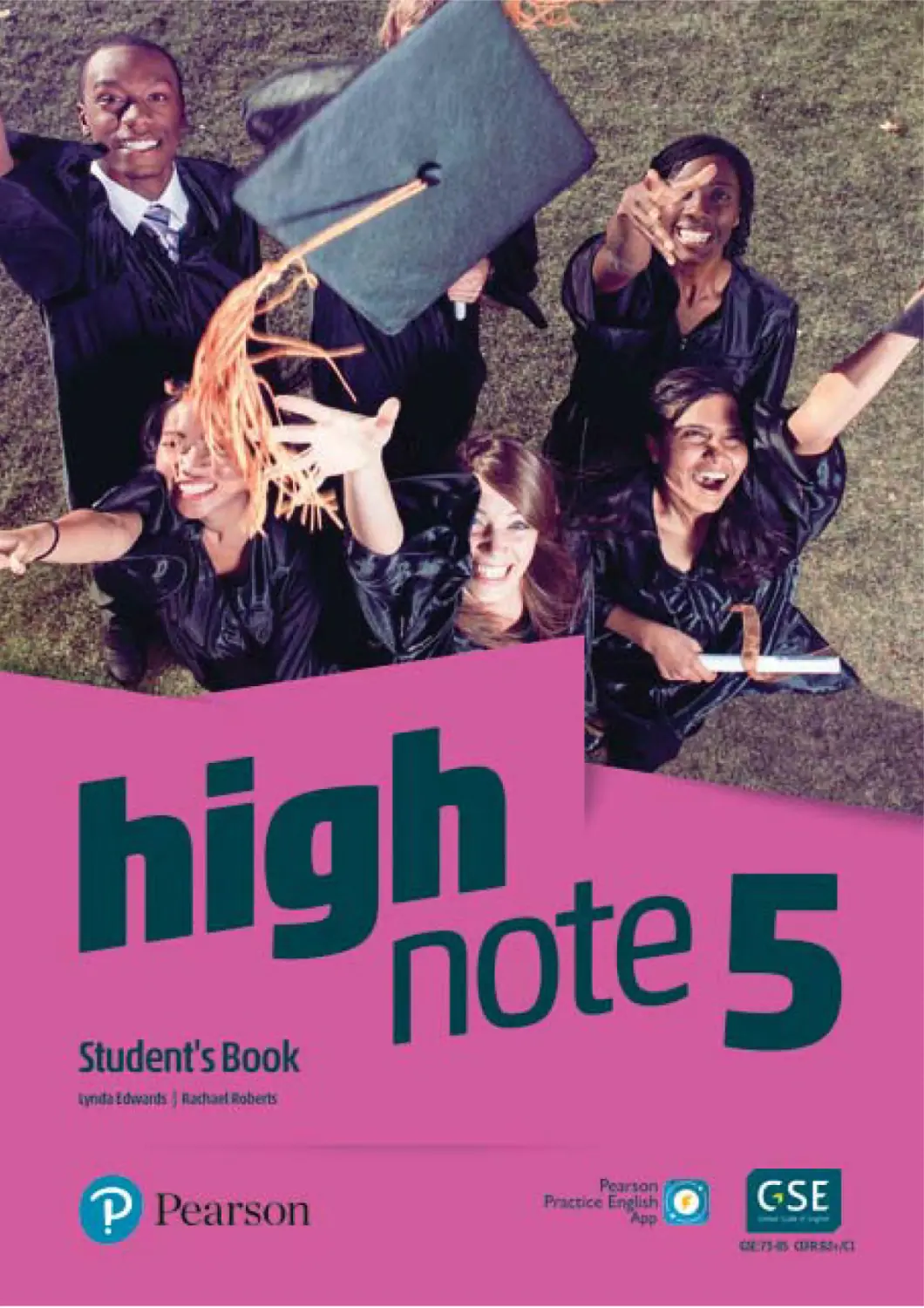


Автор: Roberts R. Edwards L.
Теги: english english grammar english language student's book



Текст
                    Цтнк ithv-Jith . Hxtwd АоЬегЪ
Pearson
Релгвоп
Prune* English
A-PP
Ct rj-O (РЯ Sk’^TI
CONTENTS
UNIT	VOCABULARY	SPEAKING
01 Identity	pp4-5 Personality adjectives and fixed expressions Active Vocabulary: Compound adjectives p6 Personality: idiomatic phrases; plO Verbs for thinking and understanding pl62 Global Citizen Documentary Video Q ppl4-15Word List	p6 Paraphrasing whatyou hear (checking understanding, summarising) An interview with a careers advisor about psychometric tests
02 On the move	PP18-19 Verbs of movement, idioms related to movement, travel verbs Active Vocabulary: Idioms; p20 Vocabulary related to public transport p24 Phrasal nouns; p27 Adverb-adjective collocations pp28-29 Word List	p25 Considering and comparing alternatives A discussion about last chance tourism
LIFE SKILLS How to make a good decision pp32-33
03 Hard sell	pp34-35 Business-related vocabulary, compound nouns, phrasal verbs Active Vocabulary: Compound nouns; p36 Opinion and attitude adjectives, synonyms for persuade; p38 Vocabulary related to behavioural economics p43 Vocabulary related to shopping pl63 Put Yourself in My Shoes! Documentary Video Q pp44-45 Word List	p37 Successful negotiations in daily life
04 Tastes	pp48-49 Adjectives related to food, partitives; Active Vocabulary: Partitives p50 Verbs related to senses of taste and smell; p55 Vocabulary related to table manners; p57 Vocabulary for restaurant review (nominalisations, synonyms, wordsand phrases of comparison and contrastand phrases of recommendation) pp58-59Word List	p54 Proposing solutions, giving reasons and justifications A discussion about problems related to food and their potential solutions
LIFE SKILLS How to think critically about food choices pp62-63
05 Do your best	pp64-65 Idioms related to studying, collocations with attempt and effort, verbs + dependent prepositions; Active Vocabulary: Verbs + dependent prepositions p68 Vocabulary related to sporting success and motivation p70 Prepositional phrases related to discipline and motivation pl64 Programming Bootcamp Documentary Video © pp74-75 Word List	p71 Buying time in interview situations Pronunciation: Fall-rise intonation
06 Feels good	pp78-79 Body language, body-related collocations and idioms Active Vocabulary: Collocations; p80 Vocabulary related to emotions p84 Vocabulary related to sounds and ASMR; adverb + verb collocations p87 Compound adjectives pp88-89 Word List	p85 Evaluating ideas A street survey about stress-busting activities Pronunciation: Falling intonation when having reservations about something
LIFE SKILLS How to develop a growth mindset pp92-93
07 The creative urge	pp94-95 Vague language, fashion-related adjectives, idioms and phrases Active Vocabulary: Vague language p98 The most loved and most hated words in the English language, animal idioms plOO Adjectives to describe art; plOl Film genres pl65 The Second Life of Second-hand Clothes Documentary Video © PP104-105 Word List	plOl Describing a film A radio podcast with a film review
08 Follow the crowd?	PP108-109 Vocabulary related to permission, prohibition, protest and influence, phrasal verbs with come, hold, set, take; Active Vocabulary: Keywords in phrasal verbs pllO Adjective-noun collocations related to looks pll2 Vocabulary related to lifestyles; pll6 Vocabulary related to values PP118-119 Word List	pill Hyperbole and understatement A conversation about the dress code at school
LIFE SKILLS How to be a good team member ppl22-123
09 Unbelievable	PP124-125 Expressions and adjectives related to illusion, surprise and incredulity Active Vocabulary: Word families pl29 Adjective-noun collocations related to sleep and dreams pl30 Vocabulary related to commenting and unexplained events; collocations with raise pl66 That's Magic! Documentary Video © PP134-135 Word List	pl28 Making speculations about the past, present and future A conversation about aphantasia and hyperphantasia
10 Up the ladder	PP138-139 Work-life balance collocations and idioms; Active Vocabulary: Register pl42 Collocations and prepositional phrases related to career dreams and ambitions; pl44 Qualities of a leader; idioms related to working life pl45 Personality adjectives, idioms related to communication PP148-149 Word List	pl45 Toning language down Expressing opinions about people and work
LIFE SKILLS Howto develop leadership skills pp!52-153
PP154-157 Culture Spot ppl58-161 Literature Spot ppl62-166 Watch and Reflect© (Documentary Video worksheets)
LISTENING	GRAMMAR	READING	WRITING	REVISION
p7 A talk about genes and personality Active Listening: Understanding the main points of complex talks Pronunciation: Syllables with the main stress	pp8-9 Continuous and perfect tenses	pplO-11 Does language change how you see the world?	ppl2-13Ablog post	PP16-17 Revision 01 Use of English > pl77
p24 Conversations about space tourism	pp22-23 Inversion, cleft sentences and fronting	pp20-21 An extract from King Solomon's Carpet by Barbara Vine Active Reading: Understanding reference devices Literal versus figurative meaning of words	pp26-27Aletterof complaint	ррЗО-31 Revision 02 Use of English > pl78

p36 A discussion about psychological techniques for persuading people Active Listening: Inferring meaning, opinion and attitude	pp40-41 The Passive Pronunciation: Weak pronunciation (contracted forms, verb to be in the Passive)	pp38-39 How to Apply Behavioural Economics to Your Daily Life	PP42-43 Afor-and-against essay Active Writing: Paraphrasing	pp46-47 Revision 03 Use of English > pl79
p55 A vlog about table manners	pp52-53 Advanced conditional structures; inversion in conditional forms	pp50-51 What Tickles Your Taste Buds Active Reading: Identifying paraphrases	pp56-57 A restaurant review	pp60-61 Revision 04 Use of English > pl80

p70Aradio phone-in on howto motivate yourself Active Listening: Recognising word clusters in fast speech Pronunciation: Word clusters in fast speech	pp66-67 Modal and related verbs Pronunciation: Word stress in sentences with modal verbs	pp68-69 Our Two Selves - an extract from The Inner Game of Stress: Outsmart Life's Challenges and Fulfil Your Potential by Timothy Gallwey	pp72-73An essay	PP76-77 Revision 05 Use of English > pl81
p84Aradio interview about ASMR and the importance of sounds in our lives	pp82-83 Reporting verbs and verb patterns	pp80-81 Put On a Brave Face or ...Should We? Active Reading: Understanding purpose and function	pp86-87 An article	PP90-91 Revision 06 Use of English > pl82

plOO Conversations about works of art	pp96-97 Relative clauses; prepositional relative phrases	pp98-99 Pretty Words, a poem by Elinor Morton Wylie Active Reading: Understanding metaphors	PP102-103 A letter to the editor Active Writing: Hedging	ррЮб-107 Revision 07 Use of English > pl83
pllO A radio programme about beauty standards	PP114-115 Articles	PP112-113 An extract from About a Boy by Nick Hornby What's Wrong With Being a Loner?	PP116-117 An opinion essay Active Writing: Using formal register in essays	PP120-121 Revision 08 Use of English > pl84
pl29 A radio programme about dreams
Distinguishing between facts and
opinions
PP126-127 Uses of
will, will versus would
Pronunciation: Word
stress to express a fact
or irritation
pplSO-131 The Mystery of
Rendlesham Forest
ppl32-133
A proposal
PP136-137
Revision 09
Use of English >pl85
pl44 A radio interview with a manager
talking about her job
PP140-141 Gerunds
and infinitives
PP142-143 Dreams Shape Your
Future
PP146-147 A report
PP150-151
Revision 10
Use of English > pl86
PP167-175 Grammar Reference pl76 Irregular Verbs ppl77-186 Use of English ppl87-189 Communication
How well do we know ourselves? Do we understand
what makes us tick? Take a moment to stop and think
about the things that define us.
INTERESTS
Some people find it easy to follow their passion. They've
always been nuts about music or horses or fashion. But what
if we are not really sure what our thing is? Maybe we could
think about the times in the last few weeks when we have felt
absorbed by something, or remember the things we used to
get a kick out of when we were children. One of those might
just turn into a lifelong hobby or even a career.
VALUES
What values do we set great store by? Do we prize
spontaneity or stability? Are we rather laid-back or strong-
willed? How crucial is commitment? How highly do we
rate tactfulness over frankness? When we know this, we
can consider whether the choices we make are in line with
these values.
POSSESSIONS
What kind of car would we ideally plump for? Maybe
we always buy the same type of phone? These sorts of
decisions can also say a lot about us. Or maybe we
are not that into possessions themselves, but have a small
collection of items with real sentimental value. The things
we choose to use regularly or to surround ourselves with
can also define us, which is why we might find new friends
checking out our books or music collection.
TRIBE
Who do we choose to spend time with? Our 'tribe' is a key
part of our identity. If we are a Real Madrid supporter,
or a history student, or a kind-hearted volunteer, we're
already hanging out with like-minded people. If you haven't
found your tribe yet, be more open-minded - get out there,
try some new things and meet some new people.
When we know these things, it's easier to be ourselves and
to find careers and the tribe that we really click with.
1AV0CABUII 1RYAND SPEAKING
1	SPEAKING Imagine you were in a radio programme
about identities in which people were asked to
describe themselves. What would you say?
2	.2 Listen to three people being asked to describe
themselves. What aspects of their identity does each
person mention? Which aspects of identity are shown
in photos A-D?
4
01
3	THINK BACK In pairs, decide which of the adjectives in
the box describe each speaker from Exercise 2 best.
Complete the table and explain your choices.
capable compassionate conceited dedicated
defensive passionate resilient self-aware self-centred
self-obsessed tough trustworthy underconfident
Carrie	Sarah	James

Compound adjectives (personality)
4	©i .2 Study Active Vocabulary. Then match the
words from box A with the words from box В to make
compound adjectives describing personality. Listen
to the recording again and decide which of these
adjectives you would use to describe the speakers.
A absent forward high highly kind laid like
narrow street strong thin tight
В back fisted hearted looking minded (x3)
skinned spirited strung willed wise
ACTIVE VOCABULARY I Compound adjectives
A compound adjective is made up of more than one
word, but describes a single idea. They often use
a hyphen when they come before a noun, e.g. She's
a world-famous singer. When they go after a noun,
the hyphen is generally dropped, e.g. The singer is world
famous.
There are many possible ways of forming compound
adjectives:
•	adjective + adjective, e.g. red-hot
•	adverb + adjective, e.g. hard-working, forward-looking
•	noun + adjective, e.g. lifelong, world-famous, streetwise
•	adjective + noun, e.g. full-time, cutting-edge
•	adjective + gerund, e.g. good-looking
•	adverb + past participle, e.g. highly-strung
•	noun + gerund, e.g. eye-catching
•	noun + past participle, e.g. tongue-tied
•	prefix + adjective, e.g. underconfident, overcooked
Most compound adjectives are stressed on the second
part of the compound, but compounds formed by a noun
+ gerund or past participle are usually stressed on the
first part of the compound.
5 SPEAKING Which of the adjectives from Exercises 3
and 4 would or wouldn't you use to describe yourself?
Explain why. What adjectives would other people use
to describe you? Think about your parents, siblings,
neighbours, friends or teachers.
6 Read the article about identity on page 4. In pairs,
discuss the questions.
1	Why is it important to get to know yourself?
2	Which of the four elements of identity do you find
most important? Say why.
Personality adjectives and values
7 Find five nouns in the text that describe different
values and form adjectives from them. Which of these
values are important to you? Say why.
passion - passionate
8 Use the adjectives from the box to form nouns
describing values. Put the qualities in order of
importance. Then compare your lists in small groups.
Use a dictionary if necessary.
assertive discreet humble inclusive merciful
sincere
Fixed expressions
9 Match the highlighted expressions from the text with
the definitions.
1	Have a feeling of excitement and energy.
2	Not be very keen on something.
3	Match with.
4	Something which makes us behave in a certain way.
5	Hit it off with someone.
6	Reveal our traits.
7	Be crazy about something.
8	Choose.
9 Consider something to be important.
10 Look at the highlighted expressions again and
complete the questions with one word in each gap.
Then discuss them in pairs.
1 Given the choice between a day out walking in the
hillsand a day in bed, which would you for?
Say why.
2 Do you agree that your clothes can a lot
about you?
3 What cartoon characters were you about
as a kid?
ft What is the best way to find out what makes someone
?
11 SPEAKING Make some notes about yourself under the
headings below. Then discuss them in pairs. Use the
vocabulary from the lesson.
• Interests • Values • Possessions • Tribe
□ I can use compound adjectives to talk about personality.
5
Are you a real live wire or a bit of a wet blanket?,
1
If you go to a party, how do you make
an entrance?
a
Гт the one playing the trumpet as
I walk in.
I quickly look round the room and go
and join someone I know.
I don't go to parties.
c
If you turn up at a fancy dress party
and discover you're the only one in
costume, what do you do?
a Try to see the funny side.
b Enjoy being the centre of attention.
c Fancy dress parties should be banned!
b
2
3 If the party you're at is dull, what do you do?
а Гт a mover and shaker -1 try to inject some life into
the party!
b Leave the party as soon as I can and find something
better to do.
c Have a bite to eat and talk to my friends - Гт
a smart cookie so I won't miss such an opportunity.
4 There is a dance competition at the party you're at.
Do you take part in it?
a I'm going to win! I'm a go-getter - I'll dance till I drop!
b Nobody knows my dancing moves - Гт a dark horse of
the dance floor. I want to surprise everybody and win
the competition.
с Гт a bit thin-skinned and not competitive at
all so I'll pass this time.
IB SPEAKING AND VOCABULARY
1 Look at the example of an online personality quiz.
In pairs or small groups, discuss the questions.
1	Do you ever do online personality quizzes?Say why.
2	Based on the questions, what do you think a live wire
and a wet blanket mean?
2 Look at some other idioms describing personality.
What do you think they mean? How would you express
them in your own language?
a cold fish a dark horse a go-getter
a mover and shaker a smart alec a smart cookie
a soft touch
3 Answer the questions.
1	Are any kinds of personality quizzes accurate?
Say why.
2	When might personality tests be used to make serious
decisions in life?
4 @1.5 Listen to a careers advisor being interviewed
about how she uses personality tests and decide if
statements 1-6 are true (T) or false (F).
1	□ It is usual for someone to leave university without
a clear idea of theirfuture career.
2	□ Rose believes you need to be self-aware in order
to find the right career.
3	□ Psychometric tests are usually quick and easytodo.
4	□ Rose thinks it is more importanttogetthe right
qualifications for a job than to have the right
personality.
5	□ Rosethinksthe interviewer should changethejob
he's doing at the moment.
6	□ The interviewer agrees with Rose's assessment of
his personality.
5	How did the interviewer show that he is interested in
and listening to the speaker?
6	@ 1.3 Study the Speaking box. Then listen again and
tick the phrases which are used in the interview.
SPEAKING | Paraphrasing what you hear
Checking understanding
□ To put it another way...
□ In other words...
□ If I'm hearing you correctly...
□ So you're saying (that)...
□ Let me get this straight...
Summarising
□ Essentially,...
□ Simply put,...
□ In a nutshell,...
□ So, what it boils down to is that...
7	Are the following statements arguments in favour of (F)
or against (A) using psychometric tests as part of a job
interview?
1	□ If a candidate is nervous, they may not show much
of their personality during an oral interview.
2	□ The candidate may answerthe test questions
dishonestly, especially if they know what the
intervie we г wants to hear.
3	□ Itcanbeexpensivetoadministerandmarkthetests.
4	□ Hiring the wrong person can be an expensive
mistake so it's better to know as much about them
as possible.
5	□ People who find exams anxiety-provoking may do
badly in psychometric tests.
6	□ A candidate for a job is unlikely to tell you about
a weakness themselves.
8 In pairs, follow the instructions.
•	Student A, use the information in Exercise 7 in favour of
psycho metric testing to explain why it is a good idea.
•	Student B, listen and use the phrases from the
Speaking box to check understanding.
•	Change roles. Student B, explain why psychometric
testing is not a good idea, and Student A, check
understanding.
□ I can use paraphrases to check and summarise information.
1С LISTENING AND VOCABULARY
1	SPEAKING In pairs or small groups, look at the cartoons.
What do you think they mean? Explain why.
2	Match the words from the box with definitions 1-11.
Use a dictionary if necessary.
destiny disposition hereditary imply moulded
nurture offspring oversimplification proponents
trait vulnerability
1	Character or personality.
2	Influenced or changed.
5	People who publicly support an idea.
4	The quality of being easily hurt.
5	A particular characteristic or way of behaving.
6	Helping something or somebody, e.g. young children
or plants, to develop.
7	Passed from parent to child.
8	Children.
9	Making something so easy to understand that it is
no longertrue.
10	Whatwill happen in the future.
11	Suggest.
3 © 1.4 PRONUNCIATION Look at the words in the box in
Exercise 2 again and underline the syllables with the
main stress. Listen and check.
4 You are going to listen to part of a talk about the
relative influence of genes or environment on
personality. Make a list of four key points you think
the speaker will make. Use the new vocabulary from
Exercise 2.
5 ©1.5 Study Active Listening. Then listen and check
which of your ideas from Exercise 4 are mentioned.
What other ideas (if any) did the speaker talk about?
ACTIVE LISTENING I Understanding the main
points of complex talks
When speakers want to highlight the main points they
are making, they often
•	use a phrase that indicates something important, e.g.
Perhaps the first thing to say is that...
It is important to recognise that...
... is also key. I Without doubt,... I The fact is...
•	use a rhetorical question, e.g.
So, what exactly do we mean by this?
So, what does this tell us?
•	repeat key words, e.g.
While your personality may be genetically influenced,
your environment definitely can make a difference.
If your parents encourage you to have a confident
personality, for example, that will surely have an impact
on how successful you are in later life.
•	paraphrase to emphasise a point, e.g.
Nature refers to hereditary factors, everything handed
down to us biologically from our parents, and their
parents before them. In other words, that our genes
predispose us to act a certain way.
•	slow down the pace to emphasise a key point.
6 ©1.5 Listen again and complete the sentences with
1-3 words in each gap.
1	Aristotle believed people were formed by.
2	People generally prefer to believe that they are in
chargeoftheir.
3	Research shows that being likely to suffer from
is a trait we probably inherit from our parents.
4	Separated shortly after birth, the Jim twins didn't
meet again untilthey were.
5	The speaker thinks someone could infer from the Jim
twins story that their had the strongest
influence on their lives.
6	Ann and Judy had very different upbringings, and Ann
spent a lot of time.
7	In adulthood, Ann and Judy both struggled
with.
8	The warrior gene is unlikely to lead to problems for
a child brought up in.
7 SPEAKING In pairs or small groups, discuss the questions.
1 Why is it an oversimplification to say that your
personality is due to solely hereditary factors or solely
nurture?
2 In what ways do you think that your disposition can
affect your destiny? Give examples.
3 Give at least one example of ways in which your
parents or caregivers have attempted to mould your
personality. Have they been successful? Say why.
8 REFLECT | Values In the future, scientists may be able
to change someone's personality through genetic
engineering. What is your opinion on this?
□ I can understand the main points of a talk about genes and personality, i 7
ID GRAMMAR
1 In pairs or small groups, discuss the questions.
1	Which of the habits in the photos do you think are
good or bad? Say why.
2	Which of these habits do you have?
3	How easy do you think it is to change a habit?
Say why.
2 What is the equivalent of these sayings in your
language? Do you agree with their meaning? Say why.
ALEOPARD CANNOT CHANGE ITS SPOTS. *
Old habits die hard.
You can’t teach an old
dog new tricks.
3 @1.6 Listen and write down four pieces of advice
Jack gives Cerys about howto develop better habits.
4 SPEAKING What do you think is the best piece of advice
that Jack gives Cerys? Say why. Do you have any
other advice for developing good habits or breaking
unwanted ones?
Continuous and perfect tenses
5 THINK BACK Look at the extracts from the recording.
What tenses are used in the underlined parts?
Explain why.
Cerys ]Are you feeling OK? You look a bit hot and
sweaty.
Jack I'm fine,aI've just been running.
Cerys Oh, right. I didn't know you were into that.
Jack 3 4 I've just started, really. ‘I've been doing
the Couch to 5k challenge.
Cerys 5 * * I've never been able to run far without getting
completely out of breath.
Jack I can't run quite that far yet, but‘I'll be doing
a 5k run for charity in a few weeks.
Cerys ’Had you done much running before?
Jack ,!l'm reading this really good book about how to
develop good habits.
Jack Next week "I will have been running every day for
2 months.
Jack I found that 10l was starting to make excuses.
Jack 1XI had been keeping quiet about my running,
butthen I realised if I told everyone I was running
5k for charity, I'd have to keep it up.
Jack Next time I see you, 12you will have completely
changed your eating habits!
Grammar Reference > page 167
8
I
01
6 Match the sentences with meanings a or b.
1	□ I've been reading a book about habits.
□ I've read a book about habits.
a I've finished the book.
b I'm still reading the book.
2	□ I will be working.
□ I will have been working.
a I will be in the middle of my work.
bl will have finished my work.
3	□ I had been eating all day.
□ I had eaten that day.
a I ate.
b I was eating continuously or very often.
ft □ I've come up with a great idea.
□ I had a great idea.
a I have a great idea now.
b I came up with a great idea at some point in the
past.
5	□ I'm playing a lot of football.
□ I playa Lot of football.
a This is something I always do.
b This is something I've been doing recently
ortemporarily.
7 Complete the sentences with the correct continuous
or perfect forms of the verbs in bold. Use a different
form in each sentence.
RUN
1	Recently, I five kilometres every day.
2	When I finish the marathon, I
an incredible forty-two kilometres.
3	I for the bus when I tripped over my
shoelace and fell flat on my face.
ft When I started training forthe marathon,
I(never) for more than a few minutes.
READ
5	I'm a real bookworm. So far this month
I six books.
6	I had a bad dream last night, probably because
I a scary book before I went to sleep.
7	Don't message me this evening. I
my book and I don't like being interrupted.
8	I've got a headache. Maybe it's because
I without wearing my glasses.
LIVE
9	While I here, I want to make the most
of the weather and go for a walk every day.
10	By the time you come and visit, I here
for six months.
11	I in several different countries.
12	I didn't eat very healthily when I
in NewYork-too much fast food.
8 Complete the texts with the correct continuous
or perfect forms of the verbs from the box.
be find get gooff
I was always late for school, and
13 * into more and more
trouble with the teachers. I would set
my alarm, but fall asleep again straight
after it?. Гт not exactly
strong-willed. But now 13 it
much easier to get up. Want to know
my secret? The only way to turn off my
alarm is to scan a QR code I keep in the
bathroom. Next week I on time every day
for a month! My teachers can't believe it. Such a good
idea - Гт a smart cookie, that's for sure!
check reduce spend think of
15 way too much time on
social media. One day I realised that
I 6 * * 9 my account more than fifty
times that day! IT deleting
my account altogether, but that seemed
a bit extreme, so I decided that I would
always log out of the app. Just having to
fill in the password every time makes it enough of
a pain that I can't be bothered to keep logging in and
111 the number of times I check it to maybe
once or twice a day.
do feel take
I used to be a bit of a couch potato, but
my parents bought me a fitness tracker
for my birthday and I started walking
10,000 steps a day.
I ”it every day now since
I got the tracker. It's been so many
days now that I don't ever want to miss
a day, so that keeps me really motivated. Next week,
110 10,000 steps a day for a total of six
months! 111 so much healthier.
9 SPEAKING Read the questions and make a few notes.
Then, in pairs, answer the questions and give each
other some useful advice.
1 Think about a habit you have that you would Like to
change ora new habit you'd Like to develop.
What impact has this habit (or not having this habit)
had on your life up to now? Give specific examples.
2 What can you do to help yourself give up this habit
orstartthe new habit? How will things be different
in six months'time?
□ I can use continuous and perfect tenses.
9
IE READING AND VOCABULARY
1 SPEAKING Look at the photos and discuss the questions.
1	What adjectives would you use to describe the bridge
in picture A?
2	How many birds are there in picture B? How do you
know?
3	How would you describe the position of the woman
in picture C?
4	How would you describe the snow in picture D?
2 Read the article. How might speakers of different
languages answer the questions in Exercise 1?
3 Read the article again and match questions 1-7 with
paragraphs А-D. Each paragraph may be chosen more
than once.
In which paragraph does the author...
1	□ describe research into the impact of a grammatical
feature on the speaker's perception?
2	□ point out shortcomings in a specific piece of
research?
3	□ suggest an alternative explanation for linguistic
relativity?
4	□ outline a well-known theory about the effect of
language on how we see the world?
5	□ comment on the personal impact of speaking
another language?
6	□ mention a benefit to perceiving the world
differently?
7	□ refer to research into the effect of language on
character?
4 SPEAKING What did you learn from reading the article
that you did not know before?
5 Look at the highlighted verbs for thinking and
understanding in the article. Then, for each sentence,
choose one word that does NOT complete it correctly.
1	Because you had lived in Brazil, I_you spoke
Portuguese.
a grasped b assumed «concluded
2	It's hard to_howmuch the world is likely to
change in the next 50 years.
a comprehend b conceive c reflect
3	They failed to__just how important the decision was.
a recognise b contemplate c perceive
4	We're___moving abroad.
a deducing b considering c contemplating
5	With difficulty, he managed to_what she was trying
to explain.
a assume b comprehend c grasp
6	From what I can_, she's actually been fired,
ratherthan resigning.
a gather b conceive «deduce
WATCH OUT!
Conclude has a similar meaning to deduce, but also
has the sense of being a judgement arrived at after
some thought, whereas deduce implies an immediate
judgement.
6 Complete the sentences with the correct words from
Exercise 5. Then look back at the text and check.
1	Because snow is so much more present in their lives,
they actually snow differently,
and more subtle distinctions.
2	The key question is whether this implies that the
languages mould the way they the world.
3	You may that counting is a universal
human trait but, in fact, not all languages have
numbers.
4	We can probably from this that they don't
feel the need to quantify precisely.
5	So, should we that speakers of different
languages do indeed see the world from a different
perspective?
6	It is possible to something even if you don't
have a specific word for it.
7	You may not have a word for every colour you see,
but you will obviously that these colours
are different from each other.
8	It's fascinating to that you might actually
be a different person when speaking a second
language.
7 SPEAKING In pairs, discuss the questions.
1	Do you feel as if you have a different identity when
you speak English?
2	How would you feel about people using an
anglicisation of your name, e.g. Kate for Kasia?
3	Doyou thinkyou have changed as an individual
because of the language(s) you have learned?
10 I □ I can identify specific details in a text and use verbs connected with understanding.
words for snow? The theory goes that because snow is so
much more present in their lives, and often of vital importance,
they actually perceive it differently, and recognise more
5 subtle distinctions between different types of snow and ice
than those of us living in warmer climes. In fact, this theory
is something of a myth, not least because there isn't a single
Inuit language, but a variety of dialects. However, recent
research has shown that there is at least some truth in the idea
10 that these dialects have more ways of distinguishing different
types of snow than many other languages do. The key question
though, isn't really whether there are more words to describe
frozen water so much as whether this implies that the languages
spoken by the Inuit mould the way they conceive of the world.
15 This concept is referred to as linguistic relativity or, more
famously, the Sapir-Whorf hypothesis, after two scientists who
both wrote, separately, about this idea.
В There is certainly plenty of evidence that different
languages (and cultures) appear to see the world through
20 different filters. For example, speakers of Guugu Yimithirr,
a language used in North Queensland, Australia, would always
refer to someone's position using the words for the directions:
north, south, east and west. They wouldn't say 'that woman
is standing in front of her house', but something like 'that
25 woman is standing west of her house'. As a result, speakers
of Guugu Yimithirr will naturally be far better than most of us
at instantly knowing which direction they are facing. To give
another example, you may assume that counting is a universal
human trait, but, in fact, not all languages have numbers.
30 The Piraha people of the Amazon rainforest in Brazil simply
distinguish between a smaller amount and a larger amount.
We can probably deduce from this that they don't feel the
need to quantify precisely in the way that many of us do.
European languages also differ in the way they see the world.
35 For example, the word for bridge has a masculine gender
in Spanish and a feminine gender in German. The cognitive
scientist Lera Boroditsky carried out research where she asked
Spanish and German speakers to describe a bridge and found
that the Spanish speakers tended to use more stereotypically
40 masculine adjectives, such as big and strong, whereas
the German speakers used more stereotypically feminine
adjectives, such as beautiful and elegant.
C So, should we conclude that speakers of different
languages do indeed see the world from a different
45 perspective? Perhaps, frustratingly, the answer is likely to
be yes and no. To begin with, it is possible to comprehend
something even if you don't have a specific word for it.
Imagine you were mixing paint, like you did in primary
school, adding a drop of blue to a pot of red paint. You may
50 not have a word for every colour you see as you add the blue
drop by drop, but you will obviously grasp that these colours
are different from each other. Similarly, while blue and green
are clearly different colours, many languages don't recognise
this difference and have a word which describes both colours.
55 This doesn't mean that they see colour differently, but that
they categorise it differently. The same could be said for
the different types of snow, or different ways of looking at
numbers and quantity. Ultimately, someone's culture may say
a lot about how they see the world, and their culture is likely to
60 be reflected in their language. Whether that means that their
language affects their thinking is yet to be conclusively proven.
D That said, many people do feel they take on a new
identity when using another language. A 2006 study of
bilingual Mexican-Americans, asked them to take a personality
65 test in both English and Spanish. Amazingly, the results
varied, depending on which language each individual was
using. Undoubtedly, how much you pick up a culture
alongside a language will depend on how and why you are
learning it, and whether you wish to become part of the
70 second language culture, but it's fascinating to consider that
you might actually be a (slightly) different person when
speaking a second language.
GLOSSARY
linguistic relativity - a principle claiming that the
structure of a language affects its speakers' world view
or cognition, and thus people's perceptions are relative
to their spoken language
11
I recently had a big clear-out of my bedroom and,
tucked behind the wardrobe, I found my old teddy
bear, George. Seeing him again brought all the
memories flooding back.
I had had George from when I was very little and,
for as long as I could remember, he had only had
one eye. It wasn't important to me, I loved him no
matter how shabby and old he was. George was my
constant companion and we did everything together.
One day, I discovered that George had lost his one
remaining eye. I took him to my mother and, much to
my delight, she promised that she could give him his
sight back.
The next day she presented George to me. She had
decided she might as well sew on two new buttons,
appearance came as a shock. Izve never forgotten
how upset I was to see him looking so different!
George was not meant to have two eyes! He looked
all wrong! I started crying and screaming (I was very
young, remember). My mother was really worried.
She didn't have a clue what was wrong with me.
Eventually, I made her understand and she had no
choice but to cut off one of the buttons so that,
once again, he was my familiar one-eyed bear.
I don't know how I failed to realise he had gone
missing down the back of the wardrobe, but I've
already decided he'll be coming with me to university,
where I can keep an eye on him. I may not want to
play with him anymore, but looking at him still evokes
so many precious memories.
IF WRITING AND VOCABUIARV | A blag post about the past
01
1 SPEAKING In pairs, discuss what your warmest
childhood memories are. What did you learn about
your partner?
2 Read a blog post about a childhood memory and
discuss the questions.
1 Why do you think the writer remembers this moment
in particular?
2 What doyouthinkthis storytells you about the writer?
What could you say about their background, age,
personality, values, etc.?
3 Put the paragraphs of the blog post in the correct
order.
A □ Describe the main events of the memory.
В □ Explain whythe memory is still significant for you.
C □ Give the background to the memory (how old you
were, where it took place, etc.)
D □ Introduce the memory by explaining why you are
talking about it.
E □ Relate the past events to the present day.
4 Study the Writing box and tick the phrases used in the
blog post.
WRITING | a blog post about the past
Introduction
Blog posts are often quite personal, so you might begin
by explaining to your audience why you are telling them
about this memory:
□ ... brought all the memories flooding back.
□ I clearlyrecall...
□ I was reminded of ...
□ One of my fondest childhood memories is...
□ ... evokes so many precious memories.
Style
Use time linkers to show when things happened:
□ one day
□ at that time
□ during these years
□ by the time
□ as a child / when I was a child
□ for the time being
□ for as long as I could remember
□ on rare occasions
Conclusion
Explain whythe memory was significant:
□ ... had a profound influence on...
□ This experience convinced me that...
□ I’ve never forgotten...
5 Complete the sentences with one word in each gap.
Then check your answers in the blog post.
1	I loved him matter how shabby and old
he was.
2	I took him to my mother and,to my delight,
she promised that she could give him his sight back.
3	She had decided she as well sew on two
new buttons.
4	I clearly recall how much his new appearance
as a shock.
5	She didn't have a whatwaswrong with me.
6	She had no choice to cut off one of the
buttons.
7	I don't knowhow I to realise he had gone
missing.
8	He'll be coming with me to university, where I can
an eye on him.
WATCH OUT!
These kinds of expressions tend to be very 'fixed', so it is
important to use exactly the right words in the right order,
e.g. be on tip of the tongue be on the tip of my tongue.
6 Complete the second sentence using the word in bold
so that it means the same as the first one.
1	I didn't realise what a bad idea it was. FAILED
I.
2	I took him with me everywhere I went. MATTER
No.
3	lhadtowaitforhim.CHOICE
I had.
4	I was delighted when he agreed to come to the party.
TO
Much.
5	I have no reason not to work today. MIGHT
I.
6	I was really shocked by what you said. CAME
What you sa id.
7	I had no idea what was happening. CLUE
I.
8	I had to watch my little brother carefully. EYE
I had to.
7 Choose one of your childhood memories that you are
happy to write about. Read the questions and make
notes.
1	How old were you? What was the occasion?
2	What happened exactly?
3	What emotions do you associate with this memory?
4	Why is the memory significant to you?
5	What does the memory say about you, e.g. your
background, personality, values or life experiences?
8 WRITING TASK Write a blog post about your childhood
memory. Use the advice and some of the phrases from
the Writing box, plus a range offenses. If possible,
try to use some of the expressions from Exercise 5.
□ I can write a blog post about the past.
13
Word List
REMEMBER MORE
1 Complete the questions with
prepositions. Then check with
the word list. Answer the
questions with your partner.
1	What are you nuts?
2	Are your choices in line
what your parents want?
3	Are there any people that you
don’t click? Say who.
4	What do you set great
store?
2 Complete the compound
adjectives. Then check with
the word list. Write your own
example sentences using the
words.
1	self-____
2	___________________
-minded
3	Complete the sentences with the
correct adjectives formed from
the words in bold. Then check
with the word list.
1	Don't be afraid to tell your boss
what you think - try to be a bit
more(ASSERTION).
2	Our courses are
(INCLUSIVITY) - anyone can join.
3	Jemma is a very
(DISCRETION) hairdresser.
She never tells anyone what
her celebrity clients tell her.
4	Cal is a(SINCERITY)
employee, he's very honest
and says what he thinks.
4 Read Active Vocabulary. Then
complete the table with some of
the vocabulary from this unit.
Keyword (K)	Information (1)	Memory clue (M)
absent- minded	forgetful	/ forget everything - I'm absent- minded.
ACTIVE
VOCABULARY | KIM strategy
The KIM strategy is a visual way
of recording and remembering
vocabulary. In a table similarto
the one above, write the key word
(K), the information about the
word (I), usually a definition,
a synonym or a translation,
and a memory clue (M) - this
could be a drawing or an example
sentence.
14 i
1A VOCABULARY AND SPEAKING
© 5.1
absent-minded (adj) /.aebsant'maindid/
absorbed by sth /ab'zaibd bai .SAmOirj/
assertive (adj) /a's3itiv/
assertiveness (n) /a's3itivnas/
be in line with sth /bi in ‘lain wid .SAmGiq/
be into sth (phг v) /bi 'into .sAm0ir)/
be nuts about sth /bi 'nAts .abaut ^лт0и]/
by nature /bai' neitfa/
capable (adj) /'keipabal/
click with sb /'klik wid .sAmbodi/
come across as /.клт a'kros az/
commitment (n) /ka'mitmant/
committed (adj) /ka'mitad/
compassionate (adj) /kam'paejanat/
conceited (adj) /kan'siitid/
cutting-edge (adj) /.kAtirj'eds/
dedicated (adj) /'dedikeitid/
defensive (adj) /difensiv/
discreet (adj)/di'skriit/
discretion (n) /di'skrejan/
eye-catching (adj) /'ai .kaetfirj/
forward-looking (adj) /.faiwad 'lukirj/
frank (adj) /fraeqk/
frankness (n) /Traerjknas/
get a kick out of sth /get a 'kik aut av .sAm0ir]/
heritage (n) /'heratidj/
highly strung (adj) /.haili 'strArj/
high-spirited (adj) /,hai 'spintid/
humble (adj) /'hAmbal/
humility (n) /hjui'milati/
inclusive (adj) /in'kluisiv/
inclusiveness (n) /in'kluisivnas/
inclusivity (n) /.inklui'sivati/
kind-hearted (adj) /.kaind 'haitid/
Laid-back (adj) /,leid 'baek/
lifelong (adj)/'laiflor)/
like-minded (adj) /,laik 'maindid/
memorabilia (n) /.memara'bilia/
merciful (adj) /'m3isifal/
mercy (n)/'m3isi/
narrow-minded (adj) /.naerau 'maindid/
over-the-top (adj) /.auva da 'top/
overcooked (adj) /.auva'kukt/
paramedic (n) /.paera'medik/
passionate about sth (adj) /'paejanat a.baut
,SAm0irj/
plump for (v) /'р1лтр fa/
rate (v) /reit/
resilient (adj) /n'ziliant/
say a lot about sb /.sei a 'lot a.baut .SAmbodi/
self-aware (adj) /.self aS/vea/
self-centred (adj) /.self 'sentad/
self-obsessed (adj) /.self ab'sest/
set great store by sth /.set .greit 'stai bai .sAm0iq/
sincere (adj) /sin'sia/
sincerity (n) /sin'serati/
spontaneity (n) /.sponta'neiati/
spontaneous (adj) /spontemias/
stability (n) /sta'bilati/
stable (adj) /'steibal/
streetwise (adj) /'striitwaiz/
strong-willed (adj) /.strorj 'wild/
tactful (adj)/'taektfal/
tactfulness (n) /'taektfal nas/
thin-skinned (adj) /.0in 'skind/
tight-fisted (adj) /.tait Tistid/
tongue-tied (adj) Ллд taid/
tough (adj) /tAf/
tribe (n) /traib/
trustworthy (adj) /'trASt,w3idi/
underconfident (adj) /^nda'konfidant/
what makes us tick /.wot .meiks as 'tik/
IB SPEAKING AND VOCABULARY
©5.2
administer a test /ad.ministar a 'test/
anxiety-provoking /aeq'zaiati pra.vaukirj/
assessment (n) /a'sesmant/
career path /ка'па pai0/
centre of attention /'sentar av a.tenjan/
cold fish (n) /.kauld fif/
comprehensive (adj) /.kompn'hensiv/
dark horse (n) /.da:k 'hais/
essentially (adv) /fsenjali/
have a bite to eat /.hav a 'bait ta jit/
go-getter (n) /.gau 'geta/
hand down (phr v) /.haend 'daun/
if I’m hearing you correctly /if aim .hianrj ja
ka'rektli/
I'll pass /ail pais/
in a nutshell /in a 'nAt-Jel/
in other words /т 'Ada W3idz/
inject (v) /in'djekt/
let me get this straight /.let mi get dis 'streit/
01
live wire (n) /.laiv 'waia/
make an entrance /.meik an 'entrans/
mover and shaker (n) /'muivar and Jeika/
overnight (adv) /.auva'nait/
pathway (n) /'pa:0wei/
psychometric test /.saikau'metnk test/
(right) up your street /(.rait) др ja 'striitf
simply put /.simpli ‘put/
smart alec (n) /(sma:t 'aebk/
smart cookie (n) /.smart 'kuki/
soft touch (n) /.soft *tAlJ/
so you’re saying (that) /.sau ja ‘sei-irj (.daet)/
so, what it boils down to is that /.sau wot it
bailz ’daun ta s .daet/
super-driven /'surpa .drivan/
to put it another way /ta .put it а'плда wei/
wet blanket (n) /.wet 'blaeqkit/
1C LISTENING AND VOCABULARY
05.3
behaviourist (n) /bi'heivjanst/
boardroom (n) /'baidruim/
caregiver (n) /'kea.giva/
carpentry (n) /'kaipantri/
destiny (n)/'destani/
disposition (n) /.dispa'zijan/
genetic engineering (n) /dja.netik .end^a'nianrj/
hand sth down (phr v) /.haend .SAmGirj 'daun/
hereditary (adj) /ha'redatari/
imply (v) /im'plai/
inherit (sth) from sb /in'herat (.sAm0irj) from
.SAmbodi/
mechanical drawing /mi,kaenikal 'donrj/
moulded (adj) /'mauldid/
nurture (njAuitJa/
obedience (n) /a'biidians/
offspring (n) /'Df.spnrj/
oversimplification (n) /.auvasimplifi'keijan/
owe a great deal to sth /.au a .greit 'dill ta
.sAm0ig/
predispose (v) /.priidis'pauz/
proponent (n) /pra’paunant/
ring a bell /.ng a 'bel/
salivate (v) /'saelaveit/
solely (adv) /'saul-li/
trait (n)/treit/
unsurprisingly (adv) /.Ansa'praizirjli/
upbringing (n) /'Ap.bngig/
vulnerability (n) /.vAlnara'bilati/
warrior gene A/vona .djim/
willingness (n) /'wiliqnas/
ID GRAMMAR 05.4
bookworm (n) /'bukwaim/
can’t be bothered (to do sth) /.kaint bi boded
(ta du: .SAmOiq)/
develop a habit /di.velap a 'haebit/
fall flat on your face /.foil flaet on ja (feis/
get out of breath /.get aut av 'bre0/
keep quiet about sth /,ki:p 'kwaiat a.baut
.SAm0ir]/
make the most of sth /.meik da 'maust av
,SAm0ir)/
running kit /глпи] kit/
spot (n) /spot/
trip over sth (v) /'trip .auva .SAm0iq/
IE READING AND VOCABULARY
05.5
anglicisation (n) /.aerjglisai'zeijan/
assume (v) /a'sjuim/
categorise sth (v) /'kaetagaraiz .sAm0iq/
clime (n)/klaim/
cognition (n) /kog'nijan/
cognitive scientist /.kognativ 'saiantist/
comprehend (v) /.kompn'hend/
conceive of sth (v) /kan'sizv av (sAm0ig/
conclude (v) /kan'kluid/
conclusively (adv) /kan’kluisivli/
consider (v) /kan'sida/
contemplate (v) /'kontampleit/
deduce (v) /di'djuis/
frustratingly (adv) /frAs'treitirjIi/
gather (v) /'gaeda/
grammatical feature /gra.maetikal Tiitja/
grasp (v) /graisp/
imply (v) /im'plai/
linguistic relativity /lirj.gwistik .rela'tivati/
mould (v) /mauld/
of vital importance /av .vaitl im'paitans/
outline sth (v) /'autlain .sAm0iq/
perceive (v) /pa'siiv/
perception (n) /pa'sepjan/
quantify (v) /'kwontifai/
recognise (v) /'rekagnaiz/
reflect (v) /nflekt/
research into sth /n's3itj .inta .sAm0irj/
shortcomings (п) фг^клппдг/
subtle distinction /.sAtl di'stirjkjan/
take on a new identity /.teik on a .nju:
ai'dentati/
the theory goes that /da '0iari .gauz dat/
there is plenty of evidence that /deaz 'plenti av
.evidans dat/
IF WRITING AND VOCABULARY
05.6
be on the tip of your tongue /.bi on da 'tipav
ja ,tAFj/
bring back memories /.bnr] ,baek 'memariz/
clear-out (n) /'kliaraut/
come as a shock /,клт az a Jok/
constant companion /.kunstant kam'paenjan/
don’t have a clue /.daunt hav a 'klu:/
evoke precious memories /i.vauk .preJas
'memariz/
fail to realise /.feil ta 'rialaiz/
flood back (phr v) /.flAd 'baek/
fondest childhood memories /.fundist
.tjaildhud 'memariz/
go missing /.gau 'misirj/
have no choice but to /hav .паи tjais bat ta/
hold many memories /'hauld .meni .memariz/
keep an eye on sb/sth /.kiip an 'ai on .SAmbodi/
^Am0ir]/
might as well /'mait az .wel/
much to my delight /.mAtJ ta mai di'lait/
no matter /паи 'maeta/
profound influence on /pra.faund 'influans on/
shabby (adj)/Jaebi/
tuck sth behind sth Алк .SAm0ir) bi.hamd
.sAm0irj/
15
01
[ Revision
VOCABULARY AND GRAMMAR
1 Choose the correct words to complete the sentences.
1 He's very conceited/ humble / tough and brags about
how good he is at everything all the time.
2 Are you deciding I implying I conceiving that people are
more influenced bytheirupbringingthantheirgenes?
3 The writer of the article is a mover / proponent /
go-getter of the theory that early childhood habits last
a lifetime.
4 There is very little discretion I humility I spontaneity
in my cousin's life as he always plans everything
down to the last detail.
5 I simply can't conclude/assume/comprehend why
two sisters with the same parents have such different
personalities.
6 I suppose our boss is very forward -seeing / -looking /
-minded and always thinks about the long-term future
of the business, ratherthan what's just round the comer.
2 Find one mistake in every sentence and correct it.
1 She thinks she's a real clever alec, but she actually got
the answer wrong.
2 The story is about the life of an old man who was so
close-fisted that he refused to give any of his family
birthday cards.
3 In my opinion, Katy is a black horse and I'm sure she
knows much more about the situation than she's
letting on.
4 You must not be thin-minded when entering into
discussions on this topic as our own views are not
always that well-informed.
5 The new teacher is a real bright wire and lessons are
certainly more interesting these days!
6 Don't be so negative, you're such a damp blanket!
I'm sure we’ll have a great time.
3 Complete the words in the sentences.
1 I would just love to be as______________butterfly,
but unfortunately, I'm way too shy.
2 Many parents encourage their o________________________
to be streetwise in order to be really successful in life.
3 His particular sense of humour is a personality
t______________shared by his whole family.
4 The nature versus n__________________debate is one
that will continue to engage people for a very long
time.
5 His extreme physical flexibility is
h_______________________________: both his father and
grandfather were very flexible too.
6 My uncle has always been a s_______touch and was
forever giving me and my brother money when
4 Choose the correct words to complete the sentences.
1 It had rained/had been raining for a while by the time
we left the theatre.
2 I've had / been having this habit of counting my steps
ever since I started primary school.
3 We'll have looked /be looking at the past and present
tenses over the next few lessons.
4 I've dreamt/been dreaming about our old town
several times recently.
5 By the time this train gets in, they'll have waited /have
been waiting for us for over an hour.
5 Complete the conversation with the continuous, perfect
or perfect continuous form of the verbs in brackets.
A Hi. I haven't heard from you for a while, what
1(you / do) with yourself?
в Good to see you! Sorry, I ’(plan) to call you
last night, but never got round to it.
13(watch) a highly interesting TV series on
and off for a while now - it's about researching your
ancestry. So, I decided to have a go and I '
(find) several really useful websites. 13
(never / realise) before that it could be so fascinating.
A Yeah -16(mean) to catch that series too.
I ’(find) college work a bit heavy at the
moment. How ”.(you / get on) with the
research?
В I know what you mean about the assignments!
I've missed a couple, so no doubt I (spend)
next week catching up! But, by the end of the month,
110(research) my family history for a good
three weeks, so I should have some results!
USE OF ENGLISH
6 Complete the text with the correct form of the words
in capitals.
STRATEGY | Word formation
Read the text through first to have an idea of the general
meaning before you focus on the individual gaps. You may
need to make more than one change to the base word.
ARE YOU THE RIGHT PERSON?
\Ne are looking for volunteers to staff our hostels and
help street sleepers during the winter months. It would
be a(n)1(SIMPLIFY) to say that the ideal
volunteer is kind-hearted and of a friendly2
(DISPOSE). Our people need to be able to deal with
many issues so we would hope to attract people who
are 3(COMPASSION) but also tactful and able
to use their *(DISCREET). The5
(VULNERABLE) of homeless people cannot be
overstated as they have little 6_(STABLE)
in their lives. Our volunteers need to be r
(DEDICATE) individuals with a high sense of11
(COMMIT), so please apply if you are willing to devote
significant amounts of your time.
Use of English > page 177
READING
I
7 Read five texts about the significance
of first impressions. For questions 1-10,
choose from the texts A-E. Each text
may be chosen more than once.
First
mnressions
A First impressions are important in our personal and
professional lives, which is why we need to be aware of the
signals we are sending out and, if necessary, change them.
Most people understand that a smile and eye contact are
generally perceived positively so they make use of these
strategically. On the other hand, they may be completely
oblivious to the fact that their crossed arms can make them
look closed or even hostile. Occasionally, even the most
amiable person can have something on their mind which can
affect how they feel. Rather than letting this show, they can
use a technique such as thinking of something amusing that
will put a smile on their face as they enter the room to meet
and greet the people there.
В So, you've conquered your nerves and turned up at the
party. You stride into the room, smile at everyone and greet
them with a firm handshake. But what now? After all, first
impressions are not just about physical appearance. We also
make judgements about people when we start to talk to
them. Introverted people seem to be at a disadvantage, but
all is not lost. There are tried and tested topics, such as the
weather, for example, or you can use visual or oral clues to
stimulate the conversation: an interesting accent -'Where
are you from?' A band T-shirt - 'Oh are you a fan?'
If you are lucky, the person you ask will be a chatty
extrovert happy to be in the company of someone who
doesn't interrupt their well-practised anecdotes.
C Whenever the topic of first impressions is raised,
job interviews are sure to be mentioned. Many of them
start off with a few introductory questions aimed at
settling the interviewee's nerves, as if this was a friendly
encounter rather than a serious assessment of suitability.
In an interesting study, objective outsiders were split into
two groups to watch a video of the interview. One group
watched the entire thing, the other missed out the initial,
informal chat. The first group's judgement of the candidate's
performance was, to a large extent, dependent on the
impression they made at the start. So, it turns out that
a talented candidate may be rejected for a position simply
because they find social chit-chat difficult.
D To a certain extent, we can influence the impressions
we make on other people, for example by controlling our
facial expression and not frowning or looking bored.
Unfortunately, we are at the mercy of what nature has
given us. Our appearance may be perceived as positive in
some situations, but not in others. A good example can be
an attractive baby face on a police officer which may lead
to a perception of weakness and fallibility and, if we remind
another person of someone disagreeable in some way,
this association will be hard to shake off whatever we do.
We just have to make the most of what we have got and
hope that this will be enough.
E Some experts claim that there are two main aspects
to first impressions: trustworthiness and competence.
It may be assumed that the importance of each depends
on the situation, for example, trustworthiness in personal
relationships and competence in more professional
situations. However, research indicates that competence
always takes second place to trustworthiness. This isn't as
remarkable as it may at first appear. After all, without trust,
how can we be sure that the air of competence we notice is
genuine? Conflicting clues to our true feelings or personality
can make us difficult to trust. As a result, a seemingly warm
smile can be more off-putting than inviting if our tone of
voice doesn't go hand in hand with it.
Which person makes the following statements?
1 □ You can overcome a personality trait to improve
the impression you make.
2 □ A negative first impression can lead to an
unfavourable outcome.
3 □ There are ways to overcome temporary mood swings.
4 □ There is a simple reason for a rather surprising finding.
5 □ It's important to keep your ears and eyes open for
small talk openers.
6 □ Certain aspects of first impressions are beyond our
control.
7 □ We may come across more negatively than we realise.
8 □ Not everything about how people perceive us
depends on us.
9 □ A positive expression may not always create
a favourable first impression.
10 □ A first impression can have an important effect on
an overall impression.
17
On the move
VOCABULARY Verbs of movement, travel and transport, idioms related to movement,
collocations, intensifying adverb + adjective
Inversion, fronting, cleft sentences
Using referencing, appreciating distinctions of style
Comparing options, expressing preferences and choices
A letter of complaint
GRAMMAR
READING
SPEAKING
WRITING
2A VOCABULARY AND SPEAKING
1 SPEAKING In pairs, discuss how you spend your time on
a journey. How often do you read, take photos, stare out
of the window, watch other people or chat with them?
2 Work in pairs. Look at photos A-E of unusual things
seen on a journey. Describe what you see and try to
explain the situations. What difficulties might the
people in the photos have had using the forms of
transport? Say why.
3 ©1.8 Listen to three people talking about unusual
things they have seen on journeys and answer the
questions.
1	Which photo is each speaker talking about?
2	What did each speaker see that was unusual?
3	What does each speaker say about their own
behaviour when travelling?
4	How do the speakers explain the events?
18
02
Verbs of movement
4 Match the verbs from the recording with the type of
movement they describe. Use a dictionary if necessary.
hobble lurch shuffle stagger stride stumble
surge wobble
Which verbs describe moving
1	quickly? lurch//
2	slowly?//
3	unsteadily?///
4	without lifting your feet off the ground?
5	with difficulty?///
//
5 Complete the sentences with the correct forms of the
verbs from Exercise 4.
1	Look at that guy along the platform,
carrying an enormous suitcase. He can hardly walk
in a straight line.
2	It felt quite scary when crowds of passengers on the
ferry suddenly to the back of the ship.
3	I put my sister's shoes on by mistake and found myself
around in sandals two sizes too big!
4	I across to the other side of the car when
the tube hurtled round a bend attop speed.
5	I getting off my motorbike and hurt my
ankle so I around for days.
6	Dan was so angry that he quickly over to
the ticket collector and demanded his money back.
7	Peter up the hill on his bike on a good day,
but on the bad days.
Idioms related to movement
6 Look at the highlighted idiom from the recording.
What do you think it means? Choose a or b. Do you
know any other idioms related to travel or movement?
'Or maybe the rhino man could have been part of a save
the rhinos campaign or something. I suppose - whatever
floats your boat, huh?'
a People can do whatever they like.
b Some people are very strange.
7 Study Active Vocabulary. Then complete the sentences
with the words from the box.
ACTIVE VOCABULARY | Idioms
Idioms have a figurative meaning and we shouldn't take
them literally, e.g. I'm completely at sea with the new
computer system means Гт totally confused or not sure
what to do with it.
•	Idioms are used mainly in informal or colloquial
language.
•	It is important notto change any word in an idiom
orthe meaning is lost.
•	It is better notto overuse idioms, as this can sound
unnatural.
8 In pairs, think of a situation when you could use
each of the idioms from Exercise 7. Write down the
sentences and share with the class.
When the cafe opened, it sold amazing food at really low
prices, but since the new owners took over, it's been going
downhill rapidly.
Travel verbs
9 Study Watch out! and give both a literal and figurative
meaning of the verbs in the box. Then complete the
sentences with the correct forms of these verbs. Use
a dictionary if necessary.
backpedal drive fly jump park sail stagger
stumble
1	Ella through her interview to become
atourguide.
2	My cousin himself too hard in his work as
a holiday rep and he'll be ill if he's not careful.
3	I was so stressed while reading the speech that
I over some of the words.
4	We were by the amount of homework
the teacher gave us to do over the weekend.
5	I was late this morning and I down the
road to catch the bus with a few seconds to spare.
6	No one can agree about whether or not to install
speed bumps so let’s just that idea for now.
7	He was in such a hurry that he the lights
and nearly had a crash.
8	The teacher was about to tell us off for leaving our
bicycles outside the front door when he realised the
head teacher was with us. He very quickly!
boat downhill force plain ride steer wall
1	There are new roadworks in the town centre, and it is
driving motorists up the. So you'd better
clear of the main junction for at least a week.
2	He encountered some obstacles while training to
become a pilot. It wasn't all sailing.
3	It was because of Angela's commitment that the
new rail project was successful. She was
the driving behind it.
4	The airline used to have an excellent reputation, but
in recent months, it's been going quickly.
5	Everyone's furious about the increase in car parking
fees. We're all in the same- we have no
other option. We know the city needs money, but no
one likes to be taken for a.
WATCH OUT!
Some verbs, apart from having a literal meaning, also
have a figurative one. For example, the literal meaning
of to fly is to move in the air, and its figurative meaning is
to move quickly and suddenly, e.g. / saw an opening in the
crowd and flew down the platform.
10 SPEAKING In pairs, choose one of the photos on page 18
not referred to in the recording and invent a story
about a traveller seeing these events. Use the verbs
from Exercise 4. Tell your stories to the class.
□ I can use verbs and idioms related to movement to talk about travelling.
19
2В READING AND VOCABULARY
1	SPEAKING In pairs, make a list of the drawbacks of
using public transport during rush hour. Compare your
list with another pair.
2	Read the extract from a story, ignoring the gaps,
and compare your ideas.
3	Study Active Reading. Then, in the sentences below,
identify the reference devices and what they refer to.
1	When I set out, the sky was full of clouds, but they'd
cleared by the time I reached the bus stop.
2	What I hate about flying is all the waiting about.
It really drives me up the wall.
3	I recently read some stories about travel insurance
claims. The one that made me laugh was about
claiming for damage to a woman's hairstyle on her
wayto a wedding.
4	In spite of their fears over delays, the students still
made it to the exam with time to spare.
5	The travel news was depressing. More than fifty percent
of planes had been grounded due to the storm.
ACTIVE READING I Understanding reference
devices
Reference devices are often used to avoid repetition.
They can refer back to earlier information or forward
to information that will come up later.
The most common reference devices are:
•	pronouns and possessive pronouns, e.g. you, your, yours,
he, him, his, it, its
•	indefinite pronouns, e.g. something, anything,
everything, no one
•	relative pronouns: who, whom, which, that, whose
•	demonstratives; this/that, these/those, such, etc.
•	determiners: another, other, etc.
•	the words: one/ones
Referring back
As a child, I loved the sudden rush of air when a tube train
was approaching. It would fill me with excitement.
I usually get on the last car of the train. I go for that one
because it's mostly nearly empty.
Referring forward
Although she hated travelling by tube, Katy decided that it
would be the fastest way home.
Sometimes reference is made by stating something which
is then explained, exemplified or clarified in the following
sentence(s), e.g.
The atmosphere inside the tube was terrible. There seemed
to be no air at all.
4	Look at underlined words/phrases A-H in the text.
In pairs, decide what type of reference words they are,
if they refer back or forward and what they actually
refer to.
5	Read the extract again. Match sentences A-G with gaps
1-7 in the text.
A Each stamped with a kind of purposeful, hungry
urgency, a determination to get into this train.
в Whetherthis happened without dangerous cause,
whether it often happened, what it signified, of all
this she had no idea.
C Looking up at the illuminated sign overhead she was
glad she had not attempted to push her way in.
D Some held their chins high, stretching necks, their
expressions agonised, like martyrs in paintings.
E The back of a head pushed one aside and pressed so
close into her face that hair came into her mouth,
she could smell the less than clean hair and see the
beads of dandruff.
F It was possible to walk in without pushing or being
pushed, though there was no question of finding
a seat.
G A man, pushing past her, swept the dress bag out of
her hand, carrying it along with him in his thrusting
progress.
6	Match the highlighted words from the text with their
synonyms. Discuss what differences there are between
the pairs of words and when you would use each one.
1	adapting	5	pushing
2	pulling	6	stopped
3	held	7	twitching
4 Lett i n g g о
Shoving involves pushing, but implies harder pressure,
with no thought for the person being pushed.
7 Look at the highlighted words and decide what
their literal meaning is. Then discuss their figurative
meaning in phrases 1-8. Why do you think the writer
has used the words in these phrases? Find a few more
words in the text that have a different figurative
meaning from their literal one.
1	The doors groaned shut.
2	... each stamped with a purposeful urgency.
3	The dense wad of people.
4	She saw a sea of faces.
5	A marching army.
6	A battering ram of men and women.
7	A man swept the dress.
8	Everyone froze into stillness.
8	SPEAKING In pairs, discuss the questions.
1	What do you think happens next in the story?
2	How would you react in a similar situation?
3	If you were in a similar situation, would you have
spoken to people around you or stayed silent? Say why.
9	REFLECT | Society In pairs, discuss how important you
think it is for people to have experiences that are
outside their comfort zone. Think about:
•	visiting the non-tourist area of a town or city,
•	sampling food never before tasted,
• switching off phones while travelling.
20 I □ I can understand reference devices and talk about public transport.
The bag was bundled, squeezed, stretched and squashed.
Once she went wrong. She waited for some minutes
on a platform, a train came and she would have got
into it if that had been possible. She could not have
brought herself to do as some did, step in and squash
5 her body against the bodies of 'those who formed
the dense wad of people which already bulged from
the open doors.
The doors ground to a close.1 The train was
going eastwards, bound for a place called Hainault
10 she had never heard of.
She made the transfer to the right platform. Entering
the train was not so bad as entering the eastbound
“one would have been.2 Others stood,
so she could too, it would not be for long. What she
15 should have done was obey the voice that told her to
pass right along the car. Instead she stayed near the
doors, holding on as best she could to an upright rail,
the bag with the dress in it clutched in her other hand.
between the legs of the stumbling mass. There was no
possibility of her reaching 4. She did not dare let go,
hung onto the rail, where another four hands also hung
on, for dear life. Faces were closer to hers than faces
40 had ever been.5 She turned her face, twisted
her neck, found her eyes meeting a man’s eyes, their
eyes close and gazing. His eyes were dead, purposely
glazed over, blinded to deny contact.
And then, as the doors groaned shut and the train
45 moved, the fidgeting, the adjusting of positions, the
shifting of hands, ceased and all became still. Everyone
froze into stillness like people playing the statues game
when the music stops. She knew why. If the heaving
had continued, if there had been continuous restless
so movement, existence inside the train would have been
impossible. People would begin to scream. People would
begin to beat each other in their frenzy at 'something so
intolerable imposed upon them.
At St Paul’s, a great throng crammed the platform.
20 She saw a sea of faces.3 As before, when
They were still.6 Others hung their heads in
55 meek submission. It was worst for the very short, like
she was on the Northern Line, she thought there must
be some rule, some operating law that would stop
more than a limited, controlled number getting in.
Authority would appear and stop it.
25 But authority did not appear, not even in the form of
a disembodied voice, and the people came on in,
on and on, more and more of cthem, a marching army.
A shoving, crushing, battering ram of men and women.
She could not see if the platform emptied because she
so could not see the platform.She could
see it still, made an ineffectual grab at it, seized
only a girl’s skirt instead and, relinquishing it with
the girl she could see between face and face and back
of head, standing with nothing to hold onto, supported
by "those who surrounded her, her head under the men’s
elbows, a woman’s handbag, clutched under an arm,
60 driving "its hard contents into her throat.
When the train stopped, she thought they were there.
She wondered why the doors were not opening. Outside
the windows all was darkness and she understood that
they had stopped in a tunnel.r She would
65 have liked to ask, speak into the face of the man whose
breath, rich with garlic, fanned hotly into her nostrils.
Her throat had dried. She had no voice.
2С GRAMMAR
1 SPEAKING Look at the photos and discuss
the questions in pairs.
1 What do you think are the attractions of
travelling at high speeds?
2 Would you like the opportunity to drive in
or watch one of these events? Say why.
The studio audience is hushed. We’re all waiting for
Inversion, cleft sentences and fronting
3 THINK BACK Compare the sentence from the text
the famous guest to be announced. Then it comes: ‘Billy
with the sentence with a similar meaning. Which is
2 Read the text and answer the questions.
1 What type of text is it? Where would you
find it published?
2 Can you think of another sportsperson who
did something similar?Tellyourpartner
about him/her.
Monger!’ Onto the stage walks a fresh-faced, confident
nineteen-year-old. All around the auditorium people
rise to their feet. Enthusiastically, they applaud. For they
know what this inspirational teenager has been through.
Billy started racing when he was only six. All he wanted
was to become a Formula One driver. But scarcely had
his racing career begun when tragedy struck.
an example of negative inversion? What do we use
negative inversion for? Find four similar examples
of inversion in the text.
Not only has Billy learned to drive without legs, but he has
also started to race again.
He has learned to drive without legs and he has also
started to race again.
It was in 2017 that it happened. Little did Billy know	#
when lining up for the race that day how his life was	41
going to change. In a horrific car crash Billy lost both his
legs and ended up in a wheelchair. What the crash also
seemed to do was to destroy his dream of becoming
a racing driver. However, so determined was Billy to
achieve his goals that before long he was back behind
the wheel of a car. Not only has Billy learned to drive
without legs, but he has also started to race again.
He had to work incredibly hard to recover, but not once
did he think of giving up. And now he’s back winning
races in Formula Three!
Here he stands, delighted to be on stage. What the future
holds for Billy is uncertain. But such is the inspiration
that Billy has given to others that one thing is sure. What
he has done is to show us that no matter what happens, 5
never should we lose our fighting spirit.
Compare sentences a from the article with sentences b.
How are they different? Underline what is emphasised
in sentences a.
1 a All around the auditorium people rise to their feet,
b People rise to their feet all around the auditorium.
2 a It was in 2017 that it happened.
b It happened in 2017.
3 a So determined was Billy to achieve his goals that
before long he was back behind the wheel of a car.
b Billy was so determined to achieve his goals that
before long he was back behind the wheel of a car.
4 a What the future holds for Billy is uncertain.
b Billy's future is uncertain.
Match options a of sentences 1-4 from Exercise 4 with
explanations a-c below.
a □ To add emphasis, we can begin a sentence with
words like So and Such but, as with negative inversion,
the verb comes before the subject.
b □ □ We can use cleft sentences to emphasise
information in a sentence and make it sound more
memorable or dramatic. These often begin with What,
It's, All (that) or The (only) thing.
c □ When we want to focus on something important in
a sentence (e.g. a place, a time or the way something
happened), we bring it to the front of the sentence.
This is called fronting.
Grammar Reference > page 167
02
6 Read the text again and find:
•	one example of inversion after Such
•	three more examples of cleft sentences,
•	four more examples of fronting.
7	Rewrite the sentences from Exercise 6 in normal
word order.
8	Study Watch out! Then, in pairs, rewrite the text about
Billy to make it sound more natural.
WATCH OUT!
Cleft sentences start not only with It's and What, but can
also start with The (only) thing that, The day when, The place
where, The reason why or The person/people who, e.g.
The only thing that unites the group is a passion for cars.
The person I want to see is you.
The day when I learnt how to use cleft sentences was the
best day of my life!
WATCH OUT!
Don't overuse inversion, fronting and cleft sentences
as it can make a text sound unnatural, just like the text
about Billy created forthe purpose of this lesson.
9	Rewrite the sentences using inversion. Start with
the words in bold.
1	He never felt sorry for himself. NOT ONCE
2	He didn't realise how hard it would be. LITTLE
3	His injuries were so severe that he feared he'd never
walk again. SO
4	The pain he felt was so bad that he cried. SUCH
10 Rewrite the sentences using fronting.
1	They got him out of the car quickly.
2	In a Formula One race concentration is vital.
3	Although he is young, Billy is striding forward in
his career.
4	He’s taking part in a race next month.
11 Read an advert about the European Rally. Have you
heard of rallies like this? What might they involve?
love cars and
Rhe thrill of speed? |
WANT TO ENJOY A UNIQUE
DRIVING EXPERIENCE?
CONTACT |
part in next year's annual European Rally. What you can
expect is good food, fast cars and great roads. What
you'll find amazing is the camaraderie that makes this
a once in a lifetime adventure.
12 Look at cleft sentences la and lb. Which information is
emphasised? Rewrite sentences 2-4 in a similar way.
1	The camaraderie is amazing.
a It's the camaraderie that's amazing.
b What you'll find amazing is the camaraderie.
2	You can expect good food, fast cars and great roads.
a It's. b What.
3	A passion for cars unites the group.
a It's.	b What.
4	Car racing is the thing that floats Billy's boat.
a It's.	b What.
13 0 1.10 Listen to Marie. Which countries did she and
Mike visit? What did she enjoy about the rally?
14 01 .10 Correct the statements about the rally from
the interview, using the words in bold. Listen again
and check.
1	Marie was driving the Ferrari in the rally. IT
No, it was Mike who was driving the Ferrari in the rally.
2	Marie did a lot of things to help Mike. ALL
3	After reading a blog Mike talked about lots of things.
ONLY
4	Marie applied to do the rally. IT
5	The rally started in France. WHERE
6	Marie liked driving a Ferrari the most. THING
7	Marie didn't like the hotels. WHAT
8	To enterthe rally Sam's brother needs to write a letter.
ONLY
15 Rewrite the underlined parts of the text using
inversion, fronting and cleft sentences.
In pairs, compare your texts.
Kate shuffled over to the motorbike.
]She was tired, but she was also
afraid. 2She had never raced on
such a dangerous track before.
3She wanted to get off the bike and I
go home, but she knew she couldn't
let down her team. 'At the first corner
the motorbike wobbled on the wet
tarmac.5Her quick reactions saved her.
She didn't fall off. ‘ Her bike surged forward
powerfully. The weather got worse, but7she didn't think
of giving up once. <!$he won her first race.
16 SPEAKING In pairs, discuss your answers to these
questions about driving and travelling. Use structures
for emphasising.
1	What do you like or dislike about long journeys?
It's the boredom that gets me. I really do get bored after
the first hour or so.
2	What do you enjoy or dislike about motor racing
sports?
3	What do you think is difficult about overcoming
physical challenges?
17 REFLECT | Society Do you think the risks involved in
motorsports should stop people from practising them?
Say why.
□ I can use inversion, fronting and clefting to add emphasis.
23
2D LISTENING AND VOCABULARY
1 In pairs, discuss whether you think the trend for
developing space tourism will grow or decline in
the future. Would you go on a trip to space? Say why.
4	Complete the highlighted phrases from the recording
with the words from the box. Then, in pairs, ask and
answer the questions.
2 0 1.11 Listen to three conversations about space
tourism. Tick the topic which is NOT mentioned.
1	□ costs of tickets to go into space
2	□ possible collisions of objects in space
3	□ life on the Space Station
4	□ likelihood of future settlements on planets
5	□ projects to clear space junk
3 01.11 Listen again and choose the correct answers.
Conversation 1
1	The woman feels
a critical of the type of people who will be going.
b regretful that she doesn't have enough money to go.
c hopefulthis will become a possibility relatively soon.
2	In the man's opinion the attraction of becoming
a space tourist is
a to join an elite group of people.
b to have new physical experiences,
c to understand more about science.
Conversation 2
3	The woman
a explains why space junk is a problem.
b is astounded by the amount of traffic in space.
c complains about the lack of progress in dealing
with space junk.
4	The woman says the ClearSpace-1 mission
a is already operating.
b will destroy debris in outer space.
c will tow debris to earth to have it destroyed.
Conversation 3
5	The boy is surprised about
a the length of time the tourist was able to spend
in space.
b the fact that the man's outlook on life changed.
c the cost of the trip.
6	The tourist appreciated the trip because
a he was entertained by the astronauts,
b he could float in the spaceship.
c it influenced his attitude to life in general.
brag effect hurdles mark share speed
1	Do you think the space industry gets its fair
of government money?
2	What || might you have to overcome to be
successful in your chosen career?
3	Do you think you would enjoy travelling at breakneck
	?
4	Do you think there are any areas on Earth where
humans have not left their?
5	Have you done anything recently that you might be
tempted to  about?
6	What might be the knock-on of
governments making cutbacks in their spending on
space research?
5 Complete the sentences with the phrasal nouns made
from the words in the box and the prepositions in
brackets.
break come cry cut get lay look set(x2)
1	We're going fora quick(away) to Scotland
at the weekend.
2	The I (out) of the investigation into the
collision will not be known before March.
3	They've recently made an amazing
(through) in developing driverless cars.
4	The weather J| (out) for August sounds really
good, so let's book a holiday for then.
5	Our aim was to print the report on Friday, but due to
a| (back) it won't be finished until next week.
6	From the| (out), scientists have warned of
the potential dangers of space junk.
7	The initial(out) for developing a space
tourist programme was immense, but it will
eventually make a good profit.
8	There would be a public(out) if the
government made too many(backs)
in education.
6 SPEAKING In pairs, discuss ways to advertise a trip into
space. Use phrasal nouns from Exercise 5. Think about:
cost, attractions, dangers, timings.
2 E SPEAKING
1 Read the definition of 'last chance tourism' and answer
the questions.
last chance tourism - a growing trend where people
are travelling to visit places or see aspects of cultures
that are in danger of getting wiped out because of
climate change (among other factors)
1	Which places in the world do you think are last chance
destinations?
2	Do you think there are other reasons why the places
in the photos are endangered?
3	Are there any such destinations in your country?
2 ©i .12 Listen to some students discussing where
to choose for a group outing to celebrate the end of
school. Then answer the questions.
1 Where do they decide to go and why?
2 Which suggestion would you go for? Say why.
3 ©1 .12 Study the Speaking box. Then listen again and
complete the phrases.
SPEAKING | Considering and comparing alternatives
When presented with different options to consider, in both
formal and informal situations, try to balance your
discussion by weighing up the prosand cons before giving
your preference.
Considering alternatives
There's a lot to be1 for (a couple of days in the
capital). But on the other hand,...
Alternatively, we could put2 * * * the idea of ...
You have to consider the fact that... and likewise with this
option, there are some drawbacks too.
There are a lot of points in!i of ...
Well, you could ‘that...
If you're thinking about cost, then... but if we're talking
enjoyment, then it's a whole different ball game.
Giving preferences
I'd go for... anytime!
A canal trip? No!1(about it)! Definitely!
It's pretty clear cut to me that...
On balance, I'd say...
No two ways about it, my choice would be...
I'm split between the... and...
I'm in two6 here. There are pros and cons for
each.
If you really wanted to2 me down, I'd have to
go for...
4	In pairs, discuss the pros and cons of the following
topics, using the phrases from the Speaking box.
1	Tourists going on last chance holidays.
2	Holidaying in your own country instead of visiting
other countries.
3	Holidaying in a large group or a small one.
5 Work in pairs. Choose a quotation to use in a talk about
the benefits of travelling. Prepare a short presentation.
Do not follow where the path may lead.
Go instead where there is no path
and leave a trail. Ralph Waldo Emerson
The world is a book and those who do not
travel read only one page. St Augustine
□ I can consider and compare alternatives when talking about tourism. . 25
2F WRITING AND VOCABULARY | A letter of complaint
What a nightmare journey! As you know, we were getting a coach to the airport - save on some money - and it didn’t get off
to a great start! Coach was half an hour late picking us up. Rain was forecast - and guess what - while we were waiting, down
it came! In buckets! The next thing that went wrong was on the coach itself. You know how cold it was on Thursday? Well,
the heating on the coach stopped working after ten minutes. How we didn’t all catch our death of cold sitting there in our wet
clothes was a miracle! Then to top it all there was engine trouble and the coach stopped on the motorway! We had to wait
another hour for a replacement coach to arrive and then luckily we just managed to catch the plane by the skin of our teeth!
Talk about cutting it fine. And not an apology from anyone! Will tell you more when I’m back.
Mx
E Dear Sir,
I am writing to complain about a journey my friends and I recently made on one of your coaches. Although your company had
been recommended to us as reliable and offering good value for money, the service definitely did not meet our expectations.
We had booked the coach to arrive at 8.15 which would have enabled us to arrive at the airport in good time for our flight to
Italy. We were disappointed when the coach failed to arrive on time. In fact, it was in excess of thirty minutes late. The driver
admitted to having first gone to a completely different pick-up point.
The second issue was with the heating system on the coach. You may remember that last Thursday was a particularly cold
morning. Unfortunately, the coach’s heating system was faulty and did not work properly for the majority of our journey.
Finally, to our utter disbelief, the coach suffered an engine problem and broke down on the motorway. This could not be
repaired by roadside assistance and necessitated the driver arranging a replacement coach to take us the final ten kilometres.
What was, in my view, completely inexcusable, was that at no time were we offered an apology of any kind, either by the driver
on the day, or by the company in the days that followed.
I would like to express in the strongest terms, how deeply disappointed we were with your company’s service. Not only was
it clear that the coach had not been properly serviced, but also that sufficient care had not been taken over administrative
matters, such as ensuring the driver had the correct address. While we were extremely fortunate in that we reached the airport
just in time to catch our flight, we believe we should receive monetary compensation for the inconvenience we suffered and
the disruption to the smooth running of our journey. Obviously, we hope that your coach service will be drastically improved for
future customers.
Yours faithfully,
Matthew South
02
1	SPEAKING In pairs, discuss what might go wrong on an
organised holiday.
2	In pairs, discuss what differences in language there
might be between the types of texts below. Use the
ideas in the box.
contractions choice of vocabulary organisation
punctuation use of idioms and phrasal verbs
use offenses writing conventions
•	an email or message to a friend, complaining about
a bad holiday experience
•	an email or letter to an organisation/company,
complaining about a bad holiday experience
3 Read the emails on page 26 and check your ideas from
Exercise 2.
4 Find formal equivalents for the following phrases in
email B.
1 It didn't arrive on time.
2 More than thirty minutes late...
3 The next thing that went wrong was...
4 You know that...
5 To top it all...
6 Notan apology from anyone.
7 Luckily...
8 Bythe skin of our teeth ...
5 Study the Writing box and add an example for each
point from email B.
WRITING | A letter of complaint
•	Use clauses of concession to give balance.
Although a short delay might be acceptable,...
•	Use passives to be less direct and more formal.
We were only informed of the timetable change...
•	Remain polite and be assertive but not aggressive.
I would like to emphasise that treatment such as this
cannot be tolerated.
•	Use emphasis to strengthen your position.
Never have I experienced such discomfort.
•	Use initial comment adverbs: realistically, ultimately.
Ultimately, the fault lies with the supplier.
6 Complete the adverb-adjective collocations from email В
with the correct words.
1 deeply____________
2 drastically
3 completely
7 Complete the collocations with the words from the box.
Use a collocations dictionary if necessary.
flawed inaccurate mistaken obvious opposed
overrated preferable unjustified
1 blindingly
2 fundamentally/
3 gravely/
4 infinitely
5 vastly_________
6 vehemently
7 wildly/
8 wholly_________
8 Complete the comments with the collocations from
Exercise 7.
1	You are if you think we are going to let
the matter rest.
2	Your information regarding the cost of local transport
was.
3	The hotel recommended by you was
in the reviews you have on yourwebsite.
4	In our opinion, you are in increasing
the holiday costs at this stage.
5	It would be to be given a refund rather
than the upgrade on a future flight as you suggest.
6	Itwas thatyourcompany had not
checked out the hotel in years.
9 Read an advert for a trip organised by a ferry company
with notes made about the experience. In pairs, discuss
how you would plan your letter of complaint.
ЮМ Мшон IfBMltS THIS SUMMER?
Our ferry company operates between the south of England and ports
in northern France and we have a special offer you just can’t ignore!
LE HAVRE CHERBOURG ST MALO CALAIS
OUR UNMATCHABLE PRICE OF £500 INCLUDES
•	return ferry crossing for two passengers to one of these ports
•	2 nights in a four-star hotel
•	free transport to town centre for shopping or sightseeing
•	excursion to a local place of interest (depending on destination)
Book now to avoid disappointment: tel. 0800123 456.
•	both crossings delayed with NO explanation
or apology
♦	room-v. noisy, dirty; no wi-fi
•	free hotel bus-every three hours!
•	excursion - no translator; four hours and
nowhere to have refreshments
•	got ill after eating meal on return crossing
•	request refund
10 WRITING TASK Use your notes from Exercise 9 to write
your letter of complaint.
27
Word List
REMEMBER MORE
1 Are the statements true (T) or
false (F)? Correct the false ones.
Then check with the word list.
1	□ When someone lurches, they
move suddenly in an unsteady
way.
2	□ A person who staggers has
difficulty walking.
3	□ Cease and stop are antonyms.
4	□ If you stumbled through
a speech, it means you did well.
5	□ When someone parks an idea,
they decide not to deal with it
until later.
2 Rewrite the sentences with the
missing words in the correct
places. Then check with the
word list.
1	The noise from the building
site is driving up the wall.
2	There's a huge traffic jam on
the motorway, so steer clear it.
3	I realised he was taking me
a ride when he asked for the
money.
4	The local government was the
driving force the development
of the new school.
3 Rewrite the sentences by
replacing the phrasal verbs
with phrasal nouns. Then check
with the word list.
The children broke out in a rash.
There was an outbreak of rash.
1	We want to get away every
weekend this summer.
2	The school had to cut back on
its spending.
3	We don't know what will come
out of this meeting.
4	The opening of the new school
has been set back temporarily.
4 Choose the correct words to
complete the sentences. Then
check with the word list.
1	It was blindingly obvious/
unjustified that there was no
money left in the budget.
2	The description of the hotel
was wildly preferable /
inaccurate, so we'll be making
a complaint.
3	The review was full of lies-
it was gravely / fundamentally
flawed.
4	The whole community is
vehemently/ wholly opposed
to the new road.
281
2A VOCABULARY AND SPEAKING
©5.7
at sea /at si:/
backpedal (v) /.baek'pedl/
barefoot (adj) /'beafut/
be plain sailing /bi plein 'seiliq/
bizarre (adj) /bi'za:/
board (v) /ba:d/
bored silly /.ba:d 'sili/
cluster around (phrv) /.klAstar a'raund/
cram (v) /kraem/
disrupt (v) /dis’rApt/
drive oneself /'draw wAn.self/
drive sb up the wall /.draw .sAmbodi лр 6a 'wa:!/
driving force behind sth /'drawirj b:s bi,haind
,SAmOir]/
flash up If laej 'лр/
fly down the road /.flai daun бэ 'rood/
for the life of me /fa 6a 'laif av mi/
go downhill /gau .daun'hil/
gust (v) /gAst/
hobble (v) /'hobal/
hurtle (v) /‘h3itl/
in the same boat /in 6a ,seim 'baut/
jump the lights /.djAmp 6a 'laits/
lurch (v) /b:t//
midair (n) /.mid'ea/
outfit (n) /'autfit/
pad (v) /paed/
park an idea /(pa:k an ai'dia/
pinstripe (n) /'pinstraip/
round the bend (v) /.raund 6a 'bend/
rush hour(n) /'гл/ аиа/
sail through sth (phrv) /'sell Gru: .sAmOiq/
scramble for sth /'skraembal fa .sAmOiq/
shove your way through //av ja ,wei 'Orui/
shuffle (v) /JAfal/
sink into a seat /.sigк ,mtu a 'si:t/
speed bump (n) /'spiid Ьлтр/
stagger (v) /'staega/
stagger sb / be staggered by /'staega .SAmbodi /
bi 'staegad bai/
station concourse /'stei/an .korjkais/
steer clear of sth /,stia 'kliar av .sAmOir]/
stride (v) /straid/
stumble (over words) (v) /'stAmbal (auva .W3:dz)/
surge (v)/s3:ds/
take sb for a ride /'teik .SAmbodi far a 'raid/
whatever floats your boat /wut,eva .flauts ja baut/
wobble (v) /“wobal/
ZB READING AND VOCABULARY
©5.8
adjust (v) /a'dsAst/
battering ram (n) /'baetanq ,raem/
bead (n) /bird/
blinded (adj) /blamdid/
bound for (London) (adj) /'baund fa ( lAndan)/
bulge (n) /ЬлИз/
bundle (v) /'bAndl/
cease (v) /si:s/
claim for damage to sth /.kleim fa 'daemids
ta .SAmOir)/
clutch (v) /klAtJ/
dandruff (n) /'daendraf/
disembodied (adj) /.disam'bodid/
distressed (adj) /di'strest/
eastbound (adj) /'i:stbaund/
eastwards (adv) /'i:stwadz/
fan (v) /faen/
fears over sth /*fiarz .auva .sAmOir]/
fidget (v) /Tidbit/
for dear life /fa ,dia 'laif/
gasp (v) /ga:sp/
glaze over (v) /.gleiz 'auva/
groan (v) /graun/
grind (v)/graind/
haul (v)/hail/
heave (v) /hiiv/
hungry urgency /hAqgri '3:d3antsi/
in a frenzy /in a frenzi/
ineffectual (adj) /.mafekt/ual/
insurance claim /in/uarans .kleim/
loom (v) /lu:m/
make a grab /.meik a 'graeb/
marching army /.maitjirj 'a:mi/
martyr (n)/'ma:ta/
meek submission /.miik sab'mi/an/
operating law /'opareitirj b:/
purposely (adv) /'p3:pasli/
relinquish (v) /rfligkwi//
rush of air /.гл/ av 'ea/
shove (v) //av/
squash sth against sth /'skwu/ ^AmOig a'genst
.SAmGirj/
squeeze (v) /skwiiz/
02
stamp (v) /stamp/
stillness (n) /'stilnas/
stretch (v) /stretf/
throng (n) /0пэг]/
thrusting (adj) /'0rAstiq/
twitch (v) /twitj/
upright rail Mprait reil/
urgency (n) /'sidjantsi/
wad of sth /*wDd av .sAm0irj/
2C GRAMMAR 05.9
auditorium (n) /pidatairiam/
before long /Ьф: ’log/
camaraderie (n) /.kaema’raidari/
emphasis (n) /'emfasis/
fighting spirit /.faitirj 'spirat/
fresh-faced (adj) /.frej'feist/
hush (v) /hAj/
line up (phr v) /Jain 'лр/
rally (n) /'raeli/
scarcely (adv) /'skeasli/
severe injuries /sa.viar 'memariz/
stride forward '.straid fa: wad/
tarmac (n)/'ta:maek/
thrill of speed /,0nl av 'spi:d/
tragedy struck /'traedjadi .strAk/
what the future holds /.wot da Tjurtja .hauldz/
2D LISTENING AND VOCABULARY
05.10
afield (adv) /afizld/
astound (v) /a'staund/
at breakneck speed /at (breik.nek 'spi:d/
brag about sth (v) /'brag a.baut ,SAm0irj/
breakthrough (n) /'breik0ru:/
build-up (n) /'bildAp/
castaway (n) /'kaistawei/
cut back on sth (phr v) /,kAt 'bak on ,$лт0п]/
cutback (n)/'kAtbak/
debris (n) /da'bri:/
defunct (adj) /difAqkt/
exhilaration of speed 'ig.zila.reijan av 'spi:d/
get a fair share /.get a .fea Jea/
get away (phr v) /.get a*wei/
get underway /.get ^nda'wei/
getaway (n) /'getawei/
it goes without saying /it .gauz wid.aut 'senrj/
knock-on effect /'nokon i.fekt/
leave your mark /.lixv ja 'ma:k/
likelihood (n) /'laiklihud/
loss of gravity Ids av 'gravati/
outbreak (n) /'autbreik/
outcome (n) /'autkAm/
outcry (n)/'autkrai/
outlay (n)/'autlei/
outlook (n)/'autluk/
outset (n)/'autset/
overcome hurdles /.auva.kAm 'h3:dlz/
regretful (adj) /n'gretfal/
rodent (n)/'raudant/
set sth back (phr v) /.set ^Am0ig 'bak/
setback (n)/'setbak/
shuttle (n) /jAtl/
soar through (phr v) /.so: '0ru:/
space junk /'speis .dsAigk/
tow (v) /tau/
towtruck (n) /’tautrAk/
trap (v) /trap/
vastness (n) /'va:stnas/
weightlessness (n) /'weitlasnas/
whizz round /‘wiz .raund/
ZE SPEAKING 05.11
(there are) no two ways about it /(dear a) ,nau
tu: 'weiz a.baut it/
baking hot /.beikirj 'hot/
be in two minds / bi in tu: 'maindz/
be split between /bi 'split bi,twi:n/
check sth out (phr v) /.tjek ,sAm0irj 'aut/
come down in buckets /.клт 'daun in 'bAkits/
crunch (n) /krAntJ/
go for sth (phr v) /'gau fa ,sAm0iq/
group outing /'gru:p .autiq/
have a lot going for /.hav a 'lot .gauirj fa/
hence(adv)/hens/
in favour of sth /in Teivar av .sAm0irj/
make a pledge /,meik a 'pled3/
money to throw around /.mAni ta 0rau a'raund/
on balance /on ’baelans/
on fire /on *faia/
pin sb down (phrv) /.pin .SAmbodi 'daun/
something to be said for sth /.SAm0ir] ta bi sed
fa .SAm0ig/
sweltering (adj) /'sweltanrj/
wander (v) /S/vcnda/
wipe out (phrv) /.waip ’aut/
work sth out (phrv) /.W3:k .sAm0irj 'aut/
2F WRITING AND VOCABULARY
05.12
blindingly obvious /.blaindiqli 'obvias/
by the skin of one’s teeth /bai da .skin av .WAnz
ti:0/
cut sth fine /.kAt ,sAm0ir] 'fain/
faulty (adj) /failti/
ferry crossing /Teri .krosirj/
fundamentally flawed /.fAnda.mentali 'fb:d/
fundamentally inaccurate /.fAnda.mentali
in'aekjarat/
get off to a good/bad start /get .of tu a .gud /
.baed 'start/
gravely flawed /.greivli Tb:d/
gravely mistaken /.greivli ma’steikan/
in excess of /in ik'ses av/
in the strongest terms /in da .strorjgist Тз:тг/
inexcusable (adj) /.mik'skju:zabal/
infinitely preferable /.infanatli 'prefarabal/
let sth rest /.let ,SAm0ig 'rest/
monetary compensation /.mAnatari
.kompan'seijan/
necessitate (v) /na'sesateit/
pick-up point /'pikAp .paint/
replacement (n) /n'pleismant/
roadside assistance /.raudsaid a'sistans/
suffer inconvenience /,sAfa .inkan'vimians/
to one’s disbelief /ta .WAnz .disba'lirf/
unmatchable (adj) /.An'maetfabl/
vastly overrated / va:stli .auva'reitid/
vehemently opposed /,vi:amantli a'pauzd/
wholly unjustified /.hauli An'djAstafaid/
wildly inaccurate /.waildli in’aekjarat/
wildly overrated /waildli .auva’reitid/
129
02
Revision
VOCABULARY AND GRAMMAR
1 Complete the sentences with the correct form of the
words in brackets.
1 The punctuality of the train service has been going
(hill) since the beginning of this year.
2 The increase in airline taxes is(just) and
should definitely not be implemented.
3 Sometimes it's nearly impossible to understand the
(body) platform announcer's words when
you're waiting for a train.
4 We had to(come) a lot of hurdles when
setting up our travel website, but now it's doing well.
5 In my opinion, the new car model is(rate)
because it isn't as reliable as the previous one.
6 Surely, it's(blind) obvious that we cannot
reduce car emissions quickly.
2 Choose the correct words to complete the email.
Hi Dean,
Excellent trip apart from the fact that the museum was
'crammed I overcome with tourists and we all had to
'“'hobble I shuffle round following this guide who was
SO slow! The theatre was brilliant. I’ve seen my fair
boat /share of musicals in life, but this was something
very special. The ‘driving / shoving force behind the
production was a new, unknown director and from the
outset / outlook we knew we were in for something
really different. There was none of the usual ‘stumbling /
fidgeting when the lights went down and the first effect
- of a huge robot 'lurching / steering from side to side
across the stage - made everyone gasp! You must try to
get to see it. So, how was your weekend?
Best,
Dan
3 Complete the sentences with the correct form of the
verbs in the box.
4 Rewrite the sentences using the phrases in the box.
At no time In no way Little did he know No sooner
Only when Under no circumstances
1	I wouldn't lie to you whateverthe situation.
2	I didn't change platforms until I saw the sign.
3	We had just set off for York when the car broke down.
4	I have never had a problem with my passport.
5	He had no idea that the plane was already boarding.
6	The cyclist was definitely not to blame for the accident.
5 Rewrite the sentences in two ways starting with the
words given.
1	I just can’t understand the cost of space research.
What. / It.
2	I meantto send the query to James, not Helena.
The person. / It.
3	We need to check the insurance cover for winter
sports before we book.
What. / It's.
4	I was astonished by the complete lack of
communication from the airline.
What. / It.
USE OF ENGLISH
6 Choose the correct words а-d to complete the text.
STRATEGY | Multiple choice
Read the whole text first, and then focus on the sentence
with the gap. Sometimes your instinct will give you the
answer. If not, choose the option that fits the best.
adjust leave relinquish steer surge take
1 I don't mind paying a lot for a holiday, but I hate being
fora ride by unscrupulous agents.
2 If you're choosing a holiday insurer, I would
clear of those who promise a lotforvery little cost.
3 When they opened the doors of the concert hall,
the crowd forward and they nearly
knocked overthe door attendants.
4 My mother always has to the driver's seat
after my dad's been driving the car.
5 There was a group of football fans travelling on the train
and they certainly their mark; there were
sandwich wrappers and drinks cans all overthe floor!
6 When Tara took me round the racing track, I refused to
my hold of the grab handle - she was
driving so fast!
This year has seen a significant rise in the number of
dash cam images that have been uploaded from cars
whose drivers were3 * by car crashes they'd
seen. People have been sending in clips of incidents
from those driving at break-2 speeds to
drivers3 the lights in town centres. Many
believe that thec in police budgets over recent
years have meant that traffic control is becoming more
and more!i.. This overload of digital images -
more than 10,000 last year - is having a negative effect,
and the6 is that many police hours are spent
watching footage of minor incidents.
1	a wobbled	b lurched	c staggered	d surged
2	a back	bhead	climb	d neck
3	a shooting	b flying	cjumping	d bragging
4	a setbacks	b cutbacks	c outcries	d outlays
5	a ineffectual	b disaffected	cunsatisfying	d unstable
6	a outlook	b turnout	c breakthrough	d outcome
Use of English > page 178
30
LISTENING
7 ®i .13 You are going to hear three short conversations.
For questions 1-6, choose the answer A, В or C which
fits best according to what you hear.
1 You hear a couple talking about their son.
1	The couple have different opinions about the
A speed of cars at that time of day.
В their son's cycling skills.
C the poor air quality on the cycle paths.
2	When talking about dangers to cyclists, the man
and woman disagree about
A the seriousness of the problem.
В the best solution to the problem.
C whose fault the problem is.
2	You hear a couple at an airport security check.
3	Accordingtothe woman, the machine
A should have been installed in every airport
by now.
В won’t cause any problems to their possessions.
C will save time for travellers in the future.
4	The woman mentions her shoes
A as partofan explanation.
В as a complaint about their quality.
C as a criticism of the way the security personnel
perceive them.
3 You overhear a man and a woman talking about
a future holiday plan.
5	From what the woman says about flygskam (flight
shame), we can understand that
A it was an idea invented by Greta Thunberg,
the Swedish environmental campaigner.
в although popular in theory, the idea hasn't led to
any significant changes in behaviour yet.
C without Greta Thunberg, people outside Sweden
might not have heard about the idea.
6	The woman makes a promise about
A reducing the time spent travelling.
В preparing food for the journey.
C making sure the journey is pleasant.
SPEAKING
8 In pairs, take it in turns to ask and answer the questions.
Student A
1	Do you enjoy living in your town? Say why.
2	Do you ever use English outside the classroom? Say why.
3	Which famous person do you most admire?
Student В
1	Would you like to live in another part of your country?
Say why.
2	Howdoyouthinkyou will use English in the future?
3	Which famous person would you most like to meet?
Say why.
9 The photos show different ways of travelling. Take it in
turns to compare the pictures. In pairs, ask and answer
the questions below.
Student A
1	What might the people in the photos be thinking and
why might they have chosen this form of transport?
2	Which of these forms of transport can be more stressful?
Student В
1	Which oftheseforms oftransportshould people be
encouraged to use more frequently and which less?
Say why.
2	How could each travelling experience be improved
forthose using it?
WRITING
10 You travel regularly to school by train and have
a monthly pass. Recently, there have been a lot of
cancellations and delays to the services, and the trains
that do run are always very crowded. Write a letter
of complaint to the director of the railway company
explaining the problem and how it has affected you.
In your complaint, ask for a discount on your next pass
in recognition of the poor service.
31
LIFE SKILLS
How to make a good decision
It had always been on my bucket list. A country of such
amazing contrasts, the Atacama Desert at one end of
the country, and the edge of Antarctica at the other.
Old colonial towns, and the modern skyscrapers of
Santiago. Where am I talking about? Chile of course!
I was going with my new best friend, Daisy. We hadn't
known each other that long, but we'd really hit it off right
from the start. I'm quite reserved, whereas she is a real live
wire, but we seemed to complement each other well. And
when I mentioned my fascination with Chile, she became
the driving force in actually making my dream happen.
Before I knew it, we were arriving in Santiago. What an
incredible city! I loved spending the days walking around
the different neighbourhoods, trying some typical dishes
such as caldillo de congrio (eel soup - don't knock it 'til
you've tried it) and soaking up the atmosphere. But, after
a few days, things started to go downhill. Daisy was bored.
She wanted to go skiing in the Valle Nevado. The problem
was, not only had I never been skiing, but that it was also
likely to completely blow my budget. When I explained this
to her, she sulked. I wasn't sure what to do. I couldn't really
afford the trip, but, then again, I didn't want to fall out with
her, especially so early on in our holiday. So, we went.
Daisy loved it and being the social butterfly she is, she
soon made a whole load of new friends. Being in the
mountains was great, but I can't say that I really clicked
with the new crowd. And I was also itching to get on
with our tour and visit the Atacama desert. Eventually,
I managed to drag her away, and we set off north.
Wow. What a landscape! We visited Moon Valley and
Mars Valley, and it really did feel as if we were on another
planet. But it wasn't long before another problem reared
its head. I had noticed that Daisy kept taking photos of
the local people. Some of them did look pretty incredible,
wearing bright colours and big wide hats, but it never
seemed to occur to her to ask them for permission first.
It drove me up the wall! And then, to make matters even
worse, I saw that she was posting them online with stupid
comments laughing at them. I wanted to say something
to her, but our friendship was already getting pretty
frayed around the edges so I just bit my tongue.
Then something happened which pushed me over the
edge. We had travelled back down to Valparaiso, which
is a really beautiful old city just north of Santiago, on the
Pacific coast. It's gorgeous, but there's also quite a lot of
poverty. To my surprise, Daisy announced that she had
booked us onto a 'slums tour', visiting the poorest parts
of the city to take photos. I was outraged, but she just
couldn't grasp why I found it problematic.
After this, the trip went from bad to worse. By the end,
I couldn't wait to get home. Needless to say, we haven't
seen much of each other since we returned.
01-02
1 In pairs, look at the photos and discuss the questions.
1	Which country do you think all the photos were taken in?
2	Does it look like somewhere you would like to go?
Say why.
3	Who would you like to go with? What makes a good
travelling companion?
2 Read the blog post about Amy's trip to the country
in the photos and answer the questions.
1	Which country did she visit?
2	What did she do there?
3	Did Amy choose her travelling companion well?
Say why.
4	What dilemmas did travelling with Daisy cause Amy?
Do you think Amy always made the right decisions?
Say why.
3	(3)1 .14 Listen to Jane Boden, an ethics specialist,
talking about ethical travel dilemmas. Which two
issues does she mention?
4	REFLECT | Society Some cities are becoming very
overcrowded with tourists. Do you think tourist
numbers should be limited, or that accommodation
should be restricted? Say why.
5	01 .14 Complete the advice in the Life Skills box with
1-3 words in each gap. Then listen again and check.
LIFE SKILLS Howto make a good decision
1	Gather relevant information - do.
2	Makea listof possible options, and consider the pros
and cons and of each.
3	Consider how these options relate to your.
4	Get some different- ask others for their
views or experience.
5	Make the decision and later consider what
from this experience.
6	In pairs, talk about some decisions you made connected
with a trip, e.g. where to go, who to travel with,
or perhaps a more complicated ethical decision.
How did you make that decision?
7	Do the task below.
LIFE SKILLS Project
Workin pairsorsmallgroups.
• Choose one of the ethical travel dilemmas:
1	You are visiting South Africa and are given the
opportunity to go diving (in a cage) and come face to
face with the great white shark. Would you go?
2	You are visiting a country with a great deal of poverty;
the local children ask you for sweets. Should you give
them?
3	You are mountain trekking in a poor country.
Your equipment is extremely heavy. Should you use
porters who suffer appalling working conditions to
carry your luggage?
•	Using the tips in the Life Skills box, analyse the dilemma
and come to a conclusion.
•	Join up with a pair who chose a different dilemma
and explain the decision-making process you went
through, as well as what you finally decided.
33
03
I Hardsell
VOCABULARY
GRAMMAR
Business-related vocabulary, compound nouns, phrasal verbs, synonyms
(persuasion), economics-related vocabulary, synonyms (decision making)
The Passive
LISTENING	Inferring meaning, opinion and	attitude
SPEAKING	Negotiating
WRITING	Afor-and-against essay
Goat Rental Service
Do you need a lawn mowing or
to get rid of a Large area of weeds?
Rather than considering what
kind of machine to hire, why not
rent some goats? This goat rental
company will come and Look at
your Land, provide a quote and
then bring along an appropriate
number of peckish goats.
The USP of this kind of service
is that it is very eco-friendly:
no need for electric mowers or
for pesticides. Not only do goats
apparently particularly relish
eating weeds, the service is also
extremely cost-effective: just
thirty-eight goats can fmowJ 50,000
square feet of grass in a single day.
One-of-a-kind Furniture
When Craig confided in his wife his
dream of Launching a business based on
making furniture that many people would
consider an eyesore, she thought he'd
completely Lost his marbles. How could
that possibly be a profit-making venture?
Craig was skilful at making furniture -
that was his bread and butter. But why
tell people he was creating eyesores?
Confident in his idea nevertheless, Craig
started promoting his ugly and weird
furniture online and, believe it or not,
within three months, his company had
a turnover of more than $1 0,000 a month!
The "eyesore" tag was obviously a bit of
a gimmick, but it worked even though
his furniture is not exactly priced as an
impulse buy. Fortunately, there was not
much upfront investment needed as Craig
already had all the equipment he needed.
Now he's thinking about branching out
into one-of-a-kind ugly accessories.
Choco Shoe
Like chocolate? Like designer shoes? How
about a business concept that effortlessly
combines both things? Master chocolatier
Brianna Heel designs and produces spectacular
footwear that Looks realistic, but is actually
edible, under the tradename Choco Shoe.
The start-up initially didn't have the capital
for a bricks and mortar store, so began as purely
e-commerce. However, the business grew so
fast through word-of-mouth that Brianna was
able to set up a physical store within a year.
With a price tag of £50 a pair, the shoes are not
exactly bargain basement, but each pair
is bespoke, designed with meticulous attention
to detail and absolutely delicious. They are so
realistic looking that the website has to point
out that they are definitely not ready to wear.
Their customers are sure to fall head over
heels in Love with Brianna's chocolate shoes
and they're always going to be delighted
as Choco Shoe prides itself on excellent
customer service. As well as a must-have for
every fashionista, they are definitely a must-eat
for every foodie!
ЗА VOCABULARY AND SPEAKING
1 SPEAKING Look at the photos before
you read the texts about some
unusual business ideas. What do
you think each business is about?
2 Read the texts and compare your ideas from Exercise 1.
Then answer the questions about each business.
1 Why is there a needforthis business? (if you think there is one)
2 Would you buy or use these goods or services? Say why.
34
03
Business-related vocabulary
3 Match the highlighted words and phrases from the
texts with definitions 1-12.
1	Good value for money.
2	Extremely cheap.
3	Specially made for a particular person.
ft The feature that makes a product different from and
betterthan anything else, its unique selling point.
5	The estimated price that will be charged for a service.
6	Buildings such as houses, offices, factories.
7	A new business activity.
8	The amount of business a company does in a set
period of time.
9	Making a new product available to be sold.
10	Extended or expanded on the work normally done.
11	The amount that something costs.
12	An idea for a business.
Compound nouns
4 Read Active Vocabulary and find seven business-
related compound nouns in the texts on page 34.
ACTIVE VOCABULARY | compound nouns
A compound noun is created by joining two or more
words together to create a single idea. Compound nouns
can be spelled
•	as separate words, e.g. customer service, electric mower.
•	with a hyphen, e.g. X-ray, e-commerce, 18-year-old.
•	as one word, e.g. website, fundraiser, speechwriter.
5 Match the words from box A with the words from box В
to make compound nouns. Then use them to complete
the sentences.
A impulse luxury niche profit sales start- trade
upfront word-of-
B buy gimmick goods investment margin market
mouth name up
1 Some fast food restaurants give away free toys with
children's meals as a/an.
2 The government may charge more tax on,
such as jewellery and make-up.
3 A product-based company often requires a lot more
№? ~~ ’ than providing a service.
ft Sometimes it is better to sell to a/an than
to make a product that appeals to everyone.
5 is the difference between the cost of
making something and the price you sell it for.
6 A good is important - people need to
recognise it and remember it.
7 I didn't intend to purchase it - it was a/an.
8 I discovered the shop by rather than having
seen an advertisement.
9 This town has above-average growth in jobs and
business.
6 SPEAKING Discuss the questions about the three
businesses from the texts.
1	Which of these ventures do you think has the best
business concept? Say why.
2	Which of the following factors do you think was most
important in making these start-ups successful:
a good profit margin, having great word-of-mouth
or having a truly original business concept? Say why.
3	What do you think about the tradenames One-of-a-kind
Furniture and Choco Shoe? Can you think of any
alternative tradenames for these businesses?
7 © 1.15 Listen to an interview with the owner of the
goat business. In pairs, discuss the positive aspects of
the business and any problems Josh has had. Use the
vocabulary from the previous exercises.
Phrasal verbs
8 ©1 .15 Replace the underlined parts of the sentences
with the correct forms of the phrasal verbs from the box.
Then listen again and check.
break into buildup knock sth off pass up setup
signup spring up win over
1	So, what gave you the idea to start the business?
2	I heard about goat rental companies starting to
appear all over the States.
3	It seemed like it might be a good market to get
involved with.
ft It was too good an opportunity to fail to take
advantage of.
5	We often get new customers to commit on the spot.
6	We'd been gradually increasing customer loyalty in
that area.
7	Eventually, we did manage to persuade them.
8	We had to reduce the price by a lot.
9	SPEAKING Think of successful small businesses in your
area, e.g. a cafe, hairdresser, shop or some kind of
service. Why are they successful? Discuss the questions.
1 Do they have an original business concept or are
similar businesses springing up everywhere?
2 How do they win their customers over? Good value?
Personal service?
3 How have they built up their business (advertising, etc.)?
10 SPEAKING In small groups, think of a new business
concept, what it would door sell. Come up with its
tradename and think about upfront investments
and advertising necessary for the business to succeed.
Then present your business idea to the class.
©2 WATCH AND REFLECT
Goto page 163.
Watch the documentary
Put Yourself in My Shoes!
and do the exercises.
□ I can use compound nouns and phrasal verbs to talk about business ideas.
35
4 Reciprocation
5 Social proof
ЗВ LISTENING AND VOCABULARY
1	Decide which of these words might be used to describe
the man in the picture and which could describe his
ideal customer. Which words have a more positive or
negative connotation?
crafty credulous cunning devious gullible
ingenious naive shrewd trusting unsuspecting
2	©i .16 Listen to some experts discussing five
different psychological techniques for persuading
people. Make notes about what each technique
involves.
1	'Yes questions'
2	The scarcity principle
3	Framing
3	SPEAKING In pairs, answer the questions.
1	Which strategy do you think might be most effective?
2	Have you ever been persuaded to buy something you
didn't really want? Say how.
3	Is being skilful at persuading people a good thing?
Say how.
4	© 1.16 Study Active Listening. Then listen again and
choose the correct answers.
1	What is Jill's attitude towards the salesperson
described by the interviewer?
a horrified	c	critical
b admiring	d	smart
2	How did Dave describe the salesperson's techniques?
a ingenious	c	effortless
b ethical	d	devious
3	How did the interviewer feel about her brother when
they were young?
a bewildered	c envious
b distant	d loving
4	What is the interviewer's reaction to learning about
the impact of leaving sweets with the bill?
a livid	c taken aback
b unsurprised	d entertained
5	What does Dave imply about the interviewer when
he says he didn't buy a bright orange coat?
a She made a mistake.
b She was a bit naive.
c The colour didn't really suit her.
d She didn't really want the coat.
ACTIVE LISTENING | Inferring meaning, opinion
and attitude
An inference is an idea or a conclusion based on evidence.
Sometimes, a speaker will not state something or give
their opinion directly, but still it is possible to infer their
opinion. Inferences are based on clues in the text and
on our background knowledge or experience.
While listening, consider:
•	the words the speaker uses: do they have a positive or
a negative connotation?
•	what you already know aboutthe topic and about the
speaker's attitude.
5 All the words and phrases in the box are synonyms for
the verb persuade, but the connotation and usage of
each is slightly different. Answer the questions below.
Use a dictionary if necessary.
coax coerce convince encourage entice incite
pressure prevail upon seduce sway sweet-talk
urge
1	Divide the words into three categories:
a strong persuasion without much choice
b persuading by being extra nice
c neutral
2	Which two words have the sense of tempting
someone to do something?
3	Which word has the sense of persuading people to
choose between two things?
4	Which word has the sense of persuading someone to
do something violent or unpleasant?
5	Which word is more informal than the others?
6	Divide the words into three categories according to
their possible verb patterns.
a someone to do something and
someone into doing something
b someone to do something
c someone into doing something
6 Complete the second sentence using the word in bold
so that it means the same as the first one. Then, in pairs,
discuss any difference in meaning.
1	She convinced the child to clean his teeth. COAX
She.
2	He encouraged her to leave her job with promises of
a better salary. ENTICE
He.
3	She persuaded him to stay. SWEET-TALK
She.
4	She pressured him into taking responsibility. URGE
She.
5	He tried to coerce her into doing it. INCITE
He.
7 SPEAKING In pairs, think of more examples of the
persuasion strategies in Exercise 2 that you have noticed
in advertisements or when out shopping. Do you think
these strategies would convince you to buy something?
36
□ I can infer meaning, opinion and attitude from an interview and talk about persuasion.
SC SPEAKING
03
1 Look at the cartoon. In pairs or small groups, discuss
the questions.
1	Have you evertried to negotiate with anyone, e.g.
parents, teachers, schoolmates, salespeople? What
was the reason, and what was the outcome? Say why.
2	Do you feel comfortable negotiating? Say why.
How nuch would it be
if you cut the. front
and I cut the buck?
2 01 .17 Listen to two conversations which involve
negotiation. For each conversation, answerthe questions.
1	Who is negotiating?
2	What are they negotiating for?
3	How successful is the negotiation? Say why.
3 What advice would you give someone about
negotiating successfully? Discuss with a partner and
make a list of at least five points. Then share your ideas
with another pair.
4 01 .17 Study the Speaking box. Then listen again
and write A for the phrases you hear in the first
conversation or В for the phrases you hear in the
second conversation.
SPEAKING | Negotiating
Asking for what you want
□ This is a bit awkward, but...
□ Would you be prepared to...?
□ I'm wondering if there's any flexibility...?
□ How about if we were to...?
Refusing an offer
□ I'd like to say yes, but...
□ I'm afraid that's a bit out of my price range / budget /
a bit less than I’d be willing to accept.
□ The bottom line is...
□ At the end of the day ...
□ It has to be a'no'.
Accepting an offer
□ Great, you've gotyourself a deal.
□ Let's shake on that, then.
□ OK, I can live with that.
Trying to get to a win-win situation
□ I can see whatyou're saying, but...
□ Is there any room for compromise?
□ Provided you ..., I see no reason why I couldn't...
□ Can we try and meet halfway on this?
□ How does that sound?
5 01 .18 Complete the conversation with the phrases
from the Speaking box. Listen and check.
Keira	Sorry to bother you. Is this a good time?
My mum told me you were looking for
a babysitter.
Mrs Smith Yes, that's right. It'll be a Friday or Saturday
night for about four hours, say eight 'til
midnight. Would that suit you?
Keira Well,1 yes, but midnight is a bit
late for me on a Friday night. I have climbing
club at 9 a.m. on Saturday.
Mrs Smith 2 say 11.30. Would that be OK?
Keira Yes, that should be fine. I usually charge £8
an hour.
Mrs Smith Oh, I'm afraid3. 4 * 6 the
children really won't be any bother, they're
quite self-sufficient. You won't have to do
anything except watch TV. Would you
3 accept £7 an hour?
Keira Can we try and6? Would £7.50
be OK?
Mrs Smith Yes, I expect so. OK, thanks. I'll give you a ring
about when we're next going out.
6 In pairs, role-play two negotiation situations. Student A
go to page 187. Student В go to page 189.
7 REFLECT | Society Kevin O'Leary, a Canadian businessman
and author, believes that life is all about negotiation,
and even if you are not in business, you have
opportunities to practise it on an everyday basis.
Do you agree with him? Say why.
□ I can accept or refuse an offer in a negotiation.
37
3D READING AND VOCABULARY
1	What is 'economics'? In pairs, make a list of words or
phrases you associate with this term.
2	Read the first paragraph of an article about economics
and compare your ideas from Exercise 1 with the ones
in the text.
3	SPEAKING Before you read the rest of the article,
choose two situations and discuss them in pairs or
small groups.
1	□ You have been given expensive tickets to a concert,
but you feel ill. You like the band, but you don't love
them. Would you still go?
2	□ You have an essay due in a month's time. Would you
start on it straightaway оr wa it unti I the last mi nute?
3	□ You have an exam at 9 a.m. the next day. You have
done some revision, but you don't feel completely
confident. Would you stay up late revising?
ft □ You are offered a free email service, with excellent
spam filters. All you have to do is let them offer you
advertising based on key words in your emails. Would
you use it?
5	□ You have to choose between two different
universities. One has a better reputation, but it would
mean leaving home and paying for accommodation,
whereas choosing the other one you can stay living
at home. Which university would you choose and why?
4 Questions 1-5 from Exercise 3 could be answered using
behavioural economics. Read the rest of the article and
match these questions with paragraphs A-E.
5 Read the article again and choose the correct answers.
1	Why does the author consider that a prosand cons list
isn't very effective?
a It doesn't take the relative importance into account,
b It gives a false illusion of control overthe outcome,
c We only use it because we're used to doing it.
d A problem isn't alwaysjust about two alternatives.
2	The author implies that we putthings off because
a we are naturally inclined to be lazy.
b we don't care enough about future benefits.
c we don't have enough willpower.
d we don't sufficiently analyse our motives.
3	What had the biggest impact on whether people ate
the chocolate cake?
a How full they were feeling at the time.
b How difficult they thought it was to get.
c Who made the cake.
d How fond they were of chocolate cake.
4	Which phrase could correctly replace 'falling prey to'
in line 54?
a being left unaffected by c being influenced by
b being damaged by d being enhanced by
5	What lesson does the author think we should learn
from the law of diminishing returns?
a Don't expect too much.
b Don't make risky investments.
c Don't do anything too obvious.
d Don't overdo things.
6 Study the words in the box and discuss their meaning
with a partner. Then replace the underlined parts of
the sentences from the text with one or two synonyms
from the box.
bear in mind cancel out detrimental dispassionate
impartial negate notion persevere pitfall
plough on propensity snare
1	Just one of the cons might easily outweigh all of the
pros.
2	A cost-benefit analysis allows you to be more
objective.
3	There are also other costs to take into account, such as
thecostinyourtime.
4	People have a tendency to overvalue immediate
rewards.
5	Another trae is the sunk-cost fallacy.
6	Because you have already invested, you should persist
no matter what.
7	After a certain point, investing more money does not
lead to increased benefits, and may even have
a damaging impact.
8	Nowadays, it's worth considering this concept when
it comes to free social media sites.
7 SPEAKING In pairs or small groups, discuss the questions.
Use the words from Exercise 6.
1	Give an example of a decision you need(ed) to make
where a cost-benefit analysis could be applicable,
and explain why.
2	One way of negating the effect of present bias is to
imagine what yourfuture self would tell you. What
do you think your future self would tell you about
a decision you have to make soon?
3	Try to think of another example of the sunk-cost
fallacy, where having already invested time or effort
doesn't necessarily mean you should continue.
4	Which behavioural economics principle does the
saying 'too many cooks spoilthe broth' referto?
How would you express the saying in your language?
5	Do you agree that 'there's no such thing as a free
lunch'? Say why.
38 I □ I can identify specific details in an article and talk about behavioural economics.
03
НОИ' ТО APPLY
BEHAVIOURAL
ECONOMICS TO
YOUR DAILY LIFE
40
Most people think that economics is all about money,
but in fact, it’s far broader than that. Economics is
really all about making choices and decisions. These
might indeed be related to money. For example, is it
more economical to go to a cheaper supermarket if
a taxi there and back needs to be included in the cost? 45
However, economic principles, especially those of
behavioural economics, can be usefully applied
to all areas of our lives.
@ .19	50
A Possibly, the first thing we can take from economics
is the importance of doing a cost-benefit analysis when
making big decisions. Comfortable though we may be
with making a list of pros and cons, we should recognise
5 that it is actually a rather ineffective tool. Just one of the
cons might easily outweigh all of the pros. A cost-benefit
analysis is something altogether more sophisticated,
which allows you to be more objective. For example, let's
say that you have to decide whether to make a journey
io by train or aeroplane. The financial cost of each journey 60
is obvious, but there are also other costs to take into
account, such as the cost in your time, the cost in terms
of how tired you'll be on arrival, the environmental cost
and so on. Give each of these a score out of five, and
15 then weigh them up against the potential benefits, scored 65
in the same way, and the choice becomes much easier.
В There are also certain in-built human biases we ought
to bear in mind, for example, something known as 'present
bias'. Behavioural economics teaches us that people have
20 a tendency to overvalue immediate rewards over long-term 70
payoffs. A famous study showed that given the choice
between receiving less money now, or more money later,
most people would choose the former, even though they'd
end up less well-off. This is also the reason why people
25 procrastinate, or why you should never go food shopping 75
when you're hungry. Once aware of this propensity
however, you can make sure you avoid it. For example,
if you put your money in a savings account where you
can't get at it easily, you'll overcome the tendency to want
30 to spend it straightaway, rather than wait.
C Another trap many people fall into is the
sunk-cost fallacy. A fallacy is an idea that is
offen believed to be true, but which is, in fact,
false. The sunk-cost fallacy is the idea that
because you have already invested time or money in
something, you should persist with it no matter what.
One study which demonstrated this tendency asked
people to imagine they were at a party and that they
were offered chocolate cake. The researchers told some
people this was from a local supermarket, and others that
it was an expensive handmade cake from a shop almost
an hour away. Having been told the cake had required
a significant investment of time and money seemed to
make people much more likely to eat it all, even though
they felt uncomfortably full, or weren't that keen on
chocolate cake. The sunk-cost fallacy offen leads us to
do things which are really against our best interests.
For example, maintaining a friendship with someone we
don't really like anymore, because we have known them
a long time, and feel that nothing can be done about it.
Or persisting with a business idea, even when it's clear
that it isn't working and is actually losing us money.
Our decision-making ability can be dramatically
improved by recognising when we may be falling prey
to this fallacy.
D Even when we've made a good decision, we should
also be aware of the law of diminishing returns. This
economic concept states that offer a certain point,
investing more money (or effort) does not lead to
increased benefits, and, notwithstanding the objective
risk, may even have an adverse impact. For example,
if you get your friends round to help you decorate your
room. To begin with, having more people to help seems
constructive, but if you invite too many friends round,
you'll end up with a problem: imagine twenty or thirty
people all trying to paint the same room at the same
time! This law can also be applied to eating pizza; the first
few slices are great, but offer that, it becomes less and
less palatable, and if you kept going, you might even
feel nauseous. This principle might seem obvious, but it
is really a reminder that doing your best is good enough.
If you keep pushing and trying to do even more, you'll
end up subject to the law of diminishing returns.
E Finally, be aware that, according to economists, there's
no such thing as a free lunch. Apparently, this expression
comes from a time when it was common to give away
lunch when you bought a drink. The lunch would be made
as salty as possible, so you'd end up spending far more
than anticipated on (expensive) beverages. Nowadays,
it's worth considering this concept when it comes to free
social media sites: watch for the snare - if you aren't
paying for a product, you ARE the product.
39
1 SPEAKING In pairs, discuss the questions.
1	Have you ever used an app to see what you might
look like when you are older? Say why.
2	How could using an app like this help you to
overcome 'present bias’?
2 Read the extract from an online article and check your
ideas from Exercise 1. Why do you think this was the
outcome of the experiment?
A recent experiment asked participants how
much of their income should be put aside
for retirement. Before asking the question,
they showed half the participants a photo of
themselves. The researchers had had the photos
digitally altered to make the people in them look
older. Those participants who were shown the
photos of themselves consistently chose to put
more of their savings aside for their future selves.
The Passive
3	Look at the underlined phrases in the text in Exercise 2
and answer the questions.
1 What do all three phrases have in common
grammatically?
2 How are they grammatically different?
4	THINK BACK In pairs, look at the sentences from the
text on page 39 and discuss why you think the Passive
has been used in each case.
1 A fallacy is an idea that is often believed to betrue,
but which is, in fact, false.
2 Having been told the cake had required a significant
investment of time and money seemed to make
people much more likely to eat it all.
3 Our decision-making ability can be dramatically
improved by recognising when we may be falling
prey to this fallacy.
4	Nothing can be done about it.
5	The lunch would be made as salty as possible.
6	Is it more economical to go to a cheaper supermarket if
a taxi there and back needs to be included in the cost?
5 Match sentences 1-6 from Exercise 4 with reasons for
using the Passive a-f.
a □ We are more interested in the action, e.g.
describing a process, than who does it.
b □ The agent is unknown, irrelevant or so obvious we
don't need to express it.
c □ We wantto avoid personal responsibility orblame,
d □ We want to sound more objective or talk about
general opinions.
e □ There is a tendency to put the new information
at the end of the sentence.
f □ There is a tendency not to start a sentence with
a long complex subject.
Grammar Reference > page 168
40
03
6 Rewrite the sentences using the Passive where
appropriate. In pairs, discuss and explain your choices.
1	The fact that he had already spent good money on the
ticket convinced him to stay.
2	An unknown person had added too much salt to the
food.
3	People are hardly ever aware of their unconscious
biases.
4	People believe that animals never fall into the trap of
the sunk-cost fallacy, only humans.
5	In a cost-benefit analysis the person sums up the
benefits of an action and then subtracts the costs of
taking that action.
6	I made a terrible mistake.
7	A cost-benefit analysis is more complex than a list of
prosand cons.
8	The study found that the people who understood
present bias tended to make the best choices.
9	Even when we've made a good decision, we should
still remember about the law of diminishing returns.
10	This concept states that investing more money may
not lead to increased benefits.
7 01.20 PRONUNCIATION Listen to six sentences
and write down how many words you hear in each
sentence (contractions such as I've count as two
words). What do you notice about the pronunciation
of the verb to be? Listen again and repeat.
8 Complete a text about Economics with the Passive
form of the verbs in brackets in the correct tense.
Then, in pairs, discuss if you would like to study
Economics. Say why.
VERSATILE
CAREER OPTIONS
Economics is about much more than money
and the skills that can1(develop) from
studying it, like an analytical mind and a strong
economic awareness of the world, may 2
(transfer) to numerous industries. During the
course, youCi(require) to employ critical
thinking skills (for example interpretation,
evaluation, inference, problem solving
and decision making) so be prepared for
a lot of challenges, but it is worth the effort.
It4(find) that Economics graduates earn
more than any other graduates, apart from
those who 5(award) a medical degree.
After having completed their studies, they
may 6(employ) in business, industry,
education or the civil service. Economists
7(often/perceive) as game-changers in
many industries, which makes the job pretty
exciting, contrary to popular belief.
9 Study Watch out! and choose the best way of
continuing the sentences.
1	Behavioural Economics is well worth studying.
a Good decisions are made in all areas of life
when people use it.
b It is used for making good decisions in all areas
of life.
2	A new role is being created in my department.
a George will probably be given the job.
b The job will probably be given to George.
3	My brother is an economist.
a He has just been awarded a promotion.
b A promotion has just been awarded to him.
A Despite the promotion, he was not entirely happy,
a A bigger pay rise had been promised to him.
b He had been promised a bigger pay rise.
WATCH OUT!
In passive sentences where the verbs have two objects
(e.g. give, show, tell, lend, promise, buy, etc.) either
object can come at the beginning. We usually put the
'new' information at the end.
10 Choose the best options to complete the text.
Economics. Why bother?
You may think that the only time ‘you use economics I
economics is used is when you're trying to decide
which pair of jeans you can afford, or when you're
saving for a special gig. However, 2at least a basic
knowledge of economics is required I you require at
least a basic knowledge of economics for many areas
of our lives, not just financial decisions.
:'/t is often said I People often say that in economics
the majority is always wrong. Through studying
economics ' people teach us I we are taught how
to make better decisions than we might otherwise.
' Our unconscious biases and tendencies have
to be taken into account I We have to take our
unconscious biases and tendencies into account,
and it's difficult to do that if 6no one has ever made
us aware of them I we have never been made aware
of them.
The transferable skills which '' teachers teach us I
we are taught in Economics make it a great foundation
for many careers.
11 SPEAKING In pairs or small groups, discuss the questions.
1	Do you agree that everyone should be taught basic
economics? Say why.
2	What transferable skills do you think could be learned
from other academic subjects, e.g. History?
□ I can use the Passive to focus on the action and be more objective.
41
spend the whole day in a shopping centre; instead you
are able to devote some of it to your family and friends.
In recent years, there has been a move away from
stocking up on essentials at mega supermarkets
towards buying more frequently from local retailers.
In my opinion, there are several excellent reasons for
this trend, but also a number of pitfalls to buying local.
Perhaps the most important rationale for buying local
goods is the growing awareness of climate change,
and the obvious issues related to goods being flown
in from the other side of the world. In addition, more
and more people are perturbed about products having
been manufactured under terrible working conditions.
Cheaper though the items may be, worries about
modern slavery often negate any discount.
Another benefit of buying local is that such shops
frequently offer fresher foodstuffs, and display their
wares for the customer to choose from. It is also quite
easy to get in contact with the owner and ask them to
carry the products you need.
Last but not least, there is the positive aspect of time
one saves when shopping locally - you do not need to
In spite of these benefits, it should be recognised that
there are some clear drawbacks to shopping locally.
Price is definitely an issue; although shopping in big
supermarkets is time-consuming and definitely not
eco-friendly, convenience stores are always more
expensive so many people economise by buying in
bulk from chain stores and prefer to shop around for
the best deals.
There is also likely to be much less choice available
in local shops. Many people enjoy spending hours
mooching around the shops in a big shopping centre
- whether we like it or not, it has become part of our
culture. It is somewhat harder to go on a shopping
spree if there is only one local clothes boutique.
In conclusion, while there are undoubtedly some
downsides to buying locally, no one wants bricks
and mortar shops to disappear and to be forced into
a situation where they are unable to run errands
in their neighbourhood. I would argue that the
potential benefits for our local economy and for the
world as a whole clearly cancel out any disadvantages.
42
3F WRITING AND VOCABULARY | A for-and-against essay
1	SPEAKING Work in pairs or small groups. Look at the
photo. What reasons does it suggest for buying local,
rather than from a national or international chain of
shops? What other reasons can you think of?
2	Read an essay about buying local and make a list of
reasons the author mentions for and against buying
local.
3	Complete the collocations with the words from the box.
Then check your answers in the essay.
buy carry display goon mooch around run
shop around for stock up on
1	a shopping spree
2	the best deal
3	essentials
4	a few errands
5	in bulk
6	theirwares
7	^^^H theshops
8	^^H the products
4 Complete the sentences with the correct forms of the
collocations from Exercise 3.
1	I really enjoy theshops, even when I don't
actually have any money to spend.
2	As long as you have somewhere to store the goods,
it's usually cheaper to.
3	I don't have time to, I just want to buy
whatever I need quickly, even if it costs more.
4	I love wandering round the market looking at
everything. The stallholders so beautifully.
5	I'll post the letter for you. I have to intown
today anyway.
6	There was a great sale on so I for school,
like pensand pencils.
7	He inherited £1,000, but it disappeared very quickly
when he in all the designer stores.
8	I love this shop! It vintage jewellery and
antiques.
5 Look at this alternative introduction to the essay in
Exercise 2. Which introduction is better? Say why.
In recent years, there has been a growing movement
towards buying local. People are starting to see that this
is more beneficial for the environment, and for the local
economy.
6 Study Active Writing. Then find examples of ways in
which extracts 2-5 are paraphrased in the essay in
Exercise 2.
1	There is a growing movement towards buying local.
In recent years, there has been a move away from stocking
up on essentials at mega supermarkets.
2	disadvantages
3	reason
4	a growing number of people are concerned about
5	I would argue that
ACTIVE WRITING | Paraphrasing
It is important to use paraphrasing in orderto avoid
repetition, which may cause the reader to lose interest in
your writing. Paraphrasing words and phrases also helps
the readerto follow the way in which your ideas are
linked through the text.
Some common ways of paraphrasing are:
•	using synonyms,
•	changing the form of words, e.g. from verbs to nouns or
adjectives, or vice versa,
•	changing from active to passive, or vice versa,
•	changing the grammatical structure.
Note that successful paraphrasing requires the use of
multiple techniques each time.
7 Write a paraphrased background statement for each of
these essay titles.
1 Recent growth in e-commerce is impacting upon the
way we do our shopping. Some people see this as
a positive development, while others see negative
consequences. Discuss the arguments of both sides
and giveyouropinion.
2 More and more people are choosing to run
a business from home, rather than being employed
by a company. What are the advantages and
disadvantages of this?
8	Complete the introduction for each of the essay
questions in Exercise 7 by adding a thesis statement,
summarising what you are going to say in the essay.
9	In pairs, read the essay question and make a list of
arguments for and against it.
Increasingly, people see shopping not as a necessity
but as a leisure activity. Is this a positive thing? Discuss
the arguments of both sides and give your opinion.
10	WRITING TASK Write your essay. Use your ideas from
Exercise 9 and remember about paraphrasing.
□ I can use paraphrases when writing a for-and-against essay.
43
Word List
REMEMBER MORE
1 Decide if the meaning of the
sentences in each pair is the
same (S) or different (D). Then
check with the word list.
1 □ a My family set up this
business 100 years ago.
b My family started this business
100 years ago.
2 □ a I got a chance to work for
a start-up, but I decided to pass
up on the opportunity,
bl got a chance to work for
a start-up, and I decided to sign
up for the opportunity.
3 □ a After selling my products in
Europe for five years, I decided to
break into the Chinese market.
b After selling my products in
Europe for five years, I decided
to start selling in China too.
2 Choose the correct words
to complete the sentences.
Sometimes more than one
answer is correct. Then check
with the word list.
1	I didn't want to buy the ring,
but the sales assistant was so
nice and coerced I sweet-talked
me into getting it.
2	I had to entice / sway my daughter
away from the playground.
3	The new manager persuaded/
urged me to take the job even
though I wasn't entirely sure.
3 Match the words in the box with
their near synonyms below.
Decide which word in each pair is
more formal. Then check with the
word list.
damaging impartial pitfail
tendency
1	trap______
2	detrimental
3	objective
4	propensity
ACTIVE
VOCABULARY | Synonyms
When looking up synonyms, make
sure you check the differences
between them:
•	connotation: has the word got
a positive or negative meaning?
•	register: is the word used in
formal or informal situations?
•	collocation: do they go with the
same words?
•	grammar: do the words follow
a specific pattern?
ЗА VOCABULARY AND SPEAKING
05.13
bargain basement (n) /.baigan 'beismant/
bespoke (adj) /bi'spauk/
branch out (phr v) /.bramtj 'aut/
bread and butter /.bred an 'bAta/
break into (phr v) /(breik 'inta/
break out (phr v) /.breik 'aut/
bricksand mortar (store) /.bnks an 'maita (.stai}/
build up (phr v) /.bild ’др/
business concept Z’biznas .konsept/
chocolatier (n) /.tjbka'laetia/
combine (v) /kam'bain/
compensate (v) /'kompanseit/
confide in sb (phr v) /konfaid in .SAmbodi/
cost-effective (adj) /,kost ifektiv/
crave (v) /kreiv/
customer loyalty /.kAstama 'bialti/
customer service /.kAstama 's3ivis/
e-commerce (n) /'i: kermis/
edible (adj)/'edabal/
effortlessly (adv) /'efatlasli/
electric fence /ilektnk ,fens/
electric mower /ilektnk .maua/
eyesore (n) /акэ:/
fall head over heels in love /.foil 'hed .auva 'hiilz
in .Iav/
fashionista (n) /.faeja'niista/
footwear (n) /Tutwea/
fundraiser (n) /fAnd.reiza/
goat rental company /,gaut 'rentl .kAmpani/
impulse buy /'impAls ,bai/
ivy (n) /aivi/
knock sth off (phr v) /.nok .sAmGiq 'of/
kudzu (n) /'kudzui/
launch a business /.bmtj a ‘biznas/
livestock (n) /'laivstok/
lose your marbles /.luiz ja 'maiblz/
luxury goods /'lAkJari .gudz/
meticulous (adj) /ma'tikjalas/
mow a lawn /.mau a 'bin/
niche market /'niij .maikat/
on the spot / on da 'spot/
one of a kind (adj) /.wAn av a kaind/
pass up (phr v) /.pais 'лр/
paste sth onto sth /'peist .SAmGiq 'onta .sAmGir)/
peckish (adj) /'pekij/
physical store /Tizikal ,st>i/
price tag (n) /'prais .taeg/
pride oneself on sth Zpraid wAn.self on .sAmOirj/
prized (adj)/praizd/
product-based company /'prodAkt beist
.kAmpani/
profit margin (n) /'profit .maidsin/
profit-making (adj) /'profit .meikiq/
provide a quote /pra.vaid a 'kwaut/
relish (v) /'relij/
sales gimmick /'seialz .gimik/
set up (phr v) /.set 'лр/
sign up (phr v) /.sain 'лр/
speechwriter (n) /'spiitj.raita/
spring up (phr v) /.sprig 'лр/
start-up (n) /'staitAp/
tag (n)/taeg/
tradename (n) /'treidneim/
turnover (n) /'t3in,auva/
upfront investment /.ApTrAnt myestmant/
USP (unique selling point) /jui es 'pii (jui'niik
.selirj .paint)/
utterly (adv) /'Atali/
venture (n) /Ventfa/
weed (n) /wild/
win over (phr v) /.win 'auva/
word-of-mouth (n) /.W3id av 'mauG/
3B LISTENING AND VOCABULARY
05.14
be taken aback (phr v) /bi .teikan a'baek/
bewildered (adj) /bi'wildad/
clinical psychologist /.klmikal sai'koladsist/
coax (v) /kauks/
coerce (v) /kau'sis/
connotation (n) /.kunaleijan/
convince (v) /kanVins/
crafty (adj) /'kraifti/
credulous (adj) /'kredjalas/
cunning (adj) /'клшд/
devious (adj) /'diivias/
diner (n)/'daina/
distant (adj)/'distant/
drive sb insane /.draiv .SAmbodi in'sein/
effortless (adj) /'efatlas/
encourage (v) /in'kAnds/
entertained (adj) /.enta'teind/
entice (v) /inlais/
enticing (adj) /m'taisirj/
envious (adj)/'envias/
framing (n) /freimir)/
gullible (adj) /'дл1аЬа1/
incite (v) /in'sait/
infer (v) /infai/
inference (n) /'infarans/
ingenious (adj) /in’dsiinias/
livid (adj) /'livid/
miss out (on) (phrv) /.mis 'aut (pn)/
naive (adj) /nai'iiv/
persuasion (n) /pa'swe^an/
pressure (sb into) (v) /'preja (.SAmbodi .inta)/
prevail upon (v) /pn'veil a.pon/
reciprocate (v) /n'siprakeit/
reciprocation (n) /n.sipra'keijan/
scarcity principle /'skeasati .pnnsapal/
seduce (v) /si'djuis/
shrewd (adj) /Jru:d/
simplistic (adj) /sim'plistik/
social proof /'sapjal ,pru:f/
staggering difference /.staegaarj difarans/
sway (v) /swei/
sweet-talk (v) /'swiit taik/
tempt (v) /tempt/
the long and (the) short of it /да lor) an (da) Jbit
av it/
trusting (adj) /'trAstirj/
unsurprised (adj) /.Ansa'praizd/
unsuspecting (adj) /.Ansa'spektir]/
urge (v) /3:ds/
wary (adj)/*weari/
3C SPEAKING 05.15
at the end of the day /at di .end av da dei/
come down (by) (phrv) /,клт 'daun (,bai)/
company policy /'kAmpani .pobsi/
credit note (n) /'kredit .naut/
gift card /'gift .ka:d/
meet halfway /.miit ,ha:fwei/
reasonably priced /.riizanabli 'praist/
return policy /n't3in .polasi/
the bottom line is /да .botam 'lain is/
3D READING AND VOCABULARY
05.16
adverse impact /.aedv3:s 'impaekt/
against one’s best interest /a.genst wAnz best
'intrast/
anticipate (v) /aen'tisapeit/
applicable (adj) /a'plikabal/
bear in mind /.bear in 'maind/
behavioural economics /bi'heivjaral iika.nomiks/
bias (n) /'baias/
cancel out (phrv) /.kaensal 'aut/
concept (n)/'konsept/
cost-benefit analysis /kost 'benifit a.naelisis/
damaging (adj) /'daemid^irj/
detrimental (adj) /.detra'mentl/
dispassionate (adj) /dis'paejanat/
enhanced (adj) /in'hamst/
fall prey to /.fail 'prei ta/
fallacy (n) /Taelasi/
feel nauseous .fill 'nazzias/
immediate reward /i.mi:diat n'wazd/
impartial (adj) /im'paijal/
inbuilt (adj) Anbilt/
inclined (to) (adj) /in'klaind (ta)/
ineffective tool /.ina.fektiv 'tail/
law of diminishing returns /.b: av di.minijir)
n't3inz/
long-term payoff /.log (t3:m 'peiof/
negate (v) /ni'geit/
notion (n)/'nau]an/
notwithstanding /.notwiO'staendir]/
objective (adj) /ab'd^ektiv/
outweigh (v) /aut'wei/
overdo things auva'du: .Oirjz/
overvalue (v) /.auvaVaelju:/
palatable (adj) /'paelatabal/
persevere (v) /.p3isa\na/
persist with sth (v) /pa'sist wid .sAmOirj/
pitfail (n)/'pitfo:l/
plough on (phrv) /.plau 'on/
present bias /'prezant .baias/
principle (n) /'pnnsapal/
procrastinate (v) /pra'kraestaneit/
propensity (n) /pra'pensati/
put sth off (phrv) /.put .sAmOirj 'of/
snare (n) /snea/
sophisticated (adj) /safistikeitid/
(be) subject to a law/rule/penalty
/(bi) ,SAbd3ikt ta a 'bi / 'ruil I 'penalti/
sunk-cost fallacy ;,SAr)k 'kost .faelasi/
take into account /.teik .into a'kaont/
tendency (n) /'tendansi/
too many cooks spoil the broth /tui .meni kuks
.spail da 'bro0/
trap (n) /traep/
unaffected (adj) /.Anafektid/
willpower (n) /"wil.paua/
3E GRAMMAR 05.17
civil service (n) /.sival 's3:vis/
consistently (adv) /kan'sistantli/
contrary to popular belief /'kontrari ta .popjala
ba'liif/
digitally altered /didjitali bzltad/
downturn (n) /'daunt3in/
income (n)/'1Г]клт/
game-changer (n) /'geim .tjeindja/
put sth aside (phrv) /.put .sAmOir] a'said/
subconscious (adj) /sAb'konJas/
subtract (v) /sabtraekt/
transferable skills /traensfcirabal skilz/
unconscious (adj) Mn'konjas/
versatile (adj) /Saisatail/
3F WRITING AND VOCABULARY
05.18
buy in bulk /.bai in 'Ьл1к/
carry the products /.kaeri da 'prodAkts/
convenience store (n) /kan*vi:nians .sta:/
display wares /di.splei \zveaz/
(the) downside to doing sth /(da) 'daunsaid ta
.dung .SAmOirj/
economise (v) /Гкопатаы/
foodstuff (n) /TuidstAf/
go on a shopping spree /.gau on a Jopiq .spri:/
modern slavery /.modn 'sleivari/
mooch around the shops /'mu:tj a.raund da
Jbps/
rationale (n) /.raeja'nail/
retailer (n) /'riiteila/
run a few errands /.глп a fjui 'erandz/
shop around for the best deal /Jbp a'raund fa da
.best 'di:l/
stallholder (n) /'stoil.haulda/
stock up on essentials /.stok 'лр on i,sentjalz/
45
03,
Revision
VOCABULARY AND GRAMMAR
1 Complete the collocations in the sentences.
1	The High Street shops need to keep coming up with new
sales g to encourage people into the shops.
2	I have to return this jacket. It was an i buy
when I was browsing online last week. I can't afford it,
and I don’t need it.
3	The company's profit m are low this year,
so they will be hoping for better sales next year.
4	When someone wins a large amount of money,
the first thing they will probably do is go on
a shopping s and splash out on things
they've always dreamed about.
5	You would imagine that in a recession the sale of
luxury g would be the first to suffer,
but that is not always the case.
6	It took a lot of creative meetings before we came up
with a newbusinessc fora chain of bakeries.
2
Choose the correct words to complete the text.
SCAMS gALor
Online and phone scams have been on the rise for
several years and many people have been 1 2 coerced /
enticed / prevailed upon to part with significant
amounts of money.
And it is not only the 3 4crafty / gullible / impartial who
have been taken in by the scammers. The scams are
becoming ever more 3devious / naive / credulous and
often use well-known lvUSPs I tradenames I niches to
hide behind. Emails 5persevering / signing / urging us
to click on a link to check a balance or a potential
benefit can catch out even the ‘most impulsive /
shrewdest / most bespoke of us. Some fraudsters
develop extremely elaborate and 1 detrimental /
dispassionate / ingenious scenarios designed as a
1 snare / gimmick / incitement for us, and we could well
be giving away confidential details before we're aware
of what is really going on.
3 Complete the sentences with the correct form of the
phrasal verbs in the box.
cancel out plough on setup spring up stock up
win over
1 My grandparents a very lucrative furniture
business thirty years ago and it is still doing well.
2 I'm afraid the recent downturn in sales has
any profits we made in the last quarter.
3 The management is hoping that the wide range of
special offers will new customers.
4 When the microphone stopped working in the middle
of his speech, he just and spoke more
loudly! I really admired him.
5 There are warnings of food shortages and many
people are on pasta and rice.
6 Charity shops are in High Streets all over
the country where traditional shops are closing down.
4 Rewrite each sentence in two ways using the Passive.
1	They lent us the money to develop the website.
We./The money.
2	The accountants will give their reports to the board
next week.
The board./The reports.
3	The bank had sent thousands of clients warnings
about the newscams.
Thousands of clients./Warnings.
4	Some customers have owed her significant amounts
of money fora longtime.
She. / Significant amounts of money.
5	Complete the dialogue with the Passive verb forms.
A Hey! I've got a challenge foryou.
В What do you1(need / have / do) this time?
A No! It's about how you3'(might/help)
by something I've just been informed about.
В Right. It's justthat when 12!(give)
a challenge by you, it's usually like... getting me to
finish an assignment in return for a free lunch out!
A No, this time I(ask) by a cousin of mine to
help set up a website for sending cards. He and I are good
at tech and business, but the cards5(should /
design) by someone with yourtalent! Please say yes!
В Well, having6 *(ask) so politely, and having
7(give) the opportunity to11(pay)
for indulging in my hobby, how could I say no?
USE OF ENGLISH
6	Complete the second sentence using the word in bold
so that it means the same as the first one. Use no more
than six words, including the word given.
STRATEGY | Sentence transformation
Rememberthat the word given must not be changed.
This can give you an indication whetheryou need to
create a passive form, use a gerund, etc.
1	Managers need to implement the recent health and
safety regulations before the end of March. HAVE
The recent health and safety regulations.
2	If you buy a lot of things at once, you can often save
money. BULK
It can be a good idea want to save money.
3	Are they giving us a choice about how we want to pay?
GIVEN
Are about how we want to pay?
4	Some children help their parents out by doing a few
things forthem. RUN
It is helpful for some parents when their.
5	The company sold us insurance after we had booked
tickets. BOOKING
After by the company.
6	We must rememberthat the shops do not open until
10.30. BEAR
We the shops do not open until 10.30.
Use of English > page 179
46
READING
7 Read the article about advertising and choose
the correct answers.
On the hunt for customers
The issue of targeted advertising has aroused strong
opinions in recent times* but what exactly is it and what
do opponents object to?
The idea of targeted advertising is as old as the industry itself
and its aim is to direct adverts only to those who are likely
to buy the items being promoted. This kind of advertising is
focused on audiences with certain demographic traits and
its origins can be traced back to the 1920s when the soap
opera was born. It started as a serialised drama aired several
times a week on the radio. The storyline was melodramatic
and sentimental so it appealed mostly to women. The
assumption that the majority of listeners would be female led
to the advertising of domestic products, like soap, during the
commercial breaks, hence the name of the genre which is now
mainly associated with television. In the same way, adverts
during sports events would have targeted mostly male
spectators with products such as cars or shaving creams. At
a time when there were marked differences in male and female
behaviour patterns, this worked to a large extent. However, in
today’s changing world, the division is becoming less obvious.
With the growth of the Internet, targeted advertising has
become much more effective, but critics complain about the
lack of privacy. Unless users have the technological skills
to prevent it, web browsers and social media sites are able
to harvest huge amounts of data on our viewing habits and
histories which they can monetise by selling the information
to advertisers. In addition, almost every website we visit
will install cookies onto our computers which, quietly and
unbeknown to the unaware, will also collect information
about us. Apart from not liking the idea of being spied
upon for commercial reasons, there is also a fear that this
information may end up in the wrong hands and be used
for less honest purposes.
Apparently, it isn’t just cookies and browsing history that
is being used to spy on us. There are stories about people
having conversations about a particular product and then
seeing an advert for that exact same thing online. Are we
being listened to or is it just pure coincidence, unlikely as that
may seem? Perhaps, instead, a family member may have used
our computer to browse websites without our knowledge?
Whatever the reason, as we fill our homes with more and
more smart gadgets, along with their obvious advantages,
they give advertisers a greater opportunity to find out
information about us. Our smart TVs track our viewing habits,
our smart fridges make our eating habits public and voice
assistants may listen to us at any time.
Even if the Orwellian nature of targeted advertising disturbs
you, you may find it comforting that the software isn’t always
effective enough. Ironically, the more advertisers find out
about us, the more mistakes are made. We may, for example,
research home appliances and, when we have purchased one,
find that the webpages we browse are full of adverts for a
product we no longer need. If people were involved in the
process, they would notice the problem, but the artificial
intelligence used to match adverts to customers hasn’t been
perfected yet. Advertisers may also be wasting their time with
adverts for products which we buy very often. If someone
regularly goes to the same restaurant, why advertise it to
them at all?
However invasive advertising has been so far, the future may
see the industry becoming even more personal. A new idea
is contextual advertising, which works in real time and uses
key words in a web search or online articles to bring us links
to related adverts. So, if you go online to search for fridges,
you will get adverts for many other household items. As soon
as you move to another website, the adverts will change to
reflect its content. It is a good idea but, at this early stage,
there are still teething problems. An article about a plane
crash, for example, may be wrongly paired with adverts for
flights to exotic destinations.
Whatever happens, targeted advertising is here to stay and,
as more and more of our lives are spent online, it seems
inevitable that advertisers will keep on hunting for us.
1 According to the writer, in the past, targeted advertising
a made untrue assumptions aboutthe target audience,
b was ineffective as it often missed its target audience,
c was based on research of customers' buying habits,
d depended on the audience's gender.
2	In the text, the writer claims that information about us
a can be collected even if we try to block access,
b is worth collecting for financial reasons.
c is kept by Internet providers for their own use.
d is sometimes used dishonestly.
3	The writer suggests that we
a might be listened to by smart devices.
b need to switch off computers when not using them.
c should not allow other people to use our computers.
d can disregard suggestions that we are being spied on.
4	Nowadays, targeted advertising isn't successful because it
a can be affected by human error.
b can advertise goods people are unlikely to buy.
c doesn't know what products we really like.
d can put people off buying a product.
5	One similarity between contextual advertising and
targeted advertising is that they both
a use past behaviour to decide what you will see.
b may show you adverts for recently bought items.
c match the adverts to the website you are looking at.
d rely on an imperfect form of artificial intelligence.
47
VOCABULARY
GRAMMAR
READING
SPEAKING
WRITING
Adjectives related to food, partitives, verbs related to eating,
food items extended, idioms
Advanced conditional structures, inversion in conditional forms
Identifying paraphrases, synthesising information
Proposing solutions, giving reasons and justifications
A restaurant review
д Learn about a food stylist’s work. Create the perfect
picture of a gooey chocolate cake, oozing with light
fluffy cream, tempting burgers glistening with cheese.
Discover how to make food look its best. Our ten-week
course will train you in the basic skills required to
enhance food for photography sessions.
В Explore your creative side during our weekend course
on food art. Watch demonstrations by experienced food
artists and try your hand at it yourself. Create flamingos
from strawberries, the Mona Lisa using seeds and berries,
or make edible asparagus forests.
4A VOCABULARY AND SPEAKING
1 SPEAKING In pairs, discuss the questions.
1 What do you think a food stylist and food artist do?
2 What does each job involve?
2 In pairs, describe the photos. Which shows the work of
a food stylist and which the work of a food artist? Read
the college course adverts and check your answers.
3 0 2.1 Listen to a food stylist talking about her job
and answer the questions.
1 What personality traits and skills does a food stylist
need?
2 Why is a food stylist necessary?
3 What tools of her trade does she mention?
48
I
04
Adjectives to describe food
4 02.1 Listen again and match the food from the
recording with the adjectives that describe it.
1 tender			6 mouldy
2	velvety		7	stodgy
3	scalding		1	8	succulent
4	soggy		9	gooey
5 gristly____________
5 Match adjectives 1-7 with their synonyms a-g.
1	□ succulent	a	heavy
2	□ velvety	b	juicy
3	□ scalding	c	hot
4	□ soggy	d	smooth
5	□ gristly	e	moist
6	□ stodgy	f	sticky and soft
7	□ gooey	g	chewy
6 Decide whether the adjectives in the box have
negative (N) or positive (P) connotations. Then complete
the customer comments with the correct adjectives.
chewy □ fluffy □ greasy □mouldy □ scalding
□ soggy □ stodgy □ tempting □ tender □ velvety
1	I was expecting the steak to be,
but instead, it was tough and very.
2	I couldn't drink the tea immediately - it was
and burned my tongue!
3	The mashed potatoes were light and-
better than the chips my sister had -
dripping with oil!
4	They served the fish with a smooth and
sauce.
5	The chocolate pudding looked lovely, but it was
too heavy and for me.
6	The croutons should have been light and crisp,
but they'd been in the soup too long and were all
	- yuk!
7	I sent back my cheese board because the cheese
was!
8	The cheesecake looked, but I'd eaten
a lot and I just finished off the meal with a peach.
7 In pairs, name two foods that could be described using
the adjectives from Exercise 6.
8 © 2.2 Listen to a food artist talking about his job.
Complete the sentences with 1-4 words in each gap.
1	The job of a food artist is considered
by many.
2	The speaker was impressed when he saw a cake that
resembled a.
3	Some food art is as its main purpose is to
be displayed.
4	The speaker suggests that people can look up
on the Internet.
Partitives
9 02.2 Study Active Vocabulary. Then listen again
and complete the partitives with the nouns to make
collocations from the recording.
1	a clove of
2	a dab of
3	a drop of
4	a dusting of
5	a handful of
6	a heel of
7	a scoop of
8	a segment of
9	a slab of
10	a slice of
11	a spoonful of
12	a sprig of
13	a sprinkle of
ACTIVE VOCABULARY | Partitives
Partitive expressions allow us to quantify things, usually
uncountable ones, e.g. information is uncountable, but if
we use a piece of with information, then we can count it
(one piece of information, two pieces of information, etc.)
It is possible to use some partitives with different nouns,
e.g. a piece of advice I fruit, but there are often specific
nouns that collocate with specific partitives, e.g. a fit of
anger, a clove of garlic.
10 Choose the correct partitives to complete the sentences.
1	Always add a pinch / drop of salt to beaten eggs.
2	I had two handfuls /scoops of van ilia ice cream with
a sprig / sprinkle of grated chocolate and it was
delicious.
3	We used to dip segments / slabs of oranges into sugar
as a snack when we were children.
4	She finished off the cake with a dab / dusting of sugar.
5	I like a scoop / heel of bread with my soup.
6	There was a pinch / dab of chocolate sauce on her
nose after she'd made the cake.
7	The only green vegetable my dad will eat is a handful /
sprig of peas now and again.
8	We should all eat five portions/ cloves of fruit and
vegetables every day.
11 SPEAKING If you could choose to have a job related to
food, what would it be and why? Think about: food
stylist, food artist, chef, chocolate taster.
12 REFLECT | Culture In pairs, discuss the questions.
1	Is the local food and cuisine in your country more
popular than the cuisine of other cultures? Say why.
2	What is your regional cuisine famous for? Describe
the food using the words and phrases from this
lesson.
3	Why are traditional foods important to a culture?
□ I can use adjectives and partitive expressions to talk about food. 49
4В READING AND VOCABULARY
1	SPEAKING Read the introduction to an online article
about appetite triggers. In pairs, discuss what you
think might be mentioned in the contributions.
2	Read contributions А-D. Do they mention any points
that came up in your discussion?
3	Read extract a and its paraphrase b. Then study Active
Reading and answer questions 1-3 below.
a I used to be a midnight snacker. I'm sure this is what
triggered my sleepless nights.
b He blames the onset of his insomnia on late night
eating habits.
ACTIVE READING I Identifying paraphrases
•	You can use reporting verbs to introduce paraphrased
opinions and information, e.g. criticise, blame, point out,
acknowledge, verify, etc.
Some people don't know when to stop eating and
he says that this is completely their own fault.
Paraphrase: He criticises people who lack self-control
over their eating.
•	The paraphrase may use synonyms:
He thinks that... - He is of the opinion that...
a catastrophic event - a disastrous incident
power - immense influence.
•	The paraphrase may be shorter and combine
information from more than one sentence, e.g.
Research suggests that there is no specific area of the
brain involved in prompting us to eat. On the other hand,
recent statistics seem to indicate the opposite.
Paraphrase: He mentions contradictory research
evidence regarding parts of the brain responsible for
appetite triggers.
1	Which phrase from extract a is reflected in the
reporting verb blame in paraphrase b?
2	In sentence b, find synonyms for triggered, sleepless
nights and / used to be a midnight snacker.
3	What other main difference do you notice between
the extract and the paraphrase?
4	Match questions 1-10 with writers А-D. Each writer
may be chosen more than once.
Which writer...
1	□ connects an appetite trigger to an emotion
ora state of mind?
2	□ wants the reader to visualise a situation?
3	□ believes people are manipulated to eat
unhealthily?
4	□ mentions something that does not only trigger
a desire for food?
5	□ considers his food weakness quite unusual?
6	□ rarely finds what he initially had a desire to eat?
7	□ mentions more than one sense that reacts to
the appetite trigger?
8	□ compares his appetite trigger with other people's?
9 □ cites other appetite triggers that do not affect him?
10	□ is not usually negatively affected after indulging
his habit?
5 Look at the highlighted phrases in the text and guess
their meaning. Then match them with the underlined
parts of the sentences.
1	I'm always tempted by the gorgeous meals I see in
magazine adverts.
2	Even if you're not particularly hungry, if you smell
freshly baked bread, you get a sudden message from
your stomach.
3	It's important to let your body digest dinner before
doing anything energetic.
4	When I come home from sports training, I usually
eat everything I can find.
5	Come over now and I'm sure I can guicklycook
something to eat.
6	Even when you're watching your diet, I think it's OK
to go for something tasty and full of unhealthy things,
just occasionally!
6 Complete the sentences with the correct forms of the
verbs from the box.
bombard devour sneak strike succumb trawl
trigger waft water waver
1	I had to through all my old emails to find
the information I was looking for.
2	I was starving and the whole plate of
sandwiches in five minutes.
3	The smell of roast lamb from the kitchen
always makes my stomach rumble.
4	By the fifth kilometre of the marathon my enthusiasm
for the experience.
5	When I was young, I used to into the
kitchen to snack at night.
6	We're with adverts for fast food every day
on TV and online.
7	The smell of my mum's lemon cheesecake always
makes my mouth.
8	His action a massive response from the
people.
9	My hunger demons when I get anxious
about something.
10	John to temptation and had a second
serving of the stew.
7	Work in pairs. Tell your partner about:
•	things we are bombarded with on a regular basis,
•	places you sneaked into when you were young,
•	times your enthusiasm has wavered,
•	items you've trawled through recently,
•	food you can devour very quickly.
•	a smell (pleasant or disgusting) that seems to waft
through the air in a place you visit.
8	SPEAKING In pairs, discuss another appetite trigger.
Then write your own contribution for the article.
50
□ I can identify paraphrases in an article and talk about appetite triggers.
What tickles
04
5
40
10
45
15
50
20
55
25
60
30
Everyone knows that its important to have a regular
routine regarding meals, but it’s also true to say that
it’s often impossible to ignore hunger pangs outside
regular mealtimes, when we give in to temptation of
one type or another and indulge ourselves.
We wanted to hear what can trigger people’s;
appetites - when and why they succumb to
temptation. Here are some contributions from
different readers. Can you relate to any of these?
A Picture the moment. You’ve had a really filling meal of
dumplings and tender chicken casserole, and you’re
chilling out on the sofa watching an hour or so of mindless TV to
let your dinner go down and forget the day’s issues. It’s a police
series, nothing too exciting. But then, oh no - the detective goes
into a fish and chip shop. Your senses are suddenly on full alert.
You can smell the vinegar, hear the chips sizzling in the fryer,
and your stomach gives a lurch. The policeman bites into the
fish, and your mouth starts to water. What do you do? Well, what
I do is head for the kitchen, rustle up what I’ve just seen on the
screen - and then feel awful afterwards. I’m an absolute
sucker for the foodie delights I see on TV. The saltiness of
the fish, the feeling of greasy chips on my fingers. Irresistible.
Pictures in a book or magazine or online don’t do it for me,
but moving visuals do. It’s useless trying to ignore the pangs,
I’m afraid I’m a lost cause.
В I’m usually careful to avoid the temptations that lead
to snacking between meals. But, unfortunately, when
boredom sets in, the healthy habits waver. Some of my friends
maintain that it’s stress or anger that leads them straight to
the crisp packet or a slice of gooey cream cake. They say that
comfort eating helps them cope with whatever situation it is that
they’re facing. I have no such excuses. My hunger demons strike
when I’m between activities. Work’s done, but I have an hour to
kill before meeting up with friends, and more likely than not,
I’m fed up with trawling social media. My brain thinks, ‘What shall
I do now?’ And my stomach kicks in with, ’Well, I’ve got an idea!
Remember that box of chocolates you got for your birthday?’
And before I know it, the box is beside me, half empty...
And, unlike my friends -1 don’t feel better afterwards - I’m just
too full!
C We’re continually being bombarded with information,
advice, warnings and threats relating to healthy eating,
but then the shops and supermarkets sabotage everything.
I could be walking down the street to the bus stop without
a thought of food in my head - when the smell of freshly
baked bread wafts out of the baker’s and stops me in my
tracks. I’m sure most people would agree that smells like
this have the uncanny ability to communicate directly with
our stomachs, completely bypassing the brain. So, then
I devour a hot sausage sandwich (or two) and feel really guilty.
The supermarkets are even worse. They’ve researched the
smells that trigger food responses in us, and they purposely
release them in certain aisles to encourage us to buy.
For me smell is a very powerful sense and it can take me
back to a childhood walk in the country, or, in the case of
bread, chocolate and coffee - straight into a cafe or a shop!
DMy problem is a little odd - I’m a midnight snacker, and it’s
all down to the power of my dreams. Apparently, eating is
rare in dreams. Experts say you can see the food and be about
to eat it, but then your imagination will jump to the point after
you have eaten and there is no experience of actually tasting or
swallowing. Well, in my dreams I don’t usually get as far as the
eaten stage -1 wake up at the about to eat point and find myself
absolutely ravenous. So, I sneak downstairs to the kitchen.
I don’t binge and eat everything in sight - just a few pieces
of cheese or a handful of crisps will be enough. I’ve usually
forgotten what I wanted in the dream, which is just as well as
we don’t keep great supplies of chicken curry or wedding cake
(two things I quite often dream about) in our kitchen. You’d think
cheese in the middle of the night would give me nightmares,
but I usually sleep like a baby after my naughty indulgences.
4С GRAMMAR
1 SPEAKING In pairs, discuss what the benefits and
drawbacks of eating organic foods might be. Make
a list and compare with the class.
2 @2.4 Read the questions from the survey. In pairs,
discuss your answers. Then listen to the survey,
summarise the speakers’ answers and compare them
with your ideas.
a
ORGANIC
FOODS AND
1	Why don't more people eat organic foods?
2	Why is it important to develop organic foods?
3	What can big food producers do to help?
4	Why have pesticides been used for so long?
5	Do you think pesticides will be completely banned
in the future?
DUCKS LEND A HELPING BEAK
Chinese farmer, Tang, employs a strange group of
workers in his fields - ducks! They gorge themselves on
the insects and weeds, which would otherwise destroy his
crops, and in addition to this, they also fertilise the soil.
AHad this ancient Chinese tradition not been rediscovered,
farmers, like Tang, would be forced into using a whole range
of pesticides to deal with increasing numbers of insects,
breeding because of today's higher temperatures. As it is,
his organic rice now commands high prices. However, as the
tempting crops begin to bear fruit, the ducks are withdrawn.
EWere they to continue, the crop itself might well disappear
along with the insects and weeds! This technique is being
copied in villages all across Asia, in France, Iran and South
Africa. c$hould it be adopted on a larger scale in other places,
it could reduce our dependency on pesticides.
Advanced conditional structures
Inversion in conditional forms
3 Sentences 1-6 from the recording in Exercise 2 use
advanced conditional forms. Read them and answer
questions a-c.
a □ □ Find two sentences where the proposition is
less likely than with a normal conditional form.
b □ □ Find two sentences which emphasise and focus
on nouns by using the structure If+noun/pronoun+to be.
What is the difference in time reference between them?
c □ □ Find two sentences where if has been replaced.
How do these changes affect the meaning?
1	But for the greed of the big industrial manufacturers,
we wouldn't be in this situation now.
2	If the big food producers were to find alternative ways
to protect crops, this might safeguard people's health.
5 If it weren't for farmers having used these pesticides
so much overthe decades, the bee populations would
be much safer now.
4 As long as more and more people demand it, then
things will change!
5 If you should ever talk to a beekeeper, they'll tell you
about the real problems bees are encountering.
6 If it hadn't been for lack of information, I'm sure
people would have started eating organic foods
a long time ago.
Grammar Reference > page 169
4 Rewrite the sentences in Exercise 3 using basic
conditional structures.
5 Look at the photo above. Why do you think the ducks
are in the field? Read the article and check your ideas.
6 Look at the three underlined sentences in the text and
answer the questions. Then rewrite the sentences
using basic conditional forms.
1	Which word that usually appears in basic conditional
sentences has been omitted?
2	What has happened to the word order of these
sentences?
3	What has happened to the word not in the sentence
that is negative?
4	Why has inversion been used in the sentences?
Grammar Reference > page 169
7 Rewrite the sentences using conditional sentences
with inversion.
1	They don't use insecticides because they don't want
the rice to be contaminated with chemicals.
Were they.
2	They shared the advice online so that other farmers
could learn about it. Had.
3	The ducks eat the weeds so that the crops aren't
strangled by them. Should.
4	They don't spend a lot of money on researching
natural alternatives to pesticides which could help
farmers. Were.
5	Reversing climate change would lower global
temperatures. Should.
52
04
8 Choose the correct options to replace the underlined
words and phrases in the text. Then decide which
of them have similar use.
= PONDERING =
OVER A MENU
Supposing you had to organise a feast, what sort
of food would you serve? 'Without knowing all
your guests' dietary preferences, it would be hard
to decide. You could play safe and get in a huge
amount of pizza, chicken nuggets or burgers.
But -‘should you do that, the vegetarians might feel
left out. However, *as long as you served up fluffy
roast potatoes and succulent cheesy omelettes,
they should be happy. !‘Unless they were vegans,
of course. ‘Assuming you decided to go for a buffet,
you would encounter other problems.1 Provided
that you had plenty of space and enough money to
hire a cook, it would be a great option. “Otherwise,
people would have to eat standing up and you'd
have to cook yourself. In any case, you should avoid
scalding hot soups that get cold fast and deep-fried
food that may become soggy. “Butfor dishes like
those, anything could be on the table.
10On condition that it's healthy and fresh.
A.
YOUSCRAItH MY БА1Й
1 Supposing / Provided that you were trying to find a hive
full of honey in the wild ^'unless I assuming you weren't
a bee!) - how would you go about it? Well, '-should/ but for
you belong to a certain African tribe, the Yao in Mozambique,
you'd give a particular call involving a complicated rolling rrrr
sound and, ‘‘otherwise / provided thatyour call was correct,
a bird called the greater honeyguide might appear and show
you the way. '-Butfor/Assumingthe help of this amazing bird,
the search for honey would be long and complex and, more
often than not, unsuccessful. Scientists call this an example
of mutualistic behaviour - animal and man interacting for
a common outcome. The Yao need the honey from hives,
which are usually hidden high up in tall trees, and 6on condition
that/unless guided there by the honeyguide, there would
be little chance of finding them. In return, the birds feed on
the wax and grubs that remain after the honey has been
extracted. '‘Unless/As long as the Yao don't deny the birds
their reward, as has unfortunately happened in other places,
the special relationship will go on. And long may it continue,
Bwithout/ otherwise, a nourishing food source would remain
unexploited.
1	Unless/Imagine
2	If you knew/If you didn't know
3	Ifyouhaddone/lfyouweretodo
4	If you served / If you didn't serve
5	Ifthey were/If they weren't
6	If/Unless
7	If you had/If you didn't have
8	If/If not
9	Apartfrom/lf not
10	If it's/Should it be
9 Complete the table with the words and expressions
from the box.
assuming on condition otherwise provided (that)
should + noun without
Verysimilarto/'f. Normal condition.	as Long as
The condition is taken for granted.	supposing
Adds a negative meaning to the condition.	unless
Adds a negative meaning to the condition and requires a gerund ora noun.	butfor
10 Choose the correct words and phrases to complete
the article about a bird called the greater honeyguide.
In pairs, discuss what would happen if this relationship
between the birds and humans did not exist.
11	Complete the sentences with your own words. Then,
in pairs, compare your answers. Ask for and give more
details.
1	Were I to be asked to cook for ten people,
I.
2	Should I ever go to Africa, I.
3	Had I known at the age of fifteen that.
4	But for the cost of the ticket.
5	Provided that you come with me,.
6	Unless I'm completely mistaken,.
7	I wouldn't be here now if I.
8	If it hadn't been for my first teacher, I.
12 Read sentences 1 and 2 and make as many conditional
sentences as possible, using if, inversion, and words
and phrases to replace if.
1	You need to finish preparing your part of the meal
soon or we won't be able to serve it on time.
2	The council gave localfarmers some funding and they
found alternatives to using so many pesticides.
13 SPEAKING Think about the steps involved in food
production - farming, animal husbandry, shopping
or cooking. Tell your partner under what conditions
you might take part in these activities.
□ I can use conditional forms to make hypotheses about the past, present and future.
53
4D SPEAKING
1	Look at photos showing potential problems related
to food. What issues do they show? What might the
consequences be?
2	©2.5 Listen to two students talking about one of the
topics from Exercise 1 and answer the questions.
1	Which problem are they discussing?
2	What consequences do they talk about?
3	What solutions do they propose?
3	Work in pairs. Do you agree with the solutions that
the students proposed? Discuss other solutions for this
problem and share them with another pair.
4	© 2.5 Listen again and complete the phrases in the
Speaking box with one word in each gap.
SPEAKING | Proposing solutions, giving reasons and
justifications
When discussing and justifying options, always
acknowledge the other person's suggestions politely,
even if you disagree.
Proposing options
Another3___________forward could be (organising courses).
In my opinion, we should also be‘__________at (giving
tips about...)
We need to3___________this problem by (getting people
into...)
Given the difficulty/urgency of the problem, we need to...
Giving reasons (justifications)
My6___________for saying that is...
The reasoning5___________that is that...
The logic underpinning such an approach is that...
What I'm6__________to say is that some people...
Acknowledging another person's suggestions
Yes, I see where you're ’________ with that.
Actually, that's a really11______option.
Good. You're spot on!
5	0 2.6 Complete the conversation about another
problem from Exercise 1 with the correct words and
phrases from the Speaking box. Listen and check.
Mark What else could we write about... How about
food waste? Did you know that a third of the
food that we produce is wasted?
Sarah What are the3 that, do you think?
Mark Let me see... Hmm ..., as supermarkets have
appearance quality standards, they reject
perfectly good food just because it doesn't look
right.
Sarah I see where you're:i that. What
else... We should also21 at bulk-
size packaging at shops.
Mark And large portions served in restaurants? We're
consuming ever bigger meals than thirty years
ago. People will rarely buy a second helping,
but they'll take the option of a largersize.
Sarah z*thinking.
Mark What I'm5 say is that they do it so
as not to appear so gluttonous.
Sarah Probably. Last but not least, households buy
more food than needed.
Mark You're6 on! OK, so we've got the
reasons. Now what about the solutions to the
problem?
6	In pairs, discuss solutions for the problem in Exercise 5.
Compare with another pair. Use the phrases from the
Speaking box.
7	Work in small groups. Choose one of the problems
from Exercise 1 that hasn't been discussed yet. Talk
about why this problem has occurred, its consequences
and potential solutions. Then share your ideas with the
rest of the class.
54
□ I can propose solutions, and give reasons and justifications when talking about food.
4Е LISTENING AND VOCABULARY
04
1	SPEAKING Look at photos A-C. Would you ever do these
things when eating with other people? What other
things would you not do when eating in public?
2	02.7 Listen to Kate talking about table manners
on her vlog. Which of the things in the photos does she
mention?
3	Put topics a-f in the order Kate mentions them.
a □ Reasonsforthe importance of good table manners.
b □ Whose responsibility developing children's
mannersis.
c □ Imposing rules at mealtimes.
d □ Kate's own manners.
e □ Reasonsforthe decline in manners.
f □ How she found out about changes in table manners.
4	©2.7 Listen again and complete each sentence with
a word or a short phrase in each gap.
1	Kate thinks her parents would most object to her not
using a when eating on herown.
2	Kate was particularly surprised by a about
modern table manners.
3	Kate uses the word to describe a hypothetical
experience in a restaurant.
A Kate believes that the most important thing about
having good table manners is that it is a sign of
_____________f о г ot h e rs.
5	According to Kate, children are using
as role models for table manners.
6	Kate mentions that certain schools currently use
to help develop good manners in their
students.
5 Complete the sentences with the correct forms of the
words from the box.
become bring feeling go haul mind slurp
1	The programme on nutrition really it home
to me how dangerous some foods are for our health.
2	I got over the coals a lot as a child for
sneaking chocolate bars into class and eating them.
3	I hate hearing someone their drink - it is so
rude!
A I've got a sinking that the bill for this meal
is going to be astronomical.
5	My manners completely by the board when
I'm hungry and eating alone.
6	Children asking permission to leave the table has
definitely a thing of the past in my country.
7	My mum used to tell me to my manners
when I had tea at schoolfriends' houses.
6 REFLECT | Culture In pairs, discuss the questions.
1	Do you think good table manners are important
today? Say why. What can we learn about a person
from their table manners?
2	Do you think table manners have changed in your
country since you were a child? Is this a good or a bad
thing in your opinion? Say why.
3	List any table manners you think are special to your
country. Do you know of examples of table manners
in other countries that are different to yours? Give
examples.
7 Kate would most like to see a phone ban in.
Kate uses the word___________to describe her attitude
to people playing with food at the table.
□ I can understand the development of ideas in a vlog and talk about table manners.
THE BIG COMBO - BIG TASTES
Do you appreciate the delicate spices that flavour
Asian food and yet often yearn for some naughtily
unhealthy American burgers or deep-fried
chicken? Yes? Then you will love the new fusion
restaurant - The Big Combo. In common with
other fusion restaurants, it brings together the
tastes of different cultures in an unexpected way.
I ate there last night and, as Km a great fan of
both American and Asian cuisine, I'd been really
looking forward to the evening. It certainly
didn't disappoint.
The decor is stunning. Clever use of various
shades of blue has created a relaxing eating
area, and there are some amazing food art
works on the walls. The tables were simple in
a classy, minimalistic way with a total absence
of flowery centrepieces or sauces.
However, what made a lasting impression on
me was the food. Every dish on the menu
sounded tempting, but I eventually went for
the southern fried duck. This combined
deep-fried breadcrumbed duck (a US dish)
with a velvety Peking sauce and a generous
portion of pancakes (from Asia). It was
a combination that I would never have believed
would work, had I not tried it myself. The meat
was both tender and crisp - a difficult balance.
In the hands of a less skilled chef it could have
become either tough and chewy, or greasy and
soggy. Here, it was perfect.
If you are looking for somewhere new and good
value for money to go that provides an exciting
eating experience, then you need look no
further than The Big Combo. I cannot praise'll
highly enough. The service, atmosphere and
quality of the food were all excellent. Were
it not for the calorie content of many of the
dishes, I would be happy to eat there every day
of the week!
(NEVER)rMIND THE DINEI^!
Went to the new fusion restaurant that's just
opened in Timborne High Street and what
a letdown! All the hype made out that it was
going to be a really affordable eatery with
a menu to suit all tastes. No way. Pricy, tiny
portions, dirty cutlery and rude staff. And if you
don't like curry, then you're out of luck. Decor's
good - will give it that. But take my advice and
give it a wide berth!
4F WRITING AND VOCABULARY | A restaurant review
1 SPEAKING Discuss the restaurants and bars in your local area.
Think about: target customers, cost, decor and atmosphere,
service, menu.
2 Where might you expect to find reviews for restaurants and
cafes? Are you influenced by such reviews? Say why.
3 Read two reviews of the same restaurant and answer the
questions.
1	What facts do the reviewers agree and disagree about?
2	Do you consider both reviews informative and fair? Say why.
3	Who do you think the target audience is forthe reviews?
Say why.
4	Why might some people leave an inaccurate / incorrect
review online?
4 Read the reviews again and tick the pieces of advice about
writing a review that are correct.
1	□ Always use a formal style.
2	□ Offer a recommendation.
3	□ Summarise your opinion in the conclusion.
4	□ Give brief background details, including the name and
when you went there.
5	□ Describe the restaurant in detail.
6	□ Use direct language if you disapproved of something.
7	□ Give your personal impression.
8	□ Engagethereaderfrom the beginning.
5 Match the colloquial words and phrases from the box with
their more formal synonyms.
6 Study the Writing box and complete it with
examples from review A.
WRITING | A restaurant review
•	Use nominalisation (verb becomes a noun) to
avoid wordiness, e.g.
The designers have cleverly used various shades
of blue to create a beautifully relaxing eating
area =’__________
•	Use synonyms to avoid repetition, e.g.
stunning = amazing duck =i!
•	Use words and phrases of comparison and
contrast, e.g.
In common with...
As many other restaurants have done...
Other restaurants have done likewise/similarly...
By way of contrast...
•	Use phrases of recommendation, e.g.
I cannot praise it’.
If'somewhere new and exciting then...
This restaurant should be a first choice for a big
celebration.
I would have to say that the restaurant doesn't
score highly on the value for money scale.
Should the technical problems be resolved quickly
then I wouldn't hesitate to recommend ...
give it a wide berth hype I'll give it that a letdown
made out that value for money yearn for
1	a disappointment
2	indicated_______________
3	avoid_______________
4	advertising and previews
5	really desire
6	not too expensive
7	that's one point in its favour
7 Rewrite the sentences using nominalisation,
starting with the words given.
1 Fusion food has risen in popularity in recent
years and this has influenced many restaurant
menus.
The.
2 The restaurant is easily accessed from a rear
car park, which has contributed to its success.
Easy.
3 Experts have advised people to eat more
healthily and this is beginning to affect the
number of fast food outlets.
Expert.
8 Rewrite review В to make it less direct and better
balanced. Use as many points from the Writing
box as you can.
9 In pairs, design the menu for a new fusion
restaurant. First, decide which cultures' food you
would like to combine. Share your menus with
the class and vote on the best ideas.
10 WRITING TASK Write a review, either for a review
website or for a magazine. You can use the
restaurant discussed in Exercise 9 or choose
a place you have visited recently. Remember to
follow the rules from the Writing box.
□ I can write a restaurant review.
57
Word List
REMEMBER MORE
1 Find and correct a mistake in
each sentence. Then check with
the word list.
1	The meat was really soft and
juicy - it was gristly.
2	The fried potato was full of oil-
I couldn't eat it, it was so gooey.
3	The cake was really sweet and
heavy - quite scalding actually.
4	The chocolate cream just melted
in my mouth - it was so chewy.
2 Are the behaviours below
positive {P) or negative (N)?
Explain why. Then check with
the word list.
1	□ slurp your drink
2	□ succumb to temptation
3	□ have manners
4	□ eat everything in sight
3 Complete the pairs of sentences
with one word. Then check with
the word list.
1	a After a long drive, we finally
stopped at one of the
outlets on the road.
b With the number of hungry
people increasing, we
should try to reduce the
amount of waste.
2	a It’s a fact that eating cheese
can you nightmares.
b The food at this restaurant
isn't really good; you should
it a wide berth.
4 Complete the sentences with the
words from the word list.
1	Our meal was terrible, it was
a real.
2	The takeaway was really cheap-
good for money.
3	The food wasn't better than
anything else we had eaten,
but it was well-priced, I'll
	it that.
4	The review outthatit
was a really good restaurant,
but we actually didn't like it.
5	Do the task below.
A good way to learn and remember
new vocabulary is to see how it
is used in authentic contexts, for
example in recipes. Choose 4-6
food-related words or phrases and
check online if you can find a recipe
which uses these words. Share it
with the class.
4A VOCABULARY AND SPEAKING
05.19
appetising (adj) /'aepataiziq/
blowtorch (n) /'blautaitf/
canvas (n)/'kaenvas/
chewy (adj) /'tjuii/
clove of garlic /,klauv av 'gailik/
cocktail stick (n) /'kokteil stik/
con (v) /коп/
craft (n) /kraift/
crouton (nj/'kruiton/
crumble (v) /'кглтЬа!/
dab of glue /(daeb av 'glui/
dripping with oil /.dripiq wid 'oil/
drop of oil /.drop av bil/
dusting of icing sugar /.dAstiq av 'aisiq Juga/
enhance (v) /m'hains/
facelift (n)/feislift/
finish sth off (v) /.finij .sAmGir) 'of/
fit of anger /.fit av 'aerjga/
fluffy (adj) /flAfi/
food artist/stylist /find (a:tist/(stailist/
glisten with sth (v) /'glisan wid .SAmGir)/
gooey (adj)/'guii/
greasy (adj)/griisi/
gristly (adj)/'gnsli/
handful of peas /.haendful av 'piiz/
heel of bread /,hixl av 'bred/
knock sth up (phrv) /,nok .SAmGir) 'лр/
limp (adj) /limp/
mouldy (adj) /'mauldi/
ooze with sth (v) /'uiz wid .SAmGir)/
pinch of salt /.pintj av 'sailt/
scalding (adj) /'skaildirj/
scoop of ice cream /.skuip av ,ais 'kriim/
segment of fruit /.segmant av fruit/
slab of chocolate /.slaeb av 'tjbklat/
slice of lemon /,slais av 'leman/
soggy (adj)/'sogi/
spoonful of tomato sauce / spuinful av
ta'maitau sais/
sprig of herbs / sprig av 'h3ibz/
sprinkle of grated chocolate /.sprirjkal av
,greitid 'tjoklat/
stodgy (adj)/'stodji/
succulent (adj) /'sAkjalant/
tempting (adj) /'temptirj/
tender (adj)/'tenda/
tired-looking (adj) /.taiad 'lukiq/
trade secret (n) /.treid 'silkrat/
try your hand at sth /'trai ja haend at ,sAm0iq/
velvety (adj) /'velvati/
wood varnish /'wud .vainij/
4B READING AND VOCABULARY
05.20
acknowledge sth (v) /ak'nolids .SAmGir]/
appetite trigger / aepatait .tnga/
be (all) down to sb/sth /bi (ail) 'daun ta
.SAmbodi I ,SAmGir)/
be a sucker for sth /bi а '$лка fa .SAmGir]/
be about to do sth /bi a'baut ta dui .SAmGir)/
be bombarded with information
/bi bom'baidid wid .infa.meijan/
binge (v) /binds/
bombard (v) /bom'baid/
bypass (v) /'baipais/
catastrophic event /.kaeta'strofik i.vent/
chicken casserole /.tjikan 'kaesaraul/
comfort eating /'kAmfat .iitir)/
contradictory evidence /.kontra'diktari .evidans/
creep (v) /kriip/
devour (v) /diVaua/
digest (v) /dai’djest/
disastrous incident di'zaistras jnsidant/
dumpling (n) /'dAmpliq/
eat everything in sight /.iit .evriGiq in 'sait/
filling meal /.filig 'mill/
foodie delights /.fuidi di'laits/
fryer (frier) (n) /fraia/
give in to sth (phг v) /.giv 'in ta .SAmGir]/
give sb nightmares /.giv .SAmbodi 'naitmeaz/
head for (a place) (v) /'hed ,fa(r) (a pleis)/
hunger demons /'hAgga .diimanz/
hunger pangs /'hArjga .paeqz/
indulge yourself /in'dAlds jai.self/
insomnia (n) /in'somnia/
just as well /'djast az ,wel/
kick in (phrv) /.kik ‘in/
let your dinner go down /.let ja 'dina .gau 'daun/
lost cause /.lost loiz/
make one's mouth water /,meik .wAnz .mauG
'waita/
midnight snacker /.midnait snaeka/
mindless (adj) /'maindlas/
more Likely than not /.nroi 'laikli dan .not/
581
(your) mouth starts to water (ja) 'mau0 .starts
ta *waita/
moving visuals /.muivirj Visualz/
naughty indulgence /.naiti in'dAld^ans/
on full alert /on ful a.hit/
onset (n)/'onset/
prompt sb to do sth /'prompt ^Ambodi ta du:
.SAmOir]/
purposely (adv) /'рз:ра$Н/
ravenous (adj) /'raevanas/
rustle up sth (phr v) /.rAsal 'лр .$лт01Г)/
sabotage sth (v) /'saebataij .SAm0ir]/
saltiness (n) /'sailtmas/
self-control over sth /.self kan'traul .auva ,sAm0irj/
set in (phr v) /.set 'in/
sizzle (v) /'sizal/
snack between meals /'snaek bi.twim .miialz/
sneak into a place /'sniik .into a .pleis/
(your) stomach gives a lurch / stomach lurches
/(ja) .stAmak .givz a l3itj I 'stAmak .hitfiz/
stop in your tracks /.stop in ja traeks/
succumb to temptation /$э.клт ta temp'teijan/
tickle your taste buds .tikal ja 'teist .bAdz/
trawl (through) (phr v) /.toil 0ru:/
trigger sth (v) /triga ^Am0irj/
uncanny (adj) /An'kaeni/
waft (v) /waift/
waver (v) /*weiva/
M GRAMMAR© 5.21
animal husbandry (n) /.aenamal 'hAzbandri/
assuming that /a'sjuimig Sat/
be forced into doing sth /bi foist inta .dunrj
.SAm0ir)/
bear fruit /.bea fruit/
breed (v) /briid/
butfor /'bAt fa/
command (high prices) (v)/ka'ma:nd (.hai
'praisiz)/
common outcome /.koman 'autkAm/
contaminate (v) /kan'taemaneit/
crops (n)/krops/
dependency on sth /di'pendansi on (sAm0irj/
dietary preferences /daiatari 'prefaransiz/
extract (v) /ik'straekt/
feast (n) /fiist/
feed on sth (phr v) /fiid on ,sAm0ir)/
fertilise (v) /fsitalaiz/
gorge yourself on sth /'golds jo:,self on .sAm0iq/
greed (n) /griid/
дгиЬ(п)/дглЬ/
hive(n)/haiv/
honeyguide (n) /'hAnigaid/
in any case /in 'eni .keis/
insecticide (n) /in'sektasaid/
lend a helping hand /.lend a .helpirj 'haend/
more often than not /.moir 'ofan dan .not/
Mozambique /.mauzam'biik/
mutualistic behaviour /'mjuitjualistik bi.heivja/
on condition that /on kan'dijan .daet/
pesticide (n) /'pestisaid/
play (it) safe Z.plei (it) 'seif/
ponder over sth (v) /'pondar .auva (SAm0ir)/
provided that (conj) /praVaidid dat/
reverse (v) /riteis/
rolling/ sound /.rauluj 'a: .saund/
safeguard (v) /'seifgaid/
scald (v) /skoild/
strangle (v) /'straeqgal/
unexploited (adj) /.Aniks'pbitid/
wax (n)/waeks/
withdraw (v) /wid'doi/
you scratch my back, I’ll scratch yours /ju: .skraetj
'mai .baek .ail .skraetj 'joiz/
AD SPEAKING ©5.22
appearance quality standards /a'piarans .kwolati
.staendadz/
budgetary advice /'bAdsatari ad.vais/
bulk-size packaging /.Ьл1к saiz 'paekidjirj/
confront a problem /kan.frAnt a 'problam/
deteriorate (v) /di'tiariareit/
feasible option /.fi^abal 'opjan/
food bank (n) /fu:d .baeqk/
food poverty /fuid .povati/
food waste /fu:d .weist/
get to the root of the problem /.get ta da .ruit
av da 'problam/
given the difficulty / urgency of the problem
/.givan da 'difikalti / 'aidjantsi av da .problam/
gluttonous (adj) /'glAtanas/
I see where you're going with that /ai 'si: wea ja
'gauirj wid .daet/
last but not least /foist bat not .liist/
logic underpinning an approach /'lodsik
^nda.pmirj an a'prautj/
malnourished (adj) /.mael'nAnJt/
reasoning/reason behind sth /'riizaniq I 'riizan
bi.hamd ^Am0irj/
second helping /.sekand 'helpirj/
sticking plaster solution /'stikig .plaista sajuijan/
you’re spot on /ja .spot 'on/
4E LISTENING AND VOCABULARY
©5.25
appalling (adj) /a'poilirj/
become a thing of the past /Ь1,клт a ,0irj av da
'paist/
bring sth home to sb /.bnrj .sAm0irj 'haum ta
.SAmbodi/
bugbear (п)/'ЬлдЬеа/
culprit (n) /'kAlprrt/
cutlery (n) /'kAtlari/
finger food (n) /firjga .fuid/
go by the board /.gau .bai da 'boid/
haul sb over the coals /'hail .SAmbodi .auva da
'kaulz/
indefensible (adj) /.indifensabal/
mind your manners /.maind ja 'maenaz/
rigid rules /'ndsid ,ru:lz/
sinking feeling /'sirjkig .fiilirj/
slurp your drink /.ship ja 'drugк/
snatch (v) /snaetj/
table manners (n) /'teibal .maenaz/
talk with your mouthful /.toikwid ja mau0Tul/
toe-curling (adj) /'tau ,k3ilirj/
when all is said and done / wen 'oil s .sed an
'dAn/
wrapper (n)/'гаера/
4F WRITING AND VOCABULARY
©5.24
calorie content /'kaelari .kontent/
centrepiece (n) /'sentapiis/
classy (adj) /'klaisi/
ddcor(n)/'deika:/
eatery (n)/'iitari/
food outlet /‘fuid .autlet/
fusion (n) /fjuisan/
give sth a wide berth /.giv ,sAm0ir) a .waid 'Ьз:0/
hype(n)/haip/
I’ll give it that /.aial ,giv it 'daet/
lasting (adj) /'laistirj/
letdown (n) /fetdaun/
make out (that) (phrv) /.meik 'aut (dat)/
praise (v) /preiz/
value for money .vaeljui fa 'mAni/
yearn for sth /'j3in fa .$Am0irj/
59
Revision
VOCABULARY AND GRAMMAR
1 Complete the sentences with the correct form of the
words in the box.
drop dusting pinch segment slab slice spoonful
1	Don't forget to add a of salt to the mixture
before baking it in the oven.
2	Breakfast at the hotel was a full English with two
of toast, a couple of eggs, some mushrooms
and several of baked beans.
3	After my daughter made a cake, there was a
of flour over the whole work surface.
4	I'm concerned because all he's eaten today is a few
_____________of orange.
5	You will only need a couple of of chilli oil,
otherwise it will be far too fiery!
6	The cook on the programme used an enormous
of tofu and it looked really unappetising.
2 Choose the correct words а-d to complete the dialogue.
A So, are you ready forthis evening's competition?
В As ready as I can be. Just hoping that the beef comes
out1. My nightmare is to watch the judges
chewing for ages on a piece of meat!
A No, that won't happen. You'll be fine. I have to say,
looking atyour recipes - my stomach is3.
В Well, I'm so nervous that I certainly haven't got much
of1*.
A Once you're up there underthe spotlight, any ideas
will go by the5.
В You're right. I have a6 feeling that my
pudding will be1, but with luck, the judges
will be and won't notice.
1	a velvety	b tender	c fluffy	d stodgy
2	a gristly	b mouldy	c greasy	d gooey
3	a trawling	b rumbling	c killing	d lurching
4	a an appetite	b hunger	c a trigger	d indulgence
5	a coals	b board	c tracks	d cause
6	a dropping	b rustling	c wavering	d sinking
7	a chewy	b succulent	c soggy	d wafting
8	a slurping	b ravenous	c devouring	d wavering
3 Complete the sentences with the missing words.
1	This dessert t________me backto my childhood
when my gran used to cook it every Sunday.
2	The smell offish and chips was w_______________
down the road, and we had to stop and buy some.
It was lovely!
3	I just can't cut down on chocolate! I'm afraid I'm
a I_________cause.
4	l was so hungry I started on the soup immediately.
It was s_________________and I burned my tongue.
5	The chocolate cake looked extremely
t__________________, but I was good and just had
a biscuit.
6	I read about the effects of too much salt and sugar in
ourfood. It brought it h________to me how unhealthy
my diet actually is.
4 Choose the correct words to complete the sentences.
1	Without I But for Maria's help, we would not have
been able to present the report on time.
2	If it hadn't been /weren't for the lecture by a local chef,
my brother would never have gone into hospitality.
3	If you would / should arrive before the main group,
could you please check that the restaurant has laid
enough places at the tables?
4	l/1/еге they to change / Should they have changed
to a plant-based diet, their health might improve.
5	There will be a dramatic reduction in plastic waste
if/should the new packaging policy be adopted.
5 Complete sentences 1-7 using the information from
the sentence in italics and the words in bold.
l/l/e need enough people to enrol on the nutrition course for
it to start on 4 September.
1	, the nutrition course will start on
4 September. SHOULD
2 the nutrition course would starton
4 September. WERE
3 , the nutrition course won't start on
4 September. UNLESS
4 , the nutrition course will start on
4 September. PROVIDED
5 , the nutrition course will start on
4 September. AS LONG
6 We need the nutrition course,.
OTHERWISE
7 The nutrition course will start on 4 September
. CONDITION
USE OF ENGLISH
6 Complete the text with one word in each gap.
STRATEGY | Gaps completion
Read the whole text for global meaning and then focus
on the gapped sentence. Pay attention to the words
before and after the gap as they will help you decide
which part of speech is missing.
What a taste
Considering its impact on our daily lives, you would find research
into the sense of taste rather limited 1 you to compare
it to research into our other senses. And if it hadn’t been
the work of a few scientists, we!!still
be thinking that our tongues could only detect four basic tastes.
'asked, anyone could probably reel off the standard
list: salt, sugar, bitter and sour, and 5 someone had
been in isolation for the last few years, they6 be aware
of the addition of a fifth taste - ‘umami’. What may be news to
people is that a sixth taste, ‘fat’, and even potentially a seventh
taste, ‘carbohydrates’, are being investigated. ’these
be confirmed, it could explain why some people are more prone to
excessive calorific and fat intakes.
Use of English > page 180
60
LISTENING
WRITING
7 @2.8 You are going to hear a lecturer talking about
how ethnic cuisine adapts in different parts of the world.
Complete sentences 1-8 with a word or short phrase.
1	According to the speaker, in the Far East, dishes often
include a mixture of.
2	The earliest Chinese immigrants to the USA found
employment in the industry.
3	The speaker says that more Chinese nationals arrived
in the USA during the
4	At home, the Chinese would never combine ideas
from.
5	The speaker mentions that, as well as lots of unusual
flavours, Americans particularly liked that the Chinese
meals contained.
6	Nowadays, many people in the USA, especially those
who, are looking to eat something more
authentic.
7	According to the speaker, early Indian takeaway
restaurants in the UK were often opened in what used
to be.
8	The use of curry tree leaves in Indian cooking is
restricted to cuisines from some in the
south of the country.
SPEAKING
8 The photos show different part-time jobs young
people can get in the food industry. Take it in turns
to compare the pictures. In pairs, ask and answer the
questions below.
Student A
1	What might the people in the photos like about their
work and what difficulties might they face?
2	Which of these jobs do you think might be the most
memorable experience? Say why.
Student В
1	What skills would be needed to be a success in each
job and what kind of people should avoid them?
2	Which of these jobs requires the most motivation?
Say why.
9
Look at the prompts showing some habits that people
sometimes get into regarding food. In pairs, talk to
each other about why people might get into these
habits. Then decide which situation you think would
be the easiest to change for someone who wants to
save money.
Why might people get into these habits regarding
food?
•	Using ready-made or pre-packed food
•	Wasting food
•	Eating out
•	Buying out of season fruit and vegetables
•	Not using the cheapest supermarket
10 You see the following announcement on a website.
We're trying to find out about the sort of places today's
teenagers enjoy spending time in. Send us a review of
a place that you and your friends like to hang out in.
Explain why you have chosen it as a place to meet.
How did it first attract you? Who else goes there regularly?
Is there anything about it that could be improved?
Write your review.
LIFE SKILLS
How to think critically about food choices
look at the amount per 100 grams, not per portion
These days manufacturers know that quite
a lot of people want to feel that they are
eating more healthily. Yet there is generally
a bigger profit margin on junk food and it's more likely
to be purchased as an impulse buy. So, they reason,
rather than actually producing healthier food, why not
just make it seem healthier?
You might notice breakfast cereal with a big splash of
colour on the packet, announcing, 'no artificial flavours
or colouring'. Fair enough, but if you concluded that
made it healthy, you'd be gravely mistaken. What
about the nine teaspoons of sugar in every serving?
Or how about reduced-fat peanut butter? Surely this
must be better for you than the regular kind? Not if
the fat has been replaced by sugar or corn syrup.
If we want to eat healthily, we need to take some
responsibility for casting a more critical eye over
some of the manufacturer's claims. Look at the label.
The ingredients are listed in weight order, from
biggest to smallest. So, if sugar is in the top three
ingredients, as it is in most cereals, you can be sure
that there's a lot. Also, when comparing products,
(the manufacturers might be giving an unrealistically
tiny portion to make it look better).
Generally speaking, you can assume that the longer
the list of ingredients, the worse it is likely to be for you.
That's why a slab of dark chocolate is likely to have
much less sugar and other additives than a so-called
healthy cereal bar. Research by the consumer group,
Which?, found that more than half the cereal bars they
analysed contained over thirty percent sugar. Veggie
crisps may be made of vegetables, but if they're deep
fried and greasy, with high levels of sodium, plain
popcorn would be a much healthier choice.
And watch out for other clever tricks from the junk
food industry aimed at getting you to eat more,
such as biscuit packets that won't seal until you have
devoured six or seven of them, extra large 'grab
bags' of crisps, or ploys used by supermarkets to get
you to buy more unhealthy food, such as tempting
BOGOF deals ('buy one, get one free'). As a final tip,
you'll probably buy healthier food if you plan ahead
what to get, and remember - don't go shopping
when you're ravenous
62
03-М
1 Look at photos 1-4. Which is the healthier option?
Say why.
•	Cereal bar or dark chocolate bar?
•	Regular peanut butter or reduced-fat peanut butter?
•	Veggie crisps or popcorn?
2 Read the article and check your answers to Exercise 1.
Then look at the illustrations showing two packets of
snacks and compare the nutritional information. Which
one is healthier or less healthy? Say why.
3 Complete the advice in the Life Skills box with 1-3
words in each gap. Then read the article again and
check.
LIFE SKILLS | How to think critically about food
choices
1	Don't assume that1 fat, or no2
or colouring means that food is healthy.
2	Look at the labels. The ingredients are printed in
3, with the first few items being the most
important. It is vital to check how much saturated fat,
sugar and *’the product contains.
3	When making comparisons between different foods,
don't look at the amount of saturated fat and other
ingredients per!i, but per 100 grams, so you
can be sure you're comparing like-for-like.
4	As a general rule, the lengthierthe 6, the less
healthy a food item is likely to be, as there are likely to
be a lot of2.
5	Don't let the*1 industry entice you into eating
more than you had planned.
6	If you're feeling ’’, it probably isn’t a great
time to do your weekly food shopping.
4 ® 2.9 Listen to four interviews with shoppers buying
food in a supermarket and decide if the speakers are
thinking critically about their food purchases. Say why.
5 DEBATE In groups, discuss the question. Use the
arguments below to help you.
What are the pros and cons of introducing a tax on
junkfood?
FOR
•	Would encourage people to eat less sugar, salt
and fat.
•	Could encourage manufacturers to make food
healthier.
•	Tax could be spent on healthcare.
AGAINST
•	Difficulty in deciding which foods to tax.
•	Poorer people are likely to be taxed more as junk
food Is cheaper.
•	Exercise is as important as healthy eating.
Do the task below.
LIFE SKILLS | project
Work in pairs or small groups.
•	Choose one of the following types of food: breakfast
cereals, biscuits, confectionery, ready meals. Carry out
an investigation into your chosen food (at home and
perhaps in a shop).
•	Look at some different examples and compare the
nutritional information. Which ones are healthier or less
healthy? Say why.
•	Look at the suggested portionsand compare them with
what you would usually eat. Do any of these portion
sizes surprise you?
•	Do any of the products set out to appear healthier than
they really are? How? Think about what aspects are
emphasised, or maybe hidden away in small print.
•	Report back to your class.
05
Do your best
VOCABULARY Idioms (studying), collocations with attempt and effort, verbs + dependent
prepositions; discipline, personal qualities; prepositional phrases; synonyms
Modals and related verbs
GRAMMAR
LISTENING	Recognising	word clusters in fast speech
SPEAKING	Buying time
WRITING	An essay
Idioms
3 @ 2.11 Complete the sentences from the recording
with the correct forms of the idioms from the box.
There are two extra idioms. Then listen and check.
5A VOCABULARY AND SPEAKING
be on a steep learning curve
breeze through something
drum something into someone
get your head down get the hang of something
give something your best shot go blank
keep (someone) on track run on empty
1
I'm exhausted and really
1	SPEAKING Look at the photos. Which of these ways of
studying do you like best or find most productive?
Say why. What can stop you from working efficiently?
2	© 2.10 Listen to three students talking about their
learning preferences and answer the questions.
1	Where and how does each student prefer to study?
Say why.
2	What can stop them from being able to study or
perform effectively?
2	You might just and be unable to think of
anything when you get into the exam room.
3	They just the information us,
repeating it again and again.
4	I've always exams, really. Never had to
make much effort.
5	I realised that I would really need to,
concentrate and work harder.
6	We don't mess about, and we each other
; this helps us to stay focused.
7	I'm really what's needed for the exam now.
I understand it all much better.
64
How to use your time most productively
BJ20
My top tip is to stop trying to multitask. I used to think it was very efficient but, in fact, it usually backfires
1 you. Rather than trying to cram too many different tasks2 the same couple of hours,
I now apply myself3 one task at a time, and get loads more done.
Jimbo3
Get your desk tidy first - as the saying goes, ‘a cluttered desk is a sign of a cluttered mind’. It may take you an hour
to sort the papers piles, but you’ll be in a better mental state to start cramming!your exam.
MariaM
I do think it’s important to work at a desk. Working on a sofa is a terrible idea. Your brain associates this place
6 sleep and rest, and you’ll soon find your studying is a lost cause.
BroomX
Take more breaks. Most people find it hard to concentrate for more than thirty minutes at a time. They get started
and then their focus goes and they spend ages gaping blankly1 the screen. Turn off all your notifications
- they’re designed to deflect you11 what you’re doing. Try using the Pomodoro Technique: you work for
twenty-five minutes, then take a five-minute break. Do that four times and then take a longer break: go for a walk
or munch ”something. You’ll be amazed how much more you get done.
4 Complete the sentences with the correct forms of the
idioms from Exercise 3. Are the sentences true for you?
1 I find studying quite easy and my work.
2 I get easily distracted and then it's hard for me to
_____________and work.
3 Even when I find something difficult, I'm always
willing to give it.
4 If I'm finding something too much of a steep
, I tend to give up.
5 Some things are easy to remember, while others
I have to my head.
6 I love having a study partner to keep me.
Collocations with attempt and effort
5 Study Watch out!Then match the collocating adjectives
for attempt and effort with their definitions.
frantic futile half-hearted last-ditch misguided
strenuous sustained valiant
1 Very brave.
2 With no enthusiasm.
3 Achieving nothing.
6	After a series of failures.
7	Almost out of control.
8	Using a lot of energy.
4 Determined and continuing for a long time.
5 Based on wrong information.
WATCH OUT!
An attempt is when you try to achieve a specific goal, e.g.
/ made a few half-hearted attempts.
An effort can replace an attempt in many cases, especially
when you are more positive about the outcome, e.g.
a determined effort/attempt.
More negative adjectives are used with attempt,
but effort can collocate with both positive and negative
adjectives.
6 SPEAKING Complete the questions with the correct
adjectives from Exercise 5. Discuss the questions in
pairs.
1 Are there some subjects where you need to put in
a/an effort to do well? Which?
2 Have you ever put some work off and then had to
make a/an attempt to get it finished?
7 What advice would you give someone who wanted to
use their study time more efficiently? Read the discussion
forum above ignoring the gaps and compare with your
ideas.
Verbs + dependent prepositions
8 Read Active Vocabulary. Then complete the discussion
forum in Exercise 7 with correct prepositions.
ACTIVE VOCABULARY | Verbs + dependent
prepositions
Some verbs are usually followed by a specific preposition
before the object of the verb, e.g. He apologised for
handing his homework in late.
Some verbs pair with different prepositions with a change
in meaning, e.g. You'll be in a better mental state to start
cramming for your exam.
Trying to cram too many different tasks in/into the same
couple of hours is quite challenging.
9 Rewrite each sentence using the word in bold so that it
means the same as the sentence that is given.
1	Cheating in an exam may blow up in yourface. BACKFIRE
2	Putthe books in three piles. SORT
3	If you make an effort with the work, you'll succeed.
APPLY
4	The magician made a big noise to divert the
audience's attention away. DEFLECT
5	The guard stared at me with no emotion and I felt
awkward. BLANKLY
6	His success came about through many years of hard
work. ASSOCIATED
10 SPEAKING In pairs, talk about a new study habit
presented in this lesson that you would like to
implement. Say why.
©3 WATCH AND REFLECT
Go to page 164. Watch
the documentary
Programming
Bootcamp and do the
exercises.
□ I can use verbs and dependent prepositions, collocations and idioms to talk about studying.
65
5B GRAMMAR
1
SPEAKING In pairs or small groups, discuss the questions.
Match sentences 1-12 from Exercise 3 with their
functions a-g. Say if the sentences refer to the past or
present. How is the form of the verbs different when
1 Write down three adjectives you associate with doing
exams. Compare your words with your partner(s).
Why do you feel this way?
2 How do you prepare for an exam? Do you start
revising weeks or months before, or cram everything
in at the last minute? Which do you think works best?
Say why.
3 Do you think your test results usually reflect your true
abilities? Say why.
2 @2.12 Listen to Jake, Eloise and Cara talking about
their experiences of exams. For each speaker, note
down what exam or test they were taking, and what
happened to them on the day.
Modal and related verbs
3 @2.13 THINK BACK Choose the correct forms to
complete the sentences from the recording. Then listen
again and check.
we refer to the past?
a □□ability
b □□mildobligation
c □□□ strong obligation
d □ lack of obligation
e □ permission
f □ prohibition
g □□speculation
Grammar Reference > page 170
5 Rewrite the sentences from Exercise 3 changing tenses
from present to past or from past to present. When do
you need to use a completely different verb?
6 @2.14 Study Watch out.'Then think of two different
possible meanings for sentences 1-3. Listen and check
your ideas.
1	He must be responsible.
2	He could have eaten it.
1	I can't / mustn't say I enjoyed the exams though.
2	I probably must/ought to have putin a bit more effort.
3	I need to / can't do a lot of revision to get stuff to stick.
4	I knew I had to get / must have got at least a 6 in order
to study Psychology next year.
5	Oh dear, I can imagine what can't/must have
happened.
6	I needn't have bothered / didn't need to bother revising
at all!
7	Surely they have to / must give you a second chance
when something like that happens?
8	It mustn't / can't have been that bad, you passed after all,
didn't you?
9	I needn't/mustn'tbe impatient.
10	The driving inspectorturned to me and said,
'You can / may drive on now.'
11	I couldn't / didn't need to understand what he meant.
12	I must /should have been practising everyday,
but I hadn't taken the trumpet out ofthe boxforweeks.
3 He won't tell anyone.
WATCH OUT!
Modal verbs are weak words in a sentence so they are not
emphasised. However, sometimes we can stress them to
convey different meanings and so their functions change.
•	If we stress the modal verb may/might/could, it expresses
possibility, e.g. You may/might/could have told me.
(It was possible.) Compare: If we stress the main verb, we
can use may/might/could with a similar meaning to should
to complain, e.g. You might/could have helped me! (Why
didn't you?)
•	If we stress the modal verb must, it will express
speculation, e.g. She must be home. I can hear
somebody talking. Compare: He must stay home and do
homework, (obligation)
•	If we stress the modal verb won't, it will express
refusal, e.g. She won't go to school. I can do nothing
about it. Compare: He won't do it again. It was too
stressful, (prediction)
Grammar Reference > page 170
66
05
7 Rewrite the underlined parts of the sentences with
modal verbs and the correct forms of the verbs. There
is one sentence where this is not possible. Say why.
1	I don't seem to be able to keep the information in my
head.
2	I was required to pass it in order to study Psychology.
3	I was supposed to get up at about 7 a.m.
4	I was so tired I managed to sleep right through the
alarm.
5	Were you allowed to take the test again?
6	I mean, surely I wasn't meant to overtake all the cars.
7	I was forced to practise every night in front of them
for a few months.
8	I was banned from going out with my friends for
a couple of weekends.
8 Complete the second sentence using the word in bold
so that it means the same as the first one.
1	It wasn't necessary for you to make so much effort.
NEEDN'T
You.
2	I can't find my key anywhere. Perhaps I left it at home?
MIGHT
I can't find my key anywhere. I.
3	He wasn't allowed to enter the building. BANNED
He.
4	You shouldn't have told him. SUPPOSED
You.
5	They made me attempt it, even though I knew it was
futile. FORCED
They.
6	You weren't meant to see that! SEEN
You!
7	Ithinkitwasa mistake to tell him about the party.
OUGHT
I don't think.
9 Complete the story with the correct forms of the verbs
from the box.
be forced to couldn't can't have might not
manage to must be must have need to
not be allowed to shouldn't
A COOING DISTRACTION
This is the kind of story that you 1 even
believe really happened - but I promise it did!
I was taking my final exams at school and we
were all sitting in the big hall. It was really hot so
the teacher to open all the windows.
Usually the school kept them closed because
they were very high up, which meant the teacher
3 climb up a step ladder to open them.
Anyway, the exam started and I was just getting my
head down when I heard a kind of rustling noise.
To be honest, I thought it *someone
fiddling with the exam papers or looking for
something in their bag, though we weren't actually
allowed to bring in bags. I didn't give it too much
thought until I heard another strange noise, a kind
of cooing. I looked up and saw that a bird,
a pigeon to be precise, was flying round the room.
It5 come in through the open windows.
The teacher made a speech about how we
6 let it deflect our attention from our
exam, and that we ’talk or anything,
and then she started going around, climbing on
the step ladder and trying to shoo the pigeon
out of one of the windows. But the pigeon just
11 find its way out at all. It was getting
more and more agitated, and making more and
more noise. The teacher 8 9 expected us
to just ignore it all!
Eventually, she 10 direct the pigeon
towards an open window, and it flew off, no doubt
very relieved to have escaped.
8 The school says I have to study for three hours a night,
REQUIRE
10 SPEAKING Tell your partner about an exam experience
you had, either positive or negative. What did you Learn
from the experience? Use modal and related verbs.
□ I can use modal and related verbs to complain or express possibility.
67
5С READING AND VOCABULARY
1	What factors do you think contribute to sporting
success? In pairs, choose three most important
qualities from the box.
being a self-starter boundless energy
natural aptitude perseverance raw talent rivalry
willingness to make sacrifice(s) self-conviction
stubborn streak tenacity
2	Read the extract from The Inner Game of Stress:
Outsmart Life's Challenges and Fulfil Your Potential by
Timothy Gallwey. Complete gaps 1-4 in the text with
paragraphs A-E. There is one extra paragraph.
3	In pairs or small groups, discuss the questions.
1	How would you describe the difference between
Self 1 and Self 2?
2	What did the author do to help Molly to improve her
tennis game?
3	How does he explain her rapid improvement?
4	Match the words from the box with their definitions 1-7.
adroit barrage exuberance interference leap
mediocrity pertinent
1	Thequalityof not being very good.
2	Directly relevant.
3	A malicious attempt to prevent someone from
completing a task.
4	A great number of questions, criticisms, etc. directed
at someone.
5	To make a large jump.
6	Skilful.
7	Thequalityof being very energetic.
5 Complete the sentences with the highlighted
collocations from the text, making any necessary
changes.
1	There was no way he would ever agree to give her
a pay rise. It was!
2	The ballerina was incredibly graceful. Watching her
was.
3	Who is going to when Sally retires? She'll
be very hard to replace.
4	There is simply doubt. It must have been
him!
5	A British scientist has finally of the Yeti.
6	Just how vital it is that we care for the environment
really after the bushfires in Australia.
6 SPEAKING In pairs, think of any times when your Self 1
has got in the way of your success. What advice do you
think Timothy Gallwey would give you?
7 SPEAKING What do you think is more important for
success, hard work or your mental mindset? Say why.
□ I can identify specific details in an article and talk
about success.
Self 1 was filled with the concepts and
expectations of others, and usually delivered
them with the voice of a drill sergeant. He couldn't
play, but, boy, did he have plenty of criticisms!
The dialogue created an inner environment of
stress that was ultimately destructive to the goal of
hitting the ball well. The more Self 1 was engaged,
the worse Self 2 performed.
One day, while reflecting about the relationship
between Self 1 and Self 2 in tennis, I saw a cycle
of reactions that I called the 'uh-oh' experience.
This cycle is very pertinent to many of the stress
reactions we experience in everyday life.
A It's a laughable idea. Learning to walk is not
achieved with a set of instructions and positions.
It's natural. Children pick themselves up, move, fall
get up, and try again. There is no self-judgment,
just trial and correction. There is both simplicity
and joy in this natural learning.
u She missed the first shot. I encouraged her
not to worry, but to just keep saying 'bounce-hit'
on time, and she didn't miss another ball. Not
only did she not miss, but I could see her stroke
developing before my eyes. Her rhythm was
natural and synchronised. After about seventeen
shots, she finally ran all the way across the court
and stretched out to hit a forehand, which struck
the top of the net and fell onto my side of the
court, winning the point. She leaped up in the air
with spontaneous exuberance. Molly's Self 2 was
displaying what natural learning could look like.
It was poetry in motion.
0 This realisation came into focus many years
ago when I was coaching tennis, and it unlocked
a mystery for me. Why was it that I and my students
played so well at times, only to see our games fall
back into a habitual mediocrity. In both myself and
my students, I saw a continuous inner dialogue
going on. While the ball was approaching, there was
a barrage of self-instructional thoughts: Bend your
knees ... get your racquet back early, meet the ball
in front of you, follow through ... Damn! You missed
it... Watch the ball ... Oh, this is embarrassing ...
Come on ... Come on ...
68
10
15
20
25
30
OUR TWO
SELVES .
THE INNER GAME IS BASED ON TWO
PROPOSITIONS. FIRST, THAT WE all
have inner resources beyond what
we know. And second, that we get
in the way of using those resources
more than we would like to admit.
• • •
1 □ Clearly, there were two 'selves' on the court -
the one who was actually playing tennis, and the
one who was instructing, judging and worrying.
I called the one doing the talking Self 1 -
the invented self that was filled with concepts and
expectations about right and wrong, should and
shouldn't, desirable and not desirable. I called
the one doing the actual playing - Self 2.
The problem in tennis - and, I came to see, in life
- was that Self 1 was like a dime-store calculator
trying to run the show, and in the process getting
in the way of the performance of a billion-dollar
supercomputer, Self 2.
2 ШI started thinking about the body's natural
wisdom. I like to describe it in terms of learning
to walk. What would happen if we taught children
to walk the way we teach people to play tennis?
You can imagine the instructions: 'Hold your
left foot parallel to your right foot ... lift it three
inches off the ground ... now set it down three
inches to the front, while moving your body
forward ... then lift your right foot... watch your
arms ... they should be swinging slightly forward
... no, not too much ...'
И My aim as a tennis coach became to help
people learn to play tennis ignoring the stressful
interference of Self 1 and calling on their own
natural abilities.
35 My experience with a woman named Molly shows
what is possible when Self 1 is silenced. Molly was
a white-haired, somewhat overweight woman in
her fifties, who was sure that nothing could make
her able to play tennis. During the warm-up, Molly
40 completely missed every ball that was hit to her.
I asked Molly to do a simple focusing exercise.
'First, I'll hit a few balls, and I want you to say
the word "bounce" the moment the ball hits the
court, and "hit" the moment the ball would hit the
45 racquet. Don't worry about hitting the ball, just say
"hit" when you would hit the ball.'
I observed Molly carefully as she was watching the
ball, and after a few moments I noticed that she
was quite focused and relaxed. I saw that she was
50 unconsciously micro moving her racquet in perfect
time with the 'bounce-hits'. Then I asked her to go
ahead and swing whenever she felt comfortable
П There are many ways to explain this beginning
performance. One is that the lady focused her
55 attention so completely in the present that there
was simply no room for Self 1's stressful instructions
or judgments, good or bad. Rather, Self 2, in a very
childlike but adroit manner, was allowed to express
the talent she didn't know she had.
60 Another way to explain it is that Molly was in a state
of relaxed concentration for the entire lesson, and
the learning environment was safe enough (free of
judgment) that in spite of all the reasons she might
have had for being stressed, her stress system was
65 never triggered. It was a remarkable example of
Self 1 being silenced so that Self 2's inner resources
could be manifested.
FA
imothy Gallwey
Timothy Gallwey is a sports psychologist who has
developed a method of coaching called 'the inner
game'. The principles have been applied to the fields
of sport, stress management and business as well as
education.
5D LISTENING AND VOCABULARY
0 2.16 Listen to the radio phone-in again.
For Task One, match each speaker with the aspect of
their personality which prevents them from making
progress. For Task Two, match each speaker with the
disadvantage of the method they use. There are two
extra options for each task.
Task One - Speaker: 1П2ПЗП4П
a being easily distracted
b being disorganised
c having little self-belief
d being unable to maintain motivation
e being overambitious
f being overly self-critical
Task Two - Speaker: 1П2ПЗП4П
a It requires a constant fresh supply.
b It wastes valuable time.
c It can be very expensive.
d The method is rather complicated.
e It can undo what you're trying to achieve.
f Choosing a suitable partner is vital.
1 SPEAKING In pairs or small groups, discuss the questions.
1	Can you give an example of a time when you felt very
motivated?
2	What motivates you best, wanting to achieve
something or fear of not achieving it? Say why.
3	Do you find it motivating to get a reward for your
effort? Say why.
2 0 2.16 Listen to a radio phone-in where four people
describe how they motivate themselves. Answer the
questions.
1	What are they trying to motivate themselves to do?
2	What method do they use to motivate themselves?
3	02.17 Study Active Listening. Then listen to six word
clusters and write down what you hear.
ACTIVE LISTENING I Recognising word clusters
in fast speech
In more careful speech, we can identify specific rules
for the way words run together in the stream of speech,
e.g. elision, assimilation or intrusion. However, in faster
speech, and when groups of words are very commonly
said together, these rules may not apply, and the sounds
in words are reduced and changed further. This can
make them difficult to recognise and understand, e.g.
Do you know what I mean? can sound like narp meme?
and then they can sound like anenay
something special can sound like sumink speshal
we don't have any can sound like wedunnavenay
Learning to expect and recognise these kinds of word
clusters can really help with understanding natural fast
speech.
4	02.18 Listen to the word clusters in more context.
Can you understand them better now? Say why.
6	SPEAKING Which of the four speakers do you think
is most likely to succeed in their task? Say why.
7	Complete the sentences from the recording with
prepositions.
1	After a few weeks, I run steam
and stop.
2	Someonewho would check
me from time to time.
3	Someone to pat you the back
your achievements.
4	I'm really going, it sounds great.
5	I'd love to go abroad a change.
6	I know that there's a lot stake.
7	personal experience, I know that...
8	I can sometimes lose faith myself.
9	One of my favourite motivational quotes
__________far is...
10	We have to be willing to step
our comfort zone.
8 Replace the underlined parts of the sentences with
the prepositional phrases from Exercise 7. Make any
necessary changes. Then ask and answer the questions.
1	Why do you think people are often reluctant to
do something different?
2	Ifyou were trying to learn a newskill, but losing
motivation, what could you do to get the motivation
back?
3	Who is the first person you would tell about an
achievement, so they could congratulate you on it?
4	What would you be interested in doing: learning to
drive or learning to ski? Say why.
9 SPEAKING Do you agree with the final speaker that if
we want to achieve anything, we have to be willing
to step out of our comfort zone, and do something
difficult or different? Say why.
70 I □ I can recognise word clusters in fast speech and talk about motivation.
5 E SPEAKING
05
1 Read some real questions asked at job interviews.
In pairs or small groups, discuss what you would say
if you were asked these questions.
1	If you were a tree, what kind of tree would you be,
and why?
2	You've been given an elephant. You can't give it away
or sell it. What would you do with it?
3	If you had a choice between two superpowers, being
invisible or flying, which would you choose, and why?
2 In pairs, discuss the questions.
1	Why do you think companies might ask the kinds of
questions in Exercise 1?
2	What experience do you have of being interviewed?
3	What different things might you be interviewed for
in the future?
3 Look at some more typical job interview questions and
decide on what would be a good answer to each one.
What should you not say?
1	What work experience do you have? What did you
learn from it?
2	What's your biggest achievement so far?
3	Where do you see yourself in five years' time?
4	In pairs, look at the selection of possible questions
and answers for an interview to get a university place.
Choose the better answer in each case. Say why.
1	Why did you choose this university?
a Because I heard that the nightlife is great.
b Because the facilities here are so good.
2	Why did you choose to study Dentistry?
a Because I like working with people and helping
them.
b Because I didn't think my grades would be good
enough to study Medicine.
3	What is your biggest weakness?
a I'm not very good at taking criticism.
b I can be a bit too over-optimistic about how long
something will take. I'm working on that.
5	©2.19 Listen to two interviews and answer the
questions.
1 How well does each interviewee do in your opinion?
Say why.
2 What does each interviewee do when they are given
a difficult question?
6	©2.19 Study the Speaking box. Then listen to the
interviews again and tick the phrases that you hear.
SPEAKING | Buying time
In any interview situation you may be asked a tricky
question and find that you just can't think of what to say.
You can use these phrases to buy yourself time to think.
□ I'm sorry, I'm really nervous and my mind has gone
blank. Let me think about it for a minute.
□ I'm not certain I follow you. Could you explain a bit
more about what you mean?
□ Well, I'm glad you asked that question...
□ So, let me see... I suppose...
□ That's quite a tough question. Let me have a minute
to think about it.
□ Well, to be honest, that requires a bit of thought...
□ Actually, I don't really have strong feelings one way
or the other, but if I had to choose, I would say...
□ Could you just explain what you mean by...?
□ Wow, that really needs a moment's thought...
□ I suppose it depends on what you mean by...
7	©2.20 PRONUNCIATION Listen to three of the phrases
from the Speaking box. What function does the first
word have in each case? What do you notice about the
way that word is pronounced?
8	©2.20 PRONUNCIATION Listen again and repeat.
9	Work in pairs. Imagine you are being interviewed
for a place on a sports team. In turns, interview each
other using the questions on page 187 (Student A)
and 189 (Student B). If you can’t answer a question
immediately, use the phrases from the Speaking box
to buy yourself time.
10	What is the key thing you will take away from this
lesson about doing well in an interview? Tell your
partner about it and explain why.
□ I can use phrases to buy myself time to think.	71
and figures is useless for
the 'Google generation'.
Being able to look up facts and figures
instantly online, it is debatable whether
it is still necessary for students to learn
information by heart. However, I believe that
there are substantial benefits to memorising
key facts.
Those who would agree that memorisation is now
an outmoded skill would contend that the time
teachers spend drumming information into their
students could be better employed in teaching
them how to think. It is certainly a practical
approach as this way students learn how to
interpret and apply the knowledge. This critical
thinking skill comes in handy when looking for
a job as it is now highly valued by employers,
leading to an overall greater emphasis on such
skills within the field of education.
72
On the other hand, having spent a great deal of time
learning my times tables as a child, I am now able to
easily do simple sums in my head, and I greatly value
that ability. Naturally, we all have access to a calculator
on our phones these days, but do we really want to be
so utterly dependent on technology?
We should be able to do basic maths unaided,
and we ought to have at least a rudimentary
knowledge of world history and science. There is
also an argument that we need to continue to use
our capacity to memorise or it is likely to atrophy.
The brain is quick to adapt to the new normal,
and discard any skills it perceives as unnecessary.
In conclusion, while it is of course important to leave
room in the curriculum for developing creativity and
thinking skills, it is ultimately vital that we continue
to memorise. I would therefore argue that we need
to retain both our ability to do so, and our ability to
function without being reliant on technology.
5F WRITING AND VOCABULARY | An essay
05
1 SPEAKING Read the title of the essay on page 72.
In pairs or small groups, discuss how far you agree.
2 Look at the Writing task. Do the notes agree or
disagree with the topic of the panel discussion?
Are any of the ideas in the notes similar to your ideas?
Your class has attended a panel discussion on the topic
Memorisation of facts and figures is useless for the
'Google generation'. You have made the notes below:
•	Memorisation is a necessary first step in learning.
For example, learning lettersand sounds in orderto
read.
•	If we don't spend too much time memorising facts,
that frees up ourtime and brain power to do more
challenging things.
•	If we are too reliant on technology to rememberthings
for us, we may lose our ability to memorise.
Write an essay for your tutor discussing two of the ideas
in your notes. Explain which idea is most important and
provide reasons to supportyouropinion.
3 Read an essay written for the task in Exercise 2.
Answer the questions.
1	Which two ideas did the student choose to discuss
from the question?
2	Which idea did the student consider most important?
What reasons did they give?
3	Whatisthetopicof each paragraph?
4	Find synonyms for these words in the essay.
1 arguable
2 old-fashioned
3 argue __________________
4 completely
5 without help
6 basic	_________
7 weaken
8 throw away
5 Study Watch out! Then rewrite the sentences without
using the underlined participle clauses.
1	Being able to look up facts and figures instantly
online, it is arguably no longer necessary for students
to learn information by heart.
2	Criticalthinking skills are now highly valued by
employers, leading to a greater emphasis on them
within education.
3	On the other hand, having spent a great deal of time
learning my times tables when I was younger, I am
now able to easily do simple sums in my head.
WATCH OUT!
Participle clauses are an alternative way of explaining
the reason for / result of something, e.g.
As he cannot use a calculator, he will have to work out the
sum in his head.
Not being able to use a calculator, he will have to work out
the sum in his head.
Many people automatically use calculators these days,
which has resulted in an inability to do mental arithmetic.
Many people automatically use calculators these days,
resulting in an inability to do mental arithmetic.
6 Replace the underlined parts of the sentences with
participle clauses.
1	Due to the fact that I memorised certain poems at
school, I can still recite them.
2	Because I did a lot of revision, I passed the test easily.
3	I missed a lot of classes, which left me struggling in
the exam.
4	Because they know criticalthinking is important,
teachers try to include it in lessons.
5	I got up late, which meant that I missed my bus to
school.
6	As I am not very good at Maths, I need to practise more.
7	Work in pairs. Read the essay question. Which of these
methods do you think is most effective and why?
Do you agree with the opinions expressed?
Your class has listened to a radio discussion about
different ways to learn a language. You have made the
notes below.
Ways of learning a language:
•	with a self-studyapp,
•	with a teacher,
•	living in the country where the language is spoken.
Some opinions expressed in the programme:
•	'A teacher isn't always available in the way that an app is.'
•	'Having lived abroad, I think it's much easierto learn the
language because you're surrounded by it all the time.’
•	'A teacher can explain things so you really understand.'
8 WRITING TASK Write an essay discussing two of the
ways of learning a language in the notes in Exercise 7.
You should explain which way is the best and provide
reasons to support your opinion.
□ I can write an essay considering other people's points of view.
73
Word List
REMEMBER MORE
1 Complete the pairs of phrases
with one verb. Then check with
the word list.
1	little self-belief I plenty
of criticisms
2	out of steam / on empty
3	something into piles /
something out
4	in handy/into focus
2 Rewrite the sentences using the
words in bold. Do not change
their form. Then check with the
word list.
1	We're finding it difficult to
learn all the new things. STEEP
2	You should always try as hard
as possible. SHOT
3	I'm starting to understand how
this system works. GET
4	The test was very easy and
I finished it quickly. THROUGH
3 Choose the correct words. Then
check with the word list.
1	What do you call a final
attempt? last-ditch I misguided
2	What is the quality of not
giving up called? self-conviction /
tenacity
3	What is another word for
‘throw away’? free up I discard
b Which word collocates with
'idea'? laughable / adroit
4	Complete the questions with
prepositions. Then check with
the word list. Ask and answer
the questions with your partner.
1	Do you have a natural aptitude
anything? What is it?
2	Have you ever crammed
a test? How did the test go?
3	When would you be willing to
step your comfort zone?
4	What kind ofthings do you
have to learn heart?
ACTIVE VOCABULARY |
Dependent prepositions
When you learn new words
always check if they come with
any prepositions.
Look at the word list and find
five words and their dependent
prepositions. Write sentences
using these words.
5A VOCABULARY AND SPEAKING
05.25
apply yourself to sth /a'plai ja:.self ta .sAmOirj/
associate sth with (v) /a'saujleit ,sAm0ir] wid/
aversion (n) /a*v3:Jan/
backfire on sb (v) /.baekfaia on .SAmbodi/
background music /'baekgraund .mjuizik/
be on a steep learning curve /bi on э ,sti:p
г1з:п1Г) ,k3iv/
blankly (adv) /'blaerjkli/
blow up in one's face /.bleu 'лр in .wars ,feis/
breeze through sth (phrv) /.briiz '0ru: (sAm0irj/
cluttered (adj) /'klAtad/
come about (phrv) /,клт a'baut/
cram in/into/for (phr v) /.kraem 'in I 'inta: / Ta:/
deflect sb from sth (v) /diflekt .SAmbodi from
,SAm0ir]/
determined (adj) /dibimind/
divert sb/sth (away) (v) /dai'v3it .SAmbodi I
.SAm0iq (a'wei)/
driving inspector /'draiviq in(spekta/
drum sth into sb (phrv) /.drAm .sAmGiq 'inta
'SAmbodi/
frantic (adj) /Traentik/
futile (adj) /Tjuitail/
gape at sth (v) /'geip at .sAm0irj/
get the hang of sth /.get Sa 'haeq av ,sAm0irj/
get your head down /.get ja ’hed .daun/
give sth your best shot /.giv ,sAm0irj ja (best Jot/
go blank /.gau 'blaerjk/
half-hearted (adj) /.haif 'haitid/
hand sth in (phrv) /.haend ^Am0irj 'in/
keep (sb) on track /,ki:p (.SAmbodi) on 'traek/
Last-ditch (adj) /.laist'ditj/
make an effort /.meik an 'efat/
mature student /ma.tjua 'stjuzdant/
mental state /'mentl .steit/
mess about (phrv) /.mes a'baut/
misguided (adj) /mis'gaidid/
multitask (v) /'mAlti.ta:sk/
munch on sth (v) /'mAntJ on ,sAm0iq/
nowhere near /.nauwea 'nia/
opt to do sth /'opt ta .du: ,sAm0ir]/
put more effort into sth / put ma:r 'efat .inta
.SAm0iq/
put sb off doing sth /.put .SAmbodi 'of .dung
.SAm0iq/
run on empty /,глп on 'empti/
see the point /.si: da 'paint/
sleep through sth /.sli:p '0ru: .sAmGirj/
sort sth into (piles) (phrv) /'sa:t (SAm0irj inta
(.pailz)/
strenuous (adj) /'strenjuas/
study aid /'stAdi ,eid/
sustained (adj) /sa'steind/
tricky (adj)/tnki/
valiant (adj) /Vaeliant/
5B GRAMMAR 05.26
agitated (adj) /aerijiteitid/
ban from (v) /'baen fram/
coo (v) /ku:/
crawl (v) /кга:1/
fiddle with sth (phr v) /'fid I wid .sAm0iq/
get a fright /.get a Trait/
junction (n) /'dsAqkJan/
mess about (phrv) /.mes a'baut/
mouthpiece (n) /'mau0pi:s/
overtake (v) /.auva'teik/
rustling noise /.rAsalirj 'naiz/
shoo sb out/away (phrv) /Ju: .SAmbodi 'aut I
sleep through (phrv) /.sliip '0ru:/
5C READING AND VOCABULARY
05.27
adroit (adj)/a'drait/
barrage (n) /'Ьаегспз/
bend the knees /.bend da 'ni:z/
bounce (v) /bauns/
boundless energy /.baundlas 'enadji/
call on sb/sth (phr v) /ka:! on .SAmbodi I ,SAm0ir)/
come into focus /.клт .inta Taukas/
cycle of reactions /.saikal av ri'aekjanz/
desirable (adj) /di'zaiarabal/
destructive (to sth) (adj) /di'strAktiv (ta .SAm0ig)/
dime-store calculator /.daim sta: 'kaelkjaleita/
drill sergeant /'dnl .scndsant/
exuberance (n) /ig'zju:barents/
fall back into sth (phrv) /.b:l 'baek .inta ^Am0ig/
focusing exercise /Taukasiq .eksasaiz/
fulfil your potential /ful.fil ja pa'tenjal/
get in the way /.get in da wei/
habitual (adj) /ha'bitjual/
have plenty of criticisms /.haev'plenti av
'knti.sizamz/
hit a forehand .hit a Ta:haend/
74
inner dialogue /,шэ 'daialog/
interference (n) /.mta'fiarans/
laughable idea /'laifabal ai.dia/
leap up in the air /.liip 'лр in di ,ea/
lift sth oft the ground /.lift .SAmGir] of da
'ground/
manifest (v) /'maenafest/
mediocrity (n) /.miidi'okrati/
mental mindset /.mentl 'maindset/
micro move /.maikrau 'muiv/
natural aptitude for sth /.naetjaral 'aeptitjuid
fa .SAmGir]/
(there is) no room for /(dear iz) паи 'ruim fa/
outsmart sb (v) /aut'smait .SAmbodi/
parallel (to sth) (adj) /'paeralel (ta .sAmGiq)/
perseverance (n) /.psisa'viarans/
pertinent (to sth) (adj) /'psitinant (ta .sAmGiq)/
poetry in motion /.pauatri in 'maujan/
proposition (n) /.prupa'zijan/
racquet (n) /'raekit/
rapid improvement /.raepid im'pruivmant/
raw talent /.roi 'taelant/
rivalry (n) /'raivalri/
run the show /.глп da Jau/
self-conviction (n) /.self kan'vikjan/
self-instructional thoughts /.self in.strAkJanal
'Gaits/
self-judgement (n) /.self 'd^d^mant/
self-starter (n) /.self 'staita/
silence (v) /'sailans/
simplicity (n) /sim'plisati/
stretch out to do sth /.stretf 'aut ta du: .SAmGir]/
stroke (n) /strauk/
stubborn streak /.stAban 'striik/
swing sth forward /.swig .SAmGir] 'faiwad/
synchronised (adj) /'siqkranaizd/
tenacity (n) /ta'naesati/
trial and correction /.traial an ka'rekjan/
unlock a mystery /лп.1ик a 'mistari/
willingness to make a sacrifice /.wiliqnas ta
.meik a 'saekrifais/
wisdom (n) /'wizdam/
5D LISTENING AND VOCABULARY
05.28
accountability partner /a.kaunta'bilati .paitna/
be critical of sb /bi 'kntikal av .SAmbodi/
be easily distracted /bi .iizali di'straektad/
be up for (doing) sth /bi 'лр fa (.dung) .SAmGir]/
build your confidence /.bild ja 'kunfidans/
by far /.bai Ta:/
check in on sb/sth (phrv) /.tjek 'in on .SAmbodi/
,SAm0irj/
congratulate sb on sth (v) /kan'graetjaleit
.SAmbodi on .SAmGir]/
cost a fortune /.kost a 'faitjan/
disorganised (adj) /dis'aiganaizd/
fora change /far a 'tjeinds/
from personal experience /.from 'psisanal
ik.spiarians/
have little self-belief /.haev .litl self ba'liif/
imaginative (adj) /I'maed^anativ/
lose faith in yourself /.luiz 'feiG in jai.self/
maintain motivation /mein.tein .mauta'veijan/
motivational quotes /.mauti'veijanal .kwauts/
overambitious (adj) /.auvaraem'bijas/
overly self-critical /'auvali .selfkritikal/
pat sb on the back for sth /'paet .SAmbodi on da
'baek fa .SAmGir]/
reluctant (to do sth) (adj) /n'lAktant (ta dui
.SAmGir])/
run out of steam /.глп .aut av 'stiim/
rush of motivation /.гл/ av .mauta'veijan/
set a target /.set a 'taigit/
step out of your comfort zone /.step 'aut av ja
'kAmfat .zaun/
there’s a lot at stake /.deaz a lot at .steik/
vision board /'visan .baid/
5E SPEAKING 05.29
buy yourself time to think /.bai jai.self .taim ta
'Giqk/
deal with conflict /.diil wid 'konflikt/
either way /'aida wei/
fit around /.fit a'raund/
front-facing (adj) /.frAnt 'feisirj/
have strong feelings /.haev 'stroq .fiialiqz/
insight (into sth) (n) /'insait (.inta .SAmGir])/
interviewee (n) /.intavju'ii/
over-optimistic about sth /.auva opta'mistik
a.baut .SAmGir]/
piece of literature /.piis av 'litaratja/
portray (v) /pai'trei/
relate (v) /ri'leit/
self-obsession (n) /.self ab'sejan/
sort sth out (phг v) /.sait .SAmGir] 'aut/
take criticism /.teik 'kntisizam/
tricky question /'tnki .kwestjan/
5F WRITING AND VOCABULARY
05.30
apply knowledge /a.plai 'nolid^/
atrophy (v) /'aetrafi/
attend a panel discussion /a.tend a 'paenl
di.skAjan/
be employed in (doing) sth /bi im'pbid in
(.dunrj) .SAmGir]/
be reliant on sth /bi n'laiant on .SAmGir]/
be utterly dependent on sth /bi .Atali di'pendant
on .SAmGir]/
capacity to do sth /ka'paesati ta dui .SAmGir]/
come in handy /.клт in 'haendi/
contend (v) /kan'tend/
curriculum (n) /ka'nkjalam/
debatable (adj) /di'beitabal/
discard (v) /dis'kaid/
do simple sums in your head /.dui .simpal 'saitiz
in ja 'hed/
free up (phrv) /.frii 'лр/
highly valued /.haili 'vaeljuid/
instantly (adv) /'instantli/
learn sth by heart /'1зт .SAmGir] bai 'hait/
look up sth online /.luk 'лр .SAmGir] .unlain/
memorisation (n) /.memaraiz'eijan/
memorise sth /'memaraiz .SAmGir]/
mental arithmetic (n) /'mentl a.riGmatik/
outmoded skill /aut'maudid .skil/
practical approach /'praektikal a.prautj/
quick to adapt /.kwik tu a'daept/
retain sth (v) /ri'tein .SAmGir]/
rudimentary knowledge /.ruida'mentari .nolid^/
struggle in an exam /.strAgal in an ig'zaem/
substantial benefits /sab'staenjal .bcnifits/
timestable (n) /.taimz 'teibal/
unaided (adj) Mn'eidid/
75
05
1
Revision
VOCABULARY AND GRAMMAR
Choose the correct words to complete the sentences.
1	Trying to finish the assignment before bedtime was
futile / adroit/ valiant. I couldn't concentrate at all.
2	There is a lot of initiative I rivalry / aptitude between
the sisters to achieve the best results at school.
3	He has a real stubborn part / streak / aspect when it
comes to working well in teams because he generally
thinks his ideas are the best.
4	The police will investigate anything that they feel
is addressed I pertinent/valued to their enquiry
regarding the thefts.
5	When I read the exam question, I just saw/ thought /
went blank and couldn't remember a thing!
6	It's a sharp/steep / boundless learning curve and
it will be difficult for a while, but I won't give up.
7	The programme received a shot/barrage/motion
of complaints for the way it dealt with the issue.
2 Complete the sentences with the correct prepositions.
1	I think the promise of bonuses at the end of the year is
keeping us all track with ourtargets.
2	The report is due in tomorrow, so I need to get my
head this afternoon and work on it.
3	I've been training for a half-marathon, but after about
eight kilometres yesterday I simply ran
of steam and had to stop.
4	We need to address the complaints from this client as
soon as possible as there's a lot stake.
He's a highly influential YouTuber!
5	I've had so much misinformation from this website
that I've completely lost faith it.
6	The best advice I've ever received is to apply yourself
whatever you're given and do your very best.
3	Complete the sentences with the correct form of the
verbs in the box.
4	Find and correct seven mistakes made with modal
verbs and expressions in the conversation. Some
modal forms are correct.
A I really enjoyed the performance. You had so many
lines. It can have been horrific trying to learn them!
В You'd think it would geteasierthe more plays you do.
But I could assure you - it doesn't. I must say that this
role took ages to learn. We were supposing to put
down books three weeks before the performance,
but several of us needed anotherweek. OK, I can
have put down my book when the director said,
but I would have allowed to be prompted so much
that the rehearsals would have taken forever! I guess
I must have started learning my lines earlier, but I was
on holiday. I didn't fancy sitting on the beach with
a playscript when I needed to have been swimming
and socialising! As it was, I was still nervous about
my lines during the performance last night.
A Well, you needn't have worried. You were word perfect.
How on earth do you approach learning hundreds of
lines in a play?
В It's all a matter of repetition. You just have to go over
them again and again in your head!
USE OF ENGLISH
5	Complete the text with the correct form of the words
in capitals.
STRATEGY | Word formation
The new word that you form must make sense within
the context, so be sure to read your final text carefully
and check that it is coherent and logical. Pay particular
attention to whether the newly formed word should have
a negative or a positive meaning.
breeze check cram drum get give pat step
1 The interview was hard, but I it my best
shot and with luck I should get the job.
2 It's vital to into children the importance of
good personal hygiene.
3 My boss me on the back for the results I had
last month.
4 My cousin's for his law exams next week
and won't be coming out with us this evening.
5 I hate it when my dad keeps up on whether
I'm revising or not, always peering round my bedroom
door.
6 I think it's invaluable to out of your comfort
zone from time to time as challenges are good for us all.
7 My brother through his driving test and got
hardly any comments from the examiner.
8 I just can't the hang of the rules governing
modal verbs. They seem so complex!
It might be considered 3 (LAUGH) by some,
but the idea of testing oneself on a regular basis can
actually be a highly effective way of learning. Many
students studying for exams take notes and test
themselves on the key information, which is good, but it
would be (GUIDE) to think that self-testing
like this should only take place at the end of a period
of learning. In fact, leaving such revision to the very last
minute could indeed 3 (FlRE) on us as its too
much for our brains to take in. Educators recommend
setting ourselves series of regular questions to focus
our learning, and these should be quite challenging.
We might write open questions, or ones that require
us to explain the differences between various factors,
results, causes, etc.1 (PERSEVERE) with such
testing involves5, (TENACIOUS) but this can
definitely pay off and students will be able to take exams
with the self- <• (CONVINCE) that they have
consolidated their learning as well as possible.
Use of English > page 181
76
READING
6 Read the article about life coaching. Match paragraphs
A-E with gaps 1-4. There is one extra paragraph.
SUCCESS IN
COLLEGE
SUCCESS FOR UFE
What exactly is life coaching? At its most
basic, a life coach is someone who you pay
to give you advice about how to improve
your life. Unlike a therapist, who requires
professional qualifications, anyone can be
a life coach and they can provide a useful
service as long as both parties are aware
that a life coach is not certified to deal with
problems such as depression or anxiety.
A Undoubtedly, life coaching can be highly beneficial in
such cases so no wonder that its perception is changing.
Instead of being a sign of inadequacy or shame, life
coaching is now becoming a lifestyle choice. Fairly soon,
IE As a college degree has been proven to be vital for
economic and social advancement, more and more stressed-
the sympathy may not be for those who have a life coach,
but for those who are unable to afford one.
out students become their patients. Sometimes, educators
suggest life coaching to the troubled young people who
distrust the authority figures in their lives and need the
security of being able to talk to someone non-judgemental.
What is even more important, they need to know the person
is reliable and won’t reveal their secrets.
20 This is one of the reasons why the
life coaching organisation Beyond 72 was
set up: to assist the underprivileged.
Its founder is Alexandra Bernadotte,
whose family moved to the USA when
she was a child. As a straight-A student,
she was offered a place at the prestigious
Dartmouth College. Although she managed
to graduate, she found the years spent at school extremely
demanding. She was among people from very different
backgrounds to her own so she struggled to fit in. Living on
the breadline, she could not afford to pay for a life coach so
only her will to succeed allowed her to continue. Then, after
graduating, she was determined to help other students in
the same situation.
В That’s where Beyond 12 can come in. The team is
small, but they are bold and committed, and they draw
from their own experience. By offering their advice to
low-income students, the coaches help them to survive
the college experience. On average, after six years, only
forty-two percent of poorer students graduate or remain
in their studies. With Beyond 12’s support, this figure rises
to eighty-five percent.
C What they are, in essence, is a replacement for
friends or family who people would traditionally turn to
for advice and encouragement. They support clients in
recognising their strengths and weaknesses and show
them how to achieve their goals or, if necessary, identify
what these might be. In doing this, they help people to
overcome any problems that stand in their way.
D The International Coach Federation ensures they
all abide by a common set of rules. A coach registered
with the ICF is obliged to follow their code of ethics
and standards of behaviour which include client
30 The reasons for these depressing figures are easily
explicable. Most students have some sort of problem
adjusting when they leave home to go to university.
For some, this may be in the form of homesickness; for others,
stress and lack of confidence. To make matters worse, those
who are the first college entrants from their family often
suffer from loneliness and lack of professional help.
40 Thanks to Alexandra and the life coaches her
organisation employs, more and more young people are
benefitting from an education which will ensure that they
and their children can achieve more and have meaningful
economic and personal prospects.
confidentiality. However, not all coaches are members of
this organisation so care must be taken when choosing
someone for guidance.
E This support is definitely necessary. According to
statistics, only nine percent of low-income students
in the United States have graduated from university
by their mid-20s compared to seventy-seven percent
of high-income students. What’s more, many poorer
students who left secondary school planning on going
to university never get there. Those that do are twice
as likely as the children of graduates to drop out during
their first year if their parents didn’t go to college.
77
What does _	_ _
your body language
say about you?
Do you ...
1	□ fold your arms when you are feeling?
2	□ purse your lips when you are?
3	□ furrow your brow when you are?
4	□ drum your fingers when you are?
5	□ rub your hands together when you are?
6	□ tilt your head when you are?
7	□ cross your ankles when you are?
8	□ steeple your hands when you are?
9	□ wrinkle your nose when you find something?
10	в stroke your chin when you are?
78
6А VOCABULARY AND SPEAKING
06
1 SPEAKING Discuss the questions.
1	What do you first notice when you meet someone new?
2	What do you think you can learn from a person's body
language?
3	Look at pictures A-J. Who would you feel comfortable
or uncomfortable talking to? Say why.
2	In pairs, note down as many examples of body
language as you can, e.g. touch your nose.
Body language
3	Read the survey on body language. Match the
highlighted phrases with pictures A-J.
4	03.1 In pairs, complete the survey on page 78
with the words from the box. Then listen to a radio
programme about body language and check.
attentive concentrating defensive distasteful
excited impatient in control indecisive irritated
nervous
5	03.2 Listen to a phone-in programme. Which body
language gestures from Exercise 3 are the people talking
about? Sometimes more than one answer is possible.
Ellen	Luke	Lisa
Megan Connor
Body-related collocations
6	Study Active Vocabulary. Then read the blog entry and
find eight verb + pronoun + noun collocations related
to body language.
Your body speaks!
I was on the train this morning people watching
and one guy was looking really sad. Without
him saying a word, I knew how he was feeling.
Sometimes a gesture can say so much more than
words. I mean, if you're just about to go into an
exam and someone gives you a thumbs up from
across the room, or crosses their fingers to wish
you luck, it can really cheer you up. But then
again - there are all those bad habits that can
annoy people no end - like my dad's got a friend
who's always clearing his throat! It's OK to do it
when you're about to give a speech, but every
few minutes - it drives me up the wall! Another
thing that gets on my nerves is when people shrug
their shoulders and can't give a direct answer to
a question! Oh, and yes - my sister used to grind
her teeth when she was asleep - ugggh. When
I was young, I had the habit of twirling my hair
in my fingers or flicking it back off my face.
And biting my lip when I was thinking. I never
realised I was doing it. Do you have any habits
like that? Post below.
ACTIVE VOCABULARY | Collocations
Collocations are words that naturally go together.
A common collocation is verb + noun (or verb + pronoun
+ noun), e.g. tilt your head. If we substituted the verb tilt
for bend, it would not be correct although the verbs are
synonymous.
•	Strong collocation is when the connection between two
words is fixed - a word is only used as part of one or a few
collocations, e.g. She pursed her lips. He steepled his hands.
•	Words that collocate with a lot of other words form weak
collocations. For example, tilt collocates with body parts
{head, chin, mouth), but also with boat, chair, plane.
7 Complete the collocations from the blog with the
correct forms of the verbs from the box.
bite clear cross flick give grind shrug twirl
1	I often my throat before giving a talk.
2	My mum complains because my dad sometimes
his teeth when he’s asleep.
3	It’s my exam later on today. Please your
fingers for me!
4	I asked Dan if he could help me and he simply
his shoulders.
5	Many people their lip if they're
concentrating hard.
6	It may be a bit annoying when someone's
their hair in their fingers while they're talking to you.
7	I didn't speak to Paul after the exam, but I saw him
at the bus stop and he me the thumbs up.
8	I always know when it's time for a haircut because
I start needing to my hair back from my face.
8 REFLECT | Culture In pairs, discuss whether the body
language collocations in this lesson mean the same in
your country. Think of other gestures people in your
country often do that haven't been mentioned.
Body-related idioms
9	In pairs, discuss what the highlighted idioms featuring
parts of the body mean. Choose four idioms and write
similar sentences for each to show their meaning.
1 Some people turn up their nose if they're asked to do
something thatthey think is not good enough forthem.
2 I can't think of anything off the top of my head,
but give me half an hour and I'll get backto you.
3 I won't tell anyone about it - my lips are sealed!
4 Be careful you don't take on too much extra work and
get in over your head.
5 Blake gave me the cold shoulder this morning, and all
because he was upset that I couldn't go to his party.
6 I know the results were depressing, but keep your
chin up and try again. You can do it!
7 I wish my dad would get off my back. He's always
going on about me deciding what to study at uni.
8 You said you'd audition for the play. Be brave and
sign up now - don't get cold feet!
10 REFLECT | Society Much of our communication is virtual
these days. How can this affect our interaction?
□ I can use body-related collocations and idioms, i 79
6В READING AND VOCABULARY
1	Match emotions from the box with their close synonyms.
Are they stronger or weaker than their synonyms?
anticipation apprehension awe contempt
loathing rage remorse serenity
1 admiration 2 fear	4 disrespect 5 anger	7 hatred 8 regret
3 calmness	6 expectation
2	Study Active Reading. Then read the article and choose
the correct answers.
1	By giving the example of a performance in paragraph 1
the writer wants to
a illustrate the importance of maintaining emotional
health.
b introduce the idea of the mental impact of stress.
c exemplify the effects certain emotions can have on us.
d compare the ways different situations provoke stress.
2	In paragraph 3, the writer uses the word
'counterintuitive' to comment on
a the link between facial expressions and emotion.
b the implication that we should do something
seemingly unnatural.
c the suggestion that we should indulge our emotion,
d the desire of scientists to tell us how to feel.
3	In paragraph 4, the writer says that
a we should not be frightened to show emotions.
b opinions about the value of influencing our emotions
are divided.
c research has confirmed that depression is a result
of hiding emotions.
d the emotions we feel are solely a result of mental
activity.
4	The writer's purpose in paragraph 5 is to
a correct a misunderstanding about a woman's role
today.
b avoid the negative consequences of emotional
labour.
c advocate emotional labour in maintaining good
customer relations.
d outline the possible dangers of emotional Labour.
5	In the final paragraph, the writer expresses the
opinion that
a unsmiling staff can cause a store to lose customers.
b people who show their emotions should avoid
working directly with the public.
c people should consider scientific advice and act
accordingly.
d people should decide how best to control their
emotions.
6	The purpose ofthe article is to
a interest readers in accessing further scientific articles.
b inform us of various attitudes on whether we
should show emotions.
c praise the research into emotions and their impact
on our health.
d persuade us to pursue happiness in our lives.
ACTIVE READING I Understanding purpose and
function
The purpose of a text as a whole
To understand the purpose of a text, we need to think
about:
•	the target reader - who is expected to read the piece?
(e.g. an academic, people interested in the topic)
•	the text type (e.g. a story, a blog, an article in a specialist
magazine)
•	how the reader has been affected by the writing.
Has the reader Learned something new? Has the reader
been persuaded to do something?
To answer these questions, you need to look at the title
and any visuals, the style, the tone, the vocabulary and
the complexity of language.
The purpose of a section or paragraph
An individual paragraph may have its own specific
purpose, e.g. to warn us about something, or make
a suggestion.
3 Rewrite the underlined words and phrases in the
sentences using the highlighted words from the text.
1	When I was younger and feeling sorry for myself for
no reason, my mother would always say 'Chin up!
Indulging in self-pity is for wimps!'
2	My dad put some old vinyl records up for sale online
and he's been flooded with offers.
3	I got a message about a brilliant job offer to work in
New York while I was coming home from college.
It was very hard to hide my excitement all the way
home on the bus.
4	The company tries hard to consult all its employees on
factors that may affect their working conditions.
5	If you get angry and lose your temper, it will only
make the problem worse.
6	Some people believe animals experience the same
emotions as humans and, just like humans, they can
express their emotions through actions.
4 Complete the sentences with the correct forms of the
highlighted verbs from the text. In pairs, discuss the
questions.
1	What do people do when they in self-pity?
Do you ever do this yourself?
2	Think of a problem you have encountered recently.
What it? Say why.
3	What kind of advice do you find yourself
with these days? Say why.
4	When do you think people should endeavourto
their emotions? Say why.
5	What would you your present mood to?
Say why.
5 SPEAKING In pairs, discuss the questions.
1	Do you ever fake emotions? For example, do you
pretend to be happy when you are not? Say why.
2	Do you think faking emotions can be good or bad
for people? Say why.
80 I □ I can understand the purpose of specific sections in an article and talk about emotions.
Put on a brave face!
or... should we?
5
10
15
20
25
30
35
40
Ilt is widely accepted that mood and emotion can have
a significant impact on a person's physical as well as
mental health. While we are all only too well aware that moving
home, starting a new job or receiving bad news, for example,
can considerably raise anxiety levels, we are not necessarily
always able to make the connection between other health
problems that we may experience with stress too. Another
scenario might be that of going on stage to give a public
talk or a performance. It would seem logical to ascribe
a racing heart and raised blood pressure to nervousness
and apprehension, but would we automatically link those
nerves to a stomach upset or back pain? The truth is that our
emotions can trigger a host of physical reactions and that is
why we need to concern ourselves with maintaining a good
state of emotional health.
That is easier said than done, you might say, and you would
be right. Emotions are not easy to control, particularly
negative ones. So, is it actually possible for us to make
ourselves feel happier and less negative? 'How to become
a happier you' is a hot topic at the moment and we are being
inundated with advice and tips. There is an abundance
of websites with surveys, questionnaires, tips and shared
personal experiences available to us. Even schools are running
mindfulness classes for their students as part of the curriculum.
ЗА new take on the topic is coming from scientists who
have recently come up with a seemingly simple solution
which is based on the link between emotion and facial
expression. They say that rather than frown when we're
feeling low or upset, we should try smiling. This may sound
counterintuitive, but studies have shown that facial
expressions do not only reflect an emotion, but they can
influence them. In other words, we may smile because we are
happy, but we can also feel happy because we smile!
4 So, if making ourselves smile can lift our spirits, do other
facial expressions affect our mood too? Apparently, they
do. There are studies that show that if we are experiencing
pain, yet endeavour not to show it on our faces, the degree of
pain we experience can be less intense than if we wince and
frown. Likewise, if we show that we are frightened when faced
with danger, this can actually exacerbate the fear that we're
feeling. According to the experts, this is because the way we
experience emotion does not just involve the brain; it is far
more complex. However, not all scientists are in complete
agreement over the benefit of suppressing or faking facial
45 expressions to influence our moods. Research done at the
University of Groningen in the Netherlands suggests that
although faking emotions can help in the shortterm,
continually suppressing emotions can have a negative effect
on our general health. If the face is not involved in expressing
50 an emotion, that emotion may eventually find another outlet,
such as depression, a pessimistic outlook, or even physical
illness.
Linked with this latter belief is the concept of emotional
labour, which was first identified in 1983. A recent
55 interpretation of the term, started by an American journalist
in 2017, references the need for people, often the stay-
at-home partner in a relationship, to concern themselves
with routine chores that often result in grumpiness and
dissatisfaction. However, the term was originally invented to
60 describe the requirement for certain employees, for instance
those in the service industries such as flight attendants
and shop assistants, to present a happy face to clients,
however bad they may be feeling. In other words, it is part
of their job to pretend to be happy and hide any negative
65 emotions. Otherwise they risk offending their clients. In the
opinion of many experts, this faking of emotion can lead to
depression. As well as this, it can contribute to breakdowns of
relationships, when the person who has had to force a smile all
day returns home and takes their frustration out on their family
70 or partner, snapping and shouting at the least disagreement.
6 Taking all the studies and theories into account, it seems
sensible to conclude that although raising a smile and
putting on a brave face can often work in the moment, it is not
advisable in the long term. Whilst wallowing in negativity is
75 not going to help anyone, there are definitely times when we
should allow ourselves to show our true feelings. No one wants
to be greeted in shops by surly staff showing contempt for
the customer, but constant grinning should not be a requisite
for a job involving interaction with clients. Balancing when or
80 when not to express emotions is a delicate thing, but certainly
something we need to be aware of and address for the sake of
our health.
81
6С GRAMMAR
5 Read the sentences and match verb patterns 1-7 from
Exercise 4 with the underlined verbs in sentences a-g.
a □ The interview was great. It really convinced me to
go out and buy the book.
b □ The interviewer kept complimenting the writer on
having received the award.
c □ He claimed that laughter was an early form of
communication, but is there any evidence of that?
d □ The writer suggested watching comedy films with
other people. I go along with that!
e □ The interviewer wondered why laughterwas
contagious.
f □ The interviewer informed the audience that his
next guest was a yoga teacher.
g □ My mother offered to buy a copy of the bookforme.
Grammar Reference > page 171
1 SPEAKING In pairs, think about what makes you laugh.
When did you last crack up, groan at a bad joke or get
the giggles?
2 0 3.4 Do you find laughter contagious? Why do you
think that is so for many people? Listen to a radio
interview with the author of The Magic of Laughter and
check your ideas.
Reporting verbs and verb patterns
3 THINK BACK Choose the correct structures to complete
the sentences. Pay attention to the underlined
reporting verbs.
1	The interviewer congratulated a prestigious book
award.
a Paul on having won b Paul had won
2	The writer regretted sooner.
a not doing it b nottodo
3	The writer explained down to a very old response,
a him that it was b that it was
4	The interviewer asked really good for us.
a if was laughter b if laughterwas
5	The writer advised themselves with those who
have a sense of humour.
a people to surround b people surrounding
6	The interviewer promised that.
a doing btodo
7	The interviewer reminded on sale from Friday.
a that the bookwould be
b listeners that the bookwould be
4 In pairs, study the verb patterns following the
underlined reporting verbs in Exercise 3 and decide
which verb(s) are followed by:
1	a different word orderfrom a usual guestion
2	(that) clause
3	object + (that) clause
4	to infinitive
5	object + to infinitive
6	gerund
7	object + preposition + gerund
6 Read a report of what happened in an English class.
Do you think the teacher had a point? What body
language do the people where you live use? Do they
overuse it?
Go verbal!
Something funny happened in the English class
yesterday. Mr Johnson queried why students
seemed to prefer body language to speech.
He argued that we shrugged our shoulders instead
of speaking. He criticised us for twirling our hair
and stroking our chins throughout every lesson.
He begged us to stop it. He threatened to punish
us if we didn’t stop doing it. He warned us that it
would ruin our career prospects if we didn’t change
our ways. Everyone thought he was being serious.
Until he went too far. He recommended sitting on
our hands all the time. There was a moment’s
silence and then we all burst out laughing.
7 Match the underlined verbs from Exercise 6 with the
lists below according to the verb patterns they use.
1 congratulate (on), compliment (on), criticise (for)
2 regret, suggest,
3 explain, claim,
4 ask, wonder,
5 advise, convince,
6 promise, offer,
7 remind, inform,
8 In pairs, match the verbs from the box with the lists in
Exercise 7. Some verbs follow more than one pattern.
admit blame (for) complain demand deny
discourage (from) invite maintain notify predict
question urge
82
06
9 Study Watch out! Make these sentences more formal.
1 He suggested crossing ourfingers, but it didn't help.
2 She recommended keeping our chins up.
3 He proposed telling jokes to cheer ourselves up.
4 He requested herto stop grinding her teeth.
WATCH OUT!
Remember that some verbs follow more than one pattern,
sometimes with a change in register, e.g.
He suggested watching a him. (less formal)
He suggested (that) we (should) watch a him. (more formal)
10 @3.5 Listen to the recording and use the prompts
to report the conversation. Avoid that where possible.
1 Paul/admit
Paul admitted not having listened I listening to
Gemma.
2	Gemma / advise	7	Paul/wonder
3	Paul/urge	8	Gemma/inform
4	Gemma / notify	9	Paul/complain
5	Paul/compliment	10	Gemma/explain
6	Gemma/mention	11	Gemma/suggest
Impersonal reporting structures
11 Read an article about hospital clowning. What
misconceptions did people have about hospital clowns?
A GOOD LAUGH
IS A MIGHTY
GOOD THING!
For many people a clown's place is in a circus - for
others - it is in a nightmare! However, in recent years
clowns have been appearing in hospital wards all
over the world on a regular basis - not simply as
entertainment for the patients, but as a therapeutic
measure. ]lt is now believed that specially trained
medical clowns can help actively reduce the length of
children's hospital stays. ;!lt was thought that hospital
clowning first started in the 1970s - with the famous
Patch Adams (a US doctor made famous in the
film of the same name), but cartoons have recently
suggested that the first clowns were working with
children as far back as the early twentieth century.
3Clowning was originally assumed to help children
by distracting them from the starkness of the clinical
hospital wards, which could be very frightening
places. However, 'the benefits of clowning are now
thought not to have been fully understood at that
time. Recent studies have shown that interacting
with clowns can actually reduce the amount of some
medication the children are taking and speed up
recovery times after surgery.
12 Read the underlined sentences in the text and answer
the questions.
1 Which sentences follow similar patterns? In pairs,
discuss in what way they are similar.
2 Which sentences express these ideas:
a past belief about something in the past 2
b present belief about something that happened
in the past 4
c past belief about something that is always true з
d present belief about something that happens
in the present i
Grammar Reference > page 172
13 Complete the second sentence so that it means the
same as the first one.
1 It is now believed that specially trained clowns can
help reduce the length of children's hospital stays.
Specially trained clowns help reduce the
length of children's hospital stays.
2 It was thought that hospital clowning first started in
the 1970s.
Hospital clowning in the 1970s.
3 Clowning was originally assumed to help children
primarily by distracting them.
It clowning primarily helped children by
distracting them.
4 The benefits of clowning are now thought notto have
been fully understood at that time.
It fully understood at that time.
14 Report each of these comments in two ways using
impersonal reporting structures.
1 The report found that ninety-five percent of children
look forward to the clowns' visits.
2 They say that clowns work in pairs because it can be
stressful for them.
3 They discovered that the clown make-up did not
distress the children.
4 Studies have shown that clowning also helps
dementia sufferers.
5 People felt that the value of clowning had
been underestimated.
15 REFLECT | Society The English comedian John Cleese
said that laughter never failed to awe him with its
ability to connect people. Can you think of social
benefits of laughter? Give examples.
□ I can use reporting verbs and impersonal
reporting structures.
83
6D LISTENING AND VOCABULARY
1	Look at the photos. How do the sounds illustrated in
them make you feel?
2	0 3.6 Listen to a conversation about the importance
of sounds in our lives. Answer the questions.
1	Which sounds do they mention?
2	What is their response to these sounds?
3	Why does the girl think some sounds are relaxing?
3 03.7 Listen and number the sounds in the order you
hearthem. Which noises affect you and in what way?
a □ cats purring
b □ waves crashing
c □ the cracking of knuckles
d □ a baby gurgling
e □ horns blaring
f □ thunder rumbling
g □ the rustling of leaves
h □ icecubescrunching
i □ the clinking of bottles
j □ the chiming ofclocks
к □ brakes screeching
I □ doorscreaking
4 03.8 Look at the person in the photo below. What
do you think she is doing and why? Listen to a radio
interview and check your answers.
5 03.8 Listen again and choose the correct answers.
1	In his introduction, the interviewer is questioning the
reason for
a the variety of clips available.
b the unusual content of the clips.
c the difficulty of accessing the clips.
d the popularity of watching online clips.
2	According to Simone, ASMR is
a a common medical problem.
b a complicated reaction to some sounds.
c a welcome experience for some people.
d a pain in your brain.
3	It is believed that people with ASMR
a might think it's normal for everyone.
b react to similar sounds.
c trigger this sensation themselves.
d don't know others who also have it.
4	The interviewer is
a surprised at the number of ASMR clips available.
b unresponsive to what the ASMR clips show.
c impressed by what they can achieve.
d unsure about what to do while watching the clips.
5	Simone is
a hopefulthat studies of ASMR will help inthe future,
b disappointed that more research has not been done,
c determined to contribute to the studies herself,
d aware that research may not have a result soon.
6	Choose the correct alternatives to complete the adverb +
verb collocations in the sentences.
1	Daisyfeltthat her boss didn't largely/fully appreciate
how hard she was working, so she decided to look for
a new job.
2	It has been colloquially I anecdotally reported
that listening to some sounds can make us more
intelligent.
3	The celebrity warmly / hotly denied being rejected for
a role in the most recent superhero movie.
4	Many people freely/clearly admit that they do not
always observe rules about silence in some libraries.
5	It's claimed that constant exposure to sounds above
a number of decibels allegedly I decidedly causes
hearing loss later in life.
6	Reports mention some workers not being supplied
with protective ear coverings and this will be tightly/
closely examined.
7	SPEAKING Discuss the questions.
1	Do you think ASMR is a real phenomenon or is it
a pseudoscience? Say why.
2	Work in pairs and discuss a new ASMR video clip to
create. Think about an unusual sound that you could
use/produce to relax ASMR experiences.
8 REFLECT | Society Most of us are not disturbed by sounds
in everyday life. But when do sounds become 'noise
pollution' and what steps could be taken to limit this?
84 i □ I can identify specific details in a conversation and talk about sounds.
6Е SPEAKING
06
1	Life is said to be getting more and more stressful for
people. How far would you agree? Say why. Think
about the different age groups in the box.
adolescents children middle-aged people parents
retired and elderly young adults
2	Read the web article and discuss your answers to the
final two questions in the text.
STRESS-BUSTERS
So, it’s official! According to a recent survey of people
of all ages and from various backgrounds, a whopping
eighty-five percent admitted to experiencing stress on
a regular basis. It’s clear that everyone gets stressed
by any number of things - minor or major. The survey
indicates that only the most optimistic of us will remain
unaffected by the stress caused by things such as
travelling, using technology, working, money, relationships,
studying, etc. We want your comments. Have you got
any pointers on how to prevent your inner self from
raging? Any stress-busters you’d suggest that can help
distract us from feeling stressed out?
3	© 3.9 Listen to a student doing a street survey about
stress-busting activities and answer the questions.
1	Which activities do the people mention?
2	What reasons do they give for and against doing
these activities?
3	Which person doyou thinkyou are most similar to?
Say why.
4 © 3.9 Study the Speaking box. Then listen again and
complete the phrases in the Speaking box with one
word in each gap. Decide if the phrases are positive (P)
or negative (N). Which phrases can be used for more
formalevaluation?
SPEAKING | Evaluating ideas
□ It doesn't go1__________enough.
□ That's all very well, but what if...
□ It sounds a pretty half-baked theory to me.
□ It sounds goodi!___________theory.
□ I don't think they've thought this through.
□ I thinkthis idea has legs.
□ There's a lot to be__________for ...
□ This idea has a lot11________for it.
□ It's a perfectly reasonable idea, but...
□ I take issue with some of the claims, namely...
5 © 3.10 PRONUNCIATION When we have reservations
about something, we use falling intonation on the
last word(s) of the first clause and then pause slightly
before continuing. Listen and repeat the sentences.
1	It sounds good in theory, but in practice I can't see it
working.
2	The idea has a lot going for it, but there are too many
negatives for me.
3	It's a perfectly reasonable idea, but I don't think
anyone will accept it.
4	It sounds a pretty half-baked theory to me,
but I imagine a lot of people will go for it.
6 In pairs, think of stress-busting ideas. Then work with
another pair and discuss them, using the phrases from
the Speaking box.
7 REFLECT | Society Do you think there are occasions
when talking about stress helps sufferers, or is it
always better to do activities to distract yourself
from it? Say why.
□ I can evaluate ideas when talking about stress.
85
CANDOCO
DEFINITELY
CAN DO!
Have you heard of Candoco? Well, if you're
interested in dance as entertainment, then you
certainly should have! Candoco is an inclusive
dance group which attracts members that
are both able-bodied and disabled. And their
performances are pure magic.
Candoco, founded in 1991, is widely accepted as
a world leader in the development of inclusive dance
practice. It runs learning programmes for those who
wish to follow a professional dance career, and also for
those who want to dance for pure enjoyment.
In their first twenty-five years, they visited over sixty
countries and they currently offer life-enhancing,
training opportunities to 2,000 people every year.
Their groundbreaking approach has diversity and
collaboration at its core.
Expressing yourself through dance or singing has
been shown to be good for both your physical and
mental well-being, in addition to bringing pleasure to
those who watch or listen. The founders of Candoco
were well aware of these facts. Their focus was on
bringing together people of all physical abilities to
create group dances that would help the individuals
develop both as people, and as creative artists.
The company showcases the talents of the group in
powerful public performances, which are exciting,
challenging and designed to broaden people's
perception of art.
Exposure to a wider audience came recently when the
group were invited to perform on a popular television
reality dance show and reviewers congratulated them
on putting on a spectacular and heartwarming show.
After the brilliant reviews, millions of people went
online to see the performances for themselves and
undoubtedly we shall be seeing much more from this
amazing company in the media over the coming years.
Candoco's level of brilliance is an example to all of us,
showing that whatever our physical limitations we can
develop our talents to their utmost, and engage with
audiences everywhere. Artistic companies like this are
creating a new form of art through inclusion and,
in my opinion, this is definitely the way forward.
I highly recommend checking out some of their
performances online to see exactly what I mean!
86
6F WRITING AND VOCABULARY An article
06
1	SPEAKING In pairs, discuss what benefits there might
be in doing these activities in a group.
dancing painting playing an instrument singing
2	Look at the photos and answer the questions.
1	What challenges and rewards mightthere be forthese
performers working together?
2	How might audiences react to the performances?
3	@3.11 Listen to someone talking about attending
one of the performances. How close was her reaction
to your ideas in Exercise 2? What does inclusion /
inclusive mean?
4	Read the article. In pairs, discuss its structure, vocabulary,
style, grammar and interest.
5	Study the Writing box and complete it with the words
from the box. Then add examples from the model
article to illustrate the points.
appropriate complex directly engage intriguing
memorable paragraphs short variety
6	Read another article below and discuss why it is not as
good as the first. Then rewrite it using the tips from the
Writing box.
7	Look at the compound adjectives. Then write examples
of nouns the adjectives could describe. Use a dictionary
if necessary. Choose three and tell your partner about
an experience using the adjectives.
1	mind-blowinj
2	life-enhancing
3	confidence-building
4	groundbreaking
5	spine-chilling
6	nerve-wracking
7	thought-provoking
8	eye-watering
9	record-breaking
10	heartwarming
8 Read the Writing task. Then read some extracts from
emails to the local centre from both residents and
visitors. In pairs, discuss what points might be included
in the article.
WRITING | An article
•	Give your article an interesting, or1_____title to
interest the reader.
•	2________the reader immediately with an interesting
opening sentence.
•	Speak21_________to the reader to involve him.
You could ask questions or make direct suggestions,
e.g._____________
•	Organise your article by dividing it into clearh.
•	Use a range of vocabulary, for example a21_______
of adjectives, e.g.____________
•	Use6_________sentences to show a range of structures
and linking devices, e.g._____________
•	Vary the length of sentences. Sometimes ar_______
sentence is effective, e.g.___________
•	Conclude with something11________such as a question,
amusing point or personal comment.
•	Use an__________style, depending on the target
audience for your article.
You volunteer at a local day centre for elderly disabled
people where they can participate in singing, dancing
and music-making activities with visiting performing
groups. The council is considering closing the centre as it
wants to use the land for other purposes. Write an article
for a newspaper in which you describe the benefits of the
centre and put your case for keeping the centre open.
Group singing seems to really lift my gran's spirits! She has
memory problems, but the songs remind her of the past.
My sister is a really shy person, but getting involved in the
acting with the visiting group has really brought her out a lot.
She's much more confident in herself these days. Keep up
the good work.
The centre used to be quite a quiet place, with everyone
sitting on their own, not talking. Now it's amazing! You can't
get a word in edgeways!
9 WRITING TASK Plan and write your article.
It is important to include disabled performers
in artistic events for many reasons. One
is that their talents can contribute to a
wonderful experience. Secondly, they can
} show people what they can also achieve.
Chris Fonseca is deaf. He caught meningitis,
an inflammation of the brain, when he was
a baby. This left him completely deaf in both
ears. However, he loved watching films
about dancing. He was impressed by
all the street dance moves and taught
himself to copy them. When he was at
university, he joined a dance group for
deaf people. Afterwards, he continued
to train as a street dancer. He also
taught dancing to students. Chris became
famous when he was in a dance competition
on TV. He didn't win, but he impressed a lot of
people. Chris can dance in spite of being deaf.
He has a hearing aid and he can hear slight
Sounds and feel the vibrations of the music.
He likes lyrical hip-hop music because it has
Strong rhythms and beats. He also wears a
Special backpack when he dances. This makes
the vibrations stronger. Chris believes that
Everyone can dance. He thinks that it's good
for artistic events to be inclusive. He's a very
good example of someone who has shown
that it's possible.
□ I can write an article. 87
Word List
REMEMBER MORE
1 Are the underlined descriptions
positive (P) or negative (N)?
Check with the word list.
1	My sister has been giving me
the cold shoulder all week.
2	I'll cross my fingers for you.
3	He got in over his head when
he first started his new job.
4	He shrugs his shoulders
whenever I ask him a question.
2 Complete the pairs of sentences
with one word. Then check with
the word list.
1	a The boy wrinkled his
when he saw the vegetables.
b She turned up her
when she was offered the low
rank job.
2	a The host ourtableas
soon as we finished eating.
b He his throat before
he started his speech.
3	a I won'ttell anyone-my
are sealed.
b When she didn't get a refund,
she pursed her and left.
3 Choose the correct words
to complete the sentences.
Sometimes both answers are
possible. Then check with the
word list.
1	These days we're suppressed/
inundated with information
from all sorts of media.
2	She felt g reat regret I remorse
after being caught stealing at
the store.
3	The behaviour of certain
fans will be closely I largely
examined in the CCTV footage.
4	I got scared when I heard the
door rustling I creaking.
4 Match the two parts of the
compound adjectives. Then
check with the word list.
1 confidence-
2 eye-
3 life-
4 spine-
5 thought-
a watering
b chilling
c provoking
d enhancing
e building
5 Dothetask.
Look at the word list and find
collocations that contain the same
word, e.g. wrinkle your nose and
turn up your nose. Then write
sentences with these phrases.
6A VOCABULARY AND SPEAKING
05.31
annoy sb no end /a'nai .SAmbodi .паи 'end/
attentive (adj) /a'tentiv/
audition for sth (v) /ai'dijan fa ^AmOiq/
biggy (n) /'bigi/
bite your lip /.bait ja 'lip/
butthen again /bat .den a'gen/
clear your throat /.klia jar 'Oraut/
consider sth beneath you /kan.sida .SAmOig
bi'niiG ju/
cross your ankles /.kros jar 'aeqkalz/
cross your fingers /.kros ja fiqgaz/
dead giveaway /.ded ‘givawei/
demon (forsth) (n) /'di:man (fa .sAmOirjy
distasteful (adj) /dis'teistfal/
doubt yourself (v) /'daut jaz^elf/
drum your fingers /.drAm ja Tiqgaz/
flick your hair back (off your face) /.flik ja 'hea
.baek (of ja .feis)/
fold your arms /.fauld jar 'a:mz/
furrow your brow /.fArau ja 'brau/
get cold feet /.get .kauld *fiit/
get in over your head .get in .auva ja 'hed/
get off one’s back /.get 'of wAns 'baek/
give sb the cold shoulder /.giv .SAmbodi da
.kauld 'Jaulda/
give sb the thumbs up /.giv .SAmbodi da .0Amz 'лр/
grind your teeth /.graind ja 'tii0/
keep your chin up /.kiip ja 'tjm ,лр/
moan at sb (v) /'maun at .SAmbodi/
my lips are sealed /.mai .lips a 'siild/
off the top of one’s head /of da 'top av .WAns hed/
off-putting (adj) /'of.putirj/
purse your lips /.рз:$ ja 'lips/
rub your hands together /.глЬ ja 'haendz ta.geda/
shrug your shoulders /|глд ja Jauldaz/
steeple your hands '.stiipal ja 'haendz/
stick out your chin /,stik .aut ja 'tjin/
stroke your chin /.strauk ja tjin/
substitute (n) /'sAbstatjuit/
take no notice .teik паи 'nautis/
tilt a boat/chair / tilt a 'baut I 'tjea/
tilt your head /.tilt ja 'hed/
turn up your nose /.t3in .лр ja 'nauz/
twirl your hair (in your fingers) /,tw3:l ja 'hea
(in ja .fiqgaz)/
wrinkle your nose /.nqkal ja 'nauz/
6B READING AND VOCABULARY
05.32
abundance (n) /a'bAndans/
academic (n) /.aeka'demik/
act accordingly /.aekt a'loidirjli/
advocate sth (v) /'aedvakeit .sAmBirj/
anticipation (n) /aen.tisa'peijan/
anxiety (n) /aeq'zaiati/
apprehension (n) /.aepn'henjan/
ascribe sth to sth (v) /a'skraib ,sAm0iq ta .sAmBirj/
awe(n)/ai/
be in complete agreement over sth /.bi in
kam.pliit a'griimant .auva .SAm0iq/
be inundated (with/by sth) /bi 'inandeitid
(wi0/bai .$лт01Г]У
bewilderment (n) /bfwildamant/
contempt (n) /kan'tempt/
counterintuitive (adj) /.kauntann'tjuiativ/
dissatisfaction (n) /di,saetasfaekjan/
easier said than done /.iizia .sed dan Шп/
emotional labour /I'maujanal .leiba/
endeavour (v) /in'deva/
exacerbate (v) /ig'zaesabeit/
exasperation (n) /ig/aispa'reijan/
exemplify sth (v) /ig'zemplafai .sAmBirj/
fake sth (v) /Teik .SAmBirj/
feel sorry for yourself /.fill 'sori fa jo:,self/
frown (v) /fraun/
grin (v) /дпп/
grumpiness (n) /'дглтртаз/
hostof (people/things) /'haust av (.piipal / ,0iqz)/
implication (n) /.impla'keijan/
lift sb’s spirits /.lift .sAmbadiz 'spirits/
likewise (adv) /'laikwaiz/
loathing (n) /'laudirj/
negativity (n) /.nega'tivati/
nervousness (n) /'naivasnas/
only too /'aunli tu:/
outlet (n) /'autlet/
pessimistic outlook /.pesa.mistik 'autluk/
provoke sth (v) /praVauk .SAmBir)/
pursue (v) /pa'sju:/
put on a brave face /.put on a .breiv 'feis/
put sth up for sale online /.put .sAm0irj .лр fa .sell
'onlain/
racing heart /.reisirj 'halt/
rage (n) /raids/
raise a smile /.reiz a 'small/
88
06
raise anxiety levels /.reiz aerj'zaiati .levalz/
raised blood pressure /.reizd 'blAd .preja/
remorse (n) /n'mois/
requisite for sth (n) /'rekwazat fa .SAm0ir)/
run a class /.глп a 'klais/
seemingly (adv) /'siimirjli/
self-pity (n) /.self 'piti/
serenity (n)/sa'renati/
service industry (n) /'s3ivis .indastri/
show contempt for sb /Jau kan'tempt fa
.SAmbodi/
snap (v) /snaep/
solely (adv) /'saulli/
stay-at-home partner /'steiat,haum .paitna/
stomach upset /'stAmak .Apset/
suppress (emotions) /sa'pres (i.maujanz)/
surly (adj)/'s3ili/
take on sth (v) /.teik 'on .sAin0ir}/
take you г frustration out on sb /.teik ja
frA.streiJan 'aut on .SAmbodi/
unsmiling staff /An'smailiq .staif/
wallow (v) /'wolau/
wimp (n) /wimp/
wince (v) /wins/
6C GRAMMAR 05.33
ancestor (n) /'aensasta/
bonding (n) /'bondiq/
career prospects /ка'па .prospekts/
compliment sb on sth (v) /'komplamant .SAmbodi
on .sAmOirj/
contagious (adj) /kan'teidjas/
crack up (phг v) /.kraek 'лр/
dementia sufferer /di'menja .sAfara/
distress (n) /di'stres/
get the giggles /.get da 'giglz/
giggle (v) /'gigal/
hospital ward /'hospitl .waid/
interact with sb (v) /.intar'aekt wid .SAmbodi/
literary agent /'litarari .eid^ant/
mighty (adj)/'maiti/
misconception (n) /.miskan'sepjan/
pick up on sth (phг v) /.pik 'лр on .sAmOiq/
primarily (adv) /'praimarali/
query (v) /'kwiari/
recovery time /ri'kAvari .taim/
starkness (n) /'staiknas/
therapeutic measure /.0ere'pjuitik .me^a/
underestimated (adj) /.Anda'rcstimeitid/
6D LISTENING AND VOCABULARY
05.34
allegedly cause /a'led jadli .kaiz/
apprehensive (adj) /.aepn'hensiv/
baby gurgling /.beibi 'gsiglirj/
brakes screeching /.breiks 'skriitjirj/
cat purring /.kaet 'рзтпг}/
chiming ofclocks /.tjaimir) av 'kicks/
clinking of bottles /.kliqkirj av 'botlz/
cracking of knuckles /.kraekig av 'nAklz/
disorder (n) /disbida/
doors creaking /.daiz 'kriikirj/
electric drill /ilektrik .dnl/
examine closely /ig.zaeman 'klausli/
fold (v)/fauld/
freely admit /.friili ad'mit/
fully appreciate /.fuli a'priijieit/
fuzzy (adj) /'fAzi/
heart thudding /.hart '0Adir]/
horns blaring /.hainz 'bleariq/
hotly deny /.hotli di'nai/
ice cubes crunching /ais .kjuibz 'кглпфд/
layman (n) /'leiman/
meat sizzling /.miit 'sizaliq/
meridian (n) /ma'ridian/
mindfulness (n) /'maindfalnas/
(be) reported anecdotally /bi ri'paitid
aenik'dautali/
response (n) /n'spons/
rustling of leaves /.rAsalirj av 'liivz/
send sb to sleep /.send .SAmbodi ta 'sliip/
sensation (n) /sen'seijan/
sensory (adj) /'sensari/
sniffing (n) /'snifirj/
strike a match /.straik a 'maetj/
stumble across (phrv) /.stAmbal a'kros/
tap (v) /taep/
thunder rumbling /.0Anda 'rAmbliq/
tingle (v) /'tiqgal/
waves crashing /.weivz 'kraejiq/
6E SPEAKING 05.35
different strokes for different folks /.difarant
'strauks fa .difarant 'fauks/
dismiss (v) /dis'mis/
filter away /.filtar a'wei/
half-baked (adj)/.haif beikt/
I think this idea has legs, /ai '0irjk dis ai.dia haz
legz/
it doesn't go far enough /it 'dAzant gau .fair i'nAf/
it has a lot going for it /it az a .lot 'gauiq far it/
knitting (n) /'nitirj/
paint the stress away /.peint da .stres a'wei/
pointer (n)/'pamta/
posture (n) /'postja/
pound the streets /.paund da 'striits/
pump the blood /.рлтр da 'blAd/
stress-buster (n) /'stres .bAsta/
stress-busting activities /.stres 'bAstiq aek.tivitiz/
sweat out (phг v) /.swet 'aut/
there's a lotto be said for /.deaz a 'lot ta bi .sed .fa/
wear sth out (phг v) /.wea .SAm0ir] 'aut/
whopping (adj) /'wopirj/
wind down (phrv) /.waind 'daun/
6F WRITING AND VOCABULARY
05.36
able-bodied (adj) /.eibal 'bodid/
blossom (n) /'blosam/
brilliance (n) /'bnljans/
confidence-building (adj) /.konfidans 'bildirj/
diversity (n) /dai'v3isati/
exposure (n) /ik'spauja/
eye-watering (adj) /.ai 'waitarig/
flow (n)/flau/
get a word in edgeways /.get a .W3id in
'ed^weiz/
groundbreaking (adj) /'graund.breikir]/
guest act /'gest .aekt/
hearing aid (n) /'hiariq .eid/
heartwarming (adj) /'hait.waimir]/
inclusion (n) /in'klui^an/
inflammation (n) /.infla'meijan/
life-enhancing (adj) /'laif in.hainsir]/
meningitis (n) /.menan'd^aitas/
mind-blowing (adj) /'maind .blauiq/
nerve-wracking (adj) /'n3iv .raekirj/
record-breaking (adj) /'reloid .breikiq/
showcase (v) /Jaukeis/
slight sounds /.slait 'saundz/
spine-chilling (adj) /'spam .tjilirj/
thought-provoking (adj) /'0ait pra.vaukirj/
to the utmost /ta di 'Atmaust/
89
1
06
Revision
VOCABULARY AND GRAMMAR
1 Choose the correct words to complete the sentences.
1	You really shouldn't rub /furrow your brow when
you're concentrating - you'll get lines!
2	People often bite / grind their teeth at night and this
can cause dental problems.
3	I asked Jon about the exam, but he shrugged / tilted
his shoulders and said he had no idea.
4	I used to purse / turn up my nose when Mum gave me
broccoli, but now I really like it.
5	She has this annoying habit ofsteepling / drumming
her fingers on the desk while waiting for something.
6	I couldn't suppress /wallow a giggle when I saw those
old photographs. My dress sense was weird then!
2 Complete the body-related idioms with the missing
words.
1	I know I need to declutter my room, but I wish my
parents would get off my about it.
2	I don't know the answer off the top of my,
but I'll go and find out.
3	Your secret's safe with me-my are sealed!
4	When I asked him to explain the situation, he just
folded his and said nothing, which I thought
was very rude.
5	I'm taking my driving test later today, so please cross
your forme!
6	Everyone gets bad results from time to time, so just
keep your up and try again.
3 Complete the text with the correct words.
I recently read a ’thought-p______________________article
about music, which listed the benefits of singing in groups.
1* 1 2f______appreciate that this can be extremely
good for us, both physically (we are using our lungs)
and mentally (joined voices can be uplifting). However,
I certainly don't3 * 5 6 * * r_my hands together in
la_________________________________of the chance to sing
out loud, the reason being that I am tone-deaf.
If I tell people I'm unable to hear the difference between
musical notes, they generally !:a_____________this to
shyness, or nervousness. They are unable to understand
that I genuinely cannot tell the difference between notes.
I freely * a______that if I endeavour to sing, I shall either
‘ s ______________like an owl or fir__________like a train.
And enthusiasm only ‘e ___________________________the
problem! This is not because of a lack of musical training.
From what I've read, it’s all, 10a__________________,
down to a group of nerves in the brain which are related
to perception and production of sound. So, give me (and
yourselves) a break - don’t ask me to sing anytime soon!
4	Report each sentence starting with the word He.
1	'It certainly wasn't me who left the front door open.'
2	'Those cartoons you drew were wonderful!'
3	'I am not sure how accurate these statistics are.'
4	'By the way, I went to the exhibition when it was in
London last year.'
5	'It's my younger brother's fault because he kept me
awake the night before the exam.'
6	'I really wish I hadn't got cold feet.'
5	Report the statements in two ways using the verbs in
bold.
1	The auditions for the new dance show will be
announced within the next few days. EXPECT
The auditions. It.
2	People thought that Keira Martin had been chosen for
the whole series, but it wasn't true. RUMOUR
Ke i га M a rti n. It.
3	We think most people are happy with the new codes
of practice unless they comment otherwise. ASSUME
Most people. It.
4	The new drug can tackle the virus efficiently.
DEMONSTRATE
Thenewdrug. It.
5	They think visits to the portal will increase by fifty
percent over the next two months. INCREASE
Visits to the portal. It.
USE OF ENGLISH
6	Complete the second sentence using the word in bold
so that it means the same as the first one. Use no more
than six words, including the word given.
STRATEGY| Sentence transformation
Although you need to use the word given, remember that
you can change other words from the first sentence and
add any other words to make your sentence correct.
1 Laughter therapy has been effective in several studies
of people suffering from stress. REPORTED
Laughter therapy effective in several
studies of people suffering from stress.
Z 'You have to complete your assignment before the
weekend,' the teacher said to me. INSISTED
The teacher before the weekend.
5 Darren ignored me when I saw him. SHOULDER
Darren when I saw him.
ft We received a lot of queries about the new product.
INUNDATED
We about the new product.
5 Many enthusiasts say that face yoga is great for
reducing lines. PRAISED
Face yoga reduce lines by many
enthusiasts.
6 I was apprehensive about starting the course. FILLED
Starting the new course.
Use of English > page 182
90
LISTENING
SPEAKING
7	© 3.12 You are going to hear an interview with
a writer about her new book. For questions 1-6,
choose the answer А-D which fits best.
1	The studies in Sweden
A reinforce the sentiments expressed in the song
mentioned.
В show that people sometimes involuntarily change
their facial expression without a change in mood.
C involved some volunteers being asked to smile
to see how it affected other volunteers' moods.
D included instructions not to smile if at all possible.
2	According to the speaker, smiling
A can indicate different feelings in different countries.
В is not necessarily a natural facial expression.
C happens with the same frequency everywhere.
D is not always socially acceptable in different societies.
3	Americans and Japanese people might have problems
when meeting because
A of differences in the importance of making eye
contact.
В they smile at different things.
C they both misunderstand the other's attitudes
to showing emotion.
D their smiles can look fake to the other person.
8 Your school wants to help students who feel stressed.
Look at the prompts showing some ideas about how
to reduce stress amongst students. Talk to each other
about how useful these tips might be in reducing
students' stress. Then decide which two ideas would
be the easiest for the school to introduce.
How useful are these things in reducing students' stress?
•	yoga classes in PE
•	relaxing music during lessons
•	breathing exercises before lessons and exams
•	time management lessons
•	homework- and test-free weeks
9	In pairs, take it in turns to ask and answer the questions.
1	How important are other people to you when you feel
stressed?
2	If you get stressed, do you find it useful to talk to other
people? Say why.
3	Some people say that being a doctor can be a stressful
job. How far would you agree? Say why.
4	Many people believe that they work better under stress.
Why do you think they say this?
WRITING
4 When talking about Mark Twain’s quote, the speaker
says that
A she has experienced regretting things that made
hersmile.
В it may not be true for all age groups.
C she was unable to stop herself smiling at the actions
of her children.
D her children are proof that it is true.
5 The writer's reaction to Marilyn Monroe's quote is that
A she didn't have to worry about making herself more
attractive.
10	Your class has been discussing how a donation from
an ex-resident of your town could best be used to
improve the quality of life for the people living there.
You have made the notes below.
•	Free concerts and performances at the theatre.
•	Organised exercise classes in gyms and guided walks
in the countryside.
•	Community events such as picnics and sports days.
Some opinions expressed in the discussion:
‘People don't always enjoy exercising together.'
В it is understandable that she used the language
she did.
C she was factually wrong, but can be forgiven
for her mistake.
We have to involve as many people and age groups
as possible.'
'There's no point in duplicating opportunities that already
exist.'
D it is no longer relevant in the twenty-first century.
6 What has the research in Wales shown?
A When a person smiles, they look as if they are
in better health.
В Make-up can enhance a smile even more.
Write an essay discussing two of the ideas in the notes.
You should explain which idea would be betterto
use the money for, giving reasons in support of your
answer. You may, if you wish, make use of the opinions
expressed in the discussion, but you should use your
Emily Blunt is well-known for her many roles,
for example, in the horror film, A Quiet Place and the
rather contrasting Mary Poppins Returns, but she has
also become known for something that might initially
surprise you - as someone who has a stutter.
Although acting runs in her family, Emily never
considered it as a career because of her speech
disorder. She struggled at school, and hated being put
on the spot and asked to read aloud, or even answer
questions in front of the class. But then, one of the
teachers suggested that she try using an accent and,
Io and behold, her stutter more or less vanished.
Because acting was never part of her life plan, Blunt
was under a lot less pressure to succeed than many
other aspiring actors. She decided to give it her best
shot, and not to worry if she turned out to be hopeless.
However, she discovered that she had a natural aptitude
for acting, and the stage was set for a glittering career.
Emily says that nowadays she doesn't think twice about
her stutter when choosing a role. Sometimes, she does
trip up, particularly when playing roles in fast-paced
thrillers, but she has a stubborn streak, and just
perseveres until she can find a way around it. For Blunt,
making mistakes is a good thing, because it's how you
learn, and ultimately, how you grow as a person.
How did she come to terms with her disorder? First
of all, she found the idea that she might be ashamed
of her stutter laughable. It's simply part of her, like
the colour of her eyes. She also feels that having to
constantly step out of her comfort zone has made
her a better listener, and more empathic with the
struggles of others, something she now encourages
in her children.
There is some evidence to suggest that the process of
acting, where you are empathising with someone else's
life, may use a completely different part of the brain,
and therefore avoid triggering the stutter. Certainly,
there are plenty of other famous actors who also have
a stutter, like Julia Roberts, Samuel L. Jackson or
Bruce Willis, to name just a few. Blunt's success and
her openness about her speech disorder may well
encourage many more.
92
05-06
1 Work in pairs. Do you have a growth mindset?
Read the statements and decide if you agree (A)
or disagree (D).
1	□ You can learn new things, but you can't really
change how intelligent you are.
2	□ I enjoy my work best when it's really challenging,
and makes me think hard.
3	□ I don't worry about making mistakes so long as
I don't keep making the same ones.
4	□ When something is really difficult, it can make
me feel that I'm not very clever.
5	□ You are either naturally good at maths, or you
aren't.
2 ©3.13 Listen to Lauren giving a presentation to
her psychology class about growth mindset. Which
statements in Exercise 1 indicate a growth mindset,
and which a fixed mindset?
3 © 3.13 Listen again and complete the statements
from the recording with 1-3 words in each gap.
1	According to Carol Dweck, intelligence is
not, but is something that can grow.
2	Theabilitywenowhaveto has
subsequently supported Dweck’s theories.
3	The research into London taxi drivers proved that
the hippocampus actually as a result of
memorisation.
4	A fear of failure may lead to some people choosing to
5	Growth mindset does not mean that everyone can
break Olympics records or be a.
6	The research proves that everybody is able to fulfil
their, but they need to get the right
mindset for success.
4	In pairs, discuss the questions.
1	After learning more about growth mindset, would
you now change any of your answers to Exercise 1?
2	How could changing how you think about learning
help you to do better in your studies?
5	Read the article and answer the questions.
1	What did Emily Blunt find challenging about school?
2	How did a teacher's suggestion change her life?
3	What was Emily's attitude to acting when she was
younger?
4	What did she find out about herself after her first
attempts at acting?
5	What kind of roles does she find more challenging
in terms of her stutter?
6	What does she think are the benefits of having
a stutter?
7	How do actors with a stutter cope with their speech
disorder when performing?
6	Work in pairs. Study the Life Skills box and discuss
which of these strategies Emily used and how.
LIFE SKILLS How to develop a growth mindset
1	See a challenge as an opportunity.
2	If your first attempt doesn't work, don't give up.
Try a different approach.
3	Understand that the brain isn't fixed. You can always
learn new things.
4	Accept that criticism can be a positive thing, and a great
way to learn.
5	Use the word 'yet'. It's not that you can't do something,
you just can't do ityet.
6	Take (sensible) risks and don't worry about what others
think of you.
7	Acknowledge and embrace your imperfections.
8	Be realistic about time and effort. Learning doestake
time so be patient.
7 Think about a situation in the past where you
struggled, but ultimately succeeded. Make notes
under the headings below. Then, in pairs, discuss your
experience.
Describe:
•	the situation you found difficult, and say why it was
challenging,
•	some of the things you tried which didn't succeed,
•	how you finally succeeded,
•	what you learned from the experience.
8 Do the task below.
LIFE SKILLS | project
Work in pairs. Tell your partner about what you want to
achieve.
•	Think of something you want to achieve in the future
that you expectto be challenging.
•	Make a list of possible challenges or obstacles to
achieving this.
•	Discuss together how you could overcome the challenges
and obstacles you have listed.
•	Write yourself a letter. Date it in the future, when you
will have achieved your goal. Describe the stumbling
blocks you overcame, the milestones you achieved
and the insights you gained.
•	You could begin like this:
Dear Me,
Congratulations on achieving... I knew you could do it,
though it certainly wasn't easy. The process of getting
where you are today started when...
•	When you have finished, share your letter with your
partner. How can you help each other achieve your goals?
93
07
The creative urge
VOCABULARY Vague language, fashion-related adjectives, idioms and phrases,
sensory adjectives, animal idioms, adjectives to describe art, film genres
GRAMMAR Relative clauses, prepositional relative phrases, nominal relative clauses
READING	Understanding metaphors
SPEAKING	Describing the plot of a film
WRITING	A letter to the editor
7A VOCABULARY AND SPEAKING
1 SPEAKING Look at the photos. In pairs or small groups, discuss the
questions.
1	Which of the outfits in the photos do you think look good? Say why.
2	Are you interested in fashion? Say why.
3	Do you think fashion can be a form of art? Say why.
2 0 3.14 Listen to fashion students
discussing four of the photos.
Put the outfits in the order that
they are mentioned.
94
07
Fashion-related adjectives
3 0 5.14 Listen again and tick the words that you hear.
□ baggy □ chiffon □ clashing □ corduroy
□ cropped □ diamante □ flamboyant □ flared
□ funky □ garish □ gigantic □ metallic
□ navy □ neon □ oversized □ pastel □ plaid
□ pleated □ polo neck □ satin □ scarlet
□ sparkly □ stretchy □ suede □ teeny □ velvet
□ V-neck □ wide-leg
4 Complete the table with the words from Exercise 3.
Opinion	Size	Shape	Colour	Pattern	Material

5 Write six sentences describing the outfits in the photos.
Use at least three adjectives in each sentence. Make
sure the order of the adjectives is correct.
Vague language
6 Read Active Vocabulary. Then complete the dialogue
with the words from the box.
greenish shortish sort of stuff stuff like that
thingy
Amy What is she wearing?
Beth Oh, it's1 like a jumpsuit, I think,
but with wide trousers.
Amy And what's that *round her waist?
Beth I’m not really sure, to be honest. Is it a belt?
It looks like it's made of!metal.
Amy And she's got sparkly'’in her hair!
Beth Yes, I think it's glitter.
Amy I like her hair. It suits her to have it cut!
like that. Does she usually wear diamante and
<?
Beth Yes, she's quite flamboyant.
ACTIVE VOCABULARY I Vague language
Spoken language is often quite vague or imprecise.
We use vague language when
•	we are not sure or have forgotten the precise word, e.g.
whatsername I whatsisname I stuff (for uncountable
items) / thingy (for countable items).
... like, er, whatsisname, Karl Lagerfeld.
I love those thingies on her shoes.
•	we are giving an example, e.g. and so on I and everything I
and stuff/ stuff like that.
... the earrings and so on. I don't really like stuff like that.
•	we are approximating, e.g. somewhere in the region of/
give or take (amounts of numbers), -ish/sort of/ kind of
(qualities).
There are somewhere in the region of a hundred shows.
Jackets look better when they're biggish.
7 SPEAKING In pairs, discuss what you would wear in the
following imaginary situations. Give as much detail as
possible and use vague language where appropriate.
• You're a film star going to the Oscars Award Ceremony.
• You're interviewing a member of the royal family.
• You're a fashion student going to a fashion show.
Fashion-related idioms and phrases
8 SPEAKING Look at the following statements. Which
would you use to describe yourself? Say why.
1 I'm a slave to fashion.
2 I'm not a fashion victim, but I am fashion-conscious.
3 What I wear would probably upset the fashion police.
4 I don't have much fashion sense.
5 I like my clothes to make a fashion statement.
9 Read the definition of a capsule wardrobe. Do you
have one? Do you think it is useful? Read the text
ignoring the gaps and compare with your ideas.
capsule wardrobe (n) - a small collection of essential
clothes that can be put together in different ways to suit
any occasion.
GET CREATIVE WITH YOUR CAPSULE WARDRORE
You don't need a lot of clothes to always look put together.
Often it's about the way you combine different items,
and those little1 touches. For example, everyone
needs a plain white shirt. You can do so much with it:
2 up the sleeves,3 the shirt at the
back, wear it like a loose jacket over a contrasting T-shirt.
And of course, you can also4 it up with fashion
accessories such as a tie or a belt!
You don't need to always!i the same items
together. For example, have you tried wearing a long-sleeved
T-shirt under a favourite short-sleeved one?
You could also experiment with 6 and matching
more unusual colour combinations. Who says blue and green
don't3 each other?
Get creative with your capsule wardrobe and it will look like
you have dozens of21 outfits.
10 Complete the expressions in the text in Exercise 9 with
the words from the box.
complement eye-catching finishing jazz mixing
pair roll untuck
11 SPEAKING Work in pairs. Close your eyes, then describe
what your partner is wearing in as much detail as
possible.
© 4 WATCH AND REFLECT
Go to page 165. Watch
the documentary
The Second Life of
Second-hand Clothes
and do the exercises.
□ I can use vague language and fashion-related words to talk about fashion. 95
7 В GRAMMAR
1 SPEAKING Look at the paintings, which are all by
the same artist. In pairs or small groups, discuss the
questions.
1	When (roughly) do you think these paintings were
created?
2	What can you guess about the life of the painter from
looking at the paintings? Are they male orfemale?
Which country do they come from?
3	How does each of the paintings make you feel?
Say why.
4	How would you title each of the paintings? Say why.
2 (J) 3.15 Listen to a podcast about the artist and works
of art A-C, and compare with your ideas.
Relative clauses
3 THINK BACK Look at extracts a-h from the podcast and
choose the correct options to complete rules 1-6.
1 A defining relative clause gives us essential I extra
information about a person or a thing, and a non-defining
relative clause gives us essential I extra information.
We use commas in defining I non-defining relative
clauses.
2	The pronoun which in sentence b could be replaced by
that/what.
3	The pronoun which in sentence a / sentence b could /
could not be omitted. (Explain why.)
a The painting reminds us of the stories from Arabian
Nights, which had recently been translated into
several European languages.
b The jungle setting is something which Rousseau
painted again and again.
4	In extracts c and d, a full relative clause is replaced
by a present / past participle.
c 'Tiger in a Tropical Storm' was the first of many of
his paintings set in the jungle.
d In 'Carnival Evening' a strange couple, dressed in
carnival costumes, stand in the front.
5	The relative pronouns (where, when, why) in extracts
e-g can be used in both defining and non-defining /
only in defining clauses.
e Suddenly, a snarling tiger appears from the long
grass, where it has been hiding.
f 1893 was the year when Rousseau retired from his
work as a customs officer.
g This is the reason why he is often referred to as
le Douanier'.
6	The preposition of could also be placed at the
beginning of the relative clause. This would make
the sentence more / less formal.
h The established art world, of which Rousseau
longed to become an accepted part, was unable
to appreciate or understand his work.
Grammar Reference > page 173
96
Prepositional relative phrases
4 Look at the examples of relative phrases (a-c). Then
complete sentences 1-6 with the correct prepositions
and whom or which.
a Looking at these paintings, all ofwhich are at night
or during a dark storm.
b XI number of other leading artists, manyofwhom
admired his work.
c Rousseau could have decided to study art formally,
in which case modern art as we know it might never
have happened.
1 Rousseau painted in his spare time until he was 49,
point he retired to paint full time.
2 His first employerfired him, as a result
he joined the army.
3 He painted exotic scenes, none were based
on first-hand experience.
4 The late 1800s was a period art was
developing rapidly.
5 He was friends with Picasso and Jarry, both
supported his work.
6 He exhibited his final painting in 1910,
time he was already seriously ill.
Grammar Reference > page 173
Nominal relative clauses
5 Read Watch out! Then rewrite the underlined phrases
using whatever, whenever, whichever, wherever or
whoever.
1	Anyone who painted that is a genius.
2	You can visit the gallery any time you like.
3	Anywhere I go, I always bring my drawing chalks
with me.
4	No matter what I say, you'll disagree.
5	Sit in any chairyou like.
6	Stop everything you're doing!
WATCH OUT!
In defining relative clauses, we can modify the pronoun
or determiner with -ei/erto give the emphatic meaning
of anyone, anything, anywhere, etc.
Choose whichever painting you prefer. (It doesn't matter
which one you choose.)
Grammar Reference > page 173
6 Complete the article about Picasso with the words and
phrases from the box.
at which which whichever which was when (x2)
whenever who who was with whom
7 SPEAKING Choose a famous painter. Use the fact sheet
on page 188 or do your own online research using the
questions below. Then give a short presentation about
the painter to your partner, using as many relative
clauses as possible.
1	When was he/she born?
2	Where was he/she born?
3	Why is he/she famous?
4	What is one of his/her most famous paintings?
5	What does the painting show?
6	What else do we know about his/her life?
Van Gogh was a painter, who is probably most famous for
painting a series of pictures of sunflowers, one ofwhich is
currently on display in the Van Gogh museum in Amsterdam.
Van Gogh, who was Dutch, was born in the small town of
Zundert in 1855, but died in France, where he...
8 REFLECT | Culture Andy Warhol once defined an artist
as someone who produces things that people don't
need to have, butthat he/she believes it would be
a good idea to give them. Do you think that art has
an important role to play in society? Say why.
PABLO PICASSO,1 born in Malaga in 1881,
was always likely to become a professional artist.
His father was an art teacher taught him to draw.
Famously, he vowed never to paint again,3
he saw just how talented his young son already was.
Picasso's father showed him the work of the Spanish Old
Masters, such as Velasquez and El Greco, h
the family could afford to visit the galleries in Madrid. It is
anecdotally reported that they intended him to become
an academic painter,5 would have brought them
respect and money. Picasso, however, had other ideas,
a fertile imagination and his own unique style. He began
by painting solely in shades of blue. Then, in 1904, he moved
to Paris,f point he began using more shades of
pink. The years1 he predominantly used these
colours are known as his Blue and Rose Periods.
In 1906, he met Georges Braque,11 he
co-developed the Cubist style of art. Picasso's
'Les Demoiselles d'Avignon',9 completed in 1907,
is widely considered to be the first Cubist painting. Picasso
continued to develop new styles throughout his life. It is said
that10 twentieth century artistic movement you
consider, Picasso created it, contributed to it or inspired it.
□ I can use relative clauses to add emphasis.
97
7C READING AND VOCABULARY
1 SPEAKING Look at the words in the box and check their
meaning if necessary- These are said to be some of
the most loved and most hated words in the English
language. Can you identify which is which? Why do
people love or hate them?
dollop kerfuffle pulp scissors serendipity slurp
velvety vivacious
2 Read the text and compare with your ideas.
What’s in a word?
Do you have a favourite or a least favourite word?
If so, have you ever thought about why you love it or
hate it? Is it the meaning of the word, or is it the way
it sounds?
Some of the least popular words in English end in
the letter p. For example, dollop (a small amount of
something soft, like cream), pulp (the solid bits of
fruit in juice) or slurp (to drink noisily). You could
argue that the meaning is also important here - after
all, no one likes the sound of slurping, but there does
seem to be something unpleasant about those uh/oh
vowel sounds added to p.
It may be coincidental, but many of the most popular
words in the English language have i/e vowel sounds
and repeat the consonant sounds f, к or v. For example,
kerfuffle (noise and excitement), scissors and velvety.
When these words also have positive meanings,
such as vivacious (full of life) and serendipity (a lucky
chance), they regularly get voted in the UK as the
nation’s favourite words.
3 SPEAKING What are some of your favourite and least
favourite words in English or in your own or another
language? Explain why.
4 Match the adjectives from the box with the definitions.
dappled docile downy gilded luminous
opalescent silken tender
1	Soft, smooth and shiny.
2	Marked with spots of colour.
3	Able to shine in the dark.
4	Quiet and easy to control.
5	Soft and delicate to the touch.
6	Which reflects light and changes colour.
7	Covered with a thin layer of gold.
8	Gentle and kind.
5 03.16 Listen and check your answers. Which of these
words do you like best? Say why.
6 Read the poem on page 99 and answerthe questions.
1	How do you think the poet 'makes pets' of words?
2	What types of words does the poet say she likes?
3	What creatures does she compare different types of
words to?
4	What evidence can you find thatthe poet feels in
control of the words she uses?
5	Does the poet only like nice words? What evidence
can you find?
7 Study Active Reading. Then find examples of a simile,
personification and other metaphors within the poem.
ACTIVE READING I Understanding metaphors
•	A metaphor is a kind of poetic device where we use
a word or phrase which compares two things in order
to make a description more vivid or striking, e.g. All the
world's a stage (Shakespeare).
•	There are different kinds of metaphors. When the phrase
explicitly says that something is like something else,
that is called a simile, e.g. My love is like a red, red, rose
(Robert Bums).
•	When the phrase describes an inanimate object as if it
were a person, that is called personification, e.g.
A host of golden daffodils... fluttering and dancing in the
breeze (William Wordsworth).
8 0 3.17 Listen to the poem and write down your
favourite phrases. What makes these phrases sound good?
9 Look at the following examples of poetic devices used
in the poem to add emphasis or create an effect. Find
more examples in the text.
alliteration - when the first sound of a word is repeated,
e.g. dappled, deep-eyed deer.
sibilance - when an s or a sh or ch sound is repeated, e.g.
which circle slowly with a silken swish.
onomatopoeia - where the word sounds like the sound
being described, e.g. swish.
10 The poet uses animals as metaphors. Many idiomatic
phrases in English do the same thing. Complete the
idioms with the animal words from the box.
bear bee lark lion monkey pony rat weasel worm
1	He's so greedy, he always takes the's share.
2	You promised to help me clear up, don’t try and
	out of it.
3	Be careful what you say to Tim - he’s like a
with a sore head today!
4	Stop ing around and get on with your work!
5	I mentioned the job and he rang them up
straightaway - like a up a drainpipe!
6	We were up with the today because we
had to be at the airport by 5 a.m.
7	It seems the has turned - he won't put up
with it any longer!
8	He's great at selling, but he's a bit of a one-trick
- he can’t do anything else.
9	She was as busy as a all day long.
98
□ I can understand metaphors in a text and talk about emotions.
I love bright words, words up and singing early;
Words that are luminous in the dark, and sing;
Warm lazy words, white cattle under trees;
I love words opalescent, cool, and pearly,
Like midsummer moths, and honeyed words like bees,€
Gilded and sticky, with a little sting.
03.17
Elinor Morton Wylie
Elinor Morton Wylie was an American poet and novelist
of the 1920s and 1930s. She published four volumes of
poetry and four novels, and was the editor of several
literary magazines.
Poets make pets of pretty, docile words:
I love smooth words, like gold-enamelled fish
Which circle slowly with a silken swish,
And tender ones, like downy-feathered birds:
Words shy and dappled, deep-eyed deer in herds,
Come to my hand, and playful if I wish,
Or purring softly at a silver dish,
Blue Persian kittens fed on cream and curds.
inor Morton Wylie

11 Replace the underlined parts of the questions with
the correct idioms from Exercise 10. Then discuss the
questions in pairs.
1	Do you like to keep vourself occupied all the time,
or are you fine with doing nothing?
2	Do you think it's better to be good at just one thing,
orfairly good ata number of things?
3	What's the best way to deal with someone who is
feeling really grumpy and irritable?
ft Do you have a younger sibling who is always messing
about? If so, how do you deal with it?
5	When was the last time you got up really early? What
did you do?
6	Which school subject takes up most ofyourtime?
Say why.
12 SPEAKING Read the quote. Do you agree? What do you
think is the purpose of poetry? Why do you (or don't you)
read poetry yourself?
Poetry lifts the veil from the hidden
beauty of the world, and makes familiar
objects be as if they were not familiar.
Percy Bysshe Shelley
13 Choose an emotion such as anger, fear or love. Think
about what you could compare this emotion to.
For example, an animal, a plant or a kind of food.
Write a paragraph (or a poem if you wish) comparing
the emotion to different things. Use some of the
vocabulary from the lesson or unit as appropriate.
99
1
THINK BACK In pairs, make a list of different forms of
visual art (e.g. painting). How many can you think of?
SPEAKING In pairs, discuss the questions.
7D LISTENING AND VOCABULARY
1	Which of the art forms do you enjoy? Say why.
2	Where was the last piece of art you remember
seeing? Tell your partner about it.
3	© 3.18 Listen to three conversations Jan has about
the pieces of art above and answer the questions.
1	Whatcanyou guessaboutthe people Jan istalking to?
How old are they? What is their relationship to her?
2	Where do you think the conversations are taking place
and where are the pieces of art being discussed?
4 © 3.18 Listen again and choose the correct answers.
Conversation 1
1	What does Jan think about reverse graffiti?
a She admires the work it tookto make.
b She doesn't consider it art.
c She's surprised anyone likes it.
2	The man says that reverse graffiti
5 SPEAKING Look at photos A-C again. In pairs or small
groups, discuss the questions.
1	Which piece of art do you like best/least? Say why.
2	Which do you think requires the most skill?
3	Do you think any of the pieces of art shown are trying
to convey a message? If so, what are they trying to say?
6 Replace the underlined parts of the extracts from the
recording with the correct synonyms from the box.
There are more words than necessary.
creepy dire gimmicky grisly impenetrable
jaw-dropping mediocre overrated
tongue-in-cheek trashy
a is of a high standard,
b won't last very long.
1 It's kind of ironic, isn't it, using dirt to create a picture
of nature?
c could workforadvertising.
Conversation 2
3	What did the boy's teacher think about his drawing?
a He should work on his technical skills.
b He didn't have any real talent or vision.
c He was wasting his talent.
4	Why does the boy love drawing anime?
a He finds drawing it straightforward.
b He is able to depict a range of feelings through it.
c He is fascinated by Japanese culture.
Conversation 3
5	What opinion does the man have about the sculpture?
a It's overrated, with marble from Italy, not Brazil.
b It's mediocre - its impact is from the reflection.
c It's thought-provoking - it symbolises both
difference and unity.
6	What does the woman say about Bruno Giorgi,
the sculptor?
a He had great admiration for the labourers who built
the city.
b He was also the architect of the building in the photo,
c He was a close friend of Oscar Niemayer.
2 She said anime was too low-quality and that I needed
to learn to draw properly.
3 Anime is praised too much, isn't it?
4 Oh, that's sensational! I've seen photos, but...
5 The reflection in the water garden might seem a bit
cliched...
7	Complete the sentences with the remaining words
from the box in Exercise 6.
1	Apparently, he painted it using his own blood.
Ugh, it's so!
2	That is really, I've rarely seen anything
worse!
3	It's OK, I suppose, but really no more than.
4	I found it rather.What do you think it was
trying to say?
5	It's a bit. It makes me feel uncomfortable.
8 SPEAKING Which of the following art forms do you
enjoy looking at? Describe any examples you can think
of to your partner. Use the words from Exercise 6.
folk art landscapes photography portraits street art
100
□ I can identify specific details in a conversation and talk about art.
1 In pairs or small groups, discuss the questions.
1	What genre do you think the film still above comes
from? How do you know?
2	Can you think of a film that fits each of the following
genres? Give examples.
biopic disaster movie epic fantasy gangster movie
period drama post-apocalyptic psychological horror
rom com 3D/CGI animation traditional animation
2 0 3.19 Listen to a radio podcast reviewing a film
called Spirited A way and make notes under the
following headings.
•	Genre of film	• Setting	• Main characters
•	Plot	• Overall opinion
3 0 3.19 Study the Speaking box. Then listen to the
review again and numberthe phrases in the orderthat
you hear them. Some phrases do not come from the script.
SPEAKING | Describing a film
Summarising the plot
□ There's simply no other way to describe this film than
to say...
□ It's impossible to sum up this story; there's just too
much going on.
□ It tells the superficially mundane story of...
Describing the plot in detail
□ The film kicks off with...
□ Just as it starts to look as if...
□ A fantastical, fairytale element is introduced.
□ To Chihiro's horror, they turn into...
□ There's a parallel plot involving...
□ Our heroine finds herself having to work...
Giving your opinion
□ I wasn't sure that I was really a fan of...
□ My expectations were low, and they were met.
□ It had me captivated from the very start.
□ It wasn't on a par with...
□ It was worth staying until the end.
□ It's no great surprise that this...
4 Replace the underlined parts of the sentences with
the phrases from the Speaking box. Make any
necessary changes.
1	It wasn't as good as Miyazaki's earlierfilms.
2	The basic plotline is quite unoriginal, but the story
is told in a unique and illuminating way.
3	He is shocked to discover that the house was built
on an Indian burial ground.
4	I didn't think I was very keen on animation, but this
film is a work of art.
5	I thought it would be bad, and it was - totaUy
overrated in myopinion.
6	It is beautifully drawn and wonderfully composed
and I'm glad I didn't leave halfway through.
7	We might have expected that this would become
a cult film.
8	The plot is incredibly complicated. However, it had me
captivatedTfbfnthe start.
5 Choose a film that you have seen recently or know
quite well and prepare to tell your partner about it.
Make notes under the headings in Exercise 2.
6 Tell your partner about the film. Try to talk for 2-3
minutes. Your partner should listen and think of three
questions to ask you at the end.
7 REFLECT | Culture There is a trend towards 'crossover'
films and books, which are enjoyed by both adults
and children. Which of the following opinions do you
agree with most and why?
The quality of children's books and films is so high
these days that there is plenty to appeal to older
teens or adults as well.
Olderteens and adults are reading children's books
orwatching children's films because they want to
escape from reality.
□ I can describe the plot of a film and give my opinion when talking about films.
101
7 F WRITING | A letter to the editor
1 SPEAKING Look at the photos showing
modern installation artworks and answer
the questions.
1	What is your opinion of modern art?
2	Do you considerthe installations in the photos to be art? Say why.
3	What do you think is the difference in experiencing a traditional form
of art, such as a sculpture or a painting, and a modern installation?
Dear Editor,
I am writing in response to the recent article
in your publication about government
funding of the arts. Despite an outwardly
persuasive argument, I believe that the
ideas presented were perhaps somewhat
oversimplistic.
While I would not dispute the figure quoted
of £900 million, this actually represents no
more than £14 per head, which means that it
is far from the enormous personal investment
implied by the author. To use figures in this
way is at the very least disingenuous, if not
outright manipulative.
I would also take issue with the notion
that there is no justification for this kind of
investment in the arts. On the contrary, there
are clearly many benefits. The arts often play
a vital role not only in our own self-expression,
but also in the way they can enable us to
experience someone else's reality. Art is
a universal language, which can have an
enormous impact on someone's life.
The author mentions spending on education
as a priority, but surely the arts are a crucial
component of a well-rounded education?
Nor can it be argued that the creative industries
do not contribute to the economy. In point of
fact, these industries are estimated to have
generated around $250 billion worldwide last
year, hardly a small contribution.
Finally, the author puts forward the opinion
that patronage of the arts should be the
responsibility of those who already enjoy and
can afford to support the arts. Were we to
take this approach, we would ultimately risk
excluding many people from something which
might otherwise enrich their lives.
To summarise, I feel strongly that there are in
fact many arguments in favour of government
funding of the arts, and that the article could
probably have done more to present
a balanced picture of the situation.
Yours faithfully,
Peter Smith
102
07
2	Read an extract from a newspaper article. Do you
agree with the writer’s point of view? Say why.
The government currently spends around £900
million a year on the arts, a mind-blowing amount
of money, which could be much better spent
elsewhere.
In the current economic climate, this simply cannot
be justified. We need to prioritise spending on
healthcare, education, and developing the
infrastructure of the country.
Why should people who have little or no interest in
the arts subsidise the leisure pursuits of those who do?
If an artist’s work is sufficiently good, they will easily
find private sponsors and patrons.
3	Read a letter to the editor of the newspaper that
published the article in Exercise 2. What five main
points does it include?
4	Read the letter again and complete gaps 1-6 in the
Writing box with your ideas.
5	Look at the model letter again and complete gaps 7-16
in the Writing box with one word.
WRITING | A letter to the editor
Organisation
•	You should open the letter with an appropriate
salutation, e.g.1____________.
•	Begin the letter by explaining ______and why you
are writing.
•	Take each point made by the original author and
explain to what extent you3___________and any
‘‘__________why you disagree.
•	Conclude by reiterating and3_________your point
ofview.
•	Sign off appropriately, e.g. *'____.
Language
•	Paraphrase the points made by the original author.
The author mentions...
The author puts ’’_______the opinion that...
•	Concede the points made by the original author,
and then argue against them.
Despite an11_________persuasive argument, I felt that
the ideas presented were ...
While I would not __________... this actually...
•	Put forward contrasting arguments.
I would also take10_________with the notion that...
11__________can it be argued that...
On the “__________, ...
In “___________of fact...
• Use emphatic language.
It is “________from...
a15_________role
a16_________component
6 Study Active Writing. Then find examples of hedging in
the model letter.
ACTIVE WRITING I Hedging
In a more formal or academic style, it is common to
express ideas with some degree of caution or hesitation.
This is known as hedging. There are various ways of
doing this, e.g. by using:
•	verbs such as believe, assume, suggest, appear, seem,
•	modal verbs such as will, would, might, could,
•	adverbs of frequency such as often, sometimes,
•	adverbs and adjectives such as certain/ly probable/ly,
perhaps, surely,
•	conditional structures such as were this to be the case,
it would,
•	softeners such as somewhat, to some extent.
7 Rewrite the following statements in a more cautious way,
using the language from Active Writing.
1	Once again I disagree.
2	This is wrong.
5	They have made a mistake.
4	This is notan insoluble problem.
5	Creative industries contribute to the economy.
6	The author is misinformed.
7	If this is true, it's a disaster.
8	It’s not true.
8	Read an extract from a different newspaper article.
To what extent do you agree with the writer's opinion?
The world is an increasingly competitive place
and we should be encouraging students to
study STEM (Science, Technology, Engineering and
Maths) subjects, rather than spending precious time
and energy on Art. Only by doing this, will we be
able to compete in the world market.
Furthermore, most students will grow up to do jobs
where numeracy and a scientific approach are far
more useful than an ability to paint a mediocre
picture or to play a musical instrument reasonably
well. Such things are hobbies, and should not be part
of the core education curriculum.
9	In pairs, come up with more arguments against the
point ofview in the extract in Exercise 8.
- Art helps to develop creativity, which is a skill that will
always be needed.
- Only better-off students can afford private music lessons
so they should be provided in school.
10	WRITING TASK Use the tips and language from the Writing
box to write a letter to the editor of the newspaper
from Exercise 8, arguing against what the author of the
extract has to say. Use hedging as appropriate.
□ I can write a letter to the editor.
105
Word List
REMEMBER MORE
1 Find and correct one mistake in
each sentence. Then check with
the word list. In pairs, discuss if
you agree or disagree with the
statements.
1	I thinkthatthe colours we wear
should mix each other.
2	It's importantto always be as
busy as a bear - you won't have
time to overthink things.
3	The best traditional drama has
to be Spiderman!
2 Make the sentences more vague.
Use the words in bold and make
any other necessary changes. Then
check with the word list.
1 She paid $200,000 for her
wedding dress. SOMEWHERE
2	The materials this designer uses
are extravagant. OF
3	She was never a famous model
because she wasn't tall enough.
SHORTISH
4	I'm not into these kinds of
clothes. STUFF
3 Choose the nouns that these
adjectives can describe. Sometimes
two or more answers are correct.
Then check with the word list.
1 cropped T-shirt /trousers /jacket
2 chiffon blouse / boots / collar
3 stretchy material / clothes /
texture
4 garish colours /shape / pattern
U Complete the map of the word
impenetrable. Check with the word
list or use a dictionary if necessary.
ACTIVE VOCABULARY |
Semantic mapping
Semantic mapping is used to show
concepts in a graphic way. Through
such maps, we can illustrate the
meaning of words and phrases
and their relationships with other
words.
Choose four words from the word
list and draw similar maps to the
one above for these words.
7A VOCABULARY AND SPEAKING
05.37
be in awe /,bi in '□:/
biggish (adj)/'bigij/
capsule wardrobe /'kaepsjuil .waidraub/
checked (adj) /tjekt/
chiffon (n) /Jifon/
clashing (adj) /'klaejirj/
collar (n)/'kola/
combine items /kam'bain .aitamz/
complement each other /'komplamant ,iitf .Ada/
contrast with (v) /'kontraist wid/
corduroy (n) /'kairdarai/
cropped (adj) /kropt/
diamante (adj) /.diia'muntei/
established (adj) /fstaeblijt/
eye-catching outfits /.aikaetjirj 'autfits/
fashion police /faejan pa.liis/
fashion sense /faejan .sens/
fashion statement (n) /faejan .steitmant/
fashion victim (n) /faejan yiktim/
fashion-conscious (adj) /faejan .konjas/
finishing touches /.finijirj 'tAtJiz/
Hamboyant (adj) /flaem'baiant/
flared (adj) /flead/
funky (adj) /fAqki/
garish (adj) /'geanj/
gigantic (adj) /dsai'gaentik/
glitter (v) /'glita/
grant (v) /graint/
greenish (adj) /'griinij/
jazz it up with .d^aez it лр .wid/
jumpsuit (n) /'dsAmpsuzt/
look put together /.luk put ta'geda/
metallic (adj) /ma'taelik/
mixing and matching /.miksiq an maetjiq/
navy (adj)/'neivi/
neon (adj) /'niion/
oversized (adj) /.auva'saizd/
pair the same items together /.pea da .seim
.aitamz ta'geda/
pastel (adj)/'paestl/
plaid (n) /plaed/
platforms (n) /'plaetfaimz/
pleated (adj) /'pliitid/
polo neck (n) /'paulau .nek/
puffer jacket /'рлТэ .djaekit/
roll up the sleeves /.raul 'лр da .sliivz/
satin (n) /'saetin/
scarlet (adj) /'skailat/
shortish (adj) /JaitiJ/
slave to fashion /.sleiv ta faejan/
somewhere in the region of /.sAmwea in
da 'riidsan av/
sort of /'sa:t av/
sparkly (adj)/'spaikli/
stretchy (adj) /'stretji/
stuff (n) /stAf/
stuff like that /’stAf .laik .daet/
suede (n) /sweid/
teeny (adj)/'tiini/
texture (n) /'tekstja/
thingy (n) /'eirji/
timeless (adj) /'taimlas/
untuck the shirt /дп'ик da J3it/
up and coming /.лр an 'kAmirj/
velvet (n) /Velvit/
V-neck (n) /*vii nek/
wide-leg (adj) /'waid .leg/
with a twist /.wid a twist/
7B GRAMMAR 05.38
anything but /'eniGirj bAt/
bleak (adj) /bliik/
customs inspector/officer / kAstamz in,spekta /
.ofasa/
dreamlike (adj) /driimlaik/
fertile imagination /.f3itail i.maedsa'neijan/
first-hand experience /.faisthaend ik'spiarians/
gypsy (n) /'d3ipsi/
hothouse (n) /'hothaus/
in debt /in det/
in evidence /in 'evidans/
leading (adj) /'liidiq/
lush (adj) /IaJ/
metalworker (n) /'metal.wsika/
predominantly (adv) /pri'dcmanantli/
self-taught (adj) /.self tait/
setting (n) /'setirj/
shades of blue /Jeidz av blur/
snarl (v)/snail/
turning point (n) /tsiniq .paint/
vow(n)/vau/
wintry (adj)/*wintri/
104
07
7C READING AND VOCABULARY
@5.59
alliteration (n) /a.lita'reijan/
be as busy as a bee /,bi az 'bizi az a 'bi:/
be up with the lark /,bi 'лр wid da 'laik/
coincidental (adj) /kau.msa'dentl/
curd (n) /k3id/
dappled (adj) /'daepald/
docile (adj)/'dausail/
dollop (nj/'dolap/
downy (adj) /'dauni/
downy-feathered (adj) /.dauni 'fedad/
ethereal beauty /i^iarial 'bjuiti/
explicitly (adv) /ik'splisitli/
flutter (v) /TlAta/
gilded (adj)/'gildid/
gold-enamelled (adj) /.gauld fnaemald/
grumpy (adj) /'grAmpi/
herd (n) /h3id/
honeyed (adj)/'hAnid/
inanimate object /in.aenamat 'ubdsikt/
kerfuffle (nJ/kaWal/
Like a bear with a sore head /.laik a 'bea wid
a ,sdi 'hed/
Like a rat up a drainpipe /.laik a 'raet ,лр
a 'drempaip/
luminous (adj) /'luimanas/
melodious (adj) /ma'laudias/
midsummer (n) /.mid'sAma/
monkey around (phrv) /.mArjki a'raund/
moth (n)/itid0/
one-trick pony /,wah tnk 'pauni/
onomatopoeia (n) /pnamaeta'piia/
opalescent (adj) /.aupa'lesant/
pearly (adj)/'psili/
personification (n) /pa.sunifi'keijan/
playful (a dj)/'pleifal/
poetic device /pau.etik di'vais/
pulp (n)/рл1р/
purr(v) /рз:/
sensuous (adj) /'senjuas/
serendipity (n) /.seran'dipati/
sibilance (n) /'sibilants/
silken (adj)/'silkan/
simile (n)/'simali/
slurp (v) /ship/
striking (adj) /'straikig/
swish (v) /swif/
take the lion's share /.teik da .laianz Jea/
tender (adj)/'tenda/
the worm has turned /da ,w3im haz 't3ind/
treasure (v) /'treja/
veil (n)/veil/
vivacious (adj) /va'veijas/
weasel out of sth (phrv) /.wiizal 'aut av .sAmeir]/
7D LISTENING AND VOCABULARY
@5.40
creepy (adj)/'kriipi/
deface (v) /difeis/
dire (adj) /daia/
easy on the eye /.iizi on di 'ai/
emerging superpower /i.msidsir] 'suipapaua/
fade away (phrv) /.feid a'wei/
gimmicky (adj) /'gimiki/
grisly (adj)/'grizli/
impenetrable (adj) /im'penatrebal/
jaw-dropping (adj) /'dpi .dropirj/
make a point /.meik a 'paint/
marble (n) /'maibal/
mediocre (adj) /.miidi'auka/
overrated (adj) /.auva'reitad/
recycled junk /.rii.saikld 'dpgk/
repurpose (v) /.rii'paipas/
stickthin /.stik'0in/
tongue-in-cheek (adj) /.tAQin'tJlik/
trashy (adj) /'traeji/
widespread poverty /.waidspred 'puvati/
7E SPEAKING AND VOCABULARY
@5.41
3D / CGI animation /.0ri: 'di: / ,sii dsii 'ai
.aena.meijan/
banquet (n) /'baeqkwit/
biopic (n) /'baiau.pik/
burial ground /'berial .graund/
captivate (v) /'kaeptaveit/
cater for sb/sth (phrv) /'keita fa .SAmbodi /
.sAm0ir]/
crossover (n) /'krusauva/
detour (n)/'di:tua/
disaster movie /di'zaista .muivi/
epic fantasy /'epik .faentasi/
fairy-tale element /Teari teial .elamant/
fantastical (adj) /faen'taestikal/
gangster movie /'gaeqsta .muivi/
genre (nj/'pnra/
illuminating (adj) /iluimaneitir]/
kick off (phrv) /.kik 'of/
lay out (phrv) /,lei 'aut/
mundane (adj) /mAn'dein/
on a par with /pn a 'pa: wi0/
overall opinion /.auvarbil a'pinjan/
period drama /'piariad .draima/
post-apocalyptic (adj) /paust apuka'liptik/
psychological horror /.saika'ludpkal .hura/
rom com (n) /'rum .kum/
setting (n)/'setirj/
smug (adj) Лтлд/
superficially (adv) /.suipa'fijali/
traditional animation /tra'dijanal .aena.meijan/
7F WRITING @5.42
auction house /bikjan .haus/
authentication body /Di.0enti'keijan .bodi/
disingenuous (adj) /.disan'dsenjuas/
in point of fact /in paint av 'faekt/
intervention (n) /.inta'venjan/
numeracy (n) /'njuimarasi/
on the contrary /pn da 'kuntrari/
onlooker (n)/'un.luka/
outright (adj) /'autrait/
outwardly persuasive /.autwadli pa'sweisiv/
oversimplistic (adj) /.auvasim'plistik/
patron (n) /'peitran/
patronage (n) /'paetranids/
pose (v)/pauz/
put forward (phrv) /put 'faiwad/
reiterate (v) /rii'itareit/
self-destruct (v) /.self di'strAkt/
shredder (n)/Jreda/
somewhat (adv) /'sAmwut/
subsidise (v) /'sAbsadaiz/
take issue with /.teik 'ijui wid/
well-rounded (adj) /.wel'raundid/
105
г
07
Revision
VOCABULARY AND GRAMMAR
1	Choose the option that is NOT correct.
1	One of my capsule wardrobe items is a pair of cropped I
wide-leg / full trousers.
2	The trend at the moment is to wear paste/1 suede I
flamboyant colours.
3	The performance wasn't very enjoyable at all.
In fact, I thought it was dire / mediocre / evocative.
4	The most recent designs from this fashion house are
made from a stretchy / clashing / silken fabric.
5	Patterns such as checked /plaid / flared don't
necessarily suit everyone.
6	The sun created a dappled I luminous I docile effect
on the water in this painting.
2	Complete sentences 1-6 with their endings a-f.
1	My brother is definitely a morning person. He's always
up
2	Jacquie can't resist buying whateverthe designer
comes up with. She's.
3	I'm enjoying the new TVseries because it doesn'ttake
itself too seriously. It's.
4	When my father has a problem at work,
he's a nightmare to live with. He's like.
5	Sometimes, you don't need to buy new clothes to get
a new look. It's a question of.
6	Ben is very careful with his money. When it's his turn
to buy coffees, he usually.
a weasels out of it
b with the lark
c mixing and matching
d a slave to fashion
e very tongue-in-cheek
f a bear with a sore head
3	Complete the sentences with the correct form of the
words in the box.
accessory corduroy pony share statement touch
1 Putting a stripy top and a floral skirt together was a bit
of a fashion, but I wasn't impressed by the
result.
2 I found some burgundy trousers that used
to be fashionable when I was a child; today, they
would be considered vintage, I imagine.
3 Although we usually split the work, I seem to get the
lion's more often than not.
4 I've bought my outfit for the wedding, but I still need
to get a few like a handbag, a hat and
a scarf.
5 The artist put the finishing to the painting
just before the film crew came in to video it.
6 It's a successful product, but we don't want to be
a one-trick. We will need to diversify.
4	Rewrite the sentences using the words in bold.
1 You sent an email to a person in this department,
but unfortunately, he is absent from work today. WHOM
2 There will come a point when we need to reconsider
our options and that is fast approaching. AT
3	This decision will affect a lot of our staff and many
of them are naturally becoming anxious. WHOM
4	Please contact your supervisor if, at any time,
you are concerned about any issues. WHENEVER
5	It doesn't matter who asks about the situation,
the answer will remain the same. WHOEVER
5	Choose the correct words to complete the dialogue.
A The exhibition in the college main hall is spectacular.
3 l/l/ho / Whoever organised it should be congratulated.
В I agree. It was a group of art students who planned it,
one of i[them I whom is my best friend. They invited
all the schools in the area to contribute their students'
paintings - some of -'which I whom were painted by
primary school children. They asked for the artwork
to be done in no longer than two hours, ‘what/which
I thought was a great idea. On the final day, there's
going to be a party in the main hall-which / where
prizes will be awarded for the best pictures. The judges
will be artists from this area ‘who / whom used to
attend local schools. rHowei/er/l/l/hatei/eryou're
doing on that afternoon, cancel it!
USE OF ENGLISH
6	Complete the text with one word in each gap.
STRATEGY | Gap filling
When you have finished, check if the text makes sense. Make
sure you have used the correct relative pronouns to complete
the gaps.
SUSTAINABLE FASHION
When it comes to buying clothes these days, we find
ourselves in a quandary. We want to follow fashions,
and yet the amount of clothing thrown away is bad
news for the environment and a waste of natural
resources, all of]contributes to a moral
dilemma.way you look at it, there is
no clear solution. The fashion industry is of huge
importance to the economy, a fact1 2 3 4 5 6 * cannot
be ignored. On the other hand, we tend to buy far
too much and, according to figures ‘were
recently released, about 30 billion pounds worth of
clothes lie unused in wardrobes in the UK. The situation
needs to change, which is3 the emerging
trend of clothes rental is becoming so popular. There
are many sites and stores11 which you can
subscribe and rent ’’clothes you fancy.
There are even sites11 the owners of items of
clothing can pick customers with ’’they wish
to exchange outfits. The idea of being able to rent
10 you need for special occasions is not new,
but now it is extending to casual wear too. Is this the
answer to finding really sustainable fashion?
Use of English > page 183
106
READING
7	Read five texts about creativity. For questions 1-10, choose from
texts A-E. Each text may be chosen more than once.	a
The Many Aspects of fyeatUXty
A How can a firm make the most of their employees' creative
abilities? One way is to have regular meetings in which ideas
are brainstormed. To get the most out of it, people need to
be informed about the aim of the meeting in advance to be
able to come up with outlines of ideas themselves. Much less
effective is trying to force creativity, whether using a carrot
or a stick approach. If ideas are demanded, it can stress you
out and you probably won't think of anything useful. On the
other hand, in an experiment, a group of experts looked at
artwork which, unknown to them, had either been produced
for pleasure or to sell. They consistently judged the works
of art made just for sheer pleasure to be better, so it would
seem that the promise of financial benefit didn't help the
quality of creativity either.
В Are we born creative or is creativity something we can
learn? Everyone is capable of thinking outside the box,
although they may not be aware of this fact. At the most
basic level, we may, for example, go off the beaten path one
morning and decide to add new ingredients to our breakfast
cereal because we imagine that it will taste nicer - that's
also being creative. On the other hand, there are creative
abilities that only a few people possess and which can't be
learned. Those who are blessed with these qualities are often
referred to as geniuses. In between are amateur painters,
musicians and inventors who combine natural and learned
talents, not to earn money but to entertain themselves and,
if they are lucky, a small number of others.
C When thinking about creativity, many people assume
that they need to have a completely new and original idea
to be considered truly creative. Nothing could be further
from the truth: creativity is about taking a current idea and
developing it further or in a new direction. But what about
that Eureka moment when an idea pops into someone's head
out of the blue? In reality, this isn't what happens. Parts of
our brains, our subconscious, are always working away in
the background without us being aware of it, sorting through
information and sending the final results and conclusions to
our conscious mind, often when we are relaxing or thinking
about something completely different.
D Is creativity important for society? The obvious answer
is 'yes,' as it gives us not only the arts but innovations and
inventions. We should therefore value it and make sure
that creativity isn't neglected, particularly in schools.
The problem is judging how important it is compared to other
subjects. Inevitably, parents are often obsessed with their
children's job prospects and, as a result, pressure is brought
upon schools to squeeze less essential subjects, like arts,
out of the curriculum. How can we persuade decision makers
that creativity is vital? Perhaps by focusing on its importance
to employers and the financial rewards it can lead to, so that
the link between creativity and career success is clear.
E Although not everyone can be a genius, we are all,
to a certain extent, creative. This is most notable in very
young children who spend their time exploring, testing and
experimenting. Regrettably, it seems that as soon as kids
reach school age, they are dissuaded from showing the
same inquisitiveness towards their learning and, instead,
are expected to conform to numerous rules. This, in turn,
proves counterproductive when developing imagination
and creativity. However, as children grow up and join the
world of work, they are often required to think outside
the box in order to solve problems in a new way and are
criticised when found to be incapable of doing so.
But, all is not lost - research demonstrates that creativity
is eighty percent learned so this innovative thinking can be
trained, just like anything else. Practice makes perfect.
Which text contains the following statements?
1	□ Creativity may be stifled because of worries
about your offspring's futures.
2	□ Neither threats nor rewards will produce the
optimal form of creativity.
3	□ Sudden ideas are the result of thought processes
we are oblivious to.
4	□ Both nature and nurture are responsible for our
creative skills.
5	□ Creativity is not only neglected but also
consciously discouraged.
6	□ Ideas should not be expected to flow
spontaneously.
7	□ Being creative can lead to advantages at work.
8	□ Creativity is also about adapting and expanding
existing solutions.
9	□ Anyone can demonstrate everyday acts of
creativity.
10	□ Suppressing our instinctive
creativity limits our potential.
08
Follow the crowd?
VOCABULARY Describing prohibition and permission, protest and influence; phrasal verbs
with come, hold, set, take; adjective-noun collocations; describing lifestyles
GRAMMAR Articles
READING	Understanding ellipsis
SPEAKING	Hyperbole and understatement
WRITING	An opinion essay
and meant that any runaway slaves would be returned
to their owners if caught so Harriet was still in danger.
Despite this, she set about creating a route called the
Underground Railroad to enable other slaves to escape.
It is thought that she may have helped up to 300 slaves!
History is full of rebels who took a stance
against the norms of their day, and in doing so,
changed the world.
The Renaissance created many such rebels. For example,
Galileo Galilei, who decided to disprove a scientific
theory which had been taught for nearly 2,000 years -
that heavy objects fall faster than lighter ones. He did
this by dropping a 100-pound cannonball and a one-
pound musket ball from the Leaning Tower of Pisa.
The experiment had been sanctioned by the university
authorities, but they were far from happy when the
objects landed simultaneously and Galileo actually
proved his point. Later on, when he set out to show that
the earth actually revolved around the sun, the
authorities felt they had no choice but to clamp down
on him. He was forced to say that he had been wrong,
and ended his days living under a form of house arrest.
A rebel from more recent history, Harriet Tubman, was
born into slavery in Maryland, USA, in around 1820.
When she was twenty, her owner died, and Harriet was
delighted to discover that in his will, he had authorised
her whole family to be set free. Unfortunately, his son
decided to ignore the will, so Harriet fled to freedom
in the North. Although slavery was outlawed in the
Northern States, the Fugitive Slave Act still condoned it,
She became well-known within the Abolition Movement,
which aimed to force the government to put an end to
slavery throughout the USA. She also campaigned to
allow for women to vote who were barred from voting
at that time.
In modern times, we have rebels such as Malala
Yousafzai, at seventeen in 2014, the youngest person
ever to be awarded the Nobel Peace Prize for her
struggle to ensure that all girls have access to education.
Malala grew up in Pakistan, where she went to school,
until one day it was announced that girls were no longer
entitled to education. Malala's father was a teacher
and did not endorse this decision. He encouraged
her to speak out against it, and she appeared on TV.
Unfortunately, some of those who had closed the
schools were watching her and on October 9th, 2012,
Malala experienced an attack on her life. Miraculously,
she survived and was flown to the UK for surgery. Once
she recovered, she showed great perseverance by
continuing to condemn what was happening in her
country, and anywhere around the world where girls'
education is proscribed.
108
8А VOCABULARY AND SPEAKING
08
1	SPEAKING What famous people can you think of that
you might describe as rebels? In what ways did/do
they rebel?
2	Look at the famous rebels in photos A-C and answer
the questions.
Which of the rebels...
1	had ideas which caused a scandal so shocking that it
led to his/her imprisonment?
2	was blamed for spreading ideas about girls' education?
3	lobbied for women to be allowed to vote in elections?
4	had an impact on the world which still matters more
than 500 years later?
5	put pressure on the government to ban slavery?
3	Read the text and compare with your answers in
Exercise 2. What idea did each of the rebels oppose?
How did their opposition make a difference to the world?
4	SPEAKING Which of the rebels mentioned in the text do
you admire most? Say why.
Permission and prohibition
5	Look at the highlighted words and phrases in the texts.
Which express permission and which prohibition?
6	Complete the second sentence with the correct form of
the word in bold so that it means the same as the first one.
1	The students have been given permission to leave
early. AUTHORISE
The students have been.
2	The Government has given permission for an increase
in public spending. SANCTION
The Government has.
3	I fully agree with everything he said. ENDORSE
I fully.
4	Everyone should have access to free emergency
healthcare. ENTITLE
Everyone should.
5	The new law will make such behaviour illegal.
OUTLAW
The new law will.
6	How can we stop the constant arguing? PUT
How can we?
7	In my opinion, there is no excuse for this behaviour.
CONDONE
In my opinion, this behaviour cannot.
8	Torture is forbidden by international law. PROSCRIBE
International law.
9	The government is taking strong action against
cybercrime. CLAMP
The government.
10	He was not allowed to enter the country. BAR
He was the country.
7 0 3.20 In pairs, discuss whether teenage rebellion is
a good thing. Then listen to a radio interview with the
author of the book Why Rebellion Rocks and compare
your ideas.
Phrasal verbs
8 0 3.20 Study Active Vocabulary. Then complete the
sentences from the recording with the correct forms of
the verbs from the box. Listen again and check.
come hold set take
1	It is natural for teenagers to about trying to
do things differently from their parents.
2	When I was a teenager, I to wearing jeans
with loads of holes in them.
3	Teenagers whose parents them back from
doing that may eventually lose confidence in
themselves.
4	Arguing about this kind of thing can really
teenagers and parents against each other.
5	Parents shouldn't down too hard on
teenagers.
6	If the parents are too strict, their kids may
it against them later on.
7	Parents should let teenagers ^^B.forth| their
views, even if they don't agree with them.
8	That doesn't mean parents can't explain why they
think their kids might be wrong, or why what they
have just out|with is a bad idea.
9	So parents should off on criticising what
teenagers have said until they've really listened to
them and| everything in propdrly.
ACTIVE VOCABULARY I Keywords in phrasal verbs
There are certain verbs which are commonly used in
phrasal verbs and can therefore be easily confused.
Pay attention to the particles, e.g.
•	come: come down hard on sb, come out with sth
•	hold; hold (sb) back from doing sth,
hold (a grudge/sth) against sb, hold off on doing sth
•	set: set about doing a task, set sb against sb else,
set forth an idea/solution
•	take: take to doing sth, take sth in
9	Complete the sentences with the correct particles.
1	I'm going to hold making
a decision until I've read all the information.
2	Her parents were furious and came on her.
3	It was so complicated. I tried to understand, but I just
couldn't take it.
4	I wasn't very happy with what you did, but I don't hold
it you.
5	She set her proposal and the committee
listened carefully.
6	I don't think this is the best way to set
trying to change his mind.
10	REFLECT | Culture Jack Kerouac, an American novelist
and poet, once famously said that no great things are
achieved ifyou follow trends and popular opinion.
How far do you agree with this statement?
□ I can use words and phrasal verbs to talk about permission and prohibition.
109
1 SPEAKING Look at the photos showing things used
to help men and women conform to the beauty
standards of their time. In pairs, discuss the questions.
1	How do you think each thing works/worked?
2	How effective are/were they?
3	Do you agree with the saying that you need to suffer
to be beautiful? Say why.
2 @3.22 Listen to a radio programme and compare
what you hear with your ideas from Exercise 1.
3 @ 3.22 Listen again and complete the notes with 1-3
words in each gap. Do you agree with the speaker's
final point? Say why.
1	Surprisingly, the ancient practice of dyeing yourteeth
black the teeth enamel.
2	Arsenic has been used for since ancient
Egyptian times.
3	One of the unintended effects of using belladonna
was that people could go.
4	When came along, more beauty devices
were invented.
5	In the past, well-off men thought having a/an
physique might make them look poor.
6	seem to be the social group most likely to
moisturise their faces with snail slime.
7	Jameela Jamil thinks that photos makes
women feel bad about themselves.
8	Escape the Corset are videos in which young women
their beauty products.
4	Complete the collocations with the adjectives from the
box. Some adjectives can be used more than once.
arched athletic chubby dimpled full glossy
glowing heavy lank lean luminous muscular
olive pale rosy silky sleek soft sparkling tight
weedy willowy
1 // heavy / skinny //
smooth brows
2 // full / rosy cheeks
3 glowing /// pale / rosy complexion
4 /sparklingeyes
5 athletic/full/figure
6 ///silky//
_______/hair
7 athletic//muscular/physique
8 //olive/pale/skin
9 /tight waves and curls
5	Complete the text about beauty below with the correct
adjectives from Exercise 4. Sometimes more than one
answer is possible.
6	REFLECT | Society Why is there generally more pressure
to conform to a standard of beauty for women? Is this
changing? Say why.
Looking at art throughout the ages, it’s evident how
much standards of beauty have changed.
Nowadays, women wear their eyebrows as they wish to:
some go for a natural look, some have them tattooed,
yet others pluck them to create a perfect1 2 3 4
brow to open up the eyes and make the face appear
thinner. But in ancient times, one long2 brow,
now sometimes called a unibrow, was preferred. Some
women even wore fake brows made from goat hair!
In Renaissance portraits, women often have very high
foreheads, achieved by plucking the hair. Their faces
were alabaster and 3 while the eyebrows were
1 and barely visible. Elizabeth I, daughter
of Henry VIII, personified the beauty ideal of the era
and many women dyed their brows and hair reddish to
resemble the famous monarch.
In eighteenth-century portraits, men and women wore
white or grey wigs at all times, so their real hair was
probably extremely5 and dirty. They also had
very white skin and 6 7 8 9 cheeks.
The women of the early twentieth century look very
different, with a long, slim ’figure and short
bobbed hair, sometimes permed into 11 curls
or waves.
Beauty really does come in all shapes and sizes.
110
□ I can identify specific details in a radio programme and talk about beauty.
8С SPEAKING
1 In pairs or small groups, discuss the questions.
1	Why do you think the people in the photos are
wearing the same clothes? Why might this be
important?
2	What other examples can you think of where people
choose to, or have to, wear the same thing?
3	When do we dress to stand out, and when do we
dress to blend in?
2	REFLECT | Culture Many schools in the UK now require
their sixth form students (ages 16-18) to follow
a smart ‘business attire' dress code. Do you think it
is a good idea? Say why. What is the situation in your
country?
3	0 з.22 Listen to Jack and Eve talking about the dress
code at their sixth form college and make a list of points
they make in favour of and against the dress code.
4	0 3.22 Study the Speaking box and complete gaps
1-2 with the words hyperbole or understatement. Then
listen to the conversation again and tick the phrases in
the box you hear.
Hyperbole and understatement are both ways of
distorting facts in order to emphasise a point or evoke
humour. ’makes something seem bigger or
more important than it really is, while ’makes
something seem less important.
SPEAKING | Hyperbole and understatement
Hyperbole
Using extreme numbers/amounts
□ I've spent about a million years wearing school
uniform.
□ Thisjacketweighsaton!
□ I've been there tons of times!
□ It cost my parents a small fortune.
Using extreme adjectives
□ gigantic (rather than big)
□ ancient (rather than old)
□ ravenous (rather than hungry)
□ soaked (rather than wet)
□ incinerated (rather than burnt)
Using superlatives
□ the tiniest diamond you've ever seen
Using the word literally (when something isn’t true)
□ It's literally the most ridiculous thing I’ve ever heard!
Understatement
Using ‘softeners'
□ a bit/slightly/kind of/rather ...
Using phrases with not/no
□ notexactly/terribly/entirely
□ not the most/not the... -est
□ no big deal
5	Rewrite the sentences in two ways: making them
hyperbolic and understated. In pairs, compare your
ideas.
1	It's hot today.
It must be the hottest day in history, (hyperbole)
It's not exactly cold today, is it? (understatement)
2	The lake is deep.
3	It was a bad idea to say that.
4	He knows a lot about fashion.
5	The food is burnt.
6	I live a long way away.
7	She has a lot of friends.
8	You shouldn't eat cake for breakfast.
6 In pairs, make a list of some of the things that are
allowed or not allowed in the situations in the box.
at your school or college in a football match
atthe airport in traffic in your home
7 In pairs, talk about the following questions. Try to use
some of the prohibition and permission phrases from
Lesson 8A and emphasise your points using hyperbole
or understatement.
1 Why exactly is it important to follow the rules in the
situations in Exercise 6?
2 In which two situations given is it most important to
follow the rules? Say why.
□ I can use hyperboles and understatements when talking about rules.
Ill
8D READING AND VOCABULARY
1	SPEAKING Would you rather spend time alone in
a beautiful place or at a party with friends? Say why.
2	In pairs, put the words and phrases from the box into
two categories: sociable (A) or solitary (B). Do any of
the words have a negative connotation? Why do you
think these traits might be seen negatively?
□ a loner □ a party animal □ a social butterfly
□ a team player □ antisocial
□ enjoying your own company □ gregarious
□ introspective □ reserved □ self-sufficient
□ standoffish □ the life and soul of the party
3	Read the extract from the novel About a Boy and
discuss the questions.
1	Why does the boy, Marcus, describe himself as 'weird'?
2	Which words from Exercise 2 would you use to
describe him? Say why.
4 Read the title of the blog post on page 113. In pairs,
make a list of arguments in favour of being a loner.
Then read the blog post and compare with your ideas.
5 Read both texts again and choose the correct answers.
Textl
1	In paragraph 1, Marcus
a notices the girls might be having fun at his expense,
b gives his schoolmates a cold shoulder.
c does not mind that his schoolmates find him odd.
d appreciates the interest of the girls.
2	In paragraph 2, Marcus describes some of the other
kids as 'sharks' because they were
a often very violent towards their classmates.
b always searching for victims.
c very high-spirited and excitable.
d rather superior and standoffish.
3	Marcus holds his mum responsible for his failure to
fit in because she
a has imposed hertastes and values on him.
b has taught him to be solitary and introspective.
c hadn't asked him if he wanted to move to London.
d doesn't approve of him being fashion-conscious.
4	The sentence underlined in the text implies that Marcus
a preferred losing an argument to winning one.
b enjoyed being told whatto do.
c had no confidence in his own opinions.
d respected his mum's ability to win an argument.
5	In paragraph 4, we learn why Marcus
a thinks listening to Joni Mitchell is a bad idea.
b is socially awkward and academically poor.
c enjoys curling up with a good book.
d had left his previous school in Cambridge.
Text 2
6	Look at gaps 1-4. Where does the following sentence
fit best?
Since ancient times people have believed that
isolation is important for mental focus.
agapl bgap2 cgapS dgap4
7	The example of the albatross implies that being
a loner
a makes you more willing to commit,
b makes you more socially awkward,
c is likely to help a species evolve,
d doesn't mean you are more self-sufficient.
8	Polar bears seekto live in isolation because
a they are genetically predisposed to loneliness,
b there is not enough food in the wild.
c social interactions prevent them from being
efficient.
d they are affected by fear and anxiety.
9	According to research, being lonely is not a good thing
because it
a can negatively affect our longevity,
b isn't natural for either animals or people,
c impacts our personal space.
d can destabilise your relationships with others.
10	Which of the following is NOT mentioned by the
author as a potential benefit of being a loner?
a Getting to know yourself better as a person,
b Being an effective manager of others,
c Enjoying good health most of the time,
d Having several very close friends.
6 What two genres are the two texts? What differences
do you notice in terms of style?
7 REFLECT | Society In many European countries, around
a third of households are now one-person. Why do you
think this is? What are the good and bad points about
living on your own? Discuss in small groups.
112 I □ I can compare different styles of texts.
1
20
 about a
boy
by nick hornby Ш
1 He got to school early, went to the form room, sat down at
his desk... There were a couple of girls in the room, but they
ignored him, unless the snort of laughter he heard while he was
getting his reading book out had anything to do with him.
2 What was there to laugh at? Not much, really, unless you were the
kind of person who was on permanent lookout for something to laugh
at. Unfortunately, that was exactly the kind of person most kids were,
in his experience. They patrolled up and down school corridors like
sharks, except that what they were on the lookout for wasn't flesh
but the wrong trousers, or the wrong haircut, or the wrong shoes,
any or all of which sent them wild with excitement. As he was usually
wearing the wrong shoes or the wrong trousers, and his haircut was
wrong all the time, every day of the week, he didn't have to do very
much to send them all demented.
3 Marcus knew he was weird, and he knew that part of the reason
he was weird was because his mum was weird. She just didn't get
this, any of it. She was always telling him that only shallow people
made judgements on the basis of clothes or hair; she didn't want him
to watch rubbish television, or listen to rubbish music, or play rubbish
computer games (she thought they were all rubbish), which meant
that if he wanted to do anything that any of the other kids spent their
time doing, he had to argue with her for hours. He usually lost, and she
was so good at arguing that he felt good about losing.
She could explain why listening to Joni Mitchell and Bob Marley (who
25 happened to be her two favourite singers) was much better for him
than listening to Snoop Doggy Dogg, and why it was more important
to read books than to play on the Gameboy his dad had given him.
But he couldn't pass any of this on to the kids at school. If he tried to tell
Lee Hartley - the biggest and loudest and nastiest of the kids he'd met
30 yesterday - that he didn't approve of Snoop Doggy Dogg because
Snoop Doggy Dogg had a bad attitude to women, Lee Hartley would
thump him, or call him something that he didn't want to be called.
It wasn't so bad at the school he'd gone to in Cambridge, because there
were loads of kids who weren't right for school, and loads of mums who
35 had made them that way, but in London it was different.
4 He was quite happy at home, listening to Joni Mitchell and reading
books, but it didn't do him any good at school. It was funny, because
most people would probably think the opposite - that reading books
at home was bound to help, but it didn't: it made him different, and
40 because he was different he felt uncomfortable, and because he felt
uncomfortable he could feel himself floating away from everyone and
everything, kids and teachers and lessons.
2 What’s wrong with being a loner?
've always enjoyed my own company. To be honest,
I like nothing better than curling up with a book, and
not having to make the effort to engage in small talk.
It's not exactly that I'm antisocial, I do get a kick out of
5 seeing friends, but I'd be just fine stranded on a desert
island in the middle of the Pacific Ocean.3____
Sociability is very highly prized in our society and
sometimes it seems as if everyone wants to be seen as
a gregarious party animal. Think about all those group
10 photos that get posted online. But research shows
that being the life and soul of the party may actually
be overrated. Apparently, one of the key personality
features of highly artistic people is a lack of interest in
socialising.2_______Who knew, right? It may be that artists
15 need the time alone to reflect intrespectively on their
experiences, and to learn about their inner world, before
transforming this into art.
Another study found that managers who were more
introverted were actually highly effective when
20 managing more vivacious employees because they
were more likely to listen to what their employees were
telling them. So, loners can be good team players, just
not in the way you might have been expecting.21___________
There is also plenty of evidence from the natural world
25 that you don't have to enjoy going round in a pack
to survive, or even thrive. Take the Laysan albatross,
for example. When these birds fly for the first time,
they head off out to sea alone, where they will stay for
the next three to five years. They're not completely
30 standoffish though. Eventually, something tells them
that it's time to find a partner and mate for life, even if
they actually only meet up once a year. In human terms,
introverts may spend a lot of time alone, but their
relationships tend to be much more deep-rooted,
35 and more enduring.
Animals that like to stay together in a herd are often
those animals that feel most threatened, and huddle
together for safety. Larger predators, such as polar
bears, don't feel the need to be social butterflies.
40 They're just as happy on their lonesome most of the
time. In fact, they actively avoid each other probably
because of the scarcity of available resources. Being
a loner can make you very self-sufficient.
Of course, choosing to be a bit of a loner isn't the same
45 thing at all as being lonely. We need connections with
others, even if we also like our own space.*'_____Research
in the UK found that loneliness can exacerbate your risk
level for premature death, and prolonged solitude can
even lead to hallucinations and mental instability. Being
50 with others can also improve our immune system (though
perhaps not if those others have a streaming cold).
The world needs all different kinds of people.
8Е GRAMMAR
1	What connotations do you have when you look at the
groups of animals in the photos?
Articles
2	THINK BACK Look at sentences a and b from the blog
post on page 113 and discuss the questions.
1	Explain why the article a is used before pack and herd.
2	Explain why the word animals at the beginning of
sentence b doesn't have an article.
a You don't have to enjoy going round in a pack to
survive, or even thrive.
b Animals that like to stay together in a herd are
often those animals that feel most threatened.
3	Match rules 1-12 with sentences a-l from the texts
in Lesson 8D.
We use the when the topic is known. It can be 'known'
because
1	□ it has been mentioned before.
2	□ it is clear from the context what we’re
referring to.
3	□ it is unique.
4	□ a superlative makes it unique (also with first,
last, next, only, etc.).
5	□ a relative clause makes it 'known'.
We also use the with some geographical names:
6	□ plural names for countries and mountain ranges.
7	□ seas, rivers and areas.
We generally don't use any article when
8	□ we are referring to a group, class or species in
general.
9	□ we are referring to an abstract noun.
10	□ we are referring to a place such as church, hospital,
prison, school as places serving their purpose.
Less commonly, we can use the
11	□ to refer to a whole group or class of something,
or species.
12	□ with abstract nouns and places when we want to
be more specific.
a He got to school early.
b There were a couple of girls in the room, but they
ignored him.
c ... unless the snort of laughter he heard while he was
getting his reading book out had anything to do with him.
d But he couldn't pass any of this on to the kids at school,
e ...the nastiest of the kids he'd metyesterday.
f It wasn't so bad at the school he'd gone to in Cambridge.
g I’d be just fine stranded on a desert island in the
middle of the Pacific Ocean.
h There is also plenty of evidence from the natural world.
i Take the Laysan albatross, for example,...
j Larger predators, such as polar bears...
к Research in the UK found...
I ...that loneliness had a significantly increased risk level.
Grammar Reference > page 173
4 In pairs, explain the differences in meaning between
the underlined parts of sentences.
1	a The orang-utan is the most solitary of the great
apes.
b An orang-utan had been killed by poachers.
Sentence a is talking about the species as a whole,
whereas sentence b is talking about an individual
orang-utan.
2	a Unlike most species of deer, the moose does not
form a herd.
b The herd of deer at Belton Park has been there for
over 500 years.
3	a I had never seen a sloth before in the wild.
b The sloth didn't seem very interested in me.
4	a Wolves are highly social animals that live in packs.
b The alpha wolves in the pack decide when they will
travel and hunt.
5	a Laysan albatrosses will spend several years
choosing the right mate.
b The Laysan albatross will spend several years
choosing the right mate.
6	a An adult male polar bear weighs around 350-700
kilograms.
b I saw a polar bear running towards me and
screamed.
7	a The last known white rhinos are both female.
b The species is therefore considered extinct.
8	a He was attacked by a hippo and ended up
in hospital.
b A friend of the man, who works in the hospital,
said his condition was stable.
114
5 Complete the text with a/an, the or no article (o). In pairs,
explain your choices, using the rules from Exercises 2 and 3,
Why do we
follow the crowd?
1__Human beings are social creatures. On average,
we spend around seventy-five percent of our waking time in
direct communication with other people, and very often we
are indeed influenced by what2_others think, especially by
what those around us think.
If we already hold '_strong opinions, listening to others
who think differently may make no difference. But_
research does show that when we are surrounded by people
who think!1_same as us, but more strongly, our own views
will become more forceful, and we may feel more entitled to
act on them. This is howf_crowds can be manipulated and
turned into angry mobs.
We may also feel that what others do gives us ‘permission’
to do the same. In one experiment,r_psychologist Robert
Cialdini compared people’s behaviour in 11_national park in
___USA, on two different trails. On one trail, there was 10_
sign asking people not to take pieces of ancient petrified
wood home, explaining that fourteen tons was taken each
year by walkers. On the other trail there was no such sign.
You might imagine that11____________________________sign which asked people not
to take the wood would have a positive impact, but in fact,
the opposite happened. People on 12_trail which had the
sign took13_largest amount because they reasoned that it
couldn’t be that bad if lots of other people were doing it too.
6 Study Watch out! In pairs, find more examples
of fixed phrases using the in the texts in
Lesson 8D.
WATCH OUT!
Many fixed phrasesand expressions use the definite
article the. Try to notice the use of articles in such
phrases and learn them as 'chunks', e.g.
do the same thing
be a pain in the neck
be under the impression
For the record,...
on the way to...
7 SPEAKING Work in pairs. Think about a situation
when following the crowd may have good
or bad consequences. For example, rescuing
someone in danger, getting carried away
by emotions at a concert or sporting event.
Prepare to talk for 1-2 minutes about your
chosen situation and what happened. Listen to
your partner and make a note of how they use
articles. At the end, give them feedback both on
the content ofwhat they said and any corrector
incorrect use of articles that you noticed.
□ I can use articles to express different meanings.
115
'Everyone has the right to
make a career for themselves/
•e
VA№ нарт
IN NAVIGATING MODERN lift?
Without doubt, the world is changing very rapidly, and,
as society changes, we may ask ourselves just how
relevant old-fashioned values are in our modern world.
For example, many older people would say that you
should always put your family first, and prioritise their
needs over anything else. However, it is no longer
common for people to live with their extended family.
In fact, around a third of households in Europe contain
just one person, meaning that people have had to
become more self-sufficient. People also often have
to move some distance from their family in order to
get work or progress their careers. While it would be
wrong to endorse the idea that people should actively
neglect their family, it is inevitable that they will not be
in a position to give the care and support that might
be possible if they were all living together, in a more
traditional way.
Similarly, most people do not know their neighbours
in the way they used to. Whereas in the past people
might stay in the same village all their lives, and their
families would know each other well, nowadays people
move around more. In addition, most people are
out at work all day, with the result that there is less
opportunity to be neighbourly, and people therefore
tend to be more reserved with each other.
People should be able to
produce their own food/
The younger
generation should
take care of their
parents as they age.
Having said all this, although our lives may have changed,
it cannot be argued that traditional values have become
obsolete. While we may not be as available for our
family and neighbours, it is still important that we do
whatever we can to help our fellow humans. And some
traditional values remain as important as they ever were.
For example, working hard is no less necessary in the
modern world, even if we may work different hours,
or online rather than in an office.
In conclusion, while our circumstances may change,
our basic moral code should not. Caring for others
and having values that we endeavour to live by should
never be regarded as old-fashioned.
116
8F WRITING | An opinion essay
1 SPEAKING In pairs, discuss the questions.
1 Look at the opinions in photos A-C. Do you think these
represent traditional or modern values? Say why.
2 Make a list of some more traditional and modern
values. For example, think about family, local
community, work, and gender roles. Then compare
with a partner.
2 REFLECT | Values Do you think that your values are
more traditional or more modern? Say why. What
do you think are the positive and negative aspects of
traditional or more modern values?
3 Read the Writing task. In pairs, come up with at least
three ways in which people might think traditional
values are not helpful in modern life.
Young people often rebel against the more traditional
values oftheir parents or grandparents, believing
that these traditional ideas are not helpful in
navigating modern life. Write an essay in which you
will present your opinions on this subject, referring
to the importance of the family, having a strong work
ethic, neighbourliness.
4 Read the essay on page 116 written for the task in
Exercise 3. Does the student mention any of your ideas?
5 Study Active Writing. Then complete it with examples
of formal language from the essay.
ACTIVE WRITING | Using a formal register in essays
As a type of academic writing, essays should generally use
a formal register. See the comparisons below. When you
write an essay:
•	don't use contractions or abbreviations.
informal: However, it's no longer common for people...
formal:1________________
•	don't use colloquialisms.
informal: Their families would live in each other's pockets.
formal:_________________
•	be objective.
informal: / don't think traditional values are out of date.
formal:!1_______________
•	use more formal vocabulary choices.
informal: Obviously, the world is changing very fast.
formal: 11______________
• use more complex sentences, rather than always
joining clauses with and, but or so.
informal: И/е might not have as much time for our family
or neighbours nowadays, but we still need to help people.
formal:!i_______________
08
6 Find other examples of formal language in the essay.
Compare in pairs and rewrite them in more informal
language.
7 Compare the following two sentences. Which sentence
is a compound sentence, with two main clauses, and
which is a complex sentence, with a main clause and
a subordinate clause?
1 We might not have as much time for ourfamily or
neighbours nowadays, but we still need to help
people.
2 While we may not be as available for ourfamily and
neighbours, it is still important that we do whatever
we can to help our fellow humans.
8 Rewrite the sentences as complex sentences using the
words in brackets.
1 Our lives have changed, but we don't need to change
how we treat each other, (despite)
Despite the fact that our lives have changed, there is no
need to change how we treat each other.
2 People often go away to study at university. They
have to leave their families, (which)
3 People have to get work so they often have to move
away from their families, (so as to)
4 In the past, people would live in the same place all
their lives, but now they move around more, (while)
5 People lived in bigger family groups and they helped
each other more, (living)
6 People aren't at home during the day. They don't
know their neighbours well, (if)
7 Our circumstances may change, but our moral code
should not. (whereas)
9 Read the Writing task and make notes to support your
opinion. In pairs, compare your ideas.
In some families, children are expected to follow
certain rules given by their parents very strictly,
whereas in otherfamilies they are perhaps given
too much freedom. Write an essay in which you will
present your opinions on this subject, referring to:
• the impact of following rules (or not) on the
childrenthemselves.
•	the impact on society as a whole.
•	any ways in which you feel society's attitude
towards children's behaviour has changed.
10 WRITING TASK Write an essay forthetask in Exercise 9.
Remember to use formal language conventions and
complex sentences where appropriate.
□ I can write an opinion essay.
117
Word List
REMEMBER MORE
1 Decide if the meaning of the
sentences in each pair is the
same (S) or different (D). Then
check with the word list.
1	□ a Demonstrations are
proscribed in our town,
b Demonstrations are banned
in our town.
2	□ a We condone all violent
behaviour at this school.
bwe don't allow any violent
behaviour at this school.
3	□ a The government is
clamping down on people who
don't recycle their rubbish.
b The government is coming
down hard on people who
don’t recycle their rubbish.
2 Rewrite the sentences using
phrasal verbs with the particle
in bold. Then check with the
word list.
1	It is difficult for parents to
completely understand what
their children want. IN
2	Sometimes it helps to wait
before making a life-changing
decision. OFF
3	Teens may start doing things their
parents don't approve of. TO
4	Weweredelayed by the traffic. UP
3 Choose the correct words. Then
check with the word list.
1 'Did she come back with
a suntan from her holiday?'
'I don't know. Her complexion
is naturally-tanned and pale/
olive / dimpled.'
2 'She exercises every day and
has strong muscles.' 'Yes, her
physique is very weedy / chubby
/ lean.'
3 'Have you always had heavy
brows like this?' 'No, they used
to be lank / arched / skinny.'
4 'How does she manage to get
her hair so straight and shiny?'
Tm not sure, but it's always so
glowing / willowy/ sleek.'
U Dothetask.
Find a picture of a person in this
book or online. Write a description
using at least eight words from the
word list.
8A VOCABULARY AND SPEAKING
05.43
(the) Abolition Movement /(di] .aeba'lijan
,mu:vmant/
authorise sb to do sth /biOaraiz .SAmbodi ta du:
.SAmGig/
bar sb from (doing) sth /'ba: .SAmbodi from
(,du:iij) .SAmGir)/
born into slavery /,Ьэ:п inta 'sleivari/
cannonball (n) /'kaenanba:!/
clamp down on sb/sth (phrv) /.klaemp 'daun on
.SAmbodi I .SAmGir]/
come down on sb (phrv) /.клт 'daun on .SAmbodi/
come out with sth (phrv) /.клт 'aut wid .SAmGig/
condemn (v) /kan'dem/
condone (v) /kan'daun/
disprove (v) /dis'pru:v/
endorse (v) /in'da:s/
entitle sb to (do) sth (v) /in'taitl .SAmbodi ta (du:)
.SAmGir]/
fad (n) /faed/
flee to freedom /.fli: ta frkdam/
(the) Fugitive Slave Act /(da) ,fju:dsativ 'sleiv .aekt/
give permission for sth / to do sth /.giv pa'mijan
fa .SAmGir] / ta du: .SAmGir]/
hold off on (phrv) /.hauld ‘of on/
hold sb back from (phrv) /.hauld .SAmbodi 'baek
fram/
hold sth against sb (phrv) /.hauld .SAmGir] a'genst
.SAmbodi/
lobby for (v) /'lobi fa/
musket ball /'mAskat ,Ьэ:1/
outlaw (v) /'autb:/
perseverance (n) /.p3:sa‘viarans/
proscribe (v) /prau'skraib/
put an end to sth /.put an 'end ta .SAmGir)/
rebel (n) /'rebal/
rebellion (n) /n'beljan/
(the) Renaissance /(da] n'neisans/
revolve (v) /n'volv/
sanction (v) /'saegkjan/
scruffy (adj)/'skrAfi/
set about doing sth (phrv) /.set a'baut ,du:ig
.SAmGir]/
set forth (phrv) /.set Тэ:0/
set out to do sth (phrv) /.set 'aut ta .du: .SAmGir]/
set sb against (phrv) /.set .SAmbodi a'genst/
simultaneously (adv) /.simal'temiasli/
speak out against sth (phrv) /.spkk 'aut a.genst
.SAmGir]/
take a stance against sth /.teik a 'sta:ns a.genst
.SAmGir)/
take sth in (phrv) /.teik .SAmGir] 'in/
take strong action against sth /.teik .strog 'aekjan
a.genst .SAmGig/
take to doing sth (phrv) /.teik ta 'dung .SAmGig/
under house arrest />nda 'haus a.rest/
will(n)/wil/
yield to (v) /'ji:ld ta/
youthful (adj)/'ju:Gfal/
8B LISTENING AND VOCABULARY
05.44
airbrushing (n) /'eabrAjig/
alabaster (n) /'aelaba:sta/
antioxidant (n) /.aenti'oksidant/
arched (adj) /a:tft/
arsenic (n) /'a:sanik/
athletic (adj) /aeG'letik/
beauty treatment /'bju:ti .tri:tmant/
beholder (n) /bi'haulda/
belladonna (n) /.bela'dona/
bobbed (hair) (adj) /'bubd (,hea)/
chest expander /'tjest ikspaenda/
chubby (adj)/tJAbi/
circumference (n) /sa'kAmfarans/
conform to sth (v) /капЪ:т ta .SAmGig/
corset (n) /'kxsit/
decay (n)/di'kei/
dimpled (adj) /'dimpld/
dissolve (v) /di'zolv/
do whatever it takes /du: wot,evar it 'teiks/
dye sth black /'dai .SAmGig .blaek/
enlarge (v) /irikndj/
evident (adj) /'evidant/
eye drops (n) /'ai .drops/
figure (n) /figa/
filing (n) /failig/
fine lines /fain .lainz/
full (adj)/ful/
glossy (adj)/'glosi/
glowing (adj) /'glauig/
go for a natural look /.gau far a .naetjaral 'luk/
heavy (adj)/hevi/
hold sb up (phrv) /.hauld .SAmbodi 'лр/
hyaluronic acid /.haialu'ronik .aesid/
lank (adj)/laegk/
lean (v) /li:n/
118
moisturise (v) /'maistjaraiz/
muscular (adj) /'mAskjala/
olive (adj) /'ulav/
pale (adj)/peil/
perm (permanent wave) (n) /рзип (рзипэпэгН
'weiv)/
permed into curls/waves /'p3imd .inta k3ilz I
weivz/
personify (v) /pa'sunafai/
physique (n) /fa'ziik/
pluck (v) /р1лк/
prompt sb to do sth (v) /'prompt .SAmbodi ta dui
,sAm0ir]/
pupil (of the eye) (n) /'pjuipal (av di ,ai)/
rosy (adj) /'reuzi/
silky (adj)/'silki/
six-pack (n) /'sikspae к/
skinny (adj) /'skini/
sleek (adj)/sliik/
slim (adj) /slim/
smooth (adj) /smuid/
snail slime /'sneil .slaim/
soft (adj)/soft/
sparkling (adj) /'spaikliq/
spring (n)/spnr)/
tight (adj)/tait/
tooth enamel /'tui0 i.naemal/
unforeseen (adj) /.Anfoi'sim/
unibrow (n) /'juna.brau/
unintended (adj) /.Anin'tendid/
vinegar (n) /'viniga/
weedy (adj)/'wiidi/
willowy (adj) /'wilaui/
8C SPEAKING 05.45
blend in (phr v) /.blend 'in/
business attire /'biznas a.taia/
cost a small fortune /.kust a .small Taitjan/
distort facts /di.stait Taekts/
dress code (n) /'dres .kaud/
evoke humour /i,vauk 'hjuima/
hyperbole (n) /hai'p3ibali/
incinerated (adj) /in'sinareitid/
literally (adv) /'litarali/
middle ground /,midl 'ground/
ravenous (adj) /'raevanas/
ripped (adj) /npt/
smart (adj)/smart/
soaked (adj) /saukt/
stand out (phr v) /.staend 'aut/
understatement (n) /.Anda'steitmant/
8D READING AND VOCABULARY
05.46
academically poor /.aeka'demikali .par/
antisocial (adj) /.aenti'saujal/
at sb’s expense /at .sAmbodiz ik'spens/
be on the lookout for sth /bi on da 'lukaut fa
,SAm0ir]/
commit (v) /ka'mit/
curl up (with a book) (phr v) /,кзг1 'лр (wid a .buk)/
deep-rooted (adj) /.diip'ruitid/
demented (adj) /di'mentid/
destabilise (v) /dii'steibalaiz/
do sb good /.dui .SAmbodi 'gud/
enduring (adj) /in'djuanr]/
engage in Smalltalk /in.geids in 'small ,taik/
enjoying your own company /m.d^anq jar .aun
'kAmpani/
excitable (adj) /ik'saitabal/
exacerbate (v) /ig'zaesabeit/
fitin(phrv) /.fit 'in/
flesh (n) /flej/
float away (v) /.flout a'wei/
form room /'form .ruim/
gregarious (adj) /gn'gearias/
hallucination (n) /ha.luisa'neijan/
head off (phr v) /.hed 'of/
helicopter mother /'helakupta .тлба/
highly prized /.haili 'praizd/
high-spirited (adj) /.hai'spintid/
huddle together /.hAdl ta'geda/
impose sth on sb (v) /im'pauz .sAm0iq on
.SAmbodi/
in human terms /in 'hjuiman ,t3imz/
introspective (adj) /.intra'spektiv/
introspectively (adv) /.intrau'spektivli/
(the) life and soul of the party /(da) .laif an 'saul
av da 'parti/
loner (n) /'launa/
lonesome (adj) /'launsam/
longevity (n) /lon'd^evati/
mate (v, n) /meit/
mental instability /.mentl .insta'bilati/
mental focus /.mentl Taokas/
odd (adj)/od/
on your lonesome /on ja 'launsam/
pack (n)/раек/
party animal (n) /'parti .aenamal/
pass sth on to sb (v) /.pais .SAm0iq 'on ta
.SAmbodi/
patrol (v) /pa'treul/
predator (n) /'predata/
predispose (v) /.priidis'pauz/
premature death /.prematja 'de0/
prolonged solitude /pra.loqd 'solatjuid/
reflect on sth (v) /ri'flekt on .sAm0iq/
reserved (adj) /n'z3ivd/
scarcity (n)/'skeasati/
self-sufficient (adj) /.self safijant/
snort of laughter /.snait av 'laifta/
sociability (n) /.sauja'bilati/
sociable (adj) /'saujabal/
social butterfly /'saujal .bAtaflai/
socially awkward /.saujali bikwad/
solitary (adj)/'solatari/
standoffish (adj) /.staend'ofij/
stranded (adj) /'straendid/
streaming cold /.striimiq 'kauld/
superior (adj) /sui'piaria/
team player (n) /'tiim .pleia/
thrive (v) /0raiv/
thump sb (v) /'0лтр .SAmbodi/
8E GRAMMAR 05.47
forceful (adj) /'foisfal/
get carried away /get .kaerid a'wei/
hold strong opinions /.hauld .stroq a'pinjanz/
mob (n) /mob/
moose (n)/muis/
orang-utan (n) /ai.raequi'taeq/
petrified wood /'petrefaid .wud/
poacher (n) /'pautja/
sloth (n) /slau0/
waking time /'weikiq .taim/
8F WRITING 05.48
live in each other's pockets /.liv in iitj .Adaz
'pukits/
navigate sth (v) /'naevageit .SAm0iq/
neglect (v) /ni'glekt/
neighbourliness (n) /'neibalinas/
neighbourly (adj) /'neibali/
obsolete (adj) /'ubsaliit/
119
Revision
VOCABULARY AND GRAMMAR
1 Complete the sentences with the correct form of the
words in brackets.
1 Students are encouraged to be more
(athlete) and participate in sports to maintain their
health and fitness.
2 Some people appear to be(stand),
but in fact it's a result of their being shy.
5 We rely on supermarkets for all our food supplies.
Perhaps we'll need to become more
(suffice) in the future.
4	My brother doesn't look very, (muscle)
but in fact he is remarkably strong.
5	To get(gloss) hair, you need to drink plenty
of water a nd eat lots of fru it a nd vegeta bles.
6	I was(weed) at primary school, but I have
definitely filled out since then.
2 Complete the phrasal verbs in the sentences with the
correct particles.
1	The teachers come hard any
student caught cheating in tests or exams.
2	The manuscript looked extremely old, but it didn't
hold scrutiny and was declared a fake by
the experts.
5 The police are clamping protests for safety
reasons.
4	I certainly didn't set become a team leader,
but my boss thought I could do the job.
5	Just because you weren't invited to the party, there’s
no need to take it me!
6	Emily came the strangest comment at the
meeting yesterday and it shocked everyone.
7	You can’t stop trying just because you've come
a few small problems.
8	Thecompany is going to hold
implementing the changes because of opposition.
3 Complete the blog post with the correct words.
I've always been a bit of a ’l and
enjoyed my own ’c It started after being
at boarding school for five years where you have
to share everything and there is no opportunity
to have some time alone. I now find myself to be
much more 3r than my friends and really
quite introspective. I wouldn't say that I'm actively
‘ a and at work I'm definitely a team
:p, but if I have to attend a social event,
there's no way you could ever describe me as the life
and “s of the party! I'm the one standing
in the corner, taking ’e	in, but hoping to
escape as soon as possible! My sister, on the other
hand, is a real party "a and can't understand
my introspection at all.
4 Correct the mistakes with articles in the sentences.
The number of mistakes in each sentence is given in
brackets.
1	Poor are usually people who are most affected by
changes in the taxation. (3)
2	A fraudster we reported on last year has been sent to
the prison for two years for scamming the people out
ofthousands of pounds. (3)
3	We all had the glowing cheeks after the brisk walk
across the park. (2)
4	Head teacher decided to put an end to uniform policy
and the most students welcomed the decision. (3)
5	The large number of young teenagers prefer to be in the
background rather than be focus of the attention. (3)
6	Nelson Mandela was the great leader and paved the
way for the enormous social changes. (2)
5 Complete the text with a/an I the or no article (o).
SUBCULTURES
It’s 1 interesting question: what are s:
main subcultures in today’s world? Back in previous
generations,3 rebellious had many tribes to
choose from. There were, for example, *'Goths,
with black hair and pale ghost-like faces, and !i
punk rockers with gelled, spiky hair. Or you might have
decided to become *kaftan-wearing hippy with
1 flowers and peace signs that were universally
recognised. As long as society has existed, there have been
those who did not want to conform, and their ideologies
combined with fashion trends and music genres
made them stand out from ”crowd. Perhaps
10 most recent identifiable subculture revolved
around hipsters, but what is happening today? Could it be
that young people identify with their parents more and have
less to rebel against? Or, have subcultures become more
difficult to identify through 11 fashion or musical
affiliations? There again, perhaps 12 biggest
subculture today consists of15____________fresh, clean,
healthy-living environmentalists, who are rebelling against
previous generations’ destruction of14____________planet.
120
USE OF ENGLISH
SPEAKING
6 Complete the second sentence using the word in bold
so that it means the same as the first one. Use no more
than six words, including the word given.
STRATEGY | Sentence transformation
Rememberthat contractions count as two words, not one.
This can often help you in deciding which structure you
need to use.
1	People are worried about economic uncertainties and
the government needs to do something to stop this.
PUT
The government should act economic
uncertainties that are worrying a lot of people.
2	Very few people who were questioned supported the
new policy. MINORITY
The new policy was only supported who
were questioned.
3	I tend to rememberthe bad things people have done,
and it's not a good thing. HOLD
I tend, and it's not a good thing.
4	If members of a family have differing political views,
it can create problems between them. AGAINST
Differing political views can each other.
5	Some young people thinkthat looking different from
their peers means they might not be accepted into
a group. AS
Some young people opt their peers in
order to be accepted into a group.
Use of English > page 184
8 Look at the prompts showing some ways in which
people change as they grow older. Talk to each other
about how and why these things change overtime.
Then decide which of these things change the most
during our teenage years.
How can these things change overtime?
•	Interests	• Attitudes and opinions
•	Study habits	• Personality
•	Appearance and dress
9 In pairs, take it in turns to ask and answer the questions.
1	In what ways would you say you were similar or
different to your parents or other family members?
2	Do you think you generally fit in with or stand out
from the crowd? Give examples.
3	How much can you tell about someone from the
clothes they wear, the music they listen to or films
they like?
4	Some people say that'opposites attract'. When might
this be true and when might it be a problem?
WRITING
10 Your class has just had a discussion about whether
your school should impose some rules about
appearance. You have made the notes below.
Possible new school rules
•	A ban on 'extreme' hairstyles
•	A ban on jewellery and make-up
•	Rules about unacceptable clothes (T-shirts with
slogans, clothes with holes, etc.)
LISTENING
7 0 3.2k You are going to hear a lecture about the
generation gap. Complete sentences 1-8 with a word
or a short phrase.
1	The speaker says that the generation gap used to be
a uniquely problem.
2	The generation gap now affects people in many
countries because the is having more
impacton our lives.
3	The speaker imagines that parents and children might
have disagreed about, even in the 1920s.
4	Parents of teenagers in the 1950s often felt that their
children wore.
5	The speaker suggests that changes in music and
fashion came about because young people felt
a need to previous generations.
6	At Glastonbury Festival nowadays, the number of
people who are in their forties make up
of the audience.
7	To express the idea of an attitude being very
old-fashioned, the speaker uses the phrase: 'to be
8	One reason why there is a generation gap is that the
elderly naturally prefer things that they have become
Some opinions expressed in the discussion:
'The rules need to be clear and unambiguous.'
'We should make sure they don't affect certain groups
more than others.'
'There should be a real reason for any new rules imposed.'
Write an essay discussing the ideas in the notes.
Explain your views on whether they are reasonable
or not, giving reasons in support of your answer.
You may, if you wish, make use of the opinions,
but you should use your own words as far as possible.
LIFE SKILLS
How to be a good team member
FOODFORTHOUGHT
My team decided pretty quickly to do something
to help poor people in our town, and we had the
idea that we wanted to support our local food bank.
The first thought I had was to raise some money
to support the food bank, but everyone had a
different idea, and we were all trying to persuade
everyone else that our plan was the best. To be
honest, we wasted a lot of time arguing the toss
about it so no wonder no one could hear what
Gemma was trying to say. When I took in what it
was, I got everyone else to listen.
The point she was making was that any money we
raised would only go so far, and that we needed
to do something that would have a longer-term
impact. Her idea was that people often forget to
pick up a few extra items for the food bank when
they're shopping, and that perhaps we could get
the supermarket to put signs next to items that
the food bank really needs to remind people to buy
them and donate them on their way out of the store.
We all instantly recognised that it was a much
better idea, and so that's what we did. And now it's
happening on a national level. It's amazing to know
that our social action project had such an impact!
CHARITY SINGLE
We really wanted to do something a bit different
and perhaps more creative. We already knew that
quite a few of us were musical, so I suggested
that perhaps we could write and record a kind of
tongue-in-cheek song about our CYP experience
and sell the МРЗ for charity.
Everyone was really enthusiastic about the idea,
but we did have some issues trying to sort out who
should do what. Several people wanted to be the
main vocalist, and no one actually knew that much
about the process of recording or editing the song.
Eventually, we managed to agree on everyone's
roles, and I volunteered to find out how to use the
recording software. I figured it could be a useful
skill to put on my CV. I found someone from the
local college to help me, and they let us use their
recording studio as well.
It wasn't the easiest project to work on, but
when we had finally completed it, there was an
enormous sense of satisfaction. It wasn't a top
40 biggest song ever, but we did manage to sell
several hundred copies and raised quite a lot of
money for a children's charity.
1221
07-08
1
LIFE SKILLS How to be a good team member
5 Study the Life Skills box and match tips 1-6 with texts
A-В in Exercise 4. Some tips match both texts. Which
of these skills did each person demonstrate?
2
In pairs, look at the photos and discuss the questions.
Which different kinds of groups can you see in these
photos? Do they represent teams, or are they simply
groups of people? What is the difference between
a group and a team?
What groups are you / have you been part of?
What did you gain from being part of these groups?
What did you give to these groups?
2
In pairs, read the quotes and explain what they mean.
Which is your favourite quote? Say why.
Teamwork is the ability to work together
toward a common vision. It is the fuel
that allows common people to attain
uncommon results. Andrew Carnegie
Coming together is a beginning, staying
together is progress, and working
together is success. Henry Ford
3 @3.25 Listen to Jude, a CYP (Citizenship Youth
Programme) team leader talking about the organisation
she is part of and answer the FAQs about CYP.
CITIZEN YOUTH
PROGRAMME
Got a question? Get your answer.
1	What is CYP?
2	Who will I be with?
3	What happens in each week?
4	What is a social action project?
5	What happens after the programme?
4 Work in pairs. Read two forum entries (A-В) from
teenagers who took part in the CYP programme. What
did each of them take away from their experience? Which
of the projects appeals to you most/least? Say why.
1
2
3
4
5
6
□ Always listen to what others have to say and respect
theirviewpoints.
□ Make sure you are clear about your role, and that this
is suited to your skills and experience.
□ Be reliable and take responsibility for your part in
the team effort.
□ Communicate with otherteam members, and make
sure everyone is on the same page.
□ Be flexible and willing to try something new.
□ Remember that good teamwork is about the success
of the team, and not your personal.
6 Do the task below.
LIFE SKILLS | project
Work in groups of four. Prepare for a discussion to plan
a social action project together. Before you start, choose roles
forthe discussion, e.g. who will take notes, who will keep
time, who will make sure everyone gets a chance to speak.
Questions for discussion.
•	What cause will you choose to help? Think about what
causes are important to you. What charities do you
support? Are there any issues or problems in your local
area that you could help with?
•	Clarify your goal. Sum up the purpose of the project
in one sentence.
•	How will you know you have been successful?
Summarise the outcome(s) you hope for.
•	Decide who is going to do what, and when.
What equipment or help does each of you need?
•	Decide when you will meet again.
•	Finally, discuss how well you worked as a team during
the discussion. Did you follow the tips from the Life Skills
box? How could you work (even) better together going
forward with this project?
23
09
Unbelievable
VOCABULARY Expressions and adjectives related to illusion, surprise and incredulity,
word families, adjective-noun collocations, collocations related to science
GRAMMAR Uses of will and would
LISTENING	Fact or opinion - understanding implication
SPEAKING Making speculations about the past, present and future
WRITING	A proposal
9A VOCABULARY AND SPEAKING
1 SPEAKING Look at photos А-D showing different types
of illusions created for entertainment. Discuss the
questions.
1 Have you ever seen illusions like these? If so, when
and where was it?
Z How might the people watching these illusions react?
Say why.
3 What difficulties might have been involved in creating
these illusions?
2 04.1 Listen to people talking about their experiences
and match speakers 1-4 with photos A-D.
Speaker: 1 □	2 □	3 □	4 □
3 0 4.1 Listen again. Match speakers 1-4 with
sentences a-f. There are two extra options.
The speaker mentions...
a □ the time devoted to the preparation of the trick.
b □ trying to work out how an illusion is created.
c □ completely involving the audience
in a performance.
d □ an example of a childhood experience.
e □ the reactions of other people as well as his/her own.
f □ his/her broad knowledge of the subject of illusion.
124
09
Adjectives to describe disbelief and surprise
4 Match the adjectives in the box with their meanings 1-3.
□ baffling □ breathtaking □ electrifying
□ heart-stopping □ mesmerising
□ mind-boggling ✓ mystifying □ riveting
1 You can't explain or believe it.//
2 You can't look away./
3 You can't move; very exciting.//
8 Read the article about creating special effects in films,
ignoring the gaps. What do people often think about
special effects that is not true? Everything is done by computer animators.
WOULD Y

5 0 4.1 Look at Exercise 4 and tick the adjectives in
the box the speakers used in their descriptions. Listen
again and check. Then complete the sentences below
with the remaining words from the box.
1 The atmosphere was completely as the
performer prepared to reveal the illusion.
2 The size of the giant puppets was totally
as they moved through the city streets.
3 The illusionist's hands moved so quickly they were
and no one in the crowd could look away.
Expressions related to disbelief and surprise
6 Read the posts about other illusions. Complete the
highlighted expressions with the words from the box.
aback against beats belief blew bowled heads
something pulled taken
A That show where the illusionist made someone vanish
had everyone scratching their1___________.
В The jug looked as though it were suspended in midair.
It__________me how it didn't fall down and smash into
pieces. It seemed to go3___________all the rules of gravity!
C The performance was spectacular. It *___________me over
- I was completely!1___________in by the clever card tricks.
D Those weird mirrors at the show were really incredible!
Seeing yourself a completely different shape was 6_________
else, mind-boggling and rather disconcerting.
E The conjuror produced a rabbit and three birds from his
small pocket! We had no idea how he ’_____________it off!
F I saw a photo of a house once that completely defied
11__________. It looked transparent. It was all done with
mirrors, but for a moment I was really taken ”_________,
thinking the house was invisible!
G In the film Inception, there's a scene where the whole of
Paris seems to fold up. It completely10___________me away!
7 In pairs, think of special effects that you have seen
recently in a film. How were they created? Think about
the work of the people listed in the box.
animatronics experts computer animators
explosives experts make-up artists model makers
puppeteers sound effect artists
Most of us have grown so used to films that feature
incredible special effects that we have almost become
blase about it. Some of the techniques seem 3
(DECEIVE) easy. But, in order for each special effect to
be2(BELIEVE), a whole range of creative
artists needs to be involved. There is a general3
(ASSUME) that everything is in the hands of computer
animators, but nothing could be further from the truth.
Yes, computers are essential in creating apparently
z(EXPLAIN) scenes, but many imaginative
old-school tricks are still employed in the5
(DECEIVE). Among these are the model makers who
fashion miniatures which can be computer scanned,
make-up artists, who spend an (IMAGINE)
amount of time building alien heads that are ’
(CONVINCE), and animatronics experts who design and
build mechanical puppets. We know that the worlds
created are11(ILLUSION), but we are in the
hands of masters, and their aim is to make us trust the
truth of these alternative!l(REALITY).
Word families
9 Study Active Vocabulary. Then complete the article
above with words formed from the words in bold.
ACTIVE VOCABULARY | Word families
Recording word families is a way of building vocabulary,
but rememberthat sometimes the basic root of a word
family can produce two or more words of the same class,
adjectives and nouns, with differing meanings, e.g.
deceive - deceptive - deceitful
10 How many words (nouns, verbs, adjectives, opposites,
etc.) can you make from the same root?
believe convince explain illusion imagine real
11 SPEAKING Tricks and optical illusions are a very popular
form of entertainment. Why do you think there is such
an interest in this?
©5 WATCH AND REFLECT
Goto page 166.
Watch the
documentary And
that's Magic! and do
the exercises.
□ I can use adjectives and expressions to describe disbelief and surprise.
125
9В GRAMMAR
1 SPEAKING In pairs, discuss if you have ever acted
in a play or film and how you prepared for the role.
How would you imagine actors prepare?
Uses of will
2	Read an online article about method acting. Choose
the correct forms to complete the text. Then summarise
it in two sentences.
3	THINK BACK Look at the text in Exercise 2 again.
In pairs, discuss the reasons for your answers.
4	© 4.2 Listen to a radio interview with the wife
of an actor and answer the questions.
1	How does the actor prepare for a role?
2	What irritates his wife about his preparation?
3	What happened last year? Say why.
WHAT'S THE
METHOD?
In reviews of upcoming movies over the next few
years, it's highly likely that you 1 'll hear I are hearing
the term 'method acting' bandied about in connection
with some big-name actors like Rooney Mara,
Joaquin Phoenix and Leonardo DiCaprio. But just
what does it mean and how recent an acting
technique is this? The truth is that the term '‘ will
mean I will have meant different things to different
people, but it basically goes back to a Russian
director, Constantin Stanislavski, who developed the
idea that an actor should really 'live' a part and get
completely inside the character, rather than impose
emotions superficially. You ''•'II see I 'll have seen
recent dramatic reports of actors like Jared Leto
insisting on maintaining their character off-screen as
well as on. This is something we'll ‘probably be
seeing I have been seeing a lot more of, as articles
about the lengths that actors will go to in order to
'inhabit' a role can make extremely good publicity for
a film in an increasingly competitive market.
5 Match examples a-f from the interview in Exercise 4
with different uses of will in 1-6.
1	Certainty
It's seven o'clock. They'll be at the theatre by now.
□
2	Typical behaviour
Every evening he'll shut himself into his study and
spend an hour going over his lines.
□
3	Typical behaviour that is irritating
He will leave his books all over the floor after
he's been trying to find something.
□
4	Insistence
He will take on these difficult roles.
□
5	Insistence as part of a conditional
If he will come home late, what can he expect?
□
6	Replaces refuse in the present tense
He won't accept any advice on the matter.
□
a He'll research his character thoroughly.
b He will bring his character home with him.
c If he will keep accepting the sorts of parts he does,...
d That quote will be from a director of the play.
e He won't discuss new projects in the early stages.
f He'll adopt outrageous habits at mealtimes.
Grammar Reference > page 174
126
09
Will versus would
6 Study Watch out! In pairs, look at the different uses of
will in Exercise 5 and decide in which examples will
could be replaced by would to talk about the past.
He will take on these difficult roles. = He would take on
those difficult roles.
WATCH OUT!
•	As many of the uses of will presented in Exercise 5
express the attitude of the speaker, it is more common
to find them referring to someone else and not the
speaker h i mself/herself, e.g.
He will scroll through messages when I'm trying to talk
to him.
•	Sometimes, we use would to soften or distance
a statement, opinion or hope, e.g.
That would be my responsibility.
Co m pa re: That is my responsibility...
I would think that he'll get an award.
Compare: / think that he'll...
I would suppose that he will resign his post after
allegations of corruption.
Compare: / suppose he’ll...
I would imagine that he's pretty tired right now.
Compare: / imagine that he's...
Grammar Reference > page 174
7 Rewrite these sentences using will or would.
1	He's bound to be exhausted because he goes to bed
so Late.
If.
2	My hope is for her to get into drama school this
autumn.
I.
3	I'm sure they're at the after-show party now.
They.
4	She refuses to have live flowers backstage because
of a superstition.
She.
5	Before the play begins, she always walks up and
down the corridor repeating her lines.
She.
6	That's my signature on the programme.
That.
7	He always phoned me just as I was in the middle of
watching something interesting on TV!
He.
8	I know he's waiting in the wings just about to go
on stage at this moment.
He.
9	He used to call me every night at 10 to wish me good
night.
He.
10	Every morning, my mother got up to open the balcony
door wide and let the freezing cold air in!
Every morning, my mother.
8 @ 4.3 PRONUNCIATION Using word stress, we can
change a statement of fact into an expression of
irritation. Listen to the sentences from Exercise 4.
Decide which of them express a fact (F), and which
express irritation (I). In pairs, discuss what makes the
difference.
1	□ He will bring his character home with him!
2	□ He'll adopt outrageous habits at mealtimes and
stay up all night sometimes!
3	□ He would insist that he was superman!
4	□ Hejustwouldn'tacceptthathe was only human.
9 @4.4 Read the sentences so that they express a fact,
and then read again to express irritation. Listen and
check.
1	He would / ‘d get up at 5.30 every morning during
a film shoot, but it wasn't necessary.
2	He will / 'll wear his stage costume at home for days
before a performance.
3	She would I ‘d make me practise her lines with her.
4	She will / ‘d pick a fight with everyone the week
before a show.
10 SPEAKING In pairs, tell your partner about...
1	an actor you really like whose performances are very
convincing, and how he/she makes them so realistic.
2	a TV programme you would never miss when you
were a child. Say why.
3	something that annoys you aboutthe way a certain
actor performs. Say why.
□ I can use will and would to express attitude.
127
5 Study the Speaking box. Then, in pairs, use the correct
phrases to speculate about...
1	the past (e.g. the reasons why your friend did not
come to your birthday party).
2	the present (e.g. what some of your friends and
family are doing now).
9C SPEAKING
1 In pairs, discuss the questions.
1	Would you say thatyou have a vivid imagination?
Can you make up stories or picture places in your mind?
2	What is visualisation? Do you find it easy to visualise
a different reality? When do you think this could be
a usefulthingtodo?
3	What mightthe photo represent?
2 Read the definitions. How might having these conditions
affect a person's life?
hyperphantasia (n) - a condition where some people
experience extreme mental imagery, visualising
images, smells, sounds, etc.
aphantasia (n) - a condition where some people
cannot voluntarily visualise images.
3 @4.5 Listen to two friends talking about aphantasia
and hyperphantasia and answer the questions.
1	What examples of having aphantasia and
hyperphantasia do they mention?
2	What is the man's problem and how might he solve it?
3	Do you think the solution will work or not? Say why.
4	@4.6 Complete the sentences the speakers use to
make speculations with 1-3 words in each gap. Listen
and check.
1	I'm that it affect all sorts of
aspects of their lives.
2	I that if he's always had the problem,
he to live with it.
3	That's what artists have, wouldn't you say?
4	It that a picture just pops into their brain.
5	I that work.
3	the future (e.g. results of a test you are waiting for).
SPEAKING | Making speculations about the past,
present and future
The phrases we use for speculating can usually be used
for the past, present and future, with the appropriate
grammatical changes.
It might involve / have involved imagining ...
She must be I have been extremely busy...
It can't make / have made things any worse...
I would imagine they'll decide to / they have decided to...
There's always the chance that they'll / they have...
It's highly likely that they'll/they've...
They may well decide / have decided that...
I'd say it's pretty certain that they'll/they have...
It's my guess that they'll/they have...
It could be I have been that...
I'm guessing they must put / have put you in...
It could well be I have been out of his control...
My gut feeling is that...
I presume that would involve...
6	Work in pairs. Look at the two photos below showing
difficult situations. Speculate on what might be
happening, what might have led to these situations
and what might be done to solve the problems.
More photos for making speculations - Student A,
go to page 187; Student B, go to page 189.
7	in pairs, discuss the questions.
1	How could social media be used to help people with
aphantasia or hyperphantasia?
2	What do you think is the best way to develop a child's
imagination? Should this be the role of a parent or
a teacher? Say why.	—
9D LISTENING AND VOCABULARY
1 SPEAKING In pairs, discuss the questions.
1	People love to talk about their dreams, but it is boring
to hear about someone else's. Do you agree?
2	Do you think that dreams can reveal things about our
health, emotions orthe future? Say why.
2 @4.7 Listen to a sleep expert Professor Wilson
talking about dreams on a radio programme and
answer the questions.
1	What is known and what is thought about sleep
dreaming?
2	What is exciting about a recent breakthrough?
3	Choose the correct words to complete the sentences.
1	It's all very well putting / giving forward a theory,
but you need evidence to prove it.
2	No one can give a certain I definitive answerto the
question of where dreams come from.
3	Researchers have developed an ingenious/
encouraging technique to test dreamers.
4	The research has been seriously/well -documented
and is available on the website.
5	My sister is still unsure which scientific prospect/
discipline she would like to follow.
6	The researchers' work has proven decidedly/
conclusively that there are limits to the amount of time
we spend dreaming.
4 CRITICAL THINKING Read the extract from the recording.
Is it more a fact or an opinion, or a combination of
both? Say why.
DOES EVERYONE DREAM?
Many people will insist that they do not dream, but this
is probably because they have no memory of what
happens during a particular stage of sleep. Research
has shown us that dreaming is definitely an essential
part of our nightly recuperation programme.
5 Based on the information from the recording, do these
statements express an opinion (0) or a fact (F)? How
did you decide?
1	□ Sleep is essential for our health.
2	□ We dream in orderforourbrainsto process
memories.
3	□ Lucid dreamers are in a real dreaming state.
4	□ Luciddreamerscandirectthecontentoftheirdreams.
6 @4.8 Listen to people talking about what they felt
about their recurring dreams. Match speakers 1-5 with
sentences a-h. There are three extra options.
Speaker: 1 □	2 □	3 □	4 □	5 □
The speaker felt...
a worried by the repetition of a certain dream.
b intrigued bythe way experiences are linked in a dream,
c confused by his/her dreams' connection with the past,
d concerned that he/she might not get a certain type of
dream again.
e sad that he/she doesn't get a certain type of dream
anymore.
f upset bythe memories a dream brings back.
g scared of getting locked in one of his dreams.
h fascinated by what his/her dreams reveal about
his/her emotions.
7 @4.8 Listen again and match speakers 1-5 with
reasons for having the dream a-h. There are three
extra reasons.
Speaker: 1 □	2 □	3 □	4 □	5 □
a	eating something	e	illness
b	an argument	f	a comment
c	choice of bedtime	9	exhaustion
d	deadline pressures	h	a pre-sleeping activity
8 Complete the adjective-noun collocations with the
adjectives from the box. Can you identify with any of
the statements? Talk to your partner about it.
broken graphic light prophetic recurring vivid
1	When it's unbearably warm at night, I often get
a night's sleep.
2	I used to get very dreams when I was
a child, but I don't so much now.
3	One of my friends always gives us a
description of his dreams the following morning,
which is pretty boring!
4	I once had a dream and sure enough,
I dreamt about what actually happened two days later!
5	I'm quite a sleeper and I wake up at the
least noise.
6	My dreams are definitely anxiety-based.
They tend to repeatuntill have completed the task
in my waking life.
9 Work in pairs. Tell your partner a dream you have had
(real or invented). Your partner has to guess whether
it is true or not. Share the best dreams with the class.
□ I can tell the difference between a fact and an opinion. 129
9Е READING AND VOCABULARY
1 Look at old newspaper headlines from 1980. Speculate
what the story might be about.
UFO LANDS IN SUFFOLK
And that’s OFFICIAL
COLONEL’S TOP SECRET
REPORT TELLS THE FACTS
MYSTERYiCRAFT IN EXPLODING
WALL OF COLOUR
ANIMALS FLEE FROM
STRANGE GLOWING OBJECT
2 @4.9 Listen to an extract from a radio interview and
check your ideas. Answer the questions.
1 Why is the Roswell incident mentioned and why is
the Suffolk event taken more seriously?
2 Summarise the sequence of events.
3 Read four comments А-D on a TV documentary about
UFO sightings in Suffolk. Do you agree with any of the
writers' general opinions about UFOs?
4 Read the comments again and match questions 1-4
with commenters A-D.
Which commenter...
1 □ has a different attitude to the others regarding
the value of watching the documentary?
2 □ agrees with commenter A about the truthfulness of
the people who reported the events discussed in
the documentary?
3 □ has a different view to commenter C about the
filming of certain scenes in the documentary?
4 □ supports commenter В regarding the reason
behind the sightings?
5 Complete the sentences with the highlighted
adjectives from the comments.
1 The sighting raises some questions which
people have been puzzling over for many years.
2 A highly qualified and expert contributed
to the article.
3 It's a theory, which some might actually
call 'ridiculous' and it has no basis in fact whatsoever.
4 The gang came up with a successful but plan
to scam people which involved rerouting emails
across the world.
5 The government has a policy regarding
the treatment of reported UFO sightings, and focuses
on only one angle.
6 She had trouble sleeping, but was to take
sleeping pills.
6 Complete the collocations from the recording and the
comments with the verbs from the box.
disregard have lay make open ridicule
1 The company needs to to rest the rumours
aboutthe new policies.
2 People need to an open mind about the
value of further research into the issue.
3 Military intelligence are planning to
an investigation into the reports.
4 No one can the possibility that the
evidence was faked.
5 It's quite normal for opposition parties to
ideas put forward by the government.
6 The newspapers detailed mention of the
claims made by several witnesses in the case.
7 Choose the correct alternatives to complete the
collocations with the verb raise.
1 The investigation raised questions / discussions about
the authenticity of the reports.
2 Celebrities do a lot of work in raising knowledge/
awareness of many world health issues.
3 The teacher raised confusion / doubts about some of
her students' readiness to take the exam.
4 The choice of recipient for the science award raised
a few hairs / eyebrows as it was completely unexpected.
5 The recent progress in developing new antibiotics has
raised hopes / dreams that current medications will be
replaced soon.
6 The speaker had to raise his words / voice to be heard
over the protesters at the climate change meeting.
8 SPEAKING In pairs, talk about...
1 a time when you had to raise your voice recently.
2 something you would like to raise public awareness of.
3 something that has recently raised a few eyebrows in
your family.
9 REFLECT | Society In pairs, discuss the questions.
1 Should governments investtime and money
in investigating UFO sightings? Say why.
2 Some people believe that we are too quick
to associate UFOs with extraterrestrial life.
What is your opinion?
10 Research another well-known
unexplained event. Prepare
a fact sheet and present
your findings to the class.
130	□ I can identify specific details in a comment and talk about unexplained events.
The Mystery of	©“° Q9
Rendlesham Forest
The documentary on a series of UFO sightings in Suffolk, UK, was shown last Monday and provoked some
different reactions. Our comments page today features some of them. Who do you agree with?
A doctorbeavis
C luxurydroid
I've had a long interest in what are popularly known
as UFOs, and in the reactions provoked by reported
sightings of them, both of the general public and of 40
those in positions of authority. I like to think that I have
5 an open mind on whether these objects are a result of
a natural phenomenon or attempts at communication
from other life forms in the universe. However, I do
believe that most people who report sightings are 45
neither hallucinating nor simply looking for attention,
10 as it is often claimed. The recent documentary you
will no doubt have seen, about one of the world's
most documented sightings in Rendlesham Forest,
England, in 1980, provided, as far as I'm concerned, 50
excellent coverage of an intriguing series of events,
15 and I challenge anyone to raise doubts over the
authenticity of those witness reports. Governments
may be reluctant to release information about sightings
for whatever reason, but documentaries like this show
that there are definitely events that need further
20 systematic investigation.
В Scifiver
Science fiction is a genre that I enjoy, both in literature
and in film, and I, like many others, have experienced
that need to feel that we are not alone in the universe.
However, as the documentary on the Rendlesham Forest
25 UFO sightings last week showed very clearly, the fact
that we want something to be true does not make it so.
Although I must praise the dramatic way in which
the reimagined scenes were filmed, it was clear that
those who reported seeing the lights descending into
30 the forest were exaggerating the event. The fact that
these witnesses were from a nearby military base does
not automatically give them credibility. I do not doubt
that they saw something unusual, but the assumption
that it was an alien craft was illogical. There are other
35 natural explanations for what they saw. However,
The documentary had been billed as 'exciting' and
'revealing', and unsurprisingly, viewing figures showed
that vast numbers of people watched it. This is a reflection
of the interest many have in the existence of alien life.
However I, personally, was underwhelmed and unimpressed.
Disappointingly, I found that the real discussion of a possible
cover-up and its implications were lost in the way the
documentary was presented. The re-enactment of the
events was, I felt, indulgent and overdramatic with a lot
of investment in special lighting effects and powerful
background music. This all proved for me a distraction from
the fascinating factual accounts of some reliable witnesses,
that could have raised some interesting questions, one
being that the whole thing could have been an elaborate
hoax. But by whom, and for what reason, seems a question
destined to remain unanswered.
D bobbafat
There have been many documentaries about possible alien
55 spacecraft over the years, which have looked at various
conspiracy theories from a single-minded perspective.
Last week's offering on the Rendlesham Forest events was,
unfortunately, no exception. It was a good example of why
the governments' strategy of ridiculing the idea of 'little
60 green men' has been so successful. It has meant that
UFOs are forever associated with the far-fetched notion
of extraterrestrials, and thereby discouraged any real
investigation into the true nature of the sightings, which
is far more likely to relate to unusual natural phenomena.
65 The documentary missed the opportunity of raising
awareness of these possibilities and I found it so
predictable and boring that I couldn't finish watching it.
There have been recent comments in reputable US
newspapers, relating to a subtle change in attitude of
70 the government towards acknowledging sightings and
developing a systemised approach to reporting and analysis.
This approach would, to my mind, contribute to a much more

PROPOSAL
FOR EXPANSION
OFTHE
PHOTOGRAPHY
CLUB
Introduction
The purpose of this proposal is to outline the
benefits for students of the school photography
club, should it be expanded. I shall explain how
the students already benefit from the club's work
and then outline what is required to accommodate
the higher number of members we have.
Current situation
The photography club meets on a regular basis
to discuss, practise and share ideas. We are also
extremely lucky to have the expertise of an
experienced teacher to call on, who will give group
or individual advice on improving techniques.
In addition to this, we benefit from occasional talks
by visiting speakers and one of our main priorities
is to arrange field trips for outdoor photography.
The club is extremely popular, and our membership
has risen dramatically overthe last few months.
N« ?ds and benefits
With such an increased number of members the
studio we currently use is proving far too small and
we are having to limit attendance and access to the
teacher's individual advice sessions. It is important
to be able to encourage students who are not that
experienced, otherwise they may lose their enthusiasm
for the hobby. An attempt must be made to meet the
needs of all our members.
Re ommendations
Provision of a much larger room would allow all
members to profit from meetings and talks.
As well as this, it would be extremely helpful to have
the presence of another teacher with a detailed
knowledge of photographic techniques in order to
advise members who need help in getting started
or progressing. This additional teacher would also
prove invaluable when the club goes on field trips.
Cc iclusion
Some of the students will go on to have careers
in art and film-making while others simply find it
a wonderful hobby. We believe that we should
do our utmost to provide our members with the
means to further their hobby or career ambitions.
Expansion of the club would open up opportunities
to many more students and we are confident that
you will consider this proposal favourably.
132
9F WRITING | A proposal
09
1 SPEAKING In pairs, discuss what you enjoy taking
photographs of and whether you have ever used any
techniques to enhance your pictures.
2	@4.11 Listen to a student talking about the college
photography club. What problems is the club facing?
3	Read the Writing task and model answer. Which points
made by the speaker in Exercise 2 are mentioned?
The photography club at your school has proved very
popular and the members feel that it needs to be
expanded to meet current demand. You have been asked
to write a proposal for the school head. In your proposal,
you should explain the current situation, why it needs
to be expanded and make recommendations on what
could be done.
4	Study the Writing box. Has the writer of the proposal
followed all the advice? Complete the phrases with
the words from the box.
address confident consideration doubt enable
ensure key lacking maintain priorities purpose urge
WRITING | A proposal
When writing a proposal, divide it into sections and give
headings as this helps organise your points clearly.
•	Introducing a proposal
In this section, you should outline the reason you are
writing the proposal, but without going into detail.
The aim of this proposal is to...
The1_________of this proposal is to evaluate/outline/
recommend/suggest...
•	Giving information about the current situation
One of our main2__________is...
A3___________aspect of what we do is...
What is 11________at the moment is ...
•	Recommendations and benefits
This would3__________that...
Providing additional space would6_________
the issue of ...
Extra investment would ’_________us to...
There is nofl________that...
•	Concluding
To finish you should provide a final reason to back up
your proposal, sometimes a more general statement.
There is a real need for...
To ”_________the current... it is essential that...
I would10_________you to consider...
I feel11__________that you will consider this proposal
favourably.
I would hope that you will give this proposal your full
12
Rememberto use formal and objective Language
throughout as a proposal is a relatively formal document.
5 In pairs, go back to the model text and find examples
for each point of the advice in the Writing box. Find
some key phrases to add to the box.
6 Rewrite the informal sentences in a more appropriate
style to be included in a proposal. More than one
answer is possible for each.
1	I'm writing to askyou to think about starting up a new
musicclub atourschool.
2	One important thing we do atthis club is discuss
recent news stories.
3	If we advertise in the local press, we'll definitely get
the word to more people.
4	We need more money and then we can buy equipment
for everyone.
5	We can't help everyone at the moment, so we've got
to find some more people to help out.
6	I really hope that you'll look at all my suggestions.
7 Read the comment by a member of an amateur
dramatic society. In pairs, discuss what else could
be done to increase membership, and why joining
a drama group might be a good idea.
They want to act and do stuff, don’t they? Also, we’ve
got to advertise more - we haven’t even got a website!
Such a shame. Drama gets all sorts of different people
working together and really helps out the shy ones.
Plus, it’s great for future public speakers!
8 WRITING TASK Read the Writing task. Use the ideas
from the comment and your discussion in Exercise 7
to write your proposal for the committee.
Your amateur dramatic society needs to attract more
members. As a member of the society you have
been asked to write a proposal forthe committee.
In your proposal, you should explain why you
think membership has gone down and make
recommendations about how more members could
be attracted to the club.
□ I can write a proposal.
133
Word List
REMEMBER MORE
1 Complete the gaps with the
correct form of the words in
brackets. Then check with the
word list.
1	It was(REAL) to expect
herto arrive on time. She's
always late!
2	I don't trust his
(DECEIVE) smile at all!
3	It was a(DECEPTION)
simple illusion, but required
a lot of skill and experience.
4	The show was really boring and
(IMAGINE).
2 Complete the text with the words
in the box. Then check with the
word list.
broken definitive graphic light
recurring
Even though I’m a1 sleeper,
I tend to have a lot of vivid and
i:.dreams.
After yet another ’night's
sleep, I decided to consult a
specialist. Having given him a
4‘description of one of my
dreams, he couldn't give me a
!i.answer as to what was
causing my dreams.
3 Choose the correct options. Then
check with the word list.
1	If you disregard a possibility, you
a forget about it. b ignore it.
c explore it.
2	When people raise their eyebrows
at something, they are
a surprised, b angry, c upset.
3	Ridiculing an idea means
a rejecting it. b making fun of it.
c considering it.
4	Add two more words or phrases
to each category below.
1	Words about sleep:
a broken night's sleep,
2	Adjectives: breathtaking,
3	Collocations with raise:
raise a question,
4	Expressing disbelief and
surprise: baffling,
ACTIVE VOCABULARY |
Categorising
Categorising helps to remember
wordsand phrases. Think of five
categories and add two words
from the word list to each category.
134 I
9A VOCABULARY AND SPEAKING
05.49
agile (adj) /’aed^ail/
animatronics expert /.aenama'troniks ,екзрз1/
assumption (n) /a'sAmpJan/
baffling (adj) /'baeflirj/
be sth else /,bi ,sAm0ir) 'els/
be taken aback (phr v) /bi .teikan a'baek/
betaken in by sth /bi .teikan 'in bai ,sAm0ir)/
believable (adj) /ba'liivabal/
blase about sth (adj) Z'blaizei a(baut .sAmOirj/
blow sb away (phrv) /(blau .SAmbodi a'wei/
bowl sb over (phrv) /.baul .SAmbodi 'auva/
breathtaking (adj) /’breO.teikirj/
captivated (adj) /'kaeptiveitid/
conjuror (n) /'kAnd^ara/
contort (v) /kantoit/
conviction (n) /kan'vikjan/
deceit (n) /di'sirt/
deceitful (adj) /di'siztfal/
deception (n) /di'sepjan/
deceptive (adj) /di'septiv/
deceptively (adv) /di'septivli/
defy belief /di(fai ba'liif/
disconcerting (adj) /diskan'ssitir]/
disenchanted (adj) /disan'tjamtid/
disillusioned (adj) /disa'lui^and/
electrifying (adj) /I'lektnfang/
employ a trick/technique im.pbi a 'tnk /
tek'niik/
explanatory (adj) /ik'splaenatari/
explicable (adj) /ek'splikabal/
explicit (adj) /ik'splisit/
fashion sth (v) /faejan (sAm0iq/
go against sth (phrv) /gau a'genst ,злт01Г]/
have an inkling /haev an 'irjkliq/
have sb scratching their head /.haev .SAmbodi
.skraetfiQ da 'hed/
heart-stopping (adj) /'ha:t,stDpiq/
illusory (adj) /x'luisari/
incredible (adj) /in'kredabal/
inexplicable (adj) /jnik'splikabal/
it beats me /it .biits 'mi:/
jiggle (v) /'djigal/
levitate sb (v) /'levateit .SAmbodi/
mesmerising (adj) /'mezmaraizir)/
mind-boggling (adj) /'mamd^ogaliq/
mystifying (adj) /'mistifanrj/
pull sth off (phr v) /pul ,SAm0iq 'of/
puppet (n)/'pApat/
puppeteer (n) /рлра'йэ/
reel (v) /nil/
riveting (adj) /nvatiq/
seamlessly (adv) /'siimlasli/
string puppet /'stnrj pApat/
submission (n) /sab'mijan/
suspend (v) /sa'spend/
transparent (adj) /traen'spaerant/
unimaginable (adj) /.Ani'maedsanabal/
unimaginative (adj) //mi'maed^anativ/
unrealistic (adj) /^nna'listik/
vanish (v) /VaeniJ/
9B GRAMMAR 05.50
acting technique /'aektiq tekpiik/
bandy sth about (phrv) /baendi lsAm0ir] a'baut/
go to any lengths /gau ta 'eni JeqkOs/
impose (v) /im'pauz/
inhabit (v) /in'haebit/
insistence (n) /in'sistans/
learn the lines /,1з:п ба 'lainz/
look back (phrv) /.luk 'baek/
make good publicity /,meik ,gud pA'blxsati/
method acting /'me0ad .aektirj/
off-screen (adv) /pf 'skrim/
on-screen (adv) /pn 'skrim/
outrageous (adj) /aut'reidjas/
run-down (adj) /.rAn'daun/
superficially (adv) /.suipafijali/
take on a role /,teik on a 'raul/
the wings (n) /ба 'wirjz/
touchy (adj) /'tAtfi/
upcoming (adj) /'лр.клттд/
9C SPEAKING 05.51
aphantasia (n) /afaen'teizia/
beef stew /.birf'stju:/
chunk (n)/tjAr]k/
gut feeling /,gAt Tiilirj/
hyperphantasia (n) /haipafaen'teizia/
overload (v) /auva’laud/
pop into (phrv) /pop 'inta/
presume (v) /pn'zjuim/
vivid imagination /.vivad ^maed^a'neijan/
09
9D LISTENING AND VOCABULARY
05.52
anxiety-based /aerj,zaiati 'beist/
be in a fix /,bi in a Tiks/
broken night's sleep /.breukan .naits ‘sliip/
core features /.loi fiitfaz/
deadline pressure /'dedlain .preja/
definitive answer /di.fmativ 'ainsa/
drift off to sleep /.drift ,of ta 'sliip/
exponent (n) /ik'spaunant/
figure (v) /figa/
graphic description /.graefik di'sknpjan/
have no memory of sth /,hav паи 'memari
av .SAmGirj/
implication (n) /.impla'keijan/
ingenious technique /m.dsimias tek'niik/
light sleeper /.lait 'sliipa/
lucid dreaming /.luisid 'driimir)/
occurrence (n) /a'kArans/
overreliance (n) /.auvan'laians/
prearranged (adj) /priia'reindsd/
prophetic dream /pre.fetik'driim/
prove (sth) conclusively (that) /.pruiv (.sAmGirj)
kan'kluisivli (.daet)/
put forward a theory put .foiwad a 'Giari/
random (adj) /'raendam/
recharge (v) /.rii'tjaidj/
recuperation (n) /n.kjuipa'reijan/
recurring dreams /п,кз1пг] 'driimz/
reveal (v) /rfviil/
scientific discipline /.saian.tifik 'disiplin/
smidgen (n) /smidsin/
storage (n)/stDinds/
subconscious (n) /sAb'konJas/
tie in knots /.tai in 'nuts/
vivid dreams /.vivid 'driimz/
well-documented (adj) /.wel 'dukjumentid/
9E READING AND VOCABULARY
05.53
acknowledge (v) /ak'nolids/
authenticity (n) /piGen'tisati/
be in a position of authority /,bi in a pa'zijan
av Di'Oorati/
bill (v) /bil/
challenge sb (v) /tjaelands .SAmbodi/
cold case /kauld 'keis/
colonel (п)/'кзт1/
contribute to sth /kan'tnbjuit ta .sAmGirj/
coverage (n) /'kAvandj/
cover-up (n) /'клуаглр/
craft (n) /kraift/
credibility (n) /.kreda'bilati/
credible (adj) /’kredabal/
descend (v) /di'send/
destined to (adj) /'destand ta/
disregard the possibility /.disn,gaid
da .posa'bilati/
distraction (n) /di'straekjan/
elaborate (adj) /flaebarat/
extraterrestrial (adj) /.ekstrata’restrial/
factual account /.faktjual a'kaunt/
fake (v) /feik/
far-fetched (adj) /.fai fetjt/
feature (v) /Tiitja/
flashing (adj) /TlaeJirj/
flee (v)/flii/
forest floor /.forest fbi/
hallucinate (v) /ha'luisaneit/
have an open mind /.haev an .aupan 'maind/
have no basis /.haev .паи 'beisas/
hoax(n) /hauks/
incident (n) /'insidant/
indentation (n) /.inden'teijan/
indulgent (adj) /in'dAldjant/
intriguing (adj) /mfriigirj/
lay sth to rest /.lei .SAmGiq ta 'rest/
lift off (phr v) /.lift 'of/
live up to sth (phr v) /.liv 'лр ta .sAmOiq/
make detailed mention /.meik .diiteild menfan/
make the headlines /.meik da 'hedlainz/
military intelligence /.milatari in'teladjans/
miss the opportunity / mis di ppa'tjuinati/
open an investigation into /.aupan
an in.vesti'geijan .inta/
overdramatic (adj) /.auvadra'maetik/
prank (n) /praerjk/
puzzle over sth (phr v) Z.pAzal 'auva .SAmGiq/
raise awareness / reiz a'weanas/
raise (a few) eyebrows /.reiz (a .fjui' 'aibrauz/
raise doubts /.reiz 'dauts/
raise hopes /.reiz 'haups/
raise one’s voice /.reiz .wAns *vais/
raise questions /.reiz 'kwestfanz/
readiness (n) /'redinas/
recipient (n) /n'sipiant/
re-enactment (n) /.rii fnaektmant/
reimagined (adj) /.rin'maec^ind/
reluctant (adj) /n'lAktant/
remarkable (adj) /n'maikabal/
reputable (adj) /’repjatabal/
reroute (v) /.rii'ruit/
ridicule an idea /.ndakjuil an ai'dia/
scam (n) /skaem/
senior army officer /.simiar 'aimi .ofasa/
sighting (n) /'saitirj/
single-minded (adj) /.sirjgal'mamdid/
spacecraft (n) /'speiskraift/
surface (v) /'s3ifas/
systemised approach to sth /.sistamaizd a'preutj
ta .SAmOiq/
truthfulness (n) /'truiGfalnas/
underwhelmed (adj) /.Anda'welmd/
unidentifiable (adj) /^nai'dentifaiabl/
unimpressed (adj) //viim'prest/
upload (v) Mp'laud/
winking light /.wiqkiq 'lait/
9F WRITING 05.54
accommodate (v) /a'kumadeit/
address an issue /a.dres an 'ijui/
attendance (n) /a'tendans/
benefit from (v) /'benafit frem/
committee (n) /ka'miti/
dramatic society /dre.maetik sa'saiati/
enhance (v) /in'hams/
expand (v) /ik'spaend/
expansion (n) /ik'spaenjan/
expertise (n) /.ekspsi'tiiz/
give sth consideration /.giv .sAmGir)
kan.sida'reijan/
inspirational (adj) /.inspa'reijanal/
membership (n) /'membajip/
outline (v) /'autlain/
provision of sth (n) /preVi^an av .sAmOiq/
tenfold (adj) /lenfauld/
155
09
Revision
VOCABULARY AND GRAMMAR
1 Complete the sentences with the correct form of the
verbs in the box.
blow carry defy disregard prove put
1 Some scientists have forward the theory
that in our dreams we can actually solve issues that
concern us during the day.
2 No one can conclusively that eating late
at night causes a broken night's sleep.
3 The amazing black and white photograph that won
the competition completely me away.
4 You mustwatch the film about the French tightrope
walker - it really belief.
5 In the conjuring trick, if you the possibility
that there is a false back to the box, then it surely
becomes a complete impossibility.
6 The researchers are out an experiment into
the thinking processes of identical twins.
2 Complete the sentences with the correct form of the
words in brackets.
1 There has been no(definite) answer yet
as to whether life forms exist on other planets.
2 In myopinion, it's(real) to think that
people will ever be able to read the thoughts of
others.
3 There is a really(graph) description at the
beginning of the sci-fi novel of the destruction caused
by the intergalacticwar.
4 The scene in the painting is(identity)
because the painter left no indications of its location
whatsoever.
5 The acrobats in the show were(electricity)
to watch as they soared over the audience.
6 People used to(ridiculous) scientists who
said that our brains could exacerbate or help relieve
physical illnesses. Interestingly, the scientists have
been proven right.
3 Choose the correct words to complete the email.
Hi,
About the auditions tomorrow ... As arranged, 11 'IIpick/
pick you up at about 6.30. ’Are you / Will you be waiting
on the corner by the Post Office as usual? It ’is going to
be / would be good if you could bring along your copy
of the play. I ‘ will / would imagine that there ‘will only
be / are only a few scripts to share. I've acted for Dave
before and I'm sure he ‘’will be / is doing everything
to keep costs down! Knowing Dave, we 5 will bring /
'II be bringing our own coffee to rehearsals and making
our own costumes too! I ‘'will / would think that we
’’are finishing / 'II finish around 10.30. ieWe'll be working
/ We'll have been working hard for over three hours by
then and Dave “will hear/will have heard enough to
make decisions on casting.
See you soon,
Arthur
4 Rewrite the sentences using the words in bold.
1 It's not surprising that he's always tired because
he insists on working late at night. WILL
If.
2 When dad had flu, my mum often got mad because he
refused to listen to the doctor's advice. WOULD
When dad had flu, my mum often got mad because
he.
3 James usually gets to the beach on Sunday mornings
before anyone else is awake. WILL
On Sunday mornings,.
4 I imagine he’s jogging at the moment as it's 8.30,
so there's no point calling him now. WILL
There's.
5 She has the bad habit of leaving everything until the
last minute and that is so frustrating! WILL
She!
6 We tried to complain several times, but the manager
just refused to accept our calls. WOULD
We.
USE OF ENGLISH
5 Choose the correct words а-d to complete the text.
STRATEGY | Multiple choice
There are usually similarities in meaning or form between
all four options, but only one will fit because of a collocation
ora particular preposition, for example.
CAN YOU BELIEVE YOUR EYES?
The French term trompe I’oeil means that the eye is being
’, and this technique, which is used to create the
i;that a two-dimensional painting is actually a three-
dimensional object, has been used by artists, architects and
sculptors for centuries. ’mention is even made in
descriptions of murals discovered in old Roman villas. These
paintings ‘‘doubts in the mind of the observer about
the height of the ceiling or depth of the rooms. Pavement artists
take the art one step further and challenge us directly as we pass.
Their artistic portrayals of deep chasms or waterfalls seem to go
1 all the rules and even when our brains reassure
us that there simply cannot be a deep hole in the pavement,
we continue to11 our heads. It takes great skill on the
part of the artists to ’off such optical trickery and the
public will certainly continue to be taken®by these
devious works of art however often the techniques are explained.
1	a deceitful	b dishonest	c deceived	d disillusioned
2	a mistake	b illusion	c disbelief	d imagination
3	a Far-fetched	b Reputable	c Detailed	d Baffling
4	a lift	b rise	c question	d raise
5	a against	b opposing	c after	d over
6	a itch	b rub	c scratch	d wrinkle
7	a blow	blet	ctake	d pull
8	a along	bover	c for	d aback
Use of English > page 185
136
READING
BEEN THERE
DONE THAT?
3
4
6 Read four texts about a feeling of deja vu.
For questions 1-4, choose from writers A-D.
Which person:
1
2
A Emily Stevens
Researchers have identified various possible causes of deja vu
(pronounced day-zhaa voo, its French for 'already seen').
At the most basic level, it can be triggered by a real memory,
even if it is one we are not consciously aware of. Many details
of our early lives are lost as we grow older.
In research that I have been studying, a number of three-
year-olds were interviewed about a recent experience.
By the age of seven, the children could still recall about sixty
percent of those events but, within a further year or two,
the level of recall had dropped well below half, which might
indicate that the memories disappear. However, there have
been cases where adults have experienced a feeling of deja vu
and then subsequently found out that they had actually been
to the same place as very young children. I believe that this
indicates that our early childhood memories are never lost
completely, and it would appear logical to assume that we
could all experience this form of deja vu at any time in our lives.
В David Nicholson
There are several theories about deja vu, but the most
convincing one involves familiarity. In this case, what the
brain is showing us is not a flashback, but a sense that
connects a present experience to something recognisable
from our lives. This, in turn, provokes a feeling which we
perceive as a memory, even though it isn't. As we age,
we have experienced so many things that it isn't surprising
that some of them share similarities. Castles, for example,
may give us a feeling of deja vu because they are often so
similar in design. In some cases, this sense of familiarity
can even lead to premonition, the feeling of knowing what
will happen next or what is awaiting us around the next
corner. Sometimes, we may be proved correct, although
this is probably mere coincidence as research suggests that
people experiencing this feeling are, in fact, no more likely to
predict the future correctly than anyone else.
C Alison Rogers
Research into deja vu shows that about seventy percent of
people will experience it at some point in their lives. However,
from what I have read, it seems that there is a tendency for
this to occur earlier in life, during the late teens and twenties,
rather than later. In addition, research indicates other factors
which can contribute to the experience. Those with higher
education and frequent travellers also feel it more often than
normal. In my opinion, the link between these groups is that
they have a greater likelihood of suffering from tiredness
or stress. Deja vu to my mind could be a kind of defence
mechanism in which the brain is trying to keep us alert
with the fascinating experience being a quick shock.
However, although the hypothesis is supported by some
studies, others show no correlation between levels of
tiredness and the likelihood of experiencing deja vu. Perhaps
there are two different forms of deja vu and it is sometimes
caused by a real memory, even if not of our own experiences.
For example, we may be remembering someone else's
holiday photos rather than a holiday we once took ourselves.
D Andrew Baker
It's fascinating to read the range of theories about deja vu,
which apparently date back to the Ancient Greeks. There are
many convincing theories but none which have been totally
proved. However, I feel that an interesting piece of research
into how the brain works may give us a clue as to the cause
of deja vu. In a test, the subjects were shown postcards;
half of them were presented while the subjects were under
hypnosis in which they were instructed to forget what they
had seen. When all the postcards were presented again,
the people remembered the ones shown to them before
the trance-like state. Apparently, they couldn't clearly recall
the other ones, so the hypnosis clearly worked, but their
minds weren't a complete blank. They felt a vague sense of
familiarity when looking at the pictures. To me, this indicates
that there could be memories locked away in our brain from
different stages in our lives that we can't consciously access,
but which perhaps could lead to us feeling a sense of deja vu
that we can't explain.
□ has the same view as Emily about how our brains work?
□ shares Alison's view that deja vu can't be fully
explained by one specific theory?
□ has a different view from Emily on who is most likely to
experience deja vu?
□ disagrees with the others about the importance of
memory to deja vu?
137
10
Up the ladder
VOCABULARY Work-Life balance idioms and collocations, qualities of a leader, idioms
related to working Life and communication, personality adjectives
GRAMMAR Gerunds and infinitives
READING	Identifying specific details in an article
SPEAKING Toning language down
WRITING	A report
10A VOCABULARY AND SPEAKING
1	SPEAKING Work in pairs. Think about the last few days.
What percentage of the time did you spend doing the
things in the box? Do you think the balance was right?
Say why. Rank the activities in order of importance
during a typical day.
doing sports or a hobby multi-tasking
relaxing with friends or family sleeping studying
using social media
2	SPEAKING In pairs, answer the questions.
1	Lookatthe photos. What jobs can a teenager get?
Think about summer/part-time jobs, vocational
training, etc.
2	Have you ever had a job? If so, what kind of job
was it? How did you find it? What were your duties?
What was that experience like?
3 Read an advert for an internship. What do you think
are the advantages and disadvantages of this job?
138 ।
Are you looking for
a challenge?
Join our international division in Edinburgh. During gour
content marketing internship, gou will get full training,
so online marketing knowledge is not required.
This is a busg role and gour responsibilities will include:
•	providing support to the Marketing Assistant
to ensure the smooth running of the department
•	writing content for our website and our social media
channels
•	co-operating with the sales team
•	responding to customers' queries
What we offer:
•	training in different online marketing tools
•	remuneration: €400 a month
Should you demonstrate dedication to work and going
above and beyond the call of duty, we may offer you
a permanent position with our company, with full
perks and benefits.
Are you the perfect candidate? Apply now and we will
contact you as soon as possible.
10
4 @4.12 You are going to listen to an expert talking
about work/study and life balance. Why is it important
to maintain a balance between these areas of life?
Work-life balance collocations
5 @ 4.12 Look at collocations 1-8 from the recording
and discuss their possible meaning in relation to work/
studying. Then listen again and check.
1	constant connectivity
2	juggle unremitting demands
3	strike the right balance
4	grasp the significance
5	draw a line (between something)
6	maintain a balance
7	strive for something
8	pay dividends
6 @4.13 Listen to the rest ofthe programme and
answer the questions.
1	What did Maria and Bradley do during their
internships and what were their duties?
2	Were they satisfied with their internships? Say why.
Work-life balance idioms
7 @4.13 Listen again and complete the sentences with
the correct forms of the verbs from the box.
call intrude learn meet(x2) sign throw work
1	I got to the ropes, had terrific role models
and it gave me a real taste forthe job.
2	My health improved ratherthan being jeopardised
and no one I knew ever needed to a sickie.
3	It really wasn’t what I'd up for.
4	Sometimes I just felt like it a day.
5	Itwastheway it on my personal life that
was the problem.
6	I know everyone is under considerable pressure to
targets at work.
7	There were permanent staff there their
socks off trying to their work demands.
Register
8	Read Active Vocabulary. Then look at the sentences and
decide what register they are: formal (F), neutral (N)
or informal (I). Try to rewrite them, using other registers.
1	□ Give me a call.
2	□ Online marketing knowledge is not required.
3	□ Should you decide to continue in our employment,
we may offer you a long-term position in the firm.
4	□ My dad subscribes to the theory that employees
should always talk about what's bothering them.
5	□ It was the way it intruded on my personal life that
was the problem.
6	□ I got to learn the ropes and it gave me a real taste
for the job.
ACTIVE VOCABULARY | Register
Language register is the level of formality that we use
when speaking or writing. The register depends on who
we are talking to, what we are talking about, and how
light-hearted or formal we wish to sound. You will be
safe using neutral register.
9 Match idioms and phrases 1-7 from the recording with
their definitions a-g.
1	□ be upfront about something
2	□ throw it all in
3	□ pop down somewhere
4	□ be a one-off
5	□ have your say
6	□ give somebody a real taste for the job
7	□ be a given
a Gain some hands-on experience in a role at work.
b Give up.
c Happen only once.
d Be accepted.
e Have the opportunity to give your opinion.
f Go somewhere for a short time.
g Be open about problems and not hide them.
10 Complete the sentences containing the idioms and
phrases from Exercise 9 with the correct words.
1	In my family, I like to have my when we
make decisions.
2	When I get a bad grade, I feel like it all in.
Butthen I pull myselftogether and fight.
3	I think it's good to down to the shops to
grab a snack when I'm studying.
4	It's a that when you're down with
something, you need to stay home and rest.
11 Read a career's advisor's blog and complete it with
the correct words.
A free bit of advice
OK, guys, so you've finished school - or on your way to
- and a new life beckons! There's an awful lot of doom
and gloom out there about how work can just take over
your life and ’on your personal life. So, at the
beginning, it's all about learning the and
not ’it all in the first problem you encounter.
And what's really important is to be '*
about anything you're not sure of - talk about it, ask
questions - that's how we learn. It is of paramount
importance to *the right balance between
work and play, otherwise you will be11 your
socks off trying to meet your work ’and
you'll feel like calling it a11 pretty soon. But if
you organise your time well, and pace yourself to meet
’’, it will pay10 in the long run!
12 SPEAKING Some people say that flexibility of working
times and places is the most important thing to consider
when looking for a job. How far do you agree?
□ I can tell the difference between formal and informal registers when talking about work.
139
Who gets your respect?
We asked for reader comments about young
entrepreneurs they admire. Add your own!
Respect, Rose!
Since a local enterprise competition encouraged her to create a product,
18-year-old Rose Dyson hasn't looked back. The £25 that was given to her
in the competition, enabled her to produce an ethical lip balm. Her mum
let her use the kitchen to try out recipes, and her first batch brought her
a £40 profit! Most entrepreneurs tend to succeed because they follow their
instinct, like Rose. At times, they risk losing everything, but they fail to be
deterred by this and continue to follow their conviction. Rose has never
stopped believing in her dream. She envisaged producing affordable
vegan cosmetics, and she has managed to do that.
She is grateful her parents didn't make her follow
a fixed educational path (she decided against going to
university) and to one customer who had difficulty
believing that Rose, at fifteen, could possibly be
running her own business! I can't help admiring Rose's
creativity and tenacity. She'll go a very long way,
and will have to get used to being a very successful
businesswoman. Students, like Rose used to be, need
encouraging to find fulfilment that a more traditional
educational path cannot always provide.
10B GRAMMAR
1 SPEAKING In pairs, discuss the questions.
1	Who is the most successful person you know
personally? Do you admire them? Say why.
2	What qualities does a person need to become
successful? Say why.
2	Read the text. Does Rose have any of the qualities you
mentioned in Exercise 1?
Gerunds and infinitives
3	THINK BACK Put the underlined verbs or verb phrases
from the online comment in Exercise 2 in the correct
categories.
verb, e.g. appreciate / deny/ admit (to) / can't bear + gerund
verb, e.g. choose / happen + infinitive with to
verb, e.g. hope / force / help + object + infinitive with to
verb, e.g. notice + object + infinitive without to
Grammar Reference > page 175
4	©4.14 What difficulties might someone who has
become successful face? Listen to an entrepreneur
talking about his success to a group of students and
compare your answers.
I
5	© 4.15 There are various forms of both the gerund
and the infinitive depending on time aspect and verb
pattern. Complete the sentences with the correct forms
of the verbs in brackets. Listen and check.
1	I was lucky(give) a reasonable amount
of money by my parents.
2	Despite(work) on the film for ages,
I hadn't expected to be rewarded.
3	It was wonderful(work) on something
I loved.
4	Although I was a success, I needed
(maintain) it.
5	I remembered(tell) once about an author
who'd said 'You’re only as good as your last book’.
6	Most successful people will admit
(experience) self-doubt at points in their career.
7	One temptation is to avoid(take) risks so
that you don't fail.
8	Everyone would prefer(turn out) success
after success.
9	Success needs(put) into perspective.
10	Otherwise you risk(remember) for one
thing only.
6	Look at the sentences in Exercise 5 again. Which forms:
a are gerunds or infinitives?
b are active or passive?
c referto atime before anothertime in the past?
Grammar Reference > page 175
140
10
7	Complete the text with the correct infinitive or gerund
forms of the verbs in brackets. Do you ever experience
the imposter phenomenon? In what circumstances?
FEEL LIKE A
FRAUD?
YOU'RE NOT
ALONE!
The term 'imposter syndrome’ is generally used
’(refer) to successful people who
doubt theirown abilities. The name is thought
’(coin) in the 1970s and was associated
with the idea of being a fraud. In other words, people
felt lucky!(be) successful, not deserving.
Instead of being proud of'(achieve)
great things, some dismissed their own success
as simply ’(be) in the right place at the
right time. Back then, the imposter phenomenon
was generally linked with famous people, or high
flying businessmen, but today, according to an
article published in the International Journal of
Behavioural Science, around seventy percent of both
men and women experience this syndrome at some
points of their lives. In spite of6(do)
a job successfully for a very long time, people worry
that they have been fooling others and that one day
their ineptitude will be discovered. We all, at times,
need ’(be reassured) that we are right
for what we do professionally so as not to feel like
imposters. It is important".(not undermine)
our achievements, ’	(be) proud and remain
confident.
8	Read the pairs of sentences and decide if they have
the same meaning.
1
a I regret to say that there is no more work for you.
b I regret saying that there is no more work for you.
z
a The teacher went on to tell us about the new project,
b The teacher went on telling us about the new project.
3
a Starting a new job means getting up early in the
morning.
b To start a new job means getting up early every
morning for it.
4
a I propose to discuss the issue with the boss.
b l propose discussing the issue with the boss.
Grammar Reference > page 175
9	Rewrite the sentences using the words in bold.
1	By chance, I was listening to the radio when they
announced the news. HAPPENED
I to the radio when the news was
announced.
2	Sara was disappointed that the teacher hadn't chosen
her for the project. HAVE
Sara was disappointed by the teacher for
the project.
3	Back then, the school never let the students leave
before 3.30 on Fridays. TO
The students were before 3.30 on Fridays.
4	A show of hands finally decided the results of the
competition. ENDED UP
The results of the competition a show of
hands.
5	The coach will leave you behind unless you hurry up.
RISK
You by the coach unless you hurry up.
6	I have to wake up earlier to goto my new job,
and it's hard. USED
It's hard earlier to go to my new job.
7	I tried to clean the cut on my sister's hand, but she
wouldn't let me touch it. BEAR
I tried to clean the cut on my sister's hand, but she
__________it.
10 In pairs, think of examples of the following situations
and talk about them.
1	Something you can't bear people doing.
2	Something you are ashamed of having done in your
life so far.
3	An opportunity you were lucky to have been given
when you were younger.
4	An event you regret attending over the last few months.
5	A mistake you went on to make again in recent days.
6	What trying to achieve your dream will mean for you.
11 SPEAKING In pairs, discuss your opinions about
imposter syndrome. How do you feel when you have
achieved something difficult?
□ I can use gerunds and infinitives.
141
IOC READING AND VOCABULARY
1 SPEAKING In pairs, look at the chart and discuss the
questions. What can you notice about the top career
aspirations for young people? How do they change
over the years? Why do you think they change?
WHAT DO KIDS TODAY
WANT TO BE?
Top career aspirations for young people today by age group.
Age
1-3
Job
ballerina/dancer
musician/singer
doctor
4-7
8-11
18 or older
astronaut
veterinarian
doctor
scientist
veterinarian
artist
12-14
doctor
engineer
scientist
15-17
engineer
teacher
actor
18.6%
14.3%
11.4%
8.8%
9.8%
7.5%
10.6%
10.6%
9.1%
12.5%
10.7%
7.1%
12.4%
7.8%
7%
2 Read the article and compare with your ideas in
Exercise 1.
3 Read the article again and answerthe questions.
1 What shapes the dream careers of preschoolers
and primary school children?
2 What influences teenagers'plans?
3 What are the trends in job careers nowadays?
4 What influenced the career choices of each of the
people sharing their life stories?
4 Complete the sentences with 1-3 words in each gap.
1 Many young children's early ambitions are shaped
by a desire to parents.
2 Characters in sometimes provide role
models for children not yet at school.
3 Children sometimes have unattainable goals and
the likelihood of is low.
4 The gaming industry is providing proper
for young people.
5 Jax28 was unaware of what her was until
graduation.
6 Taxman lost interest in a particular ambition because
of the that was involved.
7 Allegra is proof that if you're devoted to your dream,
you are apt to career.
142 I □ I can identify specific details in an article.
5 Complete the collocations with the correct forms of the
verbs from the box. Then, in pairs, discuss the questions.
play realise shape spark top
1 When was the last time something your
excitement? What was it?
2 What dreams have you in the last five
years?
3 Would you mind if your parents tried to
your future? Say why.
4 Does it ever happen that you down
the issue of your grades? When was the last time
it happened and why?
5 What yourlist of the bestjobs?Say why.
6 Replace the underlined words and phrases with the
correct forms of their highlighted synonyms from the
article.
1 This was the job he had desired since his youth.
2 I’d love to get a job working at a space research
centre, but it's impossible to realise.
3 Once she started working as a nurse, she knew it was
herdream profession.
4 Not many people imagine themselves remaining in
the same job for their whole lives these days.
5 I was hoping for promotion, but it doesn't seem to be
likely to happen now.
6 There are a lot of opportunities for being creative in
this job.
7 In pairs, discuss the questions.
1 Did you use to have a pipe dream when you were
a child? What was it?
2 Doyou thinkit is important to find your calling in life?
Say why.
3 What has been on the cards for you for a long time now?
4 Is there much scope for using your talents in what you
do at school at the moment?
8 Complete the sentences with the correct prepositions
from the box.
at back of to(x3)
1 I’m apt forget people's names if I'm
introduced to too many at once.
2 You can succeed something difficult if you
really set your mind it.
3 Watching these cartoons is really rolling
the years for me!
4 Many jobs that exist today are destined
disappear when the roles are taken over by robots.
5 I coveted that job and was doing my best to get
it so my boss was very supportive my
promotion.
9 REFLECT | Society In pairs, discuss the questions.
1 Do you think it is important for young people today to
make early decisions on a future career? Say why.
2 How far do your childhood aspirations relate to your
present goals? What has influenced your choices so far?
shapeyo
futur
ГЛ reams and aspirations are what fuel us when
U we're young and often shape our future.
Whatever our abilities, there is always a fulfilling
career on the cards, but these dreams are apt to
change at various stages of our lives.
Preschoolers often envision their future careers as copies
of their parents, such as a teacher or a truck driver,
for example, or perhaps as the princess or prince they
see in their storybooks. However, as they grow older,
5 the scope for dreaming extends too. The world is your
oyster, as the popular saying goes.
At primary school, children's ambitions tend towards the
fantastic - perhaps not quite as unrealistic as the princesses
or princes of fairytales, but singers, actors and athletes
io are high on the lists today, and interestingly money as
well as fame are prime motivators. A nine-year-old may
well covet the idea of being a superstar while another
may set their mind on being a proud owner of numerous
aeroplanes one day. Realistically, the chances of achieving
is these aims are incredibly slim. The probability of becoming
an astronaut (another favourite) is remarkably low as is
the possibility of winning medals at the Olympics. But
primary school is the time to dream big and be optimistic.
04.16
Aspirations generally change at secondary school, and the
20
dreams become less glamorous. Ratherthan taking off,
dreams of flying spaceships plummet. Possible future careers
are more informed by someone's personality traits, interests
and talents, and careers in science, writing, engineering and
teaching top the lists. What is also having a considerable
25 impact on ambitions for this age group is the rocketing
popularity of online gaming and YouTube celebrities.
Vloggers, professional gamers and game designers are all
valid career options today and are beginning to beat the
more traditional career paths teenagers used to aspire to
30 follow. Bucking the trend, there is one new fantasy-driven
aspiration, probably destined to remain a pipe dream
for most, that has joined the most popular list - and that's
becoming a racing car driver.
So, do let us know about any ambitions you had when you
35 were younger. What sparked the excitement in you? Did you
realise your childhood dreams? Did you find your calling?
Or are you still dreaming?
Jax28
I remember watching a TV courtroom drama and deciding I wanted to be a defence
lawyer - the one that always found the real murderer in the end - much more exciting
40 than his counterpart-the prosecutor. But that faded at some point. I didn't really
know what I wanted to do afterthat, but I was absolutely certain I didn't want to be
a teacher; all the stick the teachers get from the kids and standing up there every day
- oh, no! It wasn't until I finished uni that I felt teaching was my calling -1 could make
a difference to my students' lives. So that's what I am now - an English teacher!
Taxman
45 When I was young, I saw Cirque du Soleil in Las Vegas and I was totally blown away.
I was in a gymnastics club - so that was it. I was going to become an acrobat and join
the circus. My parents were extremely supportive of my choice (which hadn't always
been the case). But, needless to say, when I later realised the amount of training it
entailed, I switched ambitions and trained to be an accountant. My parents just said,
so 'Whateverfloats your boat, son.' Sometimes I think I missed my vocation though...
Allegra
A career in dance was on the cards from day one. I did a lot of street dancing in my
early teens, but I was apt to play down my talent. That's until a teacher encouraged
me to go to an arts training school. I did a lot of singing, acting, mime and music,
but my love was still dancing - and it's now my career, and I'm loving it! Shows you
55 can realise your ambition if it's something you're passionate about.
143
10D LISTENING AND VOCABULARY
1	SPEAKING Look at the list of best qualities of a leader in
the box. In pairs, discuss why you think a leader needs
to have these qualities. What other features would you
add?
committed confident decisive emphatic optimistic
problem solver self-aware upfront
2	SPEAKING Do you think you have the qualities to be
a leader? Say why. Do you know any good leaders?
Who are/were they?
3	© 4.17 Listen to a radio interview with a manager
talking about her job. Which qualities of a good leader
from Exercise 1 does she mention?
4	© 4.17 Listen again and choose the correct answers.
1	What does Jenna think about herself as a child?
a She believes she hasn't changed over the years,
b She regrets being a troublesome child.
c She admits to having a strong character.
d She thinks that she was too adventurous.
2	Jenna values her work background because
a it gave her a vast knowledge of her business,
b it brought her into contact with managerial staff,
c it showed her the importance of hard work,
d it made her self-reliant and independent.
3	In Jenna's opinion, the most important skill of a leader is
a being clear in setting goals and targets,
b supporting employees' development,
c forcing others to accept your decisions,
d organising people's work.
4	How would you summarise Jenna's advice to
potential leaders?
a If you don’t have the skills at first, you can learn
them on the job.
b Everyone has the ability to become a good leader,
so they shouldn't be put off.
c You need to be ready to bear some harsh criticism,
d If you want to make a lot of money, you need to
become a leader.
5	©4.18 Complete the extracts from the interview with
the correct words from the box. Then listen and check.
book buck cut fuse lap rut seat stead way
1	Iwasn'tthetypeof persontotakea back
and let others make decisions for me.
2	Some of those personality traits hold me in good
fordoing my current job.
3	The position didn't just land in my-1 had
to work my socks off.
4	Let me say, first off, that not everyone is
out to be a leader.
5	The stops with you. In other words,
you have the ultimate responsibility for this project.
6	My parents would've blown a had they
known!
7	I started at the bottom and gradually worked my|
	_ up.
8	If yourteam feel they're stuck in a,
the likelihood is that they are not going to be
co-operative.
9	That’s detrimental to goal achievement - a sign of
a bad leader in my.
6 Replace the underlined phrases in the questions with
the idioms from Exercise 5. Then, in pairs, ask and
answer the questions.
1	When did you last get very angry? Say why.
2	Have you ever had a good opportunity surprisingly
given to you? Talk about it.
3	Do you know anyone who is doing something they
don't enjoy and can't get out of? Talk about him/her.
4	What skills or interests do you have now that you
think will be useful to you in your future career?
5	What job do you thinkthe person sitting next to you
now is just right for? Say why.
6	Would you rather enter a profession at a high level
or start at the bottom? Say why.
7	REFLECT | Society Do you think that schools can help
develop the qualities needed for people to become
good leaders? Say why.
10E SPEAKING AND VOCABULARY
10
1	Look at the cartoon. In pairs, discuss why the two
people might be getting angry.
2	Read the comments. Which do you most agree with
and why?
My friend is really frank about things. He likes to have
his say and he always speaks his mind - he’s always
upfront about things. He certainly doesn't mince his
words when it comes to giving feedback. He is not
a person to beat around the bush, but people seem to
respect him for that. At least you know where you stand
with him.
Yes, I believe there's a time and a place for saying
exactly what you think, but it’s also true that there are
times when you need to be a bit tactful or diplomatic
and tone down your language. It’s a given that being
brutally honest can put people’s backs up and you don't
get what you want from them. It can appear really rude
at times too.
3	Look at the highlighted phrases in the comments.
Which of them mean...
1	saying exactly what you think?
2	saying something that may antagonise people?
3	rephrasing something more sensitively?
4 When talking to people, do you speak your mind or try
to tone down your language? What does it depend on?
5 How would you tone down the language in these
sentences? Replace the highlighted adjectives with the
adjectives from the box or your own ideas.
(overly) assertive confident defensive opinionated
oversensitive resolute shy sincere straightforward
trusting unapproachable underconfident vocal
1	He's very controlling. He's always telling everyone
what to do.
He's just confident and knows what he's doing.
2	He's loudmouthed. He never stops talking rubbish.
3	He's gullibl^. He never questions anything.
4	He's abrasive. He's never polite to people, and puts
everyone's backs up.
5	He's adamant. Stubborn like a donkey, and rather
confrontational.
6	He's aloof. He's unfriendly and deliberately not
talking to other people.
6 Divide the adjectives according to whether you think
they have a more positive or negative connotation.
Note that some words can belong to both categories.
abrasive adamant approachable articulate
assertive confrontational controlling defensive
gullible loudmouthed opinionated resolute vocal
7 @4.19 Study the Speaking box. Then listen to Joe and
his mum discussing his job and complete the phrases.
SPEAKING Toning language down
Choose adjectives or rephrase in ways that are less abrupt,
or have a more positive connotation, e.g.
inconsiderate-unkind
confrontational - likes to face problems
Rephrasing negative comments
I wouldn't say that. I think it's more a4 * * 1 2 of them
taking time to evaluate your work.
I'd be more to say that it's a challenge.
That's one way of3 it.
Surely, that's an ‘‘. He's just getting up to speed.
I don't think that's3 helpful. It might be better...
That's a bit6, don't you think?
It might be a littler at times, but generally...
111 it seems rather complex.
8 Reply to the statements trying to tone the language
down. Then, in pairs, role-play two situations. Student A
go to page 187. Student В go to page 189.
1 The food in that restaurant was utterly revolting!
/ admit it wasn't the best meal of my life but, generally
speaking, it could have been worse.
2 His last bookwas an absolute joke!
3 It was totally inconsiderate of herto keep us waiting.
9 REFLECT | Values In pairs, give examples of situations
when it might be better to be brutally honest and
when it might be better to tone down your language.
□ I can tell the difference between positive and negative connotations and talk about honesty, i 145
INTRODUCTION
The purpose of this report is to describe my work
experience as a teaching assistant at Leyton Primary
School, evaluate the benefits and recommend any
changes that could improve the experience for future
work placements.
WHATTHE PLACEMENT INCLUDED
I was assigned Year I Group B, and my duties entailed
supporting both the children and their teacher,
Mr Barlow. It was part of my routine to set up the
classroom, ensuring that all the relevant supplies were
in place, and clear everything away after the lessons.
This involved, for example, putting books away and
cleaning paint pots. During classes, I circulated to give
additional assistance to the children.
BENEFITS
The experience was beneficial to me in many ways,
not least giving me an insight into the learning processes
in young children. I was also made aware of the
commitment required by the teacher and the need for
effective classroom management techniques to control
a large group of boisterous six-year-olds. Mr Barlow
maintained discipline without dampening the children’s
enthusiasm.
RECOMMENDATIONS FOR IMPROVEMENTS FOR
FUTURE PLACEMENTS
It is impossible to overestimate the benefits of this type
of work experience for students who are considering
a teaching career. I would recommend that in the future,
teaching assistants be allowed more responsibility, such as
giving extra reading practice to children who are struggling
in the group. Observation of more than one level could
also be taken into consideration. These things would give
a wider picture of what primary teaching entails.
CONCLUSION
Overall, my experience was extremely positive, and I would
definitely recommend it for future work placements.
146
10F WRITING | A report
10
1	SPEAKING In pairs, discuss what type of work experience
might be offered to students in local media, education,
retail outlets, public services and hospitality.
2	Read the information sheet for secondary school
students and think about the benefits and drawbacks
of such an opportunity.
WORK EXPERIENCE OCTOBER/NOVEMBER
As every year, Year 12 students will be offered work
experience with local companies for a three-week
period from March 2nd to 23rd. Interviews will be
arranged with class tutors where individual students
will be able to discuss how they can best benefit
from the opportunity. Following the work experience
period, students will be expected to write a report on
their experience.
3	0 4.20 Listen to a college student telling about her
work experience and answer the questions.
1	What was her work experience?
2	Why does she refer to it as'weird'?
3	What did she have to do?
4	How does she think it benefitted her?
5	What improvements would she Like to see for a future
work placement?
4 Read the Writing task and student's report below. Discuss
whether the report includes everything necessary.
Your college arranged a period of work experience as
part of your course. The aim of the placement was to give
students experience working and observing professionals
working in their envisaged field of employment.
You have been asked to write a report for the college.
Your report should:
•	cover what your work experience involved,
•	explain what (if any) benefits you got from the
experience,
•	make recommendations regarding improving this
work experience placement for future students.
I was at Leyton Primary School for three weeks as
my work placement and I thoroughly enjoyed myself.
The kids were all great and the teacher, Mr Barlow,
was amazing! I helped him out with all the lesson
prep and cleared up the classroom afterwards. I also
got to help out during the lessons and went round
the class to see if the kids were doing the right
things. They usually were!
The whole experience was beneficial to me and now
I know that I really want to be a teacher. It was also
a welcome break from college and exams! It was
a lot of fun and I think it’s cool for students like me
to see what we’re letting ourselves in for before we
choose a career. I certainly didn’t get bored. I was
sad to leave and I really hope to keep in touch with
the kids and Mr Barlow. Thanks for everything Mr B!
I hope your next teaching assistant appreciates your
advice as much as I did.
5 Study the Writing box and tick what the writer has NOT
done in the report in Exercise 4.
WRITING | A report
When writing a report you should:
•	□ clearly state the topic of the report in an introduction.
•	□ outline what will be included in the report.
•	□ use formal and objective language throughout.
•	□ give headings to the individual sections.
•	□ describe events succinctly.
•	□ avoid repetition by using rephrasing, reference
devices or substitution.
•	□ make clear recommendations with justification and
anticipated outcomes.
•	□ link the conclusion to the rest of the report.
Language
•	Signalling intent in a report
This report is intended to... The purpose of this report is to...
This report sets out to... The report will comment on...
This report will serve as a record of...
•	Concluding a report
All in all,... Overall, this experience...
If these recommendations are implemented...
6 Read the report on page 146. Has the writer done
whatthe task requires?
7 In pairs, read the Writing task and discuss why young
people might want to spend a period of time working
in another country. Think about the points below.
contacts different culture friends and family language
new working environment personal development
You decided to spend some time working in another
country before starting university and you used a company
to find a placement and make the arrangements.
The company has asked you to write a report on your
experience. Your report should:
•	outline whatthe work experience involved,
•	explain what (if any) benefits you got from the experience,
•	evaluate the company that found the placement,
•	make recommendations for how the placement and
arrangements could be improved for future students.
8 WRITING TASK Read the notes. What else would you add?
Use your ideas from Exercise 7 and write your report.
6 weeks - international legal -firm - observing !
some translation, etc.
hood - picked up somc language, good to
compare systems - very big -Firm, didn't
get to know many people
Most arrangements good - quick responses
to queries, travel arrangements OK,
accommodation NOT good - changed twice
Suggest - better vetting of accommodation,
maybe smaller -firm, more interaction?
□ I can write a report. 147
Word List
REMEMBER MORE
1 Find and correct one mistake in
each sentence. Then check with
the word list.
1	Ever since joining the company,
I've been working my socks out.
2	After working here for ten years,
I think it's time I called it a night.
3	When I first started, my manager
helped me learn the strings.
2 Complete the idioms with the
correct verbs. Then check with
the word list.
1	a one-off
2	it all in
3	your say
4	sb a real taste for the job
3 Complete the questions with the
words from the box. Then check
with the word list. Answer the
questions with your partner.
dream envision mind shape
1	Did you ever have plans that
werejusta pipe?What
were they?
2	How do you your life after
you finish secondary school?
3	What do you think of people
who always speak their?
4	Are there any people who try to
you г future? Say who.
4 Choose the correct words to
complete the text. Then check
with the word list.
My dad never2 mixes I minces his
words. But at least you always
know where you ‘sit I stand with
him. He taught me to nevertake
a back -seat/chair. He also told me
that not everyone is ‘cut/bom out
to be a leader.
5 Study Active Vocabulary and do
the task.
ACTIVE VOCABULARY |
Connotation
Sometimes the words we use may
offend other people so it is important
to understand the connotation that
words have. Two words can have the
same definition, buttheir
connotations may differ (positive,
negative or neutral).
Find five words which have
a negative connotation. Then add
words which have a similar meaning
but a neutral connotation.
148 I
10A VOCABULARY AND SPEAKING
05.55
be a given /bi e ‘given/
be a one-off /bi e .wAn ‘of/
be of paramount importance /bi ev .paeremaunt
im'peitens/
be upfront about sth /bi .Ap'frAnt a.baut
.SAmOirj/
beckon (v) /'Ьекэп/
busy role /.bizi 'геиI/
call it a day /,lo:l it э 'dei/
call of duty /,кэ:1 av 'djuiti/
constant connectivity /.konstent .konek'tiveti/
content/online marketing /.kontent I pnlain
'maiketirj/
cope with a heavy workload /,kaup wid a .hevi
‘w3ikleud/
dedication to work /.dedi,keijen ta 'w3ik/
demonstrate dedication to work .demenstreit
.dedi.keijen ta *w3ik/
division (n) /de*vi3en/
doom and gloom /.duim an 'gluim/
draw a line (between sth) /.do: a 'lain (bi,twi:n
,SAm0iq)/
encounter a problem /m kauntar a problem/
ensure sth (v) /injue ,sAm0ir]/
give sb a real taste for the job /.giv .SAmbodi
e pel 'teist fe de .djob/
gloomy picture /.gluimi 'piktje/
go above and beyond /(geu e.bAv en bfjond/
grasp the significance /.graisp de sig'nifikens/
have high hopes /haev .hai 'heups/
have your say /,haev je 'sei/
in the long run /in de 'lorj ,глп/
intern (n)/'int3:n/
internship (n) /'int3injip/
intrude on sth (v) /in'truid on .sAm0ir]/
jeopardise (v) /'d^epedaiz/
juggle unremitting demands /.djAgel ^nn(mitirj
di'maindz/
learn the ropes /,1з:п de 'reaps/
maintain a balance /.mein.tein e 'baelens/
marketing tools /'maiketirj .tuilz/
meet targets /,miit 'taigits/
meet work demands /.miit W3ik di.maindz/
pace yourself / peis jDi.self/
pay dividends pei 'dividendz/
perks and benefits (of a job) /.p3iks en 'benefits
(ev e ,d3ob) /
permanent position /p3:menent pe'zijen/
pop down somewhere (phr v) /pop 'daun
.SAmwee/
productivity at work /prDdAk.tiveti et Ча/з:к/
provide support /prepaid se'peit/
query (n) /'kwieri/
remuneration (n) /n.mju:ne'reijen/
shattered (adj) /Jaeted/
sign up for sth (phr v) /.sain 'лр fe .sAmGirj/
smooth running /'smu:d .глшд/
stay on board /.stei on 'beid/
stay the course /.stei de 'lois/
strike the right balance /.straik de .rait 'baelens/
strive for sth (v) /'straw fe .SAm0ir)/
subscribe to sth (v) /seb'skraib te .sAmOirj/
take advantage of sb /.teik ed*vamtid3
ev .SAmbodi/
throw a sickie /.0reu e 'siki/
throw it all in /.0reu it pil Чп/
tutoring (n) /'tjuitenrj/
vocational training /veu.keijenel treinig/
workoutside office hours /,w3ik aut,said 'ofis
.auez/
work your socks off /.W3ik je soks pf/
10B GRAMMAR 05.56
batch (n) /baetf/
coin a term /.кэш e 't3im/
culminate (v) /'kAlmeneit/
deter (v) /di't3i/
enter for sth (v) /*ente fe ,sAm0ir)/
enterprise (n) /'entepraiz/
entrepreneur (n) /pntrepre'na:/
envisage (v) /in*vizid3/
exceed expectations /ik.si:d .ekspek'teijenz/
flop (v) /flop/
fraud (n)/fo:d/
high-flying (adj) /.haiflanr]/
imposter syndrome /im'poste .sindreum/
ineptitude (n) /fneptetjuid/
innovative (adj) /'inevetw/
intoxicating (adj) /in'toksekeitirj/
lip balm (n) /'lip .bairn/
live up to expectations /.liv 'лр tu .ekspek'teijenz/
put sth into perspective .put ,SAm0ir] .inte
pe'spektiv/
reassure (v) /.riiejue/
show of hands (n) /Jeu ev 'haendz/
top (v) /top/
10
turn sth out (phrv) /,t3in ,sAm0irj 'aut/
undermine (v) /.Anda'main/
wear off (ph г v) /.wear 'of/
IOC READING AND VOCABULARY
@5.57
be apt to do sth /bi 'aept ta dui .sAm0ir]/
be destined to /bi 'destand ta/
be supportive of /bi sa'paitiv av/
buck (v) /Ьлк/
calling (n) /'loilirj/
counterpart (n) /'kauntapait/
courtroom drama /.loitruim 'draima/
covet (v) /'kAvat/
defence lawyer /difens .bija/
entail (v) /m'teil/
envision (v) /in'vijan/
fade (v)/feid/
fuel (v) /Tjuial/
informed (adj) /m'faimd/
miss one's vocation /.mis .WAns vau'keijan/
needless to say /.niidlas ta 'sei/
on the cards /pn da 'kaidz/
pipe dream /'paip .driim/
play sth down (phrv) /.plei .sAm0ir] 'daun/
plummet (v) /'plAmat/
prosecutor (n) /'prusikjuita/
realise your dreams /.nalaiz ja 'driimz/
rocketing popularity /.rukitirj .pupja'laerati/
roll sth back (phrv) /.raul .SAm0irj 'baek/
scope for sth (n) /'skaup fa .sAm0ir]/
set your mind to sth /.set ja 'maind ta .SAm0irj/
shape your future /Jeip ja Tjuitja/
slim chance /.slim 'tjams/
spark one's excitement /.spaik .WAns ik'saitmant/
switch ambitions /.switj aem'bijanz/
top your list /.tup ja 'list/
unattainable (adj) /.Ana'teinabal/
vocation (n) /vau'keijan/
10D LISTENING AND VOCABULARY
@5.58
be cut out to be sth /bi .kAt 'aut ta bi ,SAm0ir]/
be itching (for sth / to do sth) /bi 'itjig
(fa .SAm0irj / ta .dui .SAm0irj)/
be stuck in a rut /bi .stAk in a 'rAt/
bear criticism /.bea 'kritasizam/
blow a fuse /.blau a 'fjuiz/
delegate responsibility /.delageit n.sponsa'bilati/
get (some) stick /.get (.said) 'stik/
hold sb in good stead /.hauld .SAmbodi in .gud
'sted/
hospitality chain /.huspa'taelati .tjein/
in my book /in 'mai buk/
keep one's ear to the ground /.kiip .WAns 'ia
ta da 'graund/
land in one's lap /.laend in .WAns 'laep/
line of work /.lain av 'w3ik/
lucrative (adj) /'luikretiv/
mellow (adj) /'melau/
mischief (n)/'mistjif/
precocious (adj) /pn'kaujas/
rewarding (adj) /n'waidir]/
self-reliant (adj) /.self ri'laiant/
signpost (n) /'sainpaust/
take a backseat /.teik a .baek 'siit/
the buck stops with sb /da .Ьлк 'stops wid
.SAmbodi/
thick-skinned (adj) /.0ik'skmd/
troublesome (adj) /'trAbalsam/
turn down a dare /.t3in .daun a 'dea/
work your way up /.W3ik ja .wei 'лр/
10E SPEAKING AND VOCABULARY
@5.59
abrasive (adj) /a'breisiv/
adamant (adj) /'aedamant/
aloof (adj)/a'luif/
amenable (adj) /a'mimabal/
antagonise (v) /aen'taeganaiz/
approachable (adj) /a'prautjabal/
articulate (adj) /ai'tikjalat/
ask for the moon /.disk .fa da 'mum/
be brutally honest /bi .bruitali 'onist/
be willing to do sth /bi 'wilirj ta dui .SAm0ir]/
beat around the bush /biit a.raund da 'buj/
confident (adj) /'konfidant/
confrontational (adj) /.konfran'teijanal/
controlling (adj) /kan'traulir]/
courteous (adj) /'k3itias/
get up to speed /.get .лр ta 'spiid/
hotheaded (adj) /.hot'hedid/
I'd be inclined to say /.aid bi in'klaind ta .sei/
loudmouthed (adj) /'laudmau0t/
not mince (your) words /.nut .mins (ja) 'w3idz/
opinionated (adj) /a'pinjaneitid/
oversensitive (adj) /.auva'sensativ/
peacemaker (n) /'piismeika/
put sb's back up /put .sAmbadiz .baek 'лр/
rephrase (v) /.rii'freiz/
resolute (adj) /'rezaluit/
revolting (adj) /n'vaultir]/
rise to a challenge /.raiz tu a 'tjaelandj/
sensitively (adv) /'sentsativli/
speak your mind /.spiikja 'maind/
straightforward (adj) /.streit'faiwad/
That's a bit harsh, /.daets a .bit 'haij/
That's an exaggeration, /.daets an
ig/aed^a'reijan/
That's one way of putting it. /.daets 'wAn .wei av
'putirj it/
tone down your language /.taun .daun ja
'laerjgwidj/
unapproachable (adj) /.Ana'prautjabal/
unsure (adj)/.Anjai/
vocal (adj)/'vaukal/
you know where you stand with sb /ja .паи .wea
ja 'staend wid .SAmbodi/
10F WRITING @5.60
anticipated outcome /aen.tisipeitid 'autkAm/
boisterous (adj) /'baistaras/
circulate (v) /'s3ikjaleit/
classroom management /'klaisrum
.maenidsmant/
dampen sb's enthusiasm /.daempan .SAmbadiz
m'0ju:ziaezam/
give assistance to sb /giv a'sistans ta .SAmbodi/
give sb an insight into sth /giv .SAmbodi an
'insait .inta .SAiTi0ir]/
let yourself in for sth /let jai.self 'in fa .SAm0irj/
maintain discipline /mein.tein 'disiplin/
public service (n) /.рлЬкк 's3ivis/
retail outlet /'riiteil .autlet/
set up a classroom /.set 'лр a .klaisrum/
succinctly (adv) /sak'siqktli/
vet sth (v) /'vet .SAm0irj/
work placement /'w3ik .pleismant/
149
I
I
ЮМ
VOCABULARY AND GRAMMAR
1 Complete the sentences with the correct form of the
verbs in the box.
cut grasp hold strike spark set
1	It is never easy to the right balance
between work and leisure, but it's important to try.
2	They are advertising for students to work weekends
at the local vets and this opportunity has really
my excitement.
3	A group of us have decided to train for the marathon,
but I'm not sure that we are all out to be
runners.
4	People need to the importance of talking
about problems if they're feeling stressed at school
or work.
5	Learning one ortwo languageswill you
in good stead when you enter the work market after
college.
6	My father believed that you can do anything if you
your mind to it.
2 Choose the correct words to complete the sentences.
1	My cousin has definitely been going beyond the need/
pressure / call of duty this week and putting in very
long hours at work.
2	I worked my socks / shoes / toes off for this exam
and I still didn't get good grades.
3	Being approachable /opinionated/articulate is
definitely a requisite for becoming a lawyer.
They need to be clear and convincing in court.
4	The manager didn't chop/mince/tone his words.
He said if productivity didn't increase, there would
be redundancies.
5	What I fear is getting stuck in a buck/rut/seat and
finding I'm still doing the same things in fifteen years'
time.
6	The new boss is completely confrontational / cynical /
adamant and refuses to change his decisions on
anything.
3 Complete the sentences with the correct words.
1	If people make mistakes, they should be u
about what they've done, and it can be dealt with.
2	It was alia bit of a p dream really-there
was no way he could ever realistically become an
astronaut.
3	Working parents often have to juggle u
demands to keep both family and working life
running smoothly.
4	My brother is following in our mother's f
and going into nursing.
5	Karl is under a lot of pressure right now, but he hopes
his work will pay d eventually.
6	There were plenty of stressful situations at work
when I wanted to t it all in and start selling
potatoes instead.
4 Complete the dialogue with the correct form of the
verbs in brackets. Add a pronoun where necessary.
A Hi - gosh -1(get) used to driving myself
across town for my weekend job is difficult! It's great
(pass) my driving test, but being forced to
sit in traffic jams when it's so busy is a nightmare.
В Is your boss OK with3(arrive) a bit late from
time to time?
A Obviously, she isn't that keen on (turn up)
too late, but generally she's fairly easy-going. It's not
as though I'm risking!i(lose) the job. I've
worked extra afternoons a couple of times to catch up
and they've appreciated6(stay on).
В Do you thinkyou might go on1(work)
there full time once you've graduated?
A I haven't really given it much thought yet. It means
11(look at) all my options seriously soon.
How about you?
В I really need(make) some decisions
by the end of the month as I'm hoping10
(study for) another degree, so we'll see.
5 Choose the correct words to complete the text.
Me at twenty-five
The recent TV programme entitled Me at twenty-five was
fascinating to watch. It followed up on a project started by
teachers for their ten-year-old students fifteen years ago.
The youngsters were asked to write an essay in which they
envisaged themselves1 working / to work at the age of
twenty-five. They were encouraged '‘ detailing / to detail
exactly what they saw themselves doing. Then earlier this
year, several of the students (now aged twenty-five) were
filmed talking about what they had managed or failed
^ achieving / to achieve, and discussing what they were
proud of2 having done / to have done or what choices they
regretted "to have made / having made. The majority of
the children tended ' having completely changed / to have
completely changed their ambitions as they grew older.
One, who had imagined becoming a politician, ended up
' working / to work as business executive, and one who
is now a lawyer had decided against ' opening / to open
his own sweet shop! Both were happy "to make / to have
made those decisions.
150
USE OF ENGLISH
SPEAKING
6 Complete the second sentence using the word in bold
so that it has a similar meaning to the first one. Use no
more than six words, including the word given.
STRATEGY| Sentence transformation
Sentence transformations often test direct and indirect
speech, comparative and superlative forms, active and
passive forms, quantifiers, conditionals and verb patterns.
1 I'm afraid I have to let you know that your application
has been unsuccessful. INFORM
I regret been unsuccessfulin your application.
2 It’s highly likely that I will be finishing my university
thesis next year. EXPECT
I would my university thesis next year.
3 You can annoy people and risk losing their cooperation
if you are too critical of their work. BACKS
Being too critical of people's work can really
risk losing their cooperation.
4 In court, the fraudster said that he'd targeted a lot of
elderly people earlier in the year. HAVING
In court, the fraudster elderly people
earlier in the year.
5 My father is now a director of the company where he
started at the bottom. WAY
My father..company of which he is now
a director.
Use of English > page 186
LISTENING
7 @4.21 Listen to five people talking about job
interviews. For TASK ONE, choose from options a-h
the speakers' opinions about the application process or
interview. ForTASKTWO, choose from options a-h what
we know about each speaker. There are three extra
options for each task.
TASK ONE
Speaker: 1 □ 2 □ 3 □
a	not worth the effort	e
b	surprisingly short	f
c	quite amusing	g
d	inexpertly assessed	h
TASK TWO
Speaker: 1 □ 2 □ 3 □
4П 50
bitterly competitive
delayed for no reason
very impressive
suitable for a different post
4П 5 □
a They rejected a job offer after their interview.
b They have already started working in the position
applied for.
c They don't come across well in interviews.
d They didn't complete the application.
e They accept that they are notthe sort of candidate
required.
f They were offered a better job than they applied for.
g They are about to start the job they successfully
applied for.
h They are currently between two stages of the
interview process.
8 The photos show people in different work situations.
Take it in turns to compare the pictures. In pairs, ask
and answer the questions below.
Student A
1	What different aspects of stress at work do the pictures
show and how might the stress be reduced?
2	In which situation do you think stress might cause
the most problems? Say why.
Student В
1	What could be the effects of stress in these situations
and how might the people have avoided getting
stressed in the first place?
2	In which situation do you think it might be more
difficult for people to avoid stress? Say why.
9 In pairs, take it in turns to ask and answer the questions.
1	When you choose a career, which will be more
important: salary or enjoyment?
2	Some people prioritise their working life overtheir
family life. Why do you think that is?
3	Do you think schools should organise work placements
for students one day a week as part of the curriculum?
Say why.
4	Why do you think some people, such as footballers,
celebrities or top executives, get paid more than
essential workers like nurses?
WRITING
10 The local authority is thinking of implementing
an organised babysitting service to help both parents
and job seekers in the town. You decide to write
a proposal for the service. Your proposal should
mention minimum age limits for the babysitters,
assessing suitability of applicants, ways of contacting
babysitters and the possibility of reviewing both
babysitters and parents to help avoid problems.
Write your proposal.
151
LIFE SKILLS
How to develop leadership skills
An accidental leader
I've always been quite shy and retiring, or as my granny would say, backwards in coming
forwards! But last year I found myself accidentally becoming a leader, and after my initial shock,
I actually enjoyed the experience.
How do you accidentally become a leader? Well, my history class went on a school trip to Berlin.
Because the trip had been organised by the history department, the teachers who went didn't
speak any German ... and guess who did?
My father is German, so we grew up speaking both languages at home. Once the teachers
realised I was fluent in German, they delegated all the tasks of speaking to the tour guides
and people in the ticket offices, or asking for directions or ordering food to me.
To begin with I was horrified. I've never seen myself as very assertive, and now I was having
to juggle unremitting demands from different people on the trip, negotiate with strangers
and generally take a lot of responsibility for everything going smoothly (or not). I would have
suggested someone else, but no one else spoke decent German.
I worked my socks off on that trip, but in terms of building my confidence it paid dividends,
and now I'm even thinking about training to become a translator!
Josie
Out of the back seat
There were plenty of people at school who saw themselves as 'destined to lead'. In all too many
cases, what this meant was that they made a virtue out of being bossy and domineering,
or perhaps even worse, patronising and overly helpful. So, I didn't really think that I was cut out to
be a leader, and that was, to be honest, just fine with me - I wasn't exactly itching to take on all
the extra work involved in leadership either. But little did I know that life had other plans for me.
It all started in my first job straight out of school. I was working for a charity, and they had
a 'suggestions box' in reception. One day, I had a cool idea for an app that could pair up people
with a bit of time on their hands with lonely old people needing a chat, so I slipped it into the
box. My boss loved the idea so much that she put me in charge of implementing it. I just wanted
the charity to be able to raise more money, but I found that I actually enjoyed not taking a back
seat for once.
The rest, as they say, is history. I'm now local area manager for the charity and I absolutely love it!
Nick
152
1	In pairs, make a List of the typical characteristics of
a leader and of a follower. Which list do you think
describes you better? Say why.
2	'Are you a leader or a follower?' is a classic interview
question. What do you think would be the best way
to answer this question? Say why.
3	Read two blog posts written by people who became
leaders. How did they feel at first, and what did the
experience give them?
4	Read the online quiz below. Which of these signs did
Josie and Nick show?
FIVE SIGNS YOU'RE A RELUCTANT LEADER
1	□ You find it a bit embarrassing to be in the limelight.
2	□ People often come to you for advice, but it always
surprises you when they do.
ЗП You can think of a lot of people who’d be better at being
a leader than you would.
4	□ People who like leading others aren’t the kind of people
you tend to get on with.
5П You are really good at thinking of excuses as to why
you can’t take a leadership role.
5	Do you recognise yourself in any of the signs listed
in Exercise 4? What could be the benefit of questioning
these beliefs or behaviours if you have them?
6 ® ^.22 Listen to Anna, an educational consultant,
talking about leadership skills. Decide if she would
agree (A) or disagree (D) with the statements.
1 □ Leadership skills are only important when you
reach management-level positions at work.
2 □ Some people aren't really cut out to be leaders.
3 □ Teamwork is important in companies these days.
4 □ People who are reluctant to lead are generally
not very effective in that role.
5 □ A lot of people have a fairly stereotypical idea of
what makes a good manager.
6 □ If you are a good follower, you're unlikely to make
a good leader.
7	Complete the advice in the Life Skills box with one
word in each gap. There is one extra word.
attributes calling envision failures shy step
styles win
LIFE SKILLS How to develop leadership skills
•	Even if you don'tthinkyou have a1 to be
a leader, or you can't6 7 yourself in that role,
give it a go - you may surprise yourself. Learn about
well-known leaders and study which of their3
made them good leaders.
•	Think about people around you who are leaders -
observe them and analyse how they are able to
л people over and why people listen to them.
•	Learn about different leadership5 and try to
identify your own.
•	If there is an opportunity tof up and lead,
don't7 away from it, but try to take it on with
enthusiasm and think about how much you can learn
from this experience.
8 Work in pairs. Choose someone you know personally
who is a good leader and make some notes on what
makes them effective.
9 Do the task below.
LIFE SKILLS | project
Prepare a short presentation about a well-known leader.
•	Choose someone you personally admire.
•	Use at least two different sources to find out information
about them.
-	In what ways is/was this person an effective leader?
-	What do/did they (or others led by them) achieve?
-	How would you describe this person's leadership style?
-	How do/did other people feel about them?
-	Are there anyways in which this person could perhaps
have been a better leader? Say why.
• Finish by explaining why you chose this person and how
you think they might influence your own leadership style
in the future.
153
CULTURE SPOT 11
The British and the seaside
the Seaside
5
10
15
Today, I'm sharing some really
interesting information about
the traditional British seaside
holiday. Everyone I know has
deeply embedded memories about
going to the seaside as a child,
building sandcastles with buckets
and spades under (as we probably
mistakenly recall) cloudless skies.
I'd never really thought about it
as a very British tradition before,
but apparently it's quintessential^
British! So, check this out!
An island nation
As an island nation, the British have
always had a special relationship with
the sea. We've depended on the sea
for food and protection from invaders,
and we have always loved messing
about in boats. It is therefore quite
logical that the British coastline should
have played an important part in the
relatively recent growth of the tourist
industry, and seen the rise of the great
British seaside resorts.
Royal connections
The transformation of seaside towns
into resorts started in 1789 when King
George III was advised to spend time
close to the sea for his health.
The sea air, sea bathing and even
drinking seawater were considered
beneficial for your health and the king
took his royal family to Weymouth,
a seaside town on the south coast.
The advice benefited both the king
and the town of Weymouth, which
became the king's favourite holiday
destination, one to which he regularly
returned until 1805. Following the king's
lead, holidaying at the seaside became
extremely fashionable forthose in high
society and resorts sprang up all round
the coast. George IV, his son, was also
advised to take the sea air for medical
reasons. He favoured Brighton as it was
closer to the capital than Weymouth,
60
65
70
120
75
125
80
130
85
135
90
140
95
50
55
and this resulted in the rapid growth and
popularity of the resort and its nickname
of 'London by the sea'.
This king's legacy was the construction
of the Brighton Pavilion, an innovative
and elegant building, incorporating
both architectural and interior
decorative features from all round
the world. The seaside became
a playground for the rich, the artistic
and the frivolous!
Holidays for all
For a long time, the seaside remained
an exclusive escape for the upper
classes because of the cost and
difficulty of access. However, all this
changed with the development of
the railways in the 1840s. Middle-
and working-class people now had
affordable transport and this led to the
growth of internationally renowned
resorts such as Blackpool. What also
contributed to the phenomenon was
the fact that factories closed down
annually for a week every summer
for machinery repairs, allowing
workers a regular, annual break,
which the majority took - surprise,
surprise - by the sea. A huge tourist
industry blossomed with buildings for
accommodation and attractions. People
enjoyed walking along promenades
and piers and the wonderful British
tradition of end-of-pier entertainment
started with theatres, dance halls and
amusements. And of course, holiday
makers loved swimming. At that time,
male and female swimmers were
strictly segregated, and special bathing
machines were used until well into the
twentieth century. These were like small
huts on wheels that were pushed to the
water's edge. Swimmers changed inside
them and then swam, protected from
the view of the people on the beach!
Eventually, by the end of the 1800s,
there were more than 100 big seaside
resorts along the British coastline.
100
105
110
115
The heyday
The heyday of the seaside resorts in
the UK came in the late 1940s, in the
post-war years. More people could
afford to travel greater distances to
stay in the resorts of their choice.
By now, many seaside traditions were
well-established, and these annual
breaks were the time for the traditionally
straitlaced Brits to let their hair down and
exhibit another side to their character!
The seaside brought the opportunity
to indulge in food, enjoy the sunshine,
and have a lot of fun! The children were
treated to sugary candyfloss, rock and
ice creams and the parents bought saucy
postcards and covered themselves in
baby oil to get suntans - sunburn not
being considered dangerous until later in
the century. Many stereotypical images
of the British on the beach date from this
time: men with socks and sandals and
knotted handkerchiefs on their heads;
pink-skinned sunbathers whose fair skin
couldn't take the sunshine; the stoicism
of those determined to enjoy a beach
holiday at all costs, in spite of the rain,
wind and cold!
Decline and rejuvenation
The British love affair with the seaside
came to a sudden end in the late
twentieth century when cheap flights
made it more affordable to visit other
countries, where the weather was better
and more reliable. Package holidays
meant that a family could buy flights and
accommodation abroad for the same
price as a week at the British seaside,
if not less. Seaside hotels closed,
piers deteriorated and the end-of-pier
entertainers looked for work elsewhere.
However, today, after decades of
globetrotting, the popularity of the
'staycation', whether for economic
reasons or through choice, is growing
again. Many British seaside resorts are
reinventing themselves and attracting
large numbers of foreign tourists,
hoping to sample some aspects of the
British seaside culture too.
1 Do you enjoy seaside holidays? How do you think
1-3 words in each gap.
British seaside resorts differfrom those you know?
2 You are going to read a blog about the development
of British seaside resorts. Think of information it might
include. Read the blog and check your ideas.
3 Read the blog and decide if statements 1-6 are true (T)
or false (F), or if the information is not given (NG).
1 □ The first UK seaside town to become a resort was
Weymouth.
2 □ Recently, members of the royal family have
preferred east coast seaside destinations.
3 □ Untilthe twentieth century, people used to change
their clothes in special huts.
4 □ British men used to protect their heads with
unusual coverings.
5 □ In the nineteenth century, people were concerned
about sunburn.
6 □ Package holidays are the most popular type of
holiday forforeign visitors.
4 Match the highlighted words from the text with their
definitions. Then use them in your own sentences.
1	A holiday spent in your own country.
2	When something is given a new life.
3	Travelling around the world.
4	Very typically.
5	Strict and moral.
6	Got in a bad condition.
7	Relax and enjoy.
8	Good for you.
5 In pairs, take turns to summarise consecutive
paragraphs. Use the words from Exercise 4.
6 04.23 Listen to a podcast about the British seaside
and answer the questions.
1	Who might find this programme useful?
2	What personal examples does Anna give when talking
about the different traditions?
GLOSSARY
frivolous - behaving in a silly way rather than doing
serious or sensible things
heyday - the time when something was most popular,
successful, or powerful
Pleasure piers
The first ones were built in the ’century.
The purpose was to transfer people from the i:
to the shore.
The longest is Southend-On-Sea atB km.
The oldest is at Ryde on the Isle of Wight, over
‘years old.
Deckchairs
Invented in ’by John Moore.
First used by passengers on the decks of *’.
Traditional colour of beach deckchairs was ’
and white stripes.
Seaside rock
Very hard and very sweet.
First sold in *'in 1887.
Skill can take ”years
to perfect.
Brighton Rock is10 by
Graham Greene.
Fish and chips
The first fish and chip shop in the UK opened in11.
Fish and chips were traditionally wrapped in12.
Packaging had to change due to15 regulations.
8 Choose the correct prepositions to complete the
sentences.
1 Since the decline of end-of-pier entertainments,
councils have gone on I forward to install leisure
activities on many piers.
2 The secrets of the recipes for seaside rock have been
handed out/ down through generations.
3 Way before / back in the 1960s, seafronts saw clashes
between teenage gangs called 'mods' and ‘rockers’.
4	Getting sunburned used to be part and parcel for / of
going on a seaside holiday.
5	Children used to gather up / round ice cream vendors
on the beach to get ice cream cornets.
6	Look out / overfor old-fashioned sweet shops on the
seafront that often sell candyfloss.
7	Back in /atthe day, swimmers wore knitted swimsuits.
9 REFLECT | Culture What aspects of your country's
national identity or culture are reflected in the things
people do on holiday?
155
TOOTS so
ПОТ FOOOV!
Have you ever been baffled by a UK comedy
series which shows audiences in fits of laughter,
but leaves you waiting for a punchline? You're not
alone. The British sense of humour is quite unique
5 and takes a lot of getting used to. With luck, our
quick guide may help.
Non-stop and deadpan
For some nationalities, there may be a time and a place for
using humour and making jokes. Not in the UK. One of the
10 difficult things to get your head round is that the British
grab every opportunity to slip a joke into a conversation or
make a comic allusion. Banter, where light-hearted teasing
remarks are exchanged (often with strangers), is part of
daily life. Humour never gets turned off. What makes this
15 even more difficult is that so much British humour is dry
and deadpan - jokes are made with a straight face, without
gestures, and delivered in a serious tone of voice.
So sometimes it even takes the British a while to twig that
the other person has just said something funny. For those
20 not used to it, it can be a nightmare knowing whether to
laugh or not.
Irony and sarcasm
Of course, much of British humour involves those things
that make us all laugh - the slapstick of Charlie Chaplin,
25 witty one-liners, humour arising from misunderstanding
or farce, but there are elements of British humour that are
quintessential^ British. The real essence of the British sense
of humour is irony - when things are incongruous, when
reality is at odds with what is expected and often amusing
30 because of this. Like when someone posts something on
social media to complain about the influence of social
media, or when a fire station burns down. Its derivative,
sarcasm, comes very naturally to the British too. It's common
to hear people say the opposite of what they mean.
35 If your English friend refers to receiving an enormous bill
for something as 'Well, that's just wonderful!' believe me -
it's a joke. He hasn't suddenly gone insane.
Understatement and self-deprecation
Stereotypical British characteristics, such as a dislike of
40 showing extreme emotions and hatred of arrogance, give
an insight into other aspects of their humour. For example,
they are fond of understatement and self-deprecation.
You might hear 'It's rather warm,' when in fact the
temperatures are over forty degrees, and a best-selling
45 writer might say 'I've had some success,' also reflecting
the traditional British embarrassment with success.
This apparent humility is approved of by fellow Brits,
and many comedians and films use understatement,
self-deprecation and extreme politeness as a source of
so comedy. Think of Hugh Grant in Love, Actually. No great
dramatic declarations of passion for the Brits!
Mocking themselves, others, and their social systems
The Brits also enjoy mocking their own social ineptitude and
class structure, like Rowan Atkinson in Mr Bean and Johnny
55 English. Many British sitcoms make fun of those pretentious
social climbers who aspire to higher status. There's nothing
the Brits like more than taking the pompous and privileged
down a peg or two. This is clear in the use of satire, where
humour is used to mock the rich and famous, with politicians
60 often providing the main target.
Word-play and wit
If a Brit describes you as 'witty', it is one of the greatest
compliments. It includes the ability to respond quickly
and cleverly to a comment or in a situation, often by using
65 words with double or triple meanings, or playing with
intonation and word stress. The English language offers
a wealth of opportunities for word-play and puns. You just
need to take a look at the names of many shops and stores
in the UK and you'll find examples. There's a computer
70 store called 'Bits and PCs' (bits and pieces), a kebab shop
called 'Abra-kebabra' and a fish and chip shop with the
name 'The Cod Father' (Godfather).
So, the weird sense of humour that the British have
does not rely on one aspect of humour alone, but on
75 a combination of irony, sarcasm, slapstick, understatement,
self-deprecation, word-play and absurdity. It's the mixture
of all these ingredients that makes British humour what it is,
and it may go some way towards explaining the difficulty
other nationalities might have in understanding just what
so IS or ISN'T funny to a Brit! The brilliant Richard Ayoade
(The IT Crowd and Travel Man) uses nearly every aspect of
British humour in his work, and famous stand-up comedians
such as Michael McIntyre and Jack Whitehall, current kings
of British comedy, are also great examples. And, of course,
85 who could forget the amazing Monty Python? Take heart.
You'll get there.
156
1 In pairs, answer the questions. Then read the article
and compare your answers.
1	Do you think different cultures find different things
funny? Say why.
2	Do you know any British comedies and comedians?
Do you like them? Say why.
3	Do you find British humour easy to understand?
Say why.
2 In pairs, match the types of humour from the box with
examples 1-5. Sometimes more than one answer is
possible.
deadpan irony sarcasm understatement
word-play
1	I see you've finished then, (piles of work still on desk)
2	I think it might be a bit busy today, (queues of people
waiting outside shop doors)
3	I hear the police station got robbed last night.
4	A Where can you find a prehistoric moose?
В I don’t know.
A At the back of Mummy's fridge.
5	A You must have caught that passing showerthey
were talking about, (friend is soaking wet)
В Ah - yes-very dry!
3 Read the article again and answerthe questions.
1	Why might the British themselves not understand
some humour?
2	What examples does the writer give of irony and
sarcasm?
3	Why are the Brits good at using understatement
in jokes?
4	Who are usually the targets when mockery is used
in humour?
5	Why is some British humour very hard for foreign
speakers to understand?
6	What is the purpose of the article? How well do you
think the writer succeeds? Say why.
GLOSSARY
banter - friendly conversation in which people make a lot
of jokes with, and amusing remarks about each other
deadpan - sounding and looking completely serious
when you are saying or doing something funny
derivative - something that has developed or been
produced from something else
incongruous - unexpected or unsuitable in a particular
situation
ineptitude - lack of skill, incompetence
slapstick - humorous acting in which the performers fall over,
throw things at each other etc.
4 Complete the collocations from the article with one
word in each gap.
1	You need to an opportunism enjoy life
whenever you can.
2	My English friend always a joke with a very
serious expression.
3	Sometimes I don't get the of a joke and
have to ask for an explanation. It's embarrassing.
4	The comedienne manages to be funny while keeping
a completely face.
5	There'sa of opportunities foryoung
comedians who want to go professional.
6	The story had me in of laughter by the end.
5 © 4.24 Listen to an extract from a radio phone-in
programme about laugh-out-loud moments. Match
speakers 1-3 with statements a-f.
Speaker 1ПО 2ПП ЗПП
His/Herfavourite laugh-out-loud moment...
a does not rely on dialogue.
b is different from the one the presenter is thinking of.
c involves the main comedian and his relative.
d involves anticipation.
e happens in another country.
f is typical of the work of a particular actor.
6 Complete the expressions from the recording with the
correct forms of the words from the box.
bring chuckle lighten mood put there
1	With all this terrible weather, we just need
to up a bit. Let's watch some comedy!
2	I'm not in the forgoing out this evening,
I’m afraid. I'm a bit too tired.
3	I'm not usually a laugh-out-loud sort of person, I tend
to	or have a sly smirk.
4	There's one moment in Monty Python's Life of Brian
that tears to my eyes -1 really get the
giggles and can't stop laughing.
5	I've got some news that will definitely
a smile on your face. You've won the competition!
6	The moment when the comedian sits on an invisible
chair is up with the best of them.
7	In pairs, discuss the questions.
1	Which of the moments discussed by the speakers
might you be most interested in watching? Say why.
2	Do you usually laugh out loud or chuckle when you
find something funny?
8 REFLECT | Culture In pairs, discuss the questions.
1	Compare the British sense of humour with the type of
humour people like in your country.
2	Which aspect of British humour would cause people
from your country the most problems? Say why.
3	How does your country's sense of humour reflect the
typical characteristics of the people?
157
LITERATURE SPOT 1
Mrs Dalloway
1 In pairs, discuss the questions.
1 Have you read any novels by twentieth century British
writers?
2 Mrs Dalloway is one of the best-known novels by
Virginia Woolf, but she is also the author of To the
Lighthouse and The Waves. Have you read any of the
books or seen their film adaptations?
2 © 4.25 Listen to an extract of an interview with an
English Literature lecturerand see if your ideas about
the book change.
3 ©4 .25 Listen again and answer the questions.
1 Why does the lecturer think some people may have
the wrong opinion about Virginia Woolf's novels?
2 In what ways did Woolf and Joyce's novels differ from
novels by previous writers?
5 What is interesting about the timescale of Mrs Dalloway?
4	What is unusual about the style in which Mrs Dalloway
is written?
4 In pairs, think again about the recording in Exercise 3
and read the Fact box about Virginia Woolf. Why do you
think she was considered one of the most influential
writers of the twentieth century?
5 Read From Page to Life and the extract from
Mrs Dalloway on page 159. Would you like to read
the whole book or watch a film based on it? Say why.
6 Read the extract again and answer the questions.
1	Why is Lucy in a rush in the first paragraph?
2	What is Mrs Walker's probable attitude to learning that
the Prime Minister is coming?
3	Why is Mrs Walker concerned about the salmon?
4	What do we learn about Mrs Barnet's character?
5	What is Lady Lovejoy's opinion of Mr Wilkins?
7 Replace the underlined parts of the sentences with
the correct forms of the highlighted words from the
extract.
1 The teacher looked critically at all the students'
artwork and announced herself extremely pleased
with everyone's efforts.
2 It isn’t dangerous if beef is a little pink, but other
meats must be cooked thoroughly.
3	On hearing her father, the child ran as fast as she could
and nearly tripped on the doorstep.
4	I went for a quick visit to my friend's house and soon
realised that I'd accidentally walked into the middle
of a row between her and her husband.
5	The manner in which the police handled the case was
impossible to criticise.
6	The decorative little objects in my grandmother's
room gather a lot of dust.
7	In spite of her highly successful career, the author
remained an unpretentious and modest person.
8	Competition judges need to show that they do not
favour anyone, otherwise they won't be invited to
judge again.
8	In small groups, discuss the questions.
1	How does the writer convey a sense of excitement
and hurry in the first paragraph?
2	What effect does the writer's use of the verbs in bold
create?
... while the fire blared and roared, the lights glared...
9	SPEAKING In pairs, answer the questions.
1	What is your reaction to reading this extract? Say why.
2	What difficulties might there be in making a film of
Virginia Woolf's books?
10	REFLECT | Culture In pairs, discuss the questions.
1	What does this extract tell us about society in London
atthetimeVirginia Woolf was writing?
2	Do you know any other famous writers who used/use
a similar writing style to Woolf?
11	WRITING TASK Imagine you were a guest (or one of the
staff) at Mrs Dalloway's party. Write a letter to a friend
the following day to tell him/her about the party.
FROM PAGE TO LIFE
Mrs Dalloway, written in 1925, was made into a very
successful film in 1997 with Vanessa Redgrave as
Clarissa, and Rupert Graves as Septimus. Another film,
The Hours, was made in 2002, based on an award-
winning book of the same name by Michael
Cunningham. The book and film revolve around
a day in the lives of three women from different
generations, but who are linked by the novel,
Mrs Dalloway. In this critically acclaimed film,
Clarissa, played by Meryl
Streep, is a modern
interpretation of the original
Mrs Dalloway and in 2001
is preparing for a party.
Laura, played by Julianne
Moore, is a 1951 housewife
who escapes her complicated
life by reading Mrs Dalloway.
The third character is Virginia
Woolf herself, played by
Nicole Kidman, who won
an Oscar for her role.
GLOSSARY
chintz - smooth cotton cloth that is printed with a flowery
pattern, used for making curtains, furniture covers, etc.
damper - a piece of equipment that stops a movement
from being too strong
fire-iron - a metal tool used to move or put coal or wood
on a fire in a fireplace
scullery - a room next to the kitchen in a large house,
where cleaning jobs were done in past times
158
r >* •
_____	X i
Virginia Woolf
Mrs Dalloway
Lucy came running full tilt downstairs, having just
nipped into the drawing-room to smooth a cover,
to straighten a chair, to pause a moment and feel
whoever came in must think how clean, how bright,
ji how beautifully cared for, when they saw the beautiful
silver, the brass fire-irons, the new chair-covers,
and the curtains of yellow chintz: she appraised each;
heard a roar of voices; people already coming up from
dinner; she must fly!
10 The Prime Minister was coming, Agnes said: so she
had heard them say in the dining room, she said, when
she was coming in with a tray of glasses. Did it matter,
did it matter in the least, one Prime Minister more
or less? It made no difference at this hour of the night
15 to Mrs Walker who was among the plates, saucepans,
colanders, frying-pans, chicken in aspic, ice-cream
freezers, trimmed crusts of bread, lemons, soup dishes,
and pudding basins which, however hard they washed
up in the kitchen, seemed to be all on top of her,
20 on the kitchen table, on chairs, while the fire blared and
roared, the electric lights glared, and still supper had to
be laid. All she felt was, one Prime Minister more or less
made not a scrap of difference to Mrs Walker.
The ladies were going upstairs already, said Lucy;
25 the ladies were going up, one by one, Mrs Dalloway
walking last and almost always sending back some
message to the kitchen, ‘My love to Mrs Walker,’ that
was it one night. Next morning they would go over the
dishes - the soup, the salmon; the salmon, Mrs Walker
30 knew, as usual underdone, for she always got nervous
about the pudding and left it to Jenny; so it happened,
the salmon was always underdone. But some lady with
fair hair and silver ornaments had said, Lucy said,
about the entrde, was it really made at home? But it
35 was the salmon that bothered Mrs Walker, as she spun
the plates round and round, and pushed in dampers
and pulled out dampers; and there came a burst of
laughter from the dining room; a voice speaking; then
another burst of laughter - the gentlemen enjoying
40 themselves when the ladies had gone. The tokay, said
Lucy running in. Mr Dalloway had sent for the tokay
from the Emperor’s cellars, the Imperial Tokay.
It was borne through the kitchen. Over her shoulder
50
55
Lucy reported how Miss Elizabeth looked quite lovely;
she couldn’t take her eyes off her; in her pink dress,
wearing the necklace Mr Dalloway had given her.
Jenny must remember the dog, Miss Elizabeth’s
fox-terrier, which, since it bit, had to be shut up and
might, Elizabeth thought, want something. Jenny must
remember the dog. But Jenny was not going upstairs
with all those people about. There was a motor at the
door already! There was a ring at the bell - and the
gentlemen still in the dining room, drinking tokay!
There, they were going upstairs; that was the first to
come, and now they would come faster and faster,
so that Mrs Parkinson (hired for parties) would
leave the hall door ajar, and the hall would be full of
gentlemen waiting (they stood waiting, sleeking down
their hair) while the ladies took their cloaks off in the
room along the passage; where Mrs Barnet helped
them, old Ellen Barnet, who had been with the family
for forty years, and came every summer to help the
ladies, and remembered mothers when they were girls,
and though very unassuming did shake hands; said
65 ‘milady’ very respectfully, yet had a humorous way with
her, looking at the young ladies, and ever so tactfully
helping Lady Lovejoy, who had some trouble with her
dress. And they could not help feeling, Lady Lovejoy
and Miss Alice, that some little privilege in the matter
70 of brush and comb was awarded them for having
known Mrs Barnet - ‘thirty years, milady.’ Young ladies
did not use to wear rouge, said Lady Lovejoy, when they
stayed at Bourton in the old days. And Miss Alice didn’t
need rouge, said Mrs Barnet, looking at her fondly.
75 There Mrs Barnet would sit, in the cloakroom, patting
down the furs, smoothing out the Spanish shawls,
tidying the dressing-table, and knowing perfectly well,
in spite of the furs and the embroideries, which were
nice ladies, which were not. The dear old body, said
80 Lady Lovejoy, mounting the stairs, Clarissa’s old nurse.
And then Lady Lovejoy stiffened. ‘Lady and Miss
Lovejoy,’ she said to Mr Wilkins (hired for parties).
He had an admirable manner, as he bent and
straightened himself, and announced with perfect
85 impartiality ‘Lady and Miss Lovejoy... Sir John and
Lady Needham ... Miss Weld ... Mr Walsh.’ His manner
was admirable; his family life must be irreproachable,
except that it seemed impossible that a being with
greenish lips and shaven cheeks could ever have
90 blundered into the business of children.
FACT BOX Virginia Woolf
Virginia Woolf was born in 1882 into an aristocratic and
wealthy family in London. The family was intellectual,
but very traditional in their attitudes to women.
This influenced Virginia's beliefs that women in society
should be treated the same as men. Her work was an
important inspiration to the feminist movement.
In her 20s, Virginia and her brother founded an
intellectual circle called the Bloomsbury Group which
included famous writers, philosophers, artists and
politicians of the time. She and her husband, Leonard,
started the Hogarth Press which published the work
of some important writers. Virginia wrote seven major
novels, of which Mrs Dalloway and To the Lighthouse are
probably the most well-known.
159
LITERATURE SPOT 2
The Picture of Dorian Gray
1	Read the Fact Box about Oscar Wilde, a famous writer.
Have you read any of his works or seen any of his plays?
2	©4.26 Listen to two students talking about
The Picture of Dorian Gray by Wilde, and answer the
questions.
1	Why is the girl going to read The Picture of Dorian Gray?
2	According to the boy, how is the novel both similar
and different in nature to the plays by Oscar Wilde?
3	Why is the girl concerned about reading the novel?
4	What abstract themes in the novel does the boy
mention?
5	Why will the boy not tell the girl about the central
question?
3 Look at the picture on page 161. What do you think the
main story might be about? Read the extract and check
your ideas.
4 Read the extract again. Decide if statements 1-8 are
true (T) or false (F).
1	□ Dorian has recently changed his attitude to a
materialistic lifestyle.
2	□ He examines the portrait as soon as he notices
something unusual.
3	□ The change in the portrait's expression is more
noticeable in natural light.
4	□ The changed portrait resembles Dorian more
accurately than before.
5	□ Dorian cannot detect any sign of physical changes
to the painting.
6	□ Dorian's early desire had been to prolong his youth
indefinitely.
7	□ In future, the portrait will reflect every change on
Dorian's own face.
8	□ Dorian decides to live a better life.
5 Complete the sentences with the correct forms of the
highlighted verbs from the extract.
1	Her twisted ankle caused a lot of pain and she
every time she put any weight on it.
2	Sometimes, if a book is really enjoyable, I
over the final chapters because I don't want it to
finish.
3	Time and weather had the window frame
so that it didn't shut properly and let in a draught.
4	Without enough water for months, the crops had
	and died.
5	The singer's nervousness was noticeable as her voice
when she started the song.
6	The children were so entranced bythe film that they
didn't a word for at least an hour.
7	After the accident, she every time she
thought of what could have happened.
6	In small groups, discuss the questions.
1	What evidence is there in the text that Dorian’s nature
maybe changing?
2	The author uses personification (attributing human
qualities to something which is not human) in his
descriptions. What effect does this have in the following
phrases?
'The light struggled through the blind
'(The light) swept the fantastic shadows into dusty
corners where they lay shuddering.'
'the quivering sunlight'
7	REFLECT | Culture In pairs, discuss the questions.
1	Can you understand Dorian's 'mad wish' (line 56)?
Say why.
2	Would you like to live forever? Say why.
3	Do you think people are too concerned about beauty
and appearance these days? Say why.
8	WRITING TASK Write a description of how you imagine
the portrait might look after twenty years if Dorian
doesn't change his lifestyle.
" FROM PAGE TO LIFE
The Picture of Dorian Gray caused a scandal when it
appeared in 1890. OscarWilde identified himself
with the characters from his book, 'Basil Hallward is
what I think I am; Lord Henry what the world thinks me;
Dorian what I would like to be - in other ages,
perhaps.'This is one of the reasons whythe novel has
inspired so many dramatisations. One of the most
well-respected film versions was made in 1945, in
black and white, and the most recent was in 2009
starring Ben Barnes and Colin Firth. The novel has
also been adapted for stage and television.
Afilm version of a 1976 theatrical production
starring Sir John Gielgud and Peter Firth still remains
very popular. There have also been many musicals
written featuring the story, an opera in 1996, and in
2008, a ballet by Matthew Bourne was developed
for the Edinburgh Festival.
GLOSSARY
buttonhole - a flower you fasten to your clothes
emblem - a picture, shape or object that is used to
represent a country, organisation
fleck-to mark or spot
folly - a very stupid thing to do, especially one that is
likely to have serious results
gilt - a thin shiny material, such as gold or something
similar, used to cover objects for decoration
phantom - the image of a dead person or strange thing
that someone thinks they see
tapestry - a large piece of heavy cloth on which coloured
threads are woven to produce a picture, pattern, etc.
untarnished - bright and fresh, not dull or marked
160 |
Dorian Gray is a handsome, young aristocrat who
has had his portrait painted by the talented
artist, Basil Hallward. Lord Henry is an older, wealthy
man of society who loves life and indulges in all its
5 pleasures. He has become friendly with Dorian and
an influence on the younger man. In the extract,
Dorian has just returned from a night out, where he
cruelly broke off a love affair.
In the huge gilt Venetian lantern, that hung from the
Ю ceiling of the great oak-panelled hall of entrance, lights
were still burning from three flickering jets: thin blue
petals of flame they seemed, rimmed with white fire.
He turned them out, and having thrown his hat and
cape on the table, passed through the library towards
15 the door of his bedroom. It was a large octagonal
chamber on the ground floor that, in his new-born
feeling for luxury, he had just decorated for himself,
and hung with some curious Renaissance tapestries
that had been discovered stored in a disused attic.
20 As he was turning the handle of the door, his eye fell
upon the portrait Basil Hallward had painted of him.
He started back as if in surprise. Then he went on into
his own room looking somewhat puzzled. After he
had taken the buttonhole out of his coat, he seemed
25 to hesitate. Finally, he came back, went over to the
picture, and examined it. In the dim arrested light
that struggled through the cream-coloured silk blinds,
the face appeared to him to be a little changed. The
expression looked different. One would have said
30 that there was a touch of cruelty in the mouth. It was
certainly strange.
He turned round, and walking to the window, drew up
the blind. The bright dawn flooded the room, and
swept the fantastic shadows into dusty corners, where
35 they lay shuddering. But the strange expression that he
had noticed in the face of the portrait seemed to linger
there, to be more intensified even. The quivering,
ardent sunlight showed him the lines of cruelty round
the mouth as clearly as if he had been looking into a
40 mirror after he had done some dreadful thing.
He winced, and taking up from the table an oval glass
framed in ivory cupids, one of Lord Henry's many
presents to him, glanced hurriedly into its polished
depths. No line like that warped his red lips. What did
45 it mean?
He rubbed his eyes, and came close to the picture, and
examined it again. There were no signs of any change
when he looked into the actual painting, and yet there
was no doubt that the whole expression had altered.
so It was not a mere fancy of his own. The thing was
horribly apparent.
He threw himself into a chair, and began to think.
Suddenly there flashed across his mind what he had
said in Basil Hallward's studio, the day the picture
55 had been finished. Yes, he remembered it perfectly.
He had uttered a mad wish that he himself might
remain young, and the portrait grow old; that his own
beauty might be untarnished, and the face on the
canvas bear the burden of his passions and his sins;
60 that the painted image might be seared with the lines
of suffering and thought, and he might keep all the
delicate bloom and loveliness of his then just conscious
boyhood. Surely his wish had not been fulfilled? Such
things were impossible. It seemed monstrous to even
65 think of them. And yet, there was the picture before
him, with the touch of cruelty in the mouth.
No; it was merely an illusion wrought on the troubled
senses. The horrible night that he had passed had left
phantoms behind it. Suddenly there had fallen on his
70 brain that tiny scarlet speck that makes men mad.
The picture had not changed. It was folly to think so.
Yet it was watching him, with its beautiful marred
face and its cruel smile. Its bright hair gleamed in the
early sunlight. Its blue eyes met his own. A sense of
75 infinite pity, not for himself, but for the painted image
of himself, came over him. It had altered already, and
would alter more. Its gold would wither into grey.
Its red and white roses would die.
For every sin that he committed, a stain would fleck
во and wreck its fairness. But he would not sin.
The picture, changed or unchanged, would be to him
the emblem of conscience.
He got up from the chair, and drew a large screen
right in front of the portrait, shuddering as he glanced
85 at it. 'How horrible!' he murmured to himself, and he
walked across to the window and opened it. When he
stepped out onto the grass, he drew a deep breath.
The fresh morning air seemed to drive away all his
sombre passions.
Oscar Wilde is probably best known
for his witty society plays, but he
also wrote one novel, The Picture of
Dorian Gray. He was born in Dublin in
1854 to Anglo-Irish parents. After his
studies, he moved to London where
he worked as a journalist, and there
he became one of the celebrities of
the day. This was not only because
of his writing talent, but because he
had a very clever intellect and was
a witty conversationalist. He was
also admired for his flamboyant fashion sense. Wilde was
fascinated by the nature of art and beauty and this is
reflected in his novel. He died in Paris in 1900.
161
01
WATCH AND REFLECT
Global Citizen
1 SPEAKING In pairs, look at the photo and answer the
questions.
1	What kind of event is this and why is it taking place?
2	Have you ever taken part in an event like this? Say why.
3	What do you think it means to be a global citizen?
2	©1 Watch the video and answer the questions.
1	What is globalisation and what effect does it have on
the world?
2	What are Mark Massie and his partner developing,
and why?
3	Why are more and more people interested in nuclear
engineering?
4	What is the objective of Janne and Rauli'sbook?
5	Why did Eric join Janne and Rauli?
6	According to the video, what is essential for global
citizens?
3	Where do you stand on the issue of nuclear energy?
Say why.
4	©1 Complete the summary of the video with the
words from the box. Then watch again and check.
alternative awareness civil embrace exposure
fuelled fuels identify initiative opponents
tackling two-pronged
5	SPEAKING In pairs or small groups, discuss the questions.
Then share your opinions with another group.
1	What global problems are you aware of?
2	Do you think globalisation has affected you or your
family?
3	Do you consider yourself a global citizen? Say why.
6 WRITING TASK Write an essay about the effects of
globalisation on your town.
•	Describe the problem and explain why action is
required.
•	Listthe possible measures that could help improve
the situation.
•	Make suggestions forthe most effective measures to take.
GLOSSARY
embrace sth - accept or adopt an idea or change
exposure to sth - being in the presence of something
harmful or dangerous
fuel sth - sustain or power something
renewable energy - energy from any source that is
continually replenished, such as sunlight, rain, tides,
waves, and geothermal heat
tackle a problem - attempt to solve a problem
two-pronged attack - an attempt to solve a problem
approaching it from two different angles
Thanks to the developments in transport, technology
and communication over the last century, our world is
more connected than ever before. This unprecedented
1 to different cultures influences our sense of
identity, so more and more people s:themselves
as global citizens committed to 3 problems on
a global scale, as part of an international community.
One of the issues that demonstrates global citizenship in
action is climate change which is 1 by worldwide
consumption of fossil!i. In order to succeed,
the world needs a attack: a combination of
scientific and ’action. Mark Massie and his
partner are global-minded engineers working on a new
breed of nuclear reactors that can produce low-carbon
energy to the masses as a/an 11 to fossil fuels.
However, the nuclear energy has a rather poor reputation,
so the engineers are supported by another group of young
individuals trying to convince people to ’’the
possibility of nuclear power. Rauli Partanen and Janne
Korhonen's book Climate Gamble is part of a global
10 to raise 11 of the potentials of nuclear
energy. They have been joined by Eric Meyer, an opera
singer, whose passion and dedication surely win over the
hearts of12 to the use of nuclear power.
162
Put Yourself in My Shoes
WATCH AND REFLECT
1 SPEAKING In pairs, look at the photo and answer the
questions.
1	What is your first impression of this man? Say why.
2	What do you think he does for a living?
2 ©2 Watch the video and compare your answers from
Exercise 1. Then answer the questions.
1	What does LFLSstand for?
2	What inspired Eric Jones to come up with his business
concept?
3	What is the company's USP?
4	What personal and business problems did Eric have
as graduation approached?
5	What two events kept Eric in business?
6	What advice does Eric have for people who want to
set up their own business and be successful?
3	Would you be interested in becoming an entrepreneur?
Say why. 4 5 6 7
4 © 2 Complete the sentences with the correct words
formed from the words in brackets. Then watch again
and check.
1 Eric Jones is a(FIND) and CEO of LFLS Shoes.
2 (ENTREPRENEUR) hasn't always been easy
for Eric.
3 He was able to produce the high quality product
he had(VISION).
4 If you don't have social media(PRESENT),
it's like you don't really exist.
5 Eric chose to set up his company in Arkansas, where
there's less(COMPETE) than in larger
start-up hubs like New York and California.
6 What advice does he have for budding
(ENTERPRISE) seeking to start a profit-making venture?
7 Having experienced so many personal and professional
(SET), Eric believes that the real keys to
success are passion and(RESILIENT).
5	© 2 Complete the extracts from the video with the
words from the box in the correct form. Then watch
the video again and check.
brick concept cut debt effective flourish
handcrafted launch margin niche stroke
turnover upfront USP
Eric Jones is a young entrepreneur and an owner of LFLS
Shoes who came up with his unique business1
after spotting a ::market of high quality shoe
lovers in his local community. Its1? Rather
than being mass-produced by machines, the shoes are
'in Brazil.
Motivated to create a better life for himself than he had
growing up, Eric ’his business while he was in
his junior year of college.
Eric decided to set up LFLS Shoes purely as an e-commerce
shop, instead of a 1 and mortar business. For
a while, business was ’.
He soon discovered that the New York agent had been
overcharging him fortheir services and delivering a low
quality product. Eric was living in ", and didn't
think his business would survive into the new year.
The factory in Brazil reached out to Eric directly, and by
”out the agent and establishing a personal
relationship with them, he was able to produce the high
quality product [...] at a more cost-10 price.
His second 11 of luck came when he met a man
willing to sign up to make an 12 investment in
LFLS Shoes. With a profit1S of 100 percent, and
a projected six-figure annual14, Eric now runs
a successful business.
6	SPEAKING In pairs or small groups, discuss the questions.
Then share your opinions with another group.
1	What could be the pros and cons of: launching a startup /
word-of-mouth marketing / advertising on social media?
2	Which do you think is easier: saving a failing business
or setting up a completely new business? Say why.
7 WRITING TASK Imagine you created a startup some time
ago. You now need more money to make the company
grow. Write an email to a wealthy acquaintance asking
for financial backing for your company.
•	Describe your business concept and its USPs.
•	Point out why your company is worth investing in.
•	Describe its future objectives and ambitions.
•	Explain what you will use the investment for.
GLOSSARY
big fish in a small pond - someone important or
influential in a small area
CEO - Chief Executive Officer; the person with the most
authority and power in a large company
credit sth/sb for sth - assign sb/sth as the cause of sth else
cut out sb - eli m i nate sb from sth
flourish - develop well and successfully
unravel-fall apart, fail
163
OS
WATCH AND REFLECT
Programming Bootcamp
1 © 3 SPEAKING In pairs, look at the photo showing
a list of instructions and answer the questions.
Then watch the video to check your answers.
1	What is coding? Do you know how to code?
2	Where would you find a list like this one?
3	Why do you think these instructions were put up?
2 © 3 Watch the video again and complete the sentences
with 1-4 words in each gap.
1	Dev Bootcamp was an intensive training course for
aspiring and engineers.
2	Dev Bootcamp was set up in by
entrepreneur Shareef Bishay who wanted it to help
fill in the niche for talented programmers.
3	The course took just to complete, but
students had to a day coding because there
were hours crammed in such a short time.
4	Felicia Curcuru, a, was invited to graduation
days so she could offer.
5	It was easy to find work after Dev Bootcamp because
there on the market.
6	More than percent of the graduates got
jobs within a few months of finishing the course and
the average salary was in the range of.
3	Would you like to take part in an intensive training
course such as this one? Say why.
4	© 3 Complete the summary by one of Dev Bootcamp's
recruits with the words and phrases from the box.
Then watch the video again and check.
best shot bootcamp crammed demand forward
getthehang head down immersive environment
learning curve on track supply
5	SPEAKING In pairs or small groups, discuss the questions.
Then share your opinions with another group.
1	Do you prefer to study intensively for a short time,
orto learn more gradually over a longer period of
time? Say why.
2	What subjects or activities can be learned fast,
and which require long-term practice or study?
3	How often do you revise things you have already
learned? Do you tend to rememberthings for a long
time or do you forget them rapidly?
6 WRITING TASK Imagine you want to apply for a bootcamp
similar to Dev Bootcamp (for example, an intensive
business course, horse riding course, foreign language
course). Write an application letter for such a bootcamp.
•	Explain why you wish to participate in the bootcamp
and what your motivation is.
•	Say what level you are already at in the skill.
•	Why you thinkyou will be able to cope with the
challenges of the bootcamp.
GLOSSARY
bootcamp - place where you train recruits
fast-track - help something happen or make progress
more quickly than usual
gruelling - very difficult and tiring
immersive - making someone feel completely involved
and engaged
portfolio - collection of pictures, photographs,
or documents that you use as examples of work you have done
surpass - be greater than, exceed
tech hub - physical space (a suite of offices, a town,
an area) that helps technology startups develop
I think Dev Bootcamp was an amazing project.
First and foremost, it worked because it's a totally
1- you coded 24/7! It's a real:
students were forced to make a sustained effort
to keep themselves 3.
You had very little time to 1 of coding and
so you were on a steep 5. There was so much
material *in such a short time that I really had
to get my ’’to graduate, but I gave it my
l!and it was worth it.
Nevertheless, I definitely enjoyed the experience and
the fact that I was able to fast-”my way into
a career in the tech industry, where 10 for
talent often surpasses 11.
164 |
The Second Life of Second-hand Clothes WATCH AND REFLECT
07
1 ©4 SPEAKING In pairs, look at the photo and answer
the questions. Then watch the video to check your
answers.
1	Where do you think the photo might have been taken?
2	What do you think the video is about?
2 ©4 Watch the video again and complete the gaps.
1 Every day, huge amounts of used clothes are donated
to across the UK.
2 The charity shops sell the clothes to
businesses and eventually, the clothes end up
in, Africa.
5 Ade Adepitan visited Accra, the of the
country, where about tonnes of used
clothes arrive every year from the UK.
4	The donated clothes have generated a whole
new which is now worth a year.
5	Imported clothes make up more than
percent of all the clothes bought in Africa which may
make the Ghanaian clothing industry as it
definitely has negative impact on.
6	Kente is a hand-woven Ghanaian in
flamboyant colours worn on special occasions by
and.
7	Osei Bonsu, a historian, believes that Kente and
traditional clothes speak volumes about Ghanaian
when the people were illiterate.
8	On Fridays, some Ghanaians make a fashion
statement by wearing, but the young like
to mix and match the with an.
3	How do you feel about second-hand clothes? Say why.
4	© 4 Complete the summary with the words from
the box. Then watch the video again and check.
conscious dispose donations fabric fast hang-ups
influx overtake sense tailor-made upcycle
wholesalers
Having 1 about wearing someone else's old
clothes used to be fine as it was a sign of poverty.
But this attitude is a thing of the past. Today, lots of
people are showing off their fashion ’by
experimenting with used clothes. The second-hand
clothes market is growing fast and it's set to ’
the sales of new clothes soon. It's because most shops
sell 'fashion - cheap imitations of the latest
fashion trends produced in large quantities.
Nevertheless, we still buy and 5 of too many
clothes. Our6 to charity shops often end up in
Africa where ’sell bales of clothes to market
traders who, in turn, sell the top quality clothes for
a higher price to well-off, fashion-1'Ghanaians,
and ’’the second-class garments by repairing
them. Unfortunately, the 10 of cheap clothes
from the west has its downside: fewer people are
wearing traditional11 African clothing as it's
more expensive. It may eventually lead to a loss of
Ghanaian culture as the traditional “called
Kente will soon disappear from the market.
5	SPEAKING In pairs or small groups, discuss the questions.
Then share your opinions with another group.
Although people try to help by donating clothes to
charity shops, it can lead to negative consequences,
like the disappearing of traditional African clothing.
1	Can you think of other situations where good
intentions have/had negative consequences?
2	Can you think of possible solutions?
6 WRITING TASK Imagine you want to volunteer for a
charitable organisation and see this advertisement.
Do you enjoy helping others? Would you like to have work
experience? Would you like to volunteer in one of our
charity shops?
Typical volunteering tasks include serving customers, sorting
donated items, creating eye-catching displays. You could
also get involved in local charity events, like fashion shows
and promotions. If you'd like to join us, please write a letter of
application.
•	Summarise your past experience in the tasks
mentioned.
•	Describe your personality and any other useful skills.
•	Say why you want to volunteer for this charity.
GLOSSARY
bales of clothes - several pieces of clothing attached
together for transport
dress down - wear less elegant or informal clothes
economy - the system by which a country's money and
goods are produced and used
hand-woven - woven cloth is made by crossing threads
over and under each other, and it is done by hand
hang-ups about sth - irrational feeling of worry about
something
influx - arrival of many goods in a short period of time
shop floor - where the work is done in a business
upcycle sth - turn one object into a more valuable one
165
Ipl WATCH AND REFLECT
And That's Magic!
1 SPEAKING In pairs, look at the photo and answer the
questions.
1	What do you think about magic tricks? Have you ever
had a go at magic?
2	How do you think the magic trick in the photo is done?
2 ©5 Watch the video and complete the sentences
with 1-4 words in each gap.
1	Stephen Mulhern is best known as a,
but he started his career as a when he
was only.
2	Paul Daniels was the first magician to
to prime-time Saturday night television in the UK,
in.
3	The Paul Daniels Show lasted for years
during which time people saw more than
magic tricks.
4	Paul's most famous catchphrase is.
3	Who were your idols when you were a child? Do you
still admire them?
4	©5 Complete the summary with the correct words a-d.
Then watch the video again and check.
Stephen Mulhern is a TV personality who loves both
watching and3 magic tricks. He remains taken
’•by magic to this day so no wonder he is
absolutely excited to visit his childhood idol Paul Daniels.
Paul Daniels is a household name in Britain because he
3 the first magic-based show to air in the UK.
Paul started developing his '*magic style in local
clubs in North East England. His shows weres,
with things happening quickly, punctuated with lots of
witty 6______jokes. It was there that he came up
with his most memorable3, like 'And that's
magic? that have become part of everyday language.
His audiences were blown "by Paul's
’tricks as he always left his fans scratching
their10 over his magic.
1	a deceiving	b making	c playing	d performing
2	a on	bin	cfor	dat
5	a managed	b hosted	c followed	d entertained
4	a deceitful	b riveting	c illusory	d trademark
5 6	a slow motion c quick-witted a go-getter	b fast-paced d disconcerting bprimetime cone-line		d knee-slapper
7	a signatures	b deceptions	c illusions	d catchphrases
8	a out	baback	caway	din
9	a disbelieving	b believable	c blowing	d mesmerising
10	a backs	b minds	c heads	d brains
5	SPEAKING In pairs or small groups, discuss the questions.
Then share your opinions with another group.
1	Do you agree that magic is a form of art? Say why.
2	How is magic different from other forms of art?
3	What differentiates popular entertainment and art
in your opinion?
6 WRITING TASK Imagine you have seen an amazing
magic show. Write a review of the performance.
•	Describe the show.
•	Talkaboutthe positive and negative aspects of the
show.
•	Say whether you recommend the show or not and why.
GLOSSARY
be a household name - be very well known
catchphrase - short phrase repeated very often by a famous
person, so that people link the phrase and the person
grit your teeth - prepare for something painful
or otherwise unpleasant, by pressing your teeth together
prime time - the time at which the most audience is
connected while watching television
punctuate - interrupt something with repeated pauses,
or another short activity
166
Grammar Reference
ID Continuous and perfect tenses
Continuous tenses
We use the Present Continuous to talk about:
•	actions in progress at the time of speaking:
Emma is having a shower right now.
•	temporary situations in progress now: I'm playing a lot of
football.
•	changes and developments: И/e're becoming tired of your
lies.
We also use the Present Continuous with always or
continually when something unexpected happens very often.
This sometimes, but not always, indicates annoyance:
She's always disturbing me when I'm on the phone.
We use the Past Continuous to talk about:
•	actions or activities in progress at a specific time in
the past: This time last year I was painting my bedroom.
•	longer actions interrupted by a shorter past action:
She was doing an online personality quiz when her boss
walked into the room.
We use the Future Continuous:
•	to predict something in progress at a point in the future:
Six months from now we'll be studying in different cities.
•	to talk about something that is expected to happen:
You'll all be coming back here in one year's time.
•	to ask politely about someone's plans: Will you be coming
to the party after the show?
Perfect tenses
We use the Present Perfect Simple to talk about:
•	completed past actions that happened at an unspecified
time: I've visited many European cities in my life.
•	recent actions with a present relevance/result:
We've recently discovered a fabulous vegan restaurant.
Let's go there tomorrow.
•	states or actions that began in the past and continue
up to now: She's been a translator for a few years.
•	recent actions where we focus on the result, not the
activity: John's published a book about horses.
We use the Past Perfect Simple to describe:
•	actions or states that happened before a specific past
time: It was strange because she'd bought lots of apples
the night before and when she entered the kitchen there
was only one.
•	a clear sequence of events. We use the Past Perfect for the
earlier action: As soon as I'd heard the news, I went round
to their house.
We use the Future Perfect Simple to talk about an action that
will be completed before a particular time in the future:
Next time I see you, you will have completely changed your
eating habits!
We use the Present Perfect Continuous to focus on the
continuity of:
•	actions that began in the past and continue to the present:
They've been running for more than an hour.
•	recent actions where we focus on the activity, not the result:
I've been sending off job applications.
We use the Past Perfect Continuous to talk about continuous
actions or situations which happened before a specific time
in the past: I had been keeping quiet about my running,
and then I won the race and it was not a secret anymore.
We use the Future Perfect Continuous to talk about something
continuing up to a certain point in the future:
By the end of this month we'll have been writing this book for
two years.
Mind the trap!
Will can be used like must to make deductions.
A:	Why isn't she back yet?
B:	Don't worry. She'll have been working late.
She'll have got stuck in traffic.
She'll be sitting in a traffic jam.
2C Inversion, cleft sentences and fronting
We use inversion, cleft sentences and fronting for emphasis.
Inversion
In statements, the subject normally comes before the verb.
Sometimes, after certain words or expressions, this word
order is reversed and this is called inversion. We add the
auxiliary do with simple tenses such as Present Simple and
Past Simple. Inversion is used for dramatic emphasis and is
most common in formal English.
Words and phrases that can be followed by inversion
•	Some time expressions with never
Never, Never before, Never again
Never again will I travel by ferry!
Never before have I seen such a brilliant performance!
•	Some expressions with no/not/neither
No sooner... than, No longer, Nowhere, Not until,
Not since, Not often, Not only... but, Neither... nor
No sooner had I written the essay than I had to start
preparing for the final exam.
Not until I knew all the details of the conference
did I organise my business trip to Berlin.
Not only did they forget to service the bus, but the driver
also had no idea where we were going.
•	Some expressions with only
Only when, Only then, Only later
Only later did I realise I had booked only one ticket.
Only when I noticed the price did I regret my decision.
•	Some other negative adverbials
Scarcely/Hardly/Barely... when, Rarely, Seldom, Little
Barely had we set off when we realised that the coach was
going in the wrong direction.
Rarely have we worked with such an expert.
Little did we understand from the lecture.
•	So/Such ...that
So emphasises an adjective; Such emphasises a noun.
So happy were my friends when I told them about my
engagement that they started dancing.
Such was the happiness of my friends when I told them
about my engagement that they started dancing.
Some formal expressions can also be followed by inversion.
Under no circumstances are passengers permitted to go
beyond this point.
On no account should this door be opened.
At no time are dictionaries to be removed from the library.
167
Grammar Reference
Cleft sentences
We can emphasise certain information in sentences to make
it sound more memorable/dramatic (or to contrast it with
a previous statement) by adding certain structures. These
include what + be and it + be.
What + be can emphasise both subjects and objects (but not
if they are people).
Being away from home annoys me when I'm travelling, (being
away from home = subject)
What annoys me about travelling is being away from home.
I didn't enjoy the journey on the crowded train, (the journey on
the crowded train = object)
What I didn't enjoy yesterday was the journey on the crowded
train.
I saw Jim at the station. NOT l/l/hat/l/l/ho /saw wastim aHthestatim-.
What+be can also emphasise verbs by adding the auxiliary do.
People began to scream.
What people did was (to) begin to scream.
It + be can emphasise almost any part of a sentence, but NOT
verbs. We use it with a relative pronoun (that, which, who,
why, etc).
It is this particular picture which/that intrigues me.
It was the outdoor concert which/that I didn't enjoy.
It was Jim who/that I saw at the station.
It и/as last month that I went the concert. (NOT when)
We don't usually omit that in such sentences.
In written English, cleft sentences can make a text less
repetitive, or more stylish and 'literary'. In spoken English,
they are commonly used when the speaker wants to draw
attention to a contrast with a previous statement.
/ love the idea - what I don't like is how he's tried to do it.
(= but I don't like...)
It is also typically used to show strong emotion such as
irritation or indignation.
What he told us was absolutely absurd!
Overusing cleft sentences in spoken English can make your
English sound rather artificial.
Fronting
We use fronting when we want to focus on something
important in a sentence (e.g. a place, a time or the way
something happened) and we bring it to the front of the
sentence.
He opened the door quickly.
Quickly, he opened the door.
If the fronted expression is a prepositional phrase, (e.g. on
the platform, in front of the building, etc.) we change the
order of the subject and verb.
Hundreds of people waited on the platform.
On the platform waited hundreds of people.
Beautiful flowers grow in front other house.
In front of her house grow beautiful flowers.
Inversion, cleft sentences and fronting are quite common in
both written and spoken English, but should be used with
care; they shouldn't be overused, as they can make the text
sound unnatural.
SEThe Passive
Present Simple	The power is provided by hydrogen fuel-cells. Behavioural Economics is used for making good decisions in all areas of life.
Present Continuous	The documents are being prepared for you. A new role is being created in my department.
Past Simple	The first fully electric vehicle was developed in 2013. The participants were shown photos of themselves.
Past Continuous	Too much water was being wasted. The goods were being flown in from the other side of the world.
Present Perfect	Many of the Australian bushfires have been extinguished by rain. My brother has just been awarded a promotion.
Past Perfect	Rescuers set up tents for people whose homes had been washed away in floods. A bigger pay rise had been promised to George.
Modal verbs	The energy can only be stored for a short time. The skills that can be developed from studying Economics maybe transferred to numerous industries.
will	The job will probably be given to George. How much will 1 be charged for the service?
going to	They are going to be given wonderful presents. The customers are going to be served the chef's finest dishes.
The Passive infinitive	A difficult decision had to be made. George is expecting to be given a pay rise.
The Passive gerund	The crisis will result in more and more shops being closed down. I'd appreciate being explained the concept once again.
We use the Passive when:
" we emphasise the action more than the agent: Florida was
destroyed. (We're only concerned with what happened to
Florida, not the cause.)
Florida was destroyed by Hurricane Irma. (We use by
when we mention the agent in Passive sentences:
when the action is old information and the agent is new
information.)
Hurricane Irma destroyed Florida. (In the active sentence,
we're focusing on the agent, on what Hurricane Irma did.)
" the agent is unknown or unimportant: A fully electric
vehicle was developed. (We don't know or don't care
who developed it, the important thing is the fact that it
happened.)
*	the agent is 'people in general': Much less energy was
consumed. (Logically, it was everyone or people in general
who consumed the energy.)
*	the agent is so obvious we don't need to express it:
Aviation fuel is taxed. (Logically we can deduct that the
agent must be the government.)
168
«• we don't want to start the sentence with a Long complex
subject: The amount of CO., in the atmosphere was further
reduced by storing the gas in carbon 'sinks' in abandoned
mines deep underground. (The agent, underlined here,
would bea very long and clumsy subject to begin
a sentence with.)
<• when we want to be tactful and not mention the agent:
All the cookies have been eaten, (instead of: You've eaten
all the cookies!)
In spoken English, the Passive form is often replaced with
an active form with the verb get.
Suddenly, the car got broken and we were in the middle of
nowhere.
I got hit by a bicycle while walking my dog.
His leg got broken when he was skiing.
Contexts for the Passive
We often use the Passive when we wish to sound more
formal, particularly in academic, journalistic and scientific
contexts.
We cannot use the Passive with intransitive verbs because
there's no object to become the subject of the Passive
sentence: Sea levels rose by four metres.
The Passive with two objects
In the case of verbs with two objects (give, show, tell, lend,
promise, buy, write, send, pay, refuse, offer, etc.) either object
can become the subject of a Passive sentence. The topic of
the sentence (what we are talking about) comes first.
They offered a new flat (direct object) to my neighbours
(indirect object).
My neighbours were offered a new flat. (We're focusing on
the neighbours.)
A new flat was offered to my neighbours. (We're focusing on
the flat.)
Suggest and explain can only take one Passive form.
Taking part in the competition was suggested to her.
NOT She was suggested taking part in the competition.
When put into the Passive, some verbs with prepositions take
the preposition immediately after them:
/ borrowed this book from Clare. -► This book was borrowed
from Clare.
The policeman accused him of lying. -► He was accused of lying
by the policeman.
Impersonal Passive structures
We can report beliefs and opinions using verbs such as:
say, think, believe, know, claim, estimate, expect and a Passive
structure:
«• it + Passive + that clause:
It is believed that Berners-Lee would now be the richest
man in the world, (present belief)
It was revealed that hackers had interfered... (past belief)
<• subject + Passive + to infinitive:
His newsystem, called Solid, is reported to be a platform.
(present belief).
<• subject + Passive (be + Past Participle) + perfect infinitive
(to have been + Past Participle):
More than 700,000 people are believed to have been
affected by the virus, (present belief about a past event)
4C Conditionals
Basic types of conditionals
Zero Conditional describes situations which are always true.
If I eat organic vegetables, I feel better.
If there is too much rain, the crops are destroyed.
First Conditional describes a possible situation in the future.
If the virus spreads, it will expose the population to another
deadly disease.
If the farmers use too many pesticides, this species of bird will
become extinct.
Second Conditional describes an unlikely or imaginary
situation in the present or future.
I'd consider cutting down on sugar if I were you.
If I didn't have to work so much, I'd prepare my meals myself.
Third Conditional describes an imaginary situation in the
past (something that had a chance of happening, but didn't).
If Bill hadn't inherited a lot of money, he wouldn't have
opened a restaurant.
If there had been more information, people would have
started eating organic foods a long time ago.
Mixed conditionals
These are a mixture of second and third conditionals. They
are used to describe:
<• the consequences in the presentofan imaginary situation
in the past. We use the Past Perfect after the if clause.
Would Bill be a restaurant owner if he hadn't inherited a lot
of money? (But he did inherit a lot of money, and he owns
a restaurant now.)
something that didn't happen in the past as a consequence
of a present/ongoing situation. We use the PastSimple
after the /f clause.
If he liked cooking more, he wouldn't have ordered a pizza
last night. (He doesn't like cooking, so he did order a
pizza.)
Variations of First and Second Conditionals
«• We can add should to First Conditional sentences to refer
to a realistic but hypothetical situation in the future.
It sounds a little more tentative/less certain and the effect
is often more literary/formal.
If these trends continue, there maybe major conseguences
for our health.
If these trends should continue, there may be major
conseguences for our health, (more tentative/formal)
«• We can add were to to Second Conditional sentences to
refer to an unreal, hypothetical situation in the present/
future. Again, it sounds a little more tentative/less
probable and the effect is often more literary/formal.
If you consumed a lot of protein, you would gain weight.
If you were to consume a lot of protein, you would gain
weight, (more tentative/formal)
Inversion with conditionals
We can use inversion with three types of conditionals.
As with other examples of inversion, we tend to use it in
rather formal, literary or dramatic contexts.
Conditional sentences with should
To form inversion, we replace if + subject + infinitive with
should + subject + infinitive at the beginning of the clause.
If these trends should continue, there may be major
conseguences for our health.
169
Grammar Reference
Should these trends continue, there may be major
consequences for our health.
Conditional sentences with were to
To form inversion, we replace if + subject + were to with were
+ subject + to + infinitive at the beginning of the clause.
If you were to consume a lot of protein, you would gain weight.
Were you to consume a lot of protein, you would gain weight.
Conditional sentences with had (Third Conditional)
To form inversion, we replace if + subject + Past Perfect with
had + subject + Past Participle at the beginning of the clause.
If the government had reacted faster, we might have avoided
the economic crisis.
Had the government reacted faster, we might have avoided
the economic crisis.
5B Modal and related verbs
We use modal auxiliary verbs and phrases to convey the
attitude of the speaker to an event.
Obligation and necessity
We use must/have to to talk about what is right or necessary.
« To express a strong obligation coming from the speaker,
we use must or have got to:
I must/have got to do my homework.
« To express a strong obligation coming from an external
authority, we use have to or be required to:
You have to/ are required to obey the law.
« To express a negative obligation or prohibition, we use
mustn't or can't:
You mustn't/can't cheat in an exam, (it's wrong)
« To express lack of obligation or necessity, we use needn't,
don't need to or don't have to:
You needn't/don't need to/don’t have to write this essay.
(but you can)
«’ didn't need to or didn't have to mean it was not necessary
to do something. The action may or may not have taken
place. / didn't need/have to learn the poem by heart.
(so I didn't)
« Needn't have means someone did something and later
discovered it was not necessary. It indicates regret or relief.
I needn't have learned the poem by heart, (but I didn't
know that, so I did)
Another useful phrase:
may as well = there is no reason not to
I may as well stay at home!
Related verbs
We use verbs like be required to / be obliged to in all tenses
to refer to an 'outside authority' that gives orders or sets
rules:
He was required to get proper qualifications in order to work as
a doctor.
We are obliged to come to school on time.
Recommendation and advice
« To express an advisable, but not obligatory action, we use
should, ought to or had better.
You should/ought to/had better tell your friend the truth.
For the past we use should and ought to, but not had better.
They suggest the action was not fulfilled.
Уои should have let me know, (but you didn't)
Уои ought not to have painted the wall red. (but you did)
<	 We can use might or could for an advisable but probably
unfulfilled action, but we have to stress the main verb,
not the modal verb.
She might/could say something. (but she probably won't)
You might/could have told me. (but you didn't)
Other useful phrases are:
be meant to and be supposed to-the meaning is similar to
should
You're not supposed to lie.
You're not meant to work for this company.
Related verbs
We use be supposed to to talk about what should/shouldn’t
happen according to rules or according to what is generally
expected. It is not used in continuous tenses:
They are supposed to be free.
Animals are not supposed to suffer like this.
Ability and willingness
<	 To express ability, we use can and be (unjable to:
I can't/am unable to give you her phone number.
•	' To express a general ability over a period of time in the
past, we use could or be able to:
She could/was able to climb trees when she was younger.
«’ To express the ability to perform a specific action in the
past, we use be able to or managed to, but not could:
She cotM/was able to/managed to prepare the speech in
one hour.
\Ne can use couldn't in negative sentences:
They couldn't/weren't able to/didn't manage to reach an
agreement.
«’ To express a conditional ability, we use could, but not may
or might:
I could/may/mght show you howto do it. (but I'm not
going to)
He could/mlght/may have told us. (but he chose not to)
<	 To express our willingness to do something, we use will
and would. The meaning is similar to 'want to'. We use
won't/wouldn'tto express unwillingness.
Pete will always help you if you need something. He is very
kind.
Would you get me a glass of water, please?
My sister won't help me do my homework.
Her boyfriend wouldn't even text her.
Related verbs
The police managed to find the bomb in time.
He succeeded in persuading her to help.
Deduction and possibility
«' To express how much we believe something from logical
deduction we use must, can't or might.
He must be a dancer, (from the way he walks)
She can't have studied in Sweden, (she doesn't even know
how to say 'school' in Swedish)
It might have been a gift. (I suppose she didn't buy it herself,
she doesn't like this colour)
«’ To say something is possible, we use could, may or might,
but not can.
He can/could/may/might be working on a new song now.
Adding (very) well shows you think the possibility is
stronger.
He could/may/might very well have been somewhere else.
170
Adding even or just shows you think the possibility is
weaker.
They could/may/might even have lost all their money.
It could/may/might just be true.
” To express a negative possibility, we use may not or might not,
but not couldn't.
He ееШпЧ/may not/might not remember where he left
the books.
« To show that we have doubts about something, we stress
the pronunciation of the modalverbs:
She may/might/could write something, (but she probably
won't)
He may/might/could have done it. (it's possible, I can't
remember)
Related verbs
This film is likely to (m ig ht) win a number of Oscars.
It's a very diffcult test. Some people are bound to (are sure to)
fail it.
No obligation
We use don't have to and needn'tto mean 'it isn't necessary':
He doesn't have to be glamorous, (but it is not a problem if he is)
Needn't is a modal verb and has the same meaning as don't
need to:
Pupils don't need to/needn't do this.
The past forms of these verbs have differences in their
meanings:
She didn't need to go there, (we don't know if she went or not)
She needn't have gone there, (she went, now we know she
could have stayed away)
Related verbs
Human divers are not required to do the job.
Secret agents are not obliged to be glamorous.
Permission
We use can/could to ask for and give permission. Could is
generally a little more polite, though intonation is most
important in terms of politeness:
Can/Could I ask you a question?
You can stay out late tonight. /1 couldn't stay out late when
I was younger.
Related verbs
Why has cruelty to anima Is been allowed in this country?
И/e are permitted to enter the lab.
Prohibition
We use mustn't, can't and couldn't to say that something is
not permitted:
People can't treat animals badly.
Related verbs
Students are notallowed to take mobile phones into exams.
In my last job, we were forbidden to use the Internet in the
office.
6C Reporting verbs and impersonal
reporting structures
Reporting verbs and their patterns
Many reporting verbs can be followed by several different
patterns (underlined below), but this sometimes involves
a change in register or meaning.
« Verb + (that) + reported statement
He confessed that he had broken the vase.
He predicted there would be a crisis.
Other verbs: add, admit, agree, announce, answer,
argue, boast, claim, complain, confess, demand, deny,
doubt explain, insist mention, predict, promise, propose,
recommend, regret, reply, report, request say, suggest
swear, threaten, warn.
« Verb + object + (that) + reported statement
He informed me that all the shops were closed.
He told me his brother had lost his job.
Other verbs: advjse, convince, inform, notify, persuade,
promise, remind, tell.
We often omit that with some common reporting verbs
such as agree, mention, promise, say in informal English.
We are less likely to omit it in formal written English and
with verbs such as add, answer, complain, deny, propose,
regret, reply, report.
•• Verb + if/wh- word (whether, why, which, what, how, etc.)
+ reported statement
They asked how often I exercised at home.
The children wondered why schools had to remain closed
for another month.
The doctor explained which treatment we had to use.
Other verbs: ask, describe, discuss, explain, report, say,
warn, wonder.
Verb + (that) + personal pronoun + (should) + infinitive
without to (= the present subjunctive)
They recommended that we (should) wear protective gloves.
Our boss demanded that we reveal the truth about the
accident.
Other verbs: beg, demand, insist, order, propose,
recommend, request, suggest.
This pattern is very formal, especiallywhen should is
omitted.
She demanded that she (should) speak to the manager.
They suggested that she (should) reconsider her decision.
In everyday English we usually use an alternative form.
She demanded to speak/that she speak to the manager.
They suggested reconsidering/that she reconsidered her
decision.
«' Verb + (not) infinitive
He promised to cook dinner for the whole family.
He offered to help me with my History assignment.
Other verbs: agree, ask, claim, demand, offer, promise,
request, syyear, threaten-
« Verb + object + (not) infinitive
He encouraged me to buy his book about elves and wizards
My brother persuaded me to try wind-surfing next time we
go to the seaside.
Other verbs: advise, ask, beg, convince, encourage, invite,
order, persuade, remind, request, tell, urge, warn.
«' Verb + (not) gerund
They admitted being unreasonable.
Bob regretted criticising out latest idea in front of the whole
team.
Other verbs: admit, advise, confess, deny, doubl mention,
propose, recommend, regret, report, request, suggest.
171
Grammar Reference
«' Verb + (object) + preposition + (not) gerund
They apologised for not having cleaned their bedrooms.
He insisted on inviting Sally to his birthday party even
though nobody liked her bossy attitude.
He congratulated me on passing the driving test.
Other verbs: apologise for, comment on, complain about,
confess to, insist on, object to, reflect on.
Other verbs with object: accuse sb of, blame sb for,
compliment sb on, congratulate sb on, criticise sb for,
thank sb for.
Verbs with prepositions can also be followed by an object/
genitive.
They complained about те/my having to share a room.
Impersonal reporting structures
When we want to report what people generally say/think/
feel we can use reporting verbs in the Passive. We also use
them when it is not important to mention who is being
reported orfor distancing the speaker from another opinion.
There are two basic structures.
It + passive form of reporting verb + that
It is believed that nature sounds help you relax.
It has been announced that there is an outbreak of a new
deadly disease.
It has been demonstrated that music which is slower than
72 beats per minute can help us unwind.
It was declared that the virus had caused a pandemic.
It is thought that endorphins are released during exercise.
Common verbs:
accept, agree, announce, argue, assume, believe, calculate,
claim, decide, declare, demonstrate, discover, estimate, expect,
feel, find, hope, intend, know, learn, mention, plan, propose,
recommend, report, reveal, rumour, say, see, show, suggest,
suspect, suppose, think, understand
subject + passive form of reporting verb + to infinitive
This position is believed to be effective in stimulating the brain.
Nature sounds are supposed to help you sleep better.
Knitting and yoga have been shown to be therapeutic.
In ancient Greece saffron was believed to be an effective
remedy for anxiety.
Endorphins are thought to be released during exercise.
(passive)
To emphasise that a situation/fact happened before the time
it was reported we use a perfect infinitive (to have + Past
Participle).
The fire is thought to have been started deliberately.
Infectious diseases were once considered to have occurred
as a punishment for people's sins.
To emphasise thata situation/trend is/was continuing at the
time it was reported we can use the continuous form of the
infinitive (tobe + -ing).
More and more young people are thought to be skipping
breakfast, (an ongoing trend)
He was rumoured to be living in London, (a continuing
situation at that time in the past)
Common verbs:
agree, assume, believe, calculate, claim, declare, demonstrate,
discover, estimate, expect, feel, find, intend, know, plan, report,
reveal, rumour, say, see, show, suppose, think, understand
Reported speech basic rules
When we report what people said, we usually:
” move the original verb 'one tense back', except for the
Past Perfect and modal verbs (see below for when we do
not do this).
•	’ change pronouns as necessary:
'I've found you a dog.'
He said/told me (that) he had found me a dog.
•	’ use say (that) or tell + object (that) to report statements:
He said he would come.
She told me she was home at that time.
*	use ask + (object) + if/whether for yes/no questions.
The word order of the question becomes a statement:
He asked (me) if/whether I could write.
<	’ use tell + object + (not) + infinitive to report commands:
He told me to meet him there that night.
She told her little sister not to scream.
•	• use ask + object + (not) + infinitive to report requests:
He asked me to take the fish finger out of the soup.
We use reporting verbs like, e.g. say, tell, ask, reply, answer,
enquire, announce, order.
References to time, place and this/that
place: here — there
time: now -* then
tomorrow/next week — the following day/week or the next
day/week
yesterday/last week -► the day/week before
tonight/today/this evening -* that night/day/evening
this -* that (in time expressions)
this/that -* the
Modal verbs
can/may -* could/might
must -► must or had to
Other modal verbs (could, would, should, might) do not
change:
You should pack your things, И/e must go to Hong Kong
tomorrow.'
He said I should pack my things because we had to go to Hong
Kong the following day.
No change
It is not necessary to change the verb tenses in reported
speech when:
• we use a Present Simple/Present Perfect reporting verb:
He says/has said he'll be back next week.
” the statement is reported soon after it was said so the
situation is still relevant:
He said he'll be back next week. (It's the same week.)
" the reporter believes that the fact/opinion is still true:
Dad said that secrets always come out in the end.
172
7В Relative clauses
We use relative clauses to identify or give additional
information about people, things, places, etc.
In relative clauses, we use the relative pronouns/adverbs
who(m), which, that, whose, where, why and when.
Defining relative clauses identify a person, thing, place, etc.
They provide essential information without which the
sentence would be meaningless or ambiguous. Commas are
never used.
•' When the relative clause defines the subject of the
sentence, we must use the relative pronoun.
Edward Hopper was a painter. He painted Nighthawks. ->
Edward Hopper was a painter who/that painted Nighthawks.
•' When the relative clause defines the object of the
sentence, we may drop the relative pronoun.
Nighthawks is a painting by Edward Hopper. I love it. ->
Nighthawks is a painting by Edward Hopper (which/that)
I love.
But we must not use the object pronoun even if we drop the
relative pronoun.
N ighthawks is a painting by Edward Hopper (which/that) I love it.
Non-defining relative clauses provide additional information
about people, things, places, etc. They are separated from
the rest of the sentence by commas. We don't drop the
relative pronoun.
•' We use who/whom (NOT that) for people; who for subjects
and who/whom for objects. Whom sounds rather formal.
Edward Hopper, who was an American painter, lived and
died in New York.
Hopper, who/whom I admire, painted Nighthawks.
•' We use which (NOT that) for things.
Nighthawks, which was painted by Edward Hopper,
is a very famous painting.
•' We use which (NOT that or what) to give extra information
about a complete clause.
Hopper inspired many artists, which is really good news.
Prepositional relative clauses
Prepositions can come either before the relative pronoun
or at the end of the relative clause.
•' It is less formal, and so more common in spoken English,
to put the preposition at the end. In this case, we use who/
that (NOT whom) for people and wh/ch/thaf forthings. Very
often we drop the relative pronoun.
That's the painter (who/that) I told you about.
I wasn’t sure if this was the painting (which/that) you were
thinking of.
•' It is more formal to put the preposition before the relative
pronoun. In this case, we use whom (NOT that or who) for
people and which (NOT that) for things, and we cannot
drop the relative pronoun.
The painter to whom you are referring was Mark Rothko.
«' With a long relative clause, it is common to put the
preposition before the relative pronoun because it makes
the clause easierto understand.
/ read a story in which a sailor survived in a whale's stomach.
Nominal relative clauses
«’ What is a nominal relative pronoun meaning the thing(s)
(that)/everything (that). It does not referto a preceding
noun/pronoun.
/ like what you do. NOT / like the things what you do./l like
that-whatyeu-do.
< Whatever is more emphatic and means anything that or
no matter what.
I'll do whatever you want me to do. = I'll do anything that
you want me to do.
Whatever you're doing, stop it. = No matter what you're
doing, stop it.
Wherever, whoever, whenever and whichever function in
a similar way.
Reduced relative clauses
Relative clauses are sometimes shortened. We can use a
participle instead of a relative pronoun and full verb, e.g.
The man who sits next to Jane is my father's friend. =
The man sitting next to Jane is my father's friend.
Who is the man who is sitting next to your grandmother? =
Who is the man sitting next to your grandmother?
Did you know that a man who works at the supermarket has
won The Great British Bake Off this year?=
Did you know that a man working at the supermarket has won
The Great British Bake Off this year?
The lady who lives next door has got three noisy cats. =
The lady living next door has got three noisy cats.
I have read a book which was written by Jo Nesbo lately. =
I have read a book written by Jo Nesbo lately.
My brothers who were invited to the wedding came a bit
too late. =
My brothers invited to the wedding came a bit too late.
Anyone who enters the headquarters without permission will
be severely punished. =
Anyone entering the headquarters without permission will be
severely punished.
Please book all the seats that are available. =
Please book all the seats available.
Useful phrases
We use quantifiers such as none, some, half, many, most, both,
all + of + whom/which in relative clauses.
The potato has many uses, none of which involve hats.
Ninety people have died, half of whom were killed by
mosquitoes.
Other useful relative phrases are:
at which point, by which time, since when, a period in which,
in which case, the part where, no reason why, the reason why,
the extent to which, as a result of which
8E Articles
The indefinite article - a/an
\Ne use a/an with a singular countable noun when the listener
doesn't know which parti cu La г th i ng is being referred to,
or it doesn't matter which one. This is because:
«' it is one of many of the same class, e.g. a computer,
an orange
” we mention a person or thing for the first time: I've read
a really good book.
The definite article - the
\Ne use the (with any noun) when it is known which particular
item is being referred to. This is because the thing/person:
< was mentioned before: I've read a really good book.
The book is about...
is unique: The Earth revolves around the sun.
173
Grammar Reference
< is defined specifically by the words that follow, e.g.
a relative clause: I love the bookthat my brother gave to me
a few years ago. Or a proper name; / like the crime novels of
Agatha Christie.
We also use the with:
« superlatives: The longest river in England is the Severn.
<’ comparatives (when identifying one of a pair): / have two
dogs. The bigger (of the two) is my favourite.
•• ordinal numbers: rhe first man to walk on the moon was
Neil Armstrong.
< decades, centuries: in the 1970s; in the 21st century
" plural names for countries, groups of islands and
mountain ranges: the Netherlands, the Philippines, the Alps
•	• seas, oceans, rivers, deserts and areas: the Baltic sea,
the Pacific ocean, the Thames, the Atacama desert,
the Highlands
•	• The is also used when we refer to a group of people by
their surname: the Smiths, the Joneses
No article
« We use no article with plural and uncountable nouns
when we make general statements: Life was very hard and
over one million people emigrated.
•	• We use no article with words like church, prison, hospital,
school, college, etc. when we are talking about their
purpose as an institution, e.g. / go to work every day.
He's gone to college and he's living in another city now.
»> We use no article when we are referring to abstract nouns,
e.g. peacejustice, courage.
•	• We use no article when referring to lakes, single islands,
individual mountains: Lake Ontario, Ibiza, Snowdon
•	• We use no article with most geographical names,
continents, countries, cities and towns, states: Europe,
England, Glasgow, Arizona, (exceptions: the USA, the UK,
the Czech Republic, the Hague)
" We use no article when we are referring to a group, class
or species in general: Blackbirdscan be seen all year round.
It is also possible to use the, but with the singular noun:
The red-winged blackbird breeds in wetlands across North
America.
9B Uses of will and would
Uses of will
We use will to talk about:
•' certainty:
И/e know John will be cooking when we arrive.
•' deductions:
A:	Why aren't they here yet?
B:	Don't worry. They'll have been working late.
They'll have got stuck in traffic.
They will be sitting in a traffic jam.
< typical behaviour:
Every afternoon my parents will spend at least 20 minutes
discussing the current political situation.
It's five o'clock. Sarah and George will be having their
afternoon tea.
•• typical behaviourthat is irritating:
He will leave his schoolbag on the floor after he's come back
from school.
•' insistence:
She will scroll through photos when we're together.
If he will come home late, what can he expect?
•• spontaneous decisions made at the moment of speaking:
Don't worry, I'll help you do this assignment.
" predictions or promises in the future:
It will be a fantastic opportunity to finally meet the writer.
My dad will probably be fixing his bike.
By next month, my grandparents will have finished
renovating their house.
Will not (won't) replaces refuse in the present tense: He won't
help his sister do her homework.
We use will + have + Past Participle to express presumptions
about the past.
As you will have noticed, the report contains some factual
mistakes. (You have probably noticed./l'm sure you have
noticed.)
Uses of would
Would is used:
" in conditional sentences, to talk about hypothetical
situations in the present or in the past:
If I were you, I would join the choir.
If we had known about the concert, we would have bought
tickets.
•• in reported speech when the reporting verb is in the past
form to report will'.
He promised he would come to see us.
•> to talk about predictions or promises made in the past for
what was then the future:
It would be a fantastic opportunity to finally meet the writer.
И/е knew John would be cooking when we arrived.
By the following month, my grandparents would have
finished renovating their house.
•• in certain expressions: would like, would prefer, would
rather
We'd like to order two pizzas.
I would prefer to stay at home this evening.
I would prefer it if you didn't work so much.
I'd rather stay at home this evening.
I'd rather you didn't work so much.
We use would + have + Past Participle when we are making
an assumption about what happened in the past or drawing
a logical conclusion:
They would have been quite happy to see us. (assumption)
Josh would have left his family home in the country so he was
able to start working in the capital city, (logical conclusion)
To express our willingness to do something, we use will and
would. The meaning is similarto (don't) want to.
\Ne use won't/wouldn'tto express unwillingness.
/ will call you as soon as I have more news.
Would you lend me your car, please?
She won't listen to me anymore.
He wouldn't even eat dinner with us.
Would is also used to soften or distance a statement, opinion
or hope:
That would be your duty... (That is your duty...)
I would suppose that they'll get married. (I suppose that
they'll...)
I would think that my mum is pretty tired right now. (I think...)
174
10В Gerunds and infinitives
Gerunds
We use the gerund after:
«• certain verbs/verbal phrases: admit, appreciate, avoid, can't
bear, can't help, can't stand, consider, contemplate, delay,
deny, detest, dislike, don't mind, enjoy, face, fancy, finish,
imagine, involve, keep, mention, miss, practise, resent,
resist, risk, spend (time, years, a while), suggest, understand
•• prepositions: after, before, by, for, in, on, with, without
verb + preposition: apologise for, burst out, carry on,
compare with, dream about, end up, feel like, get round to,
give up, insist on, join in, keep on, look forward to, plan on,
put off, succeed at/in, think about/of, etc.
«' noun + preposition: congratulations on, not much hope of,
no hope of, intention of, preference for, the thought of,
the idea of, a good chance of, etc.
adjective + preposition: famous for, good at, hopeless at,
interested in, nervous about, proud of, responsible for, scared of,
sorry for, tired of, (be/get) used to, worried about, etc.
Infinitives
We use the infinitive without to after:
«' modal verbs: must, can, should, could, will, etc.
" certain verbs/verb phrases: had better, would rather, let,
make
We use the infinitive with to after:
« certain verbs/verb phrases: advise 1, afford, agree, aim,
allow 1, appear, arrange 3, ask 2, attempt, beg 2, cause 1,
choose 2, claim, command 1, compel 1, dare 2, decide,
deserve, earn, encourage 1, expect 2, fail, forbid 1, force 1,
get 1, guarantee, happen, help 2, hesitate, hope, instruct 1,
intend 2, invite 1, leave 1, long 3, manage, need 2, neglect,
oblige 1, offer, order 1, permit 1, persuade 1, plan 3, prepare,
pretend, promise, recommend 1, refuse, remind 1, request 1,
seem, supposed to, swear, take 3 (ages/a long time/months),
teach 1, tell 1, tempt 1, tend, threaten, train 1, trouble 1,
urge 1, volunteer, wait 3, want 2, warn 1, wish 2, would like 2,
would love 2, yearn 3
1	= must take object
2	= can also take object
3	= can also take for + object
most nouns: aim, ambition, attempt, decision, fool, mistake,
need, nuisance, opportunity, plans, pleasure, refusal, the right,
target, (it's) time, (no) wish
•' most adjectives: able, advisable, afraid, anxious, bound,
careful, certain, dangerous, delighted, desperate,
determined, difficult, due, easy, fit, (feel) free, happy, hard,
helpful, impatient, (im)possible, keen, likely, lucky, pleased,
ready, right, sad, shocked, stupid, sure, surprised, welcome,
wrong
< indefinite pronouns: somewhere, nothing, someone, etc.
We use the infinitive with/without to after dare, help.
Gerund or infinitive
The following verbs can be followed by an infinitive or
a gerund, with a difference in meaning.
forget + gerund: lose a memory of something you have
done
I will never forget seeing The Grand Canyon for the first time
- what a spectacular view!
forget + infinitive: fail to do something because it slips
your mind
Sally forgot to tell her manager about a meeting and she is in
trouble now.
go on + gerund: continue with the same activity
James went on practising martial arts despite his numerous
injuries.
go on + infinitive: start another activity after finishing
something else
After Bill had quit his office job, he went on to become
a farmer.
like + gerund: to enjoy something
Believe or not, but I really like knitting - it's so relaxing,
like + infinitive: to do something because it is a good idea
Sometimes I just like to switch my phone off and spend
an afternoon listening to the music in my garden.
mean + gerund: involve, result in something
Accepting this job meant getting up early in the morning and
commuting for more than an hour every single day.
mean + infinitive: intend to do something
I meant to call you yesterday to tell you about the concert,
but I completely forgot.
propose + gerund: suggest a plan
I proposed having a garden party, but nobody liked the idea,
propose + infinitive: intend to do something
How do you propose to resolve this problem?
regret + gerund: be ashamed of having done something
I honestly regret lying to you -1 shouldn't have done it.
regret + infinitive: feel bad about doing something at the
moment of speaking
We regret to inform you that your application has been
rejected.
remember + gerund: have a memory of something you
have done
I remember locking the door, but can't seem to find the key.
remember + infinitive: keep something in your mind in
ordertodo it
Please remember to keep your rooms clean.
stop + gerund: to no longer do something
l stopped drinking fizzy drinks since they are full of sugars
and additives.
stop + infinitive: to stop something in order to do
something else
We stopped to ask for directions because our Sat-Nav wasn't
working properly.
try + gerund: do something to see what it's like/if it works
If you're stuck with your essay, try taking a break - go for
a walk or listen to some music.
try + infinitive: make an effortto do something
We tried to convince Mum to go on holiday in the mountains
this summer, but she just loves the beach too much to change
her mind.
175
Irregular verbs
©5.61
awake /a'weik/	awoke /a'wauk/	awoken /a'waukan/
be/bii/	was/were /woz/w3i/	been /biin/
beat /biit/	beat /biit/	beaten /'biitn/
become /Ьт'клт/	became /bi'keim/	become /bi'kAm/
begin /bi'gin/	began /bi'gaen/	begun /bi'gAn/
bet/bet/	bet /bet/	bet /bet/
bite /bait/	bit/bit/	bitten /'bitn/
bleed/bliid/	bled/bled/	bled/bled/
blow/Ыэи/	blew/blui/	blown /blaun/
break/breik/	broke /break/	broken /'breukan/
bring /bar]/	brought/brait/	brought/brait/
build/bild/	built/biit/	built/biit/
burn /Ьзт/	burned /b3ind/ or burnt/b3int/	burned /b3ind/ or burnt/b3int/
burst /b3ist/	burst/b3ist/	burst/b3ist/
buy/bai/	bought/bozt/	bought/bait/
catch /kaetj/	caught/kait/	caught/kait/
choose /tjuiz/	chose /tjauz/	chosen /'tjauzan/
come /клт/	came /keim/	come /клт/
cost/kust/	cost /kost/	cost/kost/
creep /kriip/	crept/krept/	crept /krept/
cut /kAt/	cut/kAt/	cut/kAt/
deal/diil/	dealt/delt/	dealt/delt/
dig /dig/	dug/dAg/	dug/dAg/
do /dui/	did/did/	done/dAn/
draw /do:/	drew/druz/	drawn /drain/
dream /driim/	dreamed /drizmd/ or dreamt/d remt/	dreamed /driimd/ or dreamt/d remt/
drink/dnqk/	drank/draeqk/	drunk/drAgk/
drive /draiv/	drove /dreuv/	driven /'davan/
eat /iit/	ate /et/	eaten /'iitan/
fall/fail/	fell/fel/	fallen /Tailan/
feed/fiid/	fed/fed/	fed/fed/
feel/fill/	felt/felt/	felt/felt/
fight/fait/	fought/fait/	fought/fait/
find /faind/	found /faund/	found /faund/
fly/f lai/	flew/flu:/	flown /flaun/
forbid /fa'bid/	forbade /fa'baed/	forbidden /fa'bidn/
forget /fa'get/	forgot/fa'gut/	forgotten /fa'gutn/
forgive /fa'giv/	forgave /fa'geiv/	forgiven /fa'givan/
freeze /frizz/	froze /freuz/	frozen /Treuzan/
get/get/	got/got/	got/got/
give /giv/	gave /geiv/	given /'givan/
go/gau/	went/went/	gone/gun/
grow/д гаи/	grew/gruz/	grown /дгеип/
hang/haeq/	hung /hArj/	hung /hAig/
have /haev/	had/haed/	had/haed/
hear/hia/	heard /h3id/	heard /h3id/
hide /haid/	hid/hid/	hidden /'hidn/
hit/hit/	hit/hit/	hit/hit/
hold /hauld/	held/held/	held/held/
hurt/h3it/	hurt/h3it/	hurt/h3it/
keep /kiip/	kept /kept/	kept /kept/
know /паи/	knew/njuz/	known /naun/
lead /liid/	led/led/	led/led/
lean /lim/	leaned /limd/ or leant/lent/	leaned /limd/ or leant/lent/
learn /1зт/	learned /hind/ or learnt/hint/	learned /hind/ or learnt/hint/
leave /1 iiv/	left/left/	left/left/
lend /lend/	lent /lent/	lent /lent/
let/let/	let/let/	let/let/
lie /lai/	lay/lei/	lain /lein/
light/lait/	lighted /'laitad/ or lit/lit/	lighted /'laitad/ or lit/lit/
lose /luiz/	lost /lust/	lost /lust/
make /meik/	made /meid/	made /meid/
mean /mim/	meant /ment/	meant/ment/
meet/miit/	met/met/	met/met/
overcome /.auva'kAm/	overcame /.auva'keim/	overcome /.auva'kAm/
pay/pei/	paid /peid/	paid /peid/
prove /pruiv/	proved /pruivd/	proved /pruivd/ or proven /pruivan/
put/put/	put/put/	put/put/
quit/kwit/	quit/kwit/	quit/kwit/
read /riid/	read /red/	read /red/
ride /raid/	rode /reud/	ridden /'adan/
ring /ад/	rang /raeq/	rung /глг]/
rise /raiz/	rose /reuz/	risen /'azan/
run /глп/	ran /raen/	run /глп/
say/sei/	said /sed/	said /sed/
see /sii/	saw /sai/	seen /sim/
seek/siik/	sought/sait/	sought/sait/
sell/sei/	sold /sauld/	sold /sauld/
send /send/	sent /sent/	sent/sent/
set /set/	set/set/	set/set/
shake /Jeik/	shook/Juk/	shaken /Jeikan/
shine /Jam/	shone /Jon/	shone /Jon/
shoot/Juit/	shot /Jut/	shot /Jut/
show/Jau/	showed /Jaud/	shown /Jaun/
shrink/Jar]к/	shrank/Jraer] к/	shrunk /[глг] к/
shut/jAt/	shut/jAt/	shut/jAt/
sing /sir]/	sang /saeq/	sung /sai]/
sink/sir]к/	sank/saegk/	sunk/sAqk/
sit/sit/	sat /saet/	sat/saet/
sleep /ship/	slept /slept/	slept /slept/
smell/smel/	smelled /smeld/ or smelt/smelt/	smelled /smeld/ or smelt/smelt/
speak/spiik/	spoke /spauk/	spoken /'spaukan/
speed /spiid/	speeded /'spiidad/ or sped /sped/	speeded /'spiidad/ or sped /sped/
spell/spel/ spend /spend/	spelt /spelt/ spent/spent/	spelt /spelt/ spent/spent/
spill/spil/	spilled /spiid/ or spilt/spilt/	spilled /spiid/ or spilt/spilt/
split/split/	split/split/	split/split/
spoil/spail/	spoiled /spaild/ or spoilt/spailt/	spoiled /spaild/ or spoilt/spailt/
spread /spred/	spread /spred/	spread /spred/
stand /staend/	stood /stud/	stood /stud/
steal/stiil/	stole /staul/	stolen /'staulan/
stick/stik/	stuck /stAk/	stuck /stAk/
strike /straik/	struck/strAk/	struck/strAk/
sweep /swiip/	swept/swept/	swept /swept/
swim /swim/	swam /swaem/	swum /swaiti/
swing /swig/	swung /swai]/	swung /swai]/
take /teik/	took/tuk/	taken /'teikan/
teach /tiitj/	taught/tait/	taught/tait/
tear/tea/	tore /tai/	torn /tain/
tell/tel/	told /tauld/	told /tauld/
think/Он]к/	thought/0ait/	thought/0ait/
throw /0геи/	threw /0rui/	thrown /0геип/
understand /^nda'staend/	understood /.Anda'stud/	understood /.Anda'stud/
upset /.Ap'set/	upset Mp'set/	upset/ap'set/
wake /weik/	woke /wauk/	woken /'waukan/
wear/wea/	wore /wai/	worn /wain/
win /win/	won /wAn/	won /WAn/
wind /waind/	wound /waund/	wound /waund/
withdraw /wid'drai/	withdrew /wid'drui/	withdrawn /wid'dram/
write /rait/	wrote /reut/	written /'atn/
176
Unit 1
3 Choose the correct words а-d to complete the text.
1	Complete the text with the correct form of the words in
brackets.
TIME TO CHANGE?
It takes a certain 1(HUMBLE) for people to
accept that some of their personality traits might not
be particularly attractive. Perhaps a trustworthy
friend has pointed out that they could improve on
their2(TACT) or become kinder and more
compassionate. And it takes someone with a very
determined 3(DISPOSE) to actively try to
change and persevere with what may seem
impossible. One of the problems is that most of us
believe that our<l.(DESTINED) is to live with
the personalities we have now, tending to think that
our natures are fixed and unchangeable. However,
psychologists are convinced that although many of
our traits are 5(INHERIT) or, as some
believe, 6(MOULD) by nurture before the
age of five or six, there are elements that we can
work on to become a 'better7 version of ourselves.
Some even suggest that we should learn to fake
certain traits, like showing more 1
(SPONTANEOUS) or acting as though we are more
of a 11(GET), and eventually these will
become second nature. Our basic personality will
always remain relatively fixed, but we can definitely
alter some of our habits and learn to grow as people.
NOT AN OTHER OUIZ!
Check out any magazine or popular website and you’ll
find a plethora of personality quizzes. Although we might
think that finding out what makes us1 is an
obsession for Millennials, this isn’t in fact true. People
’various tests and quizzes for a very long time
indeed. And scientific interest in personality is also nothing
new. Long before the likes of Freud or Jung put forward
their theories in the twentieth century, psychologists and
physicians3 research in the field. It was the
Greek physicians who made the first studies of behaviour.
Hippocrates (450 BCE) 'that people’s mentality
and behaviour were inextricably linked to blood and other
bodily fluids. It was even 5 that food had an
effect on mood. Galen (190 CE), for example, believed
that the intake of cold food resulted in melancholy. One
of the first6 of the theory that personality was
something separate from the body was Wilhelm Wundt
(1879). Since then, the science has surged forward. What
researchers ’though is to discover exactly why
so many of us are fascinated by these quizzes.
1	a work b tick
2	a are taking
c have taken
5 a have conducted
c conducted
4	a comprehended
c assumed
5	a considered
c gathered
6	a assessors
c proponents
7	a still work
c are still working on
c live d behave
b had taken
d have been taking
b had been conducting
d had been conducted
b perceived
d conceived
b grasped
d debated
b go-getters
d researchers
b have still worked
d are still being worked on
2	Complete all three sentences with the same word.
A ______________
1	I was unable to_exactly what he wanted me to do.
2	We must___the opportunity to help others whenever
we can.
3	The woman suddenly felt a little dizzy and had to
	the backofthechairto stop herself falling.
в_______________
1	We're planning to watch the_broadcast by
the government representative this evening.
2	The new website is going_at the end of the week.
3	John is a real_wire and brightens up any party.
C ______________
1	No one really knows what's in_forthem overthe
coming years.
2	Mia sets great by her ability to speak several
languages.
3	My grandmother always keeps a__of tinned food in
case there's a shortage.
4	Complete the second sentence using the word in bold
so that it means the same as the first one. Use not more
than six words including the word in bold.
1	I’m not sure why, but it's hard for me to concentrate at
the moment. PROBLEMS
At the moment, I some reason.
2	He researched the topic all day and his eyes were
starting to ache. BEEN
His eyes were starting to ache because he
the topic all day.
3	Everyone loves my personality quizzes so I'll spend
the next few days designing several more. BE
Due to the popularity of my personality quizzes,
I over the next few days.
4	Everytime I see my books on display in a bookshop,
it makes me very proud. KICK
I seeing my books on display in
a bookshop.
5	The recent college announcement on policy has
resulted in these new regulations. LINE
The new regulations the recent
college announcement.

Use of English
Unit 2
1 Choose the correct words а-d to complete the text.
SURPRISING H EATING SYSTEM
Many people experience the intense heat on
underground trains crammed with commuters,
particularly in summer months.1 did I realise
that this heat can be used as an energy source for
buildings above ground, which is preferable
to using fossil fuels. One of the many disused tube
stations in central London has been fitted with
ventilation shafts and giant fans which push the hot air
upwards to heat water for local residents. Pedestrians in
the street above might think that a red building they
1 past every day is a modern office block,
but they would be gravelylr.. In fact, it houses
an energy centre. Thought to be the first of its kind in the
world, this use of air from the old City Road underground
tunnels of north- and southbound trains has been seen
as a breakthrough in helping cities reduce their carbon
emissions and the!i.for more such schemes
across London is good. What is more, the fans can be
reversed to cool the tunnels in summer. So, while you
are travelling along at break-2 3 4 5 6 * * speed on the
tube, clutching the handrail and melting in the heat,
think how useful all that wasted heat could actually be.
1	a	Few	b Less	c Hardly	d Little
2	a	forever	b infinitely	c eternally	d mainly
3	a	wobble	b steer	c stride	d lurch
4	a	misled	b wrong	c incorrect	d mistaken
5	a	outcome	b outlook	c outset	d outlay
6	a	neck	b leg	c back	d hear
2 Complete the second sentence using the word in bold
so that it means the same as the first one. Use not more
than six words including the word in bold.
1 I thought you might like to come to Scotland with me?
WONDERING
What might like to come to Scotland
with me?
2 An airport official took our details, notthetour
operator. WHO
It our details, not the tour operator.
3 I didn't understand the plot of the film until I'd read
the review. AFTER
Only understand the plot of the film.
4 Many changes in the travel industry have come about
because of Richard Branson. FORCE
Richard Branson a lot of changes in
the travel industry.
5 Avoid the more popular tourist areas in the city and
you'll have a great time. CLEAR
You'll have a great time the more
popular tourist areas in the city.
3 Complete the text with one word in each gap.
A time
to travel
Rarely 1 a concept
for a TV series stood the test
of time - in more ways than
one - as well as the much-
loved sci-fi stories of Doctor
Who.
For those unfamiliar with
the Doctor, 'the test of
time' is also a reference
to his occupation - Time
Lord. This character has
s:travelling back
and forth through time,
fighting enemies and righting
wrongs, *his first
appearance in 1963 (although
there was a slight break in the nineties). Not1
does he visit alien planets, but he also meets famous
people from Earth's past, such as Charles Dickens and
famous presidents, always making his own contribution
to the resolution of difficult issues.!:is
especially clever about the Doctor Who concept is that
the character can regenerate from time to time and
each new incarnation is very different to the previous
one. However, not until the thirteenth regeneration
6 the Doctor become a woman, played by
Jodie Whittaker! The series has run for far longer than
the original writers 1 intended, and with its
quirky and eccentric leading characters both adults and
children will surely11 continuing to watch it for
many years to come.
4 Complete each gap using the words in brackets so
that the sentence is logical and grammatically correct.
Change the form of the words given or add other words
if necessary. Use up to six words including the words
given. Do not change the order of the words in brackets.
1	(Scarcely I the bus / set off)than it
developed engine trouble.
2	The flight is only forty-five minutes so (we / land I by)
5.30 at the latest.
3	The (tour guide / previously / work)
in London and spoke excellent English.
4	(Not only/the ticket /cost)a fortune,
but I also had to stand all the way to my destination.
5	(I / see / the holiday representative)
at 2.30, so I should have a better idea of what's going
on then.
6	This time next week, (/ / have / lunch)
with my French friends on their balcony in the sunshine.
178
Unit 3
1 Complete the text with words formed from those in
the box. There are two words you do not need to use.
bespeak coerce detriment invest passion speak
suspect sway turn
Copywriters
In the world of advertising, the copywriter may
not be king, but she/he is very close. Without good
3 copy - that is copy specifically designed
for the purpose - a product, however amazing, will
struggle to get noticed.i;in top copy-
writers is imperative - this is not money wasted.
Failure to do this will radically affect the company’s
21. But just what does a good copywriter
need to do? Being able to write well is clearly important,
but some copywriters approach writing copy as they
would a novel and this may be1 to the
outcome. They forget that copy is not a product but
a tool to persuade the!i public to buy
a product. A copywriter must know her/his target
market and speak to them in their language. And
she/he shouldn’t get too emotional or indulge
in lengthy descriptive prose. She/He must be
and be able to cut the writing down to
the essentials. Finally, a good copywriter must not
bow to pressure when her/his ideas are challenged,
but defend them and not be 3 into changes
that she/he is unhappy with.
2 Complete the second sentence using the word in bold
so that it means the same as the first one. Use no more
than six words including the word in bold.
1	I remember that she sweet-talked me into Lending
John the money. BEING
I into lending John the money by her.
2	It's important to make sure that you have a good
supply of food before going on a camping trip. STOCK
It's important going on a camping trip.
3	Someone had given me the book for my birthday
when I was at secondary school. AS
I a birthday present when I was at
secondary school.
4	Sales of the product increased because people told
each other how much they liked it. MOUTH
Positive reactions to the product were spread
and sales increased.
5	It was necessary for my grandfather to ask the
supermarket to deliver his food when he was ill and
couldn't drive last month. HAVE
My grandfather by the supermarket
when he was ill and couldn't drive Last month.
When did you last pay for something in cash? How many
coins do you have jingling in your pockets at the moment?
It appears that these days we are all being 1 to use
less cash when we're out and about, whether we're going
on a shopping 2 or just to get a coffee. This is
not3 down to health concerns - coins and notes
transmit any number of viruses or bacteria - but the purpose
is also to streamline payments using cards and mobile apps,
and ultimately, no doubt, to 'bitcoin accounts.
However, I have a fondness for old coins and notes - not the
new,3 ones that can't be torn or forged, but the
old, crumpled, paper ones. Each coin or note comes with
a story attached, from the ‘designs on our fifty
pence pieces, and portraits of the famous on our notes, to
the imagined hands that have r these items during
their lifetimes. Personally, I believe there would be a public
11 if coins were completely taken out of the currency.
3 Choose the correct words а-d to complete the text above.
1 a enticed b swayed c urged	d seduced
2 a gimmick b venture c impulse d spree
3 a hardly bonly	c certainly d presumably
4 a setup b spring up c sign up	d pass up
5 a crafty b credulous c resilient d moulded
6 a hereditary b devious c ingenious d shrewd
7 a gathered b plumped c relinquished d clutched
8 a outcry b outlay c turnout d setback
4 Complete all three sentences with the same word.
A _______________
1	If you're planning to shop later today, you need to
	in mind the early closing times this weekend.
2	The amount of money I spent online last month
doesn't_____thinking about!
3	Can the company____the cost if there's a downturn in
the economy this year?
в _______________
1	If I'm not careful, I'm going to_up a huge bill on this
gaming website!
2	You might_____into difficulties trying to pay for these
items as the website is playing up at the moment.
3	I just need to_some errands for my mum, and then
I'll check out the prices for our tickets.
C _______________
1	He has a great competitive streak and now it's_him
to get the best results.
2	He's always talking about how much money he's
spent and it's____me up the wall.
3	They say that the new regulations are__down prices,
but I haven't seen any evidence of that yet.
179
Use of English
Unit 4
Complete the text with one word in each gap.
ш логгу,
but^dont
Imagine you’ve been invited to a friend’s for
dinner.1 you to be asked about any
foods you usually avoid, should you say that you
eat anythings:that it isn’t chicken
or beef, doesn’t contain tomatoes, aubergines,
or rice, or .... and watch your friend’s face fall?
Or2 3 4 it be better to say nothing and
Gastronomic adventures
risk trying to swallow something you hate? Many
people have foods that they love or hate - but
where do our food preferences come from?
Sometimes, we’re following in parental footsteps.
This *me back to my own childhood.
!i I been offered curry at an early age,
I might not be so averse to it now. And if it
hadn’t been 6 my school friend’s
mother introducing me to garlic, I could well
7 grown up like my father, detesting
the taste! However, experts also believe that
children’s tastes are more sensitive than adults,
particularly to bitterness, so even11
you constantly offer a child liver, he or she will
probably not get to love it until they are a lot
older, ’’that they’re ever brave enough
to try it again!
Critics might consider cookery shows on TV to be 1,
(RATE) but the fans of The Great British Menu would most
definitely disagree. This competition for chefs to create different
themed dishes for a prestigious banquet attracts large numbers
of viewers every year. The 7 * *(TEMPT) plates of food
use the latest cutting-edge techniques to enhance both taste
and presentation and are judged by a panel of experts whose
3___________(FRANK) regarding the meals is legendary. The chefs
certainly need to be able to withstand the *(PRESS)
when facing the comments. However, the 5(COME)
is worth it. The winning chefs cook their courses for the banquet and
serve hundreds of guests, including royalty, celebrities and heroes
from all walks of life. This year's theme - 'Children's literature' -
has seen everything from *'(FLUFF) meringues and
’(VELVET) chocolate delights inspired by Willy Wonka's
Chocolate Factory to an edible Beatrix Potter garden where people
can help themselves to 11(HAND) of chocolate covered
ants! What a gastronomic adventure to be at that banquet!
2 Complete the second sentence using the word in bold
so that it means the same as the first one. Use no more
than six words including the word in bold.
1 I trained to be a chef because I love cooking. HAVE
If I didn't love cooking, I be a chef.
2 Unfortunately, many families have got out of the habit
of eating together. THING
Unfortunately, eating together has
for many families.
3 I couldn't reserve a table because someone had
booked the whole restaurant for a party. RESERVED
The whole restaurant was booked for a party,
otherwise a table.
4 Running for a bus yesterday made me realise just how
unfit I am! home
Running for a bus yesterday how unfit
I am!
5 I have a peanut allergy so I couldn't have that amazing
looking dessert. NOT
If it, I could have had that amazing
looking dessert.
6 I didn't keep to my diet when we went out for
a birthday meal last weekend. BOARD
My diet last weekend when we went
out for a birthday meal.
3 Complete the text above with the correct form of the
words in brackets.
4 Complete the second sentence using the word in bold
so that it means the same as the first one. Use no more
than six words including the word in bold.
1	He got very angry and threw the cakes he had burned
on the floor. FIT
He burned the cakes and threw them
on the floor.
2	They're encouraging everyone to take the nutritional
course. SIGN
Everyone for the nutritional course.
3	Going outfor a meal would be lovely and I can come
after 7.30. AS
I'd love to go out for a meal,start
before 7.30.
4	Yesterday, I ate a lot of snacks during the day and
I wasn't hungry in the evening. BECAUSE
I wasn't hungry yesterday evening
snacks all day.
5	It's common knowledge that you should never eat red
mushrooms found in the forest. UNDER
It's common knowledge that
red mushrooms found in the forest.
180
Unit 5
1 Choose the correct words а-d to complete the text.
TO BE OR NOT TO BE A TEACHER?
Teaching is not for everyone. It is not a good career choice
for someone who is unprepared for the difficulties of the job,
or unwilling to1 certain sacrifices. A prospective
teacher needs to have a!!aptitude for interacting
with children and the!!to keep trying, or finding
different ways to reach those who appear to be unwilling
to learn. By putting yourself in front of a class, you are
‘out of your comfort zone, and dealing with
as of questions or maybe worse, a sea of students
*•blankly at you.Training to teach involves
a7 * * learning curve. In addition to this, the discipline
problems to be overcome before any real teaching can begin
can cause many student teachers to lose11 and
leave the profession before they have really started. However,
the rewards that come when a teacher realises that he or she
has ”.a student's potential can be remarkable and
for the right person, teaching can be an exciting career.
2
3
4
5
6
7
8
9
а
а
а
а
а
а
а
а
а
do	b	take
natural b raw
perseverance b firmness
standing
cloud
glimpsing
sharp
belief
opened
b stepping
b sheet
b seeing
b quick
b faith
b explained
d make
d usual
d consistency
d travelling
d gale
c offer
c born
c effort
c moving
c barrage
c yawning d gaping
c steep
c steam
c undone
d sudden
d focus
d unlocked
It is a well-known fact that the learning environment has
an enormous impact on how efficiently people learn.
There is a wealth of information online about innovative
school architectural designs which have 1
engineered to promote a variety of learning styles.
The most prestigious design2 3 4 be that of the
Danish college of Orestad in Copenhagen. ’
is unique about this college is the way different types of
spaces link in order to '*students to benefit
in many different ways. There are open spaces where
lessons or parts of lessons ’be held, but also
more intimate, enclosed areas where students are able
to find peace when they need to. However, 6 is
the wide wooden staircases between floors that are most
striking. They act as meeting points for the students and
sweep through the building, adding to the impression of
space and freedom.’’it not been for the vision
of the architects, this college would11 been
2 Complete the second sentence using the word in bold
so that it means the same as the first one. Use no more
than six words including the word in bold.
built with traditional classrooms and corridors. As it is, the
amazing award-winning design has focused on providing
a diversity of spaces addressing a variety of learning styles.
1 Unfortunately, the teacher didn't let us use dictionaries
during the written test. TO
Unfortunately,use dictionaries during
the written test.
2 I regret going out last night when I should have been
revising. GONE
I ought last night instead of revising.
3 If I don't concentrate on this assignment this evening,
I won't get it in on time. HEAD
To get this assignment in on time I need
this evening.
4 My sister didn't take the opportunity to study Italian
at college. HAVE
My sister Italian at college, but she
didn't.
5 Sara wanted to finish work on her presentation,
but she got too tired to continue at about midnight.
STEAM
Sara wanted to finish work on her presentation,
but at about midnight.
6 A lot depends on the results of the students' final
exams. STAKE
There for students who are taking
their final exams.
3 Complete the text above with one word in each gap.
4 Complete each gap using the words in brackets so
that the sentence is logical and grammatically correct.
Change the form of the words given or add other words
if necessary. Use up to six words including the words
given. Do not change the order of the words in brackets.
1	(I / need / revise)the Napoleonic
period in history because it didn't come up in the exam.
I was so disappointed.
2	Seeing the programme about the job of an interpreter
yesterday (make / me / think /take up)
another second language.
3	They (suppose / extend)the school
buildings without planning permission, but they did.
4	(Should /students / ask)more time,
the teacher is sure to allow it.
5	We always (papers/ check)by an
external examiner before we give students the full
results.
6	(It / often / say)that memorising facts
just before going to sleep is a good technique, but it
doesn't work for me.
181
Use of English
Unit 6
3 Complete the text with the correct form of the words in
brackets.
1 Choose the correct words а-d to complete the text.
Can you hear me?
It's 9.55 and I'm waiting for my meeting, staring at
a screen which shows me myself. And the expression
on my face is not one of1 of an interesting
half an hour, but of frustration with technology that has
only just allowed me to get this far. Virtual meetings.
Nothing 2 about the technology. Then why
can each meeting make me 3 * my fingers
with impatience? From the moment I'm<l.
of a meeting involving more than four participants,
the concern sets in. How many times will someone's
face freeze or the microphones go mute? Virtual
meetings were originally thoughts * * * * * a universal
solution. They would lead to smooth meetings and
balance contributions. The truth is that sometimes
these meetings can silence people who can't get
a word in, are forgotten about or are simply dropped
from a discussion because of technical issues.
Try turning it off and turning it on again, my boss
. Surprisingly - no luck! I r
appreciate that virtual meetings are the norm these
days, but I sometimes long for the old face-to-face
ones where you can see the interaction and read the
body11, not just stare at the faces on the
screens!
1 a enthusiasm
c expectation
b anticipation
d perception
2 a thought-provoking
c groundbreaking
b nerve-wracking
d record-breaking
3	a crunch	b cross	c rub	d drum
4	a messaged	b notified	c invited	d mentioned
5	a to be	b for being	c to being	d having been
6	a explains	b mentions	c advises	d informs
7	a very	b hotly	c fully	d freely
8	a position	b script	c movements d language
2 Complete all three sentences with the same word.
A ______________
1 The bathroom upstairs flooded, bringing the ceiling
_____down.
2 There's nothing betterthan going to sleep with the
sound of the waves______on the beach.
3 The company had to recall the PCs because many of
them were_______and losing vital data.
В ______________
1 I've__my desk so that I have the time to take on this
new project.
2 He____his throat about ten times during the speech,
but I think it's just because he was nervous.
3 I always do the cooking, so I think it's time someone
else______the table.
C ______________
1 My brother was very___towards me for about six
months after our argument.
2 The government got____feet and backed out of the
planned deal.
3 There's nothing that irritates me more than getting _
calls on my mobile.
Hello there!
We instinctively know how to greet someone we are well
acquainted with, but there can be a little 1
(APPREHEND) at a first meeting, particularly if we're
in another country. The question is - do we shake
hands, nod at each other, bow or offer a kiss on the
cheek? And if we get it wrong, are we being offensive?
There are so many cultural2(FALL)! In the UK,
some people favour a firm handshake, but others
consider this an indication ofJ!.(ASSERT) and
dominance. Something that would be 11
(LAUGH) to others. At the root of many of our greeting
habits there is the consideration of personal space. When
people invade this, it may create an awkwardness that
can be 5(DETRIMENT) to later interaction.
However, personal space differs between cultures.
For example, Romanians *’(ALLEGE) keep
a 140cm distance in order to feel comfortable, whereas
Bulgarians, their neighbours, are happy to be
approached at just 81cm. Interesting indeed!
4 Complete the second sentence using the word in bold
so that it means the same as the first one. Use no more
than six words including the word in bold.
1 Laura said that she had had a chocolate addiction
when she’d been a student. ADMITTED
Laura chocolate addiction when she'd
been a student.
2 I rushed to meet the essay deadline but, luckily,
my teacher is still on holiday until tomorrow. NOT
I to meet the deadline as my teacher
is still on holiday until tomorrow.
3 No suggestions come to mind immediately, but I'll get
back to you later on today. HEAD
I can't think of any suggestions, but I'll
get back to you later on today.
4 The reviewer said that the director should have
auditioned a deaf actor for the role. FOR
The director auditioning a deaf actor
for the role bythe reviewer.
5 I've received so many contributions to the webpage
that we will have to limit the number we use. WITH
I've been to the webpage and will
have to limit the number we use.
6 People used to think that Tim Weaver wrote the play,
but it later came out that it was his father. ORIGINALLY
Tim Weaver was the play, but it later
came out that it was his father.
182
Unit 7
3 Choose the correct words а-d to complete the text.
1 Complete the text with the correct form of the words in
brackets.
Ask anyone who was a teenager in the 1960s to name
a memorable fashion model and they might well
say 'Twiggy.' The oval face with huge black outlined
eyes and an 3(PENETRATE) gaze stared
out directly at readers from the cover of Vogue, and
seemed to sum up the essence of the sixties. Twiggy
was perhaps the first international supermodel
admired by teenage girls across the world. Her eye-
::(CATCH) style brought her millions of fans
and whether she was posing in baggy2:
(SIZE) shirts or mini-skirts, every outfit was a fashion
*(STATE). Twiggy launched many different
looks, from simple (SUMMER) dresses
to more sophisticated evening wear and always with
stylish 6(ACCESS) and make-up.
No one would ever forget her3(OPAL)
lip glosses and long, curly eyelashes, nor the chunky
(METAL) earrings and belts she wore.
Twiggy continued to be in the spotlight long after
her modelling days were over, going on to become
an award-winning actor and singer.
2 Complete the second sentence using the word in bold
so that it means the same as the first one. Use no more
than six words including the word in bold.
1	If I require further help with the designs. I'll let you
know. CASE
I may require further help with the designs,
I'll let you know.
2	The audience consisted of children from the local area
and a lot of them had hearing impairments. MANY
The audience was made up of local
had hearing impairments.
3	I'll have finished the painting in a moment. TOUCHES
I'm just the painting.
4	No matter which career in management you choose,
you'll need experience. BUT
You can go for any career in management
, you'll need experience.
5	Marie had a lot more lines in the play than anyone
else, but she was word-perfect every night. SHARE
In the play, Marie lines, but she was
word-perfect every night.
THE FOLEY ARTIST
Г'/.'!-.».:
Most jobs in the film industry require creativity and
imagination and while we, as audiences, usually
1 appreciate the talents of actors or directors,
we may not be aware of the job of the Foley artist.
It is the ’work of this artist that adds sounds
to scenes. When an actress in a ’dress
brushes past a chair, it is the Foley artist who gives us
the of that fabric. When a door opens in
a ’haunted house, it's the Foley artist who
adds the 6 sound. Named after Jack Foley,
a man famous for his creative sound effects, these
artists recreate sounds in ways that we would not
normally associate ’the action on screen:
gloves can make the sound of birds' wings flapping
and crisp packets can give the sound of fire crackling.
One famous sound effect is featured in the spine-
*scene in Jurassic Park where a velociraptor is
hatching. We hear the sound of the shell breaking, but in
reality it was a Foley artist crunching ice cream cones!
1	a wildly	b grossly	c bitterly	d fully
2	a bright	b original	c designated	d ingenious
3	a dappled	b silken	c downy	d gilded
4	a rustle	b rumble	c purr	d crunch
5	a dire	b trashy	c funky	d creepy
6	a clinking	b creaking	c stretching	d crashing
7	a to	b on	c with	d at
8	a cracking	b freezing	c breaking	d chilling
4 Complete the second sentence using the word in bold
so that it means the same as the first one. Use no more
than six words including the word in bold.
1 When you receive our cancellation email, you should
contact the office to request a refund. AT
You will receive a cancellation email,
should contact the office to request a refund.
2 Remember that any donations will be used to help
fund the theatre's future productions. WHATEVER
Remember that will be used to help
fund the theatre's future productions.
3 Greg is always very irritable while he's planning
a new book, so don't call him just yet. SORE
Don't call Greg just yet as he’s always like
while he's planning a new book.
4 Jack must be congratulated on his excellent
performance. BACK
Jack deserves to for his performance.
5 Withoutthe bank's financial support, our small clothes
store would have closed down. FOR
If.the bank's financial support,
our small clothes store would have closed down.
185
Use of English
Unite
1	Complete the text with the correct form of the words
in brackets.
a POWERFUL
VOICE F0R CHANGE
Can a single voice make a difference in today’s world?
It appears that Greta Thunberg might just be able to
achieve that. Over recent years, the young,1
(ROSE)-cheeked teenager has called on young people
worldwide to take action against climate change. She
believes that they are(TITLE) to have their
say on governments’ actions as the environment will
eventually become their responsibility. Starting in 2018
by staging weekly protests - absences not3
(AUTHOR) by her school - Greta has progressed to
giving speeches on the global stage to both peers and
politicians. She looks an unlikely rebel: long plaits
frame a pale but earnest face with a fresh *
(COMPLEX) and !!(SPARK) eyes. Greta has
Asperger Syndrome, and this may cause her to appear
introspective and even a little 5 6(STAND)
at times, but she believes that this condition has
helped her stay focused. She does have, of course,
powerful opponents who try to1(LAW)
the protests, but she has definitely raised international
awareness of environmental problems and is
considered a hero by her followers across the world.
2	Complete all three sentences with the same word.
A_______________
1	The law certainly isn't_on anyone who breaks the
rules about protesting in city centres.
2	The skirt was made of a very material that felt very
silky.
3	My grandfather is a bit of a_touch and will lend
money to anyone in the family who asks him.
в_______________
1	Could you_off on circulating the college newsletter
until I've checked it?
2	When the tube train enters the tunnel, you'll need to
	tight to the rail as there's a sharp bend.
3	I was asked to__the line while the operator
connected me to the person in charge of refunds.
C ______________
1	Some political differences have_families against
each other.
2	This morning, I_about contacting everyone involved
in our school project.
3	The leaflets_out how we can try to beat bicycle
thefts at the college.
5 Complete the text A Rebel Remembered with one word
in each gap.
As we all know, the Houses of Parliament are one of1
must-see sights in London, but2 might be less
well-known is the existence of a beautiful chapel deep under
St Stephen's Hall, St Mary Undercroft. Perhaps an even more
interesting fact is that this lovely chapel has3
secret all of its own. A plaque on a small cupboard door, put up
‘the respected politician, Tony Benn in 1999
commemorates a woman called Emily Wilding Davison. Emily
was a suffragette, who along with many other women in the
early twentieth century campaigned to be given!i.
right to vote. The women, many of6 were from the
working classes, were often imprisoned fortheir actions.
In 1911, a census was carried out to record the address of every
person living in the UK. On that day, Emily Davison is said to
’crept into St Mary Undercroft chapel and hidden in
the cupboard so that her address would recorded
as 'The House of Commons', showing that she claimed the
same political rights as men. She was successful, but she never
saw the success of the suffrage campaign, as she died before
women were granted the vote.
4	Complete the second sentence using the word in bold
so that it means the same as the first one. Use no more
than six words including the word in bold.
1 Letting things go is much betterthan staying angry
with someone for ages. HOLD
It's much better to let things go
someone for ages.
2	I've definitely never met anyone who dislikes
socialising as much as he does. MOST
He I have ever met.
3	You can come, but only if you getup very early. LARK
You'll need to if you want to come.
4	He told me that I had done well in the school debate.
COMPLIMENTED
He well in the school debate.
5	There are going to be much tougher controls on
students who don't wear the correct uniform. HARD
The school is going who don't wear
the correct uniform.
6	They expected to have had the new beauty product on
shelves last week, but there's been a delay. BEEN
The new beauty product on shelves
last week, but there's been a delay.
184
Unit 9
1	Complete the text with words formed from those in
the box. There are two words you do not need to use.
back conclude deceive define graph imagine
incredible real repute science
Thb Cottingley Fairie^
On being told that tiny people with wings in a photograph
were fairies, even the most gullible of us would be
1 and think ‘fake’’ However, in the early 1900s,
two young girls, Elsie and Frances, managed to convince
even a* 2 * 4 author of the time, Sir Arthur Conan
Doyle, that they had photographed some fairies in their
garden. The photos seemed to prove!l that
fairies existed. The public were completely taken
*by the pictures. Even people with5
backgrounds believed the girls’ clever 6.
Because that is was it was, an idea bom in the girls’ fertile
’. It wasn’t until the 1980s that the girls - by then
elderly ladies - admitted that they had cut out pictures of
fairies and created thefi photographs
themselves. This elaborate hoax, known as ‘The Cottingley
Fairies’, is an early example of photo manipulation.
2	Complete the second sentence using the word in bold
so that it means the same as the first one. Use no more
than six words including the word in bold.
1	My young brother won't go to bed before he's
checked the sky for UFOs every evening. INSIST
My young brother the sky for UFOs
before he goes to bed every evening.
2	The cinema is bound to be packed as I'm sure most
people have seen the film trailer. HAVE
Most people the film so I imagine the
cinema will be packed.
5	I would think that doing the magic trick in front of
such a large crowd was difficult. PULL
The magic trick must in front of such
a large crowd.
4	I'm concerned aboutthe time the show finishes.
CONCERNS
the time the show finishes.
5	You should follow your dream and not allow anyone
to stop you. HOLD
You shouldn't let your dream.
6	It's a hard time, but everything will be fine if you just
stay positive. CHIN
It's a hard time, but and everything
will eventually be fine.
3
Leinster Gardens
At first glance, the row of mid-Victorian town houses in an
upmarket area of central London looks like a regular row of town
houses with 1 front doors framed by white columns.
However, appearances can be 2. The houses have
been constructed to give the of an unbroken
terraced row, but should a(n) *passer-by
5 examine the front doors of numbers 23 and 24, he
might scratch his 6 and wonder why there are no
handles or letter boxes, or why the windows have no curtains. In
fact, the fronts of both these houses are a(n) 1 fake.
Behind the doors there are no rooms, stairs or gardens, just a
gaping hole. When the first tunnels for underground steam trains
were built across London, houses were torn down and then rebuilt
over the tracks, but for the two houses in Leinster Gardens as
there had to be open sections where the steam could escape.
However, it would have been l!to the appearance of a
street in such a rich part of the city to leave an empty gap, so the
facades were built.
Choose the correct words а-d to complete the text above.
1	a silky	b glossy c dimpled	d pearly
2	a unreal	b baffling c incredible	d deceptive
3	a deceit	b illusion c conviction	d imagination
4	a unsuspecting c mystifying	b intriguing d untrustworthy
5	a nearly	b fully c closely	d completely
6	a shoulder	b hair c head	d elbow
7	a riveting	b futile c valiant	d elaborate
8	a negative	b trashy c detrimental d pertinent
Complete each gap using the words in brackets so
that the sentence is logical and grammatically correct.
Change the form of the words given or add other words
if necessary. Use up to six words including the words
given. Do not change the order of the words in brackets.
1 Ifyou come to the school hall ataboutfive, (I/hang)
all the paintings forthe exhibition by
then.
2 (He / set up)cameras for the filming
right now, so I wouldn't disturb him if I were you.
5 Every day (my father /make /same)
comment about my uniform and it was really irritating.
4 I recently read an article about special effects,
and not until (then / / / realise)how
each particular effect was created.
5 We didn't know it, but (we / film)for
a news programme atthat very moment.
6 (we /not/book)forthe show as soon
as tickets came on sale, we wouldn't be sitting here!
185
Use of English
Unit 10
1 Choose the correct words а-d to complete the text.
3 Complete the text with the correct form of the words
in brackets.
It's a(n)2 3 4 5 that working as a top lawyer in the city
of London is a stressful job, but many people thrive on this and
would find it hard to work otherwise. Not my Uncle Gary.
He worked his socks2 to get his qualifications and
then worked his3 up to the top of his profession.
However, after ten years ofъ all his work demands
and raising a family, he admitted to me that he was not really
5 to be a lawyer. In short, after discussing it with
his wife, he decided to 6 * it all in and do something
that he had been itching to do for a long time - move to the
countryside and become a gardener! Colleagues tried to
persuade him to stay, saying he couldn't manage such
a dramatic drop in income, but he was ’and within
two months they had moved, and he had found a job with
a local gardening business. I have never seen him or his family
happier, and he is nowhere near being on the breadline! I would
advise anyone who feels in a rut or overcome by
the pressure of a demanding job to follow his example.
JOB SWAP
If you're feeling dissatisfied
at work and have a boss
that is not ’
(APPROACH), you're not
alone. Many of those in
management positions,
however _______
(SUPPORT) they like to
think they are, do not
always consider the ways
employees see their own or their colleagues' roles.
We all know someone who thinks Tm in the wrong job,'
or 'Surely HIS ability is(RATE) -1 could
do the job much better ...'This is why job swapping,
where employees exchange roles for a short time,
is a policy that can pay'(DIVIDE). It would
be an11(SIMPLE) to say that it's easy to
arrange. It isn't. Firstly, you have to overcome a sense
of *' (VULNERABLE) in some employees who
may see this as a subtle hint that they are not good at
their own job. It's also a matter of persuading others not
to ’(REGARD) the possibility that they could
benefit from seeing working life from another person's
perspective. Experiencing their colleagues' problems
first-hand can help employees become less "
(CONFRONT) and engage in less brinksmanship than
before. Definitely something worth trying.
1	a	acceptance	b conception	c expected	d given
2	a	off	b on	c out	d in
3	a	path	b way	c line	d route
4	a	targeting	b joining	c meeting	d retaining
5	a	made out	b cut out	c taken up	d set out
6	a	call	b land	c play	d throw
7	a	destined	b vocal	c resolute	d assertive
8	a	held	b stuck	c put	d drawn
2 Complete each gap using the words in brackets so
that the sentence is logical and grammatically correct.
Change the form of the words given or add other words
if necessary. Use up to six words including the words
given. Do not change the order of the words in brackets.
1 (Despite I tell I take)another few days
off work, my colleague returned after only three days
of sick leave.
2(1/ regret I have I tell)you that
unfortunately we'll be laying off some employees
next month.
3 If (take I job I mean I get)up earlier,
I'm fine with that.
4 We (be I lucky/see)the art exhibition
before it transferred to another gallery.
5 The doctor (tell / she / avoid / do)any
strenuous exercise for the time being.
6 (leave/ company/prove /be)the best
career choice he'd ever made.
4 Complete the second sentence using the word in bold
so that it has a similar meaning to the first one. Use no
more than six words including the word in bold.
1	l was happy when they transferred me to another
branch, as it meant promotion. MIND
I to another branch as it meant
promotion.
2	If my brother were really determined to do something,
he would succeed because he's so smart. SET
My brother is so smart that he could achieve anything
______________it.
3	He told me that he'd previously worked as a teacher,
which was something that I'd forgotten. NOT
I that he’d previously worked as
a teacher.
4	Having fixed ideas about your future career prospects
is not a good thing. OPEN
It's important yourfuture career
prospects.
5	He said it was my fault that the client was upset,
which was completely unfair. UPSETTING
He the client, which was completely
unfair.
6	Getting some work experience while studying can
prove useful for your future job prospects. STEAD
Getting some work experience while studying can
forfuture job prospects.
186
Communication
STUDENT A
3C Exercise 6, page 37
In pairs, role-play two negotiation situations.
Then decide who was the best negotiator. Say why.
Role-play 1
1 You have decided to sell your comic collection at a car
boot sale. Decide how much you think it's worth, and
what is the minimum price you will accept. Be aware
that buyers at these kinds of sales are very much
looking for bargains.
Role-play 2
2 You are going to a vintage fair and want to buy
a really unique outfit - a vintage dress or dinner suit
-to wear at your school's leaving prom. You spot the
perfect item, but you area bit worried it will be out of
your price range.
5E Exercise 9, page 71
Work in pairs. Imagine you are being interviewed for
a place on a sports team (you can choose the sport).
Take it in turns to interview each other using the
questions below. If you can't answer a question
immediately, use the phrases in the Speaking box
on page 71 to buy yourself time.
1	How did you first become interested in (name of
sport)?
2	Who is a sporting hero of yours? Say why.
3	What's your proudest sporting moment?
4	What do your friends and family think about your
interest in this sport? Are they supportive?
5	What is the best part about competing?
9C Exercise 7, page 128
Work in pairs. Look at the photos showing difficult
situations. Speculate on what might be happening,
what might have led to these situations and what
might be done to solve the problems.
10E Exercise 8, page 145
In pairs, role-play the situations. Use the statements
for toning language down from the Speaking box
on page 145.
1 You start the conversation. You went out for dinner
with Student B. The restaurant was good value for
money, the service and atmosphere all excellent,
the food not that great, but it could have been worse.
Your companion is of a different opinion. Try to tone
his/her language down.
2 Student В is talking about the latest book he/she has
read and he/she absolutely loved it. You have read
the book too, but your opinion is rather different.
You always speak your mind and you are upfront
about things. React to your classmate's opinion
saying: This book is an absolute joke!
187
ALL STUDENTS
7B Exercise 7, page 97
Choose a famous painter. Use the fact sheet below and
do the online research. Then give a short presentation
about the painter to your partner, using as many
relative clauses as possible.
	Fact Sheet
	Name of painter:
	What year was he/she born and when did he/she pass away?		Where was he/she born?
			What art movement was he/she a part of?
	What jobs did he/she have before he/she became an artist?
			Why is he/she famous?
	What/who influenced his/her style?
			What is one of his/her most famous paintings?
	When was it created? How did he/she make it?
			What does the painting show? Where is it held now?
	How did his/her paintings change over the years?
	What else can you find out about the painter?
188
STUDENT В
9C Exercise 7r page 128
3C Exercise 6, page 37
In pairs, role-play two negotiation situations.
Then decide who was the best negotiator. Say why.
Role-play 1
You are a collector of rare comics. You have spotted
an amazing collection at a car boot sale. You would be
willing to pay quite a lot for it, but you're hoping to get
a real bargain.
Role-play 2
You are selling clothes at a vintage fair. You have hand
selected every item and know that they are quite
valuable. However, you haven't actually sold very much
today and you would like to get rid of a few more items,
even if you have to come down on the price.
5E Exercise 9, page 71
Work in pairs. Imagine you are being interviewed for
a place on a sports team (you can choose the sport).
Take it in turns to interview each other using the
questions below. If you can't answer a question
immediately, use the phrases in the Speaking box
on page 71 to buy yourself time.
1	Have you had any sporting injuries? What
happened?
2	How do you manage to fit in practice for your
sport?
3	Have you ever had any difficulties with team-
mates? What happened and how did you deal
with it?
4	What emotions do you feel when you play well?
5	How do you see your future within this sport?
Work in pairs. Look at the photos showing a difficult
situation. Speculate on what might be happening,
what might have led to these situations and what
might be done to solve the problems.
10E Exercise 8, page 145
In pairs, role-play the situations. Use the statements
for toning language down from the Speaking box
on page 145.
1 You went out for dinner with Student A. The restaurant
was good value for money, the service and atmosphere
all excellent, but the food left much to be desired.
You don't mince your words when it comes to giving
feedback so here's your opinion: The food in that
restaurant was utterly revolting! Let Student A respond
to your statement.
2 You start the conversation. You have just read an
excellent book by your favourite author. You know
that Student A has read it too. Tell Student A how
you feel about the book. You'd like to know his/her
thoughts on it. Then react to his/her opinion, trying to
tone his/her language down.
189