












Автор: Бонк Н.А. Котий Г.А. Лукьянова Н.А. Пахмутина Л.Г.
Теги: языки мира тестирование подготовка к экзаменам английский язык изучение языков тесты тесты по английскому языку издательство арий
ISBN: 966-96443-4-8-
Год: 2007


                    ЬБК К1.2АНГ 9
кзо
КЗ О Ключи к учебнику английского языка Н, А. Бонк,
Г. А. Котий, Н. А. Лукьяновой, Л. Г. Памухиной. — К:
Издательство Арий., 2007.— 176 с.
ISBN 966-96443-4-8-
Пособие является приложением к одному из самых популяр-
ных учебников английского языка в 2-х томах авторов Н. А. Бонк
и др. Состоит из ответов на письменные задания учебника и пере-
водов текстов с русского языка на английский.
Предназначается для учителей и учеников старших классов
школ, гимназий, лицеев, колледжей, для абитуриентов, а также
студентов высших учебных заведений, слушателей курсов иност-
ранных языков. Будет полезен всем, кто изучает английский язык
самостоятельно.
ББК 81.2АНГ-9
ISBN 966-96443-4-8
© «Издательство ° Арий”», 2004
© Художественное оформление,
' «Издательство “Арий”», 2004
J
ВВОДНЫЙ КУРС
УРОК1
Exercise IV, 022	-
meet, tell, Ben, me, ten, bed, be, Pete
УРОКИ
МЙЖ-. [i] [ai]
ml '	(end	bid	mine
meet	pep	did	type
mete	ebb	pit	fine
eve send	five
seem	vine
beef	pie
see
Exercise VIII, |f 28
a) My pen, seven beds, my tie, nine pens, ten ties, my pens;
b) 1. Find my tie. 2. Meet Ben. 3. Send me seven ties. 4. Send
Bess seven pens. 5. Send me my pen. 6. Find Peter.
УРОКИ!
Exercise VI, 034
1,4,6,7,10
Exercise VII, 034
1. Five people, seven days, nine pens, ten lamps, fine day,
nice man. 2. My pen is bad. Send me a pen, please. 3. Meet Ann
and Peter;please. 4. My name is N. 5_ This is my tie, it is good.
6. My name’s Bess.
3
ВВОДНЫЙ КУРС '
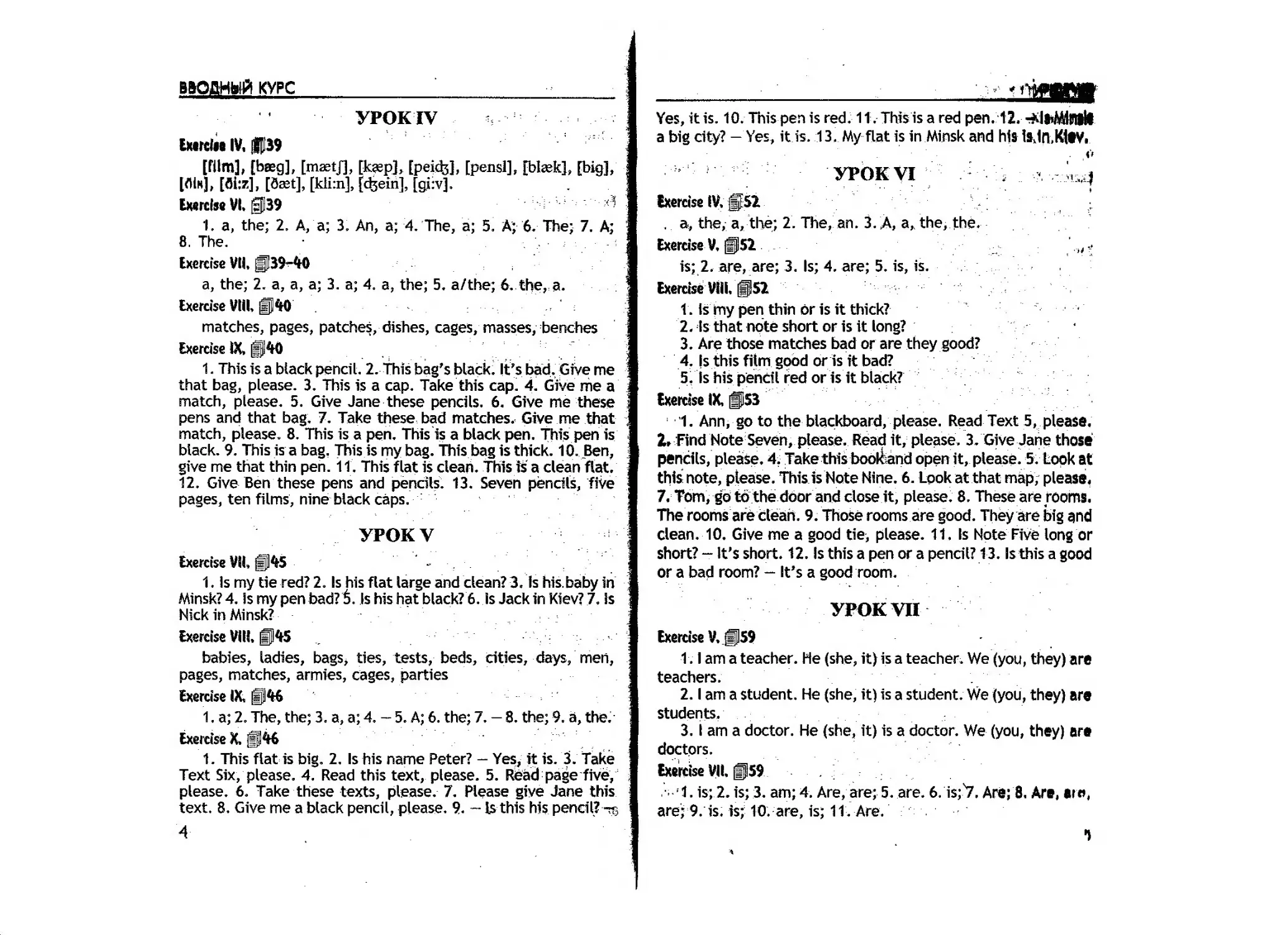
УРОК1У
EmnIh IV, j|139
[film], [bseg], [maetj], [kasp], [peidj], [pensi], [blaek], [big],
[fliH], , [Saet], [kli:n], №ein], [giiv].
Exercise VI. g39	’
1. a, the; 2. A, a; 3. An, a; 4. The, a; 5. A; 6. The; 7. A;
8. The.
Exerdse VII, g’39-40
a, the; 2. a, a, a; 3. a; 4. a, the; 5. а/the; 6..the,a.
Exercise VIII, |f 40
matches, pages, patches, dishes, cages, masses, benches
Exercise IX, |f 40
1. This is a black pencil. 2. this bag’s black. It’s bad. Give me
that bag, please. 3. This is a cap. Take this cap. 4. Give me a
match, please. 5. Give Jane these pencils. 6. Give me these
pens and that bag. 7. Take these bad matches. Give me that
match, please. 8. This is a pen. This is a black pen. This pen is
black. 9. This is a bag. This is my bag. this bag is thick. 10. Ben,
give me that thin pen. 11. This flat is clean. This is a clean flat.
12. Give Ben these pens and pencils. 13. Seven pencils, five
pages, ten films, nine black caps. :
УРОКУ
Exerdse VII, |f 45	'
1. Is my tie red? 2. Is his flat large and clean? 3. is his.baby in
Minsk? 4. Is my pen bad? Is his hat black? 6. Is Jack in Kiev? 7. Is
Nick in Minsk?
Exerdse VIII, |f 45
babies, ladies, bags, ties, tests, beds, cities, days, men,
pages, matches, armies, cages, parties
Exerdse IX, |f 46
1, a; 2. The, the; 3. a, a; 4. - 5. A; 6. the; 7. — 8. the; 9. a, the?
ExerdseX, JI46
1. This flat is big. 2. Is his name Peter? — Yes, it is. 3. Take
Text Six, please. 4. Read this text, please. 5. Read: page five,
please. 6. Take these texts, please. 7. Please give Jane this
text. 8. Give me a black pencil, please. 9. — Is this his pencil?
_______________-________________-______________  ’
Yes, it is. 10. This pen is red. 11 .This is a red pen.42.
a big city? — Yes, it is. 13. My flat is in Minsk and his IMriKItW
; о
 < r	УРОК VI : ‘ J •	.. л .'..„4
Exerdse IV.f 52	.
. a, the, a, the; 2. The, an. 3. A, a, the, the.
Exercise V, 052
is; 2. are, are; 3. Is; 4. are; 5. is, is.
Exercise Wil. 052
1.	is my pen diin or is it thick?
2.	Is that note short or is it long?
3.	Are those matches bad or are they good?
4.	Is this film good or is it bad?
5,	is his pencil red or is it black?
Exercise IX, 053
'1. Ann, goto the blackboard, please. Read Text 5, please.
2, Find Note Seven, please. Read it, please. 3. Give Jane those
pencils, please. 4. Take this booK and open it, please. 5. Look at
this note, please. This is Note Nine. 6. Look at that map; please,
7. Tom, go to the door and close it, please. 8. These are rooms.
The rooms are clean. 9. Those rooms are good. They are big and
clean. 10. Give me a good tie, please. 11. Is Note Five long or
short? — It’s short. 12. Is this a pen or a pencil? 13. Is this a good
or a bad room? — It’s a good room.
УРОК VII
Exercise V, .059
1.1 am a teacher. He (she, it) is a teacher. We (you, they) are
teachers.
2.1 am a student. He (she, it) is a student. We (you, they) are
students.
3.1 am a doctor. He (she, it) is a doctor. We (you, they) are
doctors.
Exercise VII, 059
••‘1, is; 2. is; 3. am; 4. Are, are; 5. are. 6. is;v7. Are; 8. Are, are,
are; 9. is. is; 10. are, is; 11. Are. .
1
ВВОДНЫЙ КУРС___________________________________________J
Exercise IX, Д59  . ..	'.• |
1а; 2. а,а; 3. а,а;4. a, a, the, the; 5. а, а; 6. а; 7— ; 8й
9.-.
Exercise XI, (jj60	3
1. out of, on; 2. on, in, on; 3. from; 4. to; 5. into, in; J
7. into; 8. out of; 9. from; 10. in; 11. from, into, out of
12. to, out of; 13. at, to; 14. from, on.	'1
Exercise XII, ®60		'«
a)	1. Are you a teacher? — Nd, I am not a teacher, I am a
dent. 2. Fred, give that boy your book, please. 3. Is thistis
low or red? — It’s yellow. 4. Please take the cups from the t<
Put the cups on this table. Thank you. 5. Please put thisj
into your brief-case. 6. Take a spoon from this boy, ри
7. Peter is a doctor. He is my friend. He’s a good doctor^
good friend. 8. Fred is a student. He’s in his room now."эд
your students in that room? 10. Is your friend a doctor!
teacher? — He’s a teacher.	M
b)	My name is Nick. I am a schoolboy. Fred is my friendJ
a schoolboy, too. We are in his flat how. His flat is big andiffl
c)	1. Fred, give me your book and your pencil, please.™
you. 2. Nick, take my book from that table, please, opervgl
page seven and read Lesson Three. 3. Is this text long ors|S
It’s short. 4. Is Ann a student or a doctor? — Ann is a doctqcfl
She is a good doctor.	j
* дИ
УРОК VIII	J
Exercise V, [fjM	1
1. from; 2. into; 3. on, on; 4. at; 5. to, down; 6. on;||
8.	from; 9. from, at; 10. at.	• „.Л
Exercise VI, fl 64	Д
1.	a; 2. an, a, the, the; 3. a,— the; 4.— 5. an; 6/m
7. a; 8. a; 9. a, a, the, the	’4
Exercise VIII, f)65	- ue
1.	lam (He/She is) taking my (his/her) book. ..‘‘Я
2.	I am. (He/She is) opening it.	J
3.	l am (He/She is) reading Text Seven.	j
4.	I am (He/She is) closing the book now. : : Yi
5.1 am (He/She is) giving it to my (his/her) friend.
6.	I am (He/She is) putting the exercise-book on the til
6
gj  УРОКУШ
| 11) taking it off the table.
I II; going to the blackboard.
l j|) looking at the blackboard.
to Й) reading the word «colour».
to f| ) going to the table now.
toll) sitting down.
I
12. What are they? 3. What’s this? 4. What are
I We? 6. What’s Bess? 7. What colour is this
it? 9. What colour is that pencil? 10. What is
g, finding, sending, giving, taking, reading,
thing, closing, putting, copying out, sitting,
MB your, books, please. Read Text One. 2. Read
Please don’t do it now. 3. Don’t take this
Mht table. Take that yellow cup, please. 4. Sit
Г Copy out the text. 5. What’s he? — He’s a
tot’l your sister? — She’s a student. 7. What’s this
Schoolgirl. Her name’s Jane. 8. Jane, go to the
МИ< Don’t give me your exercise-book. Open the
ИЧхС Nine. Thank you. Your mark’s good. Read
t at home. Now give me your exercise-book.
Ly. Look at this pencil, please. What colour is
tpTBd« — What colour is this exercise-book? — It’s
I'iMl your exercise-bode? — No, it’s her
ftiyour friend doing? — He’s reading a book at
№ЙПВ In j please. Close the door, please. 3. Look
ft please-'What is your friend reading? 4. What
™ It? 5 - What are you doing now? — We are
r-What text are you reading? — We are reading
iLsoM Bess and Ann are sitting at the table. —
They are copying out Text Eight.
7
ВВ@ДНМЙ4<УРС I
УРОК IX	J
. Exercise IV, ®71	1
at;‘2. — 3. on; — 4. on; 5. into; 6. out of; 7. in, in, on; 8. to, ]
down; 9. at; 10. at, at.	1
Exercise V. 071	. |
1.	the, the; 2. an; 3. the, the; 4. the; 5. a, an, an, - 6. a, a; j
7. a, a; 8. a; 9. a; 10. —.	,	|
Exercise VI, 072 . ...	V . '|
my; 2. His; 3. Their; 4. Your; 5. Our; 6. your, my, his. 1
Exercise VIII, 072	]
1.	Whose friend is a teacher?
Who is a teacher?
What’s your friend?	1
2.	What’s this?   : < 		1
3.	What kind of map is it?	i
4.	What’s that?	]
What kind of cap is that?
5.	Whose cap is it?
6.	Where is the, match?	-1
7.	Where are the matches?	' >>
8.	Whose name is Mary?	. j
9.	Who is a good pupil?	1
What kind of pupil is Bess?	J
Exercise IX, ®72	]
1. This girl’s my sister. Her name’s Mary, She’s an engineer, J
2. Is your son an engineer or a worker? - He’s a worker. 3. Who’s
your friend? - Kate is my friend. — What’s she? — She’s a \
teacher. 4. Where’s your teacher? - He’s here. 5. My sister is in .i
Minsk now. Her friend is there too. 6. Are Peter and Ann in
Kiev? - Yes, they are in Kiev, they are visiting their friends. — Is
their son in Kiev too? - No, he’s here now. — What’s he doing? j
7. Who is that boy? - He’s my son. 8. What is this girl? - She’s an i
engineer. 9. Is this man a doctor? — Yes, he is. — What’s his 1
name? — His name’s Petrov, 10. What is your wife? — She’s an j
engineer. 11. Who is this man? — He’s my friend. 12. What’s i
he? — Is he a doctor or an engineer? 13. Who is this girl? Is she i
your sister? 14. What’s this girl? Is she a student or a teacher? I
; 15. Our flat is good. It’s big and clean. 16. What colour are those I
doors?— They are white. 17, Whose flat is it?— It’s their flat. 18.
8	-
What kind of book is it? - It’s a big book. 19. What kind*-of
exercise-books are they? — They are thin exercise-books,
20. What kind of room is it? — It’s a big room. 21. Where are your
listers?— They are at home.	•
УРОКХ
Exercise IVTf 77	.
our, our; 2. My, my, their; 3. your; 4. your; 5. her; 6. His.
Exercise V, Д77
1. the; 2. a, the; 3; the; 4. the; 5. - 6. a, - 7. - 8.—9. The, the.
Exercise VI, 077
1.	What’s this? Whose classroom is it?
2.	What kind of classroom is it?
3.	What is yellow? What colour are the walls in my room?
Which walls are yellow?
4.	What colour is this cup?
5.	What kind of ties are they? .
6.	Where is the window?
7.	Where are the chairs?
8.	Who is our teacher? Whose teacher is Klimov? What is
Klimov?
9.	Who is sitting at the window? What is Peter doing? Where
is Peter sitting?
10.	What’s this? What kind of newspaper is it?
Exercise VII, g!77
1.	of, in; 2. to, at; 3. of, from, on; 4. into; 5. to; 6. on, of;
Into; 8. at; 9. At.
Exercise IX. f78  . •
a)	the words of Lesson Four, the pages of that book, the new
words of those lessons, three pieces of chalk, the colour of that
bag, the walls of our classroom, the workers of Kiev.
b)	1. Don’t send Kate those books. Send Kate these new
books, please. 2. Meet these engineers here, please. 3. Don’t
give me the black pencil. Give me the red pencil, please.
. Won’t read this text in class, read it at home, please. 5. Don’t
Sly exercise-book, take that clean exerciserbook, please.
to the words and questions in your exercise-books and
look at the blackboard, please. 7. Close your books and
*OpOTI~yO(jr exercise-books; please. 8. Don’t close your books.
9
ww КУРС. ...
RM0 Text tight, please. 9. Don’t put your bag on the table,
р(Н№, put ft on this chair. 11. Sit down, please. 12. Don’t go
theft, please. 13. Don’t do ft, please. 14. Don’t write these
wordl now, please do it at home. 15. Come here, please.
16. Don’t go now, please.
c)	1. This is our classroom. What colour are the walls in your
classroom? — They are white. — Is your classroom big or small? —
It isn’t big but it’s light. — 2. What colour is the ceiling? — It’s
white. — What colour is the floor? — It’s brown. 3. .Where’s your
table? — It’s near the window. 4. She’s reading the questions.
5. Take a piece of chalk and write your question on the
blackboard. 6. What colour is her exercise-book? — It’s blue.
7. Are you reading a new book? 8. I am giving you eight new
pencils. 9. What are these students doing? — They are writing
new words.
ОСНОВНОЙ КУРС
PARTONE
LESSON ONE (the first lesson)
Exerdse IV, 86
1. What’s this? 2. What colour are the walls in this room?
3. Where’s Ann now? 4. Who is reading a newspaper? What is she
doing? What is she reading? 5. What do you read? What kind of
books do you read? 6. What do you sometimes give Peter? Whose
exercise-books do you sometimes give Peter? 7. What do your
tons do every day? 8. Where are you going?
Extrdn V, 086
1. Open your exercise-books, ptease. 2. What are your
reading now? 3. What do his students usually read? What
newspapers do they read? 4. Where are you going? 5. Where do
yoQ go every-Дау? 6. Sit down at the table, please, Даке your
exerctse-books* afk! copy out Text Five. What are you doing
now? — We’re copying out Text Five. 7. Do your friends read
English books? — Yes, very often. 8. Don’t close the book,
please. 9. They don’t send me books and newspapers. 10. What
kind of film is it? — It’s a good film. 11.1 often meet this worker
here. 12. Do you often meet these engineers? - No, these
engineers very seldom come here.
bsrdse VI. 087
1. Where do you work? 2. When do you usually have your
English? 3. What language do they often speak in class? 4. What
do you write on the blackboard? Where do you write a lot of sen-
tences? 5. When do you go to the office? Where do you go after
11
PART ONE 	 E
your English? 6. What books do you read at home? Where do you
read English books? 7. What do you do during your lesson? When
do you read, write and speak English? 8. Who is having a dicta-
tion? What are you doing? 9. What are you taking off the table?
What book are you taking off the table?
Exercise VII g88		. '
1. in; 2. at, of; 3. to, in; 4. to; 5. on, on, under; 6. out of;
7. on, in, in, at; 8, at, at; 9. to, to; 10. into; 11. at; 12. -in. '
Exercise VIII. f|88 '	' ' :
a, - , —, the, the, the, the, the, the, a, , the, — , —".
Exercise X. |f|89
a)	1.1 usually go to the office in the morning. 2. We often go
to Kiev. 3. Don’t go there, please. 4. Come here, please.
5. Come to Moscow, please. 6. Sometimes they go to Leningrad.
7. When do they usually come to Moscow? 8. Don’t come here in
the morning, please. 9. Come in, please. 10. Please don’t come
into the room. 11. Where are you going?
b)	1. Where do these engineers work? — They work at our
office. 2. What language do you usually speak to these
engineers? — We usually speak Russian! Sometimes we speak
French. They leam French. 3. In the’morning 1 come into the
classroom and sit down at my table. At the lesson we read, have
dictations, do exercises, and speak French. 4. This exercise is
long. Do it at home. 5. I don’t often speak English at home, I
speak English in class. 6. Do you learn French? - No, I don’t learn
French. I learn English. 7. Do your sisters live in Moscow? — No,
they live in Leningrad. 8. What do you do after work? - I have
lessons in the evening. 9. Whose books are these? — These are
my books. — Are these Russian or French books? — These are
Russian books. 10. Who is standing there? - It’s Ann. 11. Do you
usually write many sentences on the blackboard? — We usually
write five or six sentences on die blackboard; 12. What is he
writing on the blackboard? — He’s writing an English sentence.
13. Where do you live? — I live in Leningrad. Leningrad is a very
big city. I live in the centre of the city. 14. We learn French. We
read texts, speak, learn grammar, do a lot of exercises. 15. Do
you read many English books? - Now we read very few English
books. 16. What books do you read? - We read our text-books.
17. Do you speak English or Russian to your teacher? — We
usually speak English and sometimes Russian.	;
12'
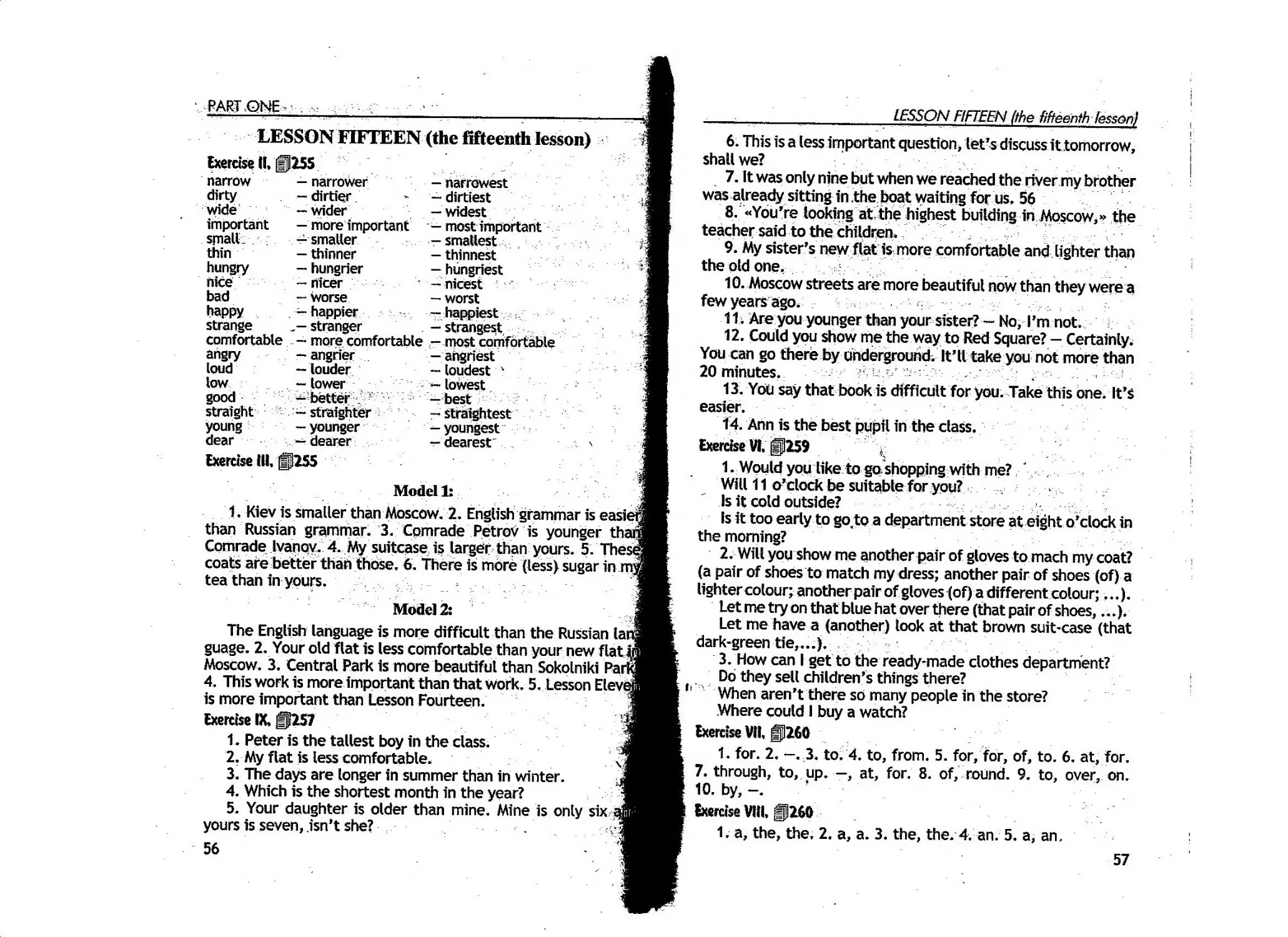
LESSONTWQJfhe^secon^J^c^
LESSON TWO (the second lesson)
Iwrcise V, |f95
1.	Where does this worker live? 2: My son doesn’t live in
Moscow. 3. His wife learns English and French. 4. Where does _
this teacher work? ~ He works here. 5. My friend learns two
foreign languages. 6. What kind of exercises does he usually do
at home? 7. What exercises is he doing now? 8. Their sons don’t
learn English. 9. This man does not speak French. 10. What lan-
guage is he speaking now? 11. What kind of hooks does this en-.
gineer read? 12. What is he reading now? 13. Do you do many
exercises at home? — Yes, very many.
Exercise VII. j96
1.	Whose teacher always speaks English in class?
Who always speaks English in class?
Where does your teacher always speak English?
2.	When do you sometimes have English?
3.	Whose friends work at the Ministry of Foreign Trade?.
Who works at the Ministry of Foreign Trade?
Where do your friends work?
4.	Who often has dictations in class?
What do you often have in class?
5.	Who does a lot of exercises at home?
Where do they do a lot of exercises?
6.	What are you doing now?
Exercise VIII, jf %
1	. Who gives you English books to read? - My teacher does?
2	. Which of themworksat'the Ministry? — Petrov does. 3,
Who is working in that room now? — Belov is, 4. Who comes here
in, the morning? — We do. 5. Whose son learns English? — My son
does. 6. Which of you learns German? — Ivanov and Petrov dp,
7. Who is speaking to your teacher now? — My friend is.
Exercise XII, [97
1.1 am going to learn French. 2. When areyou going to speak
to your teacher? 3. What are you going to do tonight? 4. I am
going to do these grammar exercises before the lesson. 5. We
aren’t going to write a dictation, we’re going to read a new
text.
13
PARTONE /	 J
Exercise VI, 098	1
1. in, for; 2. to,	in,	of,	on;	3,	after,	—	:	4.	to;. 5.	about;!
6. from, into; 7. about, in ;	8.	to;	9.	—	;	10.	to;	11. to,	in.	i
Exercise VII, 098	i
an, a, his, the, his, the, his, -,	, his. i
Exercise VIII, 099	J
1. Come here, please. 2, Go to that room, please. 3. When
does your son get home? 4. Go to the blackboard, please. 5.1 go
to the office every morning. 6. He doesn’t always go home after j
his lessons. 7.1 come home in the evening and do my homework. ;
8. My friend comes.to Moscow every morning and goes home
every evening. 9. How do you get to the Ministry? 10. He is
coming here tomorrow morning. 11. He’s going Soon. -,
Exercise IX, 099
A.	1. Who’s that girl? — She’s my sister. - What is she? -
She’s an economist. 2. How well does she know German? — She
knows it very well. 3. When does your son do his homework? — In
the evening. 4., How well is your son doing? — He’s doing very
well. 5. You don’t know these words, revise these words and
grammar rules at home again. 6. Which of you is an
economist? - Petrov is. 7. Which of you is doing well? — Ann is.
8. Who gets English magazines? — Ivanov does. 9. You usually
read well but now you are reading badly. 10. Do you like getting
letters? 11. He doesn’t like writing letters. 12. We like to speak
English in class. 13. She doesn’t tike revising grammar rules.
14. She doesn’t like to repeat words after the teacher. 15. They
like to read in the evening . 16. She’s not often in time for her
lessons. 17. She’s always in time for her work. 18. How do you
usually get there? 19. We’re going to speak about this next
week. 20. How often do you do your homework together? — We .
do it every day.
B.	Teacher. Please take your text-book, Ann, and come here.
(The student is going to the table of the teacher.)
Open your text-book at page ten and read the text of the
Second Lesson. Read the first five sentences, please.
Student (reading): «We have lessons in a big light room. The
students are always in time for their lessons. During:our lessons
we read, have dictations, and translate sentences from Russian
into English. We have our English every day. We usually do our
homework in the evening, but we often revise new words in the
14
__________________________ LESSON THREE (the, third lesson)
Berning before the lesson. Now we are having our 'English
IlMflA, we’re reading a text and then we’re going to have a
ЦМвМИПг** •
||ОшЬ*г. Thank you, you can already read this text welt. $it
№, Your mark is «good». Do this exercise at home, please,
ЖГП a new grammar rule and revise the words of the Second
Lwion.
*	LESSON THREE (the third lesson)
txercise I, j|H№
1. them; 2. me, him; 3. them; 4. it; 5. us.
Ixtrcise II.
1. it; 2. us; 3. them; 4. her; 5. them; 6. him.
Exercise V. 0106
1. My sister works a lot. 2. They read a lot of English books.
3.	Does your son work much? — No, he works very little now.
4.	He receives a lot of letters every day. 5. We read very much
and we write very little in class. 6. Does your son read much? —
Yes, a lot. He usually reads in the evening. 7. Many students
know two foreign languages. 8. Don’t read too much in the
evening. 9. We send letters to many foreign firms.
Exercise V. f 106	...
1.	Who discusses many questions at the office? What does he
discuss at the office?	,
2.	What usually lasts two hours? How long do your English
lessons usually last?
3.	Who usually gets home at five in the afternoon? What time
do these students usually get home?
4.	Who works at a new factory? Whose sisters work at a new
factory? Where do his sisters work?
5.	Who is going to stay at the factory after work today?
Where are you going to stay after work today? When are you
going to stay at the factory?
6.	Who lives far from the office?
7.	Who is discussing this question now? What are they doing
now? What are they discussing now?
15
PART ONE
 iih; h i. ~ । '
. Exercise Vk.®106.
d^at, at; from, from; 2. —, out for ; In, on,with; over; 3. —, i
at, in; 4. from, - , to, -, on, at; 5. at, of, In, at; 6. at, to, for;
7. over; 8. at, after, for.
Exerdse VII, g107 . ..
1. .. .walks... 2. Where does Comrade Petrov work? 3.
...doesn’t work... 4. Do you often speak in class? 5. Who is
answering... 6. Does your sister often stay.,. 7. I don’t often
get.... Ioftenget...8. ...discusses...9. ...aretheydiscussing...
10. Are you... 11. ...do they know... 12. Do the students
revise...?...do... 13. Are they revising
is... 15. What is he doing? ... is translating...
Ex, VIU. 0107
14. ...does he do?...-
J

a, a, The, a, —, the, - , the, a, —
Exercise IK 0107
1. hours. 2. d’dock. 3. going, going. 4. walking. 5. walks. 6. go.
Exercise К |01O7
A.	1. Are you going to be at home on Sunday? 2. Where are
you going on Saturday evening? 3. He only has lessons on Tues-
days and Thursdays. 4. He only.comes here on Sundays. 5. Are
you going to the factory tomorrow? — Yes, 1 am. — Who is going
to stay with your son? — My sister is. 6. What time do you usually
come home? — 1 usually come home at seven in the evening.
7. Don’t discuss this question now. We are going to discuss it on
Thursday morning. 8.1 only know English but I am going to learn
German.
B.	How long does your working day last? — It lasts eight
hours. — What do you do at your office? - I answer letters and
telegrams, read magazines, translate articles from these
magazines, and discuss a lot of questions with our engineers. —
What time do you usually finish your work? т1 usually finish my
work at six. — Do you live far from your office?—No, I live near it
and I usually walk there. — Do you know German well? — I am
only learning German, — When do you have lessons? — We have
lessons on Monday, Wednesday, and Friday evenings. How-;
long does your lesson last? - Two hours. — What do you do at
home? — When I come home, I usually read magazines and do my
homework. Sometimes I write letters to my friends. I receive i
many, letters from them and I always answer them. - Who-
translates articles at your office? Comrade Orlov does, He


LESSON FOUR (the fourth lesson} •
knows English and French. — How well does he know these
languages? — He knows themwell.- Who translates lettersfrom
German?— Ido.
Exercise XI, 0108
My sister is a teacher. She teaches English. My, friend and I
learn English, too, but many students work hard $t two langua-
ges. We’re always in time fdr our lessons and do ou^hompwprk
well. We often read English newspapers arid magazinels at hbme.
I like reading English books arid 1 read d lot. W have BWiorfli On
Monday, Wednesday, Thursday and Friday. We do a lotTW exer*
clses in class and we sometimes have dictations. We read texts»
translate them, answer questions, and translate sentences from
Russian into English. We often walk home together after classes.
We speak English and discuss bur work.
LESSON FOUR (the fourth lesson)
	'	t
Exercise 1.0113
[d]
Open — opened
close — closed
live-lived
learn — learned
return — returned
stay — stayed
receive — received
answer — answered
copy-copied
Exercise IV. 0113
ft]
thank — thanked
look—looked
work — worked
walk —walked
discuss — discussed
finish — finished
[id]
translate - translated
last —lasted
repeat — repeated
1. «Who usually does his homework in this room?» «This stu-
dent does.» 2. «Who is doing his .homework there now?»
«I don’t know.» 3. I lived near my office last year. I always
walked there. 4. «How Well does you friend speak English?» «He
speaks English badly.» 5. «What language did you learn -five
years ago?» «I teamed French.» 6. What language ishelearning
now?» «He is learning German.» 7. «How long does your-elass
usually last?» «ft usually lasts two hours.» 8. «How long didyour
class last on Wednesday morning?» «it only lasted an hour.»
9. «Who did you discuss this question1 * * * * * * * 9 with last night?»
«I discussed it with my friends.» 10. «Who do you usually go
home with?» «I go home with my friends.» 11. How well doei he
usually know his lessons? 12.1 didn’t work at this Office three
17
FART ONE :	_
years ago. 13. Are you working there now? 14. «How long dni
you stay in Kiev last year?» «I stayed there a month.»- «How long
are you going to stay there this year?» «I’m going to stay there ai
month, too.»	1
Exercise V.
1. I looked at the blackboard and copied out hew words.'
2. Where did you live last year? — I lived in Minsk. 3. Did you
thank hint* Tor the books? 4. We didn’t discuss many question^
yesterday, 5. When did you last revise this rule? — We only re-
vised it yesterday. 6. They answered many letters last month.;
Exercise VI, Ц1114	••••
1. They were here an hour ago. 2. Was he in time for his les-'
son yesterday? 3. Were you at home on Monday morning? — No,
I was at the Ministry . 4. He wasn’t at home oh Wednesday
evening.	..
Exercise VIII. fills
1. My friend’s room; 2. My friend’s rooms; 3. My friends’
room; 4. My friends’ rooms; 5. That engineer’s son^ 6. Our
teacher’s sons; 7. This student’s dictation; 8. Your economists’
letters. 9. Your teacher’s sister; 10. Mary’s friend. 11. Peter
Ivanov’s letter.
1.	Is your friend’s room big? — No, it’s small but very light.
2.	You didn’t answer Boris’s question yesterday.
3.	Does your friend’s wife speak German well?—Yes, very well
4.	Whose exercise-books are these? — These are ou
students’exercise-books.
5.	Do you know comrade Smirnov’s friends? — Yes, I do.
6.	Comrade Ivanov’s wife is an engineer, and his sister is;
doctor.
7.	What is your son’s name?
Exercise XIII. 0115	0
the first hour, the third exercise-book, the second letter, th
fourth telegram, the ninth day, the fifth lesson, the sixtl
question, the eighth week, the twelfth month, the twentiet
day, the twenty-fifth magazine, the forty-second day
18
________________________ LESSON т  WMMMI
t»rcise XIV. fllB	’	.4  <
text twenty-eight, note thirteen, article three, les^QrtffiffiL
exercise four, text fourteen, lesson thirty-six, exercise nnwRj
room forty-five, room twenty-three	- %
I -Лл <1! «И F6W
«twrctseV.0116	-... r vic-rw
1.	Who worked at a large factory then? What did theydo-tlli
large factory then? Where did they work then? , ym
2.	Whose sister stayed at her friend’s over the week-end?
Where did your sister stay over the week-end? When did your
lister stay at her friend’s?
3.	Who lived in that house ten years ago? Where did you live?
When did you live in that house?	«
4.	What does Ann do well? How well does Ann play volleyball?
AiiWho decided to go to a medical school last year? What did
Г peter decided to do last year?
I	6. What do they like to do in fine weather?
I	7. What did you r friend Write last month? What kind of article
I did your friend write last month? When did your friend write an
I interesting article? у
I Ixtrcise VIII. f 117
I 1. the, a, the, a; 2. the, the, - ; 3. — ; 4.	-, 5; a, a.1
I Exercise IX. 0117
I 1. of, to, at, to; 2. -, —, after, on, at; 3. in, at; 4.
I before; 5. to, for; 6. at, till.
I Exercise X. 0117
I 1.1 love children very much.
I 2.1 am not often at home on weekdays.
I 3. My son likes playing football very much. ~
I 4. My sister’s son is going to institute this year, and my son
I goes to institute already.
I 5. When did you answer your friend’s letter? — The day be-
I fore yesterday.
I 6. Yesterday the weather was fine.
I 7. We decided to read this article and discuss it.
I	8.1 lived in Minsk five years ago. I worked at a factory then.
I 9. I last played football five years ago.
110. When did he decide to go to hospital? — Last week.
I 11. Where was he last month? — He was in hospital;
I 12. How long did the film last? - It lasted two hours.
19


PARTINS •	-  \
LESSON FIVE (the fifth lesson)
Exercise III, 0123
1 . Who was in Kiev last week? Where was he last week? Whei
was he in Kiev? 2. Whose friend wrote to you very often las
year? Who wrote to you very often last year? Whom did you
friend write to very often? When did your friend write to yoi
very often? 3. Who was attheir office yesterday morning? When
were they yesterday morning? When were they at their office
4. Who read a lot of English books last year? What did .you
students read last year? What books did your students, read las
year? When did your students read a lot of English books
5. Whom did he take out on Monday evening? When did he tak<
his son out? 6. Who spoke to you about the plan yesterday? V/h<
did Comrade Petrov speak to about the plan yesterday? What di<
Comrade Petrov speak to you about yesterday? When di»
Comrade Petrov speak to you about the plan? 7, Who usuall
goes home after classes? Where do the students usually g*
home? When do the students usually go home?
Exercise IV, 0123
1.	When did your engineer come back to Moscow? — He cam*
back to Moscow three days ago; >	'
2.	Who went to Leningrad last week? — Comrade Zotov did
3.	Boris read the fourth sentence very well.
4.	Comrade Petrov went to the blackboard, wrote ;
sentence, read it and went back to his desk.
 5. What exercise did you do at home yesterday? — Exercis*
Twenty.
6.	Speak to Comrade Zotov about this, he returned from Len
ingrad yesterday.	-/ ;	;	-
7.	How well did your students speak English fast year?
! 8. When did your sister come to Moscow?—Three years ago.
9; What did you do in class yesterday? - We read texts an<
did exercises, spoke English to our teacher and translated sen
tences from Russian into English.
10.	When did you receive this letter? — Yesterday morning.
Exercise V.
с

I
й
изз
.1. take, give. 2. take. 3. gave, give, take (give). 4. take.
Exercise VI, 0125
a) 1.1 read his article last week.,.
20
-	_____ ussotJ went» t# ши*'
’• 2.1 didn’t see him yesterday;  —	♦ л ....
3.	Their friends came to see them last week.
4.	«What is your name?» we asked him.	- z
• ’' 5. Petrov’s sisters decided to come and see him andWent to
tyl place last week.
г 6. The weather was fine and the children asked their efttdr to
ttke them to the park.	' ’ ‘
Where did yo u see him last week? - We saw him 1h the
theatre. His children were also with him.	s
^8. Belov’s friends asked him about his work and he answered
their questions.	' .
9.1 am going to take these magazines and read them at home.
b)	1.1 like reading.
Hp likes to read after dinner.
My sister’s son likes skating.
Г 4. Do you like skiing?
5.	We love bur country.
6.	Do you like this park?
7,	JDidihey like the new film? — Yes, they liked it a lot
8.	What kind of books do you like?
9.	They didn’t like this engineer’s article*
10.	Do you like Ann’s new flat?
11.	She loves little children.
12.	1 like your friends’children.
c)	1. Where were you yesterday? I didn ’ t see you at the office.
2. Look at the map. What map is it?		" •
3. What film did you see yesterday? — We saw a new film
about students.
4.1 am going to see my son’s teacher tomorrow morning.
5. He looked at me and asked 'Did you work at a factory
three years ago?’
d)	1. When do you usually have dinner (breakfast, supper)?
2.	He didn’t have dinner at home the day before yesterday.
3.	Are you going out for a walk before supper?
4.	Are you going to ask your friends to dinner?
5.	What are we going to have for breakfast?
6.	Where is your friend? — He is having dinner.
e)	1. What is he asking for? - He’s asking for a new magazine.
2.	What is he asking about? - He’s asking about Comrade
Petrov’s family.	'
3.	They asked a lot of questions about our country.
21
PARTONE	... ...
4.	He didn’t ask me for an exercise-book, he asked me for'
text-book.	•	-	:
f)	. 1 . When are you going to give me this, book? . .
2.	Did you give this book to Ann or to Mary? — I gave it t
Mary.	'	।
3.	Don’t read this article to me, I know it.	.. i
4.	The teacher is reading them a new text to them.
5.1 want to read this article. Don’t send it to them today.:
Exercise VII. 0126 '	•
1.	—, of, on, at, in, -, at; 2. in, —, in, to, in; 3. to, after, tc
4. for, 5. in, from, to, in, for; 6. to, for; 7. — , of, with; 8. al
9. — , to, at; 10. of, on, for.
Exercise VIII, 0127
the, —, the, the, a, the, -, the, —, the, the, the, the, —, -
the, , , , a, ”, ~	-
Exercise IX. 0127
1.	Yesterday it was my day off. I usually wake up early on m
day off, but sometimes I do not get up at once. I got up at eigf
o’clock yesterday. 2. «When did you have breakfast yesterday?
«I had breakfast at nine in the morning.» 3; We iisuatly stay i
the country over the week-end, but the weather is bad and w
are not going to the country tomorrow. 4. «When did you last g
to the theatre?» «Two weeks ago.» 5. I usually go to bed г
eleven o’clock. Yesterday my friends came to see me, and
went to bed at one in the morning. 6. She is not at home now
She is playing tennis. 7. When did you son go to college?
Exercise X, 0127
1.	Who came to see you yesterday? — My son’s friends die
We were glad to see them. They stayed with us till evening.
2.	Where were you yesterday? — I went to the cinema. - Di
you like the film? —Yes, it was an interesting film. I liked it
lot. - When did you come home? -1 came home late and wet
to bed at once.
3.	We read a new text in class the day before yesterday
Then the teacher asked us questions and we answered them. ]
4.	What time did you have dinner today? — I had dinner ?
three.
5.	Do you like playing chess? - Yes, but I don’t often pic
chess now. I often played chess last year.	; r
22
________________;_________ ttSSQN
'6. I usually spend weekends with my family. Wededdtd to
10 to the country last Sunday. We went there in tht |тйп*ЙП|.
rhe weather was fine and we returned to town
tvening	5	.
7.	My little son likes to ask me a lot of questions and lalWHyi
answer them.	'
8.	Where were you yesterday? I came to your plate'but
Were not at home.
9.	Where are your children? - They are skating in the park.
iMrelse XI, f 128
My friend Ann came to see me on Saturday after work. We
decided to revise the words of the first five lessons before the
dictation. We began to work at seven in the evening. I like .to
tfhdy with Ann. She reads a lot and knows English well. We re-
Wad the words and read the texts. We also revised the grammar
rules and did a lot of exercises. Then Ann asked me a lot of ques-
tions and I answered them. We spent a lot of time on it. We fin-
ished to work at nine o’clock. «I want to go to the cinema and
see a new film. Do you want to go with me?» asked Ann. «I’d love
to,* I answered. «My sister saw it last week and she liked it a
lot.* We went to the cinema at ten. The film lasted two hours
and finished at 12. We came home late and Ann stayed with US,
On Sunday we decided to go to the country. The weather was
fine and we spent three hours in the country. We came home at
five in the evening. After dinner we went to Ann’s friends. We
wanted to go for a walk with them in the evening but then we
decided to go to the theatre.
LESSON SIX (the sixth lesson)
Exercise II,
a. 1. Mary hasn’t got a family. Has Mary got a family?
2. Jane hasn’t got many children. Has Jane got many
children?
3.1 haven’t got a wife. Have you got a wife?
4. My children haven’t got many friends. Have you children
got many friends?
b. 1. They don’t have their English in the morning. Do they
have their English in the morning?
2. They didn’t have a dictation yesterday. Did they have a
dictation yesterday?
21
. ’ --PARTONE - -	 j
3. He isn’t having a dictation now. Is he-having a dictation now?
c. 1.I don’t often have much work to do. Do you of ten have^
much work to-do?.	.... .	.....	.
2.1 haven’t got much work to-do today. bo you have much
work to'do today?	/	1
3.	She didn’t have much work to do last week. Did? she fiav^
much work to do last week?4	1
Exercise V, 0135
a)	1. I’ve got an interesting book about Repin. .. j
2.	My friend’s sister has got two little children;
3.	Has your friend got a big or a small family? . j
4.	How many children has your friend got? .	’ j
5.	My son’s got a lot of Russian books but he hasn’t got any*
English books.	.	1
6.	Who’s got any questions? — I’ve got one. • •/ !
b)	1 . What time do you usually have breakfast?	' ?
2.	We had breakfast very early today.	,i
3.	Did you have dinner late today?
4.	Where did you have dinner yesterday? - Yesterday I had
dinner at home.
5.	They’re having dinner now.
t)	1. Unfortunately, I haven’t got any time today to discuss
this question with you.
:	2; Have you got much time in the evening to do your English
homework?
3.	Did youhave much work-to do yesterday?
4.	Please give me the magazine, I’ve got some time now to
read this article.
5.	Do you often have colds?
6.	Have you got a cold now? - Yes, I have.
Exercise VII/01136 ; '
; ,1. _any. 2. any. 3. any. 4. any. 5. any.
Exercise VIII, 0136
1.	Did you know a foreign language five years ago?
2.	Did you read any English books last month?
3.	Some students prepare their homework here.
4.1 haven’t got any German magazines at home.
5. Have you got any friends in Leningrad?
• 6.1 haven’t got any questions.
7. Have you got any questions? - Yes, I’ve got some, зд
8.1 don’t see any mistakes in this sentence;
Л24
 	 J£SSON^!XJthejb<HTjessQrt[
9. Does your father speak a foreign languages? •
Exercise X, 0136
1. Has any of you got children? — Yes, many of us have;
2. Which of you has got any questions? — Some of ushave got
^ome. questions.
“	3. Three of our engineers play tennis well.
4. Two of your students are here now.
5. Many of them like skating.
Exercise VI, 0138
1.	My friend’s 2, His sister’s 3. These children’s 4. My broth-
er’s 5. This girl’s 6. Their teacher’s 7. Petrov’s.
Exercise VII, Д138
of, from, of, at, to, at, in, —, at, in, of, to, at, at, df, to,
with, in, from, in, to, with, —, with, to.
Exerdse IX, 0138
—, a, a. a, a, —, a, a, an, the,'—, the, —, —, the, —, a, a, a.
Exercise XI. 0139
a) 1. This student didn’t make many mistakes in the test yes-
terday and got a good mark for it,
2.	Who did this work yesterday?
3.	What kind of exercises do you usually do at home?
: b) 1. My sister speaks English very well and she teaches her
children to speak English.
2. We often speak about our work.
3. Please speak to her about this in the evening.
4.1 didn’t tell her about this yesterday.
c)	1. When did you leave school? — I left school in 1950.
2.	Which of you graduated from the Institute in I960?
3.	My sister graduated from Moscow University last year.
Now she teaches German.
4.	Where did you leave your exercise-book? -1 think I left it
in the office yesterday.
t 5. He usually leaves his books here.
d)	1.1 think they left Moscow last week.
2.1 think they went to Minsk a week ago.
3.	When are they leaving for Kiev?
4.	They went to Minsk three years ago and they live there now.
5.	He went to his parents and he is going to spend-the sum-
merwiththem.
e)	1. Is the film over? ,	- :
25
PARTONE
2.	What time did the film finish? — At five.
3.	Sometimes our lessons finish at seven in the evening.
4.	1 wanted to speak to him but the lessons were over and he
wasn’t in the institute.
f)	1. When was Pushkin bom? — Pushkin was born in 1799. ,
2. When was Tolstoy born? - Tolstoy was born in 1828.
. 3. When was Lomonosov born? — Lomonosov was born in 1711.
4.	When was Swift born? — Swift was born in 1667.
5.	When was Choser born? — Choser was bom in 1340.
6.	When was Shakespeare born? — Shakespeare was bom in
1564.
Exercise XIII.
1. My sister’s son is a pioneer. He’s doing well at school. As a
rule he doesn’t get bad marks. My sister usually helps him with
his homework.
2.	1 haven’t got any sisters but I’ve got four brothers. Two of
my brothers graduated from their Institute last year and two of
them go to school.
3.	This young woman is an engineer. She works at a big facto-
ry. She usually has a lot of work to do. Every morning she takes
her little son to a nursery-school.
4.	Comrade Klimov is an old worker. He hasn’t got any
grandsons but he has two granddaughters. The first
granddaughter of Comrade Klimov was born seven years ago, the
second one was born last year.
5.	Last year I didn’t learn English and I didn’t have any Eng-
lish books. Now I have got a lot of English books. In the evening 1
usually read English. My husband also knows English and we
sometimes speak English. Next year I am going to learn French.
6.	My parents live in the country. They’ve got three rooms
there. I usually go to see them in summer and sometimes in win-
ter. I don’t like to go there in spring and in autumn, .
7.	1 am going to have a lot of work to do next week.
8.	How much time do you usually spend on your homework? —
As a rule, I spend two hours on it.
9.	How many subjects do you do?
10.	Don’t help your son with his homework.
11.	1 think, some of these subjects are very interesting.
12.	Are you leaving for Kiev next week? — Yes, I am going
there to see my parents.
13.	Who left these exercise-books here?
26
______________________LESSON SEVEN (the seventh lesson}
Exercise Ж gm
I was a student five years ago. I studied at the Institute of
Foreign Languages and lived with my parents in Moscow. I
learned two foreign languages: English and French. The lessons
at the Institute began at eight and I usually got up very early. I
spent a lot of time In the Institute. I read a lot of English and
French books. Now I don’t live in Moscow. I graduated from the
Institute in 1975 and went to Tula. Now I am an English teacher.
I work at school. I like teaching children. I’ve got a lot of school-
children. They are doing well. My family isn’t big, I’ve got two
children: a son and a daughter. My wife doesn’t work now. She
stays at home with our son. He was only born a year ago. My
daughter is five. She doesn’t go to school and every morning I
take her to a nursery-school. My wife is an engineer. She likes
her work very much and she wants to begin working again. My
parents love their grandchildren very much. They often write to
us and always come to see us in summer. As a rule I go to Moscow
to see my parents in winter.
LESSON SEVEN (the seventh lesson)
Exercise 1,0146
1. there are 2. there is 3. there is 4. there is 5. there were
6. there is 7. there is 8. there are 9. are there — there are 10.—
11. there are 12. there were.
Exercise IV, 0146
1. is 2. are 3. is 4. is 5. is 6. wasn’t 7. were
Exercise VI. 0147
1.	What is there in our city? 2. How many chairs are there in
the room? 3. What is there on your table? What kind of books are
there on your table? 4. Whose exercise-book are there many
mistakes in? 5. How many mistakes are there in my dictation?
Whose dictation are there three mistakes in? 6. What is there
near my house? 7. What does Mary do? Whom does Mary teach to
play the piano?
Exercise Wl, 0147
A. 1. There are a lot of schools and five institutes in our city.
2.	There were twenty pupils in our class last year and now
there are only fifteen.	7 t
27
PART ONE
nb.    < I	I^-II'I   HI I.II	I. n .  . .	I
3.	Are there many magazines on that table? - No, there are
only two,	s-s. . • • -:  v;- 	- ..I --. -	..	.
4.	There are two windows in this room.
5.	What books are there on that table? - There are Russian
and English books.	: • 	’
6.	There are many engineers at our factory.
7,There aren’t any exercise-books on this table. *
8. How many boys and girts are there in our class? There
are twelve boys and eight girts.
9. There was no school near our house five years ago but now
there’s a new big school here,
B.	1. I’ve got an interesting book bn the table. There is an in-
teresting book on the table,
2.	He hasn’t got any mistakes in his dictation. There are no
mistakes in this dictation.
3.	There are a lot of interesting articles here. She’s got a lot
of interesting articles here.
4.	There are not many girls in this class. They’ve got not
many girls in their class.
С.	1. There’s a new school not far from our house. The new
school is not far from our house.
2.	There’s a theatre in the centre of the city. The theatre is
In the centre of the city.
3.	The mistake is in the fifth sentence. There’s a mistake in
the fifth sentence.
4.	The magazine is on that chair. There aren't any magazines
on that chair.
5.	There are not many grammar rules in this lesson. The new
grammar rules are on page ten.
6.	There are new words in this text. The new words are bn
the blackboard.
Exercise XIII. f150
1.	Who can translate this sentence?
2.	Which of you can go to the cinema tomorrow morning? —
Noneofuscan.
3.	May I come in?
4.	Can I have your text-book for a minute? - Certainly.
5.	Can I leave my child with you for an hour? - Certainly,4
= • 6. Could you help me? — Certainly.
। 7. Was he able to meet you? ч- No, he wasn’t able to meet us.-i;
8.	Can you come tomorrow evening? — I’m afraid I can’t. ; M
28-
	££$SO/V SEVEN, (the seveniMes$o^<
9.	Could you doit today? -Yes, I think I could. >
10.	Which of you can read English books? — I am afraid, none
of us can.
•»11,1 also wanted to go to the cinema but I wasn’t able to.
12.1 can’t stay here today.
13. Who can answer my question? ,
14. Can you discuss these questions on Monday morning?
15; May I ask you a question? — Yes, of course you may.
Exercise VI, fjj]l5l
a, a, the, the, the, a, the, an, a, a, the, the, a, the, the, the,
a, -, a, the, the, —, die, the, a, the, a, -, the, -, the.
Exercise VII, gjl52
,1. on, of, of, before. 2. on. 3. in, of, in, of, on,in,4. in, of,
in, to, of, with, on, to. 5. —, of, to, in. 6. of, to, at, of. 7. to, op.
8. on. 9. to, in. 10. in.
Exercise X. Д152
1.	listen to 2- hear 3. heard 4, are listening to 5; some 6.
several 7. some, some
ExerciseXI. 0153
1 . There are a lot of things in this room. There is a table, five
chairs, a piano, a sofa, and two arm-chairs. What else is there in
this room?— There’s also a bookcase.
2.	There’s a round table in the corner. There’s a piano near
the window. There’s a vase of flowers on the piano.
3.	Where is your telephone? — It’s on the writing-table in my
study.
4.	Yesterday I got a letter from my brother. There were two
pictures of his daughter.
5.	There are a lot of students from our institute in this photo.
You know many of them.
6.	There are some pictures in the text-book but there are no
maps.
7.	Look at these pictures. How d’you like our city? - It’s very
nice and clean. I went there some years ago.	;
8.	Do you play the piano? Come to our place on Sunday.
We’ve got a new piano.
9,	. My friend got a new fiat last Week., Yesterday we went to
see it. It’s a very comfortable flat. We liked it very much; There
is a living-room (they are going to use it as a dining-room and a
sitting-room), a bedroom; a bathroom and a kitchen./ /
29
PART ONE-
10.	May I see Comrade Ivanov? - Yes, of courseyou may. He
sits in the next room. His table is to the right of the door.
11.	There are a lot of flowers near our house.
12.	Do you often open the windows in your room? — When I
am at home in the morning and in the evening, they’re usually
open but when I am at work, they’re closed.
13.	May I use your telephone?
Exerdse XII, 0153
I came to see my friend Petrov on the 25th of April, He’s an
engineer. He’s got a big family. He’s married and he’s got three
children. His parents live with him. Petrov got a flat some years
ago. Their flat is on the fourth floor of a new block of flats.
There are four rooms in it: a dinning-room, two bedrooms, a
study, a bathroom and a kitchen, I like their dining-room very
much. This is a nice big room. The walls in this room are yellow.
Petrov’s wife likes flowers very much. There are usually a lot of
flowers in their flat. There’s a piano in the corner of the
dinning-room. Victor, Petrov’s son, likes music and plays the
piano well. There’s a sofa to the right of the piano and there’s a
TV set to the left. There are several pictures on the walls. 1 also
like Petrov’s study. It’s not big but very comfortable. There is a
writing-table, a bookcase, arid two arm-chairs. There are a lot
of books and magazines in the bookcase. There’s a telephone in
the study. Yesterday! came to see Petrov again. We didn’t listen
to the radio. We watched a new film on TV. Then we discussed
it. At 11 in the evening I went home.
LESSON EIGHT (the eighth lesson)
Exercise V, 0159
1.	Who has never been to any foreign countries? Where have
they never been?
2.	Who has seen this new film yet? What have you seen yet?
3.	Whose friend has translated two English books into Rus-
sian? What has his friend translated into Russian? How many
English books has his friend translated into Russian?
4.	Who has never lived here?
5.	’ Who has sent us several telegrames lately? Whom have-
they sent several telegrames lately? How many telegrames have
they sent us lately? What have they sent us lately?
30
_________________LESSON EIGHT (the eighth lesson}
Exercise VIII. Ц1160
1.	«Have you seen the new picture by Picasso?» «Yes.» «How
do you like it?» «I like it very much.» 2. «Have you ever been to
Leningrad?» «Yes, I went there last winter.» 3. «Is Father at
home?» «No, he hasn’t come yet.» 4.1 have just finished work
and I am reading a book now. 5. «Where’s you son?» «He hasn’t
come home from school yet. I think he is still playing football.»
6. «When did your children come back to town?» «They haven’t
come back yet.» 7. Have you done the translation already? You
only began it 20 minutes ago. 8. «Have you finished the work
yet? Can I have a look at it?» «Certainly, ( finished it an hour
ago.» 9. «I’ve just had breakfast, and I’m reading the paper,» I
answered. «Do you get up so late?» he said and asked me to go
to his place at once.» 10. «When did you come to Moscow?»
«А week ago.»
Exercise XI, gi161
A. 1. My sister’s son is only four but he has already learnt to read.
2.	I’ve never heard about this.
3.	Have you already moved to a new flat?
4.	Comrade Petrov hasn’t told me about it.
5.	You’ve made a lot of mistakes in your dictation.
6.	Have you ever seen this writer?
7.	I’ve read three books this month.
8.	My friend went to Kiev last week and he hasn’t written to
me yet.
9.1 haven’t seen my brother lately.
10. Have you read the article about our factory in the news-
paper today?	J
B. 1. Have you ever been to London? — No, I am going there
thisyear.
2. Have you read this book yet? How did you like it?
3.1 wanted to see this film last week but I could only see it
the day before yesterday.
4.1 have been very seldom to the cinema and the theatre this year.
5.	Has your son graduated from the Institute yet?
6.	His daughter has left her Institute and is working at a fac-
tory now. — When did she graduate from the Institute?
7.	I’ve heard it on the radio this morning.
8,	I’ve put my book here but I can’t find it now. -i Is this your
book? — Yes, where was it?
9.	Have you ever been to Riga? - Yes, I have. — When? — Five
years ago.
31
PARTONE	___________________
Exercise VIII, 0164	<1
a)	alt-?	T:.
1.	All of us have read a new book by Grin.	: J
2.	All of them can play chess.
3.	All of them have left.
4.	Areall of you here? — No, three of us haven’t corti^iyet. *;
5.	We all know about it.	b - f
6.	They have just told us all about this.
7.	I’ve already read all about it.	:
8.	All students work hard.	• T-:.
9.	All of our students read a lot.
10.	All children like skiing and skating. /	bjb
11.	All the children in our family learn to pla\ the piano.
b)	to be sorry (for, about)
1.	1 haven’t spoken to him and I am very sorry about it.
2.	They all were sorry for him.	,:li
3.	He’s sorry he couldn’t come yesterday.	TT
4,	Don’t be sorry about this.
5.1 am sorry I can’t stay here today.
c)	to be right (wrong)
1.1 am sorry, you’re wrong.
2.	Wrong! Do it again.
3.	Unfortunately, he’s right.
4.	Is this right? — Yes, it is.
Exercise IX, 0164	.
1.	brought, given, to bring/2. recently, recently. 3a;shor
time ago. 4. recently, peoples. 5. people.
Exercise X, 0164
1.	of, in, by, -, of. 2. for,—, of. 3. for. 4. about. 5. away for
with. 6. in. /
Exercise XII, 0165 ' .
1.	Have you been to the library yet? - Not yet. I arp goi
there after the lessons.	...
2.	There were a lot of people in the library and I decided t
go there in the evening.
3.	Have you read any books by Oscar Wilde in English? k
they’re too difficult for me. I read his books in Russian
 I advise you to. take this book. It’s very easy and interesting.
4.	Please bring an Interesting book to read. — All right/ 11
. give you a very interesting new book. I’ve already given it<
some of my friends and they liked it a lot.
________________________________________________________________LESSON NINE {the ninth lesson/
»H ! II   iiiiii fill_______III  Ч ц ' I, i fj
। • 5. How did you like the last TV show?
6.1 lived in Leningrad in my childhood so I know it very well.
7. Have you seen Ann today? — Yes, she came here not long
ago and left soon.;
8.1 am leaving now. You can use my books and magazines.
9. That’s a pity that you haven’t brought your sons with you-.
: 10. Give me a piece of chalk, please. — Here it is.
11.	My friend is a librarian. She works at the library in the
Institute of History.
12.	How many lectures in Geography have you had this
month?
. 13. I haven’t shown you this book because it is difficult for
you.
14.	Yesterday i came late in the evening so I couldn’t come
to you.	•
15.	Have you got any books on English History? - Yes, I 've got
some. '
16.	All the peoples of our country know and like Russian
literature.	.
LESSON NINE (the ninth lesson)
Exeftise VL 0172
1.	could, had to. 2. has to, 3. must. 4. has to, doesn’t have
to, can. 5. Did... have to. 6. shall, needn’t, can. 7. can. 8. Will
... be able to. 9. must.
Exercise VII, >172 - y '
1.	Yesterday I had to answer all these letters.
2.	Must we write the dictation today? — Yes» tomorrow we
Are going to begin a new lesson .
3.	Shall I also ask Ann to dinner? - Yes, please.
4.	Did.you have to stay at home because the weather was
bad?
5.	You must come and see.our son. — I’d love to.
6.	Shall I take Nidk out for a walk now? — No, you needn’t.
। You know that he must go to bed at. three.
i 7.1 don’t like to go to bed late but sometimes I have to.
;	8.1 am glad I didn’t have to finish this work yesterday.
 • 9. You should cpme arid see your friend. He didn’t come to
the lesson yesterday..
1>8378
33
PART ONE
10.	Why didn’t you come? — I couldn’t, I had to take my
children to the doctor.
11.	You needn’t go to the library, we’ve got a lot of books at
home and you can take any you like.
12.	He shouldn’t wake us up so early.
Exerdse IX, 0)173
a)	1. Why don’t you know these words? — Unfortunately,
I couldn’t revise them yesterday.
2.	Weren’t you at the lecture in Literature yesterday?
3.	Can’t you go with us to the country? '
4.	Haven’t you heard that Comrade Petrov left?
5.	Doesn’t your daughter go to school? — No, she’s too young.
6.	Why can’t you answer my question? Shall I repeat it? —
Yes, please, I haven’t heard it.
b)	1. If you don’t know any words, I can help you translate
the sentence.
2.	Do you know that Comrade Petrov speaks several foreign
languages?	'
3.	If you often go to the library, you must know Comrade
Smirnov because he works there.
4.	Don’t you know that there are a lot of mistakes in your
dictation again?
5.	When my son does his homework in the evening, he makes
a lot of mistakes.
6.	Don ’t take this book if you think it’s too difficult for you.
7.	I am always glad when I get letters from my friends.
Exercise VI, 0175
1.	It usually takes me an hour to get to my office.
2.	It took him ten days to read this book.
3.	It always takes her twenty minutes to have breakfast.
4.	How long did it take you to do your homework?
Exerdse VII, f 175	•'-
1.	How long does it usually take you to get up, wash and 1
dress?	j
2.	How long did it take you to discuss the question yesterday? 3
3.	How long has it taken you to read these notes? -
4.	How long did it take them to get there by car? ... . j|
Exerdse VIII, 0175
. a) 1. Comrade Petrov liv
hours to get to the Ministry.
34
in the country. It takes him twc

	LESSON NINE (fhe ninth lesson)
2.	How long did it take you to give a talk? - It took me'two
hours.
3.	How long did it take him to answer all these letters? — It
only took him an hour.
4.	How long did it take you to finish this work? — Ten days.
b) 1. My friend knows two foreign languages well. .. :.
2, You’ve got very good children.
3.1 can’t translate the text well because I don’t know many words.
4.	Yesterday you read this text badly.
5.	Yesterday the weather was bad.
6.	Today my daughter feels bad.
7.1 can’t come to your place because I feel bad.
c)	1. You play the piano very well.
2.	This film is very interesting and I liked it very much.
.3.1 want to see our teacher very much.
4.	The weather is very good today.
5.	Comrade Smirnov can’t speak to you he feels very bad.
d)	1. You mustn’t forget grammar rules.
2.1 left my exercise-book in the class-room.
3.	Don’t forget old frierids.
4.	Don’t leave the text-book at home. .
5.	Don’t forget to take the books.
6.I think, I left my pen here. Have you seen it?
7. Did you forget to come to see him or did you have no time?
8. Who left this magazine here?
9.1 am sorry I’ve forgotten to translate this text.
10. Where have you left your briefcase? -1 can’t remember.
e) 1. Why is the child afraid of the doctor?
2.	He’s afraid of going out in the evening.
3.	He’s afraid [to say a word.	-
4.	i am afraid, he’s forgotten to tell you about this.
5.1 am afraid, you don’t remember me.
6. Can you ring him up now? - I am afraid, I can’t. I have to
leave now. .
f) 1. He certainly knows this subject very well.
- 2. You should certainly see a doctor.
3. Could you show me several magazines? — Certainly. •
4. Can you help me? - Certainly.
Exercise IX, fjj!l76
1. to, on, to. 2. with, to. 3. to, by, tip. 4. to. 5. to, at, at.
6. at, to, about. 7. of. 8. with. 9. at, —. -
35
2»
PART ONE	-• ___________
Exercise X»B 177
1 .badly. 2. well. 3. well. 4. bad. 5. well. 6. ill, tell. 7. a few,
several. 8. several. 9. some. 10. left. 11 . tall. 12. tall. 13. tall,
people. 14.. short. 15. low.
Exercise XI. 0177
1. Hallo! How are you? - Thank you 1 am very well; Were you
at the lecture in Literature yesterday? — Unfortunately,
I wasn’t. I felt bad and had to stay at home.
2. What’s the matter with you? Are you ill?Vou should see a
doctor.
3.	How do you usually get to your parents? — Sometimes I go
by tram and sometimes by bus and by underground. — How long
does it take you to get there? — It only takes me twenty minutes
if I go by bus and by underground.
4.	Cbuld you give me your notes in Literature? — Certainly,
come round to my place tomorrow evening. All right, thank
you.	’.s. '	/ '
5.	Don’t forget to ring me up, .
6.1 can’t remember this grammar rule..
7.	The lecture begins at nine. We must hurry.
8.	You’ve got a high temperature. You should Stay at home
and ring up your doctor.	<	.
9,	Have you given your talk? - No, I didn’ t go to the Institute,
I was ill.
. 10. How long does it takeyou to do your homework well? — It
usually takes me an hour or two, if the homework isn’t very
difficult.
1.	1 . Look at this tall man. Do you remember him? We went to
institute together.
12.	Why did you have to ask your friend for his notes? -I have
missed several lectures this week so I have to use my friend’s
notes.
13.	You should talk to Petrov at once. Why don’t ydu want tp
ring him up? — I am afraid he’s not at home now. I must hurry to'
his Institute.
14.	When Comrade Petrov gives lectures, a lot of people
come to listen to him. z
Exercise XII. fl178
When Petrov got ill and missed several lectures, his friends
Smirnov and Nikitin went to see him. It took them twenty*
36
Z.FSSO/V TEN (thejenth lessor^
minutes to get to his place by underground and they spent
several hours with him. They did the homework together, spoke
English and discussed new texts from their text-book. They
wanted to leave at five but Petrov asked them to stay. «Don "t go
so early. Today there is a very interesting film on TV. We can
watch the film or We can play a game of chess.» Petrov has got a
good TV set. His friends liked the film very much and they only
left his place at eight. When Petrov felt well, he began to go to
lectures again and he didn’t have to ask his teachers for help.
LESSON TEN (the tenth lesson)
Exercise VI. fjm
A. 1. Tomorrow we’ll go to the country if the weather is fine.
2.1 won’t be able to come to your place today if I have to
stay here after work.	•
3.	Will you also have to get up early tomorrow?
4.	If the weather is bad on Sunday, we’ll have to stay in
town.
5.	Will she be back by t$n in the evening?
6.	As soon as he comes back I’ll ring you up.
7.1 am afraid, you won’t be able to go to school, you’ve got a
high temperature.
8. I’ll be glad to see you in Moscow again.
9. How long will it take you to get there by bus?
10;l think you’ll like our new flat.
11.	We’ll have a piano here.
12.	When will you have a telephone?
13.	Why aren’t you going to the lessons? -1 ’ve got the flu.
B. 1.1 hope you haven’t forgotten that you’re giving a talk
tomorrow.
2. His parents will be glad if he gets married.
, 3. My sister is coming today. She is going to stay for several
days with us.
4.	Will you ring her up?
5.	Are you going to the theatre tonight?
6.	Unfortunately, I can’t stay today. I feel bad, I’ll have to
see the doctor.
7.1 am afraid, I’ll have to miss a few lessons, my mother is ill.
8. What time shall we meet? - I think we can meet at
seven. — AU right.
37
PARTONE
9. It won’t take us much time if we begin to work at once.
10	.1 think, now you’ll find our house easily and if you go by
underground, you’ll be here in 10 minutes.
11.	When he leaves school, he’ll be working at our factory.
12.	Where will she be working when she graduates from the
University?
13.	Are you going for a walk with us? — Unfortunately,
I can’t, I’ll have to finish this work today.
14.	I’ll ring you up as soon as I get well.
Exercise VIII. 0185
1.	Which book has she read?
2.	Which man is coming back tomorrow?
3.	Which place is a big city now?
4.	Which day did you come to Moscow?
5.	Which house is this?
6.	Which student is this?
7.	What time do you remember well?
8.	Why couldn’t you come?	/
9.	When are you going to work at school?
10.	When will you read the paper?
Exercise X. 0186
1.	Is this the house you lived in when you went to college?
2.	I’ll always remember the day when I came to Moscow.
3.	Is this the town where you were born?
4.	Every time I hear this name I remember my teacher.
5.	The children want to meet the writer whose book they’re
reading now.
6.	i'll never forget the day when I first went to the theatre.
7.	D’you like the book you’re reading now?
8.	Where’s the book you’ve told me about?
9.	Every time I ring them up, they’re not at home (they’re out).
10.	This is alii can do for you.
11.	Why d’you forget to tell him about this every time you
see him?
12.	Is this all you are going to do?
Exercise VIE 0188
1.	How long will it take you to get there?
2.	Why aren't you going to the cinema either?
3.	What are you going to have at the end of June? When are
you going to have your examination?
. .	LESSON TEN (the tenth lesson)
4.	Whose health is still poor?
5.	Why can’t he write to you?
6.	Who intends to spend three or four hours a day on English
before the examination? How many hours a day do you intend to
spend on your English before the examination? When do you
intend to spend three or four hours a day on your English?
Exercise Vtlt.0188
a, a, a, —,	, a, the, a, a, the, a, a, —, —, the, the, my.
Exercise IX, 0188
1.	for, before, in, in, in. 2. to, for, —; by,bn, in, in, after, at,
to, in, by. 3. in, on, at, of, —, in, from, from, in, in?
Exercise X, 0188	- ;
a)	1. Why didn’t you take the exam in Literature yester-
day? — I felt bad and I couldn’t come. - Can you take the exam
now? _
2.	We all took the exams the day before yesterday.
3.	How well have your students done in their English exam? —
Very well. Only one of thfem hasn’t passed it.
4.	You have to work hard if you want to do well in German.
5.	As soon as I take all the exams i’ll go to the country.
b)	1. What else do you want to write to him?
2.	Who else is coming here today?
3.	My friend isn’t married yet.
4.	Is your friend still in Moscow?
. 5. Do you still go to college?
6.	Where else have you seen him?
7.	Why are you still here?
8.	He’s not here yet.
9.	Comrade Petrov is still sick.
10.	He doesn’t feel well yet.
11.	Who else can do this work?— We can.
12.	Have you read this book yet?
c) 1.1 don’t want to go to the country at all.
2.I am quite free now and I can go to the cinema with you.
3.1 can’t swim at all.
4.	My father is quite an old man. - How old is he? - 75.
5.	Your daughter can’t stay in the sun at all.
6.	This translation isn’t difficult at alt.
7.1 am quite well.
8JI am sorry, I don't know you at all.
39
PART ONE ,. \	 1
d) 1. My son plays the piano, too.	1
2.	Did you take the exams last week, too?	1
3.	The parents don’t receive letters from him either, |
4.	Are you coming back at the end of September, too? ; |
. 5. They don’t like sunbathing, either.	1
6. We aren’t going to a holiday home this year, either. J
7.1 don’t advise you to go and see this film, either.	]
8. My friends aren’t going to the country for the weekend, ei- J
ther because their daughter is quite ill.	|
e)	1. Can-I speak to Comrade Petrov? — I am afraid, you 1
can’t. He is away on holiday now.	]
2.	You ’ve worked hard today. You must have a good rest. j
3.	We’re going to the country on Sunday and I hope, we’ll 1
have a good time there.	“  <
4.	I’ve just come back from a holiday home, I had a good time
there. "	;'v .	-?
5.	The doctor doesn’t advise me to rest after dinner. .
6.	When are you going to have a holiday this year? — At the 5
end of September I am going to the seaside. I’ve never had my s
holiday in autumn.	9
f)	1. He had to take a taxi in order not to miss the first s
lecture. '	i
2.1 advise you to do ydur homework today so as to be free on S
Sunday.	J
3.	I’ll have to read a lot of books on this subject so as to be
able to give a good talk. .	я
4.	You’ll have to revise all the Words inorder not to make any 1
mistakes in your dictation.	|
5.	We all had to work hard so as to do well in English. 1
Exercise XI. 0190	1
1.	Are you going to be busy on Monday? I want to show you |
our new work on Russian History. — Please, come. I’ll be free. |
2.	When will he be at the Ministry? — He’ll probably be after |
three.	' J
3.	When are you going to answer my question at last? J
• 4. I’ll go to the seaside as soon as my son takes his last exam. JI
5. You should stay in bed today so as to feel well tomorrow. Я
6.1 am afraid, I don’t know this subject at all. I advise you Я
to read all these articles. They’ll help you to prepare your talk. Я
7. I’ll probably have two months’ holiday this year. I ат Я
going to the place where you had your holiday last month; Я
40	Я
1
LESSON TEN, (the. tentMf№$£w£
8.1 didn’t like his last article at all, either. ,
9.1 can’t remember where I’ve put the letter that I got from
my friend yesterday. He writers that he’s having an awful holi-
day. I’ll answer him as soon as I am free.
10. «I hope, your husband will go away for a holiday as soon
as he finishes his work on the book,» said the doctor. «He
mustn’t work so much»
= .11. There is a gdod forest and a river there and if the weath- ’
er’sfine, we’ll swim arid sunbathe.
- 12. If you intend to do this work at the beginning of the year,
you’ll have to go for a holiday now. You should have a good rest
before you begin it.
REVISION EXERCISES '
Exercise III. [Ц194
1. to, about, on. 2. to. 3, by. 4. of. 5. in, for. 6. to, by. 7. to,
for, of, at, for, for. 8. at, in, about, for, on. 9. of, on. 10. to.
11. to, after. 12. with. 13. away on, to, for, from. 14. in. 15. on.
16. at. 17. at. 18, to; 19. in, of. 20. in. 21 in, 22. of, to, in.
Exercise IV, Д]194 . .. Л .-- -.
1. Have you already seen Ann?—- No, but I’ve just talked to
her on the telephone. She feels Well and if she doesn’t have a
temperature tomorrow and the day after tomorrow, she’ll be
able to come to work on Monday. — Are you going to see her on
Sunday? — I am afraid, l am not. I’ll be busy. My sister is moving
to a new flat and I’ll have to help her. I’ll probably go to her’s
tonight.
2. Have you got any English books,at home? There are a lot of
people at the library now and I haven’t got any time at all. —
I’ve got several English books but I am afraid, they’ll be too dif-
ficult for you. I gave one of them to Peter a month ago and he
couldn’t read it, — We’ve learnt a lot of words and grammar
rules recently. When I read easy books I needn’t even use the
dictionary. I think, in your place I’ll find a book that I’ll be able
to read with the dictionary. - Then come to my place after
seven in the evening. I think this won’ t be too late for you. I ’ll be
at home and show you all my books. You can take any you like. —
Thank you. How can I get to your place? — You can go by
trolleybus 42 and then by underground. It’ll take you an hour. —
All right, see you in the evening. — Till then.
41
PARTONE
LESSON ELEVEN (the eleventh lesson)
Exercise №0202
1. what. 2. that. 3. that. 4. what. 5. that. 6. what. 7 what.
8. that. 9. what. 10. what.
Exercise V, 0207
A. 1. Do you know where your friend lives how?
2.	Can you tell me, how I can get to the Bolshoi Theatre?
3.	I’ve heard how well he speaks English.
4.	Do you know how often we’ll have our English?
5.	Show me, please, how many books you’ve brought.
6.	Can you tell me how long it will take me to read this book?
7.	I don’t know why they are not here yet.
8.	Please, repeat what exercises we ’ll have to do tomorrow.
9.	1 can’t remember how many sentences we’ll have to
write. What should I do? I must ring up my friend.
10.	Can you tell us what cities you’ve been to.
11.	Do you know whose book it is?
12.1 don’t know who can help me with this work.
13.1 want to know who Гll go there with.
B.	1. Do you know what he answered?
2.	Do you know what she asked me about? -
3.	Do you know that he didn’t answer my letter?
4.	Have you already received the letter I sent you a week ago?
5.	I’ve heard that you are working at a new book.
6.	I’ve finished what he asked me to do.
7.	Have you heard that my brother got married?
8.	Please show us what you’ve already done.
9.	He did what I advised him to.
10.	We’ve heard that you moved to a new flat. Where’s it?
11.	I’ll do everything I can.
C.	1. Do you know when he is back?
2.	I’ll tell them about this When they come back.
3.	When I am free, I’ll go to the library.
4.	Can you tell us when you’ll be free?
’	5. Can you tell us when we’ll be able to read English books?
6.	Please ring me up when you’re free.
7.	I don’t know when I ’ll be able to come to you again, I am
very busy now.
8.	None of us knows when they’ll be back.
9.	We’ll talk about this when you come to my place.
42
____________________________LESSON ELEVEN (the eleventh lesson)
Exercise IX, |J2O^
1.1 also didn't know that you were busy.
2.	He told me that he knew three foreign languages.
3.	The teacher asked us how many new words there were in
Lesson 11.
4.	My friend rang me up and said that he was ill and couldn’t
come to the lesson.
5.	He asked us how long it usually took us to get to the
factory.
6.	Did he tell you when he would come after work?
7.	He told me he would be busy today.
8.1 am sure you’ll get well soon.
9.	He said he couldn’t do this work because he didn’t have time.
10.	He said I had to do this at once.
11.	He asked us Which of us could speak German.
12.	He said that he had never been to Omsk.
13.	I’ve heard that you’re leaving Moscow.
14.	He answered he would be free as soon as he finished to
translate the article.
Exercise X. fji209
1. before. 2. ago. 3. then, two days later. 4. that day. 5. next
day. 6. tomorrow. 7. there.
Exercise XIV, |gl205
1.	The librarian advised you to take this book, didn’t she?
2.	The book is too difficult for you, isn’t it?
3.	You haven’t missed any classes this month, have you?
4.	You don’t, remember me, do you?
5.	They don’t lise this room, do they?
6.	She’ll be able to have dinner with us, won’t she?
7.	Your son likes music, doesn’t he?
8.	You don’t have to wake up your children in the morning,
do you?
9.	He can’t sunbathe the whole day, can he?
10.	You’re going to the theatre tonight, aren’t you?
11.	I am right, aren’t I?
12.1 won’t have to stay here for long, will I?
Exercise XV, [Д206
1. are talking. 2. spoke, told, 3, say. 4. talked, tell. 5. talk.
6. says, speak. 7, says, speak.
43
PARTONE
Exercise VIII. |f 207
narrow — wide old - new (young) rich - poor
clean - dirty tall — short (low) to remember - to forget
busy - free after — before
large — small wrong - right
Exercise IX. f 207
to go away - to leave fine — beautiful to go to see - to visit
much - a lot high — tall
Exercise X, |f 208
1. at. 2. at. 3. During, to, 4. in, in, from. 5. —, on, to, in, in.
6. at, of, in. 7. on, from; 8. in. 9. to, at. 10. on.
Exercise XII. |f208
1.1 don’t know when he retired. He was probably 62 then.
2.1 don’t know what they are planning for the summer. Per-
haps, they’ll be traveling. :
3.	He asked me what hotel I intended to stay in. ,
4.	She told us the weather had not changed.
5.	She got married and changed her (last) name that’s why
we couldn’t find her.
6.	«Will I be able to recognize the street where I often played
in my childhood?» I thought. «It was narrow and dirty then.»
When I saw it again, I could hardly recognize it. It is a beautiful
wide street now.	.
7.	On their way to'Astrakhan the tourists visited a lot of big
cities. The guide told them a lot of interesting things about them.
8.	The doctor said the boy had to go to hospital.
9.	He didn’t know how long he would have to Stay in hospital.
10.	You have been to the agricultural exhibition, haven’t
you? What other exhibitions have you visited lately?
11.	He wanted to know what else we were going to see on our
way to Moscow.
12.1 wanted to know when my brother would be back from
hospital.
13. When my brother is back home from hospital, we’ll go to
the country for two weeks.
14. Last year I had a holiday’not far from Yalta. In addition to
Yalta I was in Sevastopol.
44
LESSON TWELVE (the Iwelfthjesson}
LESSON TWELVE (the twelfth lesson)
Exercise IV, 0213 ,;.
1. Let him read. 2. Let him go. 3. Let her watch. 4. Let them
play. 5. Let them go.
Exercise VI, 0214
1.	Let’s open the window in the room.
2.	Let Comrade Ivanov tell his English friends about the
Soviet Union.
3.	Let me help you with the translation of the telegram.
4.	Let them read and discuss this book.
5.	Let the children also spend next week-end ip the country. ,
6. Let’s take a taxi.
7.	Let him meet the delegation. He speaks English well.
8.	Let’s go to the lecture in German Literature tonight. My
brother said it was going to be interesting.
9.	Let me take my books.:
Exercise Wil. >214
1.	If the weather doesn’t change, we won’t go to the
country. .	'
2.1 wonder if I can recognize him when I see him.;
'3. If I am not busy on Friday evening, let’s go to the exhibi-
tion, shall we?
4. I’d like to know if he’s already free.
5. We won’t stay in town over the week-end if the weather’s
fine.
6.1 can’t tell you if he’ll be in time or not.
7. If he is back by ten, ask him to ring me up. :
8. If I don’t have time to talk to him tonight, I’ll have to do it
without fail tomorrow morning.
Exerdse OL. 0215 -
' f. a little. 2. a little. 3. a few. 4. a few. 5. a little. 6, a few.
7. a few. 8. a little. 9. a few. 10. a few.
Exercise V, 0216
1.	at, past, at. 2. for, —. 3. —, for. 4. for. 5. for, for, 6. in, in.
7. up, in, without. 8. in, in, in. 9. —, in, to. 10. te, for, of, in.
Exercise VI, 0217
1.1 wonder, why some children do not like milk.
2.	Would you like some milk?
45
PART ONE
3.1 am not very hungry, I won’t have soup today.
4. Give me the soup, please.
' 5. Shall I give you some sugar? — Yes, two lumps, please.
6.	Do you like salad?
7.	Pass me the salad, please.
8.	Would you like some ice-cream?
9.	Some ice-cream, please.
10.	The coffee’s too weak.
11.	Take the cake, please.
12.	Give me some water, please. I am very thirsty.
Exercise VII. ®2П
1, says. 2. talk. 3. tell. 4. told, has said. 5. has spoken, told,
said. 6. says, speak, speak. 7. tell.
Exercise VIII; О2П
A.	1. Let me tell you a few words about this exhibition.
2.	We’ve got too little time to discuss all these questions
today.
3.	He knows English a little but I am afraid, he won’t be able
to give his talk in English.
4.	Wait a little. I’ll be back in a few minutes.
5.	1 think, we’ll get the telegram in a few hours.
B.	1. You know English well enough to translate this article.
2.	l am afraid I don’t have enough time today and I won’t be
able to join you.
3.1 think, this book is interesting enough for you.
4. There isn't enough sugar in the tea. ,
5. There’s not enough salt in the salad.
Exercise IX, |jj218
1.	Here is the cake. Here it is. 2. Here is the white bread.
Here it is. 3. Here are the forks. Here they are. 4. Here is the
plate. Here it is. 5. Here is our house. Here it is. 6. Here are the
knives. Here they are. 7. Here are the clean spoons. Here they
are. 8. Here is my brother. Here he is.	.
Exercise XI. 0219
1.	Will you go away on holiday after you take your exam? .
2.	We'll be able to read the newspaper before the lessons
begin.
3.	Do you know when you’ll be free today?
. 4. As soon as I am free, I’ll ring you up.
5. Can you stay here until I talk to her?
- ZES5CW TWflVf (the twelfth lessor}
6. When we go to the seaside for a holiday, we’ll swim and
sunbathe every day.
7.1 wonder, when I’ll have to give a talk again?
Exercise XII, f 219
1.1 usually get up at ten minutes past seven in the morning.
2.1 have breakfast at half past seven in the morning.
3. I usually go to the office at a quarter past eight in the
morning.
4. If classes begin at a quarter past eight, I go into the class-
room at ten minutes past eight in the morning.
5.1 got home at a quarter to seven in the evening yesterday.
6. I began doing my homework at a quarter past seven
yesterday. .
7.1 go to bed at ten minutes to twelve.
8.1 am going to have dinner at twenty-five minutes past one
in the afternoon.
Exercise XIII. 0219
1.1 came to the bus stop at a quarter to seven but there was
no bus and 1 decided to g home on foot.
2. Let’s go to the canteen at ten to one. There are no people
there at that time.
3.	1 was there till five.
4.	Yesterday the lessons were over at three and I was already
at home at a quarter to four.
5.	The film finished at half past six and we decided to walk a
little.
6.	Please, come here at half past twelve. We’ll go to the lib-
rary together.
7.	The day before yesterday I had to stay in the institute till
half past eight.
Exercise XV, 0220
1.	Will you join me for dinner now, won’t you? — I am afraid,
I won’t I’ll only be able to go in an hour. — Then I’ll go alone. I
am very hungry. Today I had breakfast at half past six.
2.	You are hungry, aren’t you? Would you like some soup? —
No, I am not hungry. I am only very thirsty. Please give me some
tea.
3.	What are you going to do on Saturday? — We would like to
go to the restaurant. We’ll be glad if you join us.
47
PARTON	'
4.	Ahn told me that she had got tickets for a new film and
asked if I wanted to go with her. She didn’t want to go alone and
her friend couldn’t go because she felt bad.
5.	Take ice-cream for the sweet. They always have very good
ice-cream.
6.	Here’s the salt. I think, the potatoes aren’t salty enough.
7.	Let him tell us at last when he’ll have enough time to
come to our place.
8.	He says that when he finishes the article he’ll come to our
place and tell everything.
9.	We can use this hall as a canteen it’s big enough.
10.	Is your tea strong enough? - Yes, thank you. I don’t like
very strong tea.
11.	It’s.only six o’clock now. We’ve still got a quarter of an
hour to have a smoke, haven’t we?
12.	Could you give me a cigarette? — Unfortunately, I haven’t
got any.
LESSON THIRTEEN (the thirteenth lesson)
Exercise VI. |g229
A. 1.1 was told/ she was asked to come here at five.
2.	He wasn’t given/ they weren’t shown/ we Woti’t be sent
this book.
3.	They’ll be examined/ we will be met on Wednesday
morning.	  - .	- •	•
4.	The letters will be sent/ the telegram was brought/ the
newspapers are brought in the morning.
5.	We were sent for/ they were talked about yesterday.
B. 1. These questions are usually discussed after work.
2.	Are many buildings built in your city?
3.	Do you know that this book was only translated into Eng-
lish two years ago?
4.	I Was asked to help him finish this work today that’s why
I had to stay in the office after work.
5.	He can be given these magazines on Monday morning. :
6.	Were you shown everything you wanted to see?
7.	He must be found immediately.
8.	This film is much spoken about.	J
9.	Petrov’s lectures are listened to with great interest..
10.	Comrade Ivanov has to be sent for immediately.
48	- !
LESSON 777//?7Е5Л/
11.	The children were told to be at home at eight
12.	By whom was this article written? . •••. • .
13.	When will the letters and newspapers be brought? -
I think, only in an hour.
14.	We were asked if French "was taught in our school.
15.	When will this telegram be sent off?
16.	He was asked when the telegram would be sent oft .
17.	I was taken to the theatre for the first time when I was
five.
18.	Many questions were asked after the lecture. .
19.1 was told that you were leaving the next day.
20. I think, this book will be spoken about a lot.
Exercise VIII, fjl230
1.	This pen isn’t mine, maybe it’s yours.
2.	Can I use your text-book today? I’ve left mine at home.
3.	I’ve found our exercise-books. Where are theirs?
4.	Could you give her your book? She’s forgotten to take hers.
5.	His friend is going to give a talk today. I was told that it
would be interesting, bet’s go, shall We?
6,1 can’t go skiing. I haven’t got skis. You can take mine.
Today I am not going to ski.
ExerciseIX. g230
1. They asked me,
What kind of booksI liked to read.
whose text-book it was.
which of these books I wanted to take.
what I had done to help my friend.
who had helped me to prepare the homework. ,
who I was going to the theatre with.
who I had talked to; about this.
-who I had been sent for. ,
where I was going.
why I had missed a few lectures
how they could get to Sverdlov Square..
when I had seen Petrov last.
how well I spoke English.
how often I went to the theatre.
how long it would take me to translate this article.
how many foreign languages I knew.
how much time I spent on my English.
49
PART ONE
2. He was asked
how much time he had spent on that work.
why he didn’t go to the library.
how many mistakes he had made in his last test.
how long it took him to get to the institute.
how often his friends had visited him.
when he played chess.
when he would come home.
if he knew any foreign languages.
how he got to the factory.
where he would work when he finished the institute.
what kind of films he liked to see.
which of these photos he wanted to have.
what film would be shown.
who he was going to talk to about work.
who he had done the translation with.
which of his friends could translate the article into German.
Exercise V. 0232
When did you last go to your home town?
Which of your friends came to say good-bye to you?
Which of your family went shopping to get some food for your
journey?	/
Is the railway station far from your place?
• Did you take a taxi to get there?
Were you happy to see your home town again?
Did you have a pleasant journey?
How many friends came to the station to meet you?
How long did they have to wait?
Are there any places of interest in your home town, any pala-
ces or museums?
Exercise X. 0234
1.1 was told that
he was about fifty.
the other students were still preparing for the exams.
they had hurried to finish the work.
the work shouldn’t be done in a hurry.
they were still waiting for me.
2.	They were asked
if they knew his new address.
when they would be at the station.
50
 LESSON J^HJj^[^
which of them would take a taxi.
how long it would take them to get to the station.
why they were in a hurry to leave.
when they were going to say good-bye to their friends.
3.	We have been already shown several nice monuments/ in-
teresting museums/ wonderful palaces. ..................
4.	They haven’t been given the other pictures/ addresses/
telegrams/ articles yet.
Exercise XI, 0234
my, a, a, a, —, the, my, the, a, a,~, a, my, a, my, my,
an, a, — a, —, the, the, the, the, my, —, a, —, a, -.
Exercise XIII, 0235
after, in, in, to, in, to, in, after, to, to, at, past, to, to, for,
in, in, to, to.	'
Exercise XIV, 0 235
one more (another) shirt, one more (another) dress, one
more (another) suit, one more (another) pair of shoes; another
coat, another suitcase, other suits, other shops, Other
addresses, other things; Ivanov, Petrov and others students;
Ivanov, Petrov and many others; Kiev, Minsk and other cities;
Kiev, Moscow and others; «Martin Eden», «White Fang» and
other books; «Martin Eden», « White Fang» and others.
Exerdse XV, 0235
a) 1. We were said that we could see museums, palaces and
other sights there.
2. Have you been shown another suit yet?
3. He’s got two children: one is.eight and the other one is two.
4.	1 think, you should take another pair of shoes with you.
5.	They’re still waiting for us, aren’t they?
6.	Who else was going to come to say good-bye to us?
7.	He hasn’t packed the rest of the things yet.
8.	She hasn’t taken the suitcase to the station yet.
9.	Has she prepared the supper yet?
10	.1 don’t know his new address yet.
11.	The work isn’t ready yet.
12.	The lesson isn’t over yet.
13.	The children are still skating, aren’t they?
14.	Is he still sick?
15.	Are they still here?
5T
PART ONE ;	.	1	,
' b) 1. I’ve been told that they are leaving for their home town
tomorrow. Wes’ll go to say good-bye to them, shan’t we? - : '
2. This food is usually given to very small children, isn’t it?
3. Look! This is Peter, isn’t he? I wonder where he’s hurrying.
. 4.1 have already been given the address of the factory. We’ll
go there as soon as they ring us up.
5.	That’s a pity he was in a hurry. I wanted to ask him several
questions.
6.	This work can’t be done in a hurry.
7.	What are you going to do after dinner? — I don’t know yet.
Perhaps I’ll rest a little and go to a shop.
8.	That is all I wanted to take with me. The rest of the things
will be packed as soon as my brother comes and helps me. •
.9. He asked us if we had a pleasant journey and said he was
happy to see us again.
10
11
12
13
ago.


She asked us why we were in a hurry to go home.
«Don’t hurry,* she said. «You’ve got a lot of time» .
He asked us how long we could Wait for him.
This coat is very old, I think, it was made five or six years

LESSON FOURTEEN (the fourteenth lesson)
Exerdse Vr
11 I — J	, 		.
a)	1. Who was waiting for you at five yesterday? What were
you doing at five yesterday?
Who were you waiting for at five yesterday?
2.	Who was discussing this question when we came in? What
were they doing when we came in?
What were they discussing when we came in?
3.	What were you doing when I rang you up?
4.	What were you reading at that time? ,	;,
b)	1. Who will be taking your friends out to dinner tomorrow
night?	. ;	•; .
When will you be taking your friends out to dinner? -
2. Who will be packing if they come at nine?
3. Who will be discussing Comrade Petrovas talk at this time,
tomorrow?
What will they be doing at this time tomorrow?
Whose talk will they be discussing at this time tomorrow? J
When will they be discussing Comrade Petrov’s talk? ;;


52;
I	LESSON FOURTEEN (the fourteenth lesson).
I 4. Who will be seeing the engineers tomorrow afternoon?
? When will you be seeing the engineers?
Exercise VI, 0244
a) 1. Do you know what you will be doing in the evening?
2. I wonder, when your brother will be coming to Moscow
again?
3.1 am sorry, I couldn’t come. Were you waiting for me?
4.	We will be preparing for the exams next week.
5.	You were traveling this time last year, weren’t you?
6.	Yesterday I was asked when; I would be going away on ho-
liday this year.
7.	Have you been told which of. you will meet the delegation
tomorrow?
8.	Will you still be working if 1 come at nine?
9.	Where were you at 11?! rang you up but your sister said
you weren’t at home. — I was skiing.
b) 1. Tomorrow I’ll be meeting With the firm at 10,
2.	I’ll see them if I have time.
3.	Good-bye. I’ll see you tomorrow.
4.	I’m going to get this book ih the library .
5.	When are you coming home today?
6.	Tomorrow I’ll be at home at six if I don’t have a meeting.
7.	They are going to get married this week.
8.	Her children are getting married soon and she’ll be living
alone.
9.	Are they going to get married this week?
10.1 don’t think, they’ll get married.
Exercise VII, 0245
1.	He asked his friend
to wake him up at seven.
not to wake him up.
to open the window.
I	v; not to open the windows.
to give a talk the next day.
not to give a talk the next day.
to take the son out for a walk.
not to take the son out for a walk because he didn’t feel well.
[to answer the letter immediately.
not to answer the letter yet.
to discuss the question without him.
not to ask the question without him.
53
PARTONE	______________________
to go skating, skiing, swimming, shopping without him., .
not to go skating, skiing, swimming, shopping without him.
2.	Tell him
to hurry,
not to hurry,
not to do the work in a hurry,
to bathe only an hour a day.
not to bathe at all.
to get up early,
not to get up late tomorrow,
to go to bed early. '
not to go to bed late,
to remember about the meeting,
not to forget about the meeting,
to ring me up tn the evening,
not to ring me up late in the evening,
not to listen to what they are talking about. -
Exercise VII. fl 206
Tell me something about your voyages, please. Please fine
out how long it will take me to get to Gorky by ship.
Will you go on with your story, please?
Continue answering your questions, please.
Please go on doing this exercise.
Don’t order a three-course dinner, please.
Don’t speak in a loud voice, please. ,•
Don’t be cross with me, please.
Don’t shout at die child, please.
Exercise VIII, fl247
1. Who wants to be a sailor? What does my son want? --
2. When did you like to read books about voyages?
3.	Who went to the North in the summer? Where did our ?
dents go in the summer? W hen did our students go to the
4.	What will you be reaching in fifteen minutes time? W|
will you be reaching the station?	,
5.	Who heard my son’s voice five minutes ago? What,did, _
hear five minutes ago? Whose voice did you hear five mi^|
ago? When did you hear my son’s voice?
6.	When will the boat be sailing?
7.	Why are you hungry yet?
8.	Why don’t you like the salad, either?
9.	What is he pleased with?
54
tol-

LESSON FOURTEEN (the fourteenth lessen!
Exercise Xlt, @248 ;
1.	of, to. 2. by. 3. in, in. 4. to, in. 5. to, of. to.
7. through, on with. 8. through, in, from, to- 9. with, out.
Exercise XIII. f 248
1.	the, -, the, the, the. 2. the, a. 3.	the, the, a, a, the, the,
the, a, the, the, a. the, the, —, the, —, the, the, the, the, the.
Exercise XV, @249
1.	Let me tell you about my first voyage I made when I was
seven.
2.	Go to the blackboard and write the following sentence:
«I want to be captain.»
3.	Whom areyou waiting here for? —We ato waiting for sotoe
delegates who will come hear by a steamer in half an hour..
4.	What colour are your daughter’s eyes? ;
5.	Why are you speakingto such a low voice? My son isn’t asleep.
6.	1 woke Up at two at night and I couldn’t go to sleep till four.
7.	When I leave the institute, I’ll go to work to the North.
8.	What big cities'do you: know in the East of our country?
9.	Let’s go in this direction, shall we? There are many beauti-
ful buildings there.
i	10. Why were you angry with me yesterday? -1 wasn’t angry
f at all. I was so busy that I couldn’t have a talk with you. I am
sorry about it. Couldn’t you wait a tittle till t finish the work,
L then we’ll discuss alt the questions. — All right.
11.	Your son’s friend’s got such a strange name that I can’t
remember it.
12.	My boat is too big, let’s take yours, shall we?
13.	We’ll never forget this man. He saved my brother’s life in
1944.
14.	We left home at half past nine and only reached the
nest to an hour and a half.
15.	When we got home, my son was fast asleep. At supper we
re speaking loudly but he didn’t wake up.
16.	Professor Petrov advised me to rest in the afternoon,
ied to go to sleep several times but I couldn’t.
17.	You can read these magazines while I am looking through
letters and telegrams.
18.	I came back home at about 12 that’s why I didn’t ring
I up.		E
19.	Go in this direction till you see-а big grey building. The
ary is to the right of it. .
20.	You’re pleased with your new work, aren’t you? :
55
— narrowest
-dirtiest
— widest
— most important
- smallest
- thinnest
— hungriest
-nicest
— worst
— happiest
— strangest
— most comfortable
— angriest
— loudest'
— lowest,
—'best
—straightest
— youngest
— dearest'	'
PART G>NE.
LESSON FIFTEEN (the fifteenth lesson)
Exercise II, 0255
narrow	—narrower
dirty	— dirtier.
wide	—wider
important — more important
small.	— smaller
thin	— thinner
hungry	— hungrier
nice	— nicer
bad	— worse
happy	—happier
strange stranger
comfortable — more comfortable
angry	— angrier
loud	— louder
tow	-tower
good 	; - better .
straight —straighter ;
young —younger
dear . — dearer
Exercise III, 0255
Model 1:
1.	Kiev is smaller than Moscow. 2. English grammar is easier
than Russian grammar. 3. Comrade Petrov is younger than
Comrade Ivanqy. 4. My suitcase is larger than yours. 5. Thes^
coats are better than those. 6. there is more (less) sugar in my
tea than in yours.	T
Model 2:	1
The English language is more difficult than the Russian Ian!
guage. 2. Your old flat is less comfortable than your new flat м
Moscow. 3. Central Park is more beautiful than Sokolniki Park]
4. This work is more important than that Work. 5. Lesson Eleven
is more important than Lesson Fourteen.	Я
Exercise IX, 0257	. ;||
1.	Peter is the tallest boy in the class.	JI
2.	My flat is less comfortable.
3.	The days are longer in summer than in winter.	Д
4.	Which is the shortest month in the year?	Я
5.	Your daughter is older than mine. Mine is only six ад
yours is seven, isn't she?
56	Я
I
. ££SSCW FIFTEEN (the fifteenthjess&nl
6.	This is a less important question, let’s discuss it tomorrow, i
shall we?
7.	It was only nine but when we reached the river my brother
was already sitting in the boat waiting for us. 56
8.	«You’re looking at the highest building in Moscow,» the
teacher said to the children.
9.	My sister’s new flat is more comfortable and lighter than
the old one,
10.	Moscow streets are more beautiful now than they were a
few years ago.
11.	Are you younger than your sister? — No, I’m not.
12.	Could you show me the way to Red Square? — Certainly.
You can go there by underground. It’ll take you not more than
20 minutes.
13.	You say that book is difficult for you. Take this one. It’s
easier.
14.	Ann is the best pupil in the class.
Exercise VI. [J259	" '
1	. Would you like to go shopping with me?,
Will 11 o’clock be suitable for you? .=..•-•/ :	.
Is it cold outside?	:	>
Is it too early to goto a department store at eight o’clock in
the morning?
2.	Will you show me another pair of gloves to mach my coat?
(a pair of shoes to match my dress; another pair of shoes (of) a
lighter colour; another pair ofgloves (of) a different colour;...).
Let me try on that blue hat over there (that pair of shoes,...).
Let me have a (another) look at that brown suit-case (that
dark-green tie,...).
3.	How can I get to the ready-made clothes department?
Do they sell children’s things there?
When aren’t there so many people in the store?
Where could I buy a watch?
Exercise VII, |f 260
1. for. 2. —. 3. to. 4. to, from. 5. for, for, of, to. 6. at, for.
7. through, to, up. —, at, for. 8. of, round. 9. to, over, on.
10.	by, -.
Exercise VIII. jf 260
1.	a, the, the. 2. a, a. 3. the, the. 4. an. 5. a, an.
57
PARTONE	,	-	__________________
Exercise X. 0260
1.	one. 2. ones. 3. one. 4. ones. 5. yours.	:
Exercise ХП. gl262
1.	Why were you so fate? It’s already eight o’clock. — Better
late than never. Don’t be angry, please, f couldn’t come earlier.
2.	Yesterday we were late for the film. When we came in, it
was dark and the film was already being showed.
3.	It’s warmer today than it was yesterday. We can take the
children out for a walk.
4.	Peter asked me how much I had paid for a new TV set and
said that I was lucky enough because that was one of the best TV
sets.
5,	He says that this room is more comfortable than that one.
I think, it’s one of the best rooms in this hotel.
; 6. It’s rather cold in here. I don’t know if we’ll be able to
work here. Please find out if they can give us another room.
. 7. She got quite interesting work. I think, it’s more
interesting than the one she had last year and she doesn’t have
to get up early.
8.	We asked the lecturer not to speak so fast. He began to
speak slower and we could take notes of the lecture.
9.	Although these shoes are better than those ones, I won’t
take them because they don’t feel comfortable. Show me that
pair, please. How much is it?
10.	Although there were many people who wanted to See the
film, we were lucky enough to get the tickets for it.
11.	What time is it byyour watch?	don’t know my watch
hasstopped.
LESSON SIXTEEN (the sixteenth lesson)
Exercise 1.0269
a) near	— nearer	—nearest
early	—earlier	—earliest
little	-less	—least
fast	—faster	— fastest	f
hard	- harder	— hardest
* happily	—happier	—happiest
strongly	—stronger	—strongest	.’S
weakly	—weaker	—weakest
slowly	— slower	— slowest	я
quickly	—quicker	—quickest :	*
loudly .	— louder	.' . - loudest '	 ; i
58	• 1
LESSON SIXTEEN (the sixteenth lesson)
• angrily
warmly
b) well
much
far
little
badly
c) rarely
comfortably
beautifully
— angrier
— warmer
— better
— more
— farther
(further)
— less
— worse
— more rarely
— more comfortably
— more beautifully
— angriest
— warmest
-best
—most
-farthest
— (furthest)
— least
- worst
— most rarely
— most comfortably
— most beautifully
Exercise W. 0269
1.	Speak louder, please, l ean hear you badly.
2.	If you come home later today, you'll have to have supper
alone.
3.	You’ve written the test worse than anybody.
4.	Peter can study better if he spends 'more time on his
English.
5.	You must work harder on the-language if you want to speak
English better.
6.	Let’s go to the library a little earlier tomorrow, shall we?
There won’t be so many people. -
7.	Tomorrow we’ll get up earlier to come to your place in
time.
8.1 was asked which of the Moscow theatres I had liked best.
Exercise VII. 0270
1.	My room is as light as yours.
2.	Kiev is not so big as Moscow.
3.	Is the underground in Leningrad as beautiful as in Mos-
cow? — Yes, it is.
4.	Is your mother as old as your father? - No, my mother is
not so old as my father.
5.	Yesterday the weather wasn’t as good as today.
6.	Is your daughter doing as well this year as she was doing
last year?	.
7.	Now I don’t come home as late as before.
8.	Tomorrow I won’t be as busy as today.
9.	If tomorrow the weather is as bad as it is today, we won’t
go to the country.
Exercise XI 0271
1.	It’s too early now to discuss this question.
2.	It’s important to tell him today when we are leaving.
59
PART ONE
3.	It’s winter. It’s rather cold. It often snows and sometimes j
I don’t want to go out at all.
4.	In winter it’s difficult to get up early because it’s still dark 1
in the morning.	]
5.	Boris knows German and French that’s why it’s easy for ;
him to learn English.
6.	Is it difficult for you to walk? Let’s take a taxi, shall we?
7.	It’s not quite strange that Petrov has graduated from the
institute at last, he worked hard.
8.	Is it already raining? — Not yet, but it will soon start.
9.	When I left home, it was raining.
10.	How often does it rain here?
11.	It was still raining this morning arid now it’s snowing.
12.	Last week it was snowing hard.	j
Exercise XII, 0271	..J
1. one 2. do 3. ones 4. one 5. yours 6. does 7. did 8. one 9. one 1
Exercise VI. 0273
Do you mind if I smoke here?
Do you mind if I open the window?
Do you mind if I close the door?
Do you mind if I leave you for a minute?
Do you mind if I ring you up this evening?
Would you mind opening the window (closing the door, ?
bringing me the journal, telling me the way to your place)?
Did it rain yesterday? Is it going to rain soon?
Did it snow hard last winter?
Was it warm yesterday?
Was it raining when you were out?
Will it be raining much this autumn?
Exercise VII, 0273
1.	When did you reach the airport?
2.	Which part of this book is more interesting?
3.	Who invited you to dinner on Sunday? Whom did your
friend invite to dinner on Sunday? When did your friend invite
you to dinner?	'
4.	When does it often rain here?	’
5.	Who likes to be out-of-doors?
6.	When was it snowing hard?
7.	What can you see high in the sky?
60
_________(E$SON_ ^<TEfN (the sixteenth- lesson^
Exercise VIII, 0273
1.	a) There’s much air in this room, b) The air was very fresh
that morning. ..
2.	a) The weather in July is usually fine, b) I don’t like rainy
weather. -
3.	a) There’s an airport not far from our city, b}We gQt to the
airport in time.
4.	a) Can you see a plane in the sky? b) When"we got to the
airport, the plane was just landing.
5.	a) The city was very beautiful, b) Leningrad is a very beau-
tiful city. "
6.	a) My brother is a driver, b) We asked the driver to go
faster.
7.	a) The tea was cold, b) I don’t like cold tea.
8.	a) The suit is very good but I don’t like the colour, b) I’ve
bought a new suit.
9.	a) The day was hot. b) This work will take a day.
Exercise IX, 0274
to be back, to get, to talk, fast, dear, to invite to dinner,-
out-of-doors, to begin, by air,-to love.
Exercise X, 0274
to sell, to get 6ut> early, weak, worse, warm, slowly,
shop-assistant, outside, another thing, to take off, to agree;
impossible, necessary. '
Exercise XI, 0274
1. in. 2. for, by. 3. of, in. 4: by. 5. ph, in. 6; off. 7. On. 8. offi
9. at, in. 10. of, to, on. 11. with, of, to, about, with. 12. to, by.
Exercise XII, 0274
a) 1. I haven’t got enough time today to prepare for the
lesson well let alone to go to the country.
2. He didn’t know her name let alone her address.
3.1 had no time even to ring him up let alone to call on him.
b) 1. They started off early as usual.
2. At last the bus started.
:• 3. We’ll start the discussion as soon as they come.
c) 1. He has already written (a) part of the article. •
2.	They have already finished part of the work.
3.	The second part of the book isn’t as interesting as the first
one.
4.	Are you going to take part in the discussion?
61
PART ONE
Exercise XVII, |f276
1.	Are you going to the airport to meet Nick? — Certainly. 4
I am so glad that he’ll be in Moscow again. - Did you go to the*!
same college? — Yes, and besides we worked at the same factory I
in 1981.	1
2.	Have you invited professor Ivanov? — Yes, he said that he 1
would be at half past six.	1
3.	Yesterday the weather was rather bad and we didn’t go to 1
the forest.	j
4.	Was it raining in the country yesterday? — No, it wasn’t. — 1
It’s strange, and it was raining hard in Moscow. .	1
5.	It’s very warm outdoors today. Do you mind if I open the ]
window?	1
6.	Now I get up earlier than usually because I have to prepare 1
breakfast for my father and brothers,	I
7.	Have you got any fresh newspapers?	J
8.	The weather is as bad today as it was yesterday. The sun is 3
not shining, it’s rather cold and it may start snowing.
9.	If we go to the station by tram, we’ll be late. Let’s take a
taxi, shall we?
10.	Please, tell the children a funny story. They like funny ;
stories best.
11.	Where have you bought this watch?- In the central de- J
partment store. - Is it expensive? — I paid 35 roubles for it. — \
It’s a very nice watch. I. like it better than mine.	;
12.	February is the snowiest and coldest month here. |
13.	This coat is warmer than my old one and I’ll put it on. It’s i
rather cold outdoors today.	’<
14.	Have you finished the work? - No, I’ve done only part of it. ,:j
15.	Is the summer warmer in Moscow than it is in j
Leningrad? — Of course, the summer in Leningrad is not so hot as j
in Moscow.	. |
16.	Many students of our group work hard at their English, j
LESSON SEVENTEEN (the seventeenth lesson) I
Exercise VI. |J286	1
the, the, the, the, the, a, the, the, the, the, the, the, the,J
the, -,	—, —, -, —,	-, the, the, the, the,the, -. -I
62	I
I ZESSO/V SEVENTEEN (the seventeenth lesson}
I Exercise VIII. g287
I 1. The Arctic (Ocean) is not so cold as the Atlantic (Ocean).
I 2. The Black Sea is not so large as the Baltic Sea. 3. The Caspian
F Sea is not so beautiful and deep as Lake Baikal. 4. The mountains
t in the Crimea are not so high as the mountains in the Caucasus.
* 5. The Dnieper is not so tong as the Volga. 6. The Caucasus is not
so old as the Urals. 7. The Black Sea is not so large as the
Mediterranean.
Exercise IX. @288
1.1 want to buy another tie.
2. Who else are you waiting for?
3. What else has Peter told you?
4.1 don’t know about it yet.
5.	ft is still raining.
6.	What other cities did you visit last year?
7.	He’s still speaking on the phone.
8.	Don’t you know my friend yet?
9.	Go to the shop and buy some more bread.
10.	When we came back, he Was still working.
11.	He wanted some time to finish his talk.
12.	What other rivers in the European part of the Soviet
Union do you know?
13.	Please give me another book on English literature.
14.	Would you like some more tea?
15.	Please wait a little. I am not ready yet.
16.	It’s not seven o’clock yet. We’ll reach the station in
time.
17.	Would you like a cup of tea?
Exercise X. @288
1.	for. 2. about, in, in. 3. on, for. 4. by, through, out of.
5. over. 6. on, to, across. 7. of.
Exercise XII. 0289
1.	There are many big rivers in the Soviet Union: the Volga,
the Dnieper, the Lena and others.
!	2. The Dnieper is narrower than the Lena. But this is the wid-
! est and the most beautiful river in Ukraine.
.	3. Every year I spent my holiday in the Crimea bubnext year
r I’ll go to a holiday home on the Volga.
63
PARTONE	______________
4.	My sister’s husband doesn’t go to the Caucasus in the sunv 1
mer it’s too hot for him there. He likes to have a holiday on the'
Baltic Sea.
5.	Next year our students will go to the Urals.	..
6.	Where are more rivers: in the western or eastern part of
the Soviet Union?
7.	There are more forests in the North of our country than in
the South.
8.	When we traveled in the mountains last year, we met a
man there who was over a hundred.
. 9. This place is famous for its beautiful lakes and fresh moun-
tain air.
10.	Are you flying there by plane or going by train? — I am
going by train although, it will take me several days. I feel bad
when I fly by plane.
11.	When we traveled in Siberia last year we spent several
days in Novosibirsk. This is one of the best cities in Siberia.
LESSON EIGHTEEN (the eighteenth lesson)
Exercise IV. jf 294
'1. somebody. 2. anybody. 3. none. 4. anybody. 5. Every-
thing. 6. anybody. 7. everybody. 8. somewhere. 9. everywhere,
10. anybody. 11. everything. 12. Everybody. 13. someone,
nothing, anything. 14. everything, everyone, anything.
Exercise V, 0296
- • 1. If anyone is late, we won’t wait Everyone must come in
time.
2.	1 can’t see anything here.
3.	Everyone will be sleeping fast as soon as they get to their
beds.
4.	Tell us something interesting, will you?
5.	Let’s go to the shop. I need to buy something for supper. *;
6.	Someone’s waiting for you in your room.	.
7.	Please ask him to speak louder. We also hear nothing here^
• 8/Is there anything funny in my story?	; J
9.	If you don’t start working at your mistakes now, nothing
will help you later.	1
10.	Has anyone invited you for this evening?:	-4
11.	It’s too late now to do anything about iti
12.	This man is never afraid of anything.  .. •;
64	1
- . LESSON EIGHTEEN (the eighteenth lesson/
13.	He’s somewhere near the sea now.
14.	Would someone else like to take part in the discussion?
15.	Why isnobody listening to you?
16.	No one will forget it.
17.	Didn’t any of you know that he was coming today?
18.	I’ve found someone’s pen.
19.	Did allof them speak at the meeting? -. No, there wasn’t
enough time for everyone.
20..	Everything was done to save this man’s life.
Exercise VI. fl 297
Is your son good at foreign languages? Are you good at
describing things you have seen with your own eyes?
Could you give me a description of the town you were born in?
Could you describe your first school-teacher to me?
Are there any writers among your friends?
Would you like to have your own car?
When did you move into your new flat?
Where did you get your education?
At what age did you go to the Institute?
Exercise VII, |f 297
1.	Old Smith paid all his debts except the debt to Mr Green.
2.	What other museums besides the British Museum did you
visit when you were in London?
3.	Besides this description of Africa I advise you to read the
book by the famous traveler Stanley.
4.1 saw all the plays in this theatre except the last one.
5.1 think that everything that he has written is popular with
the readers except his first book.
6. Your work is nearly ready, isn’t it?
7.1 almost made this mistake.
8.	He’s nearly 90.
9.	She’s about 50.
10.	It was nearly 12, when we left.
11.	They were here at about 5 in the evening.
Exercise VIII, jf 297
1.	Who took part in a performance at his school yesterday?
What did your son do at his school yesterday? When did your son
take part in a performance at his school?
2.	Who doesn’t like noisy games?
65
3-5379
PARTONE
3.	Where did you move in 1959? When did you move to
Moscow?
4.	Whose daughter began playing the piano at an early age?
What did my sister’s daughter begin doing at an early age?
5.	Why did many famous writers have to work hard in their
youth?
6.	Who decided to write a play of his own when he was about
six? What did Dickens decide to write when he was about six?
When did Dickens decide to write a play of his own?
Exercise IX, ®298
the, —, the, his, the, the, their, -, his, —, his, an, —, the,
the, a, a, a, a, —*, a, an, —, the, a, a, the, —, —, a, —, —, the,
his, a.
Exercise X, ®298 .	•
1.	of about, near, at, in, for, to, at, to, for.
2.	on, of, in, in.
3.	of about, in, in,
4.	by, with.
5.	at, of.
Exercise XI, fjj299
1	. Please tell your friend that we enjoyed his talk yesterday.
2.	«Describe this picture, please,» said the teacher to the
students.
3.	I’ll speak about this to our engineers. I’ll tell them about
your work. .	•
4.	What are they talking about? — They are discussing a new
play by Arbusov.
5.	The teachers say this boy is very clever.
6.	Excuse me, what did you say?
7.	Please don’t speak so fast.
8.	Speak louder, please, it’s very noisy in here and I can’t
hear you.
9.	Tell us something about your home town.
10.	Tell him that he’s wrong, please.
11.	We’ll speak about the performance at the lesson.
12.	Does any of your friends speak Japanese?
13.	Have they told you anything about your talk?
14.	Don’t tell him that we’re leaving soon, please.
15.	Please don’t talk. Listen to your friends when they are
speaking English.
66
______________________LESSON. EIGHTEEN^ (the eighteenth (esson[
16.	Everyone, except you,: says the performance was nice.
17.	Whom have you told about it? <
. 18. They say, that he wrote his first play at the age of about 15.
19. To whom were you speaking on the phone so lou d ly when
we came in?
Exercise XII.
1.	other. 2. else. 3. more.. 4. else. 5. yet. 6. stilt. 7. else.
8. else. 9. another, still. 10. etse. 11. other. 12- still. 13. else..
14. yet. 15. more. 16. still, else, still.
Exercise XIII, @300
1.	«And now some of you will tell us about the childhood of
the great Russian writer Gorky.» said the teacher.
2.	There were a tot of children in the garden. They were
playing a noisy game and laughing.
3.	If it’s noisy in here, you can work in my room, there’ll be
no one there. In a few minutes I am leaving for the Institute.
4.	In my early childhood I lived in a village. Later we moved
to a little town in the Caucasus where I lived for more than ten
years.
5.	My friend’s father'is about seventy but he’s still working
and says that he enjoys his work a lot.
6.	Is someone etse going to the museum?
7.	When did you move to Moscow? — About ten years ago.
8.	If you see the new play, you’ll enjoy it a lot. Everyone says
that this is one of the best plays in our theatre.
9.	Did you like the film yesterday? — No, Ididn’t. None of our
students liked this film.
10.	Yesterday I got up later than usually and was almost (ate
for classes.
11.	1 can’t go with you to the shop now. I’ll do my shopping
on the way home.
12.	In which novel did Leo Tolstoy describe his childhood?
Which novel by Tolstoy is the most popular?
13.	That’s a pity, you can’t give me their addresses. But if
you describe me their cottage, I’ll probably be able to find it.
14.	As soon as I read this novel, I’ll be able to give it to you, if
you like.
3*
PART ONE
accompanied
written
read
studied
forgotten
invited
— asking
— sending
— building
— buying
— beginning
— selling
- filling
accompanying
writing
— reading
- studying '
— forgetting
— inviting
the book given me
LESSON NINETEEN (the nineteenth lesson)
Exercise I, 0307
asked
sent
built
bought
beguq,
sold ...
felt
Exercise III. 0308
1.	...reading... 2. While reading
yesterday... 3. ...built more than a hundred years ago... 4. Not
knowing my friend’s new address... 5. ...made in different parts
of the Soviet Union. 6. ...when walking in the wood...never seen
before 7. ...describing the lives of great people...
8. ...examining Group Three. 9. When discussing this book...
10. When asked the same question... 11. Being very busy...
Exercise IV. 0308
A. 1. This was a small house built in 1830.
2.	While reading English books write out interesting ;
expressions.
3.	When walking along the street yesterday I met an old
friend whom t hadn’t seen for ages.
4.	Working on the translation of this article I learnt a lot of
interesting things from the history of old English cities.
5.	Not knowing Petrov’s address we couldn’t visit him.
6.	Being seriously ill he couldn’t continue working at the
book.
7.	I recognized the girl sitting at the piano at once but
I couldn’t remember her name till her friend told me it.
8.1 was walking along strange streets looking at the buildings
with interest.
B.	1. An engineer who was waiting for you yesterday has just
rang you up. Can you talk to him today?
2.	The man who wrote this book probably traveled a lot.
3.	The people sitting at the table were speaking loudly and
laughing.
4.	All the students who took the books from die library must
give them back after their exams.
5.	The doctor who was giving a lecture yesterday came from'
the Far East.
68
IESSO/У NINETEENJthe nineteenth lesson}
Exercise VIIL 0310
1. I haven’t seen my friend since we graduated from the
institute.
2. I haven’t been to the theatre since the autumn
3.	1 haven’t seen Petrov for ages.
4.	How many English books have you read since you started
learning English?
5.	Do you know how many schools and hospitals have been
built in your home town since you left it?
6.	This actor hasn’t taken part in the performances since last
spring. All this time he was very ill.
7.	My son learnt how to read last year and since then he has
already read a lot of books for children,
8.	1 haven’t- received any letters from my parents for a long
time.
9,	Many new houses have been built in Moscow since he came
here last.
10.	That’s a pity, this writer hasn’t written anything new
since then.
11.	Why haven’t;you written to us since 1974?
12.	What other museums have you visited since then?
Exerdse IX, 0310
1. elder. 2. older. 3. last. 4. latest. 5. Hast. 6. next.
7. nearest. 8. former, latter. 9, next, 10. farthest. 11. further.
Exercise VII, 0311
two hundred and thirty-five words; seven hundred and
fifty-three pages; two thousand six hundred and seventy-four
books; one million two hundred and fifty thousand, seven
hundred and sixty-two people; three hundred and sixty-five
days; three hundred and seventy-one people; one hundred and
five weeks; two hundred and two days; one thousand five
hundred and ninety-eight pages; three thousand two hundred
and fifty words.
Exercise VIII, 0311
1. The Ivanovs’ elder son is an officer, isn’t he? 2. I haven’t
seen the Smiths since autumn. 3. We are going to see the New
Year in at the Petrovs’. 4.1 am sorry, but the Browns don’t live
here any more. 5. The Whites are going to invite a lot of people,
aren’t they? .
69
PART ONE
Exercise IX, .
1.	at, to, with. 2. of, from, against, at. 3. in, on, in, for, in,
from. 4. On, near, of, by. 5. to, to. 6. off, at. 7. of, to. 8. At, at. j
9. in, on. 10. from, at,—.
Exercise X, (|312
a) 1. At first we wanted to go to the theatre on Saturday but j
then we changed our minds and decided to go to the country for
the week-end.
2.	At first we wanted to go by plane but then we changed our :
minds and decided to go by train.
3.	I advise you to look through all your magazines first and i
only then go to the library	j
4.	First describe him the house and then he’ll tell you if he i
can find it without the exact address. 	-	.
5.	First of all I want to introduce you to my wife.	<
b)	1. At first he didn’t understand that he was wrong but
later he realized his mistake.	j
2.	I don’t understand why he didn’t keep his promise to help 1
you.	i
3.	If you don’t understand this rule, I’ll explain it to you once |
more.	J
4.	At last his dream was realized and he became a doctor. |
c)	1. When he turned round, I realized at once that I had seen |
him somewhere before.	<1
2.	We wanted to reach the lake but it began to rain and we|
decided to turn back.	3
3.	Please turn on the light.	|
4.	Turn off the radio, please.	-ll
5.	Turn off the TV set, please.	Я
d)	1. Who else would like to go to the civil parade? Д
2.	What other lectures have you been to?	.
3.	When he came the guests were still dancing.	Д
4.	Five more people besides Petrov took part in thee
discussion.	 .. Д
5.	Who else from your class entered the Institute of Foreign Д
Languages?	’Я
6.	What other holiday do you like very much?	.-Я
7.	I haven’t introduced you to my sister yet.	>Д
8.	I’ll sing you one more song.	•
9.	I saw him at exactly eight. He was still working. ' 'йИ
10.	My son doesn’t go .to college yet. He’s still a schoolboy®
70
w
_______	;........ LESSON.	/^e	lesson}
11.	Give me another plate of soup, please.
12.	Give me some more soup, please.
13.	Whom else are you inviting to your birthday party? — I’ll
invite three more guests.
Exercise XII. |J313 .
1.	told. 2. were ... talking. 3. tell/say. 4. says. 5. speak.
6. say. 7. tell. 8. spoke. 9. speak. 10. tell. 11. is talking, 12. say,
speak. 13. tell.
Exercise XV. f 315
1.	Where are you going to see the New Year in? — I think, at
the Petrovs’ but I am not sure yet.
2.	You haven’t been at our country cottage since last year
and you haven’t seen our garden yet. Come and see it. - With
pleasure. Can I bring my elder son with me? — Certainly, we’ll be
happy to see him. I am sure, he’ll like it in our garden.
3.	Will the lecture really start at one? - Yes, don’t be late.
4.	I am sorry, I haven’t introduced you to my wife.
5.	Can any of the guests play the piano? Let’s dance, shall
we?	'	”
6.	I haven’t seen you for ages but you look as young as 10
years ago.
7.	If you make up your mind to go to the exhibition today,
ring us up. We’ll be glad to join you.
8.	Why haven’t you put on your coat? It is rather cold
today. — When we left home in the morning, it wasn’t raining,
the sun was shining and it was quite warm.
9.	We can’t wait for Smirnov any longer. It’s late and it will
be difficult for us to get home.
10.	Your elder brother promised to come at exactly six.
I wonder if he’ll keep his promise?
11.	«Have you really changed your mind?» he said interrup-
ting us.
LESSON TWENTY (the twentieth lesson)
Exercise II, |fjjl322
1. I’d like
them to have a good time with us.
him to finish the work.
her to find out when we have an exam.
71
PARTONE ?  	- .
you to tell me when you come home today.
her to tell us what she is doing tonight.  ••
them to be introduced to us.
the work to be done today.
everything to be done in time.
a new house to be built on this place.
2. Would you like
her to introduce you to her mother?
the children to play here?
us to meet today?
the work to be done so soon?
this to be forgotten?
us to discuss this question today?
3.1 don’t want
him to give a promise and not to keep it.
you to play chess here.
you to get ill. Please put On your coat.
this question to be discussed in a hurry.
4.	We didn’t expect
you to come back so early.
him to interrupt us.
her to speak English so well.
them to notice us.
her to give such an interesting talk.
the lecture to be listened to with such interest.
Exercise V. |J1324
1.	Please stop talking. I can’t hear what he’s saying.
2.	Although it was very late he went on working at the talk
that he was going to give the next day.	►	•
3.	They started working at exactly 9.
4.	1 think, we can continue discussing this question.
5.	He continued reading the book till he found the right
place.
6.	Do you mind my bringing a friend with me?
7.	I recognized this man as soon as she finished describing
him to me.
8.	I won’t mind your helping him with his work.
9.	Do you mind our dancing a little longer?
Exerase Vil, ff 325
1.	When we came in, the film had already begun.
72
. ZESSOA/ TWENTY, (the
2.	We came to Moscow when I was 10. Before that our family
had lived in a small village in the North of our country.
3.	As soon as the rain stopped we went to the riverside.
4.	My friend was very pale when 1 met him. I understood that
something had happened to him. ..
5.	We had read several books about Tchaikovsky before we
went to Klin.
6.	What factory had you worked at before you came to our.
institute?
7.	What foreign language had you learned before you
entered the Institute of Foreign Languages?
8.	1 knew no one in this city, when Peter introduced me to his
friends.	,	'
9.	When my friend left, I remembered that I had forgotten to
return him the book.
10.	We didn’t know that Ann was ill. We thought that she had
left for a holiday.
11.	This is a difficult rule. I only understood it when I had
read it several times.
12.	Paul had finished the work by eight. He went into the
street. The rain had stopped, it was rather cold. When he was
walking along the street, he saw a friend whom he hadn’t seen
for a long time. The friend didn’t recognize him because many
years had passed since their last meeting. Paul didn’t want to
call out to him and he continued walking.
Exercise VIII. |f 328
1. by, -, to, to. 2. to, for. 3. to, of. 4. in, out. 5. in, for, on.
6. of, for, to. 7. of, on, after. 8. At. to, to. 9. to, to. 10 to. for,
about. 11. of. 12. On, on, about. 13. of, of.
Exercise IX. 0328
a, an, a, a, the, a, the, the, the, the, the. the, the, a, the,
the, the, -, the, the, the, —, the, your, my.
Exercise X. 0329
a)	1. Try to explain this rule to him. I think, it won’t be dif-
ficult for you to do it.
2.	It's nice to have a rest on the river at the week-end.
3.	It’s necessary to continue the work.
4.	It’s important for us to know the truth.
5.	It’s very noisy here. It’s quite impossible to work.
6.	When we got aboard the ship, it was quite dark.
73
PARTONE ;	 J
7.	We' ll come back if it starts raining,	Л
8.	It's easy for him to learn English because he knows French
and German.
b)	1. It's getting hot here. Let the boy take off his coat.
2.	It got dark, let’s go home, shall we?	;
3.	It got hot. Let the children go to the river.
4.	It’s winter. The days are growing shorter and the nights
longer,	‘
5.1 am glad that you are getting better.
6.1 would like my elder son to become an engineer.
Exercise XII. {0329
1. next door to. 2. next to. 3. accompanies. 4. saw. 5. first.
6.	at first. 7. wait for. 8. thing. 9. incident. , 10. incident.
Exercise XIV, 0331
1.	This Is the only book I’ve enjoyed lately. I’d like you to
read it too.
2.	The teacher asked everyone to stop talking and he said it
was time to start the lesson.
3.	When Ann was asked why she hadn't come for classes the
day before she answered that she had had a terrible headache.
4.	The doctor stopped writing and asked the patient if he felt
better. \;
5.1 asked my friend if he had expected me to come.
6.1 don’t mind if they wait for us here.
7.	1 was surprised when I saw that he got angry with you.
;; 8.1 ask you to talk to me politely.
9,	1 read all his novels except this one. I’d like Peter to give it
to me for several days.
10.	Don’t interrupt him, let him finish reading the article.
11.	I’d like you to speak English to each other.
12.	Ann told me that she wouldn’t go to the lecture today,
she had a bad toothache.
13	.1 was surprised when I found out that the Petrovs lived
near us.
14.	Is it true that the operation lasted two hours? -
15.	To tell the truth, I didn’t expect him to remind me about
it again.
16.	What have you written here? I can't make out a thing.
17.	I would like you to add several words to what I’ve just
said. — I have nothing to add.
LESSON^ TWENTYJthe
REVISION EXERCISES
Exercise IV. f|]336
1. hurry, stilt. 2. among. 3. bank. 4. shore, none. 5. tell.
6. forget. 7. left, bring. 8. are speaking. 9. tell, else. 10. hardly,
speak. 11. hard. 12. bad. 13. between. 14. either. 15. too.
Exercise V, f 336
1. We didn’t want you to stay there for so long.
2.1 didn’t expect them to change their minds. They wanted
to go to the South this summer, didn’t they?
3. The doctors didn’t expect the patient to get well so soon.
4. I’d like you to read this book, top. -	'
5.	1 wanted him to tell the truth.
6.	We expected you to keep your promise.
7.	I don’t want you to defend Peter. Don’t ybu see he’s
wrong?
8.	i don’t want this question to be discussed without me.
9.	She doesn’t want him to be laughed at.
10.	We didn’t expect the game to be stopped.
Exercise VI, |jl337	' *
Dear Ann,
I couldn't answer your letter at once because I was very busy
last month. Now I’ve finished my work and can write to you.
My children will take their exams soon and we’ll go to the
country for the summer. We’ll stay in the house my husband and I
lived in at the end of the last summer. This is the most beautiful
place I have ever seen. We liked it and we enjoyed our holiday a
lot. The Pavlovs also usually have a holiday there but when we
came, they were already back in Moscow. There is a river and a
forest there. We’ll be swimming and sunbathing and in the hot-
test time of the day we’ll be walking and resting somewhere in
the forest. My sister spent her last summer with us. You know that
her son’s health was very poor but now he feels better. I’d like
you to join us. We haven’t seen you for ages.
You can come at the beginning of July or later with your family
or without them. Will your children go to the camp as usual? If not,
bring them with you. I know you’ll like it here. I have just heard on
the radio that the weather in July will be fine. We’ll have a good
time together. I am sure, you won’t be sorry if you come.
I hope to hear from you before we leave. Send my love to
(Greet) your husband and children.
Love, Mary.
7b
PARTONE -	:J
LESSON TWENTY-ONE (the twenty-first lesson) j
Exercise III. 0340	|
1. I’ve never heard him sing.	1
them speak English.	1
you translate from Russian into French.
2. Have you heard	-f
me translate their conversation?	?
her leave the room?
us enter the room?	?
us answer the teacher’s questions?
them knock at the door?
her play the piano?
them discuss this question? ~
3. We saw
her try to close the window.
you swim.
you cross the river and come back.
the stranger disappear round the comer.
her close the window and leave the room,
them help an old lady to get off the bus.
young men jump the queue.
4.	Have you seen
them laugh at something?
her sit in the hall? .
us play tennis?
him play volleyball?
our professor perform an operation?
5.	They watched
her playing the piano,
us playing chess.
the ship approaching the shore.	; ®
the children playing in the garden.	|
the boys jumping into the water.
the doctor performing an operation.	J
6.	He didn’t notice them go out.
the train start.	Й
us come into the room.	«
it happen.	, j
the boys start fighting.	1
76
LESSON TWENT^ONf^^	lesson}
Exercise WII, 0343
1. on, in, in. 2. in, out of. 3. at, on. 4. out. 5. on, with, of.
6. -, in.
7. to. 8. for, in, of.
Exercise IX. 0343
her, the, a, -, the, —, a, -, her, a, the, the, a, the, the, the,
the, the, the, a, the, the.
Exercise X, 0344 .
keep	— kept	— kept<	— keeping
meet	— met	— met	— meeting
send	— sent	— sent	— sending
build	— built	— built	— building -
give	- gave	— given	-giving
put	— put	— put	— putting
getup	-gotup ~	-got up	— getting up
speak	— spoke	— spoken	— speaking
know	— knew	— known	— knowing
teach	-taught	— taught	- teaching
sell	— sold	— sold	— selling
buy	- bough	— bought	— buying
stop	— stopped ;	— stopped	— stopping
find	— found	-found	— finding
lose	— lost	- lost	— losing
take	— took	— taken	— taking
spend	— spent	— spent	— spending
wake	— woke	— woken	— waking
begin	— began	— begun	— beginning
do	— did	— done	— doing	-
make	- made «.	— made	— making
show	— showed	— shown	— showing ,
bring	— brought	— brought	— bringing
hear	— heard	— heard	— hearing	 -
continue	— continued	— continued	— continuing
sing	-sang	- sung	- singing
allow	— allowed	— allowed	— allowing
interrupt	- interrupted — interrupted		— interrupting
reach	— reached	— reached	— reaching	*
die	— died	— died •	- dying
lie	- lay	— lain	- lying
upset	— upset	— upset	— upsetting
Exercise XII. 0344
a) 1.1 wonder how the film ends.
2. When did the Great Patriotic War finish?
3. Everything finished successfully.
4. When we came back, the lecture was already over.
PART ONE
5. Has the meeting finished by 6?	1
b)	1. The delegation arrives in the USSR in a week.
2.	They came here to discuss some questions they are^
interested in.
3.	When the train arrived at the station, there were a to
people.	' - 1
4.	The first group of the actors has already arrived in.
Moscow.
5.	The actors came to Moscow to take part in the festival. J
c)	1. The ship was approaching.	£
2.	The officer came up to the captain and said that all the^
travelers reached the shore safely in the boats.
d)	1. He remained true to his ideals all his life.	 J
2.	She remained beautiful although she was over 50.
3.	If ybu’re tired, let’s stay the night here.
e)	1. He said just the opposite.
2.	I think, she’ll get very angry.—Oh, just the opposite, youi
don’t know her.
3.	This is just the opposite of what I meant.
4.	This is just the opposite of what I was going to do.
Exercis® ХШ. 345	1
1.	When the wind rose, we had already reached the shore j
safely.	j
2.	I’ve heard him announce that everyone had to be present j
at the next lecture.	-i
3.	I’ve heard that everything ended well.	|
4.	His wish to become an actor was great.	j
5.	Yesterday it was raining all day long and it upset all ourjj
plans.	Я
6.	Having looked at him, I understood at once that he was»
upset. — You’ re right. He’s been in a bad mood the whole week, a
7.	Manson had already finished his round of duties and wa$|
about to go home when the telephone rang.	3
8.	When the mother found out that Tom had already bee™
operated on and he was out of danger she calmed down.
9.	When the work had been finished, they left the city.
10.	We saw the ship going directly towards the shore. Л
11.	The sky was cloudless, the sea was calm. The shore cams]
in sight in the distance at 7 in the evening.
12.	He was about to tell me something when the knock at-ths
door interrupted him.	J
78	1
/.Е55ОЛ/ TWENTY-TWO (the twent^second^ lesson[
13.	It’s good that you’ve come, i was just going to ring you up.
14.	Please help Mary, take her tilings. They’re heavy for her
to carry.
15.	It was raining hard, a cold northern wind was blowing and
we realized that the three who stayed in the mountains were in
danger.
16.	Ring us up, please, if you’re on duty and can’t come to
our place tonight.
17.	My brother asked me not to be surprised at what he was
going to tell me.
18.	Ann didn't notice me enter that was why she was very
surprised to see me when she turned round.
19.	The teacher asked the children to sit still and left the
classroom.
20.	The patient asked if the operation would be painful and the
doctor calmed him down by saying that he wouldn’tfeel any pain.
21.	Before the Revolution this palace belonged to a rich man.
There’s a holiday home in it now.
22.	To tell the truth, I am not tired at all. — I am not tired,
too. Let’s walk a little longer.
LESSON TWENTY-TWO (the twenty-second lesson)
Exercise III, |5jj353
A 1. I’ll find out myself if he feels better.
2.	We didn’t expect ourselves that Peter would do the work
so carelessly.
3.	Perhaps she’ll explain everything herself.
4.	Will the professor perform the operation himself?
5.	1 hope, you’ll discuss this question yourselves.
6.	Our children were in the country at the week-end and en-
joyed themselves skiing in the forest.
7.	Read this article yourself, will you?
8.	You must have a rest. Look at yourself in the mirror. You
look quite sick.
9.	We found ourselves in a village at last and decided to rest.
B. 1. «Please take me with you. I’d like to see this film too,»
said the son to his father.
2.	Don’t go to the lectures if you feel bad.
3.	He got up earlier than usually, washed, dressed, had
breakfast and at 7 he already left home.
4.	Stop behaving like a child you’re almost 48.
79
J
PARTONE	...		|
Exercise V. jfj354	' .	;• - ; - -I
- 1.1 think, this will make •	J
you read this book again,
him write to his father.	j
Ann change her plans.
them make the work themselves.	dsi
Boris take care of the tickets himself.	M
2.1 wonder, what makes	S
you do everything in a hurry,
her continue working at this age.
him carry such a heavy suitcase himself,
you ring up this man if he doesn’t want to do anything for you.
3. Will this make her stop the work? you believe us?
her finish the work in time?
them do the work more carefully?
the children get up earlier? .
them come to our place more often?
him learn to skate (dance, ski, play chess)?
4. Nothing will make
me come to his place again,
them change their minds,
them come here again,
him stop smoking,
his mother go there by plane,
her sing on the stage although she’s got quite a pleasant voice.
5.1 hope, you can make them happy,
your mother happy,
this dress shorter yourself,
this dress longer yourself.
6. You shouldn’t make your father angry, make him angry.
Exercise VII, fl 356
1. Please let me pass.
Please keep my seat for me.
Will you find something out for me?
2. Are you leaving for good or do you intend to come back?
Is the seat next to you vacant or taken?
Are you good at painting (drawing)?
Do I owe you any money?
Did you enjoy yourself last week-end?
Could you give me some advice?
Have you got any news for me?
80
 LESSON 7WFW7Y-7WO /ЛбеА»еп/у-$есоМ^о^
Exerdse IX, .0357:; ч-'	.	...	• У
1. for, at, of, to, —, in, to, -s in, round, to 2. to, for, for.
3. at, in. 4. -.5. On, to. 6. through. 7. by, by, at. 8. to, to. 9. -,
for. 10. in. 11. against. 12. of. 13. In, by, without. 14. in, to,.at,;
. of. 15. by. 16. about, on. 17. up,: down. •
ExerciseXI. f 358	-a <; . ?	У
the, the, the, the, a, their, their, the, their, the, the, —,
a, —, their, —, —, the, her,, a, her, -> the, the, the, the, the,
-, the, the, the, -, -, -, the, our, her, pur, your; the, her,
our, the,a, —, my, the, her, my, —,	,;rfiy, yqur,
-, -, the, the, the.	5^'
Exercise XII. 0359
1. This is good news, isn’t it? b'r .	1
2. The information given in this article is very important for
yOUrWOrk.	i-..-.., .г I-- '.;'.'-J'..' 'i .
3.1 am not going to followthis advice. .	' (J
4. He always gives us good advice^ Why don’t yqu follow it?
5. Could you give me some; advice oft this question? /
6.1 think, you’ve made good progress recently. •<
'ExerciseXIV. fil360 "!Д. '	Л
1.	speaks, says. 2. told, says.3/said. 4. talk. 5.speak,said.
Exercise XV, 0360 .:У, .-У/уУ'У'У'
1.	A young engineer didn’t want to speak much about , the
machine that he had invented because he wasn’t sure if the spe-
cialists would get interested in it. J
2.	You seem to be worried about something.' What’s the
matter?	<-г r	'
3.	I’d like us to go to the canteen now. It’ll be overcrowded
in half an hour.	i.	: <	J
4.	Why are you so upset? You’re not leaving for ever, are you?
Two months will pass quickly you ’ll get better and come back
homeagain. * • у
5.1 am very grateful to you for the book. I couldn't find It
anywhere and I have to give a talk<in a week.
6. Do you mind if I give you the money I owe you tomorrow? -
Not at all, I'ye forgotten about it completely. ;	; *	<
7. Everyone wanted Ann to sing again- but she asked not to
make her sing any more because she Was very tired.  ;
8. What happened? Why is there such a big crowd?
81
4-5379
PART ONE
9.	If you want to enjoy yourself, go and see this play. It’s theT
most amusing play I have ever seen.
10.	We expected you to bring us good news
11.	Don’t be angry with us. We didn't expect this news tor
upset you so much.
12.	Why don’t you make your son ski or skate more? He’s
rather pale because he doesn’t go out much.
13.1 like to watch my little son painting. It amuses me a lot.
14.1 am surprised that he believed this strange news.
15. You have told everyone about the meeting, haven’t you?
16. Unfortunately, no one could warn the travelers of the
danger.
LESSON TWENTY-THREE (the twenty-third lesson)
Exercise H. 0367
Both my sister and I were upset when we heard the news
1. You can either change trains at this station or the next one.'
3. Both my friend and his wife were surprised when they saw me
at such a late hour. 4. Both my son and I like boating very much.
5. Both my friend and I have been to the exhibition. 6. Both the
children and the parents enjoyed the performance. 7. Are both
books and magazines sold at this shop? 8. Both a sailing boat and
a ship were seen in the distance. 9.1 was surprised to hear her,
say that she could neither read nor write.
Exercise III, 0368
1. Both old people and children defended their home town
2.I was said that neither Ann, nor her husband was at horr
at the mornent.
3.	1 think, our friends are coming to Moscow either tomorro
or the day after tomorrow.
4.	My son could neither read nor write when he went Ш
school.
5.	Both your son and your nephew have made good progres
recently.
6.	Both students and teachers are interested in discussir
this question.	 .
7.	Neither wind nor rain could stop the sailors.
8.	Both my son and I saw this film.
9.	I didn’t like either words or music of this song
10.	You speak so fast that neither I nor Klimov can folfei
you.	A <
82
U !
LESSON TWENTYjTLEEE (the twenl^fhird lesson}.
11.	Neither i nor my friends liked the play.
12.	Both French and German languages are taught in this
school. .	; .
13.	Hasn’t this news surprised either you or your sister?
14.	Either you or your friend will have to be on duty
tomorrow.	.
Exercise V, 0368
1, So did they. 2. So did they. 3. Neither was my friend. 4. So
will Ann. 5. So were they. 6. Neither has my son. 7. So did I. 8. So
did my friends. 9. Neither has your brother.
Exercise VI. 0369
1. So am I. 2. So am I. 3. Nor can mine. 4. So will we. 5. So
does mine. 6. Nor did he. 7. So has she. 8. So wilt we. 9. Nor
am 1.10. So did we. 11. Neither did we. 12. So have I.
Exercise VIE 0371
1. —, of, —. 2. to, for, —. 3, —, by, -,-in. 4. to, to, for, to, by,
on, in, for, of, in. 5. to, out. 6. on, with, of. 7. from. 8. -, to.
9. from, on. 10. in, -. 11, to, on. 12.of. 13. up to, in, at.
Exercise VIII, 0371.	.. . I '
the, the, the, a. the, the, —, the, the, a, the, the, the, the,
the, —, the, the, an, the, the, a, a, the, the. the, a, the, a, the,
the, the, the, the, the, the, —, the, the, the, a, a, a, a, the, the,
the, the, a.
Exercise X, 0372
1 1. the other day. 2. one of these days. 3. one of these days.
4. hasn’t missed. 5. miss. 6. had missed. 7. to be late for.
8. enjoy. 9. be on. 10. the other day. 11. enjoyed.
Exercise XIII. 0374
1.	Neither my sister nor I saw this actress perform as
Katherine.	.......
2.	Your son is fond of reading, isn’t he?
3.	This book is much spoken about and it’s rather interesting
but I can’t say that it has made a deep impression on me. - Nei-
ther can I.
4.	Hurry up! We can manage to catch the morning train.
5.	I wonder, why the Petrovs haven’t come yet. — I think,
they missed the train.
6.	When I was going to work this morning, I saw Ann running
to the station. I think, she wanted to catch the 7.30 train.
83
PART pr?jE , ; rit		- л 3
7.	We can give you an opportunity to work at .our libra ry... p
8.	You are so fond of singing, aren’t you? That will be a pity if i
you miss the, opportunity to study with this talented teacher,
9.	Comrade Petrov said that when he had been onbusinessin f
France, he hadn’t missed the opportunity to speak-French.
10.	The Petrovs moved to a new flatthe other day. I like it a }
lot. The rooms aren’t big but they'are full of lights
11.	You haven’t managed to get the tickets for a new play, ;
have you?	,	' i
12.	You’ve read «The History of Italian Art», haven’t you? ;
13.	Ann Wid I had the seats in abok and Peter and Boris in the ;
stalls. We;met each other during an interval.;	' -i
14.	t is ywif favorite scene, isn’t it?
15.	No doubt, the play will be a great success.,Nilov is doingit.,
; 16. No doubt, you’ll make good progress in your English if you i
work hard at it.	’	,.L I
17. There’s a box-office near my-house . (can try to get the ?
tickets for «Otello» if you haven’t booked them beforehand;
18. «Brothers Karamasov» were on in the Art theatre yester-,
day. I managed to get two tickets for this play but unfortunately \
I couldn’t go and 1 had to give the tickets to my niece who came <
from Sevastopol the other day. She liked the play a lot. The old'
est actors of the theatre played the leading parts. Their acting :
madea deep:impression'on the audience. Every time the curtain
dropped, they were greeted with applauds. When the curtain
dropped last, all the audience went to the stage applauding the '
actors and the director.
LESSON TWENTY-FOUR (the twenty-fourth lesson)
Exercise И, Д382
1. ...have looked through them.
. 2. ...have seen this actor play.
. 3. ...have finished their work. :	> ;
4. ...have booked the seats for the play.
5. ...have talked to him.
Exercise VIU, 0384 .
1. away from I 2. in, at. 3. in, in. 4. on, of. .5, of, —, from
6. out of, up for. 7. —, at. 8. for, 9. to, to, on. '	,s.;
84
LESSOR V/vENTY-FOUR_ (the. twenfyfovrth lesson}
Exercise X. f384 ’	.	:;>	<;	:
the, —, a, the, his, a, the, their, the, the, his, the, the, the,
the, the, the, the,the, the, a, the, the, the, the; the.
Exercise XII. 0386
a) 1. This house looks like a palace, doesn't it?
2. What does your friend look like?
. 3. It looks like rain. .
4.	You look tired.
5,	I’ll look after this myself.
6.	I’ll only say that the thing has been lost only after I have
looked for it in every comer.
b) 1. This is quite a different point of view, isn't it?
2.	1 don’t quite agree with your point of view. You’re right
only in one point.
3.	From my point of view, you have to ring up Ann immedi-
ately and ask her to come here.
4.	The point is that I’ll be very busy next week.
5.	His strong point is that he reads'a lot.
Exercise XIH. 0386 ..	. >
1. The sun was setting, it was getting dark and Hooked like
rain. '	.<'
‘2.1 haven’t written to my people since ('visited them in De-
cember. Today I won’t go anywhere till I write to them.
 3. This year our factory has produced more machines than it
didlastyear.
• 4. He told us a lot of interesting things about different coun-
tries. I think, he’s traveled a lot.	,,
5.	«What other books have you borrowed from your friends?»
the mother asked her son. «How. long did they allow you to keep
them?»
6.	I’d like you to learn this rule yourself. It’s very simple.
7.1 saw the expression on his face change when he heard the
news.
8.1 saw that John was upset and decided not to ask him any
questions. A little later he told me himself that his younger son
had borrowed quite a big sum of money and didn’t want to tell
the father what he had done that for.
9. I’ve heard that your child, en always obey you,
 10. They saw a welt-dressed man come up to the policeman
and say something to him in a whisper.
85
PART ОМЕ
LESSON TWENTY-FIVE (the twenty-fifth lesson) ?
Exercise IV. 0395	.
immediately, successfully, terribly, politely, clearly^
happily, wonderfully, angrily, freely, doubtfully, dangerously^
willingly, comfortably, hungrily, easily.
Exercise XII, 0397
1. by. 2. with, in. 3. about, for. 4. about, —. 5. up, of, on, on.
6. in at, out. 7. to, to, at. 8. at, of, oh 9. in. TO. to, irt, on, —, =
for.	;	J
Exercise XIH, 0398
a, , a, a, the, the, a, the, the, the, -, a, the, the, the,
the, a, — , the, the, the, the, the, the, the, the, a, the.
Exercise XIV, 040#
1.
1.	They were both surprised to hear it.
2.	We both did our best. '
3.	Both of them looked worried.
4.	This is a good article. Theinformation in it is interesting <
and important for the book I am working at now. I am grateful to
both of you that you have got it for me.
2.
L Do jw need a receipt?—Yes, I’d rather take it.
2.	I am afraid, I won’t be able to give you this magazine
today, ineeditmyself.
3.	Do you still need the telephone? — Na, thank you. I don’t
need it any more. You may use it .
4.	You needn’t come here yourself. You can either ring us up
or send a note with your younger brother.
5.	Shall I translate the sentence at once?No, you needn't.
You can think a little.
3.
t.	Don’t worry about your son/ this/ his health.
2.	Don’t bother to ring him up/ to remind him about it/ to fill
in this form. ’	’
3.	Does this noise/ the radio/ the TV set bother you?
4.	Why do you look so worried?
5.	He’s worried because he hasn’t received any tetters from
his people.
86
___________________LESSON TWENTY^tVE (the twen^ftfth less^j
Exercise XVII. fhOI
1.	I ’ve heard that the examiners liked your answer a lot.
2.	The child was very pleased with the birthday present.
3.	Shall I send off the letter? - No, thank you. The brother
said that he would do it himself.
4.	Maybe I’ll manage to ring you' qp during the .-dinner'
interval.
5.	The parcel was sent off yesterday, I think, it’ll be received
in two or three days.
6.	We always get a lot of mail on Monday.
7.	I’ve never seen such a stamp. This is a very old stamp,
isn’t it?
8.	You’ve got some small change about you, haven’t you?
Please give me three copecks, I haven’t got any small change
about me I’d like to buy a fresh newspaper.
9.	Nothing happened to your son. I saw him go out of the
post-office with his friend. I think they dropped in there for
some new stamps.
10.	He needn’t hurry. I’d Iflc^him to read this article two or
three times before he starts translating it. I am afraid, it will be
difficult for him to understand it if'he doesn’t do ft.
11.	You’d better make the child pkk up tris toy himself.
12.	We saw this play twice and every time it made a deep im-
pression on both of us.
13.	Unfortunately, I’ll have to trouble you once more, l*d
like you to read this article.
14.	Yesterday I dropped in at the box-office of the bolshcy
Theatre to buy the tickets for a new performance, 1 needed-two
tickets but 1 was said that all the tickets had been already sold
long ago.
15.	Can you tell me Where the parcels are taken in?
16.	I need a stamp. I must send this letter immediately and
I’ve failed to drop in at the post-office today. Could you give me
a stamp?
17.	I’d rather take the parcel to the post-office today.
18.	No one could walk as fast as Peter and soon he was in
front of all the students.
19.	He’ll get extra pay for his work.
PART ONE
REVISION EXERCISES
Exercise I, 0404
1.	1 ’ve had an ache in my right side for a long time, I’ll have
До see a doctor
2.	You won’t have to go to town if something unexpected
happens: there’s a very good hospital in our village.
3.	You’d better add some salt in your soup or you won’t be*
abletoeatit.	'	.
4.	There’s a shop opposite our house, you can buy anything
you need there.
5.	There was ah expression of joy in her eyes when she heard,
her daughter sing.
6.	The lecture will be very interesting and I am sorry that you
won’t be able to listen to it.
7.	Why do you have to get up so early? - Because it takes me’
an hour and a half to get to the Ministry.
8.	I’ve got a terrible headache and I’d rather go home. - Do/
you often have headaches? — No, I can’t say so.
, 9. There has been sp much work in the office recently that К
couldn’t even ring up my friends let alone come and see them.
Did you have to work in the evening? — Yes, sometimes till 9.
10.	Last year I had enough time to go to the theatre, I didn
have to lopk after my sister’s children.
11.	Have you got any stamps at your place? — Yes, we’ve got
some, I think you needn’t go to the post-6ffice.
11.	I’Ve got a motorcycle' but I’ve never had a car. I think, in
a few years I’ll be able to buy a car. -
Exercise I, 0405
1. We spent our last week-end in the country. - Did you gg
alone or did you take your son with you?—We were with our soh|
One of our friends took us there in his car.
2.1’ll ask him myself if he needs the magazine tomorrow or
not. ' '	' '’/	"•	>'' "  " ‘i! "
3.	Looking in the mirror he didn’t recognize himself.
4.	We’ll tell them this news ourselves.	>
5.	Either you or Ivanov will have to go to the post-office aft
get the registered letter.
6.	1 liked neither the party nor the club.
7.	All the students of our group are having good progress. %
always help each other. ,
88
LESSON TWENTY-SIX (the tv/enty-sixfh Jessbn)
8.	«You want me to introduce you to my wife but you haven’t
introduced me to yours,» he said smiling.
9.	My daughter said that neither she nor her.friends liked the
film;.	;	!
10.	I’ve left my pen at home today, can you lend me yours?
You don’t need it at the moment, do you?
, Exercise II, [fj4<>6 ’
1.	Do you think this is a less interesting story than the one we
read last week?
2.	It wasn’t raining during the last few days.
. 3. It looks like rain. I think, we won’t go anywhere.
4.	How many years is your elder sister younger than me? /,
5.	Have I really made as many mistakes in the dictation today
as I did last? ''	" 7‘ ’	' 7f - -7  •
LESSON TWENTY-SIX (the twenty-sixth lesson)
 'Exercise X, 'fj}4l6"
1. from, by. 2. for, of, of, at. 3. —, about. 4. to, on. 5. in, to,
about, in. 6, in, to, 7, with/td/abOiit. 8. —, for, out of. 9. in, to.
10. into, by. 11. to. 12. of.	’
Exercise Xll|,g4l7
A. 1. to lift. 2. raise. 3. picked up. 4. take better care of.
5, the crew. 6. team. 7. contest. 8. tournament. 9. champion-
ship. 10. holding. 11. keep. ;
;B. 1. worry, either. 2. at all. 3, hardly. 4. hard, hardly.
5. some day. 6. the other day, one of these days. 7. .say, tell,
either. 8. to talk to, told. 9. more. 10. else, quite. 11. other.
12. yet, still. 13. yet. 14. already. 15. another.
Exercise XIV, 0418
his, a, the, the, the, the, the,, the, the, the, the, the, the, —,
. the, the, the, his, the, the, the,, the, the, the, an, the, the,
the, the, the, the, the, the, the, a, an, the, their, the, the, the,
their. -
Exercise XW, 0419
1. The books by Dickens have been published many times
both in England and in many other parts of the world.
- 2. It’s rather strange that you don’t go in for sports. Most of
the young people of your age play football or volleyball. .
89
WONE', - = ' - ' -у-	.
 S» 1 can’t believe you have been ©ut of practice for tong. You
speak French very well.
•4.1 couldn’t remember whom I had lent the money.
5. Someone’s knocking downstairs. Please go and open the
door.	7	•
6. During winter holidays all the skating-rinks are full of
schoolchildren, skating is their favorite sport.
/ 7. I’d like you to pay attention to this rule.
8. The Lenin stadium is the biggest one in our country.
9. i didn’t expect you to be a football fan I thought you didn’t
like football. — I didn’t expect myself that the match.would
make such an impression on me.
10.1 am glad, you have raised this question. I think, we’ll be
able to help you if you need our help.
11. The match between these two teams ended in a draw last
year. -
12. Yesterday I didn’t go to the stadium. —
ask your friend about the score. He may know.
NorcHdi. Please
My friend Victor and I like to have a rest together. We are
both fond of sports. In winter we ski and skate, in summer we
often go to the stadium. I play tennis and he swims. Victor is a
very good swimmer.
On a Sunday Victor and I decided to go to the river. We star-
ted off early in the morning but it was rather warm already. As
soon as we got to the place, Victor ran to swim and I lay under a
tree and started reading. The book was interesting and I quite
forgot about Victor, When i looked at the watch I was surprised '
to see that it was nearly two. «Victor!» I cried out but there was Л
no reply. At first i thought he was reading somewhere and didn't >
hear me calling, i called him once more then i got up and looked
round. Victor was nowhere to be seen. «He’s drowned,» I
thought and ran for a life-boat at once. Several people began to:
dive. I was very upset and although I swim rather badly I wasfc
going to dive with them. At that moment Victor’s head appeared'
two meters from me. «What are you doing here?» I cried unable
to believe my eyes. «Helping look for a drowned man,» he criedj
back. I didn't know if I should cry or laugh. «Look! They’re look-J
ing for you!» — I cried as loudly as I could as 1 saw he was about!
90

LESSON TWENTY-SIX (the twenty-safh lesson/
to dive again. Then Victor told me that he had gone to sleep on
the opposite bank and when he had woken up ithad been,
already two. He heard the worried voices on the river and
understood that someone had drowned. He started to dive too.
REVISION EXERCISES
Exercise I, 0424
1.	What are you doing here? — I am waiting for a friend. He
said that he would come here at seven.
2.	Are you translating these articles? - Now b am looking
through them but I am going to translate some of them. I’ve
read them very attentively and I liked them.
3.	How many cars have been produced by the factory since
the beginning of the year?
4.	He’s a very talented actor but f haven't seen him on the
stage for a long time. Has anything happened to him? — No, I’ve
heard he's traveling about the Far East.
5.	For how long have you been here? — I’ve been here since
June and I am going to stay here till September.
6.	Did you manage to talk to Peter yesterday? - No, 1 saw him
in the institute but he was speaking to professor Ivanov and
I myself was busy later.
7.	All these paintings had been painted by the young painter
before he moved to our city.
8.	I've just heard a piece of interesting news. Next week a
group of famous French actors is.arriving in Leningrad.
9.	How did you manage to get the tidtets for this perform-:
ance? — I booked them in our local box-office beforehand..
Exercise IL 0425
1.	Every year more and more buildings are built in our
capital.
2.	This question will be discussed again as soon as they come
back from Leningrad.
3.	This letter must be sent immediately, If you don’t do this
today, they won’t get it tomorrow.
4.	1 don’t like to be laughed at.
5.	What was said to this question at the meeting?
6.	We were told a very interesting incident from this doctor's
life.
91
I
PART ONE	.	-	? I
7.	I was invited to go to Karelia in the summer;4 	I
8.	I was asked when fresh newspapers would be brought;	J
9.	He was asked when the morning post was usually brought. I
10.	Were you told to send a registered letter?	. i
. 11. The news was expected any moment.	j
f2. The last book by this young writer is much talked about....... i
Exercise I. 0425		; ...	;
- 1. AU the students'learning English can take part in the Eng- ’
lish entertainment.	•
2.	1 came up to a man sitting by the window and asked him if
he minded my opening the window. / -
3.	Looking through the new magazines sept to me by a friend ‘
of mine ifound several articles on the subject that interested me.
4.	Reading books he learnt a lot of interesting things: .
5.	Being very busy he couldn’t visit his friends.
6.	He stood silently looking at the envelope that had just
been brought by the postman trying to remember whose hand-
writing it was.
7.	The boy was so tired that he went to sleep sitting at the
table.
8.	Theold man was sitting on the bench watching with inter-
est the children playing round him.
9.	| advise you to read the book written by a famous actress.,
There she describes her life and the. parts she played.
10.	Being very tirgd he said that he wouldn’t be able to look
through the articles translated by us that day.
11	.We spent a lot of time on the bank of the river sunbathing
and playing volleyball.
12.	I’d like to listen to them si ng old Russian songs.-
13.	Knowing nothing of the danger the soldiers continued-
leading their way through the forest.
Exercise II, 0426
.1. Children, stop shouting I have a bad headache. <
2.	He started filling in the telegram form when he t
remembered that he had forgotten the number of the home.	i
3.	Please lend me your book for a few days.	J
4.	Do you mind if we talk in a whisper, I am afraid, we can f 1
wake up the child or let’s go to another room, Shall we? : •	J
5.	I want you to stop worrying; Everything will be all right. .1
6.	Let your son go on collecting stamps. It’s very useful. ”. i
92	1
•	 ZES5CW TWENTY-SIX, (the twent^sbdii^s^^’
7.	Must I finish translating this article today? s.
8.	Shall we go on reading this story?
9.	Go on writing, please»л .	-
Exercise 1к0427\ ’	V'?;
1. This letter had upset me sb much that I couldn't work any
more.	' ’'
2. What has pleased you so much?
3.. Bad weather made us come back earlier than we had
planned.
4. We didn't notice the train start.
5.1 felt someone looking at me but I pretended not to notice ;
that.	; 4-.... ' r ... .	:.
6* At first I didn’t’ feel I was very tired but when I went to
bed I went to sleep at once.
7,1 saw them walk along the street and then turn round the
corner to the right.
.8.1 see you don’t enjoy the book. .	:
9. We’ve heard the play was a great success.
10. Can you feel it got colder? I’d like you to put on some-
thing warmer.	4
Exercise L 0427 • •
He asked me what I would be reading the next week. 2. She
asked if it was going to snow. 3. He said that I had to come to
classes three times a week. 4. She asked if I would mind not
smoking there. 5. He asked to wait for him at the bus stop; 6. He
asked to pass him the bread. 71 asked if you would becoming
and Seeing us again soon. 8. She asked if I could help her' to
translate that sentence. 9. She asked to lend her my skis for the
week-end. 10. They said they didn’t expect her to be given the
leading part in that play as soon as she came to that theatre.
11. She said she was glad we had done well in all the exams.
Exercise IL 0427
1,	I wonder, why there are so many people. Has anything
happened? ;
2.	Can you tell me when they are coming? -
3.	I hoped everything would get clear to you when you got
the letter,  .
4.1 was said that he always kept, his promise.
5, ls it already announced who' Will be giving the lecture to-
morrow evening?
93
PART ONE____________________ .._________________________
6.	i didn’t know that the last match had ended in a draw.
7.	You’ve said you had to.send the letter yesterday but you
didn’t have a stamp so you had to send it today.
8.	He asked if we would book the tickets beforehand and I
answered that 1 was sure we would be able to get the tickets on
the day.
9.	Excuse me, may I come in? I was said that I had to come to
you at seven and that you would be waiting for me at that time.
10.	He was asked if he had ever been to the Altay.
11.1 hope nothing more will be lost.
12. The doctor told me not to go out for a few days.
13. Excuse me I forgot to tetl you not to come at 12.
14.1 didn’t ask them to book tne tickets.
15.1 asked them not to take the tickets for the . theatre for
the next day because I would be busy.
PART TWO
LESSON ONE (the first lesson)
GRAMMAR EXERCISES
Exercise II, jjlll
1.	After finishing the translation ...
2.	Not having bought tickets in advance...
3.	After spending a week in the country...
4.	Having lent my dictionary to a friend
5.... being out of practice.
6. On arriving in the city L.
7. Hearing the terrible news...
8.... handing me the parcel.	-
9. After paying die. rent...
10..	.. showing the way to die manager’s office?
11.	Having left my note-book behind ...
12,	On hearing of my sister’s arrival...
13.	Being very pleased with the student’s answer ...
Exercise III, |Ц|12 ... .
Model 1:
1.	Having lost the receipt, he couldn’t get the parcel.
2.	Not having returned the book in time, the boy was afraid
to go to the library.
3.	Having missed the ten o’clock train, he had to send the
telegram to the friends who were waiting for him.
Model h
>
1. After putting a stamp on the envelope, he went to send off
the letter.
2. After looking through the magazines, he gave them back
to the librarian.
95
PART- TWO . >	'	•	;.j
.-. .	:. Model3: ’ •..
: . 1. On arriving in the city, the travelers went to the hotel. ;
2.	On coming home, he rang up his sister.	i
3.	On receiving the telegram, he went to the i nation.
4.	On hearing that her sister couldn’t come to her, Ann got;
upset.; .
Model 4:
• _ S _
1.	He didn ’t agree' to goto the theatre with us saying that he
wasbusy.	''
• 2. Thinking that the letter was very urgent, the secretary de-
cided to send it off by air mail.
3. Saying good-bye to everyone, he left the room.
......; , Model5: ;: ‘
1.	The young man who wrote this comedy is an author of sev-
eral interesting plays, ’ ь ‘
2.	I’ve never heard of the actress who played the leading,
part in this film. .	,
3.	They are going to play against the team that won the
championship last year.
4.	I’ve known the Engineer who gave a talk in our club yester-
day for a long time.
Model6:	--jAv...,
1.	The information collected during the expedition was sent
to the Institute of Geography.
2.	We would like you to look at the paintings painted by this-
young painter.
Exercise IV. 013 .
4	i After reading 2, filling in a form 3. Having made 4. picking
up, dropped 5. Being fond 6. After walking, standing 7.brought.,.
8. staged. 9. is making
Exercise V. 013 	,	\
1.	The teacher wrote out all the mistakes made by the stu- '
dents in their last test and wrote several exercises to practice
the grammar rules forgotten by the students.
2.	Walking in the park.the other day, I found myself in quite a
strange place.	:
96.
	LESSON ONE frhe'firsElesson)
3.	Handing in the exercise-book, the student said that he
hadn’t finished the last exercise and promised to do it for the
following lesson.	: -
4.	Seeing that it looked like rain; the mother5 fold "the
children to go home.	5'.
5.	Having missed two lessons, the student could hardly
understand the teacher’s explanations.
.	6. Hearing this man’s voice I thought that I knev/him but on
coming up Closer to him, I realized that I was wrong.
7.	The novels written by this writer recently are very popular
with the readers.	; < . Г ,
8.	Having won the Institute championship, the tearp contin-
ued training for the following games.
9.	I don’t doubt that the information received by the
morning post today Wilt be very interesting for all of us. '
10.	The woman was very grateful to the officer who had
saved her child’s life
11.	On arriving at the station, Peter bought the ticket and
seeing that he had enough time, he went to lpok at the new the-
atre built not far from the station.
12.	Can you see a tall man standing by the window? He is a
famous actor. Do you want me to introduce you to him?
13.	Havingplayed two games of chess, he got up to leave say-
ing he felt tired.
14.	The students who gave interesting talks at the lesson
were invited to take part in the conference. ;	*
Exercise Wl, [fM
a)	Italy’s economy; Bulgaria’s agriculture; Denmark's
industry; this ship's captain; «Victory» 's crew; today’s
newspaper; yesterday's telephone talk;
b)	1. Have you read today’s newspaper?
2.	Comrade Volodin doesn’t work now. He took, a month’s
holiday to; prepare for his exams.
3.	I’ve got two months’holiday this year.
4.	Yesterday’s TV program was interesting. '
5.	Don’t forget about tomorrow’s meetings
6.1 enjoyed yesterday’s match a lot.
97
PART TWO 	-	.
VOCABULARY EXERCISES
Stage I
Exercise VIII. 016
1.	in great demand
2.	the experience
3.	got to know
4.	exposing. ,
5.	impressed
6.	theevents
Exercise IX. 016
all over the world; in the English speaking countries; his book
was the first to tell; traveled widely; in the town of Paterson; in
the summer of 1917; attending the meetings; long before;
traveled to the Caucasus.
Stage П
b) 1. Don’t shake the table.
2.	Coming into the room, he shook hands with everyone.
3.	The table is shaky. I can’t work.
4.	Everyone was shaken by her words.
b) 1. Who was the first to have the English exam?
2. Who wants to be the second to answer?
3.1 don’t want to be the last to answer.
4. John Reed was the first to tell the Americans the tru
about the Russian Revolution.
5. He was the only one to do the work correctly.
b) 1. Who does he take after?
2. Who does your son look like?
3. He took after his grandfather.
4.1 wonder who his son will take after.
b) 1. His father is a good natured man, isn’t he?
2. He is very brave by nature.
3. This is quite natural.
c) 1 . Such suits were in great demand last autumn.
2.1 wonder, if a new book by this writer will be in derm
3. This magazine has been in great demand for a long ti
4. Winter clothes are not very much in demand in sumrr
c) 1. Having worked at a hospital for more than terr y
Petrov became askilled doctor.
98
-	 LESSON. ONE-f/he first less<yn/
2.	1 know by experience that it isn’t’ quite difficult to teach a
child a foreign angeage.
3.	Has he got enough experience to work here?
4.	The director of. this school has a wide experience.
5.	Teh years ago he was an inexperienced teacher.
6.	Her experienced eye noticed the mistake at once.
c)	1. You’ll gain a lot if you read this book.
2. I’ve gained a wide experience in my work recently.
3.1 advise you to go to this exhibition. You’ll gain a lot.
b) 1. Which of them is your closest friend?
2.1 wonder, whom he’s watching so closely.
3. After the close examination the drawing was taken. *
b) 1. I’ve read in the newspaper that the workers of many
factories in Paris decided to go on strike.
2.	The workers of Simpson and Co. have been on strike since
last week.
a)	1. Several articles exposing racial discrimination in the
USA have been published recently.
2. In his speech John Reed exposed the true character of
World War 1.	i
b)	1. The Simpsons’ expenses have increased recently.
2. You can’t go in for sport at the expense of your health.
3. Our traveling expenses come to 30 roubles.
b) 1. The article made a deep impression on everyone.
2. The film didn’t impress us at all.
3. Were you impressed by this story?
a) 1. The court found James Smith guilty (not guilty).
2. Why does he look so guilty? •
3.1 feet guilty.
b) 1. Don’t move, stay where you are.
2.	Are you going to Kiev for a long stay?
3.	He came here for a short stay.
4.	After a short stay in the capital they visited a number of
other cities.
5.	My friend is staving with his parents now.
b) 1. The latest events made a great impression on everyone.
2. He was the first to tell us about this event,
*	3. This event shook the world.
4.1 wonder, if he took part in the latest sporting events.
a) a work of art, the works by/of Pushkin, the works by/of
Dickens.	. •:
99
PART.JWQz- - Л'.' . - .
; Stagein.	,
Exercise l.>23	. ..	.	.Л '
1. for, in, with. 2. with, to, off. 3. after, in. 4. -, by,of, 5,.in
for,.in,,for. 6. from, of, at. .7. in.,8. in, of. 9. to, at, of. 10. —,
over. 11. by, in. 12. of, on. 13. in, of, of. 14. for, of. .
Exercise II, |fji23 < Т-л;"
1. looked tike, took after. 2. get to know. 3. find it out.'
4, recognized. 5. have just found out, f>. gain, 7. gain. 8. win,
9. leave, stay, remain. 10. leave. 11. remained.
ExerciseШ,i
the, the, a, the, the, the, a, a, a, the, the, the, the, the,
a;-—,! the,.-, —/an, the, the, the/the, a, —, the,the, the,
the, —/ the, the, the,1 a, the, —, the, the, —, the, —, the, the,
1.	Having read all the stories published in this magazine re-
cently; I foUhdiSdrm of them particularly interesting.
2.	On shaking hands with my friend and me, the journalist
asked us if we could answer several questions.'r 7
3.	«I’d like him tb take after his father,» said a young mother
looking at her sleeping child/ «My husband is a Very kind and
jolly manby nature.»? ,,	•;
44,	When I . wa* on a business trip, I went to the.local theatre
and enjoyed the play a lot. I was particularly impressed by the
actor performing the leading part.
5.	Having worked at the factory for several years, Peter
gained a wide experience.
6.	In spite of the fact that Uris poet didn’t get any
professional education, almost all his books are"in great
demand.
7.	After two months’ stay in a pioneer camp my son gained
2 kilos.
8.	Having found out that in the town of Paterson textile
workers went on a strike, the famous American journalist Johni
Reed went there at once. -
9.	In his articles John Reed exposed imperialists who ur^
leashed the war to gain profits.	-
100
• 	LESSCN TWO lfhe secona Jessonl
LESSON TWO (the second lesson)
GRAMMAR EXERCISES
Exercise I, Д133.
• 1. had been explained, were, was being explained. 2. was
being shown, hadn’t been told, impressed; 3. has been built; is
increasing. 4. is being sold. 5. Are you looking for,'were picked
up, given. 6. was being discussed, were being spoken about.
7. tells, isn’t allowed, is done. 8. was told, will be examined,
will be. 9. have just been told, are being prepared, won’t be
ready, looks them through. 10. give, will have been increased.
11. had been introduced, were dancing, singing. /
Exercise II, jjjBfr	;
1.	1 have only looked through part of these articles, the rest
are being typed now. As soon as all the necessary material is
ready, it will be brought to you.
2.	When I came to my home village for holiday, a new club
was being built there. I’m sure, it is already built now.
3.	A lot of attention is paid to sports in our country.'
4.	Your exam papers ate being looked through now that’s
why I can’t tell you how you’ve written them yet.
. 5. When was a new building of Moscow University built?
6. Don’t you understand the rule that we have just been
explained.
7. If he doesn’t come, this question won’t be discussed.}
• 8. Please, find out if the tickets for the theatre have already
been bought.' •	•. ।•ь
9. Don’t worry. Everything will be donejo^irne..
VOCABULARY EXERCISES
........
Exercise V. |jj35
1. a sleeping car
2.1 felt so hurt <
3. to put up with this
, 4. improve the condition
5.	it is entirely at your disposal
’ 6. aboard
7.	fixed ... below the luggage rack
8.	their attitude change
9.	you are being served
101
PART TWO
Exercise VI. 034
years ago; take the steeper; can I have a sleeping berth
don't bother me any more; walked off; we’Et have to put up wit
this; can I be of any service to you?; we have nothfcg left; It
made us comfortable in the compartment; к there anything yd
want?; сап I have some hot water?; I ’ll get it from there; you ca
ask for anything you like; what do you say now?; you see th
way; is it so?	~
Exercise X. 037
T.	Mary is reading in the garden. Ask her to come fo.	,,
2.	Where’s Nina? — I don’t know, she has probably come
down already.	. 3
3.	Waft for me here, I’ll go up and take some money. Ther
we’ll go back to the park,	’’
4.	Let’s walk round the city. We have about an hour at ей
disposal.
5.	«Who’s on duty tomorrow?» asked the teacher. «I am;*
said one of the boys coming forward.
6.	«PR pay all the expenses myself,» said John taking out the
money.
Stage П
c)	1.1 hope, the baby didn’t hurt itself.
2. Doyour eyes still hart? \
3. Where has he hurt his arm?
4.1 am sure, he didn’t want to hurt you.
g) 1. His health has improved recently.
2. The experience will help you improve the work.
3. The weather has improved recently.
b) 1. He was the first to point out our mistakes to us.
2. «Here’s the post-office,» he said pointing to a I
beautiful building.
3. The speaker pointed out that our work had improved,
d) 1. The service in the hotels has improved lately.
2.	We pay nothing for the medical service.
3.	Can I be of any service! to you?
4.	You’ll be served in 5 minutes.	/
:	b) 1. Let’s move along! We have to get off at the next stop.
2.	The Ivanovs moved out the other day.	if*
3.	Have your neighbors already moved in?	.%
Ж
LESSON TWO (the second $es:>onj
4.	Please move up a little.
5.	Let’s mwe the table to the.-watt. --
Ь) .1.Ibis lamp is hung too low.
2. Where shall I hang this picture? — You'd better hang й
over there..
3. Let me hang your coat up.
d) 1. Please help me fix the shelf here.
2. The meeting is fixed for April 5 -
3. Will you fix everything yourself?
c) 1. Shall 1 put your things in the luggage rack? — Yes,
please. (No, you needn’t).
2. I have a lot of luggage. Will you see me off?
1. Haye youcollected your luggage yet? ?
4.	I wonder how much time is left before the train’s
departure. 1 need to leave my luggage in the luggage van.
5.	Why haven’t you left your luggage in the left-luggage
office?
6.	Have you left your luggage in the van yet?
a)	1. His attitude to this question is very strange.
2.1	don’t like your attitudeito your friends.
3.1	don’t think that his attitude to me has changed.
b)	. 1. Have you already paid the fares?
2. J ’ll pay the fares for everyone,
X How much is the fane from Moscow to Leningrad?
Stage 1П
Exercise II, 044
1...	. the conductor... fix it.
2...	. fix a meetingfor five o'clock.... won’t go. . .
3.... collect ...	;	'
4.... moveout...
Exercise IV, 044
1.	il was told that I could
book a steeping berth in this
booking-office.
2.	Theservice at all stations is improving greatiy new.
3.	«The new play will be staged in our theatre when some
scenes are improved,» the director said.
4.	Where’s my luggage? — It’s being taken into the car.
5.	On coming, he saw that the friends had already started
discussing the question . After taking off and hanging the hat up,
he moved the chair up to the table and joined them.
103
• PART TWO
6.	«You were pointed out alt your mistakes and I think Jy
can correct them all in two days,»the teacher said.	A
7.	«I advise you to read this,my f riend said pointing too
of the articles in the newspaper, \	r . <
8.	Waking up early in the morning, I saw that on the up
berth, a new passenger was sleeping. .
t come into the compartment, it’s being swept
9.	«Don’
one of the conductors said.
10.	The conductor has already been sent for. He’ll comein
couple of minutes and fix your berth.
11.	Ask the conductor if we'll have to change at the ne>
. station! "	'
12.	The conductor asked me if I was getting off at the пеЯ
... stop..
13	. Having served in the tsarist army for many years, the Rud
sian writer Kuprin had got to know the life of officers and sot*
diers that he described in his works later.
LESSON THREE (the third lesson)
Exercise'll, 049 '
this isthe hotel we’re. goingto stay at; I’ll f
this is the hotel we’re going to stay at;i*ll go and see abou
the rooms; I need two singlerooms; we are rather full up; we’ll
be here for about a week; you tan have a double room; is that all
right? .the boy will show you Up to your room and take in your
luggage. ’	.	. J

a)	1. Who will sign this paper?	1
.	2. When will these documents be signed?	1
3.	Who signed yesterday’s telegram to Leningrad? 1
4.	Whose signature is this?	1
b)	1. i’ll show you to the door:	I
2.1 was shown into the room, and asked to Wait a little. |
3.	He saw us to the station (home, to the theatre).
4.	We were given the keys and shown into oiir room. |
5.	Hang your hat and your coat up here. Bit show you into the ]
director’s room.	J
6.1 came to see you off.	I
7. The secretaryiShowed-Mr Smith up.	|
8. Show me roundthe theatre, please; I’ve been told that |
there are the photos of all the famous actors of this theatre. 4
104	;
||
'  -LESSON FOUR (the fourth lesson)
LESSON FOUR (the fourth lesson)	•
GRAMMAR EXERCISE^ >	i:
Exercise I, 056	;
1. the, the, the, a, the. 2. a, the. 3.thel 4. the, a. .
5. the, an. 6.a, an, the, the. 7. the, a. 8. a. a, the, a. 9;—,
the, —, a, the, the. 10. The> an, a, the, a, the. Ill -, a. 12.
the, —,	13. —, the, the. 14. —, the, 15. the,the, —. 16; a,
the. 17. the, an. 18. a, a, a, a, a. 19. -. 20. a.
Exercise II. 057	'-I''T ; ? :l,7'"
1.	Life is impossible without air. He lived a long life,' . <
2.	He’s got a deep knowledge of this subject. Knowledge can
be gained by hard work.•	^-'l
3.	Send me the salt, please- The doctor told him to eat soup
without salt.	...:'-.I
4.	Don’t sit near thewindow, you’ll catch a cold. Therewasa
big window in the compartment. He pointed to'the small
window on the fifth floor.
5.	No one likes bad Weather. The weather was nice.
6.	Water is necessary for life. I can’t swim in this cold water.
is the water cold or warm today?
7.	One of the students gave a talk on the latest events in
Africa.	\ ;.i;.'I'’;''.
8.	I’ve neverseensuch a strange signature. ,
9.	«You’ll have to take the exam once more, young man,»
the professor said. My brother’s friend was quite a young man.
Ask the young man to move up.
Exercise III. 058 .
a, a, an, an, r-, -i, the, the, the, the, thej the, a, the,
the, the, the, a, the, the, the, the, a, a, the, the,
VOCABULARY EXERCISES :
► - 	}=
• i . i. , . l •	: ! 4 ... s- - ?1 -	’  - i •	! . 1 7 ' .
 -V? Л-.
Exercise VI, 059	:	•.
; 14 considerable ;	;	•••
2.	the reason	-
3.	considered him
4.	WOre		/• Л J'-;
l i 5. worth listening to .
; 6. put to shame ... make.fun of him - > ; : ' :
105
PART TWO ' -j . Л ..	 J
7. from tiffie to time «1. his responsibility	.4
9. One of her lady friends at the sight of Mrs Forrester... 1
. : 10. ... hired ... instead df	я
11. do you any harm	.
. 12.setout
Exerase VII. fj60	--Л1
1 tier books didn’t sell; even thought of going into Partiament;;*
the only person -who spoiled these parties; 1 should explain; he-
never said anything worth listening to; in herpresence; had such
a great influence on; were listening with great attention; what'
is it?; the cook got all upset about it; the moment № Forrester
comesin; Mr Forrester’s gone; I was to give you this letter; at
the sight of; Mrs Bullfinch needs a change; i don’t wish to stay
on; JI’ve had all the literature I can stand and I am sick and tired
of art; she’s willing to marry me; you must get him back; you can
ЙЙве your living; you haven’t a-chance;. I was just coming to
that; a ladyof titte wouldn’t do you any harm; for art’s sake not
for mine; she rang the bell.
Stage]]
c) 1. I wonder, if this question was considered carefully
enough.
2. He’s considered a clever man.
-••••. 3. Russian grammar fc&msidered very difficult.
4.	This question is stitt under consideration.
5.	After along consideration the question was decided m our
favor.
6.	Taking into consideration your wish, we are sending you to
a new agricultural «area.
c)	,1. I’ve discovered the note-book I was looking for yester-
day among the books in the book-case.
2.	On coming into the compartment, 1 discovered that my
seat was occupied.
3.	The discovery made by a young scientist was an event in
science.
4.	These facts have remained undiscovered for a long time.
b) 1.1 see no reason to worry about.
2.	Didn’t I have good reason not to follow his ad vice?
3.	We think this price unreasonable.
4.	They made reasonable changes in the original plan.
5.	It’s unreasonable of you not to agree with us.
166

.	 WESSON FOUR (the fourth fesscfijh
c> 1. He didn’t wear a hat either in winter or in summer.
2. Your shoes are worn, you леей to buy new cates*
3. Гат afraid, the childwon’t be ableto wear this coat any
longer. It’s too small for him.
b) 1. What a gloomy room/ a gloomy picture/ gloomy
weather!	 ’> ;" /
2.1 wonder, why he’s so gloomy. He’s very jotty by nature,
isn’t he?
3. On a gloomy autumn day they started off.
c) 1. Is this question worth discussing now?
2.	This work isn’t worth the time spent on it. .
3.	This question is worth careful consideration.
4.	This event is hardly worth speaking about so much.
5.	I think, this lecture is worth listening to. d) 1. He was
ashamed of his words.
2. Why is he ashamed of his mistakes? He’s get little
experience in this work yet.	-
3. Aren’tyou ashamed to say so? b>1. Has-hedonethisinfun?
2.	You’ll have- a lot of fun there*
3.	No one likes to be made fun of.
4.	Why does helike to make fun of other people?	,
a)	1. On coming back to his motherland, John Reed was
brought before court far Ms anti-war activities-.
2* The activities of this scientist as a fighter for peace are
known all over the world.
b)	1. I’ll be back in no time.
2. I’ll remind you about this from time to time*
3. It’s time for us to home*
c>1. Who* is responsible for this work?	*
2. Why do you say that none of them is responsible for ttws
mistake?
3. The young doctor felt responsible for the patient’s life.
b) 1. Do you really have poor eyesight? Why don’t you wear
glasses? Are you short- or long- sighted?
2.	We didn’t like the new-comer atfirst sight.
3.	At the sight of this man he got angry again.
4.	We lost sight of him soon, b) 1.1 had to punish the boy.
2.	Why have you punished the child?
3.1 think, the punishment wasn’t too severe.
a) 1. Your decision is quite unfair.
2. Why are you so unfair to him?
107
Г
I
 I
I
I
I

RARTTV7O-	J
3. This is quite fair. /л	/ Я
b) 1. If you are tired of listening to music, turn off the radio, j
2.1 am sick and tired of reminding you this. :. . el
.3<Aren 4 you tired of this dance?
,b)-1. Where can I hire a bike?	.:.J
; 2. J am afraid, you’ll have to hire an experienced nurse,. vl
3. They were hired for two days.	I
c) 1. Read the book once again, it’ll do you good.	|
2.	You can stay in the sun for about two hours, it won’t dol
you any harm.	1
. 3.1 don’t want my son to smoke. This will do him nothing but-i
harm.	:
a)	the final decision, the final answer, the final price, the fi-; ;
nal result.	-j
b)	1. When was this museum set up?
; 2. Instead of old small houses a hospital will be set up in this ?
area.	....
,3. Why is thetable onlyset for threepeople?
4. What other new monuments have been set up in Moscow
lately?
5.1 am sure, your son will be doing better if you set him an
example. .
6. They set out early in the morning.	>
I b) two days’ journey from Moscow to Sverdlovsk; two weeks*
voyage on the Baltic Sea; a day’s trip to Tula; to go on a journey
(to set on a journey).
1.	Have a pleasant journey.
2.	Did you have a pleasant journey?
3.	The journey from Moscow to Kislovodsk by a fast train lasts
about two days.
Stagein ,
Exercise II, |Д!69
1.	has been under consideration
2.	fair - haired. . . wear
‘ 3. gloomy
4.	set the table
5.	to make fun of other people	‘ ‘
6.	Who is responsible for this work?
7.	careful consideration	• >
8.	become long-sighted	:
108
. LESSON. FOUR. //Ae fovrt/r /esso^/j
9.	at first sight
W. wiUdo him good ,
Exercise HI, 069
of, for, for. 2. to, from, to, through, on, Of. 3. fof, of. 4. of,
out, of, for, out. 5. on, in. 6. after, of, of. 7. of, at. 8. off, of.
9. at. 10. from, off; after, with, up, off. 11. in, of, along, of.
12. in.		-j '	V r
Exercise IV, 070	: ;
1. was discovered. 2. find. 3. discovered. 4. is doing well, did
him good. 5. wear. 6.puton, dress, 7. wear, 8. lift, picked it up,
raised. 9. pick them up. 10. raised; 11. a couple. 12. pair..
Exercise VI. 07Г
1. The children were told who and when had discovered'
Australia.	z	\
  2.I advise yoU to make this-journey. l am scire; you’ll have a
lot of new impressions.	....
3.	Do you think It Tair that ^is idehs were ndt-taken into
consideration? ‘. '	.7
4.	Several monuments to great Russian writers have been set
up in Moscow recently.1! f
5.	The scientific activities of Michurin are well known all
over the world. .r  , r-. . >
6.	You’d better take a porter? Your luggage is so heavy that
you cani hardly manage to carry it yourself. A
7.	Having given careful consideration to the matter, he
finally started to work. ./	!; -h b
8.	Having set the tableshe satby toe window waiting for the
guests.” ' }.	Y -
9.	What reason has he got to say that this -Question isn’t
worth careful consideration.,
1Q. Being short-sighted, he always chose the seats in the first
rows.	; Л,  :	  '
11.	Could this team have lost yesterday? ; -
12.	We were watching toe ship till we lost sight of it.
13.	The teacher explained to the woman what her son had
been punished for.
14.	Wait for me here. I’ll be back in no time, I’ll just ring up
forthetaxi.	...
15.	How is your son doing at school? — Thank you, he’s doing
well. The lectures did him good.
109,
FART TWO	\ .  |
LESSON FIVE (the fifth lesson)	I
GRAMMAR EXERCISES	1
Exerdse IV, 080		''3
1.	For how long.have you been discussing this matter yet? J
2.	For how long had you friend been serving in the army be3
fore he went to work at the factory?	‘1
3.	For how long has the film been running?	-' J
4.	For how long had you been showing the new engineer!
around the factory, before he said:«That’ll do for now»? j
GRAMMAR REVISION	|
Exercise II, 080
1. has been running about. 2. has been singing, has never5
stopped. 3. has been, were made. 4. will be sent, are fixed,,
haven't been considered. 5. haven't seen, is she doing, has just
taken, is preparing. 6, are you wearing, look, have been-
Wearing, said. 7. had been prepared, left, are. 8. have been, has
been already built up, are being set up, will be turned. 9. hadj
been, managed. 10. had been walking, discovered, had lost J
11. is being taken round, has already been shown, will have:
gone. 12. were packed, were being made, looked, said, hacfi
been waiting.	 ..J
Exercise III, [J81	J
1. What are you doing here? — I am waiting for a tram,
Have you been waiting for it long? - Yes, I’ve been here for alj
ready 15 minutes and no tram has come along yet.	>1
2.1 wonder, what Ann’s doing now. - She's looking through]
the morning post. — How long has she been doing this? — I think!
she's been working since 9. She’s already read all the telegrams
and is looking through the letters now.	j
3. a) He started learning English long ago. b) He’s been!
learning English for a long time.	оя
4. a) Did your younger son finish the Institute long ago? b) Hal
his elder daughter been working for a long time?	Я
5.1 had been looking for my text-book for almost two hour!
when you rang me up and said you had found it in your case.fl
6.	None of these articles is used now. We all are very bu Л
that’s why all this material is entirely at your disposal. .fl
7.	When did Comrade Petrov raise this question for the fiifl
time? How long have you been considering it?	-‘fl
110	1
._______________	LESSON FIVE [the fifth lesson}
8.	Having booked the rooms, we went to see the sights of the
city.
9.	Our scientists have made a lot of important discoveries
recently.
10.	By the time we finally reached the forest the rain had
stopped and the sun was shining brightly again.
T1. We were watching the plane till we lost sight of it. .
VOCABULARY EXERCISES
Stagel
Exercise XI, 084	. '
hesitated for a second; held the door wide open; keeping
well, I hope?; because of Mrs Bullfinch; I know, it’s not your
fault; I’ve been doing everything in my power to interest you;
I didn’t react properly; the people who surround you; to settle
everything nicely; my books don’t bring me any money; he
didn’t manage to run away from them; two stories that are
alike; you’ve been surrounded for 30 years with all that was best
in English literature; I will look after Mr Forrester properly;
I know how to run a house; a £ram pulled up at the stop; her
heart was beating fast; I kept you waiting so long; it came to me
suddenly.
Stage!!
c) 1. The meeting held the other day was ...
2.	The congress held last year...
3.	The exams held in January...
4.	The match held latein May...
b)	1. Don’t lean on the table.
2.	Lean on my shoulder.
3.	He leant forward.
4.	Feeling bad, he leant against the wall.
5.	She was sitting at the table, leaning over the book.
c)	1.1 am never tired of this cheerful song.
2.	Nothing could cheer him up.
3.	We hoped our visit would cheer up the sick man.
4.	Cheer up! We’ll get to the camp soon.
a) 1. «How is your son?» — « Keeping well, thank you.»
2.	You needn’t return it yet = Keep it.
3.	to speak on the supject — to keep to the subject
4.	not to separate - to keep together
Ш
L	i-........	-	- - 	.	.	...	_____ —	____ "
5. did not make friends with him - kept away from him
b)1. Such stamps are worth keeping.
12. You’ve already kept my book for a month. Haven’t
. AiJ.-

readityet?	;/ 1;,-;л
3.	You’d better keep the child away from the fire,
4.	Why do you keep away from us? .	?
5.	The Pavlov Sisters always keep together.’
6.	Please keep to the point.
7.1 am so sorry,I kept you waiting.
• 8. His children always keep their books in order.
9. Are you keeping Well? - Yes, thank you.	<
b) 1. Somebody else is to blame.
2. Whose fault is it?	.••
3. It is his own fault, d) 1. He’s to blame. ..
2,	This is his own fault, J .
3.	He’s not to blame for anything.	‘
4.	Who’s to blame for the mistake?
. 5. Who’s to blame that the work hasn’t done yet?
6. Why do you like finding fault with everything?
7.1 don’t blame you for anything.
8. Don’t blame me if something happens.
9.	1 don’t know whose fault it is but I am not to blame.
10.	He was found guilty, (not guilty).
11.	In spite of the faults we liked the film.
12.	There’s a fault in the TV set,
13.	This material is faulty. Д.
14.	He had a guilty look.
d) 1. his best - everything in his power .
2.	you can still = it is still in your power to
; 3. they are unable = it is not in their power
a)	1. around = surrounded
2.	stood round - surrounded
b)	1. The ladies surrounded Mr Winkle.
2. The house was surrounded by a high wall.
3. The sick man was taken a good care of.
b) 1. This is very nice of you.	' '/
2.	What a nice day!
3.	We had a very good time.
4.	He’s a nice man, ’
5.	This is a very good book.
6.	The weather is nice today.	.
•112
b) 1. It's nearly morning,
2.	The article is nearly written.
3.	Peter nearly did the same mistake.	<
4.	She nearly burst out laughing (crying, cried out, made
a mistake).
a)	1. quickly ran into = burst into
, 2. started laughing « burst out laughing .
3.	began to cry;* burst out crying
b)	1. He burst into the room.
2.Twonder, why everyone burst out laughing.
3.1 don’t understand what made her burst out crying;
b) 1. At first it seemed to me that these two pictures were
alike but now l ean see the difference. , V
2; These children; are verymuch alike.
3. Who does your son look like?	'
4. Who did he take after?
b) 1 . How can you compare these two singers!
2.	The experience - of these tWo engineers is1 worth
comparing.	z-y и
3	.1 wonder if you tried to compare this translation With the
-original.	ft?-:-:.';--4 >1	-i У: !
4.	If you compare these itwo filmsj.iyou’U dfscover that
they're verymuch alike.
b) 1. Yesterday I ran into him tethe< canteen z;
- 2. Mr Smith has been running the factory for 30 years.
3.1 know that Mr White ran a newspaper there. "
4. Trams used to run here.
 c) 1; I’ll be pulling the cupboard and you push tt. z -
2.1 wonder, when this house will be pulled down.
3: He could never pull himself together.
4. When we ran up to the stop, the bus had already pulled up.
. Stage III	\\
Exercise I, ^41
1.	I’ve tried to do everything in my power...
2.	... to cheer her up. 	,/::
3.	... burst put laughing ... r
4.	.;i be hol0. . ; - '
5.,... keep silent!	> z
6. ... has kept him (has held him up).
7, ... to run ...
8.... ran into ...
113
5-5379
Exercise IV, fl93 '
1. keeps to the point. 2. keep. 3. keepin order. 4. keep.
5. keep together. 6. keep away from.
Exercise V, |fj94
1. on, in. 2. On, out, by, up. 3. in, for. 4. for, u45. of, out,
6. down, on. 7. away from, of. 8. -, to. 9. in. 10. with. 11. in, of.
12. On, forward, out. 13. on. 14. on, off; in. 15. by, over. 16. of.
17. across. 18. at, about, into. 19, into, in.
Exercise VI, 094
1. The train was kept by a heavy snowfall. It had been snow- ;
ing for nearly three days.	’
2. Nearly all the old buildings have been pulled down in this
district and a lot of new. ones have been built. Many other build- - j
ings are still being built, ,.	J
3,	1’ve heard the doctor say that he will do everything in his |
power to save the girl’s life.	1
4.	Surrounded by the crowd of cheerful students the sports- 1
man could hardly answer all their questions.
5.	The girt; nearly burst out crying but seeing a new toy, she -|
caught hold of it and ran to play again.	‘ '1
6.	lam sorry for bothering you at such late hour. I’ve been 1
trying to talk to you the whole day but I wasn’t able get hold ofa
you.	• -Я
7.	Everyone burst out laughing at the sight of a clown whoa
appeared on the stage surrounded by several dogs iumpingpj
around him.	< зЯ
8.	«You won’t be able to pass the exams if you don’t start ьЯ
study properly,» the teacher said.	тЯ
9.	«I ask everyone to keep to the point. We have only an hoi^H
and a half at our disposal,» said the chairman of the meetfn^M
10.	Although Jesse was a skilled worker, he couldn’t еа^И
enough money to keep the family.
11.	We’ve been discussing our plans for the summer пеа^^Я
week but we still hesitate about going to the South or toj^H
Baltic Sea.
12.	Why are you ashamed of this mistake? You still have |^^Я
experience in translating such articles.	;
114
,	Zf5SO/V 5Z¥/tf?e sZyi^Vesson/
LESSON SIX (the sixth lesson)
Exercise III, glOl
what films are on this week?; as a matter of fact; i don’t quite
agree with you; on the screen; what’s your opinion of the screen
version?; from beginning to end; I enjoyed every minute; the cast
fe very well chosen; 1 must go and see it for myself; we’ll see.
ExerciseIV.f 102 ч	'
a)	1.... he has been shown round the whole town.
2.	... hasn’t given a proper answer even then,
3.	... he was responsible for his health.
b)	1. You can’t blame her for playing badly. In fact, she has
never been taught to play the piano.
2. No surprise she’s praised everywhere. As a matter of fact,
she’s the most popular actress of the season.
Exercise VI. gim
1.	— You have seen the new play in our theatre, haven’t you?
How did you like it?
— in my opinion, it’s an excellent play. In fact, the plot was
familiar to me but I liked theplay from beginning to end just the
same. The cast is very well chosen, Nikolaevea was in the
leading part.
- Really? I prefer Petrova in this part.
2.	— Have you seen the last paintings by this painter? They
are shown in the main exhibition hall.	,	.
— Not yet. I have been very busy recently. But this exhibition
is prai sed by everyone and I look forward to seeing it.
: — The exhibition is well worth seeing. N. is considered an ex-
cellent landscape painter. But some of his painting are rather unu-
sual. I advise you to look through his biography before you go to the
exhibition. This will help you better understand the painter.
3.	— Good morning, Mr Smith. Did you have a good time on
Sunday?
— Good momihg, Mr Ivanov. I spent a very nice evening yes-
terday. At last I managed to see «The Swan Lake». I enjoyed
every minute of it.
— Would you like to go to the Opera House or to the Puppet
Theatre? I can look up what will be on tomorrow.
— No, thank you. I prefer ballet, especially Russian one. It's
praised all over the world. Even in London I looked forward to
enjoying your ballet.
115
PARTWQ	.	•	1
.•	• *•	.  -	..	. ••<4
LESSON SEVEN (the seventh lesson) ’	1
GRAMMAR EXERCISES	? ’ll
Exercise II. ЙП11О	J
1.	«There are a lot of the unemployed in this district now,»
said John. «My brother is an experienced engineer but he’s been-
looking for a job for already two months and he’s told every-
where that such engineers are not in demand now.»
2.	«The wounded have already arrived,» said the girl running '
into the room.	 ;	f
i 3. «This wounded.man is being operated on now,» said the
nurse. ,	 ;	.	,.;j ?
4.	Robin Hood thought that the poor had to keep together
and help each other in the struggle against the rich. «No one will
help a poor man if he doesn’t help himself,» he said.
5.	The Japanese are very hard-working people. .
6.	These two Japanese took part in the Olympic Games.....
„ 7. There are a lot of talented singers among the Italians.
, 8. This Italian’s voice seemed familiar to me.
GRAMMAR REVISION
Exercise I, [Spill
A.	1. had been walking, came. 2. were turned down. 3. will
be engaged, will be waiting. 4. are looking uh. 5. have been
looking forward to. 6. have been looking, have met. 7. have you
seen, are speaking about, has been running, praises, j
B.	was, was considered, was only beaten, was hired,
appeared, asked, are, have you been, are, joined, came, made,
knew, would get, gave, worked, saw, went up to, began, have
you been, replied, is, said, are, answered, exclaimed, said.
VOCABULARY EXERCISES
Stage I
Exercise III, [0112	'	,	. 1
a read-faced, a pale-faced girl, a dark-eyed woman, a fa- 5
shionably-dressed man, a badly-done translation, a well-written5
story.
Exercise VI, 0113	'  V M
 1. praised her	-..И
2.	The trouble is... any of my suggestionsdown a lot of... ?
116	1
______	LESSON SEVEN (the seventh lesson}
3.	’She was brought up ... She won’t be deceived Miss
Carington.
4.... with you permission.
5.... fetch...
6..... I’ve grown up since.	r
, .7;... your face seems familiar when I.come to think of it. ..
.8. An excellent idea.......never once guessed.
9.... in the latest fashion ... -	.	:	.
. 10.... has canceled all engagements on the stage.
Exercise VII. [f114
' ’ at the height of her fame; to star; called Highsmith; went to
him for advice; the trouble is; as a matter of fact; would you like
to’try?; Highsmith took the train for Cranberry Comers; ’ the
lights and the people made him uncomfortable; how are you?;
next door; excuse me a while; now Bill come over here; 1 don’t
seem to remember any Bill Summers; when I come to think of it;
there aren’t many changes; I am very glad to have seen you;
come round and see me at the hotel; here’s to your Success;
you’d better see how she feels about it; he was shown up; What
do you call that place? ’
Stage II ,
J1 ! c) 1 . You must cheer him up if he is in trouble/  ' :
2.I’venever had any trouble with my old radio set;
3. You’ll get into trouble if you drive so carelessly.
4. He’s got a lot of trouble this month.
: The trouble is that he doesn’t work properly.
f>)1. fdon’t agree to your suggestion.
2. What’s your suggestion?
3; Have you got any other suggestions?
4.	He accepted your suggestion, didn’t he?
5.	We’ve considered your suggestion.
6.	We’ll take his suggestion into consideration.
7.	This suggestion is worth consideration:
.. b) 1. They turned down our suggestion.
2. Jane turned David down.
' 3.1 wonder why his plan was turned doWn.
4. Alice turned down Mrs Brown’s advice.
c) 1. Unfortunately, we’ll have to turn down this suggestion.
2. Г don’t advise you to turn down his plan.
3; Why have you turned down his advice?
117

э?
PART TWO . ..	,	. <- '  ,  ._________________
b) 1. He turned out to be a good-natured man»
2.	Everything turned out well.
3.	As it turned out, everything was done property,
4.	A young doctor turned out to be very skilled. .
b)	1, He was brought up in a village, wasn’t he?
2.	She had to bring up her younger, sisters.	-
3.	These children were brought up tofespect their elders. - ;
4.	He has been taught English since his childhood and so have
his sisters.; , <
5.	Why don’t you teach your son a foreign language since hi
childhood?
c)	1. We are convinced of your innocence.
2. I’ll try to convince my friends of the importance of this
question.
3.	1 want to persuade him not to book the return ticket now.?!
4.	Try to persuade him to hire a car.	Л
S.	We wanted to convince him that he was wrong.
6.	This reason seems convincing to me. .	' ’T
7.	What was he trying to convince you of? ’
a)	a distant village, a distant district, a distant sound, a d
tant town.
b)	1. Please fetch me a glass of tea,
2.	Shall 1 fetch your suitcase? — Thanks, you needn’t.
3.	Comrade Ivanov is in the next room. Go and fetch him
please.
b) 1. She was wearing a plain dress.
2.	The reason is quite plain.
3.	He’s got a plain face.
4.	Explain me this in plain words, please.
a)	innocent eyes, an innocent smile, an innocent person.
b)	1. The idea seemed sensible to me.
2.	He’s a sensible man.
3.	We’ll accept any suggestion if it makes sense.
c)	1. He feels,bad.
2.1 feel quite well.
3.	Do you feel hurt?
4.	They won’t feel awkward there.
5.	I don’t feel like joking.
6.	Do you feel like going to the skating rink? . v
the feeling of pain, the feeling of hunger, the feeling of .j
the sense of responsibility, the feeling of pity, b) 1.ЙЙ
secretary’s engaged in writing letters.	< .
118

' LESSON SEVEN (the seventh lessor^
2.	The manager is engaged with the visitors now.
3.	Comrade Petrov is engaged at the conference.
4.	The young actor is engaged in several plays.
Stage Ш
Exercise I. 0123
1. is looking forward to move. 2. expected Peter to get. 3. to
wait for, waiting, have been looking forward to meeting. 4. find
out. 5. learnt. 6. recognize. 7. sense. 8. expect you to guess,
sense. 9. feelings, convinced, persuade. 10. street, hardly, way.
Exerdse li, 0123
1. felt, felt. 2. grew. 3. felt. 4. turn. 5. has grown. 6. be-
come. 7. got, felt.- 8. feet. 9. felt, seemed. 10. seemed, grew.
Exerdse IV. 0124
1. out of, of, with, out. 2. in, up, across, in, erf, in, of. 3. to,
for, for, forward to. 4. for, in. 5. up in, on. 6. to, after, down.
7. to, with. 8. to. 9. for, in. ID. with, in. 11. with, at.
12. through, with. 13. upon, after.
Exerdse V. 0125
the, the, an, the, the, thie, a, the, the, the, the, the,
a, —, the, the, the, a, the, a, the, the, the, a, a, the, the, the,
the.
Exercise Vi, 0125
By 5 o’clock Peter had already looked through alt his notes
and felt very tired. «It’s enough for today, it’s time to go, the
match starts at half past five,» he thought ahd quickly putting
on his coat and hat, he went into the street.
«Hello,» he heard a-familiar voice, «Where are you
hurrying?»
Peter looked back and saw his fellow student Paul, also a
football fan, who was choosing a book by a hookstalt.
«To the stadium; of course,» Peter answered. «Aren’t you
going?»	'
«No,.don’t you know that the match was canceled? Smirnov
has been engaged at the conference for already two weeks and
Panin has some trouble with his leg. At first they wanted to take
Boris but then he was turned down.»
«That’s a pity,» said Peter. «I’ve wanted to see the game for
so tong. Besides, my people haven’t come from Kiev yet and
I don’t feel like staying at home.»
119
t PART TWO ..	•/	" 7,	, --Ж
< “	«J’vegoba suggestion!»Paul exclaimed.« Let’s goto thecifM
ema., i’ll fetch a newspaper and we’ll look up what's оп.дЯ
•right?» •	•	•	-;Я
«No,» said Peter. «This isn’t quite a sensible suggestion
I prefer to stay out. Let’s hire a boat and swim down the riveM
This will do us more good.»	:
LESSON EIGHT (the eighth lesson) Я
GRAMMAR. EXERCISES  . J|
Exercise HI, 0133	-3
careless work, working carelessly, the excellent
’ performance of the part, performing the part excellently, good!
service, serving well.	q
Exercise Vi 0134	|
1.	inviting/being invited.	.-<1
2.	telling the news/being told the news.	" J
3.	blaming anyone for this mistake?/ being blamed for this;
•.mistake?	'	\	'/j
4.	going on business/, being sent on business/ his being senta
on business/ sending the letter immediately/ the letter being
sent immediately.	' '
5.	his looking through the documents in time/ the documents j
being looked through in time	J
' 6. doing the work carelessly/ her doing the work Carelessly/^
the work being done carelessly/, the meeting being canceled/J
the building being pulled down.	r|
ExerciseVIII,0136; ..J’-	Ji 1
c) 1. gaining knowledge/ booking the tickets for the theatre/^
cheering up his friend.	; u 1
2.	improving the situation quickly/‘being introduced/ ex-J
changing the ideas.	.i
3.	canceling the meeting/ not keeping in touch with thel
firm/taking this step?	.>	1
4.	training young specialists/ exchanging the information/!
getting in touch with the factory?
5. being given this role/ booking a ticket for a fast train tc
day/ being received by a doctor.
6. learning something property/ helping a friend in trouble
booking the rooms at the hotel.
120
	LESSOR ЕЮНТ (the eiahthJesson^
7i-our considering the question immediately/- the meeting
i'-beipg heldtoday/ the telegram beingsentoff immediately?
8.	bringing up children/ looking after the sick/ dealing With
such questions. :	'	:
• d) 1. considering the question carefully/ exchanging the ide-
as/ getting in touch with the specialists, г -
2.	taking this step/ turning down the proposal/ setting some-
one headof the delegation. .	'
3.	arriving to his home town/ being told that someone rang
him up/learning about their arrival.
4.	pointing out the mistakes/ setting an example/ being
. frank with somebody,
' ’ 5. learning thewordsproperly/ taking enough interest in/
keepiRgtogether>withf riends.
6. looking after the children/ collecting the luggage/ setting
the table.
Exercise К 0138	. / . ’ .	; '
,(., a) 1. Excuse my bothering you once again, interrupting you
again, asking you so many questions.
. Thank you for reminding me aboutthis, looking after my
child, persuading the boy not to do this.
3.	Doyoumind
.... my closing the window?
being kept for a while?
..... his beingpunished?
' his being engaged at our work?
his being responsible for this work? ..
4.	Can you remember
having trouble because of your carelessness?
< his showing you round the city?
her trying to persuade him?
your being praised for playing this part?
5.	They are engaged with
booking the tickets for the train.
choosing the books to read.
> considering this question.
leaving their luggage in the left — luggage office.
< 6. The TV set needs repairing.
Your friend needs cheering up.
'  * Little Children need looking- after.
b)	1. My friend left without-	(
121
PART TWO
—к(-hhw^^wwa*
leaving a note for me.
agreeing about the meeting.
fixing the meeting.
exchanging the impressions of the film with me.
asking for my permission to take the book.
2.	Not dealing with this question personally, Comrade Petrov
couldn’t give the proper answer to the firm. '
3.	Not having taken the necessary steps in time, we had to
cancel the meeting.
4.	Why have you turned down this suggestion without con-
sidering it properly?
5.	Not having seen the time-table, we didn’t know when the
train was to start.
c)	1. Ann said that the success of the work depended on all
the material being prepared in time.
2.	The director objected to all the proposals being discussed
at the same meeting.
3.	It’s been raining since the morning and my car is so dirty
that it needs washing before driving on.
4.	Peter’s friends were looking forward to his telling about
the last competition.
5.	This teacher’s experience in teaching students English is
Worth studying.
6.	«Regular reading aloud will help you in improving your
pronunciation,« the teacher said discussing the students’
mistakes.
7.1 can remember well my going home from school after my
last final.
8. Excuse my bothering you so often but I can’t make out
your handwriting.
Exercise XII.
1.	His advice is quite useful. It’s worth following.
2.	Why are your clothes so dirty?
3.	Who is to blame that this information wasn’t sent off in
time?
4.	Although the news was rather sad, he pulled himself
together and went on working.
5.	Your son is doing well. But I don’t feet like praising him
yet.
6.	Where’s the money? — I’ve put it into your case.
122
__________________________- LESSQN, EKzbL (fhe eighth
7.	The information sent by you proved to be rather reliable.
It was very helpful in our work.
8.	I look forward to hearing your news. It’s always very
interesting.
GRAMMAR REVISION
Exercise IV, f HI
lived, married, objected, had been, died, had grown, had al-
ready grown up, gave, told, met, told, was, saw, obeyed,
discovered, started, had been traveling, came across, told, was
occupied, entered, were having dinner, explained, was told,
have been married (for}, haye never taken, said, have always
been, agreed, said, is, had examined, was, will take, like,
interrupted, will take, don’t mind, like, said, have made up,
gave; '
VOCABULARY EXERCISES
Stage I
Exercise II,(ЙИ43
1. ... for a boy to live Jn. 2. ..., were happy with their
children. 3. ... he would watch with great interest the quick
exchange of bills. 4. ... he so often used to hear about. 5. This
time, however, ..., particularly in Frank. 6. ... and took an
increasing interest in Frank. 7..... you must work with some good
company a year or so; 8. ... keep your health and learn all you
can.
Exercise III. fjJWB
1. As his position ... connections increased. ... a number of
... dealt with.	.	-J
2. ... as representing ... considered ... to be a (most)
reliable person.
3...	. the (quick) exchange of bills.
4.	... became a frequent visitor to the house ... took an
increasing interest in ...
5.	«Keep in touch with me,” ...
6.	You’ll get a good training ...
Exercise IV, JI143
Henry Cowperwood started life as a bank clerk; where all the
different kinds of money came from; was glad to explain; just at
this time; this time; how would you like to come down to Cuba?;
123
PART TWO /.  	; г' J _	______________  1
I’mnot so sure that I'd like to; what have you against it; there |
was something in the boy, no doubt of it; most of the subjects he 1
had to take at school; that’s what I want to do; you’ll do better
if...; don’t go too fast; I’ll help you get a start; work with-some-
good company a year or so; keep your health..	4 :
. Stage II	'' - '
b) as, as, like, as, like.
a) a, a, the.;	’’
c) 1 . The number of people knowing foreign languages has
increased.	'
2. A number of sensible suggestions were made at the
meeting.
3. He found a number of. faults in her work, c) 1. She’s
difficult to deal with.
2. Problems of this kind are not dealt with at our institute.
It’s quite out of touch with agriculture, c) 1, Who represented
India’s delegation?
2. Who will represent our office at the conference?
3.1 know that their representatives will come to the exhibi-
tion on Wednesday morning.
c) reliable information (news), a reliable.person.
1.	You can rely on him.
2.	Can I rely on his experience?
. d) 1. They both take interest in art. ,
.... 2.1 wonder why none of you takes any.interest in this book..
3.	I am interested in looking through these articles by.
myself.
4.1 am sure these questions are of great interest to you. ?'
c) 1.1 think, the exchange of opinions will do good to both of Lis.
‘ 2. I'd like you to give me English lessons in exchange for
Russian lessons.
3. Could I exchange this dress for another one? '
b) .1. You have already paid the hotel bill, haven’t you?
2. .Can I have the bill, please? \
3. What does my bill come to? . '
a) 1. Everyone blamed him for not being frank with his.
friends.
2. Frankly speaking, I don’t feel like going out anywhere in
the evening.	;
3. Thank you for being frank.	/ . ;
124
..	-l^^SSON EIGHr^he ei^Tt^Kless&^::
• 4. I don’t mind having a frank talk with everyone; Frankly':
speakingythe work needs improving..* r
b) -1. A lot depends on your getting, in touch with the :
institute;:	-у:
2. The scientists were praised for keeping in touch with the
factories.
3. He was blamed for not keeping in touch with some
specialists.	-
c) most of the book (translation, time, work)/ most of the
students at our institute, most of our scientists, most of the
words.
b) 1, Don’t speak so fast, I can’t understand you.
2.	You're dictating too fast.
3.	He worked particularly fast.
4.	Not so fast. Just a minute, I’ll write down the telephone >
'number,. ?
- a) to behave (well, badly, yourself, as a child),
Stagein
Exerdse 1.0151	:	-
1.	to deal 2. rely on him 3. to represent 4. to exchange it for
5. to be frank with his new friend 6; kept in touch with each
other 7. a month’s notice 8. to get in touch with
Exercise 111,0152
1.	about, in. 2. with, on (upon). 3. of, at, in, of, to. 4. in, for-
ward to, <6f, between, of. 5. in, in, for, pf, to. 6. to. with, at
of, —. 7. for. 8. of, out of, for. 9. in, with, in, with, of, to.
Exerdse |V, 0152
the, the, the, a, ->• the, the, the, the, a, the, the, —, the,
a, a, the, the, the, a, the, the, the, a, the, the, the, the, a,
the, a, the. the, the, the, the, -.
Exerdse VI. 0153
1.	This girl has been working with us for two months and
everyone praises her. Comrade Petrov says that she’s an
excellent typist as she’d had special training as a typist for two
years before she came to our institute.
2.	Frankly speaking, I can’t help you as my work doesn’t deal
with these problems, if you’re interested in this question, I
advise you to get in touch with Comrade Petrov. Their institute
has been dealing with such problems since last year.
125
PART TWO
3.	«Only several months ago this boy behaved very badly and
I was afraid that we would have problems with him,» said tl
teacher. «But we took steps and die
shows a great interest in mathematics
things improved. Now he
and 1 won’t be surprised if'•
he becomes an excellent engineer one day»
4.	After reading Green’s documents, the manager asked hirri
to keep in touch with the firm saying he wouldn’t mind engaging 1
Green if he was allowed to increase the number of the engineers’
in the main shop.
5.	The representative of the firm said to Mrs Brown that if
she didn’t pay the bill by the end of the week, the gas would be
turned off. «You have already been given two weeks' notice,»
he said. «I don’t want to be in trouble because of you.»
6.	«The bus isn’t the only means of connection between
these two cities,» he explained to his fellow traveler. «Buses
used to run here often and fast but now the old road is in bad
Condition and the new one is only being built. I think, it’s not
reasonable to rely on a bus if you’re in a hurry.»
7.	I want to visit this exhibition very much. I was told that
there would be presented a number of interesting art schools.
8.1 remember I have looked through most of his articles and I
think, some of them need correcting.
LESSON NINE (the ninth lesson)
Exercise il, 0160
1.	What are the engagements for today?
2.	Get the documents ready.
3.	The bills will keep me busy till twelve.
4.	Shall I arrange for Mr Petrov to come later?
5.	Phone him straight away.
6.	Attend to the documents.
7.	He’s on another line.
8.	I’ll leave a message for him.
9:	I’ll let him know.
Exercise III, 0160
d) 1. ... You can make an appointment with him between
3 and 5 p.m.
2.	... He’ll keep the appointment unless something
•unexpected holds him up.
 LESSON TEN (the tenth lessor#
3.	I’m looking forward to having an appointment with
Mr Smith.
4.	He’s been appointed manager...
Exercise V. gltbl
1. — When are you leaving for the exhibition?
— At the beginning of the next month, I think, I have to make
arrangements about some exhibits.
2. — Have ybu known Comrade Riabov for tong?
— Yes, he used to be my fellow worker but I’ve been out of
touch with him for about a month.
— Do you know that he was appointed director (manager} of
your firm?	. ;	: .
- Really? (Was he?):
. 3. — Have you already made an appointment with the editor?
- Not yet, I’ve been phoning him since morning and I can’t
get him on the phone.
. — Phone once again. If he’s not there leave him a message.
4.	— Have you got all the documents ready for the conference?
—Yes; almost everything isiready but I need to look up some
figures?
— Attend to this straight away the appointment with the
representatives of the delegation is made for 11 and it’s already
10 now.;
-All right. Don’t worry, everything will be ready.
5.	— Hallo. Could I speak to Comrade Nazarov, please?
— Comrade Nazarov is on another line now. Will you hold on?
— No, I’ll phone once again.
6.	- Comrade Dymov, rail at the office, please. There’s a
message for you.
- Thank you, I know everything, I’ve already attended to this
question.
LESSON TEN (the tenth lesson)
GRAMMAR EXERCISES
Exercise IV. 01Л
. Model 1:
1.	In your place I would try to behave better.
2.	She would read most of the book next week.
3.	He would get interested in such a book in several years.
127
FART TWO , .	. г;;.-.-	.	 Я
t 4. In your place I wouldn’t be so frank with him;" ;	'1
5.	In your place I wouldn’t be waiting for him now; I would Я
leave him a note. :	I
6.	You must go in for sports. You wouldn’t be so stout.* ‘ v •>!
. Model 2:
1.	In your place I would have punished the boy yesterday. I
2.	He wouldn’t have dealt with this matter at that time; I
....... 3,I would have shut the window long ago., .	1
4.	He would have arranged an appointment with you last |
time.				_.. I
5.	We wouldn’t have taken steps against it just a Week ago.	1
6.	She would have done this work at once last week. |
- 7. At that time he would have taken such an appointment J
without hesitating.	J
Exercise V. jf]172	.	C..	. 1
1 . would cheer him. up. 2, would have convinced. 3. would |
be. 4. would have shut. 5. would have looked. 6. would be, a
would do. 7. would have held. 8. would prefer. 9. would be. J
Exercise VII, ®173	. ,
1. .1 would take a taxi but I don ’t have any money bn me.
2	.1 would have raised this question at the meeting then. Я
3	. Why don’t you want to talk to him? Your words would J
cheerhimup.	"; Y?’Y'."	.j
л 4. It’s a pity, you haven’t translated the article together |
with Peter This would have been useful for you.	1
; 5.1 advise you to translate one more article, it would be usd- ’ J
fulforyou.:	|
6.	Why are you hesitating? I would advise you to take these |
tickets.	;
7.	That was a pity that the shop wasxlosed, I would have
bought that smart dress, I had some money on me.
8.	Why have you set the table? I would have done it myself.
9.	1 want you to have a talk with him. I think, you would
persuade him not to do it.
10.	Hurry up! We can miss the 10 o’clock train. This would be
very unpleasant.
• j 11.1 would do this myself but I would be busy at the confer-
ence the whole day tomorrow.	,	• ?:l:
[	12&
i
I
k.
t
*
4*
LESSON TEN (the tenth lesson)
12.1 didn’t know that this man couldn't be relied on. 1 would
have never dealt with him.
13,I would have told him everything but I failed to -.get him
on the phone.	.К	v. qc-p:-;
14. That was a pity, you weren’t in the room at the moment.
You would have laughed at such a sight.
15. In your place I would punish him.
Exercise X. 0174
1.	by reading. 2. after looking’ up. 3. after visiting, 4, of
spending, in going. 5. after fulfilling. 6. without being invited^
Exercise XI,>175 :ил "
1.1 don’tobject to
2.	Everything depends.on yOurgettlng ...	•
3.	You can convince him by telling...
4.	Excuse me for using ...
5.	You can bring up the boy well by setting him ...
6.	Hike my brother’s manner of dealing. .. . ’ •;
.7. You can start working straightaway without making ...
8,	Aftercetting^ath>Wwea^^MngAas^infeeEPreter.the
man will...	I" -
9.	We are sorry for having
10.	without telling her to doftv л/,Tf
11.	Do you mind my turning on the light?
Exercise XII, 01175
. ,1. The boy started taking an interest in painting at a very
early age. He enjoyed painting everything he saw around. Once
a real painter saw his pictures. He said that the boy had all the
possibilities to become a painter and added that one couldn’t
become a painter without getting special training.
2. «This exhibition is worth seeing,» he said to his fellow
worker «Besides your seeing the machines; you’ll get the
possibility of speaking to the representatives of different,
factories. I am sure you’ll get; a lot by- exchanging thermions
withthem» :
! 3.1 am afraid, you won’t be able to talktoivanov today.He’s
been engaged with looking up the articles from the «Economist»
magazine for already a week. He’s responsible for getting ready
some of the documents for the conference and 1 know that he
canceled: all the appointments as the conference will be held
next Monday.
129
PART TWO -
4. Why do you mind Petrova’s getting this role? She’s been
praised recently and I think, she has enough experience in per-
forming such parts.
5. Peter is very shy and he doesn’t like being praised in the
presence of his friends. You have to find another way to notice
hisgoodwork.
VOCABULARY EXERCISES
Stagel'
1
1. ... an amateur theatrical performance.
2. ... gave him an advantage ...	.
; 3.... with an apology for my long absence.
4. ... hated ...
5. ... to avoid ...
6.... turned up.
7.... fails ... be spoilt.	’
8. It was beyond me...
9.... failure...
10. ... a word of complaint.
11.... in private.
12. ... would be beyond your ability. ... spoilt. What were
you thinking of playing?
13. ... stared at me ... gave in.	,
Exercise IV, 0177	\
he was to place himself downstairs; a young man of some
musical talent; I decided to break up their conversation; if you
don’t mind; it’s something like this; yes, it’s a little like that;
I dream of it, I’ve lived on it for the last three days; I’d never
dare; here’s Mr Porcharlester; I don’t wish to bother you;
I excused myself to Linda; the signal came again; I saw but one
way; blew as hard as I could; for the next three months; the first
time I play it through.
Stage П
b) 1. ... Put them down...
2. I’d rater put it off till five.
3.... to put it into English.
4. What do you put it down to?
c) 1. He put down (aside) the newspaper and looked at us.;
130
'	 LESSONjTN^TeJ^^)Je$s6n[ ’
2.	Where shall I put my name?
3.	Do you mind if we put off our appointment till tomorrow?
4.	In your place I wouldn’t put up with this situation.
5.	What do you put down this strange step to?
6.	In your place I would put up the notice right today. :
7.1 wouldn’t put on the warm coat. It’s hot today. •
8. What theatres have put on this play?
c) 1. Everyone understands the advantages of education.
2. His experience gives him an advantage over the. other
sportsmen.	:	- .
3. I wonder why he hasn’t taken the advantage of the
situation.	.. ..	.......
c) 1. He apologized to us for not phoning us yesterday.
2.	Miss Posy apologized to the actors and sat at the table to
talk to Bill.
3,	Excuse me for a moment. I have to make a call.
4.	Everyone expected him to apologize (excuse himself).
a) 1. She mentioned the adva^ta^sb^t^is wc^k/‘ <
2.	These facts weren’t	,.
3.	He mentioned'^ > ЙЙЬзп	his
friend.
a) 1.... to avoid us. 2.... she avoids her friends.
c)1.....!’tt be a failure. 2. He failed to make ...
3.... you would fail as a teacher.
e) 1. It will be a pity if you fail to persuade her.
2.	Don’t fail me, please.
3.	If my memory doesn’t fail me, your name is Smith. /
4.	The teacher didp^t expect anyonetofail the exam. =,
5.	Phone him vyit^out.faiv,. > r \
a) 1. Keep this medicine in a dark place or it spoils.
2. That was a pity that the rain spoilt our walk.
3. You’ll spoil your son if you buy him everything he wants.
c) 1. I’ve mixed everything up!
2.	Everything is mixed up.
3.	You mixed up their names.
4.	The Browns didn’t mix with rich boys.
5.	.The boys mixed with a crowd quickly. .
b) 1... . beyond the river. 2. It’s beyond me how ...3. It was
beyond the doctor’s power... 4.... were beyond those ...
b) 1. during, for, within. 2. for, during, within. 3. in.
4. within, in. 5. in.
131
PART	-
b)	1. If you want to call the conductor, press the button/
s 2. Where have your suit pressed? /	; / /
3.	Do you also need to have your coat pressed? ’	'
4.	Have you got any urgent telegrams?
5.	I would see to this urgent matter myself.
b)	1. What do you complain of?
2.	Has he got any reasons tocomplain?
3.	The child complained to his mother that he was tired.
4.	Have you got any complaints to make?
c) to complain to the parents of the bad behavior of their
son; to complain of headaches; to complain to the manager of
bad working conditions.
c)	1. This is his private matter, isn’t it?
2.	I’d like you to talk to him in private.
3.	What’s your personal opinion of this problem? b) 1.1 think,
we’ll, put off themeeting.
2.	What are you thinking of ?
3.	He never thought of becoming an actor.
4.	We’re thinking your suggestion over.
5.1 would never think of it,
6. What do you think of the last amateur show?
a) 1. look. 2. looking. 3. had been staring. 4. Was staring
(looking).
II
Exercise I.
1'?,*...'; the' advantagedof ... 2. ...Complained of 3. ...
beyond her... 4.... What he has mentioned. 5.... gave in. 6.;...
in private. 7..., beyond my understanding.
Exercise ll,®187	\U
1. of, out to. 2. for, —, over. 3. for, of, in, for, up on, in for.
4. of, to. 5. at, without. 6. on, -(within). 7. —, in, with. 8. on,
in, in. 9. of, as, up, with, in. 10. in, for, over, 11. of, of, to. 12.
of, off, to. 13. in, to, to, beyond. 14. of, up, at, on. 15. in, up.
Exercise «I. fl187	'
1. to put it down to. 2. put up. 3. putting off. 4. put up, put
off. 5. put it down to. 6. put... into. 7. put down. 8. put off.
9. to put on.	u
132
ExerciseV,(§138 .-..	.• :<;-• >.< >.'; .-,	 -;ij
1.	On finding out that there was a river beyond the hilt, die
travelers decided to get there in spite of the fact that some of
them were complaining of tiredness.
2.	Why have you put up with this situation? In ypur place I
would make this man apologize to you long ago. .
3.	Why do you avoid a frank talk With the teacher? I am sure
that he would do everything in his power to help your son.
A. We were told that the letter Would be sent off within two
weeks......... -. . "	' .: \
5. We are sure that the urgent steps will be taken to sdnd
these documents off within the nearest week, i
6. We were glad that finally after a long discussion hegave in
and agreed to accept our suggestion. • -
7.I think, you’re unfair to Peter. In your place I would talk to
him frankly before putting his behavior down tp these reasons.
8. Old Butler wanted his son to get an education in a Special
school where he could mix with the children from rich families.
«One must get business connections at school,»» he said.:
9. Today you’ll have to stay With the sick man byyourself Be
careful and don’t mix up the medicines.
LESSON ELEVEN (the eleventh lesson) .
'GRAMMAR EXERCISES..
Exercise V, (§202
Model 1:
1.: I would phone him now if I knew his telephone number.
2,, I y/ould call on him next week if I had free; time, .
3.1 would apologize if I felt wrong.
4. We would put up with such results if We didn’t have the
possibility of improving them now.
. C- . Г7 Moddi  	!	;
,1. I’d stay here a little longer if I weren’t so busy.
2.	We wouldn’t insist if the matter weren’t urgent.
3.	In your place I'd get in touch With experienced engineers.
4.	In your place I would accept the proposal without any
hesitation.
i 5. If you were more attentive, you’d never mix up these.
names.
133
I
PART TWO ,
Model 3:
1.	If you had left me a notice, I would have called on you
yesterday.
2.	He would have attended to this problem if he hadn’t been ill.
3.1 would havegone to the cinema yesterday if 1 had felt like it.
4. The work would have been spoilt ff we hadn’t taken the
urgentsteps.
5 . If Highsmith had played his role badly, miss Posie would
have guessed that she was deceived.
Model 4:


1.	If he hadn’t failed me, I could have done the work within a
week.
2.	We could have persuaded her if she had taken our advice.
3.	I would be grateful if you could put off our appointment
tiUMonday.
4,	You could gain more ejqjerience if you worked at a
factory.
Exercise IX,0204
1.	if she hadn’t worked hard, she wouldn’t have become a
first-class ballet dancer.
2.	If you hadn’t failed me, I’d have taken the necessary steps
in time.
3	If the weather weren’t bad, we could go to the country.
4.	If I didn’t keep a diary, I’d forget my appointments.
5.	If I hadn’t been engaged at a conference, I could have at-
tended to the matter myself.
6.	If the boy hadn’t behaved badly, we wouldn’t have made
him apologize.
7.	1 wouldn’t be frank with you if you couldn’t keep secrets.
8.	If he had found me at home, we would have exchanged
opinions.
9.	If there had been railway connection between the two vil-
lages, we wouldn’t have taken a car to get from one to the
other.
10.	If my friend hadn’t gone in for sports at the expense of
his health, he wouldn’t have had to give it up now.
Exercise X, 0204
1.1 wouldn't object to putting off the appointment if the
matter weren’t urgent.
134
.LESSON ELEVEN- fthe elevenENesson^
2.	1 would have taken a taxt if I had known that we had so
little time at our disposal.
3.	In your placet wouldn’t insist on these steps being taken
immediately. This wouldn’t be sensible.
4.	In your place I wouldn't put up with such results. You
could win the next match if you trained more.
5.	This pupil wouldn’t* have failed the exams if the
necessary steps had been taken in time.
6.	Last month the results would have been much better if
everyone had understood the advantages of our suggestion.
7.	She wouldn’t complain of headaches if she went for walks
before going to bed every evening.;•
8.	If I were you, 1 would think everything over before taking
the final decision.
Exercise XIV. 0205
1. In your place I’d object to his running about everywhere
here.
2.1 haven’t heard anything about his running this business.
3. You would have gained time by making the arrangements
last week.
4.1 am against your mixing with these boys.
5. Have you any objections to getting in touch with the
factory?
6.1 am sure they remember helping us with this work.
7. She insists on your apologizing to her.
8.	1 wouldn’t have put up with his being impolite to you.
9.	As a matter of fact she’s been thinking of buying a plain
coat some time.	- .<:?
10.	He wouldn’t put off considering the matter.
11.	In your place I should avoid meeting this man.
12.	The director insists on Comrade Petrov being sent away
on business.
Exercise XV. 0206 ’
1. The teacher handed out our exercise-books after
explaining all our mistakes.
2. When my son was a child he was fond of playing football
and I was afraid of his straining his heart.
3.1 remember hearing something about this play. Is ft Worth
seeing?—Yes, I would advise you to do this. As a matter of fact,
this is one of the best plays in this theatre.
135
TART TWO  <v.<- 'Л	|
4. Why do you object to discussing this question immediate- Я
; ly? It wouldn’t be sensible to put off its consideration. 11
.:. 5i Why dichyou insist on Petrovas being appointed- manager of |
this group? At that time it would have been more useful to leave I
him at that department.	> s |
6. In your place I would refuse this invitation. I don’t like ;
' being invited anywhere at the last moment. I prefer to arrange 3
everything beforehand.	1
7. Stop talking about one and the same thing! Г can do the i
work without being reminded several times.	1
:	8. Peter rah into Boris in the street and passed by without j
asking him about his study. In his place I would have stopped to J
talk to him.	1
.V"" ' " ' ' VOCABULARY EXERCISES Г	’]
:	 Stagci  '	'' :	•]
, Exercise III, 0208	J
1.... did succeed at last.	.	.
2.... late inJune ... was situated... :	j
/	3,,.. make-an attempt... :;<;v л	j
4. Meeting Mr Porcharlester was most inconvenient. 1
5.... had never had the courage...	i
6.... inthe.shadowpf abigtree1
7.... to forgive ... . .	'	•
. 8. ... respectso little...	;
9.... gave... up.	j
s 10,... would refuse to tell him.	J
Exercise IV, 0209	*
I’d keep the tune to myself; I didn’t take the advice; late in
June; where I got out and walked to her house; you know how
good she is; it can’t be your voice; it’s very kind of you; doesn’t •
she like the way you sing it? don’t say a word of this; he wbuld be ;
a dTay too late; it’s time for you to go; if you want to give me a
. surprise; I’ll see you at Mrs Locksley Hall’s; when he was gone;
at the first note I saw her start and listen;, he held out me the
letter; I ranrail the way;1 got into a taxij he has done:her no
wrong. •	: ..
136
______ LESSON ELEVEN. etey&tt/NSssenl
:  :.	 StageII:	;
b) 1. Ann is sure to succeed in doing the job. 2;..., he would
* succeed in winning the event . 3.... > you would succeed. 4.' After
<a long discussion Peter succeeded in  persuading his;>.fel-
low-workers-to accept his suggestion.	, ;?
; c) 1. He’d been working on this problem for a long time be-
fore he succeeded. 2.1 am not sure that my sister succeeds as a
doctor. 3. Your brother could have succeeded in. winning the
first place in the competition if he had trained more,. .
b) 1. Nothing could discourage him.
. 2. Why did he look so discouraged?.	’
3.1 would have tried to discourage him from entering that
institute if I had known then that he was going to do it.
4.	The success encouraged him.
5.	If I were you, I would encourage the boy’s interest in
history.
6.	Ann is very shy. She won’t have the courage to sing at our
amateurshow.
7.	He wouldn’t have1 the courage to do this without
permission.	.
a) 1. Where’s this museum situated? '	/ ; •
2. Soon we found a small house situated not far from the
road. "	'+' ': ? '
3.1 hope that the situation will be pleasant.
, 4. The situation at front in 1942 Was; serious.
5. He found himself in an awkward position'.
b) 1. In your place I would take another attempt to convince
him.	. .
2. We’ll make another attempt to get in tdiich with them.
' 3. Your attempt to improve the situation failed.
, a) 1. What a strange shadow!
. 2. Would you like tp rest in the shade of. these trees? .
. 3. that’s a pity, you have so little.shade in your garden.,
4. I prefer not to go anywhere. It’s hot even in the shade
today..
5.I like this colour but f would choose a different shade.
b) the longest shadows, a strange shadow, to keep in a
shade, the main shade of the word meaning.
c) 1; If I were you, I would forgive him the joke.
2.1 will never forgive myself this mistake.
137
PART TWO	/ ;	 ,,
3.1 would never forgive him such behavior if I hadn’t known
him since childhood.
4. Forgive me for not phoning you.
; b} 1. This is quite useless.
2.1 wonder if any of you knows anything about the use of this
medicine?
 3. What’s the use of trying to persuade them?
4. It’s no use taking a taxi.
5.1 don’t know what this-.thing is used for.
6. Who is using this book now?
7.1 think won’t be able to make use of this machine.
:	с} 1. In .your place I would give up smoking.
2. That’s a pity that he has given up music.
3.1 think you’ll have to give up this idea.
4. Her make-up was very good but her voice gave her away.
5.1think, you were right. In your place I wouldn’t have given in.
b) l. He refused to do this work immediately.
2.	She refuses to play in this team.
 3. He refused our help.
4. He was refused a visa.

Stage О
II
Exercise I, 0214
succeed...
to discourage...
refuse to help him
to encourage him.
was... shade...
is inconvenient for me
give him away.
give in.
2
to encourage...
8
Exercise It. 0214
1. in, in, of. 2. of, from. 3. in, in. 4. out, in, of, at, of, about.
5. away, of, for. 6. of, for, in, up. 7. —. 8 on, of. 9. -, for.
Exercise HI. 0215
1. in the shade. 2. shadow. 3. shadows, shade. 4. turned
down, refuse, give up. 5. give it up, refuse. 6. personal, private.
7. personal, private. 8. appointment, engagements. 9. com-
fortable, convenient.
138
____________________________LESSON TWELVE (the twelfth lesson)
Exercise IV, p.216
a)	1. wouldn’t havegiven in. 2. would give him away. 3. gave
it up. 4. give in.
b)	L will turn up in time. 2, turned down. 3. will turn up.
4. will turn out.
ExerdseV, 0217
a, the, a, -, the, a, the, —, the, a, the, the, a, a, the, a,
an, the, —, the, a,the, the, the, the, the, the, the, the, the,
the, the, a, an, a, a, —, a, —, a, the, the, the, the, the, the.
Exercise VII. f 218
1. When I said to my friend that I had succeeded at last in
getting the ticket for the match, hethought I was boasting and
I had to produce him the; ticket.
2. He knows that you're in a difficult position, doesn’t he?
1 wouldn’t respect him if he refused to help you.
: 3; If I were you; i would put off the discussion of this question
till more convenient time. The matter isn’t urgent and now most
of the workers areengaged at the conference.
4. Old Tailor tried to discourage his son form becoming a
painter but all his attempts were a failure. The young man said
that he had been dreaming of becoming a painter for a long time
and nothing would make him give in (give his intention up).
LESSON TWELVE (the twelfth lesson)
Exercise tt, 0224
what lovely weather we had last week!; occasional showers;
tomorrow morning; more cloud later on; it’s awful; 1 do hope it
clears up by Saturday; she’s a great one for outings; speaking;
I say, Arm; why?; Nick suggests’an outing; would you like to
join?; you’ll have to put up with a day’s outing; yes, quite;'see
you tomorrow.
Exercise W. 0224	:
' c) 1. Everything has been cleared up.
2. We’d like to clear up this question.
3. Nothing’s cleared up yet.
; d) 1. As a matter of fact, everything is already settled.
2. If everything had been settled, we wouldn’t have to meet
again..
3. Everything is so unsettled.
’	139
PART TWQ. ; J.	.
ExerciseVII.i
1. — Have a look! Has it stopped raining?
-Notyet,why? ' :1
— I’ve been here since ten. I have to go and I wouldn’ t like to
get wet.
— Wait a little. It will clear tip in about fifteen minutes.
2; - Hallo, Peter! . -	.......	.
x г- -Hallo, ;Nick! It’s a wonderful morning today, isn’t it? I
hope, it won’t be raining in the evening.
1 suppose .it won’t.; The forecast says it will keep dry till
Monday. Why?
-We’re going for an curing for a week-end.
- Really? I wish you to have a good time.
3. - What happened to you? You’re shaking all over!
-1 am afraid, I got a cold. On Sunday I got wet through and
couldn’t ctwgenntp dry clothes tilli I got home^ I’ve had a sore
throat for two days. '
. :-'4;— Glad to see you in Moscow, Mr Smith. Where have you
put up?
— In the «Moscow» hotel, I am very comfortable there.
— How do you like it here?
- Moscow is a nice city. Asamatter of feet, I’vealready seen
it, I was here last year on the occasion of international exhibi-
tion. But the weather’s awful here. i
- You’re: hot quite right, Mr Smith. Such cold spelts are'not
veryfrequent. 5 I am sure, you’d like our weather if you spent two
or three weeks here.
- It may be, but I am not sure.
5. — Hallo, can I speak to Comrade Petrov, please?
- Speaking. Is that you, Comrade Ivanov?
- Yes. How’s your report?
- It’s nearly ready. I need to clear up some technical points.
- Get in touch with our engineers today without fail. All
these questions must be settled within.this week. ‘
— All right, I’ll attend to this right away. '
LESSON THIRTEEN (the thirteenth lessbnj’
LESSON THIRTEEN (the thirteenth lessdiij
GRAMMAREXERCISES
Exercise II, 0233 -
•.	Modcll:
1. My friend asked to be allowed to go to Leningrad for two days.
! 2. The engineer Wanted to be shown around the whole factory.,
3. No one likes to be punished.
: 4;The boy didn’t want to be praised in the presence of other
pupils.
5. He didn’t want to be made fun of (laughed at).
Model2: 5
1.	This is an interesting film to see.
2.	This is an interesting fact to mention in the talk.
3.	This is the man to rely on.
 4. This isn’t rather an inconvenient moment to get him on
the phone.	{ -
' Modd3:;.Г
1.	Who was the first to raise this question?
2.	He was the only one of us to give up smoking.
3.	He was the second to get to the finish.	j
4.	He. was the last to change his opinion of this problem.
. 5. He wants to be the next to give a talk on the book he read.
6. He was the only one to mention the fact.;
T. I know what to do to a\^^
2. Please show meX
L.I can’t decide what bqok to	<
4.1 didn’t know how to get
5. The teacher will explain how to use thfi rule... , '
6. He asked me hoW to arrange this meeting. .
Exercise VII, ^236
Model 1:
1.1 supposed you to talk to him in private.
2.	Would you like me to insist on this decision?
141
PART ТУЮ L	'	.............
3.	I'd like 'you to think over my suggestion before turning it
down.
4.	We didn’t expect him to refuse doing this work even with-
out talking to us,
5.	The teacher doesn’t want you to put down this story.
6.	1 wouldn’t like this talk to be discussed When I’m away.
7.	We would like this question to be settled right away.
8.	They wanted all the arrangements to be completed withi n
thenextweek.
9.	Peter didn’t expect to be praised.
Model 2:
1.	Hasn’t he told you to put away these magazines?
2.	If I were you, I wouldn’t allow the girl to read such terrible
stories before going to bed.
3.	The captain ordered to get ready for sailing.
4.	He asked not to put off the excursion till the next week/
 5. The boy got wet through. If I were you, I woutdn’t allow
him to go out in such terrible weather.
6. She asked not to give away her secret.
7. Who allowed to take these documents? All the numbers
are mixed up here now.
Model 3:
1. Have you had your luggage left in the van?
2.If4 were you, 1 would have the radio fixed tong ago.
; 3.1 want to have my coat cleaned.
4. Where can I have the suit pressed?
5.	1 don’t know if it’s worth to have my motorbike fixed.
6.	Leave these papers here, i’ll have them typed by the end
of the day.
7.	If I had have the TV set fixed yesterday, 1 could have seen
the concert.
8.	She had a new dress made for this occasion.
GRAMMAR REVISION
Exercise II. 0238
1.	If I had bought the ticket beforehand, I wouldn’t have
bothered you.
2.	If we had managed to persuade him not to go to the coun-
try then, he wouldn’t have got a cold.
142
 (hSSON THIRTEEN (the Hvrfeenthjessoril
3.	If this had depended on me, I’d have convinced Peter to
stay with us.
4.	Ann has a good voice. If she had more courage, she would
take part in our concerts.
5.1 wouldn’t argue with you if it were my personal opinion. ;
6.	The professor didn’t want you to give up this work. He
thought that if you had taken one more attempt, the results
would have been good.
7.	If shfe hadn’t mixed up the documents, everything would
have been alt right.
8.	if you read English books in the original, this would do you
a lot of good.
9.	«You’ve spoilt the play by shouting too loudly,» said the
teacher * if yourhad followed myadvice, your acting would have
produced a better impression.»
10.	«You wouldn’t complain of headaches if you spent more
time out,» foe doctor said.
11.	There’s no sense in putting off this work because of
Peters If 1'Were you, I’d make him do his duties property.
ExerciseV, 0239 ..
1.	The meat Is old. I don’t feellikebuyingit.
2.	I’ve read somewhere that meat isn’t very goedforpeople
over 40.	. 	'
3.	Do you prefer tea or coffee?
4.	The coffee isn’t hot enough. I don’t like such coffee.
5.	Please pass me the sugar.
6.I haven’t got any sugar. Don’t forget to buy .some sugar
when you go to the shop.
7.1 think, the bread’s not fresh enough.
8.1 woutdrYteat any white bread if Iwereas stout as she is.
9. I’d add some salt into the soup. Where’s foe salt? -
VOCABULARY EXERCISES
Stage I
Exercise II, 0239
1.... to devote his life to ...
2. Against his father’s will...
3.... called out...
4. ... offered...
5...	. felt lonely ...
143
PART TWO
6.	... removing ... marked ’Reserved’ ...	-	: < j.
7.	... to argue ...	\
8.	... a few more remarks... sat up.	' v •
9.... appreciating.the young man's tactful silence...
Exercise III, [(1240
after several years at Oxford; you’re English, aren’t you?;
outside Chester offered his hand; how about lunching with me?;
at Chester’s suggestion; Philip Lambert is a University man too;
if I hadn’t givehit up for art; he went on to say; it’s a lot of.fun;
you never quite know when he’ll turn up; when he came over;
you must be off; we’re just going; I’d like you to meet
Desmonde; Г am happy to meet you; come to tea at my house
one of these days; Harry will bring you along; Stephen picked
the bill up.
StageH
b) 1, He devoted his life to science.
2.	He’s a devoted friend, isn’t he?
3.	Who is this poem devoted to?
4.	Everyone considers her a devoted daughter.
b) 1. How is this novel called?	 •
2.	I’ve heard someone call you.
3.	You may call me by name.
4.	Listep, someone’s calling you.	1
5.	When shall I call on you?	'.я
6.	I’ve heard that the ship won’t call at this port.
7.	Will you be at home? I could call for you on my way to the
library. '
8.	When will my coat be ready? I can call for it on: Friday.
9.	The director called on all the workers to take part in dis-
cussing the question.
10.	The director called for the increase of the production.
11.	An actor called Johnson is starring.
a) 1. He’s away from Moscow.
2. The place is a long away from here.
3. He’s away on holiday somewhere in the South.
c) 1. Where’s Comrade Nikitin? — He’s away, he’s ill.
2. Don’t call on me next week, I’ll be away on holiday.,
3. My house is far away from here.	f
c)	1. to submit = to suggest
2.	... and offered any of them.
144
• IESSON THIRTEEN (the thirteenth lesson)
3.	put forward = proposed
4.	he suggested.	,
d)	1. He offered us to compare the results?
2.1 suggest to exchange the opinions.
3.1 heard him offer help. . ;
4,	If I were you, I’d propose them to put off the meeting.
5.	When does she suggest to fly?
6.	Did he suggest you to give up this idea?
b) 1. If you didn’t avoid people, you wouldn’t feel so lonely.
2.1 don’t like noise, I’d prefer a more lonely place to have a
holiday.	• '
b) 1. He would have taken his things removed ...
2. has been taken away = has been removed
3.1 suggest that you should remove your boots.
c) 1. The radio should be removed.
2. If I were you, I’d remove this picture.
3. If you removed the cover, it would be easier to take out
the things.
b) 1. «It would be useful to mark all the histone places on the
map,» the teacher said., j,
2.	If you had given me your text-book, I’d have marked the
necessary exercises.	• s
3.	What’s the use of marking such easy words?
4.	His work isn’t up to the mark.
b) 1. If you had told me that beforehand, I’d have reserved a
table for you.
2. Everyone thinks him reserved.
3.1’d like you to reserve a room for me..
b) 1.1 heard him arguing with his brother about something.
2. If I were you, I’d clear up the matter before arguing about it.
3. It’s ho use to argue with him he won’t listen to any
arguments.
4.1 don’t consider this argument convincing enough.
5., He was the first to start arguing.
b) 1. «If I had to deal with him, I’d teach him good manners,»
said the girl angrily.
2. He has a strange manner of speaking. He always seems to
be: arguing with you.
3.1 don’t like her manner of interrupting everyone.
b) 1. Peter has.been very-busy recently-. This is telling on his
studies.
145
6-S379
PART TWO
2. You can tell my book by the mark on the first page.
3. These two songs are almost alike I can hardly tell one from
another.
c) 1. This is a good habit. '
2. If I were you, I’d give up the habit of laughing at everyone.
3.1 want my son to get into the habit of doing everything
properly.
b) 1. Don’t pay attention to his remarks.
2.1 heard him making remarks on this question.
3. Her remarks are worth being taken into consideration.
4. It was a remarkable event, wasn’t it?
c) 1. If I were you, I’d appreciate his attitude to you.
2. We appreciate his experience and interest in work.
3. You’d appreciate the film up to the mark if you had seen
the first part.
Stage Ш
Exercise Ml. fll248
1.	... she devotes all her free time to it.
2.	She’s a very devoted person.
3.	... against her uncle’s will.
4.	... , travelers could see a lonely house, ...
5	the tables were removed from the room ...
6.	..., the boy made a mark ...
7.	She’s a reserved person.
8.	... argue
9...	. manner...
10	. My suggestion ...
11	.1 appreciate...
Exercise IV, Д12.48
a)	1. catted out to you. 2. would call on. 3. had called atv
4. would have called me up. 5. call for. 6. called on 7. was
called off.
b)	1. will tell on. 2. tell. 3. tell... from. 4. tell... by.
Exercise V, Я249	’i
1. offer, suggest, (should) go, offer to buy. 2. alone, put,d
away. 3. away, lonely, alone, cheer her up. 4. hadn’t cheered^
her up, encouraged.	- da
M6	1
’I
LESSON FOURTEEN^ (the fourteenth lesson^
Cxerctse Wt,
• :i. 1. Don’t you know that Ann has been trained four years as a
singer? If she hadn’t have to devote herself to her family, she
wouldn’t have given up singing.
Z.He’s been away for already two weeks and he hasn’t sent a
letter. I suggest to send him a telegram and find out what’s
wrong. I wouldn't like his parents to get worried about him.
3. It would be very good if you called forthe documents to-
day. We wouldappreciate it a lot. J
4.1 remember Petrov offering his.help. Exchanging the opin-
ions with him would do you good. I heard Mm make several im-
portant remarks on the problem.
5. He has a habit of making marks in the books he reads. If
you don’t want himi toW ihy^ur book, tell him about it.
6.1 heard Ivanov suggest to put off carrying out this work. If
we had followed his advice, we could have avoided several
mistakes.
. 7. He has a strange manner of arguing on any question. If he
were more reserved, he would be more pleasant to deaf with.
8. You smoke too much wMle working. i insist oh your giving
up the habit. Don’t you see it isalready telling on your health?
LESSON FOURTEEN (the fourteenth lesson)
Exercise. II, 0257
let’s drop in somewhere for a snack; it’s lunch time now;
yes, let’s; on the left-hand side; shall we take this table?; come
over here; we’ll be comfortable here; not today; what would
you like?; I’ll have the same.
Exercise V, 0257
1. Would you like to have a snack now? We’ll have a proper
meal later.	’
-д. 2. Please, tell me how l can get to the shoe department.
3.	The department store is farther behind the cinema.
4.	I saw him go to the self-service department. Let’s do the
same, shall we?
5.	If I had an opportunity, I’d have my holiday in Riga for a
change.
t 6. He was the first to foUow your advice.
7.	We saw him follow you.
PART .TWO ... .... ; ... : • . -л
8.	Have all of you taken. ice-cream for the sweet? Then I’ll ’
have the same.	... if.
9.	He’s missed several lessons and now he can hardly follow
the teacher’s explanation.
10.	it has been raining for the whole week but I hope it’ll
change for the better soon.
11.	His attitude to study has changed for the worse recently.
How would you explain this? :
12.	A: Let’s drop in somewhere for a snack. B: All right, it’s
lunch time now. ,	.	.	..
A: Do you only want to have a snack or shall we have a proper
meal?	 .	*....;-
B: I’d rather have a proper meal, I am very hungry. A: Here’s
a restaurant. Shall we come in? B: Yes, let’s.
13.	A: Where shall we sit?
’ B: Here’s a good table. Let’s take it, shall we? A: No, I don’t
like it. Here’s a waiter, let’s ask him.
Waiter. Are.you looking for a table? Come over here, please.
Here’s a menu. What would you like to order?
A: I’ll start with hors d’oeuvres and what about you?...
. B: I’d rather have.soup and steak.
A:	I often have meat. I’ll have fish for a change.
B:	We’ll order the sweet later.
Waiter. All right,
LESSON FIFTEEN (the fifteenth lesson)
’ GRAMMAR EXERCISES
Exercise III. [Й263
1.	You shouldn’t insist...
2.	You should have apologized to him.
3.	He shouldn’t have complained.
4.	You shouldn’t get discouraged so easily
5.1 should have encouraged my son ... =	;
6.	You should put up with ....
7.	She should speak to him frankly. ;
8.	They shouldn’t make a decision in a hurry.
Exercise IV. fl| 264
1. You should think over this suggestion once again before
turning it down.
148
LESSON FIFTEEN (the fifteenth lesson)
' 2. He should have turned down die invitation if he had been
so busy.
3.	The matter should have been Settled long ago.
4.	You should spend more time on this work. It’s very *
important.
5.	The post-office is closed now, he should'have called for
the parcel on his way home.
6.	You should take a raincoat. The weather forecast is occa-
sionalshov/ers.
7.	This sofa should be removed. It’s too big for this room.
8.	He shouldn’t have made us wait for so long.
9.	Why should I accept his proposal? I don’t agree with it.
10.	Why should he praise your work? It’s unsatisfactory.
Exercise VII. 0265
1. You should have stopped arguing as soon as you
understood you Were wrong.
2. He had to argue a . lot to convince everyone he was right.
^^^tisbahdjhad to give up this sppft because it was telling
on his health.
: 4. Yotir son shouldn’t 'have got into the habit of smoking.
5. You should have bought a present for your mother’s
birthday.
6.	1 should have put on the raincoat not to get wet.
7.	You shouldn’t complain you’ve been told several times
that the work’s difficult.
8.	I’ll have to apologize to her. I think, she was hurt.
9.	You shouldn’t have mentioned these figures in the talk. I
don’t think they are reliable.
10.	This question should have been cleared up long ago,
We’ll have to put off its discussing again.
11.	Youshould have prepared everything beforehand. Now
we’ll have to put off the meeting.
12.	There’s already no use of sending the telegram now. This
should have been done yesterday.
VOCABULARY EXERCISES
Stage I
Exercise II, 0266
1. «Nigger advertised»,...
2.... reliable proof...
149
PART TWO : - -	-
3...	. — a really valuable one.
- 4.... an indifferent air, ...
5.	... be running an awful risk.
6.	..., I admit, treated me well.
7.	The friendly little old man ...
Exercise II, Д1246
a short stout man; What’s that?; six years or so; he gave his
name as Henry Butler; he read it through; I beg your pardon;
I should like to have a few moments’ conversation with you on
business; I don’t answer to the advertisement; to make
something of myself; says I must give her up; you’re changed
beyond recognition.
Stage II
b)	1. The shop shouldn't have advertised these goods.
2.	This is an advertisement for workers.
3.	There are a lot of advertisements in this magazine.
4.	if the matter were urgent, we’d announce it on the radio.
5.	These suits are advertised everywhere.
6.	Do you mind if we place an advertisement for another
secretary?
7.	You shouldn’t have smoked here. Haven’t_you seen the
notice?
8.	Has the date of the exam been announced yet?
9.	It was announced that the conference would take place on
Wednesday morning.
10.	1 suggest to announce the meeting right away.
a) 1. Can you prove that he can be relied on?/ this?
2	.1 can easily prove to you the advantage of the new meth-
od./that this matter is urgent.
3	. You should have proved that these remarks are worth dis-
cussing./ that his arguments aren’t convincing.
. 4. I want you to give some proofs of this/ that nothing was
mixed up.
c)	1. The results proved to be up to the mark.
2.	The arguments proved to be quite convincing.
3.	He proved to be a strong-willed man.
b) 1. There is a lot of valuable information on this problem
published in this magazine.
2. The painting turned out to be very valuable, didn’t it?
T5O
 LESSON FIFTEEN (the fifteenth lesson)
3. This invention is of great value to the science.
4.1 think, youdon’t see the value of fresh air to your health.
5. The article is of no value to me.
a)-t. The girl was indifferent to the young man.
2, After her illness she grew indifferent to everybody and
everything.
.. 3. How cart you be indifferent to that pianist playing?
j 4. The travelers; were indifferent to thecold.
b> 1; Hesaved the boy at the risk of his own life.
2. You shouldn’t risk your health.
3. «I consider this operation too risky,» the professor said.
с) 1. They admitted they shouldn’t have insisted on this
decision.
2.	if his knowledge had been up to toe mark, he would have
been admitted to the institute.
3:	He admits he should apologize.
4.	When was your friend admitted to hospital?
b) 1. He treats her as his own daughter.
2.	These questions should be treated seriously.
3.	It would be better if you treated him as a grown-up.
4.	He is stilt under treatment after the operation.
5.	She wouldn’t have recovered so quickly without this
treatment.
6.	If you treated the books property, Ann would give you her
text-book.
b) friendly wish, friendly smite, friendly greeting.
3. His smile was friendly.
4.1 suggest to settle the matter in a friendly way.
StageHI
Exercise HL Д1172
for, of, to, up, of, without, Of,' in, oh, in, tike, for, in, in, in,
with, by, for, at, of, up at, in, to, beyond, at, with,, on, —,
of, of, from, of, in, at, away, with, to, of, for, of, away,
away to.
Лгал announcement. 2. notice. 3. advertisement. 4. adver-
tising, advertised. 5. announced. 6. announcement.
Ш
PART- TWO .	-- '	_____________
Exercise Vl,[g]274
In January 1870 the posters appeared in the streets of Mos-
cow announcing that soon * Emilia Galotti» would be performed
on the stage with the famous actress Medvedeva starring. This
performance didn’t need any special advertising. Even if Medve-
deva hadn’t been mentioned, in the posters, all the same,
Moscow theatres would have been looking forward to it; Emilia's
part was to be performed by Fedotova who had been one of the
most popular actresses of the Maliy Theatre for a long time.
But not long before the performance Fedotova got ill.
At that time one of the students of the theatre high school
was staying with Medvedeva. She suggested to give Emilia’s part
to one of her friends called Ermolova who as she said could act
instead of Fedotova without spoiling the play.
«You mustn’t worry,» the girl was convincing Medvedeva, «if
Mary were allowed to act Emilia, she wouldn’t even have to
learn the part. She has known it for a long time»
First Medvedeva hesitated to put off the performance or to
take the risk of giving this most difficult role to a young
inexperienced student but at last she made up her mind to put
up with the situation. The matter was settled and a rehearsal
was arranged.	,
Later Medvedeva wrote that when she had seen Ermolova
run onto the stage and had heard her say the first words in a low
voice she had realized that she shouldn’t worry. Who could re-
main indifferent to this face and this voice! There was a real ac-
tress in front of her.
Soon Ermolova was admitted to th e Maliy Theatre.
Exercise VII, 0279
A Talk to a Stranger
The man sitting opposite me in the compartment was born in
this area. Nearly a year before he had moved to another place.
He wasn’t a frequent visitor in his home town, but I felt he loved
it and looked forward to a short stay in a town where he had
been brought up, had studied just a year and a half before
worked at a small factory.
My fellow-traveler had got a plain face. As a matter of fact I
didn’t take any notice of him until he started to talk to me.
At first we exchanged a few words that fellow-travelers usu-
ally exchanged, and the talk stopped. I thought the young man
didn’t fill like talking to me, but when he quite by chance found
152
LESSOift FIFTEEN (the fifteenth fasten}
.1 .was-from the Soviet Union, his attitude to me changed: he be-
gan asking me a lot of questions and in his turn was glad to speak
about fris home town. He got especially frank when I remained
alone,with him in the compartment...
ДобкГ — he cried out suddenly and even stood up. ’Here’s
my town! ’ The train was moving very slowly and I was able to
.have a good look at small pretty houses. with green gardens.
ground them.
'And here’s the factory’, — said my fellow-traveler in a low
voice. - 'Do you remember my telling you about it? Did you pay
attention to a factory chimney? It’s.taU, isn’t it?’’The chimney
 indeed was unusually fall fdf such a small factory.
'Dq you want me to tell you a story connected with this
chimney? It’s a long Way before dur stop; I ’ll have enough time. ’
And before I could answer he started. 'It was a year and a half
ago, on the/?1 of November. It’s the anniversary of your revolu-
tion but it is celebrated all over the world, even in our
country... That morning nobody worked at the factory. The yard
was crowded and everybody was looking up at the factory
chimney. At the height of about 20 meters there was a red flag
attached to the chimpeyL, It’s not hot here in November — rains,
winds. And on that day the sky was dark, it was raining.
The policemen who arrived at the factory were afraid of
removing the flag. The owner of the factory didn’t want to put
up With it and tried to convince somebody of the workers to
remove the flag promising a lot of money, but nobody agreed.
Finally one of the policemen came up to the chimney, but it
was clear he was hesitating.
At that moment a young Worker came forward and said:
«Give money, I’ll do this».
Everyone at the factory knew that boy. He took part in most
sports competitions and was especially popular with the young
.workers.
«Aren’t you ashamed?» — the voice came. The policemen
 . started making their way to those shouting but they mixed up
with the croud.
The boy started climbing up the chimney. He was trained
well and in some time he got to the flag. Having undyed the flag
he fastened It to his belt. And something unexpected happened:
instead t)f. coming down the boy started climbing up. The people
below Were in silence. Only the policemen were shouting but
153
PART TWO
without any result. Having got to the top of the chimney the boy
fastened the flag and trying not to took down began getting
dOWn.
When he touched the ground, the policemen surrounded him
and began beating him. He fell down and hurled his face
badly...»
The train was approaching the station... «What happened
next?» - I asked. «It’shot difficult to guess,» — answered my
fellow-traveler. He had to get out. We shook hands, taking leave
of one another, but I didn’t found out his name.
When the train started I last smiled at my fellow-traveler
; standing on the platform and at that moment I noticed a scar on
his plain face for the first time.
LESSON SIXTEEN (the sixteenth lesson)
GRAMMAR EXERCISES
Exercise IM, 0285
1.	They may know each other but I am not sure of it.
2.	Drop in room 210. Comrade Petrov may be waiting for you
there.
3.	Your attitude to her might be more friendly.
4.	They may have gone for an outing.
5.	You should go and see him. He may feel very lonely.
6.	They may be still arguing to accept or to turn down his
proposal.
7.	The time and the place of the meeting may be not very
convenient for you but you must put up with this.
8.	They might have announced beforehand that the match
wouldn't take place.
9.	He may have failed to prove he was right.
10.	They may have put off the appointment.
Exercise VI, 0285
1.	Your friend must be a very reserved person.
2.	This work must have told on his eyesight.
3.	All the questions must have already been settled.
4.	He isn't likely to apologize.
5.	Your sister must have been training for many years to mas-
ter this profession. .
154 ’ -
LESSON SIXTEEN (the sixteenth lesson)
6.	This young man must be quite a frequent visitor in your
house. •
7.	They must be still discussing this question.
8.	The director isn’t likely to insist on his suggestion.
9.	They must have been out of touch for the last two years.
TO. The accident must have happened because of the
driver’s carelessness.
11. The tourists must be going through the customs now.
12. This incident must have happened when I was away.
Exercise VII, 0286
1.	He must have got plenty of time now.
2.	Those pictures must have attracted him,..
3.	She may have gone to the park, or she may be practicing
the piano.
4.	She must be waiting for you somewhere here, though, she
may have gone away for a moment.
5.	She can’t have been working here...
6...., even though it may seem very good to you at first.
7. The film must have seemed ...
8...., he must be locking the door.
9. Hurry up, the shop hay still be open, ...
10.... and the shops must be shut.
Exercise VIII. 0296	J.
1.	The director of the factory must be engaged with the Indi-
an delegation now.
2.	She may not have the slightest idea of this.
3.	The ship may be still under way. .
4.	The ship must have been under way for about a fortnight.
5-	. The ship must be already under way.
6.	The ship may have been under way for about two hours
when a severe storm broke out.
7.	He isn’t likely to consider this question in his book.
8.	He must be a remarkable bore.
9.	She might not have got over her illness.
10.	The engineers may have already got down to work. •
11.	You must be getting on very well.
12.	They must offer you to go on business.
13.	His parents must be very kind by nature.
14.	You must have given an exact description of his appear-
ance. He recognized him at once.
155
PART TWO	:
15.	This must be just what you wanted.
16.	She must have given up her favorite hobby. I haven't
seen her at the stadium for a tong time.
17.	You must be practicing the piano for already three hours.
Aren’t you tired yet?
Exercise X. 0287
1.	You should have rung up Petrov once again. If you had got
him on the phone, he would have come half an hour earlier and
we Wouldn’t have to wait. : .
2.	The boy must have chosen the book himself. If any
grown-ups had advised him, he would never have diosen such a
boring book.
3.	You r friend should have seen the doctor long ago. if he had
taken the treatment, he would have already got over the illness.
4.	He might have tried to prove her he was right but failed.
She is a hard person to convince of anything.
5.	Heisn’t likely to argue about this suggestion. If he had any
objections, he would have tried to clear up everything during
the last discussion.
6.	The delegation may arrive any moment. You should get
ready all the necessary documents very quickly. If I had known
about this beforehand, I would have warned you without fail.
7.	Your son must have been practicing for already five hours
on end. You should advise him to go out. He may have a hea-
dache if he keeps on working without rest.
GRAMMAR REVISION
Exercise l, Ц288
1.	arranging
2.	arranged
3.	arranging, pointing
4.	Having arranged
5.	Being arranged
Exercise II. 0289 ....
1.	When I entered the room, I saw two people arguing.
2.	This writer is the author of several books about the people
who devoted their lives to science.
3.	The notice says that the man who lost the gloves is asked
to call at room 103.
156
4
' LESSON SIXTEEN (the sixteenth lesson)
4.	The engineer who made this invention will come to our
factory tomorrow.;
5.	When he was on business he earned out valuable work.
6.	Being engaged with young specialists, the director
couldn’t follow this matter,
7.	The students corrected all the mistakes pointed out by the
teacher.
8.	On greeting each other, the representatives of both
delegations got down to work.
9.	The goods advertised in this magazine are of interest for
many customers.
10.	Not knowing the language in whichthe book was written,
they couldn’t use it.	.
11.	Having made part of the work, the professor decided to
put it down for several days as some points had to be cleared up.
12,	Haying learnt that the boy didn’t want to take part in the
amateur show, the teacher decided to talk to him once again.
13.	On dividing the work among the students, the teacher
started discussing the talk. . ;
ExerciseIV,Д]289?1/.;?  '".«• 	<“7	?>'/-:
Haveyoufcoriieh^; was- put off; wasji don’t know; was? is;
gets; wilt fix; rely; know, has been practice; is; don’t share; had
beenj.lost; has beaten; won’t argue; are.	;	,
'	' VOCABULARY EXERCISES ' 7
: Stage! \ .-.r
Exercise III, 0290
1.... half a dozen ...
2.... plenty of...
3.... had she been even slightly attractive woman.
4.... had been under way... a remarkable bore.
5. It would get Miss Bradly...
must practice night and morning. . .
. patiently. «Is this your joint luggage?» «Not exactly,
we’re just sharing a porter.»
8...	. to declare, and declared it.
9.,.	;. Was due to leave... .
Exercise V. 0291	'
. there .was a certain Miss Bradley; passing one another the
sugar or the bread; on my initiative; as I got off; it’s very kind of
157
i
6
PART TWO	.
you; we found ourselves on board; for another four hours; excus-
ing myself I went along to the booking-office; are you traveling
together?; it was no use waiting for Miss Bradley; then he’ll do
your luggage; when you’re through; that was only the start; I
have never been clear.
Stage H
b) 1. You should have helped them in case of necessity .
2.	This must be a special case.
3.	What would you db in such case?
4.	In such case the treatment isn’t likely to do any good.
5.	He might have had an accident.
6.	You must have read in the newspapers about such
incidents.
7.	The incident proved to be very funny.
b) 1. This advertisement may not attract customers’
attention.	• .
2.	Your invention may attract the attention of scientists.
3.	His concerts may attract large audiences.
4.	This feature of character makes her attractive.
b> 1. The discussion, must have been under way for already an
hour. 	.
2.	Preparation for the competition has been under way for
already a month.
3.	The ship may be under way.
4.	This program has been under way for a long time.
b)	an ordinary case, an ordinary pianist, an ordinary person,
an ordinary pupil, an ordinary book, an ordinary tetter.
c)	1. Comrade Petrov has been working with us for already
two months and we get on well.
2.	She couldn’t get over the illness for a long time.
3.	Don’t discourage him, he’ll get over this difficulty.
4,	You have to get down to work right away. The matter is
urgent.	'й-
c) 1. These bitts are due tomorrow.	’’
2.	When is the train due in Leningrad?
3.	The delegation is due in Moscow on Monday.
. c) 1. They must have asked for permission to train in this
gym.	-
: 2. He wouldn’t have had that progress if he hadn’t practice
everyday.
158
LESSON SIXTEEN (the sixteenth lesson)
l'Г	Г J -1U ГХ •. fT_ .111.1 -L . .	j и. - _-1
3.	Where were you trained to play tennis so well? You must
have been practicing it a lot.
4.	You speak English very seldom. You should practice it
more before the exams.
c) to share difficulties, to share the opinion, to share apples,
to divide the apple into three parts, to divide one’s time
between...
Stage Ш
Exercise 111, 0297
1. is this the custom-house?
2.... underway
binary drawing
JI/Incident; 3. accident; 4. cases, incidents;
jHtldent/would have paid special attention to,
attracted my attention; 7. was being trained,
54-oW„________
6.... to share a double room ...
7. It’s produced by a joint French-Italian company.
ExerciselWt
1.	addle
5. oc&&..
wpuWi^ttR .
practice,-paid attention to; 8. to divide; 9. to share, case
Ж was announced, was advertised, declared.
Exercise V. Ц298
1.	to, in; 2. in, on, through; 3. out, for; 4. to, from, without;
5. away for, on, away, to; 6. to, on, with, off; 7. to, in, over;
8. over; 9. Into; lii between; 11, by, for; 12. in.
Exercise VI, 0299
the, the, the, the, a, the, the, a, the, the, her, —, the, the,
a, the, their, —, the, a, a, a, a, the, the, the, the, a, a, the, the,
toe, her, the, the, the, the, his, a, his, the, the, the, the, the,
ah, the, a, the, a, the, the, the, the, the, the, the, the, a,
the.
Exercise VUK 0300
1.	You should have got down to work at once. If you had di-
vided all the material into two parts, you would have exactly fi-
nished the work by the appointed time.
2.	-When’s the evening post due? It must have already
come.
159
PART Ш> ; - ' "'	-x •
3.	You should have booked the room: beforehand. A weekagb
there were plenty of vacant rooms in the hotel arid now you maiy
have to share a room with your friends.
4,.	«You have to practice singing.as much as possible. If you
don’t do exactly what I say, you’ll refnaih an ordinary singer»,
the teacher said.
5.	This book is likely to attract the readers’attention. It tells
about building a large factory that is under way in the Urals now.
Most of the incidents described in the book really took place.
6.	I’d advise you to give up this job. You have just.been seri-
ously operated on and you should go on with the treatment to
get over the illness completely.
7.	A lot can be gained by joint efforts.
LESSON SEVENTEEN (the seventeenth lesson)
Exercise II, 0306	,-.-rJ-y-.
here we are; i’ll go and have my luggage weighed; I travel
tourist class; I don’t think, I have more than that; I’ll be there,
long before lunch; I am a poor sailor.
Exercise III, 0306
c) thistrain will takeme to...; how long will it take me,...; to
take a train; to have one’s luggage taken into the carriage;
taken seat. ... . ...л
to be taken ill all of sudden, to take no notice of, to take-
medicines, to take treatment, tQ: take interest in, to take into
consideration, to take steps, to take the opportunity, to take
advantage, to take a picture, to take off a hat, to take smb. for
smb., to take another picture, to take no interest insth., to take
over, to take to.	:	,
Exercise V, 0307 In the Port <
A:	Here we are in the port at last. When does your ship take off?
B:	At exactly 10 o’clock, but I need to go through the cus-
tomsbefore.
A: It won’t take much time. Where’s your luggage?
Bi Over there, near the counter. Shall I have it weighed?
A:	No. Are you going first class?
B:	Yes, here’s my ticket. Let’s drop in a restaurant and have
a snack.
A: Very well. It’s good for sea-sickness.
160
LESSON. EIGHTEEN. ^th^ei^hfecntHlossonl
B: Is it? I’m a poor sailor.	.
At the Customs
Customs officer: Is this your luggage?.
. A:. Yes, shall I open the suitcase.
C.O: No, you needn’t. Have you filled in the declaration?
A: Yes, here it is.
. C.O: Have you got anything to declare?
A: No, I’ve paid duty on these cigars.
LESSON EIGHTEEN (the eighteenth lesson)
GRAMMAR EXERCISES /
Exercise III, 0314	’ •
1.	Your friend can’t have been kept at the office.
2.	He can’t have persuadeddierto give up her hobby.
3.	Can Dr Ivanov be still attending to your father?
4. She can’t be^pll^
Children.
[ng preparations for the
ib.
ivitation...
Ing abroad.
7.He CB
8. Peter CW?CTW
St; Jhat plBftllt Clri’t b»
10.	She can’t be just an ordinary singer.
Exercise IV. 0315
T.They couldn’t havealready done this work. They got down
to it only yesterday.
2.	He can’t still bedoing this work. His part was very small. •
3.	Can he be so indifferent to this invention? ':
4.	Can he have been so impatient to the child? He has been
working with children for already 10 years.
 5. He couldn't have.chosen this profession against his will.
; 6. This can’.t.be a serious case. The boy has a slight cold.
7.	They can’t have already arrived, the plane is due to arrive
at 8.	.	.. -	. .	....	. ..
8-	.• Gan this book be so boring? I’ve heard that the novels of
this writer attract everyone’s attention.
& He couldn’t have been sea-sick. He used to be a sailor
10. Could he have already mastered this most complecated
skill? He must be very patient.
at8
161
PART TWO	_____________,
Exercise X. 0316
1.1 wish he weren’t so shy;...
2.1 wish he had been very careful...
3.1 wish we could engage ...
4.1 wish she hadn't been so upset...
5.1 wish I could have no engagements this weekend.
6. I wish I had picked up more ...
7.1 wish they could get this magazine...
8.1 wish that doctor agreed to treat your son.
9.1 wish Nick weren’t engaged in other.. .
io. I wish you would complete the work...
11.1 wish you would turn off the radio.
12.1 wish you would leave me alone.
GRAMM AR REVISION
Exercise 1,0318
got, was smoking, sat, would step, had been, began,
objected, failed, addressed, were, would stop, got, were,
replied, wouldn’t get, were, said, would give, looked, said,
were, would take. *
VOCABULARY EXERCISES
Stage!
Exercise III. 0319
their views on life and art were the same; the room suitable
for a studio; a cold, unseen stranger whom the doctors called
Pneumonia; it was hardly fair of him to pick out; with no
strength to move; she has one chance in, let us say, ten; has
made up her mind that she isn’t going to get well; if you could
somehow get her to ask one question about the new winter
styles in hats; lay with her eyes towards the window; What was
there to count?; An old grape-vine dimbed half way up the brick
wall; there are crty five left; when the last one goes, I must go
too; Hdw can the doctor have told me such nonsense?; anyhow,
let me finish my drawing so that I can sell it; I’ll be back in a
minute; I’m tired of waiting; lived On the ground-floor below
them; he was past sixty; he sincerely thought it his duty to
protect; I can’t draw the curtains in the daytime; then they
looked at each other without speaking; one leaf still stood out
against the brick wall; there’s obviously no hope for him; they
162
 LESSON EIGHTEEN (the eighteenth lesson}
couldn’t imaginewhere he had been on such a terrible night; he
painted it there the night the last leaf fell.
Exercise IV, ^320
1. if a patient loses interest in life», J" - '
2.... the doctor had gone... cried.
3. ... could manage to check, her tears, ... singing a merry
tune.	. -
4.... it was almost bare.
5. ...obeyed.
6. When ft was light enough,...
7.1 wish I hadn’t been so wicked.
8.. .. and there’s obviously no hope for him.
9, Didnjtyou wonder...
Stage II
b)r t. He was elected chairman. 2. When was Lincoln elected
president of the USA? 3. We elect the best representatives of our
nation qyr.'deputies. 4. The best people of our country are
elected Supreme Soviet,
b) 1. He isn’t fit for work. 2. These shoes aren’t fit for
autumn wear. 3. Heisn’t fit for this.Job because of his
inexperience. 4,... But it doesn’t fit, 5. If you want to keep
feet, ...	а
b) 1. if he had seen the doctor earlier, he wouldn’t have
suffered from a toothache. 2. She must have suffered a lot
during the war. ..	......	.
b) 1. Were you frightened? 2. Don’t get frightened. 3. What,
frightened you? 4. You should have told the child everything
beforehand, he wouldn’t have got frightened. 5. He must have,
been frightened by a sudden noise. - '
’/ c) t. Will you check thesewords?
, , 2. You should have checked his statements.
'4',3____ the doctor checked it.
4.. .., but managed to control herself in time.
b) 1. he reads the medical journals to keep up with the
newest ways of treating illnesses. Y
2. ’I wonder how Kate manages to keep up with world events
with-.ii-- ••
3. You should have kept him from taking such a foolish step. .
d) 1. This medicine should be kept in a cool place.
163
PART- TWO -	- ,v У.»:Л	__________________
2. Shall I return you this receipt? - No, you needn’t, you can ’
keep it.
3.1 wish, you keptsuch things. ; ......
4. Keep this seat for me, willyou? I’ll be back in no time,
5,1 wish, I had kept the diary then,
6. You can call for the book on Monday. I’ll keep it for you. .
7.1 wish you had kept him till my arrival. : L
fi| e) to keep to the point; not to keep one’s word; to keep com-
ing; to keep away from smb.; to keep up with the friends; to
keep together; (not) to keep the appointment; to keep smb.
waiting; if the weather keeps dry; to keep one’s promise; to
keep smb. from doing smth.; to keep trying; tp keep up
knowledge;	' ' * "	'
b) 1...., anyhow. 2.... «It’ll have to comeout anyhow». 3....,
but I’m coming to your party anyhow.
b) 1. You shouldn’t be disappointed. I’m sure, the situation
will.improve. ... 7	,7'7' <’7J '7 '
2.	The doctors must be disappointed in thisway of treatment.
3.	To my disappointment the boy failed in the exam.
4.	if he were disappointed in his work, he would be indiffer-'
ent to it..
 5. He may be disappointed in his friends.
‘ c) 1. One should handle this machine carefully.	‘
2. I wish the girls have learnt how to handle the sewing
machine. .	. 7 ' 7Г?7.//7; ';'7“7.7';;‘7?	"  ' '
3. If you could handle the bicycle, itwouldn’t be insuch bad
condition and you wouldn’t have to repair it so Often.
-Stage I
It
Exercise IV, 0328
1. of; 2. for; 3. about, to; 4. for, from; 5. on, for; 6. —, from,
of; 7. for, -, to; 8. in, up, by, to; 9. from; 10. in, up with;
11. from, by; 12. at, without; 13. for, for, 14. up; 15. fo^.
out, for; 16. by, for; 17. to, to, because of; 18. at, to, in.
Exercise V. 0329
,1. fit, comfortable, convenient; 2. suitable, differs from,
comfortably, convenient; 3. to handle, to fit; 4, treating, didn’t
have medical treatment; 5. suit; 6. vary, differed; 7. was afraid
of being turned down; 8. strength, force; 9. strength;
10. controlled, to check. -
164
,	  LESSON NINETEEN (the ninefeenth lesson) ‘
Exera'se VI. f 329
Effective Treatment
a, a, a, a, a,—, the, the, the, the, the.
Ari Urgent Call
a, a, a, the, the, -, a, a, a, -, the, the, the, a, the, the, the.
Exercise VII, (Ц330
1. If I were you, I would try to keep Peter from taking part in
a ski race.,He isn’t healthy enough for this yet. Besides, I am,
sure, he would do everything within his power to keep up with:
the others, and that would be a great strain on him.
2. It’s strange thatthe results of his work differ from those of
mine greatly. It would be reasonable to check all the
information once again.<
3.1 wish you had been more attentive when the director told
you about the talks. You should have made a note of the time of
the appointment at once.
4. «In our laboratory there are a lot of various instruments,»
said the professor. «I wish you could learn how to handle them.
It would be very convenient; in your work and you could achieve
better results.»
5. What’s wrong with you? You look very pale. — I’m afraid
I got a cold. I’ve been feeling bad since Saturday. As a matter of
fact, I had a temperature yesterday. - You had to see the
doctor. It’s quite obvious that you’ve got the flu. Anyhow, the
doctor will prescribe something to you for the cold and you’ll
get over the sickness in a day or two. ,
LESSON NINETEEN (the nineteenth lesson)
Exercise II. g338
I haven’t seen you around lately; I’ve been away with a bad
cold for over a week; Are you?; I’m only going to the outpa-
tients’; he’s a very good man for heart trouble; I wish you a
quick recovery; so long.
Exercise III, |Jl338
b) 1. The picture wouldn’t be complete if you hadn’t men-
tioned this incident.
2. It’s quite obvious that the experiment has failed
completely.
3. He has a complete collection of such stamps.
165
PART TWO
c) completely finished; completely healthy; completely
satisfied, b) 1. You must do something to cure him of being so
lazy.
2. The doctor promised the patient to cure him in a
fortnight.
3. The doctor realized that only an immediate injection
would cure the illness.
c) 1. He's been having treatment for already a fortnight. 2. It
must be difficult for him to cure himself of this habit. 3. Is this
illness easily cured? 4. Where were you having your treatment?
5. This medicine may cure him of headaches,
b) 1. You may have severe complications after this illness.
2. You shouldn’t have made this case more complicated,
3. You should have discussed this question before, it’s not
complicated.
b) 1. The old gentleman was grateful to the young man who
helped him to get his dog recovered.	.
2. Alice hoped to recover her .necklace...
3. Bill realized that he would only be able to start training
after he had completely recovered.
Exercise V.	,
1.	—Didn’t you see, Petrov the other day?
. - No, he’s been away on sick-leave for already a fortnight.
I’m afraid,, he has a complication. He’s unlikely to come till he
recovers completely,
2.	— What’swrong with yourchild? Is he ill?
— I’m afraid he is. They took his temperature at school and
sent him home.
- Does he complain of anything?
— Yes, he says his throat aches.
— Well, he’ll recover quickly. This medicine will cure him in
two or three days.
3.	— What’s troubling you?	*	>
— I must have strained myself lately and now I suffer from
headaches. Sometimes I can hardly stand them, in addition,
I sleep badly.
— Did you have your temperattire taken?
— Yes, it’s absolutely normal.
— Let me examine you. You’ll have to stay at home. I’ll put
you on sick-leave for three days and prescribe a medidne for
you. Here you are.
166
I:
LESSON TWENTY (Hie twentieth /essoni
ft—йиГ Г ' ''	' "и	м—ммдмм—мймйД
4.	Ivanovo»
24th July^Ok
РеагВагйЙ^к-
I’vebee^flaylng in a village with Peter’s people for already
several days. I should admit it was rather difficult to find them;
as Peter didn’t give me an exact address. But now I’m enjoying a
complete rest. The weather keeps dry and the water
temperature is 20-22° C. At first I used to get up late but my new
friends cured me of this habit and now I run to the river at 7. The
other day the following thing happened to me. I took your
camera to the river and when going home I discovered that I had
left it. People saw a young man pick it up. I got upset because I
thought s wouldn’t be able to find the young man and recover
the camera. You can imagine hmv happy I was when that young
man himself came to us in the evening with your camera .
That’s alt. I look forward to your letters.
Yours, Nick.
LESSONTWEN’fY(thetwentiethlesson)
GRAMMAR EXERCISES ’ '
Exercise II. 0348
• E The boy fetched a stronger bulb so that his friend could
examine the collection.
2.	This doctor insists oh your staying in bed so that you will
getover your illness quickly.
3.	All the boxes must be marked properly sd that the nurse
can findthe medicine quickly/	-/ f
4.	They gave him an exact description of the place so that he
could find the house without asking nobody to show him the
way.-
5.	The sales-woman showed me a variety of dresses so that I
cSuld pick a dress for the happy occasion.
Exercise? VI. 0349
1. He looked very bad as if he were badly ill.
2. You read the text so badly as if you hadn’t read it even
once;' .	•	 .
• 3. She speaks as though it were all the same for her whether
they finish the work in time or not.
167
 - PART TWQ .	__________________________ -
4.	He rides as if he had been going in for this sport for several
years; '
5.	Uncle Seneca talked to Frank as if he were a grown-up.
6.	The boys looked at each other as though they were going
to burst out crying.
GRAMMAR REVISION
Exercise II, 0350 ‘'
a) 1. wish he weren’t so indifferent to sport.
2.	wish the rein would stop.
3.	wish you had Valued his experience. •
4.	wish you hadn’t punished the boy.
- 5. wish you hadn’t been disappointed in this method.
6. wish you had accepted this offer. It seems rather sensible.
. 7. wish you could persuade your sister that she is wrong.
8. I wish the experiment hadn’t failed. It must have been
prepared tad ly. You should prepare for the experiments more
carefully.
9.1 wish my son liked music better. I wouldn’ t have to make
him practice the piano.
10.1 wish we had got down to work immediately as soon as
 we came.
11.I wish I had been taught a foreign language since
childhood.
12.1 wish you had booked the tickets for a non-stop flight.
13. I wish the summer would came sooner. I am tired of
wearing the coat. *
14. I wish you went in for sport. Look, how stout you’ve
grown.
15.1 wish there were more snow. We could go skiing.
b) 1. Going to the Baltic Sea would do good to your wife. You
should persuade her not to go to the South.	r
- 2. An accident must have happened because he couldn’t
handle the car.
3. This book could have attracted his attention but I don’t
share his opinion: it seemed quite ordinary to me.
4.1 suggest to go through the customs as soon as possible. If
we weighed the luggage now, we could have a snack before get-
ting on board. We should do this not to suffer form sea-sickness.
168
I
i _____________________________LESSON TWENTY
	' -.. 5. It would be good, if you could check these lists as you’re in
। change of this work. The secretary could have made some mis-
takes while typing.
i 6.1 don’t understand why you’re not satisfied with the plan.
You should have discussed it more carefully before turning it down.
c) 1. Could Karpov be still engaged at the meeting? - Yes,
। they must be discussing the last question.
*	2. You shouldn’t be so nervous. If Petrov promised to come,
he will кёёр his promise. He can be relied on, he’ll never fail
you. . ’
3.	You must have taken Peter for his brother. They are so
much alike that you can hardly tell one from another.'
4.	Semenov’s suggestion must have been turned1 down. I
heard many people wereagainstit.
5.	She couldn’t have taken part in the concert, she has
'	always been very shy. Although she may have changed recently.
6.	The results of the last experiments must have attracted
everyone’s attention. You should read the articles published in
'	, the last magazine issued	.	. >
7.	You shouldn’t have shouted so loudly! If you had behaved
i more quietly, you wouldn’t have frightened the child.
1	8. Could this be her daughter? I would never have thought if
you hadn’t told me it. How old can-she be? - Judging by her
* appearance she may be about twenty.
9. This novel isn’t likely to attract his attention.
  ’ VOCABULARY EXERCISES /
Stagel
Exercise IV.
well read; keep it for me, will you?; at that very moment;
madam may I speak to you for a moment?; come along; «There!»
[ cried Rosemary; come and get warm; you look so terribly cold;
let me help you off with your coat; if I don’t have something; I
can’t go on any longer like this; you won’t have to, I’lllookafter
	you; I’ll arrange something; — I’m. so sorry. — It’s quite all right;
!	this is my friend; will you excuse us, Miss Smith?; she can’t be
more than twenty; let me know; what’s happened? previous
; engagement?
i	169
PART TWO
Stage П
c)	1. Mr Wilson was amazed at the change in George’s
behavior and manner.
2.	Mr Balchin was amazed to find out that the customs officer
found more than forty watches in the suitcase of his fellow
traveler.
3.	Everyone found Highsmith’s acting just amazwig.
4.	This must be an.a^nazir^ painting.It i&much talked about.
a) 1. The porter can’t have charged much...
2.	Theydon’t charge for these services.
3.	How much does your dress-maker charge you?
4.	Such a young nurse can’t be in charge of many children.
5.	Who is in charge of this department?
6.	How much did they charge for the car?
? b) 1. How much do they charge for a single room?
2. Hew much do they charge for their service in the
workshop?	.
3. He must have been in charge of the department for a long time.
c)	"I. She was praised for her taste.
2.	Such songs are not quite to my taste.
3.	He must be a man of taste.
4.	Don’ t you think the milk has an unpleasant taste?
5.	This is the matter of taste.
d)	1, My talk has nothing to do with the article.
2.	Can you do without the dictionary?
3.	Your arguments have nothing to do with the facts men-
tioned in the report.
e)	to do one’s hair, to do the room, to do right (wrong), to
have something (nothing) to do with, to do with, to do without
something, to do somebody good (harm), to do well, ft Will do
(won’t do)
c) 1.Г don’t care which day you choose for our party.
2.	They don’t care whether we stay in town or...
3.	f wonder why he doesn't care for books.
4.	I don't care what people think or say.
b)1. You should help the woman out of the car.
 2. The treatment must have helped hwn/ .
3. These steps aren’t likely to help.
170
- ______________________LESSON TWENTY (tbSL
!'	4. Let me help you off with your coat.
b) 1.J shouldn’t like you to rush through the matter.
2. J don’t want you to have the work done in a rush. ,
3...., try not to leave the house in rush-hour. .	.
|	c) 1. If you hadn’t been doing the work in a rush, you would
, have fewer mistakes.
2. You shouldn’t have rushed her.
3.1 saw someone rush out of the room.
4. The translation must have been done in a terrible rush.
- There are too many mistakes.
5. There was such a rush at the station that one could easily
I get lost.	-
b) К I’m afraid our arguments had no effect on him. •
2. Are you sure a month in the Crimea will have a good effect
on his health?
।	3. Thesteps takenby the teacher must have had a good effect.
4. Do you think this treatment will prove to be effective?
c) 1. Your words must have had little effect on him.
।	’ 2. If you had started taking this medicine earlier, it would
j	have had a better effect. '
;	3. I share the opinion of those who consider this invention
'	very effective.
;	4. The new method turned out to be very effective.
C) 1. Happy birthday!
2.	Happy New Year!
3.	Congratulations on May Day!
4.	Congratulations on your marriage.
1 5. He cong-atulated me on New Year.
6. He congratulated her on her son’s birth.
a) 1. If you had kept to the point, we wouldn’t have wasted
so much time.
•	2. The mother didn’t want him to waste so much money.
;	3. You shouldn’t have wasted so much time discussing these
i questions.
Stage Ш
Exercise III, 0360
	1. was treated, would be cured; 2. will be accepted;
i 3. taking; 4. excused herself, to receive.
;	171
PART TWO '	? v ' •
Exercise IV, |f 360 '
1. at, in. 2. in. 3. in, for; 4. of, to. 5. — 6. on; 7. to, for, out
off; 8. round in; 9. through; 10. in; 11. on, for. 12. for, of; 13.
to, to, in, of.	".
Exercise V, 0361
the, the, the,—, the, the, the, the, a,the, the, a, the, a,
the, an, the, an, a, a, the, the, the, -, -, the,, the, a, the,
an, the, the, the, a, a, the, an, the, an, the, the, the, —, a, the,
a, the, a, the, the, the,—.
Exerdse VII, 0362	.
1. A: What are you going to do at this week-end?
В: I haven’t made up my mind yet. What do you suggest?
A:	I’d suggest riding in a car to the country. It would be very
good to ride to the lake. You’ve been there, haven’t you?
B:	Yes, as a matter of fact, I was there last Sunday. I’m
always amazed at the beauty of the lake but I don’t like the
palace. Such architecture isn’t to my taste.
A:	Then we could choose something else. Anyhow, this is a
wonderful idea. We should only go at two or three to avoid the
rush-hours.
B:	Let’s meet tomorrow and talk everything over, shall we?
A: All right.
2. A: Hello, Ann. Where are you rushing to?
B: Home. Today’s my mother’s birthday. I’ve just bought her
a present. Would you like to see it?
A: Sure. What a charming thing! I’ve never seen such boxes.
В: I hope, it’ll be to my mother’s taste. I’ve been looking for
something suitable for a long time. This is an original thing, isn’t it?
. A; The box is extremely pretty. I’m sure, everyone will praise
your taste.
B: I’m very happy. As a matter of fact, what are you doing to-
night? Come over to our place. I’m sure that my mother would
have invited you if she had known that you have already come
back.
A: Thank you but I promised to come and see my friend. She’s
been ill for already a week. She has a slight complication after
the flu.
B: That’s a pity. Well, I have to go. I have to have my hair
done. Good-bye.
172
_______________________tf55ON iwewr{lhe
A: So long. See you tomorrow at the institute .
3. - Ha|l$w)at are you doing here?
; - You tjrffrightened me verymuch, I didn’t notice you
come up. IhfiVito meet Ann here ahd I’ve been waiting for her
for alre^dy lO mlnutes. 1 wonder what could be keeping her
- Don’t worry. We’ve known Ann for a long tib^ she’s never
been exact. By the way, when 1 came up to you, | saw you were
reading something.	'•	:
> This is a very interesting book. I’ve ato^& finished it'
There are about five pages left. But where’s An ^? $he rnt ildn’t
have forgotten about our appointment;
- I suggest to call her up.
".	. J.,,-.
1 : : . . : • '  ' ”
. / .  -   : ’ ' ‘