/















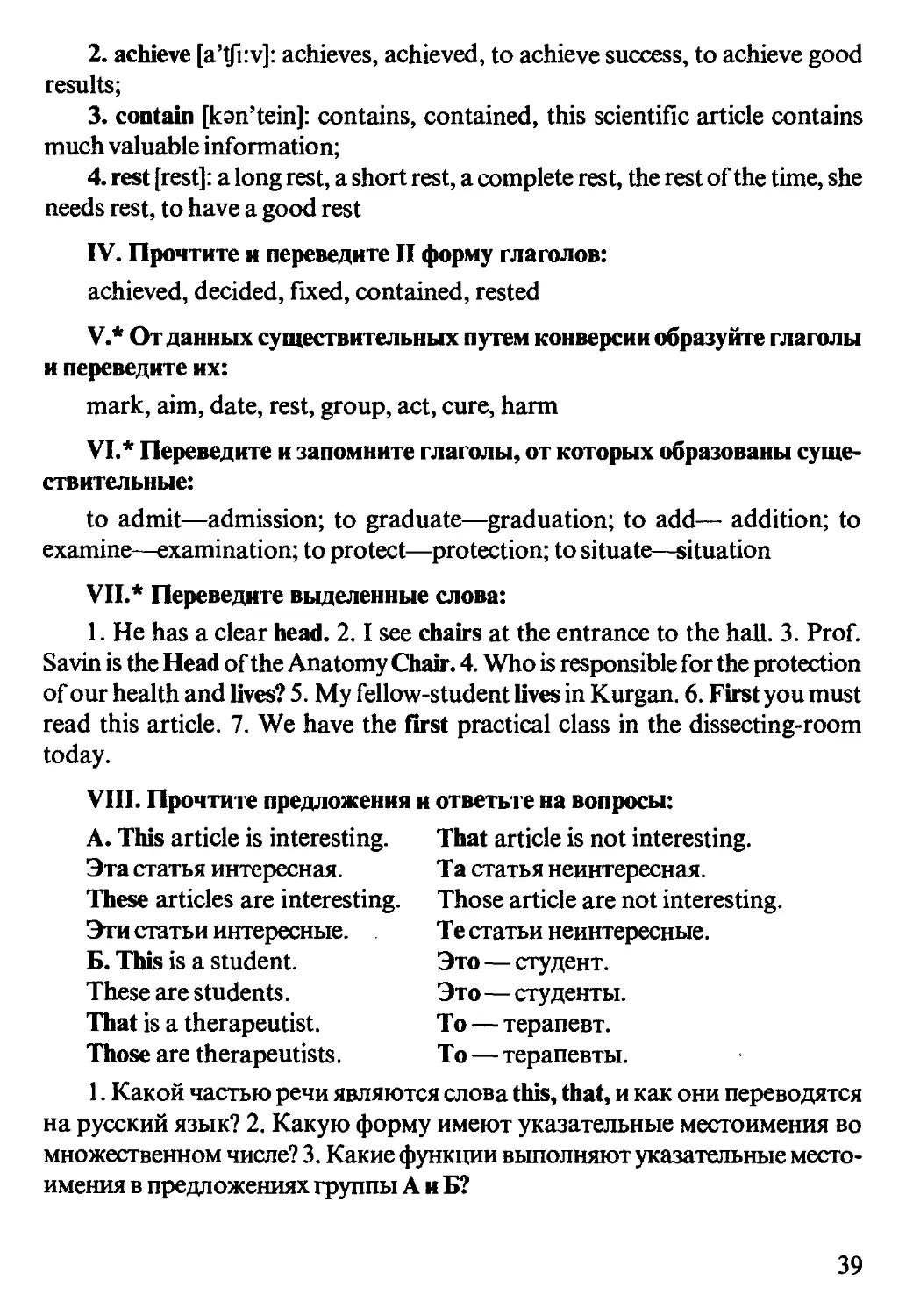


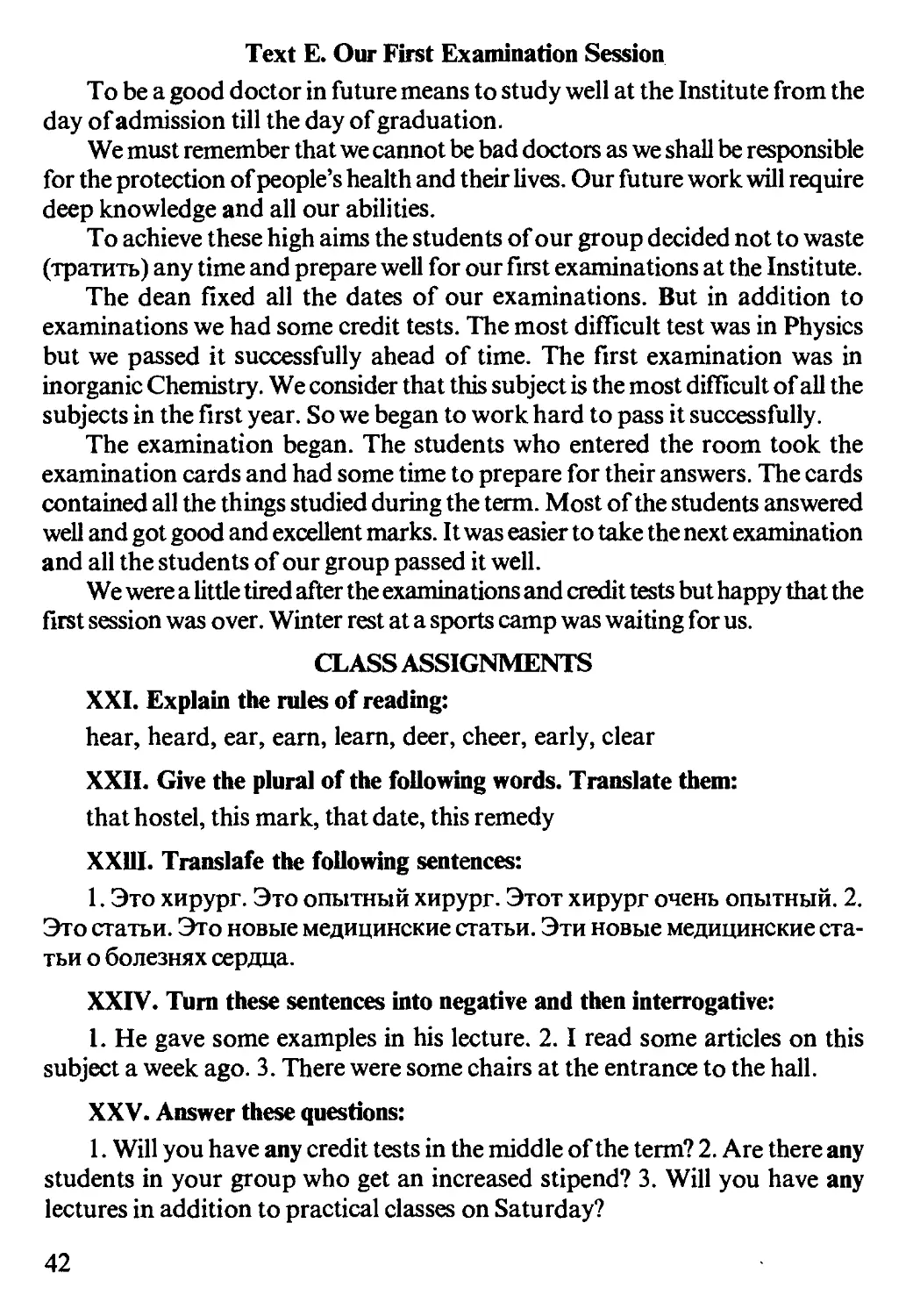


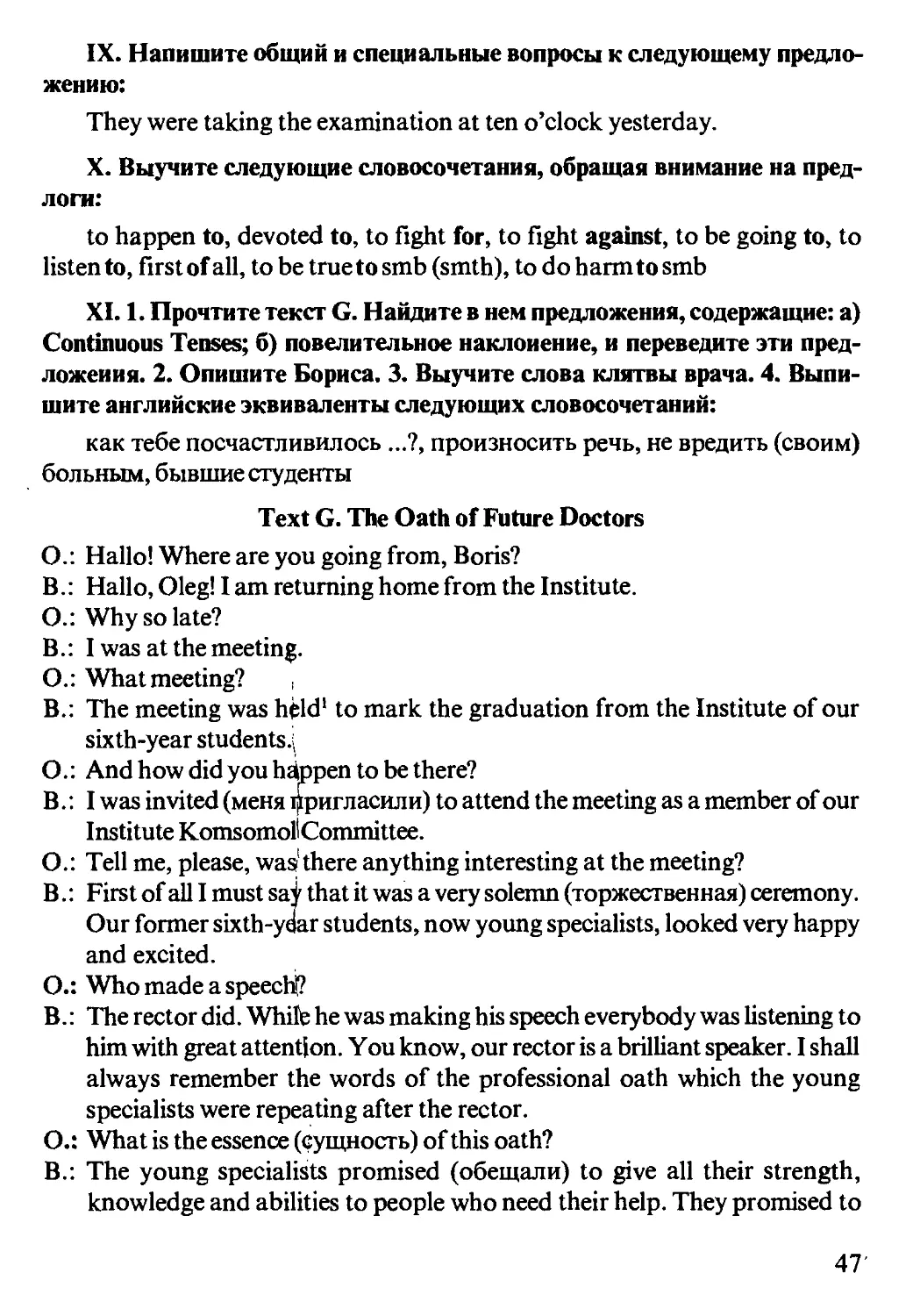


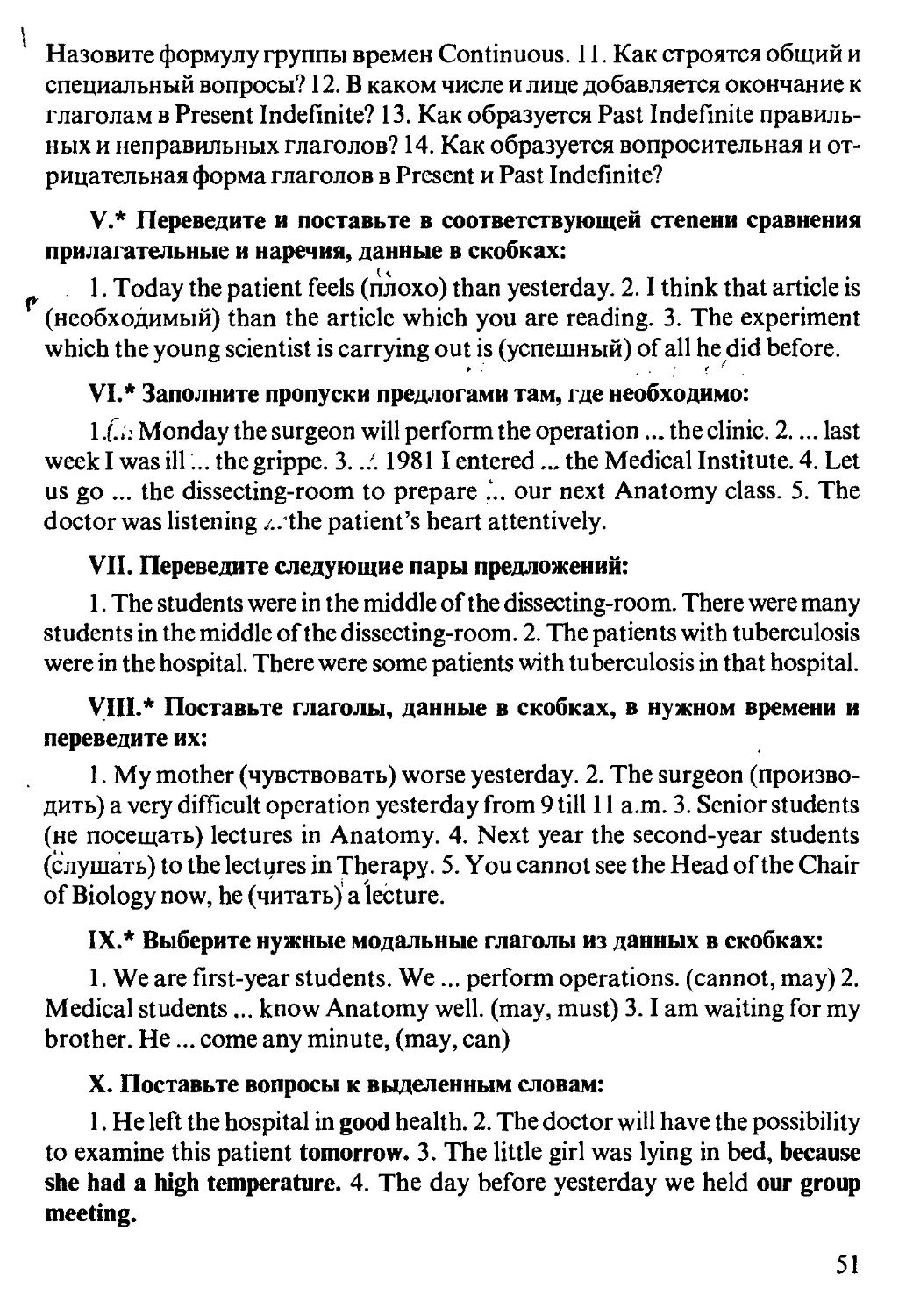




























































































Автор: Маслова А.М. Вайнштейн З.И. Плебейская Л.С.
Теги: языки мира английский язык медицинский английский
ISBN: 5-7871-0185-5
Год: 2002
Текст
                    A.M. Maslova, Z.I. Winestein , L.S. Plebeyskaya
for MEDICAL
STUDENTS
A. M. Maslova
Z. I. Winestein
L. S. Plebeyskaya
Essential
English
for
Medical
Students
Second Edition,
Revised and Enlarged
Допущено
Министерством высшего и среднего
специального образования РФ
в качестве учебника для студентов
медицинских вузов
ББК 81.2 Англ-9
М 31
Маслова А. М., Вайнштейн 3. И., Плебейская Л. С.
М 31 Учебник английского языка для медицинских
вузов. — 3-е изд. испр. и доп. — М.: Лист Нью, 2002. —
336 с.
ISBN 5-7871-0185-5
ББК 81.2 Англ-9
Учебник является частью комплекса, в который входят
также “Лабораторные работы по английскому языку”,
“Лексический минимум по английскому языку” (М., 2002).
Учебник состоит из 7 тематических циклов, охватываю-
щих программу младших курсов медицинских вузов. В
конце учебника имеются: грамматический справочник,
дающий возможность студентам контролировать само-
стоятельную работу над теорией, ключи к упражнениям и
англо-русский словарь.
В третье издание (2-е вышло в 1983 г.) внесены неболь-
шие дополнения и исправления.
Издание осуществлено при содействии Префектуры
Западного АО г. Москвы и Муниципального фонда под-
держки малого предпринимательства ЗАО г. Москвы
ISBN 5-7871-0185-5
© Маслова А.М., 2002
© ООО «Лист Нью», 2002
ПРЕДИСЛОВИЕ
Цель учебника. Учебник рассчитан на студентов I—II курсов, про-
должающих изучение языка в вузе, поэтому его главная задача—повто-
рить лексико-грамматический минимум средней школы и подготовить сту-
дентов к самостоятельному чтению и пониманию оригинального медицин-
ского текста с минимальным использованием словаря.
В соответствии с программой навык устной речи развивается в преде-
лах изучаемой тематики.
Учебник рассчитан на 106 часов. Остальное время (71 час) рекомен-
дуется использовать на чтение и работу с общенаучными текстами.
Учебник состоит из: 1. семи тематических циклов; 2. ключей; 3. крат-
кого справочника по правилам чтения и словообразования; 4. краткого
грамматического справочника; 5. англо-русского словаря.
Тематические циклы учебника: I. В институте (16 часов). 2. Анатомия
человека (16 часов). 3. Физиология человека (14 часов). 4. Микробиоло-
гия (6 часов). 5. Медицинские учреждения (14 часов). 6. Болезни (34 часа).
7. Здравоохранение (6 часов). В группах, где студенты менее подготовле-
ны, можно рекомендовать увеличение количества часов на прохождение
некоторых циклов.
Структура цикла. Каждый цикл состоит из нескольких Units и обзор-
ного занятия. В зависимости от тематики, количества незнакомой лекси-
ки, сложности грамматического материала число Units в цикле варьиру-
ется. Unit рассчитан на 4 — 8 академических часов, т. е. на 2—4 практи-
ческих аудиторных занятия.
Весь учебник разделен на 53 урока, каждый из которых состоит из
материала для самостоятельной подготовки студентов дома (Ноше
Assignments) и материала для аудиторной работы (Class Assignments).
Чтобы помочь студентам самостоятельно подготовиться к занятиям,
рекомендуем все примеры в заданиях на правила чтения и словообразова-
ния, все задания, содержащие вводимую лексику и тексты, а также ключи
к некоторым заданиям (типа Урок 4, IV; Урок 21, IX; Урок 30, VI и др.)
записать на магнитную ленту для прослушивания в лаборатории.
Для оживления аудиторных занятий рекомендуем ряд заданий, в осо-
бенности тексты, дать в записи на магнитной пленке.
На аудиторных занятиях лексико-грамматический материал домаш-
него задания проверяется и закрепляется в основном на новых, отличных
от домашних, упражнениях и текстах, построенных на пройденном лекси-
ческом и грамматическом материале.
3
Содержание учебника. Материал учебника включает следующее: пра-
вила чтения, словообразование, грамматический и лексический матери-
ал, тексты и упражнения.
Правила чтения введены для помощи студентам обобщить и унифици-
ровать знания, полученные в школе.
Словообразование. Основной целью этого раздела является развитие
языковой догадки и расширение словарного запаса за счет вводимых сло-
вообразующих элементов, для чего предусмотрены специальные упраж-
нения на образование новых слов, на гнезда слов и др.
Грамматика. Введение нового и повторение пройденного в школе
грамматического материала вынесено на самостоятельную работу дома.
В отличие от существующих учебников, где студент заучивает гото-
вое правило, мы пытаемся привести студента к самостоятельному выводу
правил путем сопоставления английских и русских конструкций, наводя-
щих вопросов и ключей к ним. Весь грамматический материал дается обоб-
щенно.
В конце учебника дан краткий грамматический справочник, который
одновременно является ключом для самостоятельной работы. В справоч-
ник включены схемы и таблицы.
Каждый текст и система упражнений урока построены с учетом конк-
ретных грамматических явлений и лексики.
Лексика. Общий объем лексики учебника в среднем около 3000 еди-
ниц, включая интернациональные слова, медицинские термины латинско-
го и греческого происхождения, последние составляют значительный про-
цент (до 40%). Активный словарь учебника—приблизительно 1500 слов.
Активная лексика дается прямым переводом до работы с новым тек-
стом или ее значение раскрывается в контексте.
Тексты. Содержание текстов соответствует теме цикла с соблюдением
принципа нарастания трудностей и повторяемости лексики. Например,
лексика Cycle II “Anatomy” повторяется в Cycle III “Physiology of the
Human Body” и также в Cycle VI “Diseases”.
Все тексты, как написанные авторами учебника, так и оригинальные,
являются фабульными, познавательными и имеют воспитательное значе-
ние.
В работе над текстами предусматривается развитие навыков синтети-
ческого и поискового чтения.
Все Тексты и работа над ними являются подготовкой к чтению и пони-
манию оригинальной медицинской литературы.
Система упражнений. Упражнения в учебнике делятся на под-
4
готовительные и речевые. Подготовительные упражнения выполняются
дома и проверяются в основном по ключам, некоторые задания нацелива-
ют студентов к ответам на любой вопрос по тексту, ряд заданий выполня-
ется письменно. Речевые упражнения выполняются в аудитории. Всего в
учебнике примерно около 300 видов грамматических и лексических уп-
ражнений.
Во 2-е издание учебника включены дополнительно тексты, отражаю-
щие новые достижения советского здравоохранения, в нем увеличено чис-
ло творческих упражнений, усовершенствована структура каждого уро-
ка.
Данный учебник является основой комплекса для медицинских вузов.
Составными частями этого комплекса являются также “Лабораторные
работы по английскому языку для медицинских институтов” тех же авто-
ров, “Пособие по английскому языку для медицинских вузов” (авторы А.
М. Маслова и 3. И. Вайнштейн, “Высшая школа”, 1976 г.) и “Лексичес-
кий минимум по английскому языку для медицинских вузов” тех же авто-
ров.
Авторы признательны рецензентам, а также профессорам Че-
лябинского медицинского института Л. Я. Эберту, Д. К. Соколову, до-
центам В. И. Левинсон, П. В. Глазыриной за ценные советы, которые по-
могли в работе над учебником.
Авторы
АНГЛИЙСКИЙ АЛФАВИТ И ЗВУКОВЫЕ
ЗНАЧЕНИЯ ЕГО БУКВ
	Б ук вя
м	пе-		Ниивге	Пркмечавае
	м	рукописные	букв
1	А а	Cl CL	[ei]	[ei], [e]; [а:] перед г; [еэ] пе-
				ред г + гласная
2	В Ь		Ibi:]	[Ъ]
3	С с	C c	(si:J	[а] перед е, 1, у; [к] перед остальными буквами н в конце
		C- Is
				слов
4	D d		fdi:]	[d]
5	Е е		(id	[1:], W; [«•] перед г; [ia] пе-
				ред г гласная
6	F f	<r^	[efj	[fl
7	Gg		[d5i:]	[ds] перед е, 1, у; [д] перед остальными гласными н в конце
8	Н h	U A	leitj]	слов [h]
9	I i	Л X	[ai]	[ai[, [i]; [а:] перед г; [aia] пе- ред г + гласная
10	J j	/л	(djeiJ	(d5]
11	К к	о	(keij	(М
12	L 1	zz	[el]	[П
13	M m		[em]	[т]
6
Продолжение

м	By квы		Название букв	Примечание
	пе- чат- ные	рукописные
14	N п		(еп]	[n]
15	0 о	О-о	[ouj	[ou], [э]; [э:] перед г; [э:], [ээ] перед г + гласная
16	Рр		[pi;J	(pj
17	Q q		(kju:J	[kw], редко [к] в сочетания qu
18	R г		(a: (01	[г] перед гласными; в конце слов и перед согласными не произ- носится
19	S S		fes]	I»]. М
20	Т t	ft	lti:l	(Ч
21	U и	Км,	fju:J	IJuxJ, [л]; [a:J перед г; [jua] перед г 4- гласная
22	Vjr		[vi:J	[V]
23	W w		fdAblju:]	[wj
24	X х		[eks]	[ksj. [gz]
25	Y у		[waij	[a'b Id; [*••] передг; [ага] пе- ред г 4- гласная; [j] — в на- чале слова
26	Z 2		[zedj	W
7
CYCLE I. AT THE INSTITUTE
UNIT 1. THE MEDICAL INSTITUTE
Правила чтения: Английский алфавит, понятие о слогоделении и ударе-
нии в слове; чтение гласных в 4-х типах слога; чтение многосложных
слов;
буквосочетания: еа, ее; еа перед d, th; оо; ai, ay, ei, ey; буквы:
о перед m, n, th, v; с и g; у; а перед ss, sk, sf, sp, ft, nee, th. Фразовое
ударение.
Словообразование: Словосложение; суффиксы -er, -or, -ly, -ic, -al; пре-
фикс re.
Понятие о конверсии. Употребление существительного перед дру-
гим существительным в качестве определения.
Грамматика: Спряжение глаголов to be и to have в Present, Past и Future
Indefinite; времена группы Indefinite Active; порядок слов в пове-
ствовательном английском предложении; числительные; артикли и
их употребление; множественное число существительных, место-
имения (личные и притяжательные).
LESSON 1
CLASS ASSIGNMENTS
I. Ответьте на следующие вопросы:
I. Какой слог, открытый или закрытый, в словах: a) my, те, be, he, по?
б) met, not, тар, pin? 2. Откуда начинается слогоделение в английских
словах? Сколько слогов в каждом из следующих слов:
‘late, ‘later, ‘latter, ‘table? 3. На какой слог падает ударение? (см. Грам-
матический справочник, стр. 269)
II. Прочтите таблицу четырех типов слога по вертикали и по горизон-
тали и ответьте на вопросы:
1. Как читаются гласные: а) в открытом ударном слоге? б) в закрытом
ударном слоге? 2. Чем отличается: а) третий закрытый тип слога от второ-
R
го, и как читаются в этом слоге гласные? б) Как читаются гласные в IV
типе слога, и чем этот слог отличается от первого?
типы слогов	I	11	ill	IV
буквы	открытый	закрытый	закрытый (r)	открытый (re)
a[ei]	mate [meit]	mat [maet]	mark [mcrk]	mare [mea]
о [ou]	code [koud]	cod [kad]	cord [ko:d]	core [ко:], [kaa]
u[ju:]	cute [kju:t]	cut [kxt]	cur [ka:]	cure [kjua]
e[i:l	mete [mi:t]	hen [hen]	her [ha:]	here [hia]
i[ai]	fine [fain]	fin [fin]	fir [la:]	fire [faia]
у [wai]	my [mai]	lymph [limf]	myrtle [’ma:tl]	lyre [laid]
Ш. Прочтите следующие слова и определите тип слога:
make, care, student, girl, person, got, arm, but, home, like, pure, help,
form
IV. Прочтите многосложные слова и скажите, на какой слог от конца
падает ударение и как читаются ударные гласные
family [‘faemili], chemistry [‘kemistry], character [‘kaenkta], difficult
[‘diftkalt], history [‘histan], medical [‘medikal]
V. Прочтите таблицу 12 (стр. 278) спряжения глагола ‘to be’. Ответьте
на вопросы:
1. Как изменяется глагол to be в Present, Past и Future Indefinite? 2. Как
образуются отрицательная и вопросительная формы?
VI. Вставьте глагол ‘to be’ в соответствующем времени, лице и числе:
1.1... a medical student now. 2. We... doctors in six years. 3. He... at the
theatre yesterday. 4. My sister... ill. She... in the hospital now. 5. We... pupils
last year. 6. They ... teachers next year.
VII. Поставьте следующие предложения в отрицательной и вопро-
сительной форме:
1. They were in Moscow. 2. He will be in France. 3. She is an engineer. 4.
I am on holidays now.
VIII.	Ответьте на вопросы:
1.	Are you in class now? Where is student X now? 2. Were you on the
collective farm in September? Where was student X in September?
9
3.	Will you be at home in the evening? Where will student X be in the
evening?
IX.	Прочтите таблицу Напряжения глагола ‘to have’. Ответьте на воп-
росы:
1.	Как изменяется глагол to have в Present, Past и Future Indefinite? 2.
Как образуется отрицательная форма глагола to have в Present, Past и
Future Indefinite? 3. Как образуется вопросительная форма? 4. Как пере-
водится глагол to have?
X.	Поставьте предложения в Past и Future Indefinite:
1.	Have you a lecture in Anatomy? 2. He has a Biology lesson. 3. We have
no meeting.
XI.	Поставьте следующие предложения в отрицательной форме:
1.1 have much ink in my pen. 2. We sljall have a meeting tomorrow. 3. She
had many friends. 4. Yesterday we haditbree lectures. 5. He has enough time. 6.
They have an atlas in Anatomy.
XII.	Переведите следующие предложения:
1.	The student had much work in class yesterday. 2. Yesterday the students were
at the institute laboratory for two hours. 3. We are in the English class now. 4. We
have an English class now. 5. The doctor will be at the operation tomorrow at 10
o’clock. 6. The doctor will have an operation tomorrow in the morning.
LESSON 2
HOME ASSIGNMENTS
I.	Определите тип слога и протранскрибируйте следующие слова:
circle, care, period, skull, chest, side, during, arch, nerve, human, more,
here
Запомните:
1.	Буквосочетания ea, ее обычно читаются [i:]: treat [tn:t] ле-
чить; meet [mi:t] встречать; ea перед d, th и в некоторых других
словах читается [е]:
ready [redi] готовый; breath [Ьгев] дыхание; dead [дед]мертвый,
неживой.
2.	Буквосочетание оо читается [и:], а перед к— [и]: soon [su:n]
скоро, вскоре; look [luk] смотреть.
10
3.	Буква о перед m, n, th, v обычно читается [л]: among [э’плдэ]
между, среди; come [cam] приходить; another [a’natje] другой; above
[э’Ьау] над.
П. Прочтите:
1.	a) sleep, sea, three, weak, each, leave, feel, week; 6) head, already,
health, death;
2.	too, school, spoon, tooth, took, food;
3.	other, become, some, love, month, son
III. Прочтите и определите место ударения в следующих словах:
medical, entrance, anatomy, skeleton, ligament, extremity, conical,
ventricle, capillary
IV. Обратите внимание на способы образования новых слов и ответьте
на вопросы (см. Грам, справ, стр. 269):
1. Каким способом образованы следующие слова? Из каких элемен-
тов они состоят? Где ставится ударение в сложных словах?
headache [‘hedeik] головная боль, football [*futbo:l] футбол
а. Определите состав сложных слов и переведите их:
newspaper, textbook, homework, earache, note-book
2. От каких слов образованы следующие слова:
writer [‘raita] писатель; reader [‘n:da] читатель; to rewrite [ri’rait] ne-
реписать; to re-read [ri’n:d] перечитать?
Каким способом образованы эти слова и где ставится ударение?
б.	Переведите слова по словообразующим элементам:
lecturer, teacher, worker, helper, examiner, to re-examine, to replace, to
rename, to reconstruct, to re-do, to remake
в.	Переведите слова и определите часть речи этих слов:
to work—the work; to help—the help; to act — the act
3. Как называется такое явление?
г.	От данных существительных образуйте глаголы путем конверсии
и переведите их:
a place, a group, a stand, a head, a form, an end
4. Как переводится существительное, стоящее перед другим суще-
ствительным? Какую синтаксическую роль оно выполняет в предложении?
institute library, winter holiday, spring session
11
Запомните:
Суффикс -1у образует наречия от основы прилагательных и су-
ществительных: rapid [‘raepid] быстрый—rapidly [‘raepidh] быст-
ро; hour [аиэ] час— hourly [‘auali] ежечасно
1. Определите, от каких слов образованы наречия, и переведите их:
daily, greatly, beautifully, friendly, normally, badly, really, shortly,
yearly, partly
-ic, -al образуют прилагательные от основ существительных: person
лицо—personal личный; base основание—basic основной
2. Переведите:
experimental, prophylactic, anatomic, practical, democratic, social,
medical
V. В следующем предложении обратите внимание на фразовое ударе-
ние:
Му ‘brother and ‘sister ‘want to ‘study at the ‘Medical ‘Institute.
1. Какие части речи являются здесь ударными?, неударными? 2. Разде-
лите это предложение на смысловые группы и скажите, каков принцип
деления.
VI. Запомните чтение следующих слов. Найдите ниже их перевод:
ordinary [b:dnri], special [‘spejbl], biology [bau’obdji], medicine
[‘medsin], person [‘pa:sn], action [‘askjan]
биология; простой, обыкновенный, заурядный; медицина;
лекарство; действие; специальный, особый; лицо, человек
VH. Выучите следующие слова и словосочетания:
саге п забота, уход, наблюдение
(врача), обслуживание; и за-
ботиться, ухаживать (for); питать
интерес к чему-л.; fo take care of
smb заботиться о ком-л.; under the
care of smb под наблюдением
кого-л., great care усиленный
уход
enter [‘enta] v поступать; входить;
entrance [‘entrans] поступление,
вход
Ьесоще [ЬГклт] (became, become) v
стать, становиться; делаться
adult [a’dxl t] a, n взрослый; взрослый
человек
before [bi’fo:] prp перед; cj до того
как
hostel [‘hostal] n общежитие
relative [‘rebtiv] n родственник
get [get] (got, got) v получать
subject [‘sAbdjikt] n предмет, тема
increase [in’kn:s] v увеличиваться);
12
повышать(ся); усиливать (ся);
[‘inkri:s] п увеличение;
increased р. р. повышенный
as [aez] adv как, в качестве; cj так
как, в то время как
attention [a’tenjh] п внимание;
pay attention fo smth обратить внима-
ние на что-л, medical attention (care)
медицинское обслуживание
mean [mi:n] (meant, meant [ment]) v
означать, иметь в виду
article [‘a: tiki] n статья
join [djom] v связывать, соеди-
няться); вступать
scientific [‘saian’tifik] а научный;
ученый
heart [ha:t] n сердце
disease [di’zi:z] n болезнь, заболевание
УШ. Выучите следующие словосочетания, обращая внимание на пред-
логи:
to care for, to pay attention to, to take саге of smb, to have the responsibility
for, to be under the care of smb, in class, in the first year, in som subject.
IX.	Прочтите и переведите следующие слова и словосочетания:
1.	adult [a’dxlt]: my sister is an adult, they are adults, we are adults, children
are not adults;
2.	increase [In’kn:s]: increases, increased, the temperature may increase;
[‘inkri:s]: the increase of temperature;
3.	become [bi’kAm]: became, he became interested in Anatomy, she became
pale;
4.	join [dgom]: to join smth together, to join the Komsomol, to join the
party, to join the society;
5.	care [kco] : under the doctor’s care, to take care of the children, he takes
care of his old parents, to care for medicine, great care
X.	По таблице 16 времен группы Indefinite (стр. 281) изучите спряже-
ние глаголов. Обратите внимание:
а) на окончания смысловых глаголов в Present и Past Indefinite и на
вспомогательные глаголы в Future Indefinite в утвердительной форме; б)
на появление в отрицательной форме вспомогательного глагола do и из-
менение его в Present и Past; на место частицы not; на форму смыслового
глагола; в) на место вспомогательных глаголов в вопросительной форме
и на неизменяемость смыслового глагола; г) на краткие ответы; д) на
образование формы Past Indefinite неправильных глаголов; е) на приме-
чания.
XI.	Напишите и пыучите II форму (Past Indefinite) следующих глаго-
лов. Проверьте себя по Таблице неправильных глаголов (см. стр. 314):
13
a)	to get, to become, to mean, to read, to know, to tell, to be, to have, to do,
to write, to go, to come, to make, to take, to begin, to pay, to understand, to
teach, to see;
6)	to increase, to want, to work, to plan, to answer, to apply, to occupy, to
reply, to supplu, to study
XII.	* Поставьте вспомогательный глагол ‘do’ в соответствующем вре-
мени (письменно):
1.... your fellow-student get an increased stipend this year? 2.... you care
for Biology? 3.1... not join the Students’ Scientific Society last year. 4.... you
live with your relatives now?
XIII.* В следующих предложениях поставьте глаголы в Present
Indefinite (письменно):
1. Did your friend get a stipend? 2. He did not know my address. 3. Did you
live at the hostel? 4. They did not come to the hospital.
XIV.	Сделайте разбор по членам предложения и ответьте на вопросы:
The teacher asks the student a question at the lesson. The student asks the
teacher a question at the lesson.
1.	Чем отличаются эти предложения друг от друга? Влияет ли порядок
слов на смысл английского предложения? 2. На каком месте стоит подле-
жащее? Сказуемое? Дополнение? Обстоятельство? (см. табл. 27, стр. 302).
XV.	В следующих предложениях определите члены предложения и
разместите их по графам таблицы:
1. Му friend gets a stipend at the end of a month. 2. His brother wrote ian
article yesterday. 3.1 shall see him tomorrow.
1	2	3	4
Подлежащее (его определения) Кто?	Сказуемое Что делает подлежащее?	Дополнение Кого? Что?	Обстоятельство Где? Когда?
XVI.	1. Прочтите текст A. 2. Выпишите: а) прилагательные с суффик-
сами ‘-ic’, ‘-al’; б) наречия с суффиксом ‘-iy’; в) словосочетания, состоя-
щие из дпух существительных, где одно существительное определяет дру-
гое, и переведите их:
* Задания и вопросы, помеченные знаком*, имеют ключи.
14
Text A. At the Institute
Every year many young people who really care for medicine enter medical
institutes and become students. A new life begins — it is the life of the adult
who has the responsibility (ответственность) for all his actions before the
society.
Some students live at the hostel, others—with their relatives. Many students
get stipends. If a student has “fives” in all the subjects at the entrance
examinations he gets an increased stipend.
The students work much in class, at the institute laboratories and libraries.
As the students want to become not ordinary but good doctors they must pay
attention to modem medical literature. It means that they must study not only
their textbooks but read many special medical articles in the Russian and foreign
languages. They will continue to study them in class and at the Foreign
Language Society*.
Already in the first year some students join students’ scientific societies.
There they work on those subjects which they care for. It may be Biology,
Chemistry or Anatomy? In the Ar&ton$ Scientific Society the subject of the
students’ work may be the study of the heart or other organs of the body. In the
second year some students join the Physiology Scientific Society where they
study the functions of the organs. This work in the Scientific Societies will help
future doctors to understand better the character of many diseases. It will teach
them to be more observant (наблюдательный).
Note
1. Foreign Language Society — кружок иностранного языка
CLASS ASSIGNMENTS
XVII.	Group the words according to the sounds (э:], [еэ], [aia], [aij, [ei]:
tired, first, take, time, nurse, fire, parent, male, girl, care, pine
XVIII.	Read and explain the rules of reading:
week, weak, took, another, already, tooth, teeth, death, stool, among,
deep, come, discover, other, some, cover.
XIX.	Form new words and translate them:
a)	the nouns by adding the suffix -er: to examine, to lead, to teach, to
organize, to help, to write;
15
b)	the verbs by adding the prefix re-: to join, to operate, to group, to make;
c)	the adverbs by adding the suffix -ly: real, special, scientifical, hour, day,
month, week, year, part, bad, rapid;
d)	the adjectives by adding the suffix -al: form, practice, person, experiment,
clinic
XX.	Give full answers to the following questions:
1.	Is your sister an adult? 2. Are you at a hostel now? 3. Has your mother a
heart disease? 4. Where are your relatives? 5. Is Biology a special subject? 6.
Are you under the care of a doctor now?
XXI.	Translate into Russian paying attention to the words in bold type:
1.	He plans to begin his scientific work in May. 2. His scientific plans are
very interesting. 3. Professors Ivanov and Smirnov head the Students’ Scientific
Society. 4. He was the head of the delegation at the Congress of Soviet
Anatomists.
XXII.	Translate into English:
1.	Студенты-медики должны обращать большое внимание на изучение
анатомии. 2. Кто отвечает за вашу работу в научной лаборатории? 3. л
Дети всегда должны находиться под наблюдением своих родителей. 4. На *
первом курсе у студентов медиков несколько теоретических предметов. 5.
Что вы изучаете по биологии на занятиях? 6. Человек с сердечными забо-
леванием должен находиться под наблюдением врача. 7. Так как я дей-
ствительно интересуюсь медициной, я поступил в медицинский институт.
XXIII.	Give the Infinitive (the 1st form) of the following verbs:
did, got, became, meant, knew, told, was, had, went, made, took, were,
came, taught, understood, paid
XXIV.	Read the verbs paying attention to the pronunciation of‘-ed’, u -(e)s.
Give the Infinitive:
cared, joined, studied, answered, increased, wanted, planned, helped,
continued, worked, thanked, liked, washed, watched
XXV.	State the tense of the verbs. Translate the sentences:
1. My relatives got a letter from me a week ago. 2. Every mother cares for
her children. 3. He will study many subjects at the Institute. 4. Last year she
entered the Institute. 5. We shall read scientific articles in medical journals.
XXVI: Turn the 1st and 3rd sentences into Past Indefinite and the 2nd and
4th — into Future Indefinite:
16
1. Many students want to join the Foreign Language Society. 2. My friend
always helps me to learn Anatomy.
3.	He does not study French as he studies English. 4. Medical students
study many clinical subjects in the fourth year.
XXVII.	Answer in short:
1.	Is your brother an adult? 2. Had you entrance examinations in September?
3. Do you get an increased stipend?
4.	Will you become a doctor next year? 5. Did you join the Young
Communist League last year? 6. Have you relatives in Moscow?
XXVIII.	Answer the alternative questions:
1.	Does this fellow-student live at the hostel or with his relatives? 2. Had
you entrance examinations in July or in August? 3. Do you get an increased or
an ordinary stipend?
XXIX.	Make sentences from the following words:
1.	in future, become, doctors, shall, we; 2. in Anatomy, yesterday, had, we,
a lecture; 3. the library, take, the, students, from, books
LESSON 3
HOME ASSIGNMENTS
Запомните:
1.	Перед e, i, у буква с читается [s], а буква g—[ф], в остальных
случаях с читается [k], a g — [g].
с Г" [s] face, cite, cyst
I—	[к] can, cut, cold, clot, back
|-[<fe] large, gin, gym
° L- [g] game, gum. got, grippe, bag
2.	Буквосочетания ai, ay, ei, ey в ударных слогах обычно чита-
ются [ei]: daily [‘deili] ежедневно; pay [pei] платить; vein [vein] вена;
grey [grei] серый.
3.	Буква у в начале слов перед гласной читается Щ: yellow [‘jelou]
желтый.
4.	Буква а перед ss, sk, st, sp, nee, th, ft обычно читается [&]: last
[last] прошлый; after [‘arfta] после, после того как.
I. Прочтите:
1.	practice, medical, medicine, place, necessary, lecture, general, large,
surgical, ago, age, group, histology, biology, gland;
2.	they, may, pain, day, eight, brain, way, gain, wait, weight;
3.	yes, yet, yesterday, you, young, year, your;
4.	master, ask, past, grasp, after, chance, bath, last.
II. Запомните чтение следующих слов. Найдите ниже их перевод:
course [ko:s], theoretical [Gia’retikal], practical training [‘praektikal ‘treniij],
human [‘hjuiman], to diagnose [‘daiagnouz], assistant [a’sistant], general
[‘djenaral], therapy [‘Gerapi], to specialize [‘spejblaiz], therapeutic
[,0ero’pju:tik]
генеральный, общий; специализироваться; ассистент, помощник; те-
рапевтический, лечебный; курс, течение (болезни); терапия, лечение; че-
ловеческий; практика; теоретический; ставить диагноз
Ш. Выучите следующие слова и словосочетания:
found [faund] v основывать; утверждать; создавать; обосновывать;
founded on facts основанный на фактах
over [‘ouva] ргр над, свыше, больше; to be over оканчиваться
department [department] и отделение; факультет; кафедра
such [sAtf] а такой; such as как например; такой как
different [‘difront] а различный; разный, отличный (from); to be different
from отличаться от
carry out [‘kaeri] v выполнять, проводить
nurse [na:s] n медицинская сестра; v ухаживать за больным(и)
last [lais t] v продолжаться; а последний; прошлый
surgery [‘safari] n хирургия
surgical [‘saicfcikl] а хирургический
so [sou] adv так, таким образом; итак, поэтому
gam [‘ gein] v приобретать, получать; достигать
knowledge [‘nolkfc] знание(-я); the knowledge of medicine знания по ме-
дицине
necessary [‘nesisarija необходимый, нужный
experience [iks’piarians] п опыт (накопленный, приобретенный)
main [mein] а главный, основной; in the main в основном
complete [kam’plrt] v заканчивать, завершать; а законченный, полный
appointment [a’pointmant] п назначение
18
field [fi:ld] n поле, область (деятельности)
prepare [pri’peo] v готовить(ся), прнготовить(ся)
IV. Выучите следующие словочетання, обращая внимание на предло-
ги и наречия:
to be over, to be different from, to carryout, to last for, the knowledge
ofsmth,in the main, in the field of, at the end of,to treat smbfor smth with
smth, in general, to work as, in an hour (a year), founded on facts
(experiments).
V. Прочтите и переведите слова и словосочетания:
1.	general [‘фепэгэ!]: in general, a general meeting, general knowledge,
general subjects, general attention;
2.	surgery [‘saitferi]: surgical, the knowledge of Surgery, a surgical
department, a surgical nurse. Surgery is a clinic subject;
3.	necessary [‘nesisari]: necessary help, necessary time, necessary
knowledge, good knowledge of Anatomy is necessary for us;
4.	complete [kam’pli:t]: completes, completed, to complete the work, to
complete the course of studies, complete period of rest;
5.	field [fi:ld]: an important field of medicine, to work in the field of Surgery,
in the field of medical research (научное, исследование). .He is a specialist in
many fields.
6.	to found a hospital, a theory founded on facts, to found a new medical
scool, to found practical conclusions (выводы), founded on experiments.
VI. Переведите следующие сочетания слов
1. human apatomy; 2. during the three-years’ period; 3. to diagnose a
disease; 4. to carry out laboratory analyses; 5. at the end of; 6. to gain knowledge
(experience); 7. the place of their work appointment; 8. to treat people for
different diseases with medicines
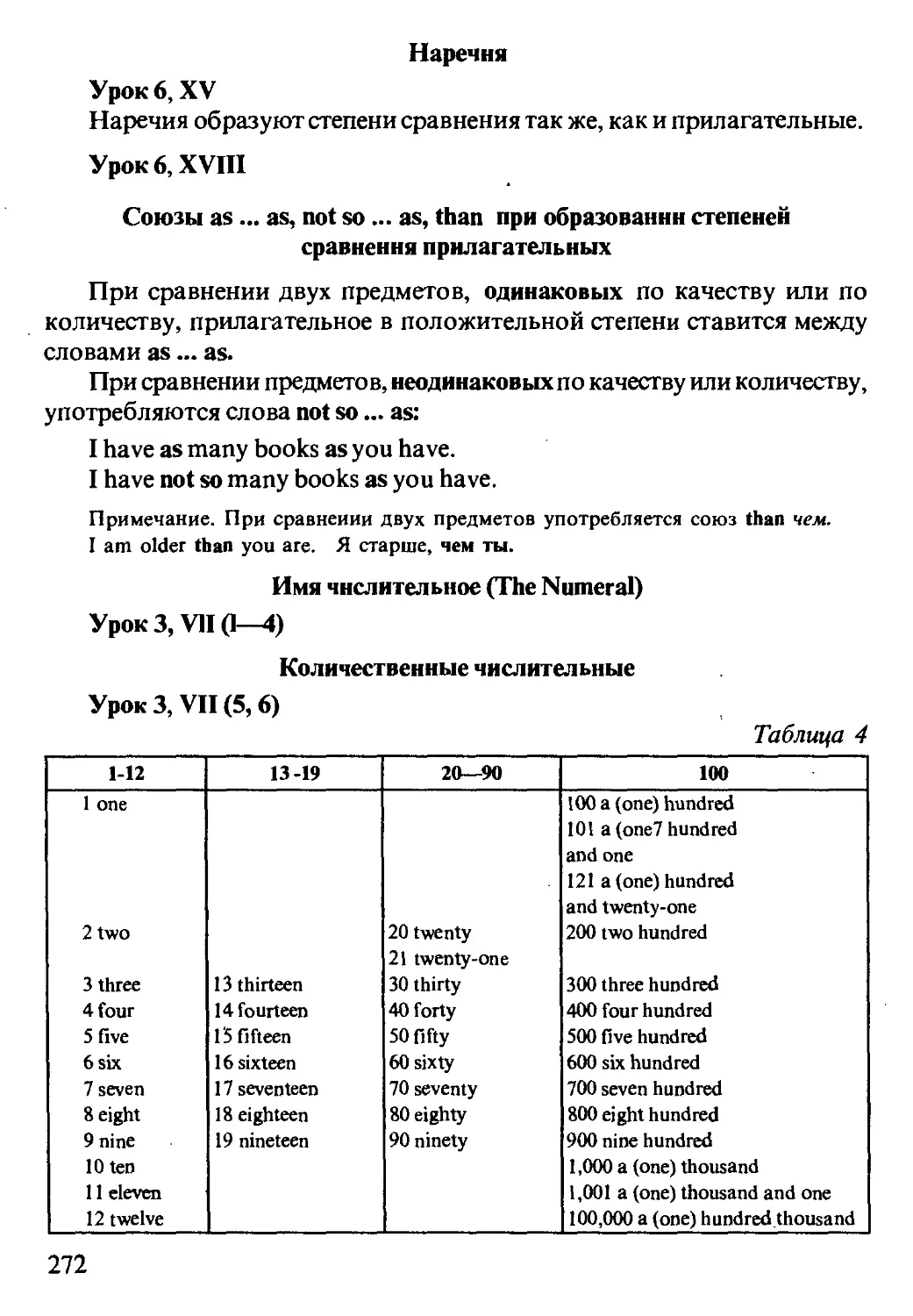
VII. Ознакомьтесь с таблицами числительных 4, 5, 6 (см. стр. 272).
Ответьте на вопросы:
1. С помощью какого суффикса образуются количественные чис-
лительные от 13 до 19? 2. С помощью какого суффикса образуются десят-
ки? 3. Какой союз ставится между сотнями и десятками (или единицами,
если нет десятков) при чтении числительных? 4. Каким знаком отделяются
тысячи? 5. Как образуются порядковые числительные? 6. Какие порядко-
вые числительные образуются не по общему правилу? 7. Как читается
19
простая дробь? 8. Как читается десятичная дробь?9. Как читаются цифры,
обозначающие календарные даты?
УШ. Прочтите:
15; 11; 130; 348; 12; 0.001; 0.05; 2/3; 41st; 12th
IX. Напишите по-англицски: -	- '
первое сентября, первого сентября; второе августа, второго августа;
десятое января, десятого января.
X. а. Найдите артикли в следующих предложениях и ответьте на вопросы:
1. This is a pencil. The pencil is red. 2. My friend wrote an article. The
article is interesting.
1. Что такое артикль? Какие артикли вы знаете? 2. Когда упот-
ребляется неопределенный артикль? 3. Когда употребляется определен-
ный артикль?
б. Скажите, почему отсутствуют артикли в следующих предложениях:
1. Moscow is in Europe. 2. My friend lives at this hostel. 3. We study
Biology, Anatomy and Histology. 4. He is ill with tuberculosis. 5. Professor
Smirnov lives here.
в. Скажите, какой артикль и почему употреблен в предложениях:
1. Rostov stands on the Don. 2. The Black Sea is in the South. 3. They went
to the Urals. 4. We live in the Soviet Union.
XI.	Объясните употребление или отсутствие артиклей:
1.	Не gets a stipend. 2. They are adults. 3. The Soviet Union is a large
industrial country. 4. Is he ill with tuberculosis? 5. My father works at a surgical
department of the clinic.
XII.	(Вспомните, как образуется множественное число существи-
тельных.) Прочтите слова и проверьте себя по справочнику:
a lamp — lamps [s], a hand — hands [z]
a box — boxes [tz], a mass — masses [iz]
a baby — babies [iz], history — histories [tz]
a wife — wives, a life — lives
a man — men, a tooth — teeth
XIII.	* Напишите следующие предложения во множественном числе:
1.	She was a nurse. 2. Не is a child. 3. The box is on the table. 4.1 am a
young man. 5.1 shall be a doctor.
20
XIV. В следующих колонках обратите внимание на выделенные мес-
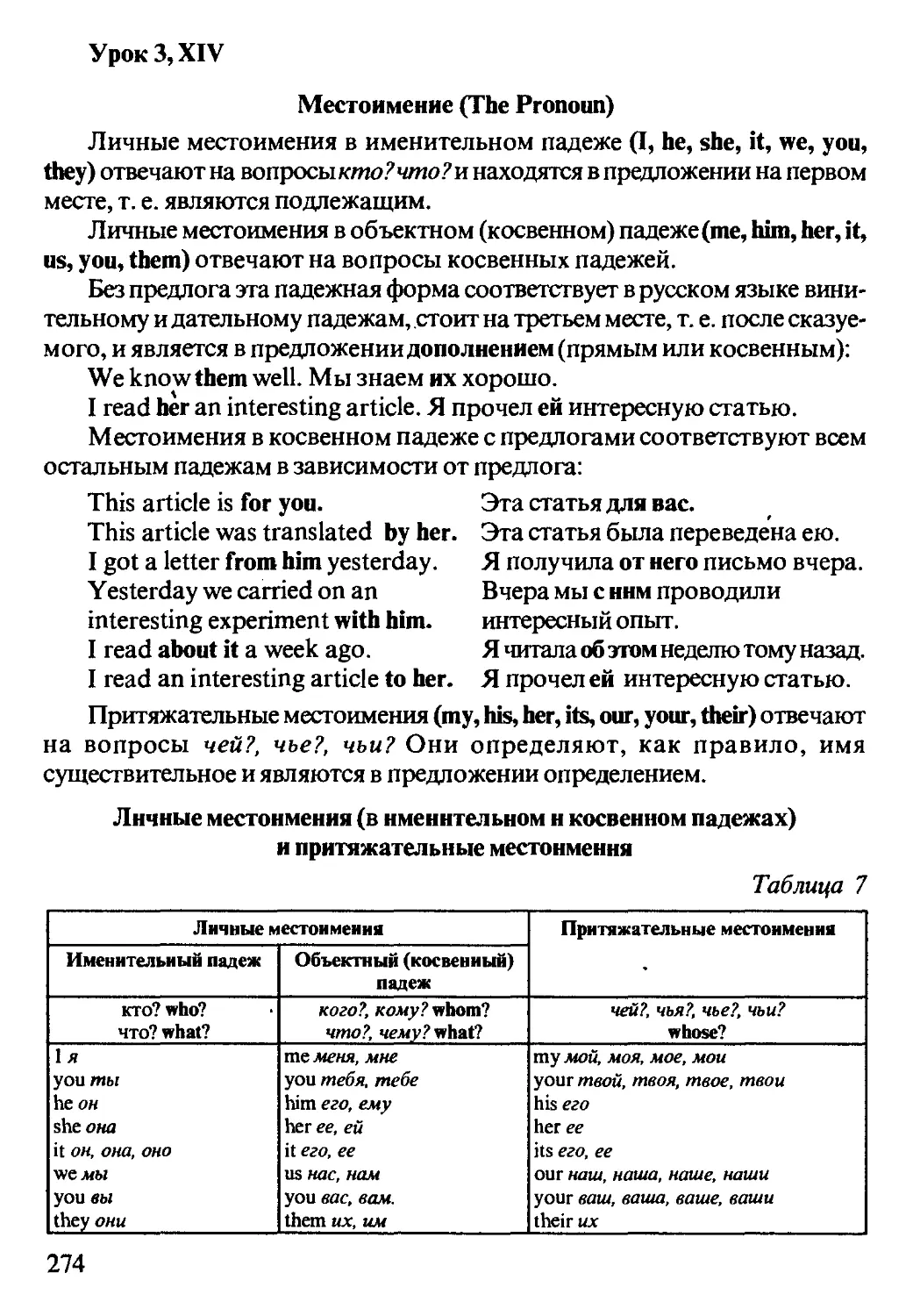
тоимения и ответьте на вопросы:
I am here.	All know me.	All know my work.
He is here.	All know him.	All know his work.
She is here.	All know her.	All know her work.
It is here.	All know it.	All know its work.
We are here.	All know us.	All know our work.
You are here.	All know you.	All know your work.
They are here.	All know them.	All know their work.
1. Как называются местоимения в каждой колонке? 2. На какие воп-
росы они отвечают и какими членами предложения являются?
XV.	Переведите данные в скобках местоимения:
1.1 see (его) and (его) sister. 2. We know (их) and (их) children. 2. She
teaches (нам) Biology. 4. (Наш) Institute is in Kirov street. 5. He likes (свою)
work. 6.1 see a car. I see (ее) well. (Ее) colour is black. 7. Do you know (ее) and
(ее) brothers? 8. He meets (меня) every day.
XVI.	Прочтите текст В; а) озаглавьте его; б) перепишите 4-й абзац и
разбейте предложения на смысловые группы; в) выпишите из текста на-
звания учебных предметов.
' Text В
The 1st Moscow Medical Institute was founded in 1764. Now it has over
70 departments. As in all Soviet medical institutes, the course of studies is six
years. During this period the students master (овладевают) the basis of theoret-
ical and practical medicine.
For two years the students learn the so-called pre-clinical subjects,1 such as
Physics, Chemistry, Biology, Human Anatomy, Histology and others.
The students have clinical subjects from the third to the fifth year. During
the three-years’ period the students learn to diagnose different diseases, to
carry out laboratory analyses and to treat people for these diseases.
At the end of the third year all the students have a six-weeks’ practical
training. During this period they work as nurses. After their 4th year the students
have another practical training. It lasts for eight weeks. During the second
practical training they work as doctors’ assistants at the therapeutic, surgical
and other departments. After the 5th year the students have a six-weeks’ practical
training at a polyclinic. So in five years2 the students gain the knowledge
necessary for a general practitioner3.
21
In the 6th year the students gain more experience in one of the three main
clinical subjects: Therapy, Surgery or Obstetrics.
When the students complete subintemship4 they get their work appointment.
But before they begin to work at the place of their appointment they work as
interns5 at a large hospital.
Such a system when a young doctor specializes for two years in one field of
medicine helps to prepare necessary specialists.
Notes
1.	the so-called pre-clinical subjects—так называемые доклинические предметы
(теоретические)
2.	in five years—через пять лет. Предлог in в значении через употребляется с
существтельиыми, обозначающими период времени.
3.	a general practitioaer — врач общего профиля, практикующий врач
4.	subinternship — субординатура (врачебная практика студентов 6 курса)
5.	an intern — интерн, молодой врач-стажер
CLASS ASSIGNMENTS
XVII.	Read and explain the rules of reading:
plaster, complete, polyclinic, general, gain, young, city, afternoon, main,
they, X-ray, vein, yesterday, master, last
XVIII.	Form the ordinal numerals:
5, 2, 3, 21, 12, 30, 113
XIX.	Answer the questions:
1.	What date is it today? 2. What date was it yesterday? 3. What date will
it be tomorrow? 4. What date was it the day before yesterday? 5. What date will
it be the day after tomorrow?
XX.	Explain the use or omission of articles:
1.	The doctor treats him for tuberculosis. 2. They specialized as nurses. 3.
The doctor asked the nurse to prepare all the analyses necessary for the
diagnosis. 4. Medical students study general subjects in the first and second
year. 5. He is the best student among us.
XXI.	Give the singular of the following nouns:
women, teeth, feet, children, friends, lives, studies, dresses
XXII.	Give the plural of the following nouns. Spell the endings:
baby, history, wife, life, mass, box
22
XXIII.	Translate these sentences. Find the pronouns:
1.	My father is over 35 years old. 2. Do you know them and their parents?
3. Many of her relatives study at different institutes. 4. At the conference I met
him among the delegates. 5. Their practical training lasted for a month.
XXIV.	Substitute the nouns in bold type for the Personal Pronouns in the
Objective Case:
1.	The nurse cares for these children. 2. Yesterday I read a medical article.
3. The teacher asked my friend a question. 4. We saw your sister last week. 5.
Your brother knows me and my parents well.
XXV.	Translate into English:
1.	Он обосновал свои научные исследования на экспериментах. 2. В
какой области медицины вы думаете работать? 3. Занятия в институте
отличаются от занятий в школе. 4. По понедельникам наши лекции закан-
чиваются в два часа. 5. На первом курсе студенты изучают в основном
теоретические предметы. 6. Наша первая лекция по биологии была 10
сентября. 7. Сегодня десятое-октября.
XXVI.	Read text С. Make the plan, retell:
Text C. Medical Faculty of the Patrick Lumumba University
Young people from Asia, Africa and Latin America study together with
Soviet students at the Medical Faculty of the Patrick Lumumba University in
Moscow. As they come from foreign countries and have no relatives, in Moscow
they live at a hostel.
This medical faculty is a little (немного) different from clinical faculties in
other Soviet medical institutes. It prepares general practitioners who gain good
knowledge of therapy, surgery or obstetrics. The students of this faculty also
specialize in such subjects as sanitation, epidemiology and hygiene [‘haidsim].
These subjects are very necessary for doctors in Asia, Africa and Latin America.
The professors, teachers and lecturers of this faculty pay great attention to
prophylactic subjects.
When a foreign student completes his medical course he gets an appointment
to work as an intern at one of the hospitals in Moscow. This helps him to gain
more experience and to increase his knowledge of one of the main fields of
medicine.
23
UNIT 2. CLASSES AND EXAMINATIONS
Правила чтения: Буквосочетания wa, war, wor, wh; al перед согласной; sh,
ch, tch, ph, th; air, ear, eer перед согласной.
Словообразование: Суффиксы -иге, -у, -ion, -(i)ty, -ment.
Грамматика: Способы передачи падежных отношении в английском язы-
ке; предлоги; оборот there + be; безличные предложения; модальные
глаголы can, may, must; общие и специальные вопросы; указатель-
ные и неопределенные местоимения; степени сравнения прилагатель-
ных и наречий; образование Present Participle; времена группы
Continuous Active.
LESSON 4
HOME ASSIGNMENTS
Запомните:
Буквосочетания: 1. wa читается [wo], если за ним следует со-
гласная или сочетание согласных: wash [woj] мыть (ся);
2. war читается [wo:]: warm [wo:m] теплый;
3. wor перед согласной читается [wo:]: word [wo:d] слово;
4. Если за буквосочетанием wh следует буква о, то буква w не
читается: whom [hu:m] кого; whole [houl] целый, в остальных случа-
ях — не читается буква h: white [wait] белый;
5. Буквосочетание al перед согласной читается [о:1]: always
[* lo:lwoz] всегда. Если за al следует к, то 1 не произносится: walk
[wo:к] идти пешком.
I. Прочтите:
1. want, watch, was, wander, water
2. war, warn, warp, ward, warder, warty
3. work, world, worm, worst, worth, worse, worthy
4. who, what, whose, why, where, when, whether, which, while, whole,
wheel
5. talk, salt, fall, chalk, all, small, call, hall, also
Запомните:
-ure—суффикс существительного.
24
Если этому суффиксу предшествует согласная t, то сочетание -
ture читается [tfa]: structure [‘strxktfa] строение, структура. Если
ему предшествует согласная s, то сочетание -sure читается [зэ]:
measure [‘терьера, измерение; а если ss, то сочетание -ssure чита-
ется [fa]: pressure [‘prefa] давление.
1.	Прочтите и переведите:
nature, pleasure, mixture, lecture, picture, future, culture
Суффикс-у образует прилагательные от существительных: salt
соль—salty соленый. Суффикс-у также встречается у существитель-
ных и глаголов: remedy [‘remidi] лекарство; carry [‘kaeri] нести. У
глаголов этот суффикс может читаться [ai]: to supply [sa’plai] снаб-
жать.
2.	Прочтите и переведите:
з)	существительные: difficulty, study, body; б) глаголы: apply, multiply,
study; в) прилагательные: happy, airy, wordy, healthy, sunny
II.	Выучите следующие слова и словосочетания:
numerous [‘nju:maras] а многочисленный
perform [pa’fo:m] v выполнять, осуществлять
attend [a’tend] v посещать (лекции, собрания)
listen [‘lisn] v слушать (to); прослушивать (to)
deliver [di’liva] v читать (доклад, лекцию)
clear [klia] а ясный, чистый; прозрачный
need [ni:d] u нуждаться (в чем-л.); to need badly очень нуждаться (в чем-л.)
deep [di:p] а глубокий
hard [herd] а трудный, упорный; adv настойчиво, упорно
possibility [.posa’biliti] n возможность
term [ta:m] n семестр; термин
several [‘sevral] а несколько
middle [‘midi] а средний; n середина; in the middle of в середине
whole [houl] а целый, весь
successful [sak’sesful] а успешный, удачный
III.	Прочтите и переведите слова и словосочетания:
1.	numerous [‘nju:maras]: numerous books, numerous examples, numerous
subjects, numerous things;
25
2.	clear [klia]: a clear day, clear water, a clear head, the question is clear,
it becomes clear;
3.	need [ni:d]: to need badly, I need a book, we need it very much, do you
need any help? He needs great care.
4.	whole [houl]: the whole day, the whole year, the whole world, the whole
country, the whole summer;
5.	successful [sak’sesful]: a successful beginning, a successful end,
successfully, to pass the examinations successfully
IV. Поставьте сказуемое в Present Indefinite (письменно):
1.	The assistant carried out numerous experiments. 2. The students attended
classes in different subjects. 3. The doctor listened to the heart. 4. Professor
Sobolev delivered his lectures on Fridays.
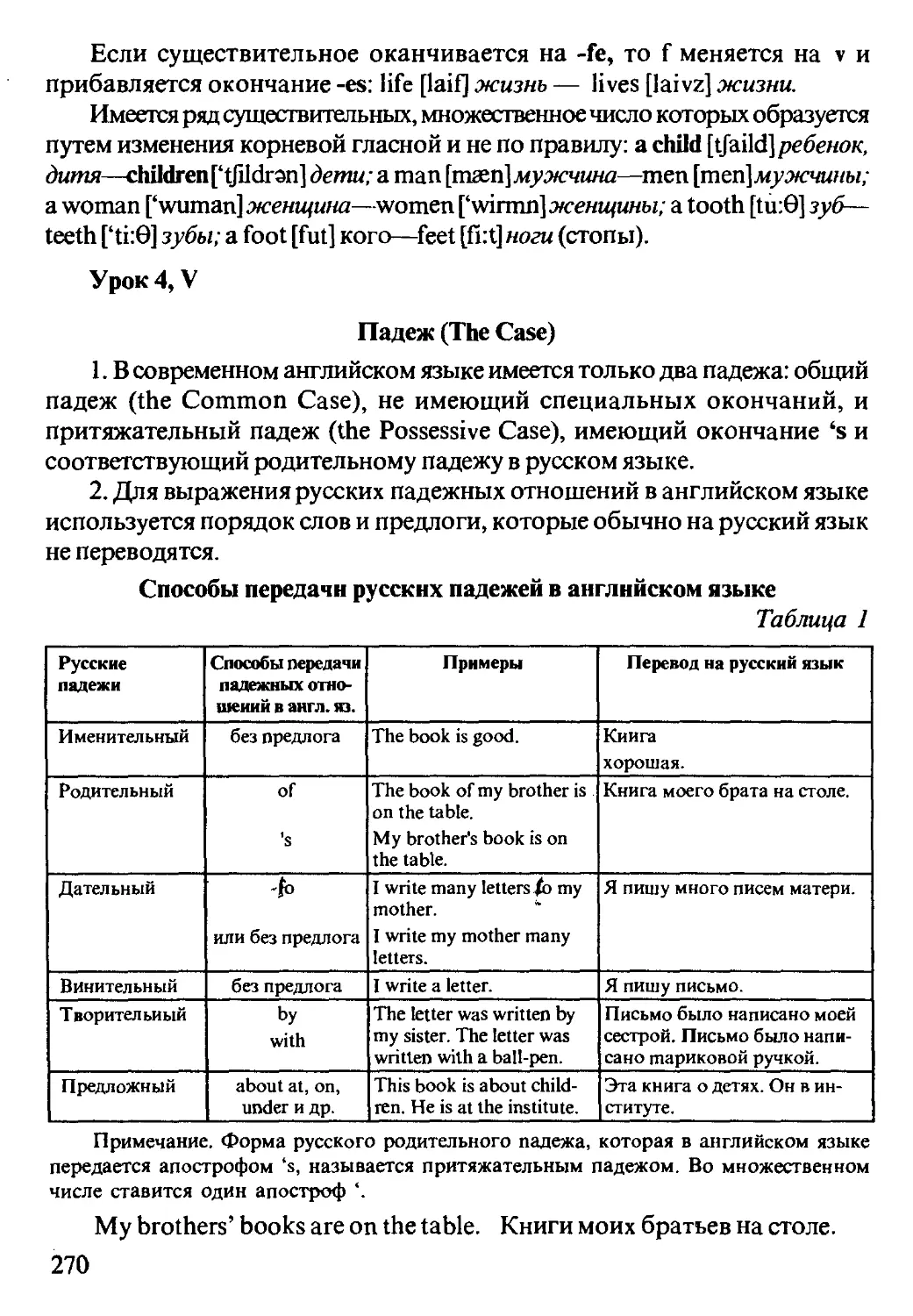
V.* Проработайте таблицу 1 (стр. 270). Ответьте на вопросы:
1. Сколько падежей имеется в английском языке? 2. Какими способами
передаются русские падежные отношения в английском языке? 3. Назови-
те способы передачи каждого из русских падежей в английском языке.
VI. Объясните способы передачи падежных отношений. Предложения
переведите:
1. The lectures delivered by the professors of our Institute are interesting.
2.1 Usually write my exercises with a ball-pen. 3. Our assistant’s experiments
were successful. 4. He pays great attention to his studies.
VII. Пользуясь таблицами 25,26 (стр. 299), ответьте на вопросы:
1. На какие вопросы отвечают существительные с предлогами at, in,
on (to, into; from, out of)? Что они обозначают и как переводятся? 2. В
каком еще значении могут выступать предлоги at, on, in? 3. Изучите таб-
лицу прочих предлогов.
VIII.	Объясните употребление предлогов:
1.	We attend lectures in Biology on Mondays. 2. The third-year students
had practice at the therapeutic department in March. 3. The winter session
lasts from the beginning till the end of January. 4.1 shall go to my parents
during my summer holidays.
IX.	В следующих предложениях обратите внимание на оборот ‘there is
(there аге)’ и его перевод. Ответьте на вопросы:
A There is a book on the table. На столе (лежит) книга.
There are books on the table. На столе (лежат) книги.
26
Б. There is no book on the table. На столе нет книги.
There are no books on the table. На столе нет книг.
В.	Is there a book on the table?	На столе есть книга?
Are there books on the table?	На столе есть книги?
1.* Где стоит обстоятельство места в английском и русском предложениях? 2.*
С чего начинаются английские, предложения? 3.* Переводится ли самостоятельно
слово tbere в обороте there is (there аге)? 4. Когда употребляется этот оборот? 5. Как
переводится оборот there is (there аге)? 6. С каким артиклем стоит существительное
в единственном числе после оборота there is, и употребляется ли артикль с суще-
ствительным во множественном числе? 7. Какое отрицание употребляется после
оборота there is (there аге)? 8. Как образуется вопросительная форма предложений с
оборотом there is (there аге)? 9. Может ли оборот there is (there аге) употребляться в
прошедшем и будущем времени? Что изменяется в этом обороте?
X.	Переведите следующие предложения:
1.	There are two terms in the academic year. 2. There will be a meeting at
the Institute. 3. There is a hostel near our Institute. 4. There was no medical
article in the yesterday’s newspaper. 5. There were entrance examinations at
the Institute in August.
XL Разберите по членам предложения и ответьте на вопросы:
It is cold today. Сегодня холодно. It was difficult. Было трудно. It will
be warm. Будет тепло.
1. Есть ли подлежащее в русских предложениях? Как называются
такие предложения? 2. Есть ли подлежащее в соответствующих англий-
ских предложениях? Если есть, то чем оно выражено? 3. Переводится
ли подлежащее it? 4. Из чего состоит сказуемое безличного английско-
го предложения?
XII.* Переведите следующие предложения:
1. It is time to begin our experiment. 2. It was not cold yesterday. 3. Will it
be difficult to do this work?
XIII.	Выучите следующие словосочетания, обращая внимание на
предлоги:
to listen to a lecture, in the middle of the tern, classes in numerous
subjects, a lecture in Anatomy, a lecture on art, in the first (second) year,
each of them, from (the) beginning to (the) end of..., to be necessary for, to
be useful to smb.
27
XIV.	1. Прочтите текст А. 2. Выпишите из текста предложения:
а) безличные; б) содержащие оборот ‘there is (are)’ 3. Приготовьте
пересказ по следующему плану:
1.	The lectures; 2. The work on Anatomy; 3. The academic year
Text A. Our Classes
Every day we have practical classes in numerous theoretical and special
subjects. We perform different laboratory works and attend lectures in Biology,
Anatomy and others. It is useful to us to listen to the lectures because the
professors always deliver them clearly and scientifically.
We know that we shall need deep knowledge of Anatomy in our future
work. Only hard work in the dissecting-room will give us the possibility to gain
this knowledge. That is why there are always many students in the dissecting-
room.
There are two terms in the first year. Each of them lasts for about 16-19
weeks. At the end of the winter term we shall take examinations in Physics and
Chemistry. We shall have several credit tests, too. The winter holidays last
from the end of January till the middle of February. At the end of the spring
term we shall take examinations in the History of the CPSU and others.
It is necessary for us to work hard during the whole academic year if we
want to pass our first examination session successfully, for “A good beginning
makes a good ending”.
CLASS ASSIGNMENTS
XV.	Explain the rules of reading:
ward, word, always, world, watch, fall, call, walk, worthy, war, whole,
when, where, why.
XVI.	Form the adjectives by means of the suffix ‘-y’ and translate them:
air, word, health, water, risk, sun
XVII.	Put the given adjectives and nouns in proper pairs:
adv.: hard, several, successful, whole, human, deep, clear;
nouns: head, body, knowledge, work, subjects, day, examination
XVIII.	Extend the sentences choosing the necessary word combination
from those given below:
1.... each term the students have tests and examinations.
a) at the beginning of; b) at the end of
28
2. The medical students study Therapy...
a) in the first year; b) in the third year
XIX. Translate the following word combinations:
1. into the lecture hall; from the lecture hall; 2. at the window; to the
window; between the windows; 3. among the students; 4. at the lesson; 5. at
about 5 o’clock; 6. on the 8 th of March; 7. from 10 a. m. (ante meridiem) till 2
p. m. (post meridiem); 8. during the session; 9. in April; 10. on Tuesday
XX. Translate the following word combinations into English:
1. вниз по руке; 2. ниже сердца; 3. за (позади) нашим общежитием; 4.
во время лекции; 5. в течение трех дней; 6. лекарство от кашля; 7. рядом
(около) больницы; 8. внутри брюшной полости; 9. к пяти часам; 10. с шес-
ти до семи часов; 11. на уроке; 12. в восемь часов вечера; 13. десятого
декабря 1980 г.
XXL Translate into English.
1. Мы будем слушать лекцию по физике в четверг в 11 часов. 2. Эта
лекция по произведениям Маяковского была для нас очень полезна. 3. У
нас бывает много занятий по различным предметам с начала до конца
семестра. 4. Каждый из семестров на первом курсе длится около 16-19
недель. 5. Студентам-медикам необходимо хорошо изучать анатомию.
XXII.	Translate the following sentences into English:
1.	Вы пишете карандашом или шариковой авторучкой? 2. Вы ездите
в институт троллейбусом или трамваем? 3. Вы сдаете зачеты в середине
или в конце семестра? 4. Кто дает глубокие знания студентам?
XXIII.	Make the sentences negative and then interrogative:
1.	There are foreign newspapers on the table. 2. There will be a lecture at
our Institute tomorrow. 3. There was a concert in the hall yesterday.
XXIV.	Make up questions using the words given in brackets:
1.	There are different scientific societies at our Institute, (what) 2. There
was an interesting meeting in our group, (where) 3. There are many articles in
this journal, (how many)
XXV.	Put in the proper form of the verb ‘to be’. Define the type of eadh
sentence. Translate the sentences:
1.	It... Wednesday today. 2. It... Tuesday yesterday.
3.	It... Thursday tomorrow. 4.... it cold or warm today?
29
XXVI.	Answer the following questions:
1.	Is it hard or easy to study at the Medical Institute? 2. Was it warm or cold
yesterday? 3. Will it be possible for you to perform operations next year or in
five years? 4. Is it time to finish or to begin our English lesson?
XXVII.	Change the tense according to the adverbs given in brackets:
1.	We have several lectures today, (yesterday, tomorrow) 2. Our doctors
perform numerous experiments (last month, next week) 3. Medical students
take several credit tests at the end of the term. (at the end of the last term, at the
end of the next term)
XXVIII.	Read Text В and say: a) what educational institutions are described
in it; b) in what country they are; c) what difference there is between the academic
year in our country and in that country:
Text В
The academic year in Britain’s universities has three terms which are from
the beginning of October to the middle of December, from the middle of January
to the end of March and from the middle of April to the end of June or the
beginning of July, that is there are 10 weeks in each term.
In a Teacher’s Training College students have examinations at the end of
each term, i. e. (that is) at the end of the autumn, spring and summer terms.
Final examinations are at the end of a course of studies.
XXIX.	Read the passages and answer the questions:
1.	They are students. They like Anatomy best of all. At the end of the first
term they have a credit test in English. At the end of the academic year they
have exams in Latin, Biology, Chemistry and Physics. На каком курсе учат-
ся эти студенты?
2.	Му friends study, too. They want to become doctors. They like Anatomy,
and Physiology best of all. They also have such subjects as Geography,
Chemistry, Mathematics, Literature and others. В каком учебном заведении
учатся его друзья?
XXX.	Memorize the abbreviations used in a dictionary. Name the part of
speech:
chill n, care v, born a, book v, according adv, since cj, sinceprp, sent p. p.,
ourselves pron
30
LESSON 5
HOME ASSIGNMENTS
I.* Прочтите слова и ответьте на вопросы:
[f] — she, short, show, shape, sharp;
[tj] — much, such, catch, watch;
[f] — physics, phone, physiology;
[d]—the, then, than, brother, father;
[0]—thing, theory, thick, thirty, health
Какое буквосочетание передает: а) звук [f]? [tj]? [f]? б) звук [d] в начале
служебных слов и между гласными в знаменательных словах? в) звук [0] в
начале и в конце знаменательных слов?
Запомните:
Суффикс-ion образует существительные от глагольных корней.
Сочетания -tion, -ssion читаются [fn], а сочетание -sion после глас-
ной читается [зп]. Ударение в словах с суффиксом -ion падает на
предшествующий суффиксу слог: to protect [pro’tekt] предохранять,
protection [prs’tekfn] охрана; to decide [di’said] решать, decision
[di’sijn] решение.
П. Прочтите и переведите:
consultation, occlusion, attention, Javasion, commission, session,
occupation, obstruction
Ш. По сокращениям определите часть речи, найдите перевод в слова-
ре и запомните слова:
call и, complete a, evena, forty, for prp, airv
IV. Запомните чтение следующих слов. Найдите ниже их перевод:
therapeutist [,0era’pju:tist], profession [prs’fefn], patient [‘peijht], act [aekt],
corpse [ka:ps]
труп; пациент, больной; акт, дело, поступок; терапевт; профессия
V. Выучите следующие слова и словосочетания:
consider [kan’sida] v считать, полагать
poor [риэ] а плохой; бедный
sometimes [lSAmtaimz]at/v иногда, по временам
even [‘i:vn] adv Даже
31
cure [kjus] v вылечивать (of); n излечение
valuable [‘vaeljuabl] а ценный, стоящий
remedy [‘remidi] n средство, лекарство
harm [harm] n вред; у вредить; to do smb harm вредить кому-л.
require [ri’kwaia] v требовать чего-л.; нуждаться в чем-л.
remember [ri’memba] v помнить
easy [‘i:zi] а легкий
particular [pa’tikjula] а особый; именно этот
kind [kaind] а добрый; n вид; класс, разряд, сорт
ability [a’biliti] и способность, умение
protection [prs’tekfn] и охрана
health [hel0] п здоровье; to be in good health быть здоровым; to be in
poor health иметь слабое здоровье; health protection охрана здоровья
prominent [‘praminant] а выдающийся; заметный
IV. Выучите следующие словосочетания, обращая внимание на пред-
логи:
in particular, to be of interest (importans), to have abulities for, to cure smb
of smth, to be in good (poor) health, one of many.
VII. Прочтите и переведите следующие слова и словосочетания:
1.	particular [pa’tikjula]: particular attention, this particular article, in
particular, this article is of particular interest;
2.	ability [a’biliti]: abilities, little abilities, he has great abilities for physics,
to show the abilities;
3.	cure [kjua]: cures, cured, to cure a disease, to cure smb of a heart disease,
a complete cure;
4.	require [ri’kwaia]: requires, required, to require much time, he requires
great care, you will have everything you require
VIII	.* Вставьте необходимые прилагательные, данные ниже:
1.	Не is in... health as he is ill with tuberculosis. 2 This experiment is of...
interest. 3. This is a ... remedy. 4. She is a ... person.
kind, valuable, poor, particular
IX	.* Переведите выделенные слова:
1.	My brother has great abilities for English. 2.1 read an article about (on)
successful cure of tuberculosis. 3. Our country pays great attention to the health
protection of our people.
32
X. Напишите глаголы в Past Indefinite; переведите их:
to enter, to cure, to require, to consider, to remember, to harm, to act, to
listen, to need, to attend
XI. Обратите внимание на значение и употребление модальных глаго-
лов ‘can’, ‘may’, ‘must’. Ответьте на вопросы:
A. I can speak English.
We can go to Moscow.
You may take this book.
He may come today.
Я могу (т. е. умею) говорить по-английски.
Мы можем (в состоянии) поехать в Москву.
Вы можете (вам разрешается) взять эту книгу.
Он может (вероятно) прийти сегодня.
(Вероятно, он придет сегодня).
Он должен (обязан) прийти сегодня.
Я могла поехать в Москву.
Они могли остаться дома.
He must come today.
Б. 1 could go to Moscow.
They might stay at home.
1. Как переводятся модальные глаголы: can, may, must? 2. Могут ли
они употребляться самостоятельно или только в сочетании с другими гла-
голами? 3. В какой форме стоят смысловые глаголы после модальных? 4.
Изменяются ли модальные глаголы по лицам и числам? 5. Какие модаль-
ные глаголы имеют форму прошедшего времени (Б)?
В. Не cannot walk.
I cannot speak French.
Он не может (не в состоянии) ходить.
Я не могу (не умею) говорить
по-французски.
They could not go to the South. Они не могли (не были в состоянии)
поехать на юг.
You must not smoke.	Вам нельзя (запрещено) курить.
6. Как образуется отрицательная форма с модальными глаголами(В)?
С каким глаголом частица not пишется слитно?
Г. Can you speak English?
May I come in?
Must we come too?
Умеете ли вы говорить по-английски?
Можно войти?
Должны ли мы (обязаны ли мы)
тоже прийти?
7. Как строится вопросительная форма с модальными глаголами (Г)?
XII.	Поставьте следующие предложения в утвердительной форме
(письменно):
1.	Must the students work during the whole term? 2. He could not enter the
Institute last year. 3. Can he become a good therapeutist? 4. May this remedy
do you harm?
33
XIII.	Прочтите следующие предложения:
1.	Does she speak English? 2. Can you treat rheumatism? 3. Did he prepare
his laboratory work yesterday? 4. Must they attend this lecture?
Как называются такие вопросы, и какой в них порядок слов?
XIV.	Проанализируйте, следующие предложения, ответьте на вопросы:
(см. стр.)
1. Who studies Anatomy? 2. Who carried out laboratory analyses
yesterday? 3. Who will prepare the article tomorrow?
1. Какие вопросы называются “специальными”? 2. К какому члену
предложения заданы эти вопросы, и какой порядок слов требуется для
построения таких вопросов?
а.	Сравните вопросы и ответы на них:
Whose sister speaks English? His sister speaks English.
What students study Anatomy? Medical students study Anatomy.
3. Какой порядок слов требуется при построении вопроса к опре-
делению подлежащего? Какими вопросительными словами начинаются
такие вопросы?
б.	Проанализируйте вопросы, поставленные к данному предложению:
Му father reads newspapers at home in the evening.
a) Does my father read newspapers at home in the evening? 6) What does
my father read at home in the evening? в) Where does my father read newspapers
in the evening? r) When does my father read newspapers at home?
4. Как называются вопросы, которые ставятся к второстепенным чле-
нам предложения и какой порядок слов в этих вопросах? Изучите табли-
цу 28.
XV.	* Заполните пропуски необходимыми вопросительными словами:
1....	do you usually read newspapers in the evening? (when?, where?) 2. ...
is on the table? (who?, what?) 3. He works at the hospital. ... is he? (who?,
what?) 4. ... sister is she? (which?, whose?) 5. ... has a heart disease? (who?,
what?) 6.... month is July? (which?, whose?)
XVI.	Напишите вопросы к данному предложению:
Му friend carried out a valuable experiment at the laboratory last week.
XVII.	Прочтите текст С. а) Найдите и переведите предложения с мо-
дальными глаголами; б) выпишите из текста слова одного корня с
34
‘possible’, ‘difficult’, ‘fo protect’, ‘to know’ и переведите их; в) найдите
высказывание профессора Кончаловского о враче; г) выучите наизусть
слова из клятвы Гиппократа.
Text С. Our Future Profession
In Russia (the Soviet Union) hundreds of thousands of young people study
at different medical institutes. They study numerous theoretical and special
subjects. They have prac
tical training during which they do the work of nurses and assistant doctors.
Such a course of studies helps them to gain much knowledge of.medicine, which
will give them the possibility to diagnose different diseases and treat people.
But medical students must remember that it is not easy to be a good doctor.
A good doctor must have not only deep knowledge of a particular field of
medicine such as surgery or therapy. He must love people and have a kind
heart. He must give all his knowledge, all his abilities, all his talent, and all his
time to people, to the protection of their health.
One of the prominent Soviet therapeutists Prof. M. P. Kon-chalovsky
considers that a person may be a poor writer, he may be a bad painter (худож-
ник) or an actor but a man cannot and must not be a bad doctor.
Medical students must understand well all the difficulties of their future
profession. They must remember that often it will be difficult to diagnose a
disease, sometimes it will be even more difficult to cure it. But a good doctor
will always do his best1 to gain his patient’s confidence.2 And the confidence of
a patient in his doctor is a “valuable remedy”.
Did you hear about Hippocrates Oath3 before you entered the Institute?
What does it read? It reads, “I shall enter any house for the good of the patient.
I shall not do my patient any harm” — nthese are the words from Hippocrates
Oath. And they must be not only words for medical students. They must become
the motto (девиз) of their life.
Medical students must remember that to treat patients is a great art (искус-
ство) but not an ordinary trade (ремесло). It is one of the professions which
requires a real calling4 for it.
Notes
1.	fo do one’s best — делать все возможное
2.	to gain confidence — завоевать доверие
3.	Hippocrates Oath — клятва Гиппократа [hi’pokratiz] [эиб]
to make (take) Oath — дать клятву
4.	calling — призвание
35
CLASS ASSIGNMENTS
XVIII.	Explain the pronunciation of the letter combinations in bold tape,
thousand, which, with, them, chart, phase, show, chill
XIX.	Explain the pronunciation of the suffix ‘-ion’ in the following:
conclusion, function, formation, occasion, eruption, discussion, occlusion,
production, contraction, invasion
XX.	Give full answers to the following questions:
1.	Can you cure a disease? 2. Do you consider that you will pass your
examinations successfully? 3. Must you remember all Latin anatomical terms?
4. Is the word ‘skeleton’ an anatomical term?
XXI.	Put questions to the words in bold type:
1.	We need this particular time for the experiment. 2. We entered the Institute
last year. 3. Sometimes professors deliver lectures at the clinic. 4. He is in poor
health. 5. We must give all our knowledge and abilities to people.
XXII.	Define the parts of speech of the words in bold type:
1.	Where do you study? 2. The Institute where I study has different
departments. 3. When are people in good health? 4. People are in good health
when they take care of it. 5. Who entered the Institute several months ago? 6.
My sister who entered the Institute two years ago studies successfully. 7. What
are you? 8. What prominent anatomist do you know? 9. What do you remem-
ber well? 10.1 remember well what the professor told us at the last lecture.
11. Which month is January? 12. The month which comes after April is May.
13. How do you speak English? 14. We know how he speaks English.
XXIII.	Translate into English:
1.	На какой предмет вы должны в особенности обращать внимание на
первом курсе? 2. К сожалению (unfortunately), врачи еще не могут вылечи-
вать больных от некоторых заболеваний. 3. Я думаю, что мой друг может
сдать экзамен по биологии на отлично, так как у него отличные способно-
сти к этому предмету. 4. Вы должны заниматься спортом, чтобы быть здо-
ровым. 5. Хирурги#является одним из многих предметов, который может
представлять особый интерес для студентов.
XXIV.	Try to understand the meaning of the words in bold type from the
context. Memorize them:
1. She has a high temperature. It is 39.4°C. 2. Now we study at a higher
school, that is at the Institute. 3. In six years we shall get higher education.
36
XV. Read text D. Make the plan. Retell the text:
Text D. The First Medical Students in Russia
A week ago I read a very good book by Professor Vladimir Kovanov who
was the vice-president of the Academy of Medical Sciences of the USSR. The
title of the book is “The Calling For”1.
Prof. V. V. Kovanov is a prominent scientist, a specialist with deep
knowledge and great experience in the field of surgery. He is a well-known
public figure and a person of great culture.
Vladimir Kovanov entered the Medical Faculty of Moscow University in
1927. Already before that time the young Soviet Republic needed badly its own
(собственная) working intelligentsia. A special decree on the organisation of
public education in Soviet Russia was adopted in 1918.
According to this decree education in the higher schools became free of
charge. The students got stipends and could live in hostels. This decree meant
that the children of the proletarians could enter the higher schools.
The preparatory faculties which the Soviet Republic organized during its
first years helped the sons and daughters of the proletarian families to enter the
higher schools without taking the examinations. A. V. Lunacharsky said that
preparatory faculties (“rabfacks”) were the “fire ladders” (пожарные лестни-
цы) which gave the proletarian young people the possibility to get higher
education.
Prof. Kovanov writes that in his time those young people who really cared
to be doctors studied in the Medical Faculty. The students worked hard, all
day long they were ready to dissect corpses, to learn Latin terms and to make
different analyses in chemical laboratories.
I consider that it is necessary for all medical students to read this book
because it will increase the knowledge of our future profession. It will help us to
understand and love our future work.
XXVI. Pick out the sentences corresponding to the contents of the text:
1. The first preparatory faculties helped the proletarian young people to
get medical education. 2. In 1927 V. Kovanov entered the Medical Faculty of
Moscow University. 3. In 1917 V. I. Lenin signed the Decree on Peace. 4. The
first preparatory faculties helped the proletarian young people to get higher
education.
Ковано^ В. В. Призвание. М., 1970.
37
LESSON 6
HOME ASSIGNMENTS
Запомните:
1.	Буквосочетание air обычно читается [еэ]: chair [tfes] стул, ка-
федра.
2.	Буквосочетания ear, еег читаются [is]: appear [a’pia] появлять-
ся, казаться; engineer [,end3i’nia] инженер.
3.	Буквосочетание ear перед согласной читается [э:]: early [‘э: 1 i]
рано.
I.	Прочтите:
1.	air, hair, pair, chair, impair;
2.	hear, clear, near, ear, dear, steer, smear, deer;
3.	learn, earth, earn, research, heard
IL Выучите следующие слова и словосочетания:
admission [ad’mifn] и прием, поступление; on admission при поступле-
нии
graduation [.graedju’eifn] и окончание (вуза)
responsible [ris’ponsabl] а ответственный; be responsible for smth нести
ответственность за что-л.; способствовать, содействовать, обусловливать
achieve [a’tfi: v] v достигать, добиваться
decide [di’said] v решать(ся)
fix [fiks] v устанавливать, назначать, укреплять; fixed а установлен-
ный, назначенный
addition [a’difn] n прибавление, дополнение; in addition to в дополне-
ние к; кроме того
contain [kan’tein] v содержать в себе, вмещать
mark [mcrk] и оценка, отметка; v отмечать; marked а заметный; ясно
выраженный
tired [‘taiad] а усталый, утомленный
rest [rest] и отдых, покой; v отдыхать; at rest в покое;
the rest of остальное; остальные
III	. Прочтите и переведите следующие слова и словосочетания:
1.	responsible [ris’ponsabl]: a responsible decision, doctors are responsible
for the patients* lives;
38
2.	achieve [a’tfi:v]: achieves, achieved, to achieve success, to achieve good
results;
3.	contain [kan’tein]: contains, contained, this scientific article contains
much valuable information;
4.	rest [rest]: a long rest, a short rest, a complete rest, the rest of the time, she
needs rest, to have a good rest
IV	. Прочтите и переведите II форму глаголов:
achieved, decided, fixed, contained, rested
V	.* Отданных существительных путем конверсии образуйте глаголы
и переведите их:
mark, aim, date, rest, group, act, cure, harm
VI	.* Переведите и запомните глаголы, от которых образованы суще-
ствительные:
to admit—admission; to graduate—graduation; to add— addition; to
examine—examination; to protect—protection; to situate—situation
VII	.* Переведите выделенные слова:
1. He has a clear head. 2.1 see chairs at the entrance to the hall. 3. Prof.
Savin is the Head of the Anatomy Chair. 4. Who is responsible for the protection
of our health and lives? 5. My fellow-student lives in Kurgan. 6. First you must
read this article. 7. We have the first practical class in the dissecting-room
today.
VIII.	Прочтите предложения и ответьте на вопросы:
A. This article is interesting.
Эта статья интересная.
These articles are interesting.
Эти статьи интересные.
Б. This is a student.
These are students.
That is a therapeutist.
Those are therapeutists.
That article is not interesting.
Та статья неинтересная.
Those article are not interesting.
Те статьи неинтересные.
Это—студент.
Это—студенты.
То — терапевт.
То — терапевты.
1.	Какой частью речи являются слова this, that, и как они переводятся
на русский язык? 2. Какую форму имеют указательные местоимения во
множественном числе? 3. Какие функции выполняют указательные место-
имения в предложениях группы А и Б?
39
IX.	Переведите следующие словосочетания:
that person, this nurse, those articles, this hostel, these fields, that department,
those adults, these marks
X.	Переведите письменно следующие предложения:
1. Это — медицинская статья. 2. Это — необходимые предметы. 3.
То—студенческое общежитие. 4. То—мои родственники.
XI.	Обратите внимание на перевод выделенных английских и русских
слов. Ответьте на вопросы:
Have you any books?
Есть ли у вас какие-нибудь (сколько-
нибудь) книги (книг)?
Да, у меня есть несколько книг.
Нет, у меня нет (никаких) книг.
Yes, I have some books.
No, I have not any books.
No, I have no books.
Какой частью речи являются выделенные слова, и в каких пред-
ложениях употребляются: a) some, б) any, в) по?
XII.	* Заполните пропуски местоимениями ‘some’, ‘any’, ‘no’:
1. Will you deliver... lecture tomorrow? 2. He has... experience in the field
of medicine because he is a student now. 3. Our assistant doctor knows ...
foreign languages. 4. The students will gain ... knowledge of Surgery in the
third year.
XIII.	Обратите внимание на выделенные прилагательные и ответьте
на вопросы:
The pen is long.
The story is long.
The field is long.
The pens are long.
The long pens are on the table.
Изменяются ли английские прилагательные по родам, числам и па-
дежам, и какие синтаксические функции в предложении они выполня-
ют?
Ручка длинная.
Рассказ длинный.
Поле длинное.
Ручки длинные.
Длинные ручки на столе.
XIV.	Познакомьтесь с таблицами 2, 3 образования степеней сравне-
ния прилагательных и наречий (см. стр. 271). Ответьте на вопросы:
1. Сколько слогов у прилагательных long, big, large, easy, и каким
способом они образуют степени сравнения? Какие изменения происходят
при этом в односложных прилагательных, оканчивающихся одной соглас-
40
ной, и в двусложных, оканчивающихся на у? 2. Сколько слогов у прилага-
тельных difficult, interesting, и каким способом они образуют степени срав-
нения? 3. Как образуют степени сравнения прилагательные good, bad,
many, much, little и наречия well, badly? Запомните их.
XV.	Обратите внимание, как образуются степени сравнения наречий.
Ответьте на вопрос:
soon— sooner—soonest
late— later —latest
correctly — more correctly — most correctly
Каким способом образуют степени сравнения наречия?
XVI.	Образуйте степени сравнения от следующих прилагательных и
наречий (письменно):
well, responsible, deep, happy, high, early, great, new, easy, much, clear,
interesting, little, bad
XVII.	Переведите следующие словосочетания:
1. better knowledge of Biology; 2. you must know this better; 3. to carry
out less experiments; 4. the most responsible work; 5. to know worst of all
XVIII.* Определите, при помощи каких слов происходит сравнение в
предложениях, и переведите их:
1.1 am as tired as he is. 2. You must be more responsible for your work than
he is. 3. He knows Latin worse than his friend does. 4. Solomin’s knowledge of
Anatomy is not so deep as Petrov’s. 5. They came to the Institute earlier than
usual.
XIX.	Выучите следующие словосочетания, обращая внимание на пред-
логи:
on admission, graduation from, to graduate from, to be responsible for, in
addition to, atrest, the rest of, to preparefor, most of, to waitfor, onexamination
of patient
XX.	1. Прочтите и переведите текст Е. 2. Выпишите из текста: а) предло-
жения с глаголами ‘to decide’, ‘to contain’, ‘to fix’, стоящими во II форме; б)
прилагательные в сравнительной и превосходной степени; в) найдите пред-
ложения, содержащие указательные и неопределенные местоимения; г) вы-
пишите английские эквиваленты следующих слов и словосочетаний:
зачеты, досрочно, все изученное, большинство студентов
41
Text E. Our First Examination Session
To be a good doctor in future means to study well at the Institute from the
day of admission till the day of graduation.
We must remember that we cannot be bad doctors as we shall be responsible
for the protection of people’s health and their lives. Our future work will require
deep knowledge and all our abilities.
To achieve these high aims the students of our group decided not to waste
(тратить) any time and prepare well for our first examinations at the Institute.
The dean fixed all the dates of our examinations. But in addition to
examinations we had some credit tests. The most difficult test was in Physics
but we passed it successfully ahead of time. The first examination was in
inorganic Chemistry. We consider that this subject is the most difficult of all the
subjects in the first year. So we began to work hard to pass it successfully.
The examination began. The students who entered the room took the
examination cards and had some time to prepare for their answers. The cards
contained all the things studied during the term. Most of the students answered
well and got good and excellent marks. It was easier to take the next examination
and all the students of our group passed it well.
We were a little tired after the examinations and credit tests but happy that the
first session was over. Winter rest at a sports camp was waiting for us.
CLASS ASSIGNMENTS
XXI.	Explain the rules of reading:
hear, heard, ear, earn, learn, deer, cheer, early, clear
XXII.	Give the plural of the following words. Translate them:
that hostel, this mark, that date, this remedy
ХХ1И. Translafe the following sentences:
1. Это хирург. Это опытный хирург. Этот хирург очень опытный. 2.
Это статьи. Это новые медицинские статьи. Эти новые медицинские ста-
тьи о болезнях сердца.
XXIV.	Turn these sentences into negative and then interrogative:
1.	He gave some examples in his lecture. 2. I read some articles on this
subject a week ago. 3. There were some chairs at the entrance to the hall.
XXV.	Answer these questions:
1.	Will you have any credit tests in the middle of the term? 2. Are there any
students in your group who get an increased stipend? 3. Will you have any
lectures in addition to practical classes on Saturday?
42
XXVI.	Translafe the following word combinations:
1.	самое ценное средство; 2. самое необходимое назначение; 3. более
глубокие знания; 4. более ответственный; 5. самая плохая оценка; 6. са-
мый лучший отдых; 7. наименьший вред
XXVII.	Translate the following sentences:
1.	He decided to achieve better results in the second term. 2. In addition to
the lecture we must read some articles on this subject. 3. Yesterday he finished
his experiment earlier than usual. 4. The doctor fixed the date of the operation
for this patient. 5. Their son graduated from the Institute and got an appointment
to a village hospital. 6. Last summer we rested longer than usual. 7. The book
“The Calling for” by Prof. V. V. Kovanov contains much interesting informa-
tion for medical students.
XXVIII.	Translate into English:
1.	При поступлении в медицинский институт молодежь сдает экзаме-
ны по нескольким предметам. 2. Врачи обязаны отвечать за здоровье лю-
дей. 3. Через сколько лет вы должны закончить институт? 4. После окон-
чания института я думаю работать терапевтом. 5. Большинство студентов
всегда хорошо готовятся к экзаменам. 6. При исследовании больного врач
должен обращать особое внимание на его жалобы (complaints). 7. Этот
больной должен находиться в покое, так как у него тяжелое сердечное
заболевание. 8. Кроме практических занятий у нас было две лекции. 9.
После занятий некоторые студенты пошли в секционную, а остальные в
библиотеку, чтобы готовиться к зачету.
XXIX.	Memorize the following words. Translate the sentences:
lose [lu:z] (lost, lost) v терять; lost time потерянное время
1.	He was seriously ill and lost five kilograms. 2. You will never gain the
lost time.
against [a’geinst]prp против Half of our group were against this idea.
present а присутствующий; настоящий; to be present присутствовать;
иметься; at present в настоящее время
1.	All the students were present at the lecture in Biology. 2. They are at the
hostel at present.
pass [pars] v проходить, протекать
1.	A week passed. 2. The first term will pass soon.
back [bsek] adv назад; n спина
1.	We came back to the hostel at 7 p.m. 2. She stood with her back to the
window.
43
XXX.	Read Text F. Translate it. On the basis of the text fell us about
your day:
Text F. My Working Day
Every day I have much interesting and necessary work to do. I always
remember that the lost time is never gained and that is why I do not like to waste
even a minute.
I get up early in the morning—at about 7 a.m., do my morning exercises
and have a cold rubdown1. As we are medical students we consider that physical
exercises are “a good remedy” for the protection of our health against diseases.
We must remember the Latin saying “Mens Sana in corpore sano ”1.
After my breakfast at our canteen I go to the main building of our Institute
on foot as it is near our hostel.
Our classes usually begin at 8.30 a. m. In addition to several practical
classes we have a lecture or two every day.
On Fridays we usually have a lecture in Physics. Long before its beginning
there are always many students in the hall—even the students of the senior
courses often attend these lectures. Our new professor is not only a very good
specialist in his field of science but also a qualified teacher. He delivers lectures
in his own way3 and gives us many new and interesting facts about the application
of physics in medicine. The professor shows us that at present deep knowledge
of this subject will be particularly valuable in our future work. That is why we
work hard in physics laboratory and read additional literature on this subject
at the library as well.
From the library I usually come back to the hostel. I am often tired but I
understand that every day which passes by gives me much valuable and necessary
knowledge.
Notes
1.	to have a cold nibdown — делать холодное обтирание
2.	“Mens Sana in corpore sano”. — лат. “В здоровом теле здоровый дух”.
3.	in his own way — по-своему
LESSON 7
HOME ASSIGNMENTS
Запомните:
l	.-(i)ty—суффикс существительных: quantity[‘kwontiti]коли-
чество; quality [‘kwoliti] качество.
44
2	. Суффикс -ment образует существительные от глаголов to excite
[ik’sait] возбуждать—excitement [ik’saitment] возбуждение, волнение.
I. Прочтите и переведите:
1.	activity, reality, humanity, ability, possibility, responsibility; 2.
requirement, treatment, achievement, appointment, department
II.	Выучите следующие слова и словосочетания:
return [n’ta:n] v возвращать(ся)
late [leit] а поздний; adv поздно
hold [hould] (held, held) v держать; проводить (мероприятия)
happen [‘Ьагрэп] v случаться (to), происходить
member [‘memba] n член (семьи, партии)
former [*fo:ma] а прежний, бывший
excited [ik’saitid] а возбужденный, взволнованный
while [wail] cj пока, в то время как
strength [strerjG] п сила
devote [di’vout] v посвящать себя, отдаваться чему-л. (to)
fight [fait] п борьба; v (fought, fought) бороться
true [tru:] а верный, преданный; настоящий, истинный
feel [fi:l] (felt, felt) u чувствовать (себя), ощущать; to feel bad чувство-
вать себя плохо
still [stil] adv еще, все еще
to be going to собираться (намереваться)
III.	* Прочтите и переведите следующие слова. Запомните их:
to return — to leave; strength — weakness; late — early; true — false;
excited — still; fbftner—present
IV.	Напишите парами близкие по смыслу слова из списков А и Б.
A. to intend (намереваться), force (сила), to come back, faithful (верный),
when, nervous, to occur, to receive, to appoint, grown-up (взрослый)
Б. to fix, to happen, strength, to4>e going to, to return, adult, to get, while,
true, excited
V.	Обратите внимание на глаголы, иа образованные от них слова и на
их перевод. Ответьте на вопросы:
to read читать—reading читающий; to sit сидеть — sitting сидящий;
to carry нести — carrying несущий; to lie лежать — lying лежащий; to
take брать — taking берущий
45
1. Какая часть речи образуется от глаголов в русском языке при помо-
щи суффиксов -ущ (ющ). -ащ (ящ), и какая неличная форма глагола соот-
ветствует ей в английском языке? 2. Почему в причастии sitting удваива-
ется буква t? 3. Как образуется Present Participle, если инфинитив глагола
оканчивается на ie? 4. Как образуется Present Participle, если инфинитив
глагола оканчивается на е?
VI.	Напишите Present Participle от следующих глаголов и пере-
ведите их:
to perform, to get, to treat, to enter, to die, to study
VII.	А. В следующих предложениях обратите внимание на гла-юл-ска-
зуемое, его образование и время совершения действия. Ответьте на воп-
росы:
1.1 am writing an article now.
2.	The teacher is examining
a student at this moment.
3.	They are reading at present.
Они не проводят опыт сейчас.
Готовит ли он латынь сейчас?
Нет.
Я пишу статью сейчас.
Учитель экзаменует студента
в этот момент.
Они читают сейчас (в настоящий
момент).
1.	Как и когда происходит действие, выраженное сказуемым? Как
называется такое время? 2. Дайте формулу Continuous Tenses и назовите в
ней изменяемую часть. 3. Можно ли образовать Past и Future Continuous,
исходя из этой формулы?
Б. Прочтите следующие предложения и ответьте на вопросы:
They are not carrying out
an experiment now.
Is he preparing Latin at
present? No, he is not (isn’t).
4.	Как образуются: а) отрицательная форма? б), вопросительная фор-
ма? в) краткий ответ?
VI	II.* Поставьте изменяемую часть сказуемого в соответствующей
форме (письменно):
1. “What (to be) you doing now?” “I (to be) preparing for my credit test in
Physics.” 2. Yesterday from 2 till 6 o’clock we (to be) working at our scientific
laboratory. 3. When I was at my sister’s at 4 p. m. yesterday she (to be) learning
Latin. 4. Tomorrow at 5 p. m. I (to be) preparing a lecture.
46
IX.	Напишите общий и специальные вопросы к следующему предло-
жению:
They were taking the examination at ten o’clock yesterday.
X.	Выучите следующие словосочетания, обращая внимание на пред-
логи:
to happen to, devoted to, to fight for, to fight against, to be going to, to
listen to, first of all, to be true to smb (smth), to do harm to smb
XI.	1. Прочтите текст G. Найдите в нем предложения, содержащие: а)
Continuous Tenses; б) повелительное наклонение, и переведите эти пред-
ложения. 2. Опишите Бориса. 3. Выучите слова клятвы врача. 4. Выпи-
шите английские эквиваленты следующих словосочетаний:
как тебе посчастливилось ...?, произносить речь, не вредить (своим)
больным, бывшие студенты
Text G. The Oath of Future Doctors
O.: Hallo! Where are you going from, Boris?
В.: Hallo, Oleg! I am returning home from the Institute.
O.: Why so late?
В.: I was at the meeting.
O.: What meeting?
B.: The meeting was held1 to mark the graduation from the Institute of our
sixth-year students.;
O.: And how did you happen to be there?
В.: I was invited (меня Пригласили) to attend the meeting as a member of our
Institute KomsomollCommittee.
O.: Tell me, please, was'there anything interesting at the meeting?
В.: First of all I must say that it was a very solemn (торжественная) ceremony.
Our former sixth-year students, now young specialists, looked very happy
and excited.
O.: Who made a speech?
B.: The rector did. While he was making his speech everybody was listening to
him with great attention. You know, our rector is a brilliant speaker. I shall
always remember the words of the professional oath which the young
specialists were repeating after the rector.
O.: What is the essence (сущность) of this oath?
B.: The young specialists promised (обещали) to give all their strength,
knowledge and abilities to people who need their help. They promised to
47"
devote all their life to the protection of people’s health, to the fight against
diseases, not to do any harm to their patients. They promised to be true to
their profession.
O.: Really, it is a great oath.
В.: Then one of the former sixth-year students handed over our Institute banner
(знамя) to a first-year student. When he was doing that I felt great excitement.
Now I understand still better all the responsibility which I am going to take
after my graduation, that great responsibility which my future work of a
doctor will require.
Note
1. the meeting was held — собрание было проведено
CLASS ASSIGNMENTS
XII.	Form the nouns a) from the verbs by the suffix ‘-ment’. Translate these
nouns:
to achieve, to treat, to appoint, to require, to excite
b) from the adjectives by the suffix ‘-(i)ty’. Translate these nouns:
human, able, active, possible, responsible, real, formal, rapid
XIII.	Substitute the words of close meaning for the words in bold type:
1.	He was nervous. 2. They came back in time. 3. When I was reading my
sister was preparing her lessons. 4. We received a letter yesterday. 5. They
appointed the time of their meeting. 6. We are grown-ups and understand well
our responsibility for the health of people.	: r *
XIV.	Translate the participles. Give the corresponding infinitives:
studying, entering, getting, dying, returning, treating, performing
XV. From the predicates given in brackets pick oiit and insert the correct
one:
1. Who ... home now? Who usually ... home in the evening? (returns, is
returning) 2. Doctor P.... the operation a week ago. Doctor P.... the operation
from 10 till 12 a.m. yesterday, (performed, was performing) 3.1... a corpse at
2 p.m. tomorrow. I... a corpse tomorrow (shall dissect, shall be dissecting)
XVI. Answer the following questions:
1. Are the doctors fighting for the life of this patient?
2. Who is fighting for the life of this patient? 3. What are the doctors doing?
4. What are the doctors fighting for?
48
ХУЛ. Find the corresponding English translation from the list given below.
What new words have you found? Memorize the words in bold type:
1. Мы сдаем экзамены дважды в год. 2. Я обычно
ухожу из дома в 7 часов утра, но вчера я ушел позже.
3. Врач спас его жизнь. 4. Сначала подумай, потом отвечай. 5. Не
ждите меня. 6. Я единственный сын в семье.
1. The doctor saved his life. 2. First think, then answer. 3. Don’t wait for
me! 4. We take examinations twice a year. 5.1 usually leave home at 7 a.m. but
yesterday I left it later. 6.1 am the only son in the family.
XVIII.	Read Text H. Find the sentences in the Continuous tenses and
translate them:	,,	''
Text H. An Interesting Meeting
Twice a month we hold different group meetings at which we discuss many
problems of our student’s life or have political talks.
But this time it was not an ordinary meeting. We were going to meet one of
the former students of our Institute. Now he is working as the Head of the Chair
of Surgery. He is a professor and a very talented surgeon. Everybody considers
that he is a qualified specialist in the field of heart surgery. He devotes much
time to scientific work and is the author of numerous articles on the surgical
treatment of some heart diseases.
That’s why we were so excited. We were talking about the coming meeting
and preparing the questions which we were going to ask Prof. Lukin.
Soon the door opened and the man whom we were waiting for entered the
room. Our excited talk stopped and the meeting began. First of all our Komsomol
group organizer greeted (приветствовал) Prof. Lukin and asked him to tell us
something about his work.
After graduation from the Institute Prof. Lukin got his work appointment
to a small hospital. His first patient was a ten-year-old girl. The girl needed an
operation badly. When he was preparing for the operation he felt great ex-
citement. But when he began to operate he thought only of his responsibility for
the girl’s life. How happy he was when he understood that he saved the girl!
There were many difficulties in his work as he had no experience but his
elder colleagues were always ready to help him. He worked hard for several
years. Sometimes he did not achieve successful results but he considered that
his work of a surgeon was the only true work for him.
At the end of the meeting we thanked Prof. Lukin heartily. The meeting
was so interesting that no one wanted to leave the hall.
49
XIX.	Finish the sentences according to Text H. Choose the phrase from the
list given below:
1. We have group meetings ... . 2. Prof. Lukin is ... . 3. We were excited
because.... 4. Prof. Lukin told us about.... 5. The meeting was so interesting
that....
we did not want to leave the hall, his first operation, twice a month, we had
a meeting with Prof. Lukin, a specialist in heart surgery
XX.	Tell us about: a) your entering the Institute, b) your first examination
session.
LESSON 8
HOME ASSIGNMENTS
Revision
I.	Повторите алфавит, правила чтения, способы словообразования,
грамматические правила, лексический и текстовой материал цикла I (уро-
ки 1—7).
II.	Напишите следующие слова в транскрипции:
man, face, far, care, soon, book, term, work, air, ask, walk, month, ean,
among, learn
III.	Прочтите следующие слова и определите часть речи по суффик-
сам. Слова переведите:
admission, examiner, treatment, ability, structure, fixation, daily, body,
measure, early, healthy, pressure, rapidity
IV.	Ответьте иа следующие вопросы:
1. Какие формы имеют личные местоимения в косвенном падеже? 2.
Какие вы знаете указательные местоимения? 3. Когда употребляются нео-
пределенные местоимения some и any? Как переводятся они на русский
язык? 4. Какие существительные образуют множественное число не по
правилу? 5. При помощи каких суффиксов образуются степени сравнения
прилагательных? 6. Какие прилагательные образуют степени сравнения
при помощи слов more и most? 7. Какие прилагательные образуют степени
сравнения не по общему правилу? 8. Чем отличается английское безлич-
ное предложение от русского, и как оно переводится? 9. Как переводятся
на русский язык предложения, начинающиеся с оборота there + be? 10.
50
Назовите формулу группы времен Continuous. 11. Как строятся общий и
специальный вопросы? 12. В каком числе и лице добавляется окончание к
глаголам в Present Indefinite? 13. Как образуется Past Indefinite правиль-
ных и неправильных глаголов? 14. Как образуется вопросительная и от-
рицательная форма глаголов в Present и Past Indefinite?
V.* Переведите и поставьте в соответствующей степени сравнения
прилагательные и наречия, данные в скобках:
1. Today the patient feels (плохо) than yesterday. 2.1 think that article is
(необходимый) than the article which you are reading. 3. The experiment
which the young scientist is carrying out is (успешный) of all he did before.
VI	.* Заполните пропуски предлогами там, где необходимо:
1Monday the surgeon will perform the operation... the clinic. 2.... last
week I was ill... the grippe. 3. ..< 19811 entered... the Medical Institute. 4. Let
us go ... the dissecting-room to prepare ... our next Anatomy class. 5. The
doctor was listening /..’the patient’s heart attentively.
VII	. Переведите следующие пары предложений:
1. The students were in the middle of the dissecting-room. There were many
students in the middle of the dissecting-room. 2. The patients with tuberculosis
were in the hospital. There were some patients with tuberculosis in that hospital.
VIII.* Поставьте глаголы, данные в скобках, в нужном времени и
переведите их:
1. Му mother (чувствовать) worse yesterday. 2. The surgeon (произво-
дить) a very difficult operation yesterday from 9 till 11 a.m. 3. Senior students
(не посещать) lectures in Anatomy. 4. Next year the second-year students
(слушать) to the lectures in Therapy. 5. You cannot see the Head of the Chair
of Biology now, he (читать) a lecture.
IX.	* Выберите нужные модальные глаголы из данных в скобках:
1.	We are first-year students. We... perform operations, (cannot, may) 2.
Medical students... know Anatomy well, (may, must) 3.1 am waiting for my
brother. He... come any minute, (may, can)
X.	Поставьте вопросы к выделенным словам:
1.	Не left the hospital in good health. 2. The doctor will have the possibility
to examine this patient tomorrow. 3. The little girl was lying in bed, because
she had a high temperature. 4. The day before yesterday we held our group
meeting.
51
XI.	*Переведите следующие предложения:
1.	Let me dissect the corpse. 2. Let them finish this laboratory work today.
3. Let him treat this patient. 4. Let us return to the hostel now.
XII.	* Задайте вопросы, чтобы получить следующие ответы:
1.	Yes, we completed some experiments yesterday. 2. Yes, some members
of our scientific society deliver lectures. 3. Yes, he needs some care.
XIII.	Прочтите и переведите текст А со словарём. Расскажите содер-
жание клятвы врача. Выпишите английские эквиваленты следующих
словосочетаний:
высокое звание врача; торжественно клянусь; трудиться добросо-
вестно; оказать медицинскую помощь; совершенствовать медицинские
познания и профессиональное мастерство; никогда не отказывать в сове-
те; руководствоваться принципами коммунистической морали; быть вер-
ным этой присяге.
Text A. The oath of the doctor of the Soviet Union
Receiving the lofty title of the doctor and beginning the medical practice,
I solemnly take the oath:
To devote all my knowledge and strength to the protection and improvement
of the people’s health, to the treatment and prevention of diseases, to work
honestly wherever the interests of the society require;
To be always ready to give medical assistance, to deal with the patient
attentively and carefully, to keep the medical secrecy;
To perfect the medical knowledge and professional skill, to promote the
development of medical science and practice by honest labour;
To consult the colleagues wherever the interests of the patient may require
and never to refuse an advice or assistance to anybody;
To preserve and to develop the noble traditions of Soviet medicine, to follow
the principles of the Communist ethics in all the activity, always to remember
about the lofty calling of the Soviet doctor, about the responsibility to the
people and the Soviet state;
I swear to be true to this oath during the whole life.
XIV.	Прочтите и запомните чтение следующих слов. Переведите нх:
candidate [‘kaendidit], basis [‘beisis], function [‘fArjkjn], physiology
[,fizi’olad3i], pharmacology [fxma’koladsi], pathologic(al) [,paeGa’bd3ik(al)],
procedure [pra’siidsa], psychology [sai’kobdsi]
52
XV.	Прометайте текст В. State the difference between the systems of
preparation of doctors u the USA and our country.
Text B. Medical Education in the United States
In the USA the young man who has the secondary education1 must pass
through seven or eight years of hard study before he begins his work as a
doctor.
First he has three or four years of premedical training at a university. Here
he learns the main sciences. Only those students who show good results in their
premedical training can become candidates for higher medical education. Those
who do not continue their education can work as nurses.
The higher medical education is difficult. The students must study four
years in the medical faculty of the university. During the first two years the
student masters laboratory sciences. To learn2 the structure of the human body
the student studies Anatomy. The student must get deep knowledge of biological
chemistry because it is the basis for clinical laboratory diagnosis and therapy.
The student learns the functions of the body theoretically from books and
by laboratory experiments in classes of Physiology.
In the USA the curriculum3 of medical faculties, has such a subject as
Psychology which teaches the student to deal with patients4 and understand
human behaviour (поведение).
The student learns all other theoretical subjects such as Pharmacology and
Pathologic Physiology before he begins to treat a patient.
In his third and fourth years the student gets instruction and practical
experience in the treatment and care of the patient. During these years the
student has the possibility to work at the hospital and learn much of main
medical procedures and different diseases to be well prepared for his work.
Notes
1.	the secondary education—среднее образование
2.	to learn—зд. чтобы узнать
3.	curriculum [ka’nkjulam]—учебный план; программа (института, университета)
4.	to deal with patients—обращаться с больными
CLASS ASSIGNMENTS
XVI.	Read the following and explain the pronunciation of the letters and
letter combinations in bold type:
leave, last, tooth, teeth, circle, yellow, chair, appear, prepare, pure, while,
whole, early, become, want, chest, short
53
XVII.	Form and translate the new words using the given suffixes:
-	ion(-ation), -sion, -tion: fix, prepare, decide, add, inform, infect, protect;
-	ment: require, achieve, treat, appoint, excite;
-	(i)ty: responsible, human, special, possible;
-	(i)ly: day, successful, necessary, clear, deep, main;
-	y: word, sleep, health, air, ease
X VIII. Substitute the words in bold type for the words of the close meaning:
1.1.M. Sechenov is a well-known Russian physiologist. 2. At present we
study some premedical subjects. 3. The researcher will finish his experiment in
a week. 4. The operation was over at five o’clock in the afternoon. 5. Our first
term will last till the middle of January.
XIX.	State the part of speech of the words in bold type. Translate the
sentences:
A.	1. Last month they had practical classes at the Chair of Therapy. 2.
These experiments usually last for about two hours. 3. There are two terms in
the academic year. 4. The first-year students study many anatomical terms. 5.
In summer I usually rest in the village. 6. My friend and I went to the theatre
and the rest of our group went to the cinema. 7. What kind of books do you like?
8. We know that this doctor is a very kind and intellectual person.
B.	1. I need your help very much. 2. A friend in need is a friend indeed
(действительно). 3. The nurses take care of the patients. 4. She nurses the
patients with great care.
C.	1. At the end of the winter term we shall take two examinations and at the
end of the spring term we shall have five.
XX.	Answer the following questions:
What do we call: 1. a person who takes care of patients? 2. a doctor who
operates on patients? 3. a doctor who treats patients with different medicines
and remedies? 4. a person who discovers something new in the field of science?
5. a house where the students live? 6. a grown-up person? 7. the organ which
pumps (нагнетает) blood (кровь) through the arteries and veins? 8. a fixed
period of time during which the students study? 9. the completion of the course
of studies at the Institute?
XXI.	Supply questions to these answers:
1.	Yes, we can dissect corpses. 2. Yes, they may fix the date of their
consultation. 3. Yes, I must complete this work in time.
54
XXII.	Turn the following sentences into negative:
1.	My friend left the town for his summer holidays. 2. They are resting now.
3.1 return to the hostel at 2 p.m. 4. He feels tired after his classes.
XXHI. Put special questions to the following using the given interrogative
words:
1. My fellow-student got a good mark in English, (what какую) 2. Modem
methods of treatment help the doctors to treat people successfully, (how) 3.
The surgeon was working at the clinic from 9 a.m. till 2 p.m. (where) 4. My
sister looks ill. (who) 5. He is tired because he works hard, (why)
XXIV.	Read the passages and answer the questions. Explain your answers:
1.	Fred is in the dissecting-room. He is preparing for his Anatomy class.
He is dissecting the corpse.
2.	Boris is often in the dissecting-room. There he prepares for his Anatomy
classes. He dissects corpses. Кто из них в данное время готовится к занятиям
по анатомии?
1.	On Fridays Nick went to the clinic. He helped the nurse. He took the
patients’ temperature. He gave patients some remedies.
2.	It was Friday yesterday. George was at the clinic for the whole day. He
was helping the nurse. He was taking the patients’ temperature. He was giving
patients some remedies. Кто из них обычно ходил в клинику по пятницам?
XXV.	Read and translate Text С:
Text C. Oxford Colleges
Oxford is one of the oldest universities in England. This University has 32
colleges—27 for men and 5 for women. There are 16 faculties there, among
them the medical, humanitarian and others. A large college has about 500
students; about one hundred students study at a small college. Most of the
students of Oxford are those young people who finished private schools.
During the first days after his entrance to Oxford the student meets his tutor
(teacher) and begins to work. At the first interview the tutor asks his student
many questions. This helps the tutor to understand the general intellectual
development of his student. The tutor tells him about the lectures which he must
attend and gives the list of books which the student must read during the term.
At the beginning or end of each term the student must take college
examinations in written form. In many colleges of Oxford the tutors meet with
the head of the college regularly and discuss the students’ work.
55
At Oxford the working hours of the student are from 9 a.tm. to 1 p.m. At 9
o’clock he sees his tutor or goes to the library or to the lectures. From 2 p.m. to
5 p.m. he goes in for sports and does different exercises. From 5 p.m. to 7 p.m.
he works in the library or in the laboratory. At 7 p.m. he has dinner. After
dinner the students have club activities or attend different societies. At about 10
p.m. the student begins to work again and works for about two hours.
XXVI.	Answer the following questions:
What have you learned about higher education in England and about the
daily regimen of an Oxford student?
XXVII.	Прочтите текст D co словарём. Скажите, что вы узнали о ме-
дицинском образовании в разных странах.
TEXT D. Medical education in different countries
Medical Institutes in the USSR as well as other higher schools of our country
are open for the working people and their children.
But in capitalist countries we see another picture. For most people of poor
classes the doors of higher schools are closed.
In the USA young people from rich families which make up only 10% of all
the youth, constitute1 about 80-90% of all students. The young people from
poor families constitute only 5%.
The race discrimination principle plays even greater role. For example,
only 2% of Negroes study at all medical higher schools of the USA.
There are definite limitation for admission of young women which constitute
only 10%.
Only in socialist countries young women can freely enter medical higher
schools. About 55 to 60% of all the number of students are young women.
In the USA the education fee2 is increasing every year and is about 5000
American dollars a year.
In 1974 only about 1000 young people entered 11 medical faculties in the
USA, while more than 50000 young people entered 91 higher medical schools
in the USSR.
In all socialist countries the whole course of higher medical education lasts
for six years. But in capitalist countries the duration of education varies
considerably, for example in the GFR (German Federative Republic) it is nine
years, in Holland — eight years, in France—7 years, in England and Italy—
6 years, in the USA — 4 years offer graduation from 7 or 8 years’ course at a
college.
56
In capitalist countries there is a various order to receive the right to medical
practice.
For example, in England a young doctor must attend internship during a
year, then he must take an examination and only then he gets the right to
practice.
In the USA only the doctor, who has passed the examination in the chosen
field of medicine, and has got the necessary certificate3 can practice medicine.
Notes:
1.	constitnte — составлять
2.	edncation fee — плата за обучение
3.	certificate — удостоверение
CYCLE П. ANATOMY
UNIT I. THE BONES AND THE MUSCLES
Правила чтения: Буквосочетания igh, ild, ind; cial; oi, oy; ou; au, aw; бук-
вы c, s, t перед сочетанием гласных ia, ie, io.
Словообразование: Суффиксы -age, -ive; префиксы in-, im”, il-, ir-, -un.
Грамматика: Образование причастия прошедшего времени (Past Parti-
ciple). Времена группы Indefinite Passive. Согласование времен (при
одновременности действия). Инфинитив и его функции.
LESSON 9
HOME ASSIGNMENTS
Запомните:
1.	В буквосочетаниях igh, ild, ind буква i читается [ai], а сочета-
ние gh не читается: right [rait] правый.
2.	Буквы с, s, t перед сочетанием гласных ia, ie, io читаются [Ц:
facial [‘feifal] лицевой.
3.	-age суффикс существительного: passage [‘ paesids] проход; при-
ток; bandage [‘baendidj] повязка
4.	Префиксы un-, in- указывают на отрицание или отсутствие
того, что выражается в корне слова: usual обычный — unusual нео-
бычный; organic органический — inorganic неорганический, im-, il-,
ir----фонетические варианты префикса in-.
I. Прочтите:
1. night, light, slight, fight, thigh, high, bright, might, sight, child, mild,
kind, mind, find, blind;
2. social, sufficient, initial, patient, Russian, artificial, potential, official,
special, professional
58
II. Прочтите и переведите:
1. village, cartilage, haemorrhage, bandage, language, usage, damage;
2.* impossible, indefinite, irregular, undone, unhappy, illegal, unwritten,
ineffective
III.	Обратите внимание на выделенные слова. Ответьте на воп-
росы:
The studied subject is new. The examined patient is ill.
1. Какой формой глагола являются выделенные слова? 2. Как перево-
дится Past Participle?
IV.	Выпишите из словаря инфинитивы от следующих причастий и пе-
реведите их:
formed, located, published, called, connected, found, made, said, seen,
chosen, taken, kept, spent
V.	Выпишите и выучите неправильные глаголы в трех формах: (см.
таблицу неправильных глаголов, стр. 314)
leave, be, begin, come, do, give, go, get, have, hear, know, make, meet,
read, see, take, teach, tell, think, write, become, lose, feel, lie, hold, mean
VI.	Прочтите предложения и ответьте на вопросы:
I examined.	Не examined.
We examined.	I was examined.
He was examined.	We were examined.
1 .* В каком времени и в какой форме стоит сказуемое в левой колон-
ке, и как переводятся эти предложения? 2.* Из чего состоит сказуемое в
колонке справа? Переведите предложения. 3.* Какая разница между пе-
револом в колонке слева и справа? 4. Дайте формулу страдательного
залога (Passive). 5. Что изменяется в этой формуле при изменении по вре-
менам, лицам и числам? 6. Что остается неизменным в этой формуле? 7.
Поставьте глагол to be в нужной форме для образования Present и Future
Indefinite Passive. 8. Как образуются отрицательная и вопросительная
формы в страдательном залоге? 9. Как переводятся предложения в стра-
дательном залоге?
VII.	Переведите следующие предложения:
1. These operations are performed by me. 2. Anatomy is taught in practical
class. 3. The lecture in Biology is delivered on Monday.
59
VIII.* Найдите предложения, которые стоят в страдательном залоге:
1. This textbook is experimental. 2. Many experiments are carried out by
students. 3. He is happy because he studies at the Medical Institute. 4. Interesting
lectures are delivered by Prof. Lukin. 5. Physiology is taught at the Medical
Institute. .
IX.	Переведите следующие предложения (письменно):
I.	Нам дают книги. 2. Мне часто задают много вопросов. 3. Операции
производятся хирургом. 4. Учебники пишутся для студентов. 5. Нас часто
видят в библиотеке. 6. Курсовые собрания обычно проводятся в конце
семестра.
X.	Прочтите и запомните неизвестные вам термины:
cranial [‘kreinial] черепной
facial [‘feijal] лицевой
spinal column [‘spainal ‘kolom] позвоночный столб
cervical [‘saivikal] шейный
thoracic [0a:’raesik] грудной
lumbar [kmba] поясничный
sacral [‘seikrai] крестцовый
vertebra [‘vartibra] позвонок (pi (-ae) [i:])
coccyx [‘koksiks] копчик
arch [artj] дуга
thorax [‘0a:raks] грудная клетка
basic [‘beisik] основной
cartilage [‘kcutilids] хрящ
pelvis [‘pelvis] таз
ligament [‘lidamant] связка
substance [‘sAbstans] вещество, субстанция
XI.	Выучите следующие слова и словосочетания:
bone [boun] п (pi bones) кость (мн. ч. скелет, кости)
skull [skAl] п череп, черепная коробка
consist (of) [kan’sist] и состоять из
part [pat] n часть; take part in smth принимать участие в чем-л.
trunk [trArjk] n туловище
spine [spain] n позвоночник
chest [tfest] n грудная клетка
rib [rib] n ребро
60
breastbone [‘brestboun] n грудина
side [said] n сторона, бок; in the side в боку; on each side с каждой стороны
compose of [kam’pouz] v составлять; be composed of состоять из
connect [ka’nekt] v соединять, связывать
free [fri:] а свободный; бесплатный
neck [nek] n шея, шейка
lower extremity [‘ loua(r) iks’tre-miti] нижняя конечность
upper extremity [‘лрэ(г) iks’tre-miti] верхняя конечность
thigh [0ai] n бедро, бедренная кость
forearm [‘fB:ra:m] n предплечье
shoulder [‘Jbulda] n плечо, плечевой сустав
joint [djoint] n сустав; а совместный, объединенный
XII.	Прочтите и переведите слова и словосочетания:
1.	arch [cutj] - arches [‘aitjiz], the arch of the vertebra, the arch of the aorta
[ei’o:ta];
2.	breastbone [‘brestboun]: the breastbone is a long bone^the breastbone is
in the middle of the chest;
3.	extremity [iks’tremiti]: the lower extremity, the am is an upper extremity,
the leg is a lower extremity;
4.	shoulder [‘Jouldo]: the right shoulder, the left shoul der;
5.	Joint [djoint]: to be connected together by the joints, some bones of the
skeleton are connected together by the joints, joint experiments
XIII.	Выучите следующие словосочетания, обращая внимание на
предлоги:
to consist of, in the side, on each side of, to be composed of, to take part in,
in the adult, to be connected with
XIV.	1. Прочтите текст A. 2. Найдите предложения в Presenf Indefinite
Passive и переведите их. Озаглавьте III—VI абзацы текста:
Text A. The Skeleton
The skeleton is composed of bones. In the adult the skeleton has over 200
bones.
The bones of the skull consist of cranial and facial parts1. There are 26
bones in the skull.
The bones of the trunk are the spinal column or the spine and the chest (ribs
and the breastbone). The spine consists of the cervical, thoracic, lumbar and
sacral vertebrae and the coccyx.
61
The vertebra is a small bone, which is formed by the body and the arches2.
All the vertebrae compose the spinal column or the spine. There are 32 or 34
vertebrae in the spine of the adult. In the spinal column there are seven cervical
vertebrae, twelve thoracic vertebrae, five lumbar, five sacral vertebrae and
from one to five vertebrae which form the coccyx. The cervical part of the spine
is formed by seven cervical vertebrae. Twelve thoracic vertebrae have large
bodies. The lumbar vertebrae are the largest vertebrae in the spinal column.
They have oval bodies.
The chest (thorax) is composed of 12 thoracic vertebrae, the breastbone
and 12 pairs (nap) of ribs. The breastbone is a long bone in the middle of
the chest. It is composed of three main parts. The basic part of the chest is
formed by the ribs. On each side of the chest seven ribs are connected with
the breastbone by cartilages. The cartilages of three other ribs are connected
with each other and with the seventh rib. But the cartilages of these ribs are
not connected with the breastbone. The eleventh and the twelfth ribs are
not connected with the breastbone either (также). They are not connected
with other ribs, they are free. Each rib is composed of a head, neck and
body.
The lower extremity consists of the thigh, leg and foot. It is connected with
the trunk by the pelvis. The upper extremity is formed by the arm, forearm and
hand. It is connected with the trunk by the shoulder girdle (пояс).
The bones of the skeleton are connected together by the joints or by the
cartilages and ligaments. The bones consist of organic and inorganic
substance.
Notes:
1.	состоят из мозгового и лицевого отделов;
2.	каждый позвонок имеет две дуги не меньше
CLASS ASSIGNMENTS
XV.	Form and translate Pasf Participle of the following words:
leave, feel, think, become, lose, complete, require, achieve
XVI.	Translate the following:
врач, обследующий больного; больной, обследуемый в рентгеновском
кабинете; студент, встречающий своих друзей; студент, встреченный сво-
ими друзьями; хрящ, соединяющий плечо и предплечье; хрящ, соединен-
ный с плечевым суставом
62
XVII.	Translate these sentences:
1.	The skeleton is composed of bones. 2. The spinal column is formed by
the vertebrae. 3. The cervical part of the spine is composed of seven cervical
vertebrae.
XVIII.	Make these sentences interrogative:
1.	The upper extremity is connected with the trunk by the shoulder girdle.
2. The lectures in Physiology are attended by all the students. 3. On each side
of the chest the breastbone is connected with seven ribs.
XIX.	Put the verbs in Present Indefinite Passive:
1.	Seven cervical vertebrae compose the cervical part of the spine. 2. Cranial
and facial bones form the skull. 3. The pelvis connects the lower extremity with
the trunk.
XX.	Translate the sentences paying attention to the translation of the word ‘if:
1.	He wants to know if the skeleton is composed of over 200 bones. 2. My
fellow-student asks me if each rib is composed of a head, neck and body. 3.1 do
not remember if the ribs are connected with the breastbone by cartilages or by
ligaments.
XXI.	Ask each other questions and answer them:
A sk your friend if
1.	cartilages connect the joints; 2. the chest is composed of the breastbone
and 24 ribs; 3. the man has two lower extremities; 4. the upper extremity is
formed by the arm, forearm, and hand; 5. the spinal column is composed of the
vertebrae; 6. the skull is composed of facial and cranial parts.
XXII.	Translate into English:
1.	Мой друг принимает активное участие в научном кружке по химии.
2. С каждой стороны грудной клетки имеется семь ребер. 3. Из чего состо-
ят ваши занятия в институте? 4. Нижняя конечность составлена из бедра,
голени и стопы. 5. Сердце нахоится в левой стороне грудной клетки. 6.
Кости черепа соединяются с шейными позвонками. 7. У взрослых кости
конечностей длиннее, чем у детей.
XXIII.	Translate these sentences and memorize the words given in bold type:
1.	One of the books by Tolstoy is called Anna Karenina. 3. We see with our
eyes. 3. The brain is the organ of thinking. 4. The brain is in the cranial cavity.
5. The teeth ere in the oral cavity. 6. The Urals separate Europe from Asia.
63
XXIIV. 1. Read Text B. Entitle it. 2. Find and translate the sentences in
Present Indefinite Passive. 3. Ask each other questions on the text and answer
them:
Text В
The main part of the head and face is called the skull. The skull is composed
of twenty-six bones. These bones form two basic parts of the skull, that is facial
and cranial parts.
The bones of the skull are connected with the first cervical vertebra. The
bones of the skull are connected together so firmly [ fa:mli] (крепко) that it is
very difficult to separate them.
The bones of the skull form one large cavity and some smaller cavities. The
large cavity is called the cranial cavity. The brain is in the cranial cavity. One
of the smaller cavities is the cavity of the nose. The other two cavities are the
orbits. The eyeballs are in the orbits.
Notes:
1. cranial cavity — мозговая полость.
LESSON 10
HOME ASSIGNMENTS
I. Выпишите в две колонки существительные и прилагательные, под-
черкните суффиксы:
facial, scientific, spinal, formation, pelvig, connection, basic, special,
composition, experimental, anatomical, sacral
II. Сгруппируйте слова, обозначающие части скелета (письменно):
1. череп, 2. туловище, 3. конечности
skull, lower extremity, orbit, upper extremity, thigh, leg, shoulder, pelvis,
spinal column, hand, rib, forearm, cervical vertebrae, foot, chest, arm
III.	Найдите ниже перевод каждого английского слова:
to call, brain, eyeball, nose, cavity, to compose, to consist of, joint, on
each side, trunk, neck, breastbone, to separate
составлять, глазное яблоко, разделять, мозг, шея, называть, тулови-
ще, нос, грудина, полость, состоять из, с каждой стороны, сустав
64
IV.	Вставьте пропущенные слова:
1.	The... is the largest and longest bone in the trunk. 2. The skeleton of the
head is called the.... 3. In the Anatomy class medical students study the bones
of the.... 4. In the... the bones of the extremities are longer than in the child. 5.
On each... of the chest there are seven... which are connected with the....
V.	Поставьте предложения в Past и затем Future Indefinite Passive (пись-
менно):
1. This textbook is composed for practical classes in Anatomy. 2. These
experiments are carried out by the members of our scientific society.
VI.	Выучите следующие слова и словосочетания:
age [eids] п возраст; at the age of в возрасте; a man aged 30 мужчина 30 лет
grow [grou] (grew, grown) v расти; становиться
rapid [‘raepid] а быстрый; частый; rapidly adv быстро
slow [slou] а медленный; slowly adv медленно
length [lege] n длина; длительность
number [‘плтЬэ] n число, количество; номер; a number of ряд (некото-
рое количество)',
the number of число, количеств
research [ri’sa:tj] n исследование, научное изыскание
use [ju:z] и употреблять, применять; [ju:s] п употребление, применение
artificial [.a’ti’fijbl] а искусственный
instead of [in’sted] adv вместо, взамен; instead of going (reading) вместо
того, чтобы пойти (читать)
case [keis] п случай; in case of в случае; case history (report) история
болезни
VII.	Выучите следующие словосочетания, обращая внимание на пред-
логи:
at the age of, instead of, a number of, in case of in the boys (girls), to be
about, the operation on smb (smth), in length.
VIII.	Прочтите и переведите следующие слова и словосочетания:
1.	age [eidg]: at the age of 20, at an early age, people of all ages, a patient
aged 45;
2.	grow [grou]: grew [gru:], grown [groun], to grow rapidly, to grow slowly;
3.	length [lea:]]: the necessary length, the length of the bone, to increase the
length, to measure the length, the length of an extremity, three metres in length;
65
4.	number [‘плтЬэ]: a great number, a small number, the number of, to
increase the number, the number of people, a number of people
IX. 1. Прочтите текст С. 2. Найдите в тексте: а) предложения, где
говорится о росте позвоночника; б) о количестве позвонков и где дается
характеристика некоторых из них:
Text С
Two students meet after classes. They want to prepare their homework in
Anatomy.
A.: How do you do, Boris!
B.: How do you do, Alec!
A.: Are you free now?
B.: Yes, I am. Let us prepare our Anatomy lesson for tomorrow.
A.: Tomorrow we shall have the lesson on the bones.
B.: Ido not know well the spinal column.
A.: I can help you if you like. Can you answer my questions?
В.: I am ready.
A.: So, at what age does the spine grow most rapidly?
B.: In the girls the spine grows most rapidly to the age of 15. In the boys it
grows to the age of 19. After the age of 19 the spine grows very slowly. The
length of the spinal column is about 40% of the body.
A.: That’s all right. Now the second question. What do you know about the
number of the vertebrae in the spine?
В.; The number of the vertebrae may be 32 or 34. Sometimes it may be 37. But
I don’t know why. Can you tell me?
A.: It is because the number of the sacral vertebrae may be five and the number
of the vertebrae which compose the coccyx may be from one to five.
B.: Thank you. Can you tell me which of the vertebrae have the form different
from the others?
A.: They are the first and the second cervical vertebrae. The form of these two
vertebrae is different because they take part in the flexible connection of
the skull and the spine.
B.: Thank you. I think tomorrow I shall answer well.
CLASS ASSIGNMENTS
IX.	Read the words with the same root. State the part of speech and translate
these words:
face—facial; slow—slowly; connect—connection; pelvis— pelvic;
compose—composition; rapid—rapidly; base—basic
66
X.	Put the proper numeral in the blanks:
1.	There are vertebrae in the cervical part of the spine. 2. There are ...
vertebrae in the thoracic part of the spine. 3. There are ... vertebrae in the
lumbar part of the spine. 4. There are ... vertebrae in the sacral part of the
spine.
XI.	Read the pairs of sentences. State the grammar difference between
them:
1.	The student is asked many questions at the lesson.
The student asked many questions at the lesson.
2.	Cranial and facial bones compose the skull.
The skull is composed of cranial and facial bones.
3.	The joints connect some bones of the skeleton.
Some bones of the skeleton are connected by the joints.
XII.	Answer the following questions:
1.	Are you a research worker? What does a research worker do? 2. What do
you use to write down the lectures? Do you use a pencil or a ball-pen? 3. What
do you do in case of the grippe? Do you use any medicine in case of a bad
headache? 4. Do Soviet doctors use artificial organs? What artificial organs
are used in medicine? 5. What general subjects are medical students taught in
their first year? 6. What lectures will be delivered next Monday? 7. What field
of medicine will your future profession be connected with? 8. What medicine is
often used in case of the grippe?
XIII.	Read and entitle Text D. What interesting method of treatment is
described here?
Read text D, using the dictionary and entitle it. What interesting method
of triatment is discribed here?
TextD
The patient had the disease of the coxofemoral (тазобедренный) joints,
the biggest in the body.
The patient could not walk for six years. Doctor of Medicine Prof. K.M.
Sivash, a research worker of one of Moscow Institutes, examined the patient.
He wanted to use a new method of treatment.
Before the operation on the man Doctor Sivash carried out a great number
of experiments on animals using artificial metal joints. During the operation
Doctor Sivash used the artificial metal joints instead of the diseased coxofemoral
67
joints of the patient. The operation was successful and soon the patient could
walk.
In April 1972 Professor S.T. Zatsepin worked out the method of total hip
prosthesis1 to replace2 the whole femoral bone with artificial coxofemoral and
knee3 joints.
Such “total” hip prothesis was worked out together with Professor K.M.
Sivash, who had used artificial joints connected by titanic nail4.
This total hip prothesis was successfully used on a patient with malignant
tumour of the right femoral bone. During the operation 2/3 of the proximal part
and the middle third of the femoral bone were excised5. The length of the excised
bone was 22 cm. The postoperative course was smooth and the functional results
were good.
'	Now artificial metal joints are used in many cases of the diseases of different
joints.
Notes:
1.	total hip prosthesis [‘prosQisis]— эндопротез (внутренний протез).
2.	to replace — заменять, замешать
3.	knee [ni:]— колено
4.	titanic nail [tai’taenik]— титаиовы стержень
5.	to excise [ek’saiz] — удалять, иссекать
XIV.	Translate into English:
1.	Вчера хирург сделал сложную (complex) операцию на сердце. 2.
Завтра у нас будет лекция по физике вместо лекции по биологии. 3. В
случае сердечного заболевания врач должен обследовать больного осо-
бенно внимательно. 4. Моя сестра закончила медицинский институт в
возрасте 23 лет. 5. Ряд студентов нашей группы вступили в различные
научные кружки. 6. Главная улица нашего города около восьми кило-
метров в длину.
LESSON 11
HOME ASSIGNMENTS
Запомните:
1.	Буквосочетания oi, оу читаются [oi]: point [point] точка, мес-
то; boy [boi] мальчик.
2.	Буквосочетание ou обычно читается [au]: sound [saund] звук,
тон; amount [a’maunt] количество.
68
3.	Буквосочетания au, aw читаются [о:]: cause [ko:z] причина;
причинять, вызывать; nausea [‘no:sja] тошнота; law [1э:] закон.
4.	Суффикс -ive образует прилагательные от глаголов: connect
соединять — connective соединительный.
I. Прочтите:
1.	moist, poison, joint, voice join, destroy, enjoy
2.	found, out, about, round, mouth, count, loud
3.	daughter,jaw, author, raw, autumn, auricle, auscultation, automatic,
autopsy, gauze, nausea, pause, saw
П.* Прочтите и переведите:
attentive, constructive, collective, active, illustrative, relative, effective,
decisive, protective
III. Напишите предложения в Past Indefinite Passive и переведите их:
1. Many scientific experiments will be carried out at our Institute
laboratories. 2. His experimental work will be connected with the operations
on joints. 3. The method of artificial metal joints will be used in many cases.
IV. Ответьте на следующие вопросы: (см. таблицу 21, стр. 293)
1. Какой формой глагола являются выделенные в таблице слова в
английских предложениях? 2. На какие вопросы отвечают инфинитивы, и
какими членами предложения они являются? 3. Как переводятся инфини-
тивы в каждом из этих предложений?
V.* Определите синтаксическую функцию инфинитива:
1. The doctor wanted to examine the patient in the morning. 2. To know
Anatomy well is necessary for every surgeon. 3. Our students came to the Institute
to listen to the lecture on bones. 4. My friend was the first to take the examination
in Biology. 5. The surgeon will begin to operate on this patient at 10 o’clock.
VI. Прочтите предложения, определите время глагола и скажите формулу:
1. This book will be read with great interest by all of us. 2. The thoracic
cavity was examined by X-rays. 3. Artificial joints were used by the surgeon. 4.
The bones of the skull are connected together very firmly.
Vn. Обратите внимание на перевод сказуемого в дополнительных
придаточных предложениях. Ответьте на вопросы:
Му friend said that he lived Мой друг сказал, что он живет
in Lenin street,	на улице Ленина.
69
1 .* Совпадает ли время сказуемого в английском и русском главных
предложениях? 2.* В каком времени стоит сказуемое в английском и рус-
ском дополнительных придаточных предложениях? 3. Следовательно, ка-
ким временем нужно переводить сказуемое дополнительного придаточ-
ного предложения, если сказуемое главного стоит в Past Indefinite? Како-
му правилу подчиняется употребление времен в придаточных дополни-
тельных предложениях?
VIII.	Переведите следующие предложения:
1.	We learned that the lower extremity consisted of the thigh, leg, and foot.
2. The doctor saw that the patient’s eyes were reddened (покрасневшие). 3. He
knew that I studied at the Medical Institute.
IX.	Запомните чтение следующих слов:
universal [ ju:ni’va:sal] универсальный, общий
fiber [‘faiba] волокно
cell [sei] клетка
agent [‘eidjant] агент; фактор; возбудитель
X.	Выучите следующие слова и словосочетания:
muscle [‘hiasI] п мышца; radiated muscle веерообразная мышца
establish [is’taeblij] v устанавливать
introduce [,intra’dju:s] v вводить
change [tfeindj] v изменяться), менять(ся); n изменение
weight [weit] n вес
divide [di’vaid] v делить, разделять
wide [waid] а широкий
direction [di’rekfn] n направление; указание (на выполнение чего-л.)
tissue [’tisju:] п ткань; connective tissue соединительная ткань
vessel [‘vesl] п сосуд
blood [bl\d] п кровь
find [faind] (found, found) v находить; find out обнаруживать
determine [di’taimin] v определить, определять; устанавливать
contraction [kan’traekf n] n сокращение
XI.	Прочтите и переведите следующие: а) словосочетания:
1. the contraction of muscles; 2. the blood vessel wall;
3. the body weight; 4. connective tissue cells; 5. to deter mine the blood
group; 6. a rapid change; 7. to divide into groups; according to the structure.
70
б) предложения с выделенными словами:
1. Please find the pulmonary artery in this picture. 2. The scientists found
that blood had vitamins. 3.1. M. Sechenov is the founder of Russian physiology.
4. The first Russian uniwersity was founded by M. V. Lomonosov. 5. It was
found out that when a person died his body continued to live for some time.
XII. 1. Прочтите текст E. 2. Напишите план текста. 3. Найдите: а)
инфинитивы, определите их функции и переведите предложения;
б) предложения на правила согласования времен и переведите их:
Text Е. The Lecture on Muscles
Yesterday the students of our group came to the Institute to listen to a
lecture on muscles. The lecture was attended by all of us. The lecture was
delivered by Prof. Smirnov. To listen to it was very interesting. Prof. Smirnov
was the first to tell us about the anatomical terms.
The names of all the muscles in the body and all other anatomical terms
were established at three Congresses in Basel [‘ba:zal], Jena [*jema:] and Paris.
In 1895 the Basel Nomina Anatomica1 was introduced; in 1935 it was greatly
changed at the Congress of Anatomists in Jena. But the anatomical terms which
were established at that Congress were not used in the USSR. In 1955 the IV
International Federal Congress of Anatomists in Paris established new universal
anatomical terms, the so-called Paris Nomina Anatomica.
In his lecture Prof. Smirnov said that the body was composed of about 600
skeletal muscles. The students learned that in the adult about 35%-40% (per
cent) of the body weight was formed by the muscles. According to the basic
parts of the skeleton all the muscles were divided into the muscles of the trunk,
bead, and extremities.
When Prof. Smirnov spoke about the form of the muscles he said that all the
muscles were divided into three basic groups: long, short and wide muscles; the
free extremities were formed by the long muscles; wide muscles lay on the
trunk; the walls of the body cavities were formed by wide muscles.
Some muscles were called according to- the structure of their fibers, for
example radiated muscles; others according to their uses, for example extensors
(разгибающие мышцы) or according to their direction, for example oblique
(косая).
When Prof. Smirnov spoke about the structure of the muscles he said that
the muscles were formed by a mass of muscle cells, the muscular fibers were
connected together by connective tissue, the blood vessels and the nerves were
in the muscles.
71
Great research work was carried out by many scientists to determine the
functions of the muscles. Three basic methods of study were used: experimental
work on animals, the study of the muscles on a living human body and on the
corpse.
Their work helped to establish that the muscles were the active agents of
motion (движение) and contraction.
Note
1. the Basel Nomina Anatomica — Базельская анатомическая терминология
CLASS ASSIGNMENTS
Х1П. Form the adjectives from the verbs by the suffix ‘-ive’:
connect, act, collect, relate, contract, protect
XIV.	Translate into Russian paying attention to the meanings of the words
in bold type:
1.1 found an interesting article on eye operations in this journal. 2. The
found article was written by the well-known eye doctor. 3. The group of scientists
found their method on numerous experiments. 4. The researchers found out
that infectious diseases were caused by different agents. 5. Robert Koch was
the first scientist who found the agent of tuberculosis.
XV.	Translate these sentences paying attention to the words ‘which’, ‘who’:
1.	The new universal anatomical terms which are now used all over the
world were established at the IV International Federal Congress of Anatomists
in Paris in 1955.2. The muscular fibers which are connected together by con-
nective tissue and a mass of muscle cells compose the muscle. 3. Prof. Smirnov
who delivered the lecture on muscles introduced the new material on muscular
motion and contraction.
XVI.	Substitute the Russian words in brackets for the English ones:
1.	Two new subjects were (введены) in the second term. 2.1 (разделил) the
text into two parts to learn it better. 3. After his disease the patient changed
greatly because his (вес) became less. 4. There are many (кровеносных сосу-
дов) in the human body. 5. We can walk, run and jump because of the (сокра-
щение) of the (мышц). 6. Our blood is (состоит) of white and red (клеток
крови). 7. Research work helped the scientists to (установить) the agents of
many diseases.
72
XVII.	Make these sentences interrogative. Translate them:
1.	The atlas on Anatomy was composed by R. D. Sinelnikov. 2. These
children will be given vitamin therapy. 3. The chest of the patient is examined
by the doctor. 4. At this clinic the operations on the skull are carried out suc-
cessfully.
XVIII.	Pick out the sentences in Past Indefinite Passive:
1.	Dissecting the corpse the students separated one muscle from the other.
2. On the corpse one muscle was separated from the other by the students. 3.
The doctor was treated by many specialists as he was badly ill himself. 4. The
doctor treated his patients successfully.
XIX.	Pick out and translate the sentences with the Infinitive used as an
attribute:
1.	He can perform this operation in the morning. 2. My friend was the last
to come to the lecture. 3. He wants to determine the direction of muscular
fibers. 4. Microbiology is one of the most interesting subjects to study.
XX.	Translate the following sentences:
1.	Медсестра сказала, что у меня слишком маленький вес. 2. Терапевт
обнаружил, что у больного кровяное давление на правой руке выше, чем
на левой. 3. В своей лекции профессор сообщил, что кровеносные сосуды
делятся на артерии, вены и капилляры. 4. Врач был уверен, что в этом
случае можно легко установить причину заболевания.
XXL Read Text F. What do paragraphs two and three deal with?
TextF
In the adult the muscles form about 35%-40% of the body weight. All the
muscles are divided into the muscles of the trunk, head, and extremities.
Long, short and wide muscles form three basic groups. The long muscles
compose the free parts of the extremities. The wide muscles form the walls of the
body cavities. Some short muscles, of which stapedius [sto’pi :djas] (стремечко-
вая) is the smallest muscle in the human body, form facial musculature.
The structure of the muscular fibers is different in different groups of
muscles. The muscles consist of a mass of muscle cells. The muscular fibers are
connected together by connective tissue. There are many blood vessels and
nerves in the muscles. The muscles are the active agents of motion and
contraction.
73
LESSON 12
HOME ASSIGNMENTS
I. Выучите следующие слова и словосочетания:
born [bo:n] а рожденный; be born родиться
degree [di’gri:] n степень; ученая степень; градус; Му temperature was
36.5°С—У меня была температура 36,5° (градуса по Цельсию). 36.5°С
следует читать: thirty-six point five degrees Celcium (или thirtysix point five
Centigrade)
receive [ri’si: v] v принимать; получать
strong [stroij] а сильный; крепкий; здоровый
surface [‘sarfis] n поверхность
far [feu] а далекий; adv далеко; значительно
point [point] n место, точка
origin [‘oridsin] n начало; источник; происхождение
band [baend] n пучок
finding [‘faindirj] n находка; pl данные, результаты
ending [‘endiij] n окончание
abdomen [‘aebdamen] n брюшная полость, живот
restore [ri’sto:] v восстанавливать (здоровье)
condition [kan’difn] n состояние (здоровья), условие
П. Переведите предложения, обратив внимание на выделенные слова:
1. The bands of muscular fibers may be long or short. 2. The human leg has
a large surface. 3. Show us in the picture the point of connection of the rib and
the breastbone. 4. The origin of some diseases is not well studied. 5. He is the
Ukranian by origin. 6. He received the degree of Doctor of Medicine at the age
of 45. 7. The patient had a very high temperature — it was 39,5°C. 8. The
patient’s health was restored after the course of treatment.
Ш. Выберите соответствующий перевод следующих словосочетании:
соединительная ткань, кровеносный сосуд, вес тела, сокращение
мышцы, нервные окончания, место начала, пучки мышечных волокон,
поверхность кости, в соответствии с, искусственный сустав, шейные
позвонки
the surface of the bone, connective tissue, the bands of muscular fibers,
cervical vertebrae, a blood vessel, according to; body weight, nerve endings,
contraction of the muscle, an artificial joint, the point of origin
74
IV. 1. Прочтите текст G. 2.0 чем говорится в каждом абзаце? 3. Най-
дите и переведите предложения: а) с ннфнннтнвамн, б) на правило согла-
сования времен. 4. Перескажите текст:
Text G. Prof. Lesgaft’s Scientific Research
Professor P.F. Lesgaft was born in 1837. He was a prominent Russian
anatomist and a talented teacher. He was the first scientist in our country to
work out the science of physical culture. He studied at the Medical Academy.
After he graduated from the Academy he worked for the Degree of Doctor of
Medicine. This degree was given to him in 1865 and in 1868 he received the
Degree of Doctor of Surgery. Then he worked as the Professor of Anatomy at
Kazan University. In 1886 he began to deliver lectures in Anatomy in
Petersburg.
About 130 scientific works were written by Prof. Lesgaft. Many of them
were translated into foreign languages. One of his main works was the book
called The Basis of Theoretical Anatomy.
In one of his works which was written in 1892 Prof. Lesgaft divided the
muscles into two basic groups — static and dynamic [dai’naemik]. In his work
they were called strong, and skilled (ловкие). He determined that the static
muscles were connected with large surfaces of the bones far from the point of
their origin; they were formed by short bands of muscular fibers; the dynamic
muscles were composed of the bands of long muscular fibers.
His studies on static and dynamic muscles were continued by Professor
' A.K. Koveshnikova, who received many interesting findings. In 1954 it was
determined by her experiments on animals that static and dynamic muscles
were different in the number of nerve fibers and the form of nerve endings.
V.* Закончите предложения, выбрав необходимые по смыслу ва-
рианты:	,
1. Lesgaft was a prominent researcher who... (a) studied the structure of
the human bones; 6) worked out the science of physical culture; в) was bom in
the 20th century) 2. Static muscles are... (a) formed by long bands of muscular
fibers; 6) the muscles which have a large amplitude of motion; в) connected
with large surfaces of the bones) 3. The wide muscle form... (a) the walls of the
body cavities; 6) the free parts of the extremities; в) the main parts of the trunk)
VI. Поставьте предложения в Past Indefinite Passive (письменно):
1. On Friday'Vrof. Smirnov delivered a lecture on the structure of the
muscles. 2. During the operation the surgeon introduced an artificial metal
75
joint. 3. Many scientists studied the tissues, blood vessels and nerves of the
muscles.
VII. Переведите предложения, обращая внимание на время глаголов:
1. In the first term medical students are taught basic theoretical subjects. 2.
The chest is divided by the breastbone into two parts on each side of which there
are seven ribs. 3. Two basic groups of muscles — static and dynamic—were
established by Prof. Lesgaft. 4. The name of the great Russian surgeon Pirogov
is known not only in our country but in all foreign countries.
CLASS ASSIGNMENTS
VIII.	Read and transla^ the words with the same root:
to connect, connective, connection; to contract, contractive, contraction,
clinical, clinically, clinic; to direct, directly, directive, direction; attentive,
attentively, attention; to act, act, active, actively, action, activist, activity
IX.	Answer the following questions:
1.	Does the pulse become rapid or slow when one is running? 2. Does the
patient gain or lose weight if he is seriously ill? 3. Do you take examinations at
the beginning or at the end of the term? 4. Is the students’ hostel near or far from
the main building of the Institute? 5. Does the man become weak or strong if he
goes in for sports?
X.	Translate the sentences paying attention to the words in bold type:
1.	The number of the vertebrae which form the coccyx may be from one
to five. 2. In the human body the skeletal muscles number 600. 3. A number
of interesting findings was found out experimentally. 4. The muscles of the
human body are different in their form. 5. A number of muscular fibers
form a band.
XI.	Read the statements and answer the question given below:
1.	My friend is greatly excited because his son has the disease of the
coxofemoral joints. The boy cannot walk and must be in bed.
2.	My friend’s daughter is on her holidays now. She is going to visit
Leningrad. She will go to museums, theatres and see many new films. She is
excited but feels happy.
Who must restore the health — my friend’s son or my friend’s daughter?
ХП. Finish the sentences choosing the necessary word combination from
those given below:
76
1. The patient was ill for a long time and .... 2. About 40% of the body
weight... . 3. The oblique muscle is called so .... 4. The muscles are active
agents of.... 5. The static muscles are connected with ....
motion and contraction, according to its direction, his weight changed
greatly, large surfaces of the bones, is formed by the muscles
Х1П. Translate the following paying attention to the Infinitives:
1. My father went to the sanatorium to restore the condition of his health.
2. Amosov is one of the scientists to perform numerous operations on the heart.
3. Students must often go to the dissecting room to study the structure of different
organs. 4. This is the article to be carefully read by me to get prepared for my
report.
XIV.	Put in the Future tense the following sentences:
1.	Important findings were determined by this experiment. 2. Different
methods of research were used in this laboratory. 3. This scientific article was
divided into three basic parts.
XV.	State the difference between the predicates in the pairs of sentences:
1.	The health of the patient is restored. The health of the patient was restored
rapidly. 2. New methods of medical examination are introduced in many
hospitals. New methods of restoring diseased joints were introduced by Dr.
Sivash.
XVI.	Translate the following sentences:
1.	Лектор сказал студентам, что мышечные волокна соединяются со-
единительной тканью. 2. Мы знали, что исследователь изучает функции
широких мышц. 3. Врач считал, что этому больному нужен полный покой.
4. Мы узнали, что мышцы делятся на мышцы туловища, головы и конеч-
ностей.
XVII.	Give extended answers:
1.	What can you tell us about Prof. Lesgaft? 2 What was determined by
Prof. Lesgaft in his research works on muscles? 3. What did Prof. Koveshnikova
determine by her scientific work on muscles?
XVIII.	Read Text H. Find the passages corresponding to the items of the
plan:
1. The treatment of the patient with the paralysis of leg muscles. 2. The use
of plastics in medicine.
77
Text H. Plastics for Health
In 1966 a very interesting operation was performed by the surgeons of
Moscow Traumatology [‘tro:ma’tolad3i] Institute.
The patient was an 18-year-old girl. She had the paralysis of the leg muscles.
The patient was examined by the surgeons and then the operation was performed.
During the operation the muscles from her back and abdomen were
transplanted to the thigh. These transplanted muscles were connected together
by bands of special plastic — lavsan.
It is not the first time that plastics were used to restore health. For example,
lavsan bands were also used if the patient had some defects in the spinal column.
Special threads (нити) were introduced into the diseased spinal column and the
surgeons could examine the condition of the patient by X-rays.
UNIT 2. THE INNER ORGANS OF THE HUMAN BODY
Правила чтения: Буквосочетание oa.
Словообразование: Суффиксы -ous; -агу; -егу; -огу; префиксы inter-, sub-.
Грамматика: Функции Past Participle и Present Participle. One—ones, that
— those как заменители существительных. * 1 2 3 4 5
LESSON 13
HOME ASSIGNMENTS
Запомните:
1. Буквосочетание oa читается [ou]: coat [kout] оболочка.
2. Суффикс -ous [as] образует прилагательные от существитель-
ных и глаголов: fame слава, известность —famous [‘feimas] знаме-
нитый, известный.
3. Суффиксы -агу (-егу, -огу) [ari] образуют существительные и
прилагательные: surgery [lsa:d3(a)ri] хирургия; pulmonary
[‘рл 1 manari] легочный.
4. Префикс inter- [‘inta(r)] переводитсялеж-, между-, среди-, вза-
имно-: interaction [,intar’aekjh] взаимодействие; intercostal [,inta(:)’speis]
межреберный; interspace [linta(:)’speis] промежуток (пространства,
времени); international [,inta(:)’naejanl] международный.
5. Префикс sub- соответствует в русском языке префиксу под: to
divide разделять — to subdivide подразделять.
78
I.	Прочтите:
road, moan, soap, load, foam, soak, throat
II.	Прочтите и переведите:
a) fibrous, numerous, continuous, venous, nervous 6) ordinary, alimentary,
primary, secondary, respiratory в) subdivision, subacute, subtropical, subcostal,
subcutaneous, subclass, subserous
III.	Прочтите предложения и ответьте на вопрос:
1.	The delivered lecture was very interesting. 2. The lecture delivered
interested everybody. 3. The lecture delivered yesterday by Prof. Smirnov was
very interesting.
Какую функцию выполняет Past Participle в каждом из этих пред-
ложений и как переводится?
IV.* Определите, чем являются слова ‘examined’ н ‘changed’ в каждом
предложении, н какую функцию они выполняют? Переведите нх:
А. 1. The therapeutist examined the patient yesterday. 2. The patient was examined
by the therapeutist attentively. 3. The patient examined by the therapeutist yesterday
felt bad. 4. The examiner! patient was ill with a heart disease.
Б. 1. The doctor saw the changed condition of the patient. 2. That was why
he changed the administrations (назначения) to this patient. 3. The
administrations were changed to restore his health rapidly. 4. The nurse did
not forget to carry out the administrations changed by the doctor.
V.	Пользуясь таблицей 11, (стр. 277) ответьте на вопрос:
Какие английские слова употребляются для замены ранее упомянутых
существительных в единственном и во множественном числе во избежание
их повторения.
VI.	Переведите предложения, обращая внимание на слова ‘one—ones’,
‘that — those’:
1.1 don’t like this book, give me another one. 2. The bones of the extremities
are longer than those of the spine. 3. The bones of the skull are those which
compose the head and the face. 4. This lecture is more interesting than the one
I attended last week. 5, The weight of the lung is less than that of the heart.
VII.	Запомните произношение следующих слов. Какие нз этих слов
вам уже знакомы в латинском языке?
vascular [‘vaeskjula] сосудистый
pericardium [.pen’kcrdiam] околосердечная сумка (перикард)
79
apex [‘eipeks] верхушка
interspace [‘mta(:)’speis] промежуток
costal [‘kosti] реберный
septum I’septam] перегородка
atrium [‘eitnam] предсердие
ventricle [‘ventnki] желудочек
valve [‘vaelv] клапан
fibrous [‘faibras] волокнистый, фиброзный
systemic [sis’temik] системный
pulmonary [‘pAlmanari] легочный
portal [’po:tl] воротной, относящийся к воротной вене (портальный)
VIII.	Выучите следующие слова:
inner [‘ina] а внутренний
within [wi’din] ргр внутри; adii внутрь
include [in’klurd] v заключать, содержать в себе, включать
male [meil] п мужчина
female [Tirmeil] п женщина
separate [‘seprit] а отдельный; v [‘separeit] отделять(ся)
chamber [‘tjeimba] n камера
thick [Oik] а толстый, большой толщины; плотный; густой
layer [‘leia] п слой; листок (плевры)
locate [lou’keit] v расположить; определять местонахождение
carry [‘kaeri] v нести, носить; переносить (о болезни)
lung [1лг)] п легкое
liver [‘live] п печень
coaffkout] п оболочка, налет
dilate [dai’leit] v расширяться); увеличить(ся); растягивать(ся)
contract [kan’ traekt] v сокращаться)
IX.	Прочтите и переведите следующие слова и словосочетания:
1.	chamber [’tjeimba]: the heart consists of two separate chambers; the
right atrium [‘eitriam] and the right ventricle are in the right chamber;
2.	thick [0ik]: a thick wall; thick layer the walls of the left atrium are thick;
the left ventricle has thick walls;
3.	pulmonary [‘pAlmanari]: pulmonary artery, pulmonary circulation;
pulmonary disease; pulmonary function; pulmonary valve;
4.	dilate [dai’leit]: dilated; to be dilated, the vessels dilate; the heart dilates
and contracts
80
X.	1. Прочтите текст А. 2. Выпишите из него слова с суффиксами
‘-ous’, ‘-агу’, ‘-егу’ и префиксом ‘inter-’. 3. Найдите и переведите
предложения, содержащие a) Past Participle; б) Present Participle; в) ‘one
— ones’, ‘that — those’. 4. Напишите план текста:
Text A. The Heart and the Vascular System
The heart is an inner hollow muscular organ placed within the chest and
included in the pericardium. The base of the heart is against the third rib. Its apex
is against the interspace between the fifth and sixth costal cartilages. The weight
of the heart is about 300 grams (gr) in the male and about 220 gr in the female.
The heart consists of two separate chambers divided by the septum. Each of
the chambers has two connected parts:
the atrium and the ventricle. The atrioventricular valves separate the atria
from the ventricles.
The right atrium is larger than the left one, but the walls of the left atrium
are thicker than those of the right one. The right ventricle is triangular
(треугольный) in form and has thick walls. The right ventricle is in the anterior
part of the heart. The left ventricle is longer and more conical than the right
one. The walls of the left ventricle are three times as thick as the walls of the
right one. The valves are located at the entrance and exit (выход) of each
ventricle.
The muscular structure of the heart consists of two parts — the muscular
layers of the atria and the muscular layers of the ventricles.
The vascular system consists of three groups of vessels — arteries, veins
and capillaries.
The vessels carrying blood to^and, from the tissues of the body compose
the general circulation. They are called the systemic vessels.
The pulmonary circulation is formed by the vessels carrying blood to and
from the lungs.
The portal system is formed by the veins passing to the liver. (
Most of the arteries are composed of three coats. The arteries dilate and
contract simultaneously with the action of the heart.
CLASS ASSIGNMENTS
XI.	Read the following words and explain the pronunciation of the letter
combinations in bold type:
coat, count, cause, law, load, loud, autopsy, saw, soak, sound, nausea,
raw, moan, amount, gauze, road
81
XII.	Form and translate the new words by adding:
a)	the prefix sub-: divide, tropical, class, cutaneous, costal, family, mucous;
b)	the prefix inter-: costal, national, muscular, vertebral, ventricular,
vascular
ХШ. Form the Past Participle of the verbs given in brackets. State their
functions. Translate the following sentences:
1. The patient (admit) to the hospital was a 45-year-old female. 2. The
inner organs (include) in the thoracic cavity are the heart and the lungs. 3. The
blood (carry) to the lungs is called venous blood.
XIV.	Give the English equivalents:
1.	в три раза толще, чем стенки; 2. малый (легочный) круг крово-
обращения; 3. большой круг кровообращения; 4. кровообращение в сис-
теме воротной вены
XV.	Choose the necessary Participle. Translate the sentences:
1.	The blood vessels (located, locating) on the anterior surface of the arm
were dilated. 2. The vessels (carried, carrying) blood to the heart are called
veins. 3. The lungs are the inner organs (included, including) in the thoracic
cavity. 4. The muscular structure of the heart (consisted, consisting), of two
parts includes muscular layers of the artria and muscular layers of ventricles.
XVI.	Read the following sentences and define instead of what words the
substitutes ‘one — ones’, ‘that — those’ are used:
1.	The condition of patient M. is worse than that of patient N. 2. The number
of the vertebrae in the coccyx is less than the number of those in the neck. 3. The
bones of the lower extremities are longer than those of the upper ones.
XVII.	Read Text B. Entitle it. Say what it deals with:
Text В
In the left chamber the atrium and ventricle are separated by the mitral
[‘maitrol] valve.
In the right chamber the atrium and ventricle are separated by the tricuspid
[trai’kAspid] valve.
At the point of origin of the aorta in the left ventricle another valve is
located. This valve is called the semilunar [,semi’lu:na] valve of the aorta.
At the point of origin of the pulmonary artery in the right ventricle the
fourth valve is located. It is called the semilunar valve of the pulmonary artery.
82
LESSON 14
HOME ASSIGNMENTS
1. Запомните чтение следующих слов:
respiratory [ris’pairatari] дыхательный, респираторный
mediastinum [,mi:dias’tainam] средостение
pleura [‘pluara] плевра
lobe [loub] доля
external [eks’ta:nl] наружный
serous [‘siaras] серозный, сывороточный
lateral [‘laetaral] боковой
visceral [‘visaral] внутренний
subserous [sAb’siaras] подсерозный
II. Выучите следующие слова и словосочетания:
cover [‘кдуэ] v покрывать, закрывать
shape [feip] п форма, очертание; вид; образ
border [‘bo:da] и граница, край
extend [iks’tend] v простирать(ся); увеличивать(ся); расширять;
продлевать
upward [‘Apwad] adv вверх
above [э’Ьау] prp над; свыше
level [‘levl] n уровень; количество
thin [Gin] а тонкий; худой
vary [‘veari] v меняться), изменяться); разнообразить
heavy [‘hevi] а тяжелый; плотный
left [left] а левый
capacity [ka’paesiti] n емкость; объем; vital capacity of the lungs жизненная
емкость легких
infant [‘infant] n младенец, ребенок до 2-х лет
pale [peil] а бледный
colour [*кл1э] п цвет; v окрашивать
proper [‘ргэрэ] а собственный; правильный; соответствующий;
надлежащий
Ш.* Вставьте необходимые по смыслу слова, данные ниже:
1. The aorta... from the upper part of the left ventricle. 2. The shape of the
vessels... when they dilate. 3. The right lung is... than the left one. 4. The lungs
are ... with the pleura.
varies, covered, extends, heavier
83
IV. Переведите следующие предложения и определите время ска-
зуемого:
1. The borders of the heart are dilated. 2. This patient was taken to the
operation yesterday. 3. The vital capacity of the lungs will be determined during
the examination.
4. They were examined in Histology by Prof. Belov.
V	.* Образуйте Present Participle Active от глаголов и дайте все
возможные варианты перевода:
to restore, to introduce, to establish, to connect
VI	. Ознакомьтесь с таблицей 23 функций Present Participle и ответьте
на вопросы:
1. Какие синтаксические функции может выполнять Present Participle
в предложении? 2. Какое место в предложении занимает Present Participle
в функции определения, части причастного оборота? 3. Как переводится
Present Participle в каждой из синтаксических функций?
VII. Определите, чем является Present Participle в следующих
предложениях:
1. Being at the sanatorium the patient began to feel much better. 2.1 went
to speak to the doctor treating my mother. 3. The varying condition of the
patient became worse yesterday.
VUI. 1. Прочтите текст С. 2. Найдите в нем предложения, содержащие
Present Participle, и переведите их. 3. Напишите пять вопросов к тексту.
4. Выпишите английские эквиваленты следующих словосочетаний:
над уровнем, по обе стороны, у взрослого мужчины, у младенцев, друг
от друга, по форме.
Text С. The Lungs
The lungs are the main organs of the respiratory system. There are two
lungs in the human body located in the lateral cavities of the chest. The lungs
are separated from each other by the mediastinum. The lungs are covered with
the pleura. They are conical in shape. Each lung has the base, apex, two borders
and three surfaces.
The lung has the apex extending upward 3-4 centimetres (cm) above the
level of the first rib.
The base of the lung is located in the convex (выпуклый) surface of the
diaphragm.
84
The posterior borders of the lungs are on each side of the spinal column.
The anterior borders thin and overlap (перекрывать) the pericardium.
The weight of the lungs varies according to many conditions. In the adult
male the weight of the lungs is about 1,350 gr. The right lung is about 15%
heavier than the left one. The vital capacity of the lungs is 3.5-4 liters in the
male and it is 3-3.5 liters in the female.
The right lung consisting of three lobes is heavier than the left one because
the latter consists only of two lobes. The lower lobe of the left lung is larger than
the upper one.
In infants the lungs are of a pale rose colour, but later they become darker.
The lung is coveres with an external serous coat, i.e. with visceral layer of
the pleura. The parenchyma or proper substance of the lungs consists of the
bronchial tree with elastic tissue and vessels.
CLASS ASSIGNMENTS
IX.	Name the part of speech of the following words. Translate these words:
thoracic, costal, fibrous, pulmonary, widely, pelvic, sacral, construction,
facial, daily, dilatation, artificial, connective, respiratory
X.	Translate the following participles:
covered—covering; extended — extending; varied—varying; dilated —
dilating; contracted — contracting; included — including; separated —
separating
XI.	Give the English equivalents to the following word combinations:
1.	собственное вещество легких; 2. жизненная емкость легких; 3.
наружная серозная оболочка; 4. легкое простирается вверх на 3—4 см над
уровнем первого ребра; 5. система органовдыхания
XII.	Make these sentences affirmative:
1.	Will the shape of artificial joints be varied? 2. Is the vital capacity of the
lungs in an infant changed with age? 3. New experimental findings were not
established by the young scientist.
XIII.	Translate the following sentences:
1.	Эта экспериментальная работа будет проведена на будущей неделе.
2; Эти данные применяются на практике. 3. Меня будут обследовать
несколько врачей. 4. В пятницу нам читали лекцию по анатомии.
85
XIV.	Say in which sentences Present Participle is not the part of the
predicate:
1.	The fibrous bands forming the muscular structure of the heart are divided
into two groups. 2. Carrying blood to and from the lungs the vessels of the
pulmonary system dilate and contract simultaneously with the action of the
heart. 3. Now my sister is receiving the treatment at the surgical department. 4.
The semilunar valve of the aorta is the dividing portion at the point of origin of
the aorta in the left ventricle.
XV.	Read Text D. Entitle it:
TextD
The aorta is the main vessel of the systemic arteries or the arteries of the
general system. It begins at the upper part of the left ventricle, goes up, arches
over the root (корень) of the left lung to the left side of the trunk at the level of
the fourth thoracic vertebra. On its way from the fifth thoracic vertebra to about
the level of the last thoracic vertebra it is called the thoracic aorta.Then it goes
down through the diaphragm. From the point of the last thoracic vertebra to the
level of the fourth lumbar vertebra it is called the abdominal aorta.
It then goes to the border of the fourth lumbar vertebra .mil here it finishes
dividing into the left and right iliac arteries.
LESSON 15
HOME ASSIGNMENTS
I.	Запомните .произношение- следующих слов:
membraneous [mem’breinias] перепончатый
anus [‘einas] задний проход
pharynx [Taerirjks] глотка
esophagus [i: ’sofagas] пищевод
pancreas [‘paerjkrias] поджелудочная железа
gland [glaend] железа
salivary [*s®livari] слюнный
duodenum [,dju:ou’di:nam] двенадцатиперстная кишка
jejunum [dsi’dsumam] тощая кишка
ileum [‘iliam] подвздошная кишка (илеум)
caecum [‘si.kam] слепая кишка
colon [‘koulan] ободочная кишка, толстая кишка | |
rectum [‘rektam] прямая кишка ✓	. •
ас(илЛг?
оО Г
II.	Выучите следующие слова и словосочетания:
alimentary [,aeli’ment9ri]a пищеварительный
mouth [mauO] п рот
stomach [’stxmak] п желудок
intestine [in’testin] п кишечник, кишка; small intestine тонкий кишечник;
large intestine толстый кишечник
gallbladder [‘goJ.blaeda] п жёлчный пузырь
important [im’poitant] а важный, значительный
tongue [1 лг)] п язык; coated tongue обложенный язык
palate paelit] п нёбо; soft palate мягкое нёбо; hard palate твердое нёбо
also [lo:lsou] adv тоже, также
food [fu:d] п пища, питание; пищевые продукты
through [Oru:] ргр через, сквозь, по, в
portion [‘рэ:/(э)п] п часть; отдел; доля, порция
measure [‘шезэ] п мера; v измерять
tube [tju:b] п труба, трубка; тюбик
III.	Переведите следующие словосочетания:
the lower portion of the stomach, let me see your tongue, the intestines are
in the abdominal cavity, to measure the length of the bone, the tongue was
coated
IV.	Переведите следующие предложения:
1. The soft palate is a continuation of the soft tissues covering the hard
palate. 2. The small intestine composed of three main portions is a thin-walled
muscular tube. 3. The weight of the largest of the salivary glands is 28 gr. 4.
The liver consists of small lobules (дольки) connected together by connective
tissue, different vessels and nerves. 5. The duodenum is called so because its
length measures about the length of twelve fingers. 6. The liver consisting of
lobes is covered with a fibrous coat.
V. Укажите предложения, в которых ‘one’, ‘that’ употребляются как
заменители имен существительных. Переведите эти предложения:
1. One of the lungs has three lobes, the other one only two. 2. The brain of
the man is heavier than that of any lower animal. 3. That portion of the
alimentary tract which forms the large intestine consists, of caecum, colon and
rectum. 4. The valve that separates the atrium and the ventricle of the right
chamber is called the tricuspid valve.
87
VI.	Прочтите текст Е. а) Выпишите из текста названия органов; б)
дайте последовательно названия всех частей пищеварительного тракта;
в) составьте вопросы к тексту последующей модели:
What comes above (below) the stomach?
Text E. The Alimentary Tract
The alimentary tract is a musculomembraneous canal about 8V2 m (metres)
in length. It extends from the oral cavity to the anus. It consists of the mouth,
pharynx, esophagus, stomach, small intestine, and large intestine. The liver
with gallbladder and pancreas are the large glands of the alimentary tract.
The first division of the alimentary tract is formed by the mouth. Important
structures of the mouth are the teeth and the tongue, which is the organ of taste
(вкуса). The soft and hard palates and the salivary glands are also in the oral
cavity.
From the mouth food passes through the pharynx to the esophagus and
then to the stomach.
The stomach is a dilated portion of the alimentary canal. It is in the upper
part of the abdomen under the diaphragm. It measures about 21 -25 cm in length,
8-9 cm in its greatest diameter. It has a capacity of from 2.14 to 4.28 1 (litres).
The small intestine is a thin-walled muscular tube about 6.5 metres long. It
is located in the middle portion of the abdominal cavity. The small intestine is
composed of the duodenum jejunum and ileum.
The large intestine is about 1.5 metres long. It is divided into caecum,
colon, sigm anorectum.
The liver is the largest gland in the human body. It is in the right upper part of
the abdominal cavity under the diaphragm. The weight of the Ever is 1,500 g.
The gallbladder is a hollow sac (мешок) lying on the lower surface of the
liver.
The pancreas is a long thin gland lying behind the stomach.
CLASS ASSIGNMENTS
VII.	Translate these sentences and define the part of speech of the words in
bold type:
1. The left atrium and ventricle connected by the mitral valve form the left
chamber of the heart. 2. The operation made on the diseased joints restored the
health of the patient. 3. The main inner organs included in the thoracic cavity
are the heart and lungs. 4. The blood carried through the veins from the trunk,
head and extremities to the right atrium is called venous.
88
VIII.	Say what organ is spoken about:
a)	This organ is the largest gland in the human body. It is in the upper part
of the abdominal cavity under the diaphragm in the right side of the abdomen.
Its upper surface is convex. This organ consists of small lobules connected
together by connective tissue, different vessels and nerves.
b)	This organ is pyriform (грушевидный) in shape. It is a dilated portion
of the alimentary canal. It is in the upper part of the abdomen under the
diaphragm. The liver is above this organ, and the colon is below it. The pancreas
is behind this organ.
IX.	Combine the adjectives with the proper nouns given below. Translate
your word combinations:
inner, serous, salivary, hard, exact (точный), vital, connective, pale;
length, palate, coat, capacity, tissue, gland, layer, face
X.	Make up sentences with the predicate in the Passive Voice. Translate
them:
1.	are, with, the oral cavity, connected, the salivary glands; 2. the oral
cavity, are, the soft and hard palates, located in; 3. of, main, are, the arteries,
composed, three, coats
XI.	Translate the following sentences:
1.	The peritoneum is a serous coat covering the inner surface of the
abdominal wall. 2. The shape of the stomach changes when it dilates and its
borders greatly extend. 3. The capillaries are connected with the endings of the
arteries and veins. 4. The left atrium is smaller than the right one and its walls
are thicker than those of the right one.
XII.	Translate the sentences determining the meaning of the words in bold
type from the context:
1.	The great Russian scientist Pirogov published his Anatomical Atlas in
1851 -1854.2. Anatomy is the science which describes the structure of the human
body. 3. The invention of the radio by Popov was a great scientific revolution.
4. The exact number of minutes in an hour is sixty.
Xlll.	Using the words given on the right make up sentences corresponding
to the Russian ones:
1.	В Москве издается много медицинских журналов.
many, published, journals, Moscow, are, in, medical;
89
2.	Анатомия описывает строение тела человека.
human, the, describes, structure, Anatomy, body, the, of;
3.	Можете ли вы сказать мне точное время?
exact, tell, you, can, me, the, time;
4.	В этой книге описаны великие открытия, сделанные советскими
учеными.
made, in, book, this, are, great, Soviet, discoveries, described, by, scientists
XIV.	Read Text F. Translate the third and fourth paragraphs; Find there:
a) Infinitives and state their functions; b) the subordinate object clauses with
the Sequence of Tenses; c) put questions to the first and second paragraphs; d)
express the essence of every paragraph in one sentence:
Text F. Andreas Vesalius
Andreas Vesalius (1514-1563) is one of the greatest anatomists. He studied
medicine in France. In 1537 he got thedegreeof Doctor of Medicine. In 1538
his first scientific works in Anatomy were published. In 1543 his most important
book “On the Structure of the Human Body” was written.
His work “On the Structure of the Human Body” consists of seven books.
The bones of the skeleton, the joints and cartilsges were described in the first
book; the muscles — in the second; the vessels — in the third; the nerves — in
the fourth; the alimentary tract — in the fifth; the heart and the respiratory
system — in the sixth; the brain — in the seventh.
In all his researches Vesalius studied the anatomy of the human body on
corpses. He studied the structure of the inner organs of the human body taking
into consideration1 their functions. Vesalius was the first scientist to give a
propef description of the human skeleton. He also determined that the right
and the left ventricles of the heart were not connected. He determined that there
were no opening in the septum between the left and the right heart chambers. It
was a great discovery. Before Vesalius all the scientists considered that the left
and the right heart chambers were connected by the opening in the septum. His
discovery opened the way to the discovery of the pulmonary and systemic blood
circulations in future. Vesalius did much to establish new and exact anatomical
terms.
The great Russian scientist Pavlov said that the works written by Vesalius
composed the first anatomy of the human body in which everything was based
on scientific research work.
Note
1.	to take into consideration — принимать во внимание
90
LESSON 16
HOME ASSIGNMENTS
Revision
I.	Повторите правила чтения, способы словообразования, грам-
матические правила, лексический и текстовой материал цикла II (Уроки
9—15).
II.	Прочтите следующие слова:
thigh, facial, moist, auricle, found, find, poison, nausea, auscultation
III.	Найдите суффиксы и префиксы в следующих словах и переведите
эти слова:
respiratory, impossible, language, subserous, cartilage, irregular,
connective, constructive, subclass, alimentary, venous
IV.	Ответьте на вопросы:
1.	По какой формуле образуется страдательный залог? 2. Как
переводятся глаголы в страдательном залоге? 3. Как образуется Past
Participle? Чем может являться Past Participle в предложении и как
переводится? 4. Какие функции может выполнять Present Participle в
предложении и как переводится? 5. Чем могут быть заменены имена
существительные во избежание их повторения? 6. Как переводится
инфинитив в функции: а) определения, б) обстоятельства цели?
V. Распределите слова на две графы:
parts of the vascular system	parts of the alimentary tract
ileum, heart, vessel, anus, jejunum, artery, duodenum, tongue, vein,
pharynx, stomach, capillary, esophagus, intestine, aorta, rectum, oral cavity,
salivary glands, mouth, caecum, colon, teeth
VI.	1. Напишите слова, которые будут вам нужны для описания а)
сердечно-сосудистой системы, б) легких, в) костей, г) мышц, д)
пищеварительного тракта. 2. Используйте эти слова для работы в
аудитории.
VII.	Переведите и поставьте в нужном времени глаголы, данные в
скобках (письменно):
1. The brain (располагаться) in the cranial cavity. 2. The left and the right
heart chambers (разделяться) by the septum. 3. Many books on medicine
(издаваться) last year. 4. The left lung (делиться) into two lobes.
91
VIII.	Поставьте данные в скобках глаголы в форме Past Participle
(письменно):
1. The blood (to carry) to the liver passes through the portal vein. 2. The
articles (to publish) were written by a young surgeon. 3. The (to receive) findings
helped the surgeon to perform the operation. 4. Many small lobules (to connect)
by connective tissue and bands of vessels and nerves form the liver.
IX.	Переведите предложения и определите функции Present Participle:
1.	The doctor determined the size (размер) of the liver palpating it. 2. The
blood passing through the portal vein is carried to the liver. 3. Making the
medical examination of the patient the doctor considered that his condition
was normal.
X.	Переведите следующие предложения, определите функции
инфинитива:
1.	The doctor changed the treatment to restore the patient’s health as rapidly
as possible. 2. Andreas Vesalius was the first anatomist to describe the structure
of the human organs in connection with their functions. 3. To determine the
borders of the heart is not an easy matter for a medical student.
XI.	Поставьте вопросы к выделенным словам (письменно):
1.	The motive (двигательный) function of the upper extremity was restored
after the course of proper treatment. 2. This patient’s temperature will be taken
every two hours. 3. About 130 scientific works were written by Lesgaft. 4. The
large intestine is divided into caecum, colon and rectum. 5. The atrium and the
ventricle of the right heart chamber are connected by the tricuspid valve.
XII.	Прочтите и переведите Текст А, пользуясь словарем. Скажите, с
какими системами внутренних вы познакомились.
Text A. The Viscera
Although they are often called by a single name, the viscera, the organs
that fill the body’s chest and abdominal cavities compose several different
systems — respiratory, digestive and urogenital, which togethe provide the
body with food and oxygen and remove wastes (продукты распада).
The trachea and langs are parts of the respiratory system, which delivers
oxygen to the blood. The lungs consist of millions of elastic membranus sacs
which together can hold about as much air as a football.
The organs of the digestive system most prominant ones are: the stomach,
the large and small intestines and the liver. They modify foods wich the body
92
takes in. The soft, reddish-brown liver, the largest gland in the body, plays
hundreds of roles, from producting proteins to secreting bile.
The bladder is part of the urinary system, wich regulates the body’s water
supply. The kidneys, located behind the stomach and liver, filter out wastes
and pass them along to the bladder for storage (накопление) and discharge.
CLASS ASSIGNMENTS
ХШ. 1. State the part ot speech by the suffixes:
primary, attentive, serous, secondary, shortage, active, numerous,
respiratory, usage
2.	Find the prefixes in the following words:
substance, interspace, subdivision, irregular, impossible
3.	Give derivatives of the following verbs:
act, connect, describe, determine, find, locate, contract
XIV.	Describe the location of the organs:
the brain, the lungs, the stomach, the small intestine, the liver, the pancreas,
the heart, the tongue, the gallbladder
XV.	Supply extended answers to the following questions:
1.	What main parts is the skeleton composed of? 2. What bones compose
the spinal column? 3. What bones is the chest composed of? 4. What parts do the
lower and upper extremities consist of? 5. What cavities are there in the skull?
6. What do you know about the IV International Federal Congress of
Anatomists? 7. How many basic groups are the muscles of the human body
divided into? 8. What scientific work did Prof. Lesgaft carry out? 9. What can
you tell us about the general vascular system? 10. What structure has the human
heart? 11. Where are the lungs located? 12. What anatomical structure have
the lungs? 13. What weight and what colour have the lungs? 14. What portions
is the alimentary tract composed of?
XVI.	Read and translate Text B:
Text В
According to their functions different organs of the human body are divided
into several systems: the bones, the muscular system, the alimentary tract, the
respiratory system, the urogenital1 system, the vascular system, and the nervous
system.
The muscles and the bones are under the layer of subcutaneous2 fat. The
muscles are connected with the bones.
93
The heart and the large blood vessels connected with it, as well as the lungs
and the esophagus are in the thoracic cavity. The spleen, the liver and the
stomach are in the abdominal cavity under the diaphragm. The small and large
intestines are in the abdominal cavity lower than the stomach, the liver and the
spleen. The kidneys are on the posterior side of the abdominal cavity.
Notes
1.	nrogenital|£juara’d3enitl] — мочеполовая p * . *//-	‘	- 1x1
2.	subcntane^ns [0Abkju'U.illj3!>] — подкожный
XVII.	Read Text C Make ifs plan:
Text C. New Investigations on the Vascular Structure of the Heart
Great work on modem anatomy was begun in the 15th and 16th centuries.
Such great men as Leonardo da Vinchi, Vesalius, Servet and Harvey did much
to study the structure of the human body.
In the 20th century anatomy became an exact science. Scientists considered
that no new discoveries could be made in this field.
But in 1968 Prof. Seraphima Samoilova, a surgeon — a student of Sergei
Udin, who worked in Leningrad, began to study the heart vessels.
Anatomists always considered that the heart was mainly a muscular organ.
The heart chambers, the valves, the muscular bands and the coats were well
described. But not much was said about the heart vessels.
Seraphima Samoilova determined that the heart consisted of thin vascular
tubes. Half of the heart weight was composed of the bands of vessels. She came
to the conclusion that the heart was a dilated large vessel included in muscular
tissues.
The structure of the heart as a band of vessels is very intricate [‘intrikit]
(сложный) and varies with age and diseases.
Seraphima Samoilova included all the findings of her research work into
the book called The Anatomy of Cardiac Blood Vessels.
This book was published in Leningrad in 1970. It helps surgeons to perform
operations on the heart.
94
CYCLE III. PHYSIOLOGY OF THE HUMAN BODY .
11 i t &	16 ,Л Ц^истсб
( a p I < Л‘ t
UNIT 1. THE PHYSIOLOGY OF THE
CARDIOVASCULAR SYSTEM
Правила чтения: Буквосочетания qu, qua.
Словообразование: Суффиксы -ate; -ar; able -(ible); -ance, -ence.
Грамматика: Времена группы Perfect Active. Неопределенно-личные
предложения.
LESSON 17
HOME ASSIGNMENTS
Запомните:
1.	Буквосочетание qu перед гласной читается [kw]:
quite [kwait] совершенно, вполне; qua читается [kwo]:
quality [‘kwoliti] качество; quantity [‘kwontiti] количество.
2.	-ate [eit]—суффикс глаголов: circulate |‘sa:kjuleit] циркули-
ровать.
3.	Суффиксы -able [эЫ], -ibie [ibl] образуют прилагательные от
основы глаголов: comparable [’кэтрэгэЫ] сравнимый.
I. Прочтите следующие слова:
question, quickly, quinsy, quiet, questionable, quote, equal, quadrant, qu-
alify, quite, quick
II. Прочтите и переведите:
a) calculate, radiate, operate, regulate, estimate 6) considerable, chan-
geable, eatable, variable, comfortable, responsible, extensible, possible
Ш. Запомните чтение следующих слов. Найдите ниже их перевод:
total [‘touti], ton [ton], emotion [i’mouf(a)n], regulate [’regjuleit], cardiac
[‘ktrdiak], systole [‘sistali], diastole [dai’aestali], cardiovascular
[ktrdio’vaeskjula]
95
тона; сердечно-сосудистый; диастола (фаза расслабления сердечной
мышцы); регулировать; тотальный, общий; эмоция, возбуждение; систола
(фаза сокращения сердечной мышцы); сердечный
IV.	Выучите следующие слова и словосочетания:
pump [рлтр] п насос; v накачивать, нагнетать; выталкивать, выбра-
сывать
rate [reit] п частота, число в минуту, скорость; степень; pulse rate частота
пульса; respiratory rate частота дыхания
beat [bi:t] (beat, beaten) v бить(ся), ударять(ся); n толчок, удар; биение
per ргр в, на, за; per minute (day) в минуту (день)
depend [di’pend] v зависеть(от) (on, upon)
wave [weiv] n волна; колебание; зубец (электрокардиограммы)
follow [‘folou] v следовать, соблюдать что-л.; понять
exertion [ig’za:J’(a)n] п напряжение; усилие; нагрузка; on
exertion при напряжении, при нагрузке
both [bouO] ргоп оба; both... and и ... и; как ... так и
prolong [pra’lorj] v продлевать;
prolonged [pra’lorjd] а длительный, затянувшийся
discharge [dis’tjards] v выделять; выписывать (больного) из больницы
(from); выбрасывать (out); п выделение; отделяемое; выписка
estimate [‘estimeit] v оценивать, определять; подсчитывать
serve [sa:v] v служить
send (sent, sent) v посылать, направлять
considerable [kan’sidarabl] а значительный
V.	Выучите следующие словосочетания обращая внимание на
предлоги:
at the rate of, per minute (day), to depend on (upon), on physical exertion,
to discharge from the hospital, to discharge out bile, to pump blood through
arteries, to be followed by.
VI.	Переведите следующие словосочетания:
on physical exertion, to be discharged from the hospital, to discharge out
some blood, pulmonary circulation, to estimate the number of cells, to pump
blood through the blood vessels, the total body weight, the period of rest, much
higher
VH.*	1. Прочтите следующие предложения и обратите внимание на
сказуемое. Ответьте на вопросы:
96
A. 1) I have written a letter.
He has written a letter.
Я (уже) написал письмо.
Он (уже) написал письмо.
2) Не had written a letter yesterday by 2 o’clock.
The doctor had examined the patient before we came.
Он (уже) написал письмо вчера к двум часам.
Врач (уже) обследовал больного до того, как мы пришли.
3) I shall have written a letter tomorrow by 2 o’clock.
He will have written a letter tomorrow by 2 o’clock.
Я (уже) напишу письмо завтра к двум часам.
Он (уже) напишет письмо завтра к двум часам.
1	.* Назовите сказуемые в английских предложениях. 2.* Какой
вспомогательный глагол употребляется в сказуемом? 3.* В какой форме
употребляется смысловой глагол? 4. Какую формулу для этой группы
времен (Perfect) вы можете дать? 5. Что изменяется по временам в этой
формуле? 6. Что остается неизменяемым в этой формуле? 7. В каком времени
стоит вспомогательный глагол to have в первой группе предложений? Как
называется это время группы Perfect? 8. В каком времени стоит
вспомогательный глагол to have во второй группе предложений, и как
называется это время группы Perfect? 9. В каком времени стоит
вспомогательный глагол to have в третьей группе предложений? Как
называется это время группы Perfect? 10. Как переводится сказуемое в: а)
Present Perfect, б) Past Perfect, в) Future Perfect? 11. Какое действие (обычное,
продолженное или законченное) показывают глаголы в группе Perfect?
2	. Обратите внимание на построение отрицательной и вопросительной
форм:
Б. 1.1 have not written a letter. Не will not have written a letter tomorrow by
2	o’clock. 2. Has he written a letter? Had I written a letter yesterday by 2
o’clock? Will he have written a letter tomorrow by 2 o’clock?
VIII.	Обратите внимание на употребление выделенных наречий с
временами группы Perfect. Выпишите и выучите эти наречия:
1.1 have never been to Leningrad. 2. The patient has already restored his
health and he can walk. 3. Have you ever performed any operation? 4. Professor
Nikitin has just published his new book on the functions of the pancreas. 5. We
haven’t yet sent for the doctor, do it now, please.
97
IX.	Переведите предложения, обращая внимание иа выделенное слово
‘since’
1.1 have not seen Comrade Klimov since then. 2. The students haven’t
attended the lectures in Physiology since the professor went to Leningrad. 3.
My parents have lived in Moscow since last year. 4. My sister’s health hasn’t
changed since she was discharged from the hospital. 5. The patient hasn’t slept
since early morning.
X.	Замените выделенные слова данными в скобках и переведите
полученные предложения:
1. Не has already carried out new experiments, (begun, changed, introduced,
extended, prepared) 2. Physiologists have studied the function of the human
heart, (described, determined, examined)
XI.	*B следующих парах предложений найдите и переведите ска-
зуемые. Скажите, чем они отличаются друг от друга:
1. The doctor has not prolonged the treatment because the patient feels
well. The treatment was prolonged because the patient still feels bad. 2. The
doctor has not yet discharged the patient from the clinic. The patient was not
discharged from the clinic last week.
XII.	1. Прочтите текст A. 2. Найдите все предложения со сказуемым в
одном из времен группы Perfect. 3. Назовите формулу, определите время
сказуемого и переведите эти предложения:
Text A. Work of the Human Heart
The human heart contracts from the first moment of life until the last one.
The contractions of the heart pump the blood through the arteries to all the
parts of the body. Scientists have determined that the total weight of the blood
pumped by the heart daily is about ten tons.
The rate of heart contractions is regulated by two groups of nerve fibers. It
varies in different persons and at different age.
Physiologists have determined that in the adult the heart makes from 60 to
72 beats per minute. In children the rate of heartbeat is much higher. Research
work of many scientists has helped to determine that the rate of heartbeat
increases depending on different emotions.
Each beat of the heart is followed by a period of rest for the cardiac
muscle. Each wave of contraction and a period of rest following it compose
a cardiac cycle.
98
Research work has given physiologists the possibility to find out that the
heart muscle works or contracts about one third of the time of the person’s life.
The period of rest is shorter during greater physical exertion and longer when
the body is at rest.
Each cardiac cycle consists of three phases: physiologists have called the first
phase of short contraction of both atria—the atrial systole. They have called the
second phase of a more prolonged contraction of both ventricles—the ventricular
systole. The period of rest of the cardiac muscle is called the diastole.
The left ventricle discharges out the blood received by the left atrium from
the pulmonary circulation through the aorta to the systemic circulation.
The blood received from the systemic circulation by the right atrium is
discharged out of the right ventricle to the lungs through the pulmonary arteries.
Prolonged research work of many physiologists has given the possibility to
estimate the role of the ventricles which serve as the main pump. The atria act as
receiving chambers. The contraction of the atria which sends the final portion
of the blood into the ventricle is considerably less.
CLASS ASSIGNMENTS
XIII.	Read the following words and explain the pronunciation of the letters
and letter combinations in bold type:
quality, quantity, coat, throat, quick, question, dead, treat, mouth, month,
cause, cover, quinsy, qualified
XIV.	Form the adjectives using the suffix ‘-able’. Translate them:
consider, change, depend, vary, eat, question, work
XV.	Name and translate the verbs from which the following nouns are formed:
operation, circulation, estimation, radiation, location, separation,
graduation, dilatation, regulation
XVI.	Supply ‘already’ or ‘yet’. Translate the following sentences:
1.	The scientists have introduced this term. 2. The researchers have not
found out the origin of this disease. 3. The physiologists have estimated the
importance of this great discovery. 4. They have not published the book on
their discoveries.
XVII.	Translate the following sentences:
1.	The human heart begins to beat and pump blood quick-er than usual
during the emotional stress. 2. The human heart makes 60-80 contractions per
99
4*
minute. 3. On physical exertion the heart has a short period of rest and the
diastole becomes less. 4. The heart acts as a pump discharging out the blood to
peripheral and pulmonary systems. 5. Ten tons of blood are pumped through
the heart daily. 6. John Floyer, an English doctor (1649-1734), was the first
scientist to find out the varying pulse rate in men.
ХУШ. Put the verbs in the required form. Translate the following sentences:
1. The nurse already (to take temperature). 2. The doctor not yet (to use)
this method of treatment. 3. She not (to see) her parents since May. 4. The nurse
just (to determine) the patient’s blood group.
XIX.	Choose the proper answer from those given below:
1.	Did the scientists find out the total weight of the blood? (a) The scientists
find out the total weight of the blood, b) The scientists found out the total weight
of the blood, c) The total weight of the blood was found out by the scientists.) 2.
Is the rate of the heartbeat regulated by two groups of nerve fibers? (a) The rate
of the heartbeat will be regulated by two groups of nerve fibers, b) Two groups
of nerve fibers have regulated the rate of the heartbeat. c)The rate of the heartbeat
is regulated by two groups of nerve fibers.)
XX.	Translate the following sentences paying attention to the words in
bold type:
1.	Я часто посылаю письма своим родителям. 2. Я только что послал
письмо своим родителям. 3. Вчера я послал письмо своим родителям. 4.
Вчера я послал письмо своим родителям до того, как пошел на лекцию. 5.
Какие фотографии вы посылаете сейчас своим родителям? 6. Я пошлю
письмо своим родителям в следующий понедельник. 7. Я пошлю письмо
своим родителям к концу этой недели.
XXI.	Translate into English.
1.	В норме сердце бьется со скоростью 60-70 ударов в минуту. 2. При
физическом напряжении частота сердечных сокращений может
увеличиваться. 3. Врач думает выписать из больницы мою сестру дня через
два. 4. Печень—это орган, который выделяет желчь. 5. За каждой волной
сердечных сокращений следует период покоя. 6. От вас зависит продолжать
ли нам эти эксперименты. 7. Левый желудочек нагнетает кровь по артериям
ко всем частям тела.
XXII.	Read the following sentences. Translate them paying attention to
the words in bold type:
100
1.	Will you bring me your notes in Physiology? 2. The venous blood is
brought to the right atrium of the heart. 3. The chemical formula of carbon
dioxide [‘ka:bandai’ksaid] is CO2.4. The chemical formula of oxygen [‘oksidjan]
is O2. 5. Oxygen is necessary for life. 6. To oxygenate means to receive much
oxygen. 7. The venous blood is oxygenated in the lungs. 8. The normal
atmospheric pressure is 760 mm Hg.
XXIII.	1. Read Text B. 2. Find the predicates in Present Indefinite Passive
and Present Perfect Active. 3. Translate them together with the subjects. 4. Put
questions to the second paragraph. 5. Describe how oxygenated blood passes
to all the parts of the body.
Text B. The Circulation of the Blood
Now we know that the venous blood from the systemic and portal circulation
is brought to the right atrium of the heart. When the pressure in the right atrium
has increased the blood passes into the right ventricle from the right atrium.
During the systole of the ventricle the blood is pumped from the right ventricle
into the pulmonary artery. When the right ventricle has pumped the venous
blood into the pulmonary artery it enters the pulmonary circulation. The blood
is brought to the lungs through the pulmonary artery. In the lungs the venous
blood discharges out carbon dioxide. When the blood has discharged out carbon
dioxide it takes in oxygen in the lungs.
The blood which has become oxygenated passes from the venous part of the
pulmonary capillary system into the venules and veins. When the oxygenated blood
has passed the four pulmonary veins it is brought to the left atrium of the heart.
Under the pressure in the left atrium the arterial blood which the pulmonary
veins have brought to the heart is pumped into the left ventricle. During the
prolonged contraction of the left ventricle, the so-called ventricular systole, the
arterial blood is pumped into the aorta — the main artery of the vascular
system. When the left ventricle has pumped the arterial blood into the aorta it is
carried through the arteries to all the parts of the body.
LESSON 18
HOME ASSIGNMENTS
Запомните:
1. Суффиксы -ance, -ence образуют существительные преиму-
щественно от глаголов: to enter входить, поступать; entrance вход,
поступление.
2. -аг является суффиксом прилагательного: cellular клеточный.
101
I.	Прочтите и переведите:
a)	difference, assistance, attendance, presence, importance;
6)	ventricular, corpuscular; muscular, vascular, regular, particular
II.	Обратите внимание на способы перевода данного русского пре-
дложения:
{1. They say that he lives here.
2. It is said that he lives here.
3. One says that he lives here.
1 .* Данное русское предложение разберите по членам предложения.
Найдите в главном предложении подлежащее и сказуемое. 2.* Как назы-
вается в русской грамматике предложение, в котором подразумевается
подлежащее? 3. Сравните главное русское предложение с английским.
Какими способами переведено данное русское предложение на английс-
кий язык?
III.* Переведите неопределенно-личные обороты, используя разные
способы перевода:
1. Установлено,... that the cardiac ventricles serve as the main pump. 2.
Думают,... that the patient will be discharged soon. 3. До Везалия считали,
... that there were openings in the cardiac septum. 4. Определено, ... that
cardiac atria act as receiving chambers. 5. Можно сказать,,.. that life cannot
exist without oxygen.
IV. Выучите следующие словаи словосочетания:
fluid [fluid] n жидкость
place [pleis] n место; v ставить; to take place происходить; иметь место
white [wait] а белый
platelet [‘pleitlit] n кровяная пластинка
generally [‘dsonarali] adv обычно, вообще
sex [seks] n пол
exist [ig’zist] v существовать, быть
count [kaunt] n счет, подсчет; v считать, подсчитывать; to do (make)
smb’s blood count делать (провести) подсчет клеток крови
mental [‘mentl] а умственный; душевный, психический
mild [maild] а мягкий; слабый; легкий
range [reinds] v колебаться; п ряд; предел; область
meal [mi:l] п еда, пища; принятие пищи
102
feature [‘fi:tja] n (характерная) черта, особенность
average [‘aevorids] а средний; v составлять,равняться в среднем
volume [‘voljum] n объем; емкость; том
state [ste’t] v сообщить, заявить, констатировать, утверждать; п
состояние
sound [saund]n звук; тон; а крепкий, здоровый; глубокий (о сне)
V.* Определите, какой частью речи являются выделенные слова, и
переведите их:
1. Please count from one to ten! 2. You must do the white blood cell count of
this patient. 3. You must count how many days on an average we shall spend on
this experiment. 4. What is the average temperature in the Crimea during August?
5. The doctor is going to discharge this patient from the hospital because his
condition has become good. 6. Why does the wound continue to discharge
much blood? 7. The discharge of blood out of the wound continues.
VI. Переведите следующие предложения и объясните употребление
времен:
1. Professor Petrov delivered the lecture in Physiology yesterday. 2.
Professor Petrov has already delivered the lecture in Physiology. 3. Professor
Petrov has not yet delivered the lecture in Physiology. 4. Yesterday we got
interesting findings after our experiments on animals. 5. We have just got some
interesting findings after our experiments on animals. 6. We have not yet got
any interesting findings after our experiment on animals.
VII	. Запомните произношение следующих слов:
corpuscle [*ko:pAsl], erythrocyte [i’riQrosait], leucocyte [‘lju:kosait],
thrombocyte [‘0rombo(u)sait], elasticity [,elaes’tisiti], flexibility [,flekso’biliti],
reservoir [‘rezavwa:], hemoglobin [,hi:mou’gloubin], maximal [‘maeksimal]
VIII	. 1. Прочтите текст С. 2. Найдите: а) одинаковые слова, которые
здесь используются как разные части речи; б) предложения, содержащие
неопределенно-личные обороты, и переведите их. 3. Составьте план текста:
Text С. The Corpuscular Elements of Blood
Blood is a fluid tissue with many various functions. Not only important
physiological process takes place in the blood but it determines the activity of
widely separated body cells.
Blood is composed of plasma and the corpuscular elements which are called
red corpuscles or erythrocytes, white corpuscles or leucocytes and blood platelets
or thrombocytes.
103
It is generally considered that no sex differences exist in the count of white
corpuscles or leucocytes. The count of leucocytes in the blood of a healthy
person is 4,500 to 9,500 per cu mm (cubic millimetre). When the number of
white blood cells (WBC) is counted after mental or physical exertion, meals
and mild activity it may increase to 10,000 and more per cu mm.
It is estimated that the erythrocytes are the most numerous cellular elements,
ranging from 4,000,000 to 5,000,000 per cu mm. The red blood cell count
(RBC) may change with age; when the red blood cell count is done after physical
exertion and emotions it may increase.
One knows that red corpuscles have two physical features which are very
important in the function of respiration. They have great elasticity and flexibility.
These features give them the possibility to pass through very small capillaries.
The discoid form of the corpuscle gives it a maximal surface for a given mass.
The most important part of the red cell is its red colouring substance or
hemoglobin which on an average forms about 36% of its mass.
The total blood volume is divided into circulating and reservoir volumes.
The average human blood volume is not less than 7.5% but not more than
10% of the body weight. It is generally stated that the circulating volume
averages smaller in the females than in the males. The circulating volume of the
blood depends on the changes of the air temperature.
IX	.* Закончите предложения, выбрав необходимые словосочетания:
1.	The most numerous cellular elements of blood are ... (a) white blood
corpuscles; 6) red blood corpuscles; в) blood platelets) 2. Blood is ... (a) a
connective tissue; 6) a muscular tissue; в) a fluid tissue; r) a nervous tissue) 3.
The right ventricle discharges out the blood to the lungs ... (a) through the
aorta; 6) through the pulmonary arteries; в) through the portal vein) 4. The
blood is discharged out... (a) of the ventricles; 6) of the atria)
X	.* Повторите тексты А, С. Прочтите следующие предложения и
скажите, о чем в них говорится:
1. This part of the heart discharges out the blood received from the pulmonary
circulation through the aorta to the systemic circulation. 2. This part of the
heart discharges out the blood received from the systemic circulation to the
lungs through the pulmonary arteries. 3. These corpuscles have great elasticity
and flexibility. These features give them the possibility to pass through very
small capillaries. 4. The count of these corpuscles in the blood of a healthy
person is from 5,000 to 7,000 per cu mm. The number of these corpuscles
increases when a person becomes ill.
104
XI. Прочтите и запомните интересные факты:
Do you know that
1. each erythrocyte lives 120-130 days? 2. each leucocyte lives 4-7 days? 3.
every day 200,000,000 erythrocytes are bom and the same number dies?
CLASS ASSIGNMENTS
XII. Translate the following indefinite personal sentences:
1. It is known that blood becomes oxygenated in the lungs. 2. They say that
patient Smirnov’s health will be restored soon. 3. One knows that pulse rate
becomes rapid on physical exertion. 4. It is estimated that his body weight
considerably decreased during the prolonged illness.
Х1П. Answer the following questions:
1. How many days does each erythrocyte live? 2. How many days does
each leucocyte live? 3. How many erythrocytes are born and die every day?
XIV.	Read and translate the following sentences:
1.	When a muscle fiber contracts so that its length does not change, one of
the discs becomes shorter and the other, longer. 2. The pressure in the cranial
cavity is sometimes increased as a result of the increase in arterial pressure. 3.
In the man the corpuscles may compose from 39 to 50 per cent of the blood
volume. 4. Can life exist without oxygen? 5. A cardiac cycle is composed of the
wave of contraction and a period of rest. 6. In the human body sex differences
exist in the inner organs and their functions.
XV.	Read the passages and answer the questions:
1.	This substance is composed of plasma, red corpuscles, white corpuscles
and platelets. What substance is it?
2.	These cellular elements are the most numerous in the blood. They range
from 4 to 5 million per cu mm in healthy adults. Their colour(ing) is red. What
cellular elements are they?
3.	This blood is brought to the heart from systemic and portal circulations.
It enters the right atrium of the heart. Then this blood passes into the right
ventricle. From the right ventricle this blood passes into the pulmonary artery.
What blood is it?
XVI.	Revise Text В (Lesson 13) and say what heart valve is described in
each sentence:
1.	This valve connects the atrium and the ventricle of the left heart chamber.
2. This valve connects the atrium and the ventricle of the right heart chamber.
105
3.	This valve is located at the point of origin of the aorta in the left ventricle. 4.
This valve is located at the point of origin of the pulmonary artery in the right
ventricle.
XVII.	Combine the nouns with appropriate verbs, putting them in the
necessary form:
the heart, the blood, the artery
contract, pass, dilate, bring, pump, vary, beat, compose, work, consist of,
discharge out, receive, enter, act, serve, send, oxygenate, carry
XVIII.	Read Texf D and say what data important for a future doctor are
given in it. What will you try to remember?
Text D. The Heart Sounds
When we listen to the heart we can hear two sounds. The third sound is also
heard in some young persons before the age of 30.
The first heart sound is the longest one. It is heard at the moment of
contraction of the ventricles when the atrio-ventricular valves close.
The second sound lasts for a shorter period of time. It is heard at the moment
when the pulmonary and aortic semi lunar valves close.
The third heart sound is heard when the blood is passing from the atria into
the ventricles.
The first and the second cardiac sounds are heard over all the portions of
the heart and often over the large vessels. The first heart sound is greater over
the surface of the ventricles and it is the greatest over the surface of the mitral
and tricuspid valves. The second heart sound is heard loudest over the aorta
and the pulmonary artery.
Heart sounds are also heard over some portions of the chest. Normally the
first heart sound is heard best over the apex of the heart in the fifth costal
interspace. The second sound is heard best over the pulmonary artery and the
aorta, that is in the second left and right costal interspaces. The aortic sound is
normally louder than the pulmonic sound.
The heart sounds are very important in the clinical diagnosis and the doctors
determine many cardiac diseases by heart sounds.
XIX.	Answer the questions on Text D:
1. How many heart sounds do we hear when we listen to the heart? 2. When
is the first heart sound heard? 3. When is the second heart sound heard? 4. At
what moment is the third heart sound heard? 5. Where is the first heart sound
heard louder? 6. Over the surface of what valves is the first heart sound heard
106
loudest? 7. Where is the second heart sound heard loudest? 8. In which costal
interspaces is the first heart sound heard best? 9. In which costal interspaces is
the second heart sound heard best? 10. Which of the two sounds—the aortic or
the pulmonic is louder normally? 11. What do heart sounds help the doctors to
determine?
UNIT 2. THE PHYSIOLOGY OF RESPIRATION
Правила чтения: Буквосочетания ew, eu, ue; буква u после r, 1, j.
Словообразование: Суффикс -ian;
префиксы di-, a-, ab-, be-, com-, con-, pre-, de-, ex-, per-.
Грамматика: Согласование времен. Бессоюзные придаточные
предложения.
LESSON 19
HOME ASSIGNMENTS
Запомните:
1.	Буквосочетания eu, ew, ue читаются [ju:], а после букв г, 1, j—
[u:]: new [nju:] новый; true [tru:] правильный; blue [blu:] голубой, синий.
2.	Буква и после г, 1, j читается [и:]: rule [ги:1] правило; lunar
[‘1и:пэ] лунный; junior [‘dsu:njo] младший.
3.	-ian является суффиксом а) прилагательных и б) существи-
тельных. После ss или с суффикс -ian читается [fn]: Russianрусский.
4.	Префикс dis- образует слова со значением, противоположным
корню: to appear появляться—to disappear исчезать.
5.	На префиксы a-, ab-, be-, com-, con-, de-, ex-, per-, pre- ударение
не падает.
I.	Прочтите следующие слова:
a)	few, news, tissue, newspaper, hue, dew, stew, flew, grew, Tuesday, drew,
true, clue, due
6)	June, revolution, solution, conclusion, truly, truth, delusion, delute,
juice
IL Прочтите и переведите следующие слова:
a)	Ukrainian, Indian, Siberian
б)	musician, politician, academician
107
в)	discontinue, disorganize, discover, discovery, disconnect, disconnection
r) absorption, become, complete, conclusion, exchange, perform, explain,
prevent, decrease, depend, amount
III.	Запомните чтение следующих слов:
psychology [sai’kolodsi], process [‘prouses], absorption [ab’so:pjh],
diffusion [di’fju.'sn], phenomenon [fi’nominon] (pl phenomena [fi’nomina])
IV.	Выучите следующие слова и словосочетания:
observe [ob’zo:v] v наблюдать за; изучать, следить
investigate [in’vestigeit] о исследовать
isolate [‘aisoleit] v отделять, изолировать; выделять
combine [kom’bain] v соединять; объединять
able [’eibl] а способный, умелый; to be able быть в состоянии, мочь
conclusion [кэп’к1и:зп] п вывод, заключение; to draw a conclusion
сделать вывод
accomplish [o’komplij] v выполнять; заканчивать; завершать
exchange [iks’tjeinds] п обмен; v обмениваться)
due [dju:] а обусловленный, должный, надлежащий, соответствующий;
due toргр вследствие; благодаря, из-за, в связи с; в результате; to be due to
обуславливаться
solution [so’l u:Jn] n раствор; растворение
salt [so:lt] n соль
prove [pru:v] у доказывать; доказать; оказаться
transfer [‘traensfo:] n перенос; передача; [traens’fo:] v переводить,
перемещать
enable [I’neibl] v давать возможность (право)
V.	Прочтите и переведите следующие слова и словосочетания:
1.	prove [pru:v]: to prove facts, to prove to smb that, he proved that he was
right, he was able to prove that;
2.	conclusion [кэп’к1и:зп]: a right conclusion, in conclusion, to come to the
conclusion that..., to draw a conclusion;
3.	accomplish [a’komplij]: accomplishment, to accomplish the observation,
the accomplishment of the respiratory process;
4.	due [dju:] to: due to his illness, due to a high temperature, in due time, his
bad condition was due to a high blood pressure;
5.	investigate [in’vestigeit]: investigation, to accomplish the investigation,
the investigation of the blood cells
108
VI. Переведите следующие предложения, определите времена
сказуемых:
1. The patient had restored his health by the end of September. 2. He had
slept well before the surgeon came. 3. The male patient had had the grippe
before he was admitted to the clinic. 4. The doctor had observed an unusual
case of a mitral valve disease before he reported on it at the conference.
VII. Прочтите предложения, обращая внимание на перевод придаточ-
ных дополнительных предложений. Сопоставьте времена сказуемых глав-
ного и придаточных предложений. Ответьте на вопросы:
Не said
(that)
he lived in Kiev.
he had lived in Kiev.
he would live in Kiev.
Он сказал,
что
- живет в Киеве.
- жил в Киеве.
 будет жить в Киеве.
1. В чем заключается правило согласования времен? 2. Каким временем
в дополнительном придаточном предложении выражается:
а) одновременность действия и каким временем она переводится на
русский язык? б) действие, предшествующее действию главного
предложения? в) действие, которое произойдет в будущем? (см. стр....)
VIII.* Выберите предложения, в которых действия главного и прида-
точного происходят одновременно. Переведите эти предложения:
1. The scientists determined that the rate of heartbeat increased because of
different emotions. 2. The doctor said that he had examined the patient a day
before. 3. The surgeon considered that the operation would be successful. 4. It
was estimated that blood was a fluid tissue.
IX.	От следующих глаголов образуйте существительные при помощи
суффиксов a) ‘-ion(-ation)’, б) ‘-ment’ и переведите эти существительные
(письменно):
a) investigate, observe, combine, complete, isolate, found, conclude 6)
accomplish, achieve, measure, establish, state, appoint
X.	Выучите следующие словосочетания, обращая внимание на
предлоги:
to be due to, to come to the conclusion, to prove to, in conclusion, due to, to
report on smth; on the basis of smth, to work on the problem
XI.	1. Прочтите текст A. 2. Найдите: а) слова, имеющие сходное
звучание с русскими, и переведите предложения с этими словами; б)
109
предложения в Past Perfect Active и переведите их; скажите, что вы узнали
из 4-го абзаца о процессе дыхания, а из 5-го — о газообмене.
Text A. Sechenov and His Works on the Blood Gases
I. M. Sechenov(1829-1905)wasaprominent Russian scientist, thefounder
of Russian physiology and scientific psychology.
The range of Sechenov’s scientific interests and the number of his research
works are really great. 106 scientific works were written by him. In these works
he included the findings which he had observed and determined before.
Some of his research works were connected with the investigation of the
blood gases and their role in the respiratory process.
I. M. Sechenov isolated the blood gases and found out that most of the
blood gases were combined with erythrocytes. No physiologist had been
able to do it before Sechenov. On the basis of his observations I. M. Sechenov
came to the conclusion that hemoglobin was that substance of the blood
which accomplished the exchange of oxygen and carbon dioxide in the
respiratory process. Physiologists of many countries who had worked on
this problem before Sechenov could not estimate the role of hemoglobin in
the act of respiration. So the accomplishment of the respiratory process is
due to hemoglobin.
I, M. Sechenov investigated the process of absorption of carbon dioxide by
the solutions of salts. When he had completed his investigations, he proved that
only 2/3 of carbon dioxide were dissolved (растворяются) in plasma. The rest
of carbon dioxide was combined with red blood cells. The transfer of carbon
dioxide from the blood into the lungs was due to the law (закон) of diffusion of
gas from fluid into the air. When Sechenov had investigated this phenomenon,
he was able to answer the question why oxygen passed into the blood from
atmospheric gases during the act of respiration.
CLASS ASSIGNMENTS
XII.	Translate the following sentences. Explain the choice of tense forms
while translating the predicates of the Object Clauses:
1.	The doctor stated that the patient had pneumonia. 2. The surgeon
considered that the patient would feel well in two or three days. 3. The professor
found out that the patient had had tuberculosis two years before. 4. They came
to the conclusion that the atmospheric pressure was an important factor for
patients with cardiac diseases. 5. The researchers said that they had observed
new phenomena.
110
XIII.	Translate the following sentences according to the model:
No conclusions were drawn from this experiment.
Никаких выводов не было сделано из этого опыта.
What have you noticed while translating this model?
1.	The doctor has observed no considerable changes in the lungs. 2, No
difference exists between the substance of the bones of the lower and upper
extremities. 3. The surgeon came to no exact conclusion after he had examined
the patient. 4. No human being can exist without oxygen.
XIV.	Translate the following word combinations:
the solution of salts, due to the transfer, due to the diffusion of gases, to
accomplish the investigations, the accomplishment of this process, to come to
the conclusion, to draw a conclusion, to investigate the phenomenon, to
investigate the laws of diffusion
XV.	Translate into English:
1.	Выдающийся русский ученый И.М. Сеченов много работал над
проблемой обмена газов в легких. 2. На основании многочисленных
исследований ученые пришли к выводу, что циркулирующий объем крови
зависит от изменений температуры воздуха. 3. Чем обусловлен переход
углекислого газа из крови в легкие? 4. Ученый доказал своим коллегам (co-
workers), что его выводы были правильными. 5. На заседании кафедры он
доложил о результатах своих опытов. 6. Вследствие увеличения физической
нагрузки частота сердечных сокращений обычно учащается (accelerate).
XVI.	Answer the questions according to the model:
A.: I have already published my findings. Have you?
В.: I have not published my findings yet. I shall have published them by the
end of the month.
1.	I have already changed my method of research. Have you? 2.1 have
already determined the findings of my observations. Have you? 3.1 have already
completed my investigations. Have you?
XVII.	Puf the verbs in brackets in the proper tense:
1.	The patient (to be) under medical care before the surgeon began the
operation. 2. They (to isolate) the patient with the grippe from the others before
they were infected. 3. My experiments not yet (to prove) anything since I started
them. 4. We (to complete) our observations on the changes in the blood
erythrocytes by tomorrow.
Ill
XVIII.	Stafe the part of speech by the suffixes. Translate the following
words:
atmospheric, difference, pressure, alveolar, diffusion, substance, capacity,
combination, carbonic, accomplishment, conclusion, venous
XIX.	Answer the following questions:
What do we call a person who
1. discovers something? 2. founds some new theories? 3. investigates some
phenomena? 4. researches in some field of science? 5. observes some changes in
the experiments?
XX* Read and translate Text B. Remember the given data to be able to
answer the questions:
Text B. The Exchange of Gases in the Lungs
The exchange of gases takes place in the alveoli [‘aelviolai] of the lungs.
Oxygen passes into the blood and carbon dioxide passes into the atmospheric air.
The exchange of oxygen and carbon dioxide is due to the difference of
partial (парциальное) pressure of these gases in the alveolar air and in the
venous blood.
The partial pressure of oxygen in the alveolar air is higher than in the
venous blood. The transfer of oxygen from the atmospheric air into the blood is
due to this difference of pressures.
The partial pressure of carbon dioxide is higher in the venous blood and
this enables carbon dioxide to pass from the blood into alveolar air.
The process of transfer of gases into the medium [‘mi:diom] (среда) with a
lower partial pressure is called diffusion. Hemoglobin is that substance of the
blood which transfers oxygen in the blood. The oxygen capacity of the blood
averages to 18-20 millilitres (ml) per 100 gr of blood. Carbon dioxide is
transferred in combination with hemoglobin and as bicarbonic salts.
The combination of oxygen and hemoglobin is called oxyhemoglobin,
that of carbon dioxide and hemoglobin — carbohemoglobin.
LESSON 20
HOME ASSIGNMENTS
I. А. Прочтите предложение и ответьте на вопросы:
The man you see in the classroom teaches us Physiology.
112
1 .* Найдите подлежащие и сказуемые в этом предложении. 2.* Сколько
в нем предложений? 3.* Какая зависимость между этими предложениями?
4.* Что опущено между этими предложениями? 5.* Переведите все
предложение.
Б. Прочтите и сравните следующие предложения:
a)	I know my friend is not ill.
6)	My friend you know well is not ill.
I. Определите виды придаточных предложений в а,) и б) и скажите, как
они соединяются с главным? 2. Как переводятся на русский язык
бессоюзные придаточные предложения?
II. Определите виды придаточных предложений и переведите их:
1. We know well Servet was the first anatomist to describe the pulmonary
circulation in the first half of the 16th century (1536-1538). 2. The phenomenon
of the transfer of carbon dioxide from the blood into the lungs Sechenov
investigated is due to the law of diffusion of gas from the fluid into the air. 3.
The vital capacity of the lungs many physiologists have studied changes in
some cardiac and pulmonary diseases. 4. The great English anatomist W.
Harvey found out the heart changed its colour during the contractions.
III.	Выучите следующие слова и словосочетания:
associate [o’soujieit] v соединять; связывать; [o’soujiit] а объединенный;
тесно связанный
passage [‘paesids] n проход; проток
breathe [bri:d] v дышать; breathe in вдыхать; breathe out выдыхать
flow [flou] n ток, течение; струя; v течь; циркулировать
decrease [di:’kri:s] v уменыпать(ся); спадать; понижать(ся)
depth [dep0] n глубина
fat [faet] n жир; а жирный; упитанный
amount [o’maunt] n количество
IV.	* Переведите однокоренные слова:
associate, associated, associative, association; particular, particularly,
particularity; change, changed, changing, changeable, exchange; connection,
connective, connected; deep, deeply, depth
V.	Вставьте недостающие по смыслу слова из данных ниже. Глаголы
поставьте в соответствующей форме (письменно):
1.	On physical exertion the patient’s ... became deep.
2.	When the temperature is high a patient usually ... deeply.
113
3.	When one ... the lungs dilate. 4. When one... the lungs contract,
breathe, breathe out, breath, breathe in
VI.	1. Прочтите текст С. 2. Найдите: а) неопределенно-личные обороты
и переведите их; б) Present Participle, определите его функции и переведите
предложения. 3. Составьте пять вопросов к этому тексту. 4. Выпишите
английские эквиваленты следующих словосочетаний:
имеет особое значение для, происходящий в легких, принимают участие
в выработке
Text С. The Physiology of the Lungs
The physiology of the lungs is associated with their structure. There are
over 700,000,000 alveoli in the lungs. The total surface of the alveoli is about
90 sq. m (square metres). The lungs have many capillaries with the total surface
of about 80 sq. m. This particular structure of the lungs enables the exchange of
gases between the alveolar air and the blood.
Elastic fibers of connective tissue composing the walls of the alveoli, alveolar
passages and the visceral pleura enable the lungs to dilate.
When one breathes normally not all the alveoli and capillaries of the lungs
are opened. When respiration becomes deep, the number of the opened alveoli
and capillaries increases. The flow of blood into the lungs increases when one
breathes in and it decreases when one breathes out.
The regulation of the vital capacity of the lungs is of particular importance
to the exchange of oxygen and carbon dioxide taking place in the lungs. It is
considered that in the adult the vital capacity of the lungs is about 3-4 litres.
When the depth of respiration increases the vital capacity may be 6 litres and
even more.
The lungs take part in the production of physiologically active substances,
in the regulation of blood coagulation, in the metabolism of proteins, fats and
carbohydrates.
CLASS ASSIGNMENTS
VII.	Translate the following words. Find in them:
a)	suffixes — operate, various, regulation, changeable, appearance,
importance, production, politician;
b)	prefixes—discontinue, discovery, impossible, exchange, independent,
disconnect, untreated, inattentive
114
VIII.	Give the English equivalents of the words in brackets. Translate the
following sentences:
1.	When we breathe out (ток) of blood into the lungs (уменьшается). 2.
One of the mechanisms of headache (связан) with the pressure made by a tumour
on the cranial and cervical nerves. 3. During the act of respiration the air enters
the lungs through the air (ходы). 4. When the doctor was examining the patient
he asked him (дышать) deeply. 5. (Жировые) substances which are located in
the cell compose 1-2% of its total weight. 6. (Количество) of the fluid part of
the blood called the plasma composes 60%.
IX.	Read and translate the following sentences:
1.	The treatment the patient had begun on the first of June was quite effective.
2. The condition of the patient we are treating has become better. 3. The methods
of investigation the scientist had included in his research helped him to determine
the origin of the pulmonary disease. 4. The faculty my brother is in trains
pediatricians.
X.	Finish the sentences choosing the appropriate clause:
1.	The patient stated that... (a) he had had pneumonia two years before; b)
he has pneumonia) 2. The doctor thought that... (a) the white blood cell count
will be normal; b) the white blood cell count would be normal) 3. The scientists
established that... (a) hemoglobin was the carrier of oxygen; b) hemoglobin is
the carrier of oxygen)
XI.	1. Read Text D. 2. Entitle it. 3. Choose and translate indefinite personal
sentences. 4. Say what the 2nd and 3rd paragraphs deal with:
TextD
If one investigates the act of inspiration (вдох) one will observe such
phenomena.
When one breathes in, the external intercostal muscles contract and lift
(поднимать) the ribs. At this moment the diaphragm also contracts and goes
down. The volume of the chest increases. The increase of the chest volume
enables the lungs to extend. The pressure in the lungs becomes less and the
atmospheric air enters the lungs.
When one breathes out, the external intercostal muscles and the muscles of
the diaphragm become relaxed (расслабленные). The ribs go down, the
diaphragm goes up, the volume of the chest decreases and the lungs contract.
The pressure in the lungs becomes higher and the air goes out of the lungs. If
one is sitting or lying one makes 16-20 respirations per minute. On physical
exertion the respiratory rate and the depth of respiration increase.
115
Normally during one inspiration the man breathes in about 500 ml of air.
On deep inspiration one breathes in 1.5-2 litres of air.
The vital capacity of the lungs in the male averages 3.5-4 litres and in the
female 3-3.5 litres.
The respiratory rate and its depth depend on the amount of carbon dioxide
in the blood.
UNIT 3. THE PHYSIOLOGY OF THE NERVOUS SYSTEM
Правила чтения: Буква о перед Id, st.
Словообразование: Суффиксы -ize (-ise); -апсу (-ency); -ant, -enf; -ness.
Грамматика: Времена Perfect Passive. Усилительная конструкция it is...
that. Формы инфинитива. Перфектный инфинитив после модальных
глаголов.
LESSON 21
HOME ASSIGNMENTS
Запомните:
1.	Буква о перед Id и st читается [ou]: cold [kould] холодный;
простуда; post [poust] почта.
2.	При помощи суффикса -ize [aiz] образуются глаголы.
Вариантами этого суффикса являются -yse, -yze, -ise: summarize
резюмировать; analyse анализировать.
3.	-ancy, -ency — суффиксы существительных: infancy [‘infansi]
младенчество; insufficiency недостаточность.
4.	-ant, -ent—суффиксы прилагательных: constant постоянный,
significant важный, существенный.
5.	Суффикс -ness образует существительное от прилагательного'
weak слабый — weakness слабость.
I.	Прочтите следующие слова:
old, told, bold, hold, fold, sold, host, most
II.	Прочтите и переведите следующие слова:
a)	realize, recognize, criticize, generalize, specialize
6)	sufficiency, urgency, persistency, emergency, deficiency, dependency,
efficiency
116
в)	distant, present, absent, important, dependent, different
r) badness, readiness, coldness, whiteness, redness
III.	Выполните следующие задания и ответьте на вопросы:
1. Дайте формулу страдательного залога группы Indefinite. Употребите
глагол to write по этой формуле. 2. Поставьте вспомогательный глагол to
be из формулы |to be + III форма|в Perfect. Какую формулу вы получили? 3.
К какому залогу и к какой группе времен вы отнесете эту формулу? 4.
Какой глагол в формуле Perfect Passive to | have been + III форма (written)!
изменяется по временам, лицам и числам? 5. Как образуются отрицательная
и вопросительная формы?
IV.* Найдите сказуемые, определите время каждого сказуемого и дайте
формулу, по которой они образованы:
1. The direction of the nerve fibers has already been established
experimentally. 2. Several new medical schools have been founded in our country
recently. 3. The exact amount of the blood in the experimental animal has just
been estimated.
V.* Найдите и переведите предложения со сказуемыми в страдательном
залоге:
1. The doctor has treated the patient with pneumonia. 2.1 have been treated
at this clinic. 3. The professor has just delivered the lecture on the exchange of
gases in the lungs. 4. The lecture on the exchange of gases in the lungs has been
delivered today.
VI. Прочтите предложения, сравните их перевод и ответьте на
вопросы, данные ниже:
I. М. Sechenov investigated blood gases in 1858.
И. M. Сеченов исследовал газы крови в 1858 году.
It was Sechenov who investigated blood gases in 1858.
Именно Сеченов исследовал газы крови в 1858 году.
It was blood gases that Sechenov investigated in 1858.
Именно газы крови исследовал Сеченов в 1858 году.
It was not until 1858 that Sechenov investi gated blood gases.
(Именно) только в 1858 году Сеченов исследовал газы крови.
Какая конструкция в английских предложениях соответствует
русскому “именно”, “только”? Для чего она употребляется?
117
VII.* Переведите следующие предложения:
1. It is in the alveoli that the respiratory metabolism takes place. 2. It is
hemoglobin that carries oxygen to different tissues of the human body. 3. It was
not until 1628 that blood circulation was described by William Harvey.
VIII.	Используйте усилительную конструкцию для выделения членов
предложения (письменно):
Prof. Lesgaft understood well the importance of physical culture.
IX.	Прочтите и переведите следующие слова:
mechanism [‘mekanizm], cortex [‘ko:teks], communication
[ka,mju:ni’keijn], stimuli [‘stimjulai], summarize [‘sAmaraiz], analyse
[‘aenalaiz], constant [‘konstant], hypothalamus [,haipo’0aelamas]
X.	Выучите следующие слова и словосочетания:
complicate [‘komplikeit] v усложнять, осложнять; complicated
[‘kamplikeitid] а сложный; запутанный
directly [di’rektli] adv прямо; непосредственно; немедленно
ear [io] n yxo
sense [sens] n чувство, ощущение; смысл, значение
pain [pein] n боль
smell [smel]n обоняние; запах; v обонять; пахнуть
feeling [‘fi:lirj] n чувство, ощущение
order [‘a: da] n порядок; приказ; v назначать, прописывать; заказывать
(лекарство); in order to для того, чтобы
move [mu:v] v шевелиться; двигать(ся), передвигать(ся)
area [‘ceria] п область; поле; пространство
control [kan’troul] п контроль; управление, проверка; v управлять;
контролировать; купировать (боль, болезнь); проверять
vision [‘vi3(a)n] п зрение
almost [‘a:lmoust] adv почти; едва не
XI.	1. Прочтите текст А. 2. Найдите и переведите предложения,
содержащие а) усилительный оборот; б) Present Perfect Passive. 3. Найдите
английские эквиваленты следующих словосочетаний и выучите их:
органы чувств, по поводу (о) боли, многое другое, двигательный отдел
коры головного мозга
4. Составьте план текста:
118
Text A. The Brain
Scientists consider that our brain is the most complicated mechanism which
has ever been constructed.
The weight of the human brain is from one to two kg. (kilograms). It has a
volume ofabout3.21 litresand consistsofabout 12 billion (миллиард) cells. It
has been determined by the scientists that each cell is connected to the other
directly or indirectly by nerve fibers.
The brain is the centre of a wide system of communication. It has been
found out that a constant flow of stimuli comes into the brain through the spinal
cord. The stimuli come to the brain from our eyes, ears, and other sense organs
for pain, temperature, smell and other feelings. When all the received stimuli
have been summarized and analysed the brain sends orders through the nerve
fibers in the spinal cord to different parts of the human body. It is due to these
orders that one eats, moves, hears, sees and does many other things.
To estimate the functions of different areas of the brain many experiments
have been carried out by the investigators. It is due to such experiments that the
investigators have been able to determine those areas of the brain which control
vision, hearing, physical movements and even emotions.
Due to experimental studies it has been determined that the motor cortex
controlling many body movements of the human being becomes tired rapidly.
But the hypothalamus which controls such functions as blood pressure is almost
never tired.
CLASS ASSIGNMENTS
XII.	Say the following sentences in the Past and Future Perfect Passive:
1.	The work has been completed. 2. The important findings have been
proved. 3. The number of leucocytes has been counted. 4. A female patient has
been transferred to the hospital.
XIII.	Make the following sentences negative and interrogative:
1.	The new methods of research had been included into my work. 2. The
course of treatment has been prolonged. 3. The structure of the pancreas will
have been described in the new book.
XIV.	Use the construction ‘it is (was)... that’ to emphasize the parts of the
sentence in bold type:
1.	The motor cortex controls many movements of the human being. 2.
During the systole both ventricles of the heart contract. 3. On deep respiration
119
the vital capacity of the lungs may become 6 litres. 4. In 1538 Andreas Vesalius
published his six-volume work “Tabulae Anatomicae”.
XV.	Translate these word combinations:
1.	constant communications between sense organs; 2. a complicated case;
3. in the heart area; 4. the feeling of pain; 5. to control a disease; 6. to examine
hearing; 7. to analyse the disfunction of movements
XVI.	Choose the nouns that can be used with the given verbs:
to control, to move, to send
findings, head, disease, pain, hands, movements, patient, respiration, letter,
heartbeat, order, vision, legs
XVII.	Choose the verbs to be used together with the given nouns:
the pain can (be discharged, be estimated, be controlled);
the area can (be extended, be published, be pumped);
the smell can (be covered, be entered, be felt); the vision can (be breathed
in, be investigated, be complicated)
XVIII.	Read the passage and say what interesting things you have learned:
If the human being has a bad headache he often feels pain within the skull.
But really the nerves through which pain stimuli pass exist mainly in the blood
vessels and nervous system, but not in the proper substance of the brain. So the
brain itself does not feel pain.
XIX.	Memorize the words. Translate the sentences:
feed [fi:d] (fed, fed) v кормить(ся), питать(ся); feeding [fi :dirj] питание.
The mother feeds her infant. Milk is the main feeding of an infant.
obtain [ab’tein] v приобретать; получать; доставать. During our life we
obtain much experience.
develop [di’velap] v развивать(ся); обнаруживать(ся); появляться,
разрабатывать, создавать. The patient developed a bad pain in the stomach.
supply [sa’plai] v обеспечивать, снабжать; питать; n питание; снабжение;
запас. Blood supply may become decreased in some heart disease.
response [ris’pons] n ответ; реакция. The response to the treatment was
rapid.
XX.	Translate the words with the same root:
condition, conditioned, unconditioned; protect, protective, protection;
production, productive, produce; add, addition, additional, additionally;
developed, developing, development
120
XXL Read, translate, and name the snffixes in the following words:
general, generalize; dependent, dependency; weak, weakness;
insufficiency, insufficient; analysis, analyse; red, redness; infant, infancy
XXII. Read Text B. Translate it. State the difference between conditioned
and nnconditioned reflexes:
Text B. Conditioned Reflexes
All the visceral and somatic reflexes including the protective, feeding and
others are formed by various internal and external stimuli. These stimuli produce
reactions not depending on surrounding conditions. The great Russian
physiologist Pavlov called them nnconditioned reflexes.
In human beings the nervous system has the additional ability to form
cortical associations which increase the range of reactions. This function is
obtained by all the human beings and formed upon signalization, i.e. the process
in which an ineffective reflex stimulus forms the same reactions as the stimulus
with which it has become associated. Pavlov called these individually obtained
reflexes conditioned, because they are developed only in connection with some
other reflexes.
It is through constant contacts of life that men develop many conditioned
reflexes. They begin to develop already in infancy. During human development
their number is much increased through training and education.
In experimental conditions it was determined by Pavlov that many new
conditioned reflexes to stimuli not supplied by Nature could be established in
dogs. But such stimuli had to be associated with those which formed an
unconditioned response. Pavlov determined that in higher animals it was in the
cortex that conditioned reflexes were formed.
LESSON 22
HOME ASSIGNMENTS
I. Запомните факты, изложенные ниже:
Do you know that
1. the vision centres are located in the occipital [ok’sipitl] area of the cortex?
2. the nervous system of the human being has about ten times more nervous cells
than the number of all people in the world? 3. the stimuli pass into the brain
through the spinal cord very rapidly — about 100 m per second?
121
II.* Закончите предложения, выбрав необходимые по смыслу слова:
1. The ear is the sense organ of (vision, hearing). 2. The human being
smells with (the nose, the eye). 3. The motor cortex controlling many body
movements (becomes tired rapidly, is almost never tired). 4. The stimuli from
different parts of the human body come to the brain through (the blood vessels,
the nerve fibers in the spinal cord).
III. На основании следующих формул напишите и назовите
инфинитивы (см. таблицу 22, стр. 292)
1. от глагола to determine:
2.* От глаголов to add, to bring, to connect
IV.* Найдите и назовите инфинитивы:
1. Не may examine the patient. 2. He may be examining the patient now.
3. He may have examined the patient already. 4. He may be examined by
Doctor Sedov. 5. He may have been examined by 11 a.m.
V. Прочтите следующие предложения, обратите внимание на перевод
модальных глаголов и инфинитивов, стоящих после них. Ответьте на
вопросы:
1.	Не cannot do it.
Не cannot have done it.
Can he have done it?
2.	He may perform an
operation on the heart.
He may have performed an
operation on the heart.
3.	You must deliver a lecture.
You must have delivered a
lecture.
Он не может это сделать.
Не может быть, чтобы он это сделал.
Неужели он сделал это?
Он может быть (возможно) делает опе-
рацию на сердце.
Он может быть (возможно) сделал
операцию на сердце.
Вы должны читать лекцию.
Вы должно быть (вероятно) прочита-
ли лекцию.
1. К какому времени относится действие, выраженное перфектным
инфинитивом? 2. В каких предложениях обычно употребляется модальный
глагол can с Perfect Infinitive, и как они переводятся? 3. Как переводятся
модальные глаголы may и must с Perfect Infinitive?
122
VI.	Переведите следующие предложения:
1.	Can the patient have developed such a bad pain in the stomach after
taking the medicine? 2. The infant is quiet now. Mother must have fed it. 3. The
blood pressure may have decreased after the administration of this drug. 4. Can
the investigator have drawn such a conclusion after a number of experiments?
VII.	Выучите следующие слова и словосочетания:
delicate [‘delikit] а тонкий; слабый (о здоровье); хрупкий
inhibit [in’hibit] v подавлять; тормозить; сдерживать
allow [a’lau] v позволять, разрешать
provide [pra’vaid] v обеспечивать, снабжать (with); предусматривать
(for); provided су при условии (что); если только; в том случае, если
smooth [smu:d] а гладкий; ровный; спокойный
purpose [‘po:pos] п цель
fall [fo:l] (fell, fallen [fo:ln]) v падать, спадать; понижаться); to fall
asleep заснуть; to fall ill with заболеть
significance [sig’nifikans] n значение, важность
quiet [‘kwaiot] а спокойный, тихий; to become quiet успокоиться
drop [drop] w ронять; капать; закапывать (into); падать; n падение; капля
though [dou] adv хотя, тем не менее
spread [spred] (spread, spread) v распространять(ся)
VIII.	Переведите однокоренные слова и найдите в них суффиксы и
префиксы:
act, action, activity, react, reaction, reactive; significance, significant,
insignificance, insignificant, insignificantly; to tire, tired, tiredness; inhibit,
inhibition, inhibitory, inhibitor; quiet, quietly, quietness
IX.	Выучите следующие словосочетания, обращая внимание на
предлоги:
to provide with, to provide for, to fall ill with, to drop into, for some purpose,
to be of some significance, to react to smth, to spread over I to smth.
X.	Переведите следующие словосочетания:
а)	слабое здоровье, хрупкие клетки, тонкая операция; гладкие мышцы,
ровная боковая поверхность; тихий отдых, спокойный сон; крепкое
здоровье, глубокий сон
б)	падать; я упал; больной заснул; я уронил термометр; закапать
лекарство в глаза; он заболел пневмонией; позволить больному ходить;
больному позволили сесть; врач не разрешает мне утомляться; обеспечить;
123
наша библиотека обеспечивает нас книгами; это было предусмотрено
заранее (beforehand); мы провели много экспериментов для этой цели; сон
имеет большое значение для жизнедеятельности человека; боль
распространилась по руке
XL* Переведите слова, данные в скобках, а затем переведите
предложения:
1. When the man feels (усталость) he (засыпает). 2. The external surface
of the liver is (гладкая). 3. Sleep is of a great protective (значение) to the
human being. 4. Please be (тихо), the patient has just fallen asleep. 5. When the
doctor was examining the patient he determined that the heartbeat was
(замедленный).
XII.	1. Прочтите текст С. 2. Озаглавьте его. 3. Найдите предложения
с подлежащим, выраженным словом ‘one’. 4. Переведите эти предложения.
5. Выпишите английские эквиваленты следующих словосочетаний:
1.	для этой цели; 2. полный покой; 3. распространяется по коре
головного мозга; 4. имеет большое защитное значение для; 5. глубокий
спокойный сон; 6. жизнедеятельность
Text С
The nervous cells of the cortex are the most delicate of all the cells of the
human body.
It is at the moment of tiredness of the cortical nervous cells that the process
of inhibition begins to act. This process does not allow new stimuli to pass to the
tired areas of the brain. To provide the smooth work of the brain the nervous
cells must be well supplied with oxygen and feeding substances. And for this
purpose any human being must have regular complete rest, i.e. sleep.
When the process of inhibition extends over a great number of cells, spreads
widely over the cortex and even over the subcortical areas of the brain one falls
asleep.
When one sleeps the vital activity of the nervous system is restored. So sleep
is of a great protective significance to the human being.
The man sleeps about one third of his life. Numerous investigations and
experiments have shown that sleep is more necessary for the human being than
food. One can live longer without food than without sleep.
During a sound quiet sleep the whole activity of the human organism
changes, the body metabolism decreases, the respiratory and pulse rates become
slower, the body temperature drops. Though the stimuli continue to come into
the brain, the inhibited cortical cells do not react to them.
124
CLASS ASSIGNMENTS
XIII.	Choose the appropriate answer:
1.	Why had the patient’s condition been complicated? (a) The patient’s
condition has been complicated today because he feels pain in the heart area,
b) The patient’s condition had been complicated because he did not receive any
treatment last month, c) The patient’s condition will have been complicated if
he does not receive any treatment by tomorrow.) 2. What has been controlled?
(a) The disease will have been controlled by the beginning of the next week, b)
The disease had been controlled before the patient was discharged from the
hospital, c) The disease has already been controlled and the patient is able to
start his work again.)
XIV.	Read the pairs of sentences and answer the questions:
1.	Patient Ivanov has already been operated on. Patient Smirnov must be
operated on. Кого из них прооперировали?
2.	The new book on the physiology respiration will have been published by
the end of the year. The book “The Anatomy of the Cardiac Blood Vessels” by
Prof. Seraphima Samoilova has already been published in Leningrad. Какая
из книг будет издана?
XV.	Translate the pairs of sentences. Define the infinitives:
1.	The patient may be discharged soon. The patient may have been
discharged by the 15th of the last month. 2. The process of inhibition in the
cortex of experimental animals must be described in detail. The process of
inhibition in the cortex of experimental animals must have been described after
the observations.
XVI.	Recall the usage of the word ‘one’. Translate the following sentences:
1.	The brain is one of the most complicated, mechanisms that has ever been
constructed by nature. 2. In patients with tuberculosis the morning temperature
is usually normal but the evening one is high. 3. In pneumonia one may observe
considerable changes in the white blood cell count. 4. It is in infancy that one
begins to develop first conditioned reflexes. 5. The right lung has three lobes
and the left one only two.
XVII.	Put the verbs given in brackets in the appropriate tense. Translate
the sentences:
1.	Important findings (to obtain) by the investigator before he finished his
observations. 2. All the observations (to analyse) and (to summarize) by the
125
physiologist by the end of his experimental work next month. 3. The patient
(not to feed) since early morning because he will be operated on today.
XVIII.	Supply participles instead of subordinate clauses:
1.	The pleura is a special tissue which covers the lungs with a thin layer. 2.
Different actions which are repeated every day before going to bed also act as
stimuli which produce the process of inhibition.
XIX.	Read Text D. Say about the influence of sleeplessness the human
organism:
TextD
One of the scientific research institutes in Chechoslovakia carried out an
interesting experiment. Six young persons—four men and two girls did not
sleep for 124 hours. They were under the constant observation of the doctors
who took their cardiograms, determined the pulse and blood pressure and carried
out many other investigations.
Not to fall asleep they were allowed to do physical exercises, dance and
play, but they were not allowed to take any stimulants. Vision, hearing and
various reflexes were often examined during the experiment.
The experiment was successful. Its findings showed that prolonged
sleeplessness increased the amount of sugar in the blood, decreased the level
(amount) of vitamins B( and B6, produced considerable increase of white blood
cells and decreased the amount of iron in the blood.
LESSON 23
HOME ASSIGNMENTS
Revision
1.	Повторите правила чтения, способы словообразования, грамматичес-
кие правила, лексический и текстовой материал цикла III (уроки 17—22).
II.	Прочтите следующие слова:
few, quip, rule, most, quinsy, tissue, quite, delute, old, lunar, told, quiet,
grew, question, exclude, true, cold, new post
III.	Прочтите следующие слова, найдите в них суффиксы и префиксы
и переведите эти слова:
estimate, separate, dislike, perform, decrease, infancy, significant,
extensible, considerable, discover, abnormal, summarize, efficiency, weakness,
academician, clinician, complete, exchange, organize, constant, cleanness
126
IV.	Ответьте на следующие вопросы:
1. Назовите формулу страдательного залога группы Perfect. 2. Как
переводится усилительная конструкция if is (was)... that (who)? 3. В чем
заключается сущность правила согласования времен? 4. Какие
придаточные предложения употребляются без союзов, и как они
переводятся? 5. Какие формы инфинитива вы знаете?
V.	От следующих глаголов образуйте инфинитивы в страдательном
залоге группы Perfect (письменно):
observe, find out, prove, accomplish, count, prolong
VI.	Задайте вопросы к выделенным словам (письменно):
1. The treatment has been prolonged as the patient is still complaining of a
general weakness. 2. The patient will have been sent to the X-ray examination
by the end of the week. 3. The number of red blood cells had been counted
before the surgeon began the blood transfusion.
VII. Укажите, какой член предложения выделен и при помощи какой
конструкции. Переведите эти предложения:
1. It was not until 1911 that a first really successful theory of atomic structure
was developed by Rutherford. 2. It is on the large surface of the alveoli that
oxygen passes from the air into the blood vessels. 3. It is per minute that the
human being breathes in ЗОО-ЗЗО ml of oxygen and breathes out 225-250 ml of
carbon dioxide. 4. It was not until Roentgen discovered X-rays that scientists
were able to examine many inner organs.
VIII.	Переведите письменно вторую часть предложения (а) и (б),
соблюдая правило согласования времен:
1. The scientists determined that... (а) уровень белка в крови в среднем
составляет 5 % — 8 %; б) плазма является жидкой частью крови) 2. Our
professor of Physiology said that... (а) капилляры были открыты в 1661
году Марчелло Мальпиги, профессором медицины из Болоньи; б) первым
человеком, который наблюдал ток крови через капилляры при помощи
микроскопа, был голландский ученый Антоний ван Левенгук) 3. The doctor
thought that... (а) температура понизится после курса соответствующего
лечения; б) это лекарство успокоит боль)
IX.	Прочтите и переведите следующие предложения:
1.	The air we breathe in enters the lungs through the trachea. 2. The
investigations the scientists have carried out show that the process of inhibition
127
can be produced by sleep. 3. We were told the patient had slept soundly the
night before. 4. The most interesting lecture the professor delivered last week
was that on conditioned reflexes. 5. The food the children receive for their
proper development must contain many vitamins.
X.	Переведите следующие предложения (письменно):
1.	Известно, что за одну минуту вся кровь в теле человека проходит
через легкие и поглощает (to absorb) 1 /3 литра кислорода. 2. При выдохе
(когда выдыхают) наружные межреберные мышцы и мышцы
диафрагмы расслабляются (to become relaxed). 3. Известно, что
быстрый сон длится менее получаса. 4. Установлено, что эритроциты
являются самыми многочисленными клеточными элементами крови. 5.
Нужно определять первый сердечный тон над поверхностью
желудочков или клапанов. 6. При глубоком вдохе (inspiration)
вдыхается 1,5—2 литра воздуха.
XI.	Переведите Текст А. Расскажите о кровеносных сосудах и дайте
обоснование их роли в организме человека.
Text A. The blood vessels, large and small
The raw material’s1 for the energy that powers man’s every thought and
action are transported in the blood. The enriched2 blood id carried in a network
of small vessels, capillaries, to each cell. These capillaries are so small that 60
long ones or 120 short ones would stretch only the length of this line of type.
There are so many capillaries in the body that, laid end to end, they would ring
the equator3 more than twice.
Blood coming into the capillaries from the arteries has been enriched with
oxygen in the lungs or with food from the digestive system. The walls of the
capillaries are only one cell thick; so thin that oxygenated blood is able, to pass
its oxygen and food to the body’s cells and to receive from the cells their waste.
The spent blood then flows from the capillaries into the veins, which direct it
back to the heart. In the heart the blood enters the arteries and is carried by
them to the lungs and digestive system, to be oxygenated and enriched again
before returning to the capillaries.
The body’s largest blood vessels, the aorta and the pulmonary artery, are
about an inch in diameter. Arteries have thick elastic walls, the pulsations, of
which assist the heart in pumping. Vein walls are more rigid. Many of them,
particulary in the lower part of the body, have valves which prevent a backflow
ofblood.
128
Notes:
1.	raw materials — сырые продукты
2.	to enrich — обогащать
3.	would ring the eqnator — опоясали бы экватор...
CLASS ASSIGNMENTS
Revision
XII.	State the suffixes in the following words and translate them:
a)	the nouns', efficiency, slowness, division, usage, inhibition, tiredness,
significance, development, difference, infancy, closure, passage;
b)	the adjectives: medical, pulmonary, different, cortical, respiratory,
various, specific, primary, considerable, effective, extensible, Italian;
c)	the verbs: summarize, communicate, analyse, dilate
XIII.	Translate the following sentences paying attention to the infinitives
used after modal verbs:
1.	Can such a serious complication have occurred in this case? 2. The
disease can’t have developed so quickly. 3. The pain may not have been
controlled yet. 4. The doctor may have administered this patient a light diet. 5.
The nurse must have already given the injection. 6. His vision must have been
checked up last week.
XIV.	Turn the direct speech into indirect:
1.	The surgeon asked: “Do you often develop pain in the stomach after
meals?” 2. The eye doctor asked: “Do you drop the medicine regularly?” 3.
The cardiologist asked: “When did you develop the pain in the heart area?” 4.
The physiologist asked: “Where will the stimuli continue to come during a
sound quiet sleep?”
XV.	Give extended answers:
1.	What do the contractions of the heart produce? 2. What is the cardiac
cycle composed of? 3. What is the role of the ventricles and atria? 4. Describe
the pulmonary circulation. 5. Describe the systemic circulations. 6. What
corpuscular elements compose the blood? 7. What heart sounds can one hear
listening to the heart? 8. Where is the first (second, third) heart sound heard? 9.
What do heart sounds help the doctors to determine? 10. What did I. M. Sechenov
determine when he investigated the blood gases? 11. Describe the process of
129
respiration. 12. What functions does the human brain perform? 13. What reflexes
are called conditioned (unconditioned)? 14. Why is sleep necessary for any
living being? 15. What is the process of inhibition?
XVI.	Read Text B. Translate it. Memorize the figures:
Text C. The Cardiac Rhythm
One knows that during the diastole the atria and ventricles take in
(принимают) the blood. It has been determined that during the systole the atria
and the ventricles discharge out the blood. The diastole of the ventricles takes
place during the systole of the atria, and the systole of the ventricles takes place
during the diastole of the, atria. These functions of the atria and the ventricles
compose the cardiac rhythm.
The cardiac cycle lasts 0.9 second. The contraction of the atria lasts 0.2"
and that of the ventricles 0.3". When the atria contract the ventricles are at rest.
The diastole or the period of rest of the cardiac muscle lasts 0.4".
So during one cardiac cycle the ventricles work 0.3" but rest 0.6". The
period of contraction of the ventricles is longer than that of the atria and the
systolic blood pressure is always Higher than the diastolic one. Such an
interesting cardiac rhythm which enables the heart to rest longer than to work
is very important for the blood circulation.
If the period of cardiac rest has become constantly shorter, the rate of
heartbeat increases. Such an increased rate of heartbeat may affect [a’fekt]
(поражает) the heart and produce different cardiac diseases.
130
CYCLE IV. MICROBIOLOGY
Словообразование: Суффиксы -th, -ish, -ful.
Грамматика: Заменители модальных глаголов. Способы выражения
долженствования. Производные местоимения: some, any, no, every.
Случаи употребления глаголов to be, to have.
LESSON 24
HOME ASSIGNMENTS
Запомните:
1.	Суффикс -th [0] образует имя существительное от имени при-
лагательного, иногда от глагола: warm теплый — warmth тепло-
та; grow расти — growth рост.
При образовании существительного от прилагательного при
помощи суффикса -th часто происходит изменение ударной гласной
корневого слова: strong сильный — strength сила.
2.	Суффикс -ish [if] образует прилагательные а) от существи-
тельного: fever [Ti:vo] лихорадка— feverish [‘fkvorij] лихорадочный;
б) от прилагательного. В этом случае вновь образованное прила-
гательное имеет значение неполного качества: yellow [‘jelou]
желтый — yellowish [‘jelouij] желтоватый.
3.	Суффикс -ful [tul] образует прилагательные от существитель-
ных и реже от глаголов, указывает на наличие того или иного каче-
ства: hope надежда — hopeful надеющийся; to forget забывать —
forgetful забывчивый.
I.	Прочтите и переведите следующие слова:
a)	depth, length, truth, width, death
6)	reddish, thinnish, womanish, fattish, longish, blackish, thickish
в) useful, beautiful, helpful, thankful, watchful, painful, harmful, restful
131
II.	Запомните чтение следующих слов. Найдите их перевод ниже:
microorganism [‘maikrou’o:gonizm], aerobic [.eio’roubik], anaerobic
[ae,nei’robik], coccus [‘kokos] (pl cocci [‘koksai]), bacillus [bo’silos] (pl bacilli
[ba’silai]), virulent [‘virulont], lobar [‘loubo], pneumococci [,nju:mo’koksai],
consolidation [kon,soli’deifn], mucous [‘mjuikas], membrane [‘membrein],
phagocyte [‘faegosait]
анаэробный; палочка, бацилла; кокк, шарообразный; микроорганизм;
консолидация, уплотнение, затвердевание; долевой, лобарный; перепонка,
оболочка, мембрана; слизистый; микроб, микроорганизм; пневмококки;
фагоцит; заразный, вирулентный; аэробный
III.	Выучите следующие слова:
growth [grouG] п рост; увеличение; новообразование; опухоль
however [hau’evo] cj однако, тем не менее, несмотря на
favourable [‘feivorobl] а благоприятный; положительный; удобный
multiply [‘mAltiplai] v размножать (ся)
size [saiz] п размер, величина
certain [‘sa:tn]a некоторый; некий; определенный
environment [in’vaioronmont] п окружающая среда
invade [in’veid] v вторгаться; поражать болезнью
destroy [dis’troi] v разрушать, уничтожать
occur [э’кэ:] v встречаться, случаться; происходить
reveal [n’vi:l] v показывать, обнаруживать, выявлять
persist [pa’sist] v сохраняться, продолжать существовать
impair [im’pea] v повреждать, ухудшать; нарушать •
skin [skin] п кожа
catch [kaetj] (caught, caught [ko:t]) v схватить; заболеть; заразиться
report [ri’po:t] v докладывать; сообщать; «доклад; сообщение
IV.	Прочтите и переведите следующие слова и словосочетания:
1.	favourable [‘feivorobl]: a favourable reaction, favourable conditions,
favourable results, a favourable development;
2.	environment [in’vaiaranmant]: home environment, the conditions of the
environment, the environment acts favourably;
3.	occur [э’кэ:]: occurred, a disease occurs, an interesting phenomenon
occurred during the observation. When did it occur?
4.	persist [p3’sist]: persisted, the disease persists, the temperature persists,
the pain in the left side persisted;
132
5.	impair [im’pca]: impairment, to impair the lung, to impair the functions
of the pancreas, to impair the health
V.	Из слов, данных справа, составьте английские предложения,
соответствующие русским (письменно):
1.	Ученые считают, что каждую
секунду в теле человека раз-
рушается около 10 000 000
красных кровяных телец.
2.	Через кожу всасывается не
более 1 % кислорода, необхо-
димого организму человека.
3.	В благоприятной окружаю-
щей среде микроорганизмы
могут размножаться очень
быстро.
scientists, that, 10,000,000, are,
consider, about, red, blood, cells,
the, destroyed, every, second,
human, in, body
not, oxygen, the, human, for, body,
more, than, necessary, is, absorbed,
1 %, of, through, the, skin
in, multiply, favourable, may, very,
environment, microorganisms,
rapidly, a
VI.	Определите инфинитивы. Переведите эти предложения:
1. The first heart sound can be impaired in certain cardiac diseases. 2. One
can impair the health if one does not sleep for along period of time. 3. Cholera
[‘koloro] and other infectious diseases must be fought against. 4. The human
organism can fight against microorganisms thanks to phagocytes.
VII. 1. Прочтите текст A. 2. Переведите письменно абзацы 3 и 6. 3.
Найдите: а) неопределенно-личные обороты и переведите их;
б) модальные глаголы и укажите, с какими инфинитивами они упот-
ребляются. 4. Выпишите и переведите слова с суффиксами ‘-th’, ‘-ment’,
‘-ive’, ‘-аг’, ‘-able’. 5. Задайте по одному вопросу к каждому абзацу текста
так, чтобы охватить содержание всего абзаца, о. Выпишите английские
эквиваленты следующих словосочетаний:
1. увеличивается по размеру до определенного предела; 2. в таком
случае; 3. большинство микроорганизмов; 4. из-за (вследствие) уплотнений;
5. прийти к выводу
Text A. Microorganisms
All the existing microorganisms can be divided into two main groups —
aerobic and anaerobic. Aerobic microorganisms must have atmospheric free
oxygen for their life and growth. However one knows that free oxygen is not
favourable for the development of anaerobic microorganisms.
133
Bacteria vary in shape and according to this feature they are divided into
some groups. Spherical bacteria have been called cocci. They are also
subdivided into several groups. Rod-shaped (палочковидные) bacteria are
called bacilli.
When bacteria multiply they divide. The growing organism increases in
size up to a certain limit and in due time divides. The process of division depends
on the conditions of the environment.
Any minute [mai’nju:t] (мельчайший) virulent microorganisms may invade
the human body. But due to the local protective agents of the human organism
they are destroyed. In this case no disease occurs.
However the local protective agents of the human organism are not always
able to destroy completely the invading microorganisms. It is known that in
such a case a local or general infection may occur.
Most of the microorganisms produce diseases when they enter the tissue
and destroy it. If one examines under the microscope the alveoli of the lung of
the man with lobar pneumonia a great number of pneumococci can be revealed.
While the disease persists the lung may be considerably impaired because of
the consolidations which may develop in it.
But the human organism can fight against the microorganisms which have
passed its first protective barriers, i.e. skin and mucous membranes.
The prominent Russian scientist 1.1. Mechnikov had made many
investigations before he was able to come to the conclusion that leucocytes
could catch and destroy certain microbes. 1.1. Mechnikov called them
phagocytes or microbe cell destroyers.
CLASS ASSIGNMENTS
VIII. Form new words using the given suffixes. Translate the words:
-	ence, -ance: occur, persist, exist, depend, enter, clear, appear;
-	ment: impair, develop, move, establish, appoint, require;
-	able: favour, control, vary, depend, value, consider;
-	sion: invade, divide, conclude, decide, diffuse;
-	th: deep, grow, wide, strong, long, warm, dead;
-	ish: thin, fat, long, woman, yellow, thick;
-	ful: use, hope, pain, harm, rest, thank, help
IX.	Answer the following questions:
1.	What conditions are favourable for the growth and life of both aerobic
and anaerobic microbes? 2. According to what are bacteria divided into groups?
134
3.	To what limit do growing organisms increase in size when they multiply? 4.
Due to what are minute virulent microorganisms destroyed when they invade
the human organism? 5. In what case may local or general infection occur? 6.
What can be revealed under the microscope in the alveoli of the lung of the man
with lobar pneumonia? 7. Why may the lung be considerably impaired while
the disease persists? 8. What barriers do skin and mucous membranes form? 9.
What is the role of leucocytes in the human body?
X.	Read and retell Text B:
Text B. Robert Koch
Robert Koch is a prominent German bacteriologist, the founder of modem
microbiology. He was bom in 1843, died in 1910. When Koch became a doctor
he carried on many experiments on mice (мышах) in a small laboratory. In
1882 Koch discovered tuberculosis bacilli. In his report made in the Berlin
Physiological Society Koch described in detail the morphology of tuberculosis
bacilli and the ways to reveal them. Due to his discovery Koch became known
all over the world. In 1884 Koch published his book on cholera. This book
included the investigations of his research work carried out during the cholera
epidemic in Egypt and India. From the intestines of the men with cholera Koch
isolated a small comma-shaped (в виде запятой) bacterium. He determined
that these bacteria spread through drinking water. In 1905 Koch got the Nobel
prize for his important scientific discoveries.
LESSON 25
HOME ASSIGNMENTS
1. Прочтите данные предложения, обращая внимание на то, чем
затеняются модальные глаголы. Запомните эти заменители-эквиваленты:
А. Не can do this work. = Не is able to do this work.
He could do this work. = He was able to do this work.
He will be able to do this work.
Б. He may do this work. = He is allowed to do this work.
He will be allowed to do this work.
B. He must do this work. = He has to do this work.
He had to do this work.
He will have to do this work.
135
1. Чем могут быть заменены модальные глаголы can, may, must? 2.
Как изменяются эквиваленты по временам? 3. Как строятся отрицательная
и вопросительная формы при эквиваленте to have to?
II. Поставьте сказуемые в будущем времени (письменно):
1. The scientist can prove his investigations. 2. The patient may walk. 3.
The nurse must feed the infant.
Ш. Поставьте предложения в отрицательной, а затем в вопросительной
форме (письменно):
1. The patient was able to fall asleep after taking the medicine. 2. We had
to summarize and analyse all the findings of our observations. 3. The fifth-year
students will be allowed to operate on the patients by themselves.
IV. Напишите сложные слова путем сочетания неопределенных мес-
тоимений ‘some’, ‘any’, ‘no’, ‘every’ co словами ‘thing’, ‘body’ ‘(one)’, ‘where’.
Переведите их и проверьте себя по таблице 9.
V. Переведите предложения, обращая внимание на выделенные слова:
1. “Somebody has just come to see you,” said the nurse. 2. Something new
has been found out during this experiment. 3. We shall go somewhere on Sunday.
4. Have you discovered anything new during the examination? 5. Has the
doctor seen anybody already? 6. Did you go anywhere last summer? 7. The
scientist did not observe anythingnew. 8. My friend did not see anybody there.
9. Someone must count the number of the red blood cells. 10. Has anyone
already accomplished the research work? 11. Nobody was discharged from the
hospital yesterday. 12. Nothing interesting was proved. 13. He could find this
book nowhere.
VI.* Переведите слова, данные в скобках, а затем переведите
предложения:
1. (Все) understood well the significance of this problem. 2. (Никто) felt
tiredness after a long walk. 3. Can you see (что-нибудь) on the lateral surface
of the right lower extremity? 4. Does the pain spread (куда-нибудь) when you
breathe in? 5. There is (ничего) new about the process of inhibition in the
report.
VII.	1. Прочтите текст С. 2. Найдите и переведите а) незнакомые слова
(выучите их); б) предложения с заменителями модальных глаголов и в)
предложения с производными от неопределенных местоимений. 3.
Выпишите английские эквиваленты следующих словосочетаний:
136
чтобы доказать это явление; во много раз меньше, чем; немногим более
70 лет тому назад
Text С. The Founder of Virology
Dmitry losiphovitch Ivanovsky, a prominent Russian scientist, was bom in
1864. In 1888 he graduated from Petersburg University and began to study the
physiology of plants and microbiology.
When D. I. Ivanovsky was investigating the tobacco mosaic disease
(мозаичная болезнь табака) he was able to come to the conclusion that this
disease occurred due to a microscopic agent, many times smaller than bacteria.
To prove this phenomenon D. I. Ivanovsky had to make many experiments
on various plants. He had to pass the Juice of the diseased plant through a fine
filter which could catch the smallest bacteria. At that time a little over 70 years
ago everybody considered that bacteria were the smallest living organisms.
But when D. I. Ivanovsky had completed to pass the juice through a fine filter,
he was able to come to conclusion that the living organisms smaller than bacteria
existed in the environment, because when he introduced the filtrate of the diseased
plants to healthy ones they became infected.
Before D. I. Ivanovsky nobody had been able to prove the existence of
viruses. Dmitry losiphovitch Ivanovsky was the first scientist who was able to
establish the new branch of microbiology—virology.
VIII.	Выучите следующие слова. Предложения переведите:
wound [wu:nd] га рана, ранение. There was a large and deep wound on
the lateral surface of the leg.
throaf [Grout] n горло; fo have a sore throat иметь больное горло; fo
gargle one’s throat полоскать горло. The doctor revealed redness in the patient’s
throat. He has a sore throaf.
property [‘proporti] n свойство. The main property of phagocytes is to
destroy the invading microbes.
mucus [‘mju:kos] n слизь. The inner surface of the nose is covered with
mucus.
pathogenic [‘paeGo’dsenik] а патогенный, болезнетворный. Pathogenic
microorganisms produce different diseas.
CLASS ASSIGNMENTS
IX.	Instead of the modal verbs use the equivalents in the proper tense:
1.	The doctor must determine the origin of the disease for its successful
treatment. 2. The doctor could reveal the consolidation in the lung by the X-ray
137
examination. 3. The scientist can observe a rapid growth of microorganisms
under the microscope. 4. The doctor says that this patient may sit up.
X.	Put the predicates info Past:
1.	The infant must move as much as possible for the proper development of
the body. 2. In this patient the proper functions of the heart can be impaired due
to the grippe. 3. During work one must give rest to the organism (particularly to
the brain and the eyes) every hour or half an hour. 4. His constant tiredness
may impair his heart.
XI.	Make the sentences negative and interrogative:
1.	The researcher had to include various significant findings of his
observations into the report. 2. At present the surgeon has to extend his
investigations to make a proper conclusion. 3. We have to increase the amount
of food given to this patient.
XII.	Put general questions to the following sentences making other
necessary changes:
1.	Somebody wanted to speak to the doctor about the condition of patient
Smirnov. 2. The boy has impaired something in his abdomen when he fell
down. 3. Someone will have to describe the course of this patient’s disease. 4.
Everyone knows that phagocytes destroy microorganisms.
XIII.	Translate the following sentences:
1.	Все знают, что микроорганизмы размножаются делением. 2. Долгое
время Кох нигде не мог обнаружить бактерии холеры. 3. До Везалия никто
не мог точно определить строение сердца человека. 4. Должен ли был
исследователь доказать что-то новое этим опытом? 5. Всем известно, что
температура тела бывает наиболее низкой утром и наиболее высокой в
ранние вечерние часы.
XIV.	Read the pairs of sentences and choose those corresponding fo
Text C:
1.	a) Ivanovsky began to study various diseases of plants, b) Ivanovsky
began to study the physiology of plants and microbiology. 2. a) Tobacco mosaic
disease occurred due to viruses, b) Tobacco mosaic disease did not occur due to
bacteria. 3. a) Ivanovsky had to pass the juice of the diseased plant through
oxygenated fluid, b) Ivanovsky had to pass the juice of the diseased plant through
a fine filter.
138
XV.	Read and entitle Text D. Describe how bacteria invade the organism:
Text D
If there are no wounds on the skin no bacteria can invade it. But if any
smallest wound exists then bacteria can pass into the tissue. The thin membranes
about the eye, in the nose and throat have less protective properties against
bacterial invasion and infection may often develop in these points.
The way by which a microorganism enters the human body is an important
factor to determine the occurrence of any disease. Certain bacteria can persist
and develop in the human body only coming into contact with the respiratory
tract, others through contact with the mucus of the intestines.
The skin and mucus membranes of the body have a large number of bacteria,
some of them are highly pathogenic in a favourable environment. The spread of
these bacteria is controlled by the skin and phagocytes fighting against the
invaders.
LESSON 26
HOME ASSIGNMENTS
Мой друг—хирург.
Хирург производит операцию.
Больного оперируют.
Хирург находится в клинике.
Хирург должен оперировать этого
больного.
I.	В следующих предложениях обратите внимание на случаи
употребления глагола ‘to be’. Ответьте на вопросы:
Му friend is a surgeon.
The surgeon is performing an
operation.
The patient is operated on.
The surgeon is in the clinic.
The surgeon is to operate on
this patient.
В каком из английских предложений глагол to be употреблен: 1. с
именем существительным с предлогом и в какой синтаксической функции? 2.
с именем существительным без предлога и в какой синтаксической функции?
3. с причастием настоящего времени, и что он образует? 4. с причастием
прошедшего времени, и что он образует? 5. с инфинитивом глагола, и какое
значение он приобретает в данном случае?
II.	В следующих предложениях обратите внимание на случаи
употребления глагола ‘to have’. Ответьте на вопросы:
Му friend has an atlas. У моего друга есть атлас.
139
He has proved his conclusions. Он доказал свои выводы.
We have to examine him.	Нам нужно обследовать его.
Какое значение имеет глагол to have в сочетании с: 1. суще-
ствительным? 2. Ill формой глагола? 3. инфинитивом глагола? (см. таблицу
15 стр. 280)
III.	Прочтите предложения и обратите внимание на способы
выражения долженствования. Ответьте на вопросы:
Students must attend all the lectures.
Студенты должны посещать все лекции.
Students have to carry on scientific work.
Студентам нужно проводить научную работу.
The students are to visit this museum.
Студентам необходимо посетить этот музей.
The students should pay more attention to foreign languages.
Студентам следует обращать большое внимание на иностранные
языки.
I.	Какой новый способ выражения долженствования вы заметили в
одном из этих предложений? 2. Как переводится глагол should в этом
случае? (см. таблицу 19 стр. 291)
IV.	Прочтите и переведите следующие предложения:
1.	One should remember that most viruses are destroyed at the temperature
of 50-60° within 30-60 minutes. 2. During the experiment the scientist was to
investigate the process of inhibition in the cortex of the experimental animals.
3. D. Ivanovsky filtered the juice of the diseased plants through such fine filters
through which even the smallest bacteria could not pass. 4. The environment
must be provided with the proper amount of oxygen for the growth of aerobic
microorganisms.
V.	Прочтите следующие слова. Переведите их:
antibacterial [,aentibaek’tional], colony [‘koloni], toxic [‘toksik], biologist
[bai’oladsist], expert [‘ekspo:t], injection [m’dsekfn], penicillin [,peni’sihn],
nature [‘neitfo]
VI.	Выучите следующие слова и словосочетания:
drug [drAg] п лекарство
dangerous [‘deindjoros] а опасный
140
disappear [,dis9’pia] v исчезать
immediately [I’mrdaatli] adv немедленно
common [‘кэтэп] а обычный; общий; распространенный
same [seim] а тот же самый, одинаковый
dry [drai] а сухой; v сушить; вытирать
extract [iks’traekt] v выделять; удалять
pure [pjuo] а чистый
try [trai] о пробовать, стараться
fail* [fell] о не удаваться, терпеть неудачу; провалиться (на экзамене);
to tail to do smth не суметь, не быть в состоянии сделать что-л.
♦Иногда глагол to fail с последующим инфинитивом переводится от-
рицанием не, а инфинитив переводится в том времени, в каком стоит гла-
гол to fail.
The X-ray examination failed to reveal heart enlargement. Рентгенологи-
ческое обследование не показало расширения сердца.
VII.	Переведите следующие словосочетания:
antibacterial drugs, a dangerous disease, common pathogenic bacteria,
the same family, dry bread, to extract pure penicillin, to try to do something
immediately, to fail to reveal pathogenic microorganisms
VIII.	Прочтите текст E. Расскажите об А. Флеминге. Скажите, какими
качествами должен обладать ученый:
Text Е. Alexander Fleming
Alexander Fleming was born in 1881. He did research work at one of the
hospitals in London and became interested in bacterial action and antibacterial
drugs.
One day Fleming’s assistant brought him a plate on which some dangerous
bacteria were being grown. “This plate cannot be used for the experiment,”
said the assistant. “Some mould [mould] (плесень) has formed on it and I’ll
have to take another plate.” Fleming was ready to allow his assistant to do so.
Then he looked at the plate and saw that the bacteria around the mould had
disappeared. Fleming understood the importance of what had happened and
immediately began to study the phenomenon.
He placed some mould on other plates and grew more colonies. By means
of numerous experiments on animals he determined that this new substance was
not toxic to the tissues and stopped the growth of the most common pathogenic
bacteria.
141
Fleming called this substance penicillin. It is of the same family of moulds
that often appear on dry bread.
But many investigations had been carried out before a method of extracting
pure penicillin was found. It was also very difficult for Fleming to interest
biologists and mould experts in penicillin and to decide the problem of its
production.
In 1942 Fleming tried his own first experiment. A friend of his was very ill,
dying. After several injections of penicillin the man was cured. It marked the
beginning of penicillin treatment.
Fleming received the Nobel Prize for his great discovery. But he said:
“Everywhere I go people thank me for saving their lives. I do not know why
they do it. I didn’t do anything. Nature makes penicillin. I only found it.”
IX.	Повторите активные слова цикла, грамматический и текстовой
материал и правила словообразования для обзорного занятия.
CLASS ASSIGNMENTS
X.	Form and translate:
1.	the adjectives using the suffixes
-ful: help, pain, use, rest, beauty;
-ish: fever, white, fat, dry;
2.	the nouns using the suffix
-th: wide, grow, long, warm, deep, true, strong
XI.	Translate the following sentences paying attention to the use of the
verbs ‘to be’, ‘to have’, ‘should’:
1.	Hypertension is a dangerous disease. 2. Hypertension is treated with
special antihypertensive drugs. 3. We see that in this patient the symptoms of
hypertension are disappearing slowly. 4. A patient with hypertension is usually
in the clinic. 5. A patient with hypertension is to follow a definite course of
treatment. 6. The patient has a deep wound in his leg. 7. The surgeon has just
examined a deep wound in the patient’s leg. 8. The surgeon has to examine the
patient with a deep wound in his leg. 9. You should report me on any changes in
the patient’s condition. 10. One should remember that white blood cell count
increases (nearly) almost in all diseases.
XII.	Translate the words given in brackets into English and then translate
the sentences:
1.	To fight against any infectious disease successfully a doctor (должен)
know its origin. 2. The redness on the lateral surface of the arm (может)
142
disappear after the treatment. 3. To determine the origin of the tobacco mosaic
disease Ivanovsky (должен был) carry out many experiments on the plants. 4.
The doctor (следует) know all the properties of a drug before he gives it to the
patient. 5. At the next conference one of the researchers of this laboratory
(нужно будет) report on his discovery in detail. 6. The medical students (будет
разрешено) operate on the patients only in the fifth year. 7. It is only in the
presence of oxygen that aerobic microorganisms (могут) multiply rapidly.
XIII.	Choose the appropriate word from those given in brackets, iranslate
the following sentences:
1. (Somebody, something) has estimated that normally you breathe 25,920
times a day breathing in about 450 cubic feet of air. 2. Lately a new group of
viruses called adenoviruses have been isolated from the human intestine and
respiratory tract in tissue cultures. It has been determined that their presence
produced (nothing, anything) pathologic. 3. (Everyone, everything) should
remember that the connection of any virus with the body tissues considerably
changes their properties. 4. (Everybody, everything) knows that when a virus
invades the cell it multiples there and produces a number of pathologic processes.
XIV.	Read and translate the sentences paying attention to the words in
bold type:
1.	The researcher failed to draw any conclusion from his numerous
experiments. 2. The X-ray examination failed to prove the consolidation in the
lung. 3. Nobody failed (at) the examination in Physiology. 4. Sometimes in the
man with impaired health phagocytes fail to destroy the invading
microorganisms. 5. He failed in Biochemistry as he had not paid enough
attention to this subject.
XV.	Answer the following questions:
1.	Why ar.e bacteria dangerous for people? 2. Who was the first scientist to
extract penicillin in its pure form? 3. What antibacterial drugs were discovered
in the 20th century? 4. What main property have phagocytes? 5. What kind of
environment is favourable for the growth of anae-robic microorganisms? 6.
What may occur when bacteria invade the human organism? 7. What do
pathogenic microorganisms produce? 8. What organs are covered with mucus?
XVI.	Read Text F. Answer the teacher’s questions and retell the text:
Text F. The Discovery of Cholera Bacterium
In 1883 Koch went to Egypt to study cholera. At that time there was a wide-
spread epidemic of cholera in Egypt.
143
Nobody knew the origin of this disease, there were not any protective
measures against it.
The disease spread very rapidly from one place to another and thousands
of healthy people died. But sometimes some people who were in a constant
contact with the diseased person did not catch cholera.
As soon as Koch came to Alexandria he and his two assistants Gaffcky and
Fisher began their investigations. In the blood, kidneys, spleen, liver and lungs
of the people who died of cholera Koch found many microorganisms but all of
them were not the agents of cholera. However in the walls of the intestines and
in stools Koch always found a microorganism which looked like a comma.
Many times Koch tried to grow this bacterium on gelatin but he failed to do it.
Many times Koch inoculated (прививал) this bacterium to the experimental
animals, but none became ill with cholera. As the epidemic of cholera became
less in Egypt, Koch went to India to continue his investigations there. In Kalcutta
Koch often walked along its muddy (грязный) streets, where the poor lived.
Once Koch saw some muddy water on the ground near a small house.
Koch looked into that water and he thought he saw there those “commas”.
He took some of this water, analysed it under the microscope many times and
found there the same bacteria which he had so many times revealed in the
people with cholera. Koch also established that animals could not catch this
disease. The source [so:s] of the disease was the water, which people drank.
144
CYCLE V. MEDICAL INSTITUTIONS
UNIT 1. POLYCLINICS
Словообразование: Суффикс -less.
Грамматика: Послелоги. Употребление Present вместо Future. Времена
группы Continuous Passive. Парные союзы: both... and, either... or,
neither ... nor.
LESSON 27
HOME ASSIGNMENTS
I. Обратите внимание на перевод глагола-сказуемого в придаточных
предложениях. Ответьте на вопросы:
1.	If you come to me we shall study Anatomy.
Если вы придете ко мне, мы будем заниматься анатомией.
2.	As soon as the patient is admitted to the hospital the doctor will examine
him.
Как только больной поступит в больницу, врач обследует его.
3.	Before the surgeon performs the operation he will have to observe the patient’s
condition for some days.
До того как хирург сделает операцию, он должен будет наблюдать за
состоянием больного несколько дней.
I.	* Определите виды придаточных предложений. 2.* Определите
время глагола-сказуемого в английских: а) главных, б) придаточных
предложениях. 3.* В каком времени стоит глагол-сказуемое в соответ-
ствующих русских а) придаточных, б) главных предложениях? 4. Ка-
кой вывод вы можете сделать из сопоставления русских и английских
предложений?
II.	Переведите следующие предложения:
1.	If the red blood cell count decreases the patient will require additional
treatment. 2. The development of cortical inhibition will begin after the
145
experimental animal is given the proper drug. 3. The infant will be fed artificially
until the mother’s health is restored.
III.	Переведите co словарем предложения, обращая внимание на
перевод слова ‘look’ и его сочетаний с ‘after’ и ‘for’:
1. We looked but saw nothing. 2. The nurse looked after the patients carefully.
3.1 looked for the Anatomical Atlas but could not find it.
Что изменяет значение глагола?
IV. Выпишите и переведите значения следующих глаголов с
послелогами:
1. to give in, to give up, to give away; 2. to get up, to get down, to get in, to
get off
V.	Запомните чтение следующих слов. Переведите их:
polyclinic [,poli’klinik], neurologist [njuo’rolodsist], urine [‘juorin],
urinalysis [juov’naelisis], regimen [‘red3imen], test [test], diagnosis
[,daia’gnousis]
VI.	Выучите следующие слова и словосочетания:
institution [,msti’tju:Jh] п учреждение
ring up (rang up, rung up) v звонить, вызвать по телефону
call [ко:1] п вызов; call in v вызывать (врача)
physician [fi’zijh] п врач
complain [kam’plem] v жаловаться (на) (of)
complaint [kam’pleint] я жалоба
correct [ko’rekt] а правильный; v исправлять, поправлять
administer [od’ministo] v назначать; давать (лекарство)
consult [kan’sAlt] v обращаться (к врачу); consulting hours приемные
часы; consulting room кабинет врача
reception [n’sepjh] n прием; получение; принятие
serious [‘sionos] а серьезный; вызывающий опасение (о болезни)
sick [sik] а, п больной
sick-leave больничный лист; to be on a sick-leave находиться на
больничном листе
definite [‘defmit] а определенный, точный
chart [tjixt] п таблица, график, диаграмма, схема, карта; temperature
chart температурный лист
patient’s card карточка больного
fill in v заполнять; вписывать, вносить
146
VII.	Переведите следующие однокоренные слова:
locate, local, locality, localize, localized, location; person, personal,
personality, personally, impersonal; administer, administered, administration,
administrative; correct, corrected, correction, corrective, correctly, incorrect,
incorrectly
VIII.	* Переведите следующие предложения, обращая внимание на
выделенные слова:
1. Му brother looks ill because he has been ill since the beginning of the
spring. He fell ill with the grippe on the first of March. 2. Yesterday a call from
a patient who lives in Lenin street came to our polyclinic. The patient called in
a doctor because he had pain in the chest. The therapeutist made the diagnosis
of pneumonia. This disease is called pneumonia because its name takes the
origin from the Greek term ‘pneumoni’.
IX.	* Закончите следующие предложения, выбрав нужный вариант
окончания:
1.	A therapeutist is ... (a) a person who treats the diseases of the inner
organs; 6) a person who investigates the life of microorganisms) 2. A neurologist
is... (a) a physician who treats ear, nose and throat diseases; 6) a physician who
treats the diseases of the nervous system) 3. A physician is... (a) a person who
protects and restores the health of people; 6) a person who investigates the life
of plants)
X.	Переведите придаточные предложения (письменно):
1.	You will receive a sick-leave ... (а) если у вас будет высокая
температура; б) когда врач поставит диагноз серьезного заболевания)
2. The nurse will give you the injections of antibiotics ... (а) после того,
как врач назначит их; б) до тех пор, пока процесс инфекции не будет
купирован)
XI.	1. Прочтите текст А. 2. Найдите предложения, в которых настоящее
время употреблено вместо будущего и переведите их. 3. Выпишите и
переведите: а) глаголы с послелогами; б) эквиваленты:
вызвать врача, поставить правильный диагноз, назначить соответству-
ющее лечение, получить больничный лист, сделать инъекцию, измерить
температуру, пойти на вызов
4.	Напишите три основные формы неправильных глаголов,
встречающихся в тексте:
147
Text A. Polyclinics
The Soviet State has established a wide network (сеть) of medical institutions
to protect the health of our people. One of such medical institutions is the
polyclinic.
If a person falls ill he will ring up his local polyclinic and call in a doctor.
When his condition isn’t very poor and he has no high temperature he will go to
the local polyclinic and a physician will examine him there.
Many specialists including therapeutists, neurologists, surgeons and others
work at the polyclinic. During the medical examination a physician usually
asks the patient what he complains of and according to the complaints carries
on the medical examination. The physician listens to the patient’s heart and
lungs and measures his blood pressure and if necessary asks the patient to take
the temperature. The laboratory findings which include blood analysis, the
analysis of urine (urinalysis) and other tests help the physician to make a correct
diagnosis and administer a proper treatment.
In addition to their consulting hours at the polyclinic local physicians go
out to the calls to examine those patients who are seriously ill and whose
condition is bad. Such sick persons receive a sick-leave. They usually follow a
bed regimen.
Any physician of the polyclinic knows his patients very well because he
treats only a definite number of patients. At the local polyclinic every patient
has a personal patient’s card which is filled in by his physician. Everything
about the patient—the diagnosis of the disease, the administrations made by
the doctor, the course of the disease, the changes in the patient’s condition after
the treatment are written down in the card.
If it is necessary a nurse will come to the patient’s house to give him the
administered injections or carry out any of the doctor’s administrations.
All Soviet people receive medical treatment free of charge.
CLASS ASSIGNMENTS
XII.	Read the passages and answer the questions:
1.	Patient Smirnov caught a cold and had a very high temperature. He
complained of a general weakness and a bad headache. He was not able even to
sit up. He was seriously ill.
2.	Patient Belov looked ill and was pale. He had no high temperature. His
appetite was poor. He complained of the pain in the left portion of the stomach.
Кто из них сможет прийти в поликлинику сам?
148
1.	When my younger brother was play" ng in the garden he fell down. He
impaired his right upper extremity. There was a deep wound on the lateral
surface. He developed a bad pain in the joints and could not move his hand.
2.	My father complained of a bad pain in the left side in the chest. He
breathed heavily and became pale. The increase of the chest pain was associated
with physical exertion. He had to follow a bed regimen. Кого из этих больных
должен обследовать терапевт?
XIII.	Supply the necessary postpositions:
1.	The nurse filled... the patient’s card when she took my temperature. 2.
We have called ... a physician as my sister’s condition became considerably
worse. 3. The significance of oxygen for the development of aerobic
microorganisms has been found ... by the microbiologists. 4. The prominent
Russian physiologist Pavlov carried ... many experiments to determine the
nature of conditioned reflexes.
XIV.	Choose and translate those sentences in which the tense of the verb of
the English subordinate clause does not correspond to that of the Russian
translation:
1.	The blood supply of the diseased lung will be restored as soon as the
consolidation in it disappears. 2. The coagulation of the blood will be associated
with the properties of the medicine which the patient will be administered. 3.
The specific features of phagocytes will be destroyed if the environment becomes
unfavourable.
XV.	Translate the following sentences:
1.	Как только будет готов анализ желудочного сока, больному назначат
соответствующую диету. 2. Лечение будет продолжено до тех пор, пока
не будут получены положительные результаты. 3. Больному разрешат
сидеть, если частота сердцебиения станет нормальной.
XVI.	Translate the following sentences:
1.	The doctor asked the nurse to give him the patient’s card. 2. You must give
up smoking, you have a lung trouble. 3.1 had to give in because I was not right.
XVII.	Answer the questions according to the model:
What does a patient complain of if something is wrong with his ear?
If something is wrong with his ear a patient complains of an earache.
What does a patient complain of if something is wrong with his stomach?
lungs? heart? liver? kidneys?
149
LESSON 28
HOME ASSIGNMENTS
I. Выполните следующие задания и ответьте на вопросы:
I. Дайте формулу страдательного залога. 2. Какую формулу вы
получите, если поставите вспомогательный глагол to be из этой формулы
в Continuous? 3. К какому залогу и к какой группе времен вы отнесете эту
формулу, если глагол to be будет в Continuous? 4. Употребите глагол to
examine по этой формуле и скажите, что изменяется в ней по временам,
лицам и числам. 5. Как образуются отрицательная и вопросительная
формы?
II. Переведите следующие предложения, определив время глагола-
сказуемого:
1. Now the total number of platelets in the blood of the patient is being
counted by the laboratory worker. 2. The exact amount of salt was being
determined during the experiment, which we were carrying on yesterday at 10
o’clock. 3. We can clearly observe that a favourable effect is being produced on
the patient’s condition by the administration of these drugs.
III.* Переведите предложения, обращая внимание на значение слова
to follow’:
1. Now my father is following a bed regimen because he has a bad heart
disease. 2. In this female a bad heart disease was followed by dyspnea. 3.
Following the administration of this drug the normal heartbeting developed in
the patient. 4. The high intracranial pressure followed by constant headaches
may be one of the symptoms of intracranial growth.
IV.	Выучите парные союзы. Предложения переведите:
1.	The patient complained both of a high temperature and of the pain in the
chest. 2. Both the therapeutist and the surgeon have come to the conclusion to
treat the patient at home. 3. You must investigate either the blood gases or the
corpuscular elements of the blood. 4. The therapeutist did not administer him
either a bed regimen or a diet. 5. The physician revealed neither the increased
respiratory rate nor the increased pulse rate.
V.	Выучите следующие слова и словосочетания:
cough [kof] п кашель; у кашлять; cough mixture микстура от кашля
moist [moist] а влажный
150
rale [rcul] n хрип (в легких)
acute [a’kju:t] а острый
cold [kould] n простуда; to catch a cold простудиться
accumulate [a’kjuimjuleit] о накапливать(ся); собирать(ся)
light [la.it] а легкий; светлый
orally [‘о: roll] adv внутрь; через рот
VI.	Переведите следующие словосочетания (письменно):
1. влажный климат, влажный воздух, влажная (окружающая) среда,
влажные руки; 2. влажные хрипы, сухие хрипы, обнаружить хрипы в
легких, слышать влажные хрипы в легких; 3. сухой кашель, принимать
микстуру от кашля, сильно кашлять
VII. Переведите предложения, обращая внимание на выделенные
слова:
1. What is the time now? 2. My father visited Moscow many times. 3. We
have classes in Physiology three times a week. 4. What time do you have lectures
in Microbiology?
CLASS ASSIGNMENTS
VIII.	Read and memorize the following words:
bronchitis [brorfkaitis], catarrh [ko’ta:], discomfort [dis’kAinfot], bronchial
[‘brorjkjal], diet, recommend, tablets, symptom [’simptam], procedure
[pro’si:d3d], abnormal
IX.	Supply conjunctions ‘both ... and’. Translate the following sentences:
1.	Experienced therapeutists and neurologists work at this polyclinic. 2. At
the polyclinic consulting hours may be in the morning and in the evening. 3.
The nurse fills in temperature charts and gives injections.
X.	Translate the following sentences:
1.	The patient was in such a poor condition that he could neither sit up nor
move. 2. This patient with pneumonia will be administered either streptomycin
or penicillin injections. 3. The growth was revealed neither in the lungs nor in
the mediastinum. 4. You may take this medicine either before or after meals.
XI.	Choose the sentences with the predicate in Continuous Passive:
1.	No changes are being observed in the patient’s condition now. 2. The
blood was dropping from the wound slowly. 3. The functions of the left lower
151
extremity were being restored rapidly during the treatment of the patient at the
clinic. 4. At the end of October this female visited the clinic complaining of a
bad pain in the heart.
XII.	Translate the following sentences paying attention to the use of the
Active and Passive Continuous Tenses:
1.	Сейчас врач лечит этого больного по поводу острого бронхита.
Сейчас этот больной лечится по поводу острого бронхита. 2. Сестра
заполняла температурные листы больных в 8 часов утра. Температур-
ные листы больных заполнялись сестрой в 8 часов утра. 3. Сейчас врач
Смирнов проводит медицинское обследование в своем кабинете. Сей-
час медицинское обследование проводится врачом Смирновым в ка-
бинете № 2.
ХШ. 1. Read Text В. 2. Make the plan. 3. Describe the main symptoms of
bronchitis. 4. Find and translate the sentences with: a) pairs of correlative
conjunctions; b) Continuous Passive:
Text B. A Case of Bronchitis
Patient Smirnov called in a physician from the local polyclinic. He could
not go to the polyclinic himself because his temperature was about 38°C. In a
few hours doctor Belova, an experienced therapeutist, came to the call.
Doctor Belova wanted to know the patient’s complaints. When the patient
was being questioned by the physician on his condition he said that a short,
painful dry cough associated with rapid respiration had developed two days
before. In addition to that the patient complained of the pain both in the throat
and behind the breastbone.
While the patient was being examined the physician listened to his heart
and lungs and then measured his blood pressure. Neither the blood pressure
nor the heart sounds were abnormal. But both dry and moist rales were heard in
the lungs. The respiratory rate was considerably increased and the patient
breathed with difficulty. The physician also determined that the patient felt
discomfort in the chest.
On the basis of all the findings the physician made the diagnosis of acute
bronchitis in a mild form. She thought it was neither a catarrh nor a cold. The
amount of the discharge from the bronchial mucous membrane was large. It
accumulated in the bronchial tubes and made the patient cough. Passing through
this fluid in the bronchial tubes the air which was breathed in and out produced
moist and dry rales.
152
It was not necessary to admit the patient to the hospital, he was allowed to
follow home treatment. The patient had to be on a sick-leave until his temperature
became normal and all the symptoms were controlled. He was to follow a bed
regimen and a light diet. He was also recommended to drink either warm milk
or have warm applications to his chest. These procedures had to control the
cough and impaired breathing.
The doctor administered the patient two tablets of tetracyclin to be taken
orally and a cough mixture to be taken three times a day.
LESSON 29
HOME ASSIGNMENTS
Запомните:
Суффикс -less образует прилагательные от существительных,
указывает на отсутствие чего-либо или какого-либо качества: use
польза — useless бесполезный; child дитя — childless бездетный.
L* Прочтите и переведите следующие слова:
sleepless, careless, helpless, homeless, lifeless, painless, hopeless, restless
II.	Определите словообразующие элементы в данных словах.
Переведите и запомните их:
breathlessly, unaided, unpreparedness, sleeplessness
III.	1. Проработайте текст С со словарем. 2. Выпишите и выучите
выделенные слова. 3. Озаглавьте текст и перескажите его:
Text С
Andrew went to his first call immediately, with a wonderful sense, almost of
relief.
He reached 7 Glydar Place, knocked breathlessly upon the door, and was
immediately admitted to the kitchen, where the patient was lying. She was a
young woman, wife of a steel worker named Williams, and as he approached
the bedside with a fast-beating heart he felt the significance of this, the real
starting-point of his life.
How often had he thought of it as in a crowd of students, he had watched a
demonstration in Professor Lamplough’s wards! Now he was alone, confronted
by a case which he must diagnose and treat unaided. Immediately he understood
his complete unpreparedness for such a task.
153
Andrew Manson examined the patient with scrupulous care. There was no
doubt about it, she was ill. She complained that her head ached intolerably.
Temperature, pulse, tongue, they all spoke of trouble, serious trouble. What
was it? Andrew asked himself that question1 again and again. He was afraid to
make a bad mistake or not to be able to make a correct diagnosis. It seemed to
him that he had missed nothing, yet it was very difficult to group all the symptoms
under the name of some definite disease.
Note
1 Andrew asked himself that question — Эндрю задавал себе этот вопрос (himself—
возвр. местоим.). (См. таблицу 10 стр. 277.)
IV.* Определите, какой частью речи являются выделенные слова и
переведите их:
1. The patient had a bad ache in his ear. 2. My head aches so badly that I
cannot read. 3. The X-ray examination did not reveal any lung trouble. 4. The
doctor wants to know what troubles the patient. 5. I do not doubt that the
patient will feel well after the treatment. 6. There is no doubt that the pain will
be controlled soon. 7. During the operation the approach to the diseased portion
of the colon was difficult. 8. The surgeon approached the valve on which he had
to operate.
V.* Переведите следующие предложения, обращая внимание на
многозначность слова ‘as’:
1. Му brother wants to become a surgeon as he likes surgery. 2. As the
physician was examining the patient he revealed moist rales in the lungs. 3. In
the human being the size of the heart is as large as his fist (кулак). 4. My father
works as a therapeutist at the polyclinic.
CLASS ASSIGNMENTS
VI. Analyse the word-building elements of the following words and translate
them:
A.	1. ache, headache, earache, stomachache, toothache; 2. trouble, lung
trouble, heart trouble, liver trouble; 3. a ward, a ward doctor, a ward nurse; 4.
an immediate response, an immediate relief, immediate measures
В.	1. doubt, doubtful, undoubtful, undoubtfully; 2. approach, approaching,
approachable, unapproachable; 3. definite, definitely, indefinite, indefinitely;
4. dry, to dry, dried, drying, dryish, dryness, dryly; 5. warm, to warm, warmed,
warming, warmish, warmly, warmth; 6. moist, moistly, moisture, moistness
154
VII. Translate the following sentences paying attention to the meanings of
the word ‘bad’:
1.	He has a bad cold. 2.1 have a bad pain in the left side. 3. He is in a bad
health. 4. The dentist has revealed two bad teeth. 5. He developed a bad cough.
6. She gota bad wound of her arm. 7. Why do you feel bad? 8. This juice tastes
bad.
VIII.	Put the verbs given in brackets in the appropriate tense. Translate the
sentences:
1. While the properties of filterable viruses (исследовались) the scientist
(проводил) numerous experiments. 2. When the physician (приближался) the
patient’s bedside loud coughing (послышался) in the ward. 3. Now the professor
(читает) a lecture in which the properties of anaerobic microorganisms
(анализируются).
IX.	1. Read Text D. 2. Try to understand the meaning of the words in bold
type from the context. 3. Retell the text:
Text D. Tracheitis
Tracheitis [,treiki’aitis] is the disease in which the mucous membrane of the
trachea [trs’kia] is impaired. The disease usually develops in a weak organism,
after a person has been in the cold environment for a long period of time, or
after some infectious disease.
In such conditions the microorganisms such as pneumococci, staphylococci
and streptococci which usually invade the upper respiratory tract, multiply
rapidly and produce the inflammation of the mucous membrane.
The main symptom of tracheitis is the cough, usually dry at first. But in a
day or two it becomes productive. After the attack of cough the patient feels
pain in the substernal area and in the throat. The general condition becomes
worse. When the attacks of cough are particularly long, a bad headache may
develop. In the adults the temperature may not be high, but in the children it
may be as high as 39°C.
The patient with tracheitis usually follows home treatment receiving a
sick-leave for the period of his disease. The patient must be in a warm room
well aired. He may be administered aspirin or codein which gives some
relief. He may also be recommended to have warm milk with soda several
times a day.
155
UNIT 2. HOSPITALS
Словообразование: Префиксы intra”, over-.
Грамматика: Формы причастий. Отглагольное имя существительное.
Герундий, его форма и функции.
LESSON 30
HOME ASSIGNMENTS
Запомните:
1.	Префикс intra- [intro] означает внутри: cellular клеточный —
intracellular внутриклеточный.
2.	Префикс over- [‘ouvo] придает слову значение сверх, чрез-
мерно: dosage дозировка — overdosage передозировка.
I.	Прочтите и переведите следующие слова:
a) intracranial, intramuscular, intravenous, intracardiac, intrapleural,
intrathoracic, intratracheal, intraspinal 6) overweight, overgrowth,
overestimate, overgrow
II.	Запомните чтение следующих слов. Переведите их:
hospitalize [‘hospitalaiz], intravenous [mtro’vimos], instruction [in’strAkjh],
electrocardiogram [i’lektro(u),ka:diograem], intramuscular [jntro’nuskjulo],
result [n’zxlt]
III.	Выучите следующие слова и словосочетания:
department [di’pcrtmant] п отделение; in-patient department стационарное
отделение; outpatient department амбулаторное отделение
reception ward [ri’sepjan’wo:d] приемная, приемный покой
initial [i’nijol] а начальный, первоначальный; предварительный
apply [o’plai] у применять, прикладывать; to apply cups ставить банки
prescribe [pns’kraib] v прописывать, предписывать
dose [dous] n доза; dosage [‘doustds] n дозировка
indicate [‘indikeit] v указывать, показывать; обозначать
keep (kept, kept) v держать; хранить
poisonous [‘poiznos] а ядовитый, отравляющий, токсический
cause [ko:z] v причинять, вызывать; и причина
death [de0] n смерть; death rate смертность
round [raund] n обход (больных врачом); to make one’s daily rounds
делать ежедневный обход
156
relieve [n’li:v] о облегчать; освобождать; снимать (боль)
prevent [pri’vent] v предотвращать, предупреждать
recovery [п’клуэп] и выздоровление; восстановление
IV.	Переведите следующие словосочетания:
to be admitted to the in-patient department, to fill in a case history, to make
an initial diagnosis, to estimate the initial findings, to apply a new method of
treatment, overdosage of a drug may cause death, to take the patient’s
temperature, to give injections, to take an electrocardiogram V. Найдите
корень и определите часть речи корня и производного:
hospitalize, unfavourable, instruction, injection, poisonous, reaction,
direction
VI.	Переведите следующие однокоренные слова:
prevent, prevention, preventive, preventing; indicate, indicated, indicating,
indicative, indication; apply, applied, applying, application; recovery, recover,
recovered, recovering
VII.	Сгруппируйте парами слова, близкие по значению (письменно):
a disease, to start, not to be able to do smth, to hospitalize, a medicine, a
polyclinic, a hospital, to produce, a response, a trouble, a reaction, to begin, to
cause, in-patient department, to admit to the hospital, a drug, an out-patient
department, to fail to do smth
VIII.	* Измените время глагола-сказуемого придаточного предложения .
так, чтобы оно выражало действие, предшествующее действию в главном
предложении:
1. We thought that you were hospitalized to the surgical in-patient
department. 2. The surgeon considered that the new remedy was hot indicated
in that particular case. 3. The patient said that the prescribed dose of the drug
failed to relieve the pain.
IX.* Определите выделенные ing-формы и их синтаксические функции.
Переведите их:
1. Any drug causing a strong reaction must be taken only if the doctor
has administered it. 2. Hospitalizing a patient the doctor on duty examines
him in the reception ward. 3. The approaching car will take the patient to
the hospital. 4. The nurse was applying cups when the ward doctor entered
the ward.
157
X. 1. Прочтите текст А. 2. Найдите и переведите предложения, в
которых глагол ‘to be’ выполняет роль модального глагола (3). 3.
Выпишите и переведите слова с префиксами ‘intra-’ и ‘over-’ (3). 4.
Напишите план текста и перескажите его:
Text A. Work of an In-patient Department
When patients are admitted to the hospital first of all they are received by
a nurse on duty1 at the reception ward.
Those patients who are to be hospitalized have already received the
direction from the polyclinic. The nurse on duty fills in patients’ case histories
in which she writes down their names, age, place of work, occupation, address
and the initial diagnosis made by a doctor at the polyclinic.
Then a doctor on duty examines the hospitalized patients and gives his
instructions what department and wards the patients are to be admitted to.
At the in-patient departments of a hospital life begins early in the
morning. The nurses on duty take the patients’ temperature, give them
intramuscular and intravenous injections, take stomach juice for analysis,
apply cups and give all the prescribed remedies in the doses indicated by
the ward doctors.
The nurses keep all the drugs in special drug cabinets.2 All the drugs have
special labels (этикетки). The names of drugs are indicated on them. Patients
are not allowed to take the medicines themselves because some drugs are
poisonous, the overdosage of some other drugs may cause unfavourable reactions
and even death.
At about nine o’clock in the morning the doctors begin the daily rounds
of the wards during which they examine all the patients. After the medical
examination the doctors administer the patients different procedures:
electrocardiograms are taken, laboratory analyses of blood, urine and
gastric juice are made. Some patients are administered a bed regimen,
others are allowed to walk; some are to follow a diet to relieve stomachache
or prevent unfavourable results in case of stomach troubles. All the doctors
always treat the patients with great attention and care. There is no doubt
that such a hearty attitude of the doctors to the patients helps much in their
recovery.
Notes
1. a nurse (a doctor) on duty—дежурная(ый) сестра (врач); to be on duty — дежурить,
быть дежурным
2. a drug cabinet — шкаф для лекарства, аптечный шкаф
158
CLASS ASSIGNMENTS
XL Use the active vocabulary of the lesson instead of the following:
1. to advise and order the patient some medicine; 2. to produce; 3. to put
cups; 4. a definite amount of the drug; 5. to stop the spread of inflammation; 6.
a toxic medicine; 7. to make the pain less; 8. to be allowed and used.
XII.	Choose the sentences corresponding to Text A:
1.	a) At the in-patient department the nurses give the patients intramuscular
and intravenous injections, b) At the in-patient department the ward doctors
give the patients intramuscular and intravenous injections. 2. a) Some patients
are to follow a diet to decrease weight, b) Some patients are to follow a diet to
relieve stomachache. 3. a) The overdosage of some drugs may cause a
considerable change in the white blood cell count, b) The overdosage of some
drugs may cause unfavourable reactions.
XIII.	Read the passages and answer the questions:
1.	Patient Ivanov was treated at the hospital. His temperature was taken
every morning. He was given the prescribed medicine and the intramuscular
injection of vitamin Be. Who carried out the administrations?
2.	My sister has a high temperature. Her blood analysis shows a
considerable increase of the white blood cell count. Her first and second heart
sounds are greatly decreased. Her electrocardiogram shows abnormal findings.
Where must she be treated?
XIV.	Make up the sentences corresponding to the Russian ones, out of the
words given in brackets:
1.	Ядовитые лекарства могут вызывать неблагоприятные реакции,
(reactions, poisonous, drugs, unfavourable, cause, may) 2. Названия лекарств
указываются на этикетках, (on, the, of, names, medicines, the, labels, are,
indicated) 3. Назначенное лекарство не снимало боль в загрудинной
области, (in, area, the, administered, the, drug, failed, substernal, pain, to
relieve, the).
XV.	Find the sentences in which ‘if is translated as ‘если’ and then — as
particle ‘ли’:
1.	The surgeon asked the patient if he had been operated on the year before
2. If you have a sore throat you must gargle it several times a day. 3.1 shall
investigate this case again if the findings are not clear. 4.1 asked the nurse if all
the findings were clear.
159
XVI.	Read Text В and entitle it:
Text В
As soon as the patient is admitted to the in-patient department the ward
doctor fills in the patient’s case history. It must include the information about
the patient’s parents — if they are living or not. If they died, the doctor must
know at what age and of what causes they died. The doctor must know if any of
the family has ever been ill with tuberculosis or has had any mental or emotional
impairments. This information composes the family history.
The patient’s medical history must include the information about the
diseases which the patient had both being a child and an adult, about the
operations which were performed, about any traumas he had. The patient’s
blood group and his sensitivity to antibiotics must be determined and the
obtained information written down in the case history. These findings compose
the past history.
The attending doctor (лечащий врач) must know what the patient’s
complaints and symptoms are. He must know how long and how often the
patient has had these complaints.
The information on the physical examination of the patient on his admission
to the hospital, the results of all the laboratory tests and X-ray examinations,
the description of the course of the disease with any changes in the symptoms
and the condition of the patient, the administered medicines in their exact doses
and the produced effect of the treatment—all these findings which compose the
history of the present illness must always be written down in the case history.
The case history must always be written very accurately and consist of
exact and complete information.
LESSON 31
HOME ASSIGNMENTS
I.	Прочтите предложения по колонкам. Ответьте на вопросы:
а)	...	a) Reading is useful.
б)	...	б) I like his rapidly reading.
в)	...	в) His favourite occupation is reading,
r)	The reading man is my friend, г) I like your idea of reading this book.
2.	The man reading a book is my friend.
д) Reading a book I did not д) After reading I began to write a letter,
hear when she came in.
160
е) Не stood nearby reading a book, e) We cannot gain knowledge without
reading.
L* Знакома ли вам форма на ing в предложениях ‘г, д, е 'левой колонки,
как она называется и как переводится на русский язык? 2.* Какими членами
предложения являются эти ing-forms в предложениях ‘г, д, е 'левой колонки?
3.* Знакомы ли вам ing-forms во всех предложениях правой колонки,
какими частями речи их можно перевести? 4. Есть ли подобная неличная
форма в русском языке? 5. Определите синтаксические функции герундия
во всех предложениях правой колонки. 6. Сравните правую и левую
колонки. Какими синтаксическими функциями отличается герундий от
причастия? 7. Какие общие синтаксические функции выполняют герундий
и причастие? 8. Какой формальный признак отличает герундий от
причастия в этих общих синтаксических функциях? 9. Как переводится
герундий на русский язык? 10. Чем определяется герундий? (см. стр. 295)
II. Переведите следующие предложения:
1. The scientist continued investigating the properties of blood gases. 2.
Your rapid recovery depends on properly following the administered treatment.
3. He works on determining the increase of white blood cells in this disease: 4.
In making observations particular care to obtain exact findings is necessary.
III.* Определите, в каких из следующих предложений употреблен
герундий. Переведите эти предложения:
1. His bad condition prevented him from attending the lecture in
Microbiology. 2. The microorganisms invading the human body are able to
develop an infection. 3. The process of growth is due to the increasing number
of cells. 4. The patient had to give up going in for sports because of the disease
of the joints. 5. It is no use extending our investigations as the nature of this
phenomenon has become clear.
IV. Прочтите следующие предложения, обращая внимание на
выделенные слова:
1.	Reading books is useful. The reading of books is useful.
2.	His reading rapidly is not A good reading is always understandable,
always understandable.
3.	----- Human beings cannot live without oxygen.
1.* Чем являются ing-forms в предложениях левой колонки? 2.* Какой
вы можете сделать вывод из сравнения ing-forms: а) в первых предложениях
левой и правой колонки? б) во вторых предложениях левой и правой
161
колонки? 3.* В каком числе стоит ing-form в третьем предложении правой
колонки? 4. К какой неличной форме вы могли бы отнести ing-forms в
предложениях правой колонки?
V.* Определите и объясните, в каких предложениях ‘ing-form’ является
отглагольным существительным:
1. The surgeon started performing the operation on the colon. 2. The
physician started the examining of the patient with bronchitis. 3. Leaving the
hospital without the doctor’s order is impossible. 4. His rapid leaving of the
city was due to his mother’s disease.
VI. Прочтите следующие предложения. Ответьте на вопросы:
1. Treating patients with lobar pneumonia is necessary at the in-patient
department. 2. He wants being treated at the in-patient department. 3. The
physician remembers having treated this patient. 4.1 remember having been
treated for pneumonia at this hospital.
1.* Определите синтаксические функции ing-forms и назовите эти
формы. 2.* От каких инфинитивов образован герундий в каждом
предложении? 3.* Назовите форму герундия в каждом предложении, помня
о том, от какого инфинитива он образован. 4.* Переведите эти
предложения. 5. Какое действие показывает герундий формы Indefinite в
1-м и 2-м предложениях по отношению к действию, выраженному
сказуемым? 6. Какое действие показывает герундий формы Perfect в 3-м и
4-м предложениях по отношению к действию, выраженному сказуемым?
7. Как переводится герундий во 2-м—4-м пред ложениях?
VII. Выполните следующие задания и ответьте на вопросы: (см.
таблицу 24, стр. 294)
1.* Вспомните, как образуется причастие настоящего времени, я
определите, от каких инфинитивов образованы следующие причастия: asking,
being asked. 2. В какой временной группе употреблены эти причастия? Дайте
их перевод. 3.* Определите, от каких инфинитивов образованы следующие
причастия: having asked, having been asked. 4. В какой временной группе
употреблены эти причастия? Дайте их перевод. 5. Определите залог
следующих пар причастий на основании известных вам инфинитивов: asking,
having asked; being asked, having been asked, (см. таблицу 24)
VIII.	От данных инфинитивов напишите соответствующие герундий
и причастие:
to take, to have extended, to be sent, to have been founded
162
IX.	От данных глаголов напишите инфинитивы (Indefinite Active и
Passive, Perfect Active и Passive), а затем — причастия и герундия от
полученных инфинитивов:
investigate, bring
X.	* Определите формы герундия и переведите предложения:
1.	After having been told the results of the X-ray examination the physician
wrote them down in the patient’s case history. 2.1 don’t like being read to, I like
reading myself. 3. The patient was thankful to the doctor for his having been so
attentive to him. 4. No physician can make a proper diagnosis without having
examined the patient.
XL* Переведите предложения, определив формы причастий:
1.	Having investigated the patient’s past history the physician drew the
conclusion that the patient was sensitive to antibiotics. 2. Having been treated
for a prolonged period of time the patient began to feel better. 3. Being asked
some questions about the attack of the cardiac pain the patient stated that it was
particularly acute on physical exertion.
CLASS ASSIGNMENTS
XII.	Give all known to you gerund forms of the verbs and translate them:
to prevent, to buy, to restore
XIII.	Give all known to you participles and translate them:
to divide, to include, to increase, to indicate
XIV.	Define ing-forms. Translate the sentences:
1.	His being sent to the Congress of Anatomists was useful to him. 2.1
remember having been reported this interesting case. 3. On having received the
necessary findings of our experiments we summarized them in the article
published recently. 4. The initial diagnosis must be made before the patient’s
being directed to the in-patient department.
XV.	Choose the appropriate participle from those given in brackets.
Translate the sentences:
1.	... the necessary fluid we could continue our experiments, (having
obtained; having been obtained; being obtained) 2.... for a prolonged period
of time the patient made a complete recovery, (being treated; having been treated;
having treated) 3.... by the physician the patient was complaining of an acute
163
pain in the substemal area, (having been examined; being examined; having
examined)
XVI.	Choose the appropriate gerund from those given in brackets. Translate
the sentences:
1.	The results of the treatment of the patient depend on his ... in time,
(having been operated on; being operated on; having operated on; operating)
2. I want my electrocardiogram ... by 3 o’clock, (being taken; having been
taken; taking; having taken)
XVII.	1. Read Text C. 2. What do paragraphs two and three deal with? 3.
Find and translate the sentences with gerunds. 4. Put questions to the text:
Text C. At a Chemist’s*
As you know on receiving a prescription from a doctor or on following a
home treatment all of us need medicines which are ordered or bought at a
chemist’s.
There are usually two departments in a large chemist’s. At the chemist’s
department2 one can have the medicine immediately, other drugs have to be
ordered at the prescription department.3
At any chemist’s all the drugs are kept in drug cabinets. Every small bottle
(бутылка), a tube or a box of medicine has a label on it. White labels indicate
drugs for internal use, yellow ones indicate drugs for external use and blue ones
indicate drugs used for injections. The dose to be jaken and the directions for
the administration are also indicated on a label. Indicating the dose and the
name of any medicine is necessary for chemists, nurses, doctors and patients
themselves. It prevents confusing (to confuse— путать) different remedies, some
of which are poisonous. Their overdosage may cause unfavourable reactions
and sometimes even death.
At a chemist’s one can buy different drugs for intramuscular and intravenous
injections, for oral administration and for external use.
Before using the medicine the patient must know well that he is taking the
proper drug and in the necessary dosage.
Notes
1.	a chemist’s (shop) — аптека
2.	a chemist’s department — отдел готовых лекарственных средств
3.	a prescription department — рецептурный отдел
XVIII.	Read the passages and answer the questions:
Yesterday my mother went to the chemist’s in Kirov street and bought a
small box of medicine with a blue label on it.
164
Yesterday my friend was at the chemist’s and ordered the medicine at the
prescription department. In an hour he received a small bottle with a white
label on it. Which of them had the medicine for injections?
Last month my sister was admitted to the in-patient department of our city
hospital because she was ill with an acute form of lobar pneumonia. She was
treated with intramuscular injections of antibiotics.
Last month I fell ill with lobar pneumonia. We called in a doctor who
prescribed to me home treatment. Every day the nurse came to give me
intramuscular injections of antibiotics. Which of them had to order the medicine
at the chemist’s?
LESSON 32
HOME ASSIGNMENTS
I	. Напишите по два прилагательных при помощи суффиксов Mess’
и ‘-fill’. Переведите их:
pain, use, rest, hope, help, harm
II	. Определите префиксы в словах и переведите их:
disappear, intravenous, subcutaneous, intercostal, overestimate, subdivide
III	.* Замените придаточные предложения герундиями:
1.	The physician remembered that he had treated such a case of bronchitis.
2. We are interested how moist rales are determined in case of pneumonia. 3.1
don’t mind if you will operate on me.
IV	.* Откройте скобки, употребив нужные формы причастий:
1.	(То make) the discovery of filterable viruses Dmitry Ivanovsky
determined the cause of the tobacco mosaic disease. 2. The book “The Anatomy
of Cardiac Blood Vessels” (to compose) by S. Samoylova after her numerous
investigations was published in 1970. 3. On having performed the operation
the surgeon must carry out all the procedures (to prevent) from the infection. 4.
(To relieve) of all the painful symptoms the male patient fell asleep.
V	.* Переведите следующие предложения, обращая внимание на
перевод стоящих перед герундием предлогов:
1. On changing the administered treatment the physician considered that
the patient’s condition would become better. 2. In making scientific observations
one must be particularly careful. 3. Cardiac impairments are revealed by taking
165
electrocardiograms. 4. Blood cannot be transfused without its group being
determined first.
VI. 1. Прочтите и переведите текст D, пользуясь словарем. 2. Выпишите
неправильные глаголы и дайте их 3 формы. 3. Выучите выделенные слова
и выражения. 4. Передайте содержание текста:
TextD
I went to my medical man. He is my old friend. He feels my pulse, and looks
at my tongue, and talks about the weather, when I consider that I am ill. I
thought I Would do him a good turn by going to him now. “What a doctor
wants,” I said, “is practice. He shall have me. He will get more practice out of
me than out of seventeen hundred patients with only one or two diseases each.”
So I went to him and saw him, and he said, “Well, what’s the matter with you?”
I said, “I will not take up your time, dear boy, with telling you what is the
matter with me. But I will tell you what is not the matter with me. I have not got
housemaid’s knee.1 Why I have not got housemaid’s knee, I cannot tell you; but
the fact is that I have not got it. Everything else, however, I have got.”
And I told him how I came to discover it all.
Then he opened me and looked down me2 and clutched hold of my wrist3
and then he hit me over the chest when I wasn’t expecting it, and immediately
afterwards butted me with the side of his head. After that, he sat down and wrote
out a prescription and gave it to me, and I put it in my pocket and went out.
I did not open the prescription. I took it to the nearest chemist’s and handed
it in. The man read it, and then handed it back.
He said he did not keep it.
I said, “You are a chemist?”
He said, “I am a chemist. If I was a co-operative store and family hotel
combined, I might be able to give you such a remedy.”
Then I read the prescription. It ran:
“ 1 lb beefsteak with
1 pint bitter beer
every six hours
1 ten-mile walk every morning
1 bed at 11 sharp every night.
And don’t stuff up your head with things you don’t understand.”
I followed the directions with the happy result — speaking for myself —
that my life was preserved and is still going on.
(Excerpt from “Three Men in a Boat” by Jerome K. Jerome)
166
Notes
1.	housemaid’s knee — воспаление коленной чашечки
2.	he opened me and looked down me — зд. ои расстегнул меня и осмотрел сверху
донизу
3.	clutched hold of my wrist — схватил меня за запястье
CLASS ASSIGNMENTS
VII. Translate the following word combinations:
1. я пошел в стационар; он ходит в аптеку; он только что ушел в
поликлинику; 2. врач прощупал пульс; я чувствую себя хорошо;
испытываемая боль; 3. снять электрокардиограмму; сестра измерила
температуру; сестра только что взяла у меня кровь для анализа; 4. врач
выписывает рецепты; вчера врач выписал рецеты этому больному; врач
только что выписал мне рецепт на микстуру.
VIII.	Choose the appropriate verb. Translate the sentences:
1.	When does the physician (expect, wait for) to discharge this patient from
the hospital? 2. Please (wait for, expect) the doctor a little. He will be back
soon. 3. The scientist (expected, waited for) that his investigations would enable
him to determine the origin of the infectious process.
IX.	Translate the following sentences with gerundial constructions:
1.	Mother expected my being examined by this neurologist. 2. Mine Curie’s
having discovered radium enabled her to isolate other radioactive elements. 3.
In spite of not having any university education Faraday made his great
discoveries. 4. I heard of his being sent to the Congress of Physiologists in
Leningrad.
X.	Read and translate the medical terms:
aetiology [,i:ti’olad3i], pathogenesis [,pae0o’d3enisis], mechanism
[‘mekanizm], visual [‘vizjual], palpation [раеГре/(э)п], percussion [рэ:кл|п],
auscultation [,o:skal’teijh], cystoscopy [sis’toskapi], edema [i’di:ma],
haemorrhage [‘hemarid3], objective [ab’d3ektiv], subjective [sxb’dgektiv]
XI.	1. Read Text E using a dictionary. 2. Memorize the words in bold type.
3. Be ready to answer the questions on the text:
Text E. Examination of the Patient
Before treating the patient it is necessary to make a correct diagnosis of the
disease and to determine its aetiology, i.e. the causes of the disease. The doctor
167
must know well the pathogenesis of any disease, i.e. the way and mechanism of
its development, as well as the symptoms by which it can be revealed.
A number of different procedures is used to establish a diagnosis: history-
taking, physical examination, which includes visual examination, palpation,
percussion, auscultation, laboratory studies, consisting of urinalysis, blood,
sputum and other analyses; instrumental studies, for example, taking
electrocardiograms or cystoscopy, X-ray examination and others.
For determining a disease it is very important to know its symptoms such as
breathlessness, edema, cough, vomiting, fever, haemorrhage, headache and
others. Some of these symptoms are objective, for example, haemorrhage or
vomiting, because they are determined by objective study, while others, such as
headache or dizziness (головокружение) are subjective, since they are evident
only to the patient.
LESSON 33
HOME ASSIGNMENTS
Revision
I.	Повторите правила словообразования, грамматические правила,
лексический и текстовой материал всею цикла V (уроки 27—32).
II.	Прочтите и переведите следующие слова, найдя в них суф-фиксы и
префиксы:
restless, overdosage, intramuscular, sleepless, overweight, intravenous,
painless, intratracheal, overestimate, useless, overwork
III.	Ответьте на следующие вопросы:
1. В каких предложениях будущее время заменяется настоящим? 2.
Назовите формулу группы времен Continuous Passive. 3. Назовите сложные
формы причастия и герундия. 4. По каким признакам вы определите
герундий в предложении?
IV.	Переведите пары предложений и определите, чем отличаются их
сказуемые:
1. I am examining. I am being examined. 2. The nurse was giving
intravenous injections when we came in. Intravenous injections were being
given to the nurse as she herself was ill at that time. 3. Now neurologist Smirnov
is administering a new treatment. Now neurologist Smirnov is being
administered a new treatment.
168
V. Определите ‘ing-forms’ в следующих предложениях:
1. Filling in a case history a therapeutist must pay attention to exact
findings of the analyses. 2. Having prevented the spread of inflammation the
surgeon could save the life of the patient. 3. The attending doctor’s filling in
the case history with exact findings enabled the students to follow the whole
course of treatment of the patient. 4. On having prevented serious complications
the surgeon considered that the patient would recover soon. 5. Being at the
Congress the scientists exchanged their opinions (мнения) on many definite
problems. 6. His being in Leningrad was connected with the publishing of his
new book.
VI. В следующих предложениях найдите герундий. Предложения
переведите:
1. Besides being important for industry oxygen is also important for
medicine. 2. In addition to depending upon the environment the development of
the child depends on the condition of its health. 3. Mother insisted on my being
examined by a physician. 4. On being relieved of an acute pain in the heart
area the patient was allowed to sit up. 5. A researcher cannot draw a proper
conclusion without having carried out numerous experiments. 6. Through being
prescribed an effective treatment the patient made a quick recovery.
VII.	Выпишите все слова, необходимые для описания работы а) врача
в поликлинике, б) стационара.
VIII.	1. Прочтите и переведите Текст А со словарем. Выделите три
основные момента при обследовании больного и раскройте их содержание.
Найдите в тексте английские эквиваленты следующих словосочетаний:
получить толковый ответ; чувстовать себя непринужденно; установить
точную область; отмечать все видимые признаки; необычные симптомы;
вы могли бы спросить, точно выяснить неясности.
Text A. How to take the case.
When we become doctors, we should always remember the following things.
As soon as the patient enters the consulting, or when we enter his room,
observation should begin immediatly. We look for external signs and symptoms
as long as the professional visit lasts.
How do you begin the consultation with the patient? A first requirement is
to develope a feeling of sympathy with the patient by your questions, your
actions, your interest in him and his troubles. Select and choose your questions
well to be adequate for the situation.
169
Now when the patient begins to tell you his complaints, his sings and
symptoms, and various diagnostic terms that have been given to his disease,
you should carefully note what he is telling you.
When the patient has finished his description, it is for you to make clear
some points he did not give in detaile. Your questions must be understood by the
patient well to get a meaningful answer.
When questioning the patient your aim should be to make the patient feel
free, so that he tells you everything. The patient must feel at his ease. Never
hurry him, that is the worst thing you can do. When you record his symptoms,
be sure to have the exact expressions used.
Always ascertain the exact tegion in which the patient feels this or that.
When the patient has finished his story, and you have ascertained some points,
then is the time to make your physical examination. There again be very
observant and note all the visible signs or symptoms in all the regions of the
body.
A good physical examination is important. First because only by knowing
his physical impairments his past diseases, can you differentiate between strang,
rare and particular symptoms, and symptoms logically depending upon these
results i. e. common symptoms.
Secondly, a physical examinations is important to establish the prognosis
of the case: sometimes without a physical examination you cannot say if
something is malignant or benign. The prognosis may be very different. If there
is a malignancy you need more time for the cure than with a benign case if cure
is possible.
Thirdly, a physical examinathion is important to establish an exact
diagnosis. You might ask why is an exact diagnosis important? It is needes for
the administration of a proper treatment.
So you see now how to take the case: first let the patient tell you his symptoms.
Secondly try to clear up indis — tinct things precisely by careful questioning.
Thirdly make your physical examination.
CLASS ASSIGNMENTS
Revision
IX.	Find the word-building elements. Translate the words:
a) painful — painless, restful — restless, hopeful — hopeless; b) breath-
lessness, sleeplessness; c) intercostal, intramuscular, interspace, intra-
pleural
170
X.	Translate the following sentences paying attention to the meaning of the
words in bold type:
1.	We call “aetiology” the causes of a disease. 2. We call in a doctor
when some of our relatives is seriously ill. 3. I cannot find this patient’s
temperature chart. 4.1 cannot find out any changes in the course of this
patient’s disease. 5. He cannot carry this heavy box. 6. He can carry out
this difficult experiment.
XI.	Translate the following sentences. Define ‘ing-forms’:
1.	A tooth is covered with a thin layer of enamel (эмаль) preventing it from
being destroyed. 2. The increasing flow of blood into the lungs is associated
with breathing out. 3. The partial pressure of carbon dioxide being higher in
the venous blood enables the passing of carbon dioxide from the blood into
alveolar air. 4. Being associated with the amount of carbon dioxide in the
blood the respiratory rate and its depth change according to it. 5. On having
been formed in the cortex conditioned reflexes determine many actions of the
human being.
XII.	Translate the following sentences paying attention to the meaning of
the word ‘both’:
1.	Both the description of the course of the disease and all the changes in
the patient’s condition are written down in his case history. 2. Both investigators
came to the same conclusion having studied the structure of this substance. 3.
The examination of the blood includes both the determination of the red and
white cell count.
XIII.	Translate these sentences:
1.	Больной взвесится еще раз перед тем, как его выпишут из
больницы. 2. Как только вы поступите в стационар, лечащий врач
назначит вам лабораторные исследования. 3. Обследование больного
будет проведено после того, как будут собраны семейный и жизненный
анамнезы.
XIV.	1. Read Text В. with a dictionary. Speak on the courage of Soviet
army nurses.
Text B. Soviet Army Nurses — Winners of Florence Nightingale Medal.
Mary Smimova-Kukharskaya is a nurse who took part in World War II
after finishing the secondary school. The lives of more than 400 wounded solgiers
171
were saved by Smimova-Kukharskaya. She was awarded the order of Lenin.
The international organization of “Red Cross” awarded Mary the medal of
Florence Nightingale.
The students of the medical secondary school in Kokchetav arranged*
a meeting with Mary Kukharskaya. After this meeting the students and the
teachers of Kokchetav secondary school decided to collect the documents
about the nurses who have been awarded the medal of Florence Nightingale.
Thus the Museum of “Mercy and Courage”2 was opened at the medical
secondary scool in Kokchetav. Before opening the museum the authorities3
of the International Organization of “Red Cross” in Geneva sent a letter
to the Kokchetav secondary school. The letter read “If you set up”4 such a
museum it will be unique”.
Another Soviet woman who was awarded the medal of Florence
Nightingale is Sophy Kuntsevich. 45 years ago the 17 year old girl managed
to get herself5 into the Red Army. Sophy Kuntsevich was a village girl who
was born and brought up in the countryside outside Minsk.
Buelorussia suffered greatly during the Greate Patriotic War. If France
had its Oradour, Czechoslovakia its Lidice, Byelorussia has 627 Lidices
— 627 villages were destroyed with their entire population. The
Byelorussians have set up a moving (трогательный) memorial to all their
desecrated6 villages at Khatyn, not far from Minsk.
Having overcome7 some difficulties because of her young age Sophy
volunteered for the front. She had attended some first aid courses and became
an army nurse. She was in the battlefields bandaging the wounded, carrying
them to some safe8 place. Several times she herself was wounded and had to
be hospitalized. Being at the. front in the Caucasus Sophy replaced the
dead lieutenant [letent] of an army unit and gave commands in his name9
the act for which she was awarded an order. Though she was again badly
wounded and it was decided to discharge her from the army on medical
grounds she, now a lieutenant, took part in the westward offensive10. She
finally got to Berlin on Victory Day and left an inscription on the Reichstag
walls saying that “Sophy Kuntsevich the daughter of a Buelorussian smith11,
was here”.
Notes:
1.	to arrange — устроить, организовать
2.	Mercy and Courage [клпбз] — милосердие и отвага
3.	authorities [o:’6ontiz]— администрация
4.	to set up a museum — основать музей (a memorial) — (воздвигнуть памятник)
5.	managed to get herself — удалось попасть
6.	desecrated — оскверненные
7.	having overcome — преодолев
8.	safe — безопасный
9.	in his name — от его имени
10.	the westward offensive — наступление на запад
11.	smith — кузнец
172
CYCLE VI. DISEASES
UNIT 1. THE DISEASES OF THE RESPIRATORY TRACT
Грамматика: Времена группы Perfect Continuous.
LESSON 34
HOME ASSIGNMENTS
I. Ответьте на вопросы: (см. §15)
1. Назовите формулу времен группы Continuous 2. Поставьте глагол
to be в этой формуле в Perfect и скажите, формула какой группы времен у
вас получилась 3. Какой вспомогательный глагол изменяется по временам
в этой формуле? Как называются такие времена? 4. Прочтите примеры и
скажите, какое действие показывает глагол в Perfect Continuous, и когда
это действие происходит? 5. Как переводится глагол во временах группы
Perfect Continuous?
I have been examining the patient for half an hour.
Я обследую этого больного (уже) полчаса.
I had been examining the patient for half an hour when you came.
Я обследовал больного (уже) полчаса, когда вы пришли.
II.* Найдите сказуемые, назовите формулу, по которой они
образованы. Предложения переведите:
1. The patient has been making a slow recovery for a month. 2 We shall
have been investigating this case for three weeks by the end of the year 3 The
patient had been coughing for a month by the time he was admitted to the
hospital.
Ill.	Перепишите пары предложений, подчеркните сказуемые и
определите, в чем их различие. Предложения переведите:
1 a) I am waiting for the findings of my blood analysis 6) I have been
waiting for the findings of my blood analysis for an hour 2. a) Dry rales are
174
disappearing slowly 6) Dry rales have been disappearing during this week. 3.
a) The nurse is giving the injections. 6) The nurse has been giving the injections
for two hours.
IV.	Напишите вопросы к выделенным членам предложения:
1.	Му mother has been suffering from a bad pain in the substemal area for
three hours. 2 The patient had been complaining of a considerable muscular
pain before he was admitted to the hospital. 3 By 3 o’clock the professor will
have been delivering the lecture for half an hour
V.	Запомните чтение следующих слов. Найдите их перевод ниже:
lobular [‘lobjub], focus [‘foukos] pi foci [‘fousai], cyanosis [,saio’nousis],
bronchiole [‘brorjkioul], crepitation [,krepi’teijh], diffuse [di’fju :s], differentiate
[.difa’renfieit], pleurisy [‘pluarisi]
дифференцировать; бронхиола, крепитация, хруст, потрескивание,
плеврит, цианоз, синюшность, очаг (очаги); дольчатый; дольковый;
лобулярный, диффузный, разлитой
VI.	Выучите следующие слова:
gradually [‘greedjuali] adv постепенно, последовательно
improve [im’pruv] v улучшаться
accompany [э'клтрэш] v сопро вождать, сопутствовать
occlusion [э’к1и:з(э)п] и закупорка
purulent [‘pjuorulont] а гнойный, гноящийся
sputum [‘spju:tom] и мокрота
accelerate [eek’selareit] v ускорять(ся), учащать(ся)
reduce [n’dju :s] v понижать, ослаблять, уменьшать
dullness [‘dAlnis] и тупость, приглушение
spleen [spli:n] и селезенка
enlarge [m’la; dj] и увеличивать(ся), расширять(ся), разрастать(ся)
sign [sam] п признак, симптом
intensity [in’tensiti] п напряженность, сила, яркость, плотность
shadow [‘Jaedou] и тень, v затемнять
severe [si’vio] а резкий, сильный, тяжелый, серьезный (о болезни)
unit [*ju:mt] п единица, единица измерения, отделение
VII	Прочтите и переведите следующие слова и словосочетания:
1.	occlusion [э’к1и:з(э)п] the occlusion of the artery, the occlusion of the
small intestine, to reveal the intestine occlusion,
175
2.	sputum [‘spjurtam] purulent sputum, thick sputum, the analysis of the
sputum failed to reveal cellular elements,
3.	sign [sain] abnormal signs, the signs of the disease, these signs indicated
the presence of inflammation,
4.	severe [si’via] a severe form of the disease, a severe inflammation, to
suffer from a severe cardiovascular disease, to suffer a severe form of the grippe.
VIII Переведите следующие однокоренные слова:
appear, appearing, appeared, appearance, disappear, disappearance,
reduce, reduced, reducing, reduction; large, enlarge, enlarged, enlarging,
enlargement, improve, improving, improved, improvement, intensity, intensive,
inten-sively, intensify
IX.* Закончите следующие предложения, выбрав нужный по смыслу
вариант окончания:
1.	The spleen is the organ (a) located in the left side of the abdominal
cavity behind the stomach; 6) located m the right side of the thoracic cavity
behind the lung) 2. urulent sputum (a) never contains any microorganisms; 6)
always contains some microorganisms) 3. The patient with severe form of
pneumonia (a) was allowed to attend the treatment at the polyclinic, 6) was
admitted to the inpatient therapeutic department of the hospital)
X.	1. Прочтите текст A. 2. Найдите предложения, в которых употреб-
ляется одно из времен группы Perfect Continuous, переведите их. 3. На-
пишите план текста. 4. Подготовьте .ответы на вопросы по тексту. 5.
Выпишите английские эквиваленты следующих словосочетаний: в пре-
делах; при глубоком вдохе; поступить в больницу; по всему лёгкому; тя-
желая форма пневмонии.
Text A. Lobular Pneumonia
Patient Smirnov aged 48 was admitted to the hospital with the diagnosis of
lobular pneumonia. He had been developing lobular pneumonia gradually. A
week before the admission to the hospital he had had bronchitis after which his
condition did not improve.
Fever had an irregular course and the temperature changes were caused
by the appearance of the new foci of inflammation in the pulmonary tissue.
Fever had been persisting for two weeks and had been decreasing gra-
dually.
The patient’s breathing was rapid with 30-40 respirations per minute. There
was breathlessness and cyanosis of the face associated with the accompanying
176
bronchitis, decrease in the respiratory surface and occlusion of numerous
bronchioles and alveoli.
The patient complained of the pain in the chest particularly on deep
breathing in and cough with purulent sputum. The pulse rate was accelerated
and the arterial pressure was reduced.
On physical examination dullness in the left lung, abnormal respiration,
numerous rales and crepitation were revealed. Dry rales caused by diffuse
bronchitis were heard all over the lungs. The liver and spleen were not enlarged.
The examination of the organs of the alimentary tract failed to reveal any
abnormal signs but the tongue was coated.
The blood analysis revealed leucocytosis in the range of 12,000 to 15,000
per cu mm of blood and an accelerated erythrocyte sedimentation rate (ESR).
The urine contained a small amount of protein and erythrocytes. The
X-ray examination of the lungs revealed numerous foci of inflammation of
various size, irregular form and different intensity. Shadowing was
particularly marked at the root of the left lung due to the enlargement of
the lymphatic glands.
It was a severe form of lobular pneumonia which was difficult to differentiate
from pulmonary tuberculosis and pleurisy. Yet the physician made a correct
diagnosis.
CLASS ASSIGNMENTS
XL	Form and translate the nouns:
a) -ment: develop, improve, accompany, enlarge, impair,
b) -ness: dull, clear, complete, breathless, ill;
c) -ance (-ence): appear, enter, exist, occur, persist
XII.	Define the tense of the verbs. Translate the sentences:
1.	Although the patient had been receiving the injections of streptomycin
for several days she showed little improvement. 2. The red blood cell count has
been gradually returning to normal as the patient is being given blood
transfusions. 3. My friend will have been living in Moscow for a month when I
come there.
XIII.	Use the verbs in brackets in the appropriate tense:
1.	As fever (to persist) for about three weeks the patient’s condition is very
poor. 2. The researcher (to investigate) the origin of the inflammation for about
a week before he drew a definite conclusion. 3. Some symptoms of the vascular
177
impairment of the brain (to develop) gradually for some time before they became
clearly marked.
XIV.	Choose the statements corresponding to Text A:
1.	a) Dry rales caused by diffuse bronchitis were heard all over the lungs, b)
Moist rales produced by pleurisy were heard all over the lungs. 2. a) The
examination of the organs of the alimentary tract failed to reveal any abnormal
signs, b) The examination of the organs of the cardiovascular astern revealed
the signs of the heart impairment.
XV.	Choose the appropriate word from those given in brackets. Translate
the sentences:
1 .(Dry, moist) rales were caused by diffuse bronchitis. 2. The shadow at the
base of the left lung was particularly marked due to the (enlargement, decrease)
of the lymphatic glands. 3. (Mild, severe) forms of lobular pneumonia are
difficult to differentiate from pulmonary tuberculosis and pleurisy. 4. Luminal
and bromide were prescribed to the patient (to improve, to impair) his sleep.
XVI.	Answer the following questions:
1.	Where is the spleen located? 2. In what cases may me spleen be enlarged?
3. What does purulent sputum always contain? 4. Where is a patient with a
severe form of pneumonia admitted to? 5. When does the pulse rate accelerate?
6. In what disease may a shadow in the lungs be revealed? 7. What unit of blood
pressure is used in medicine? 8. What temperature is a severe form of lobular
pneumonia usually accompanied by? 9. What particular signs is bronchitis
accompanied by? 10. What treatment must a patient follow to improve his state
in case of bronchitis?
XVII.	1. Read Text B. 2. What have you learned about the treatment of
pneumonia from the text?
Text B. The Treatment of Lobular Pnenmonia
On the first day of the disease the patient was administered a 2 gr dose of
norsulphazol which was followed by a 1 gr dose every four hours during that
day. The patient had been receiving 1 gr of this drug every six hours for the
following 10 days when he began to feel better. In addition to norsulphazol the
patient had been receiving streptomycin in doses of 500,000 units twice daily
during a period of 8 days. To improve the patient’s sleep and the condition of
his nervous system he had been taking bromide and luminal during the whole
course of the disease until his discharge from the hospital. Cough and chest
178
pain were relieved by the administration of codein, cough mixture, cups and
other necessary procedures.
On the third day after the return of body temperature to normal the patient
was allowed to walk a little. The doctor prescribed the patient the necessary
physical exercises.
The patient had not any possible complications such as lung abscess or
pulmonary gangrene.
As the findings of all the analyses and the temperature were normal the
patient was discharged from the hospital in a week.
LESSON 35
HOME ASSIGNMENTS
I. Переведите предложения, обращая внимание иа время глагола-
сказуемого (письменно):
1. Сейчас кардиолог обследует этого больного. 2. Кардиолог
обследует этого больного уже полчаса. 3. Сейчас мой брат находится в
стационаре. 4. Мой брат находится в стационаре уже месяц. 5. Когда сестра
вошла в палату, больной спал хорошо. 6. Вчера больной спал хорошо в
течение нескольких часов после принятия лекарства.
II. Определите, в каких предложениях слово ‘for’ имеет значение: а)
“для”, “в течение”, “так как”; б) слово ‘since’ имеет значение “с”, “так
как”, “с тех пор как”:
а)	1. The patient stated that he had been suffering from a bad cough with
purulent sputumfor about a month. 2. The patient was administered a dietfor
the physical examination of the liver had revealed its considerable enlargement.
3. The change of the patient’s body temperature to abnormal was quite
unexpected for the physician.
6)	1. Poorly developed bones and teeth, slow growth and even the general
impairment of health occurred in some children since their food contained little
phosphorus. 2.1 have been waiting for the nurse since 8 o’clock. She must give
me an intramuscular injection. 3. The patient had been complaining of cough
with purulent sputum since he was admitted to the hospital. 4. Since the patient’s
body weight had been considerably reducing and his liver became enlarged he
was administered a number of laboratory analyses to make the diagnosis clear.
III.	Найдите корень слова и определите часть речи корня слова и его
производного. Слова переведите:
179
dullness, enlargement, intensity, improvement, clearly, moisture,
poisonous, smoothly, thinnish, useless, preventive, severely, indication
IV.	Выучите следующие слова и словосочетания:
affect [o’fekt] v поражать (болезнью); производить действие, воздей-
ствовать
causative agent [‘korzotiv’eidsant] п возбудитель
stage [steids] п стадия, ступень
malaise [mae’leiz] п недомогание
fatigue [fa’tiig] п усталость, утомление
loss Qos] п потеря, утрата
pus [pAs] и гной
involve [in’volv] v поражать, вовлекать (в патологический процесс)
profuse [pro’fj u:s] а обильный, чрезмерный
permanent [‘poimonont] а постоянный, неизменный
benign [bi’nain] а доброкачественный, излечимый; неопасный
elevation [,eli’veijh] п повышение; поднятие
perspiration [.poispo’reij’n] и потение, потоотделение; пот; испарина
evidence [‘evidons] п очевидность; основание; доказательство; показа-
ние; признак(и)
V.	Прочтите и переведите следующие слова и словосочетания:
1.	malaise [mae’leiz]: a general malaise, to complain of a general malaise,
a general malaise is one of the symptoms of tuberculosis;
2.	fatigue [fo’ti:g]: a considerable fatigue, a marked fatigue, to suffer from
a slight fatigue;
3.	pus [pAs]: a thick pus, the discharge containing much ‘pus, much pus was
found in the sputum;
4.	benign [bi’nain]: a benign disease, a benign tumour was revealed in the
lungs, benign growth of the kidney
VI.	1. Прочтите текст С. 2. Выпишите все симптомы туберкулеза, о
которых вы узнали из этого текста. 3. Переведите абзац, в котором дается
характеристика температуры при туберкулезе. 4. Задайте вопросы по
содержанию текста:
Text С. Pulmonary Tuberculosis-Clinical Picture
Pulmonary tuberculosis is caused by mycobacterium tuberculosis, which
produces characteristic tuberculous changes in the lung. This disease may also
affect other organs: bones, joints, lymphatic glands, kidneys, etc. The causative
agent of tuberculosis was discovered by Koch in 1882.
180
In the early stage of tuberculosis the patient usually complains of a general
malaise, fatigue, loss of appetite and bodyweight. Cough may be dry or
productive, i. e. with sputum discharge. Coughing becomes worse at night and
in the morning. In patients with cavities in the lungs coughing is accompanied
by a considerable discharge of sputum.
Sputum is mucopurulent. Its microscopic examination reveals a large
number of pus corpuscles, erythocytes, and tuberculous organisms. Blood in
the sputum is sometimes the first sign of tuberculosis. If large blood vessels are
involved the discharge of blood may become profuse.
Fever is one of the permanent symptoms of pulmonary tuberculosis. In benign
processes the body temperature is often subfebrile. In active forms it may range
from 38° to 39°C. A considerable elevation of temperature is observed in pneumonic
forms, when fever persists at a level of 38°C and higher for several months.
Cold profuse perspiration at night is sometimes evidence of a severe form of
tuberculosis. Loss of body weight is one of the typical signs of pulmonary
tuberculosis. It is caused by tuberculous intoxication, a sharp increase in the
metabolic rate and loss of appetite. Loss of body weight is particularly marked
in progressive forms of the disease.
VII.	Переведите слова и словосочетания о скобках. Предложения
переведите:
1. It is sometimes difficult to make a correct diagnosis (в ранних стадиях)
of some diseases. 2. (Потеря аппетита) is a very important symptom, which a
physician must always pay particular attention to. 3. (Повышение тем-
пературы) has been persisting for several months since it was a pneumonic
form of tuberculosis. 4. Dullness in the lungs, accelerated respiration, dry or
moist rales and crepitation may be (доказательством) of lobular pneumonia.
5. (Резкое увеличение) of the number of leucocytes is often the evidence of a
certain inflammatory process in the human body.
CLASS ASSIGNMENTS
УШ. Define ‘-ing-forms’. Translate the sentences:
1. Having been affected by the benign process the lungs of the patient
showed a marked shadowing at their base. 2. Having revealed the occlusion of
numerous bronchioles and alveoli and the decrease in the respiratory surface of
the lungs the physician determined the cause of breathless-ness and cyanosis.
•3. Being examined by the therapeutist the patient stated that he had had an
accelerated pulse rate and reduced arterial pressure a month before.
181
IX. Read the passages, translate them and answer the questions:
1. The patient had a dry cough. In a day or two the cough became productive.
After the attacks of cough the patient felt pain in the substemal area and in the
throat. His temperature was not very high. He followed home treatment and
was administered aspirin and codein. He was recommended to have warm milk
with soda several times a day. Чем был болен этот пациент — трахеитом
или бронхитом?
2. The patient’s temperature had been changing but persisting for two
weeks. His breathing was rapid and he complained of breathlessness. There
was cyanosis of the face. The chest pain was particularly sharp on deep breathing
in. He had cough with purulent sputum. His erythrocyte sedimentation rate
was accelerated. Dry rales were heard all over the right lung. Какой диагноз
вы поставили бы атому больному — бронхит или пневмония?
X. Read and translate Text D using a dictionary:
TextD
In patients who recover from tuberculosis the focus of disease is surrounded
by connective tissue and the actual lesion itself may turn into a chalky nodule.
In persons with more extensive involvement but with a high degree of resistance,
fibroid induration of a whole lobe or lung may occur. This may limit the
spread of the disease, but does not bring about (produce) complete recovery.
In these cases chronic bronchitis persists for ten or twenty years or longer. A
large part of the lobe or lung may be involved in the tuberculous process and
many of the bronchial tubes may be dilated as a result of the chronic cough.
The chest is often deformed by the partial collapse of the affected portions of
the lung. The patients lose weight constantly and may die, either of the progress
of the disease itself, or, more commonly, of some complicating or associated
condition.
LESSON 36
HOME ASSIGNMENTS
I. Переведите предложения, обращая внимание на употребление
времен (письменно):
I.	При тяжелых формах пневмонии температура обычно держится на
уровне 38°С. 2. Сейчас у этого больного держится температура 38°С
вследствие тяжелой формы пневмонии. 3. У этого больного держится
182
температура на уровне 38°С уже в течение месяца. 4. Больной всегда
соблюдал постельный режим при сердечных приступах. 5. Больной
соблюдал постельный режим, когда у него появился сердечный приступ.
6. В связи с сердечным заболеванием больной соблюдал постельный режим
уже три недели.
II.	Назовите корень в следующих словах и переведите эти слова:
intoxication, allowance, changeable, clearly, uncomplicated, disappear-
ance, remarkable, unprotective, senselessness, thickness, warmth, ineffective,
enlargement
III.	Образуйте однокоренные существительные (см. 1), прилага-
тельные (см. 2), наречия (см. 3), глаголы (см. 4) и переведите их:
1. accomplish, accumulate, investigate, pass, perspire, present; 2. protect,
effect, change, move, pain, poison, produce, response; 3. loud, exact, mild,
quiet, rapid, separate, severe, sharp, smooth, sudden; 4. accomplishment,
complicated, considerable, unexpected, elevation
IV.* Выберите правильный ответ на основании текстов А, В, С (уроки
34, 35):
1. What forms of tuberculosis are accompanied by a sub-febrile
temperature? (a) Benign forms of tuberculosis are;
6) Pneumonic forms of tuberculosis are.) 2. What kind of sputum has the
patient with tuberculosis? (a) It is purulent;
6) It is mucopurulent.) 3. The evidence of what form of tuberculosis may
cold profuse perspiration at night be? (a) It may be the evidence of a benign
form of tuberculosis; 6) It may be the evidence of a severe form of tuberculosis.)
4. What erythrocyte sedimentation rate has the patient with lobular
pneumonia? (a) It is slow; 6) It is accelerated.)
5. What does the X-ray examination reveal in case of lobular pneumonia?
(a) It reveals a marked shadowing in the lungs; 6) It reveals a cavity in the
lungs.)
V. Заполните пропуски словами ‘what’, ‘which’, ‘when’, ‘whose’:
1. ... treatment is indicated if a patient has a severe form of lobular
pneumonia? 2. ... may the patient’s erythrocyte sedimentation rate be
accelerated? 3.... of the following symptoms is characteristic of tubercu-
losis: a bad headache, cough with mucopurulent sputum or a coated tongue?
4. Thanks to ... scientific investigations was mucobacterium tuberculosis
discovered?
183
VI.* Замените выделенные слова близкими по смыслу словами и
словосочетаниями:
1. Fever is one of the permanent symptoms of pulmonary tuberculosis, (a)
changeable; 6) constant) 2. In the presence of inflammation the discharge from
the wound is usually purulent, (a) clear; 6) contains pus) 3. Permanent fever is
often accompanied by loss of appetite and fatigue, (a) temperature; 6) malaise)
4. Within the thoracic cavity the pressure is lower than the atmospheric one. (a)
higher; 6) less)
VII. 1. Прочтите текст E co словарем. 2. Выучите выделенные слова.
3. Озаглавьте текст. 4. Выпишите неправильные глаголы и Дайте их ос-
новные формы. 5. Будьте готовы к ответам на вопросы по тексту. 6. Вы-
пишите английские эквиваленты следующих словосочетаний:
симптомы, характерные для первичного туберкулеза; в пораженном
легком; клинические проявления; положительная проба; уплотнение
легочной ткани; первичный туберкулез; перкуторный звук
Text Е
Primary tuberculosis usually begins in childhood and affects the lungs and
bronchial lymphatic glands of the lung roots. Primary tuberculosis may not
give any clinical manifestations and is revealed only by a positive Pirquet’s1
and Mantoux’s tests2 and X-ray examination. Loss of appetite, short periods of
fever, slow growth, loss of weight may be some of the symptoms characteristic
of primary tuberculosis.
Physical examination sometimes reveals consolidation of the pulmonary
tissue. A shorter percussion sound and a small number of dry and fine moist
rales are heard in the involved lung.
A favourable course of primary tuberculosis leads to the formation of a
Ghon’s focus.3 In unfavourable cases primary pulmonary tuberculosis may
lead to an extensive inflammation.
Notes
1.	Pirquet’s [pio’keiz] test— накожная туберкулиновая проба Пирке
2.	Mantoux’s [marftu:z] test — внутрикожная туберкулиновая проба Манту
3.	Ghon’s [‘gonz] focus — очаг Гона (кальцинированный очаг, свидетельствующий
о перенесенном туберкулезе)
CLASS ASSIGNMENTS (CYCLE VI, § 1)
VIII.	Translate the following word combinations:
1.	a bad wound; 2. a bad malaise; 3. a bad rupture; 4. bad manifestations;
5. a bad fatigue
184
IX.	Answer the following questions:
1.	In what cases is erythrocyte sedimentation rate accelerated? 2. What
temperature are benign forms of tuberculosis accompanied by/ 3. In case of
what disease is a marked shadowing in the lungs revealed by the X-ray
examination? 4. What sputum has the patient with tuberculosis of the lungs? 5.
Is cold profuse perspiration at night the evidence of a benign or a severe form of
tuberculosis of the lungs? 6. What is permanent fever often accompanied by?
X.	Choose the proper verb from those given in brackets. Use it in the
necessary tense:
1. The patient’s general condition (to improve, to recover) gradually since
he was administered streptomycin injections. 2. The most characteristic
symptoms of primary tuberculosis such as loss of appetite and weight, short
periods of fever and slow growth (to develop, to produce) in a child since the age
of two. 3. As the patient’s temperature (to enlarge, to elevate) constantly since
he was admitted to the hospital he had to follow a bed regimen.
XI.	Use ‘one’ (‘ones’), ‘that’ (‘those’) Instead of the words in bold type.
Translate the sentences:
1.	In case of pulmonary gangrene the right lung is more often affected than
the left lung. 2. In acute forms of pulmonary gangrene the sputum has a bad
smell, like the smell of dead tissues — or of a destroyed tooth. 3. In pulmonary
edema the clinical picture reveals some findings like the findings observed in
other lung diseases.
XII.	Read the passages. Say what respiratory tract disease is described in
each of them:
1.	The girl developed a permanent loss of appetite and she had not been
increasing in weight for several months. Her growth was slow. She often had
short periods of fever. On physical examination the physician revealed a small
number of dry and fine moist rales. The percussion sound was considerably
reduced.
2.	The patient complained of a general malaise, fatigue and cold profuse
perspiration at night. His temperature had been persisting at a level of 38°C for
about a month. He had mucopurulent sputum sometimes containing blood. When
the doctor was examining him the patient stated that he had lost much weight.
3.	When the patient was admitted to the hospital his breathing was rapid
and there was a marked cyanosis of the face. He complained of chest pain on
deep breathing in. The physician determined that his arterial pressure was
185
reduced, his pulse rate was accelerated and there was dullness in the lungs.
There were numerous foci of inflammation in the lungs revealed by the X-ray
examination.
XIII.	1. Read Text F. 2. Ask each other questions on the text. 3. Retell it. 4.
Summarize the essence of the second paragraph:
Text F. Lung Abscess
Lung abscess may develop because of various factors. In cases where an
abscess develops as a complication of pneumonia the patient’s general condition
gradually becomes worse. Sometimes the first clinical manifestations of a chill,
pain in the affected side, fever elevating to 39°-40°C, and loss of appetite are
present. There is a profuse perspiration at night, dry cough, and a considerable
increase of the white blood cell count up to 20, 000 per cu mm of blood and
accelerated ESR. Both fever and the increase in the number of leucocytes depend
on the presence of pus in the cavity. When pus is evacuated from the thoracic
cavity the temperature decreases and the white blood cell count returns to
normal. The repeated increase of white blood cells may be observed when pus
is again accumulated in the cavity.
The course of the lung abscess may be divided into two periods: that before
and that after the rupture of the abscess into a bronchus. The length of the first
period varies in different cases. The second period begins from the moment of
the abscess rupture into a bronchus usually with 0.5 litre or more of sputum
discharge. After the rupture of sputum into a bronchus, the body temperature
returns to normal, and the patient’s general condition becomes better. The
sputum discharge gradually reduces in its amount. The appetite increases, the
white blood cell count and ESR return to normal. Within 4-5 weeks of effective
treatment complete recovery is usually observed in most cases of lung abscess.
UNIT 2. THE DISEASES OF THE CARDIOVASCULAR SYSTEM
Грамматика: Сложное дополнение.
LESSON 37
HOME ASSIGNMENTS
I. А. Сравните следующие два предложения и ответьте на вопросы:
a) I know that he studies. = 6) I know him to study.
Я знаю, что он учится.	Я знаю...
186
I.* Каким придаточным предложением является that he studies в
предложении (а)? 2.* Есть ли союз that в предложении (б)? 3.* В каком
падеже употреблено местоимение he в предложении (б)? 4.* Какую форму
приобрело сказуемое studies в предложении (б)? 5.* Чему соответствует
that he studies в предложении (б)? 6.* Если him to study равнозначно that he
studies, то как нужно перевести him to study в предложении (б)? 7.* На
какой вопрос отвечает that he studies? 8.* Следовательно, на какой вопрос
отвечает сочетание слов him to study?9.* Какой член предложения отвечает
на вопрос что (кого)? 10. Следовательно, каким членом предложения
является сочетание слов him to study? Выучите глаголы, с которыми
употребляется сложное дополнение.
Б. В следующих предложениях обратите внимание на перевод различ-
ных форм инфинитивов, входящих в состав сложного дополнения:
a)	I know this surgeon (him) to operate on successfully.
Я знаю, что этот хирург (он) оперирует успешно.
I know this surgeon (him) to have operated on successfully.
Я знаю, что этот хирург (он) оперировал успешно.
б)	I know this patient (him) to be operated on at our clinic.
Я знаю, что этот больной (он) оперируется в нашей клинике.
I know this patient (him) to have been operated on successfully.
Я знаю, что этот больной (он) был оперирован успешно.
II	. Отличается ли перевод простого инфинитива от перфектного и
инфинитива в страдательном залоге?
II	.* Найдите сложное дополнение в следующих предложениях:
1.1 expected my sister to be operated on as soon as her temperature returned
to normal. 2. The physician wanted my mother to be following a bed regimen
for several days. 3. The cardiologist considered the electrocardiogram waves
to have changed after the heart attack. 4. The physician supposed the intensity
of the shadow in the lung to decrease after the treatment.
III.	Прочтите и сравните следующие предложения:
The patients saw the doctor enter the ward.
Больные видели, что врач входит в палату.
Не felt the pain increase.
Он чувствовал, что боль усиливается.
187
The students watched the nurse give an injection.
Студенты наблюдали, как медсестра делает укол.
Какими глаголами выражено сказуемое в этих предложениях и что
нового вы заметили в конструкции сложного дополнения?
IV.	Найдите сложные дополнения и переведите их:
The investigator observed the primary manifestations of the disease be
associated with the reduction of the number of erythrocytes. 2. The surgeon
noticed the amount of pus in the mucopurulent discharge from the wound have
been decreasing. 3. The examiner saw the marked shadowing in the lung have
areas of various intensity.
V.	Прочтите и сравните следующие предложения и обратите внимание
на причастия:
We saw him recover gradually. 1 Мы видели, как он постепенно
We saw him recovering gradually. I выздоравливает.
I watched the doctor examine the patient. 1 Я наблюдал, как врач
I watched the doctor examining the patient. / осматривает больного.
Из каких элементов состоит сложное дополнение вторых пред-
ложений?
VI.	Найдите сложное дополнение. Скажите, чем оно выражено.
Переведите предложения:
1.1 heard this patient coughing badly at night. 2. We watched the patient’s
condition gradually becoming worse. 3. We saw typical signs of intoxication
associated with the over-dosage of this poisonous drug appearing gradually.
VII.	Выучите следующие слова и словосочетания:
palpitation [.paelpi’teijh] п сильное сердцебиение; трепетание
onset [‘onset] п начало; приступ
precede [pn’si:d] v предшествовать
moderate [‘moderit]a умеренный; средний
readings [‘ri:dirjz] и показания {прибора)
slight [slait] а слабый, тонкий; незначительный; легкий
confirm [kon’fo:m] о подтверждать
murmur [‘тэ:тэ] и шум (в сердце)
duration [djuo’reijh] и продолжительность
insist [m’sist] о настаивать (с предлогом on)
strict [stikt] а строгий
188
VIII.	1. Прочтите текст А. 2. Найдите и переведите предложения, в
которых употребляется сложное дополнение. 3. Озаглавьте каждый абзац:
Выпишите английские эквиваленты следующих словосочетаний: при
физическом напряжении; ясно выраженный; на верхушке сердца; меняться
по плотности и продолжительности; настаивая на соблюдении строгого
постельного режима.
Text A. Rheumatic Endocarditis
The patient complained of a general malaise, early fatigue on exertion,
cardiac discomfort and palpitation.
The physician found him to have been having an increase of body
temperature to a subfebrile level for a prolonged period of time. The patient
stated that the onset of the disease had been preceded by tonsillitis. The patient’s
pulse rate had become irregular and accelerated on physical exertion.
The blood analysis revealed moderate leucocytosis and an elevated ESR.
The electrocardiogram showed the changes in the most important readings. On
percussion the doctor determined the heart to be slightly enlarged. These findings
of the physical examination were confirmed by the X-ray examination.
While listening to the patient’s heart the doctor found a soft systolic murmur
to be heard at the heart apex. These symptoms were accompanied by diastole
murmur heard at the apex and base of the heart. The doctor estimated the
murmurs to be varying in their intensity and duration. It was evidence of an
inflammatory process in the valves. The doctor determined the organic changes
in the mitral, aortic and tricuspid valves to be clearly marked.
The physician considered the patient to be ill with rheumatic endocarditis
and insisted on his following a strict bed regimen at the in-patient department.
IX.	Ответьте на следующие вопросы:
1.	What most characteristic clinical manifestations has rheumatic
endocarditis? 2. What readings does the electrocardiogram show in case of
rheumatic endocarditis? 3. How can a therapeutist determine the enlargement
of the heart? 4. How can systolic and diastolic heart murmurs be revealed in
patients with rheumatic endocarditis? 5. What regimen must a patient with
rheumatic endocarditis follow?
X.	Выучите следующие слова. Предложения переведите:
Insufficiency [.insa’fijbnsi] и недостаточность. Cardiac insufficiency was
diagnosed in this patient.
eliminate [I’limineit] v устранять; ликвидировать, уничтожать
189
The pain was eliminated due to the administration of this drug.
nourish [‘плпЛ v питать, кормить; to be well nourished, быть хорошо
упитанным, повышенного питания. The patient was a well nourished male.
tablespoonful [‘teibl,spu:nful]n столовая ложка чего-л. You must take a
tablespoonful of this medicine.
preparation [,prepa’reijn] n препарат; приготовление. Adonis (адонис)
preparations are administered in case of rheumatic endocarditis.
follow-up [‘folou’xp] n отдаленные результаты; последующее наблю-
дение врача; больной, состоящий на учете; а последующий; v проследить
отдаленные результаты; наблюдаться по поводу отдаленных результатов
The patient was followed-up at the out-patient department. The follow-ups
did not reveal any pathologic signs. You must come for the follow-up examina-
tion in a month.
undergo [,Ando’gou] (underwent, undergone) v подвергаться; испыты-
вать, переносить. The patient underwent the operation last month.
recurrence [п’клгэпз] n возвращение; повторение; рецидив The recurrence
of the disease was rather unexpected.
CLASS ASSIGNMENTS
XI.	Use Complex Object instead of the subordinate clause:
1.	The therapeutist did not think that chills would recur after this course of
treatment. 2. At the follow-up examination the surgeon noticed that the patient
had become better nourished. 3. Everybody believed that the initial diagnosis
would be confirmed by X-ray and laboratory examinations.
XII.	Finish the sentences using Complex Object:
1.1 have never seen... (а) как больному снимают электрокардиограмму;
б) как сестра делает внутривенное вливание) 2.1 would like ... (а) чтобы
больной прошел курс рентгенотерапии; б) чтобы мой диагноз был
подтвержден рентгенологическим обследованием) 3. We did not expect...
(а) что у этого больного будет обнаружена сердечно-сосудистая
недостаточность; б) что воспалительный процесс в сердечных клапанах
будет таким тяжелым)
XIII.	Translate the following sentences paying attention to the meaning of
the word ‘follow’ and its derivatives:
1.	The rupture of the lung abscess was followed by a gradual impovement
of the patient’s general condition. 2. Her daughter was followed-up at the out-
190
patient department because of the possible recurrence of rheumatic endocarditis.
3. Those patients who have suffered tuberculosis must undergo follow-up
examinations regularly. 4. In unfavourable cases the follow-up may reveal the
recurrence of typical tuberculous impairment of the lung.
XIV.	1. Read Text B. 2. What treatment would you administer a patient
with rheumatic endocarditis? 3. Why must such a patient be followed up?
Text B. The Treatment of Rheumatic Endocarditis
The patient with the diagnosis of rheumatic endocarditis was treated at the
in-patient department. He was administered antibiotic therapy to eliminate the
primary focus of infection. He was also administered Adonis preparations to
control cardiovascular insufficiency. The preparations of Adonis were
administered in the dosage of a tablespoonful three times a day. The patient
took aspirin in the dosage of 1 gr four times a day.
The physician recommended the patient’s diet to be nourishing and
containing many vitamins. But his diet had to be limited in salt. The patient
was allowed only a limited amount of fluid.
The patient had been following the administered treatment for 45 days. By
that time his condition had become much better.
Having been discharged from the hospital he had to come to the out-patient
department for regular follow-up examinations. In spring and autumn he had
to undergo aspirin and bicillin treatment to prevent the recurrence of the disease.
XV.	Choose the sentences corresponding to Texts A and B:
1.	a) The patient was administered vitamin therapy for his better nourishing,
b) The patient was administered antibiotic therapy to eliminate the primary
focus of infection. 2. a) The patient complained of a general malaise, early
fatigue on exertion, cardiac discomfort and palpitation, b) The patient
complained of cold perspiration at night, loss of appetite and weight.
XVI.	Choose the correct answer:
1.	What disease may the onset of rheumatic endocarditis be preceded by?
(a) It may be preceded by tonsillitis;
b) It may be preceded by lung abscess.) 2. What examination can the
enlargement of the heart be determined by? (a) It can be determined by percussion
and X-ray examination; b) It can be determined by electrocardiogram.) 3.
What must the diet of a patient with rheumatic endocarditis contain? (a) It must
contain much salt; b) It must contain many vitamins.)
191
LESSON 38
HOME ASSIGNMENTS
I.	По данным словам переведите однокоренные:
sufficient недостаточный, недостаточность, достаточно; locate распо-
ложенный, местный, расположение; involve пораженный (вовлеченный),
поражение (вовлечение); prepare препарат, подготовленный; limit ограни-
ченный, ограничение
II.	Разделите следующие сложные слова на их составные части н
переведите каждую часть:
toothache, cardiovascular, tablespoonful, earache, stomachache,
breastbone, gallbladder, overdosage, headache
III.	Переведите следующие предложения, обращая внимание на
выделенные слова и словосочетания:
1. Строгий постельный режим последовал за диагнозом сердечной
недостаточности. 2. За приступом боли в груди последовала общая
слабость. 3. После рецидива ревматического эндокардита больной вновь
поступил в больницу. 4. Чтобы проследить отдаленные результаты у
больного, врач вызывал его в поликлинику несколько раз. 5. У некоторых
больных, состоящих на учете, были выявлены неблагоприятные изменения
в печени. 6. Все больные с подозрением на рак должны проходить
последующие обследования регулярно.
IV.* Употребите сложное дополнение, раскрыв скобки и произведя
соответствующие изменения:
1. The X-ray examination confirmed (that the patient had) organic changes
in the mitral, aortic and tricuspid valves. 2. The physician determined (that the
primary focus of infection had been eliminated) due to antibiotic therapy. 3.
Physicians consider (that the loss of weight is) one of the typical signs of
pulmonary tuberculosis.
V. Из инфинитивов, данных в скобках, образуйте сложные формы
причастий; предложения переведите:
1. (to have been treated) with Adonis preparations for several weeks the
patient stated that his breathlessness had decreased. 2. (to have listened) to the
patient’s heart the doctor believed him to suffer from cardiac insufficiency. 3.
(to be fed) with the nourishing diet containing many vitamins the patient began
to gain weight.
192
VI.	Выучите следующие слова:
note [nout] и отмечать; замечать
radiate [‘reidiei t] v распространять(ся), излучать(ся)
frequently [‘fri:kwantli] adv часто; многократно
incidence [‘insidans] n число случаев, частота (заболеваний)
overstrain [‘ouva’strein] n перенапряжение, чрезмерное усилие
disturbance [dis’ta:bans] n расстройство; нарушение; повреждение
diminish [di’minij] v уменыпать(ся); убавлять(ся); слабеть; ослаблять
deviate [‘di:vieit] v отклоняться, отступать (от нормы)
adequate [‘aedikwit] а соответствующий; подходящий
rise (rose, risen) о подниматься
VII.	Переведите следующие словосочетания:
1. the pain radiated to the back; 2. considerable disturbances of metabolic
rate; 3. a frequent sharp pain in the substernal area; 4. the diminished waves of
electrocardiogram; 5. marked deviations in the electrocardiogram readings; 6.
the overstrain may produce nervous system disturbances; 7. to administer an
adequate dose of this preparation
VIII.	1. Прочтите текст С. 2. Найдите и переведите предложения, в
которых употребляется: а) сложное дополнение, б) слово ‘one’, определи-
те его функцию. 3. Напишите 7 вопросов по содержанию текста, так что-
бы охватить каждый абзац. 4. Составьте план текста:
Text С. Angina Pectoris
On being admitted to the in-patient department the patient complained of
pain in the chest.
He had been suffering from pain of various intensity in the chest and behind
the breastbone for several weeks. The patient noted the pain to radiate to the
left shoulder and down the arm. The patient also observed the pain have been
growing worse on moving and on physical exertion. He stated that it frequently
began suddenly at night during sleep.
During the attacks of pain he was covered with cold perspiration and his
face was pale. The incidence of attacks was frequently associated with physical
and mental overstrain.
On physical examination the doctor revealed areas of very sensitive skin
from the 7th cervical vertebra to the Sth upper thoracic one. On percussion,
palpation and auscultation of the heart no significant abnormality was revealed.
The electrocardiogram taken during the attack showed a disturbance in
the coronary blood circulation. The most important readings of the
electrocardiogram were either diminished or deviated. By having repeated the
193
7 A. M. Маслова
electrocardiogram after the end of the attack the cardiologist found the adequate
readings of the electrocardiogram to return to normal ones.
During the attacks of moderate pain no changes in the peripheral blood or
elevation of body temperature were noted. However the temperature rose
insignificantly and there was an accompanying slight leucocytosis when the
attacks of pain were particularly severe.
The doctor made the diagnosis of angina pectoris with a severe course. Its
main cause was atherosclerosis of the coronary arteries.
CLASS ASSIGNMENTS
IX.	Form new words by adding the prefixes. Translate the words:
a)	un----doubtful, favourable, impaired, preserved, treated;
b)	intra--tracheal, abdominal, venous, muscular, cellular;
c)	sub---acute, febrile, cutaneous, sternal, divide;
d)	over---dosage, strain, work, estimate, pressure, weight
X.	Choose the appropriate participle given in brackets. Translate the
sentences:
1....	an acute pain in the heart which radiated to the shoulder the patient
was administered a strict bed regimen, (being developed; having developed;
developing; having been developed) 2.... for rheumatic endocarditis at the in-
patient department the patient was discharged from the hospital in good state,
but had to be followed-up at the out-patient department, (having treated; treating;
being treated; having been treated)
XI.	Translate the following sentences using Complex Object with Participle:
1.	Дежурная сестра слышала, как больная в палате № 6 кашляла всю
ночь. 2. Мы видели, как показания электрокардиограммы постепенно
изменялись. 3. Студенты наблюдали, как лечащий врач прослушивал
сердце у больного.
XII.	Use the English words instead of the Russian ones; translate the
sentences:
1.	Last year for several weeks the patient had been suffering from constant
cardiac pain (распространявшуюся вниз по руке). 2. (Нарушения тока
крови) were revealed by numerous instrumental examinations. 3. Having
undergone a course of (соответствующих инъекций) the patient stated that
the cardiac pain considerably decreased. 4. (Физическое и психическое
перенапряжение) increases the incidence of heart attacks in persons suffering
from angina pectoris.
194
XIII.	Finish the sentences choosing the appropriate statement to correspond
to Text C:
1.	For several days the patient had been suffering from ... ( a) pains of
various intensity in the chest and behind the breastbone; b) severe attacks of
productive cough which occurred at night and in the morning) 2. It was revealed
that the patient had areas of particularly sensitive skin... (a) over the anterior
surface of the chest from the 2nd to the 4th rib; b) from the 7th cervical vertebra
to the Sth upper thoracic one)
XIV.	1. Read Text D. 2. Entitle it. 3. What data important for a future
doctor does it contain? 4. Put questions:
TextD
Last year my father was ill with angina pectoris. He suffered from constant
attacks of chest pain. He was admitted to the in-patient department.
After he had undergone all the necessary laboratory examinations and
several electrocardiograms had been taken both during the attack of chest pain
and at the time when the chest pain was relieved the cardiologist administered
him an adequate treatment.
To relieve a sharp pain in very severe attacks my father was given the
injections of 1% omnopon solution. It was given in combination with 0.5 ml of
a 0.1% atropine solution.
If the attacks were mild or moderate he took nitroglyc-erin in an adequate
dose of 3 drops-. Nitroglycerin was dropped on some sugar which my father put
under the tongue. My father said that nitroglycerin relieved the pain
immediately and a moderate attack or a mild one was controlled within 3 or 5
minutes. The cardiologist explained that nitroglycerin relieved the spasm of
coronary arteries which caused chest pain.
My father stayed in the hospital for about two weeks. Now he is followed-
up at the out-patient department. His condition has considerably improved.
The last electrocardiogram readings were neither diminished nor deviated.
LESSON 39
HOME ASSIGNMENTS
1.1. Сгруппируйте (письменно) слова по частям речи н подчеркните в
них суффиксы:
various, severity, hospitalize, doubtful, radiation, favourable, sensitive,
incidence, measure, disturbance, frequently, slightly, duration, characterize,
improvement, eliminate, rupture
195
2. Сгруппируйте (письменно) однокоренные слова:
dilate, disturb, eliminate, unit, different, dilated, union, eliminated, differ,
recurrence, dilatation, disturbance, elimination, unite, recur, difference,
undilated, unity, disturbing
IL Прочтите сообщения и запомните факты, о которых в них говорится:
Do you know that
1. at rest the blood makes a complete circle in our body within 20-25 seconds?
2. within 70 years of life the human heart contracts about 2.5 milliard times and
pumps 145 million litres of blood? 3. at rest the human heart pumps 4 litres of
blood per minute but on great physical exertion 40 litres? 4. the man can live
without water for 10 days and without food for more than a month?
III.	Запомните чтене следующих слов и переведите их:
academician [9,kasda’mijh], coronary [‘кэгэпэп], defect [di’fekt], bio-
chemical [‘baio(u)’kemik(a)l], manipulation [mg,nipju’leif(a)n], interval
[‘intav(a)l], characterize [‘kaeriktaraiz], hypothermia [,haipo(u)’0a:mia]
IV.	Выучите следующие слова и словосочетания:
suffer [‘sAfa] страдать (from); переносить
congenital [kan’dsenitl] а врожденный
besides [bi’saidz] adv кроме того; prp кроме
failure [‘feilja] n остановка; повреждение; нарушение
heart failure внезапная остановка сердечной деятельности (паралич
сердца, остановка сердца)
fibrillation [,faibri’leij’п] и трепетание, фибрилляция
arrest [a’rest] п остановка, задержка; прекращение; v задерживать,
(приостанавливать)
damage [‘dasmids] п повреждение, поражение; v повреждать
result [ri’zAlt] in v заканчиваться, приводить к чему-л.; result from
происходить в результате, быть следствием
danger [‘deindja] п опасность
exclude [iks’klu.d] v исключать
bandage [‘baendids] v перевязывать; n повязка
incision [in’sisn] n разрез
V.	Прочтите и переведите следующие слова н словосочетания:
1.	congenital [kan’dsenitl]: congenital disease, congenital heart defect, to
suffer from a congenital heart defect;
196
2.	failure [‘feilja]: heart failure, cardiac failure, to reveal heart failure, to
prevent the development of heart failure;
3.	result [ri’zAlt]: to result in the impairment of heart function, the
inflammation resulted from infection
VI.	Выучите следующие слова и словосочетания, обращая внимание
на предлоги:
in the presence of, to result in, to result from, to suffer from, to be operated
on for smth, to be preceded by, a damage to some organ, because of, a bad
state, within a certain period of time.
VII.	Составьте вопросы к данным ответам:
1.	Yes, there are about ten main kinds of congenital heart defects which can
be treated both therapeutically and surgically. 2. Yes, heart defects result in
the impairment of heart functions and the changes in its anatomical structure.
3. Yes, heart failure may occur during the operation on the heart.
VIII.	1. Прочтите текст E. 2. Найдите и переведите предложения: а) с
усилительной конструкцией ‘it is... that’; б) с глаголом в одном из времен
группы Perfect Continuous; в) с местоимениями в качестве заменителей
существительных. 3. Выпишите английские эквиваленты следующих
словосочетаний:
при наличии этих нарушений, порок сердца, выявление сердечных
шумов
4.	Напишите аннотацищ к этому тексту:
Text Е. Cardiosurgery
Within the last 20 years a new branch of surgery — cardiosurgery has been
developing successfully in our country. The beginning of its development was
marked by the first operation on the heart performed by Academician A. N.
Bakulev. It is due to the work of such prominent Soviet surgeons as Vishnevsky,
Meshalkin, Petrovsky, Amosov, and others that great progress has been achieved
in cardiosurgery. The lives of many thousands of people suffering from cardiac
diseases and from those of coronary vessels have been already saved.
The operations on the heart are performed to eliminate the existing heart,
defects, congenital or developed, and to restore the normal function of the
heart.
The operation on the heart is preceded by various examinations, which enable
the surgeon to make a correct diagnosis. The most important ones are listening to
the heart, its X-ray examination, electrocardiograms, the revealing of heart
197
murmurs, and clinical and biochemical blood analyses. Only having made an
exact diagnosis and having come to the conclusion that the therapeutic measures
have been ineffective the surgeon can perform the operation on the heart.
The operations on the heart are very difficult to perform because of the
intricate (сложный) anatomical structure of the heart and because the heart
constantly contracts.
Some operations are performed on the contracting heart, but such operations
give the surgeon only a very short period of time for his surgical manipulations.
Besides in such cases there is always the danger of the impairment of cardiac
functions such as heart failure, fibrillation and others. In the presence of these
impairments complete or partial arrest of blood circulation develops.
Such intervals of blood circulation result in the damage to some organs, for
example, the brain can live without blood supply only four-five minutes; if the
interval is longer the brain cells die.
CLASS ASSIGNMENTS
IX.	Give the words of the opposite meaning:
to exclude, to result in, to diminish, gradually, slight, to drop, to suffer
from, frequently, to arrest
to some organs, for example, the brain can live without blood supply only
four-five minutes; if the interval is long
X.	Translate the following word combinations:
1. врожденный порок сердца; 2. принять эффективные меры; 3.
внезапная остановка сердца; 4. трепетание предсердий; 5. нарушение
кровоснабжения
XL	Choose the appropriate word given in brackets:
1.	Heart operations must be (preceded, followed) by various physical and
laboratory analyses enabling the doctor to make a correct diagnosis. 2. The
damage to different organs of the human body may be caused by (blood supply,
blood loss). 3. The findings of Soviet scientists such as Georgi Lang, Alexander
Myasnikov and Dmitry Pletnev show that the main cause of some heart diseases
is (the impairment, the arrest) of the nerve regulation of cardiac and vascular
functions.
XII.	Translate into English:
1.	Больной был срочно госпитализирован в связи с его тяжелым
состоянием. 2. При наличии тяжелых сердечных заболеваний больной часто
198
страдает одышкой. 3. Операции на сердце всегда предшествуют
многочисленные исследования. 4. Его оперировали по поводу врожденного
порока сердца. 5. При стенокардии больной должен соблюдать назначение
врача в течение определенного периода времени. 6. Обильное наружное
кровотечение (bleeding) явилось результатом повреждения большой
поверхности голени. 7. Длительное соблюдение соответствующей диеты
привело к снятию боли в желудке.
XIII.	Use Complex Object instead of the subordinate clause. Translate the
sentences:
1.	At the Institute of Cardiology in Moscow the researchers have found that
mental overstrain is the factor causing the infarction in 35% of patients. 2.
They have observed that the direct association between infarctions and the
nerves occurs only in the age-group of patients over 40. 3. At the Institute of
Experimental Medicine in Leningrad the scientists have found that cholesterin
is produced in the body itself in the amounts sufficient to cause atherosclerosis.
4. Cardiologists have observed that children with congenital heart defects have
no clinical manifestations of the disease until years after birth, when it may be
too late to operate.
XIV.	Answer the following questions:
1.	How many litres of blood does the human heart pump per minute at
rest? 2. How many litres of blood does the human heart pump per minute on
great physical exertion? 3. How many times does the human heart contract
within 70 years of life? 4. How many litres of blood does the human heart
pump within 70 years of life? 5. In how many seconds does the blood make a
complete circle in our body at rest? 6. How long can the man live without water
and without food?
XV.	Read Text F. Which of the described methods have you got interested in?
Text F. Methods Used in Cardiosurgery
In performing the operations on the contracting heart there is danger of the
impairment of cardiac function and partial arrest of blood circulation, resulting
in the damage to some organs, brain cells in particular.
Such danger is eliminated when artificial blood circulation apparatus
called heart-lungs is used during the operation. By using the artificial blood
circulation apparatus the heart is excluded from the blood circulation and the
surgeon is able to work on the “dry” heart for a longer period of time achieving
better results.
199
Hypothermia is another method used in heart operations. When the patient
is under hypothermia the surgeon can eliminate congenital or developed heart
defects without the loss of the patient’s blood during the operation.
The method of occlusion consists of bandaging all the vessels carrying
blood to and from the heart just before making an incision on the cardiac wall.
When the method of occlusion is applied the surgeon evacuates from the heart
that amount of blood which is inside its cavities (in the adult it is about 100-150
ml) and performs the necessary operation to eliminate the cardiac defect.
XVI.	Choose the answer corresponding to Texts E and F:
1. How is the danger of the partial arrest of blood supply eliminated during
heart operations? (a) It is eliminated by using hypothermia; b) It is eliminated
by using artificial blood circulation apparatus.) 2. What vessels are bandaged
when the method of occlusion is employed in heart operations? (a) The portal
veins are bandaged; b) All the vessels carrying blood to and from the heart are
bandaged.)
LESSON 40
HOME ASSIGNMENTS (REVISION)
I. Повторите грамматические правила, лексический и текстовой
материал, цикл VI (уроки 34—39).
II. Ответьте на следующие вопросы:
1. Назовите формулу группы времен Perfect Continuous. 2. Как
переводятся времена группы Perfect Continuous? 3. Из каких частей состоит
сложное дополнение, и на каком месте в предложении оно стоит? 4. Как
переводится на русский язык сложное дополнение?
III. Найдите сказуемые, определите их время и напишите формулы,
по которым они образованы. Переведите предложения:
1. The life of the little girl was saved thanks to a successful operation
for a congenital heart defect. 2. On his first admission to the hospital the
patient complained of palpitation and discomfort in the chest. 3. The patient
had numerous foci of inflammation in the left lung before he underwent the
streptomycin treatment. 4. The girl has had heart murmurs since the age of
seven and no therapeutic measures were effective in their elimination. 5.
On palpation the physician determined that the liver was considerably
enlarged.
200
IV.* Закончите следующие предложения, выбрав нужный вариант:
1. The doctor wanted... (a) the heart failure to develop frequently; 6) the
patient to be followed-up at the out-patient department) 2. The nurse made...
(a) the patient take bromide to control his sleeplessness; 6) the heart be excluded
from the blood circulation) 3. The surgeon ordered... (a) the patient’s wound to
be bandaged immediately; 6) the intensity of the inflammatory process to be
reducing gradually)
V. Распределите слова по графам:
существительные	прилагательные	глаголы	наречия
rupture, dangerous, incision, fibrillation, congenital, recurrence, eliminate,
strictly, bandage, failure, extensive, frequently, evidence, sensitive, radiate,
disturbance, damage, accelerate, feverish, deviate, insufficiency, slightly,
duration
VL* Определите функцию слова ‘that’ и его значение:
1. The doctor expected that the disturbances in blood circulation would be
eliminated by the administration of atropine. 2. The patient that is undergoing
the course of treatment for rheumatic endocarditis will be followed up for
several months. 3. That the inflammatory process would involve new areas in
the lungs was clear at the onset of lobular pneumonia. 4. That child’s life was
saved after cardiosurgeon had made the operation eliminating the congenital
heart defect. 5. Subfebrile temperature accompanied by cold perspiration may
be the clinical manifestation of tuberculosis and that of chronic rheumatic
endocarditis.
VIL* Выберите правильный ответ на следующие вопросы:
1. Why are patients with rheumatic endocarditis administered antibiotic
treatment? (a) They are administered this treatment to eliminate the primary
focus of infection; b) They are administered this treatment to control
cardiovascular insufficiency.) 2. Why do patients with rheumatic endocarditis
undergo aspirin and bicillin treatment in spring and autumn? (a) They undergo
such treatment to improve the cardiac function; b) They undergo such treatment
to prevent the recurrence of the disease.)
VIII.	Ответьте на следующие вопросы:
1.	What most characteristic clinical manifestations is lobular pneumonia
accompanied by? 2. What treatment is administered to the patient with lobular
201
pneumonia? 3. What is the causative agent of tuberculosis? 4. What do you
know about primary tuberculosis? 5. What course is lung abscess characterized
by? 6. What complaints has the patient in case of rheumatic endocarditis? 7.
What treatment can you administer a patient with rheumatic endocarditis? 8.
Describe a severe attack of angina pectoris. 9. What methods of performing
operations are employed in cardiosurgery?
IX.	1. Прочтите текст A. 2. Выпишите английские эквиваленты следу-
ющих словосочетаний:
внешние признаки, профилактические меры, умственное
перенапряжение, крепкий сон
3.	Расскажите о режиме и лечении больного с атеросклерозом.
Text A. Atherosclerosis and Its Treatment
Atherosclerosis is one of the diseases of the cardiovascular system which is
due to many causes. There is a number of factors which may determine its
development.
Atherosclerosis of the blood vessels results from metabolic disturbances
and particularly from disturbances of cholesterol exchange. These disturbances
begin long before there is any external evidence of the disease. Therefore the
doctor must prevent its appearance beginning preventive measures and treatment
as early as possible.
Prevention and treatment of atherosclerosis consist mainly of a certain
regimen for the patient, which he must strictly follow. The patient must get up,
eat, work, and go to bed at exactly the same time every day.
Sound sleep is very important since it enables the nerve cells to rest. The
patient with the signs of atherosclerosis must sleep not less than 7-8 hours and
walk before going to bed. Mental and physical overstrain must be excluded.
The incidence of atherosclerosis is high in professional groups with
insufficient physical activities. So physical exercises must be part of the
prescribed regimen for such persons.
Smoking affects unfavourably the walls of the blood vessels and can result
in their spasm, that is why patients suffering from atherosclerosis must not
smoke.
The diet of the patients with atherosclerosis must contain sufficient amount
of proteins, but fats and carbohydrates must be taken in very limited doses.
Vitamins are widely used in the treatment of atherosclerosis because some
of them improve the metabolic processes and others dilate the vessels,
particularly the peripheral ones.
202
Other drugs administered in treating atherosclerosis are the so-called
lipotropic substances, which prevent fat from accumulating in the organism.
Since the nervous system affects the metabolic processes in the human body
the patients with atherosclerosis are prescribed such drugs as bromide and
valerian to improve its general condition.
CLASS ASSIGNMENTS
Revision
X.	Translate the following word combinations:
congenital heart defects, to result in heart failure, to make an incision on
the cardiac wall, to radiate to the back and arm, to undergo the course of X-ray
treatment, to prevent the rupture of the blood vessel, to administer an adequate
dose of medicine, to complain of a general malaise and fatigue
XL	1. Give the words of the opposite meaning:
to diminish, suddenly, to be constant, to become worse, changeable, to fall
(to drop), to include, malignant, seldom, sufficiency, a gain in weight
2. Give the words of the close meaning:
a symptom, in addition to, to be troubled by, to give attention, to, to pass
through, an injury, an impairment, to spread, a return of a disease, to feed, an
attack
XII.	Choose the appropriate word from those given in brackets:
1.	As the condition of the patient had been gradually improving his
temperature... considerably, (reduced, rose) 2. Severe attacks of angina pectoris
are accompanied by... pain radiating down the arm. (sharp, moderate) 3. If the
patient is suffering from rheumatic endocarditis his pulse becomes... on physical
exertion, (accelerated, slow) 4. Partial arrest of blood circulation often results
in ... to brain cells, (the recovery, the damage)
XIII.	Read the pairs of sentences and answer the questions supplying your
explanations:
1.	The young cardiologist has been investigating the character of heart
defects since the beginning of the year. Doctor Sviridov is investigating the
character of heart defects. Кто из них начал раньше заниматься
исследованием?
2.	Му mother has been followed up at the polyclinic since the time she was
discharged from the clinic. My father is followed up at the polyclinic to prevent
203
the recurrence of the disease. За кем из них наблюдение по поводу отдаленных
результатов начато раньше?
XIV.	Find Complex Object. Define the forms of the Infinitive Translate the
sentences:
1.	The physician considered the incidence of heart attacks to be associated
with the nervous overstrain. 2. The doctor wants me to have undergone the
course of treatment by the end of the week. 3. We noticed the most characteristic
symptoms of rheumatic endocarditis have been eliminated since the
administration of those preparations.
XV.	Translate the following sentences:
1.	Сейчас этот больной страдает от острой боли в области сердца. 2.
Этот больной страдает от острой боли в области сердца уже целый день.
3. Сердечные шумы постепенно уменьшались в процессе лечения. 4. В
течение последних двух недель сердечные шумы постепенно уменьшались.
XVI.	Read Text В. Entitle and retell it:
Text В
Some years ago an Italian worker whose name was Pietro Anello fell ill
with tuberculosis. He developed a severe form of the disease which was
progressing very rapidly. He was administered drug treatment which was
ineffective.
An Italian surgeon operated on him twice to arrest the cavity formation in
the lungs. But even this measure failed to control the development of the disease.
Tuberculosis process continued to develop and the life of the patient was in
danger.
The Italian physician refused (отказался) to operate on him for the third
time. One of the prominent Italian surgeons told Pietro’s relatives that he would
die if the third operation was performed.
One day Pietro saw a photograph of the Soviet surgeon Professor Lev
Bogush, a well-known Soviet specialist in lung operations. The idea came to
Pietro of asking Soviet doctors to perform the third operation. He went to the
Italy-USSR Society and asked to help him.
When Pietro Anello came to the Soviet Union Professor Bogush operated
on him for the third time. The operation was successful and Pietro’s life was
saved.
204
UNIT 3. THE DISEASES OF THE ALIMENTARY TRACT
Грамматика: Сложное подлежащее.
LESSON 41
HOME ASSIGNMENTS
I.	А. Прочтите следующие предложения, сравните их с переводом на
русский язык, ответьте на вопросы и выполните задания:
Не is said to live here.
Говорят, что он живет здесь.
The patient is thought to suffer from pneumonia.
Думают, что больной страдает пневмонией.
Leucocytosis is known to develop in inflammation.
Известно, что лейкоцитоз развивается при воспалении.
I.* Каковы по структуре английские предложения: простые или
сложные? 2.* Найдите в английских предложениях сказуемые. 3.* В каком
залоге стоят сказуемые в английских предложениях? 4.* С чего начинается
перевод английских предложений? 5.* Как переводятся сказуемые на
русский язык? б.* Назовите часть речи, которая стоит после сказуемых в
английских предложениях. В какой форме стоит эта часть речи? 7.* Как
переводится инфинитив: неопределенной формой глагола или личной
формой глагола, т. е. сказуемым? 8.* Какие слова связаны с
инфинитивами и являются подлежащими по отношению к ним? 9. Можно
ли сказать, что именная часть (he, the patient, leucocytosis) составляет
с инфинитивом (to live, to suffer, to develop) единое целое, и назвать это
целое сложным подлежащим? 10. Как переводятся предложения со
сложным подлежащим? Выучите глаголы, с которыми употребляется
сложное подлежащее.
Б. В следующих пред ложениях обратите внимание на залог сказуемого:
They seem to study Biochemistry.
Кажется, они изучают биохимию.
Не appears to suffer from tuberculosis.
Кажется, он страдает туберкулезом.
The pain proved to be sharp on physical exertion.
Оказалось, что боль была острой при физическом напряжении.
205
II.* Найдите сказуемые в английских предложениях. 12.* В каком
залоге стоят сказуемые? 13.* Найдите сложное подлежащее в английских
предложениях. 14. Следовательно, с какими еще глаголами-сказуемыми
(в каком залоге) может употребляться сложное подлежащее? 15. Влияет ли
на перевод форма инфинитива? Каким временем и залогом переводится
каждый из них?
В. Прочтите и переведите следующие предложения:
Не is supposed to discharge the patient from the hospital.
He is supposed to have discharged the patient from the hospital.
He is supposed to be discharged from the hospital.
He is supposed to have been discharged from the hospital.
IL* Найдите сложное подлежащее и переведите следующие
предложения:
1. On physical examination the liver was considered to be enlarged. 2. The
damage to the blood supply was supposed to have been present before the
operation. 3. Both mental and physical overstrain have been estimated to affect
the normal function of the heart in the most unfavourable way.
Ш. Запомните чтение следующих слов. Найдите их перевод ниже:
ulcer [‘Also], neurogenous [njua’rodsinas], spastic [‘spsestik], trophic
[‘trofik], erosion [i’rousn], remission [ri’mijh], pathogenesis [‘paeQo’dsenisis]
спастический, судорожный; трофический, питательный; эрозия,
разъедание; язва; патогенез (механизм и развитие болезненного процесса
в организме); неврогенный, нервного происхождения; ремиссия,
ослабление болезни, затихание болезни; затихание болезненных явлений
IV. Выучите следующие слова:
influence [‘influans] п влияние, воздействие, действие; v влиять,
оказывать влияние
majority [ma’dsoriti] п большинство
contribute [kan’tnbju:t] у способствовать (to), содействовать
nausea [‘no:sja] п тошнота
perforate [‘рэ: fareit] v перфорировать, проникать (into, through); perfo-
rated (perforating) ulcer прободная язва
intermittent [,inta’mitant] а перемежающийся; прерывистый
rare [гсэ] а редкий; разреженный (неплотный)
206
V. Переведите следующие словосочетания и найдите в тексте А
предложения, где они встречаются:
1. in the majority of cases; 2. contribute to the onset of ulcer; 3. perforating
ulcer; 4. vomiting and haemorrhage; 5. under the influence; 6. followed by
erosion; 7. intermittent in occurrence; 8. with remission
VI. 1. Прочтите текст A. 2. Найдите в нем предложения со сложным
подлежащим и переведите их. 3. Выпишите английские эквиваленты
следующих словосочетаний:
в сочетании с, в большинстве случаев, в молодом возрасте, под
влиянием внешних и внутренних раздражителей, способствовать началу
появления язв, никаких характерных клинических проявлений.
4. Напишите тезисы и перескажите текст:
Text A. Gastric and Duodenal Ulcers
The Soviet scientists N. Burdenko, L. Koreisha, A. Speransky and B.
Mogilnitsky proved the existence of an association between a lesion of the
central and peripheral nervous systems and the development of ulcer.
The neurogenous theory of the pathogenesis of ulcer was developed further
into the corticovisceral theory by K. Bykov and I. Kurtsin. According to this
theory gastric and duodenal ulcers were found to result from disturbances in
the central nervous system, i. e. the brain cortex.
The brain cortex under the influence of external and internal stimuli sends
impulses to the stomach and the duodenum, which cause a spastic contraction
of vessels. Such a spastic contraction results in local trophic disturbances
followed by erosion of the affected area by the gastric juice.
In the majority of cases ulcer is observed to develop in particularly nervous
persons, often after emotional overstrain. But an irregular diet in combination
with an emotional overstrain is often observed to contribute to the onset of ulcer
development.
Gastric and duodenal ulcers are found to develop more frequently in men
than in women, mainly at ages of 25 to 40 years. This disease is characterized
by pains, haemorrhages, nausea, vomiting, etc. At the onset of the disease pain
is usually dull in character. In gastric ulcers pain is found to grow worse after
meals. Acute pain in the stomach is known to be characteristic of perforated
ulcers. Pain due to ulcer is well known to occur periodically and be intermittent
in occurrence.
The course of ulcer has proved to vary with age and sex, location of ulcers,
etc. At a young age its course has no characteristic clinical manifestations. In
207
old persons the incidence of ulcers is known to be rare. But they are often
complicated by considerable haemorrhage resulting from sclerotic changes in
the stomach.
Ulcers are known to have a chronic, cyclic course, with remissions from 6
to 12 months. Exacerbation (обострение) of ulcers, particularly that of duodenal
ulcers, has been found to occur in spring and autumn.
VII.* Закончите данные предложения в соответствии с содержанием
текста А:
1. Patients with perforated ulcers are known to complain of... (a) an acute
pain in the stomach; 6) a sharp pain in the substemal area radiating to the
shoulder) 2. In old persons ulcers are complicated by haemorrhage which is
due to... (a) sclerotic changes in the stomach; 6) an irregular diet in combination
with a nervous overstrain) 3. According to corticovisceral theory the
development of ulcer is associated with... (a) disturbances in the blood supply
of the brain; 6) the lesions of the central and peripheral nervous systems)
VIII.	Прочтите следующие сообщения и запомните факты, о которых
в них говорится:
Do you know that
1.	the movement of food in the intestines of a healthy person may last from
12 to 72 hours; 2. milk products contain about 100 substances useful for men; 3.
salt consists of two poisons, which are combined chemically in such a a way
that we can eat it; 4. the amount of gastric juice secreted in the stomach within
24 hours is 1.5-2 litres.
CLASS ASSIGNMENTS
IX.	Put questions to the words in bold type:
1.	Pain intermittent in occurrence is known to be characteristic of gastric
or duodenal ulcers. 2. Under the influence of internal and external stimuli the
brain cortex sends impulses to all the organs of the human body. 3. In the
majority of cases acute pain in the abdominal cavity may be a clinical
manifestation of perforated ulcer.
X.	Define the part of speech of the words in bold type and translate them:
1.	Numerous branches of small vessels branch off the coronary vessels. 2.
Some students of our group have made a marked progress in English that is why
their marks are much better now. 3. A bandage was put on the arm to bandage
the damaged blood vessels. 4. The patient does not require any preparation to
208
be treated with Adonis preparation. 5. At six sharp the patient felt a sharp pain
in the heart area. 6. The treatment resulted in wonderfully good results. 7.
Having returned home I took my temperature and noted its return to normal.
XI.	Change the sentences using Complex Subject:
1.	It is known that spring and autumn are those seasons when the patients
with ulcer suffer from the recurrence of the disease. 2. It is considered that
constant fatigue, the lesions of the nervous system and past diseases contribute
to the onset of gastritis. 3. It appeared that the characteristic clinical
manifestations of the disease were haemorrhage, vomiting and nausea.
XII.	Use a subordinate clause instead of Complex Subject:
1.	Exacerbation of duodenal ulcers is known to occur in spring and autumn.
2. Renal and splenic infarctions are likely to occur in endocarditis. 3. Brain
cortex stimuli are considered to send impulses to the stomach and duodenum.
XIII.	Finish the sentences according to Text A:
1.	The corticovisceral theory of the pathogenesis of ulcer was a further
development of.... 2. Male patients at the ages of 25 to 40 are known to suffer
from ulcers more.... 3. At the onset of the disease the patients with ulcer complain
of pain which is .... 4. According to corticovisceral theory it has been proved
that gastric and duodenal ulcers are due to.... 5. It is known that an irregular
diet as well as emotional overstrain may.... 6. In young patients the course of
ulcer may have no .... 7. The Soviet scientists consider that the lesions of the
central and peripheral nervous systems lead to....
XIV.	Answer the following questions:
1.	What does salt consist of? 2. How much gastric juice is secreted in the
stomach within 24 hours? 3. What substances do milk products contain? 4.
How many hours may the movement of food in the intestines of a healthy person
last?
XV.	1. Read Text B. 2. Name the factors contributing to the development of
gastritis. 3. Say about what symptoms of gastritis you have learned from the
text:
Text B. Chronic Gastritis
The term chronic gastritis must be limited to those cases in which evidences
of inflammation or catarrhal changes in the stomach are clear.
Chronic gastritis is known to occur as a separate or primary disease or it
may be associated with other diseases, particularly chronic liver and kidney
209
disease. In these diseases chronic impairment of the mucous membrane of the
stomach is an important factor in causing the catarrhal condition.
The most important causes of chronic gastritis proved to be alcohol,
inadequate food and a bad diet regimen.
The characteristic clinical manifestations of gastritis are an increased
secretion of mucus and a diminished secretion of acid and pepsin. In severe
forms of gastritis secretion is observed to be completely reduced and even absent
due to the lesion of the mucus membrane.
The most frequent symptoms of chronic gastritis are loss of appetite, slight
pain and general epigastric discomfort after meals. In severe cases nausea and
vomiting of mucus, particularly in the morning, are often observed. Frequently
the stomach becomes moderately enlarged.
The course of the disease is chronic and the symptoms are continuous.
They may become worse from time to time if a sick person does not follow the
diet regimen strictly.
LESSON 42
HOME ASSIGNMENTS
I.	Прочтите следующие слова. Переведите их:
cancer [‘ksensa], carcinoma [.kcusi’nouma], aetiology [,i:ti’olad3i], tumour
[‘tju:ma], epigastric [,epi’gaestnk], anaemia [э’пкпуэ]
II.	Выучите следующие слова:
malignant [ma’lignant] а злокачественный
hot [hot] а горячий, жаркий
suggest [so’dsest] v наводить на мысль, предполагать; предлагать
support [sa’po:t] ч поддерживать, подкреплять (доводы)
hereditary [hi’reditari] а наследственный
node [noud] п узел; нарост, утолщение
digestion [di’dsestjan] п пищеварение; усвоение (пищи)
bleeding [‘bli:dirj] п кровотечение
remain [n’mein] v оставаться
empty [‘empti] а пустой
III.	Следующие слова и словосочетания распределите по графам:
Название заболеваний	Название патологических симптомов
210
angina pectoris, perspiration, murmur, intermittent fever, benign and
malignant tumours, occlusion, dullness, crepitation, fatigue, ulcer,
haemorrhage, epigastric pain, carcinoma, loss of appetite and weight, pleurisy,
anaemia, fibrillation, vomiting; nausea
IV.	Напишите слова, близкие по значению:
1. disturbance; 2. to radiate; 3. to result in; 4. a damage; 5. continuous; 6.
influence; 7. fever; 8. constant; 9. mild; 10. acute; 11. internal; 12. adequate;
13. onset; 14. to diminish; 15. ache; 16. to rise; 17. to involve; 18. carcinoma;
19. to nourish; 20. state; 21. bleeding; 22. to extend
V. Напишите слова противоположного значения:
1. gradually; 2. to increase; 3. to diminish; 4. mild; 5. internal; 6. to be due
to; 7. to follow; 8. onset; 9. base; 10. to accomplish; 11. to be admitted; 12.
adult; 13. to decrease; 14. to disappear; 15. to divide; 16. dry; 17. exertion; 18.
to rise; 19. to improve; 20. physical; 21. cold; 22. benign; 23. to leave; 24. to
doubt
VI. Найдите и переведите предложения со сложным дополнением и
предложения со сложным подлежащим:
1. Academician A. N. Bakulev is considered to be the founder of a new
branch of surgery — cardiosurgery. 2. The cardiologist expected the patient to
undergo the heart operation if the therapeutic measures proved to be ineffective.
3. Hypothermia is known to be employed in cardiosurgery to enable the surgeon
to correct small congenital or developed heart defects. 4. The evidence of gastric
ulcer seemed to be confirmed by nausea and vomiting, though such a sign as
intermittent fever was not characteristic of the disease. 5. The physician observed
the patient’s appetite have been gradually improving since the administration
of the adequate preparation.
VII. Переведите следующие предложения, используя сложное
подлежащее (письменно):
1. Вероятно, у больного метастазы в печени вследствие рака желудка.
2. Было обнаружено, что у него язва желудка. 3. Оказалось, что больной
был слишком слаб для такой операции.
VIII.	1. Прочтите текст С. 2. Найдите: а) предложения со сложным
подлежащим и переведите их; б) в каждом предложении пятого абзаца —
сказуемые. 3. Изложите основную мысль шестого абзаца в одном
предложении. 4. Составьте пять вопросов по второму абзацу текста:
211
Text C. Cancer of the Stomach
Gastric carcinoma is a frequent form of cancer causing about 35-40% of all
deaths from malignant tumours.
This disease is more common in men than in women. The highest incidence
is noted at ages of 50 to 60. Gastric carcinoma is known to have a more malignant
course in young persons than in old age. The duration of gastric cancer from
the appearance of its first manifestations to death is not longer than 1 -2 years.
The aetiology of cancer is unknown. But such pathologic conditions as
benign tumours, ulcer of the stomach, gastritis and stomach polyps have been
determined to contribute considerably to its development.
According to certain data the use of too hot or too cold food, smoking and
alcohol are considered to be responsible for the development of stomach
carcinoma.
In the past few years a virus theory of cancer has been suggested. Though
this theory is supported by many it has not yet been proved. For a long time
many scientists have beepjiiseussing the importance of hereditary factors in the
development of cancer. The hereditary theory has not yet been confirmed either
(также).
The clinical manifestations of gastric carcinoma vary with the stage of its
development, location and spread through the lymphatic nodes and other inner
organs. The main symptoms of gastric carcinoma are known to be disturbance
in gastric digestion, epigastric pains, loss of weight and sometimes vomiting of
blood. A prolonged, usually external, profuse bleeding results in severe anaemia.
The appetite is usually reduced.
CLASS ASSIGNMENTS
IX.	Supply the words of the same root:
extensive, exist, node, evidence, various, characterize, contribution, bleed,
support, response, impulsive, ulcerous, associate, preventive
X.	Recall and supply the most characteristic words to be used with the
following nouns as attributes:
tumour, bleeding, node, vomiting, ulcer, manifestation, onset, fever, failure
XI.	Choose the appropriate word. Translate the sentences:
1.	(Malignant, benign) tumours are known to cause numerous metastases
(involving, improving) various internal organs. 2. In the presence of anaemia
the red blood cell count is considerably (increased, reduced). 3. Gastric
carcinoma appears to be more (common, rare) in the male than in the female.
212
XII.	Define Infinitive functions. Translate the sentences:
1.	No doubt chronic gastritis is one of the diseases to be responsible for the
development of gastric carcinoma. 2. Academician A. N. Bakulev was the first
surgeon in the Soviet Union to perform the operation on the heart. 3. To reveal
the early symptoms of malignant tumours is one of the measures contributing to
their effective treatment. 4. In the patients with ulcer pain is known to have
cyclic character with periodic remissions.
XIII.	Use Complex Subject instead of the subordinate clause:
1.	It was reported that the patient had been suffering from the digestion
disturbances for several years. 2. It seems that the pathologic changes in the
gastric mucous membrane due to chronic gastritis are responsible for the
development of malignant tumours of the stomach. 3. It was stated that the
patient had developed anaemia after profuse bleeding caused by perforating
ulcer.
XIV.	Read and translate the following words:
epigastrium [.epi’gaestriam], peritonitis [,penta’naitis], metastasis
[me’taeaestasis], barium [‘bcariam], degeneration [di.dseno’reijn]
XV.	Finish the following sentences using the necessary words from
Assignment XIV:
1. The change of tissue from one form to another is.... 2. The inflammation
of the internal serous coat of the abdominal cavity is.... 3. The upper portion
of the abdomen is .... 4. Secondary cancerous lesions due to the spread of
the disease in to other organs and systems of the body are .... 5. A special
food given to the patient before the X-ray examination of his stomach or
intestine is ... .
XVI.	1. Read Text D. 2. Entitle it. 3. Characterize the pain in this disease.
4. Why is the prevention of this disease so important?
TextD
In gastric carcinoma pain is felt in the epigastrium and the patient often
complains of the feeling of pressure in the stomach area. Pain may become
severe when the tumour involves the pancreas, in peritonitis, and metastases
into the bones.
The gastric juice is known to contain much mucus, leucocytes and tumour
cells. In the majority of cases gastric secretion proves to be considerably
reduced.
213
The X-ray examination is particularly important for the diagnosis of gastric
carcinoma. It reveals the so-called filling defect, when some areas of the stomach
remain empty after barium meal has been taken.
Preventive measures are carried out extensively to reveal the early signs of
gastric cancer an adequate therapy of ulcers and chronic gastritis is widely
used not to result in malignant degeneration.
XVII.	Instead of the words and phrases in bold type use those from Texts C
and D:
1. A continuous haemorrhage causes the decrease in the red blood cell
count. 2. 35—40% of all persons who die from cancer are known to have had
gastric carcinoma. 3. When the patient’s stomach was X-rayed the doctor saw
that some of its areas did not contain any barium. 4. Too hot or too cold food is
considered to contribute to the development of gastric cancer.
LESSON 43
HOME ASSIGNMENTS
I.* Выразите следующие понятия одним словом:
1. the decrease of the red blood cell count; 2. a physician who treats the
heart diseases; 3. the causes that produce the development of a certain disease;
4. the mechanism of the development of a disease; 5. the inflammation of the
internal serous coat of the abdominal cavity; 6. artificial cooling of the body;
7. the state of the organism when a person is neither well nor ill; 8. irregular
contractions of atria and ventricles; 9. an increase of the white blood cell count
II.* Выберите правильный ответ на вопрос в соответствии с
содержанием текста С:
1. What appetite has the patient suffering from gastric carcinoma? (a) It is
increased; 6) It is reduced.) 2. What do the clinical manifestations of gastric
carcinoma vary with? (a) They vary with the stage of the development of the
disease; 6) They vary with the age and sex of the patient.) 3. At what age is the
highest incidence of gastric carcinoma observed? (a) It is observed at the age
from twenty to thirty; 6) It is observed at the age from fifty to sixty.)
III.	Замените придаточное предложение причастным оборотом
(письменно). Переведите полученные предложения:
1. After the patient had suffered profuse external bleeding he developed
severe anaemia. 2. While the surgeon was performing the operation he revealed
214
the ulcer on the anterior wall of the stomach. 3. The dullness which was
revealed on percussion was associated with the pathologic changes in the
left lung.
IV.	Переведите текст E. Передайте его содержание:
Text Е. Intestinal Tumours
Many forms of tumours are known to occur in the intestines, but we shall
limit our attention to the commonest, which is cancer. It generally leads to
chronic intestinal obstruction and its accompanying symptoms. In addition
there are usual symptoms of cancerous invasion—loss of weight and strength,
progressive anaemia and pain of varying degree depending of the part affected.
Any portion of the intestines is likely to be affected by carcinoma, but the usual
areas are the upper part of the colon, the sigmoid and the rectum. In the latter
situation the obstruction may be felt on rectal examination. In cancer of the
colon and sigmoid a tumour is usually well palpable, the esophagus above the
tumour is often thickened and spastic and peristaltic waves may be seen passing
in the direction of the obstruction.
V.	Выучите следующие слова и переведите предложения, в которых
они употреблены:
retention [пЧепГп] п задержка. The retention of urine is one of the clinical
manifestations of a kidney disease.
stool [stu:l] n стул, испражнение. The laboratory analysis of the stool
failed to reveal any blood.
tenderness [‘tendanis] n болезненность. The patient complained of a
moderate tenderness on palpation.
remove [ri’mu:v] v удалять, устранять. The surgeon removed the tumour
which had involved the stomach.
VI.	Переведите, используя или сложное подлежащее или сложное
дополнение (письменно):
1. Известно, что прободная язва двенадцатиперстной кишки часто
сопровождается обильным кровотечением. 2. Хирург заметил, что при
пальпации болезненность в надчревной области распространяется вниз.
3. Считается, что задержка мочи является одним из клинических про-
явлений болезни почек. 4. Оказывается, что перемежающаяся лихорадка
отмечается в большинстве случаев туберкулеза. 5. Студенты наблюда-
ли, как отоларинголог удаляет инородное тело из горла.
215
CLASS ASSIGNMENTS
VII. a) Give the words of the close meaning:
to affect, to cause, to decrease, acute, slight, damage, to rise, to perforate,
to spread, to enlarge, permanent
b) Give the words of the opposite meaning:
onset, gradually, fat, exertion, to precede, internal, malignant, moist,
frequent, to improve, to result in
VIII.	Supply one of known to you words of the same root. Make up sentences
using them:
appear, tender, danger, occur, digest, bleed
IX.	Explain the following terms:
hypothermia, fibrillation, leucocytosis, a causative agent, anaemia,
malaise, pathogenesis, aetiology
X.	Translate the sentences:
1.	The surgeon did not doubt that he could perform this operation under
local anaesthesia. 2. Gangrenous forms of appendicitis are dangerous to life
because they may result in peritonitis. 3. The retention of stool may be due to
the inflammatory process in the appendix. 4. During the operation the upper
lobe of the lung was removed since a malignant tumour had been revealed
there. 5. After the attack of acute appendicitis had been controlled the patient
complained of a moderate tenderness on palpation.
XI.	1. Read and translate Text F. 2. Put questions to the text. 3. Retell it:
Text F. Acute Appendicitis
Acute appendicitis is known to occur in all age groups. Its incidence varies
in different sex groups; it is more frequent in women from 20 to 40 years of age.
Cases of appendicitis have been noted to occur even in infants and in very old
age.
Acute appendicitis is known to begin suddenly with sharp pain which is at
first felt in epigastrium but then becomes generalized in the abdomen. The pain
becomes worse on deep breathing in and coughing, it does not radiate and is
accompanied by nausea, retention of stools and gases.
The temperature is normal or subfebrile and there is moderate leucocytosis.
The ESR is initially normal. With the development of the disease temperature
elevation is observed and ESR becomes increased. The pulse is quick but it is
found to be not more than 90-100 beats per minute. The tongue is coated and dry.
216
The attack of acute appendicitis is known to last for 3-4 days. Then the
temperature returns to normal, abdominal pains decrease and only a moderate
tenderness is felt in the right lower part of the abdomen on palpation.
Acute appendicitis is treated surgically. The operation is performed both
under general and under local anaesthesia.
The appendix is removed immediately to prevent its rupture which may
result in peritonitis. Such forms of appendicitis as gangrenous and perforating
are particularly dangerous to life. But sometimes even a mild form of
appendicitis may take a severe course and to result in perforation.
UNIT 4. THE DISEASES OF THE LIVER AND BILE DUCTS
Грамматика: Самостоятельный причастный оборот.
LESSON 44
HOME ASSIGNMENTS
I.	Прочтите предложения, ответьте на вопросы и выполните задания:
a)	Suffering from a severe pain I called in a doctor.
6)	My friend suffering from a severe pain, I called in a doctor.
I.* Найдите общее подлежащее в предложениях. 2.* Найдите сказуемое
в предложениях. 3.* Какой неличной формой глагола является слово
suffering в предложениях? 4.* Какую синтаксическую функцию выполняет
слово suffering в предложениях? 5.* Переведите предложение (а) и скажите,
кто страдал от сильной боли и кто вызвал врача. 6.* Кто страдал от
сильной боли и вызвал врача в предложении (б)? 7. Следовательно, чем
могут служить слова my friend по отношению к причастию suffering, и как
надо перевести причастие?
IL* Найдите самостоятельный причастный оборот. Предложения
переведите:
1. The abdominal incision having been made and the stomach opened, the
ulcer was found to involve the posterior wall of the stomach. 2. There being
profuse external haemorrhage, the patient was immediately taken to the
hospital. 3. The digestion being considerably impaired, the patient constantly
complained of epigastric pains.
217
III.* Укажите, что опущено в самостоятельных причастных оборотах.
Переведите предложения:
1. The patient’s condition better, he was allowed to sit up. 2. The procedure
over, the nurse left the ward. 3. The surgeon out, I could not talk to him. 4. The
retention of stool noted, the patient was administered a light diet.
IV.* Определите форму причастия в самостоятельном причастном
обороте и время глагола-сказуемого. Переведите предложения:
1. The patient being admitted to the hospital, the doctor on duty examined
him in the reception ward. 2. The female having been hospitalized, the
generalized abdominal pain was controlled in three hours. 3. Generalized
abdominal pain having increased, the doctor asked the nurse to give the patient
another injection.
V.* Найдите самостоятельный причастный оборот. Определите в нем
слово, играющее роль подлежащего:
1. The majority of the patients with hepatitis were between the ages of 41
and 55 years, the highest incidence of the disease being between 46 and 50
years. 2. Of the total number of the patients forty-eight have been relieved of
digestive symptoms, four having died of other pathologic conditions. 3. Three
patients have had symptoms of recurrence, one having died of a gastro-intestinal
bleeding.
VI.	Запомните чтение следующих слов. Найдите их перевод ниже:
hepatitis [,hepa’taitis], viral [‘vaiaral], infective [in’fektiv] .
инфекционный, гепатит (воспаление печени), вирусный
VII.	Выучите следующие слова:
hepatic [hi’psetik] а печеночный
bile [bail] п жёлчь
duct [dxkt] п проток
Jaundice [‘dsa:ndis] п желтуха, желтушность
advance [ad’varns] v выдвигать (теорию, идею); продвигаться вперед
effort [‘efat] п усилие
elderly [‘eldali] а пожилой
survive [sa’vaiv] v выживать, остаться в живых, уцелеть; перенести
(операцию)
source [sa:s] п источник
entire [in’taia] а весь, целый
218
subsequent [‘sAbsikwant] а последующий
simultaneous [.simal’teinjas] а одновременный
VIII.	Прочтите и переведите следующие слова и словосочетания:
1.	jaundice [‘dso’.ndis]: severe jaundice, to suffer from severe jaundice,
jaundice was clearly marked;
2.	survive [sa’vaiv]: to survive an injury, the patient survived the operation
well, some viruses survive at a high temperature;
3.	source [so:s]: a source of infection, a source of knowledge, the source of
virus is a sick person;
4.	inadequately [in’aedikwitli]: inadequate, the patient was given an
inadequate dose of medicine, inadequately treated;
5.	subsequently [‘sAbsikwantli]: subsequent, subsequent examination, to
invade other organs subsequently;
6.	simultaneously [,simal’teinjasli]: simultaneous, simultaneous impairment,
to be impaired simultaneously
IX.	1. Прочтите текст A. 2. Найдите и переведите предложения:
а) с самостоятельным причастным оборотом; б) с причастным
оборотом; в) с усилительным оборотом ‘it is... that’. 3. Переведите текст:
Text A. Botkin’s Disease
Botkin’s disease, or the so-called epidemic or infectious hepatitis, is an
acute viral disease affecting hepatic cells and bile ducts.
The prominent German scientist Virchow believing it to be due to obstruction
of the common bile duct with mucus during inflammatory processes in the
duodenum, the disease was called catarrhal jaundice.
But in 1880 the prominent Russian scientist S. Botkin having advanced the
idea of an infectious origin of this disease, proved his suggestions by such facts
as the involvement in this pathologic process not only of the liver but also of the
nervous system, the kidneys, the enlargement of the spleen, etc.
But it was not before 1940 that the term “Botkin’s disease” was introduced
into medicine due to the efforts of the well-known Soviet physician M.
Konchalovsky.
Botkin’s disease occurs in epidemic form. This disease more commonly
affects children, adults as well as elderly persons suffering from it frequently
too.
Botkin’s disease is known to be due to a filterable virus present in the
blood, liver and found in stool and urine. The virus is infective only for man. As
219
this virus cannot be seen under a usual microscope, it is revealed only by an
electronic one. Being highly virulent virus survives in water, food, and on hands
for days and weeks.
X.	Выпишите из текста А эквиваленты следующих значений:
1. закупорка общего желчного протока; 2. благодаря усилиям; 3. а
также пожилые люди; 4. печеночные клетки; 5. выживают в воде и пище;
6. увеличение селезенки; 7. острое вирусное заболевание; 8. воспалитель-
ный процесс
CLASS ASSIGNMENTS
XL	Translate the following words with the same root:
obstruction, obstruct, obstructive; survive, survival, survivor; suggest,
suggestive, suggestion; contribute, contribution, contributory, contributor
XIL	Give the words of the close meaning:
to put forward, origin, whole, at the same time, to stay alive, in a wrong
way, some time later, rather old, quite easily
XIII.	Choose the sentences with Absolute Participle Construction:
1.	Gastric and duodenal ulcers having been proved to result from
disturbances in the central nervous system, the corticovisceral theory of the
pathogenesis of ulcer was developed. 2. Being followed by erosion of the affected
area of the stomach, spastic contractions of vessels result in trophic disturbances
of this organ. 3. The patient having survived the operation well, the danger of
peritonitis was eliminated.
XIV.	Define the functions of the Infinitive. Translate the sentences:
1.	The prominent Russian scientist S. Botkin was the first to advance
the idea of an infectious origin of hepatitis. 2. The patient was known to
have been operated on for gangrenous appendicitis a year before his
admission to this hospital. 3. The physician did not expect the tissues of the
spleen and gallbladder to become involved simultaneously with the liver.
4. The patient had to follow a strict diet to prevent the recurrence of the
bile duct obstruction and jaundice.
XV.	Read the words and translate the sentences:
1.	incubation [,inkju’beijn]: Incubation period is the time during which
pathogenic microorganisms grow in the body.
220
2.	prodromal [,prodro(u)m(a)l]: Prodromal period is the time when the
characteristic sympToms of an infectious disease have not appeared yet, but
the patient feels a general malaise.
3.	parenterally [pa’rentarali]: All intramuscular and intravenous injections
are given parenterally, i.e. directly into the organism but not orally.
4.	serum [‘siaram]: Serum is the watery fluid which remains after blood has
coagulated.
XVI.	Answer the following questions:
1.	What do pathogenic microorganisms do in the human body during the
period of incubation? 2. During what period of an infectious disease haven’t its
characteristic symptoms appeared yet? 3. What does the term “parenterally”
mean? 4. What is the watery fluid which remains after blood has coagulated
called?
XVII.	1. Read Text B. 2. Entitle it. 3. Say how infection spreads in this
disease. 4. Put 10 questions to cover all the text:
Text В
In hepatitis the source of virus is a sick person who may spread the infection
by personal contact from the last days of the incubation period during the
entire course of the disease. But the infection is particularly virulent in the
prodromal period and in the first week of the disease. The patient’s blood being
highly infective, even a small dose of 0.1 ml may be dangerous for a person.
In case of Virus A hepatitis infection enters the body through the mouth
when eating infected food or drinking water. In case of Virus В hepatitis infection
enters parenterally during transfusions of blood, plasma and serum,
prophylactic vaccinations or is due to inadecuately sterilized instruments.
Epidemic (Virus A) hepatitis most commonly occurs late in autumn, early
in winter, or in spring. The incubation period lasts from 14 days to 50 days, but
in Virus В hepatitis it is from 2 to 6-8 months.
Botkin’s disease causes inflammatory changes and degeneration of hepatic
cells and damage to the bile ducts due to which bile enters the lymph flow and
subsequently the blood. The tissues of the spleen, gallbladder and the nervous
and endocrine systems become involved simultaneously with the liver.
LESSON 45
HOME ASSIGNMENTS
I. Напишите известные вам сочетания слов ‘blood’ и ‘heart’ с Другими
словами (не менее 5 на каждое слово).
221
II.* Замените выделенные слова близкими по значению:
1. In our country prophylactic vaccination is carried out against a number
of infectious diseases, (preventive, supportive) 2. Before making a blood
transfusion the blood group is to be determined, (to be obtained, to be established)
3. Jaundice may result from the impairment of the common bile duct, (to be due
to, to result in) 4. The pain was stated to radiate to the left arm and shoulder, (to
spread to, to lead to) 5. The temperature was known to have risen suddenly at
the onset of the attack, (to have decreased, to have elevated) 6. The incidence of
this disease varies in different age groups, (changes, exchanges)
III. Составьте из двух предложений одно, пользуясь данными в скобках
союзами и глаголами в нужном времени:
1. The infection will not appear, (if) The instruments ... adequately, (to
remove, to sterilize, to eliminate) 2. Certain viruses will be destroyed (as soon
as) The temperature of the substance ... to 100°C. (to elevate, to exclude, to
support) 3. Bile will enter the lymph flow, (after) The degeneration of the hepatic
cells and damage to the bile ducts .... (to diminish, to support, to occur)
IV. Переведите предложения, используя самостоятельный причастный
оборот (письменно):
1. Так как была первая неделя гепатита, то инфекция была особенно
заразна. 2. Когда была сделана срочная операция по поводу гангренозного
аппендицита, у больного были сняты все болезненные симптомы. 3. Когда
обильное желудочное кровотечение было остановлено, была устранена
опасность для жизни больного.
V.	Запомните чтение следующих слов. Найдите их перевод ниже:
cholecystitis [,kohsis’taitis], intrahepatic [,intrahi’paetik], extrahepatic
[,ekstrahi’paetik], hypochondrium [,haipo(u)’kondriaan], umbilical
[,Ambi’laikol], peritoneum [,pento(u)’ni:am], chemotherapy [,kemo(u)’0erapi]
брюшина, холецистит, воспаление желчного пузыря, химиотерапия,
лекарственная терапия, внутрипеченочный, пупочный, подреберная
область, подреберье, внепеченочный
VI.	Выучите следующие слова:
constipation [,konsti’peifn] и запор
irritation [.in’teifn] я раздражение
approximately [a’proksimitli] aJv примерно, приблизительно
emergency [i’mo:d3onsi] и неотложный случай; а срочный, неотложный
222
VII.	1. Прочтите текст С. 2. Найдите и переведите предложения: а) с
самостоятельным причастным оборотом; б) со сложным подлежащим. 3.
Выпишите слова с суффиксами ‘-ity’, ‘-ize’, ‘-ness’, ‘-ency’. 4. Назовите все
симптомы острого холецистита. 5. Выпишите английские эквиваленты
следующих словосочетаний:
сильная боль, боль усиливается, у совершенно здоровых людей,
тяжелое течение, чрезвычайно опасна д ля жизни
Text С. Acute Cholecystitis
Among inflammatory diseases of bile ducts the most frequent is cholecystitis
or the inflammation of the gallbladder. Cholecystitis is known to occur rarely
in isolated condition, inflammatory processes both in the intrahepatic and
extrahepatic ducts, sometimes with the involvement of the liver being associated
with it. The main forms of cholecystitis are the following: catarrhal, purulent
and gangrenous.
The patient with cholecystitis is known to complain of intense pain, it
being localized in the right hypochondrium and in the umbilical area. An
attack of pain is usually preceded by physical and mental overstrain, sharp
physical movements or abnormalities in diet, fatty food and alcohol being
responsible for the onset of pain. But sometimes pain is observed to appear
suddenly in quite healthy persons. Pain may radiate to the right shoulder, right
arm, sternum, and lumbar area, its intensity depending on the form of cholecystitis
and the patient’s sensitivity. The pain grows much worse when the patient is
lying on his right side.
Dryness in the mouth, vomiting, nausea, and constipation are the
characteristic clinical manifestations of the disease.
During the attack of pain the face is moist with cold perspiration, the skin
is pale, the tongue and lips are dry. Even a slight palpation reveals severe
tenderness, it being due to irritation of the peritoneum. Approximately in 40-
50% of cases there is slight jaundice of sclerae. The biochemical blood analysis
is known to reveal some changes, they resulting from the effect of toxic
substances in the liver.
Purulent form of cholecystitis is highly dangerous to life and requires an
emergency operation. An even more severe course is observed in gangrenous
cholecystitis. Recovery is achieved by surgical treatment, it being followed by
prolonged antibiotic therapy and chemotherapy.
223
CLASS ASSIGNMENTS
VIII.	a) Supply words and word combinations having close meaning to the
following:
preventive, to rise, about five months, to radiate to, to involve, acute, to
result in, to determine, lesion, entire
b) Supply words of the opposite meaning:
to elevate, to recover, to diminish, approximately, dry, empty, sharp, base,
to doubt the diagnosis
IX.	Use the verbs in brackets in the appropriate tense of the Indefinite
group. Translate the sentences:
1.	Products of protein, fat, and carbohydrate digestion (to be absorbed)
from the gastrointestinal tract by the liver in which they (to undergo) furthur
chemical processes. 2. The liver (to destroy) toxic substances which usually (to
be formed) in the intestinal tract as well as some poisons which (to enter) the
body from without. 3. Jaundice (to be known) to be the disease which (to be due
to) the presence of a large amount of bilirubin in the blood and tissues.
X.	Choose the appropriate form of the Infinitive. Translate the sentences:
1.	The patient was known ... stool retention accompanied by nausea a
month before his present admission to the hospital. (a) to have; b) to have had;
c) to be having) 2. Sensitivity to antibiotics was reported ... not only in this
patient but in all the other members of the family as well since their early age.
( a) to be present; b) to have been present) 3. Prophylactic vaccination was
found... since no cases of hepatitis were diagnosed after its administration. (a)
to be effective; b) to have been effective) 4. Skin irritation was revealed... after
each parenteral administration of this preparation. (a) to occur; b) to have
occurred; c) to be occurring)
XI.	Make up sentences of your own using each of the given words first as a
subject, and then as an attribute:
heart, blood, lymph, serum, nerve
XII.	1. Read-Text D. 2. Entitle it. 3. Say why probing with radio-pill is
used:
TextD
It is common knowledge how difficult it is to examine the gastrointestinal
tract. Long rubber tubes are used and the process of probing is known to cause
224
the patient much discomfort. It gives only limited possibilities for the examination
of the stomach and none at all for the intestine. Usual physiological methods
are often ineffective for studying many important processes in the human
intestine.
But a small electronic instrument called a radio-pill (радиокапсула) helps
the physician in this matter. It is a small tube less than two cm long and only
some millimetres in diameter. A very small transistor—transmitter is inside the
tube.
The patient swallows this radio-pill which passes along the gastrointestinal
tract sending information on pressure, temperature, gastric secretion, the lever
of acidity, etc., thus helping the physician to reveal all the pathologic changes.
LESSON 46
HOME ASSIGNMENTS
I. Напишите глаголы, используя указанные суффиксы. Полученные
слова переведите:
-ize: general, local, sterile, character;
-en: thick, wide, deep, strength
П.* Определите, какой союз опущен. Предложения переведите:
1. When the urinalysis was ready the physician received all the findings he
had insisted on. 2. The surgeon considered the appendix had to be removed
immediately because its rupture might cause peritonitis. 3. Almost everything
the physician had determined by physical methods of examination was
confirmed by laboratory findings. 4. In all the patients except the one the
cardiologist has not yet examined the diagnosis of cardiac insufficiency was
made.
III.* Выберите нужную форму причастия для самостоятельного
причастного оборота. Предложения переведите:
1. The abdominal pain ... by nausea and vomiting of 20 hours’ duration,
the patient was hospitalized for an emergency surgery. ( a) accompanied; b)
being accompanied; c) having accompanied; d) having been accompanied) 2.
There ... permanent dryness in the mouth, nausea, and constipation, the
diagnosis of acute cholecystitis may be suggested. (a) being; b) been; c) having
been) 3. The severity of jaundice..., a considerably elevated amount of bilirubin
was found in the blood on the following analysis. ( a) increasing; b) being
225
8 AM. Маслова
increased; c) having increased; d) having been increased) 4. The postoperative
course was smooth for a week, no recurrence of bleeding .... a) observed; b)
being observed; c) having observed; d) having been observed)
IV. Переведите, используя самостоятельный причастный оборот
(письменно):
1.	Когда врач пальпировал печень, болезненность отмечалась на три
пальца ниже реберного края. 2. Иногда желчнокаменная болезнь
сопровождается осложнениями, причем развитие холецистита является
наиболее частым.
V.	1. Прочтите текст Е. 2. Скажите, при каких заболеваниях может
наблюдаться желтушность. 3. Выпишите английские эквиваленты следу-
ющих словосочетаний:
принимают желтоватую окраску, сильный зуд, в запущенных случаях,
обычное осложнение
Text Е. Jaundice
Jaundice is a symptom common to many disturbances and diseases of the
liver, such as obstruction of the bile ducts, cancer, etc. In jaundice the skin and
the sclerae take on a yellowish colour which may vary in its intensity. Even the
serum of the blood is bile coloured. Jaundice is frequently accompanied by
severe itching. The pulse is usually slow, and there is a tendency to haemorrhage.
In advanced cases nervous symptoms may develop. Jaundice being caused by
obstruction, the bile cannot pass to the intestines and the stools are of a white
colour. The urine is deeply coloured. In toxic jaundice the stools may be of
normal colour or deeply bile coloured.
Infectious jaundice in adults has been found to be due to a virus. It is
characterized by fever, vomiting, jaundice and haemorrhage from the nose,
intestines, etc., Jaundice is not a rare complication in case of severe intoxication.
VI.	Приготовьте сообщение на тему “Infectious Hepatitis” на
основании текстов А, В, Е.
CLASS ASSIGNMENTS
VII.	Translate the words with the same root:
strong, strength, strengthen, strongly; continue, continuous, discontinue,
discontinuous, discontinuation; digest, digestive, digestion, indigestion; sense,
226
sensitive, sensitivity, senseless, hypersensitivity; thick, thickly, thickness,
thicken, thickened; local, locate, localize, localized, localization, location,
locality; wide, widely, width, widen, widened
VIII.	Memorize the reading and meaning of the medical terms:
diabetes [,daio’bi:tis] диабет, сахарная болезнь
biopsy [‘baiapsi] биопсия (диагностическое исследование ткани,
взятой из живого организма)
pigmentation [,pigman’teifn]oKpanmBaHHe
stasis [‘steisis] застой, стаз
rash [raej] сыпь
IX.	Finish the following definitions and answer the questions:
1.	The disease of the endocrine system caused by a large amount of sugar in
the blood is.... 2. The colouring of the skin caused by some disturbances in the
body is.... 3. The diagnostic examination of the tissue taken from a living body
is.... 4. An unusual eruption (высыпание) on the skin mostly caused by some
infectious disease is ... . 5. The disturbance of blood circulation that causes
blood to stop at a certain portion of a vessel is....
What is: a) pigmentation; b) rash; c) diabetes; d) stasis; e) biopsy?
X.	1. Read Text F. 2. Translate the second paragraph; a) name the findings
of the physical examination; b) state the abnormalities revealed by laboratory
analyses. 3. Summarize the essence of each paragraph in a sentence so as to
make the plan of the case history:
Text F. Hepatic damage due to Chemotherapy
1.	A 50-year old woman had been known to have diabetes for 20 years. Her
condition had been controlled by diet and administration of 100 units of insulin
preparation daily. In an effort to improve the intensity of her control she had
been given in addition 1 gr of chlorpropamide1 per day.
2.	About three weeks later she noted general malaise, weakness and loss of
appetite, followed in a few days by the discovery of dark urine, light stools and
rash on her trunk. With the passage of an additional week by which time she
had taken a total of 27 gr of chlorpropamide, she noted jaundice. There was no
pain, fever, nausea, or vomiting. Her past history did not reveal liver or bile
duct diseases. She was hospitalized on October 10 for further studies.
3.	The findings of the physical examination showed the presence of jaundice
and diffuse rash on the chest and abdomen. The liver was enlarged and there
was tenderness on palpation.
227
4.	The blood analysis revealed serum bilirubin to be at the level of 8.9
mg%, the hemoglobin level was 11.6 gr% and the white blood cell count 7,600
per cubic millimetre. Platelets averaged to 490,000 per cubic millimetre.
Urinalysis revealed the presence of bile.
5.	The biopsy of the liver performed on October 16 showed normal liver
structure. There was mild pigmentation of Kupffer cells2 and slight capillary
bile stasis. Some inflammatory reaction in the portal tracts was noted, but no
inflammatory or degenerative changes were observed in the hepatic cells.
6.	The patient was discontinued chemotherapy with chlorpropamide and
her diabetes was controlled by a diet containing 150 gr of carbohydrates, 75 gr
of proteins and 80 gr of fats and the administration of 80 units of insulin
preparation daily.
7.	Her symptoms having been relieved after a month’s treatment, the patient was
discharged on November 14. She complained of neither jaundice nor any other
symptoms when she was seen for a follow-up examination three months later.
Notes
1. chlorpropamide — хлорпропамид (название препарата)
2. Kupffer [‘kupfa] cells—купферовские клетки в печени
LESSON 47
HOME ASSIGNMENTS
Revision
I. Повторите грамматические правила, лексический и текстовой
материал, цикл VI (уроки 41—46).
II. Переведите следующие предложения и определите в них сложное
подлежащее:
1. Jaundice is known to be present in the diseases of liver as well as in the
diseases of intrahepatic and extra-hepatic ducts. 2. The characteristic clinical
manifestations of gastric carcinoma are known to be epigastric pains, loss of
weight, nausea and vomiting of blood. 3. Too hot food is supposed to contribute
to the development of gastritis.
III. Найдите самостоятельный причастный оборот. Предложения
переведите:
1. The amount of phosphorus being small in food, children may develop
general health impairment. 2. The patient developed severe haemorrhage, it
228
being caused by the perforating duodenal ulcer. 3. The patient having developed
hepatitis, severe jaundice was clearly marked.
IV. Переведите следующие словосочетания:
1. перемежающаяся лихорадка; 2. злокачественная опухоль; 3.
страдать от длительного кровотечения; 4. произвести срочную
хирургическую операцию; 5. сделать переливание крови и плазмы; 6.
предположить диагноз язвы двенадцатиперстной кишки; 7. обнаружить
нарушение пищеварения; 8. способствовать задержке стула; 9. жаловаться
на раздражение кожи
V. Распределите данные слова и словосочетания по графам:
Название заболевания	Патологические симптомы	Лечебные процедуры
1. gastric ulcer; 2. serum transfusion; 3. continuous haemorrhage; 4.
carcinoma; 5. anaemia; 6. intermittent fever; 7. prophylactic vaccination; 8.
profuse external bleeding; 9. chemotherapy; 10. chronic gastritis; 11. dryness
in the mouth; 12. acute cholecystitis; 13. parenteral injections; 14. severe nausea
VI.* Выберите симптомы, наиболее характерные для указанных
заболеваний:
1.	In acute cholecystitis the patient suffers from... (a) atrial fibrillation; 6)
intense pains in the right hypochondrium and in the umbilical area; в) slight
pain and general epigastric discomfort)
2.	In attacks of acute appendicitis the patient usually develops... (a) profuse
external bleeding; 6) vomiting of blood; в) sharp pains in the epigastrium,
which soon become generalized in the abdomen)
3.	Perforating ulcers are characterized by... (a) pain which is usually dull
in character; 6) acute pain in the stomach; в) sharp pain in the substernal area
radiating down the arm)
4.	The development of chronic gastritis is characterized by the appearance
of... (a) the loss of appetite, pain and epigastric discomfort after meals; 6)
nausea, vomiting accompanied by haemorrhage; в) cold perspiration at night
and intermittent fever)
VII. Приготовьте сообщения на указанные темы, используя опорные
слова:
1.	Chronic gastritis: separate; to be associated with; liver disease; the
impairment; catarrhal condition; to cause; inadequate food; a bad diet regimen
229
2.	The incidence of gastric cancer: common; women; highest incidence;
age; malignant course; young persons; the duration of the disease
3.	Acute appendicitis: sharp pain; epigastrium; to become generalized;
breathing in; to be accompanied by; retention of stools; temperature; blood
analysis
4.	Acute cholecystitis: inflammatory disease; bile duct; frequent;
gallbladder; to occur; to be associated with; the forms of cholecystitis; to involve;
the liver; purulent, gangrenous; catarrhal
VIII.	1. Прочтите текст A. 2. Найдите и переведите предложения,
содержащие: а) самостоятельный причастный оборот, б) сложное
подлежащее. 3. Расскажите о симптоматике перитонита. Найдите
английские эквиваленты следующих словосочетаний:
неотложная операция, прободная язва, разлитой гнойный перитонит,
полые органы брюшной полости, значительно способствует выздоровле-
нию.
Text A. Peritonitis
Peritonitis is known to be general or localized, acute or chronic, primary
or secondary.
Acute general purulent peritonitis is believed to be due to perforation of
one of the hollow abdominal organs. The most frequent causes are perforating
appendicitis, inflammatory conditions of the female sex organs and perforating
gastric or duodenal ulcers.
The main symptoms of this condition are vomiting, pain and tenderness in
the abdomen, it being considerably enlarged due to the presence of fluid there.
The temperature is known to be moderately elevated, the pulse rate being
considerably changed. The blood analysis usually reveals leucocytosis.
This condition is extremely dangerous to the patient’s life, an emergency
surgery being performed to save the patient. During the operation the primary
focus of peritonitis is to be removed, the danger for the patient being eliminated.
Emergency operative treatment is known to be followed by a course of
antibiotic treatment, which greatly contributes to the recovery.
CLASS ASSIGNMENTS
Revision
IX.	Replace each part of the Complex Subject given in bold type by the
corresponding word or word combination given below:
230
1	2
The female patient was known to complain of skin irritation.
1.	the nurse; the physician; the surgeon; the male patient
2.	to suffer from continuous bleeding; to perform an emergency surgery; to
give blood and serum transfusion; to reveal digestion disturbances
X.	Finish the sentences:
1.	Acute cholecystitis is known... (a) to be characterized by pain radiating
to the breastbone and lumbar area; 6) to be accompanied by profuse external
bleeding) 2. Irregular diet as well as an emotional overstrain have been found
... (a) to result in the disturbances of peripheral blood circulation; 6) to contribute
to the development of gastric and duodenal ulcers) 3. Clinical manifestations of
gastric carcinoma prove... (a) to vary with the stage of its development, location
and spread through the lymphatic nodes and other inner organs; 6) to be
associated with the lesions of the central nervous system)
XI.	1. Translate the sentences. 2. Find the subject in the main clause and
the word acting as a subject in the Absolute Participle Construction:
1.	Digestion disturbances having been present for a long period of time, the
patient was prescribed a strict diet not containing any fat. 2. The patient suffering
from a continuous bleeding, severe anaemia developed. 3. There being no
characteristic clinical manifestations of gastritis, the patient was allowed to
vary his diet. 4. Tumour cells being spread with the blood flow, metastases may
appear in various organs.
XII.	Supply extended answer to the following questions:
1.	Who of Soviet scientists proved the existence of association between a
lesion of the central and peripheral nervous systems and the development of
ulcer? 2. What do you know about the corticovisceral theory of ulcers? 3. Give
the characteristic clinical manifestations of gastritis. 4. What factors contribute
to the development of gastric cancer? 5. What is the development of acute
appendicitis accompanied by? 6. What did the prominent Russian scientist S.
Botkin prove? 7. What pathologic changes does hepatitis produce in the human
body? 8. What three forms of cholecystitis are there? 9. What treatment is
indicated in purulent and gangrenous forms of cholecystitis? 10. What diseases
may be accompanied by jaundice?
XIII.	Say what diseases are spoken about in the following statements:
1.	This disease is treated surgically. The operation is performed not under
general but under local anaesthesia. The operation must be performed
immediately to prevent the development of peritonitis.
231
2.	This disease is most commonly observed in nervous persons. Such factors
as mental and emotional overstrain contribute considerably to its development.
The incidence of this disease is higher in men than in women. This disease is
characterized by a chronic cyclic course.
3.	When the physician examines the patient with this disease he reveals
severe tenderness in the right upper part of the abdomen and in the umbilical
area. The physician also notes slight jaundice of sclerae. The patient complains
of dryness in the mouth, vomiting, nausea and constipation.
XIV.	1. Read Text B. 2. Say what the doctor must pay particular attention
to while examining a patient whose condition is suggestive of liver or bile duct
disease:
Text B. Symptoms of Diseases of the Liver and Bile Ducts
When the physician is taking the patient’s medical history he must pay
attention to the patient’s working and living conditions, the diet which the
patient follows, the history of past diseases, particularly of those of the
alimentary tract, and the condition of the nervous and endocrine systems, because
a hepatic disease is often directly associated with these factors.
For example, overeating, particularly of fatty foods, alcoholism may
sometimes suggest the diagnosis of the fatty degeneration of the liver. A persistent
lesion of the liver may be observed after Botkin’s disease and in chronic
infections. Involvement of the liver and bile ducts is often found after
gastrointestinal diseases, gastritis being one of them.
The patient’s complaints of loss of weight, pain in the right hypochondrium
and abdominal enlargement may contribute to the proper diagnosis of the
diseases of the liver and bile ducts. Among the characteristic symptoms of a
hepatic disease are a yellowish colour of the skin, sclerae and of the mucous
membranes of the oral cavity, dilatation of the veins in the umbilical area,
tenderness in the left and right hypochondrium.
Palpation and percussion of the liver and spleen may supply important
evidence for a diagnosis. The size of the liver may be enlarged or contracted, it
may be soft or firm, its surface may be nodular, the lower border may be sharp
— all these findings enable the physician not to doubt an adequate diagnosis.
UNIT 5. INFECTIOUS DISEASES
Грамматика: Условные предложения. Сослагательное наклонение.
232
LESSON 48
HOME ASSIGNMENTS
L* Определите значение слова ‘if:
1. If there is common bile duct obstruction jaundice usually develops. 2.
The surgeon wanted to know if all the surgical instruments necessary for the
operation had already been adequately sterilized. 3. Persons who have been in
contact with the sick may be infected with hepatitis if prophylactic vaccination
against it is not carried out.
II. Прочтите предложения и сравните их с переводом на русский язык.
Обратите внимание на выделенные сказуемые. Ответьте на вопросы:
I.	a) Ifhe is at the Institute -tomorrow he will see my brother.
Если он будет в институте завтра, он увидит моего брата.
II.	6) If he were at the Institute tomorrow he would see my brother.
Если бы он был в институте завтра, он увидел бы моего брата.
в) If you took this drug now you would feel an immediate relief.
Если бы вы приняли это лекарство сейчас, вы почувствовали бы
немедленное облегчение.
III.	г) Ifhe had been at the Institute yesterday, he would have seen my brother.
Если бы он был в институте вчера, он увидел бы моего брата.
д) If he had taken this drug yesterday he would have felt an immediate
relief.
Если бы он принял это лекарство вчера, он почувствовал бы
немедленное облегчение.
1. Какое условие выражает предложение I (а), и к какому времени
относится действие в этом предложении? 2. В каком времени стоят глаголы
в I типе условных предложений? Как переводятся на русский язык эти
предложения? 3. Какое условие выражают предложения II (б), (в), и к
какому времени относится действие в этих предложениях? 4. В каком
времени стоят глаголы во II типе условных предложений? Как они
переводятся на русский язык? 5. Какое условие выражают предложения
III (г), (д), и к какому времени относится действие в этих предложениях? 6.
В каком времени стоят глаголы в III типе условных предложений? Как они
переводятся на русский язык?
III. Переведите следующие предложения. Определите тип условных
предложений:
233
1. If biopsy had revealed cancer cells in the lung, the patient would have
been operated on. 2. If the temperature is extremely high viruses will not survive.
3. The gastric juice would contain much mucus if the examined patient had
carcinoma. 4. The patient would not have developed severe anaemia, if he had
not suffered profuse external bleeding because of a bad injury.
IV. Дайте полную форму бессоюзных придаточных условных
предложений:
1. Had obstruction not been controlled, the patient would have undergone
an emergency surgery. 2. Could the nurse carry out this procedure herself, she
would not ask the doctor to help her. 3. Were I in your place, I should discontinue
penicillin treatment. 4. Had the pain not radiated to the substemal area, the
diagnosis of angina pectoris would have been excluded.
V. Прочтите предложения, обратите внимание на выделенные слова и
их перевод. Ответьте на вопросы и выполните задание:
a)	If he were not ill he would be at
the Institute today (tomorrow).
Were he not ill, he would be at
the Institute today (tomorrow).
If he had not been ill he would have
been at the Institute yesterday.
6)	It is necessary that he should
examine the patient immediately.
It is desirable that she be at the
clinic at 2 o’clock.
It is important that he take this
book.
в)	The doctor insists that this pro-
cedure be carried out immedi-
ately.
I wish he be well again as soon as
possible.
r) She looks as if(as though) she were
ill.
д) You must keep your bed lest you
should have a complication.
He repeated his experiments many
times so that he might get the exact
data.
Если бы он не болел, он был бы в
институте сегодня (завтра).
Если бы он не болел, он был бы в
институте вчера.
Необходимо, чтобы он осмотрел
больного немедленно.
Желательно, чтобы она была в кли-
нике в 2 часа.
Важно, чтобы он взял эту книгу.
Врач настаивает, чтобы эта проце-
дура была выполнена немед-
ленно.
Как я хотел бы, чтобы он выздоро-
вел как можно скорее!
Она выглядит так, как будто бы она
больна.
Вы должны лежать в постели, что-
бы не было осложнения.
Он повторял эксперименты много
раз, чтобы можно было полу-
чить точные данные.
234
1. Что выражает сослагательное наклонение? 2. Как передается в
английском языке сослагательное наклонение? 3. Определите виды
придаточных предложений, в которых употребляется сослагательное
наклонение. 4. Как образуется сослагательное наклонение в русском
языке?
VI.* Переведите предложения и объясните перевод:
1, It is necessary that the group of blood be determined before the
transfusion is given to the patient. 2. The physician suggested that the
electrocardiogram should be repeated. 3. He looked as if he were very tired. 4.
It is not very likely that hemoglobin level should increase in the course of the
disease. 5. It is better to operate on immediately lest the appendix should rupture.
6. The doctor insisted that chemotherapy be discontinued. 7.1 wish the findings
of the laboratory analyses be better.
VII.	Прочтите слова, которые совпадают с русским значением, а затем
слова, которые не совпадают:
immunity [i’mjumiti], invasion [in’veisn], natural [‘naetjrol], absolute
[‘aebsolu:t], antidote [‘aentidout], specific [spi’sifik], neutralize [‘nju:tralaiz],
vital [‘vaitl]
VIII.	Выучите следующие слова. Переведите предложения:
lack [laek] v нехватать, недоставать; и недостаток, нехватка, отсутствие.
The patient was lacking red blood cells.
relative [‘relativ] а относительный; relative to smth относительно чего-
л., по поводу чего-л. Relative association was established in those two cases.
This article was relative to the latest developments in genetics.
previous [‘pri;vjas] а предшествующий, предыдущий. The previous attack
of pain was particularly severe.
injure [‘indsa] v повреждать, поражать, травмировать. The patient
developed acute pain because of the injured leg.
inject [in’djekt] v вводить (лекарство); делать инъекцию. Tuberculin
was injected to this patient.
subcutaneous [‘sAbkju’teinjas] а подкожный. Subcutaneous injections were
given to this patient daily.
employ [im’pbi] v применять, использовать
IX.	Образуйте новые слова при помощи префиксов и переведите их:
sub-: cutaneous, cortical, febrile, serous, sternal, mucous;
in-: sufficient, direct, active, adequate, digestion, complete
235
X.	1. Прочтите текст А. 2. Найдите и переведите предложение, содер-
жащее сослагательное наклонение. 3. Выпишите английские эквивален-
ты следующих словосочетаний:
прямой контакт, особое свойство сопротивляемости, в (при) различных
условиях, выздоровление наступает, наличие любой инфекции
4.	Напишите аннотацию этого текста:
Text A. Immunity
Infectious diseases аге known to be caused by the invasion and growth of
microorganisms in the human body. Infection may result from direct contact
with patients or from indirect one.
But the human organism is known to have a specific capacity of resistance
against infection, which is called immunity, it being natural and artificial.
Under various conditions it may be entirely lacking, it may be relative, rarely
it may be absolute. A previous attack of an infectious disease produces a more
or less permanent protection against its subsequent infection.
In the course of their growth in the body many pathogenic microorganisms
produce virulent poisons or toxins, they causing the characteristic symptoms of
a particular disease. To meet the infection the cells of the body produce a
chemical antidote which is specific for this particular infection and is known as
an antitoxin. If the patient can produce a sufficient amount of this antidote to
neutralize the toxins before the vital organs are injured recovery occurs. If the
human body had not this capacity we should suffer from all infectious diseases.
If the toxin can be isolated from bacterial cultures and injected into men an
artificial immunity can be produced which results from the formation of
antitoxin.
The cellular elements of the tissues also take an active part in the protection
of the organism against the infection. The presence of any infection usually
produces leucocytosis and bacteria in the tissues are surrounded by white cells
or phagocytes which prevent the spread of bacteria destroying them.
If the reaction against invading bacteria is insufficient, vaccines may be
injected subcutaneously to produce a more active resistance of the protective
mechanisms of the body. Vaccines are employed not only to contribute to the
treatment of a disease, but to establish an active artificial immunity.
CLASS ASSIGNMENTS
XI.	Translate the following sentences:
1.	If Anton Leeuwenhoek (1632-1723) [lliu:anhuk] had not discovered the
specific power (силу) of lenses, he should not have seen the world of microbes.
236
2.	The patient’s sclerae were yellow as if he had jaundice. 3. The patient must
be given vaccination lest he should become infected. 4. Chronic gastritis would
not be so dangerous to life if the patient were not so young. 5. It is likely that the
symptoms should recur since the process of inflammation has not been controlled
yet. 6. It is necessary that the patient be administered a strict diet to control
gastric pains.
XII.	Pick out the appropriate phrase fo end the sentences:
1.	If the human body had no resistance capacity... (a) people would develop
any infectious diseases; 6) even direct contacts with infected people would never
result in diseases) 2. If a previous attack of a certain infectious disease did not
produce a more or less permanent immunity... (a) all of us would be immune
(невосприимчивые) to any subsequent attack of this particular infection; 6)
people would lack resistance to subsequent infection) 3. If all of us had absolute
immunity... (a) antitoxins would not be able to neutralize toxins; 6) no infectious
disease would ever develop in the human organism)
XIII.	Finish the sentences using Complex Object:
1.	In the practical therapy class the students watched ... (а) как сестра
делала больным подкожные и внутримышечные инъекции; б) как
оперировали больного с закупоркой желчных протоков) 2. The scientists
have found... (а) что фагоциты окружают и разрушают бактерии, проникшие
в ткани; б) что антитоксины нейтрализуют действие токсинов)
XIV.	Pick out the sentences corresponding fo Text A:
1.	a) Artificial immunity results from prophylactic vaccination, b) Artificial
immunity is due to the formation of specific antitoxins. 2. a) Immunity may
vary depending on various conditions, b) Immunity may be present only in
certain persons. 3. a) Toxins produce the characteristic symptoms of a particular
infectious disease, b) Some microorganisms, like mucobacterium tuberculosis,
produce little or no toxin during growth.
XV.	1. Read Text B. 2. Determine the meaning of the words in bold type
from the context. 3. Say about what Pasteur spoke in his lecture. 4. What
conclusion have you come to having read the text?
Text B. Asepsis
If all the works carried out by the great French researcher Pasteur were
divided into three groups they would form three great discoveries.
The first one might be formulated thus: “Each fermentation is produced by
the development of a particular microbe.”
237
The second one might be given this formula: “Each infectious disease is
produced by the development of a particular microbe within the human
organism.”
The third one might be the following: “The microbe of an infectious disease,
under certain conditions, is attenuated1 in its pathogenic activity; from a microbe
it becomes a vaccine.”
In 1878 while delivering his lecture on the theory of microbes at the Academy
of Sciences in Paris Pasteur said that if he were a surgeon, who knew of the
dangers produced by microbes existing on the surface of every object,
particularly in hospitals, not only should he use clean instruments, but after
washing his hands with the greatest care, he would employ only those bandages
and charpie2 which had been heated to a temperature of 130° or 150°C.
If he employed the water he would heat it to a temperature of 110° or
120°C, since observation had shown the clearest water to contain still greater
number of microbes.
Had those principles of asepsis, on which Pasteur insisted, not been strictly
followed in medicine thousands and thousands of human lives would have been
lost because of sepsis.
Notes
1. to attenuate [a’tenjueit] ослаблять, разбавлять
2. charpie I’Jtrpi]—карпия, льняные нитки для перевязки ран
LESSON 49
HOME ASSIGNMENTS
I.	Запомните чтение следующих слов. Найдите их перевод ниже:
diphtheria [dif,0ioria], prostration [pras’treijbn], tonsil [‘tonsi], larynx
[‘laerrjks], toxemia [tok’simio], delirium [di’liriam], disintegrate [dis’intigreit]
отравление крови (заражение крови); прострация, изнеможение; бред;
бредовое состояние; распадаться; дифтерит миндалевидная железа;
гортань
II.	Выучите следующие слова:
backache [‘baekeik] и боль в спине
smear [‘smia] и мазок
culture [‘клк/э] п посев; выращивание бактерий
extreme [iks’tnrm]а крайний; чрезвычайный
convalescence [,konva’lesns] п выздоровление
238
fatal [‘feitl] а летальный, смертельный
outcome [‘аМклт] n исход
III.	1. Прочтите текст С. 2. Найдите и переведите предложения,
содержащие: а) сослагательное наклонение; б) сложное дополнение; в)
сложное подлежащее; г) самостоятельный причастный оборот. 3.
Выпишите английские эквиваленты следующих словосочетаний:
температура была непостоянной, пульс был неправильный,
незначительно увеличенное количество, мазок был взят на посев, налеты
на миндалинах, очищение горла
4. Перескажите текст от лица врача:
Text С. Diphtheria
The patient was a seven-year-old girl. Her fever was irregular and
considerably elevated. The general symptoms, such as headache and backache
were not severe, but her pulse was weak and irregular. The urinalysis revealed
protein to be present in a slightly increased amount.
The patient’s throat being examined, the physician noticed it be coated
with a membrane. To make an adequate diagnosis the smear was taken for
culture which revealed diphtheria bacilli. If diphtheria bacilli had not been
revealed in the smear the doctor might have doubted the diagnosis.
The disease having progressed, prostration became marked. The membranes
which had been seen at first on the tonsils were spreading to the pharynx and
larynx.
The patient received an adequate treatment with diphtheria antitoxin which
contributed to the clearing up of the throat. Had the antitoxin treatment not
been employed so soon toxemia would have been intense and delirium and
prostration extreme or heart failure, respiratory paralysis or bronco-pneumonia
might have developed.
After four or five days the membrane which had been extending over the
tonsils, pharynx, and larynx began to loosen (зд. разрыхляться) and
disintegrate. In 10 days convalescence was noted to have advanced favourably
and the danger of a fatal outcome was considered to have been completely
eliminated.
IV.* Выберите предложения в сослагательном наклонении:
1. The bacteriologist was sure that the blood smear would reveal cocci. 2.
If it were a severe form of diphtheria it would be characterized by general
prostration, cardiac depression and even anaemia. 3. The physician did not
239
doubt that the smear culture would reveal diphtheria bacilli. 4. Had the
temperature been accompanied by vomiting, headache and chills the diagnosis
of diphtheria would have been possible. 5. Subcutaneous injections of antibiotics
should be given regularly lest the disease progressed.
V. Переведите, употребив сослагательное наклонение (письменно):
1. На вашем месте я назначил бы больному повторный анализ. 2. Врач
настаивал, чтобы больной наблюдался по поводу отдаленных результатов
в течение года. 3. У больного были такие желтые склеры, как будто бы он
болел желтухой.
VI.	Пользуясь ключевыми словами, напишите историю болезни:
to be admitted to the hospital, to complain of, on physical examination,
symptoms, to reveal, laboratory findings, antitoxin treatment, the course of the
disease, convalescence
CLASS ASSIGNMENTS
VII.	Translate the following word combinations:
1. летальный исход; 2. мазок крови; 3. обложенный язык; 4. тяжелое
отравление крови; 5. бредовое состояние; 6. чрезвычайное утомление; 7.
выздоровление было гладким (без осложнений)
VIII.	Choose a noun that can be used as an attribute of each of the nouns
given below:
blood, diphtheria, lymph node, barium, emergency, tissue, incubation
antitoxin, biopsy, meal, surgery, degeneration, period, smear
IX.	Choose the verbs to be used with the nouns:
to complain of, to support, to prescribe, to sterilize, to eliminate, to remove
a strict diet, chills, the danger, the theory, a benign tumour, surgical
instruments
X.	Translate the following sentences:
1.	If chemotherapy had not been discontinued last week liver damage would
have become too severe. 2. Profuse external bleeding had to be controlled in
time lest the patient would die. 3. The physician insisted that the patient should
follow a strict diet. 4. This idea is likely to be supported by everybody. 5. It is
important that all surgical instruments be sterilized adequately.
240
XI.	Translate the following sentences paying attention to the words given
in bold type:
1. Looking back at the great discoveries of science many of them seem so
simple. 2. Having been sterilized for only a few minutes the instruments were
not considered to be harmless. 3. A little barium meal was given to the patient
when the filling defect was being revealed. 4. Does the atmospheric air contain
little or much moisture at the seaside? 5. Few effects of gastric ulcer are marked
in patients during remissions, but inadequate diet is responsible for their
recurrence.
XII.	1. Translate the extract using a dictionary. 2. Entitle it. Say what Dr.
Martin undertook to save the girl’s life:
TextD
Mary was a child of seven or eight. Doctor Marlin found her lips and
fingers blue, and her face pale. From time to time she made an effort to breathe
deeply and coughed up much saliva with grayish specks.
It was, he considered, quinsy or diphtheria. Probably diphtheria. No time
now for bacteriological examinations and many other clinical tests. The doctor
was watching the girl nervously trying her pulse again and again.
Doctor Martin decided to get diphtheria antitoxin from me nearby town
and asked the child’s father to ring up the chemist’s there.
Martin was waiting nervously looking at the child. Her hoarse breathing
became terrible. Should he operate: cut into the larynx so that she might breathe?
He had to do something. “Get a few hot towels and keep them around her
neck,” Martin said to the child’s mother. At that moment the child’s father
appeared telling him that there was nobody at the chemist’s. “Then listen. I am
afraid this may be serious. I must get some antitoxin. I am going to drive to
town myself. You continue these hot applications. And the room must be moister.
So keep a little boiling water here. No use of medicine now. I’ll be back soon.”
From “Arrowsmith” by Sinclair Lewis. (Adapted)
LESSON 50
HOME ASSIGNMENTS
Revision
I. Повторите лексический, текстовой и грамматический материал, цикл
VI (уроки 48,49).
241
II. Ответьте на следующие вопросы:
1. В каких предложениях употребляется сослагательное наклонение?
2. Какими способами передается сослагательное наклонение в английском
языке?
III.	Переведите следующие предложения:
1.	If the patient had been infected with food poisons he would have suffered
from acute abdominal pains. 2. It is necessary that the patient should be
rehospitalized next week. 3. The physician suggested that a sufficient dose of
vaccine should be injected subcutaneously. 4. It is important that diphtheria
antitoxin treatment should contribute to the convalescence of the patient. 5.
The patient was recommended to follow the treatment for another week lest
chills and backache should recur.
IV.	Вставьте нужные по смыслу слова:
1.	(Little, a little) blood is sufficient to carry out the clinical analysis. 2. If
(many, much) leucocytes and rapid sedimentation rate are revealed the
physician may suggest the presence of infection. 3. During the operation the
surgeon noted that (much, many) of the peritoneum had been involved in the
pathologic process.
V.	1. Прочтите текст A. 2. Дайте определение 4-х групп инфекционных
заболеваний. 3. Выпишите английские эквиваленты следующих
словосочетаний:
особый путь проникновения, во время кашля или разговора, в виде
капель, различные предметы
Text A. The Origin of Infections
The infectious diseases of man are usually divided into two large groups.
Some diseases affect only men, others affect both man and animals, with man
most frequently infected from animals.
Every infectious disease has not only characteristic clinical manifestations
but also its own specific way of invasion into the human body.
Such a disease as dysentery [‘disntn], which is one of the diseases of the
intestinal infections, is spread through the intestines and stools.
The infections of the respiratory tract compose the second subgroup. During
coughing or talking the pathogens are discharged from the infected organism
with the mucus from the membranes of the respiratory tract into the air in the
form of drops. The infection is spread when the air containing drops of mucus
with the pathogens in it, is breathed in. The diseases of this subgroup are
diphtheria, smallpox, etc.
242
The diseases of the third subgroup are spread through the skin and the
mucosa in which the pathogens multiply. In some cases it is the skin, in others
it is the mucous membrane of the eye. Direct contact and various things belonging
to the sick may be responsible for spreading the infective agent.
The diseases of the fourth subgroup are spread by living insects. The
pathogens causing these infections circulate in the blood or lymph and are not
discharged from the organism. The insects become infected as they ingest (сосут)
the blood of a diseased man. They become infectious for other people after the
pathogens have multiplied in their organism. All these diseases, of which
encephalitis is an example, are called blood infections [in’sefolaitis].
CLASS ASSIGNMENTS
Revision
VI.	Find the prefixes, explain their meaning, translate the words:
indirect, subcutaneous, intratracheal, extrahepatic, aseptic, abnormality,
disappear, inadequate, impossible, readmit
VII.	Give the words of
a)	the close meaning: an end, to use, former, a shortage, a recovery, to
damage, having connection with;
b)	the opposite meaning: to evacuate, an outcome, artificial, favourable,
previous, to connect, relative
VIII. Translate the following word combinations:
1.	жизненная емкость легких; 2. природный иммунитет;
3. искусственный иммунитет: 4. при различных условиях;
5. последующие инфекции; 6. предыдущий приступ; 7. достаточное
количество; 8. вводить вакцину подкожно; 9. предупреждать
распространение бактерий; 10. вызывать лейкоцитоз; 11. поражать
жизненные органы; 12. активная сопротивляемость
IX. Make up the sentences choosing the appropriate subject:
The patient	was always and still is one of the most
common and fatal diseases of the tropics.
Malaria	is characterized by persisting temperature
which varies slightly during the night.
Continuous fever	in children, the weak and the aged is
influenced more favourably by warm, moist air.
243
Bronchitis	who had injured his right arm and had
several deep wounds on it was injected 1,500
units of antitetanic (противостолбнячная)
serum.
X. Answer the following questions:
1. What are infections caused by? 2. What is immunity? 3. What are toxins?
4. What are antitoxins? 5. How can artificial immunity be produced? 6. What
role do phagocytes play in the human body? 7. What are vaccines used for? 8.
What is sepsis? 9. What analysis is performed to confirm the evidence of
diphtheria? 10. What is a severe case of diphtheria characterized by?
XL Translate the following sentences:
1. If the resistance of the organism to infections were insufficient any man
would suffer from numerous infectious diseases. 2. The physician wanted to
know if the patient had been given diphtheria vaccination previously. 3. If the
man is operated on for appendicitis he is given local anaesthesia. 4. Ifhe had
not been ill with diphtheria the membrane would not have extended over the
tonsils, pharynx and larynx.
XII. Translate the following using the Subjunctive Mood:
На вашем месте:
1. Я бы ввел это лекарство подкожно. 2. Я бы применил вакцинацию в
этом случае. 3. Я бы исследовал, как размножаются патогенные
микроорганизмы.
XIII. Read Text В and retell it:
Text В. Edward Jenner
Edward [‘edwad] Jenner [‘dseno] was bom in 1749. He was an English
physician, the discoverer of vaccination. Jenner studied medicine in London.
He began practice in 1773 when he was twenty-four years old.
Edward Jenner liked to observe and investigate ever since he was a boy.
His persistent scientific work resulted in,-the .discovery of vaccination against
smallpox. For many years every infant when it was about a year old was
vaccinated against this disease. The vaccination was effective for a prolonged
period, of time. Now vaccination against smallpox is not carried out because
this disease has been stamped out (искоренять) in our country.
In Jenner’s days one out of every five persons in London carried the marks of
this disease on his face. But there were few people who recovered from the disease,
because in the 18th century smallpox was one of the main causes of death.
244
The disease had been common for centuries in many countries of Asia. The
Turks (турки) had discovered that a person could be prevented from a serious
attack of smallpox by being infected with a mild form of the disease.
One day Jenner heard a woman say: “I cannot catch smallpox, I’ve had the
cowpox (телячья оспа).” That moment led to Jenner’s continuous investigations
and experiments.
The first child whom Jenner introduced the substance from cowpox vesicles
[‘vesiklz] (пузырек) obtained from the wound of a diseased woman was Jimmy
Phipps. It was in 1796. For the following two years Jenner continued his
experiments. In 1798 he published the report on his discovery. He called his
new method of preventing smallpox “vaccination”, from the Latin word vacca,
that is “a COW”.
At first people paid no attention to his discovery. One doctor even said that
vaccination might cause people to develop cow’s faces.
But very soon there was no part of the world that had not taken up
vaccination. Thousands of people were given Vaccination and smallpox began
to disappear as if by magic.
CYCLE VII. PUBLIC HEALTH
Грамматика: Случаи употребления should и would. Союзы и союзные слова.
Признаки сказуемого.
LESSON 51
HOME ASSIGNMENTS
I.	Выучите следующие слова и словосочетания:
power [раиэ] п. власть, сила; мощь; держава
population [.popju’leijn] п население
quality [‘kwoliti] га .качество
government [‘gAvonmont] п правительство
standard of public health уровень здравоохранения
mortality [mo:’taeliti] n смертность
citizen [‘sitizn] n гражданин
expense [iks’pens] n стоимость; затрата, расход; at the expense of за счет
equip [I’kwip] v оборудовать
ambulance [‘aembjulons] n машина скорой помощи
life-span [iaif spaen] n продолжительность жизни
pollution [po’lujh] n загрязнение
noise [naiz] n шум
II.	Образуйте глаголы от следующих существительных. Переведите
существительные и глаголы: •
service, protection, prevention, extension, government, pollution,
requirement, equipment
III.	* Определите, в каких предложениях выделенные слова являются
предлогами и в каких — союзами. По каким признакам вы определите
это?
1. Since the establishment of the Soviet power in our country the standard
of public health has been gradually becoming better. 2. The doctor often visited
246
her patients in their homes for she wanted to know their environmental conditions.
3. Great research work has been carried out on the structure of the cell since it
is the basic unit of all living matter. 4. After an attack of severe cardiac pain the
patient was carried to the hospital by ambulance. 5. Before the Great October
Revolution the mortality rate among children was very high due to the lack of
adequate medical aid. 6. After extensive health measures were taken the life-
span of the population of our country increased. 7. Vaccination is used for
prevention of some infections diseases. 8. Before the patient with myocardial
infarction is admitted to the hospital the ambulance doctor gives him an injection
to relieve a sharp cardiac pain.
IV. Переведите следующие предложения, обращая внимание на
выделенные слова:
1. Thanks to extensive preventive measures the mortality rate has
considerably decreased in the USSR since the Great October Socialist
Revolution. 2. In some industrial countries the incidence of lung cancer has
increased because of the pollution of air with cancerogenic substances. 3. A
call is made to the First Aid Station in case of any emergency. 4. It has been
determined that some disturbances of the nervous system are due to the extensive
traffic (уличное движение) noise in large cities. 5. According to the Soviet
system of Public Health numerous sanatoriums and rest houses provide our
population with qualified medical aid.
V. Переведите предложения и объясните употребление ‘should’ и
‘would’: (см. таблицу 20, стр. 292)
1. The doctor was sure that the patient would walk soon. 2. We thought we
should have a lecture the next day at 12 sharp. 3. If the patient were better he
would be discharged. 4. If I were you I should administer this patient
streptomycin injections. 5.1 should call in the ambulance immediately. 6. The
physician should always do his best to save the life of his patient. 7. It is necessary
that the blood group should be determined before the transfusion is given. 8.
The physician suggested that chemotherapy should be discontinued.
VI. 1. Прочтите и определите, какой частью речи являются выделен-
ные слова. 2. Выучите их. 3. Предложения переведите:
1. The physician wanted to know where the tenderness was localized. 2. In
order to prevent the fatal outcome the emergency surgery was performed. 3.
The patient has injured his left leg as well as the right arm. 4. Though cardiac
insufficiency has been controlled the patient is still following a bed regimen. 5.
The backache was not so sharp as that in the chest. 6. The patient recovered
247
sooner than we had expected. 7. The doctor knew well how to prevent the
development of delirium and prostration in case of diphtheria.
VII. В следующих предложениях найдите сказуемое и скажите, по
каким признакам вы это определите. Переведите предложения:
1. Tens of thousands of medical institutions function in our country. 2. The
state foots all the allocations for public health. 3. On physical examination the
doctor revealed extensive skin irritation. 4. The bile duct obstruction may be
accompanied by the pain in the umbilical and hypochondriac areas. 5. Nobody
has supported this diagnosis.
VIII. 1. Прочтите текст A. 2. Найдите в нем предложения, содержащие
эквиваленты русских слов и словосочетаний, и переведите их:
1. то есть; 2. ряд; 3. оздоровительные мероприятия; 4. с самого первого
дня; 5. благодаря; 6. право на оплату больничного листа; 7. для того,
чтобы; 8. за счет; 9. продление жизни
3. Определите, какой частью речи являются слова ‘before’ и ‘since’. 4.
Найдите союзы в предпоследнем абзаце текста. 5. Сделайте сообщение на
тему: “Soviet Public Health”.
Text A. The Development of Public Health in the USSR
During the years of the Soviet power great progress has been achieved in
the development of public health in our country.
In 1913 there were only 20,000 doctors in Russia, that is one doctor served
10,000 of the population. Now there are more than one million doctors in our
country, that makes about 1 /3 of the number of all the doctors in the world and
more than half of those in Europe.
Before the Great October Socialist Revolution there were 207,000 beds in
the hospitals. About 35% of the towns and half of the villages had no hospitals.
During the years of the Soviet power the number of medical institutions has
considerably increased, the quality of medical aid becoming much better.
Before the Revolution, there were only 89 women and children consultation
centres in the country. Since the very first days of the Soviet power the
Communist Party and the Government have been paying great attention to the
protection of the health of mother and child.
Soviet public health is characterized by new methods of medical service.
Thanks to various health measures our country has achieved high standards
of public health and total mortality rate has been decreased. The State has
taken the responsibility for man’s health. Public health allocations
248
(ассигнования) are increasing every year. Any Soviet citizen wherever he lives
may go to the doctor or make a call for him if necessary and; he will receive
qualified medical aid free of charge.
Every Soviet citizen has the right to a sick-leave pay at the State insurance
(государственное страхование) expense from the day he falls ill to the moment
of his recovery.
The Soviet health service has many First Aid Stations with thousands of
well-equipped modem ambulances and highly qualified ambulance doctors.
The main principles of Soviet public health are the prevention of diseases,
gradual nation-wide dispensarisation and the extension of the life-span of
Soviet people.
In order to achieve this extensive measures to control cardiovascular
diseases and cancer are being carried out. Great attention is paid to the
surrounding environment— the elimination of air pollution with industrial and
automobile gases, the control of growing noises in large cities.
Soviet people may restore their health in different sanatoriums and rest
houses.
CLASS ASSIGNMENTS
IX. Translate the following word combinations:
1. health measures; 2. to serve the population; 3. in the near future; 4. the
quality of medical aid; 5. women and children consultation centres; 6. medical
service; 7. high standard of public health; 8. total mortality rate; 9. at the
Trade Union expense; 10. the extension of the life-span; 11. the surrounding
environment; 12. growing noises
X. Choose the appropriate word from those given below:
1.... of large cities suffers much from traffic noises. 2. In the USSR... is the
lowest in the world. 3. In the USSR all the young people receive education....
4. In our country ... are well equipped with all modem apparatuses. 5. ... of
medical service has become much better thanks to various achievements in
medicine
the mortality rate, the population, the first aid stations, the quality, at the
State expense
XL Translate the following sentences paying attention to the meaning of
the words given in bold type:
' 1. The diagnosis of acute peritonitis due to the rupture of the gallbladder
was made by the surgeon. 2. Since preventive vaccination was introduced into
249
medical practice after the discovery of Edward Jenner the mortality rate from
smallpox decreased considerably already in the 19th century. 3. The patient
must follow a bed regimen for rheumatic endocarditis affects the heart in the
most unfavourable manner. 4. Since all other sources of infection can be excluded
there is no doubt that the patient has become infected through indirect contact.
XII.	Express the following definitions in one word:
1.	the incidence of deaths; 2. the car that carries patients to the hospital; 3.
the people of a country; 4. a man who lives in the city; 5. the body of persons
who are responsible for the health of people in a country; 6. all the conditions
that surround us; 7. the period of the disease when the patient is recovering; 8.
the medical procedure which may prevent the appearance of an infectious
disease
XIII.	Supply as many facts as possible to prove the following statements:
1.	Every Soviet citizen receives medical aid free of charge. 2. The Soviet
government has been paying great attention to the health protection of children.
3. The Soviet Union is the country which has the largest number of doctors. 4.
The Soviet Public Health carries out extensive health measures.
XIV.	Read Text B. Say what is done to protect the aged in our country:
Text B. The Care for the Old in the USSR
There are several millions of pensioners in the USSR. These citizens receive
from the State budget and other sources pensions amounting to several million
roubles a year.
The Soviet Union has the lowest age requirements for old age pensions—
60 years for men and 55 for women. People in many occupations have the right
to old age pensions five or more years earlier. On achieving the pensionable
age they also have the right to move to homes for the aged.
Only in Moscow there are dozens (десятки) of such homes, like the one in
Izmailovo. The people of this home like any other are completely freed of all
expenses, because they are provided with everything at the State expense. The
State spends an average of 90 roubles a month for each person in the home.
This home for the aged is like a sanatorium. One of the two buildings of the
home is used mainly for providing medical service.
There are several doctors employed in the consultation centres and
laboratories which have therapeutists, a radiologist, a neurologist, a psychiatrist
and a dentist. Doctors of other specialities come from a city hospital when it is
necessary.
250
The home’s polyclinic has its own chemist’s. All the medicines are given to
pensioners also free of charge. There are clinical and biochemical laboratories
and rooms for functional diagnostics and therapeutic physical training.
Many of the people in the home are sure that the therapeutic physical
training helps them to live longer and take it regularly.
The old people listen to lectures, music, talks, see films, and attend concerts
in which many well-known actors take part.
LESSON 52
HOME ASSIGNMENTS
I. Определите функции ‘should’, ‘would’:
1.	If biopsy had been performed it would have.helped the physician to
determine abnormalities of the liver structure. 2. The doctor considered that
the patient would be rehospitalized if the symptoms of jaundice recurred. 3.
You should make the urinalysis to reveal the presence of bile if you suggested
the diagnosis of cholecystitis. 4. The patient was interested to know if the
operation would be performed under general or local anaesthesia. 5. It is
necessary that vaccination should be made to prevent the spread of infectious
diseases.
II.	Выучите следующие слова:
private [‘praivit] а частный, личный
office [‘ofis] n контора, учреждение; зд. кабинет
advice [ad’vais] n совет (помощь)
advise [ad’vaiz] о советовать
medical adviser врач
income [Чпклт] n доход
broad [bro:d] а широкий
cost [kost] n стоимость; v (cost, cost) стоить (о цене)
face [feis] о стоять перед; выходить (на)
III.	Переведите следующие предложения, обращая внимание на
выделенные слова:
1. At a polyclinic or a hospital all our citizens can receive medical advice
free of charge. 2. Our physician always advises his patients the necessary effective
treatment. 3. Any patient with cardiac insufficiency needs the treatment with
digitalis (наперстянка) preparations. 4. The Soviet government pays great
attention to the needs of our public health. 5. The cost of medical service in the
251
capitalist countries is known to be very high. 6. Persons who have suffered
smallpox have unpleasant marks on their faces. 7. The most important problems
which face the medical science at present are cardiovascular diseases and cancer.
IV.	1. Прочтите текст С. 2. Скажите, чем отличается медицинское
обслуживание в США от медицинского обслуживания в СССР:
Text С. Medical Service in the USA
In the USA there are three levels of organization of medical service: the
private doctor, the medical institution or hospital and the United State Public
Health Service.
The average American has a doctor of his own, whom he calls his “family
doctor”. This doctor either has his own private office or works with several
other doctors (the so-called “group practice”). This doctor gives the patient
regular examinations, vaccinations and medical advice. This doctor generally
receives pay directly from the patient.
But many Americans whose income is low have no family doctor. For
instance, the majority of the Negroes living in the central part of Baltimore
come directly to the hospital for all their medical needs. Here they are cared for
in clinics by interns, residents (врачи, живущие при больнице) and the doctors
who work there.
Each hospital has an “Emergency Room” which serves cases that need
immediate attention. The broader questions of medicine such as vaccination of
school children and studies of epidemics come under the control of the Public
Health Service.
The great cost of medical care in the country and a great number of people
who cannot pay for it have led to the development of two new programmes by
the Federal Government—Medicare and Medicaid. Medicare provides free
medical care for all the Americans over 65. Medicaid provides free medical
care for all those whose income is below a certain level and who are not able to
pay for medioul aid.
But during the coming years the decision has been taken to decrease the
allocations on Medicare and Medicaid for 2 billion dollars. Within 1970—
1980 the cost of medical service of hospitalized patient has increased 3,5
times. In 1950 the cost of one hospital day was 15 dollars, and in 1980 it
increased up to 240 dollars. The main scientific problems facing American
medicine are the same as those facing Soviet medicine — heart diseases and
cancer. Great effort is being taken to determine the causes of these diseases and
their successful cure.
252
CLASS ASSIGNMENTS
V.	Translate the sentences paying attention to the words in bold type:
1. Most cases of cancer are considered incurable. 2. He is a well trained
medical adviser and can give qualified medical aid to the patient. 3. Thanks to
the great achievements of medicine many infectious diseases have become
curable. 4. It is advisable that the patient with stric ulcer should follow a definite
diet.
VI. Express the following definitions in one word:
1. a physician who treats the diseases of the nervous system; 2. a specialist
who treats the diseases of the inner organs; 3. a medical adviser who makes X-
ray examinations and describes X-ray films; 4. a doctor who treats our teeth;
5. a doctor who treats mental disturbances; 6. a medical specialist who works
in the field of infectious diseases; 7. a physician who treats cardiac diseases; 8.
a surgeon who operates on the heart; 9. a scientist who works in the field of
physiology; 10. a researcher who investigates the life of microorganisms
VII. In Text C find English equivalents to the following word combinations:
1. медицинское обслуживание; 2. домашний врач; 3. частный кабинет;
4. обслуживать больных; 5. находиться под контролем; 6. бесплатный
медицинский уход; 7. ниже определенного уровня; 8. проблемы, стоящие
перед советской медициной; 9. успешное излечение
VIII. Combine the pairs of sentences choosing the necessary conjunctions.
Translate the sentences:
1. You may go to the polyclinic. You need medical advice, (provided,
though) 2. In the USA most Negroes are the poor. Their income is very low.
(after, because) 3. The patient must be admitted to the emergency room. He
needs immediate surgical operation, (if, after) 4. Many diseases are cured
successfully. The medicine has achieved great progress, (since, before) 5. In the
USA Negroes have no family doctors. Private medical service is very expensive,
(until, as)
IX. Read Text D. Speak about your impressions upon the courage of Soviet
doctors in the Great Patriotic War
Text D. The doctors in the Great Patriotic War
The Soviet people suffered from bitter trials during the Great Patriotic
War against nazi Germany. The Soviet public health system withstood trials
253
honourably.1 The people of the noble profession “soldiers of life” had made a
great contribution to our victory.
Over 200,000 doctors and 0,5 million medical personnel’s worked in the
front and rear2. They had to give medical aid in the difficult conditions.
Operations, dressings and evacuation of the wounded continued for many
hours, days and nights. They did not think about danger, sleep or rest.
During the Great Patriotic War over 72% of the wounded and 90% of the
sick officers and soldiers were returned to the army.
One of the participants of the storm of Sapun-Hill wrote: “I am a witness3 of
heroism of medical people in the front. They are heroes twice”.
The greate contribution to the victory over the agressor was made by
medical scientists. In 1944 a decision was taken to organize a single medical
reseach centre—The Academy of Medical Sciences of the USSR. Academician
N.N. Burdenko an outstanding scientist and chief surgeon of the Soviet Army
became its first President. For the first time in the history of the war there were
no epidemic outbreaks on the territory of the Soviet Union.
For their heroic deeds about 100,000 medical workers were given
Goverment awards. 47 of them became the heroes of the Soviet Union.
Notes;
1.	to withstand trials honourably — честно перенести испытания
2.	rear [пэ]— тыл
3.	witness — очевидец
LESSON 53
HOME ASSIGNMENTS
Revision
I. Ответьте на вопросы:
I. По каким признакам можно определить сказуемое в предложении?
2. Назовите случаи употребления глаголов ‘should’ и ‘would’.
II. Найдите сказуемые в следующих предложениях и скажите, из чего
они состоят. Где возможно, дайте их формулу. Предложения переведите:
1. The Helsinki Declaration of 1964 stated that clinical research on a
human being cannot be undertaken without his free consent (согласие), after
he has been fully informed. 2. All the experiments should be carried out only on
animals but not on human beings.
254
III.	Переведите следующие предложения, используя глаголы ‘should’
или ‘would’:
1.	Врач считал, что больного будут оперировать на следующий день.
2. Необходимо, чтобы больной соблюдал строгий постельный режим после
проведенной операции. 3. Инфекционист должен знать результаты посева
мазка, чтобы не ошибиться в диагнозе. 4. Вам следует немедленно сделать
вакцинацию.
IV.	Прочтите текст А. Обратите внимание на приведенные в тексте
цифры:
Text A. The Cost of an Operation
The employment of modem achievements in medicine costs much.
The public health allocations in the USSR have been increasing since the
establishment of the Soviet power. At one of the press-conferences the well-
known Soviet surgeon academician В. V. Petrovsky spoke about such operations
performed in his clinic in which 14 highly qualified specialists took part. It
must cost very much. But how much? Let us count.
The patient was Vladimir Sorokin. The diagnosis was mitral valve defect
with a considerable impairment of blood circulation.
The patient stayed in the hospital for 64 days — of which 25 before the
operation, and 39 after it.
The cost of the patient’s stay for 25 days before the operation when all the
examinations were performed made about 170 roubles. The cost of the operation
and the drugs used during it together with the cost of the plasma and blood
which were transfused to the patient and the cost of the treatment given to the
patient after the operation made 970 roubles more. The doctors and the nurses
who treated the patient received their wages. The patient received the sick-
leave pay for three months, so the total cost of the treatment which the patient
received at the State expense was about 1,700 roubles.
During the whole period of the patient’s hospitalization he as well as his
relatives thought only about the successful outcome of the treatment.
The problem of medical aid expenses has been decided by our Government.
The Soviet doctors always do their best to save the life of their patients.
V.	1. Read Text В with a dictionary what does this Text deal with?
Text B. Faithfulness to Hippocrates.
The first Congress of the world movement International Physicians for the
Prevention of Nuclear War (IPPNW) was held in the USA in 1981. About 100
255
delegates from 11 countries participated in its work. By and by this movement
became stronger and stronger, more and more physicians joining it.
T о maintain life on Earth — such was the motto of the 6th Congress of the
world movement International Physicians for the Prevention of Nuclear War
that took place in Cologne in 1986. Over 3,000 delegates from 53 countries
discussed the problems involved in ridding mankind of the ghost of “the last
plague” the nuclear war could become.
In 1983 at the Congress in Amsterdam an addition was introduced into
Hippocrates Oath, which reads as follows: “As a physicion of the twentieth
century, realizing that nuclear weapon is an unprecedented challenge to my
profession, that nuclear war will be the last epidemic for the manking, I will do
my best to prevent nuclear war”. The Presidium of the Supreme Soviet of the
USSR on the 15-th of November 1983 approved this addition to be included
into the official text of the Oath of a Physician of the Soviet Union.
Notes
the Job will be reserved — работа будет сохранена
dispenser system—система диспансеризации
treasure — зд. достояние
VI.	Подготовьте доклад на тему: “Советское здравоохранение”.
CLASS ASSIGNMENTS
Revision
VII.	On the basis of the formula form all the Infinitives of the verbs:
to report, to employ, to pay
VIII.	Put the verbs in brackets in the appropriate tense:
1.	Whom... the doctor... at the hospital every day-’ (treat) 2. What... you
... now? (study) 3. What... the surgeon already... ? (transfuse) 4. What... the
surgeon. for two hours? (perform) 5. What mark ... you... in Anatomy at your
examination last year? (receive) 6. What the lecturer... yesterday at 2 o’clock?
(report on) 7. What... you... to do before you saw me? (decid’e) 8. What... the
nurse... for an hour before the surgeon began the operation? (sterilize) 9. What
... you... tomorrow? (take part in) 10. What... you... tomorrow at 3 o’clock?
(do) 11. How many patients... the doctor... tomorrow by 5 р.т.? (hospitalize)
IX.	Translate the following word combinations:
1.	станция скорой помощи; 2. за счет государства; 3. высококвалифи-
цированные специалисты; 4. успешное лечение; 5. оказать первую помощь;
256
6.	хорошо оборудованным машины скорой помощи; 7. уровень здравоох-
ранения; 8 частная медицинская практика; 9. палата выходит на к”, 10.
высокая стоимость медицинской помощи в США; 11. платить врачу за
медицинскую помощь
X.	Answer the following questions:
1.	Why is the total mortality rate in the USSR the lowest in the world? 2.
What are the main principles of the Soviet Public Health? 3. What are some of
the problems facing the Soviet Public Health at present? 4. What do you know
about Soviet sanatorium treatment? 5. What three levels of organization of
medical service are there in the USA? 6. What doctor is called “a family
doctor” in the USA? 7. Where do the poor receive medical advice in the USA?
8. What is the cost of medical care in the USA? 9. What do the terms Medicare
and Medicaid mean?
XI.	Read Text C. Put questions to it:
Text C. National Health Service in England
The National Health Service in England was inaugurated1 on July 5,1948
by the Minister for Health under the National Health Service Act of 1946.
The number of doctors in England is not quite enough to serve millions of
potential patients who are treated at the expense of the National Health Service.
Hospitals are always crowded2 and the number of doctors working there is not
sufficient. Nurses are also in short supply.
All doctors may take part in the Family Doctor System and most of the
physicians do so. They may have private practice receiving the pay directly
from the patients for their medical advice. Health Service doctors are paid by
the Government, the pay depending on the number of patients they have served
every month.
The hospital service includes general and special hospitals, tuberculosis
sanatoria, infectious disease units, and all forms of specialized treatment
together with the provision of most surgical and medical needs.
In the main this part of the service is organized by 15 Regional Hospital
Boards.3 In each hospital area there is a University having a teaching hospital
or a medical school.
Notes
1.	to be inaugurated [i’no:gjureitid]—быть торжественно открытым, быть введенным
2. to be crowded [‘kraudid] — быть переполненным
3.	Regional Hospital Board — областной больничный совет
257
9 A. М, Маслова
XII.	Read Text D. Say why the struggle for peace is so important from the
point view of a doctor.
Text D. Physicians in the struggle for peace.
There is no task more important nowadays than the preservation of peace
on earth.
Every sensible 1 man understands that the nuclear war means the end of the
human civilization. That is why more and more people, more and more
organizations national and international are fighting against the war dangers.
Many physicians from different countries take an active part in the struggle
for peace.
Doctors are directly responsible for people’s health. Day and night they
are tirelessly2 fighting for the lives of the people. And they understand better
than anyone what consequences3 the nuclear war may bring to the human
organism.
There is a Committee of Physicians for the Prevention of Nuclear War in
our country headed by academician Yevgeny Chazov. This Committee as well
as organizations of physicians in other countries hold World Assemblies for
Peace and Life against nuclear war. At these meetings the scientists report on
irreversible4 changes of nuclear damage done to vital organs. Even reanimation
is helpless in case of nuclear war. Their reports are based on scientific
observations of the victims of Heroshima and Nagasaki atomic bombardment.
The famous German writer Arnold Zweig awarded the International Lenin
Peace Prize said that if we wanted peace we had to work for it every day of our
life, every hour of the day.
And physicians consider the struggle for peace as their moral and civic
duty.
Notes:
1.	sensible — разумный
2.	tirelessly — неутомимо
3.	consequences — последствия
4.	irreversible — необратимый
258
КЛЮЧИ К УПРАЖНЕНИЯМ
Урок 2. ХП. 1. does, 2. do, 3. did. 4. do
ХШ. 1. Does your friend get a stipend? 2. He does not know my address. 3. Do
you live at the hostel? 4. They do not come to the hospital.
Урок 3. XI. 1. They were nurses. 2. They are children. 3. The boxes are on the
tables. 4. We are young men. 5. We shall be doctors.
ХП. 1. him, his; 2. them, their; 3. us; 4. our; 5. his; 6. it, its;
7. her, her; 8. me
Урок 4. IX. 1. в англ, предл. — в конце; в русск. предл. — в начале; 2. с
оборота there is (are); 3. не переводится
ХП. Пора начинать наш опыт. 2. Вчера не было холодно. 3. Будет ли трудно
сделать эту работу?
Урок 5.1, a) sh [Ц. ch, tch [tJJ; ph [f]; 6) th [d]; в) th [0]
VIII. 1. poor; 2. particular; 3. valuable; 4. kind
IX. 1. способности; 2. излечение; 3. охрана здоровья
XV. 1. where; 2. what; 3. what; 4. whose; 5. who; 6. which
Урок 6. V. to mark — отмечать, поставить оценку; to aim — иметь целью,
стремиться; to date—датировать; to rest — отдыхать; to group — группировать;
to act — действовать; to cure — вылечивать; to harm — вредить
VI. допускать, принять (into); оканчивать (вуз); добавлять; экзаменовать,
обследовать; защищать; располагать
vn. 1. голова; 2, стулья; 3. заведующий кафедрой; 4. жизни; 5. живет; 6.
сначала; 7. первое
XII. 1. any; 2. по; 3. some; 4. some
Урок 7. III. покидать, оставлять, уходить (из); слабость; рано; спокойный;
ложный; настоящий
vin. 1. are, ат; 2. were; 3. was; 4. shall be
Урок 8. V. 1. worse; 2. more necessary; 3. the most successful
VI. 1. on, at; 2. no prep., with; 3. in, no prep.; 4. to, for; 5. to
Vin. 1. felt; 2. was performing; 3. do not attend; 4. will listen; 5. is delivering
IX.	1. cannot; 2. must; 3. may
XI.	1. Давайте я буду препарировать труп. 2. Пусть они закончат эту
лабораторную работу сегодня. 3. Пусть он лечит этого больного. 4. Давайте
вернемся в общежитие сейчас.
XII.	1. Did you complete any experiments yesterday? 2. Do any members of
your scientific society deliver lectures? 3. Does he need any care?
Урок 9. II. 2. невозможный; неопределенный; нерегулярный (неправиль-
ный); несделанный; несчастливый; нелегальный; ненаписанный; неэффектив-
ный
259
V	I. 1. Past Indef. — II форма гл.; Я обследовал. Он обследовал. Мы обследо-
вали. 2. Из гл. to be (прош. вр.) и смыслового гл. в III форме (р.р.). Меня обсле-
довали (я был обследован). Его обследовали (он был обследован). Нас обследо-
вали (мы были обследованы). 3. Сказ, в левой колонке переводится действ,
залогом, а в правой — страд, залогом.
У	Ш. 2,4, 5. В предл. 1 и 3 сказ, выражены гл.-связкой + прилаг.
Урок 10. IV. 1. breastbone; 2. skull; 3. skeleton; 4. adult; 5. side, ribs, breastbone
Урок 11. II. внимательный; конструктивный (строительный); коллектив-
ный; активный; иллюстративный (пояснительный); относительный; действен-
ный (эффективный); решительный; защитный (профилактический)
V	. 1. доп., 2. подлеж., 3. обет, цели; 4. опред., 5. сост. часть
V	II. 1 . совпадает; 2. в английском — Past Indefinite, а в русском — настоящее
Урок 12. V. 1—6; 2—в; 3—а
Урок 13. IV. А. 1. обследовал; сказ, в Past. Ind. Act.; 2. обследовали; р.р.
входит в состав глагола — сказ, в Past Ind. Pass.; 3. обследованный; р. р. образу-
ет прич. оборот; 4. обследованный; р. р. — как опред; Б. 1. изменившееся р.р. —
как опред.; 2. изменил — сказ, в Past Ind. Act.; 3. изменены; р.р. — входит в
состав сказ, в Past Ind. Pass.; 4. измененные; р.р. — образует прич. оборот
Урок 14. III. 1. extends; 2. varies; 3. heavier; 4. covered V. restoring — восста-
навливающий, восстанавливая; introducing — вводящий, вводя; establishing —
устанавливающий, устанавливая; connecting — соединяющий, соединяя
Урок 17. VI. 1. 1) have written; has written; 2) had written; had examined; 3)
shall have written; will have written; 2. to have; 3. в третьей форме
IV. 1. Я ие видел товарища Климова с тех пор (предлог). 2. Студенты не
посещали лекции по физиологии, с тех пор как профессор уехал в Ленинград
(союз). 3. Мои родители живут в Москве с прошлого года (предлог). 4. Здоро-
вье моей сестры не изменилось, с тех пор как ее выписали из больницы (союз).
5. Больной не спит с самого утра (предлог).
X. 1. has not prolonged — не продолжал; was prolonged — было продолже-
но; 2. has not yet discharged — еще не выписал, was not discharged — не был
выписан (не выписался). В первых предл. этих пар сказуемые имеют формулу
to have + III форма смыслового глагола, т. е. Perf. Active; во вторых предл. — to
be + III форма смыслового глагола, т. е. Indefinite Passive.
Урок 18. II. 1. В главном предложении подл, отсутствует, но подразумева-
ется; сказуемое — говорят. 2. В русск. грам. — это неопределенно-личный обо-
рот.
Ш. I. it is estimated; 2. they think; 3. before Vesalius they considered (it was
considered); 4. it is determined; 5. one can say
V. 1. гл., посчитайте; 2. им. сущ., подсчет; 3. гл., сосчитать;
им. сущ., в среднем; 4. им. прил., средняя; 5. гл., выписать; 6. гл., выделять; 7.
им. сущ., выделение
260
IX. 1—6,2—в, 3—б, 4—а
X. 1. the left ventricle; 2. the right ventricle; 3. red blood corpuscles; 4. white
blood corpuscles
Урок 19. УШ. 1. Ученые установили, что частота сердечных сокращений
увеличивается вследствие различных эмоций. 4. Было установлено, что кровь
— жидкая ткань.
Урок 20.1. А. 1. подл. — the man, you; сказ. — see, teaches; 2. два предл.: the
man teaches us Physiology; you see in the class-room; 3. второе предл. определяет
первое; 4. союз “который” (who или that); 5. Мужчина, которого вы видите в
аудитории, преподаст нам физиологию.
IV. связывать (соединять), связанный, связующий, связь; особый, особен-
но, особенность; изменять (изменение), измененный, изменяющийся, изменчи-
вый (непостоянный), обменивать (обмен); соединение (связь), соединительный,
соединенный; глубокий, глубоко, глубина
Урок 21. IV. 1. has already been established; 2. have been founded; 3. has just
been estimated. Все сказ, стоят в Present Perf. Pass. Формула: to have been 4 + III
форма спрягаемого глагола.
V. 2. Меня (уже) лечили в этой клинике. 4. Сегодня была прочитана лекция
о газообмене в легких.
VII. 1. Именно в альвеолах происходит дыхательный газообмен. 2. Именно
гемоглобин несет кислород к различным тканям тела человека. 3. Только в 1628
г. циркуляция крови была описана Вильямом Гарвеем.
Урок 22. II. 1. hearing; 2. the nose; 3. becomes tired rapidly; 4. the nerve fibers
in the spinal cord
HI. 2. to be adding, to have added, to be added, to have been added; to be
bringing, to have brought, to be brought, to have been brought; to be connecting, to
have connected, to be connected, to have been connected
IV. 1. to examine — Int. Ind. Act.; 2. to be examining— Inf. Cont. Act.; 3. to
have examined — Inf. Perf. Act.; 4. to be examined — Inf. Ind. Pass.; 5. to have been
examined — Inf. Perf. Pass.
X. 1. tiredness, falls asleep; 2. smooth; 3. significance; 4. quiet; 5. slow
Урок 25. VI. 1. everybody; 2. nobody; 3. anything; 4. anywhere; 5. nothing
Урок 27.1.1. первое — условное; второе и третье — временны’е;
2. а) буд. вр.; б) наст, вр.; 3. а) в буд. вр.; б) в буд. вр.
VIII. 1. Мой брат выглядит больным, потому что он болеет с начала весны.
Он заболел гриппом первого марта. 2. Вчера в нашу поликлинику поступил
вызов от больного, который живет на улице Ленина. Больной вызвал врача,
так как у него была боль в груди. Терапевт поставил диагноз пневмонии. Эта
болезнь называется пневмонией, так как ее название происходит от греческого
термина “рпешпоп” (легкое).
IX. I—а, 2—6, 3—а
261
Урок 28. III. 1. Сейчас мой отец соблюдает постельный режим, потому что
у него тяжелое сердечное заболевание. 2. У этой женщины одышка последовала
за тяжелым сердечным заболеванием. 3. После назначения этого лекарства у
больного появилось нормальное сердцебиение. 4. Высокое внутричерепное
давление, сопровождаемое постоянными головными болями, может быть
одним из симптомов внутричерепной опухоли.
Урок 29. I. бессонный; беззаботный; беспомощный; бездомный;
безжизненный; безболезненный; безнадежный; беспокойный
IV. 1. боль — сущ.; 2. болит — гл.; 3. заболевание — сущ.; 4. беспокоит — гл.;
5. не сомневаюсь — гл.; 6. сомнения — сущ.; 7. подход — сущ.; 8. подошел — гл.
V. 1. Мой брат хочет стать хирургом, так как ему нравится хирургия. 2. В
то время когда врач обследовал больного, он обнаружил влажные хрипы в
легких. 3. У человека размер сердца такой же, как его кулак. 4. Мой отец работает
терапевтом (в качестве терапевта) в поликлинике.
Урок 30. VIII. 1. had been hospitalized; 2. had not been indicated; 3. had failed
IX. 1. вызывающее — часть прич. оборота; 2. госпитализируя — обет, вр.;
3. приближающаяся — опред.; 4. ставила — образует группу Cont. Все
выделенные слова являются Present Participle.
Урок 31.1. 1. Present Part, переводится прич. и дееприч.; 2. опред. (г—1);
частью прич. оборота (г—2); обет. вр. (д); обет. обр. действия (е); 3. сущ. (чтение)
или инф. (читать)
III.	1. Его плохое состояние помешало ему посетить лекцию по
микробиологии. 4. Больной должен был прекратить занятия спортом из-за
болезни суставов. 5. Нет смысла расширять наши исследования, так как природа
этого явления стала ясна.
IV.	1. герундиями; 2. а) герундий не употребляется с артиклем, и после него
не ставится предлог of; ing-form в правой колонке употребляется с артиклем и
предлогом of после нее; б) герундий определяется притяжательным мест, и
нареч., a ing-form в правой колонке определяется прил.; 3. во мн. ч.
V.	2. the examining of (артикль и предлог); 4. rapid leaving of (определяется
прилагательным и имеется предлог).
VI.	1) 1. — подл., 2,3,4 — прямое доп., все герундии; 2) to treat, to be treated,
to have treated, to have been treated; 3) 1.—простой герундий группы Ind. 2. —
герундий страд, залога группы Ind; 3. — герундий действ, залога группы Perf.;
4. — герундий страдат. залога группы Perf. 4) 1. Лечение (лечить) больных
долевой пневмонией необходимо в стационаре. 2. Он хочет, чтобы его лечили
в стационаре. 3. Врач помнит, что он лечил этого больного. 4. Я помню, что
меня лечили по поводу пневмонии в этой больнице.
VII.	1. Inf. Ind. Act. — to ask; Inf. Ind. Pass. — to be asked; 3. Inf. Perf. Act. —
to have asked; Inf. Perf. Pass. — to have been asked
X. 1. having been told — Perf. Pass. После того как врачу сообщили о
результатах рентгеновского исследования, он записал их в историю болезни
262
этого пациента. 2. being read to— Ind. Pass; reading— Ind. Act. Я не люблю, когда
мне читают, я люблю читать сам. 3. having been — Perf. Act. Больной был
благодарен врачу за то, что он был так внимателен к нему. 4. having examined —
Perf. Act. Ни один врач не может поставить правильный диагноз, не обследовав
больного.
XL 1. having investigated — Perf. Act. Изучив анамнез жизни больного, врач
сделал вывод, что больной чувствителен к антибиотикам. 2. having been treated
— Perf. Pass. После того как больного лечили длительное время, он почувство-
вал себя лучше. 3. being asked — Ind. Pass. Когда больному задали несколько
вопросов относительно приступа сердечной боли, он сообщил, что она бывает
особенно острой при физическом напряжении.
Урок 32. Ш. 1. his having treated; 2. in moist rales being determined; 3. your
operating (on me)
IV. 1. having made; 2. composed; 3. preventing; 4. having been relieved
V. 1. После изменения назначенного лечения врач считал, что состояние
больного станет лучше. 2. При проведении научных наблюдений нужно быть
особенно осторожным. 3. Нарушения сердечной деятельности обнаружива-
ются путем снятия электрокардиограмм. 4. Нельзя переливать кровь, не опреде-
лив сначала ее группу.
Урок 34. П. 1. has been making — В течение месяца больной медленно по-
правляется. 2. shall have been investigating — Мы будем изучать этот случай
уже три недели к концу года. 3. had been coughing — Больной кашлял уже
месяц к тому времени, когда он поступил в больницу. Формула для всех — to
have been + ing-form (making, investigating, coughing).
IX. 1—a; 2—6; 3—6
Урок 36. IV. 1—a; 2—6; 3-6; 4—6; 5—a
VI. 1—6; 2—6; 3—a; 4—6
Урок 37.1. 1. дополнительным; 2. нет; 3. him — косвенный падеж личного
местоимения; 4. сказ, studies приобрело форму инф.; 5. that he studies = him to
study; 6. что он учится; 7. что? 8. что? (кого)? 9. доп.
II.	1. my sister to be operated on; 2. my mother to be following, 3. the
electrocardiogram waves to have changed; 4. the intensity ... to decrease
Урок 38. IV. 1. the patient to have; 2. the primary focus of infection to have
been eliminated; 3. the loss of weight to be one of the typical signs of pulmonary
tuberculosis
Урок 40. IV. 1—6; 2—a; 3—a
VI.	1.союз — что;2. союзноеслово — который; 3. союзное слово— то,что;
4. указательное мест. — того; 5. заменитель сущ.— the clinical manifestation
VII.	I—а; 2—b
Урок 41.1. 1. простые; 2. is said, is thought, is known; 3. в страд.; 4. co сказ.;
5. неопределенно-личными оборотами; 6. глагол в инф.; 7. сказ.; 8. he, the patient,
263
leucocytosis; 11. seem, appears, proved; 12. в действ.; 13. they + to study; he + to
suffer; the pain + to be sharp
II. 1. the liver... to be enlarged. При физикальном обследовании считали, что
печень увеличена. 2. the damage ... to have been present. Предполагалось, что
нарушение кровоснабжения имелось до операции. 3. overstrain ... to affect. Ус-
тановлено, что как умственное, так и физическое перенапряжение, действует на
нормальную функцию сердца самым неблагоприятным образом.
VII. 1—а; 2—а; 3— б
Урок 42. VI. предл. со сложи, доп. — 2, 5; предл. со сложным подл. — 1,3,4
Урок 43. I. 1. anaemia; 2. a cardiologist; 3. aetiology; 4. pathogenesis; 5.
peritonitis; 6, hypothermia; 7. malaise; 8. fibrillation; 9. leucocytosis
П. 1—6; 2—a; 3—6
Урок 44.1. 1.1; 2. called in; 3. Present Part.; 4. функцию обет.; 5. страдая от
сильной боли, я вызвал врача; (я вызвал; я страдал); 6. мой друг страдал, а я
вызвал
II.	1. the abdominal incision having been made and the stomach opened; 2.
there being profuse external haemorrhage; 3. the digestion being considerably
impaired
III.	опущено being
IV.	1. being admitted — Part. Ind. Pass., examined — Past Ind. Act.; 2. having
been hospitalized — Part. Perf. Pass., was controlled — Past Ind. Pass.; 3. having
increased — Part. Pert. Act., asked — Past Ind. Act.
V.	1. the highest incidence of the disease being between 46 and 50 years; 2. four
having died of other pathologic conditions; 3. one having died of a gastro-intestinal
bleeding
Урок 45. П. 1. preventive; 2. to be established; 3. to be due to; 4. to spread to; 5.
to have elevated; 6. changes
Урок 46. П. 1. which; 2. that; 3. that; 4. whom
III. 1—d; 2—a; 3—c; 4—b
Урок 47. VI. 1—6; 2—в; 3—б; 4—a
Урок 48.1. 1, 3, — if = если; 2. if = ли
VI. 1. Нужно, чтобы группа крови была определена до того, как больному
сделают переливание. 2. Врач предложил, чтобы электрокардиограмма была
повторена 3. Он выглядел уставшим (так, как будто бы устал). 4. Маловероят-
но, чтобы уровень гемоглобина повысился в течение болезни. 5. Лучше опери-
ровать немедленно, чтобы не произошел разрыв аппендикса. 6. Врач настаи-
вал, чтобы химиотерапия была прекращена. 7. Мне хотелось бы, чтобы дан-
ные лабораторных анализов были лучше.
Во всех предложениях употреблено сослагательное наклонение, так как в
предл. 1, 4 имеются неопределенно-личные обороты (it is necessary, it is likely),
264
во 2, 6 — глаголы to suggest, to insist; в 3 — союз as if, в 5 — союз lest, в 7 —
глагол wish
Урок 49. IV. 2; 4; 5
Урок 51. Ш. 1. since предлог “с”; 2. for—союз “так как”; “поскольку”; 3 since
— союз “так как”, “поскольку”; 4. after — предлог “после”; 5. before — предлог
“перед”, “до”; 6. after — союз “после того как”; 7. for — предлог “для”; 8. before
— союз “до того как”. В отличие от предлога, после союза стоит подлеж. и сказ,
(т. е. самостоятельное предл.). Предлог не ставится перед подлеж.
КРАТКИЙ СПРАВОЧНИК ПО ПРАВИЛАМ ЧТЕНИЯ
И СЛОВООБРАЗОВАНИЯ
Правила чтения
Урок 1,1.*
1.	а) Слог, заканчивающийся гласной буквой, называется открытым:
my, no, те, be.
б) Слог, заканчивающийся согласной буквой, называется закрытым:
met, not, map, pin.
2.	Слогоделение в английских словах начинается с последней гласной
(согласная во внимание не принимается): la-te, la-ter. Последняя гласная
вместе с предшествующей согласной образует слог. Если буква е стоит в
конце слова, и помимо нее в слове есть другие гласные, то буква е образует
графически открытый слог. В графически открытом слоге буква е не
читается. Таким образом, в словах late, later — по два слога.
Примечание. Буква 1 образует отдельный слог с предшествующей согласиой,
поэтому в слове table слоговая граница проходит перед b: ta-ble.
При удвоении согласных слоговая граница проходит между ними: lat-ter
3.	Ударение (‘) в двусложных словах падает на второй слог от конца:
‘la-ter. Знак (‘) ставится перед ударным слогом.
Урок I, II
1.	а) В открытом (I) ударном слоге гласные имеют алфавитное чтение.
Примечание. Любая гласная в безударном слоге читается [a], [i] или
вообще не читается: method [‘meOsdj, begin fbi’Qin], hostel [‘hasti],
б)	В закрытом (II) ударном слоге гласная читается кратко: а [а&], о [э],
и [л], е [е], i [i], у [i],
2.	а) Третий (ударный) тип слога всегда закрывается буквой г (за ней
может следовать любая согласная). Буква г сама не читается, а удлиняет
слог. Поэтому гласные в этом слоге долгие: ar [a:]; or [о:]; ur, er, ir, yr [а:].
б) Гласные в IV типе слога читаются: а 4- ге [сэ]; о + ге [о:], [оэ]; u+re
[jua]; е + re [ia]; i + re [aia]; у + re [aia].
Неударный слог re читается как нейтральный звук [а], а чтение
гласных в ударном слоге иногда совпадает с чтением гласных в I типе
слога.
Сравните I и IV типы: I — cube [kju:b] — IV—cure [kjua],
* Римской цифрой обозначен номер задания (Assignmeni), арабская цифра
соответствует номеру урока, в котором дан теоретический материал в учебнике.
266
Примечания: 1. Если в IV типе слога после -ге (г + гл.) есть другие произносимые
буквы, то буква г произносится: parent [‘pearant] родитель.
2. В буквосочетаниях er, ar, or, ir, ur гласные также читаются нейтрально, а
предшествующая гласная звучит как в IV типе:
cha-ir [tfea] стул; кафедра; he-ar [hia] слышать; be-er [bia] пиво; do-or [da:] дверь,
3. Те же буквосочетания (er, or, ir, ar, ur), если после них стоит согласная или
целый слог, читаются как в III типе слога, т. е. [о:], [а:]:
heart [hcut] сердце; earth [э:0] земля; early рано.
Урок 1, IV
В многосложных словах ударение чаще падает на третий от конца
слог, при этом гласная в ударном слоге читается как в закрытом слоге,
даже если этот слог открытый: family [‘fasmili] семья.
Словообразование
Урок 2, IV
В английском языке новые слова образуются следующими способами:
1.	Словосложением, например: head [hed] голова + ache [eik] боль =
headache головная боль.
Ударение в сложных словах ставится на первом элементе, например:
headache [‘hedeik],
2.	Аффиксацией, т. е. при помощи суффиксов и приставок. Суффиксы
-er, -or образуют существительные, обозначающие действующее лицо или
профессию: to found [faund] основывать — founder [‘faunda] основатель.
Приставка -re обозначает повторенность действия: rewrite [‘ri’rait]
переписать; обратное действие: to act действовать — to react [ri:’aekt]
воздействовать. Ударение на суффиксы и приставки обычно н е падает;
founder [‘faunda],
3.	Конверсией (совпадение форм многих слов, относящихся к разным
частям речи): to v/огкработать—the workpadomn; to help помогать — the
help помощь.
4.	Существительное, стоящее перед другим существительным, может
выполнять роль определения и переводится на русский язык
прилагательным или существительным в родительном падеже: Institute
library институтская библиотека или библиотека института.
Основные суффиксы
Суффиксы существительных: -age, -апсе(-епсе), -апсу(-сп су), -ег(-
or), -ian, -ing, -ion, -(i)ty, -ist, -ment, -ness, -th, -иге, -у.
Суффиксы прилагательных: -able (-ibie), -al, -ant (-eni), -ar, -ary (-ory, -
ery), -ful, -ian, -ic (al), -ing, -ish, -ivc, -less, -ous, -y.
267
Суффиксы числительных: -th, -teen, -ty.
Суффиксы наречий: -ly.
Суффиксы глаголов: -ate, -ize (-ise), -у, -en, -fy.
Основные приставки
a-, -ab, be-, corn-, con-, de-, dis-, ex-, il-, im-, in-, infer, intra-, lr-, over-, per-
, pro-, re-, sub-, un-.
Фразовое ударение
Урок 2, V
1. В английском предложении под ударением стоят обычно
знаменательные слова: существительные, прилагательные, смысловые
глаголы, числительные, наречия, вопросительные и указательные
местоимения. Неударными обычно бывают служебные слова: артикли,
предлоги, союзы, вспомогательные глаголы, личные и притяжательные
местоимения.
2. Понятие о смысловой группе. Предложения обычно делятся на
смысловые группы, в которых невозможно отделить одно слово on другого,
не нарушая смысла. Смысловые группы отделяются друг от друга паузой
(!), например:
Му ‘brother and ‘sister | ‘want to ‘study | at the ‘Medical ‘Institute. || Мой
брат и сестра | хотят учиться в медицинском институте. ||
КРАТКИЙ ГРАММАТИЧЕСКИЙ СПРАВОЧНИК
МОРФОЛОГИЯ
Артикль (The Article) Урок 3. X
а) 1. Артикль является основным определителем существительного. В
английском языке два артикля—неопределенный а (ап) и определенный
the. (На артикли не падает ударение, и поэтому они читаются вместе со
словами, перед которыми стоят.)
2. Неопределенный артикль а(ап) произошел от числительного один
(one), поэтому он употребляется с исчисляемыми существительными в един-
ственном числе, когда нужно показать, к какой группе (категории) пред-
метов или явлений относится данное существительное: a pencil (один из
многих, какой-то карандаш, а не ручка, не книга и т. д.).
3. Определенный артикль the употребляется с существительными как
единственного, так и множественного числа для выделения предмета или
явления из группы таких же предметов или явлений, например: the pencil
(этот единственный карандаш из числа карандашей).
б) Артикли не употребляются перед: именами собственными (фамилии,
имена людей; названия городов, стран, континентов74; нарицательными су-
ществительными, если перед ними стоит притяжательное или указательное
местоимения, названиями наук, болезней и когда перец именами собствен-
ными стоит существительное, обозначающее звание: John, Moscow, Prance,
Europe, my friend, this book, Anatomy, tuberculosis, Professor Smirnov.
в) В некоторых случаях перед именами собственными употребляется
определенный артикль (перец названиями рек, морей, океанов, частей света,
горных цепей): the Don, the Black Sea, the Indian Ocean, the North, the Urals.
Имя существительное (The Noun)
Урок 3. X
Множественное число имен существительных
Множественное число существительных образуется путем прибавле-
ния окончания -s к основе: a hand—hands.
Если основа оканчивается на -ss, -sh, -ch, -х, то добавляется оконча-
ние -es, которое читается [iz]: a mass — masses; a watch—watches; a wish—
wishes; a box — boxes.
Если имя существительное оканчивается на букву у, которая стоит
после согласной, у меняется на i и прибавляется окончание -es (которое
читается [iz]): a history — histories.
269
Если существительное оканчивается на -fe, то f меняется на v и
прибавляется окончание -es: life [laif] жизнь — lives [laivz] жизни.
Имеется ряд существительных, множественное число которых образуется
путем изменения корневой гласной и не по правилу: a child [tjaild] ребенок,
дитя—children[‘tfildran] дети; a man [тзеп]мужчина—men [шеп].мужч«иы,-
a woman [‘woman] женщина— women [‘wirmn] женщины; a tooth [tu:0] зуб—
teeth [‘ti:0] зубы; a foot [fut] кого—feet [fi:t] ноги (стопы).
Урок 4, V
Падеж (The Case)
1. В современном английском языке имеется только два падежа: общий
падеж (the Common Case), не имеющий специальных окончаний, и
притяжательный падеж (the Possessive Case), имеющий окончание ‘s и
соответствующий родительному падежу в русском языке.
2. Для выражения русских падежных отношений в английском языке
используется порядок слов и предлоги, которые обычно на русский язык
не переводятся.
Способы передачи русских падежей в английском языке
Таблица 1
Русские падежи	Способы передачи падежных отно- шений в англ. яз.	Примеры	Перевод на русский язык
Именительный	без предлога	The book is good.	Книга хорошая.
Родительный	of 's	The book of my brother is on the table. My brother's book is on the table.	Книга моего брата на столе.
Дательный	-fo или без предлога	I write many letters fo my mother. I write my mother many letters.	Я пишу много писем матери.
Винительный	без предлога	I write a letter.	Я пишу письмо.
Творительный	by with	The letter was written by my sister. The letter was written with a ball-pen.	Письмо было написано моей сестрой. Письмо было напи- сано шариковой ручкой.
Предложный	about at, on, under и др.	This book is about child- ren. He is at the institute.	Эта книга о детях. Он в ин- ституте.
Примечание. Форма русского родительного падежа, которая в английском языке
передается апострофом ‘s, называется притяжательным падежом. Во множественном
числе ставится один апостроф *.
Му brothers’ books are on the table. Книги моих братьев на столе.
270
Имя прилагательное (The Adjective)
Урок 6, XIII
Английские прилагательные не изменяются по родам, числам и
падежам. В предложении они выступают в функции определения или
именной части составного сказуемого:
The long pens are on the table, (опред.)
The pen is long, (именная часть сказуемого)
Образование степеней сравнения прилагательных
Урок 6, XIV
Таблица 2
	Положительная степень	Сравнительная степень	Превосходная степень
Односложные	long длинный big ) е ,	\ большой large?	longer длиннее bigger ,	> больше larger >	longest самый длинный biggest-t самый largest f большой
Двусложные	easy легкий	easier** легче	easiest самый легкий
Многосложные	difficult трудный	more difficult труднее	most difficult самый трудный
Примечания: *Для сохранения краткого чтения гласной конечная согласиая в
односложных прилагательных удваивается.
** Если прилагательное оканчивается на у с предшествующей согласной, то
перед -er, -est у меняется на i.
Некоторые прилагательные и наречия образуют степени сравнения от
других корней:
Таблица 3
Положительная степень	Сравнительная степень	Превосходная степень
good хороший well хорошо	better лучше	best самый лучший, лучше всего
bad плохой badly плохо	worse [wots] хуже	worst [waist] наихудший, хуже всего
many многие пшсЬ много	more более	most наиболее
little маленький, мало	less меньше	least [litst] наименьший. меньше б сего
271
Наречия
Урок 6, XV
Наречия образуют степени сравнения так же, как и прилагательные.
Урок 6, XVIII
Союзы as... as, not so ... as, than при образовании степенен
сравнения прилагательных
При сравнении двух предметов, одинаковых по качеству или по
количеству, прилагательное в положительной степени ставится между
словами as... as.
При сравнении предметов, неодинаковых по качеству или количеству,
употребляются слова not so... as:
I have as many books as you have.
I have not so many books as you have.
Примечание. При сравнении двух предметов употребляется союз than чем.
I am older than you are. Я старше, чем ты.
Имя числительное (The Numeral)
УрокЗ, VII (1—4)
Количественные числительные
Урок 3, VII (5,6)
Таблица 4
1-12	13-19	20—90	100
1	one 2	two 3	three 4	four 5	five 6	six 7	seven 8	eight 9	nine 10	ten 11	eleven 12	twelve	13 thirteen 14 fourteen 15 fifteen 16 sixteen 17 seventeen 18 eighteen 19 nineteen	20 twenty 21 twenty-one 30 thirty 40 forty 50 fifty 60 sixty 70 seventy 80 eighty 90 ninety	100 a (one) hundred 10! a (one7 hundred and one 121 a (one) hundred and twenty-one 200 two hundred 300 three hundred 400 four hundred 500 five hundred 600 six hundred 700 seven hundred 800 eight hundred 900 nine hundred 1,000 a (one) thousand 1,001 a (one) thousand and one 100,000 a (one) hundred thousand
272
Порядковые числительные
Урок 3, VII (5,6)
Таблица 5
1-й—12-й	13-й—19-й	20-й—90-й	100-й и далее
1st first 2nd second 3rd third 4th fourth 5th fifth 6th sixth 7 th seventh 8th eighth 9th ninth 10th tenth 11th eleventh 12 th twelfth	13th thirteenth 14 th fourteenth 15th fifteenth 16 th sixteenth 17th seventeenth 18th eighteenth 19 th nineteenth	20th twentieth 21st twentyfirst 30th thirtieth 40th fortieth 50th fiftieth 60th sixtieth 70th seventieth 80 th eightieth 90th ninetieth	100th hundredth 101st one hundred and first 400th four hundredth
Примечание. С порядковыми числительными, как правило, употребляется
определенный артикль the.
Урок 3, VII (7,8)
Дробные числительные
Таблица 6
Простые дроби	Десятичные дроби
1/2 a (one) half (second)	0.1 nought [natt] point one или point one
1/3 a (one) third	0.01 nought point nought one или point nought one
2/3 two thirds 3/5 three fifths 1/7 one seventh 2/7 two sevenths 3 1/2 three and a half 6 1/3 six and one third	8.27 eight point two seven 72.903 seven two point nine nought three или seventy two point nine nought three
УрокЗ, VII (9)
Календарные даты
1900 — nineteen hundred; 1915 — nineteen fifteen; 1812 — eighteen
twelve.
15th June, 1975; June 15th, 1975; June 15, 1975— the fifteenth of June,
nineteen seventy-five или June the fifteenth, nineteen seventy-five.
273
Урок 3,XIV
Местоимение (The Pronoun)
Личные местоимения в именительном падеже (I, he, she, it, we, you,
they) отвечают на вопросы кто? что? и находятся в предложении на первом
месте, т. е. являются подлежащим.
Личные местоимения в объектном (косвенном) падеже (me, him, her, it,
us, you, them) отвечают на вопросы косвенных падежей.
Без предлога эта падежная форма соответствует в русском языке вини-
тельному и дательному падежам, стоит на третьем месте, т. е. после сказуе-
мого, и является в предложении дополнением (прямым или косвенным):
We know them well. Мы знаем их хорошо.
I read her an interesting article. Я прочел ей интересную статью.
Местоимения в косвенном падеже с предлогами соответствуют всем
остальным падежам в зависимости от предлога:
This article is for you.
This article was translated by her.
I got a letter from him yesterday.
Yesterday we carried on an
interesting experiment with him.
I read about it a week ago.
I read an interesting article to her.
Эта статья для вас.
Эта статья была переведена ею.
Я получила от него письмо вчера.
Вчера мы с ним проводили
интересный опыт.
Я читала об этом неделю тому назад.
Я прочел ей интересную статью.
Притяжательные местоимения (my, his, her, its, our, your, their) отвечают
на вопросы чей?, чье?, чьи? Они определяют, как правило, имя
существительное и являются в предложении определением.
Личные местоимения (в именительном и косвенном падежах)
и притяжательные местоимения
Таблица 7
Личные местоимении		Притяжательные местоимения
Именительный падеж	Объектный (косвенный) падеж
кто? who? что? what?	кого?, кому? whom? что?, чему? what?	чей?, чья?, чье?, чьи? whose?
1 я you ты he он she она it он, она, оно we мы you вы they они	те меня, мне you тебя, тебе him его, ему her ее, ей it его, ее us нас, нам you вас, вам. them их, им	my мой, моя, мое, мои your твой, твоя, твое, твои his его her ее its его, ее our наш, наша, наше, наши your ваш, ваша, ваше, ваши their их
274
Примечание. Притяжательные местоимения могут переводиться на русский
язык местоимениями свой, своя, свое, свои:
I can give you my реп. Я могу дать вам свою ручку.
Урок 6, VIII
Указательные местоимения
Таблица 8
Единственное число	Множественное число
this это, этот, эта that то, тот, та	these эти those те
Указательные местоимения this (these), that (those) в предложении могут
являться определением, если они стоят перед существительным, или
подлежащим, если стоят перед глаголом. В роли подлежащего this (these)
переводится это, a that (those)—то.
Урок 6, XI
Неопределенные местоимения
a)	some несколько, некоторые; некоторое количество употребляется в
утвердительных предложениях:
I have some books.	У меня есть несколько книг.
б)	any сколько-нибудь, какие-нибудь употребляется в Вопросительных
и отрицательных предложениях:
Have you any books?	I have not any books.
У вас есть какие-нибудь книги? У меня нет никаких книг.
в)	по никакой употребляется для образования отрицания, но глагол в
этом случае всегда стоит в утвердительной форме:
I have no books.	У меня нет (никаких) книг.
Примечание. В утвердительном предложении местоимение any переводится
любой (-ая, -ое, -ые): You may take any book.
275
to
Os
Урок б, XI
Местоимение some, any, every и их производные
Таблица 9
В утвердительных предложениях				В вопросительных предложениях	В отрицательных предложениях		В предложениях всех видов
		some	any	any	not... any	no	every
о вещах	thing	something что-то что-нибудь	anything всё, что угодно	anything что-то что-нибудь	not., anything ничего	nothing ничего	everything все
о людях	body one	somebody someone кто-то кто-нибудь	anybody anyone всякий любой	anybody anyone кто-нибудь кто-либо	not... anybody not., anyone никто	nobody no one none [плп| никто	everybody everyone всякий каждый все
о месте	where	somewhere где-то куда-то	anywhere где угодно куда угодно	anywhere где-нибудь куда-нибудь	not., anywhere нигде никуда	nowhere нигде никуда	everywhere везде всюду
Урок 29, III
Возвратные местоимения
Таблица 10
Лицо	Единственное число		Множественное число
1-е 2-е 3-е	myself yourself . herself < himself 1 itself	сам(а), себя	ourselves yourselves themselves	сами, себя
Урок 13, V
One (ones), that of (those of) в качестве заменителей
имен существительных
Таблица 11
Местои- мения	Примеры	Перевод
one	1. The right atrium is larger than the left one.	Правое предсердие больше левого (предсердия).
ones	2. Some muscles are more elastic than the other ones.	Некоторые мышцы эластичнее других (мышц).
that of	3.1 shall examine your patient and that of Dr. Ivanov.	Я осмотрю вашего больного и больного доктора Иванова.
those of	4. The walls of the left atrium are thicker than those of the right one.	Стенки левого предсердия толще, чем стенки правого (предсердия).
Местоимения one (ones), that of (those of) могут употребляться вмес-
т о имени существительного во избежание его повторения.
Местоимения one и that of употребляются для замены имен суще-
ствительных в единственном числе; ones, those of— во множественном
числе.
277
Глагол (The Verb)
Урок 1, V
Спряжение глагола to be (Indefinite Tenses)
Таблица 12
	Утвердительная форма	Отрицательная форма	Вопросительи ая форма
	I am	I am not	Am I?
	You are	You are not	Are you?
	He	He	he?
1	She is	She is not	Is' she?
СЛ R	It	It	it?
cu
	We	We	we?
	You are	You are not	Are  you?
	They	They	they?
	I was	I was not	Was I?
	You were	You were not	Were you?
	He	He	he?
	She was	She was not	Was she?
CO CU	It	It	lit?
	We	We	we?
	You were	You	were no*	Were you?
	They	They	(they?
	I shall be	I shall not be	Shall I be?
	You	You	you
	He	He	he
	 will be	will not be	Will .	be?
I	She	She	she
«2	It	It	I it
	We shall be	We shall not be	Shall we be?
	You I 11 ь ? will be	Y°U [ will not be	f you 1 Will 1	f be?
	They J	They J	lthey J
Примечание. Для образования кратких ответов повторяется тот глагол, с
которого начинается общий вопрос:
“Are you a student?” “Yes, I am.” “No, I am not.”
“Are they teachers?” “No, they are not (aren’t [cunt]).”
“Is it a pen?” “Yes, it is.” “No, it is not (isn’t [iznt]).”
278
“Was your brother a soldier?” “Yes, he was.” “No, he was not (wasn’t [woznt]).”
“Were you students last year?” “Yes, we were.” “No, we were not (weren’t [waint]).”
“Shall I be a teacher?” “Yes, I shall.” “No, I shall not (shan’t [fotnt]).”
“Will he be a doctor?” “Yes, he will.” “No, he will not (won’t [wount]).”
Урок 26,1
Случаи употребления глагола to be
Таблица 13
Употребление глагола to be	Значение	Примеры
1.	to be + существ, c предлогом. 2.	to be + существ, без Предлога 3.	to be + ing-form 4.	to be + III форма глагола 5.	to be + инфинитив	смысловой глагол находиться глагол-связка являться вспомогательный глагол для образования времен группы Continuous вспомогательный глагол для образования страдательного залога модальное значение; действие по заранее намеченному плану или значение долженствования	The surgeon is in the clinic. My friend is a surgeon. The surgeon is performing an operation. The patient is operated on. The surgeon is to operate on this patient.
Урок 1, IX
Спряжение глагола to have (Indefinite Tenses)
Таблица 14
	Утвердительная форма	Отрицательная форма	Вопросительная форма
Present	I have a book. He has a book. She has a book. It has coloured pictures. We have a book. You have a book. They have a book.	I have no book. He has no book. She has no book It has no coloured pictures. We have no book. You have no book. They have no book.	Have 1 a book? Has he a book? Has she a book? Has it coloured pic tures? Have we a book? Have you a book? Have they a book?
1 cu	I had a book. He had a book. She had a book. It had coloured pictures. We had a book. You had a book. They had a book.	I had ио book. He had no book. She had no book. It had no coloured pictures. We had no book. You had no book. They had no book.	Had I a book? Had he a book? Had she a book? Had it coloured pictures? Had we a book? Had you a book? Had they a book?
279
Продолжение табл. 14
	Утвердительная форма	Отрицательная форма	Вопросительная форма
Future	I shall have a book. He will have a book. She will have a book. It will have coloured pictures. We shall have a book. You will have a book. They will have a book.	I shall have no book. He will have no book. She will have no book. It will have no coloured pictures. We shall have no book. You will have no book. They will have no book.	Shall I have a book? Will he have a book? Will she have a book? Will it have coloured pictures? Shall we have a book? Will you have a book? Will they have a book?
На русский язык предложение с глаголом to have переводится: I have а
book. У меня есть книга (т.е. я имею книгу).
Краткий ответ на вопрос с глаголом to have:
“Have you a book?” “Yes, I have.” “No I have not (haven’t).”
“Has he a book?” “Yes, he has.” “No, he has not (hasn’t).”
“Had you a book?” “Yes, we had.” “No, we had not (hadn’t).”
Примечание. Если перед существительным стоят слова much, many, any, enough
или числительпые, то с глаголом have употребляется отрицание not; например: We
have not any lectures today.
Урок 26, II
Случаи употребления глагола to have
Таблица 15
Употребление глагола to have	Значение	Примеры
1.	to have + существ. 2.	to have + III форма глагола 3.	to have + инфинитив глагола	смысловое иметь вспом. глагол для образова- ния времен группы Perfect модальное (необходимость в силу определенных обстоя- тельств)	Му friend has an atlas. He has proved his conclusions. We have to examine him.
280
Урок 2, X
Времена группы Indefinite
Спряжение глаголов to work, to write
Таблица 16
	Утвердительная форма	Отрицательная форма	Вопросительная форма
Present	1 work (write). Не works (writes). She works (writes). It works (writes). We work (write). You work (write). They work (write).	I do not work (write). He does not work (write). She does not work (write). It does not work (write). We do not work (write). You do not work (write). They do not work (write).	Do I work (write)? Does he work (write)? Does she work (write)? Does it work (write)? Do we work (write)? Do you work (write)? Do they work (write)?
3 Q-.	I worked (wrote). He worked (wrote). She worked (wrote). We worked (wrote). They worked (wrote).	I did not work (write). He did not work (write). She did not work (write). We did not work (write). They did not work (write).	Did I work (write)? Did he work (write)? Did she work (write)? Did we work (write)? Did they work (write)?
Future	I shall work (write). He will work (write). She will work (write). It will work (write). We shall work (write). You will work (write). They will work (write).	I shall not work (write). He will not work (write). She will not work (write). It will not work (write). We shall not work (write). You will not work (write). They will not work (write).	Shall I work (write)? Will he work (write)? Will she work (write)? Will it work (write)? Shall we work (write)? Will you work (write)? Will they work (write)?
Примечания: 1. глагольное окончание 3-го лица, единственного числа
настоящего времени -(e)s читается:
а)	после глухих согласных -[s]: helps [helps], speaks [spiks];
б)	после звонких согласных и гласных -[z]: seps [si:z], means [mi:nz];
в)	после шипящих и свистящих звуков -[iz]: dresses [dresiz], increases [in’kri:siz],
watches [’wotfiz]
2.	окончание -ed читается:
а)	после глухих согласных, шипящих и свистящих звуков -[t]: helped [helpt],
watched [waitjt], finished [‘finift];
б)	после звонких согласных и гласных -[d|: answpied [*a:nad], planned [plsend],
stayed [steid];
в)	после t и d -[id]: wanted [‘wa:ntid], attended [a'tendid];
3.	глаголы, оканчивающиеся на -у с предшествующей согласной меняют у на i
в 3-ем лице единственного числа настоящего времени принимают окончание -es:
study—studies, а в прошедшем времени принимают окончание -ed: studied.
Для образования кратких ответов повторяется тот же вспомогательный глагол,
который есть в вопросе:
281
“Do you work?” “Yes, I do.” “No, I do not (don’t [dount]).”
“Does he work?” “Yes, he does.” “No, he does not (doesn’t [‘dAznt]).”
“Did you work?” “Yes, I did.” “No, I did not (didn’t [’didnt]).”
“Shall I work?” “Yes, I shall.” “No, I shall not (shan’t [fant]). ”
“Will he work?” “Yes, he will.” “No, he will not (won’t [wount]).”
Глаголы во временах группы Indefinite обозначают действие обыч-
ное, которое происходит вообще, а не в момент речи.
С временами группы Indefinite часто употребляются следующие наре-
чия: usually [‘juisuali] обычно; always poilwaz] всегда; often [ofn] часто.
C Present Indefinite употребляются наречия: today [ta’dei] сегодня; this
month (week, year) в этом месяце (на этой неделе, в этом году).
С Past Indefinite употребляются наречия: yesterday [‘jestodi] вчера; last
month (week, year) в прошлом месяце (на прошлой неделе, в прошлом году);
a month ago (a week ago, a year ago) месяц назад (неделю, год назад).
С Future Indefinite употребляются наречия: tomorrow [ta’morou] завт-
ра; next month (week, year в следующем месяце (на следующей неделе, в
будущем году).
Обратите внимание на отсутствие предлога (в противоположность
русскому языку) перед словами this, last, next в этих сочетаниях.
Урок 7, VII
Времена группы Continuous Active
1.	Времена группы Continuous показывают, что действие продолжает-
ся в какой-то определенный момент настоящего, прошедшего или буду-
щего времени:
I am writing an article now. Я пишу статью сейчас.
2.	Времена группы Continuous образуются по общей формуле
to be + ing-form,
в которой глагол to be является вспомогательным и изменяется по вре-
менам, лицам и числам. Форма Present Participle смыслового глагола (ing-
form) остается неизменной, например, инфинитив группы Continuous от
глагола to read—to be reading.
3.	Для образования Past и Future Continuous достаточно вспомога-
тельный глагол to be поставить в прошедшем или будущем времени, оста-
вив неизменной ing-form:
282
I was writing an article at 5 o’clock yesterday.
Yesterday I was writing an article when you came.
I shall be writing an article at 5 o’clock tomorrow.
Tomorrow I shall be writing an article from 3 till 5 p.m.
4.	Для образования а) отрицательной формы частица not ставится
после вспомогательного глагола (если их два, то после первого):
They are not carrying out an experiment now.
They were not carrying out an experiment at 5 o’clock yesterday.
They will not be carrying out an experiment at 5 o’clock tomorrow.
б)	Вопросительная форма образуется путем вынесения вспомогатель-
ного глагола (а если их два, то первого) в соответствующем времени
перед подлежащим. Ing-form смыслового глагола остается на втором ме-
сте, т.е. после подлежащего:
Is he preparing Latin at present?
Was he preparing Latin at 2 o’clock yesterday?
Will he be preparing Latin at 2 o’clock tomorrow?
в)	В кратком ответе кроме слов “yes” или “по” употребляется место-
имение, соответствующее подлежащему, и вспомогательный глагол в со-
ответствующем времени, лице и числе:
Yes, he is. No, he is not (isn’t). Yes, he was. No, he was not (wasn’t).
Урок 17, VII
Времена группы Perfect Active
A. 4. Времена группы Perfect Active образуются по следующей формуле:
to have + III форма глагола = to have written.
5. В этой формуле вспомогательный глагол to have изменяется по вре-
менам. 6. Неизменяемой остается III форма глагола (written). 7. Если вспо-
могательный глагол to have (в формуле Perfect Active) стоит в Present, вре-
мя называется Present Perfect. 8. Если же он стоит в Past, то время называ-
ется Past Perfect. 9. И если вспомогательный глагол to have стоит в Future,
то время называется Future Perfect. 10. Сказуемое в a) Present Perfect пере-
водится прошедшим временем, б) Past Perfect—тоже прошедшим време-
нем, в) Future Perfect — будущим временем. Все времена группы Perfect
чаще переводятся глаголами совершенного вида. 11. Времена группы
Perfect показывают законченное действие к определенному моменту в
настоящем, прошлом и будущем:
283
oo
Урок 7. УП
Спряжение глагола to write в Continuous Tenses
to be 4- ing = to be writing
Таблица 17
Время	Утвердительная форма				Отрицательная форма				Вопросительная форма
Present	I am He is She is We are You are They are	writing.			I am not He is not She is not. We are not You are not They are not.	. writing.			Am I Is he Is she Are we Are you Are they	 writing.
Past	I was He was She was We were You were They were		• writing.		I was not He was not She was not We were not You were not They were not		• writing.		Was I Was he Was she Were we Were you Were they		writing.
Future	IshaUbel He will be She will be We shall be You will be They will be			 writing.	. I shall not be He will not be She will not be We shall not be You will not be They will not be			 writing.	ShaUIbe Will he be Will she be Shall we be Will you be Will they be			• writing.
Present I have written a letter.
Perfect
Past	Yesterday I had written a
Perfect letter by 2 o’clock.
Yesterday I had written a
letter before you came.
Future	Tomorrow I shall Perfect
Perfect	have written a letter by 2 o’clock
Tomorrow I shall have
written a letter before you come.
Действие законче-
но к данному моменту
(т.е. к моменту настоя-
щего разговора).
Действие закончи-
лось к определенному
моменту в прошлом
(т.е. к 2-м часам вече-
ра; до того, как вы при-
шли.
Действие закон-
чится к определенному
моменту в будущем
(т.е. к 2-м часам завт-
ра; до того, как вы при-
дете).
Б. 1. Отрицание not ставится после первого вспомогательного
глагола.
2. В вопросительной формепервый вспомогательный глагол выно-
сится перед подлежащим.
Урок 17, VIII
С временами группы Perfect после первого вспомогательного глагола
ставятся наречия: just только что; ever когда-либо; already уже; yet еще (в
отрицательных предложениях), recently недавно; never никогда; lately за
последнее время, недавно; since с тех пор, после (того)
Урок 34,1
Времена группы Perfect Continuous
1.	Формула времен группы Continuous
to be+ ing-form.
2.	Если глагол to be в этой формуле поставить в Perfect — to have been,
то получится формула группы Perfect Continuous:
to have been + ing-form.
3.	Если в этой формуле вспомогательный глагол to have употреблен в
Present, то такое время называется Present Perfect Continuous: I have been
285
examining the patient for half an hour. Если он употреблен в Past, то время
называется Past Perfect Continuous: I had been examining the patient for half
an hour when you came.
Примечание. Время Future Perfect Continuous в английском языке употребля-
ется очень редко:
We shal I have been examining the patient Мы будем обследовать больного (уже) пол-
for half an hour when Prof. N. joins us. часа, когда к нам присоединится проф. Н.
4.	Глагол в Perfect Continuous показывает длительное действие, кото-
рое началось в прошлом или ранее другого действия и продолжается в
определенный момент настоящего, прошедшего или будущего времени,
охватывая определенный отрезок времени.
5.	Глаголы во временах группы Perfect Continuous переводятся на
русский язык настоящим, прошедшим или будущим временем, часто с
наречием уже.
Урок 9, VI
Страдательный залог (Passive Voice)
Страдательный залог группы Indefinite
4.	Страдательный залог (Passive) образуется по следующей формуле:
to be + III форма глагола
(инфинитив от глагола to examine — to be examined быть обследованным).
5.	В этой формуле вспомогательный глагол to be изменяется по лицам,
числам и временам.
6.	Третья форма спрягаемого глагола остается неизменной: I was
examined, we were examined.
7.	Для образования Present, Past и Future Indefinite Passive нужно
поставить глагол to be соответственно в Present, Past и Future:
to be + Ш форма (examined)
Present	Past	Future
am ]	was -I	shell be t
is > + examined	! + examined	> + examined
are J	were J	will be J
286
Сводная таблица времен действительного залога
(утвердительная, отрицательная и вопросительная формы)
Infinitive	Present		Past	Future		Употребление
Indefinite to examine	I examine. He examines. I do not examine. He does not examine. Do you examine? Does he examine?		I examined. He examined. I did not examine. He did not examine. Did you (he) examine?	I (we) shall He will I shall not He will not ShaO I Win he	examine. ? ?	Действие обычное, происходит вообще в настоящем, про- шедшем или буду- щем времени.
Continuous to be examining	I am He is You are I am not Are you	examining. ?	I was We were I was not	. . ,,	. examining. You were not Was he	? Were you	?	I shall be He wffl be I shall not be He wffl not be Shan I be Win he be	 examining. 7 7	Действие происходит, продолжается в определенный мо- мент в настоящем, прошедшем или будущем времени.
Perfect to have examined	I have He has I have not He has not Have you Has he	 examined. •> ?	I had He had examined. He had not Hadi	? Had he	?	I shall have He wilt have I shaU not have exammed He wffl not have Shall I have	? WiU you have	?		Действие закончено, совершено к опре- деленному моменту настоящего, про- шедшего или бу- дущего времени.
Perfect Conti- nuous to have been examining	I have been He has been I have not been	. . He has not been	g- Have I been	? Has he been	?		I had been He had been I had not been	. . He had not been exammin& Had I been	? Had he been	?	I shall have been He wiH have been I shaU not have been		 He wffl not have been ShaU I have been	? WiU he have been	?		Действие началось в прошлом или ранее другого действия и продолжается в определенный мо- мент настоящего, прошедшего или будущего времени, охватывая отрезок времени.
8.	Отрицание not ставится после первого вспомогательного глагола:
I am not examined. I was not examined. I shall not be examined.
Для образования вопросительной формы первый вспомогательный
глагол выносится перед под лежащим:
Are you examined?	Were you examined?
Was he examined? Will they be examined?
9.	Перевод страдательного залога на русский язык:
Таблица 18
Примеры	Перевод	Способы, перевода
1.	The patient was examined by the doctor yesterday. 2.	The patient was examined because of pneumonia. 3.	The patient was examined at the clinic.	Вчера врач осмотрел больного (букв. Больной был осмотрен врачом вчера). Больного обследовали по поводу пневмонии. Больной обследовался в клинике.	сочетанием глагола быть с краткой формой страдательного причастия; глаголом в личной форме неопределенно-личным оборотом глаголами с окончанием -ся, -сь
Урок 28,1
Страдательный залог группы Continuous
1.	Формула страдательного залога:
to be + Ш форма глагола.
2.	Поставив в этой формуле вспомогательный глагол to be в Continuous
— to be being — получим:
to be being + III форма глагола.
3.	Это формула страдательного залога группы Continuous.
4.	Первый вспомогательный глагол изменяется по временам, лицам и
числам:
be being examined
Present	Past	Future
am being ) is being 1+ examined are being J	was being a 1+ examined were being J	и er
288
5.	Отрицание not ставится после первого вспомогательного глагола,
например: The patient is not being examined now.
Для образования вопросительной формы первый вспомогательный
глагол выносится перед подлежащим: Is the patient being examined now?
Примечание. Форма Future Continuous Passive отсутствует. На рус-
ский язык глаголы в Present и Past Continuous Passive переводятся соот-
ветственно настоящим и прошедшим временем несовершенного вида.
Урок 21, III
Страдательный залог группы Perfect
1.	Страдательный залог образуется по формуле
to be + Ш форма глагола
(инфинитив от глагола to write — to be written).
2.	Поставив вспомогательный глагол to be в Perfect Tense, получим
to have been + III форма глагола.
3.	Это—формула страдательного залога группы Perfect, так как гла-
гол to be, являющийся вспомогательным глаголом для образования стра-
дательного залога, стоит в Perfect; to have been written (страдательный
перфектный инфинитив).
4.	В формуле Perfect Passive:
to have been + III форма (written)
спрягается первый вспомогательный глагол to have:
to have heen written
Present	Past	Future
5.	Отрицание not ставится после первого вспомогательного глагола,
например: The book has not been written yet.
Для образования вопросительной формы первый вспомогательный
глагол выносится перед подлежащим, например: Had the book been
published by 1980?
289
10 A. M. Маслова
Урок 5, XI
Модальные глаголы (Modal Verbs)
1.	Модальные глаголы: сап могу (выражает умение, физическую воз-
можность); may могу (выражает разрешение, вероятность, предположе-
ние); must должен (обязан), нужно, надо (выражает необходимость, при-
казание, совет).
2.	Модальные глаголы употребляются только в сочетании с другими
глаголами: I can speak English.
3.	После модальных глаголов смысловые глаголы употребляются в
инфинитиве без частицы to.
4.	Модальные глаголы не изменяются по лицам и числам:
I can speak English. Не can speak English. We can speak English.
5.	Модальные глаголы can и may имеют форму прошедшего времени:
сап — could [kud], may — might [mart].
Все модальные глаголы не имеют формы будущего времени, а гла-
гол must и прошедшего.
6.	Для образования отрицательной формы частица not ставится после
модальных глаголов, причем, с глаголом сап она пишется слитно: cannot
(can’t [kamt]):
You cannot walk. He may not smoke. He must not smoke.
7.	Вопросительная форма образуется путем вынесения модальных гла-
голов перед под лежащим:
Can you speak English? May I come in? Must we come too?
Урок 22, V
Перфектный инфинитив после модальных глаголов
1.	Действие, выраженное перфектным инфинитивом, обычно относит-
ся к прошедшему времени.
2.	Сап в сочетании с Perfect Infinitive употребляется в отрицательных
и вопросительных предложениях.
При переводе отрицательных предложений сап переводится на рус-
ский язык не мог, a Perfect Infinitive—глаголом в неопределенной форме
или выражением не может быть, чтобы, а инфинитив—глаголом в про-
шедшем времени:
Не cannot have known this. Он не мог знать этого./Не может быть,
чтобы он знал это.
При переводе вопросительных предложений пользуются словом не-
ужели:
Can he have known this? Неужели он знал это?
290
3.	Мау в сочетании с Perfect Infinitive переводится на русский языкл/о-
жет быть, возможно, а инфинитив—глаголом в прошедшем времени:
The scientist may have got valuable findings. Ученый может быть (воз-
можно) получил ценные данные.
Must в сочетании с Perfect Infinitive переводится на русский язык по-
средством должно быть, вероятно, а инфинитив — глаголом в прошед-
шем времени:
The doctor must have examined the patient already. Врач должно быть
(вероятно) уже обследовал больного.
Урок 25,1
Заменители модальных глаголов
1.	Поскольку глаголы can, may не имеют формы будущего времени, а
must — и прошедшего, то вместо модальных глаголов могут употреб-
ляться их заменители-эквиваленты:
can = to be able to may = to be allowed to must = to have to
2.	Глаголы to be и to have, входящие в состав эквивалентов, изменя-
ются по временам, лицам и числам.
The patient is allowed to walk about the room.
He has to do this work immediately.
3.	Отрицательная и вопросительная формы с эквивалентами to be able
to, to be allowed to образуются по общему правилу для глагола to be, а для
эквивалента to have to требуется введение вспомогательного глагола do
в соответствующем времени, лице и числе:
The students were not able to make the diagnosis themselves.
We do not have to examine him.
Did the doctor have to treat this patient?
Урок 26, III
Способы выражения долженствования
Таблица 19
Глаголы долженствования	Значение	Примеры
must have to be to should	должен, обязан, нужно, надо должен, нужно должен следует, следовало бы	Student must attend all the lectures. Students have to carry on scientific work. The students are to visit the museum. The students should pay more attention to foreign languages.
ю*
291
Урок 51, V
Употребление глаголов should, would
Таблица 20
Глаголы	Употребление	Примеры	Перевод ни русский язык
should would	согласование времен в дополнительном придаточном предложении	I knew that I should work as a doctor in a village hospital. He said he would work as a surgeon.	Я знал, что буду работать врачом в сельской больнице. Он сказал, что будет работать хирургом.
should would	В условных предложениях	If I were you I should administer him another treatment. If he came in time he would see us.	Если бы я был на вашем месте, я бы назначил ему другое лечение. Если бы он пришел вовремя, он бы увидел нас.
should	долженствование (следует)	You should rest as you look tired.	Вам следует отдохнуть, так как вы выглядите уставшим.
should	сослагательное наклонение (бы)	It is necessary that you should have your blood analysis taken.	Необходимо, чтобы вам сделали анализ кровн
Урок 22, III
Формы инфинитива
Таблица 22
Infinitives	Active	Passive
Indefinite Continuous Perfect Perfect Continuous	to determine to be determining to have determined to have been determining	to be determined to have been determined
Урок 7, V
Причастие настоящего времени (Present Participle)
1.	Причастие настоящего времени образуется от основы инфинитива
глагола при помощи окончания -ing. Оно соответствует русскому дей-
ствительному причастию с суффиксами -ущ(ющ), -ащ(ящ): to carry —
carrying несущий, (-ая, -ее, -ие).
2.	Для сохранения краткого чтения гласной в закрытом слоге при
образовании причастия (Present Participle) конечная согласная удваива-
ется: to sit — sitting сидящий.
3.	Если глагол оканчивается на ie, то при образовании Present Par-
ticiple -ie заменяется буквой у и прибавляется жончание -ing: to lie —
lying лежащий.
292
Урок 11, V
Основные синтаксические функции инфинитива и способы их перевода на русский язык
Таблица 21
Примеры	Вопрос	Члеиы, предложения (функции)	Перевод	Способы перевода
1. То study well at the Institute is our duty. 2. a) The doctor's duty is to treat patients. b) I may not return today. 3.1 want to become a doctor. 4. a) He was the first student to speak* to me about it. b) This lecture was one of the most im portant to attend. 5. a) I entered the Medical Institute to study and become a doctor. b) The boy was too young to work.	что? какая?какой? что сделать? что? какой?каким? какая? зачем? с какой целью? для чего?	1.	подлежащее 2.	Часть ска зуемого а)составного б) сложного (модального) 3.	дополнение 4.	определение 5.	обстоятельство це- ли или следствия	1.	Хорошо учиться в инсти- туте — наш долг. 2.	а) Долг врача — лечение (лечить) больных. б) Может быть я не вернусь сегодня. (Я могу не вернуть- ся сегодня). 3.	Я хочу стать врачом. 4.	а) Он был первым студен- том, который заговорил со мной об этом (заговорив- шим со мной). б) Эта лекция была одной из самых важных, которую сле- довало посетить 5.	а) Я поступил в медицин- ский институт, чтобы учить- ся и стать врачом. б)	Мальчик был слишком мал, чтобы работать.	инфинитивом существительным (инфини- тивом) личной формой гла- гола или инфинитивом инфинитивом а)	придаточным определ. предл. с союзом который или причастным оборотом, б)	придаточным определ. предл. с оттенком дол- женствования а), б) придаточным предл. с союзом чтобы
♦Инфинитив в функции определения всегда стоит после определяемого существительного.

4.	Если глагол оканчивается на букву е, при прибавлении окончания
-ing буква е отбрасывается: to take — taking берущий.
Урок 14, VI
Функции Present Participle и способы его перевода
Таблица 23
Примеры	Перевод на русский пзык	Функции	Способы перевода
1.	The examining teacher is in Room 15. 2.	The man examining a patient is our doctor. 3.	Examining the patient the doctor listened to his heart. 4.	The doctor was standing near the patient examining him attentively.	1.	Экзаменующий пре- подаватель находится в 15 аудитории. 2.	Человек, осматри- вающий больного, — наш врач. 3.	Осматривая'боль- ного, врач прослушал ему сердце. 4.	Врач стоял возле больного, вниматель- но осматривая его.	1.	Определение (стоит перед определяемым словом) 2.	Часть определи- тельного причастного оборота (стоит после определяемого слова} 3.	обстоятельство вре- мени или причины 4.	обстоятельство об- раза действия или со- путствующие обстоя- тельства	1. причастием с суффик- сами -ущ, -ющ, -ащ, -ящ, -вши(и) 2. причастным оборо- том 3,4 деепричастием с суффиксами-а, -я в дее- причастном обороте
Урок 31, VII (2,4,5)
Формы причастий
Таблица 24
Participles	Indefinite	Perfect
Active Passive	asking спрашивающий, спрашивая being asked будучи спрошен, спрашиваемый	Having asked спросив having been asked будучи спрошен
Урок 44,1
Самостоятельный причастный, оборот
7.	Если в английском предложении в состав причастного оборота
входит существительное в общем падеже или местоимение в именитель-
ном падеже, и оно стоит перед причастием, то такой оборот называется
самостоятельным.
294
При этом существительное (местоимение) играет роль подлежащего,
а причастие—сказуемого. Самостоятельный причастный оборот отделя-
ется от главной части запятой.
Самостоятельный причастный оборот переводится обстоятельствен-
ным придаточным пред ложением с союзами так как; после того, как; ког-
да; если и др. или самостоятельным предложением с союзами а, и, причем,
при этом:
Му friend suffering from a severe pain, I called in a doctor.
Так как мой друг страдал от сильной боли, я вызвал врача.
The doctor palpated the patient’s abdomen, the pain becoming severe.
Врач пальпировал живот больного, при этом боль становилась сильнее.
Причастие может бытьпростым, перфектным или пассивным.
От этого может зависеть перевод на русский язык. Например:
The doctor having performed the operation, the patient’s condition began to
improve.
После того, как врач сделал операцию, состояние больного улучшилось.
The operation having been performed, the patient’s condition began to improve.
После того как была сделана операция, состояние больного начало
улучшаться.
Если самостоятельный причастный оборот включает причастие от
глагола to be, это причастие может опускаться:
External bleeding being profuse, the patient was taken to the hospital
immediately.
Так как наружное кровотечение было сильным, больного немедленно
Ьтвезли и больницу.
External bleeding profuse, the patient was taken to the hospital immediately.
Примечание. С самостоятельным причастным оборотом могу i употреблять-
ся слова there, one, if в роли подлежащего:
There being no high temperature, the patient felt better.
Так как пе было высокой температуры, больной чувствовал себя лучше.
Урок 31,1
Герундий (The Gerund)
4.	В английском языке в отличие от русского есть неличная форма
глагола, которая называется герундием (Gerund). Герундий занима-
295
ет промежуточное место между существительным и инфинитивом гла-
гола и показывает опредмеченное действие, например: хождение,
чтение и т. д.
5.	Герундий может быть в предложении:
а) подлежащим:
Reading is useful.	Чтение полезно.
(Читать полезно.)
б) дополнением:
I like his rapidly reading.
Мне нравится его быстрое
чтение.
в)именной частью сказуемого:
His favourite occupation is reading. Его любимое занятие—чтение,
г) определением:
I like your idea of reading this book. Мне нравится ваше намерение
прочесть эту книгу.
д)обстоятельством времени:
After reading I began to write После чтения я начал писать
a letter.	письмо.
е)обстоятельством образа действия:
We cannot gain knowledge	M ы не можем получить знания
without reading.	без чтения (не читая).
6.	Герундий отличается от Present Participle. Он может быть подлежа-
щим, дополнением, именной частью составного сказуемого. Причастие в
этих функциях н е употребляется.
7.	Герундий и причастие совпадают в функциях определения и
обстоятельства.
8.	В этих функциях перед герундием всегда стоит предлог, что явля-
ется одним из формальных признаков, отличающих его от причастия.
9.	На русский язык герундий переводится существительным или ин-
финитивом (иногда деепричастием).
10.	Герундий может определяться притяжательными местоимениями,
существительными в форме родительного падежа или наречиями: His
rapidly reading is good.
296
Урок 31, VI
Формы герундия
5.	Герундий формы Indefinite показывает, что действие, выраженное
им, происходит одновременно с действием сказуемого или будет проис-
ходить в будущем.
6.	Герундий формы Perfect показывает, что действие, выраженное им,
произошло раньше действия сказуемого.
7.	Сложные формы герундия Indefinite Passive, Perfect Active и Perfect
Passive переводятся на русский язык личной формой глагола, т. е. сказу-
емым придаточного предложения с союзами что (чтобы); то, что; о том,
что; в том что и т. д.
Примечание. Перед герундием в функции обстоятельства всегда стоит пред-
лог. Предлог in переводится при: (on upon) после, по: by путем, при помощи; through
благодаря, из-за.
On having examined the patient the doctor made the diagnosis of bronchitis.
После того, как врач обследовал больного, он поставил диагноз: бронхит.
Иногда герундий с предлогами in, on (upon), by переводится деепричастием. В
этих случаях предлог при переводе опускается,
By having carried out a number of investigations the scientist was able to isolate the
agents of the disease.
Проведя ряд исследований, ученый смог выделить возбудителей заболевания.
Герундий с предлогом without в значении без переводится отрицательной фор-
мой деепричастия.
A doctor will never perform an operation without having studied Anatomy properly.
Врач никогда не будет делать операцию, ие изучив обстоятельно анатомии.
Урок 31, IV
Отглагольное существительное (Verbal Noun)
4.	Окончание -ing имеют не только причастие и герундий, но и отгла-
гольное существительное, которое обладает всеми свойствами существи-
тельного:
а) имеет форму множественного числа, б) употребляется с артиклем,
в) может определяться прилагательными, г) в предложении может выпол-
нять все функции существительного, д) после отглагольного существи-
тельного часто следует существительное с предлогом of.
The reading of books is useful.	Чтение книг — полезно.
Примечание. Отглагольное существительное переводится только существи-
тельным:
Human beings cannot live without oxygen. Люди не могут жить без кислорода.
297
Урок 9, III
Причастие прошедшего времени (Past Participle)
1. Причастие прошедшего времени или III форма глагола (Past
Participle) у стандартных глаголов имеет окончание -d, -ed (см. таблицу
неправильных глаголов).
2. Причастие прошедшего времени на русский язык переводится стра-
дательным причастием с окончанием -мый, -ный, -тый.
divided разделенный
studied	изучаемый, изученный
taken	взятый
Примечание. Словари не указывают III форму стандартных глаголов, так
как она совпадает со II формой. Поэтому для определения значения причастия с
окончанием -ed, (-d) следует отбросить -ed(-d), отыскать в словаре перевод соот-
ветствующего инфинитива и образовать от него причастие, например: asked -» (ask
спрашивать) -* спрошенный.
Причастия нестандартных глаголов включены в словари и обозначаются: р.р.
(Past Participle). Рядом указывается соответствующий инфинитив, например: given
р.р. (см. give давать) данный.
Урок 13, III
Синтаксические функции Past Participle
Past Participle может быть в предложении:
1) определением, стоящим а) п е р е д определяемым существительным.
The delivered lecture was very interesting.—Прочитанная лекция была
очень интересная, (какая лекция?—прочитанная) илиб)после опреде-
ляемого существительного. В этом случае при переводе на русский язык
Past Participle ставитсяперед определяемым словом:
The lecture delivered interested everybody. —Прочитанная лекция за-
интересовала всех. (какая лекция? — прочитанная)
2) частью определительного причастного оборота, стоящего после
определяемого существительного:
The lecture delivered yesterday by Prof. Smirnov was very interesting,
(какая лекция?—прочитанная проф. Смирновым)
298
Урок 4. VII (1)
Предлоги (Prepositions)
Основные пространственные предлоги
Таблица 25
at местонахождение — где? у предмета, у лица: Не is at the window. (у) в здании, во время процесса (действия): Не is at the cinema. (в) He is at the lecture. (на)	to движение — куда? no направлению к предмету, клицу: Go to the table, please. (к) в здание, к месту действия: Go to the institute. (в) Go to the lecture. (на)	from движение — откуда? удаление от предмета, от лица: I came back from ту friend's at 7 o'clock, (от) уход из здания, с места действия: I come home from the Institute at 4 o'clock, (из) He came from the lectures late. (c)
in местонахождение — где? внутри, ограниченного пространства: I am in the room, (в)	into движение — куда? внутрь ограниченного пространства: Come into the room, please, (в)	out of движение — откуда? из ограниченного пространства: I take the book out of my bag. (из)
on местонахождение — где? на поверхности: The pen is on the table, (на)
Урок 4, VH (2)
Временны’е предлоги
2. At, ou, in могут употребляться в качестве временных предлогов.
At употребляется сточным временем:
I get up at 7 a.m. (ante meridiem—до полудня)—Я встаю в 7 часов утра.
I come back at 7 p.m. (post meridiem—после полудня)—Я возвращаюсь
в 7 часов вечера.
On употребляется с: а) днями недели и б) календарными датами:
a) ou Monday [’mAndi] — в понедельник; on Tuesday [ltju:zdi] — во
вторник; б) on the 12th of January — 12-ro января.
In употребляется с названиями: а) месяцев, б) времен года, в) годами и
г) частью суток:
a) in January — в январе; б) in winter — зимой; in spring — весной; in
summer—летом; in autumn — осенью;
в) in 1980—в 1980 году; г) in the morning — утром; in the afternoon —
после полудня; in the evening — вечером.
299
Урок 4, VII (3)
Прочие предлоги
Таблица 26
Английские предлоги	Их перевод	Примеры
about	О no	about Moscow about the room	о Москве no комнате
above	над	above the table	над столом
across	через	across the road	через дорогу
after	после	after 2 o'clock	после двух часов
against	против	against the diseases	против болезней
along	вдоль (по) по	along the street along the arm	вдоль по улице по руке
among	среди (многих)	among the students	среди студентов
around	вокруг по	around the table around the ward	вокруг стола по палате
before	перед до (раньше)	before dinner before 2 o'clock	перед обедом до (раньше) двух часов
behind	за (позади)	behind the sternum	за (позади) грудиной
below	ниже	below the liver	ниже печени
between	между (двумя)	between the lungs	между легкими
by	К рядом, (у)	by 2 o'clock by the window	к двум часам у окна (возле) окна
down	по вниз	down the arm	вниз по руке
during	в течение во время	during the lecture	в течение (во время) лекции
for	в течение на для за от	for 2 hours for 2 days for me for peace for the grippe	в течение двух часов на два дня для меня за мир от гриппа
from... to (till)	от... до	from 2 to (till) 4	от двух до четырех
inside	внутри	inside the abdomen	внутри брюшной полости
near	возле около рядом	near the hospital	рядом с больницей
over	над свыше	over the head over 60 years	над головой свыше (старше) 60 лет
since	с с тех пор	since 2 o'clock since then	с двух часов с тех пор
through	через по	through the vessels through the septum	по сосудам через перегородку
under	под	under the diaphragm	под диафрагмой
up	вверх	up the lower extremity	вверх по нижней конечности
within	в пределах	within a year	в течение года
without	без	without the treatment	без лечения
300
Урок 27, III
Послелоги
В английском языке есть ряд глаголов, которые в сочетании со
следующими непосредственно за ними послелогами (наречия, предлоги)
приобретают иное значение, например:
to bring переносить, перевозить — to bring up воспитывать;
to carry нести, везти — to carry on вести, проводить — to carry out
выполнять
Урок 51, VI
Союзы и союзные слова
Сочинительные союзы: and и, a; but но, и; or или; as well as так же...
как; not only ... but also не только ...но и; both... and и... и; either or или...
или; neither ... nor ни ... ни.
Подчинительные союзы и союзные слова: that что, который; who кто,
который; whose чей; which который; when когда; where где, куда; how как;
why почему, зачем; as так как; в то время, как; after после того как;
since с тех пор как; поскольку; так как; before до тех пор, пока; for так
как; because потому что; if если; as if, as though как будто бы; как если бы;
lest чтобы не; as... as такой же ... как и; not so... as не такой... как; than
чем; though хотя; in order that для того, чтобы; provided при условии если;
unless если... не; until до тех пор, пока не; as soon as как только; till до тех
пор пока.
Урок 28, IV
Парные союзы both ... and, either ... or, neither ... nor
Русским союзам как ... так и; и ... и соответствует английский союз
both ... and:
The patient complained both of a high temperature and of the pain in the
chest.
Больной жаловался и (как) на высокую температуру, и (так и) на боль
в груди.
Слово both (без and) имеет значение оба:
We both are students. Мы оба студенты.
Парный союз either... or в утвердительном предложении переводится
или .... или, либо ... либо:
301
Either you or your friend will be on duty tomorrow.
Или вы, или ваш друг будет на дежурстведавтра.
Этот союз может стоять и в отрицательном предложении, тогда он
переводится ни... ни:
Either my friend or I will not be on duty tomorrow.
Ния, ни мой друг не будем на дежурстве завтра.
Парный союз neither ... nor употребляется в отрицательном
предложении, если в нем нет отрицания not, и переводится ни... ни.
Neither my friend nor I will be on duty tomorrow. Ни я, ни мой друг не
будем на дежурстве завтра.
СИНТАКСИС
Урок 2, XIV
Порядок слов в английском предложении
Повествовательные предложения (Affirmative Sentences)
1, 2. В английском повествовательном предложении существует
прямой порядок слов, т.е. на первом месте стоит подлежащее, на втором
—сказуемое, на третьем — дополнение, на четвертом—обстоятельство.
Таблица 27
Подлежащее	Сказуемое	Дополнение	Обстоятельство
The teacher Преподана ель The student Студент	asks задает asks задает	the student a question студенту вопрос the teacher a question преподавателю вопрос	at the lesson, на занятии.' at the lesson, на занятии.
УрокУ, ХШ
Вопросительные предложения (Interrogative Sentences)
Общие вопросы (General Questions)
Общий вопрос—это вопрос ко всему предложению, который требует
обратного порядка слов.
При обратном порядке слов вспомогательный глагол (или модальный)
выносится перед подлежащим (на нулевое место). Общий вопрос требует
ответа да или нет и обычно переводится с частицей ли. Общий вопрос
произносится с повышением голоса в конце предложения:
— Does she speak / English? — Говорит ли она по-английски?
— Yes, she 1 does.	—Да.
302
Урок 5, XIV
Специальные вопросы (Special Questions)
1.	Специальный вопрос—это вопрос к одному из членов предложения.
Специальный вопрос начинается с вопросительного слова и произносится
с понижением голоса на последнем ударном слоге:
What does a doctor 1 do? Что делает врач?
Специальные вопросы к подлежащему и его определению
2.	Вопросы, которые относятся к подлежащему, начинаются с
вопросительных слов who? кто? или what? что?, играющих роль
подлежащего, и требуют прямого порядка слов:
Who speaks English? She speaks English.
What works well? The motor works well.
3.	Вопросы, которые ставятся к определению подлежащего,
начинаются с вопросительных слов whose чей?, which? который?, what?
what kind of? какой? и тоже требуют прямого порядка слов:
Whose sister studies at the Institute?
Чья сестра учится в институте?
What patients are in this clinic?
Какие больные находя гея в этой клинике?
Специальные вопросы к второстепенным членам предложения
4.	Специальные вопросы, которые ставятся к второстепенным членам
предложения, начинаются с вопросительных слов what? что?, whom? кого?,
кому?, when? когда?, where? где?, куда?, why? почему?, how? как?, how many
(much)? сколько? и требуют, как и в общем вопросе, обратного порядка
слов. Но в отличие от общих в специальных вопросах перед вспомога-
тельным (или модальным) глаголом стоит вопросительное слово или груп-
па слов.
What does he read at home? When does he read newspapers?
Урок 51. VII
Способы определения сказуемого в английском предложении
Сказуемое в английском предложении можно определить по
следующим признакам:
а)	по месту (второму) в предложении:
Physicians examine patients.
303
Урок 5, XIV (4)
Построение повествовательных и вопросительных предложений
Сводная таблица
Место члена предложения	2	0	1	2	3	4
Виды предложений и типы вопросов	Вопроси- тельное сло- во к группе сказуемого	Вспомога- тельный глагол	Подлежащее	Сказуемое (или спря- гаемый гла- гол)	Дополнение	Обстоятельство
						места	времени
Утвердительная форма (прямой порядок слов)			My father	reads	newspapers	at home	in the evening.
Специальный вопрос к группе подлежащего (прямой порядок слов)			Who Whose father	reads reads	newspapers newspapers	at home at home	in the evening? in the evening?
Общий вопрос (обратный порядок слов)		Does	my father	read	newspapers	at home	in the evening?
Специальные вопросы к ос- тальным членам предложе- ния (обратный порядок слов)	What What When Where	does does does does	my father my father my father my father	do read read read	newspapers newspapers	at home at home at home?	in the evening? in the evening? in the evening?
б)	по окончаниям -s(es) в третьем лице единственного числа настоящего
времени; -ed (-d) в прошедшем времени группы Indefinite:
Му sister goes to the Institute in the morning.
The surgeon operated on the patient yesterday.
в)	по вспомогательным глаголам do (does, did), to tie, to have, shall,
will, should, would:
He has come in time.
He was prescribed the medicine for a heart disease.
г)	по модальным глаголам can (could), may (might), must, should, ought
to следует, need нуждаться:
The doctor could diagnose rheumacarditis.
д)	по наречиям, определяющим глагол:
These surgeons always operate successfully.
Урок 4, IX
Оборот there is (there are)
4.	Оборот there is (there are) употребляется в том случае, когда
необходимо выделить местонахождение какого-либо предмета или лица.
5.	Оборот there is (there аге) может переводиться словами: есть,
имеется, находится, лежит. Перевод предложения с оборотом there is
(there аге) надо начинать с обстоятельства места.
6.	После оборота there is перед существительным в единственном числе
употребляется неопределенный артикль, а во множественном числа артикль
опускается.
7.	В отрицательной форме после оборота there is (there аге) обычно
употребляется местоимение по. При этом артикль в единственном числе
опускается:
There is no book on the table. На столе нет (никакой) книги.
Примечание. Отрицание not употребляется в кратких ответах и если после
оборота стоят слова any, enough, many, much или числительное:
There is not any book on the table. There is not enough (much) water in the glass. There are not seven but four patients in this ward.	На столе пет (никакой) книги. В стакане недостаточно (немного) воды. В этой палате не семеро, а четверо больных. 305
11 А. М. Маслова
8.	Для образования вопросительной формы глагол to be в
соответствующем времени выносится перед there:
Is there a book on the table? На столе книга?
Yes, there is.	Да.
No, there is not.	Нет.
9.	В этом обороте глагол to be может изменяться по временам:
There was a book on the table. На столе была книга.
There will be a new hospital В деревне будет новая
in the village.	больница.
Примечания: 1. Оборот there is (there are) согласуется с первым существительным,
стоящим после него:
There is a book and two	На столе книга и два карандаша.
pencilson the table.
There are two pencils and	На столе два карандаша и книга.
a book on the table.
2. В обороте there is (there are) вместо глагола fo be могут употребляться другие
глаголы: to Не лежать; to stand стоять; to live жить; fo grow расти; to become
становиться:
There lives a doctor there.	Там живет врач.
3. Если слово there стоит в конце предложения, оно переводится как
обстоятельство места — там.
Урок 4, XI
Безличные предложения (Impersonal Sentences)
1.	Если в русском предложении нет подлежащего и оно не
подразумевается, то такое предложение называется безличным.
2.	В английских безличных предложениях (которые обозначают
явления природы, время, расстояние или ощущение) должно употребляться
формальное подлежащее it.
3.	На русский язык подлежащее^ не переводится.
4.	Сказуемое английского безличного предложения обычно состоит
-из глагола-связки to be (в любом времени) и именной части сказуемого,
выраженной прилагательным, существительным или числительным:
It is cold today.
It was autumn.
It will be warm.
Сегодня холодно.
Была осень.
Будет тепло.
306
Урок 18. II
Неопределенно-личные предложения (Indefinite Personal Sentences)
3. В английском языке неопределенно-личные предложения состоят из
формальных подлежащих it, one, they и согласованных с ними сказуемых.
(С местоимением it всегда употребляется глагол в страдательном залоге.)
При переводе на русский язык формальное подлежащее не переводится.
They know that he works here. 1
It is known that he works here. ? Известно, что он работает здесь.
One knows that he works here. J
Урок 21, VI
Выделение членов предложения при помощи усилительной конструкции
it is (was, will be) ... that (who, whom)
Иногда в английских предложениях встречается конструкция типа It
is (was)... that (who).
На русский язык она переводится словом именно и употребляется для
выделения любого члена предложения.
При выделении обстоятельства времени обычно употребляется it was
not until ...that, а в русском языке добавляются слова только, только после;
только тогда, когда:
It was not until 1538 that A. Vesalius published his first scientific works.
Только в 1538 году А. Везалий опубликовал свои первые научные
труды.
Урок 41,1
Сложное подлежащее (Complex Subject)
9. В английском языке имеется конструкция сложное подлежащее. Она
состоит из существительного или местоимения в именительном падеже и
инфинитива. Между ними обычно находится сказуемое.
10. Перевод предложений со сложным подлежащим рекомендуется
начинать со сказуемого. Сказуемое переводится неопределенно-личным
оборотом или вводным i словом. Инфинитив переводится сказуемым
придаточного предложения. Он может быть простым, перфектным или
страдательным.В качестве сказуемого употребляются следующие глаголы:
а) в страдательном залоге — to say; to report; to expect; to know; to
think; to consider; to show; to see; to find; to hear; to observe; to reveal; to
estimate; to believe полагать, верить; to suppose предполагать и др.:
307
Не is said to live here. Говорят, что он живет здесь.
14. б) в действительном залоге— to seem, to appear казаться; to prove,
to turn out оказываться; to happen, to chance случаться и некоторые другие:
Не appears to be ill. Кажется, что он болен.
Примечание. Сказуемыми могут быть to be likely вероятно; to be unlikely вряд ли;
to be certain несомненно; to be sure наверняка. Инфинитив после этих выражений
переводится будущим временем:
The doctor is likely to discharge this patient next week
Вероатпо, прач выпишет этого больного на следующей неделе.
15. Если употребляется простой инфинитив, он переводится настоящим
временем, перфектный—прошедшим, а страдательный—сказуемым как
в действительном, так и в страдательном залоге в соответствующем
времени:
Не is said to live here.
He is said to have lived here.
He is thought to be discharged
from the hospital.
Говорят, что он живет здесь.
Говорят, что он жил здесь.
Думают, что его выпишут из
больницы.
Урок 37,1
Сложное дополнение (Complex Object)
10.	В английском языке дополнение может состоять из группы .слов, в
состав которой входит существительное или местоимение в косвенном
падеже и инфинитив глагола. Такое дополнение называется сложным. На
русский язык сложное дополнение переводится придаточным
предложением с союзами что, как, чтобы. При этом существительное
(местоимение в косвенном падеже) становится подлежащим русского
придаточного предложения, а инфинитив—сказуемым.
I know this surgeon (him) to operate on successfully.
Я знаю, что этот хирург (он) оперирует успешно.
I want you to come at 5.
Я хочу, чтобы вы пришли в 5 часов.
Сложное дополнение употребляется после глаголов:
а)	выражающих желание: to want хотеть; to wish, to desire желать;
should like, would like хотел бы;
б)	выражающих предположение: to expect ожидать; to think думать;
to believe полагать; считать; to suppose полагать; to consider считать; to
find находить, признавать;
308
в)	выражающих приказание, просьбу, разрешение: to order, to command
приказывать; to ask просить; to allow разрешать и др.
11.	Перевод сложного дополнения зависит от формы инфинитива, т. е.
простой инфинитив переводится настоящим временем, перфектный —
прошедшим, а страдательный—сказуемым страдательного залога.
Урок 37, Ш
Сложное дополнение также употребляется после глаголов,
выражающих чувственное восприятие: to see видеть ’, to hear слышать ’ to
notice замечать, to feel чувствовать; to watch (to observe) наблюдать и др.
В этом случае в следующей за ними конструкции сложного дополнения
частица to перед глаголом не употребляется:
I felt the pain become less. Я почувствовал, что боль стала меньше.
Примечание. После глаголов to force, to make в значении заставлять, принуждать
частица to тоже опускается:
The doctor made the patient lie down. Врач заставил больного лечь.
Урок 37, V
Причастие в составе сложного дополнения
Сложное дополнение может состоять из существительного (местоиме-
ния) и причастия настоящего времени.
Оборот с причастием переводится на русский язык придаточным пред-
ложением с глаголом несовершенного вида с союзом как.
The doctor heard the heart beating. Врач слышал, как бьется сердце.
Урок 11, VII; Урок 19, VII
Согласование времен в дополнительном придаточном предложении
1. Правило согласования времен касается только дополнительных
придаточных предложений, стоящих после глагола-сказуемого главного
предложения в прошедшем времени.
Если сказуемое главного предложения стоит в прошедшем времени,
то сказуемое дополнительного придаточного предложения употребляется
в одном из прошедших времен.
2. а) Если действия главного и придаточного предложений происхо-
дят одновременно, то глагол-сказуемое дополнительного придаточного
предложения стоит в Past Indefinite (или Past Continuous) и переводится
настоящим временем:
309
He said (that) he lived in Kiev. Он сказал, что живет в Киеве.
б) Если действие дополнительного придаточного предложения пред-
шествует действию главного, то глагол-сказуемое дополнительного при-
даточного предложения стоит в Past Perfect и переводится прошедшим
временем.
Не said (that) he had lived in Kiev. Он сказал, что жил в Киеве (раньше).
в) Если действие дополнительного придаточного предложения про-
изойдет в будущем, то оно должно стоять стоять в будущем по отношению
к прошедшему (Future in the Past) и переводится будущим временем.
Вспомогательные глаголы shall, will имеют форму прошедшего вре-
мени — should [fud], would [wud]:
He said (that) he would live in Kiev. Он сказал, что будет жить в Киеве.
Урок 20,1, стр...
Бессоюзные придаточные предложения
1.	В английском языке придаточные дополнительные, которые стоят
после глагола-сказуемого, (а) и определительные (б), которые стоят после
существительного, предложения часто соединяются с главным без союза,
так как союзы that, which, what, who, whom могут опускаться.
2.	Дополнительные придаточные предложения переводятся с союзом
что или без него:
I know my friend is not ill. Я знаю, (что) мои друг не болен.
При переводе определительных придаточных предложений нужно вве-
сти союз который, например:
Му friend you know well is not ill. Мой друг, которого вы хорошо
знаете, не болен.
Урок 27,1 (4)
Употребление настоящего времени (Present) вместо будущего (future)
в условных и временных придаточных предложениях
4.	Если в английском главном предложении глагол-сказуемое стоит в
будущем времени, то в придаточных предложениях времени и условия гла-
гол-сказуемое ставится в настоящем времени.
На русский язык сказуемое придаточного предложения переводится
будущим временем.
310
Придаточные предложения условия и времени вводятся союзами: if
если; when когда; тогда, как; as soon as как только; after после того, как;
before до того, как, перед тем как; till, until пока, пока не и некоторыми
другими.
Урок 48, II
Условные предложения (Conditional Sentences)
В английском языке существует три типа условных предложений:
1.1. Первый тип условных предложений выражает осуществимое
условие. Действие, выраженное в этих предложениях, относится к
будущему времени.
2. В этом типе условных предложений глагол придаточного
предложения стоит в Present Indefinite, а главного — в Future Indefinite.
На русский язык оба глагола переводятся в будущем времени:
Ifhe has enough time he will complete his experiment.
Если у него будет достаточно времени, он закончит свой опыт.
II. 3. Второй тип условных предложений выражает маловероятное
условие. Действие, выраженное в этих предложениях, относится к
настоящему или будущему времени.
4. В условных предложениях второго типа в придаточном предложении
глагол стоит в Past Indefinite, а в главном предложении в особой форме,
которая образуется с помощью вспомогательных глаголов should (для 1-
го лица единственного и множественного числа) и would (для всех
остальных лиц) с Indefinite Infinitive спрягаемого глагола (без частицы to).
Глагол to be в этом типе предложений имеет форму were для всех лиц
единственного и множественного числа.
На русский язык эти предложения переводятся глаголом в
сослагательном наклонении, т. е. глаголом в форме прошедшего времени
с частицей бы:
Ifhe had enough time he would complete his experiment. Если бы у него
было достаточно времени, он закончил бы свой опыт.
III. 5. Третий тип условных предложений выражает неосуществимое
условие. Действие, выраженное в этих предложениях, относится к
прошедшему времени.
6. В условных предложениях третьего типа в придаточном предложении
глагол стоит в Past Perfect, а в главном предложении стоят вспомогательные
глаголы should, would с Perfect Infinitive (без частицы to).
311
На русский язык эти предложения переводятся глаголом в форме
прошедшего времени с частицей бы:
If he had had enough time yesterday he would have completed his
experiment. Если вчера у него было бы достаточно времени, он закончил
бы свой опыт.
Примечание. В условных предложениях второго и третьего типа союз if в
придаточном предложении может быть опущен. Тогда глаголы had, were, could, might,
should ставятся перед подлежащим:
Were I a doctor, I should administer him a strict diet.
Урок 48, V
Сослагательное наклонение (Subjunctive Mood)
1.	Сослагательное наклонение выражает предполагаемое или
желательное действие.
2.	Формы большинства глаголов в сослагательном наклонении
совпадают с их формами в изъявительном наклонении. Исключение
составляют формы глаголов в 3-ем лице единственного числа, которые н е
имеют окончания s:
It was necessary (that) the doctor take the patient’s blood pressure
immediately. Необходимо было, чтобы врач немедленно измерил кровяное
давление больному.
Глагол to be в настоящем времени имеет форму be для всех лиц
единственного и множественного числа, а в прошедшем времени—форму
were также для всех лиц единственного и множественного числа:
It is important that the diet be strict in stomach ulcer patients. Важно,
чтобы диета была строгой у всех больных с язвой желудка.
I wish he were present at this operation. Я бы хотел, чтобы он
присутствовал на этой операции.
Для образования сослагательного наклонения также употребляются
глаголы should, would, might и could:
The patient must follow the administered course of treatment lest an
unfavourable reaction should develop. Больной должен соблюдать курс
назначенного лечения, чтобы не появилась неблагоприятная реакция.
Употребление сослагательного наклонения
3.	Сослагательное наклонение употребляется в придаточных
предложениях:
а)	условных (как с союзом if, так и без него. В последнем случае глагол
стоит перед подлежащим):
312
If I were at home I should call in
a doctor immediately.	1 Если бы я был дома, я вызвал бы
Were I at home I should call in J врача немедленно.
a doctor immediately.
б)	в придаточных подлежащих предложениях, вводимых оборотами
типа:
It is necessary that необходимо, чтобы; it is desirable that желательно,
чтобы; it is recommended that рекомендуется, чтобы; it is important that
важно, чтобы; it is likely that вероятно, что; it is unlikely that мало
вероятно, чтобы
It is recommended that the patients take their temperature every day.
Рекомендуется, чтобы больные измеряли температуру каждый день.
в)	в дополнительных придаточных предложениях после глаголов
suggest предлагать; insist настаивать; wish желать; order, command
приказывать; demand требовать; suppose предполагать и других:
The surgeon suggested that this patient be operated on next week. Хирург
предложил, чтобы этого больного прооперировали на следующей неделе.
г)	в придаточных сравнительных предложениях, вводимых союзами:
as if, as though как если бы, как будто бы:
She looks as if she were ill. Она выглядит так, как будто бы она больна.
д)	В придаточных предложениях цели, вводимых обычно союзами lest
чтобы не; so that для того чтобы:
You must keep your bed lest you should have a complication. Вы должны
лежать в постели, чтобы не получить осложнения.
4.	В русском языке сослагательное наклонение образуется с помощью
формы прошедшего времени глагола и частицы бы:
If he did not fall ill he would attend the lectures. Если бы он не заболел, он
присутствовал бы на лекциях.
313
Таблица неправильных глаголов
Infinitive		Past Indefinite	Past Participle
be [bi:] bear [beo] heat [bid] become [bi- 'kaml begin [bi'gm] bring [hno] huild [biid] buy [bai] catch [kaetf ] choose [tfu:z] come [kam] cost [lost] cut [kat] do [du:] draw [dro:] eat [i:t] fall [fo:!] feed [fi:d] feel [fid] fight [fait] find [faind] get [get] give [giv] go [Зои] grow [grou] have [hav] hear [hia] hold [houid] keep [ki:p] know [nou] lead learn [io:n] leave [il:v] He [lai] lose [iu:z] make [meik] mean [mi:n] meet [mid] pay [pei] put [put] read [ri:d]	быть иестп; рождать бить становиться начинать приносить строить покупать ловить выбирать, избирать приходить стоить резать делать тянуть, тащить есть падать кормить чувствовать сражаться находить получать давать ходить расти иметь слышать держать держать зиать вести учиться оставлять лежать терять делать; заставлять означать; иметь в виду встречать платать класть читать	was [waz] were [wa:J bore [bo:] heat [bid] became [bi- 'keim] began [bi'gan] brought [bro:t] built [biit] bought [bod] caught [ko:t] chose [tjouz] came [keim] cost [kost] cut [kat] did [did] drew [dru:] ate [et] fell [fei] fed [fed] felt [felt] fought [fad] found [faund] got [got] gave [getv] went [went] grew [gru:] had [heed] heard [ho:d] held [held] kept [kept] knew [nju:] led [led] learned [io:nd] learnt [io:nt] left [left] lay [lei] lost [lost] made [meid] meant [ment] met [met] paid [peid] Put [put] read [red]	been [bi:n] born(e) [bo:n] beaten ['bidn] become [bi'kam] begun [bi'gan] brought [brad] built [brlt] bought [bod] caught [ka:t] chosen ['tfouzn] come [kam] cost [kast] cut [kat] done [dan] drawn [dro:n] eaten ['i:tn1 fallen ['fadn] fed [fed] felt [felt] fought [fod] found [faund] got [got] given [givn] gone [gon] grown [groun] had [hsed] heard [ho:d] held [held] kept [kept] known [noun] led [led] learned [lo:nd] learnt [lo:nt] left [left] lain [lein] lost [lost] made [meid] meant [ment] met [met] paid [peid] put [put] read [red]
314
Infinitive		Past Indefinite	Past Participle
ring [ng] rise [raiz] run [глп] say [sei] see [si:] send [send] show [Jou] sit [sit] sleep [sii:p] smell [smel] speak [spi:k] spend [spend] spread [spred] stand [staend] take [teik] teach [ti:t£J tell [tel] think [Oigk] understand [,Anda'stend] undergo [,Anda'gou] write [rait]	ЗВОНИТЬ вставать, подниматься бегать сказать видеть посылать показывать сидеть спать пахнуть говорить тратить распространять стоять брать учить рассказывать думать понимать подвергаться писать	rang [raeo] rose [rouz] ran [ran] said [sed] saw [so:] sent [sent] showed [Joud] sat [saet] slept [slept] smelled [smeld] smelt [smelt] spoke [spouk] spent [spent] spread [spred] stood [stud] took [tuk] taught [to:t] tola [tould] thought [0o:t] understood [ Anda'stud] underwent [,Anda'went] wrote [rout]	rung [ГЛ0] risen ['run] run [глп] said [sed] seen [si:n] sent [sent] showed [Joud] shown [Joun] sat [saet] slept [slept] smelled [smeld] smelt [smelt] spoken ['spoukn] spent [spent] spread [spred] stood [stud] taken ['teikn] taught [b:t] fold [tould] thought [6o:t] understood [ Anda'stud] undergone [ Anda'gon] written ['ritn]
АНГЛО-РУССКИЙ СЛОВАРЬ
Сокращения
а — adjective имя прилагательное
adv — adverb наречие
cj—conjunction союз
inf,— infinitive неопределенная форма
глагола
п — noun имя существительное
pi — plural множественное число
А
abdomen п брюшная полость, живот
ability п способность, умение
able а способный, умелый; to be а. быть в
состоянии, мочь
abnormal а неправильный; отклоняющийся от
нормы; патологический
abnormality и аномалия, отклонение ат нор-
мы
about adv приблизительно; ргр о, об
above ргр над, свыше
abscess п абсцесс, нарыв, гнойник
absolute а абсолютный
absorption п абсорбция, поглощение
accelerate ускоряться), учащать(ся)
accompany v сопровождать, сопутствовать
accomplish v выполнять; заканчивать, завер-
шать
according to ргр согласно, по, в соответствии
q по (чьим-л.) словам
accumulate о накапливать; скопляться
ache и болеть; п боль
achieve v достигать; добиваться
acid п кислород
across ргр через
act и действовать; поступать; п акт; дело;
поступок
action и действие; деятельность
actual а подлинный, истинный
acute а острый, тяжелый (симптом)
add v прибавлять, присоединять
addition и прибавление, дополнение; in a. to в
дополнение к; кроме того
additional а дополнительный
adequate а соответствующий; подходящий;
отвечающий требованиям
administer о назначать, давать (лекарство)
admission п поступление, прием
316
Р.Р.— past participle причастие прошед-
шего времени
ргр — preposition предлог
ргоп — pronoun местоимение
sing — singular единственное число
smb — somebody кто-нибудь
smth — something что-нибудь
v — verb глагол
admit и допускать; принимать; to be admitted
to the hospital (institute) поступать в боль-
ницу (институт)
adult и взрослый человек; а взрослый
advance и выдвигать, продвигаться вперед; п
успех, прогресс, продвижение
advice п совет "(помощь)
advise v советовать
aerobic а аэробный
aetiology ti этиология (учение о причинах болез-
ни); причины возникновения заболевания
affect и поражать (болезнью); производить
действие, воздействовать
afraid а боязливый; be a. (of) бояться after пос-
ле того, как; ргр после against ргр против,
напротив
age ft возраст; at the a. of в возрасте; a man
aged 30 мужчина 30 лет
agent п агент, фактор, возбудитель
ago aav тому назад
aid п помощь; first а. первая помощь; First А.
Station станция скорой помощи aim [eim] п
цель; v иметь целью, стремиться (к) (at)
air п воздух; v проветривать
alcohol и алкоголь, спирт
alimentary а пищеварительный
ail а весь, целый, вся; ргоп все; a. over повсю-
ду
allocation п ассигнование
allow и позволять, разрешать
almost adv почти; едва не
along ргр вдоль, по
already adv уже
also adv тоже, также;
not only ... but а. не только ... , ио и
alveolar а альвеолярный
aiveoins п альвеолы
always adv всегда
ambulance л машина скорой помощи
among ргр среди, между
amount п количество; v составлять
anaemia п анемия, малокровие
anaerobic а анаэробный
analyse v анализировать
anatomy п анатомия
angina pectoris л стенокардия, грудная жаба
another а другой; еще (один)
anterior а передний
antibacterial а антибактериальный
antidote л противоядие
antitoxin п антитоксин, противоядие
anns л задний проход
any ргоп какой-нибудь, сколько-нибудь (в
вопр. и условн. предл.); всякий, любой (в у
тверд, предл.)
anybody ргоп кто-нибудь, всякий
anyone ргоп кто-нибудь
anything ргоп что-иибудь (в вопр. и условн.
предл.); что угодно; все (в у тверд, предл.)
anywhere adv везде, всюду; где-нибудь, куда-
нибудь (в вопр. и условн. предл.)
aorta и аорта
apex л верхушка
appear и показываться, появляться; казаться
appearance л появление; внешний вид
application л применение; компресс; наложе-
ние
apply v применять, использовать; a. cups ста-
вить банки
appoint v назначать
appointment л назначение
approach v приближаться; л приближение,
подход, доступ
approximately adv примерно, приблизительно
arch п дуга; о огибать
area п область; поле; пространство
around ргр вокруг
arrest и остановка, задержка, прекращение; v
задерживать, (приостанавливать
arterial а артериальный
artery п артерия
article л статья
artificial а искусственный
as cj так как, в то время как; adv как; в каче-
стве; а. ... a. cj так же ... как, такой же ...
как; a. if, a. though как будто бы; как если
бы; a. soon а. как только; a. well а. так же,
как и; a. to (a. for) что касается
asepsis п асептика (состояние, характеризую-
щееся отсутствием бактерий, которые вы-
зывают заражение)
assistant л ассистент; помощник
associate и связывать, соединять; а объеди-
ненный, связанный
association л связь, соединение
atherosclerosis л атеросклероз
atmospheric а атмосферный
atrioventricular а атриовентрикулярный
atrium л (pi atria) предсердие
attack л атака, приступ
attend v посещать (лекции, собрания); ухажи-
вать (за больным)
attention л внимание; pay a. to обращать вни-
мание на
attitude л отношение
auscultation л аускультация, выслушивание
average а средний; v составлять, равняться в
среднем
В
bacillus (pl bacilli л палочка, бацилла
back л спииа; adv назад
backache л боль в спине
band л пучок
bandage v перевязывать; л повязка
barrier л барьер, преграда
base л основание, база; v основывать
basic а основной
basis л основание
beat (beat, beaten) о бить(ся), ударять; л тол-
чок, удар
beaten р. р. от beat бить
became р.р. от become становиться
because cj потому что; b. of из-за, по поводу
become (became, become) v стать, становиться;
делаться
bed л кровать, постель; keep one's b. лежать
(больным) в постели
before ргр перед, до; cj до того, как; adv рань-
ше
behind ргр позади; за; после
believe v полагать, думать, считать; верить
belong v принадлежать (to), относиться
below ргр ниже
benign а доброкачественный
besides ado кроме того; помимо того; ргр
кроме
between ргр между
biie л жёлчь
biology л биология
biopsy л биопсия (диагностическое исследова-
ние ткани, взятой из живого организма)
bleeding л кровотечение
blood л кровь; blood vessel кровеносный сосуд
317
boil л кипятить
bone п кость; pi кости; скелет
border п граница; край
born а рожденный;
both а, ргоп оба, обе; и тот и другой; b ... and
cj как ... так н; и ... и
brain п (головной) мозг
branch п ветвь; отрасль; ветка; v ветвиться
breastbone и грудина
breath и дыхание
breathe и дышать; breathe iu вдыхать; b. out
выдыхать
breathlessly adv задыхаясь; затаив дыхание
breathlessness и одышка
bring (brought, brought) v приносить; b. up вос-
питывать; bring about вызывать
broad а широкий
bronchial а бронхиальный
brouchiole n бронхиола
brouchitis n бронхит
brought past, р.р от bring приносить
build (built, built) и строить
building и здание
built past р.р. от build строить
by ргр к, у (рядом)
С
caecum слепая кишка
call п вызов; v называть; звать; с. in вызывать
(врача); so-called так называемый
canal и канал
cancer п рак
capacity п емкость; объем; свойство;способ-
иость; vital с. of the lungs жизненная ем-
кость легких
capillary п капилляр
carbohydrate л углевод
carbou dioxide углекислый газ
carcinima п карцинома (злокачественное ново-
образование)
card п карточка; билет;
examination с. экзаменационный билет;
patient’s с. карточка больного
cardiac а сердечный
cardiologist и кардиолог
cardiovascular а сердечно-сосудистый
саге п забота, уход; обслуживание; наблюде-
ние; v заботиться (for); ухаживать (about);
питать интерес к чему-л.
carry и нести, носить; переносить; с. on вес-
ти; с. ont выполнять; проводить
cartilage и хрящ
case п случай; in с. of в случае; с. history (report)
история болезни
catarrh л воспаление слизистой оболочки,
катар
catch (caught, caught) v схватить;заболеть;за-
разнться
caught past, р.р. от catch ловить
causative agent возбудитель
cause v вызывать, причинять; л причина
cavity л полость; каверна; впадина
cell л клетка
cellular а клеточный
certain а некоторый; некий; определенный
cervical а шейный
chalky а меловой; известковый
chamber л камера
change v изменяться), менять (ся); л измене-
ние
characteristic а характерный
characterize v характеризовать
chart л таблица; график; диаграмма; схема;
карта; temperature с. температурный лист;
patient’s с. карточка больного
chemist и аптекарь, фармацевт; a chemist’s ап-
тека; a’chemist’s department отдел ручной
продажи
chemistry и химия
chemotherapy л химиотерапия, лекарственная
терапия
chest л грудная клетка
childhood и детство
chill л озноб
cholecystifis л холецистит
choose (chose, chosen) и выбирать, избирать
chronic а хронический, застарелый (о болез-
ни)
circulation л циркуляция, кровообращение;
systemic с. большой круг кровообращения;
pulmonary с. малый (легочный) круг крово-
обращения
citizen л гражданин
dear а ясный; чистый; прозрачный; v очи-
щать
clinical а клинический
coagulation л коагуляция, свертывание крови
coat л оболочка, налет; v покрывать оболоч-
кой, окутывать
coccus (pi cocci) и кокк, шарообразный микро-
организм
coccyx л копчик
cold п простуда; to catch а с. простудиться
collapse и коллапс, резкий упадок сил; спаде-
ние
colon л. ободочная кишка (толстая)
colour л цвет; v окрашивать
318
combine и соединять, объединяться)
common а обычный; общий; распространен-
ный
communication п связь, сообщение
complain и жаловаться (на) (of)
complaint п жалоба
complete и заканчивать, завершать; а закон-
ченный; полный
complicate v усложнять; осложнять; complicated
а сложный; запутанный
compose v составлять; be composed of состоять
из
conclusion п вывод, заключение; draw а с. сде-
лать вывод
condition состояние (здоровья); условие
conditioned а условный
confirm подтверждать
congenital а врожденный
connect v соединять, связывать
consider v считать, полагать; думать; рассмат-
ривать
considerable а значительный
consist v состоять (нз) (of) у
consolidation п консолидация; уплотнение, зат-
вердевание
constant а постоянный
constipation и запор
construct v сооружать, строить
consult v советоваться; to с. a doctor обратить-
ся к врачу
contact и контакт
contain v содержать в себе, вмещать
continuous а непрерывный, постоянный; дли-
тельный
contract v сокращаться)
contraction п сокращение
contribute и способствовать, содействовать
control п контроль; управление; v управлять;
контролировать; проверять; купи-ровать
(боль, болезнь)
convalescence п выздоровление
convert v превращать
coronary а коронарный
corpse и труп
corpuscle п тельце, клетка
corpuscular а клеточный, корпускулярный
correct v исправлять, поправлять; а правиль-
ный
cortex п кора (головного мозга)
cortical а относящийся к коре (головного мозга)
corticovisceral а кортико-висцеральный
cost (cost, cost) v стоить (о цене); п стоимость
costal а реберный
congh п кашель; v кашлять; a bad с. сильный
кашель
could past от сап мочь
count и счет, подсчет; и подсчитать; считать;
do (make) smb’s blood с. делать (провести)
подсчет количества клеток крови
course п курс, течение; ход, направление
cover v покрывать; закрывать
cranial а черепной
credit test зачет
crepitation и крепитация, хруст, потрескива-
ние
culture и культура; посев
cure v вылечивать (of); л излечение
cut (cut, cut) v резать
cutaneous а кожный
cyanosis п цианоз, синюшность
cycle v цикл
cysfoscopy п цнтос-копия, исследование мо-
чевого пузыря (цистоскопом)
D
damage и повреждение, поражение; v повреж-
дать
danger п опасность
dangerous а опасный
date и дата
dead а мертвый, неживой; d. body труп
deal], dealt v иметь дело с (with); обращаться с
(with)
dean и декан
death и смерть; d. rate смертность
decide v решаться)
decision и решение
decrease v уменьшаться, падать; понижаться)
deep а глубокий
defect п недостаток, порок
definite а определенный, точный
degree п степень; ученая степень; градус
delicate а тонкий, слабый (о здоровье); хруп-
кий
delirium и бред, бредовое состояние
deliver v читать (доклад, лекцию); снабжать,
доставлять
demand v требовать
department и отделение; факультет, кафед-
ра; in-patient d. стационарное отделение;
out-patient d. амбулаторное (поликлини-
ческое) отделение; prescription d. рецеп-
турный отдел
depend v зависеть от (on, upon)
depth и глубина
describe v описывать
319
description и описание
destroy v разрушать, уничтожать
determine v определить (-ять); устанааливать
develop v развивать (ся); обнаруживаться);
появляться; разрабатывать; создавать
development и развитие
deviate v отклоняться, отступать (от нормы)
devote v посвящать (себя), отдаваться чему-л.
(to)
diabetes и диабет
diagnose v ставить диагноз
diagnosis pi (-es) и диагноз; make (establish) a d.
поставить диагноз
diameter и диаметр
diaphragm п диафрагма
die v умирать
diet и диета
different а различный, разный; отличный от
(from); be d. from отличаться от
differentiate v дифференцировать
diffuse а диффузный, разлитой
diffusion и диффузия, распространение; про-
никание
digestion пищеварение, переваривание, усво-
ение пищи
dilate v расширяться), увеличиваться), растя-
гивать (ся)
dilute v разводить, разбавлять
diminish v уменьшать (ся); убавлять(ся); сла-
беть, ослаблять
diphtheria и дифтерия
direction и направление, указание (на выпол-
нение чего-л.)
directly adv прямо, непосредственно; немед-
ленно
disappear v исчезать
discharge v выделять; выписывать (больного из
больницы) (from); и выделеиие(я); отделяе-
мое; выписка; d, ont выбрасывать
discoid а дисковидный
discomfort и неприятное самочувствие, бес-
покойство; недомогание; и беспокоить,
причинять неудобство
discover v открывать, , делать открытие
discovery и открытие
disease и болезнь, заболевание
disintegrate v распадаться
dissect v препарировать, dissecting-room и сек-
ционная
disturbance и расстройство, нарушение; по-
вреждение
divide v делить, разделять
division п деление
dosage и дозировка
dose и доза
doubt и сомнение; v сомневаться
down ргр по, вниз
drive (drove, driven) v ехать
drop v падать; капать; закапывать (info); и па-
дение; капля
drove past от drive ехать
drug и лекарство; drug cabinet аптечка
dry а сухой; v сушить; вытирать
dnct п проток
dne а обусловленный; должный; надлежащий;
d. to вследствие, благодаря, из-за, в связи
с; be d. to быть обусловленным, обуслов-
ливаться
dnll а тупой
dullness и тупость, притупление
duodenal а относящийся к двенадцатиперст-
ной кишке
duodenum и двенадцатиперстная кишка
duration и продолжительность
dnring ргр во время;
в течение
duty и долг; обязанность, дежурство; be on d.
дежурить; a doctor on d. дежурный врач
dyspnea и одышка
Е
ear пухо
early а ранний; adv рано
easy а легкий
edema и отек
education и образование
effective а эффективный, действенный; полез-
ный
efficiency п эффективность, действенность
effort п усилие
either ... or с) или ... или (либо ... либо)
elasticity и эластичность
elderly а пожилой
electrocardiogram и электрокардиограмма; fake
an electrocardiogram сиять электрокардиог-
рамму
elevation и повышение, поднятие
eliminate v устранять, ликвидировать, унич-
тожать
emergency п неотложный случай; а срочный,
неотложный
emotion и эмоция, возбуждение
employ v применять, использовать
empty а пустой
enable v давать возможность (право)
ending и окончание
320
endocarditis n эндокардит
endocrine а внутрисекреторный, эндокринный
enlarge v увеличивать(ся), расширять(ся), раз-
растаться)
enlargement и расширение
enough adv достаточно
enter v входить; поступать
entire а весь, целый
entrance п поступление; вход
environment п. окружающая среда
epidemic и. эпидемия; а эпидемический
epigastric а эпи-гастральный, надчревный
equip v оборудовать
erosion п эрозия, разъедание
eruption и высыпание, сыпь
erythrocyte п эритроцит, красная кровяная
клетка
esophagus и пищевод
establish v устанавливать
estimate v оценивать, определять; вычислять
even а ровный; adv даже
ever adv когда-либо
everybody ргоп каждый, всякий, все (о челове-
ке)
everything ргоп все (о предмете)
everywhere adv везде, всюду
evidence п очевидность, основание; доказа-
тельство; призиак(и); показание
evident а очевидный, явный
exact а точный
examination и экзамен; обследование
examine v осматривать; обследовать; экзаме-
новать
except ргр исключая, кроме; е. for за исключе-
нием
exchange и обмен; v обмениваться)
excited а взволнованный; возбужденный
exdnde v исключать
exertion и напряжение, усилие; нагрузка; on е.
при напряжении, при нагрузке
exist v существовать, быть
existence и наличие; существование; жизнь
expect о ожидать, предполагать
expense п стоимость; затрата, расход; at the е.
of за счет
experience п опыт (накопленный, приобретен-
ный); v испытывать, чувствовать (боль);
ощущать
expert и эксперт, специалист
extend v простираться), распространяться);
увеличивать; расширять, продлевать
extensive а обширный, просторный
external а наружный, внешний
extract v выделять; удалять
extrahepatic а внепеченочный
extreme а крайний, чрезвычайный
extremity и конечность
eye и глаз
eyeball и глазное яблоко
F
face v стоять перед; быть обращенным (к),
выходить (иа); и лицо
facial а лицевой
fail (to do smth) не удаваться, ие быть в состо-
янии (сделать что-л.); ие суметь; прова-
литься) (на) экзамен(е)
failure и остановка; повреждение, нарушение;
heart f. внезапная остановка сердечной
деятельности (паралич сердца)
fall (fell, fallen) v падать; спадать, понижаться;
f. asleep заснуть; f. ill with заболеть
fallen р.р. от fall падать
far adv далеко; значительно; а дальний
fat и жир; а жирный, упитанный
fatal а летальный, смертельный
fatigue п усталость, утомление
favourable а благоприятный, удобный
featore п (характерная) черта,особенность
fed past, р.р. от feed кормить
feed (fed, fed) v кор-мить(ся), питать(ся)
feeding v питание
feel (felt, felt) v чувствовать (себя), ощущать; f.
well чувствовать себя хорошо; f. bad чув-
ствовать себя плохо
feeling п чувство, ощущение
fell past от fall падать
fellow-student и однокурсник
felt past, р.р. от feel чувствовать
female и женщина
fermentation ферментация, брожение
fever п жар, лихорадка; температура
fiber п волокно
fibrillation и трепетание, фибрилляция
fibrous а волокнистый, фиброзный
field п поле; сфера, область деятельности
fight (fought, fought) и бороться; n борьба
fill in v заполнять, вписывать, вносить
find (fonnd, found) u находить; приходить к
заключению; f. ont обнаруживать
finding и находка; pi данные, результаты
fine а мелкий, тонкий
finger и палец
first пит первый; adv впервые, сперва; снача-
ла; at first сначала; for the first time в первый
раз, впервые;
321
first of all прежде всего
fix v устанавливать, назначать; укреплять;
fixed а установленный, назначенный
flexible а подвижный
flexibility п подвижность
flow п ток, течение; струя; v течь, циркулиро-
вать
fluid и жидкость
focus (pi foci [‘fosai]) я очаг (очагн)
follow v соблюдать, следовать чему-л., сопро-
вождать; понять; following а следующий;ргр
вслед за, после
foliow-up п отдаленные результаты; а после-
дующий; v проследить отдаленные резуль-
таты; наблюдаться по поводу отдаленных
результатов
food и пища; питание; пищевые продукты
foot (pi feet) и нога (стопа); фут (мера дли-
ны=33 см); разг, v оплачивать (расходы)
for ргр в течение; на; от; для; за; так как;
потому что
forearm п предплечье
foreign а иностранный; посторонний; ино-
родный
form v образовывать, формировать
former а прежний, бывший
formulate г формулировать
fought past, р. р. art fight сражаться
found past, р. р. от find находить
found v основывать, учреждать
founder п основатель
free а свободный; бесплатный; у освобож-
дать; f. of charge бесплатно
frequently adv часто, многократно
from ргр от; из; с; f.... to (till) от ... до
function и функция; v функционировать, дей-
ствовать
further adv дальше, далее; а дальнейший
future п будущее; а будущий
G
gain г приобретать, получать; достигать
gallbladder п. желчный пузырь
gangrene и омертвение ткани; гангрена
gargle у полоскать (горло)
gas л газ
gastric а желудочный
gave past от give давать
general а общий; генеральный
generally adv обычно, вообще
get (got, got) v получать; g. down спуститься;
g. in входить; проникать, попадать; g. off
сойти, выйти; g. up встать (с постели)
give (gave, given) v дать, давать; g. away выда-
вать (тайну); g. hi уступать, соглашаться
c; g. up отказываться
given p. p. от give давать
gland n железа
go (went, gone) u идти, ехать; he going to соби-
раться (намереваться); g. in for sports зани-
маться спортом
got past, p. p. от get получать
government n правительство
gradually adv постепенно, последовательно
graduate v заканчивать (высшее учрбнос.
заведение) (from)
graduation и окончание (вуза)
grayish а сероватый
grew past от grow расти; становиться
grow (grew, grown) v расти; становиться
grown р. р. от grow расти; становиться
growth и рост; увеличение; новообразование;
опухоль
Н
haemorrhage п кровотечение
half п половина
happen v случаться, происходить (to)
hard а трудный, упорный; adv настойчиво,
упорно
harm я вред, v вредить; do smb h. вредить
кому-л.
headache я головная боль
health п здоровье; be in good h. быть здоро-
вым; h. protection охрана здоровья; pnblic
h.здравоохраиеиие
heart я сердце; heartbeat — сокращение сер-
дца; heartbeating — сердцебиение
heavy а тяжелый, плотный
hemoglobin и гемоглобин
hepatic а печеночный
hepatitis л гепатит
here adv здесь, сюда
hereditary а наследственный
high а высокий
higher а высший; h. education высшее обра-
зование; h. school вуз
himself ргоп сам, себя
history я история; family h. семейный анам-
нез; past h. жизненный анамнез
hoarse а хриплый, сиплый
hold (held) v держать; проводить (собрание)
hollow а полый
hospitalize v госпитализировать
hosfel п общежитие
hot а горячий, жаркий
322
hour n час (астрономический)
how adv как, каким образом
however однако, тем не менее; несмотря на
human а человеческий; h. being человек, чело-
веческое существо
hypochondrium л подреберная область
hypothalamus л гипоталамус (часть промежу-
точного мозга, образующая основание и
часть боковой стенки третьего желудка)
I
if cj если; part, ли
Uenm п подвздошная кишка
immediately adv немедленно
immunity и иммунитет
impair v повреждать, ухудшать, нарушать
importance и важность, значительность
important а важный, значительный
improve v улучшать (ся)
improvement и улучшение
impulse и импульс
incidence л число (случаев), частота (заболева-
ний)
incision и разрез
inclnde v заключать, содержать в себе, вклю-
чать
income л доход
increase v увеличивать ся), повышать(ся); уси-
ливаться); и увеличение
incubation л инкубационный период
indicate v показывать; указывать
individual а индивидуальный
indnration л уплотнение (ткани)
ineffective а недействительный, неэффектив-
ный
infant л младенец, ребенок до 2-х лет
infectious а заразный, инфекционный
infective а заразный
inflammation л воспаление
influence л влияние, действие, воздействие; v
влиять, оказывать влияние
inhibit v подавлять, тормозить, задерживать
inhibition и торможение
inhibitor и тормозящий агент; замедлитель
initial а первоначальный; предварительный
inject v вводить жидкость; делать инъекцию
injection л впрыскивание, введение, инъекция
injnre v повреждать; поражать; травмировать
injury и повреждение
inner а внутренний
insect и насекомое
inside ргр внутри, внутрь
insist v настаивать (on)
instead of ргр вместо, взамен; instead of going
(reading) вместо того, чтобы пойти (чи-
тать)
institution л учреждение
instruction л инструкция, указание
insufficiency п недостаточность, недостаток
intensify и напряженность, сила; яркость; плот-
ность
intermittent а перемежающийся, прерывистый
internal а внутренний
interspace л промежуток
interval и интервал, перерыв; промежуток
intestine и кишечник; кишка; small i. тонкий
кишечник; large 1. толстый кишечник
intolerably adv невыносимо
intoxication л интоксикация, отравление
infrahepatic а внутрипечеиочиый
intramuscular а внутримышечный
intravenous а внутривенный
introduce v вводить
invade v вторгаться; поражать (болезнью)
invasion и инвазия, вторжение, внедрение (па-
ра зита )
investigate v исследовать
investigation и исследование
involve v поражать, вовлекать (в патологичес-
кий процесс)
iron и железо
irregular а неровный, нерегулярный; непра-
вильный
irritation л раздражение
isolate v отделять, изолировать; выделять
J
jaundice и желтуха, желтушность
jejunum л тощая кишка
join v связывать, соединяться); вступать
joint л сустав; а совместный, объединенный
journal л журнал
juice л сок
jnst adv только что; точно; как раз; именно
К
keep (kept, kept) и держать, хранить
kept past, р. р. от keep держать
kidney и почка
kind а добрый; п вид, род
knowledge и знание(я); the k. of medicine знания
по медицине
L
laboratory и лаборатория
lack v нехватать, недоставать; л недостаток,
нехватка, отсутствие
323
lain p. p. от lie лежать
language/! язык
larynx n гортань
last v продолжаться; а последний; прошлый
late а поздний; adv поздно
lately adv за последнее время, недавно
lateral а боковой, латеральный
lay past от lie лежать
layer и слой
lead (led, led) и вести, приводить
leave (left, left) и покидать, оставлять; уходить
из, уезжать из
led past, р. р. от lead вести
left а левый
left past, р. р. от leave оставлять
leg и нога, голень
length п длина, длительность; in 1. в длину,
длиной
lesion п повреждение, поражение; рана
lest cj чтобы ие
let (let, let) v позволять;
1. him (them) пусть он (они);
1. us read давайте читать
leucocyte if лейкоцит, белая кровяная клетка
leucocytosis и лейкоцитоз, увеличение числа
белых кровяных шариков
level и уровень, количество
library и библиотека
lie (lay, lain) v лежать
ligament и связка
light а легкий; светлый
like а подобный, похожий; u нравиться, лю-
бить;
should like, would like хотелось бы
likely adv вероятно
limit v ограничивать; n граница, предел; within
normal limits в пределах нормы
tip и губа
listen v слушать (to); прослушивать (to)
liver n печень
lobar а долевой; лобарный
lobular а дольчатый; дольковый; лобулярный
local а местный, локальный
localize v локализоваться)
locate v расположить; определять локализа-
цию
loug а длинный
look v смотреть (at); выглядеть; 1. pale выгля-
деть бледным; I. for искать; 1. after ухажи-
вать за
lose (lost, lost) v терять; lost time потерянное
время
loss п потеря, утрата
lost past, р. р. от lose терять
loud а громкий; adv громко
low а низкий
lower а нижний
lumbar а поясничный
lung и легкое
lymphatic а лимфатический
М
main а главный; основной; in the m. в основ-
ном
majority п большинство
malaise п недомогание
male и мужчина
malignant а злокачественный
manifestation и проявление
manipulation п манипуляция
mark п оценка; отметка; v отмечать; marked
а заметный, выраженный
mass п масса; опухоль
master v овладевать, глубоко изучать
matter и вещество; материал; сущность; дело;
повод; what’s the m. with yon? Что с вами?
maximal а максимальный
meal и еда, пища; принятие пищи
mean (meaut, meant) v означать, иметь в виду;
means средство, способ; by means of по-
средством, при помощи
meant past, р. р. or meau означать
measure v измерять; и мера
mechanism и механизм
mediastinum и средостение
medicine п лекарство; медицина
meet (met, met) v встречать
member n член (семьи, партии)
membrane и перепонка; оболочка; мембра-
на; налет
membraneons а перепончатый
mental а умственный, душевный; психичес-
кий
met past, р. р. от meet встречать
metabolic а относящийся к обмену веществ;
ш. rate скорость обмена веществ
metabolism п обмен веществ
method п метод
microbiology п микробиология
microorganism п микроорганизм, микроб
microscope п микроскоп
middle а средний; п середина
might past от may мочь
mild а мягкий; слабый; легкий
mitral а митральный
moderate а умеренный, средний
324
moist а влажный
month n месяц
mortnlity n смертность
mouth n рот
move v шевелить(ся); двигаться), передвигать-
(ся)
movement п движение
mucopurulent а слизистогнойный
mucosa п слизистая оболочка
mncous а слизистый
mucus п слизь
multiply v размножаться)
murmur п шум (в сердце)
muscle и мышца
mycobacterium tuberculosis туберкулезная палочка
N
natural а натуральный, естественный
nature и природа, характер
nausea п тошиота
nearby adv поблизости; а ближний
necessary а необходимый, нужный
neck и шейка, шея
need v нуждаться в чем-л; п иужда, потреб-
ность; п. badly нуждаться очень в чем-л.
neither ... nor cj ни ... ни
nerve п нерв
nervous а нервный; взволнованный
neurogenous а неврогенный, нервного про-
исхождения
neurologist п невропатолог
neutralize и нейтрализовать
never adv никогда
next а следующий, будущий
nobody ргоп иикто
node п узел; иарост, утолщение
nodule п узелок
noise п шум
nose п нос
note v отмечать; замечать
nothing ргоп ничто, ничего
notice и замечать; увидеть; отмечать
nourish v питать, кормить
nowhere adv никуда, нигде
number п число; количество; номер; v насчи-
тывать; а п. of ряд, некоторое количество
numerous а многочисленный
nurse п медицинская сестра; v ухаживать за
боль-иым(и)
О
objective а объективный
observation п наблюдение
observe v наблюдать, изучать (с помощью на-
блюдения), следить (за чем-л.)
obstetrics п акушерство
obstruction п закупорка, непроходимость
obtain v приобретать; получать; доставать
occasion п случай, возможность; on the о. of no
случаю
occlusion и закупорка; непроходимость
occupation и занятие, род занятий
occur v встречаться; происходить; случаться;
наступать
occurrence и частота; распространение; про-
явление
office п учреждение; кабинет
often adv часто
only adv только; а единственный
onset п начало, приступ
opening п отверстие
operate v оперировать (on)
oral а ротовой; устный
orally adv внутрь, через рот; устно
order п порядок, приказ; v назначать, пропи-
сывать; заказывать (лекарство); in о. to для
того, чтобы; in о. that с тем, чтобы
ordinary а простой, обыкновенный
organic а органический
origin п начало; источник; происхождение
ontcome п исход
over adv, prep иад; свыше; больше; he о. закан-
чиваться
overstrain п перенапряжение, чрезмерное уси-
лие
own а собственный; v владеть, находиться в
ведении
oxygen п кислород
oxygenate v получать кислород, насыщать(ся)
кислородом
Р
paid past, р. р. от pay платить
pain п боль
palate п нёбо; hard р. твердое нёбо; soft р.
мягкое нёбо
pale а бледный
palpation п пальпация, прощупывание
palpitation п сильное сердцебиение; трепета-
ние, трепет
pancreas п поджелудочная железа
paralysis п паралич
parenchyma п анат.; бот. паренхима, соб-
ственное вещество органа
parent п родитель (-ница)
parenferaliy adv парантерально; минуя пище-
варительный тракт
325
part n часть; take p. in smth принимать учас-
тие в чем-л.
particular а особый, особенный; отдельный;
именно этот, эта, это; be of р. interest иметь
(представлять) особый интерес
pass v проходить; протекать; (through) про-
пускать через; р. examinations сдать экза-
мены
passage п проход, проток
pathogenesis п патогенез (механизм развития
процесса, болезни)
pathogenic а патогенный, болезнетворный
pathological) а патологический
patient п пациент, больной
pay (paid, paid) v платить
pelvis и таз
per ргр в, на, за; р. minute (day) в минуту
(день)
percussion п перкуссия, выстукивание
perforate v перфорировать, прободать; про-
никать (into, through)
perform о выполнять; делать; осуществлять
pericardium п околосердечная сумка (пери-
кард)
period и период; стадия; фаза
periodically adv периодически, время от вре-
мени
peripheral а окружной, периферический; р.
system большой круг (кровообращения)
peristaltic waves перистальтика
peritoneum п брюшина
peritonitis п перитонит, воспаление брюши-
ны
permanent а постоянный, неизменный
persist о сохраняться, продолжать существо-
вать
persistence п настойчивость; выносливость;
постоянство, продолжительность
person п человек, лицо
perspiration п потение, потоотделение; пот,
испарина
phagocyte п фагоцит
pharmacology фармакология
pharynx п глотка
phase и фаза; период, стадия
phenomenon (pi phenomena) п явление
physician п врач
physiology и физиология
pigmentation п окрашивание, пигментация
place п место; v ставить, помещать; take р.
происходить, иметь место
plant п растение; завод
plasma п плазма
platelet п кровяная пластинка
pleura п плевра
pleurisy п плеврит
pneumococci п пневмококки
pneumonia п пневмония, воспаление легких
point и точка, место
poisonons а ядовитый
pollution п загрязнение
polyclinic п поликлиника
polyp v полип, нарост
poor а плохой; бедный
population п население
portal а воротный (относящийся к. воротной
вене); портальный
portion и часть, отдел; доля, порция
possibility и возможность
possible а возможный
power п власть, сила; мощь, держава; v при-
давать силу, управлять
precede v предшествовать
preparation п препарат; приготовление
prepare v готовить(ся); приготовить(ся)
prescribe v прописывать (лекарство; to, for
кому-л.)
presence и присутствие, наличие
present а настоящий, присутствующий; at
present сейчас, в настоящее время; be present
присутствовать; иметься
preserve v сохранять
pressure и давление
prevent v предупредить, предотвратить
previous а предшествующий, (to) предыдущий
primary а первичный
private а частный, личный
probably adv наверное, возможно
probe v зондировать
procedure и процедура
process п процесс
prodromal а продромальный, предшествую-
щий болезни
produce v производить; вызывать, продуци-
ровать; вырабатывать
production п производство, выработка
productive а продуктивный; влажный (кашель)
profuse а обильный, чрезмерный
progressive а прогрессивный; поступательный
proloug v продлевать
prolonged а длительный, затянувшийся
prominent а выдающийся; заметный
proper а собственный; правильный, надле-
жащий; соответствующий
property п свойство
prophylactic а профилактический
326
prostration и прострация, изнеможение
protect v защищать от чего-л. (from), против
чего-л. (against); предохранять
protection п охрана
protective а защитный
protein п белок
prove v доказать; доказывать; оказаться
provide v обеспечивать предусматривать (for);
provided cj при условии (что), если только
psychology п психология
publish v издавать, опубликовать
pulmonary а легочный
pnmp v накачивать, откачивать; нагнетать; и
насос
pure а чистый
purpose п цель
purulent а гнойный, гноящийся
pus и гной
put (put, put) v класть
Q
qualified а квалифицированный
quality n качество
quantity n количество
question n вопрос; v опросить, расспросить
quiet а спокойный, тихий; to become q. успо-
коиться
quinsy n ангина
R
radiate v распространяться, излучать
rale v хрип (в легких)
rang past от ring звонить
range v колебаться; и ряд; предел; область
rapid'n быстрый, частый
гаге а редкий, разреженный (неплотный)
rash п сыпь
rate и частота, числи в минуту, скорость;
степень; the г. of heartbeat число сердеч-
ных сокращений, частота сокращений
.сердца; pulse г. частота пульса; respiratory
г. частота дыхания; death г. смертность
reach v достигать, доходить
react v реагировать; производить реакцию
reaction п реакция
readings» показания (прибора)
ready а готовый, приготовленный
receive v принимать, получать
recently adv недавно
reception п прием; получение, принятие
recommend v рекомендовать, советовать
recovery и выздоровление; make а г. выздоро-
веть
rectum л прямая кишка
recurrence и возвращение, повторение, реци-
див
reduce v понижать, ослаблять, уменьшать; г.
to the normal понижаться до нормального
уровня
regimen и режим; follow a bed г. соблюдать
постельный режим
regulate v регулировать
relative и родственник;а относительный; срав-
нительный; relative to smth относительно
чего-л., по поводу чего-л.
relief и. облегчение
relieve v облегчать, снимать (боль)
remain v оставаться
remedy и средство, лекарство
remember v помнить
remission п ремиссия, ослабление (болезни)
remove v удалять, устранять
repeat v повторять
report v докладывать, сообщать; и доклад,
сообщение
reqnire v требовать чего-л.; нуждаться в чем-
л.
research и исследование, научное изыскание
reservoir и резервуар
resistence и. сопротивление, сопротивляе-
мость
respiration и дыхание
respiratory а дыхательный, респираторный
response и ответ, реакция
responsible а ответственней; содействующий;
be г. to smb for smth способствовать; обус-
ловливать; содействовать; нести ответ-
ственность (отвечать) перед кем-л. за что-
л.
rest v отдыхать; и отдых, покой; at г. в покое;
the rest of остальные(-ое)
restore v восстанавливать {здоровье}
result п результат; г. in заканчиваться; приво-
дить к чему-л.; г. from происходить в ре-
зультате, быть следствием
retention и задержка
return v возвращаться; п возвращение
reveal v показывать; обнаруживать; выявлять
rheumatic а ревматический
rib п ребро
rigid а жесткий, негибкий, ригидный
right а правый, правильный; подходящий;
надлежащий; п право
ring (rang, rung) v звонить, вызывать по теле-
фону (up)
rise (rose, risen) u подниматься
risen p.p. от rise подниматься, вставать
327
root л корень
rose past от rise вставать, подниматься
round n обход; make one’s daily r. of делать
ежедневный обход
rung p.p. от ring звонить
rupture л разрыв, прорыв
S
sacral а крестцовый
saliva n слюна
salivary а слюнный
salt л соль
same а тот же самый; одинаковый (the)
save v спасать
science л наука
scientific а научный; ученый
scientist л ученый
sclerotic а склеротический; плотный
seem v казаться
semilunar а полулунный
send (sent, sent) v посылать, направлять
senior а старший
sense п чувство; ощущение; смысл, значение
sensitive а чувствительный
sensitivity п чувствительность
sent past, р.р. от send посылать
separate v отделять, разделять; [*sep(9)nt] а
отдельный
sepsis л (общее) заражение, сепсис
septum (pi. septa) п перегородка
serious а серьезный, вызывающий опасение
(о болезни)
serous а серозный, водянистый
sernm л сыворотка
serve v служить, обслуживать; оказывать по-
мощь
service л служба, обслуживание
several а несколько
severe а сильный, резкий; тяжелый
severity л тяжесть; острота
sex л пол
shadow л тень; v затемнять
shape л форма; очертание; вид; образ
sharp а острый, резкий (о боли); тонкий (о
зрении и слухе)
should past от shall; (как модальный глагол, вы-
ражающий долженствование, рекоменда-
цию, совет, пожелание) следует; следова-
ло бы
shouider л плечо; плечевой сустав
show v проявлять; показывать
sick а больной; s. -leave больничный лист; be
on a s.-leave находиться на больничном
328
листе
side л сторона, бок
sign л признак, симптом
signaluation л сигнализация
significance л значение, важность
significant а значительный
simple а простой
simultaneous а одновременный
siuce ргр q adv с тех пор; с тех пор как; так
как
situation л положение, ситуация
size л размер, неличина
skeletou л скелет
skin л кожа
skuli л череп; черепная коробка
sleep л сон
sleeplessness л бессонница
slight а слабый, тонкий; незначительный; лег-
кий
slow а медленный; adv медленно
smallpox л оспа
smear л мазок
smell (smelt, smelt) v обонять, пахнуть; л обо-
няние, запах
smelt past от smell обонять
smooth а гладкий, ровный; спокойный
so adv так, таким образом; итак, поэтому; s.
that для того, чтобы; not s....as не такой ...
как
society л общество, кружок; Foreign Language
& кружок иностранного языка
soft а мягкий
solution л раствор
somatic а соматический
some а несколько, некоторое количество;
некий, некоторый; какой-то, какой-нибудь
somebody ргоп кто-то, кто-нибудь
someone ргоп кто-то
something ргоп что-то; кое-что; что-нибудь
sometimes adv иногда, временами
somewhere adv где-то; куда-нибудь
soon adv скоро, вскоре
sound а крепкий, здоровый; глубокий (о сне);
п звук, тон
source л источник
spastic а спастический, судорожный
specialist л специалист
specialize v специализироваться
specific а специфический
speck л пятно
speech л речь
spend (spent, spent) v тратить
speut past, p.p. от spend тратить
spinal а спиииой, позвоночный; s. column по-
звоночный столб, позвоночник; s. cord
спинной мозг
spine п позвоночник
spite in s. of несмотря иа
spleen n селезенка
spread (spread, spread) u распространяться; n
распространение
sputum n мокрота
stage n стадия, ступень
standard n уровень
staphylococci n стафилококки
stasis n застой, стаз
state v сообщить, заявить; констатировать,
утверждать; л состояние, государство
stay т оставаться, пребывать; находиться;
жить (временно)
sterilize v стерилизовать
still adv еще, все еще; а спокойный, тихий
stimulus (pi. stimuli) п стимул
stipend и стипендия
stomach п желудок
stool л стул, испражнение
strength п сила
streptococci л стрептококки
strict а строгий
strong а сильный; крепкий, здоровый
structure л строение, структура
subcutaneous а подкожный
subfebrile а суб-фебрильный (температура от
37°С до 37,3°Q
subject и тема, предмет
subjective а субъективный
subsequent а последующий
subserous а подсе-розный
substance и вещество
substernal а загру-диниый
successful а успешный, удачный
such а такой; s. as такой как; как например
sudden а внезапный, неожиданный
suffer v (from) страдать от; перенести (забо-
левание)
sufficient а довольный, достаточный
suggest v наводить на мысль, позволять ду-
мать, подсказывать; предлагать; пред-
полагать
summarize v суммировать, обобщать
supply v обеспечивать, снабжать; питать; да-
вать; и питание; снабжение; запас
support v поддерживать, подкреплять (дово-
ды); содержать (семью)
suppose v предполагать
sure а верный, уверенный; be s. наверняка,
несомненно; be s. of быть уверенным
surface и поверхность
surgeon и хирург
surgery и хирургия; операция
surgical а хирургический
surround v окружать
survive v выживать; оставаться в живых, уце-
леть; переносить (операцию)
swallow v глотать
symptom и симптом
systemic а системный; s. circulation большой
круг кровообращения
systole л систола (фаза сокращения сердечной
мышцы)
Т
tablespoonful и столовая ложка чего-л.
tablet и таблетка
taught past. р.р. от teach учить, обучать
teach (taught, taught) v преподавать, обучать
temperature и температура; take t. измерять
температуру
tenderness и болезненность
term л семестр; термин
terrible а ужасный
test л тест; проба; анализ
than cj чем
thanks to ргр благодаря
that ргоп тот; который, кто; cj что, который
themselves ргоп сами
theu adv затем, потом
theoretical а теоретический
theory и теория
therapeutic а терапевтический, лечебный
therapeutist и терапевт
therapy л терапия, лечение
there adv там
therefore adv поэтому, следовательно
these ргоп эти
thick а толстый, большой толщины; плотный,
густой
thigh "п бедро,л бедренная кость
thin а тонкий; редкий; жидкий, разведенный;
худой
think (thought, thought) v думать, считать, по-
лагать
this ргоп этот
thoracic а грудной
thorax л грудная клетка
those ргоп те
though adv хотя, тем не меиее
thought past, р.р. от think думать
throat л горло, гортань; a sore t. больное гор-
329
ло; to gargle one’s t. полоскать горло
thrombocyte n тромбоцит
through ргр через, сквозь; по, в
till с до тех пор пока; ргр до
tired а усталый, утомленный
tissne п ткань; connective t. соединительная
ткань
tomorrow adv завтра
ton и тонна
tongue п язык; coated t. обложенный язык
tonsil п миндалевидная железа
tonsillitis п тонзиллит, воспаление миндалин
too adv также, тоже; слишком
tooth и зуб; teeth [ti:6] pi зубы
total а общий, тотальный
towel и полотенце
toxemia п отравление (заражение) крови
toxic а токсический, отравляющий
toxin и токсин, яд
trachea п трахея
tracheitis п трахеит
traiu v готовить, подготавливать
training v подготовка
transfer п перенос, передача; о переводить;
перемещать
transfusion п переливание
treat v лечить; t. smb for smth with smth лечить
кого-л. по поводу чего-л. чем-л.
fricuspid а трехстворчатый
trophic а трофический, питательный
tronble n. беспокойство; болезнь; v беспоко-
иться
true а верный, преданный; настоящий; ис-
тинный
trunk п туловище
try v пробовать; стараться
tube и труба, трубка; тюбик
tumour (tumor) п опухоль
turn у поворачивать, turn out оказывать; t.
into превращаться)
twice adv дважды
typical а типичный
U
ulcern язва
umbilical^ пупочный
unaided а беспомощный; без помощи
nndergo (underwent, undergone) о подвергаться,
испытывать; переносить; проходить
undergone р.р. ат undergo подвергаться
underwent past ат nndergo
unit и единица (измерения); отдел, отделе-
ние, часть; бригада
universal а общий, универсальный
unless cj если...не
unlikely adv невероятно
unprepareduess п неподготовленность
until ргр до тех пор пока ие
unusual а необычный
up ргр вперх; пр to до
пррег а верхний, высший
npward(s) adv вверх
urinalysis п анализ мочи
urine п моча
use п применение, использование; v приме-
нять, использовать, употреблять; make и.
пользоваться, применять
usual а обычный
V
vaccination п вакцинация
valuable а ценный, стоящий; полезный, важ-
ный
valve и клапан
various а различный, разнообразный
vary v менять(ся), изменяться), разнообразить
vascnlar а сосудистый
vein п вена
venons а венозный
ventricle п желудочек
ventricular а относящийся к желудочку, вен-
трикулярный
veuule п венула
vertebra (pi. vertebrae) и позвонок
very adv очень; the very самый
vessel и сосуд
viral а вирусный
virology и вирусология
viruleut а заразный, вирулентный
virns и вирус
visceral а внутренний, висцеральный
vision п зрение
visual а визуальный, воспринимаемый зре-
нием, зрительный
vital а жизненный
volume п объем; емкость; том
vomit v рвать
vomiting п рвота
W
wait v (for) ждать, ожидать
walk v ходить
wall и стена, стенка
ward п палата; w. doctor лечащий врач; reception
w. приемный покой
warm а теплый; v согревать
330
watch v наблюдать wave [weiv] n волна; коле-
бание; зубец (электрокардиограммы)
way п путь, способ
weak а слабый
weakness п слабость
week п неделя
weight и вес
well adv хорошо; be w. чувствовать себя хо-
рошо; as w. также, к тому же
well-known а известный
wherever adv где-л., куда-л.
which ргоп какой, который
while cj пока, в то время как
white а белый
who ргоп кто; с/ кто, который
whole а целый, весь
whose ргоп (род. пад. от who) чей, чья, чье,
чьи
why adv почему
wide а широкий
wish v желать
within ргр внутри, внутрь
without ргр без
wouderfnl а замечательный, удивительный
word п слово
work out v разрабатывать
worid и мир
would past от will (как вспомогательный глагол
для образования сослагательного наклоне-
ния)
wound п рана, ранение
X
X-ray и рентгеновский луч; v исследовать
рентгеновыми лучами
Y
year и год
yeliow а желтый
yet adv еше, все еще; однако
yonng а молодой
Сокращения, встречающиеся в учебнике
a.m. ante meridiem до полудня
ее. cubic centimetre кубический санти-
метр (см3)
cm. centimetre сантиметр (см)
cu. cubic кубический
cu mm cubic millimetre кубический мил-
лиметр (мм3)
Dr doctor доктор (врач)
e.g. (exempli gratia) for example напри-
мер
ESR erythrocyte sedimentation rate СОЭ
(скорость оседания эритроцитов)
etc et cetera (лат.) и так далее (и т.д.)
gr (g) gramme грамм (г)
Hg Hydrargyrum [hai’dra:d3iram] ртуть
i.e. that is то есть (т.е.)
kg kilogram килограмм (кг)
1 litre литр (л)
lb (libra) pound фунт (мера веса - 453,6 г)
m metre метр (м)
ml millilitre миллилитр (мм)
p.m. post meridiem после полудня
RBC Red Blood Cells красные кровяные
тельца (эритроциты)
sq. m square metre квадратный метр (м2)
WBC White Blood Cells белые кровяные
тельца (лейкоциты)
331
Содержание
ПРЕДИСЛОВИЕ................................................3
АНГЛИЙСКИЙ АЛФАВИТ И ЗВУКОВЫЕ ЗНАЧЕНИЯ ЕГО БУКВ............6
CYCLE I
AT THE INSTITUTE...........................................8
UNIT 1. THE MEDICAL INSTITUTE..............................8
Lesson 1 ..................................................8
Lesson 2................................................. 10
Lesson 3................................................. 17
UNIT 2. CLASSES AND EXAMINATIONS..........................24
Lesson 4................................................  24
Lesson 5..................................................31
Lesson 6..................................................38
Lesson 7..................................................44
Lesson 8..................................................50
CYCLE II
ANATOMY...................................................58
UNIT I. THE BONES AND THE MUSCLES.........................58
Lesson 9..................................................58
Lesson 10.................................................64
Lesson 11.................................................68
Lesson 12.................................................74
UNIT 2. THE INNER ORGANS OF THE HUMAN BODY.................78
Lesson 13 ................................................78
Lesson 14.................................................83
Lesson 15 ................................................86
Lesson 16.................................................91
CYCLE Ш
PHYSIOLOGY OF THE HUMAN BODY..............................95
UNIT 1. THE PHYSIOLOGY OF THE CARDIOVASCULAR SYSTEM........95
Lesson 17.................................................95
Lesson 18 ...............................................101
UNIT 2. THE PHYSIOLOGY OF RESPIRATION....................107
Lesson 19..............................................  107
Lesson 20................................................112
332
UNIT 3. THE PHYSIOLOGY OF THE NERVOUS SYSTEM................116
Lesson 21 ..................................................116
Lesson 22...................................................121
Lesson 23...................................................126
CYCLE IV
MICROBIOLOGY................................................131
Lesson 24...................................................131
Lesson 25...................................................135
Lesson 26...................................................139
CYCLE V
MEDICAL INSTITUTIONS........................................145
UNIT 1. POLYCLINICS.........................................145
Lesson 27...................................................145
Lesson 28...................................................150
Lesson 29...................................................153
UNIT 2. HOSPITALS...........................................156
Lesson 30.................................................  156
Lesson 31 ..................................................160
Lesson 32...................................................165
Lesson 33...................................................168
CYCLE VI
DISEASES....................................................174
UNIT 1. THE DISEASES OF THE RESPIRATORY TRACT...............174
Lesson 34...................................................174
Lesson 35...................................................179
Lesson 36.................................................  182
UNIT 2. THE DISEASES OF THE CARDIOVASCULAR SYSTEM............186
Lesson 37...................................................186
Lesson 38...................................................192
Lesson 39...................................................195
Lesson 40...................................................200
UNIT 3. THE DISEASES OF THE ALIMENTARY TRACT.................205
Lesson 41 ..................................................205
Lesson 42...................................................210
Lesson 43...................................................214
UNIT 4. THE DISEASES OF THE LIVER AND BILE DUCTS.............217
Lesson 44...................................................217
333
Lesson 45 ............................................221
Lesson 46.............................................225
Lesson 47.............................................228
UNIT 5. INFECTIOUS DISEASES...........................232
Lesson 48.............................................233
Lesson 49.............................................238
Lesson 50 ........................................... 241
CYCLE VII
PUBLIC HEALTH.........................................246
Lesson 51 ............................................246
Lesson 52 ............................................251
Lesson 53 ........................................... 254
КЛЮЧИ К УПРАЖНЕНИЯМ...................................259
КРАТКИЙ СПРАВОЧНИК ПО ПРАВИЛАМ ЧТЕНИЯ
И СЛОВООБРАЗОВАНИЯ....................................266
КРАТКИЙ ГРАММАТИЧЕСКИЙ СПРАВОЧНИК.....................269
Издательство «Лист Нью» ИД № 06182 от 01.11.2001 г.
Адрес: Москва, ул. 1-я Парковая, д. 7а, кор. 2
Подписано в печать 26.08.2002 г. Формат 60 х 84 1/16.
Печать офсетная. Усл. печ. л. 9,8.
Тираж 5000 экз. Заказ № 3509.
Отпечатано в полном соответствии с качеством
предоставленных диапозитивов на ГИПП «Вятка».
610033, г. Киров, ул. Московская, 122.