/

































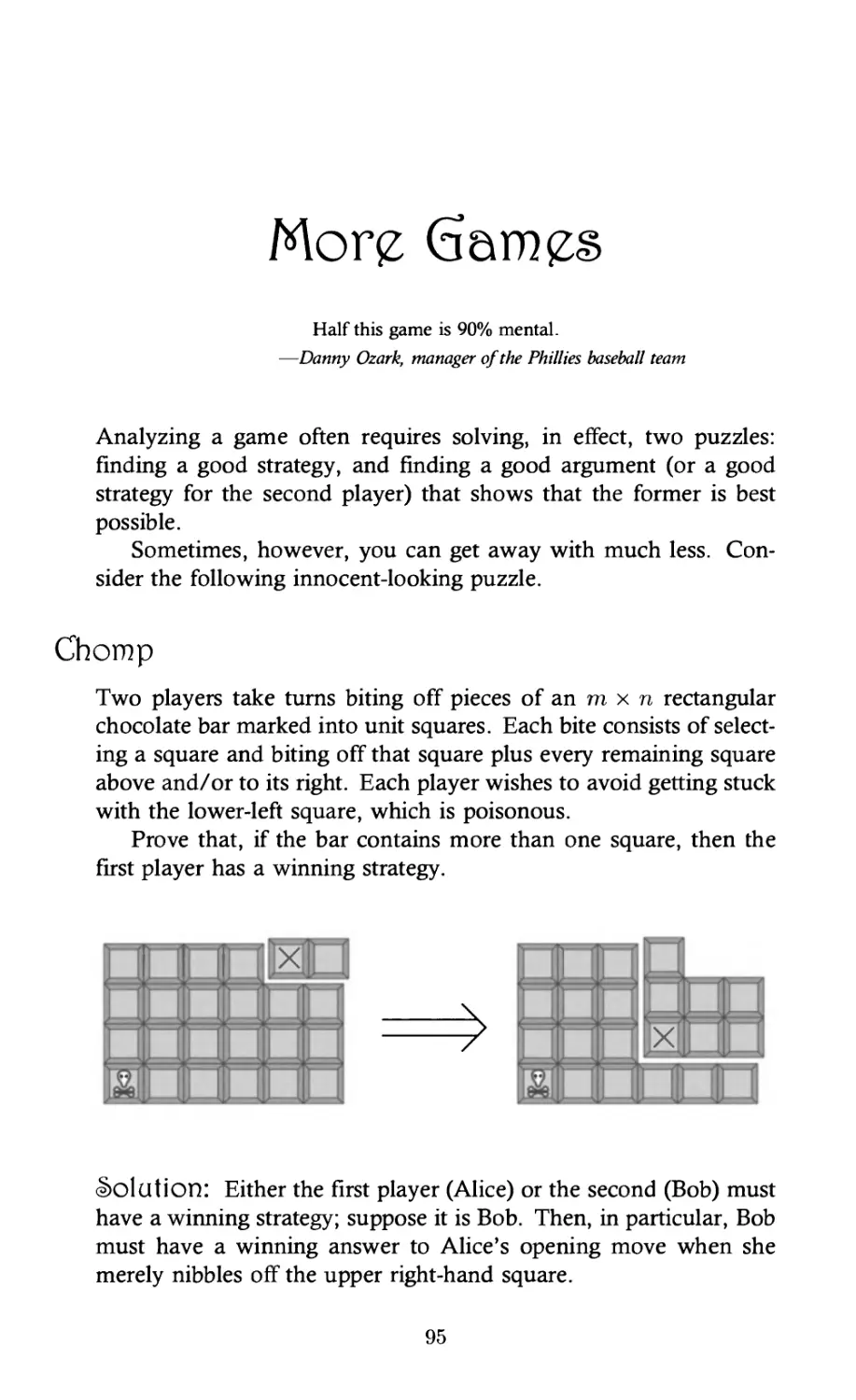































Текст
                    Mathematical puzzljzs:
fl Connoisseur's Collection
Peter Winkler
A K Peters
Wellesley, Massachusetts

Editorial, Sales, and Customer Service Office
A K Peters, Ltd.
888 Worcester Street, Suite 230
Wellesley, MA 02482
www.akpeters.com
Copyright © 2004 by A K Peters, Ltd.
All rights reserved. No part of the material protected by this copyright notice may
be reproduced or utilized in any form, electronic or mechanical, including
photocopying, recording, or by any information storage and retrieval system,
without written permission from the copyright owner.
Library of Congress Cataloging-in-Publication Data
Winkler, Peter, 1946-
Mathematical puzzles: a connoisseur's collection/Peter Winkler.
p. cm.
ISBN 1-56881-201-9
1. Mathematical recreations. I. Title.
QA95.W6462004
793.7^-dc22
2003064797

To Lois, for love and support; to Martin Gardner, for
inspiration; and to the many misguided friends, relatives, colleagues, and
reviewers who are praying that the publication of this book will
bring about a diminution in my passion for puzzles.

Contents
Preface ix
Insight 1
Numbers 13
Combinatorics 21
Probability 33
Geometry 43
Geography(!) 57
Games 65
Algorithms 77
More Games 95
Handicaps 101
Toughies 119
Unsolved Puzzles 141
Afterword 159
Index of Puzzles 161

Doubt is the vestibule which all must pass before they can enter the
temple of wisdom. When we are in doubt and puzzle out the truth by
our own exertions, we have gained something that will stay by us and
will serve us again. But if to avoid the trouble of the search we avail
ourselves of the superior information of a friend, such knowledge will
not remain with us; we have not bought, but borrowed it.
—C C Colton
These puzzles are not for everybody.
To appreciate them, and to solve them, it is necessary—but not
sufficient—to be comfortable with mathematics. You will need to
know what a point and a line are, what a prime number is, and
how many ways there are to arrange the five cards in a poker hand.
Most importantly, you will need to know what it means to prove
something.
You will not need a professional acquaintance with mathematics.
You know what a group is? Fine—but you won't need it here. Your
computer, calculator, and calculus text can stay in their boxes; but
your thinking-cap will have to be on.
Who are you? Amateur mathematicians. Scientists of all kinds.
Bright high school and college students. And yes, professional
mathematicians and teachers of mathematics will discover new
challenges here. These puzzles are not (usually) found in journal
articles, in homework exercise lists, or in other puzzle books.
So where did I get them? Word of mouth. Among
mathematicians, puzzles like these spread the way jokes spread. In some
cases, I have been able to trace the puzzle to a written source, such
as an All Soviet Union Mathematical Competition, an International
Mathematics Olympiad, or a Martin Gardner column, but of course,
that isn't necessarily the original written source, and even if it were,
some form of the puzzle might have been bandied about orally for
years first. In a few cases, I can name the puzzle's inventor (e.g.,
when I devised it myself). Often the solution is my own and not

Mathematical
necessarily the one intended by the composer; multiple solutions
are presented only when they are irresistible.
The wording of the puzzles, and their solutions, is my own and
I must take full responsibility for errors and ambiguities. Feel free
to send complaints, corrections, and puzzle source information via
email to pw@akpeters.com. (An exception: As noted in Chapter
12, I am not the right person to whom to send proposed solutions
to Unsolved Puzzles.)
As of this writing, I have been a professional mathematician for
28 years A4 in academia, 14 in industry) and have collected
mathematical puzzles since my own high school days in the '60s. What
you see here are only my favorite hundred or so puzzles. To make it
into this book, a puzzle should satisfy most of the following criteria.
flrouseroent: It should be entertaining. Problems on the William
Lowell Putnam Mathematical Competition, given annually to
college students in the US and Canada, are devised to test the
students' ability; that is a fine objective, but not always consistent
with amusement. (There are a few puzzles from the Putnam in this
book, however.)
Universality: It should suggest some general mathematical truth.
Complex logic puzzles, algebraic puzzles of the type "In two years,
Alice will be twice as old as Bob was when...," puzzles relying
on properties of particular large numbers, and many other kinds of
cleverly devised problems are ruled out.
deganee: It should be elementary and easy to state. After all, to be
passed orally it must be easy to remember! If the statement carries
an element of surprise, so much the better.
difficulty: It should not be obvious how to solve the puzzle.
Solvability: It should boast at least one solution which is
elementary and easily convincing.
The last two points create a tension: The puzzle should have
an easy solution, yet not be easy to solve. Like a good riddle, the
answer should be hard to find, but easy to appreciate. Of course,
in the case of the Unsolved Puzzles in Chapter 12, the difficulty is
evident and the last constraint must be forgiven.
A word on format. The puzzles are organized into chapters for
convenience, classified loosely by mathematical area of statement
or solution. The solutions are presented at the end of each chapter
(except the last); the end of each solution is marked with a heart

symbol (9). If there is information about the background and source
of a puzzle, it is presented here. A puzzle's statement is not repeated
at the head of its solution; I want to encourage readers to tackle all
the puzzles in each chapter before reading the answers.
These puzzles are hard. Several existed as unsolved problems
before someone came up with the (elegant) solution you will read
here. The Unsolved Puzzles at the end of the book are thus a
logical wind-up to the collection, perhaps only slightly harder than
the others.
You can take pride in any puzzles you solve, and even more in
any for which you find better solutions than mine.
Good luck!
—Peter Winkler
Xi

Insi
During [these] periods of relaxation after concentrated intellectual
activity, the intuitive mind seems to take over and can produce the
sudden clarifying insights which give so much joy and delight.
—Fritjof Capra, physicist
This warm-up chapter contains a variety of puzzles not associated
with a particular topic or technique. As is often the case, however,
some key insight will put you on the right track. Here's one to get
you started:
Coins in a Row
On a table is a row of fifty coins, of various denominations. Alice
picks a coin from one of the ends and puts it in her pocket; then Bob
chooses a coin from one of the (remaining) ends, and the alternation
continues until Bob pockets the last coin.
Prove that Alice can play so as to guarantee at least as much
money as Bob.
Try this yourself with some coins (or random numbers), perhaps
just 4 or 6 of them instead of 50; it's not obvious how best to play,
is it? But then, maybe Alice doesn't need the best strategy. Here's
your chance to set a precedent for yourself by trying to solve this
one before reading further.
Solution: Number the coins from 1 to 50 and observe that no
matter how Bob plays, Alice can capture all the even-numbered
coins, or, if she prefers, all the odd-numbered coins. One of these
choices must at least match the other. 9
This puzzle, passed to me by mathematician Noga Alon, was
alleged to have been used by a high-tech company in Israel to test
job candidates. In general Alice has even better strategies than
choosing all the even or all the odd coins. However, if there are 51
coins instead of 50, it is usually Bob (the second to play) who will

Mathematical
have the advantage, despite collecting fewer coins than Alice. It
seems paradoxical that the parity of the number of coins has such a
huge effect on the outcome of this game, in which all of the action
takes place at the ends.
You're on your own now. We'll begin with two puzzles which
are a bit less mathematical, then move on to the more serious stuff.
Let your imagination be your guide!
Th? ©ixby ©oys
It was the first day of class and Mrs. Feldman had two identical-
looking pupils, Donald and Ronald Bixby, sitting together in the
first row.
"You two are twins, I take it?" she asked.
"No," they replied in unison.
But a check of their records showed that they had the same
parents and were born on the same day. How could this be?
Th? flttie Lamp §witeh
A downstairs panel contains three on-off switches, one of which
controls the lamp in the attic—but which one? Your mission is to
do something with the switches, then determine after one trip to the
attic which switch is connected to the attic lamp.
Crisis
There's a gasoline crisis, and the fuel stations located on a long
circular route together contain just enough gas to make one trip
around. Prove that if you start at the right station with an empty
tank, you can make it all the way around.
?S Of f US?S
You are presented with two fuses (lengths of string), each of which
will burn for exactly 1 minute, but not uniformly along its length.
Can you use them to measure 45 seconds?

Insight
Integers and
A large rectangle in the plane is partitioned into smaller rectangles,
each of which has either integer height or integer width (or both).
Prove that the large rectangle also has this property.
Tipping the
A balance scale sits on the teacher's table, currently tipped to the
right. There is a set of weights on the scales, and on each weight
is the name of at least one pupil. On entering the classroom, each
pupil moves all the weights carrying his or her name to the opposite
side of the scale. Prove that there is some set of pupils that you, the
teacher, can let in which will tip the scales to the left.
Watches on the Table
Fifty accurate watches lie on a table. Prove that there exists a
moment in time when the sum of the distances from the center of
the table to the ends of the minute hands is more than the sum
of the distances from the center of the table to the centers of the
watches.

Mathematical
path on a Chessboard
Alice begins by marking a corner square of an n x n chessboard;
Bob marks an orthogonally adjacent square. Thereafter, Alice and
Bob continue alternating, each marking a square adjacent to the
last one marked, until no unmarked adjacent square is available at
which time the player whose turn it is to play loses.
For which n does Alice have a winning strategy? For which n
does she win if the first square marked is instead a neighbor of a
corner square?
upon
An American High School Mathematics Examination from the 1960s
contained the following question: If
y = 2,
what is x? The intended solution entailed observing that the
exponent of the bottom "x" is the same as the whole expression, thus
x2 = 2, x = y/2. However, one student noticed that if the problem
had instead specified that
xx* =4,
he would have obtained the same answer: x = tfi = y/2.
Hmm. Just what is V2 , anyway? Can you prove it?
§oldiszxs in the field
An odd number of soldiers are stationed in a field, in such a way
that all the pairwise distances are distinct. Each soldier is told to
keep an eye on the nearest other soldier.
Prove that at least one soldier is not being watched.
Intervals and ©istanees
Let 5 be the union of k disjoint, closed intervals in the unit interval
[0,1]. Suppose 5 has the property that for every real number d in
[0,1], there are two points in S at distance d. Prove that the sum
of the lengths of the intervals in S is at least 1/fc.

Insight
g to 15
Alice and Bob alternately choose numbers from among 1, 2, ..., 9,
without replacement. The first to obtain 3 numbers which sum to
15 wins. Does Alice (the first to play) have a winning strategy?
Solutions and Comments
Th? Sixby Boys
A classic brain-teaser. They were triplets, of course. The third
(Arnold?) was in another class. 9
Th? flttie Lamp <§>witeh
This puzzle swept the world like a flu epidemic about a decade
ago; I don't know its original source.
It really is impossible to tell which switch is connected to the
attic lamp if all you get is one bit of information from your trip to
the attic. However, you can get more information with your hand!
Turn on Switches 1 and 2, wait a few minutes, then turn off Switch
2 before ascending to the attic. If the bulb is off, but warm, you
conclude that Switch 2 is the winner. 9
If you can't reach the bulb, but have enormous patience, you can
achieve the same effect by turning Switch 2 on and then waiting a
couple of months before turning on Switch 1 and visiting the attic.
If the bulb is burnt out, Switch 2 is the culprit.
Gasoline Crisis
This puzzle has been around for a long time and can be found,
for example, in Ldszl6 Lovdsz's marvelous book, Combinatorial
Problems and Exercises, North Holland, Amsterdam, 1979. The trick is
to imagine that you begin at Station 1 (say) with plenty of fuel, then
proceed around the route, emptying each station as you go. When
you return to Station 1, you will have the same amount of fuel in
your tank as when you started.
As you do this, keep track of how much fuel you have left as
you pull into each station; suppose that this quantity is minimized
at Station k. Then, if you start at Station k with an empty tank,
you will not run out of fuel between stations. 9

Mathematical
Uses of f uses
Simultaneously light both ends of one fuse and one end of the
other; when the first fuse burns out (after half a minute), light the
other end of the second. When it finishes, 45 seconds have passed.9
This and other fuse puzzles seem to have spread like wildfire a
few years ago. Recreational mathematics expert Dick Hess has put
together a miniature volume called Shoelace Clock Puzzles devoted to
them; he first heard the one above from Carl Morris of Harvard
University.
Hess considers multiple fuses (shoelaces, for him) of various
lengths, but lights them only at ends. If you allow midfuse ignition
and arbitrary dexterity, you can do even more. For example, you
can get 10 seconds from a single 60-second fuse by lighting at both
ends and at two internal points, then lighting a new internal point
every time a segment finishes; thus, at all times, three segments are
burning at both ends and the fuse material is being consumed at six
times the intended rate.
Bit of a mad scramble at the end, though. You'll need infinitely
many matches to get perfect precision.
Integers and Rectangles
This puzzle was the subject of a unique article by Stan Wagon
(of Macalester College in St. Paul, MN) called "Fourteen Proofs of
a Result about Tiling a Rectangle," in The American Mathematical
Monthly, Vol. 94 A987), pp. 601-617.
Some of Wagon's solutions make amusing use of heavy
mathematical machinery; one that doesn't entails placing the lower left-
hand corner of the big rectangle on the origin of a grid made up
of squares of side 1/2. Coloring the grid squares alternately black
and white, as on a chessboard, we see that each small rectangle is
exactly half white and half black. The same, consequently, is true
for the big rectangle. However, if (say) the height of the big
rectangle is not integral, the region of the big rectangle between the lines
x = 0 and x = 1/2 will not be color-balanced. Hence, the width
would have to be integral. 9
Your author is responsible for the following solution, not found
in Wagon's article. Letting e be less than the smallest tolerance
in the partition, color each small rectangle of integral width green
except for a red horizontal strip of width e across the top, and
6

Insight
another across the bottom. Color each remaining small rectangle
red, except for a green vertical strip of width e along the left side
and another along the right.
Place the lower left point of the big rectangle at the origin. Either
there is a green path from the left side of the big rectangle to the right
side, or a red path from bottom to top; suppose the former. Every
time the green path crosses a vertical border of the partition, it is
at an integral coordinate; thus, the big rectangle has integral width.
Similarly a red path from bottom to top forces integral height.
Tipping the d>eal?
Consider all subsets of students, including the empty set and the
full set. Each weight will be on the left half the time, so the total
weight on the left for all these subsets is the same as the total weight
on the right. Since the empty set results in a tip to the right, some
other set must tip to the left.
{Source: Second All Soviet Union Mathematical Competition, Leningrad
1968). 9
The "averaging" technique used here comes up often: watch for
it!

Mathematical puzzles
Watches on the Table
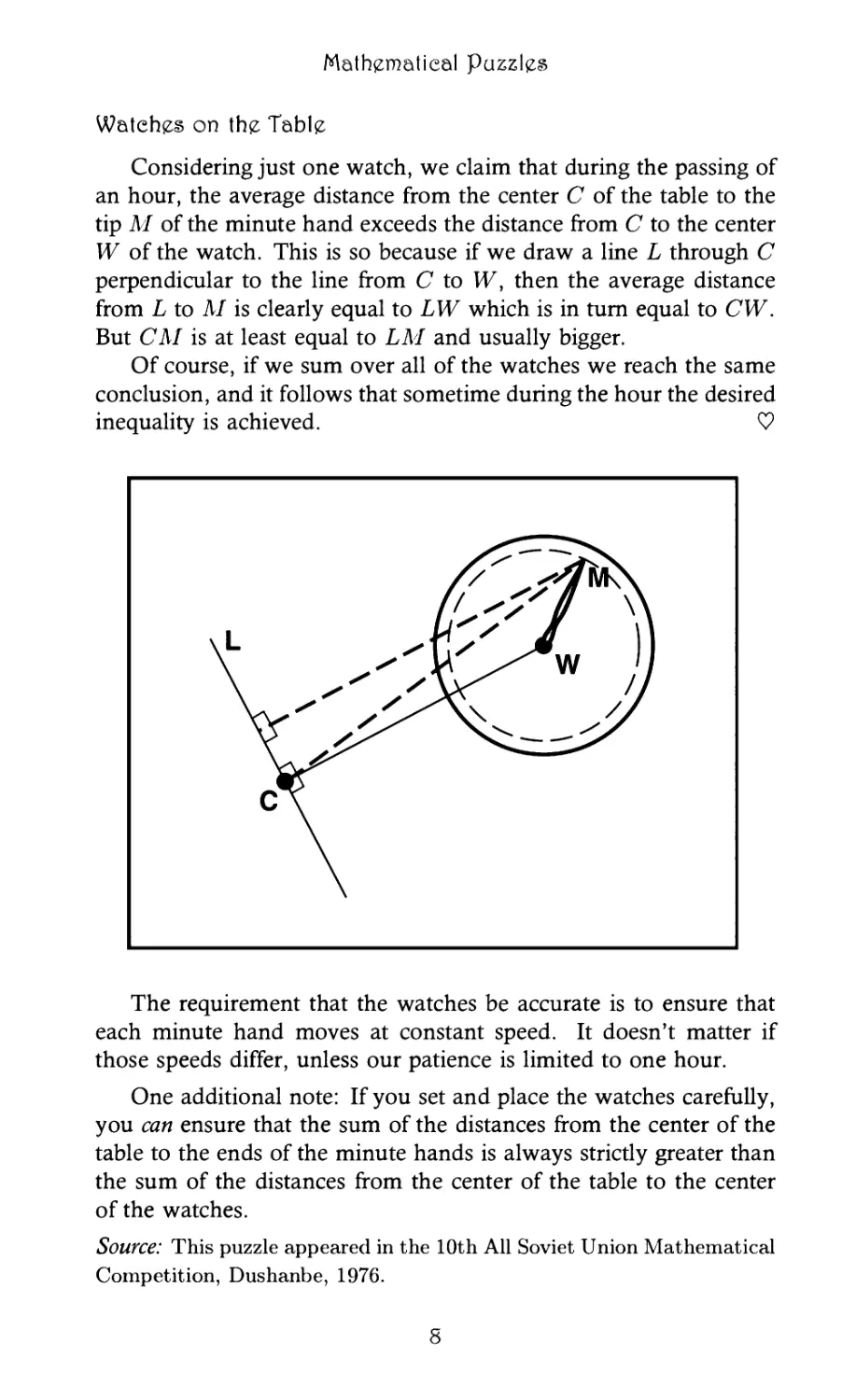
Considering just one watch, we claim that during the passing of
an hour, the average distance from the center C of the table to the
tip M of the minute hand exceeds the distance from C to the center
W of the watch. This is so because if we draw a line L through C
perpendicular to the line from C to W, then the average distance
from L to M is clearly equal to LW which is in turn equal to CW.
But CM is at least equal to LM and usually bigger.
Of course, if we sum over all of the watches we reach the same
conclusion, and it follows that sometime during the hour the desired
inequality is achieved. 9
The requirement that the watches be accurate is to ensure that
each minute hand moves at constant speed. It doesn't matter if
those speeds differ, unless our patience is limited to one hour.
One additional note: If you set and place the watches carefully,
you can ensure that the sum of the distances from the center of the
table to the ends of the minute hands is always strictly greater than
the sum of the distances from the center of the table to the center
of the watches.
Source: This puzzle appeared in the 10th All Soviet Union Mathematical
Competition, Dushanbe, 1976.

Insight
Path on a Chessboard
If n is even, Bob has a simple winning strategy no matter where
Alice starts. He merely imagines a covering of the board by
dominoes, each domino covering two adjacent squares of the board. Bob
then plays in the other half of each domino started by Alice. (Note
that this works for Bob even when Alice is allowed to mark any
square she wants at each move!)
When n is odd, and Alice begins in a corner, she wins by
imagining a domino tiling that covers every square except the corner in
which she starts.
However, Alice loses in the odd n case when she must start in
the square adjacent to the corner. Suppose the corner squares are
black in a checkerboard coloring, so that her starting square is white.
There is a domino tiling of the whole board minus one black square;
Bob wins by completing these dominoes. Alice can never mark the
one uncovered square because all the squares she marks are white.9
Source: The 12th All Soviet Union Mathematical Competition, Tashkent,
1978.
apon exponent
If it means anything at all,
is the limit of the sequence y/2, y/2 , y/2 , ... . In fact, the
limit does exist; the sequence is increasing and bounded above.
To show the former, we name the sequence si, s2, • • • and prove
by induction that 1 < s^ < si+i for each i > 1. This is easy because
Si+2 = V 2 > V2 = Si+i.
To get the bound, observe that if we replace the top y/2 in any
Si by the larger value 2, the whole expression collapses to 2.
Now that we know the limit exists, let us call it y; it must
indeed satisfy V%y = y. Looking at the equation x = y1^, we
observe using elementary calculus (oops—sorry) that x is strictly
increasing in y up to its maximum at y = e and strictly decreasing
thereafter. Thus, there are at most two values of y corresponding to
any given value of x, and for x = y/2, we know the values: y = 2
and y = 4.
9

Mathematical
Since our sequence is bounded by 2, we rule out 4 and conclude
that y = 2. 9
Generalizing the above argument, we see that xx* is
meaningful and equal to the lower root of x = y1^, as long as 1 < x < e1/6.
For x = e1/6, the expression is equal to e, but as soon as x exceeds
e1/6, the sequence diverges to infinity.
This observation was made by Leonhard Euler in 1778!
<§>oldier§ in the field
This problem, from the 6th All Soviet Union Mathematical
Competition in Voronezh, 1966, is most easily solved by
considering the two soldiers at shortest distance from each other. Each
of these watches the other; if anyone else is watching one of them,
then we have a soldier being watched twice and therefore another
not being watched at all. Otherwise, these two can be removed
without affecting the others. Since the number of soldiers is odd,
this procedure would eventually reduce to one soldier not watching
anyone, a contradiction. V
Intervals and ©istanees
Source: This puzzle comes from the 17th All Soviet Union Mathematical
Competition, Kishenew, 1983.
Suppose the lengths of the intervals in 5 are si,..., «&, summing
to s. Let us consider the interval /^ of distances obtainable by
taking one point from the ith interval and one from the jth. Clearly,
Iij has length si + Sj. Summing over all pairs of intervals, each Si
appears k—1 times, so the total measure of the distances obtainable
by choosing points from two different intervals is at most (k — l)s.
Distances obtainable by taking two points from the same interval
run from 0 only up to the maximum of the lengths sit so altogether
the measure of the distances is at most ks; from ks > 1, we get
s > 1/jfe. 9
The argument is tight only if the maximum Si is equal to 5,
i.e., all the intervals but one have length 0. This we can achieve, by
taking one interval to be [j/k, (j-\-l)/k] for some j G {0,1,..., k—1},
and adding the single points 0, 1/fc, 2/fc, ..., (j — 2)/fc, (j —
10

Insight
to \5
The quick way to solve the puzzle is to imagine that Alice and
Bob are playing on the following magic square:
8 1 6
3 5 7
4 9 2
Since it is exactly the rows, columns, and main diagonals which
sum to 15, they are playing Tic-Tac-Toe! Everyone knows that best
play in Tic-Tac-Toe leads to a draw, so the answer to our question
is no, Alice does not have a winning strategy.
This silly game is mentioned in Vol. II of the classic Winning
Ways for Your Mathematical Plays by Elwyn Berlekamp, John Con-
way and Richard Guy (Academic Press, 1982; 2nd Edition, A K
Peters 2001). The book attributes the puzzle to one E. Pericoloso
Sporgersi, but, rather suspiciously, the phrase is found also on
Italian railroad trains, warning passengers not to lean out the window.

Numbers
We learned to be happy
We danced 'round the hall
And learning to count was the key to it all.
—The Count, "Sesame Street"
Numbers are an endless source of fascination, and for some, a
lifelong disease. Some people can be captured even by the properties of
particular numbers; many intriguing puzzles have been concocted to
take advantage of special properties, often by requiring deductions
from what appears to be a shortage of data.
The spirit of this collection, however, suggests striving for greater
universality. Our number-theoretic problems are about numbers in
general, not particular ones. In most cases, you will need little more
to solve them than the fact that every positive integer is uniquely
expressible as the product of powers of primes.
Here is a practice problem:
Locker ©oors
Lockers numbered 1 to 100 stand in a row at the school gym. When
the first student arrives, she opens all the lockers. The second
student then goes through and recloses all the even-numbered lockers;
the third student changes the state of every locker whose number is
a multiple of 3.
This continues until 100 students have passed through. Which
lockers are now open?
Solution: The state of locker n is changed when the fcth student
passes through, for every divisor k of n. Here, we make use of the
fact that divisors usually come in pairs {j, k} where j • k = n; so the
net effect of students j and k on this locker is nil. The exception is
when n is a perfect square, in which case there is no other divisor to
cancel the effect of the y/nih student; therefore, the lockers which
13

Mathematical
are open at the end are exactly the perfect squares, 1, 4, 9, 16, 25,
36, 49, 64, 81, and 100. 9
We'll start with a couple of observations about base 10
representation of integers, and finish with a surprisingly subtle dinner table
conundrum.
, On?§, and Twos
Let n be a natural number. Prove that (a) n has a (nonzero) multiple
whose representation (base 10) contains only zeroes and ones; and
(b) 2n has a multiple whose representation contains only ones and
t
twos.
and
Given 25 different positive numbers, prove that you can choose two
of them such that none of the other numbers equals either their sum
or their difference.
g the Nationals
A set 5 contains 0 and 1, and the mean of every finite nonempty
subset of S. Prove that S contains all the rational numbers in the
unit interval.
g fractions
Given a natural number n > 1, add up all the fractions 1/pq, where
p and q are relatively prime, 0 < p < q < n, and p + q > n. Prove
that the result is always 1/2.
§ubtraeting around th? Corner
Write a sequence of n positive integers. Replace each by the absolute
difference between it and its successor (going around the corner).
Repeat until all the numbers are 0. Prove that for n = 5 the process
may go on forever, but for n = 4 it always terminates.
14

Numbers
profit and Loss
At the stockholders' meeting, the board presents the month-by-
month profits (or losses) since the last meeting. "Note," says the
CEO, "that we made a profit over every consecutive eight-month
period."
"Maybe so," a shareholder complains, "but I also see we lost
money over every consecutive^v^-month period!"
What's the maximum number of months that could have passed
since the last meeting?
first Odd Number in th? ©ietionary
Each number from 1 to 1010 is written out in formal English (e.g.,
"two hundred eleven," "one thousand forty-two") and then listed
in alphabetical order (as in a dictionary, where spaces and hyphens
are ignored). What's the first odd number in the list?
evolutions and Comments
g?ro?§, 0n?§, and Twos
For Part (a), we employ the famous and useful "pigeon-hole
principle": If there are more pigeons than holes, then some hole
must contain at least two pigeons. There are only n numbers
modulo n, but the set {1,11, 111, 1111,... }, whose largest member has
n-hl digits, has size n + 1; thus, it contains two numbers whose
values are equal modulo n. Subtract one from the other! 9
As pointed out to me by David Gale, as long as n is not a
multiple of 2 or 5, you can even find a multiple of n whose representation
(base 10) is all ones. The reason is that the above argument
produces a multiple of n of the form 111... 111000 ... 000; if there are
k zeros at the end, dividing by 10fc = 2k - 5k leaves you with all
ones and still with a multiple of k.
For Part (b), it's perhaps easiest to show by induction on k that
there is a k-digit number containing only ones and twos which is
a multiple of 2k. Adding a 1 or a 2 to the front of such a number
increments it by 2^5^ or by 2/c+15/c, in each case preserving
divisibility by 2k\ since the two choices differ by 2fc5fc, one of them must
actually achieve divisibility by 2k+1. 9
\5

Mathematical
The first of these problems came to me from Muthu
Muthukrishnan, of AT&T Research and Rutgers University. The
second appeared on the 5th All Soviet Union Mathematical
Competition, Riga, 1971; the solution given here was suggested by Sasha
Barg of the University of Maryland.
A similar problem, from the 1st All Soviet Union
Mathematical Competition, Tbilisi, 1967, asks for a proof that there exists a
number divisible by 51000 not containing any 0 in its decimal
representation. One approach is to assume otherwise and let k be the
biggest power of 5 available. Let n have the most factors of 5 (say,
j < k) of any number with at least k digits, none of which is a zero.
Then if n = d mod 5i+1, subtracting d- 10j+1 or adding E-d) • 10j+1
will keep n zero-free and boost its divisibility, a contradiction. 9
<§>arr?s and Inferences
This problem also appeared on the 5th All Soviet Union
Mathematical Competition, Riga, 1971. Let the numbers be x\ < x2 <
• • • < xn. If xn is unavailable to be taken as one of the desired
numbers, it must be that for each lower number xi, there is
another Xj with Xi + Xj = xn. Thus, the first 24 numbers are paired
in such a way that Xi + xn_i_1 = xn. Now consider xn_i
together with any of x2,...,xn_2; these pairs sum to more than
xn = Xn-i + %i and so x2,..., xn-2 must also be paired, this time
satisfying x2+% + xn-2-i = xn-i. But that leaves ?(n_i)/2 paired
with itself, so the numbers #n-i, #(n-i)/2 solve the problem. 9
Generating the Nationals
First note that S contains all the "dyadic" rationals, that is,
rationals of form p/2n; we can obtain all those with denominator
2n and odd numerator by averaging two adjacent ones with lower-
powered denominators.
Now any general p/q is of course the average of p ones and q—p
zeros. We choose n large and replace the zeros by l/2n, —l/2n,
2/2n, -2/2n, 3/2n, etc. including one 0 if p is odd. Similarly, we
replace the ones by 1 - l/2n, 1 + l/2n, 1 - 2/2n and so forth. Of
course, some of these numbers lie outside the unit interval, but we
can rescale the procedure to fit some dyadic interval containing p/q
and lying strictly between 0 and 1. 9
Source: The 13th All Soviet Union Mathematical Competition, Tbilisi,
1979.

Numbers
Fractions
We proceed by induction, noting that the statement is true for
n = 2. Moving from n to n + 1, you gain 1/pn for each p with
(p, n) = 1, and lose 1/pq for each p and <j with (p,q) = 1 and
p + q = n. Thus, each pair p, q satisfying the conditions of the
puzzle signifies a loss of 1/pq but a gain of 1/pn + l/<jn = 1/pg,
neatly cancelling. 9
Source: The 3rd All Soviet Union Mathematical Competition, Kiev, 1969.
§abtraeting around the Corner
A substitute high school math teacher (at Fair Lawn Senior High
School, New Jersey, 1962) told me that some WWII prisoner of war
entertained himself by trying various sequences of four numbers to
see how long he could get them to survive under the above
operations.
Considering values modulo 2 solves both problems. In the n = 4
case, up to rotation and reflection, 10 0 0 and 1110 become
110 0, then 1010, then 1111, then 0000. Since this covers
all cases, we see that when working with ordinary integers, at most
four steps are required to make all the numbers even; at that point,
we may as well divide out by the largest common power of two
before proceeding. Since the value M of the largest number in the
sequence can never increase, and drops by a factor of 2 or more at
least once every four steps, the sequence must hit 0 0 0 0 after at
most 4A + [log2 M]) steps.
On the other hand, for n = 5, the sequence 110 0 0 (considered
either as binary or ordinary numbers) cycles via 1 0 1 0 0, 1 1 1 1 0,
110 0 0. 9
A little analysis via polynomials over the integers modulo 2
shows that the salient issue is whether n is a power of 2.
If the restriction to integer entries is relaxed, there is, incredibly,
a unique (up to the obvious alterations) sequence of four positive
reals which fails to terminate, as shown recently by Antonio Behn,
Chris Kribs-Zaleta, and Vadim Ponomarenko.
Profit and Loss
This puzzle is adapted from one which appeared on the 1977
International Mathematical Olympiad, submitted by a Vietnamese
U

Mathematical
composer; thanks to Titu Andreescu for telling me about it. The
solution below is my own, however.
What's needed, of course, is a maximum-length sequence of
numbers such that every substring of length 8 adds up to more than
0, but every substring of length 5 adds up to less than 0. The string
must certainly be finite, in fact less than 40 in length, else you could
express the sum of the first 40 entries both as the (positive) sum of
5 substrings of length 8 and the (negative) sum of 8 substrings of
length 5.
Let's tackle the problem more generally and let f(x,y) be the
length of the longest string such that every ^-substring has positive
sum and every y-substring negative; we may suppose x > y. If x
is a multiple of y, then f(x, y) = x — 1 and we must accept vacuous
truth with respect to the ^-substrings.
What if y = 2 and x is odd? Then you can have a string of length
x itself, with entries that alternate between, say, x — 1 and —x. But
you can't have x + 1 numbers, because in each ^-substring the odd
entries must be positive (since you can cover it with 2-substrings
leaving out any odd entry). But there are two ^-substrings and
together they imply that the middle two numbers are both positive,
a contradiction.
Applying this reasoning more generally suggests that f(x,y) <
x + y — 2 when x and y are relatively prime, i.e., they have no
common divisor other than 1. We can prove this by induction
as follows. Suppose to the contrary that we have a string of length
x+y—1 which satisfies the given conditions. Write x = ay -\-b where
0 < b < y, and look at the last y+b — 1 numbers of the sequence.
Observe that any consecutive b of them can be expressed as an x-
substring of the full string, with a y-substrings removed; therefore, it
has positive sum. On the other hand, any (y—b) -substring of the last
y+b—1 can be expressed as a+1 y-strings with an x-string removed,
hence has negative sum. It follows that f(b,y — b) > y+b— 1, but
this contradicts our induction assumption because b and y — b are
relatively prime.
To show that f(x,y) is actually equal to x + y — 2 when x and
y are relatively prime, we construct a string which has the required
properties and more: It takes only two distinct values, and it is
periodic with periods both x and y. Call the two values u and v,
and imagine at first that we assign them arbitrarily as the first y
entries of our string.
IS

Numbers
Then these assignments are repeated until the end of the string,
making the string perforce periodic in y. To be periodic in x as well,
we only need to ensure that the last y—2 entries match up with the
first y—2, which entails satisfying y—2 equalities among the original
y choices we made. Since there are not enough equalities to force
all the choices to be the same, we can ensure that there is at least
one u and one v.
Let us do this, for example, with x = 8 and y = 5. Call
the first five string entries ci,...,c5, so the string itself will be
C1C2C3C4C5C1C2C3C4C5C1. To be periodic with period 8, we must
have c4 = ci, c5 = c2, and c\ = c3. This allows us to have
ci = c3 = c4 = u, for example, and c2 = c5 = v; the whole
sequence is thus uvuuvuvuuvu.
Getting back to general x and y, we note that a string which is
periodic in x automatically has the property that every ^-substring
has the same sum; because, as you shift the substring one step at a
time, the entry picked up at one end is the same as the entry dropped
at the other end. Of course the same applies to y-substrings if the
string is periodic in y.
Let Sx be the ^-substring sum and Sy similarly; we claim Sx/x /
Sy/y. The reason is that if there are, say, p copies of u in each x-
substring and q copies of v in each y-substring, then Sx/x = Sy/y
would imply y(pu + (x—p)v) = x(qu + (y — q)v) which reduces to
yp = xq. Since x and y are relatively prime, this cannot happen for
0 < p < x and 0 < y < q.
It follows that we can adjust u and v so that Sx is positive and
Sy is negative. In the case above, for example, each 8-substring
contains 5 copies of u and 3 of v, while each 5-substring contains 3
copies of u and 2 of v. If we take u = 5 and v = —8, we get 5^ = 1
and Sy = — 1. The final sequence, solving the original problem, is
then 5, -8,5, 5, -8,5, -8,5,5, -8,5. 9
The industrious reader will not find it difficult to generalize the
above arguments to the case where x and y have a greatest common
divisor gcd(x, y) other than 1. The result is f(x, y) = x + y — 1 —
gcd(x,y).
First Odd Number in the dictionary
This is just a matter of carefully and systematically considering
the successive words involved in the description of a number. The
earliest actual digit is of course "eight," but the earliest available
19

Mathematical
word (or suffix for "eight") is "billion." Our number must begin
with a digit so must start with "eight billion." Proceeding along
these lines, one eventually gets the answer 8,018,018,885: "eight
billion, eighteen million, eighteen thousand, eight hundred eighty-
five." 9
The idea for this silly puzzle came when Herb Wilf (University
of Pennsylvania) asked me for the first prime in the dictionary. This
question has been attributed to the computer guru Donald Knuth
(Stanford University), and reasoning as above, followed by some
checking on a computer, will lead you to 8,018,018,881.
20

Combinatorics
Falsehood has an infinity of combinations, but truth has
only one mode of being.
—Jean-Jacques Rousseau
If a puzzle begins with "How many ways are there to ...," it is
automatically combinatorial, but the converse fails. Combinatorial
reasoning is useful in the following (quite eclectic) list of puzzles
and in many other puzzles in this book.
Our practice problem does fit the classical mold, however, and
makes use of the most fundamental of combinatorial techniques:
multiplying numbers of options.
How many ways are there to write the numbers 0 through 9 in a
row, such that each number other than the left-most is within one
of some number to the left of it?
Solution: On the face of it, this problem does not seem amenable
to multiplying numbers of options because the number of options
depends on previous choices. For example, there are ten choices for
the left-most digit, but if we start by writing " on the left, there
are two choices for the next digit; if we start with " or "9," there
is only one choice. If you know how to sum binomial coefficients,
you can nonetheless analyze the problem in this manner, but there's
a better way.
Observe that the sequence must terminate with a " or "9,"
and as we move from right to left, we always have a choice between
writing the highest unused digit or the lowest—until we hit the left
end, of course, where these two choices coincide.
Thus, there are two choices at each of nine opportunities. It
follows that the total number of ways is 29 = 512. 9
{Source: A Putnam Exam from the 1960s. More solutions can be found
in a 1985 article in Mathematics Magazine by Sol Golomb.)
21

Mathematical
The rest of the solutions are up to you. One hint: Keep your
eyes open for more applications of the pigeon-hole principle!
§ub§?ts of §ub§?ts
Prove that every set of ten distinct numbers between 1 and 100
contains two disjoint nonempty subsets with the same sum.
Thsz Malicious Maitrsz $)'
At a mathematics conference banquet, 48 male mathematicians,
none of them knowledgeable about table etiquette, find themselves
assigned to a big circular table. On the table, between each pair of
settings, is a coffee cup containing a cloth napkin. As each person
is seated (by the maitre d'), he takes a napkin from his left or right;
if both napkins are present, he chooses randomly (but the maitre d'
doesn't get to see which one he chose).
In what order should the seats be filled to maximize the expected
number of mathematicians who don't get napkins?
Handshakes at a party
Mike and Jenene go to a dinner party with four other couples; each
person there shakes hands with everyone he or she doesn't know.
Later, Mike does a survey and discovers that every one of the nine
other attendees shook hands with a different number of people.
How many people did Jenene shake hands with?
Thrw~Way 61 get ion
Ashford, Baxter, and Campbell run for secretary of their union, and
finish in a three-way tie. To break it, they solicit the voters'
second choices, but again there is a three-way tie. Ashford now steps
forward and notes that, since the number of voters is odd, they
can make two-way decisions; he proposes that the voters choose
between Baxter and Campbell, and then the winner could face
Ashford in a runoff.
Baxter complains that this is unfair because it gives Ashford a
better chance to win than either of the other two candidates. Is
Baxter right?
22

Combinatorics
Th? King's Salary
After the revolution, each of the 66 citizens of a certain country,
including the king, has a salary of one dollar. The king can no longer
vote, but he does retain the power to suggest changes—namely,
redistribution of salaries. Each person's salary must be a whole
number of dollars, and the salaries must sum to 66. Each
suggestion is voted on, and carried if there are more votes for than against.
Each voter can be counted on to vote "yes" if his salary is to be
increased, "no" if decreased, and otherwise not to bother voting.
The king is both selfish and clever. What is the maximum salary
he can obtain for himself, and how long does it take him to get it?
fl poorly $)?§ign?d Clock
The hour and minute hands of a clock are indistinguishable. How
many moments are there in a day when it is not possible to tell
from this clock what time it is?
fl Mystifying Card Triek
David and Dorothy have devised a clever card trick. While David
looks away, a stranger selects five cards from a bridge deck and
hands them to Dorothy; she looks them over, pulls one out, and
hands the remainder to David. David now correctly guesses the
identity of the pulled card.
How do they do it? What's the biggest deck of cards they could
use and still perform the trick reliably?
Traveling §al?§m?n
Between every pair of major cities in Russia, there's a fixed air
travel cost for going from either city to the other. Traveling
salesman Alexei Frugal begins in Moscow and tours the cities, always
choosing the cheapest flight to a city not yet visited (he does not
need to return to Moscow). Salesman Boris Lavish also needs to
visit every city, but he starts in Kaliningrad, and his policy is to
choose the most expensive flight to an unvisited city at each step.
Prove that Lavish's tour costs at least as much as Frugal's.
23

Mathematical
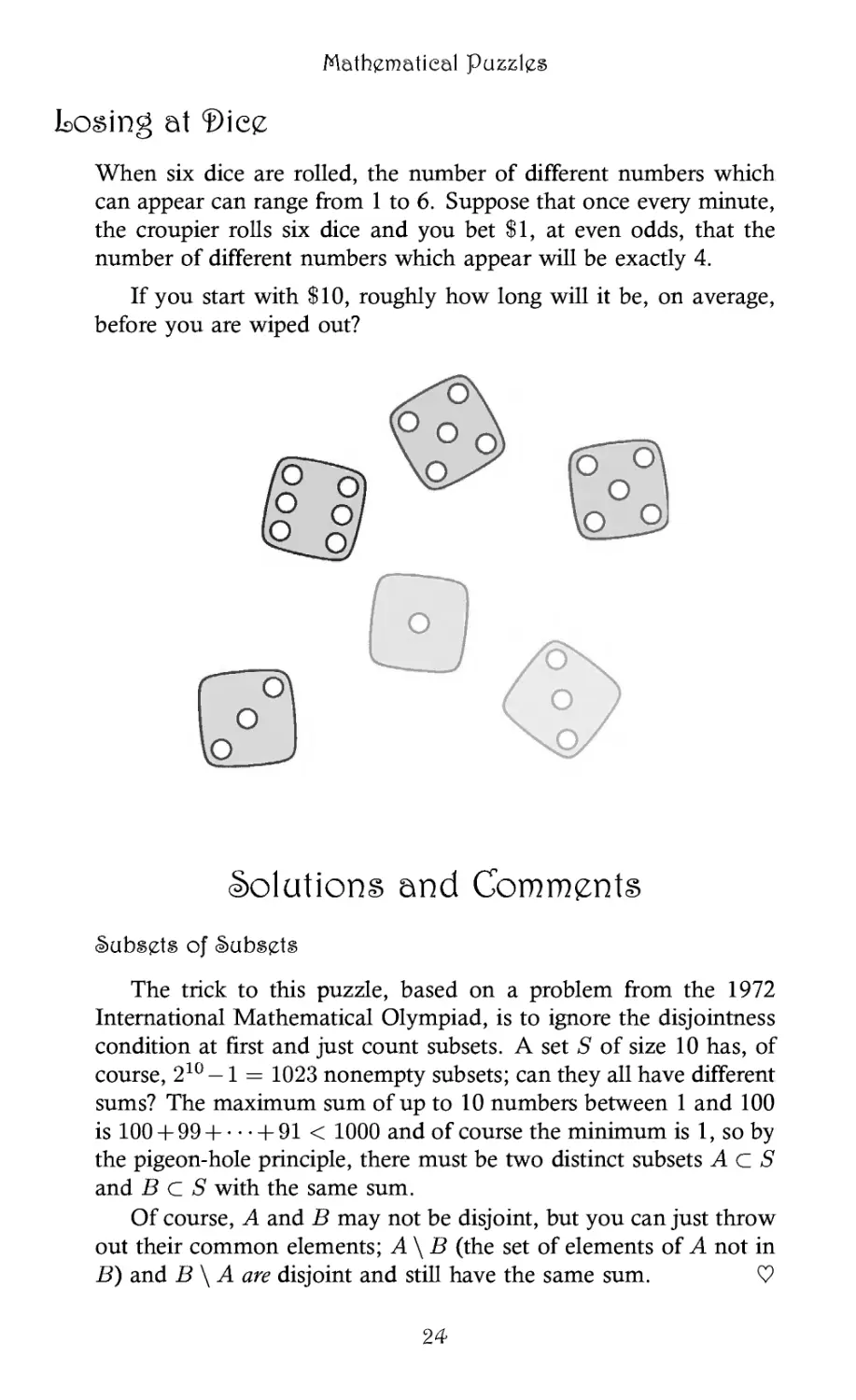
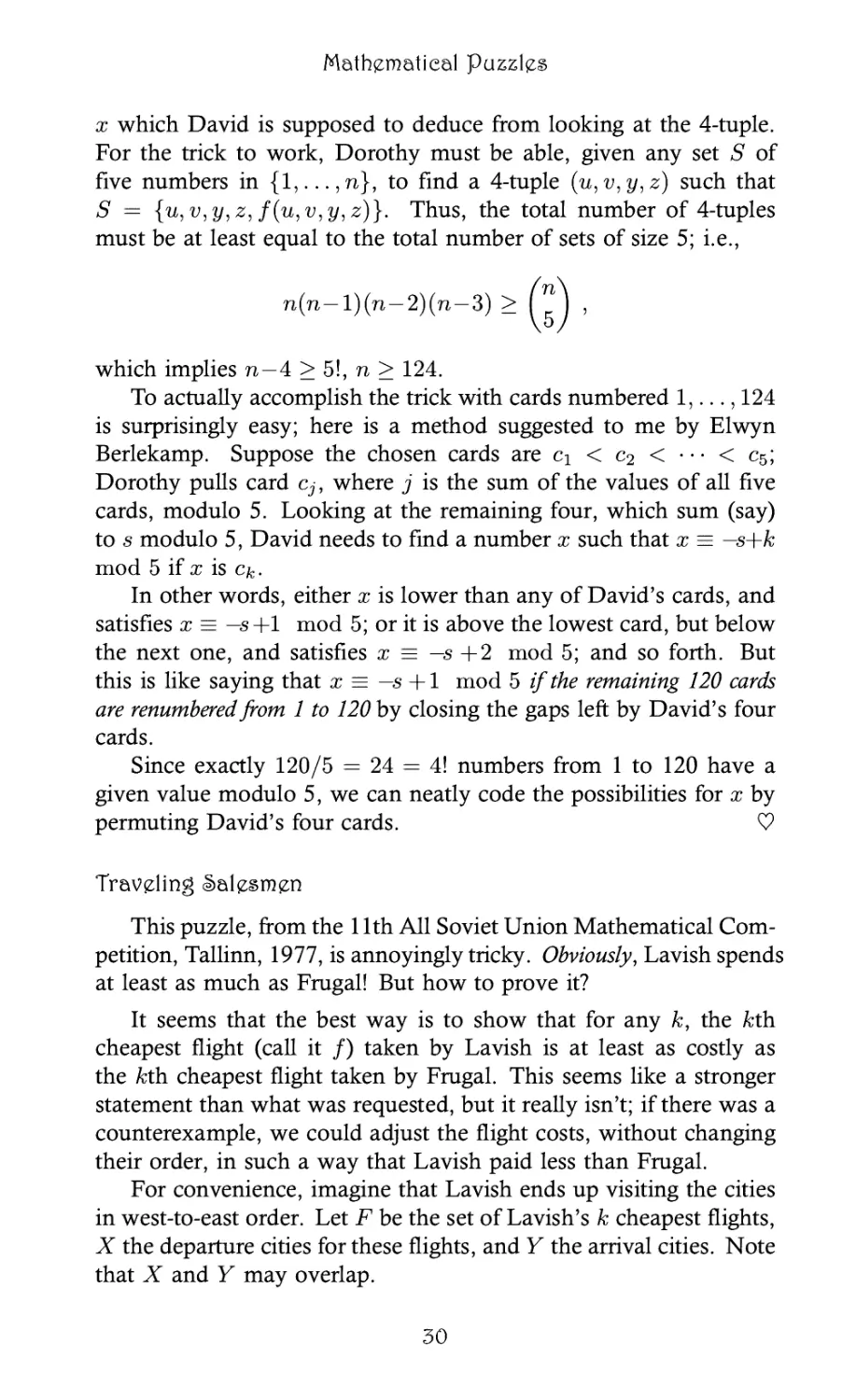
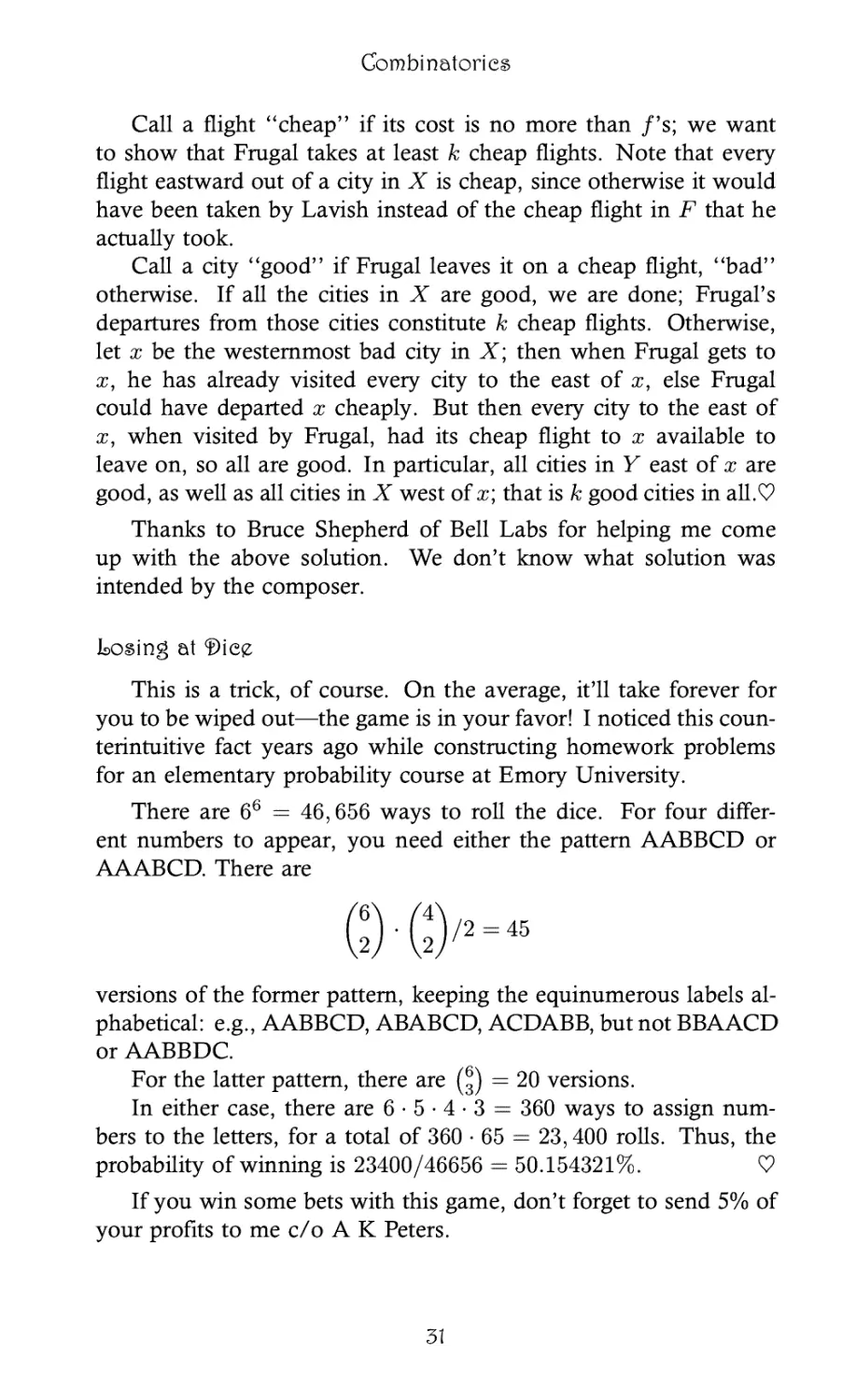
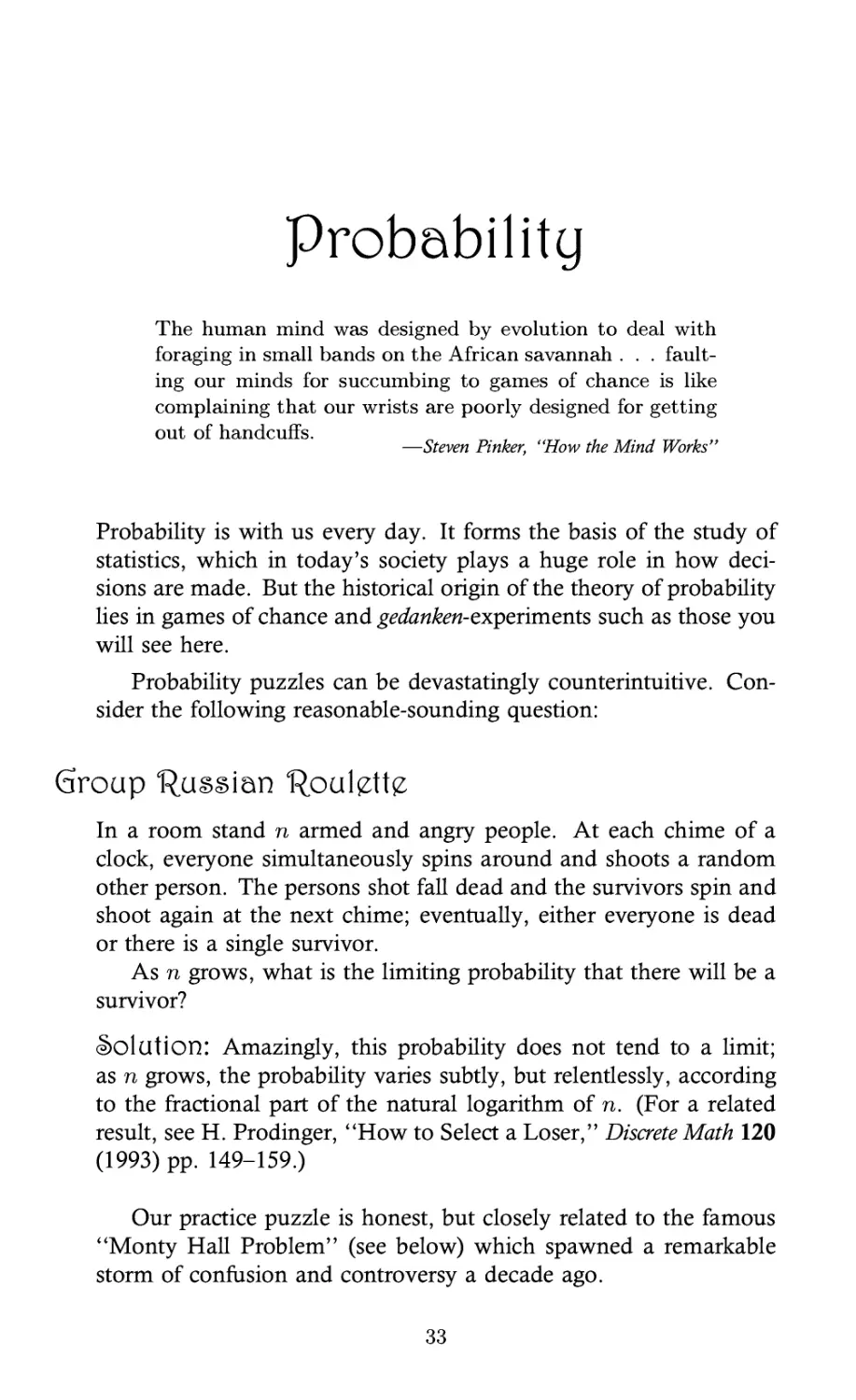
Losing at
When six dice are rolled, the number of different numbers which
can appear can range from 1 to 6. Suppose that once every minute,
the croupier rolls six dice and you bet $1, at even odds, that the
number of different numbers which appear will be exactly 4.
If you start with $10, roughly how long will it be, on average,
before you are wiped out?
evolutions and Comments
<§>ubs?ts of Subsets
The trick to this puzzle, based on a problem from the 1972
International Mathematical Olympiad, is to ignore the disjointness
condition at first and just count subsets. A set 5 of size 10 has, of
course, 210 — 1 = 1023 nonempty subsets; can they all have different
sums? The maximum sum of up to 10 numbers between 1 and 100
is 100 + 99 H h 91 < 1000 and of course the minimum is 1, so by
the pigeon-hole principle, there must be two distinct subsets A c S
and B c S with the same sum.
Of course, A and B may not be disjoint, but you can just throw
out their common elements; A\B (the set of elements of A not in
B) and B\A are disjoint and still have the same sum. ty

Combinatorics
7hz Malicious Maitre <?)'
This problem can be traced to a particular event. Princeton
mathematician John H. Conway came to Bell Labs on March 30,
2001 to give a "General Research Colloquium." At lunchtime, your
author found himself sitting between Conway and computer
scientist Rob Pike (now of Google), and the napkins and coffee cups
were as described in the puzzle. Conway asked how many diners
would be without napkins if they were seated in random order (see
Chapter 11), and Pike said: "Here's an easier question—what's the
worst order?"
If the maitre d' sees which napkin is grabbed each time he seats a
diner (computer theorists would call him an "adaptive adversary"),
it is not hard to see that his best strategy is as follows. If the first
diner takes (say) his right napkin, the next is seated two spaces
to his right so that the diner in between may be trapped. If the
second diner also takes his right napkin, the maitre d' tries again
by skipping another chair to the right. If the second diner takes
his left napkin (leaving the space between him and the first diner
napkinless), the third diner is seated directly to the second diner's
right. Further diners are seated according to the same rule until
the circle is closed, then the remaining diners (some of whom are
doomed to be napkinless) are seated. This results in 1/6 of the
diners without napkins, on average.
When, as in the stated puzzle, the maitre d' is not adaptive, it
seemed likely to Pike and me (at the time) that the right strategy
is to fill the even seats, then the odd ones. Each odd diner has
probability 1/4 of finding himself napkinless, for an overall yield of
1/8 F of the 48 diners, on average).
However, a little more thought shows that the maitre d's best
strategy is to use first the 0 mod 4 seats, then the odd seats, and
finally the 2 mod 4 seats. This foils 9/64 of the diners on average,
or 61 of the 48. To see this, call a diner "lonely" if when seated
neither of his neighbors has yet appeared. We may assume all the
lonely diners are seated first; note that there will be at most one
napkinless diner between each consecutive pair of lonely diners.
Suppose two consecutive lonely diners are at distance d (i.e.,
there are d—1 seats between them). Those seats will be filled in
from either side; suppose the last diner between them finds himself
at distances a (to the right) and b (to the left) from the lonely diners,
where a + b = d. His right napkin will be gone unless the lonely
25

Mathematical
diner to his right and all subsequent diners in between choose their
left napkins; this occurs with probability l/2a. Thus, the trapped
diner loses (goes napkinless) with probability
A - 2~a)(l - 2~b) = 1 + 2~d - 2~a - 2~b ,
which is minimized when a and b are equal or differ by 1.
If the lonely diners are spaced d apart, we get one potential loser
per d diners, thus if the number n of diners is a multiple of d, we find
that the expected number of losers is (n/d)(l-2" Ld/2J )(l-2" ^/21).
It is easy to check that this quantity is maximized not at d = 2,
where it is n/8, but at d = 4, where it is 9n/64. 9
Handshakes at a party
This puzzle is an old chestnut and of the type that, at first glance,
seems to offer insufficient information; why should we be able to
deduce anything about Jenenel The answer is, ultimately, that Jenene
is the partner of the one person not polled.
Since each person shook hands with at most eight others, the
nine answers received by Mike are exactly the numbers 0 through
8. The two people (say, A and B) who answered " and "8" must
have been a couple, since otherwise their opportunity to shake one
another's hand would have ruined one of those scores. Now we
examine C and D who scored " and "; since C had to shake
hands with A and D had to miss B, the same argument applies and
they must be a couple as well.
Similarly, the pairs scoring " and ," and " and ," must
also be couples. This leaves both Mike and Jenene shaking hands
exactly with the high scorers, for a score of " each. 9
If you didn't see the argument, but guessed that the answer was
4, your intuition is on track. In fact, if there is a unique answer
(say, x), then x must be 4, on account of symmetry. Suppose (for
some reason) each couple had itself shaken hands, and Mike had
asked everyone how many people had not shaken hands. Then
the solution would have to be that Jenene shook x+\ hands. But
switching the role of handshaking and nonhandshaking shows that
x + (x+1) = 9.
Reasoning on the basis that the puzzle is a good one can be
useful, if not entirely satisfactory. Martin Gardner, in one of his
famous "Mathematical Games" columns in Scientific American, once
26

Combinatorics
asked: If a hole 6" long is drilled through the center of a sphere,
what is the remaining volume?
It seems like one would need to know the diameter of the hole,
or of the original sphere, to solve the problem, but in fact, this is
not the case. The bigger the sphere, the wider the hole has to be
for its length to be 6"; a calculation verifies that the volume of the
remaining napkin-ring-shaped solid is the same in every case.
However, you don't need to do that calculation if you trust the
puzzle poser. The answer must be the same for a 6" sphere with
no hole at all, namely |tt33 = 36tt cubic inches.
Three-Way election
Baxter is correct—in fact, he has understated the case;
assuming no voter changes his mind, Ashford will win for sure! To see
this, suppose Ashford's supporters prefer Baxter to Campbell (so
that Baxter would beat Campbell in the proposed two-candidate
race). Then Baxter's supporters must prefer Campbell to Ashford,
otherwise Campbell would have garnered fewer than 1/3 of the
second-place votes; similarly Campbell's supporters prefer Ashford
to Baxter. Thus, in this case, Ashford will beat Baxter in the runoff.
If Ashford's supporters prefer Campbell to Baxter, a symmetric
argument shows that Ashford will beat Campbell in the runoff. 9
This puzzle, dreamed up by mathematician Ehud Friedgut for
classroom purposes, serves as a warning: There may be more to
some tiebreakers than meets the eye!
The King's Salary
This puzzle was devised by Johan Wastlund of Linkoping
University, and (loosely!) inspired by historical events in Sweden.
There are two key observations: A) that the king must temporarily
give up his own salary to get things started, and B) that the game
is to reduce the number of salaried citizens at each stage.
The king begins by proposing that 33 citizens have their salaries
doubled to $2, at the expense of the remaining 33 (himself included).
Next, he increases the salaries of 17 of the 33 salaried voters (to $3
or $4) while reducing the remaining 16 to $0. In successive turns,
the number of salaried voters falls to 9, 5, 3, and 2. Finally, the
king bribes three paupers with $1 each to help him turn over the
two big salaries to himself, thus finishing with a royal salary of $63.
27

Mathematical
It is not difficult to see that the king can do no better at any
stage than to reduce the number of salaried voters to just over half
the previous number; in particular, he can never achieve a unique
salaried voter. Thus, he can do no better than $63 for himself, and
the six rounds above are optimal. 9
More generally, if the original number of citizens is n, the king
can achieve a salary of n—3 dollars in k rounds, where k is the least
integer greater than or equal to Iog2(n—2).
fl Poorly <?)?sign?cl Clock
This delightful problem was posed by Andy Latto (andy.latto@
pobox.com), a Boston-area software engineer, at the Gathering for
Gardner IV, one of a series of conferences held in Atlanta in honor
of Martin Gardner. It can be solved algebraically or geometrically,
with sufficient care and patience, but there is an irresistible pencil-
and-paperless proof, supplied to Andy by Michael Larsen, a
mathematics professor at Indiana University. The idea of a third hand
(instead of a second clock) came to me from David Gale.
Let us first note that for the problem to make sense, we must
assume that the hands move continuously, and that we are not
tasked with deciding whether a time is AM or PM. Note that we
can tell what time it is when the two hands coincide, even though
we can't tell which hand is which; this happens 22 times a day,
since the minute hand goes around 24 times while the hour hand
goes around twice, in the same direction.
This reasoning turns out to be good practice for the proof.
Imagine that we add to our clock a third "fast" hand, which starts at 12
at midnight and runs exactly 12 times as fast as the minute hand.
Now we claim that whenever the hour hand and the fast hand
coincide, the hour and minute hands are in an ambiguous position.
Why? Because later, when the minute hand has traveled 12 times
as far, it will be where the fast hand (and thus also the hour hand)
is now, while the hour hand is where the minute hand is now.
Conversely, by the same reasoning, all ambiguous positions occur
when the hour hand and fast hand coincide.
So, we need only compute the number of times a day this
coincidence occurs. The fast hand goes around 122 x 2 = 288 times
a day, while the hour goes around just twice, so this happens 286
times.
28

Combinatorics
Of these 22 are times when the hour hand and minute hand (thus
all three hands) are coincident, leaving 264 ambiguous moments.9
fl Mystifying Card Triek
This card trick is usually credited to mathematician William
Fitch Cheney. For more information, readers are referred to an
article by Michael Kleber in the Mathematical Intelligencer, Vol. 24,
No. 1 (Winter 2002); or Colm Mulcahy's article in the Mathematical
Association of America's Math Horizons, in 2003, which discusses
variations of the trick.
Dorothy communicates to David only through the ordering of
the four cards she hands him. Of course, there are only 4! = 24
orderings and seemingly 48 possibilities for the fifth card, but the
key is that Dorothy gets to decide which of the original five cards
is pulled.
The easiest way I know of to perform the trick is for Dorothy
to pull a card in a suit that appears at least twice (the pigeon-hole
principle again!). Suppose that suit is spades, and the cards x and y
(thought of as numbers between Ace=l and King=13, modulo 13).
In one direction or the other, the cards must be at most 6 apart; let
us assume x is the "larger" so that x — ye{l,2, 3,4,5,6} mod 13.
Thus, for example, we could have x = 3 = 16 and y = 12 (Queen
of spades) so that x — y = 4.
Dorothy pulls x, puts y first among the remaining four, and
orders the three other cards so as to encode the difference x — y.
For example, suppose David and Dorothy agree that the natural
order of the deck is *A, #2, ..., *if, <>A, ..., <>#, 9 A ..., <?#,
4^4, ..., +K. If the three cards ascend (e.g., *5, *J, 03), then
x — y = 1; call this the 123 order. We assign x — y = 2 to 132,
x — y = 3 to 213, x — y = 4 to 231, x — y = 5 to 312, and finally
x-y = 6 to 321.
It takes a little practice to do the trick smoothly.
Notice that there is some slack in the scheme; if fewer than four
suits are represented among the five cards handed to Dorothy, she
will have at least two choices for the pulled card. It is natural to
ask how much bigger a deck could be accommodated; in fact, 124
cards is the maximum.
To see that you can do no better, imagine that the cards are
numbered from 1 ton and consider the function / which assigns
to any ordered 4-tuple (u,v,y,z) with distinct entries the fifth card
29

Mathematical
x which David is supposed to deduce from looking at the 4-tuple.
For the trick to work, Dorothy must be able, given any set S of
five numbers in {1,..., n}, to find a 4-tuple (u, v, y, z) such that
S = {u,v,y,z, f(u,v,y,z)}. Thus, the total number of 4-tuples
must be at least equal to the total number of sets of size 5; i.e.,
(n
n(n-l)(n-2)(n-3) >
which implies n—4 > 5!, n > 124.
To actually accomplish the trick with cards numbered 1,..., 124
is surprisingly easy; here is a method suggested to me by Elwyn
Berlekamp. Suppose the chosen cards are ci < c2 < • • • < c5;
Dorothy pulls card Cj, where j is the sum of the values of all five
cards, modulo 5. Looking at the remaining four, which sum (say)
to s modulo 5, David needs to find a number x such that x = -s+k
mod 5 if x is c&.
In other words, either x is lower than any of David's cards, and
satisfies x = —s+1 mod 5; or it is above the lowest card, but below
the next one, and satisfies x = —s +2 mod 5; and so forth. But
this is like saying that x = —5+1 mod 5 if the remaining 120 cards
are renumbered from 1 to 120 by closing the gaps left by David's four
cards.
Since exactly 120/5 = 24 = 4! numbers from 1 to 120 have a
given value modulo 5, we can neatly code the possibilities for x by
permuting David's four cards. 9
Traveling Salesmen
This puzzle, from the 1 lth All Soviet Union Mathematical
Competition, Tallinn, 1977, is annoyingly tricky. Obviously, Lavish spends
at least as much as Frugal! But how to prove it?
It seems that the best way is to show that for any fc, the kth
cheapest flight (call it /) taken by Lavish is at least as costly as
the kth cheapest flight taken by Frugal. This seems like a stronger
statement than what was requested, but it really isn't; if there was a
counterexample, we could adjust the flight costs, without changing
their order, in such a way that Lavish paid less than Frugal.
For convenience, imagine that Lavish ends up visiting the cities
in west-to-east order. Let F be the set of Lavish's k cheapest flights,
X the departure cities for these flights, and Y the arrival cities. Note
that X and Y may overlap.
30

Combinatorics
Call a flight "cheap" if its cost is no more than /'s; we want
to show that Frugal takes at least k cheap flights. Note that every
flight eastward out of a city in X is cheap, since otherwise it would
have been taken by Lavish instead of the cheap flight in F that he
actually took.
Call a city "good" if Frugal leaves it on a cheap flight, "bad"
otherwise. If all the cities in X are good, we are done; Frugal's
departures from those cities constitute k cheap flights. Otherwise,
let x be the westernmost bad city in X; then when Frugal gets to
x, he has already visited every city to the east of x, else Frugal
could have departed x cheaply. But then every city to the east of
x, when visited by Frugal, had its cheap flight to x available to
leave on, so all are good. In particular, all cities in Y east of x are
good, as well as all cities in X west of x\ that is k good cities in all.9
Thanks to Bruce Shepherd of Bell Labs for helping me come
up with the above solution. We don't know what solution was
intended by the composer.
Losing at ©ie?
This is a trick, of course. On the average, it'll take forever for
you to be wiped out—the game is in your favor! I noticed this
counterintuitive fact years ago while constructing homework problems
for an elementary probability course at Emory University.
There are 66 = 46,656 ways to roll the dice. For four
different numbers to appear, you need either the pattern AABBCD or
AAABCD. There are
versions of the former pattern, keeping the equinumerous labels
alphabetical: e.g., AABBCD, ABABCD, ACDABB, but not BBAACD
or AABBDC.
For the latter pattern, there are C) = 20 versions.
In either case, there are 6 • 5 • 4 • 3 = 360 ways to assign
numbers to the letters, for a total of 360 • 65 = 23,400 rolls. Thus, the
probability of winning is 23400/46656 = 50.154321%. 9
If you win some bets with this game, don't forget to send 5% of
your profits to me c/o A K Peters.
31

probability
The human mind was designed by evolution to deal with
foraging in small bands on the African savannah . . .
faulting our minds for succumbing to games of chance is like
complaining that our wrists are poorly designed for getting
out of handcuffs.
—Steven Pinker, "How the Mind Works"
Probability is with us every day. It forms the basis of the study of
statistics, which in today's society plays a huge role in how
decisions are made. But the historical origin of the theory of probability
lies in games of chance and ?afo«fe«-experiments such as those you
will see here.
Probability puzzles can be devastatingly counterintuitive.
Consider the following reasonable-sounding question:
Group Russian 'Rpulszttsz
In a room stand n armed and angry people. At each chime of a
clock, everyone simultaneously spins around and shoots a random
other person. The persons shot fall dead and the survivors spin and
shoot again at the next chime; eventually, either everyone is dead
or there is a single survivor.
As n grows, what is the limiting probability that there will be a
survivor?
Solution: Amazingly, this probability does not tend to a limit;
as n grows, the probability varies subtly, but relentlessly, according
to the fractional part of the natural logarithm of n. (For a related
result, see H. Prodinger, "How to Select a Loser," Discrete Math 120
A993) pp. 149-159.)
Our practice puzzle is honest, but closely related to the famous
"Monty Hall Problem" (see below) which spawned a remarkable
storm of confusion and controversy a decade ago.
33

Mathematical
Thsz Othszr §id? of the Coin
A two-headed coin, a two-tailed coin and an ordinary coin are
placed in a bag. One of the coins is drawn at random and flipped;
it comes up ''heads." What is the probability that there is a head
on the other side of this coin?
Solution: Obviously, the coin chosen is either the fair coin or the
two-headed coin, so its other side is equally likely to be a head or
a tail, right? Wrong. You can think of it this way: If the coin were
fair, it might have come up ''tails," whereas the two-headed coin
had no choice; hence, there is a presumption in favor of the two-
headed coin. This notion is known to bridge players (and a century
ago, to whist players) as the "principle of restricted choice."
To make it plainer, suppose the coin is tossed ten times and
comes up "heads" every time. It could still be the fair coin, but
we'd guess it was the two-headed coin. That presumption exists
even after a single flip.
One way to calculate the odds in a straightforward manner is
simply to think of the six sides of the coins as labeled: HI and H2
on the two-headed coin, Tl and T2 on the two-tailed coin, and H3
and T3 on the fair coin. When a coin is drawn and flipped, each of
the six sides is equally likely to appear. Of the three heads, HI and
H2 have a head on the other side, so the desired probability is 2/3.9
Source: Who knows. I used to perform this experiment myself when
teaching elementary probability at Stanford and Emory Universities.
The Monty Hall Problem is based on the TV show, "Let's Make
a Deal," on which (some) contestants were asked to choose one of
three doors in search of a valuable prize. Host Monty Hall, who
knew where the prize was, would open a second door instead: no
prize there. The contestants were then given the option of sticking
with their original choice or switching to the third door. I watched
this show occasionally as a kid, and I remember audiences
shouting to the contestant to "STAY!" or "SWITCH!" in about equal
numbers.
Of course, she should switch. If the game is played 300 times,
the right door will be chosen initially about 100 of those times; the
other 200 games will be won by the contestant who switches!
If all this is obvious to you, do not despair. The remaining
problems may yet test your confidence in your own probabilistic
intuition.
34

Probability
Th? Lost ©oarding pass
One hundred people line up to board an airplane, but the first has
lost his boarding pass and takes a random seat instead. Each
subsequent passenger takes his or her assigned seat if available, otherwise
a random unoccupied seat.
What is the probability that the last passenger to board finds his
seat occupied?
'Rolling fill th? Numbers
On average, how many times do you need to roll a die before all
six different numbers have turned up?
Odd §tr?ak of
On average, how many times do you need to flip a fair coin before
you have seen a run of an odd number of heads, followed by a tail?
Thrw ©icsz:
You have an opportunity to bet $1 on a number between 1 and 6.
Three dice are then rolled. If your number fails to appear, you lose
$1. If it appears once, you win $1; if twice, $2; if three times, $3.
Is this bet in your favor, fair, or against the odds? Is there a way
to determine this without doing any calculations?
Magnetic dollars
One million magnetic ''susans" (Susan B. Anthony dollar coins)
are tossed into two urns in the following fashion: The urns begin
with one coin in each, then the remaining coins are thrown in the
air one by one. If there are x coins in one urn and y in the other,
then magnetism will cause the next coin to land in the first urn with
probability x/(x + y), and in the second with probability y/(x + y).
How much should you be willing to pay, in advance, for the
contents of the urn that ends up with fewer susans?
35

Mathematical puzzles
Bidding in the
You have the opportunity to make one bid on a widget whose value
to its owner is, as far as you know, uniformly random between $0
and $100. What you do know is that you are so much better at
operating the widget than he is, that its value to you is 80% greater
than its value to him.
If you offer more than the widget is worth to the owner, he will
sell it. But you only get one shot. How much should you bid?
"Random Intervals
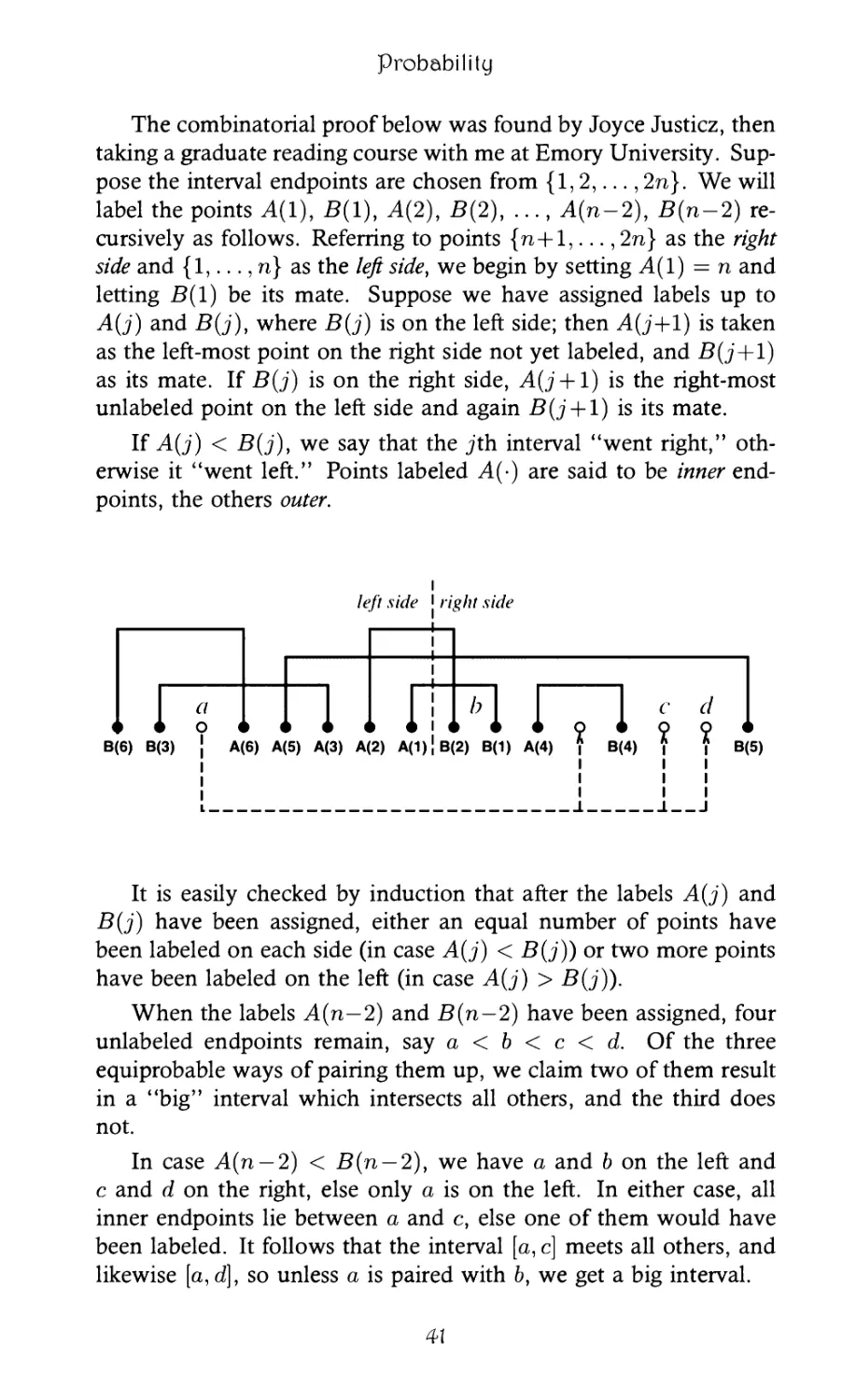
The points 1,2,..., 1000 on the number line are paired up at
random, to form 500 intervals. What is the probability that among
these intervals is one which intersects all the others?
1
1
1
1 2 3 4 5 6 7 8 9 10 11 12 13 14 15 16 17 18 19 20
Eolations and Comments
Lost ©oarding pass
We merely need to observe that when the 100th passenger finally
boards, the seat remaining will be either the one assigned to him
(or her) or the one assigned to the first passenger. Every other seat
has been taken either by its rightful owner or by someone else who
got there first.
Since there has been no preference exhibited at any stage toward
one or the other of those two seats, the probability that the 100th
passenger gets his own seat is 50%. V
The reasoning here is the same as that used, say, to compute
the odds at craps. After you've rolled a "point" D, 5, 6, 8, 9,
36

Probability
or 10), you keep rolling until you get a 7 or another roll of your
point. To compute the probability of winning (getting your point),
you may assume that your next roll is the last one, and reckon
accordingly. For example, if your point is 5, you win 4 times in
10 (because there are 4 ways to roll a 5 and 6 ways to roll a 7).
In the case of the lost boarding pass, one of the first 99 passengers
will eventually find his way either to Pi's seat or to Pioo's seat, and
here, given that one or the other was chosen, they are equally likely.
Source: Word-of-mouth. In this case, I heard the problem at the Gathering
for Gardner V; Ander Holroyd supplied the version seen here.
Rolling flll the Numbers
This classic puzzle illustrates two important principles: mean
waiting time and addition of expectations. Suppose you are
repeating an experiment whose probability of success is p\ how long do
you have to wait, on average, to succeed? You can compute this
value as a sum
n=l
but this is not very satisfactory from the point of view of intuition.
Better is to imagine that the experiment is repeated n times for n so
large that the fraction of successes is as close as you like to p (law
of large numbers). You can think of these n trials as pn separate
series of experiments, each ending in a success; their average length
is n/(np) = I/p.
The puzzle calls for rolling all six numbers, and the key is to
break up this process into six stages. The mean time it takes to
complete all the stages is then the sum of the individual mean times
of the stages. Here, you know that if you keep track of the number
of different numbers you have seen, that this value begins at 1 (after
the first roll) and rises a step at a time until it hits 6. We define
"stage k" to be the period during which we have seen k—1 different
numbers and are waiting to see the fcth.
The probability of success during stage k is just the number of
numbers we haven't seen, namely n — (k — 1), divided by 6; thus,
the mean length of stage k is 6/(n—fc+1). It follows that the mean
time for the whole process is
6 6 6 6 6 6 ^AP7
+ + + + + 147
37

Mathematical
It is perhaps worth noting that it would be a quite different
experiment to roll six dice at a time, waiting for all different numbers
to appear on one such multiple roll. The probability of success there
is 6 • 5 • 4 • 3 • 2 • 1/66 (see, e.g., the last problem of the previous
chapter), which is about 0.0154321, so that the mean waiting time
here is a huge 64.8 trials, even though you're rolling six dice in one
trial!
Odd Streak of Heads
This puzzle was suggested, but not used, for an IMO in the early
'80s (see Murray Klamkin's International Mathematical Olympiads
1979-1985, Mathematical Association of America, 1986). It makes a
nice mate to the previous puzzle, but requires a little more thinking.
If we compute the probability that we will start right out
flipping an odd number of heads followed by a tail, we get Pr(HT) +
Ft(HHHT)+Ft(HHHHHT) + ... = (±J + (±L + (±N + ... = §.
If we fail, it means we've hit a tail (after an even number of heads)
and we have to start again. Thus, it will take three such experiments
on average. But we want to count flips, not experiments.
Luckily, we can take advantage of another fact about
expectations: If we have a random number n of items whose average size is
5, then the average total size of the items is s times the average value
of n. Each of our experiments (successful or not) ends when the
first tail is flipped, so the average number of flips per experiment is
1/| = 2. It follows that the solution to the puzzle is 2- 3 = 6 flips.9
However, there's another, nicer way to tackle this particular
puzzle. Suppose x is the answer. If we begin with T or HH, we
still face an average of x more flips before success; if we begin with
HT, we've already succeeded. Thus,
s=-.(l + aO + -.B + aO + -.2,
which gives us x = 6.
Three ©iee
This bet is, in fact, available in some casinos; in America it is
called Chuck-a-Luck or Bird Cage (the dice are typically rolled in
a cage). One might reasonably argue that this fact in itself is a
calculation-free proof that the bet favors the house.
38

Probability
But there is a rather nice mathematical way to see this, which
can be applied to other gambling games as well. Imagine that six
players each bet $1 on a different number, then the dice are rolled.
The house never loses! If three different numbers are rolled, the
house just turns over the losers' $3 to the winners. Otherwise, the
house collects $4 or $5 while paying out only $3. 9
So the game is in the house's favor if players bet this way, but
does that mean it's always in the house's favor? Yes, it does—a bet
favors the house or not independent of who bets and how much.
It is not, of course, difficult to determine directly that Chuck-a-
Luck is a losing proposition. The probability of getting three
different numbers from the dice is 6 • 5 • 4/63 = 5/9, and the bettor breaks
even on those since the probability of his number's being one of
them is 1/2. With probability 1/36, all three dice have the same
number; here the bettor wins $3 with probability 1/6 and loses his
$1 the rest of the time, for an average loss of $1/3. Finally, the
remaining 5/12 of the time, the bettor wins $2 with probability 1/6,
wins $1 with probability 1/6, and loses his $1 with probability 2/3,
for an average loss of $1/6. Altogether this leaves him down by
1/36 • 1/3 + 5/12 • 1/6 = 17/216 dollars, or about 8 cents per dollar
bet.
The game can be made fair easily enough, by awarding the
bettor $3 instead of $2 when he hits twice and $5 instead of $3 when
he hits on all three dice.
This puzzle appeared in Sam Loyd's Cyclopedia of 5000 Puzzles,
Tricks, and Conundrums, edited by Sam Loyd II, 1914. Sam Loyd
(senior), 1841 to 1911, will be well known to most readers as a
consummate showman and America's greatest puzzlist ever.
Magnetic ©ollars
Most people guess that the urn with fewer susans will be worth
very little indeed, and in fact, at a restaurant table full of professional
mathematicians recently, only one was willing to offer $100 and no
one else would go higher than $10.
In fact, that urn is worth, on average, a cool quarter of a million
dollars. The probability distribution of final contents for the two
urns is exactly uniform: The probability that the first urn (say) will
end up with just the one susan is the same as the probability that it
will end up with 451,382 susans.
39

Mathematical
It is easy to prove this by induction, but I have found the
following card-shuffling analogy to be more satisfying. Imagine a deck of
999,999 cards, just one of which is red. We will shuffle it perfectly
as follows. Put the red card down on the table. Now take the next
card (any card) and slip it with equal probability above or below
the red card. The next card has three possible slots; choose one
with equal probability and insert. When the last card is inserted,
we have a perfectly random deck on the table.
But note: When there are x — 1 cards above the red card, and
y — 1 below, the next card goes above with probability x/(x + y).
Thus, the cards above the red card function as susans (apart from
the initial one) in the first urn, and the cards below, in the second
urn.
Since in the final deck the red card is equally likely to be at any
height, the uniformity of distribution for the susans follows. 9
The puzzle (paradox?) of the Magnetic Dollars is sometimes
called "Polya's Urn" after the late, great mathematician and puzzle
enthusiast George Polya. (See, e.g., N. Johnson and S. Kotz, Urn
Models and Their Applications: An Approach to Modern Discrete
Probability Theory, Wiley, New York, 1977.) It is not hard to establish
that if infinitely many susans are tossed, then with probability 1,
the proportion of susans that fall in the first urn will approach a
limit, drawn uniformly from the unit interval.
Bidding in the ^ark
You should not bid. If you do bid $x, then the expected value
to the widget's owner, given that he sells, is %x/2\ thus, its expected
value to you, if you get it, is 1.8 • $x/2 = $0.9x. Thus you lose
money on average if you win, and of course, you gain or lose
nothing when you do not, so it is foolish to bet. 9
Source: Maya Bar Hillel, University of Jerusalem.
'Random Intervals
This problem has a curious history. A colleague (Ed Scheiner-
man of Johns Hopkins University) and I needed to know the answer
in order to compute the diameter of a random interval graph, and
we at first computed an asymptotic value of 2/3. Later, using a
lot of messy integrating, we found that the probability of finding an
interval which intersects all others is exactly 2/3, for any number of
intervals (from 2 on up).

probability
The combinatorial proof below was found by Joyce Justicz, then
taking a graduate reading course with me at Emory University.
Suppose the interval endpoints are chosen from {1,2,..., 2n}. We will
label the points A(l), B{1), AB), ?B), ..., A(n-2), B{n-2)
recursively as follows. Referring to points {n+1,..., 2n} as the right
side and {1,..., n} as the left side, we begin by setting A{\) — n and
letting B{\) be its mate. Suppose we have assigned labels up to
A(j) and B(j), where B(j) is on the left side; then A(j+1) is taken
as the left-most point on the right side not yet labeled, and B(j+1)
as its mate. If B(j) is on the right side, A(j + 1) is the right-most
unlabeled point on the left side and again B(j + 1) is its mate.
If A(j) < B(j), we say that the jth interval "went right/'
otherwise it "went left." Points labeled A(-) are said to be inner end-
points, the others outer.
BF) BC)
a
?
left side j right side
AF) AE) AC) AB)
m
AD)
BD)
C
BE)
It is easily checked by induction that after the labels A(j) and
B(j) have been assigned, either an equal number of points have
been labeled on each side (in case A(j) < B(j)) or two more points
have been labeled on the left (in case A(j) > B(j)).
When the labels A(n—2) and B(n—2) have been assigned, four
unlabeled endpoints remain, say a < b < c < d. Of the three
equiprobable ways of pairing them up, we claim two of them result
in a "big" interval which intersects all others, and the third does
not.
In case A(n — 2) < B{n — 2)y we have a and b on the left and
c and d on the right, else only a is on the left. In either case, all
inner endpoints lie between a and c, else one of them would have
been labeled. It follows that the interval [a, c] meets all others, and
likewise [a, d], so unless a is paired with 6, we get a big interval.

Mathematical
Suppose on the other hand that the pairing is indeed [a, b] and
[c,d]. Neither of these can qualify as a big interval since they do
not intersect each other; suppose some other interval qualifies, say
[e,/], labeled by A(j) and B(j).
When a and b are on the left, the inner endpoint A(j) lies
between b and c, thus [e, /] cannot intersect both [a, b] and [c, d],
contradicting our assumption.
In the opposite case, since [e,/] meets [c,d], / is an outer end-
point (so / = B(j)) and [e, /] went right; since the last labeled pair
went left, there is some k > j for which [A(k), B(k)] went left, but
[A(k-1), B(k-1)] went right. Then A(k) < n, but A(k) < A(j) since
A(k) is a later-labeled, left-side inner point. But then [A(j),B(j)]
does not, after all, intersect [B(k),A(k)], and this final
contradiction proves the result. 9
With slightly more care one can use this argument to show that
for k < n, the probability that in a family of n random intervals
there are at least k which intersect all others is
2k
V k )
independent, again, of n. The "binomial coefficient" (™) stands for
the number of subsets of size k from a set of size n, and is equal to
n(n-l)(n-2) • • • (n-Jfe+l)/Jfe((Jb-l)(Jb-2) • • • 1.

Equations are just the boring part of mathematics. I attempt to see
things in terms of geometry.
—Stephen Hawking A942-)
Classical geometry in two or three dimensions is a bottomless well
for problem composers, but to be a puzzle, we ask that it not be
something Euclid would have included in his Volume II. Hence, you
won't be asked here to show AB=CD or this triangle is congruent
to that one.
Fortunately there is still a great variety of fascinating geometry
puzzles from which to choose.
Our practice problem showed up in 1980 on the Preliminary
Scholastic Aptitude Exam, but, to the embarrassment of the
Educational Testing Service, the answer they marked as correct was
wrong. A confident student called the ETS to task when his exam
was returned to him. Luckily for us, the correct answer boasts a
marvelous, intuitive proof. (Note: Subsequently the ETS created a
panel, on which your author served, for reviewing the questions on
their mathematics aptitude tests.)
Gluing pyramids
A solid square-base pyramid, with all edges of unit length, and a
solid triangle-base pyramid (tetrahedron), also with all edges of unit
length, are glued together by matching two triangular faces.
How many faces does the resulting solid have?
Solution: The square-base pyramid has five faces and the
tetrahedron four. Since the two glued triangular faces disappear, the
resulting solid has 7 = 5+4 — 2 faces—right? This, apparently, was
the intended line of reasoning. It may have occurred to the
composer that in theory, some pair of faces, one from each pyramid,
could in the gluing process become adjacent and coplanar. They
would thus become a single face and further reduce the count. But,
43

Mathematical puzzles
surely, such a coincidence can be ruled out. After all, the two solids
are not even the same shape.
In fact, this does happen (twice): The glued polyhedron has only
five faces.
You can see this in your own head. Imagine two square-based
pyramids, sitting side-by-side on a table with their square faces down
and abutting. Now, draw a mental line between the two apexes;
observe that its length is one unit, the same as the lengths of all the
pyramid edges.
Thus, between the two square-based pyramids, we have in
effect constructed a regular tetrahedron. The two planes, each of
which contains a triangular face from each square-based pyramid,
also contain a side of the tetrahedron; the result follows. 9
(Check the figure below if you find this hard to visualize.)
This argument, sometimes called the "pup tent" solution,
appeared in a 1982 article by Steven Young, "The Mental
Representation of Geometrical Knowledge," in the Journal of Mathematical
Behavior.
One of the puzzles below has a "no-word proof—a picture
suffices. See if you can guess which one.
Circles in
Can 3-space be partitioned into circles?
Magic with
Can you pass a cube through a hole in a smaller cube?
44

Points and ©lusz points
Given n red points and n blue points on the plane, no three on
a line, prove that there is a matching between them so that line
segments from each red point to its corresponding blue point do
not cross.
through Two points
Suppose X is a finite set of points on the plane, not all on one line.
Prove that there is a line passing through exactly two points of X.
pairs at Maximum ©istanesz:
Again, X is a finite set of points on the plane. Suppose X contains
n points and the maximum distance between any two of them is d.
Prove that at most n pairs of points of X are at distance d.
Monk on a Mountain
A monk begins an ascent of Mt. Fuji on Monday morning,
reaching the summit by nightfall. He spends the night at the summit
and starts down the mountain the following morning, reaching the
bottom by dusk on Tuesday.
Prove that at some precise time of day, the monk was at exactly
the same altitude on Tuesday as he was on Monday.
painting the polyhedron
Let P be a polytope with red and green faces such that every red
face is surrounded by green ones, but the total red area exceeds the
total green area. Prove that you can't inscribe a sphere in P.
Circular Shadows
The projections of a solid body onto two planes are perfect disks.
Prove that they have the same radius.
45

Mathematical puzzles
Strips in the plane
A "strip" is the region between two parallel lines on the plane.
Prove that you cannot cover all of the plane with a set of strips the
sum of whose widths is finite.
diamonds in a fiexagon
A large regular hexagon is cut out of a triangular grid and tiled
with diamonds (pairs of triangles glued together along an edge).
Diamonds come in three varieties, depending on orientation; prove
that precisely the same number of each variety must appear in the
tiling.
o
"Rhombus Tiling
Let's do this one again, but with bigger tiles and more sides.
Form B) different rhombi from the pairs of nonparallel sides
of a regular 2n-gon, then tile the 2n-gon with translations of the
rhombi. Prove you use each different rhombus exactly once!
Victors on a polyhedron
To each face of a polytope we associate an out-pointing vector
perpendicular to that face, with length equal to the area of the face.
Prove that the sum of these vectors is zero.
Three Circles
The "focus" of two circles is the intersection of two lines, each of
which is tangent to both circles, but does not pass between them.
46

Thus three circles of different radii (but none contained in another)
determine three foci. Prove that the three foci lie on a line.
§phere and Quadrilateral
A quadrilateral in space has all of its edges tangent to a sphere.
Prove that the four points of tangency lie on a plane.
The last puzzle is an excursion into topology, and different sizes
of infinity.
figure Ss in the plane
How many disjoint topological "figure 8s" can be drawn on the
plane?
Solutions and Comments
Circles in p
Yes. Place a circle of radius 1 on the XY plane, centered at
each 1 mod 4 point on the X-axis (that is, ..., (-7,0), (-3,0), A,0),
47

Mathematical puzzles
E,0), (9,0) ...). Observe that every sphere centered at the origin
hits the union of these circles at precisely two points. The rest of
each of these spheres is the union of circles. 9
There are other ways to do this, e.g., involving tori, but nothing
I know of approaches the above in elegance and simplicity.
I first heard this cute dissection puzzle from Nick Pippenger,
Professor of Computer Science at Princeton University.
Magie With Cubps
You can do it. To pass a unit cube through a hole in a second
unit cube, it suffices to identify a cross section of the (second) cube
which contains a unit square in its interior. A square cylindrical hole
of side slightly more than 1 can then be made in the second cube,
leaving room through which to pass the first cube.
You can then do the same, with even smaller tolerances, if the
second cube is just a bit smaller than a unit cube.
The easiest (but not the only) cross section you can try this with
is the regular hexagon you get by slicing through three vertices and
the centroid. You can see this hexagon by viewing the cube so that
one of its vertices is in the center.
Letting A be the projection of one of the visible faces onto the
plane, we observe that its long diagonal is the same length (\/2) as a
unit square's, since that line has not been foreshortened. If we slide
48

a copy of A over to the center of the hexagon, then widen it to form
a unit square B, B's widened corners will not reach the vertices of
the hexagon (since the distance between opposing vertices of the
hexagon exceeds the distance between opposing sides).
It follows that if we now tilt B slightly, all four of its corners
will lie strictly inside the hexagon. 9
I was reminded of this charming puzzle, which has appeared in
a Martin Gardner column, by Gregory Galperin of Eastern Illinois
University.
Points and Blue points
Among all matchings, take one which minimizes the total length
of the n connecting line segments; we claim this cannot have any
crossings. For, if the segment uv crosses xyf then these two
segments are the diagonals of the convex quadrilateral uyxv and, using
the triangle inequality, we see that using the sides uy and xv would
have reduced the total length. 9
The general technique used here, finding a object with specific
properties by looking for something that minimizes or maximizes
some parameter, is sometimes called the variational method and is,

Mathematical
as many readers will know, extremely useful. The next puzzle
provides another example.
Source: Problem A-4 of the 1979 Putnam Exam.
Isin? through Two Points
This famous puzzle was a conjecture of Sylvester dating back
to 1893. It was first proved by Tibor Gallai, but the proof below,
found in 1948 by L. M. Kelly {American Mathematical Monthly, Vol.
55), was often cited by Paul Erdfls as an example of a "book proof."
Assume that every line through two or more points in X in fact
contains at least three points of X. The idea is to find such a line
L, and a point P not on L, such that the distance from P to L is
minimized.
Since L contains at least three points of X, two of them, say Q
and R, lie on the same side of the perpendicular to L from P. But
then, if R is the farther one, the point Q is closer to the line through
P and R than P is to L—contradiction. 9
Pairs at Maximum ©istane?
To solve this puzzle, from the 1957 Putnam Exam, it's useful to
observe that if A, B and C, D dire two "max pairs" (pairs of points
from X at distance d), then the line segments AB and CD must
cross (else one of the diagonals of the quadrilateral ABDC would
exceed d in length).
50

Now assume the statement of the puzzle is false, and let n be
the size of a smallest counterexample. Since there are more than
n max pairs and each has two points, there must be a point P
which participates in three max pairs (say, with points A, B, and
C). Every two of the segments PA, PB, and PC must make at
most a 60° angle at P, and one of them, say B, must lie between
the others.
But this makes it pretty tough for B to be in any other max pair,
since if BQ were a max pair, it would have to intersect both PA and
PC—an impossibility. Thus we can drop B out of X altogether,
losing only one max pair and obtaining a smaller counterexample.
This contradiction completes the proof. 9
Monk on a Mountain
Perhaps the easiest way to see this is to imagine that the monk
has a twin who is instructed to climb the mountain on Tuesday
exactly as the monk himself climbed it on Monday. The monk must
pass his twin on the way down on Tuesday, or, if they are not on the
same path, must at some point be at the same altitude as his twin.9
(Perhaps you found this puzzle too easy; fear not, a much more
challenging version awaits you in Chapter 11—Toughies.)
This ancient puzzle can be viewed as an application of the very
useful Intermediate Value Theorem, which says that a continuous
function must pass through all intermediate values. The function
in this case can be taken to be the difference between the monk's
altitude at a particular time of day on Monday, and the same time
on Tuesday; that function begins negative (at about minus the height
of Mt. Fuji) and ends positive, so must at some point have been
zero.
Geometrically speaking, you can imagine that the monk's
altitude for each day is plotted on a graph, and the two graphs are
superimposed. There must be a place (or places) where they cross.
Other famous applications of the Intermediate Value Theorem
include inscribing Lake Michigan in a square, and cutting a ham
sandwich (with a planar slice) so that the bread, ham, and cheese
are all exactly bisected.
5\

Mathematical puzzles
Painting thjz. polyhedron
Assume the sphere is inscribed, and triangulate the faces of P
using the points where the sphere is tangent. Then the triangles on
either side of any edge of P are congruent, thus have the same area;
at most, one of every such pair of triangles is red. It follows that
the red area is at most equal to the green area, contradicting our
assumptions. V
This puzzle came my way from Emina Soljanin of Bell Labs.
The illustration shows a two-dimensional version, where sides and
vertices of a polygon take the place of faces and edges of P.
Circular Shadows
This potentially frustrating conundrum comes from the 5th All
Soviet Union Mathematical Competition, Riga, 1971. An easy way
to make your intuition rigorous is to select a plane which is
simultaneously perpendicular to the two projection planes, and move
parallel copies of it toward the body from each side. They hit the
body at the opposite edges of each projection, so that the distance
between the parallel planes at that moment is the common diameter
of the two projected circles. 9
Strips in the plane
Like the previous problem, this one, a version of which appeared
on an early Putnam Exam, presents another "intuitively obvious"
fact for you to prove.
Since it's hard to compare infinite volumes, it makes sense to
focus on some finite part of the plane. We can't control the relative
angles of the strips, so it is logical to look at a disk D of radius r.

Assume the strips have widths wi, w2, ... which sum to 1;
it turns out that they can't even cover D in the r = 1 case. The
intersection of D with strip of width w is contained in a rectangle
of width w and length 2, and therefore has area less than 2w. Thus,
the total area inside D covered by the strips is less than 2, but the
area of D is of course n > 2. 9
This argument shows that you need the widths of the strips to
sum to more than tt/2 to cover the unit disk, but in fact you can't
do it unless the sum is at least 2 (in which case parallel strips will
do the job). There is quite a lovely proof of this fact: The idea is
to extend the puzzle into 3-space by taking D to be a cross section
through the center of a unit ball. Suppose the disk is covered by
strips of total width W, and let S be one of the strips, of width,
say, w. We may assume that either both edges of the strip cross
D or one crosses and the other is tangent. Projecting 5 upward
and downward to the surface of the ball, we get a belt (or cap)
encircling the ball—whose area, one can show using calculus, is
2nw independent of the position of the strip!
Since the total surface area of the ball is 4?r, you need W > 2
to cover it, and if you aren't covering the surface of the ball, you
aren't covering the disk.
©iaroonds in a
53

Mathematical puzzles
Proofs without words have become a regular feature in two
Mathematical Association of America journals, Mathematics Magazine and
The College Mathematics Journal. You can can find these reprinted
in the books, Proojs Without Words and Proojs Without Words II, by
Roger B. Nelsen, published by the MAA. Diamonds in a Hexagon
appears in the first volume as "The Problem of the Calissons."
'Rhombus Tiling
Let u be one of the sides of the 2n-gon; a ix-rhombus is any of
the n — 1 rhombi using u as one of its two vectors. In a tiling, the
tile next to a w-side must be a w-rhombus, as must the tile on the
other side of that one, and so forth until we reach the opposite side
of the 2n-gon. Notice that each step of this path proceeds in the
same direction (that is, right or left) with respect to the vector uy as
must any other path of ix-rhombi; but then there can be no other
u-rhombi, since they would generate paths with no way to close
and nowhere to go.
The similarly defined path for a different side v must cross the
u, and the shared tile is of course made up of u and v. Can they
cross twice? No, because a second crossing would have u and v
meeting at an angle greater than n inside the common rhombus. <n?
This puzzle reached me from Dana Randall of Georgia Tech.
54

Geometry
Victors on a Polyhedron
This puzzle was brought to my attention by Yuval Peres of the
Department of Statistics at UC Berkeley. The easiest way to see that
the vectors must sum to zero is to perform the following gedanken-
experiment: Pump air into the (rigid) polytope, and observe that the
pressure on a face is a force acting in the direction of the normal
and of magnitude proportional to the area. These pressures must
balance, otherwise the polytope would move of its own accord! ^
Thr^ Circles
This is the best example I know of the effectiveness of moving
a puzzle up in dimension. Replace each circle by a sphere whose
intersection with the plane is the given circle; now each pair of
spheres determines a cone, and the apexes of these three cones are
the three points in question.
But these apexes all lie on the plane which is tangent to the
spheres from above; and similarly, on the plane tangent to the
spheres from below. Hence, they lie on the intersection of these
two planes: a line! 9
This seems to be an ancient, classical puzzle. I heard it first
from Dana Randall, of the College of Computing at Georgia Tech.
Vadim Zharnitsky, of the University of Illinois, has observed that
you can ask a similar question about four spheres in 3-space: Do
the apexes of the six cones they determine lie on a plane? In fact,
they do, and one way to prove it is to lift once more, to the fourth
dimension.
Sphere and Quadrilateral
This puzzle was obtained from Tanya Khovanova, a Visiting
Research Staff Member in the Program in Applied and Computational
Mathematics at Princeton University. She keeps a list of what she
calls "coffin" problems. In her words:
The Mathematics Department of Moscow State
University, the most prestigious mathematics school in Russia, had
at that time [1975] been actively trying to keep Jewish students
(and other "undesirables") from being able to enroll at the
Department. One of the methods they used for doing this was
giving the unwanted students a different set of problems on the
oral exam. These problems were carefully designed to have
55

Mathematical
an elementary solution (so that the Department could avoid
scandals) that was nearly impossible to find. Any student that
failed to answer could be easily rejected, so this system was
an effective method of controlling admissions. These kinds of
problems were informally referred to as "coffins."
The following solution would indeed be tough to find, but
perhaps not impossible if you appreciate that a nice way to prove four
points are coplanar is to find a point which is on lines through
disjoint pairs of the four points. Start by observing that each vertex i
of the quadrilateral is at the same distance di from each of the two
points of tangency of its incident edges. Attribute a mass 1/di to
vertex i; then the center of mass for any two adjacent vertices is the
point of tangency of their common edge. It follows that the
center of mass of all four vertices lies on the line connecting opposite
points of tangency, so this point does the trick. 9
f igure 8s in the plane
This puzzle has been around for 50 years or so; I once heard it
attributed to the late, great topologist R. L. Moore of the University
of Texas. Readers unfamiliar with differing degrees of "infinity" will
already have been confused; clearly, you can draw infinitely many
disjoint figure 8s on the plane, for instance, by placing a small one
inside each box of a square grid. Such a collection is said to be
"countable," meaning that one could number the 8s with positive
integers in such a way that each 8 gets a different number.
The set of all integers, the set of all pairs of integers, and thus
the set of all rational numbers, are all countable, but as the brilliant
(but frequently depressed) mathematician Georg Cantor observed
in 1878, the set of all real numbers is not countable. We could
draw concentric circles on the plane with all possible positive real
diameters, hence if the puzzle asked for circles instead of figure 8s,
the answer would be "uncountably many," or more precisely, "the
cardinality of the reals."
However, we can only draw countably many 8s. Associate with
each 8 a pair of rational points (points of the plane with both
coordinates rational numbers), one in each loop; no two figure 8s can
share a pair of points. Hence, the cardinality of our set of 8s is no
greater than the set of pairs of pairs of rational numbers, which is
countable. 9
See Chapter 11 (Toughies) for a trickier version of this puzzle.
56

Geography®
Without geography you're nowhere.
—Jimmy Buffett A946-)
OK, this chapter does not belong in the book. Some of the puzzles
are mathematical in nature, to be sure, but really they are here
because mathematical puzzle lovers seem to enjoy them. My publisher
has assured me that the book's price would be the same without this
chapter, so it's free and you can skip it with a clear conscience.
The basis for the puzzles is the surface of planet Earth. There is
a heavy bias, however, toward my own country, the United States;
readers from other countries, please forgive me. I will be
grateful for similar puzzles, related to other countries, sent to me at
pw@akpeters .com.
Several of the puzzles test the degree to which planar projections
have distorted our understanding of the globe. Here's a sample:
Oat o
Which is the closest US state to Africa?
Solution: Maine. 9
It's not even close; check a globe. If you fly the great circle from
Miami to (say) Casablanca, you'll start off going NE up the eastern
seaboard, not missing Maine by much.
You're on your own now.
Cast of
What's the biggest city in the US east of Reno, Nevada and west
of Denver, Colorado?
57

Mathematical
Thsz phonsz Call
A phone call is made from an East Coast state to a West Coast
state, and it's the same time of day at both ends. How can this be?
of
Which two states contain the most distant pair of points in the
United States?
§outh from
If you fly due south out of Key West, Florida, which South
American country will you hit first?
Indians in th? Midwest
Which is the only Midwestern US state whose name is not of Native
American origin?
Largest §?eond~lsarg?st City
Which is the largest city in the US which is not the largest city in
the US of its name?
OK, maybe that's a little confusing. Let's put it another way:
Say that a (US) city is "eclipsed" if there's a larger one with the
same name; for example, Portland, Maine is eclipsed (by Portland,
Oregon). What we're asking for is the largest eclipsed city.
Th? Natural ©ord^r
Some parts of state borders are natural (determined by bodies of
water, mountains, etc.) while others are legislated lines—in one
famous case (involving Delaware and Pennsylvania), an arc of a
circle. Three states—Colorado, Utah, and Wyoming—have only
artificial borders. Which state has only natural borders?
58

Geography (!)
Th? Gnerossablsz ©ord^r
Speaking of state borders, can you find one which cannot be crossed
by car? In other words, find two states which share a border, yet
you cannot pass directly from one to the other in your automobile.
of Odd
What distinction is held by the point of land called West Quoddy
Head, Maine?
Urban and Rural
Here's a more sociological puzzle. These days most Americans—
over 75%—live in a "metropolitan area." The 2000 census lists
100% of the population of one state as metropolitan, but only 27.6%
(the least) of another only a few hundred miles away. Can you guess
these two states?
Cities North and §outh
How's your visualization of the continents? Put these four cities in
order, South to North: Halifax, Nova Scotia; Tokyo, Japan; Venice,
Italy; Algiers, Algeria.
Th? On?~<kjllabl? City
What's the largest city in the U.S. with a one-syllable name?
Washington^ and feminists
Here's a test of your mental map of the continental US. Can you
design an automobile trip in the US, beginning in Seattle,
Washington and ending in Washington, DC, which enters only states whose
names begin with one of the letters in the word WOMAN?
Our final geography puzzle signals a (slight) return to
mathematics.
59

Mathematical
Th? Naturalist and th?
A naturalist left her camp, hiked 10 miles south, and then 10 miles
east, where she spotted and photographed a bear. She then hiked
10 miles north and was back at her camp.
You haven't got the photograph, but you still know what color
the bear was, right?
Solutions and Comments
Solutions to these puzzles can be verified with an atlas, globe,
almanac, or the 2000 US Census Report. Let's see how well you
guessed...
east of Reno
"Biggest city" questions can be awkward; the standard is to
measure by population (not area!) within the legal city limits, which of
course can be misleading with respect to metropolitan areas. For
example, the almanac figures make Jacksonville, Florida appear to
be larger than Atlanta, Georgia even though metro area population
of the latter is almost four times greater.
However, there is no such subtlety needed here. The biggest city
east of Reno and west of Denver is, by any measure, Los Angeles,
California.
The Phone Call
"East Coast" states run from Maine down to Florida. "West
Coast" certainly includes Washington, Oregon and California, to
which you can add Alaska and even Hawaii if you wish—but it
doesn't help.
Within the continental US, such a phone call would normally
face a three-hour time difference. We can eliminate one of those
hours by calling from the western portion of the Florida panhandle
(say, Pensacola), which lies in the Central Time Zone; and another
by calling from one of several towns in far eastern Oregon (say,
Ontario) which observes Mountain Time.
The last hour disappears if we carefully call between 2 and 3
hours after midnight in Pensacola, on the morning when Daylight
60

Geography (!)
Saving Time ends in late October. Central Time will have been
retarded by an hour at that point, but Mountain Time not yet affected.
Th? ©iamptpr of the Q§
Obviously, it's either Hawaii and Maine, or Alaska and Florida.
Or is it Hawaii and Alaska?
Amazingly, it's none of the above: The correct answer is Hawaii
and Florida. The great circle strikes again! 9
§outh from fey W^st
This is, of course, a trick question. You won't hit any country
in South America; you will pass west of the entire continent. 9
Indians in the Midwest
With a liberal definition of ' 'Midwestern state" you might
include Minnesota, Wisconsin, Iowa, Illinois, Missouri, Michigan,
Ohio, Kansas, and Nebraska—all with names of Native American
origin—and the answer, Indiana! V
Curiously, only one state east of the Mississippi has a capital
whose name is of Native American origin—Florida (Tallahassee).
Th? Largest §?eond~Isarg?st City
Portland, Maine? Springfield, Something? Popular guesses, but
not correct. Before 1975 or so, the right answer would have been
Kansas City, Kansas, eclipsed of course by Kansas City, Missouri.
Then for a while the winner was Columbus, Georgia, eclipsed by
the capital of Ohio. However, we are in the age of suburbia, and the
2000 census shows that Glendale, California (eclipsed by Glendale,
Arizona) now owns this obscure honor. 9
Th? Natural Border
Hawaii, of course, has all natural borders. Perhaps you thought
this was too easy, but folks often have a blind spot. 9

Mathematical
The Unerossable Border
Much harder. Michigan (upper peninsula) and Minnesota share
a border in Lake Superior, not crossed by any car ferry. The not-
very-well-known border between New York and Rhode Island is
nearly as good a solution, but can be crossed en route from New
London, CT to Block Island, RI in a summer-only ferry. 9
A related question asks for a piece of a state which is accessible
by car from the rest of the state only by passing through another
state (or Canada, as in the case of Point Roberts, WA). There are a
number of such places, especially near the ever-changing Mississippi
River.
©ep&rtroent of Odd
West Quoddy Head is the easternmost point of the continental
US. 9
You will sometimes hear it said that Cape Wrangell, on Attu
Island in Alaska, is the winner if you drop the word "continental,"
but I don't buy that Greenwich-centered reasoning. Would you call
Cape Wrangell the easternmost point of Alaska?
Qrban and "Rural
New Jersey and Vermont. For this and lots of other
interesting tidbits, you might want to check http://www.census.gov/prod/
2002pubs/01statab/pop.pdf. 9
Cities North and South
Tokyo, Algiers, Halifax and finally Venice. The latitudes are,
respectively, 35°40'N; 36°50'N; 44°53/N; and 45°26'N Notice that
the 45th parallel separates the last two, making it easy to see that
Venice is the more northerly. I won $1 from a Nova Scotian with
this one once. 9
The One-Syllable Citg
York, Pennsylvania and Troy, New York are frequent (and good)
guesses but Flint, Michigan, despite substantial loss of population,
remains the only one-syllable city in the US with a population of
62

Geography (!)
more than 100,000. However, if you go by local pronunciation, the
winner is, arguably, Newark ("Noork"), New Jersey! 9
Washingtons and Feminists
No problem. Drive South through Oregon, Nevada and
Arizona, east through New Mexico, into the Oklahoma panhandle,
and out the NE corner of Oklahoma into Missouri. Here, you
must turn north and exit the NW corner of the state into Nebraska,
continuing west into Wyoming and north into Montana—a long
trip just to avoid Idaho. Finally, you can turn east again through
North Dakota, Minnesota, Wisconsin, and Michigan. Now south
into Ohio and east through West Virginia into Maryland, and on
into Washington, DC. 9
You'll have to leave the interstate highway system several times
(or for a long period) to actually drive this tour, but presumably
you're not in a rush.
Th? Naturalist and the B^ar
The original idea was, of course, that the naturalist's camp must
have been at the North Pole for her path A0 miles south, 10 miles
east, then 10 miles north) to have been a closed loop; thus, the bear
was white (a polar bear). However, as pointed out by Sol Golomb
in one of Martin Gardner's columns, there are infinitely many other
points on the globe where such a path would close.
Some of these points lie on a circle slightly less than 10 + 5/?r
miles in radius about the South Pole, from which the first leg of the
hike would take the naturalist to a point P a hair less than 5/tt miles
from the South Pole. The trek 10 miles east will carry her all the
way around the world and back to P, from which her northward
leg will of course take her back to camp.
Another circle a bit less than 10 + 5/2tt miles in radius will also
work, the naturalist encircling the pole twice during her eastern leg,
and so on.
There are no bears in Antarctica, and if there were, they would
probably be white, so the answer to the puzzle is unchanged. 9
63

Money was never a big motivation for me, except as a way to keep
score. The real excitement is playing the game.
—Donald Trump A946-), "Trump: Art of the Deal"
Sometimes a marvelous puzzle arises from the description of a
game. Is the game fair? What's the best strategy? An odd
(actually, even) feature of the puzzles in this chapter is that each has
two versions, with entertaining contrasts between the two. There
are four pairs of games: The first involves numbers, the second hats,
the third cards, and the fourth gladiators.
We begin with a classic game which makes a great example in
a class on randomized algorithms (and indeed, was used that way
by Manuel Blum, now a professor at Carnegie Mellon University).
Comparing Numbers, Version I
Paula (the perpetrator) takes two slips of paper and writes an integer
on each. There are no restrictions on the two numbers except that
they must be different. She then conceals one slip in each hand.
Victor (the victim) chooses one of Paula's hands, which Paula
then opens, allowing Victor to see the number on that slip. Victor
must now guess whether that number is the larger or the smaller of
Paula's two numbers; if he guesses right, he wins $1, otherwise he
loses $1.
Clearly, Victor can achieve equity in this game, for example, by
flipping a coin to decide whether to guess "larger" or "smaller."
The question is: Not knowing anything about Paula's psychology,
is there any way he can do better than break even?
Comparing Numbers, Version II
Now let's make things much easier for Victor: Instead of being
chosen by Paula, the numbers are chosen independently at random
65

Mathematical
from the uniform distribution on [0,1] (two outputs from a standard
random number generator will do fine).
To compensate Paula, we allow her to examine the two random
numbers and to decide which one Victor will see. Again, Victor
must decide whether the number he sees is the larger or smaller of
the two, with $1 at stake. Can he do better than break even? What
are his and Paula's best (i.e., "equilibrium") strategies?
and ©lu? flats, Version I
Each member of a team of n players is to be fitted with a red or
blue hat; each player will be able to see the colors of the hats of his
teammates, but not the color of his own hat. No communication
will be permitted. At a signal, each player will simultaneously
guess the color of his own hat; all the players who guess wrong are
subsequently executed.
Knowing that the game will be played, the team has a chance
to collaborate on a strategy (that is, a set of rules—not necessarily
the same for each player—telling each player which color to guess,
based on what he sees). The object of their planning is to guarantee
as many survivors as possible, assuming worst-case hat distribution.
In other words, we may assume the hat-distributing enemy knows
the team's strategy and will do his best to foil it. How many players
can be saved?
and ©lu? flats, Version II
Again, each of a team of n players will be fitted with a red or blue
hat; but this time the players are to be arranged in a line, so that
each player can see only the colors of the hats in front of him. Again
each player must guess the color of his own hat, and is executed if
he is wrong; but this time, the guesses are made sequentially, from
the back of the line toward the front. Thus, for example, the ith
player in line sees the hat colors of players 1,2, ..., i—1 and hears
the guesses of players n, n— 1, ..., i + 1 (but he isn't told which
of those guesses were correct—the executions take place later).
As before, the team has a chance to collaborate beforehand on
a strategy, with the object of guaranteeing as many survivors as
possible. How many players can be saved in the worst case?
66

Games
©sztting on th^ Nszxt Card, Version I
Paula shuffles a deck of cards thoroughly, then plays cards face up
one at a time, from the top of the deck. At any time, Victor can
interrupt Paula and bet $1 that the next card will be red. He bets
once and only once; if he never interrupts, he's automatically
betting on the last card.
What's Victor's best strategy? How much better than even can
he do? (Assume there are 26 red and 26 black cards in the deck.)
©sztting on the Nszxt Card, Version II
Again Paula shuffles a deck thoroughly and plays cards face up one
at a time. Victor begins with a bankroll of $1, and can bet any
fraction of his current worth, prior to each revelation, on the color of
the next card. He gets even odds regardless of the current
composition of the deck. Thus, for example, he can decline to bet until the
last card, whose color he of course will know, then bet everything
and be assured of going home with $2.
Is there any way Victor can guarantee to finish with more than
$2? If so, what's the maximum amount he can assure himself of
winning?
Gladiators, Version I
Paula and Victor each manage a team of gladiators. Paula's
gladiators have strengths p1, p2, ..., Pm and Victor's, vi, v2, • • •, vn.
Gladiators fight one-on-one to the death, and when a gladiator of
strength x meets a gladiator of strength y, the former wins with
probability x/(x+y), and the latter with probability y/(x-\-y). Moreover,
if the gladiator of strength x wins, he gains in confidence and
inherits his opponent's strength, so that his own strength improves to
x + y; similarly, if the other gladiator wins, his strength improves
from y to x+y.
After each match, Paula puts forward a gladiator (from those on
her team who are still alive), and Victor must choose one of his to
face Paula's. The winning team is the one which remains with at
least one live player.
What's Victor's best strategy? For example, if Paula begins with
her best gladiator, should Victor respond from strength or weakness?
67

Mathematical
Gladiators, Version II
Again Paula and Victor must face off in the Coliseum, but this time,
confidence is not a factor, and when a gladiator wins, he keeps the
same strength he had before.
As before, prior to each match, Paula chooses her entry first.
What is Victor's best strategy? Whom should he play if Paula opens
with her best man?
evolutions and Comments
Comparing Numbers, Version I
To the best of our knowledge, this problem originated with Tom
Cover in 1986; see "Pick the Largest Number," in Open Problems in
Communication and Computation, T. Cover and B. Gopinath, editors,
Springer Verlag A987), p. 152. Amazingly, there is a strategy which
guarantees Victor a better than 50% chance to win.
Before playing, Victor selects a probability distribution on the
integers that assigns positive probability to each integer. (For
example, he plans to flip a coin until a "head" appears. If he sees an
even number 2k of tails, he will select the integer k; if he sees 2k—1
tails, he will select the integer — k.)
If Victor is smart, he will conceal this distribution from Paula,
but as you will see, Victor gets his guarantee even if Paula finds
out.
After Paula picks her numbers, Victor selects an integer from his
probability distribution and adds \ to it; that becomes his
"threshold" t. For example, using the distribution above, if he flips five
tails before his first head, his random integer will be —3 and his
threshold t will be -2\.
When Paula offers her two hands, Victor flips a fair coin to
decide which hand to choose, then looks at the number in that
hand. If it exceeds t, he guesses that it is the larger of Paula's
numbers; if it is smaller than t, he guesses that it is the smaller of
Paula's numbers.
So, why does this work? Well, suppose that t turns out to
be larger than either of Paula's numbers; then Victor will guess
"smaller" regardless of which number he gets, and thus will be right
with probability exactly \. If t undercuts both of Paula's numbers,
68

Games
Victor will inevitably guess "larger" and will again be right with
probability \.
But, with positive probability, Victor's threshold t will fall between
Paula's two numbers; and then Victor wins regardless of which hand
he picks. This possibility, then, gives Victor the edge which enables
him to beat 50%. 9
Neither this nor any other strategy enables Victor to guarantee,
for some fixed e > 0, a probability of winning greater than 50% +
e. A smart Paula can choose randomly two consecutive multidigit
integers, and thereby reduce Victor's edge to a smidgen.
Comparing Numbers, Version II
It looks like the ability to choose which number Victor sees is
paltry compensation to Paula for not getting to pick the numbers,
but in fact this version of the game is strictly fair: Paula can prevent
Victor from getting any advantage at all.
Her strategy is simple: Look at the two random real numbers,
then feed Victor the one which is closer to |.
To see that this reduces Victor to a pure guess, suppose that the
number x revealed to him is between 0 and |. Then the unseen
number is uniformly distributed in the set [0,x] U [l—x, 1] and is,
therefore, equally likely to be smaller or greater than x. If x > |,
then the set is [0,1 — x] U [x, 1] and the argument is the same.
Of course, Victor can guarantee probability \ against any
strategy by ignoring his number and flipping a coin, so the game is
completely fair. 9
This amusing game was brought to my attention at a restaurant
in Atlanta. Lots of smart people were present and were stymied,
so if you failed to spot this nice strategy of Paula's, you're in good
company.
%d and Blue flats, Version I
It is not immediately obvious that any players can be saved.
Often the first strategy considered is "guessing the majority color";
e.g., if n = 10, each player guesses the color he sees on five or
more of his nine teammates. But this results in ten executions if
the colors are distributed five-and-five, and the most obvious
modifications to this scheme also result in total carnage in the worst case.
69

Mathematical
However, it is easy to save \n/2\ players by the following
device. Have the players pair up (say, husband and wife); each
husband chooses the color of his wife's hat, and each wife chooses the
color she doesn't see on her husband's hat. Clearly, if a couple has
the same color hat, the husband will survive; if not, the wife will
survive.
To see that this is best possible, imagine that the colors are
assigned uniformly at random (e.g., by fair coin-flips), instead of
by an adversary. Regardless of strategy, the probability that any
particular player survives is exactly 1/2; therefore, the expected
number of survivors is exactly n/2. It follows that the minimum
number of survivors cannot exceed \n/2\. V
Red and Blue flats, Version II
This version of Red and Blue Hats was passed on to me by
Girija Narlikar of Bell Labs, who heard it at a party (the previous
version was my own response to Girija's problem, but has no doubt
been considered before). For the sequential version, it is easy to see
that [n/2\ can be saved; for example, players n, n — 2, n — 4, etc.
can each guess the color of the player immediately ahead, so that
players n— 1, n — 3, etc. can echo the most recent guess and save
themselves.
It seems like some probabilistic argument such as the one
provided for the simultaneous version should also work here, to show
that [n/2\ is the most that can be saved. Not so: All the players
except the last can be saved!
The last player (poor fellow) merely calls "red" if he sees an odd
number of red hats in front of him, and "blue" otherwise. Player
n — 1 will now know the color of his own hat; for example, if he
hears player n guess "red" and sees an even number of red hats
ahead, he knows his own hat is red.
Similar reasoning applies to each player going up the line. Player
i sums the number of red hats he sees and red guesses he hears; if
the number is odd, he guesses "red," if even, he guesses "blue,"
and he's right (unless someone screwed up).
Of course, the last player can never be saved, so n — 1 is best
possible. 9
It is worth noting (thanks to Joe Buhler for mentioning this)
that even if there are k different hat colors instead of only two, only
that last player in line need be sacrificed. He codes the colors as
70

Games
0,1,2,..., fc — 1 and adds the colors of all the hats he sees, modulo
k. He then guesses the color corresponding to the sum, and now
each other player can determine his hat color by subtracting from
this first guess the sum of the colors he sees and subsequent guesses
he has heard.
The last player's strategy (in the k = 10 case) might be exactly
what is used by your bank to construct the check digit at the end
of your account number.
Setting on the Next Card, Version I
It looks as if Victor can gain a small advantage in this game by
waiting for the first moment when the red cards in the remaining
deck outnumber the black, then making his bet. Of course, this may
never happen and if it doesn't, Victor will lose; does this compensate
for the much greater likelihood of obtaining a small edge?
In fact, it's a fair game. Not only has Victor no way to earn
an advantage, he has no way to lose one either: All strategies are
equally ineffective.
This fact is a consequence of the martingale stopping time
theorem, and can also be established without much difficulty by
induction on the number of cards of each color in the deck. But there is
another proof, which I will describe below, and which must surely
be in "the book.
Suppose Victor has elected a strategy S, and let us apply S to a
slightly modified variation of "Betting on the Next Card, Version
I." In the new variation, Victor interrupts Paula as before, but this
time he is betting not on the next card in the deck, but instead on
the last card of the deck.
Of course, in any given position, the last card has precisely the
same probability of being red as the next card. Thus, the strategy S
has the same expected value in the new game as it did before.
But, of course, the astute reader will already have observed that
the new variation is a pretty uninteresting game; Victor wins if the
last card is red, regardless of his strategy.
There is a discussion of "Betting on the Next Card, Version
I" in the book Elements of Information Theory by T. Cover and J.
Thomas, Wiley A991), based on a result in T. Cover, "Universal
1As many readers will know, the late, great mathematician Paul Erdo's often
spoke of a book owned by God in which is written the best proof of each theorem.
I imagine Erdo's is reading the book now with great enjoyment, but the rest of us
will have to wait.
1\

Mathematical
Gambling Schemes and the Complexity Measures of Kolmogorov
and Chaitin," Statistics Department Technical Report #12, Stanford
University, October 1974. 9
The modified version of "Next Card Red" reminds me of a
game which was described—for satiric purposes—in the Harvard
Lampoon2 many years ago. Called "The Great Game of Absolution
and Redemption," it required that the players move via dice rolls
around a Monopoly™-like board, until everyone has landed on the
square marked "DEATH." So who wins?
At the beginning of the game, you are dealt a card face down
from the Predestination Deck. At the conclusion, you turn your
card face up, and if it says "damned," you lose.
Batting on the Next Card, Version II
Finally, we have a really good game for Victor. But can he
guarantee to do better than doubling his money, irrespective of how the
cards are distributed?
It is useful first to consider which of Victor's strategies are
optimal in the sense of "expectation." It is easy to see that as soon
as the deck comes down to all cards of one color, Victor should
bet everything at every turn for the rest of the game; we will dub
any strategy which does this "reasonable." Clearly, every optimal
strategy is reasonable.
Surprisingly, the converse is also true: No matter what Victor's
strategy is, as long as he comes to his senses when the deck
becomes monotone, his expectation is the same! To see this, consider
first the following pure strategy: Victor imagines some fixed specific
distribution of red and black in the deck, and bets everything he has
on that distribution at every turn.
Of course, Victor will nearly always go broke with this strategy,
but if he wins he can buy the earth—his take-home is then 252 x $1,
around 50 quadrillion dollars. Since there are (i^) ways the colors
can be distributed in the deck, Victor's mathematical expected return
is$252/Q =$9.0813.
Of course, this strategy is not realistic, but it is "reasonable" by
our definition, and, most importantly, every reasonable strategy is a
combination of pure strategies of this type. To see this, imagine that
2Harvard Lampoon Vol. CLVII, No. 1, March 30, 1967, pp. 14-15. The issue is
dubbed "Games People Play Number" and the game in question appears to have
been composed by D. C. Kenney and D. C. K. McClelland.
72

Games
Victor had (^) graduate students working for him, each playing a
different one of the pure strategies.
We claim that every reasonable strategy of Victor's amounts to
distributing his original $1 stake among these assistants, in some
way. If at some point his collective assistants bet $x on red and
$y on black, that amounts to Victor himself betting $x — $y on red
(when x > y) and %y — %x on black (when y > x).
Each reasonable strategy yields a distribution, as follows. Say
Victor wants to bet $.08 that the first card is red; this means that
the assistants who are guessing "red" first get a total of $.54 while
the others get only $.46. If, on winning, Victor plans next to bet
$.04 on black, he allots $.04 more of the $.54 total to the "red-
black" assistants than to the "red-red" assistants. Proceeding in
this manner, eventually each individual assistant has his assigned
stake.
Now, any convex combination of strategies with the same
expectation shares that expectation, hence every reasonable strategy
for Victor has the same expected return of $9.08 (yielding an
expected profit of $8.08). In particular, all reasonable strategies are
optimal.
But one of these strategies guarantees $9.08; namely, the one in
which the $1 stake is divided equally among the assistants. Since
we can never guarantee more than the expected value, this is the
best possible guarantee. 9
This strategy is actually quite easy to implement (assuming as
we do that US currency is infinitely divisible). If there are b black
cards and r red cards remaining in the deck, where b > r, Victor
bets a fraction (b—r)/(b+r) of his current worth on black; if r > b,
he bets (r — b)/(b+r) of his worth on red.
If the original $1 stake is not divisible, but is composed of 100
indivisible cents, things become more complicated and it turns out
that Victor does about a dollar worse. A dynamic program (written
by Ioana Dumitriu, now at UC Berkeley) shows that optimal play
by Victor and Paula results in Victor ending with $8.08; the table
below shows the size of Victor's bankroll at each stage of a well-
played game. For example, if the game reaches a point when there
are 12 black and 10 red cards remaining, Victor should have $1.08.
By comparing the entries above and to the right, we see that he
should bet either $.11 (in which case Paula will let him win) or
$.12 (in which case he will lose) that the next card is black.
73

Mathematical puzzles
15
16
13 2-M 9-ie 0-22 2-23 2-HO
7 103 107 109 109-rt
*07 107 10
t 113 119 122 12E-HB-HJ8 4
6—H5 122 l:
9-H5-t29 140 14
876543210
Note that Victor tends to bet slightly more conservatively in the
00 cents" game than in the continuous version. If instead he
chooses always to bet the nearest number of cents to the fraction
(b — r)/(b+r) of his current worth, Paula will bankrupt him before
half the deck is gone!
I heard this problem from Russ Lyons, of Indiana University,
who heard it from Yuval Peres, who heard it from Sergiu Hart;
Sergiu doesn't remember where he heard it, but suspects that Martin
Gardner may have written about it decades ago.
Gladiators, Version I
As in Version I of "Betting on the Next Card," all strategies for
Victor are equally good.

Games
To see this, imagine that strength is money. Paula begins with
P = pi H \-pm dollars and Victor with V = v± H h vn dollars.
When a gladiator of strength x beats a gladiator of strength y, the
former's team gains $y while the latter's loses $y; the total amount
of money always remains the same. Eventually, either Paula will
finish with $P + $V and Victor with zero, or the other way 'round.
The key observation is that every match is a fair game. If Victor
puts up a gladiator of strength x against one of strength y, then his
expected financial gain is
^— • $y + -^— • (-$*) = $0.
x +y x+y
Thus, the whole tournament is a fair game, and it follows that
Victor's expected worth at the conclusion is the same as his starting
stake, $P. We then have
where q is the probability that Victor wins. Thus, q = P/(P + V),
independent of anyone's strategy in the tournament. 9
Here's another, more combinatorial proof, devised by one of my
favorite collaborators, Graham Brightwell of the London School
of Economics. Using approximation by rationals and clearing of
denominators, we may assume that all the strengths are integers.
Each gladiator is assigned x balls if his initial strength is x, and all
the balls are put into a uniformly random vertical order. When two
gladiators battle, the one whose topmost ball is highest wins (this
happens with the required x/{x-\-y) probability) and the loser's balls
accrue to the winner.
The surviving gladiator's new set of balls is still uniformly
randomly distributed in the original vertical order, just as if he had
started with the full set; hence, the outcome of each match is
independent of previous events, as required. But regardless of strategy,
Victor will win if and only if the top ball in the whole order is one
of his; this happens with probability P/{P+V).
Gladiators, Version II
Obviously, the change in rules makes strategy considerations in
this game completely different from the previous one—or does it?
No, again the strategy makes no difference!
For this game, we take away each gladiator's money (and balls),
and turn him into a light bulb.
75

Mathematical
The mathematician's ideal light bulb has the following property:
Its burnout time is completely memoryless. That means that
knowing how long the bulb has been burning tells us absolutely nothing
about how long it will continue to burn.
You may know that the unique probability distribution with this
property is the exponential; if the expected (average) lifetime of the
bulb is x, then the probability that it is still burning at time t is
e~llx. However, no formula is necessary for this puzzle. You only
need to know that a memoryless probability distribution exists.
Given two bulbs of expected lifetimes x and y, respectively, the
probability that the first outlasts the second is x/{x + y). To see
this without calculus, consider a light fixture that uses one "type
x" bulb and one "type y" bulb; every time a bulb burns out, we
replace it with another of the same type. When a bulb does burn
out, the probability that it is the y-bulb is a constant independent of
the past. But that constant must be x/(x+y), because over a long
period of time, we will use y-bulbs and x-bulbs in proportion x : y.
Back in the Coliseum, we imagine that the matching of two
gladiators corresponds to turning on their corresponding light bulbs
until one (the loser) burns out, then turning off the winner until
its next match; since the distribution is memoryless, the winner's
strength in its next match is unchanged. Substituting light bulbs for
the gladiators may be less than satisfactory for the spectators, but
it's a valid model for the fighting.
During the tournament, Paula and Victor each have exactly one
light bulb lit at any given time; the winner is the one whose total
lighting time (of all the bulbs/gladiators on her/his team) is the
larger. Since this has nothing to do with the order in which the
bulbs are lit, the probability that Victor wins is independent of
strategy. (Note: That probability is a more complex function of the
gladiator strengths than in the previous game). 9
The constant-strength game appears in K. S. Kaminsky, E. M.
Luks, and P. I. Nelson, "Strategy, Nontransitive Dominance and
the Exponential Distribution," Austral. J. Statist, Vol. 26, No. 2
A984), pp. 111-118. I have a theory that the other game came
about in the following way: Someone enjoyed the problem and
remembered the answer (all strategies equally good), but not the
conditions. When he or she tried to reconstruct the rules of the
game, it was natural to introduce the inherited-strength condition
in order to make a martingale.
76

fllgorithnis
Achievement is largely the product of steadily raising one's levels of
aspiration and expectation.
—Jack Nicklaus A940-), "My Story"
Many fascinating mathematical puzzles revolve around algorithms.
Usually, you (the victim) are presented with a ''situation," together
with a collection of possible operations and a target state. You may
or may not be able to exercise choice in applying the operations.
You are asked: Can you reach the target state? Or perhaps: Can
you avoid reaching the target state? And sometimes: In how many
operations?
Typically, the operation changes some aspect of the situation for
the better, while possibly losing ground elsewhere. How can you
determine whether the target is reachable?
Here is a practice problem from the 1st All Russian
Mathematical Olympiad, 1961.
gn§ in an
Suppose that you are given an m x n array of real numbers and
permitted, at any time, to reverse the signs of all the numbers in
any row or column. Prove that you can arrange matters so that all
the row sums and column sums are non-negative.
Solution: Flipping a row that has a negative sum will fix that
sum, but possibly ruin some column sums. How can you be sure
to make progress?
This puzzle conforms to the first of the following classic
paradigms. In an algorithmic puzzle, you are typically presented with
a ''current situation," a ''target state," and a set of "operations"
which you can use to modify a situation. You are asked to prove
one of these statements (but not necessarily told which):
A) There is a (finite) sequence of operations which reaches the
target state;
77

Mathematical
2
-1
1
2
-3
-3
2
3
-1
-2
-1
-1
2
0
-2
0
-1
-4
3
4
3
2
2
1
4
2
-1
1
2
-3
3
-2
-3
1
2
-1
-1
2
0
-2
0
-1
-4
3
4
3
2
2
1
4
7
-3
-2
7
5
1-1-2 2 12
1 1-2 2 12
B) Any sequence of operations will eventually reach the target;
C) Every sequence of operations reaches the target in the same
number of steps;
D) No sequence of operations can reach the target.
Your goal in algorithmic problems should be to find a
parameter P—some kind of numerical rating of states—which somehow
encapsulates progress toward the target.
To prove A), you want to show that until the target is reached
there is always an operation (or sequence of operations) available
which improves P. To make sure that you don't get caught in
Zeno's paradox (making smaller and smaller steps, and never
reaching the target value), you may have to show that P can always be
improved by at least a certain amount, or that there are only finitely
many possible situations.
To prove B), you do the same except that now you show that
every choice of operation improves P.
To prove C), you show that every operation improves P by the
same amount.
To prove D), you show that no operation improves P, yet
attaining the target requires improvement.
Now let us return to the array problem. We see that the number
of lines (rows and columns) with non-negative sum is the wrong
parameter; this number could decrease even when a line with
negative sum is flipped. Instead, let's try setting P equal to the sum of
78

Algorithms
all the entries in the array. Flipping a row with sum —s increases P
by 2s, since P can be written as the sum of all the row sums (and
similarly for columns). Since there are only finitely many reachable
situations (actually, no more than 2m+n), and P goes up every time
you flip a negative-sum line, you must reach a time when all the
line sums are non-negative.
This was a Type A) problem, but as you see it could also
have been phrased as a Type B) problem, by specifying that only
negative-sum lines may be flipped, then asking you to show that
you will reach a point when all the line-sums are non-negative.
For the problems below, considerably more imagination may be
required to find a parameter P that works.
The Infected Checkerboard
An infection spreads among the squares of an n x n checkerboard
in the following manner: If a square has two or more infected
neighbors, then it becomes infected itself. (Neighbors are orthogonal
only, so each square has at most four neighbors.)
For example, suppose that we begin with all n squares on the
main diagonal infected. Then the infection will spread to
neighboring diagonals and eventually to the whole board.
Prove that you cannot infect the whole board if you begin with
fewer than n infected squares.
Emptying a Bucket
You are presented with three large buckets, each containing an
integral number of ounces of some nonevaporating fluid. At any time,
you may double the contents of one bucket by pouring into it from
a fuller one; in other words, you may pour from a bucket containing
79

Mathematical puzzles
x ounces into one containing y < x ounces until the latter contains
2 y (and the former, x — y).
Prove that no matter what the initial contents, you can,
eventually, empty one of the buckets.
gs on thsz Corners
Four pegs begin on the plane at the corners of a square. At any
time, you may cause one peg to jump over a second, placing the
first on the opposite side of the second, but at the same distance as
before. The jumped peg remains in place. Can you maneuver the
pegs to the corners of a larger square?
s on thjz tlalf~plan?
Each grid point on the XY plane on or below the X-axis is occupied
by a peg. At any time, a peg can be made to jump over a neighbor
peg (horizontally, vertically, or diagonally adjacent) and onto the
SO

Algorithms
next grid point in line, provided that point was unoccupied. In this
puzzle, however, the jumped peg is then removed.
Can you get a peg arbitrarily far above the X-axis?
s in a §quar?
Again we have pegs on the plane grid, this time in an n x n square.
In this puzzle, pegs jump only horizontally or vertically, and the
jumped peg is removed; the idea is to reduce your n2 pegs to only 1.
Prove that if n is a multiple of 3, it can't be done!
flipping th? polygon
The vertices of a polygon are labeled with numbers, the sum of
which is positive. At any time, you may change the sign of a
negative label, but then the new value is subtracted from both neighbors'
values so as to maintain the same sum.
Prove that, inevitably, no matter which labels are flipped, the
process will terminate after finitely many flips, with all values non-
negative.
Light ©ulbs in a
In a circle are light bulbs numbered 1 through n, all initially on. At
time t, you examine bulb number t, and if it's on, you change the
state of bulb t+\ (modulo n); i.e., you turn it off if it's on, and on
if it's off. If bulb t is off, you do nothing.

Mathematical puzzles
Prove that if you continue around and around the ring in this
manner, eventually all the bulbs will again be on.
©ugs on a polyhedron
Associated with each face of a solid convex polyhedron is a bug
which crawls along the perimeter of the face, at varying speed, but
only in the clockwise direction. Prove that no schedule will permit
all the bugs to circumnavigate their faces and return to their initial
positions without incurring a collision.
©ugs on a Line
Each positive integer on the number line is equipped with a green,
yellow, or red light. A bug is dropped on " and obeys the
following rules at all times: If it sees a green light, it turns the light
yellow and moves one step to the right; if it sees a yellow light, it
turns the light red and moves one step to the right; if it sees a red
light, it turns the light green and moves one step to the left.
Eventually, the bug will fall off the line to the left, or run out to
infinity on the right. A second bug is then dropped on ," then a
third.
Prove that if the second bug falls off to the left, the third will
march off to infinity on the right.
Breaking a Chocolate ©ar
You have a rectangular chocolate bar marked into m x n squares,
and you wish to break up the bar into its constituent squares. At
each step, you may pick up one piece and break it along any of its
marked vertical or horizontal lines.
Prove that every method finishes in the same number of steps.
82

Algorithms
evolutions and Comments
Th? Infected Checkerboard
This lovely problem appeared in the Soviet magazine KVANT
around 1986, then migrated to Hungary. When the initial squares
are random, the process is called two-dimensional bootstrap
percolation; a very nice mathematical analysis of the process has been
done by Ander Holroyd (now of the University of British Columbia)
and published in Probability Theory and Related Fields, Vol. 125, No.
2 B003), pp. 195-224. The puzzle given here reached me through
Joel Spencer of NYU, who claimed there was a "one-word proof!
As you will see, this is only a mild exaggeration.
Would-be solvers, misled by the diagonal example, often try to
show that there must be an initially infected square in each row
or column; but that is far from true. Note, for example, that the
configuration of sick squares shown below spreads to the whole
board.
Indeed there are myriad ways to infect the whole board with
n sick squares, but apparently no way to do it with fewer. Some
magic parameter P is needed here, but what?
The parameter is the perimeter! When a square is infected, at
least two of its boundary edges are absorbed into the interior of
the infected area, and at most two added to the boundary of the
infected area. Hence, the perimeter of the infected area cannot
increase. Since the perimeter of the whole board is An (assuming
unit-length edges), the initial infected area must have contained at
least n squares. W
S3

Mathematical
An additional exercise for those interested: Prove that n initial
sick squares are necessary even when the top and bottom of the
board are joined to form a cylinder. If the sides are joined as well,
forming a torus, then n — \ initial sick squares are sufficient (and
necessary). The perimeter no longer works, but another approach,
found by Bruce Richter (University of Waterloo) and your author,
does the trick.
emptying a Backet
Yet another beauty from the former Soviet Union, this
problem appeared in the 5th All Soviet Union Mathematical Olympiad,
Riga, 1971. It showed up again, minus the hardware, on the
Putnam Exam in 1993. The problem reached me via Christian Borgs of
Microsoft Research. I will give two solutions: a combinatorial one
of my own, and an elegant number-theoretic one found by Svante
Janson of Uppsala University, Sweden (and independently by Garth
Payne). I do not know which, if either, solution was the intended
one.
In Svante's solution, P is the content of a particular bucket and
we show how P can always be reduced until it is zero. In my
solution, however, we show that P can always be increased until one
of the other buckets is empty.
To do the latter, we first note that we can assume there is exactly
one bucket containing an odd number of ounces of fluid. This is
true because if there are no odd buckets, we can scale down by a
power of 2; if there are more than two odd buckets, one step with
two of them will reduce their number to one or none.
Second, note that with an odd and an even bucket we can
always do a reverse step, i.e., get half the contents of the even bucket
into the odd one. This is because each state can be reached from at
most one state, thus if you take enough steps, you must cycle back
to your original state; the state just before you return is the result of
your "reverse step."
Finally, we argue that as long as there is no empty bucket, the
odd bucket's contents can always be increased. If there is a bucket
whose contents are divisible by 4, we can empty half of it into the
odd bucket; if not, one forward operation between the even buckets
will create such a bucket. 9
Here is Svante's solution, in his own words:

Algorithms
"Label the buckets A, B, C with, initially, a, 6, and c ounces
of fluid, where 0 < a < b < c. I will describe a sequence of
moves leading to a state where the minimum of the three amounts
is smaller than a. If this minimum is zero we are home, otherwise
we relabel and repeat.
"Let b = qa + r, where 0 < r < a and q > 1 is an integer. Write
q in binary form: q = q0 + 2qi + • • • + 2nqn where each qi is 0 or 1
and qn = 1.
"Do n+1 moves, numbered 0,..., n, as follows: In move i we
pour from B into A if ^ = 1 and from C into Aiiqi = 0. Since we
always pour into A, its content is doubled each time, so A contains
2la before the ith move. Hence, the total amount poured from B
equals qa, so at the end there remains b — qa = r < a in B. Finally,
observe that the total amount poured from C is at most
n-l
^2 2'a <2na<qa<b<c,
2=0
so there will always be enough fluid in C (and in B) to do these
moves." 9
As far as I know, no one knows even approximately how many
steps are required for this problem (in whatever is the worst starting
state involving a total of n ounces of fluid). My solution shows
that order n2 steps suffice, but Svante's does better, bounding the
number by a constant times nlogn. The real answer might be still
smaller.
p^gs on the Corners
This cute puzzle was brought to my attention by Mikkel Tho-
rup of AT&T Labs, who heard it from Assaf Naor (currently a
post-doctoral researcher at Microsoft), who heard it from graduate
students at Hebrew University, Jerusalem.
Note first that if the pegs begin on the points of a grid (i.e.,
points on the plane with integer coordinates), then they will remain
on grid points.
In particular, if they sit initially at the corners of a unit grid
square, then they certainly cannot later find themselves at the
corners of a smaller square since no smaller square is available on the
grid points. But why not a larger one?
85

Mathematical
Here's the key observation: The jump step is reversible! If you
could get to a larger square, you could reverse the process and end
up at a smaller square, which we now know is impossible. V
Pegs on the
This is a variation of a problem described in Winning Ways,
Vol. 2; we believe the problem was invented originally by the
second author, Conway. In his problem, diagonal jumps were not
permitted; one can nonetheless get a peg to the line y = 4 without
much difficulty, but an argument like the one below shows that no
higher position can be reached.
With or without diagonal jumps, the difficulty is that as pegs
rise higher, grid points beneath them are denuded. What is needed
is a parameter P which is rewarded by highly placed pegs, but
compensatingly punished for holes left behind. A natural choice
would be a sum over all pegs of some function of the peg's position.
Since there are infinitely many pegs, we must be careful to ensure
that the sum converges.
We could, for example, assign value ry to a peg on @, y), where
r is some real number greater than 1, so that the values of the pegs
on the lower Y-axis sum to the finite number J2°=-oo rV = r/(r~!)•
Values on adjacent columns will have to be reduced, though, to keep
the sum over the whole plane finite; if we cut by a factor of r for
each step away from the Y-axis, we get a weight of ry~^ for the
peg at (x,y), and a total weight of
rll 1 1 r2 + r
¦ H 7 H 7 H—; 77 H ; 77 H = 7 tttt < oo
r —1 r — 1 r —1 r(r —1) r(r — 1) (r —IJ
for the initial position.
If a jump is executed, then at best (when the jump is diagonally
upward and toward the Y-axis), the gain to P is vr4 and the loss
v-\-vr2, where v is the previous value of the jumping peg. As long as
r is at most the square root of the "golden ratio" 0 = A + V$)/2 «
1.618, which satisfies 02 =0 + 1, this gain can never be positive.
If we go ahead and assign r = y/0, then the initial value of P
works out to about 39.0576; but the value of a peg at the point
@,16) is 08 « 46.9788 by itself. Since we cannot increase P, it
follows that we cannot get a peg to the point @,16). But if we
could get a peg to any point on or above the line y = 16, then we
86

fllgorithros
could get one to @,16) by stopping when some peg reaches a point
(x, 16), then redoing the whole algorithm shifted left or right by \x\.
Dan Hirschberg of U.C. Irvine has recently proved that allowing
diagonal jumps, the highest reachable point lies on the line y = 8.
in a
There is more than one way to solve this puzzle, which is part of
a problem which appeared at the 1993 International Mathematical
Olympiad. The proof given below was communicated to me by
Benny Sudakov of Princeton University.
Color the points (x,y) of the grid red if neither x nor y is a
multiple of 3, otherwise white. This leaves a regular pattern of
2x2 squares (as in the figure).
If two pegs are (orthogonally) adjacent on the grid, both on red
points or both on white, the peg remaining after the jump will be
on white. If one is on red and the other on white, however, the
peg remaining after the jump will be on red. It follows that if you
start with any configuration having an even number of pegs on red
squares, then this property will persist forever regardless of what
jumps are made.
It is easy to see that a 3 x 3 square of pegs, no matter where it is
placed on the plane grid, hits an even number of red points. Since
annxn square with n a multiple of 3 is composed of such squares,
87

Mathematical
it too will always hit an even number of red points. Suppose,
however, that it were possible to reduce such a square to a single peg.
Then we could shift the original square so that the surviving peg
ended up on a red point, and this contradiction concludes the proof.
It is routine, but not particularly easy or enlightening, to show
that if n is not a multiple of 3, you can reduce annxn square to a
single peg. At the Olympiad, contestants were asked to determine
precisely for which n the squares were reducible—pretty tough to
do on the spot!
Flipping the Polygon
This puzzle generalizes one that appeared at the International
Mathematics Olympiad in 1986 (submitted by a composer from
East Germany, I am told) and subsequently termed "the Pentagon
Problem."
The problem has many solutions, and can even be generalized
further, from n-gons to arbitrary connected graphs. However, the
solution below stands out for its combination of elegance and strong
conclusion. It was devised independently by at least two
individuals, of whom one is Bernard Chazelle, Professor of Computer
Science at Princeton University.
Let x@),... ,x(n— 1) be the labels, summing to s > 0, with
indices taken modulo n. Define the doubly infinite sequence b(-)
by 6@) = 0 and b(i) = b(i — 1) + x(i mod n). The sequence b(-) is
not periodic, but periodically ascending: b(i+n) =b{i) + s.
Ifx(i) is negative, b(i) < b(i—1), and flipping x(i) has the effect
of switching b(i) with b(i — 1), so that they are now in ascending
order. It does the same for all pairs b(j), b(j — l) shifted from these
by multiples of n. Thus, flipping labels amounts to sorting &(•) by
adjacent transpositions!
To track the progress of this sorting process, we need a finite
parameter P that measures the degree to which b(-) is out of order.
To obtain this, let i+ be the number of indices j > i for which
b(j) < b{i), and i~ the number of indices j < i for which b(j) >
b(i). Note that i+ and i~ are finite and depend only on i mod n.
Observe also that Yl7=o ^ = YH=<d i~'^ we ^et tn^s sum be our
magic parameter P.
When x{i + \) is flipped, i+ decreases by 1, and every other j+
is unchanged. Thus, P goes down by exactly 1. When P hits 0,
SS

Algorithms
b@)
-3-1-3-4-1-2 0-2-3 0-1 1-1-2 1 0 2 0-1 21 31
the sequence is fully sorted, so all labels are non-negative and the
process terminates.
We have shown more than asked: The process terminates in
exactly the same number (P) of steps regardless of choices, and
moreover, the final configuration is independent of choices as well!
The reason is that there is only one sorted version of &(•); entry b(i)
from the original sequence must wind up in position i + i+ - i~
when the sorting is complete. 9
bight Bulbs in a Circle
This puzzle is part of one that appeared at the International
Mathematical Olympiad in 1993. With the value of n unspecified,
the best approach is to show (as we did in one of the ' 'Emptying a
Bucket" proofs) that the state space is itself a cycle.
We observe first that there is no danger of turning all the lights
off; if a change is made at time ty bulb t is still on. Moreover, if
we look at the circle just after time t, we can deduce the state of
89

Mathematical
on). Since the number of possible states (considering which bulb is
being examined as well as which bulbs are on) is finite, we must
eventually repeat a state for the first time; let us say that this occurs
at time ti, duplicating the state at a previous time t0 where t\ and
to differ by a multiple of n. But then at time t\ — 1, we were already
in the same state as in time t0 — 1, a contradiction—unless there is
no time t0 — 1, meaning that t0 is 0 and the repeated state has all
bulbs on. 9
Bugs on a Polyhedron
This puzzle was presented in a paper by Anton Klyachko called
"A Funny Property of Sphere and Equations over Groups,"
published in the journal, Communications in Algebra, Vol. 21, No. 7
A993), pp. 2555-2575. To solve it, we do in effect the opposite of
what we did in the previous puzzle: We show that a certain
parameter keeps changing in the same direction, therefore, we cannot
return to the original state.
Let us observe first that we may assume no bug begins on a
vertex (by advancing or retarding bugs slightly). We may also assume
that the bugs move one at a time, crossing a vertex each time.
At any time, we may draw an imaginary arrow from the center
of each face F, through F's bug, to the center of the face on the
other side of the bug. If we start at any face and follow these arrows,
we must eventually hit some face a second time, completing a cycle
of arrows on the polyhedron.
This cycle divides the surface of the polyhedron into two
portions; let us define the "inside" of the cycle to be that portion
surrounded clockwise by the cycle. Let P be the number of vertices
of the polyhedron inside the cycle.
Initially, P could be anything from 0 to all (n, say) of the
polyhedron's vertices; the extremes occur if there are two bugs on the
same edge, causing a cycle of length 2. In the P = 0 case, the two
bugs are facing each other, and doomed to collide.
When a bug on the cycle moves to its next edge, the arrow
through it rotates to the right. The vertex through which it passed,
previously on the inside of the cycle, is now outside; other vertices
may also have passed from inside to outside the cycle, but there is
no way for a vertex to move inside. To see this, note that the new
arrow now points inside the cycle. The chain of arrows emanating
from its head has no way to escape the cycle so must hit the tail
90

of some cycle arrow, creating a new cycle with smaller interior. In
particular, P has now dropped by at least 1.
Since we can never restore P to its starting value, there is nothing
to do but hope that the bugs are carrying collision insurance. 9
Bugs on a h>\nz
We first need to convince ourselves that the bug will either fall of
to the left, or go to infinity on the right; it cannot wander forever.
To do so, it would have to visit some numbers infinitely often; let n
be the least of those numbers, but now observe that every third visit
to n will find it red and thus will incur a visit to n-1, contradicting
the assumption that n — \ was visited only finitely often.
With that out of the way, it will be useful to think of a green
light as the digit 0, red as 1, and yellow, perversely, as the "digit"
|. The configuration of lights can then be thought of as a number
between 0 and 1 written out in binary,
X = .
where, numerically,

Mathematical
Think of the bug at i as an additional " in the ith position,
defining
The point of this exercise is that y is an invariant, that is, it does
not change as the bug moves. When the bug moves to the right
from point i, the digit upon which it sat goes up in value by |;
therefore, x increases by (|J+ , but the bug's own value diminishes
by the same amount. If the bug moves to the left from i, it gains
in value by (|)\ but x decreases by a whole digit in the ith place
to compensate.
The exception is when the bug falls off to the left, in which case
both x and the bug's own value drop by |, for a loss of 1 overall.
When the next bug is added, y goes up by \. To put it another way,
the value of x goes up by | if a bug is introduced and disappears
to the right; and drops by \ if a bug is introduced and falls off to
the left.
Of course, x must always lie in the unit interval. If its initial
value lies strictly between 0 and |, the bugs must alternate right,
left, right, left; if between \ and 1, the alternation will be left, right,
left, right.
The remaining cases can be checked by hand. If x = 1 initially
(all points red) the first bug turns point 1 green and drops off to the
left; the second wiggles off to infinity leaving all points red again, so
the alternation is left, right, left, right. If x = 0 initially (all points
green), the bugs will begin right, right (as the points change to all
yellow, then all red), and then left, right, left, right as before.
The x = \ case is the most interesting because there are several
ways to represent \ in our modified binary system: x can be all ^'s,
or it can start with any finite number (including 0) of |'s, followed
either by 0111... or 1000... . In the first case, the leadoff bug
turns all the yellows to red as it zooms off to the right; thus, we
get a right, left, right, left alternation. The second case is similar,
the first bug wiggling off to the right, but again leaving all points
red behind it. In the third case, the bug changes the yellows to red
as it marches out, but when it reaches the red point, it reverses and
heads left, turning reds to green on its way to dropping off the left
end. Thereafter, we are in the x = 0 case, so the final pattern is
left, right, right, left, right, left, right.
Checking back all the cases, we see that indeed, whenever the
second bug went left, the third went right. 9
92

Algorithms
This elegant analysis was done by Ander Holroyd (University
of British Columbia) and Jim Propp (University of Wisconsin) at a
meeting of the Institute for Elementary Studies in Banff, Alberta,
2003. The bug was proposed by Propp as a way to simulate deter-
ministically a random walk on the non-negative integers in which
steps are made, independently, to the left with probability 1/3 and
to the right with probability 2/3. In such a walk, a given bug drops
off to the left or proceeds to infinity on the right with equal
probability; as we saw, the deterministic model gives a strict alternation
instead, after the first couple of bugs. The argument can be
generalized to other random walks.
Breaking a Chocolate ©ar
This ridiculously easy puzzle has been known to stump some
very high-powered mathematicians for as much as a full day, until
the light finally dawns amid groans and beatings of heads against
walls. Risking accusations of sadism, I omit the solution.

Gam?
Half this game is 90% mental.
Danny Ozark, manager of the Phillies baseball team
Analyzing a game often requires solving, in effect, two puzzles:
finding a good strategy, and finding a good argument (or a good
strategy for the second player) that shows that the former is best
possible.
Sometimes, however, you can get away with much less.
Consider the following innocent-looking puzzle.
Chomp
Two players take turns biting off pieces of an m x n rectangular
chocolate bar marked into unit squares. Each bite consists of
selecting a square and biting off that square plus every remaining square
above and/or to its right. Each player wishes to avoid getting stuck
with the lower-left square, which is poisonous.
Prove that, if the bar contains more than one square, then the
first player has a winning strategy.
n
?
n
?
n
n
a
Solution: Either the first player (Alice) or the second (Bob) must
have a winning strategy; suppose it is Bob. Then, in particular, Bob
must have a winning answer to Alice's opening move when she
merely nibbles off the upper right-hand square.
95

Mathematical
But whatever Bob's reply is could have been made by Alice as
her own opening move, contradicting the assumption that Bob can
always win. Hence, it must be Alice that has a winning strategy.^
This kind of proof is known as a strategy-stealing argument and
does not, unfortunately, tell you how Alice actually wins the game.
More on Chomp, including its history and a more general version,
will be found in the final chapter.
A variety of approaches will be useful for the rest of the game-
puzzles.
©?t?rministie pokjzr
Unhappy with the vagaries of chance, Alice and Bob elect to play
a completely deterministic version of draw poker. A deck of cards
is spread out face-up on the table. Alice draws five cards, then
Bob draws five cards. Alice discards any number of her cards (the
discarded cards will remain out of play) and replaces them with a
like number of others; then Bob does the same. All actions are
taken with the cards face-up in view of the opponent. The player
with the better hand wins; since Alice goes first, Bob is declared to
be the winner if the final hands are equally strong. Who wins with
best play?
Deterministic poker is a full-information game. In games
involving hidden information, or simultaneous moves, a randomized
strategy may be called for. A set of such strategies (one for each
player) is said to be in equilibrium if no player can gain by changing
his strategy if the others keep theirs. For example, in "Rock, Paper,
Scissors," the (unique) equilibrium strategy requires each player to
choose among the three options with equal probability.
§W?dish Lottery
In a proposed mechanism for the Swedish National Lottery, each
participant chooses a positive integer. The person who submits the
lowest number not chosen by anyone else is the winner. (If no
number is chosen by exactly one person, there is no winner.)
If just three people participate, but each employs an optimal,
equilibrium, randomized strategy, what is the largest number that
has positive probability of being submitted?
96

Alice and Bob are hungry again, and now they are facing two stacks
of pancakes, of height m and n. Each player, in turn, must eat from
the larger stack a (nonzero) multiple of the number of pancakes in
the smaller stack. Of course, the bottom pancake of each stack is
soggy, so the player who first finishes a stack is the loser.
For which pairs (m, n) does Alice (who plays first) have a
winning strategy?
How about if the game's objective is reversed, so that the first
player to finish a stack is the winner?
Alice and Bob relax after breakfast with a simple number game.
Alternately, Alice chooses a digit and Bob substitutes it for one of
the stars in the difference "**** — ****." Alice is trying to
maximize the final difference, Bob to minimize it. What difference
will be arrived at with best play?
Alice, Bob, and Carol arrange a three-way duel. Alice is a poor
shot, hitting her target only 1/3 of the time on average. Bob is
better, hitting his target 2/3 of the time. Carol is a sure shot.
They take turns shooting, first Alice, then Bob, then Carol, then
back to Alice, and so on until only one is left. What is Alice's best
course of action?
evolutions and Comments
Poker
You need to know a little about the ranking of poker hands for
this puzzle: namely, that the best type of hand is the straight flush
(five cards in a row of the same suit), and that an Ace-high straight
flush (also known as a "royal flush") beats a King-high straight
flush and on down.
97

Mathematical
That means if Bob is allowed to draw a royal flush, Alice's goose
is cooked. Thus, for Alice to have a chance, her initial hand must
contain a card from each of the four possible royal flushes.
The best card of each suit, for that purpose, is the 10, since
it stops all straight flushes which are 10-high or better. Indeed, a
moment's thought will convince you that any hand of Alice's
containing the four 10s will win. Bob cannot now hope to get a straight
flush better than 9-high. To stop Alice getting a royal flush, he must
draw at least one high card from each suit, thus only one card below
a 10. Alice can now turn in four cards and make herself a 10-high
straight flush in a suit other than the suit of Bob's low card, and
Bob is helpless. 9
Alice has other winning hands as well. This odd game appeared
in an early Martin Gardner column.
Swedish Lottery
Suppose k is the highest number any player is willing to play.
If a player chooses fc, he wins anytime the other two players agree,
except if they agree on k. But if he chooses fc+1, he wins anytime
they agree, period. Hence, HI is a better play than fc, and we
cannot be in equilibrium. The contradiction shows that
arbitrarily high submissions must be considered—sometimes one should
choose 1,487,564. 9
The actual equilibrium strategy calls for each player to submit
the number j with probability A —r)^, where
__1 2
3 \/17 + 3a/33 3
which is about 0.543689. The probabilities for choosing 1, 2, 3,
and 4 are, respectively, about 0.456311, 0.248091, 0.134884, and
0.073335.
This rather nice lottery idea was brought to my attention by Olle
Haggstrom of Chalmers University in Goteborg, Sweden. I do not
know if it was ever implemented or even seriously considered for
any official lottery, but don't you think it should have been?
Pancakes
Suppose the stack sizes are currently m and n, with m > n. If
the ratio r = m/n of stack sizes is strictly between 1 and 2, the next
98

move is forced and the new ratio is y^. These ratios are equal
only for r = 0 = {\ + y/h)/2 ~ 1.618, the golden mean; since 0 is
irrational, one of the two ratios r and j^ must exceed 4> while the
other is smaller than 0.
The first player (Alice) wins exactly when the initial ratio of
larger to smaller stack exceeds 0. To see this, suppose m > <f>n, but
m is not a multiple of n. Write m = an + b, where 0 < b < n. Then
either n/b < 0, in which case Alice eats an, or n/b > 0, in which
case she eats only (a— l)n. This leaves Bob with a ratio below 0,
and faced with a forced move which restores a ratio greater than 0.
Eventually, Alice will reach a point where her ratio m/n is an
integer, at which point she can reduce to two equal stacks and stick
Bob with a soggy pancake. But note that she can also, if desired,
grab a whole pile for herself.
Of course, if Alice is instead faced with a ratio m/n which is
strictly between 1 and 0, she is behind the eight-ball and it is Bob
who can force the rest of the play.
We conclude that no matter which form of Pancakes is played, if
the stacks are at heights m > n, Alice wins precisely when m/n > <j>.
Only in the trivial case when the stacks are initially of equal height
does it matter what the game's objective is. 9
This puzzle, brought to my attention by Bill Gasarch of the
University of Maryland, made an appearance on the 12th All Soviet
Union Mathematical Olympiad, Tashkent, 1978.
Write the difference as x — y, with x = abed and y = efgh. At
any point in the game, let x@) be the result of substituting zeros
for the remaining stars in x, and similarly for x(9), 2/@), and y(9).
Alice guarantees at least 4000 by calling 5s and 4s until Bob puts
a digit in position a, in which case Alice calls zeros for the rest of
the game; or in position e, in which case she ends with all 9s. She
must ensure that x(9) > y(9) anytime she calls a " since Bob
could place that 5 in position e, and similarly she must ensure that
x@) > y@) anytime she calls a " lest Bob put the 4 in position
a. She can do this as follows.
Any time x and y are the same, Alice calls either " or ." At
any other point, let u and v be the symbols in x and y, respectively,
in the left-most of the position where x and y differ. If u = * (in
which case x(9) > 2/(9)), Alice calls "; if v = * (in which case
99

Mathematical
x@) > 2/@)), she calls ." It can never happen that u = 4 and
v = 5, and if u = 5 and v = 4, both x(9) > y(9) and x@) > y@)
hold so Alice can call either " or ."
On the other hand, Bob ensures 4000 easily by immediately
placing a 4 or lower in a, or a 5 or higher in e. He then leaves the
other leading star alone while waiting for a non-0 (in the first case)
or a non-9 (in the second). He thus achieves either 4000 — 0000 or
9999-5999, if not better. 9
This puzzle goes back at least to the 6th All Soviet Union
Mathematical Olympiad, Chelyabinsk, 1972.
I was reminded of this old chestnut by Dr. Richard Plotz of
Providence, RI. It has appeared in many versions, one of which
goes back at least to a 1938 puzzle book by Hubert Phillips called
Question Time, published by J. M. Dent & Sons Ltd., London.
It's obvious that Alice should not be aiming at Bob; if she
succeeds, she will subsequently be shot by Carol and that will be that.
Successfully shooting Carol will result in a two-way duel
between Alice and Bob in which Bob has the better aim and the first
move. Her chance of survival is clearly worse than |.
(In fact, if we let p be her probability of survival when Bob
begins and q the (greater) probability of Alice's survival when she
begins, we have p = | • q and q = | + | -p, which gives q = |. Not
good for Alice.)
If she misses, however, Bob will aim for Carol. If he succeeds,
we are again faced with a duel between Alice and Bob, but this time
Alice goes first, improving her odds to more than | (in fact, to f).
If Bob fails, Carol will shoot him dead and Alice will get one
chance to shoot Carol; her survival probability would in this case
be | exactly.
The point is that, regardless of whether Bob succeeds when
aiming at Carol, Alice is better off missing than hitting Carol; and much
better off missing than hitting Bob.
So, Alice's best strategy is to squander her first-up privilege by
shooting into the air.
Gerry Myerson of Macquarie University, NWT, Australia, makes
a persuasive case that Bob should also shoot into the air! 9
100

fidndiedps
There are three side effects of acid. Enhanced long term memory,
decreased short term memory, and I forget the third.
-Timothy Leary A920-1996)
In a popular Florida joke, Sam and Ted are two old codgers chatting
on Sam's front porch. 'It's terrible," says Ted. 'These days my
short-term memory is so poor, I can hardly remember each day
whether I've taken my daily pills or not."
"I know what you mean," replies Sam. "But my doctor has
found a solution—he added a special memory pill to my daily meds,
and it works wonders for me!"
"No kidding! What's the name of that pill? Maybe I can get
some, too!"
"Hmm, that's a good question. Let me think.. .umm... quick,
give me the name of a plant."
"A plant? You mean like a tree or bush?"
"No, something smaller, decorative... "
"A flower?"
"Yes, maybe a red one... "
"Carnation? Tulip?"
"No, it's got those prickly things... "
"Rose?"
"Yes! That's it!" Sam turns around and shouts through the
screen door. "Rose! What was the name of that memory pill?"
Algorithmic puzzles can impose bizarre handicaps, often having
to do with memory. It takes some imagination to deal with these
puzzles, and find a solution that can be applied by a less capable
being than yourself. In this company, our sample puzzle rates as
relatively realistic.
101

Mathematical
finding the Missing Number
All but one of the numbers from 1 to 100 are read to you, one every
ten seconds, but in no particular order. You have a good mind, but
only a normal memory, and no means of recording information
during the process. How can you ensure that you can determine
afterward which number was not called out?
Sol U t i OH: Easy—you keep track of the sum of the numbers being
called out, adding each one in turn to your accumulated total. The
sum of all numbers from 1 to 100 is 100 times the average number
E01), namely 5050; that minus your final sum will be the missing
number.
No need to keep the hundreds digit or thousands digit during
the process, either; addition modulo 100 is good enough. At the
end, you subtract the result from 50 or 150 to get an answer in the
correct range. 9
Dealing with streams of data, when handicapped by limited
computing and memory resources, is a serious problem. Your first
task is similar to the sample puzzle, but arose as a serious problem
in the theory of computing.
Identifying thjz Majority
A long list of names is read out, some names many times. Your
object is to end up with a name that is guaranteed to be the name
which was called a majority of the time, if there is such a name.
However, you have only one counter, plus the ability to keep
just one name at a time in your mind. Can you do it?
The next puzzle was communicated to me by John H. Con-
way of Princeton University (inventor of the "Game of Life" on
top of many other accomplishments). The problem is said to have
immobilized a victim in his chair for six hours.
Conway Immobilize
Three cards, an Ace, King, and Queen, lie face-up on a desk in some
or all of three marked positions ("left," "middle," and "right"). If
they are all in the same position, you see only the top card of the
stack; if they are in two positions, you see only two cards and do
not know which of the two is concealing the third card.
102

Handicaps
Your objective is to get the cards stacked on the left with Ace
on top, then King, then Queen on bottom. You do this by moving
one card at a time, always from the top of one stack to the top of
another (possibly empty) stack.
The problem is, you have no short-term memory and must,
therefore, devise an algorithm in which each move is based
entirely on what you see, and not on what you last saw or did, or on
how many moves have transpired. An observer will tell you when
you've won. Can you devise an algorithm that will succeed in a
bounded number of steps, regardless of the initial configuration?
Two of the remaining three puzzles involve light switches, very
useful devices in puzzle composition. The last is a semiserious
puzzle presaged by the opening joke.
Spinning §witeh?S
Four identical, unlabeled switches are wired in series to a light bulb.
The switches are simple buttons whose state cannot be directly
observed, but can be changed by pushing; they are mounted on the
corners of a rotatable square. At any point, you may push,
simultaneously, any subset of the buttons, but then an adversary spins the
square. Show that there is a deterministic algorithm that will enable
you to turn on the bulb in at most some fixed number of steps.
Th? Onjz~©ulb 'Room
Each of n prisoners will be sent alone into a certain room, infinitely
often, but in some arbitrary order determined by their jailer. The
prisoners have a chance to confer in advance, but once the visits
begin, their only means of communication will be via a light in the
room which they can turn on or off. Help them design a
protocol which will ensure that some prisoner will eventually be able to
deduce that everyone has visited the room.
Two
Two sheriffs in neighboring towns are on the track of a killer, in a
case involving eight suspects. By virtue of independent, reliable
detective work, each has narrowed his list to only two. Now they are
engaged in a telephone call; their object is to compare information,
and if their pairs overlap in just one suspect, to identify the killer.
103

Mathematical
The difficulty is that their telephone line has been tapped by
the local lynch mob, who know the original list of suspects but not
which pairs the sheriffs have arrived at. If they are able to identify
the killer with certainty as a result of the phone call, he will be
lynched before he can be arrested.
Can the sheriffs, who have never met, conduct their conversation
in such a way that they both end up knowing who the killer is (when
possible), yet the lynch mob is still left in the dark?
Th? flbssznt-Mindszd pill Takszr
An absent-minded professor of mathematics has to take a daily pill,
but has problems with short-term memory and can never remember
whether he has taken his pill for that day or not. To help himself,
he has bought a transparent seven-day pill box with bins labeled su,
mo, tu, we, th, fr, sa. Fortunately, on account of his classes,
the professor always knows what day of the week it is.
The problem is, he gets a new bottle of 30 or so pills whenever
he runs out, and this could occur on any day of the week. He
wants to empty the bottle completely into the pill box, but can't
subsequently remember how many pills came in the bottle or on
what day of the week he got the bottle.
The obvious approach of placing the pills in the box one at a
time, starting with the current day, didn't work because when he
later got to the point where the same number of pills remained in
each bin, he couldn't determine whether he had taken that day's
pill or not. The professor tried putting all the pills into the current
day's bin, then moving them all to the right each time he took one.
But he had trouble remembering to move them!
Can you supply the professor with an algorithm that will tell
him, solely based on the day of the week and what he sees in the
bins, whether he should take a pill and, if so, from which bin?
The algorithm should tell him how to distribute the pills when they
arrive, and should trust him to move any pills around later.
Solutions and Comments
Identifying the Majority
The idea is that whenever the counter is at 0 (where it begins),
you put the name currently heard into your memory and increment
104

Handicaps
the counter to 1. When the counter is greater than 0, increment it
if the name you hear is the same as the one in memory; otherwise
decrement it, but keep the same name in mind.
You could, of course, finish with a name in mind which occurred
only once (e.g., if the list were "Alice, Bob, Alice, Bob, Alice, Bob,
Charlie")- However, if a name occurs more than half the time, it's
guaranteed to be the one in your memory at the end. The reason
is that when this name is in memory, the counter is more often
incremented than decremented. 9
This algorithm is described in M. J. Fischer and S. L. Salzberg,
"Finding a Majority Among n Votes," Journal of Algorithms Vol. 3,
No. 4 (December 1989), pp. 362-380.
Th? Conway Immobilize
It's tricky to design an algorithm that makes progress, avoids
cycling, and doesn't do something stupid when it's about to win.
The following will do the trick.
Move a card to the right (around the corner if necessary) to an
empty slot, if there is an empty slot, unless you see K, -, A or K,
A, -, in which case, place the Ace on the King. If all three cards
are visible with the Queen on the left, place the King on the Queen;
otherwise, move the card to the right of the Queen one space to the
right (again, around the corner if necessary).
It's clear that no move produces a stack of three cards unless
it is the winning configuration. Two-and-one configurations, even
the ones that appear as K, -, A or K, A, -, will have all their cards
exposed in at most three moves (unless the game is won). Thus, it
suffices to check (see accompanying diagram) that the six possible
configurations with all cards exposed lead to a win. 9
Amazingly, the algorithm can be generalized to work with any
(fixed, known) number of cards, still in three stacks. For, say, 52
cards numbered 1 through 52, the following rules (given in priority
order) will eventually stack them in order on the left with 1 at the
top:
A) Seeing 2, 1, -, place 1 on 2;
B) Seeing just two cards, move a card right (around the corner if
necessary) to the open slot;
C) Seeing k,j,k — l with j < k, place k — 1 on fc;
105

Mathematical
D) Seeing just one card, move a card to the left;
E) Seeing three cards, move the card at the right of the largest
numbered exposed card to the right.
Let us prove that this really works. Suppose card 52 is exposed
in the center or right slot. Then using rules B) and E), it will
eventually migrate to the left slot with all the rest of the cards stacked
in the center. As these are moved to the right slot using rule B),
cards 51, 50, 49, ..., k will be stacked on 52 via rule C), for some
k < 52, by the time the center slot is vacated. Of course, if k = 1,
we are done, rule A) having finished the job. Otherwise, card k is
then moved to the center by rule B) and to the right by rule E);
card fc + 1 follows similarly, until 51 cards are stacked on the right
with 51 down to k on top.
Now 52 is moved to the center, the right stack inverted onto the
left slot, 52 moved to the right, the left stack reinserted onto the
center, and 52 moved back to the left. At this point, the center has
51 through k on top, with 51 showing. Now cards 51 down to k
will each be moved right by rule B) and then stacked on the left by
rule C), until, again, k, fc + 1,..., 52 are stacked on the left.
The right slot is now empty, hence, card k—1 is now somewhere
in the center. If it is not on the bottom, it will join the left stack
and the above procedure will be repeated for k1 < k. If it happens
to be on the bottom, it will not be transferred to the left (unless it is
card 1), because when it moves to the right via rule E), the middle
will be open, forcing us to use rule B) instead of rule C). However,
the next time through, the center stack will be inverted, with k — 1
on top. Hence, at least every other time that 52 is newly moved to
an empty left slot, the value of k drops.
Now we are done if we can show that the condition presupposed
above—that 52 is exposed in the center or right slot—must eventually
occur. Suppose first that 52 is exposed on the left (with other cards
underneath). Then it may accumulate 51, 50, ..., k on top of it
via rule C), ending with some cards in the center slot and possibly
some on the right. Rules B) and E) will then clear the center slot.
Card k will move to the center and then to the right, then k +1
similarly, etc. (as above) until 52 is re-exposed—but this time (after
51 is moved to the right), the center slot will be empty. Card 52
will then be moved into the center, creating the desired condition.
106

Handicaps
K
Q
A
K
Q
0
A
A
V,
Q
0
K
in
K
. V-
Q
0
A
X
Q
0
K
A ^
V
Q
Q
0
A
V,
Spinning
This puzzle reached me via Sasha Barg of the University of
Maryland, but seems to be known in many places. As with many
puzzles, looking at a simpler version first helps. Consider the two-
switch version: Pushing both buttons will ascertain if they were
both in the same state, since then the bulb will light (if it wasn't
already lit). Otherwise, we proceed to push one button, after which
they will be in the same state, and at worst one more operation of
pushing both buttons will turn on the bulb.
Back to the four-switch case. If we let "A" stand for the action
of pushing all four buttons, "D" for pushing two diagonally oppo-
107

Mathematical
site buttons, "N" for pushing two neighboring buttons, and "S" for
pushing a single button, then the sequence ADANASADAND will
turn on the bulb in at most 12 steps.
More generally, you can do it for switches at the corners of an
n = 2fc-gon in 2n -1 steps as follows: Let X = Xi,..., Xm be the
steps for n/2 = 2fc~1. Pair up the switches antipodally; if Xi is an
n/2-gon step which pushes buttons ii,..., ij, let X[ be the n-gon
step which pushes ix,... ,ij and ix + n/2,i2 + n/2,...,ij + n/2. X'
then stands for the sequence of steps X{,..., X^.
We also need the n-gon step X" which pushes only i1?..., i3-,.
An antipodal pair is said to be "even" if both switches are on or
both are off. If all pairs are even, then an application of Xf will put
all the switches on; the idea is to apply X", X2', etc., in an attempt
to get all the pairs to be even, each time testing via an application
of Xf to see if we have succeeded. The order is thus
XI V"' V" Y"' V' V"
lJ'Am! ^1 5 ^lJ-'-j^mJ A2)
or, more compactly, X'; X{'; X'; X^; X'; ... ; X^; X'. This is
(ra+l)ra + ra = m(m+2) steps in all. Then, if f(n) is the number of
steps taken to solve the n-gon, /Bn) = Bn - l)Bn + 1) = 22n - 1
and /(I) = 21 - 1 = 1, so this checks.
The sequence works because the X" steps work on the even
versus odd pairs exactly the way the X steps worked on the on versus
off pairs, and the X steps in between have no effect at all on the
even versus odd pair configuration. ^?
On the other hand, the problem is insoluble for n not a power of
2, say n = m2k for some odd m. We can employ binary vectors of
length n both to represent switch configurations (l="on," 0="off")
and moves (l="push," 0="leave alone"). If v is such a vector, we
let vl represent the result of rotating v i steps to the right. Applying
move w to configuration u would result in configuration u + w if
there were no spin, but since there is, we actually get u + wl for
some unknown i.
Call an n-vector v ''rough" if the size of the set of its rotations
v = v°, v1,... ,vn~1 is not a power of two. Suppose that (as in
the beginning) any rough configuration is possible in some rotation.
Then we claim that after any fixed move w, any rough configuration
is still possible in some rotation. Thus, you can never eliminate any
of the rough configurations and in particular never guarantee to
achieve 11 ... 1.
108

Handicaps
For n odd, i.e., n = m, all vectors except 00 ... 0 and 11 ... 1
are rough. If w is any vector and v is any rough vector, either v — w
(same as v + w) ox v — w1 will be rough, so if we had a rotation
of one of those before we applied w, we might have a rotation of v
now.
If n = ra2fc for fc > 1, we can break up the n-cycle into m
segments of length 2fc, and u will be rough as long as it is not
the same on every segment. Thus, if it is rough, there is some
1 < j < 2k such that coordinates i2k + j, for 1 < i < m, are not all
equal. Now we apply the same argument as above, just looking at
these m coordinates.
The On?~Bulb 'Room
I heard this puzzle from Adam Chalcraft, who has the
distinction of having represented Great Britain internationally in unicycle
hockey. The puzzle has also appeared on www.ibm.com and was
reprinted in Emissary, the newsletter of the Mathematical Sciences
Research Institute in Berkeley, California. A version even appeared
on the justly famous public radio program, Car Talk, in 2003.
However, the reader is warned that the puzzle has sometimes
been confused with a much tougher problem, which he or she will
encounter in the next chapter.
It will, of course, be necessary to assume that no one fools with
the room's light between visits by prisoners; but prisoners do not
need to know the initial state of the light. The idea is that one
prisoner (say, Alice) repeatedly tries to turn the light on, and each
of the others turns it off twice.
More precisely, Alice always turns the light on if she finds it off;
otherwise, she leaves it on. The rest of the prisoners turn it off the
first two times they find it on, but otherwise leave the light alone.
Alice keeps track of how many times she finds the room dark
after her initial visit; after 2n — 3 dark revisits, she can conclude
that everyone has visited. Why? Every dark revisit signals that one
of the other n — \ prisoners has visited. If one of them, say Bob,
hasn't been in the room, then the light cannot have been turned
off more than 2(n —2) = 2n — 4 times. On the other hand, Alice
must eventually achieve her 2n — 3 dark revisits because eventually
the light will have been turned off 2(n—1) = 2n—2 times and only
one of these (caused by a prisoner darkening an initially light room
before Alice's first visit) can fail to cause a dark revisit by Alice.
109

Mathematical
If there are just two prisoners, it's clear that each can learn of the
other's visit, since Alice can wait for her first dark revisit while Bob
waits for his first light revisit. However, it is possible to show that
for n > 2, there is no way to guarantee that more than one prisoner
will get the word that everyone has been there. A sketchy proof is
provided below; readers are encouraged to skip it unless they are
particularly interested in how negative results can be obtained in a
communications puzzle of this sort. I include the proof because, as
far as I know, it appears nowhere else.
Basically, we argue that the adversary (who, we may assume,
schedules the visits, knowing the prisoners' strategy) can render
useless actions other than the ones used in the above protocol.
Let us focus on one prisoner, say Alice. Her strategy can be
assumed to be deterministic and based solely on the sequence of
light-states she has so far observed.
Suppose that Alice's strategy calls for her (in some circumstance)
to change the state (of the light) after finding it in the state in which
she last left it. Then the adversary could have brought her back
immediately to the room, "wasting" her previous visit; in effect,
this piece of Alice's strategy can only give the adversary an extra
option. We may assume, therefore, that Alice never changes the
state when she finds it where she last left it.
Next, suppose Alice is required at some point to leave the state
as she found it. Then we claim we can assume she will never act
again! Why? Because if the adversary doesn't want her ever to act
again, he can insure that she never sees a state different from the
state she now finds. He can do this because if Alice did become
permanently inactive, at least one of the states (on or off) will recur
infinitely often; suppose it's the "off" state. Then he can schedule
Alice so that she sees "off" now and at every subsequent visit,
hence, by the previous argument, she will never act again. So, once
more, the adversary always has the option of silencing Alice so we
may assume that it is his only option.
Obviously, Alice can't then begin with the instruction to leave
the state as she finds it, since in that case she is forever inactive and
no one will ever know that she has visited the room.3 Say she is
supposed to turn the light on if it's off, otherwise leave it on. Then
she won't be doing anything until she again finds the light off, at
which point she may only turn it on again or go inactive forever.
Thus, she is limited to turning the light on some number of times
3Unless, of course, she wears a strong perfume ...
110

Handicaps
"j" (which may as well be constant, else the adversary has more
options). We call this strategy -fj, where j is a positive integer or
infinity. Similar arguments apply if she is instructed to turn the
light off on first visit, leading to strategy — j.
The only remaining possibility is that she is instructed to change
the state of the light at first visit, in which case she must proceed
as above depending on whether she turned the first light on or off.
This again only gives the adversary an additional option.
We are reduced to each prisoner having a strategy + j or — j for
various j. If they all turn lights only off (or only on), no one will
learn anything; thus, we may assume Alice's strategy is +j and
Bob's is — k. If Charlie turns lights on, Alice will never be able to
tell the difference between Bob and Charlie both having finished,
and Bob and Charlie each having one task left. If Charlie turns
lights off, it's Bob who will be "left in the dark."
Putting all this together, we have that for a prisoner to be able
to determine that everyone has visited, she must turn the light on,
while everyone else turns it off (or vice-versa). In fact, if her strategy
is +ji and the others are — j2, • • •, —jni then it's easy to check that
having each j% finite, but at least 2, and j1 greater than the sum of
the other jVs minus the least of them, is necessary and sufficient.
It follows that if n > 2, then at most one prisoner can be
guaranteed the privilege of knowing that all others have visited the room.
Whew!
Th? Two §hgriffs
If the two sheriffs (let us call them Lew and Ralph) share some
secret information, they can use that secret to "encrypt" their
conversation and achieve the objective. But not having met before, they
will, in effect, need to manufacture their own secret.
Let us assume throughout that the pairs of suspects to which
Lew and Ralph have narrowed their search are not identical, so
that the killer is potentially identifiable. Notice that if Lew (say)
merely names his pair, then Ralph will know the killer. But then
the lynch mob will know everything Lew knows, so any effort by
Ralph to communicate the name of the killer to Lew without also
giving it to the mob must come to naught.
Apparently, Lew and Ralph will have to converge on the killer's
name in a more subtle manner. Let us make a table of all 8-7/2 = 28
possible suspect pairs, in such a way that each column of the table

Mathematical
constitutes a partition of the eight suspects into four pairs. Here is
one way to do it:
{1.
{3,
{5,
{7,
2}
4}
6}
8}
{1,3}
{2,4}
{5,7}
{6,8}
{1,
{2,
{5,
{6,
4}
3}
8}
7}
{1,5}
{2,6}
{3,7}
{4,8}
{1,
{2,
{3,
{4,
6}
5}
8}
7}
{1,7}
{2,8}
{3,5}
{4,6}
{1,
{2,
{3,
{4,
8}
7}
6}
5}
Over the phone, Lew and Ralph are free to discuss the whole
issue of keeping information from the lynch mob. In particular
there is nothing to prevent them from agreeing on a numbering of
the eight suspects, and arriving at a table such as this one.
Now, Lew tells Ralph which column his pair appears in. For
example, if Lew's pair is {1,2}, he says "My pair is in the first
column."
If Ralph's pair is in the same column, he immediately knows
that he and Lew have the same pair. He can go ahead and say so,
after which the sheriffs may as well hang up and go back to work.
Otherwise, Ralph knows that Lew's pair is one of two in that
column; continuing the example, if Ralph's pair is {2,3}, he knows
that Lew's pair must have been either {1,2} or {3,4}. He then
divides the column into two equal pieces, in such a way that both
of these pairs are in the same piece, and announces the division to
Lew.
In the example case, he might say to Lew "Either my pair is
among {1,2,3,4} or it is among {5,6,7,8}." (If, instead, Ralph's
pair had been {2,5}, he would have said "Either my pair is among
{1,2,4,5} or it is among {3,4,7,8}.")
Lew will know, of course, which of the pieces is the one in
which Ralph's pair is found, because it can only be the same piece
in which his own pair is found. Lew and Ralph now share a secret!
Lew can now tell Ralph whether Lew's pair is the first or second
inside the relevant piece. If, for example, the two pairs are {1,2}
and {1,3} as above, Lew can say "My pair is the first in the piece,"
or, equivalently, "My pair is either {1,2} or {5,6}."
Ralph then knows Lew's pair and therefore the killer's identity.
He can communicate this knowledge simply by telling Lew whether
the lower-numbered or higher-numbered suspect in Lew's pair is the
killer. Here, he would say "The killer is the higher guy in your pair"
or, equivalently, "The killer is either 2 or 6."
112

Handicaps
The lynch mob cannot know which "piece" Lew and Ralph are
talking about. In the given example, the entire conversation heard
by the mob would have been exactly the same had Lew's pair been
{5,6} and Ralph's {6,7} or {6,8}, in which case the killer would
have been 6 instead of 2. ^
The Two Sheriffs puzzle appeared in D. Beaver, S. Haber, and
P. Winkler, "On the Isolation of a Common Secret," from The
Mathematics of Paul Erdds Vol. II, R. L. Graham and J. Nesetril,
editors, Springer-Verlag, Berlin, 1996. The puzzle was devised to
give an example of a discovery your author made about twenty-five
years ago: namely, that common knowledge can be molded into a
common secret over an open channel. The initial application of this
idea was to the game of bridge, where partners are not permitted to
have prior private understandings about the meaning to each other
of a bid or play. Since 1924 when contract bridge was invented, this
rule was believed, incorrectly, to prohibit any secret communication
within a partnership. This misperception had a chilling effect on
the development of sophisticated methods for bidding and defense,
because many players felt that such methods would give away too
much information to the opponents; for example, a scientifically
conducted slam auction would tell the opponents what to lead.
However, the cards in your own hand (which you know not
to be held by your partner) give you and your partner common
knowledge which can be used to communicate in secret. For details
and references, see P. Winkler, "The Advent of Cryptology in the
Game of Bridge," Cryptologia Vol. 7 #4 (October 1983), pp. 327-
332.
Th? flbs^nt-Mind^d Pill Tak^r
The professor's pill box (pictured below) is composed of seven
transparent bins, labeled su, mo, tu, we, th, fr, sa. As an
example of his problem, suppose that the professor begins with 30 fresh
pills on a Friday morning. He wishes to distribute these among the
bins in such a way that, by looking at the pill box starting today,
he can tell whether he has taken his daily pill and, if not, can take
one from an appropriate bin.
The obvious way to do this is to put five pills in fr and sa and
four each in su, mo, tu, we, and th. His algorithm is as follows:
When the pill box constitutes a contiguous (mod 7)
string of bins with k pills and the rest with only k — 1,
113

Mathematical
he knows that the leftmost "heavy" bin (with k pills) is
the place to go for the next pill. If it's Wednesday and
that bin is marked we he takes a pill from there, but
if it's marked th he knows that he's already taken his
Wednesday pill.
The difficulty is that every seven days the bins become level,
that is, each containing the same number of pills. Which bin is the
chosen one then? Well, in this instance, the professor can see that
this will happen on Sunday, so he decrees that when the bins are
level, su is the designated dispenser. So if he sees level bins and it's
a Sunday, he takes from the su bin; if it's Saturday, he's already
taken his pill.
Things proceed nicely until 30 days later when he gets a new
batch of 30 pills. Now it's a Sunday so if he distributes the pills
with five each in su and mo and the rest of the days with four, he
can see that he will be level on Tuesday mornings, not on Sunday
mornings. This would be a disaster; he'll never be able to remember
that now it's tu that's the designated "level bin" and no longer su.
Surely there's a way to solve this problem which doesn't involve
leaving pills behind in the bottle (or throwing them out). But how?
He needs some reliable way to mark the bin which is next to
dispense. He could put a noticeably large number of pills in one bin
and then move this "hoard" each day, but then he can't be sure
that he's remembered to move the hoard. Somehow the professor
has to devise an algorithm that allows him to just take his daily pill,
and not move pills around.
Naturally, the professor begins to wonder if this is a solvable
problem. Can he not construct an impossibility proof? If every day
all he does is take a pill from the bin marked with that day, then,
proceeding backward from the last pill, it's clear that every day the
pill box is either level or has a contiguous set of bins with k pills
and the rest with k — 1. Thus, he is back to his original problem of
having to change and remember which bin is the designated "level
bin."
But wait: Is there any reason why, say, Wednesday's pill has to
be taken from the we bin? Not really. Of course, the algorithm has
to be kept simple otherwise even the professor's long-term memory
might be taxed. But as long as there's a reasonable rule for which
bin to take a pill from (as well as for determining whether the day's
pill has already been taken), this extra flexibility is available.

Handicaps
As it turns out, there is an algorithm which meets all the
professor's criteria and admits only one tiny exception to always taking
from the bin marked by the current day of the week. The professor
reasons as follows.
A) The pill distribution in the pill box needs to be kept fairly level,
since when the time for purchasing a new bottle nears, there
won't be many pills left with which to play.
B) The completely level distribution must be avoided, otherwise the
problem of designating a ''level bin" reappears.
C) On account of B), it cannot be right always to take from a bin
with the maximum number of pills.
Considering these points, the professor arrives at the idea of
maintaining at most three bin sizes at any time, and taking from
a middle-sized bin when possible. To keep things as simple as
possible, there will be only one "hoard"—a single bin containing
the largest number of pills. On any given day, we'll let k stand for
the number of pills in the hoard. All other bins will contain k-1
or k—2 pills, and those that contain k—2 will be in contiguous bins
which proceed to the right from the hoard. The figure below shows
various legal configurations.
\
w
I
W
i
N
p*
t
&
p*
\!
w
f
-->
w
\
w
\
\
a
N
p*
\
\
j
(
[
X^x«
j
\
115

Mathematical
The first bin to the right of the hoard containing k — 1 pills will
be the one designated to dispense; if there is no bin with k—1 pills,
then it's the hoard's turn to dispense. In (almost) every case, the
dispensing bin is correctly marked with the current day of the week.
Thus, for example, the pill boxes in the figure are prepared to
dispense on Tuesday, Saturday, Monday, and Thursday,
respectively.
The exception comes when the professor is down to his last pill.
On the previous day, he found two pills left, together in the bin
marked by that day of the week; he took one (using the rule that
when there is no bin of size one less than the hoard, he takes from
the hoard). Now the last pill is in the bin marked for yesterday and
it is that pill which he takes today.
It's easy to see that if the pills are properly distributed, then the
configuration remains legal down to the last pill. But is it always
possible to set up this scheme properly, when the pills arrive?
Indeed, given any number of pills, and any morning of the week,
there is a unique correct configuration; and it is that configuration
which the professor constructs when the pills arrive. The professor
simply calculates the day of the week on which the last pill will
be taken (namely, yesterday's day of the week plus the number of
pills, modulo 7—assuming today's pill hasn't been taken yet). Of
course, the days of the week are numbered sequentially modulo 7,
but it doesn't matter which day is ."
If, say, 32 pills arrive on Wednesday morning, the professor
knows that the last pill is to be taken on Saturday (from the fr
bin!). It follows that the hoard is kept in the fr bin. The professor
puts six pills in fr, four each in sa, su, mo, and tu, and five in
we and th. He is now properly set up to take his Wednesday pill.
One might reasonably ask: "What if you had fewer than seven
bins? What's the smallest number of bins for which your problem
has a solution? What if there are d days in a week, instead of seven;
what's the smallest possible number of bins then, as a function
ofd?"
Note that the professor's solution works on Jupiter where there
are d days to a week (d > 1) and where the pill boxes have, of
course, d bins. In the case d = 2, this reduces to keeping one bin
one or two pills ahead of the other.
But the two-bin solution can be used anytime d is even, since
the pill taker who knows what day it is in an even-day week knows
U6

Handicaps
the parity of his day. So two bins are sufficient, and of course
necessary, when d is even.
When d is odd, however, two bins will not work. There must be
two consecutive days of the week which are slated to come down to
the same one-pill configuration, so when the pill taker sees this
configuration on the first of those two days, he cannot know whether
he has taken that day's pill or not.
The reader who has gotten this far will not find it difficult to
convince him- or herself that three bins are sufficient when d is odd.
It's a little tricky to come up with a simple algorithm for three bins
with a seven-day week; the following scheme makes mnemonic use
of binary notation.
Let us agree on a numbering of the days of the week beginning
with Sundays 1 and ending with Saturday=7, with the numbers
taken modulo 7. The scheme involves seven configuration "types,"
named 1 through 7, where the shape of each type corresponds to the
binary representation of its name. The bins themselves are linearly
placed ("left," "center," and "right") and not considered cyclically.
Thus, for example, type 1 = 0012 demands that the rightmost
bin act as a hoard with noticeably more pills than either of the
other two bins. Type 3 = 0112 demands that the leftmost bin have
substantially fewer pills than the other two bins; and Type 7 = 1112
demands that the bin occupancies be kept nearly level.
More exactly, types 1,2, and 4 have a hoard (on the right, center,
and left, respectively) with two or three pills more than the other
two bins; the other two, if different, are ordered with the larger bin
toward the right.
Types 3,5, and 6 have a unique smallest bin on the left, center,
or right, respectively; the other two are larger by 2 if they are the
same. If they are not the same they differ in size by at most 1 with
the larger toward the right, and have two or three more pills than
the small bin.
Type 7 demands that the occupancies all be within one pill of
one another with the smaller bins on the right. (See the table on
the following page.)
The strategy is now as follows: If P pills arrive on day D, they
are distributed in accordance with type D + P mod 7. The pill taker
then takes pills so as to maintain the type.
In particular, each day, the pill taker observes the type T and
operates as follows: If he sees P > 3 pills on day D and D + P / T
mod 7, he has already taken his pill for the day. Otherwise, he takes
U7

Type 1
Type 2
Type 3
Type 4
Type 5
Type 6
Type 7
Mathematical
3 pills
003
030
012
300
102
120
111
4 pills
013
031
022
301
202
220
211
Garros
5 pills
113
131
023
311
203
230
221
6 pills
114
141
123
411
213
231
222
a pill from the unique bin that results in leaving a configuration of
the same type.
When the number of pills has dropped to three or fewer, it
becomes difficult to maintain the type, but the pill taker can use the
left-right rules for the types to decide how the configurations are
further reduced. This amounts to using the following table:
Day I Day 2 Day 3 Day 4 Day 5 Day 6 Day 7
3 pills 300 102 120 111 003 030 012
\
\
2 pills 002 200 002 020 110 002 020
\
\
1 pill 010 001 100 001 010 100 001
To use the table, the pill taker looks for the entry corresponding
to his D and P; if it corresponds to reality, he should take the pill
that produces the configuration below and to the right (following
the diagonal line). Otherwise, the configuration will correspond to
D+l and he has already taken his pill for the day.
118

Ask a difficult question, and the marvelous answer appears.
—Molana Jalal-e-Din Mohammad Molavi Rumi,
"Joy at Sudden Disappointment"
The puzzles in this section are hard, but worth the effort. Several
are variations or extensions of puzzles we have already considered.
The sample puzzle was posed as an open problem by Emil Kiss
and K. A. Kearnes, in "Finite Algebras of Finite Complexity,"
Discrete Math., Vol. 207 A999), pp. 89-135. Petar Markovic brought the
puzzle to a conference at MIT dedicated to the birthday of Professor
Daniel J. Kleitman, in August 1999.
The problem was elegantly solved at the conference, by Noga
Alon, Tom Bowman, Ron Holzman, and Danny himself. You're
welcome, of course, to try this yourself first, but obviously you
shouldn't feel bad if you don't see how to do it.
and §ut>©oX?§
Fix a positive number n. A box is a Cartesian product of n finite
sets; if the sets are Ai,..., An, then the box consists of all sequences
(ai,..., an) such that ai G Ai for each i.
A box B = B1 x • • • x Bn is & proper sub-box of A = Ax x • • • x An
if Bi is a proper nonempty subset of Ai for each i.
Is it ever the case that a box can be partitioned into fewer than
2n proper sub-boxes?
Solution: Partitioning into 2n proper sub-boxes is easy as long as
each Ai has at least two elements. But no one at the conference
could come up with an example with a partition into fewer than 2n
sub-boxes; in fact, it can't be done.
Consider first just one factor, Ai, and fix a proper nonempty
subset Bi c Ai. Suppose we choose a uniformly random odd-size
119

Mathematical
subset Ci c Ai (which may be all of Ai if \AJ\ is odd). We claim
that the probability that \BiC\Ci\ is odd is exactly \.
To see this, choose d by running through the elements of Ai one
at a time, ending with an element of Bi and an element of Ai\Bit
We can decide by coin flip whether each element belongs to d or
not, except that the last decision is forced by the parity constraint
on \d\- Then the penultimate coin flip will always determine the
parity of | Bin C* |.
Of course, a sub-box C = C\ x • • • x Cn of A has odd size if
and only if each |Ci| is odd. It follows that if B = B± x • • • x Bn is
a nonempty sub-box of A = Ai x • • • x Ani and C is a uniformly
random odd-size sub-box of A, then the probability that B nC has
an odd number of elements is exactly l/2n.
Now suppose we do have a partition of A into fewer than 2n sub-
boxes, say -B(l),..., B(m). Choose a uniformly random odd-size
sub-box C of A as before, and note that with positive probability
(at least 1 — ra/2n), C intersects every one of the sub-boxes B(j) in
an even number of elements.
But that's impossible, since C itself has an odd number of
elements. 9
For the brave souls that are still with us, here are some more
toughies. We begin with a puzzle that made The New York Times:
"Why Mathematicians Now Care about their Hat Color," by Sara
Robinson, April 10, 2001.
Out~Cu?ssing th? flat Colors
The hat-team is back.
This time, the color of each player's hat will be determined by a
fair coin flip. The players will be arranged in a circle so that each
player can see all the other players' hats, and no communication
will be permitted. Each player will then be taken aside and given
the option of trying to guess whether his own hat is red or blue, but
he may choose to pass.
The outcome is drastic: Unless at least one player guesses, and
every player who does guess guesses correctly, all the players will
be executed. It sounds like the best plan must be to have only
one player guess and the rest pass; that, at least, gives them a 50%
chance of survival. But, incredibly, the team can do much better—
with 16 players, for example, they can improve their odds to better
than 90%. How?
120

Toughing
If you think it's impossible to do better than 50%, it's a good
sign that you understand the statement of the puzzle. But try it
with three players before you give up.
The next puzzle's solution has a surprising connection, you will
see, to the first's. For the rest of the puzzles, you're completely on
your own.
©its and a §py
A spy's only chance to communicate with her control lies in the
daily broadcast of 15 zeros and ones by a local radio station. She
does not know how the bits are chosen, but each day she has the
opportunity to alter any one bit, changing it from a 0 to a 1 or vice-
versa.
How much daily information can she communicate?
in §pae?
Prove that among any set of more than 2n points in Mn, there are
three that determine an obtuse angle.
Two Monks on a Mountain
Remember the monk from Chapter 5 (Geometry), who climbed Mt.
Fuji on Monday and descended on Tuesday? This time, he and a
fellow monk climb the mountain on the same day, starting at the
same time and altitude, but on different paths. The paths go up and
down on the way to the summit (but never dip below the starting
altitude); you are asked to prove that they can vary their speeds
(sometimes going backwards) so that at every moment of the day
they are at the same altitude!
Controlling th?
Given a list of n reals x±,..., xn from the unit interval, prove that
you can find numbers yi,... ,yn such that for any fc, \yk\ = xk and
2=1
i=k+l
<2
121

Mathematical
Th? Two~©ulb "Room
Do you remember the prisoners and the room with one light switch?
Again, each of n prisoners will be sent alone into a room, infinitely
often, but in some arbitrary order determined by their jailer. This
time, however, there are two lights in the room, each with its own
binary switch. There will be no means of communication other than
these switches, whose initial states are not known. The prisoners
again have a chance to confer in advance.
Again, we want to ensure that some prisoner will eventually be
able to deduce that everyone has visited the room. What, you did
it before with only one switch? Ah, but this time, every prisoner
must follow the same set of rules.
versus
Prove that among all closed regions of diameter 1 in the plane, the
circular disk has the greatest area.
?n §plit
Prove that from every set of 2n integers, you can choose a subset
of size n whose sum is divisible by n.
Napkins in a 'Random dotting
Remember the conference banquet, where a bunch of
mathematicians find themselves assigned to a big circular table? Again, on
the table, between each pair of settings, is a coffee cup containing
a cloth napkin. As each person sits down, he takes a napkin from
his left or right; if both napkins are present, he chooses randomly.
This time there is no maitre d'; the seats are occupied in random
order. If the number of mathematicians is large, what fraction of
them (asymptotically) will end up without a napkin?
Groups of §oldiszxs in th? f isz:ld
Perhaps you also remember the soldiers in the field, each one
watching the closest other one. Suppose there are a great many soldiers,
in random positions in a large square, and they organize into the
122

Toughing
maximum possible number of groups subject to the condition that
all watching goes on inside groups.
What will be the average size of a group?
y§ in th? plansz
You already know you can't fit uncountably many disjoint topologi-
cal figure-8s in the plane. But you can certainly fit continuum-many
line segments or circles. The next logical case is Ys: sets topologi-
cally equivalent to three line segments with a common end.
Can you prove that only countably many disjoint Ys can be
drawn in the plane?
Mor? Magnetic dollars
For our last toughie, we return to the Magnetic Dollars, but we
strengthen their attractive power just a bit.
This time, an infinite sequence of coins will be tossed into the
two urns. When one urn contains x coins and the other y, the next
coin will fall into the first urn with probability xim/(xim -fy1-01),
otherwise into the second urn.
Prove that after some point, one of the urns will never get
another coin.
<§>olutions and Comments
Guessing thjz. flat Colors
It is useful, as suggested, to try the game with three players first.
At least you get to see how 50% can be improved upon.
Generalizing from there is not, however, trivial.
With three players, each player is instructed to pass if the two
hats he sees are of different colors, otherwise to guess that his own
hat is the color he does not see. The result is that as long as both
colors are represented (as in six of the eight possible configurations),
the odd player will guess correctly and the other two will pass. Thus,
the players win with probability 75%.
Notice that in the bad cases, where all three hats are the same
color, all the players guess and they're all wrong. This is a crucial
feature: The protocol packs six wrong guesses into only two
configurations. Over all configurations, half the guesses must be wrong,
123

Mathematical
thus the only way to win is to use the correct guesses efficiently and
cram the wrong guesses together. Since our three-player protocol
does these things as well as possible, it is optimal.
For n players, we would ideally like to duplicate this feat and
have just the two kinds of configurations: "good" ones where just
one player guesses (correctly), and "bad" ones where everyone
guesses and they are all wrong. This would force good
configurations to outnumber bad ones by a factor of n, giving us a gratifying
winning probability of n/(n+l).
We have no chance of achieving this perfect optimum unless n+1
evenly divides the total number of configurations, 2n, which means
that n must itself be one less than some power of 2. Somewhat
miraculously, this condition is sufficient as well as necessary.
The key is to find a set of bad configurations that has the
property that every other configuration is adjacent to exactly one bad
one (adjacent means you can get from one to the other by changing
one hat color). Here is a way to define such a set.
Suppose n = 2fc — 1. Assign each player a different fc-digit
non-0 binary number (e.g., if there are 15 players, they get labeled
0001, 0010, 0011, ..., 1110, 1111.) These labels are treated as
"nimbers, not numbers: You add them binarily without carry, so
e.g., 1011 + 1101 = 0110 and anything plus itself is 0000.
The bad configurations are going to be the ones with the property
that if you add all the labels of the red-hatted players, you get 0000.
The strategy is this: Each player adds all the nimbers belonging
to the people he sees whose hats are red. If the sum is 0000, he
guesses that his own hat is also red. If the sum is his own nimber,
he guesses that his own hat is blue. If the sum is anything else, he
passes.
So why in the world should this work? Well, suppose the sum
of the nimbers of all the people in red hats is, in fact, 0000. Then
everyone with a blue hat on will compute 0000 as the red-hat sum,
and will guess "red"; everyone with a red hat on will compute his
own nimber as the sum, and will guess "blue." Thus, every player
will guess and every one of them will be wrong—just what we want!
Now suppose that the sum of the red-hat nimbers is something
else, say 0101. Then the only player who guesses is the one whose
nimber is 0101, and his guess will be right.
4 So called because of their usefulness in the game of Nim. As far as we know,
the first appearance of this fortuitous terminology is on pg. 43 of Winning Ways.
124

Toughing
The probability that the red-hat nimbers sum to 0000 is exactly
1/16 (as you might expect, since there are 16 possible sums). Thus,
the strategy wins with probability 15/16; in general, with probability
1 — 2~k. It's worth checking that with nimbers of length 2, you get
the three-player solution back.
If n does not happen to be one short of a power of 2, the
easiest thing for the players to do is to compute the largest m < n
which is of the form 2fc — 1. Those m players play as above and
the rest refuse to guess regardless of what they see. At worst (if
n = 2k — 2 for some integer fc), this results in a winning probability
of (n/2)/(n/2 + 1). These strategies are not generally best possible;
for n = 4, you can't beat 75%, but for n = 5 (as pointed out to me
by Elwyn Berlekamp), you can get 25/32 > 78%. Best strategy for
general n is a tough unsolved problem. 9
The set of bad configurations we constructed above is not only
a beautiful mathematical object, but one which is useful in real life.
It is called a Hamming code and is an example of a perfect error-
correcting code. Imagine that you are sending binary information over
an unreliable channel which occasionally flips a bit. Group the bits
you want to send into strings of size 11. There are 215/16 = 211
red-blue sequences of length 15 with the property that the sum of
the red-hat nimbers is 0000. These special strings, which you can
write in binary A01010101010101 means every odd hat is red), are
called "codewords"; since the number of codewords is 211, you can
associate one with every 11-bit binary string. One easy way to do
this is to chop off the last 4 bits.
Now, instead of sending your 11-bit group, you send the unique
associated 15-bit codeword. You pay a price in efficiency, but you
get something back: reliability. This is because if one of the 15 bits
is accidentally flipped, the person who gets your message can tell
which one and flip it back!
How? When she receives the 15 bits, she can add up the red
nimbers (those corresponding to ones in the sequence) and make
sure they add up to 0000. Suppose they don't, e.g., they add up
to 0101. So a bit must have been flipped; if it was only one bit, it
must've been the fifth bit. So the receiver unflips the fifth bit, and
checks her codebook to see which 11-bit sequence corresponds to
the 15-bit codeword you intended to send. She will be right unless
multiple bits were flipped.
The hat puzzle (in a somewhat different form) and solution were
devised by Todd Ebert (now at the University of California, Irvine)
125

Mathematical
in his 1998 PhD thesis at UC Santa Barbara. The puzzle came to
my attention via Peter Gacs of Boston University. Interestingly, the
Hamming code solution had been proposed some years earlier by
Steven Rudich of Carnegie Mellon University for a related voting
problem.
\5 Bits and a §py
Since there are 16 things the spy can do (change any bit or none),
she can in principle communicate as much as four bits of information
each day to her control. But how?
The answer is easy once you have the nimbers of the previous
solution in your arsenal. The spy and her control assign the 4-
digit nimber corresponding to the number k to the kth bit of the
broadcast, and their "message" is defined to be the sum of the
nimbers of the ones in the broadcast.
The claim is that the spy can send any of the 16 possible
messages at will, thus achieving a full four bits of communication.
Suppose she wishes to send the nimber n but the sum of the nimbers
corresponding to the ones in the station's intended broadcast ism ^ n.
Then she flips the n-hrath bit. It makes no difference whether that
bit was a 0 or a 1, since addition and subtraction of nimbers are the
same thing. 9
This puzzle came to me from Laci Lovasz of Microsoft Research,
who is uncertain of its origin.
flngtes in !>pae?
I was tested on this puzzle during a visit to MIT, and was
stumped. It makes sense that the 2n corners of a hypercube
represent the most points you can have in n-space without an obtuse
angle. But how to prove it? Apparently, it was for some time an
open problem of Paul Erdfls and Victor Klee, then was solved by
George Danzig and Branko Grunbaum.
Let #i,...,, Xk be distinct points (vectors) in Mn, and let P be
their convex closure. We may assume P has volume 1 by reducing
the dimension of the space to the dimension of P, then scaling
appropriately; we may also assume x± is the origin (i.e., the 0 vector).
If there are no obtuse angles among the points, then we claim that
for each i > 1, the interior of the translate P + Xi is disjoint from
the interior of P; this is because the plane through Xi perpendicular
to the vector xi separates the two polytopes.
126

Toughing
Furthermore, the interiors of P + xi and P + Xj, for i / j, are
disjoint as well; this time via the separating plane running through
Xi + Xj perpendicular to the edge Xj — xi of P. We conclude that
the volume of the union of the P + Xi, for 1 < i < fc, is fc.
However, all these polytopes lie inside the doubled polytope
2P = P + P, whose volume is 2n. Hence, fc < 2n as claimed! 9
Two Monks on a Mountain
It is convenient to divide each path into monotone "segments"
within which the path is always ascending, or always descending.
(Level segments cause no problem as we can have one monk pause
while the other traverses such a segment). Then we can assume that
each such segment is just a straight ascent or descent, since we can
have the monks modulate their rates so that their speed of ascent
or descent is constant on any segment.
Label the X-axis on the plane by positions along the first monk's
path, and the Y-axis by positions along the second monk's path.
Plot all points where the two positions happen to be at the same
altitude; this will include the origin (where both paths begin) and the
summit (where they end, say at A,1)). Our objective is to find a path
along plotted points from @,0) to A,1); the monks can then follow
this path, slowly enough to make sure that no monk is anywhere
asked to move faster than he can.
Any two monotone segments—one from each path—which have
some common altitude show up on the plot as a (closed) line
segment, possibly of zero length. If we regard as a vertex any point on
the plot which maps back to a segment endpoint (for either or both
monks), the plot becomes a graph (in the combinatorial sense); and
an easy checking of cases shows that except for the vertices at @,0)
and A,1), all the vertices are incident to either 0, 2 or 4 edges.
Once we begin a walk on the graph at @,0), there is no place
to get stuck or be forced to retrace but at A,1). Hence we can get
to A,1), and any such route defines a successful strategy for the
monks. 9
The figure shows four possible landscapes, with one monk's path
shown as a solid line, the other as dashed. Below each landscape is
the corresponding graph. Note that, as in the last case, there may
be detached portions of the graph which the monks cannot access
(without breaking the common altitude rule).
127

Mathematical puzzles
The puzzle was brought to my attention by Yuliy Baryshnikov
of Bell Labs.
Controlling th
This puzzle arose "in real life," or, at least, in a serious
mathematical problem involving optical networks: See A. Schrijver, P.
D. Seymour and P. Winkler, 'The Ring Loading Problem", SIAM
Review Vol. 41, #4 (Dec. 1999), pp. 777-791. The authors believed
the conjecture, but were embarrassed by being unable to prove it.
The puzzle was made public, but still no proof or counterexample
was offered; finally the author of this book found the proof below,
which was pretty easy after all!
The problem is to "sign" a sequence of reals in [0,1] so as to
control the sum even when an arbitrary final subsequence of the
reals have their signs reversed. The natural first observation is that
one can control all the initial sums by greedy signing, that is, putting
yk = xk when Yl^i V% < ° and 2/fc = ~xk otherwise.
This insures that | Yli=i 2/i| < 1 for all /c, and rewriting gives
i=k+i
That's close, but unfortunately, a signing algorithm which does
not look ahead can never get that 3 down to a 2. To see this,
imagine that the sequence begins 1, .99, 1, .99, 1, .99, etc. for a
hundred terms and then suddenly terminates with some number z.
128

Toughing
The signs should alternate except at some point, and to know which
point that is, you must know z.
However, note that the description above of the greedy signing
requires a value for the " empty sum" in order to decide the first
sign. Normally, we would say this sum is 0, but suppose instead
we give it some real value w. Then, for fixed w G [—1,1], the
algorithm defines yk inductively by yk = Xk when w + Y^lZi Vi ^ 0
and yk = — Xk otherwise. Then w + Yli=i Vt ^ [~1> M f°r a^ ^ ^et
f(w) :=w + }2i=1yi.
Suppose it happens that f(w) = —w. Then
i=k+l
k m
[-2,2]
as desired.
Since /(-l)+(-l) < 0 < /A)+1, the existence of a w for which
f(w) = — w would follow from the intermediate value theorem, if/
were continuous. Of course, this is not the case; whenever a partial
sum hits 0, some of the yi change sign and f(w) may jump. (Since
we have chosen to assign "+" when the partial sum is 0, / will be
continuous from the left.) However, it turns out that the absolute
value of / is continuous.
Note first that when no partial sum is at 0, the derivative f'(w)
is 1. On the other hand suppose w = u>o is chosen such that one
or more of the partial sums is zero; in particular, let k > 0 be
minimal such that w + Z^=i 2/i = 0. Then for sufficiently small
e, the signs of yj and w + X^=1 yu for j > k, flip as we move
from w = wo to w = wo + e. Hence, taking j = ra, we have that
It follows that when any partial sum hits zero, we will have
lim^^^+ f(w) = -f(w0); thus, the function g given by
129

Mathematical
g[w) = \f(w)\ will be continuous everywhere, and differentiable
except at finitely many points. The graph of g is a zig-zag, with
derivative 1 where g(w) = f(w) and —1 where g(w) = —f(w).
Of course, if we define h by h(w) = — w, then the graph of h
is a line of slope —1 from (—1,1) to A,-1), which must intersect
the graph of g. Moreover, it must either intersect at a point where
g'{w) = 1 or coincide with a segment of the graph of g of slope —1,
in which case the left-most point of the segment also lies on the
graph of /. Either way, we have a point w at which — w = g(w) =
f(w). 9
The TwoBalb 'Room
This puzzle is part of a serious problem in distributed computing,
and the solution below, due to Steven Rudich of Carnegie Mellon
University, is known as the "see-saw protocol." For more
background, see M. J. Fischer, S. Moran, S. Rudich, and G. Taubenfeld,
"The Wakeup Problem," Proc. 22nd Symp. on the Theory of
Computing, Baltimore, Maryland, May 1990.
In the see-saw protocol, it is useful to think of one of the switches
as the "pebble switch," which is occupied by a pebble or empty, and
the other as the "see-saw" switch, which is left-down or right-down.
Each prisoner begins with two virtual pebbles.
When first called upon to visit the room, a prisoner "gets on the
see-saw" on the down side and pushes up. He stays on that side of
the see-saw (that is, he remembers which side he got on) until he
runs out of pebbles, in which case he lowers his side of the see-saw
(this can only happen when he's on the up side) and dismounts,
then leaves the playground and takes no further action.
While on the see-saw, he tries to give away a pebble whenever
he's on the up side and take a pebble whenever he's down. To
give away a pebble, he must find the pebble switch unoccupied; he
then flips it and counts himself to have one fewer pebble. To take a
pebble, he must find the pebble switch occupied, in which case he
flips the switch and counts himself to have gained a pebble. If the
pebble switch is not in an appropriate position, he does nothing.
When a prisoner collects 2n pebbles, he announces that everyone
has visited the room. The conclusion is clear because there are 2n
or 2n-hl pebbles at the start (depending on the initial position of
the pebble switch), and pebbles are not destroyed or created by the
protocol, thus everyone must have contributed.
130

Toughing
But why must we reach a state where one player has collected
all the pebbles? Observe first that at all times between visits to the
room, there are either (a) the same number of prisoners on both
sides of the see-saw, or (b) one more on the up side. If (a) and
someone gets on, he pushes up so we are now in (b); if someone
gets off, he dismounts from the up side and pushes down, again
producing (b). If (b) and someone gets on, he gets on the down
side so equalizes to (a); if he dismounts, he reduces the number on
the up side, again producing (a).
Now assume all prisoners have been in the room and that k
of them are presently on the see-saw (the others having run out of
pebbles and dismounted). We know from the argument above that
as long as k > 1, there will be at least one player on the up side
of the see-saw and at least one on the down side. Then pebbles
will flow from the up-prisoners to the down-prisoners until
someone runs out, reducing the number on the see-saw to k — 1. When
k drops all the way to 1, the remaining player will have all 2n or
2n-hl pebbles and the protocol will end if it hasn't already. 9
So how does one invent a protocol like this? Beats me. Ask
Rudich!
flnza versus ©iametjzr
This puzzle is found on page 32 of the classic Littlewood's
Miscellany (B. Bollobds, editor), and perhaps is due to Littlewood
himself. The solution does involve elementary calculus.
The diameter of a topologically closed, bounded region is the
greatest distance between two points of the region. Note that it is
not the case that every region of diameter 1 can be fit inside a circle
of radius 1; for example, an equilateral triangle of side 1. No one
knows the the area of the smallest region in which every region of
diameter 1 can fit.
So, how do we show the disk has the largest area of all regions
of diameter 1 if we can't fit the others inside? Let's let SI be a closed
region in the plane of diameter 1, and try to compute the area of SI
using polar coordinates. We can assume SI is convex since taking
its convex closure will not increase its diameter.
Let P and Q be points of SI at distance 1, and place SI on the
plane so that P is at the origin and Q at A,0). Let R@) be the
point of SI farthest from P in the direction 0 (measured up from the
X-axis), and let r@) be the distance from P to R@). Then the area
131

Mathematical
A of n is
?
2 '
which, since r{6) < 1, is bounded by
>-§•
This is twice the bound we were aiming for, but we shouldn't
be too disappointed, since all we've done so far, in effect, is observe
that SI is contained in the right half of the disk of radius 1 centered
at 0. We could cut this semidisc further, down to a lens shape, but
how can we reduce the bound all the way to ?r/4?
The trick is to split the integral in two according to the sign of
0, then change variables and recombine as follows:
Jo 2 Jo ^ Jo
but r@J + r@ - tt/2J is the square of the distance between R@)
and RF—7r/2), by the Pythagorean Theorem. Thus, this expression
is bounded by the square of the diameter of Q—namely, 1. Finally,
- Jo 2 - 4
and we are done.
The Cven Split
This puzzle, with n replaced by 100, appeared in the 4th All
Soviet Union Mathematical Competition, Simferopol, 1970. It is
elegant enough to be called a theorem and in fact it is: in P. ErdOs,
A. Ginzburg, and A. Ziv, 'Theorem in the Additive Number
Theory," Bull Research Council of Israel, Vol. 10F A961), pp. 41-43.
The proof below uses only elementary techniques.
Call a set "flat" if it sums to 0 modulo n. Let us note first that
the statement we want to prove implies the following seemingly
weaker statement: If S is a flat set of 2n numbers, then S can be
split into two flat sets of size n. However, that in turn implies that
132

Toughing
any set of only 2n—1 numbers contains a flat subset of size n because
we can add a 2nth number to make the original set flat, then apply
the previous statement to split this into two flat subsets of size n.
One of these (the one without the new number) will do the trick.
So all three of these statements are equivalent. Suppose we can
prove the second for n = a and for n = b. Then if a set S of size
2n = 2ab sums to 0 mod ab, it is, in particular, flat with respect to
a, and we can peel off subsets 5i,..., S2b of size a which are also
flat with respect to a. Each of these subsets Si has a sum we can
write in the form abi. The numbers bi now constitute a set of size
2b which sums to 0 mod 6, so we can split them into two sets of
size b which are flat with respect to b. The unions of the sets 5*
in each part are a bipartition of the original 5 into sets of size ab
which are afr-flat, just what we wanted.
It follows that if we can prove the statement for n = p prime,
then we have it for all n. Let S be a set of size 2p, with the idea of
creating a p-flat subset of size p.
How can we create such a subset? One natural possibility is
to pair up the elements of 5 and choose one element from each
pair. Of course, if we do that, it will behoove us to ensure that the
elements in each pair are different mod p, so our choice will not be
of Hobson's variety. Can we do that?
Yes, order the elements of S modulo p (say, 0 through p—1)
and consider the pairs (xi,xi+p) for i = 1,2, ...,p. If Xi were
equivalent to xi+p mod p for some i, then Xi,Xi+i,..., xi+p would
all be equivalent mod p and we could take p of them to make our
desired subset.
Now that we have our pairs, we proceed by "dynamic
programming." Let Ak be the set of all sums (mod p) obtainable by adding
one number from each of the first k pairs. Then \Ai\ = 2 and
we claim |Afc+i| > \Ak\, and moreover, |Afc+1| > \Ak\ as long as
\Ak\ / p. This is because Ak+1 = (Ak + xk+1) U (Ak + ?/c+i+P);
thus if |-Afc+i| = \Ak\, these two sets are identical, implying Ak =
Ak + (xk+i+p — xk+i). This is impossible since p is prime and
xk+1+p - Xfc+i ^ 0 mod p, unless |Afc| = 0 or p.
Since there are p pairs, we must eventually have \Ak\ — p for
some k <p, hence \AP\ —p and, in particular, 0 e Ap. The theorem
follows. 9
133

Mathematical
Napkins in a Random
We want to compute the probability that the diner in position 0
(modulo n) is deprived of a napkin. The limit of this quantity, as
n —)> oo, is the desired limiting fraction of napkinless diners.
We may assume that everyone decides in advance whether to
go for his right or left napkin, in case both are available; later, of
course, some will have to change their minds or go without.
Say that diners 1,2,..., i—1 choose "right" (away from 0) while
i chooses "left"; and diners —1, —2,..., — j+\ choose "left" (again,
away from 0) while diner —j chooses "right."
If k = i+j + 1, then the probability of this configuration is 21~k.
Note that i and j are at least 1, but, with high probability, less than
n/2.
Observe that diner 0 loses out only when he is last to pick among
—j,..., i and none of the diners —j+1,..., —2, —1; 1,2,..., i—1 get
the napkins they wanted. \it{x) is the time at which diner x makes
his grab, then this happens exactly when t@) is the unique local
maximum of t in the range [—j, — j +1,..., 0,..., i — 1, i].
If t is plotted on this interval, it looks like a mountain with
@,J@)) on top; more precisely, t(-j) < t(-j + l) < • • • < t(-l) <
t@) >t(l) >tB) > ••• >t(i).
Instead of evaluating the probability of this event for fixed i
and j, it is convenient to lump all pairs (i, j) together which satisfy
i + j + 1 = k for fixed k. Altogether there are k\ ways the
values t(—j),..., t(i) can be ordered. If T is the set of all k grabbing
times and tmax is the last of these, then each mountain-ordering is
uniquely identified by the nontrivial subset of T\ {^max} which
constitutes the values {?A),..., t(i)}. Thus, the number of orderings
that make a valid mountain is 2/c~1 — 2.
Finally, the total probability that diner 0 is deprived of his napkin
is
00 o}~k o^ — 2
V '— = B - Ve) ~ 0.12339675.9
^-^ k\
fc=3
Comparing this value to the fraction 9/64 = 0.140625 achieved by
the malicious maitre d', we see that he doesn't do all that much
better than random.
Readers who would rather integrate than sum will prefer the
following clean proof (simplified from an attack suggested by Aidan
Sudbury of Monash University in Australia). We can assume that
the "grabbing time" t(i) for each diner is an independent, uniformly
134

Toughing
random real in the unit interval [0,1]. Imagine that the diners form a
doubly-infmite line, instead of a circle, and let p(t) be the probability
that a diner who grabs at time t finds his right napkin already gone.
This occurs if his right-hand neighbor grabs first, and either
chooses his left napkin voluntarily, or is forced to take the left
napkin because his right napkin was already taken. Thus
Differentiating with respect to ?, then rearranging and integrating
again, gives:
dp 1 1
2
dp = dt ,
1+p
but C = 0 since p@) = 0. Hence,
p(t) = e^2 - 1 .
Of course, the probability that a diner grabbing at time t finds his
left napkin gone is the same, and here is the beauty of this approach:
With t fixed, the two events are independent. Hence the probability
that our diner goes napkinless is p(tJ = (e*/2 — IJ and averaging
over grabbing times gives
[\et'2-lJdt={2-y/eJ.
Jo
Groups of §oldiers in the Field
Let us call two soldiers "mates" if they watch each other. As in
the Insight chapter, in any group, the two soldiers closest to each
other are mates, but there cannot be any other pair of mates in a
group (of size, say /c), because then the remaining k—4 "watchings"
wouldn't be enough to hold the two pairs of mates and the k — 4
singles together. So, if we can compute the probability p that a
given soldier has a mate, we could determine the average group
size g: p = 2/g, thus g = 2/p.
135

Mathematical puzzles
Let us start with one soldier, X, in the middle of a square field
F of area 1 square mile. We then add n more soldiers one at a time,
each in a random position within F, where n is huge. Let us call the
second soldier V, using lower case x and y to denote the positions
of X and Y. Let N denote the event that Y ends up as the nearest
soldier to X, and M the event that Y ends up as X's mate. Note
that Pr(iV) = 1/n since Y is as likely as any subsequent soldier to
be the closest to X. We want to calculate p = Pr Mj Pr N.
For N to occur, we require that no subsequent soldiers arrive
inside the circle through y with center at x. For M to occur, there
must be no subsequent arrivals inside either in this circle or in the
overlapping one through x with center at y. The ratio of the first
area to the second is c := 7r/(f ?r + ^) « 0.6215049. (Of course,
this ratio does not depend on the distance r from x to y\ the figure
below indicates how to calculate c using unit disks.)
136

Toughing
Suppose we mark a field F' which contains F, but has area 1/c
square miles. Let M' be the event that, if the rest of the soldiers are
placed randomly in Ff instead of in F, Y ends up as the mate to X.
Regardless of the value of r, each new soldier in Ff has the same
probability of ruining M' as the new soldiers in F had of ruining
Now suppose Y itself is chosen from all of F' instead of just F.
To have a chance to be X's mate, it must be in the smaller field,
which will happen with probability c; and we have seen that if it
does land in F, it will end up as X's mate with probability 1/n.
Thus, altogether, Y has probability c/n so p = c.
It follows that the mean size of a group is 2/p « 3.2179956. 9
The above reasoning is not completely rigorous since the issues
of limits and edge effects are not addressed. Fans of calculus and
of Poisson point distributions will find it more straightforward and
perhaps more convincing as well to calculate p by integrating over
r, leading to
_7rr2/c .
3 ' zttt dr.
f
P= /
Jo
However, the above scaling argument is more general as well as
more elementary, and except for the calculation of c, is
independent of dimension. If the soldiers are on a line, the ratio c is 2/3
giving an average group size of 3; in space (frogmen, perhaps?),
c = 16/27, giving a mean group size of 3|. As the dimension
increases, c —)> 1/2 so g —)> 4. Curious, isn't it, that the answers are
rational in dimensions 1 and 3, but not on the plane?
Luis Goddyn of Simon Fraser University, who brought this nice
problem (with its calculus solution) to my attention, points out that
it would be equally interesting to know the probability that a given
soldier is not being watched. Neither he nor I knows how to
calculate that number, which he believes empirically to be about 28%
on the plane (it's 25% on the line). Incidentally, the graph defined
on a metric space by connecting each point to its closest neighbor
is often called the Gabriel graph.
y§ in th
Here is a neat proof supplied by Randy Dougherty of Ohio State
University. Associate with each Y three rational circles (rational
center and radius) containing the endpoints, and small enough so
that none contains or intersects any other arm of the Y. We claim
137

Mathematical
that no three Ys can all have the same triple of circles; for, if that
were so, you could connect the hub of each Y to the center of each
circle by following the appropriate arm until you hit the circle, then
following a radius to the circle's center. This would give a planar
embedding of the graph if 3,3, sometimes known as the "gas-water-
electricity network."
In other words, we have created six points in the plane, divided
into two sets of three each, with each point of one set connected by
a curve to each point of the other set, and no two curves crossing.
This is impossible; in fact, readers who know Kuratowski's Theorem
will recognize this graph as one of the two basic nonplanar graphs.
To see for yourself that ^3,3 cannot be embedded in the plane
without crossings, let the two vertex sets be {u, v, w} and {x, y, z}.
If we could embed it without crossings the sequence u, x, v, y, w, z
would represent consecutive vertices of a (topological) hexagon.
The edge uy would have to lie inside or outside the hexagon (let us
say inside); then vz would have to lie outside to avoid crossing uy,
and wx has no place to go. 9
More Magnetic dollars
This variation of Polya's urn problem was studied by Joel Spencer
of NYU and his student Roberto Oliveira. The really neat way to
show that one urn gets all but finitely many coins is to employ those
memoryless waiting times that proved so useful in Version II of the
Gladiators problem, from the Games chapter.
Look just at the first urn and suppose that it acquires coins
by waiting an average of 1/n101 hours between the nth coin and
the (n-hl)st coin, where the waiting time is memoryless. Coins
will arrive slowly and sporadically at first, then faster and faster;
since the series J2™=i V^1'01 converges, the urn will explode with
infinitely many coins at some random moment (averaging about 4
days, 4 hours, and 35 minutes after the process begins).
Now suppose we start two such processes simultaneously, one
with each urn. If at some time t, there are x coins in the first urn
and y in the second, then (as we saw with the gladiator-light bulbs)
the probability that the next coin goes to the first urn is
1/x1-01 + 1/y101 x1-01-\-y1-01
138

Toughing
exactly what it should be. Nor does it matter how long it's been
since the xth coin in the first urn (or yth in the second) arrived,
since the process is memoryless. It follows that this accelerated
experiment is faithful to the puzzle.
However, you can see what happens now; with probability 1,
the two explosion times are different. (For this, you only need to
know that the first waiting time has a continuous distribution.) But
the experiment ends at the first explosion, at which time the other
urn is stuck with whatever finite number of coins it had. 9
Seems like kind of a scary experiment, doesn't it? The slow urn
never got to finish because, in effect, time ended.
139

Unsolved puzzles
Man can learn nothing unless he proceeds from the known to the
unknown. —Claude Bernard A813-1878)
To quote one of my friends: "What the ?$%&#@! is an unsolved
puzzle?"
Indeed, it's impossible to know if there is an elegant solution
if no solution at all has been found. Still, some unsolved puzzles
attract quite a lot of attention, owing to elegance of the problem
and, often, amazement that no solution is known.
Mathematicians, especially those—like your author—brought up
in the ErdOsian tradition of looking for the simplest thing you don't
know, often brag about such problems. Put several such fanatics
together, and you often hear a conversation something like:
"Here's something that's been bothering me; do you know the
answer?"
"Actually, I'm not sure I even know the answer to this simpler
question."
"Are you kidding? /don't even know thisl"
Of course, we must distinguish between an unsolved puzzle and
an unsolved problem, like the Riemann Hypothesis or the question
of whether P=NP. Unsolved problems may or may not be elegant
and elementary to state; but they are important, and are studied
because they arise (often as obstacles) in the pursuit of mathematics.
The statement of an unsolved problem often requires "professional"
mathematical concepts (graphs, groups, manifolds, transformations,
representations, etc.) which we do not permit in a puzzle—although
they may be implicit in the statement or, ultimately, necessary in
the solution.
Unsolved puzzles should be entertaining, intriguing, even galling.
But they should not be important as far as we know. Of course, every
such puzzle has a certain unavoidable level of importance because
it represents a gap in our mathematical arsenal. A solution to an
141

Mathematical
unsolved puzzle might unveil a valuable, serious technique; or it
might result from the application of some very deep mathematics
far beyond the scope of this book. Some puzzles below, like the
Union-Closed Set Conjecture and the 3x + l Conundrum, have
attracted so much attention in the mathematical community that one
could reasonably argue that any solution would be of huge interest
regardless of its applicability elsewhere.
These puzzles are presented here for your amusement and to
remind us all of how little we know. If even one of them is solved
by someone who learned of it from this book, it would be a minor
miracle. If you think you've solved one, you're probably wrong. Use
the references below, your professional mathematical friends, and
your favorite web search engine to learn more about other attempts
to solve the puzzle. With luck, you will find out which well-known
trap you fell into before you embarrass yourself in public.
If you still think you have a valid solution, it should be written
up and submitted to a suitable mathematics journal. Don't send it
to me: I am not an expert on any of the problems.
In this chapter, there will of course be no solutions section, but
we will continue the format of puzzles first and then comments and
source information. We begin with a classic from John H. Conway.
Good luck!
Conway's ftog^l and
An Angel flies over an infinite checkerboard, and every now and
then she must alight on a square. She can travel no more than 1000
King-moves in the air before she lands.
While she's in the air, however, the Devil, who lives below the
board, can destroy any one square of his choice.
Can the Devil trap the Angel?
Th? 3X+1 Conandram
Beginning with an arbitrary positive integer, repeat: If the number
is even, halve it; if odd, treble it and add 1.
Prove that you will eventually cycle; even better, that you will
eventually enter the cycle 1, 4, 2, 1, 4, 2
142

Unsolved puzzles
Longest Common <§>ubsequenee
Two random binary sequences of length n are generated, with each
entry being " independently with probability p. Let Cp(n) be the
length of the longest common subsequence of the two sequences,
and let Cp be the limit of the ratio Cp(n)/n.
Compute Cl—or, at least, prove that Ci < Cp for p ^ |.
Squaring the
Prove that every simple closed curve in the plane contains four
points forming the vertices of a square.
lonely "Runner
In an unending race, n runners having distinct constant speeds start
at a common point and run laps on a unit length circular track.
Prove that each runner will at some moment in time be at distance
at least 1/n from every other runner.
Porting pairs in Bins
Standing in a row are n bins, the zth bin containing two balls
numbered n+\—i. At any time, you may swap two balls from adjacent
bins. How many swaps are needed to get every ball into the bin
carrying its number?
1
3
Unfolding the polyhedron
Prove that it is always possible to cut a convex polyhedron's edges
so its surface unfolds into a simple planar polygon.
143

Mathematical puzzles
Illuminating thg: polygon
Is every polygonal region in the plane, with reflecting edges, illu-
minable from some interior point?
Conway's Thraeklfzs
A thrackle is a drawing on the plane consisting of vertices (points)
and edges (non-self-intersecting curves) such that:
• every edge ends at two different vertices, but hits no other
vertex; and
• every edge intersects each other edge exactly once, either at a
vertex or by crossing at an interior point.
Is there a thrackle with more edges than vertices?
Gridlock
Vertices of the infinite plane grid are chosen independently with
probability p e @,1), and according to fair coin flips, each chosen
vertex is occupied either by a car facing north or a car facing east.
The cars are controlled by a traffic signal which alternates "green-
east** and "green-north." When it turns green-east, each eastbound
car whose right-hand neighbor vertex is unoccupied moves to that
vertex; the others (including those blocked by another eastbound
car) remain where they are.
144

Unsolved Puzzles
When the signal turns green-north, each unblocked northbound
car moves one vertex northward.
Experiments suggest that when p is below a certain critical value
pOi the cars gradually break free; that is, each has a limiting
velocity equal to the velocity of a car which is never blocked. But when
p > pOi the opposite occurs: The cars get hopelessly tangled and
every car takes only finitely many moves before being blocked
forever.
Your mission, if you choose to accept it, is to prove any of this!
Prove that you can cycle through all the subsets of size n or rc+1
of a set of size 2n+l by adding or deleting one element at a time.
©ailding Vjznn diagrams
An n-Venn diagram is a collection of n simple closed curves in the
plane, all of whose intersections are simple crossings, having the
property that for any subset of the curves, the set of points inside
the curves of the subset, and outside the other curves, is a nonempty
connected component of the plane minus the union of the curves.
Can every n-Venn diagram in the plane be extended to an n-hl-
Venn diagram?
fl §trat?gy for Chomp
A number k is fixed, and Alice and Bob play the following game.
Alice names a divisor of k. Bob names another divisor of fc, but
it must not be a multiple of Alice's last call. Alice names a third
divisor that is not a multiple of any previous call, etc.; the loser is
the one who names ."
Note that this game generalizes the Chomp game from a
previous chapter; k = 2m~13n~1 is equivalent to playing on an m x n
chocolate bar. The earlier proof generalizes as well, but we are left
with the following puzzle, both for the chocolate bar version and
its generalization:
Find a winning strategy for Alice!
145

Mathematical
till 'Roads L>^ad to 'Rpmsz
Suppose that a network (not necessarily planar) of cities and
oneway roads has the following properties: From each city, there are
exactly two roads leading out, and for some n, you can get from
any city to any other city in n steps.
Prove that you can color the roads red and blue in such a way
that (a) each city has an exit road of each color, and (b) there is a
set of instructions (e.g., "RBBRRRBRBBR") that always ends at
the same city, regardless of your beginning point.
©ises in a ©ise
Prove that any set of discs of total area 1 can be packed into a disk
of area 2. Even better, prove that in d-dimensional space, any set of
copies of a convex figure, with total volume 1, can be packed into
a copy of volume 2d~1.
Th? Onion-Closed §?t Conj^etursz:
Let U be a finite set and T a family of nonempty subsets of U which
is closed under unions. Prove that there is an element of U which
is in at least half the sets of T.
Comments and !>oure?s
Conway's flngrf and
A recent progress report on this fascinating puzzle can be
found in the very nice collection, Games of No Chance, Richard J.
Nowakowski, editor, Cambridge University Press, Cambridge, 1996.
(Or see http://www.msri.org/publications/books/Book29/files/
conway.pdf.)
Elwyn Berlekamp has shown that if the Angel has ' 'power 1,"
that is, can only make single King's moves, the Devil can win. It
may be that, in fact, the Devil can win no matter what the Angel's
power is; however, as far as we know, power 2 is enough for the
Angel to survive forever.
It seems the Angel of power 1000 ought to be able to win, but,
as the puzzle's inventor John H. Conway points out in his article,
there are several annoying features that seem to get in the way of
146

Unsolved Puzzles
a solution. One issue is that the Devil can never make a mistake;
no matter what squares he destroys, he'll always be better off than
he was in the initial configuration. Another issue is that he seems
to have an answer to any reasonable "potential function" strategy
that the Angel may have that tells her where to go depending on
what squares have been eaten.
Furthermore, if the Angel has some seemingly mild handicap
like not being permitted to travel to a point more than 10" squares
south of a square she has already visited, the Devil can win.
Conway himself still believes in the Angel, as reflected in the
fact that he offers a prize of $1,000 for a proof that the Devil can
win, but only $100 for a winning strategy for some sufficiently high-
powered Angel.
Th? 3x+t Conundrum
The origins of this famous puzzle, also known as the Collatz
problem, the Syracuse problem, Kakutani's problem, Hasse's
algorithm, and Ulam's problem, are obscure. A student at the University
of Hamburg named Lothar Collatz entered a similar problem into
his notebook on July 1, 1932, but the problem as it is known now
seems to have reached popularity only in the 1950s.
Jeff Lagarias of AT&T Labs has written a very nice survey,
"The 3x + l Problem and its Generalizations," in the Amer. Math.
Monthly, Vol. 92 A985), pp. 3-23. This paper is available on the web
at http://www.cecm.sfu.ca/organics/papers, and more information
can be found at Lagarias' own website, http://www.research.att.com
/~jcl/3x+l.html.
Lagarias points out that at one time the puzzle was said to be
part of a conspiracy to slow down mathematical research in the US;
let that be a warning!
Longest Common §ub§?qu?ne?
This puzzle goes back at least 30 years, to the 1974 PhD Thesis
of V. Dancfk at the University of Warwick. Michael Steele
(University of Pennsylvania) conjectured that Ci/2 = 2/A + y/2) «
0.828427. V. Chvdtal and D. Sankoff showed that 0.773911 <
C1/2 < 0.837623, and it began to look like Steele's number was
too high; finally George Lueker (UC Irvine) killed the conjecture
in 2003, getting 0.7880 < C1/2 < 0.8263. A short report appears in

Mathematical
Proc. 14th ACM-SIAM Symp. on Discrete Algorithms, Baltimore,
Maryland, 2003, pp. 130-131.
Proving that Cp exists is an easy exercise in subadditivity (see,
e.g., Rick Durrett's Probability: Theory and Examples, Wadsworth,
1991, Section 6.6), but the method often leaves you with no clue
as to how to compute the constant. Another such example: Bela
Bollobds and I showed that there is a number Kd with the property
that the longest coordinate-wise increasing chain among n random
points in d-space has size about Kd • nxld. We know Ki = 1,
K2 = 2, and lim^oc Kd = e, but what is K%!
If we vary the probability p of a ," letting p > 1/2, we of
course get Cp > p since we can look at the subsequences consisting
of all ones. Thus, Cp —>> 1 as p —> 1, and it stands to reason that
Cp is minimized at p = 1/2. We shouldn't even have to know any
exact values of Cp to prove it. But, at the moment, no one knows
how.
Squaring the kake
At http://www.ics.uci.edu/~eppstein/junkyard/jordan-square.
html you can find a nice discussion of this puzzle. It seems that
there have been some proofs that sufficiently smooth closed curves in
the plane always contain the corners of a square; for example,
Walter Stromquist, "Inscribed Squares and Square-Like Quadrilaterals
in Closed Curves," Mathematika, Vol. 36 A989), No. 2, pp. 187-
197. The general conjecture has remained open, however, for more
than 90 years. See Old and New Unsolved Problems in Plane Geometry
and Number Theory, by Victor Klee and Stan Wagon, Mathematical
Association of America, 1991.
It's a little embarrassing that mathematicians cannot determine
whether every closed curve in the plane contains the corners of a
square, don't you think?
Th? Lonely 'Runner
This lovely conjecture seems to be due originally to J. M. Wills,
in a paper entitled "Zwei Satze uber Inhomogene Diophantische
Approximation von Irrationalzahlen, Monatsch. Math., Vol. 71
A967), pp. 263-269. In 1973 it was independently arrived at by T.
W. Cusick, who teamed with Carl Pomerance in 1984 to prove it for
up to five runners. Tom Bohman, Ron Holzman and Dan Kleitman

Unsolved Puzzles
man (remember them from Boxes and Sub-Boxes?) have got it up to
six; you can see their paper at http://www.combinatorics.org/Volume-
/PDF/v8i2r3.pdf. At http://www.ceremade.dauphine.fr/CMD/
preprints03/0315-6runnersJT.pdf you can find a shorter proof by
Jerome Renault.
The puzzle's name is due to Luis Goddyn of Simon Fraser
University, who has also contributed to the literature.
The puzzle is number-theoretic in character; in fact, it can be
shown that one can assume all the speeds are integers.
Porting pairs in Bins
This curious puzzle arose at Bellcore (now Telcordia
Technologies) in connection with statistical surveys involving preference
orders with ties. I worked on it with colleagues Michael Littman
(now of Rutgers) and Graham Brightwell (London School of
Economics). The puzzle generalizes not only to k balls in a bin, but
to bins of different sizes. We will concentrate here on bins of size 2.
If we just had, say, n bins of size 1 containing n balls numbered
in reverse order, then it's a standard and easy exercise to work
out that B) swaps are needed to get each ball into the right bin.
One way to see this is to observe that every pair of balls begins in
the wrong order, and an adjacent swap fixes only one pair. This
also tells us that as long as we don't do anything stupid (namely,
swapping two balls that are already in the desired order), we will
be finished after (™) swaps. In fact, no matter what the initial
configuration, (™) swaps suffice; the reverse order that we began
with is, as you might expect, the worst case.
It looks obvious that with two balls to a bin, the same
arguments work. You can imagine that the balls come in two sets, red
and green, each numbered 1 through n; we can separately sort each
set to finish in 2(") steps. And surely 2(") are necessary, right?
Well ... no. Take n = 5 and look at the diagram below; it
appears that we have magically sorted the balls in only 15 swaps,
instead of the 20 that seemed unavoidable.
One cannot do better than 15 swaps, or more generally, |~ B2n) /3]
swaps when there are n two-ball bins. To see this, award 1 point
for a pass, i.e., a high-numbered ball passing from left of a low-
numbered one to the right. We assign 1 /2 point each for catching up
and moving on if the passing is done in two stages. In addition, two
149

Mathematical puzzles
3
00
4
5
55
54
54
54
54
54
54
41
41
41
41
41
41
11
11
11
44
54
43
43
43
43
31
53
32
32
32
32
21
42
22
22
33
33
53
32
32
21
42
42
54
42
42
21
32
32
43
33
22
22
22
52
21
32
32
32
32
53
31
43
43
43
43
44
11
11
11
11
51
51
51
51
51
51
55
55
55
55
55
55
counters with the same number must incur a 1-point charge because
they must separate A/2 point) at some point and then recombine.
Therefore, there are B2") points that must be collected in the process
of sorting all the balls.
In one step, how many points can be taken care of? Well,
suppose balls numbered u and y are exchanged between a bin
containing u and v and an adjacent bin containing x and y. We can get 1
150

Unsolved Puzzles
point for u versus y, 1/2 each for u versus v (for "moving on") and
y versus x, and 1/2 each for w versus x (for "catching up") and y
versus v, for a total of 3 points. The bound follows.
There's more good news. As in the case of bins of size 1, it is
not hard to show that reversing the order is again the hardest case;
so if f2(n) is the minimum number of swaps needed to sort n bins
and two balls to a bin, from any initial configuration, then /2(n) is
necessary for this puzzle. It's also easy to prove that if a swap is to
be made between bins i and i + 1, it cannot be wrong to swap the
highest numbered ball in bin i with the lowest numbered ball in bin
But there's bad news, or the puzzle wouldn't be in this chapter.
The bound |~B2n)/3] is not always achievable; for example, it shows
that /2F) > 21, but in fact a computer search found no way to do
the six-bin case in fewer than 22 swaps. Worse, the nice-looking
swap pattern seen in the diagram for five bins is not generally
optimal.
But it's perfectly possible that some other scheme is optimal, and
perhaps even provides a nice formula for /2(n).
Qnfolding the Polyhedron
Arguably, this puzzle is really old: See The Painter's Manual: A
Manual of Measurement of Lines, Areas, and Solids by Means of Compass
and Ruler Assembled by Albrecht Dilrer for the Use of All Lovers of Art
with Appropriate Illustrations Arranged to be Printed in the Year MDXXV,
reprinted by Abaris Books in 1977. The theory is that if you want to
decorate a polyhedron, it is useful to imagine it cut along its edges
and laid out on the plane without overlapping.
The specific statement of the puzzle seems, however, to have
originated in a paper by G. C. Shephard of the University of East
Anglia: "Convex Polytopes with Convex Nets," Math. Proc. Comb.
Phil. Soc, Vol. 78 A975), pp. 389-403.
It is known that there are nonconvex polytopes which cannot
be cut and laid out in this manner; and there are convex polytopes
which have self-overlapping unfoldings as well as proper ones.
Pictured below is an example involving a mere tetrahedron, supplied
by Makoto Namiki of the University of Tokyo.
Incidentally, for those who may be wondering, it is not the case
that every unfolding folds back up to a convex polyhedron in an
unambiguous manner.

Mathematical puzzles
For a discussion and some additional pictures, the reader is
referred to the homepage of Komei Fukuda at ETH Zurich,
http://www.ifor.math.ethz.ch/~fukuda/fukuda.html.
Illuminating the polygon
According to Joseph O'Rourke of Smith College, in his book
Art Gallery Theorems and Algorithms (Oxford University Press, 1987),
the puzzle's original poser is unknown. Victor Klee wrote about in
in 1969, in an article in the Americal Mathematical Monthly which
attracted much attention.
If, as originally stipulated, a light ray hitting a vertex is absorbed,
it is possible to construct a polygon which is not illuminable from
some interior point. The example illustrated below was found by G.
Tokarsky in 1995.
O'Rourke conjectures that in any mirror polygon P the set of
interior points from which P cannot be illuminated has measure 0;
moreover, if vertices are replaced by small circular arcs, there are
no such points at all.
152

Unsolved puzzles
It is possible to design a curved closed figure that cannot be
illuminated from any interior point, as discovered by Klee himself. His
figure (shown here) makes use of two half-ellipses with foci at the
indicated points; a light source in the top half, for example, leaves
the left and right lobes on the lower half dark.
There are quite a few other intriguing open puzzles involving
mirrors. For example, can a finite set of disjoint segment-mirrors
trap the light from a source? How about circle mirrors? These and
more can be found in slides from a wonderful talk by O'Rourke,
"Unsolved Problems in Visibility," http://dimacs.rutgers.edu/dci/
2001/Visibility.ppt.
Conway's Thraekles
This intriguing conjecture of Conway's dates from the '60s; see
D. R. Woodall, "Thrackles and Deadlock," in Combinatorial
Mathematics and its Applications, Proceedings of a Conference held at the
Mathematical Institute (D. A. J. Welsh, editor), Oxford A969), pp.
335-348. To make the puzzle's status even more embarrassing, the
conjecture reduces merely to establishing that the union of two even
cycles which share a point can never be drawn as a thrackle. The
best partial result I know of is that the number of edges cannot
exceed twice the number of vertices minus 3 (L. Lov&sz, J. Pach,
and M. Szegedy, "On Conway's Thrackle Conjecture," Discrete and
Computational Geometry, Vol. 18 A997), pp. 369-376).
There is a thrackle fan club centered at http://www.thrackle.org.
153

Mathematical puzzles
Gridlock
This model of traffic flow at the intersection of two major
oneway streets was introduced in O. Biham, A. A. Middleton, and D.
Levine, "Self Organization and a Dynamical Transition in Traffic
Flow Models", Phys. Rev. A, Vol. 46:R6124 A992). Its bizarre
behavior has attracted much interest; you can find a bibliography
at http://cui.unige.ch/spc/Bibliography/traffic.html.
Pictured below are finite pieces of a free configuration and of a
gridlocked configuration, each somewhat typical of what has
appeared in experiments run by Raissa D'Souza of Microsoft
Research.
Now, if we could just prove that for some p, even very near 0 or
very near 1, things actually behave like that...
Th? Mi
Conjecture
This famous Hamilton cycle puzzle has been attributed at
various times to combinatorialists Ivan Havel, Claude Berge, Italo De-
jter, Paul Erdtts, W. T. Trotter, and David Kelley; Havel may have
been the first. Of course, the question is natural enough to have
been rediscovered often. Kelley presented the puzzle at a meeting
in Oberwolfach, Germany in 1981 and was given a prize (a bottle
of wine) for shortest problem presentation.
Warning to the reader: This puzzle is infectious, and indeed
experimentation has led many intelligent investigators to believe
that there is a pattern that will work for any n. No one believes
the conjecture is false; indeed Robert Roth (Emory University) ran
some computer experiments years ago that suggest that the number
of ways to cycle through the middle levels is an extremely rapidly
increasing function of n. That it should drop to 0 for some n seems
highly implausible, but no proof to the contrary exists.
154

Unsolved Puzzles
The best partial result can be found in the recent PhD thesis of
Robert Johnson, a student of Imre Leader of Cambridge University.
Johnson showed that as n increases, there are cycles through an
arbitrarily high fraction of the midlevel sets.
Building V^nn diagrams
This puzzle, like the last one, is about Hamilton cycles; to add
a new area to an n-Venn diagram, you need to draw a closed curve
which crosses each area exactly once. The conjecture is actually due
to your author, and found in "Venn Diagrams: Some Observations
and an Open Problem," Congressus Numerantium, Vol. 45 A984), pp.
267-274.
In Kiran B. Chilakamarri, Peter Hamburger, and Raymond E.
Pippert, "Simple, Reducible Venn Diagrams on Five Curves and
Hamiltonian Cycles," Geometriae Dedicata, Vol. 68 A997), pp. 245-
262, the authors prove that if crossings of more than two curves
are permitted, you can indeed extend any Venn diagram. But the
original conjecture remains open, now for 20 years.
The Electronic Journal of Combinatorics runs some useful web
surveys, among them one on Venn diagrams by Frank Ruskey of the
University of Victoria. You can find it at http://www. combinatorics.
org/Surveys/ds5/VennEJC.html. Ruskey is an expert on Venn
diagrams, which go back to John Venn's article, "On the Diagrammatic
and Mechanical Representation of Propositions and Reasonings,"
in The London, Edinburgh, and Dublin Philosophical Magazine and
Journal of Science, Vol. 9 A880), pp. 1-18.
Being around for 123 years does not make a subject immune
to elementary new discoveries, for sure! Recently, a different Venn
diagram problem was solved when Chip Killian and Carla Savage
of North Carolina State University, and Jerry Griggs of the
University of South Carolina, showed how to make a rotationally
symmetric Venn diagram of any prime order. An article by Barry Cipra
about their work can be found at http://www.math.ncsu.edu/News/
venn.pdf.
fl Strategy for Chomp
Chomp was invented by David Gale in 1974 ("A Curious Nim-
Type Game," Amer. Math. Monthly Vol. 81 A974), pp. 8760-879)
and christened by Martin Gardner. However, it is equivalent to a
155

Mathematical
game called "Divisors," published in Fred. Schuh, "Spel van Del-
ers," Nieuw Tijdschrift voor Wiskunde, Vol. 39 A952), pp. 299-304.
In Shuh's game, a positive integer n is fixed and the players take
turns naming divisors of n, under the constraint that no play may
be a multiple of a previous play; the loser is the one forced to call
."
If n is of the form paqb where p and q dire prime, then all plays
are of the form piqj for 0 < i < a, 0 < j < b, and each play must
have an i or a j which is smaller than any previously used i or
j. But this is the same as playing Chomp with an (a+1) x (b+1)
chocolate bar; and conversely, a d-dimensional chocolate bar leads
to Divisors played with the product of powers of d primes.
The strategy-stealing argument works fine for Divisors; the first
player must have a winning strategy because if the second player
did, his winning response to an opening play of "n" could itself
have been used by the first player as an opening play. But no one
knows what that strategy is.
Adventurous folks have considered allowing transfmite ordinals
in Chomp. Even more general are "poset games," which begin with
a fixed partially ordered set P from which two players alternately
choose elements. Neither player may take an element that is greater
than or equal to any previously chosen element, and the object is
to get the last one. As of this writing, the last nice theorem on
poset games was proved by Steven J. Byrnes, a high school senior
from West Roxbury, Massachusetts. Steven's theorem won him a
$100,000 scholarship in the 2002 Siemens Westinghouse
Competition.
fill Roads tead to Rome
This puzzle had a rather serious origin in R. L. Adler,
L. W Goodwyn, andB. Weiss, "Equivalence of Topological Markov
Shifts," Israeli Math, Vol. 27 A977), pp. 49-63.
After the roads are colored, you can think of R and B as
operations on sets of nodes as follows: R{S) is the set of nodes reachable
from some node of S by following the red exit, and B{S) similarly.
Then the conjecture says that for some coloring, there is a
composition of Rs and Bs that collapses the full set of nodes to a single
node.
The illustration shows two colorings of the complete digraph on
three nodes. The first cannot be collapsed, since \B(S)\ = \R(S)\ =
\S\ for any S. The second, however, is collapsed by BR or by RB.
\56

Unsolved puzzles
There are some classes of graphs for which the conjecture is
known to hold, e.g., if all cities have two roads coming in, and the
number of cities is odd (see J. Friedman, "On the Road Coloring
Problem," Proc. A.M.S., Vol. 110, No. 4 (December 1990), pp.
1133-1135).
in a
This lovely conjecture is due to Alexander Soifer of the
University of Colorado, Colorado Springs. It and its relatives have been
the subject of a dozen articles in the journal Geombinatorics; it is
known, for example, that squares of total area 1 can be packed into
a square of total area 2. The generalization to higher dimension
was suggested by your author, among others; the case of two balls,
each of volume |, shows that 2d~1 is best possible.
The Union-Closed §et Conjecture
We finish with a puzzle about those simplest of mathematical
objects, finite sets. Alas, even these lead to fiendish open problems.
This particularly notorious conjecture seems to have arisen first
in the 1970s in the work of Peter Frankl, a Hungarian
mathematician who lives in Japan (and is a famous TV personality there). It
has been driving combinatorialists crazy since then, but as yet they
have not even established that there is an element in any fraction
c > 0 of the sets.
A very clever proof of E. Knill, cited in a paper by Piotr Wojcik
(''Union-Closed Families of Sets," Discrete Math., Vol. 199 A999),
pp. 173-182), shows that there is an element contained in at least
N/ log2 N sets, where N is the size of the family.
The latest progress on the puzzle was recorded by David Reimer
of The College of New Jersey, in Combinatorics, Probability & Com-
\57

Mathematical
puting, Vol. 12 B003), pp. 89-93. Reimer showed that the average
set size in a union-closed family is at least \ log2 N, a previously
open consequence of FrankTs conjecture.
Many basic questions about set systems remain unsolved.
Another was proposed by Vasek Chvatal of Rutgers University at least
as far back as 1972. Suppose a family T of sets is closed
downward, i.e., all subsets of any set in T are also in T. Suppose you
want the largest possible intersecting subfamily, that is, one in which
any two sets have nonempty intersection. One way of obtaining an
intersecting family is to take all sets in T containing a fixed well-
chosen element. Chv&tal's conjecture says that you can never do
any better.
\58

Anyone who cannot cope with mathematics is not fully human. At
best he is a tolerable subhuman who has learned to wear shoes, bathe
and not make messes in the house.
—Lazarus Long, "Time Enough for Love"
What you have read is, or was intended to be, a collection of
mathematical puzzles—not a book about mathematics. It is devoted to
amusing problems, not important ones. It builds no theory, fits in
no structure, and imposes no discipline; its attention span is the size
of a toddler's.
Even a proponent of the problem-oriented approach to
mathematical research (like Tim Gowers, author of an article called "The
Two Cultures of Mathematics") would blanch at the notion of
learning mathematics from a puzzle book. Your author does not disagree.
Nonetheless, I have a feeling that understanding and
appreciating puzzles, even those with one-of-a-kind solutions, is good for
you. I have not attempted here to capture a problem-solver's
thinking, as Polya and others have done, preferring to let the puzzles
speak for themselves. But the puzzles do speak, and they speak the
truth.
—Peter Winkler
July 9, 2003
159

Ind?X of puzzles
The Absent-Minded Pill-Taker,
104
All Roads Lead to Rome, 146
Angles in Space, 121
Area versus Diameter, 122
The Attic Lamp Switch, 2
Betting on the Next Card,
Version I, 67
Betting on the Next Card,
Version II, 67
Bidding in the Dark, 36
The Bixby Boys, 2
Boxes and Sub-Boxes (sample),
119
Breaking a Chocolate Bar, 82
Bugs on a Line, 82
Bugs on a Polyhedron, 82
Building Venn Diagrams, 145
Chomp (sample), 95
Circles in Space, 44
Circular Shadows, 45
Cities North and South, 59
Coins in a Row (sample), 1
Comparing Numbers, Version
I, 65
Comparing Numbers, Version
II, 65
Controlling the Sums, 121
The Conway Immobilizer, 102
Conway's Angel and Devil, 142
Conway's Thrackles, 144
Department of Odd Names,
59
Determining a Difference, 97
Deterministic Poker, 96
The Diameter of the US, 58
Diamonds in a Hexagon, 46
Discs in a Disc, 146
East of Reno, 57
Emptying a Bucket, 79
The Even Split, 122
Exponent upon Exponent, 4
Fifteen Bits and a Spy, 121
Figure 8s in the Plane, 47
Finding the Missing Number
(sample), 102
First Odd Number in the
Dictionary, 15
Flipping the Polygon, 81
Gasoline Crisis, 2
Generating the Rationals, 14
Gladiators, Version I, 67
Gladiators, Version II, 68
Gluing Pyramids (sample), 43
Gridlock, 144
Group Russian Roulette
(sample), 33
Groups of Soldiers in the Field,
122
Handshakes at a Party, 22
Identifying the Majority, 102
Illuminating the Polygon, 144
161

Ind?X of Puzzles
Indians in the Midwest, 58
The Infected Checkerboard, 79
Integers and Rectangles, 3
Intervals and Distances, 4
The King's Salary, 23
The Largest Second-Largest City,
58
Light Bulbs in a Circle, 81
Line Through Two Points, 45
Locker Doors (sample), 13
The Lonely Runner, 143
Longest Common Subsequence,
143
Losing at Dice, 24
The Lost Boarding Pass, 35
A Mystifying Card Trick , 23
Magic with Cubes, 44
Magnetic Dollars, 35
The Malicious Maitre D', 22
The Midlevels Conjecture, 145
Monk on a Mountain, 45
More Magnetic Dollars, 123
Napkins in a Random Setting,
122
The Natural Border, 58
The Naturalist and the Bear,
60
Odd Streak of Heads, 35
The One-Bulb Room, 103
The One-Syllable City, 59
The Other Side of the Coin
(sample), 34
Out-Guessing the Hat Colors,
120
Out of Africa (sample), 57
Painting the Polyhedron, 45
Pairs at Maximum Distance,
45
Pancakes, 97
Path on a Chessboard, 4
Pegs in a Square, 81
Pegs on the Corners, 80
Pegs on the Half-Plane, 80
The Phone Call, 58
A Poorly Designed Clock, 23
Profit and Loss, 15
Random Intervals, 36
Red and Blue Hats, Version I,
66
Red and Blue Hats, Version
II, 66
Red Points and Blue Points,
45
Rhombus Tiling, 46
Rolling All the Numbers, 35
Sequencing the Digits
(sample), 21
Signs in an Array (sample),
77
Soldiers in the Field, 4
Sorting Pairs in Bins, 143
South from Key West, 58
Sphere and Quadrilateral, 47
Spinning Switches, 103
Squaring the Lake, 143
A Strategy for Chomp, 145
Strips in the Plane, 46
Subtracting around the
Corner, 14
Subsets of Subsets, 22
Summing Fractions, 14
Summing to Fifteen, 5
Sums and Differences, 14
Swedish Lottery, 96
162

of Puzzles
Three Circles, 46 The Union-Closed Set Con-
Three Dice, 35 jecture, 146
Three-Way Duel, 97 Urban and Rural, 59
Three-Way Election, 22 Uses of Fuses, 2
The 3x+l Conundrum, 142
Tipping the Scale, 3 Vectors on a Polyhedron, 46
Traveling Salesmen, 23
The Two-Bulb Room, 122
Two Monks on a Mountain, Washingtons and Feminists, 59
121 Watches on the Table, 3
The Two Sheriffs, 103
Ys in the Plane, 123
The Uncrossable Border, 59
Unfolding the Polyhedron, 143 Zeroes, Ones, and Twos, 14
163

fluthor Biography
Peter Winkler is Director of
Fundamental Mathematics
Research at Bell Labs, Lucent
Technologies. Currently he is
on sabbatical at the Institute
for Advanced Study, in
Princeton, NJ. He is the
author of 125 research papers
in mathematics and holds a
dozen patents in computing,
cryptography, holography,
optical networking and
marine navigation.
In some circles he is best
known as the inventor of cryptologic methods for the game of
bridge, currently illegal for tournament play in most of the
western world.