/


Автор: Pickard S.
Теги: puzzles chess strategies chess problems math puzzles
ISBN: 1-886846-05-7
Год: 1996
Текст
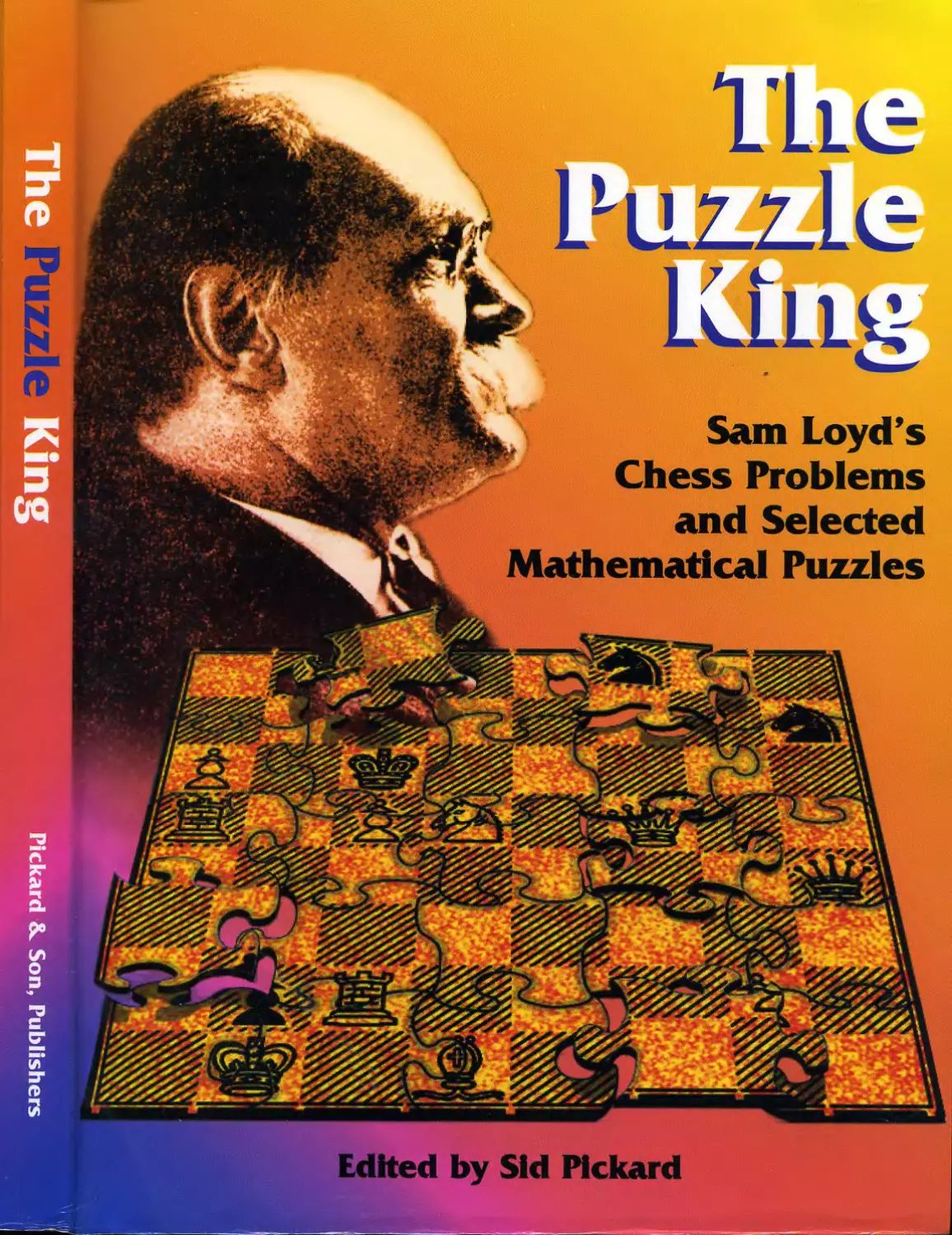
                    The Puzzle Kini
Sam Loyd's Chess Problems
and Selected
Mathematical Puzzles

Copyright © 1996 by Pickard & Son, Publishers
All rights reserved. No part of this work may be reproduced or transmitted in any form
or by any means, electronic or mechanical, including photocopying and any information
storage and retrieval system, without permission in writing from the publisher.
Printed in the United States of America
ISBN: 1-886846-05-7
Cover by Statman
The Puzzle King
Sam Loyd's Chess Problems
and Selected Mathematical Puzzles
Edited by Sid Pickard
First Printing: September 1996
Inquiries should be addressed to:
Pickard & Son, Publishers
P.O. Box 700982
Dallas, TX 75370
Tel. (972)418-6738
Fax (972) 418-9052

Contents
Introduction
Parti
Checkmate in Two Moves 13
Part II
Checkmate in Three Moves 49
Part III
Checkmate in Four Moves 123
Part IV
Longer Mates 159
PartV
Novelty Problems 171
Part VI
Mathematical Puzzles 211
Index
Index of Sets
231
238

Introduction
7
Introduction
A collection of Sam Loyd's chess problems
will, we hope, tend to justify its own existence
over time, if only the subject is treated with
some care. This observation is especially true
in the absence of any other source on Loyd's
problems. Alain White's classic is long out of
print, and production costs will likely prevent
its reappearance. Sadly, those who can obtain
a copy will find dim, smudgy diagrams over
unsatisfactory answers, all entombed in five
hundred pages of overly technical prose. As
valuable as White's research may have been, it
was clearly time to present Loyd's problems
with more attention to the solver. This volume
was designed with the idea of attracting those
readers unfamiliar with the formal world of
problem composition. Real problemists will
find the citations they so relish in the index, but
otherwise the over-sized format, the large and
clear diagrams, the complete solutions in
modern algebraic notation — these should not be
unwelcome. The same idea prompted the
inclusion of Loyd's best mathematical puzzles:
they're fun to solve, and by them we remember
that chess problems form only a small fraction
of Loyd's intellectual output.
Many people assisted in the development of
this book. Deserving special credit is National
Master David King, whose labor at file creation
formed the manuscript's backbone, and whose
work on the solutions produced such fine
results. The proofreader's lot fell to Stephanie
Butler, Gary Hewitt and Lewis McClary, who
sifted out much that was chaff. Thank you. We
hope the final product is worthy of its subject,
and in that hope The Puzzle King is dedicated
to Adam, Robert and Gregory — little puzzles
in their own right. May Cassia receive them
into her admiring ranks of chess amateurs and
laymen, among whom Loyd has always found
his greatest support, for to such we now turn
our attention.
Beginners at chess, with no more knowledge
than how the pieces move, are warmly
welcome here. Sam Loyd's inventiveness, skill
and good humor are revealed in his every
problem, and the chess novice admires these
qualities no less than the greatest experts of the
game. Players of limited experience, however,
will wish to learn the system of notation used
in this and most other chess books. It is quite
simple, ancl can be mastered in only a few
minutes.
The chess board is overlaid with an imaginary
algebraic grid, so that each square has a unique
name. For example, the square c5 is at the
intersection of the third vertical column (or
file) from the left, and the fifth horizontal row
(or rank) from the bottom. These square names
combined with the special letter for each chess
piece (K=King, Q=Queen, R=Rook,
B=Bishop, N=Knight) form the basis of
algebraic notation. Now place a White Rook on c5
and move it to the square f5 (sixth file, fifth
rank). This move is written as l.Rf5, the same
as saying "Rook to the square f5." The "1."
before the actual move signifies only that it is
White's first move in the position, and instead
Black's Rook going tof5 would be recorded as
l...Rf5.
We can easily see that l.RfS denotes the White
Rook's journey to f5 even if it began on the
square/?, for instance, instead of the c5 square.
This fact is unimportant unless there happen to

8
The Puzzle King
be two White Rooks that can reach f5. With
Rooks on both c5 and/?, describing how the
"upper left" Rook goes to/5 becomes simply
l.RcfS. Suppose now that this c5 Rook is not
merely moving to/5, but is capturing the Black
Queen stationed there—a happy thought! This
action is written as l.Rcxf5, with "x" for
captures and "c" to remind us which Rook is doing
the deed. Further, if the Black King had been
on/6 our move would appear as l.Rcxf5+,
adding the "+" for check. This checking
symbol is replaced by " # " in the event of
checkmate, a much more serious form of check
indeed.
The movement of a pawn is designated by
naming the square on which our foot-soldier
stops. So l.e6 means that White is pushing the
only pawn, which must have been on e5, that
can reach the e6 square. If instead White had
captured an enemy piece standing on/5 (but no,
not the Black King from our last example!),
then we would write l.exf6. Very well,
imagine that on his next turn White moves the same
pawn further on with 2.e7, threatening (a word
seen as " A " in the text) to promote it to a new
Queen on his third turn. This act of promotion
on White's third move will then be recorded as
3.e8=Q, or even 3.e8=N should White instead
require the chivalric services of a Knight.
Turn now to problem No. 148 on p.51 and let
us play through the solution. The moves seen
in bold-face type may be taken as the main line
of play, with alternative variations given in
parentheses. The primary solution goes 1.QH7
Kb5 2.Nd6+ Kc6 3.Qb7 #, but on his first turn
Black might have tried something besides
l...Kb5. Indeed, two other Black defenses
(l...Kd5 and l...Kd7) are discussed in the
notes, separated by a semi-colon. Here it
should be mentioned that while the solutions
given in this book are far more complete than
have ever been published, they are not (nor
should they be) exhaustive. So we find that
Black has a number of other legal first moves,
but defeating these is left to the reader.
Returning to Black's first alternate defense (1 ...Kd5),
there is a further division at his second move,
shown italicized within brackets. This pattern
is followed throughout the book, and is the
cleanest way to present a "branching tree" of
chess variations.
There is barely anything else to learn. By
convention, 1.0-0 means Kingside castling and
1.0-0-0 stands for Queenside castling — again,
if it is White's first move in the position. Also,
a very few problems in Part V do not end in
checkmate, but rather with the statement " +- "
(White wins) or "-+" (Black wins) or "="
(equality). That's really it! Thus armed, you're
doubtless ready to solve a chess problem, and
so eagerly retire to your study, egg-timer and
book in hand, and cover the solution to problem
No. 1 and begin staring at the diagram
and...now what? Well, some practical tips on
problem-solving may be helpful, and for this
advice we turn to Sam Loyd himself, quoting
from his Chess Strategy.
"There are two principle ways to set about
discovering the solution of a problem. The first
is the experimental trial of moves, and the
second is the analytical examination of the
position's resources. In the latter method we
first study the placing of the two Kings. Is the
White King in a place of safety, so that we are
free to operate against the enemy? Or is he so
open to attack that we must commence an
immediate onslaught on the adverse King, else
prepare a defense for our own? Does the White
King take an active part in the fray? Is the Black
King already hedged in, or has the mating net
got to be woven first? These are most vital
questions....
"After studying the placement of the Kings, we
examine the relative bearing of the other
pieces. Their peculiar positions for attack or
defense will often betray their object and
furnish a clue to the solution....An analytical
examination will demonstrate why certain pieces
are so placed: why some inviting-looking
moves could not be the correct ones, and how
pretty little mating positions might result from
obvious defenses by Black; why certain
avenues of escape must be closed, and counter-

Introduction
9
attacks guarded. There are innumerable other
little indications that form the links in the chain
of evidence which the solver must
reconstruct....
"The experimental method of problem solving
is the slow but sure method....An analysis of
this kind must be exhaustive. It is a sheer waste
of time to look only at the plausible lines of
attack, for the reason that composers try to
build their solution on the most improbable
moves. Therefore take the pieces in rotation.
First examine the moves of the King; then the
Queen, Rooks, Bishops, Knights and pawns.
By writing them out and marking off such
key-moves as you have demonstrated to be
impracticable, you will be surprised to learn in
how short a time you can master the most
difficult problem....
"Never indulge in careless solving or
superficial analysis, but school yourself to be careful
and reliable, and what at first seems to be a
slow, tedious and uninteresting method will
eventually prove to be the rapid and correct
style. When you once look at a move let your
examination be thorough, final and conclusive,
so that there will be no further necessity of
referring to it again. Solvers who are not
systematic in this respect waste ninety percent of
their time in vacillating between doubtful
moves....
"It is almost unnecessary to add that the best
way is to learn to solve from the diagram; after
the habit is once acquired it is by far the easiest
and most satisfactory plan."
Sound words and worthy of imitation, but what
do we know about the man who spoke them?
Sam Loyd was born in Philadelphia on January
30, 1841 as the youngest of eight children.
Loyd's father was a land developer and
financier with extensive dealings in New Jersey,
where the family lived. In physical appearance,
Alain White describes Loyd as having "...a
very handsome face, a high forehead, very
quick eyes, and a gentle, kindly smile as though
the rest of the world were little children, to be
bewildered and amused by him." Early on Sam
showed a liking for mime, ventriloquism,
magic, card tricks and sleight of hand; he was
never tired of practical jokes and pranks. But
always there was chess, and Loyd recalls that
his "earliest recollections are inseparably
associated with the chess board."
Loyd was introduced to chess by two of his
older brothers, and by Sam's fourteenth year
the three were seeking out stronger
competition. They were introduced to players and,
more importantly, publishers at the Society
Library just when the brothers had begun a
friendly rivalry at problem composing. "I
became interested in chess problems before
entering my teens, and soon acquired a love for
the art that has withstood the vicissitudes of life
and advancing years," Loyd wrote. Before long
the first problems by the Loyd brothers
appeared in print, but Sam's genius ignited and
he quickly outshined his elders. There followed
an incredible display of production, unequaled
in quantity or quality, and by the age of sixteen
Sam Loyd was hailed as America's leading
composer, his problems appearing in
magazines worldwide.
Loyd's appearance on the stage of American
chess could hardly have been better timed. The
country was seeing a rise in the popularity of
chess, thanks to the fame of Paul Morphy,
similar to the "Fischer boom" of the 1970's.
Chess columns and periodicals sprang up
everywhere, all wanting a problem department
which Loyd sometimes maintained single-
handedly. He entered problem tournaments,
ran newspaper contests and promotions of
every kind, and the public avidly consumed
Loyd's staggering output. Then, almost as
suddenly as it began, Loyd's chess activity
practically stopped, and before the age of twenty his
career as a problem composer had ended. Loyd
might still enter an occasional tournament or
create a new problem, for friends mostly, but
his real interests lay elsewhere — Sam Loyd
was about to become the Puzzle King.

10
The Puzzle King
The extent of Loyd's fame as a puzzle-maker
is not widely known in chess circles, but the
renowned problemist soon eclipsed his own
reputation in the world of puzzles. Showman
PT. Barnum kept Loyd busy with orders for
Trick Donkeys or Questions of the Sphinx or
other promotional pieces. Loyd continued to
edit newspaper columns, but of mathematical
puzzles instead of chess, and he eventually
launched his own puzzle magazine. A tireless
worker who kept a grueling schedule, Loyd's
wide-ranging intellect nevertheless found time
to study engineering, own and operate a
plumbing business, a print shop, a book store and
coal-yard — yet there were puzzles and more
puzzles. Loyd invented Parcheesi and the
maddening "14-15 Puzzle," with its numbered tiles
to shuffle around and around the single empty
space. His letter-head proclaimed, "Sam Loyd,
journalist and advertising expert. Original
games, novelties, supplements, souvenirs, etc.
for newspapers. Unique sketches, novelties,
puzzles, etc. for advertising purposes."
Loyd made a profession for himself, and he
labored at it for the rest of his days. There are
many recollections of Loyd in later life at his
crowded and paper-strewn office, busy at
calculations in his notebook or carrying on with
correspondence and the details of business.
Loyd never forgot about chess, however, and
after an apparent stroke in 1906 he began
contemplating a revision of his Chess Strategy. His
interest slowly rekindled, and the work started
in earnest around 1910 but was never
completed; Sam Loyd died on April 10, 1911 in the
midst of preparing his manuscript.
Sam Loyd lived a full and complete life,
productive in his vocation to the end, and today he
still challenges and calls us to excellence.
While the biographical sketch above is
necessarily spare, even a full history could not
explain the man himself, how his mind seemed to
operate as an endless factory of conceptions,
concoctions, amusements and fanciful ideas.
Notions bordering on the sublime arrived
spontaneously and fully formed, yet the
peculiar nature of Loyd's genius was to conceal
the truth in a maze of blind alleys, dead ends
and false trails. We can, however, see the inner
working of Loyd's being, the surprising facets
of his personality, quite clearly in his work
— for in the final analysis, the Puzzle King
has become what he created.
Sid Pickard
Dallas, September 1996

Parti
Checkmate
in
Two Moves

Two Move Mates
13
No. 1
No. 3
M H
y/y
Hi i
n
Hi M ill
a n
^
^£3"'"
a
i m
if
A13 filjUi
"" w'~
Mate in Two
%&Z<
m
'/A
™,^,'wm
-^.
Mate in Two
l.Rg3 hxg3 (l...Rf3 2.Qxd6#; l...Kxe5
2.Qe3#; l...Nf5 2.Rg4#; l...c3 2.Rd3#)
2.Qe3#
l.Rf4 Nxf4 (l...d4 2.Rf5#; l...Ng3 2.Nf7#)
2.Bg7#
No. 2
No. 4
Mate in Two
l.Ba3 b5 (1 ...Ne4 2.Qxe4#; 1 ...Nxf3 2.Qd3 #;
l...Bcl2.Bxcl#)2.Bc5#
Mate in Two
l.Qc3Rdl(l...Rbl 2.Ne3#) 2.Na3#

14
The Puzzle King
No. 5
No. 7
~7zzz\—7ZM—??~a
. m fit
i.
WW vjwa ^
Aw^ ^^ ^
V/////A mm y/,
W,^!'&m.
» »^'p'" In
m^m
my
Mate in Two
l.Qa8 Qxh8 (l...g3 2.Qc8#; l...Rg2
2.Qxg2#; l...Rhl 2.Qg2#; l...Qh5 2.Rxh5#)
2.Qxh8#
~Ws,
m
Mate in Two
l.RhO Bxf3 (l...Bxf5 2.Rxf5#; l...Bh3
2.Rxh3#; l...Rxf5 2.Rxf5#; l...h3 2.Rxh3#;
!...Bg3 2.Qe8#)2.QxG#
No. 6
No. 8
Mate in Two
l.Rg2 KB (l...Kd3 2.Bf5#; l...Ke5 2.Re2#)
2.Bb7#
Ml Wi \
''//////A' '^A '//
^^ li^ ^p ^
Mate in Two
l.Qal KI8(l...Kd8 2.Qh8#)2.Qh8#

Two Move Mates
15
No. 9
Dedicated to E. Lequesne
No. 11
H fAf#l
SWA „t, / S'
y&a '/////A ^^wi
Wh W
rii-ii mkmk
pi l
'//»i'«/'
.M
^"^ V///M'"""MA
Pf'
H
^WAi
?i
_2i
Mate in Two
Mate in Two
LQg4+f5(l...Ke7 2.Bxd6#;l...Kd5 2.Qe4#) l.B«Bxb2 (l...Kxb2 2.Qa3#) 2.Bxh6#
2.gxf6#
No. 10
No. 12
mmm m
m
m
w%"Am
%
m
%&$ ^
4§i
%m""m m
■tf
Mate in Two
Mate in Two
l.Rc3 Kxc3 (l...Qxc3 2.Qd5#; l...Qxf6 l.Rxh6 f5 (l...Kfl 2.Rhl#; l...Bd3 2.Rhl#)
2.Bxf6#; l...Qxb7 2.Rf4#; l...Nxg3 2.Re6#) 2.Qal#
2.Rd6#

16
The Puzzle King
No. 13
No. 15
■ m ^'Bm 4
'*'SkTw
' W 1l
'm.
;t*z
%£ffl ffl
mm m
WM
Mate in Two
Mate in Two
l.Rxh3 Bxf4 (l...Rh6 2.Rg7#; l...Rxh3
2.Qa8#; l...Rgl 2.Nh6#)2.Rxh8#
l.Bb2 (A 2.Bcl#) Kf2 (l...Ke2 2.Bcl#;
l...Kf4 2.Bcl#)2.Bd4#
No. 14
No. 16
Mate in Two
Mate in Two
l.Bc2 Ke2 (l...Kf2 2.Be4#; l...Kg2 2.Be4#;
l...Kg4 2.Bdl#; l...e4 2.Bdl #)2.Be4#
l.Ng3 fxg3 (l...Kg5 2.Qf6#; l...Kxg3
2.Qh2#; l...Kh3 2.Qh2#)2.NC#

Two Move Mates
17
No. 17
No. 19
mm m
%
""TaT
«3 ^
Mate in Two
l.Qal c5 (l...Kxe4 2.Ne7#) 2.Qa8#
H ^ ill ^
^
j
a fAi ^
A ■ ^ M W
mbmM
r^m
Y/-'rrT^.
* ""m
Mate in Two
l.Qb8 Qxb8 (l...Ke5 2.R6xc5#; l...Qxc6
2.Nc3#; l...e6 2.Qxd6#)2.R4xc5#
No. 18
No. 20
Illy" ^
ffip'^m
p
fit
^
'w& m
m
Wa,
V/////A %%
m n i
^ 1
'in^""i
Cs/A '//
v H m $L\ mm
2i^'^'i'''0^'"^"£™J
Mate in Two
Mate in Two
l.Ra5 Rxd7+ (l...Bb7 2.Qb5#; l...Nd6
2.Nc8#; !...Rc8 2.Qb5#)2.Nd5#
l.Be5 Kxe3 (l...Kg3 2.Nd3#; l...Kgl
2.Nh3#; l...Kel 2.Rxe2#)2.Rxe2#

18
The Puzzle King
No. 21
No. 23
WL Wk W.
&/A
■ "f
'//////a '//////a ^"y//,
m
Mate in Two
l.BfS Kxe5 (l...Kf6 2.Qf4#) 2.Qg5#
« »g*
/yQ'g*0/yil
u.-**^
fe^ii#e ,
im
W
A
Mate in Two
l.Qh7 Kxe6 (l...Kxc6 2.Bb5#; l...Bxe7
2.Nc5#; !...Nxg7 2.e8=Q#)2.Qh3#
No. 22
m^'''''Wk\ » i
Mate in Two
l.Rh6 Kd5 (l...Kb5 2.Bd3 #) 2.Bf7#
No. 24
HI HP P
• (?) Hi ^fil ////A^f///m
^:
^
Mate in Ttuo
l.Bg2 Kxg6 (l...Ke6 2.Bh3#) 2.Be4#

Two Move Mates
19
No. 25
Mate in Two
l.Kf3 Kxf6 (1 ...Kd5 2.Qc5 #; 1 ...Kd6 2.Qc5 #;
l...exf6 2.Qc5#)2.Ke4#
No. 26
Mate in Two
l.Ka5 b6+ (l...c4 2.Kb6#) 2.Kxb6#
No. 27
Mate in Two
l.QfS Kxa3 (l...Kc5 2.Re6#) 2.Rb7#
No. 28
Mate in Two
l.Re3g3(l...Kxe3 2.Qd2#;l...Nxg5 2.Qe5#)
2.Re4#

20
The Puzzle King
No. 29
No. 31
~m
m m i
m
B&HM
mm%
nt r> wi hj
IAS
J«
Mate in Two
1
m
V*
't^m'/j.
?i
'W
m
K401
m
:m\
Mate in Two
l.Qxd6 exd3 (l...Qxd6 2.Nf5#; l...cxd6
2.Bb6#)2.Rf4#
l.Qe3 Be7+ (l...Rxf5 2.Qe6#; l...Rd5
2.Rxf6#)2.Qxe7#
No. 30
No. 32
Mate in Two
Mate in Two
l.Ke8 Kxe6 (l...Bc4 2.Qd7#; l...exd3
2.Bf3#)2.Qc6#
l.Bcl Qxd5+(l...Qxcl 2.Re5#)2.Nd6#

Two Move Mates
21
No. 33
No. 35
1
WA
'"'-mi w
Mate in Two
l.Kf5 Kd7 (l...Kxd5 2.Qdl #) 2.Ke5#
Mate in Two
l.QalKe4(l...Ke22.Rg2#;l...gxh62.Qel#)
2.Qd4#
No. 34
No. 36
111^
V///AAV,
m
i
V/////A 'A,
%a
Isss^'-Sf^W'''^
'f^Aw///A v/a
'A%m ^
IP
%
Mate in Two
l.Qh8 exfS (l...Kxf5 2.Qh5#) 2.Kf7#
"^ ^ M M
in a ^'a'i
**■&
m m^n
Wi
WWft %
jy.lrr£\
,%.'ttt
Mate in Two
l.Rg7 Rxh6 (l...Rf4 2.Re7#) 2.Rg4#

22
The Puzzle King
No. 37
No. 39
V/////A m
WM mk
«, m.
~M 1
m^^m
Mate in Two
LQe4+Qxe4+2.Nd5#
m
"£r>'A''
'm n
• w *<m m
■ ■ i
v/a v%
i*s
Mate in Two
l.Rel Be2 (l...Bg2 2.Qh4#; l...Kxel
2.Qd2#)2.Qgl#
No. 38
No. 40
JAi
^M
m
mA
m m m
P
m
Mate in Two
l.Bd5+ Kxd5 (l...Kxc3 2.Qd2#) 2.Qc6#
%
m
B3*U
" """mr
Mate in Two
l.Qal Qxal (l...Rxal 2.Nxe3#; l...Nxg3
2.Qd4#; l...Ng5 2.Qe5#)2.Nxb6#

Two Move Mates
23
No. 41
No. 43
wfZ72Jjpffl%
'■ ■ mmm
W,
W.
m m
Mate in Two
l.Qa8 Rg7 (l...Rf6 2.Qg8#) 2.Qhl#
m m
%
■ HA HI ■
m&.
//'
m
Mate in Two
l.Qg7 e3 (l...Kc4 2.Ra4#; l...Ke3 2.Qgl#;
l...c4 2.Qa7#)2.Rf4#
No. 42
No. 44
\Vk
Jfcfcrr!:
Mate in Two
l.Qg7 e3 (l...c4 2.Qa7#) 2.Rf4#
mil w$f\w
"j%%%a" %i
Mate in Two
l.Nf7 Bb6 (l...d4 2.Qa8#; l...Bxe6 2.Qe5#)
2.Qe5#

24
The Puzzle King
No. 45
No. 47
^iSF%
ini
mt^m i
m
mL'mh, |
Hi H
^ ^
^
Mate in Two
Mate in Two
l.Nc8 Nc6 (l...Kc6 2.Qc4#) 2.Nb6#
l.Ng8Kc6(l...Ke4 2.Nf6#;l...Kxc42.Be6#)
2.Ne7#
No. 46
No. 48
psa
zssM
wm
i^'""« m p
mm %
!■ lip
IM M WM'"£'m
Ail H H
M P
g££g
'//////a m 'mm
nsn
'"'mL",.
HI 'Pp£\^ I
^"^•"j ^p ^
^
Mate in Two
Mate in Two
l.Qh7 Kxd4 (l...Nxf4+ 2.Kxf6#; l...Nxg4
2.Kg5#)2.Nd3#
l.Nf5 Ke4 (l...Ke6 2.Nc5#; l...Kc4 2.Ne5#)
2.Nc5#

Two Move Mates
25
No. 49
No. 51
dm
m ■ hah!
\„„s* <„,„* „,,„* 'p™ <\\
if **
m
m
Mate in Two
Mate in Two
l.Qa6 Nxa6 (l...Qxa6 2.Be5#; l...Bxf5+
2.Nd7#; l...Ke5 2.Nc4#) 2.Nd7#
l.Qh8 Rh7 (l...Kxf7 2.e8=Q#; l...Kxg5
2.Qxg7#; L..Qxf7 2.Qh5#)2.Qf6#
No. 50
No. 52
Mate in Two
H 9 I
;(gjg)i
1
M
r 8
»4
,—M. :mm
Mate in Two
l.Qa8 Qxa8 (l...Qal+ 2.Qxal #) 2.Nf7#
l.Rf4 Kxf4 (l...Qd6 2.Qf5#) 2.Qf5#

26
The Puzzle King
No. 53
No. 55
M
WM
■ m
ym m a p
m
AH
w$2& w
%
m
Mate in Two
Mate in Two
l.Re4+ Kc5 (l...Bxe4 2.Qc3#; l...dxe4
2.Qd6#)2.Qc7#
l.Nf4 Kf5 (l...Rxe7 2.Qg6#; l...Kxe7
2.Nd5#)2.Qe6#
No. 54
No. 56
m
m
^A a
■ m m m
m
Mate in Two
Mate in Two
l.Rf3 BxO (l...Nxf3 2.Qh7#; l...Kxf3
2.Ng5#)2.Qbl#
l.Ne2 Kxe2 (l...Rc3 2.Qf4#; l...Nf3
2.Qxf3#)2.Qe7#

Two Move Mates
27
No. 57
No. 59
7M& m wm i.
Hi m %m
m a m «
SA
■
y//////;'''czfri' m
'W"W mr
'//////A 'tvs'A A/A
H m
'V///M p
'4SM '"""Wa
~M
mi
m m |
it
wM,...
HI IP A
» Ml «
m,.
Wh mn m
Mate in Two
Mate in Two
l.Bf4 Rxf4 (l...Rxd7 2.Qe4#; l...Kf5
2.Qg4#; L..Nf5 2.Qg8#)2.Qd5#
l.Rb2 Kc3 (l...Kc5 2.Rc7#; l...Ke3 2.Re7#;
!...Ke5 2.Rg6#)2.Rxg4#
No. 58
No. 60
■ ■ ■ I
W0& Wlfa W2& ''""M
—l'/y.mWm\j]
wmm ******
zm.„&*wA
m
& m m m
^ ^
'■ a fp
Hi !■ HH A ^
HI HP
.M
■ "fite©*
Wth ill »
L<^
^
Wa
''^'a
Mate in Two
Mate in Two
l.Qg4 Bxg4 (l...Ke5 2.Qxf5#; l...Be6
2.Nc3#; !...Nc6 2.Nd6#)2.Bd5#
l.Ba8 Rxh8 (l...Qxal 2.Rxal#; l...e2+
2.Nf2#)2.gxh8=Q#

28
The Puzzle King
No. 61
No. 63
%.
"I
tfrifo W-
w
'%&& '^
w
m.
Mate in Two
l.Qd3 Be6 (1 ...Bc4 2.Kxc4#) 2.Qb5#
*=M £&
mm in wi P
. _ m m —,
Bii^i^i
w.
Mate in Two
l.Bb3 Rcxe4 (l...Rgxe4 2.Nxd6#; l...Kf7
2.e8=Q#)2.Nxf6#
No. 62
No. 64
llAilAiL|A|§4>
Mate in Two
l.Qe2 Kxd7 (l...Kf5 2.Ng5#) 2.Nc5#
ii
"^
"WI P
, ■'« „
paiij* ■
m
'M^M^l W?A.
m
;ai
p
Mate in Two
l.Qd8 Kxe5 (l...Nxe5 2.Qxd6#; l...dxe5
2.Qxd7#; l...Kc5 2.Qa5#) 2.Qg5#

Two Move Mates
29
No. 65
No. 67
V/////A '#>.
■ ■ ■ m
'%&% '%*&.
®m
m |
:&=%
Mate in Two
l.Qa2 Kg4 (l...Bg4 2.Qg8#) 2.Qg2#
a
asa
Mate in Two
l.Qhl Bh3+(l...Bd7 2.Nc5#)2.Kxh3#
No. 66
No. 68
•arii
vmm i
r^ r Cr r
■ pi » ^
Mate in Two
l.Qe6 Qxe6 (l...Qxd4 2.Na6#; l...Kxd4
2.Qe3#)2.Nxe6#
wmm
w.
Mate in Two
l.Qa8 Qxd6 (l...exf5 2.Rh6#; l...Qxa8
2.bxa8=B#)2.Qh8#

30
The Puzzle King
No. 69
No. 71
m m
V/////K Vfr
■
m
^«
m
//'£.'£''
Mate in Two
l.Nal Rc3+ (l...Kxal 2.Nc3#) 2.Nxc3#
m
'M Vfr
'/'*'£''
\i^!i//'//""f^^
W,
W
%
w^m.
Mate in Two
l.Ke2 Rh3 (l...Rh5 2.Qg3#) 2.Qg5#
No. 70
No. 72
Mate in Two
l.Rf5 (A 2.Qa4#) Rxb3 (l...Kxb3 2.Nc5#)
2.Ng5#
mm jj '""mr""m.
H III ^
■^PLP-
V/////A '/A
li
'ft
inn a
Mate in Two
l.Qa8 Kgl (l...Rxg3 2.Rfl #) 2.Qal#

Two Move Mates
31
No. 73
No. 75
""Hp3 m
1
7A.
m
Zt^A 'Za
m
IP <jsfgp
V/Z/Z/A-^'/A
HPiMftli
%
YZA
m
Mate in Two
l.Qa8Qxa8(l...Kgl 2.Qal #) 2.Rfl#
~~HI WM ffil—H
^^ mm g|| |p
m
'iH A'""W
up ^
Tfi
Mate in Two
l.Ke7 Rh2 (l...Qe2 2.Qxg2#) 2.Qxfl#
No. 74
No. 76
m m m ^
<%*$. '%&& %
?A
" ^r%i ^
%fr^i yzM
'" m
m m a 'wti"
%m %
si W
^s^l
il fm
luf nr*"'
"*&'£''
,&=m
"S»fci
■VZZZZ/A-^k
w%iwm
WM ''ZWfo Wflh %
WM %
Mate in Two
Mate in Two
l.Qh7Kd4(l...Kd6 2.Nc4#;l...Kf4 2.Nd3#;
l...Kf6 2.Ng4#)2.Nc6#
l.Ba2 Ng6 (l...e3 2.Bbl#; l...e5 2.Ne3#;
!...Bd7 2.Qh5#)2.Qh5#

32
The Puzzle King
No. 77
No. 79
MM gg m
~m,
w& m
fa
m u
W^ '%&& ^
.''/.brX-
WLM
ffif '<m&w.
Wi"
m
Vf.
V
m
Mate in Two
y/////A ^
n
'A
wffi&m n
I
«
m
V/////K '""'//A
Mate in Two
l.Bh4 Nf5 (l...e4 2.Bf6#; l...Be3 2.Rc4#) l.Qb7 Kf5 (l...d3 2.Rf6#; l...c2 2.Rf6#;
2.Nxc6# l...Kd3 2.Qbl#)2.Rf6#
No. 78
No. 80
m
- M.JU
!■ m n
m p
y^i
^
•■ « a ni
* A
'MMwm, Im&wm
m
m,K<m & i
ft
Mate in Two
l.Na3 Kxa3 (l...Rxa3 2.Nb2#; l...Nxa3
2.Qb4#; l...b2 2.Qb4#; l...d5 2.Nc5#;
L..Rb2 2.Qa7#)2.Qa5#
\M
m
Im&wm i
Y,f==?/>
tm w,
m
m
YA 'A?.
a
§§.
Mate in Two
l.Nc4 Kbl (l...Kxc3 2.Nxa3#; l...Bxc3
2.Nxa3#; l...Kdl 2.Ne3#)2.Nxa3#

Two Move Mates
33
No. 81
No. 83
mm
V/////A WZ^/'wZ^
m
v&v.
"** m m
m
L,
n
ZrXC'4 '///,
Wfa «' I
■mm %,
^1 ip
Mate in Two
Mate in Two
LNd6Re2(l...Nc4 2.Nb5#; l...Kd4 2.Nb5#;
L.Rxe6 2.Qb2#)2.Nb5#
l.Bb3 Kd3 (l...Nxdl 2.Bc2#; l...Nd3
2.Bd5#)2.Qd5#
No. 82
No. 84
Mate in Two
Mate in Two
l.Nf2 Kf4 (l...Kh4 2.Ne4#; l...Kxf6
2.Nxh3#)2.Nxh3#
l.Bg3 Nc7 (l...Kf6 2.Bh4#; l...Kf8 2.Bd6#)
2.Bh4#

34
The Puzzle King
No. 85
No. 87
A Free Lance
TBF&
A
mmtx"
i©.«- -
Mate in Two
Mate in Two
l.Qc2 Bxc2 (l...c5 2.Qxe4#) 2.Re5#
l.Ri2Rxi2(l...Rxg5 2.Rc2#)2.Qxf2#
No. 86
She Stoops to Conquer
No. 88
m
m
m&wH m I
mm
%Bg«r Br m
Mate in Two
Mate in Two
l.Qe2 Qxfl (l...Qd5 2.Qe8#; l...Kd5
2.Bb7#)2.Qe4#
l.Qb8 Rxd4 (l...Rdd6 2.Rc5#; l...Red6
2.Re7#)2.Rc5#

Two Move Mates
35
No. 89
No. 91
~m%& m
V//m ||j |§j m
jjj ■ M ^ "B
■ ""*
111 HI HI ^i
« A Hi f^ ^
v//////-^^\/iiL^^M
g£±gi ^*gf
^
mm
Mate in Two
l.Qa8 Nc4 (l...Nh5 2.Ne2#) 2.Nd3#
m n
m&m m
m^m
WM %
Mate in Two
l.Qh7 Rh2+ (l...Rbl+ 2.Qxbl #) 2.Qxh2#
No. 90
No. 92
%m mm mm p
■ H ■ ^"'H
'MOM" '//>
1?
"fl
■ 11
BWHA
Mate in Two
l.Qa8 Qxa8 (l...h2 2.Qxg2#) 2.Bh2#
M
"^
w£ m
'si
Ha
mm %
P
m
ill iH I
A
KM
Mate in Two
l.Qal b2 (1 ...Nc3+ 2.Qxc3 #) 2.Rc5#

36
The Puzzle King
No. 93
No. 95
"^H H
Am
m'akm n
mm
m h
'/%%/A M ^
\
•JKDh
w^A w^ ^^ ^
iAflf
Mate in Two
Mate in Two
l.QdlNf4(l...Nc3 2.f4#; l...Nh5 2.Rxd5#) l.Rc6 Qxc6 (l...Bxh7 2.Qxd5#; l...dxe4
2.Qal# 2.hxg8=B#)2.Qbl#
No. 94
No. 96
m m m
... Whl
"m VM' '■Tin
■V/////A V//,,,^<M$&\
v±
wh m
HBAh
m
III
Hfc^m t^i
W" 1p
:^ ^/±^
m
^Srr!l ^W{\
Mate in Two
Mate in Two
l.QalKg5 2.ND#
l.RD Rxf3 (l...Bxf3 2.Nce4#; l...Kxcl
2.Nb3#)2.Nd3#

Two Move Mates
37
No. 97
No. 99
n
wm « iii
r m
mm ~» ^m
A
r m/ " '—
%,:
Mate in Two
l.Rg2Rxg2 (l...Bxg2 2.N3b5#) 2.N7b5#
VA
mm m
Am*'
A
^
**™i.
^ ^
H
L ,
^ ■ fill
'#f.
Mate in Two
l.Nb5 Rxb5 (l...Bxb5 2.Be2#; l...Nxb5
2.Bh5#)2.Bd5#
No. 98
D 'yolle um as
No. 100
9k
■ HAH
"^
J*E3 »Am
Ww Wftti W^ *'
Hi
■*4^
Mate in Two
l.Nb3 Rxb3 (l...Bxb3 2.Qe3#) 2.Qxe7#
Mate in Two
l.Nd4 Rxd4 (l...Bxd4 2.Qf4#; l...Rxb8
2.Nh3#)2.Qb2#

38
The Puzzle King
No. 101
No. 103
'm& m fill A
i
na is
g?+^ %
Mate in Two
l.Qa5 Bc5 (l...Bd7 2.Qd5#; l...Bb7 2.Nf5#)
2.Qal#
"w
. m
Mm ^
A
»ft
y/A
m,
//»i'»'/'
mi
Mate in Two
l.Be5 Kxd5 (l...Qel 2.Ne7#) 2.c6#
No. 102
No. 104
m,
k4
w/z/A mad %
m
if
ii....... ,,,,V//,J^~,, fifty//,f*fr„ftftft//,TTTTJ,,fiftfty^
una h^l ,
Mate in Two
«i HA
A
*'..' i'J '<* lOC'/^ '//////A '//////A '
\ft
B1111111
^a^
Mate in Two
l.Qc5 Qxc5 (l...exf2 2.Re3#; l...Rxf3 l.Kg8 e3 (l...Ng4 2.Ne6#; l...g5 2.h8=B#;
2.gxG#)2.c4# !...Kc3 2.Ne6#)2.Nb3#

Two Move Mates
39
No. 105
No. 107
V/////A m.
Hi A' P
n1
m m 81 Air
Mate in Two
l.Qa8 Khl (l...hxg2 2.Qxg2#) 2.gxh3#
a ^ m
Wh WA '"
fc.e^
'Wk\ W
Mate in Two
l.Qe5 Qxe5 (1 ...Kb4 2.Rxb5#) 2.Nc4#
No. 106
No. 108
m—w%\—m%—mr/
V////A n
W^miM
'<%&& Wffl\ W'
v m
MM W,
Mate in Two
m*»m"" n
4MMM&
B*
wmii'k
w~
Mate in Two
l.QblNd3(l...Nd5 2.Ne4*;l...Nc62.Nb7#) l.Qa8 Qxa8 (l...Kxc4 2.Qxa2#)2.Nb6#
2.Bf8#

40
The Puzzle King
No. 109
No. Ill
Old Cronies
m m 1
■I B Pll
m m
Vk
?J
■ I
81 ^
■ m wl m
P ■
Mate in Two
'mi n
m
■ ■ H HA
Mate in Two
l.Bcl Kxa3 (l...Rbl 2.Qxb6#; l...Kc5 l.Qa6 Kg4(l...Nf4 2.Bd8#; l...Kh6 2.Be3#)
2.Qc4#)2.Qb3# 2.Rg7#
No. 110
No. 112
M M I
r^f
JAK
IH iiv|
m
"Wl
f^
Mate in Two
l.Bc2 Kxe4 (1 ...Rd2 2.c4#) 2.Qd4#
m^¥jL'm
w
?c3JIL
//,rm^"""^
y/////A m.
K ill!
Bili
^ ^
"''tytZ//'**"'
v/A
ywtt
Mate in Two
l.Qc8 Nc4 (l...Qxe3 2.Nb5#; l...Nf3
2.Rxd3#)2.Ndl#

Two Move Mates
41
No. 113
No. 115
B I
~m.
w,
iiC
m%mtem,.
m*
'-mi''////W////^m/
_2i
Mate in Ttuo
Mate in Two
l.Qa4 Ke5 (l...Nxg5 2.Bd6#; l...Ne5
2.Bd2#)2.Rxf5#
l.Rg2 e2 (l...Ng4 2.Rxg4#; l...Qxg2
2.Bxg2#)2.Rxe2#
No. 114
No. 116
|§j m n
Mate in Tu>o
Mate in Two
l.Qa8Qb5(l...Qd8 2.Nc5#;l...Rh6 2.Nc5#)
2.Nd6#
l.Kc4 Rd4+ (l...Rd7 2.Qe3#; l...Re5
2.Qb6#)2.Kxd4#

42
The Puzzle King
No. 117
No. 119
m & wi m m
K-^fi
.,«
^^
vmi^m
\mM#k
Mate in Two
l.Qg2 Qxcl (l...Nd2 2.Qa8#) 2.Qa2#
Mate in Two
l.Bhl d5(l...exf4 2.Qe6*)2.Ng2*
No. 118
No. 120
Mate in Two
l.Ra6 Rxf5 (l...Nxf7 2.Qg4#) 2.Rxa4#
^M M
W2& W,
%
'Wh m
m m l
' MSB
Mate in Two
!.Rh8Kxc2 2.Qh7#

Two Move Mates
No. 121
No. 123
■
<^~J *«
m i
r%a ^
31
-torn ^
&m
1
Mate in Two
Mate in Ttuo
LRh8Bb2(l...Kd4 2.Nb5#;l...Qd4 2.Ndl#) l.Be8 Qxe8 (l...Kxe8 2.Qc8#) 2.Nxe6#
2.Nb5#
No. 122
No. 124
Mm
a mi
^e)„B#,B
▲
AM
mSJm<<^^M-:/ A
M.
\ ■ sir ■
f p
■
[A I
A
a a i
m mi i
i H HI'
Til
wk
wk
m mkmm
|EfegH 'JwyyA *&i—\ /Mm \\
Mate in Two
Mate in Two
l.Qe4+ Kxe4 (l...Qxe4 2.Rd6#; l...Bxe4
2.Be6#)2.Bc6#
l.Qb4 Qe3 (l...Bxb4 2.Ng4#) 2.Qxel#

44
The Puzzle King
No. 125
No. 127
^^ ^2%J ''"'Vto
mm mm w.
m m
„ a it
fe^^ ^^ *™3 ^
H M « ^
ill
Ai
f^-4*
Mate in Two
lAMA
'//.if'
fe'M /^^ W |||| P^
m wt^m
t>^ .
% 1
K<«
^
<M ^
« P
Mate in Two
l.Qf7Qe4(l...Ke4 2.Nc5#; l...Kc2 2.Qc4#) l.Qe8 Rxe8 (l...cxd4 2.d8=Q#; l...Nc6
2.Qc4# 2.Nb5#; l...Bf6 2.Qb8#)2.dxe8=N#
No. 126
No. 128
Mate in Two
l.Qg4 Bf6 (l...Bg7 2.Qe6#) 2.Qg8#
~m
m
V/////A VM,
"mm, Vtftfft ^^ \f*&
Y//////A ^vvyyyyd '/M/s/a ',i* ^ "
wm m
^pffi w &'"^ ^^
Mate in Two
l.Nhl Kxhl (l...Nc2 2.Bxc2#; l...Qh8+
2.Bh5#; !...Qb7 2.Bb3#)2.Be2#

Two Move Mates
45
No. 129
No. 131
« Wi m
vm 'W& wh w
m
m
wm m.
Mate in Two
Mate in Two
l.Qc5 Rcxc5 (l...Rfxc5 2.Rf4#; l...Rf8+
2.Qxf8#; l...Bg3 2.Nxd2#) 2.Rd3#
l.Qal Bg8 (l...KgS 2.Qxa8#; l...Nc7
2.Kf7#)2.Kxg6#
No. 130
No. 132
mi
zi
m w wi
w,
WkWk i
w^*
, ...mm
%%%tt '/A
pr#M4IS1
^
n »»i
m m ip hi
J" HI pa ^
e^ii
Mate in Two
Mate in Two
l.Kb3 Qg5 (l...Nd4+ 2.Qxd4#; l...Qxg4
2.Nd3#)2.Nd3#
l.e4 fxe3 (l...dxe3 2.Nxe3#; l...Bxh7
2.Ne5#; l...Kd3 3.Ncl#)2.Nxe3#

46
The Puzzle King
No. 133
No. 135
A: ||1W
« ^
,f/7r-rVA
M fc
„A;
« 4 a «
■ BAH 1
<
%f ^ftii
4l
'//ft///
g£*^ ^
%4
Mate in Two
l.b8=N Rf8 (1 ...Bxb8 2.Qc8 #) 2.Qd7#
Mate in Two
l.Rfl f5 (l...Qxb8 2.Nf7#) 2.Qxh8#
No. 134
No. 136
W.*»\'**».
w® ^
~M
"HI 1
■V/////A ''-"-im
I
"Hi ""i§
P
Y^^'a'''"''w///m '//.i://A '/S///M ^
\Vh
Mate in Two
Mate in Two
l.Qbl Nc4(l...Ncb7 2.Na4#) 2.Nxc4#
1.0-0-0 Ke4 (l...Kd4 2.Nde5#; l...Kc4
2.Nde5#; l...fite6 2.Nde5#; l...Kxe6 2.Nc5#)
2.Nel#

Part II
Checkmate
in
Three Moves

Three Move Mates
49
No. 137
A First Attempt
Mate in Three
l.Rc8+ Qxc8 2.Qd6+ Rxd6 3.Ne5#
No. 139
g^^T ^
Mi
m%
W&
,y-
■ mm
y/W^a <9N8)] %>,„„*
?mti -bM mm
m,\ mfc m
Mate in Three
l.Bhl d3 2.Kg2 Ke4 3.Kg3#
No. 138
No. 140
■ in «*i
UlLJMt
"^
A
mi i
^^,„^ ^ ^
n
JU.
Mate in Three
l.Qe6 fxe6 2.h4 e5 3.Bg5#
Mate in Three
l.Bg7 Kd5 2.Be8 Ke4 (2...Kd6 3.Qe5#;
2...Kc5 3.Qd4#)3.Qe5#

50
The Puzzle King
No. 141
Mate in Three
l.Be5 Kd3 (l...Kb4 2.Qc3+ Kxa4 3.Bd7#;
l...Kd5 2.Qd4+ Kc6 3.Qd6#) 2.Bg4 Ke3
(2...Kc4 3.Q.d4#; 2...Kd2 3.Qc3#; 2...Kc2
3.Qdl#)3.Qd4#
No. 142
Mate in Three
l.Rb2 Rxg4 (l...Rxe4 2.Qxe4+ Kc3 3.Qe5#;
l...Rd7+ 2.Qxd7+ Bd5 3.Qxd5#)2.Nc5+ Kc3
3.Na4#
No. 143
Mate in Three
l.Ba4 Bb6 (l...Bb8 2.Nd4 cxd4 3.cxd4#;
l...Rhl 2.Ng6+ Kd5 3.Nc7#) 2.Nd6 Rh7
3.Nxc4#
No. 144
Mate in Three
l.Ng4+ Kh3 (l...Khl 2.Qh2+ gxh2 3.Nf2#;
1...KO 2.Qc2 g2 3.Qd3#; 1...KA 2.Ra8 g2
3.Ral#) 2.Nh2 D (2...gxh2 3.Qh8#; 2...g2
3.Qh8#; 2...Kh4 3.Qh8#) 3.Rh8#

Three Move Mates
51
No. 145
Certum pete Finem
Mate in Three
l.Kg3 Bxh5 (l...Bxf5 2.Kf4 [A 3.Qb6*]
Be5+ 3.Qxe5#; l...Nhl+ 2.Kf4 Be5 +
3.Qxe5#; l...Rgl+ 2.Kf4 d2 3.Qb6#;
l...Be5+ 2.Qxe5+ Kxe5 3.Nxf7#) 2.Kf4
Be5+3.Qxe5#
No. 146
Mate in Three
l.Kd2 Qc3+ (l...Qd5+ 2.Nxd5 Ng8 [2...Ng4
3.c8=B#] 3.Ne3#; l...Qe8 2.Bxe8 Bg8
3.Bg6#;l...d5 2.Bg4+Nxg43.Rh5#)2.Kxc3
(A 3.c8=B#)Bg8 3.Bg6#
No. 147
C 'est le premier pas qui coute
Mate in Three
l.Bb4Kd5(l...e4 2.Qh7Kb6 3.Qb7#;l...Kd7
2.Qh7+ Ke6 3.Qf7#; l...Kc7 2.Qh7+ Kd8
3.Ba5#)2.Qh7Kd4(2...Kc6 3.Qb7#;2...Ke6
3.Qf7#; 2...e4 3.Qxe4#) 3.Qe4#
No. 148
Mate in Three
l.Qh7 Kb5 (l...Kd5 2.Nd6 Kd4 [2...Ke6
3.QP*; 2...Kc6 3.Qb7#] 3.Qe4#; l...Kd7
2.Nd6+ Kd8 3.Ba5#) 2.Nd6+ Kc6 (2...Kb6
3.Qb7#; 2...Ka6 3.Qb7#)3.Qb7#

52
The Puzzle King
No. 149
No. 151
P
H Wk wA"VA
|gp *%%%! 22^ '""'//A
WM %
«j m i"i
y-^^yy/"^
Mate in Three
Mate in Three
l.Rcl+ KO (l...Kh2 2.Nh4 f2 3.Nf3#) 2.Rel
fxg2 3.Nd3#
l.Qe6 Rxe6 (l...Bxe6 2.Nf5+ Kg8 3.Ne7#)
2.Nhg6+Kg8 3.Rh8#
No. 150
No. 152
MM WW//""^
mp2'" ''zb
WM W,
\Vl
'V/////A'^/'^''~'/
'Ewii
™ir
l
-mm '-m
Mate in Three
Mate in Three
l.Qfl Bc3 (l...Bb2 2.Qbl [A 3.Qxh7*] g6
3.Qxb2#; l...Be5 2.Qf5 g6 3.Qxe5#; l...g3
2.Ng6+ hxg6 3.Qh3 #) 2.Qd3 g6 3.Qxc3#
l.Qa7 Bxd5 (l...Kxd5 2.Qd4+ Ke6 [2...Kc6
3.Be8*] 3.Ng7#; l...Ke4 2.Nf4 Kxf4
[2...KJ3 3.Qe3#; 2...Ke5 3.Qd4*] 3.Qe3#;
l...Bc2 2.Qd4+ Ke6 3.Nf4#) 2.Qc5 Kf4
(2...Ke4 3.Qe3#; 2...Ke6 3.Qxe7#; 2...e6
3.Qd4#)3.Qe3#

Three Move Mates
53
No. 153
Mate in Three
l.Ra4 Kxa4 (l...Ka6 2.Qxc6 axb6 3.Qxb6#;
l...a62.Ka3 Nc4+ [2...Nd8 3.Rb4#] 3.Qxc4#;
l...Nb4 2.Nc7+ Kxa4 [2...Kxb6 3.Rxb4#]
3.Qa3#; l...axb6 2.Nc7+ Kxa4 3.Qa3#)
2.Qb4+Nxb4 3.Nc3#
No. 154
Mate in Three
l.Rd4 Kxd4 (l...Ne5+ 2.Ke6 d2 [2...Nxg6
3.Rc4*;2...Kxd4 3.Qxe5#]3.Qxd2#)2.Nxd3
Kc3 (2...Ne5+ 3.Qxe5#; 2...Ke3 3.Qf2#;
2...Kd5 3.Qd6#)3.Qb2#
No. 155
Mate in Three
l.Nf5 Kxd2 (l...Kfl 2.Qxg3 el=Q 3.Qg2#)
2.Qb4+ Kd3 (2...Kdl 3.Nxe3 #) 3.Qd4#

54
The Puzzle King
No. 156
Mate in Three
l.Qg7+ Nf6 (l...Kd6 2x7 Be5 3.c8=N#;
l...Kxd5 2.Qe7 Nf2 [2...dxe2 3.cxd7*;
2...dxc6 3.e4*] 3.cxd7#; l...Kf5 2.Bd8 Kf4
[2...B/4 3.e4*; 2...dxc6 3.Qg5#] 3.Qg5#;
l...Kf4 2.Bd4 Kf5 [2...dxe2 3.Qxg4#; 2...N/6
S.Qx/6*] 3.Qxg4#) 2.e4 Bg3 (2...Bf4
3.Qe7#; 2...Bgl 3.Qg3#; 2...Kf4 3.Qxf6#;
2...Kd6 3.Qxf6#; 2...d6 3.Qg5#; 2...dxc6
3.Qc7#)3.Qxg3#
No. 157
Mate in Three
l.Rg2+ Kxg2 (l...Ke3 2.Bc4 Ke4 3.Re2#)
2.Nh3Kxh3(2...Khl 3.Bf3#)3.Bfl#
No. 158
Mate in Three
l.Rgl Kf5 (l...Kxd3 2.Ral Ke4 [2...Kc2
3.Qdl#;2...Kxc43.Qf]#]3.Qb\#;\...hxgl=N
2.Ndc5+Kf5 3.Qh5#)2.NCgxC(2...hxgl=N
3.Qh5#)3.g4#

Three Move Mates
55
No. 159
Just for Fun
No. 161
Mate in Three
k&$\ %?
H m i
ii ■ '"*
■ m i
Mate in Three
m
l.Qc3 Ni2 (l...Ng3 2.Qd4+ Kxf3 3.Rf2#;
l...Kd5 2.Rd2+ Ke4 [2...Ke6 3.Qe5#]
3.Rd4#; l...Kf4 2.Nd2 h5 [2...Ng3 3.Qg3#]
3.Qd4#; l...h5 2.Ng5+ Kd5 [2...K/4 3.Qd4#]
3.Rd2#) 2.Qe5+ Kxf3 3.Rg3#
l.Rd4 Rxh6 (l...Rf4 2.Rxel Rfl 3.Bf5#;
l...Rxe4 2.Qf5+ Ke7 3.Qxf7#; l...Rh5
2.Bf5+ Ke5 3.Qg7#; l...Bg6 2.Qxg6+ Ke5
[2...Ke7 3.Qf7#] 3.Qd6#) 2.BM axbl=Q
(2...Rf6 3.Qe3#; 2...Bxal 3.Bxa2#)3.Rxa6#
No. 160
No. 162
m
~zm—m
A
H Am
Mate in Three
Mate in Three
l.fxe5 g6 (l...Kg5 2.Qf3 Kg6 [2..g6 5. £>/*#]
3.Qf5#; l...g5 2.e6 h3 3.Qf3#) 2.Qfl g2
(2...h3 3.Qf4#; 2...g5 3.Qf5#)3.Qxg2#
l.Qal Qb4 (l...Rxf5 2.Qhl+ Rd5 3.Qxd5#;
l...Rel 2.Bf3+ Re4 3.Bxe4#) 2.Bg5 Rhl+
3.Qxhl#

56 The
No. 163
Mate in Three
l.Qh6Kb4(l...Ka5 2.Kb3b4 3.Qb6#)2.Qcl
Ka5 3.Qa3#
No. 164
Mate in Three
l.Bd4 Ncl (l...c2 2.Qf2+ Kdl 3.Qxd2#;
l...Bcl 2.Ng3 Kd2 3.Qe2#; l...Nf5 2.Nf2
Nxd4 [2...Nb4 3.QdJ#] 3.Nd3#; l...Nd5
2.Bf2+ Kfl 3.Qdl #) 2.Nxc3 Bxc3 (2...NA
3.Bf2#; 2...Ndl 3.Qhl #) 3.Bxc3#
King
No. 165
Mate in Three
l.Re6 Kxe6 (l...Bxc3 2.Qxd6+ Kc4 3.Bd3#;
l...Ra6 2.Rxd6+ Rxd6 3.Qe4#) 2.Rc6 Kd7
(2...Kd5 3.Qxd6#; 2...Be5 3.Qf7#; 2...Be7
3.Qf5#)3.Qxd6#
No. 166
Mate in Three
l.Bc4+ Kxc4 (l...Kxc6 2.Rh7 Nb4 3.Rc7#;
l...Ke4 2.Nfd4 cxd4 [2...Nb4 3.Rh4*]
3.Bd5#) 2.Nfd4 cxd4 (2...Nb4 3.Rxc5#)
3.Na5#

Three Move Mates
57
No. 167
The Steinitz Gambit
Mate in Three
l.Ke2 fl=Q+ (l...fl=N+ 2.Rf2+ Kxe4 3.d3#)
2.Ke3 Qel+ (2...Qgl+ 3.Rf2#; 2...Qxb5
3.d4#)3.Be2#
No. 168
Mate in Three
l.Qc5 Kf3 (l...Bf3+ 2.Kd2 bxc8=Q 3.Qe3#;
l...Kd3 2.Bf5+ Be4 3.Qc3#; l...b6 2.Bb7+
Kd3 3.Qc3#) 2.Bb6 Kg2 (2...Kg3 2.Qf2#;
2...Kf4 3.Qe3#)3.Qf2#
No. 169
Mate in Three
l.Ba5 b6 (l...Kc5 2.Nd3+ Kd5 [2...Kb5
3.Rb4#] 3.Nf6#; l...c5 2.Nc4 b6 3.Nd6#)
2.Na4 bxa5 (2...c5 3.Nc3 #) 3.RM #
No. 170
Athos
Mate in Three
l.Bb7 Bxb7 (l...Rxe2 2.Bb8 cxb5 3.Bxa7#)
2.Nd6Kd4 3.Ne4#

58
The Puzzle King
No. 171
Porthos
m a n§^n
g^i
%*
II
^A^
M*
Mate in Three
l.Rb6 Bxb6 (l...Nxb6 2.RG Kxf3 [2...exf3
3.Ne3*] 3.Ne5#; l...cxd4 2.Rf6 g5 [2...Bxc7
3.Be2#] 3.Nxh6#; l...Nc8 2.Be2+ Kf5
3.Rf6#; l...Qxdl 2.Bf6 Kf5 3 .Nxh6 # ) 2.Bb5
Nxb5 3.c8=Q#
No. 172
Aramis
w
JAi
^M
'/,,^..f//m w/A
«*■ ii
im m m m
No. 173
d'Artagnan
fMwm m i
p '"""■ — w/'
Mmm
"%&&—p
Mate in Three
l.Na6 Nxb5 (1 ...Nxc6 2.bxc6+ Kxc6 3 .Qe4 #;
l...Ne6+ 2.Rxe6 Bxc7 3.Nc5#) 2.Rd7 Kxc6
3.cxb8=N#
Mate in Three
l.Re6 Bxe6 (l...b4 2.Rxf5+ Qxf5 3.Qxb3#;
l...Qd3 2.Qe5+ Kc4 3.Qc5#) 2.Rh6 Kxc6
(2...Qe4 3.Qc5#) 3.Qxe6#

Three
No. 174
Mate in Three
l.Qxc6 Ke6 (l...Kf5 2.Bh3+ Ke5 [2...Kg6
3.Qe8#] 3.Nc4#; l...f5 2.Qd7 Ke4 [2...Nxh4
3.Qe7*; 2...Qxc3 3.Qxd6*] 3.Qe6#; l...d5
2.Qd7 Nd2 3.Bxd4#) 2.Qe8+ Kd5 (2...Kf5
3.Bh3#)3.Rb5#
No. 175
Mate in Three
l.Qh2Rxh4+ (l...Rxf3 2.Re2+ Kf4 3.Nxg3#;
l...Nd4 2.Qxg3 Nxf3 [2...dxc5 3.Qg7#]
3.Re2#) 2.Kxg3 Rxh2 3.Re2#
Mates 59
No. 176
Mate in Three
l.Be6 Kd6 (l...Ke4 2.Nc2 Kf3 3.Qe3#;
l...Kf6 2.Nf5 Kg6 3.Qh6#) 2.NI5+ Kc5
(2...Ke5 3.Qd4#; 2...Kc7 3.Qd6#) 3.Qa5#
No. 177
Mate in Three
l.Nd4 Kxf4 (l...Kxd4 2.Qb3 Kc5 3.Qb4#)
2.Nf3 Kf5 (2...Kg3 3.Qh2#; 2...Ke3 3.Qd2#)
3.Qf7#

60 The
No. 178
Mate in Three
l.Qb8 Rxb8 (l...Ba2 2.Qh2 gxf3 3.Kg4#;
l...gxf3 2.Qxa8 £2 3.Qh8#; l...Be4 2.Nf7+
Kh7 3.N3g5#) 2.Ne5 Bf5 (2...Rf8 3.Nxg4#)
3.Nf7#
No. 179
Mate in Three
l.Qhl+Kxhl (l...Kg3 2.Qf3+Kh2 3.Nxg4#)
2.Nxg4Bh2 3.Nxf2#
King
No. 180
Mate in Three
l.Nc6 Kxc5 (l...Kc4 2.Nb4 Rbl 3.Ne4#;
l...Rd4 2.c4+ Rxc4 [2...Kxc4 3.Qxd4*]
3.Ne7#; L..Rd3 2.Qxb5Rxc3 3.Rd8#; l...Nf6
2.Ne7+ Kxe5 3.Qh2#) 2.c4 Kxc4 (2...bxc4
3.Ne7#)3.Nb4#
No. 181
Mate in Three
l.Qb5 Nxf4 (l...Kxe3 2.Qd5 Rxf4 [2...Ke2
3.Qd3*; 2...Qc4 3.Qxd2#] 3.Qd3#) 2.Bd6
Kxe3 (2...Rf5 3.Nxf5 #) 3.Qe5 #

Three Move Mates
61
No. 182
No. 184
W Hi iHf I
■^
?MI
m §p
Mate in Three
l.Re7 Kb5 (l...f5 2.Re5 f4 3.Qc3#; l...Kd4
2.Nxb6 f5 3.Qe3#; l...Kd5 2.Qd3+ Kc6
3.Qd7#)2.Rc7f5 3.Nc3#
Mate in Three
l.Rd2 Kc3 (l...Nf7 2.Rxd6 Nfxd6 3.Bd2#;
l...Rc6 2.Rd4+ Kc3 3.Bd2#; l...Na5 2.Bc5+
Kc3 3Rc2#) 2.Rxd6 Nxd6 3.Bd2#
No. 183
No. 185
Dedicated to E.B. Cook
■ m
WM \
HP md"""M
p
»A A
www
mmm.
Wa
Mate in Three
Mate in Three
l.Nd3 Ke4 (l...Kc4 2.Ke3 Kc3 3.Rc5#)
2.Kc3Ke3 3.Re5#
l.Kc6 (A 2.Nb5+ Kxc4 3.Nd6#) Bxc4
(l...Kxc4 2.Nb5 fxg6 3.Nd6#) 2.Qe4+
Qxe4+3.Nd5#

62
The Puzzle King
No. 186
No. 188
;mm
mJM^r -r mm
nrffiflSP
rnkmim
Hi si •
" ,.::..'■■■■■ ySMfft ^
^K
Mate in Three
wm g||| n
iii *
Hi
^1
IP *
1111 I
Mate in Three
l.b7 (A 2.Rb6 Kxc5 3.Qd4#) Kxc6 (l...Nc4
2.b8=N Qb2 3.Be6#) 2.Bd7+ Kxc5 (2...Kxd7
3.Qc8#)3.Qd4#
l.h4 h5 (l...h6 2.h5 d4 3.Qf3#) 2.Qf8 Kd4
(2...d4 3.Qf3#)3.Qb4#
No. 187
No. 189
Mate in Three
m
m
Vft
&w,
7^k
mwr*-
11A1
m m
'#.^J'^'t.f&..V0%7',\
1'i'B ■ miwk
mi
Mate in Three
l.Ra3 Kb4 (l...b4 2.Qfl+ Kd4 3.Qd3#;
l...Kd4 2.Kd6 Kc4 [2...c4 3.Qd5*; 2...b4
3.Qd5#] 3.Qe4#) 2.Qa8 Kc4 (2...c4 3.Qf8#)
3.Qe4#
l.Bd7 Rxg3 2.d6 RxC (2...Qxc4 3.Nxg3#;
2...Ngl3.R3f4#)3.gxf3#

Three Move Mates
63
No. 190
No. 192
~m
m
^^ ^
1
v™ mi ip s^
^
■ Hit
in m i
H m A Hf & I
^
:^ %
'<m m
y/A
A
A
^
M
Mate in Three
Mate in Three
l.Qxd2+ Rxd2 2.Re3 Nc2+ (2...Kxe3
3.Rc3#; 2...Nbc4 3.Rd5#)3.Rxc2#
l.a3 (A 2.axb4+ Ka6 3.Bc8#) bxa3 (l...Ka6
2.Bc8+ Ka5 3.axb4#) 2.b4+ Ka4 3.Bc2#
No. 191
No. 193
wm m
m m m
m
V*
mm %m Hi's* %
jaw m. ,-.
ggg| m up A %
B
Mate in Three
Mate in Three
l.Rxf3+ exf3 (l...Kxf3 2.Rf6+ Ke2 3.Qd2#)
2.RelKxel3.Qd2#
l.Rd5+Rxd5(l...Bxd5 2.Qxf5Kc63.Qxd5#;
l...Kxd5 2.Qd7+ Ke5 3.Bxc3#) 2.Qxe4 Rd6
3.Qb4#

64
The Puzzle King
No. 194
No. 196
HI AI
%
m.
OA
§1 in a a m
r&n
fc«^
mi-
n
Mate in Three
i
V/////A '/%,
4WL ._.
H «« tn m,
1
■« Hj| ^2^
i»i
P
'« mi ^"nn ^
y///m way/A '//,
Mate in Three
l.Qal Qb2 (l...Bc3 2.Nxc3+ Rxc3 3.Qxhl #)
2.Nxb4+ axb4 3.Qxa8#
l.Ne5(A 2.Nef7Ne5 3.Be3#)Kxe5(l...Nf6
2.Qc4+ Kxe5 3.Bf4#) 2.Bf4+ Kd4 3.Qc4#
No. 195
No. 197
~m
~vz
m
w* *
////m ii ^""« n
wm wm mm m
m
Mate in Three
Mate in Three
l.Qhl Rf7 (l...Kf7 2.Qh5+ Kg8 3.Qe8#)
2.Bg6Rg7 3.Qa8#
l.Qg3 gxh6 (l...g5+ 2.Qxg5 c5 3.BO#;
I...c5 2.BO+ e4 3.Qxd6#; I...g6 2.Qg5
Ke4 3.Qg2#) 2.Qg8 e4 3.Rf5#

Three Move Mates
65
No. 198
No. 200
m
up—m
■ p
Wk 'Mg±
« m. &
A
"«f Ami'''//m
'"'AS1
Mate in Three
Mate in Three
l.Be2 Qxh2 (l...Kg6 2.Qe6+ Kg5 3.Qf6#)
2.Qf3Qh6 3.Qg4#
l.Bg4 Kd4 (l...Kxe4 2.Be6+ Ke5 3.Re2#;
l...Kxc2 2.Rh3 Kcl 3.Ba3#) 2.Bf5 Kd3
3.e5#
No. 199
No. 201
, 1~mrm
jj| mk »'
0 HI w l^«ir
'^
^wiktim
V/y
mm md' m
m
2£M
\Jmk;0B^MwM
Mate in Three
Mate in Three
l.Nc2+ Kxdl (l...Qxc2 2.Bxc2 Bg2 3.Rdl #)
2.Qd5Qxd3 3.Qxd3#
l.Nc3 Kd4 (l...Kf6 2.Ncd5+ Kf7 3.Bg6#)
2.Ned5Ke5 3.Bg7#

66
The Puzzle King
No. 202
No. 204
■ m&ni m
V',
y/A
m
A
\m m
%
'<%$&
m m m i
m m
P
Mate in Three
Mate in Three
l.Rb2 Kxe8 (l...Qc8 2.Qg4+ Kxe8 3.Qxc8#;
l...Qb8+ 2.Rxb8 Ke6 3.Qg4#; l...Qxe8
2.Ka5+ Kd8 3.Rb8 #) 2.Kc4+ Kf8 3.RO #
l.Qal Kd6 (l...Kf4 2.Qel Kg5 3.Qg3#)
2.Qa5Ke7 3.Qc7#
No. 203
No. 205
It
m
%&$■
m
VMptt 'Z0ffl£"ix"tVto
A:
m
„ rMi ril m
y///m ™ A • A Ml
P'
ABA
■ ■ ■
^^^ ^A^ W^ ^
^ Y4 ^^ ^^
y«f |j| pr
mwm m mm
V/ ^^ ^^ ^frrr! ^fcrrf,
II II 11 SI
Mate in Three
Mate in Three
l.Rc7 Qxh4 (l...Qf7+ 2.Kxf7+ Kf4 3.Qd2#)
2.Ke8+Kh6 3.Qxh4#
l.Ng4 Kxg4 (l...Kg5 2.Kh3 Kg6 3.Qg8#)
2.Qe3Kh4 3.Qf4#

Three Move Mates
67
No. 206
No. 208
mi w
vm m
%&& w
A
M
■AH m*™.....
y/////A #j~iT Z00& %
Mate in Three
Mace in Three
l.Rd5 Ra5 2.c5 Rxc5 (2...Bxc5 3.Re5#;
2...Kxd5 3.Rc3#)3.Rd4#
l.Kxa2 Nd3 (l...h2 2.Bd7 hl=Q 3.Nb6#;
l...Kc6 2.Qe5 b6 3.Nd8#; l...b5 2.Nb6+
Kc6 3.Qc7#; l...Nc2 2.Qf3+ Kxc4 3.Qb3#)
2.Qe4+Kxe4 3.Bxb7#
No. 207
No. 209
m
■A!
m
i
f i
ii
%
y/,*rrr±
m,a*B,
■£!
am
Mate in Three
Mate in Three
LNd5(A2.Re8+Kd7 3.Nf6#)Kc5(l...Rxd5
2.Rxe4+ Kd7 3.Rxd5#; l...Bf5 2.Re8+ Kd7
3.Nf6#) 2.Rc7+ Kxb5 3.Nc3#
l.Qe6 g4 (l...Kg2 2.Qf5 Nf6 3.Qfl #; l...Ke3
2.Be5 Kd3 3.Qb3 #) 2.Qc4 e3 3.Qd5#

68
The Puzzle King
No. 210
No. 212
■ '<m 'Wh m
WM —p
""'"/''<ww"i"'/%,
W/////A '///y
"wm*n
m m
ft
1H W&
Mate in Three
M
mwm
m
#:.
'■m
m
%
~m.
wm gp
Mate in Three
W
W,0^£%M, w//A
l.Kc5 Ke5 (l...e5 2.Qhl f4 3.Qh7#; l...Kf4
2.Ra4+ Ke5 3.Qg7#; l...f4 2.Qg6+ Ke5
3.d4#) 2.Qg7+ Kf4 3.Ra4#
l.Bc7 Kxd5 (l...Ke3 2.Bg3 Ke4 3.Re5#)
2.Bb5Kc5 3.Re5#
No. 211
No. 213
m»<.
'"«m
y/////A w 'm
MBAm
W^yWMh
■ HA I
m.
Mate in Three
V/A
~m® m
ypm w
m
m
^Xlf^s^'
■£n
P
n
Mate in Three
l.Qe7 Kxh5 (l...f5 2.f4 Kxg3 3.Qxg5#;
l...Kf5 2.D Kxe5 3.Qc5#; l...fxe5 2.Qxe6+
Kxh5 3.Qh3#; l...gxh5 2.Qxf6 h4 3.Qf3#)
2.Qxf6g4 3.Qh4#
l.Nxd6+ Kxd4 (l...Kxd6 2.Kb5 e5 3.Qc6#)
2.c3+ Kxc3 (2...Ke5 3.Nxc4#) 3.Nb5#

Three Move Mates
69
No. 214
No. 216
m in—p
WM W" —
^n
V/////A fj m m
iiO
pi e
Mate in Three
Mace in Three
l.Nh3 Ke5 (l...Kd5 2.Nf4+ Kc6 3.Rb6#)
2.Nf4 Kf6 (2...Kxf4 3.Rb4#) Rb7#
l.Nd8 Ke4 2.Nb7 Kxd5 (2...Kd3 3.Nc5#;
2...Kf5 3.Nd6#)3.Bf3#
No. 215
No. 217
|§P<1|
'"'ZZ1S
M
H Hi fH %
P
V/////A y""y/A
'mm ^
Mate in Three
WM W
■m
waft ^
"WM W*
mm w,
ii^/A '/
m
y/tm wm ztm
Mate in Three
l.Bffi fxg6 (l...Kd7 2.Rxf7+ Ke6 3.Nc7#;
l...Kb7 2.Rxf7+ Kxc6 [2...Kxa6 3.Ra7#]
3.Nb4#)2.Rf7g5 3.Rc7#
l.Bh4(A 2.Qxh3+Kgl 3.Qg2#)Rxh42.Qc5
Kel 3.Qcl #

70
The Puzzle King
No. 218
Mate in Three
l.Bhl Q (l...Kc5 2.Qxf3 Kb5 3.Qc6#) 2.QO
fl=Q3.Qd5#
No. 219
Mate in Three
l.Re6 Nxe6 (l...R5xf4 2.Re5 Ba6 3.Qa2#;
l...R2xf4 2.Nxb2+ Kd5 3.Qd6#; l...Nxf4
2.Qa2+ Kc5 3.Bxf2#) 2.Be7 Nc5 3.Ne3#
No. 220
Mate in Three
l.Nabl+ Kc2 (l...Ke3 2.Nxd5+ KxG [2...M4
3.gxh8=B*] 3.Nd2#; l...Rxbl 2.Qxe2+ Kcl
3.Qdl #) 2.Ba3 Ndxc3+ 3.bxc3#
No. 221
The Judge and Jury
Mate in Three
l.Qxd5 Nxe4 (l...Nxd5 2.Nd6+ Kd8 3.Re8#;
l...Bxc5 2.Qxa8+ Kd7 3.Be6#; l...Rcd7
2.Nd6+ Kd8 3.Ne6#; l...Rxc5 2.Nxc5+ Re7
3.Qd7#;l...Rc6 2.Qxc6+Kd8 3.Ne6#)2.Be7
Rcxe7 3.Qg8#

Three Move Mates
71
No. 222
No. 224
ty/Xifl '%
Wf
HI W
m
IAH
»
■
Mate in Three
"A
■^
^
j
m
y |iy
E'Bf#H ■ H
IHI
rM?
ULff
Mate in Three
l.Rel dxel=Q (1 ...Kb3 2.Bd5+ Kc2 3.Qxc3 #;
l...Rxdl 2.Qa4+ Kc5 3.b7#; l...Rxb6+
2.Nxb6+ Kb3 3.Qa4#; l...Nc2 2.Nd6+ Kd3
3.Qxc3 #) 2.Nd6+ Kb3 3.Bd5#
l.Qe4 Rxe4 (l...dxe4 2.Bf7 Kd5 3.Bxe6#;
l...Bxe4 2.Bxe2+ Bd3 3.Bxd3#; l...Rxb6
2.Qxd3+ Kxb4 3.Bc5#) 2.Bg6 Rxd4 3.Na5#
No. 223
No. 225
^
*^3
mm bab
A
m
m ^
m
mk
■ m bab'
„ H m M %t
Mate in Three
, _ "e!a|a*
mx,
■LA
„ i....
^
mi f&i n
^
Mate in Three
l.Rgl (A 2.Ne3+ Kb3 3.Rxbl #) Nfl (l...Nc2
2.Nd6+ Kb3 3.Bd5#)2.Rg4+ Kb3 3.Qa4#
l.g7 Kg6 (l...Kh4 2.QG Nhg6 3.Qh3 #) 2.BO
Kf7 (2...Kh7 3.gxf8=N#) 3.gxh8=N#

72
The Puzzle King
No. 226
No. 228
A New Year's Gift
HI P
n
mi'^'md^
Mate in Three
Mate in Three
l.Qg7 (A 2.Qe5+ Kc4 3.Qc3#) f6 (l...Kc6 l.Ng4 gxh5 (l...Kfl 2.Nxg3+ Kgl 3.Qh2#;
2.Qxf7Kd6 3.Qd5#)2.Qb7Bc6 3.Qb4# l...g5 2.Qxg3 Kfl 3.Qf2#) 2.Nh2 Kf2
3.Qd4#
No. 227
No. 229
IMkW^ WA
m
■ a
i§#ti £fA|y
Mate in Three
l.Ne4Qxe4(l...Rxe4 2.Qxe8+Rxe8 3.Nd4#;
l...Kb5 2.Qa4+ Kxa4 3.Nc3#; l...Kd7
2.Qxe8+ Kxe8 3.Nf6#; l...dxe4 2.Qxe8+
Kd5 3.g8=B#) 2.Nd4+ Qxd4 3.Qxe8#
AB H m m
P
Mate in Three
l.Qel Ke6 (l...Kc6 2.Qa5 d5 3.Qc5#) 2.Qhl
f4 3.d5#

Three Move Mates
73
No. 230
No. 232
Mate in Three
^ ^ <^ %%*ll
*^y/////Fmm
mm m
H ^
^
^AW'a'^
BA
■i n
Mate in Three
l.Kg3 Ne2+ (l...Na4 2.Rxd5+ Bxd5 3.Qb4#)
2.Kxf3Ngl+3.Qxgl#
l.Bb8 d6 (1 ...Ke6 2.Re8+ Kd5 3.Re5#) 2.Kf7
Ke5 3.Rc5#
No. 231
No. 233
op?® w& m
Hi ■ I
" ■ at;n
%
Mate in Three
Mate in Three
l.Kel g4 (1 ...Kh5 2.Nf4+Kh4 3.Qh3 #) 2.Ngl
g3(2...Kg3 3.Qf2#)3.Nf3#
l.Re2 Nxe2 (l...Nh3+ 2.Kg3 Ngl 3.Rxh2#)
2.Nf5Nf4 3.Ng3#

74
The Puzzle King
No. 234
No. 236
P
'/A
n
m
&ym m
5
m
%m
Mate in Three
~m,
mi w
m/
ywtt %%■
m^wm.
m
m
i
Mate in Three
l.Ra2 Ke2 (l...Kc4 2.Bc6 Kd3 [2...Kb3
3.M5#]3.Bb5#)2.Be8Kd3(2...Kfl3.Bb5#;
2...Kdl3.Bh5#;2...Kf3 3.Bh5#)3.Bb5#
l.Rel Kxel (l...Kc3 2.Rxdl Kc4 3.Qb4#)
2.Qd3 Kf2 (2...NG 3.Bb4#)3.Bh4#
No. 235
No. 237
i"""M HH^'IP
m
m
W,
1
p
V/////A '"'Wfc
wsm '^%i ^
wm %
'^M,
Mate in Three
~7M& M M m
il §§§'
»l
^^CaI^
r^zm'
Vs..
'//////A' yJM~--'/A
Mate in Three
l.Bb3+ Ke4 (l...Kc6 2.Bb4 Kb5 [2...d5 l.Rb6 d6 (l...d5 2.Kd2 Kd4 [2...d4 3.Bb3#]
3.5a¥#]3.Qb7#)2.Qf2Kd3(2...d5 3.Bc2#) 3.Rb4#; l...Kc3 2.Nb2 d5 3.Rb3#) 2.Ba4
3.Qf3# Kd5(2...Kc3 3.Rc6#;2...d5 3.Rc6#)3.Bb3#

Three Move Mates
75
No. 238
No. 240
~W,
B mm
Afl BA
|» a mm w"
A A
ilf ^
9
flplii ■
K
6§i M
wm %
m
m m p
ii«
i
m& m
Mate in Three
Mate in Three
LRxc4 NO (l...bxc4 2.Qxf5+ Nxf5 3.Rd5#;
l...Bxc4 2.b4+ axb3 3.Qal #; l...Ba2 2.Rxa6+
Kxa6 3.Rxa4#; l...Rf4 2.Kb7 b4 3.Rc5#)
2.Rxa4+ Bxa4 (2...Kxa4 3.Rxa6#; 2...bxa4
3.Qxa6#)3.b4#
l.Rf4 Kxf4 (l...Bd5 2.Rxd3 exd3 [2...Kx/4
3.Qf6*] 3.Qc7#) 2.Qf6+ Ke3 3.Qf2#
No. 239
No. 241
v//,
~m.
~m% m
&
m * a m
///ChTTi
//'&•''* V
y/////A p
^^1 '"'"Vfr
\v/////a v/A
m
Al
y$M ^
mm a m
§/
m
'%&A
m& m
Mate in Three
Mate in Three
l.Ne6 (A 2.Qxe4+ Kxe4 3.Bg2#) Kc6
(l...Kc4 2.Qb6 Kd5 [2...Kc3 3.Qb3*]
3.Qb5#; l...d2 2.Qc3 dl=Q [2...e3 3.Bg2#]
3.Nc7#) 2.Qc5+ dxc5 (2...Kd7 3.Qc7#)
3.Nc7#
l.RC Bd3 (l...Ba2 2.Rxa2 Kf5 3.Qg5#;
l...Bc2 2.Rxc2 Kf5 3.Qg5#) 2.Rd2 Kf4
3.Qg5#

76
The Puzzle King
No. 242
No. 244
rm
<CpL^^I
's.+X'/A '//.
■m.m
m n wm
Mate in Three
m
'/,h?r
~w^—^
'/Tf^tt ^
IW nf'" W/aA'"v//<
'/>:.
Mate in Three
Mi
w%*nWs
l.Qb8 Kd4 (1...KO 2.Qh2 Kg4 [2...Ke3
3.Qf2#;2...g43.Qf2*;2.../43.Qh3*] 3.Bdl*;
l...f4 2.Qh8 g4 3.Qc3#; l...g4 2.Qe5+ Kf3
3.Bd5#) 2.Kd2 Kxc5 3.Qb6#
l.Bd8 Kxd4 2.Rd2+ Kc3 (2...Ke3 3Bg5#;
2...Kc5 3.Ne6#; 2...Ke5 3.Ng6#)3.Ba5#
No. 243
No. 245
■ m m I
Ws.
"W^ ^
Wk9
in m '■ v
'{A'rrrr
Mate in Three
mmzm m
pchrr
Ai
ft!
2&3
m m
i
0w^i P
-^#^
Mate in Three
l.Nb3 Nb6 (l...Ka3 2.Qc3 Ka2 3.Ncl#;
1...C5 2.Rb5+ Nxb5 [2...Ka3 3.NcJ*]
3.Bxc5#; l...a3 2.Be6 Nb6 3.Qd2#; l...axb3
2.Qd2+ Kc4 3.Be6#) 2.Nd4 Kxa5 3.Nxc6#
l.Nd5 Kxd5 (l...Rg6+ 2.Rxg6 fxg6 [2...Kxd5
3.Qd7#] 3.Qc4#) 2.Rxe5+ Kxe5 (2...R6xe5
3.Qd7#; 2...R4xe5 3.Qxd3#)3.Qxc5#

Three Move Mates
77
No. 246
No. 248
~m%—m
wm w.
Wfa Hi iH W
m
w±0>„0m
Mate in Three
Mate in Three
l.Rg3 Kxh2 (l...Kxf2 2.Nh3+ Kfl 3.Rf3#;
l...Khl 2.NO Nf4 3.Rgl#) 2.NO+ Khl
3.Rh3#
l.Ne5 Kd5 (l...Kxe5 2.Qg5+ Ke4 [2...Ke6
3.Re7*] 3.Nd2#; l...Kf5 2.Re7 Kf6 3.Qf4#)
2.Nc5 Kxc5 (2...Kxe5 3.Qg5#) 3.Qa5#
No. 247
No. 249
Mate in Three
Mate in Three
l.Qc2 Rb8+ (1 ...Ra7+ 2.Kxa7 Re7+ 3 .Nxe7 #;
l...Nc7 2.Ne7+ Rxe7 3.Qc6#; l...Nb6
2.Nb4+ Rxb4 3.Qc6#) 2.Kxb8 e4 3.dxe4#
l.c4 exf5 (l...Bxf5 2.Nxe6 Ke4 3.Qe2#;
l...Kf4 2.Qh6+ Ke4 [2...Kg4 3.QH4*]
3.Qe3#; l...Ke4 2.QD+ Ke5 3.Qe3#) 2.Ne6
Ke4 (2...Kxe6 3.Qe8#) 3.Qe2#

78
The Puzzle King
No. 250
No. 252
nip'" ""'*
11%
m
mm\
'<%%%;( '^£3 g^£3 ^
o
*»j
Mate in Three
l.Bc4 Bxc4 (l...Bd3 2.Be6 c4 [2...5^
3.Qc4#] 3.Qa7#; l...Bh3 2.Qb3 Bfl 3.Qc3#)
2.Qa4 Kd3 (2...Kd5 3.Qd7#)3.Qdl#
M ■
if *
IP ^
m
i...
m m m ^
Mate in Three
l.Qb2 e3 (l...e5 2.Qa2 Ke8 3.Qg8#;
l...Kxc8 2.Qb6 e3 3.Qc7#; l...Ke8 2.Qxf6
e3 3.Qe7#) 2.Qg2 Kxc8 3.Qa8#
No. 251
No. 253
p
b^:
11 i
1 ■
HI IP
1
|j| i§| §p
i ■'
■Ttaf
HT 1
Wfr'ikWKk
m'
f/w/w ww^
■
"■
asaf4!
PAP
n
ji
■
ii
Mate in Three
l.Qg7 e5 (l...Kdl 2.Qc3 g2 3.Qd2#; 1...KA
2.Qxg3 e5 3.Qf2#; l...Bc2 2.Qxg3+ Kdl
3.Qgl#; l...Bxd3 2.Qal+ Bbl 3.Qxbl#)
2.Qb7Kfl3.Qhl#
Mate in Three
l.Rb3 Ke5 2.Re3 Kd4 (2...Kf4 3.Qg3#)
3.Qc3#

Three Move Mates
79
No. 254
No. 256
m
** m «U*
w///a |j|" iji
v<%m mm Wfa A"W
"' ^ ^ P
■v/////mm:wA\
Mate in Three
Mate in Three
l.Bc4 Kxh4 (l...Kf5 2.Qg3 Kf6 [2...Ke4
3.Bd3*] 3.Qg5 #) 2.Qf4+ Kh3 3.Bfl #
l.Ra5 (A 2.Qd2+ Kc4 3.Be6#) Kxa5 2.Qc5+
Ka4 3.Bc2#
No. 255
No. 257
m m a i
~w%h—^
wm w& ■ m
«A r r.v r
!■ wl mt w/m
wm m
w
V/////A n n
|A*
J*
HI P
■SIIAS1 S
u
Mate in Three
Mate in Three
l.Bd2 e5 (l...Kd8 2.Qc6 e6 3.Bg5#; l...Kf8
2.Qg6 e6 3.Bc5#) 2.Qe6+ Kf8 3.Bh6#
l.Rga3 (A 2.Rxcl+Kxcl 3.Ral #) Qa8 2.Nh3
Rd2 3.Ne3#

80
The Puzzle King
No. 258
No. 260
Mate in Three
l.b5 Nxg2 (l...Bg7 2.Re4+ Kxf6 3.Nxh7#;
l...h5 2.Nxg6+ Nxg6 3.R4f5#; l...gxf4
2.Re6+ Rxe6 3.Nd7#) 2.Rf5+ gxf5 3.Rxf5#
~m,
V/////A yb
%
m m
im m « w
mm ^
Mate in Three
l.f3 Bd5 (l...Bg6 2.Bg3+ Kg5 3.f4#) 2.Re5
Kxe5 3.Bg3#
No. 259
No. 261
%
IjMh M ^ W/'
W///A '//////A '//////A /,""%
<tm g|
PiiP
Mate in Three
1.NI7 Kf5 (l...Ke6 2.Be4 Kd7 [2...K/6
3.Rc6*] 3.Bf5#; l...Kg6 2.Bg4 Kf6 [2...KH7
3.B/5*] 3.Rc6#) 2.Rc6 Kf4 3.Rf6#
inj a i
A
„ *A£
*?'
IS ■ !«
m
.y.ffm
Mate in Three
l.Rb8 Kxb8 (l...Kxd6 2.Rb7 Na4 3.Rd7#)
2.b6Na4 3.c7#

Three Move Mates
81
No. 262
No. 264
Mate in Three
Mate in Three
l.Qel Kd8 (l...Bd8 2.Ba6+ Kc7 3.Qa5#;
l...Bb6 2.Qe8+ Kc7 [2...Bd8 3.Qxd7*]
3.Qb8#) 2.Kb7 Bb6 3.a8=Q#
l.Nf4 Kxf4 (l...Kd4 2.KD Kc4 3.Qb4#;
l...Ke3 2.Qd5 Kxf4 3.Qd4#) 2.Qel Kg4
3.Qg3#
No. 263
No. 265
wB,&m
HIm
W& 'Wh I
Wh
!■ m m m
„ ^m vywvvb //,irr?\ ',^*h 'ss.*m-
Wk WM Wh I
1 WM WB
Wi
Wl
m m
faW.
m
Wl
"mm m i
W(2^M?i'y=*M%2.
mm m
V/,
w& 'ra 'm
Mate in Three
Mate in Three
LNb3+ axb3 2.Qe8 Bb5 (2...b5 3.Qd8#)
3.Qel#
l.Nf3 Kg4 (l...Ke4 2.Qf8 d3 Bxd3#;
l...Kg6 2.Qf8 Kh7 3.Bd3#; l...Ke6 2.Qf8
Kd7 3 .Bc8 # ) 2.Qf8 Kh3 3.Bc8 #

82
The Puzzle King
No. 266
No. 268
Hi fH I
A H
w
;«
■■■'#""■
i m
Mate in Three
Mate in Three
l.Qcl (A 2.Qg5+ Kd6 3.Ne8#) Kd6
(l...Qe3+ 2.Qxe3+ Kxf6 3.Qg5#) 2.Rd3+
Ke5 (2...Qd4 3.Qc5#) 3.Qg5#
l.Qd4+ Kxd4 (l...Kf3 2.Rfl+ Kg3 [2...Kg2
3.QgJ*] 3.Qgl #) 2.Rel Rc7 3.Re4#
No. 267
No. 269
■ ll
"1
~m
'//>
m
mm.
m
^ w& m
WWM ^
. 1MB
HP y///
m
■ m
?^OlT^
"» ®&
m
S Wm mm
Hi W
Mate in Three
Mate in Three
l.Nd3 gxf6 (l...Bd6 2.Qxd6+ Ke3 [2...Kc4
3.Ne5*] 3.Qe5#; l...Bc3 2.c8=Q Bb4
3.Qe5#; l...Nc3 2.Qe5+ Kc4 3.Nb2#) 2.Ncl
Kc5 (2...Nc5 3.Ne2#) 3.Nb3#
l.Qa4+ Kxb6 (l...Kc7 2.Bd8+ Kb8 3.Qxa8#)
2.Bd6Nc7 3.Bc5#

Three Move Mates
83
No. 270
No. 272
A Curious Shifting
Mate in Three
Mate in Three
l.Qe2 Bg6 (l...Nf4 2.Qxb2+ Kf7 3.Qg7#)
2.Qxb2+ Kh6 (2...Kf8 3.Qg7#) 3.Qg7#
l.Nb3 Ke4 (l...Ke3 2.Nfd2 Kd3 3.Rf3#)
2.Nfd2+Ke5 3.Rf5#
No. 271
No. 273
'■mM
w?&ww,
"w£'p>;<m ■ m
* «' « ■ m
'//////A Hi P
mm 'wm m&
Mate in Three
®m Wfa m& m
■ a ct w& w
m
11 H fT" ™"
■ "a W&«f 1
Mate in Three
l.Rd2 Kg7 (l...Nh4 2.Rh2 Nc4 3.Rxh4#)
2.Rdxg2+Kf6 3.Rfl#
l.Nf5 Nf2 (l...Rxe4 2.Ng7 Re6+ 3.Nxe6#;
l...Nb4 2.Ne7 Nd5+ 3.Nxd5#; l...Rd4
2.Nxd4 c2 3.Ne6#; l...Rxc5 2.Nxc5 c2
3.Ne6#) 2.Nxf2 exC 3.e3#

84
The Puzzle King
No. 274
No. 276
~WZ% M
. #i r#y fc ^i
^^ ^^ Wffl K ffl
1
■ H HI ffil
\%%%h ^n '#%'" —^^
Mate in Three
Mate in Three
LKf7(A2.Bd3+Kxc3 3.Bg7#)Kb5(l...Kxc3
2.Bg7+ Kc4 3.Bd3#; l...Kd5 2.Be6+ Kd6
3.Bf4#)2.Bd2a5(2...c4 3.Bd7#)3.Bd3#
l.Nd4 Ke4 (l...Ke3 2.Qc2 f3 3.Ne6#) 2.Qc4
Ke3 (2...Ke5 3.Qe6#)3.Qe2#
No. 275
No. 277
mm m
m
■All I
mm m
m, M
m m
'//////A ' '/%%,
m
iwi m
« m n
IlABSl
m^ w& m
W%h WM %
in m
Mate in Three
Mate in Three
l.Rd6 exd6 (l...e6 2.Rd4 d5 3.Nf7#) 2.Nd8
d5(2...Kd5 3.Rf5#)3.Ndf7#
l.Na5 Kc5 (l...Kxa5 2.Qc6 b3 3.Qb5#)
2.Qe3+Kd6 3.Qe7#

Three Move Mates
85
No. 278
No. 280
mM Vto
V/////A-^W
Hi ™ m
w^r ■r""Bfg
mi ipa '///////■■■■■%
m
Mate in Three
l.Qal Kg8 (l...Kh6 2.Qh8+ Kg6 3.Nf8#)
2.Nf8Kxf8 3.Qh8#
n
. £) wM.
Hp&in in n
Mate in Three
l.Na2 Kxa2 (l...Kxc2 2.Qb5 Kdl 3.Qe2#)
2.Qcl Kal 3.Nc3#
No. 279
No. 281
w% nu''' ''w^ w,
Wz%"""vm y/////A '//a
m
Hi %
m<£wA *
mMmm mm
wd"' wd' 'm
~m
"Hi
i
wtm im
^
^^ ^
Mate in Three
Mate in Three
l.Qa3Kb5(l...b62.Qb2bxc5[2...655.0c3#]
3.Nb6#)2.Kd5b6 3.Nc3#
l.Qh2 Qxh2 (l...Kd4 2.Ra4+ Ke5 3.Re4#)
2.R8xd6Rfl+3.Rdl#

86
The Puzzle King
No. 282
Mate in Three
l.Qb8Kf5(l...Kd42.e4Kc3 3.Qb2#; 1 ...fxe2
2.Qxe5+ Kd3 3.Bxe2#) 2.Bh3+ Kg6 3.Qg8#
No. 283
Mate in Three
No. 284
Mate in Three
l.Qa2 Bg7+ (l...Bf8 2.Qh2+ Ke4 3.Qe2#;
l...Rc6 2.Qe2+ Be3 3.Qxe3#; l...Bd2 2.Qxc4
Ba5 3.Qf4#) 2.Kxg7 Rc7+ (2...f5 3.Bf7#)
3.Bd7#
No. 285
To Beginners
Mate in Three
l.Nd6 Ke2 (l...Kc3 2.Be3 d2 3.Rb3#) 2.Ne4
d2 3.Ng3#
l.Qh6 Kxe7 (l...Kc7 2.Qxa6 Kb8 3.Bd6#;
l...a5 2.Qb6 Kxe7 3.Qc7#) 2.Qd2 a5 3.Nf5#

Three Move Mates
87
No. 286
No. 288
'%*M ^
■ IAIAI
mi » ^
WA
fe^^ '//,
w
Mate in Three
l.Bc8 Kxc8 (l...Qxc8 2.Qe5+ Kb7 3.Qb5#)
2.Qc6+Kb8 3.Qc7#
m
m m
mm p
,»•
w,
m m m m
w.
■ 1
Mate in Three
l.Qg8 d5 (l...Bc6 2.Rd5 Bxd5 3.Qxd5#;
1.. .Bf3 2 .Kxf3 d5 3 .Qg2 #) 2.Qg4 d4 3.Qxe4 #
No. 287
No. 289
mm®
mm m
VAm y///MK^Av,
WM %
wm m
m ha
W//. _W^;^^j
Mate in Three
Mate in Three
l.Bc2 Kfl (l...Rxe2 2.Qg3+ Kd2 3.Qc3#; l.Bhl Kf4 2.Kg2 Ke4 3.Kg3#
l...Rhl 2.Qd4 h2 3.Qdl#) 2.Qd4 Kxe2
3.Qdl#

88
The Puzzle King
No. 290
No. 292
wm ijH iH
|jj jj| p^ ^
■ m^ ffld
j
Y//////A\ '//////A '//////A ''' </'yJ£?/A K
%
in §§
Mate in Three
l.Bgl Nf3 2.RC Ke3 3.Rxf3 #
«a _
VSASSSf + tZci^fiWfflft WcfflX
W,j.
'///,
ZL
:A|
n^
Mate in Three
l.f8=R f3 2.Rxf3 Rxe5 3.Rf5#
No. 291
Happy Thoughts
No. 293
Mate in Three
mm gfH p
i^ ^
WM /%$2&
mm ^
Mate in Three
l.Ba7 f4 (l...Ke4 2.Qg3 f4 3.Qxf4#) 2.Nb6
Ke3 3.Qd3#
l.Rh7 Be7 (l...Bg7 2.fxg7 Kxa7 3.g8=Q#;
l...Bc5+2.Bxc5 Kb8 3.Rg8#; l...Bd6 2.Rg8+
Bb8 3.Rxb8#) 2.fxe7 Kxa7 3.e8=Q#

Three Move Mates
89
No. 294
No. 296
W ^ y/M& '<W& s*^
'Hi tH I
" |
■H
■ i
'#M
Mate in Three
~m
Mate in Three
l.Rd7 g3 (l...Rg3 2.hxg4+ Rh3 3.Qc7#;
l...Kg3 2.Qc7+ Kf3 3.Rd3#) 2.Bh7 Kxh3
3.Bf5#
l.Bcl d6 (l...Kh3 2.Rf2 Kg4 3.Bf5#) 2.Rd2
Kg5 3.Rd4#
No. 295
No. 297
tHi HP & $
w
m
m * m^in w.
m m
!A!
m
//' A •'', '"V" V.
;mz
Mate in Three
y"~^''*'%?&<% %
has
Si
mm' ' ^
H 1
P
W&'""m
11 p
^ p
Mate in Three
l.Qgl c3 (l...Kf4 2.Kf2 Ke4 3.Qg4#) 2.K32
Kd4 3.Kf3#
l.Bg2 Bh3 (l...Bd7 2.c8=Q Bxc8 3.Nc7#)
2.Bxh3bxa6 3.Bg2#

90
The Puzzle King
No. 298
No. 300
, mrm
'Vtfttti' W>
AP
:m
'HI'" 'W£'fc<mM'
47/ '—'%?,„,„
Mate in Three
Mate in Three
l.Qe8 Kxd5 (l...Kf5 2.Ng3+ Kg5 3.Qh5#; l.Qg3 Ne7 (l...Nd2 2.Qa3+ Kd4 3.Qe3#)
l...Kd3 2.Qa4 Kxe2 3.Qdl#) 2.Nc3+ Kc4 2.Qe3+Nd43.Qa3#
3.Qb5#
No. 299
No. 301
m
mm i...
m wma&,
m
B
''%&<
m
wmmm
w
<zh
kWM
vk
n
Mate in Three
Mate in Three
l.Qh8 Kg3 (l...Kel 2.Ndl Kd2 [2...K/1 l.Qh4 Rg4 (l...Rf4 2.Qxe7+ Kc3 3.Ndl#;
3.0W#]3.Qc3#)2.Qh4+Kxh4 3.Nxf5# l...Kc3 2.Ka5 Rg6 3.Ndl#) 2.Qel+ Kc5
3.Na4#

Three Move Mates
91
No. 302
Mate in Three
l.Qhl Kxg5 (l...hxg5 2.Qg2 hxg2 3.Nxg2#)
2.Ng2 hxg2 3.h4#
No. 303
Mate in Three
l.Qf2 Rfxf2 (l...Rdxf2 2.Na3 Be2 3.Nc2#;
l...Bf3 2.Na3 Bxd5 3.Nb5#) 2.Ne7 Bf3
3.Nf5#
No. 304
Mate in Three
l.Qg8 (A 2.Qxg4 fxg4 3.Nxg3#) Rxg8
(l...Nc5 2.Re3+ Kd4 [2...Kx/4 3.Re6#]
3.Bc3#; l...Rxf4 2.Qxg3 Rf2+ 3.Nxf2#)
2.Be3Bg7 3.Nxg3#
No. 305
Mate in Three
l.Rd7 Rxd7 (l...Nxd7 2.Qg4+ Kd5 3.Qc4#;
1...BO 2.cxd3+ Kf4 3.Qf7#) 2.Rc5 Rd5
3.Qg4#

92
The Puzzle King
No. 306 No. 308
Mate in Three
l.Qgl (A 2.Qg7+ Kd5 3.Ne7#) Qxgl
(l...Kd5 2.Rc5+ Qxc5 3.Qxc5#; l...Kf5
2.Qg6+ Ke5-3.Qe4#) 2.Bc3+ Kf5 (2...Qd4
3.Rc5#; 2...Rd4 3.Rc5#; 2...Kd5 3.Ne7#)
3.Nh6#
No. 307
Mate in Three
l.Rb5 Raxb5 (1 ...f5 2.Bxf5 g4 3.Qe7 # ) 2.Qe8
Kxg4 (2...Bxg4 3.Qel#; 2...hxg4 3.Qh8#)
3.Qe4#
Mate in Three
l.Ra3+ Kf5 (1...BO 2.Ba6 Kxh3 3.Bc8#)
2.Ba6Ke6 3.Bc8#
No. 309
Mate in Three
l.b4 Rxb4 (l...cxb4 2.Nh7 Bc6 3.Rxe4#;
l...Bg7 2.Rxe4+ Kf6 3.Nh7#) 2.Rf7 Bxf7
3.Nd7#

Three Move Mates
93
No. 310
No. 312
Dedicated to Jean Preti
m mn\mfom
H§HhH
HAH
AlP*
■ 'p* ^
■
A
*f A§
Mate in Three
~n~i-
« an
k to
pr
Vt*&.
V/A
imf n
W %f™
Mm*..
m
M0&.WM
Mate in Three
l.Kf8 Rh5 (l...Rb5 2.Bc5 Rxc5 3.Nxc5#;
l...Rh6 2.Bf6 Rxf6 3.Nxf6#; l...Rxc6 2.Bd6
Rxd6 [2...Re8+ 3.Qxe8*] 3.Nxd6#) 2.Bg5
Rxg53.Nxg5#
l.Be4Rxe4(l...Bxe42.Ne5 [A 3.Nd7#] Bd3+
3.Nxd3 #) 2.Nxb6 Ra4+ 3.Nxa4#
No. 311
No. 313
Mate in Three
Wm^'W^ W"^"—
m&, M, ma
i ^
i
■ I
Mate in Three
l.N7e5+ Kh5 2.Nd7 Raxd7 (2...Bxd7 l.Rd4+ exd4 2.Qc5 Bg7 (2...Rf6 3.Qxd4#;
3.Qf7#)3.Qf5# 2...Rg6 3.Nh5#)3.Qg5#

94
The Puzzle King
No. 314
No. 316
The Eureka Problem
w^ W& wd"" '&<
M
km m ''mism"
8
Mate in Three
Mate in Three
l.Ne5 Qxd6+ (l...Kxe5 2.Qe3+ Kxd6
3.Qe7#; l...Qxb5 2.Qf2+ Kxe5 3.Qf6#)
2.Kh5 Qxe5 (2...Kxe5 3.Qe3#; 2...Qxd8
3.Ng6#)3.Qf2#
l.Nd6 hl=B (l...Kf2 2.Ngl+ Kxgl 3.Qel#;
l...Kxf3 2.Rf6+ Bxf6 3.Qf4#) 2.Ngl Kd3
3.Qd2#
No. 315
No. 317
m
^^ ^
if *
M.
P
Mate in Three
Mate in Three
l.Nc6 Rb7+ (l...Kxc6 2.Qc4+ Kb7 3.Nd8#;
l...Bxc6 2.Qd3+ Ke5 3.f4#) 2.Ke8 Rh7
(2...Kxc6 3.Qc4#)3.Nb4#
l.Nf2 Kxf2 (l...Kxf3 2.Qf8+ Ke3 3.Qf4#;
l...Bg8 2.Ngl Bxe6 3.Re2#) 2.Ngl+ Kg3
3.Qg4#

Three Move Mates
95
No. 318
No. 320
■ I
"""" 'fa&
„ ] HAgai
■ ■ m it
Mate in Three
Mate in Three
l.Nd6 Kf2 2.Ngl+ Kg3 3.Nf5#
l.Rd3 Ke4 2.Rd5 Rh5 (2...Rg7 3g5#)
3.gxh5#
No. 319
No. 321
mm i
m
mm m m
m m
Mate in Three
Mate in Three
l.Nb4 gl=B (l...Rxe5 2.Nd6+ Ke6 3.c8=B#) l.Ne5+ Rxe5 (l...Kd4 2.Qd2+ Kxe5 3.Re6#)
2.Bd5 Be3 3.Nd6 # 2.Qf4 Re8 3.e5 #

96
The Puzzle King
No. 322
Dedicated to J.A. Potter
No. 324
W,* .„
i
m
m
MLM MMM
m
„ „*A
w/X' %
m
v ™ a .M
1
K0 "'Te
W£?A f?£9A VfZZZ A :
Hi Si 111 A j
IS W if ^
SI
ml
A»4
iii m ttf*%
m ■ S
'(m ^
Mate in Three
Mate in Three
l.Bh2+ Kd4 2.Bgl d2 (2...Rxf5 3.f4#; 2...c5
3.Rd6#)3.Nc2#
l.Rc8 Ba8 (l...Bb7 2.Rb8 Bc6 3.Rcl#;
l...Bd7 2.Rd8 Bb5 3.Rd2#; l...Ba4 2.Rcl+
Kb3 3.Rc3 #) 2.c6 Bb7 3.cxb7#
No. 323
No. 325
P
Bf Ha'b I
v<,.
m
wm m
mm *
MK4 M
m
m
m
%,
m~J'm w
am m m
m
m
m
Mate in Three
Mate in Three
l.Qxal (A 2.Qd4+ Rxd4 3.Nc3#) Ndl
2.Qxdl e3 (2...fxg2 3.Qh5#) 3.Qxf3#
l.Qh7 Ke6 (l...b3 2.Qf5+ Kc4 3.Qb5#;
l...Kc4 2.Qc2+ Kd5 3.Qc6#) 2.Kc6 b3
3.d5#

Three Move Mates
97
No. 326
No. 328
Pas de lieu Rhone que nous
w
W%h '"'"Wt
v//tfM HH IP
H wm,,„,,wA
■ I
in im ^H
■ m a i
,p=^
Wtt& '"""y%""'""""
m m
m
ni
11 **
««■
Mate in Three
Mate in Three
LKb2Kd2(l...d3 2.Kc3dxe2 3.Qd4#)2.Qf2 l.a7 Bb2+ (l...Be7 2.Rxe7 Nf6 3.Rxf6#;
d3 3.e3# l...Kxb7 2.Rf7+ Ka6 3.a8=R#) 2.Rc3 Bxc3+
3.Rg7#
No. 327
No. 329
lA
« m i
, §...„
^«
ES P """ *
§j §n n
f/l IF ^
?i
tm Hi Jl«»«i
Wm 'Wflh '%%''■ A
k
A
■""In a „,
IB iSWUlAf
£* M H SI
S1 II """ "
Mate in Three
Mate in Three
l.Rc3+ Kd5 2.Nc4 Kc6 (2...Ke4 3.Nb6#)
3.Ne3#
l.Rg5(A 2.Qd8#)Re8(l...Rf82.Qxe5Nxe5
3.Bxd2#) 2.Rxf5 Rxf5 (2...Rxh8 3.Nb7#)
3.Qc3#

98
The Puzzle King
No. 330
Mate in Three
l.Qel (A 2.Nxf4+ Bxf4 3.Qxe4#) hxg5
(l...exd3 2.Qdl f6 3.Qf3#) 2.Qa5 Rxa5
(2...exd3 3.Qd8#)3.Nb4#
No. 331
Mate in Three
l.Qel (A 2.Nf4+) hxg5 (l...exd3 2.Qdl Rcl
3 .Qxf3 # ) 2.Qa5 Rc8 3.Nb4 #
No. 332
Mate in Three
l.Ne8 Re5 (l...Rxh3 2.Nd6 Rh4 3.Nb5#;
l...Rxh6 2.Nc7 Rb6 3.Nd5#; l...Qxh8 2.Nd6
Qb8 3.Ne4#) 2.Nf6 Rf5 (2...Re6 3.Nd5#)
3.Ne4#
No. 333
Mate in Three
l.Nb2 Raxb2 (l...Kc6 2.Qe7 Kxb5 3.Qb7#;
l...f6 2.Qf2 Raxb2 3.Qxc5#) 2.Qd8+ Ke5
(2...Kc4 3.Qd3#; 2...Kc6 3.Qd7#)3.Rxc5#

Three Move Mates
99
No. 334
No. 336
Vl
ft
It
;^mW///m
Mate in Three
mm ii
p^'
IE
m
" HAHi"
2£i^^
Mate in Three
l.Re6 c4 2.Ra8 Kxf2 3.Qa7#
l.Ba8 Bc7 (l...f4 2.Qg6 fxe3 3.Qgl#;
l...Kfl 2.Qxf5+ Kel 3.Qf2#) 2.Qb7 Bxd6
3.Qhl#
No. 335
No. 337
*jtom
WA
MM «■£;
•■r*»
i
Mi |
k -'TAfAMil
bis? Is Wm2bL$-
Mate in Three
w
^J«iiwAif
a
""A*
. l&f tai
Mate in Three
l.Ba8 g5 (l...Nd6 2.Qb6 Ne4 3.Qgl#; l...f4
2.Qg6 Ne7 3.Qgl#; 1...KH 2.Qxf5+ Kel
3Qf2#) 2.Qb7 Bb3 3.Qhl #
l.Qxh6 Kg4 (l...Kf6 2.Nf4 Rg5 3.Qf8#;
l...Re4 2.Rxf2+ Kg4 3.Qh4#) 2.Ngl hxgl=Q
3.Qf4#

100
The Puzzle King
No. 338
No. 340
^
■<±>ii
*m?>^'&m
%
m
i=
Kfe
Mate in Three
^ Ml
P^1
f&l «Ai
MM'FsM
v>?.
*m //ym
m
Hi W<
zmw%
%
% %;*Wj,
Mate in Three
l.Rhhl b2 (l...bxc2 2.Rhcl d5 3.Bb5#)
2.Rhblf6 3.Bh5#
l.Bc5 Nb7 (l...Ba3 2.Qa4+ Kxa4 3.Nc3#)
2.Qa6+Kxa6 3.Nc7#
No. 339
No. 341
^ ^VaI Hi IP""
UP
■#fti I
a
A
WM WM W
Mate in Three
<s>®
m
m
« «I'n
m
mixm
V/////A'igaVZ,
1
589.
Sj
fftf%f
^ e
Mate in Three
l.Qd5+Kxd5(l...Kxc7 2.Qb7+Kd8 3.Qd7#) l.fxg7 Nd8 (l...Ke6 2.Qf7+ Kxf7 3.g8=Q#)
2.Kb5 e6 3.Bb7# 2.Qc4+ Kxe4 (2. ..Kxc4 3Na5 #) 3.Qxd4#

Three Move Mates
101
No. 342
Mate in Three
LRc4+ Nxc4 2.Qb5+ Kxb5 (2...Rxb5
3.Nc6#)3.Rxb3#
No. 343
Mate in Three
l.Bf5 (A 2.Qg6+ Kh4 3.Bf2#) Bh5
(l...Bxf5+ 2.Qxf5+ Kh4 3.Bf2#) 2.Qh6+
Bxh6 3.Bxd8#
No. 344
Mate in Three
1.QJ8+ Kxf8 (l...Bxf8 2.Nf6+ Kh8 3.Nf7#)
2.Nh6 Ra6 (2...Nh5 3.Ne6#) 3.Nh7#
No. 345
Mate in Three
l.Rh3 Kxh3 (l...Ne4 2.Nde5+ Kxf4 3.Rh4#)
2.Nxi2+Kh4 3.Rh3#

102
The Puzzle King
No. 346
No. 348
1
1
%
n
'^ £/°^
"iZa'ti''
m m
ill H
«Ati ft ^,
« 4 I'
II
^^
^^^A.y//M:
A 7&%< A ^A*l
Mate in Three
Mate in Three
l.Bxg4 Kxg4 (l...Bxg4 2.Qe4 Kh3 3.Qhl#;
l...hxg4 2.Qg6 h5 3.Qf6#; l...Kg5 2.Qf5+
Kh4 3.Qxh5 #) 2.Qe4+ Kg5 3.Be7#
l.Nxc4+ Kfl (1...KO 2.Bel Ng5 3.Ne5#)
2.BelRxel3.Nd2#
No. 347
No. 349
IP
W4«s»m ^
„ m
mi m
f/i « m
m
mm *
A!
m
ii
m
47* A> '5^
1
Ker-«8
fit" AB.
\m.
A ^a1 ■ A
-^ di iO a A
wm wm wwa w
wyyvzA '%%%& z(Sm z%
mm ._, w_fc
IA '
Mate in Three
Mate in Three
l.Bxb6 Kxb6 (l...Kxb5 2.Qb7 Kc4 3.Qc6#; l.Na6 Rxf8 (l...b6 2.Qcl gl=Q 3.Qc6#;
l...Kd5 2.Qf6Ke4 3.Nc3#)2.c4Kc5 3.Qc7# l...e5 2.Qc5 bxa6 3.Qc8#) 2.Bb8 Rxb8
3.Nc7#

Three Move Mates
103
No. 350
No. 352
■ m mimA
i
HH P
M ^
m
Wk
Mate in Three
l.Nh6 Ra8 (l...Re8 2.Bxe8 gxh6 3.Qf8#;
l...Rxf7 2.Qxf7 g6 3.Qf6#) 2.Bg8 g6 3.Qf6#
"11 9 — ^
hi P
up ^
Ww Ik w
v fc ta ii "
WM WM, Wflfi t
'%&& '%m.
Mate in Three
l.Rb2 Bdl (l...Bc6 2.Rbl+ Kxh2 3.Rh8#)
2.RblKxh2 3.Rh8#
No. 351
No. 353
Mate in Three
l.Qh4 Qh3+ (l...b6 2.Qhl+ QG+ 3.Qxf3#)
2.Qxh3Nc5 3.Nb6#
Mate in Three
l.Qe5 Bh4 (l...Bc7 2.Qh8+ Kxgl 3.Qal#;
l...Bf6 2.Qxf6 Kxgl 3.Qal#) 2.Qh8 Kxgl
3.Qal#

104
The Puzzle King
No. 354
No. 356
~m
m
wm mm m
Ee^-aa.*
~m
mi m
m
A
(0
.asra
kXhrrf
Ml p
"^
Tm&^m
m
Wk
Mate in Three
Mate in Three
l.Ne6 Bf4 2.Nxf4 Ba2 3.Nxc2#
l.Rb5 e4 (l...Bg7 2.Qg6 e4 3.Qxg7#; l...Kc3
2.Qh3 d4 3.Qc8#) 2.Qxg5 Be5 3.Qxe3#
No. 355
No. 357
■ II W
mrmi ■i
'■ ■ mt"\
ta wtM ml]
%
^
II
"HI P
m ^
M ' p
^^ ^A^ ^
&m m
Mate in Three
Mate in Three
l.Nc5 Bd7 2.Nxd7 Kxel 3.Qgl #
l.e4 Bd5 (l...Bb5 2.Qdl Bc4 3.Qg4#) 2.c6
Bxc6 3.Qxc6#

Three Move Mates
105
No. 358
Mate in Three
l.Qg5 Ra3 (l...Ra7 2.Qe3 Qfl 3.Qxa7#;
1...QM 2.Qg2 Qcl 3.Qxa8#; l...Ra4 2.bxa4
Qhl 3.Ra2#; l...Qdl 2.Nxdl Ra2 3.Qcl#)
2.Qe7Qxe7 3.Rbl#
No. 359
Mate in Three
l.Qg8 Ra7 (l...Ra6 2.Qg6 Ka2 3.Qxa6#;
L..Ka2 2.Qxb3+Kal 3.Qxb2#; l...Ra3 2.Qg6
Ka2 3.Qxbl #) 2.Qh7 Rxh7 3.Ra5#
No. 360
Mate in Three
l.RCT Bhl (l...Bd5 2.Qd8+ Bb8 3.Qxd5#;
l...Be4 2.Qe7 Kb8 3.Rf8#; l...Bf3 2.Qxf3+
Kb8 3.Qb7#) 2.Qh8+ Bb8 3.Qxhl#
No. 361
Mate in Three
l.Ral (A 2.Rxa2 Re8 3.Nb3#) Bd5 (l...Bc4
2.Nxf5+ Kd5 3.Bxe4#; l...Bg8 2.g7 h5
3.gxh8=B#; l...Bf7 2.gxf7 Re8 3.Nb3#)
2.Nc2+Kc4 3.Bfl#

106
The Puzzle King
No. 362
No. 364
Mate in Three
"1 I
£T
« i' H
HA
■ fa ■ m
m
Mate in Three
l.Qg5 Nb7 (l...Nf7 2.Ng6 Nxg5 3.Nf4#;
l...Bg4 2.Qf4 Nc4+ 3.Bxc4#; l...Bf5 2.Qxf5
Nc6 3.Qe4#) 2.Nxa6 Kc6 3.Nb4#
l.Nc7 (A 2.Qe2+ Kxd4 3.Ne6#) Kxd4
(l...Kf4 2.Nce6+ Kg4 3.Qf5#; l...Bxd4
2.Nxd5+ KG 3.Qg2#) 2.Qe2 Ba7 3.Ne6#
No. 363
No. 365
H
m wi m
11 HI
^ wfa im w
m
Mate in Three
'Zpzg, ^
■ *jmijL
Wa
Wfo&M
m&.
m
HI W
Va
m
n:
W&& &
^p;v»v;'^
Mate in Three
l.Rxf4 Kxf4 (l...gxf4 2.Qd7 e4 3.Qh3#;
l...exf4 2.Qh7 Kg4 3.Qh3#) 2.Qxi2+ Ke4
3.Nf6#
l.Rc3 Ke5 (l...Kg5 2.Qh3 Be3 3.Nxe6#)
2.Qd3f5 3.Nd7#

Three Move Mates
107
No. 366
No. 368
MW.Mm.
"WM' '%
m
inpn
Mate in Three
m
m
mm
*m m i
WM
1
wm a m
m
Mate in Three
l.Ka5 Kf7 (1 ...Kd6 2.Bf5 Kd5 3.Qc5#)2.Bf5
Kg7 3.Qf8#
l.Kg7 Rxa6 (l...fxe5 2.Nc5 bxc5 [2...Kxc5
3.Qxb6*] 3.Rd6#; l...Kxe5 2.Bc2 Ke6
3.Qe4#; l...f5 2.Qxf5 Rxa6 3.Qf4#) 2.Kxf6
Ng4+3.Qxg4#
No. 367
No. 369
Mate in Three
"wm W/
<m
fH • 'rf HI P
^
'/<;.
r#jAH mk
Mate in Three
l.Kg6 Re8 (l...Ke7 2.Qb4+ Kd7 3.Qb7#)
2.Qd2Re7 3.Qh6#
l.Kxc2 bl=Q+ (l...Ka2 2.Nc3+ bxc3
3Qa7#) 2.Kxbl Kxb3 3.Qa2#

108
The Puzzle King
No. 370
No. 372
IfIw
m m p
""^ ^
w ■ p
?s
«i_^«
Mate in Three
vm ^
** *
*^7 A :
fy^}'j^%M p$^J ^M
mf-
%
Mate in Three
l.Kc2 Kxb4+ (l...Kb5+ 2.Kb3 Rcl 3.Qb8#;
l...Rd5 2.Nb2+ Kd4 3.Qf4#) 2.Nc3 Kc4
(2...Ka3 3.Qxc5#)3.Qf4#
l.Qhl Kd5+ (l...Qxhl 2.cxd4+ Ke4 3.Nc3#;
l...Rxb5 2.Rel Qxel 3.cxd4#; l...Qa8+
2.Qxa8 dxc3 3.Bxc3#) 2.Re6 Qxhl 3.Nc7#
No. 371
No. 373
~Wa
Wi W
w& vm y/-
i%
9k
rial
m
Mate in Three
¥<M" W
wm m
~m
II
%
W/jy//A'""^///^^^
//^
Mate in Three
l.Kg2 Kh4+ (l...Rf5 2.Qdl+ Kf4 3.Qd4#;
l...Nf6 2.Qxf6 Rf5 3.Qh4#) 2.Kf3 Nf6
3.Qhl#
l.Rf6+ Kxe4 (l...Kf4 2.R2xg6 Qxf6 3.Nd3#;
l...Kf3 2.Ng5+Kf4 3.Nd3#; l...Qc5 2.Bxc5+
Kxe4 3.Re2#) 2.Rg5+ Qf3 (2...Kf4 3.Nd3#)
3.Bxf3#

Three Move Mates
109
No. 374
No. 376
w A
■ ■ i
HP ^
Nil
&9=?Ij
:^
Ai
1
H Hi a IF'*
%j
i
^
MM ft glP/'A ^
&fi
Mate in Three
Mate in Three
l.Rb5 b6+ (1.. .Ra4 2 .Nf 1 Re4 3 .Nh2 # ) 2.KM
Ra5 3.Rb4#
l.Qb3 Bf8+ (l...Bf6+ 2.Ka6 Bxe5 3.Rxd4#)
2.Ka8c4 3.Rxd4#
No. 375
No. 377
m
m m
HI P
%&^ ZSKftl
;m%
n
m
mmm mi
mm1
A
I 11 ■ M
JLA,
M
M&Wfrm
m
m
ft!
bWkJM
M Ill p
3888888 °°° Hi ^ ^
i ^g^P™^"™1
Mate in Three
Mate in Three
l.e3 Bxe3+ (l...Ra3 2.Kxh2 Rxe3 3.Nh7#;
l...Nf3 2.Kxf3 Nf7 3.Qxf7#) 2.Kh3 Nfl
3.Nh7#
l.Qe3 Bc8+ (l...Rb7+ 2.Ke6 Kxc2 3.Qb3#;
1 ...Rd8+ 2.Kxd8 Bxe3 3.Nxe3#) 2.Kd6 Nxc2
3.Bf3#

110
The Puzzle King
No. 378
Mate in Three
l.Bf6 Rh7+ (l...Re4+ 2.Kf7 Re7+ 3.Bxe7#;
l...Nc6+ 2.Nxc6+ Kb3 3.Qc4#) 2.Ke6 Ne2
3.Qbl#
No. 379
Mate in Three
No. 380
Mate in Three
l.Na8+ Kxc6 (l...Kc8 2.Rh8+ Qxh8+
3.Qxh8#) 2.Qxa7 Qh4+ 3.Nxh4#
No. 381
Mate in Three
l.Qe2 Qxd2+ (l...Qc3+ 2.Kf2+ Qe3 +
3.Qxe3#; l...Kxe6 2.Kd3+ Kxd5 3.Qe4#)
2.Kxd2+Kd4 3.Nc6#
l.Qal+ Kc5 (l...Kd3 2.Qdl+ Kc3 3.Na4#)
2.Qe5Rh2+3.Bg2#

Three Move Mates
111
No. 382
No. 384
feS^f" '^23
m «
11 P
'm&
•^^ » S^'
■
?i
Mate in Three
%
'y/////A Wtt""W
VMM, ^^ ^
Mate in Three
LQb7Qxb7(l...Qb5+2.Qxb5+Kd6 3.Qc6#; l.Ra8 Kxa8 (l...a6 2.Raxa6 Kb8 3.Rcb6#)
l...Qa4+ 2.Kxa4 Kc4 3.Qb5#) 2.Ne6+ Kc6 2.Kc7 a5 3.Ra6#
3.Ne5#
No. 383
No. 385
■ « H
y%&& i^g
w%h mi w///A
m......wm IHi
■V/////A^'///
HI m
Mate in Three
m 'mm
Y^M W;
'//A
^m\m
m
im mfw m
'<*m\
i
Mate in Three
l.Qg3 Bc2 (l...Ka6 2.Qxc7 Bf3 3.Qb6#; l.Rg5 Rhl (l...Rc2 2.Rxh5+ Kxh5 3.Rh3#)
l...Ka4 2.Qc3 Be2 3.Qb4#; l...Bb3 2.Qxc7+ 2.Rg2 Rh3 3.Rxf4#
Ka4 3.Qa7#) 2.Qg8 Ka4 3.Qa2#

112
The Puzzle King
No. 386
No. 388
Jif" ^
AS
1 i
ti"
^ m
w,
m ■ ■
Mate in Three
%
w
LW,k
VA %
M ■
■ m
Mate in Three
l.Kc7 Nb7 (l...Ne6+ 2.Rxe6 bxa5 3.Re8#)
2.Rxb6 axb6 3.Rxa6#
l.Be7 Kb6 (l...Ka8 2.Bxc6+ Ka7 3.Bc5#;
1 ...c5 2.Bxc5+Ka8 3 .Bc6 #) 2.Kb8 c5 3.Bd8 #
No. 387
No. 389
~m
« wta m
d
A HI
Wi 'Wh 1
^cjg= ,
Mate in Three
Mate in Three
l.Bf4 b5 (l...Ka5 2.Kb3 b5 3.Bxc7#; l...a5 l.Nh3 gxh3 2.Kf2 h2 3.Ng3#
2.Bcl b5 3.Bb3#) 2.Bb3+ Ka3 3.Bcl#

Three Move Mates
113
No. 390
No. 392
~m
-.a. «.
HA
A
H H SAB
m a bVn^
MX'/fi '/ T*^?A '/+*£(// ^
%& W
m
, «« SHI
lini ^ ^
A!
tern -mm
■'^■■jrW' '
mm ^
^
Mate in Three
Mate in Three
l.Bb8 Bc2 (l...d5 2.Ke7 d4 3.Ba7#; l...Bd3 l.Nf4+ Ke5 (l...Kxf7 2.Qxg6+ Kf8 3.Ne6#)
2.Ke5 d6+ 3.Bxd6#; l...Nd5+ 2.Ke5 Nxe3 2.c7Bb8 (2...e6 3.Ng6#)3.cxb8=Q#
3.Bd6#) 2.d4+ cxd4 3.Ne4#
No. 391
No. 393
^P m
~w
W~/Wm\
AH
HI
%A^ V*'^ %A^ %A^
^O^ fatal ^O^ ^Hj|
£
^A^ ^
JAil
Mate in Three
Mate in Three
l.Bf7 e5 (l...Kd3 2.f6+ Ke2 [2...Kd4 3.Bf2#] l.e6 Nf7 (l...Bg8 2.Bd2 g5 3.Rb4#) 2.exf7
3.Bxh5 #) 2.fxe6 Kc4 3.e7# Bg8 3.fxg8=Q#

114
The Puzzle King
No. 394
No. 396
nm §m nn §p
1HH '« 'p
« « t^ e
■ Hi Hi If
I
™ H
^ ^
Mate in Three
W/////A |ril SaF
, d HI A '
« WM fAl
J
■ ■£■
« ^
llH H 1
« HA!
^
Mate in Three
l.Qd6 Ke8 (l...Kg8 2.e8=Q+ Kg7 3.Qdg6#)
2.Qe5Kf7 3.e8=Q#
l.Kcl c2 (l...Ba4 2.Rxd8+ Be8 3.Rxe8#)
2.c8=NBc6 3.Ne7#
No. 395
No. 397
«
Kitt zz,
wm w% w,
%
vfx& z&
m
^ /mwimw:mi
Mate in Three
l.Rg4 Kd7 (l...Kf7 2.Rg7+ Ke8 3.Nf6#)
2.Rg7Kc7 3.e8=Q#
DA I
w^—m
W*M
I
H
wm*
Mate in Three
l.bxa8=N Kxg2 2.Nb6 KO 3.a8=B#

Three Move Mates
115
No. 398
Mate in Three
Lbxa8=NRa6(l...Rc62.Qal+Rcl3.Qxcl#)
2.Nb6Rxb6 3.Qal#
No. 399
Mate in Three
No. 400
Mate in Three
l.Kd2+ gl=B (l...gl=N 2.Bdl Nxf3 +
3.Bxf3#; l...gl=Q 2.Rfl Qxfl 3.Qxfl#)
2.KelBxf2+3.Kxf2#
No. 401
Mate in Three
l.h8=N b4 (l...Bc4+ 2.bxc4 Kxh2 3.Qh4#)
2.Nf7Bxh2 3.Qxg2#
l.f8=R Kg6 (l...Kxh7 2.Kf6 Kh6 3.Rh8#)
2.h8=RKg7 3.Rfg8#

116
The Puzzle King
No. 402
No. 404
Mate in Three
VAAVA ^^
®**i gp
■
"WM^'**^'?^'^
H
w.
m
Mate in Three
l.a8=B Kf8 (l...Ke8 2.Ke6 Kd8 3.b8=Q#;
l...Kg8 2.Kg6 Kh8 3.b8=R#) 2.b8=Q+ Kf7
3.Bd5#
l.e8=N+ Kxh8 (l...Kh6 2.d8=NNe6 3.Nf7#)
2.d8=NNe4 3.Nf7#
No. 403
No. 405
W& i
&Wa
HPw
api*
Up w,
/y"w,
IF
m
m
WM'WWk
m
Mate in Three
Mate in Three
l.b8=N Ka7 2.18=Q Ka8 (2...Kb6 3.Qc5#)
3.Nc6#
l.Qd5 Kb8 (l...Ka7 2.Qa5+ Kb8 3.Rf8#;
l...Nf7 2.Rxf7 Nb3 3.Qxb7#; l...Nf5 2.Ra3+
Kb8 3.Qd8#; l...Nb3 2.Rxb3 Nf5 3.Qxb7#;
l...Nd3 2.Rf8+ Ka7 3.Qa5#) 2.Qd8+ Ka7
3.Ra3#

Three Move Mates
117
No. 406
No. 408
WM"Am
r-
W
W<M>..Wm
P
|e~| ^
tf^t
k
m
a
^
^
i ■ ■ Eli
trf'1
H.
^
^
•a
1
%r
M '//^!^m/^i////\'''w//A
Mate in Three
Mate in Three
l.Qd5 Kb8 (l...Ka7 2.Qa5+ Kb8 3.Rd8#;
l...Rh8 2.Rb4 Rb8 3.Ra4#; l...Rh5 2.Ra4+
Kb8 3.Qd8#) 2.Qd8+ Ka7 3.Ra4#
l.Qfl Qe4 (l...Qe8 2.Qf8 Qxf8 3.Ne5#;
l...Qe3 2.Qbl Qc5 3.Ne5#; l...d2+ 2.Qxe2
dl=Q 3.Qb5#; l...Qe6 2.Bxe6 gxh6 3.Ne5#)
2.Qf4Qxf4 3.Ne7#
No. 407
Dedicated to G.E. Carpenter
No. 409
m
Ml
Hi i
sia«
^^ n Hi ^ a m
:A|
«4i
5?'
H
Mate in Three
Mate in Three
l.Nb4 axb4 (l...Rel 2.Qc2 Rbl 3.Qa4#)
2.Qg2 Ra2 (2...Rbl 3.Qxa8#) 3.Qxhl#
l.Qe8 g5 (l...Rg5 2.Qf8 Rc5 3.Qb8#;
l...Rd5 2.Qb8+ Kc5 3.Qb6#) 2.Qe4 Rc5
3.Qbl#

118
The Puzzle King
No. 410
No. 412
im ^
m^tfm a mi w" A
"mfc&m ill if
mi %
&
MAIS
11 ■ SI A
Mate in Three
Mate in Three
l.a7 fxe5 (l...Kc7 2.e8=N+ Kc6 3.Nd4#;
l...d5 2.e8=Q+ Kc7 3.a8=N#) 2.a8=N Nd6
(2...Nd8 3.exd8=N#) 3.Ncxa5#
l.Rf7 Nxf7 (l...Nf5 2.Kxf5 Nf6 3.Rg7#)
2.Ng4Nhg5 3.Nf6#
No. 411
No. 413
mj% mim
Mate in Three
Mate in Three
l.Nfg3+ Kgl 2.Ng5 Nfl (2...Nfg4 3.Nh3#)
3.Nf3#
l.Qdl Nc4 (l...Re5+ 2.Kfl Rel+ 3.Qxel#;
l...Kxh4 2.Qd8 Kg3 3.Qxg5#; l...Rg6 2.hxg6
Kxh4 3.Qg4#; l...Rg7 2.Qd4 Rg8 3.Qf2#)
2.Nf5+Kxg2 3.Qd5#

Three Move Mates
119
No. 414
No. 416
m
m
Ji\
M WM |||f §p
%
m^ m
40 ■
wm.
mm
wm a
m
w
'%M
^m^f.M^
Mate in Three
Mate in Three
l.Bc5 Nxc5 (l...Nd6 2.Qd7 Nxe4 3.Qdl#)
2.Qa7 Nxe4 3.Qgl #
l.Rf4 Kxg3 (l...Kxhl 2.Kf2 Kh2 3.Rh4#)
2.0-0 Kh3 3.Rlf3#
No. 415
No. 417
""ASA
%
'-mi
V/A
m
11
mi m m
,%!
•a n.
Mate in Three
Mate in Three
l.e5 (A 2.Nf6 b4 3.Qd7#) Bxe5 2.Nf8 Bc7
3.Qe4#
l.Qxc4+ Kxc4 (l...Bxc4 2.0-0-0+ Ke4
3.BG#) 2.Rxa4+ Kb3 (2...Kb5 3.Bxe8#)
3.Bdl#

Part III
Checkmate
in
Four Moves

Four Move Mates
123
No. 418
No. 420
hi—m
« m
"WM"' y'W
m
//.UK-
"wm'£*'w>
y/////A n
A/m ym wb
Mate in Four
t! Hi HI ^
M%''''^W?i^wd^^WM^^
w%& wm %
m
WW
™sWl<W*Z\
''.*=& ^ *^£j
Mate in Four
l.Rxd4+ Kxc2 2.Rd2+ Kxd2 3.Qel+ Kxel
(3...Kc2 4.Qdl#)4.Bc3#
l.Qxg2+ Kxg2 2.Rxf4 Kg3 (2...Kxhl 3.Kf2
Kh2 4.Rh4#) 3.0-0 Kh3 4.R1C*
No. 419
A Bold Attempt is Half Success
No. 421
^
HI A !F '///dyA v///
rtt§ ■ ■ ■
mm mm 'm^ w"
Mate in Four
m
zm%
■ I
%p *
i4
m
ym
!Kf 'HAH 8
"" "|AH ™
m&M
%m.
Mate in Four
l.Qgl f6 (l...Nc7 2.Nb4#; l...Kd5 2.Qg2+
Kd4 3.Qd2#) 2.Bf2 fxe5 3.Bxb6 Kxd6
4.Qc5#
l.Bxa6 bxa6+ (l...Qc5 2.Qe8 Qc6 3.Qxc6
bxc6 4.Bc8 #; 1 ...Qc2 2.Be2 Qxe2 3.Qc8+ Qg4
4.Qxg4#; l...Nac3 2.Bxb7 Qxb7+ 3.Kxb7 d4
4Qc8#) 2.b7 Qe6 3.Qc8 Qxc8+ 4.bxc8=Q#

124
The Puzzle King
No. 422
Mate in Four
l.Bfl Kd7 (l...Bb7 2.Bxd3 Kd7 3.Bg6 Kc6
4.Be8#; l...Bd7 2.Bxd3 Bc8 [2...Be8 3.Be4+
Kd74.Qc7*]3.Bg6Kb74Be4#; \..A22.Bc4
Kd7 3.Bxe6+ Ke8 4.Qh8#; l...Kb7 2.Qc7+
Ka8 3.Qa7#)2.Bxd3 Ke8 (2...Kc6 3.Bg6 Kd7
[3...Kb7 4.Be4#] 4.Qc7#; 2...Kd8 3.Bg6 Bd7
4.Qc7#) 3.Bg6+ Kd7 (3...Kf8 4.Qh8#)
4.Qc7#
No. 423
Mate in Four
l.Nxd5 cxd5 (l...exd5 2.f7+ Kc4 [2...Ke3
3.f8=Qd44.Qe5*] 3.Qb2 d44.Qb3#; 1 ...Kc4
2.Qa7 Kd4 [2...exd5 3.Qa4#; 2...cxd5 3.Qa4#;
2...cxb5 3.Qh7 b4 4.Qd3*\ 2...Kxb5 3.Kc3 e5
4.Nc7*] 3.Qal+ Kc4 4.Qa4#; l...c4 2.Qgl+
Ke5 3.Qg3+ Kf5 4.Qg5#; l...e5 2.Qgl+ Kc4
3.Qfl+ Kd4 4.Qf4#)2.Qc7 c4 (2...Ke3 3.Qh2
c4 [3...Kd4 4.Q/4*; 3...d4 4.Qd2#; 3...e5
4.Qd2#] 4.Qd2#; 2...e5 3.Qa5 c4 [3...e4
4.Qc3*; 3...Ke3 4.Qd2#] 4.Qb6#; 2...Kc4
3.Qa5 Kd4 [3...e5 4.Qa4#; 3...d4 4.Qa4#]
4.Qc3#)3.Kd2c3+(3...e5 4.Qa7#)4.Qxc3#

Four Move Mates
125
No. 424
Mate in Four
l.QfS Kc4 (l...h3 2.Nxd5 Ka2 3.Nxc3+ Kal
[3...Kb3 4.Qb4#] 4.Nc2#; l...Kxa3 2.Nbc2+
Ka2 [2...Kb3 3.Qa3+ Kc4 4.Qb4#] 3.Qa3+
Kbl 4.Qal #; l...Ka4 2.Nxd5 Kb3 3.Nxc3 Kc4
4.Qb4#) 2.Nxd5 Kxd4 (2...Kxd5 3.Qc5+ Ke6
4.Qf5#; 2...Kb3 3.Nxc3 h3 4.Qb4#; 2...c2
3.Nc3 [A 4.Qb4#] Kxd4 4.Qc5#) 3.Nxc3
Kxc3 (3...Ke3 4.Qf4#; 3...Ke5 4.Qd6#;
3...Kc4 4.Qb4#)4.Qb4#
No. 425
Dedicated to Frederick Perrin
Mate in Four
1.NI5 Bxd5 (l...a3 2.Qa7 Ke4 3.Nf4 Ke5
[3...Kx/4 4.Qe3#; 3...K/3 4.Qe3#] 4.Qd4#)
2.Qa7 a3 (2...Bxa2 3.Qd4+ Ke6 4.Qd6#)
3.Qc5 Kf4 (3...Kf6 4.Qe7#; 3...Ke6 4.Qd6#;
3...Ke4 4.Qe3#)4.Qe3#

126
The Puzzle King
No. 426
Mate in Four
l.Qd2 Ke4 (l...Kc4 2.Qa5 d2 3.Qb5+ Kc3
4.Qb3#; l...Kd6 2.Qc3 Kd5 3.Qc6+Ke5
4.Qe6#; l...Kc5 2.Qc3+ Kb6 3.Qc6+
Ka7 [3...Ka5 4.Qb5*] 4.Qb7#) 2.Ke7 Ke5
(2...Kd5 3.Qxd3 Kc5 [3...Ke5 4.Qf5#]
4.Qb5#) 3.Qa2 d2 4.Qe6#
No. 427
Mate in Four
l.Nxc4 h5 (l...Kd5 2.Qb6 Ke4 3.Qc6+ Kf5
4.Ne3#) 2.Qf6 Kd5 (2...g4 3.Qxe5+ Kf3
4.Qe3#) 3.Qd6+ Ke4 (3...Kxc4 4.Qc6#)
4.Qd3#
No. 428
Mate in Four
l.Ne5 fxe5 (l...f4 2.Be4 fxg3 [2...Kxe5
3.Nxg4+ Kd6 4.Rc6#; 2...f5 3.N/7+ Ke6
4.Rc6*] 3.Nf7+ Ke6 4.Rc6#; l...Kxe5 2.Ke7
f4 3.Rxf4 f5 4.d4#; l...Kc7 2.Nd7 Kd6 3.Bhl
f4 4Rc6#) 2.Be4 fxe4 3.dxe4 Ke6 4.Rc6#

Four
No. 429
Cincinnatus
Mate in Four
l.Nc3 Qxc3 (l...dxc3 2.Qxf5 Nc6 [2...Nxe7
3.Bf4*;2...el=Q3.B/4+ Nx/4 4.Qc5#] 3.Be3
Nxe3 [3...Ndxe7 4.Bc5#; 3...Ncxe7 4.Bc5#;
3...Rxc84.Rd7*]4.Rd7#)2.Re5Kxe5(2...Qa5
3.Rxd5+ Qxd5 4.Qe7#) 3.Rc5 Be4 (3...Ke4
4.Qxd5#; 3...Be6 4.Qf4#) 4.Bf4#
No. 430
The Souvenir Problem
Mate in Four
l.gxf6+ Kf5 2.Rg5+ Ke4 3.Qg6+ Kd4 4.c3#
Mates 127
No. 431
Rip Van Winkle
Mate in Four
l.Qffi Kxe4 (l...Kd4 2.Be2 Ke3 3.Nc4+ Kxe2
[3...Kxe44.Qe5*] 4.Qfl #; l...Ra42.Bg6Kd4
[2...Rxe43.Qf2#] 3.Qd6+Ke3 4.Qd2#)2.Nc4
Kd5 (2...Kd3 3.Be2+ Kc2 [3...Kxe2 4.QfJ*]
4.Qb2#) 3.Be2 Nc2 4.Qe5#
No. 432
Mate in Four
l.Qd2+ Kxe4 2.Ng5+ Nxg5 3.Qe2+ Kf4
(3...Kd4 4.Bf6#)4.Bd6#

128
The Puzzle King
No. 433
No. 435
Mate in Four
v,wk wm im m
A H M
m ■ i
tf^
■ a n
■ gf w% ^
S.A
£„
Mate in Four
l.Rd5+ Kxb4 (l...Kc6 2.Qc7+ Kxc7 3.Rc5+
Kd8 4.Rb8#) 2.Qb3+ Kxb3 3.Rb5+ Ka4
4.Nc3#
l.Bc4+ Kxc4 (l...Kc6 2.Qe8+ Kb7 3.Qc8+
Kxc8 4.Ba6#; l...Ke5 2.Ng6+ Ke4 3.Qe2+
Kf5 4.Nxe7#; l...Ke4 2.Nxg5+ Ke5 [2...K/5
3.N/3+ Ke4 4.Nd2#] 3.f3 Rd5 4.Nf7#)
2.Qe2+ Kd5 3.Qb5+ Ke4 4.Nxg5#
No. 434
No. 436
\VA
H
1
"gif » '&<■
H
m mi'mwf Am
m
w*& m
Mate in Four
Mate in Four
wt""wk mi m
m m mi f
, — PL, ™
^mM^m fai
■ ^
l.Qh6+ gxh6 2.Rhl+ Rh4 3.Nh3 Rf4+
(3...Nf2 4.Nf4#)4.Nxf4#
l.Qgl Kxe4 (l...Kf3 2.Kd3 Kf4 3.Qg6 f5
4.Qg3#; l...Kf5 2.Kd5 Kf4 3.Qg3+ Kf5
4Nd6#) 2.QO f5 3.Qg3 f4 4.Qd3#

Four Move Mates
129
No. 437
mm mm ™
i
p
%
^ m
1ST H *
M
&m
Mate in Four
l.Qh5 Kxe4 2.Bc4 (A 3.Bd5+ Ke3 4.Qf3#)
g5 (2...Ba2 3.Bd3+ Ke3 4.Qe2#; 2...G 3.Qg5
£2 4.Bd5 #) 3.Qe2+ Kf5 4.Qe6#
No. 438
Bit
I il f
mMLm
mb*ha|H^1
^
E&sg^ l^. 'MM/// e*5 '4402/// X '<4r&/ m.
fc™
m^M^m
No. 439
HHaf-'B
if ^ ^
tfTM
iW ^
iW ■Al"
Mate in Four
l.Rc8 Kb5 (l...Kd5 2.Ne5 Kd6 [2....&W
3.M>3+ X£/5 ¥.^5#] 3.Nb7+ Kd5 4.Rd8#;
l...Kd4 2.c3+ Kd3 [2...tfc5 3.<W+ to/5
4.^c/<S#] 3.Rel Kc2 4.Bh7#; l...Kb4 2.c3+
Kc5 3.d4+Kb5 4.Rxb8#)2.Ne5Kc5(2...Kb4
3.Nd3+ Kb5 4.Rxb8#; 2...Kb6 3.Nd7+ Kb5
4.Rxb8 # ) 3.c4 Kd6 (3 ...Kd4 4.Nb3 #) 4.Nb7 #
Mate in Four
l.Qf8 e6 (l...Nd4 2.Qxe7 Ne6 3.Kf3 Nxg5+
4.Qxg5#) 2.Qc5 Rxc5 3.KO Re5 4.Nh6#

130
The Puzzle King
No. 440
No. 442
Mate in Four
l.Kf5 KxO 2.Bdl+ Kg3 3.Bg4 Kh4 4.Bf2#
Mate in Four
l.e6 Nf7 (l...Ng6 2.Qxg6 Kb6 3.Qbl+ Kc7
[3...Ka6 4.Qb5#] 4.Qb8#; l...Kc4 2.Qg3 Kd5
3.Qb3+ Kc5 4.Qb5#) 2.Qxf7 d5 3.Qh7 Kc4
4.Qc2#
No. 441
No. 443
k iwl. .
W/////A 'fflflfa i\lii\ ^
m m
T*
in m
m
?m m
mm m
Mate in Four
m p
H P
■
z%
HA hi i
A™ «
HP m
Ufa Av%,
I*
Mate in Four
l.Kd7 Bxe7 2.dxe7 Nc4 (2...e3 3.e8=Q Ke4
4.Qa8#) 3.Na4 Na3 (3...e3 4.Nc3 #) 4.Nb6#
l.Qb2 axb2 (l...Nxe3 2.Qxa3+ bxa3 3.b4+
Ka4 4.Bd7#) 2.a3 bxa3 3.b4+ Ka4 4.Bc2#

Four Move Mates
131
No. 444
Mate in Four
l.Rc2 Kc5 (1 ...Bxc2 2.Qg8+ Kb5 3.Rd5+ Kc6
4.Qa8#; l...Rxa5 2.Qxe4+ Kb5 3.Rxc3 fl=Q
4Qc4#) 2.Rd5+ Bxd5 3.Qxf5 Kd6 4.Qxd5#
No. 445
Mate in Four
l.Bh6 Ke7 2.Kg6 Kd6 3.Bd5 Ke7 4.Bf8#
No. 446
Mate in Four
l.Ne3 Rxe3 2.Rf5 (A 3.Nd7 Rh8 4.Nc5#)
Kxf5(2...Kxd5 3.Nc6+Kxc64.Rc5#)3.Nd3+
Ke6 4.Nf4#
No. 447
Mate in Four
l.Qf6dxe3 (l...d3 2.Kg3 h2 3.Rhl Kd2 [3...d2
4.£a6#]4.Qb2#;l...Kd3 2.Qxd4+Ke23.Kg3
h2 4.Qdl#) 2.Qd4 exC (2...Kxf2 3.Qc4 e2
4.Qf4#; 2...Kf3 3.Rb2e24.Rb3 #)3.Rfl Kxfl
4.Qdl#

132
The Puzzle King
No. 448
No. 450
1 ■'
M
¥<m wm ■ f""
^^: jt ^^ ^
%<
^ ^
|!f| ^ & f!
Mate in Four
l.Bc3 d5 2.Kf3 d4 3.Bb3 dxc3 4.Rd6#
m.
mm m i
W($>^ e
^
^^ ^
,.....,
pi n
Mate in Four
l.Nb6 axb6 (l...Ka2 2.Bel [or 2.Bb4] axb6
3.Bc4+Kal4.Bb2#)2.Bc4Ka4(2...b5 3.Bb3
b4 4.Bcl #) 3.Kb2 b5 4.Bb3#
No. 449
No. 451
m m H H
it
fcl
<%&A
%
Mate in Four
l.Qxc7 Kd4 (l...Ke6 2.Qc6+ Ke5 [2...K/5
3.RJ2+ Ke5 4.B/6*] 3.Ra4 Kf5 4.Qf6#)
2.Qd7+ Kc5 (2...Kc4 3.Ba5 Kb3 [3...Kc5
4.Rc2#] 4.Qd5#; 2...Kc3 3.Qd5 Kb4
4.Ba5#; 2...Ke5 3.Kg3 Ke4 4.Re2#; 2...Ke4
3.Bg5 Kf3 4.Qf5#) 3.Qd3 Kb4 4.Be7#
HH W
'#'$& W'
m
v if All! w//a -mm
|§1 #§1 |
ill w//"'%
WML
■JP
Mate in Four
l.Rd5+ cxd5 (l...Kc4 2.Kxc6 Bxc3 3.Rd4+
Bxd4 4Nxa3#) 2.Nb4 Bxb4 3.Bd3+ Kc5
4.cxb4#

Four Move Mates
133
No. 452
No. 454
Mate in Four
l.Be2 exd5 (l...exf5 2.Nc3+ Ke3 [2...Kd4
3.B/4 b2 4.Rc4*] 3.Rd7 b2 4.Rd3#; l...Kxf5
2.Rc4 exd5 3.Bg4+ Kg5 4.h4#; l...Nc2
2.Nc3+ Kxf5 3.Rc5+ e5 4.Rxe5 #) 2.Rc6 KxfS
3.Re6Kxe6 4.Bg4#
Mm mM WM p
'//////a /y,'m
V/////A '/%,
XiiM mm W
m\
'mm:" ' mm p|^ W
'IF ^
m
■z<x y/.
Mate in Four
l.Qb5 Ke4 2.Kg4 Kd4 3.Qc6 Ke5 4.Nf3#
No. 453
Dedicated to Rudolph Willmers
em
«A|
#..
ft/A VfVtt Vti
&»
%\
<tt V%
m «
m
Mate in Four
l.Nxd6+ Kd7 (l...exd6 2.Bg4 Bxg4 3.Qf8+
Kd7 4.c8=Q#; L..Nxd6 2.Ba4+Nb5 3.Bxb5+
Bd7 4.Qf8#) 2.Ne8 Nc5 3.Qe6+ Kxe6
(3...Nxe64.Ba4#;3...Kxe84.Qxc8#)4.Bg4#
No. 455
mm w& mm fj
j
mM WM %
mm ''iii'i'A $2*M^?2*%SP^
mm ?m$ ^QQJ ^>J
mm tmA %s& ZmA
Mate in Four
l.Kdl Kh2 2.Qh6+ Kgl 3.Nd2 KG 4.Qb6#

134
The Puzzle King
No. 456
Mate in Four
l.Qh3 Bxg8 (l...ficgl=Q2.Rf4+ Kd5 3.Qxe6+
Kxc5 4.Qb6#; l...Rd6 2.Qe3+ Kxf5 3.Bh7+
Kg4 4.Qh3#; l...Re7 2.QD+ Kd4 3.Rd5+
Bxd5 4.Qxd5#; l...Rbl 2.Qe3+Kxf5 3.Bxe6+
Kg6 4.Qh6#) 2.Rxh5 Rxd2 3.Qg4+ Kd3
4.Rh3#
No. 457
Mate in Four
l.Ne3 Ba5 (l...Ba3 2.Qg8 Kc5 [2...Ke5
3.Qe6+ Kxd4 4.Qd5*] 3.Qd5+ Kb4 4.Qb5#)
2.Qg8 Kc5 (2...b5 3.Qf8+ Kc7 [3...Ke5
4.Qf4#] 4.Nd5#; 2...Ke7 3.Nef5+ Kf6
4.Qg7#; 2...Ke5 3.Qe6+ Kxd4 4.Qd5#;
2...Kc7 3.Nb5+ Kxc6 4.Qd5#) 3.Nb5 Kb4
4.Qc4#
No. 458
Mate in Four
l.Ra2 a4 (l...bxa2 2.Ral a4 3.Rxa2 a3 4.b4#)
2.Kb7 a3 3.Ba6 bxa2 4.b4#

Four Move Mates
135
No. 459
No. 461
Mate in Four
Vftt/A M,
»I'mrnxm/j^'
■
't',p,^'£a.
m » ^
2i
^aSa:
m
■VA
%
Mate in Four
l.Bc8Bxc8 (l...Nxc8 2.Nd5 Rxb3 3.axb3 Nge7
4.Nb4#; l...Nf6 2.Bxa6 Rxa6 3.Nxb5 Nxh5
4Ncl #) 2.Nxb5 Rxb3 3.axb3 g3 4.Ncl#
l.Qa8 g2 (l...d6 2.Qal Kxe2 3.Qfl+ Kd2
4.Qdl #) 2.Qg8 d6 3.Qd5 Kxc2 4.Qa2#
No. 460
No. 462
^A'P'#B i
g^
r RL
"^^^ Ww wflfa Wh
m
JAi
mi it
^ W>
■
JA'
Mate in Four
Mate in Four
l.Bb4 Ke3 2.Nc3 Kd2 (2...Kd4 3.Rel Kc4
4.Re4#) 3.Rf2+ Kcl (3...Ke3 4.Bc5#)
4.Ba3#
l.Ke8 Kf5 (l...Kd5 2.Kd7 Ke4 3.Ke7 Kf5
4.Qd3#) 2.Kf7 Ke4 3.Ke7 Kd5 4.Qi3#

136
The Puzzle King
No. 463
No. 465
%
~WZh W.
fcsWfa I£| |
Wfa i
A«?f
■:■ ■
^*SFv
w^ w
V/////A '//A
H \r
Mate in Four
m
&m**m
Vft
"SA
V/////A W^A'''''K
li
'^i
m
IS;
Mate in Four
l.Nxd6 Kf6 (l...Kxd8 2.Ke6 Kc7 3.Ba7 Kd8
4.Bb6#) 2.Rg8 Ke7 3.Bb6 Kf6 4.Bd8#
l.Nxg7 Ke7 (l...Kxg7 2.Be8 KJi7 3.Kf6 Kg8
4Bg6#) 2.Ne6 Kf7 3.Rh8 Ke7 4.Rh7#
No. 464
No. 466
Mate in Four
Mate in Four
l.Bxd6+ Ke6 (l...Kc6 2.Nd8+ Kxd6 3.Kd3
Kd5 4.Rd7#) 2.Ne5 Kf6 3.Rh7 Kg5 4.Be7#
l.Nxe7 Kxe7 (l...Kg7 2.Nf5+ Kg6 [2...Kh7
3.Be8Kg84.Bg6*] 3.Rh8 Kf7 4.Be8#) 2.Be8
Kf8 3.Kf6Kg8 4.Bg6#

Four Move Mates
137
No. 467
No. 469
«Ai
A!
H Hi I
Hi H
KM
"Wh ■ m
vm
Mate in Four
Mate in Four
l.Rd2 Ngl+ (l...Nc3 2.Rc2 Ndl [2...Na2
3.Rxa2 Kgl 4.Ral*; 2...Ne2 3.Rxe2 Kgl
4.Rel#] 3.Rcl Kgl 4.Rxdl#) 2.Kg3 Nh3
(2...NO 3.Kxf3 Kgl 4.Rel#) 3.Re2 Kgl
4.Rel#
l.Bd2 Kc4 (l...Kxd2 2.Bf5 Ke3 [2...c4
3.Qb2+ Kdl 4.Bg4#] 3.Qh4 Kd2 [3...K/3
4.Q/2#] 4.Qel #) 2.Be2+ Kb3 (2...Kd5 3.Be3
c4 [3...Ke4 4.Qe6#] 4.Bf3#) 3.Qal c4
(3...Kc2 4.Qa2#)4.Bdl#
No. 468
No. 470
Lv^tft^A^^vx,^
m
vt
'M '■%$&
wdA'&w%"&''W'
&%
mm
V/////A v/A
~m
mk w fit
HH P
mm m
m
y% k\ zc—w
W%> a '#£& a ^
mk '7&z mk ;
1%
Vft
i
^
M M H ^
Ml
Mate in Four
Mate in Four
l.Be2 a3 2.Bh5 Kxb5 3.Na4 Kc6 (3...Kc4
4.Be2#;3...Kxa4 4.Be8#)4.Be8#
l.Qg5Nf4(l...Nxg3 2.Ne6+Kc3 3.Qd2+Kb3
4.Nc5#; l...c3 2.Kc2 Kc4 3.Na6 Nxg3
4.Qc5#) 2.Nd7 Nd3+ (2...Ne2+ 3.Kc2 Nxg3
4.Qd2#) 3.Rxd3+ Kxd3 (3...exd3 4.Qe5#;
3...cxd3 4.Qc5#)4.Qd2#

138
The Puzzle King
No. 471
No. 473
The Jubilee Problem
ZZ.
~Wa
m ^
„ .,,%
VMM tf/'ty. '%
?2
»f■fS
y,X'/A
{/;
mmm & i
Mate in Four
Mate in Four
l.Nh3+Kfl(l...Kxh2 2.Ngl Kg3 3.Ra3+Kh2
4Rh3 #) 2.Ngl Kel 3.Rd4 Kf2 4.Rdl #
l.Rdh4 Rh7 2.Bh6 Rf8 (2...Rxh6 3.Bh5 Rxh5
4Rxbl #) 3.Bf3 Qxhl 4.Rxhl#
No. 472
No. 474
v/////\ '/A
A ^
ini i
m
WArrA-
vzm \
M ■/^S m
1
M? ™
wm m
*"* m '0
■rat ■
Mate in Four
Mate in Four
l.Nh3+ Khl (l...Kxh2 2.Ngl Khl 3.Be3 Kh2
4.Rh4#; l...Kfl 2.Ngl Kel 3.Be3 Kdl
4Rcl #)2.Bgl gxh2 3.Rh4 hxgl=Q+ 4.Nf2#
l.Nf5+ Kxf5 (l...Kxd5 2.Qb5+ Ke6 [2...Ke4
3.Ng3+ Kfl 4.Qe2#] 3.Ng7+ Kf7 4.Qe8#)
2.Qh5+ Ke6 (2...Ke4 3.Nxc3+ Kd3 4.Qe2#)
3.Nc7+Kd7 4.Qe8#

Four Move Mates
139
No. 475
No. 477
m
mm m
HH W
'm&k m
m y?.
'"Wffi W&ffi^W
mM
Wfy y//""" A
''"Wl » i
/^A
wm^m m m
Mate in Four
l.Nd8 Kxd8 (l...d4 2.Qc7+ Kf6 3.Qf7+ Ke5
4.Qe6#; l...Kd7 2.Ba5 Ke7 3.Qg7+ Kd6
4.Bb4#) 2.Qd6+ Ke8 (2...Kc8 3.Qc6+ Kb8
l.Bf4#) 3.Qe6+ Kd8 4.Ba5#
m.
m^'M^wh'^
m
A
"9
"IP A"W,
Mate in Four
l.Qxh6 Be8 2.Rc7+ Qxc7 3.Qcl Qxcl 4.b7#
No. 476
No. 478
in m
!M « a p
i'/A
V/'..
Mate in Four
.Qg4+ Kd5 (l...Ke5 2.Kxe7 Kd5 3.Be3 Kc6
Qd7#) 2.Ba7 Kd6 3.Qf5 Kc6 4.Qd7#
y/s\
■ p
mm wm %
Mate in Four
l.Ke3 Kd5 (l...Kf5 2.Qf7+ Ke5 [2...Kg4
3.04+ Kh3 4.Qg3*] 3.b5 e6 4.Qh5#) 2.Qc8
Ke5 (2...e5 3.Nf6+ Kd6 4.Qd7#) 3.Qd7 e6
4.Qb5#

140
The Puzzle King
No. 479
No. 481
Mate in Four
Mate in Four
l.Qf4 Kd4 (l...Ke6 2.Nc5+ dxc5 3.Bc6 hl=Q
4.Qf6#; l...Kc6 2.Qxd6+ Kb7 3.Nc5+ Kc8
4.Bb7#) 2.Qg3 Kc4 (2...d2 3.Qxd6+ Ke3
4.Qxd2#) 3.Qe3 d2 (3...Kd5 4.Nd2#)
4.Nxd6#
l.Rxb4+ axb4 (l...Kxb4 2.Qd4+ Kb5 3.Nb2
Rc3 4.Qb6#) 2.Kc6 Kb3 3.Qd2 Nc2 (3...Ra2
4.Qd3#)4.Qd5#
No. 480
No. 482
777777T T.
Mate in Four
Mate in Four
l.Bc8+ Nxc8 2.Qb5+ Ka7 3.Ka5 Rb8
(3...Nd6 4.Qb6#)4.Qa6#
l.Bg2 g3 (l...gxf3 2.Bhl Ke5 3.d3 f2
4.Qd5#) 2.Qb7 Kd3 (2...Kxf5 3.Qh7+ Ke6
[3...Kg4 4.Qh3*] 4.Qd7#; 2...Kd5 3.Qb4
Kxc6 4.Ne5#) 3.Qbl+ Kc4 (3...Ke2 4.Qfl #)
4.Qb5#

Four Move Mates
141
No. 483
No. 485
'mm '/;^'* //"y^
?l
m lit
'/*
V/////A mta '/a
m
V/////A '//A
K
m p
Mate in Four
l.Rh6 Kf4 (l...Kd4 2.Nxg4 Kc4 3.Nf5 Kc5
4Rc6#)2.Nxg4 Kxg43.Nh5 Kh3 4.Nf6#
ifi Hi Wfc A P^1
«
™^,/&&4\
mM Vfr
Mate in Four
l.g5 Kxg5 2.Be8 Kh6 (2...Kh4 3.Bf7 Kg5
4.Qf4#) 3.Qf7 Kg5 4.Qf4#
No. 484
No. 486
%i m
hi
■ n n s
m.
Mate in Four
l.Bb5 Bh3 (l...axb5 2.Qfl Kxd4 3.Qf6+ Ke4
[3...Kc4 4.Qxc3*] 4.Qf4#; l...Kf5 2.Qf3+
Ke6 [2...Kg5 3.Q/4+ Kxh5 4.Be8#] 3.Be8
Bb7 4.Qf7#) 2.Be8 Kf5 (2...Bf5 3.Bg6 e2
[3...Bxg6 4.Qg4#] 4.Qd3#) 3.Qf3+ Kg5
4.Qf4#
SH m
111 m
9 *
'~'xW0fi"""tyj
m
wm m
i p
BUI
A III A ■ I
' Mi m *'"m.
m
m
w/^m
VA
Mate in Four
l.Qd6+ Kxa5 (1 ...Kb7 2.a6+ Kc8 3.Qc6+ Kd8
4Bf6#) 2.KC Nc2 3.Bf6 Rb2 4.Bd8#

142
The Puzzle King
No. 487
No. 489
Mate in Four
m
,mA
m
m
mi
m
, ■
%
™ m n' n
at
Mate in Four
l.Rlh3 Bxh3 (l...Bd5 2.Kh6 Bf3 3.Rhxf3+
Kg4 4.Nf6#) 2.Rc3 Ke4 (2...Bfl 3.Ne6+ Kg4
[3...^^¥.A^6#]4.Nf6#)3.Nf6+Kd4(3...Kf4
4.Ne6#)4.Nb5#
l.Qd4 Re8 (1 ...Re6 2.Nh5+ Kf5 3.Neg3+ Kg6
4.Qg7#) 2.Qd6+ Kxe4 3.Nh5 Rf8 (3...Kf5
4.Ng3#; 3...Nf5 4.Nf6#) 4.Ng3#
No. 488
No. 490
m
WV**
\tm m m
wm m
'/A
|g|'-#e
Mate in Four
"/A
tm Wa
A
^Ar* ,,
-"im V////A n, wm fH
%2
Mate in Four
l.Ne4 fxe4 2.Nc3 e3 3.RO+ exf2 4.Rd3 #
l.Qi2 exf2 (l...Rf4+ 2.Qxf4 Kd5 3.Qf6 axb5
4.Rc5#) 2.e3+ Ke5 3.Ke7 fl=Q 4.Rc5#

Four Move Mates
143
No. 491
Mate in Four
l.Qh2 Ka5 (l...Kb7 2.Qg2+ Kc7 3.Qc6+ Kb8
4.Qc8#) 2.Bxc4 bxc4 (2...a6 3.Qd2 Ra4
4.Qd8#; 2...f6 3.Qc7+ Ka4 4.Qxa7#; 2...Ka4
3.Qb2 Rbl 4.Qa2#) 3.Qb8 a6 4.Qb4#
No. 492
Mate in Four
l.Be2+ Kxh4 (l...Kf4 2.Kf2 Ke4 3.BO+
Kf4 4.Ng2#) 2.Bh5 gxh5 (2...g5 3.Bg6 g4
4Rh5#)3.KO Kh3 4.Rxh5#
No. 493
Mate in Four
l.Qxa3 Ke3 (l...Kd4 2.Qe7 Kd5 [2...Kc3
3.Qe3+ Kb4 4.Qc5#] 3.Qe3 Kc6 4.Qc5#)
2.Kg3 Kd2 (2...Ke2 3.Qd6 Ke3 4.Qd3#)
3.Qc5Kel4.Qf2#
No. 494
The Arabian Knights
Mate in Four
l.Nd5 Nc5 2.Nd4 Nc7 3.Nxc7 Nd3 4.Nb3#

144
The Puzzle King
No. 495
No. 497
mk Wl m
s/^a'A''
■ m
'%&%' A ^
a
w*%
;ABA»
.3S3
Mate in Four
l.Qa5+ Kxd4 (l...Kb2 2.Qd2+ Ka3 3.Qc3+
Ka4 4.Bc2#) 2.Qe5+ Kxe5 3.e3 Kf5 4.d4#
^m m
W
Wk A Hi ^" "H
..•^HtJ
%='
ii
?i
M HI e
A
13! ^
»-«*■
Mate in Four
l.Ka2 e3 2.Ral e2 3.Nbl Bc3 4.Nd2#
No. 496
No. 498
Mate in Four
l.Bxd5 cxd5 2.Bf8 c6 3.Re7 Kxc5 4.Re4#
1
'"warn z%
rf'"%|W'M ii
^^ A ^
is
A
111
Mate in Four
l.Rd8 d2 (l...Kxel 2.Bb4+ d2 3.Rf8 Kdl
4.Bd3#; l...Kd2 2.Bh3 Kc3 [2...Ke2 3.Bg4+
Kf2 4.R/8*] 3.Rxd3+ Kxc4 4.Be6#) 2.Bh3
e2 3.Bd7dxel=Q4.Bf5#

Four Move Mates
145
No. 499
No. 501
^:
W
1
^^
J**?''
fil Up
M •«' ^ ''m
Hi " ill
A
^ n
Mate in Four
l.Bal b3 2.b8=R b2+ 3.Rxb2 Kxf6 4.Rg2#
mm '&
ii mk
?m tfrtfh '0M&
k fil A
■yA ^S—'
» & m
n#a a
a
ill
w,
MA
1
S3
_i&
'^M W'
Mate in Four
1.0-0 a4 (l...g2 2.Rf8 a4 3.Bf7 Kf4 4.Bd5#)
2.Bg8 g2 3.Rf7 Kd5 4.Rf4#
No. 500
No. 502
Mate in Four
l.g6a4(l...Qd2 2.Bf8+Qb4 3.g7a4 4.Bxb4#)
2.Bg8 Qf7+ 3.gxf7 Ka2 4.f8=B#
M
m^ m
vm h /i'mnk"w%
m m iii
YA
'M
A
ill
m
WA
■%fcj-
AS BA
|^^ |»?
„ 3« stUp
■
Mate in Four
l.Bhl Ra3 2.Bxf2+ KxC 3.Qg3+ Kxg3
4.Ne4#

146
The Puzzle King
No. 503
Dedicatedto B.S. Wash
No. 505
ill ip ^
IB § ■ p
^
■AH ■
''<%&& 'W^^^'^W^f^
Mate in Four
m ■m m
mm
m
wm m
>¥M ^
\i
Mate in Four
l.Bh7 Be8 (l...Bdl 2.Nxdl Kb3 3.Bg8+ Ka4
4.Nc3#; l...Kb3 2.Bg8+ Kc3 3.Ng3 Bdl
4Nge4#)2.Bg8+ Bf73.Bxf7+ Kal 4.Bd4#
l.Rxf4+ Ke3 (l...Ke5 2.Re2+ Kd6 [2...Kxf4
3.Re4+ Kg5 4.Ne6#] 3.Ne8+ Kc5 4.Na4#)
2.Bd5 Qxd5 (2...Rbxd5 3.Ndl+ Rxdl
4.Nf5#; 2...Rdxd5 3.Nf5+ Rxf5 4.Ndl#)
3.Nf5+Qxf5 4.Nc4#
No. 504
No. 506
V%M HH Wflh %&$
WM m a ■ a
w,
mi m
mk
m
%
fAf
Mate in Four
BP
WM Wl
v ,A
\m^ mm y///m a""'/a
Mate in Four
l.Rb2 Be2 2.Rb4+ Bg4 3.Bd4 Bc8 4.Bf2#
l.Qa4+ Kxb7 2.Qa7+ Kc6 3.Bh2 Rh8
4.Qc7#

Four Move Mates
147
No. 507
No. 509
^^ SB A
mai
W^/'l£Zwffl> "A" ^a^ ^^1
^'^"""x%,
■ km w
WlA
Mate in Four
Mate in Four
l.Bel Bxel (1 ...Rfxh8 2.Re7+ Kd6 3.Bb4+ c5
4dxc6#)2.g4 Nd43.gxh5Rfxh8 4.Ng4#
l.Qc2+ Kd5 (1 ...Kb6 2.Qc7+ Kxa6 3.Bd8 Rf8
4Qb6#) 2.Nb4+ Kxe6 3.Qg6 Bg2 4.Qg4#
No. 508
No. 510
m
r
m
™,§„„
, n*
WBQ W
'tf*z& v%
]km
W?/A ' '"'//////A '///,
A
Mate in Four
Mate in Four
l.Nd2+ Ke3 2.Rc5 Raxc5 (2...Bxc5 3.Ng5 Rf8
4.Nf 1 # ) 3.Nd4 Ng6 4.Re2 #
l.Nb3 Kxb3 (l...Kb5 2.Qh6 Kc4 3.Na5+ Kd3
4.Qd2#; l...Kd3 2.Nd4 e3 3.Qh5 Kc4
4.Qb5#; l...Kd5 2.Na5 Ke6 [2...Kc5 3.Qxe4
Kd6 4.Qc6#] 3.Qe7+ Kf5 4.Qf6#) 2.Qxe4
Ka2 3.Qc2Kal4.b3#

148
The Puzzle King
No. 511
No. 513
~m
mi m
'%$&
V'*!*\
m bab m
yjF&r'±fk
■
12
Mate in Four
W
m
%m:
A %&<'> A Wzi A
bam „,
»i n
V/////A M
Wt™M
§
m
Mate in Four
l.Bxh4 Rg8 (l...Rfl 2.Bf2 Rxf2 [2...Re8+
3.K/4 Rx/2+ 4.B/3*] 3.Bdl+ Kg3 4.Nxe4#)
2.Kf4 Rf8+ 3.BCT Rxf7+ 4.Bf6#
l.Re8+ Kxe8 (1 ...Nxe8 2.Rxd7+ Kf8 3.Qxh8+
Rg8 4.Rxf7#) 2.exd7+ Kd8 3.Qe7+ Kxe7
4.d8=Q#
No. 512
Dedicated to the Judges
of the Paris Tourney, 1878
No. 514
ym4 y/""/
m mil
m
BAH BA
m wt
2£*%4 'M,
Mate in Four
l.Rg5 Bxg5 2.Rf4 Bxf4 3.Qg2 (A 4Qfl#)
Bxd2+4.Qxd2#
fg
A HP A IIP A
■ m m
£^S2 /y^A 'A***
M Hi A H a 'W/A
Mate in Four
l.Qel f4 2.Re2 Kf5 3.Re6 fxe6 4.Qxe6#

Four Move Mates
149
No. 515
No. 517
AH m m m
W A HP A W' "M
??'
Mate in Four
Mate in Four
l.Qcl c5 (l...Bxh4 2.Qdl+ Kf4 3.QG+ Kg5
4.Be3#; l...Kxh4 2.Be3 Kxh5 3.Qhl+ Kg4
4Qh3#) 2.Be3 c4 3.Bg5 Bxg5 4.Qdl#
l.Ra8 Qal (l...Qxd2 2.Nxd2 b2 3.Nf3 bl=Q
4.Nxd4#; l...Ke6 2.Rxf4 Qxd2+ 3.Nxd2 b2
4.Re8#) 2.Nxb3 axb3 3.Rxal b2 4.Nxd4#
No. 516
The Gates Ajar
No. 518
%
.. 4m Wm mm
ll| 'm
m
m ■ 9M
Wi
mm
Mate in Four
Mate in Four
l.Rf3 Rxd2 (l...exf3 2.Bd3 Rxd2 3.Bf5 c6
4.Bxd7#; l...gxf3 2.Bfl Rxd2 3.Bh3 Rh2
4.Rb8#; 1...C6 2.Ba6Nb8 [2...d5 3.Rb8+ Kc7
4.Rc8*] 3.Nxd6+ Kd8 4.Rf8#) 2.Rf6 Rf2
3.Re6Nf6 4.Rb8#
l.Rff6 Bc7 (1 ...Be7 2.Rbd6 Bxf6 3.Rxf6 Kxh2
4.Rh6#) 2.Rfd6 Bd8 3.Rxd8 Kxh2 4.Rh8#

150
The Puzzle King
No. 519
No. 521
1A
~^m—n
tap.
A
P
^fcrrfl
■ ■ P
iMI
Mate in Four
l.Nd5 Nel (l...Nh4 2.Ne3 Ng6 3.Nxg6 Bb8
4.cxb8=Q #) 2.Ne3 Nc2 3.Nxc2 Bb8 4.cxb8=Q #
11
M""1p/ 'm
mi m m
m
Mate in Four
l.Nd5 Kxc4 (l...Bd2 2.Qf5 Bf4 3.Ke6 Kxc4
4.Qd3 #) 2.Nc7+ Kb4 3.Qa2 Bel 4.Nd5#
No. 520
No. 522
§m '%m m
tmr^m
■
ii
i&
AV/////AA 'W^fpT'M'''''^^
^®S; /\ :
*S2 £-* :
'v////A*m
w y//^mm^
V.<r7T
Mate in Four
l.Bb6 Ng3 (1...NQ 2.Ng2+ Kxf3 [2...Kd3
3.Nc5+ Kc3 4.Ba5#] 3.Ng5+ Kg3 4.Bc7#;
l...Kf4 2.Bxd4 Nf2 [2...Ng3 3.Ng2+ Kx/3
4.Ng5#] 3.Bxf2 Ke5 4.Nd3#) 2.Ng2+ Kxf3
3.Nd2+Kf2 4.Bxd4#
Mate in Four
l.Kd3 Rd4+ (1 ...Kf4 2.Qh2+ Kg4 3.Qh3+ Kf4
4.Qg3#) 2.Kxc3 Rc4+ (2...Rd3+ 3.Kxd3 Kf4
4.Qd4 #) 3.Kxc4 f4 4.Qh3 #

Four Move Mates
151
No. 523
A mes amis du Cafe de la Regence
No. 525
m mm m
■
ap
§S§ 4 A
§§1 p
SiA
i§
V/A
Ji
m&m
i©§
ill*:
WW '*
'«i m
M
Mm
Mate in Four
Mate in Four
l.Rc4 Ra2+ 2.Kb3 Rb2+ (2...Ra3+ 3.Kxa3 e4
4Rc5#)3.Kxb2 Kxc4 4.Qe4#
l.Bf6 Ne3+ (l...Nel+ 2.Khl Kc6 3.Qxd7+
Kb6 4.Bd8#) 2.Kh3 Kc7 3.exd7 Kd6
4.d8=Q#
No. 524
No. 526
m
|p m
"mm 'k
~~zm\
%LX M, WW c±
/y'"w
wm
Jiiq §
wm 'WW,"* wm iL'w
ml mm.
%
Wa
mi
mi m. a mm mi
m
§JA;
m
Mate in Four
Mate in Four
l.Kf5 Rf4+ (l...Re5+ 2.Kf6 Re6+ 3.Kxe6
Rxf8 4.Ng6#) 2.Kg5 Rf5+ (2...Rg4+ 3.Kxg4
Rxf8 4.Ng6#) 3.Kxf5 Rxf8 4.Ng6#
l.Qal Bxal 2.Rf7 Rgl+ 3.Ka2 Qxf7
(3...Rxg5 4.Nf3#)4.Nxf7#

152
The Puzzle King
No. 527
No. 529
■ IfAl !
~w
m i
/ywc
,j%
m
mm fgm
?k
Mate in Four
m
\%
i
^■aiia:
BHIABAB^
HP gsgg ii# ^
U
Mate in Four
l.Qd6+ cxd6 2.Nd4 b5+ (2...Ke4 3.Rg4+
Ke5 4.Ng6#; 2...Ke5 3.Ng6+ Kxd4 4.Rg4#;
2...h5 3.Ne6+ Ke4 4.Rel#) 3.Kd5 Rg7
4.Ne6#
l.Nc5 Kxc5 2.Bb5 Rel (2...gxf5 3.Nc7 Rxe6+
4.Nxe6#; 2...Nf8 3.Nb6 Nd7+ 4.Nxd7#;
2...Nf2 3.Nb4 Nxd3+ 4.Nxd3#) 3.Nxc3 dxc3
4.d4#
No. 528
No. 530
mm ''""m
SB
mm
wm Awi
ill f fm
i
mm * #p
^AHPA'
Mate in Four
Mate in Four
l.Bg7 Rh8+ (l...Rf4+ 2.Ke8 Rf8+ 3.Bxf8+
Kd4 4.Ra4#) 2.Kf7 Rf8+ (2...Kd6 3.d4 Rh7
4.Nc8#) 3.Bxf8+ Kd4 4.Ra4#
l.Rb2+ Kf4 2.Bb7 Qc8+ (2...Qxb7 3.Rxb7
Ke4 4.Rb4#; 2...Qxa3 3.Rf2+ Qf3 4.Rxf3#)
3.Bxc8Ke4 4.Rb4#

Four Move Mates
153
No. 531
No. 533
P
if v//<
"mm m
'%$&
''wk''/'w
WW&
m
'<m m
Mate in Four
l.Qb.8 Ka2 (l...Kbl 2.Qxd4 Ka2 3.Qf2+ Ka3
4.Qa7#; l...Rc4+ 2.Kb3+ d4 3.Qhl+ Rcl
4Qxcl#)2.Qxd4 Kbl 3.Qb6+ Kcl 4.Qgl#
m m m
m
%
m
a •
■ F
Mate in Four
1.G+ Kf4 2.Rc6 Ke5 3.R3c5+ Kd4 (3...Kf4
4.Rf6#)4.Rd6#
No. 532
No. 534
HI—ill W™ V/'
, %-*
y,:
sim
1
a
Mate in Four
l.Rh2 Kxh2 (l...Kxh4 2.Kf4 h6 3.Rhl h2
4.Rxh2#; l...h6 2.R2xh3+ Kg2 3.Ke2 Kgl
4Rg3#)2.K12 h63.Rxh5Khl 4.Rxh3#
m
W& W& fit I
///////J r' '' //////' ///////J
!A!
!Ai
i?
Mate in Four
l.Kb6 Ke5 2.d4+ Kd5 3.Rd3 Kc4 4.d5#

154
The Puzzle King
No. 535
No. 537
ij <m 'wi"""w,
H P
±mA'im i
H
pr" •
^
^f AH HI P
m i
1 "
Mate in Four
l.Bxa4 Kbl 2.Kc3 Kal (2...Kcl 3Bc2 a2
4.Be3#; 2...a2 3.Bc2+ Kal 4.Kb4#) 3.Kc2+
Ka2 4.Bb3#
Mate in Four
l.Qa4 Kxf5 (l...gxf5 2.Kd7 h3 3.Qb4 h2
4.Qd6#) 2.h8=N Kg5 3.Nf7+ Kxh5 4.Qdl #
No. 536
No. 538
ai
PAPA
*^ |j|f
J
n
^"Js
p
P
vm |j| m
§f n
SS'i''/*
y//y
m&A*.
m WmWk
■ah
m Mb
d^IffiF ■
Mate in Four
Mate in Four
l.dxe4+ Kc6 (l...Kc4 2.Rc8+ Bc7 3.Rxc7+ l.Qa8 Bf6 2.g8=N Be5 (2...Qh3 3.Nxf6 Nxf6
Kxb4 4Qc3 #) 2.Qd4 exd4 3.e5+ d5 (3...Kc7 4Qal #) 3.Nxh6 Bb2 4.QH1 #
4.Rc8#)4.exd6#

Four Move Mates
155
No. 539
No. 541
imp '«sg^ga ^
~m
, ^ A HI
s
pg n
'^^ ^ p^ ^
Mate in Four
mBf\m
%^'tF\W
A!
:m£
m
m m a i
m m
Mate in Four
l.Qxh8+ Kxh8 (l...Kxf7 2.Qh7+ Ke8 3.Ke6
Kd8 4.Qd7 # ) 2.Kf6 Kh7 3.f8=R Kh6 4.Rh8 #
l.Nd8 Kd7 (l...Kc5 2.Qh6 Kxb5 3.Qc6+ Ka5
4.Nc4#; l...Ke5 2.Qh7 Kd6 [2...K/4 3.Ng4
Kg3 4.Qh2#] 3.Qa7 Ke5 4.Qd4#) 2.Qh7+
Kxd8 (2...Kd6 3.Nb7+ Ke5 4.Qf5#) 3.Nd5
Ke8 4.Qe7#
No. 540
No. 542
Mate in Four
~WZ& M M M
Wfa Wk W,
m
y/cm '//a
m/^i
In m
'%m%
yA\
®m
Mate in Four
l.Nxg5 Kg2 (l...Kgl 2.Nf3+ Kg2 3.Ke2 e4
4.Rh2#) 2.Rg6 Kxhl (2...Kh2 3.Nf3+ Kh3
4.Rg3#; 2...KH 3.ND e4 4.Rgl#) 3.NO e4
4.Rgl#
l.Nec5 Kc4 (l...Kd4 2.Qf7 Kc3 3.Qf4 Kc2
4.Qcl#) 2.Qg4+ Kd5 (2...Kc3 3.Qf4 Kc2
4.Qcl #) 3.Qa4 Kxd6 4.Qd7#

156
The Puzzle King
No. 543
No. 545
!■ HII WA m
,V>'-
^ « JHI ^
HI iH"" Wp'ZZ'n
Wmc¥M
WsfeM a ■
Mate in Four
l.Ng6 Ke4 2.Ne7 Ke3 (2...Kf4 3.Bd4 Ke4
4.Rg4#) 3.Be5 Ke4 4.Re2 #
w^ m
m% m
Wfa ifi W.
jj| Wl W,
m
%Am.
m
Mate in Four
l.Qb5 Kxd4 (l...Kxf4 2.h4 Kg4 3.Qg5+ Kh3
4.Qg3#) 2.Bcl Kc3 (2...Bc3 3.Be3#; 2...Ke4
3.Be3Be5 [5...£c34/3#]4.Qd3#)3.Qa4Bb2
4.Bd2#
No. 544
No. 546
IM II jl p
V/////A '///,
'/;.
m
P
HHH HH HH p^;
Mate in Four
^
W ^Hi'mm*'"?'**
m
BlBAH !
Afj 11 All *
Y//////A'' '/////AA '//////A '//////A ""'"\
v/,
Mate in Four
l.Qxf3Kxhl2.Qe4Kgl(2...Kh2 3.Qh4+Kgl 1.0-0-0 axb5 (l...f5 2.Nal fxe4 3.Nb3 g5
4.Rcl #; 2...Ne6 3.Rcl+ Kh2 4.Qh4#; 2...Nc4 4.Nc5#) 2.Nel Ka6 3.Nd3 Bc6 4.Nc5#
3.Rh6+ Kgl 4.Qel #) 3.Qel+ Kh2 4.Rh6#

Part IV
Longer Mates

Longer Mates
159
No. 547
No. 549
m a. ■
^^
'^^ i%%^'i''>Hgg
Hi
SAB ffifffl
»1 fel MAMi'
Mate in Fourteen
■ ■ a a
12
Mate in Five
l.Kc5 Bgl 2.Kb6 Bh2 3.Ka7 Bgl 4.Ka8
Bh2 5.Kb8 Bgl 6.Kc7 Bh2 7.Kd8 Bgl
8.Ke7 Bh2 9.Kf8 Bgl 10.Kg7 Bh2 ll.Kh6
Bgl 12.Kg5 Bh2 13.Kxh4 Bgl 14.Rxg3#
l.Qh6+ Kg4 (l...Kxh6 2.h8=Q+ Kg6 3.h5+
Kf7 4.Qh7+ Kf6 [4...K/8 5.axb8=Q#]
5.Qg6#) 2.Qxg5+ Kf3 (2...Kh3 3.Re3+
BO 4.Rxf3+ Bg3 5.Qxg3#) 3.Qh5+ Kxe4
(3...Kg3 4.Re3+Bf3 5.RxO#)4.Qe2+Kxf4
(4...Kd4 5.h8=Q#) 5.axb8=Q#
No. 548
No. 550
II '/M,
X w
m
[ p
D*
H W
■ ■
1 ■ 1
nrl
m^w^m^h
m m m
m& m& i
■
m *m
Mate in Five
Mate in Five
l.Qf8+ Kel 2.Qd6 Kf2 3.Qf4+ Kel 4.Qd4
Kfl5.Qgl#
l.Bd6 Kbl 2.Kb3 Kal 3.Ba3 Kbl 4.Nc3+
Kal5.Bb2#

160
The Puzzle King
No. 551
Mate in Five
l.Rh6 Kxh6 (l...Bh7 2.g5 Kh8 3.Bxf6+ Kg8
4.Rhl Bg6 5.Rh8#) 2.Kxf6 Kh7 3.g5 Kh8
4.g6 Bh7 (4...fxg6 5.Kxg6#) 5.Kxf7#
No. 552
Mate in Eight
l.Rh6+ Kg8 2.Rh8+ Kxh8 3.Rh2+ Kg8
4.Rh8+ Kxh8 5.Qhl+ Kg8 6.Nf6+ Kf8
7.Qb7Re7 8.Ngh7#
No. 553
Mate in Five
l.Qb4 Bf6 (l...Bg3 2.Ral Na4 3.Kb3 Bc7
4.Rxa4+ Ba5 5.Rxa5#; l...Bg5 2.Rxg5 Nc4
3.Qxc4+ Kb7 4.Rb5+ Ka7 5.Qa4#; l...Rb8
2.Qxb8 Nc4 3.Bb5+ Ka5 4.Bxc4 Bf2
5.Qb5#; L..Ka7 2.Bc6 Rh7 3.Qa5+ Kb8
4.Rg8+ Bd8 5.Rxd8#) 2.Rg7 Bxg7 (2...Rb8
3.Bc8+ Rxc8 4.Rb7 Bd4 5.Qb5#) 3.Qb5+
Ka7 4.Bc6Rb8 5.Qa5#

Longer Mates
161
No. 554
No. 556
" hi wf"""m
m
v/y&*mA
m
w,
JiL. A
■ M ■:
■.A*" "
»m*
^+^ ^%r ^
~^
Ail £&■ I
HUM i
m jfc*m
Mate in Five
Mate in Five
l.Rd4+ Kxe5 2.Rg4+ Kd5 3.Qa8+ Ke5
(3...Rc6 4.Qa2+ Kc5 5.Qa5#) 4.Qe4+ fxe4
5.Rg5#
l.Qa5 bxa5 (l...Ka8 2.Nxb6+ Ka7 3.Nxc8+
Ka8 4.Qc7 Nbc6 5.Nxb6#; l...Rc6 2.dxc6
Nd7 3.Qxa6+ Kb8 4.c7+ Kxc7 5.Qc8#)
2.b6+ Ka8 3.b7+ Ka7 (3...Nxb7 4.Nb6+ Ka7
5.Nxc8#) 4.bxc8=N+ Ka8 5.N4b6#
No. 555
No. 557
The Pilot
vm ■ h ■
m*%
\ SI ■ M
n
'Aw$"K"'M&'''"Awd'''' /yw
V/;.
m
A H §1 11 m
fci
wAmx
hi i
ii m
n
i
in hi m
m
Mate in Five
Mate in Five
l.Qc3+ Kxc3 2.Nbl+ Kb4 (2...Kd4 3.Nc2+
Kd5 4.Nc3+ Kc6 5.Be8#) 3.Nc2+ Kb5
4.Nc3+Kc6 5.Be8#
l.Nc6 Kxc6 2.Qc8+ Kd5 3.Qa8+ Kc4
4.Qa2+Kd3 5.Qe2#

162
The Puzzle King
No. 558
The Walking Match
Mate in Fifty-three
l.Qbl Ra2 2.Kg5 Ra3 3.KM Ra2 4.Kg7 Ra3
5.Kg8 Ra2 6.K18 Ra3 7.Ke7 Ra2 8.Kd6 Ra3
9.Kc5 Ra2 10.Kb4 h6 ll.Kc5 Ra3 12.Kd6
Ra2 13.Ke7 Ra3 14.Kf6 Ra2 15.Kg7 h5
16.Kf8 Ra3 17.Ke7 Ra2 18.Kd6 Ra3 19.Kc5
Ra2 20.KM f5 (20...h4, Loyd's original
solution, leads to mate in only fifty. The text was
discovered by G. Woodcock) 21.Ka5 Ra3
22.KM Ra2 23.Ka7 Ra3 24.Ka8 Ra2 25.Kb8
Ra3 26.Ka7 Ra2 27.Kb6 Ra3 28.Ka5 Ra2
29.Kb4 h4 30.Ka5 Ra3 31.KM Ra2 32.Ka7
Ra3 33.Ka8 Ra2 34.Kb8 Ra3 35.Ka7 Ra2
36.KM Ra3 37.Ka5 Ra2 38.Kb4 f4 39.Kc5
Ra3 40.Kd4 Ra2 41.Ke5 Ra3 42.Kxf4 Ra2
43.Ke5 Ra3 44.Kd6 Ra2 45.Kc7 Ra3 46.Kb8
Ra2 47.Ka8 Ra3 48.Ka7 Ra2 49.Kb6 Ra3
50.Ka5 Ra2 51.Kb4 Ra3 52.Kxa3 Bd3
53.Nxf2#
No. 559
The Rifle Range
Mate in Twenty-seven
l.Ne4 Bc7 2.Rdl Ba5+ 3.Kcl Bc7 4.Kb2 Be5+
5.Ka3 Bc7 6.Kb4 Bb8 7.Kc5 Be5 8.Rcl Bb8
9.Ral Bc7 10.Rbl Be5 ll.Rdl h6 12.Rcl Bb8
13.Ral Bc714.Rbl Be515.Rdl g616.Rcl Bb8
17.Ral Bc718.Rbl Be519.Rdl g520.Rcl Bb8
21.Ral Bc7 22.Rbl Be5 23.Rdl Bb8 24.Rd6
Ba7+ 25.Rb6 Bb8 26.Rxb8 Bd3 27.Nxg3#
No. 560
Mate in Seven
l.b5 axb5 2.d5 d6 3.e4 b4 4.cxb4 Kd4 5.Ke2
Ke5 6.Bg5Kd4 7.Bf6#

Longer Mates
163
No. 561
No. 563
m
P
m *
am •
HI Hi ""PI IP A
I Wk wt 11 ^§1
A
(L,
Mate in Five
Mate in Fourteen
l.Qe3 Kd6 (l...Bd6+ 2.Kxb5 Bf8 3.f4+ Kd6
4.Qxa7 Bxh6 5.Qd7#) 2.e5+ Kxd5 (2...Ke7
3.exf6+ Kxf6 4.Qe6+ Kg5 5.Qg6#; 2...fxe5
3.Qc5+ Kc7 4.Qe7+ Kc8 5.Qd7#) 3.c7 a6
(3...Bxc7 4.Qd3+ Kc6 [4...Kxe5 5./4#]
5.Qxb5 #) 4.cxb8=N fxe5 5.Qd3#
l.Qe3+ Kbl 2.Qe4+ Kcl 3.Qf4+ Kbl 4.Qf5+
Kcl 5.Qg5+ Kbl 6.Qg6+ Kcl 7.Qh6+ Kbl
8.Qh7+ Kcl 9.Qxc7+ Kbl 10.Qb6+ Kcl
ll.Qc5+ Kbl 12.Qb4+ Kcl 13.Qxa3+ Kbl
14.Qb2#
No. 562
No. 564
YtMMrf'" ifr
wm 'm^rni i
—^—^
w.
A
m
"VMh g^ 'W0i'"Z 'W'" HI
€
in ""H
Mate in Five
Mate in Five
l.Rc3 Kxe5 2.Rd3 Kf4 3.Re3 Kg5 4.Re5+
Kh4 5.Rh5#
l.Bcl h4 2.Bf4 Bb7 (2...Bc6 3.Bc7 Ba8 4.Bb6+
Re3 5.Bxe3#; 2...Bd5 3.Bd6 Rf3 4.Bc5+ Rf2
5.Bxf2#; 2...Be4 3.Be5 Rd3 4.cxd3 c2
5Bd4#) 3.Bb8 Re3 4.Ba7 Bf3 5.Bxe3#

164 The
No. 565
Mate in Five
l.Nb5+ (or l.Ne2+) Ke4 2.Bh2 Kf3 3.Kd3
Kf2 4.Nd4Kel5.Bg3#
No. 566
Mate in Five
l.Nf6+ Bxf6+ 2.Kxe6+ Kg6 (2...cxd5+ 3.Kf5
[A 4.g4#] Rg7 4.Nf4#) 3.Qh5+ Kxh5
(3...Kg7 4.Qf7+ Kh8 5.Qf8#) 4.Kf5 Bg5
5.g4#
King
No. 567
Mate in Five
l.Nd3+ Ke4 2.Ncl Nxcl 3.Rf3 Kxf3 (3...Rc3
4.Rf4+ Kd3 5.Rd4#) 4.Rxh4 h6 5.Nd4#
No. 568
Mate in Five
l.Ng8 Kf5 (l...Kd5 2.Nf6+ Kc5 3.Nd7+ Kd5
4.Kf4 Kd4 5.Rd6#) 2.Nf6 Ke5 (2...Kxg5
3.Ng4 Kf5 [3...Kh5 4.b4 g5 5.M6*] 4.Rd6
Kg5 5.Rd5#) 3.Ne4 Kd5 (3...Kf5 4.Kd4 Kf4
5Rf6#) 4.Kf4 Kd4 5.Rd6#

Longer Mates
165
No. 569
No. 571
li^ %
HP 'j%%%[ ^n ^
w
iHP
I1H H IF ^m
^
ABA
^^ :
em:
!A!
%
m ^ v/////A 0 <////m
■ a i
Mate in Five
Mate in Five
l.Bg5 Ke6 2.Kb7 Ke5 3.Nc5 Kxd6 4.Bf6 1.RH2 bxc2 2.Rhl Kd2 3.Bd4c3 4.Bgl Kxcl
Kxc5 5.Be7# 5.Be3#
No. 570
No. 572
Dedicated to L. Paulsen
*m M'""%""
v%m m
With W& %
w&"i
m m
rng-K' *
m in ±b
m
%
'Vtt Ws
^n
w
m
W.
W
m
%m w* '*™
Mate in Five
Mate in Five
l.Bb4 Kd4 2.Be6 Ke5 3.Kf7 Kd4 4.Ke7 Ke5
5.Bc3#
l.Bhl h6 2.e4 Bxb6 3.Qxb6 Kd3 4.Bf3 Kc4
5.Be2#

166
The Puzzle King
No. 573
No. 575
Mate in Five
m m
n
m *
iir p
Ha
wt^fKsm k
AH It
§^mk
a
P
Mate in Six
l.b6 Bb7 2.Ba6 Bd5 3.Ra8 Bxa8 4.b7 Bxb7
5.Bxb7#
l.Bh2 Ka7 2.b6+ Ka8 3.Nc7+ Kb8 4.Na6+
Ka8 5.Bb8Rxb8 6.Nc7#
No. 574
No. 576
?%
~m
im m ■ *
1^^ ZMMti 2^2 ^
in m m
\V/////A9^%
mm
mi in m
ww ^^ ^
nm w?h m
m n h
y/A
9Mwk
''//////A ^ "'///,
■ Pi
.. '■ ■AH
Mate in Five
Mate in Five
l.Kh5 Kb8 (l...Rxd2 2.Qe4+ d5 3.Qe8 Re2
4.Be6 Rxe6 5.Be7#; l...Rxc4 2.Qf5 Rc5
[2...Kb8 3.Qb5+ Kxc8 4.Qe8 Rh4+ 5.Bxh4#]
3.Qxc5 dxc5 4.Bxc7 Rxd2 5.Bb7#) 2.Qel
Rxd2 3.Qe8 Rh2+ 4.Bh3 Rxh3+ 5.Bh4#
l.Rf8 Nxf8 2.Bf5 Nh7 3.Bxh7 Bb8 4.g4 Bc7
5.Be4#

Longer Mates
167
No. 577
No. 579
^ Wj&A TZJZh 5S^ IjSgj,
Mate in Five
HH iH i$
Mate in Five
l.Nd2 Qal+ (l...Bxc7+ 2.Kb4 Ba5 +
[2...Bxd6+ 3.Bxd6 Rxe5 4.Qxe5+ fxe5
5.Be7#] 3.Rxa5 Qbl+ 4.Nxbl Rb5 +
5.Rxb5#; l...Rxe5+ 2.Kb4 Bxe7 3.f4+ exf3
4.Nxf3+ Qxf3 5.h4#) 2.Kb4 Qb2+ (2...Qd4+
3.Ndc4 Qb6+ 4.Nxb6 Bxe7 5.h4#) 3.Nb3
Qxb3+ 4.Kxb3 Rxe5 5.h4#
l.Nf6 Khl 2.Kf2 Kxh2 3.Ng4+ Khl 4.Kfl h2
5.NG*
No. 578
No. 580
m
»w
m _
wM '%&& 't
~W% M
■ .. ■
■-IP-
.!©!<
Mate in Five
Mate in Five
l.RaO a4 2.Kd2 a3 3.Ral a2 4.Kel Bxf2
5.Kxf2#
l.Nf5 Kfl 2.Ne3+ Kel 3.Kc2 f2 4.Kcl fl=Q
5.Nc2#

168
The Puzzle King
No. 581
Mate in Six
l.Nh6 Kh2 2.Ngl Nb4 3.Ng4+ Khl 4.Ne2
Nd3+5.Kflh5 6.Ng3#
No. 582
Mate in Five
l.b4Rc5+ (l...Rc6 2.Rd5 Rh6+ 3.Kxh6 Bg5+
4.Kh5 a2 5.Rdl#; l...Rxc2 2.Nxc2 a2 3.Rf5
al=Q 4.Nxal Be7 5.Rfl#; l...Bg5 2.Rf5 Bf4
3.Rxf4 Rc5+ 4.bxc5 bxc5 5.Rfl#) 2.bxc5 a2
3.c6 Bc7 4.cxb7 Bxg3 5.bxa8=Q#
No. 583
Mate in Five
l.Re8 Re7 (1 ...Rgl+ 2.Bxgl Kxd6 3.Bb6Kd5
4.Nf4+ Kd6 5.Re6#) 2.dxe7 Ke6 3.Rf8 Kd5
4.e8=BKe6 5.Bc4#
No. 584
Mate in Five
l.Bg7+ Kxg7 2.h6+ Kxg6 3.Nf8+ Kf6 4.Qal
Nc6 (4...Nf3 5.Ne4#; 4...Rel 5.Ne4#)
5.Nd5#

Part V
Novelty Problems

Novelty Problems
171
Charles XII at Bender
No. 586
During the Turkish siege of Charles the
Twelfth at Bender in 1713, Charles often
passed the time between battles with military
drills and games of chess. The latter he used
frequently to play with his minister, Christian
Albert Grothusen, some of the contests being
mentioned by Voltaire. During one such
encounter the game had reached the following
position, and Charles (playing White) had just
announced mate in three.
No. 585
mm ^^ ^
IP^ ^^ ^
%
a
m^ wl m'
l ■ sah
W/////A 'Stif'/A '//////A " " " ^
Vi*ZA WA
Mate in Three
l.Rxg3 Bxg3 (l...Bxel 2.Rh3+ Bh4 3.g4#)
2.Nf3Bxh2 3.g4#
Scarcely had he uttered the words, when a
Turkish bullet shattered the window and
dashed the Knight off the board, breaking it
into fragments. Grothusen, with a startle,
begged his liege to replace the broken Knight
with another and deliver his justly won mate.
But Charles, with a glance at the new position
(No. 586) exclaimed "We do not need the
Knight. See, I can still mate in four!"
Mate in Four
l.hxg3 Be3 (l...Bxg3 2.Rxg3 Kh4 3.Rh3#)
2.Rg4 Bg5 3.RH4+ Bxh4 4.g4#
Who would believe it, but he had barely spoken
when a second Turkish bullet flew across the
room, smashing the unlucky pawn at h2.
Grothusen turned pale. "You have our good
friends the Turks with you," said the King,
unconcerned. "It can scarcely be expected that
I should have to contend against such odds; but
let me see if I cannot dispense with that pawn.
Yes, I have it!" he shouted, gazing upon the
next position. "I feel great pleasure in
announcing mate in five!"
(see next diagram)

172 The
No. 587
Mate in Five
l.Rb7 Be3 (l...Bgl 2.Rbl Bh2 3.Rel Kh4
4Kg6 h5 5.Re4#) 2.Rbl Bg5 3.RH1+ Bh4
4.Rh2gxh2 5.g4#
Nor would Charles permit Grothusen to leave
until he had solved the problem. It is perhaps
not very remarkable that the minister, fearful
of a repetition of such chess battles, left the
encampment the next day and joined the
Swedes, who took sides with the enemy.
My Mysterious Traveling
Companion
Leaving the dust and noise of the city behind,
I seated myself on the train and, having neither
book nor paper, I took out my pocket chess set.
Soon oblivious to all around me, I was
attempting to solve a problem given me by my friend
Ned Hawkins, who had challenged me to send
him the solution.
King
No. 588
Mate in Three
LQg8(A2.Nc3+Rxc3 3.Bd5#)Qc6(l...Qd6
2.cxd6 Nxf2 3.Nf6#; l...bl=N 2.Nc3+ Nxc3
[2...Rxc3 3.Bd5*\ 2...Bxc3 3.Bd5#] 3.d3#;
l...Qg5+ 2.Qxg5 Nxg5 3.Nf6#) 2.Qa8 Qxa8
(2...Qxd5 3.Bxd5#)3.Nf6#
I was then, as now, but a tyro in chess, so it is
no wonder that after half an hour's fruitless
labor I gave it up with the outburst, "I'll bet a
box of cigars it's faulty!"
"I take that bet," exclaimed a man close to my
right. Startled, I nevertheless handed him the
board, at the same time endeavoring in vain to
see his features. He merely kept the board long
enough to glance at the position, and then,
running through the solution with ease,
remarked with a low laugh, "It is hardly fair to
take advantage of your wager, so I will give
you the same chance at a problem of mine."
Saying which, he removed the White King
from h4 to bl. "Mate in three," continued the
stranger, as he returned me the board.
(see next diagram)

Novelty
No. 589
Mate in Three
l.Qxhl+ Rf3 (l...f3 2.Nf6+ Qxf6 3.d5#)
2.Qel+ Rfe3 (2...Rae3 3.d3#) 3.f3#
I do not know how long I studied the position.
The train stopped; the mysterious Unknown
had disappeared, leaving me indebted to him
for two boxes of cigars, and that to a person
whose face I had .never seen and whose name I
did not know. I had no time to search for him,
however, for I was compelled to hurry to my
steamer. Seated in the spacious cabin and
thinking of my curious adventure, I resolved to
compose a problem of my own. It appeared
very easy for the unknown stranger, and I could
at least try! After an hour's labor I had what I
considered a very fair problem (No. 590).
173
No. 590
Mate in Three
l.Qxb5 Ke8 (l...Qxb7 2.c7+ Qxc7 [2...Kc8
3.Qe8#] 3.Qe8#; l...Qc7 2.b8=Q+ Qc8
[2...Qxb8 3.Qxb8*] 3.c7#) 2.Qe2+ Kf8
(2...Kd8 3.Qe7#)3.Qe7#
As I was arranging the above position I said
aloud, "I'll bet another box of cigars that Mr.
Unknown couldn't solve this as quickly as he
did Ned's."
"Done!" exclaimed a familiar voice, as the
stranger seated himself beside me and took the
board from my hands. He played through the
solution correctly, almost instantly, and then
with a low chuckle remarked, "I will give you
one more opportunity at a problem of mine," as
he rearranged the pieces.
(see next diagram)

174
The Puzzle King
No. 591
Mate in Three
1.RH5 c2+ 2.Kel cxbl=Q+ (2...cl=Q+
3.Bxcl#; 2...Bxb4+ 3.Bd2#; 2...Qxb4+
3.Bd2#; 2...d2+ 3.Bxd2#; 2...Qe7+ 3.Be3#;
2...Re7+3.Be3#)3.Bcl#
Imagine my surprise! He had set up my own
problem, but with the colors reversed! "Now,"
continued the Unknown, "I hope you have
learned to appreciate this sentiment of Byron's:
'Most men, till by losing rendered sager,
Will back their own opinions with a wager!' "
And with a low bow he left the cabin, to my
chagrin and perplexity.
Letter Problems
No. 592
Dedicated to E. Delmar
Mate in Three
l.Rxd5+ Kxd5 (l...Rxd5 2.Qxg4+ Ke3
3.Qe4#; l...Ke3 2.Re5+ Kd4 [2...Re4
3.Rxe4*] 3.Qa4#) 2.Nxd6 Rc4+ (2...cxd6
3.Qxd6#; 2...fl=Q 3.Nc4#; 2...Ke5 3.Nf7#)
3.Nxc4#
The next four problems, Nos. 593-596, are
dedicated to H.E. Bird.

Novelty Problems
175
No. 593
No. 595
1
«f 'mi
IIM
w
m
''^^^W^^^i'^ Jk ^
I
A!
M!
'^£
a
/ay
"IMAl ;
K«
2^J
%
^D
Mate in Four
Mate in Four
l.Nd2+ Kb4 (l...Kxd4 2.Nb5+ Kd5 [2...Ke5
3.Qb2+ Kd5 4.c4#] 3.c4+ Ke5 4.Qb2#;
l...Kxc3 2.Qal+ Kxc2 [2...Kb4 3.Rbl+ Nb3
4.Rxb3#] 3.Qcl+ Kd3 4.Nc4#) 2.Qa3+ Kxa3
3.Rbl Nd3 (3...Qa5 4.Nc4#) 4.Rb3#
l.Qxc4+ Kxc4 (l...Kd6 2.Rb5 Rxdl+ 3.Kb2
Rxf5 [3...e6 4.Qc5*] 4.Nxe4#) 2.Na3+ Kc3
(2...Kc5 3.Rb5+ Kd6 4.Nc4#; 2...Kd5 3.Rb5+
Kd6 4.Nc4#) 3.Rd3+ Rxd3 (3...Bxd3
4.Ndl#; 3...exd3 4.Ndl#)4.Nxe4#
No. 594
No. 596
■ 1
hi m "~m
vsm,
P
W
™%&w
m
W
w,.
I AH
L
oW
A HH ISM*
Mate in Four
Mate in Three
l.Nxf5+ Kxd5 (l...Kxf5 2.Qh5+ Ke6 [2...Ke4
3.Nc3+ Kd3 4.Qe2#] 3.Nc7+ Kd7 4.Qe8#)
2.Qb5+ Ke6 (2...Ke4 3.Ng3+ Ke3 4.Qe2#)
3.Ng7+Kf7 4.Qe8#
l.Rc3 Rxc3 (l...el=Q 2.Ne2 Rxc3 [2...Qxe2
3.Qc4*; 2...Nxe2 3.Qc4*\ 2...Rxe2 3.Qc4#]
3.Nxc3#; l...bl=Q 2.Qe6+ Kxd4 3.Qc4#)
2.Nb5 Nd8 (2...Nf5 3.Nxc3#; 2...Rc7+
3.Nxc7#)3.Nxc3#

176
The Puzzle King
No. 597
Dedicated to E.B. Cook
No. 599
Dedicated to Jean Preti
wt$**
m
%m wm p
WT AB,
~m
m
m.\
m
&mAj^m m
Mate in Three
m ■ ■ ■
wnm
WM %
W&&. cga %
mi mi i
VMimiM
Mate in Three
l.Nc7 Kc3 (l...Ka5 2.Nc4+ Kb4 3.Nd5#;
l...Ka3 2.Nc4+ Kb4 3.Nd5#) 2.Nc4 Kd4
(2...Kb4 3.Nd5#)3.Nb5#
l.Bh8 Bxh8 (l...Kxa2 2.Rc3 Kal 3.Rxa3#)
2.Kxa3Bb2+3.Qxb2#
No. 598
To the Memory ofHerr Lowenthal
No. 600
IP W,
wm m& ■ ■
yffiflh 'gggggl 'gg^f ^
w
A i
m
9.
to IVwm "In.
iM gift isk gaa
Mate in Three
*§em * *
P
mi
JL
A ■
a i
Mate in Three
l.Kd2 bl=N+ (l...bl=B 2.Kxcl Bxc2
3.Kxc2#; l...bl=Q 2.Rxcl Qxcl+ 3.Qxcl#)
2.KxclNd2 3.Kxd2#
l.Nxf7+ Kxd7 (l...Kxf7 2.Bf6 gxf2 3.Bc4#)
2.Bd6gxf2 3.Bg4#

Novelty Problems
177
No. 601
No. 603
n i
%%i «%
^i
Mm
w,
w&ffi
'///,
ill n
m
Kki
w^^m
m
,»
^*^ ^
|iis>«mp^
Mate in Three
Mate in Two
l.Nc5+ Kxf4 (l...Ke2 2.Rg2+ Kdl 3.Rd2#)
2.Nxe5Kf5 3.Rcf3#
l.Qd5+ Nxd5 (l...exd5 2.Ng5#; l...Kxd5
2.Bxc6#; l...Kf5 2.Qf3#)2.Nd6#
No. 602
No. 604
warn m
m"' f
&m
■„i if A PPI
'zZf'""—'^
Mate in Two
Mate in Three
l.Qf6 Qxf6 (l...gxf3 2.Qe5#; l...Qxb7
2.Rd4#; l...Kxd5 2.Qxc6#; L..Qxd5 2.Nc5#)
2.Nd2#
l.Ng3 fxg3 (l...Rgl 2.Ne2 Rxg2 3.Qh5#)
2.BhlRxhl3.Qxg3#

178
The Puzzle King
Picture Problems
No. 606
Twixt Axe and Crown
No. 605
Zukertort and Steinitz
mm f
mA
»AB^
II 9 m wi
k\ HA
AH ■ P
eg*^ jw ^g
Jfcfl»«
fej^!«»>^g
i.
White or B/ac/c Mates in Two
White
l.Rf7 Ke6 (l...Kf4 2.Be5#) 2.Bb2#
Black
l...Qb2+ 2.Bxb2 (2.Kxb2 al=Q#) Nb3#
i ■ mm&
'//////A '''/£* A'A* '/SI'S//' "J' '//i'//;
fL3±W%\
.AH
m
n
»AH
^^ ^
Mate in Four
l.Qxc3 gxf4 (1...KM 2.Rfxe6 Re2 3.Rb5+
Ka24.Ra6#)2.Qd4Ka2(2...Kbl3.Qdl+Ka2
4.Ra5 #) 3.Qa4+ Kbl 4.Rel #
No. 607
The Arrow
§§§ p
mm
% |||
■ hi m p
wi ■ '"*
^
W'& P
■ 1
IH ^
Mate in Two
l.Bxg7+ Kh7 (l...Kg8 2.Bf6#) 2.Bf6#

Novelty Problems
179
No. 608
The Challenge Cup
No. 610
Emblem of Purity
.„. iiWlllA
« w —
v.^/z/M^
v<.\
« ym & m w
w&
■ I
^
ii
m
SiM
iAH HI All A
„ HABWaiBl
■ ■AlllAir
■ S3 !
W& Vti
m:wm''[x^<
^l^^iSfe^ ip
IM « |g|| P"'" 4
Mate in Two
Mate in Two
l.BO Rxe3 (l...Kxd7 2.c8=Q#; l...cxd5
2.Rdxe7#)2.Rdxe7#
l.Ne4 dxe4 (l...cxb6 2.Ng5#; l...Nxg6
2.Ng5#; l...Nxc62.Nc5#; L..exf6 2.fxe8=R#)
2.d5#
No. 609
The Statue of Liberty
No. 611
Faith
m\ m
m
A
W>£rr>..
w,
m
-uJL,
%mm •
p
l£
Mate in Three
V/////A IIP A%ff$ ''M.
//.'rr
mm »"**« a wm
111
"pi e'"
?« P
Mate in Three
l.Qxd5 Nxcl+ (l...Nxel 2.Kxel Kc7
3.d8=Q#) 2.Rxcl Ke7 3.d8=Q#
l.c6 (or l.g6) Kd4 (l...Kf4 2.Qg2 Bc5
3.Nxd5#; l...d4 2.Nd5 d3 3.Qxe3#; l...f4
2.Nf5 d4 3.Nd6#) 2.Qc2 Bxg5 3.Nxf5#

180
The Puzzle King
No. 612
Hope
Mate in Three
l.Rxe5+ Kxe5 (l...Rdxe5 2.Qc4+ Kf3
3.Qg4#; l...Rfxe5 2.Qg4+ Kd3 3.Qc4#;
2.Qxe3+ Kxd6 (2...Kxf6 3.Qxe7#) 3.Qxe7#
No. 613
Charity
Mate in Three
No. 614
The Arena
Mate in Four
l.Nc3+ Kc2 2.Ne3+ Kd3 3.0-0-0+ Kxe3
4.Rf3#
No. 615
The Columns ofSissa
Mate in Four
l.Rce3 Bxe3 2.Rxe3 Kxi2 (2...Kxd2 3.Qc3 #;
2...Qxe3 3.Qxe3#)3.Qg3#
l.Rcl Kf5 (or 1 ...Kd5) 2.e4+ Kxe4 3.Rel Kf5
(3...Kd5 4.e4#)4.e4#

Novelty Problems
181
No. 616
A Wheel within a Wheel
White or Black Mates
or Self-Mates in Two
White Mates:
LQxh3+Kxh3 2.Kg5 #
Black Mates:
l...Ne7+2.Ke4Rxf4#
White Self-mates:
l.Qg3+ Qxg3 2.Ng6+ Qxg6#
Black Self-mates:
l...Ne7+ 2.Ke4 Ng5+ 3.Qxg5#
No. 617
The Alligator Problem
White or Black Mates in Five
White:
l.a3+ Kc4 2.b3+ Kd4 3.c3+ Ke4 4.G+ Kf4
5.Bh2#
Black:
l...Bxd2+ 2.Kbl (2.Kxd2 Nc4+ 3.Kdl Qxe2+
4.Kxe2 Rcxe6+ 5.Kf3 [5.Kd3 Nf4*} Nd2#;
2.Kdl Qxe2+ 3.Kxe2 Rcxe6+ 4.Kxd2 [4.K/3
Ng5*] Nc4+ 5.Kcl Rel#) Qxb2+ 3.Kxb2
Na4+ 4.KM Ka3 5.e4 Nc3#

182
The Puzzle King
The Kilkenny Cats
A Pair of Twins
No. 618
No. 620
Mate in Four
wm m m m
fi i
jo\ mm.
m
«,,^l
Mate in Three
l.Nf4+ Kxi2 2.Nxh3+ Kxg3 (2...Ke2 3.c8=Q
gxhl=Q 4.Qa6#) 3.Nf5+ Kxh3 4.Bg4#
l.Qc3 Kxd5 (l...e5 2.Bd7 Kxd5 3.Qd3#;
1 ...e6 2.Bf3+ Kf5 3.Qf6#)2.Bf5 Kd63.Qc5#
No. 619
No. 621
Mate in Four
l.b8=N Rxgl (l...d5 2.Nc6 dxc4 3.Ne4+
Kxe2 4.Nd4#) 2.Nxd7 fl=Q 3.N7c5 Rhl
4.Nb3#
WM MM Hi W
lfmi f§i fA| m
MM'fc'W'
V/////A Vb
■
V/s.
M
Mate in Three
l.Be6 Ke5 2.e4 Kxe4 3.Qe3#

Novelty Problems
183
No. 622
mm m
M
» ■ m
m\
'wm ^^ Wtzt W>
WW. n m
mm i
Mate in Three
l.Ne6Kf3(l...Kfl 2.Nf4Kel 3.Qgl#)2.Qgl
Ke2 3.Nd4#
No. 623
mm wm w® ^
WM ,%^- f\''%%M W'
gm
«fc*-
Mate in Three
l.Kdl Kxd3 2.Qb4 Ke3 3.Qd2#
Actual Play
No. 624
Loyd-Rosenthal, Paris 1867
«'; j^ %
P^f
AH H ■ In
■AH f"
eTa*
p^ ^
Mate in Thirteen
l.Nb5 Qe7 2.Qh7 Bg4 3.Na7+ Kb8 4.Rxa6
Nc7 5.Ra5 Qf6 6.Qhl Rh8 7.Qfl Bf3 8.Nb6
Qh4+ 9.Kd2 Qg4 10.Qxf3 Qxf3 ll.Nd7+
Ka8 12.Nc6+ Na6 13.Nb6#

184
The Puzzle King
No. 625
Loyd-Golmayo, Paris 1867
Loyd announced mate in eight, and Golmayo
resigned. However, there was a hole in the
analysis; White may have won anyway, but
there wasn't a mate if Black defended properly.
l.Ra8+ Rxa8 2.Qg4+ KM 3. Nd7+ Kc8
4.Nb6+ Kb8 5.Qc8+ Rxc8? (5...Ka7 6.Qxc7
Nxc2 7.Nxa8 Na3 8.Nb6 Qxb6 9.Qc3 ±)
6.Nd7+ Ka7 7.Ral+ Qa4 8.Rxa4#
No. 626
Loyd-Gebere, 1879
Mate in Six
l.Rh8+ Kxh8 2.Ng5+ Kg8 3.Rh8+ Kxh8
4.Qhl+ Bh3 5.Qxh3+ Kg8 6.Qh7#
No. 627
Loyd-de Riviere, Paris 1878
Mate in Two
l.e8=N+ Ke5 (l...Kc5 2.Qc7#) 2.Qd5#

Novelty Problems
185
No. 628
Hudson Chess Club-Loyd, New York 1859
No. 630
S. Loyd-L Loyd, New York
Mate in Eight
UU'#
;m&.
M$£f\?£M iHP © War ^
Black mates in Two
l.Rc8+ Rxc8 2.Na7 Rc7 3.Nc6+ Rxc6 4.Kxc6
Ka7 5.Kc7 Ka6 6.b8=Q Ka5 7.Qb3 Ka6
8.Qa4#
l...Qdl+2.KxdlBb3#
No. 629
Loyd-Fitzgerald, New York 1877
No. 631
I. Loyd-S. Loyd, New York
■"I
«jpn n
Mm
iii
V/y}
. mmm,
, & 'm mm
81
Mate in Seven
Black Mates in Four
l.Nb5+ Kd5 2.c4+ Kc6 3.Nd4+ Kd6 4.Bf4+
Ne5 5.Be4 c6 6.c5+ Kc7 7.Ne6#
1...NC+ 2.gxf3 (2.Kfl Qxf2+ 3.Nxf2 Ng3#)
Bxf3 3.Bxf7+ Rxf7 4.Rxe4 Qhl #

186
The Puzzle King
Self-mates and Help-mates
No. 632
No. 634
$mA /M^ wm
wm '"'"wzh m
mi
'm®
Black to Play and Help-mate
in Three Moves
l...Kf6 2.Ra8 Kg7 3.Bb8 Kh8 4.Be5#
M'J^f'-'--W
WBtm
ii ■'" Si
fj
*»A
S/'i'^'*
'm*.
Self-mate in Two
l.Bdl (A 2.Re4+ dxe4#) Rxg3+ 2.Kxe2
Rxh2#
No. 633
No. 635
~m
mm « i
iteVtirii
11
***
4.114
Self Mate in One
1.0-0-0
Now any legal Black move mates.
Item.
■5£L
i
Nl^SIt
^
,<^'
m n
W A Hf£M
liA«-
HIP ^^ ^
P
Self-mate in Four
l.Qg8 Nb6 (l...Bd2 2.Qh8+ Bc3 3.Rxa2+
Rxa2 #) 2.Qh8+ Qxh8 3.Bc3+ Qxc3 4.Rxa2+
Rxa2#

Novelty Problems
187
No. 636
HI ^§#B il3ii
Self-mate in Four
l.Nxc4+ Ke4 (l...Be3 2.Bxe3+ Ke4 3.Nf6+
Nxf6 4.Qg4+ Nxg4#) 2.Nb6 Rxb6 (2...Bxb6
3.Nf6+ Nxf6 4.Qg4+ Nxg4#) 3.Ni2+ Nxf2
4.Qg4+Nxg4#
No. 637
The Queen's Betrayal
Self-mate in Three
l.Kxh4Rxf8 (1 ...Rxfl 2.Bxh6+ Qxh6 3.Qg4+
hxg4#; l...Nf2 2.Bxh6+ Qxh6 3.Qg5 +
Qxg5#; l...Qxg6 2.Bd6+ Re5 3.Qg3 +
Qxg3#; l...Bxg2 2.Bxh6+ Qxh6 3.Rxf6+
Bxf6#) 2.Ne2+ Rxe2 3.Qh2+ Rxh2 #
No. 638
Self-mate in Two
l.Nc2 (A 2.Ne3+ Nxe3#) Kxd3 2.Qxb5+
Rxb5#

188
The Puzzle King
Cooks and Unsound Problems
No. 639
No. 640
A Lesson in Castling
w.
mi *& v
ztkf, © z&m ffcpi ft f>
wsi M
mAmM
M
'%&A 'M
^ ^ ^=*2 2*===^ ZWA
i m a
■ in m |r* *
in B^
White (or Blac/c) Mates (or Self-mates)
in Two
White Mates
l.Qxc5+Ke4 2.Bb7#
White Self-mates
l.Rd5+ Rxd5 (l...Kxd5 2.Qd4+ Kxd4# [or
2...Nxd4*\, l...Ke4 2.Qd4+ Nxd4#) 2.Qxf4+
Nxf4#(or2...Kxf4#)
Black Mates
l...Ke4+2.Qxc5Nd4#
Black Self-mates
l...Kxf6+ 2.Qxc5 Rg5+ 3.Qxg5#
^W^i
%
h m
„ .....ABA
H
„%'
■ 'BAl
A« ■ '■„'
a ■ a ■
a
Mate in Two Moves or Three?
If the Black Queen's Rook has moved:
l.Qxg7Kd8 2.Qxh8#
If the Black King's Rook has moved:
l.Qb7Ra7 2.Qc8#
Without reference to previous play:
l.Rgl 0-0 (l...Kf8 2.Qxg7+ Kxg7 3.Nh7#)
2.Qxg7+Kxg7 3.Nf7#
Cook:
l.Nh7 Rxh7 (l...Rg8 2.Qb7 Rd8 [2...Ra7
3.Qc8*] 3.Qxe7#) 2.Qb7 Kf8 3.Qxa8#

Novelty Problems
189
No. 642
No. 641
Mate in Four
l.Rg7 Bxg7 (1 ...Rg4 2.Ra5+ bxa5 3.Rb7+ Ka6
4.Bc4#) 2.Kc2 Nf6 3.Nd4+ Kc5 4.Ne6#
Cook: l.Rcl Bc3 2.Nxb7 h2 3.Nd4+ Bxd4
4.Bc6#
Mate in Three
lHh5 Nxh5 (l...Ne6 2.Nxe2+ Kxd5 3.Qhl#;
l...el=Q2.Qxel Kxc33.Qal #)2.QhlNxf43.Qh8#
Cook: l.Rh3 Nh5 2.Re3 Nd6 (2...Nxf4
3.Re4#)3.Be5#
No. 643
Mate in Three
l.Rxc5+ Kxc5 (l...Kxe6 2.Qf7+ Kxf7
3.Nxg5#; l...Kd4 2.Qd3+ Kxd3 3.Rd5#)
2.Qxb5+ Kxb5 (2...Kd4 3.Qc4#) 3.Re5#
Cook: l.Qd3+ Kxe6 2.Nxg5+ Ke5 3.Rxc5#

190 The
No. 644
Mate in Two
l.KC gl=Q+ (l...Kxb2 2.Qa2#; l...Kd2
2.Qe2#)2.Kxgl#
Cook: l.Qe6 Kd3 2.0-0-0*
No. 645
Mate in Six
l.Qh3 Nxg4+ 2.Qxg4+ Kb8 3.Nd7+ Kc8
4.Nb6+ Kb8 5.Qc8+ Rxc8 6.Nd7#
Cook: l.Rg8+ Rxg8 2.Qh3+ Ng4+ 3.Qxg4+
Qe6 4.Qxe6+ Kb8 5.Qxg8#
King
No. 646
Mate in Five
l.Ra7 b5 2.Ral Rb8 3.Rgl b4 4.Nf3 gxf3
5.g4#
Cook: l.Nf7Rf82.Rxg8Rxf7(2...Rxg8 3.Bg7
Rh8 4.Bxh8 b5 5.Nh6#) 3.gxf7 Rc8 4.Rg5#
No. 647
Mate in Four
l.Ka4 Nc2 2.Ng8 Ne2 3.Nf6 Nxe3 4.Qb4#
Cook: l.Nxf7 Nc2+ 2.Ka4 Nxe3 3.Nd6+ Kd4
4.bxc3#

Novelty Problems
191
No. 648 was entered in a contest under the
guise of a small boy.
No. 648
Little Footsteps
Mate in Four
l.Ncxe4 Kxf4 2.Nf5 f2 (2...Kxg4 3.Nf6+ Kf4
4.Qb4#) 3.Nf6 Kf3 4.Qe4#
Cooks:
1) l.Qfl Kxf4 2.N15 Ke5 3.Qc4 Kf4 4.Qxe4#
Unsound: no mate after 2...Ne2
2) l.Ndl+ Kd2 (l...Kxf4 2.Qxb8+ Kxg4
3.Nf2+ Kh4 4.Qf4#) 2.Nfl+ Ke2 3.Qc2+
Kxfl4.Qf2#
No. 649
Mate in Four
l.Qxa4 gxh3+ (l...dl=Q 2.Qxb5+ Kxb5
[2...Kd5 3.Qc4+ Kc6 4.b5*] 3.Nd4+ Kxb4
[3...cxd4 4.Bd7#] 4.Ra4#; l...Nxb3 2.Qxb5+
Kxb5 3.Bd7+ Kxb4 4.Ra4#) 2.Bxh3 dl=Q
(2...Qxg3+ 3.Kxg3 Rxb3 4.Bg2#) 3.Qxb5+
Kd5 (3...Kxb5 4.Bd7#) 4.Rd4#
Unsound: no mate after l...Nc2
Unsound: no mate after 2...Kel

192
The Puzzle King
No. 650
No. 652
li mm
mm mm ||f g
A
mA^
flan
Hi
■Vti
HI
*i
grew
Mate in Three
l.Ba8 Qxa8 (l...Kg2 2.Rxg4+ Khl 3.Bxf3#)
2.Ba7Qg2 3.Ng3#
Unsound: no mate after l...Kgl 2.Rxg4+ Qg2
3.Ng3+ Qfl
Problems without Checkmate
Hi Hi I
^ w,
■I H
,,„„„,,.,„ m
w% ma |p '£
White to pkry and dratu
l.Bd7 h2 2.Bc6+ Kgl (2...Nf3 3Ke2 =)3.Bhl
Kxhl 4.Kf2 =
No. 651
No. 653
m «ai
.A!
nnp
m
m m m a
■ ■"^iSfc
1
Biac/c to f)Za^ and win
l...Ba5 2.KO Bc7 3.Kfl Bb6 -+
wd-V/m
wm mi m
Afttl
m m
m m
&m1 a ml ^
ite"ft « i
A
«"A"H
ASIAHfifl H
M « «3 ^^ 1I
?i
White to Pfcry and Win
l.Re8+ Rxe8 2.Rxe8+ Qxe8 3.Bxe8 Bxd4
4.Bxd4 Kf8 5.Bd7 Ke7 6.c6 Ra8 7.Bg4 +-

Novelty Problems
193
No. 654
No. 656
The Diamond Castle
mm p
A
■A:
^§| ill ^ ^
i in p^ — m
im m A"m
m
White to Play and Win
White to play and win
l.ffl=R (l.f8=Q? Rf4+ 2.Qxf4, Stalemate) Kg3
(l...Rc4 2.Rc8 +-)2.c7 +-
l.Qc5 Ka6 2.Qb4 Rh3 3.Qd6+ Ka5 4.Qd2+
Ka6 5.Qd3+ Kb6 6.Qd8+ Ka6 7.Qc8+ Ka5
8.Qxh3 +-
No. 655
No. 657
m
m<*rM
y%M
^A>^W.-J^
%
w,
Hi ■""%! *W.
"wwy& m
m *
White to play and win
m i
*-**
White to play and win
l.Rxg4 Rxf6+ 2.Ke7 Re6+ 3.Kxe6 Bxg4+
4.Kf6 Bh5 5.Bh4 Be8 6.Bg5+ Kh5 7.Bi3#
l.Rhl+ Kg7 2.Rgl+ Kf7 3.RA+ Ke8 4.Rxf8+
Kxf8 (4...Rxf8 5.Kxe6 +-) 5.Kf6 +-

194
The Puzzle King
Impossible Positions
No. 658
No. 660
11 H _
m m i
in ei wi m
m.
'tftt Vfr
p
V/////a\ '"'ty
?mu v/m
§§§ n
■ 'm yM MCI
■ ■ m
White to pkry and draw
l.Bd7+ Ka3,2.Bc6 Ka2 3.Kc2 a6 4.Bhl
^ ■»m
« Hi ||| Ivrl
^
km
\ wmm iti
Y//////A '//////A '/////// L. '/////A/ L. I
A a si
Mate in Five
l.Qe6 Nxe6 2.exf3+ Kg5 3.Nxe6+ Kg6 4.Ke8
Rg5 (4...Ng5 5.Nxf8#) 5.Nxf4#
No. 659
No. 661
nn—m—i
Hi P
m?/i^%
'w^%M'&m
"Wtt'^'Wt %
^^ Il:
^323 %^ '^
White to try to draw (not forced)
l.Bc2 Kxe6 (1 ...Qxe6 2.Bb3 =) 2.Bb3 Qxb3,
Stalemate
I
p*asAS8
!AJ
4
'^
J
»
Mate in Five
l.dxc3 axb2 2.NC+ exf2 3.Qxd5+ Kxd5
4.e4+ Kxe4 (4...Ke6 5.Bg4#) 5.BO*

Novelty Problems
195
No. 662
No. 664
HAi
™ w
m
wm
SI HAP «*
%.
yj>
m
■■
mm
miii m
k ii ril U
'With wflffii v
Mate in Three
Mate in Three
l.Qxc5 (A 2.Qxg5#) Rgxc5 (l...Rcxc5 2.c4
Bxg2 3.Nc2#; l...Ne5 2.Qxd4+ Kxd4
3.Bxf2#; l...Qg8 2.Qf5 Rxf5 3.Nxf5#;
l...Bd5 2.Qe7+ Be4 3.Qxg5#) 2.Bd5 Bxd5
3.Nf5#
l.Nxd4 cxd4 (l...Kc4 2.Qe6+ Kxd4 [2...Kb4
3.Nc6#] 3.c3#) 2.c4 bxc4 (2...dxc3 +
3.Qxc3#)3.Qxb6#
No. 663
No. 665
llj m
M" up
w,A®
i ut*
%1 1f4f
a ha
's'^KA'A V/////A Y/qV/ ••«\ '//.i'S/A
llA
&^
* * Hi ^^ ^
§1 p
■
,A§AF
« a iif
A±l
-^'-''fM'x'M
i
lW
%1
1 8
^
Mate in Three
Mate in Four
l.Qa8 Qxa8 (l...gxf2 2.Qb8+ Qg3 3.Rxf2#)
2.Bgl+Khl3.Rh2#
l.Rxa8+ Rxa8 (l...Kxa8 2.Nd7 b6 [2...Ra6
3.Qa7+ Rxa7 4.Ncb6*] 3.Qd5+ exd5
4.Bxd5 #) 2.Na7 Bxe5+ (2...Kc7 3.Qc5+ Kb8
4.Nd7#) 3.Kxe5 b5 (3...Kc7 4.Qd6#)
4.Qb6#

196
The Puzzle King
No. 666
No. 668
wi'"Am
m m
\E
mimum it
wm §p g m IP Ik
^1 ^ ^
,^*%
^
#:.
*>m m m&'ii
WA
mf' i
m m
P'Z
#/*«
ill a ill
, MM H »A%
Jfcfcrrf
a
■
M P
Mate in Three
Mate in Two
l.Qa8 Nc3 (l...Ne3 2.Qa6 Nxg4 3.Qxb5#;
1...C 2.Rxe4 exd6 3.Ne5#; l...Rd4 2.Nb8+
Ke5 3.Nd7#; l...Ngl 2.Rxg5+Bxg5 3.Rxg5#)
2.Qf8e3 3.Qf5#
l.BfS Rxa4 (l...Qxg6+ 2.Kxg6#; 1
2.Qc6#; !...Bxa4 2.Qc4#)2.Rc5#
...b6
No. 667
No. 669
■m*
^
w^f w
?k
""•Ar
«-
A:
/^■^
M
VS^'S '<%%%% ty'tfih %%'''
AHA:
m
%
^s/!Z?"WW/*
bis*
1
a '85 A' IP
1
'Alt. *a
M % 1
I
Mate in Two
l.Nc4 Rxa8 (1 ...Qf5 2.Rxf5#) 2.Qxa8#
Mate in Three
l.Qcl (A 2.Qxe3+ Kxe3 3.Rxe4#) Kc5
(l...Rh3 2.Nxe4 Nf6 3.Qc3 #) 2.Qxc4+ Kxb6
3.Nc8#

Novelty Problems
197
No. 670
Mate in Three
l.d4 Rh5 (l...Ra5 2.Rxa5 Ba7 3.Qxc7#;
l...Kb5 2.Ra5+ Kb6 [2...Kxb4 3.Nc4#]
3.Na4#) 2.b5 Rxb5 3.Qh6#
No. 671
Stuck Steinitz
Mate in Four
l.Bd6 (A 2.Bf8 b2 3.Bxg7 Bb7 4.Bxf6#)
Bhl (l...g5 2.b3 Bd7 3.Be7 gxf4 4.Bxf6#)
2.b3 g6 3.Be7 g2 4.Bxf6#
No. 672
Mate in Four
l.Qxf2+ Qxf2+ (l...gxf2+ 2.Kfl Qf5 3.Rh4+
Qg4 4.Rxg4#) 2.Kdl Qel+ (2...Qxd2+
3.Kxd2 Nf3+ 4.Nxf3#; 2...Qf5 3.Rh4+ Qf4
4.Rxf4 #; 2...Qfl + 3.Bxfl axb2 4.c3 #) 3.Rxel
Re6 4.Nf3#
No. 673
Mate in Five
l.Qxd4+ Kxd6 2.Qc5+ Kxc5 3.Be7+ Rd6
4.b4+cxb3 5.d4#

198
The Puzzle King
No. 674
Mate in Three
l.Qb6 Kxd5 (l...Kf6 2.Nf5 Kxf5 3.Qxe6#;
l...Bxc3 2.Ne8 exd5 3.Qf6#; l...exd5 2.Nf7+
Kf5 3.g7#; l...c4 2.Bxd4+ Kxd5 3.Qc5#)
2.Ne4Be5 3.Qxc5#
No. 675
Mate in Three
No. 676
Mate in Three
l.Rg3 fxg3 (l...bl=Q+ 2.Qxbl axbl=Q+
3.Bxbl #) 2.f4+ Kxf4 3.Qxg3#
No. 677
Mate in Two
l.Qb.7 Bb8 (l...Bc3 2.Bd2+ Qbl 3.Bxc3#;
l...Bg7 2.Bh6+ Qcl 3.Bxg7#) 2.Qxh8 Qxh8
3.Ba3#
l.Be7 Rxe7 (l...Bxe7 2.Nfd2#; l...Ke4
2.Nc5#)2.Nbd2#

Novelty Problems
199
Various Irregular Problems
No. 678
No. 680
11 ^
WA VZ
km
ill"
„ 1.
wm.^%.
%mm,
WM
AI
^m ^
^
j
r^ ^
WW**™
i
itfl^ ^
» n
White retracts a move and mates
White retracts a move and mates
White has just played l.axb8=B, capturing
Black's dark-squared Bishop. Instead, replace
the pieces and play l.a8=B#
White has just played l.Rla4. Instead, replace
the piece and play 1.0-0-0*
No. 679
No. 681
m
wm m m
m/K*
^"■fc
k
«a
mm, WI
a:
A
»•>"
■ *l
i
k
SI a
White retracts a move and mates
Mate in One
After l...d5, White has just played 2.exd6 {en l.bxa8=B#
passant). Instead, replace the pieces and play
2.Qc3#

200
The Puzzle King
No. 682
Mate in Half a Move
White completes the move 1.0-0*
No. 683
mm p
up p
'mm n
MM WM A,M
Place the Black King on the board so that he
can be mated in three moves
No. 684
wm « M4 wm\
m m m
" ^*«LJU
WM W0\ W& '*'
wm wm w%\ w
1
•mm -m
uzm HP '%
M
m
Mate in Three
according to Black's previous play
If the Queen's Rook has previously moved:
l.Qg5 Kd8 (l...Kf8 2.Qxe7+ Kg8 3.Qf7#)
2.Qd5+Kc8 3.Qxa8#
If the King's Rook has previously moved:
l.Qd4 Rg8 2.Qd7+ Kf8 3.Qxe7#
Place the King on h4.
I.d4 Kg4 (l...Kh5 2.Qd3 Kh4 [2...Kg4
3. Qh3 # ] 3 .Qh3 #) 2.e4+ Kh4 3.g3 #

Novelty Problems
201
No. 685
Spectrum Analysis
Mate in How Many?
Mate in Three:
l.Rxb8 Kxb8 (l...hxg2 2.Rb7+ Kc8 3.h8=Q#)
2.Kb6Kc8 3.h8=Q#
Mate in One:
l.axb6# (enpassant)
No. 686
The No-move Problem
Black resigns
What was Whites last move?
Previous to White's next to last move, White
had a pawn on g2, with the White King on f3,
and Black had a pawn on f4. Then White played
l.g4 fxg3+ 2.Kxg3+, producing the
diagrammed position.
No. 687
Which mates in Four?
I...exf5 2.d6 fxg4 3.d7 gxh3 4.d8=Q hxg2#

202
The Puzzle King
No. 688
No. 690
m®
w
%
m
vow
lb
~W,
'"////A '%&& Wfflh %
Mate in Three Moves
m a m i
m m
'"MM fc VM
'<M
MMzwm
im~&MKk
BAB
Hi H
Mate in One
l.cxd8=P (promote to dummy pawn) Bf5+
(l...Bc6+ 2.bxc6 Kxc6 3.b5#; l...Bxc8
2.f8=Q+ Kd7 3.Qe7#) 2.Rxf5 Ke7 3.f8=Q#
l.f8=Q*
No. 689
No. 691
White mates in Two or
White mates in Three
Mate in Two:
l.e8=B Ke4 (l...Ke6 2.Bc6#) 2.Bc6#
Mate in Three:
l.Kh5 Ke4 2.e8=Q+ Kxf5 (2...KG 3.Bc6#;
2...Kd5 3.Qc6#)3.Qe5#
wm ^m\ m g
ml iM §,.....
Each side, with the move, mates in one
White to move:
l.Qd7#
Black to move:
l...Ng2#

Novelty Problems
203
No. 692
No. 694
P
WSM
'■%$&, W^'k^
p
c4
//rt'6'ft^
m
n
%™1
Black moves, then White mates in Four
l...Nd3 (l...Ne4 2.Qxe4 Bc7+ 3.Rxc7 [3.Kxc8
Ka6 4.Qb7+ Ka5 5.Rc5*] Ka6 4.Qxa4+ Kb6
5Rc6#) 2.Qd6+ Ka5 3.Ka7 Bb7 4.Qb4+
Nxb4 5.Rc5#
The Queens Tour in Fourteen Moves (#1)
Place the Queen on the board, and in fourteen
moves return it to that square, having passed
over all sixty-four squares.
No. 693
Double Entendre
No. 695
wm m
^£*%W^
Ttrmfmt
,y,m
fil na 1
A!
W
W0'&''W,
White or Black Mates in Four
White: l.Rd8+ Kxd8 2.Qb8+ Ke7 3.Qf8+
Qxf8 (3...Kxf8 4.Bxd6#) 4.Bh4#
The Queen's Tour in Fourteen Moves (#2)
Black: l...Rxcl+ 2.Ka2 Ra3+ 3.Kb2 Bc3+
4.Kxa3Ral#

204
The Puzzle King
No. 696
No. 698
The Queen's Tour in Fourteen Moves (#3)
The Rook's Tour in Sixteen Moves
Place the Rook so that it returns to that square
in sixteen moves, having passed over all sixty-
four squares only once.
No. 697
No. 699
A Trick Tour
Pass the Queen over the center point of each
square in fourteen straight moves, returning to
its starting point.
As seen in Nos. 694-696, a Queen's Tour from
dl is impossible without resorting to non-
chess moves.
lH HI P
V/////A V/////A m| '"""fy
V/////A y/////A/y ip
§§g p
mm m
"mm p
A Casual Mate
Demonstrate checkmate in the middle of the
board, using only a Knight and two Rooks.

Novelty Problems
205
No. 700
tH
Seperate Quarters
Divide the chess board, on the lines, into four
exactly equal parts, so that there shall be one
of the diagrammed Knights in each of the parts.
No. 701
No. 702
Crossing the Danube
Switch the Knights from the Kingside to the
Queenside, without moving backwards or ever
getting two Knights on the same file.
Irrespective of color, play to the vacant file
from the files given as follows: f,d,c,e,g,h,
f,d,b,a,c,e,g,f,d,b,c,e,d
Into how many pieces can a chess board be divided,
on the lines, so that every piece will be different in
shape or color?
There are eighteen different possibilities, as
shown in the diagram.

206
The Puzzle King
No. 703
In placing eight Queens on the board so that
none are attacked, which square must always
be occupied?
The square dl.
No. 704
Place sixteen Queens on the board so that no
three shall be in line in any possible direction.
There are many solutions, but the diagrammed
position is the only one possible in which two
Queens are situated in the middle of the board.
No. 705
In how few moves can this position be obtained
in actual play?
I.e4 d5 2.exd5 Qxd5 3.QH5 Qxa2 4.Qxh7
Qxbl 5.Qxg7 Rxh2 6.Rxa7 Rxg2 7.Rxb7
Rxgl 8.Rxc7 Qxb2 9.Rxc8+ Kd7 10.Rxb8
Rxb8 ll.Bxb2 Rxb2 12.Rxgl Rxc2 13.Qxf7
Rxd2 14.Qxe7+ Kxe7 15.Rxg8 RxC 16.Rxf8
Rxfl+ 17.Kxfl Kxf8

Novelty Problems
207
No. 707
No. 706
^^r—p
M H |j| gi
"WM' #
In how few moves can this position be attained
in actual play?
1x4 d5 2.cxd5 Qxd5 3.Qc2 Qxg2 4.Qxc7
Qxgl 5.Qxb7 Qxh2 6.Qxb8 Qe5 7.Qxc8+
Rxc8 8.Rxh7 Qxb2 9.Rxh8 Qxa2 10.Rxg8
Qxd2+ ll.Kxd2 Rxcl 12.Rxg7 Rxbl
13.Rxf7 Rxfl 14.Rxf8+ Kxf8 15.Rxa7 Rxf2
16.Rxe7 Rxe2+ 17.Kxe2 Kxe7
BUI
m
m w&mmm
mi
M HAB W'/A
abab mm
0AM IS A HI'
Wfflti '<%/&& vtjw £xf*&S
%) ^
White is stalemated after 12 moves, with no
exchanges! How?
I.d4 d6 2.Qd2 e5 3.a4 e4 4.Qf4 f5 5.h3 Be7
6.Qh2 Be6 7.Ra3 c5 8.Rg3 Qa5+ 9.Nd2 Bh4
10.f3 Bb3 ll.d5 e3 12.c4+ f4, Stalemate.
No. 708
IF ^
^^fc mm «
""m m m
v//////- \ Wfc "sf W
era a?
On how many squares would the Black King
be mated?
Thirty-six (21 pure mates, and the remaining
15 include 3 [d7, e8, h3] impossible positions).

208
The Puzzle King
No. 709
Four Puzzles
1) Place the Black King where he would be
stalemated.
2) Place the Black King where he would be
checkmated.
3) Place the Black King where he would be
mated in one.
4) Place the Black King where he would never
be mated.
1) = hl
2) = e3
3) = a8
4) = g7
No. 710
Five Puzzles from the Starting Position
1) If both parties make the same moves, how
can White mate in four moves?
I.c4 c5 2.Qa4 Qa5 3.Qc6 Qc3 4.Qxc8# or
l.d4 d5 2.Qd3 Qd6 3.QH3 Qh6 4.Qxc8#
2) If both parties make the same moves, how
can White self-mate in eight moves?
I.e4 e5 2.Ke2 Ke7 3.Ke3 Ke6 4.QO Qf6
5.Ne2 Ne7 6.b3 b6 7.Ba3 Ba6 8.Nd4+ exd4#
3) How can discovered checkmate be effected
in four moves?
I.f3 e5 2.KJ2 h5 3.Kg3 h4+ 4.Kg4 d5#
4) How might a stalemate be reached in ten
moves?
I.e3 a5 2.Qh5 Ra6 3.Qxa5 h5 4.Qxc7 Rah6
5.H4 f6 6.Qxd7+ Kf7 7.Qxb7 Qd3 8.Qxb8
Qh7 9.Qxc8 Kg6 10.Qe6 Stalemate.
5) How might a perpetual check be reached in
three moves?
I.f4 e5 2.K32 Qf6 3.Kg3, and Black can force
a perpetual.

Part VI
C^FO
Selected
Mathematical
Puzzles

Mathematical Puzzles
211
No. 1
A Battle Royal
In the history of France is told an amusing story
of how the Dauphin saved himself from an
impending checkmate, while playing chess
with the Duke of Burgundy, by smashing the
chess board into eight pieces over the Duke's
head. It is a story often quoted by chess writers
to prove that it is not always politic to play for
a win, and has given rise to a strong line of
attack in chess known as the King's Gambit.
Smashing the chess board into eight pieces was
the feature which always struck my youthful
fancy because it might possibly contain the
elements of an important problem. Can you
reassemble the eight pieces to form a perfect
chess board? The restriction to eight pieces
does not give scope for great difficulty or
variety, and so the puzzle is a simple one. It is
given, however, to teach a valuable rule which
should be followed in the construction of
puzzles of this kind.
Solution
By giving no two pieces the same shape, other
solutions to the puzzle are prevented, and the
feat is much more difficult to accomplish.
No. 2
Military Tactics

212
The Puzzle King
Show how a military division could enter one
ofthe gates (" x "), march across all sixty-four
squares, and leave by the other gate after
passing under the triumphal arch ("*").
Many remember the sensation created by
General Winfield Scott's remarkable saying to
Secretary of War Stanton, that "While we have
scores of commanders who could march a
division of soldiers into a park, not one of them
knows enough about military tactics to get
them out again!" The remark was accepted as
a scathing criticism of what were termed our
holiday parade soldiers.
I knew General Scott as a skillful chess player,
and now recall the fact of building a curious
chess puzzle which I intended to present to
him, if occasion occurred, to illustrate the
military tactics of a division of soldiers passing
through a public park.
It does not require a knowledge of chess, as it
is a puzzle, pure and simple; but to facilitate
explanation, I have taken the liberty of marking
the park off into squares as in a chess board.
The problem, however, is quite pretty. Show
how a military division should enter a gate,
march through all ofthe squares and under the
triumphal arch, then out through the other gate,
making the fewest possible number of turns.
All moves must be like the Rook in chess, and
no square can be visited more than once. It is
safe to say you will make several attempts
before you get the shortest possible answer,
which is so pretty that you know when you
have guessed it.
Solution
There is but one way to perform the feat in
fourteen turns, as shown in the following
diagram, although there are a thousand and one
routes calling for fifteen moves.
No. 3
The Battle of Hastings
All students of history know ofthe mystery and
uncertainty concerning the details of the
memorable battle which occurred on October
14, 1066. This puzzle deals with a curious
passage from this battle's history which has not
received the attention it deserves.
The passage in question, as pointed out by
Professor Henry Dudeney, says "The men of
Harold stood well together, as their wont was,
and formed thirteen squares, with a like
number of men in every square thereof, and woe to
the hardy Norman who ventured to enter their
redoubts, for a single blow of a Saxon war-
hatchet would break his lance and cut through
his coat of mail....When Harold threw himself
into the fray the Saxons were one mighty
square of men, shouting the battle cries of Ut!,
Olicrosse!, Godemite!"
Contemporary authorities agree that the
Saxons did actually fight in that solid formation. In
the Carmen de Bello Hastingensi, a poem
attributed to Guy, Bishop of Amiens, it tells how
"the Saxons stood fixed in a dense mass." And
Henry of Huntingdon speaks ofthe square like
unto a Castle, impenetrable to the Normans."

Mathematical Puzzles
213
If Harold's forces were divided into thirteen
squares, which when he added himself to the
number, could be arranged in one large square,
then how many men must there have been? The
puzzle is so difficult that few mathematicians
are likely to solve it correctly.
Solution
Harold's thirteen squares of men each had 180
men per side, making a total of 421,200 men.
With the addition of Harold the number
becomes 421,201 which will form one large
square with 649 men per side.
No. 4
The Chess-Playing Colonel
During my visit to St. Petersburg I met
Tschigorinsky, the Russian chess expert, who
told me an interesting story. At the outbreak of
the Russo-Japanese unpleasantness he was put
in command of an army station where 20
regiments were continually in process of
formation, 100 men per week being added to each
regiment. On the last day of every week the
regiment having the most men would be sent
to the front.
In the normal course of events there came a
time when the first regiment had 1,000 men,
the second 950, the third 900, and so on down,
decreasing 50 each step to the twentieth, which
had but 50. It was then that Gen. Tschigorinsky
discovered that the colonel of the fifth regiment
(which had 800 men) was a capital chess
player. So, in order to keep him from being
advanced to the front, which would occur in
five weeks, he allotted the colonel but 30 men
every week instead of 100 as given to the
others.
Assuming that 20 regiments are being
continually recruited, can you tell just how many
weeks it was before our chess-playing colonel
had to go to the front?
Solution
The Fifth Regiment will be passed by the other
nineteen regiments, leaving the chess player
with 1,370 men in his regiment. It will require
eighteen more weeks, gaining 30 each week, to
bring this regiment above the 1,900 now
required as a quota; so 37 weeks, with 1,900 men
is the correct answer.
No. 5
Dickering in Manilla
The hemp or manila rope trade, the most
important industry of the Philippine islands, has
been controlled to a great extent by Chinese
exporters who ship these products to all parts
of the world. The traders and small dealers are
Japanese who have an original way of doing
business, peculiarly their own. The lack of
established currency or fixed prices
necessitates a wrangle over every transaction.
The accompanying dialogue demonstrates the
ordinary way of doing business. Omitting the
vernacular, we will say that a Chinese sailor
man saunters into a rope store and asks, "Can
you direct me to a respectable shop where they
sell good rope?"
The Japanese shopkeeper, swallowing the
implied insult, says, "I keep only the best, but my
poorest is probably better than what you want."
"Show me the best you have. It may serve until
I find better. How much you ask for the cable
rope?"
"Seven dollars the hank, one hundred feet
long," responds the shopkeeper.
"Too long rope and too much money. I never
pay more than one dollar for good, and this is
rotten."
"Standard rope," replies the storekeeper,
showing the unbroken seal which guarantees the
length and quality. "If you have but little

214
The Puzzle King
money, take what you want for two cents a
foot."
"Cut off twenty feet," says the sailor, as he
ostentatiously displays a five-dollar gold piece
to show that he can pay.
The storekeeper measures off twenty feet with
an exaggerated display of care to give full
measure. The sailor notices, however, that the
yardstick is just three inches shy, having been
cut if at the 33-inch mark. So when the rope
was cut he coolly points to the long end and
says, "I take the eighty-foot piece. No, you
need not send it. I carry it myself." Then he
throws down the five-dollar gold piece —
counterfeit, by the way, which the storekeeper
gets changed next door. As soon as the sailor
gets his change he walks off with the rope.
The puzzle is to tell how much money the
storekeeper has lost, assuming that he is called
upon to make good the counterfeit five-dollar
gold piece, and that the rope was really worth
two cents a foot.
Solution
The first 18 feet of rope measured by the
storekeeper is 3 inches short per yard, or a total of 1
and 1/2 feet short. Nothing is lost on the last 2
feet since the yardstick is short only at the far
end. Therefore the storekeeper gives the sailor
81 and 1/2 feet of rope, which at 2 cents per
foot is worth $1.63. For this he is paid $1.60
(80 feet at 2 cents per foot) with a counterfeit
five-dollar gold piece. The storekeeper gives
the sailor $3.40 in change. This added to his
loss of $1.63 worth of rope, makes a total loss
of $5.03. The fact that a neighbor changed the
gold piece for him has nothing to do with his
profit and loss.
No. 6
The Stenographer's Salary
all who tackle it. The "Boss" was feeling pretty
good the other day, so he spoke to his
stenographer as follows:
"Now, Mary, in view of the fact that you never
indulge in useless vacations, I have determined
to raise your salary $ 100 every year. Beginning
from today, for the ensuing year you will be
paid weekly at the rate of $600 a year; next year
at the rate of $700 per annum, the next at $800,
and so on, always increasing $100 per year."
"On account of my weak heart," replied the
grateful young woman, "I suggest that it would
be safer to make the change less abrupt. Start
the salary from today on the basis of $600 a
year, as suggested, but at the end of six months
raise the yearly salary by $25, and continue to
give me a $25 yearly raise every six months, so
long as my services are satisfactory."
The boss smiled benignly upon his faithful
employee as he accepted the amendment, but a
twinkle in his eye set some of the boys to
figuring whether or not the boss made a wise
move by accepting her proposition. Can you
tell?
Solution
In the puzzle of the young stenographer's
salary, she gains $12.50 over her boss's offer the
first year, but after that loses steadily. Some
puzzlists fall into the error of adding the whole
of each raise in a lump sum at the end of every
six months, whereas the salary was raised each
time to a yearly basis of $25 better, which is
only an improvement of $12.50 every six
months. Of course a raise of $100 per year
would give the clerk in five years the
following: $600 plus $700 plus $800 plus $900 plus
$1,000, equaling $4,000. Instead of which the
clerk loses $437.50 by her own plan, shown in
the chart below
(see next diagram)
Here is a problem from the ordinary affairs of
life which is as interesting as it is puzzling to

Mathematical Puzzles
215
Annual
Pay
First 6 months
Second 6 months
Third 6 months
Fourth 6 months
Fifth 6 months
Sixth 6 months
Seventh 6 months
Eighth 6 months
Ninth 6 months
Tenth 6 months
$300.00
312.50
325.00
337.50
350.00
362.50
375.00
387.50
400.00
412.50
$600
625
650
675
700
725
750
775
800
825
No. 7
Heard at the Zoo
To show how difficult it is for the average
person to leave the beaten track when thinking
out some simple problem, let us take a look at
the decimal system of numeration with which
we are all familiar. It is safe to say that most
people have given little thought to the subject.
They see that any column can be built up to 9,
but as soon as it gets above 9, it is carried over
to the column on the left. They think it is so
because it must be so, and can't help itself any
more than 1 and 2 can help being 3. But this is
far from the case. Primitive man originally
learned to calculate upon the fingers of both
hands, just as we see many people today using
their fingers in everyday transactions. Hence
the introduction of the decimal system. If the
human race, as is sometimes claimed, sprang
from the Angwarribo family of monkeys, who
have but four fingers, and if we had not taken
on our extra finger, it is likely that we would
have continued to calculate in what is known
as the octamal system.
From a mathematical standpoint, it can be
shown that the decimal system is not as perfect
as some of the others, and that for some
purposes the septamal, which only runs up to 7, is
better. In that notation 66 would mean six 7's
and six l's, so the addition of 1 more would
change it to 100, which would be equal to only
49 in our decimal notation.
You see, 1 added to the 3 in the unit column
would change it to 7, so we would have to place
a 0 and carry 1 on to the other 6 which in turn
becomes a 7, so we place another 0 and carry
the 1 to the third column, making it 100, which
stands for 49. In this same way, 222 represents
114 —two units, two 7's and two 49's.
Assuming the octamal system to be the popular
notation in the Angwarribo days of our four-
fingered ancestors, when they counted up to
eight and knew nothing about 9's or 10's, how
would you write down the year 1906 so as to
show the number of years which have elapsed
since the Christian era began? It is a pretty
problem which will clear the cobwebs from
your brain, and introduce you to some
elementary principles involved in converting from one
number system to another.
Solution
In the octamal system 1906 is written 3562,
which represents two units, six 8's, five 64's
and three 512's. The simple process for
arriving at this number is first to divide 1906 by 512
to obtain 3. The remainder, 370, is then divided
by 64 to obtain 5. The remainder, 50, is divided
by 8 to get 6, and the final remainder of 2 is of
course the last digit of the answer. Had we
wished to convert 1906 to the septamal system
we would have followed a similar procedure,
dividing by successive multiples of 7.
No. 8
Two Turkeys
"Together these two turkeys weigh twenty
pounds," said the butcher. "The little fellow
sells for two cents a pound more than the big
bird."

216
The Puzzle King
Mrs. Smith bought the little one for 82 cents
and Mrs. Brown paid $2.96 for the big turkey.
How much did each gobbler weigh?
Solution
The large turkey weighed sixteen pounds, the
small one four pounds.
No. 9
Carnival Dice Game
The following dice game is very popular at
fairs and carnivals, but since two persons
seldom agree on the chances of a player winning,
I offer it as an elementary problem in the theory
of probability.
On the counter are six squares marked 1, 2, 3,
4, 5, 6. Players are invited to place as much
money as they wish on any one square. Three
dice are then thrown. If your number appears
on one die only, you get your money back plus
the same amount. If two dice show your
number, you get your money back plus twice the
amount you placed on the square. If your
number appears on all three dice, you get your
money back plus three times the amount. Of
course if the number is not on any of the dice,
the operator gets your money.
To make this clearer with an example, suppose
that you bet $1 on number 6. If one die shows
a 6, you get your dollar back plus another
dollar. If two dice show 6, you get back your
dollar plus two dollars. If three dice show 6,
you get your dollar back plus three dollars.
A player might reason, "The chance of my
number showing on one die is 1 out of 6, but
since there are three dice, the chances must be
3 out of 6 or 50-50, therefore the game is a fair
one. Of course this is the way the operator of
the game wants everyone to reason, for it is
quite fallacious.
Is the game favorable to the operator or the
player, and in either ease, just how favorable
is it?
Solution
Out of the 216 equally probable ways the dice
may be thrown, you will win on only 91 of
them, lose on 125. So your chance of winning
at least as much as you bet is 91 out of 216,
and your chance of losing is 125 out of 216.
If the dice always showed different numbers,
the game would be a fair one. Suppose all the
squares are covered with a dollar each. The
operator would, on rolls that showed three
different numbers, take in three dollars and pay
out three. But on doubles he makes a dollar and
on triples he makes two dollars. In the long run,
for every dollar wagered by a player, regardless
of how he places the money and in what
amounts, he can expect to lose about 7.8 cents.
This gives the operator a profit of 7.8 percent
on each dollar bet.
No. 10
Bixley to Quixley
Here is a pretty problem which I figured out
during a ride from Bixley to Quixley astride a
razor-back mule. I asked Don Pedro, a native
guide who walked ahead of me pulling the
mule forward by its reins, if my steed had
another gait. He said it had but that it was much
slower, so I pursued my journey at uniform
speed. To encourage Don Pedro, who was my
chief propelling power, I said we would pass
through Pixley on our way, so as to get some
liquid refreshments; and from that moment he
could think of nothing but Pixley.
After we had been traveling for forty minutes
I asked how far we had gone. Don Pedro
replied, "Just half as far as it is to Pixley."
After creeping along for seven miles more I
asked, "How far is it to Quixley?" He replied
as before, "Just half as far as it is to Pixley."

Mathematical Puzzles
217
We arrived at Quixley in another hour, which
induces me to ask you to determine the distance
from Bixley to Quixley.
Solution
Bixley Quixley
I Pixley I
x y
On a line from Bixley to Quixley, with Pixley
between them, let x be the point where the first
question is asked, and y the point where the
second question is asked. The distance from x
to y is given as 7 miles. Further, the distance
from x to Pixley is two-thirds of the distance
between Bixley and Pixley, and the distance
from y to Pixley is two-thirds of the distance
between Pixley and Quixley. Therefore the
distance between x and}> (7 miles) is two-thirds
of the total distance, and so the total distance is
10 1/2 miles.
No. 11
What Was The Profit?
"A bicycle dealer," said a businessman, "sold
a bicycle for $50, then bought it back for $40,
thereby clearly making $10 because he had the
same bicycle back and $10 besides. Now
having bought it for $40, he resold it for $45, and
made $5 more, or $15 in all."
"But," says a bookkeeper, "the man starts off
with a bicycle worth $50, and at the end of the
second sale has just $55! How then could he
make more than $5? You see, the selling of the
item at $50 is a mere exchange which shows
neither profit nor loss, but when he buys at $40
and sells at $45, he makes $5, and that is all
there is to it."
"I claim," says an accountant, "that when he
sells at $50 and buys back at $40, he has clearly
and positively made $10, because he has the
same bicycle and $10, but when he now sells
at $45 he makes that mere exchange referred
to, which shows neither profit nor loss. This
does not affect his first profit so he has made
exactly $10."
It is a simple transaction which any scholar in
the primary class should be able to figure out
mentally, yet we are confronted by three
different answers! Which in your opinion is right?
Solution
The problem has no unambiguous answer
unless you know what the dealer paid originally
for the bicycle. Since this is not given, the
problem cannot be answered in any
satisfactory way.
No. 12
The Grindstone Puzzle
It is told that two honest Syrians pooled their
savings and bought a grindstone. Because they
lived several miles apart, they agreed that the
elder man should keep the grindstone until he
had reduced it in size by just one-half, then it
should be turned over to the other.
The grindstone was exactly 22 inches in
diameter, with a 3 and 1/7 inch hole in the center for
the shaft. What would be the diameter of the
stone when given to the second owner?
Solution

218
The Puzzle King
The best method of solving this problem is
based on the fact that areas of circles are
proportional to the squares of their diameters. If
we inscribe a square, ABCD, within a circle the
size of the original grindstone, then circle E,
inscribed within that square, will have exactly
one-half the area of the larger circle.
Half the area of the grindstone's hole must
now be added to circle E. To do this we inscribe
a square on the hole, and within this square we
inscribe a circle. The smaller circle will
therefore be half the area of the hole. We place the
small circle at F so that its diameter forms the
side of a right triangle, the base of which is the
diameter of circle E. The hypotenuse, line G,
will then be the diameter of a circle with an area
equal to the combined areas of circle E and the
small circle at F. This "combined" circle, not
shown, represents the size of the grindstone
after half the stone has been used. Its diameter
can be calculated as follows:
The diameter of circle E is the same as the side
of the largest square. Knowing the diagonal of
this square to be 22 inches, we arrive at the
square root of 242 for the side of the square and
the diameter of circle E. A similar procedure
shows the diameter of the smallest circle to be
the square root of 242/49.
The square of the diameter of the combined
circle (E + F) equals the sum of the squares of
the two diameters cited above. So we add 242
to 242/49 to obtain 12,100/49, the square root
of which is 110/7 or 15 and 5/7. This is the
diameter in inches of the combined circle, and
the precise answer to the problem.
No. 13
The Bargain Sale
In describing his experiences at a bargain sale,
Smith says that half his money was gone in just
thirty minutes, so that he was left with as many
pennies as he had dollars before, but only half
as many dollars as he once had pennies. Now,
how much did he spend?
Solution
Smith must have started out with $99.98, and
spent all but $49.99.
No. 14
The Cat and Dog Race
Many years ago, when Barnum's Circus was
truly "the greatest show on earth," the famous
showman got me to prepare for him a series of
prize puzzles for advertising purposes. They
became widely known as the Questions of the
Sphinx, on account of the large prizes offered
to any one who could master them.
Barnum was particularly pleased with the
problem of the cat and dog race, letting it be
known far and wide that on the first day of
April he would give the answer and award the
prizes, or, as he aptly put it, "let the cat out of
the bag, for the benefit of those most
concerned."
The wording of the puzzle was as follows:
"A trained cat and dog run a race, one hundred
feet straightaway and return. The dog leaps
three feet at each bound and the cat only two,
but she makes three leaps to his two. Now,
under those circumstances, what are the
possible outcomes of the race?"
The fact that the answer was to be made public
on the first of April, and the sly reference to
"letting the cat out of the bag," was enough to
intimate that the great showman had some
funny answer up his sleeve.
Solution
The cat wins, of course. It has to make precisely
100 leaps to complete the distance and return.
The dog, on the contrary, is compelled to go
102 feet and back. Its thirty-third leap takes it

Mathematical Puzzles
219
to the 99-foot mark and so another leap,
carrying it two feet beyond the mark, becomes
necessary. In all, the dog must make 68 leaps to go
the distance. But it jumps only two-thirds as
quickly as the cat, so that while the cat is
making 100 leaps the dog cannot make quite
67.
But Barnum had an April Fool possibility up
his sleeve. Suppose that the cat is named Sir
Thomas and that the dog is female! The phrase
"she makes three leaps to his two" would then
mean that the dog would go 9 feet while the cat
went 4. Thus when the dog finishes the race in
68 leaps, the cat will have traveled only 90 feet
and 8 inches.
No. 15
The Ailing Nephew
Here is an odd little problem in relationships
that has an amusing answer. Uncle Reuben was
in the big city to visit his sister, Mary Ann.
They were walking together along a city street
when they came to small hotel.
"Before we go any farther," Reuben said to his
sister, "I should like to stop a moment and
inquire about a sick nephew of mine who lives
in this hotel."
"Well," replied Mary Ann, "seeing that I
myself don't have a sick nephew to worry about,
I will just trot on home. We can continue our
sightseeing this afternoon."
What relation was Mary Ann to that mysterious
nephew?
Solution
Mary Ann was the sick boy's mother.
No. 16
The Man with the Hoe
The following simple puzzle is really so devoid
of mathematical difficulties that I hesitate to
introduce it. Yet, like the celebrated poem by
Edwin Markham, I believe that it opens the
door to an interesting discussion.
It appears that for five dollars Hobbs and
Nobbs agreed to plant a field of potatoes for
Farmer Snobbs. Nobbs can drop a row of
potatoes in forty minutes and then cover them at the
same rate of speed. Hobbs, on the other hand,
can drop a row in only twenty minutes, but
while he is covering two rows, Nobbs can
cover three.
Assuming that both men work steadily until the
entire field is planted, each man doing his own
dropping and covering, and further assuming
that the field consists of twelve rows, how
should the five dollars be divided so that each
man is paid in proportion to his work
accomplished?
Solution
If Nobbs can drop a row of potatoes in 40
minutes, it would take him 240 minutes to drop
six rows. Since he covers at the same speed, he
would complete the six rows in 480 minutes or
8 hours. Hobbs, working on the other six rows,
would drop them in 120 minutes (one row per
20 minutes), and cover them in 360 minutes,
making a total of 480 minutes or 8 hours.
Each man would have accomplished the same
amount of work during the eight hours it took
them to complete the field, so each is entitled
to $2.50 for his labors.
No. 17
Old Beacon Tower
Tourists who have taken a summer outing
along the Jersey coast are familiar with the old
Beacon Tower at Point Lookout. The ruins of

220
The Puzzle King
the tower, which once served as a lighthouse
for more than half a century, stand in the last
stages of dissolution upon a little ledge of rocks
that runs out into the sea. An old resident, now
in his ninety-sixth year, recalls the construction
of the tower when he was a very small boy. The
entire county turned out to honor the event and
there were few persons in that neighborhood
who did not believe that the old Beacon was
just a little bit higher than the Tower of Babel.
There is nothing left now but a charred post
some sixty feet high, the stairs having been
destroyed by fire twenty-odd years ago. But the
county records show that it was originally 300
feet high.
The center support of the Beacon Tower was
composed of huge poles skillfully spiked
together, about which there wound a spiral
staircase with an iron hand rail. This rail went
exactly four times around the column. There
was one support rod from the rail to each step,
and as these rods were just one foot apart, it
should really be a simple matter to determine
how many steps one had to take to reach the
top. Yet to quote the words of Captain Huff,
who furnished the history of the tower, "I never
yet knew one of them city folks who come out
here for the summer who could figure it out
right."
To summarize, the tower was 300 feet high
from the ground to the top of the last step, the
hand rail circled the tower four times, and the
rods in the rail, one to each step, were a foot
apart. To this we must add that the diameter of
the entire tower (that is, the diameter of the
imaginary cylinder around which the rail
twines) was twenty-three feet, ten and 1/2
inches. How many steps were in the circular
staircase?
Solution
If you draw a diagonal on a rectangular sheet
of paper, corner to corner, then roll the sheet
into a cylinder, the diagonal will then form a
spiral around the cylinder. In other words, a
spiral around a column may be regarded as the
hypotenuse of a right triangle. In this case, it is
a right triangle wrapped four times around the
column. The base of this triangle is four times
the circumference of the cylinder (pi times the
diameter times four), which proves to be a
negligible fraction above 300 feet. This is also
the height of the tower, which is just a
coincidence because the height does not enter at all
into the solution of the problem.
Nor do we have to consider the length of the
stairway. For ifthe support rods are a foot apart
on the base of our right triangle, the same
number will be the same distance apart on the
hypotenuse, regardless of how long it is. Since
the base of our right triangle is 300 feet, there
would be 300 steps on the circular stairs.
No. 18
Trading Chickens
A farmer and his good wife went to the market
to trade their poultry for livestock, at the rate
of eighty-five chickens in exchange for a horse
and cow. It is understood that five horses are
exactly equal in value to twelve cows.
"John," the wife said, "let us take as many more
horses as we already have selected. We will
then have only seventeen horses and cows to
feed through the winter."
"I think we should have more cows than that,"
replied her husband. "Moreover, I see that if we
double the number of cows we've already
picked, it would give us nineteen horses and
cows in all, and we would have just enough
chickens to trade for them."
These unsophisticated country people knew
nothing about algebra, yet they knew to a
feather just how many chickens they had and
the number of horses and cows they were to
get.

Mathematical Puzzles
221
From the data given here, determine how many
chickens the farmer and his wife took with
them to the market.
Solution
It is plain to any farmer that a cow is worth
twenty-five chickens, and a horse is worth
sixty. The husband and wife must have already
selected five horses and seven cows, worth 475
chickens, and since they had just enough to
trade for seven more cows, they had 175
chickens left, which would make 650 in all.
No. 19
The Four Elopements
Of course all good puzzlists are familiar with
the time-honored problem of the man who had
to ferry a fox, a goose, and some corn across a
river in a boat which would carry but two at a
time. The story of the four couples, equally old,
is built upon similar lines, but it presents so
many complications that the best and shortest
answer seems to have been overlooked by
mathematicians who have considered the
subject.
It is told that four men eloped with their
sweethearts, but in carrying out their plan were
compelled to cross a stream in a boat which would
hold but two persons at a time. In the middle of
the stream there is a small island. It appears that
the young men were so extremely jealous that
none would permit his prospective bride to be
in the company of any other man unless he was
also present.
Nor was any man to get into a boat alone when
there happened to be a girl alone, on the island
or shore, other than the one to whom he was
engaged. This leads one to suspect that the girls
were also jealous and feared that their fellows
would run off with the wrong girl if they got a
chance. Well, be that as it may, the problem is
to guess the quickest way to get the whole
party across the river.
Let us suppose the river to be two hundred
yards wide, with an island in the middle on
which any number can stand. How many trips
would the boat make to get the four couples
safely across in accordance with the imposed
conditions?
Solution
The feat can be performed in 17 trips. We begin
with ABCD (the men) and abed (the girls) all
on shore. The following chart is
self-explanatory.
Shore
1. ABCDcd
2. ABCDbcd
3. ABCDd
4. ABCDcd
(now the men
5. CDcd
6. BCDcd
7. BCD
8. BCDd
9. Dd
10. Dd
11. Dd
12. BDd
13. d
14. d
15. d
16. cd
17. 0
Island
0
0
be
b
begin to do
b
b
bed
be
be
abc
b
b
b
be
0
0
0
Other
side
ab
a
a
a
some rowing)
ABa
Aa
Aa
Aa
ABCa
ABC
ABCac
ACac
ABCDac
ABCDa
ABCDabc
ABCDab
ABCDabcd
No. 20
The Eccentric Teacher
Here is a remarkable age problem which I am
sure will amuse the young folks and at the same
time open up a new line of reasoning for some
of the wiseacres who make a specialty of
statistical calculations.

222
The Puzzle King
It appears that an ingenious or eccentric
teacher, as the case may be, desirous of
bringing together a number of older pupils into a
class he was forming, offered to give a prize
each day to either the boys or girls, whichever
side had the greatest combined age.
Well, on the first day there was only one boy
and one girl in attendance, and as the boy's age
was just twice that of the girl's, the first day's
prize went to the boy.
The next day the girl brought her sister to
school. It was found that their combined ages
were just twice that of the boy, so the two girls
divided the prize.
When school opened the next day, however,
the boy had recruited one of his brothers. It was
found that the combined ages of the two boys
were exactly twice as much as the ages of the
two girls, so the boys carried off the honors that
day and divided the prize between them.
The battle waxed warm now between the Jones
and Brown families, and on the fourth day the
two girls appeared accompanied by their elder
sister. Now it was the combined ages of the
three girls against the two boys. The girls won
of course, once more bringing their ages up to
just twice that of the boys. The struggle went
on until the class was filled up, but our problem
does not need to go further than this point. Tell
me the age of that first boy, provided that the
third young lady joined the class on her twenty-
first birthday.
It is a simple but pretty puzzle, calling for
ingenuity rather than mathematics and yielding
readily to puzzle methods.
Solution
The first girl was just 63 8 days old, and the boy
twice as much namely 1,276 days. The next day
the youngest girl will be 639 days old and her
new recruit 1,915 days, totaling 2,554 days,
which doubles that of the first boy, who having
gained one day, is then 1,277 days old. The next
day the boy, being 1,278 days old, brings his
big brother who is 3,834 days old, so their
combined ages amount to 5,112 days, just
twice the age of the girls — who will now be
640 and 1,916, totaling 2,556 days.
The next day, the girls gaining one day each,
will represent 2,558 days which added to the
7,670 days of the last recruit, bring their total
to 10,228 days, just twice that of the two boys.
The combined ages of the boys, with two days
added for the last class, would be 5,114 days.
We arrive at the 7,670 days as follows. The
young lady has reached her twenty-first
birthday, and 21 times 365 equals 7,665 plus 4 days
for the leap years and an extra single day for
the day of her twenty-first birthday.
No. 21
Missing Numbers
An archeologist is examining a completed
problem in long division, engraved on a
sandstone boulder. Due to weathering of the rock,
most of the figures are no longer legible.
Fortunately, the eight legible digits provide
enough information to enable him to supply the
missing figures. Can you?
*5 *
* * 9 16 * 8 * * *
* * * 2
* g * *
sfc H6 A sfc
sfc sfc A sfc
* * * *
It really looks as if there should be scores of
correct answers, yet so far as I am aware, only
one satisfactory restoration of the problem has
been suggested.
(see next diagram)

Mathematical Puzzles
223
Solution
853
7491638897
5992
3969
3745
2247
2247
No. 22
The Mathematical Cop
"The top o' the mornin' to you, officer," said
Mr. McGuire. "Can you tell me what time it
is?"
"I can do that same," replied Officer Clancy,
who was known on the force as the
mathematical cop. "Just add one quarter of the time from
midnight until now to half the time from now
until midnight, and it will give you the correct
time."
Can you figure out the exact time when this
puzzling conversation occurred?
Solution
The conversation occurred at 9:36 a.m.
because one-quarter of the time from midnight
would be 2 hours and 24 minutes, which added
to half the time till midnight (7 hours and 12
minutes), equals 9:36.
Were it not for the fact that McGuire bid
Clancy good morning, showing that their
conversation took place before noon, it might
be assumed that the time was evening, and
7:12 p.m. would be an equally correct answer.
No. 23
Weighing the Baby
Mrs. O'Toole, being of an economical turn of
mind, is trying to weigh herself, her baby, and
her dog for one cent on the drugstore scales. If
she weighs a hundred pounds more than the
combined weights of dog and baby, and if the
dog weighs sixty per cent less than the baby,
can you determine how much the little cherub
weighs?
Solution
Mrs. O'Toole weighs 135 pounds, the baby 25
pounds and the dog 10 pounds.
No. 24
Multiplication and Addition
A teacher is explaining to his class the
remarkable fact that 2 times 2 gives the same answer
as 2 plus 2.
Although 2 is the only number with this
property, there are many pairs of different numbers
which can be substituted for a and b in the
following equations:
a x b = y
a + b = y
Can you find such a pair? They may be
fractions of course, but they must have a product
which is exactly equal to their sum.
Solution
There are infinite pairs of numbers which have
the same sum and product. If one number is a,
the other number can always be found simply
by dividing a by a-1. For example, 3 times 1
1/2 equals 4 1/2, and 3 plus 1 1/2 also equals
4 1/2.

224
The Puzzle King
No. 25
The Great Pool Puzzle
Three men began a game of fifteen-ball pool
and, according to the custom of the pool hall,
agreed that the loser would have to pay for the
game. Player No. 1, who was an expert, agreed
to pocket as many balls as players No. 2 and
No. 3 together. Just as they were going to
start, a fourth man came in and joined them.
Since he was a stranger, he did not receive any
handicap odds, playing on even terms with
each of the other three players.
The chart below shows the number of balls
which each man made during the play. A
discussion then ensued as to who was the loser.
Player 1 O O O O O
Player 2 O O O O
Player 3 O O
Player 4 O O O O
The puzzle is to tell which player should pay
for the game according to the terms of
agreement. That the problem is not so simple as it
looks may be inferred from its having been
discussed by the competitors in a recent
championship pool tournament, where it was found
that no two players agreed on the same answer.
Which man should pay for the game, and why?
Solution
The best player claimed that because he beat
No. 4, he did not lose. But No. 4, having beaten
No. 3, said that he could not be held for the
game, while No. 3 maintained that in
partnership with No. 2 he had beaten No. 1 and
therefore, according to contract, could not be called
the loser.
There are other complications which open up
difficult lines of argument. Since No. 4 came
in as a free-lance, he is not bound by any
private agreements; so, when he made four to
the low man's two, he put on his hat and coat
and went home. No. 1 then had to live up to his
agreement and, as he had secured but five balls
to his opponents' six, the defeat which No. 3
would have sustained was transferred over to
No. 1, who should pay for the game.
But there is another view of the matter which
would seem to reverse the verdict. Nos. 3 and
2 have scored against No. 1 by special
agreement, but as No. 1 has beaten No. 4, he is
relieved of all responsibility. Since Nos. 2, 3,
and 4 played upon even terms, without any
agreement, No. 3 loses.
No. 26
The Golf Puzzle
Everybody is playing golf now, and even the
lazy ones who a few weeks ago declared how
much pleasanter it was to swing in a shady
hammock, have caught the golf fever and are
chasing the ball around the golf links. I am not
much of a golfer, but I have met a genius who
has a winning system based on mathematics.
He says, "Just cultivate two strokes of different
lengths, one a drive and the other an approach
shot, and play directly toward the hole so that
a combination of the two distances will get you
there."
What should be the proper lengths of strokes to
learn which would make possible the lowest
score on a nine-hole course? The distance to
each hole is 150 yards, 300 yards, 250 yards,
325 yards, 275 yards, 350 yards, 225 yards, 400
yards, and 425 yards. The ball must go the full
length on each stroke, but you may go beyond
the hole with either stroke, then play back
toward the hole. All strokes are on a straight
line toward the hole.
Solution
The course can be run in twenty-six shots by
using a 150-yard drive and a 125-yard
approach. The shots are made according to the
following table:

Mathematical Puzzles
225
150 yards: 1 drive
300 yards: 2 drives
250 yards: 2 approaches
325 yards: 3 drives, 1 approach back
275 yards: 1 drive, 1 approach
350 yards: 4 approaches, 1 drive back
225 yards: 3 approaches, 1 drive back
400 yards: 1 drive, 2 approaches
425 yards: 2 drives, 1 approach
No. 27
Grandfather's Problem
Here is one of those old-time problems that are
passed down through the generations without
anyone having the temerity to question the
accepted answer. Recently, however, a
juvenile puzzlist in Boston had this antique gem
sprung on him by his grandfather. He
responded with such an unexpected solution that
it really took the wind out of his grandparent.
Most people have been asked so often to state
the difference in weight between six dozen
dozen pounds of feathers and half a dozen
dozen pounds of gold that they answer without
a moment's hesitation. "A pound's a pound the
world over," they say. "Six dozen dozen would
be 864 and half a dozen dozen would be 72,
making a difference of 792 pounds."
Yet if the question is asked again in all
seriousness, and you give sufficient thought to the
matter, you will discover that it has never really
been answered correctly since it was first asked
in 1614.
Solution
In answering this old chestnut we must take
into account that gold is always weighed by
troy units while feathers are weighed by
avoirdupois units. In such cases the time honored
maxim, "A pound's a pound the world over"
will not apply.
Six dozen dozen pounds of feathers weigh 864
pounds avoirdupois, while 72 pounds troy of
gold equal only 59 pounds, 3 ounces and 407
1/2 grains. Since 864 pounds can be expressed
as 863 pounds, 15 ounces and 437 1/2 grains,
we have only to subtract 59 pounds, 3 ounces
and 407 1/2 grains to obtain 804 pounds, 12
ounces and 30 grains. This is our answer
expressed in avoirdupois units.
The average person has no conception of the
relation between the two systems. Some
believe that a pound weighs the same in both, and
still more people think that the ounces are the
same, but the avoirdupois pound weighs 16
ounces while the troy pound weighs 12. The
correct link, however, between the two systems
is the fact that a pound avoirdupois weighs
7,000 grains, whereas a pound troy weighs only
5,760 grains.
No. 28
Tell Mother's Age
Age puzzles are always interesting, and
possess a certain fascination for young folks who
are at all mathematically inclined. As a rule
they are extremely simple, but in this problem
the data is so meager, and the proposition so
different from what is expected, that the query
actually appears startling.
It happened that one member in a family of
three was having a birthday anniversary. This
aroused young Tommy's curiosity regarding
their respective ages, and in response to his
queries his father said:
"Now, Tommy, our three ages combined
amount to just seventy years. As I am just six
times as old as you are now, it may be said that
when I am twice as old as you, then our three
combined ages will be twice what they are at
present. Now let me see if you can tell me how
old is mother?"

226
The Puzzle King
Tommy, being bright at figures, readily solved
the problem; but then he had the advantage of
knowing his own age and could guess pretty
closely the ages of the others. You, however,
have merely the data regarding the
comparative ages of father and son, followed by the
startling question, "How old is mother?"
Solution
The mother's age is 29 years and 2 months.
Tommy's age is 5 years and 10 months, and the
father is 35 years old.
No. 29
Alice in Wonderland
We call attention to Alice's remarkable
experiences with the Cheshire cat, which had a way
of vanishing into thin air until nothing but its
irresistible smile remained. When Alice first
saw her feline friend she wanted to know what
species of animal it was, and since they always
ask questions in Wonderland by writing, she
wrote out her query. But because they
generally read things backward or up and down in
Wonderland, she wrote it as shown below. This
permits readers to commence and end where
they please, just as they should in Wonderland.
The problem is this. In how many different
ways can you read Alice's question, "Was it a
cat I saw?" Start at any of the w's, spell by
moving to adjacent letters until you reach the
c, then spell back out to the border again. You
may move up and down, left and right.
Solution
Many good mathematicians fall into error by
attempting to solve this puzzle on the basis of
there being 24 starting points and the same
number of endings. They reason that the square
of 24, or 576 different ways, would be the
correct answer. They overlooked the branch
routes which give exactly 252 ways of reaching
the center, c, and as there are just as many ways
of getting back to the w's, the square of 252
gives the correct answer — 63,504 different
ways.
No. 30
The Fighting Fishes ofSiam
The people of Siam are natural born gamblers
who would bet their last vestige of clothing
upon any event which offers a chance to win or
lose. They are not especially belligerent
themselves, but they love to witness a fight between
any other creatures, from toads to elephants.
Dog-fights and cock-fights are of daily
occurrence, and are conducted pretty much
according to the recognized lines in civilized
countries. But in no other land upon the globe
is it possible to witness a fish fight!
They have two kinds of fish which, despite
their being very choice food, are raised and
valued solely for their fighting qualities. The
one is a large white perch known as the King
fish, and the other is the little black carp or
Devil fish. Such antipathy exists between these
two species that they attack each other on sight
and battle to the death.
A King fish could readily dispose of one or two
of the little fish in just a few seconds, but the
devil fish are so agile and work together so
harmoniously that three of the little fellows just
equal one of the big ones, and they would battle
for hours without any results. So cleverly and
scientifically do they carry on their line of

Mathematical Puzzles
227
attack that four of the little fellows would kill
a large one in just three minutes, and five would
administer the coup de grace proportionately
quicker. That is, five would kill one King fish
in two minutes and 24 seconds, six in two
minutes, and so on. Further, the Devil fish
always attack single King fish in groups of
three or more, and stay at it until the large fish
is disposed of.
These combinations of adverse forces are so
accurate and reliable that when a fish
tournament is arranged, one can calculate the exact
time it will take a given number of one kind to
vanquish a certain number of the enemy.
By way of illustration, a problem is presented
in which four of the King fish oppose thirteen
of the little fighters. Who should win? And how
long should it take one side to annihilate the
other?
Solution
There would certainly have been a battle royal
in the Siamese aquarium had there been as
many fishes in that fight as I have received
answers to this problem, and all maintaining
such different views!
For clearness and simplicity, I ani inclined to
accept the following decision of the
timekeeper as being correct:
Three of the little fish paired off with each of
three big fish, engaging their attention while
the other four little fighters polished off the
fourth big one in just three minutes. Then five
little fellows tackled one big fish and killed him
in 2 minutes and 24 seconds, while the other
little ones were battling with the other big ones,
3tol.
It is evident that if the remaining two groups
had been assisted by one more fighter they
would all have finished in the same time, so
there is only sufficient resistance left in each of
the big ones to demand the attention of a little
fish for 2 minutes and 24 seconds. Therefore,
if seven now attack instead of one, they would
do it in one-seventh of that time, or 20 and 4/7
of a second.
In dividing the little fish forces against the
remaining two big ones — one would be
attacked by seven and the other by six —the last
fish at the end of the 20 and 4/7 seconds would
still require the punishment which a single little
one could administer in that time. The whole
thirteen little fellows, concentrating their
attack, would give the fish his quietus in
one-thirteenth that time, or 1 and 53/91 seconds.
Adding up the totals of the time given in the
several rounds (3 minutes, 2 minutes and 24
seconds, 20 and 4/7 seconds, and 1 and 53/91
seconds) we have 5 minutes, 46 and 2/13
seconds as the entire time consumed in the battle.
No. 31
Nine Matches Make Ten, and Six Make
Nothing!
Harry has given his sister nine matches that he
challenges her to arrange so that they will look
like ten. She in turn has given him six matches
that he is to make look like nothing at all. These
two simple tricks are not mathematical, but
they will amuse the young folks, who may not
be familiar with the principle involved.
Solution
The nine matches are placed so as to form the
letters of the word TEN, and the six are
arranged to spell the word NIX.
No. 32
Christians and Turks
All puzzlists are familiar with the ancient story
of the fifteen Christians and fifteen Turks who
were caught at sea in a storm, and how the
captain decided that half of his passengers
would have to be thrown overboard to save the
ship. Being a fair-minded man who believed

228
The Puzzle King
that all should be treated impartially, he
arranged the thirty passengers in a circle, then
counted off every thirteenth man until fifteen
unfortunate mortals had been selected. As the
story goes, one of the Christians was a
mathematician and a devout man who believed that
Divine Providence had sent him to save the
faithful and destroy the unbelievers. Therefore,
he arranged the thirty passengers in such
manner that every thirteenth man, as the counting
out proceeded, invariably proved to be a Turk.
This famous puzzle can be presented with
playing cards, using fifteen red cards and fifteen
black. The problem is to arrange the cards in a
circle so that by counting round and round,
taking away every thirteenth card, only the
black cards will be removed. To solve the
puzzle, simply place thirty cards in a circle and
count out every thirteenth card until fifteen
have been removed. Replace the remaining
cards with red cards; then fill the empty spaces
with black cards, and the puzzle is solved.
This is all by way of introduction to the
following story. It chances one day that ten children
— five boys and five girls — returning from
school, found five pennies. A little girl found
the money, but Tommy Muttonhead claimed
that since they were all together the "find"
really belonged to the crowd. He was familiar
with the Christians and Turks puzzle so he
thought it would be a great scheme to arrange
everybody in a circle, then give a penny to the
first five children who were counted out. The
diagram below shows how Tommy arranged
the girls. Beginning with Girl #1 at the top and
counting clockwise, every thirteenth child will
be a girl. Of course, as each child is counted out
she is supposed to step back from the circle,
and not be included in the next counting.
Tommy's scheme was to get the five pennies
for the five boys, but he forgot that the plan was
to give a penny to each child counted out, and
so it turned out that the girls got all the pennies
and Tom got a good licking from the boys.
The problem is to guess the smallest number
which Tommy should have used in place of
thirteen in order to count out five boys instead
of girls. You must also find the proper starting
point for the counting.
Solution
The five boys are counted out by using the
number fourteen instead of thirteen. The count
begins as before with Girl # 1 and moves
clockwise around the circle.
No. 33
Puzzling Prattle
Two children, who were all tangled up in their
reckoning of the days of the week, paused on
their way to school to straighten matters out.
"When the day after tomorrow is yesterday,"
said Priscilla, "then today will be as far from
Sunday as that day was which was today when
the day before yesterday was tomorrow!"
On which day of the week did this puzzling
prattle occur?
Solution
The two children were so befogged over the
calendar that they had started on their way to
school on Sunday morning!

Mathematical Puzzles
229
No. 34
Problems of History
When I was a boy, I was given nine ponderous
volumes of Hume's History of England,
accompanied by promises galore of guns, ponies,
and everything else if I would only study those
books. I must confess that what I don't know
about the history of England would more than
double the size of an ordinary library, but I did
discover some interesting puzzles based on
those weighty volumes.
6
1
7
3
2
4
I9
5
LL
I found, for example, that by placing the
volumes on two shelves as shown above, the
fraction 6,729/13,458 is exactly equal to 1/2. Is it
possible to find other arrangements, using all
nine volumes, that will make fractions
equivalent to 1/3, 1/4, 1/5, 1/6, 1/7, 1/8 and 1/9?
Solution
Some of the following numbers can be varied
slightly and yet give the same fraction:
One half
6729
13458
One eighth
3187
25496
One sixth
2943
17658
One fourth
4392
One fifth
2769
13845
One third
5832
17496
One ninth
6381
57429
One seventh
2394
17568
16758

Index
231
Index
No. 1) 1892, N.Y. State Chess Association
No. 2) 1858, Musical World
No. 3) 1859, Musical World
No. 4) 1859, The Gambit
No. 5) 1860, Musical World
No. 6) 1859, Musical World
No. 7) 1860, Baltimore Dispatch
No. 8) 1859, Musical World
No. 9) 1867, La Strategie
No. 10) 1897, N.Y. Commercial Advertiser
No. 11) 1889, N Y. Sunday Herald
No. 12) Unpublished
No. 13) 1892, N.Y. State Chess Association
No. 14) 1884, Detroit Free Press
No. 15) 1892, N.Y. State Chess Association
No. 16) 1892, N.Y. State Chess Association
No. 17) 1892, N.Y. State Chess Association
No. 18) 1892, N.Y. State Chess Association
No. 19) 1892, N.Y. State Chess Association
No. 20) 1891, N Y. Mail and Express
No. 21) 1895, TV. Y. Commercial Advertiser
No. 22) 1907, St. Louis Globe Democrat
No. 23) 1908, The Circle
No. 24) 1904, Lasker 's Chess Magazine
No. 25) 1879, Chicago Times
No. 26) 1890, N. Y. Evening Telegram
No. 27) 1880, St. Louis Globe Democrat
No. 28) 1859, The Gambit
No. 29) 1860, Musical World
No. 30) 1878, Huddersfield College Magazine
No. 31) 1885, Detroit Free Press
No. 32) 1866, Le Sphinx
No. 33) 1880, Buffalo Commercial Advertiser
No. 34) 1858, Frank Leslie's
No. 35) 1892, N.Y. State Chess Association
No. 36) 1892, N.Y. State Chess Association
No. 37) 1858, Frank Leslie's
No. 38) 1859, Musical World
No. 39) 1859, Musical World
No. 40) 1858, Philadelphia Evening Bulletin
No. 41) 1885, Sunny South
No. 42) Unpublished
No. 43) Unpublished
No. 44) 1890, Providence Journal
No. 45) 1859, Musical World
No. 46) 1897, N Y. Commercial Advertiser
No. 47) 1859, Musical World
No. 48) 1877, Detroit Free Press
No. 49) 1901, N.Y. Commercial Advertiser
No. 50) 1857, Chess Monthly
No. 51) 1859, Musical World
No. 52) 1892, N. Y. Mail and Express
No. 53) 1858, Musical World
No. 54) 1867, Wilke's Spirit of the Times
No. 55) 1867, La Strategie
No. 56) 1886, St. Louis Globe Democrat
No. 57) 1868, American Chronicle
No. 58) 1887, Turf, Field, and Farm
No. 59) 1868, American Chess Nuts
No. 60) 1890, Detroit Free Press
No. 61) Unpublished
No. 62) 1889, N. Y. Mail and Express
No. 63) 1892, N. Y. Mail and Express
No. 64) 1880, Detroit Free Press
No. 65) 1881, Detroit Free Press
No. 66) 1859, Baltimore Dispatch
No. 67) 1880, St. Louis Globe Democrat
No. 68) 1859, Philadelphia Evening Bulletin
No. 69) 1878, Hartford Globe
No. 70) 1878, Hartford Globe
No. 71) 1859, Lynn News
No. 72) 1877, Hartford Globe
No. 73) Unpublished
No. 74) 1878, American Union
No. 75) 1859, The Gambit
No. 76) 1859, Baltimore Dispatch
No. 77) 1881, Chess Strategy
No. 78) 1858, American Chess Nuts
No. 79) 1876, Detroit Free Press
No. 80) 1892, City Chess Club
No. 81) 1891, N. Y. Mail and Express
No. 82) 1876, Chess Record
No. 83) 1886, Providence Journal
No. 84) 1879, St. Louis Globe Democrat
No. 85) 1895, New Orleans Times Democrat
No. 86) 1880, American Chess Journal
No. 87) 1879, Detroit Free Press
No. 88) 1868, Wilke's Spirit of the Times
No. 89) 1857, Saturday Press
No. 90) 1880, Baltimore Herald
No. 91) 1880, Baltimore Herald
No. 92) 1878, Detroit Free Press
No. 93) 1878, Philadelphia Progress
No. 94) 1890, Buffalo Commercial Advertiser
No. 95) 1868, American Chess Nuts
No. 96) 1878, Paris Tournament
No. 97) 1880, 5th American Chess Congress
No. 98) 1878, DanburyNews
No. 99) 1879, St. Louis Globe Democrat
No. 100) 1868, American Chess Nuts

232
The Puzzle King
No. 101) 1859, Boston Gazette
No. 102) 1867, L 'Univers Illustre
No. 103) 1868, American Chess Nuts
No. 104) 1877, Detroit Free Press
No. 105) 1868, American Chess Nuts
No. 106) 1877, American Chess Journal
No. 107) 1859, Musical World
No. 108)1858,^.7. Albion
No. 109) 1868, American Chess Nuts
No. 110) 1868, American Chess Nuts
No. Ill) 1877,ME Clipper
No. 112) 1859, Chess Monthly
No. 113) Unpublished
No. 114) 1876, Detroit Free Press
No. 115) 1877, Sporting New Yorker
No. 116) 1868, Turf Field, and Farm
No. 117) 1878, Bradford Courier
No. 118) 1892, N.Y. State Chess Association
No. 119) 1860, Musical World
No. 120) 1878, Cleveland Voice
No. 121) 1892, Standard Union
No. 122) Date unknown, N. Y. Graphic
No. 123) 1867, La Strategic
No. 124) 1859, Charleston Courier
No. 125) 1883, Baltimore News
No. 126) 1859, Lynn News
No. 127) 1896, Brooklyn Eagle
No. 128)1890, jV.K Star
No. 129) 1867, L 'Illustration
No. 130) 1876, Cleveland Leader
No. 131) 1877, Detroit Free Press
No. 132) 1868, Seaforth Expositor
No. 133) 1868, Chess Nuts
No. 134) 1881, Chess Strategy
No. 135) 1858, Musical World
No. 136) 1879, Detroit Free Press
No. 137) 1855, N.Y. Saturday Courier
No. 138) 1855, N.Y. Saturday Courier
No. 139) 1856, N Y. Saturday Courier
No. 140) 1856, Frank Leslie's
No. 141) 1877, Lebanon Herald
No. 142) 1856, Frank Leslie's
No. 143) 1858,N.Y. Albion
No. 144) 1857, Chess Monthly
No. 145) 1857, 1st American Chess Congress
No. 146) 1858, American Union
No. 147) 1859, Baltimore Dispatch
No. 148) 1859, Baltimore Dispatch
No. 149) 1868, American Chess Nuts
No. 150) 1869, Leipziger lllustrirte Zeitung
No. 151) Game Fragment
No. 152) Unpublished
No. 153) 1876, Chess Record
No. 154) 1880, Detroit Free Press
No. 155) 1881, Leeds Mercury
No. 156) 1858, Frank Leslie's
No. 157) 1868, Chess Nuts
No. 158) 1878, Holyoke Transcript
No. 159) 1877, Cleveland Voice
No. 160) 1885,N.Y. Evening Telegram
No. 161) 1891, N.Y. City Chess Club
No. 162) \$77, American Chess Journal
No. 163) 1868, S/Ma
No. 164) 1858, Frank Leslie's
No. 165) 1895, N. 7. Commercial Advertiser
No. 166) 1866, London Chess Congress
No. 167) 1903, Checkmate
No. 168) 1906, Omaha Solving Tournament
No. 169) 1907, St. Louis Globe Democrat
No. 170) 1908-1910, La Strategic
No. 171) 1908-1910, La Strategic
No. 172) 1908-1910, La Strategic
No. 173) 1908-1910, La Strategic
No. 174) 1909, American Chess Bulletin
No. 175) 1906, Trenton Falls Solving Competition
No. 176) Date unknown, Philadelphia Times
No. 177) 1908, St. Louis Globe Democrat
No. 178) 1855, Saturday Courier
No. 179) IS5S,N.Y. Albion
No. 180) 1886, Philadelphia Chess Assoc.
No. 181) 1859, Musical World
No. 182) 1876, Chess Record
No. 183) 1858, N. YAlbion
No. 184) 1900, Brooklyn Eagle
No. 185) 1858, Porter's Spirit
No. 186) 1859, Philadelphia Evening Bulletin
No. 187) 1858, Syracuse Standard
No. 188) 1859, Saturday Press
No. 189) 1859, London Era
No. 190) 1857, Chess Monthly
No. 191) 1868, American Chess Nuts
No. 192) 1859, Musical World
No. 193) 1859,N.Y. Clipper
No. 194) 1858, Porter's Spirit
No. 195) 1890, Illustrated American
No. 196) 1906, St. Louis Globe Democrat
No. 197) 1894, N.Y. State Chess Association
No. 198) 1868, American Chess Nuts
No. 199) 1857, Porter's Spirit
No. 200) 1891, New York Recorder
No. 201) 1860, Baltimore Dispatch
No. 202) Unpublished

Index
233
\) 1892, N Y. Mail and Express
\) Date unknown, Lebanon Herald
5) Date unknown, Lebanon Herald
>) 1891, NY. Tribune
P) 1910, British Chess Magazine
V) 1859, Philadelphia Evening Bulletin
>) 1878, Huddersfield College Magazine
)) 1884, St. Louis Globe Democrat
) 1858, Syracuse Standard
0 1857, Chess Monthly
\) 1858,N.Y. Albion
\) 1885, St. Louis Globe Democrat
5) 1878, Baltimore Herald
>) 1858, Frank Leslie's
f) 1860, London Era
\) 1858, London Era
0 1859, C/iaM Monthly
)) 1858, Syracuse Standard
) Unpublished
0 1893, Manhattan Chess Club
0 Unpublished
0 \S90, Toledo Blade
')) 1861, Sonntagsblatt fur Schach-freunde
\) 1859, Harper's Weekly
r) 1880, 5th American Chess Congress
1) 1880, Detroit Free Press
0 1858, Missouri Democrat
I) 1880, Philadelphia Progress
) 1868, Turf Register
,) 1880, Cleveland Voice
0 1888, M. K Evening Telegram
\) 1878,Sfc Zoi/i,? G/o6e Democrat
>) 1858, American Union
0 IS90, Toledo Blade
r) 1878, Cleveland Sunday Voice
\) 1860, Baltimore Dispatch
0 1880, 5th American Chess Congress
0 1877
) 1877, Dubuque Chess Journal
,) 1881, Detroit Free Press
0 1878,57. Zoz//,? G/o6e Democrat
\) 1868, American Chess Nuts
\)\S58,N.Y Albion
0 1891, MF. 7W6i/w6?
r) 1856, Saturday Courier
\) 1900, NY Commercial Advertiser
) 1906, N.J. Chess Association
1) 1&59,N.Y. Albion
) 1891, Mew Orleans Times Democrat
) 1876, American Chess Journal
0 \&57,N.Y. Albion
No. 254)
No. 255)
No. 256)
No. 257)
No. 258)
No. 259)
No. 260)
No. 261)
No. 262)
No. 263)
No. 264)
No. 265)
No. 266)
No. 267)
No. 268)
No. 269)
No. 270)
No. 271)
No. 272)
No. 273)
No. 274)
No. 275)
No. 276)
No. 277)
No. 278)
No. 279)
No. 280)
No. 281)
No. 282)
No. 283)
No. 284)
No. 285)
No. 286)
No. 287)
No. 288)
No. 289)
No. 290)
No. 291)
No. 292)
No. 293)
No. 294)
No. 295)
No. 296)
No. 297)
No. 298)
No. 299)
No. 300)
No. 301)
No. 302)
No. 303)
No. 304)
l&569N.Y. Albion
1885, St. Louis Globe Democrat
1906 Lasher's Chess Magazine
Unpublished
1858, Boston Gazette
1859, Philadelphia Evening Bulletin
1868, American Chess Nuts
Unpublished
1885, Turf, Field, and Farm
1868, American Chess Nuts
1859, Lynn News
l&599N.Y. Albion
1858, Lynn News
1858, Syracuse Standard
1857, Chess Monthly
1859, Musical World
1886, Mirror of American Sports
1885, Brooklyn Chess Chronicle
1878, Chess Record
\S57,N.Y. Albion
1878, Hartford Courier
1886, N. Y. Sunday Times
1888, Baltimore News
1868, American Chess Nuts
1867, Illustrated London News
1879, American Chess Journal
1884, Sunny South
1859, Missouri Democrat
1857', Chess Monthly
IS90, Toledo Blade
1893, N.Y. State Chess Association
1882, Detroit Free Press
1886, Sunny South
1886, Brooklyn Chess Chronicle
1867, Illustrated London News
1889, MF. Herald
1868, American Chess Nuts
1876, Cleveland Leader
187'6, Clipper
1877, Newark Sunday Call
1867,NY. Albion
1885
ISS7,NY. Star
1890, Elizabeth Herald
1858, Cincinnati Independent
1859 Baltimore Dispatch
1878, WinstedNews
1858, Harper's Weekly
1879, Cleveland Voice
1859, Cincinnati Gazette
1859, Musical World

234
The Puzzle King
No. 305) 1866, London Chess Congress
No. 306) 1858, Baltimore Dispatch
No. 307) 1868, London Era
No. 308) 1857, Frere's Chess Handbook
No. 309) \$5$, American Union
No. 310) 1860, Baltimore Dispatch
No. 311) 1860, London Era
No. 312) 1867, La Strategie
No. 313) 1857, Chess Monthly
No. 314) 1859, London Era
No. 315) 1868, American Chess Nuts
No. 316) 1889, N.Y. State Chess Association
No. 317) 1889 N. YMail and Express
No. 318) Unpublished
No. 319) 1889, U.S. Chess Association
No. 320) 1860, London Era
No. 321) 1857, Saturday Courier
No. 322)1858, N.Y.Albion
No. 323) 1859, Saturday Press
No. 324) 1867, Bell's Life in London
No. 325) 1859, Frank Leslie's
No. 326) 1888, Toledo Blade
No. 327) 1859, Saturday Press
No. 328) 1878, DanburyNews
No. 329) 1858, Boston Evening Gazette
No. 330) 1859, N Y. Albion
No. 331) Unpublished
No. 332) 1859, Boston Evening Gazette
No. 333) 1867, Le Monde Illustre
No. 334) 1878, Detroit Free Press
No. 335) 1858, Cincinnati Dispatch
No. 336) 1891, Pittsburgh Dispatch
No. 337) 1889, American Chess Association
No. 338) 1876, Boston Globe
No. 339) 1858, N Y. Albion
No. 340) 1879, Detroit Free Press
No. 341) 1880, American Chess Journal
No. 342) 1858, Philadelphia Bulletin
No. 343) 1859, Boston Evening Gazette
No. 344) 1889, N. Y Herald
No. 345) 1858, Cincinnati Dispatch
No. 346) 1888, N. YMail and Express
No. 347) 1890, N.Y. State Chess Association
No. 348) 1859, Musical World
No. 349) 1859, Baltimore Dispatch
No. 350) 1867, Bell's Life in London
No. 351) 1868, Seaforth Expositor
No. 352) 1890, N Y. Evening Telegram
No. 353) 1890, N Y. Evening Telegram
No. 354) 1860, Chess Monthly
No. 355) 1877, Cleveland Sunday Voice
No. 356) 1877, Lebanon Herald
No. 357) 1858, Porter's Spirit
No. 358) 1877, Cleveland Voice
No. 359) 1868, American Chess Nuts
No. 360) 1858, N Y. Albion
No. 361) 1859, Boston Saturday Evening Gazette
No. 362) 1878, Paris Tournament
No. 363) 1858, Frank Leslie's
No. 364) 1859, Lynn News
No. 365) 1858, Syracuse Standard
No. 366) 1868, American Chess Nuts
No. 367) 1859, Musical World
No. 368) 1859, Baltimore Dispatch
No. 369) 1886, Sunny South
No. 370) 1859, Frank Leslie's
No. 371) 1866, London Chess Congress
No. 372) 1859, Charleston Courier
No. 373) 1857, N Y. Albion
No. 374) 1878, Chicago Tribune
No. 375) 1858, Baltimore Dispatch
No. 376) 1910, British Chess Magazine
No. 377) 1868, Wilke's Spirit of the Times
No. 378) 1878, Hartford Times
No. 379) 1858, NY. Albion
No. 380) 1858, Lynn News
No. 381) 1859, Cincinnati Dispatch
No. 382) 1859, Chicago Leader
No. 383) Date unknown, Detroit Free Press
No. 384) 1859, Chess Monthly
No. 385) 1859, Chess Monthly
No. 386) 1859, Chess Monthly
No. 387) 1878, Chess Player's Chronicle
No. 388) 1877, Chess Player's Chronicle
No. 389) 1858, Chess Monthly
No. 390 )1858, Syracuse Standard
No. 391) Unpublished
No. 392) 1856, Baltimore Dispatch
No. 393) 1879, Detroit Post and Tribune
No. 394) 1856, N Y. Albion
No. 395) 1860, Fitzgerald's City Item
No. 396) 1889,jV.K Herald
No. 397) 1876, Holyoke Transcript
No. 398) 1867, Illustrated London News
No. 399) 1876, Detroit Free Press
No. 400) 1858, Syracuse Standard
No. 401) 1867, La Strategie
No. 402) 1867, La Strategie
No. 403) 1867, La Strategie
No. 404) 1876, Boston Globe
No. 405) 1866, Le Sphinx
No. 406) 1908
No. 407) 1877, Cleveland Voice

Index
235
1868, American Chess Nuts
1890, Illustrated American
1859, Lynn News
1858, Chess Monthly
1857, Chess Monthly
1878, Detroit Free Press
1868, Wilke 's Spirit of the Times
1868, London Era
\S57,NY Albion
1857, Chess Monthly
1856, Frank Leslie's
1856, TV. 7. Clipper
\S57,NY. Albion
1867, Paris Tournament
1868, American Chess Nuts
1876, Boston Globe
1878, Turf Field, and Farm
1880, 5th American Chess Congress
1879, Detroit Free Press
1857, Chess Monthly
1876, Chess Recorder
1888, U.S. Chess Association
1894, N.Y. State Chess Association
1889, Munchener Neueste Nachrichten
1856, Frank Leslie's
1868, American Chess Nuts
1857, Frere 's Chess Handbook
1856,NY. Albion
\S56,NY. Clipper
1868, American Chess Nuts
1858, Philadelphia Mercury
1876, Boston Globe
1859, Saturday Press
1877, American Chess Journal
1858, American Union
1868, Illustrated London News
1866, London Chess Congress
1878, Hartford Times
1856, Frank Leslie's
1884, St. Louis Globe Democrat
1857, Frank Leslie's
1878, Paris Tournament
1878, Detroit Free Press
1867, Illustrated London News
1867, Bell's Life
1858, London Era
1858, Frank Leslie's
1857, Chess Monthly
1858, Philadelphia Mercury
1890, N Y. Evening Telegram
1856, Saturday Courier
No. 459) 1859, Chicago Leader
No. 460) 1857, N Y. Albion
No. 461) 1867, Paris Tournament
No. 462) 1883, Detroit Free Press
No. 463) 1877, Danbury News
No. 464) 1877, Danbury News
No. 465) 1877, Danbury News
No. 466) Unpublished
No. 467) 1890, Milwaukee Telegram
No. 468) 1859, Lynn News
No. 469) 1866, London Chess Congress
No. 470) 1858, Chess Monthly
No. 471) Unpublished
No. 472) 1857, Frank Leslie's
No. 473) 1880, Detroit Free Press
No. 474) 1867, Illustrated London News
No. 475) 1857, Frank Leslie's
No. 476) 1876, American Chess Journal
No. 477) 1880, Hartford Times
No. 478) 1881, Chess Strategy
No. 479) 1880, Detroit Free Press
No. 480) 1858, Baltimore Dispatch
No. 481) 1858, Porter's Spirit
No. 482) 1859, Porter's Spirit
No. 483) 1857, Chess Monthly
No. 484) 1859, Charleston Courier
No. 485) 1857, N Y. Albion
No. 486) 1857, Chess Monthly
No. 487) 1858, Chess Monthly
No. 488) 1858, Winona Republican
No. 489) 1868, American Chronicle
No. 490) 1858, Boston Gazette
No. 491) 1896, New Orleans Times-Democrat
No. 492) 1858, Frank Leslie's
No. 493) 1877, Lebanon Herald
No. 494) 1858, Chess Monthly
No. 495) 1857, Chess Monthly
No. 496) 1857, N Y. Albion
No. 497) 1857, Chess Monthly
No. 498) 1877, Cleveland Voice
No. 499) 1856, Saturday Courier
No. 500) \$5$, American Union
No. 501) 1858, N.Y. Albion
No. 502) 1857, Porter's Spirit
No. 503) 1877, St. Louis Globe Democrat
No. 504) 1877, Newark Sunday Call
No. 505) 1857, Chess Monthly
No. 506) \S57,N.Y. Albion
No. 507) 1857, Chess Monthly
No. 508) 1857,N.Y. Albion
No. 509) 1858, Chess Monthly

236
The Puzzle King
1866, London Chess Congress
1868, American Chess Nuts
1879, La Strategie
1856, N.Y. Albion
1857', Chess Monthly
1869, Neue Berliner Schachzeitung
1859, Chess Monthly
1858, American Union
1867, Bell's Life in London
1885, N. Y. Evening Telegram
1859, Lynn News
1858, Harper's Weekly
1876, Boston Globe
1868, La Strategie
1878, American Chess Journal
1858, American Union
1856,NY. Albion
1859, Philadelphia Evening Bulletin
1867, Illustrated London News
1858, Philadelphia Mercury
1858, Baltimore Dispatch
Date unknown, Detroit Free Press
1859, Chess Monthly
1858, CTiaw Monthly
1857', C/raw Monthly
1878, Cleveland Sunday Voice
\$5S, Lynn News
\S5S,N.Y. Albion
1868, American Chess Nuts
1857, C/raw Monthly
1858, Boston Evening Gazette
1857, C/raw Monthly
1877, American Chess Journal
1877, Sporting New Yorker
1556, N.Y. Albion
\S5S,N.Y. Albion
1877, American Chess Journal
1856, Saturday Courier
\S57, Chess Monthly
1557, Chess Monthly
\S60, Chess Monthly
1868, American Chess Nuts
1879, MX Clipper
1878, Paris Tournament
1856, Porter's Spirit
1856, Frank Leslie's
1859, Saturday Press
\S56,N.Y. Albion
1879, American Chess Journal
1879, American Chess Journal
\S57, Chess Monthly
No. 561) 1859, Philadelphia Evening Bulletin
No. 562) 1859, Zyww News
No. 563) 1859, C/^s Monthly
No. 564) 1886, C/zess Monthly
No. 565) 1856, Frank Leslie's
No. 566) 1859, Frank Leslie's
No. 567) 1858, Chess Monthly
No. 568) \$5$, American Union
No. 569) 1856, N.Y. Albion
No. 570) 1856, N. Y. Clipper
No. 571) 1858, Chess Monthly
No. 572) 1859, Chicago Leader
No. 573) 1868, American Chess Nuts
No. 574) \S6S, American Chess Nuts
No. 575) 1858, Lynn News
No. 576) 1867, Paris Tournament
No. 577) 1863, London Era
No. 578) 1859, Chess Monthly
No. 579) 1858, Chess Monthly
No. 580) 1858, Chess Monthly
No. 581) 1858, Chess Monthly
No. 582) 1861, London Era
No. 583) 1856, Saturday Courier
No. 584) \S57,N.Y. Clipper
No. 585) 1859, Chess Monthly
No. 586) 1859, Chess Monthly
No. 587) 1859, Chess Monthly
No. 588) 1859, American Union
No. 589) 1859, American Union
No. 590) \$59, American Union
No. 591) 1859, American Union
No. 592) 1879, American Chess Journal
No. 593) 1877, American Chess Journal
No. 594) 1877, Scientific American
No. 595) 1876, American Chess Journal
No. 596) 1877, Scientific American
No. 597) 1879, American Chess Journal
No. 598) 1878, Huddersfield College Magazine
No. 599) 1880, La Strategie
No. 600) 1877, Scientific American
No. 601) 1908, The Circle
No. 602) 1908, The Circle
No. 603) 1908, The Circle
No. 604) 1888, Texas Siftings
No. 605) Date unknown, N. Y. Evening Telegram
No. 606) 1878, American Chess Journal
No. 607) Unpublished
No. 608) 1878, American Chess Journal
No. 609) Unpublished
No. 610) Unpublished
No. 611) 1867, L Illustration

Index
237
No. 612
No. 613
No. 614
No. 615
No. 616
No. 617
No. 618
No. 619
No. 620
No. 621
No. 622
No. 623
No. 62<
No. 625;
No. 626;
No. 627;
No. 628
No. 629
No. 630
No. 631
No. 632
No. 636
No. 634
No. 635
No. 636
No. 637
No. 638
No. 639
No. 640
No. 641
No. 642
No. 643
No. 644
No. 645
No. 646
No. 647
No. 648
No. 649
No. 650
No. 651
No. 652
No. 653
No. 654
No. 655
No. 656
No. 657
No. 658
No. 659
No. 660
No. 661
No. 662
1867, L Illustration
1867, L 'Illustration
1858, Chess Monthly
1858, Chess Monthly
1878, American Chess Journal
Date unknown, Tid-Bits
1888, Texas Siftings
1888, Texas Siftings
1859, The Gambit
1859, Lynn News
\SS7, Toledo Blade
1890,N.Y. Star
Game Fragment
Game Fragment
1879,^.7. Clipper
1878, Game Fragment
1859, Musical World
1877, American Chess Journal
Game Fragment
Game Fragment
1860, Chess Monthly
1860, N Y. Illustrated News
1877, Detroit Free Press
1858, Porter's Spirit
1858, Chess Monthly
1858, American Union
1888, Toledo Blade
1877, Lebanon Herald
1859, Missouri Democrat
1859, Chess Monthly
1878, Illustrated London News
1859, Porter's Spirit
Unpublished
1878, A^. Y. Clipper
1858, Syracuse Standard
1868, American Chess Nuts
1885, Mirror of American Sports
1858, Frank Leslie's
1895, A^. Y. Clipper
1860, Chess Monthly
1860, Chess Monthly
1860, New York Illustrated News
1878, American Chess Journal
1868, American Chess Nuts
1878, American Chess Journal
1859, Chess Monthly
1881, Chess Strategy
Unpublished
1857, Chess Monthly
1857, 1st American Chess Congress
1856,NY. Albion
No. 663
No. 664
No. 665
No. 666
No. 667
No. 668
No. 669
No. 670
No. 671
No. 672
No. 673
No. 674
No. 675;
No. 676
No. 677
No. 678
No. 679
No. 680
No. 681
No. 682
No. 683
No. 684
No. 685
No. 686
No. 687
No. 688
No. 689
No. 690
No. 691
No. 692
No. 693
No. 694
No. 695
No. 696
No. 697
No. 698
No. 699
No. 700
No. 701
No. 702;
No. 703
No. 704
No. 705
No. 706
No. 707.
No. 708
No. 709
No. 710
1880, St. Louis Globe Democrat
1859, Chicago Leader
1858, American Union
1890, U.S. Chess Association
1891, MF. Recorder
1891, N.Y. Recorder
1858, N.Y. Albion
1892, N. Y. Mail and Express
1885, Mirror of American Sports
1857, 1st American Chess Congress
1868, American Chess Nuts
1891, N.Y. State Chess Association
1878, Hartford Globe
1890, Dubuque Chess Journal
1890, Illustrated American
1860, Chess Monthly
1860, Chess Monthly
1860, Chess Monthly
1860, N Y. Illustrated News
1860, N Y. Illustrated News
1858, Chess Monthly
1888, Texas Siftings
1876, American Chess Journal
1891, U.S. Chess Association
1868, American Chess Nuts
1898, American Chess Magazine
1909, The Circle
Unpublished
Unpublished
Unpublished
1857, Frank Leslie's
\S67,Le Sphinx
\S67,Le Sphinx
1867, Le Sphinx
1908, Sam Loyd's Puzzle Magazine
Unpublished
1876, American Chess Journal
1908, Sam Loyd's Puzzle Magazine
1908, Sam Loyd's Puzzle Magazine
1877, Cleveland Voice
1877, American Chess Journal
1908, Sam Loyd's Puzzle Magazine
1901, Nokkur Skakdaemi og Tafflok
1895,N.7. Clipper
1906, Lasker 's Chess Magazine
Unpublished
1866, Le Sphinx
1866, Le Sphinx

238 The Puzzle King
Index of Sets
A Fair Field and No Favour
Nos. 70, 243, 424
First Prize, American Chess and Problem Association
A la Memoire de Szen
Nos. 212, 495
Second Prize, Chess Monthly
A Free Lance
Nos. 340, 426
Third Prize, Detroit Free Press
Alle gute Dinge sind drei
Nos. 115,543
Centennial Problem Tourney
Certum pete Fiuem
Nos. 145,661,672
Third Best Set, First American Chess Congress
Chess Nuts
Nos. 166,305,444,469,510
London Chess Congress
Fancies
Nos. 82, 153,428
Centennial Tourney
God Save the Queen
Nos. 131,383,531
Centennial Tourney
Honour to Whom Honour is Due
Nos. 97, 227, 239, 425
Third Prize, Fifth American Chess Congress
Ideas
Nos. 423, 439, 522
First Prize, Centennial Tourney
L'hommequi rit
Nos. 96, 362, 449, 553
Third Prize, Paris Tourney
Let Those Laugh Who Win
Nos. 144, 505, 549
First Prize, Chess Monthly
Ne tentes aut perfice
Nos 143, 545
First Prize, N. Y. Albion
Notions
Nos. 141,356,493
Centennial Tourney
One of the Press Gang
Nos. 92,413,450
Detroit Free Press
Only Sometimes
Nos. 114, 634
Detroit Free Press
Schonheit lieber als Schwierigheit
Nos. 421, 461
Second Prize, Paris Tourney
Stratagems and Toils
Nos. 313,486
Chess Monthly
The Jolly Brothers
Nos. 106, 162,542
Centennial Tourney
Themes
Nos. 130,358,498
First Prize, Centennial Tourney
Three Cousins
Nos. 463, 464, 465
Centennial Tourney

Classic chess books from Pickard & Son, Publishers
The Games of
Wilhelm Steinitz
The best way to sharpen your skill at chess is to study the games of the great
Masters. Now the career of Wilhelm Steinitz, the most profound chess thinker
of all time, is available together with his own annotations. For the first time
anywhere all of Steinitz's games have been gathered into one volume, and in
algebraic notation for today's player. Also for the first time Steinitz's
annotations have been assembled and translated, notes in which the World Cham-
pion guides us through a chess course never to be forgotten. Here the reader
will find 1022 games of chess as it was meant to be played, and 227 of them
beautifully commented by Steinitz himself. A players index, career crosstable
and 243 diagrams complete the book.
Book format: 6x9, 264 pages, 1022 games (227 annotated), 243 diagrams,
softcover
The Games of Wilhelm Steinitz $19.95
Hastings 1895, The
Centennial Edition
Generations of chess players have enjoyed the legendary Hastings 1895
tournament book. With insightful game commentary by rillsbury, Lasker.
Tarrasch, Steinitz, Blackburne and others, the book offers a wonderful blend
of instruction and entertainment, and has become a favored learning tool for
countless students. Here at last is the modern edition of that classic work.
Completely faithful to its celebrated original, this volume features all 230
games ~ but in a thoroughly updated format. The language has been quietly
edited and carefully combined with algebraic notation, resulting in a game
collection for the 21st century. Includes tournament crosstable, player and
opening indexes along with 173 diagrams.
Book format: 6x9, 264 pages, 230 games (all annotated), 173 diagrams, softcover
Hastings 1895, The Centennial Edition $18*95
Scotch 4...Qh4, The
Steinitz Variation
This volume is the first book devoted exclusively to the Steinitz variation of the
Scotch game, l.e4 e5 2.NO Nc6 3.d4 exd4 4.Nxd4 Qh4. Here is the latest
professional analysis of 4...Qh4, alone with annotations oy Chigorin, Zukertort
and Steinitz himself, gathered from the rich history of this dynamic variation.
Senior Master John Hall guides the reader to a deep understanding of the Steinitz
Variation, providing a detailed examination of Black's most challenging counter
to the Scotch game. Scotch 4...Q/i4, The Steinitz Variation will be ofinterest to a
wide range ofplayers ~ from Grandmaster to postal player to average club
member. All will find a powerful weapon in this cold-blooded, anti-Scotch
counterattack!
Book format: 6x9,104 pages, 25 Illustrative Games (over 150 complete annotated
games in the notes!), 76 diagrams, index, bibliography, double-column, softcover
Scotch 4:-Qh4, The Steinitz Variation $14*95
To order send U.S. check or money order to:
Pickard & Son, Publishers
P.O. Box 700982
Dallas, Tx 75370
Tel 214-418-6738 Fax 214-418*9052
Please add $1.50 ($3.50 foreign) for shipping and handling