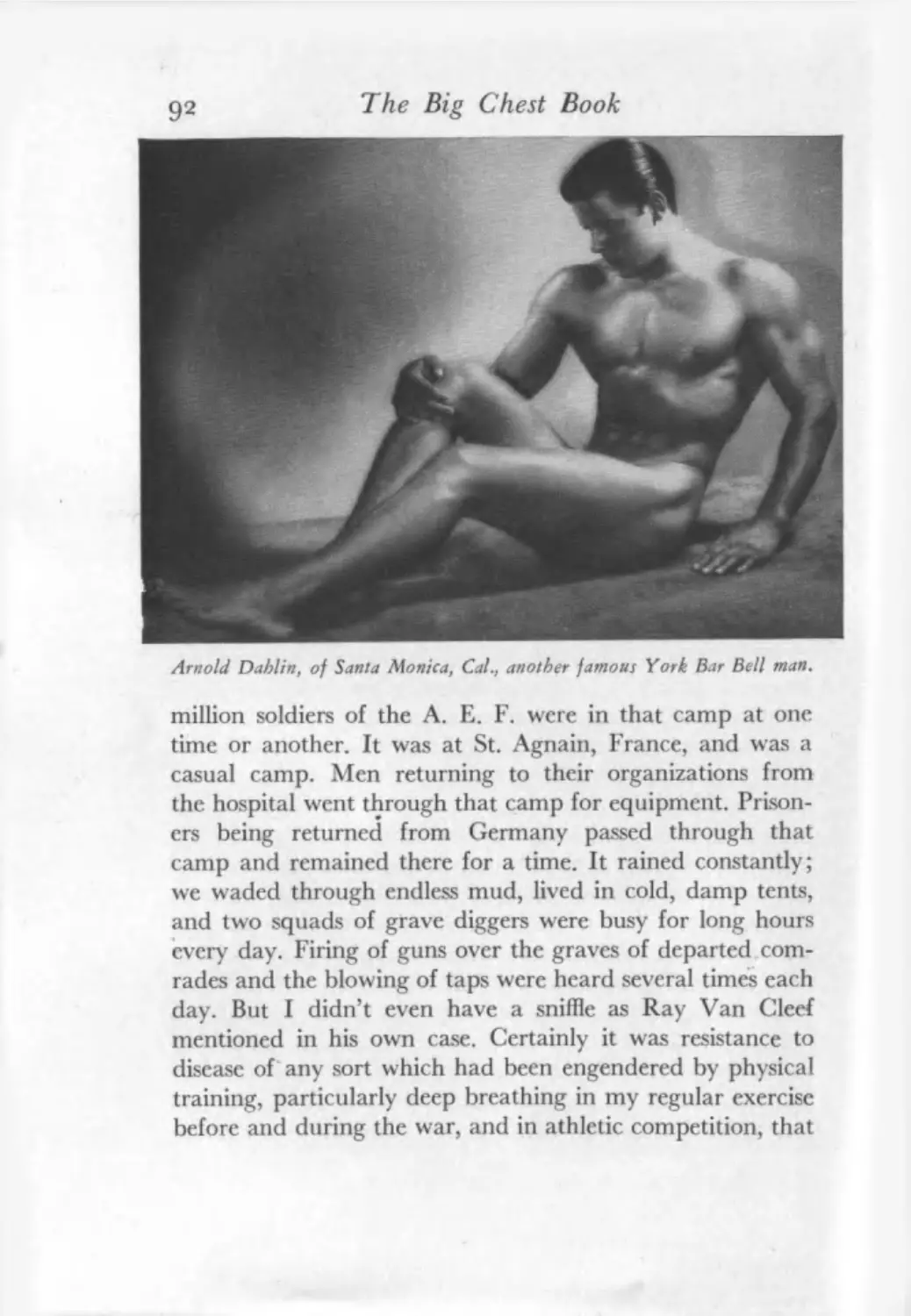
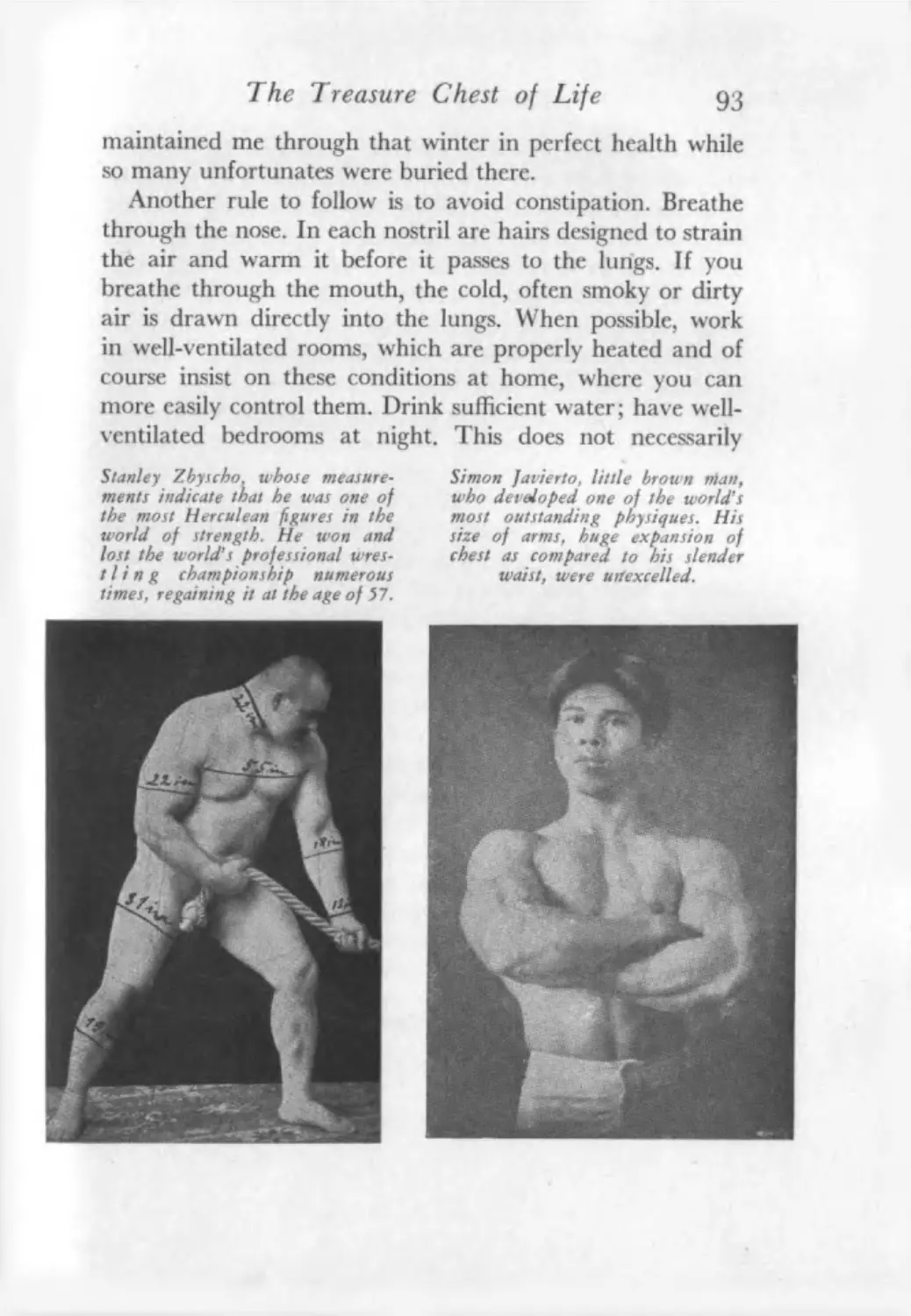
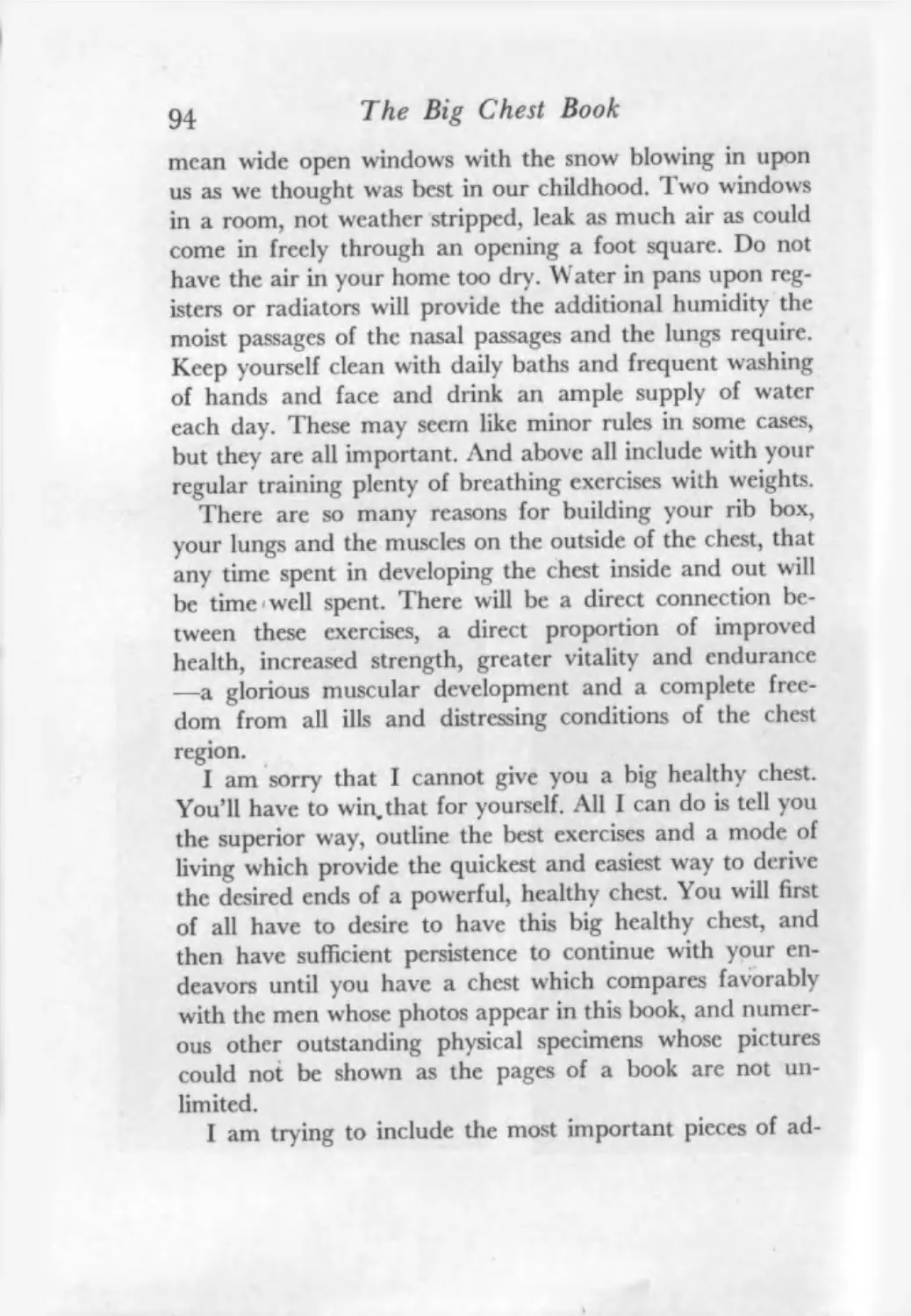
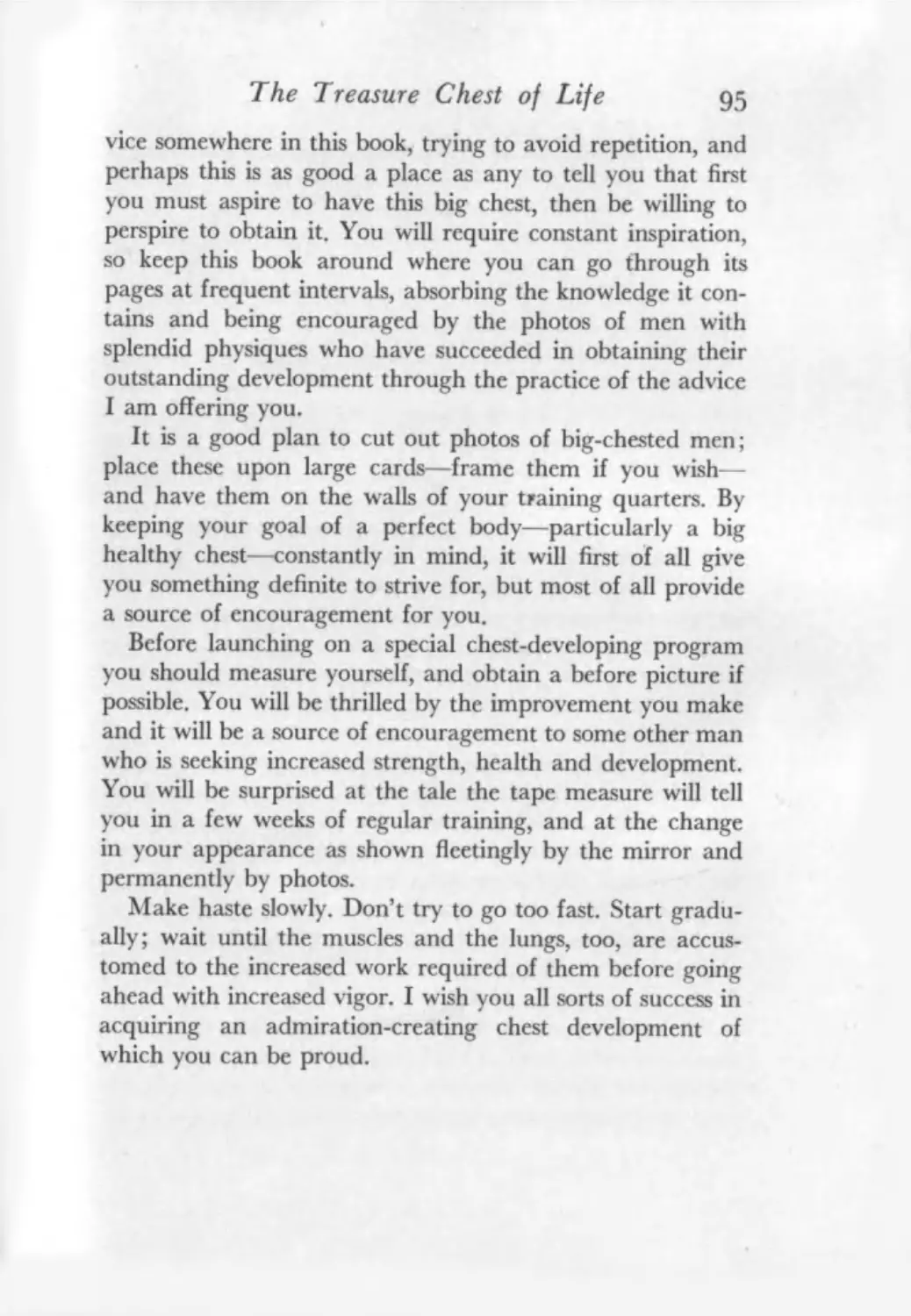
/
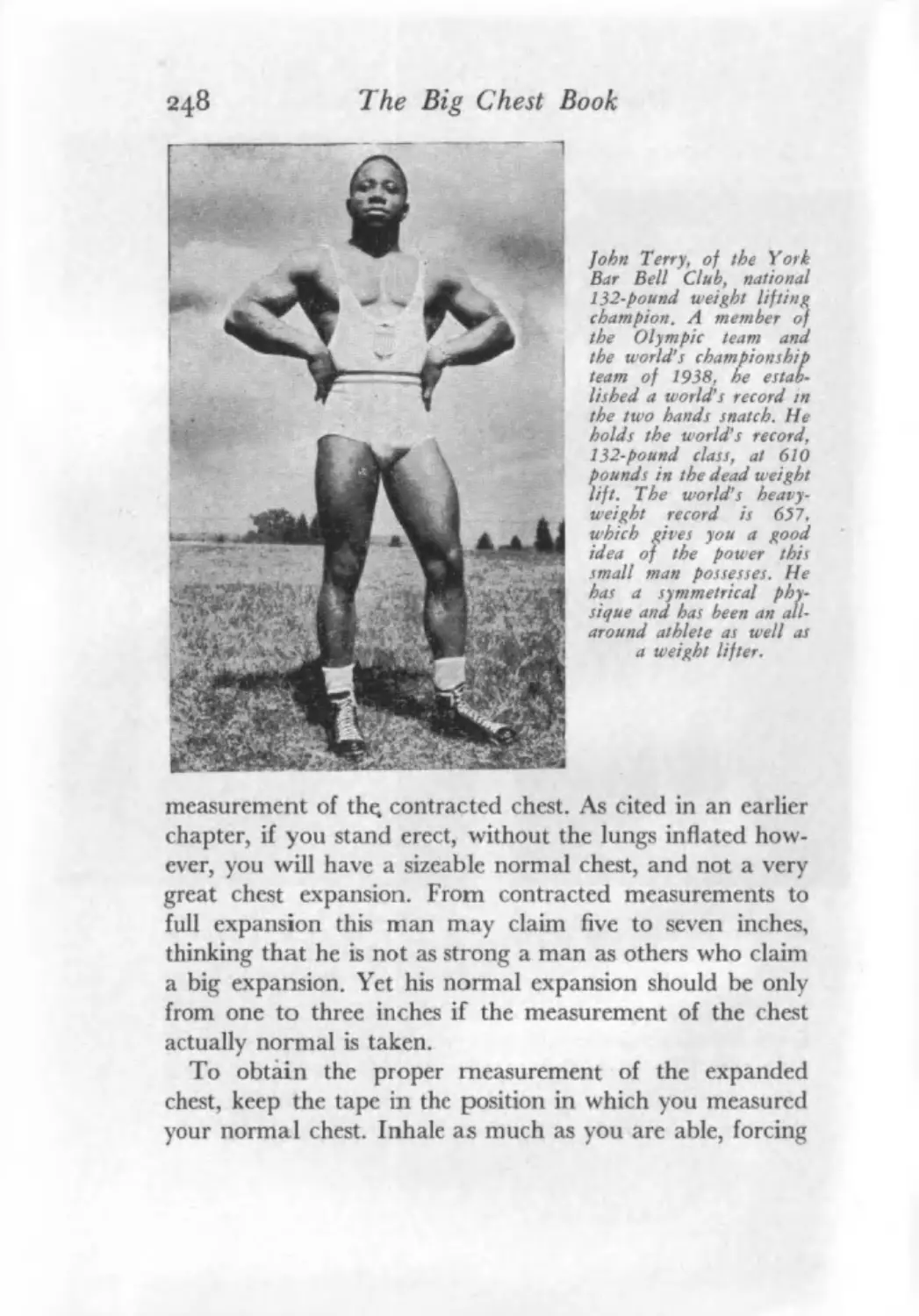
Текст
                    THE
BIG CHEST
BOOK
BY BOB HOFFMAN
THE BIG CHEST BOOK
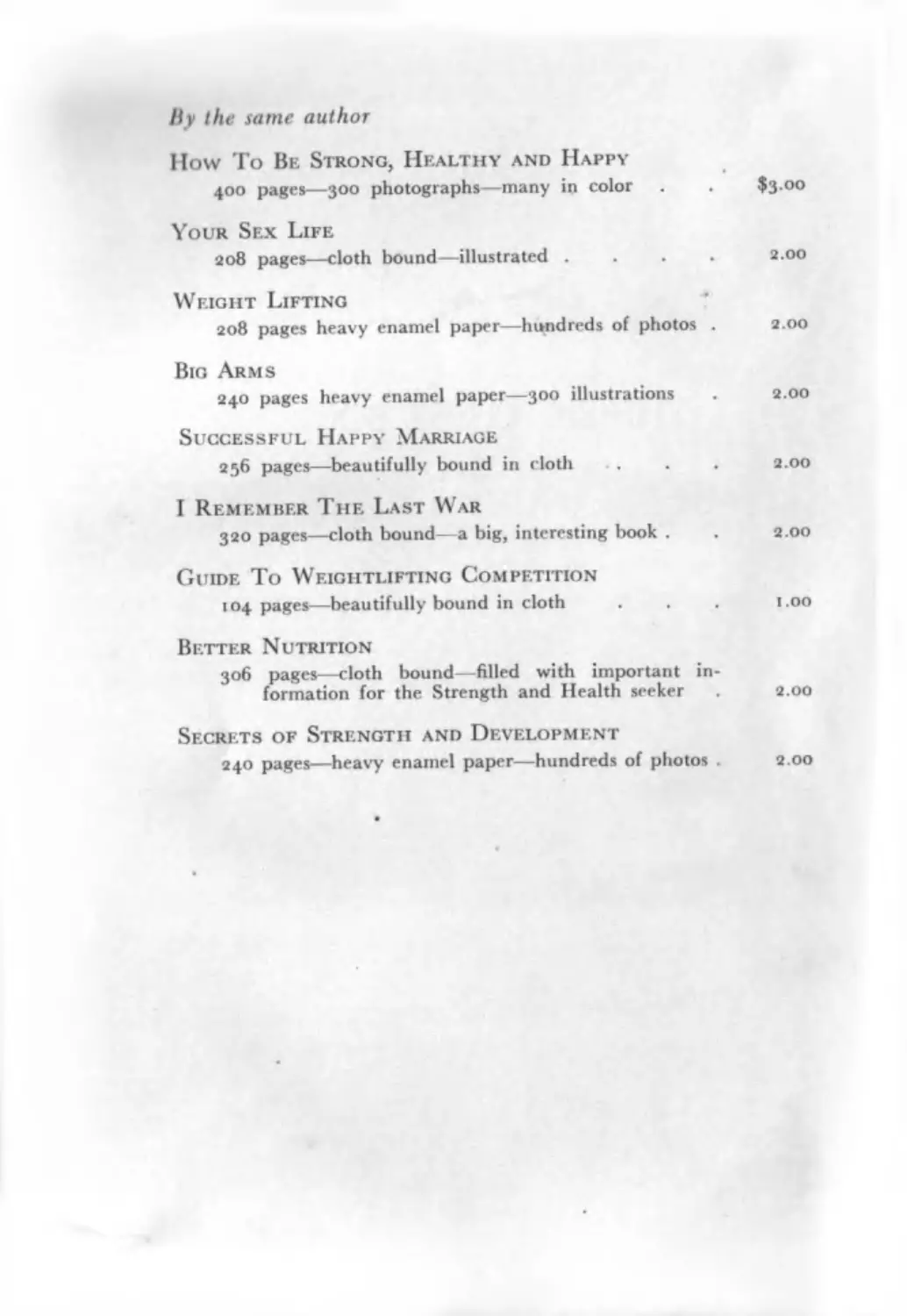
Ну the same author
How To Be Strong, Healthy and Happy
400 pages—300 photographs—many in color	$3.00
Your Sex Life
208 pages—cloth bound—illustrated .	2.00
Weight Lifting
208 pages heavy enamel paper—hundreds of photos .	2.00
Big Arms
240 pages heavy enamel paper—300 illustrations .	2.00
Successful Happy Marriage
256 pages—beautifully bound in cloth	2.00
I Remember The Last War
320 pages—cloth bound—a big, interesting book .	.	2.00
Guide To Weightlifting Competition
104 pages—beautifully bound in cloth .	.	.	1.00
Better Nutrition
306 pages—cloth bound—filled with important in-
formation for the Strength and Health seeker	2.00
Secrets of Strength and Development
240 pages—heavy enamel paper—hundreds of photos .	2.00
THE
BIG CHEST BOOK
by
BOB HOFFMAN
Editor-in-Chief of
Strength and Health Magazine
1950
Strength & Health Publishing Co.
YORK, PENNSYLVANIA
Copyright 1941 by
STRENGTH AND HEALTH PUBLISHING COMPANY
York, Pa.
All rights reserved
The Bio Chest Book
Printed in U. S. A.
CONTENTS
I.	Every Man Should Seek a Better Chest -	7
II.	Organic Strength Through Developing
the Thorax .	-	.	.	4	-	- ig
III.	Big Chested Men Are Strong and Healthy 40
IV.	Chest Improvement Through Proper Pos-
ture ..................................53
V.	“ Getting Into Condition ” • -	-	-	-	70
VI.	The Treasure Chest of Life ...	-	80
Vi	I.	Anatomical Description of the Lungs -	-	96
VIII.	Strengthening	the	Heart.............115
IX.	How to Develop the Chest -	-	-	-120
X.	Building the Muscles of the Upper	Back -	135
XL	Developing the Latissimus Dorsi	-	-	-	152
XII.	The Muscles of the Chest -	-	-	-	173
XIII.	Expanding the	Rib	Box....................195
XIV.	Displaying the	Muscles of the Chest and
Back ---------	219
Big Chested Men..........................229
re Important Chest Facts -
245
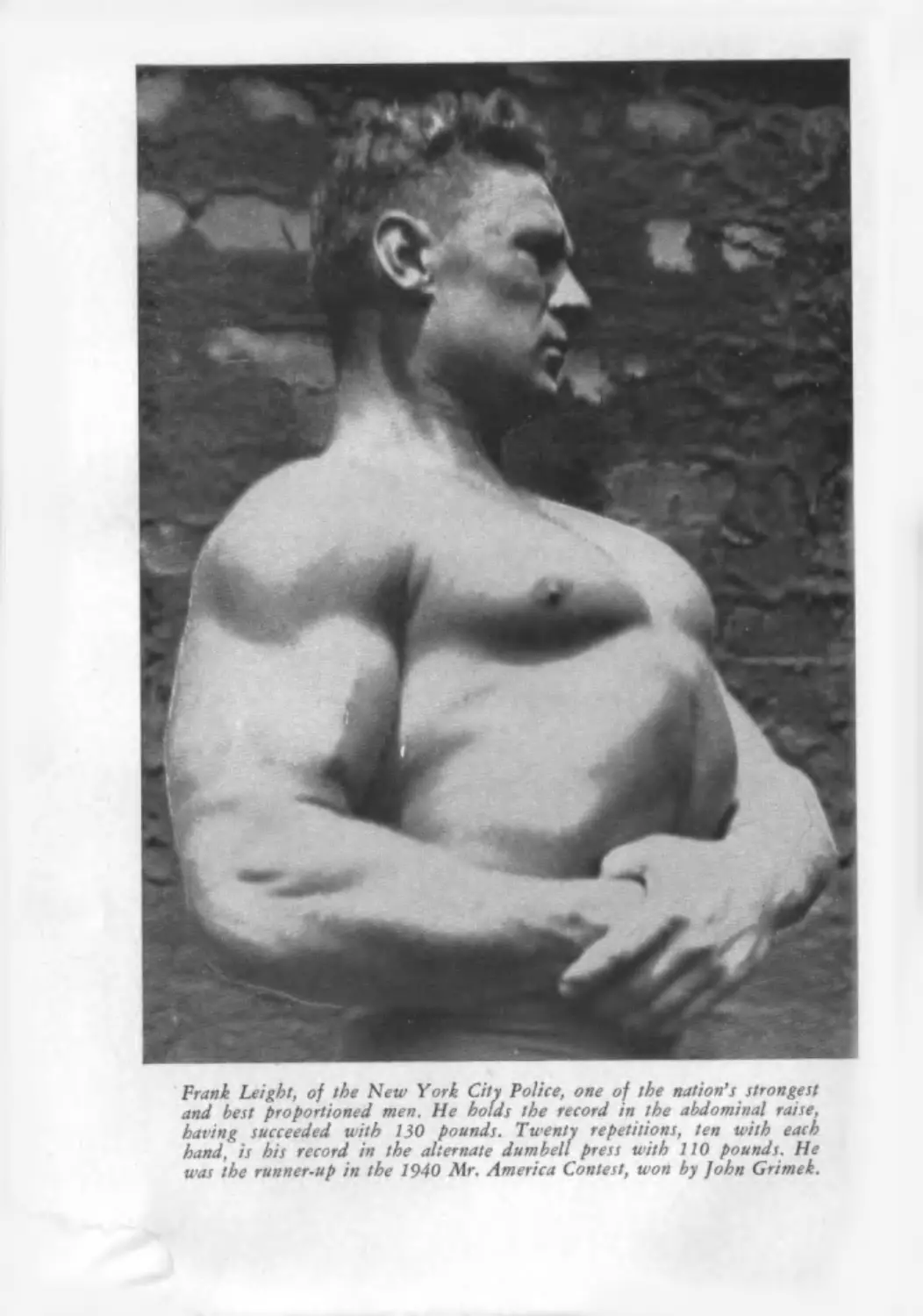
Frank Leight, of the New York Citi Police, one of the nation’s strongest
and best proportioned men. He holds the record in the abdominal raise,
having succeeded with 130 pounds. Twenty repetitions, ten with each
hand, is his record in the alternate dumbelt press with 110 pounds. He
was the runner-up in the 1940 Mr. America Contest, won by John Grimek.
CHAPTER ONE
Every Man Should
Seek a Better Chest
I believe there is more inter-
est, among those who are seeking physical betterment, in
the development of the chest than any other part of the
body. Most experienced body builders understand that the
building of a larger chest means that the entire physique
becomes larger and better developed. Bigger chests mean
broader shoulders, more muscles on the outside of the chest,
and larger limbs. While less thought is given to the impor-
tant fact that a larger rib box means more room for the
all-important heart and lungs, with an improvement in
strength, health, and longevity, this should be the para-
mount reason for developing the chest.
Regardless of the reason why body builders want bigger
t hests—whether it is the realization that a bigger chest will
mean greater strength, superior health, more vital power
and endurance, additional resistance to disease, greater
longevity, or whether it is the desire to look better through
having a bigger chest—the fact does remain that every
man who is seeking greater health, strength and develop-
ment is interested in building the chest.
7
8	The Big Chest Book
I believe that a man with a large, roomy, deep chest ex-
cites admiration and commands attention even more uni-
versal than the man with broad shoulders or big arms.
The vast majority of those who take up the practice of
physical exercise do so to look better and to feel better.
Although the big, well-developed chest is impressive in ap-
pearance and adds to the aspect of the physique when
clothed or in athletic costume, the most important feature
about big-chested men is the fact that they are always ex-
tremely healthy, which of course means that they not only
feel well but like the proverbial million.
I have at times written that I am a leading competitor
for the title: “ World’s Healthiest Man.” It’s impossible to
be healthier than I. Few can be so completely free from the
slightest pain or physical irregularity of any sort, have such
unusual pep and energy, and more than their share of
physical strength. I believe that my own good-sized chest
has been responsible for much of the wind, endurance and
rapid recuperative powers I have always shown in athletics
and after enforced periods of heavy work. As you go on
reading the chapters of this book you should be impressed
with the fact that a big chest provides room for good-sized,
powerful, efficiently-operating internal organs of all sorts.
The man with a big chest almost without exception is
superhcalthy, usually healthy in proportion to the size of
his chest. There are exceptions to all rules, but the man
with the biggest chest should be, and most often is, healthi-
est because of the size of his chest; while the man with just
big arms or broad shoulders is not necessarily healthy on
account of them, but usually is healthy because the exercises
which made possible his development have built a big chest
and unusual internal strength too.
As we will consider farther on in the chapters on anat-
omy, the upper chest contains a large part, a highly im-
Every Man Should Seek a Better Chest 9
portant part, of the vital organs—the heart and the lungs,
in particular; and in the lower part of the chest, the stom-
u h, liver, kidneys and spleen, as well as many important
glands. When a man possesses a large, roomy chest box,
I here is plenty of space for these organs to develop, to in-
< rcase in size, with a simultaneous increase in internal
strength and vigor.
Some time ago I received a letter which I remember
particularly from among the ipmry thousands of other let-
ters, for it illustrates how little some medical men know
alxiut physical development. Modem, well-informed doc-
tors fully realize the beneficial developmental effect,
strength of the body inside and out, «which results from
weight training. With each passing month more and more
doctors become impressed with and “ sold ” on our form of
training. But there still are a few like the one reported in
the letter under discussion. The writer of the letter was
thirty-six years of age; he told me that he had been inter-
ested in weight training for about one year as a result of
reading Strength and Health magazine, but before taking
up this form of training—using “ Iron Pills ”—he consid-
ered it prudent to consult with his family physician as to
the advisability of training with weights. Friend doctor told
him not to use weights, that he was too old. He said that
weight training would build larger muscles, and as the heart
was a muscle it would grow, too; with the enforced breath-
ing which resulted from intensive training, the lungs would
strive to get bigger; but a man at his age could not increase
the size of his chest as he was too old—past the stage when
the skeletal framework could be altered in any manner.
With larger organs congestion and serious ills would result.
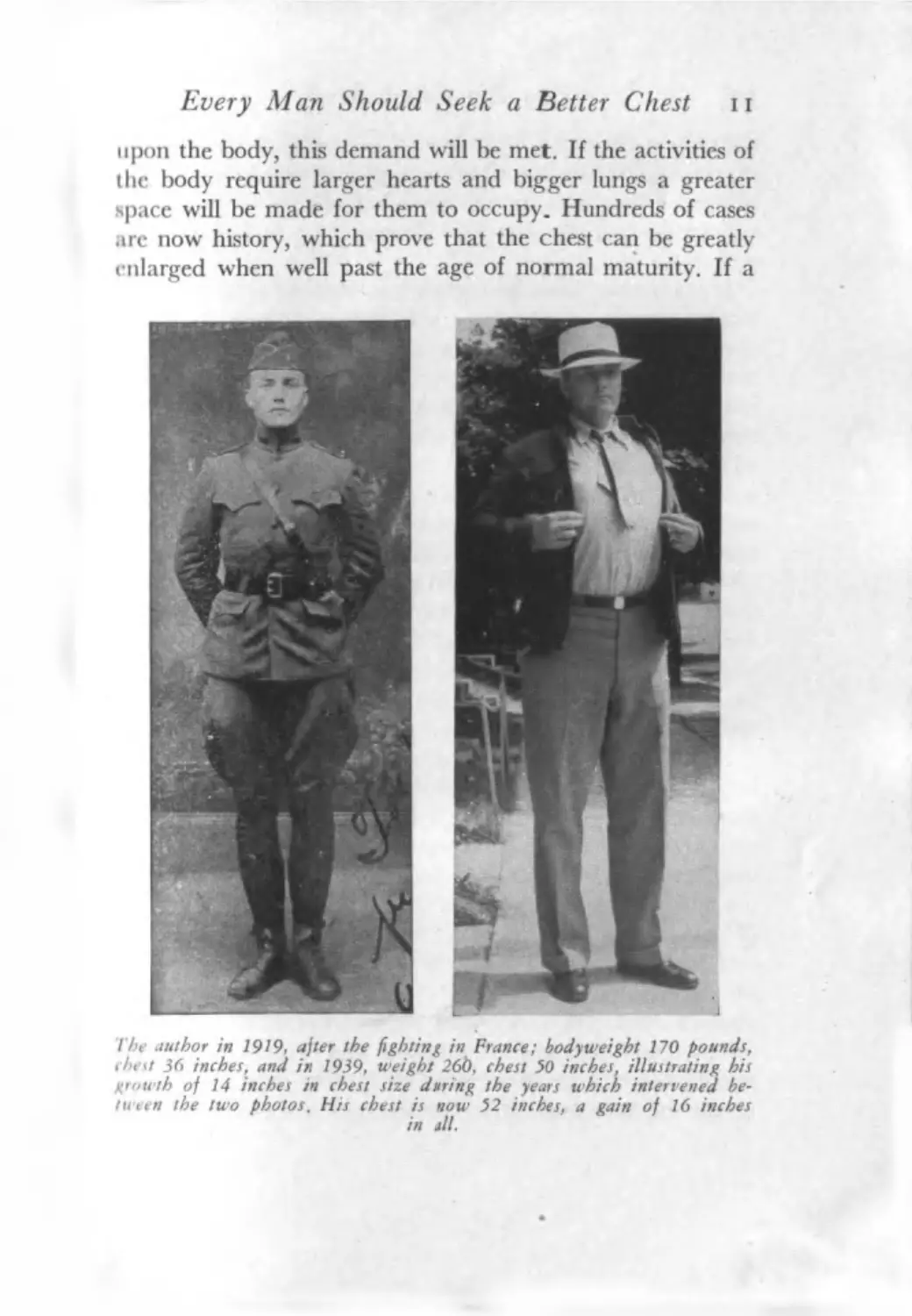
The man thought things over for a time; he saw the
picture of myself illustrating the fact that my chest had
grown fourteen inches since I reached a mature age, and he
io	The Big Chest Book
began to believe that he could follow the instructions in the
York courses, and probably augment the size of his rib box.
He knew, too, that if he felt any sign of congestion in the
thorax through the growth of his heart and lungs and fail-
ure of the rib box to increase in size, that he could moderate
his training, or cease altogether.
He wrote me a letter and asked if I thought he could in-
crease the size of his chest at his present age. I cited my
own case of continued growth when past the age of thirty.
Most of my chest growth resulted since I found myself in a
position to train more regularly ten years ago, when I was
thirty-two. A man’s nose and ears grow until he is a hun-
dred if he can live that long. The shoulders can be widened
and the chest enlarged until the age of fifty at least. Even
after that age, there is a good possibility of gaining larger
chest measurements by increasing the development of the
muscles which cover the chest on all sides.
Bone itself seldom grows after the age of twenty. Some
men have grown taller after twenty-one years of age, but
they are the exception rather than the rule. There is some
broadening of the shoulders through a readjustment of the
bones, and a stretching and thickening of the ligaments and
attachments which hold the clavicle bones together. The
breastbone itself will not grow, but bones of the ribs will
spread through the lengthening of the cartilaginous attach-
ments of the rib bones.
I recently received a letter from this same man saying
that I was exactly right, for in the first three months of
regular training hrs chest increased in size from thirty-six
to forty. In another chapter I will enumerate a few other
cases of men who increased the size of their chests to a
considerable extent after they had reached an age of ma-
turity.
Nature takes care of her children; if a demand is made
Every Man Should Seek a Better Chest n
upon the body, this demand will be met. If the activities of
the body require larger hearts and bigger lungs a greater
space will be made for them to occupy. Hundreds of cases
are now history, which prove that the chest can be greatly
enlarged when well past the age of normal maturity. If a
The author in 1919, after the fighting in France; bodyweight 170 pounds,
chest 36 inches, and in 1939, weight 26b, chest SO inches illustrating his
growth of 14 inches in chest size during the years which intervened be-
turen the two photos. His chest is now 32 inches, a gain of 16 inches
in ell.
12	The Big Chest Book
man has a chest of only thirty-six inches, isn’t it logical to
expect that he also has small organs, and isn’t it reasonable
to believe that these organs have less chance to cope with
various ills and any attack of disease upon their particular
selves?
It’s a rather homely comparison, but any farmer can
look at a group of chicks a week or two old and point out
those which will amount to anything. Those that have
plenty of chest room and space in the section which corre-
sponds to the lower chest will live and grow and pay their
way. The chickens with the longer bodies are the ones
which possess the quality of livability and have sufficient
resistance to possible disease. Those which remain small
and round will probably never grow up, and if they do,
they will represent a loss either in weight gained or egg-
laying ability. Or ask any man who knows mature chickens
and can cull them. Those with smallest chests, with lack of
development in the portion of their bodies which holds the
organs encased in the lower chest of humans, are the first to
be culled; for it is known that they have little chance to
continue living—less to lay and pay their way.
A well-developed chest box, which has been greatly en-
larged and is in perfect condition, has a much better and
surer chance of doing its work well, withstanding any sick-
ness or ills, or to aid in recuperation from any ills which
may be contracted due to lack of condition in the re-
mainder of the body.
You are guaranteeing your future health, your strength
and longevity by developing your chest. It provides room
for the internal organs, strength to protect them, and of
course adds to the appearance of its owner. It should inter-
est the body builder to know that the chest is the easiest
part of the body to develop, as well as the most important.
It can be increased in size more rapidly than any other
Every Man Should Seek a Better Chest 13
part. It is not unusual for a gain of from ten to twelve
inches to be registered in a year’s time by the young man
who is going through or has just passed through the period
of puberty or of rapid growth. Not so rapid gains are usu-
ally registered by men who are older but three to six inches
in one year is quite usual. A considerable portion of this
growth is the development of a larger rib box, but the mus-
cles of the upper chest, the sides and the upper back ac-
count for quite a lot of it.
When a man builds a really well-developed chest, he has
little or no expansion because his chest is always near the
limit of its possible enlargement. I am often asked how much
( best expansion I have, and always .report that I have
almost none. If my interrogator apparently doubts this
statement I go on to explain that if I would stand in the
position of a soldier, with the chest erect, arms hanging nat-
urally at the sides, thumbs along the seam of the trousers,
I must get my shoulders back to the point where the chest
is held almost at its limit even when not fully inflated with
air. Try this yourself. If you already have a good chest, you
won’t be able to expand much, if any, past the position of
attention.
Years ago, one heard a great deal of chest expansion. A
man was not considered to be strong and well developed
unless there was an expansion of five to ten inches—even
more with those who had developed the chest expansion art
to the limit. The men who had the greatest chest expansion
were never strong men. They were usually men who had
performed no exercises except those of a chest expanding
nature. If a chest was really covered with firm muscles it
could not enlarge to such a great extent. And strange as it
may seem, some of the men with greatest chest expansions
were those who experienced at least a slightly tubercular
< ondition. The lungs were not so efficient in their operation
14	The Big Chest Book
and thus a much greater area of lung surface was required
to perform the normal, moderate work of the breathing
apparatus in an inactive person.
A few years ago John Grimck and I went back stage to
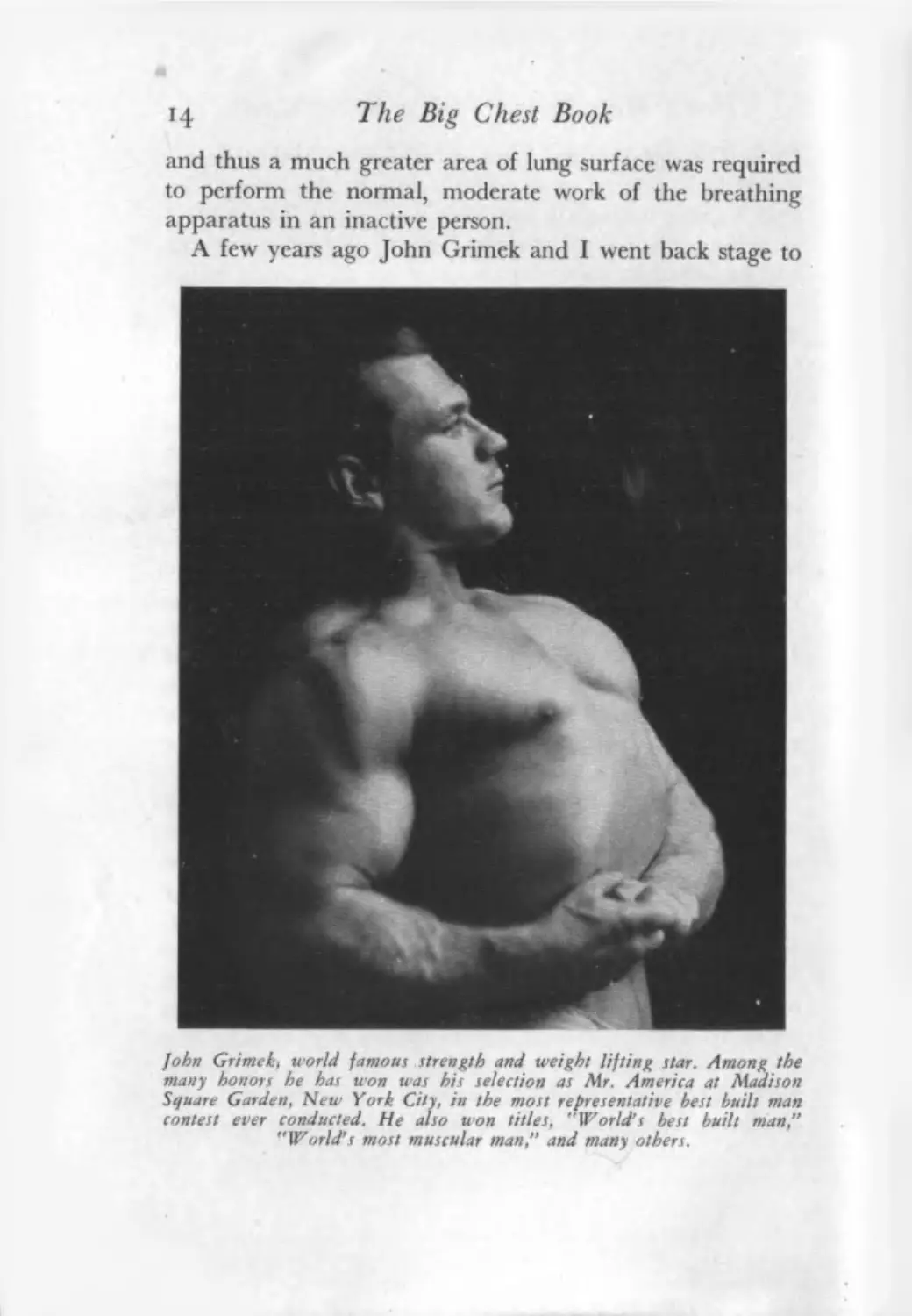
John Grimek, world famous strength and weight lifting star. Among the
many honors he has won was his selection as Atr. America at Madison
Square Garden, New York City, in the most representative best built man
contest ever conducted. He also won titles, "World’s best built man,”
"World’s most muscular man," and many others.
Every Man Should Seek a Better Chest 15
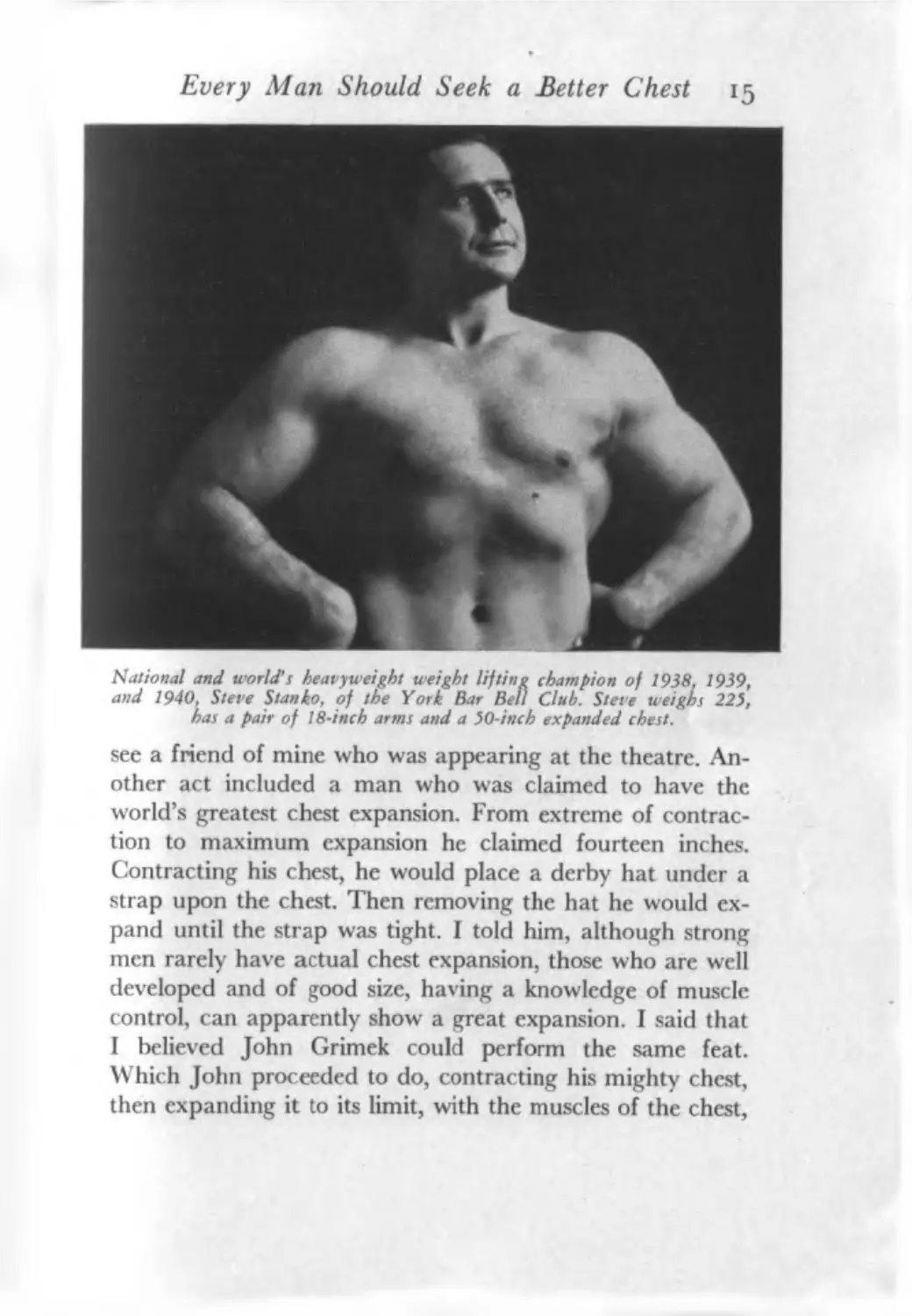
National and world’s heavyweight weight lifting champion of 1938, 1939,
and 1940, Steve Stanko, of the York Bar Bell Club. Stere weighs 223,
has a pair of 18-inch arms and a 30-inch expanded chest.
see a friend of mine who was appearing at the theatre. An-
other act included a man who was claimed to have the
world’s greatest chest expansion. From extreme of contrac-
tion to maximum expansion he claimed fourteen inches.
Contracting his chest, he would place a derby hat under a
strap upon the chest. Then removing the hat he would ex-
pand until the strap was tight. I told him, although strong
men rarely have actual chest expansion, those who are well
developed and of good size, having a knowledge of muscle
control, can apparently show a great expansion. I said that
I believed John Grimek could perform the same feat.
Which John proceeded to do, contracting his mighty chest,
then expanding it to its limit, with the muscles of the chest,
16	The Big Chest Book
back and sides extended to their limit. You can judge from
his photos if you have not seen him in person that this man
Grimek has amazing control of his muscles. Off the subject
a bit, but another time we were in the side show of Ring-
ling’s Circus; a man was displaying his ability there who
was billed as “ the man without a stomach.” He was a man
of slender frame, otherwise undeveloped, who had the abil-
ity to control his muscles and draw the waist in to an aston-
ishing degree. Although Grimek was so much more heavily
muscled, possessing superlative ability at the same sort of
feat, muscles and all, his contracted measurement was no
greater than the “ man without a stomach.”
It has often been said that my friend, Otto Arco, great
old time strong man, who is still one of the world’s most
muscular men, one of the first three men in the world to
lift double his bodyweight overhead, has no chest expan-
sion.
In two months of training, the regular training course
and a bit of specialization in chest exercises, twenty-four
hours of actual training time devoted to the regular, inter-
ested and intelligent practice of a few specialized chest-
developing exercises, changes in one’s chest which are truly
astounding will take place. Two months devoted to the de-
velopment of any other part of the body, the arm, for in-
stance, will bring results, but where the arm might be
increased an inch in three months, four inches should be
gained in the average case in increasing the chest measure-
ment
This unusual rate of increase compared to that of any
other part of the body comes about, primarily, because
most of us—even those with the most sedentary occupa-
tions—use our arms and legs to at least some extent. They
are better developed in comparison than is the chest. And
the chest, being nearly three times as large as the arm in
Every Man Should Seek a Better Chest 17
inches of circumference, naturally can gain more in inches
to make the same proportionate gain. Three inches in chest
gain is no more than one inch gain in arm or thigh.
It’s possible to obtain thirty times as much air with re-
sulting oxygen for the body’s needs during enforced breath-
ing as compared to the normal respiration of most of us.
Even moderate exercise, increasing five or tenfold the op-
eration of the lungs, will create demands which must be
met by increased lung size and rib box capacity. Little per-
manent development of the chest will result merely from
deep breathing alone, forcing much more air into the lungs
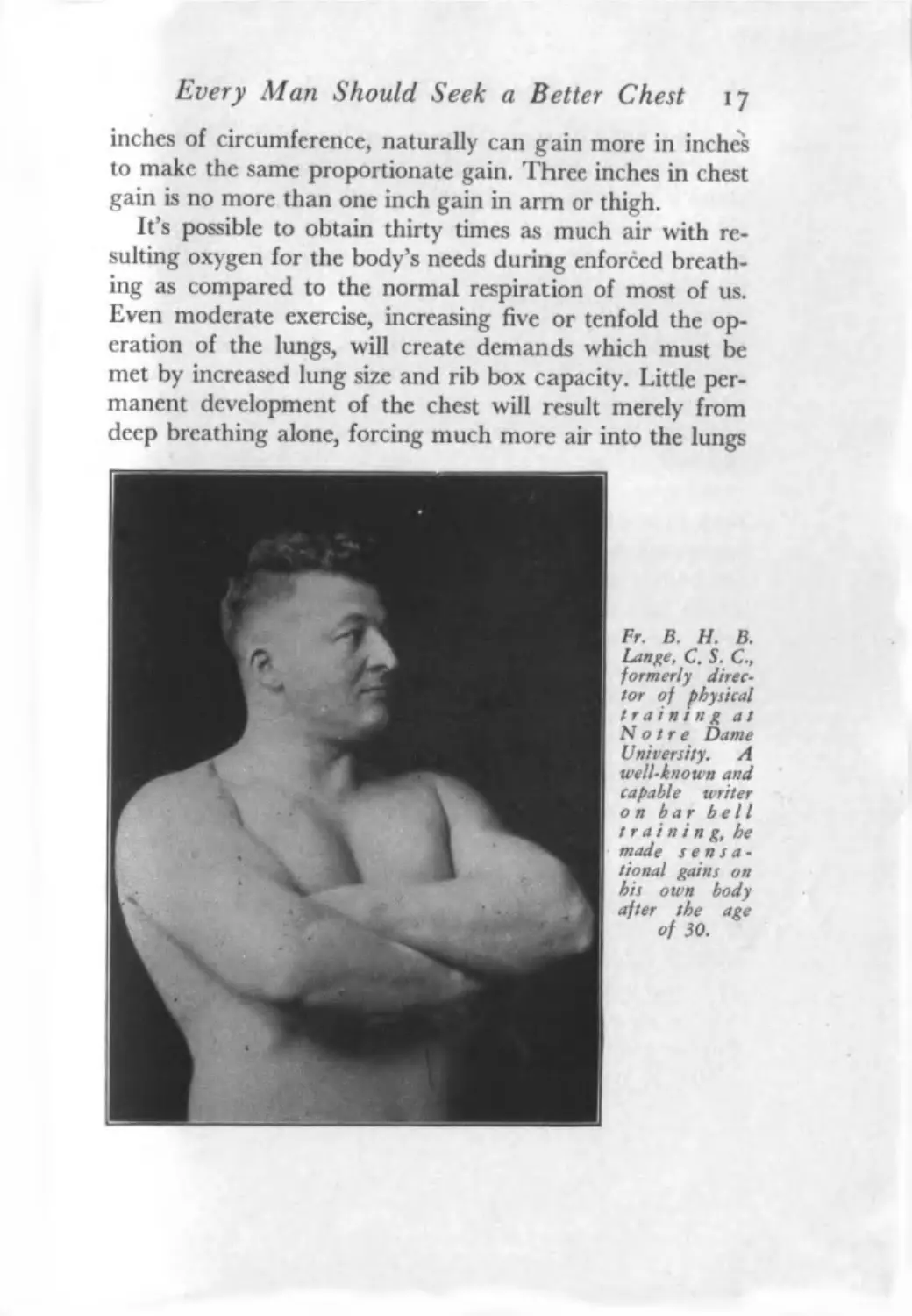
Fr. В. H. B.
Lange, C. S. C.,
formerly direc-
tor of physical
training at
Notre Dame
University. A
well-known and
capable writer
on bar bell
tional gains on
bis own body
after the age
of 30.
18	The Big Chest Book
than the body requires. Growth results rapidly when a de-
mand has been made for more lung capacity, and that de-
mand is made by deep breathing with moderate weights to
aid the movement. The demands for more air are quickly
and permanently met by increased lung size and rib box
capacity.
And when the body builder becomes strong enough .to
work against very heavy resistance, to create an even
greater demand for oxygen to meet the needs of the hard-
working muscles, then really enforced breathing is necessary
and the chest grows by leaps and bounds. The more mus-
cles that are employed in the exercise, the harder and more
continuous movement, the more oxygen is required. The
deep knee bend is best known as a chest developer, for this
movement brings into vigorous play the largest muscles of
the body, those of the back as well as the legs, which include
nearly half the muscular bulk of the body. Muscles farthest
from the heart, powerful enough to vigorously and continu-
ously exert themselves, require great quantities of oxygen to
aid the working muscles and of course there is a commen-
surate gain in chest capacity. Compound exercises of a
particularly vigorous nature, such as five movements in suc-
cession, each consisting of ten repetitions, exercises which
involve all the muscles, such as deep knee bend, dead weight
lift, rowing motion with the two hands curl and the two
hands press to start the compound exercise, will make such
demands that near the end of the fourth or fifth exercise,
if substantial poundages have been employed, the body
builder should be breathing like he is near the completion
of a mile race. When a breathing exercise such as the press
on box or some form of the two arm pull over while lying
follows such vigorous exertion, greatly increased chest size
is sure to result.
С Н А Р т Е R TWO
Organic Strength
Through Developing
the Thorax
WZiEN you see a man with a
big, round, deep chest, what do you think?—that there’s a
strong, supcrhealthy man, of course. Public opinion is
quite correct in this belief, for a big chest provides more
room for the organs which it encases. 1Ъе lungs and heart
have more “ living space ”—a larger chest box permits
them to grow larger and stronger and makes it possible for
them to do their work more efficiently.
Few strength and health seekers realize the importance
of a large rib box in helping them attain their cherished de-
sire of greater strength and improved health, vigor, endur-
ance, recuperative powers and longer life. Everyone should
realize the importance of big, efficient lungs and a strong,
enduring heart. The heart starts beating before birth and
the lungs commence their lifelong function of breathing an
instant after the baby is bom. For threescore and ten years,
or, as the Bible informs us, “ if by reason of strength, for
fourscore years,” these two organs maintain life within the
lx>dy.
19
20
The Big Chest Book
Briefly, it’s the work of the lungs to draw air into the
body, extract the oxygen, impregnate the blood with it,
which is then pumped or driven to every part of the body.
Oxygen is necessary for life. It mixes with the blood fuel
which in turn makes possible all bodily movements, push-
ing, lifting, pulling or carrying. On the return journeys the
carbon dioxide is carried by the blood, extracted at the
heart and expelled by the lungs. These two organs are part-
ners in most important functions of the body.
Although everyone knows that the lungs are important,
they more fully realize the necessity of a strong heart in
continuing to be useful and active and to remain in this
world longer. When the lungs fail, it is never suddenly.
Over a period of many years the little-used lungs will be-
come weaker as a result of less bodily activity. The lungs
are capable of extracting the oxygen from an estimated
thirty times more air than is needed when completely inac-
tive. As most persons spend their lives with as little physical
activity as possible, the greater portion of their lungs is
unused. In these deep, dark, moist recesses, germs can con-
gregate, breed by billions and cause consumption or tuber-
culosis. While there is less tuberculosis today than some
years ago, every state has its sanitariums where people with
weak lungs must go to spend months to get back to nor-
malcy or perhaps be doomed to spend a lifetime (a shorter
than normal life) with lung trouble.
Less thought is given to the lungs than to the heart.
When it fails through this gradual weakening process, or
this slow insidious creeping of disease, it is less spectacular
than the sudden heart stopping suffered by a friend or some
other persons—a condition we know as heart failure. The
heart will gradually weaken as a result of leading an inac-
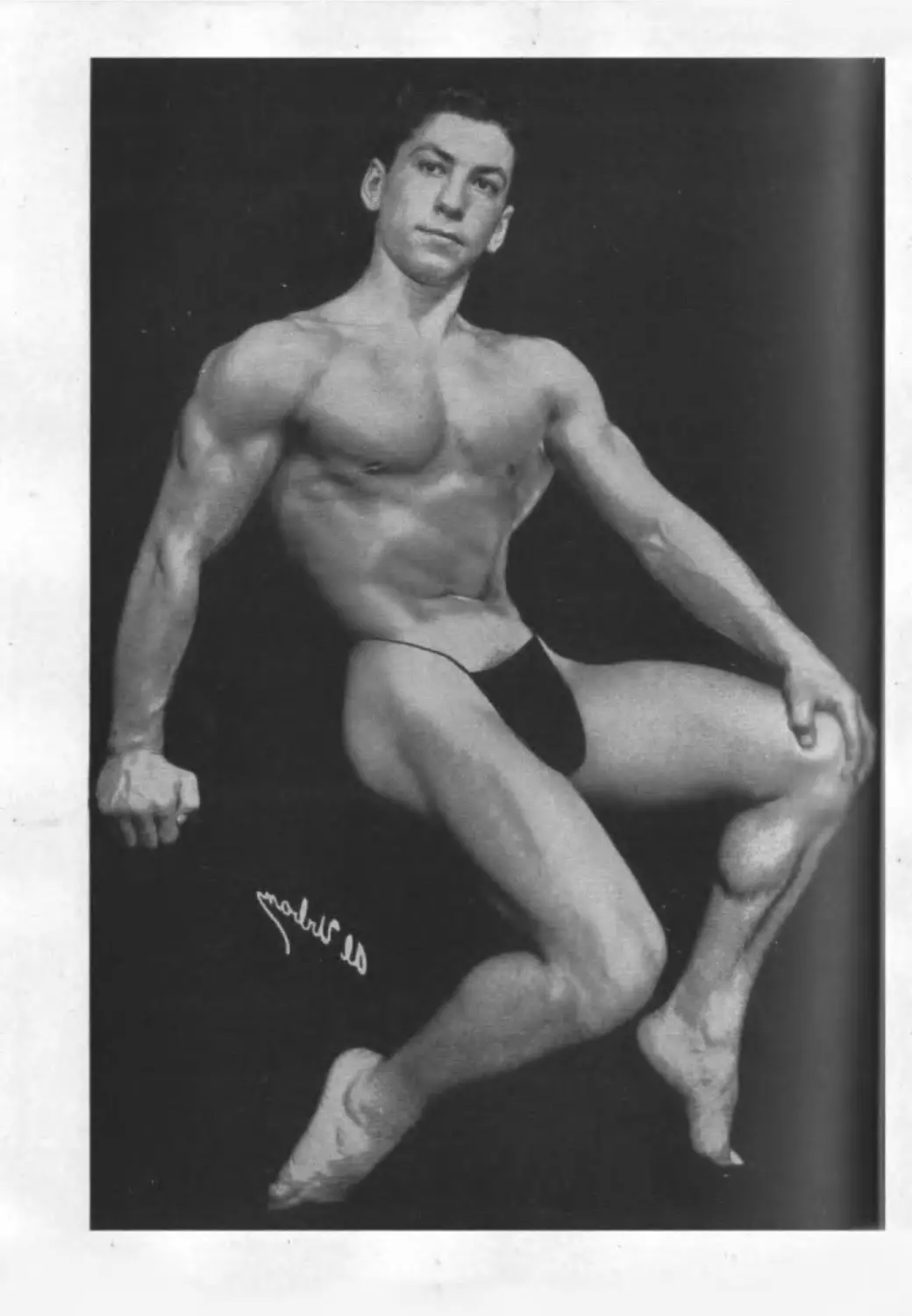
Dan Lurie, of Brooklyn, N. Y., a new star of strength and development,
uho has already built an extraordinary physique. Photo by Al Urbin.

22	The Big Chest Book
tive life; a competent physician’s diagnosis may disclose the
fact that it is no longer functioning properly. But the ma-
jority who die of heart failure arc not aware that their
hearts arc not working normally. Slight pains near the
heart are usually attributed to indigestion or muscular
aches.
In our own country alone, more than a million people
die of heart failure ever)' year, for forty per cent of the
total deaths result from a failure of this most important of
organs. Hardly a day passes but we read of the sudden
passing of some fairly youthful, well-known man. The very
young seldom succumb to heart failure, but there is an in-
creasing number who leave our good earth in that manner
in their twenties, more in their thirties, with the forties and
fifties being the most dangerous time. Heart failure causes
men, in particular, to leave this world in their prime, just
when they should be enjoying the results of their labors,
and with their experience be so much more valuable to the
nation through their vocation or profession When one con-
siders what a man has been able to accomplish in thirty or
forty years, before his sudden death, how much more good
would he have done in the world if he had lived longer
at least the normal span of threescore years and ten. He’s
taken from the midst of his loving family and is no more.
We must remember that no man can even exist, certainly
not become strong and well developed, if he does not have
a strong heart. “ No man is stronger than his heart ” is a
good rule to remember. We hear so much of arteries that
it’s easy enough to forget that the heart is the organ which
must propel its life-containing properties to every cell and
muscular fibre in the body. You have often heard it said
that a man is as old or as young as his arteries. In advanced
age arteries frequently stiffen, there is less flexibility, less
expansion and smaller quantities of blood pass through
Organic Strength Through Developing Thorax 23
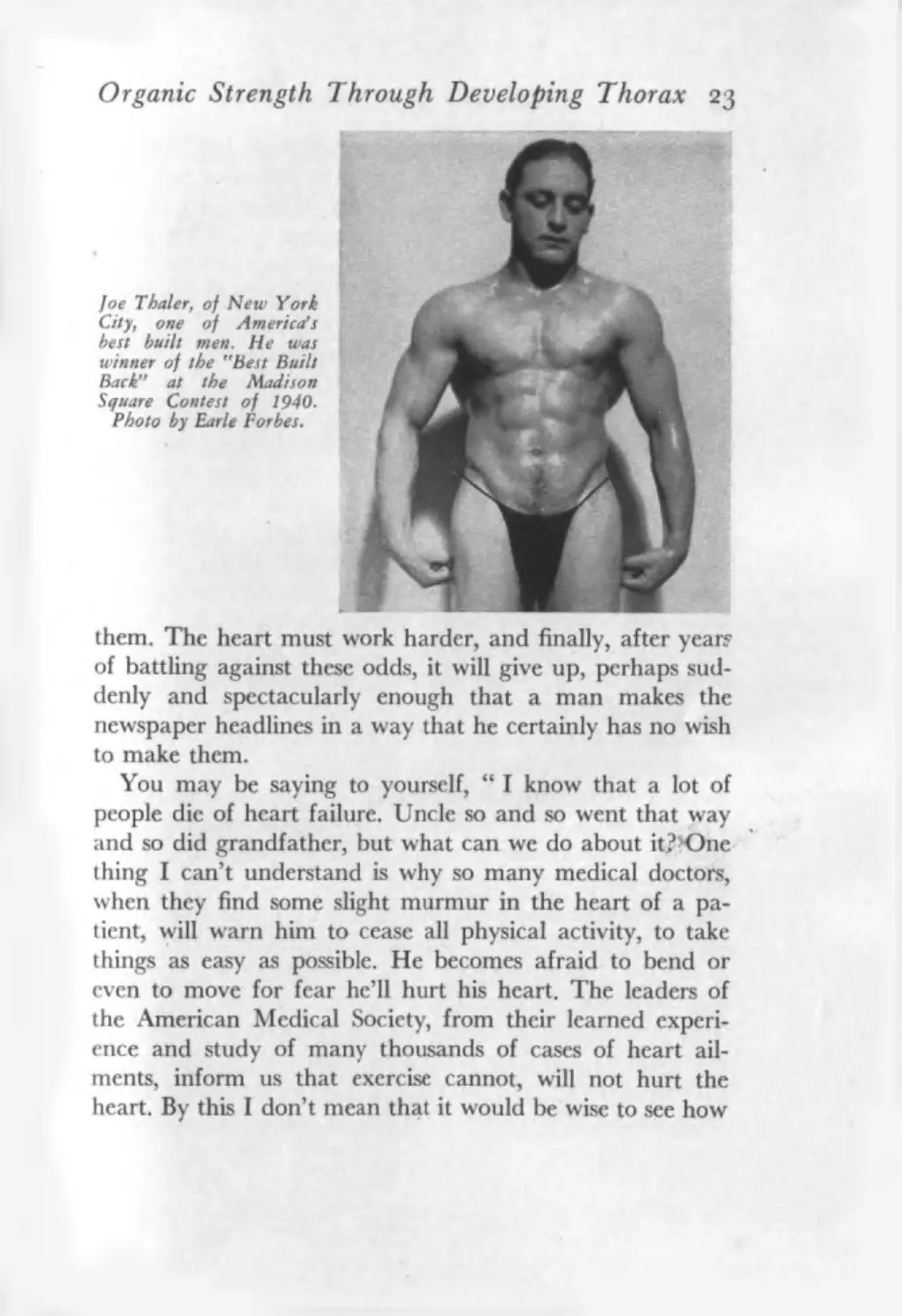
Joe Thaler, of New York
City, one of America’s
best built men. He was
winner of the "Best Built
Back" at the Madison
Square Contest of 1940.
Photo by Earle Forbes.
them. The heart must work harder, and finally, after years
of battling against these odds, it will give up, perhaps sud-
denly and spectacularly enough that a man makes the
newspaper headlines in a way that he certainly has no wish
to make them.
You may be saying to yourself, “ I know that a lot of
people die of heart failure. Uncle so and so went that way
and so did grandfather, but what can we do about it?One
thing I can’t understand is why so many medical doctors,
when they find some slight murmur in the heart of a pa-
tient, will warn him to cease all physical activity, to take
things as easy as possible. He becomes afraid to bend or
even to move for fear he’ll hurt his heart. The leaders of
the American Medical Society, from their learned experi-
ence and study of many thousands of cases of heart ail-
ments, inform us that exercise cannot, will not hurt the
heart. By this I don’t mean that it would be wise to see how
24	The Big Chest Book
far you can swim under water, to sec how fast you can
run a mile when not in training, or to endeavor to run a
twenty-six-mile marathon, play thirty-six holes of golf or a
full set of tennis if you are not in training. But the medical
authorities as well as leading physical directors do teach'
that the heart is a muscular pump, a muscle, and like other
muscles of the body it responds to exercise and becomes
larger and stronger. It’s a common belief that athletes
commonly die of athletic heart. Of the more than a million
persons who die each year of heart ailments, some arc cer-
tain to have been athletes. A man plays football, baseball,
rows or goes out for track during the short years of his col-
lege career. Ever afterward he is considered to be an ath-
lete. More than likely when he hangs up his spiked shoes,
and concentrates upon making a success of life, he feels
that he is too busy to exercise. Like any other muscle, his
heart will weaken somewhat through only ordinary use. If
the muscles of the arms, legs, or torso are seldom used,
never vigorously, they will become smaller, soft, flabby,
weak and less enduring.
As the heart is made up of similar muscular fibres it too
will weaken with only normal use which is just a fraction
of the work of which it is capable. Although it is known by
the authorities in the medical and physical training world
that the heart is only a muscular pump, that it is not pos-
sible to build up enough blood pressure even through the
most intensive use to weaken it, there still are many who
believe that the heart can be harmed through training.
On the contrary, as we will presently relate, it is strength-
ened through exercise. The former athlete, who has spent
long years of inaction physically, still believes that he is “ as
good as ever,” and he is the man whose life is often ended
prematurely. In spite of neglect, misuse and abuse of his
body he still believes that he is a superman.
Organic Strength Through Developing Thorax 25
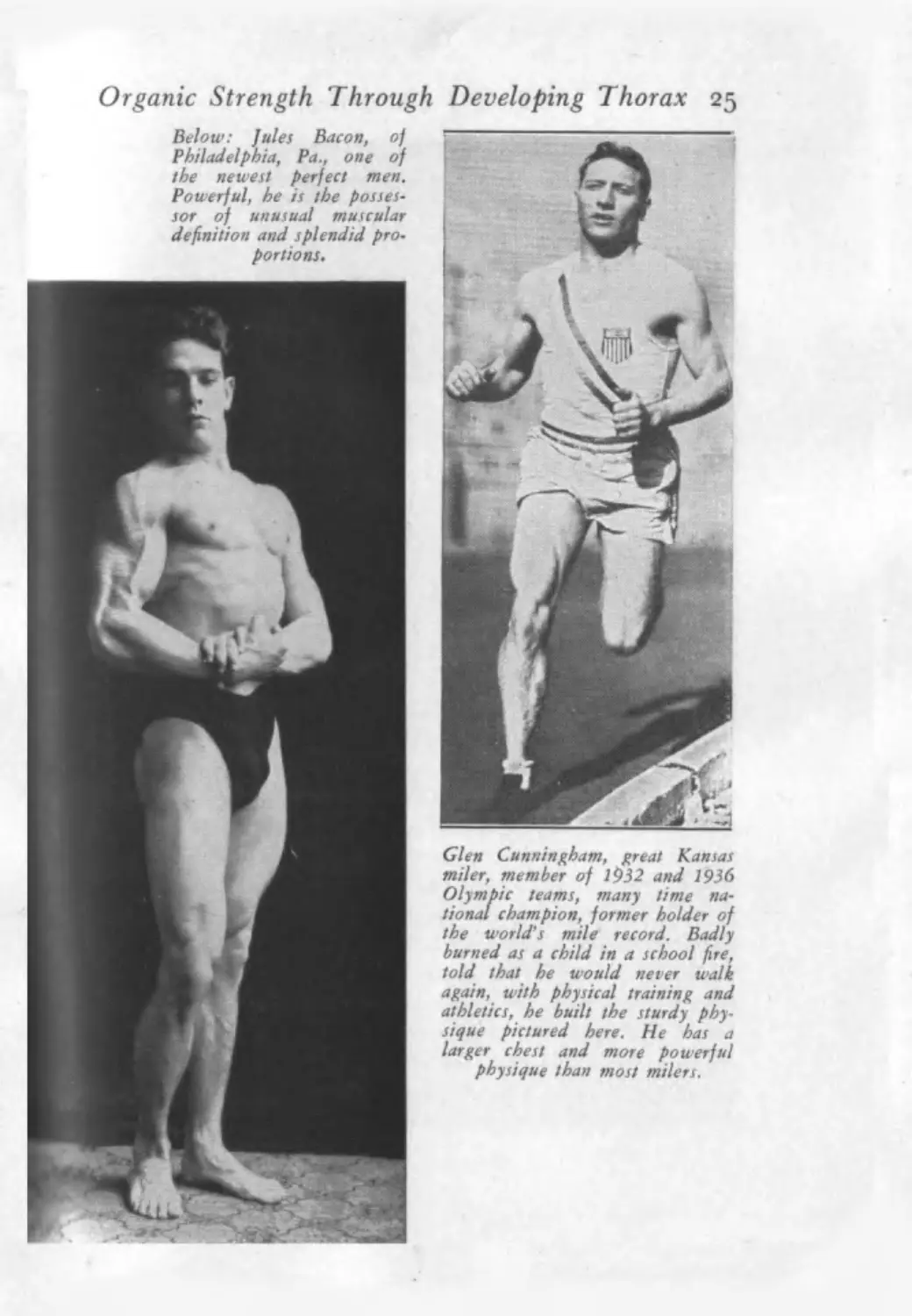
Below: Jules Bacon, of
Philadelphia, Pa., one of
the newest perfect men.
Powerful, he is the posses-
sor of unusual muscular
definition and splendid pro-
portions.
Glen Cunningham, great Kansas
miler, member of 1932 and 1936
Olympic teams, many time na-
tional champion, former holder of
the world's mile record. Badly
burned as a child in a school fire,
told that he would never walk
again, with physical training and
athletics, he built the sturdy phy-
sique pictured here. He has a
larger chest and more powerful
physique than most milers.
26
The Big Chest Book
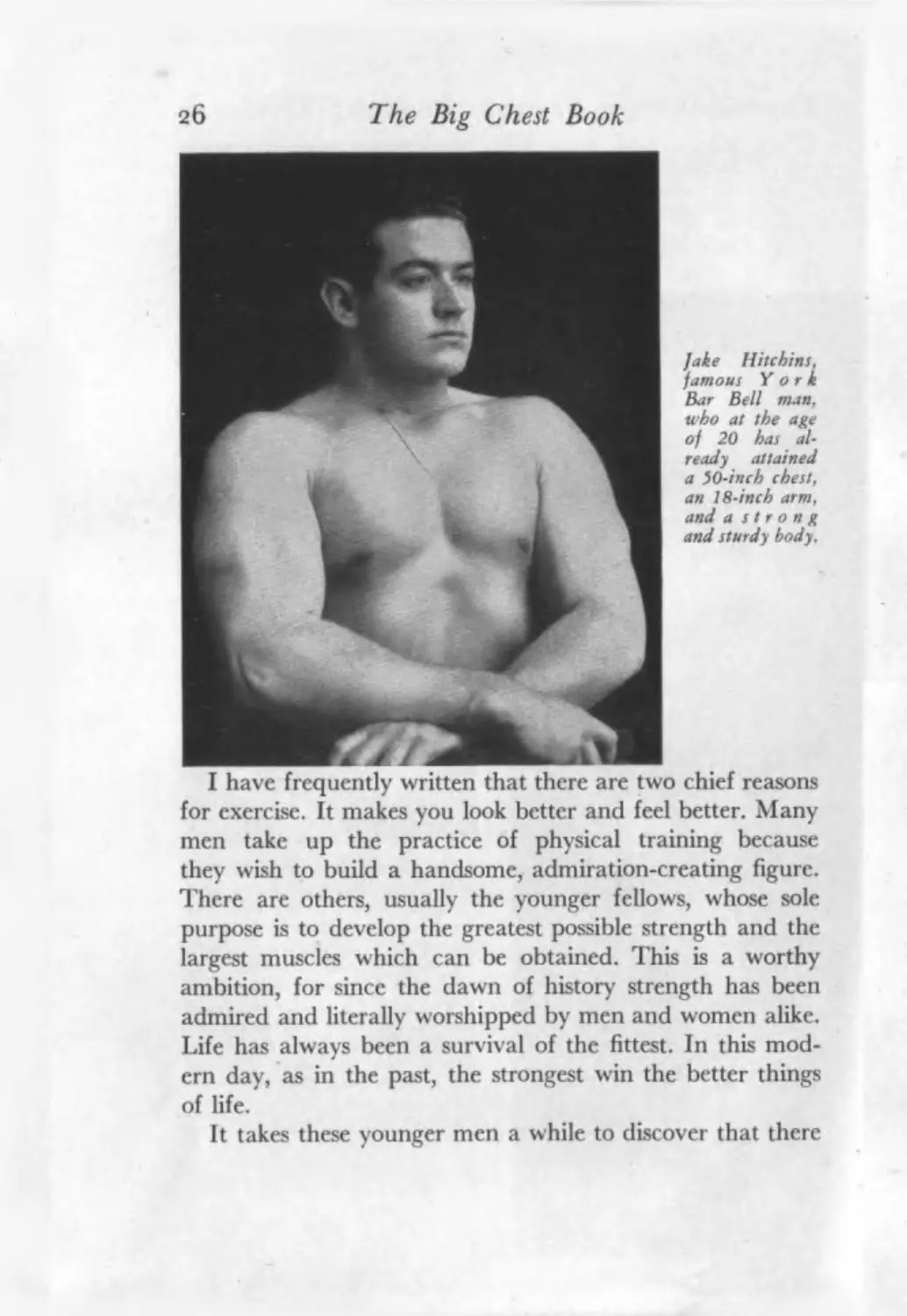
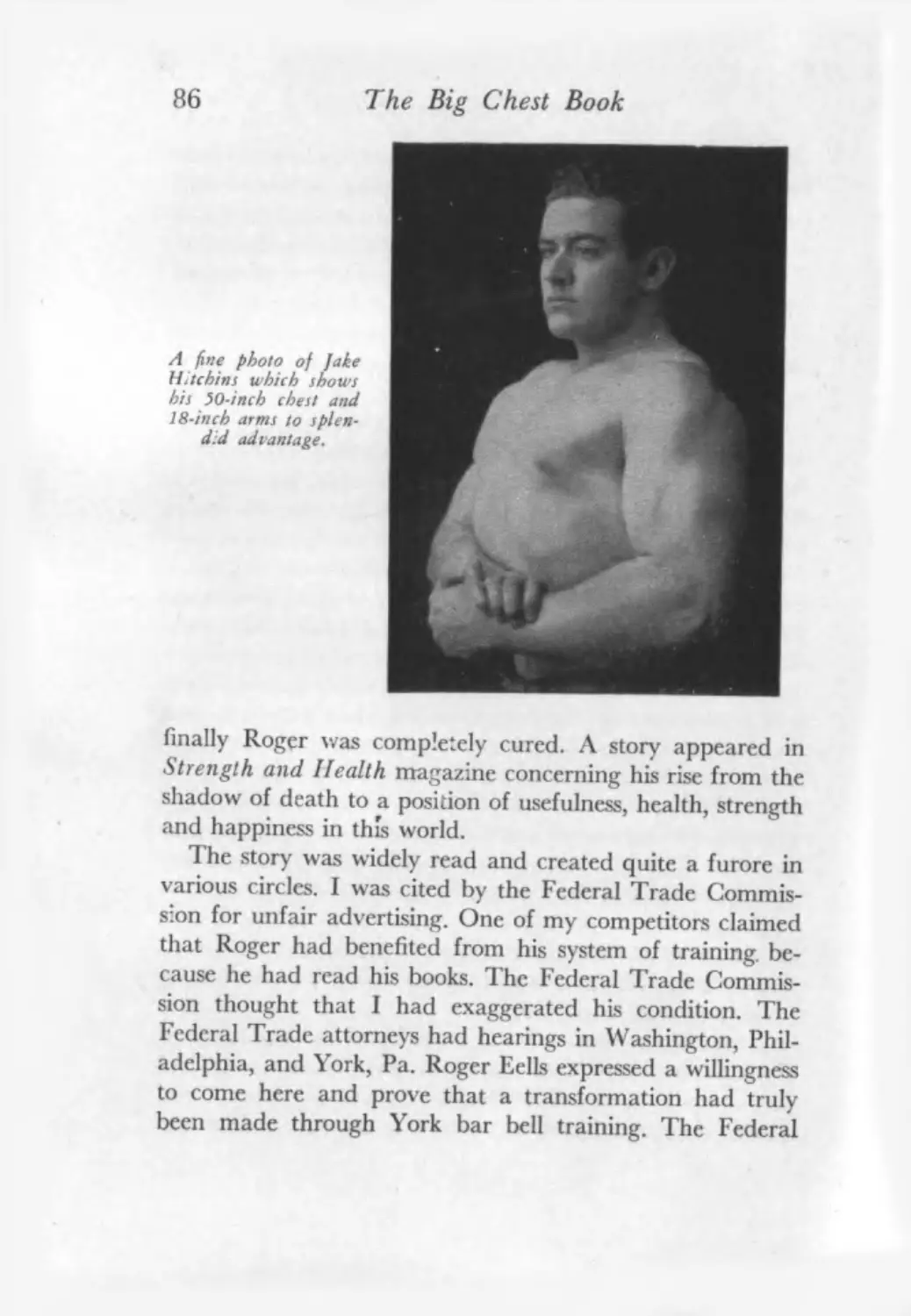
Jake Hitchins,
famous York
Bar Bell man.
who at the age
of 20 has al-
ready attained
a 50-inch chest,
an 18-inch arm,
and a strong
and sturdy body.
I have frequently written that there are two chief reasons
for exercise. It makes you look better and feel better. Many
men take up the practice of physical training because
they wish to build a handsome, admiration-creating figure.
There are others, usually the younger fellows, whose sole
purpose is to develop the greatest possible strength and the
largest muscles which can be obtained. This is a worthy
ambition, for since the dawn of history strength has been
admired and literally worshipped by men and women alike.
Life has always been a survival of the fittest. In this mod-
ern day, as in the past, the strongest win the better things
of life.
It takes these younger men a while to discover that there
Organic Strength Through Developing Thorax 27
is a definite close relationship between strength and super-
health. While the very young man doesn’t want to read
about the organs, anatomy, correct eating or various phases
of health—only wishes to learn how to develop his muscles,
not realizing that it is not possible to develop strong, good-
sized muscles without a knowledge and observance of the
rules of correct eating, proper sleeping and the mainte-
nance of a tranquil mind, the average man, usually the
older man, will tell you that he doesn’t want big muscles.
All he wants is health and physical fitness. Like the younger
fellow who docs not realize that he can’t have powerful,
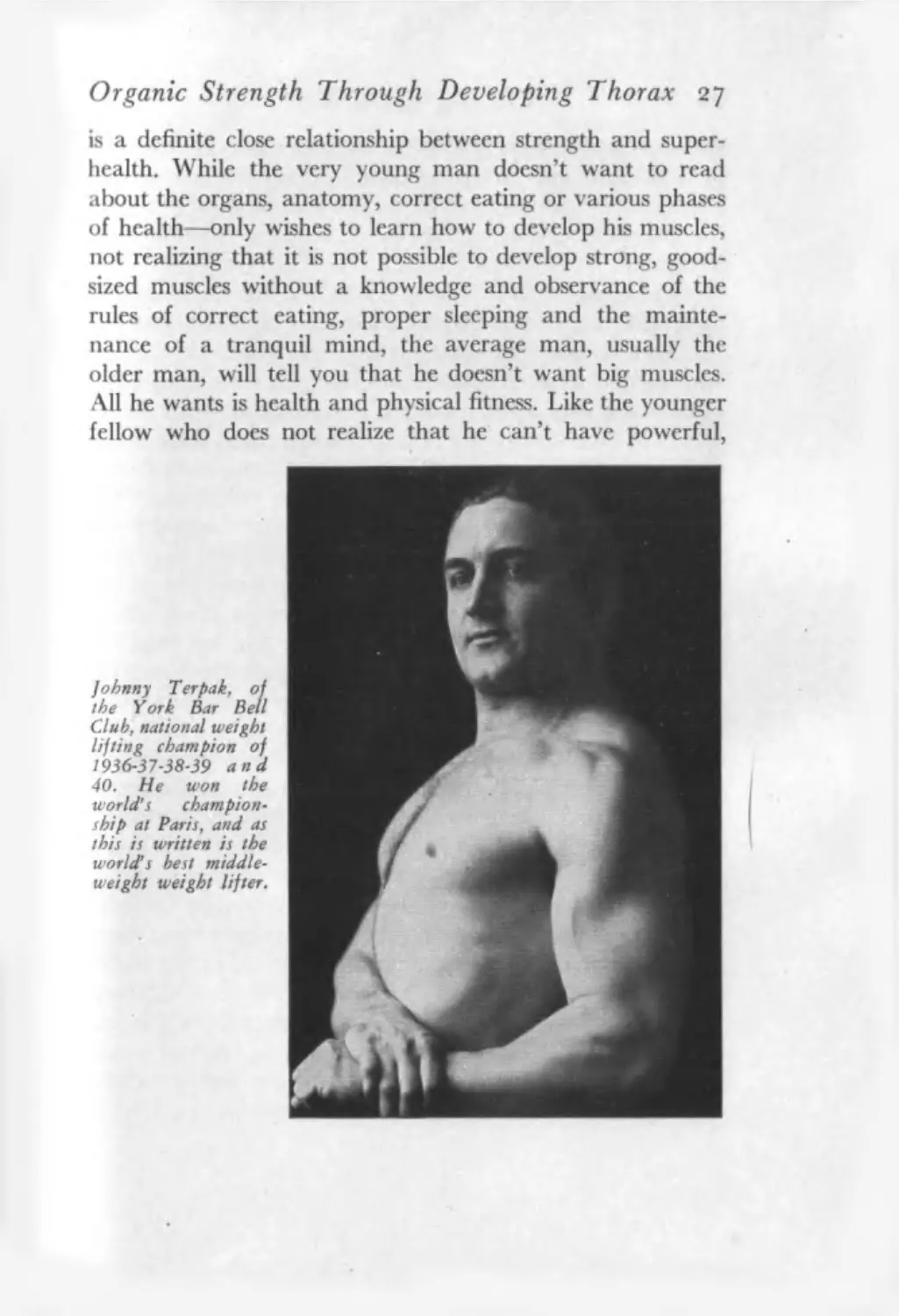
Johnny Ter pah, of
the York Bar Bell
Club, national weight
lifting champion of
1936-37-38-39 and
40. He won the
world's champion-
ship at Paris, and as
this is written is the
world’s best middle-
weight weight lifter.
28	The Big Chest Book
well-developed, shapely muscles without observing the laws
of health, the man in the opposite category docs not under-
stand that he cannot have the health and physical fitness he
desires, permanently, unless he has more than average
strength.
The average man in seeking health, too often, through the
apparently easy ways of pills, medicines, and capsules, has
not learned that obtaining strength and muscle is the best
way to overcome the headaches, indigestion, constipation,
colds and many other serious physical irregularities which
annoy or even torture him. He may believe that these major
and minor ills are a part of life. But the strong men do not
experience them, nor do the animals in a wild state. They
enjoy perfect health, and possess organs and internal func-
tions which operate with superefficiency.
If every man could realize in how many ways the posses-
sion of strength and the health that accompanies it affects
our daily lives, even if our work is such that we need not
employ strength, they would first investigate the best form
of physical training, and then put into practice the proven
facts that they have learned.
Older men and women who wish to regain their youth-
ful figures and youthful health and vigor should determine
to spend a part of each week in physical activity, for physi-
cal activity will improve the action of all internal processes,
greatly benefit health, how one feels, and promote longev-
ity. The internal processes and organs are taught to func-
tion more efficiently through the demands made upon them
by the muscles. Better-operating organs result in the build-
ing and storing up of greater reserves of vital energy. Strong
internal organs—two of the most important of which are
the heart and lungs, encased in the chest or rib box, to the
strengthening and developing of which I am dedicating this
book—are the result of proper care and exercise.
Organic Strength Through Developing Thorax 29
To live in this good old world of ours longer and more
fully you need good kidneys, a capable liver and digestive
system and proper elimination. Your future well-being is
controlled to a great extent by the capability of your stom-
ach and allied organs, but at the head of the list in im-
portance of your internal works we would find the heart
and the lungs. If any of these parts do not perform their
work properly, usually a most painful form of illness with
ultimate premature death is sure to result.
You depend upon these internal works and they depend
upon you. You must take care of them so that they will
take care of you. While nearly everyone knows that exercis-
ing the muscles will strengthen them they don’t know how
to go about strengthening the organs. The organs can’t use
dumbells, bar bells, or cables but they need exercise just
the same. You are their partner; it’s up to you to strengthen
them and to take care of them. Your physical success makes
them stronger, more efficient and more successful, and your
success, even your life, depends upon how they perform for
you.
I believe you are coming to realize the importance of
strong, efficient organs. You must believe that they need
exercise and you know that they can’t take this exercise
themselves. Baths, massage and proper feeding are also es-
sentials and it’s your task—you who depend upon these
organs—to provide the stimulation, the feeding and the ex-
ercise they require. Exercising the muscles is the only way
to strengthen and beneficially affect the organs.
You must know many men who enjoy perfect health;
perhaps you enjoy perfect health yourself at present. I hope
you do. If you do, plan now to so organize your life that
you will always enjoy more than normal, able-to-be-around
health. If you are not quite well at present, plan to so regu-
late the activities of your life that you will build internal
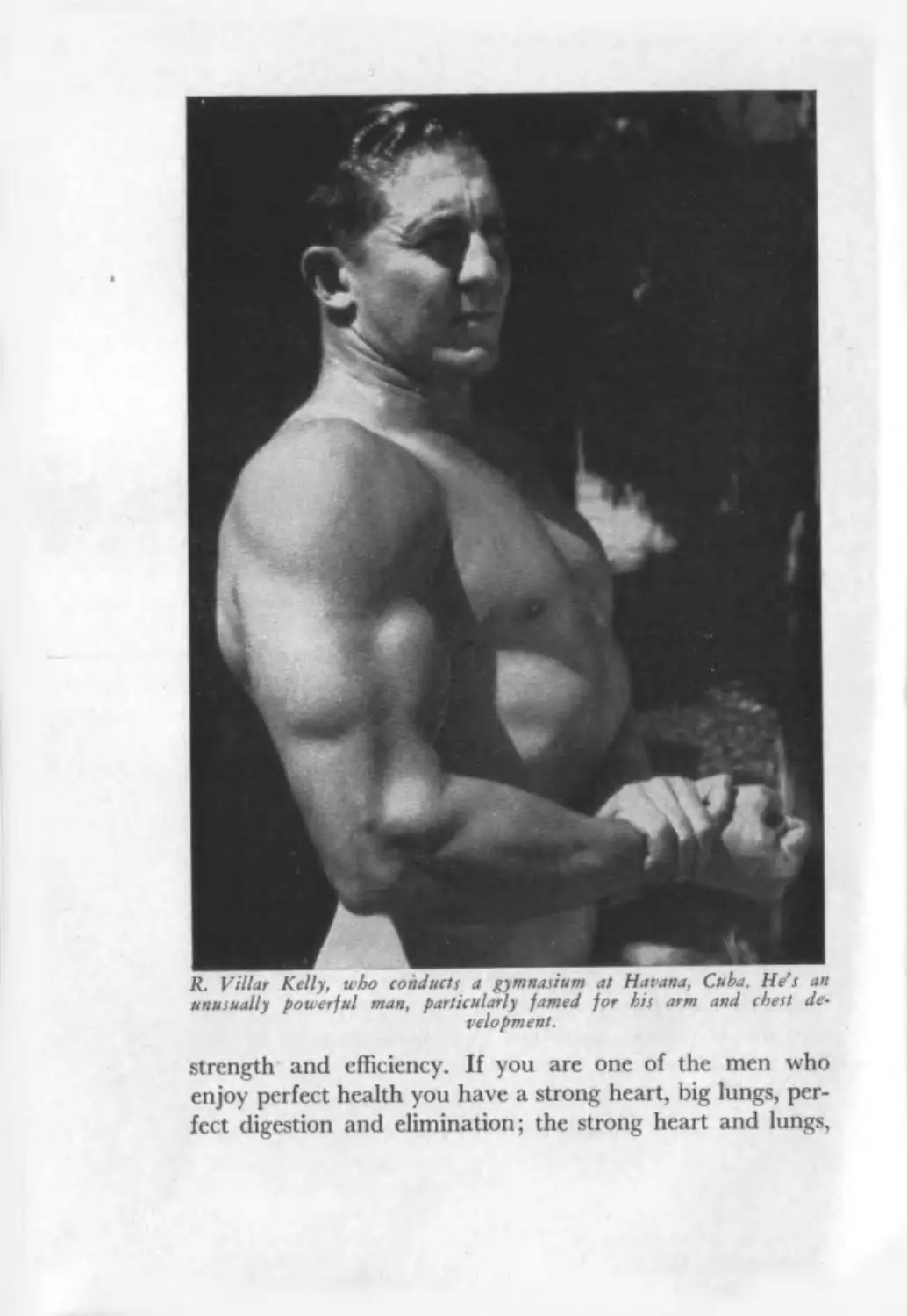
R. Villar Kelly, ubo conducts a gymnasium at Havana, Cuba. He’s an
unusually powerful man, particularly famed for his arm and chest de-
velopment.
strength and efficiency. If you are one of the men who
enjoy perfect health you have a strong heart, big lungs, per-
fect digestion and elimination; the strong heart and lungs,
Organic Strength Through Developing Thorax 31
the perfect digestion, mean that all organs are well supplied
with the materials they need to carry on their functions of
building, maintenance and repair of all organs and cells.
Your mode of living has been responsible for developing
these strong internal functions. You not only want to keep
them as they are, but plan to strengthen them and lengthen
their life and usefulness, for this makes it possible for you
to live much longer and more fully.
You must have observed that the men with perfect
health, perfect internal organs, arc usually stronger than
the average. Think of the strong men you have known.
Aren’t they supermen; superhealthy too? It’s reasonable to
believe that there is a close relationship between orgjftiic
strength and muscular strength. You may wonder, arc
strong men strong because they have strong organs, or do
they have strong organs because they are strong? Strong,
sizeable muscles, the result of proper physical training, pro-
duce strong internal organs. Similar methods of exercise
produce strong, powerful, sizeable, shapely muscles and
strong organs. These exercises which build the size and
shape of the muscles strengthen the internal organs. It can’t
be seen but they are strenerthened, improved and benefited
just the same.
While everyone knows that the voluntary muscles can be
strengthened by causing them to exercise or work, few real-
ize that an organic muscle such as the heart can be made
more powerful through exercise. The growth and strength
of the heart cannot be effected quite as easily as that of a
voluntary muscle such as the biceps of the arm, but either
the heart or lungs can be rapidly strengthened.
You have often heard the expression, Getting back into
training. You know that prize fighters or wrestlers train
more intensively before a contest. You know that the mem-
bers of a football team spend some weeks of training or pre-
32	The Big Chest Book
limuiary conditioning before their season opens. In rowing,
if the first race is Decoration Day, May 30th, the ambitious
oarsmen have started to work out on the rowing machines
sometime in February. Early in March they will take ad-
vantage of the first balmy breaths of spring on some fine
day to have their first experience on the water. And from
then on until the race the crew men will train with ever-
increasing severity until they are able to put forth great
power over a four mile course and perhaps win the cham-
pionship of America or the world.
The average man goes out for football after some months
of physical inactivity or at least only moderate exertion,
unless he is already smart enough to find that he should use
graded apparatus such as bar bells, dumbells or cables to
not only keep in condition but to better his physical state
during the time of the year when he is not actively engaged
in his favorite sport. And the football trainer knows that the
men in his charge must start out gradually—pass the ball
a bit, run a few times around the field, and not participate
in more intensive practice for a time, such as “ scrimmag-
ing.” The preliminary training will wear off any fat which
may have accumulated, but most important of all it will
improve the action, of and strengthen the heart and the
lungs. A man can be quite strong, but he could not row four
miles, run a mile race, or play a full sixty minutes of football
unless he has done something particularly to strengthen the
heart and the lungs; to improve his wind.
You start out to condition yourself and you run around
the track two times. It is hard enough to make these two
round trips the first day. But within a week you have in-
creased the distance to four times around and the first two
are mere child’s play. Each day the work becomes easier, so
that before long you can run a mile with strong, steady
strides and with only deep breathing as a result of the con-
Organic Strength Through Developing Thorax 33
tiifued activity. The strengthening of your heart and lung
action has made this great difference.
In physical training the man with weak muscles and the
weak internal organs which accompany them will make his
start with moderate resistance and few repetitions. He han-
dles more and more weight as the muscles respond to this
gradually progressive resistance. As the muscles are coaxed
along, continually trained, as they increase in size, strength
and efficiency, their partners, the organs, particularly the
heart and lungs, improve likewise. Just as in running, you
find yourself able to run a little farther each day, you be-
come able to perform more exercises or handle more weight
in the exercises through this bodily conditioning series of
physical exercises or activity. You won’t see the improve-
ment in your organs as you can see that in the muscles, but
it takes place just the same. The added strength and en-
durance you obtain through various forms of athletics or
physical training comes as a result of the work of the in-
ternal organs.
The organs provide the fuel for the muscles, feed them
and drive them. When you build greater strength and en-
durance you have actually built better functioning organs
and glands. When you run a bit, if you are unaccustomed
to it you will soon find your heart pounding and you will be
breathing so forcefully that it actually hurts. The lungs will
ache and burn afterward. You can feel that the muscular
action has made demands upon the organs. The muscles are
burning fuel very rapidly, and just as the gasoline in your
motor car, or the oil burner in your cellar, requires great
quantities of air with its all important oxygen, the working
muscles, with the process of combustion which takes place
in them, require many times the usual quantity of oxy-
gen. When you become tired, so tired or weak that you
must stop, it’s because an oxygen debt has piled up. The
34
The Big Chest Book
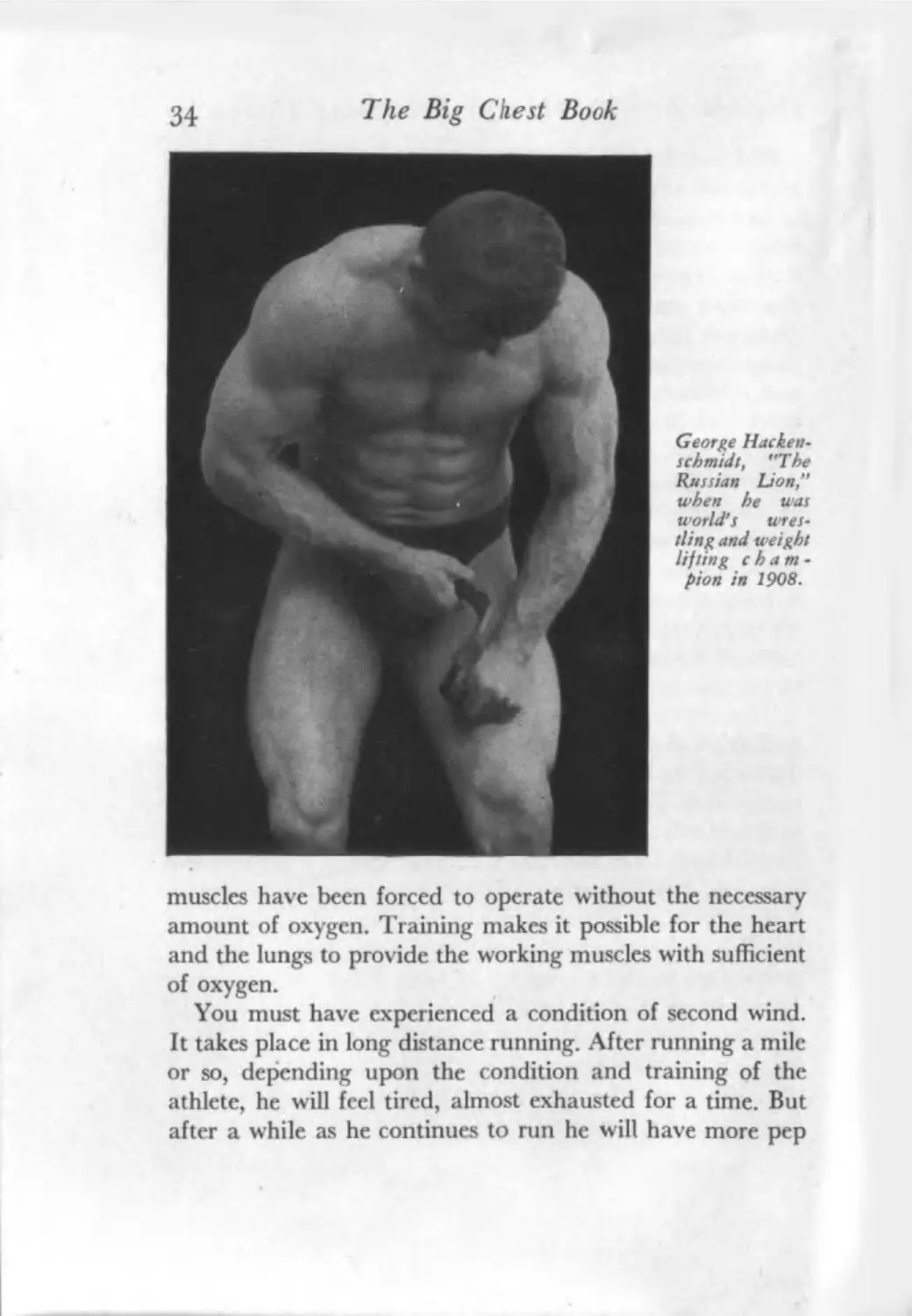
George Hachen-
schmidt, "The
Russian Lion,"
when he was
world's wres-
tling and weight
lifting c h am-
pion in 1908.
muscles have been forced to operate without the necessary
amount of oxygen. Training makes it possible for the heart
and the lungs to provide the working muscles with sufficient
of oxygen.
You must have experienced a condition of second wind.
It takes place in long distance running. After running a mile
or so, depending upon the condition and training of the
athlete, he will feel tired, almost exhausted for a time. But
after a while as he continues to run he will have more pep
Organic Strength Through Developing Thorax 35
and energy, breathe without distress. A balance has taken
place. The lungs and heart have caught up to the demands
of the hard-working muscles; the oxygen debt has been
overcome and physical activity goes on more smoothly.
Training therefore has made possible better operating
lungs and heart, and stronger heart and lungs. The special
effort amplifies the heart and lung action, breathing is
deeper, circulation is improved, worn and broken-down tis-
sue is carried away and it is more rapidly replaced with ad-
ditional fresh building material. The improved respiration
benefits the blood stream, impregnates it with life-giving
oxygen which unites with glycogen, providing combustion
or power in the muscles. There are other favorable results
of exercise which aid the organs in their work. Perspiration,
which eliminates much waste from the body, is one of these.
The continued exercise creates a rubbing, massaging effect
which helps elimination, hastens digestion, improves assimi-
lation. From this you can see that any form of physical ac-
tivity has a beneficial effect upon the internal organs—
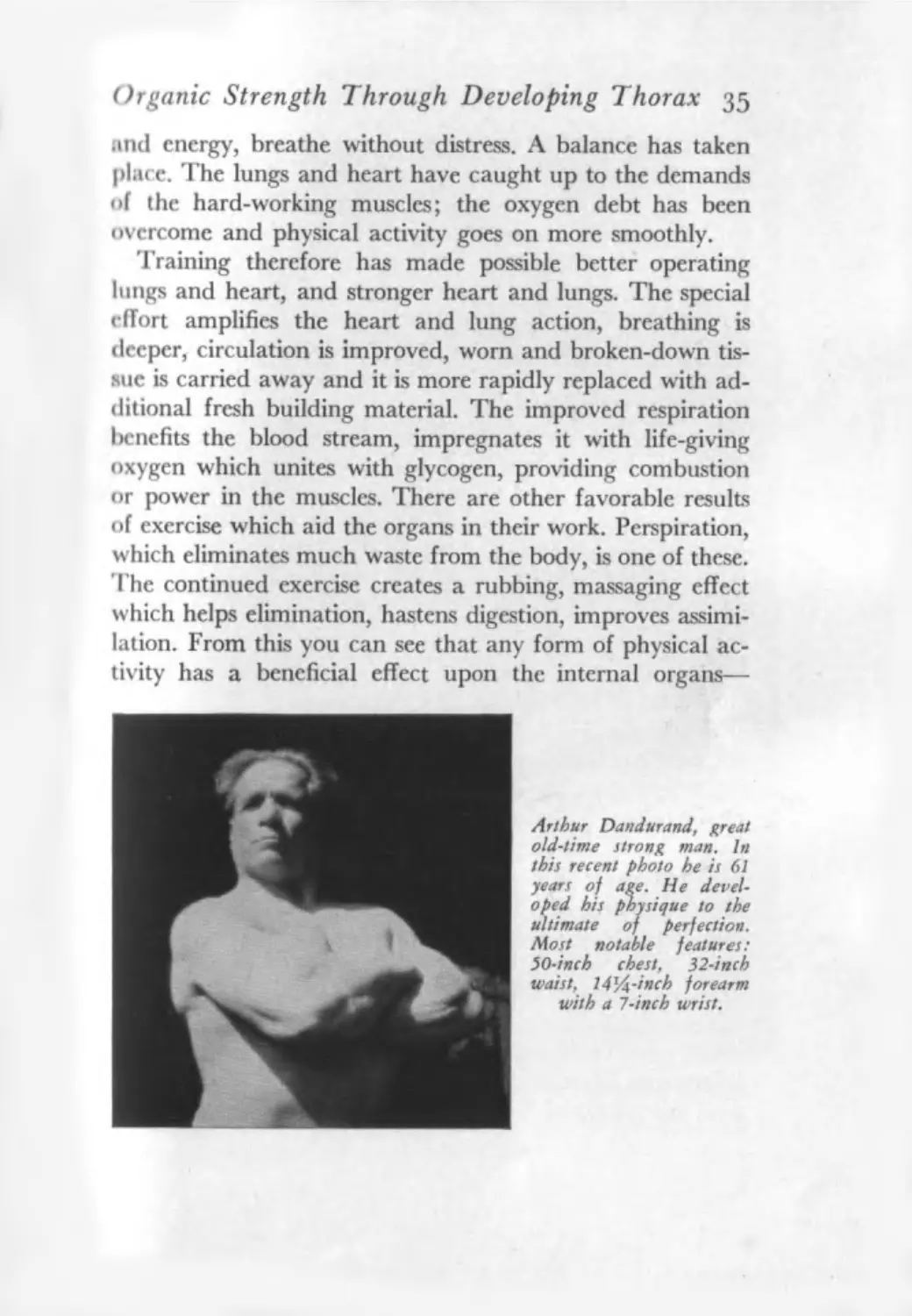
Arthur Dandurand, great
old-time strong man. In
this recent photo he is 61
years of age. He devel-
oped bis physique to the
ultimate of perfection.
Most notable features:
50-inch chest, 32-inch
waist, 14^-inch forearm
with a 7-inch wrist.
36	The Big Chest Book
chiefly the heart and the lungs. And the more your muscles
move, the harder they work, the more work your internal
organs have to do. In a later chapter you will read that one
of the best chest-developing exercises is the deep-knee bend,
and the explanation as to why this vigorous exercise, which
brings into action the largest muscles of the body—those
farthest from the heart and lungs—is one of the best to
develop these important organs. And just as the muscles
strengthen with the work progressively demanded of them,
the organs strengthen too.
The muscles are trained to run faster, jump farther, lift
more weight, and this gradual improvement comes about
because the heart and lungs are improving too. The strong-
est men have the strongest organs—particularly the
strongest heart and lungs. The strongest lungs result from
the increased, more intensive breathing. As the heart is a
muscle it has been strengthened and generally benefited by
the work demanded of it and of course the result of other
organic action has caused it to be supplied with the mate-
rials it needs to build and strengthen itself.
While this book is intended only to supply means for
the care and development of the chest, I can’t refrain from
reiterating once again that this tremendous strengthening
of the organs is the reason for the fact that strong men live
longer and retain their physical ability to a very advanced
age. The pages of Strength and Health magazine have car-
ried the stories of a legion of men well past the threescore
and ten age who are splendid physical specimens—far
stronger than much younger men who are inactive. It has
been told before how John Y. Smith of Boston, at the age of
sixty, weighing only one hundred and sixty pounds, out-
lifted men of larger size and all ages to win the title
“ Strongest Man in all New England.” He’s now seventy-
five; his friend and training mate, Oscar Mathes, is sev-
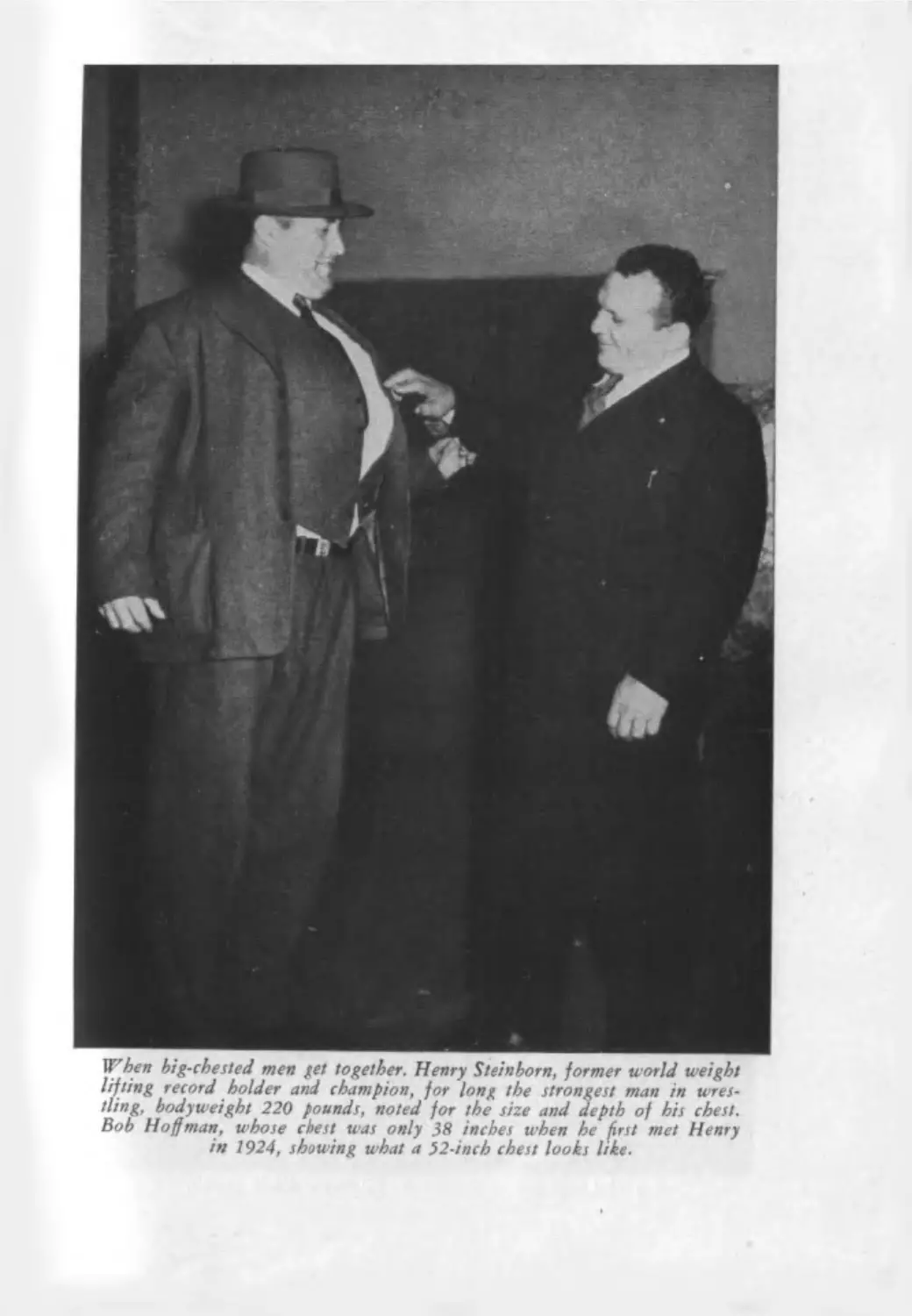
Vhen big-chested men get together. Henry Steinhorn, former world weight
lifting record holder anti champion, for long the strongest man in wres-
tling, bodyweight 220 founds, noted for the size and depth of his chest.
Bob Hoffman, whose chest was only .18 inches when he first met Henry
in 1924, showing what a 52-inch chest looks like.
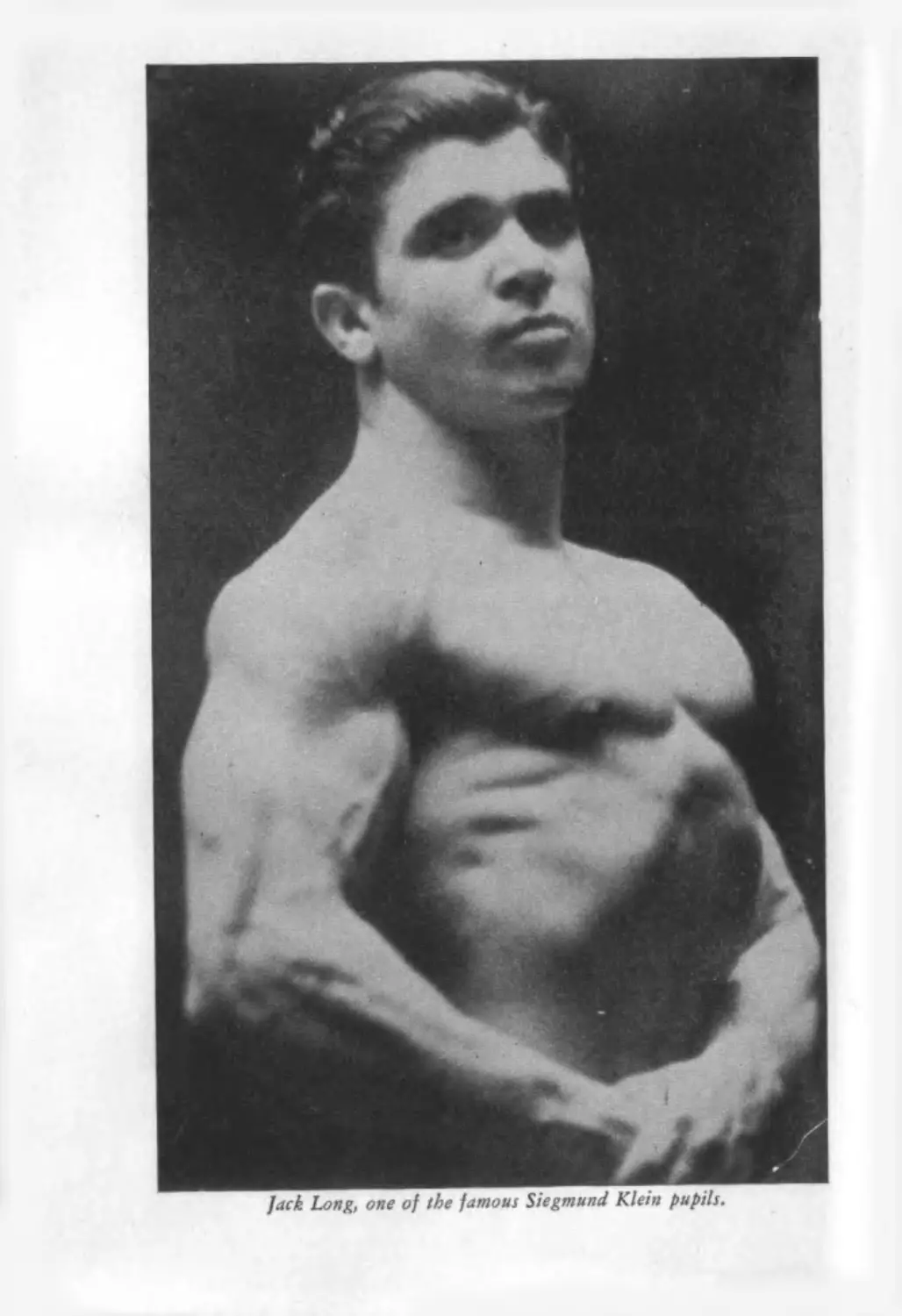
Jack Long, one of the famous Siegmund Klein pupils.
Organic Strength Through Developing Thorax 39
enty-seven. There are Warren Lincoln Travis, Prof.
Wm. Hermann, Prof. Adolph Rhein, George Hacken-
schmidt, George Zottman, Joe Lambert, Arthur Dan-
durand and scores of others who are past sixty, seventy,
eighty and even ninety, all former strong men, and so many
others—all proof that building strength in the muscles is
accompanied by strength in the internal organs. Strong
men are strong all over; they have perfect-operating organs;
aren’t troubled by even minor ills such as indigestion, belch-
ing, gas, heartbum, or other minor or major digestive and
eliminative complaints; their organs, keeping pace with the
increased efficiency of their muscles, synchronize and op-
erate more efficiently when properly treated, which also
means properly exercised. All of what I have written is
meant to convince you that gradually progressive resistance,
gradually increased physical endeavor of any sort, con-
stantly increasing the strength of the muscles so that they
can handle more weight, is the road to supcrorganic action
which will in turn result in a longer, fuller and happier life.
.As I stated earlier in this chapter, there are some young
men who are willing to exercise just for the improved ap-
pearance that muscles give them. But the vast majority ex-
ercise for the improved feelings which they have learned
are the result of exercise. The majority would consider it
the height of folly to exercise just to get these muscles on the
outside of the body if it were not for the improved appear-
ance, the superior feelings, the happier and longer life the
developing of these muscles will produce.
The true facts are that a man must have a perfectly op-
erating heart, powerful lungs, a vigorous digestive system,
and a good sound nervous system to enlarge the chest or
build muscles on any other part of the body. Modem bar
bell and dumbell training, as I teach it, produces the most
amazing and beneficial effect cn the organs of the body.
CHAPTER THREE
Big Chested Men Are
Strong and Healthy
J—)о you remember drawings or
statues showing a herculean man who stands with his feet
braced, body leaning slightly forward, a huge globe rest-
ing upon his shoulders? This figure has been used a great
deal in advertisements in recent years to denote the strength
or substantiality of the organization which selects this figure
as its trademark. I’m referring to the figure of Atlas holding
the world upon his shoulders. The story of ancient mythol-
ogy relates the manner in which the world came to rest upon
the shoulders of Atlas. It was originally the work of Hercu-
les to hold up the world; so goes the ancient tale. Atlas
should have shared In the labor, but he sought to have
Hercules support the world permanently. Hercules, how-
ever, had ideas of his own. The story does not tell us that
he became fatigued with the work, but it does inform us
that he tired of the confining labor, and desired to wander
farther about the universe in search of other worlds to con-
quer. He was reluctant to see others go about their pursuits
of pleasure while he had to be constantly at work.
So he did a great deal of thinking. He planned a way to
40
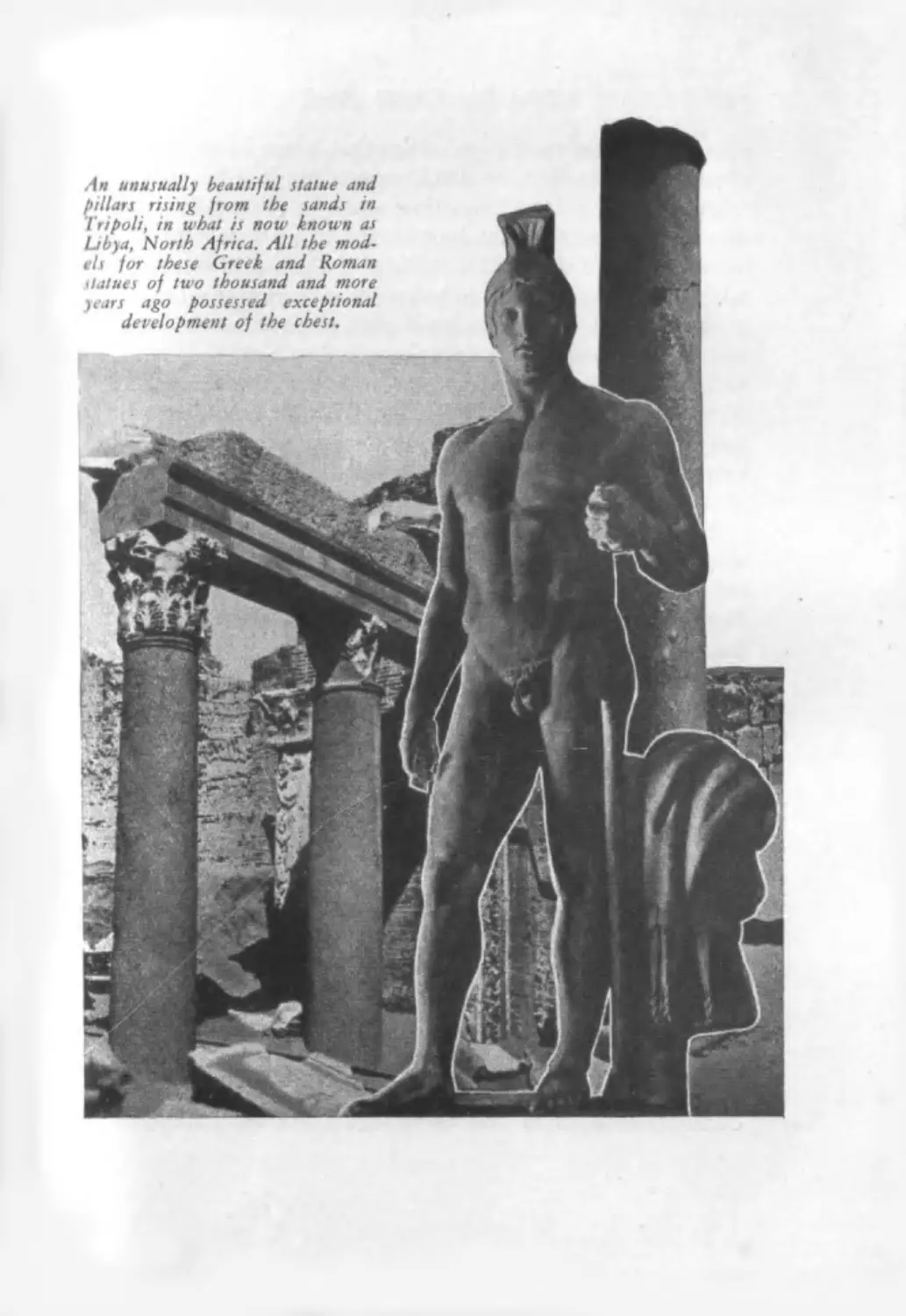
An unusually beautiful statue and
pillars rising from the sands in
Tripoli, in what is now known as
Libya, North Africa. All the mod-
els for these Greek and Roman
statues of two thousand and more
years ago possessed exceptional
development of the chest.
42	The Big Chest Book
get out from under. He told Atlas that, since he must hold
up the world forever, he would appreciate it if he (Atlas)
would support it for a short time while he adjusted his lion
skin and his pads for the long session of work that he had
before him. No doubt this shifting of the world back and
forth caused the ancients to believe that there was an earth-
quake of great severity in some part of their world. Atlas
was slow-thinking and it never occurred to him that Hercu-
les might relegate the task of holding up the world to him,
when once he got out from under. With his shoulders once
more free, Hercules sauntered off, leaving the fuming and
indignant Atlas tied down to the laborious and boring task
of supporting the entire world upon his shoulders.
If we are to judge by the paintings and statues the an-
cient artists have bequeathed us which illustrate the physi-
cal development of these two famous gentlemen, Atlas and
Hercules, there is little doubt that either of them could
carry any burden that was placed upon him. Every ancient
statue it has been my pleasure to see emphasized size and
depth of chest. There were broad shoulders too, but the size
and breadth of chest were especially evident. Throughout
the ages it has been known that men with deepest chests
are strongest, most enduring, healthiest, and usually live
the longest. Few people fully realize the importance of
depth of chest.
The rapid development of the chest which is realized by
all body builders who launch upon a regular course of
heavy, progressive training is most encouraging. The chests
of most persons have long existed in inactivity; poor pos-
ture has compressed them rather than given this important
part of the body an opportunity to grow; the lungs have
been compressed and restricted in their action, and when
the chest is raised, the shoulders held back, when the almost
dormant muscles of the chest region arc stirred up and
Big Chested Men Are Strong and Healthy 43
brought into play by proper exercise, an inevitable result
follows. Newer and better blood-circulating avenues are
opened, the cells are exhilarated and rejuvenated, they arc
expanded and the muscular tissue increases in size and
weight.
There is a great deal to write about the chest. It is one of
the most important parts of the body, encasing as it does
so many of the vital organs on which our very lives depend.
Before going farther I would like to present a question. Do
you know just what the chest is? At first thought you may
say, “ That’s a bit ridiculous; why it’s right here,” tapping
the upper part of the chest in the vicinity of the breast-
bone, the portion covering the lungs. This is not quite the
right answer, for it is too general, not sufficiently specific,
and to provide a good definition of anything it must be con-
cise and specific.
The chest is that part of the body which covers the lungs,
the region under the armpits as well as the part connected
w ith the shoulder blades. The chest is all of these parts har-
moniously assembled. By searching for the definition of the
word chest in a dictionary we find that the correct answer
is a box. And a box, as everyone knows, is composed of four
sides, as well as a top and bottom.
Considered anatomically, the human chest is that portion
of the body comprising the breastbone and the ribs on the
front, the ribs on the two sides and the shoulder blades
forming the rear. The backbone is also a very important
part of the rib box. All the parts just mentioned form the
framework. The framework is covered with muscle, cov-
ered with some of the most important (both from the
standpoint of health and appearance) muscles of the en-
tire human system. These muscles are woefully weak and
neglected in the bodies of the vast majority of human
beings. While the limbs of all persons obtain some exercise
44	77ie Big Chest Book
in going about the daily tasks of living, the muscles of the
chest and abdominal regions are too often neglected.
The muscles on the outside of the chest can plainly be
seen and are well known to body builders but there are
many equally important but little known muscles of the
chest which are under the surface. These work in conjunc-
tion with the rib box to protect, assist in their function
and hold in their place the important organs of the chest re-
gion. When the muscles on the outside of the body are
neglected, the internal muscles also find themselves in a
weakened state after long years of little use. Millions of
years ago when every living thing upon this earth travelled
on all fours, or at least with the backbone more or less
parallel with the ground, the organs were suspended from
the spinal column not unlike clothes are hung from a line.
Finally some of these animals, which through the process of
evolution, so geologists and biologists have informed us, be-
came men, stood up. Then to prevent the organs from pil-
ing up on each other just as would the clothes on a line if
you held it in a vertical position instead of a horizontal,
muscular attachments were developed to hold the organs in
their intended place and to assist them in performing their
highly important functions.
Reasonable exercise, or other forms of at least fairly vig-
orous physical activity, strengthens these muscles so that
they permit the organs to remain in place and function
properly. Weakness in the muscles on the outside of the
body coincides with weakness of the internal organs. When
a person neglects himself completely, many of the organs
slip down and add to the protruding abdomens which are
a part of so many persons. Fat-incased organs are sluggish,
can only partially perform their functions, while those of
the man or woman who maintains proper posture and has
sufficient internal strength to hold the organs in their proper
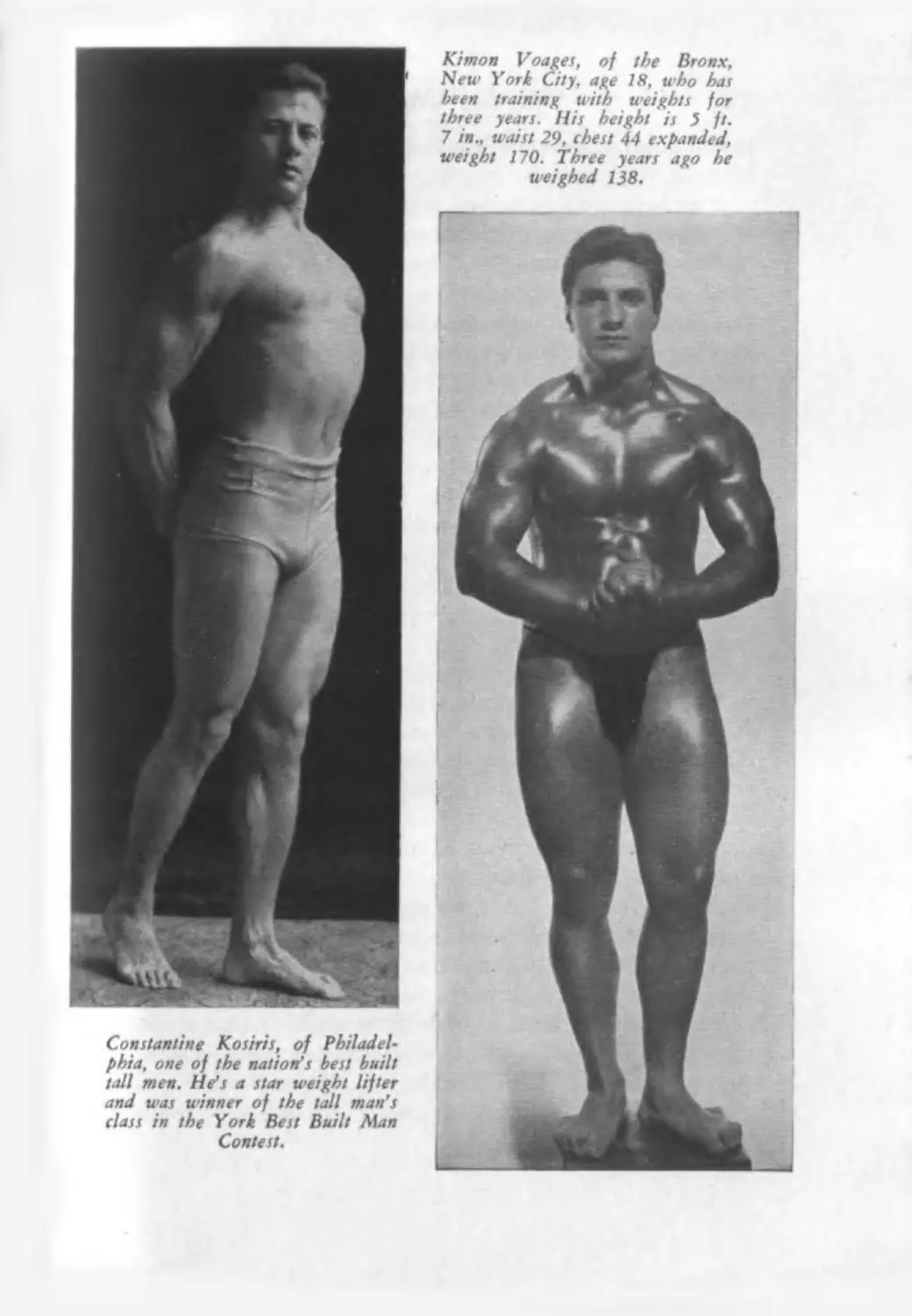
Constantine К osiris, of Philadel-
phia, one of the nation’s best built
tall men. He’s a star weight lifter
and was winner of the tall man’s
class in the York Best Built Man
Contest.
Kimon Voages, of the Bronx,
New York City, age 18, who has
been training with weights for
three years. His height is 3 ft.
7 in., waist 29, chest 44 expanded,
weight 170. Three years ago he
weighed 138.
46	The Big Chest Book
places enjoy a superior brand of health unknown to most
humans.
It must be evident to you who read this that if the mus-
cles controlling, guarding and covering these organs are not
healthy, are not strong and vigorous, the organs lying be-
neath are very likely to be in a similar condition. And it is
just as evident that if the muscles controlling, guarding and
covering these various parts of nature’s human mechanism
are healthy, strong and vigorous, then the various internal
parts must likewise be in the same robust, efficient condi-
tion.
Therefore the individual who desires to possess real
health, superhealth, not just able-to-be-around health,
should develop the muscles of the chest, not just one or
two—those which can be seen best when exercising in front
of the mirror—but all of them, for in so doing he will also
develop all the internal organs contained in the chest or rib
box.
There are many good chest-developing exercises, scores of
which will be offered in chapters to come. The more vigor-
ous of these exercises bring best and quickest results. While
it’s beneficial to walk over to an open window and take a
few deep breaths, or to take deep breaths any time of the
day you may think of it, it is not to be expected that such
deep breathing will create appreciable chest growth. The
deep breathing will make you feel better, sort of brush the
cobwebs from your brain, for the same blood which serves
your big toe and every other part of your body also sup-
plies the brain. All of this blood every few moments passes
through the heart and lungs, and the deep breathing will
cause the blood stream to be more bountifully impregnated
with necessary, vitalizing life-maintaining oxygen, which in
turn provides a feeling of exhilaration. Deep breathing is a
good thing at any time, for most of us are very shallow
Big Chested Men Are Strong and Healthy 47
breathers, utilizing, while the body is in repose, only about
one-thirtieth of the actual capacity of our chests, only a
fraction of the amount of air from which the chest can ex-
tract the oxygen it requires to keep the muscles working.
It is evident from this brief description and repetition of
this all-important physical development truth, which is
bound to appear at times owing to its maximum im-
portance, that you cannot expect much if any progress in
developing the lungs—thus increasing the size of the rib
box—through free hand exercises or just through breathing,
without some form of exercise severe enough to demand a
great deal more oxygen to continue the greater effort ex-
pended. Effort which greatly increases-the body’s need for
oxygen is required when chest-building progress is made.
Few of us realize how little we use our lungs, how much
of the space within the lungs is unused. It remains in idle-
ness as a dark, warm place where cold germs or even more
serious disease genus can rapidly multiply because they
have ideal conditions for their germination, warmth, mois-
ture and undisturbed quiet. It is good for all of us to breathe
deeply at times, draw the fresh air into the lowest depths of
the lungs, the innermost cavities, the most remote recesses,
filling every tiny cubic millimeter with fresh air. This en-
forced breathing is a good way to prevent colds.
The divers of the South Sea Islands develop a great depth
of chest. It is their work to swim far below the surface of
the water to gather the pearl-bearing oysters. The better
divers stay under the water for at least three minutes, un-
dergoing considerable exertion every moment they are
under the surface. Therefore they must develop great lung
capacity to follow their vocations. Unless practiced regu-
larly and from early life, diving and underwater swimming
are not a beneficial means of developing the chest, for the
continued exertion, with insufficient quantities of oxygen
48	The Big Chest Book
for the body’s needs, entails considerable strain upon the
heart. When under the water for a considerable period the
supply of oxygen is depleted, exertion continues, the heart
labors faster and faster and harder and harder, in order to
supply the crying need for oxygen. Finally a condition is
created similar to the pounding of a motorboat when the
propeller shaft breaks or is momentarily out of the water.
Some years ago I enjoyed underwater swimming. I
would swim around for an hour or so, coming up for air
when necessary and immediately going under again. I en-
tered an underwater swimming contest and, to win, trav-
ersed a distance of 123 feet, across a 90 foot pool, and part
way back. I continued for 22 strokes after I thought I must
come up for air. And my good old heart rattled and
thumped alarmingly for many minutes after that exertion.
Great exertion causes unusual effort on the part of the
lungs. So much more oxygen is required by the body when
it is working hard and long and it is the work of the lungs
to extract the needed oxygen from the air and the task of
the blood to carry it to the working muscles. There the
oxygen unites with glycogen (blood sugar) and forms the
combustion or energy which makes it possible for the mus-
cle involved in the action to continue at the task which has
been set for it.
If you were to start out running rapidly, in a short time
(or a longer time if you are in training) you would experi-
ence a feeling of breathlessness. The breathlessness might
result in unusual fatigue, a cramp or pain in the chest. But
if you persisted, training with moderation each day, you
would find that the parts of the body adjusted themselves
in such a manner that you could run without unusual fa-
tigue or discomfort for many miles; that is, if you were
training to be a distance runner. This ability to keep going
for a long period, to run mile after mile, is what we call
Big Chested Men Are Strong and Healthy 49
endurance. It is accustoming the muscles, but most of all
the internal processes—the heart and lungs—to carry on
the work they are asked to do, for long periods.
The feeling of breathlessness or fatigue comes about, first,
because the blood cannot supply enough oxygen to the
working muscle. An oxygen debt piles up; deposits of lactic
acid form in the muscles, which cannot be dissipated until
the supply of oxygen adjusts itself to the requirements of the
body. Fatigue poisons can cause death; in fact they create
a condition in the muscles, usually temporarily, like death.
The difference is that in life the lungs, heart and other
organs are working desperately to normalize the condition
they have encountered, and if you are in good condition the
internal organs will eventually catch up to the increased
output of glycogen and oxygen demanded of them; they
will finally be in balance with that of the muscles. Most of
you are acquainted with the phenomenon called “second
wind.” This is renewed energy which comes about when a
balance between the output of the internal organs and the
output of the muscles is attained. Horses have frequently
been driven or ridden at high speed for many miles, to the
point of complete exhaustion, the exertion continuing to be
so tremendous that there is a greater and greater oxygen
debt, no chance for the heart and lungs to catch up, so that
poisoning actually takes place and they drop dead.
Most of you have heard of the ancient runner who ran
the first Marathon race. The Greeks had met the Persians
at the field of Marathon, twenty-six miles from Athens. The
actual distance traversed by this ancient soldier ultimately
became the regulation Marathon distance. The soldier who
made the first Marathon run famous had fought all day,
then when the tide turned and his side had won victory,
dispersing and pursuing the Persians, he was given the task
of running to Athens to notify the worried people of the
50	The Big Chest Book
great victory and the future safety of their country. After
fighting all day and running twenty-six miles, he dropped
dead just as he shouted, “ Victory is ours.” He thus gained
immortality, but he also proved that the human body or
the animal body can be driven to the point of complete ex-
haustion, or even death, by too long continued unusual
exertion. The condition which killed the Greek soldier was
an extreme case of fatigue poisoning. Most modems are so
situated that we can stop to rest long before we experience
serious ill effects from overexertion.
To develop a real chest, both powerful and sizeable, real
demands must be made. A condition of breathlessness must
be created. In our form of physical training this is best at-
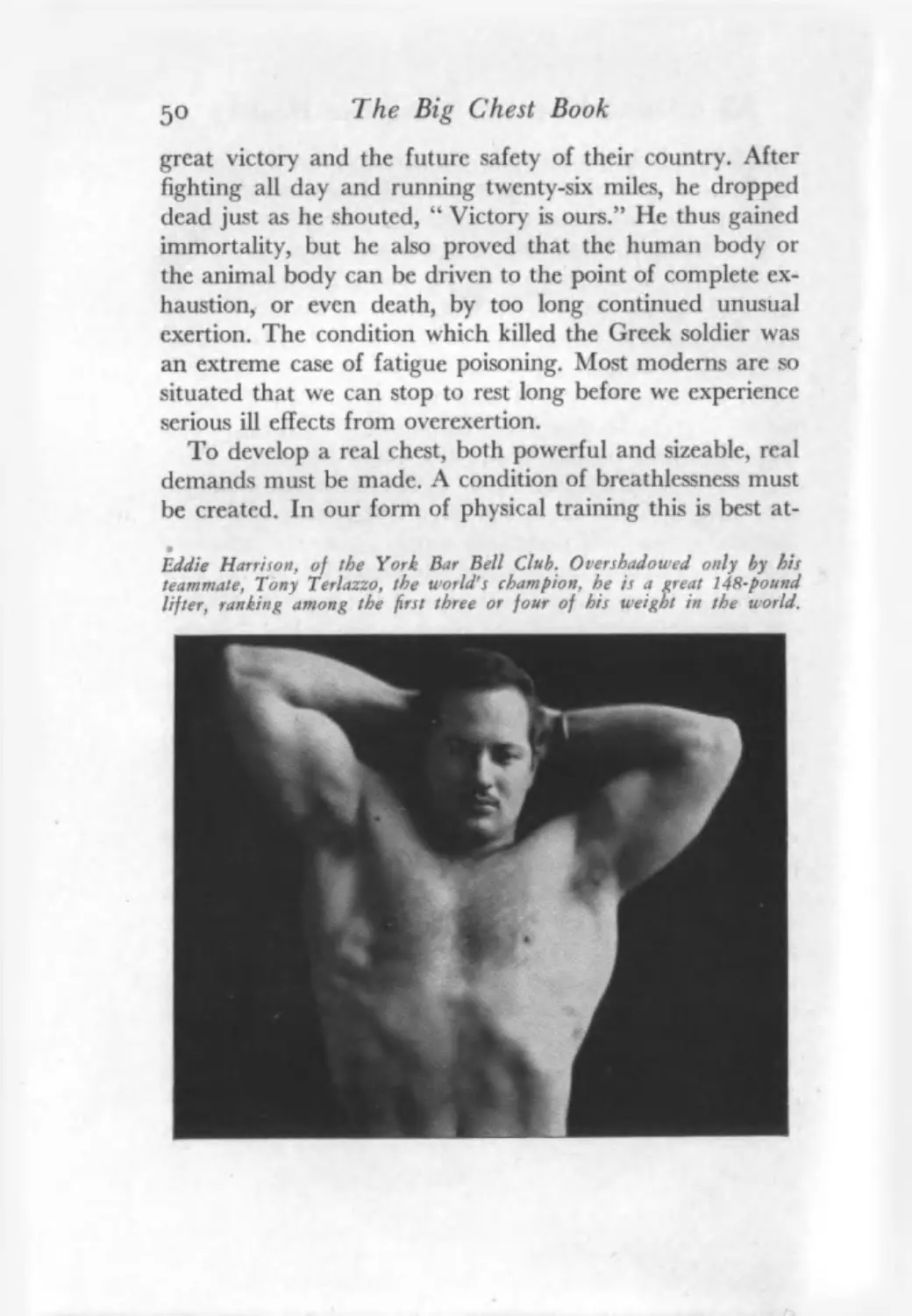
Eddie Harrison, of the York Bar Bell Club. Overshadowed only by his
teammale, Tony Terlazzo, the world's champion, he is a great 148-pound
lifter, ranking among the first three or four of his weight in the world.
Big Chested Men Are Strong and Healthy 51
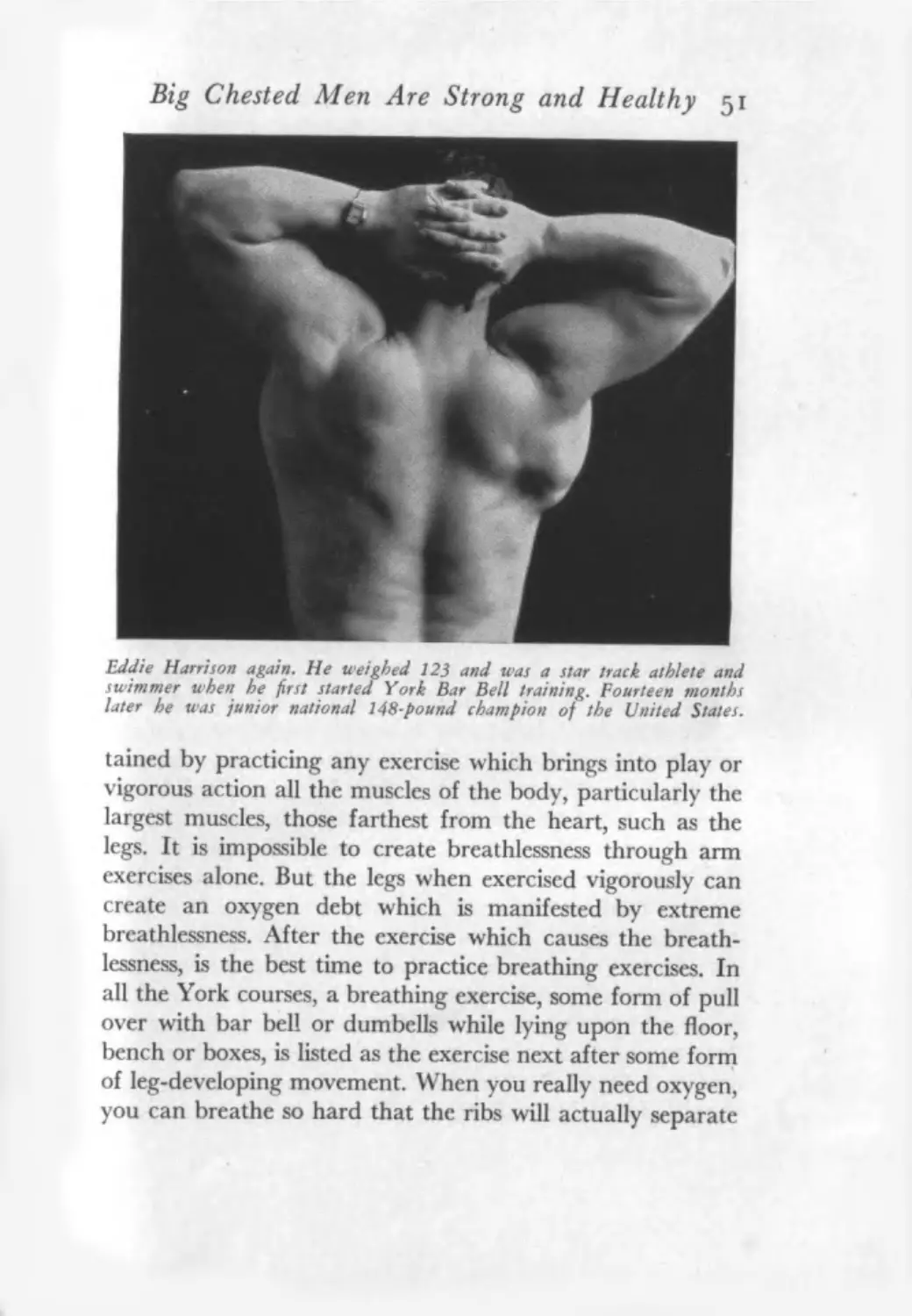
Eddie Harrison again. He weighed 123 and was a star track athlete and
swimmer when he first started York Bar Bell training. Fourteen months
later he was junior national 148-pound champion of the United States.
tained by practicing any exercise which brings into play or
vigorous action all the muscles of the body, particularly the
largest muscles, those farthest from the heart, such as the
legs. It is impossible to create breathlessness through arm
exercises alone. But the legs when exercised vigorously can
create an oxygen debt which is manifested by extreme
breathlessness. After the exercise which causes the breath-
lessness, is the best time to practice breathing exercises. In
all the York courses, a breathing exercise, some form of pull
over with bar bell or dumbclls while lying upon the floor,
l>ench or boxes, is listed as the exercise next after some form
of leg-developing movement. When you really need oxygen,
you can breathe so hard that the ribs will actually separate
52	The Big Chest Book
and you may experience growing pains for some weeks to
come. But don’t let this worry you; in a moderate length of
time you will be rewarded by a larger chest and a much
healthier internal condition.
I recently received a letter from a young man who said
that he had received his first copy of Strength and Health
magazine a short while before. He also sent for and care-
fully read my booklet, “ The Road to Super Strength,”
which shows a number of before and after cases, great im-
provement through weight-training methods, and also de-
picts many of the champions that York methods have built.
He said that the book was very well written, whoever wrote
it knew his business, but he did not believe he could gain
the results in developing his chest that he wanted, through
exercise alone. He believed he could get the best results
after he exercised so strenuously through swimming or play-
ing vigorous games such as handball, that profuse perspira-
tion was induced and a condition of breathlessness created.
And he was sure that he could not do this with exercises
alone. That young man should try ten to fifteen repetitions
in the deep knee bend with a heavy weight, or even the
same number of dead weight lifts with a similar or heavier
weight, or practice ten or more dead hang snatches. I con-
sider this latter exercise the best exercise in the entire line
of physical training because it brings all the muscles into
play, employs all the muscle groups simultaneously and
teaches them to coordinate and work in unison. It greatly
amplifies or speeds up the action of all internal processes,
the organs and the glands which are stimulated by their
proximity to the working muscles. It builds athletic ability,
skill, speed, timing, nervous energy, endurance and strength.
But most of all it induces perspiration, more rapid circula-
tion and very deep breathing. You men who have tried
repetition snatching will agree with me.
CHAPTER FOUR
Chest Improvement
Through Proper
Posture
W need power and endurance
to put more effort back of our work and the business of liv-
ing. With power and endurance we can keep on fighting,
working and striving for what we hope to win from life.
Physical condition is the greatest attribute to success in
life, of anything we undertake. The following quotation
from the writings of Dr. R. Tait McKenzie should be
given thought. He caUs for “ men ” (and of course women
too) with clear brains, flushed with blood, driven by a
sound heart and purified in capacious lungs, with an unim-
paired digestion, erect carriage and elastic step, whose
bodies are the keen, well-tempered instrument of the well-
trained and well-stored mind. These are the sort of men
from whom we can expect audacity in the approach,
courage in the attack and tenacity in overcoming those ob-
stacles which stand in the way of success and progress.
What a fine interpretation of perfect condition that is I
To acquire a rounded, deep chest and additional strong,
well-developed bodily components to go with it, we must
take into consideration our position in standing, walking or
53
54	The Big Chest Book
sitting. Posture is so important in the acquisition of a well-
developed, fine-appearing chest and a comparatively slen-
der waistline which improves the chest by the favorable
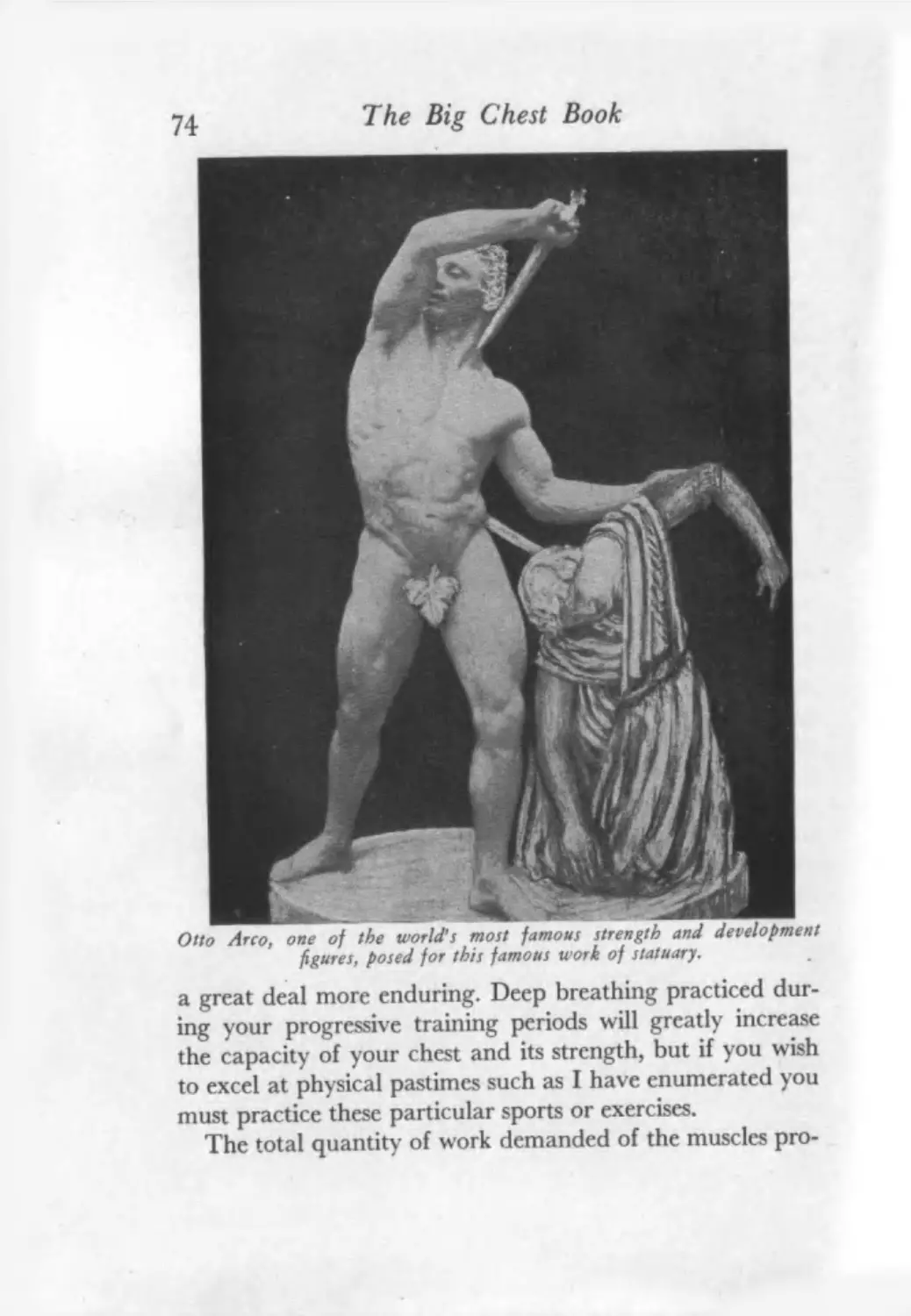
contrast its lesser size creates. A few minutes several times a
week spent in chest-enlarging and developing exercises will
produce very satisfactory growth in the rib box, providing
good posture is made a part of living. If poor posture is as-
sumed for hours each day, it will dissipate the beneficial
effects of the chest-developing exercises. Through proper
posture, proper holding of the chest, we retain what we
have gained as a result of chest-enlarging exercises.
It’s customary for most people to permit their bodies to
slump, so that an improper curve is permitted on the back.
The head bends forward, nearly resting upon the upper
chest. The chest is compressed; the abdomen protrudes.
These faulty, careless habits of posture should be corrected
in childhood when it is easiest to correct or form any habit.
It should be a part of the physical training program in the
schools. During youth, before the framework of the body
becomes fairly rigid, correct habits of posture should be
acquired. While it is more difficult later in life to overcome
faulty habits of posture, it can be done.
To improve posture we should start first with the head.
The manual of arms, which so many young Americans will
be learning since conscription or selective service has be-
come a normal part of American life, and the position of a
soldier which it contains, calls for a position of the head so
that it is erect, chin drawn in slightly with the axis of the
head and neck vertical; shoulders back and falling equally
—just how far back will be determined by the next instruc-
tion, so that, when the arms are hanging naturally at the
sides, the thumbs will be along the seam of the trousers. To
assume this position it’s necessary to raise the chest and
force the shoulders back.
Chest Improvement Through Proper Posture 55
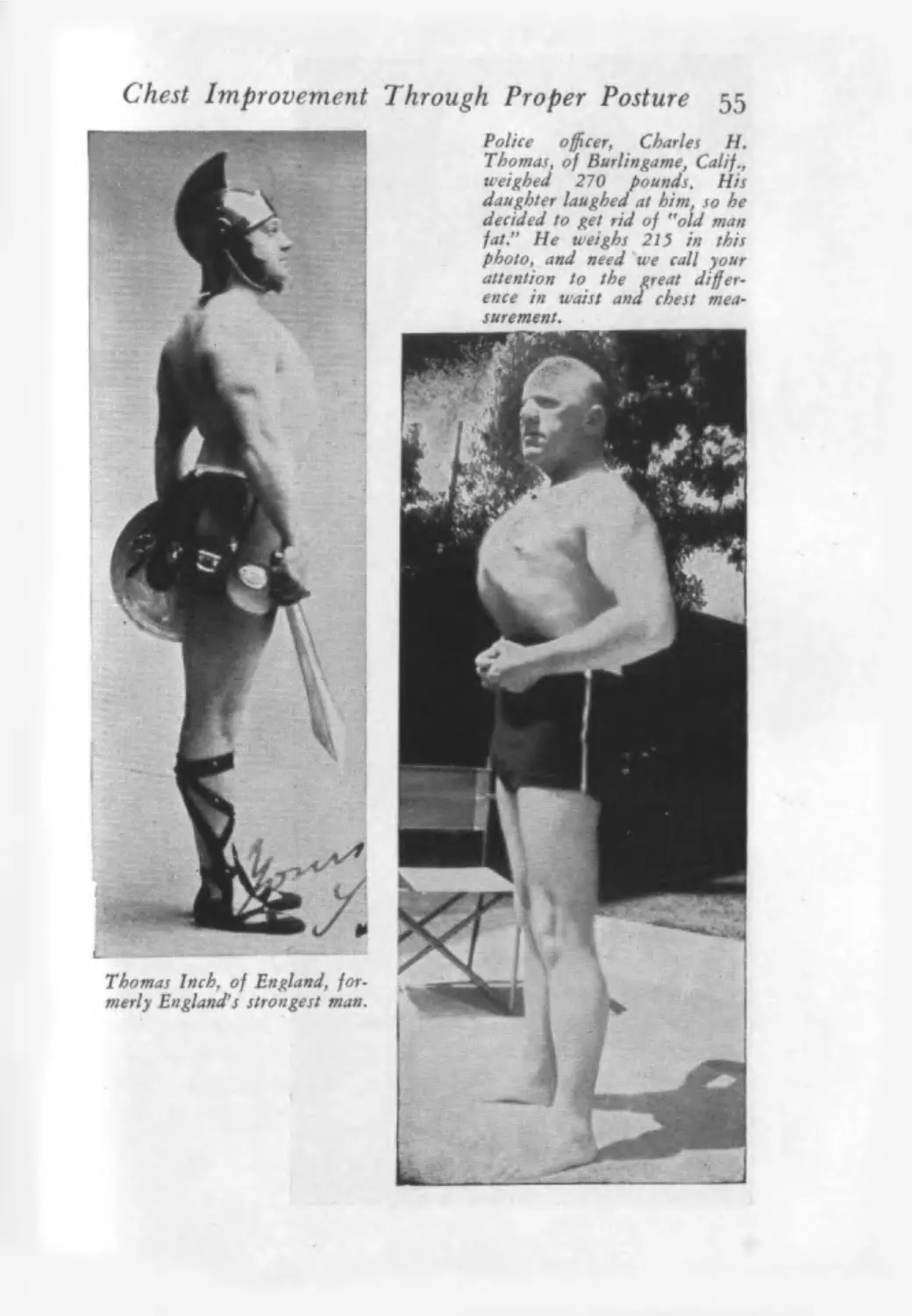
Thomas Inch, of England, for-
merly England’s strongest man.
Police officer, Charles H.
Thomas, of Burlingame, Calif.,
weighed 270 pounds. His
daughter laughed at him, so he
decided to get rid of "old man
fat." He weighs 21S in this
photo, and need we call your
attention to the great differ-
ence in waist and chest mea-
surement.
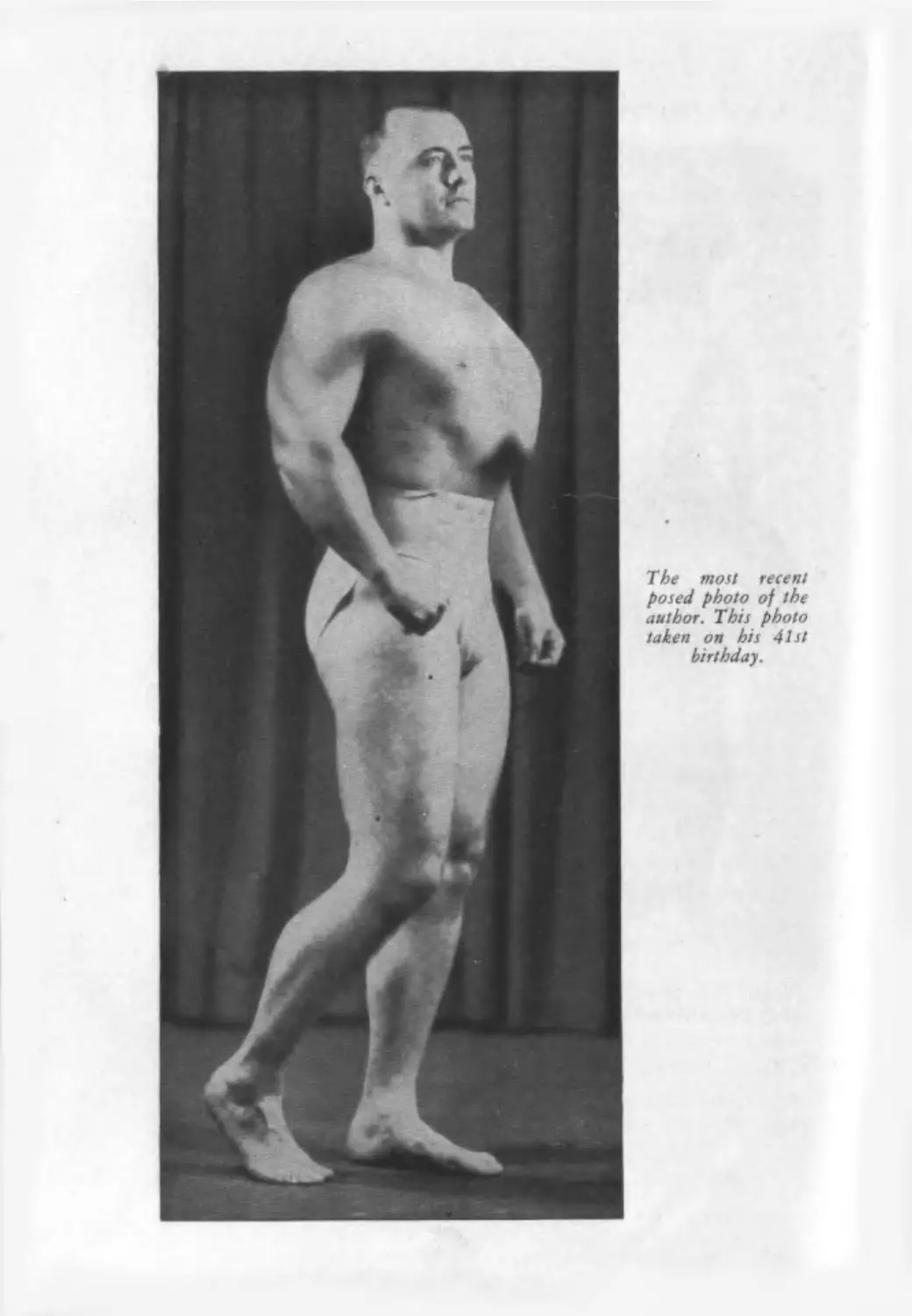
The most recent
posed photo of the
author. This photo
taken on his 41st
birthday.
Chest Improvement Through Proper Posture 57
The simple habit of holding the head in the proper posi-
tion, pulling the chin in, tends to correct the other faulty
habits of posture. The back immediately flattens to a more
desirable position; the chest rises and becomes fuller. Cor-
recting your posture should take place first in front of a
mirror where you can see your normal position and the de-
sired postural changes. It may be a little difficult to over-
come habits of faulty posture, which have taken years to
acquire, in a few hours or days; it may be tiresome at first
to hold the body in the proper position, but the muscles will
soon adjust themselves and correct posture will be just as
easy to maintain as your former faulty posture.
This year’s weight lifting champions—Fiorito, Terry,
Terlazzo, Terpak, Davis and Stanko, with the addition of
that greatest of all physical specimens, John Grimek—are
all examples of good posture. Their good posture has had a
tremendous influence on the development of their matchless
strength, in their body weight divisions, and their splendid
physiques. John Grimek in particular is noted for the great
depth, roundness and size of his chest. Coupled with it is a
well-muscled but slender waist which is so much smaller
than his chest that it seems to be wasplikc in comparison.
Good posture more than any other one thing has accounted
for this splendid development of the chest and favorable
contrast in size between the waist and chest. Grimek has
good posture at all times. While sitting at the table, or driv-
ing in his car, chest is erect, waist drawn in; when standing
in the gym his posture is always good. He early recognized
the vital need for good posture, and a large share of the
physical glory that he has won has resulted from these
habits of proper posture which he early acquired.
Your own feelings and the impression you create upon
others are determined greatly by the development and car-
riage of your body. If you slouch, permitting your back to
58	The Big Chest Book
round, your chest to flatten, your abdomen to protrude,
you more than likely will experience a lazy, lackadaisical
feeling. But if you will contract habits of proper posture,
what a difference! You exercise only for an hour or two,
two to four times a week, when you follow a system of pro-
gressive training with apparatus, to develop all the parts of
the body, but you must always be watching your posture;
and particularly if you have spent long years in faulty posi-
tions, you should acquire habits of good posture.
Your task is to train your muscles to hold your bony
framework in the proper and most beneficial positions. Dur-
ing the day, at your work, whether it requires that you
stand or sit at a desk, going to and from work, practice good
posture in every position and in every act you must perform.
We exercise primarily for two reasons: to feel better and
to look better; and correct posture plays an important part
both in how we feel as well as how we look. We form our
first impression of a man, of his strength and ability, by
looking at him. If he carries his chest high, has depth of
chest, with shoulders that are square and held well back,
we are duly impressed with the fact that here is a vital man,
capable of carrying through any task which may be given
to him. But when yve see a man who slumps and slouches
along we expect him to have other faulty and careless hab-
its. We feel that he is the type who has a cigarette con-
stantly drooping from the comer of his mouth and spends a
good share of his spare time at habits which are not benefi-
cial, to say the least.
Your personal appearance, which is an important part of
the whole we know as your personality, weighs tremen-
dously toward your success in life and the happiness you ob-
tain from that life. A well-developed physique, and good
posture to show this physique to its best advantage, is a
great factor not only in producing a pleasing personality,
Chest Improvement Through Proper Posture 59
but the good appearance development and posture engen-
dered is a great asset to any man or woman in any trade,
profession or vocation he or she may follow, as well as in
all social contacts.
While favorable first impressions are very important,
from our own standpoint how we feel is most important.
Here a deep, well-rounded, roomy chest is highly important
in the promotion of health, vigor and vitality. The chest is
the box which contains very important organs on which our
well being and very lives depend, and how we carry it and
how we build it depend upon whether it will be a little
weak box, a middle-sized box, or a big powerful box. In it
are contained our most valuable possessions—not gold, sil-
ver or jewels, not money or bonds, for all of these are use-
less to us if our hearts and lungs do not continue to perform
their functions. The organs on which our very breath of life
depends must be given ample space in which to work; they
should not be crowded or they cannot work properly, ef-
ficiently and for seventy or eighty years which should be our
normal span of life.
If the heart and lungs are cramped, impeded in their
work, many ills from which mankind suffers will be present
sooner or later. The flat-chested, stoop-shouldered man or
woman is far more likely to have lung disorders or even the
common colds and catarrh. But give these organs plenty of
space, exercise them, revitalize them through creating de-
mands and meeting these demands with ample supplies of
fresh oxygen, rich air, and plenty of space in which to work
and you will be rewarded with abundant vitality and per-
fect synchronization of all the organs of the chest region.
All armies of the world and every military academy have
placed particular emphasis upon proper posture. It does
add to the appearance of a group of men to have them uni-
formly present attractive physiques on which the marks of
6o	The Big Chest Book
good posture are indelibly stamped, but the chief reason for
the army’s good posture is the knowledge that correct pos-
ture and better bodies encourage men, inspire them, give
them confidence, make them more enduring, better disci-
plined, and more courageous. We in civilian life don’t have
anyone like the drill sergeants in the army to constantly
pound into us—inculcate into our very being—the neces-
sity for correct posture; we must be intelligent enough to
recognize the need for proper posture, and to constantly
maintain our bodies in the most favorable position.
Look around you in any group and observe the poor
body mechanics of most of the individuals within your
sight. If these people only realized that good posture is an
inherent part of good health, and that physical debility and
internal disorders are just as surely the result of faulty pos-
ture! With less than half of the population of our nation
possessing even fair posture, it’s not much wonder that we
arc the sickest nation in the world; that two million of us
are constantly sick and unable to work; and that a great
many others experience just-able-to-be-around health and
strength.
A physical examination at Harvard University disclosed
the fact that eighty per cent of the freshman class ranked in
C class concerning posture. And many of them were still
lower—in the D class. Poor posture is often the result of
bodily weakness. Therefore strong bodies should mean good
posture. But it is surprising how many well-built fellows
still maintain a poor posture. So often an excellent muscula-
ture is hardly visible due to faulty posture. You should con-
tract the habit of being chesty. Don’t mind if someone
kiddingly remarks about your outthrust chest. On one of
the trips to the Olympics a member of the team asked me
why I was standing with my chest out. I replied that that
was the only natural way to stand. If a chest of my size was
Chest Improvement Through Proper Posture 61
not out, it would slump and my abdomen protrude. But the
man who remarks perhaps disparagingly because you stand
or walk with your chest out secretly admires you for it.
Walt Wilcox, of Seattle, Wash-
ington, a young man who has
developed a magnificent body.
Note the splendid develop-
ment, roundness and depth of
his chest, the curve of his
. latissimus.
Above: Bob Moran, who
trained at Fritshe's Gym
in Philadelphia. Former
118-pound Middle Atlantic
champion weight lifter.
Now a member of the U. S.
Air Force. He weighs 1SS
in this photo.
62	The Big Chest Book
You who read this are interested because you arc a body
builder—actually a sculptor of your own body. In the be-
ginning, John Grimek possessed sub-average bodily propor-
tions. In his earlier photos it seemed to me that his legs
were too short, his torso too long, his waist too broad. He
studied his physique, and really chiselled it into the beauti-
ful, statuesque effect that it creates wherever seen at pres-
ent. He moulded his upper body and limbs, narrowed his
waist through proper exercise and proper posture. He de-
serves more credit than most men for building the superla-
tive physique he now possesses. You want to develop your
physique to its fullest. In spite of the musculature you may
Hussein, of Egypt, former world's
champion 181-pound weight lifter.
Richard Pennell, first American to
"pul up’’ 200 pounds with one
hand.
Chest Improvement Through Proper Posture 63
develop, the size and shapeliness of chest and muscles, it
will not present a good appearance because it will be lack-
ing in symmetry and poise unless you make a habit of
maintaining the body in the proper position. In every best-
built man contest there are men with magnificent muscular
developments who are not even placed among the leaders
and the prize winners simply because they permit them-
selves to slump in improper postural positions.
While poor bodily posture is so prevalent, the result of
carelessness or ignorance, there are a few who go to the
other extreme of walking around constantly with their
chests inflated to the limit, with the muscles of their latis-
simus constantly under tension, with their arms stiffened
so that they stand out from the sides at an angle of forty-
five degrees. This creates an equally wrong impression; has
caused some to believe that weight lifters are so muscle
bound that they cannot let their arms hang naturally at the
sides. The arms of the most powerfully built men will hang
naturally at the sides with the thumbs along the trousers if
the latissimus dorsi muscles are not constantly tensed. Hold
the chest up and out, the head erect, the shoulders back,
but do not keep the chest constantly overinflated.
A study of the anatomical charts in this volume well il-
lustrate why a stooping, faulty posture cramps the heart,
lungs and liver and greatly hinders their action. But even
more serious ills than result from this cramping of the
organs which are high up in the chest occur when a slouch-
ing position is habitually maintained. The heart and lungs
are upheld by the diaphragm; the liver fits into its under
side, but the remainder of the organs in the body do not
have so secure a support. The kidneys, stomach, large and
small intestines, and important glands, all slip down a little
when faulty posture permits the abdomen to be constantly
relaxed, and to slip farther and farther forward, as is done
64	The Big Chest Book
when lack of exercise and bad posture continue to be the
order of the day.
The stomach will fall as much as two or three inches, re-
sulting in a stretching and constant tension upon the nerves
and blood vessels, as well as the tubes which lead to the
stomach. The tone of the entire internal system is greatly
lowered, and with additional months or years of little use,
the muscles become increasingly flabby, fat forms on the
outer muscles and about the organs and their action is
greatly impaired—much more sluggish than when they are
reasonably strong and unimpeded by fatty deposits. For the
reasons that I have briefly mentioned, improving posture
alone normally results in a quick change for the better in
one’s innermost feelings.
Habitually bad posture enlarges the waist, diminishes the
size of the chest. Our Success Stories, which are received in
ever greater abundance, illustrate some startling changes in
comparative chest and waist measurements after a short pe-
riod of training and improvement in posture. Starting
training as competitors in the Self-Improvement Contest,
March 4th, and training for three months, fifty-two train-
ing periods in all, forty-seven-year-old Harry’ Moss, of Port-
land, Ore., gained, three inches in normal chest size during
this period, and had to change from a 37 to a 40-inch
coat. Jerry Charbonneau, St. John, Quebec, reduced his
weight 11 pounds during the three months training. Start-
ing with a 37-inch normal chest and a 37-inch normal
waist, he had a 45 ^2-inch expanded chest and a 32 % -inch
waist at the end of the special training period. B. Broodall
of Douglass, Arizona, increased his chest from 38 % to
42 % in eight weeks’ time, and he was thirty-five years of
age at the time. And these are only several we have selected
at random from hundreds of pleased contestants in the
Great Strength and Health Self-Improvement Contest.
Chest Improvement Through Proper Posture 65
Many men do not exercise properly. They stand at the
pulley weights in a Y. M. C. A. gymnasium, pulling on the
weights with their backs curved, their chests flat and their
stomachs permitted to sag and protrude. Good posture and
proper breathing are first requisites in proper training, for
muscles developed in an improper position are very apt to
remain that way at all times. Between exercises most men
will walk about for a minute or so. During this period
remember your posture. George Hackenschmidt, still re-
nowned as one of the best built big men the world has ever
seen, performed between each heavy exercise what he called
the Hackenschmidt walk. He would practice full breathing
during this period, shoulders back, and draw the waist in
with a conscious effort. When he recently made a trip to
these shores from his home in France, where he now lives, I
had the opportunity to meet him, and at an age past sixty
he is still a remarkably well-built man, who at all times
maintains good posture.
Proper bar bell exercises, using the widest possible range
of muscular movement, from extreme of contraction to ex-
treme of extension, will stretch all the muscles so that it
should be easy to form habits of correct posture. The two
simple Hackenschmidt exercises were practiced by other
famous strength athletes of the day. Hold up the chest and
breathe strongly and deeply after the vigorous exertion of
the preceding muscle building exercise. This tends to put
the spine in the proper position. Pulling in the waist with a
constant muscular effort should be a part of every exercise
program. Ten times between exercises will be sufficient. If it
is not your regular training day, pull in the waist with an
effort of the will and the muscles, as many as fifty times in
succession in the morning and a similar number at night.
Every time you think of it during the day, particularly as
you stand or walk about, pull in your waist and hold it
66	The Big Chest Book
there. Even while shaving, remember to practice pulling in
your waist. This not only develops the muscles of the ab-
domen, and compresses the internal works, making the
stomach comfortably filled with less food, reducing possi-
bilities of becoming fatter, but massages and invigorates
the action of the internal works. Both Eugene Sandow and
Louis Cyr spent a great deal of time at pulling in the waist
or moving the waist muscles when not engaged in any form
of physical exertion.
Before closing this chapter on posture, just another word
to help you know when you are maintaining proper posture.
Stand with your back to the wall, with your head, hips and
shoulders touching the wall. The heels should be one to four
inches from the upright surface, depending upon your size
and the normal construction of your body. Facing the wall,
with your body in the proper position your toes and chest
should touch.
A phrase often applied to maintaining correct posture
when standing or sitting is to stand or sit “ tall.” In stand-
ing, make yourself as tall as possible without rising upon the
toes. Stand with the head up, the chin drawn in slightly, the
neck back, and the shoulders back enough that the thumbs
touch the seam of the trousers when the arms arc hanging
naturally at the sides. When long accustomed to poor pos-
ture, this will require considerable effort for a time. Plebes
or first year men at military academy are required to walk
for the first few weeks with their little fingers along the
seams of their trousers, the palms front. Try this somewhat
exaggerated position. You will see how the shoulders soon
can be comfortably maintained in the proper position. As
you look at yourself sideways in a full length mirror, stand-
ing as you habitually carry yourself, arms hanging nat-
urally, you may find that your thumbs range from six inches
to a foot in front of the seams of your trousers.
At right: Alex Austopchuk,
Brooklyn, N. Y., who has
trained with York Bar Bells
for 10 months. Below: Steve
Ruznak gained from 148 to
168 in one year’s training with
weights.
Above: Bob "Dave” Brinker,
of the Twin City Weight Lift-
ing Club, Easton, Pa., one of
the nation's best light heavy-
weight lifters. He is 21 years
of age and makes a three lift
total of 810 pounds.
68
The Big Chest Book
Hold the chest up without straining; this alone should
keep the abdomen flat. But for a time it will be wise for
you to walk around with it pulled in a bit. This will be easy,
for the muscles are becoming stronger and firmer through
regular practice of abdominal exercises. Some men wear a
tight belt to remind them to stand straight. As the years
The best known picture of a
former famou> mail-order phys-
ical director, Earle Liederman.
pass and you order new suits, refuse to have the waist bands
made larger. If they arc larger it is so easy to eat more or
stand less st aight, permitting your waistline to grow. Re-
cently I pulled out of the closet and wore for a few days a
suit that I wore to the 1932 Olympics. It fits comfortably
about the waist in spite of the gains in strength and weight
I have made in these eight years. In fact in ordering two
suits recently I had to call the tailor’s attention to the fact
that the waist was a bit loose—to make the new suits an
inch smaller. If you find your trouser waist getting tighter,
Chest Improvement Through Proper Posture 69
don’t permit the tailor to make alterations; make alterations
in your living habits and your posture.
Maintain the spine in as straight a position as possible,
particularly the lower part or small of the back. Some men
permit themselves to become “ sway backed ” by going on
year after year standing in a faulty position. The legs have
some bearing on proper posture—stand and complete each
stride with the knees straight; keep the toes nearly straight
to the front. Europeans have a tendency to toe out, Ameri-
can Indians to toe in; straight to the front is the best way.
While your exercise periods will average three or four
hours a week a half hour a day, you’ll have sixteen hours a
day or more during which you are up and about. Proper
posture during these hours will not only aid you to keep the
gains in chest size that you have made, but help you in-
crease these gains. Spending these long hours slumping
about in sitting or standing will not rob you of all that you
have gained, but it will retard your much-desired gains in
chest size. Therefore remember to sit tall, for more of the
majority of people’s time is spent sitting than standing or
walking. Keep the spine straight in sitting. When it is neces-
sary to lean forward, lean from the hips, keeping your back
as straight as possible. Keep the feet flat upon the floor. In
sleeping, spend as much time stretched out as possible
rather than with the body in distorted positions.
It’s wise to take an inventory of your physical condition,
including your posture, at times. Good posture, as we will
constantly reiterate, means better health and far better and
a much more admired appearance of the well-built man.
There is a favorable contrast between chest and waist which
causes the former to appear even larger than it is. When
taking this physical inventory of yourself be sure that your
shoulders arc not rounded, your chest flattened or your ab-
domen protruding.
CHAPTER FIVE
“Qciting Into
Condition ”
W™ the average man runs as
little as one block to catch a train, he becomes completely
winded. Perhaps you have learned this about your own
physical condition. You were a bit late, well within sight of
the station, but at least a quarter mile to go and less than
two minutes until train time. You had been catching this
train every morning for the last year or so, had had to hurry
at times, but never more than a fast walk before. But this
time you had the alternative of picking up and setting
your feet down a little faster by actually running to make
the train or waiting until the next one which would make
you late to business.
If you were doing a fair amount of physical work, your
legs were in pretty good condition, but you felt real distress
after completing your run to the train. After you entered
the car you were panting for breath and felt well-nigh ex-
hausted. Your distress continued long after the extreme
exertion was ended. You continued to be completely
winded, out of breath, yet your legs w-hich seemed to be
the chief motivating force were not tired. This phenomenon
probably puzzled you. Your legs which apparently did the
70
“Getting Into Condition”	71
work were not tired yet your lungs were panting, your heart
pumping, which would lead you to believe that they were
not strong.
Your heart and lungs had become accustomed to pcr-
Drawing by Gord Venables of Walter Podolok. Walter, long famed for
his chest development and strength, former holder of the world’s dead
weight lift record at 643 pounds, is now a professional wrestler.
72	The Big Chest Book
forming certain work. When called upon to do much more
they protested strongly, and many long minutes were re-
quired before a condition of normal heart and lung action
was regained. The unusual action of the legs required much
greater quantities of oxygen; the heart and lungs were la-
boring to supply them. An oxygen debt had piled up during
your enforced run, and even after the muscles were no
longer in use, as you rested upon the cushions, the heart and
lungs were hard at work to pay that debt, and only when
the debt was paid could they return to normal operation
and you were once again comfortable.
You have noticed athletes “ warming up ” before a run
or a contest. Paavo Nurmi, the great Finnish runner, or
Glenn Cunningham, the Kansas youth who bettered some
of his records, would sometimes run one or two miles to
warm up before the actual start of the race. This warming
up loosened the muscles, but most of all it speeded t he
action of the heart and lungs, so that they adjusted them-
selves to the increased demands which were to be made
upon them during the race. In running for the train, if you
had been able to start slowly and were at least a little ac-
customed to running, you would have obtained your second
wind and not arrived at the train so near complete exhaus-
tion.
When a man starts out in the beginning of the season to
practice cross-country, track, football, or even crew he
commences to run a little. He runs a little more each day,
and with the passing days his internal works become ac-
customed to the increased exertions demanded of them, so
that they deliver increased quantities of the blood sugar
and oxygen required to keep the muscles in operation. Con-
stant practice, improving the action of the important in-
ternal works, makes the difference between the great fatigue
and breathlessness you or any other untrained man experi-
“ Getting Into Condition ”	73
ence from suddenly running to catch a train and the five to
ten miles that trained runners traverse so easily. They have
built endurance in heart and lungs as well as limbs.
The average man if he swims the length of a normal pool
—75 feet—unless he is a good swimmer and has practiced
at least a fair amount of swimming in recent months, will
arrive at the end of the pool breathless. Yet a trained swim-
mer can continue for hours without breathlessness. He has
learned to breathe fully while in the water. It is easier to
draw in sufficient breath at each double stroke than it is to
exhale fully enough to provide enough fresh air for subse-
quent strokes.
Jumping rope is difficult for the average man; he soon
becomes breathless. Yet men have skipped rope without a
miss for hour after hour, simply because they become ac-
customed to the exertion. Deep knee bending with one’s
bodyweight is difficult for the average man. I have seen
corpulent men and women who did not possess enough
strength to arise once from the low position of the deep
knee bend, and have seen many others who became so
breathless from a few bends that they could not continue.
Yet men who have specialized in repetition deep knee bends
have continued for thousands of bends. The difference is
becoming accustomed to the movements and simultaneously
strengthening the body inside and out so that the desired
movement can be continued for a lengthy period.
While deep breathing alone will not give you the ability
to swim far, run far, or skip rope thousands of times, unless
you practice these particular exercises, the deep breathing
(particularly when coupled with vigorous exercise which
places demands upon the body) will be highly beneficial.
Deep breathing when no exertion is made will not improve
your endurance but deep breathing coupled with vigorous
exercise will make you not only stronger and healthier but
и
The Big Chest Book
Otto Arco, one of the world's most famous strength and development
figures, posed for this famous work of statuary.
a great deal more enduring. Deep breathing practiced dur-
ing your progressive training periods will greatly increase
the capacity of your chest and its strength, but if you wish
to excel at physical pastimes such as I have enumerated you
must practice these particular sports or exercises.
The total quantity of work demanded of the muscles pro-
Getting Into Condition ”
75
duces general breathlessness. Muscular fatigue is local, as
can easily be proven if you determine how many times you
can press a twenty-five-pound weight overhead with one
hand, but if you see how many times you can deep knee
bend with one hundred pounds then you create the general
Ralph Veady, of California, lost both legs through an accident with a
tractor, but his love for athletics and the exercise his condition permitted
enabled him to build the splendid chest shown in this photo. He is a
successful business man.
76	The Big Chest Book
effect of breathlessness because you have brought all the
muscles into action. When work is too light to produce
breathlessness, only fatigue, you cannot expect to obtain fa-
vorable results in building chest size, strength or endurance.
In direct contrast, if you exert to the limit of their ability
the larger muscles of the body, the muscles can become tired
before a condition of breathlessness is created. As, for in-
stance, in very heavy dead weight lifting or deep knee bend-
ing, perhaps seven movements can be made, which arc all
one could expect from the muscles if a weight is very heavy,
before a condition of breathlessness will result. Therefore it
is necessary in endeavoring to build the chest with heavy
exercise to continue the movements to a point where great
breathlessness results. While some physical trainers recom-
mend thirty or even more deep knee bends I do not favor so
many, preferring not to exceed fifteen bends as a muscle-
building exercise—twenty as a breathing exercise. If more
bends are practiced, and the movement is continuous, the
weight must feel light to begin and then toward the end it
becomes difficult enough. This sort of movement builds
endurance rather than strength in muscles and greatest lung
capacity. On the other hand it is not possible to use a great
weight for enough movements to really cause enforced
breathing. That’s why I recommend the heavy and light
system for those who desire to build great strength in mus-
cles, tendons and ligaments—at least ten movements for
muscle building, and up to twenty to enlarge the chest.
Most men who have established high records in deep
knee bending with heavy weights perform a series of
strength feats rather than continuous deep knee bending.
They take three or even more breaths between each bend.
Weldon Bullock, the first seventcen-year-old boy in the his-
tory of weight lifting to clean and jerk three hundred
pounds, followed this system. In 1933, at the national
“ Getting Into Condition ”	yy
weight lifting championships in Chicago, he made the high-
est clean and jerk of all those present with his lift of 309.
He was seventeen years of age at the time. In deep knee
bending he would perform as many as thirty, and breathed
in such an exaggerated manner between bends that neigh-
bors from a half block around would congregate at the
doors of the training quarters, probably to see who was
being tortured to death. Between each bend he would
breathe deeply and expel the air from his lungs with a
k‘ huh, hoh, huh ” which could be heard for a block. It is
true that heavy exertion continued for long periods such as
Bullock did it, with three or four deep breaths between each
movement, will enlarge the chest, but we have so many
other desired ends to obtain from physical training that I do
not generally recommend such a program. It is not a part
of the regular York courses, but is recommended by myself
or other York instructors to the specialist who is striving
primarily for increased chest size.
During heavy deep knee bending it is not too difficult to
inhale sufficient air, but as in swimming it is hard to expel
the air which has passed through the lungs. That was the
reason for the great effort Bullock expended in expelling
the used air from his lungs.
I will repeat a number of times through the chapters in
this book the important rule that increased chest size only
results from exercises which cause breathlessness by making
great demands upon the muscles. While it is possible to cre-
ate a condition of breathlessness by holding one’s breath, or
even remaining under water for a long period, this is not a
recommended way to build the chest, for as previously
mentioned it also creates a strain upon heart and lungs.
Any man in reasonably good condition can run evenly
and at a moderate pace for a quarter or half mile or even
farther without becoming especially breathless. He will be
78	The Big Chest Book
breathing more forcefully, for the heart and chest, having
so much more work to do, naturally will be operating more
powerfully, but if he runs faster, or uphill, then real effort
is demanded of the internal works. Jumping into the air or
stair climbing greatly adds to the effort expended. I have
always enjoyed reading about athletes and athletics. I have
seen in action, for a great many years, nearly every well-
known athlete in every branch of sport. I am a lover of all
sports, have taken part in most of them, really enjoy seeing
the champions in any sport in action. Weight lifting or
weight training is my first love, for I realize that it is the
finest form of training and produces more physical benefits
in less time than any other line of physical endeavor. But I
do see other sports when I can.
I believe I have seen every great sprinter for the last
score of years in action at the championships or the Olym-
pic games. I casually knew one of these sprinters and had
read of his exploits. He was the national champion one year
when a group of America’s best track and field athletes
went upon a world tour at the request of various govern-
ments. This young man excelled the best sprinters in every
country in which he competed. He was in his prime, in the
very pink of condition, when he came to Egypt. One day
they went on a visit to the great pyramids and there this
sprinter learned of the record which w'as held by one of the
Egyptian guides for running to the top of the pyramid. The
American sprinter thought that he could improve upon that
record and offered to bet his companions. The pyramid was
high, the steps almost too great for a man to actually run
up them. The American reached the top in faster time than
any other man in the history of the word attained, but he
paid dearly for it. He drove his heart and lungs, unaccus-
tomed to such work, and his muscles past the point of
normal fatigue. He could hardly walk from the scene of
" Getting Into Condition ”	79
his exploit unassisted, so cramped were his muscles and so
labored was the action of his sorely tried heart and lungs.
Some time after that he experienced a physical collapse, so
that when I have seen him at various national A. A. U.
meetings he still walks with the aid of crutches. More than
likely the straining effort he put forth in Egypt resulted ulti-
mately in his physical collapse. Had he been able to gradu-
ally accustom himself to the unusual exertion of running up
the pyramids he would not have suffered so, physically.
Gradually building the ability to breathe deeply and
forcefully, making physical demands upon the body which
create breathlessness, and abetting these demands through
proper, enforced breathing will build bigger, deeper chests,
and invariably the man with the biggest chest will be more
enduring than the man with a flatter chest—not in move-
ments of light endurance, for men with small chests could
build sufficient endurance to run a score or more of miles.
Indians weighing less than a hundred pounds have run a
hundred miles; frail men and women have ridden a bicycle
for hundreds of miles or walked a hundred miles. But they
would not have power and endurance combined, which is
much to be desired and striven for.
If you consider your own friends you must know some
vital, enduring men who have big, deep chests, and you
must know some men with smaller, shallow chests. The man
with the bigger chest invariably will possess more endurance
than the thinner person. The thin person will work on nerv-
ous energy and having less weight to carry may continue all
day, but cannot keep this up day after day to the extent
that the vital big-chested man can. The big-chested man
continues his efforts on muscular power alone, husbanding
his physical resources, so that he is more placid in disposi-
tion, more tranquil in mind, while the thinner, small-
chested man works on nerve force and finally pays.
CHAPTER SIX
The Treasure Chest
of Life
1X reasure chest—what thoughts
of pieces of eight, gold ornaments, pearls, diamonds and
other jewels that must conjure—particularly in the youthful
mind. Who hasn’t dreamed at some time in his life of
searching for buried treasure, perhaps the treasures reputed
to have been buried by the bold pirates of old upon the
islands of the Caribbean! Who hasn’t dreamed a little of
Arabian nights tales, or given some thought to the storied
caves and warehouses, filled with treasure chests, of Indian
potentates believed to be the wealthiest men in this wide
world.
This form of treasure has much material value, intrinsic
worth past belief, but what original owner of this fabulous
wealth when he finds himself ill and aging would not give it
all for a few more years of life? Strong, vigorous years,
when a man should be at the zenith of all his faculties. No
man has a need for more than a moderate amount of this
world’s goods; one can only eat so much, sleep in one bed
and, to remain strong and healthy, can only participate in
a few moderate pleasures. It’s a case of when one can eat a
horse he can’t afford it and when he can afford it he can’t
cat it.
80
John Grimek.
Frank Tnccio, Brooklyn, N. Y.
Photo by Forbes.
82	The Big Chest Book
So getting down to real values we find that the greatest
value of all is how we feel, and this is controlled by the con-
dition and action of our internal organs. I have titled this
chapter in what some may believe to be an odd manner to
bring out the point that the real human treasure chest is
your own chest. That’s the only treasure chest that really
matters to you. How you feel, the length and happiness of
your life, is controlled by the organs in that chest more than
any others. Yes, the human chest box constitutes the human
treasure chest of health, strength and vitality.
So many articles have been written concerning the im-
portance of other muscles and other muscle groups, of other
organs, of the various parts of the body and its numerous
appendages, organs, glands, cells, so many articles stressing
the importance of arms, back, legs, sides, lower back, ab-
domen, that it would be natural for the reader to become
perplexed as to just what portion of the body is really most
important. All are important, for each part must depend on
some other portion of the body. All are parts of a whole,
each depending upon the other like the links of a chain,
and when one part fails, just as in the breaking of a chain,
future life is impaired or ended depending upon the im-
portance and function of the organ which has failed.
As you continue with this book, I believe you will agree
with its author, that the contents of the human treasure
chest of life, the chest or rib box, to which so little thought
is ordinarily given, are the organs which are most nec-
essary to the well being, strength, and endurance of the.
body. The important parts it contains have the most bene-
ficial relationship to your physical well being. As we delve
farther into the study of the organs contained in the thoracic
region of the chest you will become thoroughly convinced
of the importance of chest development in the production
of health, strength and longevity.
The Treasure Chest of Life
83
Jack "Human Guinea Pit" Cooper, of the York Bar Beil Club. Jack is
now 19 years of age ana in his most recent lifting made 245 press, 275
snatch, 335 clean and jerk, total 855. In one year and a half he built his
6 ft. 4'/i-inch body from 155 bounds to 212, and the great strength indi-
cated by his weight lifting total.
There is no other part of the body which contains organs
so necessary to the business of living as does the chest. The
chief organs encased in this bony framework are the heart
and lungs. Among the necessary functions these rank at the
head of the list. While we could live indefinitely after the
injury or removal of some of the organs, life would last only
84	The Big Chest Book
moments when the action of the lungs ceases and only sec-
onds when the heart fails. I intend to write considerable
concerning the importance of the anatomy of the chest, and
the organs it contains. I hope you will be patient with this
discussion and realize its importance. Make a careful study
of the anatomy of this most important part of your body so
that you will desire to develop the chest and all it contains
until you have a real treasure chest of life. No repetition I
could make would be too frequent concerning this subject,
for nothing can be more important than for every man to
realize the necessity of having knowledge of the body, par-
ticularly the part of the body we arc now discussing, and
putting forth untiring, ceaseless efforts to develop these
parts to their limit.
A well-developed chest is not only attractive to look at,
not only extremely useful in work or athletics, but its in-
ternal strength and efficiency of operation will prevent and
overcome most any chest and lung troubles. Courage and
confidence are possessed by men and women who have
well-developed chests, for they are able to surmount any
physical difficulties which may beset them as well as to
avoid or overcome lung troubles such as consumption, com-
monly called tuberculosis, asthma, catarrh, bronchitis, weak
lungs, pleurisy, pulmonary diseases, pneumonia and similar
forms of premature death.
Our Success Letters published monthly in Strength and
Health magazine cite many cases of men who have over-
come serious disorders such as those enumerated in. the
previous paragraph. Perhaps the most outstanding case is
that of Roger Eells of Ohio. Some years ago Roger, as the
result of an accident when an airplane propeller struck and
crushed his chest, found himself in an advanced stage of
consumption. One lung was completely collapsed; the other
nearly so. He was given just three months to live. Naturally
The Treasure Chest of Life 85
under these circumstances his insurance company was
forced to pay him total disability charges. When he first
received these dire reports he sold his interest in his business,
and started out to sec something of life during the short
months he had before him. But he was made of stern stuff
physically as well as in determination as he later proved.
At the end of three months he had not passed along as
was  so freely prophesied and began to wonder if there
mightn’t be something he could do to overcome his diffi-
culty. He began reading all the physical training and medi-
cal books he could obtain—books such as this—and decided
that physical exercise might be the proper solution. He
wrote to me and in the beginning told me that he would
take my course if I would guarantee that he would gain
twenty pounds. His weight had dropped to 121 pounds
from 150, which he had weighed prior to the serious acci-
dent in which he was involved. This left him little more
than skin and bones.
I refused to make the guarantee of twenty pounds’ gain,
but cited numerous cases of those who had gained weight
even under the most adverse circumstances, and enumer-
ated a few others who had not gained weight but had at-
tained perfect health and two or three times average
strength. He was convinced enough to make his start with
the four York bar bell and dumbell courses. In a remark-
ably short time he had gained weight: to 132 pounds, to
145, and after a few short months to 162. At this weight
he presented a well-built, handsome appearance, though he
had sufficient height to require more weight if he were to be
considered really well built.
It was freely prophesied at this time that, while he had
improved in bodyweight and appearance, the strain he had
placed upon his weakened organs would no doubt cause
him to drop dead most any day. But the days passed and
86
The Big Chest Book
A fine photo of Jake
H.tchins which shows
bis SO-inch chest and
18-in ch arms to splen-
did advantage.
finally Roger was completely cured. A story appeared in
Strength and Health magazine concerning his rise from the
shadow of death to a position of usefulness, health, strength
and happiness in this world.
The story was widely read and created quite a furore in
various circles. I was cited by the Federal Trade Commis-
sion for unfair advertising. One of my competitors claimed
that Roger had benefited from his system of training, be-
cause he had read his books. The Federal Trade Commis-
sion thought that I had exaggerated his condition. The
Federal Trade attorneys had hearings in Washington, Phil-
adelphia, and York, Pa. Roger Eells expressed a willingness
to come here and prove that a transformation had truly
been made through York bar bell training. The Federal
The Treasure Chest of Life 87
Trade lawyer said, “ Mr. Ec’.ls, didn’t you write to Mr.
Blank about your condition? ” Roger agreed that he did.
The lawyer said, “ That’s all I want to know. Just testify
to that when'you get on the witness stand.” And on the
stand Mr. Eells amplified his statement a bit by saying,
“ Yes, I wrote to Mr. Blank, but he tried to discourage me.
He told me that exercise in my condition was not only use-
less but actually dangerous and would probably end my life
prematurely. But Mr. Hoffman encouraged me and I fol-
lowed his system with the results you see upon my own per-
son and have read about.”
And then he produced doctors’ reports prepared at the
depth of his physical debility to provt that his condition
was as we had advertised and that later he was completely
cured. Roger Eells followed the four York courses exactly as
they were offered for a time; then he included with his
training a great deal of lung and chest-developing exercises.
He specialized in the deep knee bend—breathing squats as
this system is so often phrased—taking three or four deep
breaths between each bend, squatting on full lungs, and
continuing with this movement to a fairly high number of
repetitions. The stiff-legged dead weight lift and the two
arm pull over were his other specialties. He not only over-
came his condition, but built a splendid healthy body and
now he is teaching bar bell training and is a source of great
good for others throughout the world.
As an aftermath to all of his hard labor, his insurance
company heard that he was cured, had him tested before
their own physicians and discontinued any form of benefit
payments. Later Roger was scheduled to tour the country
as a lecturer for the Tuberculosis League, but he was pre-
vented from doing this as some felt that he was the excep-
tion rather than the rule. He had benefited greatly, they
agreed, had been completely cured, but, so they reasoned,
88	The Big Chest Book
some other man might injure himself through such ex-
ercises.
But the fact does remain that exercises such as are offered
in the chapters of this volume will overcome the majority
of lung ills and will build such strength, health and resist-
ance to pulmonary diseases that most men and women who
practice the movements will go through life without the
slightest inconvenience from the common cold. It is many
years since I have had a cold and I attribute my freedom
from this common ill to the practice of chest exercises such
as I am offering. It has been said that there is no way to
entirely cure the ordinary cold. If this were true it would be
necessary for you to resign yourself to spending the rest of
your life being annoyed with constant coughing, sniffling
and hacking. But the human body was designed to operate
perfectly. It has within itself the ability to cure or over-
come all injuries or ills. And the lungs, when given the
proper opportunity, given sufficient “ living space ” and
fortified and strengthened through general body-condition-
ing exercises, particularly deep breathing exercises in con-
junction with progressive exercise, will build such resistance
to pulmonary difficulties that you will not be annoyed by
these common, but nevertheless annoying, troubles in the
future.
To cite the case of another prominent physical culturist,
Ray Van Cleef, who recently wrote as follows: “Like
many youngsters, during the period of adolescence my
growth was too rapid in proportion to my vitality. By the
time I reached the age of twelve I was in a run-down con-
dition, and was considerably underweight. Being in such a
frail state of health I proved an easy victim to sickness. In
the course of having frequent illnesses that year, I con-
tracted a chest cold. Had I been in good health I would
have been able to overcome it without any serious compli-
Тону Terlazzo, of the York Bar Bell Club, long famous as the uorld's
best weight lifter, a 132-pound lifter for some years, national champion
in this class in 1932 and 1936. He won the 1936 Olympic title and then
surprised by winning the world’s 148-pound championship the following
year. He has won more honors than any other one weight lifter. United
Slates champion 8 times, champion of North America every year, Olympic
champion, and world’s champion of 1936-37-38-39 and 40.
go	The Big Chest Book
cations. But, in spite of receiving proper care under medical
supervision, my system was too weak to combat the ravages
of the disease. The result was an attack of pneumonia. After
a long siege of this critical sickness I recuperated. With my
vitality being further weakened by this illness, however, I
contracted pneumonia again before the year was over. This
second attack proved even more serious than the first in
that the after-effects left me with a fluid deposit in my
lungs which had to be removed. My doctor was gravely
concerned over my health and feared that I might become
a victim of tuberculosis unless some measures were em-
ployed to build up my vitality and increase my resistance.
He prescribed a series of deep breathing exercises for me to
practice. It was there and then that my active association
with physical culture commenced.
“ The beneficial results that I obtained from even these
elementary exercises were so encouraging that once I fully
recuperated I was anxious to further advance in my physi-
cal culture endeavors; so I employed more advanced meth-
ods of training. The rebuilding of my health firmly
convinced me that the only way to enjoy a vigorous state of
health and to avoid sickness was by adhering to the physi-
cal culture mode of life.
“ Now that I have briefly discussed my state of poor
health and susceptibility to colds prior to the commence-
ment of practicing physical culture, I wish to relate a few
facts in regard to my experience with colds after I had ac-
quired vigorous health. During my school days I did con-
siderable running as a member of a cross-country team. In
practicing this sport in the late fall season there were many
days when we ran the course under such adverse weather
conditions as mist, rain and even snow on a number of oc-
casions. Many times the temperature was below freezing,
yet all we wore were a scanty pair of trunks and a sleeveless
The Treasure Chest of Life 91
shirt. Needless to say, my parents were worried that I would
‘ catch my death of cold.’ But quite to the contrary I did
not acquire even a sniffle, let alone a cold, and neither did
the other members of the team. In fact, being in good physi-
cal condition at this time, the frigid, damp air served as an
invigorating tonic.”
Mr. Van Clcef goes on to explain that with more ad-
vanced physical training methods, during which he became
particularly famed for his strength and hand-balancing
ability, he has not had the slightest cold for years. His case
is similar to that of hundreds of other weight lifters and
strength athletes whom I number among my personal ac-
quaintances. We have plenty of proof to offer that nature
did not intend that the human body should be constantly
ailing, suffering from a never-ending stream of minor or
major ills, but that it should continue without disease, which
of course means perfect health.
While deep breathing exercises, developing the chest and
lungs to the fullest extent, provide the best means to avoid
or overcome pulmonary diseases which range from the com-
mon cold to tuberculosis, other health laws should be in-
cluded in the mode of living: a regular course of all-around
body-conditioning exercises, eating proper food, well-bal-
anced meals at mealtimes only, sufficient rest or relaxation,
and the proper frame of mind. While these are our four
major health rules so often written about—they are the
best rules to follow to avoid chest ills of all sorts—to these
may be added a few more important rules such as avoiding
contact with those who are suffering from colds. When
really strong and vigorous you need not fear infection from
another, but don’t expose yourself needlessly unless you
must. During the Great War, I spent the winter of 1918-
1919 in a mud hole which was known as “ St. Agony ” to
the soldiers who were there, and I believe that at least a
92	The Big Chest Book
Arnold Dahlin, of Santa Monica, Cal., another famous York Bar Bell man.
million soldiers of the A. E. F. were in that camp at one
time or another. It was at St. Agnain, France, and was a
casual camp. Men returning to their organizations from
the hospital went through that camp for equipment. Prison-
ers being returned from Germany passed through that
camp and remained there for a time. It rained constantly;
we waded through endless mud, lived in cold, damp tents,
and two squads of grave diggers were busy for long hours
every day. Firing of guns over the graves of departed com-
rades and the blowing of taps were heard several times each
day. But I didn’t even have a sniffle as Ray Van Cleef
mentioned in his own case. Certainly it was resistance to
disease of any sort which had been engendered by physical
training, particularly deep breathing in my regular exercise
before and during the war, and in athletic competition, that
The Treasure Chest of Life 93
maintained me through that winter in perfect health while
so many unfortunates were buried there.
Another rule to follow is to avoid constipation. Breathe
through the nose. In each nostril are hairs designed to strain
the air and warm it before it passes to the lungs. If you
breathe through the mouth, the cold, often smoky or dirty
air is drawn directly into the lungs. When possible, work
in well-ventilated rooms, which are properly heated and of
course insist on these conditions at home, where you can
more easily control them. Drink sufficient water; have well-
ventilated bedrooms at night. This does not necessarily
Stanley Zbyscho whose measure-
ments indicate that he was one of
the most Herculean figures in the
world of strength. He won and
lost the world’s professional wres-
fling championship numerous
times, regaining it at the age of 57.
Simon Javierto, little brown nian,
who developed one of the world’s
most outstanding physiques. His
size of arms, huge expansion of
chest as compared to his slender
waist, were unexcelled.
94	The Big Chest Book
mean wide open windows with the snow blowing in upon
us as we thought was best in our childhood. Two windows
in a room, not weather stripped, leak as much air as could
come in freely through an opening a foot square. Do not
have the air in your home too dry. Water in pans upon reg-
isters or radiators will provide the additional humidity the
moist passages of the nasal passages and the lungs require.
Keep yourself clean with daily baths and frequent washing
of hands and face and drink an ample supply of water
each day. These may seern like minor rules in some cases,
but they are all important. And above all include with your
regular training plenty of breathing exercises with weights.
There are so many reasons for building your rib box,
your lungs and the muscles on the outside of the chest, that
any time spent in developing the chest inside and out will
be time well spent. There will be a direct connection be-
tween these exercises, a direct proportion of improved
health, increased strength, greater vitality and endurance
—a glorious muscular development and a complete free-
dom from all ills and distressing conditions of the chest
region.
I am sorry that I cannot give you a big healthy chest.
You’ll have to win,that for yourself. All I can do is tell you
the superior way, outline the best exercises and a mode of
living which provide the quickest and easiest way to derive
the desired ends of a powerful, healthy chest. You will first
of all have to desire to have this big healthy chest, and
then have sufficient persistence to continue with your en-
deavors until you have a chest which compares favorably
with the men whose photos appear in this book, and numer-
ous other outstanding physical specimens whose pictures
could not be shown as the pages of a book are not un-
limited.
I am trying to include the most important pieces of ad-
The Treasure Chest of Life 95
vice somewhere in this book, trying to avoid repetition, and
perhaps this is as good a place as any to tell you that first
you must aspire to have this big chest, then be willing to
perspire to obtain it. You will require constant inspiration,
so keep this book around where you can go through its
pages at frequent intervals, absorbing the knowledge it con-
tains and being encouraged by the photos of men with
splendid physiques who have succeeded in obtaining their
outstanding development through the practice of the advice
I am offering you.
It is a good plan to cut out photos of big-chested men;
place these upon large cards—frame them if you wish—
and have them on the walls of your training quarters. By
keeping your goal of a perfect body—particularly a big
healthy chest—constantly in mind, it will first of all give
you something definite to strive for, but most of all provide
a source of encouragement for you.
Before launching on a special chest-developing program
you should measure yourself, and obtain a before picture if
possible. You will be thrilled by the improvement you make
and it will be a source of encouragement to some other man
who is seeking increased strength, health and development.
You will be surprised at the tale the tape measure will tell
you in a few weeks of regular training, and at the change
in your appearance as shown fleetingly by the mirror and
permanently by photos.
Make haste slowly. Don’t try to go too fast. Start gradu-
ally; wait until the muscles and the lungs, too, are accus-
tomed to the increased work required of them before going
ahead with increased vigor. I wish you all sorts of success in
acquiring an admiration-creating chest development of
which you can be proud.
CHAPTER SEVEN
Anatomical Description
of the Lungs
In the two lateral chambers of
the thoracic cavity are the two cone-shaped organs we
know as the lungs. They are separated from each other by
the heart and other contents of the mediastinum. The outer
surface of each lung is convex, a concave base to fit over
the convex portion of the diaphragm, and extending about
an inch and a half above the level of the sternal end of the
first rib is an apex. The pulmonary artery connects each
lung with the heart and trachea, the pulmonary vein,
bronchial arteries and veins, and a number of other parts
constitute the root of the lungs. The hilum or vertical notch
is located on the inner surface. This provides a passage to
the structures which form the root of the lung. Below and in
front of the hilum there is a deep concavity, called the car-
diac impression, which accommodates the heart. It is larger
and deeper on the left than on the right lung, because the
heart extends farther to the left side.
The right lung is the larger and heavier of the two. It has
greater breadth than the left, owing to the inclination of
the heart to the left side, and it is shorter by one inch, be-
cause the diaphragm rises higher on the right side to ac-
96
Anatomical Description of the Lungs 97
commodate the liver. The right lung is divided by fissures
into three lobes, which are titled superior, middle and in-
ferior. The left lung is smaller, narrower and longer than
the right and is divided into just two lobes, the inferior and
the superior.
The material of which the lungs are formed is porous,
soft and spongy. It floats in water owing to the presence of
air which crepitates when handled. The lungs consist of
bronchial tubes and their terminal dilations, numerous
blood vessels, lymphatics, nerves and a great many fine,
clastic, connective tissues which bind all parts together.
Each lobe of the lung is composed of many lobules, and into
each lobule a bronchiole enters and • terminates in an
atrium. Each atrium presents a scries of air cells. In this
way the amount of surface exposed to the air and covered
by the capillaries is so immensely increased that it is esti-
mated the entire inner surface of the lungs amounts to
about ninety square meters, more than one hundred times
the skin surface of the entire body.
There are two sets of blood vessels in the lungs. First the
branches of the pulmonary artery, which transports the
blood to the lungs to be aerated and the branches of the
bronchial arteries which bring blood for nutritive purposes.
Immediately beneath the layer of flat cells, and lodged in
the elastic connective tissue, is a very close plexus of capil-
laries, and the air reaching the alveoli by the bronchial
tubes is separated from the blood by the capillaries, which
coalesce to form larger branches. These run through the
substance of the lung, communicate with other branches,
and form larger vessels, which accompany the arteries and
bronchial tubes to the hilum. Finally the pulmonary veins
open into the left auricle.
The branches of the bronchial arteries supply blood to
the long substance—the bronchial tubes, coats of the blood
98	The Big Chest Book
vessels, the lymph nodes and the pleura. The bronchial
veins formed at the root of each lung receive veins which
correspond to the branches of the bronchial arteries.
Each lung is enclosed in a serous sac—the pleura, one
layer of which is closely adherent to the walls of the chest
and diaphragm; the other closely covers the lung. The two
layers of the pleural sacs, moistened by serum, are nor-
mally in close contact, and the so-called pleural cavity is a
potential rather than an actual cavity. They move easily
upon one another and prevent the friction that would
otherwise occur between the lungs and the walls of the chest
with every respiration. If the surface of the pleura becomes
roughened as occurs in inflammation (pleurisy) more or
less friction results and the sound produced by this friction
can be heard if the ear is applied to the breast. In health,
only a small amount of fluid is secreted and its absorption
by the lymphatics almost keeps pace with its secretion, so
that normally the amount of serum is very small. In pleurisy
the amount may be considerably increased, due to the
extra activity of the irritated secretory cells and excessive
transudation from the congested blood vessels. The amount
may be sufficient to separate the two layers of the pleura,
thus changing the, potential pleural cavity into an actual
one. This is known as pleurisy with effusion. The medi-
astinum, or interpleural space, lies between the right and
left pleura in the median plane of the chest. It extends from
the sternum to the spinal column and is entirely filled with
thoracic viscera, namely the heart, aorta and its branches,
pulmonary artery and veins, with other parts, various veins,
lymph nodes and nerves.
The main purpose of respiration is to supply the cells of
the body with oxygen and rid them of the excess carbon
dioxide which results from the oxidation. It also helps to
equalize the temperature of the body and get rid of excess
Anatomical Description of the Lungs 99
ioo	The Big Chest Book
water. To accomplish these purposes three processes are
necessary:
i. Breathing. The process of breathing may be subdi-
vided into inspiration or breathing in, and expiration or
breathing out. 2. External respiration. This includes two
processes—external oxygen supply or the passage of oxygen
from the alveoli of the lungs to the blood and external car-
bon dioxide elimination or the passage of carbon dioxide
from the blood into the alveoli of the lungs.
Internal respiration also includes two processes: internal
oxygen supply or the passage of the oxygen from the blood
to the cells of the tissues; internal carbon dioxide elimina-
tion or the passing of carbon dioxide from the cells of the
tissues to the blood. It is evident that external respiration is
a process which takes place in the lungs and internal respi-
ration is a process which takes place in the cells that make
up the tissues of the body. The thorax is a closed cavity
which contains the lungs. The lungs may be thought of as
membranous sacs, the interior of which communicates with
the outside air by way of the bronchia, trachea, glottis, etc.,
while the outside is protected from atmospheric pressure by
the walls of the chest.
During life the size of the thoracic cavity is constantly
changing with the* respiratory movements. When all the
muscles of respiration are at rest, that is at the end of a nor-
mal respiration, the size and position of the chest may be
regarded as normal. Starting with this normal position, any
enlargement constitutes active inspiration, the result of
which is to force the air into the lungs. Following this active
inspiration, the thoracic cavity may return passively to its
normal position, giving a passive expiration, that is, an ex-
piration involving no muscular effort. Normal respiratory
movements are of this type, an active inspiration followed
by a passive inspiration.
Anatomical Description of the Lungs ioi
Mechanism of inspiration is the result of the contraction
of the muscles of inspiration; passive expiration is due to
the elastic recoil of the parts previously stretched. The
thoracic cavity is enlarged in all directions—vertical, dorso-
ventral, and lateral. The increase in the vertical diameter
is brought about by the contraction of the diaphragmatic
muscle, which draws the central tendon downward. The
dorsd-ventral and lateral diameters are increased by the
contraction of the intercostals and other muscles which
cause the sternum and ribs to move upward and outward.
The lungs are expanded exactly in proportion to the ex-
pansion of the thorax. As in the heart, the auricular systole,
the ventricular systole, and then a pause follow in regular
order, so in the lungs the inspiration, the expiration, and
then a pause succeed one another.
There is considerable variation in the number of mus-
cles employed in the inspiration, depending upon whether
the breathing is quiet or labored. All the muscles which con-
tract simultaneously, including the diaphragm, are classed
as inspiratory. Those classed as expiratory contract alter-
nately. The external intercostals, levatores costarum, the
scaleni, the sternocleidomastoid, the pectorals minor and the
serratus posticus superior are the inspiratory muscles. The
action of the muscles enumerated is supplemented by addi-
tional muscles of the trunk, larynx, pharynx and face, in
forced inspirations.
It is considered that gravity and the elastic recoil of the
lungs cause normal expiration which is usually a passive
act. Diminution of the thorax may be caused in two ways
in forced expirations: Forcing the diaphragm farther up
into the thoracic cavity, a result obtained not by direct ac-
tion of the diaphragm but by contracting the muscular
walls of the abdomen, the external and internal oblique,
the rectus and the transversalis, and by depressing the ribs.
Ю2	The Big Chest Book
The muscles which depress the ribs are the internal inter-
costals and the triangularis stemi.
It is noted that there are two distinct types of respiration.
The sequence of movements is the distinguishing factor. In
the costal type the upper ribs move first and the abdomen
second. The elevation of the ribs is the more noticeable
movement. In the abdominal type, the abdomen bulges
outward first, and this is followed by a movement of the
Left to right: Pete
Kostares, Joe Plata,
and Joe Minute. Joe
was making his start
in physical training
with weights when
Strength and Health
magazine was young.
He has continued to
improve through the
years, and in this
photo shows most
unusual depth of
chest.
Anatomical Description of the Lungs 103
thorax. Abdominal respirations are deeper; restriction of
the action of the diaphragm by tight clothing is thought to
be the cause of costal respiration.
The respiratory center which controls the inspiration and
respiration has been described as an automatic center, but
sensitive to reflex stimulation of any of the sensory nerves.
This brings us to the question of the nature of the auto-
matic stimulus. Experimentally it has been demonstrated
that the condition of the gases in the blood has a marked
effect upon the activities of the center. The activity is
always increased in proportion to the venosity of the blood.
On the other hand, the activity is decreased and may fail
altogether, if the blood is more arterial than normal. In
venous blood the carbon dioxide is increased and the oxy-
gen is decreased. Which of these conditions, the increase in
carbon dioxide or the decrease in oxygen, is the more effec-
tive stimulus has not been definitely determined. There is
much evidence that cither factor may act as the stimulus,
but the accumulation of carbon dioxide is the more effec-
tive.
The average rate of respiration for an adult is about six-
teen to eighteen per minute. This rate may be increased by
muscular exercise or emotion, in the healthy body. Any-
thing that affects the heartbeat will have a similar effect
on the respiration. Age has a definite influence. The aver-
age rate during the first year of life is about forty-four to
the minute, and at the age of five years about twenty-six per
minute. It reduces during the age of fifteen to twenty-five
and after that to the normal standard.
The term external respiration is applied to the inter-
change of gases that takes place in the lungs. Two or three
times each minute all the blood of the body passes through
the capillaries of the lungs. This means that the time dur-
ing which any portion of the blood is in a position for
Ю4	The Big Chest Book
respiratory exchange is only a second or two. Yet during
this time the following important changes take place: It
loses carbon dioxide and moisture, it gains oxygen which
combines with the hemoglobin of the red cells and trans-
forms it into oxyhemoglobin, and as a result of this the
crimson color shifts to scarlet, and the temperature is
slightly reduced.
It is helpful to compare the average amounts of oxygen
and carbon dioxide found in the venous blood, and the
amounts found in the arterial blood. Average figures for the
dog are: Venous blood contains 12% oxygen, 45% carbon
dioxide, 1.7% nitrogen. Arterial blood contains 20% oxy-
gen, 38% carbon dioxide and 1.7% nitrogen. In humans
the actual amounts of oxygen and carbon dioxide in venous
blood vary with the nutritive activity of the tissues, and
differ therefore in the various organs according to the state
of activity of each organ and the volume of the blood sup-
ply. There is always a considerable amount of oxygen in
venous blood, also a considerable amount of carbon dioxide
in arterial blood. Consequently the main result of the respi-
ratory exchange is to keep the gas content of the arterial
blood nearly constant at the figures given. Under normal
circumstances it is .not possible to increase appreciably the
amount of oxygen absorbed by the blood flowing through
the lungs. For the relief of pneumonia, a patient will often
absorb unusual supplies of pure oxygen when administered
to him which is the result of the oxygen content of the blood
of the pneumonia patient being below normal.
The lungs when once they are filled arc never completely
emptied of air until death. No expiration ever com-
pletely empties the alveoli, neither are they ever completely
filled. The quantity of air which a person can expel by a
forcible expiration, after the deepest inspiration possible,
is called the vital capacity, and averages about 3500 to
Anatomical Description of the Lungs 105
4000 c.c. for an adult man. Tidal air designates the amount
of air that flows in and out of the lungs with each quiet
respiratory movement. The average figure for the adult is
500 c.c. Complemental air designates the amount of air
that can be breathed in over and above the tidal air by the
deepest possible inspiration. It is estimated at about 1600
c.c.
Supplemental air is the amount of air that can be breathed
out after expiration by the most forcible expiration. It is
equal to about 1600 c.c. Residual air is the amount of air
remaining in the lungs after the most powerful expiration.
This has been estimated to be about 1000 c.c. Reserve air
is the residual air plus the supplemental air in the lungs
under conditions of normal breathing, that is about 2600
c.c.
There are other conditions that occur during breathing.
However dry the external air may be the expired air is
nearly or quite saturated with moisture. An average of
about one pint of water is eliminated daily in the breath.
On cool mornings this vapor is easily visible. The expired
air is nearly as warm as the blood regardless of the tem-
perature of the outside air. A temperature of between 98
and too degrees F. is usual. Breathing is one of the sub-
sidiary means by which the temperature and the water con-
tent of the body are regulated. The heat required to warm
the expired air and vaporize the moisture is taken from the
body and represents a daily loss of heat.
The exchange of gases in the tissues constitutes internal
respiration and consists of the passage of oxygen from the
blood into the lymph and from the lymph into the tissue
cells, and the passage of the carbon dioxide from the tissue
cells into the lymph and from the lymph into the blood.
After the exchange of gases in the lungs, the aerated blood
is returned to the heart and distributed to all parts of the
i об	The Big Chest Book
Ixxly. In passing through tho capillaries the blood is brought
into exchange with lymph, in which the oxygen pressure is
low. The compound of oxygen and hemoglobin, oxyhemo-
globin, is only stable in an environment where the oxygen
pressure is relatively high. Consequently the blood in pass-
ing through the capillaries gives up much of its oxygen,
which passes to the lymph and from there to the tissue cells.
On the contrary, the pressure of carbon dioxide is higher in
the cells than in the blood, and this facilitates the passing of
carbon dioxide from the cells to the lymph, and from the
latter to the blood.
It is important to remember that the blood does not give
up all its oxygen in the tissues, nor all the carbon dioxide in
the lungs. Excessive amounts of carbon dioxide will cause
death by asphyxia, but in normal amounts it is as essential
to life as oxygen.
As everyone knows the air we need to keep us alive
should enter through the nose. Mouth breathing is not nor-
mally healthful, for the nose is so designed that it tests the
air to see if it is hot or cold, too dry or if it contains dust or
other foreign particles. If it is cold it warms it; if too dry it
moistens it; if dust-laden it filters it. Incidentally the nose
is of paramount aid in making the sounds of talking and of
singing. In mouth Breathing there is no way to condition
the air before it reaches the delicate linings of the lungs.
The function of filtering the air will go on even for two or
three days after death. Numerous glands keep the walls of
the air passageway moist and thus the dust adheres to
them. This lining is called epithelium, and the tiny out-
croppings from it which stick out like hairs on a brush, and
perform the function of filtering, are known as cilia. They
sweep out the dust of the air we breathe and expel it
through the nose openings or up into the pharynx.
Although we breathe normally seventeen times a minute,
Anatomical Description of the Lungs 107
Jack Lalanne, of Oakland, Cal., ubo now conducts one of the finest body
building gymnasiums via weights in the United Slates. He long has been
famed for his great size and breadth of chest. A specialist in the two
hands pull over, he has been well repaid for his efforts.
io8	The Big Chest Book
when we are quiet or sleeping, respiration will automati-
cally speed up to seventy or eighty times a minute during
severe muscular effort when the need for air is great.
Breathing is done so automatically, so unconsciously, that
few' if any of us give the slightest thought to why we breathe
or how we breathe. This important and amazingly compli-
cated function is taken for granted. But it’s one of the most
important phases of operation with this wonderfully made
machine of ours, which is our body.
We need air to form combustion which in turn produces
motion, heat and chemical products. Every one of the mil-
lions of cells in the human body is a tiny engine designed to
work somewhat similarly to man-made engines. The en-
gines of our automobiles or factories utilize oxygen and
throw off carbon dioxide to produce the motion, heat, elec-
tricity, etc., which cause the wheels to turn in factory or
with transportation machines such as the truck, pleasure
car, locomotive and tractor. Solid fuel formerly in the form
of wood, now usually coal, or liquid fuel, oil or gasoline,
provides the combustion which produces this power.
Each cell of the body obtains its energy from burning
liquid fuel, similar to man-made machines. To do this they
must burn oxygen and give off carbon dioxide. The opera-
tion of this tiny human engine is so much more complex
than that of engines in a factory or in our transportation
systems. In a factory and in the case of the locomotive the
combustion chamber is separate from the part of the ma-
chine which produces the energy. The fire is under the
boiler. In automobiles or tractors and in the body cells both
combustion chamber and energy-producing parts are com-
bined in one unit. Fire produces heat and light. The slow
combustion in the cells of our bodies, while producing a fair
amount of heat as in the cells of the muscles and liver, pro-
duces other forms of energy too—chemical as in the cells of
Anatomical Description of the Lungs 109
the glands and electrical as in the cells of the nerves. Light
is never produced in the human body, but it is produced in
some other forms of life, such as the lightning bug, glow-
worm, the little deep sea animal with the big name, Noc-
tiluca miliaris.
Each tiny engine in the human body, each of the estimated
twenty-five million millions, must be supplied with a regular
supply of oxygen and must perform the function of throw-
ing off the carbon dioxide. If the oxygen supply should fail
for just one minute, some of the cells are injured and as-
phyxiated. To keep the body alive it’s evident that the sup-
ply of oxygen must be constant. In fact, in a reasonably
active man, twenty square feet of oxygfen is absorbed, trans-
mitted by the blood and used for combustion in a single
day. A similar amount in square feet of carbon dioxide is
thrown out or excreted from the body. During intensive
work a much greater supply of oxygen is required. Unlike
some of the smaller animals it is not possible for a human
being to absorb oxygen directly from the air through his
skin. There is too little surface to supply the body require-
ments. This problem on which our existence depends has
been solved by the action of the lungs. The lungs are an
automatic, self-regulating bellows-like organ, which works
and continues to perform the same function as long as there
is life within us. Presently we will endeavor to explain and
describe just how this huge and powerful bellows works.
The lungs have mysterious power, in spite of the fact that
they are made of soft, spongy, elastic tissue.
The lungs through the function they perform constantly
supply the blood cells with oxygen and remove from the
blood the waste in the form of carbon dioxide. They are so
constructed that they include a surface fifty times as great
as that of all the skin on the body. This surface brings in
constantly fresh air on one side and with the constantly
I io	The Big Chest Book
moving red cells and fluid blood on the other side it makes
the exchange of molecules of oxygen for carbon dioxide on
the other.
This exchange must take place about three times a min-
ute, more frequently when training or in working inten-
sively. The blood hurrying back and forth has much work
to do as it must go through both sets of capillaries to the
farthermost points of the body in this normal twenty sec-
onds for a round trip. All of the blood of the body must
pass through the lungs, just as it does through the heart and
each capillary. The exchange, which takes place in the
inner part of the lungs, finds an organ perfectly adapted
for this exchange. It is a moist, spongy jelly-like substance
designed to dissolve oxygen and carbon dioxide and pass
them from one side of the lungs to the other. This vital
function, the exchange it is commonly called, which is the
essential part of respiration, takes place between the capil-
laries and the respiratory surface. The remainder of the
breathing apparatus merely aids these functions by bring-
ing the fresh air to the respiratory surface and forcing away
the used air, rich in carbon dioxide and poor in oxygen. To
us breathing is simple, and automatic. It takes place twenty-
four hours a day as Jong as there is life within the body. As
you must have gathered from this brief discussion, however,
the apparently simple process is amazingly complicated
when considered more carefully. We will describe the con-
struction of the breathing system, so that you readers who
are interested in “ what makes us tick ” will know more
about what takes place within us to maintain or build our
strength and our health.
The main part of the lungs is the bellows and it can be
seen in the drawing which accompanies this article. It is
connected to the outside by a stem, the end of which is the
nose; farther along the stem we find the pharynx, the
Anatomical Description of the Lungs
111
112	The Big Chest Book
larynx, and the trachea. Man-made bellows have been in
use for thousands of years. They have been used since the
value of iron or other metals has been discovered.*Ancient
or modern, complex or simple, they work in a similar man-
ner, with a valve to let the air in, near the handle, a nozzle
to let it out where it can be applied to do the work for
which the bellows is designed. This is not practical in the
human body; the nozzle is the only opening and through it
the air must pass in and out. To further complicate the
process the passage of the air must cross the tunnel through
which food as it travels from the mouth through the
pharynx and the esophagus must pass.
The passage of both air and food is controlled by valves.
It’s only occasionally that traffic becomes mixed up at these
crossings and then you experience the condition of some-
thing going down the wrong way. The imaginary green
light of the Go system is usually turned on for the air. At
brief intervals when food is being consumed, the go sign is
turned on for the food and it rushes across as the air is held
up momentarily.
The lungs are situated in the cavity of the thorax. You
can visualize their position and their function if you imag-
ine a rubber balloon inserted in a bottle. The normal air
pressure at or near sea level is fifteen pounds per square
inch. Therefore if the air surrounding the balloon is pumped
out, air will be drawn in by atmospheric pressure until the
sides of the balloon will be pressed out everywhere until
they flatten against the sides of the bottle. The action of the
lungs in the thorax is similar. A vacuum is created between
the thoracic wall and the lungs, so that the outside air pres-
sure is always distending or pressing the lungs against the
wall and the lungs by their natural rubber-like elasticity are
trying to contract. But the air pressure is always greater
than the power of their elasticity, keeping the lungs always
Anatomical Description of the Lungs 113
distended. It is not far from a balance and very little exer-
tion is required to cause the lungs to function.
In a bellows there are two sides which move toward
each other, to draw in and force out the air. In the thoracic
cavity of man or all animals higher than the fish, which
does not have lungs, an improvement has been made over
the bellows because the four sides of the thoracic cavity
move in and out. The walls of the cavity change their form
with every breath, as they expand and contract. Both sides
move in and out; the front wall moves in and out a great
deal. There is little movement in the ceiling of the cavity or
the back, but the floor moves up and down considerably.
The expansion of this cavity sucks in-the outside air; its
contraction or expiration blows a current of air out.
The sides of the thorax of course are the ribs. Each of
these is curved like a bow and to aid expansion they are
made flexible through a cartilage which is inserted in the
anterior part. The middle of each rib hangs down and
when the muscles lift the ribs together, the chest gets wider
from side to side. At the same time the breastbone is then
lifted up and shoved forward so that the chest becomes
deeper from front to back. The outside air pressure forces
the lungs to expand, and out against the rib box, so fresh
air comes in. If the ribs were made entirely of bone they
would break easily, but the cartilages, which have a capac-
ity for twisting somewhat, permit the chest to expand; and
yielding as they do to blows or unusual outside pressure in
any form, usually prevent the bones from being broken.
It’s more difficult for the lungs of humans to work, for
with the shoulders not fixed, their weight must be carried
by the thorax, and lifted with each movement of breathing.
You may have noticed that when a man is out of breath—
as after a race or heavy’, high repetition deep knee bending
—he will lie down or lean over a fence in the former con-
114	The Big Chest Book
dition, resting his elbows upon the fence. After the deep
knee bend in the York courses, the breathing exercise is
practiced in the supine position, lying upon a box or bench,
which serves the dual purpose of taking the load from the
thorax, while enforced breathing is required, but makes pos-
sible greater temporary expansion which in time results in
a permanent enlargement of the chest. In animals, the
canines or quadrupeds who keep their four feet on the
ground, the ribs are lifted from the shoulders which are
fixed in place. The animals’ breathing, you must have no-
ticed, takes place almost entirely from side to side, while in
the case of a human being, most of the movement is up and
down, a movement of the chest floor which is created by
the action and power of the diaphragm. That gives rise to
the expression stomach breathing and chest breathing, most
persons being comparatively shallow breathers and breath-
ing principally through the diaphragm. Needless to say, any
man who trains vigorously, especially with weights, will
utilize all the space, all the expansion of his entire rib box
or thoracic cavity.
CHAPTER EIGHT
Strengthening Your
Heart
^XNYTHINC that affects the heart-
beat will have a similar effect on the respiration. And in
this connection we also must remember that anything
which affects the breathing also affects the heart as these
two organs are partners from the day of your birth until
the day of your death. Their operation synchronizes per-
fectly. When you make demands upon the outer muscles
through any form of physical endeavor, particularly of a
vigorous nature, there is immediately more carbon dioxide
and a greater need for oxygen. The lungs start to fill this
demand through increased respiration and the heart keeps
pace to make the change which is its work—impregnating
the blood with more oxygen and extracting the carbon di-
oxide, then transporting it through the blood to the place
where it is needed.
All authorities agree that the heart is a muscle, and it is
a well-known fact that muscles strengthen and improve in
their action with use. The body has the faculty to repair it-
self under almost any circumstances; this is well proven in
the case of animals who normally have no doctor—particu-
larly not in the wild state; yet they recover from serious in-
”5
116	The Big Chest Book
juries, and overcome the ills which occasionally attack
them. Isn’t it logical from this brief description to believe
that regular exercise with a progressive increasing of the ac-
tion of the heart and lungs, accompanied by a strengthen-
ing of all the muscles inside and out, will also strengthen the
muscle which is our heart and improve its action? There is
a great deal of proof that hearts have been enlarged and
strengthened through regular exercise, that irregularities of
construction and operation have been overcome.
But be sure to consult your physician first before launch-
ing upon a physical training program, if you have some
slight heart difficulty or suspect that you have. The medi-
cal authorities report that the heart being only a muscular
pump cannot be injured through exercise, but it is reason-
able to believe that long-drawn-out or sudden effort, such
as in sprinting or the playing of games like football, would
not be advantageous for a youth with a weak heart. Gradu-
ally stimulating the action of the heart and other organs,
through gentle, progressive exercise, has a beneficial effect.
Increased exertion through progressive physical exercise
which benefits the lungs also benefits and strengthens the
heart. We have heard considerable about enlarged hearts
and athletic heart;, the medical authorities agree that there
is no such thing as “ athletic heart.” There are enlarged
hearts, just as there arc enlarged biceps or enlarged chests,
but larger hearts like larger biceps are stronger and more
capable. Nearly one-half of the citizens of this country sever
their connections with life through the failure of their
hearts. The mortality as a result of heart failure has steadily
increased with the years—increased equally as fast as deaths
through other diseases have been reduced. Isn’t it reason-
able to believe that it has come about through the sedentary,
indolent lives most moderns live? The hearts of our pioneer
ancestors, hard-working men of generations ago, were
Strengthening the Heart	117
stronger and more durable than the hearts of the present.
Regular exercise will strengthen hearts and should be a
source of longer life.
If the lungs are strong the heart will work more steadily;
and if the heart is strong the lungs will operate with greater
force and evenness. There are many kinds of weak hearts;
some are actually defective. The heart may have been weak
from birth, although a great many of these so-called weak
hearts overcome their own condition. At the age of three I
had a severe attack of typhoid fever. Like many children
who suffer from such an early severe disease, my life was
despaired of. I recovered although I am told the doctor
had said I would not live until morning. The report was
that I had a weak heart. But a little more than a year later I
made it a habit of surpassing the other youngsters in run-
ning around a double tennis court across the street from my
home. All during earliest childhood I enjoyed what we
called “ fag ’’ races—might be more accurately termed fa-
tigue races—the object of the race being to see who could
Bill Lilly, a famous strength star of a few years ago, demonstrating the
shoulder blade control. Seldom weigbitg more than 165, he nevertheless
held the world's record for men of all weights in the lift known as the
"belly toss" and press on back with bridge. His record was 440 pounds.
118	The Big Chest Book
run the longest. Another favorite game was “ Buffalo.” Our
conception of a buffalo herd meant that they went on and
on, up hill, down hill, over streams, even over precipices,
overcoming all that was before them. We ran all day with
our various games and I built such a form of endurance
that it was easy enough for me to come home first in a ten-
milc modified marathon race for boys under sixteen when
I was just ten. Marathons were very popular at that stage
of my life and I ran several twenty-six-milc marathons and
trained for them regularly. I believe that this regular
exercise—chiefly cross-country running—strengthened my
heart. Certainly it didn’t hurt it, for at the age of forty,
when I was examined for a large insurance policy, the ex-
amining physician constantly reiterated that he could not
understand how a man as large as I, who had been as active
and athletic as I, could have such perfect heart action. The
blood pressure was right “ on the nose ” as he phrased it.
Yet through my athletic career I had exerted myself to the
limit so many times in races that I finished winner, but col-
lapsed at the finish scores of times. I repeat, I believe this
great exertion strengthened my heart. Certainly it didn’t
weaken it. Now modern physicians are convinced that reg-
ular exercise strengthens the heart as it does all muscles and
other organs of the body.
Hearts should be examined by competent physicians and
if the report is unfavorable, certainly that man should not
run in a marathon race, row in a four-milc race, or take
part in a football game, a long and intensive wrestling
match or some similar great physical endeavor. But we must
remember that many hearts are weak simply because their
owners are weak all over. Their muscles are flabby and cov-
ered with fat and it’s to be expected that all organs and
glands are in the same weakened, sluggish, inefficient condi-
tion. If you decide to launch upon a course of physical
Strengthening the Heart	119
training and you find that you become greatly fatigued
when you walk a half mile, that you pant for breath, and
your heart labors when you climb a steep hill, that you
quickly become fatigued and breathless when you exercise
for a time, you can be sure that your heart and other in-
ternal organs are just as weak as the muscles. You can’t
see the operation of the heart and the other organs, but
their condition definitely manifests itself through the weak-
ness and inefficiency of muscles and fatigue which comes so
easily.
A fat man with weak and flaccid muscles may receive the
report that he has a weak heart. This is natural, for he is
weak all over and with his increased weight he has added
many miles of additional capillaries and veins and provided
so much more work for the heart to perform. That’s the
main reason why overweight men are considered to be poor
insurance risks. These insurance companies do not take into
consideration whether the overweight man has worked
enough or exercised sufficiently to have built a strong heart,
capable of taking care of a bit of overweight, or whether he
is just flabby and soft, and has a heart of similar type. This
latter condition is the really dangerous one.
A fat man with a weak muscular heart can easily overtax
his weak muscles and it is to be expected that overwork
would not be beneficial for his heart, to say the least. But
since there is no organic trouble, this man who is out of
condition and weak inside and out can by progressive exer-
cise strengthen his heart in conjunction with the lungs just
as he can strengthen his back, his arms or his legs through
regular and progressive exercise. If such a man will only
aspire to attain superhealth, great strength and superb de-
velopment, there is nothing which will prevent him from
attaining that much-to-be-desired physical condition except
his own slothfulness or lack of persistence.
CHAPTER NINE
How to Develop the
Chest
In my capacity as editor-in-
chief of Strength and Health magazine a great many arti-
cles concerning the chest are brought to my attention.
Many of these advocates of lung culture profess to believe
that the development of the lungs is the only way in which
a man can hope to become strong, and that practicing in-
haling as much air as possible is the only way to enlarge the
size of the lungs and ultimately the rib box. With these
methods a great many men and boys have attained the abil-
ity to inhale from 350 to 400 cubic inches of air and to
expand their chests from two to five inches by this internal
pressure.
Upon being put to a series of tests the abnormal lung ca-
pacity they had developed did not help them in any physi-
cal tests. In running a brisk quarter mile it did not prevent
them from becoming completely winded and it did ndt aid
them to lift more weight than an average untrained man,
who had not spent so much time at expanding his chest.
Undoubtedly the practice of constant deep breathing had
made them feel better, had given them clearer heads and
purer blood, but it had not built power in the muscles, or
120
How to Develop the Chest 121
wind and endurance, as could be proven by running or
swimming for a distance.
Many well-known athletes who are stars at their chosen
sport were unable to come within a hundred pounds in
cubic inch lung capacity of these specialists in deep breath-
ing, but they could lift, run, row or swim for considerable
distances. They possessed an effectiveness in performing
their normal duty of purifying the blood under enforced
pressure which was not possessed by the men who had built
increased lung capacity simply through enforced breathing.
This is in line with the fact I offered in a previous chap-
ter that the strongest men have very little actual chest ex-
pansion. They do have large-sized, ‘efficient lungs and
powerful heart action—ready, able and willing to perform
any task asked of them. Their chests are so near perfection
that they are normally held at near their limit of expansion.
The chest expansion some tell us about is the result of the
ability to greatly expand the muscles which are placed upon
the outside of the chest. Muscle control results in much of
the phenomenal chest expansion about which we hear. As
you can determine by trying it for a moment, it is possible
to lift the chest, distend the ribs and pull the diaphragm
upwards without inhaling, and a man can also take a really
tremendous breath by depressing the diaphragm and with-
out distending the ribs appreciably.
With these thoughts in mind, it would be natural for the
uninitiated young man to wonder just what he can do to
build his chest. I have mentioned several times that breath-
ing alone, such as by standing in front of an open window
in the morning, so favored by physical trainers of another
and older day, which is unaccompanied by exercise, has not
proven itself to be of much value as a chest developer.
When the lungs are not forced to work at an increased
tempo as the result of vigorous physical exercise, at a rate
122
The Big Chest Book
well above normal, they cannot be expected to increase in
power or endurance.
There are two ways to develop the chest: the first, the
size of the rib box, the direct result of exercises heavy
enough to cause enforced breathing; and the second, the
development of the muscles of the chest. Of these the
muscles of the upper back will provide the greatest gain in
chest measurement. It’s surprising how few body builders
even consider the muscles of the upper back or the sides
Joe Nordcjuest, of Ashtabula, Ohio, one of the greatest of American strong
men. Handicapped through an accident in childhood which resulted in the
loss of a lou er limb, he developed himself to the point where he estab-
lished world’s weight lifting records.
How to Develop the Chest 123
The powerful back and shoulders of Joe N ordquest which made it pos-
sible for him to establish a world’s record of 388 pounds in the floor press.
when they are striving for increased chest girth. If they
think of the muscles at all in relation to greater chest size
they think only of the chest, or breast muscles which are
scientifically termed pectorals. They spend a large part of
their training time developing these muscles, but very little
of their time or effort in developing the much larger mus-
cles of the upper back.
Here we have the same condition that is experienced in
arm development, as explained in another of my books,
“ Big Arms.” Most men and boys think of just one muscle
of the body—that is, the biceps of the arm. The biceps is
only about i/tooth of the muscular bulk of the body, yet
this muscle receives more attention than any other. The
triceps or muscles of the back of the arm are more than
twice as large as the biceps, and there are other deep-lying
124	The Big Chest Book
muscles of the arm upon which the ultimate size depends.
These seldom seen muscles—the brachialis anticus and the
coracobrachialis—account for a large part of the bulk of
the well-developed arm. To attain the maximum of arm
size and strength it is necessary to develop all of these mus-
cles to the fullest extent, yet so many stand in front of the
mirror constantly striving to develop their biceps. And with
the chest, the easiest-to-see muscles—the pectorals—receive
a lion’s share of the training time. In the chapter which
follows this one I’ll offer specific instructions for developing
the muscles of the upper back, which will result in the
greatest possible increase in chest girth.
It’s really surprising that most body culturists think of the
chest only as the front part of the body between the arm-
pits. They thus confuse the breast with the chest, while the
chest is so much more than just the breast, as it comprises
the whole of the torso or trunk of the body from the lowest
or floating ribs to well up under the armpits and the clavi-
cles or collarbones. The chest, in other words, is the entire
part of the body which is adjacent to the rib box.
In spite of the fact that so many men believe that the
chest is just the upper and front part of the body, neverthe-
less when measuring the chest they pass the tape entirely
around them, including within it the sides and back as well
as the front or breast. While the measurement they obtain
includes the actual size of the rib box, it is greatly amplified
by the muscles on the outside of the ribs.
For some reason the usual body builder gives little or no
thought to the fact that the muscles of the upper back are
included in his chest measurements and that increasing the
strength and depth of these muscles will greatly increase the
entire chest girth. The accepted method of measuring the
chest is to pass the tape entirely around the body with the
tape passing across the nipples and around the body under
How to Develop the Chest 125
the armpits. Care should be exercised to see that the tape
is not held in a slanting position for it is the slanting of the
tape which accounts for a good share of the phenomenal
measurement of some strength stars.
As the muscles of the upper back are so much larger
than those of the front of the chest, being easily twice as
large and as deep as the muscles usually termed the chest
muscles, when these huge and powerful muscles are de-
veloped to an extent that they become an inch thicker, they
account for a full three inches in increased chest girth, ac-
cording to the geometrical rule that the circumference of a
circle is 34th times the diameter.
Lest you come to the conclusion that your primary train-
ing object should lx the development of the muscles on the
outside of the chest, I want to repeat that increased size of
the rib box, with more room or living space for the heart,
lungs and other organs, is the most-desired end to strive for.
And it’s so much easier to obtain a really impressive chest
like the greats of the past—Hackenschmidt, Sandow,
Arthur Saxon, Louts Cyr, Joe and Adolph Nordquest,
Rigoulot or the modem men who are famed for their chest
development—Grimek, Stanko, Deutch, Stcpenek, Podolak,
Peters, Thaler and many others—if you first of all have a
big rib box to pack the muscles upon.
We must never lose sight of the fact that the chest and
lungs are actually the storehouses of your physical power.
Plenty of room for the lungs requires a big rib box, and as
we have been constantly stating, big lungs are of tremen-
dous value to any strong man, or to any man for that mat-
ter. Big, efficiently-operating lungs enable their owner to
continue at intensive work for many minutes, exertion so
great that it would exhaust the ordinary individual in a few
seconds. This ability may not only come in very handy but
be a means of saving one’s life under adverse circumstances.
126
The Big Chest Book
Richard L. Bol-
ster, of the U. S.
S. Canopus, of
the Asiatic U. S.
fleet. He builds
and maintains this
magnificent body
with cable train-
ing. Before en-
listing in the
navy he practiced
with bar bells
and dumbells.
How to Develop the Chest 127
I think of one case contained in a story of three fellows who
took a vacation in the north woods as spring was approach-
ing. One young man experienced a mishap—broke through
the ice—and was carried by the swift current well under
the solid ice. There he lay for several minutes, first looking
through the ice to see his companions trying to cut through
the space between him and safety—a good foot of thick
hard ice. He finally lapsed into unconsciousness but it was
possible for one of his companions, Tommy Pedder, former
United States junior national weight lifting champion, hail-
ing from Bellville, Ontario, Canada, to swim under the ice
Elmer Farnham,
of the York Bar
Bell Club, In-
state Y. M. C. A.
1 6 S - p о и nd
weight lifting
champion, has
won many honors
for his physique,
notably in the
national best phy-
sique contests and
in the York Best
Built Man Con-
test.
128	The Big Chest Book
and save him. The first man Mould have died without great
lung capacity and strength, the result of bar bell training.
Tommy could not have rescued him if he had not had such
great lung strength that he could remain for over a minute
under the ice bringing out his friend.
Although in the subsequent chapters I am going to
launch out in describing the means of developing the mus-
cles on the outside of the rib box, front, back and sides, I
don’t want you to lose track of what other chapters have
contained and to remember that your first aim should be
to develop the size of the rib box. And the chief exercises
which develop the size of the rib box will not be those which
develop the muscles of the upper body. Rather heavy leg
and back exercise, coupled with deep breathing, will result
in the desired gains in rib box size. Whether you are striv-
ing to greatly increase your strength and development, or
whether you arc just one of the keep-fit enthusiasts, I want
to earnestly recommend that you include in your training
program many of the exercises which build the chest inside
and out.
The practice of these movements for a few months will
result in a gain of several inches in your chest girth. It is
quite ordinary to. gain an inch a month for four or five
months, for there are many who have gained as much as
three or four inches in a single month’s time by the practice
of exercises this book contains. And when the rib box grows,
you grow all over. There is more space to pack on the mus-
cles of the chest and back, which add to the body weight
and the strength; when the rib box is bigger the shoulders
will keep pace with it and adjust themselves so that they too
will be bigger; but best of all you will find that you feel
much better and have far greater endurance with the in-
creased chest size. If you were to practice no additional arm
exercises, using the arms little more than as connecting links
Boh Hoffman bent pressing 215 founds. This photo taken Xmas Eve. at
Santa Monica, Cal., in Tanney's Gym, while members of the York team
were towing the nation.
130	The Big Chest Book
to hold the weights employed in each exercise—as they are
a part of the whole of your body—they increase in size too
as your chest grows. Naturally your legs will have grown
for they provide much of the effort in the best chest-enlarg-
ing exercises.
Some men take up the practice of progressive training
with apparatus such as bar bells, dumbells or cables and
gain at a phenomenal rate. Invariably these men will pos-
sess better-than-average depth of chest tn begin. Their
organs are in such a position at the beginning that they can
do their work well and splendid gains are icgistered. If the
beginner has a smaller chest he will not make real gains
until his training efforts have resulted in gains of chest size
and capacity, so that his internal organs can grow and be in
a better position to perform their normal functions. It is so
much easier for the man, young or old, who has good chest
size, to pack muscles on his body or limbs and thus gain in
weight, strength and size.
The young man who starts out using only dumbells or
cables for the upper body will find it quite easy to build
muscles on the chest, sides and back, and thus improve his
appearance, and while this increased muscular growth will
greatly add to the .appearance, this man will not be as
strong, or as superhealthy, as the man who employs his
dumbells and cables so that the big muscles of the legs and
back are constantly brought into play, or better still adds a
bar bell to his training equipment so that he can make the
most of himself physically.
When a man strives not only for muscle building, but
most of all for increased rib box size, then things really hap-
pen in a physical way. As you will read in the anatomical
chapters, the ribs are flexible enough, and so connected to
the breast and backbone with cartilages, that they can in-
crease in size even after the age of maturity; remember my
How to Develop the Chest	131
own gain of sixteen inches in chest size more than twenty-
five years after I reached my present height. And so many
others have had similar experiences. A never-ending num-
ber of success letters attest to the fact that rib box size can
be increased at the age of twenty-five, thirty-five, forty-five
or even more. And when the rib box increases in size, we’ll
say as much as five to eight inches, there will be changes in
the adjustment of the other bones. The shoulder blades in
some mysterious manner will become set much farther
apart, and this great widening of the upper back is not only
nice to look at but gives a much greater surface to develop
muscles; and of course the muscles add so greatly to the
strength. Starting with a very slender, physique, it’s most
encouraging to see how my own shoulders have widened,
and particularly the upper back, about which I will write
in the next chapter, has increased.
When the rib box has enlarged and the shoulder blades
or scapula have become set farther apart, there is an im-
provement in leverage, which greatly adds to the power in
the upper body. Another statement about my own physical
self (kindly pardon so many references to myself, but it
seems to me that they are of importance; for when the au-
thor of a book using the methods he offers you has obtained
the results you want, it’s the best proof that he offers you
proven methods, don’t you think? And lest you think that
he might be the exception rather than the rule it is neces-
sary for me to offer you many other concrete examples
also)—my shoulders and relative length of arm bones was
such that I had a just claim to the not very proud title,
“ World’s Worst Presser.” Narrow shoulders, short upper
arm and long lower arm gave me an almost impossible-to-
overcome handicap that caused me to be such a poor two
hands presser that I am the only man in the world to my
knowledge who two hands clean and jerked double or more
132	The Big Chest Book
W'm. Ole uin ski,
W'ilmin iton,
Del., showing
the results of
three months’
training. In
both bhotos his
weight is the
same, 185. In
the first his
waist is 35,
chest 40, biceps
13Уг; in the
second photo,
waist is 32,
chest 45, arm
16.
than he could press. Six years ago I pressed 145 and clean
and jerked 295. Qonstant training throughout the years
strengthened my body and bettered my physique, broad-
ened my shoulders and set the back muscles farther apart
so that I pressed 190 pounds in perfect style, and in almost
perfect style 200. Not so much for a big fellow like myself
but very encouraging for a man who trained for an entire
year before he could press 115 pounds.
Most weight lifters believe that unfavorable leverage in
the two hands press also results in poor leverage in the one
hand press commonly known as the bent press method. Yet
in this style I have been able to continually improve until
my present best of 275 is a modern world’s record. Cer-
How to Develop the Chest 133
lainly the enlarging of my own chest, the result of the exer-
cises which I am offering with this book, and the adjust-
ments which resulted in much wider shoulders and finally
greater strength through more favorable leverage, have re-
sulted in these gains in strength and pressing ability.
It has been my observation, and I am sure that others of
experience will agree with me, that a wide-shouldered man
with only an average development is stronger than a man
with more development and narrower shoulders. Through-
out my career I found this to be true to my constant sor-
row. It was discouraging to have a sixteen-inch arm years
ago and to find men with arms two inches smaller who were
stronger than I due to their more favorable leverage. All
any of us can do is to make the most of our natural advan-
tages or disadvantages. I did the best I could with mine
and would have accomplished much more if I had had
more favorable physical features to begin with.
Part of the gain in strength which results from increased
chest size is the extra lung capacity, the bigger storehouses
of power possessed by the bigger-chested man and part of
it is the more favorable leverage which results from the ad-
justment of other parts caused by this growth of chest. As
I go on with the chapters on muscle building, I will include
some exercises for the arms and the shoulders which aid in
developing the muscles of the chest. This may seem odd at
first thought, but not when it is remembered that the del-
toids or muscles of the shoulders are involved in all pectoral
and most upper back movements. In the majority of big-
chested men, the muscles of the shoulders are very well de-
veloped and quite strong. From this you can understand
that in order to develop the size of the rib box and the mus-
cles which enclose it, exercises which include the deltoids in
their action must be a part of the training program.
Scheme of the Spinal Erector
muscles.
1.	Sacro-Spinalis.
2.	llio-Costalis Lumborum.
3.	Spinalis Dorsi.
4.	Longissimus Dorsi.
S.	Ilio-Costalis Dorsi.
6.	Ilio-costalis Cervicis.
7.	Longissimus Cervicis.
8.	Longissimus Capitis.
9.	Semi-Spinalis Capitis.
Principal muscles controlling
the action ot the apin».
1.	Sacro-Spinalis.
2.	llio-Costalis Lumborum.
3.	llio-Costalis Dorsi.
4.	Longissimus Dorsi.
S.	Quadratus Lumborum.
в. itultibdus.
7.	Semispinalis Capitis.
8.	Longissimus Capitis.
9.	llio-Costalis Cervicis.
CHAPTER TEN
Building the Muscles
of the Upper Back
T
J. here are five layers of mus-
cle on the upper back but only the two larger and outer
muscles of these groups are well known to the aspiring body
builder. These two are the trapezius and the latissimus dorsi.
They form the superficial layer of muscles. The erector
spinae is the chief of the deeper lying muscles.
The trapezius muscle, the muscle which is the real badge
of the weight lifter or any strong man, imparting as it does
the slope to the well-muscled shoulders, received its name
because when well developed it forms a diamond-shaped
sheet. It has its inception at the occipital bone and extends
down to the twelfth thoracic vertebra. Not being familiar
with these names you can see from the chart that it extends
from well up the neck, across to the shoulders and down at
least to the middle of the spine. On the under side the
trapezius is connected to the clavicles or collarbone, the
acromium process and the spinal column. It is a very large
and powerful muscle and completely covers most of the
other muscles of the upper back (as well as of the neck
and the upper part of the latissimus), particularly the
rhomboids major and minor, which will briefly enter into
our discussion of the muscles of the upper back.
135
136	The Big Chest Book
Its chief function is to raise the shoulders and any weight
suspended from them, and only in shoulder shrugging can
its great strength really be appreciated. Any advanced
weight man can shrug his shoulders while holding four or
five hundred pounds in his hands. It is this muscle group
more than all others which keeps the shoulder in alignment
and this is quite a task when subjected to a heavy load.
When Horace Barre set a world’s record by carrying 1270
pounds resting on one shoulder across the gymnasium, the
strength of his trapezius was the chief force which made this
great record possible.
In addition to shrugging the shoulder or carrying weights
upon the shoulder, it also will draw the head backward.
Here again it demonstrates its great power when advanced
strength stars set records of over 500 pounds in the teeth
lift. It is assisted by the muscles of the neck and spine but it
must perform the greatest share of the work. When only a
part of the muscle contracts it draws the neck back toward
the side where force is being exerted. The scapulae or shoul-
der blades are drawn back when the entire muscle contracts,
thus bracing the shoulder.
The latissimus dorsi, another muscle group which is the
mark of the weight lifter and strong, well-developed man,
one that so many strive to develop, imparts the pleasing
curve and breadth to the sides of the back. The upper por-
tion of this muscle arises from the lower six thoracic verte-
brae well up under the trapezius, and at its lower end it is
connected to the three or four lowest ribs and the spine.
One of the largest and widest spreading muscle groups in
the entire body, the fibres pass in different directions and
then converge into a four-sided tendon which is inserted
into the lower part of the intertubercular groove of the
humerus, or bone of the upper arm.
Its action seems simple enough, for its work is to draw
Building the Muscles of the Upper Back 137
1. Trapezius.
2. Deltoid.
3. laliiiintt Doni.
4. Infra Spmatus.
5. Trret Major.
6. Splenitis Capitis.
7. Sterno-eleido-mas.
8. Semi Spinalis Capitis.
9. Deltoid.
10. Rhomhoidens Majc
II. Sptnalis Dorsi.
12. Sacra Spinalis.
13. Serratos Magnus.
14. Lumbar Triangle.
15. Gluteus Medtut.
16. Gluteus Maximus.
the arm downward, backward and to rotate it. But this can
be a difficult task at times, as is evidenced by the size and
great strength to which this muscle group is developed in
the advanced weight man.
The erector spinae must be included in this study of the
muscles of the upper back, as their development is im-
portant in adding size to the chest measurement and in per-
forming exercises which develop the entire chest and lungs.
138	The Big Chest Book
It has its beginning at the sacrum and extends to the two
lower thoracic vertebrae. As you can easily sec from the
muscle chart, it is a solid muscle in the lower back and splits
into three columns as it rises. These may be more simply
termed than their real Latin names as lateral, intermediate
and medial. They are fastened to the ribs and vertebrae at
different levels the entire way up the back, extending well
up into the neck.
As these muscles climb up the back they establish a
goodly number of footholds to assist them in their work.
This type of construction is not only continuous but over-
lapping as one segment begins back of the insertion of the
segment below it.
The work of this long and powerful muscle is to maintain
the vertebral column in the erect position. With its work to
straighten the back, it will do this even against great resist-
ance as when a heavy weight is lifted in dead weight style,
or, as in the practice of the competitive lifts when the weight
is pulled to the shoulder in preparation for pressing, when it
is pulled to the chest in the clean or overhead in the snatch.
In the case of very corpulent men, or with pregnant
women, it draws the spine back to counterbalance the for-
ward weight.
In addition to the three major muscles of the upper back
there are a certain number of other muscles situated super-
ficially on the trunk which must be included with our study
of the upper back muscles. Their chief function is to attach
the upper limbs to the trunk and to move the shoulders and
arms in any desired or essential way. The chief motivating
muscles of arms and shoulders are of course the trapezius
John Davis of the York Bar Bell Club, world's and United States 181-
pound weight lifting champion. He first won the world’s title at the age
of 17. This photo shows him at the age of 20. bodyweight 200, just after
making records of 310 press, 315 snatch. He cleaned (pulled to the
shoulders) 405 pounds.

140	The Big Chest Book
and the latissimus (included in this discussion) and the pec-
torals both major and minor (which will be discussed
later).
On the muscle chart you can see some of these muscles
which add to the strength and bulk of the upper back and
of course to the measurement of the chest. The teres major
and the infraspinatus are plainly evident. The rhomboids,
rhomboideus major and rhomboidcus minor, are visible only
when the trapezius is removed. The levator scapulae is
also covered with the trapezius and although it will not add
to the circumference of the chest it does come into play in
practicing most chest-developing exercises and has a posi-
tion in our discussion. The coracobrachialis, which connects
The broad and powerful back of champion weight lifter Steve Stanko,
showing the muscles which made it possible for him to repeatedly break
world’s and American records.
Building the Muscles of the Upper Back 141
with the arm and also with the scapula, adds some bulk to
the chest measurement as do the attachments of the deltoids
or shoulder muscles.
The rhomboids pull the shoulder to the rear. The teres
major and minor assist in pulling the arm down, as also
does the coracobrachialis. The levator scapulae, as the
name implies, raises the shoulder blade; the rhomboids also
assist in this movement. The subclavius assists in pulling the
shoulder down.
This should be sufficient discussion of the muscles of the
upper back, by name and position. If the reader wishes to
know more, there are many good books on anatomy which
can be had at moderate prices.
This book includes a number of good photos of the upper
back, which, in the cases of Fred Rollon and Michael Sul-
vane, will serve as human anatomical charts. The photo of
John Grimek, while possessing muscles so much deeper and
less evident than the more finely drawn individual’s, gives
more than a hint of the development and position of the
major back muscles. The common way to show the muscles
of the back best is to stand with the upper arms at right
angles to the body and the lower arms at right angles to the
upper, arm, for this shows the arm, particularly the forearm,
to best advantage. The upper back should be spread to
make the most pleasing display possible.
The muscles of the upper back can be built easier than
any other muscles of the body. Men who launch upon a
physical training program show favorable results so much
more quickly on the upper back than on the arms or even
the legs. I receive so many photos, which would be consid-
ered very impressive to the uninitiated, of veritable begin-
ners displaying their back muscles. With this rapid progress
and the fact that it is so easy to practice exercises which
build the upper back, many men are tempted to spend
142	The Big Chest Book
more than their share of time upon exercising these muscles.
There arc a great many men like those to whom I referred
in the previous paragraph who have gained a reputation as
real strong men by showing photos of themselves posed
with just the upper back. The experienced body builder, or
any man who knows anatomy and the well-developed male
physique, could easily see the lack of real development in
the upper body and particularly in the legs. While this
chapter is devoted to developing the upper back and will
contain almost no discussion concerning the development
of the lower back, don’t lose sight of the fact that from a
number of angles developing the lower back is far more im-
portant. The developmental effects of lower back exercises
will not be as evident as those of the upper back, but a
man’s vital region is in the lower back, it’s the seat of his
sexual powers and it gives him strength, spring, power and
pep, so don’t neglect the lower back entirely in your en-
thusiasm to develop the more conspicuous muscles of the
upper back.
We’ll start at the top. The trapezius muscles can be seen
very clearly in the two photos on pages 145 and 151. In the
first photo the shoulder blades are spread and the trapezius
is displayed prominently. When the trapezius is flexed it
appears as on page 151. We have already discussed the
fact that this muscle is shaped like a diamond or an old-
fashioned kite, that its chief work is to raise the shoulders
or to hold them in place in spite of all the weight that is
placed upon them. Therefore the simplest means of devel-
oping these muscles is to take a bar bell in both hands with
the knuckles front. Your arms serve only as connecting links
between the shoulders and trapezius and the weight. They
should be permitted to hang as straight as ropes with hooks
on the end. While this exercise is simple to perform, the re-
sults it produces are little short of astounding.
Building the Muscles of the Upper Back 143
With each upward movement you raise the shoulders as
high as possible, trying to touch the shoulders to the ears as
the muscles are raised two to four inches, depending upon
your size and the range of your muscles. Harden or tighten
the muscles of the middle back by drawing the shoulder
blades together. These muscles are extremely powerful and
can be subjected to very vigorous work.
All weight lifting movements are highly beneficial. In
fact weight lifting is the only way in which these muscles
can be developed to their limit. All advanced weight lifters
can display these muscles in an astounding way. Their con-
stant practice of the three lifts, when heavy poundages are
reached, arc sufficient to develop the muscles to their limit.
In pulling weights to the shoulders or overhead, the
trapezius group, assisted of course by the legs, back and
arms, arc the chief motivating force. Men like Grimek and
Stanko, so often mentioned in my books, have tremendous
development of these muscles. When the arms are flexed
and the shoulder blades drawn in somewhat, a round deep
depression which would hold a full pint of milk is evident.
These men not only practice very heavy single attempts as
in competitive lifting (Stanko has records of 310 and 390
in the snatch and clean and jerk respectively), but they
practice a great deal of lifting exercises. Stanko will perform
five or six repetitions with 260 in the two hands snatch and
several with 350 or more in the two hands clean and jerk.
In single attempts as well as repetitions, they strive to ob-
tain all the pull they can and if you will closely examine the
action pictures of leading lifters which appear in the book
“ Weight Lifting,” you will see that the shoulders are pulled
high and the trapezius is under tension as in performing a
shoulder shrug. Practicing repetitions in various ways in
the three lifts, from the stiff-legged position, with the back
only, starting slowly and finishing fast with a strong second
144	The Chest Book
pull and lift of the shoulders, will produce splendid results
in building these muscles.
The three lifts—two hands press, snatch and jerk—arc
the chief lifts which are practiced today, but all lifting is
highly beneficial in the developing of these muscles of the
back, shoulders and of course the spine. Two other quick
lifts, formerly a part of the official lifting program—the one
hand clean and jerk and the one hand snatch—are good
trapezius developers. Repetitions with the one hand snatch
will develop chiefly one side at a time, so exercise both arms
successively. The one arm swing is another good lift to
practice.
Very heavy lifting such as the straddle lift, or the seldom
practiced hand and thigh lift, provides excellent work for
the trapezius. Over a thousand pounds can be handled by a
strong man in this manner. Five or six hundred in the strad-
dle lift can be utilized, while even the smaller men make
repetitions with four hundred pounds. Л strong man could
fasten his hand to a bar bell, aiding the grip by means of a
handkerchief or other cloth, lift the weight first as a one
hand dead weight lift, and then raise it inches more just by-
shrugging one shoulder, even if the bar bell weighed four
hundred pounds. I have seen such a feat of strength per-
formed. Lou Schell’ a member of the original York team,
who still lifts occasionally and is most famed for being the
father of fifteen children (no multiple births) by the time
he was thirty-two, weighs only one hundred and thirty-five,
but can perform this feat with three hundred and fifty
pounds.
Experts at muscle control can execute the most astound-
ing feats in moving the shoulder blades, which of course is
done by the trapezius muscles.
As the trapezius is designed to lift the shoulders, all ex-
ercises which cause the shoulders to be raised under the re-
Building the Muscles of the Upper Back 145
146
The Big Chest Book
Tom Caruso, 18 years of age, displaying as fine a back as one could hope
to see. Note particularly the slope of the trapezius, the broad curve of
the latissimus and the depth of the sacro spinalis.
sistance of weights or cables are beneficial. An alternative
way to practice the usual shoulder shrug is to pull the
weight as high as possible, bend the shoulders far to the rear
while keeping them high, then lower them while holding
the shoulders back, raise again, move the shoulders forward,
and continue with this movement until tired. It should be
possible to perform trapezius movements at least twenty
repetitions.
Building the Muscles of the Upper Back 147
Dumbells permit a greater range of movement than bar
bells but they cannot be loaded quite as heavily. With
dumbells, shoulder elevating can be practiced alternately,
and a much greater range of rotation in conjunction with
shoulder raising is possible. With cables, the two arm press
with the cables behind the back is a good developer for the
trapezius, particularly when you bring the shoulder blades
in as far as possible and expand the back as far as you can
with the alternate movement. Employing the stirrups, the
shoulder shrug and upright rowing motion are good exer-
cises for this important muscle. One of my favorite ex-
ercises is the upright rowing motion with dumbells. Pull the
dumbells from a position in front of -the thighs with the
knuckles front until they are chin high, the shoulders raised
and the bent arms held out to the side.
Most body-building exercises involve the trapezius in
some manner and it will obtain a fair share of development
without specialization of any sort. For the trapezius and
most of the other muscles in the body, particularly the
upper body, are brought into play with nearly every exer-
cise. Chinning, dipping, rowing motion with bar bells,
dumbells or cables (particularly when the shoulders are
drawn well back at the completion of the movement), all
the lifts, hand balancing, understanding in pyramid build-
ing, rope climbing, wrestling, in short any good exercise,
will have some beneficial effect in developing the trapezius
as well as other muscles of the upper body.
Prior to the advent of the various courses which I offer to
the strength and development seeking public, there were
courses which informed the world that a man could obtain
all the strength and muscle he wished by practicing a few
key exercises. Frequently they offered a man as exhibit A,
who had exercised primarily with a few well-known exer-
cises such as the dead lift, deep knee bend, and the two
148	The Big Chest Book
hands press—all good exercises. There are an estimated
number of four billion muscular fibres in the body, all
planned to assist in moving some part of the body against
resistance of some sort—720 muscles, designed to move the
body in every conceivable and diverse manner—so the
practice of many exercises is essential.
We are born with all the muscular fibres we will ever
have, and the difference between the immature frame of
the slender, undeveloped young fellow and the powerful,
beautifully built body of John Grimek is simply the
strengthening and enlargement of these muscular fibres
through movements which bring as many of the 720 mus-
cles as possible into play. So isn’t it logical to believe, as
we do, that best results arc had with the practice of a wide
variety of exercises? I usually term it the “ 1000 exercises.”
It’s been definitely proven that men who practice a few
exercises, using and developing the muscles in the same
groove always, will not become as strong as the man who
practices many diverse movements. A combination of heavy
lifting, with lifting motion exercises and many body-build-
ing exercises, has built the magnificent bodies, great strength
and athletic ability of the York Bar Bell Club champions
who hold all the United States records in the Olympic body
weights and three lifts and totals, most of the world’s rec-
ords, and all of this year’s official national championships.
If you were to delve into the life and training of any
well-built man whose friends claim that his physique is the
result of the practice of only twelve or fourteen good bar
bell exercises, you would learn many things. You would cer-
tainly find that he was a skilled hand balancer (practically
all exceptionally well-built men are); very likely he is the
understander in practicing hand to hand work, and the
understander in pyramid building at the beach. At times he
shows his ability with the cables and exceptional ability at
Building the Muscles of the Upper Back 149
Kenneth Terril, one of the men most famed for bis physique a genera-
tion ago. For long he was a professional vaudeville performer. He built
the foundation for this fine physique through cable stretching.
strand pulling comes only from practice. In his home gym
he has a chinning bar and, quite likely at least, a pair of
two by fours to practice dipping, as with a parallel bar. He
has a rope for rope climbing, and quite a bit of special ap-
paratus to improve his grip and forearm strength, even a
teeth lifting outfit, a hip lifting belt and plenty of weights
to use with it. It is quite likely you will find that he practices
tumbling and has done considerable wrestling. Although it
is claimed that he “ body builds ” only with bar bells, his
friends will enthuse over the way he pulls up heavy weights
in the snatches and cleans and the way he jerks the latter
overhead.
This reminds me of a man who has been one of the
150	The Big Chest Book
heaviest advertisers of his physical culture course for many
years. He claims to have built his formerly splendid phy-
sique through his own system of exercises to which the
name “ Dynamic ” has been applied in various manners.
He denies that he has followed other forms of exercise, yet
when we brought a great deal of proof, many witnesses who
knew how he trained, he stated under oath that he did not
train with weights—he only used them to demonstrate his
strength. Three times a week at least, sometimes four, he
demonstrated his strength with weights and cables. But the
story of his life and training which brought his physique to
the point where it was selected as the best built in America
in 1920, although the best-built men were not in the con-
test, tells us that he trained with bar bells and cables. He
spent years demonstrating cables in sporting goods stores
throughout the east, he became good enough at hand bal-
ancing, tumbling and strength feats to spend some time on
the stage with a partner, he became a fair wrestler and did
a lot of swimming and really heavy lifting to demonstrate
his strength. He claimed a 270-pound bent press, and you
fellows who have tried this lift certainly know that years of
weight training practice was necessary to learn the form and
to acquire the strength to hoist such a great poundage.
The few illustrations I am offering point to just one fact:
Although there are some best exercises to build the shoul-
ders, the upper back, the pectoral muscles, to internally in-
crease the expansion of the chest, the practice of a great
many exercises—the thousand exercises—is invariably re-
sponsible for the development possessed by the leading men
of might and muscle. Men like Klein, Sansone, Asnis,
Deutch, Schusterich, Thaler, and our own York champions
as well as countless others, well known throughout the world
for their strength and symmetrical bodies, are the products
of all-around training. Every one of these famous strength
Building the Muscles of the Upper Back 151
athletes has trained with the knowledge that strength and
well-developed roundness of all the muscles is the result of
practicing a great variety of exercises.
The back of Michael Sulrane, a human anatomical chart, which shows
most of the muscles of the back to goo J advantage.
CHAPTER ELEVEN
Developing the
Latissimus Dorsi
If you examine closely the
backs of the best lifters and the best weight-trained men,
particularly those who use cables in their training, you will
note that the waist is apparently narrower just under the
floating ribs, and from that point to the armpits there is a
powerful muscular curve. This curve results from the de-
velopment of the biggest muscles of the back, known as the
latissimus dorsi. As we briefly mentioned previously their
main function is to pull the arm downward and backward
and to rotate the artn inward.
If you were to visit the York Bar Bell Gym you would
be impressed with the fact that all of our champions look
broader across the back than they do in the front. This is
the result of well-developed and powerful upper backs, par-
ticularly the development of the latissimus. These weight
lifting stars have practiced the exercises which I am offering
in this chapter although their near-perfect all-around de-
velopment is chiefly the result of practicing repetition
weight lifting exercises. If you apply yourself in a similar
manner, you too will broaden your upper back and obtain
152
Developing the Latissimus Dorsi 153
the breadth and curves which are the mark of the superbly
built, really powerful man.
Few of us have the opportunity to practice Roman ring
exercises which are really the best for developing the latis-
simus. While such exercises would not be possible for a
heavy man, the man of average size who can draw himself
up on the rings, the arms straight and extended to the side,
is sure to have most excellent latissimus dorsi development.
The best exercises we can devise arc those which permit the
progressive practice of exercises similar to those which are
practiced on Roman rings. On the Roman rings a man
must start with body weight. With exercises practiced with
cables and overhead pulleys, a very slight resistance can be
used in the beginning, and from that point by gradual in-
creases, as little as one and a quarter pounds with weights
or one strand with cables, progress and increases in strength
and development of the muscles under discussion can be at-
tained.
But don’t form the impression that, because these mus-
cles are developed by pulling the arms down, they can-
not be developed by weight lifting. At first thought it would
seem that only muscles which will benefit from putting
weights overhead will be developed, that the strong force of
gravity will bring the weight down unassisted, but the mus-
cles which pull down as in Roman ring work, chinning,
rope climbing, or cable pulling, are brought into vigorous
action in practicing the two arm pull over. As I will later
state, this best of all chest-developing exercises, the two arm
pull over, should be practiced with straight arms to bring
maximum benefit in internally expanding the chest or de-
veloping the pectoral muscles. But to bring maximum results
in latissimus development a very heavy weight should be
employed and the arms may be bent as the weight is drawn
over the face. It is evident from this discussion that pulling
154	The Big Chest Book
the weight over in preparation for a floor press, usually
termed the supine press, will have a splendid effect in devel-
oping the latissimus muscles.
In the room where I am writing this chapter are a num-
ber of photos chiefly of our team at various times. Right be-
fore my eyes is a photo of the team I sent to Paris for the
world’s championships in 1937. Tony Terlazzo and Johnny
Terpak came back with the world’s titles in their respective
classes. Tony has long presented from the back what I often
call a professional appearance, with his powerful and broad
back and exceptional curve of the latissimus. Gord Ven-
ables, the next man in the photo, has a really splendid
sweep to his latissimus. No doubt some of this fine spread
was originally developed through swimming, as he was
back stroke swimming champion of Canada some years
ago; he can swim back stroke as fast as most good swim-
mers can propel themselves through the water with the
crawl stroke. The third figure from left is Dick Bach-
tell, the 132-pound champion in mue years and a place
winner on other occasions. Weight lifting and gymnastics,
including balancing and tumbling at which he excels, built
the breadth of his back. Next to him is Johnny Terpak, the
world’s best middleweight lifter. His great back is chiefly
the result of weight lifting exercises—practice of the quick
lifts at which he is phenomenal. He holds all the middle-
weight records in his class.
But the center figure is the one which is most interesting
in our present discussion. For in the center of this group is
the national heavyweight champion of 1937, 265-pound
Dave Mayor. Dave made his start in life as a four and a
half pound baby. He grew to young manhood and his pres-
ent height of a bit over six feet, weighing 120 pounds.
From that point in a few years’ training, most of it per-
formed in his mother’s kitchen, he built a 265-pound body
Developing the Latissimus Dorsi
!55
Jules Bacou.
156	The Big Chest Book
and was America’s strongest man before he entered profes-
sional wrestling. He is best known as the possessor of 19%-
inch arms which are the largest muscular arms in the world.
You will observe another feature which has seldom been
mentioned, concerning Mayor’s development—tremendous
breadth and depth of the muscles of the upper body.
As Dave never performed side or abdominal exercises, and
could eat “ like a horse,” he is carrying some surplus weight
around the waist. This detracts somewhat from the wedge-
shaped appearance he would otherwise have possessed, but
it cannot entirely eliminate the very exceptional width and
curve to the latissimus.
Dave’s favorite exercise is the rowing motion when hold-
ing the body in the bent over position. His ability in this ex-
ercise was almost unbelievable and most of the fame he
won, the honors he garnered, and the physique he built,
came through the practice of this exercise. In his lifting, at
which he established United States records in the two hands
press, two hands snatch and two hands clean and jerk, he
did most of his lifting with his arms, upper back and shoul-
ders. Had he been able to employ more fully the really
powerful muscles of the legs, it would have taken years for
John Davis, who holds the present world’s and U. S. rec-
ords in the heavyweight division, or Steve Stanko or Louis
Abele, to have surpassed these records.
It Is easy enough to row with too pounds, that is, easy
enough for any advanced weight-trained man and if you
can row with 150 pounds correctly, without a lot of back
movement to supplement the strength of the arms and mus-
cles of the upper back, you can consider yourself to be very
strong. The rowing motion at one time was a favorite of
mine and I have performed ten correct rowing movements
with 180 pounds, while my forehead rested upon the back
of a chair to insure little or no back movement. But Big
Developing the Latissimus Dorsi 157
Dave has done this with 200 pounds, ten repetitions. And
with fast movement and some body action he has frequently
practiced this splendid movement with 300 pounds. You
can obtain a fair idea of the great strength of Dave Mayor’s
latissimus by comparing your own record with that of his in
rowing.
Rowing may be practiced in a variety of ways; with the
bar bell several methods are possible. The usual manner of
rowing is to pull the bar to the chest with the grip of the
hands more than shoulder width apart, keeping the elbows
far out from the body as the weight is brought to the chest.
A closer grip, pulling up the weight with the elbows close to
the body, will provide a somewhat different range of action
for the muscles. Normally the bar touches the chest near the
shoulders but at times you should touch the body with the
bar low upon your chest or even upon your abdomen.
Another little known and splendid result-producing form
of rowing is to lie face down on a rather high bench or a
heavy plank placed across two carpenter’s horses, boxes or
platforms of some sort. Pull the weight up until it touches
the board just below the chest in the first style of practicing
this special method. This has the advantage that the body
is supported, and that there is no opportunity to supplement
the movement by aid from the back. The upper back, par-
ticularly, and the arms exert the full force in this movement
and receive the chief benefit.
This same position makes it possible to practice another
good latissimus developer. Keeping the arms straight, raise
the weight to a position just below the thighs. You’ll feel the
muscles which result from the practice of this exercise after
you have made a number of repetitions.
Before going on with additional exercises I wish to digress
for a moment. While counting the number of movements
with each exercise makes it possible for you to definitely
158	The Big Chest Book
measure the amount of work you are doing, the actual
counting prevents you to some extent from concentrating
fully on the correct performance of the exercise which you
are performing. If you will contract the habit of continuing
each movement until comfortably tired, concentrating the
full force of your mind upon the muscle group involved in
the exercise, superior results will be attained. While it is
necessary to really extend yourself at times, to make stern
demands upon the muscles, to work on your nerve, to work
up to or beyond your best efforts of the past, you should
never work on your nerve more than once a week. On the
usual training night you should continue with a movement
until you are comfortably tired. Don’t confuse laziness with
being really tired, but continue with the movement you arc
practicing at the moment, for a count or two after you feel
the exercise considerably.
When more than half body weight is employed in the
rowing motion some effort is required to keep the body
balanced and from toppling forward. Rowing with a bar
bell does not give the upper back muscles the full range of
Eddie Weisenberg, one of the younger members of the York Bar Bell
Club. 16 years of age, he has built a fair share of strength and a pleasing
physique. He'll be one of the future greats.
Developing the Latissimus Dorsi
159
Jack Channing, of the
Pittsburgh Central Y.
M. C. A., another fa-
mous York Bar Beil
man. W'hile not a com-
petitive lifter, his rec-
ords in the three lifts
are very commendable.
He has been winner in
national best built man
contests.
movement, as the deeper your chest, the sooner the bar
touches it. Therefore single and alternate arm rowing with
dumbells should be a part of your training program. Lean-
ing forward and alternately rowing with a pair of fifty-
pound weights, or even seventy-fives or more for the
stronger, heavier men, dropping the weight to the lowest
possible point and pulling it very high will produce splen-
did results. But the one arm rowing motion with the body
160	The Big Chest Book
leaning over and the other hand resting upon a low box is
one which permits the greatest range of action. As the chair
or low box braces your body you can put much greater ef-
fort into the rowing motion and pull so much higher. Your
ability in this form of rowing will rapidly increase and soon
you will find yourself able to row single armed with seventy-
five to one hundred pounds and, best of all, you will have
made a great improvement in the thickness and shape of the
muscles of the upper back.
There are a number of dumbell exercises which are of
importance in developing the muscles of the upper back.
One of the best of these is to lean forward with the upper
body at right angles to the legs; keeping the arms straight,
swing dumbells to the side and at shoulder height, lowering
them until they are suspended below the body. This is a
splendid developer of the upper back. A few’ years ago I
had a visit from a well-known strong man who told me that
this was his favorite exercise. One morning while I was
shaving and we were at our summer bungalow, I looked
out the window and counted twenty-two repetitions which
he made in this exercise while utilizing a pair of forty-five-
pound dumbells. One of this man’s favorite positions was to
lie upon the floor while reading, chest down, legs straight,
feet turned to the side as a Polar bear frequently lies, with
his upper body propped up on his elbows. In this position
the development of his trapezius and upper back muscles
showed their truly imposing proportions. Another good
dumbell exercise, primarily used as a developer of the tri-
ceps, is to lean forward, holding the dumbells at the sides
with the upper arms parallel to the body; extend the arms
backward, straightening them and at the same time harden-
ing the latissimus. All forward and lateral raises, while
numbered among the best developers of the deltoids, also
bring the trapezius and the latissimus into action. There
Developing the Latissimus Dorsi 161
are so many good dumbell exercises which aid in the de-
velopment of the upper back. The only objection to dum-
bell training could be that they don’t provide the heavy
resistance that can be had with bar bells, so very heavy
work with bar bells must occupy a major portion of your
training time.
We must remember that practically all lifting movements
involve the muscles of the upper back to a considerable de-
gree. In practically any exercise where the bar ball is lifted
to the chest, the upper back is bound to be heavily involved.
The phenomenal backs of the great old time strong men—
Saxon, Cyr, Sandow, Rolandow, Gorner, Cyclops, Rigou-
lot, Barre—and equally famous but s’till living greats—
Travis, Davis, Abele, Grimek, Stanko, Steinborn, and
Klein—all illustrate the wonderful backs which will result
from pure lifting.
Most of these men are stars at very heavy lifting. Gorner
and Rigoulot, in particular, were exceptional at dead
weight lifting, Travis and Cyr at harness and platform lift-
ing, Steinborn and Rigoulot at the quick lifts, one and two
hands snatching, and one and two hands cleaning and jerk-
ing. Sandow and Saxon were particular stars at the bent
press. They trained hard with the sole intention of estab-
lishing records, but they built great physiques, particularly
excelling in the muscles which we are discussing in this part
of the present volume.
In any form of lifting from the floor and standing erect
with the weight, the upper as well as the lower back is di-
rectly involved. In overhead lifting the arms must be drawn
back as they are straightened. In cleaning and snatching,
although leading lifters endeavor to pull the weight straight
up, the bar in the snatch is thrown back as the wrists turn
and pulled well in at the shoulders for the clean. Much of
this strength is imparted by the latissimus muscles. In the
l62
The Big Chest Book
Hector Decarrie, of Montreal, one of the most famous of the long line
of Quebec strong men. He fell heir to or won Louis eye's title, after his
retirement.
dead weight lift if the shoulders are brought well back as
they should be, as best results are attained by exercising the
muscles over the greatest possible range (from extreme of
extension to extreme of contraction), the latissimus and the
trapezius will obtain maximum benefits from the move-
ment.
The bent press is a great developer of the latissimus. A
heavy bent press creates terrific pressure and contraction of
the muscles on the side of the body. 1Ъе shoulder blades
Developing the Latissimus Dorsi 163
arc pressed tightly together midway through the lift, arc
separated as the arm is straightened and utilized in a differ-
ent manner as the weight is held overhead. Supporting the
tremendous weights which are possible in this position will
develop the muscles of the upper back.
If a bent press is held in the proper position (this posi-
tion varies in the case of different lifters), the weight will
“ rise on the latissimus ” as I like to phrase it. The triceps
muscle should rest crossways upon the latissimus and as the
body inclines to the side and front the latissimus muscle
hardens and actually elevates the heavy weight. While side
pressing is beneficial it docs not provide quite as much work
for the muscles of the upper sides, but it does cause consid-
erably more leaning to the side and involves the muscles
beneficially from a somewhat different angle. The exercise
which leads to proficiency in the side or bent press is best
known as a shoulder builder but is also wonderful for the
upper back. It is a modification of the side press. To prac-
tice this movement, take a dumbell and lift it to the shoul-
der. Stand w'ith the feet about shoulder width apart and
step forward approximately six inches with the opposite
foot. If you are lifting with the right arm you will stand
with that leg straight and the hip thrown to the right for
balance; the left knee is somewhat bent and serves chiefly
as a balance. As you lean in the direction of the foot on the
non-lifting side, push the dumbell to arm’s length with the
right arm. Straighten your body as your arm is straight-
ened, and then comes perhaps the most important and
most beneficial part of the movement for the upper back.
Lower the arm slowly so that the bell is kept away from the
lifting shoulder. Have the bell turned so that the front end
of it is just a bit forward from a line parallel with the
shoulders. While lowering the dumbell slowly, deliberately
harden the latissimus. The horizontal right arm will gradu-
164	The Big Chest Book
ally lower until it rests upon this muscle. When you learn to
perform this movement properly you will find that very lit-
tle pressing effort is required; you lean forward and the
bell goes up almost of its own accord.
While the bent press and the actual side press are lifts in
which you should employ heavy weights, the movement I
am describing is an exercise and the amount of weight
practiced is less important than just how the exercise is
done. I have been specializing in the bent press for the last
few weeks. I start off each day’s training with successive
pressing with 50-, 60-, 75- and юо-pound dumbells. I have
a 120-pound dumbell and sometimes progress to it but at
other times continue to work up using the bar bell. I make
my first presses with each weight, not permitting it to touch
the body, elevating it with the pressing power and the ac-
tion of leaning forward. On the second series however I go
through the motions in the actual bent press position except
that I don’t lean far to the side. The arm rests on the latis-
simus and with a twisting of the dumbell—so that it hangs
toward the right eye, as I stated before, with the part of the
dumbell toward the head a bit forward of a line parallel
with the shoulders—the bells go up with astonishing ease. I
pressed a hundred-pound dumbell in that style twenty-two
repetitions almost effortlessly until near the end. While all
men differ a bit in the position they find best for their in-
dividual selves in bent pressing, I have found my best spot
to be as I am endeavoring to describe. And this particular
method is a splendid developer of the latissimus. I found my
coats getting a bit too tight and requiring alterations upon
the upper back. You can’t do too much lifting, for it will
pay great dividends in strength, health and of course the
developing of all the muscles.
As the chief function of the latissimus is to draw the arms
down and back, as we have already said that swimming,
Developing the Latissimus Dorsi 165
chinning, and rope climbing are good exercises (although
not the very best) to develop the muscles of the upper back,
notably the latissimus, it is a good plan to rig up an ap-
paratus for the progressive practice of the movements which
bring such beneficial effect to the latissimus. You can be
sure that if you will faithfully and persistently follow the
exercises contained in this and other chapters, you’ll be
pleased, actually thrilled at the fine results you obtain.
Pulleys should be placed overhead. If you have access to
a well-equipped gymnasium such an outfit will probably be
present. If not, you can go to the hardware store and obtain
two pulleys. Place them overhead, obtain long ropes, han-
dles such as are a part of a cable set or Home Gym and
Jack Ernst, another young-
ster of the York Bar Bell
Club, 17 years of age.
Only 5 feet in height, he
has built a very strong
and attractive physique.
Last year he uon the
Middle Atlantic A. A. V.
123-pound weight lifting
title.
166	The Big Chest Book
you are ready to proceed. In addition to developing the
latissimus, these movements are particularly advantageous
in developing the rib-like muscles of the sides, the serratus
major and serratus minor. These muscles placed between
the ribs really hold them together, so that they are continu-
ous as are the links of a chain. They become very strong
and well developed in the powerfully built man, and pro-
vide some bulk and increased measurement at the point of
the upper chest usually encircled by the tape in taking one’s
measure.
The first movement consists of pulling the arms down
from overhead sideways, arms straight, exhaling as the arms
are lowered, inhaling as they are raised. The inhalation
should be performed very deeply and the movements prac-
ticed, as is advantageous in nearly all weight exercises, so
that you can feel the resistance of the weight every inch of
the way. Inhaling slowly and steadily should see the lungs
completely inflated when the arms are straight and over-
head. Therefore this exercise which is desirable for develop-
ing the latissimus also takes rank with the best of the
exercises which expand the internal chest or rib box. Not
quite the same effect or as good an effect will be had if the
weights are pulled, down with the arms extended to the
front but it will involve the muscles in a somewhat different
angle and of course will be helpful as a developer. This ex-
ercise will bring quick results. If you were to measure the
width of your back when you first start with this movement
you will be surprised to find that you have gained from
one to two inches in breadth in a single month’s time. And
this one to two inches may be the difference between an
ordinary appearing physique and one which has the marks
of strength and development to an extent which will cause
it to attract favorable attention wherever it is seen.
Another exercise which all of you will not have the desire
Developing the Latissimus Dorsi 167
or the opportunity to practice is one which has helped de-
velop my own latissimus. That is the breaking of chains
with the power of the chest. A leather belt is used which
comes within six inches of entirely extending around the
chest. Two holders of some sort must be fastened to the
ends of this belt, then the chain is fastened as tightly as
possible between the ends of the belt. Inflate the chest to
/. E. Kelly, of Kelton,
S. C„ an expert on tbe
Roman tines. This is an
exercise which builds a
wonderful development of
tbe latissimus.
the limit, the actual breaking of the chain being done with
the power of the latissimus muscles. I frequently break four
sizes of chains in this manner.
It best attests to the power of the human body, when one
considers that soft, moist tissues, the lungs, must be strong
enough to force the ribs out sufficiently that when coupled
with the strength and power of contraction of the muscles
of the chest, a heavy chain is broken. A number of profes-
sional strong men break chains, mostly of small size. My
c hains have been examined by professionals and they
168	The Big Chest Book
agree that the chains have not been tampered with and
that they are larger than any chains they have seen broken
in a similar manner. I use four sizes of jack chains and at
one of our strength exhibitions the heaviest of these chains
sustained a weight of 830 pounds. The professional who
showed me how to perform this feat of strength told me
that he broke two ribs the first time he was trying it. And
he was only using a small size chain. Ribs, muscles, and
lungs must become strong enough to exert sufficient pres-
sure to break the chain. Many people, realizing that a chain
is no stronger than its weakest link, believe that chains have
been tampered with before a feat of strength of this sort. I
know that mine are new ones right out of the hardware
store, and subject them to substantial weight before I at-
tempt to break them—proof that the chain is new, strong
and tough.
And before closing this chapter, I cannot overlook the
great value of cable expanders, or the Home Gym in de-
veloping all of the muscles of the upper body, particularly
those of the upper back. Cables have a definite and impor-
tant place in physical training. Every man interested in
physical improvement, the building of strength and a per-
fect physique, should have a set of cables to use either until
he procures a set of weights of his own, or to use in con-
junction with a set of weights if he already owns one, or is
a member of a club where weights are available.
Invariably when you see a man with a wide-spreading
back and mighty shoulders, even if he is a star weight lifter,
you will learn upon investigation that he has spent consid-
erable time in cable training. A few years ago Joe Miller,
who was definitely one of the strongest men in the world of
his weight (only his inability to master best lifting forms
prevented him from establishing world’s records, although
he gathered much fame through being senior national
Developing the Latissimus Dorsi 169
champion of the United States and a member of the Olym-
pic team in 1936) spent a winter in the practice of cable
exercises. He had used them in the beginning of his physical
training career and they had played an important part in
aiding him to set a record in chest growth of twelve full
inches in his first year.
Bill Past.
Bill Lilly.
17<э	The Big Chest Book
Press behind neck.
The front pull.
He habitually trained in an unheated garage back of
his home. Constant training in the cold made his muscles
stiff and sore, so he gathered together a real cable outfit
and a number of inner tubes which he employed in his
training and with which he exercised in his home. He
worked hard that winter with chest expanders as they are
so often called. In the spring he was stronger than ever as
evidenced by his unusual weight lifting ability. Now don’t
feel that I am trying to tell you that cables will develop the
huge muscles of the legs and back to an extent which
weights will, but Joe already had a phenomenal lower back
and legs, and the cable exercises coupled with his usual
work were enough to keep these muscles in shape. He
greatly increased the strength of his upper body, notably
the muscles of his upper back, which more than offset his
lack of weight lifting training. What a back the man had!
When the latissimus was tensed his arms stood out to the
side at an angle of forty-five degrees. On the Fourth of July
he posed in that manner for a newspaper photographer
which gave rise to the opinion that weight lifters were so
Developing the Latissimus Dorsi 171
muscle-bound that they couldn’t even hang their arms at
their sides.
Every cable exercise has a good effect on the muscles of
the upper body and there are many of them. But the best of
all is an exercise which cannot be practiced with weights.
The chest expander is extended at arm’s length overhead,
then, with arms straight, the cable is stretched so that the
arms are pulled down, slightly below shoulder level. You
can feel the big muscles of the back in operation as this ex-
ercise is practiced. A somewhat similar movement and one
that is also highly beneficial for the muscles we are discuss-
ing is as follows: Holding the cables overhead with palms
out, keep the upper arms level with the shoulders and ex-
tended to the sides; the forearms at the start are up in the
goose neck position. Straighten the arms. While this move-
ment is admirable for the triceps, you will feel that the latis-
simus is also heavily involved.
The front press, the archer’s movement and the back
press are other good cable exercises, particularly the latter,
for in this style more resistance can be used than in any
172	The Big Chest Book
other way. Raise the cable up and back so that you have
the strands extended across the back, knuckles out, the
shoulder blades compressed. Extend the arms steadily to the
side, pressing the shoulders out as far as possible. Harden-
ing the muscles as the shoulder blades are brought together
will aid in the effects obtained from the movement. Every-
one admires a broad, well-muscled back. You’ll find that
nothing surpasses cable training for broadening the back.
Nearly every exercise in which the upper body is involved
with cables will develop the muscles of the upper back. The
lateral raise with the use of the stirrups has the same effect
as a similar movement with weights. Leaning and extending
the arms to the side as in the dumbell swing and various
forms of rowing motions, all develop the latissimus.
I can’t urge you too strongly to include some cable or
chest expander exercises in your training. They will fit in
between the heavier weight exercises, or on your easy days
of training—the days I often term tinkering days, when
you perform a multitude of exercises which are not possible
to practice on the heavier days of training. You must re-
member that to obtain the finest possible development, un-
usually shapely muscles and greater strength, you cannot
perform too many,exercises. Eighteen to twenty-four are
not too many on a single day’s training. But you should
keep a record of the exercises you use in each training pe-
riod. Don’t get in ruts; don’t leave out the good ones and
don’t make a habit of practicing the same movements
always. Over a considerable training period be sure that
you have included all the exercises which are mentioned in
this book as well as others which must be included in a good
all-around body conditioning and developing program.
CHAPTER TWELVE
The Muscles of the
Chest
1X hrough all of recorded his-
tory broad shoulders and a deep, well-muscled chest have
been considered to be the mark of physical supremacy.
With good shoulders and a well-developed chest, only the
addition of a powerful back is needed to possess the appear-
ance of a strong man and to be able to perform the deeds of
a strong man.
The world’s oldest exercises are dipping movements in
various forms, designed primarily to build the muscles of
the chest. Many native tribes, particularly the Polynesians,
considered to be a type somewhat similar to the Hindus,
have splendid development of the pectorals. For so many
thousands of years the men of the race from which these
men have sprung have had exceptional pectoral develop-
ment so that it has become an inherited physical charac-
teristic.
What is considered to be the world’s oldest exercise is the
cat stretch or dipping in various forms. This exercise has
been practiced for thousands of years in India. Even today
it is one of the chief exercises of the huge and powerful In-
dian wrestlers. Indian wrestlers, or Hindu wrestlers we
173
174	The &Ц Chest Book
might term them, have many generations of wrestlers be-
hind them. Only the best grapplers can continue in the pro-
fession and they are duty bound to marry the daughter of
another wrestler. With this system of marriage, which cor-
responds rather closely to specialized breeding of animals, a
truly super-race of men has been produced.
In this country we have a long list of men who have been
titled world’s champion. Jim Londos has held the title for
the longest period; Stanislaus Zbyscho has held and lost it
the greatest number of times. Strangler Lewis, Dr. Roller,
Jenkins, Farmer Burns, Joe Stecher, Earl Caddock, and the
more modern wrestlers, Joe Savoldi and Gus Sunnenberg,
have held the so-called world’s wrestling title. George
Hackenschmidt, now rather an old timer, was champion in
1908 when they still wrestled. Only one of these men jour-
neyed to India to wrestle the champions there—Zbyscho
and he was defeated almost faster than one could take a
breath.
The Hindu wrestlers proved that they excel the world in
real wrestling where butting, biting, hitting, kicking, air-
plane swings and the like are not considered a part of
wrestling. These men practice wrestling for hours, and spe-
cialize in deep knee bending which, as we will relate anent
the rib box expanding exercises, is a real chest developer
and the floor dip which is an unusually good pectoral de-
veloper. Some time ago two Indian physical culturists
established world’s records in floor dipping. One of these
set a record of 5,130 dips and another exceeded this record
by a single dip to make 5,131. The latter man was continu-
ally in action for four hours and thirteen minutes, the first
performer for four hours and forty-nine minutes. Only
many hours, months and years of practice could build such
unusual ability in this special exercise.
The constant practice of dipping by the world’s oldest
Otto Arco as a young man.
At right: George Hackenscbmidt
at 60 yean of age. He retired
from active wrestling and lifting
competition in 1908 at the age of
.10. He claims not to have exer-
cised since. It’s his contention that
muscles once developed stay with
a man throughout hit life.
176	The Big Chest Book
races is proof that chest development has long been admired
and the possession of big chests has been considered to be
the mark of a strong man the world over. While the chest
muscles are not the most important muscles of the body
from the strength standpoint, they are very important in
performing strength feats. They make it possible to hug or
crush the body of another, not unlike it is done by Bruin
when he becomes real angry. But from the viewpoint of the
public, the appearance of these muscles is what counts
most. That is why so many physical culturists spend an
inordinate amount of time in pectoral exercises. They know
that a well-developed pair of these muscles will be so un-
usual that it will excite favorable attention everywhere.
Not only when in bathing or athletic costume but in any
form of clothing, the high, round, full chest will be particu-
larly impressive.
SUPERFICIAL MUSCLES OF
THE CHEST AND FRONT
OF THE ARM
1.	Sterna Maitoidens.
2.	Deltoident.
3.	Pectoralii Major.
4.	Ptctoralu Minor.
5.	Coraco Bracbialit.
6.	Laiiitimm Doni.
7.	Serratnt Matnui.
8.	Bicepl Bracbit.
9.	Bracbialit Ext.
10.	Brachial it I nt.
11.	Brae bio Radial it.
The Muscles of the Chest 177
Some of the greats of the past attained their chief fame
through the well-rounded, highly developed chest muscles
they displayed in all their photos. Antone Matysek, Tony
Sansone, Tony Massimo, A. Passanent, and Earl Lieder-
man displayed unusual pectoral development. Many of the
more famous Licderman pupils followed their leader and
built for themselves chest muscles which added to their
fame and gave them universal recognition as strong and
perfectly built men. Before going on with the means to de-
velop the pectoral muscles it will be well to consider them
anatomically first.
First is the pectoralis major, which arises from the ante-
rior surface of the sternal half of the .clavicle, the anterior
surface of the sternum, the cartilages of the true ribs and
the aponeurosis of the external oblique. The broad flat
fibres which cover the entire upper chest area converge and
DEEP MUSCLES OF THE
CHEST AND FRONT OF
ARM
1.	Pectoral" Major.
2.	Subclaiiat.
3.	Coracoid Procen.
4.	Sabicapalarit.
5.	Сотого Bracbialit.
6.	Pectoral" Minor.
7.	Tertt Major.
8.	Lai ini mat Dorii.
9.	Serratai Matnui.
10.	Bice pi Brae hi i.
11.	Interconalii External.
12.	latere attain Internal.
13.	Brachialit.

178	The Big Chest Book
form a thick mass which is inserted by a flat tendon into
the crest of the greater tubercle of the humerus.
When the arm has been raised, the pectorals, acting with
the latissimus dorsi muscles and the teres major, draw the
arms down to the side of the chest. Acting alone they ad-
duct and draw the arm across the chest and rotate it in-
ward. From this brief description you can see why the two
hands pull over while lying, and the lateral raise lying,
ending by folding the arms over the chest, are prime exer-
cises for developing these muscles.
The pectoralis minor lies underneath and is entirely cov-
ered by the pectoralis major. It arises from the outer mar-
gins and the outer surfaces of the third, fourth and fifth ribs
near their cartilages, and is inserted into the caracoid proc-
ess of the scapula. Its work Is to depress the point of the
shoulder and rotate the scapula downward. In forced in-
spiration the pectoral muscles aid in drawing the ribs up-
ward and expanding the chest.
The serratus magnus arises from the outer surface and
superior borders of the upper eight or nine ribs and the in-
tercostals between them. The fibres pass upward and back-
ward and are inserted in various portions of the ventral
surface of the scapula. It carries the scapula forward and
raises the vertical border of the bone as in pushing. It as-
sists the trapezius in raising the acromium process and
supporting weights on the shoulder. It also assists the del-
toid in raising the arm.
The intercostals are found filling the spaces between the
ribs. Each muscle consists of two layers, one external and
one internal, and as there are eleven intercostal spaces on
It’s easy to understand why tbe gorilla, which dwarfs the native in com-
parison, weighs at least 600 pounds. Louis Cyr, the strongest man who
ever lived, normal weight 300 pounds, had a 6O-inch chest; one would
expect this gorilla’s chest to be 80 inches or more considering that most
of its great weight is in the torso.

i8o	The Big Chest Book
Like too many bodybuilders,
the original of this photo for.
got to write bis name on the
back of it, and must go un-
known for the present. Never-
theless, the photo was well
worth reproducing for it de-
picts splendid all around de-
velopment, Particularly of the
arms and chest.
each side, and two muscles in each space, therefore there
are forty-four intercostal muscles. The fibres of these mus-
cles run in opposite directions.
The external intercostals extend from the tubercles of
the ribs behind to the cartilages of the ribs in front, where
they end in membranes which connect with the sternum.
Each arises from the lower border of a rib and is inserted
into the upper border of the fifth rib. The direction of the
fibres is obliquely downward. The internal intercostals ex-
tend from the sternum to the angle of the ribs and are con-
nected to the vertebral column. Each arises from the inner
surface of a rib and is inserted into the upper portion of
the rib below. The direction of the fibres is obliquely down-
ward and opposite to the direction of the external inter-
costals.
The Muscles of the Chest 181
There is some disagreement among experts as to the op-
eration of the intercostal muscles. One expert states that
the internal and external intercostals contract simultane-
ously and prevent the intercostal spaces from being pushed
outward or drawn inward during respiration. Another
classes them as inspiratory.
There are twelve little-known muscles known as the
levatores costarum which arise from the tranverse proc-
esses of the vertebrae. They pass obliquely downward and
lateralward like the external intercostals. Each one is in-
serted into the outer surface of the rib, just below the ver-
tebra from which it takes its origin. It is believed that these
muscles act as rotators and lateral flexors of the vertebral
column.
Of the muscles we have briefly described the pectoral
muscles are of chief interest to most body builders. In fact
many of them don’t know that they even have the other
muscles, don’t know the serratus magnus or the intercostals
from the Aurora Borealis. But those familiar with body
building and the well-developed masculine physique know
and admire these little-known muscles. Any advanced mus-
cle control artist can exhibit these muscles. In themselves
they are not so important from the strength angle and they
don’t add much to the appearance of the physique. The
thin fellow has only ribs to show and can’t find them. The
man who is even slightly well upholstered won’t see them,
but when you can detect these muscles plainly in a well-
developed state, you will know that you are looking at a
real man, a man who is strong inside and out, who pos-
sesses great virility and internal power, splendid digestion,
good elimination, endurance and all desirable physical
qualities. Not that these muscles control the functions I
have just mentioned, but the man who has well-developed
serratus magnus and intercostals is carrying the proof that
182	The Big Chest Book
he has performed the sort of exercises which build internal
strength. While he has been developing these little-known
external muscles, he has brought to a high stage of perfec-
tion the better-known external muscles and has been build-
ing the power of the internal organs.
Any man who has transformed his body from the too
thin, too weak, too fat class, through weight training, knows
what the acquisition of these muscles has meant to him.
He knows that he feels better, that he has more pep, greater
endurance, that he is starved before meals and can eat like
a bear, he knows that he is never constipated, that he
doesn’t have headaches or even colds, that he is never ill,
that he is light on his feet, cheerful and happy. You can be
sure that any man who has well-developed serratus magnus,
intercostals and external obliques, which are far enough
down the sides to be included in the discussion of the mid-
section, has done a great deal of vigorous bending, twisting,
and endurance work. He has built his internal powers and
improved the action of all the organs and glands. A good
all-around body-building program, including heavy work
and weight lifting with specializing upon the muscles this
volume deals with, will bring these little-known muscles of
the chest to a point where they are plainly noticeable.
As the pectorals are really a three-part muscle which
spreads out fanwise from the arm and shoulder, a diversity
of exercises is required to develop them fully. Designed to
draw the arm downward and forward, exercises which de-
velop the latissimus are also important in their develop-
ment.
Back to our discussion of dipping. This is one of the best
exercises to develop the pectorals. Plain floor dipping, un-
less you progress to one arm dipping, is not intensive
enough to bring the pectorals to the peak of development.
When carried on into the hundreds and thousands of repc-
Chick Deutch, of Brooklyn. N. Y., invariably one of the place winners
in best built man contests. He’s believed to have the best developed ab-
dominals in the nation, and it can be plainly seen that he excels in chest
development as well.
184	The Big Chest Book
titions as some Hindu specialists have done, it is not unlike
the continued action of a marathon race. It will cause the
muscles to be hard, thin and stringy, rather than full and
rounded as desired.
The exercise of dipping can be greatly improved by dip-
ping with the aid of three chairs or three boxes, a hand on
each chair, the feet on another. It is advisable to have the
Siegmund Klein,
long one of the
leaders in bar
bell training, for-
mer world's rec-
ord holder, famed
as a muscle con-
trol expert.
feet raised higher than the hands if this is convenient. Dip-
ping between chairs gives you a great range of movement.
With the feet raised, more resistance is supplied to the arms
and of course the pectorals. This movement can be made
progressive by tying weights to the waist. It was considered
of sufficient value that quite recently it was offered as the
“ Exercise of the Month ” in Strength and Health maga-
zine. Some men make the movement even more vigorous
by having a child or a light training mate sit upon the
shoulders. It is a real exercise when performed against such
resistance.
Men who are skilled hand balancers practice this move-
ment balanced upon two boxes with the body in the hand
balance position. Or if not so adept at balancing, dip from
the hand stand position with the feet against the wall. Dip-
ping upon parallel bars is another means to develop these
muscles. Here we have three distinctly different positions of
dipping: feet raised overhead, feet hanging and feet at
shoulder level. These three positions will develop the pec-
186	The Big Chest Book
torals in an outstanding manner. Tony Sansone has done a
lot of parallel bar dipping, and Elmer Farnham who is
noted for his pectoral development has specialized in all
forms of dipping. He does not specialize at the present time,
but his exceptionally well developed pectorals bear the
mark of ample dipping at the inception of his physical
training career.
Elmer excels at another form of dipping. Lying flat
upon his face, with arms extended to the front, arms
straight, he raises his body approximately a foot from the
floor. He has done this with ninety-two pounds, and cer-
tainly it has promoted the strength and development of his
pectorals.
The overhead pulleys that you have rigged up for the de-
velopment of the latissimus will serve well in pectoral
development. There is this difference however: Your back
should be to the wall in pectoral exercises, and face to the
wall in latissimus movements. Be very careful to hold the
arms straight and perform the movements correctly so that
the muscles involved will receive the maximum of benefit.
Pulley weights, so often called chest weights, are of ad-
vantage in developing the chest muscles. They are to be
found in most gymnasiums. You can construct your own if
you desire, or you can be satisfied with the results which
are obtained through bar bell, dumbell and cable training,
which I can assure you will be worthy, if you persist in your
efforts.
The best known and the best chest-developing exercise
of them all is the two arm pull over. This can be practiced
while lying upon the floor or on a bench or two boxes.
Greater range of movement can be had in this latter move-
ment, and greater range of movement has a better effect
from the development standpoint. As a breathing exercise
only a moderate weight should be employed as we will ex-
The Muscles of the Chest	187
plain more fully in the chapter devoted to expanding the
chest.
As a muscle builder, employ the weight you can prop-
erly handle. While in the muscle-building exercise, only a
quarter circle is made with the arms and the bar. From far
back of head to thighs is best in this breathing exercise. Use
a heavier weight in this movement and develop your mus-
cles to the fullest extent. Keeping the arms entirely straight,
continue the movement steadily; try to keep your back flat
against the floor or the bench or boxes. A man who can pull
over one hundred pounds is really strong and will have pec-
toral development to prove it.
The next best movement is somewhat similar but per-
formed this time with two dumbells. It is known as the
lateral raise lying. Raise the dumbells to arm’s length above
the chest, knuckles out. Lower the bells, keeping arms
straight throughout until they are a bit lower than level
with shoulders. This movement can be varied a bit by cross-
ing the arms after they have reached a point above the
body.
In this movement you are limited by the strength of the
muscles on the inside of the elbows and the shoulders. So
an even better chest developing exercise is a form of flying
movement. If you have partaken of a dinner of squab,
pheasant, quail, duck or other wild bird, you must have
been impressed with the tremendous size and depth of the
chest or breast muscles in relation to the size of the bird.
Flying as they do for long distances, frequently at great
speed, they have developed breast muscles which make up
a large part of the muscular bulk of their small bodies. It
is evident that some form of flying exercise will advanta-
geously benefit the human body builder.
Two or three times as much weight can be used in this
flying exercise as in the lateral raise lying. The elbows are
188	The Big Chest Book
Bill Pitcher, of Philadelphia,
showing the results of two years
of York Bar Bell training and
cable stretching. He has a 48-inch
expanded chest, performs a shoul-
der bridge press with 330 pounds
and a wrestler’s bridge press with
230. By profession he is a com-
mercial artist.
Jack Russell,' long famed as the
possessor of one of America’s best
physiques. He has written many
articles on physical training which
have appeared in international
publications.
kept bent and a movement employed similar to flying, with
the dumbells touching above at the center of the body and
ranging out as far as they can extend from the sides with
bent arms. The range of movement can be varied by mov-
ing the dumbells from a position at the side of the shoul-
ders along the entire range of the body until opposite the
abdomen. Jake Hitchin, who was one of the originators of
this movement, has used 100 pounds in each hand and has
been rewarded by huge, shapely, powerful breast muscles.
The Muscles of the Chest 189
Another of my favorites (you’ll soon think that all are
my favorites) is the two hands press with bar bell or dum-
bells while lying upon boxes or bench. While I enjoy many
exercises, the upright rowing motion with dumbells and the
press on box or bench take rank well at the head of the list
All natives, whether
red, black or brown,
whether African, Poly-
nesian or Oriental, are
the possessors of very
well developed chest
muscles. It is natural for
the pectoral or breast
muscles to be well de-
veloped. Only lack of
use for generation after
generation has caused
the white man’s pec-
torals to deteriorate.
The Big Chest Book
19°
with me. By alternately pressing two dumbells or pressing
them simultaneously a somewhat different action is given to
the pectoral muscles than in dipping. It is a splendid
breathing exercise too as you’ll read later. But with the bar
bell you can really handle a substantial poundage and ob-
tain favorable results commensurate with the effort ex-
pended. Recently I performed ten movements in this style
with 200 pounds. Poor leverage in the military or conti-
nental style of pressing does not seem to hinder me when
pressing in this position. Some years ago most of us were
much surprised to learn that I could outpress all but three
or four of our champions in this position, men who could
actually outpress me a hundred pounds in the military po-
sition—my 190 as compared to 300 or more of men such as
Davis, Grimek and Stanko.
While lying upon boxes there are many variations of the
lateral laisc and the two arm pull over which serve well
with dumbells. Alternate forward and lateral raise, holding
the weights at arm’s length above the head and then drop-
ping both of them first to right, then back to center, then
to left. Or a twisting and turning movement such as the
following: Thrust the dumbells to straight arms back of
head. Holding palms up and keeping arms straight bring
them down past the waist and to the thighs, permitting the
arms to turn so that the knuckles are now up; cross them,
bringing them forward, close to the body and back of the
head to the original position. Continue this movement until
tired.
Two favorably known appliances lend themselves well to
chest muscle building. The first of these is the Giant
Crusher Grip. It brings into action the crushing muscles of
the body and as this is one of the prime purposes of the
pectoral must les and as they can’t be reached in quite the
same way with any other equipment, a giant crusher grip
The Muscles of the Chest 191
should be included in the training equipment of every am-
bitious physical culturist. At one time I took a mail order
course of exercises offered by one of the champion wrestlers
of the day. The training equipment which came with this
course was a form of crusher grip. How I enjoyed using
Some of the best chest development exercises. Anyone who has seen John
Grimek training will note that he spends a good share of his training
time at the practice of the exercises shown here. They hat e contributed
a large share of his exceptional rib box and pectoral development.
this piece of equipment and I feel that I was permanently
rewarded by chest increases both in size and development.
There is a fair range of movement with the Giant Crusher
Grip.
The Iron Shoe, while working in exactly the opposite
manner, nevertheless exerts considerable action with result-
ing benefit to the chest muscles.
As cables were commonly called chest expanders, and as
192	The Big Chest Book
the best cable pullers all have good pectorals it is evident
that they are highly beneficial in building this important
part of the anatomy. Most of the exercises offered in the
chapter on building the latissimus provide almost equal
benefit to the pectorals. If you do not have weights, are so
situated that it is objectionable to use them, usually in
hotels, boarding houses or apartments where the least
noise is objectionable, you can practice all forms of lateral
raises and two arm pull overs with the Home Gym cable
set and attachments.
As a general thing, although I say that any exercise is
better than no exercise, I do not favor resistance exercises
—where one arm works against another. Through untold
generations of human beings, definite, coordinated muscle
movements have been followed. The brain has learned to
direct these movements in a normal manner. But work one
set of muscles against another, such as in curling with one
arm as the other resists in a pressing action, and the best
results are not obtained. Countless men have reported head-
aches and dizziness from these movements without knowing
why. The fact that it is contrary to the laws of normal
movement which our own ancestors’ bodies had become ac-
customed to, long before the dawn of recorded history, ac-
counts for this confusion when the mind is unable to prop-
erly work in conjunction with this new type of movement
and the mental bewilderment causes dizziness and even
headaches.
But I have several pectoral-developing exercises to offer
which are not detrimental to one’s feelings. Extend the arms
in front of the body, palms together. Maintaining a vigorous
pressure with the palms, raise the arms to full length over-
head, keeping the arms straight throughout. Momentarily
relax, then continue down with the arms until a position at
the thighs is reached. Continue this movement until tired.
The Muscles of the Chest
193
Jack Reid, of Miami Beach, Florida, was a victim of infantile paralysis.
He spent long years with his legs in braces. His weight was only 120
pounds when he seriously started at progressive training. Most of the re-
sults he received, developing himself to the splendid physique shown here
and a body weight of 182 pounds, resulted from the use of cables. When
such effects have been obtained by the legions of men who started with
physical handicaps, it certainly should mane any normal men who do not
build their bodies ashamed of themselves. Don't you think?
Another similar movement is to place the hands with palms
together, fingers extended right in front of the chest. The
elbows arc bent. Keeping close to the body, and pressing
194 t The Big Chest Book
hard with the hands and arms, raise the hands to arm’s
length over the head, relax momentarily and come down to
a position below the chest. And a third: The starting posi-
tion is the same as that in exercise No. 2. The right hand
presses hard, the left resists but not quite as strongly as the
right presses and the left hand is pushed far to the left.
Then the left pushes hard to the right and the movement is
continued. Maintain a heavy and steady pressure of the
hands. This will tighten the pectorals and will cause them
to grow in size and strength.
The famous old time strong men and many men of the
present control their chest muscles frequently, causing them
to move together or alternately. To learn this movement
the exercise I have just offered is best. But tighten and relax
the chest muscles more frequently and soon you will attain
such control over them that you can move them at will in
any position.
Persistence in practicing these recommended exercises
and others which may suggest themselves to you will add an
inch or two to the depth of your chest muscles and, in line
with the former reasoning offered once before that the cir-
cumference of a circle is three and one-seventh times the di-
ameter, an increase in diameter of one or two inches will
mean an increased chest girth of three to six inches.
It is evident from these several chapters concerning the
development of the muscles of the chest that practice of the
exercises offered will give you a chest that stretches the
tape to many more inches, but the real way to a bigger
chest is to build the rib box, deepen it from front to rear in
particular, and that phase of physical improvement will be
our discussion in the next chapter.
CHAPTER THIRTEEN
Expanding the
Rib Box
WZru.E this book has already
contained much of importance, development of the rib box
ranks ahead of muscle building. As has been our habit up
to this point we will include an anatomical discussion of the
nomenclature of the rib box before going on with exercises
to develop the bony framework of the chest.
The part of the body which we familiarly know as the
rib box is really named the thorax. It is a bony cage formed
by the sternum and the costal cartilages in front, the ribs on
each side, and the bodies of the thoracic vertebrae behind.
It is roughly cone-shaped, being narrow above and broad
from below, flattened somewhat in the front and shorter in
front than in the back. In infancy the chest is more rounded
or barrel-like, the width from shoulder to shoulder and the
depth from sternum to vertebra being about equal. The
width increases out of proportion to depth as growth pro-
gresses. The thorax supports the bones of the shoulder girdle
and upper extremities and contains and protects the heart
and lungs, the organs of respiration and circulation.
The sternum or breastbone is a flat, narrow bone about
195
196	The Big Chest Book
six inches long, situated in the median line in the front of
the chest. It develops as three separate parts. The upper
part is named the manubrium; the middle and largest part
is named the gladiolus; the lowest portion is termed the
ensiform or xiphoid process. On both sides of the manu-
brium and body are notches for the reception of the sternal
ends of the upper seven costal cartilages. The xiphoid
process has no ribs attached to it, but affords attachment to
some of the abdominal muscles.
The sternum consists of several unossified portions at
birth, the body alone developing from four centers. Union
in the centers of the body begins at about puberty and pro-
ceeds from below upward until at about twenty-five years
of age they arc united. The xiphoid process sometimes be-
comes joined to the body by thirty years of age, more often
after forty. In more advanced life the manubrium may be-
come joined to the body by bony tissue. Posture and die-
tary hygiene have much to do with shaping the sternum
and the thoracic cavity.
Situated on each side of the thoracic cavity are the ribs,
twenty-four in number. They are elastic arches of bone con-
sisting of a body or shaft and two extremities, the posterior
or vertebral, and the anterior or sternal. Each rib is con-
nected with the thoracic vertebra by the head and tubercle
of the posterior extremity. The head fits into a facet formed
on the body of one vertebra, or formed by the adjacent
bodies of two vertebrae; the tubercle articulates with the
transverse processes. Strong ligaments surround and bind
these articulations but permit slight gliding movements be-
tween them.
The anterior extremities of each of the first seven pairs
are connected with the sternum in front by means of the
costal cartilages. They are called true ribs. The remaining
five pairs are termed false ribs. Of these the upper three,
Expanding the Rib Box
197
Showing the petition of the heart—arteries—retnt. At right observe the lengthy
cartilage between the iternum and each bony rib—alto the joint! of the sternum,
which ditide it into fire farts. The lowest joint grows together soon after puberty
—the next between puberty and the twenty-fit th year. The topmost joints rarely
unite except in old age.
198	The Big Chest Book
eighth, ninth and tenth, are attached in front to the costal
cartilages of the next rib above. The two lowest are unat-
tached in front, and are termed floating ribs. The con-
vexity of the rib is turned outward so as to give roundness
to the sides of the chest and increase the size and capacity.
Each rib slopes downward from its posterior attachment, so
that its sternal end is considerably lower than its vertebral.
The lower border of each rib is grooved for the accommo-
dation of the intercostal nerves and blood vessels. The spaces
left between the ribs are termed the intercostal spaces.
Included as a part of the chest are the bones of the shoul-
der girdle, the clavicle or collarbone, the scapula or shoul-
der bone. There are two of each. The clavicles articulate
with the sternum in front but in the rear the scapulae are
connected to the trunk by muscles only. The shoulder girdle
stretches to attach the bones of the upper extremity to the
axial skeleton.
The collarbone has a double curvature and is placed hori-
zontally at the upper and anterior part of the thorax, just
above the first rib. It articulates with the sternum by its
inner extremity, which is called the sternal extremity. In
the female, the clavicle is generally less curved, smoother,
shorter, and more, slender than in the male. In those per-
sons who perform considerable manual labor which brings
the muscles connected with this bone into constant use, it
acquires considerable bulk.
The shoulder blade is a large, flat bone, triangular in
shape, placed between the second and seventh ribs on the
back part of the thorax. It is unevenly divided on its dorsal
surface by a very prominent ridge, the spine of the scapulae,
which tenninates in a large triangular projection called the
acromium process. At the head of the shoulder blade is a
shallow socket, the glenoid cavity, which receives the head
of the humerus.
Expanding the Rib Box
199
Posterior view of the rib box which illustrates the petition of the scapula
and shoulder girdle.
As the arms are employed in all chest-developing exer-
cises we will include the humerus or upper arm bone in our
discussion. The humerus is the longest and largest bone of
the upper limb. The upper extremity consists of a rounded
head joined to the shaft by a constricted neck and of two
eminences called the greater and lesser tubercles, between
which is the intertubercular groove. The constricted neck
above the tubercles is called the anatomical neck, and that
below the tubercles the surgical neck, because it is so often
fractured. The head articulates with the glenoid cavity of
the shoulder blade. The lower extremity of the bone is flat-
tened from before backward and ends below in an articu-
200	The Big Chest Book
lar surface which is divided by a ridge into a lateral emi-
nence called the capitulum and a medial portion called the
trochlea. The capitulum is rounded and articulates with
the depression on the head of the radius. The trochlea ar-
ticulates with the ulna.
From this brief description it is evident that the entire
construction of the rib box, collarbones and shoulder blades
is sufficiently flexible to permit of considerable adjustment
and enlargement in size. Some of the parts do not become
ossified or permanently hardened and attached until well
past the age of forty. We can easily understand how mus-
cles, tendons and ligaments which attach these bones to one
another can permit of considerable adjustment when books
of anatomy inform us that in those persons who perform
considerable manual labor, which brings the muscles con-
nected with the bone into constant action, the bone—in
this case the collarbone—acquires considerable bulk. When
the bones in individuals past maturity can enlarge as so
often is shown by growth in wrist and ankles, definite proof
that the bone has become larger, it is easy to understand
how adjustments can take place which greatly widen the
shoulders, deepen and enlarge the chest. It has always been
my contention th# a man can continue to improve until he
is at least fifty years of age, that he can stay near his peak
for many more years after he has reached that age. The
nose and ears of humans grow until the age of one hundred
if that advanced age is attained—proving that the body is
still capable of growth when an advanced age is reached.
Thousands of cases of enlarged chests and broadened
shoulders have resulted from progressive training when an
age of maturity has arrived. In the 1940 Strength and
Health Self-Improvement Contest, with six thousand men
taking part (at least this many men formally entered the
contest; there may have been a great many others), a great
Expanding the Rib Box	201
Paul Fettinger, of Selma,
Ala., who made an impor-
tant tmbrotement in his
body during the three
months of the great Strength
and Health Self-Improve-
ment Contest. He reduced
his weight 24 pounds, yet
increased the circumference
of his chest by a full five
inches. Starling with a
waist of 38 and a chest of
40 inches he ended the con-
test with 43-inch chest and
33-incb waist.
many cases were brought to my attention of men who were
past the age of forty who gained three or four inches in
chest girth during this period. Part of this gain would have
been muscular improvement but a goodly share of it was an
adjustment in the rib box and the shoulders.
My own gain of fourteen inches since I reached the age
of twenty-one—from thirty-six to fifty—probably would
have been even more rapid if I had been so situated that I
could train regularly. The first five of these years went by
with only the practice of athletics. When I learned of bar
bells back in 1923 I was so situated that I traveled con-
stantly and could not train as regularly as I liked. My gains
were slow, but sure. Consider the case of a famous physical
trainer and author—Reverend H. B. Lange, at one time
director of physical education at Notre Dame University,
202	The Big Chest Book
who took up bar bell training at the age of thirty, at which
time he had a thirty-six-inch chest. He progressed, in the
next few years, to more than a fifty-inch chest. I recently
had the opportunity to talk to some enthusiasts from Notre
Dame and they said that the reverend professor, now well
advanced in years, is still a splendid physical specimen.
At least we can all be encouraged, regardless of pre^nt
strength and development, by what so many men in the
past have accomplished. With similar exercises and similar
effort there is no reason why any man cannot greatly im-
prove in chest girth, chest strength and health.
Writers of the past have been divided as to what is the
best exercise to enlarge the rib box, whether the two hands
pull over practiced as a breathing exercise or the deep knee
bend with enforced breathing is the best exercise. It has
always been my contention that both are essential. The
deep knee bend first causes a condition of breathlessness;
then when followed by some form of two hands pull over,
while there is a great need for air to bring the bodily proc-
esses back to normal after the great exertion they have
undergone, the two hands pull over does its work well.
Without the deep knee bend, while the pull over will be
beneficial, I believe that it does not serve as fully as when
following vigorous exercise which leaves one breathless.
In all the York courses—the four bar bell courses, the
four dumbell courses, the cable courses—some form of pull
over follows the deep knee bend. The courses all start off
with an easy warming up exercise, to speed up the action
of heart and lungs. Then two movements, some form of
curl and press, which are not too difficult, then the hardest
exercise of them all while the body builder is fresh—the
deep knee bend—and then some form of pull over, or
lateral raise while lying upon bench or box; at least a good
breathing exercise.
Below: Henry Steinborn,
tbe "Strongest man in
wrestling," as a young
man. One night recently
at the age of 47 we
saw him wrestle a thrill-
ing match with Londos.
He clean and jerked
373 pounds for a new
world’s record when
this photo was taken.
Another photo of Professor Lange, formerly
of Notre Dame, the man who took up bar
bell training at thirty, and built his chest
fro.m 36 inches to 30. He possesses a sym-
metrical physique so it is evident that he
made gains all over.
Walter Donald, who first came to the
attention of the physical training pub-
lic by posing for all the exercise
photos in a famous old book called
"Super Strength”
Recent photo of Tony Terlazzo,
world's champion weight lifter. Tony
is an office executive, 29 years of age
and married.
Expanding the Rib Box	205
There are a variety of ways to perform the deep knee
bend: as a muscle builder, as an endurance builder and as
a chest builder. It is at times necessary to handle very heavy
poundages to strengthen the muscles, tendons and liga-
ments to their limit. This very heavy weight will not permit
many consecutive movements. One of the original York
principles—the Heavy and Light system—comes into play
here. The exercise is performed with all the weight you can
handle sevetyor eight times. After a short breathing spell,
ten to twenty per cent of the weight is removed and seven
or eight additional deep knee bends are practiced. Some-
times three times five, five bends, a rest, five more, another
rest and then another five more is practiced. This form
of deep knee bending will build great strength in the mus-
cles and attachments involved, but it is not as good a muscle
builder or chest developer as other methods I will describe.
In building muscle a certain number of repetitions is re-
quired to make sufficient demands upon the muscle in-
volved that an increased quantity of blood rushes to the
rescue of the working muscle. The blood responds quickly
and it has always been my belief that ten or preferably
twelve movements are needed to attract the blood which
will replenish the energy put forth in the particular muscle
group which is being used in the exercise. For muscle and
strength building I recommend ten or twelve movements,
fifteen at the most. It is my belief that, if more than fifteen
movements are practiced in a muscle-building exercise, only
endurance and muscles of moderate size will result. The
muscles will become just strong enough to overcome the
work they are asked to do and a bit more as a reserve.
Therefore I prefer to have my pupils use more weight and
fewer moveipents, providing they are between ten and fif-
teen, on the normal training day; a different system as I
outlined in developing strength in muscles and ligaments.
2o6	The Big Chest Book
I make this explanation so that there will not be confu-
sion in the system of chest building I am offering in this
chapter. Substantially as I have outlined above, the various
recommendations I have made arc offered in the York
courses, Heavy and Light—ten to fifteen for muscle build-
ing, and more for easier movements such as shoulder shrug,
raise on toes, straddle hop or various forms of breathing ex-
ercises. Twenty has been the recommended number of
movements for the various forms of breathing exercises.
You may, if you are an advanced bar bell man, be capa-
ble of a single bend with three hundred and fifty pounds.
Possibly you can use three hundred in the heavy and light
method of training, and two hundred and fifty for fifteen
repetitions. In this method of using the deep knee bend to
create the demands which will result in greater need for
oxygen with resulting gains in chest measurement, a weight
of not more than body weight will be sufficient—certainly
not over a few pounds more than body weight, for the bene-
fit of the exercise will be obtained from the manner in
which the movement is performed, rather than the weight
employed. But you must have sufficient weight to make de-
mands and induce breathlessness which is an essential part
of employing the deep knee bend as a breathing exercise.
With the normal style of deep knee bending, only one
deep breath is taken between each bend, unless toward the
end you have become so breathless that yod pause for two
or three breaths until you complete the planned number of
repetitions. But in employing the deep knee bend as a
breathing exercise you will use thus system from the begin-
ning, even before you become breathless.
You’ll find it necessary to get in the habit of breathing
through the mouth if you don’t already use that style, for
you will be inhaling and exhaling a greater quantity of air
than can properly go through your nostrils in a reasonable
Expanding the Rib Box
207
By supporting this 4.000-pound elephant the powerful man underneath
illustrates just how phenomenally strong this flexible but uniquely con-
structed rib box or thorax is.
time, when the effort becomes great. So start right out with
a weight not much more, if any more, than your body
weight; we’ll say two hundred pounds even for the star
deep knee bender who has a record of three hundred and
fifty. Take a deep breath; exhale completely; take another
deep breath; exhale completely; take another deep breath,
trying to compress all the air possible in the lungs and to
widen the rib box as much as possible, then squat on full
lungs, exhaling as you rise.
Take three deep breaths as described previously, then an-
other deep knee bend on full lungs. Continue this for a full
208
The Big Chest Book
Big Dare Mayor, heavyweight lifting champion and America’s strongest
man of 1937. In this photo he weighs 263 pounds, has a 30-incb chest,
and a 19l/t-inch biceps. He weighed 4J4 pounds as a baby, weighed 120
when he first reached his present height.
twenty counts. If you arc new to such a program, during
the program or at least within a day or two, your chest will
ache slightly. Don’t let this disturb you, for adjustments will
be taking place in your lungs and rib box; you will actually
Expanding the Rib Box	209
be experiencing a condition which you could term growing
pains. The chest should respond to this specialization in
chest exercises so that you should gain in chest measure-
ment from one to four inches in a single month even if you
are an experienced bar bell man who has long been prac-
ticing the deep knee bend and the two arm pull over. You
are practicing these movements in a somewhat different
manner now, breathing hundreds of times to the fullest ex-
tent in each training period and naturally you’ll feel it.
Unaccustomed muscles become a bit stiff through any dif-
ferent exercise program and are a bit sore until they become
accustomed to the movement. The muscles on the outside,
inside and between your ribs will be sjrctched. Even your
shoulders, clavicles and shoulder blades, with all the mus-
cles that are attached to them, must make adjustments; so
you’ll feel it.
It pays to start them
young. The lad pic-
tured here is one of
the neighborhood boys
who lives near the
Strength and Health
Building. He shows
perfect form in all the
lifts and exercises.
2io	The Big Chest Book
But don’t mind that. Continue with your special training
and you will be well rewarded in the end. Don’t permit
yourself to slump down during the day. Put into effect all
the advice and instruction the chapter on posture con-
tained; hold your chest up, not out; keep what you have
gained.
After the completion of the twenty deep knee bends you
should be breathless. 1Ъар8 what you want, and after a
very short rest you should proceed to practice the pull over
lying upon boxes or bench. This can be practiced upon the
floor but it does not give you quite the range of movement.
Unlike th** muscle building part of the two hands pull over,
you need only a moderate weight. Many men were sur-
prised to see Henry Steinborn, for long one of the world’s
strongest men, practicing this breathing exercise with a
pair of fifteen-pound dumbells. A pair of twenties would
not have been too great for Henry. I don’t believe that any
man should use more than fifty pounds in both hands. If
you do use more than fifty, part of the value of the move-
ment as a breathing exercise is lost. It then becomes a com-
bination of only a fairly good breathing exercise and a poor
muscle-building exercise. Better to practice the movement
two ways—as a muscle builder for the latissimus and the
pectorals of the chest, and with a moderate weight as a
breathing exercise. To start you’ll be wise to use not over
thirty pounds unless you are accustomed to the movement
and not more than forty pounds if you are in regular train-
ing. You can use a bar bell if you like or a pair of dumbells
of the desired weight.
The usual procedure is practicing this movement when
you are not breathless and wish to develop muscles through
it is to move the bar bell or dumbells in a half circle from a
position back of head down to the thighs and back again.
But in this strictly breathing exercise when you are already
Charles Rigoulot.
Jack Russell, of London,
Ontario, who for many
years was the best 148-
pound lifter in the British
Empire, is shown here
weighing 165. Specializa-
tion in York dumbell train-
ing, with comparatively
heavy weights, made it pos-
sible for him to gain over
15 pounds. Prior to this
special training he had
weighed 148 pounds for
years.
212	The Big Chest Book
breathless and your internal parts are shouting for air and
more air, you should move the arms only over a quarter
circle. Lie down upon your back on the bench or boxes,
press the bar bell or dumbells to arm’s length overhead. In
that position follow a system similar to that practiced with
the deep knee bend—two deep breaths while the weight is
held overhead, then with full lungs lower the bell behind the
head; keeping arms straight, try co force even more air
»nto the lungs. Widen and deepen the chest to the best of
your ability. After the lowest position is reached, come back
up again exhaling fully as the arms come to the directly
overhead position. Two more full breaths and continue with
the movement as described—twenty repetitions, forty
breaths in all.
With these two movements which are a part of every
York course you will have practiced one hundred deep
breathing exercises. In specializing yon will find it wise to
perform both of these exercises two or three times. That
means two hundred or three hundred deep breaths in all
and you are sure to obtain good results. Many men who
have reached a point in their training where they have
failed to gain have discontinued all other forms of exercise
for a month, have practiced this form of breathing exercise
every day, and have gained four inches in chest size with
this system. Upon the resumption of regular training they
gained weight and muscle over their entire bodies at an
astonishing rate.
This does not mean that the simple two exercise breath-
ing course I have suggested is sufficient. It is better to prac-
tice it in conjunction with a complete exercise course or at
least a few' other good key exercises, such as press in front of
or back of neck, rowing motion, press on box and the regu-
lar or stiff-legged Heep knee bend. In the cases of men who
have trained hard for a time and then ceased to gain, the
Expanding the Rib Box	213
change in the training course, more moderate and different
work resulted in the rapid gains with the complete pro-
gram. We recommend after a long period of intensive
training that rest periods of from a week to two or more be
experienced. These rest periods cannot be too frequent. This
short course of specialization in breathing exercises is su-
perior to a rest; it provides the change, yet gives the muscles
a fair amount of work.
I like the press on boxes or bench as a breathing exercise.
This is the one movement where one can breathe deeply
while exercising with considerable weight. Regardless of
how heavy the weight may be, it is possible to breathe fully
and deeply in this exercise. If too much weight is utilized
in the two hands pull over or even the deep knee bend or
the stiff-legged dead weight lift, the breathing is restricted.
In using the press on back as a muscle-building exercise se-
lect a weight which permits ten to twelve movements. It is
beneficial in this way and a good combination exercise. It
could be practiced with a somewhat lighter weight, more
repetitions and deeper breathing, but the regular deep knee
bend and the two hands pull over are as good as any, and
you can use these to specialize in chest box increasing.
The stiff-legged dead weight lift lends itself well to the
practice of breathing. Once again you must select a fairly
light weight. Seldom more than body weight, not more than
a hundred and fifty pounds, is best for most men. There
are men who can practice this as a muscle-building exercise
and use a very heavy weight without having a stiff back.
Jack Cooper, Wally Zagurski and John Terry are three
Yorkers who can use very heavy weights in this style. But
there are others like myself who may feel a bit stiff in the
spine after using a heavy weight in this manner. I have
utilized up to three hundred pounds but always paid for it
with a stiff back. So now I use only a moderate weight. My
214	The Big Chest Book
back is very flexible; in leaning back, for instance, with a
Roman chair, but it does not bend so well forward. This is
an inherited quality and most men if they continue to strive
for a form of flexibility for which they are not constructed
will experience stiff backs.
For this type of man who has found it to be wise to use
not more than a hundred and fifty pounds, there will be
no temptation to handle too much weight. The other men
must restrain themselves, using the movement as a breath-
ing exercise as I am now suggesting. Practice this exercise as
in the deep knee bend and the two arm pull over; three full
breaths between movements, bending forward with full
lungs, exhaling as you rise, then three full breaths.
In practicing these and other movements designed to in-
crease the rib box, don’t fail to breathe fully through the
mouth three times at least between movements. Extend
your ribs as much as possible in all exercises while breath-
ing. Try to remain flat upon the bench while practicing the
pull over. Don’t permit the small of the back to rise. Work
hard enough that you become breathless through the exer-
cises and continue to breathe deeply as long after the com-
pletion of the exercise as possible. And remember to main-
tain good posture at all times while walking or sitting.
Using the pulleys which were constructed for latissimus
development and recommended for the pectorals, breathing
exercises are also possible. The latissimus movement where
the arms are held straight overhead and then drawn to the
side and down is the best breathing exercise with this equip-
ment. Take your three breaths with the arms overhead, pull
the arms down and exhale as you go up. This fine exercise
will provide the dual purpose of building pectorals, latis-
simus and other muscles on the outside of the body while
it expands the internal part of the chest.
It is easy to use a similar system with cable exercises,
Expanding the Rib Box
215
The Loprinzi clan of Portland, Oregon, the strongest family in the world.
While all are big, strong and well developed, Sam, fourth from the right,
is most famed for his physique. He more closely approaches the Grimek
physique than any man we have seen. There are ten Loprinzis here.
Count them.
either the pull down from overhead or the press in front of
or behind the back.
There are other good breathing exercises but I have
offered the very best. They don’t come any better and there
is sufficient diversity of movement that you won’t need any

Expanding the Rib Box	217
more. The important thing is to spend a goodly share of
your training time at the proper practice of the deep
breathing exercises I have recommended. And remember,
please, that the important thing is not the amount of weight
or resistance you use, but how you use it. Employ just
enough to make you breathless.
Dick Bachtell, the
oldest man in years
of competition m
American weight
lifting. National
champion nine times
and international
lifting star, member
of the Olympic and
world’s champion
teams, he is still one
of the world’s best.
The young man pictured opposite, from Dallas, Texas, was another victim
of infantile paralysis. When he started bar bell training he was unable to
stand without support. In deep knee bending, after a period of training,
be found it necessary to slide up and down tbe wall; but in time he learned
to perform repetition bends without support and the fine physique shown
here resulted.
Vic Tanney who
conducts a bar
bell gym at Santa
Monica, Cal.
CHAPTER FOURTEEN
Displaying the Muscles
of the Chest and Back
you have developed your
rib box and the muscles which cover it to an advanced
stage you should learn to isolate or control the various mus-
cles and muscle groups and to display them to the best ad-
vantage. The muscles of the chest and back permit of many
isolations and controls which when mastered will add to
your appearance, your reputation as a strong, well-built
man, and also can be the cause of much admiration, aston-
ishment and hilarity when you illustrate your ability at
muscle control before any group of'friends or larger gather-
ing.
It is debatable whether controlling your muscles will
actually strengthen and develop them materially, but it is a
fact that it will cause them to be clearer cut, and better ap-
pearing. You will be well rewarded in a variety of ways for
the time and effort you expend in learning how to display
or control your muscles.
All men, regardless of age, size or weight, have the same
number of muscles and can learn to control them. But the
undeveloped, “ skinny ” young man cannot offer a very
pleasing display. The better built you are, the more pleas-
219
220	The Big Chest Book
ing will be your display and proportionately the more ap-
plause you will receive. Enthusiasts who gather at any
strength show never tire of seeing the muscles displayed by
as many stars of strength and development who arc present
as can be persuaded to offer an exhibition. At our big an-
nual fall show which commemorates my birthday each
year, practically every man who takes part in the program
in any manner is persuaded to exhibit his muscles. The
crowning feature of any show, of any strength exhibition,
is the display of muscle control by that master of the art,
the man who has won the titles, “ world’s best-built man,”
“ world’s most muscular man,” and as this is written the
holder of the official “ Mr. America ” title—Mr. John
Grimek.
Develop your muscles. Then become a master of the art
of muscle control and success will be yours.
The pectorals or large muscles of the chest arc easy to
control and can be made to move in a startling manner.
Although I have never offered a muscle control exhibition
in my life, I can control most of my muscles, can shake a
pencil out of my shirt pocket by wriggling my pectorals. In
the beginning it is necessary to press the hands together to
learn to control these muscles, but after a time you can
shake or flick any of the muscles of the body without the as-
sistance of the hands.
To begin, stand in front of a mirror; relax your muscles,
especially the pectorals. Now press the hands against each
other. You will notice that this slight exertion causes the
pectorals to become rounded and tensed. Next learn to
harden or tighten these muscles of the chest by flexing the
muscles as the arms are folded across the chest. You will
soon obtain control of these muscles and are ready to try
more difficult controls.
To provide the most impressive display of these muscles
John Grimek, the master of muscle control.
222	The Big Chest Book
assume the position illustrated by John Grimek. Here he is
standing with the back a bit rounded, the shoulders bent
forward, in an easy position to apply pressure to the hands,
which makes it possible to jump the pectorals in an impres-
sive manner. You can tense and relax the muscles succes-
sively and after a time will learn to control or separate the
pectoralis major from minor which can be seen on John’s
photo where the arrow points to the hollow depression sev-
eral inches below the clavicles or collarbones.
After you have learned to control these muscles readily,
you can control them in a somewhat more advanced man-
ner. Still standing with the back rounded and the shoulders
forward, hold the hands out to the sides, and flick or con-
trol these muscles. In the beginning you can hold the hands
out to supports at the side. Pull in on these supports, thus
contracting the muscles. Soon you will learn to control them
without any sort of outside help or pressure, although this
feat is a great deal more difficult than when the hands are
held together.
The advanced muscle control artist soon learns to control
his pectorals while standing quite erect. With the arms at
the sides, he tenses the pectoral muscles either simultane-
ously or alternately. As the movement continues they will
seem to shake, wiggle or dance with great rapidity and
usually someone will shout from the audience, “ Who arc
you waving at? ”
Absolute relaxation is the primary secret of all muscle
control. Before the muscles are tensed as shown in the il-
lustration by John Grimek, the muscles will be so loose that
with a little tensing they will move or jump around. In each
exhibition of muscle control, John Grimek illustrates that
his muscles in repose are unusually soft and flexible. Many
of those who are uninitiated concerning weight training
think that weight lifters arc muscle bound because they are
Displaying the Muscles of the Chest and Back 223
Tony Massimo, the most muscular man of his decade. About ten years
ago, at the age of 40, be was at his best.
always shown in photos with their muscles prominently dis-
played. Invariably, too, when you feel any of their muscles,
they instantly tense them. Just try to catch any muscle man
unaware and note that he instantly hardens his muscles
when you touch him. While these muscles arc rock-like
when tensed, they are soft and pliable when in repose. The
muscles of the strongest men are surprisingly soft when not
tensed.
224	The Big Chest Book
While the various abdominal controls should not be in-
cluded in this book on the chest, they are the adjoining
muscle group and you should learn to draw in the stomach
by means of the vacuum and to perform an abdominal
isolation. Briefly, this consists of leaning forward with hands
on thighs, relaxing the muscles of the entire midsection and
expelling the air from the lungs, which creates a vacuum
and draws the muscles back to an astonishing degree. Then
by tensing the muscles a rope is formed. I have seen young
lads learn to perform this impressive feat in a few minutes,
although it is a much harder task for a man of mature
years. The serratus muscles which are commonly thought
to be ribs can be displayed by any master of the art of mus-
cle control. John Grimek has written several articles on
muscle control which have appeared in Strength and Health
magazine. These back copies can be had if you do not
already have them.
The most impressive muscles of the back when displayed
are the trapezius group. While these muscles which impart
the slope to the shoulders of all strong men are most impres-
sive in the star weight lifter, as they raise the shoulders,
thus assisting in lifting the weight, the man who has done a
reasonable amount of bodybuilding with weights can learn
to display these muscles to good advantage. The photo of
John Grimek which was taken at our fall strength show il-
lustrates an almost unbelievable degree of development and
display of these muscles. One man wrote to us and said
that he did not mind a little “ touching up ” of photos, but
if we intended to “ retouch ” them in such an unbelievable
manner, he would cease to purchase and read Strength and
Health magazine. We assured him and all who see the
photo that the photo and the negative are untouched, and
we have them here to show to any who care to investigate.
The cameraman was low, Grimek standing on a pedestal,
IMHI
1я the first figure Grimek is isolating the pectorals. Both the major and
the minor can be clearly seen. In the second photo he is displaying the
trapezius. It was this bhoto which caused some who had net er actually
seen John Grimek to believe that the photo had been retouched; but we
can assure you that the picture is a true one of the Grimek physique.
Neither the negative nor the print has been retouched or altered in any
manner.
226	The Big Chest Book
and this did amplify the appearance of these muscles, but
he being one of the strongest men in the world has a most
unusual development of all the muscles and knows how to
display them.
It is more difficult to learn to isolate the trapezius mus-
cles than those of the pectorals, but if you persist your ef-
forts will be rewarded. It is difficult to explain just how this
muscle is isolated. With the partial description of the feat I
can offer, and a close study of the photos, I believe you will
learn something of how it is done. John Grimek explained
that he first learned to control the muscle as follows:
“ Place hands behind back, interlacing the fingers, drawing
the shoulders back and together, and then attempt to raise
the arms, keeping them straight at the elbows throughout.
As this is done you will note that two mounds of muscle will
appear on top of the shoulders, along the neck. By this
method it is impossible to isolate the trapezius to any great
extent, but it will give you the “ feel ” of the muscle for
better control of the muscle in other methods. Repeat this
exercise several times and attempt to isolate the trapezius
as indicated by the arrows in illustration number one and
two. A different method is used in performing this Isolation
which I will presently explain.
Figure five illustrates how the scapulae or shoulder blades
look from the back when the trapezius is isolated, which can
be done either single or double. You should spend consid-
erable time in learning to control the shoulder blades for
they are more impressive in action than most any muscle of
the body. The double isolation is being shown in the pic-
ture. Assume a position before the mirror and clasp hands
as shown in Figure 5. Preferably face the mirror rather
than as in the side view which is shown for your conven-
ience. I suggest that you first learn the single isolation, and,
after you have learned that, then attempt the double. This
Displaying the Muscles of the Chest and Back 227
should not be difficult when once you have learned to con-
trol a single scapulae. With your hands clasped as shown,
drop one shoulder as low and as far forward as possible,
and allow the shoulder to protrude as shown in the illustra-
tion. Press down with the other hand while resisting with
the one on which you are trying to perform this isolation,
keeping this arm almost straight at the elbow. The down-
ward pressure will cause the scapulae to protrude to even a
greater extent, also permitting the trapezius to become
more prominent and isolated on top of the shoulders as
shown in Figure 1. Always remember one thing when per-
228	The Big Chest Book
forming any trapezius controls: The latissimus dorsi mus-
cles must be kept completely relaxed, and failure to do so
will neutralize your efforts to display the trapezius. The
anatomical construction of these muscles, both performing
a different function, makes it relatively impossible to con-
trol them simultaneously. If you are having trouble isolat-
ing the trapezius look for your trouble in unconsciously
tensing the latissimus. In nearly every case, failure to prop-
erly isolate the trapezius is the result of failure to properly
and completely relax the latissimus.
In Figure i the trapezius is isolated in a manner similar
to that shown in Figure 5. While these two figures show
both the front and back views while the isolation is in
progress it should give you a good idea of how the isolation
is performed. In Figure 1 the shoulders are brought forward
and the pressure is exerted in an attempt to break open the
grip, allowing the scapulae to dislocate as shown in Figure
5, resulting in the isolation as indicated by the arrows in
Figure 1.
After you have learned the isolation of the trapezius, you
will find that the method shown in Figure 2 is one of the
easiest ways to control the trapezius and you will be able to
isolate them in this manner far easier than in any other
way. You place your hands on the small of your back, on
your hips as shown in Figure 2, leaning your shoulders
slightly forward in this position. By pressing with the back
of your hands against your back and at the same time
down, the scapulae will Isolate and protrude from the
back as shown in Figure 5. The large trapezius muscles be-
side the neck will be prominently isolated as indicated by
the arrows in the photograph. Thus isolation can be done
either singly or doubly, but it is more impressive and comi-
cal when performed alternately.
CHAPTER FIFTEEN
Big-Chested Men
I have before me a list of 158
men past and present who are or have been prominent in
the strength world. It would be wonderful if these measure-
ments could have been taken with the same tape, by the
same man, while each athlete was at his best. Then we
would have an actual comparison. While it is more than
possible that some of the chest measurements contained in
the statistics of these 158 men on my list are exaggerated a
bit, it is just as likely that many of them did not obtain the
best measurement of which they are capable. To obtain this
list, I have delved deep in most of the books in my library,
and have searched through every issue of Strength and
Health magazine from its inception in 1932.
Some of the measurements are given as normal, others as
expanded. There is such a great difference in the concep-
tion of a normal chest (for instance men like Arthur Saxon,
who cared nothing for measurements, could easily enough
have been standing in his habitually careless, slouching po-
sition when the measurements were taken). His chest size
of 48 inches, while large for a man of 5 feet, 10 inches,
weight 210, does not seem to be the best of which he was
capable. His great bent pressing ability must have given him
229
Pig. 5. A re-
markable pic-
ture of John
Grimek, spread-
ing the shoulder
blades and
widening the
latissimus.
Big Chested Men	231
exceptional latissimus dorsi development and had he ex-
panded this to the limit, I believe that the tape would have
been stretched to a full 50 inches.
George Hackenschmidt gained fame as having the largest
chest of any athlete of his time. He has been credited with
a chest of 52 inches at one stage of his career. However, in
his own book, “ The Way to Live,” I find that at the age
of nineteen, when he weighed 176 at his height of 5 feet,
8% inches, his chest was 46 expanded. Two years later,
when he was bigger and much stronger and was making
world weight lifting history, his weight had increased. to
196 and his chest to 47^4. Later in his career he weighed
somewhat more, but one would hardly «expect a chest gain
of nearly five inches, with this slight increase of body
weight, particularly when Hackenschmidt himself insisted
that he did not train with bar bells after 1908, during which
year he was world’s wrestling and weight lifting champion.
Л photo of him was shown some years ago in an English
magazine, in which his chest was most impressive and
definitely huge in size. I met him personally two years ago
when he visited this country. He weighed about the same
as he did in 1908, and although he was a powerfully con-
structed, heavy-boned man, he was strong, heavy and well-
developed all over and it did not seem to me that he would
have had at any stage of his career a chest of more than 50
inches. I hope I am not detracting from the reputation of
this great old timer. I am sure that Hackenschmidt himself
would put us right on this question of his chest size if we
had the opportunity to ask him, for he is very honest in
everything that concerns his lifting and other athletic rec-
ords. Judging that his chest is not over 50 inches, I take
into consideration that his build is quite similar to Steve
Stanko’s, the present world’s and United States heavy-
weight lifting champion, yet he is 25 pounds lighter in
232	The Big Chest Book
weight, and shorter in height, and Steve’s very well devel-
oped, deep, rounded, fine-appearing chest barely places him
in the 50-inch class. Therefore I should think that if we
credit George Hackenschmidt with a 50-inch chest we are
being fair with him.
There was a wide difference in all his measurements
as offered by Eugene Sandow. In his book, published in
1894, “ Life is Movement,” he reported his own expanded
chest size at 60 inches. Later in the book he included his
measurements as taken by famous Dr. Sargent of Harvard
University and the chest circumference is 46 inches. Sandow’
weighed 180, his height was 5-8, and a chest of 46 inches
is good-sized for such a height and weight. It is reasonable
to believe that Sandow’s actual chest measurement was 46
inches and not the 60 inches he reported.
The biggest chest we have on record was the property of
Louis Cyr, the Great French-Canadian strong man, gen-
erally believed to have been the strongest man who ever
lived. His weight fluctuated from 275 to 315, so there
would be a difference in chest measurement at these vary-
ing weights. His measurements as offered in the book, “ The
Strongest Man Who Ever Lived,” arc 59/4 at one stage
of his career and 60 inches at another. It is reasonable to
believe that these* measurements are accurate, for Louis
was 5 feet, 10% inches in height—2)4 inches more than
that of the normal man—yet he was so huge, deep and
round that he looked very short. He was built in propor-
tion, having a biceps and calf of over 20 inches.
Another giant of strength, often considered to have been
as strong or even stronger than Cyr, was Louis Uni, best
known as Appolon. He was a Frenchman, and is credited
with a normal chest of 50)4 inches at a height of 6-3, and
a body weight of 265 pounds. Many authorities in the
strength world have ranked Appolon and Cyr as the two
Big Chested Men
233
strongest men of recorded history. Appolon’s measurements
were extraordinary as far as the other parts of his body
were concerned. He is credited with a biceps of 20%
inches, a straight forearm of 17^, flexed 19^, 30-inch
thigh, 20)4-inch calf. It is reasonable to believe that he t
would have had a chest measurement expanded of not less
than 52 inches, in consideration of the marvelous measure-
ments of other parts of his body.
Herman Gomer, the German from South Africa, is
claimed by some to have been the strongest man in the
world. He has left some truly extraordinary records behind
him. He was a tall man, height 6 feet, 1 inch, somewhat
slender in the legs, yet 245 pounds in* body weight. His
measurements were given to us by his trainer, Tromp Von
Diggelen, as 46% inches normal chest and 52^$ inches ex-
panded. It is rare for a strong man to have much variation
between normal and expanded chest, and it is possible that
Gomer’s conception of a normal chest was quite deflated.
His strength, size and weight were such that his measure-
ment of 52 У2 inches expanded chest is what we would ex-
pect. Gomer ranks near the head of the list among big-
chested men.
Henry Steinbom ranks among the old timers in point of
experience and reputation. Forty-seven years of age at pres-
ent, he is still active and considered to be the strongest man
in professional wrestling. While a young man, a bit after
the great war of 1914-18, he came to this country and im-
mediately set a number of world’s weight lifting records,
and was freely considered to be the strongest man in the
world of the time. He was not a huge man when compared
with some of the great strong men we have been discussing;
he weighed 21 о in 1920, the same weight as Arthur Saxon
in his prime, and he was approximately the same height.
In the photo in which he appears with the writer of this
234
The Big Chest Book
Herman Corner, the South African German. One of the strongest men
. who ever lived.
book, he weighed 220 pounds. His chest was accurately
measured as being 12 ^4 inches in depth and was considered
to be the deepest of any athlete of his decade when he was
smashing world’s weight lifting records. His barrel-like chest
stretched the tape for 48% inches.
Clevio Massimo is about fifty years of age as this is writ-
ten. In 1933 I believe he was the most muscular man I ever
saw. John Grimek, the most muscular man in the world at
present, has somewhat better proportions, but for sheer,
rock-like, rugged power and appearance of his muscles it is
Big Chested Men
235
doubtful if Massimo at his best has ever been excelled. Mas-
simo was 5 feet 8J4 inches, exactly John Grimek’s height;
he weighed 194, very close to John’s weight which fluctu-
ates as he desires—as low as 181 for championship lifting
(he weighed 183 the day he won the Mr. America title and
the additional titles, “ Most Muscular Man in America,”
and “America’s Best-Built Man”) and he weighs 200
pounds at times. While these official titles include only
America, there is no other man in the world who closely
rivals him for development and beauty of physique. Mas-
simo had a 46-inch normal chest and probably it would
have been at least 48 inches expanded—not quite as large
as the Grimek chest, but with the same weight and height,
and not the same narrowness of waist, it is natural that
Grimek would excel in chest measurement to make up for
the wasp-like slenderness of his waist.
Joe Nordquest was one of the greatest of American strong
men. While handicapped by the loss of a lower limb in
childhood, he became strong enough to break world’s
weight lifting records. He is credited with a chest of 47%
inches. Warren Lincoln Travis, dean of strong men who are
still active, is a big powerful man who excels at back and
harness lifting. Powerfully built in the lower limbs, he is
also barrel like in chest construction. Some of his best rec-
ords were made at a body weight of 185, but at the present
he weighs over 200 and is credited with a chest of 48 inches.
The very largest of the chests of the old time strong men
of which we have a record have been mentioned, but our
statistics of big-chested men would not be complete unless
we mention two smaller men, men who are very big-chested
in proportion to their size and weight. The first of these is
my friend Oscar Matthes of Lawrence, Mass., a man who
is seventy-eight years of age as this is written and still a
strong man. In his prime he weighed from 105 to 108
236	The Big Chest Book
pounds. His height was 4 feet 10 inches and his bodily
measurements were as near perfection as those of any man.
He attained what had been considered to be the ideal meas-
urements, the most hoped-for measurements for a man of
his bony framework and short stature. His chest of 40
inches, coupled with a waist of 28^4 inches, was truly im-
pressive. His personal friend and for many years training
mate, John Y. Smith, a great old time strong man of New
England, now seventy-six years of age, had all the chest
one could expect for a man of his size and body weight, at
44 inches normal. He weighed but 160 at the time, the same
body weight which carried him when he won the title,
“ Strongest Man in All New England ”—a triumph which
he won when he was sixty years of age. His chest should
have been an inch or two larger expanded, and that would
have been most extraordinary for a man of his wiry frame
and only 160 pounds in body weight.
Of the newer generation of strong men, Joe Peters, son
of the chief of police in Schenectady, N. Y., and now a pa-
trolman, has the best chest. In addition to having the great-
est size—53 inches—he has the greatest differential between
chest and waist size—waist 32 inches, chest 53, a difference
of 21 inches. While not a competitive lifter, he is a very
strong young man and excels at many strength feats for
which he has received numerous awards. He won the
award, “ Best Developed Chest,” at the Mr. America Con-
test of 1939, at Amsterdam, N. Y. His closest competitor
was Walter Podolak, now a professional wrestler, formerly
world’s record holder in the two hands dead weight lift at
which he made a record of 643. Podolak does not have
nearly as large a chest as Joe Peters, for he is only 5 feet 6
inches in height, but it is extremely large and broad in pro-
portion to his size. Forty-eight inches on his smaller body
looks as impressive as the 53-inch Joe Peters’ chest.
Big Chested Men
237
Joe Peters, of
Schenectady, N.
Y., displaying bis
53-inch chest and
31-inch waist,
the greatest dif-
ferential in chest
and waist mea-
sиre ment of
which we have a
record.
Above: Eduard Aston, for-
merly Britain’s strongest
man. Although he weighed
only 168 he possessed phe-
nomenal strength.
Eugene Sandow, the most
famous strong man in his-
tory.
Big Chested Men	239
The next largest chest of which we have a record is that
of Gregory George, best known as the St. Louis Samson.
George is one of the strongest men in the world at present.
He weighed 325 as a boy of sixteen. Weight training
brought his weight to a much trimmer build of 260 pounds.
He is a similar type to Louis Cyr. The first time he ever
lifted a weight he dead lifted 600 pounds and performed a
deep knee bend with 400. At the time he competed in the
national championships in weight lifting he had a chest
measurement of 52 inches.
Peters and George are the only two men of whom I have
a record, aside from myself, who have chests of 52 inches.
My chest equals that of George in measurement, but I am
taller—six inches more—and it would not look as huge. My
chest has grown from 36 inches, when I returned from
France after the last war, to its present 52 inches. Although
a big man may not look as terrifically developed as some
shorter men, the very fact that he is big results in large
measurements. John Grimek at his body weight of 200
seems to be a fair-sized man, but he is small when compared
with Stanko or myself. When he tried on my new coat
which fitted me very well, it hung almost like a sack upon
him. And certainly my physique does not even compare in
proportions or development with Grimek’s.
At the Mr. America contest this year, Frank Leight, the
New York policeman whose real name is Stepenak, won
the best-developed chest award. Frank has a magnificent
body, one of the best in the world. He’s a big man too,
weighing around 21 o. The only actual measurement I have
of him is 47)4 inches chest normal. Surely his fine, deep
chest would measure at least 50 inches expanded. Louis
Abcle, another young giant, continues to grow both in
strength and development and has now reached the 50-inch
class. Louis weighs 220 at present and as he is still growing
240	The Big Chest Book
should have a chest one of these days which rivals that of
Joe Peters.
Everett Marshall, the wrestler, ranks with the biggest-
chested men. He’s just average height—5-8—but weighing
226, as he does, he has a splendid chest—49 inches normal
and 51 inches expanded. He is an unusual athlete; can chin
himself 28 times; also chins with one hand, which is splen-
did for a big man.
Other men with 50-inch chests are John Grimek, Steve
Stanko, Frank Jarcs, the Pacific Coast heavyweight lifting
champion, Dave Mayor, heavyweight champion of 1937,
that year America’s strongest man, body weight 265, with
an arm of 19% inches, and Jake Hitchins, a young man
from Carlisle, Pa., who excels at the flying exercise, em-
ploying up to 100 pounds in this exercise.
In the 49-inch class we have Weldon Bullock and Chick
Deutch; at 48 inches, Jack Lalanne, of Oakland, Cal.
(Jack is not a big man, probably not weighing more than
170, but he has extraordinary development of pectorals,
upper back muscles and latissimus dorsi which gives him
one of the world’s finest chests); Bert Goodrich, all-around
athlete, member of the hand balancing team of Goodrich
and Nelson, one of. the best in the business, the winner of
the Amsterdam, N. Y., Perfect Man Contest of 1939; Bill
Panzcn, wrestler and weight lifter, body weight 210; Gord
Venables of the York Bar Bell Club, and Jack Cooper,
6 feet 4% inches, nineteen-year-old star lifter of the same
club.
I will list a few other big-chested men—Joe Miller whose
chest grew from 32^6 to 42% one year later when he was
eighteen years of age (Joe, you may remember, was one of
the original members of the York team, one of the strong-
est men in the world, and 181-pound champion of 1936
and a member of the Olympic team of that year); Ray Van
Big Chested Men	241
Cleef, famous physical culturist and writer for Strength and
Health magazine, has a 46-inch expanded chest; Joe Ray-
mond, a man who built his weight from 133 to a full 200
pounds, weight lifting chairman in the Ohio district, a 46-
inch chest; Tony Petroline, the Chicago weight lifter who
formerly weighed 200 pounds, reduced to a splendid and
powerful physique of 160 and became one of the best mid-
dleweight lifters in the nation (in fact later, lifting over-
weight, he tied with Gord Venables for second place in the
national championships of 1936, 181-pound class), has a
47-inch expanded chest; George Kiehl, one of the finest be-
fore and after cases of which we have a record, built his
weight in stages from 120 to 186, ended with one of the
finest physiques in the land and an expanded chest of 46*4
inches; Jack Channing, of the Pittsburgh Central Y. M.
C. A., a winner of several best-built man contests, and one
of the famous York Bar Bell men, has a chest of 46%
inches; Emil Bonnet, one of our very good friends, a man
who trained with Siegmund Klein and later won the best-
built man contest in France, has a 46% -inch normal chest
at his height of 5 feet 11% inches and weight of 185; Sam
Loprinzi of the Multnomah A. C., Portland, Ore., the man
who has a physique which is nearer to that of John Grimek
than any we have seen is 5 feet 7 inches, weighs 170
pounds and has a 47-inch chest; Jesse James, world’s light-
heavyweight wrestling champion, one of our famous York
Bar Bell men, weighs 175 and has a fine-appearing 46%-
inch chest; Ben Markley, former weight lifting champion
of the South Atlantic district, a member of the Baltimore,
Md., fire department, is 5 feet 9 inches, weighs 185 and
has a 47-inch chest.
Roger Eells, the man who overcame an advanced case of
tuberculosis and increased his body weight from 121 to
200, has a 47)4 -inch chest. John Terlazzo, brother of our
242
The Big Chest Book
George Gallagher, of the Pelridis A. C., Bayonne, N. J., winner of the
Great Strength and Health Self-Improvement Contest. These photos taken
the day he arrived in York. His bodyweight is 186, he having gained
18 pounds from his already powerful physique during the contest.
famous world champion Anthony Terlazzo, one of the best
middleweight lifters in the nation, is 5 feet 7 inches, weighs
170 and has a 45-inch chest. John Gallagher, a light-boned
man of 186 pounds who won the Great 1940 Strength and
Health Self-Improvement Contest from among over 6000
official entries, is 5 feet 9 inches and has a 47-inch chest.
Barton Horvath, long famed as the possessor of one of the
world’s best physiques, a good light-heavyweight lifter, 5
feet 8 inches in height, has a chest of 46 inches.
Among our own men of the York Bar Bell Club, John
Grimek and Steve Stanko with their 50-inch chests lead the
list. Gord Venables is next with 48. Then come John Davis
and Jack Cooper with 47^—this measurement of Jack
Cooper at 2 12 and 6 feet 4% inches, of John Davis at 195;
at times he weighs more and then his chest is larger. His
chest is very impressive and very likely in a moderate pe-
Big Chested Men
243
riod of time will reach 50 inches. Wally Zagurski, 5 feet
6)4 inches in height, 180 pounds in body weight, has a 47-
inch chest. John Terpak and Eddie Harrison measure
44% • J°hn weighs 165 and is 5 feet 6 inches in height,
Eddie 5 feet 4)4 inches and a bit over 150. Tony Terlazzo,
height 5 feet 4 inches, has a truly magnificent chest for a
man of such moderate height with his circumference of 44
inches.
Art Levan, two inches less in stature, national 126-pound
champion for ten consecutive years, now weighs 145, and
is a miniature Hercules. His chest measurement is 42. John
Terry, national 132-pound champion, and world’s record
holder in the dead weight lift with a record of 610, is 5
Ari Lei an, of the York
Bar Bell Club, at the
time he was in the midst
of winning his unbroken
string of 10 consecutive
126-pound United States
championships. Photo
taken at the Olympics
of 1952 in California.
244	The Big Chest Book
feet 2% inches and has a chest of 40 J4 inches. He has one
of the world’s most powerful and best-developed phy-
siques. He’s definitely the strongest man of his pounds in
the world, and his well-moulded, good-sized chest with a
tapering, slender waistline creates a most pleasing effect.
Dick Bachtell, national 132-pound champion nine times,
the oldest man in point of years of service in competitive
weight lifting, is 5 feet 2 inches, weight 135 and has a chest
of 40 inches.
This chapter contains sufficient of statistics to give you an
idea who had the largest chest among the greats of the past,
who ranks at the head of the men of today, and just what
you can expect from your height and bone framework.
Overhead pull.
A novel sort of hack pull. Tbe art het's movement.
CHAPTER SIXTEEN
More Important
Chest Facts
T
JL here is a vast difference in
methods of measuring the chest, just as there was confusion
in measuring the arm until we endeavored to clarify the
methods of measurement with our three positions. Arm size
of heavyweight prize fighters was always relatively small
and few could understand how these men who weighed at
least two hundred pounds could have only thirteen- and
fourteen-inch arms. Considerable perplexity arose. Now
the well-informed body builders explain that their arms
are such a size in the No. i, No. 2 or No. 3 position and
equally well-informed readers will be familiar with these
designations and therefore it will be much easier to make
comparisons.
Chest measurements are sent in with every report and
every success story. They are usually offered normal, and
expanded. To take the normal measurement you should
stand at ease with the chest neither deflated nor expanded,
as near normal as it can be held in a quiescent state. Some
men are of the opinion that normal chest means contracted
and thus they manage to obtain an apparent greater expan-
245
246	The Big Chest Book
sion in inches. Be sure that you do not tense the pectorals or
the muscles of the side or back in taking this normal meas-
urement. It is easier to have someone else take your
measurements to be sure that the tape is not sloped, but if
you are entirely alone take the measurement in front of a
mirror so that you can see the position of the chest.
The measurement should always be taken in the same po-
sition. Hold the tape firmly against the body but do not
tighten it unnecessarily, cutting into the flesh. Tapes that
are employed for long periods have a tendency to shrink,
particularly when used while you are perspiring and this
may falsely cause you to believe that you are gaining more
rapidly than you truly are. Obtain a metal tape if it is con-
venient. The tape should be placed either directly over the
nipples or a trifle above them; it should go right around the
body under the armpits.
It will add to the ease of measuring your chest if you
will obtain a tape with a metal ring on the end. Otherwise
you will feel that you should have at least three hands, or
eyes in the back of your head. The important thing in ob-
taining an accurate measurement is to keep the tape level.
Handling the tape yourself causes a tendency to make it slip
down in the backhand to raise it over the breastbone or
sternum in the front, causing the tape to pass around your
body at an angle and unfairly exaggerating the size of your
chest.
Standing at ease in preparation for taking the normal
chest measurement, the right arm will hang at the side,
holding the free end of the tape with the left hand. If you
are taking the measurements to send with your enrollment
blank it is particularly important that proper measurements
be sent so’that a false idea of your starting condition or re-
sulting gains is not obtained.
Men who exult in their strength and muscles take pride
More Important Chest Facts
247
John Lemm, mountain guide of
the Swiss Alps. Possessor of one
of the finest physiques in the
world.
Leonard Schafer, of the Passaic,
N. Y. M. C. A., a leader in
the bar bell motement at that
organization.
in their chest expansion and chest size too and it is very dif-
ficult for such men to take an accurate, normal chest meas-
urement. This type of man will force all the air out of his
lungs and pull the tape so tight it cuts into his flesh. But
this is not the measurement of the normal chest; it is the
248
The Big Chest Book
John Terry, of the York
Bar Bell Club, national
132-(round weight lifting
champion. A member of
the Olympic team and
the world’s championship
team of 1938, he estab-
lished a world’s record tn
the two hands snatch. He
holds the world’s record,
132-pound class, at 610
pounds in the dead weight
lift. The world’s heavy-
weight record is 657.
which gives you a good
idea of the power this
small man possesses. He
has a symmetrical phy-
sique and has been an all-
around athlete as well as
a weight lifter.
measurement of the; contracted chest. As cited in an earlier
chapter, if you stand erect, without the lungs inflated how-
ever, you will have a sizeable normal chest, and not a very
great chest expansion. From contracted measurements to
full expansion this man may claim five to seven inches,
thinking that he is not as strong a man as others who claim
a big expansion. Yet his normal expansion should be only
from one to three inches if the measurement of the chest
actually normal is taken.
To obtain the proper measurement of the expanded
chest, keep the tape in the position in which you measured
your normal chest. Inhale as much as you are able, forcing
More Important Chest Facts 249
out the ribs as far as you can from pressure of your ex-
panding lungs. When you have reached the limit of your
expansion read the tape measure. Don’t flex your muscles
in obtaining this measurement for you wish to know- the
actual size of your rib box so that you can properly measure
your gains in the future. You can tense your muscles front,
back and sides now to see how great a measurement you
can obtain with lungs filled to the limit and muscles tensed.
You can keep a record of three chest measurements:
1.	Contracted.
2.	Normal.
3.	Expanded—muscles tensed and expanded to their
limit.	•
You could obtain the lung expansion better by measuring
below the pectorals but it has been customary to measure
the chest around the pectorals and only confusion will result
if we recommend another position.
In trying to obtain superexpansion of the chest, with the
greatest range between contracted and fully expanded
chest, you should first of all hunch the shoulders, pressing
them slightly forward, and flattening your chest in an en-
deavor to make your thorax or rib box as small as possible.
From this position come erect, holding the chest as high as
possible, the shoulders back, the rib box inflated to its limit,
the back spread as far as possible and the chest muscles
hardened.
Practice in front of a mirror will aid you in becoming so
skilled at muscle control that you can obtain your maxi-
mum measurement. Drawing in the waist amplifies the ap-
pearance of size of the chest. If you are posing with your
front toward the camera, only width of your chest will be
displayed, but if you are posing sideways or partly so, a
well-distended chest will show to particular advantage.
There are few professionals on the stage at present,
250	The Big Chest Book
although a number of them are still making the rounds of
the county fairs. Exhibitions of chest expansions are at times
shown, particularly with the chain breaking feat previously
described. Some of these men have used one and even two
derby hats under their belt, removed them and filled the
belt with chest and muscle expansion. Only the biggest
chested men could duplicate the feat of Arthur Dan-
durand of Montreal. Dandurand is still living, about sixty
years of age at present, and still most remarkable. He is
a light-boned man, one of the handful of men in the his-
tory of muscle culture who officially exhibited a measure-
ment of forearm which was more than twice that of wrist
when the arm is held straight. With these light bones he de-
veloped splendid muscular proportions and a slender waist
which was offset most impressively by his huge chest. He
would have an assistant stand inside a strap placed around
his chest, and when the assistant had wormed his way from
under the belt he would expand until the strap was filled. It
would be impressive for any of you who wish to put on a
good act to include this in your performance. The assistant
should stand in front of you so that his body and one arm
are within the belt. The belt should first of all be placed
around your abdomen, then raised a bit, and particularly
with an assistant smaller than you no one can determine
that the belt is around the largest part of the chests of both.
When the assistant has escaped, raise the belt around the
largest part of your body and fill it. This feat and the break-
ing of chains should be of material benefit in aiding you to
establish a record and reputation as a strong man in your
part of the country.
Another good feat is to take a truck tire inner tube, re-
move the valve stem and learn to inflate this tube simply
by the constant pressure from your own lungs. I saw a pro-
fessional, who had formerly been tubercular, performing
In the first photo, Warren Stein, sensational York Bar Bell Club 140-
pound lifter, is standing inside John Grimek’s belt. In the second, John
fills the belt with complete expansion of the chest and great spread of the
latissimus dorsi muscles. From extreme contraction of 36 inches to chest
expanded at 30 inches. The majority of this expansion is muscular.
252	The Big Chest Book
this feat at each act. He would continue until the tube
would burst. There is always a weak spot in a tube which
will be forced out into a big lump before the remainder of
the tube and that is where the break would take place.
Some men unfortunately have defects in their chests
which are difficult to overcome. Some describe their diffi-
culty as a hole in their chest, a very definite depression;
others are pigeon or chicken breasted. This was my diffi-
culty originally. At first glance it would seem that the
sternum protrudes as it does in a bird, causing this condi-
tion of chicken breast. But usually the breastbone is in a
normal position; the ribs are deflated. In this latter case the
condition can be overcome by expanding the chest to an
extent that the ribs flare out a great deal more. An improve-
ment of the pectoral muscles will benefit this condition from
the standpoint of actual appearance and development.
While pigeon or chicken breast is fairly common, the
condition of flat chest is much more prevalent. It is usually
accompanied by what we know as round shoulders. For,
more than any other one thing, poor posture which has
compressed the chest has caused it to be flat in appearance.
Flat chest is really shallow chest and it comes about through
lack of development and poor posture. When the chest is
flat in the front from early childhood in order to have more
room in the rib box, the shoulder blades are extended to
the rear and the condition of round shoulders is increased.
There must be room in the chest cavity for the proper op-
eration of the heart and lungs so the shoulder blades are
pushed out in the back in a natural condition of flat or
shallow chest.
It is possible to become strong while permitting your
body to be in this position. I have seen gymnasts, who spe-
cialized in dipping, and wrestlers, who had developed the
crushing muscles of their chest and arms while neglecting
More Important Chest Facts
253
Otto Arco, who was considered to be the most muscular man in the world
while he was active professionally. He had the largest arm on record for
body weight, 17% inches, body weight 1)4, a chest of 4) inches, and was one
of the first three men in the world to jerk double his bodyweight overhead.
He toured the world and he and his brother were one of the highest paid
acts in vaudeville. One look at his back tensed under the lights brought
more spontaneous applause than most athletes receive for breaking a
world’s record.
the back, who had this flat-chested, round-shouldered ap-
pearance yet were very well-developed otherwise. Too much
emphasis on pectoral development without sufficient of
upper back exercise to counterbalance it will produce this
condition of flat chest and round shoulders. If there is suf-
ficient room for the organs, as a result of constant training,
the man will not be unhealthy, but certainly he won’t pre-
sent a very admirable appearance.
Practice of exercises such as are contained in this book,
W'. P. McDonald, Fullerton, Cal.,
who gained from 129 to 154 tn
a year’s training time. His chest
increased from 36 to 41 inches.
He's a business executive.
Ed Kondzolka, Minneapolis, Minn.,
who gained from 130 to 156 in the
Great Strength and Health Self-
Improvement Contest. His physique
improved in a startling manner.
Tony Terlazzo per-
forming one of his
favorite d и m b el I
exercises.
More Important Chest Facts 255
and attention to proper posture will eliminate any condi-
tion of flat-chestedncss. As you have read in another chap-
ter the bones of the sternum do not become fixed until very
late in life. The ribs are constructed in part with flexible
cartilages so that they will readily expand. Exercise and
proper posture will overcome this condition. First you must
have the desire to exhibit a good chest, the willingness to
work, and the persistence to continue and to maintain your
body in a position of proper posture. You will make gains
in leaps and bounds when you continue to strive for a better
chest.
There are definite differences in the chest. My own
decper-than-normal chest, for instance; flared out box-like
at the bottom and was comparatively flat at the top. This
condition of flatness in the upper chest has been eliminated
to some extent but my chest is not as rounded as it might
be. This is a natural characteristic which I have been able
to overcome only in part. Some men naturally have a round
chest and this type of chest with a really fine development
of the pectoral muscles is most impressive. The man who
has exceptional development of the pectorals, yet walks
round-shouldered and flat-chested, is never admired. In
fact the very development of the pectorals coupled with his
poor posture may lead some to believe that he is subnormal
in some respect.
All men will not have the same type of chest for there is
so much variation in construction of their skeletal frame-
work. So when you are ambitious to gain a certain type of
chest select a model who has somewhat your type of skeletal
framework. Men like Grimek who are heavy-boned will ob-
tain a different development than men of the same height
who are light-boned. While a short man such as Art Levan,
Dick Bachtell or John Terry can attain a forty-inch chest,
and a man like Tony Terlazzo, only two inches taller, a
256	The Big Chest Book
forty-four-inch chest, this same forty-four-inch chest might
be all that a well-built six footer could hope to attain in his
first years of practice. The skeletal framework of some men
is so constructed that they have depth first and can more
easily obtain width with resulting large measurements and
permanent expansion of the rib box.
Posture first; then development of the muscles of the
front of the chest, the upper’back and the latissimus, while
keeping the waistline as small as possible, will make you
known wherever you go as a big-chested man. With con-
stant practice of the chest exercises I have offered, you are
sure to obtain a chest which is most impressive in appear-
ance, of more than normal size for your height, one that is
a fitting home for sweet-running, powerfully operating heart
and lungs.