/






Автор: Walton-Fisette J.L. Wuest D.A.
Теги: sport physical training body health physical culture
ISBN: 978-1-266-28702-2
Год: 2024

Текст
                    Jennifer L. Walton-Fisette Deborah A. Wuest
Foundations of
PHYSICAL EDUCATION,
EXERCISE SCIENCE, AND SPORT
Twenty-First Edition

21st Edition
Foundations oF Physical
Education, ExErcisE sciEncE,
and sPort
Jennifer L. Walton-Fisette
Kent State University
Deborah A. Wuest
Ithaca College

FOUNDATIONS OF PHYSICAL EDUCATION, EXERCISE SCIENCE , AND SPORT
Published by McGraw Hill LLC, 1325 Avenue of the Amer icas, New York, NY 10019 . Copyright ©2024 by
McGraw Hill LLC. All rights reser ved. Printed in the United States of America. No part of this publication
may be reproduced or distributed in any form or by any means, or stored in a database or retrieval system,
without the prior written consent of McGraw Hill LLC, including, but not limited to, in any network or
other electronic storage or transmission, or broadcast for distance learning.
Some ancillar ies, including electronic and print components, may not be available to customers outside the
United States.
This book is printed on acid-free paper.
123456789LCR282726252423
ISBN 978-1 -266 -28702 -2
MHID 1-266-28702-7
Cover Image: PHOTOCREO Michal Bednarek/Shutterstock
All credits appearing on page or at the end of the book are considered to be an extension of the copyright page.
The Internet addresses listed in the text were accurate at the time of publication. The inclusion of a website
does not indicate an endorsement by the authors or McGraw Hill LLC, and McGraw Hill LLC does not
guarantee the accuracy of the information presented at these sites.
mheducation.com/highered

BriEF
contEnts
I
Nature and Scope of Physical
Education, Exercise Science,
and Sport 1
1 Meaning and Scope 2
2 Philosophy, Goals, and Objectives 25
3 Health and Physical Activity in Our
Society 50
II
Foundations of Physical Education,
Exercise Science, and Sport 75
4 Historical Foundations 76
5 Motor Behavior 114
6 Biomechanical Foundations 146
7 Exercise Physiology and Fitness 179
8 Sociological Foundations 219
9 Sport and Physical Activity Psychology 246
10 Physical Education Pedagogy 281
III
Careers and Professional
Considerations 315
11 Career and Professional Development 316
12 Teaching and Coaching Careers 349
13 Fitness- and Health-Related Careers 386
14 Sport Management, Media, and
Sport-Related Careers 410
IV
Future Professionals as Leaders
and Advocates 435
15 Future Professionals as Leaders and
Advocates 436
PART
PART
PART
PART
PART

iv
contEnts
Preface x
About the Authors xvi
I
Nature and Scope of Physical
Education, Exercise Science,
and Sport 1
CHAPTER 1
Meaning and Scope 2
Starting Your Journey—Exploring Your
Social Identity and Systems of
Meaning 3
Contemporary Physical Education,
Exercise Science, and Sport
Programs 4
Contemporary Physical
Education, Exercise Science,
and Sport Programs 5
Physical Education, Exercise Science,
and Sport Defined 8
Physical Education, Exercise Science,
and Sport 10
Allied Fields 16
Health 16
Recreation and Leisure 17
Dance 17
PART
Growing as a Professional in Physical
Education, Exercise Science, and Sport 18
Reading Research 18
Staying Up-to-Date with Technology 19
Summary 22
Discussion Questions 23
Self-Assessment Activities 24
References 24
CHAPTER 2
Philosophy, Goals, and Objectives 25
Philosophy 26
What Is Philosophy? 26
Branches of Philosophy 27
Major Philosophies 27
Modern Educational Philosophy 30
The Mind-Body Relationship 31
Philosophy of Sport and Physical Activity 32
Your Professional Philosophy 32
Goals and Objectives Defined 33
Goals of Physical Education, Exercise
Science, and Sport 35
Learning Domains 35
Taxonomies 36
Cognitive Domain 36
Affective/Social Domain 39
Psychomotor Domain 42


Contents
v
Ancient Greece and Rome 78
Early Modern European Programs 79
Germany 79
Sweden 81
Denmark 81
Great Britain 82
Physical Education and Sport in the United
States 82
Colonial Period (1607–1783) 82
National Period (1784–1861) 84
Civil War Period through 1900 85
Early Twentieth Century 90
World War I (1916–1919) 91
Golden Twenties (1920–1929) 93
Depression Years (1930–1939) 94
Mid-Twentieth Century (1940–1970) 96
Significant Recent Developments (1970–
Present) 98
The Discipline 98
Disease Prevention and Health
Promotion 99
School Physical Education 100
Physical Fitness and Participation
in Physical Activity 101
The Growth of Sports 101
Girls and Women in Sports 102
Programs for Individuals with
Disabilities 105
Olympics 108
Summary 111
Discussion Questions 111
Self-Assessment Activities 112
References 112
CHAPTER 5
Motor Behavior 114
Motor Behavior 114
Motor Learning and Motor Control 114
Definition and Scope 115
Areas of Study 116
Motor Learning Models 117
Performance Characteristics and Skill
Learning 119
Assessment of Learning 45
Assessment Defined 45
Purposes of Assessment 45
Summary 47
Discussion Questions 48
Self-Assessment Activities 49
References 49
CHAPTER 3
Health and Physical Activity in Our Society 50
Changing Demographics 50
Cultural Humility and Social Justice 52
Wellness Movement 54
Wellness and Health 54
Epidemiologic Shift 55
Chronic Disease in the United States 55
Health Goals of the Nation 56
Implications of the Wellness Movement 59
Fitness and Physical Activity Movement 60
Fitness and Physical Activity
of Children and Youth 66
Fitness and Physical Activity of Adults 69
Implications of the Fitness and Physical
Activity Movement 69
Summary 72
Discussion Questions 72
Self-Assessment Activities 73
References 73
II
Foundations of Physical Education,
Exercise Science, and Sport 75
CHAPTER 4
Historical Foundations 76
Sport History 77
Definition and Scope 77
Historical Development 77
Areas of Study 78
PART

vi
Contents
CHAPTER 7
Exercise Physiology and Fitness 179
Exercise Physiology: An Overview 180
Definition 180
Areas of Study 180
Physical Fitness 181
Physical Activity, Physical Fitness, and
Health 181
Fitness Development 186
Energy Production for Physical Activity 186
Principles of Fitness Training 187
FITT Formula 189
Health Fitness Components 190
Cardiorespiratory Endurance 191
Body Composition 195
Muscular Strength and Endurance 199
Flexibility 203
Designing an Exercise Program 206
Special Considerations for Fitness 206
Environmental Conditions and Fitness 206
Nutrition and Fitness 209
Performance-Enhancing Drugs 211
Summary 216
Discussion Questions 217
Self-Assessment Activities 217
References 218
CHAPTER 8
Sociological Foundations 219
Sociology of Sport 220
Definition and Scope 220
Areas of Study 221
Sport: A Definition 221
Sport and Organized Sport Activities 222
Conditions 222
Participation Motives 223
Sport in Educational Institutions 223
Interscholastic Sport 224
Intercollegiate Sport 226
Girls and Women in Sport 230
Racial Minorities in Sport 233
Stages of Learning 120
Factors Influencing Learning 122
Motor Learning Concepts 125
Motor Development 131
Definition and Scope 132
Areas of Study 132
Phases of Motor Development 132
Selected Fundamental Motor
Skills 135
Development of Fundamental Motor
Skills 139
Summary 143
Discussion Questions 144
Self-Assessment Activities 144
References 145
CHAPTER 6
Biomechanical Foundations 146
Kinesiology and Biomechanics 147
Definition and Scope 148
Growth of Biomechanics 148
Reasons for Studying
Biomechanics 150
Major Areas of Study 154
Selected Biomechanical Terms Related to
Human Motion 155
Mechanical Principles and Concepts Related
to Movement 158
Stability 158
Motion 159
Leverage 161
Force 162
Biomechanical Analysis 165
Instruments and Techniques 165
Analysis 170
The Future 174
Summary 176
Discussion Questions 176
Self-Assessment Activities 177
References 177


Contents
vii
Intervention Strategies 273
Mental Health of Athletes 274
Removing Barriers, Facilitating
Mental Well-being 275
Supporting Athlete Mental Health 276
Your Role as a Professional 276
Summary 277
Discussion Questions 277
Self-Assessment Activities 278
References 279
CHAPTER 10
Physical Education Pedagogy 281
Physical Education Pedagogy:
An Overview 282
Definition and Scope 282
Areas of Study 282
Standards-Based Education 283
Curriculum Development 285
Pedagogical Models 289
Skill Themes 289
Personal and Social Responsibility 289
Teaching Games for Understanding/
Tactical Games Model 291
Sport Education 292
Fitness Education 294
Adventure-Based Learning 294
Outdoor Education 295
Activist Approaches 295
Pedagogies of Affect 296
Assessment and Accountability 297
Types of Assessment 297
Characteristics of Effective
Teaching 300
Addressing Social Justice Issues in Physical
Education 304
(Dis)ability 305
Gender 306
Body Issues 307
Race 307
Social Class 307
Sexuality 309
Sport for Children and Youth 237
Violence in Sport 239
Performance-Enhancing Substances
in Sport 240
Summary 242
Discussion Questions 243
Self-Assessment Activities 244
References 244
CHAPTER 9
Sport and Physical Activity Psychology 246
Sport and Physical Activity Psychology 247
Definition and Scope 247
Areas of Study 247
Psychological Benefits of Physical
Activity 249
Motivation 250
Exercise Adherence 252
Understanding Behavior Change 252
Promoting Adherence 256
Personality 257
Nature of Personality 258
Personality and Sport 258
Anxiety and Arousal 261
Nature of Anxiety and Arousal 261
Why Does Arousal Influence
Performance? 261
Anxiety, Arousal, and Performance 262
Goal Setting 264
Types of Goals 264
How Goal Setting Works 264
Principles of Effective Goal Setting 265
Enhancing Performance through
Self-Talk 267
Nature of Self-Talk 267
Types of Self-Talk 268
Application of Self-Talk 268
Modifying Self-Talk 269
Mental Imagery to Enhance
Performance 270
Nature of Imagery 271
Uses of Imagery 272

viii
Contents
CHAPTER 12
Teaching and Coaching Careers 349
Teaching and Coaching in Today’s
World 350
The Teaching Profession 352
Why Teach? 352
Rewards, Benefits, and Challenges of
Teaching 352
Competencies for Teachers 354
Physical Education and Physical Activity
Initiatives 355
Quality Physical Education 355
Connecting School and Community
for the Well-Being of Students 358
Teaching Responsibilities 360
Teaching Careers 361
Teaching in the School Setting 361
Teaching in Nonschool Settings 367
Teaching Certification 370
Coaching Careers 371
Why Coach? 371
Rewards, Benefits, and Challenges of
Coaching 372
Teaching and Coaching 373
Coaching Responsibilities 374
Securing a Coaching Position 375
Coaching Education and Certification 376
Burnout and Self-Care 377
Increasing Your Professional
Marketability 379
Summary 382
Discussion Questions 383
Self-Assessment Activities 384
References 384
CHAPTER 13
Fitness- and Health-Related Careers 386
Fitness- and Exercise-Related Careers 387
Workplace Wellness Programs 389
Commercial and Community Fitness
Programs 391
Summary 310
Discussion Questions 311
Self-Assessment Activities 311
References 312
III
Careers and Professional
Considerations 315
CHAPTER 11
Career and Professional Development 316
Careers in Physical Education, Exercise
Science, and Sport 317
Choosing a Career 320
Maximizing Professional
Preparation 322
Attaining a Professional Position 330
Professionalism 335
Leadership 335
Advocacy 336
Accountability 337
Cultural Humility 337
Ethics 337
Role Modeling 339
Involvement and Continued Professional
Development 339
Service 339
Professional Organizations in Physical
Education, Exercise Science, and
Sport 339
Why Belong to a Professional
Organization? 340
Professional Organizations 341
Occupational Socialization and
Self-Care 344
Summary 345
Discussion Questions 346
Self-Assessment Activities 347
References 347
PART


Contents
ix
Sportwriting and Journalism 422
Sport Photography 424
Sports Information 424
Web Development and Social Media 425
Performance and Other Sport Careers 425
Dance 425
Professional Athletics 426
Officiating 427
Sport Law and Agency 428
Entrepreneurship 428
Increasing Your Professional
Marketability 430
Summary 431
Discussion Questions 432
Self-Assessment Activities 432
References 433
IV
Future Professionals as Leaders
and Advocates 435
CHAPTER 15
Future Professionals as Leaders and Advocates 436
Leadership in Physical Activity 436
Leadership in Physical Education and Youth
Sport 438
Advocacy 439
Current and Future Trends 441
Summary 443
Discussion Questions 443
Self-Assessment Activities 444
References 444
INDEX I-1
PART
Personal Trainers 393
Health and Wellness Coaches 394
Strength and Conditioning
Professionals 395
Rehabilitation Programs 396
Career Preparation 396
Health-Related Careers 399
Athletic Training 399
Wellness, Health Clubs, and Spas 401
Therapy-Related Careers 402
Dance/Movement Therapy 403
Therapeutic Recreation/Recreation
Therapy 403
Physical Therapy 403
Chiropractic Care 404
Increasing Your Professional
Marketability 405
Summary 407
Discussion Questions 407
Self-Assessment Activities 408
References 408
CHAPTER 14
Sport Management, Media, and Sport-Related
Careers 410
Sport Management 411
Careers in Sport Management 413
Athletic Administration 413
Collegiate Recreation and Wellness 415
Workplace Recreation 416
Sport Facilities Management 416
Sport Retailing 418
Sport Marketing 419
Career Opportunities in Professional and
Sport Organizations 420
Sport Analytics 421
Careers in Sport Media 421
Sport Broadcasting 421

x
PrEFacE
Was physical education or anatomy and
physiology one of your favorite classes?
Were you a high school athlete or did you play a
club sport? Are you interested in fitness, physical
activity, and sport? Most importantly, are you con-
sidering a career in a human movement field such
as a physical education teacher, exercise specialist,
personal trainer, or sport administrator? Then this
text is for you! Come join us on this educational
journey to learn about physical activity, physical
education, and sport. We will provide you with the
most up-to-date information while recognizing that
the dynamic field of kinesiology and its disciplines
are ever changing in this fast-paced, technology-
driven society in which we live.
We will challenge you from the beginning of
your career to commit to ongoing professional de-
velopment and growth in your discipline. We en-
courage you to be advocates for physical activity
and quality physical education, to value diversity
and appreciate its many forms, and to work toward
making opportunities to participate in physical ac-
tivity available to all people throughout their lifes-
pan. We hope that, as a young leader, you will work
collaboratively with other dedicated professionals
to address the issues facing us, the challenges
ahead, and the realization of physical education,
exercise science, and sport’s potential to positively
contribute to the lives of all people.
ORGANIZATION
The 15 chapters of this book are organized into four
parts. Part I provides students with an orientation to
the field of kinesiology along with the field’s disci-
plines. Chapter 1 focuses on exploring your social
identity and systems of meaning and the meaning
and scope of contemporary physical education, ex-
ercise science, and sport. Emphasis is placed on un-
derstanding the scope of the disciplines and
committing to professional development. In Chap-
ter 2, students are introduced to the philosophy,
goals, and objectives of physical education, exercise
science, and sport. The last chapter in this part,
Chapter 3, discusses the health and physical activity
levels in our society, particularly in relation to the
changing demographics, wellness movement, and
fitness and physical activity movement.
In Part II, the historical foundations of the field
and an overview of some of the disciplines are pre-
sented. The historical foundations are covered in
Chapter 4, including our heritage from other coun-
tries and the significant influences on the growth of
the field in the United States. In Chapter 5, an over-
view of motor behavior is provided. Chapter 6, bio-
mechanics, is written by Dr. Deborah King, Ithaca
College. Chapter 7 with its focus on exercise physi-
ology and fitness follows. In Chapter 8, an over-
view of sport sociology is presented, and Chapter 9

We believe, as physical education, exercise science,
and sport professionals, that students and future
professionals need to be educated about issues re-
lated to social justice and social inequities.
The text continues its focus on the role of phys-
ical education, exercise science, and sport profes-
sionals in promoting lifespan participation in
physical activity for all people. There is a need for
culturally sensitive professionals to work with our
increasingly diverse population. The responsibility
of professionals to serve as advocates for histori-
cally underserved populations is stressed; this work
is essential if our goal of lifespan involvement in
physical activity for all is to be achieved.
Updated information and statistics are used to
help students stay abreast of developments in the
field. Additional key changes to this edition are
highlighted below:
• A focus on current trends has been included in
each chapter. Salient factors and issues related
to each chapter that are currently hot topics are
discussed.
• Expanded emphasis on social justice and the im-
portance of professionals to infuse this theme
within their professional practice.
• Updated information on using social media to
network and advance one’s career is included.
Occupational socialization, self-care, and mental
health are new additions to this text.
• New end-of-chapter Discussion Questions are
added to this edition and can be used by instruc-
tors to engage students’ critical thinking skills in
the classroom.
• Several chapters have been restructured based
on government reports and policies that have
significant applications for professional practice,
such as 2020--2025 Dietary Guidelines and My-
Plate Recommendations, Gender and Race Report
Card in Sports, SHAPE America Physical Educa-
tion National Standards, Every Student Succeeds
Act, and Whole School, Whole Community, Whole
Child Model.
• Because the future of physical education, exer-
cise, and sport is closely related to the issues and
challenges of today, this edition combines these
provides information on sport and physical activity
psychology. Chapter 10 focuses on physical edu-
cation pedagogy and provides information on cur-
riculum, pedagogy, and assessment.
Part III, which consists of four chapters, ad-
dresses professional considerations and career
opportunities, including enhancing professional
marketability. Chapter 11 focuses on professional
development, including professional responsibilities,
ethics, and certification. New to this edition is infor-
mation on occupational socialization and self-care.
Chapter 12, on teaching and coaching careers, shows
how opportunities for these careers have broadened
from the school setting and school-age population to
nonschool settings and people of all ages. In Chap-
ter 13, employment oppor tunities for professionals
interested in fitness- and health-related careers are
discussed. Careers in sport management, spor t com-
munication, performance, and other sport-related
careers are described in Chapter 14.
Part IV explores how professionals can be lead-
ers and advocates and looks ahead to the future.
The final chapter, Chapter 15, addresses two key
professional responsibilities: leadership and advo-
cacy. The textbook closes with a discussion of cur-
rent and future trends.
HIGHLIGHTS OF THIS EDITION
The twenty-first edition of Foundations of Physical
Education, Exercise Science, and Sport continues its
dual emphasis on providing students with an over-
view of disciplinary knowledge and encouraging
them to explore the expanding career opportuni-
ties. This edition reflects the dynamic nature of the
field today and is designed for use in introductory
and foundations courses. Specifically, the most sig-
nificant change in this edition is an explicit empha-
sis placed on social justice, diversity, and cultural
humility. These concepts and issues have been a
component of the text for some time; however, we
have created social justice boxes in each chapter to
highlight the salient social issues that are concern-
ing and prevalent related to the chapter focus. We
also invite the students to explore their social iden-
tities and systems of meaning starting in Chapter 1.

Preface
xi

Writing Style. Foundations of Physical Educa-
tion, Exercise Science, and Sport has been written
in a style that students find readable and that pro-
vides them with important insights into the founda-
tions and the roles of physical education, exercise
science, and sport in the world today. Students will
find substantial information about the career and
professional opportunities that exist for knowledge-
able, dedicated, and well-prepared professionals
committed to the promotion of lifespan involve-
ment in physical activity for all people.
®
The twenty-first edition of Foundations of Physical
Education, Exercise Science, and Sport is now avail-
able online with Connect, McGraw Hill Education’s
integrated assignment and assessment platform.
Connect also offers SmartBook® 2.0 for the new
edition, which is an adaptive reading experience
proven to improve grades and help students study
more effectively. All the title’s website and ancillar y
content is also available through Connect, including:
• an Instructor’s Manual for each chapter;
• a full Test Bank of multiple-choice questions
that test students on central concepts and ideas
in each chapter;
• Lecture Slides for instructor use in class.
TEST BUILDER IN CONNECT
Available within Connect, Test Builder is a cloud-
based tool that enables instructors to format tests
that can be printed or administered within a learn-
ing management system (LMS). Test Builder offers
a modern, streamlined interface for easy content
configuration that matches course needs, without
requiring a download.
Test Builder allows you to:
• access all test bank content from a particular
title;
• easily pinpoint the most relevant content
through robust filtering options;
topics in one final chapter. This final chapter
closes the textbook with an emphasis on leader-
ship and advocacy and discusses future trends.
We hope that readers will gain knowledge and
inspiration through the topics and issues discussed
in this text. We hope that they will aspire to be fu-
ture leaders and agents of change as physical educa-
tion, exercise science, and sport professionals.
SUCCESSFUL FEATURES
The following pedagogical aids have been incorpo-
rated into this textbook:
Instructional Objectives. At the beginning of
each chapter, the instructional objectives and com-
petencies to be achieved by the students are listed.
This identifies for the students the points that will
be highlighted. Attainment of the objectives indi-
cates the fulfillment of the chapter’s intent.
Summaries. Each chapter ends with a brief re-
view of the material covered, assisting the students
in understanding and retaining the most salient
points.
Discussion Questions. At the end of each chap-
ter, discussion questions are provided to stimulate
critical thinking. Students are encouraged to share
their perspectives with their classmates and to ex-
plore different solutions to the problems and issues
presented.
Internet Resources. Each chapter includes a Get
Connected box, which lists Internet sites that pro-
vide up-to-date information about relevant topics.
The self-assessment exercises include activities that
draw on these Internet resources.
Self-Assessment Activities. Self-assessment ac-
tivities are presented at the end of each chapter to
enable students to check their comprehension of
the chapter material. More activities using technol-
ogy resources and tools are included.
References. Each chapter provides up-to-date
references to allow students to gain further infor-
mation about the subjects discussed in the chapter.
Photographs. Carefully chosen photographs
have been used throughout the text to enhance the
presentation of material and to illustrate key points.
xii
Preface

patience and attention to detail, especially with the
new online system!
In closing, the authors would like to acknowl-
edge the people who helped support them through-
out this endeavor.
Jennifer L. Walton-Fisette. This edition is dedi-
cated to all of the professionals who stayed devoted
to their disciplines and persevered throughout the
pandemic to create educational experiences for
their students, clients, and patients. Your commit-
ment, care, and tenacity were noticed and meaning-
ful to many. This book is also dedicated to my
coauthor, Deb, who has been a great mentor and
friend for many years. I marvel at her ability to see
good in all, to have patience and fortitude through
so much chaos, and continually mentors, supports,
and advocates for others. Thank you for your dedi-
cation and heart, Deb.
Deborah Wuest. This edition is dedicated to
my daughter, Meriber, who inspires me with her
passion for the world’s beautiful game—soccer or
football as known globally. This book is also dedi-
cated to my early-morning writing companions—my
cats Evy, Sophie, Magic, and Casper and my dogs,
Bella and Hank. They were great company and,
in their honor, a portion of the proceeds of this
edition will be donated to the SPCA. Most impor-
tantly, a special thank you to my coauthor, Jen. Jen
continues to impress me with her enthusiasm for
life, her passion for and leadership within the field,
and her ongoing advocacy for social justice. Jen’s
commitment to social justice is reflected through-
out this edition. I value our longstanding profes-
sional relationship and personal friendship.
• manipulate the order of questions or scramble
questions and/or answers;
• pin questions to a specific location within a test;
• determine your preferred treatment of algorith-
mic questions;
• choose the layout and spacing;
• add instructions and configure default settings.
Test Builder provides a secure interface for bet-
ter protection of content and allows for just-in-time
updates to flow directly into assessments.
ACKNOWLEDGMENTS
AND DEDICATIONS
The authors extend their appreciation to Dr. Debo-
rah King, Ithaca College, for authoring Chapter 6.
We also thank the reviewers for their thoughtful
feedback. The reviewers of this edition include:
Elizabeth Ash
Morehead State University
David Perron
Bryan College
Victor Romano
Catawba College
Barbara Tyree
Valparaiso University
This textbook would not have been possible
without the outstanding professionals at McGraw
Hill who contributed in many ways to the comple-
tion of this project. We also extend our apprecia-
tion to our development editor, Amy Oline, for her

Preface
xiii

65%
Less Time
Grading
Instructors
The Power of Connections
A complete course platform
Connect enables you to build deeper connections with your students
through cohesive digital content and tools, creating engaging learning
experiences. We are committed to providing you with the right resources
and tools to support all your students along their personal learning
journeys.
Solutions for
your challenges
A product isn’t a solution. Real solutions are
affordable, reliable, and come with training
and ongoing support when you need it and
how you want it. Visit supportateverystep.
com for videos and resources both you
and your students can use throughout
the term.
Affordable solutions,
added value
Make technology work for you with
LMS integration for single sign-on access,
mobile access to the digital textbook, and
reports to quickly show you how each of
your students is doing. And with our
Inclusive Access program, you can provide
all these tools at the lowest available market
price to your students. Ask your McGraw
Hill representative for more information.
Every learner is unique
In Connect, instructors can assign an adaptive
reading experience with SmartBook® 2.0. Rooted
in advanced learning science principles,
SmartBook 2.0 delivers each student a
personalized experience, focusing students on
their learning gaps, ensuring that the time they
spend studying is time well-spent.
mheducation.com/highered/connect/smartbook
Laptop: Getty Images; Woman/dog: George Doyle/Getty Images

Students
Get Learning that Fits You
Effective tools for efficient studying
Connect is designed to help you be more productive with simple, flexible, intuitive tools
that maximize your study time and meet your individual learning needs. Get learning
that works for you with Connect.
Study anytime, anywhere
Download the free ReadAnywhere® app
and access your online eBook,
SmartBook® 2.0, or Adaptive Learning
Assignments when it’s convenient, even
if you’re offline. And since the app
automatically syncs with your Connect
account, all of your work is available
every time you open it. Find out more at
mheducation.com/readanywhere
-
Jordan Cunningham,
Eastern Washington University
“I really liked this
app—it made it easy
to study when you
don't have your text-
book in front of you.”
iPhone: Getty Images
Everything you need in one place
Your Connect course has everything you need—whether reading your
digital eBook or completing assignments for class, Connect makes it
easy to get your work done.
Learning for everyone
McGraw Hill works directly with Accessibility
Services Departments and faculty to meet the
learning needs of all students. Please contact
your Accessibility Services Office and ask them
to email accessibility@mheducation.com, or visit
mheducation.com/about/accessibility
for more information.

xvi
Jennifer L. Walton-Fisette is a Professor of Physical
Education Teacher Education in the School of
Teaching, Learning, and Curriculum Studies and
the Director of Educator Preparation at Kent State
University. Before taking this position in 2008, she
taught physical education and health in Rhode Is-
land. She obtained her B.S . degree in physical edu-
cation from Rhode Island College, her M.S . degree
in sport pedagogy from Ithaca College, and her
Ed.D . in Physical Education Teacher Education
from the University of Massachusetts-Amherst.
Her teaching responsibilities include: Secondary
Physical Education Content; Inquiry into Profes-
sional Practice; Development and Analysis of
Game Performance; Introduction to Physical Edu-
cation, Fitness, and Sport; Analysis of Motor Skills;
Curriculum Development; and Forms of Inquiry, a
doctoral course. Her scholarship throughout her
career has produced more than 45 refereed journal
publications, four books, and over 80 state, na-
tional, and international conference presentations,
in the areas of curriculum, teaching, and learning;
pedagogical practices and social justice issues re-
lated to physical education. Her current scholar-
ship centers on social justice, equity, and policy
issues within physical education at the K-12 and
higher education levels.
Deborah A. Wuest is a professor in the Department
of Health Promotion and Physical Education at
Ithaca College, New York. She received her B.S .
degree in physical education from SUNY Cortland,
her M.S . degree in physical education from Indiana
University, and her Ed.D. in Human Movement
from Boston University. Deborah has over 50 years
of teaching experience, has twice received Ithaca
College’s Charles C. Dana Award for Teaching Ex-
cellence, and most recently honored with the
Ithaca College Faculty Excellence Award. Deborah
teaches courses in the foundations of physical edu-
cation, foundations of health sciences, stress man-
agement, coaching, and computer applications in
health and physical education. She has coauthored
textbooks on foundations of physical education, ex-
ercise science, and sport and secondary methods in
physical education contributed to a textbook on
humanism in coaching.
aBout
thE authors

Mitch Hrdlicka/Photodisc/Getty Images
Anthony Saint James/Photodisc/Getty Images
Anthony Saint James/Photodisc/Getty Images
I Nature and Scope
of Physical Education,
Exercise Science,
and Sport
Part I introduces the reader to physical
education, exercise science, and sport. The
first chapter sets the stage for the reader to explore
their social identities and systems of meaning and
then provides an introduction to the specialized
areas of study within physical education, exercise
science, and sport. Chapter 1 concludes with a dis-
cussion of how to grow as a professional as current
students and in their future career paths within
kinesiology. Chapter 2 includes the influences of
various philosophies on programs and provides the
reader with information about the objectives and
assessment of physical education, exercise science,
and sport. Chapter 3 describes the contribution of
physical education, exercise science, and sport to
society and health, and the critical role of profes-
sionals delivering services to people of all ages.
Physical education, exercise science, and sport
are representative of the growing and expanding field
of kinesiology. The growth of this field is reflected in
the expanding knowledge base and the development
of specialized areas of study. The expansion of physi-
cal education, exercise science, and sport has created
a diversity of career options for professionals.
PART

2
Meaning and Scope
OBJECTIVES
After reading this chapter, students should be able to—
■ Identify your social identities and systems of meaning and discuss how they
will impact you as a future professional in the field of kinesiology.
■ Define the following specialized areas of study: sport philosophy, sport history,
sport sociology, sport and physical activity psychology, motor development,
motor learning, biomechanics, exercise physiology, sports medicine/athletic
training, physical education pedagogy, adapted physical activity/physical
education, and sport management.
■ Describe how the disciplines are interdisciplinary to the professions of
physical education, exercise science, and sport relative to the field of
kinesiology.
■ Explain the relationship of physical education, exercise science, and sport to
allied fields of study.
■ Describe the different types of research reports and their application to
physical education, exercise science, and sport.
■ Identify social media resources that can inform the practice within the field of
physical education, exercise science, and sport.
Our lives have been disrupted, challenged, and changed due to national
and global experiences related to the COVID-19 pandemic, continued
racial injustice, and political unrest. The pandemic has devastated many lives
through loss of loved ones, worsened mental health issues, and/or not having
the financial resources to support oneself or family. Systemic racism has perme -
ated our countr y for hundreds of years. This came to the forefront when George
Floyd was murdered in May 2020, which propelled thousands of protestors ad-
vocating for racial justice across all institutions (e.g., education, sport) as well as
rallying against laws and policies that discriminate and oppress Black, people of
color, and marginalized persons. The November 2020 Presidential election re -
sulted in polarization in our country, creating a divide among the American
people on a wide range of issues, including the pandemic and rights for margin-
alized folx. Such heaviness. Such hardship. Even a few years later.
1
CHAPTER
Polka Dot Images/Getty
Images


Chapter	1 Meaning and Scope
3
something that you do at the end of your program
or learn on the job, this influences who you are—
and becomes a part of your philosophy and what
you value. In any interview, they will ask you what
your philosophy of physical education, coaching,
personal training, or sport management is. They
will also ask how you work with others and what
steps you will take to create equitable learning op-
portunities for those engaged in your programs. We
want you to start working toward answering those
questions along your time in the program. We want
you to be prepared and develop into a professional
that values and instills JEDI-related practices. We
are here to help you along your journey.
Starting Your Journey—Exploring Your Social
Identity and Systems of Meaning
The first step in this process is exploring and criti-
cally reflecting upon your social identity. Your so-
cial identity consists of how you identify related to
your race, gender, sexuality, (dis)ability, social class,
and religion, among others. See Figure 1-1 to help
guide you in this exploration. After completing this
chart (there are many other activities that you can
complete to explore your social identities) ask your-
self—how and why do you identify this way? Which
You have come into adulthood during this chal-
lenging time. There is no doubt, in some way, you
have been affected by one or more of these issues—
and likely still are since there is no resolve. Yet, we
have hope. Through all of this, we have exposed the
importance of justice, equity, diversity, and inclu-
sion (JEDI) of all people regardless of one’s social
identity—in all facets of our world. This includes our
field of kinesiology as each of you intend to work
with individuals in a human movement career path.
This means that you will be working with individu-
als who are similar and different from you. You may
be in charge of making decisions related to policies
and practices, curriculum and instruction, and the
planning and development of movement or sport-
related tasks. Across these areas, there are many
systems in place that perpetuate or focus on privi-
leged people—particularly white, male, heterosexual,
able-bodied individuals. How will you actively take
action against these systemic and socially con-
structed issues to be equitable and just for all?
Phew. This is some heavy stuff here, especially
if you are just starting out your collegiate career.
How does this impact you as a future professional
in physical education, exercise science, or sport? It
is quite simple: You need to learn and grow into a
professional that is equitable and just. This is not
Figure 1-1
SOCIAL IDENTITY PROFILE
Social Identities
Examples of Social Identities
Your Identity
Race
Black, White, Indigenous, Asian/Pacific Islander, Latino/a,
Native American, Biracial
Gender
Woman, Man, Transgender, Non-binar y
Class
Poor, Working Class, Middle Class, Owning Class
Physical/Mental/Developmental
Ability
Non-Disabled, Disabled, Hidden
Sexual Identity
Lesbian, Gay, Bisexual, Heterosexual, Questioning
Religion
Catholic, Jewish, Protestant, Buddhist, Hindu, Muslim,
Baptist, Evangelical
Age
Young, Old, Middle-Aged
Other

4
part	I Nature and Scope of Physical Education, Exercise Science, and Sport
Contemporary Physical Education, Exercise
Science, and Sport Programs
Contemporary physical education, exercise science,
and sport have evolved from a common heritage—
the traditional program of physical education
designed to prepare teachers to ser ve children and
youth in the school setting. Since the 1960s, the
foundation, scope, and focus of our programs have
grown and changed tremendously. As physical edu-
cation expanded, new disciplines of study—exercise
science and sport—emerged. Today physical educa-
tion, exercise science, and spor t professionals serve
people of all social identities in diversity settings
within the field of kinesiology.
Providing an overview of the entire field of ki-
nesiology is, quite admittedly, a challenge as it is
expanding and changing rapidly. This virtual explo-
sion of knowledge has led to the development of
new areas of study that are highly specialized and
discrete and yet, at the same time, highly interre-
lated and vitally connected. Thus, in this text, we
will refer to kinesiology with a specific emphasis
placed on and within the disciplines of physical
education, exercise science, and sport.
identities are more salient to you compared to oth-
ers and why? How have you been privileged, margin-
alized, and/or oppressed based on your social
identities? This certainly is a lot to reflect upon and
process, but it is necessary as you start to envision
yourself as an educator, coach, or trainer.
The next step is to explore your systems of
meaning (see Figure 1-2) related to your comfort
level of people who may be similar or different from
you. The key is to allow yourself to be honest and
open. We all have biases and place judgment on oth-
ers. None of us are free from this—we are human af-
ter all! Reflect on the question prompts and consider
your level of comfort with each of those contexts and
situations. What are your responses telling you about
yourself and what you believe and value? This is all
foundational work as you prepare to become a physi-
cal education, exercise science, and sport profes-
sional. Although it is important to engage in this
process, now it is our hope that you will continue to
critically reflect upon your social identities and how
this positions you in the contexts in which you live
and work as a professional in the field of kinesiology.
Let us move forward in your exploration of becom-
ing the professional you hope to be.
Figure 1-2 Reflect on your Systems of Meaning. Adapted from Souers, K., & Hall, P. (2019).
Reflecting on Systems of Meaning
What is your comfor t level with?
• A person who is a different racial, ethnic or
cultural group?
• A person who believes you are incompetent?
• A person who is openly judgmental and critical
of others?
• A person who speak s a different language?
• A person with a physical disability?
• A person who is abusing drugs or alcohol?
• A person who engages in recreational drug use?
• A person who was raised in a different social
class than you?
• A person who practices a different religion than you?
• A person who is suicidal?
• A person who is loud and loves the attention of others?
• A person who is obese?
• A person who is always right and never asks for opinions?
• A person who believes women are not worthy of respect?
• A person who believes that abuse is acceptable in certain
situations?
• A person who dislikes children?
• A person who is experiencing mental illness?
• A person who is having mental health issues?


Chapter	1 Meaning and Scope
5
access to programs, regardless of their age, race,
ethnicity, gender, gender identity, sexual identity,
ability/disability status, income, educational level,
or geographic location. This is a challenge that
awaits you as future professionals.
CONTEMPORARY PHYSICAL
EDUCATION, EXERCISE SCIENCE,
AND SPORT PROGRAMS
The proliferation of physical education, exercise sci-
ence, and spor t programs during the last five decades
has been remarkable. Programs have expanded from
the traditional school setting to community, home,
worksite, commercial, and medical settings. School–
community partnerships bring spor t instruction and
fitness programs to adults in the community and of-
fer increased opportunities for youth involvement.
Community recreation programs offer a great vari-
ety of instruction and sport activities for people of all
ages and abilities.
Millions of people purchase health club mem-
berships or a wide array of exercise equipment to
We now know that leading a physically active
lifestyle can help prevent disease and positively
contribute to health and well-being throughout the
lifespan. If the health of our nation is to improve,
physical education, exercise science, and sport pro-
fessionals must make certain that all people have
SOCIAL JUSTICE
Defining Social Justice: Advocacy, agency, and action directed toward (a) correcting disparities and inequities
in all institutions across societies including education, health, law, politics, and so on, between majority (e.g . ,
mostly white men) and minoritized people (e.g ., A frican American citizens), especially those in poor communi-
ties, women, and persons with disabilities; and (b) empowering such marginalized people for meaningful, sus-
tainable change (Harrison et al., 2 0 21; Hodge & Clark, 2020; Hodge & Harrison, 2021).
Talking Points
• Physical activity initiatives and opportunities need to be provided to all individuals regardless of one’s so -
cial identity and status (e.g . , gender identity, race, sexual identity, (dis)ability, socioeconomic status, and
age) if we want to increase physical activity levels and decrease chronic and hypokinetic diseases.
• All aspects of human movement need to be advocated for and supported rather than placing emphasis on
judging and critiquing the level or type of an activity over others (e.g. , playing a sport is better than walking
or doing yoga).
• Emphasis needs to be placed on the interrelatedness of the disciplines and allied fields instead of the disci-
plines operating as silos or in competition with one another.
• Establishing a critical perspective through scientific-based research will allow professionals to make in-
formed decisions that influence their clients, players, employees, or students.
Career opportunities in physical education, exercise science,
and sport range from teaching in the school setting to
instructing in nonschool settings, such as leading group
exercise classes in a community or corporate fitness setting.
Hero/Fancy/Corbis/Glow Images

6
part	I Nature and Scope of Physical Education, Exercise Science, and Sport
Senior Games, running events, Tough Mudders,
and master’s swimming competitions involve mil-
lions of adults in sport competitions. Community
recreational leagues provide increased opportuni-
ties for participation. Sport events such as the Su-
per Bowl, Olympics, World Cup, and National
Collegiate Athletic Association basketball tourna-
ment capture the enthusiasm of millions of specta-
tors. Girls and women are participating in sports
and physical activities in record numbers.
School physical education programs focus on
promotion of lifespan involvement in physical ac-
tivity. Students learn the skills, knowledge, and dis-
positions that will enable them to participate in
various physical activities throughout their lives. At
the collegiate level, young adults enroll in personal
fitness and wellness courses, work out at fitness
centers, and take part in recreational sports pro-
grams. Intercollegiate athletic programs for men
and women continue to expand, involving more
participants and attracting greater interest from the
public.
COVID-19 prompted many to get outdoors
and engage in physical activity, resulting in an in-
creased public recognition that being active is good
for your health. Several national reports, such as
the National Physical Activity Plan,
6
Healthy People
2030,
7
and The Physical Activity Guidelines
8
present
overwhelming evidence that people of all social
identities can improve their health and quality of
workout at home, especially during COVID-19 . Cor-
porations offer employees comprehensive onsite
health promotion programs, encompassing a wide
range of fitness activities as well as cardiac rehabilita-
tion and nutritional counseling. Many worksites of-
fer smoking cessation, stress management, and
occupational safety courses to their employees, who
find it convenient to fit these health-enhancing op-
portunities into their busy schedules. Hospitals
sponsor cardiac rehabilitation programs and increas-
ingly offer fitness programs to community members.
Sports medicine clinics treat injured sport and fit-
ness participants of all identities, no longer limiting
their practice to the elite adult athlete.
People of all ages are seeking out sport oppor-
tunities in many different settings. A total of 56.1%
of young people participate in youth sports.
1
Al-
most 8 million athletes participate in interscholas-
tic sports and over 641,000 participate in
intercollegiate sports.
2,3 ,4 ,5
Sport events such as
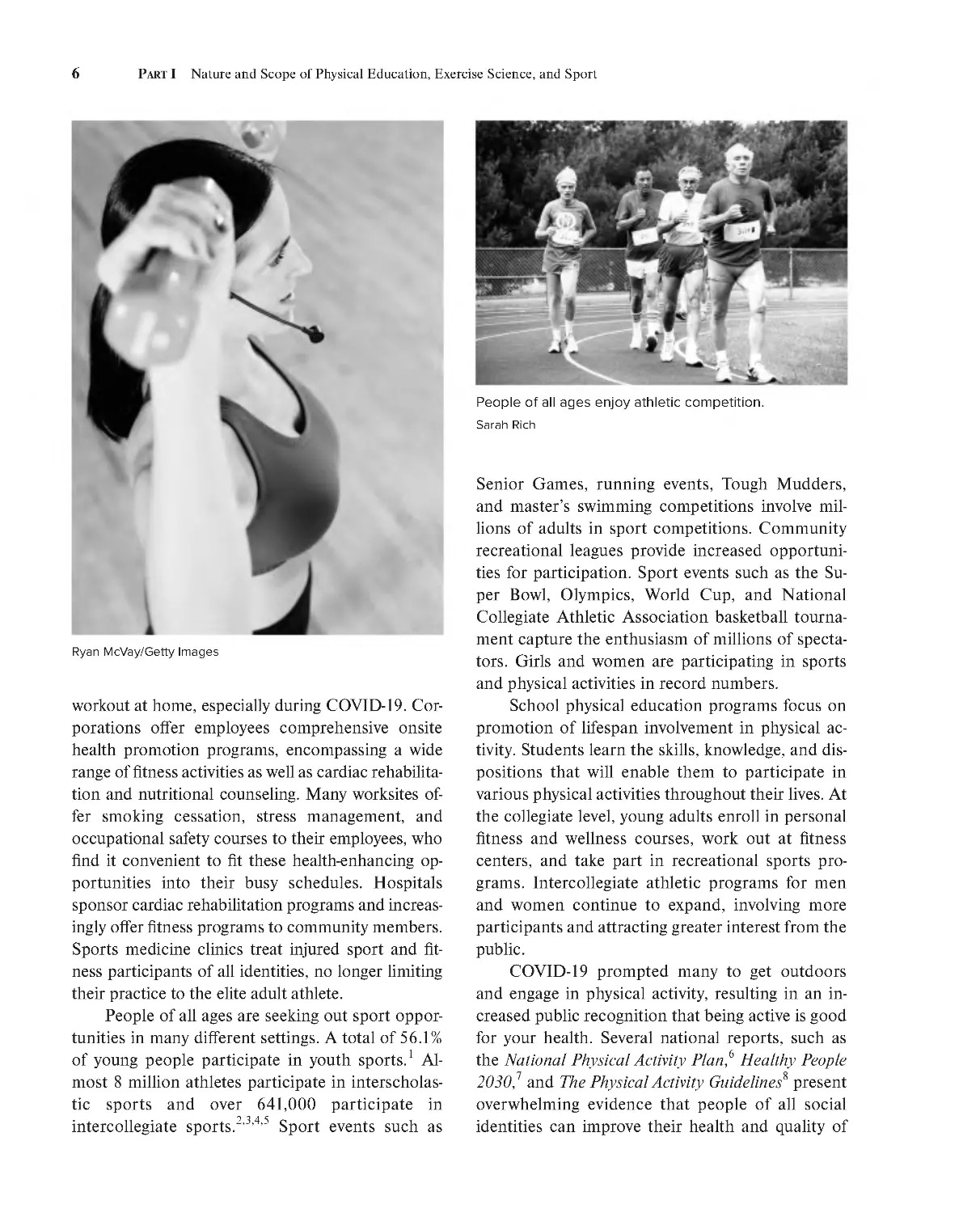
Ryan McVay/Getty Images
People of all ages enjoy athletic competition.
Sarah Rich


Chapter	1 Meaning and Scope
7
life, and, ultimately, their lifespan. This was signifi-
cantly enhanced during COVID-19 in relation to
individuals who had severe symptoms, were hospi-
talized, and/or lost their lives.
The main challenges facing professionals are
increasing the level of physical activity by people
across the nation and addressing inequities in
physical activity opportunities. As physical educa-
tion, exercise science, and sport professionals, we
must make a greater commitment to reach out to
these populations and involve them in our pro-
grams. We must address the specific barriers that
inhibit the adoption and maintenance of physical
activity by different population groups, utilize new
approaches that are sensitive to the needs of in-
creasingly diverse populations, and improve access
by developing quality public programs in schools,
recreation centers, worksites, and health care set-
tings. All people have the right to good health and
the opportunity to be physically active throughout
their lifespan.
life by including moderate amounts of physical ac-
tivity in their daily lives. Although most people
know that physical activity is good for them and
participation in physical education, exercise sci-
ence, and sport programs is at an all-time high, a
closer look at the participation by children, adoles-
cents, and adults reveals much cause for concern.
A primary reason that individuals across the
lifespan may not engage in physical activity is due
to the health disparities and fitness inequities
among different population groups. Age, socioeco-
nomic status, race, ethnicity, gender, educational
attainment, and geographic location were found to
influence physical activity levels. Inactivity is great-
est among women, racial minorities, the economi-
cally and educationally disadvantaged, people with
disabilities, and the aged.
7
These populations have
less access to services and face other barriers to the
adoption and maintenance of physically active life-
styles. Their limited opportunities for physical ac-
tivity adversely affect their health, their quality of
Maria Taglienti-Molinari/Brand X Pictures/Getty Images
Patrick Byrd/mylife photos/Alamy Stock Photo

8
part	I Nature and Scope of Physical Education, Exercise Science, and Sport
that contribute to their optimal development and
well-being. In this definition, the term education re-
fers to the ongoing process of learning that occurs
throughout our lifespan. Education, just like physical
education, takes place in a variety of settings and is
not limited to a specific age group. Homeschooling,
continuing education through distance learning,
worksite health promotion programs, and preschools
are just some of the expanded settings for education
and physical education programs. Teachers today
may be called instructors, leaders, directors, or facili-
tators. Today’s students span the age range, from the
very young exploring movement skills in a preschool
program to the older adults learning how to play an
activity through a community recreation program.
Most physical education programs focus on de-
veloping the whole person. Physical education in-
cludes the acquisition and refinement of motor skills,
the development and maintenance of fitness for opti-
mal health and well-being, the attainment of knowl-
edge about physical activities, and the fostering of
As you begin your professional career, make a
commitment to service. Commit yourself to creat-
ing opportunities for all people—regardless of race,
age, income, education, ethnicity, gender identity,
sexual identity, geographic location, or ability—to
enjoy and to benefit from lifespan participation in
physical activity.
Physical Education, Exercise Science,
and Sport Defined
Physical education, exercise science, and sport
share a common focus—human movement or, more
generally, physical activity. Yet, each discipline of-
fers a unique approach as to how human movement
and physical activity are learned, enhanced, or
achieved. Each of these disciplines is defined in this
section as well as in the Definitions of Terms box.
Physical education is an educational process that
uses physical activity as a means to help individuals
acquire skills, fitness, knowledge, and dispositions
DEFINITION OF TERMS
• Exercise—physical activity done for the purpose of getting fit that increases energy expenditure above base-
line levels. Exercise is planned, structured, and repetitive. The duration, frequency, and intensity of exercise
can be measured.
• Physical Activity—bodily movement produced by the contraction of the skeletal muscles that substantially
increase energy expenditure above baseline level. As a broad term, it encompasses exercise, sport, dance,
active games, activities of daily living, and active occupational task s.
• Physical Education—subject matter taught in schools that provides K–12 students with opportunities to
learn, and have meaningful content and appropriate instruction. Quality physical-education programs focus
on increasing physical competence, health-related fitness, self-responsibility, and enjoyment of physical
activity for all students so that they can be physically active for a lifetime.
• Physical Fitness—capacity of people to perform physical activities; set of attributes that allow individuals to
car ry out daily tasks without undue fatigue and have the energy to participate in a variety of physical activi-
ties; state of well-being associated with low risk of premature health problems.
• Sport—well-established, officially governed competitive physical activities in which participants are moti-
vated by internal and external rewards.
Sources: Adapted from the President’s Council on Fitness, Sports, and Nutrition. Definitions: Health, fitness, and physical activity. 2013
(www.fitness.gov); US Department of Health and Human Services. Healthy People 2030 (www.healthypeople.gov); National Association for
Sport and Physical Education. Moving into the Future: National Standards for Physical Education (2nd ed.) . Reston, Va.: Author, 2004; and
Coakley J. Sport in Society: Issues and Controversies (10th ed.) . New York: McGraw Hill, 2009 .


Chapter	1 Meaning and Scope
9
into how people’s movements develop and change
across their lifespan and further expand their under-
standing of how people learn motor skills. Analysis
of the performance of motor skills using biome-
chanics leads to improvement in skill efficiency and
effectiveness. Researchers’ exploration on the limits
and capacities of performers has enabled athletes,
of all abilities and identities, to perform at higher
levels of achievement. The psychological effects of
physical activity on well-being and strategies to en-
hance adherence to exercise and rehabilitation pro-
grams are some other areas of study within exercise
science.
Sports are highly organized, competitive physi-
cal activities governed by rules. Rules standardize
the competition and conditions so that individuals
can compete fairly and achieve specified goals.
Sports provide meaningful opportunities to demon-
strate one’s competence and to challenge one’s lim-
its. Competition can occur against an opponent or
oneself.
People of all social identities engage in sports
for enjoyment, personal satisfaction, and the op-
portunity to attain victory and/or obtain rewards.
The level of competition ranges from recreational
to elite sport. When sport is highly developed, gov-
erning bodies regulate sport and oversee its man-
agement. Athletics refers to highly organized,
competitive sports engaged in by skillful partici-
pants. At this level, coaches play a significant role,
athletes are highly skilled, specially trained officials
ensure the fairness of the competition, records are
kept, events are promoted through the media, and
spectators assume an important role. Sports oc-
cupy a prominent position in our society.
Since the early 1970s, there has been an enor-
mous interest in the scholarly study of sport. These
sport studies have focused on the significant role of
sport in our society, its tremendous impact on our
culture, and its effects on the millions of people
who play sports and the millions more who watch
and read about them. Scholars study the philosoph-
ical, historical, sociological, and psychological di-
mensions of the sport experience. The growing
popularity of sport and its prominent role in our
society makes sport a vital area of study.
positive dispositions and values conducive to lifelong
learning and lifespan participation.
Within the last five decades, there has been an
increase in the scholarly study of physical educa-
tion. Research continues to expand our knowledge
with respect to the preparation of physical educa-
tion teachers, teacher effectiveness, teaching meth-
ods, models-based practice, improvement of
student learning, and pedagogies that are equitable
and just. It also provides us with new insights on
coaches’ and athletes’ behaviors.
Exercise science is the scientific analysis of ex-
ercise or, more inclusively, physical activity. To
study physical activity, exercise scientists draw
upon scientific methods and theories from many
different disciplines, such as biology, biochemistry,
physics, and psychology. The application of science
to the study of physical activity led to rapid expan-
sion of the knowledge base of exercise science. As
the knowledge base of exercise science grew, so did
our understanding of the effects of physical activity
on various systems of the body. The significant role
that physical activity plays in preventing disease
and promoting health became clearer. Exercise’s
value as a therapeutic modality in the treatment of
disease and the rehabilitation of injuries became
better known.
Exercise science is a very broad area of study,
encompassing many different aspects of physical ac-
tivity. Through research, scholars gain new insights
Exercise physiologists study the body’s short- and long-term
adaptations to exercise.
Mauro Grigollo/E+/Getty Images

10
part	I Nature and Scope of Physical Education, Exercise Science, and Sport
The emergence of new professional opportuni-
ties has created a need for highly qualified profes-
sionals who possess a high level of skill, an
appreciation and understanding of the needs of an
increasingly diverse population, and a sound grasp
of the knowledge of physical education, exercise
science, and sport. Throughout the remainder of
this text, the term professionals will be used in place
of “physical educators, exercise scientists, and
sport leaders.”
The Academic Discipline
In the 1960s, the field of physical education ad-
vanced its status as an academic discipline. Henry
9
defines an academic discipline as
an organized body of knowledge collectively
embraced in a formal course of learning. The
acquisition of such knowledge is assumed to be
an adequate and worthy objective as such,
without any demonstration or requirement of
practical application. The content is theoreti-
cal and scholarly as distinguished from techni-
cal and professional.
An academic discipline has a focus, a concep-
tual framework that provides structure for the field,
a unique scope in comparison to other fields, and
distinct scholarly methods and modes of inquiry
leading to the advancement of knowledge and in-
depth understanding. This body of knowledge is
The realm of physical education, exercise sci-
ence, and sport today embraces many different pro-
grams, diverse settings, and people of all social
identities. This recent growth of physical education,
exercise science, and sport has been accompanied
by an increased interest in its scholarly study. This
research has led to the development of specialized
areas of knowledge. The subsequent increase in the
breadth and depth of knowledge provides a founda-
tion for professional practice. The expansion of
physical education, exercise science, and sport has
led to a tremendous growth of career opportunities
for enthusiastic and committed professionals.
Physical Education, Exercise Science,
and Sport
Physical education, exercise science, and sport can
be described with reference to their status as a pro-
fession. A profession is an occupation requiring spe-
cialized training in an intellectual field of study that
is dedicated to the betterment of society through
service to others. Professionals provide services to
others through the application of knowledge and
skills to improve people’s well-being.
Physical educators, exercise scientists, and
sport leaders possess a bachelor’s degree and fre-
quently pursue advanced study via graduate pro-
grams in the field. Their professional preparation
programs include extensive study in the theoretical
aspects of the field, skill and content knowledge
development, and often practical experiences that
allow them to apply their knowledge and use their
skills under the guidance of qualified professionals.
Additional requirements and certifications may be
necessary to engage in professional practice.
Today there is increased recognition by society
of the valuable contribution professionals in our
field can make in the lives of others. Our commit-
ment to promoting lifespan physical activity for all
members of society benefits the health of the nation.
The expansion of physical education, exercise sci-
ence, and sport programs to different settings and
the involvement of people of all social identities in
our programs offer professionals increased opportu-
nities to ser ve others and enhance their well-being.
More and more individuals with disabilities are engaging
in sports. Here athletes are playing quad rugby.
Image Source/Getty Images


Chapter	1 Meaning and Scope
11
Disciplines within Physical Education,
Exercise Science, and Sport
The field of kinesiology has evolved into a variety of
disciplines (see Table 1-1), many of which fall un-
der the broader professional umbrellas of physical
education, exercise science, and sport. The interdis-
ciplinary nature of physical education, exercise sci-
ence, and sport is evident from the disciplines
identified and described in this section. Theories,
principles, scientific methods, and modes of in-
quiry from many other academic disciplines were
used by researchers and scholars in the develop-
ment of these specialized areas of study. Knowl-
edge and research methods from the hard sciences
of biology, chemistry, physics, anatomy, physiology,
and mathematics strongly influenced the develop-
ment of the disciplines of exercise physiology and
sport biomechanics. Psychology, sociology, history,
and philosophy, often called the social sciences,
formed the foundation for the development of sport
and physical activity psychology, motor develop-
ment, motor learning, sport sociology, sport his-
tory, and sport philosophy. The rehabilitation
sciences, particularly physical therapy, exerted an
important influence on the development of sports
medicine, athletic training, and adapted physical
activity. Educational research significantly affected
the development of physical education pedagogy.
In the discipline of sport management, the influ-
ence of management, law, business, communica-
tion, and marketing is evident.
worthy of study for its own sake and does not need
to have any immediate application to professional
practice. Traditional academic disciplines include
biology, psychology, philosophy, history, and math-
ematics.
The seminal point in the development of the
discipline movement occurred in 1964 when Frank-
lin Henry called for the “organization and study of
the academic discipline herein called physical edu-
cation.”
9
His clarion call came at a time when
forces in society were exerting pressure for educa-
tional reform, improved educational standards, and
greater academic rigor in the preparation of teach-
ers. Then, physical education teacher preparation
programs focused on the application of knowledge
and endured criticism for their lack of academic
rigor, their emphasis on the learning of job-related
skills, and their focus on activity-based courses,
such as basketball or badminton.
Henry’s call for an academic discipline stimu-
lated greater scholarly activity by academicians at
colleges and universities. Developing technologies,
theoretical knowledge, and methods of scientific
inquiry from other disciplines were directed to the
study of physical education and increasingly to ex-
ercise and sport. The proliferation of research and
generation of scholarship led to the development
of specialized areas of study, commonly called
disciplines.
People of all ages are frequenting fitness centers and
health clubs. Many work out on a regular basis. Regular
physical activity contributes to good health and overall
quality of life.
Stephen Simpson/Stone/Getty Images
Athletic trainer helping athlete with rehabilitation.
DenisProduction.com/Shutterstock

12
part	I Nature and Scope of Physical Education, Exercise Science, and Sport
study within the field. Clinical exercise testing, de-
sign of rehabilitation programs for postcardiac pa-
tients, and planning of exercise programs to prevent
cardiovascular disease are among the responsibili-
ties of exercise physiologists. (See Chapter 7.)
Sports medicine/athletic training is concerned
with the prevention, treatment, and rehabilitation of
sports-related injuries. Athletic trainers’ responsi-
bilities are broader than just administering treat-
ment to the injured athlete on the playing field.
From the standpoint of prevention, the athletic
trainer works with the coach to design conditioning
programs for various phases of the season, to cor-
rectly fit protective equipment, and to promote the
welfare of the athlete, such as counseling the athlete
about proper nutrition. With respect to treatment
The growth of these disciplines broadens the
scope of the field of kinesiology. Equally important,
the interdependence between these growing areas
offers us valuable knowledge and greater insight as
we move toward the accomplishment of our goals.
The disciplines are briefly described below.
Exercise physiology is the study of the effects of
various physical demands, particularly exercise, on
the structure and function of the body. The exercise
physiologist is concerned with both short-term
(acute) and long-term (chronic) adaptations of the
various systems of the body to exercise. The effects
of different exercise programs on the muscular and
cardiorespiratory systems, the immune system, and
the health status of different population groups
such as children and the aged are just some areas of
Exercise Physiology
Personal trainers, fitness directors, strength and conditioning specialists,
group exercise instructor, cardiac and pulmonary rehabilitation specialists,
and higher education faculty, physical therapists, and occupational thera-
pists with advanced degrees.
Sport Medicine/Athletic
Training
Sports medicine physician, athletic trainer, exercise physiologist, kinesiother-
apist, physical therapist, nursing, doctor of osteopathy, and nutrition/
dietetics.
Sport Biomechanics
Lab technician in gait analysis and strength and flexibility; researcher,
designer, and tester of sport companies, interfaces, and athletes; higher
education faculty (most require an advanced degree).
Sport Philosophy
Coach, sport journalist, and advanced degrees could lead to becoming a
lawyer and higher education faculty.
Sport Histor y
Sport historian, higher education faculty (advanced degree required).
Sport and Physical Activity
Psychology
Academic, clinical, applied with sport teams and individuals participating in
physical activity (advanced degree required).
Motor Development
Physical/adapted physical education teacher, coach, rehabilitation specialist.
Motor Learning
Physical/adapted physical education teacher, coach, rehabilitation specialist.
Sport Sociology
Coach, journalist, higher education faculty (advanced degree required).
Physical Education Pedagogy
Physical education teacher, coach.
Adapted Physical Activity/
Physical Education
Physical/adapted physical education teacher, coach, adapted physical activity
director.
Sport Management
Account or event coordinator/director, media and public relations specialist,
sales representative, sport facility operations manager, sports marking
director, sports information director, sport agent.
Career Opportunities within the Disciplines of Physical Education, Exercise
Science, and Sport
table	1-1


Chapter	1 Meaning and Scope
13
the aesthetics of movement. Sport philosophers crit-
ically examine the meaning of sport for all partici-
pants involved and enjoin us to question our beliefs
and assumptions about sport. Sport philosophers
engage in systematic reflection, use logic as a tool to
advance knowledge and arrive at decisions, and seek
to understand the relationship between the mind
and the body. Sport philosophers debate questions
of ethics, morals, and values. (See Chapter 2.)
Sport history is the critical examination of the
past, with a focus on events, people, and trends that
influenced the development and direction of the
field. History is concerned with the who, what,
when, where, how, and why of sport.
10
These facts,
when placed in the social context of the time, help
us better understand the present and gain insight
regarding the future. (See Chapter 4.)
Sport and physical activity psychology uses prin-
ciples and scientific methods from psychology to
study human behavior in sport.
10
Sport psycholo-
gists help athletes improve their “mental game,” that
is, develop and effectively apply skills and strategies
and rehabilitation, the athletic trainer assesses inju-
ries when they occur, administers first aid, works
collaboratively with the physician to design a reha-
bilitation program, provides treatment, and over-
sees the athlete’s rehabilitation. (See Chapter 13.)
Sport biomechanics applies the methods of
physics and mechanics to the study of human mo-
tion and the motion of sport objects (e.g., a base-
ball or javelin). Biomechanists study the effect of
various forces and laws (e.g., Newton’s laws of mo-
tion) on the body and sport objects. The musculo-
skeletal system and the production of force,
leverage, and stability are examined with respect to
human movement and sport object motion
(e.g., spinning across the circle to throw a discus).
Analysis of movements with respect to efficiency
and effectiveness is used to help individuals im-
prove their performance. (See Chapter 6.)
Sport philosophy examines sport from many dif-
ferent perspectives. Sport philosophy encompasses
the study of the nature of reality, the structure of
knowledge in sport, ethical and moral questions, and
Biomechanists analyze the mechanical aspects of athletes’ skill performance in order to help
them improve.
SSGT, Jason M. Carter, USMC/DoD Media

14
part	I Nature and Scope of Physical Education, Exercise Science, and Sport
Motor learning is the study of changes in mo-
tor behavior that are primarily the result of prac-
tice and experience. The effect of the content,
frequency, and timing of feedback on skill learning
is a critical area of study. Motor learning is con-
cerned with the stages an individual progresses
through in moving from a beginner to a highly
skilled performer. The most effective conditions
for practicing skills, the use of reinforcement to
enhance learning, and how to use information
from the environment to modify performance are
investigated by motor learning specialists. Motor
control, intimately related to motor learning, is
concerned with the neurophysiological and behav-
ioral processes affecting the control of skilled
movements. (See Chapter 5.)
Sport sociology is the study of the role of sport
in society, its impact on participants in sport, and
the relationship between sport and other societal
institutions. Sport sociologists examine the influ-
ence of gender, race, and socioeconomic status on
participation in sports and, more recently, physi-
cal activity. Drug abuse by athletes, aggression
and violence, the effect of the media on sport, and
that will enhance their performance. Achievement
motivation, regulation of anxiety, self-confidence, re-
habilitation adherence, cohesion, and leadership are
among the topics studied by sport psychologists. Re-
cently, physical activity psychology has attracted
greater attention from researchers. Physical activity
psychology is concerned with exercise addiction, ad-
herence, and other psychological issues affecting the
well-being of people who are physically active. (See
Chapter 9.)
Motor development studies the factors that in-
fluence the development of abilities essential to
movement. The motor development specialist uses
longitudinal studies (i.e., studies that take place
over a span of many years) to analyze the interac-
tion of genetic and environmental factors that af-
fect the ability of individuals to perform motor
skills throughout their lifespan. The role of early
movement experiences, heredity, and maturation
on children’s development of motor skills is an im-
portant focus of study. Professionals use theories of
development to design appropriate movement ex-
periences for people of all ages, identities, and abil-
ities. (See Chapter 5.)
Sport psychologists help athletes achieve optimal levels of performance.
Karl Weatherly/Photodisc/Getty Images


Chapter	1 Meaning and Scope
15
activities and sport to enable people with different
abilities to participate. By federal law, adapted
physical educators have a role in designing an indi-
vidualized educational plan (IEP) for students with
disabilities so that they can participate to the fullest
extent they are able in school physical education.
Advocacy to secure services and leadership to cre-
ate more opportunities in physical education and
sport are important aspects of this field. (See Chap-
ters 10 and 12.)
Sport management encompasses the many
managerial aspects of sport. These include per-
sonnel management, budgeting, facility manage-
ment, and programming. Other aspects of sport
management are law, policy development, fund-
raising, and media relations. Knowledge from this
area can be used by professionals in many differ-
ent aspects of the sport enterprise, including inter-
scholastic and intercollegiate sports, professional
sports, fitness and health clubs, community sport
and recreation programs, and sporting goods
sales. (See Chapter 14.)
player–coach relationships interest sport sociolo-
gists. The experiences of the millions of children
involved in youth sport has also drawn the atten-
tion of sport sociologists. (See Chapter 8.)
Physical education pedagogy can be defined
broadly to include the study of teaching and learn-
ing in school and nonschool settings. Physical edu-
cation pedagogy studies how physical educators
and sport leaders provide an effective learning envi-
ronment, achieve desired learning goals, and assess
program outcomes. Physical education pedagogy
seeks to determine the characteristics and skills
possessed by effective teachers and coaches and
how these influence student/athlete activity and
student/athlete learning. Curricular development,
its implementation, and the preparation of teachers
are major foci in physical education pedagogy. (See
Chapter 10.)
Adapted physical activity/physical education is
concerned with the preparation of teachers and
sport leaders to provide programs and services for
individuals with disabilities. Specialists modify
Physical education pedagogy studies the behaviors of teachers and coaches, identifying those
who contribute to an effective learning environment.
Erik Isakson/Blend Images/Getty Images

16
part	I Nature and Scope of Physical Education, Exercise Science, and Sport
prevention, mental health, nutrition, physical fitness,
stress management, and dealing with abuse of drugs
and alcohol. Health service is concerned with devel-
oping and maintaining a satisfactory level of health
for all people through services such as routine eye
examinations, cholesterol and blood pressure moni-
toring, and cancer screening. Environmental health
focuses on the development of healthful and safe en-
vironments where individuals are not needlessly ex-
posed to hazards such as toxic chemicals and
infectious materials.
Americans are becoming increasingly con-
scious of the instrumental role physical activity
plays in one’s health-related quality of life. Data
supporting the health benefits of participation in
appropriate physical activity on a regular basis con-
tinue to mount. Accrued benefits of regular physi-
cal activity include the prevention of coronary
heart disease, hypertension, non-insulin-dependent
diabetes mellitus, osteoporosis, obesity, and mental
health problems.
7
Other benefits may include the
ALLIED FIELDS
Health, recreation and leisure, and dance are fre-
quently referred to as allied fields. These allied fields
share many purposes with physical education, exer-
cise science, and spor t, namely, the development of
the total individual and concern for quality of life.
However, the content of the subject matter of the al-
lied fields and the methods used to accomplish their
goals may vary from the subject matter and methods
of physical education, exercise science, and sport.
Health
Health education concerns itself with the total well-
being of the individual, encompassing physical,
mental, social, emotional, occupational, and spiri-
tual health. Three areas within health education are
health instruction, provision of health services, and
environmental health.
Health instruction focuses on teaching the ba-
sics of healthy living in many areas, including disease
Sport sociologists study the behavior of people in sport situations—athletes, coaches, and
fans—as well as the impact of sport on the community.
Don Hammond/Design Pics


Chapter	1 Meaning and Scope
17
the integration of the individual into community
recreational opportunities and life is emphasized.
Recreation and leisure can contribute to the
quality of an individual’s life. They provide oppor-
tunities for individuals to engage in freely chosen
activities, including physical activities that will
yield beneficial health outcomes, during their lei-
sure time.
Dance
The third allied area is dance. Dance is a popular
activity for people of all ages and is both a physical
activity and a performing art that gives participants
an opportunity for aesthetic expression through
movement.
As a form of recreation, dance provides oppor-
tunities for enjoyment, self-expression, and relax-
ation. Dance also can be used as a form of therapy,
providing opportunities for individuals to express
their thoughts and feelings. It provides a means to
cope with the various stresses placed on individu-
als. Dance is increasingly used as a means to de-
velop fitness.
There are many forms of dance that are en-
joyed by individuals—including ballet, ballroom,
folk, clog, contemporary, salsa, hip-hop, square,
and tap. Cultural heritage is reflected in and passed
on through dance activities.
Health, recreation and leisure, and dance are
allied fields to physical education, exercise science,
and sport. The overall focus of these fields of en-
deavor is the development of the total individual
and the enhancement of each person’s quality of
life. Attainment of these aims involves health pro-
motion, pursuit of worthy leisure-time activities,
and creative expression through dance. These expe-
riences, coupled with the movement activities that
compose the realm of physical education, exercise
science, and sport, offer the potential to enhance
the lives of people of all social identities. Fulfill-
ment of this potential will depend on the quality of
leadership provided by professionals in health, rec-
reation and leisure, dance, physical education, exer-
cise science, and sport.
reduction of the incidence of stroke and the main-
tenance of the functional independence of the el-
derly.
7
Additionally, it has been found that, on
average, individuals who are physically active out-
live individuals who are physically inactive.
7
The
strong role regular and appropriate physical activ-
ity plays in the health and well-being of individuals
further confirms the allied nature of health and
physical education, exercise science, and sport.
Recreation and Leisure
Another allied field is recreation and leisure. Recre-
ation and leisure are generally thought of as self-
chosen activities that provide a means of revitalizing
and refreshing one’s body and spirit. The spectrum
of activities ranges from active to passive and from
group to individual in nature.
It is within recreation and leisure opportuni-
ties that individuals of all identities can simply play.
The notion of play, whether formal or informal, is
often lost after early childhood and youth. Ask
yourself, when was the last time that you played?
How do you feel when you simply play? Most often,
individuals have fun and feel a sense of enjoyment
when they are free to play, create their own games
and activities, and have the opportunity to express
themselves through physical movement (or other
forms of play).
Schools, communities, and businesses offer a
wide range of activities to meet the fitness and lei-
sure needs of individuals. Worksite fitness pro-
grams, industrial sport leagues, commercial fitness
programs, competitive recreational leagues, in-
structional clinics, and open facilities for drop-in
recreation are increasing in number. During non-
school hours, school facilities are the site for vari-
ous recreational offerings for people of all ages.
Many individuals and families pursue recreational
activities independently as well.
Therapeutic recreation focuses on providing a
broad range of services for individuals of all ages
who have disabilities. Through a diversity of inter-
ventions, the individual’s quality of life is enhanced,
the development of leisure skills is encouraged, and

18
part	I Nature and Scope of Physical Education, Exercise Science, and Sport
Do you believe everything that you hear and
read or do you draw your own conclusions? How
do you know what to believe or not to believe (i.e.,
what is fact and what is falsified interpretation)? In
the first part of this text, we are going to educate
you on how to read and critique research by guiding
you through the 12 Steps to Understanding Re-
search Reports (see box). In the Self-Assessment
Activities found at the end of each chapter, a spe-
cific activity will be provided that centers on how to
find research articles as well as the 12 steps as you
learn how to read research reports found in profes-
sional journals. We will also emphasize how re-
search can inform professional practice and provide
you with opportunities to apply research findings to
your future profession.
Reading Research
Before you begin to read research reports, it is impor-
tant for you to understand research terminology
that will provide different perspectives from which
you will analyze and critique reports in professional
GROWING AS A PROFESSIONAL IN
PHYSICAL EDUCATION, EXERCISE
SCIENCE, AND SPORT
As a future professional, it is important that you
make a commitment to your discipline that goes
well beyond your academic course work and practi-
cal experience. You might ask why it is important
for professionals with bachelor’s and graduate de-
grees to continue professional development
throughout their careers. The primary reason is
that our field and your specialized area of study is
constantly changing, placing us in a position to
continue our knowledge development based on the
latest research, both scientific- and practitioner-
based. Research findings create opportunities for
professionals to inform, change, modify, and en-
hance their practice. If you do not want to be that
professional that is deemed “old school,” then it is
your ethical duty to stay current in the latest re-
search, practice, and technologies to provide your
students, clients, and players with the most accu-
rate and effective instruction and practice.
Physical activity contributes to health and fitness throughout life. Bicycling is an excellent activity
for people of all ages.
Ariel Skelley/Blend Images


Chapter	1 Meaning and Scope
19
Adults can use a variety of physical activities to accumulate the recommended 30 minutes a
day of moderate-intensity physical activity necessary for health benefits.
Fran Polito/Moment/Getty Images
journals. First, it is important to distinguish between
scientific and practitioner-based research. Scien-
tific research is based on a systematic approach to
gathering information that potentially answers an
investigated question, whereas practitioner-based
research focuses on how to apply the informa-
tion learned within your instruction or area of
practice.
Second, research reports are usually based
on two paradigms (i.e ., types) of research: quan-
titative and qualitative. Quantitative research is
based on numbers, primarily the statistical analy-
sis of numeric data that were gathered. Quantita-
tive reports typically describe, correlate, predict,
or explain a hypothesis that was posed at the
beginning of a study. In contrast to quantitative
research, qualitative research answers questions
through words, images, and sounds. The purpose
of this research is to learn more about the social
context in which the participants live, which is
conducted through the lens and interpretation
of the researcher(s).
11
As you read quantitative
and qualitative reports, Silverman, Spirduso, and
Locke
12
suggest that you attempt to answer five
basic questions:
1. What is the report about?
2. How does the study fit into what is already
known?
3. How was the study done?
4. What was found?
5. What do the results mean?
Quality research that is scientific- and practi-
tioner-based within the quantitative and qualitative
paradigms has the potential to provide the reader
with new knowledge that can inform the practice of
all professionals.
Staying Up-to-Date with Technology
In today’s society, technology influences many as-
pects of our lives and will play an important role
in your professional endeavors. Technology helps
professionals stay abreast of new developments in

20
part	I Nature and Scope of Physical Education, Exercise Science, and Sport
12 STEPS TO UNDERSTANDING RESEARCH REPORTS
Steps
Questions
Step 1—Citation
What is the name of the study, who is the author(s), and where and when was
it published? Report the complete reference citation using APA format.
Step 2—Purpose and General
Rationale
What was the purpose of the study and how did the author(s) make a case
for its importance? Is the study quantitative or qualitative in nature?
Step 3—Fit and Specific
Rationale
How does the topic of the study fit into the existing research literature, and
how is that information used to make a specific case for the investigation?
Step 4—Participants
Who was studied (give number and characteristics), and how were they
selected to participate in the study?
Step 5—Context
Where did the study take place? Describe important characteristics of the
environment and setting (e.g. , group demographics).
Step 6—Steps in Sequence
In the order performed, what were the major procedural steps in the study?
Describe or diagram in a flowchart. Show a sequential order and any
important relationships among the steps.
Step 7—Data Collection
What data sources were used (e.g. , test scores, questionnaire responses, or
frequency counts for a quantitative study or field notes, inter view transcripts,
photographs, or diaries for a qualitative study), how were the data collected,
and what was the role of the author(s) throughout the process?
Step 8—Data Analysis
What form(s) of data analysis was used, and what specific questions was it
designed to answer? What statistical operations and computer programs, if
any, were employed?
Step 9—Results
What did the author(s) identify as the primary results (products or findings
produced by the analysis of data)? In general, “what was going on there?”
Step 10—Conclusions
What did the author(s) assert about how the results in Step 9 responded to
the purpose(s) established in Step 2, and how did the events and
experiences of the entire study contribute to that conclusion?
Step 11—Cautions
What cautions does the author(s) raise about the study itself or about interpreting
the results? Add here any of your own reser vations, particularly those
related to methods used to enhance validity and credibility (quantitative)
or trustworthiness and believability (qualitative).
Step 12—Discussion and
Application
What interesting facts or ideas did you learn from reading the report? Include
here anything that was of value in regard to results, research designs and
methods, references, dat a-collection instruments, history, useful arguments,
or personal inspiration. How can the information learned be applied to
improve professional practice? Or, what were the implications of this study
for a practitioner?
Source: Adapted from Silverman S, Spirduso WW, and Locke LF. Reading and Understanding Research (4th ed.). Thousand Oaks, CA: Sage, 2016.


Chapter	1 Meaning and Scope
21
Through the World Wide Web and the Inter-
net, communication with other professionals can
occur rapidly. E -mail is one of the most common
ways to communicate. Real-time communication
between professionals can occur using LinkedIn,
instant messaging programs, and other applica-
tions, such as FaceTime, Zoom, and Skype, let pro-
fessionals engage in phone and video chat. Live
web conferencing programs, such as Adobe Con-
nect, allow professionals to share presentations and
multimedia from their desktops and receive feed-
back from other professionals. Although having
such readily available information is convenient,
you need to be critical consumers about the infor-
mation that you get from the World Wide Web and
the Internet. To help guide your critical analysis of
web pages, see the Critiquing the Web box.
Social media, such as Instagram, Twitter, Face-
book, Ning, and Tapped In (http://www.tappedin
.org), lets professionals communicate with each
the field, facilitates communication among profes-
sionals, and plays a role in professional activities
such as teaching, assessment, and research. This has
certainly been brought to the forefront due to the
COVID-19 pandemic causing many professionals to
operate remotely/virtually.
Electronic databases such as ProQuest, Aca-
demic Search Premier, and SPORTDiscus provide
ready access to professional journals. Really Simple
Syndication (RSS), lets you subscribe and receive
up-to-date information from online newspapers,
some electronic journals, and government initia-
tives. Additionally, professionals can subscribe to
updates from the U.S . Department of Health and
Human Services (http://www.hhs.gov, click on the
icon to subscribe to updates) to get the most cur-
rent information and decisions on issues such as
obesity, morbidity, nutrition, physical activity, and
hypokinetic diseases. Smartphone applications can
deliver this information directly to your fingertips.
CRITIQUING THE WEB
These are tips for evaluating the quality of content on the web. In recent years, the web has become a rich envi-
ronment of pages, blogs, wikis, social networking sites, free research ser vices, media, and more. It can be a
challenge to figure out which content to tr ust. This information will help you identify the type of site you are
visiting and evaluate its content.
Here are a few general tips for evaluating content on the web. Check that the . . .
• author has expertise on the topic.
• source of the content is stated, whether original or borrowed, quoted, or imported from elsewhere, and that
the content can be independently verified from other sources. This is especially important if you cannot
check on the expertise of the author or if the author is not identified.
• level and depth of the information meets your needs.
• site is currently being maintained. Check for posting or editing dates.
• information is up-to-date.
• links are relevant and appropriate and in working order.
• site includes contact information.
• top-level domain in the site address is relevant to the focus of the material, for example, . edu for educational
or research materials, . org for profit or nonprofit organizations, and .gov for government sources. Note that
the top-level domain is not necessarily a primary indicator of site content. For example, some authors post
their content on blog or wiki platforms hosted by companies with .com addresses.
Source: Adapted from: https://library.albany.edu/infolit/resource/evalweb

22
part	I Nature and Scope of Physical Education, Exercise Science, and Sport
in daily activity to the latest fitness techniques.
Consumers (i.e., you) need to analyze and critique
the information to determine what is and is not ac-
curate or appropriate practice.
Continuing your professional development is
an important responsibility of professionals. Webi-
nars and podcasts offer the opportunity to stay on
top of professional development opportunities. On-
line courses and degrees allow you to continue your
education without having to be physically present
in a classroom or educational institution.
Current technology, as well as new and emerg-
ing technologies, means that it is easier for profes-
sionals to remain abreast of developments in the
field. Communicating and collaborating with col-
leagues, sharing ideas and resources, and taking
advantage of professional development opportuni-
ties are just some of the ways in which technology
helps professionals fulfill their responsibilities.
other, form groups around common interests, and
readily exchange ideas. Blogging (e.g., Tumblr), the
posting of commentary, video, and photos (e.g.,
Pinterest), gives professionals the opportunity to
stay cognizant of current trends and issues as well
as contribute to the discussion. Wikis, collabora-
tively built web pages, allow professionals to work
together to develop new websites of professional
interest. Social bookmarking sites, such as Digg,
invite people to bookmark websites of interest, tag
them with descriptors, and choose to share them
with other people.
Sharing of ideas, best practices, and research is
easy and convenient. Websites such as PE Central
and PHE America invite professionals to voice
their opinions, share lesson plans, and post best
practices, while providing a multitude of resources.
YouTube provides individuals all over the world
with video clips that range from children engaged
CURRENT TRENDS: MOVING TOWARD THE FUTURE
• The disciplines within the field of kinesiology will continue to be interdisciplinary, yet also align with other
areas within the medical, public health, and business fields.
• Advanced degrees are increasingly required for many professions within the disciplines.
• The disciplines of exercise physiology, sport medicine/athletic training, and sport management are rapidly
expanding.
• Physical activity levels, nationally and worldwide, will continue to decline if access and opportunity are not
provided to all individuals.
• Physical activity and health initiatives and policy will begin to make a positive impact on people’s longevity
and quality of life if they are equitable and just for all individuals regardless of social identity.
• Empirical research will continue to provide us with valuable information that will allow us to make in-
formed decisions about our health and wellness.
Our lives have been disrupted, challenged, and changed
due to n ational and global experiences related to the
COVID-19 pandemic, continued racial injustice, and po-
litical unre st . The pandemic has devastated many lives
through loss of loved ones, worsened mental health issues,
and/or not having the financial resources to support one-
self or family. Through all of this, we have exposed the
importance of justice, equity, diversity, and inclusion
(JEDI) of all people regardless of one’s social identity—in
all facets of our world. An important step in this process is
exploring and critically reflecting upon your social identity
and systems of meaning. Your social identity consists of
how you identify
Summary


Chapter	1 Meaning and Scope
23
motor development, motor learning, adapted physical
ac tivity/physical education, sport history, and sport
management. Each practitioner should b e knowledge -
able about these specialized areas of study as well as
appreciate their interrelatedness and their contribution
to the discipline as a whole.
The field of kinesiology, and specific to this text, the
professions of physical education, exercise science, a nd
sport is continuously changing. To grow as a profes -
sional, it is important to stay up-to-date with the latest
research, both scientific - and practitioner-ba sed, a nd
technological tools. Understanding research reports,
learning about research findings, and utilizing the new-
est technology allow professionals the oppor tunity to
provide equitable and just practices and instruction to
students, cl ients, a nd athletes within physical educa -
tion, exercise science, and sport programs.
Contemporary physical education, exercise scienc e,
and sport are rapidly changing within the broader field
of kinesiology and includes both disciplinary and pro-
fession al dimen sion s. T he discipline is the body of
knowledge of the field. Scholars and researchers engage
in activities designed to provide greater scientific un-
derstanding and insight. The professional dimension of
the field focuses on providing ser vices to people of all
social identities in many different settings. Profession-
als use the body of knowledge and speciali zed skills to
meet the unique needs of people and help them im-
prove their health and quality of life. The growth of
knowledge in physical education led to the change in
the field to kinesiology as well as to specialized areas of
study, such a s sport and physical activity psychology,
sport sociology, physical education pedagogy, sp ort
philosophy, sport biomechanics, exercise physiology,
DISCuSSIon	QueStIonS
1. Reflect upon and discuss your social identity and
systems of meaning. How will your identity influ-
ence you as a future professional? What potential
biases, judgments, or concerns do you need to
work through as you move for ward in your pro-
gram of study?
2. In this text, we have named kinesiology as the “field”
and refer to physical education, exercise science,
and sport as professions within this field. In today’s
society, should kinesiology be considered the field?
Is there a different name that should be considered
for the field of human movement and physical activity?
Or, should there be multiple fields? Explain your
reasoning behind your decision. What factors can
you use to support your stance?
3. Of the disciplines, which one most closely aligns
with your desired profession? Why have you chosen
to go into that profession?
GET CONNECTED
Newsletters, RSS feeds, and podcasts are just some of the ways to stay abreast of current news, research, and
developments related to physical education, exercise science, and sport.
U.S . Department of Health and Human Services—This site offers access to RSS feeds, podcasts, videos, and
newsletters related to health. There are instructions on the site explaining how to watch, listen, or subscribe to
a wide variety of information on health and physical activity.
https://www.hhs.gov/
American College of Sports Medicine—ACSM Fit Society electronic newsletter for the general public, focusing
on popular health, sport, nutrition, and fitness topics.
https://www.acsm.org/ > Fit Society Page > sign up to subscribe.
PHE America Newsletter—sponsored by PHE America, this website offers a monthly newsletter and articles on a
variety of topics, primarily related to the teaching of physical education and the promotion of active lifestyles. It
also offers a directory of e-mailing lists and newsgroups for sport sciences, athletic training, wellness, and health.

24
part	I Nature and Scope of Physical Education, Exercise Science, and Sport
3. Refer to the 12 Steps to Understanding Research
Reports box. Search for two scientific journals in
which you can find research articles that focus on
contemporary physical education, exercise science,
and sport or one of the disciplines. Within these
journals, you must be able to identify at least one
original research article. This means that the authors
of the article conducted the research study and are not
referencing or analyzing data found in other research
articles.
4. The Get Connected box lists resources for physical
education, exercise science, and sport. Subscribe to a
newsletter. Discuss the benefits the Internet offers to
professionals in the field. For the semester, keep cop-
ies of your resources and summarize what you have
learned at the end of the semester.
These activities are designed to help you determine if you
have mastered the materials and competencies presented
in this chapter.
1. Complete the social identity profile (Figure 1-1).
Then, reflect upon your social identities and how
and why you identify this way. Describe which
identities are more salient to you compared to oth-
ers and why. Discuss how have you been privi-
leged, marginalized, and/or oppressed based on
your social identities.
2. Without consulting your text, describe the disci-
plines of the field of kinesiology. Discuss how these
areas are interrelated. Use examples to illustrate why
it is important to be knowledgeable about the vari-
ous specialized areas within the discipline.
Self-aSSeSSment	aCtIvItIeS
referenCeS
1. Aspen Project Plays (2022). Youth sport facts:
participation. https://www.aspenprojectplay.org/
youth-sports/facts/participation-rates.
2. National Federation of State High School Associa-
tions. (2019). 2018–2019 high school athletics partici-
pation survey. Retrieved from http://www.nfhs.org.
3. National Collegiate Athletic Association.
(2022). Membership. Retrieved from http://www
. ncaa.org.
4. National Association of Intercollegiate Athletics.
(2022). Retrieved from http://www.naia.org.
5. National Junior College Athletic Association.
(2022). Sponsors and partners. Retrieved from
http://www.njcaa.org.
6. National Physical Activity Plan. (2016). Retrieved
from http://www.physicalactivityplan.org/index
. html.
7. US Department of Health and Human Ser vices.
(2020). Healthy people 2030. Retrieved from http://
www.healthypeople.gov.
8. Office of Disease Prevention and Health Promo-
tion. (2018). 2018 physical activity guidelines. Re-
trieved from https://health.gov/paguidelines/.
9. Henry, F. M. (1964). Physical education: an aca-
demic discipline. Journal of Health, Physical Educa-
tion, and Recreation, 37(7), 32 –33 .
10. Charles, J. M . (1996). Scholarship reconceptualized:
the connectedness of kinesiology. Quest 48, 152–164 .
11. Rossman, G. B . & R allis, S . F. (2011). Learning in
the field: An introduction to qualitative research (3rd
ed.) . Thousand Oaks, CA: Sage.
12. Silverman, S . J. , Spirduso, W. W., & L . F. Locke.
(2016). Reading and understanding research (4th ed.) .
Thousand Oaks, CA: Sage.

Polka Dot Images/Getty
Images
2
CHAPTER
PhilosoPhy, Goals,
and objectives
OBJECTIVES
After reading this chapter, students should be able to—
■ Discuss key concepts of philosophy and their application to the disciplines
within physical education, exercise science, and sport.
■ Begin to develop a professional philosophy.
■ Describe potential goals and objectives that can be developed within physical
education, exercise science, and sport.
■ Describe the cognitive, affective/social, and psychomotor learning domains
and apply these domains to the different disciplines.
■ Describe the purposes and the importance of assessment in physical
education, exercise science, and sport.
Professionals in physical education, exercise science, and sport face the
challenge of preparing children, youth, and adults—across wide range of
social identities and a multitude of needs, to engage in a physically active and
healthy lifestyle. To provide instruction and practice that can enhance the
number of individuals who are physical movers for a lifetime, it is important
for you to develop a professional philosophy that reflects your experiences and
beliefs within your discipline.
As discussed in Chapter 1, your social identities and systems of meaning
influence your beliefs, what you value, and your lived experiences in all aspects
of your life. It also influences your philosophy for the profession in which you
aspire to do. At the onset of this chapter, we are asking you to continue to re-
flect on your social identities and systems of meaning and relate them to what
will develop into your professional philosophy.
Your professional philosophy creates a framework (i.e., a way of thinking,
a perspective) in which you formulate the goals and objectives of your pro-
gram. As professionals, we must define the goals and objectives of our pro-
grams based on the context in which we work, whether in a corporate fitness
center, cardiac rehabilitation program, or a community sports program. Clearly

26
Part I Nature and Scope of Physical Education, Exercise Science, and Sport
and works. Your system of beliefs and values guides
your conduct in both your personal life and profes-
sional life. Philosophy helps individuals address the
problems that confront them through the use of
critical thinking, logical analysis, and reflective ap-
praisal. Our philosophy is greatly influenced by our
lived experiences and those lived experiences are
often dependent upon our social identities. Some
of you have had to challenge and question the sta-
tus quo and/or systems en route to developing your
beliefs and values.
Questions that reflect the concerns of philoso-
phers include the following:
• What is the role of human beings on this
earth?
• What are the origin and nature of the universe?
• What constitutes good and evil and right and
wrong?
• What constitutes truth?
• Is there a God?
• What relationship exists between mind and
body or matter?
Are there additional questions you have phi-
losophized about that are not listed? What were
they? What brought you to philosophize about such
topics? Throughout the remainder of the philoso-
phy section, consider how these philosophies can
relate to your personal life and future professional
career.
defined goals and objectives are essential if physical
education, exercise science, and sport programs are
designed to foster optimal human development, en-
hance health, and enrich the quality of life of all
individuals.
Within this chapter, we will discuss the major
philosophies; the philosophy of sport and physical
activity; the goals and objectives of physical educa-
tion, exercise science, and sport; the cognitive,
affective/social, and psychomotor domains; and
the implementation of assessment within instruc-
tion and practice.
PHILOSOPHY
The term philosophy can conjure up a variety of
visions and reactions depending on the person.
At that time, ask yourself, how do you respond
when you hear the word philosophy? What is your
current perspective about philosophy? How does
philosophy play a role in your personal and profes-
sional lives?
What Is Philosophy?
Philosophy, derived from the Greek word philoso-
phia, means “the love of wisdom.”
1
Philosophers
pursue the truth through the systematic investiga-
tion of reality, knowledge, meanings, and values.
Philosophy is a system of values by which one lives
SOCIAL JUSTICE
Talking Points
• Our professional philosophy is influenced by our social identities, systems of meaning, and personal lived
experiences. Professionals, regardless of their philosophy, will need to be inclusive and sensitive to the wide
variety of identities and experiences of the people with whom they work.
• Professionals within the field of kinesiology need to develop goals and objectives specific to each student,
player, or client to best meet their goals and needs, while taking into consideration their identities, circum-
stances, access, and environment.
• Professionals should have the ability to meet all the diverse learning needs of their students, players, or
clients to create equitable opportunities for them to succeed.

ChaPter 2 Philosophy, Goals, and Objectives
27
approach to study how ideas relate to each other
and applies sound and reasoned judgment to deci-
sion making. Logic can help members of our field
design sound research approaches or organize facts
to document the contribution of physical activity to
well-being.
Axiology examines the nature of values. Two
extensions of axiology are ethics and aesthetics.
Ethics is concerned with issues of right and wrong,
responsibility, and standards of conduct. Specula-
tive in nature, ethics examines moral values. Moral
reasoning helps people determine what the right
thing to do is in a given situation or circumstance.
The development of character, the nature of fair
play, and issues of justice are just a few of the ethi-
cal concerns of physical education, exercise sci-
ence, and sport. Aesthetics is the study of the nature
of beauty and art. The beauty of skilled movement
and artistic expression through dance enable us to
see movement as an art form.
These branches represent different aspects of
philosophy. In developing a comprehensive philos-
ophy for a discipline, such as physical education,
exercise science, or sport, each of these areas is
addressed. The Branches of Philosophy box high-
lights the focus of each branch, provides a typical
general question that may be posed, and shows how
these questions may be framed within the context
of physical education, exercise science, and sport.
Major Philosophies
The six major philosophies that have been typically
described with respect to their impact on physical
education, exercise science, or sport are idealism,
realism, pragmatism, naturalism, existentialism,
and humanism. Although space precludes an exten-
sive discussion of each philosophy, a brief overview
of the basic tenets of each is provided, with sugges-
tions of how they can potentially influence profes-
sionals in their work.
Idealism
As a philosophy, idealism emphasizes the mind as
central to understanding and the critical role that
reasoning plays in arriving at the truth. Under this
Branches of Philosophy
Philosophy’s branches of study are generally divided
into four domains: metaphysics, epistemology,
logic, and axiology. Metaphysics seeks to address the
ultimate nature of reality, that is, what is real and
exists. Speculative in its approach, metaphysics may
be used to understand the relationship between
mind and body or the essential meaning of sport.
Epistemology is the branch of philosophy con-
cerned with examining the nature of knowledge. It
uses critical, analytical methods to examine the
structure of knowledge, its origin, and its limits.
This approach can help us define the nature of the
discipline (i.e., body of knowledge) of physical edu-
cation, exercise science, and sport.
Logic focuses on the examination of ideas in
an orderly and systematic way. Logic uses a critical
What does it mean to be a “good sport”?
PNC/Brand X Pictures/PunchStock

28
Part I Nature and Scope of Physical Education, Exercise Science, and Sport
rehabilitation specialist who followed the tenets of
idealism would solicit from their cardiac patient, a
former runner, the meaning running held for them,
understand the patient’s desire to return to run-
ning, and work with the patient to develop a realis-
tic rehabilitation program to accomplish this goal.
Realism
The philosophy of realism emphasizes the use of
the scientific method to arrive at the truth. Reason-
ing and understanding the natural laws of nature
are features of this philosophy. The total develop-
ment of the person is important, and physical activ-
ity has an important role in this endeavor.
philosophy, values and ideals are held in high re-
gard and are considered to be universal and abso-
lute. Values and ideals do not change, regardless of
circumstances.
Professionals who follow the tenets of idealism
would emphasize the development of character, the
importance of values, and the application of rea-
soning in their work. A youth sport coach who es-
poused the philosophy of idealism would promote
the development of character and the ideals of
sportspersonship among the athletes on their team
over winning. A fitness leader who believed in the
philosophy of idealism would place a high value on
serving as a role model to their clients. A cardiac
Branch
Focus
General Questions
Physical Education, Exercise
Science, and Sport Questions
Metaphysics
Nature of reality
What is the meaning of
existence? What is
real?
What experiences in a physical
education program will better
enable the individual to meet the
challenges of the real world?
Epistemology Nature of knowledge
and methods of
obtaining
knowledge
What is true?
What is the validity of the knowledge
pertaining to physical activity and
its influence on the development
of the individual?
Logic
Systematic and
orderly reasoning
What is the method of
reasoning that will
lead to the truth?
What process should a researcher
use to determine the value of
physical education to program
participants?
Axiology
Aims and values of
society
How do we determine
what has value, and
on what criteria is
this judgment based?
What is the value of physical
education programs to the
individual?
Ethics
Issues of conduct,
right and wrong
What is the highest
standard of behavior
each person should
strive to attain?
How can sport be utilized to develop
ethics?
Aesthetics
Nature of beauty
and art
What is beauty?
Why are skilled performers’
movements beautiful to view?
BRANCHES OF PHILOSOPHY

ChaPter 2 Philosophy, Goals, and Objectives
29
Although pragmatists see truth as variable and
rightness as individually determined, they empha-
size social responsibility. Pragmatists emphasize
problem solving, consideration of individuals’
needs and interests, development of individuals’ so-
cial skills, and cooperation.
A pragmatist conducting a community fitness
program for older adults would design the program
to meet their needs and interests. A college recre-
ational sports director would be sure to include a
variety of different activities in the program offer-
ings, so that the students would be able to choose
activities that were personally meaningful and en-
joyable. A corporate worksite health promotion
specialist who believed in the pragmatic approach
may choose to incorporate Project Adventure
problem-solving activities into a special program
for middle managers; after the completion of the
activities, they would ask them to share perceptions
of their experiences while the specialist facilitated
the discussion.
An exercise physiologist who subscribed to the
philosophy of realism would carefully evaluate
the scientific evidence in order to better understand
the contribution of different types of physical
activity to health. Physical educators who believed
in realism would incorporate frequent assessment
procedures into their classes, so that their students
would have a means to monitor their progress toward
attainment of their goals. In accordance with this
philosophical approach, coaches would select train-
ing techniques based on the scientific evidence of
their effectiveness, and would use a systematic, pro-
gressive approach in designing practices.
Pragmatism
According to the philosophy of pragmatism, experi-
ences—not ideals or realities—are the basis of truth.
Because individuals experience different situations,
reality differs from person to person. Thus, within
this philosophical approach, whatever works in a
given situation at a given time is seen as successful.
Philosophy influences athletes’ attitudes toward winning and helps them interpret the
meaning of success.
Larry William Associates/Fuse/Getty Images

30
Part I Nature and Scope of Physical Education, Exercise Science, and Sport
the established code of conduct. The coach may
allow some individuality in dress, but would empha-
size the athlete’s responsibility in adhering to train-
ing rules. A physical educator would allow students
to select from a variety of activities within the pro-
gram, promoting reflection and individual responsi-
bility for learning.
Humanism
A humanistic philosophy emphasizes the develop-
ment of the full potential of each individual. Per-
sonal growth, self-actualization, and the development
of values are central tenets of this philosophy. Treat-
ing students as individuals, valuing the dignity of
each person, enhancing self-esteem, fostering per-
sonal and social development, and promoting self-
responsibility are hallmarks of this approach. Within
the realm of physical education, exercise science,
and sport, humanism encourages a greater emphasis
on meeting individual needs, and recognizes that
one type of program is not suited for all individuals.
The feelings, needs, goals, capabilities, and limita-
tions of individuals should be carefully considered in
conducting programs. For example, in corporate fit-
ness, programs are designed to meet the needs of
individual clients, assumption of responsibility for
one’s own health and fitness is stressed, and a holis-
tic approach to health is emphasized.
Collectively, the beliefs and tenets of the tradi-
tional philosophies of idealism, realism, pragma-
tism, naturalism, existentialism, and humanism
have influenced physical education, exercise sci-
ence, and sport programs.
Modern Educational Philosophy
Today’s educational philosophy reflects several in-
fluences. Most schools today follow an educational
philosophy based on many of the beliefs advocated
by John Dewey. John Dewey is recognized as the
leader of the progressive education movement, and
his ideas were influential in shaping American
education.
Dewey’s ideas of progressive education reflect
a pragmatic orientation. Progressives believed that
Naturalism
The belief that life is governed by the laws of nature
is central to the philosophy of naturalism. Natural-
ism emphasizes the importance of considering
each individual’s level of growth and development
in learning, and designing experiences that are con-
gruent to the individual’s needs. Self-direction, indi-
vidualized learning, and competition against
oneself are important in this approach. Play and
outdoor activities provide beneficial opportunities
for exploration and problem solving as a means of
personal growth and learning.
Physical educators who believe in the philoso-
phy of naturalism would use developmentally ap-
propriate physical activities with their students at
all levels of instruction, and individualized learning
would be emphasized. Fitness leaders who adhere
to the tenets of naturalism would encourage their
program’s participants to take advantage of oppor-
tunities to engage in outdoor pursuits during their
leisure time as a means of incorporating physical
activity into their lifestyle.
Existentialism
According to the existentialist philosophy, reality is
determined by individuals’ experiences. An indi-
vidual’s experiences and choices create a uniquely
personal worldview and affect their perception of
reality. Existentialism emphasizes the freedom of
individuals to think as they choose and to make
choices, but stresses that they must accept the con-
sequences of their actions. Creativity, individuality,
self-responsibility, and self-awareness are important
aspects of this philosophy; learning experiences
should reflect these attributes.
Under the existentialist philosophy, a sport
psychologist would encourage an athlete to care-
fully reflect upon their experiences to identify the
thoughts that led to poor performances. The sport
psychologist would offer the athlete a variety of op-
tions to deal with these issues, allowing the athlete
to choose among the alternatives. A coach who ad-
vocated for an existentialist philosophy would em-
phasize the athlete’s responsibility in adhering to

ChaPter 2 Philosophy, Goals, and Objectives
31
the physical was to become one of the most im-
portant influences on twentieth-century physical
education.
2
The Mind-Body Relationship
What is the relationship between the mind and the
body? Are they separate, independent entities? Or
are the mind and body a unified, interdependent,
dynamic organism? Philosophers have long debated
these questions, resulting in varying answers and
perspectives.
The belief that the mind and the body are
separate entities is termed dualism. Dualism views
the mind and the body as independent, with either
the mind or the body being superior. Usually, du-
alists emphasize the superiority of the mind over
the body, relegating the body to an inferior role.
The reduction or elimination of school physical
education programs in order to increase time for
more “academic” pursuits reflects the emphasis
on development of the mind at the expense of de-
velopment of the body. There are other times in
physical education, exercise science, and sport
education was the avenue to improving the social
conditions of society. Dewey’s approach of “learn-
ing by doing” significantly changed the nature of
American education. This child-centered approach
to learning emphasized children taking an active role
in their learning, as opposed to being passive recipi-
ents of knowledge conveyed to them by the teacher.
2
Dewey also believed in the unity of the mind
and the body. Educational activities were viewed
as contributing to the development of the total
person, not just the mind. The tenets of progres-
sive education lent support to the inclusion of
physical education in the school curriculum. Phys-
ical activity developed the physical goals of educa-
tion, as well as contributing to its intellectual and
social goals. This philosophy of education through
Idealism
The mind interprets events and
creates reality; truth and values
are absolute and universally
shared.
Realism
The physical world is the real
world and it is governed by
nature; science reveals the truth.
Pragmatism Reality is determined by an
individual’s life experiences;
the individual learns the truth
through experiences.
Naturalism
Reality and life are governed by the
laws of nature; the individual is
more important than society.
Existentialism Reality is based on human
existence; individual experiences
determine what is true.
Humanism
Reality and life consider humans
to be of primary importance;
personal growth, self-actualization,
and the development of values
are emphasized.
CENTRAL BELIEFS UNDERLYING
TRADITIONAL PHILOSOPHIES
Some sports, such as the martial arts, emphasize the
development of the mind and spirit as well as the body.
Dave and Les Jacobs/Blend Images

32
Part I Nature and Scope of Physical Education, Exercise Science, and Sport
examine the relationship between the mind and
body, and debate justice, equity, and ethical dilem-
mas. They call upon us as professionals to critically
reflect upon our beliefs and assumptions about
sport and challenge us to use our insight and knowl-
edge for the well-being of others.
Areas of Study
As sport philosophy became more organized and
sophisticated, philosophers undertook the investiga-
tion of a wider array of topics. Some of the questions
sport philosophers may investigate include:
• How does one's social identities influence their
ability to participate in sport?
• Why do some athletes risk permanent disability
by continuing to participate in sport when
injured?
• Why do adults persist in emphasizing winning
in sport when children want to emphasize the
fun elements associated with play?
• What is the relationship among play, work, and
sport?
• How does athletic ability influence the meaning
of sport for the participant? A re the values de-
rived from participation in sport different for
athletes of different abilities?
• How can opportunities to participate in physi-
cal activity be made more just and equitable?
The philosophies of physical activity and sport
help us understand the meaning of movement and
involvement to participants. This knowledge can
help professionals make decisions and develop
guidelines that will lead to a more positive experi-
ence for those involved. Sport philosophy offers us
a systematic, reasoned approach to examining our
beliefs, exploring the connections and relationships
between our personal values, critically reflecting on
societal values, and aligning our actions according
to the goals and aims to be achieved.
Your Professional Philosophy
A professional philosophy is important for all physi-
cal educators, exercise scientists, and sport leaders.
A professional philosophy will help you articulate
programs when the emphasis is placed solely on
the development of the body. When the develop-
ment of the body is emphasized under this philo-
sophical approach, this is referred to as education
of the physical. As the mind and the body are sepa-
rate entities, educating or developing the body has
no effect on the mind.
In contrast to the dualist approach, monism
views the mind and the body as a fused, unified
entity. Because the mind and the body are viewed
as a unified whole, neither one can be subservient
to the other; physical activity is as important as in-
tellectual activity. From this philosophic perspec-
tive, physical education is as important as the rest
of the courses in the educational curriculum. When
physical education, exercise science, and sport
adopt this philosophical approach, physical activity
is seen as a medium for the development of the to-
tal person. This approach of education through the
physical is the most dominant force in contempo-
rary physical education.
The monist, holistic approach is central to our
mission of promoting lifespan participation in
physical activity. Achievement of lifespan participa-
tion requires that professionals embrace the devel-
opmental approach to physical activity—that is,
design physical activity programs to promote fit-
ness and motor skills and to instill in participants
an appreciation for the contribution of physical ac-
tivity to one’s total well-being.
Philosophy of Sport and Physical Activity
Sport philosophy emerged as a specialized area of
study in the mid-1960s and into the 1970s. The defi-
nition, scope, and areas of study are discussed in
this section.
Definition and Scope
Sport philosophy is the systematic and reflective
study of the truth, meanings, and actions of sport.
Sport philosophers use logic and reasoning to gain
a broader understanding of how sport contributes
to our lives, and to analyze the principles that guide
our professional practices and actions. Sport phi-
losophers study the values connected with sport,

ChaPter 2 Philosophy, Goals, and Objectives
33
• Should certification be required of all health-
and-fitness club employees? If so, what
certification should be required?
• Does an athletic director have a right to
mandate that no athletes have social-media
accounts?
A well-developed professional philosophy gives
you some guidance in resolving these and a multi-
tude of other questions and issues you will face.
Developing your professional philosophy will
be one of your major tasks as you continue your
professional preparation. One of the most com-
monly asked questions of job candidates by em-
ployers is, “What is your professional philosophy?”
Your professional philosophy will likely change as
you learn more about the field, acquire more pro-
fessional experience, and come to understand
who you are as an individual. As you begin to de-
velop your professional philosophy, it may be
helpful to think about your personal philosophy
(which will relate to your social identities and sys-
tems of meaning) and use those beliefs and values
as a starting point. The guidelines presented in the
Developing Your Professional Philosophy box will
help you determine, define, and articulate your
philosophy of physical education, exercise sci-
ence, and sport. Collectively, professional philoso-
phies and program goals and objectives within
physical education, exercise science, and sport
will be discussed.
Goals and Objectives Defined
Before we discuss the goals and objectives of physi-
cal education, exercise science, and sport, we will
first define these terms. Goals are statements of
purposes, intents, and aims that reflect desired
accomplishments. Goals are expressed as general
statements and are broad in their direction. They
state long-term outcomes to be achieved by partici-
pants in the program.
Objectives are derived from goals. Objectives de-
scribe learning, specifically what individuals should
know, do, or feel as a result of instruction. Objec-
tives are more specific than goals. They are short-
term statements of specific outcomes that build
the worth and value of the discipline and will influ-
ence the design and leadership of your programs.
Your philosophy will be reflected in your actions as
a professional, the manner in which you handle the
responsibility of being a role model, and your behav-
iors toward and interactions with the people you
serve. It is important to understand that your profes-
sional philosophy may emphasize the philosophies
discussed in this chapter as well as the many others
that this chapter did not address. However, your pro-
fessional philosophy will primarily emphasize your
beliefs and values within your chosen profession,
which may align or be supported by a professional
organization’s vision or mission statement.
Your professional philosophy can serve as a
guide in making equitable and ethical decisions as
you confront many issues and problems within the
field. When confronted with equitable and ethical
decisions, you can use your professional philoso-
phy to reflect on how you ought to act, what is right
and wrong in the given situation, and what is just
and unjust.
A professional philosophy will be helpful in ad-
dressing both societal and professional questions that
may affect the conduct of your program, your actions
as a professional, and the outcomes experienced by
the people you are serving. Some general questions
that a philosophy might help you address are:
• What has value in today’s society?
• What is relevant to the needs of people today?
• What are some inequities in opportunity that
must be addressed? And what is my commit-
ment to social justice?
As a professional, you will be confronted with
many questions that must be addressed. Some ex-
amples are:
• Should youth sport programs mandate equal
playing time for all participants?
• Should intercollegiate athletes be required to
maintain a certain grade point average to
participate?
• Should employees be required to participate in
a corporate fitness program in order to receive
health benefits?

34
Part I Nature and Scope of Physical Education, Exercise Science, and Sport
from 15% to 30% the propor tion of adults who en-
gage regularly in moderate physical activity for at
least 30 minutes per day.
Well-constr ucted objectives can take on many
different forms and can be stated in many different
ways. Most importantly, whatever the format, objec-
tives should describe the behavior the individual will
demonstrate when the desired outcome is achieved.
When objectives are stated in terms that are measur-
able, they provide a means to assess the individual’s
progress toward the achievement of the goal.
cumulatively to reach a goal. Objectives can be stated
in many different ways and vary in their degree of
specificity. They can be stated with reference to gen-
eral behavior or to specific outcomes. For example,
one goal of Healthy People 2030 is to increase life
expectancy and for individuals to be free of prevent-
able disease, disability, injury, and premature death.
3
A general objective that will contribute to this goal is
increasing the number of people who engage in exer-
cise to achieve cardiorespiratory fitness. A more spe-
cific objective related to physical activity is increasing
DEVELOPING YOUR PROFESSIONAL PHILOSOPHY
Steps
Questions to Consider
1. Review your past experiences in
physical education, exercise
science, and sport.
What were some of your most outstanding experiences in this field?
What were some of your most disheartening ones? Why? Is there a
professional you particularly admire, one who ser ved as a role
model for you or even prompted your entry into this field? If so,
what was their philosophy?
2. Read about the different
philosophies.
What theories are compatible with your beliefs? What theories are at
odds with them? How do these theories translate into practice?
What are the characteristics of programs conducted from these
philosophical perspectives?
3. Review the philosophies of leaders
in physical education, exercise
science, and sport.
After reviewing the philosophies of leaders in the field, which of
their beliefs are compatible with yours and which are
incompatible? Why?
4. Take advantage of opportunities
you have during your professional
preparation to talk to various
professors about their philosophies.
What beliefs are evident in their teaching? As you critically examine
your experiences during your professional preparation, do you ask
yourself why things are the way they are? How could things change?
How would these changes influence the philosophy of the program?
Would these changes align with your professors’ beliefs and
philosophies?
5. Review the codes of conduct and
ethical standards of various
professional organizations.
Many physical education, exercise science, and sport professional
organizations have standards of conduct that ser ve as guidelines
for their members. What are the standards of conduct expected
of professionals entering your prospective field? What are the
expectations for ser vice to the profession and to others?
6. Express your philosophy.
What are your current perspectives and beliefs about your prospective
field? If you have previously written a professional philosophy, how
has your philosophy changed or evolved? What factors influenced
these changes?

ChaPter 2 Philosophy, Goals, and Objectives
35
These programs are diverse in content and varied in
setting, and they serve people of all identities. What
are the goals and objectives of these contemporary
programs? What outcomes should participants in
these programs achieve? These questions can be ad-
dressed by researching the professional organiza-
tion of your discipline, such as the National Athletic
Trainer’s Association (www.nata.org), the North
American Society for Sport Management (www
. nas sm.com), the American College of Sports Med-
icine (www.acsm.org), or the Society of Health and
Physical Educators (www.shapeamerica.org) to
name a few. Having an understanding of the profes-
sional goals of your discipline will help guide you in
how to develop goals and learning objectives for
your students, players, or clients.
LEARNING DOMAINS
Objectives for learning can be classified into multi-
ple domains: cognitive (thinking), affective/social
(feeling/interaction), and psychomotor (doing).
The cognitive domain is concerned with the ac-
quisition of knowledge and its application. The
Objectives may be developed for different areas
of learning, that is, intellectual development, physi-
cal development, or social-emotional development.
Objectives guide the development of assessment pro-
cedures and instructional experiences. They help
professionals focus their efforts on the subject con-
tent that is most important for participants to learn.
GOALS OF PHYSICAL EDUCATION,
EXERCISE SCIENCE, AND SPORT
An important goal for many physical education, ex-
ercise science, and sport leaders is the improve-
ment of the well-being and quality of life of
individuals who participate in our programs. We
can accomplish this by socializing individuals into
the role of participants who will make a long-term
commitment to participation in enjoyable and
meaningful physical activity and sport experiences.
Our main purpose is to provide people with the
skills, knowledge, and dispositions to participate in
regular physical activity throughout their lifespan.
Contemporary physical education, exercise sci-
ence, and sport programs are growing in popularity.
Each individual’s level of development should be considered in planning activities.
Deborah Wuest

36
Part I Nature and Scope of Physical Education, Exercise Science, and Sport
Education is a process of learning that can take
place in many different settings. Physical education,
exercise science, and sport programs contribute to
the cognitive, affective/social, and psychomotor
development of program participants. These pro-
grams involve people of all identities, from diverse
contexts, and with many different goals. As we
continue to expand our programs, we must actively
seek to extend the opportunity for participation to
all people, regardless of gender, race, ethnic and
cultural background, and socioeconomic status.
Taxonomies
Taxonomies serve as a guide for professionals in
planning for learning outcomes and achievement of
the desired goals. A taxonomy organizes objectives
in a progressive hierarchy, from low to high, using
developmental theories as a basis for formulating
those objectives. Behaviors at one level serve as the
foundation and prerequisite for behaviors at a
higher level. Stated more simply, lower-order objec-
tives serve as stepping stones to the attainment of
higher levels of achievement.
Taxonomies have been developed for each do-
main. These taxonomies offer guidelines for pro-
fessionals in all fields/disciplines who work with
people to enhance learning and promote human
development.
Cognitive Domain
The cognitive domain is concerned with the acqui-
sition of knowledge and the development of intel-
lectual skills. Bloom and his colleagues originally
developed a taxonomy of educational objectives
for this domain in the 1950s, which was not revised
until 2001 by Anderson and Krathwohl.
4
These ob-
jectives reflect an increase in complexity at each
level of development. Remembering facts is the
initial objective, and from this grows understand-
ing and application of concepts, critical analysis,
evaluation, and creating. (The Cognitive Domain
box presents the objectives for this domain.)
Development of knowledge and understanding
is an important objective for physical education, ex-
ercise science, and sport programs in all settings.
affective/social domain includes the promotion of
values, the fostering of social skills, and the en-
hancement of emotional development. The psycho-
motor domain involves the development of motor
skills and physical fitness.
It is critical that professionals consider all do-
mains when planning learning experiences to meet
individuals’ needs. Separation of behaviors into do-
mains simplifies the formulation of objectives. It en-
ables us to more readily take into account individuals’
levels of development in each domain as we design
and conduct activities. However, these domains are
interrelated and, as professionals, we must keep this
at the forefront of our minds as we work with people
in our programs.
Physical education can help children understand the human
body. This 8-year-old is pointing to the lungs, which she
says “help you live and get air to run hard.”
Sarah Rich

ChaPter 2 Philosophy, Goals, and Objectives
37
THE COGNITIVE DOMAIN
Category
Description
Application
1. Remembering Ability to recall; retrieving
relevant knowledge from
long-term memory;
represents lowest level of
learning outcomes in
cognitive domain.
Physical Education—What are the critical elements of
the overhead clear in badminton?
Exercise Science—What are the health-related
components of fitness?
Sports Programs—What are the primary rules of
basketball?
2. Understanding Constructing meaning of
instructional materials
(oral, written, and graphic);
understanding without
perceiving implications;
interpret; translate;
estimate; predict;
represents lower level of
cognitive domain.
Physical Education—Compare the critical elements of
the overhead clear in badminton to the softball/
baseball throw.
Exercise Science—Compare the health and motor
components of fitness.
Sports Programs—How are the primary rules of
basketball similar to soccer?
3. Applying
Ability to use learned
information in new
situations; can apply rules,
methods, and concepts; can
carry out or use a
procedure in a given
situation; higher level of
understanding.
Physical Education—When is the best time to use the
overhead clear in badminton? Why?
Exercise Science—What exercises would you prescribe
to a 40-year-old woman who is just starting to
exercise?
Sports Programs—On offense, the point guard has
picked up her dribble and you are being defended
by an opponent. What movement(s) could you do
to create opportunities to get open?
4. Analyzing
To break down material into
its component parts;
organization and
relationships between parts
made clear; identifying;
selecting; inferring; higher
intellectual level.
Physical Education—In a game of badminton, your
opponent consistently wins the point by landing the
shuttle at the front of the court. Describe how you
will adjust your game play to improve your
opportunities to score.
Exercise Science—Select cardiovascular exercises for a
55-year-old man who just had a minor heart attack.
Sports Programs—In a basketball game, your
opponent is scoring most of their points inside
the key. Describe how you would change your
defense to prevent your opponent from
scoring.
(Continued)

38
Part I Nature and Scope of Physical Education, Exercise Science, and Sport
THE COGNITIVE DOMAIN (Continued)
Category
Description
Application
5. Evaluating
Make judgments based on
criteria and standards;
second highest learning
outcome because it
contains elements of all
other categories.
Physical Education—In a singles game of badminton,
you lose by a score of 15–6 . Reflect upon your
game play and explain what tactics and strategies
your opponent utilized to win the game and
describe what skills, tactics, and strategies you
need to work on to improve your game
performance.
Exercise Science—How will you adjust your client’s
workout based on the following information
from a pre- and postassessment: increase in
1 rep max on the bench press by 20 pounds,
flexibility did not improve, and resting heart rate
lowered 2 beats/minute.
Sports Programs—Throughout the season thus far,
your team is averaging 20 turnovers/game.
Create drills your team can practice that have
the potential to decrease the number of
turnovers per game.
6. Creating
Put elements together to form
a coherent or functional
whole; reorganize elements
into a new pattern or
structure.
Physical Education—In a singles badminton
tournament, you will face the same opponent
that you lost to in last year’s tournament. Design
a game plan as to how you will approach all
aspects of the match. For example, if your
opponent has a powerful first ser ve, how will you
position yourself to return the ball or if your
opponent approaches the net after the second
return, where will you place your shot on the
court?
Exercise Science—Your client (from above)
approaches you and wants to change his goals.
He decides that he wants to train for a Tough
Mudder and would like you to create a program
to prepare for this event, which is 4 months
away.
Sports Programs—Your team is going to face a new
opponent for the first time. You and your team
study film of their previous games. Create a
game plan as to how you are going to stop their
high-tempo, fast-break offense.

ChaPter 2 Philosophy, Goals, and Objectives
39
by the rules? Why are my experiences different from
others?” Participants should be provided with more
opportunities to think, to apply problem-solving skills
to physical activity situations, to experience situations
that allow for creativity and individual expression, and
to question, critique, and challenge inequities and in-
justices within our discipline.
Professionals can also use fitness activities
to stimulate cognitive development. Students can
self-analyze their fitness levels, identify areas of
improvement, apply their knowledge to design
an individualized exercise program, and evaluate
their progress regularly, adjusting their program as
needed. These cognitive skills of analysis, identifi-
cation, application, evaluation, and creating con-
tribute to the goal of preparing individuals to be
lifelong learners. These activities also give these in-
dividuals the skills to modify their fitness programs
during their adult lives as their needs change, a
critical feature of lifespan involvement.
Affective/Social Domain
Many factors influence individuals’ learning, includ-
ing their feelings about themselves, the learning expe-
rience, and the subject. Most recently, the COVID-19
pandemic has negatively affected many people's men-
tal health. Whether that is due to isolation and lack of
social engagement, financial struggles, or being burnt
out from numerous years of limitations, difficul-
ties, and challenges. The likelihood of this affecting
people of all identities for years to come is relatively
high. These circumstances, among many others,
showcase the importance and need to focus on the
affective/social domain. Relating to affective domain,
we utilize Krathwohl and associates taxonomy for
the affective domain.
5
This taxonomy reflects the
development of values, appreciations, attitudes, and
character. As individuals progress through the levels
within this domain, they move from a concern about
themselves to a value structure that embraces con-
cern for others. At the highest level, their internalized
values directly influence their choices and actions.
Affective development also encompasses social and
emotional development. (The objectives are shown
in the Affective/Social Domain box.)
Our programs are concerned with educating indi-
viduals about the many dimensions of human move-
ment, including the knowledge within our discipline.
Professionals in all settings need to place more
emphasis on the scientific principles and concepts un-
derlying the performance of various activities. Physi-
cal activities are not performed in a vacuum. As such,
instructors should continually provide appropriate
knowledge and information for participants and en-
courage them to question what they are doing. “Why
should I exercise regularly? How will this exercise
contribute to the rehabilitation of my knee? Why is
warming up before exercising important? How can
I get more distance for my golf drive? What can I do
to throw the ball farther? Why is it important to play
Knowing how to monitor your heart rate, calculate your
training zone, and modify your fitness program to meet
your individual needs are cognitive outcomes that can be
achieved in programs.
Laura Doss/Fancy Collection/SuperStock

40
Part I Nature and Scope of Physical Education, Exercise Science, and Sport
THE AFFECTIVE/SOCIAL DOMAIN
Category
Description
Application
1. Receiving
Sensitivity to the existence of
certain events or stimuli;
awareness; willingness to receive
or attend to phenomena.
PE—Students follow the teacher’s directions.
Ex Sci—A cardiologist listens to her patient to
describe their symptoms.
Sport—Players choose to shake hands with the
opposing team after a win or loss.
2. Responding
Active attention to stimuli;
reacting to a situation beyond
mere perception; responding
overtly.
PE—Students choose to use rock-paper-scissors
to decide whether the ball was in or out in a
game instead of arguing the call.
Ex Sci—A client questions the benefits and
potential side effects of a new fad diet.
Sport—A player practices hitting in the batting
cages before and after the team’s actual
practice on a daily basis.
3. Valuing
Assigning worth to stimuli or
phenomena; placing a value on
events; characteristics of a belief
or attitude; appreciation.
PE—Students voluntarily participate in physical
activity outside of school.
Ex Sci—Elderly participants create a walking
club in their neighborhood for social and
physical development.
Sport—Players demonstrate fair play and good
sportspersonship to their coaches, teammates,
and opponents.
4. Organizing
Internalizing values and organizing
them into a system; determining
interrelationship among values;
ar ranging values in hierarchical
form; comparing, relating, and
synthesizing values.
PE—Students accept responsibility for their own
behavior.
Ex Sci—Individuals accept a physical therapist’s
guidelines as to when they can return to
competition.
Sport—A player recognizes his or her own
abilities, limitations, and values and develops
realistic aspirations of how he or she can
contribute to the team.
5. Characterizing by
a value or complex
Acting in accordance
with internalized values;
behaving consistently
with accepted values and
integrating them into
personality.
PE—Students appreciate and value the
opportunity to collaborate and socialize with
their classmates as they problem-solve how to
accomplish a challenge or task successfully.
Ex Sci—Individuals commit to 30 minutes of
daily physical activity to enhance their health
and decrease stress levels.
Sport—Players choose to eat healthy and work
hard to increase their performance instead of
taking performance-enhancing drugs.

ChaPter 2 Philosophy, Goals, and Objectives
41
structured to allow for meaningful success for all
involved. Individuals who perceive themselves as
competent and have confidence in themselves as
movers are more likely to seek involvement in phys-
ical activities.
The development of positive attitudes and ap-
preciation for the contributions that engaging in
regular physical activity makes to lifelong health
and well-being are outcomes that physical educa-
tion, exercise science, and sport professionals are
increasingly emphasizing. Knowledge of the bene-
fits of physical activity and the development of the
skills to participate in various activities are not, in
and of themselves, sufficient to promote lifespan
involvement. If we are to achieve our goal of pro-
moting regular physical activity, we must instill in
participants the motivation to lead a healthy, active
lifestyle. Our programs should help participants ap-
preciate the contribution that physical activity can
make to their health, performance, and rewarding
use of leisure time.
All people have certain basic social needs.
These include feelings of belonging, recognition,
self-respect, and love. Fulfillment of these needs
contributes to social development. Physical educa-
tion, exercise science, and sport programs can help
participants meet some of these social needs. For
example, elderly participants who join an exercise
program typically benefit not only physically but
also socially, deriving pleasure from meeting with
their group regularly and forming new friendships.
Such interactions help to diminish the feelings of
isolation experienced by many elderly who live alone.
Promotion of a positive self-concept and en-
hancement of feelings of self-worth and self-respect
are desired outcomes associated with this domain.
One way that physical education, exercise science,
and sport activities can contribute to these out-
comes is to provide opportunities for individuals to
develop competence in physical skills and to chal-
lenge themselves to attain new levels of achieve-
ment and realistic goals. Experiences should be
Valuing physical activity for enjoyment and challenge is an example of an affective outcome.
Dave and Les Jacobs/Blend Images

42
Part I Nature and Scope of Physical Education, Exercise Science, and Sport
participants. Consideration for the needs and feel-
ings of others, respect for each individual, and en-
thusiasm for physical activity are some behaviors
physical educators, exercise science, and sport pro-
fessionals should exhibit if they want to promote the
same behaviors within their participants.
Psychomotor Domain
Developed by Dave, the taxonomy of objectives in
the psychomotor domain shows a progression of de-
velopment that provides the foundation for programs
of physical activities.
7
The lower-order objectives
focus on the acquisition of basic movements and
perceptual abilities. The higher-order objectives em-
phasize the development of fitness and highly skilled
movements, as well as increased creativity in the use
of these movements. (The Psychomotor Domain box
lists the objectives of this domain.)
Professionals can promote social responsibility,
an important component of good citizenship. Helli-
son
6
developed a model to promote responsibility
that has been successfully used with at-risk students
in both school- and community-based programs. This
model emphasizes personal growth through self-
control, involvement, goal setting, and assisting
others. Success, personal awareness, problem solv-
ing, and self-reflection are also incorporated within
this model. This approach and other thoughtfully de-
signed instructional experiences can do much to pro-
mote the development of socially acceptable values.
Professionals must also give careful thought to
the influence of their own behaviors, values, and
actions on their program participants. How im-
portant is it for professionals to practice what they
preach? Professionals who aspire to promote affec-
tive and social development must carefully weigh
this question. As leaders, they serve as models for
The acquisition of motor skills is one focus of the psychomotor domain.
Racheal Grazias/Shutterstock

ChaPter 2 Philosophy, Goals, and Objectives
43
THE PSYCHOMOTOR DOMAIN
Category
Description
Application
1. Imitation
Obser ving and
patterning behavior
after someone else,
perhaps with low-
quality performance.
PE—After the physical education teacher demonstrates the
shooting technique in basketball, the students imitate her
performance without a ball, then with a ball in self-space
before they can shoot at the basket.
Ex Sci—Members of a yoga class follow the instructor’s directions
as they move from a Downward Dog into a Warrior II pose.
Sport—A volleyball coach demonstrates the approach to the spike
and then has his players repeatedly perform the same approach
(without a ball) before they participate in a spiking drill.
2. Manipulation Ability to perform
certain actions by
following instructions
and practicing.
PE—In a basketball shooting drill, the students shoot from self-
selected distances (marked by poly spots) without a defender
for 10 minutes at the beginning of each class period.
Ex Sci—Members of a yoga class make up their own warm-up pattern,
which consists of four different poses, at the start of each class.
Sport—A softball coach demonstrates a soft toss drill to the team
so that the players can work on their hand-eye coordination.
The players get into six small groups and perform the same
drill following the coach’s instructions.
3. Precision
Refining; becoming
more exact, with few
apparent errors.
PE—Students repeatedly practice their gymnastics routine until it
has seamless transitions and solid beginning and ending
poses, and each movement has appropriate body alignment.
Ex Sci—A client practices keeping her body straight and bending
her elbows at a 90-degree angle as she attempts 10 traditional
push-ups daily.
Sport—A golfer reviews video clips of his putting technique. He
adjusts the speed of his backswing as he hits golf balls from the
same distance with the goal of getting 40 out of 50 into the cup.
4. Articulation
Coordinating a series
of actions; achieving
harmony and internal
consistency.
PE—Students create a line dance that aligns to the beat of the music.
Ex Sci—As a warm-up, a client jumps rope for 3 minutes
consecutively without tripping over the rope or stopping due
to fatigue.
Sport—During a baseball game, the defensive team completes a
perfect relay from right field to get the r unner out at home.
5. Naturalization Performing at a high
level automatically,
without needing to
think much about it.
PE—During a soccer game, students move without the ball to create
space and get open to receive a pass from their teammates.
Ex Sci—A runner records negative splits over a 10-mile course
without checking the time after each mile.
Sport—A quarterback changes the offensive play call after
noticing that the defense is setting up to blitz.

44
Part I Nature and Scope of Physical Education, Exercise Science, and Sport
Sports, aquatics, and dance give individuals
enjoyable activities for use during their free time.
They offer a pleasurable means to relax after work
and are popular recreational pursuits on the week-
ends. Development of motor skills for participation
in sport and recreational activities is important for
all people, including individuals with disabilities.
Professionals in all settings must be prepared to
teach individuals with a diversity of needs and to
modify activities and instructional strategies to be
appropriate to the abilities of the individuals with
whom they are working. Challenging activities that
lead to skill development and meaningful partici-
pation are essential to providing a positive learning
experience for all individuals, including those with
special needs.
Physical Fitness Development
The evidence supporting the contribution of
physical activity and health-related fitness to well-
being and quality of life is overwhelming. Devel-
opment and maintenance of physical fitness has
long been heralded as one of the most important
outcomes of school physical education programs.
Fitness promotion is the focus of many nonschool
physical education, exercise science, and sport
programs as well.
A progressive, systematic approach to the
development of physical fitness should be used.
First and foremost, the program should consider
the needs of the individual. Based on these needs,
the program should be designed to accomplish
the desired outcomes. Careful attention should be
given to helping individuals identify and develop
proficiency in activities that are enjoyable and
meaningful to them while contributing to the at-
tainment of fitness. This will encourage individu-
als to make these activities an integral part of their
lifestyle.
If we are to accomplish our objectives related to
physical fitness, a multifaceted approach is needed.
Obviously, we must teach exercises and activities
that promote fitness. However, this is not enough.
Through our programs, individuals must acquire the
knowledge to design and modify their fitness pro-
gram to meet their changing needs. Moreover, our
Motor Skill Development
The development of motor skills is sometimes re-
ferred to as the development of neuromuscular or
psychomotor skills because effective movement
depends on the harmonious working together of
the muscular and nervous systems. The acquisition
and refinement of motor skills essential for every-
day activities such as posture and lifting and for
movement in a variety of physical activities, such
as dance, sports, aquatics, or outdoor pursuits, are
important outcomes of motor skill development.
The development of motor skills focuses on helping
individuals learn how to move effectively to accom-
plish specific goals efficiently, that is, with as little
expenditure of energy as possible.
Motor skill development is a sequential process
that occurs throughout one’s lifespan. Infants possess
reflexive, involuntary movements that are replaced
with voluntary movements as they mature. Funda-
mental movements, such as running and throwing,
begin to develop in early childhood around the time
the child can walk independently. These fundamen-
tal motor skills progress through various stages, such
as imitation and manipulation, leading to the mature
form of the skill. As children progress through these
stages, they exhibit a greater degree of competency
in their movements, the movements become more
precise, and fewer errors occur.
Fundamental movements form the basis for
the development of specialized motor and sport
skills in the later childhood years. Fundamental
movements such as running, kicking, trapping, and
dodging now can be articulated and applied to a
sport such as soccer. Movements such as running,
striking, and sliding can be incorporated into a
game of tennis. In these situations, increased de-
mands are placed on the individual with respect
to form, speed, accuracy, and complexity of skill
performance. If we are to achieve our goal of life-
span participation in physical activity, careful at-
tention must be paid to the development of each
individual’s motor skills. As our programs expand
to meet the needs of people of all identities, from
preschoolers to the elderly, we must be prepared to
promote the acquisition and refinement of motor
skills in diverse populations.

ChaPter 2 Philosophy, Goals, and Objectives
45
to meet the needs of participants in our programs?
Assessment enables us to answer these and many
other important questions.
Assessment should be a dynamic, ongoing
process integrated into programs and viewed as an
essential, crucial element of any program. The de-
velopment of quality physical education, exercise
science, and sport programs requires establishing
clear goals, assessing participants’ needs, setting
specific objectives, planning learning experiences,
providing effective instruction, and evaluating the
outcomes.
Assessment can yield important information
about participants’ progress, program quality, in-
structional practices, and the effectiveness of pro-
fessionals. Evaluation promotes accountability.
Participants are accountable for their performance
and professionals are accountable for participants’
achievements. Today more than ever, demonstrat-
ing the worth and value of our programs is critical.
Assessment is central to this purpose because it
provides meaningful information about learning
and achievement related to goals, objectives, and
outcomes across the learning domains.
Assessment Defined
Assessment is the process of gathering information
to learn what participants know and are able to do,
in order to determine their progress toward achieve-
ment of goals and objectives. Measurement is the
process of gathering information or collecting data.
Evaluation is the process of interpreting the infor-
mation or data.
Assessment encompasses a variety of measure-
ment, evaluation, and assessment techniques that
have as their primary purpose the gathering and in-
terpretation of information. This information is used
to make decisions that will enhance the outcomes
achieved and the experiences of par ticipants in phys-
ical education, exercise science, and sport programs.
Purposes of Assessment
The main purposes of assessment include diagnosis,
placement, monitoring of progress, determination
of achievement, motivation, program improvement,
programs must instill within each individual the de-
sire to make fitness a lifelong pursuit, the enjoyment
of physical activity, and the appreciation of the value
of leading a healthy, active lifestyle.
ASSESSMENT OF LEARNING
How do professionals determine whether the par-
ticipants in their physical education, exercise sci-
ence, and sport programs have achieved the stated
objectives? How do we diagnose the needs of the
individuals engaged in our programs? How do par-
ticipants know when they have accomplished their
goals? What changes can we make in our programs
to be more effective? How can we show the worth
of our programs in this era of accountability? How
can we, as professionals, enhance our own abilities
Improving fitness is an important goal of many worksite
health promotion programs.
Bounce/Cultura/Getty Images

46
Part I Nature and Scope of Physical Education, Exercise Science, and Sport
patient. A personal trainer reviews the various as-
sessments of a client’s fitness level, nutritional sta-
tus, and lifestyle habits, and then designs an
individualized wellness program for the client.
Working with the athlete’s physician, an athletic
trainer plans a program of exercise to restore the
full range of motion to an athlete who is recovering
from a rotator cuff injury.
Classification, or placement of individuals into
groups based on their abilities, is another purpose
of assessment. For children with disabilities, assess-
ment influences their educational placement and
the type of services they receive. Sport activity in-
structors commonly assign people to ability groups
for instruction, believing that same-ability grouping
facilitates learning.
Determination of achievement is one of the pri-
mary purposes of assessment. Physical education,
exercise science, and sport programs involve pur-
poseful activity directed toward the attainment of
certain goals. Have the program participants
achieved the stated objectives? Without assessment,
how would we know whether our participants have
achieved the desired objectives? Assessment can
provide an indicator of achievement at the end of a
program. When assessment is done at both the be-
ginning and the end of the program, improvement
can be seen. Incorporation of various assessment
techniques throughout the program allows for the
tracking of participants’ progress.
Another purpose of assessment is program
evaluation. Assessment can provide evidence of the
effectiveness of the program. Corporate fitness di-
rectors can document the progress and concomi-
tant health gains made by employees enrolled in
the program. This lets the employer know whether
the program is beneficial to the employees and
whether the investment in the program has yielded
cost savings. This more global approach can also be
used to improve the program. From this perspec-
tive, items such as program content, progression of
instructional experiences, administration and orga-
nization, facilities and equipment, and time alloca-
tion are addressed as part of the overall program
assessment. This enables professionals to make im-
provements in their programs to heighten their ef-
fectiveness.
and evaluation of instructor effectiveness. (See the
Assessment box for a definition and list of purposes
of assessment.)
Diagnosis is one of the most important uses
of assessment. Diagnostic procedures can be
used to identify individuals’ strengths and weak-
nesses, levels of abilities, and developmental sta-
tus in the various domains. When working with
children with disabilities, the adapted physical
activity specialist may use the Test of Gross
Motor Development 3 (TGMD-3) to measure
children’s locomotor and object control motor
development. A sport psychologist working with
an intercollegiate athletic team to improve its per-
formance uses several survey tests to find out ath-
letes’ satisfaction, perception of team climate,
attentional styles, and leadership roles. Addi-
tional knowledge gleaned from interviews of the
athletes and coaches and from personal observa-
tion of the team during practice and games helps
the sport psychologist identify factors limiting
the team’s achievement.
Exercise and physical activity prescription
uses diagnostic information to design programs to
meet identified needs. A cardiac rehabilitation spe-
cialist uses the results of an exercise stress test to
prescribe an exercise program for the postcardiac
ASSESSMENT
Assessment is the
process of gathering
information to learn
what participants
know and are able
to do in order to
determine their
progress toward
achievement of
goals and objectives.
Purposes of
Assessment
• Diagnosis
• Placement
• Monitoring of
progress
• Determination of
achievement
• Motivation
• Program
improvement
• Evaluation of
leader ship
effectiveness

ChaPter 2 Philosophy, Goals, and Objectives
47
best sequence to enhance participants’ develop-
ments? Do I need to give participants more
guidance?” These and other questions can help pro-
fessionals enhance their effectiveness and thus in-
fluence the outcomes of the participants in their
programs.
Professionals who care deeply about their pro-
fessional endeavors reflect upon all the information
gathered via the assessment process to improve
their own effectiveness. They might ask themselves,
“Are there any changes that I can make in my pre-
sentation? Is the order of the instructional tasks the
Smart-phone apps and fitness tracker wristbands are increasing in popularity. This technology
makes it easier for people to monitor their workout and self-assess their fitness status.
mikkelwilliam/iStock/Getty Images
CURRENT TRENDS: MOVING TOWARD THE FUTURE
• As disciplines within the field of kinesiology continue to evolve, a wider range of professional philosophies
will be developed to guide current and future professionals.
• National health and physical activity goals, such as those that form the foundation of Healthy People 2030
and the National Physical Activity Plan, will provide broad and specific guidelines for individuals across the
lifespan on how to lead a healthy and physically active lifestyle.
• Smart-phone apps and physical activity wristbands are increasing individuals’ interest in their physical
activity levels as the apps and watches provide immediate access to their fitness outcomes.
Philosophy is influenced by our so cial identities and
systems of meaning and is cr itical to our endeavor s.
The major branches of philosophy include metaphysics,
epistemology, logic, a x iology, ethics, and aesthetics.
Philosophies such as idealism, realism, pragmatism , nat u-
ralism, ex istentialism , and humanism have influenc ed the
nature and practice of physical education, exercise sci-
Summary

48
Part I Nature and Scope of Physical Education, Exercise Science, and Sport
1. Of the six major philosophies, which one do you iden-
tify with the most? Why do you identify with this phi-
losophy? How does this philosophy align with your
social identities and systems of meaning? How do you
think your philosophical perspective can impact you
as a future professional?
2. As a physical educator, exercise scientist, or sport
leader, how do you develop goals and objectives for
your program? How do these goals and objectives
align with your professional philosophy?
3. Describe how assessment aligns with program goals
and objectives. What assessments would you use to
learn whether your students, clients, or players have
met the goals and objectives?
DISCuSSIon QueStIonS
GET CONNECTED
Cooper Institute—information about the Fitnessgram and Activitygram assessments, fitness resources, and research.
http://www.cooperi nstitute.org/
International Association for the Philosophy of Sport—the website for the organization offers access to resources
related to the philosophy of sport, including a blog of current news.
htt p://www.iaps.net/ > Resources
Society of Health and Physical Education (SHAPE) America—SHAPE America offers information about na-
tional standards for physical education as well as coaches, codes of conduct for sport and physical education,
and position papers related to philosophical issues such as fitness for physical activity professionals and the use
of physical activity for punishment. The national standards were revised in 2014.
https://www.shapeamerica.org/
of education through the physic al has significantly influ-
enced the design and conduct of our programs.
Spor t philosophy emerged as a speciali zed ar ea of study
in the mid-1960s and 1970s. As this area grew, emphasis
sh ifted from philosophical issues a sso ciated with physi -
ca l education in schools to the study of sport. Sport
philosophers use logic and critical reasoning to study
the meaning of physical activity and the mind-body rela -
tionship. A s this discipline matured, the philosophical
study of physical activity broadened.
Each professional should develop their own philoso -
phy. One’s philosophy influences the goals and objec -
tives or outcomes sought from one’s programs and the
methods by which these goals and objectives are at-
tained. Go als are broad statements of aims that reflect
desired accomplishments. Objectives are more specific
statements of o utcomes that build progressively to the
ach ievement of the goals.
Human behavior is often described with reference to
lear ning domains: cognitive, affective/social, and psy-
chomotor domains. Taxonomies organize the objectives
associated with each domain into hierarchies. T hese
taxonomies guide professionals in designing programs
to meet the needs of their participants. Physical educa-
tion, exercise science, a nd spor t programs contr ibute in
many ways to learning in these three domains.
Assessment of learning is critical in physical educa-
tion, exer cise science, a nd sport. A ssessment is a con-
tinual process that ser ves many purposes. T hese include
diagnosis, prescription, classification, determination of
ach ievement, documentation of progress, enhanc ement
of motivation, program improvement, and professional
development. T here ar e many types of a ssessment meth-
ods for professionals to utilize.
Chapter 3 will discuss the role of physical education,
exercise science, a nd spor t in our so ciety.

ChaPter 2 Philosophy, Goals, and Objectives
49
These activities are designed to help you determine
whether you have mastered the material and competen-
cies presented in this chapter.
1. Compare the characteristics of physical education,
exercise science, and sport programs guided by each
of the major philosophies: idealism, realism, pragma-
tism, naturalism, existentialism, and humanism.
2. Using the Developing Your Professional Philosophy
box, attempt to write your philosophy of physical
education, exercise science, or sport. Reflect on your
social identities, systems of meaning, and lived
experiences; review various philosophies; and take
time to talk with some of your professors about their
philosophy.
3. Reflect on your experiences in youth, interscholastic,
and intercollegiate sport. How did these experiences
contribute to your development in the cognitive,
affective/social, and psychomotor domains? What
changes could have been made in the programs to
further enhance your development in each of the
domains?
4. Refer to the 12 Steps to Understanding Research
Reports box located in Chapter 1. Before you
complete a 12 Step, first select an original research
article (quantitative or qualitative) of a topic of your
interest. Describe how and why you selected this
article as well as why it is considered an original
research article.
Self-aSSeSSment aCtIvItIeS
1. Mechikoff, R . A . (2013). A history and philosophy of
sport and physical education: From ancient civiliza-
tions to the modern world (6th ed.). New York, NY:
McGraw Hill.
2. Siedentop, D. , & van der Mars, H . (2011). Intro-
duction to physical education, fitness, and sport (8th
ed.) . New York, NY: McGraw Hill.
3. U.S. Department of Health and Human Ser vices.
(2020). Healthy people 2030. Washington, D.C.:
U.S. Government Printing Office.
4. Anderson L. W., & Krathwohl, D . A . (2011). Ta x -
onomy for learning, teaching and assessing: A revi-
sion of Bloom’s taxonomy of educational objectives.
New York, NY: Longman.
5. Krathwohl, D. R., Bloom, B. S., & Masia, B. B. (1964).
Taxonomy of educational objectives, handbook II:
Affective domain. New York, NY: David McKay.
6. Hellison, D. R . (2010). Teaching personal and social
responsibility through physical activity (3rd ed.).
Champaign, IL: Human Kinetics.
7. Dave, R . H. (1970). Psychomotor levels. In R. J.
Armstrong (Ed.) , Developing and writing behavioral
objectives (p. 33). Tucson, AZ: Educational
Innovators Press.
referenCeS

50
Polka Dot Images/Getty
Images
3
CHAPTER
HealtH and PHysical
activity in Our sOciety
OBJECTIVES
After reading this chapter, students should be able to—
■ Describe the changing demographics of the United States and their
implications for physical education, exercise science, and sport.
■ Explain the importance and need for professionals in physical education,
exercise science, and sport in the promotion of health and the attainment of
wellness.
■ Identify and discuss the physical activity of people of all identities and the
implications for professionals in physical education, exercise science, and sport.
Societal trends influence professions and professionals in physical educa-
tion, exercise science, and sport. One significant trend is the changing
demographics of our population. Our society is more culturally diverse than
at any other time in its history. This diversity will become even greater as we
move farther into the twenty-first century. Two other societal trends that hold
implications for physical education, exercise science, and sport are the well-
ness and fitness and physical activity movements. The wellness movement
emphasizes the individual’s potential opportunity to make informed choices
that will lead to an optimal state of health. Disease prevention and health
promotion are the cornerstones of this movement. In the fitness and physical
activity movement, participation in physical activity by people of all social
identities is encouraged. There is substantial evidence to support the value of
leading a physically active lifestyle across the lifespan.
CHANGING DEMOGRAPHICS
The United States is in the midst of demographic changes that will profoundly
influence our future as a nation and will greatly affect the nature and conduct
of physical education, exercise science, and sport programs.
1,2
Our growing
diversity requires that we—as physical educators, exercise scientists, and sport


Chapter	3 Health and Physical Activity in Our Society
51
before.
1
Immigration will impact the growing popu-
lation. The Hispanic population is the fastest grow-
ing of any racial and ethnic group, and it is
estimated that 27.5% of the population will be His-
panic by the year 2060.
1
Dramatic racial and ethnic changes are ex-
pected in the school-age population. In 2015, 73%
of public school students were non-white Hispanic.
Black and Hispanic students accounted for 14.4%
and 26%, respectively, of public school enroll-
ment.
3
The changes in the racial and ethnic compo-
sition of student enrollments have altered the
diversity of language and culture in the nation’s
schools. In 2018, 10.2% of all students, or 5 million,
were identified as English Language Learners.
4
There are several school systems in the United
States where more than 100 languages are spoken
by the students. The variety in culture and language
enriches the learning environment while at the
same time creating great challenges for the schools.
Socioeconomic status exerts a significant influ-
ence on many aspects of an individual’s life, includ-
ing health status, educational attainment, and future
employment. Poverty is associated with poor health
outcomes for all identities, including higher rates
of mortality. Unfortunately, many adults and chil-
dren live in poverty today, and poverty rates vary by
race, gender, age, ethnicity, family composition, and
leaders—be able to work effectively in cross-cultural
situations. Changes within and among different
population groups, such as children and older
adults, determine the demand for education, health
care, facilities, and other services that meet the
needs of different segments of the population. This,
in turn, will influence job opportunities, funding for
services, and the nature and conduct of programs
designed to serve these populations.
As a nation, our cultural diversity continues to
grow. The surge in immigration increased our diver-
sity tremendously. The 2020 census data revealed
that 18% of the population was of Hispanic and
Latino origin, and 82% of the population was non-
Hispanic.
1
With respect to non-Hispanic races,
72.3% of the population was white, 12.7% of the
population was Black or African American, 0.8%
American Indian or Alaskan Native, 5.6% Asian,
and 0.2% Native Hawaiian and other Pacific Island-
ers.
1
A total of 3.3% of the population identified
themselves as multiracial. It is predicted that by
2060, the US population will grow to 404 million,
50% of which will be of non-Hispanic white origin.
1
Despite this growing population, by 2030, one out
of every five Americans will be 65 and older; the
number of children will be less than the older adult
population for the first time, and the US population
will continue to grow, but at a slower than ever
SOCIAL JUSTICE
Talking Points
• Professionals will need to develop and engage in cultural humility when working with individuals who have
different social identities and cultural backgrounds and experiences as you.
• Individuals with a higher socioeconomic status have the financial means to purchase a health club member-
ship and/or fitness equipment to improve their health, whereas people who cannot afford such luxuries have
limited access and opportunity and have a more difficult time taking care of their overall wellness.
• Community access to physical activity opportunities need to be made available to all individuals regardless
of geographic location (urban, r ural, suburban), social status, age, race, and ethnicity.
• Sport is prominent in the US culture for youth, adolescents, and young adults; particularly those who can
afford to partake in such sport programs. Affordable sport programs, in a variety of communities, need to
be offered across all age groups.

52
part	I Nature and Scope of Physical Education, Exercise Science, and Sport
continue to get older, and poverty rates will remain
daunting if our economic disparity does not narrow
across class stratifications. Over the next few de-
cades, our country will continue to see a shift in the
demographics of our population, which will con-
tinue to increase our cultural diversity.
Cultural Humility and Social Justice
The many demographic changes that are occurring
in the twenty-first century present professionals
with great challenges and with extraordinary op-
portunities. As we reflect on these demographic
and societal changes, we must ask ourselves what
we can do to provide opportunities for participa-
tion in physical activity for all people. How can we
involve a greater number of older people in our pro-
grams? How can we design programs that are sensi-
tive to the values and needs of different racial and
ethnic populations? How can we provide access to
our programs for individuals living in poverty?
How do we reach underserved populations, and,
most importantly, what is our commitment to do-
ing so? Attainment of our goal of lifespan participa-
tion in physical activity for all people requires that
we do much more than we are currently doing to
reach people of all ages, socioeconomic back-
grounds, and different population groups.
DeSensi defines cultural diversity as the
differences associated with gender, race, na-
tional origin, ethnicity, social class, religion,
age, and ability/disability, but it can also be
extended to include differences in personality,
sexual orientation, veteran status, physical ap-
pearance, marital status, and parental status.
5
DeSensi’s broad definition embraces many dif-
ferent groups. As you reflect on this definition, do
you feel prepared to work with culturally diverse
populations, whether in a school, community,
sport, health care, or private setting? Do you con-
sider yourself culturally competent, and do you
demonstrate cultural humility?
Culture plays a complex, significant role in the
health and well-being of people of all identities. Cul-
ture influences an individual’s health, beliefs, behav-
iors, activities, access to care, adherence to programs,
and treatment
employment. Poverty level differs by the size of the
household. The 2022 poverty guideline was an an-
nual income of $13,590 for a single person and
$27,750 for a family of four.
1
In 2019, 11.4% of the
population lived below the poverty level. The pov-
erty rate for white non-Hispanics was 7.3%, for
Blacks 18.8%, for Hispanics 15.7%, and for Asians
and Pacific Islanders 7.3% .*
The 2020 census demonstrated how our soci-
ety continues to become more culturally diverse
across all demographic groupings. This increase in
cultural diversity will have implications on our
physical education, exercise science, and sport pro-
grams. For the first time in over a century, our life
expectancy has decreased, which has certainly
been impacted by the extensive number of deaths
due to COVID-19 . The population of children will
remain stable; however, our country as a whole will
*US Census Bureau (2022). United States p over ty rates . Retrieved on
Febr u ar y 15, 2022 from: https://asp e.hhs .gov/topics/pover ty- ec onom ic -
mobility/poverty-guidelines.
Participation in appropriate exercise can help
elderly people increase their flexibility.
Sarah Rich


Chapter	3 Health and Physical Activity in Our Society
53
programs, professionals are more likely to be effec-
tive in their efforts.
As a professional in the field, you need to rec-
ognize how culture and one’s social identity influ-
ences their beliefs, behavior, and overall worldview.
This recognition will help you work with individu-
als from different identities and backgrounds. For
example, according to the National Collegiate Ath-
letic Association (NCAA), in 2021, 78% of men
and women coaches across all three divisions were
white. Only 40% of head coaches were women. Fur-
thermore, 90% of athletic directors were white, and
10% were female. These statistics inform us that
minorities continue to be underrepresented in a
sporting institution where many of the players do
not have the same racial and gender identity as
those who are leading them, which may bring to life
cultural differences among these individuals.
7
Within the school setting, there is a lot of diver-
sity among students. However, there is significantly
less diversity among faculty and staff. Currently, in
the elementar y and secondary schools, 53% of stu-
dents are racial minorities. Yet, in 2017–2018, 79%
the professional and the client/player/student is in-
fluenced by cultural norms, including norms related
to language and usage, eye contact, personal space,
expression of symptoms and concerns, openness or
extent of disclosure, and degree of formality in the
interaction. As health is significantly influenced by
cultural beliefs, cultural issues should be a major
consideration in the design and implementation of
health promotion and prevention ser vices, including
physical activity programs.
As you work toward being inclusive and equita-
ble to all people regardless of their social identities,
it is important to continuously reflect on your social
identity and systems of meaning (see Chapter 1).
This self-reflective process, along with self-evaluation
and self-critique related to your interactions, experi-
ences, beliefs, and biases toward people of similar
and different culture and social identities, is referred
to as cultural humility.
6
At this stage in your life and
career, you may be just beginning your self-reflective
process of how you are positioned within our so-
ciety. You might be discussing topics of diversity,
social issues, privilege, and marginalization for the
first time in your life. Yet, as a future professional, it
will be important that you take this cultural knowl-
edge and become an advocate and activist for those
who may be less fortunate than you, and who experi-
ence social inequalities and need your help to create
change. This advocacy and works toward action are
moving toward equity and justice. This is one of the
challenges we will continue to face as professionals
in our ever-changing world, and engaging in cultural
humility will allow us to engage with the people with
whom we work and educate.
When professionals practice culturally humility,
they design and implement programs that appropri-
ately serve people of diverse cultures in a manner that
affirms participants’ worth and dignity. Programs in-
corporate the values, traditions, and customs of the
cultural group. Members of the cultural group are
involved in meaningful ways in the creation and con-
duct of the health promotion or disease prevention
program. Professionals respect individual rights,
use effective communication skills that convey re-
spect and sensitivity, and appreciate how diversity
enriches our lives. When the culture of a specific
population group or community is incorporated into
Cultural humility is important for coaches because it can
enhance coach and player relationships and the level of
comfort an individual feels on a team, which can ultimately
influence performance.
Fuse/Getty Images

54
part	I Nature and Scope of Physical Education, Exercise Science, and Sport
dimensions included in the WHO definition. From
the holistic point of view, individuals who are healthy
have achieved a high level of wellness.
Wellness is a state of optimal health and well-
being. It is living life to the fullest and striving to
achieve one’s potential as a person. It is a state of
being in which the individual’s physical, emotional,
social, mental, spiritual, and environmental aspects
of health are in balance. See the Wellness Defini-
tions box for definitions of each aspect of health.
in the school setting, it is important that physical
educators have the opportunity to develop the skills
to work successfully with students with different so-
cial identities.
According to Burden, Hodge, O’Bryant, and
Harrison, physical education professional prepara-
tion programs have a “responsibility to implement
diversity training such that novice teachers are
trained and socialized with culturally relevant con-
tent knowledge, pedagogy and management skills
and multiple experiences teaching culturally, lin-
guistically, and ethnically diverse learners.”
9
Such
training is critical if we are to achieve our goal of
eliminating disparities in physical activity levels,
improve the health of participants in our programs,
and socialize our learners into being physically ac-
tive throughout their lifespan.
WELLNESS MOVEMENT
Over the past 60 years, we have experienced tremen-
dous changes in our approach to health, seen dra-
matic shifts in life expectancy, and acquired a greater
understanding of the causes of diseases. Nationally,
we have seen a growing emphasis on disease preven-
tion and health promotion. These changes will be
discussed throughout this section, as they have im-
portant implications for physical education, exercise
science, and sport professionals and programs.
Wellness and Health
The wellness philosophy reflects a change from our
traditional approach to health—freedom from dis-
ease. From this perspective, if an individual was not
ill, they were considered healthy. However, in 1947,
the World Health Organization (WHO) defined
health as a “state of complete physical, mental, and
social well-being and not merely the absence of dis-
ease and infirmity.”
10
The WHO definition offered a
broader, multidimensional perspective of health
than the traditional freedom-from-illness approach.
In the latter part of the twentieth century, the
holistic approach to health grew in popularity. Ho-
listic health focuses on the whole person and encom-
passes the intellectual and spiritual dimensions of
health in addition to the physical, mental, and social
WELLNESS DEFINITIONS
Physical
Refers to how one’s body
functions, freedom from
disease, being active on a
regular basis, following
sound nutritional practices,
maintaining a healthy body
weight, and getting sufficient
sleep.
Emotional
Enhances well-being through
acceptance of one’s feelings,
appropriately expressing a
wide range of emotions, and
effectively managing stress.
Social
Emphasizes developing of
interpersonal skills and
healthy, fulfilling
relationships as well as
contributing to the welfare of
others and one’s community.
Mental
Is characterized by sound
decision making skills,
intellectual growth, and high
self-esteem.
Spiritual
Reflects a sense of purpose in
life and living in accordance
with one’s beliefs and values.
Environmental Encompasses where an
individual lives and works,
including amount of noise,
level of pollution, availability
of safe places to walk, and
type of housing.


Chapter	3 Health and Physical Activity in Our Society
55
diet, obesity, sun exposure, and alcohol use, to
name a few. Modifiable risk factors are control-
lable. For some individuals, the choices we make
and the habits we develop can influence our
health and longevity. It is important to note that
some healthy choices and habits are not always
an option. More and more evidence shows that
an individual’s lifestyle influences the occurrence
of chronic diseases such as heart disease, cancer,
or diabetes.
Chronic Disease in the United States
In the United States, the Centers for Disease Con-
trol and Prevention (CDC) reports that “chronic
diseases—such as cardiovascular disease (primarily
heart disease and stroke), cancer, and diabetes—are
among the most prevalent, costly, and preventable
of all health problems.
12
See Figure 3-1 for the lead-
ing causes of death.
Two of the most prevalent chronic diseases
are cardiovascular disease and cancer, the number
one and two causes of death in the United States.
Cardiovascular disease, which includes coronary
and congestive heart disease, stroke, and hyper-
tensive disease, is the number one killer of adults
in the United States. Physical inactivity, poor
nutrition, obesity, and tobacco and alcohol use
contribute to cardiovascular disease.
13
Sedentary
people have nearly twice the risk of cardiovascular
disease as those who are active.
13
Smokers have
twice as much risk of cardiovascular disease as
nonsmokers.
13
Although the risk for inactivity and
smoking is similar, the prevalence of inactivity in
the nation is greater than the incidence of smok-
ing. Cancer is the number two cause of death in
the United States. According to the American
Cancer Society, many of the 602,350 cancer
deaths are related to poor nutrition, physical inac-
tivity, overweight and obesity, and other lifestyle
factors.
14
The top four modifiable causes of death
in the United States are lack of physical activity,
poor nutrition, tobacco use, and excessive alcohol
consumption.
13
Addressing these modifiable risk
factors will lead to improvement in the health of
the nation.
Wellness emphasizes individuals’ taking
personal responsibility for their health and un-
derstanding how the choices they make impact
their well-being. Many lifestyle choices we make,
whether smoking tobacco or working out on a
regular basis, influence our health and well-being,
both on a daily scale and across our lifespan.
However, while focusing on individual responsi-
bility, the wellness approach to health recognizes
that a multitude of forces—societal, genetic, envi-
ronmental, and personal—interact to affect one’s
health. Living conditions, heredity, and societal
issues such as poverty, access to education, and
discrimination expose the inequities that are ex-
perienced by many and exert a significant influ-
ence on one’s well-being.
Epidemiologic Shift
In the twentieth century, there was a gradual epi-
demiologic transition from infectious to chronic
diseases as the leading causes of death. In 1900,
the leading causes of death were influenza, pneu-
monia, tuberculosis, and gastrointestinal problems
(e.g ., diarrhea). Life expectancy was 47.3 years.
Half a century later, in 1950, life expectancy
had drastically increased to 68 years due to the
development of antibiotics, the availability of
vaccines, and improvements in housing, sanita-
tion, food and water supplies, and diet. In 2020,
average life expectancy was 77 years.
11
Currently,
the leading causes of death are chronic diseases,
specifically heart disease, cancer, and stroke.
However, in 2020, a new leading cause of death
was COVID-19 . It is likely that COVID-19 will
also be a leading cause of death for 2021 and
potentially 2022.
12
As this epidemiologic shift from infectious to
chronic diseases occurred, the role of risk factors
in disease occurrence and early mortality received
greater attention because those factors increase
the likelihood of disease and health problems.
Risk factors can be categorized as nonmodifiable
or modifiable. Nonmodifiable risk factors are age,
gender, race, ethnicity, and heredity. Modifiable
risk factors include smoking, physical inactivity,

56
part	I Nature and Scope of Physical Education, Exercise Science, and Sport
and adults continues to rise, and too few people eat
a balanced diet and are physically active enough to
gain health benefits. Yes, for some people, this is
attributed to personal choice, but for many, it is due
to poverty and lack of access to healthy foods and
safe spaces to exercise. Healthy People 2030 is a
blueprint for improving the health of individuals
and the health status of the nation.
In the United States, the National Health and
Nutrition Examination Survey (NHANES), con -
ducted periodically since 1960, tracks the preva-
lence of overweight and obese youths and adults.
The NHANES results indicate that overweight
and obesity among adults have risen to an all-time
high (see Figure 3-2). In 2017–2018, 42.5% of
adults were obese in the United States, which is a
dramatic increase from the 1970s, when 14.6% of
adults were obese.
16
These statistics signify the in-
cline in obesity over the past 40 years, particularly
the staggering increase in the proportion of obese
adults, which has more than doubled.
Obesity among children and adolescents has
also reached a record high, about 19.3% (see Fig-
ure 3-3). In 2017–2018, it was estimated that 13.4%
of children aged 2 to 5, 20.3% of children aged 6 to
11, and 21.2% of adolescents aged 12 to 19 were
Health Goals of the Nation
During the 1980s and 1990s, societal interest in
promoting health and preventing disease increased.
The accumulation of evidence supported the fact
that changes in behavior could reduce individuals’
risk of disease, increase their span of healthy life,
and improve their quality of life. This evidence
stimulated the growth of national disease preven-
tion and health promotion initiatives.
The latest report, Healthy People 2030,
15
stresses improvement of the health of the nation
through a comprehensive approach that empha-
sizes health promotion and disease prevention. The
underlying premise of Healthy People 2030 is that
everyone in our society lives long, healthy lives.
15
Have the national Healthy People initiatives
been successful? These past four decades have seen
dramatic progress in improving the nation’s health.
Infant mortality rates significantly declined, child-
hood vaccinations rose to an all-time high, and
death rates for coronary heart disease and stroke
decreased.
15
Yet, heart disease remains the nation’s
number one killer. Diabetes continues to be a seri-
ous health problem, and all too often mental health
disorders go undiagnosed and untreated.
15
Too
many people still smoke, obesity among children
Figure 3-1 Leading causes of death in the United States in 2020.
Source: Data from the National Center for Health Statistics, February 2022.
H
e
a
r
t
D
i
s
e
a
s
e
C
a
n
c
e
r
C
O
V
I
D
-
1
9
A
c
c
i
d
e
n
t
s
(
u
n
i
n
t
e
n
t
i
o
n
a
l
i
n
j
u
r
i
e
s
)
S
t
r
o
k
e
C
h
r
o
n
i
c
L
o
w
e
r
R
e
s
p
i
r
a
t
o
r
y
D
i
s
e
a
s
e
A
l
z
h
e
i
m
e
r
’
s
D
i
s
e
a
s
e
D
i
a
b
e
t
e
s
I
n
fl
u
e
n
z
a
a
n
d
P
n
e
u
m
o
n
i
a
S
u
i
c
i
d
e
N
u
m
b
e
r
s
0
100,000
200,000
300,000
400,000
500,000
600,000
700,000
800,000
696,962
602,350
350,831
200,955
160,264 154 ,596 134 ,242 102 ,188
53,544 44,965


Chapter	3 Health and Physical Activity in Our Society
57
Figure 3-2 Obesity trends among US adults: BMI ≥ 30, or about 30 pounds overweight for 5′4′′ person.
Source: Behavioral Risk Factor Surveillance System, CDC, 1990, 2000, 2010.
Notes: Data are age adjusted by the direct method to U.S . Census 2000 estimates using age groups 20–39, 40–59, and 60–74 .
Overweight is body mass index (BMI) of 25.0 –29.9 kg/m2. Obesity is BMI at or above 30.0 kg/m2. Severe obesity is BMI at or above 40.0 kg/m2.
Pregnant women are excluded from the analysis.
P
e
r
c
e
n
t
0
10
20
30
40
50
Overweight
Obesity
Severe obesity
Overweight
Obesity
Severe obesity
2017–
2018
2015–
2016
2013–
2014
2011–
2012
2009–
2010
2007–
2008
2005–
2006
2003–
2004
2001–
2002
1999–
2000
1988–1994
1976–1980
1971–
1974
1960–
1962
Women
Men
Figure 3-3 Percentage of children and adolescents with obesity: 2018.
Source: National Center for Health Statistics.
Note: Obesity is body mass index (BMI) at or above the 95th percentile from the sex-specific BMI-for-age 2000 CDC Growth Charts.
P
e
r
c
e
n
t
0
5
10
15
20
25
6–11 years
2–5 years
12–19 years
All ages
2017–
2018
2015–
2016
2013–
2014
2011–
2012
2009–
2010
2007–
2008
2005–
2006
2003–
2004
2001–
2002
1999–
2000
1988–
1994
1976–
1980
1971–
1974
1963–
1965
1966–
1967

58
part	I Nature and Scope of Physical Education, Exercise Science, and Sport
constrain the enormous and rapidly escalating
cost of health care in the United States. In 1999,
health care expenditures totaled $1.2 trillion and
obese.* The biggest and most concerning change
that has occurred with children and adolescents’
weight is that in 2003–2004, the results were based
on overweight; however, the staggering numbers re-
ported above demonstrate a significant increase in
obese children and adolescents.
Obesity presents serious health risks to indi-
viduals and has been linked to increased mortality.
This is becoming more apparent as 80% of over-
weight and obese children and adolescents are be-
coming overweight and obese adults.
16
Attainment
of the health goals of the nation requires that ef-
forts be made to address the obesity crisis.
As the rate of obesity continues to rise, so do
the prevalence of chronic, degenerative, and hy-
pokinetic diseases. Although it is very important
to educate those individuals who are already over-
weight and obese, it is even more important to edu-
cate our nation in regard to health promotion and
disease prevention. Health promotion and disease
prevention efforts have the potential to significantly
*Center s for Disea se Control a nd Prevention. (2022). Childhood obesity
facts. https://w w w.cdc.gov/obesity/data/childhood.html.
Fast foods and large portion sizes contribute to the increase in obesity in our society.
John Flournoy/McGraw Hill
Being physically active early in life helps
build lifelong habits.
Jennifer L. Walton-Fisette


Chapter	3 Health and Physical Activity in Our Society
59
often encompass fitness promotion, skill develop-
ment, and health education.
The use of the school as a community center
has not reached its full potential. Although more
schools are opening their doors to the community
during evening hours, on the weekend, and during
the summer, many schools remain unused and oth-
ers underutilized. The use of the school as a com-
munity center would enable us to reach adults and
offer a diversity of programs to meet their needs.
Moreover, school-based adult programs offer a
means to bring physical activity and sport experi-
ences to adults who lack the financial resources
to join a fitness club or do not have a program at
their worksite. They provide an avenue to reach
people within the community. Programs can be de-
signed to focus on the needs of people of all ages,
ranging from young adults to the older adults, at a
minimal cost. Other programs can be started that
foster family participation, emphasizing children
and parents participating in activities together.
Worksite health promotion programs have
grown tremendously. Many worksite programs
have increased their scope of offerings from just
a fitness program to include an array of different
activities. Programs vary but may include fitness
programs, recreation activities, and health pro-
motion programs such as cancer and hyperten-
sion screening, nutritional counseling, smoking
consumed more than 13% of the US gross national
product (GNP), more than any other industrialized
nation.
17
Most recently, in 2018, health care expen-
ditures reached $3.6 trillion.
17
A focused effort is needed if the Healthy People
2030 objectives and recommendations are to be
met. Americans show limited progress in achieving
previous goals, objectives, and recommendations
suggested by Healthy People and calls to action
from the nation’s administration. As you will see in
the next section on physical activity and fitness, too
many people across social identities are inactive,
fail to achieve the recommended amount of regular
physical activity, make unhealthy food choices, and
are overweight or obese. This is cause for great con-
cern as we continue in the second decade of the
twenty-first century.
Implications of the Wellness Movement
Physical education, exercise science, and sport pro-
grams provide an avenue for people of all social iden-
tities to be active and to acquire the skills, knowledge,
and values conducive to leading a physically active
lifestyle. If the health of the nation is to be improved,
effective use must be made up of school health and
physical education programs. The schools provide
an efficient means to reach over 50 million students a
year. As professionals, we must be strong, passionate
spokespeople on behalf of physical education and
sport. The decline in the number of children partici-
pating in daily physical education must be reversed.
Quality programs are critical to this effort. The inclu-
sion of physical education as an integral component
of a comprehensive school physical activity program
is another approach to increasing physical education
programs. During these impressionable years, much
can be done by schools and parents working together
to lay the groundwork for healthy living as an adult.
The school setting also offers a means to reach
adults. Over 5 million adults are employed by the
schools in both instructional and noninstructional
positions. More schools are offering worksite
health promotion programs, similar to those found
in corporations, to their employees. These programs
Physical education plays a critical role in educating
millions of children on the skills and knowledge to be
physically activity for a lifetime.
FatCamera/CEFutcher/iStockphoto/Getty Images

60
part	I Nature and Scope of Physical Education, Exercise Science, and Sport
FITNESS AND PHYSICAL
ACTIVITY MOVEMENT
The fitness and physical activity movement, which
began as a trend in the 1970s, has over five decades
later grown to be an enduring feature of our society.
People of all social identities are participating in
fitness and sport activities to an extent not wit-
nessed before in this country.
However, when data about participation are
closely examined, the widespread extent of physical
activity and fitness in American society is not sup-
ported. As previously stated, available data show
that many children and adults are leading seden-
tary lives.
In 1996, Physical Activity and Health: The Sur-
geon General’s Report was released.
18
This landmark
document convincingly set forth the contribution
physical activity can make to the health and lives of
all people. The contribution of physical activity to
health continues to be the primary focus of the
most recent Physical Activity Guidelines for Ameri-
cans (2018)19
and the US National Physical Activ-
ity Plan (2016).
20
Several key messages are presented in these
documents:
• People of all ages can benefit from physical
activity.
• People can improve their health by engaging in
a moderate amount of physical activity on a
regular basis.
• Greater health benefits can be achieved by
increasing the amount of physical activity,
through changing the duration, frequency, or
intensity of effort.
The Physical Activity Guidelines for Americans
(see box)
18
recommend that children, adoles-
cents, and adults engage in moderate to vigorous
physical activity each week. Children and adoles-
cents (aged 6 to 17) are recommended to engage
in 60 minutes of moderate physical activity daily
and vigorous physical activity three times a week.
It is also recommended that they engage in
muscle- and bone-strengthening activity 3 days a
week. Adults (aged 18 to 64) are recommended to
cessation, and mental health. Another change is
that businesses have moved from viewing these
programs as the perks of upper management to
making these programs available to employees
at all levels. This growth of programs has led
to an increase in career opportunities in this
sector.
Commercial fitness clubs and community
agency programs, such as those at the YMCA, are
growing. Although these programs were initially
targeted toward adults, they are now reaching out
to the elderly and preschool children. These pro-
grams provide instruction in skills, encourage the
development of fitness, offer education, and strive
to promote regular participation.
Selecting activities that are enjoyable is a good approach
to developing health-fitness components.
Ryan McVay/Photodisc/Getty Images


Chapter	3 Health and Physical Activity in Our Society
61
NATIONAL PHYSICAL ACTIVITY PLAN 2016 STRATEGIES
Business and Industry
Strategy 1: Businesses should provide employees opportunities and incentives to adopt and maintain a
physically active lifestyle.
Strategy 2: Businesses should engage in cross-sectoral partnerships to promote physical activity within the
workplace, and such efforts should extend to local communities and geographic regions.
Strategy 3: Professional and scientific societies should create and widely disseminate a concise, powerful, and
compelling business case for investment in physical activity promotion.
Strategy 4: Professional and scientific societies should develop and advocate for policies that promote physical
activity in workplace settings.
Strategy 5: Physical activity and public health professionals should support the development and deployment
of sur veillance systems that monitor physical activity in US workers and physical activity promotion efforts
in US workplaces.
Community, Recreation, Fitness, and Parks
Strategy 1: Communities should develop new, and enhance existing, community recreation, fitness, and park
programs that provide and promote healthy physical activity opportunities for diverse users across the lifespan.
Strategy 2: Communities should improve availability of and access to safe, clean, and affordable community
recreation, fitness, and park facilities to support physical activity for all residents.
Strategy 3: Community recreation and park organizations, the fitness industry, and private business should
recr uit, train, and retain a diverse group of leaders, staff, and volunteers to promote, organize, lead, and
advocate for initiatives that encourage physical activity in their communities.
Strategy 4: Community recreation and park organizations, the fitness industry, and private business should
advocate for increased and sustainable funding and resources to create new, or enhance existing, physical
activity facilities and ser vices in areas of high need.
Strategy 5: Community recreation and park organizations and the for-profit and not-for-profit fitness industry
should improve monitoring and evaluation of participation in community-based physical activity programs
to gauge their effectiveness in promoting increased levels of physical activity for all.
Education
Strategy 1: States and school districts should adopt policies that support implementation of the Comprehensive
School Physical Activity Program model.
Strategy 2: Schools should provide high-quality physical education programs.
Strategy 3: Providers of after-school, holiday, and vacation programs for children and youth should adopt
policies and practices that ensure that participants are appropriately physically active.
Strategy 4: States should adopt standards for childcare and early childhood education programs to ensure that
children ages 0 to 5 years are appropriately physically active.
Strategy 5: Colleges and universities should provide students and employees with opportunities and incentives
to adopt and maintain physically active lifestyles.
Strategy 6: Educational institutions should provide preser vice professional training and in-ser vice professional
development programs that prepare educators to deliver effective physical activity programs for students of
all types.
Strategy 7: Professional and scientific organizations should develop and advocate for policies that promote
physical activity among all students.
(Continued)

62
part	I Nature and Scope of Physical Education, Exercise Science, and Sport
NATIONAL PHYSICAL ACTIVITY PLAN 2016 STRATEGIES (Continued)
Faith-Based Settings
Strategy 1: Faith-based organizations should identify effective applications of their health ministries to promote
physical activity.
Strategy 2: Faith-based organizations should establish partnerships with organizations from other sectors to
promote physical activity in a manner that is consistent with their values, beliefs, and practices.
Strategy 3: Large faith-based organizations should institutionalize physical activity promotion programs for
their employees.
Strategy 4: Large faith-based organizations should identify or develop marketing materials tailored for faith
community leaders to enhance their perceptions of the value of physical activity.
Strategy 5: Physical activity and public health organizations should partner with faith-based organizations in
developing and delivering physical activity programs that are accessible to and tailored for diverse groups of
constituents.
Strategy 6: Physical activity and public health organizations should create and maintain an electronic resource
for faith-based organizations to access evidence-based programs and best practices for promoting physical
activity in faith-based settings.
Health Care
Strategy 1: Health care systems should increase the priority of physical activity assessment, advice, and promotion.
Strategy 2: Health care systems and professional societies should establish the spectrum of physical inactivity to
insufficient physical activity as a treatable and preventable condition with profound health and cost implications.
Strategy 3: Health care systems should partner with other sectors to promote access to evidence-based
physical activity–related ser vices and to reduce health disparities.
Strategy 4: Universities, postgraduate training programs, and professional societies should include basic physical
activity education in the training of all health care professionals.
Mass Media
Strategy 1: Government health agencies, in collaboration with national nonprofit health organizations, should
launch a national physical activity campaign to educate individuals about effective behavioral strategies for
increasing physical activity.
Strategy 2: Physical activity professionals should partner with communication experts to develop mass
communication messages and a standardized “brand” for promoting physical activity that is consistent with
current federal physical activity guidelines.
Strategy 3: Professionals in physical activity and public health should inform mass media professionals about
the effects of physical activity on health and on effective strategies for increasing physical activity at the
individual and community levels.
Strategy 4: Professionals in physical activity and public health should optimize application of social media and
emerging technologies in media campaigns to promote physical activity.
Public Health
Strategy 1: Public health organizations should develop and maintain a workforce with competence and
expertise in physical activity and health and that has ethnic, cultural, and gender diversity.
Strategy 2: Public health agencies should create, maintain, and leverage cross-sectoral partner ships and
coalitions that implement evidence-based strategies to promote physical activity.
(Continued)


Chapter	3 Health and Physical Activity in Our Society
63
NATIONAL PHYSICAL ACTIVITY PLAN 2016 STRATEGIES (Continued)
Strategy 3: Nonprofit public health organizations should engage in policy development and advocacy to
elevate the priority of physical activity in public health practice, policy, and research.
Strategy 4: Public health agencies should expand monitoring of policy and environmental determinants of
physical activity and the levels of physical activity in communities (sur veillance), and should monitor
implementation of public health approaches to promoting active lifestyles (evaluation).
Strategy 5: Public health organizations should disseminate tools and resources important to promoting
physical activity, including resources that address the burden of disease due to inactivity, the
implementation of evidence-based inter ventions, and funding opportunities for physical activity initiatives.
Strategy 6: Public health agencies should invest equitably in physical activity, commensurate with its impact
on disease prevention and health promotion.
Sport
Strategy 1: Sports organizations should collaborate to establish a national policy that emphasizes the
importance of sports as a vehicle for promoting and sustaining a physically active population.
Strategy 2: Sports organizations should establish an entity that can ser ve as a central resource to unify and
strengthen stakeholders in the sports sector.
Strategy 3: Leaders in multiple sectors should expand access to recreational spaces and quality sports
programming while focusing on eliminating disparities in access based on race, ethnicity, gender, disability,
socioeconomic status, geography, age, and sexual orientation.
Strategy 4: Sports organizations should adopt policies and practices that promote physical activity, health,
participant growth, and development of physical literacy.
Strategy 5: Sports organizations should ensure that sports programs are conducted in a manner that minimizes
the risk of sports-related injuries and illnesses.
Strategy 6: Public health agencies, in collaboration with sports organizations, should develop and implement a
comprehensive sur veillance system for monitoring sports participation in all segments of the population.
Strategy 7: Coaches, game officials, parents, and caregivers should create safe and inclusive environments for
sports participation that promote physical activity and health for youth and adult participants.
Strategy 8: Sports organizations should use advances in technology to enhance the quality of the sport
experience for participants.
Transportation, Land Use, and Community Design
Strategy 1: Community planners should integrate active design principles into land-use, transportation,
community, and economic development planning processes.
Strategy 2: Communities should change zoning laws to require or favor mixed-use developments that place
common destinations within walking and bicycling distance of most residents and incorporate designated
open space suitable for physical activity.
Strategy 3: Physical activity and public health organizations should advocate for funding and policies that
increase active transportation and physical activity through greater investment in bicycle and pedestrian
infrastructure and transit.
Strategy 4: Transportation and public health agencies should invest in and institutionalize the collection of
data to inform policy and to measure the impacts of active transportation on physical activity, population
health, and health equity.
Strategy 5: Transportation and public health agencies should implement initiatives to encourage, reward, and
require more walking, bicycling, and transit use for routine transportation.
Source: National Physical Activity Plan, 2016, www.physicalactivityplan.org/.

64
part	I Nature and Scope of Physical Education, Exercise Science, and Sport
engage in moderate-intensity exercise (150–300
minutes a week), vigorous-intensity aerobic physi-
cal activity (75–150 minutes a week), or an equiva-
lent combination of moderate- and vigorous-intensity
aerobic physical activity each week. Adults should
also partake in muscle-strengthening activities twice
a week.
The recommendation to include moderate-to-
vigorous-intensity physical activity as part of one’s
daily schedule represents an effort to broaden the
scope of physical activity recommendations. It is
hoped that with additional opportunities to engage
in beneficial physical activity, more people will par-
ticipate. While participation in some cases is not of
PHYSICAL ACTIVITY GUIDELINES FOR AMERICANS 2018
Key Guidelines for Preschool-Aged Children
• Preschool-aged children (ages 3 through 5 years) should be physically active throughout the day to enhance
growth and development.
• Adult caregivers of preschool-aged children should encourage active play that includes a variety of activity types.
Key Guidelines for Children and Adolescents
• It is important to provide young people opportunities and encouragement to participate in physical activities
that are appropriate for their age, that are enjoyable, and that offer variety.
• Children and adolescents ages 6 through 17 years should do 60 minutes (1 hour) or more of moderate-
to-vigorous physical activity daily:
• Aerobic: Most of the 60 minutes or more per day should be either moderate or vigorous-intensity aerobic
physical activity and should include vigorous intensity physical activity on at least 3 days a week.
• Muscle-strengthening: As part of their 60 minutes or more of daily physical activity, children and
adolescents should include muscle-strengthening physical activity on at least 3 days a week .
• Bone-strengthening: As part of their 60 minutes or more of daily physical activity, children and
adolescents should include bone-strengthening physical activity on at least 3 days a week.
Key Guidelines for Adults
• Adults should move more and sit less throughout the day. Some physical activity is better than none. Adults
who sit less and do any amount of moderate-to-vigorous physical activity gain some health benefits.
• For substantial health benefits, adults should do at least 150 minutes (2 hours and 30 minutes) to 300 minutes
(5 hours) a week of moderate intensity, or 75 minutes (1 hour and 15 minutes) to 150 minutes (2 hours and
30 minutes) a week of vigorous-intensity aerobic physical activity, or an equivalent combination of moderate-
and vigorous-intensity aerobic activity. Preferably, aerobic activity should be spread throughout the week.
• Additional health benefits are gained by engaging in physical activity beyond the equivalent of 300 minutes
(5 hours) of moderate-intensity physical activity a week.
• Adults should also do muscle-strengthening activities of moderate or greater intensity and that involve all
major muscle groups on 2 or more days a week , as these activities provide additional health benefits.
Key Guidelines for Older Adults
The key guidelines for adults also apply to older adults. In addition, the following key guidelines are just for older adults:
• As part of their weekly physical activity, older adults should do multicomponent physical activity that
includes balance training as well as aerobic and muscle strengthening activities.
• Older adults should determine their level of effort for physical activity relative to their level of fitness.
(Continued)


Chapter	3 Health and Physical Activity in Our Society
65
PHYSICAL ACTIVITY GUIDELINES FOR AMERICANS 2018 (Continued)
• Older adults with chronic conditions should understand whether and how their conditions affect their
ability to do regular physical activity safely.
• When older adults cannot do 150 minutes of moderate-intensity aerobic activity a week because of chronic
conditions, they should be as physically active as their abilities and conditions allow.
Key Guidelines for Women During Pregnancy and the Postpartum Period
• Women should do at least 150 minutes (2 hours and 30 minutes) of moderate-intensity aerobic activity a week
during pregnancy and the postpartum period. Preferably, aerobic activity should be spread throughout the week.
• Women who habitually engaged in vigorous-intensity aerobic activity or who were physically active before
pregnancy can continue these activities during pregnancy and the postpartum period.
• Women who are pregnant should be under the care of a health care provider who can monitor the progress
of the pregnancy. Women who are pregnant can consult their health care provider about whether or how to
adjust their physical activity during pregnancy and after the baby is born.
Key Guidelines for Adults with Chronic Health Conditions and Adults with Disabilities
• Adults with chronic conditions or disabilities, who are able, should do at least 150 minutes (2 hours and
30 minutes) to 300 minutes (5 hours) a week of moderate intensity, or 75 minutes (1 hour and 15 minutes)
to 150 minutes (2 hours and 30 minutes) a week of vigorous-intensity aerobic physical activity, or an
equivalent combination of moderate- and vigorous-intensity aerobic activity. Preferably, aerobic activity
should be spread throughout the week.
• Adults with chronic conditions or disabilities, who are able, should also do muscle-strengthening activities
of moderate or greater intensity and that involve all major muscle groups on 2 or more days a week , as
these activities provide additional health benefits.
• When adults with chronic conditions or disabilities are not able to meet the above key guidelines, they
should engage in regular physical activity according to their abilities and should avoid inactivity.
• Adults with chronic conditions or symptoms should be under the care of a health care provider. People
with chronic conditions can consult a health care professional or physical activity specialist about the types
and amounts of activity appropriate for their abilities and chronic conditions.
Key Guidelines for Safe Physical Activity
To do physical activity safely and reduce risk of injuries and other adverse events, people should:
• Under stand the risks yet be confident that physical activity can be safe for almost everyone.
• Choose types of physical activity that are appropriate for their current fitness level and health goals,
because some activities are safer than others.
• Increase physical activity gradually over time to meet key guidelines or health goals. Inactive people should
“start low and go slow” by starting with lower intensity activities and gradually increasing how often and
how long activities are done.
• Protect themselves by using appropriate gear and sports equipment, choosing safe environments, following
rules and policies, and making sensible choices about when, where, and how to be active.
• Be under the care of a health care provider if they have chronic conditions or symptoms. People with
chronic conditions and symptoms can consult a health care professional or physical activity specialist about
the types and amounts of activity appropriate for them.
Source: https://health.gov/paguidelines/second-edition/.

66
part	I Nature and Scope of Physical Education, Exercise Science, and Sport
societal sectors such as Business and Industry;
Community Recreation, Fitness, and Parks; Edu-
cation; Faith-Based Settings; Health Care; Mass
Media; Sport; Public Health; and Transportation,
Land Use, and Community Design (see the NPAP
box to learn more about the strategies under each
of these societal sectors). The NPAP’s vision is
that all Americans will become physically active
and that we will have safe spaces that encourage
and support us in doing so.
20
Fitness and Physical Activity
of Children and Youth
It is difficult to arrive at a clear picture of the fitness
status and physical activity patterns of the nation’s
children and youth. The historical shift from per-
formance-related to health-related fitness, the grow-
ing emphasis on the accrual of moderate to vigorous
physical activity, and the variability in procedures
sufficient intensity to develop cardiorespiratory
fitness, being physically active does yield health
benefits.
The emphasis on moderate-to-vigorous physi-
cal activity and the focus on integration of physical
activity into one’s lifestyle offer additional oppor-
tunities for sedentary individuals to improve their
health through participation in physical activities
that are enjoyable and personally meaningful, and
fit more easily into their daily schedules. Healthy
lifestyle patterns, including regular physical activ-
ity, should be developed when people are young.
These lifestyle patterns can then be carried into
adulthood, reducing the risk of disease. People
who regularly participate in moderate amounts of
physical activity can live longer, healthier lives.
The most recent National Physical Activity Plan
(NPAP) provides strategies and tactics for indi-
viduals across the lifespan on how to be physically
active. These strategies and tactics are within
Sit-ups are often used as part of a health fitness assessment.
Ken Karp/McGraw Hill


Chapter	3 Health and Physical Activity in Our Society
67
assess the presence of health risk factors.
21
The re-
sults offer us insight into the youths’ physical activ-
ity patterns and their physical education experiences.
The students completed questions on their partici-
pation in physical activity during the 7 days preced-
ing the survey. The 2019 YRBSS revealed:
• 23.2% of the students were physically active for
60 minutes or more a day on all 7 days, meeting
the recommended physical activity guidelines
for health. Males were more active than fe-
males, 30.9% versus 15.4% . White adolescents
were the most active (25.6%) compared to Black
(21.1%) and Hispanic (20.9%) who were the
least active.
• 16.5% of students met both aerobic and muscle-
strengthening physical activity guidelines. More
females were inactive than males (10.1% versus
23.1%). Black students were the most inactive
(13.4%). The 2019 YRBSS survey results dem-
onstrate a slight decrease in high school stu-
dents’ engagement in physical activity across
gender and racial groups even for 1 day from
13.8% in 2011 to 17% in 2019.
• Being on the computer and watching television
reduces the time to be active: 46.1% of students
played video or computer games or used the
computer for something nonschool-related, and
involved in testing and sampling of subjects con-
tribute to the difficulty. There has been no large-
scale fitness testing of children and youth since the
1980s. However, there is sufficient information to
help us understand that we, as physical education,
exercise science, and sport professionals, need to
do much more to help children and youth lead a
more active lifestyle.
The 2019 Youth Risk Behavior Surveillance
System (YRBSS) surveyed over 13,000 students to
Since physical activity patterns are formed in childhood,
children should spend less time watching TV and being
on their computers, tablets, and smartphones and instead
be encouraged to be physically active each day.
Jamie Grill/JGI/Blend Images
Skills learned at an early age can provide the foundation for lifelong pursuits.
Left: BananaStock/Alamy Stock Photo; Right: Digital Vision/Getty Images

68
part	I Nature and Scope of Physical Education, Exercise Science, and Sport
Physical education, exercise science, and sport
professionals should collaborate with policy mak-
ers, teachers, parents, and community members to
develop and maintain quality physical activity pro-
grams in the schools and in the community. The
emphasis should be on enjoyable participation in
physical activity. A diverse range of noncompetitive
and competitive activities appropriate for different
ages and abilities should be offered. Children and
youth need opportunities to learn skills, knowledge,
and dispositions to lead a physically active lifestyle.
Special efforts must be made to encourage and sus-
tain participation by marginalized populations.
Quality programs, however, are not enough; pro-
grams need to be accessible. Affordable programs
remove some socioeconomic barriers to participa-
tion, and when programs are offered where chil-
dren and youth live, participation will likely
increase. It is vital for physical activity and health
to be central in young people’s lives, and we need to
remove barriers that limit their engagement in
physical activity.
19.8% watched television for 3 or more hours a
day on an average school day. Computer usage
among high school students, across racial and
gender identities, continues to rise, whereas tele-
vision usage has decreased over recent years.
The NHANES surveys provide us with addi-
tional information about the occurrence of over-
weight among children and adolescents. The results
support previously mentioned statistics from the Cen-
ters for Disease Control and Prevention that over-
weight among children and adolescents has reached a
record high and its prevalence has increased from 40
years ago. Collectively, the findings from the YRBSS
and the NHANES indicate that too many of our na-
tion’s children and youth are inactive and overweight,
particularly during their adolescent years, when they
reduce their physical activity engagement. Yet, it is
very important to note that for many of these adoles-
cents, it is not in their control as they navigate a pleth-
ora of inequities and circumstances that prohibit
them from being physically active.
Fitness is important for all people. These adults, in wheelchairs, are playing a game of volleyball at
a local gymnasium.
Realistic Reflections


Chapter	3 Health and Physical Activity in Our Society
69
reached an all-time high. It is important to understand
the nuances of the statistics and requirements as to
what the CDC considers overweight, obese, and phys-
ically active. As critical consumers, it is important to
question and critique the data-gathering techniques
and measurements as to whether they truly demon-
strate peoples’ health and physical activity.
Implications of the Fitness and Physical
Activity Movement
Although many Americans are not exercising vigor-
ously with sufficient frequency, intensity, and duration
to maintain an adequate level of health-related fitness,
many people are making a commitment to incorpo-
rate moderate physical activity into their lifestyle. Fur-
thermore, the increased documentation of the positive
relationship between adequate levels of health-related
fitness and wellness offers strong support for physical
education, exercise science, and sport programs. It
also emphasizes the need for fitness and physical ac-
tivity programs to reach all individuals of our society,
regardless of gender, race, educational level, occupa-
tion, economic status, and community setting. As
Fitness and Physical Activity of Adults
Based on averaged data from the Behavior Risk
Factor Surveillance System from 2017 through
2020, 25.3% of adults do not participate in regular
leisure-time physical activity. Overall, non-Hispanic
Asian adults (20.1%) had the lowest prevalence of
physical inactivity outside of work followed by non-
Hispanic White (23.0%), non-Hispanic American
Indian/Alaska Native (29.1%), non-Hispanic Black
(30.0%), and Hispanic adults (32.1%). According
to the 2018 National Health Interview Survey,
about 23.2% of adults engaged in regular physical
activity during their leisure time in both health
component areas of aerobic and muscle strengthen-
ing; 53.3% be the aerobic physical activity recom-
mendations.
22
More males (27.7%) than females
(20.9%) engaged in both health components.
Understanding the level of adult participation
in our society is challenging. The picture of partici-
pation in our society is quite perplexing and often
contradictory—health club memberships are booming,
fitness and sports participation appears to be growing,
yet overweight, obesity, and physical inactivity have
Health club membership continues to rise. Treadmills remain a popular means of working out.
Nice One Productions/Fuse/Flame/Getty Images

70
part	I Nature and Scope of Physical Education, Exercise Science, and Sport
boxes.) Moreover, it emphasizes the inclusion of
physical education as part of a comprehensive
school-wide approach to promote well-being.
Professionals who are equitable and espouse
cultural humility are needed to design and imple-
ment programs that are sensitive to the needs and
values of different population groups, such as racial
and ethnic minorities, females, and the aged. Health
promotion and disease prevention programs are
most effective when they incorporate the cultural
beliefs and practices of the targeted population. Not
only must we make a special effort to encourage
marginalized populations to be more active, but we
must also recognize and address the barriers that
serve to limit participation in physical activity.
Barriers such as cultural beliefs, financial con-
straints, physical limitations, and unsafe neighbor-
hoods influence participation in physical activity.
Prejudice and discrimination needlessly limit op-
portunities. Addressing disparities in participation
and inequities in opportunities requires that profes-
sionals make a commitment to challenging the sta-
tus quo and working to increase opportunities for
marginalized populations. Equity-oriented physical
educators, exercise scientists, and sport leaders are
needed if we are going to achieve our goal of lifes-
pan involvement in physical activity for all people.
This is tr ue for serving both children and adults.
Family members are important role models for phys-
ical activity involvement. However, an increasing
number of children in single-parent families, many of
whom are at risk for poor school outcomes, may not
have the parental or familial support for involve-
ment. Besides fitness promotion, str uctured physical
fitness programs can affect many risk factors associ-
ated with the problems of at-risk youth. Properly de-
signed and led by committed leaders, programs can
increase well-being, enhance self-esteem, and teach
important life skills such as goal setting, planning,
and values development.
23
Socioeconomic status is a significant influ-
ence on participation in physical activity. Indi-
viduals who come from affluent backgrounds have
greater involvement than those from less affluent
circumstances. They have more disposable income
they can use to support their involvement in fit-
ness and sports.
professionals, we must capitalize on the interest in fit-
ness and its contribution to health to promote and
secure funding for our programs.
Findings relative to the physical activity levels
of the nation’s youth show an urgent need for the
fitness and physical activity movement to reach the
children and youth of our nation. Schools should
emphasize lifelong fitness, and this education
should begin early in life. School-based programs
must teach students the skills for lifetime participa-
tion and foster an appreciation for the value of fit-
ness and physical activity in maintaining an optimal
state of well-being. Fitness education should also be
extended to parents and families. Parent and family
roles in shaping their children’s physical activity
habits should be recognized, and professionals
should involve parents in creating positive physical
activity patterns. Because much of children’s and
youth’s physical activity takes place outside of the
school setting, school and community physical ac-
tivity programs should be closely coordinated so
that the maximum benefits are derived from partici-
pation. The NPAP as well as the most recent Physi-
cal Activity Guidelines for Americans 2018 have
developed guidelines for school and community
programs to promote physical activity among the
nation’s youth.
19
These guidelines make it clear that
promoting lifelong physical activity requires a coor-
dinated effort among the home, school, and com-
munity. (See the guidelines and plans in the
National Physical Activity Plan and the Physical Ac-
tivity Guidelines for Americans Key Recommendations
Daily, moderate physical activity is important for all
members of the family.
Ariel Skelley/Blend Images


Chapter	3 Health and Physical Activity in Our Society
71
adults in many different settings, such as in the com-
munity, retirement spaces, worksites, schools, assisted
living facilities, senior citizen centers, health and sport
clubs, hospital wellness programs, and other settings
easily accessible to the older population. A greater
effort must be made to assist individuals in selecting
physical activity options that match their interests,
lifestyles, and functional abilities as well as identifying
avenues to pursue them. Educating medical and other
health care professionals about the value of physical
activity and disseminating information about “best
practice” programs that can be replicated in other set-
tings is a role that professionals can capably undertake.
A concerted effort by professionals must be
made to reach all segments of the population and
to give them the necessary skills, knowledge, and
attitudes to develop and maintain adequate levels
of health-related fitness. We must sustain participa-
tion by that small segment of society, the individu-
als who exercise vigorously enough to maintain an
adequate level of health-related fitness. We must en-
courage the people who engage in moderate physi-
cal activity to upgrade the intensity of their efforts
to achieve the full benefits of appropriate vigorous
exercise. Finally, we must reach out to those indi-
viduals who exercise irregularly, if at all, and help
them begin to incorporate physical activity into
their lives. Accomplishment of these goals requires
committed, qualified professionals and a diversity
of programs conducted in a variety of settings and
lower economic strata have fewer resources avail-
able. Their limited resources—money, energy, and
time—must be spent on securing the necessities
of life: food, shelter, clothing, safety, and medical
care. There is little left for the less crucial activities
of life such as exercise and sports. Even access to
physical activity programs that are affordable may
be difficult for those living in low-income neigh-
borhoods. The relatively poor health of people in
lower socioeconomic groups may also limit their
participation. Compared to those who are wealth-
ier, those who are poor have less control over their
lives, encounter greater stress, receive less social
support from others, and must deal with the re-
alization that they are deprived. As professionals,
we must understand these inequities, the strong
feelings they evoke, and the strategies that can be
effectively employed to change this situation.
Historically, the most widely available opportuni-
ties for participation have been in the public sector
in schools, community recreation programs such as
youth soccer and football, and public facilities such
as parks and swimming pools. As the shift toward pri-
vate opportunities continues, efforts must be directed
at expanding public sector opportunities and making
them available to people of all socioeconomic classes.
Offering low-cost programs and reduced fees for those
unable to pay will allow individuals from low-income
groups to participate. However, reducing fees may not
be sufficient. For example, one city pool lowered its
fees for children but found that did little to increase
the number of participants from lower-income fami-
lies. When the city offered free bus transportation
to the pool, participation increased. Not only must
opportunities be provided, but steps must be taken
to ensure that people can access these opportunities.
Even in the public sector, fees may limit participation.
A large segment of our population is over 50,
and that segment is growing rapidly. Because of the
remarkable increases in longevity and the growing
awareness that some of the risks associated with dis-
ease and disability can be reduced, health promo-
tion is emerging as a significant theme in geriatrics.
Professionals can contribute in many different
ways to the promotion of physical activity by older
adults. Exercise physiologists and other professionals
are needed to conduct high-quality programs for older
Regular moderate physical activity can yield important
health benefits for people of all ages.
Ariel Skelley/Blend Images

72
part	I Nature and Scope of Physical Education, Exercise Science, and Sport
CURRENT TRENDS: MOVING TOWARD THE FUTURE
• Life expectancy has slowly declined over recent years, and current generations are predicted to not live as
long as their parents. Getting individuals physically active and educated on appropriate health behaviors
can prevent hypokinetic diseases and a decrease in life expectancy.
• The US educational system will continue to become more diver se, and white students will make up less
than 50% of the school population.
• Technology offers benefits and barriers to our health. One barrier is that children choose to be on their
computers instead of being physically active.
Professions within physical education, exercise sci -
ence, and sport in our society are influenced by so-
cietal trends. One significant trend is the changing
demographics of our population. Our so ciety is more
culturally diverse than at any point in its history, and
the diversity will increa se as we move farther into the
twenty-first century. Our so ciety is becoming older; it is
estimated that the number of people aged 65 and older
w il l equate to 20% of the population by 2030. The num-
ber of people with disabilities continues to grow. T he
structure of the family is changing. Too many Ameri-
ca ns live in poverty; poverty is associated with poor
health and educational outcomes. As physical educa-
tor s, exer cise scientists, and spor t leaders, we must be
com mitted to providing opportunities for lifelong in-
volvement in physical activity for all people. Cultural
humility and equity are important in working with peo-
ple from diverse population groups to adopt and main-
tain a physically active lifestyle.
The wellness and fitness and physical activity move-
ments also hold several implications for physic al educa -
tion , exercise scienc e, a nd sport. The wellness movement
emphasize s health promotion and disease prevention
through lifestyle modification and individual responsibil-
ity for one’s own health. Fitness and physical activity are
integral parts of a healthy lifestyle. The evidence support-
ing the contribution of physical activity to health continues
to mount. Healthy People 2030, the Physical Activity Guide-
lines for Americans 2018, a nd the National Physical Activity
Plandocument the significant role physical activity plays in
promoting well -being. Within the past few decades, there
has b een a tremendous surge of interest in fitness and phys-
ical activity. However, when participation patterns are ex-
amined, too many children and adults lead a sedentary
lifestyle. Professional s need to increase their efforts to in-
volve people in physical activity, which includes removing
barriers and creating more equitable opportunities so
more individuals can be involved and active.
Summary
1. Today’s society is more culturally diverse than ever
before. Describe the benefits and barriers you may
encounter as you educate diverse individuals across
all populations. How does the cultural diversity in
the United States influence the overall health and
well-being of the entire population?
2. Healthy People 2030, the Physical Activity Guidelines
for Americans 2018, and the National Physical Activity
Plan have developed goals and objectives to decrease
the number of chronic, degenerative, and hypokinetic
diseases. What steps and/or initiatives can physical
education, exercise science, and sport professionals
implement for students, clients, and players to meet
these goals and objectives? How will we know if they
have met the goals and objectives?
3. Do you consider yourself to have a high level of
wellness? Why or why not? How did you determine
whether you have a high level of wellness or not?
4. Many children, youth, adults, and older adults are
inactive. How can you create equitable opportunities
for individuals, regardless of social identity, to be
DISCuSSIon	QueStIonS


Chapter	3 Health and Physical Activity in Our Society
73
Centers for Disease Control and Prevention—presents information on a variety of health status indicators, includ-
ing news, health information, and statistics. This site offer s access to Morbidity and Mortality Weekly Report.
http://www.cdc.gov
Healthy People 2030—this site offers information about the nation’s health goals, leading health indicators, and
specific objectives in different areas, including physical activity.
http://www.healthypeople.gov
USA.gov—provides links to federal and state agencies including the U.S. Census Bureau, as well as agencies deal-
ing with health, nutrition, and recreation.
http://www.usa.gov
U.S . Department of Health and Human Services, Office of Minority Health—highlights minority health initiatives
and provides links to minority health resources, including Healthy Minorities, Healthier America, a newsletter on
reducing disparities in health.
http://minorityhealth.hhs.gov
GET CONNECTED
These activities are designed to help you determine if you
have mastered the material and competencies presented
in this chapter.
1. You have been invited to speak to a community
group on the role of physical activity in the
promotion of health and the attainment of wellness.
Prepare a short speech reflecting the contribution of
physical education, exercise science, and sport to a
healthy lifestyle. Use the information provided in the
Get Connected box or reference list to locate current
information about the value of physical activity.
2. For each of the Healthy People 2030 objectives for
physical activity and fitness, strategies and tactics
based on the National Physical Activity Plan, or the
strategies suggested by the Physical Activity Guidelines
for Americans 2018, provide specific examples of how
physical education, exercise science, and sport
programs can help in their attainment.
3. As can be seen from the information on changing
demographics, our society is becoming more diverse.
What specific steps can physical education, exercise
science, and sport professionals take to reach
marginalized populations? If what ways do you espouse
culturally humility and actively strive for equity to work
with our nation’s increasingly diverse populations?
4. Compare and contrast the United States’ health and
physical activity levels with other countries throughout
the world. Document and analyze this data addressing
how the health and physical activity levels are similar
and different.
5. Refer to the 12 Steps to Understanding Research
Reports box in Chapter 1. Complete all 12 steps
utilizing the same article you selected in Chapter 2.
Self-aSSeSSment	aCtIvItIeS
1. US Census Bureau. (2022). 2020 Census. Re-
trieved February 15, 2022, from https://www
.c ensus.gov/programs-sur veys/decennial-census/
decade/2020/2020-census-main.html.
2. National Center for Educational Statistics. (n.d.).
Retrieved April 3, 2019, from nces.ed.gov.
3. National Center for Education Statistics. (2022).
referenCeS

74
part	I Nature and Scope of Physical Education, Exercise Science, and Sport
Retrieved February 15, 2022: https://nces.ed.gov/
programs/coe/indicator/cga.
4. National Center for Education Statistics. (2022).
English language learners in public schools. Re-
trieved February 15, 2022: https://nces.ed.gov/
programs/coe/indicator/cgf.
5. DeSensi, J . T. (1995). Understanding multicultural-
ism and valuing diversity: A theoretical perspec-
tive. Quest 47, 34 –43.
6. Cer vantes, C. M., & C lark, L . (2020). Cultural hu-
mility in physical education teacher education: A
missing piece in developing a new generation of
socially just physical education teachers. Quest,
72 (1), 57 –71.
7. The Institute for Diversity and Ethics in Sport.
(2022). The 2020 racial and gender report card.
Retrieved February 15, 2022 from https://www
. tidesport.org/college.
8. National Center for Educational Statistics. (2016).
Characteristics of public school teachers. Retrieved
February 14, 2022 , from https://nces.ed.gov/
programs/coe/indicator/clr.
9. Burden, J. W. Jr., Hodge, S. R., O’Bryant, C. P., &
Harrison, L . Jr.. (2004). From colorblindness to
intercultural sensitivity: Infusing diversity training
in PETE programs. Quest, 56, 173–189 .
10. World Health Organization. (1947). Constitution
of the World Health Organization. Chronicle of the
World Health Organization, 1 , 29 –43 .
11. National Center for Health Statistics (2020). Mortal-
ity in the United States, 2020. https://www.cdc.gov/
nchs/products/databriefs/db427.htm#Key_finding.
12. Centers for Disease Control and Prevention.
(2022). Leading causes of death for 2020. https://
www.cdc.gov/nchs/fastats/deaths.htm.
13. Centers for Disease Control and Prevention. (2019).
Heart disease behavior. Retrieved April 3, 2019, from
http://www.cdc.gov/heartdisease/behavior.htm.
14. American Cancer Society. (2013). Cancer facts &
figures 2013. Atlanta, GA: Author. Retrieved April
3, 2019 , from https://www.cancer.org/content/
dam/cancer-org/research/cancer-facts-and-statistics/
annual-cancer-facts-and-figures/2013/cancer-facts-
and-figures-2013.pdf.
15. US Department of Health and Human Ser vices.
(2020). Healthy people 2030. Washington, DC : US
Government Printing Office. https://health.gov/
healthypeople.
16. Centers for Disease Control and Prevention
(2022). Childhood obesity facts. https://www.cdc.
gov/obesity/data/childhood.html.
17. National Center for Health Statistics. (2022).
Healthy expenditures, 2018. https://www.cdc.gov/
nchs/fastats/health-expenditures.htm.
18. US Department of Health and Human Ser vices.
(1996). Physical activity and health: A report of
the surgeon general. Atlanta, GA: US Department
of Health and Human Ser vices, Centers for Dis-
ease Control and Prevention, National Center for
Chronic Disease.
19. US Department of Health and Human Ser vices.
(2018). Physical activity guidelines for Americans,
2018. Retrieved April 3, 2019 , from http://www
.health.gov/paguidelines.
20. National Physical Activity Plan. (2016). Retrieved
April 3, 2019 , from http://physicalactivityplan.org/
docs/2016NPAP_Finalfor website.pdf.
21. Centers for Disease Control and Prevention. (2022).
Youth risk behavior sur veillance—United States,
2019. https://www.cdc.gov/healthyyouth/data/yrbs.
22. National Center for Health Statistics. (2022). Exer-
cise and physical activity. https://www.cdc.gov/
nchs/fastats/exercise.htm.
23. Harris, J. C . (1996). Enhancing quality of life in
low-income neighborhoods: Developing equity
oriented individuals. Quest, 48 , 366 –377.

Mitch Hrdlicka/Photodisc/Getty Images
Anthony Saint James/Photodisc/Getty Images
PART
Foundations of
Physical Education,
Exercise Science,
and Sport
In Part I, physical education, exercise science,
and sport were defined and their philosophy
and objectives discussed. Part II builds on that
knowledge by discussing the foundations of physi-
cal education, exercise science, and sport. Part II
begins with a discussion of the historical founda-
tions of physical education, exercise science, and
sport in Chapter 4. Chapter 5 provides an over-
view of motor behavior. Chapters 6, 7, 8, 9, and
10 present the biomechanical, physiological, so-
ciological, and psychological bases from which
physical education, exercise science, and sport de-
rive their principles and concepts. These areas of
study are the major sciences or disciplines of the
field—namely, exercise physiology, motor behav-
ior, sport and exercise psychology, sport sociol-
ogy, biomechanics, and physical education
pedagogy. The principles and concepts discussed
in these chapters introduce the professional to the
knowledge needed to plan and conduct meaning-
ful programs in physical education, exercise sci-
ence, and sport.
II
Anthony Saint James/Photodisc/Getty Images

76
Historical Foundations
OBJECTIVES
After reading this chapter, students should be able to—
■ Identify events that served as catalysts for the growth of physical education,
exercise science, and sport.
■ Identify some of the outstanding leaders in physical education, exercise
science, and sport over the course of history and the contributions each made
to the field.
■ Discuss recent developments in physical education, exercise science, and sport.
■ Draw implications from the discussion of history of principles that will guide
the professional future of physical education, exercise science, and sport.
Physical education, exercise science, and sport in the United States is
built on a rich heritage. Our programs today have been influenced by
philosophies, practices, and sports from other cultures, but particularly the
programs of ancient Greece, Rome, Great Britain, Sweden, and Germany.
Events in the United States—such as colonialism, the expanding frontier, the
Great Depression, the growth of public school education, urbanization, and
technology—have affected the growth and direction of our field. Within the
United States, dynamic, visionary leaders advanced the scope and status of
physical education, exercise science, and sport. This chapter provides a brief
overview of the history of physical education, exercise science, and sport from
ancient times to recent developments. Space limitations preclude a more de-
tailed approach. Generally, the terms physical education a nd sport are used in
reference to early historical developments, with physical education typically
used to refer to school-based programs and sport used to refer to organized,
competitive contests. It is only in the latter decades of the twentieth century
that the term exercise science emerged.
History enlightens us—it enables us to understand how physical education,
exercise science, and sport have been shaped by the leaders and events of the
past. History guides us—it suggests future possibilities and courses of action
that might be most effective in the years to come. History is a scholarly field of
study, focusing on the study of change over time. Historians engage in descrip-
tive and interpretive research.
Polka Dot Images/Getty
Images
CHAPTER
4


Chapter	4 Historical Foundations
77
(e.g ., Dudley Sargent), or documenting certain
events (e.g ., the development of the forerunner
to the American Alliance for Health, Physical
Education, Recreation, and Dance). However, as
interest in the history of sport grew, more interpre-
tive analytical studies were undertaken. These in-
terpretive studies, which incorporated information
about the historical and social context of the time,
greatly enriched our understanding of sport.
Struna reports that prior to the 1960s, much of
the research on sport history was produced by
scholars in departments of history.
1
Physical educa-
tors who conducted historical studies were more
narrow in their approach, focusing on activities and
individuals who had a role in shaping physical edu-
cation. By the 1980s, Struna found that this trend
had reversed. Many of the leading sport historians
were faculty in departments of exercise and sport
science.
1
Additionally, scholars from other fields
besides history and physical education, such as the
humanities and anthropology, began to investigate
sport.
As sport history grew as a fertile area of re-
search, sport historians undertook a wider range
of questions. Throughout the 1970s, historians
focused primarily on describing and explaining
organized, competitive sport; its evolution; and its
programs. However, as the discipline grew, a wider
range of questions were addressed, using more
analytical approaches. As Struna points out, his-
torians came to understand that “modern” sport—
organized, competitive physical contests—needs to
be interpreted in light of the context in which it was
The interpretive perspective seeks to explain the
significance of historical events within the histori-
cal and social context of the time. History expands
our understanding of society as well as physical
education, exercise science, and sport.
SPORT HISTORY
Sport history emerged as a discipline within the
realm of physical education, exercise science, and
sport in the late 1960s and early 1970s. Its defini-
tion, scope, historical development, and areas of
study are discussed in this section.
Definition and Scope
Sport historians examine the historical develop-
ment of sport. They describe and analyze the ac-
tions and behaviors of leaders, examine and
interpret significant events, study the evolution of
organizations, and explore the emergence of trends.
It is difficult to appreciate the evolution of sport
without understanding the practices, philosophies,
and beliefs that were popular at the time. Sport his-
torians are interested in how the past has shaped
sport as we experience it today.
Historical Development
There has long been an interest in the history of
sport. Early works on the history of sport typically
were descriptive in nature, describing the develop-
ment of a specific sport (e.g., baseball), chronicling
the contributions of a leader to physical education
SOCIAL JUSTICE
Talking Points
• Professionals will need to be inclusive of individuals with special needs as they participate in physical
education classes as well as sport and physical activity events.
• Systemic racism needs to be addressed and dismantled across policies, procedures, and practices.
• Women athletes should receive equal pay to men athletes in all sports.

78
part	II Foundations of Physical Education, Exercise Science, and Spor t
happen in the future.
2
Sport history helps physical
education, exercise science, and sport professionals
gain a greater understanding of the events, forces,
and leaders that shaped the field of today, and of-
fers us guidance for our behaviors and actions in
the future.
ANCIENT GREECE AND ROME
One profound influence on the development of
physical education and sport was the civilization
of ancient Greece (prehistoric times—338 b.c.) .
The city-states of ancient Greece, particularly
Athens, placed a high value on physical activity,
viewing sport, exercise, and fitness as integral to
education and life. The Greek ideal stressed the
unity of the mind, body, and spirit. Reflecting this
principle, Greek education encompassed both in-
tellectual and physical development. The expres-
sion “a sound mind in a sound body” exemplifies
this belief. Gymnasiums served as centers for in-
tellectual discussions as well as sport instruction
and physical training. Males received instruction
in physical activities, such as wrestling, running,
and jumping. Development of the body was valued,
and the Greeks engaged in training to develop their
physiques. The guiding principle of Athenian so-
ciety, arête—the pursuit of excellence—encouraged
individuals to push themselves to achieve the high-
est extent possible.
In honor of the gods, Greeks held festivals,
where sporting events gave Greek men the oppor tu-
nity to demonstrate the beauty of their physique as
well as their athletic abilities. The most renowned of
these festivals was the Olympic Games, held in honor
of Zeus, the chief god. Beginning around 776 b.c.,
the Olympic Games were held every 4 years and fea-
tured music, feasting, and athletic contests spanning
at least 5 days. The Olympic Games were so impor-
tant that the frequently warring city-states declared
a truce so that contestants from all city-states could
safely travel and participate in the games.
During the ancient Roman period (500–527 b.c.) ,
physical activity was also regarded with importance,
although its role was different than in Greece. Being
fit and having athletic prowess were important to
created. Historians need to understand that sport is
constructed by a particular group of people during
a particular time. This understanding has elicited
a wider range of questions—not only about the his-
tory of sport, but also about the context in which
it developed.
With the growth of interest in the history of
sport, in 1972, the North American Society for
Sport History (NASSH) held its first meeting.
NASSH provides a central forum for sport history
scholars from all disciplines to exchange ideas and
share their work. NASSH’s Journal of Sport History
is recognized as one of the preeminent publications
in the field and provides a means for scholars to
disseminate their research.
1
Other journals that
provide avenues for sport history research are the
Canadian Journal of History of Sport and Physical
Education, the International Journal of Sport His-
tory, Sport History Review, and the Journal of Olym-
pic History.
Areas of Study
As sport history grew as a specialized area of study,
sport historians sought to investigate a wider array
of topics within the realm of sport, including physi-
cal education, dance, play, conceptions of the body,
sport, and exercise. Sport historians also came to
recognize that many groups—such as racial and eth-
nic minorities and females—have been overlooked
in historical research on sport. Some of the ques-
tions sport historians may investigate include:
• How did urbanization influence the develop -
ment of sports in A merica?
• How did the sport activities of Native Ameri-
cans influence the recreational pursuits of the
early colonists?
• How did segregation influence the participation
of blacks in sports?
• What factors contributed to the establishment
of the National Collegiate Athletic Association?
As Mechikoff and Estes point out, history of-
ten provides us with an illuminating perspective.
2
It
helps us understand why we think and act the way
we do and gives us some idea about what may


Chapter	4 Historical Foundations
79
United States. The Greek ideal of the unity of the
mind and body is reflected in many physical educa-
tion programs today. The development of the body
and the pursuit of excellence stand as the motive
for many who welcome the challenge of competi-
tion at their own level and who value achievement
over winning.
EARLY MODERN EUROPEAN
PROGRAMS
During the late 1700s and 1800s, early modern
Europe experienced the rising tide of nationalism.
Against this backdrop, physical education pro-
grams in Germany, Sweden, and Great Britain
developed and expanded. During the 1800s, pro-
ponents of these programs introduced them to the
United States.
Germany
During the early modern European period, physi-
cal education in Germany focused on the develop-
ment of strong citizens through programs in the
schools and community associations. Physical
education leaders of the time, such as Johann Be-
rnhard Basedow (1723–1790), Johann Christoph
Friedrich Guts Muths (1759–1839), and Adolph
Spiess (1810–1858), were instrumental in promoting
Rome’s military success. Males received training in
many physical activities, such as archery, wrestling,
riding, and fencing. Strength development was impor-
tant so that the men could be successful in defending
the state and waging war as Rome sought to expand
its empire.
After Rome conquered Greece, Greek gymnas-
tics were introduced to the population, but were not
popular. Romans preferred professional sports, of-
ten blood sports such as gladiatorial contests, men
fighting wild animals, and men fighting each other
to the death. Spectators enjoyed these and other
events, such as chariot races. Feasting and drinking
bouts, in conjunction with little physical activity,
led to the decline of the Roman population’s fit-
ness. Ultimately, the Roman Empire came to an
end, with the poor physical condition of its citizens
one of the contributing factors in its decline.
The programs of ancient Greece, in particu-
lar, influenced physical education programs in the
This Greek vase, called an amphora, was found in
eastern Greece and dates to about 550–525 b.c .
Leemage/Universal Images Group/Getty Images
Drawing of a Turnplatz, a German exercise ground that
included equipment for jumping, vaulting, balancing,
climbing, and running.
historic-maps/akg-images/The Image Works

80
part	II Foundations of Physical Education, Exercise Science, and Spor t
gymnastics, which included tumbling, vaulting, the
horizontal bar, and rope ladders. Three to four hours
a day were devoted to physical activity. Because of
his outstanding contributions, Guts Muths is often
referred to as one of the founders of modern physi-
cal education in Germany.
Friedrich Ludwig Jahn (1778–1852) developed
the Turnverein movement, associations of gymnasts,
in an effort to strengthen the country’s youth. Dur-
ing his lifetime, Napoleon overran Germany. In
hopes of contributing to the effort to free Germany
from Napoleonic control and reunify the country,
Jahn designed a gymnastics program to improve the
fitness of German boys. In 1811, near Berlin, the first
Turnplatz, an outdoor exercise area, was established.
The Turnplatz had equipment for jumping, vaulting,
balancing, and climbing. Here the gymnasts, known
as turners, practiced on the apparatus. Running,
wrestling, and calisthenics helped the boys become
strong and fit. Jahn emphasized nationalism, build-
ing strong youth for the defense of Germany.
Jahn’s system of gymnastics expanded through-
out Germany. Turnvereins were formed in many cities.
As Germans immigrated to the United States, they
formed Turnvereins
school gymnastics. Their programs focused on ex-
ercises and instruction in activities such as gymnas-
tics, games, marching, running, and wrestling. These
leaders believed that physical education deserved a
place in the school curriculum.
In 1779, Basedow founded the Philanthropin-
ium, a school for boys located at Dessau. The cur-
riculum of the school was guided by the philosophy
of naturalism, and he designed his program to meet
the individual needs of his students. Physical activ-
ity played an important part in the daily program of
all students; 3 hours a day were devoted to sport
instruction and recreation activities and 2 hours a
day to manual labor such as gardening. This was
the first school in modern Europe that admitted
boys from all classes and that included physical
education as part of the educational curriculum.
Guts Muths was an instructor in physical
education at the Schnepfenthal Educational In-
stitute, founded by Christian Gotthilf Salzmann
(1744–1811). The school’s program was greatly in-
fluenced by Basedow’s naturalistic philosophy and
incorporated many of his physical activities into the
curriculum. As an instructor there for 50 years, Guts
Muths developed an extensive program of outdoor
Associations of gymnasts called Turnverein were still popular in the 1920s. At right, members of the Durlach Turnverein
are shown.
Deborah Wuest


Chapter	4 Historical Foundations
81
An advocate of teacher training, Ling believed in-
structors of gymnastics needed to know proper
techniques and have an understanding of the effect
of exercises on the body. Ling’s gymnastics became
known as the Swedish system. Although the Swed-
ish system of gymnastics used apparatus and em-
phasized precise movements in response to
commands, it was less formal and strenuous than
the German and Danish systems.
Hjalmar Frederik Ling (1820–1886), Per Ling’s
son, is recognized for his significant role in develop-
ing educational gymnastics. In 1861, Hjalmar Ling
was put in charge of the educational gymnastics
program at the Royal Gymnastics Central Institute,
where he directed the program for 18 years. Ling
developed written curriculum guides for elementary-
and secondar y-school gymnastics programs for both
girls and boys, which included exercises arranged in
progression by difficulty. From these tables of exer-
cises, teachers could select and sequence exercises
according to the age, ability, and needs of their stu-
dents. His father’s systematic and progressive ap-
proach to exercise was reflected in the Day’s Order, a
series of daily exercises for schoolchildren that move
in sequence from head to toe.
Denmark
In the early 1800s, Danish gymnastics was also influ-
enced by nationalism. Franz Nachtegall (1777–1847)
played a significant role in shaping physical edu-
cation programs in Denmark and is regarded as
the father of Danish physical education. In 1799,
Nachtegall opened a private outdoor gymnasium
in Copenhagen, the first to be devoted to physi-
cal training. His curriculum was influenced by the
work of Guts Muths. In 1804, Nachtegall was ap-
pointed by the Danish king to serve as the director
of a training school for teachers of gymnastics in
the army. In 1809, Nachtegall began working with
Danish public schools to incorporate physical edu-
cation into their curriculum for boys, at the elemen-
tary and secondary levels. In 1821, Nachtegall was
appointed director of gymnastics for Denmark and
given authority over both civilian and military gym-
nastics. Danish programs of gymnastics empha-
the German system of gymnastics promoted their sys-
tem in the United States during the 1800s.
Adolph Spiess advocated for the inclusion of
gymnastics within the school curriculum. In the
1840s, influenced by the teachings of Guts Muths
and Jahn, Spiess developed a system of school gym-
nastics and persuaded German officials to incorpo-
rate gymnastics into schools’ curriculum. He
believed that schools should be interested in the total
growth of the child, which included intellectual and
physical development, and that gymnastics should
receive the same consideration as other subjects
such as math and language. Spiess developed pro-
gressions for different grades, different ability levels,
and different genders. Sport, marching, and gymnas-
tics accompanied by music were included in the cur-
riculum. Discipline and obedience were emphasized.
Sweden
During the early 1800s, gymnastics in Sweden
was influenced by nationalism. Per Henrik Ling
(1776–1839) played a major role in the develop-
ment of gymnastics during this time. In 1814, Ling
assumed the directorship of the Royal Gymnastics
Central Institute, Stockholm. At the institute, he
developed a training program for military men who
emphasized exercises that stressed mass drills and
movements from position to position on command
and in a prescribed, progressive sequence. Ling
developed exercise apparatus, including stall bars,
vaulting boxes, and oblique ropes.
In addition to his program of military gymnas-
tics, Ling is credited with the development of medi-
cal, educational, and aesthetics gymnastics. He
used the sciences of anatomy and physiology to ex-
amine the effects of physical activity on the body;
this emphasis on the scientific approach stands as
one of Ling’s greatest contributions to physical edu-
cation. This understanding aided Ling in designing
a program of medical and therapeutic exercises,
with the goal of restoring health to injured parts of
the body and helping the weak regain their strength.
His program of educational gymnastics laid the
foundation for physical education in the schools.
His aesthetic gymnastics emphasized the expres-
sion of feelings and thoughts through movement.

82
part	II Foundations of Physical Education, Exercise Science, and Spor t
sixteenth century, Protestant sects, including the
Puritans, enacted rigid prohibitions against par-
ticipation in many physical activities and sports.
Participation was viewed as sinful. Muscular
Christianity argued that sports activities provided
a means to teach and reinforce moral values and
virtues, thus serving to build character.
Proponents of muscular Christianity sug-
gested that physical weakness reflected moral and
spiritual weakness; thus, engaging in physical ac-
tivities and sport to develop the body reflected
one’s commitment to developing desirable Chris-
tian qualities. Other advocates of muscular Christi-
anity believed that the body was the soul’s temple
and, as Christians, individuals were obligated to
care for their physical being. Muscular Christianity—
engaging in sport to build moral character—helped
reconcile sport and religion. The philosophy of
muscular Christianity greatly influenced English
educational institutions, which came to promote
the inclusion of sport in schools as a means to de-
velop fair play, honor, and self-discipline among
students and to prepare students for life.
PHYSICAL EDUCATION AND SPORT
IN THE UNITED STATES
The growth of physical education and sport in the
United States was influenced by European ideals,
systems of gymnastics (exercises), and philoso-
phies. In more recent years, there has been a greater
incorporation of activities and beliefs from ancient
Asian cultures, such as yoga, the martial arts, mind-
fulness, and the beliefs about the relationship be-
tween the mind, body, and spirit.
Colonial Period (1607–1783)
Colonists coming from Europe to settle in the New
World found Native Americans leading a very
active existence. Native Americans hunted, fished,
canoed, ran from place to place, and engaged in a
multitude of physical activities as they sought food,
built shelters, and communicated with other tribes.
Young men had to successfully complete a series of
challenging physical tests in order to become war-
riors. Various
performed on command and little individual ex-
pression allowed. Danish gymnastics used hanging
ropes and ladders, poles for climbing, beams for
balancing, and wooden horses for vaulting.
Great Britain
Great Britain during the early 1800s took a differ-
ent approach to physical education. While other
European countries stressed organized programs of
gymnastics, Great Britain emphasized programs of
organized games and sports. Sports have a long,
rich heritage in Great Britain. Swimming, rowing,
archery, riding, hockey, quoits, tennis, golf, football
(soccer), and cricket were played prior to the 1800s.
Sport and recreational pursuits in Great Britain
during this time were clearly divided among class
lines or by socioeconomic status. Sports that re-
quired little equipment, such as football (soccer)
and boxing, were popular among the working class.
Sports such as cricket and rugby found popularity
among the upper-class men, many of whom had
played such sports at their private boarding schools.
In addition to their love of sports, amateurism and
its emphasis on playing for the love of the game is a
lasting British legacy.
One of the leaders of physical education in
Great Britain was Archibald Maclaren (1820–1884).
Maclaren had a background in both sports and
medicine. He believed that it was important to treat
physical training as a science. Maclaren recognized
that physical action is an antidote for tension, ner-
vousness, and fatigue from hard work. He noted
that the recreational exercise found in games and
sport is not enough in itself for growing boys and
girls and that physical exercise is essential to opti-
mum growth and development.
Maclaren believed that both physical training
and intellectual development were important. The
mind and body represent a “oneness” in human be-
ings and sustain and support each other. Maclaren
stated that exercises should be adapted to an indi-
vidual’s level of fitness and that exercises should be
progressive in nature.
During the early and mid-1800s, the philoso-
phy of muscular Christianity developed and grew
in popularity. Following the Reformation in the


Chapter	4 Historical Foundations
83
Tribal differences in culture and lifestyle influ-
enced the physical activity of Native Americans, al-
though there were many similarities in the games
and sports of tribes across North America. Men,
women, and children participated in various sports
and games, with some activities being relegated to cer-
tain age groups or genders, while others were enjoyed
by both males and females or adults and children.
4
Physical prowess, cunning, coordination, skill,
speed, and endurance were valued. Baggataway
(lacrosse) was popular, and rituals often surrounded
the game. The game was also used as a means to
settle disputes. Rules and playing equipment varied
included within their rituals (i.e., burial services,
fertility-based ceremonies, and medicinal rites),
which were performed in an effort to influence the
religious forces they believed directed their lives.
3
Spor t, dance, and dramatic enactments were
incorporated into Native American festive celebra-
tions and engaged in as forms of relaxation. Prior
to major competitions, there was a period of prepa-
ration of the mind, body, and spirit. According to
Ray, games and sport played important roles in the
lives of Native Americans; they promoted group
identity, served as an outlet for creativity, and of-
fered opportunities for individual recognition.
4
EUROPEAN CONTRIBUTORS—PHYSICAL EDUCATION, 1700s–1800s
Johann Bernhard
Basedow
(1723–1790)
Germany Naturalism guided his development of physical education
curriculum; program designed to meet individual needs; activities
included dancing, fencing, riding, r unning, jumping, wrestling,
swimming, skating, games, gymnastics, and marching.
Johann Christoph
Friedrich Guts
Muths
(1759–1839)
Germany Naturalism influenced design of program; extensive program of
outdoor gymnastics, using exercises and apparatus; wrote
Gymnastics for the Young and Games; founder of modern physical
education in Germany.
Friedrich Ludwig
Jahn (1778–1852)
Germany Nationalism motivated establishment of Turnverein associations;
program of gymnastics designed to build strong and fit youth and
men with the goal of reunification of Germany.
Adolph Spiess
(1810–1858)
Germany Promoted gymnastics as part of the school’s cur riculum, as
important as other school subjects for both girls and boys;
required trained teachers; program emphasized discipline and
included variety of activities—marching, free exercise, and
gymnastics to music.
Per Henrik Ling
(1776–1839)
Sweden
Gymnastics training program for military using directed drills and
exercises; therapeutic gymnastics to restore health; massage;
emphasized the educational and aesthetic aspects of gymnastics;
teacher training.
Hjalmar Fredrik Ling
(1820–1886)
Sweden
Promoted educational gymnastics; incorporation of physical
education in the curriculum of schools.
Franz Nachtegall
(1777–1847)
Denmark
Incorporated gymnastics into Danish schools; gymnastics teacher
training for schools and for military.
Archibald Maclaren
(1820–1884)
Great
Britain
Emphasis on role of physical activity in health; contribution of
physical activity to growth and development; organized sports
and games; outdoor activities.

84
part	II Foundations of Physical Education, Exercise Science, and Spor t
(private schools) increased educational opportuni-
ties for women. During the 1800s, free public edu-
cation began to slowly become available for girls
and boys, although opportunities for secondary
school and college education were limited. In the
1820s and 1830s, physical education began to be
incorporated into school curricula.
During the 1820s, German gymnastics was in-
troduced to the United States by German immi-
grants. In 1825, Charles Beck (1798–1866), a turner,
introduced Jahn’s gymnastic program of exercise
and apparatus to his students at the Round Hill
School in Northampton, MA. Beck built an outdoor
gymnasium and started the first school gymnastics
program. In 1826, Charles Follen (1796–1840) orga-
nized exercise classes, based on the German system,
for students at Harvard University.
Catharine Beecher (1800–1878) was the direc-
tor of the Hartford Female Seminary in Connecti-
cut, an institution of higher education for young
women. In 1828, she developed and implemented a
program of physical education within the educa-
tional curriculum of the school. The program con-
sisted of calisthenics performed to music. These
exercises included Swedish gymnastics and were
designed to improve the health and vitality of her
students and to prepare them more fully for their
future role as homemakers and mothers. She was
among the first to advocate for the inclusion of
daily physical activities into the public schools.
In the 1840s, many Germans immigrated to the
United States, fleeing from the unstable political situ-
ation in Germany. The Germans brought with them
their customs, and within a short period of time,
Turnvereins began to be established. In 1851, in Phila-
delphia, the first national Turnfest was held. Turners
from New York, Boston, Cincinnati, Brooklyn,
Utica, and Newark engaged in this competition. As
Germans moved westward to settle, they established
Turnverein societies in their communities.
During the early to mid-1800s, more schools
and colleges opened their doors to both males and fe-
males. Gymnasiums and swimming pools were con-
str ucted, increasing opportunities for participation.
Intercollegiate athletics began during this period of
time. In 1852, the first intercollegiate competition
by tribe. Shinny, a game similar to field hockey, in
which a stick was used to propel a ball into a goal,
was played by both males and females. Footraces
often extended over many miles and allowed mem-
bers of the tribe to demonstrate their speed and
endurance. Swimming, canoeing, archery, various
types of ball games, and games of chance were other
popular activities among Native Americans.
When the first colonists from Europe arrived
in Nor th America, they were confronted with harsh
conditions and focused their effor ts primarily on sur-
vival. When they were not working, they engaged in
recreational activities that varied according to their
heritage, their religious beliefs, and the area of the
country in which they settled. In the New England
area, religious beliefs led to prohibitions against
many physical activities. The Puritans saw pleasur-
able physical activities, such as dance and many
games, as leading to sin and eternal damnation. Hard
work, stern discipline, austerity, and fr ugality were
thought to be secrets to eternal life and blessedness.
People in other sections of the nation, how-
ever, brought the knowledge and desire for various
types of sport with them from their native coun-
tries. The Dutch in New York liked to engage in
sports such as skating, coasting, hunting, fishing,
and their favorite, bowling. In Virginia, many kinds
of sports were popular, such as running, boxing,
wrestling, horse racing, cockfights, fox hunts, and
later, cricket and football.
Education during this time period was limited.
Children attended academies that focused their ef-
forts on helping students attain some degree of pro-
ficiency in the basic subjects of reading, writing, and
arithmetic. Although advanced educational institu-
tions existed, few students continued their educa-
tion beyond the elementary level. Physical education
was not part of the school curriculum. Recreational
games and sports provided a diversion from hard
work and allowed opportunities for socializing.
National Period (1784–1861)
During the national period, interest in education
grew, and more schools were established for both
females and males. The growth of female seminaries


Chapter	4 Historical Foundations
85
Indian clubs, and beanbags, were incorporated into
his program. In 1861, Lewis established the Normal
Institute for Physical Education in Boston to pre-
pare teachers. Courses in anatomy and physiology,
hygiene, and gymnastics comprised the 10-week
professional preparation program. This was the
first teacher training program in the United States.
Edward Hitchcock (1828–1911) and Dudley
Sargent (1849–1924), both of whom were physi-
cians, were central figures in the development of
college physical education programs. In 1861, Hitch-
cock was named the director of health and hygiene
at Amherst College. In this position, Hitchcock was
responsible for the physical development and health
of the students. Physical education classes consisted
of developmental exercises performed using hori-
zontal bars, rings, ropes, ladders, Indian clubs,
vaulting horses, and weights. Marching and calis-
thenics were included within the curriculum, as
were some sports skills. To monitor the progress of
his students, Hitchcock used anthropometric or
bodily measurements (e.g., height, weight, and chest
girth), before and after the completion of training.
Hitchcock is recognized for his pioneering work us-
ing the scientific approach in physical education.
occurred. A crew race between Harvard and Yale
was held, with Harvard winning the race. Intercolle-
giate athletics would begin to assume an increasingly
prominent role on college campuses.
Sports participation grew as settlers became
more established and religious prohibitions relaxed.
Horse racing and footraces were popular. Baseball,
which had evolved from the English sport of round-
ers, was “invented” in 1839. Rowing was a popular,
and competitive, pastime. One of the favorite activi-
ties, however, was gambling on sport events.
Civil War Period through 1900
Many outstanding leaders with new ideas influ-
enced the development of physical education and
sport during the Civil War period and the late
1800s. Physical education was increasingly included
in the schools, and sports grew in popularity.
In 1860, Dioclesian Lewis (1823–1886) devel-
oped the Lewis system of “light” gymnastics and
introduced it to men, women, and children living in
Boston. Exercises to improve the cardiovascular
system were performed to music. Posture and flexi-
bility exercises and light apparatus, such as wands,
Wand drills were an important part of physical education program activities in the 1890s.
Historic Maps/ullstein bild/Getty Images

86
part	II Foundations of Physical Education, Exercise Science, and Spor t
a teaching position at Oberlin College, where she
taught until 1921. In 1903, Hanna was promoted to
full professor, the first woman in the United States
to be a full professor of physical education. Han-
na’s training program for prospective teachers even-
tually evolved into one of the first professional
preparation programs for physical education.
Among her students were future physical education
leaders Thomas Wood and Luther Gulick.
During the 1880s, the complete Swedish system
of gymnastics was introduced in the United States
and became popular in the eastern section of the
country. Hartvig Nissen (1855–1924) pioneered this
effort. In 1883, he began teaching Swedish gymnas-
tics at the Swedish Health Institute in Washington,
D.C ., and later continued his teaching in Boston.
In Boston, he assumed a leadership role in direct-
ing physical training for the Boston public school
system and promoted the adoption of Swedish gym-
nastics. Baron Nils Posse (1862–1895), graduate of
the Royal Central Institute of Gymnastics, came to
In 1879, Sargent was appointed director of the
new Hemenway Gymnasium at Harvard University.
Students who elected to take physical education
received a medical examination and underwent a
battery of anthropometric tests as the basis for an
individually prescribed conditioning program. Sar-
gent developed specially designed exercise equip-
ment, which the students used in conjunction with
carefully selected German and Swedish gymnastic
exercises to work out. Students were also encouraged
to participate in sports, such as baseball, fencing,
and rowing. In 1881, Sargent founded the Sanatory
Gymnasium, a school to prepare physical education
teachers to utilize his scientific and comprehensive
approach to physical education. Later this school
became the Sargent School for Physical Educa-
tion, and today it is the Sargent College of Boston
University.
Delphine Hanna (1854–1941) attended Sar-
gent’s school and received training in his approach
to physical education. In 1885, Hanna accepted
Girls’ physical education class in 1908.
Mark Jay Goebel/Mark Goebel Photo Gallery/Archive Photos/Getty Images


Chapter	4 Historical Foundations
87
1844. The first YMCA opened in the United States
in 1851. Because of the interest in gymnastics and
other health-promoting activities, the YMCAs
added physical education after the Civil War. To
ensure qualified teachers for the association’s pro-
grams, in 1885, the YMCA International Training
School was founded in Springfield, MA; this school
later became Springfield College. Luther Gulick
(1865–1918) played an instrumental role in the
YMCA Training School for over 15 years, and he
designed the YMCA logo, an equilateral triangle
stressing the unity of the body, mind, and spirit and
reflecting the importance of developing the whole
person—physically, mentally, and spiritually.
At the close of the century, there was greater
recognition of the value of physical education to
educational progress. Organized physical education
programs began to appear as part of the curriculum
in elementary and secondary schools in the 1850s.
California was the first state to require schools to
offer physical education, in 1866, followed by Ohio
in 1892. In 1881, the acceptance of physical educa-
tion grew when the National Education Association
recognized physical education as a curricular
area. In 1893, Anita J. Turner was the first black
physical education teacher in Washington, D.C .’s
black school system, where she fought for gender
and racial equity and provided a well-rounded edu-
cational experience for her students, including girls.
5
A significant step in the development of physi-
cal education was the founding, in 1885, of the
Association for the Advancement of Physical Edu-
cation (AAPE). William Anderson (1860–1947),
a teacher at Adelphi Academy in Brooklyn, was
interested in learning more about how other
physical education professionals were teaching
and structuring their programs. He organized a
meeting at Adelphi Academy and invited profes-
sionals in the field. Dr. Edward Hitchcock served
as the first president of AAPE. When the group
met again in 1886, they changed their name to
the American Association for the Advancement
of Physical Education (AAAPE). This organiza-
tion was the forerunner of the American Alli-
ance for Health, Physical Education, Recreation,
and Dance (AAHPERD), which remained as an
Boston in 1885 and began teaching Swedish gym-
nastics. Bostonian philanthropist Mary Hemenway
became an advocate of the Swedish system and
wanted to have schoolchildren reap the benefits of
this program. The Swedish system soon eclipsed
the German system in popularity in the East, but
the German system remained more prevalent in the
Midwest.
The late 1880s were marked by considerable
debate among physical educators regarding which
system of gymnastics should serve as the curricu-
lum in American schools. This controversy is often
referred to as the “Battle of the Systems.” Advocates
for each system—the German, Swedish, and various
systems developed by Americans (e.g., Hitchcock,
Sargent)—articulated the merits of their system and
advanced reasons why that particular system should
be the national curriculum of the schools. In 1889,
a pivotal point occurred in the development of the
American system of physical education—the Boston
Conference on Physical Training.
Organized and led by Mary Hemenway, with
the assistance of Amy Morris Homans, the Boston
Conference brought together prominent leaders in
physical education to discuss and evaluate the vari-
ous systems. The conference was significant be-
cause it stimulated discussion about the purpose of
American Physical Education and which program
would best serve the needs of the American people.
No consensus was reached about which system
should be the national curriculum. Nils Posse sug-
gested that what was needed was an American sys-
tem designed for the American people.
The growth of physical education was encour-
aged by the efforts of the turners. The Turnvereins
took an active role in promoting physical education,
advocating for its inclusion in the schools. To pre-
pare teachers for their system, the turners in 1866
established the North American Gymnastic Union
in New York City. The curriculum of this 1-year
program, which expanded to a 2-year program in
1885, included physical education, anatomy, gym-
nastics instruction, and teaching methodology.
Another stimulus to the growth of physical edu-
cation during this time was the Young Men’s Chris-
tian Association (YMCA), founded in London in

88
part	II Foundations of Physical Education, Exercise Science, and Spor t
successful in establishing the modern Olympics; he
nurtured their growth as the first president of the
newly created International Olympic Committee.
The first modern Olympics were held in Ath-
ens in 1896. A small delegation of American ath-
letes, organized by history professor William
Sloane, participated in the Athens Olympics. Par-
ticipation was limited to males and to 28 events in
four sports: track and field, gymnastics, target
shooting, and fencing. From the first modern games
in 1896, the Olympics grew in scope and popularity
to become the events that they are today.
Intercollegiate athletics grew during this time
period. Williams and Amherst played the first inter-
collegiate baseball game in 1859, and Rutgers and
Princeton the first football game in 1869. Other in-
tercollegiate contests soon followed in tennis,
swimming, basketball, squash, and soccer. Al-
though mostly males participated in athletics, op-
portunities were available for women. For example,
in 1896, the first intercollegiate women’s basketball
game was held, with teams from the University of
California and Stanford University competing.
Initially, intercollegiate athletics were orga-
nized and directed primarily by the students. Ath-
letics were viewed by school administrators and
faculty as extracurricular activities because they
were not perceived as central to the educational
mission of the university. However, as athletics
grew in popularity and prominence, problems and
abuses became more frequent. Faculty raised con-
cerns about student athletes’ academic perfor-
mance, eligibility, commercialization, payment of
athletes, and overemphasis on athletics at the ex-
pense of academics.
To address these and related concerns and to
control its future growth, faculty and administra-
tors became involved in the governance of athletics.
Faculty athletic committees were formed on cam-
pus, with Harvard University establishing the first
committee in 1892. The next step in assumption of
faculty control was the development of university
associations to govern athletics. In 1895, the Inter-
collegiate Conference of Faculty Representatives
was formed. Comprising faculty representatives
from seven Midwestern institutions, it established
organization for over 125 years. Today, this asso-
ciation is called the Society of Health and Physi-
cal Educators (or SHAPE America). It should be
noted that many professionals initially involved
in AAPE were physicians and held M.D . degrees.
They supported physical education because of the
beneficial health effects it provided. It is impor-
tant to note that these professionals were primar-
ily white males. However, Dr. E. Lavonia Allison
advocated for black student involvement, justice,
and equity and conducted physical education cur-
riculum research in the national organization.
5
During the mid- to late 1800s, considerable
progress occurred in the growth of organized
sports. Tennis was introduced in 1874, and in 1880,
the United States Lawn Tennis Association was or-
ganized. Golf was played in the United States in the
late 1880s, and in 1894, the United States Golfing
Association was formed. Bowling had been popular
since the time of the early Dutch settlers in New
York, but it was not until 1895 that the American
Bowling Congress was organized. Basketball, one
of the few sports originating in the United States,
was invented by James Naismith in 1891. Some
other sports that became popular during this pe-
riod are wrestling, boxing, volleyball, skating, ski-
ing, lacrosse, handball, archery, track, soccer,
squash, football, and swimming. In 1879, the Na-
tional Association of Amateur Athletics of America
was developed, from which the American Athletic
Union (AAU) was later formed.
The AAU has played an instrumental role in
the participation of the United States in the Olym-
pic Games. A pedagogist, Baron Pierre de Cou-
bertin, was attracted to the idea of using sport as a
means to develop pride and honor among the youth
of France. An idealist, Coubertin saw that the
Olympics could embody the ideals to which he as-
cribed: amateurism, fair play, good competition,
promotion of goodwill, and fostering of under-
standing among athletes of the world.
Upon returning from the United States to
France in 1892, he proposed the reestablishment of
the Olympic Games to the governing athletic organi-
zation. At an international meeting of amateur ath-
letic associations in Paris in 1894, Coubertin was


Chapter	4 Historical Foundations
89
US LEADERS—PHYSICAL EDUCATION, 1800s–1900s
Charles Beck
(1798–1866)
Introduced Jahn’s program of gymnastics to students at Round Hill School, MA
(1825–1830).
Charles Follen
(1796–1840)
Organized exercise classes, based on the German system, for students at Har vard
College (1826–1828).
Catharine Beecher
(1800–1878)
Director of Hartford Female Seminary in Connecticut (1824); developed a program of
calisthenics performed to music; physical activity important for women’s health.
Dioclesian Lewis
(1823–1886)
Developed system of “light” gymnastics using handheld apparatus; established Normal
Institute for Physical Education in Boston to train teachers (1861); first teacher
preparation program in the United States.
Edward Hitchcock
(1828–1911)
Director of hygiene and physical education at Amherst College (1861–1911); pioneered
the use of anthropometric measurements to evaluate effectiveness of training; first
president of the Association for the Advancement of Physical Education (1885).
Dudley Sargent
(1849–1924)
Director of Hemenway Gymnasium at Har vard College (1879); used anthropometric
measurements to develop individualized conditioning programs for students; founded
forer unner to Sargent College for Physical Education to prepare physical education
teachers (1881).
Anita J. Turner
First black female physical education teacher in 1893 in Washington, D.C .’s Black
public system. She was an advocate for gender and racial equity and justice
throughout her career and included girls in her teaching.
Delphine Hanna
(1854–1941)
Taught at Oberlin College (1885–1921); in 1903 promoted to full professor, the first woman
full professor in physical education; developed anthropometric measurement tables for
women; established a professional preparation program for physical education (1892).
George Fitz
(1860–1934)
Stressed the importance of basing physical education programs on scientific principles,
not assumptions; established physiological laboratory at Har vard University, where he
and his students conducted research on physiological effects of physical activity (1892).
Hartvig Nissen
(1855–1924)
A pioneer in the promotion of Swedish system of gymnastics in the United States;
taught at Swedish Health Institute in Washington, D.C . (1883); ser ved as assistant
and later director of physical training for the Boston public school system, where he
influenced the adoption of Swedish gymnastics (1891–1900).
Baron Nils Posse
(1862–1895)
Leader in the promotion of Swedish system of gymnastics in the United States (1885);
helped establish the Boston Normal School of Gymnastics to train teachers in
Swedish system (1889).
Amy Morris
Homans
(1848–1933)
Director of the Boston Normal School of Gymnastics (1889); played an influential
role in getting the Boston public school system to adopt the Swedish system of
gymnastics (1890).
Luther Gulick
(1865–1918)
Played a significant role in the development of the YMCA as an instructor and later
superintendent of the YMCA International Training School in Springfield, Mass.;
designed the YMCA logo, with the triangle representing unity of the mind, body,
and spirit.
William Anderson
(1860–1947)
Played an instrumental role in the founding of the Association for the Advancement of
Physical Education (1885); had an interest in sharing information about teaching
physical education and learning about different programs; director of physical
training at Adelphi Academy in Brooklyn.

90
part	II Foundations of Physical Education, Exercise Science, and Spor t
eligibility requirements for students pertaining to
enrollment and academic performance, imposed
limits on athletic financial aid, and developed
guidelines for the employment and retention of
coaches. This conference, which later became the
Big Ten, was the forerunner of other conferences
established throughout the country to govern in-
tercollegiate athletics and to define its role in uni-
versity life.
Opportunities for women to participate in
sport were limited by the social constraints of the
time. Women’s sports consisted of those in which
they could participate and continue to be ladylike;
Victorian sensibilities and contemporary stan-
dards of morality led to women’s participating in
activities in which they could be fully dressed and
not break out in a sweat. Individual sport activi-
ties, such as archery, were acceptable. As physical
education programs grew in the schools, more
women became interested in participating in a
wider range of physical activities. Women’s team
sports, such as basketball, became popular around
the turn of the centur y; however, some schools
and members of the public discouraged women’s
participation.
Around 1870, the high-wheeler bike, with
a huge front wheel about 5 feet tall and a small
rear wheel, became popular. However, the bike
was rather unstable, and riders were prone to fre-
quent accidents. Around 1886, the safety bicycle,
the forerunner of today’s bicycle, was invented, and
both males and females began to ride in great num-
bers. The popularity of the bicycle led to changes
in women’s attire; women began dressing in ways
that allowed for more freedom of movement and
enabled greater participation in a wide variety of
physical activities. (It is important to realize that
during this time, women had not yet gained the
right to vote.)
Opportunities for blacks to participate in sports
were also limited by societal constraints. After slaves
were freed following the Civil War, they engaged
in a variety of sports, with baseball, boxing, and
horse racing being the most popular. A rising tide
of racism in the late 1800s led to the passage of “Jim
Crow” laws that resulted in the segregation of blacks
and whites in many areas of life, including schools,
playgrounds, and sports. The banning of competi-
tion between blacks and whites led to the forma-
tion of separate sport leagues and college athletic
conferences. This segregation continued through
the 1900s, and integration in many sports did not
occur until after World War II. Major league base-
ball remained segregated until 1946. For women,
this was extended further until the enactment of
Title IX in 1972. A year after this gender equality
law, Dr. Doris R. Corbett-Johnson, a black woman,
developed the first women’s intercollegiate athletic
program and was the first head women’s basketball
coach at Howard University.
5
Early Twentieth Century
The early twentieth century marked a significant pe-
riod of growth and development for both physical
education and sport. Physical education changed
its focus from a narrow emphasis on systems of
gymnastics, exercise regimes, and calisthenics to
a broader focus that encompassed games, sports,
aquatics, dance, and outdoor activities. The “new
physical education” developed, which emphasized
a program of activities and the contribution of
physical education to the total education of the indi-
vidual. Physical education leaders debated whether
physical education should emphasize education
of the physical or education through the physical.
Physical education teacher training programs grew
in number, and graduate degrees in physical educa-
tion began to be awarded with greater frequency.
Sport became increasingly organized during
this time and grew tremendously in popularity. Ex-
tensive programs were established in schools and
universities, and recreation programs flourished.
Intercollegiate athletics were brought under more
rigid academic control. Intramurals became more
popular as the emphasis on sports for all gained
momentum.
During the first decade of the twentieth century,
Luther Gulick continued to promote play as impor-
tant to the development of children. He played an


Chapter	4 Historical Foundations
91
from 1904 to 1931. McKenzie worked to help de-
velop physical education programs for individuals
with disabilities.
World War I (1916–1919)
World War I started in 1914, and the United States’
entry in 1918 had a critical impact on the nation and
education. The Selective Service Act of 1917 called
to service all men between the ages of 18 and 25.
Social forces were also at work during this pe-
riod. The emancipation of women was furthered by
passage of the Nineteenth Amendment. Women
also began to show interest in sport and physical
education, as well as in other fields formerly consid-
ered to be off-limits.
During World War I, many physical educators,
such as Dudley Sargent, Luther Gulick, and R. Tait
McKenzie, contributed their services to the armed
forces. Women physical educators were also active
instrumental role in the formation of the Playground
Association of America in 1906, which sought to
promote the development of urban and r ural play-
grounds, and ser ved as its first president. By 1930,
the Playground Association had evolved into the
National Recreation Association.
Physical education began to change in scope.
At the forefront of this change was Thomas Den-
nison Wood (1864–1951), who advocated the de-
velopment of a new program of physical education
that would enhance the development of the whole
individual through participation in play, games,
sports, and outdoor activities.
His program was first introduced under the ti-
tle “natural gymnastics,” but later became known
as the “new physical education.”
Robert Tait McKenzie (1867–1938), physician,
physical educator, and noted artist-sculptor, was on
the faculty of McGill University (Canada) from
1891 to 1904 and the University of Pennsylvania
Ina Gittings, a student at the University of Nebraska, pole vaulting in 1905.
Courtesy of SHAPE America

92
part	II Foundations of Physical Education, Exercise Science, and Spor t
Students participate in play day at the John Muir School in 1924.
Courtesy of SHAPE America
Girls playing basketball in 1915.
Mark Jay Goebel/Mark Goebel Photo Gallery/Archive Photos/Getty Images


Chapter	4 Historical Foundations
93
understanding of the principles of democracy. In
his view, the physical education curriculum should
be designed to prepare students to use their leisure
time in a worthy manner.
The 1920s and 1930s marked a time when an
increasing emphasis was placed on defining the
scientific basis of physical education. Measure-
ment was used as a means of grouping students,
assessing achievement, prescribing exercises, and
motivating performance. Some leaders argued
that it was important to be able to demonstrate
outcomes and identify which programs of exercise
yielded beneficial results. The growth of doctoral
programs in physical education also stimulated an
in conditioning programs in communities and in-
dustries at home. When the war ended, the public
had an opportunity to study the medical examiner’s
report for the men who had been called to military
duty. One-third of the men were found physically
unfit for armed service, and many more were physi-
cally inept.
Golden Twenties (1920–1929)
Many advances in physical education occurred dur-
ing the Twenties that had a profound influence on
physical education for decades to come. The “new
physical education” began to take shape during this
period, influenced by the leading progressive edu-
cation theorists of the time, including John Dewey.
Clark Hetherington’s (1870–1942) philosophy of
physical education was influenced by Wood’s be-
liefs and his “natural gymnastics” approach. In
1910, Hetherington articulated the four objectives
of physical education as organic development (fit-
ness), psychomotor development (skill), character
development (social), and intellectual development
(mental). Hetherington, like Wood, believed that
physical education had a broader purpose than the
development of the physical aspects of the individ-
ual, which was the popular approach of the times.
Hetherington is often credited with inventing the
phrase “new physical education” to describe the
changing emphasis of the field that was initially de-
scribed by Wood.
Rosalind Cassidy (1895–1980) was also an
advocate of “education through the physical”—a
philosophy that guides the development of physical
education programs that could contribute to the de-
velopment of the whole person. Jesse F. Williams
(1886–1966) and Jay B. Nash (1886–1965) also
advocated for “education through the physical.”
Williams set forth beliefs, based on the unity of
the mind and body, that social responsibility and
moral values can be developed through physical ed-
ucation and that athletics could play a vital role in
creating socially responsive citizens. Nash strongly
believed in the value of recreation and thought that
through experiences such as camping, individuals
would gain both an appreciation of nature and an
Jesse Owens won four gold medals in the 1936
Olympics, hosted in Berlin, Germany. Adolf Hitler
sought to use the Games to promote Aryan racial
superiority. Owens’s wins in the 100 meters, 200
meters, long jump, and as part of the 4 × 100 meter
relay countered Hitler’s efforts.
Library of Congress Prints & Photographs Division
[LC-USZ62-27663]

94
part	II Foundations of Physical Education, Exercise Science, and Spor t
During this period, intramural athletic programs
increased in colleges and universities. Women’s pro-
grams experienced an increase in the number of
staff, hours required for student participation, activi-
ties offered, and physical education buildings in use.
Depression Years (1930–1939)
The 1929 stock market crash ushered in the Great
Depression, which affected education. Unemploy-
ment and poverty reigned. Health and physical
education had a difficult time surviving in many
communities.
During the period of economic depression in
the United States, many gains achieved by physi-
cal education in the schools of the nation were
lost. Budgets were cut back, and programs in many
cases were either dropped or downgraded. Between
1932 and 1934, an estimated 40% of the physical
interest in research. In 1924, the Teachers College
of Columbia University and New York Univer-
sity offered the first doctoral degrees in physical
education, and other programs began to develop
around the countr y as well. In 1930, the Ameri-
can Physical Education Association published the
Research Quarterly, now called the Research Quar-
terly for Exercise and Sport.
Many problems arose in regard to college
athletics. As a result, the Carnegie Foundation
provided a grant, in 1923, for a study of intercol-
legiate athletics practices in American colleges and
universities. This report was published in 1929 un-
der the title American College Athletics. The report
denounced athletics as being professional rather
than amateur in nature and as a means of public
entertainment and commercialization. Problems
such as recruiting and subsidizing athletes were
also exposed.
Women playing archery in the early 1900s.
Chronos Dokumentarfilm GmbH/ullstein bild/Getty Images


Chapter	4 Historical Foundations
95
One of the leaders of this time was Charles
McCloy (1886–1959). He advocated “education
of the physical,” espousing the belief that school
physical education’s unique contribution to the
education of the individual is organic and psy-
chomotor development. According to McCloy,
school physical education programs should focus
their efforts on promoting fitness and teaching
sports skills. Furthermore, McCloy recognized
the impor tance of physical educators being able
to document results and measure progress using
scientific data.
education programs were dropped completely. Leg-
islative moves were made in several states, such as
Illinois and California, to do away with the physical
education requirement.
Another development during the Depression
years was that physical educators became more in-
volved in recreation programs in the agencies and
projects concerned with unemployed people. The
national association, recognizing the increased inter-
est in recreation, voted to change its title to include
the word recreation—the American Association for
Health, Physical Education, and Recreation.
US LEADERS—PHYSICAL EDUCATION, 1900–1940
Thomas Dennison
Wood
(1864–1951)
Presented his vision for the “new education” at the International Conference on
Education (1893); coauthored The New Physical Education: A Program of
Naturalized Activities for Education toward Citizenship with Cassidy (1927); his
program of “natural gymnastics” came to be known as the “new physical
education.”
Robert Tait
McKenzie
(1867–1938)
Physician, physical educator, artist, and sculptor; worked to develop physical
education programs for individuals with disabilities; wrote Exercise in Education
and Medicine (1910); created hundreds of sculptures of athletes engaged in
sporting events.
Clark Hetherington
(1870–1942)
Articulated the four objectives of physical education as organic development,
psychomotor development, character development, and intellectual
development. Credited with the phrase “new physical education” to describe the
changing emphasis advocated by Wood.
Rosalind Cassidy
(1895–1980)
A prolific writer, promoted the “new physical education” in The New Physical
Education: A Program of Naturalized Activities for Education toward Citizenship,
coauthored with Wood; advocated for the “education through the physical”
approach to teaching physical education.
Jesse F. Williams
(1886–1966)
Advocate of “education through the physical” philosophy of physical education;
stressed the development of social responsibility and moral values through
physical education and athletics.
Jay B. Nash
(1886–1965)
Believed physical education should give students the ability to use their leisure time
in a worthy manner and should teach them recreational skills they can use for
enjoyment throughout their lifetime.
Charles McCloy
(1886–1959)
Was active in research and measurement, including anthropometry; advocated
“ education of the physical” philosophy; believed physical education’s primary
objectives are the development of organic vigor and skills.

96
part	II Foundations of Physical Education, Exercise Science, and Spor t
Interscholastic athletic programs continued to
grow and in some situations dominated physical
education programs and created many educational
problems. The National Association of Intercolle-
giate Basketball was established in 1940 for the pur-
pose of providing an association for the smaller
colleges. It changed its name in 1952 to the Na-
tional Association of Intercollegiate Athletics. In
1937, representatives of the Junior Colleges of
California met for the purpose of forming the
National Junior College Athletic Association.
Intramural athletics continued to grow in col-
leges and universities. Women’s athletic associa-
tions also increased in number. The principles that
guided such programs were established largely dur-
ing the early years by the National Section of Wom-
en’s Athletics.
Mid-Twentieth Century (1940–1970)
During the middle of the twentieth century, physi-
cal education and sport programs grew, in part,
due to World War II [see the Mid-Twentieth Cen-
tury (1940–1970) box for significant events]. Selec-
tive Service examinations of drafted men indicated
that they were not in sound condition. This helped
stimulate the development of physical training pro-
grams in branches of the armed forces, and Presi-
dent Franklin Roosevelt appointed John P. Kelly
as the national director of physical training. The
importance of fitness and its role in the national
defense were highlighted by the establishment of a
Division of Physical Fitness within the US Office
of Defense Health and Welfare Services.
The war years had their impact on physical
education programs in schools and colleges. At all
levels, there was an emphasis on more formalized
conditioning programs, with the goal of improving
the fitness of children and youth. Girls and women
as well as boys and men were involved in their
programs.
Another significant event occurred in Decem-
ber 1953, when the Journal of Health, Physical Edu-
cation, and Recreation published an article entitled
“Muscular Fitness and Health.” The article re-
ported the results of the Kraus–Weber Minimal
MID-TWENTIETH CENTURY
(1940–1970)
1942
The Division of Physical Fitness
was established within the US
Office of Defense Health and
Welfare Ser vices.
1950
The National Athletic Trainer’s
Association (NATA) was founded.
1953
President Eisenhower established
the President’s Council on Youth
Fitness due to the low scores of
American children on the Kraus–
Weber Minimal Muscular Fitness
Test. The council evolved into the
cur rent President’s Council on
Fitness, Sports, and Nutrition.
1953
The National Conference on
Program Planning in Game and
Sports for Boys and Girls of
Elementary School Age brought
professionals together to discuss
the value of organized games and
sport for children younger than
high school age.
1954
The Federation of Sports Medicine
was founded, which later became
the American College of Sports
Medicine (ACSM).
1956
The intramural movement at the
collegiate level was supported by
the National Conference on
Intramural Sports for College
Men and Women.
1964
The first National Institute on Girls’
Sports was held.
1968
The Special Olympics was founded.
Muscular Fitness Tests given to European and
American children. Nearly 60% of the American
children had failed, compared with only 9% of the
European children. The fitness test primarily mea-


Chapter	4 Historical Foundations
97
As sports programs expanded and participa-
tion increased, qualified individuals were needed
to treat injured athletes and to design programs to
prevent injuries. Physical educators, coaches, and
other individuals stepped forward to fulfill these
responsibilities, working as athletic trainers. In
1950, the National Athletic Trainers’ Association
(NATA) was founded.
Promoting participation of girls and women
in competitive sports at both the high school and
college levels was the result of several events dur-
ing this time. In 1964, the first National Institute
on Girls’ Sports was held, with conference partici-
pants discussing ways to encourage more girls and
women to participate in sports. The Division for
Girls’ and Women’s Sports (DGWS) of AAHPERD
played an important role in developing guidelines
for girls’ and women’s participation. Another effort
sured flexibility and abdominal strength. Neverthe-
less, the condition of the American children was
cause for concern. This concern eventually led
President Eisenhower to establish the President’s
Council on Youth Fitness, the forerunner to the
current President’s Council on Fitness, Sports, and
Nutrition.
A significant teacher shortage during and fol-
lowing the war led to an increase in professional
preparation programs in colleges and universities.
Early leaders in physical education were physicians,
not physical educators. As the number of profes-
sional preparation programs in physical education
grew, physical educators assumed many of the
leadership roles. In 1954, a group of 11 physicians
founded the Federation of Sports Medicine, which
later became the American College of Sports Medi-
cine (ACSM).
American physical education leaders William Anderson and Amy Morris Homans.
(both): Courtesy of SHAPE America

98
part	II Foundations of Physical Education, Exercise Science, and Spor t
the physical education professional preparation
curriculum.
Research in physical education continued to
develop during this time. The former Research
Council of AAHPERD, established in 1952, fo-
cused on promoting research along strategic lines,
providing assistance to researchers through dissem-
ination of materials, and synthesizing research in
professional areas. Studies were conducted in areas
such as exercise physiology, motor learning, sociol-
ogy of sport, and physical education pedagogy.
SIGNIFICANT RECENT DEVELOPMENTS
(1970–PRESENT)
Physical education, exercise science, and sport cur-
rently is in one of its most exciting eras. So many
changes have occurred since 1970 that include the
disciplinary movement, the quest for identity, the
emergence of the disciplines, new directions in pro-
fessional preparation, and increased career oppor-
tunities in these dynamic fields. The national
emphasis on disease prevention and health promo-
tion, and increasing evidence of the positive rela-
tionship between physical activity and health, have
stimulated participation by people of all identities
and created new opportunities within the realm of
physical education, exercise science, and sport.
Sport participation at all levels and within all seg-
ments of the population has exploded. Legislation
has increased opportunities for girls and women in
sports and for people with disabilities. The Olym-
pics have experienced a period of growth, with-
stood politicization, and emerged as a commercial
venture of huge proportions. Technology has con-
tributed in many ways to the continued growth of
physical education, exercise science, and sport.
Many of these recent developments are included
within other chapters.
The Discipline
The disciplinary movement is generally acknowl-
edged to have begun with Franklin Henry’s 1964
clarion call for the study of the academic discipline
of physical education.
6
It is only since the 1970s,
included becoming involved in the Olympic devel-
opment movement as a means to promote more op-
portunities. These and many other efforts, as well
as the societal changes of those times, were all steps
that led to a movement to increase opportunities in
competitive sports by girls and women.
Another significant development during this
time was the increased emphasis placed on includ-
ing sports within the physical education curriculum
that could be played throughout a person’s lifetime
for enjoyment and fitness. The Lifetime Sports
Foundation, begun in 1965, was instrumental in
providing leadership in this area. School and col-
lege physical education programs changed to in-
clude a greater emphasis on teaching activities such
as bowling, tennis, golf, and badminton.
While sports were being promoted at the high
school and college levels, there was controversy re-
garding sports for children below the high school
level. The 1953 National Conference on Program
Planning in Game and Sports for Boys and Girls
of Elementary School Age brought together pro-
fessionals in medicine, education, recreation, and
other child-focus fields to discuss the value of orga-
nized games and sport for children that young. Two
conference recommendations were that programs
of games and sports be based on the developmental
level of children, with no contact sports allowed
for children under 12 years of age, and that com-
petition be recognized as inherent in the growth
and development of the child; whether it would be
beneficial or harmful would depend on a multitude
of factors.
During this time period, physical educators
became more convinced that students with spe-
cial needs, such as individuals who have physical
or developmental disabilities, would benefit from
participation in physical education and sport. The
growth of participation opportunities for individu-
als with disabilities increased during this time.
One significant event was the founding of the
Special Olympics in 1968. Since its inception, the
Special Olympics has provided competitive sport
opportunities for individuals with intellectual dis-
abilities. Adapted physical education received in-
creased attention, with courses being included in


Chapter	4 Historical Foundations
99
tion of America (AFAA) offer certification pro-
grams for professionals. (Professional preparation
programs and career opportunities are discussed
in Part III.)
One milestone in this period was the celebra-
tion in 1985 by the American Alliance for Health,
Physical Education, Recreation, and Dance (AAH-
PERD) of the one hundredth anniversary of its
founding as the American Association for the Ad-
vancement of Physical Education.
Disease Prevention and Health Promotion
One of the most significant changes in society dur-
ing these past decades is the increased emphasis
on disease prevention and health promotion. As
disease prevention and health promotion initia-
tives grew, greater attention was directed at helping
individuals improve their health by incorporating
health-enhancing behaviors into their lifestyle.
At this time, there was an emerging consensus of
epidemiologists, experts in exercise science, and
health professionals, as well as a growing body
of evidence, that supported the contribution of
physical activity to health and well-being. Over the
past six decades, six national health reports titled
however, that the body of knowledge composing
the discipline of physical education, exercise sci-
ence, and sport has grown rapidly. Expanded and
rigorous research efforts by dedicated academi-
cians, coupled with improvements in technology,
have contributed to the explosion of knowledge.
Specialized areas of study or disciplines such as
exercise physiology, exercise and sport psychology,
and motor learning have emerged (see Chapter 1).
The disciplinary movement that has been
evolving since the 1970s led to considerable debate
about the best name for our field of endeavor. The
traditional name of physical education was per-
ceived by some as too narrow and as failing to con-
vey the expanding scholarly interest in sport. In
1989, the prestigious American Academy of Physi-
cal Education voted to change its name to the
American Academy of Kinesiology and Physical
Education and recommended kinesiology as the ti-
tle of the field. Other popular names were physical
education and sport, exercise science, and exercise
and sport science. In 1994, Ziegler reported that
physical education and sport was the most widely
used title for the field worldwide.
7
As the disciplin-
ary movement continued to grow in the 1970s and
1980s, departments of physical education in col-
leges and universities changed their name in an ef-
fort to more accurately convey the nature of their
work. In 1997, in the United States, there were
more than 150 different names for departments in
higher education.
8
Physical education, exercise science, and sport
programs have expanded from serving school- and
college-age populations to serving people of all
ages—from preschoolers to the elderly. Expansion
of programs from the traditional school setting to
non-school settings such as community centers
and corporate fitness centers has occurred at an in-
creasing rate. Private-sector programs in the health
enhancement and leisure services industries have
grown, creating a diversity of career opportunities
for well-prepared individuals. The American Col-
lege of Sports Medicine (ACSM), the National
Athletic Trainers’ Association (NATA), the Na-
tional Strength and Conditioning Association
(NSCA), and the Aerobics and Fitness Associa-
Participation by individuals with disabilities in competitive
and recreational opportunities continues to grow in the
discipline of adapted physical activity. Modified
equipment and advances in prosthetics contribute to
increase activity for individuals with physical disabilities.
Realistic Reflections

100
part	II Foundations of Physical Education, Exercise Science, and Spor t
framework to guide the development of their physi-
cal education curricula. In 2014, SHAPE America
developed the third edition of the national stan-
dards for physical education, including grade-level
outcomes for the first time.
16
Periodic surveys such as SHAPE America’s
(formerly AAHPERD) Shape of the Nation and
the CDC’s Youth Risk Behavior Surveillance Sys-
tem (YRBSS) provide information about the sta-
tus of physical education in the nation’s schools.
The first Shape of the Nation sur vey, conducted
in 1987,
17
revealed that only one state, Illinois,
required daily physical education for kindergarten
through 12th grade. In 2015, only Oregon and the
District of Columbia met the national recommen-
dations for weekly time in physical education at
the elementary and middle school levels.
18
Only
24 states require physical education to be in-
cluded in students’ grade point average, 30 states
allow exemptions and waivers for physical educa-
tion time or credit requirements, and 31 states
permit the substitution of other activities for phys-
ical education class and/or requirements for grad-
uation.
18
The national standards and health reports
such as Healthy People 2030 called for increasing
daily quality physical education for all students.
School physical education is regarded as a key set-
ting to increase the physical activity of children and
youth as well as lay the foundation for a lifetime of
physical activity. Yet despite the recognition that
physical education can make a significant contribu-
tion to students’ health, physical educators are fac-
ing tremendous pressures to justify their programs.
Increasing pressures for academic reform have led
to efforts to make more time in the curriculum for
educational core classes and reduction in time for
“extras” such as art, music, and physical education
(see Chapter 10). Furthermore, physical educators
have reported tremendous pressure to justify their
programs due to fiscal constraints.
As the twenty-first century progresses, greater
efforts must be directed at promoting physical edu-
cation as an educational core course, an integral
part of the school curriculum for children and
youth in all grades.
Healthy People (1979, 1980, 1990, 2000, 2010,
2020),
9
clearly identified the contribution that
physical activity could make to well-being. These
reports established specific objectives to be accom-
plished by physical education, exercise science, and
sport, the attainment of which would lead to the
improvement of the health of the nation.
The landmark 1996 report Physical Activity
and Health: A Report of the Surgeon General
10
and
the 2010 Surgeon General’s Vision for a Healthy and
Fit Nation11
affirmed the contribution of physical
activity to the attainment and maintenance of
health. These reports on physical activity and
health emphasized that many Americans can sub-
stantially improve their health and quality of life by
including moderate to vigorous physical activity in
their daily lives. The goal of these national calls to
action is to improve the health of the nation; this
offers a tremendous challenge to all members of
our field as we attempt to provide access and op-
portunities so that all individuals can engage in
healthy life practices.
School Physical Education
Public health initiatives since 1970 have empha-
sized the critical role that school physical educa-
tion programs can play in helping children acquire
the skills, knowledge, and dispositions to be active
throughout their lives. These decades have been
marked by efforts to promote physical education
and advocacy on behalf of quality physical educa-
tion in the schools.
In 1971, the Physical Education Public Infor-
mation Project (PEPI) was begun to inform the pub-
lic, educators, and policy makers about the value of
physical education. PEPI emphasized that “physi-
cal education is health insurance.”
12
In 1986, the
National Association for Sport and Physical Educa-
tion (NASPE), an association of AAHPERD, de-
fined the characteristics of a “physically educated
person.”
13
In 1995 and again in 2004, NASPE pub-
lished Moving into the Future: National Standards
for Physical Education—A Guide to Content and As-
sessment.
14,15
For the first time in the United States,
this document offered physical educators a national


Chapter	4 Historical Foundations
101
gram, which is being used in physical education
programs throughout the country.
As researchers continued to investigate the
relationship among fitness, physical activity, and
health, they found that health-related benefits
could be obtained at more moderate-intensity lev-
els of activity than previously realized. In 1995,
guidelines for physical activity reflecting this find-
ing were issued by the CDC, the ACSM, and the
National Institutes of Health (NIH) Consensus
Development Conference on Physical Activity
and Cardiovascular Health, recommending that
all population groups should accumulate at least
30 minutes a day of moderate-intensity physical
activity.
10
The new recommendations also empha-
sized that greater benefits would accrue by engag-
ing in moderate-intensity activities for a greater
period of time or participating in more vigorous
physical activity.
10
The Growth of Sports
Participation in sport has experienced phenomenal
growth at all levels since the 1970s. Participation by
children and youth involved in organized sport ac-
tivities outside the school setting, under the guid-
ance of public or private agencies, has grown
tremendously. It is estimated that children and
youth sports involve millions of children and adult
volunteer coaches. Additionally, thousands of paid
Physical Fitness and Participation
in Physical Activity
The fitness movement began as a trend in the 1970s
and has continued to expand. Many people of all
ages lead an active lifestyle, engaging in activities
such as running, biking, walking, and weight train-
ing. While it may appear that America is an active
nation, studies report that too many adults engage
in no physical activity during their leisure time (see
Chapter 3). As we create more access and oppor-
tunities to a wider range of individuals, the hope is
that more and more people will lead healthier lives.
Starting in the 1970s, there was a gradual shift
from an emphasis on performance-related fitness to
one on health-related fitness. During the 1970s and
1980s, as the emphasis on disease prevention and
health promotion grew, the contribution of fitness
to health gained increased recognition. Physical in-
activity was linked to disease. To improve health, it
was recommended that people engage in fitness ac-
tivities on a regular basis.
At this time, there was a similar shift in fitness
development and testing in the schools. In 1980,
AAHPERD inaugurated the Health-Related Physi-
cal Fitness Test.
19
This test was designed to mea-
sure the fitness components associated with health.
In 1988, AAHPERD introduced a new fitness test
and educational program entitled Physical Best.
20
Physical Best emphasized not only the physical di-
mension of fitness but the cognitive and affective
dimensions as well. The educational component
was designed to help teachers assist students in at-
taining desirable fitness habits through individual-
ized goal setting, motivational techniques, and
encouragement of participation in physical activi-
ties outside the school setting. In 1994, AAHPERD
and the Cooper Institute for Aerobic Research
(CIAR) announced an agreement to collaborate on
youth fitness testing and education. AAHPERD
agreed to adopt CIAR’s Prudential Fitnessgram
system for testing and assessment of youth fitness.
In 2012, the President’s Council on Fitness, Sport,
and Nutrition, formerly the President’s Council on
Physical Fitness, adopted the Cooper Institute Fit-
nessgram. SHAPE is currently endorsing Fitness-
Sales of sports equipment have increased dramatically
during the 80s, 90s, and 2000s, creating many new
career opportunities in sports retailing.
Lakov Filimonov/Shutterstock

102
part	II Foundations of Physical Education, Exercise Science, and Spor t
people of all ages in various levels of competition in
a multitude of spor ts.
Professional sports have also increased during
this time. Since the 1970s, expansion has resulted
in the addition of many professional hockey, foot-
ball, basketball, soccer, and baseball teams. Salaries
of professionals have increased dramatically; multi-
million dollar contracts have become increasingly
common.
The past decade has seen the growth of pro-
fessional basketball opportunities for women. The
Women’s National Basketball Association (WNBA),
backed by the National Basketball Association, began
its inaugural season in 1997. The Women’s United
Soccer Association (WUSA), the women’s profes-
sional soccer league, played its first season in 2001.
Unfortunately, due to financial issues, the league
suspended its operations in 2003, yet the Women’s
National Team has been a success for decades. The
number of women participating in professional
sports, such as the Ladies Professional Golf Associa-
tion (LPGA), has grown tremendously. Male and fe-
male athletes in both tennis and golf now compete for
prizes worth millions of dollars; in both, the winnings
are equal for men and women. In 2022, this monetary
equality was given to both the men’s and women’s
soccer national teams.
Girls and Women in Sports
Since the 1970s, participation by girls and women
in sports has grown rapidly. The dramatic increase
in participation was enhanced by the changing at-
titudes toward women in society and by the passage
of Title IX of the Education Amendments of 1972.
The Title IX law specifically states, “No person in
the United States shall on the basis of sex be ex-
cluded from participation in, be denied the benefits
of, or be subjected to discrimination under any edu-
cational program or activity receiving Federal fi-
nancial assistance.”
26
Over the past 50 years, this
educational law has had wide-ranging effects on
physical education and athletic programs in the
United States.
One major reason Title IX came into existence
was to ensure that girls and women receive the
coaches work primarily in private sports clubs with
elite performers.
Participation in interscholastic sports has
grown from 3,960,932 boys and girls in 1971 to al-
most 8 million in 2018–2019 .
21
Recently, there has
been an increased trend toward specialization in a
specific sport at an early age. A youth may play on
the school soccer team in the fall, participate in an
indoor soccer recreational league in the winter,
play spring soccer, and then attend soccer camp in
the summer. Some school districts, facing budget-
ary difficulties, have instituted “pay-to-play” plans
in which athletes are charged fees to participate.
Considerable concern has been raised that these
fees will limit participation and disproportionately
affect students from lower socioeconomic groups.
The National Federation of State High School As-
sociations opposes this practice, stating that sports
have educational value and therefore students
should have access to them as part of their educa-
tional experience.
At the collegiate level, participation in sports
has increased as well. The National Collegiate Ath-
letic Association (NCAA) reported that during the
1989–1990 academic year, 266,268 collegians par-
ticipated in intercollegiate athletics; in 2021–2022,
over 504,000 collegians participated.
22
Seventy
seven thousand more collegiate athletes participate
at the over 250 schools that are members of the
National Association of Intercollegiate Athletes
(NAIA)23
and 60,000 more athletes are governed
by the National Junior College Athletic Associa-
tion (NJCAA).
24
Moreover, during this time, sport
has emerged as big business in NCAA Division I
schools. Media revenues for televising football and
basketball games and tournaments have reached
millions of dollars. For example, Division 1 men’s
basketball champion television and marketing
rights equates to $844.3 million and in 2016 re-
ceived an 8-year extension totally $8.8 billion.
25
Participation in recreational leagues (e.g., soft-
ball, soccer, volleyball) and road races by adults has
increased enormously as well. Master’s programs
in swimming and track and field, the National Se-
nior Games, the National Olympic Festival, and
state games such as the Empire State Games engage


Chapter	4 Historical Foundations
103
and training services, coaching and academic tu-
toring, travel allowances, housing and dining facili-
ties, compensation of coaches, financial assistance,
and publicity. Equal aggregate expenditures are not
required; however, equal opportunities for men and
women are mandated.
There have also been changes since 1972 in the
governance of women’s intercollegiate sports. The
Association of Intercollegiate Athletics for Women
(AIAW), founded in 1972, initially was the govern-
ing body for women’s intercollegiate sports. The
AIAW established policies and procedures govern-
ing competition and conducted national champion-
ships for women’s intercollegiate sports. The
NCAA used its vast financial resources to entice
teams to leave the AIAW, which led to the demise
of the AIAW. In 1982, the NCAA and the NAIA
assumed the governance of intercollegiate sports
for women at all NCAA and NAIA institutions.
Throughout its history, many challenges to Ti-
tle IX have been heard by the courts. In 1984, the
United States Supreme Court ruled 6–3 in Grove
City College v. Bell that Title IX should be regarded
as program specific. In essence, this narrow inter-
pretation of Title IX held that only programs di-
rectly receiving federal aid were required to comply
with Title IX, not the institution as a whole. Before
this ruling, Title IX was interpreted broadly; that is,
institutions receiving any federal funds were re-
quired to comply with Title IX in all institution ac-
tivities. Since athletic programs typically receive
little, if any, direct federal funding, the threat of
losing funding for noncompliance and nonsupport
of women’s athletics is without substance. While
some institutions remained deeply committed to
women’s athletics, the fear existed that some insti-
tutions, without the threat of penalties for noncom-
pliance, would allow women’s athletics to stagnate
or even to become victims of budgetary cutbacks.
In 1988, the Civil Rights Restoration Act su-
perseded the 1984 Supreme Court ruling. Once
again, Title IX was interpreted broadly and its ap-
plicability to athletics was reinstated. In 1991, the
Office of Civil Rights announced that investigation
of Title IX athletic complaints would be one of the
office’s priorities.
same (i.e ., equal) rights as boys and men. Testi-
mony before congressional committees prior to the
enactment of this legislation showed that girls and
women were being discriminated against in many
educational programs, including physical educa-
tion and athletics.
Participation in sports by girls and women has
risen dramatically since the enactment of Title IX.
According to the National Federation of State High
School Associations, during 1971, the year before
Title IX legislation, 3,366,000 boys and 294,000
girls competed in interscholastic sports in the
United States. In 2018–2019, the federation re-
ported that 4,534,758 boys and 3,402,733 girls took
part in interscholastic sports.
21
Participation by
women at the intercollegiate level also showed sub-
stantial increases. For example, according to the
NCAA, 32,000 women competed in intercollegiate
sports in 1972, whereas in 2020–2021, 222,920
women competed.
27
(These figures include only
NCAA-sponsored championship sports; thus, the
number of participants is greater than reported
here.)
Title IX mandates certain provisions for physi-
cal education and athletic programs. With respect
to physical education, no discrimination can occur
in program offerings, quality of teachers, and avail-
ability and quality of facilities and equipment. Phys-
ical education classes must be organized on a
coeducational basis. However, classes may be sepa-
rated by sex for contact sports such as wrestling,
basketball, and football. Also, within classes, stu-
dents may be grouped in a variety of ways except by
sex; however, depending on the form of groupings
created, without the intent of grouping by sex, there
is the potential that same-sex groupings may result.
Title IX also caused changes in the conduct
of athletic programs. Separate teams for men and
women or a coeducational team must be provided
in schools and colleges. For example, if only one
team is organized in a particular school for a sport,
such as swimming, then students of both sexes must
be permitted to try out for the team. Both sexes
in educational institutions must be provided with
equal opportunities for equipment and supplies,
use of facilities for practice and games, medical

104
part	II Foundations of Physical Education, Exercise Science, and Spor t
TITLE IX—SELECTED HISTORICAL DEVELOPMENTS
“ No person in the United States shall, on the basis of sex, be excluded from participation in, be denied the
benefits of, or be subjected to discrimination under any education program or activity receiving Federal
financial assistance.” —T itle IX of the Education Amendments of 1972, U.S. Department of Education
1972
Title IX of the Education Amendments of 1972 prohibits sex discrimination in any educational
program or activity receiving federal financial assistance, including employment, admission to
college programs (e.g. , science, math, medicine, law), and standardized testing; prohibits
sexual harassment. This changes conduct of physical education classes and opens up
opportunities for girls and women in intercollegiate and interscholastic sports.
1975
US Department of Health, Education, and Welfare clarifies policies relative to intercollegiate
athletics. Three areas are identified for compliance: accommodation of students’ interests and
abilities, financial aid, and programmatic support.
1980
US Department of Education gives oversight for Title IX to the Office of Civil Rights (OCR).
1984
Supreme Court, in Grove City College v. Bell, r ules that Title IX is program specific. Only programs
or activities that receive direct federal funding need to comply with Title IX; narrow
interpret ation of Title IX.
1988
Civil Rights Restoration Act supersedes 1984 Supreme Court ruling in Grove City College v. Bell.
All educational institutions receiving federal financial assistance, whether direct or indirect,
must comply with Title IX; broad interpretation of Title IX.
1992
Supreme Court, in Franklin v. Gwinnett County Public Schools, r ules that plaintiffs may receive
monetary damages when an educational institution intentionally violates Title IX.
1992
National Collegiate Athletic Association (NCAA) publishes its first Gender Equity Study;
annual reports required.
1994
Equity in Athletics Disclosure Act requires all higher education institutions to disclose
information on participation and budgets for men’s and women’s intercollegiate sports;
annual report available to the public.
1996
OCR issues clarifications about how institutions can demonstrate accommodating interests and
needs of underrepresented gender; three-prong test—proportionality, history of progress, and
accommodation of interests.
2002
US Secretary of Education establishes 15-member Commission on Opportunities in Athletics
(COA) charged with reviewing Title IX to ensure that both males and females have equal
opportunities to participate in athletics.
2003
OCR provides further clarification regarding compliance, including the use of proportionality as
part of the three-prong test for assessing participation opportunities; COA issues report.
2005
Supreme Court, in Jackson v. Birmingham Board of Education, accords individuals who suffer
retaliation as a result of reporting Title IX violations the right to sue the institution; protects
“whistle-blowers.”
2010
OCR overturns the policy that allowed colleges and universities to use a sur vey to demonstrate
that they were meeting the athletic interests and abilities of women on campus. The policy
allowed institutions to equate lack of response with a lack of interest in athletics; policy
change will require educational institutions to use other data sources, in addition to the
sur veys, to learn students’ athletic interests.
Sources: Women’s Sports Foundation (www.womenssportsfoundation.org); Curtis M and Grant CHB. Gender Equity in Sports. Updated
February 23, 2006 (http://bailiwick.lib.uiowa.edu/ge); Thomas K. “Rule Change Takes Aim at Loophole in Title IX.” New York Times, April
19, 2010 (www.nytimes.com/2010/04/20/sports/20titleix.html); Dougherty J. “ Biden Announces Change in Title IX Women’s Sports
Policy.” Cable News Network (CNN), April 20, 2010 (http://edition.cnn.com2010/POLITICS/04/


Chapter	4 Historical Foundations
105
organizations receive federal funds were guaranteed
by Section 504 of the Rehabilitation Act of 1973.
The most widely known law related to educa-
tion for people with disabilities is the Education of
All Handicapped Children Act of 1975. This law
provided a free and appropriate education for chil-
dren aged 3 to 21. Section 121a.307 of the regula-
tions stated that physical education services were
to be made available to every child with a disability.
All educational services are to be provided for stu-
dents with disabilities in the least restrictive envi-
ronment. In essence, this means that a child with a
disability is placed in a special class, or main-
streamed into a regular class, or moved between the
two environments as dictated by their abilities and
capabilities. Furthermore, the school assumes the
responsibility of providing the necessary adjunct
services to ensure that students with disabilities
perform to their optimum capacity, whether they
are integrated into a regular program or left in a
special class. Each child with disabilities must have
an individualized educational plan (IEP).
In 1990, the Individuals with Disabilities
Education Act (IDEA) was passed. Among its
mandates was a requirement that all references to
“handicapped children” be changed to “children
with disabilities.” It mandated that transitional ser-
vices be provided to students as early as 14 and
no later than 16 years of age. Transitional services
are a coordinated set of activities designed to help
Since 2016, protection for transgender students
and athletes have been at the center of policy guid-
ance documents—first in favor and then opposed.
Most recently in 2021, policies were amended to
protect from discrimination against gender identity
and sexual orientation.
28
Title IX has led to dramatic changes in the con-
duct of physical education and athletic programs
and to significant increases in participation by girls
and women within these programs. (See the Title
IX—Selected Historical Developments box.) How-
ever, the impact of Title IX has been limited by sev-
eral factors, including gender biases, limited budgets,
inadequate facilities, lack of qualified leadership
(i.e., coaches), and resistance to change. Although
equal opportunity is mandated by law and great
strides have occurred within the last decades, much
still needs to be accomplished within both physical
education and athletic programs to achieve equity.
Programs for Individuals with Disabilities
In recent years, many judicial decisions and legisla-
tive acts have supported the rights of individuals
with disabilities to have the same opportunities as
other individuals. These mandates have resulted in
significant changes in the conduct of physical edu-
cation and athletic programs for individuals with
disabilities. The rights of people with disabilities in
programs for which schools and other sponsoring
Wheelchair basketball at the 2004 Paralympic Games in Athens.
Sarah Rich

106
part	II Foundations of Physical Education, Exercise Science, and Spor t
a disability must be afforded the opportunity to par-
ticipate in a regular physical education program
with children who do not have a disability unless
the child is enrolled full time in a separate facility
or needs a specially designed physical education
program. The philosophy, known as inclusion, is
based on the rights of children with disabilities, re-
gardless of severity, to attend their home schools
and participate in the regular educational setting
rather than be isolated from their peers in special
programs. An alternative approach is the use of the
least restrictive environment. The least restrictive
environment places a child in the educational set-
ting that is most appropriate for a person’s abilities
and developmental level. The environment can
range from full inclusion in the regular setting to
special programs in a self-contained setting. Re-
gardless of the approach, it is important that chil-
dren with disabilities have individualized programs
that are appropriate for their developmental levels
and that optimize their potential.
Federal legislation directed toward improving
conditions for people with disabilities and meeting
their educational needs has caused many changes.
Schools are now required to provide physical edu-
cation, intramurals, recreational programs, and
athletic programs for students with disabilities.
Adapted physical education programs have ex-
panded. Teachers have had to learn different strate-
gies to enhance learning opportunities for students
with disabilities participating in regular physical
education classes. Facilities have been altered and
modified to meet the needs of the disabled.
In 1990, a landmark law, the Americans with
Disabilities Act (ADA) was passed. This law sought
to end discrimination against individuals of all ages
with disabilities and to remove barriers to their in-
tegration into the economic and social mainstream
of American life. Five areas are addressed by the
law: employment, public accommodations, public
services, transportation, and telecommunications.
The ADA mandates that all facilities, including rec-
reational and sport facilities, must provide equal
access and equal services to individuals with dis-
abilities. This law opens playgrounds, swimming
pools, gymnasiums, and health spas, for example,
students with disabilities make the transition from
school to postschool life in the community. For ex-
ample, if fitness development was part of the IEP,
then linkages need to be created between the school
and local fitness programs. IDEA also provides
more opportunities for children with disabilities to
receive assistive technologies to improve their abili-
ties. For example, students can get racing wheel-
chairs or other specialized equipment that would
enhance their ability to participate. Children with
disabilities must have the opportunity to partici-
pate in extracurricular activities and services, such
as athletics, intramurals, and the art club.
IDEA stated that physical education and sport
must be available to every child who is receiving a
free and appropriate education. Each student with
A young man receives numerous ribbons after competing
in Special Olympics events.
Ilene MacDonald/Alamy Stock Photo


Chapter	4 Historical Foundations
107
SIGNIFICANT LEGISLATION FOR INDIVIDUALS WITH DISABILITIES
IMPACTING PHYSICAL EDUCATION AND SPORTS
1973 Rehabilitation Act of
1973—Section 504
Prohibits discrimination against individuals with disabilities. Mandates
equal opportunities and access to programs receiving federal
assistance. Includes physical education, intramurals, and athletics in
the school setting.
1975 Education of All
Handicapped Children
Act
Requires that children aged 3 to 21 who have disabilities receive a free
and appropriate education in the least restrictive environment.
Includes provision for physical education.
1978 Amateur Sports Act
Charges the United States Olympic Committee to provide assistance to
amateur athletic programs and to expand opportunities for meaningful
competition for individuals with disabilities.
1986 Education for All
Handicapped Children
Amendments
Mandates educational ser vices for infants (up to 2 years old) with special
needs and expanded ser vices for 3- to 5-year-olds with special needs.
Includes physical education.
1990 Individuals with
Disabilities Education
Act
Mandates that all references to “handicapped children” be changed to
“children with disabilities.” Students with disabilities have the right to
free and appropriate education; they must have opportunity to
par ticipate in general school curriculum and extracurricular activities,
such as athletics. Requires transitional ser vices for adolescents to help
them transition from school to life after school, for example, forging
linkages from physical education programs to community physical
activity programs.
1990 Americans with
Disabilities Act
Seek s to end discrimination against people of all ages who have
disabilities and to involve them in the mainstream of society.
Addresses employment, public accommodations, public ser vices,
transportation, and telecommunications. Increases access to
recreational and sport opportunities.
1998 Olympic and Amateur
Sports Act
Affiliates Paralympics with United States Olympic Committee;
Paralympics governed in similar fashion as other Olympic sports.
to individuals with disabilities, increasing their
opportunities to participate in fitness and sport
activities.
Since the 1970s, the number of individuals
with disabilities participating in competitive sports
has increased. The Amateur Sports Act of 1978
charged the United States Olympic Committee
(USOC) to encourage provisions for sporting op-
portunities for the disabled, specifically to expand
participation by individuals with disabilities in pro-
grams of athletic competition for able-bodied indi-
viduals. This charge served as the impetus for the
formation of the Committee on Sports for the Dis-
abled in 1983. In 1998, the Olympic and Amateur
Sports Act was passed, amending the Amateur
Sports Act. The new act strengthened the rights of
athletes to compete, encouraged the growth of dis-
abled sports, and provided for the Paralympics to
be affiliated with the USOC, similar in fashion to
other sport governing agencies.

108
part	II Foundations of Physical Education, Exercise Science, and Spor t
premacy. The Germans invested considerable re-
sources in order to stage the most spectacular
Olympics in history and to train the German ath-
letes, all of whom typified the Nazi Aryan ideal.
The German athletes won 89 medals, more than
any other country in the games. The United States
won 66 medals, four by the African American ath-
lete Jesse Owens, who set three world and Olympic
records. Owens’s phenomenal performance refuted
the Nazi theory of Aryan supremacy.
The 1972 Munich Olympics were marked by
terrorism. Eight armed Arab guerrillas entered the
Olympic Village complex occupied by the Israelis; a
day later, 11 Israelis, 5 terrorists, and 1 German
policeman were dead. Millions of people around
the world mourned the slain athletes. After a me-
morial ceremony, the Munich Olympics continued.
Social and political issues led to boycotts at the
1976 Summer Olympics in Montreal over the issue of
representation of China and the issue of apartheid.
The United States led a boycott of the 1980 Summer
Olympics in Moscow in protest of the Soviet Union’s
Par ticipation in national and international com-
petitions and games by athletes with specific disabili-
ties continues to rise. Competitions include the
Paralympics, Special Olympics, World Games for the
Deaf, and World Wheelchair Games, to name a few.
Olympics
In 1996, the centennial Olympic Games were held in
Atlanta, Georgia. In the 100 years since their rebirth
in 1896, the Olympics had evolved into an event
of global magnitude. In the 1896 Olympics held in
Athens, 311 athletes from 11 nations competed. In
Atlanta, 10,750 athletes from 197 nations competed.
The modern Olympic Games, organized origi-
nally with the idealistic goal of fostering under-
standing among the people of the world, have
become an instrument for political goals. Ideologi-
cal differences have exerted a profound influence
on the conduct of the games. The 1936 Olympic
Summer Games, held in Berlin, were used by Adolf
Hitler to further the Nazi ideology of Aryan su-
Advances in equipment design have helped athletes with disabilities to train and compete in
physical activity and competitive sports.
Realistic Reflections


Chapter	4 Historical Foundations
109
ticipated as independent countries for the first time
since World War II. As more countries began to be
more open about paying their athletes for their perfor-
mances, the issue of amateurism became a moot
point. Professional athletes began to participate in
the games in increased numbers. Public attention was
focused on the United States’s basketball “Dream
Team,” which largely comprised professionals such as
Michael Jordan, David Robinson, and Larry Bird.
The Winter Games also flourished during this
time, mirroring the changes seen in the Summer
Games. In the early 1990s, the International Olym-
pic Committee voted to stagger the Winter and
Summer Games in a 2-year rotation instead of a
4-year rotation. This started with the 1994 Winter
Games in Lillehammer, Norway. It was believed
that, given the high degree of public interest in the
Olympics, the public would embrace this change.
invasion of Afghanistan. The Soviet Union, in turn,
led a boycott of the 1984 Summer Olympics in Los
Angeles, claiming that the United States had to ad-
here to the Olympic ideals. The 1988 Summer Olym-
pics in Seoul, Korea, saw Americans and Soviets
competing. The International Olympic Committee
took a strong position against drug “doping.” Cana-
dian sprinter Ben Johnson tested positive for steroid
use after winning the 100 meters, and American Carl
Lewis was then awarded the gold medal.
Several monumental events in the early 1990s,
such as the collapses of the Berlin Wall and the Soviet
Union, had a significant impact on the world and the
Olympics. In 1992, the Germans competed in Barce-
lona as a unified team, and athletes from the former
Soviet Union competed as part of the Common-
wealth of Independent States. South Africa competed
for the first time in decades, and the Baltic states par-
MODERN SUMMER OLYMPIC GAMES
Year
Location
Countries
Athletes
Sports
Events
1896
Athens, Greece
12
176
9
43
1900
Paris, France
29
1,224
20
95
1920
Antwerp, Belgium
29
2,675
25
160
1932
Los Angeles, United States
41
1,876
18
126
1948
London, Great Britain
59
4,369
21
149
1964
Tokyo, Japan
93
5,136
21
163
1972
Munich, West Germany
121
7,113
23
195
1988
Seoul, South Korea
159
8,453
27
237
1996
Atlanta, United States
197
10,329
31
271
2004
Athens, Greece
201
10,558
34
301
2008
Beijing, China
204
10,902
34
303
2012
London, United Kingdom
204
10,820
26
302
2016
Rio de Janeiro, Brazil
205
11,544
28
306
2020*
Tokyo, Japan
206
11, 417
33
339
Source: Data retrieved from Sports Reference, LLC, http://www.sports-reference.com/olympics/summer/ and https://www.statista.com/
topics/1730/olympic-summer-games/.
*Due to the COVID-19 pandemic, the 2020 Summer Olympic Games was played in summer 2021.

110
part	II Foundations of Physical Education, Exercise Science, and Spor t
ProFessional
organizations
• International Society for the History of Physical Education and Sport
• North American Society for Sport History (NASSH)
ProFessional
Journals
• Canadian Journal of History of Sport and Physical Education
• The International Journal of the History of Sport
• Journal of Olympic History
• Journal of Sport History
• Sport History Review
FOCUS ON CAREER: Sport History
There would also be an economic benefit to the In-
ternational Olympic Committee if the games were
held every 2 years rather than every 4.
Over the past 100-plus years, the Olympic
Games have developed into athletic contests that
represent hundreds of nations and thousands of
athletes from all over the world (see the Modern
Olympic Summer Games box). New events have
been added to the Summer and Winter Games,
such as skate boarding, women’s wrestling and ice
hockey, beach volleyball, and free style skiing.
Participation by women has increased during
these past decades. Women’s softball in 1996 and
women’s ice hockey in 1998 are just two of the new
sports added to the Games. In 1998, following the
Winter Games in Nagano, Japan, the International
Olympic Committee stated that no new events
would be added to the competition unless a com-
parable event could be added for women. The 2020
Summer Olympics (played in 2021) included 174
events for women, the most in Olympic history.
The Paralympics are an international Olympic
competition for people with disabilities. The dis-
ability categories are amputee, cerebral palsy, intel-
lectual disability, les autres, vision-impaired, and
wheelchair. In the early 1990s, the International
Olympic Committee mandated that the Paralym-
pics would be the responsibility of the same coun-
try that hosted the Olympic Games. The same
venues would be used, and the Paralympics would
take place immediately following the closing of the
Olympic Games. The 2020 Paralympics in Tokyo,
Japan involved 4,403 athletes (1,853 women) rep-
resenting 162 countries. The athletes participated
in 539 events in 22 sports.
29
In recent years, the Olympics have been used
as a means to further political ideologies. The line
between amateurism and professionalism has dis-
appeared. Commercialization has reached new
heights and continues to grow. The Olympics have
become an embedded component of our global
culture.
CURRENT TRENDS: MOVING TOWARD THE FUTURE
• Women’s participation in sport will continue to rise at the interscholastic, intercollegiate, professional, and
Olympic levels.
• Individuals with special needs will be provided increased opportunities to participate in physical education,
sporting, and physical activity events.
• Major changes will be made in policies, procedures, and practices for more racial equity in sport and physi-
cal education.


Chapter	4 Historical Foundations
111
Histor y provides the foundation for the field of phys-
ical education, exercise science, a nd spor t. Many
of our programs and activities today have been shaped
by our heritage. Studying histor y also provides an ap -
preciation for other cultures and the role of physical ac -
tivity in these societies.
A n adage states that “histor y tends to repeat itself.”
Recurring themes are apparent throughout the history
of physical education, exercise science, and sport. For
exa mple, wa rs frequently ser ved as the impetu s for so ci-
eties to intensify their physical education program or to
justify its existence. Physic al fitness was promoted
among the populace to prepare for these war effor ts.
However, st udying histor y allows us to underst and
more f ully many of the changes that have occurred in our
field. The impact of different philosophies on the content
and struct ure of physical education, exercise science, and
sport programs, and changes in the nat ure and impor-
tance of objectives , can be discerned throughout the
years. It is important to be aware of the events that ser ved
as cat alysts and deterrents to the growth of physical edu-
cation, exercise science, and sport. By underst anding the
history of physical education, exercise science, and sport,
a professional can bett er under stand the nat ure of the
field, appreciate the significant developments of tod ay,
and project trends for the f ut ure.
Summary
DISCuSSIon	QueStIonS
1. How has physical education changed and developed
over the past 250 years?
2. During each time period discussed in the chapter,
how did societal movements and events influence
sport, fitness, and physical education?
3. How have the Olympics and Paralympics changed
and developed over time? What factors influenced
the changes?
4. How has Title IX influenced the participation of girls
and women in physical education and sport? Has the
intent of the law, to provide equal opportunities for
men and women, been upheld?
GET CONNECTED
Amateur Athletic Foundation of Los Angeles—offers access to the histor y of the Olympics and sports, including
a wonderful catalog of art and artifacts; research articles on children and the media, gender, and sport; the
Journal of Olympic History; and the Journal of Sport History.
https://la84.org/
HickokSports.com—contains information about the history of specific sports and biographies of athletes from
many different spor ts and times.
North American Society for Sport History—provides access to NASSH news, related sites, and the Journal of
Sport History.
https://www.nassh.org/
Smithsonian Museum—focuses on significant events in sport and the social context in which they occurred. The
site includes information about different athletes and their contributions to changing the game or removing bar-
riers, key sports events, the Olympics, and resources.

112
part	II Foundations of Physical Education, Exercise Science, and Spor t
2. Using the information provided in the Get Connected
box, explore the history of the Olympic Games or
other sports.
3. Project future developments for physical education,
exercise science, and sport based on historical events,
including events from both early and recent times.
4. Using the MyHistro mapping tool at www.myhistro
.c om, develop a timeline of the salient events
throughout history specific to your discipline.
These activities are designed to help you determine if you
have mastered the materials and competencies presented
in this chapter.
1. Describe events that ser ved as catalysts for the
growth of physical education, exercise science,
and sport, and events that ser ved as deterrents to
the growth of physical education, exercise science,
and sport throughout history.
Self-aSSeSSment	aCtIvItIeS
referenCeS
1. Struna, N. L . (1997). Sport history. In J. D.
Massengale & R. A . Swanson (Eds.), The his-
tor y of exercise and sport science (pp. 143–180).
Champaign, IL: Human Kinetics.
2. Mechikoff, R. A ., & Estes, S. G. (2009). A history
and philosophy of physical education and sport:
From ancient civilizations to the modern world
(5th ed.). New York, NY: WCB/McGraw Hill.
3. Salter, M. (1997). Play in ritual: An ethnohis-
torical overview of native North A merica.
Stadion, 3(2), 230 –243.
4. Ray, H. L. (1970, June 14). Let’s have a
friendly game of war. Quest, 14 , 28–41.
5. Blackshear, T. B. & Culp, B. (2022). The Hid-
den Figures of physical education: Black
women who paved the way in PE. Momen-
tum, winter issue.
6. Henr y, F. M . (1964). Physical education: An
academic discipline. Journal of Health, Physi-
cal Education, and Recreation, 37(7), 32–69.
7. Ziegler, E . F. (1994). Physical education and
kinesiology in North America: professional and
scholarly foundations. Champaign, IL: Stipes.
8. Ziegler, E . F. (1997). From one image to a
sharper one! Physical Educator, 54(2), 72–77.
9. US Department of Health and Human Ser-
vices. (2020). Healthy people 2030. Washi ng -
ton, DC: US Government Printing Office.
Retrieved from http://www.healthypeople.gov.
10. US National Center for Chronic Disease Pre-
vention and Health Promotion & President’s
Council on Physical Fitness and Sports.
(199 6). Physical activity and health: A report of
the Surgeon General. Atlanta, Ga: US Dept.
of Health and Human Services, Centers for
Disease Control and Prevention, National
Center for Chronic Disease Prevention and
Health Promotion.
11
.
US Department of Health and Human Ser-
vices. (2010). The surgeon general’s vision for a
healthy and fit nation. Retrieved from http://
www.surgeongeneral.gov.
12. Biles, F. (1971). The physical education pub-
lic information project. Journal of Health,
Physical Education, Recreation, 41(7), 53–55 .
13. National Association for Sport and Physical
Education. (1990). Definition of a physically
educated person: Outcomes of quality physical
education programs. Reston, VA: AAHPERD.
14. National Association for Sport and Physical
Education. (1995). Moving into the future: Na-
tional standards for physical education—A guide
to content and assessment. St. Louis, MO:
Mosby.
15. National Association for Sport and Physical
Education. (2004). Moving into the future:
National standards for physical education (2nd
ed.). Reston, VA: AAHPERD.


Chapter	4 Historical Foundations
113
23. National Association of Intercollegiate Ath-
letes. (2022). Retrieved from www.naia.org.
24. National Junior College Athletic Association.
(2022). Sponsors and partners. Retrieved from
http://www.njcaa.org.
25. National Collegiate Athletic Association. (2022).
About us: Resources and finances. Retrieved from
http://www.ncaa.org/about/resources/finances.
26. Education Amendments Act of 1972, 20
U.S .C. §§1681-1688 (1972).
27
.
Statista. (2021). Number of student athletes
in the United States in 2020, by gender.
https://www.statista.com/statistics/1098761/
student-athletes-by-gender/.
28. Women’s Sports Foundation. (2022). History
of Title IX. https://www.womenssportsfoun-
dation.org/advocacy/history-of-title-ix/.
29
.
International Paralympic Committee. (2022).
Paralympic games 2020. Retrieved from
https://w w w.paralympic.org/tokyo -2020 .
16. National Association for Sport and Physical
Education. (1993). Shape of the nation 1993.
Reston, VA: AAHPERD.
17
.
SHAPE America. (2014). National standards
& grade-level outcomes for K–12 physical edu-
cation. Champaign, IL: Human Kinetics.
18. SHAPE America. (2016). Shape of the na-
tional report: Status of physical education in the
USA. Reston, VA: AAHPERD.
19. American Alliance for Health, Physical Edu-
cation, Recreation, and Dance. (1980). Health-
related fitness test. Reston, VA: AAHPERD.
20. American Alliance for Health, Physical Edu-
cation, Recreation, and Dance. (1988). Physi-
cal best. Reston, VA: AAHPERD.
21
.
National Federation of State High School As-
sociations. (2022). 2018–2019 high school ath-
letics participation survey. Retrieved from
http://www.nfhs.org.
22. National Collegiate Athletic Association.
(2022). Membership. Retrieved from http://
www.ncaa.org.

114
Polka Dot Images/Getty
Images
5
CHAPTER
Motor Behavior
OBJECTIVES
After reading this chapter, students should be able to—
■ Define motor behavior, motor development, motor control, and motor
learning, and understand the influence of readiness, motivation,
reinforcement, and individual differences on the learning of motor skills.
■ Understand selected models of motor learning, characteristics of performance,
and the stages of learning and be able to draw implications for instruction.
■ Apply to the teaching of motor skills selected concepts of motor learning such
as feedback, design of practice, and transfer.
■ Describe the fundamental movements and their development.
Motor behavior is a broad umbrella term used to encompass the areas
of motor control, motor learning, and motor development. This chap -
ter provides a short introduction to motor behavior. In this chapter, the terms
teacher and learner are used in their broadest sense to encompass physical
education, exercise science, and sport professionals (teachers) who provide
instruction to people of all ages (learners) in a diversity of settings.
MOTOR BEHAVIOR
One of the primary concerns of physical education, exercise science, and sport
professionals is the learning and refinement of motor skills. Motor behavior is
concerned with the acquisition and control of motor skills across the lifespan.
1
Motor behavior encompasses three areas: motor learning, motor control, and
motor development. All of these areas, although highly specialized, are inter-
related. Although researchers in these areas focus on slightly different ques-
tions, a more highly integrated approach to research is often seen.
MOTOR LEARNING AND MOTOR CONTROL
Motor learning and motor control are interrelated. The definition and scope of
these specialized areas of study and areas of study are briefly described in this
section.


Chapter	5 Motor Behavior
115
Intimately related to the area of motor learning
is motor control. Motor control is the study of the
neurophysiological and behavioral processes affect-
ing the control of skilled movements. Researchers
in motor control are interested in the processes un-
derlying the learning and performance of motor
skills, such as how the nervous system works with
the muscular system to produce and coordinate
movement. Understanding how environmental in-
formation is used to plan and adjust movements is
an important aspect of motor control.
1
Definition and Scope
Motor learning is the study of the acquisition of mo-
tor skills as a result of practice and experience.
Learning is defined as a relatively permanent change
in behavior or performance as a result of practice or
experience. Learning is inferred from changes in the
performance. For example, an instr uctor determines
whether an individual has learned a tennis serve by
observing and assessing the individual’s perfor-
mance. As the individual receives instruction and
practices, performance of the tennis serve should
improve—that is, become more consistent, effective,
and efficient. You would then infer from the individ-
ual’s performance that learning had occurred.
Motor skills range in scope from simple skills,
such as learning to walk, to highly complex skills,
such as those shown by an elite gymnast perform-
ing intricate tumbling passes as part of a floor exer-
cise routine. Motor learning can involving the
acquisition of new skills—learning to bat in cricket—
or the relearning of skills after an injury or illness,
such as relearning how to walk again after a stroke.
Understanding how feedback, practice, and indi-
vidual differences influence the acquisition and re-
tention of motor skills is one of the primary goals
of motor learning.
1
SOCIAL JUSTICE
Talking Points
• Beliefs about growth and development as well as physical activity vary from culture to culture. As profes-
sionals, it is important we understand how these cultural beliefs influence the acquisition of motor skills
and participation in physical activity by people of all ages.
• Although many today view engagement in physical activity by older adults as positive and contributing
to good health, some older adults face discrimination and lack of opportunity to participate as a result
of ageism.
• We need to be more aware of the challenges individuals with disabilities face in the learning of motor skills,
particularly those individuals who have disabilities affecting their senses. Since the senses play a prominent
role in learning, we must find ways to address these challenges and help individuals reach their potential.
• As physical education programs in the schools are cut back to address academics, efforts must be made to
ensure that all children and youth have access to opportunities within the community to develop their fun-
damental motor skills, providing them with a strong foundation for future participation in physical activity.
MOTOR BEHAVIOR
Motor L earni ng—the study of the acquisition of
motor skills as a result of practice and expe-
rience.
Motor Control —the study of the neurophysiolog -
ical and behavior al processes affecting the
control of skilled movements.
Motor Development—the study of the origins of
a nd changes in movement behavior through-
out the lifespan.

116
part	II Foundations of Physical Education, Exercise Science, and Spor t
and coordination control in the aging. Motor control
researchers have tried to determine how movements
are coordinated, how the sequence of our behaviors
is controlled, and how information obtained from the
environment is used to plan and modify movements.
Researchers in motor learning and motor con-
trol may address questions such as these:
• How do the type and frequency of feedback im-
pact skill acquisition?
• How does the structure of practice influence
the retention of skills?
Areas of Study
Many topics have captured the interest of research-
ers. Researchers in motor learning have investigated
the effectiveness of various types of practice, the im-
pact of different types of feedback on motor perfor-
mance, the use of cognitive strategies to improve
performance, reaction time, and transfer of learning—
how skills learned in one setting can enhance or hin-
der learning in another setting. Some researchers
have focused their efforts on understanding motor
problems in special populations—such as postural
With practice, motor performance becomes more efficient, effective, and
consistent.
Kelly Redinger/Design Pics


Chapter	5 Motor Behavior
117
During this step, the input is processed; that is,
it is sifted, evaluated, and interpreted. Relevant en-
vironmental cues are identified. Using this current
information and relevant past experiences stored in
memory, the individual selects an appropriate re-
sponse. A decision is reached about what move-
ment to make. The response is organized; a “motor
program” that will control the response is retrieved
from memory. The muscles are directed to contract
in proper order, with the proper amount of force
and with the correct timing to produce the desired
movement. The response and its execution are the
output.
Feedback is information about the perfor-
mance of the movement and its quality, appropri-
ateness, or outcome. This information can be used
to provide input for making ongoing adjustments in
performance or to modify the next skill attempt.
The knowledge gained from feedback can be used
to improve the decision making process as well as
the succeeding output. As individuals become more
adept at performing the skill, often they also be-
come more skilled at using the feedback to improve
the performance.
Teachers can use this model to design prac-
tices that facilitate individuals’ opportunity to
learn through appropriate structuring of the learn-
ing environment. The teacher must give learners
appropriate input through the careful selection of
teaching methods, materials, and procedures. The
teacher must help learners understand the goal
of the movement and then distinguish between
relevant and irrelevant information or cues with
respect to that goal, drawing the learners’ atten-
tion to cues essential for the decision making pro-
cess and teaching the learners to disregard the
irrelevant ones.
• How does skill performance change as begin-
ners move from novice to advanced levels of
performance?
• How does the aging process affect motor control?
How do specific diseases, such as Parkinson’s
disease, affect an individual’s ability to perform
motor skills?
• When teaching a skill such as serving in tennis
or pitching, should you fi rst emphasize speed or
accuracy?
• How do differences in individuals’ learning
styles influence their ability to learn motor
skills?
Advances in technology and a greater empha-
sis on cross-disciplinary research help further our
understanding of how motor skills are learned and
controlled.
Motor Learning Models
Many theories have been advanced to explain the
process by which motor skills are learned and con-
trolled. These theories help researchers formulate
models to illustrate how learning occurs. Models
developed from these theories serve as frameworks
for professionals. They help professionals design
and implement learning experiences for partici-
pants in their programs. The information process-
ing model and the dynamical systems model are
two of the several models that have been used to
describe motor skill acquisition and performance.
Information Processing Model
In its simplest form, the information processing
theor y explains motor learning in terms of cogni-
tion and the processing of information. The
information processing model consists of four
components or processes: input, decision making,
output, and feedback. This model is illustrated in
Figure 5-1.
Input is the process of obtaining information
from the environment. This information is obtained
through the senses. Visual, auditory, kinesthetic, and
other sensory information is transmitted through the
nervous system to the brain where the process of deci-
sion making occurs.
Figure 5-1 Information processing model.
Decision Making
Feedback
Input
Output

118
part	II Foundations of Physical Education, Exercise Science, and Spor t
training combines vision science, motor learning,
biomechanics, sport psychology, and neuroanatomy
to help individuals improve their performance.
2
Dynamical Systems Model
The dynamical systems theory explains human
movement as the result of the interaction between
three systems: the individual or the organism, the
environment, and the task. Characteristics of each
system interact to influence movement.
3,4
Based on
this theory, the dynamical systems model is shown
in Figure 5-2 .
Individual characteristics encompass the ana-
tomical and physiological systems, heredity, height,
weight, previous experiences, fitness status, motiva-
tion, and a host of other characteristics such as per-
ceptual skills and attention. These are the individual
differences that professionals take into account in
designing movement experiences to learn new skills
or improve performance.
The environment reflects the context in which
the learning or performing is taking place. This
could include physical characteristics such as the
weather or space, or sociocultural characteristics
such as competition or peer pressure. The teacher
is an important part of the environment and can
Next, the teacher can help learners become wise
decision makers. This can be accomplished by help-
ing learners evaluate their past experiences, by ex-
plaining the “why” of underlying skills and strategies,
by instructing learners on how to use the available
feedback, and by making sure that the learners are
attending to the right cues and interpreting the infor-
mation correctly. The use of proper progressions and
provision of appropriate and sufficient practice op-
portunities can help learners’ development.
Finally, the teacher can help learners by pro-
viding feedback about the learners’ performance
and communicating this information to learners in
an understandable way. Additionally, the teacher
must draw the learners’ attention to the feedback
available during the execution of the skill as well as
the information regarding the outcome of the per-
formance. This information can provide the basis
for adjustments in learners’ movements.
As you can see from the information process-
ing model, the senses play a critical role in motor
learning and performance. Vision is one of the
most important senses for gathering information
or input from the environment to use for decision
making. An area of study that is gaining increas-
ing emphasis is sports vision training. Sports vision
Fencing is a sport that requires rapid processing of information as well as split-second decision
making skills.
Lawrence M. Sawyer/J&L Images/Photodisc/Getty Images


Chapter	5 Motor Behavior
119
acquisition of skills and limit performance. As a
professional, it is important to realize the dynamic
nature of this interaction and consider aspects of
all systems in planning for learning.
As you can see from these brief descriptions of
the information processing model and the dynamical
systems model, human movement is an exceedingly
complex phenomenon. Theories and the models de-
veloped from them give us some insight into under-
standing human movement and offer professionals
guidance for developing and improving a wide vari-
ety of movements and skills. Advances in technology,
increasingly sophisticated research methodology,
and interdisciplinary approaches hold great promise
for enhancing our understanding of motor skill ac-
quisition and control.
An understanding of the manner in which indi-
viduals learn skills can help professionals make the
learning process more effective and more enjoy-
able—that is, less frustrating for learners. Because
we infer learning from performance, it is important
to know what performance characteristics are in-
dicative of learning.
Performance Characteristics and Skill Learning
Performance is defined as an observable behavior.
Learning, a change in the capability of an individ-
ual to perform a skill, is inferred from performance.
exert a tremendous influence on learning.
3
Teach-
ers’ skill in presenting the task, structuring the pro-
gressions, creating a positive learning environment,
directing learners’ attention to relevant cues, and
providing feedback to learners are just a few of the
characteristics that interact with individual differ-
ences and the task to influence learning.
4
The characteristics of the task must also be con-
sidered as part of the dynamical system interaction.
Task characteristics reflect the demands of the task;
for example, does the skill place a premium on speed,
accuracy, or both? The task difficulty needs to be con-
sidered as well. Another factor is the nature of the
task. Does the skill require making adjustments to
individuals in the environment, such as in dribbling a
ball down the field in soccer, or is the environment
stable, as in archery? The rules of a sport or game
and the boundaries in which it is conducted are also
task characteristics that must be considered.
Professionals involved in the teaching of hu-
man movement skills need to consider the interac-
tion of all three systems—individual, environment,
and task—in designing learning experiences to de-
velop skills. The environment and task systems are
the most easily manipulated by the teacher to facili-
tate the acquisition and development of motor
skills.
3
Additionally, failure to consider the charac-
teristics of one of the systems, such as the maturity
or fitness level of the individual, can hinder the
Figure 5-2 Dynamical systems model.
Human Movement
Individual
Task
Environment
Heredity
Past Experience
Individual Characteristic s
Etc.
Demands
Rules
Difficulty
Equipment
Etc.
Teacher Skills &
Behavior
Sociocultural
Characteristics
Weather
Etc.

120
part	II Foundations of Physical Education, Exercise Science, and Spor t
They become better at performing the skill under
varying and changing conditions, and reduce their
attentional focus on the skill itself, enabling them
to focus on environment. We can infer from these
performance changes that learning has occurred.
Professionals must also be aware that learning oc-
curs in stages.
Stages of Learning
As an individual learns motor skills and makes the
transition from unskilled to skilled performer, the
individual progresses through several stages. Many
different models have been developed to explain
the stages associated with the skill acquisition pro-
cess. One of them, developed by Fitts and Posner,
identified three stages of learning: the cognitive
stage, the associative stage, and the autonomous
stage.
6
The teacher must be cognizant of the char-
acteristics of the learner at each stage to plan for
instruction. Different instructional strategies and
techniques are required at each stage to make prac-
tice more effective. (See Table 5-1.)
Cognitive Stage
The first stage of learning is the cognitive stage.
During this stage, the learner is trying to under-
stand the nature goal of the activity to be learned.
The learner might be concerned with such ques-
tions as “How do I stand?” “How do I hold the
tennis racquet?” “How do you score in this game?”
“What is the sequence of actions in this swimming
stroke?” The learner also needs to pay close atten-
tion to the information provided by the instructor;
If you were teaching a new motor skill, such as bat-
ting a cricket ball, you could observe an individual’s
performance and judge whether or not learning had
occurred. If the individual demonstrated a relatively
permanent improvement in performance following
practice or experience, you could say that the indi-
vidual has learned the skill. Magill and Anderson
describe six performance characteristics associ-
ated with skill learning.
5
These characteristics are
improvement, consistency, stability, persistence,
adaptability, and reduction of attention demand.
Improved performance of a skill over a period
of time indicates that learning has occurred. As
learning progresses, the skill performance becomes
more consistent. There is less variability from one
performance attempt to the next. The individual’s
performance becomes more stable as learning oc-
curs, with the individual less affected by internal
concerns like anxiety or external conditions such as
crowd noise or weather. As learning continues, the
performance becomes more persistent, that is, last-
ing over longer periods of time.
Another performance characteristic is adapt-
ability. As a skill is learned, the individual becomes
more adept at modifying the skill to changing con-
ditions, whether they are internal conditions such
as heightened level of anxiety, or external condi-
tions, such as being confronted with different types
of defenses in a basketball game. This term may
also be referred to generalizability defined as the
ability of the individual to modify the skill to adapt
to changing demands in the environment.
The last characteristic of a performance that re-
flects learning is the reduction in attention demands.
As an individual becomes more skilled, there is less
need to concentrate on how to perform the skill, free-
ing up the individual’s attention to focus on other
events in the environment. For example, at first, when
learning to be a goalkeeper in soccer, the individual
has to concentrate on how to catch the ball and how
to punt it. Once the individual becomes more capable
in these skills, more attention can be directed to strat-
egy, such as cutting down the angle of the attacking
player or organizing the team’s defenders.
As individuals acquire motor skills, their per-
formance improves and becomes more consistent.
Performance Characteristics and Skill Learning
• Improvement
• Consistency
• Stability
• Persistence
• Adaptability
• Reduction in Attention Demands
Source: Magill R and Anderson D. Motor Learning and Control:
Concepts and Applications (12th ed.) . New York: McGraw Hill,
2021.


Chapter	5 Motor Behavior
121
on the ball, making contact with the ball with the
head of the racquet so that it goes over the net,
shifting the body’s weight, following through, and
returning to ready position. The beginner at times
will hit the ball over the net; with the next at-
tempt, the learner might hit the ball into the net or
out of the court or miss the ball entirely. The learn-
er’s actions, although performed in the correct se-
quence, may lack the smooth, polished look and
the consistency of a highly skilled performer.
Associative Stage
The second stage is the associative stage. At this
point, the basics of the skill have been learned and
the learner concentrates on refining the skill. Dur-
ing this stage, the learner works on mastering the
timing needed for the skill; the learner’s perfor-
mance looks smoother. Fewer errors are commit-
ted, and the same type of error tends to recur. The
learner is also aware of some of the more obvious
errors he or she is making in executing the task and
this includes verbal directions as well as visual in-
formation, perhaps from demonstration of a skill or
a videotape of a performer executing this skill. Af -
ter analyzing this information, the learner formu-
lates a plan of action based on an understanding of
the task and the specific directions provided by the
instructor. Formulating a plan of action is referred
to as establishing a motor plan or an executive plan.
A high level of concentration on the task is required
as the learner tries to put together the various parts
of the skill in the correct sequence.
As the learner makes initial attempts at per-
forming the skill, the performance is characterized
by a large number of errors, usually gross in nature,
and a great deal of variability. To improve skill per-
formance, the learner needs specific feedback from
the instructor, communicated in understandable
terms. For example, someone just learning the ten-
nis forehand must concentrate on moving to the
correct position on the court, the grip of the rac-
quet, the stance, turning the body, keeping an eye
Characteristics Associated with Stages of Learning
table	5-1
Cognitive
Associative
Autonomous
Learner ’s focus
Cognitive understanding of the
goal of the skill
Concentration on temporal aspects
or timing of movements
Concentration on use of the skill
in performance situations, use
of strategies
Concentration on spatial aspects or
sequence of skill components
Performance characteristics
Lacking smoothness, inefficient,
variable, large number of
gross errors
Smoother, less variable, more
efficient, reduction of extraneous
movements, fewer and reduced
range of errors
Smooth, efficient, highly refined
and well organized spatially
and temporally, adaptable to
environmental demands
Teacher’s focus
Provide over view of nature of
skill and goal, feedback on
intent of skill, information
and demonstration of skill,
cognitive understanding
Direct learner’s attention to critical
cues and feedback available;
provide numerous practice
opportunities; accommodate
individual differences
Focus on refinement of response,
consistency for closed skills and
flexibility for open skills, use of skill
in performance situations, feedback
for refinement of movements

122
part	II Foundations of Physical Education, Exercise Science, and Spor t
Readiness
Successful acquisition of new information or skills
depends on the individual’s level of readiness. Read-
iness can be defined in terms of physiological and
psychological factors influencing an individual’s
ability and willingness to learn. Physiological readi-
ness in children is the development of the necessary
strength, flexibility, and endurance, as well as devel-
opment of the various organ systems, to such a de-
gree that children can control their bodies in
physical activities. Psychological readiness refers to
the learner’s state of mind. One’s feeling or attitude
toward learning a particular skill—in other words,
the desire and willingness to learn—will affect one’s
acquisition of that particular skill. To create an ef-
fective learning environment, the teacher must keep
can use this information to adjust subsequent per-
formance. The tennis player learning the forehand
may notice more success in getting the ball over the
net and inside the boundaries of the court, although
he or she cannot place the ball with any assurance.
The player may notice a frequent failure to follow
through after contacting the ball, but he or she is
not aware that the angle of the racquet face needs
adjustment. The instructor can provide the learner
with additional instruction focusing on specific ac-
tions and point out relevant cues.
Autonomous Stage
The third stage is the autonomous stage. This stage
of learning is reached after much practice. The
learner can perform the skill consistently with few
errors. The skill is well coordinated and may appear
to be performed effortlessly. During this stage, the
skill has become almost automatic. The learner
does not have to pay attention to every aspect of the
skill; he or she can perform the skill without con-
sciously thinking about it at all. The tennis player
no longer has to concentrate on the fundamentals
of the skill; instead, his or her focus can be directed
to placing the ball in the court, varying the speed of
the shot, placing spin on the ball, or executing game
tactics. The learner also becomes more skilled at
detecting errors and making adjustments, in a sense
becoming his or her own teacher.
Individuals do not proceed through these stages
at the same rate. It may also be difficult at times to
identify what stage an individual is in. To plan prac-
tices to promote effective learning professionals
need to be cognizant of the characteristics and the
needs of the learner in the various stages. Profession-
als also need to be aware of changes in performance
characteristics that indicate learning is occurring
and plan their instruction accordingly.
Factors Influencing Learning
To create an effective learning situation, teachers
must be cognizant the myriad of factors that influ-
ence learning. Four of these factors—readiness, moti-
vation, reinforcement, and individual differences—will
be discussed.
Highly skilled performers exemplify the autonomous
stage of learning.
Lawrence M. Sawyer/J&L Images/Photodisc/Getty Images


Chapter	5 Motor Behavior
123
study of motivation focuses on the causes of behav-
ior, specifically those factors that influence the ini-
tiation, maintenance, and intensity of behavior.
Needs and drives form the basic framework for
motivation. When individuals sense an unfulfilled
need, they are moved to do something about it. This
desire prompts people to seek a solution to the
recognized need through an appropriate line of ac-
tion. This line of action may require practice, effort,
master y of knowledge, or other behavior to be suc-
cessful. For example, an individual who is hungry
becomes motivated to seek food, whereas at the cog-
nitive level, the individual who wants to pass a certi-
fication desires to acquire the necessary knowledge.
Motivation refers to an individual’s general
arousal to action. It might be thought of as the de-
sire or drive a person must have to achieve a goal to
satisfy a particular need. The term need refers to an
internalized deficiency of the organism. The need
might be physiological or psychological in nature.
The term drive refers to the concept of the stimulus
for action. Motivation, for example, might be associ-
ated with the drive to exercise to satisfy the need to
keep the body healthy. The motivating factor might
be internal, resulting from the individual’s own de-
sire to be fit, or it might be the result of some out-
side force, such as peer pressure to be thin.
Although motives are internal in nature, they
may be affected by external influences. However, it
is common to describe an individual’s motives as
being either internal or external. Motives such as
the desire to develop one’s body, to have fun, or to
test one’s limits are examples of internal motives
for learning. The desire to win awards, to appease
parental pressures for participation, or to win
money are examples of external motives for partici-
pation. For example, some employees may decide
to participate in a workplace fitness program be-
cause of their desire to enhance their health status
(internal motivation); on the other hand, other em-
ployees may participate because they were wanted
to earn the monetary bonuses offered to those who
successfully engaged in the program (external moti-
vation). Internal motivation is more conducive to
positive learning and performance and sustained
participation than external motivation.
in mind the individual’s physiological and psycho-
logical readiness.
Teachers planning learning activities must be
cognizant of the individual’s cognitive, affective,
and physical characteristics as well as the individu-
al’s past experiences. The teacher should structure
the learning experience so that the individual expe-
riences success rather than the frustration that may
come from trying to learn a task that is too difficult
or beyond the individual’s ability at that time. The
teacher may need to modify the task to make it ei-
ther easier or more challenging. For example, many
youth baseball and softball teams let younger chil-
dren hit the ball off a batting tee rather than hit a
pitched ball. This adjustment was made because
younger children were having difficulty tracking and
successfully hitting a moving object. In being al-
lowed to hit the ball while it was stationary—sitting
atop a batting tee—the children were able to practice
the skill of striking an object, or batting, and experi-
ence success. Adjusting the learning task to the
individual’s ability requires consideration of the in-
dividual’s physiological readiness. Planning learn-
ing experiences that promote success enhances the
individual’s psychological readiness to learn.
Motivation
Motivation is a basic factor in learning. The term
motivation refers to a condition within an individual
who initiates activity directed toward a goal. The
Learning experiences should be appropriate for the
participant’s abilities.
Ilene MacDonald/Alamy Stock Photo

124
part	II Foundations of Physical Education, Exercise Science, and Spor t
to perform a skill and discontinue this behavior
when the individual successfully executes the skill,
the teacher is using negative reinforcement.
Two types of reinforcers are tangible and intan-
gible. Tangible reinforcers are material items such
as a medal or money. Intangible reinforcers include
verbal praise, a pat on the back, or a nod of approval.
Think about the reinforcement you have received
for your efforts and whether they were tangible or
intangible in nature. For reinforcement to be effec-
tive, it must be meaningful to, important to, or desired
by the recipient.
Reinforcement, motivation, readiness, and de-
velopment are important factors influencing learn-
ing. Another important consideration in planning
for learning is individual differences.
Individual Differences
In any learning situation, be it with children or
adults, the teacher must strive to provide optimal
learning experiences for all participants. As a
teacher, this means committing to learning about
the uniqueness of each learner. Race, gender, cul-
ture, and socioeconomic status are just a few differ-
ences that can influence the prior physical activity
experiences individuals bring to the learning situa-
tion. Our increasingly diverse society means that
some individuals are bilingual, with English being
their second language. Thus, teachers need to take
into account differences in language abilities when
instructing their learners. Differences in physical
abilities, including fitness levels, influence physical
activity instruction. Some individuals possess a
high degree of fitness or skill in a certain area, such
as tennis, whereas others might have lower levels of
fitness and no prior experience with the sport. Per-
sonality differences must also be considered. Some
individuals are eager to try new skills and see learn-
ing a new skill as a challenge, while others are reluc-
tant or intimidated by the prospect of learning
something new. Some individuals are highly self-
motivated to learn, while others might need more
support and encouragement.
Differences in preferred learning styles hold
implications for the manner in which the skills and
activities are to be taught. Some individuals learn
Professionals should be aware of the motives for
the individual’s participation not only differ but may
also change. For example, as previously mentioned,
motives for participation in the workplace fitness pro-
gram vary. Some participants may be internally moti-
vated to join, while others might be externally
motivated and perhaps even reluctant to participate
in the activities. During the course of the program,
however, the externally motivated participants may
develop an internal motivation. The change could re-
sult because professionals made the program chal-
lenging, meaningful, and satisfying to the employees.
As a consequence, the once reluctant employees may
become an enthusiastic participant in the program.
Teachers’ actions can have a positive effect on
the individual’s motivation. In a physical education
and sport program, not all individuals will be moti-
vated to the same extent to learn new skills; in fact,
some individuals may not be motivated to learn at
all. Teachers can enhance an individual’s motiva-
tion for learning through goal setting, that is, estab-
lishing challenging, albeit attainable, goals for the
individual. Motivation can also be enhanced by
structuring the learning environment for success
and by making the learning experience positive and
enjoyable. An individual’s level of motivation may
also be enhanced through reinforcement.
Reinforcement
Professionals can use reinforcement to promote the
development of skills and desirable behaviors. Rein-
forcement is using events, actions, and behaviors to
increase the likelihood of a certain response (e.g., a
skill or a behavior) recurring.
Reinforcement may be positive or negative. Re-
inforcement is considered positive when it is given
following the desired response, and it is deemed
negative when it is withheld following a desired re-
sponse. Teachers providing encouragement, praise,
or recognition of effort following successful execu-
tion of a skill is an example of positive reinforce-
ment. Such an acknowledgment of an individual’s
success not only will serve to reinforce correct skill
performance but will also likely motivate the indi-
vidual to continue efforts to master the skill. If
teachers belittle an individual’s unsuccessful effort


Chapter	5 Motor Behavior
125
Having a wide repertoire of teaching styles and ap-
proaches helps teachers vary instruction to meet
individuals’ needs.
Motor Learning Concepts
In planning for motor learning, the professional
must consider a learner’s level of readiness, devel-
opment, individual characteristics, motivation, and
need for reinforcement. At this point, it will be
helpful to consider additional concepts, factors,
and conditions that promote the learning of motor
skills and improve performance.
1. Practice sessions should be structured to pro-
mote optimal conditions for learning. Practices
should be organized so that distracting elements
are eliminated from the setting. The instructor
should ensure that the proper mental set has been
established in the mind of the learner, the proper
facilities and equipment are available, the learner
has the proper background to understand the mate-
rial being presented, and conditions are such that a
challenging learning situation exists.
Much research has been done on the organiza-
tion of practice. The design of practice should con-
sider the nature of the task to be learned, the
characteristics of the learner, the energy costs of
the tasks, and safety. Practice sessions should be
structured to maximize the number of opportuni-
ties learners have to practice the task. Using small
groups, incorporation of stations, and providing an
array of relevant activities helps teachers maximize
practice opportunities.
2. Learners must understand the task to be
learned. Helping the learner acquire a cognitive un-
derstanding of the nature of the task to be learned
is one of the first steps in the learning process. As
previously discussed in the stages of learning, the
learner must establish an executive or motor plan
for action; this involves understanding the nature of
the task, analyzing the task, demands, and devising
techniques to achieve the task goal. This concep-
tion of the task, or image, serves as a guide for the
learner’s initial attempts.
Typically, learners have been helped to estab-
lish an image of the task or skill through verbal
best by listening to the instruction, while others
find it more effective to observe a skilled demon-
stration. Some individuals prefer to work in groups,
while others prefer to learn more independently.
Teachers should include a variety of learning expe-
riences to accommodate differences in learning
styles. By differentiating instruction, teachers strive
to match learning opportunities to individual learn-
ers to elicit optimal levels of learning for each
individual. Accomplishing this requires careful
planning and commitment on the part of the teach-
ers. It is not an easy task to design learning experi-
ences for a diversity of abilities, but it is not
impossible. One of the first steps is taking time to
learn about each individual’s uniqueness, areas of
strength, and areas where additional support might
be needed for the individual to achieve success.
Elementary children work with paddles and different size
objects to develop eye-hand coordination.
Lars A. Niki/McGraw Hill

126
part	II Foundations of Physical Education, Exercise Science, and Spor t
the extent to which the performer can control the
performance situation. The continuum ranges from
predictable to unpredictable. (See Figure 5-3.)
Skills performed in a predictable, stable envi-
ronment are classified as closed skills. The environ-
ment remains the same during the skill performance.
Performers are self-paced; they choose when to ini-
tiate the skill in the relatively stable environment.
Driving a golf ball off a tee, executing a forward 21⁄2
somersault dive from the 3-meter springboard, per-
forming a floor exercise routine in gymnastics, and
shooting a foul shot in basketball are examples of
closed skills. When instructing closed skills, re-
sponse consistency should be the goal.
Open skills are skills that are performed in an
unpredictable environment. The environment is
variable. Performers must continually modify and
adapt their responses to the ever-changing environ-
ment. Performers must consider external condi-
tions and adapt their skill to them. Shooting a goal
during a soccer game, hitting a tennis backhand
during a match, and dribbling down the basketball
court to execute a layup are examples of open skills.
When teaching open skills, teachers should focus
on response flexibility, adapting the skill to chang-
ing conditions.
Because this classification falls on a contin-
uum, some skills may be placed more toward the
middle of the continuum rather than at either end.
For example, archery is a self-paced sport, with the
instructions provided by the teacher. However, the
teacher may overuse instructions when faced with
the task of describing a complex movement. Too
many instructions may overwhelm learners, and in
an effort to cope with the avalanche of information
about what to do and when to do it, learners may
disregard much of the information. Instructions
should focus on key elements of the task.
Succinct, accurate instructions in conjunction
with other techniques such as demonstrations or
watching videos of performers may be more useful
than instructions alone in helping the learner un-
derstand the task. Demonstrations of the skill allow
the learner to form an image of the task. The
teacher can use instructions to call the learner’s at-
tention to the critical components of the skill. Dur-
ing the learner’s initial performances of the task,
the learner can model the performance exhibited.
Children frequently learn skills on their own by imi-
tating or modeling the performance of others.
Teachers may also use videos of skilled performers
to provide a model for performance.
3. The nature of the skill or task to be learned
should be considered when designing practice. Skills
can be classified in a variety of ways. To facilitate
learning, practices should be appropriate to the
type of skill to be learned.
One popular skill classification continuum,
closed/open, is based on the predictability of the
environment in which the skill is performed and
Closed Skills
Open Skills
Stable, predictable; self-paced
Variable, unpredictable; exter nally
paced
Diving 2 1⁄2 somersault
Bowling
Driving golf ball off a tee
Hitting tennis forehand in a match
Defending a player during a
soccer game
Offensive play during rugby game
Figure 5-3 Motor skill classification: Open versus closed skills.


Chapter	5 Motor Behavior
127
This area has been much researched, but the
findings are somewhat confusing. At the risk of
generalizing, the instructor should teach a highly
complex task as parts. Parts should consist of indi-
vidual, discrete skills. Tasks in which the skill com-
ponents are highly interrelated, such as the jump
shot in basketball, should be taught as a whole.
Highly skilled learners with previous experience in
the sport will probably be able to learn effectively if
the whole method is used. Lesser-skilled learners or
individuals with short attention spans, such as
young children, may find it easier to learn if taught
by the part method. It appears that all learners ben-
efit from seeing a demonstration of the whole skill;
this may enhance the organization of the informa-
tion provided to the learner and the learner’s un-
derstanding of the goal of the skill.
If the teacher were to teach the high jump by
the part method, the learners would be taught the
approach (run to the bar); then they would be taught
the jump; next, they would be taught the landing.
After all components had been taught, the learners
would practice the total skill.
Another option is to use the progressive part
method, which consists of initially teaching the first
two par ts of the skill, combining these two parts into
a whole, teaching a third part, then connecting this
to the first two parts, and so on. For example, the
first two sequences in a dance routine would be
taught and practiced, then the third sequence taught;
then the third sequence would be added to the first
two sequences, and all three sequences practiced to-
gether. This process of progressively adding parts of
a skill is continued until the entire skill is learned.
In summary, the structure of the task—both its
complexity and organization—and the characteris-
tics of the learner must be considered in selecting
methods of instruction.
5. Whether speed or accuracy should be empha-
sized in learning a skill depends on the requirements
of the skill. Teachers are often required to make a
judgment as to whether speed or accuracy should be
emphasized in the initial stages of learning a skill.
For example, a highly skilled tennis player tries to
serve the ball with as much velocity as possible into
the service court. When teaching the tennis serve,
archer shooting at a target a set distance away.
However, in order to be successful, the archer must
take into account environmental conditions, such
as the wind, and make modifications to the perfor-
mance accordingly.
Teachers design of practice should reflect the
nature of the skill and the conditions under which
the skill will eventually be performed. In practicing
closed skills, where the environment remains rela-
tively stable during the performance of the skill,
teachers should emphasize achieving consistency
of movement. With open skills, the changing envi-
ronment requires individuals to make alterations in
performance to adjust to the changing conditions
(e.g ., movements of opponents and teammates,
speed, and direction of the ball). Thus, practice
should be variable, with individuals exposed to a
variety of situations similar to those they will actu-
ally encounter when performing the skill.
During the initial stages of teaching an open
skill, the teacher may structure the environment to
be stable (closed) to make learning easier for the
beginner. For instance, in learning to bat a pitched
ball, the teacher may start the performer out hitting
a ball off a batting tee; then the teacher may use a
pitching machine set to pitch a ball at a certain
speed and height. Finally, the performer is given
the opportunity to hit balls thrown by a pitcher and
must then learn how to adjust the bat’s swing to the
varying speeds and heights of the ball. Thus, while
open skills may be practiced under closed condi-
tions initially, once the performer is ready, open
conditions should prevail.
4. The nature of the task and the background of
the learner should be considered in deciding whether
to teach the skill by the whole or the part method.
The instructor must decide whether to teach a
skill as a whole or to break it down into its compo-
nent parts. For example, do you teach a skill such
as the front crawl stroke as a whole, or do you
break the stroke down and teach it by parts—arm
action, leg action, and breathing? What about the
jump shot in basketball? Or the tennis ser ve? If
the learner is highly skilled and has had previous
experience in the sport, is the whole or the part
method better?

128
part	II Foundations of Physical Education, Exercise Science, and Spor t
speed and accuracy. In throwing the javelin, speed
is more important than accuracy, whereas in the
tennis drop shot, accuracy in terms of court place-
ment is more important than speed. The teacher
must understand the requirements of the task and
design practices accordingly.
The research seems to suggest that skills
should be practiced as they are to be performed.
This advice is relatively straightforward when the
skill emphasizes either speed or accuracy. For ex-
ample, based on the research findings, speed should
be emphasized in teaching the javelin throw, and
accuracy emphasized in the tennis drop shot. How-
ever, what about skills that place a premium on be-
ing both fast and accurate, such as pitching a ball or
executing a tennis serve? The research suggests that
when both speed and accuracy are of paramount
concern, both variables should receive equal and
simultaneous emphasis. The rationale is that mas-
tery is sacrificed when an individual practices a mo-
tor skill at slower speed than is needed in the game
situation, because the person must readjust to the
faster situation. The teacher should understand the
speed and accuracy demands of a skill and struc-
ture practices so that the learner can practice the
skill as it is to be ultimately performed.
6. Transfer of learning can facilitate the learning
of motor skills. The influence of a previously learned
skill on the learning or performance of a new skill is
called transfer of learning. The influence exerted
may be positive or negative. When a previous experi-
ence or skill aids in the learning of a new skill, posi-
tive transfer occurs. For example, students who play
tennis may find it easier to learn other racquet spor ts
such as pickleball, squash, tennis, racquetball, and
badminton because both skills require the use of the
racquet and similar stokes, although there are some
differences in techniques. Transfer, however, is not
automatic. Teachers should teach for transfer, point-
ing out similarities between the tasks and identifying
where some adjustments might be needed.
Teachers must also be aware of negative trans-
fer. Negative transfer occurs when a previously
learned skill interferes with the learning of a new
skill. For example, individuals being introduced to
the game of golf for the first time might experience
should the teacher emphasize speed, accuracy, or
both speed and accuracy? When teaching pitching,
should the teacher emphasize throwing the ball as
fast as possible, getting the ball into the strike zone
all the time, or pitching the ball into the strike zone
as fast and as often as possible? This dilemma—
whether to emphasize speed or accuracy—is often
referred to as a speed-accuracy trade-off. In essence,
to perform the skill as accurately as possible means
that the performer will have to sacrifice some speed
and perform the skill more slowly. Attainment of
maximum speed or velocity in performing a skill is
at the expense of accuracy. When both speed and
accuracy are desired, both qualities will decrease.
Different sport skills have different speed and
accuracy requirements. Pitching a ball or perform-
ing a tennis serve requires a high degree of both
Teachers must decide whether to emphasize speed or
accuracy when teaching a skill that requires both elements.
Carson Granci/Design Pics/SuperStock


Chapter	5 Motor Behavior
129
Transfer may either facilitate or hinder the ac-
quisition of a skill. Teachers need to be aware of the
principles of transfer so that they can use positive
transfer to promote skill learning and enhance per-
formance and can readily counteract the effects of
negative transfer.
7. Feedback can play an important role in learn-
ing. One of the most critical factors affecting learn-
ing is feedback. Feedback is information about an
individual’s performance. Feedback can serve sev-
eral functions. It provides learners with information
about their performance. Using this information,
learners can make adjustments in their response
prior to the next attempt. Second, feedback can
serve to reinforce learners’ efforts, strengthening the
correct response. Finally, feedback may also serve to
motivate learners by providing information about
their progress.
Feedback may be classified in many ways.
Feedback for error correction may focus on the out-
come of the movement or the movement itself.
Knowledge of results provides information about
the effects of the movement on the environment,
information that tells the learner whether or not the
goal of the movement was achieved. Knowledge of
performance provides information about the move-
ment itself. The learner’s awareness and feelings
about how correctly the movement was executed in
relation to the intended movement is knowledge of
performance. For example, in shooting a foul shot
in basketball, the player can readily see if the goal of
the movement—putting the ball in the basket—was
attained. This is knowledge of results. However, the
player may know even before the ball goes in the
basket that the shot will be good because the move-
ment “felt right.” This is knowledge of performance.
Knowledge of performance depends on the learner
being sensitive to the “feelings” associated with cor-
rect and incorrect performance; in other words, the
learner becomes aware of what feels right and what
feels wrong. Changes in performance occur as the
learner compares information about the outcome
with the desired outcome and information about
performance with the intended movement. The
learner then adjusts the performance accordingly
until the correct response is achieved.
difficulty in swinging the club because of their previ-
ous experience in another skill such as softball or
baseball. In such cases, the expression often heard is,
“You’re swinging the golf club like a baseball bat.”
Physical educators and coaches seek to transfer
the skills and strategies learned in practice sessions
to actual game situations. To this end, they strive to
make their drills as much like a game as possible, or
they make an effort in the practice environment to
familiarize their team with situations it may encoun-
ter in the game. For example, during practice ses-
sions before a basketball game, coaches may have
their substitutes imitate the actions of the oppo-
nents so that the varsity team is familiar with the
opponents’ style of play on the night of the game.
Feedback serves several functions. It provides information
to correct performance, helps reinforce learners’ efforts,
and offers encouragement and motivation.
ThinkStock/age fotostock

130
part	II Foundations of Physical Education, Exercise Science, and Spor t
to grasp a clear concept of the goal to be attained,
lack of attention to the proper cues or attention to
irrelevant cues, preparation for a transition from
fundamental skills to more complex skills in the
learning process, or poor learning conditions.
Teachers should be cognizant of the plateaus and
the conditions under which learners make little or
no apparent progress in the activity. They should be
especially careful not to introduce certain concepts
or skills too rapidly, without allowing sufficient
time for their mastery. It is helpful to watch for
certain physical deterrents to progress, such as fa-
tigue or lack of strength. Some individuals cannot
go beyond a given point because of physiological
limits with respect to speed, endurance, or other
physical characteristics. Often, however, it is not
physiological limits but rather psychological limits
that must be overcome. By implementing tech-
niques to enhance learners’ interest and enthusi-
asm, these limits can be overcome.
9. Self-analysis should be developed. During the
early periods of instruction when the basic tech-
niques of the skill are being learned, learners need
frequent instruction and help from the teacher.
However, as the skill is mastered, learners should
rely less on the teacher’s help and more on internal
resources. Good teachers help their learners to be
their own teacher. This involves providing learners
with opportunities for self-criticism and analysis.
Learners need to know how to detect errors and
how to correct them. By helping learners become
aware of their performance and techniques by
which it can be improved, teachers promote inde-
pendent and lifelong learning.
Today, the ease of videotaping via a tablet or
smartphone and the development of apps to review
performance not only help teachers provide feed-
back to learners, but also make it easier for learners
to self-analyze their performance. Apps such as
Coach’s Eye, Hudl, and Dartfish, to name a few,
enable the teacher or learner to play back the video
of their performance, tag certain sections for re-
view, and analyze performance in relationship to
desired form. Some apps compare an individual’s
performance to that of an expert, making it easier
to identify needed changes in skill performance.
Feedback may also be classified according to
its source or according to when it is presented to
the learner. Feedback may be described as intrinsic
when the source of the information is the outcome
of the task or skill itself.
7
Scoring an ace with a ten-
nis serve, having the shot go slightly wide of the
goal in soccer, and scoring on a foul shot in basket-
ball are examples of intrinsic feedback. Informa-
tion from external sources such as an instructor,
friend, or video is classified as extrinsic or aug-
mented feedback.
7
When the learner receives infor-
mation during the performance of the skill, this
feedback is referred to as concurrent. Feedback
given after the performance is completed is called
terminal feedback. Often, feedback is a combina-
tion of information from various sources. For ex-
ample, comments from the teacher during the
learner’s performance provide the learner with ex-
trinsic concurrent feedback. A soccer player seeing
the kicked ball go in the goal receives intrinsic ter-
minal feedback.
How can professionals use feedback effectively?
The most effective use of feedback includes both
general and specific information. One simple method
to guide professionals in giving feedback is the use of
a “feedback sandwich.”
8
The feedback sandwich
combines all three functions of feedback: reinforce-
ment, information, and motivation. For example,
“Good job, Robin. With your elbow in line, you will
always have good alignment when shooting the
basketball. Keep up the good work.” Professionals
should plan for specific feedback. Feedback should
be positive and relate to teaching cues. The feedback
sandwich offers professionals a guide to increase the
meaningfulness and effectiveness of their feedback.
8. Learners may experience plateaus in perfor-
mance. The extent to which an individual has
learned a skill can be inferred from his or her per-
formance. When learning a new skill, an individual
may initially demonstrate a sharp improvement in
performance. This may be followed by a plateau, or
a period in which little or no progress is made. Fi-
nally, additional practice results in further improve-
ments in performance.
The plateau may occur for a variety of reasons,
such as loss of interest and lack of motivation, failure


Chapter	5 Motor Behavior
131
Smart equipment and associated apps provide
the user with feedback relative to performance.
Smart equipment use small sensors, wireless tech-
nology, and apps to capture information about an
individual’s performance. Tennis rackets, bats, golf
clubs, and basketballs are just a few pieces of smart
equipment becoming increasingly available and
more affordable. With the smart tennis racquet,
sensors track the movement of the racquet as well
as where the ball hits the strings, the amount of
spin, and how hard the ball was hit. This informa-
tion is wirelessly transmitted to the smart-phone
app, which displays the information in easy-to-
understand diagrams. The app can track the length
of the game, providing the player with information
about the total shots, hits, and misses.
9
Smart equip-
ment and apps allow individuals to self-analyze
their performance and monitor their learning.
10. Leadership influences how much learning will
take place. Teachers should make sure that their
learners have a clear idea of the goal or objective to
be accomplished. Practices should be designed to
maximize learners’ opportunities to perform the skill
and minimize unproductive activities such as waiting.
Teachers should be continually alert to detect correct
and incorrect responses and encourage correct per-
formance. Learners motivation can be enhanced by
providing them with opportunities to experience suc-
cess and by presenting meaningful activities. Learn-
ing activities should be appropriate to learners’ level
of understanding and be cognizant of individual dif-
ferences. Teachers should use their leadership to pro-
mote participants’ learning. The Guidelines for
Physical Activity Instruction box summarizes motor
learning concepts that will improve performance.
Chapters 10 and 12 provide more information
about teaching. Different approaches and strategies
related to teaching and learning are discussed
within these chapters.
MOTOR DEVELOPMENT
Motor development is encompassed within the
broad area of motor behavior. The definition and
scope of motor development as well as areas of
study are briefly described in this section.
GUIDELINES FOR PHYSICAL
ACTIVITY INSTRUCTION
1. Use models of motor learning to assist in the
planning of learning experiences.
2. Match the type of instruction to the
individual’s stage of learning.
3. Consider the individual’s level of
readiness when teaching new skills and
information.
4. Plan instructional experiences that take into
account the individual’s level of
development in all three domains—cognitive,
affective, and psychomotor.
5. Use the powerful influence of motivation to
facilitate learning.
6. Provide positive reinforcement to strengthen
desirable responses.
7. Take individual differences into account
when teaching by selecting approaches that
accommodate a diversity of abilities and
needs.
8. Structure practice sessions to promote
optimal conditions for learning.
9. Help individuals gain an understanding
of the task to be learned and its
requirements.
10. Consider the nature of the skill or task when
designing practice sessions.
11. Evaluate the task demands and assess the
learner’s background in deciding whether to
use the whole or part method to teach a
skill.
12. Study the requirements of the skill to
determine whether speed or accuracy should
be emphasized in teaching.
13. Facilitate learning by using positive transfer.
14. Incorporate appropriate meaningful
feedback to help individuals correct their
performance, motivate them, and reinforce
their efforts.
15. Be prepared to deal with plateaus in
performance.
16. Assist individuals in developing self-analysis
skills.
17. Provide strong leadership that contributes to
the attainment of the desired objectives.

132
part	II Foundations of Physical Education, Exercise Science, and Spor t
• How does early sensory stimulation affect the
development of motor skills?
• How does the wearing of shoes or different types
of shoes influence the development of walking?
• What are the changes in motor skill develop-
ment experienced across the lifespan?
Because physical education, exercise science,
and sport professionals are concerned with helping
individuals of all ages acquire and improve their
motor skills, motor development, from both its
theoretical and applied perspectives, is important
to professionals in our fields.
Phases of Motor Development
The study of motor development emphasizes consid-
eration of a multitude of factors that influence all
aspects of development across the lifespan. Develop-
ment is a highly interrelated process. The study of
motor development must not be undertaken in isola-
tion but rather grounded in the study of the total de-
velopmental process of humans across the lifespan.
It requires consideration of the interaction of both
the cognitive and affective domains of behavior on
motor development as well as the impact of a vast
array of individual and environmental factors.
Gallahue developed and continues to refine an
hourglass model (see Figure 5-4) to illustrate how de-
velopment is a continuous process, beginning at con-
ception and continuing throughout the lifespan,
ceasing at death.
10
In our hourglass is the “stuff of
life: ‘sand.’” He views sand entering our hourglass
from two containers, which symbolize the hereditary
and environmental contributions to the process of
development. The heredity container has a lid, re-
flecting that at conception our genetic makeup is de-
termined; thus, the amount of sand in that container
is fixed. The second container, the environment, has
no lid; thus, more sand can be added to it from the
environment and sand poured into our hourglass.
During the early reflexive (in utero to about 1
year of age) and rudimentary movement (birth to
about 2 years of age) phases of motor development,
the sand pours into the hourglass primarily from
the heredity container. During the first 2 years of
life, the sequential progression of motor develop-
ment is highly
Definition and Scope
Motor development is the study of the origins of and
changes in movement behavior throughout the life-
span. Gallahue, Ozmun, and Goodway define motor
development as the “progressive change in motor be-
havior throughout the life cycle brought about by in-
teraction among the requirements of the movement
task, the biology of the individual, and the conditions
of the learning environment.”
10
Payne and Issacs de-
fine motor development as a “lifelong process involv-
ing the progressions and regressions in our movement
ability as we pass through life.”
11
They point out that
motor development is complex and to fully under-
stand motor development we must understand the
ongoing interaction between the cognitive, affective,
and psychomotor domains throughout our lifespan.
According to Gallahue and his colleagues, the
study of motor development can be undertaken from
both a process and a product approach. From the
process perspective, “motor development involves
the study of the underlying biological, environmental,
and task demands that influence change in motor be-
havior from infancy through older adulthood.”
10
From
the product perspective, “motor development may be
regarded as descriptive or normative change over
time and is typically viewed as age-related changes in
motor behavior and motor performance.”
10
Areas of Study
Many broad areas of study fall within motor devel-
opment, including the influence of age on the ac-
quisition of skills and the development of theories
to serve as a framework for our understanding of
how movements are developed and controlled. Spe-
cialists in motor development may investigate ques-
tions such as these:
• What are the hereditary and environmental fac-
tors most significantly associated with obesity?
• At what age can children safely engage in resis-
tance training?
• How does socioeconomic status affect the de-
velopment of motor skills?
• What are the developmental stages individuals go
through as they acquire fundamental motor skills?
What factors affect the rate of development?


Chapter	5 Motor Behavior
133
encouragement, and instruction in an environment
conducive to learning. When these opportunities are
absent or limited, acquisition of motor skills is inhib-
ited. The rate of acquisition is also influenced by the
nature and the requirements of the task.
During the fundamental movement phase
(ages 2 to 7), children begin to develop the funda-
rudimentary movements, children learn to sit be-
fore they stand and stand before they walk. How-
ever, there is considerable variability in the rates at
which children acquire these rudimentary skills.
This variability in motor skill acquisition occurs
throughout life. Motor skill acquisition is enhanced
when individuals—infants, children, adolescents, and
adults—receive additional oppor tunities for practice,
Figure 5-4 Gallahue’s model of lifespan motor development.
Gallahue DL and Ozmun JC. Understanding Motor Development: Infants, Children, Adolescents, Adults (5th ed.) . New York, NY: McGraw
Hill, 2012. Copyright 2012 by McGraw Hill Education. All rights reserved. Used with permission.
I
N
D
I
V
I
D
U
A
L
F
A
C
T
O
R
S
Motor Control and Movement Competence
F
A
C
T
O
R
S
FACTORS
WITHIN THE TASK
SPECIALIZED
MOVEMENT PHASE
REFLEXIVE MOVEMENT PHASE
RUDIMENTARY MOVEMENT PHASE
Environment
Heredity
FUNDAMENTAL MOVEMENT PHASE
E
N
V
I
R
O
N
M
E
N
T
A
L

134
part	II Foundations of Physical Education, Exercise Science, and Spor t
motor skills are developed, refined, and combined;
these skills are used for activities of daily living, recre-
ational activities, and sports. These skills have im-
proved form, greater accuracy, and better control
than the fundamental motor skills.
After showing how our movements are devel-
oped, Gallahue then portrays the hourglass as turn-
ing over at some point in our lives; sand begins to
pour out, typically in our late teens and early twen-
ties.
10
(See Figure 5-5 .) The time for the “turnover”
is quite variable and influenced more by social and
throwing, catching, and kicking. The acquisition of
these fundamental movement skills can be de-
scribed as moving through separate, but somewhat
overlapping, stages: initial, emerging elementary,
and proficient (these are briefly described later).
Encouragement, instruction, and plentiful opportu-
nities for practice are crucial for children to move
through these stages.
Acquisition of specialized movement skills, from
about ages 7 to 10 and older, is influenced by the at-
tainment of mature, fundamental skills. Specialized
Figure 5-5 Emptying the overturned hourglass of life.
Gallahue DL and Ozmun JC. Understanding Motor Development: Infants, Children, Adolescents, Adults (5th ed.). New York, NY: McGraw
Hill, 2012. Copyright 2012 by McGraw Hill Education. All rights reserved. Used with permission.


Chapter	5 Motor Behavior
135
Selected Fundamental Motor Skills
Fundamental motor skills encompass a broad range
of skills that form the foundation for successful par-
ticipation in games, sports, dance, and fitness ac-
tivities. These skills can be categorized into
locomotor, nonlocomotor, and manipulative skills.
Locomotor skills are those in which the body
moves through space, including running, jumping,
and sliding. Nonlocomotor skills, or axial move-
ments, are typically done from a relatively station-
ary position, using a stable base of support.
Generally performed in place, nonlocomotor skills
include bending, stretching, and pushing. Manipu-
lative skills are skills used in handling objects;
throwing, catching, striking, and kicking are exam-
ples of manipulative skills.
Fundamental motor skills are combined to cre-
ate the specialized movement necessary in many
activities. For example, the softball throw requires a
combination of sliding (locomotor skill) and throw-
ing (manipulative skills) and twisting (nonlocomo-
tor skill). The triple jump in track is a combination
of a hop, step, and jump. Other specialized sport
skills require more complex combinations of
movements.
The next section contains a brief analysis of se-
lected locomotor, nonlocomotor, and manipulative
motor skills. As children learn the skills, they should
also acquire knowledge of the critical elements im-
portant to skill performance. This knowledge in-
creases children’s understanding of the technique
and forms the foundation for future learning.
Locomotor Movements
Locomotor skills refer to those skills that enable
individuals to move themselves from one point to
another point. The following locomotor skills are
discussed: walking, running, jumping (for distance
and height), hopping, leaping, skipping, sliding,
and galloping. These are the skills most commonly
used by elementary schoolchildren. Opportunities
for students to explore and use these skills by them-
selves and in combination with nonlocomotor
movements create a sufficient foundation for more
complex movement skills.
cultural factors than by physical factors. Sand falls
through two filters—the heredity filter and the life-
styles filter. Filters can be dense, allowing sand to
go through slowly, or very porous, in which case
sand will pass through rapidly.
The heredity filter represents our inherited
predispositions, whether they are toward longevity
or coronary heart disease. Sand also passes
through the lifestyles filter, which is environmen-
tally based and over which we have some degree of
control. Physical fitness, nutritional status, physi-
cal activity, stress resistance, and spiritual well-
being influence the density and, hence, the rate at
which sand falls through this filter. Although we
cannot stop the sand from flowing through the
hourglass—that is, the aging process—we can con-
trol the rate at which it falls by as much as
40%. Gallahue describes the wonderful opportuni-
ties that we as professionals in these fields have to
help people add more sand to their hourglass and
to develop “lifestyles filters” that will slow the rate
at which sand falls through the hourglass.
10
He
points out that even when the hourglass is over-
turned and sand is flowing through to the bottom,
we can still take advantage of many opportunities
for continued development and activity, thereby
adding more sand to our hourglass and increasing
our longevity.
10
FUNDAMENTAL MOTOR SKILLS
Locomotor
Skills
Nonlocomotor
Skills
Manipulative
Skills
Walk
Bend and stretch Throw
Run
Twist and turn
Catch
Jump and land Push and pull
Strike
Hop
Swing and sway Dribble
Leap
Kick
Slide
Volley
Gallop
Skip
Dodge

136
part	II Foundations of Physical Education, Exercise Science, and Spor t
and there is a momentary period of flight when the
body is not supported at all. The body leans slightly
forward to place the center of gravity above the
front foot in the stride. The arms swing forward
and back, opposing the legs, and contribute power
to the movement.
Jumping Jumping varies according to the goal of
the task. Jumping for distance and jumping for
height are common skills. The standing long jump,
for example, is done by bending the knees and low-
ering the upper body into a crouched position. As
the body rocks back on the feet, the arms are
brought down and beyond the hips. At takeoff, the
forward and upward swing of the arms is coordi-
nated with the powerful extension of both the feet
and legs. The body is propelled forward as if reaching
Walking Walking involves the transfer of weight
from one foot to the other while moving. The
weight of the body is transferred in a forward di-
rection from the heel to the ball of the foot and
then to the toes. The feet should move parallel to
each other, with the toes pointing straight ahead.
One foot is in contact with the ground at all times;
this is the support foot. The body is erect, with the
head up. The arm action is coordinated with leg
action; the opposite arm and leg move in the same
direction. These movements should be rhythmical
and natural.
Running Running is similar to walking in several
ways. However, some critical differences exist. In
running, the movement is faster. The stride is lon-
ger, the flexion and extension of the legs are greater,
Fundamental motor skills are the foundation for skills used in many different sports
activities.
(Upper left): Jana Fernow/Westend61/Getty Images; (Upper right): Ingram Publishing; (Bottom
left): U.S. Air Force photo by John Van Winkle; (Bottom right): Doug Menuez/Forrester Images/
Photodisc/Getty Images


Chapter	5 Motor Behavior
137
and the arms are used for balance. The legs should
not be crossed. The slide should be practiced in both
directions.
Galloping Galloping is similar to sliding, but the
movement is performed in a for ward direction.
One foot leads in the forward direction (leading
foot). After a step by the leading foot, the rear or
trailing foot is brought quickly forward and close
to the lead foot. The stepping leg is always the lead
leg. Opportunities to lead with the right foot and
with the left foot should be included in practicing
the gallop.
Nonlocomotor Movements
Nonlocomotor movements are generally performed
using a stable base of support. The nonlocomotor
movement skills discussed are bending, stretching,
twisting, turning, pushing, pulling, and swinging.
Generally, they are performed in place and can be
done from a variety of body positions (e.g., stand-
ing or sitting). They can also be combined with lo-
comotor movements.
Bending and Stretching Bending is a movement
occurring at the joints of the body in which body
parts are brought closer together. For example, by
bending the body at the hips to touch the toes, a
person is decreasing the angle between the upper
and lower body at the hip joint. This is called flex-
ion. Bending movements may be in several direc-
tions: for example, forward, backward, sideways,
or in a circular motion. The range of bending
movements is determined by the type of joint at
which the movement occurs. Ball-and-socket joints
permit the greatest movement. Hip joints and
shoulder joints are examples of ball-and-socket
joints. Hinge joints permit only backward and for-
ward movements. The k nee joint is a hinge joint.
A stretch is an extension or hyperextension at
the joints of the body. Stretching is the opposite of
bending. In movements such as the wrist cock be-
fore a throw, hyperextension is needed to give
added impetus to the throw.
Bending and stretching are necessary to main-
tain flexibility—the full range of movement about a
for an object in front of the body. The knees bend
in midair so that the feet do not touch the ground
prematurely. The landing is on the feet, with the
knees bending to absorb the impact and the body
falling forward.
Hopping Hopping involves forcefully pushing off
the ground from one foot, a brief suspension in the
air, and landing on the same foot. The push- off from
the ground is made from the toes and the ball of the
foot (supporting foot), with the knee of the opposite
foot bent and that foot off the ground (nonsuppor t-
ing foot). The arms are thrust upward to aid in body
lift. The landing is on the toes, ball, and heel of the
foot in that order. The knee is bent slightly to help
absorb the shock of the landing. To aid in balance,
the ar ms and nonsupporting foot are used. Hopping
should be practiced with both feet.
Leaping Similar to the run, a leap is a long step
forward to cover distance or to go over an obstacle.
It is an exaggerated running step, with the stride
longer and the body projected higher in the air. In
the leap, the toes of the takeoff foot leave the floor
last, and the landing is on the ball of the opposite
foot. The arms should be extended upward and for-
ward to give added lift to the body during the leap.
Often, the legs are extended in the air. Before the
execution of the leap, usually, a short run is taken
to gain momentum for the leap itself.
Skipping A skip is a combination of a step and a
hop, with feet alternating after each step -hop. A
long step is taken on one foot, followed by a hop on
the same foot, and then a step with the opposite
foot, again followed by a hop. Balance is aided by
swinging the arms in opposition to the legs.
Sliding A slide is a sideways movement in which
the weight of the body is shifted in the direction of
the slide. In a slide to the right, the right foot steps
sideways (leading foot); then the left foot (trailing
foot) is quickly drawn close to the right foot.
Weight is shifted from the leading foot to the trail-
ing foot. The same foot continues to lead in sliding
movements. The body maintains an upright posture

138
part	II Foundations of Physical Education, Exercise Science, and Spor t
Swinging A swing is a circular or pendular move-
ment of a body part or of the entire body around a
stationary center point. The center point may be a
joint, such as the shoulder in swinging the arm, or
an outside axis, such as the swing on a high bar.
Swinging movements should be continuous, rhyth-
mical, and free flowing.
Manipulative Skills
Manipulative skills involve the propulsion and con-
trol of objects. The body is used to apply force to
an object and to absorb force when receiving or
controlling an object. The manipulative skills of
throwing, catching, kicking, and striking are briefly
described.
Throwing Throwing an object may involve the
use of the underhand, sidearm, or overhand pat-
tern. Because the overhand throwing pattern is
most frequently employed by children and adults,
this movement will be described.
When throwing, the ball is held in the fingers
of the throwing hand. As the throwing action is
initiated, the ball is brought back and the body ro-
tates so that the opposite side is toward the target.
Weight is transferred back to the foot on the same
side as the throwing hand. The arm is bent at the
elbow, and the elbow leads slightly as the arm is
brought forward for the throw. As the arm acceler-
ates, a step forward onto the opposite foot is taken
and the hips rotate forward. The arm quickly ex-
tends, the wrist snaps, and the ball is released. The
arm follows in the direction of the throw, coming
down and across the body.
Catching Catching involves the use of hands to
stop and gain control of an object. As the object
approaches, the individual makes a judgment about
where it can be intercepted and moves to a location
directly in line with the object, placing the hands in
a position for effective reception. The eyes follow
the flight of the object, and both hands reach out
toward it. The object is grasped by the hands and
pulled in by the arms and hands toward the body to
absorb the object’s force.
joint. Bending and stretching are common to most
of the activities of daily life (e.g ., dressing and bath-
ing), and they are very important to physical educa-
tion activities.
Twisting and Turning Twisting is a rotation of the
body or a body part around its axis while maintain-
ing a fi xed base of support. Twisting movements
can take place at the neck, shoulders, spine, hips,
ankles, and wrist. The body can be in different po -
sitions, for example, standing or lying down. As in
bending and stretching movements, the range of a
twisting movement is determined by the type of
joint.
Turning generally refers to a rotation of the
body around in space. When the body is turned, the
base of support is shifted from one position to an-
other. Jumping up and landing facing the opposite
direction and pivoting are examples of turns. A
twisting action is typically used to initiate a turn.
Turns should be practiced in both directions, left
and right or clockwise and counterclockwise.
Pushing and Pulling Pushing is a forceful action
directed toward increasing the distance between
the body and an object. A push can be used to
move an object away from the body or the body
away from an object. Pushing an opponent away in
a wrestling match and a box across the floor are
two examples of pushing. Proper body position en-
hances the effectiveness of a push. A forward stride
position enlarges the body’s base of support, and
bending the k nees lowers the center of gravity and
increases the body’s stability. Proper body align-
ment helps prevent back injuries.
Pulling is a forceful action designed to de-
crease the distance between the body and an object.
A pull brings the body and the object closer to-
gether. As in pushing, widening the base of support
and lowering the center of gravity increase effec-
tiveness. In a tug-of-war, participants widen their
base of support and dig their heels in as they try to
pull their opponents across the dividing line. Part-
ner resistance exercises and rowing use both push-
ing and pulling. Steady, controlled movements are
recommended for both pulling and pushing.


Chapter	5 Motor Behavior
139
basics. (See references for more information on the
development of motor skills.)
Development of Fundamental Motor Skills
Motor development specialists are interested in chil-
dren’s acquisition of fundamental motor skills. Two
ways that skill development has been studied are
through the sequences approach and through the
use of the dynamical systems model.
10
In studying
the development of these skills, researchers have
used a process or a product approach.
10
The process
approach describes how a movement is performed,
such as whether or not the child performing the
overhand throw steps toward the target with the foot
opposite the throwing arm. The product approach
focuses on the outcome of the movement, such as
how far was the ball kicked, whether or not a target
was hit, or was the basket made or not.
The developmental sequences approach to un-
derstanding how fundamental motor skills are ac-
quired involves placing descriptions of the common
movement patterns of each skill on a continuum of
sorts, ranging from the inefficient and ineffective
patterns to efficient and proficient patterns of
movement. Stages or steps along the continuum
help identify where each child is in relation to de-
veloping the proficient form of the skill. These
stages are referred to as initial, emerging elemen-
tary, and proficient.
11
The initial stage, stage 1, is the most inefficient,
and marks the beginning efforts of performance of
the fundamental skill. This stage is often character-
ized by poor spatial and temporal integration of
movements comprising the skill. The movements
exhibit improper sequencing of parts of the skill, lit-
tle body rotation, sometimes exaggerated use of the
body, poor rhythm, and difficulties in coordination.
The emerging elementary stage can encompass
multiple stages (2 through 4), with the number of
these stages depending on the developmental se-
quence and specific skill. These emerging stages re-
flect the time needed to develop different aspects of
the skill being learned. In this stage, we see greater
control and rhythmical coordination of the move-
ments. The spatial and temporal elements of the
Kicking Kicking is imparting force to an object
by the foot and the leg. The kicking of a stationary
object is the foundation for the kicking of a moving
object and for punting.
In kicking, the supporting foot is placed along-
side the object. The kicking leg, knee bent, moving
freely from the hip, swings through an arc toward
the object. As the foot contacts the object, the
knee is extended and the body leans back for bal-
ance. The kicking leg follows through, continuing
its movement toward the direction of the flight of
the object. The arms, relaxed, move in opposition
to the legs. The eyes focus on the object through-
out the kick.
Striking Striking involves using a body part (e.g .,
hand) or an implement (e.g ., paddle, racquet, and
bat) to apply force to a stationary or moving object.
The length, size, and weight of the implement as
well as characteristics of the object being struck
influence the nature of the movement pattern.
Kicking, described earlier, is also considered a
striking task.
For the striking action typically seen in bat-
ting, the body is positioned perpendicular to the
line of flight of the oncoming ball. The feet are
placed in a forward-backward stride position, ap-
proximately shoulder width apart. The trunk is ro-
tated back, the weight is shifted to the rear foot,
and a backswing is taken. The flight of the ball is
followed by the eyes until just before making con-
tact. Body weight is shifted onto the forward foot
in the direction of the intended flight of the ball.
With the hips leading, the hips and trunk are ro-
tated in the same direction as the weight shift.
Arms move forward into contact, and the follow-
through action occurs in the direction of the line
of flight.
Fundamental motor skills are the foundation for
the development of specialized game, sport, dance,
and fitness activities. These skills are the building
blocks for the future. Acquisition of skills for lifetime
participation begins with the mastery of these funda-
mental motor skills. All children, the skilled and the
unskilled, need sufficient opportunities and a variety
of experiences to master these important movement

140
part	II Foundations of Physical Education, Exercise Science, and Spor t
throw, for the component of trunk rotation, there are
three developmental steps: step 1—no trunk rotation
or forward-back movement, step 2—upper trunk rota-
tion or total “block” rotation, with the trunk moving
as a whole unit, and step 3—differentiated rotation,
with the trunk segments moving in sequence. The
development level of the child would then be rated
astowhetherheorshewasatstep1,2,or3forthis
particular component. All the components would
be rated, to create a comprehensive picture of the
child’s development of this particular skill.
10
The developmental sequences, total body and
component, used to examine the development of
fundamental motor skills are based on stage theory.
Four of the key principles of stage theory hold that
children proceed through the stages of develop-
ment in the same order, without skipping a stage or
changing the order, and there is no regression.
10
While the principles of stage theory accurately re-
flect the acquisition of fundamental skills by many
children, researchers found that children learn
these skills in a more variable manner than ac-
counted for by these principles.
10
They skip stages,
achieve the stages in different order, and experience
regression at times. To address this variability and
other shortcomings associated with stage theory,
researchers turned to dynamical systems theory to
explain motor development.
As discussed earlier in the chapter, dynamical
systems theory explains that movements are influ-
enced by the interaction of the individual, task, and
the environment. In essence, these factors influence
the movement pattern children exhibit. For example,
if the task is to kick a ball a certain distance, the child
selects a movement pattern to accomplish the task
movements are better synchronized, and the move-
ment is better coordinated. The movements are still
restricted or exaggerated, and the mechanical princi-
ples are not consistently applied to the performance.
The proficient or final stage, stage 5, reflects
the mechanically efficient performance of the skill.
The stage is marked by increased mechanical effi-
ciency, enhanced coordination, and improved con-
trol of the movements. Increases in size and
strength contribute to greater force production.
The developmental sequences approach can
focus either on the total body sequences or on the
component sequences.
11
The total body sequences
method of studying development involves describing
the movement patterns for the total body, and then
based on that description, making a determination
of the child’s stage of development. The component
sequences approach describes how the movements
of critical segments of the body, like the legs or arms,
change as the child becomes more proficient.
With respect to the overhand throw, the total
body sequence approach, as shown in Figure 5-6,
illustrates how the movement patterns of the body
change as proficiency is achieved. As the child be-
comes more proficient, there is greater mechanical
efficiency; greater preparation for the throw, with
the throwing arm and opposite leg working in op-
position; greater trunk rotation; more force genera-
tion; and an incorporation of a follow-through.
The component sequences approach for the
overhand throw focuses on the changes in five criti-
cal components of the skill: the step, arm backswing,
trunk, humerus, and forearm. Critical developmental
characteristics are then assessed to determine what
stage is being exhibited. In terms of the overhand
Figure 5-6 Developmental sequence of throwing.
“ Chop”
Vertical windup
“ Chop” throw
Feet stationary
No spinal rotation
“ Sling shot”
Horizontal windup
“ Sling shot throw”
Block rotation
Follow-through
across body
“ Ipsilateral step”
High windup
Ipsilateral step
Little spinal
rotation
Follow-through
across body
“Contralateral step”
High windup
Contralateral step
Little spinal
rotation
Follow-through
across body
“Windup”
Downward arc
windup
Contralateral step
Segmented body
rotation
Arm-leg
follow-through
Emerging Elementary Stages
Initial Stage
Proficient Stage
Stage 1
Stage 2
Stage 3
Stage 4
Stage 5


Chapter	5 Motor Behavior
141
more active during class. Developing motor compe-
tency, especially for children with high BMI, can in-
fluence their participation and further skill
development. Additionally, failure to acquire the pro-
ficient form of the skill adversely impacts the devel-
opment of more specialized skills in the later years.
Clark points out that poorly developed motor
skills serve as a “proficiency barrier” to the develop-
ment of more sport-specific skills in the later years,
be it adolescence or adulthood.
13
A strong motor
skills foundation provides for new movement oppor-
tunities later in life, whether sport or recreational in
nature, such as skiing, rock climbing, and tennis.
Another, perhaps unintended, consequence of
poorly developed motor skills is that children and
youth may lack self-efficacy regarding their motor
performance. The lack of confidence in themselves
as movers may make it less likely that they will par-
ticipate in physical activity when older.
Sport specialization is a growing trend in youth
sports, both globally and in the United States. Sport
specialization is the focusing on a single sport at an
early age to the exclusion of participation in other
sports or activities. Sport specialization typically in-
volves year-round training, often includes playing on
multiple teams in the selected sport, and usually in-
volves engaging in high-level competitions through-
(see Figure 5-7). In this scenario, even if the child is
at the proficient stage of kicking, if asked to kick a
ball a short distance, the child may choose to use a
movement pattern that is not as efficient, but yet ca-
pable of accomplishing the task. When asked to kick
the ball a much farther distance, the child may dis-
play a more efficient and proficient pattern that will
enable the task to be accomplished. Therefore, one of
the goals of motor development is to provide children
with a wide array of movement options from which
they can select to accomplish a particular task.
Development of proficiency in the fundamental
motor skills is enhanced when plentiful opportunities
for practice are provided, along with instruction and
encouragement opportunities that would be available
through a developmentally appropriate quality ele-
mentary physical education program. Elementary
physical educators have a critical role in the develop-
ment of competency in the fundamental motor
skills. Spessato, Gabbard, and Valentini studied the
relationship of motor competence and body mass in-
dex (BMI) on elementary school children’s physical
activity during physical education classes.
12
They
found that motor competence was related to the
amount of physical activity engaged in by students,
but there was no significant relationship between
BMI and physical activity. The researchers suggested
that children who are competent in motor skills are
Figure 5-7 Dynamical systems and kicking performance.
Kicking
a Ball
Task
Kicking for distance
Kicking for accuracy
Kicking against a goalie
Etc.
Environment
Size of ball
Distance from target
Stationary or moving
Etc.
Individual
Motivation
Prior experience
Coordination
Etc.

142
part	II Foundations of Physical Education, Exercise Science, and Spor t
mastery-oriented learning environment challenges
students and nurtures their development. Teaching
strategies that incorporate well-designed and sequen-
tial tasks, provide for inclusion of conceptual con-
cepts, and feature ongoing corrective feedback and
meaningful assessments contribute to the develop-
ment of physical literacy. Opportunities for students
to set and achieve personal goals, the use of challeng-
ing tasks that invite student engagement, and foster-
ing a learning climate where effort and hard work are
valued contribute to the development of physical lit-
eracy. Of critical importance is the support for the
development of positive affective outcomes.
19
Confi-
dence and motivation are viewed as integral to the
attainment of physical literacy. Perceived confidence,
self-efficacy, and ability to see oneself as a participat-
ing in physical activity and leading an active lifestyle
is one of the cornerstones of physical literacy.
In focusing on this outcome, it is important to
address inequities in opportunities to achieve physi-
cal literacy. We know that students from low-income
families, who are racial and ethnic minorities, girls,
and those with disabilities, are typically disadvan-
taged with respect to these opportunities. It is impor-
tant to address these inequities during the elementary
years, for if this gap is not addressed, surely it will
widen. Physical literacy is important for all students.
Diversification, which is focusing on a variety
of experiences in games and sports, helps children
and youth develop competency in many of the fun-
damental motor skills that serve as the foundation
for future activities in sports.
13,16
Youths who spe-
cialize early in a sport demonstrate proficiency in
the skills associated with their sport but may not
achieve proficiency in other fundamental skills. Elite
soccer players may have highly developed skills of
that sport specialization increases youths’ risk for
overuse injuries and burnout.
14,15
With respect to
motor development, one of the concerns is that
youths who specialize early in a sport may not de-
velop competency in a wide variety of fundamental
motor skills.
14,15 ,16
Attainment of physical literacy is one of the
primary outcomes of contemporary physical educa-
tion programs. Succinctly stated, “physical literacy
is the ability, confidence, and desire to be physically
active for life.”
17
The attainment of competency in
the fundamental movement skills is important to
the achievement of these outcomes as these skills
provide the framework for continued development
of physical literacy. Competency in the fundamental
motor skills provides the foundation for later devel-
opment of more specific sport skills, lifetime physi-
cal activities, and participation in fitness activities.
An instructional climate that focuses on mastery
promotes the development of physical literacy.
18
A
Elementary physical education programs should provide
plenty of opportunities for children to develop their
fundamental motor skills.
Lars A. Niki/McGraw Hill
Professional
organizations
• North American Society for the Psychology of Sport and Physical Activity
(NASPSPA) (http://www.naspspa.com)
Professional
Journals
• Journal of Motor Behavior
• Journal of Teaching in Physical Education
FOCUS ON CAREER: Motor Behavior and Movement


Chapter	5 Motor Behavior
143
settings. In the school setting, for example, elemen-
tary school physical educators are concerned with
helping children master fundamental motor skills,
high school teachers focus their efforts on assisting
students in acquiring skills in a variety of lifetime
sports, and coaches spend countless hours helping
their athletes refine the skills necessary for high-
level performance. In the nonschool setting, athletic
trainers may help injured athletes regain efficient
motor patterns, while exercise leaders in a corpo-
rate or community program may help adults attain
proficiency in such lifetime sports as golf or ten-
nis. Thus, understanding how learning occurs and
can be facilitated is important foundational knowl-
edge for professionals to possess. The manners in
which individuals control their movements (motor
control) and the impact of development (motor de-
velopment) on learning are also important consider-
ations in designing learning experiences.
running, agility, kicking, and foot dribbling, honed
by coaches through many hours of practice.
16
How-
ever, they may lack proficiency in other skills such
as throwing and striking, necessary in other sports
such as softball.
16
This lack of development of the
fundamental skills may lead to youths encountering
a proficiency barrier, limiting their opportunities to
become skill performers in other sports.
14,15 ,16
The
more skills people develop early in life, the more
choices they have in their later years when decid-
ing which activities to pursue for enjoyment and to
remain active throughout their lifespan.
This chapter is designed to provide a brief over-
view of some of the concepts and concerns in the
realm of motor behavior. An understanding of how
individuals learn motor skills will help profession-
als design experiences to promote effective learning.
Promoting effective learning is a concern of pro-
fessionals working in both school and nonschool
CURRENT TRENDS: MOVING TOWARD THE FUTURE
• More sophisticated technology will play an increasing role in helping us understand the neurophysiological
processes of how people learn and control their movements.
• We will learn more about the physiological, neurological, psychological, and sociological changes associated
with aging, enabling us to better help the older population remain physical activity throughout their lifespan.
• As sport specialization increases, school physical education becomes an important venue to help ensure
that youths who specialize in one sport achieve proficiency in all the fundamental motor skills, not just
those required by their sport.
Motor behavior is a broad term, encompassing motor
control, motor learning, and motor development.
Motor control is the study of the neural mechanisms
and processes by which movements are learned and con-
trolled. Motor learning is the acquisition of motor skills
as a consequence of practice and experience. Motor
development is the st udy of the origins and changes in
movement behavior throughout the lifespan.
Many theories and models have been advanced to
describe lear ning. One theor y is the information pro -
cessing model. According to this model, lear ning and
performance of skills can be described as a series of in-
formation processing task s consisting of input, decision
making, output, a nd feedback. Another theory is the
dynamical systems model. This model explains the
learning and performance of motor skills as the interac-
tion between the individual , the environment, and the
task . Individuals pa ss through three stages when learn -
ing a motor skill: cognitive, associative, a nd autonomic.
Learning is influenced by readiness, motivation, rein-
for cement, and individual differences. To facilitate mo -
tor learning, physical education, exercise science, a nd
sport professionals should incorporate c oncepts from
motor learning into the design of their practices.
Fundamental motor skills form the foundation for
learning
Summary

144
part	II Foundations of Physical Education, Exercise Science, and Spor t
These activities are designed to help you determine if you
have mastered the material and competencies presented
in this chapter.
1. You are a teacher in the school setting, a sport
instructor in a community setting working with
senior citizens, or a fitness leader in a corporate
fitness program working with adults. How would you
incorporate each of the following concepts into your
program: readiness, reinforcement, motivation, and
Self-aSSeSSment	aCtIvItIeS
1. Reflect on your physical education classes in elementary
and secondary school. Can you recall a student who
exhibited poor motor skills? Can you think of a student
who possessed well-developed motor skills? Based on
what you recall, how does motor skill ability influence
participation in physical education? Try to think about
social and emotional consequences of being poorly or
highly skilled as well as the effects on participation.
2. How is individuals’ failure to achieve mature forms of
fundamental motor skill a proficiency barrier for the
learning of more advanced sports skills? How might this
affect their participation in lifespan physical activity?
3. Reflect on Gallahue’s hourglass model of motor
development. What specific strategies can professionals
use to help individuals add more “sand” to their
hourglass, thereby prolonging the time those
individuals can enjoy being physically active?
4. Clark, in an article on the importance of motor
literacy, suggests that children who do not possess
motor literacy are “left behind” just as children who
do not possess reading or math literacy are “left
behind.” Do you agree or disagree with this
statement? [For more information, see Clark, J. E.
(2007). On the problem of motor skill development,
JOPERD 78(5), 39 –40 .]
5. More and more children and youths are specializing
in one sport at an early age. What are the advantages
and disadvantages of specialization? If you
participated in youth sports, discuss the impact of
such programs on your own skill development.
DISCuSSIon	QueStIonS
dance, and a host of physical activities. In developing
these f undamental skills , individuals move through
three st ages: initial, e merging elementar y, and pro -
ficient. Professionals should understand how mo -
tor skills develop so that they can design learning
experiences to facilitate their acquisition and pro -
mote physical liter acy. The developmental sequences
approach and the dynamical system s approach have
been used to explain how fundamental motor skills
are developed.
GET CONNECTED
North American Society for Psychology of Sport and Physical Activity (NASPSPA)—organization for those with
interests in different aspects of motor behavior and sport psychology. It sponsors two journals, the Journal of
Motor Learning and Development and the Journal of Sport & Exercise Psychology.
https://www.naspspa.com/
Neuroscience for Kids—Although written for a younger population, this site provides a wealth of information on
the brain, ner vous system, and neurological disorder s. Access the link to information for high schoolers and
older students to see an array of information on various topics.
http://faculty.washington.edu/chudler/neurok.html
Society for Neuroscience—offers a wealth of information, including the core concepts of neuroscience, neurosci-
ence in the news, and an online book, Brain Facts, with a section on movement.
https://www.sfn.org/


Chapter	5 Motor Behavior
145
1. Thomas, K .T. , Gu, X., & Thomas, J .R. (2022).
Motor behavior. In D. V. Knudson & T. A . Brus-
seau (Eds.) , Introduction to kinesiology: Studying
physical activity (6th ed.). Champaign, IL: Human
Kinetics.
2. Knudson, D., & Kluka, D. A . (1997). The impact
of vision and vision training on sport performance.
Journal of Physical Education, Recreation and
Dance, 68(4), 17 –24 .
3. Garcia, C ., & Garcia, L . (2006). A motor-
development and motor-learning perspective.
Journal of Physical Education, Recreation and
Dance, 77 (8), 31–34.
4. Rukavina, P. B . , & Foxworth, K . R. (2009). Using
motor-learning theor y to design more effective in-
struction. Journal of Physical Education, Recreation
and Dance, 80(3), 17 –23 , 27.
5. Magill, R. A . , & Anderson, D. (2021). Motor learn-
ing and control: Concepts and applications (12th
ed.) . New York, NY: McGraw Hill.
6. Fitts, P. A ., & Posner, M. J. (1967). Human perfor-
mance. Belmont, CA: Brooks/Cole.
7. Rink, J . E. (2020). Teaching physical education
for learning (8th ed.) . New York, NY:
McGraw Hill.
8. Docheff, D. M. (1990). The feedback sandwich.
Journal of Physical Education, Recreation and
Dance, 61 (9), 17 –18 .
9. Kelly, H. (2014, December 31). Smart sports equip-
ment turns phones into coaches. Retrieved April
29, 2019, from http://www.cnn.com/2014/11/28/
tech/innovation/smart-sports-equipment/.
10. Gallahue, G. L . , Ozmun, J. L. , & Goodway, J. D.
(2012). Understanding motor development: Infants,
children, adolescents, adults (7th ed.). New York,
NY: McGraw Hill.
11. Payne, V. G. , & Isaacs, L . D. (2016). Human motor
development: A lifespan approach (9th ed.) . Scottsdale,
AZ: Holcomb Hathaway.
12. Spessato, B . C. , Gabbard, C . , & Valentini, N.
(2013). The role of motor competency and body
Page 151 mass index in children’s activity levels in
physical education classes. Journal of Teaching in
Physical Education, 32, 118 –130 .
13. Clark, J. E. (2007). On the problem of motor skill
development. Journal of Physical Education, Recre-
ation and Dance, 78 (5), 39 –40.
14. Meyer, G. D., Jayanthi, N., DiFiori, J. P., Faigen-
baum, A. D., Kiefer, A. D., Logerstedt, D., &
Mitcheli, L. J. (2015). Sports specialization. Part I:
Does early sports specialization increase negative
outcomes and reduce the opportunity for success
in young athletes? Sports Health, 7, 437–442 .
15. Meyer, G. D., Jayanthi, N., DiFiori, J. P., Faigen-
baum, A. D., Kiefer, A. D., Logerstedt, D., &
Mitcheli, L. J. (2016). Sports specialization. Part
II: Alternative solutions to early sport specializa-
tion in youth athletes. Sports Health, 8, 65 –73 .
16. Branta, C . F. (2010). Sport specialization: Develop-
mental and learning issues. Journal of Physical Edu-
cation, Recreation & Dance, 81 (8), 19 –28 .
17. Aspen Institute. (2015). Physical literacy in the
United States: A model, strategic plan and call
to action. Retrieved April 29, 2019, from http://
plreport.projectplay.us/.
18. Chepko, S . , & Doan, R. (2015). Teaching for skill
mastery. Journal of Physical Education, Recreation
and Dance, 86(7), 9 –13 .
19. Roetert, E . P., Kriellaars, D. , El lenbecker, T. S. , &
Richardson, C. (2017). Preparing students for a
physically literate life. Journal of Physical Educa-
tion, Recreation and Dance, 88(1), 57 –62.
referenCeS
2. Explain how you would use either the information
processing model of learning or the dynamical
systems model to enhance an individual’s acquisition
of a skill.
3. Review the list of motor learning concepts that
promote the learning of motor skills and improve the
performance. Select five of those concepts and
illustrate how you would apply them to the teaching
of a fundamental skill or sports skill.
4. Research physical literacy. Discuss strategies to
promote physical literacy, with a focus on
underser ved populations. What can be done to
ensure the gaps in physical literacy among different
population groups is reduced, not widened?

146
Biomechanical
Foundations
OBJECTIVES
After reading this chapter, students should be able to—
■ Define the term biomechanics and articulate its relationship to kinesiology.
■ Identify the value of biomechanics for physical education, exercise science,
and sport professionals.
■ Understand some of the terminology associated with biomechanics.
■ Describe selected mechanical principles and concepts and illustrate their
application of these principles and concepts to human movement and sport.
■ Describe some of the techniques and technologies used to analyze motion.
Understanding the factors that govern human movement is essential
for physical education, exercise science, and sport professionals. As
professionals, we are concerned with helping individuals learn how to move
efficiently and effectively. In elementary physical education classes, the
teacher is concerned with helping students learn fundamental motor skills
such as throwing and r unning, which provide a foundation for lear ning
more advanced sport skills. In competitive athletics, where the difference
between winning and losing may be one hundredth of a second or a fraction
of a centimeter, a coach may use scientific methods such as high-speed vid-
eography, computer simulation, and wearable technolog y to fine -tune an
athlete’s form.
Weekend golfers, seeking to break par, request the assistance of golf
pros to eliminate a troublesome slice from their swing. The golf pro may use
a smartphone or mobile device with an app like Dartfish to make a video of
the golfer’s performance, annotate it, record comments, and then share the
video with the golfer to help the golfer see what changes in stroke mechanics
are needed. The athletic trainer rehabilitating an athlete recovering from
shoulder surgery uses knowledge of the range of motion of this joint to help
develop an effective rehabilitation program. The adapted physical educator
Polka Dot Images/Getty
Images
CHAPTER
6


Chapter	6 Biomechanical Foundations
147
appreciate the intricacies and wonder of human
motion. Hamilton, Weimar, and Luttgens write,
One who gives it any thought whatever cannot
help being impressed not only by the beauty
of human motion but also by its apparently
infinite possibilities, its meaningfulness, its
orderliness, its adaptability to the surround-
ing environment. Nothing is haphazard; noth-
ing is left to chance. Every study that
participates in the movement of the body
does so according to physical and physiologi-
cal principles.
1
Kinesiology helps us see human motion through
new eyes and gain a greater appreciation for human
movement.
Professionals in many occupations study kine-
siology in order to learn how to improve perfor-
mance by analyzing the movements of the body and
applying the principles of movement to their work.
Three important purposes for the study of kinesiol-
ogy are safety, effectiveness, and efficiency.
1
As pro-
fessionals, we strive to design and lead physical
activities so that our participants can learn and per-
form safely, with optimum effectiveness, and effi-
ciently, that is, with just the right amount of effort
required for success.
Kinesiology helps prepare physical education,
exercise science, and sport professionals to teach
fundamental motor skills and specialized sport
skills to people of all ages, as a means of optimizing
performance. Kinesiology offers professionals a
analyzes the gait of a child with cerebral palsy in
order to select and, if necessar y modify, physical
activities to meet the child’s needs. A strength
and conditioning specialist closely monitors a cli-
ent lifting weights to ensure that the exercise is
being performed properly through the range of
motion. These examples show how professionals
use the scientific knowledge of human motion
from the realms of kinesiology and biomechanics
to help individuals move safely, efficiently, and
effectively.
KINESIOLOGY AND BIOMECHANICS
The study of human movement is the focus of ki-
nesiology and biomechanics. Kinesiology is the
scientific study of human movement. The term
kinesiology is derived from the Greek kinesi,
meaning “motion.” Defined more broadly, kinesi-
ology is used by some professionals as an um-
brella term to encompass the disciplines that
emerged from physical education in the 1970s. In
this chapter, the term kinesiology will be used in a
more narrow, traditional sense to refer to the ana-
tomical and physiological study of human move-
ment. To understand human movement fully, one
needs an understanding of body movement or
kinesiology.
Kinesiology involves the study of the skeletal
framework, the structure of muscles and their
functions, the action of the joints, and the neuro-
muscular basis of movement. Kinesiology helps us
SOCIAL JUSTICE
Talking Points
• Concepts such as force and power (e.g ., jumping ability) are sometimes racially stigmatized; this stigmatization
needs to be eliminated in sport.
• The potential for biomechanics to create the means for individuals with physical disabilities, amputations,
or spinal cord injuries to participate in physical activity and sport is huge and warrants greater attention
from professionals.

148
part	II Foundations of Physical Education, Exercise Science, and Spor t
understanding of biomechanics. In order to effec-
tively study the influences of forces on motion—
biomechanics—one must be knowledgeable about
the actions of the joints and the muscles that cause
these forces; this is the realm of kinesiology. Both
kinesiology and biomechanics are fundamental to
understanding human movement and to helping
individuals attain their fullest potential.
The principles of biomechanics can be applied
in many fields of study outside of physical educa-
tion, exercise science, and sport. These include bi-
ology, physiology, engineering, ergonomics,
robotics, prosthetics, military science, physical and
occupational therapy, and medicine.
Growth of Biomechanics
Biomechanics has a long, rich history, beginning
with the Ancient Greeks. Aristotle (384–322 B.c .)
is thought to have been one of the first scholars to
study the muscles and motions of the human body,
background from which to evaluate motor skills
and how they affect the body.
Definition and Scope
Biomechanics focuses on the application of the sci-
entific principles of mechanics to understand
movements and actions of human bodies and sport
implements (e.g., a tennis racquet). The term bio-
mechanics can be better understood by examining
the derivation of the word. Bio is from Greek and
refers to life or living things, and mechanics refers
to the field of Newtonian mechanics and the forces
that act on bodies in motion. Biomechanists study
how various forces affect human motion and how
movements can be improved in terms of efficiency
and effectiveness.
Kinesiology and biomechanics are integrally
related. An understanding of how the body moves,
including the function and actions of the joints,
muscles, and bony structure, is essential to the
In kinesiology, students learn about the structure and function of the musculoskeletal system
in relationship to human movement. Here, students are analyzing lower extremity landing
mechanics by observing drop vertical jumps and evaluating gait by measuring stride length
and step width. Students also learn to take anthropometric measurements, perform manual
muscle testing, and break down sport skills into individual joint motions and muscle actions.
Deborah King


Chapter	6 Biomechanical Foundations
149
technology, instrumentation, and methodology
contributed to the proliferation of research dur-
ing this time and the emergence of biomechanics
as an area of specialization.
The study of biomechanics is essential for
those professionals engaged in the study of human
movement and who aspire to work with individuals
to develop and improve their motor performance.
The Guidelines for Undergraduate Biomechanics
recommends competencies that you should attain
through your course work to work successfully
in the field. As an undergraduate, through your
course work in biomechanics, you should acquire
the ability to
1. obser ve and describe a variety of move-
ment patterns accurately; 2. determine the
basic anatomical and mechanical factors
associated with the performance of a variety of
obser ved movements; 3. evaluate the suitabil-
ity of a performer’s technique with reference
to the task at hand; and 4. identify factors that
limit performance and establish a priority for
change in those factors most likely to lead to
improvement in performance for a variety of
movements.
5
The growth of biomechanics during these past
few decades has led to the development of special-
ized areas of study. Biomechanists may specialize
in a particular sport, such as swimming, or focus
their research on a specific topic, such as footwear.
Other biomechanists choose to direct their atten-
tion to more clinical concerns, such as prosthetic
design and injury prevention. Some other areas of
specialization are gait and posture analysis and
computer simulation.
Biomechanics enables professionals to analyze
human movement scientifically, increasing their
ability to help individuals move safely, efficiently,
and effectively to achieve their movement goals.
There is a growing trend within the fields of exer-
cise and sport sciences to refer to biomechanics
as sport biomechanics. There is also a greater inter-
est in using biomechanics to work not only with
elite athletes, but also with people of all abilities,
to strengthen and improve their performance of a
variety of movement tasks.
which he described in his book De Moto Animalium
(On the Movement of Animals).
2
In the early development of biomechanics in
the United States, starting in the late 1800s, the
term kinesiology was used to refer to the science of
applying mechanics to the study of movement.
3
At-
water credits Nils Posse as the first to use the term
kinesiology.
4
Posse wrote The Special Kinesiology of
Educational Gymnastics, published in 1894. Until
the 1960s, the terms kinesiology and biomechanics
were used interchangeably.
Wilkerson describes the 1960s as the begin-
ning of a new era in the development and growth
of biomechanics—the emergence from physical
education of biomechanics as a subdiscipline.
During this time, the term biomechanics started
to slowly replace the term kinesiology and was
used more frequently to describe the scientific
application of mechanics to the study of human
movement. There was a greater emphasis on
the study of both the anatomical and mechani-
cal aspects of human movement. Advances in
In biomechanics, students study the movements of
athletes to improve performance and reduce injury. Here,
three students are measuring the electrical activity of the
calf muscle during walking using surface electromyography.
They also have reflective markers on the joints of the
lower extremity to measure motions of the ankle and
knee during walking. Reflective markers are often used
when doing motion capture or video analysis of human
movement.
Deborah King

150
part	II Foundations of Physical Education, Exercise Science, and Spor t
forces created by the curved arm pull were essential
for creating propulsion and optimizing swim tech-
nique. However, astute observers of Olympians over
the last decade will notice two arm pull styles are
still being used. As research in swimming has ad-
vanced with the aid of computer modeling, the me-
chanics of both strokes reveal that the curved or
“S-arm” pull is better for middle or long distances
when stroke efficiency is a main concern.
8
The hand
movement pattern of elite swimmers in the “S-
stroke” creates a vortex that circulates and generates
lift force used for propulsion.
8
The deep catch,
straighter “I-stroke” arm pull works well for sprint
distances where power is favored over energy con-
servation.
8
A different type of vortex is formed in
the “I-stroke” that creates a drag force coming off
the hand creating a strong propulsive force.
8
Exciting new advances in swimming technique
and technology are inevitable as scientists and
coaches continue to increase their understanding of
swimming biomechanics. In 2007, the international
governing body for swimming announced possible
changes to the starting blocks, which included an
adjustable incline with a wedge at the back.
9
To de-
termine how the block design would affect start per-
formance, biomechanists studied propulsion time,
takeoff velocity, and power using instrumented
starting blocks. Results revealed that the incline pro-
vided modest improvements in start performance.
9
Reasons for Studying Biomechanics
Many professionals can profit from the study of
biomechanics. To be effective as practitioners,
physical educators, exercise science, and sport pro-
fessionals should have an understanding of the
principles of biomechanics. Knowledge of
biomechanics will provide the professional with a
better understanding of the human body and the
various internal and external forces that affect hu-
man movement, as well as the forces that act on
object motion. This, in turn, will enable profession-
als to be better instructors, coaches, and leaders of
the many motor activities and skills engaged in by
participants in their programs.
Biomechanics is often at the forefront of
changes in technique and technology. A great ex-
ample in the early history of sport biomechanics is
in the sport of swimming. In the late 1960s and early
1970s, James Counsilman, author of The Science of
Swimming, worked with biomechanists to study the
forces involved in propulsion in swimming.
6
In 1971,
Brown and Counsilman filmed swimmers wearing
lights on their hands as they swam in a darkened
pool.
7
This allowed the pattern of the swimmers’
hands to be identified and their actions carefully
studied. It was found that the traditional technique
of a straight arm pull was not as efficient as a curved
arm pull technique that created lift forces.
7
At the
time of this research, it was thought that the lift
Cyclists and wheelchair racers, like this Boston Marathoner, have benefited greatly from improvements in equipment
design and research designed to help them streamline and refine their body position to improve performance.
Left: Aaron Roeth; Right: Lawrence M. Sawyer/J&L Images/PhotoDisc/Getty Images


Chapter	6 Biomechanical Foundations
151
The V-style optimizes lift force during flight allow-
ing the ski jumpers to sail down the hill farther.
This technique is still in use today and has been
perfected through wind tunnel research and com-
puter simulation.
10
Some other professionals within the field who
use the principles of biomechanics to improve an
individual’s movements and skill performance are
adapted physical educators, athletic trainers, and
exercise leaders. Knowledge of kinesiology and bio-
mechanics helps these professionals design and
conduct programs to enhance individual move-
ment skills. Biomechanics helps professionals
make sure that individuals are moving safely, effec-
tively, and efficiently, with consideration given to
the unique needs of individuals.
There are many specialized areas of study
within biomechanics. Developmental biomechan-
ics focuses on studying movement patterns and
how they change across the lifespan, from infancy
to old age and with people with disabilities. Espe-
cially with the aged, an understanding of the biome-
chanical principles involved in activities of daily
living, such as walking, climbing stairs, lifting, and
carrying, is important in designing activities to en-
able individuals to remain independent and able to
care for their needs. For example, researchers are
studying individuals with osteoarthritis to identify
risk factors for developing this degenerative dis-
ease, which affects over 31 million Americans, pre-
dominantly those over the age of 65. Results from
current research suggest that individuals with knee
osteoarthritis often have altered gait biomechan-
ics.
11,12 ,13 ,14
It is not yet known if the atypical gait
patterns predispose individuals to knee osteoarthri-
tis or if these patterns develop over the course of
the disease, but researchers continue to make prog-
ress toward understanding the cause and develop-
ing preventative guidelines for this debilitating
disease.
12,13 ,14
The biomechanics of exercise is another spe-
cialized area of study. Exercise should be based on
both physiological and biomechanical principles.
Professionals can use biomechanical principles of
exercise to make sure that individuals are perform-
ing the exercise correctly and achieving maximum
Since 2009, starting blocks at international compe-
titions all incorporated this new design.
Innovations by athletes have also advanced
biomechanics research. Athletes have created new
techniques that have led to higher levels of perfor-
mance, for example, in high jumping and ski jump-
ing. Until the late 1960s, high jumpers approached
the bar from an angle, thrust an arm and a leg up
and over, then executed a kick, and the body
“rolled” over the bar. In 1968, high jumper Dick
Fosbury, utilizing his unorthodox flop style of
jumping, won the gold medal at the Olympic Games
in Mexico. The “Fosbury Flop” style of jumping
used a curved approach to the bar with the jumper
going over backward in a twisting lay-back of the
body. Within 10 years, the traditional, long-used
roll style of jumping was replaced by the flop style
and records soared to new heights.
The sport of ski jumping was revolutionized in
the late 1980s and early 1990s when Jan Boklov
repeatedly won competitions using a “V-style” flight
position.
10
Despite low style points, his jumps had
such great distance that by 1992, all medalists at
the Albertville Olympic Games used the V-style.
Early adopter of V-technique in ski jumping.
Danny Iacob/Shutterstock

152
part	II Foundations of Physical Education, Exercise Science, and Spor t
with reconstructed ACLs have altered biomechan-
ics including increased knee valgus and asym-
metrical knee extension moments during common
sports movement skills (running, jumping, and
cutting) up to 2 years following surgery.
19
These
altered biomechanics are thought to be one risk fac-
tor for the high re-injury rates. Promising research in
both preoperative rehabilitation
20
and targeted neuro-
muscular training postoperative rehabilitation
19
will
hopefully lower the re-injury rate in the near future.
Equipment design is a growing area of biome-
chanics. Changes in equipment can lead to dra-
matic increases in performance. One of the most
significant changes can be seen the speed skating.
The speed skating event at the 1998 Nagano Olym-
pics served as a showcase for new technology: the
clap skate. The Dutch-invented clap skate, with its
hinged blade, redefined record times. With conven-
tional skates, the skater primarily uses the quadri-
ceps with little calf muscle involvement and pushes
through the back half of the skate. The clap skates
use a hinge-and-spring mechanism to attach the
front of the skate boot to the blade. The heel is not
attached to the blade; thus, when the foot is raised
above the ice, the blade snaps back to the heel,
making the characteristic clapping noise. The clap
skate allows the skater to use the calf muscles, mak-
ing the push more powerful. The blade also remains
on the ice for a longer time, allowing for a longer
stride and greater speed. Since its introduction, the
skate has been modified and refined to enhance its
performance characteristics.
Biomechanics is an important component of
concussion research, providing significant contribu-
tions to concussion identification and prevention.
Helmet or head accelerometers are used by some
sports teams to collect head impact data during
games and practices.
21
These data help research-
ers understand the types of and magnitude of ac-
celeration the head experiences during sport skills.
Combining this data with concussion data from the
players helps researchers better understand the bio-
mechanics of mild traumatic brain injury (mTBI).
21
Biomechanists are also involved in helmet design.
While helmets are designed to reduce the risk
of skull fractures, not prevent concussions, recent
benefits. For example, poor lifting technique can
increase loads at the knee or low back. One of the
more popular strength exercises, the back squat, is
often taught only in parallel to reduce loads on the
knee; however, this advice is controversial. A recent
study suggests that due to knee anatomy as well as
less weight lifted during deep squats, as compared
to parallel squats, that knee loads are not higher
when performed past parallel.
15
As long as proper
lower extremity alignment is maintained along with
proper spine curvature, speed may be a more im-
portant factor than depth in controlling joint load-
ing. Front squats are also an alternative for those
concerned about knee joint loading. Because of dif-
ferent loads lifted as well as different kinematics in
the front squat, knee compressive forces are re-
duced compared to back squats with similar train-
ing stimulus to the lower extremity muscles.
16
Professionals should stay abreast of current re-
search in strength training techniques to prevent
unnecessary injuries and optimize training benefits.
Clinical biomechanics is the study of the
prevention of injury or diseases that result in
movement disorders and the rehabilitation of
people who are injured or have a movement dis-
order disease or disability. This helps profession-
als understand the cause of injury or disease and
how the injury or disease has altered the normal
movement pattern of individuals. This informa-
tion is then used to design injury prevention and
rehabilitation programs to help individuals move
optimally within their constraints and to restore
normal function when possible. Athletes at risk
for and recovering from anterior cruciate ligament
(ACL) injury have benefited from biomechanical
research designed to identify at-risk athletes and
develop prerehabilitation and rehabilitation pro-
grams. Several coach-friendly screening tools, such
as the Landing Error Scoring System (LESS)17
and
the ACL nomogram,
18
rely on visual observation or
video analysis of athletes performing certain move-
ment skills and result in a score estimating the ath-
lete’s risk for incurring an ACL injury. For athletes
who do suffer an ACL injury, re-injury is a concern
and occurs in 6–25% of athletes with reconstructed
ACLs.
19
Current research suggests that athletes


Chapter	6 Biomechanical Foundations
153
ski jumping suits. Only 40 liters of air are allowed
to pass through the fabric to control the amount of
air the suit holds and limit “buoyancy.”
28
In 2011,
FIS required suits to be skin tight, with no more
than 2 centimeters of loose fabric, to eliminate ex-
tra surface area that increases distance due to
greater lift.
28
Biomechanists are continually researching
running technique to improve performance and re-
duce injuries. In the early 2000s, barefoot running
became popular, inspiring the development of min-
imalist running shoes aimed at allowing runners to
reproduce barefoot running biomechanics while
wearing running shoes. Barefoot running typically
alters the foot strike pattern of runners, creating a
forefoot strike with the ankle in slight plantarflex-
ion and shorter quicker steps.
29
These altered me-
chanics are being researched to learn how they
relate to injuries and performance in runners. Run-
ners who use a forefoot strike pattern may experi-
ence lower impact force and lower injury rates for
some overuse injuries than those with a rear foot
strike, though results are not equivocal and much
research is still needed.
30
Interestingly, while bare-
foot and minimalist running were becoming the fo-
cus of biomechanical research, in 2010, Hoka
introduced ultralight “maximally” cushioned run-
ning shoes with other shoe companies soon follow-
ing.
31
The ultracushioned shoes are designed to
reduce peak impact forces using the materials and
structure of the shoe, while minimalist shoes are
designed to reduce peak impact forces by encourag-
ing the runner to adopt a forefoot strike and use his
or her muscles to absorb the impact forces. With
the ever-increasing popularity of running and a
high overuse injury rate, look for continued biome-
chanical research on running mechanics and foot-
wear.
31
An understanding of the way the body
works, knowledge of the demands of the sport, and
the ability to apply biomechanical principles are
important in equipment design.
The application of biomechanical principles is
not limited to the realm of physical education, exer-
cise science, and sport. Biomechanists working in
industry use this information to ensure safe work-
ing conditions for and efficient performance from
focus has been on designing helmets to reduce con-
cussions in athletes. Biomechanists also work with
sports medicine professionals to design effective
concussion screening programs. One interesting re-
search area uses virtual reality to challenge multiple
senses of an athlete while collecting data on spatial
navigation, balance, and attention.
22,23
Results sug-
gest virtual reality tests have promise for detecting
lingering deficits in concussed athletes who are
clinically asymptotic.
22,23
Biomechanists are also involved in the testing
of new fabrics, evaluating them in terms of their
potential to contribute to performance. New fab-
rics, developed after years of testing, help competi-
tors in several different sports decrease their times
by reducing water or air resistance. In the 2000
Olympic Games in Sydney, swimmers wore new
bodysuits created out of a special material that of-
fered less resistance through the water than human
skin. Modeled on a shark’s skin, Speedo’s Fastskin
material helped competitors shave seconds off their
times, critical in a sport where the difference be-
tween winning and finishing second can be as little
as one hundredth of a second.
24
In the 2002 Winter
Olympic Games, similar suits, Nike’s Swift Skin,
and Descente Vortex suits, were worn by speed
skaters. Extensive testing went into the develop-
ment of these fabrics, designed to decrease friction,
and consequently, improve the performance. Bio-
mechanists and other sport scientists continually
work to modify textiles and designs in hopes of
greater performances. Prior to the 2008 Beijing
Olympics, Speedo introduced the LZR Racer made
from elastane, nylon, and polyurethane.
25
The suit
repelled water and reduced drag significantly.
25
The tight compression and improved buoyancy
helped swimmers maintain a more hydrodynamic
position even while fatigued.
26
Twenty-five world
records were broken in Beijing; 23 from swimmers
wearing the LZR suit.
27
Critics termed these new
suits and others like them “technological doping,”
and swimming’s international governing body,
FINA, issued new regulations in 2010 regarding
swimsuit manufacturing.
27
With similar concerns as FINA, the Federa-
tion Internationale de Ski (FIS) closely regulates

154
part	II Foundations of Physical Education, Exercise Science, and Spor t
muscle contraction creates force, which acts on a
bone. The bone works as a lever, amplifying motion
and allowing us to perform motions such as walk-
ing, throwing, and jumping. It is not possible to
understand motor skill development without first
knowing about biological aspects underlying hu-
man movement, such as joint action, anatomical
structures, and muscular forces.
The second major area of study in biomechan-
ics relates to mechanics. This area of study is im-
portant because it utilizes the laws and principles
of Newtonian mechanics and applies them to hu-
man motion and movement. Biomechanics is also
concerned with object motion. The study of me-
chanics includes statics, or the study of factors relat-
ing to nonmoving systems, such as those that
contribute to stability and balance. It also includes
dynamics, or the study of mechanical factors that
workers. In medicine, orthopedists use biomechan-
ics to evaluate how pathological conditions affect
movement or to assess the suitability of prosthetic
devices for patients. As the field of biomechanics
continues to expand, its contribution to our under-
standing of human movement will become even
more significant.
Major Areas of Study
Biomechanics is concerned with two major areas of
study. The first area is biological in nature, as im-
plied in the term biomechanics. Motion or move-
ment involves biological aspects of the human
body, including the skeletal and muscular systems.
For example, bones, muscles, and nerves work to-
gether in producing motion. A muscle receives a
signal from a nerve, causing a contraction. The
Physical education, exercise science, and sport professionals, when helping individuals perform
exercises, should make sure that each movement is performed correctly and conforms to
accepted biomechanical principles. This is important for safety reasons as well as to help ensure
that the individual achieves the desired benefits.
Deborah King


Chapter	6 Biomechanical Foundations
155
acceleration. The next section presents selected
biomechanical terms.
SELECTED BIOMECHANICAL TERMS
RELATED TO HUMAN MOTION
Biomechanics has a specialized scientific vocabu-
lary that describes the relationship between force
and motion. As previously defined, kinematics is
concerned with understanding the spatial and
temporal characteristics of human movement,
that is, the direction of the motion and the time
involved in executing the motion. Important
terms related to kinematics include velocity,
acceleration, angular velocity, and angular acceler-
ation. Understanding the relationship between lin-
ear and angular motions is also a very important
part of kinematics. Kinetics is concerned with the
forces that cause, modify, or inhibit motion.
Terms related to kinetics are mass, force, pressure,
gravity, friction, work, power, energy, and torque.
(See Table 6-1.)
Velocity refers to the speed and direction of a
body and involves the change of position of a body
per unit of time. Because bodies in motion are con-
tinually changing position, the degree to which the
body’s position changes within a definite time span
is measured to determine its velocity. For example,
the velocity of a baseball from the time it leaves the
pitcher’s hand to the time it arrives in the catcher’s
glove can be measured in this manner.
Acceleration refers to the change in velocity
over time. An individual playing basketball, for ex-
ample, can add positive acceleration when drib-
bling toward the basket on a fast break, or the player
can change pace and slow down (decelerate) to
permit another player to move into position to
serve as a screen.
Angular velocity is the angle that is rotated in a
given unit of time. Angular acceleration refers to the
change of angular velocity for a unit of time. For
example, when a bowling ball is rolled down a lane,
its angular velocity can be computed mathemati-
cally in terms of revolutions per second. The angu-
lar acceleration, on the other hand, occurs after the
bowling ball is released and the ball actually starts
relate to systems in motion. In turn, dynamics can
involve a kinematic or kinetic approach. Kinematics
is concerned with describing motion and includes
the study of time and space factors in motion such
as velocity and acceleration. Kinetics is concerned
with understanding the cause of motion and in-
cludes the study of forces such as gravity and mus-
cles that act on a system.
Research in biomechanics is concerned with
studying movement and factors that influence per-
formance. The kinds of questions that may be stud-
ied are listed here:
• How do running motions change as children
develop?
• How do forces summate to produce maximum
power in the tennis serve?
• What are the movement patterns of world-class
hurdlers?
• How can athletic shoes be designed to reduce
injuries on artificial turf?
• What is the wrist action of elite wheelchair
marathon athletes?
• What is the optimal design of the javelin?
• What are the critical performance elements of
throwing? Of various fundamental motor skills?
Of various sport skills? What are the common
errors associated with the performance of these
skills, and how can they best be remediated?
How do the mechanics of these fundamental
motor skills change with age?
• Which techniques are best for increasing the
range of motion after reconstructive surgery of
the shoulder?
• What is the best body position for swimming
the butterfly stroke?
• Is a specific brand of rowing ergometer safe to
use? Can individuals of all fitness levels effec-
tively use this piece of fitness equipment? A re
the benefits claimed by the manufacturer for its
use accurate?
These are only a few of the questions that can
be addressed through biomechanical research tech-
niques. In answering these questions, researchers
measure such factors as joint angles and muscle
activity, force production, and linear and angular

156
part	II Foundations of Physical Education, Exercise Science, and Spor t
7.2 kilograms) than a 12-pound shot (mass = 5 .45
kilograms).
Force is any action that changes or tends to
change the motion of an object. Forces have both a
magnitude (i.e., size) and a direction. Forces on the
body can occur internally, such as when a muscle
contracts and exerts forces on the bone to which it
is attached. External forces such as gravity also act
on the body.
Pressure refers to the ratio of force to the area
over which the force is applied. For example,
16-ounce boxing gloves will distribute a given force
over a larger surface area than 12-ounce boxing
gloves, thus reducing pressure. In this case, distrib-
uting the pressure will ensure less chance of injury
from blows when the 16-ounce gloves are used.
Gravity is a natural force that pulls all objects
toward the center of the earth. An important fea-
ture of gravitational pull is that it always occurs
through the center of mass of an object. In the hu-
man body, the center of mass is known as the cen-
ter of gravity. The center of gravity is the point at
which all of the body’s mass seems to be located
and the point about which an object would balance.
The position of the center of gravity is constantly
rolling, instead of sliding, which occurs immedi-
ately on release.
The relationship between linear and angular
motions of body parts should be understood.
Northrip, Logan, and McKinney cite the following
examples: (1) a throwing motion involves angular
velocity of the wrist joint, which helps to determine
throwing speed; and (2) kicking a football involves
the angular velocity of the kicker’s ankle joint,
which helps to determine kicking performance.
32
The final linear velocity that results in both cases is
achieved as the sum of many angular motions at the
body joints. Because most body movements are ro-
tational movements at the body’s joints, to achieve
the best results in skill performance, it is necessary
to integrate linear and angular motions.
Mass is the amount of matter possessed by an
object. Mass is a measure of the object’s inertia,
that is, the resistance of the object to efforts made
to move it and, once it has begun to move, to change
its motion. The mass of an object influences the
amount of force needed to produce acceleration.
The greater the mass, the larger the force needed.
For example, in track and field, a larger force would
be needed to accelerate a 16-pound shot (mass =
Selected Biomechanical Terms
table	6-1
Kinematics—study of space and time factors in motion, such as velocity and acceleration
Kinetics—study of forces that act on a system, such as gravity and muscles
Velocity—change in the speed or direction of a body per unit of time
Acceleration—change in velocity
Angular velocity—angle that is rotated in a given unit of time
Angular acceleration—change in angular velocity for a given unit of time
Mass—amount of matter possessed by an object
Force—any action that changes or tends to change the motion of an object; described in terms of magnitude and
direction
Pressure—ratio of force to the area over which the force is applied
Gravity—force that accelerates all objects vertically toward the center of the earth
Center of gravity—point at which all of an objectʼs mass is balanced at a specific moment
Friction—force that occurs when surfaces come in contact with each other
Wo r k —force that is applied to a body through a distance and in the direction of the force
Power—amount of work accomplished in one unit of time
Energy—capacity of a body to perform work
Torque—twisting, turning, or rotary force applied to the production of angular acceleration


Chapter	6 Biomechanical Foundations
157
greater the magnitude of friction. Friction plays an
important role in traction. Traction is important to
athletes. The ability of athletes to make quick turns,
change direction rapidly, stop, and propel them-
selves forward without losing footing depends on
having the right amount of traction.
32
Shoe manu-
facturers design shoes to provide athletes with the
right amount of traction for the specific sport, play-
ing surface, and weather conditions.
32
Reduction of
friction is important in sports such as skating and
skiing, where the ability to glide over ice and snow
is critical to performance.
32
Work refers to a force that is applied to a
body through a distance and in the direction of
the force. An individual who bench-presses 240
pounds through 2 feet is doing work. The direction
of the motion is the same as the direction of the
force, and therefore, the total amount of work is
determined by multiplying 240 pounds by 2 feet,
which equals 480 foot-pounds of work for each rep-
etition.
changing during movement. It can be either within
or outside the body, depending on the shape of the
body. It always shifts in the direction of movement
or the additional weight. When human beings stand
erect with their hands at their sides, the center of
gravity is located at the level of the hips. Athletes
can use their knowledge about the center of gravity
to better their skills. For example, the basketball
player during a jump ball swings both arms forward
and upward to assist in gaining height. Once in
the air, the player allows one arm to drop to his
or her side and strives to get maximum reach with
the other arm. By dropping one arm to the side,
the player can reach farther beyond the center of
gravity than with two arms overhead.
Friction is a force that occurs when surfaces
come in contact and results when the surfaces move
past each other. The roughness of the surfaces and
the amount of force pressing them together, normal
force, influence the amount of friction. The rougher
the surface and the greater the normal force, the
Understanding the principles of biomechanics can assist gymnasts in improving their
performance.
Brian McEntire/iStock/Getty Images

158
part	II Foundations of Physical Education, Exercise Science, and Spor t
Stability
Stability is an important factor in all movement
skills. It is related to equilibrium and balance.
When all the forces acting on the body are counter-
balanced by equal and opposite forces so that the
sum of the forces equals zero, equilibrium is main-
tained. A state of equilibrium occurs when the
body’s center of gravity is over its base of support
and the line of gravity (a line drawn from the center
of the gravity to the center of the earth) falls within
the base. The base of support of the body is the
area outlined when all the points in contact with
the ground are connected. The greater the body
surface in contact with the ground, the larger the
base of support. Thus, a sitting position has a larger
base of support than a standing position. A stance
that places four points of the body in contact with
the ground, rather than just two points as in stand-
ing, typically increases the base of support.
Stability is the body’s ability to return to a posi-
tion of equilibrium after it has been displaced. The
greater the body’s stability, the more difficult it is to
affect its equilibrium.
Static equilibrium occurs when the center of
gravity is in a stable position (e.g., when one is sit-
ting or performing a handstand in gymnastics). Dy-
namic equilibrium is a state in which the center of
gravity is in motion (e.g., when one is running or
performing a cartwheel in gymnastics). In sport
and movement terminology, stability is often re-
ferred to as balance. The body’s ability to maintain
stability or balance is governed by three primary
principles.
Principle
The lower the center of gravity is to the base of sup-
port, the greater the stability. When performing ac-
tivities that require stability, individuals should
lower their center of gravity. In running, for exam-
ple, individuals can stop more efficiently and
quickly if they bend their knees, thereby lowering
the center of gravity, and place their feet in a for-
ward stride position. Other examples include a
wrestler taking a semicrouched position and a foot-
ball lineman assuming a three-point stance.
Power is the amount of work accomplished in
one unit of time. For example, a person performs a
certain task, such as running, and exerts a certain
amount of horsepower to perform the task in a
given amount of time. To exert twice as much
horsepower, the runner would have to perform the
same task and accomplish the same amount of
work (i.e., r un the same distance) in half the
amount of time.
Energy relates to the capacity of a body to per-
form work. Two types of energy used in biome-
chanics are (1) kinetic energy, the energy a body
has because it is moving (such as a skier whose
weight and velocity determine kinetic energy), and
(2) potential energy, the energy that accrues as a
result of the position that a body occupies relative
to the earth’s surface. The weight of the body and
its height above the surface are used to determine
potential energy. For example, a diver at the peak
of a dive has the capacity to do work because of his
or her position relative to the earth’s surface.
When he or she falls toward the water, the weight
of the body does work equal to its magnitude times
the distance the body moves in the direction of
force.
Torque represents a twisting, turning, or rotary
force related to the production of angular accelera-
tion and is contrasted with the force necessary to
produce linear acceleration. Muscles create torque
as they rotate our limbs or body parts. For example,
pronator teres produces torque about the radioul-
nar joint to create pronation. The production of
torque is essential in gymnastics because of the
many movements required in routines that use ap-
paratus such as the high bar, parallel bars, uneven
parallel bars, and rings.
MECHANICAL PRINCIPLES AND
CONCEPTS RELATED TO MOVEMENT
Movements are governed by mechanical principles.
Biomechanists use these principles in the analysis
of movement. To illustrate some mechanical prin-
ciples, selected principles and concepts relating to
stability, motion, leverage, and force are presented
in this section.


Chapter	6 Biomechanical Foundations
159
the base of support increases stability as is seen in
a four-point stance in football.
To increase stability in situations when receiv-
ing or applying force, the direction of the force
must be considered. When receiving either a fast-
moving object or a heavy force, widen the base of
support in the direction from which the force is
coming. When applying a force, widen the base in
the direction from which the force is to be applied.
Motion
Motion implies movement. Motion can be classi-
fied as linear or rotary; the human body usually
employs a combination of both. The rotary action
of the legs used to propel the body in a linear direc-
tion is an example.
Linear Motion
Linear motion refers to movement in a straight line
and from one point to another. In running, for ex-
ample, the body should be kept on a straight line
from start to finish. Also, the foot and arm move-
ments should be back and forth in straight lines
rather than from side to side across the body.
Rotary Motion
Rotary motion consists of movement of a body
about a center of rotation, called the axis. In most
human movements, rotary motion is converted into
linear motion. The speed of rotation can be in-
creased when the radius of rotation is shortened.
Conversely, the speed of rotation can be decreased
when the radius of rotation is increased. Examples
include tucking the head when performing tum-
bling stunts, to increase the rotation of the body,
and holding the arms out when executing a turn on
the toes on ice, to slow the body.
To have motion, the equilibrium of a body
must be destroyed or upset. Equilibrium is upset
when the forces acting on a body become unbal-
anced. A force is required to start a body in motion,
to slow it down, to stop it, to change the direction
of its motion, or to make it move faster. Everything
that moves is governed by the laws of motion for-
mulated by Sir Isaac Newton. These laws describe
Principle
The nearer the center of gravity is to the center of the
base of support, the more stable the body. When the
center of gravity extends beyond the boundaries of
the base of support, balance is lost. Keeping the
body’s weight centered over the base of support
helps promote stability. However, in activities
where the objective is to move quickly in one direc-
tion, shifting the weight in the direction of the
movement can aid performance. For example, in
starting a sprint race, the runners will lean forward
to get out of the starting blocks quickly.
Some activities, such as walking on a balance
beam, have a small base of support. It is very easy
to lose one’s balance in these types of activities.
When balance is lost while performing on the bal-
ance beam, the arm or leg on the opposite side
from which the person is leaning is used to control
the person’s angular momentum and try to prevent
a fall.
Principle
The wider the base of support is, the greater the stabil-
it y. Widening the base of support helps achieve
greater stability. When standing, for example,
spreading the feet in the direction of movement
adds stability. Using both hands and feet to create
Tai Chi has been found to improve balance in the elderly.
The wide base of support offers the instructor stability as
she leads the class through the movement.
Sarah Rich

160
part	II Foundations of Physical Education, Exercise Science, and Spor t
the time used to absorb its momentum is kept con-
stant. In football, an opponent will exert more force
to stop a massive, fast-moving lineman than to stop
the lighter-weight and slower-moving quarterback.
Newton’s Second Law
The law of acceleration states that a change in ve-
locity (i.e., acceleration) of an object is directly pro-
portional to the force producing it and inversely
proportional to the object’s mass. If two unequal
forces are applied to objects of equal mass, the ob-
ject that has the greater force applied will acceler-
ate quicker. Conversely, if two equal forces are
applied to objects of different masses, the smaller
mass will accelerate quicker. For example, in shot
putting, the athlete who is stronger and thus able to
expend more force will toss the 12-pound shot far-
ther than an athlete who possesses less strength.
Also, an athlete will find that more force is needed
to propel a 16-pound shot than a 12-pound shot.
how things move and make it possible to predict
the motion of an object.
Newton’s First Law
The law of inertia states that a body at rest will re-
main at rest and a body in motion will remain in
motion at the same speed and in the same direction
unless acted on by some outside force.
For a movement to occur, a force must act on
a body sufficiently to overcome that object’s inertia.
If the applied force is less than the resistive force
offered by the object, motion will not occur. Once
an object is in motion, it will take less force to main-
tain its speed and direction (i.e., momentum). For
example, it takes an individual more effort to start
pedaling a bicycle to get it under way than it does to
maintain speed once the bicycle is moving. The
heavier the object and the faster it is moving, the
more force that is required to overcome its moving
inertia or to absorb its momentum, assuming that
DID YOU KNOW?
1. Softball batters generally have about two one hundredths of a second less to decide to swing at a fast ball
than baseball players. Top pitch speeds (in mph) in softball reach the low 70s, while top speeds in baseball
are in the high 90s. However, since the distance to the plate is shorter in softball, at these speeds, softball
batters have about 0.417 second before the ball reaches the plate, while baseball players have about 0.437
second.
2. The title of fastest man or woman in the world goes to the world record holder in the 100-meter dash. Cur-
rently, Usain Bolt holds that honor for men, with a time of 9.58 seconds and an average speed of 23.8 mph.
Florence Griffith Joyner holds the women’s title at 10.49 seconds, r unning an average speed of 21.3 mph.
These are just their average speeds; sprinters reach top speeds above 25 mph.
3. The fastest recorded spin in figure skating is 240 rpm, done by Ronald Robertson. That is four revolutions
per second. Nathalie Krieg holds the record for longest spin, spinning for 3 minutes and 20 seconds.
4. The current record holder in heavy weight lifting, Hossein Rezazadeh, lifted 263 kilograms (579 pounds) in
the clean and jerk. He is 6 feet 1 inch and weighs 345 pounds. While that is truly impressive, Om Yun-chol,
coming in at 123 pounds and 5 feet tall, holds the world record in the 56-kilogram class with a clean and
jerk of 171 kilograms (376 pounds). He lifted three times his body weight!
5. Ski jumpers reach speeds in excess of 60 mph before they leave the ramp and fly through the air for 5 sec-
onds. On a “large hill,” a ski jumper will start on top of a ramp that is typically over 33 meters (436 feet)
above the landing area at the bottom of the hill. The skier glides down this 100-meter (320 feet) ramp be-
fore taking off and flying over 145 meters (475 feet) in the air—farther than the length of a football field.


Chapter	6 Biomechanical Foundations
161
force is acting). The bones of the body act as levers,
the joints act as the fulcrums, and the force to move
the bone or lever about the joint or fulcrum is pro-
duced by the contraction of the muscles.
Three types of levers are determined by the re-
lationship of the fulcrum (axis), the weight, and the
point of application of force. In a first-class lever,
the fulcrum is located between the weight and point
of application of force. In a second-class lever, the
weight is between the fulcrum and the force. In a
third-class lever, the force is between the fulcrum
and the weight.
Levers enable one to gain a mechanical advan-
tage by producing either strength or range of mo-
tion and speed. First-class levers may produce
either strength or speed, unless the fulcrum is in
the middle of the force and weight, which produces
a balanced condition. Second-class levers produce
strength, and third-class levers favor range of mo-
tion and speed. The movements of the body are
produced mostly through third-class levers. In
third-class levers, the point of application of the
force (produced by the muscles) is located between
Newton’s Third Law
The law of action and reaction states that for every
action, there is an equal and opposite reaction.
Bouncing on a trampoline and springing from
a diving board are examples of the law of action
and reaction. The more force one exerts on the
downward bounce, the higher the bounce or spring
into the air. The thrust against the water in swim-
ming is another example of an equal and opposite
reaction—the water pushes the swimmer forward
with a force equal to the force exerted by the swim-
mer on the backward thrust of the strokes.
Leverage
Efficient body movement is made possible through
a system of levers. A lever is a mechanical device
used to produce a turning motion about a fixed
point, called an axis. A lever consists of a fulcrum
(the center or axis of rotation), a force arm (the dis-
tance from the fulcrum to the point of application
of force), and a weight or resistance arm (the dis-
tance from the fulcrum to the weight on which the
Understanding Newton’s laws is important in attaining optimal performance.
sirtravelalot/Shutterstock

162
part	II Foundations of Physical Education, Exercise Science, and Spor t
greater force or speed, the size and the length of
the implement must match the strength of the
person who is handling the implement.
Concepts
1. Levers are used to gain a mechanical advan-
tage by producing either speed or force.
2. Greater speed is produced by lengthening the
resistance arm, and greater force is produced
by lengthening the force arm.
Force
Force is the effect that one body has on another. It
is invisible, but it is always present when motion
occurs. It should be pointed out, however, that
there can be force without motion. An example of a
force in which no motion is evident is the push
against a wall by a person. The wall does not move,
although great force might be exerted. Another ex-
ample occurs when two arm wrestlers are pushing
against each other with equal force and their arms
remain relatively motionless.
the fulcrum (the joint) and the resistance (the ob-
ject to be moved).
The length of the force arm, distance from
the axis to the active or applied force, is the key
to producing either force or range of motion and
speed. If great force is desired, the force arm
should be as long as possible. If range of motion
and great speed are desired, the resistive arm, the
distance from the axis to the weight, should be
lengthened. The internal levers of the body can-
not be controlled in regard to the length of the
force arm. However, when using implements such
as bats and racquets, a person can choke up on a
bat and decrease the resistance arm. With the axis
closer to the center of mass of the bat, the bat is
easier to swing, and thus, the batter should realize
an increase in angular velocity. The smaller resis-
tance arm decreases the linear distance through
which the end of the bat travels, and depending
on the change in angular velocity, this could have
a positive or negative effect on linear bat speed.
However, this strategy typically results in faster
bat speeds. When using an implement to produce
Leg press strength is being measured with a force plate attached to a wall. The force plate is
connected to a computer where peak force and rate of force developed are displayed.
Deborah King


Chapter	6 Biomechanical Foundations
163
principle. Force from the legs must be applied to
the ground such that the upward reaction force
from the ground is directed through the center of
the body. If the jumper leans forward or sideways
when pushing off from the ground, the force will
cause rotation and forward or sideways motion in-
stead of purely vertical motion, and the jumper will
not jump as high.
When someone throws an object, the following
three main factors are of concern: (1) the speed of
the throw, (2) the distance of the throw, and (3) the
direction that the object will travel.
The speed of the throw depends on the speed
of the hand at the moment of release of the object.
The speed of the arm can be increased by lengthen-
ing it to its fullest, taking a step in the direction of
the throw, shifting the weight properly, starting
force generation with the lower body, and using op-
timally sequenced rotations of the pelvis through
the arm (called kinetic chain). These movements
must be done in a continuous motion to maintain
momentum. If an implement such as a bat or pad-
dle is used, it becomes an extension of the arm;
therefore, the same principle applies.
Professionals should be aware of the principles
relating to the production, application, and absorp-
tion of force when they teach movement activities.
Production of Force
Body force is produced by the actions of mus-
cles. The stronger the muscles, the more force
the body is capable of producing. However, the
force of the muscle group or groups must be applied
in the same direction and in proper sequence to
realize the greatest force. In the high jump, for
example, the body should be lowered on the last
step before the jump. This lowering of the body will
enable the jumper to contract the muscles under
optimal conditions to create power. The upward
movement of the arms will give added force to the
jump when coordinated with the upward push from
the legs. It should be remembered that the prin-
ciples of stability and the laws of motion must be
observed in the performance of the high jump if the
greatest height is to be attained.
Force must also be generated to propel objects.
The same principles apply as mentioned above. In
the swing of a softball bat, the application of force
is possible because of the production of force by
multiple muscle groups in a coordinated manner.
For maximum force, the body should be rotated at
the hips, shoulders, arms, and hands in a sequential
order. The summation of these forces will produce
the greatest momentum. A follow-through is neces-
sary both to avoid jerky movements, decelerating
prior to contact, and to reduce the possibility of
injury to the muscles or tendons.
Application of Force
The force of an object is most effective when it is
applied in the direction that the object is to travel.
Many activities in sport involve the projection of
the body or another type of object into the air. To
project an object or the body forward most effi-
ciently, the force should be applied through the
center of mass of the object and in a forward direc-
tion. To move the body upward, the force should be
directed upward through the center of the body.
The example of the vertical jump will illustrate this
Force production is a critical component in many sports
such as shot putting.
Jamie Roach/Shutterstock

164
part	II Foundations of Physical Education, Exercise Science, and Spor t
In addition to gravity and air resistance, the
flight of thrown and batted objects is also affected
by the spin of the object. The object will travel in
the direction of the spin.
Absorption of Force
Many instances occur when persons must receive
or absorb force. Examples include absorbing the
force of a thrown object, as in catching a football or
softball, landing after a jump, and trapping a soccer
ball. The impact of the force should be gradually
reduced, and it should be spread over as large an
area as possible. Therefore, when someone catches
a ball, the arms should be extended to meet the
ball. During the catch, the hand and arms should
give with the catch. When landing from a jump, the
person should bend the hips, knees, and ankles to
gradually reduce the kinetic energy of the jump,
thereby reducing the momentum. The feet must
also be spread slightly to create a larger area of
impact (base).
Concepts
1. The more muscles that are used, the greater
the force that is produced (provided, of
course, that they are working together).
2. The more elasticity or stretch a muscle is ca-
pable of, the more force it can supply. Each
working muscle should be stretched fully to
produce the greatest force.
3. When objects are moved, the weight of the
objects should be pushed or pulled through
the center and in the direction that they are
to be moved.
4. When objects are kicked, hit, or thrown, the
force of the muscles should be used in a se-
quential manner. For example, the order in
throwing should be trunk rotation, shoulder,
upper arm, lower arm, hand, and fingers.
5. When body parts (arms and legs) or imple-
ments such as bats and paddles are used, they
should be extended completely when making
contact with an object to be propelled.
6. When receiving or absorbing the force from
an object (as in catching a ball), a fall, or a
The distance of the throw will be affected by
the pull of gravity and air resistance. The distance
that an object will travel, therefore, depends on the
angle of release in addition to the force imparted in
the throw. Given a constant release velocity, an ob-
ject will go farthest when released at 45 degrees.
This represents a compromise between releasing an
object at a large angle and having it remain in the
air but not go very far because of wind resistance,
and releasing the object at a smaller angle where the
pull of gravity will keep it from traveling very far.
The direction or accuracy of the throw de-
pends on the point of release of the object. In mak-
ing the overhand throw in softball, for example, the
hand should travel in the straightest line possible
toward the target, on both the backswing and the
follow-through.
Absorption of force is important in catching objects. The
catcher’s mitt, which distributes the force over a greater
area, and the action of giving with the catch help absorb
the force of the pitched ball.
Tetra Images/Alamy Stock Photo


Chapter	6 Biomechanical Foundations
165
biomechanical research is linked to a computer.
Much of the analysis of information can be per-
formed online so that the results can be available
almost instantly.
Computers can also be used to simulate move-
ments. Simulation requires the use of mathematical
formulas to develop models of a specific move-
ment. Then, this computer model can be used to
assist biomechanists in determining the effects of
certain modifications in the movement or certain
variables on performance. For example, simulation
can address such questions as, “What is the effect
of altering the takeoff position of a dive on the sub-
sequent performance?” Or, “How does air resis-
tance affect a skier’s performance?” This approach
helps researchers determine how a performance
can be improved.
Comparisons of the optimal or ideal perfor-
mance and an individual’s actual performance are
enhanced through the use of computer technology.
The computer is used to generate graphic repre-
sentations of the ideal performance and the actual
performance. The drawing of the actual perfor-
mance is compiled from analysis of the films of
the performer. These graphic representations of
the ideal performance and an individual’s actual
performance can then be compared. This helps
to detect errors and identify strategies to improve
the performance. Computers offer biomechanists
tremendous assistance in understanding human
movements.
Motion capture and high-speed imaging are
two of the basic tools employed in biomechanical
research. Sophisticated cameras are used to cap-
ture an individual’s performance on a computer.
These high-speed cameras capture details of move-
ments that may escape the unaided eye of the pro-
fessional observing the performer’s movements.
It is possible to measure such things as the speed,
angle, range, and sequence of moving segments.
Motion capture provides graphic representations of
the movement, which can be completed in real
time, while the performance is taking place, or
postcapture via computer processing. Completion
of mathematical calculations based on information
provided from the computer model is an essential
kick, the largest possible area should be used
to absorb the force. For example, the student
should use two hands to catch a hard-thrown
ball; more area will be available to absorb the
force of the ball.
7. The absorption of force should be spread out
as long as possible by recoiling or giving at
the joints involved in the movement.
To analyze an individual’s motor performance,
professionals need to be cognizant of the principles
governing movement. Selected principles pertain-
ing to stability, motion, leverage, and force were
discussed in this section. Professionals are also
concerned with such concepts as friction, aerody-
namics, hydrodynamics, and ball spin and rebound
in the evaluation of performance. An understand-
ing of both biomechanics and kinesiology provides
the professional with a foundation for understand-
ing and analyzing human movement.
BIOMECHANICAL ANALYSIS
Various instruments and techniques are used
by biomechanists to study and analyze motion.
Improvements in instrumentation coupled with
advances in computers and microchip technol-
ogy have greatly assisted biomechanists in their
endeavors. Additionally, the development of better
and more creative methods of using these instru-
ments has greatly enhanced the understanding
of human movement and the ability to improve
the performance.
33
These tools include computers,
anthropometry, timing devices, motion capture,
videography, electrogoniometry, electromyography
(EMG), dynamography, and telemetry. Sometimes,
researchers use wind tunnels. These tools, as well as
visual observation, can be used to perform quanti-
tative and qualitative analysis of human movement.
Instruments and Techniques
Computers play an important role in biomechani-
cal research. Biomechanical analysis requires deal-
ing with prodigious amounts of data. The use of
computers in dealing with such data is a necessity.
Additionally, much of the instrumentation used in

166
part	II Foundations of Physical Education, Exercise Science, and Spor t
and user-friendly software applications for simple
and inexpensive video analysis of human move-
ment. Many mobile devices have cameras that can
be used for video playback and analysis with appli-
cations available in every price range and with fea-
tures ranging from simple frame-by-frame playback
to angle and velocity measurements.
Anthropometr y is concerned with the mea-
surement of the human body. The length, width,
diameter, circumference (girth), and surface area
of the body and its segments are measured. Cor-
rect identification of anatomical landmarks is
crucial to obtaining accurate measurements. Infor-
mation about the structure of the human body is
used to calculate the forces acting on the joints of
the body and the forces produced by movement.
Information about the structure of an individual’s
body is important in developing computer models
of performance.
Timing devices or chronoscopes are used to
record speeds of body movements. Some types
of timing devices are stopwatches, digital timers,
counters, switch mats, photoelectric cells, and
real-time computer clocks. The chronoscope is
started at a preselected point in time, typically
the initiation of a movement, and then stopped
at a preselected time, such as the completion of
a movement. The speed of movement is then cal-
culated. Radar guns can also be used to provide
instantaneous information about speed. Some tim-
ing systems can be used for agility training and
testing and can be programmed to measure an
athlete’s reaction to visual or audio cues. Many
timing systems are fully integrated with mobile
technology allowing for easy storage and tracking
of athlete performances.
Electrogoniometry is a technique that can be
used to provide information about the angles of
the joint as part of a total motion pattern. Another
term for an electrogoniometer is an elgon. An elgon
works like a goniometer (see Chapter 7 for infor-
mation about the use of goniometers to measure
flexibility) but uses electrical devices such as poten-
tiometers to measure the degrees of movement at a
joint. This information can be transferred directly
to a computer, recording paper, or oscilloscope. For
part of movement analysis. This process is greatly
speeded and simplified through the use of comput-
ers. Motion capture is used not only for biomechan-
ical analysis, but also by the motion picture and
video game industries for computer animation.
High-speed imaging utilizes sophisticated cameras
to capture performances either on digital media,
such as memory cards and sticks, or directly to a
computer, via Wi-Fi or Bluetooth. Immediate feed-
back is available to the performer, coach, or practi-
tioner via a computer or mobile device with
slow-motion and stop-action capabilities to aid in
the study of the performance.
Many software applications allow stop-action
sequences of movement to be displayed. This en-
ables sequential pictures of key body positions to
be seen at once. For example, the path of the vari-
ous body segments of a forehand stroke in tennis
can be displayed to analyze the player’s execution
of the stroke. This facilitates the analysis of the in-
dividual’s movements. With this technique, one
person’s execution of a movement skill (e.g ., the
forehand tennis stroke or the wrist action used) can
be compared with that of another person or the
ideal performance.
Videography is the use of video devices to
record an individual’s performance. Almost all
video equipment are digital, which greatly eases
the use of video for performance evaluation. Un-
like motion capture systems, video is relatively
inexpensive, easy to use, and readily available
to practitioners. With today’s technology, most
mobile devices have video cameras that are suf-
ficient for analyzing many human movements. In
the cases of fast-moving skills where high frame
rates are important, practitioners may want to
purchase a high-speed video camera, though some
smartphones currently come with a high-speed
video option. The ability to directly play back what
has been recorded allows for immediate viewing
by the analyst and prompt feedback to the per-
former. This is one of the most inexpensive high-
technology systems for the analysis of movement.
Advances in technology have led to better-quality
cameras, sophisticated playback capabilities that
yield greater clarity of still and stop-action images,


Chapter	6 Biomechanical Foundations
167
ATHLETES TURN TO TECHNOLOGY
In the digital era, as video cameras have become
smaller, cheaper, and easier to use, many coaches and
trainers are adding digital video to their coaching
methods. Using any digital camcorder or mobile de-
vice (though cameras that have a high-speed shutter
and frame rates are best for sports), coaches can take
video clips of their athletes and break down the skill
in slow motion, view the skill side by side with an-
other athlete, or even compare different views of a
skill—all using readily available sports analysis soft-
ware. Coaches can also add audio or text comments
and highlight specific techniques using drawing tools.
Many mobile applications are free, with other appli-
cations and software programs available for purchase.
For information on different sports analysis applica-
tions and programs, try: www.dartfish.com, www
.hudl.com, www.powerchalk.com, www.kinovea.org,
www.allsportsystems.com, www.siliconcoach.com,
and v1sports.com. New software applications be-
come available almost daily, so check the web and tr y
free demos to determine which works best for you.
In addition to video, many companies make tech-
nology for specific sports to help analyze movement.
Golf swing analyzers, for example, are available that
attach to your club and communicate with your mobile
Shaft Angle @ Impact
45° from the ground
Accelerometer
Ground reaction force and center of pressure of a golfer’s swing
superimposed with two different video views of the swing.
Deborah King
Deborah King
(Continued)

168
part	II Foundations of Physical Education, Exercise Science, and Spor t
influences motor activity (this is studied within the
realm of motor control).
Dynamography is a technique used to measure
force, torque, or power produced during a move-
ment. Isokinetic dynamometers are used to mea-
sure joint torque and power output in research and
clinical settings. Strain gauges, load cells, piezo-
electric, and other devices have been incorporated
into equipment such as athletic footwear insoles,
bicycle pedals, and uneven parallel bars to mea-
sure the force produced by the performers using
this equipment. Power meters are now available for
cyclists and runners to monitor power output over
the course of a ride or run. Another device that is
used to measure force is the force platform. Force
platforms can be built into the floor to measure
forces such as those associated with a foot striking
the floor during walking. They can also be designed
to measure force production by athletes during
sprint starts, pole vaulting, and gymnastics.
example, this instrument would permit the study of
the knee-joint action when a particular skill, such as
walking or running, is executed. It can also measure
range of motion, angular velocity, and acceleration.
Electrogoniometry may be particularly useful when
combined with EMG.
EMG is used to measure the electrical activ-
ity produced by a muscle or muscle group. When
properly processed, this measurement serves as an
approximate indicator of the amount of force being
developed by a muscle. This provides a means to
observe the involvement of a particular muscle or
muscle group in a movement. Surface electrodes
are placed over the muscle or muscle group, or fine
wire electrodes are inserted into the muscle to be
observed. Electrical impulses from muscle activity
are then processed, recorded, and displayed. EMG
may be used in conjunction with electrogoniom-
etry. The electroencephalograph (EEG) provides
the researcher with information on how the brain
device providing information on variables such as
club head speed, swing plane, and face angle.
The example screen shot from an app measuring
shaft angle at impact from an accelerometer attached
to the club. On the app, golfers can view their swing
from different angles. Many companies make acceler-
ometers and apps for baseball, softball, golf, and ten-
nis, all with the goal of helping coaches and athletes
fine-tune their performances.
In addition to video cameras, apps, and acceler-
ometers, in some sports, athletes have access to com-
puter simulators. In golf, for example, some indoor
golf ranges and golf clubs have golf simulators that
provide a detailed swing analysis. The golf simulator
may include high-speed video of the club, multiple
views of the golfer, as well as ground reaction forces
and center of pressure. In the accompanying photo,
a golfer is standing on turf on top of two force plates
and swinging a ball at a projected driving range. On
the projection screen, the golfer sees the trajectory
of ball’s flight as well as the distance of the shot. On
the computer monitor, we see a front-view video at
impact along with a detailed analysis of the weight-
ing under her feet and the path of the center of pres-
sure. We can see that the back spin was 4,001 rpm
and the ball speed was 120 mph. At impact, she
has 61% of her weight on the front foot and 39% on
the back foot. The diamonds on the left and right
footprints represent the location of the center of
pressure under her feet at impact. We see that dur-
ing the address position, her weight was back toward
her heels, but at impact, the weight has shifted for-
ward under the ball of her left foot and toes of her
right foot.
ATHLETES TURN TO TECHNOLOGY (Continued)


Chapter	6 Biomechanical Foundations
169
tunnels are used to determine whether equipment
design can be improved: for example, whether the
shape of a new helmet for cycling or a change in
the composition of a bike wheel actually reduces
air resistance. Reducing air resistance helps ath-
letes achieve better times in their sports.
Skiers and sliders (such as bobsledders or
lugers) use the wind tunnel to refine their move-
ments for optimum efficiency and speed. These ath-
letes experiment with various body positions inside
the wind tunnel. Researchers, including biomecha-
nists, analyze the video of the athletes to provide
information about the aerodynamics of each posi-
tion. Sometimes, special force-measuring devices
are used to provide additional information to assist
in the identification of the optimum body position.
Working together, researchers, coaches, and athletes
use this information to assist athletes in making form
adjustments that will lead to optimum performance.
Advances in computers and instrumenta-
tion as well as the manner in which they are used
have contributed much to the understanding of
human movement. For example, the intersection
of biomechanics and biofeedback has stimulated
the development of new devices to improve sport.
Biofeedback is the provision of information about
a physiological or biomechanical parameter, such
as heart rate or acceleration, to an individual. The
individual then uses this information to modify his
Telemetry involves the wireless recording of
various aspects of movement. Almost all mobile
devices come standard with Bluetooth and Wi-Fi,
forms of telemetry, and allow data to be sent from
one device to another without wires or cables.
Telemetry systems can be used to transmit infor-
mation about heart rate or joint angles (electro-
goniometr y) during a performance. A distinct
advantage of this technique is that it permits move-
ment data to be recorded without encumbering the
performer with wires and other equipment that can
hinder performance. Some companies are making
data logging systems that enable data from sensors
to be stored on memory cards used in small data
recording and storage units worn by the performer.
Telemetry and data logging technology has greatly
increased the mobility of performers during data
collection as well as the number of activities that
can be studied. Wearable technologies including
accelerometers, GPS, heart rate monitors, tem-
perature sensors, and much more are increasingly
available to provide real-time feedback to mobile
devices allowing coaches and athletes to monitor
many aspects of performance.
Wind tunnels are used in many ways to
improve athletes’ performance. Nike used a wind
tunnel to measure air resistance during the devel-
opment of their Swift Skin,
24
and Speedo used one
for the development of the LZR Racer suit.
25
Wind
Three-dimensional motion capture is used to track the motions of the body and create computer
models that are used to do a biomechanical analysis of the motion. In this example, ground reaction
forces and kinematics were used to calculate left and right knee joint power output in a back squat.
Motion-capture data, displayed as a stick figure, were used to make a skeletal model, from which knee
joint power was calculated.
Deborah King
Knee Joint Power
415.5
–305.9
0.0
1.7
Time (s)
3.4
54.8
P
o
w
e
r
(
W
)

170
part	II Foundations of Physical Education, Exercise Science, and Spor t
performance are becoming more readily available
to recreational athletes via sports medicine clinics,
sports performance and fitness facilities, and even
wearable technology.
Qualitative analysis also provides important in-
formation about the movement being studied.
Qualitative analysis relies most commonly on vi-
sual evaluation of the movement. Qualitative analy-
sis goes beyond generalized statements about
performance, such as whether it was successful or
not. Qualitative analysis can provide rich detail
about the performer’s movements, such as the re-
lease of the ball did not take place at the optimal
angle.
34
An individual’s performance can also be
compared with another individual’s performance
or against a standardized model.
Qualitative analysis is most commonly used by
practitioners. It offers practitioners who may not have
access to sophisticated equipment or have the back-
ground to employ advanced techniques a method to
effectively analyze an individual’s movements. Bio-
mechanical analysis can be used by athletic trainers
or her response. Wearable technologies such as
those by Fitbit, Apple, Garmin, Polar, and Jawbone
all provide biofeedback to athletes.
Analysis
Quantitative and qualitative methods can be used
to analyze human movement. Quantitative analysis
uses many of the techniques described previously
to provide specific numerical information about the
movement being studied. Specific information, for
example, about the joint angles during movement,
the force generated, and the speed of movement is
provided (see Figure 6-1). Quantitative analyses are
used predominantly in research efforts and are in-
creasingly incorporated in clinical diagnoses, treat-
ment, and rehabilitation, and as part of the overall
training program of elite athletes to help them
optimize their performance (e.g ., biomechanists
work with elite athletes at the U.S . Olympic Train-
ing Center in Colorado Springs, Colorado.). With
advances in technology, quantitative analyses of
Figure 6-1 In biomechanics, movements of athletes are studied to improve the
performance as well as reduce the occurrence of injury. Here, a computer model of
a triple lutz–triple toe loop in figure skating is displayed, while the jump height and
angular velocity of the triple lutz–triple toe loop are compared to those of a triple
lutz–double toe loop.
Angular Velocity
Vertical Position
Time (sec)
Time (sec)
Triple Triple
Triple Double
Triple Triple
Triple Double
D
e
g
r
e
e
s
/
s
e
c
0.000
0.000 0 .600 1.200 1.800 2 .400 3.000
1.000 2 .000 3.000
200.000
2.000
1.500
1.000
0.500
–300.000
–800.000
–1300.000
–1800.000
M
e
t
e
r
s
Triple Lutz–Triple Toe Loop


Chapter	6 Biomechanical Foundations
171
includes preparation, observation, evaluation/diag-
nosis, and intervention.
35
Accuracy and consistency
are important in conducting qualitative assessment.
During preparation, professionals must gather
information about the movement to be analyzed and
about the performer. What are the critical features
of the movement? What are the abilities of the per-
former? Knudson encourages professionals to strive
to increase their knowledge of human movement by
being students of movement, studying movements
and factors that influence the performance.
35
Analysis of the kinematics of movement must
be combined with observational experiences to ac-
curately perceive critical features of movement. It is
important to correctly select the critical features of
the movement that are necessary for optimal perfor-
mance. These critical features determine whether
a movement is safe, efficient, and effective. Knowl-
edge of biomechanics helps professionals determine
which are the critical features of a skill.
Professionals benefit from a systematic ap-
proach to observation. The traditional approach
emphasizes observing critical features based on the
temporal phases of a skill—preparation, action, and
follow-through.
35
Other professionals prefer a more
holistic approach, watching several trials of a skill
in order to form an overall impression of perfor-
mance and then focusing on critical features.
36
Accurate diagnosis requires determining the
underlying strengths and weaknesses of the perfor-
mance. Here the movement is analyzed relative to
the predefined critical features.
In the intervention phase, the professional
might find it beneficial to focus the performer’s at-
tention on one critical feature of the movement,
rather than overwhelming the performer with mul-
tiple corrections. Knudson suggests that the profes-
sionals identify the intervention that would create
the most improvement in performance and is the
least difficult for the performer to implement.
35
It is
also critical to convey the feedback in a manner
that is easily understood by the performer.
36
Consistency is another important aspect of
qualitative analysis. According to Knudson, multiple
observations of the performer improve the consis-
tency and reliability of the analysis.
35
Consistency
in designing a rehabilitation program, by physical
educators in conducting an evaluation of fundamen-
tal motor skills, and by exercise leaders in ensuring
that clients perform each exercise correctly.
Teachers and coaches can use biomechanical
analysis to improve students’ and athletes’ perfor-
mance of sport skills. Additionally, teachers and
coaches are often faced with the task of evaluating
several performers of diverse skill levels in a short
period of time. The use of video and slow-motion/
stop-action playback can be useful to the practitio-
ner in assessing an individual’s performance. Mobile
devices, such as smartphones and tablets, and the
many applications available for them, have made
video analysis increasingly available to profession-
als. Inexpensive apps for these devices let profes-
sionals create videos and analyze the performance
of their program’s participants. The video can be
played back slow motion and annotated, identifying
areas where improvements can be made. Videos can
be compared side by side, comments recorded, and
both shared with the participants. The use of apps
makes video analysis of the performance, whether in
classes, during practices, or when working out, much
easier than in the past and much more affordable.
If video equipment is not available, then the
professional must rely directly on his or her observa-
tions of the individual’s performance. Whether the
professional is using video or directly observing the
individual’s performance, the professional should
keep in mind relevant biomechanical principles,
have a mental image of the ideal performance of
the skill being observed, and thoroughly under-
stand the nature of the skill being performed. As an
observer, the professional should be objective and
proceed in a systematic fashion.
Knudson suggests that professionals use a com-
prehensive approach when performing qualitative
analysis of motor skills to intervene to improve per-
formance.
35
Rather than focusing solely on error
detection and provision of corrections, or limiting
themselves to biomechanical factors, profession-
als should take a more holistic and interdisciplin-
ary approach, using many of the exercise and sport
sciences as they design an intervention to improve
the performance. Knudson’s four-step approach

172
part	II Foundations of Physical Education, Exercise Science, and Spor t
USING SCIENCE TO IMPROVE TRAINING
To be competitive, athletes in many sports are turning
to sports science to give them an extra edge. In bio-
mechanics, force plates are often used to assess
strength and power capabilities of athletes. Depend-
ing on the testing protocol, athletes may perform dif-
ferent combinations of squat jumps, countermovement
jumps, and drop jumps with and without an external
load while ground reaction forces are being mea-
sured. Scientists then examine the forces, looking at
variables such as peak force produced, rate of force
developed, contact time, and peak power. Jump
height is also calculated from the ground reaction
force. These variables help the sports scientists diag-
nose the lower extremity strength and power status of
the athletes, helping fine-tune the athletes’ training
programs for the future.
Squat jumps reflect concentric force producing
capabilities of the lower extremity. Countermovement
jumps add an eccentric/stretch-shortening cycle to
jump performance at moderate speed. The difference
in jump height between these two jumps is sometimes
used to reflect an athlete’s ability to utilize the stretch
shorten cycle under slow movements or low loads.
Lastly, drop jumps reflect reactive and ballistic char-
acteristics of strength and power at very high speeds.
Reactive strength is often calculated from drop jumps
and is used to assess an athlete’s ability to produce
force under high loads and rapid muscle stretch that
is important in sports such as the long jump. Each of
these areas of strength and power is trained with dif-
ferent exercise regimens, such as exercises with heavy
loads, exercises using moderate resistance moved as
quickly as possible, and plyometric exercises. Ath-
letes in spor ts including gymnastics, weight lifting,
Force Profile for Countermovement Vertical
Jump
2000
1500
1000
500
0
0 0.1 0.2 0.3 0.4 0.5 0.6 0.7 0.8
Peak Force
Take-off
Countermovement
Rate of Force
Development
0.91
F
o
r
c
e
(
N
)
Time (s)
0
0.1
0.2
0.3
0.4
0.5
0.6
2,000
1,800
1,600
1,400
1,200
1,000
800
600
400
200
0
F
o
r
c
e
(
N
)
Time(s)
Take-off
Dynamic Strength
(Peak Force)
Body weight
Vertical Force Squat Jump
Explosive Strength (Rate of
Force Development)
(Continued)
Deborah King
Courtesy of Deborah King


Chapter	6 Biomechanical Foundations
173
of segments, nature of the segments (plane of
movement), balance, and coordination.
37
Four of
the concepts more commonly apply when projec-
tiles are used: extension at release/contact, com-
pactness, path of projection, and spin.
37
When
observing an individual’s performance, a profes-
sional can assess each relevant concept using a
is further enhanced when the critical features have
been precisely and clearly defined.
Hudson offers a method of analysis based on
10 core biomechanical concepts that is appropriate
for professionals in an instructional setting. Six of
the concepts pertain to essentially all human move-
ments: range of motion, speed of motion, number
bobsledding, track and field, and figure sk ating use
the results of this testing to fine-tune their training
programs. This type of testing is frequently done at
strength testing centers for Olympic hopefuls.
Here is an example of a force tracing for a squat
jump. In a squat jump, the athlete starts at a knee
bend and then explodes straight upward. Several of
the measures that can be obtained from the force pro-
file are indicated on the graph, such as maximum dy-
namic strength (peak force) and explosive strength
(rate of force development). In a drop jump, the ath-
lete steps off a box and then explodes upward upon
landing as shown in the picture below. The graph
shows the athlete’s vertical ground reaction force.
From this force cur ve, the athlete’s reactive strength
index (0.83) was calculated.
USING SCIENCE TO IMPROVE TRAINING (Continued)
2,000
2,500
3,000
1,500
1,000
500
0
–5 00
0
0.1
0.2
0.3
0.4
0.5
0.6
0.7
Peak Force
Take-off
Contact
Reactive Strength Index = . 8 3
Vertical Force 30 cm Drop Jump
F
o
r
c
e
(
N
)
Time (s)
Deborah King

174
part	II Foundations of Physical Education, Exercise Science, and Spor t
cepts about what is known to pose the questions of
the future and create more effective, safe, and re-
warding human movement.”
33
Adrian and Cooper state that mathematical
modeling of the anatomical characteristics of indi-
viduals, coupled with computer simulation tech-
niques, enables biomechanists to make predictions
of performance as well as to develop new and ad-
vanced performance techniques.
33
Expertise in
mathematics, anatomy, physiology, physics, and
computers is necessary to take advantage of these
approaches. Data collected via the tools of motion
capture, high-speed imaging, dynamography, elec-
trogoniometry, EMG, and accelerometry form the
foundation for modeling and are entered into the
computer, which analyzes the data using various
software packages. Simulations allow movements to
be varied with respect to speed, timing, range of mo-
tion, and environment. Through simulations, these
changes in movement variables can be explored and
determinations can be made about the optimization
of performance and its safety. Computer-assisted
drawing, design programs, and three-dimensional
(3-D) printing can expedite the design of equipment.
Advances in the analysis of human movement
continue to be made at a rapid pace. The increased
availability of technology at a decreased cost has
made sophisticated analyses readily available to
teachers, coaches, athletic trainers, athletes, fitness
participants, and practitioners. The use of multidis-
ciplinary teams, composed of sport scientists from
the various disciplines, facilitates the integration of
data from multiple sources, enhancing our compre-
hension and enabling physical education and sport
professionals to work more effectively with students,
athletes, and individuals of all ages seeking to move
more efficiently and effectively. The integration of
biomechanics with motor development can increase
our understanding of movement across the lifespan
and enable us to more readily design solutions to
remediate problems and safely advance the motor
performance of people of all ages and abilities.
Expert profiling and simulations advance the
frontier of knowledge and lead to improvements in
performance. Worldwide databases make data avail-
able to interested researchers throughout the world.
These databases
qualitative or quantitative approach. Multiple ob-
servations are useful in assessing performance.
Hudson notes that the key to this observa-
tional strategy is deciding which core concept is the
best point for intervention.
37
Does the individual
need to increase or decrease the range of motion
when executing a football pass? Does the coordina-
tion of certain body segments need to be simultane-
ous or sequential when the individual is performing
the triple jump? Does the javelin thrower need to
change the angle of release to increase the length of
the throw? Using core concepts as the basis of ob-
servation helps professionals make decisions about
how to best intervene to improve the performance.
Physical education, exercise science, and sport
professionals use qualitative analysis in many differ-
ent ways to help participants in their programs
move safely, efficiently, and effectively. Developing
skills in qualitative analysis requires an understand-
ing of biomechanical principles and the ability to
accurately and consistently obser ve, assess, and
prescribe strategies to improve the performer’s
movement, whether the movement is a sport skill,
a specific exercise, or a task of daily living.
The Future
Technology will continue to drive the advancement
of knowledge. To answer future questions, Adrian
and Cooper assert that “we must use basic con-
CORE BIOMECHANICAL
CONCEPTS
Range of motion
Speed of motion
Number of segments
Nature of segments
Balance
Coordination
Compactness
Extension at release/contact
Path of projection
Spin
Source: Hudson, J .L . (2006). Applied biomechanics in an
instructional setting. JOPERD, 77(8), 25–27.


Chapter	6 Biomechanical Foundations
175
sports but carrying out their tasks of daily living. A
current example is the use of biomechanics to study
complications of obesity such as tendonitis, foot
pain, and osteoarthritis.
Current research suggests that older adults af-
fected by obesity have a higher prevalence of foot
pain impacting walking speed and quality of
life.
38
Given that this population is rapidly growing
at all age levels, this is an important area for contin-
ued research. Physical activity plays an important
role in attaining and maintaining a healthy body
composition. Understanding how being overweight
or obese affects movement efficiency, effectiveness,
and safety is critical if we as professionals are to
help this population become more active.
problems, profiling, and collaborative research ven-
tures. The increasingly sophisticated technology as-
sociated with virtual reality offers new opportunities
for analysis and improvement of performance.
As we move further into the twenty-first cen-
tury, another exciting trend is the shift in the popu-
lation that biomechanists study and with whom
they work.
3
Wilkerson suggests that in the future,
we will see a great emphasis on research on women
and the elderly, two populations that were not stud-
ied in the past.
3
Additionally, there will be a shift
toward studying people with a wider range of abili-
ties and in a greater array of settings; our research
will expand from a focus on the elite athlete to a
broader focus on people not only participating in
ProFessional
organizations
• American Society of Biomechanics (http://www.asbweb.org)
• International Society of Biomechanics (http://isbweb.org/)
• International Society of Biomechanics in Sports (http://www.isbs.org/)
• International Sports Engineering Association
(http://www.sportsengineering.org)
ProFessional
Journals
• Clinical Biomechanics
• Journal of Applied Biomechanics
• Journal of Biomechanics
• Research Quarterly for Exercise and Sport
• Sports Biomechanics
• Sports Engineering
FOCUS ON CAREER: Biomechanics
CURRENT TRENDS: MOVING TOWARD THE FUTURE
• Further advances in smart apps, wearable devices and clothing, smart implements, and video technology
will enable individuals as well as professionals to more quickly and easily analyze performance.
• The growth of 3-D printing technology will enable the design of shoes, equipment, and wearable technology
to fit specific individual characteristics and needs.
• The growth and increasingly sophisticated technology associated with virtual reality offer s exciting possibili-
ties for the analysis and improvement of performance.
• Biomechanists will increasingly work as part of multidisciplinary teams with other sport scientists to en-
hance the movement of people of all ages and abilities.

176
part	II Foundations of Physical Education, Exercise Science, and Spor t
DIsCussIon	QuestIons
1. How are kinesiology and biomechanics different and
integrally related? Do professionals have to have
knowledge and understanding of both kinesiology
and biomechanics? How can each discipline impact
the movement of athletes, clients, and students?
2. In small groups, discuss experiences you have had (as
a professional or as an athlete, client, or student) with
sport, exercise, or rehabilitation biomechanics. What
assessments or techniques were conducted? How did
the analyses of these assessments or techniques trans-
fer into improved movement or performance?
3. Discuss how your motion in performing a specific
sport activity has changed since you were a child
(e.g. , r unning, throwing a football, swimming, and
driving a golf ball)? What contributed to these
changes?
Understanding the factors that govern human move-
ment is essential for physical education, exercise
science, a nd spor t professionals. Professionals are con -
cerned with helping individu als optimize their move -
ments. To accomplish this ta sk , they need to thoroughly
understand the mechanical principles that regulate
movement. T he analysis of human movement and sport
movement using the principles of physics and mechan -
ics is called biomechanics.
Biomechanics is concerned with two major are as of
st udy. The first area focuses on the anatomical aspe ct s of
movement, while the second area concerns itself with the
mechanical asp ects of movement. Needless to s ay, these
are as are clos ely related. Biome chanists have a spe cial-
ized scientific vocabulary to des cribe their area of study.
The terms power, acceleration, velocity, mass, pressure,
friction, work, energy, angular velocity, acceleration, torque,
and gravity are defined in this chapter. Selected biome-
chanical principles and concepts per taining to st ability,
motion, leverage, and force are explained and illustrated.
Within the la st 15 years, improvements in instru-
mentation and its application have been numerous,
wh ich has greatly expanded the knowledge base.
Although the practitioner may not have access to much
of the specialized equipment used by the biomechanist
researcher, the practitioner can use available technology—
such as video, wearable technology, mobile apps, or di-
rect obser vation—to analyze performance. Understanding
the principles of biomechanics is essential in improving
individuals’ performance.
summary
GET CONNECTED
International Sports Engineering Association—offers access to sports engineers as well as ser ving as a global
for um for dissemination of information related to sports engineering and technology.
http://www.sportsengineeri ng.org
Exploratorium: Sport Science—designed for children, but includes many activities that use principles from
biomechanics, such as application of biomechanical principles to skateboarding, baseball, and hockey.
https://www.exploratorium.edu/explore/sport-science
Science Friday—designed for teachers and students, offers video clips explaining the science behind winter
Olympic sports.
https://www.sciencefriday.com/spotlights/winter- olympics/
Dartfish Blog—information about Dartfish video analysis and biomechanics, including case studies.
https://blog.dartfish.com


Chapter	6 Biomechanical Foundations
177
pressure, friction, work, energy, torque, and center
of gravity.
3. Using a sport with which you are familiar, illustrate
principles and concepts relating to stability, motion,
leverage, and force.
4. If you own or have access to a smartphone or tab-
let, either Apple or Android, research apps that are
available for the video analysis of performance.
If time permits, make a video of a classmate per-
forming a skill and use the app to analyze the
performance.
These activities are designed to help you determine if you
have mastered the materials and competencies presented
in this chapter.
1. Write a short essay of 250 words on the worth of biome-
chanical knowledge to the practitioner in physical edu-
cation, exercise science, and sport. Write the essay from
the perspective of a practitioner in a career that you are
considering for the future—that is, teacher, coach, ath-
letic trainer, exercise physiologist, or sports broadcaster.
2. Explain and illustrate the meaning of each of the fol-
lowing terms: power, acceleration, velocity, mass,
self-assessment	aCtIvItIes
referenCes
1. Hamilton, N., Weimar, W. , & Luttgens, K. (2012).
Kinesiology: Scientific basis of human motion (12th
ed.) . New York: McGraw Hill.
2. Martin, R . B . (1999, October). A genealogy of bio-
mechanics. Presented at the annual conference of
the American Society of Biomechanics, University
of Pittsburgh, Pittsburgh, PA .
3. Wilkerson, J. D. (1997). Biomechanics. In J. D.
Massengale & R. A . Swanson (Eds.), The history
of exercise and sport science (pp. 321 –366).
Champaign, IL: Human Kinetics.
4. Atwater, A . E. (1980). Kinesiology/biomechanics:
Perspectives and trends. Research Quarterly for
Exercise and Sport, 51 , 193 –218 .
5. SHAPE America—Society of Health and Physical
Educators. (2018). Guidelines for undergraduate
biomechanics (4th ed.). [Guidance Document].
Reston, VA: Author.
6. Counsilman, J. E. (1968). The science of swimming.
Englewood Cliffs, NJ: Prentice Hall.
7. Brown, R . M ., & Counsilman, J. E. (1971). The
role of lift in propelling swimmers. In J. Cooper
(Ed.) , Biomechanics. Chicago, IL: Athletic Institute.
8. Mullen, I . (2016). Should you use a S- or I-pull in your
freestyle stroke? Swimming Science. Retrieved from
https://www.swimmingscience.net/.
9. Vint, P. , & Russel, M. (2011). Effects of star t block
design on swim start performance. USA Swim-
ming, Coaching Education Library. Retrieved from
https://www.usaswimming.org/.
10. Spector, D. (2014). Why ski jumpers hold their skis
in a V-shape. Business Insider s: Science.
11. Lynn, S. K., Reid, S. M., & Costigan, P. A . (2007).
The influence of gait pattern on signs and symp-
toms of knee osteoarthritis in older adults over a
5–11 year follow-up period: A case study analysis.
The Knee, 14 , 22–28 .
12. Hurwitz, D. E., Sumner, D. R ., Adriacchi, T. P., &
Sugar, D. A . (1998). Dynamic knee loads during
gait predict proximal tibial bone distribution. Jour-
nal of Biomechanics, 31 , 423 –430 .
13. Miyazaki, T. , Wada, M. , Kawahara, H . , Sata, M. ,
Baba, H . , & Simada, S . (2002). Dynamic loads
at baseline can predict radiographic disease
progression in medial compartment knee
osteoarthritis. Annals of the Rheumatic Diseases,
61 , 617–622 .
14. Weidenhielm, L. , Svennson, O. K. , & Brotsom, S.
A. (1992). Change of adduction moment about the
hip, knee and ankle joints after high tibial osteot-
omy in osteoarthritis of the knee. Clinical Biome-
chanics, 7, 177 –180 .
15. Hartmann, H., Wirth, K., & Klusemann, M.
(2013). Analysis of the load on the knee joint and
vertebral column with changes in squatting depth
and weight load. Sports Medicine, 43, 993–1008.

178
part	II Foundations of Physical Education, Exercise Science, and Spor t
26. Kessel, A . (2008, November 23). Born slippy. Ob -
ser ver. Retrieved April 15, 2019, from http://www
.guardian.co.uk/sport/2008/nov/23/swimming-
olympics2008.
27. Charette, R . (2009, July 27). FINA proposes ban-
ning high-tech swim suits. IIEEE Spectr um: The
Risk Factor. Retrieved April 15, 2019 , from
spectrum.ieee.org/riskfactor/computing/it/fina-
proposes-banning-hightech-swim-suits.
28. Elliot, D. (2014). The fine line between innovation
and “technological doping”. C BS NEWS, Winter
Olympics 2014. Retrieved April 15, 2019 , from
http://www.cbsnews.com/news/winter-olympics-
2014-the-fine-line-between-innovation-and-
technological-doping/.
29. Squadrone, R . , & Gallozzi, C . (2009). Biomechani-
cal and physiological comparison of barefoot and
two shod conditions in experienced barefoot run-
ners. Journal of Sports Medicine and Physical Fit-
ness, 49, 6 –13 .
30. Knapik, J., Orr, R., Pope, R., & Grier, T. (2016).
Injuries and footwear (part 2): Minimalist running
shoes. Journal of Special Operations Medicine: A
Peer Reviewed Journal for SOF Medical Profession-
als, 16 , 89 –96.
31. Davis, J. (2015). Are you more or less prone to
injuries with maximalist shoes? Runners Connect.
Retrieved April 17, 2019, from https://
runnersconnect.net/more-less-injuries-maximalist/.
32. Northrip, J. , Logan, G. A ., & McKinney, W.
(1979). Introduction to biomechanical analysis of
sport (2nd ed.). Dubuque, IA: William C. Brown.
33. Adrian, M. J. , & Cooper, J. M. (1987). The biome-
chanics of human movement. Dubuque, IA: Bench-
mark Press.
34. Hall, S . (2019). Basic biomechanics (8th ed.) . New
York, NY: McGraw Hill.
35 Knudson, D. (2000). What can professionals quali-
tatively analyze? Journal of Physical Education, Re-
search, and Dance, 71 (2), 19 –23 .
36. Bartlett, R . (2007). Introduction to sport biomechan-
ics: Analyzing human movement patterns (2nd ed.)
NY: Routledge.
37. Hudson, J . L . (2006). Applied biomechanics in an
instructional setting. Journal of Physical Education,
Research, and Dance, 77(8), 25 –27.
38. Mickle, K. & Steele, J. (2015). Obese older adults
suffer foot pain and foot-related functional limita-
tions.
16. Gullet, J. C., Tillman, M. D., Gutierres, G. M., &
Chow, J. W. (2009). A biomechanical comparison
of back and front squats in healthy trained individ-
uals. Journal of Strength and Conditioning Research,
23, 284 –292 .
17. Padua, D. , Marshall, S ., Boling, M., Th igpen, C . ,
Garrett Jr, W. , & Butler, A . (2009). The Landing
Error Scoring System (LESS) is a valid and reli-
able clinical assessment tool of jump-landing bio-
mechanics: The JUMP-ACL study. American
Journal of Sports Medicine, 37 , 1996–2002 .
18. Myer, G. D., Ford, K. R., & Hewett, T. E. (2011).
New method to identify athletes at high risk of
ACL injury using clinic-based measurements and
freeware computer analysis. British Journal of
Sports Medicine, 45, 238 –244 .
19. Bien, D. P. , & Dubuque , T. J. (2015). Consider-
ations for late stage ACL rehabilitation and return
to sport to limit re-injur y risk and maximize ath-
letic performance. International Journal of Sports
Physical Therapy, 10 , 256 –271.
20. Eitzen, I ., Mok snes, H . , Snyder-Mackler, L . , & R is-
berg, M . A . (2010). A progressive 5-week exercise
therapy program leads to significant improvement
in knee function early after anterior cr uciate liga-
ment injur y. Journal of Orthopedic and Sports Physi-
cal Therapy, 40 , 705 –721.
21. Guskiewicz, K ., & Mi halik, J. (2011). Biomechanics
of sport concussion: Quest for the elusive injury
threshold. Exercise & Sport Sciences Reviews, 39, 4–11.
22. Teel, E., Gay, M., Johnson, B., & Slobounov, S.
(2016). Determining sensitivity/specificity of virtual
reality-based neuropsychological tool for detecting
residual abnormalities following sport-related con-
cussion. Neuropsychology, 30, 474–483.
23. Teel, E., Gay, M., Arnot, P. A ., & Slobounov, S.
(2016). Differential sensitivity between a virtual
reality balance module and clinically used concus-
sion balance modalities. Clinical Journal of Sport
Medicine, 26 , 162 –166.
24. Boyle, A . (2002, February 1). The high-tech race
for Olympic gold. Retrieved April 15, 2019 , from
http://www.nbcnews.com/id/3079010/ns/technology
_ and_science/t/high-tech-race-olympic-gold/#
. XL SygehKjZs.
25. Naughton, K . (2008, June 20). Speedo: Making a
splash. Newsweek. Retrieved April 15, 2019 , from
http://www.newsweek.com/2008/06/20/making-a -
splash.html.

ExErcisE Physiology
and FitnEss
OBJECTIVES
After reading this chapter, students should be able to—
■ Define and explain the importance of exercise physiology.
■ Identify and describe the components of health- and performance/skill-related
fitness.
■ Explain the principles and guidelines for designing fitness programs.
■ Use the FITT formula to design a fitness program.
■ Describe other factors related to fitness and performance, including
environmental conditions, nutrition, and performance-enhancing drugs.
Exercise physiology is the study of the body’s responses and its adap-
tation to the stress of exercise. Exercise physiologists are concerned
with investigating both the immediate (acute) and the long-term (chronic)
effects of exercise on all aspects of body functioning. These effects include
the responses of the muscular system, the action of the nervous system during
physical activity, the adjustments of the respiratory system, and the dynamics
of the cardiovascular system. One major area of study for exercise physiolo-
gists is the description and explanation of the myriad of functional changes
caused by exercise sessions of variable frequency, intensity, and duration.
Professionals, whether teachers in a school or nonschool setting, coaches,
fitness leaders employed in a commercial club, or exercise physiologists work-
ing in a corporate fitness setting or a hospital, must understand the body’s
responses to exercise. Knowledge of the principles governing different types of
training programs and the guidelines to be followed in constructing an exercise
prescription enables professionals to design programs to meet each individual’s
physical activity needs and goals.
7
CHAPTER
Polka Dot Images/Getty
Images

180
Part II Foundations of Physical Education, Exercise Science, and Spor t
• effects of various exercise programs on the sys-
tems of the body, including circulatory, respira-
tory, nervous, skeletal, muscular, and endocrine
systems;
• relationship of energy metabolism to
performance;
• effects of various environmental factors—such
as temperature, humidity, altitude, pollutants,
and different environments (e.g ., in space or un-
dersea) —on physiological responses to exercise
and performance;
• effects of individual differences—such as age,
gender, initial level of fitness, or disability—on
fitness development and performance;
• effectiveness of various rehabilitation programs
on the recovery of injured athletes, on diseased
individuals, and on individuals with disabilities;
• effects of performance- enhancing drugs on
performance;
• health and therapeutic benefits to be gained
from engaging in appropriate levels of physical
activity.
The application of knowledge from the realm of
exercise physiology appears to focus predominantly
on studying the effects of physical activity and exer-
cise on the body. Two primary areas of application
can be discerned: first, the enhancement of fitness,
promotion of health, and prevention of disease;
and second, the improvement and refinement of
motor performance, especially in sport. The prin-
ciples of exercise physiology can be used to improve
EXERCISE PHYSIOLOGY: AN OVERVIEW
Exercise physiology is one of the most rapidly grow-
ing areas of specialization within the disciplines of
physical education, exercise science, and sport. The
definition, historical development, and areas of
study and scope are discussed in this section.
Definition
Exercise physiology is the study of the effects of
exercise on the body. Specifically, exercise physiol-
ogy is concerned with the body’s responses and
adaptations to exercise, ranging from the system
level to the subcellular level. These modifications
can be short-term—that is, lasting only for the dura-
tion of the activity—or long-term—present as long as
the activity is continued on a regular basis.
As a discipline, exercise physiology is one of
the largest and most popular areas of study within
the realm of physical education, exercise science,
and sport. Today, the depth and breadth of knowl-
edge in exercise physiology are growing rapidly be-
cause of the proliferation of research, which is
facilitated by increasingly sophisticated technology
and by the widespread interest of professionals in
this discipline.
Areas of Study
Exercise physiology encompasses a broad range of
topics. Examples of some areas of study are:
Talking Points
• Exercise plans should be developed to meet the needs of each individual, regardless of gender, race,
ethnicity, socioeconomic status, (dis)ability, or sexual identity.
• Educating individuals about “body fat” is imperative to reduce fat phobia of many individuals who have
biases and prejudices based on a person’s body size.
• Healthy and nutritious food and beverage options should be provided to all individuals regardless of
socioeconomic status and home residence (i.e. , urban, suburban, and rural).
SOCIAL JUSTICE

ChaPter 7 Exercise Physiology and Fitness
181
Physical Fitness Components box on page 182
identifies and defines the health and skill perfor-
mance components.
Health fitness is important for all individuals
throughout their lifespan. The achievement and
maintenance of those qualities necessary for an in-
dividual to function efficiently and to enhance their
health through the prevention and remediation of
disease are the central focus of health fitness.
Performance-related or skill-related physical fit-
ness emphasizes the development of those qualities
that enhance the performance of physical activities
such as sport. Performance-related fitness focuses
on individuals’ ability to improve their sport-related
skills and become more efficient in their overall per-
formance. Moreover, performance-related fitness is
specific to the sport or activity in which individuals
engage. Different degrees of performance-related
fitness components are needed, depending on the
specific motor activity. For example, the degree
of power, agility, and speed needed by a football
player are different from those required by a tennis
player, though both individuals need these qualities
to perform at an optimal level.
Fitness, be it health- or performance/skill-
related, must be viewed in relation to an individual’s
characteristics (e.g ., age, health status, occupa-
tion, and preferences), needs, and goals, and the
tasks that must be performed. Most individuals
possess certain levels of each of the health- and
performance/skill-related fitness components. The
extent to which each quality is developed depends
on the individual. A weekend tennis player needs
a different level of physical fitness than a competi-
tive wheelchair marathoner; a 70-year-old grand-
parent requires a different level of fitness than the
10-year-old grandchild. Professionals charged with
the responsibility of designing and conducting fit-
ness programs should ask the program participants
about their goals.
Physical Activity, Physical Fitness, and Health
Today, the effects of physical activity and fitness on
the health status of the individual are a major area
of research in exercise physiology. A major threat
and maintain both health-related and performance/
skill-related fitness. As in the other disciplines of
physical education, exercise science, and sport,
there is a growing emphasis on research and appli-
cation across the lifespan, from the very young to
the aged.
Knowledge of and skills associated with exer-
cise physiology are used in many different ways by
professionals. Physical education teachers help
children set and attain fitness goals, both in physi-
cal education class and through participation in
physical activity outside the school. Coaches typi-
cally use training guidelines to help their athletes
achieve high levels of fitness essential for perfor-
mance in specific sports. Cardiac rehabilitation
specialists work in hospitals, clinics, worksites, or
community settings, enhancing the fitness of post–
heart attack patients, performing fitness evalua-
tions, and leading preventive programs. Fitness
professionals in private clubs, community pro-
grams, and corporate settings design, conduct, and
evaluate fitness programs for people of all ages.
Strength training specialists work with profes-
sional, intercollegiate, and interscholastic athletes
and in rehabilitation. Athletic trainers develop pre-
ventative and rehabilitation programs for injured
athletes.
Given the depth and breadth of the discipline,
it is difficult within the limitations of this chapter to
provide a worthy introduction to the area. There-
fore, it was decided to focus on one area of exercise
physiology—fitness—and approach it from an ap-
plied perspective. It is hoped that this approach will
allow students enrolled in this introductory course
to gain insight into the discipline of exercise physi-
ology and be able to relate the information they are
learning to their own experiences with exercise, fit-
ness, and performance.
Physical Fitness
Physical fitness is the ability of the body’s systems to
function efficiently and effectively. There are two
types of fitness components, health-related and per-
formance/skill-related, which enable all individuals
to develop their fitness levels. The Definitions of

182
Part II Foundations of Physical Education, Exercise Science, and Spor t
DEFINITIONS OF PHYSICAL FITNESS COMPONENTS
Fitness Component
Definition
Health-Related Components
Body composition
Amount of body fat relative to fat-free content, expressed as a percentage
Cardiorespiratory endurance
Maximum functional capacity of the cardiorespiratory system to sustain
work or physical activity involving large muscle groups over an ex-
tended period
Flexibility
Range of movement possible at a joint or joints
Muscular endurance
Ability of a muscle or muscle group to repeat muscular contractions
against a force or to sustain a contraction over time
Muscular strength
Maximum amount of force that can be exerted by a muscle or muscle
group against a resistance during a single contraction
Skill-Related Components
Agility
Ability to change direction rapidly with control
Balance
Ability to maintain equilibrium while stationary or moving
Coordination
Ability to execute movements smoothly and efficiently
Power
Ability to produce force at a fast speed; a combination of strength and
speed usually applied during a short period
Reaction time
Time elapsed between the administration of a stimulus and the body’s
response to the stimulus
Speed
Ability to move the body quickly
to the health and well-being of Americans is chronic
diseases, many of which can be categorized as hypo-
kinetic diseases. Hypokinetic diseases are caused by
insufficient physical activity, often in conjunction
with inappropriate dietar y practices. Coronary heart
disease, hypertension, osteoporosis, noninsulin-
dependent diabetes, chronic back pain, and obesity
are examples of hypokinetic diseases.
Health Risk Factors
Researchers have identified risk factors that con-
tribute to chronic diseases, such as heart disease
and cancer—the major causes of death in the United
States today. The causes of these diseases are a
complex interaction of biological, environmental,
and behavioral factors. Inherited and biological
factors, such as gender, race, age, and inherited sus-
ceptibility to disease, cannot be changed. However,
other risk factors associated with the environment
and behavior may be amenable to change, reducing
the individual’s risk for disease.
Environmental factors, which include physical
(e.g., air quality) and socioeconomic (e.g., poverty)
factors, are associated with poor health outcomes.
While they can be changed, people may face obsta-
cles in doing so. For example, it is difficult to move
above the poverty line, especially in troubled eco-
nomic times; however, people can take an active role
in their community to bring about change. They can
speak out for clean air, support community-based

ChaPter 7 Exercise Physiology and Fitness
183
physical activity.
3,4 ,5
Moderate-intensity physical
activity means you are working hard enough to
raise your heart rate and break a sweat, yet still are
able to carry on a conversation in activities such as
biking (less than 10 mph), walking briskly, or ball-
room dancing. In vigorous physical activity, such as
running, swimming laps, or hiking uphill, you will
not be able to say more than a few words without
pausing for a breath. In addition to aerobic activity,
the CDC,
3
HHS,
4
and NPAP5
recommend that you
engage in muscle strengthening exercises on 2 or
more days a week that work all the major muscle
groups. Individuals who incorporate this dose, or
level of physical activity, into their lifestyle will reap
substantial health benefits and reduce their risk for
disease. Additional health benefits can be gained
through greater amounts of physical activity than
the recommended dose.
3,4 ,5
For those individuals who have difficulty fit-
ting 30 minutes of continuous physical activity in
their busy daily schedule, they can satisfy the guide-
lines by accumulating 30 minutes of physical activ-
ity over the course of the day. Bouts of three
10-minute or two 15-minute sessions of physical
activity throughout the day are sufficient to meet
the recommended guidelines.
Moderate-intensity physical activities should
be incorporated into individuals’ daily routine and
become an integral part of their lifestyle. The rec-
ommendations for children aged 6–17 should be
physically active at least 60 minutes a day and up to
several hours a day, broken up into several ses-
sions.
3,4 ,5
Intermittent moderate-to-vigorous physi-
cal activity should be encouraged and long periods
of inactivity discouraged.
The physical activity pyramid (see Figure 7-1)
is helpful in understanding the different types of
physical activities and their benefits.
6
The first level
of the pyramid reflects lifetime physical activity
that is associated with health benefits, chronic dis-
ease reduction, and reduced risk of premature
death. Levels 2 and 3 reflect guidelines for develop-
ment of cardiorespiratory fitness, flexibility, and
muscle fitness. Level 4 indicates that some rest and
inactivity are important, but too much inactivity
results in low levels of fitness and poor health.
health initiatives, and reduce their interactions with
environments that are unhealthy.
Behavioral factors, such as smoking, physical
inactivity, and poor nutrition, reflect individual be-
havior choices. These factors can be changed by
individuals taking personal responsibility for their
health and reducing the presence of chronic dis-
ease factors in their lifestyle. Taking responsibility
for eating healthy, incorporating physical activity
into one’s lifestyle, and using alcohol only in mod-
eration are steps individuals can take to reduce
their risk factors and enhance their overall level of
health.
Physical inactivity has been identified as a risk
factor for several diseases. Individuals who lead a
sedentary—that is, physically inactive—life have in-
creased risk of morbidity and mortality from a
number of chronic diseases.
1,2 ,3
One striking exam-
ple is the relationship between physical activity and
coronary heart disease. Individuals who are inac-
tive have almost twice the risk of coronary heart
disease as those who are active.
1,2,3
Dose-Response Debate
There continues to be an ongoing debate about the
amount of physical activity necessary to achieve
these desired health outcomes. The dose-response
debate centers on questions such as: “What kind of
activity should be performed? How long does the
workout need to be? How much effort or intensity
should the activity require? How frequently should
physical activity be performed to achieve health
benefits?” The dose refers to the total amount of
energy expended in physical activity; the response
refers to the changes that occur as a result of being
physically active.
The consensus of the Centers for Disease Con-
trol and Prevention (CDC),
3
the US Department
of Health and Human Services (HHS),
4
and the
National Physical Activity Plan (NPAP)5 is that
regular engagement in physical activity can yield
substantial health benefits, particularly in the re-
duction of morbidity and mortality rates. Based on
evidence gathered, it is recommended that adults
engage in 150 minutes per week of moderate-
intensity physical activity or 75 minutes of vigorous

184
Part II Foundations of Physical Education, Exercise Science, and Spor t
increased. Physical activity can also help reduce
other risk factors associated with cardiovascular
disease such as obesity and hypertension.
Muscular strength, muscular endurance, and
flexibility also are important to good health. Mil-
lions of Americans suffer from problems with
low-back pain. Many of these problems can be
attributed to muscular weakness and imbalance,
which, in turn, can be attributed to inactivity or
participation in inappropriate activities. Millions
of elderly and individuals with disabilities may have
trouble performing tasks of daily living because
of insufficient development of these fitness com-
ponents. Regular and appropriate physical activ-
ity can help these individuals achieve functional
Health Benefits
Physical activity has been associated with a myriad
of health benefits. Enhanced cardiovascular func-
tion is one health benefit of physical activity be-
cause it helps reduce the risk of heart disease.
Benefits include a more efficient level of cardiovas-
cular function, stronger heart muscles, lower heart
rate, reduced blood pressure, increased oxygen-
carrying capacity of the blood, and improved coro-
nary and peripheral circulation. Resistance to
atherosclerosis is improved as desirable serum cho-
lesterol levels are maintained, low-density lipids are
reduced, and protective high-density lipids are in-
creased. Thus, the risk of a heart attack is lessened,
and the chances of surviving a heart attack are
Level 1
Level 2
Level 3
Level 4
F = Infrequent
I=Low
T = Short
F = 3 —7 days/week
I = Stretching
T= 15—60 sec., 1—3 sets
F = 2 —3 days/week
I = Muscle overload
T=8—12 reps, 1—3sets
F = 3—6 days/week
I = Moderate to vigorous
T=20+min
F = All or most days/week
I = Moderate
T=30+min
Lifetime physical activity
Walk rather than ride
Climb the stairs
Do yard work
Active sports
and recreation
Tennis
Basketball
Canoeing
Aerobic activity
Aerobics
Jogging
Biking
Exercise for
flexibility
Stretching
Rest or
Inactivity
Watching TV
Reading
Exercise for
strength &
muscular
endurance
Weight training
Calisthenics
Figure 7-1 The physical activity pyramid.
Source: Powers, S., and E. Howley. Exercise Physiology: Theory and Application to Fitness and Performance, 8th ed. New York:
McGraw Hill, 2012.

ChaPter 7 Exercise Physiology and Fitness
185
and efficiency of both physical and mental tasks.
More energy is available for recreational activi-
ties and leisure-time pursuits. Fit individuals can
also better withstand fatigue. Physical exercise can
improve one’s sleeping patterns.
Health fitness can improve overall general mo-
tor performance. Physical activities associated with
daily living as well as sport skills can be performed
more efficiently by individuals who are fit. Addi-
tionally, fit individuals recover more quickly from
vigorous exercise and work than do unfit individu-
als. Physical activity enhances one’s appearance
and posture through the development of proper
muscle tone, greater flexibility, and an enhanced
sense of well-being.
Regular exercise can help mitigate the debili-
tating effects of old age. To be most effective in
mitigating the effects of aging, the integration of
regular physical activity into one’s lifestyle should
begin early in life. Individuals who remain active
and physically fit throughout their life will retain a
more desirable level of cardiovascular health, mus-
cular strength, muscular endurance, flexibility, and
body composition.
independence. Reduced risk of muscle and joint
injury is also a positive outcome of regular and ap-
propriate activity.
The value of physical activity is not limited
only to the body; it also contributes to sound men-
tal health. It may help alleviate mental illness and
reduce susceptibility to depression and anxiety.
Being active can help individuals withstand and
manage stress more effectively. Many people find
that exercising provides a release from tensions and
makes them feel better. Regular participation in
physical activity can contribute to the development
of a positive self-concept and greater self-esteem. It
enhances self-confidence, emotional stability, asser-
tiveness, independence, and self-control.
Socialization is another benefit of participa-
tion in exercise and physical activities. Sports,
recreational activities, and exercise groups offer op-
portunities to fulfill the desire to belong to a group
as well as the desire for recognition. These are im-
portant psychosocial needs.
Health fitness can also contribute to increased
work efficiency. Individuals who are fit have more
energy, which contributes to greater productivity
Cycling classes are a popular fitness offering at employee fitness centers, community programs, and fitness clubs.
wavebreakmedia/Shutterstock

186
Part II Foundations of Physical Education, Exercise Science, and Spor t
(ATP), is created. ATP is used as energy to perform
muscular activity.
There are two major ways that energy, specifi-
cally ATP, is generated for activity: the anaerobic
system and the aerobic system. Anaerobic means
without oxygen; aerobic means with oxygen. With
and without oxygen does not mean to hold one’s
breath or to breathe; rather, without oxygen means
that a person does not need more oxygen than what
is needed at rest. With oxygen means a person
needs additional oxygen than what is needed at
rest. The type of task performed, specifically the
duration of the activity and its intensity (or the rate
at which energy is expended), determines which
energy system will contribute the majority of the
energy required. (See Table 7-1.)
The anaerobic system provides energy for
tasks that demand a high rate of energy expenditure
for a short period of time—for example, the 100-
yard dash, 50-yard freestyle swim sprint, or shot
put—or in events where power—that is, quick, explo-
sive movements—is necessary, such as gymnastics
or football.
7
This system uses ATP and other neces-
sary molecules for the chemical reactions that are
stored in the muscle cells. When these small stores
of ATP are used up, the body then uses stored gly-
cogen as an energy source. Glycogen is broken
down to glucose, which is then metabolized within
the muscle cells to generate ATP for muscle con-
traction. Because body fuels can be metabolized to
produce small amounts of ATP for energy without
FITNESS DEVELOPMENT
In order to plan a fitness program, professionals
must have knowledge of how energy is produced for
physical activity. Understanding energy demands
helps in structuring the fitness program to achieve
desired results. Principles of fitness training offer
guidance for program planning. In developing fit-
ness programs, the frequency, intensity, time, and
type of physical activity must be specified.
Energy Production for Physical Activity
Energy is necessary for the performance of
physical activity, whether it is physical activity
associated with the activities of daily living, mod-
erate-intensity activity to improve health, exercise
to improve fitness, participation in sports for
recreation, or involvement in highly competitive
athletics. Muscles must produce energy to move.
Metabolism is the sum of all chemical reactions in
the body, including energy production and energy
utilization.
Energy for muscular contraction is produced
from the breakdown of food we eat; food serves as
a fuel source for the body. Protein, carbohydrates,
and fat, macronutrients from food, are broken
down via a series of processes to three main
molecules—amino acids, glucose, and fatty acids.
These molecules, in turn, are delivered via the
bloodstream to the cells. In the cells, through a
series of chemical reactions, adenosine triphosphate
Energy Systems Used
table 7-1
Energy System
Length of Time
Type of Activity
Anaerobic
6–60 seconds
Any type of sprint (running, swimming, cycling)
Short-duration, explosive activities
Combined systems
1–3 minutes
Medium-distance activities (400 and 800 meters)
Intermittent sports activities
Aerobic
More than 3 minutes
Long-distance events
Long-duration intermittent sport activities
Source: Prentice, W. Fitness and Wellness for Life, 6th ed. New York: McGraw Hill, 1999.

ChaPter 7 Exercise Physiology and Fitness
187
implementing, and evaluating training programs to
improve fitness.
Principles of Fitness Training
Guidelines are provided for professionals in the dis-
cipline of exercise physiology to use when planning
and conducting programs to improve fitness. Sev-
eral physiological and behavioral factors must be
taken into account if the sought-after benefits—
improvement and maintenance of fitness—are to be
realized.
1. Principle of overload. To gain improvements
in health and fitness, an individual must per-
form more than their normal amount of exer-
cise. A n increased demand or workload (i.e.,
overload) must be placed on the body for ben-
efits to occur. The body’s adaptation to this
increased workload leads to changes in fit-
ness levels. For example, if improvement in
muscular strength is the goal, the muscles
must be exercised with a greater weight than
normal.
2. Principle of specificity. The specificity prin-
ciple indicates the need for an individual to
perform a specific type of exercise to improve
each fitness component or improve fitness of
a specific body part.
8
Simply put, training
must occur with the specific muscle or body
part the person is attempting to improve.
9
Therefore, training programs should be de-
signed and overload applied with specific
goals in mind. For example, stretching exer-
cises will have little impact on cardiorespira-
tory fitness, and weight training exercises
such as squats and lunges build fitness in the
legs, not in the arms. Professionals must un-
derstand individuals’ fitness goals and sport
demands to design fitness programs specifi-
cally to achieve these aims.
3. Principle of progression. Overload should be
applied gradually and steadily increased (i.e.,
progressed) for best results. As the body
adapts to the overload, the overload should
be systematically increased by altering the
frequency, duration, or intensity of the
the use of oxygen, this is referred to as anaerobic
metabolism. The anaerobic system can support
high-intensity exercise for only about 1 minute. One
product of anaerobic energy production is lactic
acid, which accumulates in the muscles and con-
tributes to fatigue.
When exercise continues for a prolonged time,
the aerobic system provides the energy for physical
activity. Physical activities requiring a lower rate of
energy expenditure over a longer time, such as jog-
ging 5 miles, cross-country skiing 10 kilometers, or
engaging in a basketball game, use aerobic metabo-
lism to supply the energy. For performing aerobic
activities, a constant supply of oxygen is required
by the muscles performing the work. Oxygen is
used as part of a more complex process to generate
ATP from carbohydrates and fats. The aerobic sys-
tem is tremendously efficient at extracting ATP
from the food nutrient molecules and without pro-
ducing fatiguing by-products such as lactic acid.
In many activities, these systems function si-
multaneously. For example, many physical activi-
ties that would be considered aerobic in nature,
such as basketball, soccer, racquetball, and long-
distance events (e.g., r unning, cycling), include an
anaerobic component. These activities require peri-
odic bursts of speed or power, such as sprinting up
the court for a long pass, accelerating past an op-
ponent to an open space, and sprinting toward the
finish line.
The anaerobic and aerobic systems of the
body can be improved through training. Anaerobic
training typically involves alternating high-intensity
activity with rest periods of varying lengths; the
number of repetitions in this cycle depends on the
goal of the training. Anaerobic training increases
the ability to do anaerobic work, tolerance for lactic
acid, and muscle size. In contrast, aerobic train-
ing generally involves exercising at a lower inten-
sity for a longer amount of time. Aerobic training
improves the capacity of the body to transport and
use oxygen, to generate ATP aerobically, and to uti-
lize carbohydrates and stored fats for energy pro-
duction. Aerobic training improves the function of
the cardiovascular system. Understanding the dif-
ferent energy systems is important in developing,

188
Part II Foundations of Physical Education, Exercise Science, and Spor t
Gains in fitness begin to erode in as little as
2 weeks after cessation of training. Cardiore-
spiratory gains deteriorate most quickly and
can disappear within 5–10 weeks of inactiv-
ity.
7
Strength gains erode more slowly; some
strength gains remain for 6 months to 1 year
after cessation of training.
7
To retain current
fitness levels, individuals must continue to be
active. However, less physical activity is
needed to maintain fitness than was required
to achieve it. Therefore, individuals can re-
duce their level of physical activity through
modifications in the frequency, intensity, or
duration of exercise.
7. Principle of individuality. Individuals respond
differently to exercise. Individuals will differ
in their rates of improvement and their poten-
tial levels of achievement. Heredity exerts a
strong influence on fitness attainment. Heart
and lung size, muscle fiber types, and phy-
sique are all influenced by heredity. Age, mat-
uration, motivation, nutrition, and initial
level of fitness also influence individuals’ re -
sponse to training. Individuals’ activity pref-
erences exert an important influence on their
continued engagement in physical activity.
Consideration of individual differences and
tailoring the exercise program to these needs
contributes to individuals’ adherence to their
fitness program.
8. Principle of recovery. The body needs time to
adapt to the demands placed on it. Incorpo-
rating time for rest into the fitness program
aids the body in this effort. Many individuals
integrate recovery into their training by alter-
nating the types of activities performed or by
varying the muscle groups being trained. For
example, an individual may work 1 day on
improving upper body strength and devote
the next day’s training to working lower body
strength. Researchers have also found that
working out 7 days of the week increases the
risk of injury.
9. Principle of safet y. Safety is of paramount
concern in designing a fitness program. Be-
fore starting a program, individuals should
exercise. A n individual training to gain car-
diorespiratory endurance may begin an exer-
cise program by jogging 2 miles at a
moderate intensity. The next week the indi-
vidual would increase the distance to 21⁄2
miles while still working at the same level of
intensity. Week after week, the overload
would be adjusted until the desired level of
fitness was attained. Programs should be
carefully monitored so that the individual is
challenged by the workout but not over-
whelmed.
4. Principle of diminishing returns. According
to the dose-response relationship, as the dose
or amount of physical activity increases, the
gains accrued increase accordingly. As indi-
viduals become fitter, the benefits they re-
ceive from working out may not be as great as
when they initially started. For example, sed-
entary individuals or those just beginning a
fitness program tend to record the greatest
magnitude of changes for small doses of
physical activity. However, as these individu-
als become fitter, the gains achieved become
less and less, even though physical activity is
increased. This occurs as individuals ap-
proach their limits of adaptability. When im-
provements become less, or even diminish,
maintenance of fitness becomes important.
5. Principle of variation. Having variation in a
training program maintains individuals’ in-
terest and provides a change of pace while
still making progress toward desired goals.
Variation helps alleviate boredom and over-
come plateaus or periods where there seems
to be little progress. Manipulating the inten-
sity of exercise, its duration, or its type can
introduce variability into the program. A lter-
nating hard workouts with easier workouts
and running in different locations within the
community are some ways to introduce vari-
ability into the individual’s fitness program.
6. Principle of reversibility. The phrase “use it or
lose it” sums up this important principle. In-
activity or disuse leads to a gradual erosion
of the benefits achieved through overload.

ChaPter 7 Exercise Physiology and Fitness
189
FITT Formula
When professionals prescribe an exercise program
for an individual, they must specify the frequency,
intensity, time, and type of exercise. These vari-
ables are used in constructing an exercise prescrip-
tion or program for an individual.
Each fitness component has a specific thresh-
old of training that must be achieved. The threshold
of training is the minimum level of exercise needed
to achieve desired benefits.
6
The target zone begins
at the threshold of training and defines the upper
limits of training and the optimal level of exercise.
6
Exercise beyond the upper limit may be counter-
productive.
Frequency refers to the number of exercise ses-
sions per week—for example, three to five times per
week. Achieving and maintaining health fitness
requires that the individual exercise on a regular
basis.
Intensity is the degree of effort or exertion put
forth by the individual during exercise. It is how
hard a person works. For example, the intensity of
effort put forth by a runner can be described as
80% of their maximum effort (measured by heart
rate), and the effort put forth during strength train-
ing can be described as weight lifted—for example,
80 pounds.
Time is the duration of the length of the activ-
ity, such as 40 minutes of exercise. Time is how
long an exercise must be performed to be effective.
Type is the mode of exercise being performed.
Since fitness development is specific, different
types of activities build different components of fit-
ness. Activities such as jogging, rowing, bicycling,
stretching, and weight training are types of exercise
that can be used to realize specific fitness gains.
The selection of the type of exercise should be
guided by the fitness goal to be achieved.
The acronym FITT can be used to help re-
member these prescriptive variables. These exercise
variables are interrelated and can be manipulated
to produce an exercise program appropriate to an
individual’s needs and to the outcomes wanted. For
example, cardiorespiratory improvement can be
realized by jogging (type) at 70% effort (intensity)
have a thorough medical screening. This
is particularly critical when special condi-
tions exist, such as beginning an exercise
program after a long period of inactivity or
for rehabilitation after a heart attack. Special
medical conditions, such as diabetes, require
careful monitoring to ensure the safety of the
individual. Additionally, individuals should be
warned of the proper precautions to take when
exercising in special weather conditions, such
as intense heat, high humidity, or extreme
cold. Finally, individuals should learn how to
monitor carefully their responses to exercise
and report any unusual occurrences (e.g.,
excessive breathlessness) to the professional
conducting the program or to a physician.
Many adults exercise with sufficient intensity, duration,
and frequency to realize health benefits.
Tom Grill/Corbis/Getty Images

190
Part II Foundations of Physical Education, Exercise Science, and Spor t
for 40 minutes (time) five times a week (frequency).
Individuals who are just starting a program to
improve their fitness may be more successful if
they exercise at a lower intensity for a longer ses-
sion. (See the Guidelines for Developing Health-
Related Fitness box for specific criteria of the FITT
principle.)
HEALTH FITNESS COMPONENTS
The components of health fitness include cardio-
respiratory endurance, body composition, muscu-
lar strength and endurance, and flexibility. In this
section, each fitness component is defined, its rela-
tionship to health delineated, methods to improve
GUIDELINES FOR DEVELOPING HEALTH-RELATED FITNESS
Cardiorespiratory endurance
• Frequency:
3–5 days per week
• Intensity:
55%/65–90% of maximal heart rate or 40%/50–85% of heart rate reser ve*
• Time:
20–60 minutes
• Type:
Aerobic activity
Muscular strength and endurance
• Frequency:
3 days per week
• Intensity:
Strength requires high resistance, 1 –8 repetitions
Endurance requires low resistance, 8–20 repetitions
• Time:
1–5 sets
• Type:
Isotonic or progressive resistance exercises; can also use isometric and isokinetic exercises
Flexibility
• Frequency:
Most days of the week
• Intensity:
Stretch past the normal length until resistance is felt
• Time:
Hold the stretch 5–10 seconds initially, building to 30–60 seconds
• Type:
Static, dynamic, or contract-relax techniques
Body composition
• Maintain present level of physical activity and reduce caloric intake
• Maintain present level of caloric intake and increase level of physical activity
• Reduce caloric intake and increase level of physical activity
• Eatadietlowinfat
*ACSM guidelines
4
state that lower intensity values—that is, 55–64% of maximal heart rate or 40–49% of heart rate reserve—may be
appropriate for those individuals who are unfit.
Triathletes train to develop high levels of fitness and skill
in several sports.
Traian Olinici/Shutterstock

ChaPter 7 Exercise Physiology and Fitness
191
component, if properly developed, can make a major
contribution to an individual’s health.
Cardiorespiratory endurance is concerned with
the aerobic efficiency of the body. Aerobic efficiency
is the body’s ability to supply fuel and oxygen to the
muscles. One of the major factors influencing aero-
bic efficiency is the capacity of the heart to pump
blood. A well-conditioned heart is able to exert
greater force with each heartbeat; consequently, a
larger volume of blood is pumped through the
arteries and throughout the body.
Another important factor in cardiorespira-
tory endurance is the efficiency of the lungs. The
amount of oxygen that can be supplied to work-
ing muscles is a limiting factor in the performance.
When demands for oxygen increase, such as dur-
ing strenuous exercise, the body’s ability to take in
and provide oxygen to the working muscles is an
important determinant of the amount of work that
can be performed. The greater the body’s ability to
take in and deliver oxygen, the longer a person can
exercise before fatigue and exhaustion occur. Thus,
individuals who have well developed circulatory
and respiratory systems can deliver more oxygen
and therefore can exercise for a longer period.
Many benefits have been attributed to aerobic
exercise. Aerobic exercise is activity that can be
the fitness component discussed, and techniques to
measure the component identified.
Cardiorespiratory Endurance
Cardiorespiratory endurance is the body’s ability to
deliver oxygen effectively to the working muscles so
that an individual can perform physical activity. Ef-
ficient functioning of the cardiovascular system
(i.e., heart and blood vessels) and the respiratory
system (i.e., lungs) is essential for the distribution
of oxygen and nutrients and removal of wastes from
the body.
The performance of sustained vigorous physi-
cal activities is influenced by the efficiency of the
cardiorespiratory system. The more efficient the
system, the greater the amount of physical activ-
ity an individual can perform before fatigue and
exhaustion occur. Performance diminishes greatly
when sufficient oxygen cannot be provided by the
cardiorespiratory system to the working muscles.
Cardiorespiratory endurance is regarded as the
most important component of health fitness. Because
of the benefits derived from improved cardiorespira-
tory function—such as the potential for reducing the
risk of cardiovascular disease, improving work capac-
ity, and providing greater resistance to fatigue—this
GENERAL TRAINING PRINCIPLES
FITT Formula and Training Load
Principles
• Frequency—exercise sessions per week
• Overload
• Intensity—degree of effort or exertion
• Specificity
• Time—duration of activity
• Progression
• Type—type of activity
• Diminishing returns
• Threshold of training—minimum level of activity needed to achieve desired
benefits
• Variation
• Reversibility
• Individuality
• Recovery
• Safety
• Target zone—amount of physical activity needed to achieve desired
benefits; range defined by the threshold of training and the upper limit
of training

192
Part II Foundations of Physical Education, Exercise Science, and Spor t
in cardiorespiratory fitness. Individuals may choose
to work out more often; however, the body must
have time to recover from the effects of exercise.
Exercising every other day and following a strenu-
ous workout day with a less strenuous recovery day
are strategies individuals can implement to allow
the body to recover.
Intensity. During exercise, heart rate changes
in proportion to the energy requirements of the
task. As the energy requirements increase, there is
a corresponding increase in heart rate. Thus, heart
rate can be used to monitor the intensity of exer-
cise. (See the Measuring Your Heart Rate box.)
Because heart rate slows within 1 minute following
exercise, it is often recommended that the pulse be
sustained for an extended period without building an
oxygen debt in the muscles. Bicycling, jogging, skip-
ping rope, rowing, walking, cross-country skiing, and
swimming are some examples of aerobic activities.
The benefits of aerobic exercise include the ability to
use more oxygen during strenuous exercise, a lower
heart rate at work, the production of less lactic acid,
and greater endurance. Aerobic exercise improves the
efficiency of the heart and reduces blood pressure.
Cardiorespiratory fitness can be improved and
maintained through a well-planned program of exer-
cise that follows the FITT formula.
Frequency. The American College of Sports
Medicine (ACSM) recommends three to five
exercise sessions per week for minimal improvement
MEASURING YOUR HEART RATE
You can determine your heart rate by counting the frequency with which your heart contracts in a period of time
and converting this to the standard measure in beats per minute. Make sure you press just firmly enough to feel
the pulse. If you press too hard, it may interfere with the rhythm.
John Flournoy/McGraw Hill
Your pulse can be easily detected over the carotid arter y in the front side of the neck .
You can also detect your pulse by placing a finger or fingers on your lower arm near the base of the thumb.

ChaPter 7 Exercise Physiology and Fitness
193
monitored for 10 seconds and then multiplied by 6
(or monitored for 6 seconds and multiplied by 10)
to determine beats per minute. For an accurate
reading, the heart rate should be monitored within
15 seconds of the cessation of exercise.
Exercising at the proper intensity is essential
for a safe and effective workout. Intensity can be
controlled by speeding or slowing the pace of exer-
cise. To realize training benefits, the intensity of the
exercise must be regulated so that the heart rate is
elevated to a predetermined level and maintained
within a certain range. This level is called the thresh-
old of training and the range is called the THR zone.
The ACSM recommends that individuals who
desire to develop and maintain cardiorespiratory
fitness should exercise at one of the following inten-
sity levels:
• 55/65%–90% of maximal heart rate (HRmax)
• 40%/50%–85% of heart rate reserve (HRR)
• Maximum oxygen uptake reserve (VO2R)
The lower intensities, 55–64% of HRmax and
40–49% of HRR, are most appropriate for individu-
als who have a low level of fitness.
10
Maximal heart rate (HRmax) is estimated to be
220 beats per minute. Maximal heart rate is related
to age; as individuals age, their maximal heart rate
decreases. HRmax is calculated by the following for-
mula:
HRmax = 220 - age
Heart rate reserve (HRR) is the difference or
range between resting heart rate (RHR) and maxi-
mal heart rate (HRmax). HRR is calculated by the
following formula:
HRR = HRmax - RHR
There are several formulas that can be used to
calculate a target heart rate (THR) to monitor the
intensity of exercise. One way is to calculate a per-
centage of HRmax. This can be done by using the
following quick and simple formula:
THR = (Target Intensity)(HRmax)
Another method to calculate THR is to use a
formula based on HRR. This method, commonly
called the Karvonen equation, takes into account
the individual’s RHR and provides a more accurate
estimation than the HRmax formula. This formula is
THR = (Target Intensity)(HRmax - RHR) + RHR
The use of these calculations is shown in the
Examples for Calculations of Heart Rate for Train-
ing Zone Using HRmax and HRR Methods box.
Time. The ACSM recommends 20–60 minutes
of continuous aerobic activity. This amount can be
accumulated during one or more sessions through-
out the day. The exercise sessions should be a mini-
mum of 10 minutes in duration.
10
The intensity and duration of the activity are
critical to achieving and maintaining fitness. Gener-
ally, as the intensity of the activity increases, its du-
ration decreases; conversely, as intensity decreases,
the duration of the activity increases. Typically, for
the development of health-related cardiorespiratory
endurance, lower intensities and longer durations
are recommended. It is important to remember,
however, that both the intensity and duration of
the activity must meet minimum requirements for
fitness development to occur.
Type. Aerobic activities should be used to de-
velop cardiorespirator y endurance. Aerobic activi-
ties are those in which a sufficient amount of
oxygen is available to meet the body’s demands.
During the performance of these activities, the
Fitness watches are used by some people to more
closely monitor their training, which can be logged on
smartphones.
Sasils/Shutterstock

194
Part II Foundations of Physical Education, Exercise Science, and Spor t
consumption is the greatest rate at which the oxygen
is processed and used by the body.
Measurement of maximum oxygen consump-
tion requires a sophisticated laboratory setting and
well-trained personnel to monitor carefully the per-
formance of the individual during the test. This
testing is usually done on an individual basis. Fol-
lowing prescribed test protocols, the individual ex-
ercises on a treadmill or bicycle ergometer and
breathes through a specially designed mouthpiece.
Various physiological and metabolic parameters
are monitored, such as heart rate, respiration rate,
and rate of oxygen consumption. The exercise task
is made progressively more difficult until no further
increase in oxygen consumption is noted; this point
is considered to be the maximum oxygen intake for
the task. Although this test yields highly accurate
information, it is expensive and time-consuming,
and requires sophisticated equipment and highly
trained personnel.
There are a variety of other methods that can
be used to provide a good estimate of cardiorespira-
tory endurance. The most commonly used tests are
heart rate is maintained at an elevated level for an
extended period. These activities typically involve
vigorous and repetitive whole-body or large mus-
cle movements that are sustained for an extended
period, such as jogging, running, walking, swim-
ming, cycling, rowing, aerobic dance, and cross-
country skiing. Because these activities are
somewhat continuous in nature, the intensity of
the workload can be easily regulated by control-
ling the pace. Intermittent activities such as rac-
quetball, basketball, and tennis involve various
intensities of effort during the course of the activ-
ity. Thus, it is more difficult to regulate the degree
of effort expended during these activities. How-
ever, these activities can contribute to the im-
provement of cardiorespiratory endurance if they
are of sufficient intensity.
Cardiorespiratory fitness can be measured. The
best method to determine the level of cardiorespi-
ratory functioning is to measure maximum oxygen
consumption. The more oxygen the body is able to
deliver and use, the more work the body is able to
perform before becoming fatigued. Maximum oxygen
EXAMPLES FOR CALCULATIONS OF HEART RATE FOR TRAINING ZONE
USING HRMAX AND HRR METHODS
A 20-year-old has an RHR of 70 beats per minute (bpm). Calculate the training zone—the threshold and upper
limits for training. If the person wants to train at an intensity of 65%, calculate the THR.
Maximal Heart Rate (HRmax)
Heart Rate Reser ve (HRR)
Formula
THR = (Target Intensity)(HRmax)
THR = (Target Intensity)
(HRmax − RHR) + RHR
HRmax
HRmax = (220 − age) = 200 bpm
HRmax = (220 − age) = 200 bpm
Threshold of
training
THR = (55%)(200) = 110 bpm
THR = (40%)(200 − 70) + 70
= 122 bpm
Upper limit
target zone
THR = (90%)(200) = 180 bpm
THR = (85%)(200 − 70) + 70
= 181 bpm
Training at 65%
intensity
THR = (65%)(200) = 130 bpm
THR = (65%)(200 − 70) + 70
= 155 bpm
Practice calculating training heart rates using different ages, intensities, and RHRs. What patterns do you
notice?

ChaPter 7 Exercise Physiology and Fitness
195
However, over recent years, body mass index (BMI)
has been the primary assessment to identify
whether a person is underweight, normal, over-
weight, or obese.
Although BMI has been statistically proven to
be valid and reliable and is endorsed by the Centers
for Disease Control and Prevention (CDC),
11
some
individuals could be classified as overweight ac-
cording to the BMI calculations. However, when
their body composition is examined, the excess
weight is attributable to muscular development,
and their overall percentage of body fat is quite low
(e.g ., a professional football player can weigh 250
pounds or more, yet have only 12% body fat or
less). The important consideration with respect to
health fitness therefore is not weight but proportion
of fat to lean tissue.
The average percentage of body fat is 18% for
men and 23% for women. The percentage of body
fat should not be less than 3% in men and 12% in
women (the higher percentage for women is neces-
sary for protection of the reproductive organs).
10
Extremely low percentages of body fat are hazard-
ous to one’s health. It is highly important that pro-
fessionals and the public realize that a certain
amount of adipose tissue or fat is essential for the
body to function. Body fat also serves to protect
internal organs. The goal of fitness programs is not
eliminating body fat, but helping individuals attain
desirable levels of body fat.
As previously stated, the CDC has adopted the
use of the BMI to determine if an individual is at
risk for poor health outcomes due to overweight or
obesity.
11
The formula for calculating BMI is:
BMI = (Weight in pounds/[Height in inches ×
Height in inches]) × 703
An online calculator can be found at https://
www.cdc.gov/healthyweight/assessing/bmi/adult_
bmi/english_bmi_calculator/bmi_calculator.html
to compute your BMI. For most people, BMI more
closely correlates with total body fat than the tradi-
tional height-weight tables and provides a clearer
indication of disease risk.
11
However, one limita-
tion of BMI is that it overestimates the degree of
fatness of very muscular individuals.
the timed 11⁄2- or 1-mile run/walk, the Pacer test (for
children and adolescents), and the Harvard step
test. These tests are most often used in school and
community fitness programs. When these tests are
properly conducted, results can be used to accu-
rately estimate maximum oxygen consumption and
provide an indicator of cardiorespiratory fitness.
Body Composition
Body composition is a description of the body in
terms of muscle, bone, fat, and other elements.
With respect to health fitness, it refers to the
percentage of body weight composed of fat as com-
pared with fat-free or lean tissue. Having a high per-
centage of body fat is a serious deterrent to fitness
and health.
Height and weight tables traditionally have
been used to determine desirable body weight.
Exercise stress tests provide important information about
cardiovascular fitness.
Stockbyte/Getty Images

196
Part II Foundations of Physical Education, Exercise Science, and Spor t
profound influence on body composition. Poor nu-
tritional practices may contribute to an unfavorable
body composition. Eating more calories than
needed and consuming a high-fat diet lead to high
percentages of body fat. Sedentary individuals have
lower levels of caloric expenditure.
Energy balance is important to achieving a fa-
vorable body composition. The relationship between
food intake and energy expenditure is critical. This
relationship is often referred to as energy or caloric
balance:
Energy or
caloric
balance
=
Number of calories
taken into the body
as food
−
Number of
calories
expended
Energy is expended through three processes:
(1) basal metabolism, or maintenance of essential
life functions; (2) work, which is any activity requir-
ing more energy than sleeping and includes exer-
cise; and (3) excretion of bodily wastes.
According to the CDC Guidelines, for adults,
overweight is defined as a BMI between 25 and 30
and obesity is defined as a BMI of 30 or greater.
11
For children and adolescents, overweight is defined
as a BMI between the 85th and 95th percentile for
age and sex; equal to or greater than the 95th per-
centile is considered obese, based on the revised
CDC growth charts.
12
Overweight and obesity are associated with
increased risk for coronary heart disease, type 2
diabetes, certain types of cancer, low-back pain, re-
spiratory problems, and musculoskeletal disorders
such as knee osteoarthritis. Additionally, overweight
and obese individuals may experience social stigma-
tization, discrimination, and poor body image.
13
Body composition is influenced by nutrition and
physical activity. Although body composition is ge-
netically related to body type (see Body Types box),
the nature and amount of food consumed and the
extent of participation in physical activity exert a
BODY TYPES
Ectomorph
Mesomorph
Endomorph
Skinny, linear/ruler appearance
Naturally lean
Smooth, round body
Lightly muscled
Naturally muscular
Gains muscle easily, but tends to be
underdeveloped
Small joints/bones
Medium size joints/bones
Medium/large joints/bones
Low body fat (without exercising
or following low calorie diets)
Naturally strong
High levels of body fat (may be
over weight)
Small shoulders, chest, and
buttocks
Broad/square shoulders
Small shoulders, high waist, and large
hips creating a pear-shaped physique
Long arms and legs
Body fat evenly distributed
Difficult to keep lost body fat off
Difficulty gaining weight
Losing fat is easy
Slow metabolic rate
Fast and efficient metabolism
Efficient metabolism
Attacks of tiredness/fatigue
Hyperactive
Gaining muscle easy
Lose weight slowly
Difficulty gaining muscle
Responds quickly to exercise
Source: Muscle and Strength, https://www.muscleandstrength.com/articles/body-types-ectomorph-mesomorph-endomorph.html.

ChaPter 7 Exercise Physiology and Fitness
197
in caloric intake and a well-planned muscle training
program to achieve an optimal body composition.
Sound practices should be followed in losing fat.
Experts suggest the following guidelines regarding
fat loss:
1. Prolonged fasting and diets that severely re-
strict calories are medically dangerous. These
programs result in loss of large amounts of
water, electrolytes, minerals, glycogen stores,
and other fat-free tissue, with a minimal
amount of fat loss.
2. Moderate caloric restriction is desirable, such
as consuming 500 calories less than the usual
daily intake. It is important that the mini-
mum caloric intake does not go below 1,200
calories per day for a woman and 1,400 calo-
ries per day for a man, and that sound nutri-
tional practices are followed.
3. Appropriate regular exercise of the large mus-
cles assists in the maintenance of fat-free tis-
sue, including muscle mass and bone density,
and results in the loss of weight, primarily in
the form of fat.
4. A program should be comprehensive in na-
ture and include a nutritionally sound, low-fat
diet with mild caloric restriction, regular and
appropriate exercise to increase caloric ex-
penditure, and behavior modification. Weight
loss should not exceed 2 pounds per week.
5. Maintenance of proper weight and desirable
body composition requires a lifetime commit-
ment to proper eating habits and regular
physical activity.
A word of caution: Some individuals become
obsessed with weight loss, dieting, and exercise.
This obsession can, in conjunction with a host of
other factors, contribute to the development of an
eating disorder. Two common eating disorders are
anorexia nervosa and bulimia.
Anorexia nervosa is a disease in which a person
develops a psychological aversion to food, resulting
in a pathologic weight loss. Bulimia involves recur-
rent episodes of bin ge eating and subsequent
purging by self-induced vomiting, use of laxatives,
and/or excessive exercising. These disorders pose
A neutral balance occurs when the caloric in-
take is equal to the caloric expenditure. Under
these circumstances, body weight is maintained.
When a positive balance exists—that is, when more
calories are consumed than expended—the excess is
stored as fat and body weight increases. A negative
balance occurs when more calories are expended
than consumed; this results in weight loss. Weight
control requires maintaining the appropriate en-
ergy or caloric balance.
Body composition can be improved. Individuals
who have an unhealthy percentage of body fat can
reduce it by modifying their lifestyle. Fat loss can
be accomplished by several means: (1) consuming
fewer calories through dieting, (2) increasing ca-
loric expenditure by increasing the amount of exer-
cise, and (3) combining a moderate decrease in
caloric consumption with a moderate increase in
exercise or caloric expenditure.
Exercise increasingly is being recognized as a
critical component of fat loss. Often, those desir-
ing to lose fat focus on counting the number of
calories consumed and neglect the exercise com-
ponent. Exercise can aid in fat loss in several ways:
(1) it can increase caloric expenditures; (2) it can
suppress appetite and thereby contribute to reduc-
tion in caloric intake; (3) it can increase the meta-
bolic rate for some time after vigorous exercise,
thereby permitting extra calories to be burned;
and (4) it can contribute to health fitness. Also,
because sedentary living contributes to poor body
composition, incorporation of regular appropriate
exercise into one’s lifestyle helps to successfully
manage one’s body composition.
Note that individuals who desire to gain weight
should focus on increasing lean body mass (mus-
cle) rather than body fat. This can be accomplished
by following a sound muscle training program in
conjunction with an appropriate increase in caloric
intake to realize a gain of 1–2 pounds per week.
Failure to incorporate muscle training as part of a
total fitness program will result in excess calories
being converted to fat. Thus, even though the
weight gain is achieved, the percentage of body fat
may be less than optimal. Therefore, a weight gain-
ing program should combine a reasonable increase

198
Part II Foundations of Physical Education, Exercise Science, and Spor t
a severe threat to health and require professional
treatment.
Body composition can be measured. Several
methods can be used to determine the percentage
of body fat. One of the most accurate methods is
hydrostatic weighing. This involves weighing an in-
dividual on land and then in an underwater tank.
Body density is then determined, and this informa-
tion is used to calculate the percentage of lean body
weight and body fat. This technique is used most
often in exercise physiology laboratories and hospi-
tals. It requires expensive equipment and is time-
consuming, thus is not practical for use with large
groups of people.
Air displacement plethysmography, also
known as the Bod Pod, offers another means of as-
sessment of body composition. Similar to hydro-
static weighing, the Bod Pod uses air instead of
water. A person sits in the enclosed chamber (pod)
and computerized sensors measure the amount of
air displaced by the person’s body. This approach
offers similar accuracy to underwater weighing
without requiring a person be submerged in water.
It is easy to use, but its cost limits its availability.
This technique is used most often in exercise physi-
ology laboratories or clinical settings.
Dual-energy X-ray absorptiometry (DXA) is an
extremely accurate way to assess body composition.
This technique requires that the individuals lie on a
table, while a machine, using two energy sources,
scans alongside the body. This procedure yields an
estimate of the body’s density as well as informa-
tion about the amounts of fat stored in different
parts of the body. DXA is now considered the gold
standard for measurement of body composition.
Because it is extremely accurate, DXA estimates of
Underwater weighing is a sophisticated, accurate technique used to determine body
composition. In this illustration, the underwater weighing technique demonstrates two
individuals with the same height and weight, but different body composition.
Source: Powers, S., and E. Howley. Exercise Physiology: Theory and Application to Fitness and
Performance (8th ed.). New York: McGraw Hill, 2012.

ChaPter 7 Exercise Physiology and Fitness
199
body composition can serve as a criterion by which
other techniques, such as skinfolds, can be com-
pared. Assessment of body composition with this
technique is typically performed in exercise physiol-
ogy research laboratories or in clinical settings.
Bioelectrical impedance analysis is a popular
way to assess body composition. Electrodes are at-
tached to an individual’s body at the wrist and an-
kle, and a low-level electrical current is sent through
the body. The resistance to the flow of the current as
it passes through the body is measured. Because
muscle tissue has a greater water content than fat
tissue, it conducts electricity better and offers less
resistance to the current. The resistance to the cur-
rent is greater when there is a high percentage of
body fat. The resistance to the current and body size
is used to estimate the percentage of body fat. There
are also scales that incorporate the same principles
to provide estimates of body fatness; the individual
stands on a metal plate atop the scale and the resis-
tance to the flow of the current is measured. Bio-
electrical impedance analysis can be performed
relatively quickly, making it easy to use in field-based
settings or to screen large groups of people.
Of the alternative approaches to measurement,
the most common is the use of skinfold measure-
ments. Skinfold measurements are taken from sev-
eral selected sites, such as the triceps, subscapular,
and thigh, with skinfold calipers. Formulas are then
used to calculate the percentage of body fat. This
method is relatively inexpensive, can be used with
large groups of people, and produces accurate infor-
mation when performed by well-trained individuals.
Professionals need to be cognizant of the limi-
tations associated with the various measures of
body composition. It is important to recognize cir-
cumstances under which results may be mislead-
ing, such as when the body composition values are
affected by an individual’s hydration status or when
an individual is overweight due to having a high
muscle mass rather than being overfat. Errors such
as these may result in individuals being classified as
obese or unfit, when they are actually healthy and
fit. Professionals should make sure they know how
to administer the assessment correctly and can in-
terpret the results accurately.
Muscular Strength and Endurance
Muscular strength is the ability of a muscle or mus-
cle group to exert force against a resistance. Spe-
cifically, it is the maximum amount of force that a
muscle or muscle group can apply against a resis-
tance in a single effort.
The ability of a muscle or muscle group to ex-
ert force repeatedly is known as muscular endur-
ance. Muscular endurance also refers to the
capacity of a muscle or muscle group to sustain a
contractive state over a period of time.
Different muscles in the body can have differ-
ent levels of strength and endurance. Moreover,
muscles used more frequently are stronger and
have greater endurance than muscles used less fre-
quently. When muscles are not used, strength and
endurance decrease.
Muscular strength and endurance are important
to good health. They contribute to the maintenance
Skinfold caliper used to help calculate a person’s
percentage of body fat.
Connie Mueller/McGraw Hill

200
Part II Foundations of Physical Education, Exercise Science, and Spor t
of proper posture and the improvement of personal
appearance. Because strong muscles provide better
protection for body joints, the risk of joint injuries
is decreased. Millions of Americans suffer from
low-back pain. Weak abdominal muscles and poor
flexibility contribute to this problem. Strengthening
the appropriate muscles and developing increased
flexibility can help alleviate this condition.
High levels of muscular strength and endurance
are important for athletes. Strength is a critical ele-
ment of sport performance. Strength training for
sport must be specifically related to the particular
characteristics required for performance of the
sport. Thus, the strength training of a sprinter will
differ markedly from that of a shot putter, which
will be different from that of a gymnast. For effec-
tive performance, each athlete requires the develop-
ment of a high level of strength in specific muscles
or muscle groups.
Strength combines with other physical ele-
ments to enhance the quality of performance. Many
movements in sport require an explosive effort dur-
ing execution. When force is generated quickly, the
movement is known as a power movement. Power is
critical to successful performance in many sports
today, and proper strength training can enhance
this component.
Isometric, isotonic, and isokinetic exercises can
be used to develop muscular strength and endurance.
Body movements depend on the contraction of
muscles. As a muscle contracts, tension is created
within the muscle and the muscle shortens, length-
ens, or remains the same.
Isometric exercises. A muscle contracts iso-
metrically when it exerts force against an immov-
able resistance. Although tension develops within
the muscle, the length of the muscle remains rela-
tively constant and there is little to no movement
on the joint. This is referred to as a static contrac-
tion. For example, stand in a doorway and place
the palms of your hands at shoulder height against
the frame. Push with all your might and feel the
tension develop in your muscles. Even if you con-
tract your muscles to their maximum, it is impos-
sible for you to move the resistance, in this case,
the door frame.
Another approach to performing isometric con-
tractions is to contract one muscle against another
Three types of muscle fitness exercises: (A) isotonic, (B) isometric, and (C) isokinetic.
Source: Corbin, C. B ., G. Welk, W. R. Corbin, and K. A. Welk. Concepts of Fitness and Wellness: A Comprehensive Lifestyle
Approach, 9th ed. New York: McGraw Hill, 2010.

ChaPter 7 Exercise Physiology and Fitness
201
muscle, applying an equal and opposite force; in this
case, the opposing muscle serves as a resistance.
For example, raise your arms to shoulder height
and place your palms together. Push against your
palms as you contract your muscles. There should
be no movement as your muscles work against one
another.
When one is performing isometric exercises, it
is suggested that the muscles generate a maximum
force for 5 seconds, with the contraction repeated
5–10 times each day. Isometrics offer the advan-
tage of not requiring any equipment; any immov-
able object or your own body serves as the
resistance. One frequently cited disadvantage of
isometric exercise is that strength is developed at
only a specific joint angle, not through the entire
range of motion. Isometric exercises are most of-
ten used to develop strength at a specific joint an-
gle to enhance a particular movement or for injury
rehabilitation.
Isotonic exercises. Isotonic contractions occur
when force is generated while the muscle is chang-
ing in length. For example, to lift a weight from its
starting point when performing a biceps curl, the
biceps muscle must contract and shorten in
length. This is called a concentric contraction. To
control the weight as it is lowered back to the start-
ing position, the biceps muscle continues to con-
tract while gradually lengthening. This is referred
to as an eccentric contraction. When exercising iso-
tonically, it is essential to use both concentric and
eccentric contractions for the greatest improve-
ment to occur and also to exercise through the
range of motion.
One problem associated with isotonic training
is that the force applied to the weight varies
throughout the range of motion. This is attributable
to the effects of gravity and the system of levers
within the body. Once the initial resistance is over-
come, lifting the weight can be easy or difficult, de-
pending on the position of the weight relative to the
body. Thus, the muscles are not working at or near
their maximum effort throughout the range of
motion.
Common forms of isotonic exercise equip-
ment are free weights, barbells, dumbbells, and
various machines. Some isotonic exercise machines
have been designed specifically to vary the resis-
tance throughout the range of motion. This permits
the muscles to exert their maximum effort through-
out the entire range of motion.
Isotonic exercises are probably the most pop-
ular means of developing strength and endur-
ance. Millions of people use this approach to
achieve and maintain desired levels of muscular
development.
Isokinetic exercises. When one is performing
isokinetic exercises, the length of the muscle changes
while the contraction is performed at a constant
velocity. Isokinetic devices such as the Cybex are
designed so that the resistance can be moved only
at a certain speed, regardless of the amount of force
applied. The speed at which the resistance can be
moved is the key to this exercise approach. Because
isokinetic machines can be expensive, they are most
often used in the diagnosis and treatment of various
injuries.
Muscular strength and endurance can be im-
proved. Many different methods of training can be
effective to develop these fitness components. Al-
though weight training is not necessary to realize
gains in muscular strength and endurance, this ap-
proach is popular with many people. The term pro-
gressive resistance exercise is commonly used to
denote weight training programs that involve work-
ing out against a resistance that is progressively in-
creased as the muscle adapts to the workload or
resistance.
When planning a training program, one
must consider the weight used per lift, the num-
ber of repetitions per set, the number of sets per
workout, and the number of workouts per week.
(For more information, see the Definitions for
Muscular Strength and Endurance Training box.)
Because there are so many weight training pro-
grams available, only general guidelines with re-
spect to frequency, intensity, and duration will be
presented.
Frequency. The training program must include
time for the muscles to rest and recover from the
workout while adapting to a higher physiological
level. The same muscle group should not be worked

202
Part II Foundations of Physical Education, Exercise Science, and Spor t
on successive days. Recommended frequency plans
are a full-body workout every other day; alternate
lower- and upper-body workouts; and working each
muscle group 1 or 2 days per week.
Intensity. The intensity of the workout refers to
the extent to which the muscles are overloaded.
Overload can be accomplished by any combination
of the following: increasing the resistance or weight
lifted, increasing the number of repetitions per set,
increasing the number of sets per workout, increasing
or decreasing the speed at which the repetition is
performed, and decreasing the time of rest between
sets. Programs can be designed to develop strength,
endurance, or both, depending on the number of
repetitions and the amount of resistance selected
(see Figure 7-2).
Time. The duration of the training program de-
pends on the person’s level of fitness, fitness goals,
equipment available, and time available to work
out. One to three sets are often completed of each
DEFINITIONS FOR MUSCULAR STRENGTH
AND ENDURANCE TRAINING
Resistance
Workload or weight being moved.
Repetition maximum (RM)
Maximum force that can be exerted or maximum weight of resistance lifted
in a single effort; the intensity of the workout can be expressed as a
percentage of 1 RM (e.g . , i f a person can bench-press 200 pounds, 80%
of 1 RM would be 160 pounds).
Repetition
Performance of a designated movement or exercise pattern through the full
range of motion.
Set
Number of repetitions performed without a rest.
Figure 7-2 Guidelines for developing strength and muscular endurance.
100%
90%
80%
70%
R
e
s
i
s
t
a
n
c
e
[
P
e
r
c
e
n
t
a
g
e
o
f
m
a
x
i
m
a
l
(
1
R
M
)
]
60%
Strength
Muscular
endurance
Strength
and
endurance
Repetitions
50%
0
2
4
6
8
10121416
18 20

ChaPter 7 Exercise Physiology and Fitness
203
exercise. The amount of rest between each set var-
ies according to the individual’s program. It is rec-
ommended to change a strength and endurance
program every 8–12 weeks to provide variability to
the muscles and continue to apply overload.
Muscular strength and endurance can be mea-
sured. Because muscular strength and endurance
are specific to each muscle or muscle group, the
level of development can vary among the various
muscles or muscle groups. Therefore, the strength
and endurance of each muscle or muscle group
must be measured.
Strength can be measured isometrically by us-
ing a dynamometer. As muscle contraction occurs,
the force is transmitted to the instrument and can
be recorded (e.g ., the hand dynamometer can be
used to determine grip strength). Strength can be
measured isotonically by determining the maxi-
mum amount of weight that can be moved once
through the designated range of motion (e.g ., bench
press); this is 1 repetition maximum or 1 RM.
Endurance can be measured by determining
the number of repetitions of a particular movement
that can be performed continuously (e.g ., the num-
ber of repetitions of the bench press that can be
performed with a designated resistance) or the
number of repetitions performed within a specified
period of time (e.g., the number of sit-ups that can
be performed in 1 minute). Endurance can also be
determined by measuring the time a specific con-
traction can be sustained (e.g., how long a static
push-up can be held).
Flexibility
Flexibility can be defined as the maximum range of
motion possible at a joint—that is, the extent of
movement possible about a joint without undue
strain. Although it is one of the most important fit-
ness components, it is often overlooked, and conse-
quently, its development is neglected.
The extent of movement possible at a joint is
influenced by the structure of the joint. For exam-
ple, the elbow and the knee are hinge joints, allow-
ing movement in one direction only; flexion
(bending) and extension (straightening) are the
only movements possible. In contrast, the shoulder
and hip are ball-and-socket joints; this joint struc-
ture allows movement in many directions, usually
with a greater range than the hinge joint. Soft tis-
sues such as muscles, tendons, and ligaments
greatly influence the range of movement possible at
a joint. Flexibility is affected by the length that a
muscle can stretch (i.e., its elasticity). When mus-
cles are not used, they tend to become shorter and
tighter, thus reducing the joint’s range of motion.
Flexibility is essential to performing everyday
tasks and is also a critical component in the perfor-
mance of many sport activities. Activities such as
gymnastics, wrestling, yoga, swimming, karate, and
dance place a premium on flexibility. Limited flexi-
bility decreases the efficiency with which everyday
and sport activities can be performed.
Flexibility is important to good health. Flexibil-
ity is important for maintaining good posture. Poor
postural alignment can cause pain and limit one’s
ability to move freely.
Flexibility can help prevent low-back pain.
This condition is caused by poor muscle develop-
ment and poor flexibility. Improving muscle devel-
opment and flexibility in conjunction with using
proper care in sitting, standing, and lifting objects
can help alleviate this condition.
Flexibility is also important for preventing
muscle injuries. Poor flexibility can contribute to
uncoordinated and awkward movements, thus in-
creasing the potential for injury. Muscle soreness
and body stiffness following vigorous physical activ-
ity can be alleviated by using a good stretching pro-
gram to develop flexibility both before and after an
activity session.
Flexibility is important for the performance of
physical activities. Flexibility is important to the
performance of even the simplest everyday activi-
ties. Imagine how difficult it would be to get dressed
without adequate flexibility. Developing and main-
taining flexibility are critical to helping elderly peo-
ple be functionally independent. Some physical
conditions, such as arthritis or cerebral palsy, se-
verely restrict flexibility. Improving flexibility to the
greatest degree possible, given one’s capabilities,
can have a significant impact on one’s quality of

204
Part II Foundations of Physical Education, Exercise Science, and Spor t
life—even to the extent of allowing a dependent in-
dividual to become functionally independent.
Athletes recognize the importance of flexibility
in sport performance. Adequate flexibility can en-
hance performance capabilities by allowing the ath-
lete to stretch and reach further, to generate more
force when kicking or throwing an object, and to
change positions more quickly and efficiently. Poor
flexibility can adversely affect the performance. For
example, a sprinter may have a shorter stride length
and less speed because tight hamstring muscles can
adversely affect their ability to flex the hip joint.
Because certain sports require an extremely high
degree of flexibility for successful performance,
stretching exercises to enhance flexibility are typi-
cally included as part of an athlete’s warm-up and
cooldown activities. These activities enhance the
elasticity of the muscles and thus help reduce the
likelihood of injury and muscle soreness.
Decreased flexibility can be caused by many fac-
tors. People who are active tend to have better flex-
ibility than those who are sedentary. When muscles
are not used, they tend to become shorter, tighter,
and less elastic. Consequently, flexibility decreases.
Age is another factor that influences the extent of
flexibility. It is important to encourage people to
remain active as they grow older so that the effects
of aging on fitness will be minimized.
Muscle tension can affect flexibility. Individuals
who experience prolonged stress often respond by
bracing or tensing the muscles in their neck, shoul-
ders, and upper back. This tightens the muscles for
long periods, thus reducing flexibility. Muscle imbal-
ance can also restrict flexibility. When weight train-
ing, for example, if an individual strengthens one
group of muscles around a joint while neglecting the
development of the opposing group (e.g ., the quad-
riceps muscle group in the front of the thigh is
strengthened but the hamstring muscle group in the
back of the thigh is not), flexibility will be decreased.
Therefore, to ensure maximal flexibility when weight
training, it is important to perform each exercise
correctly, through the full range of motion, and de-
velop opposing muscle groups.
Flexibility can be improved. Flexibility can be
improved through a stretching program. Because
To be successful, athletes must develop the fitness
components required by their sports.
Top: bikeriderlondon/Shutterstock; Middle: Comstock Images;
Bottom: Datacraft Co Ltd/imagenavi/Getty Images
flexibility is specific to each joint, improvement and
maintenance of flexibility require a program that
incorporates specific exercises for the major joints
of the body. Flexibility exercises can be performed
using ballistic, static, contract-relax, or dynamic
stretching techniques.

ChaPter 7 Exercise Physiology and Fitness
205
Ballistic stretching. This dynamic method uses
the momentum generated from repeated bouncing
movements to stretch the muscle. Although it is ef-
fective, most experts do not recommend this tech-
nique because it may overstretch the muscle and
cause soreness or injury. However, many athletes
use this method.
Static stretching. An extremely popular and ef-
fective technique, static stretching, involves gently
and slowly moving into the stretch position and
holding it for a certain period of time. Movement
should take place through the full range of motion
until a little tension or tightness is felt in the muscle
or muscle group. As the muscle relaxes, the stretch
should be extended and held again. Stretching
should not be painful. Care must be taken not to
force the joint to move too far, which could cause
an injury. Stretches should be held from 10 to 30
seconds and a minimum of five repetitions per-
formed for each exercise. Flexibility exercises
should be performed at least three to five times a
week. If flexibility at a particular joint is extremely
poor, a daily stretching program can be recom-
mended. Flexibility exercises should also be per-
formed at the start and end of a workout.
Contract-relax technique. When one is perform-
ing stretching exercises, it is important that the
muscles involved are relaxed. The contract-relax
technique facilitates the relaxation of muscles.
Muscles are arranged in pairs; when one contracts,
the opposing muscle in the pair relaxes (e.g., when
the quadriceps muscles contract, the hamstring
muscles relax). When one uses this technique to
develop flexibility, the muscle opposite the one to
be stretched is contracted for at least 5 seconds.
This relaxes the muscle to be stretched. To apply
this technique to the development of hamstring
flexibility, an individual would contract the quadri-
ceps muscles, thus relaxing the hamstrings. This
technique allows the stretch to be performed
through a greater range of motion.
Dynamic stretching. Dynamic stretching, or
active stretching, is often used to warm up the mus-
cles before engaging in physical activity and sport
performance. Dynamic stretching increases the
blood flow and range of motion and warms up the
The standing straight-leg toe touch is an example of a
ballistic exercise, which is not recommended by experts.
The sitting hamstring stretch is safer and can be
performed using static stretching or the contract-relax
technique.
Top: Ken Karp/McGraw Hill; Bottom: Stockbyte/PunchStock/Getty
Images

206
Part II Foundations of Physical Education, Exercise Science, and Spor t
muscles. Dynamic stretches should be determined
based on the activity being performed. For example,
if you are about to run or sprint, you may want to
do high knee raises, kick backs, or walking lunges.
Flexibility can be measured. Because flexibility
is joint specific, there is no one test that can be used
to provide an overall measure of an individual’s
flexibility. The goniometer, a large protractor with
movable arms, provides a measurement of the
range of movement in terms of degrees. There are
also a number of other tests that have been devel-
oped to measure movement at certain joints and
require little equipment to perform. For example,
the sit-and-reach test is used to assess the flexibility
of the lower back and hamstring muscles.
DESIGNING AN EXERCISE PROGRAM
The interactive nature of the exercise components
allows for the design of exercise programs to meet
individuals’ needs. Personal characteristics such as
fitness status, medical status, and age must be consid-
ered when prescribing exercise. Medical conditions
such as heart disease, diabetes, and asthma must be
taken into account when designing an exercise pro-
gram. Appropriate modifications must be made to
selected exercises to ensure participants’ safety.
The next consideration in planning an exercise
program is the participant’s fitness needs and goals.
The program must be designed to provide opportu-
nities for the development of the fitness component
the participant desires to improve. Selected activi-
ties should be specific to the goal.
Enjoyment is another critical factor in the se-
lection of exercises. Adherence to the training pro-
gram is enhanced when the participant enjoys the
prescribed exercise. Activities should allow partici-
pants to achieve the desired fitness goals while
maintaining interest and enjoyment. Individuals
who find an activity enjoyable will be more likely to
continue the exercise long enough to realize desired
fitness improvements and to incorporate exercise
into their lifestyle to maintain these improvements.
Achievement of a desirable level of fitness is a
significant concern, but attention must also be di-
rected to educating participants about the princi-
ples of designing a personal exercise program,
assessing their own fitness, and resolving personal
fitness problems. People need to take charge of
their own lives and assume responsibility for their
level of fitness. See the Designing an Exercise Pro-
gram box for a guideline to developing their own
exercise plan.
SPECIAL CONSIDERATIONS
FOR FITNESS
There are many different factors that should be
considered in conducting fitness programs, such as
environmental conditions, nutrition, and perfor-
mance-enhancing drugs (PEDs). These factors will
be discussed in this section.
Environmental Conditions and Fitness
Participants’ safety should always be the primary
concern of professionals conducting fitness pro-
grams. Extreme caution must be used when exercis-
ing in hot, humid weather. The body’s normal
temperature is 98.6 degrees Fahrenheit. During ex-
ercise, as the body’s temperature rises, several
methods are used by the body to cool itself. As you
exercise, you perspire or sweat, and the evaporation
of the sweat keeps the body temperature within
normal limits. When it is hot and humidity reaches
65% or higher, heat loss through evaporation is less
effective, and the body’s ability to dissipate heat is
A goniometer is used to measure the angle at the elbow.
Praisaeng/Shutterstock

ChaPter 7 Exercise Physiology and Fitness
207
impaired.
14
Additionally, excessive sweating and
lack of fluid replacement can lead to dehydration.
A person who is dehydrated stops sweating, and
evaporation no longer cools the body. Heat-related
problems such as heat cramps, heat exhaustion,
and heat stroke can occur under hot and humid
conditions.
Heat cramps are muscle cramps, typically in
the muscles most used in exercise. Heat exhaustion
is characterized by muscle cramps, weakness, dizzi-
ness, disorientation, nausea, elevated temperature,
profuse sweating, rapid pulse, and collapse. Heat
stroke is a life-threatening emergency. The symp-
toms include a sudden collapse, unconsciousness,
rapid pulse, relatively dry skin from lack of sweat-
ing, and a core body temperature of 106 degrees
Fahrenheit or higher.
To prevent heat-related problems, use caution
when exercising in hot, humid weather. Be sure to
drink plenty of fluids before, during, and after exer-
cise to replace fluids lost through evaporation. Wa-
ter and commercial sport drinks such as Gatorade
and Powerade are good for replenishing fluids. Ex-
ercise during the coolest part of the day, either
DESIGNING AN EXERCISE PROGRAM
STEP 1: Set goals that are realistic (are they attainable?) and measurable (can they be assessed?).
• General goals (e.g., lose weight, run a 5K)
• Specific goals (based on health-related or motor per formance components of fitness)
STEP 2: Establish a timeline to accomplish general and specific goals (include start and end dates).
STEP 3: Develop a physical activity program based on goals.
FITT
Guidelines
Cardiorespiratory
Endurance
Flexibility Muscular Strength Muscular Endurance
Other
Frequency
Intensity
Time
Type
Location
Number of Overall Minutes Participating in Physical Activity
Monday
Tuesday Wednesday Thursday
Friday
Saturday
Sunday
Weekly
Total

208
Part II Foundations of Physical Education, Exercise Science, and Spor t
early in the morning or later in the evening. On
extremely hot and humid days, participants should
consider decreasing the intensity of their workout
to reduce heat stress. Other considerations may
involve canceling the workout or exercising in-
doors in a cool environment. It is also important to
take time to acclimatize the body to the hot and
humid weather. Acclimatization occurs usually in
5–7 days.
14
Cold weather also requires precautions during
exercise. Conserving heat is a major concern when
exercising in cold weather. Hypothermia, the break-
down of the body’s ability to produce heat, can oc-
cur when the weather is between 50 and 60 degrees
Fahrenheit and it is damp and windy. Hypothermia
occurs when the body temperature drops below 95
degrees Fahrenheit. Shivering and loss of coordina-
tion initially occur. As the body’s temperature
drops further, shivering stops, muscles stiffen, and
unconsciousness occurs. This is a medical emer-
gency, and first aid efforts should focus on raising
the body’s temperature and seeking immediate
medical attention.
Extreme cold can also lead to frostbite. To
prevent cold-related problems, participants should
be aware of the conditions that contribute to hypo-
thermia. Before exercising, individuals should
check both the temperature and wind chill to de-
termine whether it would be dangerous to exer-
cise. Dress properly for exercise in cold weather.
Hats should be worn to reduce the loss of body
heat through the head. Several light layers of
clothing should be worn so that the body tempera-
ture can be more easily regulated. Tr y to avoid
getting wet in cold weather, which increases the
risk for hypothermia. To prevent frostbite, wear a
mask, gloves, and a hat. Be sure to take time to
gradually acclimatize to exercising in the cold. In
extreme conditions, consider canceling or limiting
workouts or moving to an activity that can be per-
formed indoors.
Environmental conditions pose challenges to
individuals seeking to work out on a regular basis.
It is important to be aware of the current weather
conditions, the risks they pose, and the adapta-
tions necessary to exercise safely. Maintaining the
There is a wide range of fitness equipment available to meet the needs of a variety of
individuals at local fitness centers, including those in a wheelchair.
Realistic Reflections

ChaPter 7 Exercise Physiology and Fitness
209
core body temperature, taking time to gradually
acclimatize to conditions, following safety precau-
tions, and using common sense can help reduce the
health risks associated with exercising under condi-
tions of extreme heat, humidity, or cold.
Nutrition and Fitness
Nutrition plays an important role in enhancing fit-
ness and health. The central focus of nutrition is
the study of food requirements for the production
of energy and the regulation of bodily processes.
What we eat can affect our health, growth, and
development, and ability to perform various activi-
ties that fill our lives. In terms of health fitness, the
foods we consume directly affect our body compo-
sition and the energy we have available to engage in
physical activity. The energy derived from food is
measured in kilocalories, which are commonly re-
ferred to as calories. Regulating one’s energy bal-
ance by carefully monitoring caloric consumption
and expenditure is important in achieving a desir-
able level of health fitness. Individuals must also
consume sufficient calories so that they have the
energy necessary for work and to lead a physically
active lifestyle.
A nutrient is a basic substance that is used by
the body to sustain vital processes such as the re-
pair and regulation of cellular functions and the
production of energy. The six major categories of
nutrients are carbohydrates, fats, proteins, vita-
mins, minerals, and water. Carbohydrates, proteins,
and fats—the three macronutrients—provide the en-
ergy required for muscular work. They also have a
critical role in the maintenance of body tissues and
the regulation of their functions.
Vitamins and minerals have no caloric value.
Although they are required only in small amounts,
they are essential to body functioning. Vitamins are
needed for normal growth and development. Vita-
mins do not provide energy directly, but play a criti-
cal role in releasing energy from the foods that are
consumed. Minerals are essential to the regulation
and performance of such body functions as the
maintenance of water balance and skeletal muscle
contraction.
Water is the most basic of all the nutrients—it
is necessary to sustain life. As the most abundant of
all the nutrients in the body, water accounts for ap-
proximately 60% of the body’s weight. Water is nec-
essary for all of the chemical processes performed
by the body. It is essential for such functions as en-
ergy production, digestion, temperature regulation,
and elimination of the by-products of metabolism.
Maintaining a proper water balance is crucial.
Insufficient water causes dehydration; severe dehy-
dration can lead to death. People who are physically
active should carefully monitor their water intake to
ensure that an adequate fluid balance is maintained.
This is particularly critical for individuals who exer-
cise in a hot, humid environment. Exercising under
these conditions typically causes excessive sweating
and subsequently large losses of water.
The USDA Dietary Guidelines for Americans,
published in 2020, provides advice to Americans
on making healthful food choices.
15
Refer to the
Dietary Guidelines for Americans, 2020–2025 box.
The current guidelines build on previous editions
as well as highlight three important additions:
(1) recognition that diet-related chronic diseases
are prevalent among Americans and pose a major
health problem, (2) a focus on dietary patterns, and
(3) a focus on a lifespan approach from infant and
toddlers to older age. The four primary guidelines
across the lifespan focus on the following:
• Follow a healthy dietary pattern at every life
stage.
• Customize and enjoy nutrient-dense food and
beverage choices to reflect personal prefer-
ences, cultural traditions, and budgetary con-
siderations.
• Focus on meeting food group needs with nutri-
ent- dense foods and beverages, and stay within
calorie limits.
• Limit food and beverages higher in added sug-
ars, saturated fat, and sodium, and limit alco-
holic beverages.
Additionally, the guidelines include recommenda-
tions for specific ethnic groups and special popu-
lations, such as pregnant and lactating women,
children, and adults with hypertension.

210
Part II Foundations of Physical Education, Exercise Science, and Spor t
Individuals should use the USDA MyPlate
and the DASH (Dietary Approaches to Stop Hy-
pertension) Eating Plan to help them integrate
dietary recommendations into their lifestyle. My-
Plate (see Figure 7-3) provides a personalized
approach to healthy eating and physical activity.
MyPlate is divided into sections of approximately
30% grains, 30% vegetables, 20% fruits, and 20%
protein, accompanied by a smaller circle represent-
ing dairy, such as a glass of low-fat/nonfat milk or
a yogurt cup.
16
Oils and fats should be consumed
in moderation. The specific amount that should
DIETARY GUIDELINES FOR AMERICANS, 2020–2025
Guidelines
1. Follow a healthy eating pattern at every life stage. At every life stage—infancy, toddlerhood, childhood, ado-
lescence, adulthood, pregnancy, lactation, and older adulthood—it is never too early or too late to eat
healthfully.
2. Customize and enjoy nutrient-dense food and beverage choices to reflect personal preferences, cultural tradi-
tions, and budgetary considerations. A healthy dietary pattern can benefit all individuals regardless of age,
race, or ethnicity, or current health status. The Dietary Guidelines provides a framework intended to be cus-
tomized to individual needs and preferences, as well as the foodways of the diverse cultures in the United
States.
3. Focus on meeting food group needs with nutrient-dense foods and beverages, and stay within calorie limits.
Nutrient-dense foods provide vitamins, minerals, and other health-promoting components and have no or
little added sugars, saturated fat, and sodium. A healthy dietary pattern consists of nutrient-dense forms of
foods and beverages across all food groups, in recommended amounts, and within calorie limits.
Core elements that make up a healthy dietary pattern include:
• Vegetables of all types—dark green; red and orange; beans, peas, and lentils; starchy; and other vegetables
• Fruits—whole fruit
• Grains—at least half of which are whole grain
• Dairy—including fat-free or low-fat milk, yogurt, and cheese, and/or lactose-free versions and fortified soy
beverages and yogurt as alternatives
• Protein foods—including lean meats, poultry, and eggs; seafood; beans, peas, and lentils; and nuts, seeds,
and soy products
• Oils—including vegetable oils and oils in food, such as seafood and nuts
4. Limit foods and beverages higher in added sugars, saturated fat, and sodium, and limit alcoholic beverages.
A small amount of added sugars, saturated fat, or sodium can be added to nutrient-dense foods and bever-
ages to help meet food group recommendations, but foods and beverages high in these components should
be limited.
• Added sugars—Less than 10% of calories per day starting at age 2. Avoid foods and beverages with added
sugars for those younger than age 2.
• Saturated fat—Less than 10% of calories per day starting at age 2.
• Sodium—Less than 2,300 milligrams per day—and even less for children younger than age 14.
• Alcoholic beverages—Adults of legal drinking age can choose not to drink, or to drink in moderation by
limiting intake to two drinks or less in a day for men and one drink or less in a day for women, when al-
cohol is consumed. Drinking less is better for health than drinking more. There are some adults who
should not drink alcohol, such as women who are pregnant.

ChaPter 7 Exercise Physiology and Fitness
211
be consumed depends on the individual’s age, sex,
and level of physical activity.
16
Physical activity is
integral to good health and should be performed
on a daily basis. MyPlate strives to offer a personal-
ized approach to healthful eating, providing a wide
array of options for individuals to incorporate into
their life.
Performance -Enhancing Drugs
The issue of PEDs has been a consistent, salient
concern within all levels of sport performance. Ath-
letes take PEDs with the hope of improving their
athletic performance. PEDs, also referred to as er-
gogenic aids, can include a variety of forms of drugs,
such as anabolic, stimulants, endurance enhance-
ment, nootropics, adaptogens, painkillers, sedatives,
blood boosters, gene doping, and human biomole-
cules. Some of these PEDs are allowed in interscho-
lastic, intercollegiate, professional, and Olympic
competitions. In this text, we will focus on PEDs
such as caffeine, carbohydrate loading, doping, sup-
plemental drinks, creatine, and anabolic steroids.
Exercise physiologists study the effects of legal
PEDs on an individual’s physiologic state as well
as the individual’s performance. For example, they
investigate the effects of different amounts or doses
of the substance, the impact on both short- and
long-term performance, and whether the effect is
different for trained or untrained individuals.
6
They
also consider whether the PED works better for
power or endurance tasks and whether it has an
impact on fine or gross motor tasks.
6
Caffeine
Caffeine, a stimulant, is found in a variety of foods,
drinks, and over-the-counter products. The Interna-
tional Olympic Committee (IOC) classifies caf-
feine as a restricted drug, allowing its use up to a
urine level of 12 micrograms per milliliter, which is
about four to seven cups of coffee. Caffeine is ab-
sorbed rapidly from the gastrointestinal tract, rising
to a significant level in the blood about 15 minutes
after consumption, with the peak concentration
about 45–60 minutes after ingestion. Given this, an
athlete wanting a boost in performance from caf-
feine needs to consume it about an hour before the
event. Ingestion of the equivalent of about two cups
of coffee has been shown to have a performance-
enhancing effect.
Caffeine enhances the function of skeletal
muscle, increasing tension development. It stimu-
lates the sympathetic nervous system, which typi-
cally leads to increased alertness and decreased
perception of fatigue. Research suggests that caf-
feine can increase endurance performance. How-
ever, the performance-enhancing effect is variable
and influenced by the dose and the amount of caf-
feine the athlete typically consumes. Athletes who
do not regularly consume products with caffeine
typically see more pronounced performance-
enhancing effects than athletes who are regular
consumers of caffeine. Additionally, athletes who
abstain from caffeine for a period of days prior to
its use have more pronounced effects.
Some side effects associated with the use of
caffeine include very rapid heart rate, diuresis, in-
somnia, nervousness, diarrhea, and anxiety. Ath-
letes who choose to use this PED should be careful
to monitor their dosage, modify the dose to take
into account their pattern of caffeine consumption,
and be cognizant of the side effects.
Figure 7-3 MyPlate—Daily food
recommendations.
U.S. Department of Agriculture

212
Part II Foundations of Physical Education, Exercise Science, and Spor t
Carbohydrate Loading
Carbohydrate loading, or glycogenic supercompen-
sation, is a practice followed by athletes who com-
pete in endurance events lasting 60–90 minutes or
longer. Carbohydrates perform a critical role in the
production of energy in the body. They are con-
verted to glycogen and are stored in the liver and
muscles. Blood glucose, a by-product of the break-
down of carbohydrates, is also important to energy
production. Muscle glycogen stores are used for
muscle energy metabolism, and the liver’s store of
glycogen is used to replace blood glucose. During
prolonged exercise, the stores of glycogen decline
to very low levels, contributing to muscle fatigue,
performance decrement, and exhaustion.
In an effort to maximize performance, endur-
ance athletes practice carbohydrate loading before
an event. By modifying their diet to eat more com-
plex carbohydrates than normal, athletes hope to
store additional glycogen in their muscles and liver,
sometimes up to four times the usual level. During
competition, athletes draw on these additional
stores to delay fatigue and to maintain their race
pace for a longer time. In addition to modifying their
diet, athletes also change their training regimen to
ensure that their glycogen stores are at capacity.
There are several approaches to carbohydrate
loading. One approach requires athletes to begin
the process of carbohydrate loading 7 days prior to
competition. Both athletes’ training and diet are
modified. Seven days prior to competition, athletes
deplete their muscle glycogen stores by training to
exhaustion. Hard training continues for the next
3 days, followed by 3 days of rest prior to competi-
tion. In addition to altering their training schedule,
athletes modify their diet. Typically, on the first day
when training to exhaustion occurs, athletes con-
sume a diet consisting of about 50% carbohydrates.
During the other three hard training days, a diet
high in fat and protein is eaten. The 3 days before
competition, on the rest days, athletes consume a
diet consisting of about 90% carbohydrates. On the
day of the event, athletes eat a high-carbohydrate
meal, typically consuming complex carbohydrates
such as grains, pasta, rice, or bagels. Not all athletes
find this approach to be beneficial. Some athletes
have difficulty handling the extremes in diet. Other
athletes are uncomfortable stopping their training
3 days before their competition.
Researchers determined that a modified ap-
proach could be successfully used to maximize gly-
cogen stores.
6
This approach does not require
athletes to exercise to exhaustion in order to de-
plete their glycogen stores, nor does it require ath-
letes to eat extremely low or extremely high
amounts of carbohydrates. Instead, athletes gradu-
ally reduce the intensity and duration of their work-
outs on the days preceding competition while
modifying their diet to increase their carbohydrates
to 70%. For example, 5 days before the event, ath-
letes would decrease their workout time from 90 to
40 minutes, while eating a 50% carbohydrate diet.
After 2 days, workout time again is reduced, this
time from 40 to 20 minutes, while carbohydrate
consumption is increased to 70%. The day prior to
competition, athletes rest and continue to consume
the 70% carbohydrate diet. This approach has been
found to be effective in increasing glycogen stores
and enhancing performance.
During the meal prior to the event, it is recom-
mended that athletes consume between 1 and 5
grams of carbohydrate per kilogram of body weight
and athletes should eat from 1 to 4 hours before
exercise.
6
The meal should be easily digestible car-
bohydrate, but, if it is taken 1 hour before exercise,
it should be in liquid form. Prior to trying carbohy-
drate loading before a competition, the athlete
should test the procedure during practice. It should
also be noted that following strenuous exercise, ath-
letes can hasten their recovery by consuming carbo-
hydrates.
Hydration, Energy, and Sports Drinks
During exercise, heat is dissipated by the body to
minimize the increase in body core temperature.
Researchers have found that in hot weather as
much as 2.8 liters per hour can be lost in sweat.
6
In
events of long duration, such as a marathon, some
runners can lose as much as 8% of their body
weight.
6
In addition to loss of water, electrolytes

ChaPter 7 Exercise Physiology and Fitness
213
that are critical to the normal function of the body
are lost. Levels of electrolytes such as sodium,
calcium, chloride, and potassium decrease. The
loss of fluid and electrolytes adversely affects cellu-
lar functions. If these fluids and electrolytes are not
replaced, significant health problems could arise,
such as heat stroke, and performance decrement
will occur.
Fluid replacement during exercise is associ-
ated with lower heart rate, body core temperature,
and levels of perceived exertion. The ease of fluid
replacement depends on the activity. During inter-
mittent activities such as soccer or football, it is
easier for an athlete to replace lost fluid and electro-
lytes. During prolonged activities, such as mara-
thon running, fluid replacement typically occurs on
the go.
Water is often regarded as the natural choice for
fluid replacement. It is readily available and inexpen-
sive. It is generally recommended that 4–6 ounces
of water be consumed for every 15–20 minutes of
exercise, especially during prolonged exercise and
conditions of high heat and humidity.
6
One prob-
lem associated with using water to rehydrate is that
oftentimes athletes do not drink enough water to
adequately replace the fluids. To some athletes,
it is not as palatable as some of the other fluid-
replacement beverages, so they drink an insufficient
quantity. Another problem with drinking water to
rehydrate is that it does not contain electrolytes or
carbohydrates.
Sports drinks are popular for maintaining hy-
dration. Sports drinks are designed to enhance per-
formance through replacement of lost electrolytes
and supplying of additional carbohydrates to re-
plenish glucose stores. Researchers have found that
sports drinks containing 6–8% carbohydrates are
well tolerated by athletes and provide extra energy
to enhance the performance.
6
Because of the vari-
ety of flavors and types (e.g ., more, less, no sugar)
offered, athletes find drinking sports drinks more
appealing than drinking water.
Maintaining fitness in space requires special considerations to deal with the effects of zero
gravity, such as the bungee harness to allow the astronaut to work out on the treadmill.
NASA

214
Part II Foundations of Physical Education, Exercise Science, and Spor t
Fluid replacement during exercise reduces ath-
letes’ heart rate and body temperature as well as
athletes’ perception of exertion. The greater the
rate of fluid intake, the lower the athletes’ re-
sponses.
6
Additionally, drink temperature influ-
ences absorption rate; cold drinks are absorbed
more rapidly than warm drinks.
6
For exercise last-
ing less than 60 minutes, replacement of fluids us-
ing water is adequate. However, when exercise lasts
longer than an hour, drinks should contain sodium,
chloride, and carbohydrates.
Creatine
Many individuals use nutritional supplements in
hopes of enhancing their athletic performance.
One popular supplement used to improve the per-
formance in events placing a premium on strength
or power is creatine, commonly known as phospho-
creatine.
Phosphocreatine in skeletal muscle is impor-
tant to the production of adenosine triphosphate
(ATP), a critical source of energy in high-intensity
brief exercise lasting less than 5 seconds. Sprint-
ing 50 meters in track, explosive events such as
high jumping, short bursts of speed in soccer, and
rapid weight lifting movements rely on this en-
ergy source. During these intense effor ts, phos-
phocreatine is depleted, reducing the rate of ATP
production.
Phosphocreatine is a limiting factor in short-
term, high-intensity events. In an effort to increase
stores of muscle phosphocreatine and have more
fuel available to support short, high-intensity activ-
ity, many athletes have used creatine supplementa-
tion. Additionally, many athletes use creatine
supplementation in conjunction with a resistance
training program to maximize their muscular
strength and increase their fat-free mass.
Compared to other supplements, there has
been much research on the efficacy of creatine as a
PED.
17
Research findings have been varied, with
some supporting creatine’s effectiveness as a PED
in brief, high-intensity events, while other studies
find less evidence to support anecdotal claims.
17
There is also less evidence that creatine supplemen-
tation can enhance performance in events lasting
more than 90 seconds.
17
The ACSM’s position is
that creatine supplementation enhances exercise
performance in events involving short periods of
extremely powerful activity, especially during re-
peated efforts.
17
Additionally, research has shown
individual variability in the supplement’s effects,
with some individuals benefiting more than others
from its use.
17
Typically, athletes go through a loading phase
in which they try to maximize the amount of phos-
phocreatine in their muscles. Creatine is typically
loaded with 20 grams per day for 5 days followed by
a maintenance dose of 2 or more grams daily. Al -
though 5-day loading is typical, 2 days of loading
has also been used. A loading dose of 9 grams per
day for 6 days has also been used. Some sources
suggest that, instead of acutely loading, similar re-
sults can be obtained with 3 grams per day for 28
days.
17
This phase is sufficient to saturate the mus-
cles and maximize the amount of phosphocreatine
available for ATP production. However, in addition
to using creatine supplementation prior to an event
to improve performance, athletes use it to maxi-
mize the effects of their training, often in the off-
season. Many athletes continue supplementation
for weeks or months, ingesting several grams of
creatine a day. During this phase, they engage in
intense training to increase muscle strength, mus-
cle size, and body mass.
17
Creatine supplementa-
tion allows athletes to train at higher workloads,
enabling them to perform more repetitions per set
of a given exercise and to recover more quickly be-
tween exercise sets.
17
Little research has been conducted on the
short- and long-term effects of oral creatine supple-
mentation. Some athletes have experienced muscle
cramping, excessive water retention, and gastroin-
testinal disturbances from supplementation. How-
ever, overall, it appears that creatine supplementation
for up to 8 weeks does not produce major health
risks.
17
More research is needed on the long-term
effects of supplementation.
Anabolic-Androgenic Steroids
Anabolic-androgenic steroids are synthetic forms
of testosterone, the primary male sex hormone.

ChaPter 7 Exercise Physiology and Fitness
215
Testosterone secreted by the testes is responsible
for the development of masculine characteristics
seen in adolescents and continued into adulthood.
Testosterone functions both androgenically—stimu-
lating the growth of male characteristics—and ana-
bolically—promoting the growth of tissue, muscle
mass, weight, and bone.
6
Synthetic forms of testosterone were devel-
oped by scientists who sought to maximize the ana-
bolic effects and minimize the androgenic effects.
6
The ability of steroids to develop muscle mass and
strength soon attracted the attention of athletes.
Athletes began to take steroids and use heavy resis-
tance-training programs in an effort to acquire sig-
nificant strength gains.
Even though illegal, steroid use by athletes
continues. Athletes and others, including adoles-
cents, use anabolic steroids to enhance perfor-
mance and improve physical appearance. Anabolic
steroids are taken orally or injected. Typically, dos-
ages are taken daily in cycles of weeks or months,
then stopped, for a period of time, and then re-
sumed. Sometimes, in an effort to obtain maximum
gains while minimizing the negative effects, users
combine several different types of steroids, a pro-
cess referred to as stacking. Steroid abuse is most
prevalent in sports where the premium is placed on
strength. Power lifting, throwing events in track and
field, American football, and baseball are sports in
which athletes may seek to gain an advantage
through the use of steroids.
Adverse side effects associated with chronic
steroid use include increased risk of heart disease,
liver tumors and cancer, increased cholesterol, and
hypertension. Psychological effects of use include
mood swings and aggressive behavior. In males,
side effects include male-pattern baldness, acne,
and voice deepening. Males also experience a de-
crease in testicular function, including a decrease
in sperm production, and gynecomastia (breast
development). Females taking steroids may expe-
rience irreversible voice deepening, enlarged cli-
toris, increased facial hair, decreased breast size,
increased libido, increased appetite, and menstrual
irregularities as outcomes of chronic steroid use
in females. Adolescent users risk a decrease in
their ultimate height. Adolescents’ long bones
are still growing, and if they abuse steroids, the
growth plates of these bones may cease growing
prematurely.
The use of PEDs can take many forms, be it
mechanical, psychological, physiological, or phar-
macological. Some PEDs have been shown to be
beneficial through research, while others gain pop-
ularity through anecdotal evidence. Users of PEDs
need to be careful to understand the correct man-
ner of usage, whether it is legal or not, and the as-
sociated health consequences.
Development of strength is one reason athletes use PEDs.
maradon 333/Shutterstock

216
Part II Foundations of Physical Education, Exercise Science, and Spor t
ProFEssional
organizations
• American College of Sports Medicine
• American Physiological Society
• National Strength and Conditioning Association
ProFEssional
Journals
• American Journal of Physiology
• Clinical Exercise Physiology
• Exercise and Sport Sciences Reviews
• International Journal of Sport Nutrition and Exercise Metabolism
• Journal of Aging and Physical Activity
• Journal of Applied Physiology
• Journal of Strength and Conditioning Research
• Medicine and Science in Sports and Exercise
• The Physician and Sports Medicine
• Research Quarterly for Exercise and Sport
• Strength and Conditioning Journal
FOCUS ON CAREER: Exercise Physiology
CURRENT TRENDS: MOVING TOWARD THE FUTURE
• PEDs, energy drinks, and other ergogenic aids, both legal and illegal, will be developed to help improve
sport performance.
• Technological advances will provide for more efficient assessment of performance, whether that be a mea-
surement of VO2 max or calculating heart rate and target heart rate zone.
• Exercise science and exercise physiology will continue to be a prominent discipline within kinesiology as
our population continues to get older and athletes continue to utilize scientific advances for improvement.
Exercise physiology is the study of the effects of exer-
cise on the body, r anging from the level of the sys-
tem (e.g ., c a rdiovascular system) to the subcellular (e.g . ,
production of ATP for energy) level. Exercise physiolo -
gists are interested in both the acute and chronic adap-
tations of the body to exercise. Professionals in physical
educ ation, exercise scienc e, a nd sport build on this
foundational knowledge in many different ways. K nowl-
edge from exercise physiology is used to design effective
fitness programs for people of all ages, abi l ities, a nd
identities to g uide the development and implementation
of cardiac rehabilitation programs, to plan programs to
help children and youths incorporate physical activity
into their life, to conduct training programs for elite
athletes, and to structure rehabilitation programs for
injured athletes and exercise enthusiasts.
A major concern of the exercise physiologist is fit-
ness development, maintenance, eva luation, a nd out-
comes. Within the profession, interest has increa sed
in health-related fitness as opposed to performanc e -/
sk i ll -related fitness. T he c omponents of health-related
and performance -/sk ill-related fitness are different, a nd
the extent to which these components are developed
depends on individuals’ goals. T he health-fitness com-
ponents are cardiorespiratory endur ance, body compo -
sition, muscular strength and endur ance, and flex ibility.
Summary

ChaPter 7 Exercise Physiology and Fitness
217
physical fitness programs. Professionals should be aware
of contributors to fitness, such as sound nutritional
practices.
A nother ar ea of study for exercise physiologists is
performance - enhancing drugs. These PEDs— such as
caffeine, creatine, sports drinks, carbohydrate lo ading,
and steroids— are used in an attempt to improve the per-
for mance.
Attainment of desirable levels of these components can
enhance one’s health and well -being. Individu als who
are unfit are at increased r isk for disease.
Many health benefits are derived from physical fit-
ness and the incorporation of physical activity into one’s
lifestyle. Physical education, exercise science, and sport
professionals should follow medical guidelines and sound
training principles in developing and implementing
DISCuSSIon QueStIonS
1. How would the dose-response debate and FITT formula
influence the design of an exercise program for a 35-year-
old man who is inactive and wants to lose 10 pounds?
2. How do you assess individuals’ health-related compo-
nents of fitness? Why is it important to assess their
levels of fitness? What should professionals do based
on the results?
3. How do individuals who want to (a) maintain
weight, (b) lose weight, or (c) gain weight need to
adjust their nutrition and exercise programs?
4. Should anabolic steroids remain illegal and be banned
by all sport governing bodies? Why or why not?
GET CONNECTED
American College of Sports Medicine—offers access to position papers and a free newsletter, Fit Society Page, as
well as information about certification and upcoming conferences.
http://www.acsm.org
The Athlete Project—ser ves as a resource for those interested in sport and exercise sciences. Comprehensive infor-
mation is provided on several topics, including exercise physiology, sport biomechanics, ergonomics, and coaching.
https://tapathlete.com/
Gatorade Sports Science Institute—gives you the opportunity to see sports science in action by touring the lab,
as well as access to papers on hydration, nutrition, training, and performance.
https://www.gssiweb.org/en
President’s Council on Fitness, Sports, and Nutrition—offers the latest research via the Council Research Digest,
access to all publications via their Resources and Grants, and resources for physical education, exercise science,
and sport professionals.
https://www.hhs.gov/fitness/index.html
science, and sport. Investigate one of the areas of
study in exercise physiology and write a short paper
on a selected topic of interest to you.
2. Using the information provided in the Get Connected
box, access the ACSM site and review one of the
These activities are designed to help you determine if you
have mastered the material and competencies presented
in this chapter.
1. Define exercise physiology and discuss its impor-
tance to professionals in physical education, exercise
Self-aSSeSSment aCtIvItIeS

218
Part II Foundations of Physical Education, Exercise Science, and Spor t
referenCeS
1. US Department of Health and Human Ser vices.
(2010). Improving health. Washington, DC : US
Government Printing Office.
2. US Department of Health and Human Ser vices.
(2010). Surgeon general’s vision for a healthy and fit
nation. Rockville, MD: Author.
3. Centers for Disease Control and Prevention.
(2016). Heart disease fact sheet. Retrieved April 3,
2019, from http://www.cdc.gov/HeartDisease/facts.
htm.
4. US Department of Health and Human Services.
(2018). 2018 physical activity guidelines for
Americans. Retrieved April 3, 2019 , from http://
www.health.gov/paguidelines.
5. National Physical Activity Plan. (2016). Retrieved
April 3, 2019 , from http://www.physicalactivity-
plan.org/index.html.
6. Powers, S . , & Howley, E . (2012). Exercise physiol-
ogy: Theory and application to fitness and perfor-
mance (8th ed.). New York, NY: McGraw Hill.
7. Prentice, W. (2011). Get fit, stay fit (6th ed.). New
York, NY: McGraw Hill.
8. Corbin, C. B., Welk, G., Corbin, W. R., & Welk, K.
A. (2010). Concepts of fitness and wellness: A com-
prehensive lifestyle approach (9th ed.). New York,
NY: McGraw Hill.
9. Hoeger, W. W. K ., & Hoeger, S . A . (2013). Princi-
ples and labs for fitness and wellness (12th ed.). Bel-
mont, CA: Wadsworth.
10. Hoeger, W. W. K. , & Hoeger, S . A . (2013). Lifetime
physical fitness and wellness: A personalized program
(12th ed.). Belmont, CA: Wadsworth.
11. Centers for Disease Control and Prevention.
(2017). Defining adult overweight and obesity. Re-
trieved April 3, 2019 , from http://www.cdc.gov/
obesity/adult/defining.html.
12. Centers for Disease Control and Prevention.
(2018). About child & teen BMI. Retrieved April 3,
2019, from http://www.cdc.gov/healthyweight/
assessing/bmi/childrens_bmi/about_childrens_
bmi.html.
13. US Department of Health and Human Ser vices.
(2013). The surgeon general’s call to action to pre-
vent and decrease over weight and obesity. Retrieved
April 3, 2019 , from https://www.ncbi.nlm.nih.gov/
books/NBK44206/.
14. Prentice, W. E . (1999). Fitness and wellness for life
(6th ed.). New York, NY: McGraw Hill.
15. US Department of Health and Human Ser vices
and US Department of Agriculture. (2020). Di-
etary guidelines for Americans 2020–2025. https://
www.dietaryguidelines.gov/.
16. US Department of Agriculture. (2022). MyPlate.
https://www.myplate.gov/.
17. National Institutes of Health. (2018). U.S . Na-
tional Library of Medicine: MedlinePlus—Creatine.
Retrieved April 3, 2019 , from http://www.nlm.nih.
gov/medlineplus/druginfo/natural/873.html.
position papers. What new insights did you gain? How
can you use this information as a professional? Or ac-
cess the President’s Council on Fitness, Sports, and
Nutrition site and read the latest Research Digest.
What are the implications of this research for
professionals?
3. In a short paper, discuss how an individual’s lifestyle
and habits may be a deterrent to a state of fitness
and health. What rationale would you use to
persuade a friend or relative who was tired all the
time, feeling over whelmed by stress, and over weight
to start a physical fitness program? What reasons
may be offered for not being active? How could you
counter these reasons?
4. Research information on the variety of performance-
enhancing drugs available to individuals aspiring to
improve their performance. Prepare a short presenta-
tion on a selected PED, including mechanism of
effect, claims for use, research on efficacy, legality
of the aid, and other related areas.
5. Go to https://www.myplate.gov/. Take the quiz on
the home page. Then explore the life stages. Based
on the recommendations for young adults, how would
you describe your diet? Are you currently meeting
the Dietary Guidelines for Americans 2020–2025?
Describe how you would use the Dietary Guidelines
and MyPlate to educate others about healthful
eating.

Sociological
FoundationS
OBJECTIVES
After reading this chapter, students should be able to—
■ Show how sport is a socializing force in American culture.
■ Discuss the nature and scope of sport.
■ Trace the growth of sport in educational institutions in the United States and
the attitude of educators toward this growth.
■ Know the dimensions of concerns in sport today, including girls and women,
children, racial minorities, violence, and the use of performance-enhancing
substances.
Sport is an important part of this nation’s culture and other cultures
throughout the world. It captures social media headlines, holds televi-
sion viewers’ attention, produces millions of dollars a year in revenue for en-
trepreneurs, and even impacts international affairs.
Sport exerts a strong influence on many aspects of the American lifestyle.
Millions of Americans are glued to their chairs when featured baseball, foot-
ball, basketball, National Association for Stock Car Auto Racing (NASCAR),
and golf contests are scheduled to be televised. Advertisers target large percent-
ages of their promotional budgets to buy airtime during sporting events to sell
their wares. For example, an average 30-second advertisement during the 2021
Super Bowl sold for $6.5 million.
1
Professional sports teams attract millions of
spectators each year. Professional teams spend astronomical sums to obtain
the best talent to sustain spectator support and interest and to ensure a profit-
able year for management.
The big business of sport has also influenced the nature of college and
high school sport. Schools and colleges, in an effort to field the best teams,
may compromise their academic standards. It is not uncommon for academi-
cally outstanding colleges to be more widely recognized for the feats of their
athletic teams.
8
CHAPTER
Polka Dot Images/Getty
Images

220
Part II Foundations of Physical Education, Exercise Science, and Spor t
leisure. Sociologists are also concerned with the
influence of social institutions on the individual;
the social behavior and human relations that occur
within a group or an institution and how they influ-
ence the behavior of the individual; and the interre-
lationships between the various institutions within
a society, such as sport and education or religion
and government.
As a medium that permeates nearly every im-
portant aspect of life, sport has led some profession-
als to believe that it should receive intensive study,
particularly as it affects the behavior of human be-
ings and institutions as they form the total social
and cultural context of society. Sport sociology fo-
cuses on examining the relationship between sport
and society. Coakley
3
lists the major goals of sport
sociology to be an understanding of the following:
• The factors underlying the creation and organi-
zation of sports.
• The relationship between sport and other as-
pects of society, such as family, education, poli-
tics, the economy, the media, and religion.
• The influence of sport and sport participation
on individuals’ beliefs about equity, gender, race,
ethnicity, disability, and other societal issues.
• The social dynamics within the sport setting,
such as organizational structure, group actions,
and interaction patterns.
Within the last 10 years, the number of sport
participants in our society has increased dramati-
cally. Millions of people of all social identities par-
ticipate in a diversity of sport activities. Because of
the social, political, legal, and educational influ-
ence of sport on cultures, it is important to exam-
ine this phenomenon.
SOCIOLOGY OF SPORT
Sport influences and is influenced by social institu-
tions such as economics, family, education, poli-
tics, religion, mass media, and popular culture.
Coakley notes that sport, as a social phenomenon,
has “meanings that go far beyond score and perfor-
mance statistics. Sports are related to the social
and cultural contexts in which we live.”
2
The prom-
inence and pervasiveness of sport in American cul-
ture and its institutional nature led to its study from
a sociological perspective. The definition, scope,
and areas of study are discussed in this section.
Definition and Scope
Sociology is concerned with the study of people,
groups, institutions, and human activities in terms
of social behavior and social order within society.
It is a science interested in such institutions of soci-
ety as religion, family, government, education, and
Talking Points
• Systemic racism needs to be addressed and changes need to be made for racial justice to be central across
all sports.
• Sporting opportunities for girls and women have significantly increased since 1972. However, in the coming
decade, women need more opportunities to be head coaches, athletic trainers, and sport and conditioning
coaches and to hold administrative positions, such as athletic directors.
• Women should be paid equivalent to men.
• Athletes, regardless of gender, race, sexual identity, ethnicity, etc. , need to take a stand for equality and
justice for all.
• An increase in sporting opportunities for individuals with disabilities must be provided at all sport levels.
There has been a decline over the past decade.
SOCIAL JUSTICE

ChaPter 8 Sociological Foundations
221
opportunities for women and changing concep-
tions of gender roles). Increasingly, sport sociolo-
gists seek to take a more active role in changing
the status quo; they identify problems in sport and
encourage changes that would transform sport and
lead to equitable opportunities and promote hu-
man well-being (e.g ., inequalities of opportunities
experienced by racial and ethnic groups).
Areas of Study
Sport sociologists use sociological research strate-
gies to study the behavior of individuals and groups
within the sport milieu. Some questions sport soci-
ologists might address are:
• Does sport help minorities, including people of
color and women, become more fully integrated
into society? How does par ticipation in sport af-
fect the social and economic status of minorities?
• How do the mass media affect sport?
• How are politics and sport related? Religion
and sport? The economic status of the commu-
nity or the country and sport?
• How does interscholastic and intercollegiate
sport influence the academic achievement of its
participants?
• How do coaches influence the lives of their ath-
letes?
Before a discussion of several areas of concern
to sport sociologists, it may be helpful to define
sport and discuss its nature and scope.
SPORT: A DEFINITION
In order to study sport in a systematic manner, it is
necessary to develop a specific definition of sport.
Such a definition has traditionally, by its very na-
ture, been limiting and restrictive. Yet, it provides a
focus and a shared perspective by which to under-
stand the relationship of sport to society.
In 2009, Coakley defined sports as follows:
Sports are well-established, officially governed
competitive physical activities in which partici-
pants are motivated by internal and external
rewards.
2
• The influence of cultural, structural, and situ-
ational factors on the nature of sport and the
sport experience.
• The social processes associated with sport, in-
cluding competition, socialization, conflict, and
change.
Sport sociologists challenge us to critically
examine our common and perhaps sacrosanct as-
sumptions about sport, to scrutinize sport from
different perspectives, and to understand social
problems and social issues associated with sport
(e.g ., relationship between wealth and opportu-
nity in sport). Sport sociologists examine societal
forces that lead to change in sport (e.g ., increased
The emphasis on being number one is so strong in the
United States that oftentimes other values derived from
participation in sport get forgotten.
Digital Vision/Getty Images

222
Part II Foundations of Physical Education, Exercise Science, and Spor t
simply sport under the physical culture definition
or sport in relation to organized sport?
Sport requires that participants use relatively
complex physical skills, physical prowess, and/or
vigorous physical exertion. Because these terms
can be conceptualized as part of a continuum, at
times it is difficult to make the distinction between
physical and nonphysical skills, between complex
and simple motor requirements, and between vigor-
ous and nonvigorous activities. Because these
terms are not quantified, determining what is com-
plex physical activity and what is not can be a diffi-
cult task. Furthermore, not all physical activities
involving complex physical skills or vigorous physi-
cal exertion are classified as (organized) sport. The
circumstances and conditions under which these
physical activities take place must be considered
when classifying a physical activity as sport.
Conditions
The circumstances or context in which participa-
tion in physical activities occurs can be designated
as ranging from informal and unstructured to for-
mal and structured. For instance, compare the na-
ture of a playground pickup game of basketball with
a scheduled game between two professional teams.
The individuals involved in both situations are play-
ing basketball, but the nature and consequences of
these games are different. Thus, the question is: Are
both groups of individuals engaged in sport? Orga-
nized sport?
When some sport sociologists discuss sport,
they are referring to physical activity that involves
competition conducted under formal and orga-
nized conditions. Given this perspective, friends
engaged in an informal game of basketball are not
participating in sport, whereas athletes participat-
ing on the professional teams are participating in
sport. From this sociological point of view, sport
involves competitive physical activity that is institu-
tionalized. However, other sport sociologists would
argue against this view if they describe sport from a
physical culture perspective.
According to sociologists, institutionalization is
a standardized pattern or set of behaviors sustained
This definition refers to what is popularly
known as organized sport activities, particularly
in the United States, which can be exclusionary to
many individuals who want to engage in sport-related
activities. On the basis of this definition, three often-
asked questions can be addressed: (1) What kinds
of activities can be classified as sport? (2) Under
what circumstances can participation in activities
be considered sport? (3) What characterizes the
involvement of participants in sport?
More recently, sport sociologists have shifted
their focus from organized sport and are placing
more emphasis on “physical culture.” Physical cul-
ture is more inclusive as “all forms of movement
and physical activities that people in particular so-
cial worlds create, sustain, and regularly include in
their collective lives.”
4
Based on this wide-ranged
definition, it leaves it up to individuals and organi-
zations of sport to define “sport.” How do you de-
fine sport, and what is your basis for this definition
and perspective?
Sport and Organized Sport Activities
What physical activities can be considered sport?
Jogging? Chess? Auto racing? Weight lifting? Are
participants in a pickup basketball game engaged in
sport even though their activity is different in na-
ture from the game professionals play? Are these
Sport is said to be institutionalized when there are
standardization and enforcement of the rules, emphasis
on organization, and a formal approach to skill
development.
Purestock/SuperStock

ChaPter 8 Sociological Foundations
223
focal point for sport sociologists to scientifically
examine the role of sports in people’s lives and
within a particular society.
The sociology of sport has grown tremen-
dously over the past four decades. Because of space
limitations, an overview of only a few topics can be
presented in this chapter. This chapter includes in-
terscholastic and intercollegiate sport, girls and
women in sport, minorities in sport, children and
youth sport, violence in sport, and performance-
enhancing substances in sport.
SPORT IN EDUCATIONAL INSTITUTIONS
In the United States, organized sports are accepted
as an integral part of the extracurricular offerings
of schools and colleges. Since the initial inclusion
of athletics in educational institutions in the late
1800s, concerns were raised about the educational
worth of athletics and its relevancy to the educa-
tional mission of the schools.
Despite some criticism about the educational
merits of interscholastic and intercollegiate ath-
letics, they continue to grow in popularity. The
National Federation of State High School Asso-
ciations (NFHS) Athletic Participation report
for 2018–2019 revealed that participation in high
school athletics was 7,937,491, a decline from the
previous 2 years.
5
(See Figure 8-1.) Opportunities
for students with disabilities to participate in
adapted sports continue to slowly increase. More
schools offer adapted sports such as basketball,
bowling, floor hockey, softball, soccer, and track
and field. However, school offerings and participa-
tion numbers are low—about 3,000 athletes.
2
Efforts
need to be made to increase the opportunities for
individuals with disabilities to participate in sport.
Participation at the collegiate level has also ex-
perienced strong growth. In 2015–2016, the Na-
tional Collegiate Athletic Association (NCAA),
the largest governing body of athletics, reported
that over 504,000 athletes participated in intercol-
legiate athletics.
6
Note that these NCAA participa-
tion figures represent only those athletes who
participate in sports in which the NCAA sponsors
championships. Thus, many more participate in
over a period of time and from one situation to an-
other. Thus, competitive physical activity can be
considered sport when it becomes institutional-
ized. Institutionalization occurs when there is stan-
dardization and enforcement of the rules governing
the activity, emphasis on organization and the tech-
nical aspects of the activity (e.g ., training, use of
strategies, specialization, and definition of the roles
of players and coaches), and a formalized approach
to skill development (e.g ., use of experts to provide
instruction).
Participation Motives
Sport depends on maintaining a balance between
intrinsic and extrinsic motivations. When the in-
trinsic satisfaction of being involved coexists with
extrinsic concern for external rewards (e.g., money,
medals, approval from parents or a coach), sport
occurs. The balance does not have to be 50–50, but
when one source of motivation begins to greatly
outweigh the other, changes occur in the nature of
the activity and the experience of the participants.
When participants’ intrinsic motives prevail, the
organization and structure of physical activity be-
come one of play. When participants’ extrinsic mo-
tives such as championships or money prevail,
physical activity changes from sport to what is of-
ten referred to as spectacle or work. It should be
noted that during the course of a single sport event,
participants may shift back and forth from intrinsic
to extrinsic sources of motivation. At times, partici-
pants may be absorbed in the flow of the action and
revel in the satisfaction of being involved. Moments
later, they may be motivated by the desire to win a
medal or receive the adulation of the crowd; the
play spirit becomes replaced with the desire to reap
external rewards.
According to Coakley, an alternative approach
to defining sport strives to understand sports within
the social and cultural contexts of particular societ-
ies. Two key questions guide this approach: “What
activities do people in a particular group or society
identify as sports? Whose sports count the most in
a group or society when it comes to obtaining sup-
port and resources?”
2
This approach serves as a

224
Part II Foundations of Physical Education, Exercise Science, and Spor t
cooperation, leadership, and loyalty. Sport can
provide opportunities for personal growth, pave
the way for the development of friendships, de-
velop decision making and critical thinking skills,
teach self-discipline and commitment, enhance
self-esteem and personal status, and promote the
acceptance of others regardless of race or social
identities.
nonchampionship NCAA sports as well as engage
in sports in community college and non-NCAA
member institutions.
Interscholastic and intercollegiate sports play
an important role in our American culture, a role
not limited to the participants or coaches involved
in the experience. Because athletics plays such an
important role in our society, it is interesting to ex-
amine some of the sociological implications of the
phenomenon.
Interscholastic Sport
Interscholastic sport is viewed by many, including
the NFHS, as an integral part of the educational
experience for high school students and, increas-
ingly, middle school students as well.
While there is widespread support for interscho-
lastic athletics, there has also been much criticism
of these programs. Proponents of interscholastic
athletics cite their valuable contributions to the
educational mission of the schools. Critics take the
position that sport interferes with the attainment of
educational goals.
Participation in interscholastic sport can ben-
efit students in several ways. Participation in sport
can help students develop a high level of physi-
cal fitness and attain a high degree of proficiency
in selected sport skills and knowledge of various
aspects of the game. Other benefits of participa-
tion include the development of sportspersonship,
Figure 8-1 Participation in high school athletics by girls and boys, 1971–2019 .
Source: Data from National Federation of State High School Athletic Associations. High School Athletics Participation Survey, 2018–2019.
18,000 ,000
16,000 ,000
14,000 ,000
12,000 ,000
10,000 ,000
8,000 ,000
6,000 ,000
4,000 ,000
2,000 ,000
0
1
9
7
1
–
1
9
7
2
1
9
7
4
–
1
9
7
5
1
9
8
0
–
1
9
8
1
1
9
8
4
–
1
9
8
5
1
9
8
8
–
1
9
8
9
1
9
9
2
–
1
9
9
3
1
9
9
6
–
1
9
9
7
2
0
0
0
–
2
0
0
1
2
0
0
4
–
2
0
0
5
2
0
0
8
–
2
0
0
9
2
0
1
1
–
2
0
1
2
2
0
1
3
–
2
0
1
4
2
0
1
5
–
2
0
1
6
2
0
1
7
–
2
0
1
8
Boys
Girls
Total
Since the advent of Title IX in 1972, girls’ and women’s
sports have grown in popularity. The University of
Connecticut basketball players autograph photos for
their fans prior to their 2004 NCAA championship
appearance.
Sarah Rich

ChaPter 8 Sociological Foundations
225
denying them opportunities to develop skills in
other activities, participate with other athletes,
and learn from other coaches. Athletes who spe-
cialize may be exploited by coaches seeking to win;
they are subjected to overuse injuries; are at risk
for athletic burnout (i.e ., are tired and emotionally
exhausted from participating); and may drop out
of the sport, often near the point of reaching their
fullest potential.
In an effort to win, coaches may resort to un-
desirable behaviors. They may pressure athletes to
practice and play when injured. In an effort to main-
tain player eligibility, coaches may steer athletes
toward easier courses, pressure teachers to pass ath-
letes, or, in some cases, alter athletes’ grades.
Winning is overemphasized when teachers are
hired or fired based on their coaching win–loss re-
cords rather than their abilities as educators. Good
teachers have been fired because of poor coaching
records, and poor teachers have been retained be-
cause of their outstanding coaching accomplish-
ments. If interscholastic sport is to realize its
educational potential, it is important that winning
be kept in perspective. The educational goals of
learning and development should be emphasized,
not the win–loss record.
The restricted number of opportunities for
participation is another criticism of interscholastic
sports. Schools typically have both a varsity and a
junior varsity team in a variety of sports, although
larger schools also may have freshman and reserve
teams. Thus, when a given school offers both a var-
sity and a junior varsity basketball team for boys
and for girls, perhaps as few as 48 students will
have the opportunity to participate. Many students
who are less skilled are excluded, despite their love
of the game, and often no other scholastic sport op-
portunities are provided for them. Furthermore, in
addition to consuming a great deal of the time and
energy of physical education teachers, interscho-
lastic sport teams utilize monies, facilities, equip-
ment, and other resources that could be used for
general participation (e.g ., intramurals). In addi-
tion, even though federal legislation has mandated
that boys and girls must have equal opportunities,
often the informal support and commitment so
However, whether participation in sport en-
hances academic achievement is a very complex
and debatable question. When viewed as a group,
high school athletes generally have better grade
point averages (GPAs) and express more interest in
higher education than their nonathletic peers.
2
It is
important to note, however, that such differences
are typically small. It is also difficult to isolate the
influence of sport participation from other factors
known to influence academic achievement, such as
family background, economic status, support and
encouragement from others, and individual charac-
teristics.
It is important to note that in many schools
across the country, interscholastic sport programs
are in serious need of reform. Some programs have
little relevancy to the education process. Critics of
interscholastic sport also denounce the overempha-
sis on winning, restriction of opportunities for stu-
dents, and eligibility requirements for participation.
Concern has also been voiced pertaining to drug
abuse, soaring costs, pressures from parents and
community supporters, and coaches’ behavior.
Overemphasis on winning is one of the most
frequently voiced criticisms of interscholastic
sport. This disproportionate emphasis is reflected
in the increased specialization in one sport, the
participation of injured athletes, the subversion of
the educational process, and the dependence of
coaches’ jobs on their win—loss records.
Compared to 10 years ago, more high school
athletes are foregoing multisport competition and
specializing in one sport.
7
While in the past, ath-
letes would compete in fall, winter, and spring
sports, there is a continued trend to compete in
only one sport all year. Increasingly, athletes en-
gage in conditioning programs and informal prac-
tices for their chosen sport in the off-season and
attend specialized sport camps and play in com-
munity leagues during the summer. Proponents
of sport specialization stress that such an empha-
sis is needed to develop proficiency in advanced
skills, refine strategies, remain competitive with
other teams, and increase an athlete’s chances
of receiving college grants-in-aid. Critics argue
that specialization limits athletes’ development,

226
Part II Foundations of Physical Education, Exercise Science, and Spor t
lead to irreparable damage. Coaches must also be
prepared to address the use of supplements, such
as creatine, and other serious issues, including the
use of tobacco, alcohol, and illegal drugs such as
marijuana, amphetamines, prescription drugs, opi-
ates, heroin, and cocaine.
Soaring costs are increasingly becoming a con-
cern in interscholastic athletics. Rising costs for
injury and liability insurance as well as costs as-
sociated with providing programs for girls and for
students with disabilities have caused some schools
to reduce the scope of their athletic programs or
require athletes to pay in order to participate. A
“pay-to-play” policy requires students who desire
to participate in sports to pay for the opportunity.
Critics have decried this policy because it discrimi-
nates against students who cannot afford to pay.
Some schools and communities, in response, have
made provisions so that economically disadvan-
taged students can participate in the athletic pro-
gram. However, few of these students choose to
participate.
Intercollegiate Sport
Given the tremendous diversity of intercollegiate
sport programs, it is easy to understand how the
nature of the intercollegiate sport experience
for participants can vary greatly from school to
school and within each program. The number of
sports offered by a school can range from as few as
10 teams to as many as 25 different teams for men
and women.
8
In smaller institutions, the athletic
program may be part of and funded by the physical
education department, the coaches may have fac-
ulty teaching status, and one individual may serve
as the coach for two or more teams. In contrast,
at larger institutions, separate athletic departments
exist; athletics has its own budget and may gen-
erate substantial revenue from gate receipts and
contributions; coaches have no teaching status;
and an individual coaches only one sport. Program
philosophies vary as well; in some institutions, the
educational nature of intercollegiate sport is em-
phasized, while in other institutions, sport is seen
as big business.
necessary to develop and maintain quality pro-
grams for females is lacking.
Academic requirements for eligibility are also
a controversial issue. Most high schools require
that students meet certain academic standards to
be eligible to participate in extracurricular activi-
ties, including sports. These standards often exceed
the criteria required to stay in school. Many states
have adopted “no pass, no play” policies, setting
forth even more stringent requirements for athletes
to maintain their eligibility. These requirements
vary, but typically the policy bars participation of
those individuals who do not pass all of their
courses or who fail to maintain a certain GPA dur-
ing a marking period.
Advocates of this policy believe that establish-
ing stringent standards for participation in sport
programs will have a positive effect on athletes’
academic performance. In order to maintain their
eligibility, athletes will be motivated to pursue
their studies. Critics of this policy point out that
students who stay in school mainly to play sports
now find themselves ineligible and may drop out
of school.
Eligibility standards may be appropriate if
sport is an extracurricular activity and participa-
tion is a privilege to be earned. If, however, sport is
an integral part of the educational experience—if it
has educational value—then is it appropriate to
deny this experience to any student? If participa-
tion in interscholastic athletics contributes to edu-
cational goals, if the experience can promote
learning and foster personal development, why
should any student be denied this opportunity?
One of the most serious problems in the sec-
ondary schools is drug abuse. Much media attention
has been focused on the use of performance-
enhancing drugs, such as anabolic steroids, in pro-
fessional, international, and intercollegiate sports.
However, such drug use is a concern in interscho-
lastic sports as well. When anabolic steroids are
taken in amounts far exceeding the recommended
dosage (megadoses) and coupled with intense
physical workouts, anabolic steroids can build
muscle and enhance performance. The side effects
associated with such large dosages are serious and

ChaPter 8 Sociological Foundations
227
increasingly, television contracts. Winning teams
generate interest among fans, which increases gate
receipts, which, in turn, provides more money
to hire coaches with proven winning records to
raise the athletic program to even greater heights.
Commercialism and entertainment dominate; edu-
cational goals are de-emphasized and often sub-
verted, and athletics is transformed into a business
and entertainment venture.
As with interscholastic sport, overemphasis on
winning can lead to the subordination of educa-
tional goals. Such goals as sportspersonship, char-
acter development, and social development may be
abandoned when winning becomes the most im-
portant objective. Desire and pressure to win may
lead to the subversion or violation of rules in an ef-
fort to recruit the best athletes and maintain their
eligibility.
The academic achievement of intercollegiate
athletes is a major concern. There are many student-
athletes who exemplify the true meaning of the
word—they have combined sports and academics
successfully. In many colleges and universities, the
academic achievements of athletes are comparable
to those of their nonathlete peers. Studies have
shown that the academic performance of athletes
on women’s teams, NCAA Division III teams, and
other nonrevenue-generating teams is comparable
to other college students.
There are, however, many instances in which
the term student-athlete is truly a misnomer; in these
cases, athletics is given a much higher priority than
academics. This is particularly true of student-athletes
in the big-time programs. Athletes in these programs,
especially those in revenue-generating sports such as
football and basketball, face considerable demands
on their time and energy that can interfere with their
academic work.
Some athletes in big-time programs can suc-
cessfully balance the time-consuming demands of
athletics with the rigorous demands of academics
and excel in both areas. However, sometimes, the
pressures on coaches to win translate into pressure
to keep athletes eligible. Focusing attention on eli-
gibility rather than on learning can lead to many
abuses. Coaches may recruit athletes who lack the
Financial assistance for athletes varies and
may be directly influenced by the skill of the ath-
lete. Some schools offer no athletic scholarships;
financial assistance is based solely on financial
need. Other schools offer athletes a full scholarship
that covers all expenses for tuition, room, board,
fees, and books. Still other schools may offer par-
tial assistance to athletes, such as providing a tu-
ition waiver. Given the tremendous diversity of
intercollegiate sport programs, it is reasonable to
believe that the nature of the intercollegiate sport
experience for participants varies widely through-
out the United States.
Intercollegiate sport is regulated by three pri-
mary governing bodies: the NCAA, the National
Association of Intercollegiate Athletics (NAIA),
and the National Junior College Athletic Associa-
tion (NJCAA). These associations attempt to ad-
minister intercollegiate athletic programs in
accordance with educational principles.
The NCAA is the largest, most powerful gov-
erning body in intercollegiate athletics. The NCAA
is divided into five divisions based on the character-
istics of their athletic program.
9
Division I includes
350 schools and is divided into three divisions,
which are Division I-FBS (Football Bowl Subdivi-
sion), Division I-FCS (NCAA Football Champion-
ship Subdivision), and Division I that does not
include any football programs. Division I “big-time”
programs typically highlight football or men’s bas-
ketball, because of their potential to generate reve-
nue, often in the millions of dollars for successful
programs. Divisions II and III are composed of
over 300 and 450 schools, respectively.
9
Athletes who participate in the big Division
I programs generally possess a higher level of ath-
letic talent, face a greater time commitment to
their sport, receive full athletic scholarships (for
certain sports such as football and basketball), ex-
perience a greater amount of travel, and benefit
from greater media exposure. Pressures to have a
winning program are often immense, and the con-
sequences of winning and losing are usually much
greater. Economic sur vival for these programs
frequently depends on their ability to generate
revenue through gate receipts, contributions, and,

228
Part II Foundations of Physical Education, Exercise Science, and Spor t
athletes. Unlike the federal rate, rates are not calcu-
lated for the general student body, so no compari-
sons can be made up of the student-athletes’
academic performance to that of the general stu-
dent body.
Another effort to address the academic con-
cerns associated with big-time revenue-producing
sports is the establishment of a minimum academic
progress rate (APR). This rule, passed in 2004,
applies to more than 5,700 Division I teams. APR
is based on academic eligibility, retention, and aca-
demic success (GSR) of student-athletes and is cal-
culated each semester.
11
A team receives one point
for every athlete who is academically eligible and
1 point for each athlete who remains enrolled in
school.
11
The highest APR score is 1,000 points.
12
Teams that fail to achieve a minimum score of
925 can lose one or more of their allocated schol-
arships, depending on how far below 925 they
score.
11
A score of 925 reflects a graduation rate of
about 50%.
11
Another effort by the NCAA to improve the
academic performance of athletes in Division I and
II teams focuses on player eligibility, both initially
as a freshman and then as a continuing student.
Beginning in 2016, to compete as a freshman, a
student must have graduated from high school,
completed a minimum of 16 core courses (math,
English, science, etc.) with a minimum GPA of 2.3
in each of the courses, and earned a qualifying
score on either the ACT or SAT test.
13
By setting initial eligibility standards, the
NCAA hoped to send a strong message to high
school administrators, coaches, and athletes that
academic achievement was a prerequisite for par-
ticipation in Division I and II athletics. It was fur-
ther hoped that initial eligibility rules would help
colleges and universities break the habit of recruit-
ing athletes who had neither the academic back-
ground nor the potential to graduate within a 5-year
period. It also provides first-year athletes who need
a year to strengthen their academic abilities with-
out the added pressures and time commitments as-
sociated with participation in sports.
The initial eligibility rules are controversial.
Critics charge that they discriminate against
academic preparation needed to succeed at the
challenges of college. They counsel athletes into
taking easy courses, pressure professors to give
them good grades, and encourage athletes to enroll
in majors that require little academic effort. Unfor-
tunately, progress toward a degree is not monitored
as closely as is maintenance of athletic eligibility.
Additionally, because many black athletes are from
rural and inner-city schools, where quality educa-
tion programs are often lacking, a higher propor-
tion of black athletes is affected.
In 1990, the US Congress passed a law requir-
ing all colleges and universities to make public the
graduation rates of their athletes, starting in 1991.
However, even the availability of this information
makes it difficult to get a true picture of the gradu-
ation rates of athletes. Additionally, the formula
used by the US government, often referred to as the
federal formula, is often criticized for failing to take
into account students who transfer to another insti-
tution or who leave school to play on a professional
team.
The graduation rates are based on individu-
als who received an athletic scholarship and who
graduated within 6 years of initial college entry.
The data show that Division I athletes with ath-
letic grants graduate at a similar rate to the collec-
tive student body; the graduation rate for female
athletes is higher than for male athletes and other
female students; black male and female athletes
graduate at a higher rate than the overall black
student body, yet at a lower rate than white ath-
letes; graduation rates are lowest in the revenue-
producing sports of football and basketball; and
black athletes are more likely to leave school with
a GPA lower than 2.0.
10
To address the shortcomings in the calculation
of the federal graduation rate, the NCAA devel-
oped the graduation success rate (GSR). The GSR
takes into account students who have transferred or
not returned for a variety of reasons (e.g ., financial
circumstances or going professional), but left the
institution in good academic standing (note that
this does not mean that they were on track for their
degree). This is thought by the NCAA to be a more
accurate reflection of the academic success of their

ChaPter 8 Sociological Foundations
229
institution, but the only compensation, for some,
permitted under NCAA rules is tuition, room,
board, books, and fees. Even at the most expen-
sive institutions, when the total cost of the athletic
scholarship is divided by the number of hours ath-
letes are required to devote to their sport, the pay
per hour is low. Although critics say that it is diffi-
cult to place a value on the benefits of a college edu-
cation, oftentimes athletes are strongly encouraged
to focus their energies and efforts on sports instead
of academics. Recently, the NCAA approved policy
that centers on the NIL of collegiate athletes. The
rules associated with this policy include:
• Individuals can engage in NIL activities that
are consistent with the law of the state where
the school is located. Colleges and universities
may be a resource for state law questions.
• Individuals can use a professional services
provider for NIL activities.
• College athletes who attend a school in a state
without an NIL law can engage in NIL activity
without violating NCAA rules related to NIL.
• State law and schools/conferences may impose
reporting requirements.
Several other issues in intercollegiate sport
must be addressed. The media have increased the
public’s awareness of recruiting violations. Illegal
recruiting practices, such as cash payments to pro-
spective athletes, must be stopped. Drug abuse is
also a problem. Athletes, in an effort to enhance
their performance, may abuse such drugs as am-
phetamines and anabolic steroids. Although drug
testing policies and procedures have become more
stringent, methods to mask the use of drugs have
become more clever. The effect of win—loss records
on the retention of coaches, the role of coaches
within institutions of higher education, and the role
of alumni and other influential supporters in the
hiring and firing of coaches must be carefully evalu-
ated and monitored.
To help combat some of these issues, the
Knight Commission on Intercollegiate Athletics
was formulated to develop, promote, and lead trans-
formational change that prioritizes the education,
health, safety, and success of college athletes.
16
The
economically disadvantaged students who were
not for tunate enough to receive a strong high
school preparation for college and those who do
not have the resources to pay for commercial test
preparation courses or to retake the standardized
tests.
Continuing eligibility requires the student-
athletes to make progress toward graduation. The
NCAA’s 40-60 -80 rule requires steady progress to-
ward completion of graduation requirements and
the attainment of a specified GPA to remain eligi-
ble to compete. By the end of their second year,
athletes must complete 40% of their graduation re-
quirements with a GPA of at least 1.8.
14
At the con-
clusion of their third year, athletes must have
completed 60% of the requirements with a GPA of
at least 1.9.
14
Eighty percent of the requirements
must be completed with a GPA of at least 2.0 by the
end of the fourth year for athletes to remain eligible
to compete.
14
The long-term effectiveness of these academic
reform measures remains to be seen. It is hoped
that they will lead to an increased emphasis on
academic achievement for athletes at both the
high school and college levels. It appears that
these measures are steps toward restoring much-
needed academic integrity to intercollegiate ath-
letic programs.
Several other problems beset big-time intercol-
legiate sport, including the fact that sport has be-
come big business. This commercialism has led to
financial concerns receiving a greater priority than
the education and personal development of the
athletes. Television contracts increase the pressure
to have a winning program in order to reap greater
financial benefits. Media coverage of sport contin-
ues to grow. The NCAA’s recent contract with
CBS—$10.8 billion for 14 years, from 2011 to
2024—for the Division I men’s basketball champi-
onship, reflects the tremendous interest in the
commercial value of intercollegiate sport.
15
Almost
80% of the NCAA’s revenue comes from television
rights.
There has been increased concern about
the exploitation of athletes. Some intercollegiate
athletes can generate millions of dollars for their

230
Part II Foundations of Physical Education, Exercise Science, and Spor t
most influential factors contributing to the increase
in participation of girls and women in the United
States, because it mandated equal treatment for
women and men in programs receiving federal as-
sistance. Because Title IX is politically controver-
sial and the guidelines are complex, implementation
and enforcement of this law are difficult. After its
implementation, access to sport opportunities for
women increased. However, it should be noted that
only programs directly receiving federal aid are re-
quired to comply with the Title IX regulations, not
whole institutions. Because athletic programs typi-
cally receive little if any direct federal funding, the
threat of losing funding for noncompliance and
nonsupport of women’s athletics is not a substan-
tial one.
impact the Knight Commission has over recent
years includes:
• More than 88% of college athletes receive de-
grees.
• At least 50% of a team’s players must be on
track to graduate in order for the team to be eli-
gible for postseason championships.
• Between 2019 and 2032, more than $1.1 bil-
lion will be rewarded to institutions for the aca-
demic and graduation success of their teams.
Current initiatives of the Knight Commission
include:
• Transforming the NCAA D-I Model Series.
• Achieving racial equity in college sports.
• Name, image, and likeness (NIL).
• College Athletics Financial Information
(CAFI) database.
Like interscholastic sport, intercollegiate sport
has the potential to contribute to the educational
goals of the institutions that sponsor it. Whether
these educational goals are attained depends on the
leadership. When winning is overemphasized, com-
mercialism is rampant, and athletes are exploited
(since a limited number of student-athletes will
benefit from the NIL policy), the educational rele-
vance of these programs is called into question.
When winning is placed in perspective, when aca-
demic achievement is strongly supported, and
when athletes are encouraged and given opportuni-
ties to develop to their fullest potential, then the
educational mission of intercollegiate athletics will
be fulfilled.
GIRLS AND WOMEN IN SPORT
Prior to the 1970s, opportunities for girls and
women to compete in sports were limited. Over the
past 50 years, there has been a dramatic increase in
girls’ and women’s participation in sports. This in-
crease is visible at all levels of competition—the
Olympics, professional, amateur, intercollegiate,
interscholastic, and youth.
Federal legislation, specifically Title IX of the
Education Amendments of 1972, was one of the
Since Title IX, sports opportunities for girls and women
have increased. Sports are no longer just for fathers and
sons.
Kirk Strickland/E+/Getty Images

ChaPter 8 Sociological Foundations
231
96.3% of airtime compared to 1.6% of women’s
sports.
18
Even the “ticker” included on ESPN and
other sport networks only dedicate 3.6% of cover-
age to women.
18
Professional opportunities for women are also
increasing. In 1996, the Women’s National Basket-
ball Association (WNBA) was organized, offering
elite women athletes the opportunity to continue to
participate in their sport. The WNBA has 12 teams,
is organized into two conferences, and attracted
over 1.5 million spectators during the 2017 season,
which was the highest total in 5 years.
19
Professional women’s soccer leagues have not
survived in the United States; however, the wom-
en’s national team is ranked number 1 in the world
and has won numerous World Cups as recently as
2019, which was the most watched soccer match
ever with over 260 million live viewers! Despite
their success, women soccer players make only a
quarter of what men soccer players do, even though
the U.S. men’s soccer team is ranked lower and
generates less in revenue.
20
However, in 2022, the
U.S. National Women’s team won a $24 million
equal pay settlement that will pave the way for
equal pay among the women and men’s national
soccer teams.
Key legislation, the women’s movement, the
fitness movement, and increased visibility accorded
female athletes who have done much to expand
opportunities for women in sport. However, while
opportunities for girls and women in athletics have
increased tremendously over the past five decades,
whether participation rates will continue to grow for
women depends to a great extent on the expansion
of opportunities for involvement and the support
and encouragement of female athletic endeavors.
In spite of the passage of Title IX and improve-
ments in opportunities, sex discrimination is still a
feature of many athletic programs. New laws are
often met with resistance and questions are raised
about how to implement them. The most recent
controversy is over trans women participating in
women sports—both in Title IX legislation and
sporting organizations. In 2022, Lia Thomas was
the first openly trans women to with a Division I
championship (in swimming) raising questions and
Over the years, many colleges and universities
have had issues about complying with Title IX. The
Office of Civil Rights in 1979 developed a three-
pronged test, the Effective Accommodation Test,
which was clarified in 1996 to determine if an insti-
tution is in compliance. A school must meet one of
these three tests to be within the law:
1. Proportionality. A re the opportunities for
males and females substantially proportion-
ate to the school’s full-time undergraduate
enrollment?
2. History and continued practice. Even though a
school has a disproportionate number of
male athletes, as long as the school is adding
more women’s sports and has added one re-
cently, generally within the last 3 years, the
school would probably be considered in
compliance.
3. Accommodation of interests and abilities. If a
school can demonstrate that its women do
not have enough ability or interest to sustain
additional teams, the school would be consid-
ered in compliance. However, if there are
club teams playing sports, this could indicate
to the court that there is sufficient interest to
support another team.
The growth of participation by girls in inter-
scholastic sport following the passage of Title IX
can be seen in Figure 8-1. At the intercollegiate
level, there has been an increase in the number of
teams for women, the hiring of qualified coaches,
and the offering of athletic scholarships to out-
standing high school women athletes. In 1972,
32,000 women competed in intercollegiate sports;
the NCAA reported that 222,920 women partici-
pated in its athletic programs in 2019–2020 .
6
Spec-
tator interest in women’s sports has grown as well,
which has resulted in increased attendance at
games. For example, NCAA women’s basketball at-
tendance for the 2019–2020 season surpassed
11 million for the 12th straight year.
17
In the late
1990s and early 2000s, television coverage of wom-
en’s sports increased to 6.3%; however, there has
been a continuous decline in women’s sports cover-
age since 2004.
18
In 2009, men’s sports received

232
Part II Foundations of Physical Education, Exercise Science, and Spor t
and assistant director positions were held by
women; and one-third of head athletic trainers were
women. These stats are alarming enough collec-
tively, but it is even more concerning the small per-
centage of women of color that hold any of these
positions in collegiate sport.
Reasons for the underrepresentation of women
and women of color in these positions have been
debated widely, and the results of the research are
confusing. However, one reason that is frequently
cited is the lack of well-qualified women coaches
and administrators. Recently, several programs
have been implemented in the United States to re-
cruit and train more women coaches. It is also im-
portant to note that the lack of visibility of women
coaches and administrators within the sport struc-
ture provides few role models for females who as-
pire to careers in these areas. Other reasons include
the persistence of traditional stereotypes of women
and resistance of those in power, predominantly
men, to providing opportunities for women.
More opportunities for both men and women
to participate in sports can be achieved by reducing
excessive funding of sports rather than denying op-
portunities to participate. This could be achieved in
many different ways, such as holding the line on
spending in men’s sports, generating new revenue
sources to support women’s sports, and decreasing
excessive spending by limiting squad sizes, decreas-
ing the number of scholarships, or trimming ex-
cesses from existing budgets, such as teams
spending the night in hotels before a home game.
Remember that Title IX prohibits discrimination
on the basis of sex, and that federal regulations re-
quire that both men and women be provided with
equitable opportunities, including opportunities to
participate in intercollegiate athletics.
Events of the past 50 years have served to
increase opportunities for participation by women
in sport at all levels. However, while progress has
been made, continued increases in participation by
women and women of color will depend on elimi-
nating barriers to involvement such as financial
constraints, less-than-full compliance with Title
IX, lack of women coaches and administrators,
and minimization of women’s accomplishments.
debates as to whether trans women should be al-
lowed to compete in women divisions.
Based upon history, people tend to be reluc-
tant to change the status quo. Individuals with a
vested interest in maintaining the status quo may
use their power and control of financial resources
to thwart the progress of women’s programs.
Women across the nation at all levels of competi-
tion are still denied fair treatment. Such discrimina-
tion can be as blatant as the refusal to fund a
program. But inequality often occurs in less notice-
able forms, such as the provision of quality equip-
ment, supplies, and uniforms; the assignment of
games and practice time; the use of facilities and
locker rooms; the allocation of equal funds for
travel and the availability of travel opportunities;
the access to quality coaches, size of coaching staff,
and compensation of coaches; the opportunity to
receive support services such as academic tutoring;
the administration of medical and training services;
and the publicity accorded to individual athletes
and the team.
Despite Title IX prohibitions against discrimi-
nation, women still do not receive equitable treat-
ment in sport. Furthermore, violations of Title IX
are often not prosecuted vigorously. Commitment,
time, and effort are needed to ensure compliance
with the law and ensure that the spirit of the law
becomes an integral part of athletic programs at all
levels.
Today there are fewer female coaches for wom-
en’s sports than in the years following the passage
of Title IX. Despite the fact that women’s sport pro-
grams have increased, the proportion of women in
coaching and athletic administrative positions has
declined. For example, at the intercollegiate level,
the percentage of female coaches of women’s sport
programs decreased from 90% in 1970 to 41.3% in
2021. And although men serve as head coaches for
58.7% of women’s teams, only 4–6 .8% of the head
coaches of men’s teams are women (sadly this stat
is doubled from 2014).
21
In 1972, 90% of women’s
intercollegiate athletic programs were headed by
female athletic administrators. In 2021,
21
14% of
Division I director of athletics positions were held
by women; about one-third of the associate director

ChaPter 8 Sociological Foundations
233
competition in the professional leagues, colleges
and universities, and schools. Members of minori-
ties organized their own leagues and competed
within them; for example, blacks had their own
basketball and baseball leagues. The integration of
professional sport did not occur until 1946, when
Jackie Robinson “broke the color barrier” by play-
ing for the then Brooklyn Dodgers. Integration of
intercollegiate sports occurred later and was partic-
ularly slow to occur in the South. The US Supreme
Court’s decision in Brown v. Board of Education in
1954, as well as the civil rights movement of the
1970s, slowly led to the integration of schools and
the opening of doors to sports for minorities.
Currently, the participation of black athletes re-
mains concentrated in a few sports such as football
and basketball. These sports typically require no ex-
pensive equipment or training, have coaches readily
available through the public schools, and offer visi-
ble role models to aspiring athletes. Black athletes
are underrepresented in such sports as volleyball,
swimming, hockey, gymnastics, soccer, golf, and ten-
nis. The expenses increasingly required for many of
these sports, such as private lessons and elite coach-
ing, expensive equipment, funds for travel, and club
memberships, as well as the virtual lack of role mod-
els in these sports, discourage minority participa-
tion. Participation by black women has been very
limited, and accomplishments of black women ath-
letes are typically accorded little attention. In the
2016 Olympics in Rio de Janeiro, three African
American women made history by winning gold
medals: Simone Biles (gymnastics), Simone Manuel
(swimming), and Michelle Carter (shot put).
Minority men and women are significantly
underrepresented in coaching and managerial posi-
tions in sports at all levels. For over 20 years, Dr.
Richard Lapchick has authored a Racial and Gender
Report Card (RGRC) that provides comprehensive
analysis of opportunities for women and minorities
in sports. College and professional sports organiza-
tions are assigned a grade, ranging from A+ to F,
based on their hiring practices. Grades are given
for gender, race, and both combined. An A for race
is based on a 30% minimum for people of color
and an A for gender requires 45%. Professional
Qualified and committed leadership is needed to
change the structure of sport programs in order to
reduce inequities and to further eliminate barriers
to participation so that all individuals, regardless of
gender, can enjoy the benefits of sport.
RACIAL MINORITIES IN SPORT
Sport is often extolled as an avenue by which to
transcend differences in race and cultural back-
grounds. It has been said, for example, that “sport
is color-blind”—that on the playing field a person
is recognized for ability alone, and rewards are
given without regard to race and class. The widely
televised performances of black and Hispanic
male athletes in such sports as baseball, basket-
ball, track and field, boxing, and football suggest
to millions of viewers that sport is relatively free
of the prejudice and discrimination often found in
other areas of society. Despite a commonly held
belief that sport allows individuals to accept one
another on the basis of their physical competence,
close scrutiny of the sport phenomena reveals that
sport organizations are typically characterized by
the same patterns of prejudice and discrimination
found in the surrounding society. Most recently,
during the 2016 NFL season, Colin Kaepernick
of the San Francisco 49ers, chose to kneel during
the national anthem because he did not want to
support a song and tradition that was prejudiced
against blacks and other minorities. Other ath-
letes at both the professional and collegiate levels
supported Kaepernick’s mission to expose racial
discrimination in the United States. However,
despite this support, Kaepernick has not been
hired on any NFL team since his display of activ-
ism. In 2019, Kaepernick reached an undisclosed
financial settlement with the NFL. Furthermore,
in 2022, Brian Flores, former head coach of the
Miami Dolphins, sued the NFL and three teams
due to racial discrimination.
Historically, sport in the United States has
been characterized by racism and prejudice. While
blacks and other minorities have a rich history
of sport participation, prior to the 1950s, minori-
ties were rarely given access to mainstream sport

234
Part II Foundations of Physical Education, Exercise Science, and Spor t
over the past 2 years. There have been more, but
not many, opportunities for minorities and women
to occupy powerful, decision making positions
within sports. White men continue to occupy posi-
tions of power, at both coaching and administrative
levels, within professional and collegiate sports.
While there has been some progress in providing
opportunities for women and minorities in intercol-
legiate sport, it is evident that much more needs to
be accomplished.
The impact of societal beliefs about differ-
ent racial and ethnic groups can be seen in the
pattern of positions and roles played by athletes
from different racial and ethnic backgrounds.
Coakley uses the term race ideology to refer to a
“web of ideas and beliefs that people use to give
meaning to skin color and evaluate people and
forms of social organization in terms of racial
classifications.”
2
In some team sports, such as baseball, football,
and women’s volleyball, players from certain racial
or ethnic groups are disproportionately represented
at certain positions, in a phenomenon known as
stacking. For example, in professional baseball,
black and Latino players are most heavily concen-
trated in the outfield positions, whereas white play-
ers are concentrated at the positions of pitcher,
catcher, and in the infield. Whites are dispropor-
tionately represented in positions requiring leader-
ship, dependability, and decision making skills,
while black players are overrepresented in positions
requiring speed, agility, and quick reactions.
2
In
women’s intercollegiate volleyball, blacks are dis-
proportionately represented at spiker, while whites
are overrepresented at setter and bumper.
2
Stacking patterns are widespread and occur in
other sports and in countries throughout the world
(e.g., in British soccer, black West Indians and Af-
ricans are overrepresented in the wide forward po-
sition, while white players are overrepresented at
the goalie and midfielder positions).
2
Stacking reflects stereotypical beliefs about dif-
ferent racial and ethnic groups—for example, that
blacks are better jumpers, while whites are smarter
and better leaders. Although stacking is one of the
most studied topics in sociology of sport, there are
sports studied include the National Football
League (NFL), National Basketball Association
(NBA), Women’s National Basketball Associa-
tion (WNBA), Major League Baseball (MLB), and
Major League Soccer (MLS). In 2020, the NBA
and WNBA set the industry standard by receiving
an A- and A+, respectively, for their combined
grade for race and gender hiring practices.
22
The
WNBA’s A+ combined score continued with
the highest grade in the history of the RGRC for
the third year in a row. College sport received the
lowest combined grade of C+, with a C+ in racial
hiring and B in gender hiring (these scores were
reversed in 2018). See the 2020 Racial and Gen-
der Report Card box for additional grades. These
grades are comprehensive of the hiring practices;
however, the grades and scores are further broken
down into categories such as coaches (head, assis-
tant) and front office (general manager, team vice
presidents, senior administration, etc.). We encour-
age you to go to the RGRC website (https://www
. tidesport.org/racial-gender-report-card) and com-
plete the second self-assessment activity at the end
of the chapter.
Collectively, findings indicate that professional
and collegiate sport teams are making some strides
in hiring minorities and women, yet scores in both
race and gender depreciated in many of the sports
2020 RACIAL AND GENDER
REPORT CARD
League
Combined Race Gender
NBA
A+
A-
B
NFL
B-
B+
C
MLB
B
B+
C
MLS
B
A
C-
WNBA
A+
A+
A+
College Sport C+
C+
B
Source: Lapchick , R. E. 2020 Racial and Gender Report
Card. The Institute for Diversity and Ethics in Sport, 2022,
http://www.tidesport.org/.

ChaPter 8 Sociological Foundations
235
continues to be limited. Poverty, poor health, lack
of equipment, and a dearth of programs are factors
that often serve to limit Native American sport par-
ticipation. Concern about loss of cultural identity,
prejudice, lack of understanding, and insensitivity
by others toward Native Americans act in concert
with the other factors previously mentioned to curb
sport involvement.
One example of this lack of sensitivity is the
use of school names and mascots that perpetu-
ate white stereotypes of Native Americans. Team
names such as Indians or Redskins and a team mas-
cot dressed up as a savage running around waving
a tomahawk threatening to behead an opponent
reflect distorted beliefs about Native Americans
(*it is important to note that over the past couple
of years, the Washington Redskins has changed to
the Commanders and the Cleveland Indians has
changed to the Guardians). Such inappropriate or
distorted caricatures of Native Americans who, as
school mascots, are painted on gymnasium walls
and floors, do little to increase student and public
awareness of the richness and diversity of Native
American culture. It is even more ironic that this
occurs in institutions that by definition exist to
educate people about the different cultures within
the world in which they live. These stereotypes are
often accepted as valid depictions of native people
and serve to demean the cultural heritage and his-
tory of Native Americans.
It is important to heighten public awareness of
the racism experienced by Native Americans that
has become an accepted aspect of sport in the
United States (Figure 8-2). As Coakley writes:
The use of the name Redskins cannot be justi-
fied under any conditions. To many Native
Americans, redskin is as derogatory as “nig-
ger” is for black Americans. It is symbolic of
such racism that the capitol city of the govern-
ment that once put bounties on the lives of
native peoples has a football team named the
Redskins. It symbolizes a continuing lack of
understanding of the complex and diverse
cultures and the heritage of native peoples and
is offensive to anyone aware of the history of
native peoples in North America.
3
serious disagreements about why stacking patterns
exist. But even though a consensus is lacking about
the causes of stacking, it is important to recognize
that stacking perpetuates patterns of prejudice and
discrimination in sport.
Native Americans have long participated in
sports, often uniting physical activities with cul-
tural rituals and ceremonies.
23
Although many
Native Americans have achieved success in sport,
little recognition has been given to their accom-
plishments. Public acclaim most often has focused
on the few Native Americans, such as Jim Thorpe,
who were outstanding athletes on segregated
government-sponsored reservation school football
and baseball teams. On the whole, participation
by Native Americans in most sports has been and
Black athletes are overrepresented in certain sports,
such as football and basketball, and underrepresented in
other sports, such as volleyball and ice hockey.
Comstock Images/Getty Images

236
Part II Foundations of Physical Education, Exercise Science, and Spor t
Some institutions, such as Florida State Univer-
sity, home of the Seminoles, and the University of
Utah, home of the Running Utes, appealed the ruling,
citing in their cases that the local tribes supported
their use of the nicknames, mascots, and imagery.
After consideration, the NCAA exempted Florida
and Utah from the ruling. However, the University
of Illinois was not successful in its request for an ex-
emption. The university wanted to retain its “Fighting
Illini” and “Illini” nicknames. It also wanted to keep
Chief Illiniwek, its mascot since 1920. Chief Illini-
wek, dressed as an Indian brave in buckskin and a
headdress, wearing “war” paint and carrying a feath-
ered tomahawk, would mimic a war dance on the
field and court to incite the crowds at university sport
events. Unlike with Florida and Utah, the local Na-
tive American tribes did not support the retention of
the chief. In response to the university’s appeal, the
NCAA allowed Illinois to keep its nicknames because
they were deemed to reflect the origin of the name of
the state. However, the appeal to retain Chief Illini-
wek and associated imagery was denied.
For some, the NCAA’s actions were controver-
sial. The critics believed that the NCAA had ex-
ceeded its jurisdiction, making policy for institutions
rather than limiting its efforts to intercollegiate ath-
letics. Still others thought raising awareness of the
issue was enough, and that institutions should be
responsible for deciding whether to change their
Native American mascots. Other critics were con-
cerned that the NCAA in effect backed down from
its ruling by allowing exemptions for Florida and
Utah (there are currently five total exemptions).
Stereotypes are the foundation of prejudice
and racism. Attitudes change slowly. This is partic-
ularly true concerning prejudicial beliefs about dif-
ferent racial and ethnic groups. As discussed in
Chapter 3, equity, justice, and cultural humility are
important in the disciplines of physical education,
exercise science, and sport. Understanding and re-
specting cultures’ worldviews is critical to address-
ing issues of opportunity and equity. In an era when
our society is becoming increasingly multicultural
and diverse, it is important that we, as physical edu-
cation, exercise science, and sport professionals,
step up and take a leadership role in this issue.
In 2001, the United States Commission on
Civil Rights issued a statement on the use of Na-
tive American images and nicknames as sports sym-
bols. The commission called for an end of the use
of Native American images and team names by non-
Native schools.
24
In 2005, the National Collegiate
Athletic Association announced that they would
not allow for championship games to be played at
any schools that used Native American imagery as
part of marketing for their sports teams; however,
the NCAA did not take a stance to disbar any Na-
tive American imagery from member institutions
using such imagery.
25
Legislators in a wide variety
of states are attempting to pass legislation related
to names, logos, and imagery of Native Americans.
Figure 8-2 Should teams who use Native
American names and imager y be required to change
their name and mascot? Here a boy plays ball in the
street wearing a Cleveland Indians hat and shirt.
Lars A. Niki

ChaPter 8 Sociological Foundations
237
As with school sport, many benefits have been
ascribed to participation in youth sport programs.
Proponents of youth sport emphasize that it promotes
physical fitness, emotional development, social adjust-
ment, a competitive attitude, and self-confidence. In
addition, youth sport programs provide opportunities
for the development of physical skills, encourage the
achievement of a greater level of skill, give youth ad-
ditional opportunities to play, and offer a safer experi-
ence than participation in unsupervised programs.
As with school sport, one of the greatest criti-
cisms of youth sport is its overemphasis on win-
ning. Critics also voice concerns that children’s
bodies may be underdeveloped for such vigorous
activities, that there is too great an emotional strain
SPORT FOR CHILDREN AND YOUTH
For many Americans, participation in youth sport
activities is an integral part of growing up. It is esti-
mated that over 45.7 million young people partici-
pate each year in youth sport, that is, organized
sport activities that take place outside the school
setting.
26
Furthermore, it is estimated that over
3 million volunteer coaches are involved with these
programs. Youth sport ventures are organized
around such sports as football, basketball, baseball,
softball, soccer, ice hockey, gymnastics, and swim-
ming. An increasing number of opportunities for
girls to participate in these programs at all levels
are being offered, and it appears that many more
children are beginning to compete in these pro-
grams at younger ages.
While participation in youth sport has grown
tremendously over the past couple of decades,
there is widespread concern about the nature and
outcomes associated with these programs. Even
though these programs are extremely popular, con-
siderable criticism is voiced about the manner in
which they are conducted. As you read about the
benefits, harmful effects, and criticisms of youth
sport programs, it may be helpful to keep in mind
your own experiences and those of your friends in
youth sport. Consider the following questions:
• What did you like most and least about your ex-
periences?
• What did you learn from participating in youth
sport?
• How did your parents/guardians/family influ-
ence your participation and what was the extent
of their involvement with the program?
• How would you characterize the nature and
effectiveness of the coaching you received or
obser ved?
• How did you, your teammates, family, and
coaches respond to your successes and failures?
• At what age did you discontinue your participa-
tion in youth sport and what were the reasons
for stopping?
• What changes would you make in the organiza-
tion of the program to make the experience a
more positive one for all involved?
Too often, our attention is focused on the game or
winning, leading us to overlook important messages from
the athlete.
Lawrence M. Sawyer/J&L Images/Photodisc/Getty Images

238
Part II Foundations of Physical Education, Exercise Science, and Spor t
Specialization is another frequently voiced
concern. During their early years, children should
be given an opportunity to develop proficiency in
fundamental motor skills and be exposed to a vari-
ety of sports. Some children are guided at an early
age into a specific sport, such as soccer, or into a
specific position within a sport, such as a pitcher.
This early specialization deprives children of an op-
portunity to develop an interest and skills in a vari-
ety of sports.
Concern about specialization has further in-
creased within the last two decades. During this
time, there has been a growth of private sport
leagues and clubs that emphasize the development
of skills in a particular sport. This often leads to
beginning high-level sport instruction and competi-
tion at an early age; children may begin as early as
3 years of age in such sports as swimming, gymnas-
tics, skating, and soccer. Training is serious and
often occurs on a year-round basis. Physically, chil-
dren may be at risk for the development of overuse
injuries because they are often involved in practic-
ing on a daily basis for several hours at a time.
and pressure on the participant, and that the play-
ers are too psychologically immature to compete in
such a setting. Youth sport programs are cited as
being too selective and excluding too many chil-
dren who would like to participate, and as promot-
ing specialization at too early an age. Additional
criticisms are directed toward overenthusiastic
coaches and parents who take winning too seri-
ously, who pressure children to achieve, and who
place their needs before the needs of the child.
Many professionals decry the overemphasis on
winning. They believe that youth sport programs
should be developmental in nature—that is, they
should be organized and conducted in such a way as
to enhance the physical, cognitive, social, and affec-
tive development of each child and youth partici-
pant. This development is particularly critical during
the child’s younger years. The fun of playing (rather
than victory over an opponent) should be stressed,
participation opportunities for many children of all
identities should be provided, and the development
of skills within the sport and in other sports should
be stressed (rather than specialization).
The quality of leadership exerts a significant influence on the outcomes experienced
by youth sports participants.
Jennifer Walton-Fisette

ChaPter 8 Sociological Foundations
239
into the design of the program, and supporting the
efforts of children while providing developmentally
appropriate opportunities to help them become
better players. Enhancing children’s self-esteem,
recognizing their accomplishments, and praising
their efforts are more appropriate than ridiculing,
shaming, and belittling their achievements and
attempts.
The key to successful youth sport programs is
putting the needs of the child first. Programs should
be designed to meet the children’s needs, not those
of adults. Youth sport programs should be orga-
nized on a developmental model, not a professional
model. Programs should focus on fostering chil-
dren’s physical, cognitive, social, and affective de-
velopment. The whole child as a moving, thinking,
and feeling human being should be considered
when designing and conducting youth sport pro-
grams.
VIOLENCE IN SPORT
Violence is one of the major problems facing sport
today. It is particularly noticeable in professional
contact sports such as football and hockey. Physi-
cal and psychological intimidation of one’s oppo-
nent is considered an essential part of many sports.
Yet do such forms of intimidation lead to violence?
Have coaches gone too far in psyching up their
teams to go out and “kill” their opponents? In some
contact sports, such as hockey, some players are
even designated as “enforcers”—charged with pro-
tecting their own players and aggressively intimidat-
ing their opponents. However, violence is not
limited to contact sports; bench-clearing brawls oc-
cur with greater frequency in even noncontact
sports such as baseball. Has violence gotten out of
control?
The media has done much to bring incidences
of sport violence to the public’s attention. Televi-
sion glamorizes such events, often replaying them
in slow motion. Videos sent across social media
and YouTube are being produced that show inci-
dent after incident of players and coaches using vio-
lence and force in pursuit of victory.
Psychologically, these participants may experience
burnout from doing the same thing year after year.
They may drop out before reaching their optimal
level of performance, even after many years of suc-
cessful participation.
Many recommendations have been set forth by
professionals to improve youth sport. Professionals
suggest that programs be structured so that chil-
dren can experience success and satisfaction while
continuing to develop their abilities. This may
mean modification of the rules, equipment, and
playing area to promote success and participation
rather than failure and elimination. For example,
simplified and fewer rules, smaller balls, smaller
fields, bigger goals, batting tees rather than pitch-
ers, rule changes to facilitate scoring, and a require-
ment of equal playing time for all participants are
some of the ways that youth sport programs can be
changed to make the experiences more positive for
all participants.
Programs should be structured to include ele-
ments that children find enjoyable within their own
informal games. Plenty of action, opportunity for
involvement, close scores to keep the game exciting
and interesting, and friendship are important to
children; these elements should be infused into
youth sport programming. Children should also be
given opportunities to be involved in decision mak-
ing, such as deciding what strategies to use or plan-
ning a practice session. They can also be given the
responsibility for self-enforcement of rules during
the game.
As previously mentioned, the quality of leader-
ship can exert a significant influence on the out-
comes children derive from participating in youth
sport. Coaches within youth sport programs are
typically volunteers, often parents, who have re-
ceived little if any training on how to coach chil-
dren. Recognizing this, professionals within the
field have directed increased attention toward the
development of coaching education programs.
These programs emphasize understanding the
growth characteristics and developmental needs of
children, modifying existing programs to meet these
needs, incorporating proper training techniques

240
Part II Foundations of Physical Education, Exercise Science, and Spor t
nature. Most spectators, it is suggested, do not want
to see players hurt or severely injured. They want to
see clean, hard tackles and body checks. This is the
essence of the game and sport itself.
It has been suggested that to reduce violence,
stricter penalties should be imposed at all levels of
sport. Indeed, athletes in some sports and at some
levels of competition are being penalized more se-
verely for violent acts. However, the real and best
solution to the problem of violence is a change in
attitude on the part of all people concerned. If sub-
scribed to by professional and amateur players,
coaches, spectators, sport entrepreneurs, and the
public in general, the ideals of playing within the
spirit and the letter of the rules, defeating one’s op-
ponent when at one’s best, and having respect for
other players will reduce the violence marring the
playing fields and sport arenas today.
The potential for spectator violence can be re-
duced when some forethought is given to the factors
that contribute to violence and thoughtful planning
results in steps to minimize the occurrence of these
factors. Reducing violence among contestants, de-
creasing the media hype that portrays the contest as
a confrontation among hostile opponents, using
competent officials to control the flow of the game,
and taking preventive crowd control measures can
decrease spectator violence. Violence can also be
decreased by formulating better relations between
the teams and the communities and by athletes’ tak-
ing steps to become actively involved in the com-
munities in which they play and live.
PERFORMANCE-ENHANCING
SUBSTANCES IN SPORT
Citius, altius, fortius—the Olympic motto of “swifter,
higher, stronger”—embodies the quest for excel-
lence for many athletes. At the elite level, where
races are won by a thousandth of a second, a gold
medal by a tenth of a point, and fame by a fraction
of a centimeter, athletes are constantly experiment-
ing with new ways to enhance their performance.
Today, being swifter, higher, and stronger than
one’s competitors may lead athletes to seek “better
performance through chemistry” and use or abuse
Some experts have expressed concern that the
popularity and visibility of professional athletes
lead athletes at lower levels of competition to imi-
tate their actions, including their violent behavior.
Other athletes, including those at the high school
and even the youth sport level, may emulate the
playing style of sport professionals. Thus, violence
permeates other levels of sport and its impact on
the nature of the game grows.
Spectator violence is also a concern, as media
coverage of violent behavior at sport events
throughout the world verifies. At some events, fans
have stampeded the field and, in the process, tram-
pled other fans to death. Outbreaks of fights among
fans are reported. Experts have found that specta-
tor violence is related to the actions of the players
during the contests. In essence, player violence
tends to increase the likelihood of violence by fans
during and following the game. The media’s promo-
tion of games for their potential for violence tends
to encourage spectator violence. The potential for
violence also increases when fans believe that their
team was robbed of a score or a victory by incom-
petent or unfair officiating. Crowd dynamics also
influence the occurrence of spectator violence, in-
cluding the amount of alcohol consumed, the im-
portance of the contest, the demographics of the
crowd, and seating arrangements.
Violence between players and spectators is
also a concern and parental violence during youth
sport events appears to be occurring with distress-
ing frequency. Strong leadership is needed to elimi-
nate parental violence in youth sports, and parents
need to be held accountable for their actions. Poli-
cies must be established that will serve the best in-
terests of the youth who are participating in these
programs.
The question of how to deal with the problem
of violence in sport has no single, simple solution.
Experts are in agreement, however, that some type
of control must be instituted, and it must start
with people who love sport and want to protect it
from intrusions that will lower its value. They point
out that violence is to be abhorred, particularly
because it interferes with proper play, detracts from
excellent athlete performance, and is barbaric in

ChaPter 8 Sociological Foundations
241
weight in wrestling, running an excessive number of
miles in training for cross-country, and using huge
doses of pain killers to play when injured. Why do
athletes, often unquestioning, take such risks?
The use of banned performance-enhancing
substances falls within the range of deviant over-
conformity to the sport ethic. It is not, as some
would suggest, because athletes are not disciplined
enough to achieve gains through hard work. Nor is
it really a desire to cheat. Athletes view perfor-
mance-enhancing substances as a means to gain an
edge. Some see the use of such substances as the
avenue to being able to play at the highest possible
level, an opportunity to stay involved in a sport they
love. Athletes who are deeply committed to their
sport often will do whatever it takes to achieve
distinction.
How widespread the use of banned perfor-
mance-enhancing substances is among athletes is
difficult to determine. One way the sport world has
sought to cope with the use of illegal performance-
enhancing substances is through drug testing. Two
of the many drug testing agencies are the World
Anti-Doping Agency and the United States Anti-
Doping Agency. They conduct drug testing for ath-
letes involved in Olympic sports.
Drug testing is controversial. Critics consider
drug testing a violation of privacy rights, and in
some societies, it violates cultural norms. Addi-
tionally, as rapidly as new tests are developed for
banned substances, athletes switch to an undetect-
able drug or use masking drugs to obscure test
results. Drug testing is also costly, and paying for
testing draws on funds that could be used to pro-
vide health programs for athletes. Proponents of
drug testing see it as necessary in order to protect
the health of athletes. Testing is also necessary to
guarantee a level playing field, where the winners
are those who have toiled diligently to develop their
skills rather than those athletes who have access to
performance-enhancing substances.
Educational programs and treatment ap-
proaches have been used to try to stem the use of
illegal performance-enhancing substances. Strong
punishment for violators, such as a lifetime sus-
pension or a 2-year ban from competition, stands
performance-enhancing substances. Unfortunately,
the use and abuse of performance-enhancing sub-
stances is not only a problem at the elite level, but
one that has filtered down to athletes at the colle-
giate and high school levels.
Professional leagues, sporting bodies, the In-
ternational Olympic Committee, and the NCAA
are among the organizations that have antidoping
policies, with accompanying long lists of banned
substances. Among those substances are anabolic
steroids, human growth hormone, and amphet-
amines, as well as their derivatives. Athletes take
these and other substances, often at many times the
recommended doses, in an effort to gain strength,
increase power, work harder during training, or en-
hance endurance. The ultimate goal is to improve
one’s performance.
Coakley defines sport ethic as a “set of norms
accepted as the dominant criteria for defining what
is required to be defined and accepted as an athlete
in power and performance sports.”
2
The three
norms dedicated to “the game” are striving for dis-
tinction, taking risks and playing through the pain,
and accepting no limits in pursuit of success.
When athletes embrace the sport ethic, they
give sport priority over all aspects of their life. They
pressure themselves to live up to their own expecta-
tions as well as those of their coaches and their
teammates. They have the proper attitude and dem-
onstrate their commitment to the game by meeting
the expectations of other athletes, making sacri-
fices, and facing the demands of competition.
2
Ath-
letes strive to achieve distinction, constantly
seeking to improve and achieve at the highest level.
Athletes take risks; they do not back down from a
challenge. Courage enables them to overcome fear
and accept risk of failure. It is courage that enables
athletes to play in pain. Lastly, athletes pursue their
dream with dedication, believing that success is
possible for those willing to work hard to achieve it.
When athletes go to the extreme to conform to
the sport ethic, this overconformity carries with it
significant risks to their health and well-being.
Examples of overconformity that present health
risks to athletes include severely restricting food
and prolonged exercising in rubber suits to make

242
Part II Foundations of Physical Education, Exercise Science, and Spor t
In order to transform sport and deal with cur-
rent and future challenges, all those involved in
sport should think critically about the meaning,
purpose, and organization of sport and take an ac-
tive role in addressing these challenges in order to
maintain the integrity of sport performance.
as a powerful deterrent to the use of illegal perfor-
mance-enhancing substances. Despite these and
other approaches, news headlines continue to re-
port stories of track stars, football players, baseball
standouts, elite cyclists, and other athletes found to
be using illegal drugs to gain a performance edge.
ProFeSSional
organizationS
• International Sociology of Sport Association
• North American Society for the Sociology of Sport
ProFeSSional
JournalS
• International Review for the Sociology of Sport
• Journal of Sport and Social Issues
• Quest
• Research Quarterly for Exercise and Sport
• Sociology of Sport Journal
• Women in Sport and Physical Activity Journal
FOCUS ON CAREER: Sport Sociology
CURRENT TRENDS: MOVING TOWARD THE FUTURE
• The names of team mascots will become more considerate and inclusive of all individuals and move away
from the misrepresentation and racism that have been a part of team affiliation for many years.
• Sport will continue to be a big business deep into the twenty-first century. Athlete salaries will continue to
rise. Ticket and clothing sales will be extensive for teams that are successful. Top collegiate athletes will face
decisions on whether to take financial and gift offers or an opportunity to make millions of dollars before
they complete their college education.
• Athletes involved in sport specialization and travel teams will become more prominent than multisport
athletes, as early as the youth level.
• Performance-enhancing substances and other issues that question sport ethic will play a factor as to
whether athletes are recr uited into the big leagues or are selected into a sport hall of fame.
Sport is an important part of American culture. As a
social institution, sp ort influences and is influenced
byother institutions in our society, such aspolitics, educa-
tion, family, religion, and the media. Its p er vasiveness has
led to the st udy of sp ort from a sociological per sp ective.
Sport has a significant role in educational institutions.
Almost 8 million youths play sports at the high school level.
At the collegiate level, thousands of young adults compete.
Sport can have both a positive and negative influence on the
lives of its participants. Among the problems associated
with sport in educational institutions are an overemphasis
on winning, athletic goals overshadowing academic goals,
soaring expenditures, continued growth of big-time sport,
and inequities in opportunities for women and minorities.
Summary

ChaPter 8 Sociological Foundations
243
It is important for physical education, exercise sci -
ence, a nd spor t professionals to under stand the signifi-
cant role of sport as an institution in our so ciety. In the
future, it is hoped that a s a professional in this field, you
will take a more active role in creating greater opportu-
nities for all people in sport.
Sport sociologists are interested in transforming sport,
changing the nature of sport so that it is more equitable
and beneficial for those involved. R acism, including the
use of Native American imagery, is one of the topics stud-
ied by sport sociologists. Among other topics studied are
gender issues, opportunities for girls and women in sports,
sport for people with disabilities, violence in sport, and
the use of performance-enhancing substances.
DISCuSSIon QueStIonS
1. What is the role of sport in American culture and its
impact on various institutions in society, such as eco-
nomics, education, family, and the media?
2. How can social inequities in sport be addressed?
Who can make such changes? How will this have an
effect at the youth, interscholastic, intercollegiate,
and professional levels?
3. Consider the information provided in this chapter
on Title IX. Is your high school, college, or
university meeting one or more prongs of the
three-pronged test used to determine compliance?
Describe how it is or is not in compliance. What
implications could the results have on male and
female sport participation?
4. What do you perceive will be the nature of the sport
experience—for players, coaches, and spectators—
over the next 10–20 years?
GET CONNECTED
University of Central Florida Institute for Diversity and Ethics in Sport—provides access to issues pertaining to
race and gender within amateur, collegiate, and professional sports; current Race and Gender Report Cards for
various sports; and information about the academic progress of collegiate athletes, including those who are
par ticipating in football bowl games or men’s and women’s NCAA Division I basketball championships.
https://www.tidesport.org/racial-gender-report-card
Institute for the Study of Youth Sports—offers information for parents, coaches, researchers, and youth on various
aspects of youth sports, including the Bill of Rights for Young Athletes, coaching certification, and a coaches’
code of conduct.
https://edwp.educ.msu.edu/isys/
National Alliance for Youth Sports—gives access to information about youth sports, links, and information for
players, parents, coaches, and administrators.
https://www.nays.org
National Collegiate Athletic Association—provides information on many different aspects of collegiate sport, in-
cluding current news. Click on Key Issues to access information on gender equity, participation rates, drug
testing, and a multitude of other topics.
http://www.ncaa.org
Women’s Sports Foundation—provides information on current issues, career opportunities, upcoming events,
and links to research and topics of interest, including Title IX.
https://www.womenssportsfoundation.org/

244
Part II Foundations of Physical Education, Exercise Science, and Spor t
3. Inter view two college students who played high school
sports, one of whom plays on an intercollegiate team,
about their experiences as students and as athletes,
and how their experiences of being athletes changed
their experiences of being students. Using the infor-
mation provided in the chapter, create specific ques-
tions in relation to race, gender, sexuality, opportunity,
discrimination, GPA , standardized exams, and other
topics you deem pertinent to the player’s story. Write
a reflective paper synthesizing the students’ experi-
ences and relate it back to the data in the chapter.
4. Native American imagery is used for sport team
names and mascots at all sport levels: professional,
intercollegiate, and interscholastic. Explore the sport
teams, at all levels, in your area and evaluate their
team names and mascots—do they use Native Ameri-
can imagery and if so, is it used appropriately? If
not, write an argumentative letter to the organization
as to why their team name and/or mascot is discrimi-
nator y and provide supportive reasons as to why
they should change the name/mascot.
These activities are designed to help you determine if you
have mastered the materials and competencies presented
in this chapter.
1. Use the information provided in the Get Connected
box to explore more deeply the extent of participa-
tion by girls and women in sport. What are the ben-
efits of participation? How can participation be
increased further, especially among underrepre-
sented population groups such as racial minorities
and girls and women from low socioeconomic back-
grounds? What can be done to increase the number
of women in coaching and athletic administration?
2. Using the information in the Get Connected box, ac -
cess the University of Central Florida’s Institute for
Diversity and Ethics in Sport. Browse through the
reports provided on gender equity, racial diversity,
and academic progress of collegiate athletes. Select
one report to read and summarize. Use a form of
technology to make a presentation on your topic to
your class or group. Be sure to include statistics to
support your points.
Self-aSSeSSment aCtIvItIeS
referenCeS
1. Sporting News. (2022). Super bowl commercial
cost in 2022: How much money is an ad for
Super Bowl 56? https://www.sportingnews.com/us/
nfl/news/super-bowl-commercials-cost-2022/
v9ytfqzx74pjrcdvxyhevlzd.
2. Coakley, J . (2009). Sport in society: Issues and con-
troversies (10th ed.). New York, NY: McGraw Hill.
3. Coakley, J . (1998). Sport in society: Issues and con-
troversies (6th ed.). Dubuque, IA: WCB/McGraw
Hill.
4. Coakley, J . (2015). Sport in society: Issues and con-
troversies (11th ed.) . New York, NY: McGraw Hill.
5. National Federation of State High School Associa-
tions. (2022). 2018 –2019 high school athletics
participation sur vey. http://www.nfhs.org/.
6. National Collegiate Athletic Association. (2022).
Membership. www.ncaa.org.
7. Siedentop, D. (2009). Introduction to physical edu-
cation, fitness, and sport (7th ed.). Mountain View,
CA: Mayfield.
8. National Collegiate Athletic Association. (2006).
2006 fact sheet. Retrieved from https://www.ncaa
.org.
9. National Collegiate Athletic Association. (2019).
About us. Retrieved from https://www.ncaa.org/
about.
10. National Collegiate Athletic Association. (2011).
2011 NCAA graduation rates report. Retrieved
June 13, 2013 , from http://www.ncaa.org.
11. National Collegiate Athletic Association. (2022).
Academic Progress Rate. www.ncaa.org.
12. National Collegiate Athletic Association. (2009).
History of academic reform. Retrieved May 26,
2010, from http://www.ncaa.org.
13. National Collegiate Athletic Association. (2022).
Initial eligibility requirements for Division I student-
athletes. www.ncaa.org.
14. National Collegiate Athletic Association. (2011).
Remaining eligible. Retrieved June 14, 2013 , from
http://www.ncaa.org.

ChaPter 8 Sociological Foundations
245
22. Lapchick, R.E . (2022). 2020 racial and gender
report card. Institute for Diversity and Ethics in
Sport, UCF College of Business Administration.
https://www.tidesport.org/racial-gender-report-
card.
23. Oxedine, J. B . (1995). American Indian sports
heritage (2nd ed.) . Champaign, IL: Human Kinetics.
24. United States Commission on Civil Rights. (2001).
Commission statement on the use of Native Ameri-
can images and nicknames as sports symbols,
Washington, DC : United States Commission on
Civil Rights.
25. Staurowsky, E. J. (2013). U.S . Office for Civil
Rights asked to ban American Indian mascots in
Michigan public schools. Retrieved April 28, 2019,
from http://www.huffingtonpost.com/ellen-j-
staurowsky/us-office-for-civil-right_b _2665729.html.
26. Engaged Sport. (2016). Youth sport participation
statistics and trends. Retrieved April 28, 2019 ,
from http://www.engagesports.com/blog/
post/1488/youth-sports-participation-statistics-
and-trends.
15. National Collegiate Athletic Association. (2010).
NCAA signs new 14-year T V deal for DI men’s bas-
ketball; CBS and Turner join forces to pay $10.8
billion for tournament rights fee. Retrieved from
http://www.ncaa.org.
16. Knight Commission on Intercollegiate Athletics.
(2022). www.knightcommission.org.
17. National Collegiate Athletic Association. (2022).
Women’s basketball attendance. https://www.ncaa
.org/spor ts/2013/11/27/women-s-basketball-
attendance.aspx.
18. Messner, M. A . , & Cooky, C. (2010). Gender in
televised sports: News and highlights shows, 1989–
2009. California: Center for Feminist Research,
University of Southern California.
19. Women’s National Basketball Association. Re-
trieved from http://www.wnba.com.
20. FIFA . (2022). World ranking. https://www.fifa.com/
fifa-world-ranking/.
21. Lapchick , R . E. (2022). 2021 racial and gender re-
port card. Institute for Diversity and Ethics in
sport. https://www.tidesport.org/college.

246
Polka Dot Images/Getty
Images
9
CHAPTER
Sport and phySical
activity pSychology
OBJECTIVES
After reading this chapter, students should be able to—
■ Describe the psychological benefits of participation in physical activities.
■ Comprehend the different theories of behavior and their potential application
to physical activity behavior.
■ Discuss the roles of anxiety and arousal in the performance of motor skills
and the application of intervention strategies to enhance performance.
■ Understand motivation, goal setting, self-talk, imagery, and how they can be
effectively used in physical education, exercise, and sport.
■ Articulate the importance of in addressing the mental health of athletes.
Sport and physical activity psychology has its legacy in psychology. In the
1970s, as the academic scope of physical education grew, sport psychol-
ogy emerged as a subdiscipline. Initially, sport psychologists focused on com-
petitive sport and the elite athlete. As sport psychology grew as an area of
inquiry, sport psychologists became interested in studying participation in ex-
ercise and other facets of physical activity. Additionally, their focus broadened
from working with elite competitors to include people of all ages and abilities.
Today, the name of the discipline —sport and physical activity psychology—
reflects its expanded focus and growth as an area of study in its own right.
This chapter provides a short introduction to sport and physical activity
psychology. Selected topics within sport and physical activity psychology are
briefly discussed; space limitations preclude the inclusion of more topics and
limit the depth of discussion. Given that caveat, this chapter presents informa-
tion on motivation, the psychological benefits of physical activity, exercise ad-
herence, personality, anxiety and arousal, goal setting, self-talk, and various
intervention strategies. It also includes an all too brief section on athletic par-
ticipation and mental health. It is hoped that this brief glimpse will stimulate
your interest in this area and encourage further study.


Chapter	9 Spor t and Physical Activity Psychology
247
area focused on sport and elite athletes.
4
Today, the
focus has expanded and includes the psychological
dimensions of competitive sport participation and
engagement in fitness, exercise, and physical activ-
ity. Professionals seek to understand, influence, and
improve the experiences of people of all ages and
abilities, ranging from the youth sport participant
to the elite Olympic performer and from the elderly
individual engaging in a cardiac exercise rehabilita-
tion program to the healthy adult who enjoys lifting
weights on a regular basis.
Areas of Study
Sport and physical activity psychology includes
many different areas of study. Professionals are in-
terested in understanding factors that influence
participation in sport and exercise. For example,
why do some athletes “choke” under pressure?
Why do some postcardiac patients fail to complete
their rehabilitation program? Professionals also
study the psychological outcomes derived from
participation. For instance, does participation in
an exercise program reduce stress and alleviate de-
pression? Does participation in youth sport build
character?
Sport and physical activity psychology can
also help professionals make modifications to sport
and exercise programs to enrich the experience for
the participants involved. This could include help-
ing athletes learn techniques to regulate their level
SPORT AND PHYSICAL
ACTIVITY PSYCHOLOGY
Sport and physical activity psychology continues to
grow rapidly. Initially, sport psychology was closely
aligned with motor learning; however, today it is a
distinct field of study. The definition, scope, and
areas of study within sport and physical activity
psychology are described briefly in this section.
Definition and Scope
Sport and exercise or more broadly physical activ-
ity psychology is defined by Vealey as “the system-
atic scholarly study of the behavior, feelings, and
thoughts of people engaged in sport, exercise, and
physical activity.”
1
According to the Association
for Applied Sport Psychology (AASP), sport and
exercise psychology focuses on the psychological
and mental aspects of participation in sport and
exercise, seeking to understand how psychological
processes influence and are influenced by participa-
tion.
2
The International Society of Sport Psychol-
ogy states that “this dynamic field can enhance the
experience of men, women, and children of all ages
who participate in physical activity, ranking from
those who do so for personal enjoyment to those
who pursue a specific activity at the elite level.”
3
The scope of sport and physical activity psy-
chology is quite broad, encompassing both theoreti-
cal and applied approaches. The initial work in this
SOCIAL JUSTICE
Talking Points
• Professionals need to consider issues of privilege and oppression and how they might impact participants’
motivation in physical activity, physical education, and sport.
• Culturally relevant strategies can play an important role in facilitating engagement in physical activity for
people of all ages.
• Psychological skills training should be individualized, and professionals should strive to use culturally con-
gruent approaches that are respectful of individual differences.
• Underrepresented populations need to be recr uited and trained as sport psychologists.

248
part	II Foundations of Physical Education, Exercise Science, and Spor t
These are only a sample of the myriad of ques-
tions that may be addressed by researchers.
Sport psychologists today work with athletes
to help them perform at their optimal level. They
work with professional sport teams, national sport
teams, and intercollegiate teams. Some profes-
sional athletes or elite athletes, such as figure skat-
ers, may engage the services of a personal sport
psychologist to help them achieve their goals.
Knowledge of sport psychology is important to
coaches at all levels. It can help coaches more fully
understand the psychological impact of their coach-
ing behaviors and decisions on the athletes.
Coaches can incorporate information from sport
psychology into their preparation of athletes for
competition and use information during competi-
tion to help their teams perform at their highest
possible level. Additionally, coaches may find it
beneficial to understand the factors that contribute
to athletes’ continuing commitment to a sport and
the factors that predispose athletes to discontinue
sport participation.
Specialists in physical activity psychology fo-
cus their efforts on individuals participating in exer-
cise and rehabilitation programs. Researchers have
sought to identify the psychological determinants
of participation in physical activity and the factors
that influence the completion of rehabilitation regi-
mens. Given the documented evidence supporting
the contribution of regular physical activity to
health, understanding the psychological dimen-
sions of participation is of critical importance to
professionals working in these areas. Such an un-
derstanding can help practitioners design programs
and structure experiences to enhance the probabil-
ity that program participants will engage in physi-
cal activity to the extent necessary to realize health
benefits and incorporate physical activity into their
lifestyle.
Sport and physical activity psychologists can
provide educational or clinical services, depending
on their credentials. Clinical sport psychologists
have extensive training in psychology and are li-
censed by state boards to treat people with psycho-
pathology. Clinical sports psychologists may treat
participants with personality disorders, eating
of arousal to achieve optimal performance, teach-
ing coaches how to promote self-confidence or to
motivate their athletes, or building more social sup-
port into exercise programs to promote adherence
and provide greater enjoyment for the participants.
Areas of study within sport and physical activ-
ity psychology include attentional focus, personal-
ity, aggression and violence, self-confidence and
self-efficacy, self-talk, arousal, social reinforcement,
adherence, team building, commitment, level of as-
piration, and athlete mental health. Researchers
design and assess the effectiveness of various inter-
ventions to enhance performance and participa-
tion, such as cognitive restructuring, mental
rehearsal, and social support. Researchers are also
interested in factors that cause people to become
involved in sport and physical activity and those
factors that lead to people dropping out or discon-
tinuing participation.
The amount of research produced by scholars in
sport and physical activity psychology has grown tre-
mendously over the past decade. Examples of ques-
tions that may be investigated by researchers include:
• Is the personality profile of the outstanding or
elite athlete different from that of the average
athlete or nonathlete?
• How does participation in an exercise program
influence one’s body image? Or one’s feelings of
self- efficacy and control?
• What are the psychological benefits derived
from participation in physical activity? How
long and how intense (dose-response relation-
ship) should physical activity be in order to
yield psychological benefits?
• How can an athlete deal most effectively with
the stress of competition?
• What factors influence an individual’s adher-
ence to an exercise or rehabilitation program?
• Does participation in sport empower athletes
with disabilities?
• How can self-efficacy in adolescents be in-
creased to promote the establishment of benefi-
cial physical activity patterns?
• What early interventions are most effective in
responding to athletes’ mental health needs?


Chapter	9 Spor t and Physical Activity Psychology
249
PSYCHOLOGICAL BENEFITS
OF PHYSICAL ACTIVITY
The role of physical activity (PA) in enhancing
well-being is receiving increased professional and
public recognition. The physiological effects of en-
gaging in PA on a regular basis are well docu-
mented. There is also a growing body of evidence
supporting the psychological benefits of PA.
2,5 ,6
Psychological benefits have been noted for both
aerobic and resistance exercise. It appears that
moderate-intensity exercise is most effective in elic-
iting psychological benefits.
The psychological benefits of participating in
PA include:
• improved health-related quality of life, by
enhancing both psychological and physical
well-being;
• improved mood. Mood states influence our out-
look on life, emotions, thought processes, and
behaviors;
• reduction of symptoms associated with
mild depression. PA may be a valuable
adjunct to therapy in cases of chronic, severe
depression;
• reduced state anxiety—that is, feelings of ten-
sion, apprehension, and fear associated with
various situations;
• effective stress management. PA can serve as a
buffer against stress as well as provide a health-
ful means of stress reduction;
• contribution to the development of the self. PA
enhances self-concept and improves self- esteem
or feelings of worth. It can promote greater self-
efficacy and self- confidence;
• recreation and a change of pace from long
hours of work or study. Individuals return to
their daily routine feeling refreshed, both men-
tally and physically;
• challenges that, when successfully met, provide
a sense of achievement;
• aesthetic and creative experiences. Activities
such as dance allow individuals to express their
emotions in a nonverbal manner and provide
opportunities for individual interpretation.
disorders, or chemical dependency. They supple-
ment their training in psychology with additional
training in sport and exercise psychology. An in-
creased awareness of the mental health needs of
athletes highlights the importance of sport psychol-
ogists participating as a member of the athletes’
care team, alongside team physicians and athletic
trainers.
Educational sport and physical activity psy-
chologists often have a background in physical edu-
cation, exercise science, and sport, with extensive
training in sport and exercise psychology. They are
not licensed psychologists. The Association for the
Advancement of Applied Sport Psychology (AASP)
offers a certification program. The Certified Mental
Performance Consultant (CMPC) for applied sport
psychology recognizes attainment of professional
knowledge in sport psychology, including health
and exercise psychology, intervention and perfor-
mance enhancement, and social psychology.
2
Certified consultants engage in educational ac-
tivities focused on “helping performers develop and
strengthen their mental, self-regulatory, and life
skills to optimize performance, enjoyment, and per-
sonal development.”
2
Examples of these activities
include educating individuals and groups about the
role of psychological factors in exercise, physical
activity, and sport and teaching participants’ spe-
cific psychological skills such as goal-setting or cop-
ing skills that they can use to enhance their
participation. Another activity is the education of
organizations and groups in areas such as develop-
ment of team cohesion, resolution of conflicts,
strategies to promote exercise adherence, and mod-
ification of youth sport programs to enhance the
experience for the young athletes.
Sport and physical activity psychology encom-
passes many areas of study. The next section will
provide a brief overview of some topics within this
discipline. First, the psychological benefits of phys-
ical activity are presented, followed by information
on motivation and exercise adherence. Personality,
anxiety and arousal, self-talk, and imagery are ad-
dressed. Athletes’ mental health needs and a short
discussion of various psychological intervention
techniques concludes the chapter.

250
part	II Foundations of Physical Education, Exercise Science, and Spor t
vate people to initiate and maintain an exercise rou-
tine or engage in PA on a regular basis. For some
individuals, getting started is an overwhelming
task. While 30 minutes of moderate exercise a day
is recommended (e.g., walking fast but still able to
talk), this can be broken down into 10-minute ses-
sions throughout the day. For some individuals,
starting with just 5 minutes a day might be a good
step forward. Additionally, encouraging individuals
to exercise at an intensity that is comfortable for
them may promote greater adherence to exercise.
Pairing exercise with a pleasurable activity, such as
listening to music, can also be helpful. Above all,
individual differences should be respected while en-
couraging engagement in PA. Not everyone loves to
jog; some may prefer swimming or biking or hiking.
The key is to find what works for the individual.
MOTIVATION
Motivation is a critical factor in learning, perfor-
mance, and participation in sport and physical ac-
tivity. It influences the initiation, maintenance, and
intensity of behavior. Motivation directs and ener-
gizes us; it determines whether or not we will prac-
tice with a high level of intensity or get up at 6 a.m.
to work out before work. Motivation influences
whether we will continue an activity or choose to
discontinue participation. As previously discussed
in Chapter 5, motivation can be influenced by inter-
nal and external factors.
Individuals are intrinsically motivated when the
motive for starting or engaging in a behavior is de-
rived from the individual’s own desires, enjoyment,
needs, and aspirations. For example, a soccer player
who engages in the sport because of love and pas-
sion for the “beautiful game” or an adult who desires
to be healthy and joins a water aerobics program are
intrinsically motivated. Intrinsic motives drive a per-
son who is quadriplegic to play quad rugby; the com-
petition associated with the sport as well as the
camaraderie gained from being part of a team are
strong motives for participation.
On the other hand, individuals are extrinsically
motivated when they engage in an activity in hopes
The psychological benefits of PA are being in-
creasingly understood and offer exciting possibili-
ties for research.
The value of PA as a therapeutic modality is
increasing, and new avenues are being explored.
However, Fontaine points out that several impor-
tant questions need to be addressed about the ther-
apeutic value of PA. These questions include:
1. How and under what circumstances should
PA be incorporated into therapy for patients
with mental health disorders?
2. What are the long-term effects of PA on men-
tal health disorders?
3. Does regular PA protect against developing
mental health disorders?
4. What is the optimal PA prescription for vari-
ous mental health disorders?
7
Fontaine notes that despite these questions, it
appears that PA can play an important role in the
treatment of mental health disorders.
7
Although the health benefits of exercise and its
positive impact on psychological states are known,
one of our challenges as professionals is to moti-
• Improves health-related quality of life.
• Enhances mood.
• Alleviates symptoms of mild depression.
• Reduces state and trait anxiety.
• Ser ves as a buffer against stress and means of
stress reduction.
• Enhances self-efficacy, self-confidence, and
self-esteem.
• Offers a means of affiliation with others.
• Provides opportunities to refresh and reenergize.
• Presents challenges that can lead to sense of
achievement.
• Gives means for nonverbal expression of
emotion.
• Provides opportunities for creative and aesthetic
expression.
PSYCHOLOGICAL BENEFITS
OF PHYSICAL ACTIVITY


Chapter	9 Spor t and Physical Activity Psychology
251
too difficult for them, even when tasks are modi-
fied to accommodate individual differences in
skills. Another concern shared by amotivated stu-
dents is the lack of social connection to their
peers, in particular to those with high athletic abil-
ity or popularity.
9
Researchers have found that physical educa-
tors who design learning experiences to promote
perceived competence, address students’ need for
autonomy, and encourage relatedness can increase
students’ motivation.
8,9,10
Curriculum models,
such as the sport education model, with its empha-
sis on game play, responsibility, and team affilia-
tion, and teaching styles that promote autonomy
can facilitate changes in amotivated students’
behaviors (see Chapter 10).
8,11 ,12
The teaching of
novel sport activities in physical education, such
as disc golf, rather than more traditional activi-
ties, such as softball, and providing opportunities
for students to select groups within to work can
positively affect amotivated students.
9
As profes-
sionals concerned with the promotion of physical
activity, both within and outside the school setting,
we need to be aware of what motivates children
and youth to be active, so we can develop effective
programs to address their interests and needs. As
Chen states, we need to figure out how to change
children’s motivation patterns from “What I have
todoorneedtodo”to“whatIwanttodo”ifwe
aspire to address the growing sedentary behavior
in our society.
10
Motivation is critical to the initiation, per-
sistence, or maintenance of the desired behavior,
whether it is related to participation in competi-
tive sport or engagement in physical activity for
health, enjoyment, or recreation. What motivates
an individual to begin a new sport or to start a
fitness routine? Equally important, once the new
behavior is initiated, what contributes to an indi-
vidual’s continuing the behavior? And what moti-
vates an individual to work hard to achieve desired
goals? Sustaining engagement in physical activity
is important to the realization of the physiologi-
cal and psychological benefits associated with par-
ticipation in regular physical activity. Research on
of gaining external rewards. An employee who
signs up for a worksite fitness program to gain the
$1,000 bonus promised by the employer for partici-
pation is extrinsically motivated. A young gymnast
who competes to gain trophies and parental ap-
proval is participating for the external rewards.
Intrinsic motivation is more conducive to long-
term commitment and engagement in sport and
physical activity. There are many theories explain-
ing motivation. However, as Vealey points out, “the
key to understanding motivation is realizing that
all humans, regardless of their individual goals,
are motivated to feel competent, worthy, and self-
determining.”
1
The question, then, for us as pro-
fessionals is, what can we do to help individuals
develop or increase their intrinsic motivation?
1
This
answer is complex and reflects an intersection of a
multitude of factors, but simply stated, we can cre-
ate opportunities to help individuals develop com-
petence and promote feelings of self-efficacy. We
can promote feelings of personal accomplishment,
recognize hard work, engender self-confidence, and
offer support as individuals pursue their goals. It
is important that we recognize that participants’
motives for participation in our programs vary, and
we need to respect their motives. However, if we
want to sustain participation, we must focus on pro
moting intrinsic motivation.
Professionals are increasingly concerned about
amotivation. Amotivation is the lack of interest or
desire to engage in a specific behavior, such as phys-
ical activity.
8
This may manifest itself in individuals
lack of desire to be physically active, preferring to
adopt a more sedentary lifestyle. One particular
concern being voiced by physical educators is the
presence of amotivated students in physical educa-
tion classes. Amotivated students have low motiva-
tion, characterized by a lack of desire to engage in
physical education activities.
8,9
As a result, they
may not develop the skills, knowledge, or attitudes
to participate in physical activity outside of the
school setting or throughout life.
According to Perlman, these students are
marginally involved and often perceive themselves
as lacking ability.
8
They believe that the tasks are

252
part	II Foundations of Physical Education, Exercise Science, and Spor t
our research efforts have focused on increasing
adoption of physical activity.
13
Our efforts also
have to focus on sustaining involvement in physical
activity.
Understanding Behavior Change
How do you get people to begin to lead a more ac-
tive lifestyle? How do you promote behavior
change? Many theories and models of human be-
havior have been used to guide interventions to pro-
mote a more physically active lifestyle and
encourage health-promoting behaviors. Among the
models are the classic learning theories, the health
belief model, social cognitive theory, theory of rea-
soned action and planned behavior, the transtheo-
retical model, and the ecological perspective.
The classic learning theories emphasizes that
learning a new complex pattern of behavior, such
as moving from a sedentary to an active lifestyle, is
exercise adherence has helped us determine fac-
tors that contribute to individuals’ continuing to
work out and incorporating physical activity into
their lives.
EXERCISE ADHERENCE
An expanding area of research is investigation of
exercise adherence. The past decade has brought
greater recognition of the value of exercise as a
therapeutic modality. Exercise is increasingly being
prescribed as part of an overall treatment approach
to several diseases, including cardiovascular dis-
eases and diabetes. Unfortunately, adherence to
supervised exercise programs is low, with about
50% of adults who start an exercise program drop-
ping out within the first few months.
13
Other re-
searchers report that only 30% of individuals who
begin an exercise program will be exercising at the
end of 3 years.
14
Dishman points out that much of
As professionals, we must develop effective behavioral strategies to help sedentary individuals
adopt a healthy, active lifestyle.
Ryan McVay/Photodisc/Getty Images


Chapter	9 Spor t and Physical Activity Psychology
253
influence of relevant others in the environment.
The individual’s attitude reflects beliefs about the
outcomes of the behavior and the values gained
from changing the behavior. If the individual sees
the outcome of changing a behavior as positive, this
increases the likelihood of change. If relevant, oth-
ers support changing the behavior, and the individ-
ual is strongly motivated by the opinions of others,
this also supports behavior change.
The theory of planned action incorporates the
tenets of the theory of reasoned action and adds an-
other concept—perceived control. Perceived control
is similar to the concept of self-efficacy and reflects
the individual’s beliefs about one’s ability to perform
the behavior. Individuals who intend to become
more active are more likely to do so if they see being
active as having a positive benefit, receive support
from others for being active, and perceive themselves
as being successful in being physically active.
The transtheoretical model of health behavior
uses the concept of stages of change to integrate
the processes and principles of change relating to
health behavior.
15
(See the Transtheoretical Model
and Its Application to Promotion of Physical Ac-
tivity box.) The transtheoretical model views be-
havioral change as a spiraling continuum that
begins at a “firm conviction to maintain the status
quo by never changing, and proceeds through the
conditions of someday, soon, now, and forever.”
16
The stages of change are:
• Precontemplation
• Contemplation
• Preparation
• Action
• Maintenance
• Termination
15,16
In this approach, a relapse or discontinuation of
the behavior, such as ceasing to exercise, is seen as a
return from the action or maintenance stage to an
earlier stage. Relapse should be dealt with in a posi-
tive way so that the person does not see it as a failure
and become demoralized, but rather perceives it as a
natural part of the process of change. Relapse pres-
ents individuals with an opportunity to learn which
behavior strategies worked and which ones did not.
17
achieved by altering many of the small behaviors
that comprise the overall behavior. This suggests
that a targeted behavior, such as walking continu-
ously for 30 minutes a day, is best learned by break-
ing down the behavior into smaller goals to be
achieved, such as walking for 10 minutes daily. In-
cremental increases, such as adding 5 minutes to
daily walking a week, are then made as the behavior
is gradually shaped toward the targeted goal. Re-
wards and incentives, both immediate and long-
range, serve as reinforcement and motivation for
the individual to achieve and maintain the targeted
behavior. Looking better, receiving a T-shirt for par-
ticipation, and experiencing a feeling of accom-
plishment all strengthen and sustain the behavior
change.
The health belief model emphasizes that the
adoption of a health behavior depends on the per-
son’s perception of four factors: the severity of the
potential illness, the person’s susceptibility to that
illness, the benefits of taking action, and the barri-
ers to action. Incorporation of cues to action,
such as listing walking on your daily to-do list, is
important in eliciting and sustaining the desired
behavior. Self-efficacy, a person’s confidence in his
or her capability to perform the desired behavior,
is included as an important component of this
model.
Social cognitive theory states that behavior
change is influenced by environmental factors, per-
sonal factors, and attributes of the behavior itself.
Self-efficacy is central to this model. A person
must believe in one’s ability to perform the behav-
ior (self-efficacy) and must perceive an incentive
for changing the behavior. The outcomes derived
from the behavior must be valued by the person.
These benefits can be immediate in nature, such as
feelings of satisfaction or enjoyment from engag-
ing in the behavior, or long-term, such as improved
health from being physically active on a regular
basis.
The theory of reasoned action is based on the
idea that the most important determinant of an in-
dividual’s behavior is the intention to perform that
behavior. Intention is influenced by two factors: the
individual’s attitude toward the behavior and the

254
part	II Foundations of Physical Education, Exercise Science, and Spor t
about their competence or abilities in a specific
situation. In the context of behavioral change,
self-efficacy is a person’s belief that they can
maintain a healthy behavior, such as exercising,
or abstain from an unhealthy behavior, such as
smoking.
Decisional balance and self-efficacy are im-
portant aspects of the transtheoretical model.
Decisional balance involves weighing the relative
pros and cons of the behavioral change—that is,
perceived benefits, drawbacks, and barriers to
change.
18
Self-efficacy is a person’s confidence
SELECTED THEORIES AND MODELS OF HEALTH BEHAVIOR CHANGE
Classic learning theory New behaviors are learned.
• Achievement of smaller goals leads to attainment of overall goals.
• Reinforcement and motivation are critical.
Health belief model
Adoption of a health behavior depends on the person’s perception of four factors:
• Severity of the potential illness.
• Susceptibility to that illness.
• Benefits of taking action.
• Barriers to action.
Self-efficacy plays an important role.
Social cognitive theor y Behavior change is influenced by environmental and personal factors and
attributes of the behavior itself.
• Self-efficacy is a critical component.
• Requires a perceived incentive for changing behavior.
• Outcomes must be valued by the person.
Theory of reasoned
action and theory of
planned behavior
Behavior change is strongly influenced by intention to change, which depends on:
• Individual’s attitude toward the behavior.
• Opinions of relevant others regarding the change.
• Perceived control over behavior.
Transtheoretical model Behavior change proceeds through stages:
• Precontemplation.
• Contemplation.
• Preparation.
• Action.
• Maintenance.
• Termination.
Decisional balance and self-efficacy play an important role in the adoption of
new behaviors.
Ecological approach
Health behavior change is affected by:
• Individual factors.
• Sociocultural context.
• Environmental influences.


Chapter	9 Spor t and Physical Activity Psychology
255
Another model that has increased in popular-
ity in the last decade is the ecological approach.
One criticism of many theories and models for
changing health behavior is that they emphasize
individual behavior change while paying little at-
tention to the sociocultural and environmental
TRANSTHEORETICAL MODEL AND ITS APPLICATION TO PROMOTION
OF PHYSICAL ACTIVITY
Stage of Change Behaviors
Suggested Approaches by Professional
Precontemplation No intention to change behavior in
next 6 months
Educate the individual and deliver a clear message
about the importance of physical activity to health.
Contemplation
Awareness of the problem, the pros
and cons of change; intention to
take action within next 6 months
Highlight the benefits of change and try to shift
the decisional balance.
Preparation
Taking small steps or developing a
specific plan of action to begin
physical activity program (e.g .,
checking out walking routes or
joining a fitness club)
Help the individual identify the best time to walk
and safe walking route; teach the individual
warm-up and cooldown stretches; assist the
individual in developing a progressive walking
plan (20 minutes at a moderate pace three times
a week progressing to 30 minutes of brisk walking
most days of the week).
Action
Making modifications in lifestyle and
engaging in physical activity (e.g . ,
getting up an hour earlier to fit
walking into day); commitment to
exercise
Encourage and support the individual in becoming
active; help the individual monitor physical
activity; discuss modifications in program as
situation changes.
Maintenance
Sust aining the change in behavior for at
least 6 months; becoming increas-
ingly confident in ability to sustain
change (e.g ., c ontinuing to walk on
daily basis); exercise becomes routine
Support the individual in remaining active; ex-
plore ideas with the individual for continuing
to be active even when the schedule changes
and the individual cannot walk at the usual
time, etc.
Termination
Behavior is fully integrated into life-
style (e.g ., w alking is planned for as
part of the day’s activities); exercise
patterns are integral part of life
The individual walks as part of the daily routine;
offer to be available as a resource.
Relapse
Move to previous stage
Remind the individual that relapse gives the oppor-
tunity to rethink physical activity strategy—
what worked and what should be changed; en-
courage the individual to recommence physical
activity at an appropriate level.
Source: Adapted from Duffy, F. D . , a nd L. Schnirring. “How to Counsel Patients about Exercise: An Office-Friendly Approach.” The
Physician and Sportsmedicine 28, no . 10 (2000): 53–54.
The transtheoretical model has most frequently
been applied to the cessation of unhealthy, addic-
tive behaviors and more recently to the acquisition
of healthy behaviors such as exercise. It offers pro-
fessionals insight into the process of change and
guidelines for developing intervention programs.

256
part	II Foundations of Physical Education, Exercise Science, and Spor t
individuals to drop out of exercise programs. In gen-
eral, the researchers found that low self-motivation,
depression, and low self-efficacy were related to
decisions to quit the program, as was denial of the
seriousness of one’s health condition.
19,20
Higher
dropout rates were found among smokers; blue-
collar workers; and individuals who either are
obese, exhibit the type A behavior pattern, perceive
that exercise has few health benefits, lead physically
inactive lifestyles, or work in sedentary occupations.
Lack of social support from significant others, fam-
ily problems, and job-related responsibilities that
interfered with the exercise program were also iden-
tified as factors associated with quitting.
Social support from other participants was im-
portant to individuals who continued in the pro-
gram. Group exercise programs usually had lower
dropout rates than individually designed programs.
Programs that were inconvenient to attend and that
involved high-intensity exercise were associated with
higher dropout rates than programs that were conve-
niently located and offered exercise of a less-intense
nature. One of the things that has become clearer is
that a broader, ecological approach must be taken to
understanding adherence. Environmental influences
and factors that influence different types of physical
activity with respect to different populations are in-
creasingly important in understanding adherence.
Factors such as access to facilities and neighbor-
hood safety are an important consideration.
20
Knowing the factors associated with exercise
program dropout enables practitioners to target in-
tervention strategies to those individuals at greatest
risk of discontinuing their participation. Interven-
tion strategies to improve adherence include edu-
cational approaches and behavioral approaches.
Educational approaches provide participants with
information to increase their knowledge and under-
standing. Behavioral approaches focus on increas-
ing individual involvement in the program and
creating more healthful behavior patterns. These
methods use such strategies as reinforcement,
contracting, self-monitoring, goal setting, tailoring
programs to meet individuals’ lifestyles, and en-
hancement of self-efficacy. Behavioral approaches
influences on behavior. The ecological approach
emphasizes a comprehensive approach to health,
including developing individual skills and creating
supportive, health-promoting environments. Creat-
ing longer-lasting changes and maintaining health-
promoting habits can be enhanced by addressing
environmental and societal barriers to change, such
as limitations imposed by poverty on access to ser-
vices or the difficulty in jogging or walking if one
lives in an unsafe neighborhood. These interven-
tions can take place in the family, school, worksite,
community, and health institutions. Societal and
environmental influences on health behavior must
be considered by physical education, exercise sci-
ence, and sport professionals.
Promoting Adherence
What are factors that promote adherence, encourage
persistence, and prevent dropping out? Research-
ers have identified several factors that predispose
PROMOTING EXERCISE
ADHERENCE
• Structure program to optimize social support
to participants.
• Offer programs at convenient times and
locations.
• Utilize goal setting, on both a short- and long-
term basis.
• Provide frequent assessment of progress.
• Use qualified and enthusiastic leader s.
• Foster communication between leader and
participants.
• Develop rapport among leader and
participants.
• Involve a variety of enjoyable activities.
• Give participants a choice of activities.
• Tailor frequency, intensity, and duration of
activities to individuals’ needs.
• Incorporate reinforcement and rewards.
• Consider social and cultural factors in
program design.


Chapter	9 Spor t and Physical Activity Psychology
257
mechanisms and treatment protocols is not enough
to ensure successful completion of the rehabilita-
tion program. Researchers have found that rehabili-
tation adherence can be enhanced through the use
of such strategies as goal setting, establishing effec-
tive communication, active listening, tailoring the
program to individual needs, monitoring progress,
and building a collaborative relationship to achieve
the goals of therapy.
22,23
Social support has also
been linked to rehabilitation adherence.
Social support is a complex, multidimensional
construct and has been found to be related in many
ways to health outcomes. With respect to rehabili-
tation, social support has been found to relieve dis-
tress, enhance coping, and help an injured athlete
remain motivated throughout the recovery.
24,25
It
strengthens relationships between the injured ath-
lete and team members, coaches, and providers of
health care.
24
Understanding the significant role
social support plays in exercise and rehabilitation
adherence can assist professionals in developing
psychosocial rehabilitation interventions.
Knowledge of sport and physical activity psy-
chology is beneficial to professionals in the field.
Understanding how to initiate and sustain involve-
ment is important whether you are working with
students in physical education, athletes engaged in
rehabilitation, or adults participating in an exercise
program. An individual’s personality is another fac-
tor that needs to be considered in attaining desired
program outcomes.
PERSONALITY
The role of personality in sport has long captured
the interest of researchers. Some researchers sought
to address the question of whether sport influences
personality; other researchers investigated whether
there were personality differences between athletes
and nonathletes. Still other researchers undertook
the task of identifying the psychological differences
between elite athletes and athletes at different levels
of sport. Others questioned whether it would be
possible to predict the success of athletes based on
their personality characteristics.
have been found to be more effective than educa-
tional approaches in promoting adherence.
Exercise adherence can also be enhanced
through careful program design. One approach
is structuring the program to increase the social
support available to participants. Successful strate-
gies include forming exercise groups rather than
having the individual exercise alone and involv-
ing significant others, such as family members or
friends, in encouraging the participant to exercise.
Offering programs at times and locations conve-
nient to the participant is important in maintaining
involvement. The use of goal setting combined with
periodic assessment of progress, use of qualified
and enthusiastic leaders, establishment of ongoing
leader and participant communication and rap-
port, and inclusion of a variety of enjoyable activi-
ties to meet individual needs are some techniques
that can promote exercise adherence and reduce
dropout rates.
Technology has the potential to play an impor-
tant role in promotion of physical activity. The use
of smartphones by people of all ages is increasingly
prevalent in our society. Users searching through
iTunes (iOS) and Google Play (Android) find that
there are thousands of apps that focus on health,
fitness, and physical activity. Smart-phone apps
offer many advantages to users: easy accessibility,
adjustable to users’ needs, and ability to provide
timely individualized feedback to individuals about
their efforts.
21
However, not all smart-phone apps
are effective, well designed, or based on sound
health behavior change theories. As the use of apps
becomes increasingly prevalent, professionals need
to be knowledgeable about apps and able to offer
guidance to individuals seeking to take advantage
of this technology.
The issue of adherence during sport injury
rehabilitation is also a concern to sports medicine
specialists. While the severity of the injury influ-
ences rehabilitation adherence, it is recognized that
many of the psychosocial factors that contribute to
exercise adherence also play a role in the success
of sport injury rehabilitation. Sport medicine spe-
cialists’ and athletic trainers’ knowledge of injury

258
part	II Foundations of Physical Education, Exercise Science, and Spor t
• Sport participation has an effect on the person-
ality development of young athletes during their
formative years. Thus, youth sport experience
can positively or negatively affect the develop-
ment of personality.
• Athletes in one sport can be differentiated from
athletes in another sport based on their person-
ality characteristics. Individual sport athletes
are less extroverted, more independent, and less
anx ious than team sport participants.
• World- class athletes can be correctly differenti-
ated from less-skilled athletes by their psycho-
logical profile 70% of the time.
28
While Cox has advanced some generalizations
based on an overview of research in the area, it is
important to remember that personality is complex
Nature of Personality
Personality has been defined in many different
ways. For example, Vealey describes personality as
“the unique blend of the psychological characteris-
tics and behavioral tendencies that make individu-
als different from and similar to each other.”
1
Weinberg and Gould define personality as “those
characteristics or blend of characteristics—that
make a person unique.”
26
Anshel describes person-
ality as traits possessed by an individual that are
enduring and stable.
27
Because traits are enduring
and stable, they predispose an individual to consis-
tently act in certain ways in most, but not all, situa-
tions. For example, do you find yourself exhibiting
more outgoing behavior in social situations, and
less in classroom situations?
Personality and Sport
The early research focused on the relationship be-
tween personality traits and sport performance.
Researchers addressed questions such as:
• Do athletes differ from nonathletes?
• Can athletes in certain sports be distinguished
from athletes in other sports on the basis of
their personality?
• Do individuals participate in certain sports be-
cause of their personality characteristics?
• Do highly skilled athletes have different person-
ality profiles than less skilled athletes in the
same sport?
• Are there certain personality traits that can pre -
dict an athlete’s success in a sport?28
Researchers’ findings have revealed contradic-
tory answers to each of these questions. Cox, after
an extensive review of the research on personality
and sport, offers the following generalizations
about athletes relative to the questions posed
above:
• Athletes and nonathletes differ with respect to
personality characteristics. Athletes tend to be
more independent, objective, self-confident,
competitive, and outgoing or extroverted, and
less anxious than nonathletes.
Marathoners use a variety of psychological strategies to
help them go the distance.
David Madison/Photographer’s Choice/Getty Images


Chapter	9 Spor t and Physical Activity Psychology
259
strategies or indirectly by modeling specific psycho-
logical strategies.
Mental toughness is another characteristic of-
ten associated with successful sport competitors.
Many coaches believe that mental toughness is one
of the most important psychological skills athletes
can possess. Several researchers have investigated
mental toughness and its role in athletic perfor-
mance. Clough and his colleagues adapted the con-
cept of psychological hardiness, adding a fourth C,
confidence, to the three Cs.
32
Jones and his core-
searchers defined mental toughness as a natural or
developed cognitive advantage that enabled a per-
former to better cope with the demands of training
and competing than an opponent.
33
They found
that mentally tough athletes were “more consistent
and better at remaining determined, focused, confi-
dent, and in control under pressure.”
33
In a later study, Jones and his fellow researchers
sought to identify specific attributes of mental tough-
ness possessed by elite athletes.
34
They inter viewed
eight elite athletes who were Olympic or world cham-
pions in their sport based on the premise that they
would need to have a high level of mental toughness
to be successful at this level. The researchers found
that these athletes possessed a strong mindset, an
unshakeable belief that they will achieve their goal in
spite of obstacles and barriers confronting them, an
inner arrogance, and an intense focus. They estab-
lished short-term goals that served as stepping stones
to the achievement of their long-term goal and devel-
oped planned strategies to achieve them. Achieving
their goal was the number-one priority in their life.
In training, they pushed themselves to the limit, chal-
lenging themselves and welcoming the hard work
that would bring them closer to their goals. These
champions loved the pressure of competition, were
able to maintain a strong attentional focus during
the event, and believed in their ability to cope with
whatever situations came their way. When con-
fronted with failure, they used it as an opportunity to
learn from their mistakes and to motivate them to
drive themselves harder toward their goal. As cham-
pions, they were able to handle success, taking some
time to bask in its glory but knowing when to move
on to focus on the next challenge.
and athletes’ performance is influenced by a myriad
of factors, both within and outside of the athletic
arena. Anshel points out that while researchers
have identified characteristics of elite athletes, the
value of applying these characteristics as the basis
for athletic selection, promotion, or elimination is
questionable.
27
The elite performer continues to remain of in-
terest to sport psychology researchers who are ex-
ploring new concepts. Two concepts that have
captured the interest of sport psychologists are psy-
chological hardiness and mental toughness.
Hardiness has been linked with the ability to
function at an optimal level in a variety of different
environments and has been associated with persis-
tence and resiliency. Hardiness consists of strate-
gies, attitudes, beliefs, and behaviors that individuals
use in coping with a multitude of stressors. Accord-
ing to Kobasa, hardiness consists of three compo-
nents: commitment, control, and challenge; these
traits are commonly referred to as the three Cs.
29
Hardy individuals are characterized by high in-
volvement in life, a strong belief in their ability to
take personal control over events, and enjoyment of
challenges. Sheard and Golby studied more than
1,500 competitors at elite and subelite levels of per-
formance and across different sports and genders.
They found that elite, international competitors
scored highest on overall hardiness and the compo-
nents of commitment and control compared to
other subelite performers.
30
Gould, Dieffenbach, and Moffatt interviewed
10 US Olympic champions, winners of 32 Olympic
medals, and their coaches as well as one of their
parents, guardians, or significant others. The re-
searchers found that these Olympians were charac-
terized by “(a) the ability to cope with and control
anxiety; (b) confidence; (c) mental toughness/
resiliency; (d) sport intelligence; (e) the ability to
focus and block out distractions; (f) competitive-
ness; (g) a hard-work ethic; (h) the ability to set
and achieve goals; (i) coachability; (j) high levels
of dispositional hope; (k) optimism; and (l) adap-
tive perfectionism.”
31
Coaches and parents exer ted
an important influence on the athletes’ psychological
development, both directly by teaching psychological

260
part	II Foundations of Physical Education, Exercise Science, and Spor t
see both successes and failures as learning opportu-
nities, and to move forward to prepare for the next
competition. Coaches who value mental toughness
need to teach their athletes the mental skills that
prepare them for difficult situations.
As interest in personality in sport grew, differ-
ent approaches began to be utilized to study person-
ality and psychological characteristics of athletes.
The interactionist approach views behavior as being
influenced by both the traits of the individual and
situational and environmental factors. The study of
personality states is another approach that has been
undertaken by researchers to study athletes. Unlike
traits, which are relatively stable, states fluctuate
and are a manifestation of the individual’s behav-
iors and feelings at a particular moment, reflecting
the interaction of traits and situational factors. For
example, anxiety has both a trait dimension (how
you typically respond to situations) and a state di-
mension (how you feel at this moment, such as be-
fore the start of the competition, or in a particular
situation, such as a state qualifying meet).
The emergence of cognitive psychology offers
another perspective to understand the behaviors,
feelings, and thoughts of athletes. According to this
theory, individuals continuously process informa-
tion from the environment, interpret the informa-
tion, and then behave based on their appraisal of
the situation. Cognitive psychology recognizes that
individuals’ thoughts about themselves and the situ-
ation influence their actions. Vealey reports that re-
searchers using the cognitive approach were able to
distinguish between successful and less-successful
athletes.
1
Compared to less-successful athletes, suc-
cessful athletes
• possess more self-confidence;
• employ more effective coping strategies to
maintain their optimal competitive focus de-
spite obstacles and distractions;
• more efficiently regulate their level of activation
to be appropriate for the task at hand;
• tend to be more positively preoccupied with
their sport;
• have a high level of determination and commit-
ment to excellence.
1
Ultramarathon runners (ultras) engage in a
sport that requires high levels of commitment and
mental toughness to be successful. Ultra races
are contested over long distances (e.g., 50 miles,
100 km) with performance defined by the time to
cover the distance or over a period of time (e.g .,
12 or 24 hours) with the objective to cover the most
distance in that time. Ultras engaged in many hours
of training each week and during the race often
face unpredictable course conditions, encounters
with wildlife, changes in altitude and climate, and
the challenge of running many hours in darkness
while seeking to push beyond their personal limits.
34
Jaeschke and her coresearchers studied 12 ultras’
perceptions of mental toughness.
35
The y found that
ultras were characterized by high levels of persever-
ance and persistence, the ability to push through
and keep going, and commitment. Psychological
skills such as positive self-talk, goal setting, and im-
agery were used to cope with the demands of rac-
ing. Additionally, the camaraderie found in the ultra
community was an important source of support.
One concern raised by the researchers with respect
to mental toughness is that it can lead to negative
effects, such as persevering through injuries or run-
ning in extreme heat with adverse health effects.
Can mental toughness be developed? Wein-
berg and his colleagues interviewed 15 sport psy-
chologists to explore their perceptions of how
coaches could build mental toughness in their ath-
letes.
36
First, to build mental toughness coaches
should behave mindfully; that is, they need to plan
for its development in a systematic, thoughtful
manner. Seeing athletes as individuals with a
unique set of strengths, weaknesses, and responses
to situations; being critical but encouraging of ath-
letes’ efforts; and fostering a sense of autonomy
and control in athletes are some steps that contrib-
ute to the development of mental toughness. Next,
coaches should structure their training and prac-
tices to create adversity, that is, situations that chal-
lenge athletes so that they can develop coping
strategies to deal with difficult situations, similar to
what they would encounter in competition. Ath-
letes need to develop skills to deal with both suc-
cess and failure, to put events into perspective, to


Chapter	9 Spor t and Physical Activity Psychology
261
activation and occurs in response to events, be
they positive or negative in nature. On the other
hand, anxiety is defined by Weinberg and Gould
as a “negative emotional state in which feelings of
nervousness, worry, and apprehension are associ-
ated with activation or arousal of the body.”
26
Arousal is a blend of physiological and psycho-
logical activity in a person, and it refers to the level
of motivation, alertness, and excitement at a particu-
lar moment.
26
Athletes need to maintain optimal
levels of arousal. The intensity of arousal falls along
a continuum and is dependent on each individual
and the activities in which they are participating.
Why Does Arousal Influence Performance?
You may be wondering how arousal specifically af-
fects performance. Arousal increases muscle ten-
sion and affects coordination. Too much tension
can create movement difficulties and negatively im-
pact coordinated movement. Arousal also affects
how athletes direct their attention. Attention can
become too narrow with too much arousal and can
make one pay attention to too much in their envi-
ronment when there is too little arousal.
Anxiety is commonly classified in two ways.
Trait anxiety is an integral part of an individual’s
personality. It refers to the individual’s tendency to
classify environmental events as either threatening
or nonthreatening. State anxiety is an emotional
The research on personality and psychological
characteristics of athletes, while at times presenting
conflicting results, does offer us some insights into
the psychological characteristics and thoughts of
athletes. Differences in traits, predispositions, and
cognitions influence athletes’ behaviors and experi-
ences in sport. What can be said with some degree
of assurance is that each athlete must be treated as
an individual.
ANXIETY AND AROUSAL
The goal of coaches, teachers, and sport psycholo-
gists is to optimize an individual’s performance. To
achieve this goal, they must consider the effect of
anxiety and arousal on performance.
Nature of Anxiety and Arousal
Arousal and anxiety are intimately related. Ac-
cording to Weinberg and Gould, arousal is a “gen-
eral physiological and psychological activation,
varying on a continuum from deep sleep to excite-
ment.”
26
Mediated by the nervous system, as
arousal becomes heightened, it is accompanied by
increases in muscle tension and respiration rate,
elevated heart rate and blood pressure, greater
mental alertness, and a host of other physiologi-
cal and psychological responses. The intensity of
arousal is influenced by a host of factors, includ-
ing the individual, the environment, and the task
and activities in hand. Arousal refers to a state of
SIGNS OF ELEVATED AROUSAL
AND HEIGHTENED ANXIETY
• Sweaty hands
• Frequent urge to urinate
• Increased respiration rate
• Elevated heart rate
• Deterioration in coordination
• Inappropriate narrowing of attention
• Distractibility
• Negative self-talk
Optimal arousal is important for superior performance.
The level of optimal arousal varies according to the
individual and the sport.
technotr/E+/Getty Images

262
part	II Foundations of Physical Education, Exercise Science, and Spor t
sport performance. Cox, after a review of the re-
search in this area, found the following:
• Athletes who feel threatened by fear of failure
experience a high level of anxiety. Fear of failure
can be reduced by defining success in individual
terms and keeping winning in perspective.
• Athletes who possess high levels of trait anxiety
tend to experience high levels of state anxiety
when confronted with competition.
• Athletes’ perceptions of a given situation influ-
ence their level of state anxiety. When placed in
the same competitive situation, athletes experi-
ence different levels of anxiety.
• A n optimal level of arousal is essential for peak
performance. The individual characteristics of
the athlete, the nature of the skill to be per-
formed, and the competitive situation influence
the level of arousal needed.
28
Research in sport psychology suggests several
ways that coaches can help their athletes achieve
their optimal performance, whether that means de-
creasing their level of arousal and anxiety or in-
creasing it. One way to determine whether an
athlete is “feeling up” as opposed to “uptight” is to
help athletes accurately identify their feelings, en-
courage them to monitor their feelings and arousal
levels before, during, and after competition, and
help them learn and use appropriate strategies to
enable them to reach their optimal state.
Anshel identifies several different approaches
that can serve to reduce anxiety and arousal. These
approaches include:
• Use physical activity to release stress and anxi-
ety. A warm-up can provide an effective means
to reduce stress.
• Develop, teach, and practice a precompetition
routine so that it is comfortable and familiar to
the athletes.
• Simulate games in practice to allow athletes to re-
hearse skills and strategies until they are mastered.
• Focus on building self- confidence and high but
realistic expectations. Highlighting the athletes’
strengths, reviewing game strategies, and ex-
pressing confidence in the athletes’ abilities
response to a specific situation that results in feel-
ings of fear, tension, or apprehension (e.g., appre-
hension about an upcoming competition). The
effects of both state and trait anxiety on motor per-
formance have been studied by sport psychologists.
Anxiety, Arousal, and Performance
Coaches and teachers continually attempt to find
the optimal level of arousal that allows individuals
to perform their best. An arousal level that is too
low or too high can have a negative impact on the
performance. A low level of arousal in an individual
is associated with such behaviors as low motiva-
tion, inattention, and inappropriate and slow move-
ment choices. A high level of arousal in an
individual can cause deterioration in coordination,
inappropriate narrowing of attention, distractibil-
ity, and a lack of flexibility in movement responses.
It is important individuals find their optimal level
of arousal for a given activity. A variety of ap-
proaches have been employed by professionals in
helping athletes reach an optimal level of arousal.
These techniques include pep talks; motivational
slogans and bulletin boards; self-talk strategies; re-
laxation training; imagery; and, in some cases, the
professional services of a sport psychologist.
Sport psychologists and researchers have stud-
ied the relationships among anxiety, arousal, and
AROUSAL AND PERFORMANCE
Arousal levels too low:
• Low motivation
• Inattention
• Slow movement choices
Arousal levels too high:
• Deterioration in coordination
• Inappropriate narrowing of attention
• Distractibility
• Lack of response flexibility
Optimal state of arousal varies according to the
individual and specific activity.


Chapter	9 Spor t and Physical Activity Psychology
263
There are a host of additional strategies that
coaches can use to help athletes manage their anxi-
ety and arousal. Once again, coaches must be pre-
pared to work with athletes as individuals and
determine which approach best suits each athlete.
What can coaches do to “psych up” a team?
Increasing the team’s and athletes’ levels of arousal
is sometimes necessary. Anshel suggests that
coaches take into account each athlete’s ability
level, age, psychological needs, and skills to be per-
formed.
27
Remember that athletes respond differ-
ently to various techniques and need different levels
of arousal to perform different tasks.
27
Coaches can
also use a multitude of different strategies to in-
crease arousal, including increasing the intensity of
their voice, using loud and fast-paced music, setting
specific performance goals, and using the warm-up
to help athletes adjust their level of arousal. Some
coaches show video of the opponents, whereas
other coaches may show highlights of the athletes’
successful performances.
27
Managing anxiety and arousal is a challenging
task. Coaches must recognize that athletes’ percep-
tions of a situation influence their anxiety and
arousal. Individual differences in athletes’ physical
help promote positive thoughts and decrease
negative thinking.
• Assist athletes in coping with errors by keeping
errors in perspective. Emphasize the opportu-
nity to learn from mistakes, and help athletes
avoid negative self-statements, which tend to ex-
acerbate anxiety and disrupt performance.
27
REDUCING ANXIETY AND AROUSAL
TO ENHANCE PERFORMANCE
• Use appropriate physical activity, such as
war m-ups.
• Develop and use a precompetition routine.
• Design practice situations to simulate
competition.
• Tailor preparation to the individual.
• Build self-confidence and high, realistic
expectations.
• Help athletes keep errors in perspective.
• Keep athletes’ focus on the present event, not
on past events.
• Promote the use of positive self-talk.
• Incorporate relaxation training as necessary.
Psychological skills help athletes perform at their maximum level.
Purestock/SuperStock

264
part	II Foundations of Physical Education, Exercise Science, and Spor t
Lastly, process goals focus on how a particular
skill is performed. For example, increasing axial ro-
tation in swimming the backstroke and following
through on the tennis backhand are two examples
of process goals that focus on the improvement of
technique. As technique improves, improvements
in performance are likely to follow.
How Goal Setting Works
Goal setting leads to improved performance. Goal-
setting influences performance because it focuses
attention, mobilizes effort, nurtures persistence,
and leads to the development of new learning
strategies.
38,39
Goal setting leads to the focusing of attention
on the task at hand and on the achievement of the
goal related to that task. When there are no specific
goals, attention has a tendency to wander, drifting
from one item to the next without any particular
attention or intent. When specific goals are set, in-
dividuals can direct their attention to that task and
its accomplishments. For example, a volleyball
player sets the goal of getting 15 kills in a match. To
achieve this, during practice, the player focuses on
the specific elements of the skill that will help ac-
complish this goal.
Once a goal is determined, to achieve the goal,
individuals must direct their efforts toward its at-
tainment. This mobilization of effort, in and of it-
self, can lead to improved performance. Knowing
what you want to accomplish and having specific
strategies to achieve it influences motivation and
increases effort.
Goal setting focuses one’s attention and mobi-
lizes one’s efforts as well as encouraging persistence.
Persistence is critical. Often, the attainment of goals
involves a concentrated effort over an extended pe-
riod of time. There may be periods of frustration
and failure as individuals learn new strategies or
challenge themselves to higher levels of achieve-
ment. Individuals need to persist in pursuit of their
goals.
Development of relevant learning strategies is
an essential aspect of goal setting. Strategies can in-
clude learning new techniques and changing the
and psychological states require that techniques to
help athletes achieve their optimal performance
must be individualized. Anxiety can affect other
factors that influence an athlete’s performance,
such as attention.
GOAL SETTING
Goal setting is important in many of the different
environments in which physical education, exercise
scientists, and sport leaders work. Goal setting can
be used to help students in school physical educa-
tion, athletes on sports teams, clients rehabilitating
an injury, or adults involved in fitness programs.
Goal setting is important both as a motivational
strategy and as a strategy to change behavior or en-
hance performance. It is also used as an interven-
tion strategy to rectify problems or to redirect
efforts.
Types of Goals
According to Weinberg, a goal is the task an indi-
vidual tries to accomplish and reflects the desired
outcome of an action.
37
Goal setting focuses on
specifying a specific level of proficiency to be at-
tained within a certain period of time. Goals can be
categorized as outcome goals, performance goals,
and process goals.
Outcome goals typically focus on interper-
sonal comparisons and the end result of an event.
A 70-year-old athlete who aspires to win first place
at the Senior Games track meet at the end of the
season strives is expressing an outcome goal.
Whether an outcome goal is achieved or is not in-
fluenced in part by the ability and play of the
participants.
Performance goals refer to the individual’s ac-
tual performance in relation to personal levels of
achievement. Striving to increase ground balls won
in lacrosse from 5 to 10, decreasing the time to
walk a mile from 20 to 15 minutes, increasing the
amount of weight that can be lifted following knee
reconstruction, and improving one’s free-throw per-
centage from 35% to 50% are examples of perfor-
mance goals.


Chapter	9 Spor t and Physical Activity Psychology
265
Additionally, measurable goals allow progress
to be more easily monitored. Measurable goals pro-
vide individuals with feedback, which helps moti-
vate them and sustain involvement. An individual
who sets a goal of walking 30 minutes a day for
5 days a week at a brisk pace of 12 minutes a mile
or less can easily monitor whether progress is being
made toward goal attainment. Action goals, also
referred to as observable goals, are goals that can
be assessed through observation of a person’s ac-
tions. By viewing the person’s actions, you can de-
termine whether or not the individual is exhibiting
the desired goal or behavior.
Identification of the time frame for achieve-
ment is a critical part of goal setting. Will the goal
be accomplished by the end of the season? Or
within 1 month? The time frame should be long
enough so that it gives a reasonable time to accom-
plish the goal. If the time frame is too short, it ap-
pears unrealistic, which may cause the individual to
give up prematurely. If the time frame is too long,
there is a tendency to procrastinate.
Goals that individuals establish should be
moderately difficult so that the individuals feel chal-
lenged and have to extend themselves to achieve
the goals. Goals must be perceived by individuals to
be realistic and achievable with effort, persistence,
and hard work.
Sport psychologists suggest several other prin-
ciples be incorporated into goal setting in addition
to the SMART goal principles.
28,37
These include
writing goals down, incorporating different types of
manner in which a skill is practiced. Strategies can
also include developing a plan by which incremental
changes in performance or behavior can be attained.
For example, an individual desiring to lose 30
pounds through a combination of healthy dieting
and increased physical activity may need to learn
strategies to select healthier foods, to develop and
modify a walking program, and to learn how to con-
tinue to maintain the weight loss once it is
accomplished.
Properly implemented, goal setting can lead to
improvements in performance and changes in be-
havior. Goals can be outcome-, process-, or perfor-
mance-oriented. Goal setting improves performance
by directing attention, mobilizing effort, encourag-
ing persistence, and introducing new strategies.
Goal setting requires careful planning if it is to be
effective as a motivational strategy or intervention
strategy.
Principles of Effective Goal Setting
Structuring and implementing the goal setting pro-
gram correctly is important because a decrement in
performance can actually occur from improper
goal setting. To help you get started with goal set-
ting, think “SMART.” SMART is an acronym often
used to help professionals and individuals remem-
ber the critical characteristics of effective goals.
Goals should be specific, measurable, action-oriented,
realistic, and timely.
26
Specific goals have been linked to higher levels
of performance than no goals or general do-your-
best-type goals. While do-your-best goals may be
motivating and encouraging, they do not have as
powerful an impact on performance as having spe-
cific goals. Furthermore, general goals such as “I
want to be a better swimmer” or “I want to be
healthier” are not as effective as specific goals. It is
hard to monitor general goals or to know what
types of changes need to be made to achieve them.
A specific goal, such as a swimmer stating, “I want
to reduce my time in the 200 freestyle to 1 minute
56 seconds from 2 minutes 5 seconds by the cham-
pionships,” is more likely to result in improvements
in performance.
SMART GOAL SETTING
• Specific—set specific versus general goals.
• Measurable—design measurable goals to facili-
tate monitoring of progress.
• Action-oriented—assess goal attainment by
viewing person’s actions.
• Realistic—make goals challenging but achiev-
able with effort, persistence, and hard work.
• Timely—establish time frame for achievement.

266
part	II Foundations of Physical Education, Exercise Science, and Spor t
of an outcome goal that individuals cannot control,
such as their opponents’ ability. Furthermore, us-
ing a combination of different types of goals pres-
ents individuals with additional opportunities for
success. For example, a swimmer can finish third
and fail to achieve an outcome goal of finishing first
in the event, but feel successful by posting a per-
sonal best time for the event, a performance goal.
Setting a long-term goal provides a direction
for individuals’ efforts. In addition to long-term
goals, short-term goals should be established.
Short-term goals serve as stepping stones to the
long-term goal. Short-term goals provide individu-
als with benchmarks by which to judge their prog-
ress. This form of feedback serves to keep
motivation and performance high. It allows indi-
viduals to focus on improvement in smaller incre-
ments and helps make the long-term goal task seem
less overwhelming.
Goals should be set for different circum-
stances. Goals are important for both practice and
competition. What happens in practice is reflected
during performance in competition. Daily prac-
tices are a critical component of competitive suc-
cess. If a tennis player wants to improve their
goals into the program, setting short-term and long-
term goals, providing individual goals within the
group context, determining goals for both practice
and competition, ensuring that goals are internal-
ized by the individuals, regularly evaluating prog-
ress, and providing for individual differences.
Goals should be written down and monitored
regularly to determine if progress is being made.
Some swimmers religiously chart each practice,
writing down times for each set of repeats in a swim
diary. Other swimmers may only chart their meet
performances. What is important is that individu-
als know their goals, write them down, and track
their progress consistently. The use of smartphones
and tablets, the availability of thousands of smart
apps, and the growing popularity of wearable de-
vices facilitate record keeping.
A variety of goals should be integrated into the
goal setting plan. A combination of outcome, per-
formance, and process goals is recommended.
When individuals set goals based on their own per-
formance, they feel more in control. Goals based
on outcome measures, such as winning and losing,
can lead to a loss of motivation and higher levels of
anxiety.
28
The reason is that there are many aspects
Setting goals helps motivate athletes and direct their efforts.
Christopher Purcell/Alamy Stock Photo


Chapter	9 Spor t and Physical Activity Psychology
267
Many professionals may find goal setting to be
an integral part of their work. Goal setting can be
used effectively in many different ways to help indi-
viduals improve their performance or change their
behaviors relative to physical activity.
ENHANCING PERFORMANCE
THROUGH SELF-TALK
What thoughts run through your head before an
athletic performance? As you sit and wait to give a
10-minute speech in front of a class, what are you
thinking? As you set out on your daily 3-mile jog,
what conversations do you have with yourself in
your head? What did you say to yourself as you
took a test for this course? What is your inner dia-
log as your experience failure? Cognitive ap-
proaches in sport and physical activity psychology
focus on understanding the relationship between
individuals’ thoughts, feelings, and behavior or
performance.
Nature of Self-Talk
What individuals say to themselves during perfor-
mance can be positive or negative. These thoughts
and associated feelings can influence self-confidence,
which, in turn, impacts performance. Who would
you rather have take a penalty kick in soccer—a soc-
cer player who steps up to take the shot and thinks,
“I consistently make this shot in practice; I can do it”
or a player who steps up to take the shot and thinks,
“What if I miss?” Which player’s self-talk is more
conducive to successful performance? Understand-
ing and modifying individuals’ self-talk is one focus
of cognitive sport and exercise psychology.
According to Williams and Leffingwell, “Self-
talk occurs whenever an individual thinks, whether
making statements internally or externally.”
40
Self-
talk is thoughts that occupy an individual’s mind or
spoken words, and they can be positive or negative
in nature. Positive self-talk does not guarantee an
outstanding performance, but it does enhance fac-
tors associated with better performance, such as
self-confidence and a task-relevant focus of atten-
tion.
39
Sport and exercise psychologists use a variety
first-serve percentage during competition, they
should practice with this goal in mind. Practices
also provide the opportunity to work on other goals
that contribute to team success, such as working
hard or communicating more with teammates.
Goals can also be set for teams. Team goals pro-
vide a focus for practice goals. For example, if the
lacrosse team’s goal is to be ranked number 1 in
the conference on winning ground balls, practice
time should be allocated to the achievement of that
goal. Additionally, individual performance goals
that contribute to the achievement of the team goal,
such as working on skills to increase the percentage
of ground balls won, should receive attention.
Social support is acknowledged as an impor-
tant factor in goal achievement. Social support has
been found to be critical in achieving rehabilitation
goals as well as health goals. For instance, in cardiac
rehabilitation programs, where individuals set goals
related to fitness and nutrition, eliciting the support
of a spouse or significant other increases the likeli-
hood that individuals will achieve their goals. Ex-
pressions of social support, such as genuine concern
and encouragement, also help individuals remain
motivated and committed when they are discour-
aged or frustrated or hit a performance plateau.
Acceptance and internalization of goals by the
individual is one of the most critical aspects of goal
setting. Individuals must commit to the goals and
invest themselves in their attainment. Allowing in-
dividuals to set their own goals increases their com-
mitment to their achievement. Individuals may
experience a lack of ownership of goals set by oth-
ers, such as a personal trainer or a coach. Owner-
ship can be enhanced by using a collaborative
approach to goal setting.
Provision for frequent evaluation needs to be
incorporated into the goal setting plan. Evaluative
feedback helps individuals assess the effectiveness
of their goals and whether or not their goal achieve-
ment strategies are working. Additionally, goal set-
ting is a dynamic process. Frequent evaluation
allows both short- and long-term goals to be ad-
justed to reflect progress, the changing circum-
stances of the individuals, or the effectiveness of
learning strategies.

268
part	II Foundations of Physical Education, Exercise Science, and Spor t
self-confidence.
40
Self-talk is not only for athletes,
but can also be useful for individuals engaging in a
variety of physical activities.
Self-talk can be useful when learning a new
skill or modifying a previously learned skill or
habit. Self-talk can range from rehearsing key words
of the steps involved in a skill to the use of a cue
word such as “step” to serve as a reminder of what
to do. It is important that the self-talk focus on the
desirable movement, versus what not to do. For ex-
ample, if a tennis player wants to toss the ball
higher in preparation for the serve, appropriate self-
talk would be “High toss,” not “Don’t toss the ball
so low.”
Focusing attention is another effective use for
self-talk. During practices or competition, athletes’
attention may wander or be directed inappropri-
ately. Cue words such as “focus” help athletes re-
gain their concentration. Self-statements can also
be used to help athletes focus on relevant task cues
such as “mark up” or “adjust position relative to the
ball.”
The right intensity at the right time is critical
in performance. Self-talk can be used by athletes to
modify their intensity or arousal so that it is at an
of strategies to promote positive self-talk and to
counteract the effects of negative self-talk.
Types of Self-Talk
There are several different types of self-talk. Task-
relevant statements reinforce technique. For exam-
ple, volleyball setters may use the cue “diamond” to
remind themselves of the correct hand position.
Positive self-statements refer to talk that encour-
ages effort or persistence or reinforces feelings of
confidence. A cross-country runner, facing an up-
hill stretch during the last kilometer, may say to
herself, “I can do it” as a way of encouraging herself
to push through to the finish. A third form of self-
talk is mood words—words designed to elicit an in-
crease in intensity or arousal. “Turn it on,” a
swimmer says to himself as he completes the last
50 yards of a 1,500-yard freestyle race.
Application of Self-Talk
There are several uses of self-talk. Self-talk can be
effective in enhancing skill acquisition, focusing at-
tention, modifying activation, and promoting
Self-talk can help individuals focus their attention and concentrate on relevant cues.
Tyler Stableford/Brand X Pictures/SuperStock


Chapter	9 Spor t and Physical Activity Psychology
269
For individuals who have negative self-talk, steps
can be taken to help them make changes. There are
several approaches to modifying self-talk: thought
stopping, changing negative thoughts to positive
thoughts, countering, and reframing.
40
Thought stopping uses a trigger or cue to im-
mediately interrupt unwanted thoughts when they
occur. An athlete who hears herself begin to say “I
can’t . . .” can interrupt this negative thought by say-
ing to herself or out loud the word “Stop,” or by vi-
sualizing a red traffic stop sign. Interrupting the
negative thought before it leads to negative feelings
and adversely influences behavior can have a bene-
ficial effect on performance. With consistent use of
thought stopping, the frequency of unwanted nega-
tive self-talk can be decreased.
Replacing negative thoughts with positive
thoughts is another approach. With this approach,
negative self-statements are immediately followed
by positive self-statements. For example, a basket-
ball player who misses a foul shot may make the
negative statement “I never am good from the foul
line.” The player can replace that negative state-
ment with “I made five of my eight shots tonight.
With more practice, I can increase that percent-
age.” Compared to thought stopping, this approach
encourages individuals to replace a negative
thought with a positive one, rather than simply
stopping the negative thought.
Countering focuses on challenging individuals’
beliefs that lead them to accept negative statements
as being the truth. Countering uses facts, reason,
and rational thinking to refute negative thoughts.
Once these negative thoughts are refuted, individu-
als are more accepting of positive self-statements.
For example, an athlete that perceives themselves
as someone who chokes under pressure can coun-
ter that belief by examining their past performances
in pressure situations. When the evidence is re-
viewed, it shows that the athlete actually performs
well under pressure, especially in critical games.
Now the athlete is encouraged to replace the nega-
tive thought with “I know I can come through un-
der pressure.”
The technique of reframing focuses on alter-
ing individuals’ view of the world or changing their
optimal level. Self-statements may be helpful in de-
creasing activation (“relax”) or increasing it (“get
psyched”).
Promoting self-confidence is an effective use
of self-talk. Self-confidence is influenced by a va-
riety of factors, such as performance outcomes
and skill ability. Self-confidence is also influenced
by self-talk. Individuals’ self-talk affects their self-
confidence, either positively or negatively. Self-
confidence is undermined with negative self-talk
and feelings of doubt. Although self-criticism can
provide an important source of feedback to im-
prove later performances, it is important that it not
be overgeneralized (“My shot went wide because of
the direction of my follow-through” versus “I’m a
terrible player”). Positive self-talk enhances feelings
of competence. Self-statements prior to and dur-
ing competition should be positive in nature and
engender high levels of motivation and effort.
Self-compassion can play an important role
our self-talk. Would you say that you are “your own
worst critic?” When things do not go right, or you
feel inadequate, do you engage in self-defeating self-
talk, or harsh self-judgment? As you listen to your
inner talk in these circumstances, ask yourself,
“Would you say the same thing to a friend?” Or
would you be more positive, encouraging, and com-
passionate? Neff argues that when things do not go
right, we should treat ourselves with kindness and
accept that we are not perfect.
41
We should ac-
knowledge our feelings and recognize that things
are difficult or did not go well as we had hoped.
Self-compassion encourages us to take a more bal-
anced approach to our negative emotions, seeing
them in perspective, rather than exaggerating them
or ignoring them or engaging in all or nothing
thinking. Self-compassion helps individuals reflect
on their behavior and helps them see what can be
learned from their experiences.
Modifying Self-Talk
Some individuals may not even be aware of their
self-talk or its potential to impact performance.
Sport and physical activity psychologists work with
individuals to help them use self-talk effectively.

270
part	II Foundations of Physical Education, Exercise Science, and Spor t
Self-talk can play a critical role in the adop-
tion of a physically active lifestyle. Middle-aged
individuals just beginning an exercise program
after two decades of inactivity may experience
self-defeating thoughts that ultimately may lead
to their discontinuing participation. “I can’t do
this—I was never athletic anyway” may precipi-
tate participant dropout. Self-talk may also affect
participation in rehabilitation programs. Athletes
rehabbing an anterior cruciate ligament (ACL) in-
jury may be beset with self-doubts about whether
they will be able to return to competition and
perform at a high level. Negative self-talk such
as “This is a waste of time” may lead to less than
full effort being expended during the performance
of the rehabilitation exercises. As professionals,
you need to recognize that such negative self-talk
can have an adverse impact on achievements by
participants in your programs. With training, pro-
fessionals can learn how to effectively modify self-
talk to enhance the experiences of par ticipants in
their programs.
MENTAL IMAGERY
TO ENHANCE PERFORMANCE
Imagery is an important mental training tool found
to be effective in improving the performance of
athletes. Recreational marathoners, Olympic plat-
form divers, and professional golfers are among the
thousands of athletes who use imagery to improve
their performance. Imagery develops a blueprint
for performance, enabling athletes to improve their
physical skills and psychological functioning dur-
ing competition. Imagery can assist athletes in
attaining their goals.
Vealey and Greenleaf define imagery as the
“process of using all the senses to re-create or cre-
ate an experience in the mind.”
42
Anderson ex-
plains that “mental imagery occurs when a person
images an experience. The person ‘sees’ the image,
‘feels’ the movements and/or the environment in
which it takes place, and ‘hears’ the sounds of the
movement—the crowd, the water, and the starting
gun.”
43
In contrast to daydreaming, imagery is a
systematic process that is consciously controlled by
perspective. Through this approach, negative state-
ments are changed to positive statements by inter-
preting the situation differently. Athletes who are
nervous and perceive their pounding heart as re-
flecting and confirming their anxiety can reinterpret
this as “I’m geared up and ready to go.” Athletes
fearful of competition and the associated stress of
winning and losing can be helped to reinterpret
competition as a challenge and an opportunity to
test themselves while providing the additional ben-
efit of identifying areas of improvement.
Changing the self-talk of individuals is a chal-
lenge. First, individuals may not be aware of their
negative self-talk. Before modifying self-talk, sport
and physical activity psychologists need to help in-
dividuals realize that self-talk can be self-defeating
and adversely influence performance. Exploring
the underlying beliefs that perpetuate negative self-
talk, such as low self-esteem, is also an important
part of the process. In some cases, dealing with
the underlying cause of the negative self-talk will
require additional interventions. Another chal-
lenge is that thought patterns are deeply ingrained
and changing them, just like changing any other
habit, requires motivation, new skills, practice, and
patience.
For greatest effectiveness in modifying nega-
tive self-talk, Williams and Leffingwell suggest us-
ing a combination of thought stoppage, changing
negative thoughts to positive thoughts, reframing,
and countering.
40
Self-talk is only one cognitive ap-
proach that can be used to enhance the perfor-
mance of individuals as well as their personal
development.
The use of self-talk is not limited to the realm
of athletics. Students in physical education classes
can be taught to use cognitive strategies, such as
self-talk, to enhance their feelings of competence as
movers. When starting a new activity unit, some
students might engage in self-talk such as “I’m no
good at this.” This negative statement and others
like it result in loss of motivation and lack of effort.
Instead, students can be helped to reframe their
self-talk and to see that the new unit presents them
with an opportunity to improve their skills or learn
new ones.


Chapter	9 Spor t and Physical Activity Psychology
271
visualization or seeing of an event. The incorpora-
tion of other senses—such as kinesthetic (sensations
of the body as it moves into different positions),
gustatory (taste), olfactory (smell), auditory (hear-
ing), and tactile (touch) senses—adds much to the
vividness of the image.
The use of multiple senses enriches the detail
of the image. If you compare the two descriptions
of the images that follow, it is easy to see how the
use of multiple senses enhances the image. One
swimmer uses only vision in constructing a visual-
ization of his event—the 400-yard individual med-
ley. The swimmer images swimming and seeing the
wall coming closer and closer with each stroke as
he approaches the turn. Another swimmer also vi-
sualizes the wall coming closer and closer with
each stroke. But he adds information from his other
senses to increase the richness of the image. The
swimmer images feeling the undulations of his
body in the butterfly stroke, smelling the familiar
odor of the chlorine in the pool, maintaining the
pressure on the palms of his hands and soles of his
feet with each stroke, and hearing the roar of the
crowd as he sprints home with his freestyle, closing
in on a record time.
Adding emotions to imagery further enhances
its vividness. The swimmer can enhance his image
by adding the feelings associated with the anxiety
he experiences as he walks out on deck to the event,
waiting behind the starting block to be introduced.
As he hears himself being introduced and the roar
of the crowd, he can feel the excitement of the race
and the challenge it presents, and replace anxiety
with the confidence he has gained from months of
hard work. As he completes the race and looks up
to the scoreboard to see his time, he can image feel-
ing jubilant and excited at achieving a personal
best. In experiencing these emotions, athletes
should tune into the associated physiological re-
sponses, such as their heart rate or sweaty palms,
and recognize the positive and negative thoughts
associated with the various emotions. Emotions
coupled with multisensory input enhance the ef-
fectiveness of imagery.
Controllability is an essential feature of effective
imager y. Vealey and Greenleaf define controllability
the person, who takes an active role in creating and
manipulating the images and structuring the experi-
ence. Imagery does not involve overt physical
movements. Imagery in conjunction with physical
practice can improve the performance.
Nature of Imagery
There are two types of imagery: external imagery
and internal imagery. Athletes who engage in exter-
nal imagery see themselves performing as if they
were watching a video of their performance. For
instance, when a golfer observes herself completing
a putt for par on a sunny day or a quarterback
watches himself successfully throw a pass through
the hands of a defender to the outstretched hands
of his receiver, they are using external imagery.
Internal imagery is when athletes construct the
image of the performance from the perspective of
their own eyes, as if they were inside their body
when executing the skill. From this perspective,
athletes’ images are formed from what they would
actually see, feel, and hear in the situation if they
were actually there. Using internal imagery, a surfer
would feel her muscles tense and relax as she bal-
ances and moves up and down the board, adjusting
her body position to ride the wave; she would see
the sun beating down on the ocean, the waves form-
ing, and her feet’s position on the board. She would
notice the sparkling water droplets from the ocean
on her body, and hear the sound of the surf. Ath-
letes using internal imagery see the experience
from within themselves.
Athletes who are skilled at the use of imagery
can use both the internal and external perspectives
effectively. Some sport psychologists suggest that
internal imagery is most effective for rehearsing
skills and refining performance, and external imag-
ery may be most helpful in assisting athletes to cor-
rect critical aspects of their performance.
39
Vividness is a critical feature of imagery. Viv -
idness refers to the clarity and detail of the men-
tal image constructed by the athletes. Vividness
is enhanced through the use of color, incorpora-
tion of multiple senses, and integration of emotion
within the imagery.
40
Imagery goes beyond just the

272
part	II Foundations of Physical Education, Exercise Science, and Spor t
Error correction is another use for imagery.
Athletes frequently receive feedback from their
coaches suggesting corrections in skill execution or
adjustments in execution of strategies. To enhance
the effectiveness of this feedback, athletes can use
imagery. After receiving feedback from the coach,
athletes should image their performance with the
corrections integrated into the image. Imagery al-
lows athletes to experience how the skill or play
looks and feels when performed correctly.
Learning and practicing performance strate-
gies is another way that imagery can be used effec-
tively by athletes. This allows athletes to rehearse
what they would do in specific situations. For ex-
ample, after a coach reviews set plays on a corner
kick, soccer players can image themselves moving
through the plays. This approach can also be used
after the coach reviews a scouting report on an op-
ponent. Using imagery, players can rehearse the
strategies they will use against the opponent. For
example, basketball players can rehearse the strate-
gies they will use to counter the opponents’ full-
court press.
Imagery is a useful tool for athletes seeking
to optimize their mental focus. They can rehearse
creating and maintaining a strong mental focus
during competition. Vealey and Greenleaf sug-
gest that coaches can assist athletes with this as-
pect of imagery by posing and helping answer two
questions: “What will it be like?” and “How will I
respond?”
42
Helping athletes understand the dis-
tractions, crowd noise and booing, and challenges
as “the ability of athletes to imagine exactly what
they intend to imagine, and also the ability to ma-
nipulate aspects of the images that they wish to
change.”
42
Athletes must be able to control their im-
ages so that they can manipulate the image in certain
ways to focus on critical aspects of performance.
The ability to control images allows athletes to recre-
ate experiences and view them from different per-
spectives. It also allows athletes to place themselves
in situations that have not occurred previously and
rehearse different ways to effectively deal with these
situations. If the situation occurs, athletes can re-
spond to it competently and confidently because
they have imagined their response. Being able to
control the content and perspective of the image is
critical to its effectiveness.
Uses of Imagery
Imagery is a versatile mental training technique
and can be used in many different ways by athletes
to enhance their performance. Vealey and Green-
leaf identify seven uses for imagery: developing
sport skills, correcting errors, rehearsing perfor-
mance strategies, creating an optimal mental focus
for competition, developing preperformance rou-
tines, learning and enhancing mental skills, and fa-
cilitating recover y from injuries and return to
competition.
42
Learning and practicing sport skills is one way
that imagery can enhance athletes’ performances.
Athletes should select one or two skills to rehearse
in their mind. They should rehearse these skills,
focusing their imagery on executing the skill per-
fectly; this practice will help create a mental blue-
print of the response. Athletes should incorporate
as much relevant sensory information as they can.
Athletes who are just beginning to learn a skill may
benefit from viewing video of correctly performed
skills. Coaches can also demonstrate the correct
performance as well as provide verbal cues that
will assist the athlete in correctly sequencing the
skill’s components or mastering its timing. Ath-
letes can perform the imagery on their own or the
coach can incorporate imagery into the regular
practice.
IMAGERY USES
• Learn and practice sport skills.
• Correct errors.
• Rehearse performance strategies.
• Optimize mental focus.
• Enhance preperformance routines.
• Strengthen mental skills.
• Facilitate recovery from injury.


Chapter	9 Spor t and Physical Activity Psychology
273
the feelings associated with them. They can also re-
hearse via imagery coping confidently with perfor-
mance errors, effectively managing their emotions
in the heat of competition, and assertively meeting
unexpected challenges during performance. The
regulation of arousal is another way imagery can
be used by athletes. Athletes can use imagery to
psych up for a competition or to decrease their
arousal if too high.
Imagery is an important mental skill. Even
though imagery was discussed in relation to ath-
letes, it can be used in a variety of performance
situations, such as public speaking or taking the Na-
tional Athletic Trainers’ Association certification
exam. Imagery, goal setting, and self-talk are impor-
tant mental skills that can enhance the learning and
performance of people in a variety of situations.
INTERVENTION STRATEGIES
In recent years, sport and physical activity psycholo-
gists as well as teachers and coaches have turned to
a variety of intervention strategies to help athletes
achieve their optimal performance. As discussed
earlier, anxiety and arousal can have harmful effects
on athletes’ performance. Athletes’ performance
can also suffer due to lack of motivation, poor level
of self-confidence, and, because of the intimate re-
lationship between the mind and the body, negative
in the competitive environment, such as poor of-
ficiating, allows them to imagine themselves effec-
tively dealing with these situations. This advance
preparation helps athletes to respond with greater
confidence and composure, not react. Imagery al-
lows athletes to gain experience in responding to
a diversity of competitive challenges, whether ex-
pected or not.
Imagery is often incorporated into preperfor-
mance routines. Many athletes have a set routine
they use prior to the performance of a skill, and
imagery is a part of this routine. For example, a
basketball player taking a free throw carefully posi-
tions her feet a certain way at the line, bounces the
ball a set number of times, spins the ball in her
hands, places her hands for the shot, and then takes
a deep breath and exhales before shooting. Before
releasing the ball, the player visualizes it leaving her
hand, spinning, and entering the basket without
touching the rim. Preperformance routines have
beneficial effects on athletes’ performance. These
routines are practiced until they are automatic, es-
sentially becoming part of the skill sequence.
Imagery can be used to strengthen a variety
of mental skills critical to athletes’ performance.
It can enhance self-confidence and engender feel-
ings of competence. This can be done by having
athletes mentally re-create past successful perfor-
mances, focusing on their accomplishments and
profeSSional
organizationS
• American Psychological Association—Division 47: Exercise and Sport
Psychology
• Association for Applied Sport Psychology
• North American Society for the Psychology of Sport and Physical Activity
profeSSional
JournalS
• Journal of Applied Sport Psychology
• Journal of Clinical Sport Psychology
• Journal of Sport and Exercise Psychology
• Sport, Exercise and Performance Psychology
• Research Quarterly for Exercise and Sport
• The Sport Psychologist
FOCUS ON CAREER: Exercise and Sport Psychology

274
part	II Foundations of Physical Education, Exercise Science, and Spor t
Imager y is the visualization of a situation. This
technique has been used in a variety of ways to en-
hance the performance. It can be used to mentally
practice skills or to review outstanding previous
performances. By remembering the kinesthetic sen-
sations associated with the ideal performance, the
athlete hopes to replicate or improve performance.
Imager y has also been used as an anxiety reduction
technique. The athlete visualizes anxiety-producing
situations and then sees himself or herself success-
fully coping with the experience, thus increasing con-
fidence to perform successfully in similar situations.
Intervention strategies have proved useful in
helping athletes maximize their performance.
These strategies are not only for athletes but also
have implications for all participants in physical ac-
tivities and sport. For example, the beginning jog-
ger may derive as much benefit from goal setting as
the high-level performer. The practitioner using
these strategies must be cognizant of individual dif-
ferences; otherwise, performance may be affected
adversely.
The growth of sport and physical activity psy-
chology has provided professionals with a clearer
understanding of various psychological factors that
may affect an individual’s performance. Sport and
physical activity psychologists have been able to en-
hance individual performance through the use of a
diversity of intervention strategies. Remember that
these strategies are skills, and like any skill require
regular practice to be able to perform them success-
fully. Although much of the work done in the area
of sport psychology has been with athletes, many of
the findings and techniques are applicable to par-
ticipants in a variety of physical activity settings
such as school, community, and workplace fitness
and physical activity programs. As the field of sport
and physical activity psychology continues to ex-
pand, practitioners will gain further insight into
how to enhance the performance of all individuals.
MENTAL HEALTH OF ATHLETES
Athlete mental health is receiving increased atten-
tion in the sporting world as well as in the public
arena. Elite, high-profile athletes—Michael Phelps,
thoughts and feelings about themselves and their
capabilities. With the help of appropriate interven-
tion techniques, athletes learn skills and strategies
to regulate their physiological and psychological
state to achieve optimum performance.
Sometimes, athletes experience excessive anx-
iety and arousal, which causes a deterioration in
their performance. Intervention strategies focus-
ing on reducing these levels would benefit these
athletes. One way to deal with elevated levels of
arousal is through the use of a variety of relax-
ation techniques. These techniques teach the in-
dividual to scan the body for tension (arousal is
manifested in increased muscular tension) and,
after identifying a higher-than-optimal level of ten-
sion, to reduce the tension to the appropriate level
by relaxing. Once specific relaxation techniques
are learned, this process should take only a few
minutes. Types of relaxation training include pro-
gressive relaxation, autogenic training, meditation,
and biofeedback. A note of caution is in order
here, however. Athletes should be careful not to
relax or reduce their level of arousal too much,
because this will have a harmful influence on their
performance.
The use of cognitive strategies to facilitate op-
timum performance is a popular intervention. Cog-
nitive strategies teach athletes psychological skills
that they can employ in their mental preparation
for competition. In addition to focusing on alleviat-
ing the harmful effects of anxiety and arousal, these
cognitive strategies can also be used to enhance
motivation and self-confidence and to improve the
performance consistency. These approaches in-
clude cognitive restructuring, thought stopping,
self-talk, hypnosis and self-hypnosis, goal setting,
and mental imagery.
Some cognitive intervention techniques focus
on changing athletes’ thoughts and perceptions.
Self-talk, previously discussed, is an example of a
cognitive intervention technique. Cognitive strate-
gies can also be used to alter athletes’ perceptions
of events, thus reducing anxiety. Affirmation of ath-
letes’ ability to succeed in an upcoming competi-
tion is another cognitive strategy frequently used to
promote optimal performance.


Chapter	9 Spor t and Physical Activity Psychology
275
athletically. Coaching styles and the coaching
environment can also negatively impact athletes’
health. Situate these risks within an athletic cul-
ture that often emphasizes “toughness” and “show-
ing no weakness” increases the risks to athletes’
mental health and can serve as a barrier to athletes
seeking help.
44,45
Removing Barriers, Facilitating
Mental Well-being
The primar y barrier to athletes seeking help is
the strong stigma attached to mental illness both
in the general population and in the sporting
world.
44,45 ,46
While it appears that the stigma has,
so some extent, lessened, it remains as an influ-
ential factor in determining whether athletes will
seek help for their mental health symptoms and
disorders. Other factors that influence one’s be-
liefs about mental health are one’s culture, race,
familial values, religious beliefs, and strength of
identification as a person outside of one’s athletic
identity.
44
The pressure of maintaining the image of the
strong, winning athlete and the fear of looking
weak may limit health seeking behaviors. Other in-
fluential factors include fear of the consequences of
seeking help such as loss of playing time or inter-
ruptions in training, poor mental health literacy,
time constraints, negative past experiences with
mental health treatment, and personal beliefs and
attitudes regarding mental health. Some athletes
might be concerned about the financial implica-
tions if others become aware of their mental health
status. Concerns about how help-seeking might be
perceived by coaches, peers, and significant others
in their lives may also serve as a barrier to athletes
seeking help.
What can be done to address the mental health
of athletes? Seeking help for mental health issues
can be facilitated by normalizing health-seeking be-
haviors of athletes, whether it be for physical or
mental health concerns. Mental health must be on
a parity with physical health. The same priority for
optimizing athletes’ physical health to enable them
to perform at their best and achieve their potential
Simone Biles, Kevin Love, Naomi Osaka, and
Chloe Kim—have used their platforms as a vehicle
to share their own struggles with their mental
health. By doing so, these athletes demonstrated a
commitment to prioritizing their own mental
health above the demands of their sport and host of
pressures confronting them to excel and win. Their
actions helped shift the narrative about mental
health in sport, opening the door for athletes, at all
levels, to be more forthcoming about their own
mental health needs.
There is increased recognition that while ath-
letes experience comparable mental ill-health rela-
tive to their nonathlete peers, they also face
sport-related risks that can contribute to their de-
velopment or exacerbate existing mental health
issues.
44,45
Expectations for perfection, heavy
training demands both mentally and physically,
constant drive for improvement, and enormous
pressure to win are just a few of the added risks to
athletes’ mental health. Other risks include sport-
related injuries that may limit participation or lead
to retirement from sport, overtraining with its im-
pact on physical and psychological health, and ill-
ness that may be compounded by the athletic
environment, such as eating disorders. Some may
suffer from an identity crisis—unable to clearly de-
fine who they are as a person as opposed to an
athlete. Athletes also face risks when their cultural
identities including gender, sexual orientation,
race, ethnicity, nationality, education, and socio-
economic status are marginalized and/or their ad-
ditional sources of stress not recognized. Social
media’s impact cannot be discounted; social me-
dia brings to the public’s attention athletes’ suc-
cesses and failures, eliciting reactions and
responses not always favorable to an athletes’ men-
tal well-being.
Depression and anxiety are increasingly prev-
alent in the general population, and likely in the
athletic population as well, presenting additional
threats to athletes’ mental health.
44,45
Suicides are
on the rise in the general population and presents
a risk in the athletic population as well. Add to
these risks additional pressures for student-athletes
who are expected to excel both academically and

276
part	II Foundations of Physical Education, Exercise Science, and Spor t
Supporting athletes’ mental health requires
commitment beyond a one-time workshop on men-
tal literacy. These topics should be consistently
revisited and the conversation ongoing. Athletes,
coaches, and the supporting staff all play a signifi-
cant role in the well-being of athletes, both their
physical and mental health. It is important that
they are knowledgeable about the signs and symp-
toms of compromised mental health, aware of the
presence of subclinical and clinical mental health
conditions, promote help-seeking behaviors, and
refer athletes for interventions. The key here is tak-
ing a proactive preventative approach rather than
reacting to athletes in need. Coaches and programs
need to be the ones to destigmatize mental health
by offering mental health services to their players
from the start—not just when it seems like they are
in dire straits.
Your Role as a Professional
As a professional in this field, you are preparing
to work with people of different ages, abilities, and
backgrounds to promote their well-being through
engagement in physical activity. You can educate
people about the contribution of physical activity
to their physical as well as their mental well-being.
That is in the future. But there is something you
can do right now to address the mental health
needs of people in our society. Promote mental
health literacy. Through your actions and words,
seek to destigmatize mental health. Be supportive
of a peer who seems to be struggling with mental
health. Reach out—engage in a conversation with
them and perhaps even suggest they get help. Be
aware of your own mental health and seek help if
you need it.
If you or someone you know is struggling and,
in a crisis, take advantage of local resources or call
the National Suicide Prevention Lifeline at 800-
273-8255 or go online to suicidepreventionlifeline.
org where you can speak to someone or engage in
live chat. Consider putting this information in your
phone so you have it readily available when needed.
You can make a difference.
should extend to mental health. The support and
acknowledgment of coaches and athletic support
staff can help create a nonstigmatized environment
where mental health skills are nurtured, and help-
seeking behavior normalized.
Supporting Athlete Mental Health
Mental health literacy is “knowledge about mental
health disorders that is associated with their recog-
nition, management, and prevention.”
47
Mental
health literacy programs are a key component of
any effort supporting athlete mental health. Deliv-
ered by qualified professionals (e.g., sport psycholo-
gists, mental health professionals), these programs
should improve understanding of mental health
and strive to destigmatize mental health. The pro-
gram should cover both general and athlete factors
that increase athletes’ susceptibility to mental dis-
orders and illness. Athletes’ awareness of how men-
tal health and help-seeking is perceived in their own
cultures is important in understanding why some
athletes might be reluctant to seek help. Educating
athletes about the signs and symptoms that indicate
their mental health may warrant increased atten-
tion is critical. Mental performance training pro-
grams can also teach athletes self-management
skills and coping strategies on how to optimize
their mental health, while contributing to their abil-
ity to perform at their potential. Equally important,
athletes need to know how to and where to go to
seek help and believe that their help-seeking is
supported.
Ideally, in the sporting environment, a system
should be in place that encourages early detection
of symptoms and referral to a health professional.
Coaches, support staff, and teammates can play an
important role in noticing early symptoms and refer-
ring athletes to care. Athletes might respond better
to professional’s care if the professional understands
the unique demands associated with athletes and is
familiar with the athletes’ personal culture. The lack
of diversity in mental health professionals is a con-
cern as “cultural responsive” health care can make a
difference in outcomes realized.
44,45


Chapter	9 Spor t and Physical Activity Psychology
277
CURRENT TRENDS: MOVING TOWARD THE FUTURE
• More robust strategies to initiate exercise and enhance adherence will emerge, giving professionals more op-
tions to help individuals begin and remain engaged in physical activity.
• Technology will lead to more advances in the self-regulation of anxiety and arousal, potentially improving
individual’s performance in the athletic arena.
• Behavior change strategies will become increasingly refined, with greater consideration given to cultural and
individual differences. The continued development of apps to support physical activity will help in this effort.
• Effective strategies to engage amotivated students in physical education will be identified, increasing the
possibility that students will engage in physical activity both within and outside of the school setting.
• Greater attention will be given to the mental health of athletes and participants in our program. The psy-
chological benefits of engaging in physical activity and great attention to promoting mental health literacy
will benefit all populations.
Sport and physical activity psychology is concer ned
w ith the application of psychological theories and
concepts to sport and physical activity. Although the
physiological benefits of physical activity are well docu-
mented, professionals also need to be familiar with the
psychological benefits of engaging in physical activity
on a regular basis. Unfortunately, too many adults are
inactive, a nd many adults who star t a physical activity
program drop out. Motivation influences the initiation,
maintenance, a nd intensity of behavior. Exercise adher-
ence focuses on understanding the factors that influ-
ence initiation and continuation of physical activity
programs. Several theories have been used in research
on physical activity participation and health behavior
change, including cla ssic learning theories, the health
belief model, the transtheoretical model , so cial cogni-
tive theor y, and the ecological per spective.
Sport psychologists have studied many different areas
relative to athletic performance, including per sonality,
an xiety, and arousal. Goal setting, imagery, and self-talk
are three approaches used to help individuals improve
their performance. To help athletes perform at their best ,
sport psychologists assist athletes in learning and using a
variety of inter vention strategies. Some of the findings,
methodology, and inter vention strategies of sport psychol-
ogists can also be used in other physical activity settings
to help us better underst and and enhance the experiences
of participants in our physical activity programs.
The mental health of athletes is receiving increased
attention. Actions by high profile athletes to prior itize
their mental health have helped to shift the narr ative
about mental health in sport, encouraging more athletes
to pay attention to their own mental health needs. Ef -
for ts to destigmatize mental health are critical, and ef-
for ts to seek help for mental health issues supported in
the athletic environment should be supported. A s a fu -
ture profession al , you c an help promote the mental
health of par ticipants in your programs.
Summary
DISCuSSIon	QueStIonS
1. Motivation affects our initiation, persistence, and
intensity of behavior. Reflect back on your partici-
pation in athletics or consider your commitment
to being physically active on a daily basis. What
motivated you to begin participating in your sport
or to start working out? What motivates you to
continue your participation? If you ended your par-
ticipation, what were the reasons for discontinu-
ing? Were you more intrinsically or extrinsically
motivated?

278
part	II Foundations of Physical Education, Exercise Science, and Spor t
least effective? Why? How did coaches account for
individual differences among athletes in their motiva-
tional strategies?
4. Self-talk can have an impact on performance, either
facilitating or hindering achievement. Think back to
a recent performance situation, in either sport or an-
other aspect of your life, perhaps when you had to
give a speech. What was your self-talk before, during,
and after the event? Did it help, hurt, or not impact
your performance?
5. As a future professional in the field, what can you do
to promote mental health literacy?
2. Many different models have been developed to pro-
vide a framework to understand and promote behavior
change. Which model do you believe has the greatest
potential to encourage adults to change from a seden-
tary lifestyle to a more active one? Explain your
choice. What commonalities do you find between the
models and how can you use this information to help
participants engaged in physical activity programs?
3. Think carefully about your experiences in organized
sport. What strategies did coaches use to motivate
the team and psych them up for competition? Which
strategies were the most effective and which were
GET CONNECTED
Association for Applied Sport Psychology (AASP)—contains information on sport psychology, certification infor-
mation, code of ethics, and information about graduate programs in sport psychology. In the Resources section,
there is a collection of articles on different sport psychology topics.
https://appliedsportpsych.org/
American Psychological Association Division of Exercise and Sport Psychology—information about career oppor-
tunities in sport and exercise psychology and provides a list of sport and exercise psychology links. Click on
Resources on its website to access the newsletter.
https://www.apadivisions.org/division- 47/
program. Be sure to include images and pictures high-
lighting physical activity and a catchy title.
3. As a practitioner, you are concerned with optimizing
individuals’ performance. Discuss how self-talk and
goal-setting can be used to help participants in your
program be successful.
4. Smart apps are popular. Search for three smart apps
the focus on one topic in sport psychology (e.g. , goal
setting, relaxation training, imagery, enhancement of
self-esteem). Compare each of the apps and evaluate
their potential for use within the field.
5. As the incidences of depression, anxiety, and other
mental illnesses rise in our society, there is a need to
destigmatize mental health. What can professionals
in the field do to promote mental health literacy?
These activities are designed to help you determine if you
have mastered the materials and competencies presented
in this chapter.
1. Using your library’s databases, find an article to read
on one topic in sport or exercise psychology. Then
write one to two pages summarizing what you have
learned and discussing how you can apply that infor-
mation in your professional career.
2. Too many people are inactive on a regular basis. Fur-
thermore, many people who begin an exercise program
drop out. Using the information on exercise adher-
ence, create a brochure, blog, or website that highlights
both the physiological and psychological benefits of
regular physical activity. Include information that
would encourage people to begin and stay involved in a
Self-aSSeSSment	aCtIvItIeS


Chapter	9 Spor t and Physical Activity Psychology
279
referenCeS
1. Vealey, R . S . (2009). Psychology of sport and
exercise. In S. J. Hoffman & J. C . Harris (Eds.), In-
troduction to kinesiology: Studying physical activity.
Champaign, IL: Human Kinetics.
2. Association for Applied Sport Psychology. Re-
trieved from https://appliedsportpsych.org/.
3. International Society of Sport Psychology. Re-
trieved from https://www.issponline.org/.
4. Gill, D. (1997). Sport and exercise psychology.
In J. D. Massengale & R. A . Swanson (Eds.), The
history of exercise and sport science (pp. 293 –320).
Champaign, IL: Human Kinetics.
5. Cooper, S .L . (2020). Promoting physical activity
for mental well-being. ACSM Health and Fitness
Journal, 24 (3), 12 –16 .
6. U.S. Department of Health and Human Ser vices.
(2018). Physical activity guidelines for Americans
(2nd ed). Washington, DC : U.S . Department of
Health and Human Ser vices.
7. Fontaine, K . R. (2000). Physical activity improves
mental health. The Physician and Sportsmedicine,
28(10), 83–84 .
8. Perlman, D . (2012). An examination of amotivated
students within the Sport Education Model. Asia-
Pacific Journal of Health, Sport, and Physical Educa-
tion, 3, 141 –155 .
9. Hobin, T., Subramaniam, P. R., & Wuest, D. A.
(2018). Impact of a novel sport activity on student
motivation in high school physical education.
International Journal of Physical Education, 55(1),
15–27.
10. Chen, A . (2013). Top 10 research questions related
to children physical activity motivation. Research
Quarterly for Exercise and Sport, 84 , 441 –447. doi:
10.1080/02701367.2013 .844030 .
11. DeMeyer, J. , Soenens, B . , Vansteenkiste, M. , Ael-
terman, N., Van Petegem, S. , & Haerens, L . (2016).
Do students with different motives for physical ed-
ucation respond differently to autonomy-supportive
and controlling teaching? Psychology of Sport and
Exercise, 22, 72–82 .
12. Hwang, Y. , & Jin, J. (2016). How does student mo-
tivation affect different teaching styles and student
engagement in physical education? Journal of Physi-
cal Education, Recreation and Dance, 87(7), 61.
13. Dishman, R. K . (2001). The problem of exercise
adherence: Fighting sloth in nations with market
economies. Quest, 53, 279 –294.
14. Dishman, R. K . , & Sallis, J. F. (1994). Determi-
nants and inter ventions for physical activity and
exercise. In C. Brochard, R . J. Shephard, & T. Ste-
phens (Eds.), Physical activity, fitness, and health:
International proceedings and consensus statement.
Champaign, IL: Human Kinetics.
15. Prochask a, J. O. , & Velicer, W. F. (1997). The
transtheoretical model of health behavior change.
American Journal of Health Promotion, 12 , 38–48 .
16. Samuelson, M. (1997). Commentary: Changing
unhealthy lifestyle: Who’s ready . . . who’s not? An
argument in support of the stages of change com-
ponent of the transtheoretical model. American
Journal of Health Promotion, 12 , 13 –14 .
17. Duffy, F. D. , & Schnirring, L . (2000). How to counsel
patients about exercise: An office-friendly approach.
The Physician and Sportsmedicine, 28(10), 53–54.
18. Herrick, A . B. , Stone, W. J . , & Mettler, M. M. (1997).
Stages of change, decisional balance, and self-efficacy
across four health behaviors in a worksite environ-
ment. Journal of Health Promotion, 12 , 49–56.
19. Sallis, J . F., & Owen, N. (1998). Physical activity and
behavioral medicine. Thousand Oaks, CA: Sage.
20. Trost, S. G., Owen, N., Bauman, A. E., Sallis, J. F., &
Brown W. (2002). Correlates of adults’ participation
in physical activity: Review and update. Medicine and
Science in Sports and Exercise, 34 , 1996–2001.
21. Middelweerd, A . , Mollee, J. S. , van der Wal, C. N. ,
Brug, J. , & te Velde, S . (2014). Apps to promote
physical activity among adults: A review and con-
tent analysis. International Journal of Behavioral
Nutrition and Physical Activity, 11 , 97 –106 .
22. Niven, A . (2007). Rehabilitation adherence in
sport injur y: Sport physiotherapists’ perceptions.
Journal of Sport Rehabilitation, 16 , 93 –110 .
23. Christakou, A ., & Lavallee, D. (2009). Rehabilita-
tion from sports injuries: From theor y to practice.
Perspectives in Public Health, 12 9 (3), 120 –126 .
24. Bianco, T., & Ek lund, R . C. (2001). Conceptual
considerations for social support research and ex-
ercise settings: The case of sport injury. Journal of
Sport and Exercise Psychology, 23, 85 –107.

280
part	II Foundations of Physical Education, Exercise Science, and Spor t
38. Locke, E. A ., Shaw, K. N., Saari, L. M., & Latham,
G. P. (1981). Goal setting and task performance.
Psychological Bulletin, 90, 125–152.
39. Locke. E. A ., & Latham, G. P. (2006). New direc-
tions in goalsetting theor y. Current Directions in
Psychological Science, V5 , 265 –268 .
40. Williams, J. M. , & Leffingwell, T. R . (2002).
Cognitive strategies in sport and exercise psychology.
In J. L. Van Raalte & B. W. Brewer (Eds.) , Exploring
sport and exercise psychology (2nd ed.) . Washington,
DC: American Psychological Association.
41. Neff, K. (2015). Self-compassion: The proven power
of being kind to yourself. New York: Harper Collins.
42. Vealey, R . S ., & Greenleaf, C . A . (2006). Seeing
is believing: Understanding and using imagery in
sport. In J. M. Williams (Ed.), Applied sport psy-
chology: Personal growth to peak performance (5th
ed.) . New York, NY: McGraw Hill.
43. Anderson, A . (1997). Learning strategies in physi-
cal education: Self-talk, imagery, and goal-setting.
Journal of Physical Education, Recreation, and
Dance, 68(1), 30–35 .
44. Chang, C. J ., Putukian, M., Aerni, G. , Diamond,
A. B., Hong, E. S., Ingram, Y, M., Reardon, C. L,
& Wolanin, A . T. (2020). Mental health issues and
psychological factors in athletes: Detection, man-
agement, effect on performance, and prevention:
American Medical Society for Sports Medicine
Position Statement. Clinical Journal of Sport Medi-
cine, 30, e61–e87.
45. Schinke, R. J ., Stambulova, N. B., S i , G., &
Moore, Z . (2018). International society of sport
psychology position stand: Athletes’ mental
health, performance, and development. Interna-
tional Journal of Sport and Exercise Psychology,
61 , 622–639. http://dx.doi.org/10.1080/16121
97X.2017.129557.
46. Purcell, R ., Gwther, K. , & Rice, S. M. (2019).
Mental health in elite athletes: Increased aware-
ness requires an early inter vention framework to
respond to athlete needs. Sports Medicine-Open, 5,
1–8 . https://doi.org/10.1186/240798-019 -0220-1.
47. Furnham, A . , & Swami, V. (2018). Mental health
literacy: A review of what it is and why it matters.
International Perspectives in Psychology: Research,
Practice, Consultation, 7(4), 240–257. https://doi
.org/10.1037/ipp0000094.
25. Granquist, M. D. , Podlog, L . , Engel, J . R ., & Newland,
A. (2014). Certified athletic trainers’ perspectives on
rehabilitation adherence in collegiate athletic training
settings. Journal of Sport Rehabilitation, 23 , 123–133.
26. Weinberg, R . S. , & Gould, D. (2007). Foundations
of sport and exercise psychology (4th ed.). Cham-
paign, IL: Human Kinetics.
27. Anshel, M. H . (2011). Sport psychology from theory
to practice. Boston, MA: Benjamin Cummings.
28. Cox, R. H . (2012). Sport psychology: Concepts and
applications (7th ed.) . New York, NY: McGraw Hill.
29. Kobasa, S. C. (1979). Stressful life events, person-
ality, and health—Inquiry into hardiness. Journal of
Personality and Social Psychology, 37 , 1 –11.
30. Sheard, M., & Golby, J . (2010). Personality hardi-
ness differentiates elite-level sport performers. In-
ternational Journal of Sport and Exercise Psychology,
8, 160–169 .
31. Gould, D ., D ieffenbach, K. , & Moffatt, A . (2002).
Psychological characteristics and their develop-
ment in Olympic champions. Journal of Applied
Sport Psychology, 14 , 174 –204 .
32. Clough, P. , Earle, K. , & Sewell, D. (2002). Mental
toughness: The concept and its measurement. In I.
Cockerill (Ed.), Solutions in sport psychology. Lon-
don: Thomson.
33. Jones, G. , Hanton, S . , & Connaughton, D. (2002).
What is this thing called mental toughness? An
investigation of elite sport performers. Journal
of Applied Sport Psychology, 14 , 205 –218 . (http://
dx.doi.org/10.1080/10413200290103509).
34. Jones, G. , Hanton, S . , & Connaughton, D. (2007).
A framework of mental toughness in the world’s
best performers. The Sport Psychologist, 21 , 243 –263.
35. Jaeschke, A. C., Sachs, M. L., & Dieffenbach, K.
D. (2016). Ultramarathon r unners’ perceptions of
mental toughness: A qualitative inquiry. The Sport
Psychologist, 30, 242 –255 .
36. Weinberg, R ., Freysinger, V. , Mellano, K. , & Brook-
house, E . (2016). How can coaches build mental
toughness? Views from sport psychologists. The
Sport Psychologist, 30 , 231 –241. (http://dx.doi.org/
10.1080/21520704.2016 .1263981).
37. Weinberg, R . S. (2013). Goal setting in sport
and exercise: Research and practical applications.
Revista da Educação Física/UEM, 24 (2), 171 –179 .
(https://dx.doi.org/10.4025/reveducfis.v24.2.17524).

Polka Dot Images/Getty
Images
10
CHAPTER
Physical Education
PEdagogy
OBJECTIVES
After reading this chapter, students should be able to—
■ Understand how the standards-based movement has influenced physical
education programs in relation to curricular development, pedagogical
practices, and assessment.
■ Describe factors that influence curriculum development and know the goal,
purpose, and characteristics of different pedagogical models implemented in
physical education.
■ Describe the role of assessment in physical education programs and apply
different types of assessments within instruction.
■ Discuss how to be an effective physical education teacher.
■ Discuss how the social justice and equity issues influence students’
experiences in physical education.
What can be done to increase quality physical education for all students
in our schools? Physical education, exercise science, and sport profes-
sionals must take a leadership role in advocating for physical education. As
advocates, we must be able to articulate the benefits of quality physical educa-
tion and be k nowledgeable about the role of physical activity in advancing the
nation’s health goals. As professionals, we must conduct quality programs,
incorporate the physical education content standards, and assess student
learning on a regular basis. Professionals must forge collaborative relation-
ships with policy makers, community and school leaders, parents, and young
people to increase physical education in the schools and expand opportunities
for involvement in physical activity within the community. A lthough physical
education pedagogy most closely aligns with physical education teachers, exer-
cise scientists and sport leaders have an important role in promoting physical
activity outside of the school setting. Conducting quality programs, advocat-
ing for increased opportunities for physical activity, including daily physical
education, and becoming actively involved in working for change are just some

282
Part II Foundations of Physical Education, Exercise Science, and Spor t
an emphasis on curriculum and instruction (i.e.,
teaching) and teacher education.
1,2
Furthermore,
physical education pedagogical work is primarily
emphasized in PK–12 physical education and sport
coaching. For the purpose of this chapter, physical
education pedagogy will focus on physical educa-
tion teaching in PK–12 schools.
Physical education is the subject matter taught
in schools that provide PK–12 students with op-
portunities to learn and have meaningful content
and appropriate instruction. Quality physical edu-
cation programs focus on increasing physical com-
petence, health-related fitness, personal and social
responsibility, and enjoyment of physical activity
for all students so that they can be physically active
for a lifetime.
3
For this to occur, teachers should
implement the Society of Health and Physical Edu-
cators (SHAPE) America physical education con-
tent standards that provide outcomes for
elementary, middle, and high school students to
achieve by the end of their grade.
Areas of Study
Research in physical education pedagogy has cov-
ered many topics of interest over the past 50 years.
Researchers have investigated teacher characteristics,
ways that professionals in physical education, exer-
cise science, and sport can contribute to increasing
physical activity opportunities for all people.
PHYSICAL EDUCATION PEDAGOGY:
AN OVERVIEW
Physical education pedagogy continues to develop
and evolve within the standards-based movement
educational era. The emphasis on standards, assess-
ment, and student learning has brought credibility
and accountability to physical education. Although
there is a dire need for students to be engaged in
physical education and physical activity within and
outside of school, physical education pedagogy
continues to face challenges within educational in-
stitutions. The definition and scope and areas of
study are discussed in this section.
Definition and Scope
Physical education pedagogy is concerned with
the study of teaching and learning processes of
human movement. Throughout the world, physi-
cal education pedagogy has also been referred to
as sport pedagogy or pedagogy of physical activity.
Regardless of the term used, each of these places
SOCIAL JUSTICE
Talking Points
• Teachers need to educate students about social justice and equity issues in physical education and create
opportunities for students to collaboratively work with others who are different from them.
• Students with individualized education plans (IEPs) and 504 plans are increasing. Teachers need to be
knowledgeable on how to adapt their lessons to meet the needs of all students, including those who are
legally required to receive accommodations.
• Gender issues have been prevalent in physical education for decades. However, creating a comfortable and safe
environment for transgender students was not part of the discourse. As more students identify as transgender
and nonbinary, teachers need to ensure their safety both in the locker room and within the learning context.
• Appropriate language use is critical for teachers when working with students. Using terms such as “guys”
and “sportsmanship” does not include girls or students who do not identify as a guy or man. Also, making
statements such as, “you throw like a girl” or “out of the three passes, at least one has to be to a girl” sends
implicit messages to girls that how they throw is less than or not good enough.

ChaPter 10 Physical Education Pedagogy
283
• How do different pedagogical models enhance
students’ participation, enjoyment, and learning
in physical education?
• How does personal and social responsibility in-
fluence students’ comfort, sportspersonship,
and engagement in physical education?
• To what extent does the social and public con-
text of physical education impact students’ ex-
periences in physical education?
• How does motivation influence student engage-
ment, performance, and level of participation?
• How do teachers and students navigate or ad-
dress social justice and equity issues (e.g ., (dis)
ability, gender, race, socioeconomic status, sex-
uality) in the physical education setting?
These are only some of the questions that can
be addressed in physical education pedagogy re-
search. In answering these questions, researchers
and teachers can learn the best practices and class-
room environments that will best meet the needs of
students and enhance learning opportunities.
These questions also reflect an alignment with the
SHAPE America physical education content stan-
dards and the learning domains as researchers and
physical education teachers attempt to teach and
learn about the whole student. The next sections in
this chapter focus on the primary components
needed to develop a quality physical education
program.
STANDARDS-BASED EDUCATION
As a major institution of our society, education
significantly influences the life of our nation. To-
day, at the beginning of the twenty-first century,
we are entering an era in which technological ad-
vances, scientific progress, exponential knowledge
growth, and greater diversity within our popula-
tion will transform our society in many dramatic
ways. It is within this context that America’s edu-
cational institutions face the challenge of prepar-
ing today’s students to live and work in tomorrow’s
world.
To successfully tackle these challenges, Ameri-
can education over the past 40 years has undergone
different methods of instruction, teacher and stu-
dent behaviors, the relationship between teacher
behaviors and student achievement, student moti-
vation, and curricular development. Furthermore,
some scholars have studied social justice and equity
issues within the context of physical education and
how they influence student learning.
Physical education pedagogy research is con-
ducted in PK–12 schools with physical education
teachers and students. Researchers in physical edu-
cation pedagogy may address questions such as:
• How does appropriate practice develop motor
skills, improve performance, and enhance stu-
dent learning?
In physical education pedagogy, teachers educate
students on the critical elements of skills and movements,
such as jumping rope. Here, students are jumping rope in
their personal space and at their own pace.
Lars A. Niki/McGraw Hill

284
Part II Foundations of Physical Education, Exercise Science, and Spor t
well-rounded education. Our continued hope is that
the implementation of ESSA will not only provide
more state and local control over student learning,
but that we will gain support and recognition for
the importance of health and physical education
in every student’s school experience.
8
As physical
educators, we too must be committed to closing
creating more equitable learning opportunities for
all students.
Standards and assessment of learning are im-
portant in physical education, too, not just in math
or reading. In 2014, SHAPE America released the
third edition of National Standards and Grade-Level
Outcomes for K–12 Physical Education3 (see SHAPE
America Standards and Outcomes box on page
284) and a task force is currently working on the
fourth edition. These standards have been adopted
by all states as their physical education content
standards and have been used by teachers, school
districts, and teacher educators to guide the devel-
opment of program curricula, unit and lesson plans
(i.e., instruction), and assessments.
For standards to have meaning, assessment
must be conducted to measure student learn-
ing in relation to the performance outcomes. A
plethora of scholars and physical education teach-
ers have developed assessment tools over the past
significant reform as it entered into a standards-
based education era. Prior to this movement, edu-
cation throughout the country greatly varied from
state to state and community to community. The
national standards movement was not a quest to
develop a national curriculum; rather, the charge
was to formulate educational goals for the nation
on “what a students should know and be able to
do.”
4,5
Another purpose of the national standards
movement was to decrease the achievement gap
between the economically advantaged and disad-
vantaged, whites and minority students, immigrant
and US-born children, and students with or with-
out disabilities.
4,6
In 2001, federal legislation pro-
posed a new educational initiative, the No Child
Left Behind Act (NCLB), to narrow the achieve-
ment gap.
7
NCLB mandated greater accountabil-
ity for student learning. The goal of NCLB was to
have every child attain proficiency in reading and
mathematics.
NCLB did not identify physical education
specifically as a subject in which children should
become proficient. Most recently, in December
2015, NCLB was replaced with the Every Student
Succeeds Act (ESSA). ESSA, which went into
effect during the 2017–2018 academic year, has
included physical education as a part of a students
SHAPE AMERICA’S NATIONAL STANDARDS AND GRADE-LEVEL OUTCOMES
FOR K–12 PHYSICAL EDUCATION
Standard 1. The physically liter ate individual demonstrates competency in a variety of motor skills and
movement patterns.
Standard 2. T he physically literate individual applies k nowledge of concepts, principles, strategies, a nd
tactics related to movement and performance.
Standard 3. The physically literate individu al demonstrates the k nowledge and sk ills to achieve and
maintain a health- enhancing level of physical activity and fitness.
Standard 4. The physically liter ate individual exhibits responsible personal and social behavior that respects
self and other s.
Standard 5. T he physically literate individu al recognizes the value of physical activity for health, enjoyment,
challenge, sel f- expression, a nd/or social interaction.
Source: SHAPE America. National Standards and Grade Level Outcomes for K–12 Physical Education. Champaign, IL: Human Kinetics,
2014, http://www.shapeamerica.org/standards/pe/. Used with permission.

ChaPter 10 Physical Education Pedagogy
285
CURRICULUM DEVELOPMENT
The standards-based movement significantly
changed physical education curricula (i.e ., pro-
grams) throughout the nation. A physical education
curriculum “includes all knowledge, skills, and learn-
ing experiences that are provided to students within
the school program.”
5
Prior to the development of
the national standards, most physical education
teachers based their programs on specific activities
(e.g., basketball, volleyball, and flag football) they
selected to teach, which were usually determined
by their area of expertise and the number of stu-
dents who could partake in an activity at one time.
With the development of the national standards,
the activity became the medium through which in-
struction was delivered for students to achieve per-
formance outcomes. That is, the standards became
the focal point rather than the activity. Figure 10-1
demonstrates how each component of a physical
education program works or aligns with the rest.
20 years. However, until the development of Physi-
cal Education (PE) Metrics, physical education did
not have assessment instruments to measure stu-
dent achievement of the national content standards
and grade-level outcomes.
9
The standards-based assessment movement
has advanced learning for many students through-
out the country. Unfortunately, not all students are
achieving—not because they are not capable, but
because the standards do not focus on equity and
justice for all. It is very important to have stan-
dards as a guide, but when they are not inclusive
and do not overtly focus on equity and justice is-
sues, some students are not going to “achieve” the
stated outcomes. Furthermore, the standards fo-
cus on equally—all achieving the same versus eq-
uity where the learning is based on students’ needs.
We argue for the importance of critically examin-
ing and implementing the standards in your
programs.
The standards-based movement has influenced physical education programs to focus on
student learning within the psychomotor, cognitive, and affective/social domains. At the end of
each class, it is important for physical education teachers to summarize the class or bring it to a
close by asking students questions about the focus of the lesson content.
Lars A. Niki/McGraw Hill

286
Part II Foundations of Physical Education, Exercise Science, and Spor t
based on standards and objectives and ultimately
has a purpose (see Figure 10-2 for instructional
alignment). A unit of instruction incorporates all of
the goals, objectives, content (i.e., tasks, activities,
key terms, and concepts), instructional materials,
and individual lessons. The unit plan allows teach-
ers to make sure that the content and tasks taught
For physical education teachers, unit and les-
son planning is the primary focus of what occurs
before teaching lessons to students. Although some
teachers think well on their feet and can create ac-
tivities and tasks on the spot, in a standards-based
curriculum, it is very important that planning oc-
curs in advance to ensure that the content taught is
Figure 10-1 Curriculum alignment in physical education.
Source: Mitchell, S. A., and J. L . Walton-Fisette. Essentials in Teaching Physical Education: Curriculum, Instruction and Assessment.
Champaign, IL: Human Kinetics, 2016.
SHAPE America National
Standards and Grade-
Level Outcomes for K—12
Physical Education
Curriculum Models &
Content
Curriculum Goals
Curriculum Assessments
Figure 10-2 Instructional alignment in physical education.
Source: Mitchell, S. A., and J. L . Walton-Fisette. Essentials in Teaching Physical Education: Curriculum, Instruction and Assessment.
Champaign, IL: Human Kinetics, 2016.
SHAPE America National
Standards and Grade-
Level Outcomes for K—12
Physical Education
Instr uction: Unit &
Lesson Plans
Unit Goals & Objectives
Assessment of Student
Learning

ChaPter 10 Physical Education Pedagogy
287
in physical education curriculum content. These
factors include teachers’ philosophies about physi-
cal education, geographic location, school and pro-
gram context (e.g., facilities, equipment, and class
size), and time.
5
Teachers’ beliefs and philosophies about physi-
cal education provide the lens through which a
program is developed. For example, do teachers
emphasize teacher- or student-centered instruc-
tion? Will the content focus be on sport-related
games or will other content, such as dance, gymnas-
tics, self-defense, swimming, and outdoor pursuits
be included in the curriculum? Should the focus be
on competency and proficiency in motor skills or
student engagement in physical activity regardless
of performance? These questions need to be dis-
cussed with physical education faculty, especially
at the secondary level, before a program can be
developed.
Geographic location can also be a contribut-
ing factor when designing a physical education
program. Do you live in the north, where you can
include winter activities such as snowshoeing and
cross-country skiing? Do you live around lakes or
from lesson to lesson connect with one another and
align with the standards and unit objectives. A les-
son plan is a specific outline of all of the objectives,
tasks, and assessments that will be included for one
particular lesson. Most often, physical education
teachers first develop the unit plan and work off of
that plan as they make changes to their instruction
from lesson to lesson. (See the Physical Education
Pedagogy box on page 287 for components to con-
sider when developing unit and lesson plans.)
Over the past 25 years, many teachers have
been challenged to reorganize a program they
have delivered for an extended period of time.
Professional development opportunities have
been provided by college and university faculty in
physical education teacher education programs,
by each state’s association, and at state, district,
and national conferences. Even with professional
development opportunities and standards-based
curricular texts, many physical education teachers
have chosen not to restructure their program to be
standards-based.
In addition to the education reform move-
ment, other factors have contributed to the changes
PHYSICAL EDUCATION PEDAGOGY
Unit Plan Outline
• Needs assessment
• National/state standards and outcomes
• Unit goals and objectives
• Assessment plan
• Management plan
• Content analysis/content map
• Block plan
• Instructional materials
• Resources
Lesson Plan Outline
• Lesson focus
• Learning objectives and standards
• Teacher goals
• Management plan
• Equipment needs
• Resources
• Instructional and activity task s
• Modifications for differentiation
• Teaching cues and questioning
• Organization of task s
• Closure
• Assessment

288
Part II Foundations of Physical Education, Exercise Science, and Spor t
Time is teachers’ greatest challenge and bar-
rier when developing a curriculum. Questions that
need to be considered are how long are the class
periods, how often do the students have physical
education, and how long should each unit last?
Most elementary school students receive 30–60
minutes of physical education once or twice a week;
middle school physical education programs vary
from every other day for a full year to every day for
a quarter or semester; and high school students re-
ceive as little as one quarter or semester of physical
education throughout their 4 years in high school.
In 2015, 31 states allowed substitutions for physical
rivers, so you can teach units on canoeing, kayak-
ing, or fishing? Are there hiking and biking trails
in the vicinity to offer outdoor pursuits such as
hiking or cycling? Most often, there are activities
formulated that are specific to an area (e.g ., corn-
hole is very popular in Ohio), which may pique
students’ interest if offered in physical education.
Understandably, some of the activities are costly,
which can prohibit programs from offering such
units; however, physical education programs can
connect with the physical education teacher educa-
tion or recreation programs at state colleges and
universities or apply for grants that are available to
pk–12 teachers. More than ever, it is important for
physical educators to connect to physical activity
options within the community as we encourage our
students to be lifelong movers.
Physical educators are often challenged by the
facilities in which physical education is taught, the
equipment available for large or multiple classes,
and large class sizes. Physical education classes are
usually held in gymnasiums; however, elementary
school teachers may have to teach in a gymnasium-
cafeteria, may have a blacktop or outdoor grass
space, and may at times have to teach in a hallway
or classroom. Secondary school physical education
teachers may have a gymnasium along with a wres-
tling room, auxiliary gym, weight room, fitness cen-
ter, dance studio, or outdoor fields and tennis
courts. The amount and type of equipment can
vary from school to school and school district to
school district. Funding is usually the primary fac-
tor in how much a physical education program will
receive toward purchasing equipment. School sys-
tems with more funding, normally in higher socio-
economic communities, have more up-to-date
equipment, compared to schools that receive less
funding, which tend to be in lower socioeconomic
communities. Lastly, class size significantly affects
the curriculum, instruction, and form of assess-
ment implemented in physical education. Physical
education teachers need to know how many stu-
dents are in each class and how many teachers are
in each class period. School and program contexts
such as facilities, equipment, and class size fre-
quently influence one another.
Geographic location, facilities, equipment, and time are
some of the key factors that influence curricular
development of physical education programs. Having
access to facilities and equipment, such as tennis courts
and racquets, creates valuable options to teach content
that has potential to be a lifelong activity.
Wesley Hitt/Digital Vision/Getty Images

ChaPter 10 Physical Education Pedagogy
289
Skill Themes
The skill themes approach to games, sport, gymnas-
tics, and dance, considered the “developmental
model,” is implemented in elementary school phys-
ical education.
11
Movement skills and concepts are
the basis of this model. Basic skills focus on perfor-
mance and concepts describe how the skill is going
to be performed. There are four phases included in
the skill themes approach:
1. Basic skill—mastery and achievement of the
critical elements of the skill according to the
age and developmental level of the students.
2. Combinations—addition of other skills and
movement concepts once the basic skills and
critical elements are mastered.
3. Skill in contexts—skills, movements, and com-
binations performed in a variety of contexts.
4. Culminating activity—application of the skill
in different content areas within games,
sport, gymnastics, and dance.
12
The skill themes approach creates opportuni-
ties for all students to learn through developmen-
tally appropriate skill theme progressions. Skill
themes progress from simple to complex. All stu-
dents may engage in the same skills and concepts;
however, teachers will need to differentiate instruc-
tion according to students’ skill development.
Personal and Social Responsibility
The personal and social responsibility model
(PSRM) focuses on the development of the whole
student, which includes how students think, feel,
and interact with others. The model embraces stu-
dents as individuals, provides them with a voice,
allows them to make decisions on their own, and
places less emphasis on skill development and aca-
demic achievement.
13
The goal of PSRM is for stu-
dents to take more responsibility for their personal
and social development in physical activity settings
both in and outside of school.
Hellison’s model is widely used in elementary
school physical education programs, as elemen-
tary school students learn how to have respectful
behavior and take responsibility for their actions;
education (such as ROTC, band, and athletics) and
15 states allowed school district waivers in place of
physical education requirements.
10
PEDAGOGICAL MODELS
As physical education teachers develop their cur-
riculum, a teacher’s philosophy, along with pro-
gram goals and objectives, influences the focus
of instruction. Teachers need to ask themselves
if they are more focused on skill and motor com-
petence, cooperation and problem solving, social
justice and equity issues, or development of a per-
sonal fitness plan. Many of these foci align with
the national standards; however, how instruction
is delivered to students may differ. Thus, pedagogi-
cal models have been developed by researchers,
teacher educators, and physical education teachers
over the past 25 years. These models have been
labeled as curriculum or instructional models, and
are currently most known as “models-based prac-
tice.”
5
However, many educators with a critical
perspective use pedagogical models, because it is
vitally important to consider the contexts, needs,
and experiences of students when implementing
any “model.” (See examples of Pedagogical Mod-
els in Physical Education box.)
Throughout this section, a brief introduction
to the following pedagogical models will be pro-
vided: skill themes, personal and social responsibil-
ity, Teaching games for understanding (TGfU) and
the tactical games model (TGM), sport education,
fitness education, adventure education, outdoor
education, activist approaches, and pedagogies of
affect. Please know that this is not an exhaustive
list. As you read about each of the models, it is im-
portant to remember that there is not a “one size
fits all” model for all content taught in physical edu-
cation. If teachers focus on sport-related games, the
TGfU and the sport education models (SEMs)
might be considered; whereas if the focus is on de-
veloping locomotor, nonlocomotor, and manipula-
tive skills, the skill themes model should be the
framework in which they base their planning. The
key, across all of these models, is to engage in peda-
gogy that meets the needs of your students.

290
Part II Foundations of Physical Education, Exercise Science, and Spor t
PEDAGOGICAL MODELS IN PHYSICAL EDUCATION
Models
Purpose/Goal
Grade Level
Skill Themes
Develops competence in fundamental movement skills and
concepts; locomotor, nonlocomotor, and manipulative
skills are taught within games and sports, gymnastics,
and dance.
Elementary
Personal and Social
Responsibility
Assigns students more responsibility for their personal and
social development in physical activity settings both in
and outside of school.
Elementary
Middle
High
Teaching Games for
Understanding/
Tactical Games
Model
Improves students’ game performance by combining
tactical awareness with skill execution to increase
interest and excitement about games and sports.
Elementary—second
and higher
Middle
High
Sport Education
Educates and develops students to be competent, literate,
and enthusiastic sportspersons through playing sports
and undertaking various roles within the sport
environment, such as coach, manager, official, and player.
Elementary—third
and higher
Middle
High
Fitness Education
Uses many different approaches to incorporate fitness and
wellness content into physical education programs by
developing students’ knowledge and skills to be
physically active for a lifetime.
Elementary
Middle
High
Adventure-Based
Learning
Involves activities that promote holistic student
involvement (physical, cognitive, social, and emotional)
in tasks that involve challenges and cooperation.
Elementary
Middle
High
Outdoor Education
Involves per sonal and group development, teamwork, trust,
and taking on risk s and challenges within a natural
setting, typically in an outdoor environment.
Elementary
Middle
High
Activist Approaches
Codesign units of instruction with students rather than for
or on them.
Elementary
Middle
High
Pedagogies of Affect
• Meaningful physical
education (PE)
• Social & emotional
learning
• Trauma-informed
practices
• Pedagogies of love
Emphasizing the affective and social learning domains.
Elementary
Middle
High

ChaPter 10 Physical Education Pedagogy
291
Four primary themes of this model are that
these levels should be integrated across all physical
education content, not taught separately; personal
and social responsibility behaviors should be trans-
ferred outside of the physical education and school
settings; students should be empowered; and teach-
ers and students should develop a relationship.
14
The
key to the success of this model is for teachers to
find a balance between instructional tasks that focus
on responsibility and on physical education content.
It is believed that the more responsibility and owner-
ship (i.e., voice, choice, and empowerment) stu-
dents have, the more open they will be to learning.
Teaching Games for Understanding/Tactical
Games Model
TGfU/TGM is a problem-based approach to games
teaching. When you played sports in physical edu-
cation, did you ever ask your teacher, “When are we
however, many secondary school programs inte-
grate PSRM into their curriculum. Teachers and
students can assess their personal and social re-
sponsibility based on five different levels:
• Level I—respecting the rights and feelings of
others
• Level II—participation and effort
• Level III—self-direction
• Level IV—helping others and leadership
• Level V—outside of the gym
14
Level I is the lowest and most basic (i.e ., stu-
dents having self-control), whereas Level V is the
highest and most challenging (i.e ., being a role
model). Teachers can create laminated posters of the
levels and place them on bulletin boards and gym
walls, making them visible for students to see. As
teachers provide instructional strategies that center
on personal and social responsibility, students can
self-assess which level they are at within each lesson.
Elementary school physical education teachers have the opportunity to utilize the skill themes
and personal and social responsibility models as the framework for their units of instruction.
These students are working in pairs on the skill development of the forearm pass. Working in
pairs allows students to have sufficient repetitions and provides teachers time to observe
students’ performance and give feedback based on the critical elements of the skill.
Lars A. Niki/McGraw Hill

292
Part II Foundations of Physical Education, Exercise Science, and Spor t
students in physical education that is developmen-
tally appropriate and to provide opportunities for
boys and girls to participate equally. The SEM
models genuine sport experiences enjoyed by ath-
letes. The overall goal of the model is to educate
and develop students to be competent, literate, and
enthusiastic sportspersons.
16
SEM can be imple-
mented as early as the third grade and at middle
and high school levels.
The main features of the model include sea-
sons, team affiliation, formal competition, record
keeping, a culminating event, and festivity. Seasons
include longer units, between 15 and 20 lessons, to
provide students enough time for teams to practice
together and compete against other teams in the
class. Team affiliation can be developed since stu-
dents are placed on the same team for the entire
season (i.e ., unit). This provides teams time to learn
how to play and interact together as they work to-
ward a common goal. Formal competition includes
contests in formats such as preseason and regular-
season play, tournaments, and leagues. All games
are played according to a schedule designed by the
physical education teacher. Record keeping primarily
includes statistics taken by teachers or students dur-
ing formal competitions. Records can include shot
going to play a game?” Were you taught skill after
skill long before you ever played a game? The goal
of the model is to improve students’ game perfor-
mance by combining tactical awareness with skill
execution and increase students’ interest in and ex-
citement about games.
15
Because the focus of both models is on solving
tactical problems in sport-related games, a games
classification system was designed to group similar
games together based on the problems that need to
be solved, which include invasion (e.g., basketball,
soccer), net/wall (e.g ., volleyball, tennis), striking/
fielding (e.g., softball, kickball), and target (e.g .,
golf, bowling). Here is an example of how games
are similar within each classification: In a game of
basketball, Team A is trying to invade Team B’s ter-
ritory in order to score, while Team B is trying to
prevent Team A from scoring. The same is true in
games such as soccer, hockey, and football, which
is why they are all classified as invasion games. Al-
though different movements and skills are needed
on the offensive and defensive sides of the ball (or
puck) in each of these games, the tactics to score
and prevent scoring are similar.
The tactical approach to games teaching in-
cludes a game-practice-game instructional format.
This format begins with a modified game (i.e .,
Game 1) to set up or expose the problem the teacher
wants students to solve by setting game goals, condi-
tions, and a scoring system. Then, the teacher brings
the students together to ask them thought-provoking
questions to guide them to solve the tactical prob-
lem. Once students have solved the tactical problem,
the teacher designs a gamelike practice task that em-
phasizes the solutions to the tactical problem. After
students have had sufficient oppor tunities to prac-
tice the task, they play another modified game (i.e .,
Game 2) to see whether their skills or movements
improve during game play. Improved game under-
standing and game performance is a primary focus
of the TGfU/TGM models.
Sport Education
The SEM was first developed by Daryl Siedentop in
1984 to create an authentic sport experience for
In the teaching games for understanding, tactical games,
and sport education models, students engage in sport-
related games to improve their game performance and
develop as competent, literate, and enthusiastic
sportspersons. Small-sided games, as shown with these
boys, provide increased opportunities for students to get
involved in game play and enjoy their sporting experiences.
Jade/Blend Images LLC

ChaPter 10 Physical Education Pedagogy
293
where they select a role and responsibility to per-
form throughout the season. In addition to being
team players, students also have the opportunity to
participate in the following roles: head and assistant
coach, captain, trainer, statistician, referee, judge,
equipment manager, publicist, and scorekeeper.
Not all of these roles need to be filled for each unit.
For example, in a floor hockey unit, a judge will not
be required, whereas that would be an important
role in a gymnastics or dance unit. Furthermore,
teams might comprise only three to five students,
which would not be enough to cover each role listed
above. As in PSRM, the more responsibility and
In the fitness education model, it is important to apply the
concepts discussed during classroom-based lessons in
laboratory activities. These students may have learned
about the muscular endurance component of health-
related fitness, so are engaging in abdominal exercises
with medicine balls to work on their abdominal endurance.
Claudia Gopperl/beyond fotomedia/Jupiterimages
When engaging in fitness activities such as weight
training, knowing how to spot is as important as
understanding the training principles associated with
quality form and performance of a particular exercise.
These students are working together to ensure the safety
of the student who is bench-pressing.
Gary He/McGraw Hill
attempts, batting averages, and points per game.
These statistics can provide feedback for teams to
help guide them in areas of the game in which they
need to improve. Each season ends with a culminat-
ing event such as a championship in sport-related
games or a final competition in gymnastics and
dance. Normally, a winning team is declared in the
culminating event. Festivity is included throughout
the entire season as groups select their own team
names and colors at the beginning of the season,
take pictures or create posters that represent their
teams, and perhaps even include an awards cere-
mony at the conclusion of the culminating event.
SEM is a student-centered, inclusive model
that requires everyone to play and be involved with
some aspect of the game in each lesson. At the start
of the season, each student signs a team contract

294
Part II Foundations of Physical Education, Exercise Science, and Spor t
how to apply these principles in the development of
their own physical activity and personal fitness pro-
grams. For students to be active outside of school,
they need to be able to develop physical activity pro-
grams based on their own fitness levels and needs.
Adventure -Based Learning
Adventure-based learning (ABL) allows students to
learn about themselves and their peers as they take
on individual and group tasks and challenges. In
ABL, physical education teachers act as facilitators,
while students collaborate and problem-solve with
one another to accomplish a task. Teachers support
their students and ensure safety; however, students
play a major role in their learning. A key component
of ABL is self and group reflection to discuss how
tasks were accomplished and, most importantly,
how they felt throughout the different activities.
The most widely known student-centered ABL
program integrated in physical education is Proj-
ect Adventure.
18
Project Adventure is based on five
philosophical concepts: challenge, cooperation, risk,
trust, and problem solving. These concepts can
guide students to develop personal goals in regard
to achieving a particular task such as climbing a
25-foot climbing wall, walking across a high ropes
course, or feeling safe during a trust fall.
ownership students have in physical education, the
more opportunities they will have to learn.
Fitness Education
Fitness education is a broad and general term that
encompasses the various ways physical educators
can incorporate fitness and wellness content into
physical education programs. Fitness education
can include units on the health-related components
of fitness, walking or hiking, or weight training.
Teachers may choose to include fitness during class
warm-ups, as fitness Fridays, or integrated through-
out other games and activities. In all of these units,
the overall goal in fitness education is for students
to develop knowledge and skills to be physically ac-
tive for a lifetime.
The most formal approach to fitness education
is the concepts-based fitness and wellness model,
where students engage in classroom discussions,
laboratory activities, and physical activity experi-
ences.
17
The goal of this model is the development
of an understanding of physical activity—that is,
that students learn how to develop and execute their
own physical activity programs in which they can
participate in and out of school. The health-related
components of fitness, goal setting, nutrition, stress
management, program development, and self-
assessment are concepts taught at the secondary
school level in the concepts-based fitness and well-
ness model. In physical education programs where
students have physical education every day of the
week, teachers will need to decide how to divide
the classroom-focused and activity-based lessons.
Laboratory experiences should involve the students
in active learning and self-evaluation, whereas the
classroom lessons should focus on cognitive learn-
ing and application.
17
Collectively, the laboratory
experiences should integrate and reinforce the con-
cepts taught in the classroom lessons. Whether fit-
ness education is integrated with other curricular
approaches and content or stands as the defining
curriculum, fitness education is important.
As obesity rates continue to rise and physi-
cal activity levels decrease across the lifespan, it is
important more than ever for students to learn fit-
ness, physical activity, and wellness concepts and
The adventure education and outdoor education models
provide students with opportunities to engage in
activities in the natural environment, take risks, face
challenges, and problem-solve. This student has packed
the necessary materials needed on a hike that includes
appropriate clothing, food, water, and a first aid kit.

ChaPter 10 Physical Education Pedagogy
295
that may arise.
19
Dealing with hazards such as se-
vere and unexpected weather, variable terrain, and
wildlife must be discussed, researched, and as-
sessed before students embark on an outdoor excur-
sion. Outdoor education places more emphasis on
skill development than adventure education does;
however, the premise of both models is the student-
centered, experiential learning process. Outdoor
pursuits have considerable potential to provide stu-
dents with enjoyment and appreciation of the great
outdoors.
Activist Approaches
An activist approach significantly differs from the
models discussed previously in this section because
this approach was initially developed as a “girl
friendly” pedagogical model in physical education
and youth sport.* An activist approach emphasizes
how educators learn to listen and respond to the
needs and interests of young people and attempt
to challenge and change power relations in move-
ment spaces.** Furthermore, an activist approach
creates spaces for students to codesign units of
instruction, so they have a voice in their learn-
ing opportunities. This is different from the other
models where the educators identify the learning
experiences. This sometimes can be difficult for
teachers to engage in; however, students are more
interested in the learning they need and desire ver-
sus what is put upon them. Below you will find
two different four-step processes in the codesign
process—both focus on listening and responding
to students.
Four-Step Process #1
1. Student-centered pedagogy
2. Critical study of embodiment
3. Inquiry-based physical education centered in
action
4. Listening and responding to girls (students)
over time
*Oliver, K . & Kirk, D. (2015). Girls, gender and physical education.
Routledge: L ondon.
Physical educators can base their instruction
around the following three essential elements:
• Experiential learning cycle—The learning process
begins with the learning experience, then pro-
ceeds to observations and reflections (what hap-
pened?) followed by abstract concepts and
generalizations (so what?), and concludes with
application and transference of the lessons
learned to other adventure-based activities (now
what?).
• Full value contract—Group members design and
agree to a contract in regard to the behaviors
they feel should be demonstrated among all
group members throughout the task, activity, or
unit.
• Challenge by choice—Students, within a lesson
or activity, choose which task they want to per-
form and the level of physical or emotional risk
they would like to take.
ABL provides students with a variety of oppor-
tunities to take on challenges, gain support, build
trust, problem-solve, cooperate, reflect upon their
experiences, and most importantly, learn through
the experiences they undertake within an adven-
ture-based unit.
Outdoor Education
When you think about outdoor activities, such as
backpacking, orienteering, snowshoeing, and kaya-
king, do you consider them activities that can be
implemented in physical education programs?
Hopefully, your answer to this question is yes! Al-
though some of these activities can be costly (e.g .,
kayaking) and will need additional funding from
the school or grants awarded, others have minimal
to no cost (e.g., hiking). Comparable to other peda-
gogical models, outdoor education can lead to in-
creased physical activity for all students.
Outdoor education is similar to ABL, as they
both focus on personal and group development,
teamwork, trust, and taking on risks and challenges.
The key difference between the two models is that
outdoor education occurs in the natural setting,
where teachers and students have little to no con-
trol over the environment and potential hazards

296
Part II Foundations of Physical Education, Exercise Science, and Spor t
Social and Emotional Learning
• The Collaborative for Academic, Social, and
Emotional Learning (CASEL) defines social
and emotional learning as “the process through
which children and adults understand and man-
age emotions, set and achieve positive goals,
feel and show empathy for others, establish and
maintain positive relationships, and make re-
sponsible decisions.Ӡ
• The CASEL framework is based on five core
competencies: self-awareness, self-management,
social awareness, relationship skills, and re-
sponsible decision making.
• Self-awareness includes: identifying emotions,
accurate self-perception, recognizing strengths,
self-confidence, and self- efficacy.
• Self-management includes: impulse control,
stress management, self-discipline, self-motiva-
tion, goal setting, and organizational skills.
• Social awareness includes: perspective-taking,
empathy, appreciating diversity, and respect for
others.
• Relationship skills includes: communication,
social engagement, relationship building, and
teamwork.
• Responsible for decision making includes: iden-
tifying problems, analyzing situations, solving
problems, evaluating, reflections, and ethical
responsibility.
Trauma-Informed Practices
• Being trauma-informed includes acquiring
knowledge about childhood trauma and is
versed in related strategies.
• Become self-aware of your social identities,
biases, and systems of meaning through critical
reflection.
• Engage in strategies that foster resilient
learners:††
Four-Step Process #2
1. Building relationships with young people
2. Identifying barriers to sport in the community
3. Imagining alternative possibilities
4. Working collaboratively to create alternatives
Pedagogies of Affect
Pedagogies of affect focus on the affective and social
learning domains that may include caring, love, joy,
motivation, how one feels, interest, equity, justice,
etc.* So, often in physical education, we empha-
size the psychomotor domain; however, with the in-
creased focus on mental and emotional health and
social justice and equity issues, pedagogies of affect
are becoming more prominent with educators and
their pedagogical practices. We focus specifically
on the following pedagogies of affect: meaningful
physical education, social and emotional learning,
trauma-informed practices, and pedagogies of love.
Meaningful Physical Education
• Designed to be used as a framework that can help
guide teachers’ pedagogical decision-making in
order to prioritize meaningful experiences.
• A collection of ideas about the types of fea-
tures that influence ways students experience
meaningfulness and about how teachers might
promote these.
• Designed to be integrated with local curricular
and policy objectives and used in concert with
other pedagogical models/approaches where
appropriate.
• Designed to promote the types of experiences
that will draw students back to movement both
within and beyond PE.
• A way to involve students more in age-appropriate
decision making to promote active learning.
• Built on the premise that meaningfulness is ex-
perienced in subjective ways in transaction with
others in a social environment that necessitates
regular reflection and adjustment.
• Democratic and reflective.**
*K irk, D. (2020). Precarity, critical pedagogy, and physical education.
Routledge: London.
**Learning about meaningful physical education (LAMPE): https://
mea ni ngfulpe.wordpress.c om/ Retrieved on April 21st , 2022 .
†Collaborative for Academic, Social, and Emotional Learni ng (2017).
CASEL’s c ore c omp etencies. https://ca sel.org/.
††Souers , K . , & Hall, P. (2019). Relationship, responsibility, and regula-
tion: Trauma-invested practices for fostering resilient learners. Alexan-
dria, VA: ASCD.
Mitchell, S. A ., & Walton-Fisette, J. L . (2022). The essentials of teaching
IL: Human K inetics .

ChaPter 10 Physical Education Pedagogy
297
units of instruction is referred to as instructional
alignment. With even just one of the components
excluded in this alignment, physical education pro-
grams and lessons lack purpose and meaning.
Types of Assessment
Assessment can be implemented at the beginning of
or during a unit of instruction (formative) or at the
end of a unit (summative). Formative assessments
are true to their name; they inform teachers whether
students are learning and give them an indication
of how to plan upcoming lessons for students to
achieve the unit goals and objectives. Furthermore,
teachers can notify students of their progress to
give them a sense of where they are in the learning
process. Formative assessments tend to be ongoing
throughout the instructional process within a unit.
21
Summative assessments inform teachers and stu-
dents about what students learned over the course
of the unit and are usually associated with a grade.
Assessments used in physical education are
performance-based and are used to measure higher
levels of student learning—specifically students’ un-
derstanding of concepts and ability to apply knowl-
edge while engaging in a meaningful or worthwhile
task.
21
Teachers do not have to conduct all assess-
ments, as they can educate students on how to par-
take in peer and self-assessments. Performance-based
assessments include observations, checklists, rubrics,
journals, portfolios (print or electronic), essays, role-
playing exercises, projects, and game performance.
(See the Types of Assessment box on page 298.)
Teachers continuously observe students’ per-
formance and behaviors during physical education
classes. Oftentimes, teachers provide students with
feedback based on critical elements of skills or tac-
tics and strategies that occur within game play.
Teachers frequently make adjustments or think on
their feet based on what they observe, deviating
from the daily lesson plan. Without question, ob-
servation is important in physical education; how-
ever, it is even more critical that teachers document
their observations in regard to student performance
and learning. Checklists are an example of how
teachers can document students’ ability to perform
the
• Create physically and emotionally safe spaces.
• Formulate positive and healthy relationships
with students.
• Develop student responsibility.
• Guide students toward self-regulation.
Pedagogies of Love
• Critical educators emphasize choosing love and
that emotions such as love should be viewed as
complex and social, inseparable from actions
and relations.
• Love goes beyond and “ethic of care”* as giving
care does not equate to acting in a loving manner.
• Pedagogies of love are conceptualized as a
practice that is both politically and socially
constructed.
• Love cannot be present in a situation where one
group or individual dominates over another,
because without justice, there can be no love.
• Emphasize three core values:**
• Love as dialog.
• Love as solidarity.
• Love as hope and imagination.
ASSESSMENT AND ACCOUNTABILITY
The standards-based movement has had signifi-
cant influence on educational programs across all
content areas, including physical education. As
discussed previously, the physical education cur-
riculum had to change from a “busy, happy, good”
philosophy to programs that emphasized student
learning.
20
Although making changes to goals, ob-
jectives, and instructional processes was critical,
standards and instruction meant very little with-
out knowing what students know and are able to
do. Assessment is the salient component needed
to measure whether students have learned and are
achieving the national standards.
3
Furthermore, as-
sessment holds physical education programs and
teachers accountable for student achievement. Con-
necting the standards, instruction, and assessment
components of physical education curricula and
*Noddings, N. (1984). Caring: A feminine approach to ethics and moral
education. Lo s A ng eles: University of California Pres s.
**Lynch, S., Walton-Fisette, J. L ., & Luguetti, C. (2022). Pedagogies of
social justice in physical education and youth sport. London: Routledge.

298
Part II Foundations of Physical Education, Exercise Science, and Spor t
TYPES OF ASSESSMENT
Formative Assessment
• Implemented at the beginning of or during a unit of instruction.
• Informs teachers and students whether students are learning.
• Suggests how to plan upcoming lessons for students to achieve
the unit goals and objectives.
Summative Assessment
• Implemented at the end of a unit of instruction.
• Informs teachers and students about what students have learned
over the cour se of the unit.
• Usually associated or equated with a grade.
Performance-Based Assessment
• Measures higher levels of student learning, specifically students’
understanding of concepts and ability to apply knowledge.
Examples of Assessments
• Obser vations
• Checklists
• Rubrics
• Journals
• Portfolios (print or
electronic)
• Essays
• Role plays
• Projects
• Game performance
Assessment is the key to determining whether students have learned throughout the course of
a lesson or unit of instruction. There are many types of assessments. This physical education
teacher is observing his students’ performance during an activity, which will inform him what
feedback or changes he needs to make in upcoming activities or lessons.
Richard Lewisohn/Digital Vision/Getty Images

ChaPter 10 Physical Education Pedagogy
299
are particularly used to assess SHAPE America
standards 4 and 5, which focus on students’ per-
sonal and social responsibility and valuing physical
activity.
Assessing game performance is imperative
when teaching sport and game units, particularly at
the middle and high school levels, because game
play provides students the opportunity to apply the
skills, knowledge, and tactics they have learned
throughout the unit. Because game play is faster-
paced than isolated skill practices, assessing stu-
dents’ offensive and defensive skills and movements
or teamwork can be rather challenging. In units
where teachers implement the sport education or
TGfU/TGM curriculum models, the Game Perfor-
mance Assessment Instrument can be used to as-
sess students’ base position, decision making, skill
execution, support for teammates in possession of
the ball, marking or guarding opponents, covering
for teammates who are defending against oppo-
nents, and adjusting to the flow of the game.
15
Teachers can select several of the components out
of the seven to assess students’ game performance
based on the unit of instruction. For example, skill
execution and decision making can be assessed in
all sports and games within the games classification
system; however, support for teammates in posses-
sion of the ball is important in invasion games such
as soccer or basketball, but not in golf or softball.
Over the years, teachers have struggled with
implementing assessments within physical educa-
tion lessons because it takes up too much instruc-
tional time, it is too complicated to develop their
own assessment tools, or it is difficult to assess hun-
dreds of students alone. We will not deny that con-
ducting quality and authentic (i.e .,
realistic,
gamelike) assessments is challenging; however,
many resources have been developed (e.g., PE Met-
rics) to provide teachers with examples of assess-
ments they can implement in their classes.
For teachers to be successful at implement-
ing assessment within instruction, they should first
determine which standards and learning domains
they want to assess, and they take into consider-
ation the number of students in each class, the fre-
quency and duration of students’ engagement in
teachers to assess performance systematically,
which holds the teachers, along with the students,
accountable for student learning. Students can also
use checklists to conduct peer and self-assessments.
Checklists can assess content taught within a vari-
ety of pedagogical models.
Rubrics are frequently used by teachers as crite-
ria to assess students’ knowledge and perfor-
mance. Rubrics are based on descriptors of various
levels, including “competent” (i.e ., performing at the
level teachers want all students to achieve), exceed-
ing expectations (i.e., performing at a level higher
than competency), and not meeting expectations or
competency. Some teachers use “developing,” “ac-
ceptable,” and “target” as their different levels. Effec-
tive r ubrics include detailed descriptors that make it
clear how each level is differentiated from the next.
For example, if a teacher is using a rubric to assess
students’ offensive skills in a game of basketball, and
par t of the criteria for competency is that students
need to successfully complete two out of three
passes, “exceeding” or “target” would be three out of
three passes and “not meeting” or “developing”
would be less than two out of three passes. If the
criterion simply stated “successful passes,” would
one out of three be considered competent? The chal-
lenge for physical education teachers who develop
their own r ubrics is establishing the “competent” or
“acceptable” level. This needs to be determined by
the SHAPE America and state standards of perfor-
mance outcomes for each grade band or level, as well
as knowledge of their students’ abilities. Rubrics can
be used to assess student portfolios, projects, and
role-playing exercises, along with other performance-
based assessments not listed here. As with check-
lists, teachers can employ rubrics to assess content
taught within a variety of curriculum models.
Journals are a great method of gathering infor-
mation on students’ thoughts, feelings, and cognitive
knowledge about specific activities and experiences
they have in physical education. Journals can be
completed on a simple piece of paper, in a note-
book or folder, electronically, through an app, or an
audio recording. Journals are best used as a forma-
tive assessment, since it would be difficult to assign
a grade to students’ thoughts and feelings. Journals

300
Part II Foundations of Physical Education, Exercise Science, and Spor t
key that provides purpose and meaning to instruc-
tion and informs teachers, students, parents, and
administrators of students’ achievement of the na-
tional and state standards.
CHARACTERISTICS OF EFFECTIVE
TEACHING
Teaching can be defined as those interactions of the
teacher and the learner who make learning more
successful.
23
Although it is possible for learning to
occur without a teacher’s involvement, it is gener-
ally accepted that teachers facilitate the acquisition
of knowledge, skills, and attitudes. Effective teach-
ers use a variety of pedagogical skills and strategies
to ensure that their students are appropriately en-
gaged in relevant activities a high percentage of the
time, hold positive expectations for their students,
and create and maintain a classroom climate that is
warm and nurturing.
24
Salient teacher behaviors can be divided into
several broad areas: organization, communication,
instruction, motivation, and human relations. (See
the Salient Teacher Behaviors box.) These charac-
teristics are common to effective teachers, regard-
less of the skill to be learned, the age of the students,
or the setting in which the teaching occurs.
Organizational skills are very important for
establishing the learning environment and facilitat-
ing student involvement in activities. To be effec-
tive, a teacher must ensure that the lesson to be
presented relates to the stated objectives, meets the
needs of the individual learners, and is sequenced
in a logical manner. Through efficient and thorough
planning, effective teachers minimize transition
time (i.e., the time to move students from place
to place) and management time (i.e., time used
for tasks such as taking attendance). Lessons are
planned to ensure that students receive maximum
opportunities to practice relevant skills and experi-
ence success. Actively supervising and monitoring
student performance and providing students with
appropriate feedback are characteristics of success-
ful teachers. Skilled teachers bring each lesson to an
end by summarizing what has been accomplished
and by providing students with an assessment of
physical education, the aspects they want to assess
within a single-class period or unit, and whether
the assessment will be formative or summative.
22
Then we suggest that teachers select one class or
grade level to conduct the assessment, so they can
determine management procedures, instructional
processes, and potential changes they would like
to make to the assessment tool before assessing a
larger number of students.
Our hope is that teachers become aware of how
important it is to conduct assessments that measure
student learning. As the standards-based movement
continues to steer education in the twenty-first cen-
tury, administrators, teachers, and students are be-
ing held accountable for academic achievement in
relation to content standards. Assessment is the
Assessment can be conducted by teachers or students.
This student is using a skills checklist to observe one of
his classmates during physical education class.
Ken Karp/McGraw Hill

ChaPter 10 Physical Education Pedagogy
301
learning process. Effective teachers are also aware
of their nonverbal communication with students,
such as use of eye contact, smiles, and high fives.
Through their verbal and nonverbal behaviors, ef-
fective teachers model the kinds of behaviors they
wish their students to exhibit, such as interest in
and enjoyment of the activity and respect for other
people’s opinions and needs.
Written communication skills are also essen-
tial, especially in the planning and evaluation
phases of teaching. Teachers who possess effective
written communication skills are able to express
Communication skills needed by the teacher in-
clude verbal and nonverbal expressive skills, writ-
ten competencies, and the ability to use various
media. The ability to speak clearly and project
one’s voice in a pleasing manner is important.
Other attributes of a successful teacher are the abil-
ity to give clear, precise directions and explanations
and to use terminology and vocabulary that is ap-
propriate to the activity and the level of the learn-
ers. The teacher’s ability to use questions to elicit
student input, to promote student involvement, and
to clarify student understanding of the material be-
ing presented enhances the effectiveness of the
SALIENT TEACHER BEHAVIORS
Organization
• Formulate plans with specific objectives and tasks that minimize transition and management time.
• Maximize opportunities for students to practice skills.
• Super vise and monitor student performance and provide feedback.
• Assess students’ progress toward lesson plan objectives.
Communication
• Speak clearly and project your voice.
• Provide clear and precise directions, explanations, and instructions.
• Ask thought-provoking and critical-thinking questions to enhance students’ involvement in the learning process.
• Use eye contact, smiles, and high fives.
• Articulate high expectations for all students.
Instruction
• Acquire expertise in instructional media, technology, and physical education content.
• Gather knowledge of students’ needs and backgrounds.
• Sequence tasks progressively based on differing students’ abilities and progress toward the lesson objectives.
• Modify lesson plans during instruction according to students’ needs and abilities.
Motivation
• Learn students’ interests and seek creative ways to involve students in the learning process.
• Use reinforcement techniques, such as checklists, contracts, and award systems.
• Give students a voice and provide them with choice and opportunities to be responsible.
Human Relations
• Listen to students and accept them for who they are.
• Provide students with opportunities to build their self-confidence and self-worth.
• Establish and maintain a rapport with all students.
• Have a sense of humor.

302
Part II Foundations of Physical Education, Exercise Science, and Spor t
rate, pedometers, and smart-phone apps can en-
hance student learning. Incorporation of media
and technology into student learning activities can
contribute to the accomplishment of instructional
goals and objectives.
Competency in a variety of instructional skills
is essential for effective teaching. When planning
lessons for students, effective teachers use their
knowledge of the content to be taught, in conjunc-
tion with instructional objectives and students’
needs, to provide appropriate experiences leading
to the attainment of stated goals. Effective teaching
requires the ability to sequence movement tasks by
increasing difficulty and complexity as students
progress, and by providing opportunities for stu-
dents to develop and apply skills. Good teachers
not only must be able to implement planned experi-
ences effectively, but also must be flexible so that
they can appropriately modify planned experiences
to suit the needs of the students and the situations
that arise within the learning environment.
Effective teachers are able to maintain an or-
derly, productive learning environment, handling
discipline problems appropriately while encourag-
ing and providing opportunities for students to
learn responsibility and to be accountable for their
actions. A wide variety of teaching methods and
instructional strategies are judiciously employed to
maximize students’ active and successful engage-
ment in relevant tasks. The ability to present clear
expectations and offer accurate demonstrations
contributes to learning. Effective teachers actively
monitor their students’ performances and are con-
cerned about the quality of their efforts. Teachers
are aware of, and capably respond to, the myriad of
events that occur within the instructional environ-
ment; this quality, called “with-it-ness,” is often de-
scribed as “having eyes in the back of one’s head.”
Evaluation skills are also important. Teachers must
be able to observe and analyze student perfor-
mance, focusing on the critical elements in relation
to the goals, with feedback reinforcing or modifying
responses as necessary.
The communication of high expectations for
each student is also important. Teachers should hold
high expectations for both student learning and
with supervisors, participants, parents, and com-
munity members will help to establish a more suc-
cessful program.
Expertise in the use of various instructional
media and technology contributes to a teacher’s ef-
fectiveness. The use of computer programs, such as
PowerPoint, Google Slides, Microsoft Word, and
Excel, to present information to students is an im-
portant skill. Increasingly, technology is being in-
corporated into teaching. The Internet, handheld
devices, fitness tools such as fitness watches with
The Global Positioning System (GPS) and heart
Planning and organization are key characteristics of
effective teacher behaviors. Teachers who plan in
advance of a lesson and are organized, such as having
the equipment setup before the students come into the
gymnasium, usually have lessons that provide students
with more opportunities to learn and engage in more
activity time.
Lars A. Niki/McGraw Hill

ChaPter 10 Physical Education Pedagogy
303
treat them as individuals. They strive to instill in
each student a sense of self-worth. Effective teach-
ers show concern for the well-being of each student
in their classes and endeavor to provide students
with opportunities that will enhance their self-
confidence. The ability to establish and maintain
rapport with students and staff and a readiness to
acknowledge their own mistakes are also character-
istics that many successful teachers possess. A
sense of humor is a welcome attribute as well.
In summary, effective teachers are able to suc-
cessfully utilize a variety of skills pertaining to orga-
nization, communication, instruction, motivation,
and human relations. However, effective teaching
requires more than these skills; it requires the abil-
ity to accurately assess the needs of the moment
and tailor the skills to the specific context and situ-
ation. Although many of these skills appear to be
innate in certain individuals, all of them can be de-
veloped or improved by individuals who desire to
become effective teachers.
behavior. Positive expectations, including the belief
that all students are capable of learning, are impor-
tant in establishing a warm, nurturing classroom
climate and a productive learning environment.
24
The ability to motivate students to perform to
their potential is the goal of every teacher. Skillful
teachers use a variety of teaching techniques to
stimulate interest in participation and seek creative
techniques to involve students in the learning pro-
cess. They also use appropriate reinforcement tech-
niques to maintain student involvement and
promote a high level of student effort. These may
include checklists, contracts, award systems, and
verbal and nonverbal feedback. Praise is used
thoughtfully; it is contingent on the correct perfor-
mance, specific in its nature and intent, and sincere.
Successful teachers continually update their lessons
in an effort to meet students’ needs and to make the
material relevant and challenging to the students.
Effective teachers possess superior human re-
lations skills. They listen to students and accept and
Teachers attempt to motivate their students by providing them with developmentally
appropriate content and specific feedback based on their performance. This teacher is
helping his student learn how to hold and shoot a basketball.
Colorblind/Fuse/Getty Images

304
Part II Foundations of Physical Education, Exercise Science, and Spor t
being taught in physical education classes. Few
physical education teachers explicitly educate their
students about gender, sexuality, race, or class is-
sues. Instead, dominance by white, male, hetero-
sexual, high-skilled, thin and athletic, able-bodied
teachers and students in physical education and
sport continues to be the center of physical edu-
cation curricula, which leave many students and
teachers feeling isolated, oppressed, and marginal-
ized.
25,27
Physical educators have the potential to
introduce students to and educate them about the
ideas of privilege, oppression, and power relations.
A positive first step to empowering all teachers and
students would be to explicitly address social jus-
tice and equity issues in physical education—at the
curriculum, pedagogy and assessment levels. In this
ADDRESSING SOCIAL JUSTICE ISSUES
IN PHYSICAL EDUCATION
As we begin this section on social justice issues in
physical education, we would first like you to think
back to your own PK–12 physical education experi-
ences. As we argued for in the first chapter of this
book, we hope you have most reflected upon your
social identities, systems of meaning, and lived expe-
riences in physical education when you were
younger, which might have included what you en-
joyed and did not enjoy, what you liked and disliked,
and what role your teachers played in these experi-
ences. Think back to those elementary, middle, and
high school physical education classes and reflect
upon the following questions: Were athletes and
higher skilled students given special privileges? Did
students with disabilities participate with the rest of
the class or were they off to the side, away from the
action? Were girls and boys treated the same? Were
students treated differently or have differing expecta-
tions because of their race? It might take you some
time to reflect upon these questions, and quite hon-
estly, you might not remember the nuances that oc-
curred in your physical education classes; however,
the content of these questions is rarely discussed in
physical education, which we find to be concerning.
As demonstrated in previous sections on cur-
riculum, there is an abundance of physical educa-
tion content that can be taught by teachers and a
variety of ways teachers can deliver instruction to
their students. The goals and objectives of each unit
and lesson are usually stated by the teacher, so stu-
dents are explicitly aware of what they are learning.
However, there are times students learn additional
lessons based on indirect messages teachers de-
liver. These messages are examples of what physical
education teacher educators refer to as the hidden
curriculum, which is based on unintended and im-
plicit messages that are implied by teachers and
learned by students.
25,26
For years, social justice issues (e.g ., gender, sex-
uality, (dis)ability, race, and class) have been vastly
ignored by physical education teachers.
25
Most of-
ten, the lessons learned by students from the hid-
den curriculum are more powerful than the content
In physical education, it is important to include students
with disabilities in the lesson. Here, students are using
modified equipment to play volleyball with their
classmate, who is in a wheelchair.
Lars A. Niki/McGraw Hill

ChaPter 10 Physical Education Pedagogy
305
Students who believe that they are lower skilled tend
to take positions where they are least likely to be in-
volved in the game (e.g., right field in softball), pace
back and forth during a game of basketball to look
like they are participating, and avoid opportunities
to be embarrassed in front of their peers.
28
Over the
years, lower-skilled students have had negative expe-
riences in physical education due to lack of success,
being ousted first in elimination games, and domi-
nance by highly skilled students, particularly boys.*
Students with disabilities are even more margin-
alized than students who are lower skilled, as they
are often left on the sidelines, placed in a corner, or
completely ignored by teachers and students, despite
federal laws (i.e ., the Education of All Handicapped
Children Act, the Individuals with Disabilities Edu-
cation Act, and the Americans with Disabilities Act)
that require the inclusion of students with disabilities
*Lynch, S., Walton-Fisette, J. L . & Luguetti, C. (2022). Pedagogies of
social justice in physical education and youth sport. London: Routledge.
section, we will provide examples on how you, as
a physical education teacher, can make equitable
decisions and teach inclusively to all students.
(Dis)ability
On seeing the word disability, many may be quick to
assume that it refers only to individuals with special
needs, such as people who are in wheelchairs, are vi-
sually or hearing impaired, or have cerebral palsy.
The reason “dis” is in parentheses is because students’
ability, whether they are able-bodied or not, is ob-
served, analyzed, and assessed by teachers and other
students in the public arena of physical education.
We would be remiss to state that ability is not
an important factor in physical education, since the
psychomotor domain is the primary difference be-
tween physical education and other subject matter
areas in schools. Students’ experiences in physical
education are often determined by their level of
success in different sports and physical activities.
Differences and diversity are present in physical education classes. Students will face and
navigate different social issues, such as gender, (dis)ability, race , socioeconomic status, and
body issues. It is important for the teacher to not only make students aware of these issues, but
also educate them about the issues.
Ariel Skelley/Blend Images/Vetta/Getty Images

306
Part II Foundations of Physical Education, Exercise Science, and Spor t
with the other gender’s physical abilities, attitudes,
and behaviors—or, most importantly, with the
skills, activities, and sports that were geared toward
the other gender. Whether because they lacked
knowledge, felt comfortable with the same-sex cur-
riculum, or were challenged by change, some teach-
ers bypassed the law and still conducted same-sex
classes, which continued to perpetuate the male
and female ideologies and gender binaries.
30
For
example, teachers would offer football and dance,
with male teachers teaching all of the boys football,
while female teachers would teach the girls dance.
On the other hand, some teachers attempted co-
educational classes, but the emphasis was placed
on traditional male-dominated activities and sports
(e.g., team sports).
Sadly, many of these gender binary stereotyped
decisions continue 50 years later. Girls continue to
feel that boys dominate game play, are excessively
competitive, and tease, ridicule, and make fun of
them, causing many girls to have negative experi-
ences in physical education.
31
Girls’ experiences are
often made worse by teachers who make comments
to boys such as “Don’t throw like a girl” or rules such
as “At least one girl must touch the ball before you
shoot,” along with boys’ competitive and aggres-
sive nature and dominating game play. The same is
true for lower-skilled, noncompetitive, or nonsports-
oriented boys who choose to not conform to the
masculine stereotype. Oftentimes, these boys are
bullied, teased, and laughed at by other boys. These
problems tend to occur during the middle and high
school years, but gender issues are becoming more
and more prevalent in elementar y school, even as
early as first and second grades. There is significant
concern with girls’ and boys’ negative experiences in
physical education, since there is a likelihood that
they will associate other physical activity with those
negative experiences. From ages 9 to 15, when girls’
physical activity significantly drops off, it is impera-
tive that physical education teachers implement unit
and lesson plans that are equitable and inclusive for
all students. This is especially true for students who
are gender nonbinar y or transgender. These students
face harassment and ridicule, especially in relation to
which bathroom or locker room they use. A simple
in physical education. By law, each identified stu-
dent with a disability must have an individualized
educational plan (IEP), which must include physical
education. Students with disabilities include those
with mental and emotional impairments, physical
challenges such as cerebral palsy or amputation, vi-
sion and hearing problems, speech disorders, learn-
ing disabilities, and other health impairments such
as asthma, heart problems, and cancer.
Physical education teachers often find it difficult
to include students with disabilities and those who
are lower skilled into daily instruction. It is much
easier for teachers to focus on students who are able-
bodied and higher skilled rather than students who
are less skillful or have physical, mental, or emotional
challenges. A sample of strategies that you can imple-
ment may include: Asking students who they want
to be involved in the class is very important. Most
activities can be adapted to include a wide variety
of special learning needs. Getting the entire class to
discuss the current unit of instruction and how it can
be adapted/altered to involve all students in the class.
Consider implementing disabled sports such as goal
ball and seated volleyball should also be considered
as long as it is not exploitive or employs tokenism.
Gender
Gender had limited consideration in educational
policies and school reform in the United States un-
til the enactment of Title IX in 1972. Title IX is the
only federal policy that addresses gender in physi-
cal education.
29
Although physical education is not
specifically mentioned within the law, requirements
for physical education are provided in the Title IX
regulations. Equal opportunities for boys and girls
had to be established in activities, facilities, equip-
ment, curriculum, testing and grading require-
ments, and behavior and dress codes.
29
These
changes meant that a shift from same sex to coedu-
cational physical education classes was needed to
ensure that males and females were provided com-
parable educational opportunities.
Physical education teachers were not provided
pedagogical strategies to teach students across gen-
ders. They had limited knowledge of and experience

ChaPter 10 Physical Education Pedagogy
307
and using fitness tracking devices as it encourage
students to place emphasis on their bodies—why do
they need to be measured and tracked for every mo-
ment they make? Who benefits from this and why?
It is up to physical education teachers to break the
silence and bring these important, yet uncomfort-
able and vulnerable issues to the forefront of physi-
cal education curricula. The hope is for physical
education teachers to give students a voice and cre-
ate a physical education context that challenges
dominant and binary body ideals.
Race
Along with (dis)ability, gender, and body issues,
race, class, and sexuality are also differences that
teachers need to educate students about in physical
education. As discussed in Chapter 8, students get
assigned certain positions in sport based on their
race. For example, white students tend to play posi-
tions that are considered more intellectual, such as
quarterback or pitcher, whereas black students play
running back, wide receiver, or forward in basket-
ball, because those are positions that are consid-
ered more athletic. Teachers are predominantly
white, yet the racial diversity of our country contin-
ues to increase, causing a gap across racial groups.
26
As previously suggested for gender, engaging in an
equity audit of the curriculum to analyze how inclu-
sive the units of instruction are across racial identi-
ties and not engaging in solely a white curriculum.
At a pedagogical level, it is important for educators
to teach young people language such as racism, rac-
ist, white supremacy—what they mean, how that
impacts them in school and your class, and the in-
clusiveness expected in your class. Discuss a wide
variety of sports and discuss who plays these sports
and who does not and why.
Social Class
Social class also has an impact on physical education
programs. In economically disadvantaged communi-
ties, particularly in urban and rural settings, many
physical education teachers are limited in regard to
facilities, equipment, and space. Within these same
gesture to be inclusive is to share your gender pro-
nouns when introducing yourself to the class. As
a teacher, review the curriculum to identify if it is
perpetuating gender stereotypes and reflect upon the
language you use in your discussions with students
and pedagogy. As more students in PK–12 feel com-
fortable and safe to share their true gender identity,
physical education teachers need to embrace cultural
humility and educate all students about being open,
understanding, accepting, and inclusive of others.
Body Issues
In physical education, students’ bodies are exposed
and placed on display due to the public nature of
the environment. Students, particularly girls, are
concerned about other students observing their
bodies in motion and feeling as if their bodies are
objectified. During the adolescent years, when stu-
dents’ bodies are developing and changing, this
public exposure creates a great challenge for stu-
dents, which often supersedes their ability to focus
on learning the physical education content.
In today’s society, when bodies are socially
constructed (i.e., influences within our society tell
us what, who, and how we should be) and gender
roles and expectations are formulated, students
tend to compare their own bodies with those of
their classmates and the idealized bodies they view
in the media and consumer culture. The socially
constructed, gendered ideal bodies are based on
body size, shape, and appearance. The physical ed-
ucation context (i.e., same sex or coeducational)
and the design of the physical education program
influence students’ feelings about their bodies, par-
ticularly in coeducational classes where the domi-
nant male culture is promoted.
It is important that the body is discussed and
addressed in physical education, particularly due to
the public display of our content and the influence
of media/social media. Gather an abundance of
images/pictures and have the students review them
and debrief about which images they believe in-
clude healthy, strong, and fit people. What are their
reasons for this understanding? Furthermore, you
may want to reconsider engaging in fitness testing

308
Part II Foundations of Physical Education, Exercise Science, and Spor t
Students should be treated fairly, regardless of race, gender, or ability. Teachers need to have
the same expectations for all students, regardless of their social identity.
Stockbyte/PunchStock
Students are faced with many challenges in physical education, including the public nature of
the environment. It is important for teachers to provide support to students of varying abilities.
Corbis/VCG/Getty Images

ChaPter 10 Physical Education Pedagogy
309
immediately questioned. According to society, girls
can be skillful in “female” sports such as soccer and
volleyball, as long as they look feminine. Boys’ sex-
uality is also questioned if they are uninterested in
sport or do not have large, ripped muscles, regard-
less of their actual sexual orientation. How do stu-
dents, especially at the secondary school level,
navigate these socially constructed gender and sex-
uality stereotypes in physical education? If teachers
allow students to choose between football and fit-
ness, who tends to select football, and who fitness?
Do some boys who would prefer to participate in
fitness and girls who would like to play football
break those gender barriers and select the activity
of their interest, or is the social pressure too much
or too great of a risk to challenge those norms?
Physical education teachers need to be aware of
gender and sexuality stereotypes and expectations
and be cognizant of the language they use and the
implicit messages they send to students. To mini-
mize this, teaching students about what gender,
sexuality, homosexuality, etc., mean is critical for
students to start understanding and accepting dif-
ferences of others. It is all too often that the saying
“that’s so gay” is used casually, but students do not
realize the potential hurt and harm being caused to
others when such a slur is used.
All of these social identities, along with ethnic-
ity, religion, and language proficiency, are difficult
to discuss in isolation; rather, identities tend to in-
tersect with one another as demonstrated in the
discussion on sexuality. It is imperative that physi-
cal education teachers, along with exercise scien-
tists and sport leaders, have an awareness of the
students, clients, and athletes with whom they
work. To gain this awareness, it is important for
professionals to learn how their students, clients,
and athletes identify, where they come from, and
who they are. Before doing this, however, it is im-
portant for all professionals to reflect upon their
own identities and assess their biases and stereo-
types about individuals with differences from them-
selves. We must minimize the unintended, implicit
messages we deliver to students and create socially
justice, equitable, and inclusive experiences in
physical education for all students.
communities, students may not have the appropriate
attire to participate in physical education. This is
considered a major problem for physical education
teachers who continue to grade students on dress
and participation. If students do not have the ap-
propriate clothes, they usually sit in the bleachers,
waiting out the time on the sidelines or talking to
classmates. To minimize the clothing issue, teachers
can take clothing donations from others to provide to
students when they do not have a change of clothes
for physical education or simply do not require
them to change at all. Social class also influences
the out-of-school experiences that students have in
sport and physical activity. Students who are from
higher socioeconomic communities participate on
traveling sport teams, attend specialized camps, and
tend to have ample equipment at home to practice
skills taught in physical education. On the contrary,
students from lower socioeconomic communities
cannot afford to play on traveling teams or go to
camps and tend to live in neighborhoods that either
are unsafe or do not have sidewalks and parks to
engage in physical activity. As a class, discuss ways
that access and opportunity can be provided to all
students regardless of social class.
Sexuality
Sexuality closely intersects with gender. In the dis-
cussion on gender, we mentioned gender stereo-
types that are socially constructed. An example of a
stereotype is that girls are associated with the color
pink, whereas boys are aligned with the color blue.
In your everyday conversations with friends and
family, what is said if a boy wears pink? What if
girls want to play football or wrestle, or boys want
to dance or be cheerleaders? Stereotypes are formu-
lated because our society influences our knowledge
and understanding of what is, yet few individuals
ever ask the question, Why? When answering these
questions, students may have labeled these boys
and girls as gay, because society says that boys are
supposed to play football and wrestle, not girls, and
girls are supposed to dance and cheerlead. If indi-
viduals break the dominant belief—that is, what is
considered to be normal—then their sexuality is

310
Part II Foundations of Physical Education, Exercise Science, and Spor t
CURRENT TRENDS: MOVING TOWARD THE FUTURE
• The Every Student Succeeds Act will hopefully provide students with more time in physical education since
physical education is considered a component of educating the whole child.
• The demographics of the PK-12 student body is changing calling for a great need for curriculum, pedagogy,
and assessment in physical education to be more socially just, equitable, and inclusive.
• Models-based practice, particularly pedagogies of affect, will become more emphasized in physical
education curricula.
Physical education pedagogy is concerned with the
study of teaching and learning processes of physical
activity. T he scope of physical education pedagogy is
broad in nature, because it inter sects with other disci -
plines due to the emphasis of teaching and learning in
relation to human movement and physical activity. Phys-
ical education is the subject matter taught in scho ols
that provide PK-12 students with oppor tunities to learn
and have meaningful content and appropriate instruc -
tion. Qu ality physical education programs focus on in-
creasing physical competenc e, health-related fitness,
personal and soci al responsibility, a nd enjoyment of
physical activity for all students so that they can be
physically active for a lifetime.
Over the past 30 years, American education has un-
dergone significant reform as it entered into a standards-
based education er a. T he most recent SH A PE America
standards (2014) attempt to provide physical educators
a framework for student lear ning, specifically, “what a
student should k now and be able to do” a s a result of
a qu ality physical education program. These standards
have been adopted by most states as their physical edu -
cation content standards and have been used by teach -
ers, school districts, and teacher educ ators to g uide
the development of program curricula, unit and lesson
plans (i.e. , instruction), and assessments. A ssessment
is the salient component needed to measure whether
st udents have learned and are achieving the national
standards. Furthermore, assessment holds physical edu-
cation programs and teacher s accountable for student
achievement. Connecting the standards, instruction,
and assessment components of physical education cur-
ricula and units of instruction is referred to as instruc-
tional alignment.
Pedagogical models have been developed by research-
ers , teacher educators , and physical education teachers
over the past 30 years to provide teachers with different
approaches to delivering instr uction to st udents. T hese
pedagogical models include skill themes, personal and
social responsibility, teaching games for under st anding
and the t actical games model, sport education, fitness
education, ad venture - bas ed learning, outdoor education,
ac tivist approach, a nd pedagogies of affect. Effective
teachers use a variety of pedagogical skills and strategies
to ensure that their students are appropriately engaged in
relevant activities a high percentage of the time, hold
positive exp ect ations for their st udents, and create and
maintain a classroom climate that is warm and nurtur-
ing. Salient teacher behavior s can be divided into several
broad areas: organization, com munication, instruction,
motivation, and human relations .
In physical education, the goals and objectives of
each unit and lesson ar e usually stated by the teacher, so
students are explicitly aware of what they are learning.
However, there are times students learn additional les-
sons based on indirect messages teacher s deliver (i.e .,
the hidden curr iculum). For year s, so cial justice issues
(e. g ., gender, sex ual ity, (dis)ability, and race) have been
vastly ignored by physical education teachers. Most of-
ten, the lessons learned by students from the hidden
cu r riculum are more power ful than the content being
taught in physical education classes. Physical educators
have the potential to introduce students to and educate
them about the ideas of privilege, oppression, and power
relations. A positive first step to empower ing all teach-
ers and students would be to over tly address social jus-
tice and equity issues to cr eate a more inclusive physical
education curr iculum.
Summary

ChaPter 10 Physical Education Pedagogy
311
DISCuSSIon QueStIonS
1. What is your philosophy on physical education at
the elementary, middle, and high school levels? How
would your philosophy impact your selection of cur-
riculum content?
2. Describe instructional alignment. What components
should be aligned with each other? Why is it impor-
tant for these components to be aligned with one
another?
3. Discuss why it is important for teachers to know who
their students are and where they come from. What
are three ways teachers can engage students in the
decision making process within physical education
and provide opportunities for student empowerment?
4. How would you consider social justice and equity
issues in planning units of instruction in physical
education?
GET CONNECTED
PELinks4U—offers information on a variety of topics related to physical education, coaching, and adapted
physical education, interdisciplinary efforts, and teaching in physical education.
http://www.pelinks4u.org/index.htm
SHAPE America—includes valuable information for physical educators to enhance their professional practice
and their support for physical education, sport, and physical activity programs.
https://www.shapeamerica.org//
TPSR Alliance—provides information on teaching responsibility through physical activity, which includes news,
events, cur rent projects, and additional publications and links.
http://www.tpsr-alliance.org/
PE Central—offers information on how teachers can incorporate assessment into their programs, including the
purpose and importance of assessment, examples and ideas, and additional resources.
https://www.pecent ral.org/
of the model, and how you will assess student
learning. Provide examples of how you will imple-
ment these models within a unit of instruction in
your class.
3. Use the information provided in the Get Connected
box to access the PE Central website. Review
the information on assessment, particularly the
assessment examples and ideas. What forms of
assessment do they provide? How can these assess-
ments be implemented into units of instruction?
What steps would you take to construct your own
assessment?
These activities are designed to help you determine if you
have mastered the materials and competencies presented
in this chapter.
1. Considering the Every Student Succeeds Act in-
cludes as one of its core areas to develop a “well-
rounded” person, what arguments will you present
to the principal to advocate for physical education?
Write a letter to your principal that includes specific
arguments why physical education should be an im-
portant component of the school curriculum.
2. Select two pedagogical models and describe the
characteristics, components, and positive attributes
Self-aSSeSSment aCtIvItIeS

312
Part II Foundations of Physical Education, Exercise Science, and Spor t
referenCeS
1. Graber, K . , & Templin, T. (2000). Pedagogy of
physical activity. In S. J. Hoffman & J. C. Harris
(Eds.), Introduction to kinesiology: Studying physical
activity. Champaign, IL: Human Kinetics.
2. Tinning, R . (2008). Pedagogy, sport pedagogy, and
the field of kinesiology. Quest, 60, 405–424 .
3. SHAPE America. (2014). National Standards and
Grade-Level Outcomes for K-12 physical education.
Champaign, IL: Human Kinetics.
4. National Association for Sport and Physical Edu-
cation. (2004). Moving into the future: National
standards for physical education (2nd ed.). Reston,
VA: AAHPERD.
5. Casey, A ., & Kirk, D. (2021). Models-based practice
in physical education. Routledge: London.
6. US Department of Education. (2001). The condi-
tion of education 2000. Washington, DC: NCES.
7. No Child Left Behind Act of 2001, P.L . 107 -110,
20 U.S .C. § 6319 (2002).
8. SHAPE America. (2015, December 9). SHAPE
America applauds passage of the every student suc-
ceeds act [Press release]. Retrieved April 5, 2019,
from http://www.shapealaska.com/news/2015/12/9/
shape-america-applauds-passage-of-the-every-student-
succeeds-act.
9. SHAPE America. (2017). PE metrics. Champaign,
IL: Human Kinetics.
10. SHAPE America. (2016). 2016 shape of the nation
report: Status of physical education in the USA. Re-
trieved April 7, 2019 , from https://www.shapeam-
erica.org//advocacy/son/2016/upload/
Shape-of-the-Nation-2016_web.pdf.
11. Graham, G. , Holt/Hale, S ., & Parker, M. (2013).
Children moving: A reflective approach to teaching
physical education (9th ed.) . New York, NY:
McGraw Hill.
12. Holt/Hale, S. (2014). The skill theme approach to
physical education. In J. Lund & D. Tannehill
(Eds.), Standards-based physical education curricu-
lum development (3rd ed.). Sudbur y, MA: Jones
and Bartlett.
13. Parker, M. & Stiehl, J. (2014). Personal and social
responsibility. In J. Lund & D. Tannehill (Eds.),
Standards-based physical education curriculum devel-
opment (3rd ed.). Sudbury, MA: Jones and Bartlett.
14. Hellison, D. (2010). Teaching responsibility through
physical activity (3rd ed.). Champaign, IL: Human
Kinetics.
15. Mitchell, S. A., Oslin, J. L., & Griffin, L. L. (2021).
Teaching sport concepts and skills: A tactical games
approach for ages 7–18 (4th ed.). Champaign, IL:
Human Kinetics.
16. Siedentop, D. , Hastie, P. , & van der Mars, H .
(2019). Complete guide to sport education (3rd ed.).
Champaign, IL: Human Kinetics.
17. McConnell, K . (2015). Fitness education. In J.
Lund & D. Tannehill (Eds.), Standards-based physi-
cal education curriculum development (3rd ed.).
Sudbury, MA: Jones and Bartlett.
18. Dyson, B. & Brown, M. (2015). Adventure educa-
tion in your physical education program. In J.
Lund & D. Tannehill (Eds.), Standards-based physi-
cal education curriculum development (3rd ed.).
Sudbury, MA: Jones and Bartlett.
19. Stiehl, J. , & Parker, M. (2015). Outdoor education.
In J. Lund & D. Tannehill (Eds.), Standards-based
physical education curriculum development (3rd
ed.) . Sudbury, MA: Jones and Bartlett.
20. Placek, J. H . (1983). Concepts of success in teach-
ing: Busy, happy, and good? In T. Templin & J. Olsen
(Eds.), Teaching in physical education. Champaign,
IL: Human Kinetics.
21. Lund, J. & Tannehill, D . (2014). Standards-based
physical education curriculum development (3rd
ed.) . Sudbury, MA: Jones and Bartlett.
22. Fisette, J. L., Placek, J. H., Avery, M., Dyson, B.,
Fox, C., Franck, M., . . ., Zhu, W. (2009). Instruc-
tional considerations for implementing student as-
sessments. Strategies, 22(4), 33 –34 .
23. Wuest, D. A . , & Lombardo, B . J. (1994). Curricu-
lum and instr uction: The secondary school physical
education experience. St. Louis, MO: Mosby.
24. Siedentop, D. , & Tannehill, D. (2000). Developing
teaching skills in physical education (4th ed.).
Mountain View, CA: Mayfield.
25. Bain, L . (1990). A critical analysis of the hidden
curriculum in physical education. In D. Kirk & R.
Tinning (Eds.), Physical education, curriculum, and
culture: Critical issues in the contemporary crisis.
London: Farmer Press.

ChaPter 10 Physical Education Pedagogy
313
thoughts and feelings in physical education. Jour-
nal of Physical Education, Recreation, and Dance,
81 (7), 42–49 .
29. Title IX, Education Amendments Act of 1972, 20
U.S .C. §§1681–1688 (1972).
30. Scranton, S . (2003). Equality, coeducation, and
physical education in secondary schooling. In J.
Evans (Ed.), Equality, education and physical educa-
tion. London: Farmer Press.
31. Oliver, K. & Kirk, D. (2015). Girls, gender, and
physical education. An Activist approach. London:
Routledge.
26. Timken, G. L . , & Watson, D. (2014). Teaching all
kids: Valuing students through culturally respon-
sive and inclusive practice. In J. Lund & D. Tanne-
hill (Eds.), Standards-based physical education
curriculum development (3rd ed.). Sudbury, MA:
Jones and Bartlett.
27. Walton-Fisette, J. L ., & Sutherland, S . (2018).
Moving for ward with social justice education
in physical education teacher education. Physical
Education & Sport Pedagogy, 23(5), 461–468.
28. Fisette, J. L . (2010). Getting to know your stu-
dents: The importance of learning students’

Mitch Hrdlicka/Photodisc/Getty Images
Anthony Saint James/Photodisc/Getty Images
Anthony Saint James/Photodisc/Getty Images
PART
Careers
and Professional
Considerations
In Part II, the historical and scientific founda-
tions of physical education, exercise science, and
sport were described. In recent years, the expansion
of the knowledge base coupled with the tremendous
growth of interest in physical activity, spor t, and fit-
ness in our society has resulted in the development of
many career opportunities for qualified professionals.
In Part III, many career opportunities within
physical education, exercise science, and sport are
described. This section begins with a discussion of
career preparation, professional responsibilities, and
professionalism in Chapter 11. Chapter 12 discusses
traditional career opportunities, such as teaching
and coaching in the schools. The expansion of
physical education, exercise science, and sport
programs to nonschool settings and to people of all
ages resulted in teaching and coaching opportunities
outside of the school setting. The tremendous
interest in physical fitness and health stimulated
the growth of fitness-, health-, and therapy-related
careers. Some students use their undergraduate back-
ground in physical activity and exercise science as a
foundation for pursuing careers in allied health fields,
such as chiropractic care. These careers are exam-
ined in Chapter 13. Chapter 14 describes career
opportunities in media, management, performance,
and other related areas. The pervasiveness of sport
in our society, combined with the growth of the
communications media, has encouraged careers in
sport media, while the development of sport as big
business has created a need for professionals trained
in sport management. Opportunities for people
interested in pursuing careers as performers have
also increased during the last decade.
III

316
Polka Dot Images/Getty
Images
Career and Professional
develoPment
OBJECTIVES
After reading this chapter, students should be able to—
■ Identify career opportunities in physical education, exercise science, and
sport.
■ Self-assess strengths, interests, goals, and career preferences.
■ Understand their professional preparation curriculum and how to maximize
educational opportunities.
■ Discuss the role of practical experience in professional preparation.
■ Describe strategies to enhance marketability.
■ Understand the importance of professionalism in their career.
■ Identify professional organizations within the field and understand the benefits
of membership.
Career opportunities in physical education, exercise science, and sport
have never been greater. Traditional careers of teaching and coaching
have expanded from schools, colleges, and universities to nonschool settings
such as community centers (e.g ., Y MCA) and commercial clubs (i.e., g ymnas-
tics or tennis). Many physical education, exercise science, and sport profes-
sionals are pursuing careers in the fitness field, working in health clubs or
corporate fitness centers. Other professionals are employed in the areas of
sport management, sports medicine, and sport media. The increased spe-
cialization within the field has created additional career opportunities. For
example, biomechanists may work for sporting goods companies designing
and testing sport equipment (e.g ., r un ning shoes) and performance apparel.
Exercise physiologists may be employed in a corporate fitness center, a hos-
pital cardiac rehabilitation program, or a sports medicine clinic. Professional
preparation for a career in physical education, exercise science, and sport is
discussed in this chapter.
11
CHAPTER


Chapter	11 Career and Professional Development
317
psychologists, exercise physiologists, and adapted
physical activity specialists.
Career opportunities are limited only by one’s
imagination. Potential career opportunities are
listed in the Physical Education, Exercise Science,
and Sport Career Opportunities box on page 318.
This list is by no means exhaustive but will help
you realize the number and diversity of career op-
portunities available to you. These career options
will be discussed further in other chapters. Careers
involving the teaching and coaching of physical ac-
tivity skills in a variety of settings are discussed in
Chapter 12. Health- and fitness-related careers are
described in Chapter 13. Career opportunities in
sport management, sport media, and other areas
are addressed in Chapter 14.
You can also use your imagination to create
new job opportunities suited specifically to your
abilities and interests. The growth of the knowledge
base, combined with the expansion of our services
to diverse populations, has created many new and
exciting career opportunities. By combining your
interests and abilities within an area with your
desire to work with a specific population and age
group and within a particular setting, you can cre-
ate a career opportunity uniquely suited to you. The
Creating Career Opportunities in Physical Educa-
tion, Exercise Science, and Sport box will assist you
in exploring these various career options.
The growth of career opportunities is an excit-
ing development. Selecting a career from the many
CAREERS IN PHYSICAL EDUCATION,
EXERCISE SCIENCE, AND SPORT
Career opportunities in physical education, ex-
ercise science, and sport have expanded tremen-
dously during this decade. The expanded career
opportunities are a result of several factors. First,
millions of Americans from all segments of soci-
ety engage in fitness activities on a regular basis.
They participate in a variety of activities, includ-
ing working out at health and fitness clubs and
engaging in community and commercial fitness
programs. This has led to a need for competent
professionals to design, lead, and evaluate fitness
programs. Additionally, people seeking to use
their leisure time in an enjoyable manner have
sought out physical activities and sports. Qualified
individuals are needed to conduct recreational
programs and to teach lifetime sport skills. Com-
petent teachers and coaches are need to conduct
high-quality programs in both school and non-
school settings.
The increased interest in competitive sports
by all segments of the population has served as
the impetus for the growth of competitive sport
programs, sport clubs, and leagues, and the as-
sociated career opportunities in coaching, sport
management, officiating, and athletic training.
Finally, the increase in the depth and breadth of
knowledge in the field has led to expanded ca-
reer oppor tunities such as biomechanists, sport
SOCIAL JUSTICE
Talking Points
• Cultural competency suggests that there is a discrete endpoint to be achieved: mastery of a culture. How-
ever, cultural humility invites professionals to engage in critical self-reflection to understand their biases,
prejudices, and own culture and how this might affect their interactions with others.
• Advocacy to promote access to quality physical activity programs is needed if we are to reduce disparities in
physical activity seen in different population groups.
• Leaders must embrace differences in cultural perspectives to foster an inclusive environment.

318
part	III Careers and Professional Considerations
PHYSICAL EDUCATION, EXERCISE SCIENCE, AND SPORT
CAREER OPPORTUNITIES
Teaching Opportunities
School Setting
Nonschool Setting
Elementary School
Secondary School
Community College
Adapted Physical
Education
International Schools
College—Basic
Instruction
College—Professional
Preparation
College—Campus
Recreation & Wellness
Military Schools
Community Recreation
Corporate Recreation
Commercial Sport Clubs
Correctional Institutions
Geriatric Programs
Youth-Ser ving Agencies
Preschools
Health Clubs
Military Programs
Resort Sport Programs
Coaching Opportunities
Inter scholastic Programs
Intercollegiate Programs
Commercial Sport Camps
Commercial Sport Clubs
Community Sport Programs
Military Sport Programs
Fitness- and Health-Related Opportunities
Cardiac Rehabilitation
Athletic Training
Health Clubs
Community Fitness
Worksite Programs
Personal Training
Space Fitness Programs
Movement Therapy
Medical Fitness
Corporate Fitness
Programs
Sport Nutrition
Health Spas
Military Personnel Fitness
Dance Therapy
Physical Therapy
Kinesiotherapy
Recreation Therapy
Chiropractic Care
Sport Management Opportunities
Athletic Administration
Facility Management
Commercial Sport Club Management
Community Recreation/Sport Management
Campus Recreation
Sport Organization Administration
Health Club Management
Sports Retailing
Worksite Recreation Management
Resort Sport Management
Sport Media Opportunities
Sport Journalism
Sport Photography
Sport Writing
Sport Art
Sport Broadcasting
Sports Information
Web Design
Social Media
Sport-Related Opportunities
Sport Law
Professional Athletics
Entrepreneurship
Research
Sport & Physical Activity Psychology
Sport Officiating
Dance
Sport Analytics
Equipment/Clothing Design
Note: Some of these career opportunities require additional education beyond a bachelor’s deg ree.


Chapter	11 Career and Professional Development
319
CREATING CAREER OPPORTUNITIES IN PHYSICAL EDUCATION,
EXERCISE SCIENCE, AND SPORT
Explore career options by combining an area of study with a population group, an age group, and a setting or
environment that matches your individual interests. Feel free to add additional items to each column as you
think of them.
Area of Study
Population
Age
Setting
Adapted physical activity
Athletes
Adolescents Athletic contests
Biomechanics
Cardiac risk s
Adults
Clinic
Exercise physiology
Individuals with disabilities Children
College/univer sity
Motor development
Inmates
Youth
Community
Motor learning
Militar y personnel
Infants
Corporation
Spor t history
Individuals who are obese Elderly
Correctional institution
Spor t management
Patients
Geriatric center
Spor ts medicine
Students
Health/fitness club
Spor t nutrition
Healthy fit
Health spa/resort
Physical education pedagogy Healthy unfit
Home
Spor t philosophy
Chronically diseased
Hospital
Spor t and exercise psychology
Media setting
Spor t sociology
Park
Measurement and evaluation
Professional/sport organization
Research laboratory
Retail establishment
School
Space
Spor t facility
Create your own job title and define your responsibilities. In the first example below, exercise physiology
is combined with an interest in working with adolescents with disabilities in the home setting to create a
job as a personal fitness trainer to an adolescent with a disability, working in the youth’s home.
+
+
+
=
+
+
+
=
+
+
+
=
Area of Study
Exercise
Physiology
Sport and
Exercise
Psychology
People with
Diabetes
(Chronic
Disease)
Adolescents
Adults
Athletes
Home
College/
University
Per sonal Trainer
for Adolescents
with Diabetes
Sport Psychologist
to a Division I
Athletic Program
Population
Age
Setting
Career

320
part	III Careers and Professional Considerations
of services offered through your institution’s career
center. They can administer online career assess-
ment inventories that identify your characteristics
and suggest possible career options. Use the results
of your self-assessment to rule out careers that do
not interest you and to identify possible career op-
tions to further explore. Try to winnow down your
list to 5--10 careers; if you are stuck, try writing
down the pros and cons for each career and using
that list to help you eliminate some options.
Take time to explore various career options
on your list. You can use the U.S . Bureau of La-
bor Statistics Occupational Outlook Handbook
1
to
learn about each career option and the associated
responsibilities, educational requirements, salaries,
on-the-job training, opportunities for advancement,
and future outlook for each career (e.g ., projected
growth rate). Finding out additional information
may help you further reduce or expand your list of
potential careers.
available options requires careful consideration of
a number of factors.
Choosing a Career
Have you already chosen a career in the field? Did
you decide to pursue a career in teaching, athletic
training, or sport broadcasting? On the other hand,
you may be like some students, undecided about a
specific career and/or finding it hard to choose from
the many of career opportunities within the field.
Making a career choice is a decision making
process (see the Choosing a Career box). This
typically involves gathering facts, evaluating infor-
mation, and making a selection from the options
available to you. The most important factor influ-
encing your choice of a career is you! Take time to
self–assess your values, strengths, abilities, interests,
goals, personality traits, and preferences related to
lifestyle and working environment. Take advantage
CHOOSING A CAREER
self-assessment
• Values
• Skills
• Interests
• Personality
• Lifestyle Preferences
• Preferred Work Environment
exPlore Career oPtions
• Job Market Trends
• Informational Inter views
• Job Shadowing
• Career Center
• College Adviser
• Professors
eduCation and Professional
develoPment
• Education Credentials
• Practicums
• Volunteer Activities
• Conferences
• Certifications
• Work Experiences
• Professional Organization
Job searCh
• Networking
• Professional Organizations
• Openings
• Cover Letter and Resume
• Inter views
• Negotiations
Career develoPment
• Mentoring
• Professional Development
• Work–Life Balance
• Advancement
• Ongoing Self-reflection


Chapter	11 Career and Professional Development
321
consider asking the individual for a business card,
adding that professional to your network.
Do not forget to take advantage of your college
adviser’s expertise and knowledge of the field as
well as that of your course professors. And your in-
stitution’s career center offers excellent resources,
including self-assessment inventories, information
about employment in specific careers, résumé
building, job search advice, and information about
alumni employed in your potential careers.
Lastly, do not overly stress or become anxious
about your career decision. Many students change
their mind about their major and/or career dur-
ing the course of their education. Also realize that
selecting a career is not a lifelong commitment.
Changing careers has become increasingly common
in today’s world. Some people deliberately plan to
pursue one career for a while to provide a foundation
for a second career. For example, you might teach or
Learning firsthand about potential careers can
be extremely helpful in your decision making pro-
cess. Both informational interviews and job shad-
owing of professionals will provide you with a more
in-depth understanding of each potential career.
Faculty at your institution might be a good source
of professional contacts, and your career center
might be able to put you in touch with alumni em-
ployed in your prospective careers. You can also
locate professionals by contacting professional
organizations. Think about using the Internet to
locate practitioners via LinkedIn, where you can
search by interest area (e.g ., sport psychologist).
Another advantage is that you can learn about
professionals’ backgrounds through searching the
Internet, reading their blogs, reviewing articles pub-
lished, determining areas of interest, and/or follow-
ing them on social media.
Informational interviews offer the opportunity
to learn more about your career in-depth. Before
the interview, take some time to prepare a list of
questions. At the conclusion of the interview, be
sure to thank interviewees for their time and fol-
low up with a thank-you note. If some professionals
work too far away from you, consider taking advan-
tage of the Internet to interview them via Zoom or
other communication programs, sending a request
for an interview via e-mail and setting up a conve-
nient time to speak.
Job shadowing a professional for a day or two
helps you receive a more in-depth exposure to the
workplace, day-to-day responsibilities, and some in-
sight into the work culture. Your institution may
already have a job shadowing program and/or an
alumni network that you can tap into to locate pro-
fessionals in your careers of interest. Your profes-
sors might also have some suggestions, and your
own research might lead to some possibilities as
well. Once you confirm a date for job shadowing, be
sure to do your research beforehand, taking time to
learn about the organization as well as developing
a list of questions ahead of time. Dress profession-
ally, be courteous, and show enthusiasm through-
out your visit. At the end of the visit, extend your
appreciation for the professional’s time, and write
a follow-up thank you. If your experience went well,
Many teaching opportunities are available outside of the
school setting.
BananaStock/Alamy Stock Photo

322
part	III Careers and Professional Considerations
courses for their degree. Some courses are required,
such as writing and speech. Other courses are elec -
tive, and students can select the courses they wish
to take to fulfill their degree requirements. In some
states, the state education department mandates
that students take certain liberal arts courses, such
as history and mathematics.
Professional Courses Building on this liberal arts
foundation are the professional physical education,
exercise science, and sport courses. The professional
theory courses provide students with knowledge,
skills, and dispositions relative to the discipline and
are designed to prepare majors for their chosen career.
Thus, students preparing for a career in teaching and
coaching may take courses in physical education that
include curriculum design, teaching methods, activ-
ity, performance analysis, and coaching; courses
taken outside the area include education and psy-
chology. Students preparing for a career in exercise
science may take professional exercise science such
as kinesiology, anatomy, and exercise physiology; out-
side courses might focus on science (e.g ., chemistry),
psychology, and nutrition. In addition to the required
professional courses, students may take electives in
this area.
Electives Most curriculums have electives, al-
though the number of electives varies from pro-
gram to program and from institution to institution.
Electives may be used to pursue a special interest,
to broaden your liberal arts background, and/or to
enhance your marketability by complementing and
strengthening your career preparation.
Choose your electives carefully to help you
achieve your goals. If you anticipate attending
graduate school, check to see if you have satisfied
all the prerequisites for admission. Students who
are planning or pursuing graduate study in another
area to complement their degree may have to sat-
isfy several prerequisite requirements. For example,
someone majoring in athletic training who wishes
to obtain a master’s degree in physical therapy may
have to take additional courses in biology, chemis-
try, and psychology. You can use your electives to
take these courses.
coach for a few years before returning to school for
training as a sport psychologist. Your practical expe-
rience gained from your first career provides a foun-
dation for your new career as a sport psychologist
with a professional team. Additionally, periodically
evaluate your satisfaction from your chosen career
to determine whether or not you might like to pursue
other avenues within the field.
Maximizing Professional Preparation
The process of preparing for a career is referred to
as professional preparation. Professional prepara-
tion involves the attainment of skills, knowledge,
and dispositions required of professionals in our
field. This includes a broad foundation in the lib-
eral arts and focused professional course work.
Professional preparation also includes maximizing
strengths and developing abilities with reference to
one’s chosen career. In addition to providing the
knowledge, skills, and dispositions necessary to
be a successful practitioner, professional prepara-
tion may be thought of as the process of increasing
personal competence, attaining the necessary cre-
dentials, and marketability. When viewed from this
perspective, professional preparation includes not
only one’s course work and academics, but related
career experiences as well (Table 11-1).
Education
Traditionally, professional preparation curriculums
have been oriented toward preparing individuals
for careers in teaching and coaching. The growth
of the disciplines and the changing job market have
stimulated the development of curriculums to pre-
pare individuals for these expanded opportunities.
Although professional preparation curriculums at
different institutions vary, these curriculums share
some commonalities.
Liberal Arts Professional preparation cur riculums
typically include liberal arts courses. Liberal arts
courses provide the oppor tunity to obtain a broad
base of knowledge. These courses are the sciences,
math, languages, English, art, and music. All stu-
dents must complete a cer tain number of liberal ar ts


Chapter	11 Career and Professional Development
323
Minors An increasing number of students are
taking advantage of their electives to pursue mi-
nors or concentrations or areas of specialization.
By doing so, they broaden their career options
and increase their marketability. Sport manage-
ment majors may be required to have a minor in
business. Sport communication majors may have
a minor in journalism, photography, or speech.
Exercise science majors may choose a minor in
biochemistry, nutrition, or health.
In some states, if physical education teaching
majors take enough credits in a second academic
area, they can become certified to teach in that area
as well. Often, the number of credits required for
certification is only a few more than the number
required to complete a minor at your institution.
Thus, physical education teacher majors could be-
come certified to teach math, science, or health.
Using credits judiciously can pay big dividends for
all students, regardless of their course of study.
Practicums Provision for practical experience is
a common feature of many professional prepara-
tion curriculums, regardless of the career being
pursued. In teaching, this practical experience
is referred to as student teaching. Student teach-
ing typically takes place in the latter part of the
student’s junior year or during the senior year;
this experience may last for a semester. In recent
years, a concerted effort has been made by profes-
sionals to provide their prospective teachers with
practical- or field-based experiences prior to their
student teaching. This allows students to practice
the teaching skills learned in their courses and can
help them solidify their career decision.
Practical experiences associated with nonteach-
ing programs are commonly referred to as field-
work or internships. Fieldwork is typically shorter
in duration than an internship. These courses focus
on placing students in a practical setting on or off
campus. Exercise science majors enrolled in field-
work may work with clients in a commercial fitness
center or health club. As interns, exercise science
majors may spend a semester working in a hospi-
tal cardiac rehabilitation program or in a corpo-
rate fitness center. Sport management majors may
intern with a professional athletic team, whereas
sport media majors may gain practical experience
with a radio or television station. Athletic trainers
usually gain practical experience on campus, put-
ting in hundreds of hours working in the training
room and serving as the trainer for various athletic
teams. Many professionals view the practical expe-
rience gained through fieldwork, internships, and
student teaching as vital in career preparation.
Certifications You can enhance your profes-
sional credentials by taking advantage of various
certification programs offered through your school
or reputable outside agencies. For example, many
students take a first aid or CPR course offered by
the A merican Red Cross as part of their school’s
curriculum. You can enhance your credentials by
taking the next step and becoming certified as a
first aid or CPR instructor. The instructor certifica-
tion allows you to teach CPR or first aid to others
and certify them as qualified. If you were work-
ing as a fitness instructor in a corporate wellness
program, you would be able to certify employees
in first aid or CPR. A variety of certifications in
first aid and water safety are offered by the A meri-
can Red Cross and may be a wonderful addition to
your professional skills.
Many professional organizations offer certi-
fications, and you may find that certification is a
necessary requirement for a job. The National Ath-
letic Trainers’ Association (NATA) offers certifi-
cation for athletic trainers. Fitness certifications
are offered by the American College of Sports
Medicine (ACSM) and the National Strength and
Conditioning Association (NSCA). The ACSM
offers certifications in the areas of health fitness,
clinical exercise, and several speciality areas. The
NSCA offers certifications in the areas of strength
and conditioning and personal training. More in-
formation about these certifications is found in
Chapter 13.
Certifications can also be obtained in specific
sport areas. For example, you can work toward be-
coming certified as a golf professional or a scuba
instructor. Certification and training programs are
offered by many professional organizations, such as

324
part	III Careers and Professional Considerations
Focus
First Year
Second Year
Third Year
Fourth Year
Academic
Learn about requirements of your major,
including liberal arts and professional
courses; determine how many electives
you have to explore areas of interest or
to use for a minor.
Begin working on requirements for a
minor; carefully monitor your
academic performance; remember that
many graduate schools require a
minimum GPA of 3.0 for admission.
Determine prerequisites for graduate school and
plan how to satisfy them; check to make sure
that you are on track to graduate; take
advantage of opportunities to join academic
honor societies.
Review carefully your requirements for
graduation to make sure you have
completed them.
Career Goals
Identify short- and long-term career goals. Identify a unique skill and formulate a
plan for its development.
Work on strengthening your transferable skills;
reevaluate your short- and long-term career goals.
Solidify career goals for the next 1 year and for
the next 5 years.
Campus Activities
Become involved in some capacity in one
sport or one fitness-related activity.
Continue involvement in sport and fitness
activity; add involvement in another
campus organization or other activities.
Undertake some leadership activity in a
professional organization, such as chairing a
committee or being an officer.
Advance in leadership responsibilities by taking
on more challenging and responsible
positions.
Professional Activities Join your major s club; join a local affiliate
of a professional organization (e.g . ,
state athletic trainers organization).
Join a national professional organization;
attend a professional conference and
take advantage of special opportunities
for students.
Attend a professional conference and become
involved in the organization in a leadership
capacity.
Attend a professional conference; take
advantage of placement opportunities offered
by professional organizations.
Volunteer Activities
Check out opportunities for volunteering
in school and hometown communities.
Volunteer for a few hours a week in an
organization of interest to you (e.g. ,
Special Olympics, American Heart
Association).
Increase volunteer hours or consider volunteering
in a different area of interest.
Undertake some leadership responsibilities as a
volunteer (e.g., volunteer recruitment).
Related Work
Seek out related work experiences during
the school term or summer.
Work in related area during the summer
or the school year (e.g . , a erobics
instructor on campus, fitness trainer in
a health club).
Advance in responsibilities you undertake at
work; consider a different job to broaden your
expertise.
Continue to work and expand responsibilities
undertaken; advance to a position of
leadership or supervision.
Practicums
Explore practicum opportunities,
including both short- and long-term
opportunities.
Participate in a short-term practicum,
such as fieldwork.
Investigate internship opportunities in your
major; continue to participate in practicum
experiences.
Complete full-time internship or student
teaching experience.
Career Planning
Visit your career planning office; take
advantage of self-assessment and
guidance programs to clarify your
interests, strengths, and areas needing
improvement.
Write a draft of your resume and have it
reviewed by a professional or career
planning counselor.
Take advantage of career planning seminars on
interviewing, writing cover letters, and
conducting effective job searches; update your
resume.
Update your resume; attend on-campus job
fairs; take advantage of alumni networks; use
career planning, the Internet, and other
resources to identify potential job openings.
Networking
Get to know faculty and students within
your school; inter view practitioners
about their work.
Take advantage of local professional
opportunities, such as conferences, to
meet professionals in your field.
Widen your professional contacts and expand
your network.
Network with faculty, professionals, friends, and
family to identify employment opportunities.
Certifications
Identify certifications that will enhance
your professional skills and contribute
to your marketability.
Begin to acquire certifications such as
Cardiopulmonar y Resuscitation
(CPR), first aid, or water safety.
Add additional certifications as appropriate; find
out the requirements to take major certification
exams in your career field—athletic training,
fitness, and teaching.
Take certification exams for athletic training,
fitness, and teaching.
Application for
Employment after
Graduation
Become familiar with employment
opportunities in the field.
Practice job search skills in securing
summer employment, fieldwork, and
internship experiences.
Establish a credential file; secure letters of
recommendation for your file.
Apply for jobs.
Application for
Graduate School
Become familiar with areas of advanced
study within the field.
Explore graduate school options and
identify general program prerequisites;
develop a plan to satisfy prerequisites.
Write for graduate school applications and
determine entrance requirements; take
examinations for entry.
Apply for graduate school and assistantships.
Four-Year Timeline for Professional Preparation
table	11-1


Chapter	11 Career and Professional Development
325
Focus
First Year
Second Year
Third Year
Fourth Year
Academic
Learn about requirements of your major,
including liberal arts and professional
courses; determine how many electives
you have to explore areas of interest or
to use for a minor.
Begin working on requirements for a
minor; carefully monitor your
academic performance; remember that
many graduate schools require a
minimum GPA of 3.0 for admission.
Determine prerequisites for graduate school and
plan how to satisfy them; check to make sure
that you are on track to graduate; take
advantage of opportunities to join academic
honor societies.
Review carefully your requirements for
graduation to make sure you have
completed them.
Career Goals
Identify short- and long-term career goals. Identify a unique skill and formulate a
plan for its development.
Work on strengthening your transferable skills;
reevaluate your short- and long-term career goals.
Solidify career goals for the next 1 year and for
the next 5 years.
Campus Activities Become involved in some capacity in one
sport or one fitness-related activity.
Continue involvement in sport and fitness
activity; add involvement in another
campus organization or other activities.
Undertake some leadership activity in a
professional organization, such as chairing a
committee or being an officer.
Advance in leadership responsibilities by taking
on more challenging and responsible
positions.
Professional Activities Join your majors club; join a local affiliate
of a professional organization (e.g.,
state athletic trainers organization).
Join a national professional organization;
attend a professional conference and
take advantage of special opportunities
for students.
Attend a professional conference and become
involved in the organization in a leadership
capacity.
Attend a professional conference; take
advantage of placement opportunities offered
by professional organizations.
Volunteer Activities Check out opportunities for volunteering
in school and hometown communities.
Volunteer for a few hours a week in an
organization of interest to you (e.g.,
Special Olympics, American Heart
Association).
Increase volunteer hours or consider volunteering
in a different area of interest.
Undertake some leadership responsibilities as a
volunteer (e.g . , volunteer recr uitment).
Related Work
Seek out related work experiences during
the school term or summer.
Work in related area during the summer
or the school year (e.g., aerobics
instructor on campus, fitness trainer in
a health club).
Advance in responsibilities you undertake at
work; consider a different job to broaden your
expertise.
Continue to work and expand responsibilities
undertaken; advance to a position of
leadership or super vision.
Practicums
Explore practicum opportunities,
including both short- and long-term
opportunities.
Participate in a short-term practicum,
such as fieldwork.
Investigate internship opportunities in your
major; continue to participate in practicum
experiences.
Complete full-time internship or student
teaching experience.
Career Planning
Visit your career planning office; take
advantage of self-assessment and
guidance programs to clarify your
interests, strengths, and areas needing
improvement.
Write a draft of your resume and have it
reviewed by a professional or career
planning counselor.
Take advantage of career planning seminars on
inter viewing, writing cover letters, and
conducting effective job searches; update your
resume.
Update your resume; attend on-campus job
fairs; take advantage of alumni networks; use
career planning, the Internet, and other
resources to identify potential job openings.
Networking
Get to know faculty and students within
your school; interview practitioners
about their work.
Take advantage of local professional
opportunities, such as conferences, to
meet professionals in your field.
Widen your professional contacts and expand
your network.
Network with faculty, professionals, friends, and
family to identify employment opportunities.
Certifications
Identify certifications that will enhance
your professional skills and contribute
to your marketability.
Begin to acquire certifications such as
Cardiopulmonary Resuscitation
(CPR), first aid, or water safety.
Add additional certifications as appropriate; find
out the requirements to take major certification
exams in your career field—athletic training,
fitness, and teaching.
Take certification exams for athletic training,
fitness, and teaching.
Application for
Employment after
Graduation
Become familiar with employment
opportunities in the field.
Practice job search skills in securing
summer employment, fieldwork, and
internship experiences.
Establish a credential file; secure letters of
recommendation for your file.
Apply for jobs.
Application for
Graduate School
Become familiar with areas of advanced
study within the field.
Explore graduate school options and
identify general program prerequisites;
develop a plan to satisfy prerequisites.
Write for graduate school applications and
determine entrance requirements; take
examinations for entry.
Apply for graduate school and assistantships.

326
part	III Careers and Professional Considerations
academic performance may affect your ability to
enroll in graduate school.
Some students enter graduate school imme-
diately after completing their undergraduate de-
gree. The increased specialization within the field
has made graduate school a necessity for some
students and an attractive option for those seek-
ing to increase their knowledge in their area of
interest. Attending graduate school for further
work in exercise physiology, biomechanics, sport
management, sport psychology, sports medicine,
adapted physical education, and pedagogy is the
choice of many undergraduates. However, this op-
tion may not be open to someone who has a poor
academic record. Most graduate schools require
a minimum grade point average (GPA) of 3.0 on
a 4.0 scale. An even higher GPA may be required
for you to get into the graduate school of your
choice. Your undergraduate academic average
may influence whether or not you are awarded a
graduate assistantship to defray the expenses of
graduate study. Graduate assistantships are also
the Aerobics and Fitness Association of America.
Officiating ratings in various sport areas can also be
obtained from the specific sport officiating govern-
ing body.
Some of these certifications may be available
through your institution. If not, you can obtain
them on your own through appropriate agencies
and professional organizations. Be sure to check to
ensure that the certifying agency is reputable, and
the certification is highly regarded by professionals
in the field. It may be helpful to ask your instructors
and practitioners in the field about the appropriate
credentials and certifications.
Academic Performance A major determinant of
your career opportunities and professional success
is your academic performance. Potential employers
view academic performance as a strong reflection
of a prospective employee’s abilities and often as
an indicator of one’s potential to succeed. Make
a commitment to your academic performance at
the start of your college years. Additionally, your
Practical experience and certifications, such as those offered by the American Red Cross in
swimming, can be assets in preparing for a career.
FatCamera/E+/Getty Images


Chapter	11 Career and Professional Development
327
Additionally, you should carefully consider
how you can develop transferable job skills, skills
that can be used in many different positions. Com-
munication, leadership, and human relations are
applicable to working with people in many different
settings. The Transferable Skills box on page 328
identifies these highly marketable job skills.
Effective physical education, exercise science,
and sport professionals can educate and motivate
others to adopt a healthy, active lifestyle. Are you a
role model for a healthy lifestyle? Do you incorpo-
rate physical activity into your life on a daily basis?
Eat a balanced diet? Deal with stress in a healthy
manner? This is an important aspect of profes-
sional development to address and should be con-
sidered as part of your preparation for entering
the field.
As a student, make an effort to become fa-
miliar with your curriculum so that you can take
an active role in planning your education and
strengthen your credentials for your chosen career.
Most institutions assign professors to serve as aca-
demic advisors. Work closely with your advisor in
planning your program of study. Take advantage
of all your education has to offer to become an
educated individual and a professional. Create op-
tions along your chosen career pathway through
judicious selection of courses and commitment to
your academics. Your activities and related expe-
riences can also contribute to your professional
development.
Related Experiences
Your activities and related experiences can signifi-
cantly enhance your career preparation. Your extra-
curricular activities can help you develop skills that
are relevant to your chosen career. Certainly, partici-
pation on an intercollegiate athletic team as a player,
manager, or statistician can enhance your expertise
in that sport. Your experience as a sport photogra-
pher, sport writer, or editor of the campus newspaper
provides you with excellent training for your career
in sport media. Being active in the physical educa-
tion or exercise science majors club contributes to
your professional growth. Serving as a member of
the student government may develop leadership,
highly prized because of the practical experience
they afford the recipient.
Personal Development
Development of personal skills and abilities is an
important part of the educational process. Your un-
dergraduate preparation is also the time to develop
professional dispositions—behaviors expected of
professionals in the field. Dispositions vary widely
but collaboration, critical reflection, commitment
to professional growth, accountability, ethics, cul-
tivating collaborative characteristics, creative flexi-
bility, cultural humility, and responsibility are some
examples of behaviors expected from professionals
in the field.
2
Your academic performance influences your opportunities
for employment and advanced study.
Pixtal/age fotostock

328
part	III Careers and Professional Considerations
Transferable skills are those skills that have applica-
tion to many different careers. They can be developed
through course work, related experiences, and per-
sonal activities. Examples of how these skills are im-
portant to professionals in different careers in physical
education, exercise science, and sport are provided.
Speaking
Develop your skills as a public speaker through class-
work and leadership experiences. Learn how to pre-
pare remarks, effectively communicate ideas, and
motivate people. (Applications: Appearing before the
school board to justify your coaching budget; giving an
update on local television about your sports program.)
Writing
Write often and learn how to write for different audi-
ences. Shape your skills by writing letter s to the edi-
tors of the college newspaper and publications that
you read routinely. As a member, volunteer to write a
newsletter for a club or organization. (Applications:
Writing a brochure to promote your personal training
business; publishing a newsletter for participants in a
corporate fitness program.)
Teaching/Instructing
Refine your ability to explain things to people of different
ages. Much of our work involves educating individuals
with regard to skills, fitness, and healthy lifestyle. Develop
your ability to share information and instruct. (Applica-
tions: Teaching students in the school setting; instructing
an athlete how to rehabilitate an injured knee.)
Interviewing
Learn how to obtain information from people through
direct questioning. Learn how to put a per son at ease
even when talking about difficult subjects. (Applica-
tions: Conducting intake interviews for fitness and
rehabilitation programs; gathering information to re-
solve a problem under your athletic administration.)
Public Relations
Accept roles in which you must meet or relate to the
public, such as greeting people, answering the phone
and dealing with complaints, fund-raising, and making
presentations to the public. (Applications: Engaging
in athletic fund-raising at the professional organiza-
tion where you are a staff administrator.)
Leadership
Assume responsibility for directing an event, super-
vising the work of others, initiating an activity, and
directing it to completion. Learn how to advocate
on behalf of yourself or others and promote change.
(Applications: Advocating for additional community
sports opportunities for people with disabilities; di-
recting a corporate fitness program.)
Budget Management
Gain experience in working with a budget, even if it is
small. Manage how the funds are dispersed, balance
the books, and prepare reports. (Applications: Man-
aging a facility; selling tickets, balancing the athletic
training budget.)
Negotiating
Learn how to bring opposing sides together, help peo-
ple discuss their differences, and resolve difficult situ-
ations; learn how to negotiate with those in power.
(Applications: Resolving conflicts among employees
of a fitness club; negotiating with the publisher of the
local paper for more coverage of your events.)
Organizing
Take charge of an event. Manage projects and learn
how to delegate and follow through. (Applications:
Organizing a community health awareness fair; host-
ing a professional development conference for local
teachers to share ideas and activities.)
Computer and Analytical Skills
Develop skills in word processing, spreadsheet, da-
tabase, and presentation software; data analysis; and
social media and web page construction. (Applica-
tions: Constructing a database to monitor the prog-
ress of your personal training clients; using social
media to promote your program.)
Source: Adapted from Career Planning and Placement presentation and handout, Career Planning, Ithaca College, October 14, 2005, Ithaca, NY.
TRANSFERABLE SKILLS


Chapter	11 Career and Professional Development
329
Volunteering is another means to gain practi-
cal experience. Although volunteering does not
pay you any money, tr y to view it as an investment
in your future. Perhaps, you would have liked to
work for the summer at a corporate fitness center,
but have found that the center cannot hire you
due to budgetary constraints. Ask if the center
would be willing to accept your ser vices as a vol-
unteer. This means that if you need money for
tuition and related costs, you may have to work
nights and weekends to secure the necessary
funds for school. However, volunteering may pay
big dividends when it comes to your career. One
word of advice: Even if you are a volunteer, de-
vote as much time and energy to the job as if you
were a paid employee. You are being viewed by the
management as a potential employee. Perhaps, if
you do a good job this summer, you may be hired
on a regular basis for the next summer or after
graduation.
Volunteering is a good way to gain entry into
your career field. Considering a career in sport
broadcasting? Volunteer to be a gofer at a local tele-
vision station to gain exposure to life behind the
scenes. Perhaps, this will put you in the right place
at the right time to take advantage of any opportu-
nities that may come your way. Volunteering will
also allow you to make professional contacts for the
future and enlarge your professional network.
Consider volunteering to work with one of your
professors on a research project he or she is con-
ducting in your area of interest. If you are attending
an institution with a master’s or doctorate program
in physical education, exercise science, and sport,
volunteer to help one of the graduate students col-
lect data for a research project. This research experi-
ence can be helpful when you are involved in your
own graduate education. Again, a reminder: Make
a commitment to the research project and let the
researcher know you can be counted on to fulfill
your responsibilities.
Extracurricular activities, work experiences,
and volunteer activities can contribute to your
professional development. These practical experi-
ences provide you with the opportunity to work
in your chosen career, learn necessary skills, and
planning, and organizational skills applicable to a
diversity of careers.
Your work experience can contribute to your
professional development as well. Work experience
gained through part-time and summer employment
can give you valuable on-the-job experience. Al -
though employment opportunities may be difficult
to secure, try to find work that relates to your career
goals. In the summer, gain experience teaching and
organizing activities for people of all ages by work-
ing in a community recreational program. Or try to
get a job working in a fitness or health club, teach-
ing clients how to use the various pieces of exercise
equipment, supervising their workouts, and teach-
ing aerobic dance.
Another source of practical experience is on-
campus jobs. Jobs may be available as an intra-
mural assistant, researcher, tutor, lab assistant, or
computer assistant. Of course, you must have the
skills to perform the job or the willingness to learn
if given the opportunity. Another campus employ-
ment opportunity open to qualified students is
being a resident assistant in the dormitories. As
a resident assistant, you will learn how to work
closely with people and develop counseling and
programming skills.
Participation in athletics can later prove valuable in
securing employment as a coach.
U.S. Air Force photo by John Van Winkle

330
part	III Careers and Professional Considerations
as a professional or entr y into graduate school.
Again, review the 4-year timeline for achieving
your goal presented earlier in Table 11-1. If you
proceed in a systematic manner, you will maxi-
mize your professional preparation and enhance
your marketability.
Resume Building
Early in your educational career you should begin
the process of developing a resume. A resume is
a summary of your qualifications and relevant ex-
periences. While there are many different formats
for writing a resume, typically they include sections
listing a career objective, education, relevant em-
ployment and experiences, contact information,
and where to obtain references. Some additional
sections are honors and awards, volunteer activi-
ties, campus activities, certifications, professional
memberships, and skills (e.g ., fluency in a language
or expertise in social media). A sample resume is
shown in Figure 11-1.
Make sure that the information you collect is
accurate and complete. For student teaching, in-
ternships, work, and related experiences, be sure
that you have the correct title, the correct spelling
of the organization, the address, the name and the
title of the person who supervised you, and the cor-
rect contact information. Carefully and accurately
portray the responsibilities you performed and give
the relevant dates.
Customize your resume for the particular po-
sition that you are pursuing. This may involve de-
veloping several different resumes, tailoring your
background, strengths, and experience to fit the po-
sition being sought. You should select information
and activities to present the best picture of yourself
to the potential employer and enable you to include
all relevant information on the resume.
Resumes should be prepared meticulously
and proofread several times to ensure that there
are no errors. The resume serves as a writing sam-
ple and reflects how well you can communicate.
It also demonstrates your neatness and attention
to detail. Organize the resume so that the reader’s
attention is easily drawn to the most important
information.
develop professional contacts. Even though you are
just starting your preparation for your career, it is
not too early to start thinking about being a profes-
sional and planning for the future.
Professional Involvement
Start early to become a professional. Professional
activities are a source of knowledge and growth.
One way to start is by becoming active in the ma-
jors club at your institution. If there is not a profes-
sional club, try to start one with the help of fellow
students and interested faculty.
Join the national association affiliated with
your career interest (e.g., SHAPE America, ACSM,
or NATA). Many professional organizations offer
student memberships at reduced rates. If you can,
attend the national conventions, where you will
have the opportunity to meet professionals, make
personal contacts, and attend meetings and work-
shops on research findings and new techniques. In
addition to national meetings, many organizations
have state or regional associations that hold their
own conventions. These may be more convenient to
attend and allow you to meet professionals within
the same geographical area. Association members,
as part of their membership fee, receive profes-
sional periodicals. For example, NATA members
receive the Journal of Athletic Training and NATA
news as well as access to a host of other profes-
sional publications.
Attaining a Professional Position
Whether you are seeking full-time employment fol-
lowing graduation, part-time or summer employ-
ment, an internship, a graduate assistantship, or a
position as a volunteer, obtaining the desired posi-
tion requires a well-planned effort. Highly desirable
positions attract numerous applicants, and compe-
tition is strong. Therefore, it is important to market
yourself effectively and prepare thoroughly for this
effort.
Preparing yourself to attain a professional po-
sition can be viewed as a 4-year ongoing effort.
Each year can be viewed as a stepping stone to-
ward achieving your long-term goal of employment


Chapter	11 Career and Professional Development
331
Figure 11-1 Sample resume.
School Address
CAREER OBJECTIVE
To contribute to the well-being of all young children by conducting a high-quality physical
education program, work with children with disabilities to improve their motor performance and
movement confidence, and coach soccer and track.
Ithaca College, Ithaca, NY, May 2022
Bachelor of Science in Physical Education
Provisional certification K–12
Minor in Health
Concentration in Adapted Physical Education
Student teacher, Pine Elementar y School (1/3–3/7 2021)
Student teacher, Cayuga High School (3/10–5/14 2021)
Fieldwork in adapted physical education, United Children’s Center (1/4–5/2 2021)
Youth Bureau volunteer soccer coach (Fall 2020, 2021)
Counselor for children with special needs, Floral Estates Youth Summer Camp
(Summers 2013–2019)
Dean’s List (Fall 2018, 2019 , Spring 2020)
Who’s Who in American Colleges and Universities
Ithaca College HPER Professional Achievement Award
Physical Education Majors’ Club (2019–2021; Vice-President 2020–2021)
Intercollegiate Soccer Team (2018–2021; Captain 2021)
Intercollegiate Track and Field Team (2018–2019)
Peer counselor, Health Center (2018–2020)
President’s Host Committee for Admissions (2019–2022)
American Red Cross Community First Aid Instructor
American Red Cross Water Safety Instructor
American Red Cross Adapted Aquatics Instructor
American College of Sports Medicine Health Fitness Instructor
Rated official in volleyball and basketball
New York State Association for Health, Physical Education, Recreation, and Dance
American College of Sports Medicine
Available from the Placement Office, School of Health Sciences and Human
Performance, Ithaca College
EDUCATION
PROFESSIONAL
EXPERIENCE
COLLEGE
ACTIVITIES
CERTIFICATIONS
PROFESSIONAL
AFFILIATIONS
REFERENCES
HONORS AND AWARDS
221 Eastview Road, Apt. 1
Ithaca, NY 14856
Phone: 607-111-5555
Per manent Address
ROBYN LEE WEST
312 Cherry Lane
Floral Estates, NY 11003
Phone: 516-222-5555
robynleewest2021@IC.edu
www.linkedin.com/in/robynleewest2021

332
part	III Careers and Professional Considerations
spelling errors, and easy for the employer to use.
Not all artifacts are used in construction of a port-
folio for employment, only those relevant to the
specific situation.
Electronic portfolios or e-portfolios are popu-
lar today. E -portfolios are displayed via the web or
on mobile devices, such as tablets and smartphones.
They are easy to update and modify according to
the position being sought for employment. In set-
ting up your e-portfolio, make sure that it is easy to
navigate and that the menu reflects the organiza-
tion of your portfolio. When possible, convert your
documents to PDF files so that they can be easily
read, even by those who do not have the software
you used to create your work. One advantage of the
electronic format is the ability to present videos
demonstrating specific skills or a presentation you
made about your professional philosophy. Make
sure that all links function. Students can include
the web address in their cover letter, enabling a
potential employer to easily review their portfolio.
Some prospective employers now require all job
credentials to be submitted via the web, and ask
students to provide samples of their work. Having
a well-designed e-portfolio that highlights your ac-
complishments and showcases your competencies
is a valuable employment tool.
Placement File
As a senior, open up a placement file at your insti-
tution’s career office. Placement files generally con-
tain demographic information, a resume, and letters
of recommendation. Letters of recommendation
should be solicited from people who are well ac-
quainted with your abilities. Professors familiar with
your work, student teaching or internship super vi-
sors, and individuals for whom you worked or volun-
teered may be able to accurately assess your abilities
and qualifications for employment or further study.
Searching for a Job
Many sources will assist you in locating job open-
ings. Your institution’s career office maintains job
listings and updates them on a regular basis. Some
professional organizations offer placement services
to their members and periodically disseminate
Resumes typically are printed on high-quality
paper and mailed to prospective employers. Some
students bring their resume to conferences to dis-
tribute when appropriate to professionals in atten-
dance. More and more students are also posting
their resumes online, using major sites like LinkedIn,
and then including the link in a letter of inquiry
and/or on their business cards.
Portfolios
Portfolios are used by some students to showcase
their work and document their attainment of stated
standards for the field. Although primarily used in
teaching, other professionals, such as those enter-
ing the field of sport media, may find portfolios
useful to highlight their qualifications for a job
and document their professional competence and
achievements.
To create a portfolio, samples of your work—
artifacts—are collected over the 4-year professional
preparation program. Artifacts can include a wide
variety of objects, such as essays (e.g., professional
philosophy), samples of work (e.g ., case study or
unit plan), videos (e.g., instructional video of you
leading an exercise class or teaching a class in a
public school), photographs (e.g., programs in ac-
tion or a bulletin board you designed), links to a
blog or website you created, and published works
(e.g ., journal article or news article you authored).
Additionally, your resume, a statement of profes-
sional philosophy, and copies of relevant certifica-
tions (e.g ., teaching license or ACSM certification)
are included. Your artifacts should represent a sam-
ple of your abilities, strengths, quality of work, and
attainment of specific competencies for the field.
Each artifact should be accompanied by an
explanation of what the artifact is (e.g ., personal-
ized training program for a child newly diagnosed
with Type II diabetes) and, if appropriate, the
course for which it was created and the assign-
ment. Additionally, include a reflective statement
on what you learned and how it ties into com-
petencies required in your field. This helps the
reader—the potential employer—to understand the
material presented. The portfolio used for employ-
ment should be neat, free from grammatical and


Chapter	11 Career and Professional Development
333
It is through personal contacts that people learn
about jobs before they are even advertised. Attend-
ing conferences or participating in professional or-
ganizations is a great way to build contacts and.
expand your network. Be sure to follow up on all
leads in a timely manner.
Use social media to connect with other pro-
fessionals in the field. Web sites like LinkedIn
help make your resume available to a wide audi-
ence and facilitate connecting with professionals
in the field.
information about job openings. Newspapers, state
employment offices, and some state education de-
partments have lists of job openings. Job listings
are also posted on the World Wide Web.
Networking
Networking is a critical part of today’s job search.
Kish writes, “It’s not who you know . . . but
who knows YOU!”
3
Contact faculty members,
friends, relatives, former employers, and practicum
supervisors to see if they know of any job openings.
How much thought have you given to your online
presence? If prospective employers or graduate ad-
mission officers Googled your name, what would
they find? This is an impor tant question as more and
more employers and admission officer s are using the
web to find out information about you.
Before your internship or student teaching, t ake the
time to scrutinize your online presence. Given the pro-
liferation of social media sites like Facebook, LinkedIn,
and others; opportunities to share your thoughts with
the world via blogs and websites; and letting others see
how you spend your time via photo and video sharing,
it is important to manage your online presence so it
presents a positive, professional image. Some colleges
and universities consider this so important to their
students’ future opportunities that they are providing
their graduating students with free “apps” to help them
create a more positive professional image. These apps
help students achieve more favorable search results,
typically pushing their more recent and professional
profiles to the first few pages and helping place older
and less favorable profiles to more dist ant pages.
Here are some suggestions to help you:
• Google your name and all its variations (nick-
names, with and without middle initials, etc.) to
see what is out there about you.
• Check all your privacy settings on all your ac-
counts to make sure that they are, indeed, private
and available to only those you choose.
• Remove less favorable images that come up in a
search if you can by “de-tagging” yourself or ask-
ing those who have posted these images to remove
them.
• Remove or hide tweets, blogs, and web pages that
convey less than a positive impression of you.
Use your online presence and social media to
maximize your professional opportunities and to net-
work. Here are some suggestions:
• Use the same professional profile photo in all
your professional social media sites. This helps
professionals become familiar with who you are.
• Use LinkedIn or other job and resume sites to
showcase your professional qualifications. Be
sure that you are consistent in your information
on your resume and what you have posted
online.
• Take advantage of the social media to interact
with other professionals. Take part in a discus-
sion, ask for advice, and/or volunteer to assist
with special projects. For ex ample, go beyond just
“L ik ing” a Facebook page or joining a group; con-
tribute and interact, taking advantage of these on-
line networking opportunities.
• Lastly, get a professional e-mail address. While
“born2partee” may be a great user name, it falls
short in terms of creating a professional impres-
sion. Use your name or some variation in creating
your professional e-mail account.
YOUR ONLINE PRESENCE AND YOUR PROFESSIONAL PROFILE

334
part	III Careers and Professional Considerations
• What are the training programs or educational
opportunities offered to employees?
• What are the challenging aspects of this position?
• What are the organization’s plans for the future?
• What qualities are you looking for in new
employees?
Develop additional questions appropriate to
the specific job for which you are interviewing.
First impressions are critical. One of the first
things a prospective employer may do is search the
web for information about you. Take the time to
clean up your online presence and make sure that
your privacy settings for sites such as Facebook
are set to limit viewing. When interviewing, cre-
ate a positive first impression through your profes-
sional appearance, attitude, and personality. Dress
appropriately for the inter view. To be sure to be on
time, plan on arriving ahead of the scheduled ap-
pointment time. Greet the interviewer with a firm
handshake and be courteous, poised, interested, re-
sponsive, and enthusiastic. Be prepared to discuss
your accomplishments, skills, interests, personal
qualities, and work values in an honest, self-confident
manner. Listen to each question carefully and take
some time to formulate a thoughtful, concise answer.
Remember that you are being evaluated not only on
your achievements, but also on your ability to think
and communicate. At the close of the interview,
thank the inter viewer for his or her time.
Follow-Up
Follow each interview with a thank-you letter. The
letter should stress your interest in the position and
highlight important topics that you believe went
particularly well in the interview. Be sure to thank
the interviewer for his or her time and consider-
ation. If you decide after the interview that the posi-
tion is not for you, thank the interviewer for his or
her time and say politely that you are not interested
in the position.
Accepting a Position
When offered a position, again carefully weigh the
characteristics of the job with the results of your
self-assessment pertaining to your skills, interests,
Applying for a Job
Once you are aware of possible vacancies, send a
copy of your resume along with a cover letter re-
questing an interview or application. The cover let-
ter’s purpose is to interest an employer in hiring you.
When possible, address the letter to a specific per-
son. It should set forth the purpose of the letter, refer
the reader to the resume to note certain qualifica-
tions particularly relevant to the position, and relate
why you are interested in the position, emphasizing
your career goals and potential contributions to the
organization. The letter should close with a request
for action, either an interview or an application, and
should thank the reader for his or her time.
Interviewing
If you are invited for an interview, prepare carefully—
in other words, do your homework. Find out as
much as possible about the organization, the job
responsibilities, and other relevant information. Be-
fore the interview, take some time to formulate an-
swers to commonly asked interview questions. The
following list contains some common questions.
• What are your career plans and goals?
• How has your education prepared you for this job?
• What are your greatest strengths? What are
your major weaknesses?
• What is your professional philosophy? Can you
give an example of how your philosophy has
guided your actions?
• What jobs have you held? How did you obtain
them, and why did you leave? What would your
former supervisors tell us about your job
performance?
• What have you done that shows leadership,
initiative, and a willingness to work?
• Why should I select you above all other candi-
dates for this position?
• What questions do you have about our
organization?
As part of the preparation process, you also
should prepare a list of questions to ask the inter-
viewer. Some possible questions are:
• What are the opportunities for personal growth?


Chapter	11 Career and Professional Development
335
an important role in influencing the experience of
program participants, addressing their needs, and
supporting their efforts to achieve their goals. Lead-
ership is the art and process of influencing indi-
viduals and groups to achieve agreed-upon goals.
4
Leaders have passion, vision, and commitment.
They inspire and motivate others to achieve their
goals and strive to reach their potential.
Effective leaders possess integrity and em-
phasize ethical behavior.
5
By their actions, leaders
earn trust and respect. Competence and credibil-
ity are other qualities often cited when discussing
leadership. Leaders lead by example; they are role
models and “practice what they preach.” Strong
communication skills, both verbal and nonverbal,
are an asset. Leaders embrace differences, exhibit
personal and work values, and career goals. If you
accept the position, your letter should confirm
previously agreed-on terms of employment and re-
flect your excitement at meeting the challenges of
the position. If you decide to decline the offer of
employment, the letter of rejection should express
your regrets as well as your appreciation to the em-
ployer for his or her time, effort, and consideration.
Attaining a desired position requires a com-
mitment to marketing yourself effectively. Actively
seeking information about position vacancies and
diligently pursuing all leads are important for con-
ducting a successful job search. Your resume should
truthfully portray your abilities and accomplish-
ments and be tailored to fit the position. Prepare
thoroughly for each interview and present yourself
as a professional. Make your final decision thought-
fully and communicate this decision to your poten-
tial employer in a professional, timely manner.
PROFESSIONALISM
Professionalism is one hallmark of those actively
engaged in our field. Graduating with a degree
provides you with the necessary credentials and
competencies required of beginning professionals
entering the field. In addition, you will also need
to learn, either formally (e.g., course work) or in-
formally (e.g ., observing professionals), the behav-
iors and dispositions expected of people working
in the field. Professionalism is a difficult concept to
define, and perhaps the easiest to explain by high-
lighting key behaviors associated with profession-
alism. Professionalism encompasses competency,
credibility, accountability, and advocacy. Profes-
sionals embrace and practice cultural humility.
They adhere to the highest ethical standards, are
involved in the field, and demonstrate a commit-
ment to service.
Leadership
Effective leadership is essential to the success of
our programs. As professionals, we must be leaders
in developing and advocating for quality programs.
Moreover, as leaders within our programs, we play
Leaders have a vision, a strong belief in the value of their
endeavors, and a commitment to their profession.
Lars A. Niki

336
part	III Careers and Professional Considerations
in clinics might be limited to those with insurance
and/or those with the ability to pay. As advocates,
we must take an active role in promoting the value
and growth of our programs. We must seek to in-
fluence public policy to strengthen our programs
and work to ensure that they are not reduced or
cut because of a lack of resources. Furthermore,
we need to take steps to ensure that social deter-
minants, such as economic status, do not restrict
access to our programs.
One critical undertaking is working to address
inequities of opportunities present in our society
with respect to physical activity. Race, ethnicity,
gender, age, education, sexual orientation, ability,
and income impact individuals’ opportunities to be
active. As professionals, we must step forward and
embrace a greater role working as agents for social
fairness, and are inclusive, qualities important in
our increasingly diverse society.
Advocacy
As a professional, it is incumbent upon you to
advocate for your programs. Daily physical edu-
cation in the nation’s schools is far from being
a reality, limiting the opportunities of children
and youth to learn the skills, knowledge, and at-
titudes that form the foundation for a physically
active lifetime. While sport programs have grown
dramatically, they have become increasingly priva-
tized, decreasing opportunities for individuals
with limited economic resources to participate.
Access for adults to health promotion programs at
the workplace or cardiac rehabilitation programs
Professionals should understand the scientific and theoretical foundations of their field.
Matthias Tunger/Rayman/Digital Vision/Getty Images


Chapter	11 Career and Professional Development
337
our society and those that might be present in our
interactions with our program participants and
how they might be addressed. Additionally, cultural
humility asks us to be advocates for change, to de-
velop respectful partnerships with individuals and
communities to address inequities. The increasing
diversity of the United States requires that profes-
sionals who work in physical activity settings take
steps to increase their cultural competence and de-
velop cultural humility.
7
Ethics
Professionals adhere to ethical standards of con-
duct in their interactions with participants in
their programs. These ethical standards serve as
change and social justice. This requires we take a
more active leadership role if we are to attain our
goal of lifetime physical activity for all people.
Accountability
Professionals exhibit accountability. They fulfill
their many professional obligations in an exem-
plary fashion. Programs are planned and have es-
tablished goals. They are implemented according
to current standards of professional practice and
conducted in the best interests of the participants.
Additionally, programs are monitored for quality
on a continuous basis and evaluated periodically
using accepted assessment techniques. Equally im-
portant, the public statements and claims that pro-
fessionals make about their credentials, programs,
and outcomes are accurate and truthful.
Cultural Humility
Our society is becoming increasingly diverse.
To effectively provide services in this dynamic,
multicultural environment, professionals need to
develop skills relating to cultural competency (see
Chapter 3). However, the dynamic, fluid nature of
culture and the intersectionality of cultural influ-
ences such as race, ethnicity, gender, class, educa-
tion, religion, sexual orientation, and geographic
origin on individual’s well-being, including beliefs
regarding the body and physical activity, make
achieving cultural competency a challenge.
Tervalon and Murray-Garcia suggested that,
in practice, cultural competency is not a discrete
endpoint to be achieved but a process they termed
cultural humility.
6
Cultural humility is an ongoing
process of self-reflection and self-critique that one
engages in as part of their commitment to lifelong
learning and professional growth.
6
As part of this
process, we are each asked to examine our own
biases, prejudices, values, and stereotypes and un-
derstand how they influence our interactions with
participants in our programs. Cultural humility is
an acknowledgment of how our own perspectives
may limit our understanding of others’ culture and
their worldview. It requires us to develop an un-
derstanding of traditional power imbalances within
Personal trainers and other physical activity professionals
should engage in regular physical activity at a sufficient
level to promote health fitness. Practicing what we
preach enhances our credibility as professionals.
Chris Clinton/Digital Vision/Getty Images

338
part	III Careers and Professional Considerations
confidential information about an employee by a
worksite health professional, or discrimination by
athletic trainers in their treatment of starting and
nonstarting athletes (see Table 11-2). Actions to-
ward program participants and other professionals
in the field reflect honesty, respect, and fairness.
8
guidelines for actions and aid in decision mak-
ing. Interactions with participants in programs
should be appropriate. For example, many codes
of conduct and common professional consensus
prohibit inappropriate personal relationships be-
tween coaches and their athletes, disclosure of
Examples of Codes of Ethics and Conduct for Physical Education,
Exercise Science, and Sport Professionals
table	11-2
SHAPE America
National Standards for
Initial Physical
Education Teacher
Education
9*
• “Physical education candidates demonstrate behaviors essential to becoming
effective professionals. They exhibit professional ethics and culturally competent
practices; seek opportunities for continued professional development; and
demonstrate knowledge of promotion/advocacy strategies for physical education
and expanded physical activity opportunities that support the development of
physically literate individuals.”
SHAPE America
National Standards for
Sport Coaches
10*
• “Develop and enact an athlete-centered coaching philosophy. Focusing on the
development of the whole athlete, sport coaches prioritize opportunities for
development over winning at all costs. Sport coaches provide opportunities for
athletes to reach their full potential within the sport.”
Association for Applied
Sport Psychology
(AASP) Code of
Ethics
11
• “AASP members recognize that differences of age, gender, race, ethnicity, national
origin, religion, sexual orientation, disability, language, or socioeconomic status
can significantly affect their work. AASP members working with specific
populations have the responsibility to develop the necessary skills to be competent
with these populations, or they make the appropriate referrals.”
North American Society
for Sport Management
(NASSM) Canons or
Principles
12
• “That professionals shall (a) hold as primary their obligations and
responsibilities to students/clients; be a faithful agent or trustee when acting in a
professional matter; (b) make every effort to foster maximum self-determination
on the part of students/clients; (c) respect the privacy of students/clients and
hold in confidence all information obtained in the course of professional ser vice;
and, (d) ensure that private or commercial ser vice fees are fair, reasonable,
considerate, and commensurate with the ser vice performed and with due respect
to the students/clients to pay.”
National Athletic
Trainers’ Association
(NATA) Code of
Ethics
13
• “Members shall accept responsibility for the exercise of sound judgment.
Members shall not misrepresent in any manner, either directly or indirectly, their
skills, training, professional credentials, identity or ser vices.”
• “Members shall maintain and promote high st andards in the provision of ser vices.”
American College of
Sports Medicine
(ACSM) Code of
Ethics
14
• “Members should continuously strive to improve knowledge and skill and make
available to their colleagues and the public the benefits of their professional
attainment.”
National Strength and
Conditioning
Association (NSCA)
Code of Ethics
15
• “Members shall respect the rights, welfare and dignity of all individuals. . . .
Members shall maintain and promote high standards . . . [and] shall not
misrepresent, either directly or indirectly, their skills, training, professional
credentials, identity or ser vices.”
*NASPE was an association of AAHPERD. AAHPERD is now SHAPE America.


Chapter	11 Career and Professional Development
339
recognize their responsibility to be involved in com-
munity service, not only to offer leadership in their
area of expertise, but also to participate in activities
that enrich the community as a whole. Profession-
als advocate for increased opportunities in physical
activity and sport for those who have been denied
or have limited access to services.
Bradley Cardinal emphasizes the importance
of professionals having a “service” mindset, where
professionals participate in activities with the au-
thentic goal the betterment of others and the field.
17
He raises concern about professionals who have a
“ser ve-us” mindset, where they only participate in
activities that have a direct benefit to themselves.
He recognizes that professionals have a multitude
of demands placed on them, but writes “Learning
how to balance service work among other commit-
ments, duties, obligations, and responsibilities re-
flects personal and professional maturity” (p. 5).
Noted adapted physical activity specialist
Claudine Sherrill views service as the most critical
aspect of professionalism. Sherrill states that pro-
fessionalism “is manifested in SERVICE to one’s
place of employment, SERVICE to the community,
SERVICE to one’s professional organizations, and
SERVICE to one’s discipline or body of knowledge
(generating, using, and disseminating research) jus-
tifying and strengthening the existence of the pro-
fession.”
18
According to Sherrill, “SERVICE is the
closest synonym to professionalism.”
18
Professionalism is a concept with many differ-
ent meanings. It reflects commitment to the field
and people whom we serve, respect and consider-
ation for others, and responsibility to oneself, oth-
ers, and society.
PROFESSIONAL ORGANIZATIONS IN
PHYSICAL EDUCATION, EXERCISE
SCIENCE, AND SPORT
Professional organizations play an important role in
the growth and development of our field. Many of
the greatest changes in physical education, exercise
science, and sport have their beginnings in organiza-
tional meetings and conferences. Scholarly research,
curricular development, certification requirements,
and
Role Modeling
Remember that they are in a position of influence
and serve as role models for participants in their
programs. Initially, young professionals may want
to discount the idea that appearance is important
and believe that competence is what matters the
most. Yet, first impressions and appearances do
influence people’s perceptions and beliefs. What
impression do sloppily dressed, overweight, out-
of-shape, smoking, inarticulate professionals make
on participants in their program? Compare that
impression to the one made by professionals who
are nicely groomed, well-spoken, fit, dynamic,
and enthusiastic and possess good health habits.
Which professionals have more credibility? Effec-
tive professionals are exemplary role models; they
practice what they preach.
Modeling is an important factor in changing
the behaviors and attitudes of others. Modeling
influences health practice, motor skill acquisition,
and adoption of a physically active lifestyle.
16
Physi-
cal activity professionals are important models for
the individuals with whom they work. Additionally,
they will enjoy greater credibility and exemplify the
value of a physically activity lifestyle.
Involvement and Continued
Professional Development
Our field is growing rapidly. Professionals are com-
mitted to staying up-to-date with new research find-
ings and changing techniques. They are interested
in learning and take advantage of continuing edu-
cation courses, workshops, webinars, conferences,
and professional journals to stay abreast of the
latest changes. Professionals take an active role in
advancing the field through conducting and shar-
ing research, exploring new ideas, and undertaking
leadership responsibilities at various levels (e.g .,
local to regional to national levels). Through net-
working, professionals exchange ideas and support
each other’s efforts.
Service
Professionalism includes ser vice not only to
the profession but also to society. Professionals

340
part	III Careers and Professional Considerations
2. Engagement offers opportunities to shape the
future of the profession. Members can work
actively to influence the direction of the
field. This can be accomplished through
involvement in committees, task forces, and
governance. As advocates, members can work
to influence legislation that will benefit the
profession. For example, the National Athletic
Training Association (NATA) lobbies
legislatures on behalf of their members to pass
laws supporting athletic training and athlete
safety.
3. Associations offer multiple avenues for
professional development. As a professional, it
is your responsibility to stay abreast of the
latest developments in the field. Through
conferences, workshops, publications, webinars,
and affiliated social media, organizations help
professionals learn the latest techniques, gain
additional knowledge, and become aware of the
many trends that emerge continually in a
growing field. Continuing education offerings,
conference workshops, online courses, and
webinars are just some of the ways organizations
help professionals continue to learn and grow as
members of the field.
4. Members can benefit from assistance in solving
professional problems. Often, professionals
encounter problems or face challenges in
their work. Professional organizations can
offer guidance on solving these problems and
meeting these challenges. For example, a
professional implementing an adapted
physical activity program can use guidelines
developed by the organization to delineate
content, implement the program, and assess
outcomes.
5. Networking with other professionals in a benefit
of membership. Through conferences and
meetings, you get to know other professionals
in the field. Interacting with others during
formal meetings and/or conference social
activities broadens your professional network.
Social media makes it possible for professionals
to connect and exchange ideas with other
professionals across the globe.
implemented at conferences and other activities as-
sociated with professional organizations.
All physical education, exercise science, and
sport professionals should belong to the national
and state associations in their areas of interest. If
all professionals belonged to and worked for their
professional organizations, the concerted effort
of such large professional groups would result in
greater benefits for the membership and partici-
pants in our programs.
Besides the many national organizations, there
are a myriad of international organizations for pro-
fessionals in the field. Through their involvement in
international organizations, professionals can work
with people from other countries to promote physi-
cally active lifestyles for all people on a global scale.
19
Why Belong to a Professional Organization?
Belonging to a professional association has many
advantages:
1. Membership provides opportunities for service.
Associations have many offices to fill, com-
mittee responsibilities to fulfill, and program-
ming needs. As a member of an association,
your involvement in these efforts helps ad-
vance the field. Being involved helps you de-
velop your leadership skills, a valuable asset
as a professional.
BENEFITS OF PROFESSIONAL
ORGANIZATIONS
• Opportunities for ser vice
• Leadership development
• Impact future of profession
• Professional development
• Professional assistance
• Networking
• For um for research
• Career advancement
• Professional identity
• Financial benefits


Chapter	11 Career and Professional Development
341
the formation of numerous organizations; it seems
that for every specialized area of study, as well as
for each sport, there are organizations for inter-
ested professionals.
You can find out about organizations in your
areas of interest in several ways. First, talk to other
professionals, such as faculty at your undergradu-
ate institution, who may share the same interests.
Second, talk with practitioners in your prospective
field of employment and find out the organizations
in which they hold membership. Third, you can
search the World Wide Web for organizations in
your area of interest.
The Society of Health and Physical Educa-
tors or SHAPE America, the American College
of Sports Medicine (ACSM), and the National
Athletic Trainers’ Association (NATA) will be
described here. Examples of associations for indi-
viduals interested in sport and exercise psychology,
sport sociology, sport philosophy, sport history,
and collegiate recreation and wellness are men-
tioned. Finally, examples for professionals inter-
ested in specific sport areas are provided. Because
many professional organizations now have web-
sites, it is easy to obtain information about profes-
sional organizations.
American College of Sports Medicine
ACSM, founded in 1954, is the largest sports medi-
cine and exercise science organization in the world.
The purpose of ACSM is to promote and integrate
“scientific research, education, and practical appli-
cations of sports medicine and exercise science to
maintain and enhance physical performance, fit-
ness, health, and quality of life.”
21
From astronauts
to athletes to those people chronically diseased or
physically challenged, ACSM seeks to find meth-
ods that enable people to live longer, work more
productively, and enjoy a better quality of life.
Nationally, ACSM is divided into several re-
gional chapters, such as the Mid-Atlantic chapter.
Many states have their own chapters as well. More
than 50,000 members of ACSM include physicians,
fitness professionals, cardiac rehabilitation special-
ists, sports medicine practitioners and athletic
trainers, physical education teachers, and coaches.
6. Associations offer forum for research. Professionals
conduct research on a multitude of topics
within the field. Professional organizations
aid in the dissemination of research findings
through conferences, workshops, newsletters,
publications, and websites. They also support
research efforts by promoting collaborative
projects or by offering grants to help defray
costs.
7. Participation strengthens your professional
identit y. Membership can help strengthen
your sense of belonging and being a part of
the profession. Engagement in association
activities contributes to your sense of pride in
engaging in service to the profession and
opportunities for recognition.
20
8. Employment assistance is a valuable benefit. Many
professional associations offer placement
services for their members. Members receive
updates of job openings and often placement
services at their conventions. Participation in
associations helps you develop professional
contacts that may prove useful in gaining
employment. Through such contacts,
professionals can learn of prospective
employment opportunities or obtain a letter
of recommendation for a desired position.
9. Members can advantage of some financial
benefits. Some organizations offer liability
insurance, conference registration, and
certification opportunities at reduced costs to
their members.
Numerous professional associations within the
realm of physical education, exercise science, and
sport help meet the diverse interests and needs of
professionals. From the many associations available,
you should select carefully those that best meet your
needs and interests. Become involved. Be a com-
mitted, active professional willing to work hard to
shape the direction and future of this dynamic field.
Professional Organizations
It would be difficult to discuss all the organizations
associated with physical education, exercise sci-
ence, and sport. The growth of the field has led to

342
part	III Careers and Professional Considerations
• promotion of athletic training through public
relations efforts;
• job placement services for its membership;
• publication of journals and newsletters, includ-
ing the Journal of Athletic Training, a quarterly
scientific journal, and NATA News, a monthly
membership magazine.
For further information, visit the NATA web-
site at https://www.nata.org.
SHAPE America—Society of Health
and Physical Educators
The forerunner to SHAPE America is the Ameri-
can Alliance for Health, Physical Education, Rec-
reation, and Dance or AAHPERD, which traces its
roots back to 1885 and its founding as the Associa-
tion for the Advancement of Physical Education.
23
SHAPE America serves pre-K to 12 health educa-
tors and physical educators; community physical
activity specialists; college faculty in kinesiology,
exercise science, and pedagogy; and college faculty
in teacher preparation programs in health educa-
tion, physical education, dance, and sport.
23
SHAPE America focuses on promoting life-
long habits that contribute to individuals’ health
and physical activity.
23
Establishing standards of
excellence for school health education and physical
education programs is part of SHAPE America’s
goal. The organization also advocates and seeks to
influence policy related to school health education
and physical education.
23
At the state level, former AAHPERD state or-
ganizations have the option of retaining the Associa-
tion of Health, Physical Education, Recreation and
Dance name for their organization or changing their
name to the new name, so the name of your state
organization affiliated with SHAPE America will
vary. State associations provide services to profes-
sionals within the state, typically hold conferences,
and offer young practitioners the opportunity to at-
tend workshops, network with other professionals in
the state, and become involved in their profession.
Professional Organizations within the Field
Within the field, there are many specialized orga-
nizations. These continue to grow as professionals
ACSM supports many different activities related
to health, fitness, exercise, and sports medicine. These
activities include:
• Promoting public awareness and education about
the benefits of physical activity and exercise for
people of all ages and abilities.
• Sponsoring certification programs for
professionals interested in preventative and
rehabilitative exercise.
• Holding conferences and workshops throughout
the year for professionals in the field.
• Publishing journals, including Medicine and
Science in Sports and Exercise, Exercise and Sport
Sciences Reviews, and Current Sports Medicine
Reports.
• Supporting scientific studies and encouraging
research efforts to advance the field.
• Cooperating with other organizations concerning
sports medicine and related areas.
Additional information about ACSM can be
found at https://www.acsm.org.
National Athletic Trainers’ Association
The mission of NATA, founded in 1950, is to “en-
hance the quality of health care for athletes and
those engaged in physical activity and to advance the
profession of athletic training through education and
research in the prevention, evaluation, management,
and rehabilitation of injuries.”
22
There are more than
45,000 members nationwide. NATA establishes the
standards for athletic trainers through its education
programs. Nationwide, over 300 colleges and uni-
versities offer NATA-approved curricula. Each year,
about 3,000 individuals earn certification through
its program.
NATA provides a variety of services to its
members, including:
• establishment of professional standards and a
code of ethics for athletic trainers;
• administration of the certification program;
• continuing education opportunities through
conventions and workshops;
• an nu al conventions for the benefit of its members;
• advocacy efforts to influence legislation benefi-
cial to the field;


Chapter	11 Career and Professional Development
343
annual conferences and clinics for interested pro-
fessionals, conduct certification programs, and
publish newsletters and journals related to the
sport. They provide a wonderful means to network
with other professionals, learn new skills and tech-
niques, and stay up-to-date with new advances in
the sport. Professionals who are coaching or teach-
ing in the specific sport are good sources of infor-
mation about these sport associations.
within the field come together to start new organi-
zations in their areas of expertise. A few of these or-
ganizations are shown in the Selected International
and National Professional Organizations box.
Sport Organizations for Coaches
and Interested Professionals
Numerous organizations are affiliated with specific
sport areas. Many of these organizations sponsor
SELECTED INTERNATIONAL AND NATIONAL
PROFESSIONAL ORGANIZATIONS
NASPSPA
North American Society for the Psychology of Sport and Physical Activity (https://www
.naspspa.com) focuses on the “scientific study of human behavior when individuals are
engaged in sport and physical activity.”
24
Members are interested in the areas of motor
behavior, motor development, motor learning, motor control, and the psychology of sport
and exercise. Journals include Motor Control and the Journal of Sport and Exercise
Psychology.
IAPS
International Association for the Philosophy of Sport (https://www.iaps.net) strives to
“foster philosophic interchange among scholars interested in better understanding
sport.”
25
IAPS publishes the Journal of the Philosophy of Sport.
NASSH
North American Society for Sport History (https://www.nassh.org) strives “to promote,
stimulate, and encourage study and research and writing of the histor y of sport”
26
and
physical activity across different time spans and within diverse historical contexts.
NASSH publishes the Journal of Sport History.
NASSS
North American Society for the Sociology of Sport (https://nasss.org) seeks to “promote,
stimulate, and encourage the sociological study of play, games, and spor t . . . and shall
recognize and represent all sociological paradigms for the study of play, games, and
sport.”
27
The Sociology of Sport Journal is a publication of NASSS.
NASSM
North American Society for Sport Management (http://www.nassm.org) endeavors to
“promote, stimulate, and encourage study, research, scholarly writing, and professional
development in the area of sport management (broadly interpreted).”
28
The society
focuses on both the theoretical and applied aspects of sport management as related to
sport, exercise, dance, and play as these activities are engaged in by diverse populations.
Its official publication is the Journal of Sport Management.
NIRSA
NIRSA: Leaders in Collegiate Recreation (http://nirsa.net) is a “leader in higher education
and the advocate for the advancement of recreation, sport, and wellness by providing
educational and developmental opportunities, generating and sharing knowledge, and
promoting networking and growth for our members.”
29

344
part	III Careers and Professional Considerations
Occupational demands and the workplace
environment can lead to stress. Workload, job in-
security, role conflict, role ambiguity, personality
conflicts, and leadership style are just some of the
many stressors you may encounter.
31
Discrimina-
tion, prejudice, bias, sexual harassment, and bully-
ing also contribute to a stressful work environment.
It is important to realize that these and other work-
place demands interact with our personal lives and
may make it difficult to maintain a work-life balance.
The stressors we encounter can challenge us to
grow to meet the demands. They can also negatively
impact our well-being. Unchecked, occupational
stress can lead to burnout—feelings of depersonali-
zation, lack of job satisfaction, emotional exhaus-
tion that negatively impacts job performance and
can result in leaving the profession. Individual dif-
ferences in the perception of stress, personality, and
life experiences are just a few factors that influence
our response to the stressors we encounter.
Resilience and adaptability are two qualities
that can help you deal with occupational stress-
ors.
32
Resilience is the ability to adapt well, cope,
and rebound in the face of challenges. Adaptabil-
ity is the ability to be flexible and to strategically
explore different options to achieve desired goals.
Both qualities can be developed and strengthened
and serve as a protective factor to stress. However,
it is essential that you understand the complexity
of societal and environmental factors that contrib-
ute to stress and your ability to cope and manage it.
Self-care is critical to your well-being and
enhances your ability to navigate the professional
demands of your job and cultivate a work-life bal-
ance.
33
Take steps to prioritize your own well-
being and realize
OCCUPATIONAL SOCIALIZATION
AND SELF-CARE
Completion of your professional preparation pro-
gram is just the start of your professional journey. As
you pursue your career in the workplace,you will en-
counter many challenges, issues, and opportunities
that will contribute to your growth, both profession-
ally and personally. Engaging in self-care is impor-
tant as you navigate the demands of your career and
seek to balance your personal and professional lives.
Occupational socialization is the process of be-
coming a par t of an organization, moving from your
role as an “outside” to an “insider.”
30
This process
involves “learning how things are done here”—that is,
learning the attitudes, skills, and behaviors expected
from people within the organization. Learning the
norms, expectations, and values within the culture
of the organization is a critical part of the socializa-
tion process. Organizations recognize that the sup-
port given to “newcomers” and the “on-boarding”
process can exert a significant influence on people’s
satisfaction, productivity, and longevity in their work-
place.
30
Socialization can take place through many
different avenues, including formal and informal
training, mentorship, and peer-group relationships.
As a newcomer, you are challenged to under-
stand the requirements of your role—the job tasks
to be performed, identification of priorities, and de-
lineation of your responsibilities. It is important to
know by whom and how you will be evaluated and
how often this evaluation will take place. Accep-
tance by peers and the growth of a support network
within the workplace aids in the transition and will
help you navigate the organization’s culture and the
stressors you will encounter.
CURRENT TRENDS: MOVING TOWARD THE FUTURE
• The disciplines within the field of kinesiology will continue to grow and become interdisciplinary in nature,
offering new career opportunities.
• Millennials will change jobs more often than their grandparents, who typically worked in one job for their
entire career.
• Technological skills will be increasingly required of professionals as these play a great role in many careers.


Chapter	11 Career and Professional Development
345
navigate tough times and help us see solutions when
we are feeling overwhelmed.
Remember to adopt a growth mindset and
practice self-compassion. The experiences and
challenges you encounter are opportunities to
learn and grow. We can learn from our successes
and failures. Be open to the feedback you receive
and consider how it can help you enhance your
professional competencies. Not all you do will be
successful. Acknowledge that things did not go the
way you had planned and hoped, but also reflect
and see what lesson can be learned. Think about
whether you should retr y the same approach and
perhaps tweak it a bit, employ a different strategy,
or redefine your goal and desired outcome.
Self-compassion invites you to treat yourself
with the same kindness as you would treat oth-
ers.
34
Many of us would say that we are our harshest
critic. When things do not go well, take a moment to
listen to your self-talk. Are you berating yourself for
failure or being inadequate? Would you say the same
thing to a friend? Mostly likely, you would be more
positive and encouraging. Now, change your self-talk
to be kinder and more compassionate to yourself.
Lastly, recognize the transition from your being
a student in your professional preparation program
to being a professional in the field is a challenging
one. Realize that socialization into the field will
take time. Additionally, there are a multitude of oc-
cupational stressors you will need to manage. Make
practicing self-care a priority, engage in preventive
stress management, and strive to find a work-life
balance that works for you.
professionals, as cliché as it sounds, it is impor-
tant to “practice what we preach.” Being physically
active, eating healthy, and getting enough sleep are
important aspects of a self-care routine.
Nurturing your mental health is important.
Set aside time to reflect on what is going well and
what changes might be beneficial. Explore and
learn cognitive strategies that allow you to see
things from different perspectives. Try to adopt
a more realistic, positive outlook. Take time to re-
flect and identify what you can control and change
and what you cannot. Be proactive in using profes-
sional resources, such as seeking out a therapist or
taking advantage of the human resource programs
at your workplace.
Think about engaging in preventive stress man-
agement. There are a host of stress management
strategies, and it is important to find one or two
that work best for you. While some people might
find yoga relaxing, others might find the solitude
of a long run or engaging with nature to be just the
thing to relax and recharge them. Being assertive
and learning to say “no” are two strategies that can
help you manage your time.
Social support is a critical factor in our well-
being. As you move from college to your new job,
you will need to adjust your social support network.
Finding people in the workplace you can trust is
important and they can help you navigate being a
newcomer, giving you insight, different perspec-
tives, assistance, and encouragement. Friends and
family may offer us emotional support, acceptance,
and comfort. Connecting with others can help us
Many exciting opportunities await individuals inter-
ested in pursuing a career in this field. Teaching
and coaching in schools at all levels remains a popular
ca reer choic e. Teaching and coaching opportunities
have also expanded to nonschool settings. With the
growth of the field, career opportunities are available
for qualified individu als in fitness, health promotion,
ca rdiac rehabilitation, athletic training, sport manage -
ment, and sport media, to name a few of the many career
choices available.
Selecting a career pathway from the many available
options r equires careful consider ation of many factors.
To make an informed decision, you must gather infor-
mation from the appropriate sources and evalu ate it.
Your values, personal strengths, interests, goal s, a nd
preferences are the most important considerations in
choo sing a career. In selecting a car eer, you must also
consider information about the career itself. This infor-
mation may be gathered through research and by talk-
Summary

346
part	III Careers and Professional Considerations
DISCuSSIon	QueStIonS
1. What were the most significant factors influencing
your choice of a career in the area of physical
education, exercise science, and sport?
2. As a professional, do you believe that it is important
to be a role model? Why or why not? Do you have a
professional role model? What qualities does that
individual exhibit?
3. Reflect on your cultural heritage. Think about the
different cultures to which you belong and your
identity (e.g ., gender, geographic location, language,
and education) and how they intersect with each
other. What are some beliefs within your culture
about physical activity, body image, health, and
illness? How do these beliefs influence your actions?
GET CONNECTED
Occupational Outlook Handbook—provides career information, including job responsibilities, working condi-
tions, education needed, ear nings, and future outlook in many occupations.
https://www.bls.gov/ooh/
Professional Organizations—these websites give information about the mission of the organization, ser vices,
membership, publications, limited access to resources, and educational opportunities.
AAASP
https://appliedsportpsych.org/ Association for Applied Sport Psychology
ACSM
https://www.acsm.org/
American College of Sports Medicine
IAPS
https://iaps.net/
The International Association for the Philosophy of Sport
NASSH
https://www.nassh.org/
North American Society for Sport History
NASSM
https://www.nassm.com/
North American Society for Sport Management
NASPSPA
https://www.naspspa.com/
North American Society for the Psychology of Sport and
Physical Activity
NASSS
https://nasss.org/
North American Society for the Sociology of Sport
NATA
https://www.nata.org
National Athletic Trainers’ Association
SHAPE America https://www.shapeamerica.org/ Society of Health and Physical Educators/SHAPE America
NIRSA
https://nirsa.net/nirsa/
NIRSA: Leaders in Collegiate Recreation
Professional preparation for a career involves aca -
demic studies, related experiences, and professional ac -
tivities. Planning for a car eer demands under standing
the nature of the work to be performed and the require -
ments of the job. Profession alism embodies c ompe -
tence, credibility, accountability, and cultural humility.
Critical aspects of professionalism are ethical behavior,
role modeling, active involvement, and ser vice.
There ar e many advantages to belonging to a profes-
sional organization. Professional organizations provide
opportunities for service, facilitate communication,
and ser ve as an avenue to disseminate research findings
and other information to professionals. Membership in
a professional organization provides opportunities for
networking, professional assist anc e in meeting chal-
lenges, and strengthens one's profe ssional identity.
It may enhance one’s employment opportunities.
Occupational sociali zation is the process of learn-
ing to be a part of an organization, learning its culture
and “how things are done”. Oc cupational stressor s can
challenge us to learn and grow, but they could also
have adverse consequences on one's health and well-
being. Preventive stress management and engaging in
sel f- care can help mitigate some of the occupational de -
mands and help individuals achieve a desirable work-life
balance.


Chapter	11 Career and Professional Development
347
3. Develop a multiyear plan to enhance your
credentials. Specifically, in addition to the
requirements of your professional preparation
program, what other opportunities will you pursue
(e.g ., c ertifications, extracurricular activities,
employment, volunteering) to enhance your
professional qualifications?
4. Carefully read the statements in Table 11-2 regarding
codes of ethics and conduct for professionals.
Working as a group, select one career area and
develop a five-point code of conduct for that career.
5. Work with a partner. Google your name and evaluate
the information that comes up on the first two pages
of results. With your partner, review your results and
decide what actions you can take to upgrade your
professional web profile. Be specific.
These activities are designed to help you determine if you
have mastered the materials and competencies presented
in this chapter.
1. Identify five career opportunities that interest you.
Using the information provided in the Get Connected
box, access the Occupational Outlook Handbook site
and search for information about each career. Find
out the skills required, potential employers, future
outlook, and salary associated with each career.
2. Using the information provided in the chapter,
access the website of one of the professional
organizations in your area of interest. Find out the
fees for membership, membership benefits, and
publications at both the national and state levels. Be
sure to check to see if the organization offers special
rates and benefits for students.
Self-aSSeSSment	aCtIvItIeS
referenCeS
1. US Department of Labor. (2019). Occupational
outlook handbook. Washington, DC : Department
of Labor. Retrieved from https://www.bls.gov/ooh/.
2. Henninger, M. L., & Ensign, J. (2020). Transitioning
from students of teaching to teachers of students:
Developing professional dispositions (Part 1).
JOPERD, 91(1) 33–37.
3. Kish K. (2012). Networking for the young profes-
sional. Parks and Recreation, 47(2), 45 –47.
4. Northhouse, P. G. (2016). Leadership theory and
practice (7th ed.). Thousand Oaks, CA: Sage.
5. Armstrong, S. (2001). Are you a “transformational”
coach? Journal of Physical Education Recreation &
Dance, 72(3), 44 –47.
6. Ter valon, M. , & Murray-Garcia, J. (1998). Cultural
humility versus cultural competence: A critical
distinction in defining physician training outcomes
in multicultural education. Journal of Health Care
for the Poor and Underser ved, 9 , 117 –125 .
7. Tritschler, K . (1998). Cultural competence: A 21st
century leadership skill. Journal of Physical Education,
Recreation & Dance, 79(1), 7 –9.
8. Stoll, S . K. , & Beller, J. M. (1995). Professional
responsibility—A lost art. Strategies, 9(2), 17 –19 .
9. SHAPE America. (2017). Initial physical education
teacher education standards. Reston, VA: SHAPE
America.
10. SHAPE America. (n.d.). National standards for
sport coaches. Reston, VA: SHAPE America.
11. Association for the Advancement of Applied Sport
Psychology. (2011). Ethical principles and standards
of the Association for the Advancement of Applied
Sport Psychology. Retrieved from https://www
. aa a sponline.org.
12. North American Society for Sport Management.
Position statement. Retrieved from https://www
. nassm.com.
13. National Athletic Trainers’ Association. (2018). NATA
code of ethics. Retrieved from https://www.nata.org.
14. American College of Sports Medicine. (2019). Code
of ethics. Retrieved from https://www.acsm.org.
15. National Strength and Conditioning Association.
(2019). Code of conduct. Retrieved from https://
www.nsca.com/.
16. National Association for Sport and Physical
Education. (2002). Physical activity and fitness
recommendations for physical activity professionals
[Position paper]. Reston, VA: NASPE.

348
part	III Careers and Professional Considerations
27. North American Society for the Sociology of
Sport. (n.d.). Retrieved from https://nasss.org.
28. North American Society for Sport Management.
(n.d.). Retrieved from https://www.nassm.com.
29. NIRSA: Leaders in Collegiate Recreation. (.n .d.).
Retrieved from https://nirsa.net.
30. Bauer, T. N. , Bodner, T. , Erdogan, B . , Truxillo, D.
M., & Tucker, J. S. (2007). Newcomer adjustment
during organizational socialization: A meta-
analytic review of antecedents, outcomes, and
methods. Journal of Applied Psychology, 92, 707- -721.
DOI: 10.1037/0021-9010 .92 .3 .707.
31 . Quick, J. C . , & Hendeson, D . F. (2016). Occupational
stress: Preventing suffering, enhancing wellbeing.
International Journal of Environmental Research
and Public Health, 13 , 459; doi:10.3390/
ijerph13050459.
32. B owles, T. , & Arnup, J. L . (2016). Early career
teachers’ resilience and positive adaptive change
capabilities. Australian Educational Research, 43,
147--164 . DOI 10 .1007/s13384-015 -0192-1.
33. Wuest, D. A ., & Subramaniam, P.R. (2021). Building
teacher resilience during a pandemic and beyond.
Strategies, 34, 4 , 8- -12.
34. Neff, K. (2022, March 20). Self-compassion.
https://self-compasion.org.
17. Cardinal, B . J. (2013). Ser vice vs. ser ve-US: What
will your legacy be? Journal of Physical Education,
Recreation & Dance, 84(5), 6 .
18. Sherrill, C. L. (2006). Giants, role models, and
self-identity: Issues in professionalism. Palaestra,
22(3), 56 –58 .
19. Kluk a, D . A . (2003). Finding our rightful place in
the world. Journal of Physical Education, Recreation
& Dance, 74(6), 6.
20. Seymour, C . M. (2020). A professional legacy is
a journey: What path will you travel? JOPERD,
91 (3), 3--4.
21. American College of Sports Medicine. (2019).
Retrieved from https://www.acsm.org.
22. National Athletic Trainers’ Association. (2019).
Retrieved from https://www.nata.org.
23. SHAPE America: Society of Health and Physical
Educators. (n.d.). Retrieved from https://www
. shapeamerica.org.
24. North American Society for the Psychology of
Sport and Physical Activity. (2016). Retrieved from
https://www.naspspa.com.
25. International Association for the Philosophy of
Sport. (n.d.). Retrieved from https://iaps.net.
26. North American Society for Sport History. (n.d.).
Retrieved from https://www.nassh.org.

Teaching and coaching
careers
OBJECTIVES
After reading this chapter, students should be able to—
■ Describe the rewards, benefits, and challenges of pursuing a teaching and/or
coaching career in a school or nonschool setting.
■ Describe the similarities and differences between teaching and coaching.
■ Discuss the importance of self-care for teachers and coaches.
■ Identify strategies to maximize opportunities for employment in a teaching or
coaching position.
Note that this chapter contains information on trauma. Please take a moment to
consider if this information might be stressful for you. If so, you might want to
speak to your instructor and/or reach out for support.
Teaching and coaching opportunities for physical education, exercise sci-
ence, and sport professionals have expanded from the school to the
nonschool setting and from school-aged populations to people of all ages,
ranging from preschoolers to senior citizens. Although traditional opportuni-
ties in the public schools are available, some professionals are seeking other
avenues for teaching and coaching careers. The national interest in fitness and
sport has contributed to the growth of these alternative areas of employment.
Moreover, the continued emphasis on fitness, physical activities, and sport
opportunities for all age groups presents an encouraging employment picture
to potential physical education teachers and coaches.
Cultural competency and cultural humility are important for both teach-
ers and coaches (see Chapter 3). In our increasingly cultural diverse society,
both teachers and coaches must be committed to conducting culturally respon-
sive programs that are sensitive to the needs of students and athletes from dif-
ferent cultural backgrounds. This includes being committed to the equitable
treatment of all people participating in our programs.
Polka Dot Images/Getty
Images
12
CHAPTER

350
Part III Careers and Professional Considerations
experiences, can you identify inequitable practices?
For example, did you notice that marginalized
students—students who are nonwhite, economically
disadvantaged, English language learners, special
needs, LGBTQ+—were disciplined more frequently
and more severely that nonmarginalized students?
As you continue your professional journey, it is
important you think about your own educational
experiences, become more aware of inequities you
see as well as reflect on your personal identity and
its influence your interactions with others, be it in
your future professional setting or your personal
life. We hope that you will make a commitment to
equitable and social justice practices in your career
and be an advocate for change.
As a future professional, it is important you are
informed about trauma, its impact, how to respond,
and the implications for teaching and coaching.
Trauma among children and youth is more com-
mon than you can imagine. Trauma is a response
to one or more overwhelming stressful events or
circumstances that exceeds one’s ability to cope.
3
It
is not the event or circumstances but the individual’s
response to them. An individual’s experience of the
event or circumstances determines whether it is
traumatic. Abuse, witnessing domestic violence, pa-
rental divorce, neglect, homelessness, community
violence, racism, and poverty are a few examples of
the trauma facing children and youth today.
Trauma can have adverse effects on individu-
als’ functioning and well-being. The effects of
trauma often leave individuals in a state of toxic
stress. It impacts individuals’ ability to succeed in
school often leading to problems in academic per-
formance, inappropriate behavior, and difficulty
in forming meaningful relationships with teachers
and peers. Additionally, distrust and fears about
personal safety, sensitivity to noise, and dislike of
being touched are some effects that might influence
learning in physical education or coaching.
As a teacher, it is critical that you are sensitive
to trauma and informed about its causes, manifes-
tations, and strategies that are helpful in working
with those affected by trauma. The Substance
Abuse and Mental Health Services Administra-
tion (SAMHSA)
Teaching and Coaching in Today’s World
As the twenty-first century continues to fold, we are
impacted by societal forces that have and will con-
tinue to exert a significant influence on education
and schooling at all levels, impacting the circum-
stances you will encounter as teachers and coaches
in the schools and the lives of the students in your
classes and participants on your teams.
1
The per-
vasiveness of trauma in the PK-12 population and
the growing diversity of our population requires
teachers and coaches use strategies that are trauma-
informed and culturally sensitive.
Three of the many forces that will continue to
influence education are the multiyear COVID-19
pandemic, the growing focus on civil rights and ac-
tivism, and digital technologies that have changed
the many facets of education.
1
The pandemic cre-
ated hardships for people all over the global, with
over 6 million deaths and over 500 million cases
worldwide, and in the United States, nearly 1 mil-
lion deaths and over 81 million cases. Pandemic
restrictions led to an increased reliance on digital
technologies, altering conventional models and
strategies of education and schooling.
1
Among the
changes were the institution of virtual and hybrid
models of instruction. Teachers were frequently
requested to “pivot” from one approach to an-
other while continuing to learn how to incorporate
technology into their approaches and promote
engagement in physical activity. Educators were
challenged to ensure they provide accessible and
equitable access to online learning. The coverage
of COVID-19 by the media brought increased at-
tention to inequities in our society, highlighting the
prevalence of poverty, disparities in health and ac-
cess to health care, growth of mental health issues,
and differences in the quality of education, includ-
ing differential access to technologies that were in-
creasingly essential to learning.
We can no longer ignore the prevalence of
systemic and institutional racism in our society
nor inequities all too present in our educational
institutions. Educational institutions need to take
a hard look at their policies, procedures, and prac-
tices and address those that are social unjust.
2
When you reflect back on your PK-12 educational

ChaPter 12 Teaching and Coaching Careers
351
with students, promote student responsibility, and
help students move toward self-regulation.
4
For
many children and youth, having one person in
their life, be it a teacher or a coach, that consis-
tently demonstrates that they care can make an im-
portant difference to them, a difference that often
extends beyond the educational environment.
Today, diversity is the norm. The US popula-
tion continues to grow in diversity. We are chal-
lenged to teach students who are significantly
diverse in their backgrounds—socioeconomic sta-
tus, race, ethnicity, family structure, religion, gen-
der, sexuality, and immigrant status—residing in
communities that exert a considerable influence on
their opportunities. Our social identities reflect our
uniqueness, beliefs, and values. We also know that
the context of the school---its leadership, policies,
procedures, practices, standards, and staff---and the
community and state in which it resides exerts a
powerful influence on the educational experience
of students and educational outcomes. We cannot
discount this uniqueness. Quite simply, a one size
fits all approach to education does not fit every-
one. Variability, adaptability, and flexibility are the
keys to creating educational experiences that fit the
needs of twenty-first century students in significant,
meaningful, socially just ways.
be helpful to you in working with individuals who
have experienced trauma.
3
The approach is often
referred to as the four Rs. First, it is important to
realize the widespread prevalence of trauma and
understand what actions might contribute to heal-
ing. Second, recognize the signs and symptoms of
trauma. Third, respond to the presence of trauma
by integrating policies, procedures, and practices
that support students with trauma and are socially
just. Lastly, take care to nurture students’ well-
being and take steps to ensure that students would
not be retraumatized. One of the key things is to
help students feel physically, socially, and emotion-
ally safe within the school environment---whether
it be in the classroom, hallway, cafeteria, gym, or
locker room. Be aware of situations and encounters
that could be a potential trigger and elicit a trauma-
mediated response.
One way you can support children and youth
experiencing trauma is to create an environment
and make intentional decisions that foster resil-
iency in our students. Resiliency is considered a
protective factor that can help children and youth
deal with the pervasive impact of trauma. Walton-
Fisette identifies four ways that we can accomplish
this goal: create physically and emotionally safe
spaces, cultivate positive and healthy relationships
SOCIAL JUSTICE
Talking Points
• Physical activity opportunities must be provided to low-income communities to ensure equitable access to
these opportunities for all people.
• Physical educators must strive to help all students achieve physical literacy, not just the highly skilled.
• Authentic assessments that offer students multiple ways of demonstrating learning, differentiated instruc-
tion to address diver se needs, and embracing cultural humility and sensitivity are some ways that teachers
can address social inequities.
• As technology becomes more present in physical education and coaching, we must make provisions to en-
sure that all students and athletes have access to it.
• Coaches have an ethical obligation not to exploit their athletes, yet this happens too often as winning is pri-
oritized over athletes’ well-being.
• Access to sports and opportunities to train at a high level are limited by money. Addressing this issue will allow
those talented individuals who aspire to compete at the highest levels the opportunity to pursue their goals.

352
Part III Careers and Professional Considerations
of working with people to help them achieve their
goals may motivate physical educators to seek out
a teaching position in community programs, recre-
ation agencies, or sport clubs.
Rewards, Benefits, and Challenges of Teaching
The rewards, benefits, and challenges of teaching
vary greatly, influenced by many factors, including
the societal forces impinging on us. Your social
identity, your professional philosophy, the quality
of your professional preparation, and the school
in which you find yourself teaching are just a few
factors that influence your teaching. We would be
remiss if we did not address some of the reali-
ties of teaching experienced by those who work in
public schools today. Today, high-stakes testing,
increased teacher accountability for students’
learning, and the growing amount of required pa-
perwork and meetings place increased demands
on teachers, expanding their workload tremen-
dously.
6
The greater diversity of the student popu-
lation and the commitment to achievement for all
students present great challenges to teachers as
they strive to meet students’ needs and achieve
program goals.
The culture of the school, the politics, and
bureaucracies can affect your teaching experi-
ence. In some schools, there is strong administra-
tive support for teachers, high morale, mentoring,
and professional development. In other schools,
administrative support is lacking, morale is low,
and opportunities for professional development are
noticeably absent. Student discipline issues, school
violence, and lack of parental support influence
teachers’ effectiveness. Increasingly, insufficient
budgets and, in some cases, inadequate facilities
pose additional challenges. Teacher preparation
programs can help teachers meet these challenges
by orienting them to the realities of teaching and
providing their teacher education candidates with
the skills to address these issues.
6
Physical educators may find they have some
additional challenges confronting them.
7
In some
schools, physical education is marginalized and
not considered a core subject. The contributions
THE TEACHING PROFESSION
Teaching has been the traditional focus of the field
of physical education. Even though many types of
jobs are now available in the field, many people still
choose to teach and to coach. The school setting
remains the most popular setting for teaching, and
job opportunities look promising. Employment of
teachers is projected to grow through 2030.
5
Teaching in school and nonschool settings
has many benefits, rewards, and challenges. Re-
gardless of the setting, effective teachers hold
high expectations for their students, keep them in-
volved in relevant learning activities, and create an
inclusive environment that promotes learning for
all students. Beginning teachers possess compe-
tencies in many different areas that enable them to
enhance student learning. The use of developmen-
tally appropriate teaching practices helps teach-
ers more effectively address the needs of their
learners.
Why Teach?
Why choose a career in teaching? Many prospective
physical educators desire to teach to help children
and youth learn the skills, acquire the knowledge,
and gain the confidence to participate in a variety
of physical activities. Some are drawn to teaching
physical education because of the opportunity to
be active all day, to teach a variety of activities, and
to build meaningful relationships with their stu-
dents. Still others are attracted to the field because
of their passion for and/or expertise in sport, and
the desire to share this with others. Individuals who
aspire to coach may find schools require that they
possess a teacher certification and/or that they be
employed by the school district. Teaching physical
education may be seen by some individuals as a
stepping stone to a career as an athletic administra-
tor. What is your reason?
Many professionals who teach physical activi-
ties in a nonschool setting offer similar reasons for
pursuing teaching as a career as those teaching in
a school setting. The opportunity to capitalize on
one’s proficiency in a sport, the desire to share the
benefits of participation with others, and the love

ChaPter 12 Teaching and Coaching Careers
353
chance to teach a variety of activities or to share
their love of a sport rewarding. For many pursuing
a career in physical education, the opportunity to
coach is also a benefit.
There are some tangible benefits to choosing to
teach in the public schools that make teaching an
attractive opportunity for many. In the school set-
ting, the long vacations, the informality of teaching
in the gymnasium rather than the classroom, and
the job security offered by tenure make teaching
an attractive career choice. Though teaching sala-
ries vary widely from district to district and state to
state, remember that teachers typically work only
9 months or about 180 days per year. Many teach-
ers receive additional compensation for coaching
or supervising extracurricular activities, such as the
student yearbook staff. The long vacation periods
provide opportunities to earn additional money,
pursue other interests, travel, and/or continue one’s
education.
Meaningful rewards and several benefits are
associated with teaching in the nonschool set-
ting. Examples of teaching opportunities in the
nonschool setting include working as a tennis or
of physical education to the education of students
are minimized. This lack of respect for physical
education as a subject might be reflected in class
sizes that are larger than in other subject areas
or requests that students be excused from physi-
cal education to make up work. For some physi-
cal educators, the expectations that they assume
additional responsibilities, such as coaching or
coordinating the staff wellness program, greatly
add to their workload. On the other hand, begin-
ning physical educators may find themselves in a
school setting that values physical education and
recognizes its contribution to students’ education.
Being aware of these realities can help you pre-
pare to navigate them as you begin your teaching
career.
For those who choose to teach, the intrinsic
rewards are great. The opportunity to make a dif-
ference in the lives of their students is rewarding in
and of itself. Seeing students enjoy being physically
active is one of the joys of teaching physical educa-
tion, as is helping students acquire skills, knowl-
edge, and confidence to be lifelong participants in
physical activity. Some physical educators find the
Elementary schoolchildren practice their ball handling skills.
Lars A. Niki/McGraw Hill

354
Part III Careers and Professional Considerations
to help ensure every K–12 student learns? The
Council of Chief State School Officers Interstate
Teacher Assessment and Support Consortium
(InTASC) developed a set of teaching standards
that transcends different disciplines and grade lev-
els and focuses on knowledge and skills necessary
to promote engagement and achievement for all
students.
InTASC Standards
The 10 InTASC Standards are organized into
four themes: the learner and learning, content, in-
structional practice, and professional responsibil-
ity.
8
Within each standard, specific performance
expectations are described, essential knowledge
listed, and critical dispositions identified. Equally
important, these standards stress that professional
development and institutional support is necessary
to help teachers achieve these standards. Many pro-
fessional preparation programs reflect these stan-
dards in their curriculum, and these standards are
aligned with accreditation requirements.
The InSTAC standards offer guidelines
to professionals entering the field as beginning
teachers and to veteran teachers. At a time when
teachers are held increasingly accountable for
student achievement, these evidence-based stan-
dards describe effective teaching that is associ-
ated with student learning. While these standards
are relevant across all disciplines and grade levels,
it may be helpful to you to learn about SHAPE
America’s standards for physical education teach-
ers graduating from a professional preparation
program.
Competencies for Physical Education Teachers
What competencies should physical educators pos-
sess as they graduate from their professional prepa-
ration program? SHAPE America’s initial physical
education teacher education standards identify six
standards to be achieved (see 2017 National Stan-
dards for Initial Physical Education Teacher Educa-
tion box).
9
As you prepare to enter the field, you should
know disciplinary content and be able to apply this
golf professional and teaching in a community rec-
reation program, YMCA/YWCA, or commercial
sport club, such as a gymnastics club, swim club, or
racquetball club. Similar to teaching in the school
setting, the opportunity to help people achieve
their goals is a major reward. One benefit is that
as participation in these programs is voluntary,
the teacher generally works with individuals and
students who are highly motivated and eager to be
involved in the activity. Another benefit of teach-
ing in the nonschool setting is the opportunity to
specialize; many physical educators like the idea
of teaching just one activity, such as golf, tennis,
or swimming. However, many nonschool settings
such as YMCA/YWCA and community recreation
programs require the ability to teach a variety of
activities.
There are some challenges to teaching in the
nonschool setting. Unlike teaching in the schools,
there is a lack of job security. The number of partici-
pants enrolled in a program may determine whether
it continues to be offered and may also determine
your salary. Salaries vary widely as well. In contrast
to school, where the working hours are confined to
weekdays (unless one is coaching), working hours
at a nonschool setting may be late afternoons and
evenings and often weekends. Working hours need
to be responsive to the hours the clients have avail-
able for leisure-time pursuits. Work may also be sea-
sonal, but this depends on the nature of the activity
and the location. For example, golf professionals
in the Northeast may find work only from April to
September, but those pursuing this profession in
the South may be able to work year-round.
Prospective teachers should reflect upon
their reasons for entering the teaching profession
as part of their career self-assessment. There are
many rewards, benefits, and challenges associated
with teaching in both the school and nonschool set-
tings. These must be considered in making a career
choice.
Competencies for Teachers
What should teachers know? What should they be
able to do? What competencies do teachers need

ChaPter 12 Teaching and Coaching Careers
355
also include knowing advocacy strategies that pro-
mote and expand opportunities for physical activity
for all people.
Realistically, although these national stan-
dards serve as guidelines for professional prepa-
ration programs, these programs cannot prepare
beginning teachers for all the challenges they
face in their first year and within their job.
7
Many
beginning physical educators feel well prepared to
teach their content, align their objectives to state
standards, differentiate instruction to meet the
needs of diverse learners, and employ a variety
of instructional strategies and methods. However,
many beginning teachers report that they struggle
with classroom management, using assessment
data to support student learning, and incorporat-
ing technology in meaningful ways.
10 ,11
As profes-
sionals, teachers need to seek out professional
development opportunities to enhance their teach-
ing skills and help them address these challenges.
Professional development opportunities are avail-
able through school district programs, attending
conferences, taking advantage of mentoring, and
creating a personalized learning network.
10,11
By
actively seeking professional development oppor-
tunities, teachers can enhance their skills and posi-
tively affect student learning.
PHYSICAL EDUCATION AND PHYSICAL
ACTIVITY INITIATIVES
Quality Physical Education
An effective, quality physical education program
is committed to the goal of physical education—
achievement of physical literacy by all students.
According to SHAPE America, physically literate
individuals have the “knowledge, skills, and confi-
dence to enjoy a lifetime of healthful physical activ-
ity” (p. 4).
12
Quality physical education programs
are aligned with the national standards for K–12
physical education. These five standards reflect
the outcomes that should be achieved in physical
education (see the SHAPE America’s National
Standards and Grade-Level Outcomes for K–12
Physical Education box).
content to meeting the needs of the students. It is
expected that physical educators demonstrate com-
petence in skill performance and possess health-
enhancing levels of fitness.
As a teacher, you are tasked with planning and
implementing developmentally appropriate learn-
ing experiences that are aligned with standards,
while considering the individual differences and
addressing the diverse needs of all students. The
use of effective pedagogical skills and strategies
to enhance student learning, such as demonstra-
tions, explanations, management, and provision
of feedback, to create a safe, productive learning
environment are emphasized. Self-reflection and
the ability to make adjustments to instructional
tasks and the learning environment as students
engage in learning are important. Having the abil-
ity to use a wide variety of assessment strategies
to monitor students’ progress as well as to make
adjustments in your teaching contributes to stu-
dent learning.
As a professional, you are expected to dem-
onstrate ethical behavior and engage in culturally-
sensitive, socially just practices. Professional
development opportunities enable you to continue to
grow as a teacher. Your professional responsibilities
2017 NATIONAL STANDARDS FOR
INITIAL PHYSICAL EDUCATION
TEACHER EDUCATION
Standard 1. Content and Foundational
Knowledge
Standard 2. Skillfulness and Health-Related
Fitness
Standard 3. Planning and Implementation
Standard 4. Instructional Delivery and
Management
Standard 5. Assessment of Student Learning
Standard 6. Professional Responsibility
SHAPE America–Society of Health and Physical Educators.
(2017). 2017 National Standards for Initial Physical Education
Teacher Education. Reston, VA: SHAPE America. Used with
permission.

356
Part III Careers and Professional Considerations
this is not the case as waivers from state require-
ments, exemptions to allow students to take another
class, and substitutions of other experiences, such
as interscholastic athletics for physical education,
serve to reduce time for physical education.
Other policies that impact the quality of physi-
cal education relate to such issues as class size and
grading practices. Utilizing different teacher/stu-
dent class ratios and grading practices for physical
education than for other classes, like math, reflect
policies that are not supportive of physical educa-
tion (nor conducive to achievement of its goal). In
reflecting on your own experiences in physical edu-
cation, did you have policies that supported physi-
cal education or those that did not?
The second essential component is curriculum.
School districts should have a written curriculum
that is aligned with national and state standards.
The curriculum should be comprehensive in its
scope and sequenced to ensure that students learn
the basic skills before being taught more complex,
advanced skills. Specific objectives for students to
attain, units and lessons to be implemented, and
provision to assess outcomes are found in a well-
developed curriculum. Different curricular models
are described in Chapter 10.
Quality physical education programs are struc-
tured around four essential components: policy and
environment, curriculum, appropriate instruction,
and student assessment (see the Essential Com-
ponents of Physical Education box).
13
Policy has
a profound influence on physical education pro-
grams. Local school’s policies regarding physical
education influence the amount of time physical
education is offered to students. Ideally, it is recom-
mended that school policies require physical educa-
tion in grades K–12, with class periods totaling 150
minutes per week for elementary students and 225
minutes per week for upper-level students. Often,
SHAPE AMERICA’S NATIONAL STANDARDS AND GRADE-LEVEL OUTCOMES
FOR K–12 PHYSICAL EDUCATION
Standard 1.
The physically literate individual demonstrates competency in a variety of motor skills and
movement patterns.
Standard 2.
The physically literate individual applies knowledge of concepts, principles, strategies, and
tactics related to movement and performance.
Standard 3.
The physically literate individual demonstrates the knowledge and skills to achieve and main-
tain a health-enhancing level of physical activity and fitness.
Standard 4.
The physically literate individual exhibits responsible personal and social behavior that re-
spects self and others.
Standard 5.
The physically literate individual recognizes the value of physical activity for health, enjoy-
ment, challenge, self-expression, and/or social interaction.
Source: SHAPE America. National Standards and Grade Level Outcomes for K–12 Physical Education. Champaign, IL: Human Kinetics,
2014, http://www.shapeamerica.org/standards/pe/. Used with permission.
ESSENTIAL COMPONENTS
OF PHYSICAL EDUCATION
• Policies and environment
• Curriculum
• Appropriate instruction
• Student assessment
Source: SHAPE America. The Essential Components of
Physical Education. Reston, VA: Author, 2015.

ChaPter 12 Teaching and Coaching Careers
357
objectives and administered following a consis-
tent protocol promote accountability. Regular
student assessments help teachers track student
achievement. Assessments also provide teachers
with evidence to reflect on the effectiveness of
their efforts and to determine whether changes
in their instructional practices and/or the curric-
ulum are warranted. Many different assessment
approaches can be used to provide evidence
of student learning. You might remember your
physical education teacher evaluating your skill
performance using a checklist or giving a written
test in physical education to assess your learn-
ing. Opportunities for students to self-assess
their learning and self-monitor their progress are
important aspects of a quality physical education
program.
Communication of assessment results on a
regular basis to students and parents is seen in
quality physical education programs. Grades
should be in line with other subjects in the cur-
riculum; for example, if a letter grade is issued in
Appropriate instruction is the third compo-
nent. When you look at students in physical edu-
cation class, you will see some evident differences
(e.g ., skill ability) between students but also some
that are not quite as evident (e.g., social devel-
opment). Quality physical education addresses
the diverse needs of students through the use of
differentiated instruction and using a variety of
instructional practices that include all students.
Instructional practices that maximize opportuni-
ties to practice, the use of feedback to reinforce
learning and encourage efforts, and the incorpo-
ration of chances for students to self-assess their
learning are hallmarks of quality physical educa-
tion. Well-designed lessons aligned to curricular
objectives and that engage students in moderate
to vigorous physical activity for at least 50% of
the class time are characteristic of quality physical
education.
Assessment is the fourth component that is
an integral part of quality physical education.
Assessments aligned with standards and student
The growing number of students who are overweight challenges physical educators to provide
activities in which all students can participate.
Corbis/Image Source/Getty Images

358
Part III Careers and Professional Considerations
physical educators a framework for promoting
student physical activity and enhancing their
well-being.
Whole School, Whole Community,
Whole Child Model
The Whole School, Whole Community, Whole
Child (WSCC) model offers a framework for col-
laboration between the schools and communities
to address students’ needs and foster each student’s
development, both within and outside of school
in each community.
14
The WSCC model offers
guidance for schools and communities on ways to
connect, coordinate, and integrate their policies,
practices, and resources to promote the well-being
of each person and improve learning.
The WSCC model features 10 components:
health education; physical education and physical
activity; nutrition environment and services; health
services; counseling, psychological, and social ser-
vices; social and emotional climate; physical envi-
ronment; employee wellness; family engagement;
and community involvement.
The WSCC model places at its center the
health and well-being of each student. Each student
is challenged academically in a learning environ-
ment that prepares the student for success in a ca-
reer or future study. The learning environment is
physically and emotionally safe and each student is
supported by qualified, caring adults.
The WSCC model provides opportunities for
physical educators to be engaged in many different
ways in promoting healthy lifestyles and highlight-
ing the role of physical activity in health. Teaching
skills, knowledge, and dispositions to foster engage-
ment in physical activity across the lifespan is an
important contribution of physical education to the
health and well-being of students.
Comprehensive School and Physical Activity
Program Model
Schools can play a critical role in helping children
and youth accumulate the recommended 60 min-
utes of physical activity each day. The WSCC
biology, a letter grade, not a pass/fail grade, should
be used in physical education to reflect student
achievement. How was your grade determined in
physical education? Was it based on skill perfor-
mance? Fitness test results? Attendance? Dress-
ing out? Behavior? In a quality program, grading
practices are directly related to the learning objec-
tives and specific elements comprising the grade
clearly stated and communicated to students and
their guardians.
Quality physical education is goal centered,
instructional in nature, and teaches students
the skills, knowledge, and confidence to achieve
and maintain physical literacy throughout their
lifetime. Policies and an environment that sup-
por t physical education, a sequenced curriculum
aligned with the national and local standards,
appropriate instructional strategies, and assess-
ments that provide evidence of student learning
are components of quality physical education
programs.
Connecting School and Community
for the Well-Being of Students
Schools play a vital role in the development of
student well-being. Student well-being is central
to learning and impacts academic achievement.
Today too many students come to school hungry,
homeless, feeling unsafe, and facing discrimina-
tion. They struggle with their mental health, deal
with physical illness, and face challenges associ-
ated with their disability. These and a host of un-
met needs can interfere with learning and their
success.
Schools provide a venue to reach more than
56 million students and can address some of
these needs. However, the reality is that schools
cannot meet all the students’ needs; limited time,
resources, expertise, and staffing are just a few
of the factors that limit schools’ efforts. These
limitations and others can be addressed through
collaboration between the education and com-
munity public health sectors. Physical educators
can play a significant role in these collabora-
tive endeavors. There are two models that offer

ChaPter 12 Teaching and Coaching Careers
359
staff involvement and engagement, and family and
community engagement (see the Comprehensive
School Physical Activity Program box).
15
A quality
physical education program is central to the CS-
PAP and is instructional in nature, helping students
learn the skills, knowledge, and values for participa-
tion in physical activity. These other components
complement the physical education program; they
do not replace it.
model includes physical education and physical
activity as one component. Physical educators can
use the Comprehensive School and Physical Activ-
ity Program model (CSPAP) to plan and organize
activities that will help students meet the recom-
mended 60 minutes of daily physical activity.
The CSPAP consists of five components: qual-
ity physical education, physical activity during
the day, physical activity before and after school,
I
M
P
R
O
V
I
N
G
L
E
A
R
N
I
N
G
AND I
M
P
R
O
V
I
N
G
H
E
A
L
T
H
S
U
PPORT
E
D
E
N
G
A
G
E
D
C
H
A
L
L
E
N
G
E
D
C
O
O
R
D
I
N
A
T
I
N
G
P
O
L
ICY, PROC
E
S
S
,
&
P
R
A
C
T
I
C
E
H
E
A
L
T
H
Y
S
A
F
E
C
O
M
M
U
N
I
T
Y
C
O
M
M
U
N
I
T
Y
Social & Emotional
Climate
Counseling,
Psychological, &
Social Services
Health
Services
Nutrition
Environment
& Services
Physical
Education &
Physical Activity
Health
Education
Whole School, Whole Community,
Whole Child (WSCC) Model
Community
Involvement
Family
Engagement
Physical
Environment
Employee
Wellness
Source: U.S. Department of Health and Human Services

360
Part III Careers and Professional Considerations
Facilitating collaborative relationships between
schools and community resources, such as the
YMCA, to use the community facilities during
certain times expands opportunities for youth and
adults to be active.
What is your role as a physical educator in the
WSCC model and implementing the CSPAP? Most
clearly, your primary role is to conduct a quality
physical education program. However, given your
expertise, you are also the most logical person
to champion physical activity and promote the
CSPAP. While this might seem an overwhelming
task given your responsibilities for teaching physical
education, this leadership role might be better con-
ceptualized as you acting as a facilitator. This might
lead to you recruiting help from others to organize
staff wellness programs or develop a collaborative
relationship with local physical activity providers
(e.g., YMCA, Town Youth Bureau). Developing a
step-by-step plan and timeline for the development
of each component, plus enlisting the collaboration
of others, might make promoting the CSPAP seem
less overwhelming.
TEACHING RESPONSIBILITIES
Teachers in both school and nonschool settings per-
form a myriad of tasks every day. Prospective teach-
ers need to be cognizant of their responsibilities.
In addition to actually teaching, teachers perform
many administrative and professionally related
tasks. The activities of teachers can be grouped into
three areas: instructional tasks, managerial tasks,
and institutional tasks.
16
Instructional tasks are responsibilities and ac-
tivities that relate directly to teaching. These tasks
include explaining and demonstrating how to per-
form a skill, describing how to execute a particular
strategy in a game, assessing individuals’ perfor-
mance, and motivating individuals through the use
of various techniques. Planning is an often over-
looked instructional task.
Managerial tasks are activities related to the
administration of the class. In the school setting,
these activities may include taking attendance,
dealing with discipline problems, and supervising
Physical activity opportunities during the
school day contribute to students accruing 60 min-
utes of physical activity daily. These opportunities
occur outside of physical education through recess,
drop-in activities during lunch or open gym, and
through the incorporation of physical activity into
classroom lessons (e.g., using physical activity to
explore math concepts or to understand principles
in physics). Physical activity before and after school
can range from clubs (e.g ., morning walk club or
badminton club), intramurals, and interscholastic
sports.
Staff engagement in physical activities and
the promotion of physical activity are part of the
CSPAP. Much like worksite health promotion pro-
grams, schools can offer their staff wellness and
physical activities before or after school. Such ac-
tivities as nutritional counseling, fitness classes, or
yoga instruction help promote staff wellness. Addi-
tionally, staff engaging in physical activities provide
important role models for their students.
The last component, family and community
engagement, focuses on taking advantage of school
as a venue for physical activity. In some areas, such
as in rural communities or urban neighborhoods,
the school is the sole venue where families can en-
gage in a variety of physical activities. Opening the
weight room or gym on the weekends, providing
instruction in activities at night, and offering rec-
reational programs for adults and youth take ad-
vantage of the school’s physical activity resources.
COMPREHENSIVE SCHOOL
PHYSICAL ACTIVITY PROGRAM
• Physical education
• Physical activity before and after school
• Physical activity during school
• Staff involvement
• Family and community engagement
Source: Centers for Disease Control and Prevention.
National Framework for Physical Activity and Physical
Education. Atlanta, GA: U.S. Department of Health and
Human Services, 2013 .

ChaPter 12 Teaching and Coaching Careers
361
school (grades 6–8), and high school (grades 9–12)
configuration. The growth of preschool programs
has created additional opportunities for physical ed-
ucators to work with young children to develop mo-
tor skills and promote the development of a healthy
lifestyle.
In higher education, professional opportuni-
ties include teaching in 2-year junior or community
colleges and 4-year colleges or universities. There
are also teaching positions for those professionals
who want to work with people with disabilities and
for those who aspire to instruct in a professional
preparation program. Teaching opportunities also
exist in specialized schools, such as vocational
and technical schools, as well as in developmental
centers.
Teaching Elementary School
Physical Education
Providing a quality physical education program for
these young students is critical, for it represents
their first steps toward becoming physically literate
and having a lifetime of physical activity. Students’
first experiences with physical education could in-
fluence whether they see physical education as an
enjoyable, positive experience or as a negative one.
These attitudes can influence their participation in
physical education programs throughout their
school years.
At this level, children should learn fundamen-
tal motor skills because these skills serve as the
foundation for more advanced specialized sport
and physical activity skills. Locomotor skills, such
as running and jumping, nonlocomotor skills such
as balance and twisting, and manipulative skills
such as throwing and catching are emphasized
(see Chapter 5 for more information on funda-
mental motor skills).
17
Engaging children in cre-
ative and problem-solving activities helps them
learn movement concepts such as body and spa-
tial awareness or moving through different path-
ways. Perceptual-motor activities help children
develop skills in eye–hand and eye–foot coordina-
tion or tracking an object. One of the challenges
is making sure to accommodate different levels of
ability, different rates of learning, and different
the locker room. In a nonschool setting such as a
commercial health or sports club, managerial re-
sponsibilities may include setting up and disman-
tling equipment, repairing equipment, handing out
towels, distributing workout record sheets, and re-
cording individuals’ progress.
Institutional tasks are activities related to the
organization in which the teacher works, be it the
school or nonschool organization such as a YMCA.
In the school setting, teachers may be expected to
assume hall duty or lunchroom supervision, attend
curriculum or departmental meetings, and conduct
parent–teacher conferences. In the nonschool set-
ting, teachers may also perform institutional duties
such as checking membership cards at the front
desk, mailing promotional brochures to attract new
members, and filling out a variety of reports. In
some situations, managerial and institutional re-
sponsibilities occupy more of a teacher’s time than
actual instructional tasks.
Teachers have numerous professional responsi-
bilities in addition to the responsibilities previously
described. They are advocates for their programs,
and need to convey to all stakeholders the worth
and value of physical education and physical activ-
ity. This is especially critical now as programs are
facing budget cuts and reductions in time for physi-
cal education in the schools.
TEACHING CAREERS
Traditionally, physical education teachers have
worked in the school setting with children and
youths. Today, however, there are teaching opportu-
nities available in many settings outside of school,
giving teachers the wonderful opportunity to work
with people of all ages.
Teaching in the School Setting
Teaching positions in the school setting are avail-
able in public and private school systems, higher ed-
ucation, and specialized schools. Public and private
schools are organized according to various admin-
istrative patterns. Today the most typical pattern
is the elementary school (grades PK–5), middle

362
Part III Careers and Professional Considerations
objectives that begin to be developed at this level.
One of the most important outcomes is helping
children develop a positive self-image of themselves
as a mover and confidence in their abilities. Appro-
priate challenges, self-expression, and enjoyment
help children value physical activity and contribute
to children’s confidence and enjoyment of physical
activity.
Teachers vary in why they prefer to teach
certain grade levels. Many physical educators are
drawn to the elementary level because of the en-
thusiasm, energy, and enjoyment of physical ac-
tivity many children show at this level. Helping
children develop the skills, knowledge, and values
that will hopefully lead to them continuing to en-
gage in physical activity later on in life is reward-
ing. Teaching at the elementary level also presents
some challenges. The class periods are shorter
than those at the middle and high school levels,
often 30 minutes in length, and you will see many
classes during the course of your day. Typically,
development levels in each domain by using differ-
entiated instruction. Appropriate game play gives
children the opportunity to apply some of these
skills and use basic strategies as they interact with
their peers.
Activities that capitalize on the energy and
enthusiasm typical of this age group contribute to
their overall fitness. Basic fitness concepts, such as
your heart beating faster when you work harder,
can be introduced at the primary level and progres-
sively refined in the upper levels to include basic
information about the different fitness components
and their development.
Attention should also be given to helping stu-
dents learn personal responsibility for their behav-
ior. Rules, routines, and clear expectations offer
students some guidance as they learn how to man-
age their own behavior in physical education.
17
Be-
ing respectful of others, appreciating differences,
accepting feedback, working independently, col-
laborating with peers, and working safely are some
Young children like to test their abilities, such as balance, in a variety of environments.
Deborah Wuest

ChaPter 12 Teaching and Coaching Careers
363
too much homework or responsibilities at home)
and some strategies to address them (e.g ., take ad-
vantage of before- or after-school programs offered
as part of the CSPAP).
The development of personal and social re-
sponsibility should continue, and students should
exhibit these behaviors more consistently. Greater
understanding of rules governing game play and
etiquette should be expected, while the emphasis
on safety remains paramount. Given the social
development associated with adolescents, the
importance of peers, threats of exclusion from
groups, increased bullying, and the negative fo-
cus on differences, now is the time for teachers to
heighten their emphasis on respect for others and
acceptance of, if not appreciation for, individual
differences.
Why choose to teach middle school physical
education? Middle schoolers are a challenging age
group. As they enter adolescence, students experi-
ence a myriad of development changes, puberty,
that impact all aspects of their lives. Different rates
of growth leave some middle schoolers much taller
than their peers, an embarrassment to some who
have grown and a concern to those who still have
not experienced their growth spurt. Development
of secondary sex characteristics may make stu-
dents self-conscious; they dread using the locker
room and changing in front of their peers. Social
pressures abound; peer pressure grows in influ-
ence. What students need at this time in their life
are teachers who are sensitive to their needs and
who recognize the changes and difficulties they
are experiencing and help them deal with some
of them. This is an age group where you truly can
make a difference.
Teaching High School Physical Education
The primary goal for teachers of high school physi-
cal education should be ensuring that all students
graduate as physically literate adults. High school
physical education should prepare students to
assume responsibility for meeting their physical
activity needs as adults. Lifetime activities such
as outdoor pursuits (e.g ., geocaching, canoeing),
there are no breaks between classes. It is not un-
usual for teachers to line students up to leave at
the end of the period and then open the door to
find another class waiting to come in. As you con-
tinue your preparation for teaching and complete
your student teaching, you will have a better idea
of whether teaching at the elementary level is the
best choice for you.
Teaching Middle School Physical Education
At the middle school level, physical education
should build upon and provide for the application
of motor skills, knowledge, and values learned at
the elementar y level. Skills and concepts learned
previously are combined (e.g., using dribbling,
passing, and shooting in soccer as well as concepts
related to spatial awareness) and incorporated
into sports and games.
17
In providing for skill de-
velopment and game play, keep in mind that you
will need to modify adult versions of activities
to be appropriate for middle school students.
17
Rather than play 11 versus 11, where opportuni-
ties to touch the ball are limited, create multiple
simultaneous 3 versus 3 games that provide more
opportunities for practice. A variety of games and
sports, outdoor pursuits, individual-performance
activities (e.g ., dance) can be offered at this level.
Curriculum models such as sport education and
tactical approach can be used with success. These
activities provide opportunities for students to ap-
ply concepts to their performance, such as the use
of offensive and defensive strategies necessary in
many sports. Given the myriad of stressors associ-
ated with puberty, middle school years are a good
time to offer some approaches to stress manage-
ment, such as deep breathing, tai-chi, and simply
taking an “activity” break.
At this level, students expand their knowledge
of fitness, gaining a greater understanding of fitness
principles (e.g., frequency, intensity, specificity)
and how to incorporate them into physical activi-
ties to gain health benefits. As teachers, you should
encourage students to be physically active outside
of school, but also take time to discuss some of the
barriers that might limit their physical activity (e.g .,

364
Part III Careers and Professional Considerations
an ice rink, an aquatics center, or a ski slope. Using
community-based facilities and programs is impor-
tant in helping students transition from physical
education in the high school setting to choosing to
take advantage of opportunities for physical activ-
ity within their community.
Why teach high school students? Some physi-
cal educators choose to teach at this level because
they enjoy working with this older age group. How-
ever, at this level, the students might be just a bit
younger than you as you start your teaching career,
so earning their respect for you as a teacher is a
challenge. Because many curriculums at this level
are more aligned with sports, some physical educa-
tors choose to teach high school because they want
to teach more sport-related activities than the con-
tent typically included within the elementary edu-
cation curriculum. As students move through the
school years, some may become less motivated to
put forth effort in physical education. As a teacher,
you have the challenge of reaching these students
and getting them to reengage in physical education.
Focusing on individual effort, providing multiple
levels of difficulty for tasks, and introducing new
activities may help these students regain interest
in physical education. Lastly, one of the great re-
sponsibilities at this level, and one of the most re-
warding, is preparing your students with the skills,
knowledge, and confidence to be physically active
as adults.
Teaching Physical Education
in Higher Education
Prospective physical education teachers may also
take advantage of opportunities to teach in higher
education. Opportunities may be found to teach at
2-year community colleges or at 4-year colleges or
universities. Usually, a master’s degree in an area
of physical education is a prerequisite to obtaining
a job at this level. In some institutions, coaching
responsibilities may be associated with teaching po-
sitions, whereas in other institutions, coaches carry
no teaching responsibilities.
Physical education at this level is usually volun-
tary, thus placing responsibility on the physical edu-
cation department to offer courses that are appealing
aquatics, and individual-performance activities
(e.g ., pickleball) should have a prominent place
in the curriculum.
17
There are opportunities for
adults to participate in competitive team sport
leagues (e.g ., Slo-pitch softball, adult volleyball),
and many adults enjoy pickup games (e.g ., basket-
ball or soccer). However, many more adults are
likely to participate in individual sports, either
as an individual or with a partner (e.g ., badmin-
ton singles, tennis doubles), which supports the
emphasis on these types of activities within the
curriculum.
17
Health-fitness activities are also important at
this level, with an emphasis on different types of
activities that address different fitness components
and how to perform them correctly and effectively.
Activities like resistance training for muscle strength
and endurance, biking for aerobic endurance, or tai-
chi for flexibility may also be taught. Additionally,
teachers should encourage students to participate
in physical activities outside of the school setting,
either independently or with a community-based
group.
Emphasis on personal and social responsibil-
ity, exhibiting ethical behavior in physical activity
settings, and showing respect for others should be
an integral part of the high school program. At this
point, students should show increased personal re-
sponsibility for their health. They should be able
to design a fitness program based on their current
level of fitness, develop a sound nutritional plan,
and be able to identify stress management strate-
gies that work well for them. Additionally, students
should be able to choose physical activities that pro-
vide appropriate challenges for themselves, as well
as opportunities for enjoyment, self-expression, and
social interaction.
17
Teachers will find that high schools vary in
implementing their physical education programs.
In some schools, physical education is required in
grades 9 and 10 and are optional in grades 11 and
12. Some schools offer an elective program for all
grades; students get to select the physical activities
in which to receive instruction. Some schools have
expanded their curriculum offerings by using off-
campus community facilities such as a golf course,

ChaPter 12 Teaching and Coaching Careers
365
A professor in a professional preparation pro-
gram may teach theory courses in the disciplines
and related areas such as history and philosophy of
physical education, biomechanics, exercise physiol-
ogy, curriculum and methods, sociology of sport,
sport psychology, and adapted physical activity.
These individuals typically possess doctorate de-
grees in their areas of expertise. Individuals who as-
pire to teach in professional preparation programs
may also teach professional activity and skills
courses, as well as courses in coaching methods.
These individuals usually possess a high degree of
skill in their areas of expertise. Professionals teach-
ing activity and skills courses typically possess
master’s degrees, and some individuals may have
earned doctorate degrees.
In addition to their teaching responsibilities,
teachers are expected to conduct research, partici-
pate on department and college or university com-
mittees, and advise students. They are expected to
write for professional publications, perform com-
munity service, and participate in the work of pro-
fessional organizations.
Teaching Adapted Physical Activity
Teaching physical education to students with disabili-
ties is another career opportunity. About 14% of the
school population, or more than 7.3 million students,
have a disability.
18
These students include those with
physical challenges such as cerebral palsy or mental
or emotional impairments, hearing and visual impair-
ments, learning disabilities, and other health impair-
ments such as asthma or heart problems.
Adapted physical activity focuses on adapting
or modifying physical activity to meet the needs of
students. Good physical education is adapted phys-
ical education, for the heart of quality physical edu-
cation and adapted physical activity is education
that is developmentally appropriate for the needs
of the individual student. By law, each student iden-
tified with a disability must have an individualized
education plan (IEP). Physical education is man-
dated by law to be included in each student’s edu-
cational program.
There are several approaches to the inclusion
of children with disabilities into the educational
to students. Because of this need, curriculums at this
level tend to be more flexible and to change more
often in response to students’ interests and needs.
Lifetime sports and recreational activities are
emphasized at this level, including such activities
as tennis, golf, self-defense, dance, and personal
fitness; outdoor pursuits such as canoeing, camp-
ing, and rock climbing; and aquatic activities.
Students may have the opportunity to enroll in
theory courses. Class topics may include health
concepts, cardiovascular fitness, principles of ex-
ercise, and development of personalized fitness
programs. Some colleges offer courses called Well-
ness for Life or Fitness for Life. These courses
combine theoretical information with laboratory
experiences designed to help students acquire the
knowledge and skills necessar y to lead a healthy
lifestyle.
Sport clubs provide interested participants an
opportunity for social group experiences and en-
joyment of a particular sport activity. Intramurals
and intercollegiate sports play an important part
in college and university physical education pro-
grams. They offer students additional opportunities
for participation according to their abilities, needs,
and interests.
Teaching Physical Education in Professional
Preparation Programs
Professional preparation programs at colleges and
universities educate students for careers in physical
education, exercise science, and sport. Profession-
als who teach in these programs typically possess
advanced degrees, a strong academic record, and,
many times, previous experience in their area of
interest. For example, a physical educator desiring
to teach in a professional preparation program to
prepare future teachers may find it advantageous
to have at least 3 years of teaching experience in
the public schools at the elementary, middle, or
secondary school level. Similarly, a professional de-
siring to teach in an exercise science professional
preparation program may find it helpful to have sev-
eral years of practical experience, such as working
in a fitness center, worksite wellness program, or
cardiac rehabilitation program.

366
Part III Careers and Professional Considerations
qualified physical educators. As part of this proj-
ect, national standards were developed and a cer-
tification examination was designed to measure
knowledge of these standards.
19
(See the Adapted
Physical Education National Standards box on
page 367.)
Physical educators interested in taking the
certification examination must demonstrate that
they have a bachelor’s degree in physical educa-
tion, 200 hours of documented practicum experi-
ence in teaching physical education to individuals
with disabilities, and additional course work focus-
ing on adapted physical education and meeting the
needs of individuals with disabilities. Teachers who
pass the exam are certified for 7 years and can use
the acronym Certified Adapted Physical Educator
(CAPE) after their name. They are listed in the
National Registry of Certified Adapted Physical
Educators that is distributed to each state educa-
tion department.
A diversity of opportunities exists for indi-
viduals interested in teaching in the school setting.
Many opportunities can also be found for the physi-
cal educator who is interested in working in coun-
tries outside of the United States. International
schools and the Peace Corps offer the opportunity
setting, including physical education. The least
restrictive environment approach places students
with disabilities in an educational setting that
matches the students’ abilities and provides as
much freedom as possible. For some students, this
may be a placement, with or without an aide, in a
“regular” physical education class with peers who
are not disabled, or it may be placement into a
special class or adapted physical education. These
classes are generally smaller and contain only stu-
dents with special needs. The placement of students
with disabilities into the regular class is referred to
as mainstreaming.
Physical education teachers provide many
different services to individuals with disabilities.
Some schools or school districts have an adapted
physical education specialist who provides direct
services to individuals with disabilities. In other
settings, the adapted physical educator serves as a
consultant to help other teachers provide needed
services.
All physical education teachers should be
prepared to work with students with disabilities.
Physical educators will be involved in the writing of
IEPs. These plans may focus on helping the student
to correct physical conditions that can be improved
with exercise, assisting each student in achieving
the highest level of physical fitness within his or her
capabilities, aiding the student in identifying physi-
cal activities and sports suited to his or her abilities
and interests, and providing each student with posi-
tive experiences conducive to the development of a
healthy self-concept.
If you are interested in working with individu-
als with disabilities, you can prepare for this oppor-
tunity by taking additional course work in the area
of adapted physical activity and special education.
Try to obtain practical experience working with in-
dividuals with disabilities as part of your prepara-
tion for a physical education career.
Physical education teachers can also be-
come certified as adapted physical educators. The
Adapted Physical Education National Standards
project was designed to ensure that physical edu-
cation for students with disabilities is provided by
Adapted physical education focuses on modifying
activities to meet students’ needs.
Sarah Rich

ChaPter 12 Teaching and Coaching Careers
367
with adults, hours tend to be in the evenings and on
weekends. Daytime work is also available, however.
These positions may pay on an hourly basis, have a
set salary, or pay based on the number of students
taught. Benefits may vary from none to complete
medical, dental, and life insurance plans.
Some teaching positions in nonschool settings
require that individuals assume other responsibili-
ties as well. These may include being responsible
for the organization’s social media, soliciting mem-
berships, record keeping, and equipment and facil-
ity maintenance.
Some work may be seasonal in nature, depend-
ing on the climate or type of facility. For example,
if you were a teacher or director of aquatics at an
outdoor facility in the northeastern United States,
your employment would probably last from June
to September; working at an indoor facility in the
Northeast would likely result in a year-round posi-
tion. In the Southwest, the same job might be year-
round regardless of the type of facility.
Because these jobs, in essence, require teach-
ing skills, many physical educators who desire to
teach in the nonschool setting also complete the
requirements for teaching certification. By doing
so, they increase their range of job opportunities.
to teach in elementary and secondary schools, as
well as colleges and universities, in other countries.
Teaching in Nonschool Settings
Obtaining a teacher certification in physical educa-
tion opens up many doors for you. Opportunities
to teach physical education outside of the school
setting continue to increase. The growth of interest
in physical activities and sport by people of all ages
has stimulated the development of these additional
teaching avenues. Teaching opportunities may be
found today in commercial sport clubs, commu-
nity recreational and sport programs, resorts, the
armed forces, as well as in senior citizen and retire-
ment centers.
The requirements for employment in these po-
sitions, working conditions, and salaries and other
benefits vary widely. Some of these teaching posi-
tions require a high level of expertise in a particular
sport, whereas others require individuals to teach
a variety of activities. Working hours vary a great
deal as well. For some positions, hours are often dic-
tated by the times clients or students are available.
If one is working with youths, hours are likely to be
after school and on the weekends. If one is working
Human Development
Instructional Design and Planning
Motor Behavior
Teaching
Exercise Science
Consultation and Staff Development
Measurement and Evaluation
Student and Program Evaluation
History and Philosophy
Continuing Education
Unique Attributes of Learners
Ethics
Curriculum Theory and Development
Communication
Assessment
Source: National Consortium for Physical Education and Recreation for Individuals with Disabilities. In Adapted Physical Education Na-
tional Standards, 3rd ed, edited by L. Kelly. Champaign, IL: Human Kinetics, 2020 . For a complete description of each standard, visit the
website at https://www.ncpeid.org/apens.
ADAPTED PHYSICAL EDUCATION NATIONAL STANDARDS

368
Part III Careers and Professional Considerations
from a professional is often cited as the reason for
enrolling in instructional classes.
Youths enroll in these organizational pro-
grams and classes for many of the same reasons as
adults. Additionally, youths may enroll in certain
activity classes because instruction or interscho-
lastic competition in that activity is not offered in
their school. Youths desiring to develop more ad-
vanced skills, such as in gymnastics, or to compete
in certain sport activities such as swimming may
find that these organizations offer experiences that
meet their needs. Youths and their parents may
seek expert instruction because of aspirations to be
a professional player, such as in tennis or because
of the desire to successfully compete for a college
scholarship in certain sport areas; they may find
nonschool instructional opportunities essential to
the realization of these goals.
Teaching in Commercial Sport Clubs
In recent years, the number of commercial sport
clubs and facilities has grown tremendously. Tennis
and racquetball clubs, gymnastics clubs, swimming
clubs, country clubs offering golf and tennis, karate
and judo schools, and bowling establishments are
examples of commercial sport enterprises.
Because commercial sport clubs usually focus
on a particular sport, physical educators desiring
to teach in such an organization should possess
a high level of expertise in that sport. Teaching
Other physical educators, having prepared for
teaching in the schools, look to these other av-
enues of employment when they are unable to
find a teaching position suited to their needs and
interests or as a means of part-time and summer
employment. Many employers hiring physical edu-
cators to fill these positions also view favorably
the credentials of those applicants able to list a
teaching certificate on their resume. For some
positions, special certificates may be required,
such as certification by the Professional Golfers’
Association (PGA) or Ladies Professional Golf
Association (LPGA) as a golf professional.
Understanding some of the reasons adults
and youth enroll in physical activity instructional
programs is important. So, be sure to take the
time to get to know the program participants and
understand why they are choosing to learn and
engage. Adults seek instruction for many reasons.
First, they may not have had instruction in the
activity during their youth in their physical educa-
tion classes. Second, they may seek instruction for
their own personal growth and pleasure. Instruc-
tion may be sought for social reasons, such as the
desire to be able to participate in specific activities
with friends and family. For example, some adults
may seek instruction in golf to be able to success-
fully participate with business associates in this ac-
cepted social activity. The desire to improve and
refine one’s performance by seeking instruction
Physical educators may find teaching and coaching opportunities outside the school setting in sport clubs or
recreational programs.
(left): Brian McEntire/iStock/Getty Images; (right): Olga Yastremska/belchonock/123RF

ChaPter 12 Teaching and Coaching Careers
369
supervising personnel. Many centers, in addition
to physical activities, offer programs in exercise
and fitness evaluation, cardiac rehabilitation, and
health counseling. A background in these areas
as well as in teaching would be helpful in seeking
employment.
Physical educators may also find positions
working for town and city recreation departments,
community centers, youth centers, and play-
grounds. Some of these opportunities may be sea-
sonal, generally available in the summer, but the
trend is for more and more programs to operate
year-round. These programs provide instruction
in physical activities for people of all ages, recre-
ational sport leagues, and recreational activities. In
addition to jobs teaching and coaching for these
responsibilities may include private lessons as well
as group lessons. There may be the opportunity to
coach high-level performers. Additional responsi-
bilities may include setting up tournaments, such
as in a tennis and racquetball club, selling sport
equipment and apparel, such as in a golf pro shop
at a country club, or transporting individuals to
competitions, such as in a swimming club or a
gymnastics club. Many commercial clubs also ex-
pect the teachers to assume managerial responsi-
bilities at times.
Employers, in addition to requiring a high level
of expertise as a condition of employment, may
also require certification. In the aquatics area, certi-
fication as a water safety instructor and lifeguard in-
structor and in pool management may be required.
Certification as a golf professional such as through
the Professional Golfers’ Association (PGA) or
Ladies Professional Golf Association (LPGA) may
be necessary. Where not required, certificates may
enhance one’s employment opportunities.
Teaching in Youth and Community Organizations
The YMCA and similar organizations serve both
the youth and adult populations in the commu-
nity. Sport and fitness are an integral part of their
programs. Included in the programs are classes
in various physical activities; athletic leagues
for corporate employees, youth, and adults; and
youth groups. The cost of financing such orga-
nizations is usually met through membership
dues, community and business contributions, and
private contributions.
These organizations often employ physical
educators and recreation specialists to teach a
wide variety of activities. In many communities,
events are scheduled from early morning to late
at night—early-bird swim at 6 a.m. and late-hour
pickleball games. Besides instructing clients in
sport activities, physical educators may have the
opportunity to serve as a coach of a team. Many
youth clubs offer young people and adults the op-
portunity to compete on athletic teams at the lo-
cal, state, regional, and national levels. Additional
responsibilities include developing health and fit-
ness programs, managing facility and budget, and
Teaching opportunities outside of the school setting
include working with adults providing specialized
instruction in many different activities. This yoga
instructor assists a student in attaining the correct
posture.
Ryan McVay/Photodisc/Getty Images

370
Part III Careers and Professional Considerations
Teaching in the Militar y
The Army, Navy, Marines, Air Force, Coast Guard,
and National Guard have extensive physical activ-
ity programs that aid in keeping service personnel
in good physical and mental condition. In addi-
tion to the personnel used to direct the fitness and
physical training programs of these organizations,
physical educators are needed to instruct service
personnel and their dependents in physical ac-
tivities and sport and direct extensive recreational
programs on its bases. Coaches are also needed to
assist military athletes in their training for com-
petitions throughout the world. The military also
sponsors schools for children of military personnel.
Physical educators who desire to teach in a country
other than the United States may wish to consider
employment in these schools. For many of these
positions, physical educators do not have to belong
to the military. Physical educators interested in fur-
ther information about these opportunities should
investigate opportunities on the Department of
Defense website.
TEACHING CERTIFICATION
Each state has established minimum requirements
that prospective teachers must meet before they be-
come legally certified to teach. The certification of
teachers protects schoolchildren by ensuring a high
level of teaching competency and the employment
of qualified personnel.
Because certification procedures and require-
ments vary from state to state, prospective teachers
should obtain the specific requirements from their
college or university or by directly contacting the
state education department. Due to variations in state
requirements, a certificate to teach in one state is not
necessarily valid in another state. However, reciproc-
ity among states in a region is increasingly common.
Sometimes, where there is not reciprocity, prospec-
tive teachers can become certified in another state by
merely taking a few additional required courses.
Teaching certificates are required to teach in
the public schools. Some private schools may not re-
quire their teachers to possess a certificate. Teaching
certificates are also an asset to individuals desiring
organizations, other job possibilities include the su-
pervision of personnel and program development.
Teaching Older Adults
The population of older Americans is growing.
In 2019, there were more than 54.1 million adults
65 years and older, representing 16% of the popu-
lation, that is, one in every seven Americans.
20
By
2060, it is estimated that this population will increase
to 98 million.
20
The population of adults 85 years
and older is estimated to increase from 6.4 million in
2016 to over 14.6 million in 2060.
20
As you can see,
there is a growing need to provide physical activity
services for this population group. In recent years,
programs for older adults offered by recreational
agencies, retirement centers, and health care facilities
have expanded in the number and types of offerings.
Many of these programs offer instruction in
physical activities suited to the abilities and in-
terests of the participants. Exercise is frequently
included in these programs. In addition to the
physical benefits, these programs provide the op-
portunity for socialization. Physical educators in-
terested in working in such programs may benefit
from classes in adapted physical education, sociol-
ogy, psychology, and gerontology.
Teaching in Resorts
The increase in leisure time has stimulated an in-
crease in the travel and tourism industry. The num-
ber of resorts has grown, and many resorts offer
instruction in various physical activities as part
of their programs. Activities offered may include
sailing, scuba, tennis, golf, swimming, waterskiing,
and snow skiing. Expertise in specific sport areas is
required for employment in these resorts. Instruc-
tion is usually done in small groups or in private
lessons. Additionally, responsibilities may include
managerial activities and directing social activities.
Pay varies, and depending on the location of the re-
sort, work may be seasonal, although many resorts
operate year-round. Working in a resort offers many
desirable side benefits, such as working in an at-
tractive location, and the opportunity to work with
changing clientele.

ChaPter 12 Teaching and Coaching Careers
371
In the school setting at the interscholastic level,
coaches work with middle school and high school
athletes. Intercollegiate coaching opportunities
are found in 2-year community colleges as well as
4-year colleges and universities.
Many different coaching opportunities are
available outside of the school setting. Some young
people aspire to coach at the professional level. An
increasing number of coaching opportunities are
available in commercial or private clubs, such as
coaching elite gymnasts or promising young tennis
professionals. Community-based programs offer a
multitude of coaching opportunities as well.
In the past two decades, participation in sport
by older adults and people with disabilities has
increased. For example, in 2019, nearly 14,000
athletes age 50 and over participated in the bien-
nial US Summer National Senior Games—the Se-
nior Olympics.
21
There were over 800 events in 19
sports.
21
The Special Olympics, the Paralympics,
and the Games for the Deaf are attracting record
numbers of participants. Coaching opportunities
within these populations are increasing as partici-
pation grows.
Teaching responsibilities may be associated
with coaching. At the interscholastic level, it is ex-
pected that coaches will teach classes in the school;
often, coaches teach physical education. At the col-
legiate level, some coaches are hired solely to coach
and have no teaching responsibilities. At other
higher education institutions, coaches may have
teaching responsibilities in the general physical ed-
ucation program or in the professional preparation
program. Administrative responsibilities may also
be associated with coaching.
Why Coach?
Passionate about a sport? Want to make a differ-
ence in the lives of others? Coaching is a great way
to be actively involved in a sport and have a posi-
tive influence on people’s lives, both during their
playing years and beyond. For many, coaching is
a way for former athletes to stay involved and for
some to “pay it forward” in appreciation for the
contributions their coaches and playing a sport
to teach in nonschool settings. Prospective employ-
ers may be impressed by candidates who have ful-
filled the necessary requirements for certification.
COACHING CAREERS
Many physical educators aspire to a career as a
coach. Because a teaching certificate is required by
many states to coach, many prospective coaches
pursue a degree in physical education. Some of
these prospective coaches seek a dual career as a
teacher and a coach, whereas others desire solely
to coach and view a teaching career as a means to
attain their ultimate ambition.
As with teaching, coaching opportunities to-
day exist in both the school and nonschool settings.
More and more people with disabilities are participating
in sports and taking an active role in coaching.
Realistic Reflections

372
Part III Careers and Professional Considerations
Rewards, Benefits, and Challenges of Coaching
Like teaching, coaching offers rewards, benefits,
and challenges to those pursuing this career. Many
intrinsic rewards are associated with coaching. The
opportunity to work with athletes to achieve their
fullest potential, the excitement of winning, the sat-
isfaction associated with giving the best of oneself,
and the respect accorded to a coach are some of the
intrinsic benefits of coaching.
Several challenges are associated with coach-
ing. The hours are often long and arduous. The
practice hours and the hours spent coaching during
a competition are the most visible indications of the
amount of time involved in coaching. Untold hours
may be spent in preparing practices, reviewing the
results of games and planning for the next encoun-
ter. Meeting with athletes, performing public rela-
tions work and, at the collegiate level, recruiting
place additional demands on coaches’ time.
Salaries vary greatly depending on the level
coached, the sport coached, and the coach’s posi-
tion as head or assistant coach. Salaries at the high
school level can range from a small stipend to sev-
eral thousand dollars, whereas coaches at the col-
legiate and professional levels may have contracts
worth hundreds of thousands or even millions of
dollars.
A high turnover rate is associated with coach-
ing. Coaches are often placed under tremendous
pressure to achieve—to have a winning season.
Many coaches are fired because of a lackluster
win–loss record or for having a poor working rela-
tionship with the administration or alumni. Other
coaches choose to leave the profession voluntarily,
overwhelmed by the pressures and exhausted by
the demands, suffering from burnout, disenchanted
with the profession, or desirous of a career change.
Role conflict is one problem some teachers and
coaches struggle with in an effort to balance their
jobs as a teacher and a coach. Individuals occupy
many different roles in our society, both personally
and professionally. Both positions or roles—teaching
and coaching—carry with them responsibilities and
associated expectations for performance. Both
roles carry a multitude of responsibilities that often
has made to their own lives. Others choose to
coach because they want the opportunity to work
with children and youth to help them develop and
grow while teaching them skills and strategies as
well as developing attitudes to successfully par-
ticipate in a sport. Some individuals are drawn to
coaching for the enjoyment of competition and/
or the camaraderie and genuine relationships they
build between themselves and the team members.
Yet, still others realize that there is a need for a
coach and step forward and volunteer. There are
many reasons for choosing to coach, and they may
evolve over time, but it is important that you give
some thought to why you are entering the coach-
ing profession.
Millions of people, ranging from young chil-
dren to adults, participate in sports, their skill lev-
els varying from the beginning athlete to the elite
performer. Opportunities to coach exist at many
levels, ranging from community programs for all
ages to interscholastic sports and intercollegiate
sports. Professional sports and private sport clubs
offer other venues to those desiring to coach. Of-
tentimes, your previous coaching experience im-
pacts your opportunities, and you may have to “pay
your dues” so to speak, as you seek to advance up
the coaching ranks. You might start out coaching
a modified team, advance to coaching the junior
varsity team, and then move on from there to coach
the varsity team. Or, you may start out as an assis-
tant coach before having the chance to be a head
coach.
Many choose to coach because of the oppor-
tunity to work with highly skilled and motivated
individuals. Some coaches enter the profession be-
cause of their belief that participation in athletics
can be a positive experience; they are committed to
providing opportunities by which young people can
develop to their fullest potential, both as athletes
and as individuals.
Coaching is a highly visible occupation.
Coaches may have a great deal of influence and
power within both the institution and the com-
munity. The excitement, attention, influence, and
recognition associated with coaching make it an
attractive career choice.

ChaPter 12 Teaching and Coaching Careers
373
Teachers hired to instruct physical education and
committed to delivering a quality physical educa-
tion try to maintain that goal in the face of pres-
sures to produce a winning team as a coach. To
resolve this conflict, some teachers choose to spend
less time on their teaching, perhaps to the extent
that they offer a “roll out the ball” physical edu-
cation program. This compromise in use of time
and values allows teachers to spend more time on
their coaching, a role for which there is often more
public recognition and reward. Trying to resolve
this conflict between multiple roles can be stress-
ful and can result in a decrease in the quality of
performance. Yet, many teachers and coaches suc-
cessfully balance the demands and conduct high-
quality physical education programs while helping
students to achieve in the athletic arena.
Teaching and Coaching
Because coaching is, in essence, teaching, the quali-
ties that exemplify good teachers—organizational,
consume many hours—preparing lessons, formal-
izing practice plans, teaching classes, conducting
practices, and a host of other demands.
Personal and external expectations relative to
performance induce additional pressure. Teachers
are expected to teach challenging lessons to all stu-
dents, maintain discipline, assess students’ learn-
ing, participate on school committees, and fulfill
many other functions. Coaches are expected to
conduct practices, coach games, motivate athletes
to achieve, interact with the public and press, and
many times go on the road to scout the opponent.
These and many more demands are coupled with
the pressure to win.
Sometimes, the pressure to do it all and do
it well can be overwhelming. Role conflict occurs
when teacher-coaches, in an effort to fulfill the
demands associated with these two roles, have to
make choices about how to apportion their time
and effort in order to juggle those demands. The
perceived value of each of the roles affects how
teacher-coaches choose to balance their demands.
Coaches fulfill many different responsibilities, including helping athletes put winning and losing
in perspective.
IPGGutenbergUKLtd/iStock/Getty Images

374
Part III Careers and Professional Considerations
Coaching Responsibilities
Many responsibilities are associated with coaching.
As in teaching, these responsibilities may be classi-
fied as instructional, managerial, and institutional
in nature.
The coach’s instructional responsibilities in-
clude conducting practice and coaching during the
game. Although the coach is working with highly
skilled athletes, the coach must be a good teacher
to instruct the athletes in the more advanced skills
and strategies necessary to perform at this level.
During practices and games, the coach must moti-
vate the athletes to put forth their best effort so that
their optimal level of performance can be achieved.
In many cases, these instructional responsibilities
may be the least time-consuming of all the coach’s
responsibilities.
communication, human relations, instructional,
and motivational skills—may also be characteristics
of effective coaches. Coaches must be able to orga-
nize their practices to provide maximum opportu-
nities for all players to learn the skills and strategies
essential for play. They must be actively engaged in
monitoring the efforts of their athletes. They must
be able to communicate what is to be learned in a
clear manner and provide athletes with appropriate
feedback to improve their performances. Coaches
must instill in each athlete a feeling of self-worth
and self-confidence and be able to motivate all play-
ers to put forth their utmost effort to achieve their
goals.
Although coaching is similar in nature to
teaching, there are some dissimilarities. Both
teachers and coaches are engaged in instructional
activities and both must provide opportunities for
the learners—students and athletes—to attain the
skills and knowledge presented. However, coaches
must have the expertise to teach their athletes
more advanced skills and are often held more ac-
countable for their athletes’ learning than teachers
are for their students’. The caliber of a coach’s in-
struction is scrutinized by both the administration
and the public. If a coach has failed to prepare
the athletes for competition or their learning ap-
pears inadequate (by the often-used standard of
the win–loss record), the coach may be dismissed.
Teachers, on the other hand, while increasingly
held accountable for their students’ learning, are
less likely to be dismissed for low levels of student
achievement. The coach must work in a pressure-
filled arena, whereas the teacher works in a less
stressful environment.
Teachers must work with a diversity of skill
levels and interests within their classes. Students
may be mandated to take “gym” class and may be
difficult to motivate. In contrast, coaches work
with highly skilled athletes who often possess
a high level of commitment to their sport. Their
decision to participate is voluntary, and they may
be united in their effort toward a common goal.
Thus, although there are some similarities between
teaching and coaching, there are some striking
differences.
Coaches must be able to clearly explain strategies and
teach their players skills.
Comstock Images/Getty Images

ChaPter 12 Teaching and Coaching Careers
375
Many other duties are incumbent on coaches
by virtue of their position. Coaches, because of
the close relationship that develops from the many
hours of working with their athletes, are often
sought out by their athletes for advice. Athletes
may talk with their coach about their athletic per-
formance or financial, academic, or personal con-
cerns. Because of their positions as leaders, coaches
are viewed as role models. They are expected to ex-
emplify the highest standards of conduct and are
under pressure to live up to these expectations.
Coaches have many professional responsibili-
ties. They must attend sport and rules clinics so
that they are aware of the current trends and latest
rule changes in the sport. They are often active in
professional organizations related to the sport they
coach such as the National Soccer Coaches Associ-
ation of America. They may be called on to serve as
clinicians at some of these associations’ meetings,
asked to write an article for a professional journal,
or host a podcast.
The responsibilities and expectations associ-
ated with coaching are many. Instructional, mana-
gerial, institutional, community, and professional
responsibilities compose the work of the coach.
Securing a Coaching Position
Depending on the level at which you wish to coach,
you can take several steps to enhance your chances
of securing the coaching position you desire. First,
coaching requires a great deal of expertise. Play-
ing experience in the sport you wish to coach may
be helpful in this respect. Attending clinics and
workshops on advanced techniques and rules may
add to your knowledge. Consider becoming a rated
official in your sport. Take advantage of coaching
certification and licensing programs, such as the
one offered for soccer by the United States Soc-
cer Federation. Second, particularly for coaching at
the interscholastic level, a teaching certificate may
be required. However, this depends on the state in
which you wish to coach. Coaching at the intercol-
legiate level often requires a master’s degree.
Prospective coaches should consider devel-
oping expertise in a second sport, preferably one
Many coaches spend untold hours evaluat-
ing practices and the results of competitions and
then using this information to plan for forthcom-
ing practices and upcoming competitions. For
those coaches fortunate enough to have assistant
coaches, time must be spent with them reviewing
this information and delegating responsibilities for
future practices and games. Team managers may
relieve the coach of many of the necessary but time-
consuming managerial tasks such as dealing with
equipment or recording statistics. Additionally, the
coach must take care of the necessary public rela-
tions functions, such as calling in contest results,
giving interviews, and speaking in front of groups.
Where allowed, recruiting occupies a tremendous
amount of time. Phoning prospective athletes, ar-
ranging for campus meetings, talking with parents,
and scouting contests for potential athletes add
many hours to the day.
The institutional responsibilities are many as
well. Interscholastic coaches are expected to take
part in many school activities in addition to their
teaching responsibilities. Intercollegiate coaches
may be expected to attend athletic department
meetings or represent the institution on a commu-
nity committee.
Many other responsibilities and expectations
are associated with coaching. Coaches occupy
highly visible positions in their institution. In insti-
tutions of higher education, it is not uncommon
for more students to recognize the face of the foot-
ball or basketball coach than the face of the col-
lege president. The coach is expected to reflect a
positive image and the values associated with sport.
The actions of the coach as the team wins or loses
will influence the public’s opinion of the sport pro-
gram. Establishing and maintaining positive rela-
tionships with the community, alumni, and parents
is often seen as vital to a coach’s success in gen-
erating support for the athletic program. Because
of their influence and visibility, coaches may be
sought after to take an active part in community
and civic affairs. They may be called on to train
volunteer coaches for community recreational and
sport programs or to spearhead a fund-raising drive
for United Way.

376
Part III Careers and Professional Considerations
nearly 7.9 million students, with programs typically
organized into modified, junior varsity, and varsity
teams.
23
At the collegiate level, including commu-
nity colleges, more than half a million students
participate in sports.
24
Untold numbers of coaches,
whether compensated or volunteers (common at
the youth sports level), work with these partici-
pants, playing a significant role in the quality of the
participants’ sport experience.
Coaches’ impact on the experience of their
athletes varies considerably. Some coaches do an
outstanding job of keeping winning in perspective,
developing their athletes’ skills and understanding
of the game and its strategies, and acting to ensure
their athletes’ safety during games, practices, and
conditioning. Many coaches recognize that sport
experiences provide opportunities for social and
emotional development and are sensitive to their
athletes’ needs in this area. On the other hand, some
coaches lack preparation in skill development, con-
ditioning, safety, and understanding how their ac-
tions could negatively impact their athletes’ social
and emotional development. Given the impact of
coaches on athletes’ experiences and development,
preparing coaches to assume these important re-
sponsibilities is critical. Coaching standards and
coaching certifications can help those involved in
coaching prepare to be more effective coaches.
SHAPE America’s National Standards for Sport
Coaches provides a framework for organizations and
agencies offering coaching education. The standards
also set forth expectations for coaches.
25
Knowl-
edge, skills, and values associated with effective and
appropriate coaching of athletes are organized into
42 standards highlighting coaches’ responsibilities
and are grouped into seven domains (see the Na-
tional Standards for Sport Coaches box).
The seven domains of coaching competency are:
• Vision, goals, and standards.
• Ethical practices.
• Relationships.
• Safe sport environment.
• Positive and inclusive sport environment.
• Conduct practices and prepare for competition.
• Continuous improvement.
25
that is not in season at the same time as your other
sport. For example, if you want to coach soccer, a
fall sport, develop expertise in a spring sport such
as lacrosse, baseball, or softball. In many institu-
tions, at both the interscholastic and intercollegiate
levels, coaches may be required to coach two sport
activities or sometimes be the head coach in one
sport and serve as an assistant coach in a second
sport. At other institutions, a coach may be in-
volved in one sport throughout the year because
of the length of the season and/or its high profile.
Practical experience is helpful as well. Volun-
teering to serve as an assistant coach or working with
a youth sport program as a coach during your under-
graduate preparation is a step in the right direction
and an invaluable experience. It is important that
prospective coaches realize that oftentimes, one must
be willing to work in other positions in the coach-
ing organization before achieving the head coaching
position desired. Serving as a junior varsity coach,
working as a graduate assistant coach, or accepting
a position as an assistant coach can be helpful in at-
taining a head coaching position at the desired level.
Coaching Education and Certification
Participation in sports at all levels involves millions
of children, youth, and young adults. Nonschool
sports ranging from community recreational pro-
grams to elite clubs attract more than 60 million
children and youth.
22
Interscholastic sports draw
NATIONAL STANDARDS
FOR SPORT COACHES
Set Vision, Goals, and Standards for Sport Program
Engage in and Support Ethical Practices
Build Relationships
Develop a Safe Sport Environment
Create a Positive and Inclusive Sport Environment
Conduct Practices and Prepare for Competition
Strive for Continuous Improvement
SHAPE America. National Standards for Sport Coaches, 2021.
https://shapeamerica.org/coaching. Used with permission.

ChaPter 12 Teaching and Coaching Careers
377
coaching certification programs might be offered
by sport federations and organizations, such as the
ones offered by the USA Track and Field, USA
Football, United States Soccer Federation, and
Special Olympics.
If you think that coaching is an opportunity
you would like to pursue, take advantage of your
professional preparation courses to learn the skills,
knowledge, and behaviors needed to coach safely
and effectively and ensure positive experiences
for your athletes. Think about becoming certi-
fied through one of the many coaching education
programs. If you anticipate coaching at the inter-
scholastic level, be aware of your state’s coach-
ing certification requirements that you must meet
before beginning to coach. As you know, coaches
have a tremendous impact on the experiences of
athletes and their well-being, both in the immediate
and long term, so commit yourself to making the
athletic experience a positive one.
BURNOUT AND SELF-CARE
Burnout is a problem among teachers and coaches.
Noted researcher Christina Maslach defines job
burnout as “a psychological syndrome in response
to chronic interpersonal stressors on the job. The
three key dimensions of this response are an over-
whelming exhaustion, feelings of cynicism and
detachment from the job, and a sense of ineffec-
tiveness and lack of accomplishment.”
28
Because
burnout can have a devastating effect on dedicated
individuals, young professionals need to be aware
of the causes and consequences of burnout and
strategies they can use to prevent its occurrence.
There are many causes of teacher burnout:
lack of administrative support, lack of input into
the curriculum process, and public criticism and
the accompanying lack of community support.
Inadequate salaries, discipline problems, too little
time to do the ever-growing amount of work, large
classes, and heavier teaching loads may also con-
tribute to this problem. The lack of challenge, in-
adequate supervisory feedback, and the absence of
opportunities for personal and professional growth
also may lead to burnout.
These standards emphasize the importance
of coaches having an athlete-centered philosophy,
giving priority to the long-term development of
the athlete over winning at all costs. Coaches are
expected to model ethical behavior while teaching
and reinforcing ethical behavior in their athletes.
Effective interpersonal and communication skills
are used to build positive relationships with stake-
holders involved in sport program, be they athletes,
referees, parents, or sports medicine profession-
als. Cultural competency, professionalism, and
leadership are evident in coaches’ interactions and
contribute to creating a positive, inclusive sport
environment. Safety is paramount, and the sport
environment should be one that is free from abuse
and harassment and supports the health and wel-
fare of the athletes. This includes reducing risks,
using proper training procedures, promoting sound
nutritional practices, and maintaining a drug-free
environment.
Practices are planned to prepare athletes for
competition and incorporate current scientific prin-
ciples and sport-specific techniques and strategies
in a progressive fashion. Attention is given to pre-
paring athletes both physically and mentally. Sound
teaching and learning principles contribute to ath-
letes’ development and competitive performance.
Coaches help athletes learn the skills to self-assess
their performance, take responsibility for their own
development, and acquire life skills. Coaches are
also responsible for adapting practices and competi-
tion plans, and using decision making skills to make
strategic adjustments during competition.
Coaches are expected to take responsibility
for continuous improvement. Self-reflection, men-
toring, and professional development contribute
to coach learning and growth. Equally important,
coaches need to strive to maintain a work–life bal-
ance that helps minimize stress and reduce the
chances of burnout.
There are several coaching certification pro-
grams available for those working in the sports field.
Two available programs are the National Alliance
for Youth Sports coaching training program
26
and
the National Federation of State High School
Associations certification program.
27
Additional

378
Part III Careers and Professional Considerations
a diversity of solutions. Supervisors such as princi-
pals and athletic directors can play a crucial role in
the prevention and remediation of burnout. Super-
visors can provide teachers and coaches with mean-
ingful in-service programs, focusing on developing
a variety of teaching and coaching techniques,
learning efficient time management, and acquir-
ing effective communication skills. They can also
provide teachers and coaches with more feedback
about their performance, which can serve as a stim-
ulus for growth. Teachers and coaches can seek out
new ideas, professional contacts, and opportunities
through participation in professional organizations
and conferences.
You can reduce the potential and/or impact of
burnout by developing a thoughtful self-care plan
and actually implementing it. Having a plan can
strengthen your resilience and enhance your abil-
ity to deal with stress.
29
Your self-care plan should
start with investing in your own health and well-
ness. First, we should practice what we preach—
take time to engage in enjoyable physical activity,
eat healthy, and get enough sleep.
Nurture your mental health by using cogni-
tive strategies such as positive affirmations that
empower you. Take some time to frame your ex-
periences and examine issues and challenges from
different perspectives. Rather than engage in all-
or-nothing thinking, arrive at a more realistic per-
spective. Did you have a “bad” day or did one or
two things not go as planned and the rest of the
day went well? Take time to reflect on your social
identity and how it influences your professional
practices. Try to identify things that can be con-
trolled and changed and use that information to
guide where to focus your actions and efforts. For
some individuals, their religion or spiritual beliefs
play an instrumental role in managing stress.
Try not to be your harshest critic! Adopt a
growth mindset when you analyze your experi-
ences, whether successes or failures, to see what
lessons can be learned. Most of us feel compassion
for others when they are struggling. Recognize that
you would benefit from the same compassion that
you extend to others. Practice self-compassion by
In the coaching realm, burnout may be caused
by seasons that go on without end; preseason, in-
season, and postseason obligations result in only a
short break for coaches, giving them little time to
rest or recharge. Extended time spent in preparation
and planning, excessive paperwork, and a myriad of
administrative tasks that consume coaches’ time are
contributing factors. The lack of administrative sup-
port coupled with administrative demands and pres-
sure take their toll. Traveling for games; scouting
your opponents; and, in some cases, recruiting trips
all occupy coaches’ time. Conflict with athletes,
pressures from parents, and community and institu-
tional expectations add to coaches’ stress. Teacher-
coach role conflict may also contribute to burnout.
In both the teaching and coaching realms,
personal problems may interact with professional
problems to exacerbate burnout. Personal prob-
lems such as family conflicts, money difficulties,
or perhaps even divorce or problems with relation-
ships may cause additional stress for the individual.
These stresses coupled with professional problems
may hasten the onset of burnout.
The consequences of burnout are many and are
often quite severe, affecting teachers and coaches
as well as their students and athletes. Burnout is
associated with absenteeism, intent to leave the job,
and actual job turnover.
28
For people who continue
to work, burnout leads to lower productivity and ef-
fectiveness.
28
Teachers’/coaches’ interactions with
their students/athletes may also suffer. Burned-out
teachers/coaches may treat their students/athletes
in a depersonalized manner, providing them with
little encouragement, feedback, and reinforcement
of their efforts, and many have lower expectations
for their performance.
Professionals who are burned out may feel
dissatisfied with their accomplishments and be-
lieve that they are wasting the best years of their
lives. Burnout can result in deterioration of health.
Insomnia, hypertension, ulcers, and other stress-
related symptoms may manifest themselves in
burned-out teachers.
What can be done to cope with burnout? The
varied causes and consequences of burnout require

ChaPter 12 Teaching and Coaching Careers
379
and trying this avenue. Along the same lines, do not
hesitate to see a physician if you are experiencing
illness.
Some teachers and coaches seek to cope with
the consequences of burnout by adopting inappro-
priate solutions such as excessive use of alcohol or
drugs. While this might alleviate the stress and pain
in the short term, use of these substances in the long
run may lead to serious health consequences, with-
out alleviating the issues associated with burnout.
The pervasiveness of burnout and the seri-
ous consequences for teachers, coaches, students,
and athletes should make dealing with burnout an
important professional concern. Remember make
caring for yourself a priority. Caring for yourself
enables you to better care for others. Working in a
field that promotes health and well-being, it is im-
portant not to sacrifice your own well-being for the
sake of your career.
INCREASING YOUR PROFESSIONAL
MARKETABILITY
If you are interested in a teaching career, whether
it be in the school or nonschool setting, you can
often enhance both your marketability and your abil-
ity to teach by building on your assets and interests.
Through careful planning of your study program
and wise use of your electives and practicum experi-
ences, you can improve your chances of gaining the
professional position you desire. Many of the same
strategies are applicable to coaching as well.
You can enhance your opportunities to teach
in the school setting in several ways. One way is
to build on talents or skills you already possess.
For example, the need is great for bilingual educa-
tors. Perhaps, you have gained proficiency in a sec-
ond language because of your family background,
the location in which you grew up, or the foreign
language you studied in secondary school. These
language skills can be built on with further course
work at the college or university level.
Second, additional course work can be benefi-
cial in broadening the abilities of the prospective
teacher. Courses in the area of adapted physical
speaking to yourself in encouraging and positive
ways, much like you would say to a friend who is
experiencing the same issues.
Time management plays an important role in
managing stress. Learn to prioritize items on your
“to-do” list and give yourself permission to move
today’s items to tomorrow’s list or cross them off
all together. One of the best time management strat-
egies, and often hard to do, is learning to say “no”
to new commitments and choosing to say “yes” to
your own health.
There are many different ways to relax and un-
wind, so take time to find out which one or two
work for you. While some people might find prac-
ticing yoga to be relaxing or engaging in mindful-
ness to be beneficial, others might find the same
benefits from taking their dog for a long walk or
engaging in their favorite hobby. Relaxation is per-
sonal! Taking some time off to revitalize yourself
during the summer.
Connecting in meaningful ways with others
can play an important role in managing stress. Your
support network can offer comfort, acceptance,
and encouragement. If you feel overwhelmed or
alone in your struggles, reaching out and connect-
ing with others can be helpful in navigating tough
times. Your professional support network can of-
fer encouragement, opportunities to discuss chal-
lenging situations, and exchange of ideas and other
forms of assistance. The growth of social media
makes connecting with other professionals around
the globe easy and offers numerous opportunities
for professional development.
If you are overwhelmed, anxious, or depressed,
consider speaking to a mental health professional.
Remember that working with students who have
experienced trauma may lead to personal retrauma-
tization based on your past experiences or second-
ary trauma arising from being a caring adult and
working with students in need. While you might be
reluctant to do so, mental health professionals are
a valuable resource in dealing some of the stress as-
sociated with burnout. Would you recommend that
option to others who are feeling similar to what you
are experiencing? Consider taking your own advice

380
Part III Careers and Professional Considerations
similar way as individuals preparing for a teaching
position in the public schools. Depending on where
you seek employment, having a bilingual background
might be an asset. Experience in adapted physical
education will be useful in working with individu-
als of different abilities and ages. Courses in math
and business may be helpful if you are employed by
a commercial sport club or fitness center or com-
munity sport program, where the position often
involves managerial duties. Because many of these
organizations offer some type of health counseling
and because of the interest of many of the clientele
in health, courses in health will be an asset as well.
Expertise in one or several sport areas may also be
a plus, as is possession of specialized certifications.
In the coaching realm, one’s previous experi-
ence as an athlete in the sport is an asset. Many for-
mer athletes have capitalized on their experience
to secure coaching positions. Previous work as an
assistant or head coach enhances your credentials.
Professional contacts, official ratings in a sport,
and membership in a professional organization are
helpful in getting hired or advancing. Many states
require that coaches hold teaching certification;
holding such certification gives one more flexibility
in selecting from job opportunities.
Finally, you can enhance your credentials by
gaining as much practical experience as possible,
working with people of all ages and abilities. This
holds true whether you are seeking work in a school
education are an asset whether or not one is inter-
ested in specializing in adapted physical education.
Because adapted physical education emphasizes
individualized instruction, the knowledge gained
from its study can be applied to all children, includ-
ing those with special needs mainstreamed into or
included in regular physical education classes. Ad-
ditional courses in health may be helpful because
physical educators often find themselves teach-
ing one or two health classes in addition to their
physical education courses. The close relationship
between wellness and fitness makes knowledge of
health important to the practitioner.
Another possibility, depending on the state in
which you plan to teach, is to gain certification to
teach in a second academic area. If you enjoy other
areas such as math, science, or health, dual certifi-
cation would enable you to qualify for additional
jobs such as a teaching position that has a teaching
load of one-third math and two-thirds physical edu-
cation or one-third health and two-thirds physical
education. Certification in driver education is also
a popular choice that enhances one’s credentials.
To gain dual certification, you typically take several
courses in your secondary area of study. The educa-
tion department in the state in which you plan to
teach can provide you with additional information
about the requirements for certification.
Individuals interested in teaching in a non-
school setting can enhance their marketability in a
Professional
organizaTions
• SHAPE America: Society of Health and Physical Educators
• National Education Association
Professional
Journals
• Adapted Physical Activity Quarterly
• JOPERD
• Journal of Teaching in Physical Education
• Palestra
• Research Quarterly for Exercise and Sport
• Sports and Spokes
• Strategies
FOCUS ON CAREER: Teaching and Coaching

ChaPter 12 Teaching and Coaching Careers
381
at this time and more often used by intercollegiate
and professional sports teams. However, as it be-
comes cheaper, this technology may become more
readily available to coaches and teachers.
Many teachers and coaches use mobile devices,
such as tablets and smartphones, in their work.
There are many applications available for these de-
vices. These apps help professionals perform mana-
gerial tasks, such as taking attendance, keeping track
of equipment, budgeting, and scheduling. Using
these mobile devices lets professionals easily show
videos of expert performance, as well as capture the
performance of their students or athletes, and then
analyze their performance and provide annotated
video feedback. Apps are available to help with grad-
ing and assessment of performance as well.
The use of the web as a resource for teachers
and coaches is growing. There are many websites
for physical education teachers to use as resources
and a means to communicate with other teachers
throughout the country. Professional development
and learning communities facilitate the exchange
of ideas and contribute to professional growth. PE
Central (Figure 12-1) is one of the premier websites
for physical educators. It offers teachers access to
lesson plans, instructional resources, assessment
ideas, professional information on conferences and
or nonschool setting or in coaching. This experience
can be gained through volunteer work, part-time em-
ployment, summer employment, or supervised field
experiences sponsored by your college or university.
Being able to cite such practical experiences on your
resume may prove invaluable when you are seeking
to gain employment. Membership in professional
organizations and growing your professional net-
work may also be helpful in securing employment.
Teachers and coaches can improve their mar-
ketability by acquiring skills in the use of technology.
Technology can help teachers and coaches enhance
their instructional effectiveness and manage their
time more efficiently. Many teachers are now using
heart rate monitors in their classes. These monitors,
which attach to the student’s wrist, provide immedi-
ate and ongoing feedback to students about their
heart rate. Many heart rate monitors store the infor-
mation so that it can be downloaded to a computer
and later analyzed by the teacher. Some monitors in-
clude accelerometers that allow for monitoring the
amount of movement. Newer wearable technology
uses Global Positioning System (GPS) and radio-
frequency identification (RFID) to actually track
the movements of participants, monitoring such
information as miles covered, speed of movement,
and other parameters. This technology is expensive
Figure 12-1 PE Central is a popular website for physical educators.
Used by permission of PE Central (pecentral.org), the premier website for physical education teachers.

382
Part III Careers and Professional Considerations
Teaching and coaching in the twenty-first centur y is
impacted by a host of events that have impacted our
society: the COVID -19 pandemic, activism and empha-
sis on so cial justice, advances in digital technologies,
and increa sed diver sity. Teaching and coaching oppor-
tunities have broadened from the traditional school set-
ting to the nonschool setting and from school - aged
populations to people of all ages, ranging from pre -
scho olers to senior citizens. Teaching opportunities in
the scho ol setting are available at the elementary level,
secondary level, a nd in higher education. New initia -
tives, such as the fo cus on physical liter acy; the Whole
School, Whole Community, Whole Child model; and
the Comprehensive School Physical Activity Program,
have the potential to positively impact physical educa -
tion. Prospective teacher s may also teach physical edu -
cation in adapted physical education programs and in
professional preparation programs. In the nonschool
setting, oppor tunities ex ist in commercial spor t clubs,
com munity and youth agencies, r esorts, corporate fit-
ness programs, the armed forces, a nd preschool and
day- ca re motor development programs. Many individu-
als choo se a teaching career because of their strong de -
sire to work with people, because of per sonal interests,
and because of the natur e of the job. Individuals desir-
ing to pur sue a teaching career, r egardless of setting,
should be cognizant of the numerous rewards, benefits,
and challenges associated with this career.
Many prospective physical educators aspire t o a ca-
reer as a coach. Some seek a dual career as a teacher and
a coach, whereas others desire solely to coach and view
a teaching career as a means to attain their ultimate am-
bition. The prospective coach should be knowledgeable
of the rewards , benefits , and challenges of the career.
Teachers have a myriad of responsibilities; those re-
sponsibilities may be classified as instructional, managerial,
Summary
workshops, job openings, equipment purchasing,
and related websites. Physical education teachers
can share information and engage in problem solv-
ing with other teachers throughout the nation.
Coaches find that the web offers them the op-
portunity to share information with other coaches
throughout the world. A coach may find posted on
the web information about drills, training techniques,
and upcoming conferences and clinics. Through
several different sites on the web, college coaches can
contact and recruit prospective athletes. Through
various sport-specific e-mailing lists, coaches can
communicate with colleagues worldwide.
Prospective teachers and coaches can enhance
their marketability. Building on your skills, taking
additional courses, and gaining as much practical
experience as possible will increase your options
and enhance your opportunities for employment.
CURRENT TRENDS: MOVING TOWARD THE FUTURE
• Technology will play a role in helping students become more self-directed learners, and teachers will assume
a greater role as instructional facilitators.
• Increased use of social media by teachers and coaches, coupled with growing online resources, encourages
the sharing of best practices, facilitates collaboration, and enriches social support.
• The use of wearable technology by athletes during practices and games will provide coaches with faster and
more detailed information about athletes’ performance.
• As the cost of wearable technology decreases, these devices will become available for use in physical educa-
tion. GPS and RFID devices will allow teachers to more accurately monitor their students’ activity during
class. Drones used by teachers and coaches to video game play make it easier to assess the movements of
students and athletes, for example, in volleyball looking at movements on and off the ball.
• Individuals will increasingly use smartphone apps to monitor their performance and personalize their training.

ChaPter 12 Teaching and Coaching Careers
383
DISCuSSIon QueStIonS
1. Reflect on your physical education experiences at
the elementary, middle school, and high school lev-
els. What are your memories of physical education
classes? Your physical education teacher? Does your
physical education experiences reflect the essential
components of physical education: policies and envi-
ronment, curriculum, appropriate instruction, and
student assessment?
2. Did you play dodgeball in your physical education
classes? Whether dodgeball should be played or
banned in physical education classes is a controver-
sial subject. What is your position? How does
dodgeball fit into the curriculum? You may want to
search the web to find more information about
dodgeball and its inclusion in physical education.
3. How are teaching and coaching different? How are
they similar? Within the public school setting,
should all coaches be required to be certified teach-
ers? Certified physical education teachers?
4. Many societal changes and forces impact education
and by extension physical education. What two forces
do you think will have the greatest impact on your
teaching?
and institutional in nature. Coaching is similar in many
respects to teaching. Effective coaches possess many of
the characteristics of effective teachers and must assume
many of the same responsibilities as well. Coaching certifi-
cation programs offer coaches training and standards to
guide their interactions with their athletes.
One problem that has become increasingly prevalent
among teachers and coaches i s burnout. Burnout is
physical, mental, a nd attitudinal exhaustion. The causes
of burnout are many, a nd personal problems may inter-
act with professional problems to ex acerbate burnout.
Self- car e and a variety of strategies can help alleviate
this problem.
Many strategies can be used by prospective teachers
and coaches to enhance their marketability. T hey can
build on their talents and interests, take additional
course work in a supporting area, and gain as much
practical experience as po ssible.
GET CONNECTED
SHAPE America—offers access to position papers, standards for teachers and coaches, and career s in the field.
https://www.shapeamerica.org
PE Central—ser ves as a major resource for physical educators of all levels, offering access to lesson plans for all
levels of physical education and adapted physical education, information on assessment, positive learning envi-
ronment, professional links, jobs, and resources.
https://www.pecentral.org
PHEAmerica—Physical and Health Education America—offers information, lesson ideas, and tips for teachers
and coaches of all levels as well as current news in the field of physical education, health education, and spor t.
Areas include technology, interdisciplinary learning, coaching, teaching, and current events.
http://www.pheamerica.org/
National Consortium for Physical Education and Recreation for Individuals with Disabilities—presents informa-
tion about the Adapted Physical Education National Standards project and links to resources.
https://www.ncpeid.org
National Federation of State High School Associations—information about participation in high school athletics. Ac-
cess the learning center for information about coaching requirements in each state and coaching certification courses.
http://www.nfhs.org/

384
Part III Careers and Professional Considerations
Sport Coaches. Carefully review your own athletic
experiences and compare the actions and behaviors
of your coaches to the standards. Did your coaches
meet these standards? Where did they fall short?
Discuss the importance of standards for coaches, es-
pecially at the youth sport level.
5. Access the SHAPE America website and browse
through the resources offered for professional devel-
opment as well as st andards and guidelines. Select
one resource to read and summarize. List three things
you have learned as a result of browsing the site.
6. Research the teacher certification and coach certifi-
cation requirements for your state. Write a short pa-
per summarizing these requirements and providing
links to the specific regulations.
7. Burnout can be a problem for teachers and coaches.
One thing that can help prevent burnout is having a
self-care plan. Create a short self-care plan for your-
self that would reduce stress you might experience as
a teacher or coach in the future. Do you have a self-
care plan for yourself as a student?
These activities are designed to help you determine if you
have mastered the materials and the competencies pre-
sented in this chapter.
1. What is physical literacy? What can we do as profes-
sionals to help the general public understand the im-
portance of physical literacy as a goal of physical
education?
2. Discuss the advantages and disadvantages of pursu-
ing a teaching or coaching career in a school and a
nonschool setting. If possible, try to inter view a
physical educator or coach presently working in each
setting.
3. Using the information provided in the Get Con-
nected box, access the PE Central website. Explore
the information contained within the site. Write a
one- to two-page paper on the usefulness of the web
to teachers and coaches.
4. Using the information provided in the Get Con-
nected box, access the SHAPE America website and
then search for and read the National Standards for
Self-aSSeSSment aCtIvItIeS
referenCeS
1. Ward, P. , Larsen, H. A . , van der Mars, H. , & Mitchell,
M. F. (2021). Chapter 1: 21
st
century physical educa-
tion in the United States: Introduction to the special
issue. Journal of Teaching in Physical Education, 40,
345–352. https://doi.org/10.1123/jtpe.2020-0239.
2. Walton-Fisette, J . L . (2020). Preparing health and
physical education teachers to become trauma in-
vested: Introduction to feature series. JOPERD ,
91 (9), 6–7.
3. Substance Abuse and Mental Health Ser vices Ad-
ministration. (2014). SAMHSA’s Concept of
Trauma and Guidance for a Trauma-Informed Ap-
proach. HHS Publication No. (SMA) 14-4884 .
Rockville, MD: Substance Abuse and Mental
Health Ser vices Administration.
4. Walton-Fisette, J . L . (2020). Fostering resilient
learners by implementing trauma-informed and so-
cially just practices. JOPERD , 91 (9), 8 –15 .
5. Bureau of Labor Statistics, US Department of
Labor. (2021). Education, training, and library
occupations. https://www.bls.gov/ooh/education-
training-and-library/home.htm.
6. Richards, K. A . R. , Gaudreault, K. L. , & Templin,
T. J. (2014). Understanding the realities of teaching:
A seminar series focused on induction. Journal of
Physical Education, Recreation & Dance, 85(2),
28–35. (doi: 10.1080/07303084.2014 .958251).
7. Ward, P., van der mars, H., Mitchell, M. F., &
Lawson, H . A . (2021). Chapter 3: PK-12 school
physical education: Conditions, lessons learned,
and future directions. Journal of Teaching in
Physical Education, 40 , 363 -371. https://doi.
org/10.1123/jtpe.2020-0241.
8. Council of Chief State School Officers. (2011). In-
terstate teacher assessment and support consortium
(InTASC) model core teaching standards: A resource
for state dialogue. Washington, DC: Author.
9. SHAPE America. (2017). 2017 national standards for
initial physical education teacher education. Reston,
VA: Author.

ChaPter 12 Teaching and Coaching Careers
385
20. Administration on Aging. (2020). A profile of older
Americans. Retrieved from https://www.acl.gov/
aging-and-disability-in-america/data-and-research/
profile-older-americans.
21. 2019 National Senior Games Presented by
Humana Smashes Athlete Participation Record.
Retrieved from https://nsga.com/2019-national-
senior-games-presented-by-humana-smashes-athlete-
participation-record/.
22. National Council of Youth Sports. (n.d.). Enhanc-
ing the youth sports experience. Retrieved from
http://www.ncys.org/about/about.php.
23. National Federation of High School Associations.
(2019). High school sports participation registers
first decline in 30 years. Retrieved from https://
www.nfhs.org/articles/participation-in-high-school-
sports-registers-first-decline-in-30 -years/.
24. NCAA . (2021) Number of student athletes in the
United States in 2020, by gender. NCAA .
25. Gano-Over way, L ., Thompson, M. , & Van Mullum,
P. (2021). National Standards for Sport Coaches:
Quality Coaches, Quality Sports (3rd ed.). SHAPE
America. https://www.shapeamerica.org/
standards/coaching.
26. National Alliance for Youth Sports. (2019). National
Youth Sports Coaching Association: Over view.
Retrieved from https://www.nays.org/coaches/.
27. National Federation of State High Schools
Associations. Retrieved from https://nfhslearn.
com/home/coaches.
28. Maslach, C. , Schaufeli, W. B . , & Leiter, M. P.
(2001). Job burnout. Annual Review of Psychology,
52, 397 –422 .
29. Wuest, D . A ., & Subramaniam, P. R . (2020).
Building teacher resilience during the pandemic and
beyond. Strategies, 34 , November-December, 8–12.
10. Cardina, C . E. , & James, A . R . (2018). Targeting
professional development for beginning physical
education teachers. Journal of Physical Education,
Recreation & Dance, 89(7), 41 –47.
11. Cardina, C . E ., & DeNysschen, C. A . (2018).
Professional development activities and support
among physical education teachers in the United
States. Physical Educator, 75 , 136 –157.
12. SHAPE America. (2014). National standards and
grade level outcomes for K–12 physical education.
Champaign, IL: Human Kinetics.
13. SHAPE America. (2015). The essential components
of physical education. Reston, VA: Author.
14. Centers for Disease Control and Prevention. (n.d.).
Whole School, Whole Community, Whole Child
(WSCC). Retrieved from https://www.cdc.gov/
healthyyouth/wscc/model.htm.
15. Centers for Disease Control and Prevention. Na-
tional Framework for Physical Activity and Physi-
cal Education. Atlanta, GA: U.S. Department of
Health and Human Ser vices, 2013 .
16. Gensemer, R . E. (1985). Physical education: Per-
spectives, inquiry, and application. Philadelphia, PA:
W.B . Saunders.
17. Mitchell, S . A ., & Walton-Fisette, J . L . (2016). The
essentials of teaching physical education. Champaign,
IL: Human Kinetics.
18. National Center for Educational Statistics.
(2019–2020). Children and youth with disabilities.
Retrieved from http://nces.ed.gov/.
19. National Consortium for Physical Education and
Recreation for Individuals with Disabilities &
Kelly, L . E . (Ed.) . (2020). Adapted physical
education national standards (3rd ed.). Champaign,
IL: Human Kinetics. Retrieved from https://www
.ncpeid.org/apens.

386
Polka Dot Images/Getty
Images
Fitness- and HealtH-
Related CaReeRs
OBJECTIVES
After reading this chapter, students should be able to—
■ Discuss the responsibilities, opportunities, and preparation for professionals
interested in working in fitness- or health-related careers.
■ Describe the opportunities available and preparation needed by professionals
desiring to pursue a therapy-related career.
■ Discuss the various strategies that can be used to enhance one’s professional
marketability.
Today there is great interest in preventative medicine and a wider public
awareness of the values of physical activity. The increased awareness
stimulated the growth of community, commercial, medical fitness, and work-
site wellness and fitness programs. As a result, employment opportunities for
professionals with preparation as exercise and fitness specialists grew tremen-
dously prior to the COVID-19 pandemic. The pandemic led to the temporary
and, in some cases, permanent closure of many health and fitness facilities, and
thousands of fitness professionals lost thei r jobs. Although many health
and fitness clubs have reopened, the industry has not returned to pre- COVID
conditions. However, increased opportunities have emerged for professionals
qualified to provide on- demand virtual training and personal training.
1
Another field that has experienced growth is athletic training. Although
athletic trainers have typically been employed by professional and college ath-
letic teams, their employment at the secondary school level continues to rise.
Furthermore, the public’s increased participation in a variety of sport activities
and the medical profession’s interest in sport have led to increased employ-
ment opportunities for qualified athletic trainers in commercial sports medi-
cine clinics, physical therapy clinics, hospitals, and even corporate workplace
wellness programs.
Many employment opportunities are available for qualified professionals
in fitness centers and health clubs. They may be employed as dance exercise
CHAPTER
13


Chapter	13 Fitness- and Health-Related Careers
387
program specialists work primarily with individuals
who exhibit the effects of coronary heart disease;
they focus on helping these individuals attain a func-
tional state of living and an enhanced quality of life.
Preventative exercise programs are commonly found
in workplace fitness centers, commercial fitness cen-
ters, and community agencies such as the YMCA.
An increasing number of hospitals are now offering
wellness programs. Rehabilitative exercise programs
are most often found in hospitals, although some
may be found in medical clinics or community agen-
cies or be affiliated with worksite fitness centers.
Preventative and rehabilitative programs of-
ten vary in their scope and comprehensiveness.
However, some commonalities may be discerned.
Although these programs typically focus on im-
provement of fitness, they may include other com-
ponents such as educational programs, health
promotion programs, and lifestyle modification.
Comprehensive wellness programs are grow-
ing in popularity. The fitness component of these
programs typically includes some assessment of
the individual’s current level of fitness, prescription
of a program of exercise and activity, opportunities
to engage in exercise and activities, and periodic
reevaluation of the individual’s level of fitness.
Educational efforts often focus on instructing
individuals on the principles underlying the perfor-
mance of exercises and physical activity so that indi-
viduals can learn to properly plan their own exercise
specialists, exercise leaders, exercise test technolo-
gists, health and wellness coaches, and nutrition
consultants.
An increasing number of medical and health
care professionals, as well as members of the gen-
eral public, realize the significant physical and psy-
chological benefits gained by individuals who
participate in regular, appropriate physical activity.
There is greater recognition of the therapeutic val-
ues of movement in helping individuals attain an
optimal state of well-being, as well as recover from
illness. Careers in therapeutic recreation and dance
therapy are available to professionals who desire to
work in a therapeutic setting. Some students build
on their undergraduate degree in physical educa-
tion, exercise science, or sport and pursue advanced
study in health-related fields. These students enroll
in programs leading to careers as kinesiotherapists,
physical therapists, and chiropractors.
FITNESS- AND EXERCISE -RELATED
CAREERS
Preventative and rehabilitative exercise programs
differ in their focus and in the nature of their par-
ticipants; the setting in which these programs are
conducted often is different as well. Preventative
exercise program specialists work with healthy indi-
viduals to increase their level of fitness and realize
concomitant gains in health. Rehabilitative exercise
SOCIAL JUSTICE
Talking Points
• Access to opportunities to work out at one’s workplace, in a health and fitness club, or to engage a personal
trainer is influenced by one’s socioeconomic status. For example, the majority of gym members come from
a household with an income of $75,000 or above. These opportunities may be too expensive for some peo-
ple to afford.
1
• Minorities are underrepresented in our professional fields. For example, minorities comprise less than 20%
of certified athletic trainers.
2
Greater efforts must be made to recr uit minorities into higher education and
into our professional fields.
• Health and fitness clubs need to be more inclusive, providing opportunities for diverse populations.

388
part	III Careers and Professional Considerations
• Recruiting and retaining members
• Marketing the exercise program.
• Evaluating—sometimes in conjunction with a
physician— each participant’s medical and activity
history, administering a graded exercise test, pul-
monary function tests, and assorted fitness tests.
• Developing individual exercise prescriptions for
participants.
• Researching, analyzing and incorporating
evidence-based practices.
• Evaluating or counseling participants, on
request, about nutrition, smoking cessation,
weight control, and stress.
• Accumulating program data for statistical anal-
ysis and research.
• Maintaining professional affiliations.
• Securing advanced certifications.
• Engaging in continuing education.
3,4
The responsibilities that each professional in
the program will be asked to assume depend on sev-
eral factors, including the scope and comprehen-
siveness of the program, the number of participants,
the size of the staff, and qualifications of other staff
members.
and activity programs. Health promotion efforts
may include health education, such as providing
participants with nutritional information, as well as
measures focusing on the early detection of diseases,
such as hypertension screening and cancer detec-
tion. Lifestyle modification may include counseling
individuals regarding stress management, weight
control, tobacco cessation, and alcohol and drug
abuse. Some programs offer health and wellness
coaching to help individuals achieve their goals and
sustain changes in their behaviors (e.g., being more
active). In addition to these program components,
recreational sport opportunities may be offered.
Professionals working in these programs must
be able to perform a wide variety of tasks and be
capable of assuming responsibility for numerous
aspects of the program. The responsibilities of an
exercise program specialist as:
• Directing the exercise program, which may be
oriented to prevention or rehabilitation.
• Training and supervising staff.
• Developing and managing the program budget.
• Designing and managing the exercise facility
and laboratories.
Spinning is a popular activity, offered in person at clubs and through virtual programs.
Kzenon/Shutterstock


Chapter	13 Fitness- and Health-Related Careers
389
Workplace wellness programs vary widely in
comprehensiveness—that is, the number and nature
of activities offered. According to health promotion
expert Larry Chapman, virtually all worksite well-
ness programs should address 12 “core” topics. (See
the Twelve Core Components of Worksite Wellness
Programs box.) These topics address a myriad of
wellness concerns and health risk factors. Chapman
points out that these topics have a “great deal of
inherent synergy.”
8
He explains, “For example phys-
ical activity programming has been shown to have
collateral benefits effects on weight management,
tobacco use, nutritional practices, back pain, stress
management and blood pressure. Any program that
offers a mix of interventions in these areas will natu-
rally benefit from their natural synergy.”
8
Opportunities for qualified individuals may be
found in a diversity of preventative and rehabilita-
tive exercise programs offered in a variety of set-
tings. These include workplace wellness programs,
commercial and community wellness programs,
and rehabilitation programs. Some individuals are
finding employment as personal fitness trainers,
strength and conditioning coaches, and health and
wellness coaches. Salaries vary widely, depending
on the qualifications of the individual, years of ex-
perience, responsibilities assigned, location of the
facility, and nature of the job.
Workplace Wellness Programs
Workplace wellness programs have grown dramati-
cally over the past decade. The Affordable Care Act
created new incentives for employers to invest in work-
place wellness programs.
5
Workplace wellness pro-
grams are a critical component of the national health
promotion and disease prevention effort because
they have the potential to reach a large percentage of
the population. The workplace offers an effective way
to reach these adults and to provide them with educa-
tion and access to the means to adopt and maintain
a healthy lifestyle. Onsite programs are convenient
for employees and offer the peer social support so
important for continued participation.
Corporations invest in workplace wellness pro-
grams for many reasons.
6,7
Quality worksite well-
ness programs contribute to high productivity.
Improvements in job performance, increases in
productivity, and reduced absenteeism are some of
the benefits for companies that choose to invest in
worksite wellness programs. Corporations also
sponsor wellness programs as a cost containment
measure. Health care costs are spiraling, and health
insurance premiums continue to rise astronomi-
cally. Workplace programs have been associated
with reduced injury rates, lower worker’s compen-
sation costs, and reduced health care costs. Corpo-
rations may also invest in workplace wellness
programs because of the benefits in terms of hu-
man relations and enhancement of morale. Work-
place wellness programs can play an important in
recruiting and retaining employees.
Aerobics are a popular offering in wellness programs and
fitness clubs.
Comstock Images/Getty Images

390
part	III Careers and Professional Considerations
• Long-term commitment to wellness programs
by the organization, solicitation of feedback
from employees, and ongoing assessment that
helps programs continue to grow and evolve.
6,7
These best practices highlight features of effec-
tive workplace wellness programs.
Workplace wellness programs, especially for
physical fitness and activity, are most effective when
they can attract at-risk employees, that is, those em-
ployees who will benefit the most from the pro-
gram. At-risk employees are those members of the
workforce who are sedentary or obese, possess high
cholesterol levels, are hypertensive, experience high
levels of stress, and smoke.
9
It has been found, how-
ever, that participants in the fitness program tend to
already be healthier than nonparticipants.
9,10
There-
fore, sustained targeted efforts and a variety of ap-
proaches need to be directed toward encouraging
at-risk individuals to enroll in the program and, one
enrolled, continue their participation.
Professionals must realize that part of their job
responsibilities will be the active and ongoing re-
cruitment of employees to participate in the pro-
gram. Employee recruitment is one of the key
factors in program success. Once employees have
begun a program, efforts need to be directed at
maintaining involvement so that desirable health
benefits can be achieved.
Workplace facilities vary greatly. Some cor-
porations have invested in multimillion-dollar
facilities—gymnasium, pool, indoor track, aerobics
Effective workplace wellness programs share
several characteristics. These include:
• Incorporation of a culture of well-being into the
organization’s core values.
• Support from the organization’s leaders at all
levels and who often lead by example, engaging
in program offerings themselves.
• Offerings and approaches tailored to meet the
needs of the organization and its employees,
rather than relying on the “on e size fits all”
approach.
• Incentives are used judiciously, with both exter-
nal rewards (e.g ., reduction in cost for insur-
ance premiums) and intrinsic rewards (e.g .,
feeling healthier or a sense of accomplishment)
used carefully to initiate and sustain participa-
tion and behavior change.
• Multiple opportunities and varied activities for
employees to engage in health promotion activi-
ties, ranging from offering group exercise
classes to 10 -minute stretch breaks to placing
signs by stairways encouraging employees to
take the stairs rather than ride the elevator.
• Persistent and ongoing communication promot-
ing health and well-being, ranging from posters
to social media to mobile apps to mailed news-
letters.
• Measurable outcomes not only in terms of dol-
lars, but also in terms of increased productivity,
low turnover rates, and enhanced quality of em-
ployees’ lives.
TWELVE CORE COMPONENTS OF WORKSITE WELLNESS PROGRAMS
Back Care and Injur y Prevention
Exercise/Physical Fitness
Stress Management
Smoking Control
Substance Abuse
Weight Management
Medical Self-Care
Consumer Health Education
Cholesterol Reduction
Nutritional Inter vention
Select Biometrics Screenings
Hypertension Management
Source: Chapman, L . S. “Fundamentals of Wellness.” Absolute Advantage, Winter 2006 (www.welcoa.org).


Chapter	13 Fitness- and Health-Related Careers
391
special medical concerns. Depending on the scope
of the worksite health promotion program, exercise
physiologists may direct a cardiac rehabilitation
program.
Commercial and Community Fitness Programs
The number of health clubs and fitness centers
have grown dramatically within the past decade.
This growth was impacted by the COVID-19 pan-
demic. According to IHRSA, the Global Health
and Fitness Association, prior to the pandemic, in
2019, fitness revenues for the US market topped
$35 billion. The more than 100,000 clubs served 64
million members. COVID-19 resulted in the loss of
$13.9 billion in revenue, the permanent closure of
15% of health clubs and fitness centers, substantial
decrease in club memberships, and the loss of thou-
sands of fitness jobs.
1
While it remains uncertain if revenues,
membership and employment will return to pre-
pandemic conditions, opportunities for virtual
training and at-home workouts continue to grow.
1
Advances in technology facilitated the delivery of
both live streaming and on-demand virtual pro-
grams. Purchases of in-home exercise equipment
increased, providing opportunities to capitalize on
this trend. Wearable technologies and mobile apps
allowed for the tracking of participants’ progress.
These changes require fitness professionals to de-
velop new skills required to deliver these programs.
While the cost of membership and services var-
ies considerably, it is important to realize that mem-
bership can be costly and economically out of reach
for many individuals. Economics also influences
member retention, with many former members re-
porting they quit because it was too expensive to
train at health clubs. Convenience is also a major
factor influencing membership and usage, with lo-
cation and hours a major consideration in deciding
to join a club and frequency of participation.
The types of programs offered at clubs and fit-
ness centers vary greatly. Graded exercise tests, in-
dividualized fitness evaluation and prescription,
educational programs, and lifestyle modification
are some services offered by more comprehensive
studio, racquetball courts, weight rooms, and play-
ing fields—for sport activities. Facilities at other
workplaces might be more modest, perhaps only
a weight room and a multipurpose gymnasium or
walking trails.
School wellness programs for faculty and staff
have received increased emphasis during the last
decade. These programs vary in nature and scope.
Like those found in corporate settings, school pro-
grams focus on protecting and improving employ-
ees’ health status. These worksite programs are
seen by professionals as an integral part of school’s
comprehensive wellness program.
Colleges and universities also are offering pro-
grams for their employees. These programs typi-
cally emphasize prevention and improvement of
health through appropriate lifestyle management.
Some institutions offer wellness and fitness pro-
grams to their students, on either a credit or non-
credit basis. The emphasis is on learning skills and
acquiring knowledge to lead a healthy, active life.
Opportunities for employment in workplace
programs are increasing for qualified profession-
als. A professional may work as a group exercise
instructor, personal trainer, or wellness coach. As
a professional, you may work with people of all fit-
ness levels and all ages, or you may offer specialized
classes for women who are pregnant or for people
with lower back pain. Class offerings vary widely,
ranging from low-impact aerobics to high-intensity
cardiovascular workouts and from water-based resis-
tance programs to cycling. Classes may also focus
on ergonomics, such as proper posture for perform-
ing some tasks, such as lifting heavy objects.
Another opportunity is working as the director
of the employee fitness or wellness program. In this
capacity, you may lead a variety of wellness and
fitness classes, train and supervise other instruc-
tors in the program, and educate employees on a
variety of topics, such as worker safety or stress
management.
Workplace wellness programs may also em-
ploy exercise physiologists. Exercise physiologists
administer and evaluate exercise tests and super-
vise exercise sessions. Exercise physiologists work
with both healthy individuals and those with

392
part	III Careers and Professional Considerations
their personal care and other activities of daily liv-
ing. For individuals with severe limiting conditions,
such as quadriplegia or multiple sclerosis, increas-
ing their basic muscular strength, endurance, and
balance allows them more independence and
greatly enhances the overall quality of their lives.
A growing site for community fitness and well-
ness programming is medical fitness centers. These
centers focus on providing services to individuals
with chronic diseases and multiple risk factors.
They are also open to healthy individuals and focus
on disease prevention and health promotion. These
medical fitness centers strive to offer a continuum
of care for people within their community, ranging
from rehabilitation to prevention, with the goal of
improving the health status of the entire commu-
nity.
11
Medical fitness centers may be incorporated
within a hospital or, most commonly, as a stand-
alone center, often in partnership with a local com-
munity fitness or wellness center.
These medical fitness centers offer an array of
clinical services. These services focus on meeting
the needs of special populations such as patients
with cardiovascular disease, arthritis, diabetes,
and cancer. Services range from cardiac and pul-
monary rehabilitation, weight management, and
physical therapy to sports and occupational medi-
cine. Like many health clubs, these fitness centers
make available cardiovascular and weight training
equipment, group exercise programs, and personal
training. Some have swimming pools and indoor
running tracks.
11
Medical fitness centers also fo-
cus on meeting the needs of healthy community
members, and offer an array of services such as
health screenings for cholesterol and health educa-
tion seminars on nutrition, smoking cessation, and
stress management.
Medical fitness centers involve physicians as
directors or part of a medical advisory board.
11
The
staff typically have degrees in exercise physiology
and certifications that reflect their ability to meet
the needs of individuals with specific medical con-
ditions. The global initiative, Exercise is Medicine,
managed by the American College of Sports Medi-
cine (ACSM) encourages physicians and fitness
programs. Group exercise programs of all sorts,
ranging from aerobic dance class to yoga instruc-
tion to cardiac rehabilitation to sport-specific train-
ing, are offered to members. Strength training,
body weight resistance training, high-intensity in-
terval training (HIIT), and functional training are
popular offerings in some clubs. The top fitness
trends for 2022 offer the health and fitness industry
some direction to guide their decisions regarding
programming and offerings. (see the Health and
Fitness Trends box).
More and more services are being offered to
club members. Wellness and health coaching is
growing in popularity, and nutritional counsel-
ing is a natural complement to fitness training.
Many clubs are offering more age- and population-
specific programming. Programming for older
adults, youths who are overweight and obese, sport-
specific training for adolescents, and rehabilitation
training are seeing a rise in popularity. An increas-
ing number of programs are available to address
the fitness needs of individuals with disabilities.
These programs tend to focus on improvement of
fitness and functional independence. Improvement
of functional independence allows participants in
the program to assume a greater responsibility for
HEALTH AND FITNESS TRENDS
• Wearable technology—fitness trackers, Global
Positioning System trackers, and apps
• Live stream and on-demand virtual training
• Home exercise gyms
• Outdoor activities
• Strength training with free weights
• Exercise for weight loss
• Personal training
• Body weight training
• Health and wellness coaching
Source: American College of Sports Medicine. Worldwide
Survey of Fitness Trends for 2020.


Chapter	13 Fitness- and Health-Related Careers
393
a convenient time as well as the opportunity to take
advantage of professional instruction.
Personal Trainers
A number of physical education, exercise science,
and sport professionals have pursued careers as
personal fitness trainers. They meet with clients
individually or in small groups in their homes or
fitness center on a regular basis, sometimes as of-
ten as 5 or 6 days per week. For each client, the
personal trainer conducts a fitness assessment, de-
velops specific goals and designs a program leading
to their attainment, coaches the individual through
the workout, and monitors progress. Additional
services often include nutritional counseling. Per-
sonal trainers’ salary and hourly rates vary by ex-
perience, level of education of the trainer, location,
and clientele.
Some fitness programs and health clubs also
offer members the ser vices of a personal trainer at
professionals to work together to incorporate exer-
cise into a prevention or treatment plan for their
patients.
12
Qualified exercise professionals can earn
the ACSM Exercise is Medicine Credential, indi-
cating they have the skills and knowledge to plan
and implement fitness programming.
One factor that may counter the growth of em-
ployment opportunities is the tremendous increase
in the sales of home exercise equipment. Many
adults who in the past would have paid a member-
ship fee to participate in these programs have cho-
sen to invest the money in home exercise equipment,
such as home gyms, bicycle ergometers, treadmills,
and rowing machines. Free weights are a popular
purchase. These individuals prefer the convenience
of being able to exercise at home. Some profession-
als have capitalized on this trend by working as per-
sonal trainers, offering one-on-one fitness instruction
in the home. Another trend in working out at home
is the growth of live stream or on-demand virtual
training. This offers people the ability to work out at
Many people prefer to exercise at home. The COVID-19 pandemic promoted the use of on-
demand virtual training.
Prostock-Studio/iStock/Getty Images

394
part	III Careers and Professional Considerations
employed in commercial and community fitness
programs might find health and wellness coaching
to be a complement to their professional creden-
tials.
14
Coaches help their clients make lasting
changes that enhance their health and well-being.
They may work with clients who are healthy and
want to enhance their level of health, whether over-
all or in a specific aspect of wellness such as physi-
cal fitness or nutrition. Coaches also work with
clients who desire to decrease their risk of disease
or those who want to better manage an existing
health condition. Coaches may work with their cli-
ents to address issues such as weight management,
leading a more physically active lifestyle, eating
healthier, reducing stress, gaining skills to help
manage type 2 diabetes, or tobacco cessation.
Health and wellness coaching draws on theo-
ries and skills from positive psychology, health, and
behavior change to help their clients reach self-
determined goals. Clients are encouraged to build
on their strengths, learn strategies to adapt to set-
backs, and understand how to sustain change.
Coaches work with clients to teach them important
skills such as effective goal setting, and they pro-
mote self-efficacy as a means to empower clients
take charge of their own health.
Health and wellness coaches work with their
clients either on a one-on -one basis or in small
groups. They coach their clients through face-to-
face meetings, via the telephone, or using video-
chat. Coaching may last for weeks or months as the
coach facilitates client change. Coaches may work
privately, find employment in fitness centers, or
serve as part of the worksite health promotion or
medical fitness center staff. Costs to the client vary
greatly, and some costs may be covered by insur-
ance or as part of employee benefits.
While you may already possess the skills
needed for health and wellness coaching, certifica-
tion programs are available. Like other certification
programs, it is important to make sure that the cer-
tification is respected and recognized in the field.
One popular certification program is Well-coaches
Certified Health and Wellness Coach, which is of-
fered in partnership with the American College of
Sports Medicine and the American College of
an additional cost. Members like the one-on-one at-
tention offered by a personal trainer, believing that it
enhances their motivation and their effort in perform-
ing their program. A growing trend is small-group,
fee-based personal trainers, where trainers work with
usually fewer than six persons in a group setting.
Some personal trainers work for a health club
or fitness center. Members have the option of paying
an additional fee to utilize the services of the per-
sonal trainer. In these circumstances, trainers may
be required to give the club a percentage of their
earnings. Other professionals run their own personal
training business; they may be the sole provider of
care or have other professionals who work for them.
One new trend is the growth of online virtual
training. Clients sign up with a personal trainer
online. Via e-mail, Zoom, video chat, or phone,
the personal trainer and the client establish fit-
ness goals, and then the trainer prescribes a fitness
regimen tailored for the needs of the client. The
increased use of wearable fitness technology and a
growing number of apps make it easier for clients
to track their performance and exchange informa-
tion with their personal trainers. Some personal
trainers make videos that clients can download or
stream, making it easy for clients to work out at
their convenience.
Personal trainers typically possess a fitness
certification from a recognized accredited organiza-
tion. In addition to their expertise and commitment
to staying up-to-date, there are several character-
istics that good personal trainers possess.
13
They
tailor their training to the needs, motivations, and
goals of their individual client, rather than em-
bracing a “one size fits all” philosophy. They are
a good teacher—they educate their clients, provide
feedback, and communicate effectively. They “walk
the talk,” being a role model for what they preach.
Compassion, patience, and positive nature are
some additional characteristics that can contribute
to the personal trainer’s success.
Health and Wellness Coaches
Personal trainers, professionals working in worksite
promotion and medical fitness programs, and those


Chapter	13 Fitness- and Health-Related Careers
395
competency in the scientific foundations of sport
and exercise science and nutrition. Competency is
also needed in the practical and applied areas of
the field, such as exercise leadership and program
design. Sport and exercise science competencies
include an understanding of human physiology,
exercise physiology, motor learning, physical edu-
cation pedagogy, and biomechanics, and the abil-
ity to utilize these understandings in the design
and implementation of muscular strength and en-
durance training programs, as well as aerobic and
anaerobic fitness programs. Sport and condition-
ing professionals must be able to utilize techniques
from sport psychology to maximize the train-
ing and performance of athletes. Professionals
Lifestyle Medicine.
15
Health and wellness coaching
offers professionals in our field the opportunity to
help people make sustained lifestyle changes and
optimize their health and well-being.
Strength and Conditioning Professionals
According to the National Strength and Condition-
ing Association (NSCA), strength and condition-
ing professionals “assess, motivate, educate, and
train athletes for the primary goal of improving
sport performance.”
16
Strength and conditioning
professionals work with interscholastic, intercolle-
giate, amateur, and professional athletes. They are
employed in colleges and universities, high schools,
sports medicine and physical therapy clinics, and
health and fitness clubs.
Strength and conditioning professionals have
a rather varied job description. They assess ath-
letes’ health status and fitness levels by conducting
a multitude of tests, including evaluation of sport-
specific abilities. Based on the results of the assess-
ment, they design and implement safe and effective
training programs to maximize performance and
help athletes achieve their goals. Additionally,
they provide guidance to athletes, as well as their
coaches, in areas such as injury prevention and nu-
trition.
16
They work closely with coaches, athletic
trainers, medical staff, and nutrition specialists to
ensure the health and well-being of athletes. Re-
cord keeping, management of the fitness facility,
and administration of the program often are part
of the strength and conditioning professionals’
responsibilities.
Many strength and conditioning professionals
work with collegiate athletes, although an increas-
ing number of professionals work in scholastic set-
tings. Recognizing the critical role that fitness and
sport-specific conditioning can play in enhancing
performance and helping athletes remain healthy
and injury-free, many colleges and university ath-
letic departments hire strength and conditioning
specialists.
The NSCA identifies several competencies
needed by strength and conditioning coaches.
Strength and conditioning professionals need
Personal trainers work with individuals typically in the
home or club setting. Personal trainers tailor the fitness
program to meet the client’s needs.
Photodisc Collection/Stockbyte/EyeWire/Getty Images

396
part	III Careers and Professional Considerations
supervision, exercise education, and assessment
of exercise outcomes.
Clinical exercise physiologists work closely
with physicians and medical personnel to meet
the needs of their diverse clientele. To plan reha-
bilitation programs, clinical exercise physiologists
must be familiar with the medical aspects of their
clients’ diseases or conditions, cognizant of the
limitations faced by clients, and aware of drugs
commonly used to treat the diseases or conditions
and their effects. Clinical exercise physiologists
must be prepared to help their clients deal with
some of the psychological aspects associated with
participation in an exercise program, such as the
often-expressed fear that exercise will lead to an-
other heart attack.
Career Preparation
Preparation for a career in this area requires a
strong background in the exercise sciences and fit-
ness as well as practical experience. Students will
also benefit from obtaining certification from a
recognized organization and becoming involved in
professional organizations.
Preparation
Today, many colleges and universities offer under-
graduate and graduate degrees in areas related to
health promotion, fitness, or exercise. Undergradu-
ate degree programs are available in exercise sci-
ence, fitness and cardiac rehabilitation, clinical
exercise science, adult fitness, corporate fitness,
and fitness programming. Although the require-
ments for the degree vary by institution, in the typi-
cal program, the student takes core courses such as
foundations of exercise science, anatomy and physi-
ology, kinesiology, biomechanics, exercise physiol-
ogy, injury prevention and care, sport and exercise
psychology, sport sociology, and assessment.
In addition to these core courses, more in-
depth instruction is provided in exercise science, fo-
cusing on assessment of cardiopulmonary function
and health status, exercise prescription, exercise
leadership, and fitness programming. Certification
must also be cognizant of risks and the effects of
performance-enhancing substances. In terms of
nutrition, strength and conditioning professionals
should be knowledgeable of how nutrition affects
health and performance.
16
Within the applied realm, strength and con-
ditioning coaches need to be able to design train-
ing programs that take into account an individual’s
health status, current fitness level, and training and
performance goals. They need to be knowledgeable
about many different forms of exercise, including
flexibility, plyometrics, strength training, and con-
ditioning, and be able to instruct athletes in these
exercise techniques, including spotting when ap-
propriate.
16
Competencies also include assessment
and evaluation, as well as administration and re-
cord keeping.
16
Physical education teachers, coaches, exer-
cise and fitness specialists, physical therapists, and
athletic trainers pursue opportunities as strength
and conditioning professionals. Certification as
a strength and conditioning specialist is often re-
quired for many of these job opportunities.
Rehabilitation Programs
As the role of exercise in the rehabilitation of indi-
viduals with illness, particularly cardiovascular dis-
eases, has become increasingly well documented,
the number of rehabilitation programs has grown.
Typically, rehabilitation programs are offered at
hospitals and clinics, although some programs may
be offered through community agencies such as the
YMCA. Besides the development of fitness, health
promotion and lifestyle modification are integral
parts of these programs.
Clinical exercise physiologists work in reha-
bilitation settings. The scope and responsibilities
of clinical exercise physiologists are quite broad.
They work with clients with a host of conditions,
such as cardiovascular and pulmonary disease, as
well as those who may have orthopedic or mus-
culoskeletal problems; these clients are referred
by a physician. Their responsibilities include ex-
ercise evaluation, exercise prescription, exercise


Chapter	13 Fitness- and Health-Related Careers
397
can take place in a diversity of settings, such as a
hospital, corporate fitness center, campus fitness
program, or commercial enterprise. The internship
typically occurs near the end of the program and
serves as a capstone experience.
Also, many programs across the country of-
fer a graduate degree in this area. These programs
provide advanced training and an opportunity to
specialize. Programs are offered in exercise physi-
ology, fitness programming, cardiac rehabilitation,
strength development and conditioning, fitness
management, corporate fitness, health fitness, and
health promotion.
Certification
Certification programs offered by professional
organizations continue to grow in order to meet
new needs and demands. As you look at the many
certifications available, be sure to take the time to
determine if the certifying organization is reputa-
ble and accredited. The National Commission for
in cardiopulmonary resuscitation (CPR) and the
use of automated external defibrillators (AEDs) is
commonly required. Because of the strong relation-
ship of this field to health promotion, students may
take courses in nutrition, drug education, pharma-
cology, and stress management. In completing their
preparation, students may find it helpful to take
several psychology courses, such as motivation,
behavior modification, and individual and group
counseling. Computer science courses, statistics,
and research methodology are helpful to students
in preparing for the administrative and evaluative
responsibilities associated with a position in this
field. Finally, business courses assist students in
dealing with the myriad responsibilities associated
with these programs, such as budgeting, marketing,
and personnel supervision.
To provide students a supervised practical ex-
perience in which they have the opportunity to ap-
ply and further develop their competencies, most
programs require an internship. This internship
Weight training for children is becoming popular. Professionals working with young
children and adolescents must be aware of their special needs.
Deborah Wuest

398
part	III Careers and Professional Considerations
respected professionals in the field to make sure
that the certification is rigorous and well respected
within the field. Selected certification programs
generally recognized within the field are shown in
Table 13-1.
Professional Organizations
Membership in organizations and establishment
of affiliations are important for young profession-
als. Membership will facilitate the development of
professional contacts. It provides the opportunity
to update one’s skills and knowledge through con-
tinuing education programs, workshops, and con-
ventions. Students preparing for a career in this
area may find membership in SHAPE America,
ACSM, and NSCA to be a valuable professional
asset.
Certifying Agencies (NCCA) is considered to be
the “gold standard” for accreditation in this field.
17
Certifications reflect attainment of a prescribed
level of competence, knowledge, skills, and abili-
ties. Certifications vary by prerequisites, require-
ments, and price. Some certifications require at
least an associate degree in a health-related or ex-
ercise science–related field; others require a bach-
elor’s degree before taking the certification exam.
Certification exams vary as well. Some certification
programs require a written and a practical exam;
others only a written one. For some certifications,
candidates must accumulate a certain number of
hours of experience prior to sitting for the exam.
Continuing education requirements vary by pro-
gram. Given so many certifications available, it is
important that you check with your professors and
Organization
Certifications
American College of Sports
Medicine (ACSM)18
• ACSM-CPT Certified Personal Trainer
• ACSM-GEI Certified Group Exercise Instructor
• ACSM-EP Certified Exercise Physiologist
• ACSM-CEP Certified Clinical Exercise Physiologist
• ACSM Exercise Is Medicine Credential
• ACSM/ACS Certified Cancer Exercise Trainer
• ACSM/NCHPAD Certified Inclusive Fitness Trainer
• ACSM/NPAS Certified Physical Activity in Public Health Specialist
American Council on
Exercise (ACE)19
• Personal Trainer
• Group Fitness Instructor
• Health Coach
• Medical Exercise Specialist
Athletics and Fitness Association
of American (AFAA)20
• Personal Fitness Trainer
• Group Exercise Instructor
National Strength and Conditioning
Association (NSCA)21
• Cer tified Strength and Conditioning Specialist (CSCS)
• NSCA -Certified Per sonal Trainer (NSCA-CPT)
• Cer tified Special Population Specialist (CSPS)
• Tactical Strength and Conditioning Facilitator (TSAC-F)
• Cer tified Performance and Sport Scientist (CPSS)
table	13-1 Fitness Certifications


Chapter	13 Fitness- and Health-Related Careers
399
In recent years, employment opportunities
have increased for professionals with expertise in
athletic training. Traditional employment opportu-
nities can be found at the college and professional
levels. Employment opportunities at the secondary
school level are growing. New avenues of practice
include working with performing artists, such as
dancers.
Another avenue of employment that is avail-
able to athletic trainers is in sports medicine clin-
ics. These clinics can be commercial enterprises,
affiliated with hospitals, or associated with physical
therapy practices. An increasing number of athletic
trainers are employed in worksite settings. As part
of the wellness programs, athletic trainers can use
their knowledge as allied health professionals to
provide health education on a diversity of topics
and educate employees about the prevention of in-
jury.
23
They may also work in onsite rehabilitation
programs.
HEALTH-RELATED CAREERS
Health-related career opportunities in the realm of
physical education, exercise science, and sport
have expanded. Careers in athletic training have be-
come increasingly available. Career opportunities
also exist for physical educators, exercise scientists,
and sport leaders in health clubs and spas.
Athletic Training
According to the National Athletic Trainersʼ
Association,
Athletic Trainers (ATs) are health care profes-
sionals who collaborate with physicians. The
ser vices provided by ATs comprise prevention,
emergency care, clinical diagnosis, therapeutic
inter vention, and rehabilitation of injuries and
medical conditions. Athletic training is recog-
nized by the American Medical Association
(AMA) as a health care profession.
22
Fitness programs for individuals with disabilities continue to grow. The American College of Sports
Medicine in collaboration with the National Center of Health, Physical Activity, and Disability offers a
specialty certification, Certified Inclusive Fitness Trainer, for fitness professionals interested in working
with individuals with disabilities.
Realistic Reflections

400
part	III Careers and Professional Considerations
need to be aware of how athletes’ cultures influence
their choices, behavioral decisions, beliefs about
health and healing, and compliance with rehabilita-
tion.
24
The training room or clinic should reflect a
culturally sensitive environment, be it in the pictures
posted, music played or use of educational materi-
als. Culturally sensitive care can help promote opti-
mal outcomes.
24
The hours worked by trainers are long. In ad-
dition to being in the training room before practice
and on the sidelines during practice and competi-
tion, the trainer must often spend several hours in
the training room at the conclusion of practices
and competitions, dealing with any injuries that
may have occurred and giving treatments. Trainers
may have to come in on weekends for practice or
contests and to give athletes treatments.
During the season, the athletic trainer travels
with the team, and this travel can be quite exten-
sive. Because athletic trainers frequently work sev-
eral sport activities during the year, the season can
go on without end. Less visible responsibilities also
consume quite a bit of the athletic trainer’s time.
Cleaning up the training room, rerolling bandages,
sterilizing the whirlpool, and ordering supplies are
some of the other responsibilities of the athletic
trainer. The long and demanding hours and lack
of days off have resulted in some athletic trainers
experiencing burnout, just as teachers and coaches
do. (See Chapter 12 for a further discussion of
burnout and its solutions.)
At the professional level, the athletic trainer’s
responsibilities include injury prevention and the
care and rehabilitation of injured athletes.
25
(See the
Athletic Training Practice Domains box.) At the col-
legiate level, the athletic trainer’s responsibilities may
be expanded to include teaching courses in the physi-
cal education or health program. In an institution
that offers an approved athletic training curriculum,
athletic trainers can teach courses within the curricu-
lum as well as super vise student athletic trainers.
At the secondary level, an athletic trainer may
be employed in several different capacities. A school
may employ a full-time athletic trainer, or the district
may employ a full-time athletic trainer to serve all of
the schools within the district. An individual may
An athletic trainer’s responsibilities are numer-
ous and varied in nature, focusing primarily on the
prevention of injury and the rehabilitation of injured
athletes. In terms of injury prevention and safety,
the athletic trainer performs such preventative mea-
sures as taping the ankles and knees of athletes prior
to practices and competitions. The athletic trainer
works closely with coaches in designing and super-
vising conditioning programs. Advising coaches and
athletes regarding the prevention of injuries is an
important responsibility of the athletic trainer. Ath-
letic trainers may also assist in preseason physicals.
Checking equipment and checking facilities for safety
are tasks often performed by the athletic trainer.
The athletic trainer is often the first person to
reach an injured athlete. Thus, the athletic trainer
must be prepared to deal with a variety of emergen-
cies. The athletic trainer diagnoses injuries and re-
fers athletes to the appropriate medical personnel
for treatment. Working closely with the physician,
the athletic trainer implements the prescribed reha-
bilitation program and administers the appropriate
therapeutic treatments. The athletic trainer closely
monitors the athlete’s efforts and progress during the
rehabilitation program. Rehabilitation may be a long
and arduous process, and the athletic trainer may
need to motivate and encourage the athlete during
this trying period to put forth the necessary effort to
attain complete recovery. Keeping accurate records of
athletes’ injuries, the treatment program prescribed,
and each athlete’s progress during the rehabilitation
program is part of the athletic trainer’s job.
In addition to competencies pertaining to
training, an athletic trainer must possess excel-
lent interpersonal skills. The athletic trainer must
work closely with the coaches and the team physi-
cian. Establishing and maintaining good rapport
with these individuals contributes to a harmonious
working relationship. Often, the athletic trainer is
placed in a position of telling a coach that an ath-
lete cannot practice, play in an upcoming game, or
return to the competition after an injury. Profes-
sional competency and a good rapport help make
these difficult tasks a bit easier.
Cultural humility is important for athletic train-
ers. As allied health professionals, athletic trainers


Chapter	13 Fitness- and Health-Related Careers
401
Salaries for athletic trainers vary widely. The
work setting, responsibilities, and amount of expe-
rience possessed by the individual influence the
salary. In 2020, the median pay was nearly $50,00
a year.
26
Nearly all states require athletic trainers to be
certified and licensed to practice. In order to obtain
certification, an individual must be a graduate of
an approved athletic training curriculum. Certifica-
tion requires membership in NATA and passing a
written and a practical exam. Information regard-
ing certification procedures can be obtained from
NATA’s website (www.nata.org).
Wellness, Health Clubs, and Spas
The number of clubs and spas focusing on well-
being has increased greatly during the last decade.
This industry provides a host of professional
ser vices, focusing on enhancement of well-being.
The wellness clubs and spas are a global, trillion-
dollar industry. For example, pre-COVID, in
2019, the global wellness economy was valued at
$4.9 trillion and fell to $4.4 trillion due to the
impact of pandemic. As we emerge from the pan-
demic, the industry is expected to grow and ex-
ceed 2019 level.
27
There are multiple sectors to
this economy, including healthy eating, nutrition,
and weight loss ($946 billion); physical activity
($738 billion); workplace wellness ($49 billion);
and spas($68 billion).
27
also be hired as a teacher and athletic trainer. There-
fore, athletic trainers may find it advantageous to
possess a teaching certificate in physical education,
health education, or another academic area. Some
schools may contract with a sports medicine center
for an athletic trainer and for related services.
Athletic trainers affiliated with clinics gener-
ally work fewer hours than individuals in a school
or professional setting, and their work schedule is
often more regular. Trainers who work in these set-
tings typically work on a one-on-one basis with the
athlete. However, an increasing number of schools
and community sport programs are contracting with
these clinics for services. Therefore, hours worked
and working schedules may be similar to those of
athletic trainers employed in a school setting.
ATHLETIC TRAINING PRACTICE
DOMAINS
• Injury and Illness prevention and wellness
promotion
• Examination, assessment, and diagnosis
• Immediate and emergency care
• Therapeutic inter vention
• Health care administration and professional
responsibility
Source: NATA.org.
LIFESPAN AND CULTURAL PERSPECTIVES:
FITNESS, EXERCISE, AND HEALTH
• How can access to health and fitness facilities be improved for underser ved populations?
• What modifications to adult exercise tests (e.g ., treadmill tests) need to be made to safely and accurately as-
sess fitness in children and adolescents?
• What factors influence employees’ use of corporate wellness programs? What can be done to increase usage
by all segments?
• How does one’s body image influence enrollment and continued participation in a health club?
• What are the effects of long-term resistance training on fitness levels, body image, and self-concepts of ado-
lescents? On adults over 55?

402
part	III Careers and Professional Considerations
reach their goal, plan individual exercise programs
to be followed in conjunction with the diet, and offer
nutritional counseling.
Professionals may also be employed to manage
these facilities. Even if professionals are employed
as fitness instructors, they have many other respon-
sibilities that are managerial in nature. These re-
sponsibilities may include record keeping, training
and supervising employees, developing and imple-
menting social programs, and soliciting member-
ships. The varied responsibilities associated with
these jobs suggest that in addition to courses in
fitness, students should take courses in health, busi-
ness, psychology, and recreation. As the interest in
being fit and healthy in our society grows, oppor-
tunities for employment in these settings appear to
be excellent.
THERAPY-RELATED CAREERS
There are several therapy- and health-related ca-
reers where physical activity plays an important
role in working with clients. Dance therapy and
The activities and services offered vary widely.
Fitness activities are an integral part of many pro-
grams, whether offered on a group or individual
basis. Yoga and meditation are popular offerings.
Health promotion activities such as healthy eating,
nutritional counseling, stress management, and
massage are often offered to the clients.
The growth of the wellness industry has led to
a variety of employment opportunities for profes-
sionals interested in working in these health-related
careers. Responsibilities associated with these posi-
tions vary widely. Professionals may gain employ-
ment in these commercial enterprises as activity
instructors or as exercise leaders. They may be re-
sponsible for leading an aerobic dance class or for
setting up a weight training program for clients and
monitoring their performance. In large clubs, pro-
fessionals may be responsible for training the club’s
instructors in various exercise techniques and su-
pervising their work with the club’s clients. Where
weight management and nutritional counseling are
primary concerns, professionals may evaluate the
clients’ dietary habits, design a diet to help them
Yoga and meditation are popular offerings at health clubs and spas.
Ryan McVay/Photodisc/Getty Images


Chapter	13 Fitness- and Health-Related Careers
403
Therapeutic Recreation/Recreation Therapy
The American Therapeutic Recreation Association
defines recreational therapy, sometimes referred to
as therapeutic recreation, as a “systematic process
that utilizes recreation and other activity-based in-
terventions to address the assessed needs of indi-
viduals with illnesses and/or disabling conditions,
as a means to psychological and physical health,
recovery and well-being.”
29
As part of this process,
recreational therapists plan, lead, and coordinate
programs to address the needs of people with dis-
abilities, injuries, or illnesses. They use a variety of
activities, including games, sports, arts and crafts,
dance, and music to help individuals improve their
well-being. These activities can be individually or
group based, address limitations and barriers to
participation in recreation, and are selected to help
individuals gain the skills and independence to en-
joy recreational pursuits related to their interests.
Both undergraduate and graduate degree pro-
grams in therapeutic recreation are available. If you
have a degree in physical education and/or a foun-
dation in adapted physical education, you may find
the field of therapeutic recreation to be of interest
to you. More information about therapeutic recre-
ation and certification is available from the Ameri-
can Therapeutic Recreation Association (www
. atra-online.com).
Physical Therapy
Physical therapists provide services directed at the
restoration, maintenance, and promotion of over-
all health. Physical therapists work with individu-
als of all ages to prevent or limit physical disabilities
of patients who are injured or who are suffering
from disease.
30
Physical therapists work with their
patients to restore function, improve mobility, and
limit pain.
30
After reviewing patients’ medical histories,
physical therapists assess the patients’ abilities, in-
cluding strength, range of motion, balance, coordi-
nation, posture, and motor function. A treatment
plan is developed and implemented. Treatments
might include exercises to help patients who have
been immobilized regain their strength, flexibility,
therapeutic recreation are two careers in which
professionals use physical activity to help their
clients improve their well-being. Kinesiothera-
pists, physical therapists, and chiropractors also
use physical activity in working to help their cli-
ents achieve their goals.
Dance/Movement Therapy
According to the American Dance Therapy Asso-
ciation (ADTA), dance/movement therapy is
the “psychotherapeutic use of movement to pro-
mote emotional, social, cognitive, and physical
integration of the individual.”
28
In dance/move-
ment therapy, a therapeutic relationship is forged
between dance/movement therapists and their
clients. As an intervention, dance/movement
therapy focuses on the needs, interests, and abili-
ties of the individuals and may be an appropri-
ate treatment for individuals with a wide range
of developmental, medical, social, physical, and
psychological needs. In a manner similar to other
therapeutic interventions, dance/movement ther-
apists develop treatment plans and goals, docu-
ment their sessions, assess participants’ progress,
and often work as part of an interdisciplinary
treatment team.
Dance/movement therapists help individuals
develop and expand their movement and dance
repertoire, expanding the tools they have to com-
municate their feelings and ideas to others and
perhaps portray emotions they cannot verbally
express. Dance/movement therapy can help in-
dividuals identify patterns of behavior, improve
their self-esteem, and gain confidence. Dance/
movement therapy is used in rehabilitation cen-
ters, psychiatric centers, geriatric programs, hos-
pitals, and programs for people with disabilities.
This therapeutic approach can be used with all
segments of the population, from very young to
very old people. Opportunities are predicted to
increase with the needs of the aging population
and expansion of services to people with disabili-
ties driving this growth. Certification standards
for dance therapists have been established by the
ADTA (www.adta.org).

404
part	III Careers and Professional Considerations
education in this area, it is important to note that
physical therapy programs have strict admission
requirements. Biology, chemistry, and physics are
just some of the many requirements that must be
satisfied. Additionally, most programs require pro-
spective students to work as volunteers in a physi-
cal therapy setting for a specified number of hours.
For more information about physical therapy, con-
tact the American Physical Therapy Association
(www.apta.org).
Chiropractic Care
Chiropractors treat individuals who experience
problems with their neuromusculosketal system,
such as neck and back pain, to help them regain
their health and improve their functional abilities.
Chiropractors believe that misalignment of the
spinal column impacts the overall health of the in-
dividual and, in some cases, lowers resistance to
disease. They use a variety of tests to assess indi-
vidual’s status, and then based on the results design
a treatment plan.
A variety of treatment approaches are used
by chiropractors. Typically, when the individual’s
problem involves the musculoskeletal system, chiro-
practors manually adjust the spinal column and, if
necessary, other joints using a variety of techniques.
Other treatment approaches involve massage, ul-
trasound, acupuncture, electrical stimulation, and
heat therapy. Chiropractors also embrace a holistic
approach to health, often counseling their patients
on different facets of wellness including nutrition,
physical activity, stress management, and lifestyle
changes. They do not prescribe drugs or perform
surgery.
To become a chiropractor, you must complete
a 4-year Doctor of Chiropractic program, which
usually requires at least 3 years of undergraduate
study to be considered for admission. In order to
practice, you must pass the state licensing exam
and the National Board of Chiropractic Examin-
ers test. Most chiropractors are self-employed or
work as part of a group practice. Some chiroprac-
tors may choose to focus their practice on specific
and endurance. To help patients improve their abil-
ity to function, physical therapists use many tech-
niques, such as electrical stimulation, hot packs,
cold compresses, ultrasound, traction, and mas-
sage.
30
They may teach patients how to effectively
and efficiently use adaptive and assistive devices,
such as crutches and prostheses.
30
Physical thera-
pists also teach patients exercises to do at home.
Physical therapists often practice as part of a
health care team that includes physicians, therapists,
educators, occupational therapists, and speech-
language pathologists. Some physical therapists are
generalists who treat a wide range of patients and
needs. Others are specialists, focusing on pediatrics,
geriatrics, orthopedics, sports medicine, and cardio-
pulmonary physical therapy. Physical therapists are
employed in many different settings, most often in
hospitals, clinics, and private offices. Some physical
therapists work with their clients in their homes.
Some physical education, exercise science,
and sport professionals decide to build upon their
education and obtain a doctorate degree in physi-
cal therapy. For those who aspire to continue their
Exercise is important for people of all ages. Flexibility
exercises help the elderly retain their range of motion,
allowing them to be more independent.
Keith Brofsky/Photodisc/Getty Images


Chapter	13 Fitness- and Health-Related Careers
405
Some professionals build on their background in
physical education, athletic training, or exercise sci-
ence at the undergraduate level to pursue advanced
degrees in physical therapy or become a doctor of
chiropractic. Professionals aspiring to continue their
studies and pursue careers in these areas should,
early in their professional preparation, identify
courses that are needed as prerequisites for entry
into graduate programs in these areas. Students may
then use these prerequisite courses as electives in
their undergraduate curriculum.
As recognition of the therapeutic, recreational,
and social benefits of movement increases, employ-
ment opportunities for physical education, exercise
science, and sport professionals in these areas will
expand.
INCREASING YOUR PROFESSIONAL
MARKETABILITY
Students who are interested in fitness-, health-, or
therapy-related careers can do much to increase
their professional marketability. Taking additional
course work, pursuing certification, building on
their talents and interests, and gaining practical ex-
perience will enhance the credentials of individuals
seeking a position in these areas.
Additional courses in health will increase
one’s marketability. Conducting health promotion
programs—nutritional counseling, weight manage-
ment, substance abuse, smoking cessation, and
stress management—is often a responsibility as-
sociated with positions in this career area. Thus,
courses in nutrition, stress management, pharma-
cology, and drug education are helpful to students
preparing for careers in these areas. Courses in
counseling, psychology, and sociology will be help-
ful as well. Prospective professionals need to de-
velop the skills necessary to help individuals change
their fitness and health habits. By understanding
various decision making approaches, motivational
techniques, and behavior modification strategies,
physical education, exercise science, and sport
professionals can help clients achieve their goals,
whether those goals are increased fitness, weight
areas, such as sports or orthopedics. Physical edu-
cation, exercise science, and sport professionals
may find that their studies in anatomy, physiology,
natural sciences, physical activity, and health give
them a strong background to pursue a career in
this area and are an asset in discussing the differ-
ent facets of wellness with their clients. For more
information about pursuing a chiropractic career,
contact the Council on Chiropractic Education
(www.cce-usa .org).
•••
Individuals interested in pursuing careers in
dance/movement therapy and therapeutic recreation
may benefit from courses in adapted physical educa-
tion, psychology, health, recreation, and counseling.
Some physical education, exercise science, and sport
professionals build on their undergraduate preparation
and obtain a degree in physical therapy.
Keith Brofsky/Photodisc/Getty Images

406
part	III Careers and Professional Considerations
in dance is necessary for those seeking a career in
dance therapy and can also enhance the skills of
individuals seeking to work in corporate and com-
munity fitness centers and preschool programs.
Gaining practical experience through intern-
ships, fieldwork, volunteering, or part-time or sum-
mer employment can enhance one’s marketability.
There is no substitute for experience. Take advan-
tage of the opportunities to work in potential places
of employment to gain insight into the day-to-day
work. Working as an assistant to a recreational ther-
apist or physical therapist in a hospital, assisting in
a sports medicine clinic, supervising clients work-
ing out in a health spa, and interning in a corporate
fitness center provide practical experience and the
opportunity to put theoretical knowledge gained in
your undergraduate preparation into practice, as
well as teach you the skills necessary for employ-
ment in these positions. Through various practical
experiences, professional contacts can be devel-
oped as well.
Professionals can increase their opportunities for
employment in fitness-, health-, and therapy-related
careers by several means. Taking additional course
work, building on one’s interests and strengths,
obtaining relevant certifications, and gaining practi-
cal experience are strategies that will enhance your
marketability.
loss, or learning to manage stress. Because many
fitness- and health-related careers include respon-
sibilities such as budgeting, program promotion,
membership solicitation, and bookkeeping, courses
in business and computer science help profession-
als perform these aspects of the job.
Obtaining certification may also increase
one’s marketability. In many exercise specialist
and fitness-related jobs, certification is becom-
ing an increasingly common requirement. Even if
such certification is not required for employment,
certification as a Health Fitness Instructor, for
example, may be viewed positively by a prospec-
tive employer. Professionals interested in work-
ing as exercise specialists or athletic trainers may
wish to become certified as Emergency Medical
Technicians (EMTs). This will provide additional
expertise in the area of emergency care. Belong-
ing to professional organizations such as SHAPE
America, ACSM, NSCA, or NATA will also allow
one to take advantage of workshops and clinics in
one’s area of interest.
Building on one’s interests and strengths
through extracurricular and outside experiences
can contribute to one’s professional expertise. If you
are interested in weight training, for example, and
work out frequently, take the time to learn about the
different approaches to weight training. Expertise
PRoFessional
oRganizations
• American College of Sports Medicine
• National Athletic Trainers’ Association
• National Strength and Conditioning Association
PRoFessional
JouRnals
• Clinical Exercise Physiology
• Journal of Athletic Training
• Journal of Sport Rehabilitation
• Journal of Strength and Conditioning Research
• Medicine and Science in Sports and Exercise
• The Physician and Sportsmedicine
• Strength and Conditioning Journal
FOCUS ON CAREER: Health, Fitness, and Sports Medicine


Chapter	13 Fitness- and Health-Related Careers
407
CURRENT TRENDS: MOVING TOWARD THE FUTURE
• The emphasis on prevention and a greater interest by the public in their help will help stimulate the growth
of fitness and wellness programs and employment opportunities.
• Medical fitness programs offering a continuum of care will play a greater role in helping individuals of all
ages prevent disease, while offering opportunities for rehabilitation for those individuals with various
conditions, such as diabetes, cardiovascular disease, and stroke.
• Technology will play an increasing role in helping fitness professionals more closely monitor program
participants’ progress and assist them in achieving their goals.
• Live streaming and virtual on-demand personal and group training offers convenience to individuals striving
to fit a workout into their day.
• Health and wellness coaching will grow in popularity as people seek ways to change their lifestyle and
sustain the changes they have made.
Within the past decade, the contribution of physical
activity to health has gained increased recogni-
tion. The opp or tunities for individuals desiring to pursue
a ca reer as a fitness or exercise spe cialist have increased
tremendously. Career opportunities exist in preventa-
tive and rehabilitative exer cis e program s. Preventative
exercis e programs are conducted by corporations, com-
munity agencies, a nd commercial fitness clubs. Reha-
bilitative exercise programs are typically conducted in
a hospital setting, but may be affiliated with corporate
fitness programs or community agency programs.
Opportunities for professionals to pursue health-
related car eers have also grown r apidly. Professionals
possessing qualifications in athletic training may find
employment working with athletic programs at the pro -
fessional, col legiate, and, increasingly, secondary level.
Employment oppor tunities also are available in sports
medicine clinics, physical ther apy clinics, and hospitals.
Health clubs and spas provide additional oppor tunities
for employment for qualified professionals.
The recognition that participation in movement and
physical activities ha s therapeutic and psychological
benefits as well a s physical benefits has stimulated the
growth of therapy-related careers. T hese include careers
as dance therapists, recreational therapists, physical
therapists, a nd chiropractors. These careers typically
required additional advanced study.
If you are seek ing employment in fitness- a nd health-
related careers, you can increase your marketability by
becoming certified and tak ing additional cour se work
in health, business, and psychology. Gaining as much
practical experience as possible will also be an asset in
secur ing employment.
It appears that oppor tunities for qualified individu -
als in fitness - and health-related careers will continue to
increase in the future.
Summary
DISCuSSIon	QueStIonS
1. Fitness and health clubs have gained in popularity.
However, the majority of gym goers have an income
of $75000 or above. What can professionals do to
reach more individuals whose income is below that
figure and provide opportunities for them to be phys-
ically active?
2. Should health clubs be mandated to hire only certi-
fied fitness professionals? Explain your reasoning. If
you believe that health clubs should hire only certi-
fied fitness professionals, from what organizations
would you accept certifications and why?
3. Worksite wellness programs continue to grow, stimu-
lated in part by the Affordable Care Act. Should
employees be mandated to participate in these
programs to reduce the burden of health care costs?
Why or why not?

408
part	III Careers and Professional Considerations
GET CONNECTED
American College of Sports Medicine—gives information about the organization, membership, certification, re-
search reports, publications, and official position papers on a variety of topics.
https://www.acsm.org/
American Council on Exercise—contains information on certification, fitness news and facts, and trends. Access
the press releases to read information about research projects, such as the most effective exercises or tests of
claims made for different fitness products.
https://www.acefitness.org/
National Athletic Trainers’ Association—provides information on NATA, membership, certification, position
papers, and listing of undergraduate and graduate schools offering an approved NATA curriculum.
https://www.nata.org/
National Strength and Conditioning Association—presents information on membership, certification, and re-
search abstracts.
https://www.nsca.com/
Wellness Council of America—offers an array of resources, many of them free, for professionals employed in
corporate wellness programs. Free presentations, publications, and a newsletter help professionals stay abreast
of developments in the field.
https://w ww.welcoa.org/
programs available through the American College of
Sports Medicine, American Council on Exercise,
National Athletic Trainers’ Association, or the Na-
tional Strength and Conditioning Association. For
the association you selected, investigate the certifica-
tion programs, benefits offered to members, costs for
certification and membership, and opportunities for
continuing education. How could this certification
be beneficial to you in your chosen career?
4. Using the information provided in the Get Con-
nected box, locate new research, industry news, and
position papers pertaining to health and fitness.
Summarize your findings in a brief report.
These activities are designed to help you determine if you
have mastered materials and competencies presented in
this chapter.
1. Describe the responsibilities of a fitness or exercise spe-
cialist. If possible, inter view a professional in this ca-
reer regarding their responsibilities and qualifications.
2. Describe the various employment opportunities for a
fitness or exercise professional. Search for jobs on-
line; describe the positions that you found available
and qualifications required for employment.
3. Using the information provided in the Get Con-
nected box, read about one of the certification
Self-aSSeSSment	aCtIvItIeS
referenCeS
1. IHRSA . (2022). The 2021 IHRSA Global Report.
Retrieved from ihrsa.org.
2. National Athletic Trainers’ Association. Diver sity
Resources. Retrieved from nata.org/diver sity-
resources.
3. Sol, N. (1981). Graduation preparation for exercise
program professionals. Journal of Physical
Education and Recreation, 52(7), 76 –77.
4. Chittenden. K . (2019). How to be an evidence-based
professional.


Chapter	13 Fitness- and Health-Related Careers
409
16. National Strength and Conditioning Association.
(n.d.). Retrieved from http://www.nsca.org.
17. Collora, C . (n.d.). Choosing the best type of fitness
certification. ExerciseScienceGuide. Retrieved from
exercise-science-guide.com/.
18. ACSM Certifications. (2019). Retrieved from
http://www.acsm.org.
19. American Council on Exercise. (n.d .) . Certifications.
Retrieved from http://www.acefitness.org.
20. Athletics and Fitness Association of America. (2022).
Certifications. Retrieved from http://www.afaa.com.
21. National Strength and Conditioning Association.
(202). Certification over view. Retrieved from https://
www.nsca.com/certification/certification-over view/.
22. National Athletic Trainers’ Association. (2016).
Retrieved from http://www.nata.org.
23. Kaiser, D . A . (2006). Location, location: Where
are athletic trainers employed? Athletic Therapy
Today, 11(6), 6 –11.
24. Ford, M. G . (2003). Working toward cultural
competence in athletic training. Athletic Therapy
Today, 8(3), 60 –66 .
25. Board of Certification for the Athletic Trainer.
(2017). Athletic training practice domains 2017.
Retrieved from https://www.bocatc.org/.
26. Bureau of Labor Statistics, U.S. Department of
Labor. (2018). Occupational outlook handbook,
athletic trainers. Retrieved from http://www.bls.
gov/ooh/healthcare/recreational-therapists.htm.
27. Global Wellness Institute. (n.d.) Retrieved from
globalwellnessinstitute.org.
28. American Dance Therapy Association. (2016,
September 3). Informational brochure. Retrieved
from http://adta.org.
29. American Therapeutic Recreation Association.
(2019). RT/TR: Restoring function and recreating
lives. Retrieved from https://www.atra-online.com/.
30. Bureau of Labor Statistics, U.S . Department of
Labor. (2018). Occupational outlook handbook,
physical therapists. Retrieved March 15, 2019,
from http://www.bls.gov/ooh/healthcare/physical-
therapists.htm.
5. U.S. Department of Labor. (2004, October
17). Fact sheet. The affordable care act and wellness
programs. Washington, DC : Author.
6. Johns Hopkins Bloomberg School of Public
Health, Institute for Health and Productivity
Studies. (2015, February 11). Making workplace
health promotion (wellness) programs “work.”
7. Goetzel, R. Z . , Henke, R . M. , Tabrizi, M., Pelletier,
K.R. , Loeppke, R ., Ballard, D . W. , Grossmeier, J.,
Anderson, D. R . , Yach, D. , Kelly, R . K. , McCalster,
R., Serxner, S., Selecky, C., Shallengerger, L. G.,
Fries, J. F., Baase, C., Isaac, F., Crighton, K. A.,
Wald, P., Exum, E., Shurney, D., & Metz, R. D.
(2014). Do Workplace Health Promotion (Wellness)
Programs Work? Journal of Occupational and
Environmental Medicine, 56, 927–934 .
8. Chapman, L . S . (2006). Planning wellness: Getting
off to a good start, Part 1. Absolute Advantage, 5(4).
9. Lewis, R. J. , Huebner, W. W., & Yarborough,
C. M. , II I . (1996). Characteristics of participants
and nonparticipants in worksite health promotion.
American Journal of Health Promotion, 11(2), 99 –106 .
10. Hall, J. L., Kelly, K.M., Burnmeister, L.G., &
Merchant, J. A . (2017). Workforce characteristics
and attitudes regarding participation in worksite
wellness programs. American Journal of Health
Promotion, 31 (5), 391–400. doi: 10.4278/ajhp.
11. Attwood, E . (2015). Prescriptions for fitness.
Athletic Business, November/December, 86 –88.
12. American College of Sports Medicine. (2019).
Exercise is medicine: A global initiative. Retrieved
from https://www.acsm.org/get-stay-certified/get-
certified/specialization/eim-credential.
13. amStatz. (2015). What makes a good personal
trainer? These 7 characteristics. Retrieved from
acefitness.org/education-and-resources/professional/
author/69/amstatz.
14. Pettitt, C . (2013). Wellness coaching certifications:
A new career for personal trainers in health care.
Strength and Conditioning Journal, 35(5), 63 –67.
15. Wellcoaches. (2022). Coach certification process.
Retrieved from http://wellcoaches.com.

410
Polka Dot Images/Getty
Images
Sport ManageMent,
Media, and Sport-
Related CareerS
OBJECTIVES
After reading this chapter, students should be able to—
■ Identify opportunities for professionals in sport management and entry-level
positions in these careers.
■ Describe expanding career opportunities in sport media.
■ Describe career opportunities in performance and other sport-related careers.
■ Discuss how professionals can increase their marketability.
Sport is big business! Although you might think that this is not a very
“academic” statement to make, it is probably the best way to sum up the
magnitude of the sport industr y, both in the United States and globally. World-
wide, millions of people play sport, and billions of people consume it, attend -
ing contests in person or taking advantage of the many media outlets to follow
events.
Prior to the COVID-19 pandemic, the sport industry had risen to an un-
precedented level. In 2019, the global sports market reached an estimated value
of $458.8 billion. Participation was on the upswing, sporting good sales reached
an all-time high, and fan interest in college and professional teams continued to
rise. Media coverage was growing, with broadcast rights sell for billions of dol-
lars, and sport events attract millions of viewers. Digital technologies offered
new avenues for promotion of sport and engagement of participants. The con-
tinued growth of eSports and fantasy sport captured the interest of millions.
Like businesses across the globe, the sport industry was greatly impacted by
the COVID-19 pandemic. Closures of venues, cancellations of live sports, ab-
sence or limited spectators, postponements of events, decreases in participation,
downturns in sporting goods sales, limited broadcasts, and unemployment of
professionals are just a few of the many challenges that confronted the industry.
CHAPTER
14


Chapter	14 Sport Management, Media, and Sport-Related Careers
411
SPORT MANAGEMENT
Sport management is a rapidly growing area of
study. Sport management can be defined in many
different ways. According to DeSensi, Kelley,
Blanton, and Beitel, sport management is “any
combination of skills related to planning, organiz-
ing, directing, controlling, budgeting, leading and
evaluating within the context of an organization or
department whose primary product or service is
related to sport and/or physical activity.”
3
Opportu-
nities within this broad field are many and continue
to grow, both within the public and private
sectors.
Parkhouse and Pitts define sport management
as:
the study and practice involved in relation to
all people, activities, organizations, and busi-
nesses involved in producing, facilitating, pro-
moting, or organizing any product that is
sport- , fitness- , and recreation-related; and,
sport products can be goods, ser vices, people,
places, or ideas.
4
As you can see, sport encompasses a wide
range of activities, thereby offering a multitude of
career opportunities. Career opportunities can be
found in many different areas of sport, including
administration, communications/media, facilities
and events, finance, law, marketing, personnel, pub-
lic relations, sponsorship, and tourism.
Impacted by COVID-19 and measures to contain it,
the value of the sport industry declined from $458.8
billion in 2019 to $388.3 billion in 2020. In 2022, we
saw the sport industry slowly rebound, recovering
from its losses, and taking advantage of new oppor-
tunities. As we move forward, the global sports mar-
ket is expected to reach $599.9 billion by 2025, with
a projected growth to $828 billion by 2030.
1
As you can see, sport is a multibillion dollar
business. And, as a big business, with many differ-
ent sectors—such as sport participation, spectator-
ship, promotion, administration, sporting goods
manufacturing, marketing, and media—it provides a
multitude of career opportunities for those who
want to work in this field.
However, you should be aware that many of
the managerial as well as coaching positions in
sport are occupied by white males. The Institute for
Diversity and Ethics in Sport (TIDES) assesses the
hiring practices of professional and amateur sport
organizations in the United States, including such
organizations as the National Basketball Associa-
tion and Division I athletic departments. Based on
their research, they issue Racial and Gender Re-
port Cards highlighting diversity among coaches,
front office staff, administration, and other key em-
ployees.
2
The most recent report cards indicate that
while hiring practices have improved, there are still
significant gender and racial disparities within
sport organizations.
SOCIAL JUSTICE
Talking Points
• Minorities and women are underrepresented in the sport industry, particularly at upper-level positions.
Efforts to enhance diversity in the field need to increase.
• Many stadium and arenas are publicly financed, with owner s receiving a host of incentives and tax breaks.
Yet, the rising price of tickets stratifies fans across socioeconomic lines, making attending events out of
reach for many members of the public.
• The fact that salaries of intercollegiate athletic directors and coaches sometimes exceed that of the college
president and that multimillion dollar income is derived from high-profile programs brings into question
the place of sport on collegiate campuses and the issue of compensation for student athletes.

412
part	III Careers and Professional Considerations
the Nor th American Society for Sport Management
(NASSM) and the National Association for Physical
Education and Sport (NASPE) Taskforce were
formed to identify competencies that should be in-
cluded within an undergraduate professional prepa-
ration curriculum. The undergraduate content areas
include:
• Sociocultural dimensions
• Management and leadership in sport
• Ethics in sport management
• Marketing in sport
• Communication in sport
• Budget and finance in sport
• Legal aspects of sport
• Economics in sport
• Governance in sport
• Field experience in sport management
6
The field experience is considered a critical as-
pect of preparation for a career in sport management.
Students usually intern in a sport management setting
A conceptual analysis of the dimensions of
sport management developed by Blann is shown in
Figure 14-1.
5
Sport management is conceptualized
as encompassing the sport world, organized sport,
management of sport experiences, and the sport
enterprise.
With the growth of the sport industry and ca-
reer opportunities, academic programs in sport
management were established. For those aspiring
to pursue a career in sport management, there are
more than 400 undergraduate and 200 graduate
programs in the United States offering a degree in
this area. Typically degree programs focus on help-
ing students develop knowledge and skills while
integrating sport, business, and management prin-
ciples and practices needed in the sport industry.
Some programs offer students the opportunity to
specialize in certain areas, such as sport marketing,
athletic administration, or sport media.
To ensure that undergraduate majors in sport
management acquire needed competencies, in 2000,
Organized Sport
Analysis of cultural-
philosophical, institutional-
organizational aspects of
sport. Consideration of
sport roles, functions,
expectations.
Managing Sport
Experiences
Analysis of management
principles in sport.
Consideration of
management functions,
processes; managerial skills,
roles, responsibilities.
The Sport World
Analysis of the sport environment.
Consideration of sport experiences,
types of clients, types of activities.
The Sport Enterprise
Analysis of the sport domains.
Consideration of purposes, objective,
goals, clients of sport organizations,
broad career paths, specific career
opportunities.
SPORT
MANAGEMENT
Figure 14-1 Four-factor analysis of sport management.


Chapter	14 Sport Management, Media, and Sport-Related Careers
413
the ability to work effectively and respectfully with
diverse populations is important.
9
Other skills that
are important are those related to technology, an
increasing necessity for many sport management
positions.
The increased growth of athletics, sport par-
ticipation by all segments of our society, and sport-
related businesses has created a need for individuals
trained in sport management. There are many dif-
ferent career paths that students with an interest in
sport management can pursue. The dynamic nature
and growth of the field lead to new and plentiful ca-
reer opportunities for students well prepared in this
area. Figure 14-2, developed by Blann, shows some
of the sport management career paths.
10
Employ-
ment opportunities include sport administration,
management of sport clubs and facilities, admin-
istration of sport and leisure social services, sport
marketing, and sport communication.
Individuals interested in pursuing a career in
sport management need to realize that they will
likely begin their career working in an entry-level
position, often with limited responsibilities. From
this position, competent individuals can work their
way up the career ladder to middle and top manage-
ment positions. Each step-up the ladder typically
requires assuming increased, and often broader, re-
sponsibilities. Salaries in this field vary widely, com-
mensurate with the position and responsibilities.
CAREERS IN SPORT MANAGEMENT
Athletic administration, collegiate and workplace
recreation management, sport facilities manage-
ment, sport retailing, and sport marketing opportu-
nities are described in the next section. Additionally,
a myriad of opportunities exist for qualified indi-
viduals in professional organizations, conferences,
and leagues.
Athletic Administration
There are many job opportunities in the field of ath-
letic administration, both at the high school and col-
legiate levels. Opportunities available at each level
are influenced by many factors, such as the size of
for a semester or summer, working at least 40 hours
a week and accumulating at least 400 hours. This
experience is supervised by a faculty member from
the undergraduate institution, as well as by a profes-
sional at the internship site. Additional practical
experience can be gained by volunteering or work-
ing in a sport management position during the sum-
mer or on a part-time basis during the school year.
Practical experiences are also a good way to investi-
gate the growing number of career opportunities in
this rapidly expanding field and to begin to network
with professionals in the field.
In 2008, the Commission on Sport Manage-
ment Accreditation (COSMA) was established
by NASPE and NASSM.
7
This accrediting body
strives to promote and recognize excellence in
sport management education, at both the under-
graduate and graduate levels. Programs that meet
the standards are accredited for a period of 7 years.
While the sport industry is a broad field, there
appear to be some common functions associated
with its practices. These are typically grouped
into planning, organizing, leading, and evaluat-
ing.
8
Being able to establish both short- and long-
term goals, and set forth a strategic plan to attain
them, is one function of sport managers. Organiz-
ing people and a multitude of resources to be in
line with your goals is critical. This aspect includes
identifying tasks to be performed, responsibilities
that need to be fulfilled, and hiring and ongoing
training of employees. Leading involves delegating
tasks and responsibilities to specific people, moti-
vating employees to achieve specific goals, and
managing change. Evaluating encompasses assess-
ing progress toward attaining short- and long-term
goals, reviewing job performance by employees,
and incorporating this information into the plan-
ning process.
Sport managers need many different skill sets,
but among the most important are people skills.
9
The ability to work with people, to communicate ef-
fectively, to motivate people to achieve, to acknowl-
edge their contributions, to foster collaboration,
and to interact in ways that respect people’s dignity
are important skills. In today’s multicultural soci-
ety and with the increasing globalization of sport,

414
part	III Careers and Professional Considerations
maintains the responsibility for overseeing all as-
pects of the program.
At the collegiate level, many administrative op-
portunities exist, with the number of administrative
positions and associated responsibilities depend-
ing on the nature and size of the athletic program.
While athletic directors are responsible for oversee-
ing the program, they typically have other admin-
istrators reporting to them such as associate and/
or assistant athletic directors. Other administrative
positions that might be found in collegiate athletic
programs include director of fund-raising, market-
ing director, recruiting coordinator, compliance
coordinator, director of ticket sales, director of fa-
cilities, and student academic advancement coordi-
nator. Not all colleges and universities have these
the program, level of competition, budget, and sup-
port from institutional administrators, such as the
superintendent of schools or the president of the
college/university.
At the high school level, athletic directors’ re-
sponsibilities and support staff vary, based on the
size of the school and athletic programs. Some ath-
letic directors may have as their sole responsibility
the overseeing all aspects of the athletic programs.
This is often the case at very large schools, with
extensive athletic programs at the modified, junior
varsity, and varsity levels. In smaller schools, ath-
letic directors may teach, coach, and even serve
as the director of physical education. At the col-
lege level, the athletic director, as an administra-
tor, may delegate some of these responsibilities but
Figure 14-2 Sport management career paths.
Sport Management
Sport
Administration
Sport
Communications
Sport Clubs
& Centers
Sport
Facilities
Sport/Leisure
Social Services
Sport
Marketing
Team
Non-Team
Collegiate
Athletics
Olympics
Professional
Athletics
Major
Minor
High School
Athletics
Youth
Leagues
High School
Leagues
Collegiate
Leagues &
Conferences
Olympic
Governing
Bodies
Professional
Leagues
Commissioners
Offices
Players’
Associations
Health &
Fitness
Dance &
Exercise
Weight
Training
Tennis
Racquetball
Gymnastics
Cycling
Ice Skating
Roller Skating
Arenas
Stadiums
Coliseums
Convention
Centers
Specialty Spor t
Facilities
Country Clubs
Marinas
Resor ts
Amusement
Centers
Parks
Recreation
Centers
YMCA
Boys & Girls
Clubs
Athletic Clubs
Spor ting
Expeditions
Promotions
Adver tising
Sales
Merchandising
Licensing
Consulting
Firms
Computer
Infor mation
Systems
Broadcasting
TV
Radio
Journalism
Newspapers
Magazines
Internet
Sports
Infor mation
Offices
Publicity Offices
Public Relations
Offices


Chapter	14 Sport Management, Media, and Sport-Related Careers
415
extent of the responsibilities and the size of the pro-
gram. Salaries at the high school level can range
from a stipend added to their teaching salary or an
administrative salary. At the collegiate level, salaries
depend on the level of responsibility and the profile
of the athletic programs. Athletic directors at NCAA
Division I schools in major conferences, such as the
SEC or Big Ten, can make millions of dollars.
Students interested in pursuing a career in ath-
letic administration may find it helpful to know that
at the high school level, directors of athletics typi-
cally have a degree in physical education and
coaching experience. They might have teaching re-
sponsibilities in addition to their administrative
responsibilities.
At the high school level, most athletic direc-
tors have a physical education degree, some teach-
ing experience, and often an advanced degree in
athletic administration. Collegiate athletic direc-
tors may have a physical education degree, a sport
management degree, or a business degree. Addi-
tionally, oftentimes, an advanced degree, either a
master’s or doctoral degree, is required. Students
aspiring to a career in athletic administration may
want to take advantage of opportunities to intern
or volunteer at their college or a high school ath-
letic department. Additionally, the NCAA offers
scholarships for postgraduate internships in ath-
letic administration.
Collegiate Recreation and Wellness
In the past decade, college and university recre-
ation programs have grown tremendously. Accord-
ing to NIRSA: Leaders in Collegiate Recreation,
collegiate recreation encompasses services and
programs that provide recreation opportunities for
the entire campus community. These include both
formal and informal recreational activities, encom-
passing intramural sport, fitness and wellness pro-
grams, sport clubs, collegiate competition, outdoor
recreation, and aquatic programs and are available
to students, faculty, and staff.
11
The development
of multimillion-dollar facilities, the increasing com-
prehensiveness of campus recreational programs,
and the growing interest in fitness and wellness
positions; oftentimes, in smaller programs, athletic
directors and their assistants may fulfill the respon-
sibilities associated with these positions.
At all levels, athletic directors are responsible
for the administration of all facets of the men’s and
women’s athletics. First and foremost, this includes
ensuring the well-being of student athletes. Respon-
sibilities include both the hiring and ongoing su-
pervision of coaches and assistant coaches as well
as their staff. Athletic directors must be knowledge-
able regarding the rules and regulations governing
athletic competition, including rules pertaining to
the recruitment and eligibility of athletes. Other
tasks are scheduling athletic contests; arranging
for officials; and, for competitions involving travel,
planning for transportation, lodging, and meals.
Athletic directors are also responsible for the
safety of the coaches, athletes, and spectators at
home contests. This involves working closely with
security personnel and making careful provisions for
crowd control. Athletic directors work closely with
other personnel involved in athletics such as the ath-
letic trainers and sport information directors. Estab-
lishing a good working relationship with the facilities
manager and maintenance staff is important as well.
Development and management of the athletic
budget is an important function. In some institu-
tions, athletic directors engage in extensive fund-
raising activities. Establishing and maintaining
good relationships with the community, local sup-
port groups such as booster clubs, and alumni are
vital to the success of the athletic program. Athletic
directors must also attend professional meetings to
keep abreast of changes in rules and governance.
Many institutions have academic suppor t pro-
grams for their student athletes. Through these pro-
grams, student athletes have access to tutoring,
super vised study tables, and courses in life skills. The
academic coordinator works with faculty and other
academic resources across campus to help student
athletes fulfill their academic obligations. At the col-
legiate level, tutors may travel with the team, provid-
ing student athletes with academic support when
they are on the road for an extended period of time.
Salaries associated with the various jobs in ath-
letic administration vary widely, depending on the

416
part	III Careers and Professional Considerations
to advance by accepting positions as a building
supervisor, working as an official, and instructing
classes, such as rock climbing. You can also seek
out opportunities dealing with program adminis-
tration, such as promoting the program through
social media, holding precompetition orientations
for teams, or working with the leader of sport clubs.
Additional information on career opportunities and
programming is available on the NIRSA website.
Workplace Recreation
More and more companies are providing recre-
ational and sport opportunities for their employees.
As the number of programs has increased, so has
the need for qualified professionals to direct these
activities. The responsibilities associated with this
position are similar to those associated with the di-
rector of intramurals or collegiate recreation. These
responsibilities include establishing a program of
activities, setting up athletic teams, scheduling con-
tests, providing for instruction, and supervising per-
sonnel. Professionals may also direct wellness and
fitness activities, offer team-building activities, and
conduct adventure programs, such as high and low
ropes courses. As workplace recreation programs
continue to grow, so will opportunities for qualified
professionals.
Sport Facilities Management
Facilities managers are needed to manage commu-
nity, municipal, and commercial facilities such as
aquatic centers, ice arenas, domed stadiums, sport
complexes, and golf courses, just to name a few sites.
College and university facilities, fitness centers and
health clubs offer opportunities for employment.
Of primary concern to the sport facilities man-
ager is the safety of individuals using the facility.
This involves making sure that the facility and
equipment are maintained according to accepted
industry standards. Knowledge of building codes,
health and sanitation requirements, and regula-
tions governing operations are necessary in this
position. In facilities that are used for competitions,
such as stadiums, the facilities manager must make
have created an array of job opportunities for com-
petent professionals.
Many titles have been used to describe the in-
dividual charged with the administration of these
programs. These titles include director of campus
recreation and wellness, director of recreational
sports, and director of intramurals. Depending on
the institution, the intramural and campus recre-
ation programs may be administered through stu-
dent services, the physical education department,
or the athletic department.
Responsibilities associated with this position
are wide-ranging. One of the primary responsi-
bilities is promoting participation. This requires
scheduling activities and tournaments that are of
interest to students, publicizing programs, and
working closely with campus groups such as resi-
dential life and student government to promote
these programs. Training and supervision of offi-
cials are essential if programs are to run smoothly
and safely. The director may also be responsible
for instructional programs and the supervision
of sport and recreation clubs. Often, the director
is assigned to super vise physical education and
athletic facilities and open recreation programs
such as recreational swimming. This may entail
the training and supervision of numerous students
to serve as lifeguards, gymnasium supervisors, or
building security guards.
Teaching responsibilities may or may not have
teaching responsibilities, depending on the size of
the program. Programs are usually offered from
late afternoon to late at night; frequently in schools
with limited facilities, intramurals cannot start un-
til the athletic teams have finished their practices.
Programs may also be offered on weekends. Profes-
sionals who are interested in promoting educa-
tional values through activities and in providing
opportunities for others to experience the satisfac-
tion derived from participation will find working in
intramural and campus recreation programs an
enjoyable career.
As a student, you can gain experience in this
area by participating in some of these activities
yourself. In addition to playing in the intramural
program, you can take advantage of opportunities


Chapter	14 Sport Management, Media, and Sport-Related Careers
417
Maintenance of facilities, such as golf courses, often require specialized training.
Don Hammond/Design Pics
Job opportunities in collegiate and professional athletics have increased during the last decade.
U.S. Air Force photo by Staff Sgt Alan Garrison

418
part	III Careers and Professional Considerations
these stores and institutions. Manufacturers’ repre-
sentatives may often submit bids for equipment and
goods wanted by stores and institutions. Successful
bidding requires that the representative be able to
meet the buyer’s specifications for the equipment
and goods at the lowest cost. Other opportunities
in sport retailing include positions as a manager or
owner of a company.
Sporting goods stores, like Dick’s Sporting
Goods, retail a variety of sporting goods, ranging
from bicycles, camping equipment, fitness equip-
ment, apparel, footwear, and a host of other prod-
ucts. These products, sourced from manufacturers
and wholesalers, are then sold to the consumer.
These purchases take place in the store or increas-
ingly via online ordering or e-commerce . As a store
manager, you are responsible for hiring, training, and
supervising employees as well as scheduling their
work hours to ensure store coverage. Your responsi-
bilities might encompass budgeting, payroll, order-
ing, promotions and a host of other tasks designed to
contribute to the overall profitability of the store.
Jobs are available as salespeople selling directly
to the consumer in sporting goods stores. Working
provisions to ensure the safety and well-being of
spectators as well as participants. The manager
must be concerned with crowd control and is re-
sponsible for security personnel.
The facilities manager also is concerned about
the business aspects of managing the facility, and
can impact the financial success of the operation.
The facility must be scheduled for maximum use to
ensure a profitable financial status. The manager
may also supervise other financial aspects of the
facility, such as ticket sales, concessions, and park-
ing. The last decade has seen an increased focus on
sustainability in the building and the management
of facilities; overseeing sustainability and environ-
mental efforts might fall within the scope of the fa-
cility manager. As the number of facilities continues
to grow, opportunities in this area for qualified per-
sonnel will expand.
Sport Retailing
Sales of sporting goods—equipment, apparel, and
shoes—were at an all time high prior to COVID-19
pandemic. Sales are rebounding and are predicted
to continue to grow and surpass previous levels.
Exercise equipment and golf equipment top sport-
ing goods sales. Sales of sport apparel, sport active-
wear, athletic footwear, and licensed sports
products are in the billions of dollars. Sport retail-
ing is a booming business. The public’s growing in-
terest in sport, fitness, and physical activity has
stimulated sales, and the traditional markets such
as schools, colleges, universities, and professional
teams have remained strong. Consequently, job op-
portunities in sport retailing, in both management
and sales, have increased and will continue to grow.
Job opportunities are available as manufactur-
ers’ representatives. An individual employed in this
capacity, perhaps as a representative for Nike, may
sell to buyers for sporting goods stores and to ath-
letic teams in a certain region. Manufacturers’ rep-
resentatives are committed to increasing their
company’s share of the market. A manufacturer’s
representative success depends to a great extent on
the quality and reputation of the product and the
establishment of personal contacts with buyers for
Job opportunities in sport retailing may involve direct
sales, retail management, or serving as a manufacturer’s
representative.
Richard Ransier/Corbis/VCG/Digital Stock/Getty Images


Chapter	14 Sport Management, Media, and Sport-Related Careers
419
MLS Red Bulls, are sponsored by corporations.
Sponsorships for major sports events, such the
FIFA World Cup, easily reach over $100 million.
14
During the last World Cup, Adidas and Nike both
spent millions sponsoring teams, knowing that as
teams advanced in the tournament, their sale of
products, such as jerseys, would increase, yielding a
strong return on their investment.
14
Team endorsements of specific products capi-
talize on fans’ loyalty to the team. Athletes capital-
ize on their celebrity, earning millions, to endorse
specific products. Recent NCAA changes allow in-
tercollegiate athletes to monetize their fame, capi-
talizing on their name, image, and likeness (NIL).
This allows collegiate athletes to take advantage of
sponsorship opportunities. These opportunities for
personal branding open up additional employment
possibilities for those interested in this field.
Sports marketers use research to ensure that
their product and advertising is reaching the right
target audience. Careers in designing advertising,
negotiating sponsorships and endorsements, and
analyzing the effectiveness of various marketing
campaigns are just some of the opportunities asso-
ciated with sport marketing.
Some jobs focus on promoting attendance at
sports events as well as enhancing the sport experi-
ence for the consumer—the fans. This focus on cus-
tomer relationship management encompasses a
myriad of opportunities for individuals interested
in this aspect of sport marketing. Ticketing strate-
gies and the use of video and digital technologies to
enrich the in-person experience for fans attending
the event are an important part of this endeavor.
Other jobs focus on the development of attractive
immersive programs to engage fans off-site.
The tremendous growth of eSports presents
other opportunities for sports marketers. eSports
feature players or teams competing in video game
competitions, with an increasing number of tour-
naments, such as the Dota 2 or League of Leg-
ends, broadcasting live through online streaming
ser vices.
15
In some tournaments, gamers com-
pete for millions of dollars in prize money. More
professional sport organizations, such as the
NBA and FIFA, are sponsoring their own eSport
in sales requires you to be extremely knowledgeable
about the products you are selling. The consumer
typically expects the salesperson to be an expert on
all types of equipment and products. This position
requires strong interpersonal skills as well as the
ability to identify individuals’ needs and to sell them
a product that meets those needs. These sales posi-
tions provide experience in the retail environment
and down the road could lead to a position as an
assistant store manager or manager.
Sport Marketing
Sport marketing is a growing, dynamic field, with
new technologies creating a myriad of career op-
portunities for those interested in this area. Sport
marketing typically involves the marketing of sports
events, teams, and athletes as well as the use of
sports to market products to target audiences, be
they fans or a specific population of consumers
(e.g ., adults age 20–30 years with an income of
$75,000 or more). Today, sport marketers actively
pursue new and varied revenue streams, strive to
find ways to forge deeper fan connections, and use
digital media and immersive technologies to ex-
pand their marketing efforts.
Negotiating then nurturing sponsorship deals
is one career option. Sport organizations at all lev-
els have turned to sponsorships as a means to earn
revenue, and sponsors are turning to sports as a
means to promote visibility and sales. The National
Football Leagues (NFL) sponsorship revenue was
$1.8 billion U.S . dollars in 2021, technology busi-
nesses, lottery and gambling companies, and alco-
hol accounting for a significant portion of the
revenue.
12
In the National Basketball Association
(NBA), sponsorship revenue reached $1.46 billion
in 2020–2021 season. In addition, some teams earn
more than $15 million a year from sponsors who
paid to have their 2-inch branded patch appear on
team jerseys.
13
Naming rights to stadiums are offer
tremendous visibility to the company’s brand, serv-
ing as a long-term advertisement. In late 2021, Sta-
ples Center, home of many professional Los Angles
teams, changed its name to Crypto.com Arena in a
$700 million, 20-year deal. Some teams, such as the

420
part	III Careers and Professional Considerations
[i.e., football (soccer)] or Australian cricket, offer
opportunities for employment as well. Other jobs
are available in athletic conferences, such as in the
offices of the Big Ten or the Big East or in founda-
tions, such as the Women’s Sports Foundation.
The jobs available in professional organiza-
tions vary, depending on the nature of the organiza-
tion and its size. Entry-level managerial positions
may be available dealing with the day-to-day opera-
tions of the organization. Other positions may en-
tail fund-raising, handling public relations,
conducting membership drives, and directing spe-
cial projects. Writing for the organization’s newslet-
ter, editing its periodicals, and directing its social
media effort are among the jobs performed by em-
ployees working for professional organizations.
Professionals are also needed to serve as liaisons
with the various committees of the organization.
Still other positions in the organization may involve
conducting special research projects, gathering
data, and performing statistical analyses. Many of
the responsibilities associated in working in a pro-
fessional sport organization, such as the NFL or
the Big Ten, entail responsibilities similar to those
found in collegiate athletic administration. Compli-
ance with rules, administration of the budget,
scheduling, and social media outreach are just a few
competitions. It is estimated that more than 59 mil-
lion players engage in eSports, with a viewership
approaching 500 million worldwide.
15
With market
revenues projected to grow to as much as $1.62 bil-
lion in 2024, opportunities for management and
marketing in this growing enterprise continue to
grow.
16
Career Opportunities in Professional
and Sport Organizations
Qualified physical education, exercise science, and
sport professionals may find employment in one of
the many professional or specific sport organiza-
tions such as SHAPE America, NCAA, NFHS,
Ladies Professional Golf Association (LPGA), the
NHL, or the United States Tennis Association
(USTA). The globalization of sport creates more
opportunities for employment in countries outside
of the United States. For example, the National
Basketball Association (NBA) has international of-
fices in South Africa, London, China, Mexico, and
Canada, to name a few. The National Football
League (NFL), in an effort to expand their global
reach, has offices in the United Kingdom, China,
Mexico, and Canada. Sports leagues in other coun-
tries, such as the renown English Premier League
The growth of eSports presents many opportunities for sports marketers.
Gorodenkoff/Shutterstock


Chapter	14 Sport Management, Media, and Sport-Related Careers
421
concessions and stadium stores, and staffing pro-
grams allow organizations to sell more tickets, retail
more merchandise, and staff events properly—all
important considerations relative to the bottom line.
Computer technology, applied mathematics,
statistical analysis, predictive modeling, database
management, and sport economics are just some of
the skills needed in the area of sport analytics.
However, the ability to “crunch” all this data is not
enough. You have to be able to translate all the data
into “actionable insights” and communicate this
information to players, coaches, and managers in
an easily understandable way so that they can con-
sider the information as they make their deci-
sions.
19
If you have a passion for sports and a love
for analysis, sport analytics might be a good career
for you.
CAREERS IN SPORT MEDIA
The pervasiveness of interest in sport in our society
has contributed to the growth of career opportuni-
ties in sport communication. The last decade has
also seen an increase in sport coverage by the me-
dia. For example, the number of sport periodicals—
both print and digital—has grown, including the
number of periodicals dealing with specific sport
areas such as running, body building, skiing, swim-
ming, and bowling. Cable television channels such
as ESPN and FS1 provide round-the-clock coverage
of sport. The growth of the Internet and digital me-
dia have created a whole new host of media oppor-
tunities and related occupations.
If you are interested in a career in sport media,
many different opportunities are available. These
careers include sport broadcasting, sportswriting,
sport journalism, sport photography, and sports in-
formation. Jobs in web development are available
and there is a growing market for professionals with
expertise in social media.
Sport Broadcasting
Sport broadcasting is a career field that offers many
different opportunities for those individuals with a
passion for sharing their love of sport with others.
of the many responsibilities typically found in these
organizations.
Individuals interested in this kind of career can
obtain further information by contacting profes-
sional organizations in their area of interest or
speaking to knowledgeable faculty. Some organiza-
tions may offer internships to students. Students
interested in internships should write to the organi-
zation requesting information on these opportuni-
ties or check on the Web.
Sport Analytics
Sport analytics is a growing career. More sport or-
ganizations and teams at all levels are incorporating
sport analytics to help them make a multitude of
decisions related to such areas as player talent, in-
jury prevention, coaching strategy, and profitability.
The performance of players during competi-
tion and training and analysis of teams’ strategies
are one of the biggest areas of sport analytics. To-
day’s technologies generate a huge amount of data;
the ability to analyze this data and use it to make
decisions to improve performance and gain an edge
on the competition is one of the key goals of sport
analytics.
17
Wearable technology provides information
about players’ performance, including key physio-
logical parameters such as heart rate or respira-
tion.
18
Tracking technology using RFID tags
attached to players allows the monitoring of play-
ers’ movements, providing such information as
mileage covered, speed, acceleration, and move-
ment patterns.
18
The generation of real-time data
during games and practices can help the coaching
staff to adjust their plans to optimize players’ and
teams’ performance.
Organizations use marketing analytics to
improve their business operations, incorporating
the marketing research data into their decision mak-
ing as they strive to improve their profit. The use
of analytics in customer relationship management
is a critical aspect of many organizations. Analytics
help organizations grow their fan base, and engage
with them effectively. Analysis of data gathered
from ticketing programs, point-of-sale terminals at

422
part	III Careers and Professional Considerations
charge of the sportscast. They organize the content,
deciding the time allotted to each story or segment,
and the order in which content is aired.
Technical production focuses on different as-
pects of getting the sportscast on the air, control-
ling the audio and visual aspects of sportscasts.
20
Audio engineers deal with complex equipment and
all aspects of production of audio for the sports-
casts. Some engineers work with satellite feeds,
making sure to upload content in the most efficient
way possible while troubleshooting any issues that
might occur. Graphic operators are responsible for
putting graphics dealing with scores, players’ stats,
and a host of other information upon the screen
to support the video and sportscasters’ comments.
Directors are in charge of the entire operation
and work in the control room to orchestrate the
production.
Preparation for careers in this industry varies
according to the position being sought, and sport
media programs vary from institution to institu-
tion. As you can see, some positions require a great
deal of technical knowledge and skills (e.g ., audio
engineer), while others emphasize more the ability
to communicate and knowledge of sports (e.g ., on-
the-air sportscaster). However, gaining practical
experience can enhance your chances of gaining
an entry-level position in this career field. You can
gain experience by volunteering to announce and
provide live commentary at college or university
sporting events or events at the local high school.
Try to gain employment or even serve as a volun-
teer at a local television or radio station for the
summer or on a part-time basis throughout the
year. Prospective sportscasters should also collect
samples of their work to share with future employ-
ers. Audio and video recordings of one’s perfor-
mance as a broadcaster and copies of any reviews
received can be an asset in gaining employment in
this field.
Sportwriting and Journalism
Individuals with a talent for writing may decide to
pursue a career as a sport journalist or a sportswriter.
Writing for online sports sites is another popular
Radio, television, and digital media platforms enable
broadcasts of news, programming, and stories to
reach local, regional, national, and international
audiences. The growth of live streaming of events,
on-demand replay, satellite radio, and mobile apps
provides greater access for fans while increasing
opportunities for those who want to work in this field.
Career opportunities in this field tend to focus
on three areas: on the air, content production, and
technical production.
20
On-the-air positions are the
most visible careers. In these positions, sportscast-
ers work as play-by-play announcers, color com-
mentators, and/or sideline reporters. Sportscasters
might host a program from a studio or onsite at live
events. This position requires the ability to work
well under pressure, communicate clearly and ar-
ticulately to the audience, and write effectively. In
addition, an encyclopedic knowledge of sports is
needed. Sportscasters need to be knowledgeable
about the skills, strategies, tactics, and rules used in
sport, including the techniques of officiating. The
audience looks to sportscasters to provide expert
insight into what the athletes are experiencing, dis-
cuss the significance of the competition in relation
to the season, and comment on coaching decisions.
Sportscasters may focus on an array of different
sports or specialize in one particular sport, such as
ice hockey or curling.
Content production is another facet of broad-
casting operations.
20
While on-the-air talent might
do some of these responsibilities, in larger organi-
zations, professionals specialize in these behind-
the-scene tasks. Writing and editing copy for the
on-the-air talent, preparation of video clips for
broadcasting, and creating graphic packages are
a part of content production. Another aspect of
content production is operating the camera. Cam-
era operators work either in a studio or film live
events. Working in a studio is easier than filming
live events as the camera operator responds to cues
from the director and keeps the camera focused
on the on-the-air talent. Working live events is a
bit more challenging; often, camera operators have
specific responsibilities at these events whether it
is to focus on the end zone or provide a wide angle
view of the players on the pitch. Producers are in


Chapter	14 Sport Management, Media, and Sport-Related Careers
423
nature of sport. For example, a sport journalist with
course work in sport psychology may be better able
to explain to the public why some athletes fail to
perform under pressure, or “choke,” whereas other
athletes appear to rise to the occasion. A sports-
writer with an understanding of exercise physiology
may be better able to explain what happens physi-
ologically to athletes as they endeavor to complete
the rigorous marathon.
Today, with the increase in the digital media,
experience with technology and social media is an
asset. Practical experience, as in all careers, is a
plus in gaining employment. Many sportswriters
and journalists have gotten their start covering
sports for their high school papers and have con-
tinued this work for their collegiate newspaper. Ex-
perience working as an editor of the high school or
college paper is an asset as well. These experiences
can help prospective sportswriters and journalists
gain internships or employment with local news-
papers and sport publications. To assist in gaining
employment in this field, individuals should keep a
well-organized portfolio of their work.
career. The sport journalist may find opportunities
for work with newspapers and in sport magazines,
the number of which is increasing all the time. Sport
magazines, such as Sports Illustrated, may provide
coverage of several areas or, like Runner’s World, pro-
vide coverage of one specific sport.
Sportswriters and journalists may cover events
live or write in-depth or feature articles about
athletes or various topics in the sport world. As
in sport broadcasting, covering the athletic event
and reporting, it is the most visible part of this
occupation. Researching stories, compiling statis-
tics, and interviewing athletes and coaches are all
functions of the sportswriter and journalist. The
ability to meet deadlines and to write stories under
time pressures is required. The work hours, oppor-
tunities to travel, and the rewards associated with
this profession are similar to those associated with
sport broadcasting.
A background in physical education, exercise
science, and sport can be helpful to the sportswriter
and journalist. It provides the writer and journalist
with a broader understanding of the demands and
Interest in sports for athletes with disabilities continues to grow. Here, a local news
station interviews a basketball player who has a double amputation.
Realistic Reflections

424
part	III Careers and Professional Considerations
the same responsibilities performed by the sports
information director are handled by the director of
public relations.
Among many responsibilities, sports informa-
tion directors must maintain records and compile
statistical information on all teams. They design
and prepare promotional brochures for each sport;
this involves writing the copy for the text, obtaining
photographs of the athletes, preparing the layout,
and making arrangements for printing. Preparation
of programs for various contests, including obtain-
ing advertisements for the programs, is another
professional task. Responsibilities may encompass
preparing material and/or designing the institution’s
athletic website. The management of social media
may also fall under the director’s responsibilities.
The sports information director provides as-
sistance to the media covering home contests,
phones in contest results to various media, writes
press and television releases, writes commercials,
and arranges press conferences and interviews for
the media with coaches and athletes. Organization
of special promotional events is also the responsi-
bility of the sports information director. In a small
school, the sports information director may handle
all these responsibilities personally, whereas in a
larger school, the sports information director may
have several assistants. The hours are long, because
the sports information director may be expected to
personally cover many of the athletic events, and
quite a bit of travel may be required.
Being a sports information director requires
the ability to work closely with the members of the
college and university administration, as well as
the athletic administration, coaches and athletes,
and members of the various media. Excellent
communication skills—writing, speaking, and in-
terpersonal skills—are essential to this profession.
In addition to a background in sport, courses in
public relations, advertising, writing, speech, and
web development are helpful. Experience gained
in covering high school or college sport as a
sportswriter or journalist or as a sport broadcaster
is valuable. Faced with numerous responsibilities
and demands, many college sports information
directors would welcome volunteers interested in
Sport Photography
A career as a sport photographer may be attractive
to individuals who have a strong interest in pho-
tography and the desire to communicate to others
the essence and meaning of sport through this me-
dium. Opportunities for sport photographers exist
with newspapers and sport publications, be it in the
print or digital medium. Additionally, many sport
photographers pursue their careers independently
as freelance photographers, taking advantage of
the web to showcase their work to a wide audience.
Your sports background can enhance your ca-
reer as a sport photographer. Knowing the essen-
tials of sport skills from work completed in
biomechanics can help you understand the critical
aspects of the skill performance and where to posi-
tion yourself to get the best angle for the photo-
graph. Knowledge gained from exercise physiology
of the stress endured by athletes working at their
utmost level of effort, understanding gained from
the sociology of sport of the significance of sport in
our society, and appreciation gained from sport phi-
losophy of the personal meaning that sport holds
for its participants can help the sport photographer
better capture the true nature and meaning of sport
in pictures.
Courses in photography, graphics, and art will
be of assistance to the potential sport photogra-
pher. Take advantage of opportunities to gain prac-
tical experience. Covering sporting events for the
campus or local newspapers, taking sport photo-
graphs for the yearbook, and contributing photo-
graphs to the sports information office to be used
in promotional efforts are several ways to gain prac-
tical experience and exposure. Sport photographers
should maintain a portfolio of their work so that
potential employers may readily discern their
talent.
Sports Information
The sports information director’s primary function
is to promote athletic events through the various
media. Opportunities for employment as a sports
information director are found mainly at colleges
and universities. At the professional level, many of


Chapter	14 Sport Management, Media, and Sport-Related Careers
425
The omnipresence of social media and the pro-
liferation of digital technologies has created numer-
ous employment opportunities in this area. The
social-media marketing director assumes responsi-
bility for promoting the sports program through the
use of social media. Social media is typically part of
an integrated marketing program that allows orga-
nizations to communicate, share information, and
connect with their target audiences. Organizations
can use social media to readily implement market-
ing campaigns, not only focusing on reaching their
target audiences but receiving communication from
them as well. Opportunities for individuals skilled
in the use of social media continue to increase as
many elements of their sport industry see this as a
valuable addition to their organizations.
PERFORMANCE AND OTHER
SPORT CAREERS
Dance
Individuals talented in the various forms of dance
may aspire to careers as professional dancers. Al-
though college and university programs offer a major
or a minor in dance performance, most college-age
working in this career field. Volunteers may be as-
signed to work on promotional brochures, travel
with teams to cover the competition, or work
with the media covering home events. Volunteers
should keep a file of their work. Prospective sports
information directors may wish to obtain addi-
tional information from the College Sports Infor-
mation Directors of America (COSIDA) (https://
cosida.com/).
Web Development and Social Media
The growth of the Internet and the web expanded
opportunities for individuals interested in sport
communication. The online sport industry is rap-
idly expanding, and there is a need for individuals
who have the technological qualifications and sport
expertise to work in this area. Web developers de-
sign, create, and update sports sites for athletic de-
partments, professional teams, sport organizations,
newspapers, and television networks. They write
the material, create the layout, incorporate graph-
ics and other electronic media into the site, and
upload the site to the organization’s server. They
update the site and continually strive to promote
the organization’s presence on the web.
Marketing of events is one career option within this field.
U.S. Air Force photo by Master Sgt Michael A. Kaplan

426
part	III Careers and Professional Considerations
in dance company management as artistic di-
rector, managing director, development officer,
public relations officer, and booking agent.
21
Dance administration offers many exciting ca-
reers for those who have a passion for dance.
Professional Athletics
Highly skilled athletes may desire to pursue a ca-
reer in professional athletics. Although many aspire
to a career as a professional athlete, few individuals
actually attain this goal. The number of positions
for individuals in professional sports is very lim-
ited. The NCAA estimates that only 1.2% of NCAA
men’s basketball players enter the professional
ranks, and about 1% of women basketball players.
22
The NCAA estimates that the percent of NCAA
football players who enter the professional ranks is
1.6%; baseball players have the greatest percentage
entering the professional league—9 .5%.
22
There are
professional opportunities in other sports as well
such as motor cross, soccer, volleyball, golf, or
track and field, just to name a few.
dancers have developed their talents through many
years of private lessons, often beginning at an early
age. Opportunities for professional dancers may be
found with dance companies, theater companies,
and television shows. Resorts, cruise ships, and
clubs where nightly entertainment is offered to
guests are other settings for employment.
Individuals who enjoy dance but do not aspire
to careers as professional dancers may decide to
transmit their love for dance to others through
teaching. Opportunities for dance teachers may be
found at schools, colleges, and universities. Many
individuals choose to teach dance at private stu-
dios; some start their own studios as well. Working
as a dance therapist (Chapter 13) is also a viable
career choice.
Opportunities for individuals interested in a
dance-related career can be found in dance admin-
istration. Lee states that
dancers should capitalize on their professional
strengths of fund raising, promotion, manage-
ment, and administrative skills while integrat-
ing their knowledge of dance in such careers
Professional dance requires a great deal of preparation and a high level of skill.
Marc Romanelli/Blend Images LLC


Chapter	14 Sport Management, Media, and Sport-Related Careers
427
Officiating
Sport officiating usually starts out as a part-time
job, but after gaining experience some individuals
pursue it on a full-time basis. The growth of com-
petitive athletics at the high school and collegiate
levels as well as the rise of competitive club teams
has created a need for qualified officials for all
The salaries paid to top professional athletes
are astronomical and range from hundreds of thou-
sands to millions of dollars. Well-known athletes
earn even millions of dollars more in commercial
endorsements. Other professionals may not fare as
well. Baseball players may spend years in the minor
leagues before being sent to the majors, and golfers
may spend years on the professional tour, strug-
gling to make ends meet, before attracting a spon-
sor or winning enough money to break even.
Because of the limited opportunities in profes-
sional sports, and because many professional ca-
reers can be short-lived, individuals who desire to
pursue this career should make every effort to en-
sure that they have the skills to earn a living should
they fail to attain the professional ranks, or have to
leave the professional arena after a few years. Some-
times, collegiate athletes leave college to pursue a
professional career without completing their de-
gree. An increasing number of colleges and univer-
sities provide academic and tuition to their former
student athletes, enabling them to complete their
undergraduate coursework and graduate.
Opportunities to participate in sports after high school and college are limited. However, sport
participation is an asset to physical educators who aspire to teach and coach.
moodboard/SuperStock
Officiating is a challenging career option that can be
pursued on a full- or part-time basis.
U.S. Air Force photo by John Van Winkle

428
part	III Careers and Professional Considerations
study. The growth of sport management academic
programs has also created a need for individuals
with preparation in sport law to teach courses in
sport law and liability.
Another career opportunity for individuals
with expertise in sport law is working with profes-
sional athletes, serving as their agents in contract
negotiations. They may also serve as financial
consultants—managing athletes’ finances, investing
their income, and structuring their financial portfo-
lio for retirement. Some sport agents manage ath-
letes’ endorsements; they negotiate the endorsement
contract and arrange promotional opportunities.
Some sport agents perform a myriad of services,
while others prefer to specialize in one area, such as
contract negotiations. While you do not have to have
a law degree to be a sport agent, knowledge of the
law, as well as a background in business, is helpful.
Entrepreneurship
Some professionals are using their skills and com-
petencies to become entrepreneurs. They develop
sports. Opportunities are also available at the pro-
fessional level and at the recreational level to offici-
ate for adult and youth leagues.
Part-time officials can increase their chances for
year-round work by becoming certified or rated in
two or more sports, each with a different season. At-
taining a rating typically requires passing a written
exam as well as a practical exam. In some sports, be-
ginning officials must spend a certain period of time
or probationary period working with experienced of-
ficials before being able to officiate alone. Individuals
interested in information about becoming a rated of-
ficial should ask an official in the sport, coach, fac-
ulty member, or director of recreational sports. You
can also contact the local officials association.
In officiating, one must not only know the
rules but possess good officiating mechanics. For
example, being able to place oneself in the right
position at the right time requires an understanding
of the flow of the game. In addition, officials must
be able to work under pressure. Officiating also re-
quires good interpersonal skills and communica-
tion skills to work with coaches and athletes in
highly competitive and stressful situations.
Officials usually work on afternoons, nights,
and weekends because this is when most athletic
contests are conducted. Some travel is involved.
Salaries have improved considerably during the last
few years, and officials are often reimbursed for
their travel costs. Officiating can be a challenging
career on a part-time or full-time basis.
Sport Law and Agency
One career that has attracted the interest of some
professionals is sport law.
A career in sport law requires study beyond
your bachelor’s degree. The practice of sport law
requires the completion of law school, which typi-
cally involves a 3-year program of study. Admission
to law school is very competitive. It requires an ex-
cellent GPA, and many law schools also have pre-
requisites or prefer the candidate to have certain
areas of undergraduate study. For practitioners
with experience seeking to change their career fo-
cus, however, sport law may be an attractive area of
A career in sport law presents an array of options for
qualified individuals. Some opportunities include working
as an agent, involvement in contract negotiations,
litigation, and teaching.
Keith Brofsky/Photodisc/Getty Images


Chapter	14 Sport Management, Media, and Sport-Related Careers
429
typically include golf courses, tennis clubs, sport-
ing goods stores, and various other sport facilities.
The professional can also contract for this service
with interested individuals, such as coaches desir-
ing an analysis of individual team members’ skills
or parents wishing a more detailed assessment of
their children’s skill performance.
Throughout the United States, sport and fit-
ness camps for individuals of all ages are proliferat-
ing. Instructional camps are available for virtually
every sport, although the most popular sports tend
to be soccer, baseball, softball, tennis, golf, and vol-
leyball. The number of instructional sport camps
for youths with disabilities also is growing. There
are also camp programs that focus on increasing
fitness and reducing weight. Although camp pro-
grams traditionally have focused on children and
youth, a growing number of programs target the
adult population in the areas of both sport and fit-
ness. Directing sport and fitness camps offers many
fine entrepreneurial opportunities. Because many
of these programs are offered during the summer
months or school vacations, teaching and coaching
professionals often find employment in such pro-
grams and welcome the opportunity to supplement
their salary.
There are numerous entrepreneurial opportu-
nities for motivated physical education, exercise
science, and sport professionals. Individuals aspir-
ing to such a career must ask themselves two criti-
cal questions: (1) Do I have a viable, marketable
service or product? and (2) Is there a consumer
desire for the service or product? Perhaps, you have
some ideas for a service or product that might in-
spire you to become an entrepreneur. Kevin Plank,
a 1996 football player for the University of Mary-
land, was tired of sweating through his t-shirts at
practice. To solve this problem, he created moisture
wicking sports apparel designed to keep athletes
cool and dry while they exercised. Today, Under
Armour is a highly successful sports business, and
Plank is a billionaire.
Having a great idea is not enough. You
need dedication, enthusiasm, initiative, and self-
confidence to pursue this career successfully. The
amount of financial resources needed to start
services and products to meet the public’s needs
and interests. The broad area of physical education,
exercise science, and sport offers many entrepre-
neurial opportunities to motivated professionals.
You may choose to pursue these opportunities on a
full- or part-time basis.
Perhaps, the most visible of all entrepreneurs
in the profession are personal trainers. As discussed
in Chapter 13, these professionals work one-on -one
with the client, designing and implementing fitness
programs tailored specifically to the client’s needs.
Personal trainers may work with clients in their
homes or provide one-to-one or small group in-
struction at a fitness center.
Some professionals with a strong background
in exercise science and administration use their
skills to serve as consultants. They visit various fit-
ness sites, such as a health club, assess the current
program, make recommendations for improve-
ment, train employees, and organize a system for
ongoing program and employee evaluation.
Personal coaching is a viable business opportu-
nity for individuals with expertise in a specific sport
and the ability to coach individuals to achieve a
high level of performance. Parents may be inter-
ested in obtaining private coaching to help their
children further develop sport skills. Many amateur
and professional athletes use the services of a per-
sonal coach on a regular basis. Opportunities for
personal coaching are most commonly found in
individual sports such as swimming, diving, golf,
tennis, track and field, and ice skating, although
participants in team sports (e.g., basketball) may
use a personal coach to refine selected aspects of
their performance.
Professionals can offer computerized skill
analysis services to athletes, as well as to coaches
interested in furthering their team’s performance.
The athlete is recorded on video and the perfor-
mance is computer-analyzed. The analysis is re-
viewed with the athlete and suggestions for
improvement are given. While very sophisticated
technology can be used, mobile apps are also avail-
able to provide quick analysis and feedback to the
performer. Instructional videos can be offered to
complement this service. Sites for this service

430
part	III Careers and Professional Considerations
Individuals interested in pursuing sport-related
careers need to be cognizant that the positions de-
scribed in this section are often top-level positions.
Professionals typically gain access to these posi-
tions through entry-level positions and then work
their way up the ladder. For example, if your aspira-
tion is to be an athletic director, you may first have
to work as an assistant athletic director to gain the
necessary experience and skills.
Practical experience is necessary to employ-
ment and moving up the career ladder. It can be
gained from volunteering one’s services, summer
employment, and collegiate fieldwork and intern-
ship opportunities. Practical experience enables
you to gain and refine the necessary skills but also
importantly allows you to develop professional con-
tacts and exposure. These skills and professional
contacts will help you gain a job and advance up
the career ladder.
Another way you can increase your market-
ability is by joining and becoming actively involved
in professional organizations. As a member, you
will have the chance to learn about new develop-
ments and have the opportunity to network with
professionals in the business. The North American
and sustain a business varies. Starting a personal-
training business may require little capital, but
opening a year-round facility to coach and train
youth basketball players may require a greater in-
vestment. Young professionals who are innovative
and aspire to be their own bosses will find a host of
entrepreneurial opportunities available to them in
the twenty-first century.
INCREASING YOUR PROFESSIONAL
MARKETABILITY
If you are interested in pursuing a career in the
sport industry, there are several things you can
do to increase your marketability. Taking extra
course work and minors in appropriate areas can
enhance your marketability. Those who are inter-
ested in sport management careers can benefit
from courses in business, management, law, com-
munication, and data analytics. For individuals in-
terested in sport media careers, courses or a minor
in speech, photography, journalism, and broadcast-
ing is an asset. Today there is a high demand for in-
dividuals with expertise in social media and digital
technologies.
profeSSional
organizationS
• College Sports Information Directors of America
• National Association of Collegiate Directors of Athletics
• National Association of Collegiate Women Athletic Administrators
• North American Society for Sport Management
• NIRSA: Leaders in Collegiate Recreation
• National Interscholastic Athletic Administrators Association
• Sport Marketing Association
profeSSional
JournalS
• Journal of Sport Management
• Journal of Legal Aspects of Sport
• Recreational Sports Journal
• Sport Marketing Quarterly
• International Journal of Sport Communication
• Journal of Intercollegiate Sport
• Sports Business Journal
FOCUS ON CAREER: Sport Management, Media, and Performance


Chapter	14 Sport Management, Media, and Sport-Related Careers
431
the legal aspects of the law. The Sport Marketing
Association provides professionals the opportunity
to interact with other professionals who share a
similar interest in sport marketing. NIRSA: College
Leaders in Collegiate Recreation brings together
professionals working in the area of campus recre-
ation, including intramurals and sport clubs. There
are professional organizations for many of the dif-
ferent areas of sport management. Joining an orga-
nization as a student will allow you to take
advantage of student membership rates. You can
further develop your skills through attending work-
shops and conferences and there are tremendous
opportunities to network.
Society for Sport Management (NASSM) pro-
motes and encourages research, scholarly writing,
and professional development in sport, leisure,
and recreation. Their conferences are held each
year and offer the opportunities to interact and
learn from professionals. There is a special student
rate for membership and a student section, so you
would get to meet other students from colleges and
universities.
While the membership of the NASSM in-
cludes professionals in many different areas of
sport management, there are also organizations
that have a more specific focus. For example, the
Sport and Recreation Law Association focuses on
CURRENT TRENDS: MOVING TOWARD THE FUTURE
• Technological advances will play a significant role in the experience of fans at events, offering Wi-Fi
connectivity for smartphones and tablets, massive video boards, sophisticated player tracking systems,
and greater fan interactivity. In the future, there will be greater use of virtual reality to enrich the fan
experience.
• Globalization of sport offers enormous potential to bring people together across the world through a com-
mon shared interest in sport. Sport has the ability to cross-cultural boundaries (e.g. , football/soccer).
• Greater emphasis on social responsibility will be seen, with the sport industry demonstrating greater sensi-
tivity to environmental sustainability, addressing socioeconomic disparities in access, addressing societal
inequities, and increasing commitment to diversity in the sport management field.
Sport has developed into a big business, creating a
myriad of career opportunities for qualified individ-
uals. Individuals inter ested in sport management may
pursue careers a s athletic administrators, leaders of
campus r ecreation, director s of workplace recreation,
and sport facilities managers. Sport retailing and sport
marketing may be attractive car eers to some individu-
als. Managerial opportunities are also available in pro -
fessional organizations.
The intensity of interest in sport in our society, cou-
pled with the grow th of the communication media , has
resulted in the expansion of career oppor tunities in the
field of spor t media. Individuals interested in this ar ea
can pursue careers in sport broadcasting, sport writing,
sport journalism, sport photography, sports informa -
tion, web development, and social media.
Talented individu als may elect to pur sue career s as
performers. Other sport-related careers that may be at-
tractive to qu alified individuals are sport officiating and
sport law. Sport analytics is a growing career. Some pro -
fessionals use their skills to bec ome entrepreneurs.
Individuals interested in these career s can use many
strategies to enhance their professional marketability.
Taking course work in supporting areas, gaining practi-
cal experience, and network ing help individuals attain
the position that they desire after gradu ation.
Summary

432
part	III Careers and Professional Considerations
DISCuSSIon	QueStIonS
1. How have new technologies contributed to the devel-
opment of sport and opportunities for viewing and
promoting sport events?
2. Discuss the administration of athletic programs and
collegiate recreation programs on your campus.
What titles do the directors of these programs hold?
How many participants are involved in these pro-
grams and what activities are offered? How are these
programs marketed and promoted? Do you have any
suggestions for improving the program?
3. Access the Institute for Diversity and Ethics in Sport
(https://www.tidesport.org/). Review the latest Race
and Gender Report Cards. Discuss your findings rel-
ative to hiring practices and representation in differ-
ent sport organizations.
4. Becoming an entrepreneur is one way to create
your own business. In a small group, discuss some
ideas that you have that you would be interested in
pursuing.
GET CONNECTED
Athletic Business—allows free registration and access to archives of articles on a variety of sport issues pertaining
to equity, management, coaching, fitness, and professionalism.
https://www.athleticbusiness.com/
North American Society for Sport Management—contains information about the organization, membership,
publications, and conferences.
https://www.nassm.org/
NIRSA: Leaders in Collegiate Recreation—access to information about campus recreation, clubs, and competi-
tions as well as job opportunities.
https://nirsa.net/nirsa/
The Institute for Diversity and Ethics in Sport—access to race and gender report cards reflecting hiring practices
and representation in sport organizations.
https://www.tidesport.org/
Women’s Sports Foundation—gives access to research, information about career opportunities in sport, articles
on a variety of topics, and internships.
https://www.womenssportsfoundation.org/
your blog with other people in your class and invite
them to comment.
2. If possible, inter view individuals working in sport
management positions. Ask each person to define
his or her responsibilities and the skills that are
the most helpful in the performance of the job.
Determine the entry-level positions in this area.
These activities are designed to help you determine if you
have mastered the materials and competencies presented
in this chapter.
1. Blogging is a popular way for professionals and fans to
share news on what is happening in sports. Using a
free blogging site, create a blog on a specific theme or
sport, adding at least four posts on your topic. Share
Self-aSSeSSment	aCtIvItIeS


Chapter	14 Sport Management, Media, and Sport-Related Careers
433
4. Using the information provided in the Get
Connected box, locate an article on a topic of
interest related to sport management, sport media,
dance, officiating, or athletics. Write a brief
summary of the article, identifying five key points
and what you have learned.
5. Select a game to watch, either live or on TV. Use
Twitter or another microblogging site to follow a
game, sending out regular updates to keep your
classmates informed of the game’s action.
Ask each individual for suggestions about advanc-
ing to top-level managerial positions in the field.
3. Discuss the positive and negative aspects of pursuing
a performance career. Since performance careers may
be of short duration, how can individuals prepare
for another career after the culmination of their
performance career? Select one professional athlete in
any sport and research his or her background. Trace
the athlete’s career path, st arting from their beginning
interest in the sport to the current time. Be sure to
include information about the athlete’s education.
referenCeS
1. Research and Markets. (2021). Sports global
market opportunities and strategies to 2030:
COVID-19 impact and recovery.
2. The Institute for Diversity and Equity in Sport.
(2021). R acial and gender report cards, 2021.
Retrieved from https://www.tidesport.org/racial-
gender-report-card.
3. DeSensi, J. , Kelley, D. , B lanton, M. , & Beitel, P.
(1990). Sport management curricular evaluation
and needs assessment: A multifaceted approach.
Journal of Sport Management, 4, 31 –58.
4. Parkhouse, B. L. , & Pitts, B . G. (2005). History of
sport management. In B. L . Parkhouse (Ed.), The
management of sport: Its foundation and application
(4th ed.). New York, NY: McGraw Hill.
5. Blann, W. (2004, December 20). Four-factor analy-
sis of sport management. Personal communication.
6. AAHPERD. (2000). NASPE-NASSM: NASPE-
NASSM sport management curriculum standards
and program review. AAHPERD: Reston, VA .
7. North American Society for Sport Management.
(2014). Program accreditation. Retrieved April 3,
2019, from http://www.nassm.com/InfoAbout/
NASSM/ProgramAccreditation.
8. Chelladurai, P. (2009). Managing organizations for
sport and physical activity: A systems perspective (3rd
ed.) . Scottsdale, AZ : Holcomb Hathaway.
9. Masteralexis, L. P., Barr, C. A ., & Hums, M. A.
(2015). Sport administration. Burlington, MA:
Jones & Bartlett.
10. Blann, W. (2004, December 20). Sport manage-
ment career paths. Personal communication.
11. NIRSA . (n.d.). What is collegiate recreation? Re-
trieved from nirsa.net.
12. Young, J . (January 26, 2022). SportsTech, gambling
and alcohol helped the NFL earn almost $2 billion
in sponsorships this season. https://www.cnbc
. com/2022/01/26/tech-gambling-alcohol-helped-
nfl-ear n-almost-2-billion-in-sponsorships.html.
13. Young, J . (June 29, 2021). Microsoft among deals
that helped NBA set record $1.46 billion in
sponsorship revenue. https://www.cnbc.com/2021/
06/29/nba-set-record-1point46-billion-in-sponsorship-
revenue-this-season.html.
14. Gharagozlou, L . (2018, July 14). The real World
Cup final isn’t France vs. Croatia, it’s Nike vs.
Adidas. Retrieved April 3, 2019, from https://www
. cnbc.com/2018/07/13/the-real-world-cup-final-isnt-
france-vs-belgium-its-nike-vs-adidas.html.
15. Gray, A . (2018, July 3). The explosive growth of
eSports. World Economic For um. Retrieved from
https://www.wefor um.org/agenda/2018/07/the-
explosive-growth-of-esports/.
16. 2021 Global Esports Market Report. eSports mar-
ket revenue worldwide from 2019 to 2024. (Re-
trieved from Statista, 26 March 2022).
17. Markets and Markets. (2016). Sports analytics market
by type (solutions & ser vices), by applications
(player analysis, team performance analysis, health
assessment, video analysis, data interpretation &
analysis, fan engagement), by deployment type & by
region—global forecast to 2021, May 2016. Retrieved
April 4, 2019, from http://www.reportsnreports
. c om/reports/539529-sports-analytics-market-by-type-
solutions-ser vices-by-applications-player-analysis-

434
part	III Careers and Professional Considerations
Conference reveals state of growing field. Retrieved
April 4, 2019, from http://news.mit.edu/2015/
mit-sloan-sports-analytics-conference-0302 .
20. Sports T V Career Center. Retrieved from http://
www.sportstvjobs.com/sports-careers/sports-tv-
careers-landing-page.html.
21. Lee, S . (1984). Dance administrative
opportunities. Journal of Physical Education,
Recreation & Dance, 55(5), 74 –75 , 81.
22. NCAA . (n.d.) NCAA guide for the college-bound
student-athlete. 2021 –2022 .
team-performance-analysis-health-assessment-
video-analysis-data-interpretation-analysis-fan-
engagement-by-deployment-type-by-region-global-
forecast-to-2021.html.
18. Brousell, L . (2014, March 13). 8 ways big data and
analytics will change sports. Retrieved April 4,
2019, from http://www.cio.com/article/2377954/
data-management/data-management-8-ways-big-
data-and-analytics-will-change-sports.html.
19. Dizikes, P. (2015, March 2). Six keys to sports
analytics: Massive MIT Sloan Sports Analytics

Mitch Hrdlicka/Photodisc/Getty Images
Anthony Saint James/Photodisc/Getty Images
Anthony Saint James/Photodisc/Getty Images
PART
Future Professionals
as Leaders and
Advocates
Physical educators, exercise scientists, and
sport leaders need to be aware of the im-
portant role they face in promoting physical activ-
ity, fitness, and sport as future professionals in
their respective disciplines.
In this final chapter, we emphasize the impor-
tance of professionals being leaders in the field
and advocating on behalf of their programs and
for the value of physical activity.
IV

436
Polka Dot Images/Getty
Images
Future ProFessionals as
leaders and advocates
OBJECTIVES
After reading this chapter, students should be able to—
■ Discuss the importance of leadership relative to lifespan participation in
physical activity, fitness, physical education, and sport.
■ Describe how professionals can be leaders of physical activity, fitness, physical
education, and sport.
■ Explain the importance of advocacy in a variety of physical activity settings.
■ Describe how professionals can be advocates of physical activity, fitness,
physical education, and sport.
■ Identify current and future trends that professionals will encounter in relation
to physical activity, fitness, physical education, and sport.
As you enter a profession within the field of kinesiology, it will be impor-
tant for you to provide leadership in physical activity to individuals
across the lifespan. You now have the expertise and knowledge to educate
others about physical activity, fitness, and sport and will be looked upon to
take on a leadership role in encouraging and supporting others to engage in
physical activity. As young professionals, it will also be important for you to
advocate for your profession particularly for those with whom you work. In
this final chapter, we will provide you with some specific strategies and sug-
gestions on how you can demonstrate leadership and be an advocate within
your respective profession.
LEADERSHIP IN PHYSICAL ACTIVITY
Physical education, exercise science, and sport professionals must step forward
and assume a greater leadership role in the promotion of physical activity.
Substantial evidence supports the positive contribution of physical activity to
health and quality of life. Physical inactivity has been related to premature
mortality and morbidity, which exert a tremendous toll on society, both in
CHAPTER
15


Chapter	15 Future Professionals as Leaders and Advocates
437
Sports Medicine (ACSM), there is no way to deter-
mine the number of programs that comply with ac-
cepted standards. For people who want to begin a
physical activity program, where can they turn to
find out whether the program meets industry stan-
dards or the staff is certified? What type of certifi-
cation should the staff have? Is the program safe?
Will it enable them to accomplish their goals?
Along with the proliferation of physical activ-
ity programs came the growth of fitness and health
products, now a multibillion-dollar-a-year industry.
The marketplace offers the consumer a wide choice
of exercise equipment, websites sell diet products
and fitness services, infomercials extol the merits of
various types of ab machines, and magazine ads
human terms and monetary costs. Individuals who
engage in physical activity on a regular basis reduce
their risk for many chronic diseases and increase
their chances for living a long healthy life.
As professionals, we are in a unique position to
take a more central, active role in responding to
society’s needs and engaging its members in physi-
cal activity so that they can realize the powerful
concomitant health benefits. We have a responsibil-
ity to educate the public about the benefits of physi-
cal activity and fitness, and we must make a greater
effort to disseminate a national message about the
relationship between physical activity and health. It
is very important that part of this includes the bar-
riers and lack of opportunities offered to many de-
pending on their social identities and living
situation.
During the past five decades, we have witnessed
dramatic increases in participation in fitness and
physical activities by people of all ages and identi-
ties. There has been an unprecedented proliferation
of programs and products designed to capitalize on
these interests. Although many programs are sound
in nature and products are safe and live up to their
claims, there are some programs that are not repu-
table and the validity of claims for some products
is highly questionable.
Commercial sports clubs, community fitness
centers, health and fitness clubs, and health spas all
offer opportunities for people to engage in physical
activities. Some of the programs offered are highly
reputable, meet the health and fitness industry
standards, and are staffed by qualified personnel.
On the other hand, there are programs that adver-
tise their services as leading to quick and dramatic
results, fail to meet industry standards, and are
staffed by personnel hired more for their appear-
ance than their credentials. And these beneficial
physical activity opportunities are mostly available
to those who can afford them. What about those
who cannot?
Although some organizations, such as the In-
ternational Health, Racquet, and Sportsclub Asso-
ciation (IHRSA), establish standards for clubs and
others offer guidelines for exercise leaders and par-
ticipants’ safety, such as the American College of
Sport professionals in high school and college need to
advocate for their players, so they are not exploited and
taken advantaged of by the big business industry.
Purestock/SuperStock

438
part	IV Future Professionals as Leaders and Advocates
Today, as professionals, we must promote high-
quality physical education programs in the nation’s
schools that respect the uniqueness of each stu-
dent. Furthermore, professionals should also pro-
vide all students with the skills and knowledge to be
physically active and encourage the development of
dispositions that value physical activity. As teach-
ers, we must practice culturally relevant pedagogy
to meet the needs of the increasingly diverse popu-
lation of students. We hope that you are now more
aware of the inequities and injustices experienced
by many in our society. Our schools provide the
best means to reach all children and youth with the
hope that they will be advocates and leaders for
justice and equity in our society.
Youth sport involves millions of children and
youth and adult volunteers across a wide variety
of levels of competition. Youth sport is often cited
as contributing to the healthy physical, psycho-
logical, and social development of participants.
exhort readers to try products that guarantee weight
loss. Books, magazines, and periodicals concerned
with health, fitness, self-improvement, and sport
are best sellers. DVDs, apps, and Internet down-
loads of celebrity experts leading specially designed
workout programs are popular purchases for those
people who like to work out at home. How are con-
sumers to know what works and what does not?
Given the wide range of programs and prod-
ucts relating to physical activity and fitness, it is
important that the members of the public make an
educated choice from among the services and
goods available; participation in programs that fail
to meet recognized standards of care or the use of
products that are of questionable value can have
harmful results. Professionals can play a critical
role in educating consumers about physical activi-
ties and fitness.
Corbin
1
suggests that professionals can do sev-
eral things to “lead the parade” and should actively
seek leadership roles in the fitness movement. First,
as experts, professionals should be cognizant of
current findings in the field. Second, the public
needs to be made aware that physical education,
exercise science, and sport professionals are ex-
perts in this field and are a resource for potential
answers and advice. Professionals should educate
their students and the public to be wise consumers
of exercise programs and products. Additionally,
professionals should provide their clientele with
the knowledge and the skills to solve their own exer-
cise and physical activity problems and to evaluate
their own fitness needs. As professionals, we must
step forward and provide leadership for the physi-
cal activity movement because it falls within our
domain. Collaborative, committed leadership is es-
sential in reducing physical inactivity and promot-
ing a physically active lifestyle.
Leadership in Physical Education
and Youth Sport
As professionals, we realize that engaging children
and youth in physical activity through physical edu-
cation and, for many, through youth sport is an im-
portant step in promoting lifespan participation.
Physical activity and play experiences need to be
provided to toddlers and young children to develop their
gross motor movements and increase their confidence.
Jennifer Walton-Fisette


Chapter	15 Future Professionals as Leaders and Advocates
439
for social change and for social justice. We must as-
sume more social responsibility and take a more ac-
tive leadership role if we are to accomplish our
mission of lifespan physical activity for all people.
The Advocacy Institute defines advocacy as
the “pursuit of influencing outcomes—including
public policy and resource allocation decisions
within political, economic, and social systems and
institutions—that directly affect people’s lives.”
3
Ad-
vocacy consists of organized efforts to change what
is—to “highlight critical issues that have been ig-
nored and submerged, to influence public attitudes,
and to enact and implement law and public policies
so that the vision of ‘what should be’ in a just, de-
cent society becomes a reality.”
3
The overarching
framework for advocacy is human rights. Advo-
cates seek to influence and play a role in the deci-
sion making of relevant institutions; they challenge
the dominance of those with political, economic,
or cultural power and through their efforts bring an
improvement in people’s lives.
3,4
Advocacy is the use of communication to influ-
ence others and to have influence on the decision-
making process. Activities can include researching
an issue, writing press releases, presenting your
case to a group, talking to a legislator, planning spe-
cial events, securing a grant, maintaining a website,
networking with individuals, forging new partner-
ships with organizations, or working to stay abreast
of current issues. It is important that we communi-
cate our message effectively via various formats and
media to the public and decision makers if we are
to bring about change.
Public relations is an important component of
program promotion and advocacy efforts. Now is
the time to capitalize on the widespread public in-
terest in sport, physical fitness, and health. Profes-
sionals teaching in the school setting; instructing in
community and recreational sport programs; work-
ing in commercial sport clubs, fitness centers, and
health spas; and directing corporate and commu-
nity fitness programs must use public relations
techniques to market their programs. Professionals
must inform the public and prospective clientele of
the values that accrue from participation in a sound
physical activity and exercise program.
Additionally, a positive experience in youth sport
can lay the foundation for a lifetime of participa-
tion in physical activity. While many participants
have a positive experience in youth sport, others
find the experience to be negative in nature. Youth
sport programs have been severely criticized by
educators, physical educators, physicians, parents,
and the media for the manner in which many pro-
grams are conducted. Much of the criticism has
been directed at the overemphasis on winning and
competition, which makes it difficult to attain many
of the stated developmental objectives. Concern
has also been raised about the high dropout rate of
program participants.
Professionals need to take a more active role in
the conduct of youth sport programs. Professionals
can play a greater role in the education of volunteer
coaches, providing them with opportunities to de-
velop competencies in how to promote skill acquisi-
tion, conduct meaningful practices, address the
psychological needs of youth, and provide for their
safety. Sound training programs for the millions of
volunteers, conducted by qualified professionals,
will help youth realize the physical, psychological,
and social benefits of youth sport and “turn kids on
to physical activity for a lifetime.”
2
Advocacy
Advocacy is an important responsibility of physical
education, exercise science, and sport professionals.
The decline of physical education programs in the
schools, the increased privatization of sports result-
ing in decreasing opportunities for individuals with
limited economic resources, and the growing need
for health promotion and physical activity programs
in the worksite, community, and medical settings
make it important that each professional takes a role
in promoting the value of our programs. Advocates
need a strong voice to clearly articulate the benefits
of participation in quality physical education, exer-
cise science, and sport programs. Additionally, ad-
dressing the health disparities among population
groups and inequities of opportunities for women,
racial minorities, and people with disabilities in
sport requires that we be willing to work as agents

440
part	IV Future Professionals as Leaders and Advocates
chronic disease and help people of all social identi-
ties live healthier lives.
Professionals must under take a greater role as
advocates for social justice. Inequities persist despite
our professed societal value of equality and the pas-
sage of legislation such as the Civil Rights Act, Title
IX, and the Americans with Disabilities Act. Much
more needs to be done. We promote lifespan involve-
ment in physical activity for all people as important
to their health and well-being, yet there are tremen-
dous disparities in physical activity and disease con-
ditions according to race, ethnicity, gender, age,
education, sexual orientation, ability/disability, and
income. Sport participation for males and females of
all ages has increased dramatically, yet opportunities
at all levels of spor t and within spor t administration
and the sport industr y remain inequitable.
We view school physical education as the
means to provide all children with the skills, knowl-
edge, and dispositions to participate in lifelong
physical activity. As Larry Locke points out, the
public schools provide us with a means to reach
across barriers of race, ethnicity, gender, social
In the school setting, where physical education
is often regarded as an extra or is cut to make more
time for other academic subjects, where budgetary
cutbacks are becoming increasingly common, and
where class sizes are expanding, teachers must be
willing to advocate on behalf of their programs
to gain the personal and budgetary support of
school administrators, politicians, and parents.
School boards at the local level and other legislative
bodies and state education commissions must also
be addressed because of the power they wield as
decision making bodies.
5
Advocacy is just as important in physical ac-
tivity programs that are conducted outside of the
school setting. Advocacy in these settings can take
many different forms. Professionals may work to
initiate programs, to expand services offered within
programs, and to increase access to programs by
undeserved populations. Additionally, profes-
sionals must work to promote and market their
programs.
Prospective clientele for community and com-
mercial programs must be aware of the nature of
the programs offered and the benefits to be derived
from participation in such programs. In the corpo-
rate fitness setting, professionals must promote the
values and benefits to be derived from participation
to management as well as to employees. Corporate
management personnel will be reluctant to invest
corporate resources, particularly money, to support
these programs if they are not aware of their value
or if the stated benefits are not achieved.
Active involvement by physical education, ex-
ercise science, and sport professionals is critical to
attaining our goal of lifespan involvement in physi-
cal activity for all people. Every professional is
urged to be an active member in their own commu-
nity. Contact organizations that promote physical
activity and health and “advocate that these organi-
zations become more proactive in presenting the
facts . . . to those decision makers who in turn can
make policies to facilitate a more physically active
lifestyle, and thereby play a direct part in facilitat-
ing a healthier and more prosperous America.”
6
Active professional involvement will help us reduce
the morbidity and mortality associated with
Increasing the amount of time physical educators spend
teaching lifetime sports is important to lifespan
involvement.
BananaStock/Alamy Stock Photo


Chapter	15 Future Professionals as Leaders and Advocates
441
what they need to know to be physically active for a
lifetime. Yet, in reality, the physical education expe-
rience of children and youth in inner-city schools in
Los Angeles is likely to be quite different from that
of students in an upper class suburb of Chicago or
those of students in a rural area of Maine.
As professionals, we must be ready and willing
to work as agents of social change—as advocates to
change public policies, to increase access for under-
represented populations, to provide services to
those in need, and to empower people to make a
difference in their own lives. We must be concerned
not only with strengthening our programs, but also
with increasing access to our services for all seg-
ments of our population.
CURRENT AND FUTURE TRENDS
It is tempting to look back on these past five de-
cades, which have been a time of tremendous
growth for physical education, exercise science,
and sport, and bask in the glow of many accom-
plishments. However, if the potential of our field to
enhance the lives of people of all identities is to be
realized, we must take a more active role in creating
our future and shaping our destiny. We must take
class, and economic conditions to reach millions of
children and youth.
7
In theory, the schools afford
us the opportunity to ensure that all children learn
The growth of community and commercial sport programs
has enabled more children to receive instruction and
develop a lifelong interest in sport and fitness activities.
Sarah Rich
Many seniors enjoy an active lifestyle and participate in a wide range of activities such as bocci or running.
Left: Lawrence M. Sawyer/J&L Images/Photodisc/Getty Images; Right: Andrei Nekrassov/Alamy Stock Photo

442
part	IV Future Professionals as Leaders and Advocates
Many challenges and opportunities await us
this decade. The delivery of services within the
disciplines in our field should reflect two trends:
globalization and the lifespan involvement, from
neonatal to geriatric.
10
The increased diversity of
our population and a greater understanding of how
race, ethnicity, gender, social class, and a host of
other factors influence access and opportunities
relative to physical activity and health must be con-
sidered as we move toward the future.
In addition to the growing diversity in our
country, the number of people across all ages who
are living a life with mental health issues and nega-
tive effects from traumatic events and traumatic
or toxic stress is increasing. Because many of the
educational programs within kinesiology do not
a proactive, rather than reactive, stance in dealing
with the issues and challenges that confront us.
Furthermore, both individually and collectively,
we must reflect more critically upon social issues
related to physical education, exercise science, and
sport and question long-held assumptions, sacro-
sanct beliefs, and traditional practices.
8
We must be
introspective, engaging in a thoughtful examination
of our actions and values. We also must look out-
ward, beyond ourselves, and examine the broader
societal issues and their impact on our lives, in-
stitutions, programs, and the people with whom
we work. But we must move beyond reflection to
consider alternatives to the problems that confront
us. Personally and professionally, both individually
and collectively, we must move toward solutions if
the potential of our field is to be fulfilled.
Oberle,
9
in a discussion about the future di-
rections for health, physical education, recreation
and leisure, and dance, stressed the importance
of exerting quality control within the profes-
sion. He suggested that each of the disciplines
consider the following actions to enhance their
effectiveness:
• Establish minimum standards of competency.
• Develop programs and services that are flexible
to meet changing needs while accomplishing
avowed disciplinary objectives.
• Provide meaningful programs that will meet
needs today as well as tomorrow.
• Reduce ineffective programs.
• Establish minimum standards for entry into
professional preparation programs.
• Provide high-quality experiences for profession-
als within the discipline, such as in-service edu-
cation and graduate education.
• Develop a system for relicensure for all profes-
sionals, not just public school personnel.
• Establish professional accrediting agencies, as
the A merican Medical Association has done, to
ensure quality control.
• Develop high- quality model programs and build
facilities that can serve as the standard for the
profession.
9
Let us remember to promote fun when we promote
lifespan involvement in physical activity.
Deborah Wuest


Chapter	15 Future Professionals as Leaders and Advocates
443
to the times” and educating our students, players,
patients, or clients on how to be physically active
and successfully attaining their physical activity, fit-
ness, and/or sport performance goals. It is up to us
to be active agents of social and professional
change, now and in the future.
The vision of lifespan involvement in physi-
cal activity for all people is a powerful one, but its
achievement requires dedicated and committed
professionals. Excellence must be present in all our
professional endeavors. After you have read this
text, we hope that you have an appreciation for the
tremendous substance and worth of the field that
you have chosen to study. Physical education, exer-
cise science, and sport have a tremendous potential
to enrich and enhance the health and quality of
life of all people. Whether this potential is realized
depends on each professional’s willingness to make
a personal commitment to achieving this goal.
prepare us to navigate individuals who are strug-
gling in these ways, it is important that you obtain
resources and professional development to best
support, coach, teach, and train all individuals—
including those who have mental health issues and/
or have experienced trauma in their lives. The grow-
ing recognition from the general public and health
professionals that physical activity is an essential
ingredient of living at all ages provides us with the
opportunity to contribute to the well-being of indi-
viduals throughout their lifespan.
At the end of each of the previous 14 chapters,
we included a Current Trends box to highlight fu-
ture trends related to the content in that chapter.
We highly suggest that you return to the end of
each chapter to become more informed of what
tasks and challenges you will face when you begin
your career as a professional in the field of kinesiol-
ogy. All professionals are responsible for “changing
DIsCussIon	QuestIons
1. How can professionals demonstrate leadership in
promoting lifespan participation in physical activity
and fitness?
2. How can physical educators, exercise scientists, and
sport leaders advocate for their profession at the lo-
cal, state, and national levels?
3. What various strategies can be utilized to promote
lifespan involvement of people of all ages, abilities,
races and ethnicities, genders, and social class?
Professionals in physical education, exercise science,
and sport need to be leaders in their disciplines and
advocates for change. As professionals, we are in a unique
position to take an active role in responding to society’s
needs and engaging its members in physical activity so
that they can realize the powerful health benefits. We have
the responsibility to educate the public about the benefits
of physical activity and fitness, and we must make a greater
effort to disseminate a national message about the rela-
tionship between physical activity and health. Collabora-
tive, committed leadership is essential in reducing physical
inactivity and promoting a physically active lifestyle.
Advocacy is an important responsibility of physical
education, exercise science, and sport professionals.
As advocates, we need a strong voice to clearly artic-
ulate the benefits of participation in quality physical
education, exercise science, and sport programs. We
also need to work as agents for social change in reduc-
ing the health disparities and inequities experienced by
individuals based on their gender, race, ethnicity, (dis)
ability, sexual orientation, and social class within the
physical education, exercise science, and sporting com-
munities.
summary

444
part	IV Future Professionals as Leaders and Advocates
your current community that offer health promotion
programs? How would you work to organize these
groups into a coalition to promote physical activity?
3. Develop a plan for the upcoming 2020s that pro-
vides specific suggestions for improving the disci-
plines of physical education, exercise science, and
sport.
4. Across activities 1--3 , consider how social justice and
equity issues are being addressed related to leader-
ship, advocacy, and moving the field for ward.
These activities are designed to help you determine if you
have mastered the materials and competencies presented
in this chapter.
1. Discuss the role of the physical educator, exercise
scientist, and sport leader in the physical activity
movement. Formulate a list of strategies and next
steps on what we can do to move the field for ward.
2. Discuss the importance of advocacy programs in the
physical education, exercise science, and sport set-
ting of your choice. What local organizations exist in
self-assessment	aCtIVItIes
referenCes
1. Corbin, C . B . (1984). Is the fitness bandwagon
passing us by? Journal of Physical Education, Recre-
ation and Dance, 55(9), 17.
2. Martens, R. (1996). Turning kids on to physical
activity for a lifetime. Quest, 46, 303–310 .
3. Advocacy Institute. (2001). What is advocacy? In
D. Cohen (Ed.), Part I: Reflections on advocacy.
West Hartford, CT: Kumarin Press.
4. DePauw, K . P. (1998). Futuristic perspectives for
kinesiology and physical education. Quest, 50, 1–8 .
5. Dunn, J. M. (1999). Communicating with school
boards: Position, power, perseverance. Quest, 51,
157–163 .
6. Booth, F. W. , & Chakravarthy, M. V. (2002). Cost
and consequences of sedentary living: New battle-
ground for an old enemy. President’s Council on
Physical Fitness and Sport Research Digest, 3(16).
7. Locke, L . F. (1998). Advice, stories, and myths:
The reactions of a cliff jumper. Quest, 50, 238–248.
8. Bain, L . L . (1988). Beginning the journey: Agenda
for 2001. Quest, 40, 96 –106 .
9. Oberle, G. H . (1988). A future direction plan for
our profession. Journal of Physical Education, Recre-
ation and Dance, 59(1), 76 –77.
10. Charles, J. M. (2005). Changes and challenges: A
20/20 vision of 2020. Quest, 57, 267–286.

Index
Note: Page numbers followed by f or t
indicate figures or t ables, respectively.
A
AAAPE; see American Association for
the Advancement of Physical
Education
AAPE; see Association for the
Advancement of Physical
Education
AASP; see Association for Applied Sport
Psychology
ABL; see adventure-based learning
academic disciplines, 11, 98
academic performance
in career preparation, 326 –327
cost of participation in, 227
intercollegiate sports and, 226 –230
interscholastic sports and, 224–226
academic prog ress rate (APR), 228
Academic Search Premier, 21
acceleration
defi ned , 155, 156t
law of, 160
accountability
and professionalism, 337
account ability, in physical education
pedagogy, 297 –300
accuracy
in biomechanical analysis, 171
in motor learning, 127–128
achievement, determination of, 46
ACL; see anterior cruciate ligament
action and reaction, law of, 161
activist approaches, 290, 295–296
adaptability, 119
adapted physical activity
career opportunities within, 12t
physical education
areas of study, 12, 15
career opportunities within, 12t
defined, 15
adapted physical activity/physical
education
teaching of, 365–367, 379 –380
Adapted Physical Education National
Standards project, 366
administration
career opportunities, 411
Adobe Connect, 21
adolescents; see children and adolescents
Adrian, M. J., 174
adults; see also older adults
fitness and physical activity status of,
69
obesity and overweight among, 58f
adventure-based learning (ABL), 290 ,
294–295
advertisement, 219
advocacy, 317, 336 –337
advocacy, 439–441
Advocacy Institute, 439
aerobic, 186, 186t, 187
aerobic efficiency, 191
aerobic exercise, 191 –192
aesthetics, 27, 28
affective learning domain, 35 –36 , 39 –42
African Americans, 233 –236
history of sports participation by, 90,
233
population of, 51
women, 233
agents, sport, 428
agility, 182
Alaskan Natives, 51
allied fields, 16–18
Amateur Athletic Foundation of Los
Angeles, 111
Amateur Spor ts Act, 107
American Academy of Kinesiology and
Physical Education, 99
American Academy of Physical
Education, 99
American Alliance for Health, Physical
Education, Recreation, and Dance
(AAHPERD), 77, 87, 99 , 101, 342
American Association for Health,
Physical Education, and
Recreation, 95
American Association for the
Advancement of Physical
Education (AAAPE), 87 –88, 99
American Athletic Union (AAU), 88
American Cancer Society, 55
American College Athletics (report), 94
American College of Spor ts Medicine
(ACSM), 35 , 99 , 217, 341–342,
392, 398, 399, 406, 408, 437
certifications offered by, 323
certifications offered by, 398t
on creatine, 214
establishment of, 97
exercise recommendations of, 192 , 193
website of, 23
Well-coaches Certified Health and
Wellness Coach, 394
Index

I-2
Index
American Council on Exercise (ACE),
398, 408
c er tifications offered by, 398t
American Dance Therapy Association
(ADTA), 403
Amer ican Indians; see Native Americans
Amer ican Medical Association (AMA),
399
Amer ican Psychological Association
Division of Exercise and Sport
Psychology, 278
Amer ican Red Cross, 323
Amer icans with Disabilities Act (ADA)
of 1990, 106, 107
Amer ican Therapeutic Recreation
Association, 403
anabolic-androgenic steroids, 214 –215
anaerobic system, 186 –187, 186t
analytics, sport, 421
Anderson, A., 270
Anderson, D., 120
Anderson, L. W., 3 6
Anderson, William, 87, 89 , 97
angular acceleration, 155–156 , 156t
angular velocity, 155, 156t
anorexia ner vosa, 197 –198
Anshel, M. H., 258, 259, 262, 263
anter ior cr uciate ligament (ACL), 152
anthropometry, 166
anxiety, 275
and arousal, 261–264
inter vention strategies for, 273
nature of, 261
and performance, 262–264
reducing, 263
signs of, 261
state, 262
trait, 262
APR; see academic progress rate
Aristotle, 148 –149
arousal, physiological
anxiety and, 261–264
inter vention strategies for, 273
nature of, 261
and performance, 261–264
reducing, 263
signs of, 261
articulation, 43
Asians, 52
assessment, 45–47, 357
defined, 45
formative, 297, 298
performance-based, 297, 298
in physical education pedagogy,
297–300
purposes of, 45–47
summative, 297, 298
types of, 297–300
Association for Applied Sport
Psychology (AASP), 249 , 278
Association for the Advancement of
Physical Education (AAPE), 87, 88
Association of Intercollegiate Athletics
for Women (AIAW), 103
associative stage of learning, 121 –122, 121t
Athlete Project, 217
athletes
mental health of, 274 –276
athletes, biomechanics used by, 167 –168
athletic administration, 413 –415
Athletic Business, 432
athletics, defined, 9
Athletics and Fitness Association of
Amer ican (AFAA), 398
c er tifications offered by, 398t
athletic trainers (ATs), 399–401
defined, 399
employment opportunities for, 399
grow th in opportunities, 386
rehabilitation, 11
responsibilities of, 12–13
responsibilities of, 400
salaries for, 401
athletic training; see spor ts medicine/
athletic training
ATP (adenosine triphosphate), 186 –187
at-risk employees, 390
at-risk youth, 70
attention, 362
goals setting and, 264
autonomous st age of learning, 121t, 122
axiology, 27, 28
axis, 159, 161
B
back squats, 152
Baggat away, 83
balance
in physical fitness, 182
ballistic stretching, 205
barefoot r unning, 153
Basedow, Johann Bernhard, 79 –80 , 83
basketball
intercollegiate, 96
Nationa l Basketball Association, 411,
420
origins of, 88
women’s professional, 102, 231
Battle of the Systems, 87
Beck, Charles, 84, 89
Beecher, Cathar ine, 84 , 89
behavior, motor; see motor behavior
behavioral risk factors, 183
behavior change
stages of, 253, 255
theories and models of, 252–256
Beitel, P. , 411
bending, 137 –138
bicycles, 90
Biles, S., 233, 275
bioelectrical impedance analysis, 199
biofeedback , 169
biomechanics, 146 –175
analysis of, 165–175, 170f
applications of, 146 –147
areas of study, 13, 149, 154 –155
career opportunities within, 12t
clinical, 152
core concepts, 174
defined, 13, 148
future of, 174 –175
grow th of, 148–149
k inesiology a nd , 147–155
pri nc iples of, 158 –165
reasons for studying, 150 –154
terminology of, 155–158, 156t
Bird, Larr y, 109
Black
population of, 51
Blacks, 52; see African Amer icans
Blann, W. , 412 , 413
Blanton, M. , 411
blogging, 22
Bloom, B. S., 36
body composition
measurement of, 198–199
physical activity and, 196
in physical fitness, 182 , 190, 195–199
body fat, 195 –199
body issues, in physical education,
307
Body Mass Index (BMI), 141, 195 –196
body-mind relationship, 31 –32 , 93
Bolt, U. , 160
Boston Conference on Physical Training
(1889), 87
bowling, 88
broadcasting career, 422 –423
Brown, R. M., 150
Brown v. Board of Education, 233
bulimia, 197 –198
Burden, J. W. Jr., 54
burnout, 377 –379


Index
I-3
C
caffeine, 211
caloric balance, 196, 197
caloric consumption and expenditure,
209
cameras, in biomechanical analysis,
165–167
cancer, 55–56
CAPE (Cer tified Adapted Physical
Educator), 366
carbohydrates, 209
Cardinal, Bradley, 339
cardiopulmonar y resuscitation (CPR)
course, 396
cardiorespirator y endurance
measurement of, 194 –195
in physical fitness, 182, 190, 191–195
cardiovascular disease, 55
career(s); see also specific types
attaining a position, 330–335
guidelines for choosing, 320 –322
list of examples of, 319
prepa ration for, 322–330 , 324 –325t
career opportunities, in physical
education, 5
career opportunities in
career opportunities in, 413–421
Carter, M., 233
Cassidy, Rosalind, 93 , 95
catching, 138
census, 2020, 52
center of gravity, 156 –157, 156t, 158
Centers for Disease Control and
Prevention (CDC), 55 , 68 , 73,
183
certifications, 323, 326
ACE, 398t
ACSM, 323, 398t
AFAA, 398t
career preparation, 397–398
CPR, 323 , 397
NATA, 323
NSCA, 323 , 398t
in specific sport, 323
of teachers, 366, 367, 370 –371, 380
Certified Mental Performance
Consultant (CMPC), 249
challenge by choice, 295
change, behavior
stages of, 253, 255
theories and models of, 252–256
Chapman, Larry, 389
checklists, 297, 299
children and adolescents; see also
interscholastic sports; youth sports
at-risk, 70
fitness and physical activity, 66–68
obesity and overweight among, 56–58
parents’ role in physical activity of, 70
population of, 50 –52
sociology of sport on, 237–239
trauma among, 350 –351
chiropractic care, 404 –405
holistic health, 404
Christianity, muscular, 82
chronic diseases
as leading causes of death, 55, 56f
risk factors for, 182–183
chronoscopes, 166
CIAR; see Cooper Institute for Aerobic
Research
CIAR’s Prudential Fitnessgram system,
101
Civil War, American, 85
clap skates, 152
Clark, J. E., 141
class, social; see socioeconomic status
classic learning theories of behavior
change, 252 –253 , 254
classification, based on assessment, 46
class size, in physical education, 288
clinical biomechanics, 152
clinical spor t psychologists, 248–249
closed motor skills, 126–127, 126f
clubs, spor t; see sport clubs
CMPC; see Cer tified Mental
Performance Consultant
coaches/coaching, 371–377
anxiety and, 263
and athletes’ health, 275
and biomechanical analysis, 171
biomechanics used by, 150
bur nout in, 377–379
certification, 376–377
characteristics of effective, 374
cultural competency of, 349
cultural humility of, 349
education of, 376–377
health and wellness coaches, 394–395
list of career opportunities in, 318
ma rket ability of, 379 –382
in nonschool settings, 371
personal, 429
position, securing, 375–376
professional organizations for, 343
reasons for choosing career in, 371–372
responsibilities of, 374 –375
rewards/bene fits/challenges of, 372–373
role confl ict problem w ith, 372–373
salaries in, 372
in school settings, 371
sport psycholog y used by, 248
standards, 376–377
as teachers, 371–377
in today’s world, 350 –351
women, 232
Coakley, J., 220, 221, 223, 234, 235, 241
coeducational classes, 306
cognitive intervention strategies, 274
cognitive lear ning domain, 35 –36
cognitive psychology, 260
cognitive stage of learning, 120 –121, 121t
cold weather, 208
Collaborative for Academic, Social, and
Emotional Learning (CASEL), 296
colleges and universities; see
intercollegiate spor ts
recreation prog ram s of, 416 –417
worksite wellness programs in, 390
colonial period, US, 82–84
commercial sport clubs, teaching in,
368–369
Commission on Civil Rights, 236
Commission on Spor t Management
Accreditation (COSMA), 413
communication, 357 –358
online, 21
communication skills, teachers, 301 –302
community centers, schools as, 59
community organizations, teaching in,
369–370
competition, 222
component sequences, 140
Comprehensive School and Physical
Activity Prog ram model
(CSPAP), 358–360
computers; see also technology
in biomechanical analysis, 165, 169–170
professionals communicate, 21
concentric contraction, 201
consistency
in biomechanical analysis, 171, 173
in motor learning, 120
contemporar y physical education, 4 –5
exercise science/sport programs, 5–16
contract-relax technique, 205
control
motor; see motor control
perceived, in behavior change, 253
controllability, in mental imagery, 271–272
Cooper, John M., 174
Cooper Institute for Aerobic Research
(CIAR), 101

I-4
Index
coordination, in physical fitness, 182
Corbin, C., 438
coronary heart disease, 183
corporations
wellness programs, 389
Coubertin, Pierre de, 88
Counsilman, J ., 15 0
countering, 269
COVID-19 pandemic, 350
commercial/community fitness
programs, 391
employees comprehensive onsite
health promotion programs, 6
employment oppor tun ities, for exercise
and fitness specialists, 386
employment opportunities, for
professionals, 386
global sports market, 410
health and fitness clubs in pre-
COVID conditions, 386
national and global experiences, 2
number of deaths , 52
outdoors, in physical activity, 6
severe symptoms, 7
sport industry, 410, 411
sport retailing, 418
virtual training, 393
Cox, R.H., 258
CPR courses, 323
cramps, heat, 207
creatine, 214
CSPAP; see Comprehensive School and
Physical Activity Prog ram model
culminating events, in spor t education
model, 293
cultural competency, 317
of coaches, 349
of teachers, 349
cultural diversity, 51
cultural humility, 52–54 , 53
of coaches, 349
and professionalism, 337
of teachers, 349
curriculum, 356
hidden, 304
curr iculum development, 285 –289, 286f,
287f
cynicism, 377
D
dance
allied fields, 17
careers in, 425–426
dance/movement therapy, 403
Dartfish Blog, 176
DASH Eating Plan, 210
databases, electronic, 21
Dave, R. H., 42
death, leading causes of, 55 , 56f
decisional balance, 254
decision making, 117
demographic changes, 50 –60
De Moto Animalium (Aristotle), 149
Denmark, histor y of physical education
in, 81–82, 83
Depar tment of Health and Human
Services; see Health and Human
Ser vices (HHS), US Department
of
depression, 275
DeSensi, J., 52, 411
DeSensi’s broad, 52
developmental biomechanics, 151
developmental sequences approach to
motor development, 139–140,
140f
Dewey, John, 30 , 31, 93
DGWS; see Division for Girls’ and
Women’s Sports
diagnosis, based on assessment, 45–46
Dieffenbach, K., 259
diet; see also nutrition
a nd body composition, 196
and eating disorders, 197–198
nutrients in, 209
and physical fitness, 209–211
Dietary Guidelines for Americans
(USDA), 209–210
digital technologies, 410
diminishing returns, in fitness training,
188
disabilities, individuals
adapted physical activity/physical
education for, 15
disease prevention, in nationa l health
goals, 56 –59
disabilities, individuals with
adapted physical activity/physical
education for, 365–367, 379–380
history of physical education of, 98
legislation impacting, 105–108
in Paralympics, 107, 110
and physical education pedagogy,
305–306
recent developm ents i n physical
education of, 105–108
transitional services for, 105–106
disability, assumptions about term, 305
disciplinar y movement, 98 –99
disease prevention, 50
disease prevention, in national health
goals, 99 –100
Dishman, R. K. , 25 2
diversification, 142
diversity, 351
cultural, 51–52
racial and ethnic, 51–52
Division for Girls’ and Women’s Spor ts
(DGWS), 97
Docheff, D., 13 0
dose-response debate, 183–184
dramatic racial, 51
drinks, sports, 212 –214
drives, in motivation, 123
drop jumps, 172 , 173
drug abuse, 229
drugs
perfor mance -enhanci ng; see
performance-enhancing drugs
(PEDs)
testing for, 241
dual-energy x-ray absor ptiometry (DXA),
198–199
dualism, 31
dynamical systems model of motor
learning, 118 –119 , 119f, 140 , 141f
dynamic equilibrium, 158
dynamics, in biomechanics, 154–155
dynamic stretching, 205 –206
dynamog raphy, 168
dynamometer, 203
E
eating disorders, 197 –198
eccentric contraction, 201
ecological approach to behavior change,
254, 256
education
in career preparation, 322–327
of coaches, 376–377
contemporary physical education/
exercise science/sport programs,
5 –16
funding for, 288
modern, 30 –31
physical; see physical education
progressive, 30 –31
educational institutions; see
intercollegiate sports;
interscholastic sports
educational level, 5


Index
I-5
Education Amendments of 1972, Title IX
of, 102 –105 , 230–233
Education of All Handicapped Children
Act of 1975, 105 , 107
“education of the physical” approach, 32 ,
90
“education through the physical”
approach, 32 , 90
Effective Accommodation Test, 231
Eisenhower, Dwight, 96 , 97
elderly; see older adults
electives, 322
electroencephalograph (EEG), 168
electrogoniometry, 166
electrolytes, 212–213
electromyography (EMG), 168
electronic databases, 21
elementary schools, physical education
prog rams in, 361 –363
e-mail, 21
emotion, in mental imagery, 271
emotional wellness, 54
employment opportunities
to COVID-19 pandemic, for exercise
and fitness specialists, 386
empowerment, in personal and social
responsibility model, 291
endurance
cardiorespiratory, 182, 190, 191–195
muscular, 182 , 190, 199–203, 202f
energy
balance, and body composition,
196–197
in biomechanics, 156t, 158
production for physical activity,
186–187, 186t
entrepreneurship, 428 –430
environment, in dynamical systems
model of motor learning, 118–
119, 140 , 141f
environmental conditions, and physical
fitness, 206–209
environmental health, 16
environmental risk factors, 182 –183
environmental wellness, 54
epidemiologic shift, 55
epistemology, 27, 28
equilibrium, 158, 159
equipment
biomechanics in design of, 152
for physical education, 288
ESPN, 421
eSpor ts, 410
growth of, 420f
Estes, S. G., 78
ethics, 27, 28
codes of, 338t
performance-enhancing drugs and,
241
and professionalism, 337–338, 338t
ethnical changes, 51
ethnically diverse lear ners, 54
ethnic diversity, 54
Europe, history of physical education
and sport in, 79 –82
evaluation; see also assessment
of goals, 267
measurement vs., 45
Every Student Succeeds Act (ESSA), 284
exercise; see also physical activity;
physical fitness
biomechanics of, 151–152
defined, 8
designing programs for, 206
preventative vs. rehabilitative exercise
programs in, 387–389
psychology of adherence to, 252–257
exercise physiology, 179–216; see also
physical fitness
areas of study, 12 , 180 –181
career opportunities within, 12t
defi ned , 11, 179, 180
professional organizations and
journals in, 216
exercise psychology; see psychology,
sport and exercise
exercise-related careers; see fitness-related
careers
exercise science, 9
academic discipline of, 10–11, 12t
allied fields of, 16–18
assessment of learning in, 45–47
career opportunities in, 317–320
contemporary programs in, 4–5
defined, 8
evolution of, 4–5
focus of, 4
future trends, 441–443
goals of, 35
historical foundations of, 76–110
in learning domains, 35–45
professional development in, 18–22
profession of, 10
use of term, 98
exhaustion
in burnout, 377
heat , 207
existentialism, 30
expectations, in effective teaching, 302–303
experiential learning cycle, 295
Exploratorium, 176
exter nal imager y, 271
extracurricular activities, in career
preparation, 327, 329 –330
extrinsic feedback, 130
extrinsic (external) motivation, 123 , 223 ,
250–251
F
Facebook, 21
FaceTime, 21
facilities, for physical education, 288
facilities management, 416 –418
fantasy spor t, 410
fat, body, 195 –199
fat, dietary, 209
feedback
biofeedback, 169
defi ned , 129
in motor learning, 117–118
feedback sandwich, 130
fencing, 118
festivity, in sport education model, 293
field, of physical education, 10
fieldwork, 323
financial assistance, in intercollegiate
sports, 227
first-class lever, 161
fitness; see physical fitness
fitness and physical activity movement,
60–72
among adults, 70
among children and youth, 66–68
historical shift, 66
implications of, 69–71
recent development s i n, 101
women impact ed by, 231
fitness education model, 290 , 294
Fitnessgram, 101
fitness-related careers, 386 –399
certifications for, 398t
prepa ration for, 396 –397
preventative vs. rehabilitative exercise
programs in, 387–389
salaries in, 389
types of, 387–399
in worksite wellness programs, 389–391
fitness training
anaerobic vs. aerobic, 187
careers in; see fitness-related careers
FITT formula, 189–190, 192–194
principles of, 187–189
strength, 200 –201

I-6
Index
FITT formula, 189–190, 192–194
Fitts, P. M., 120
Fitz, George, 89
flexibility
in physical fitness, 182 , 190, 203–206
fluid replacement, 213 , 214
focus; see attention; mental focus
Follen, Charles, 84, 89
follow-up, 334
Fontaine, K. R., 2 5 0
food; see diet; nutrition
football
advertising during, 219
National Football Leagues (NFL),
419
professional ranks, 426
force, 156, 156t, 162 –166
absorption of, 164
application of, 163 –164
production of, 163
force platfor ms, 168
formal competition, in sport education
model, 292
formative assessment, 297, 298
Fosbury, D., 151
four Rs, 351
frequency, in fitness training, 192 , 201,
202
friction, 156t, 157
front squats, 152
FS1, 421
fulcrum, 161
full value contract, 295
fundamental motor skills, 135 –143
defined, 44
development of, 44, 133–134, 139–143
types of, 135–139
funding, for physical education, 288
G
Gabbard, C ., 141
Gallahue, G. L., 132–135
galloping, 137
Game Performance Assessment
Instrument, 299
games, assessment of performance in,
299
Gatorade Sports Science Institute, 217
gender; see also women and girls
and physical education pedagogy,
306–307
generalizability, 120
geographic location, 5
Germany
histor y of physical education in,
79–81, 83
influence on US physical education,
84, 87
in Olympics, 108, 109
girls; see also women and girls
Gittings, Ina, 91
global wellness economy, pre-COVID , 401
glycogenic supercompensation, 212
goals
defined, 33, 264
outcome, 264
performance, 264
of physical education/exercise
science/sport, 35
process, 264
setting, 264–267
types of, 264
golf
biomecha nics i n, 167–168
history of, 88
professional, 102
professional opportunities, 426
goniometer, 168
Goodway, J. D., 132
Gould, D., 258, 259, 261
graduation rates, in intercollegiate sports,
228
graduation success rate (GSR), 228
gravity
c enter of, 156 –157, 156t, 158
defined, 156, 156t
Great Britain, histor y of physical
education in, 82, 83
Great Depression, 94 –95 , 96
Greece, ancient, 78–79
Greenleaf, C. A ., 270, 271, 272
Grove City College v. Bell, 103, 104
Guidelines for Undergraduate
Biomechanics, 149
Gulick, Luther, 86, 89 , 90–91
Guts Muths, Johann Christoph
Friedrich, 79 , 80 , 81, 83
gymnastics
in ancient Greece, 79
in Europe, 79–81
in US, 84–87
H
Hamilton, N. , 147
Hanna, Delphine, 86 , 89
hardiness, psychological, 259
Harrison, L. Jr. , 54
health
allied fields, 16–17
defined, 54
holistic approach, 54, 404
impact of physical activity on, 60,
181–185
national goals for, 56–59
in national health goals, 99–100
traditional approach to, 54
wellness approach to, 54–55
Health and Human Ser vices (HHS), US
Depar tment of, 21, 23, 183
health and wellness coaches, 387 –389,
394–395
health belief model of behavior change,
253, 254
health care, cost of, 58, 59
health clubs; see also sport clubs
career opportunities in, 391–394,
401–402
grow th in, 412–413
membership in, 5–6
trends in, 392
health coaching, 392
health education, defined, 16
health fitness, 181, 364
health instruction, defined, 16
health promotion
in national health goals, 56–59,
99–100
health-related careers, 399 –402
list of career opportunities in, 318
types of, 399–402
health-related physical fitness, 101
Health-Related Physical Fitness Test,
101
Healthy People, 99–100
Healthy People 2030, 6 , 34, 56
goal/objectives of, 34
physical activity objectives, 34
website of, 73
heart rate, measurement of, 192 –193
heart rate monitors, 381
heart rate reserve (HRR), 193, 194
heat cramps, 207
heat exhaustion, 207
heat stroke, 207
Hellison, D. R. , 4 2
Hemenway, Mar y, 87
Henry, F. M., 10, 11
Henr y, Franklin, 98
Hetherington, Clark, 93, 95
HickokSports.com, 111
hidden curriculum, 304


Index
I-7
higher education; see also colleges and
universities
physical education programs in,
364–365
high jumping, 151
high schools, physical education
programs in, 363–364; see also
interscholastic spor ts
high-speed imaging, 166
Hispanics, 51, 52 , 67, 69
historical foundations, 76–110; see also
spor t history
Hitchcock, Edward, 85 , 87, 89
Hitler, Adolf, 93
Hodge, S. R., 54
holistic health, 54
chiropractic care, 404
in chiropractic care, 404–405
Homans, Amy Morris, 87, 89, 97
home exercise equipment, 391, 393
homeschooling, 8
hopping, 137
hot weather, 207 –208
hourglass model of motor development,
132–135 , 133f, 134 f
Hudson, J . L. , 173–174
humanism, 30, 31
human relations skills, teachers, 301, 303
humidity, 206 , 207–208
humility, 52 –54
hydrostatic weighing, 198
hypokinetic diseases, 182
hypothermia, 208
I
IAPS; see International Association for
the Philosophy of Sport
idealism, 27 –28 , 31
imager y; see mental imagery
imitation, 39, 43
implicit messages, 304
improved per for mance, 120
inclusion approach, 106
income, 5
income, and physical activity, 70 –71
individual, in dynamical systems model,
118–119 , 119f, 140 , 141f
individual differences
in fitness training, 188
motor learning influenced by,
124–125
Individuals with Disabilities Education
Act (IDEA) of 1990, 105–106, 107
inertia, law of, 160
informational inter views, 321
information processing model, 117 –118,
117 f
injur y prevention, athletic trainers and,
400
injur y rehabilitation
athletic trainers and, 400
exercise adherence during, 257
input, in information processing model,
117
Instagram, 21
The Institute for Diversity and Ethics in
Sport, 432
Institute for the Study of Youth Sports,
243
institutionalization, 222 –223
institutional responsibilities
of coaches, 375
of teachers, 361
instruction, unit of, 286
instructional alignment, 297
instructional responsibilities
of coaches, 374
of teachers, 360
instructional skills, of teachers, 301, 302
instruments, in biomechanical analysis,
165–170
int angible reinforcers, 124
InTASC; see Interstate Teacher
Assessment and Support
Consortium
integration
gender, in physical education,
306–307
in personal and social responsibility
model, 291
intensity, in fitness training, 189 ,
192–193 , 202
intercollegiate spor ts, 6 , 15, 226–230
academic performance and, 226–230
coaches in, 371, 375
diversity of, 226, 227
financial assistance in, 227
governance of, 103, 227
graduation rates in, 228
history of, 84 –85, 88, 94, 96
influence of money on, 219–220
recent grow th in par ticipation in, 102 ,
223
sociology of, 226–230
women in, 88, 90, 102–105, 230–233
internal imagery, 271
International Association for the
Philosophy of Sport (IAPS), 48 , 343
International Health, Racquet, and
Sportsclub Association (IHRSA),
391, 437
International Olympic Committee (IOC),
109, 110 , 211, 241
International Spor ts Engineer ing
Association, 176
Internet, 321
careers related to, 425
communication, 21
communication with professionals, 21
online courses/degrees, 22
and personal training, 394
professional development, 22
professiona l profiles on, 333
internships, 323
interscholastic spor ts, 223 , 224 –226
coaches in, 371
girls in, 102–105, 224f, 231
pros and cons of, 224–226
recent grow th in par ticipation in, 102 ,
223–224 , 224f
sociology of, 224–226
specialization in one sport, 225
Title IX and, 102–105
Interstate Teacher Assessment and
Suppor t Consor tium (InTASC),
354
intervention strategies, 273 –274
interviews, job, 334
intrinsic feedback, 130
intrinsic (internal) motivation, 123, 223,
250, 251
IOC; see International Olympic
Committee
Isaacs, L. D., 132
isokinetic exercises, 200 , 201
isometric exercises, 200–201
isotonic exercises, 200 , 201
“I-stroke” arm pull, 150
J
Jahn, Friedrich Ludwig, 80 –81, 83 , 84
job(s)
accepting, 334–335
applying for, 334
inter v iewing for, 334
searching for, 332 , 333
job burnout, 377
job shadowing, 321
Johnson, Ben, 109
joint flexibility; see flexibility
Jones, G., 259

I-8
Index
Jordan, Michael, 109
journal(s); see also specific publications
of biomechanics, 175
of exercise physiology, 216
of motor behavior, 142
of sport and exercise psychology,
273
of sport history, 110
of sport sociology, 242
of teaching and coaching, 380
used for formative assessment, 299
journalism, careers in, 422–423
Journal of Health, Physical Education, and
Recreation, 96
Journal of Sport History, 78
journal(s); see also specific publications
of health, fitness, and sports
medicine, 406
of sport management, media, and
performance, 430
Joyner, F. G. , 160
jumping, 137 –138 , 172 –173
justice, equity, diversity, and inclusion
(JEDI), 3
K
Kaepernick, C., 233
Kar vonen equation, 193
Kelley, D. , 411
Kelly, John P. , 96
kicking, 139
Kim, C., 275
kinematics, 155 , 156t
kinesiology, 436
areas of study, 147
and biomechanics, 147–155
defined, 147, 149
disciplines w ithin, 11–16
diversity settings, 4
reasons for studying, 147
use of term, 99, 147
kinesiotherapists, 387, 403
kinetic energy, 158
kinetics, 155 , 156t
Knight Commission on Intercollegiate
Athletics, 229 –230
knowledge of per formance, 129
Knudson, D., 171
Kobasa, S. C ., 259
Krathwohl, D. A ., 36
Kraus–Weber Minimal Muscular Fitness
Tests, 96–97
Krieg, N., 160
L
Landing Error Scoring System (LESS),
152
languages, 51
Lapchick, R., 233
Latino origin, 51
law; see legislation
law, spor t, agency, 428
law of acceleration, 160
leadership, 335 –336
in motor learning, 131
in physical education, 438–439
in promotion of physical activity,
436–441
in youth sports, 238–239, 438–439
leaping, 137
learning
assessment of, 45–47
motor; see motor learning
transfer of, 128–129
learning domain, 35 –45
affective, 35, 39–42
cognitive, 36–39
psychomotor, 42–43
learning strategies, in goal setting, 264–
265
least restrictive environment approach,
106
Lee, S., 426
Leffingwell, T. R. , 2 67, 270
legislation
on individuals with disabilities,
105–107
on women in sports, 230
leisure; see recreation and leisure, as
allied field
LESS; see Landing Error Scoring System
lesson plan, 287, 311
leverage, 161 –162
Lewis, Carl, 109
Lewis, Dioclesian, 85, 89
liberal arts courses, 322
life expectancy, 34, 52, 54, 55
lifestyle, in motor development, 135
Lifetime Spor ts Foundation, 98
linear motion, 159
Ling, Hjalmar Frederik, 81, 83
Ling, Per Henrik, 81, 83
linguistically diverse lear ners, 54
LinkedIn, 21
live web conferencing programs, 21
Locke, L. F., 20, 440
locomotor skills, 135 –137, 361
Logan, G. A ., 156
logic, 28
Love, K., 275
love, pedagogies of, 297
Luttgens, K. , 147
M
Maclaren, Archibald, 82 , 83
Magill, R. A. , 120
mainstreaming, 366
managerial responsibilities
of coaches, 375
of teachers, 360 –361
manipulation, 43
manipulative skills, 135 , 138 –139
Manuel, S., 233
manufacturers’ representatives, 418
marketability, increasing
professional, 405–406
in sport management, media, and
performance, 430
for teachers a nd coache, 379 –382
marketing
career opportunities, 411
Maslach, Christina, 377
mass, 156 , 156t
maximal hear t rate, 193 , 194
McCloy, Charles, 95
McKenzie, Robert Tait, 91, 95
McKinney, W. , 156
measurement
evaluation vs., 45
in goal setting, 265
Mechikoff, R. A. , 78
media, sport, career oppor tunities in,
318, 421 –425
media coverage, 410
advertising in, 219
growth of, 219
medical fitness centers, 392–393
of professional sports, 219
sport events, 410
on sport violence, 239–240
mental focus; see also attention
imagery in, 272
mental health
of athletes, 274–276
literacy, 276
physical activity and, 185, 249–250
mental imager y, 270–273
nat ure of, 271–272
uses of, 272–273
mental skills, mental imagery and, 273


Index
I-9
mental toughness, 259
mental well-being, 275 –276
mental wellness, 54
metaphysics, 27, 28
Middelweerd, A . , 257
middle school, physical education
prog rams in, 363
mild traumatic brain injur y (mTBI),
biomechanics of, 152
military, teaching in, 370
mind-body relationship, 31 –32 , 93
minerals, 209
minorities, sociology of sport on,
233–236
minors, 323
moderate-intensity physical activity, 183
Moffatt, A., 259
money, influence in intercollegiate spor ts,
219–220
monism, 32
motion, 159 –161
laws of, 159 –161
linear, 159
rotary, 159–160
motion capture, 165 –166
motivation, 223 , 250–252
assessment and, 45–47
defi ned , 123
in effective teaching, 301
intrinsic vs. extrinsic, 223, 250–251
motor lea rn ing influenc ed by, 123 –124
psychology of, 250 –252
motor behavior
defi ned , 114
professional organizations and
journals in, 142
motor control, 115 –131
areas of study, 116–117
defi ned , 116
motor cross
professional opportu nities, 426
motor development, 11, 12 , 14 , 131 –143
areas of study, 132
career opportunities within, 12t
defined, 14, 116, 132
fundamental skills in, 135–143
phases of, 132 –135
in psychomotor learning domain,
42–45
motor learning, 115 –131
additional concepts in, 125–131
areas of study, 116–117
career opportunities within, 12t
defi ned , 115, 116
factor s i nfluenci ng , 122 –125
models of, 117–119, 117f, 119f
performance characteristics and,
119–120
stages of, 120 –122 , 121t
motor skills
acquisition of; see motor learning
fundamental, 44, 135–143
open vs. closed, 126–127, 126f
in psychomotor learning domain,
42–45
Moving into the Future (NASPE), 100
Murray-Garcia, J., 337
muscular Christianity, 82
muscular endurance
measurement of, 203
in physical fitness, 182, 190, 199–203,
202f
muscular strength
measurement of, 203
in physical fitness, 182, 190, 199–203,
202f
MyPlate, 210 , 211f
N
Nachtegall, Franz, 81, 83
NAIA; see National Association of
Intercollegiate Athletes; National
Association of Intercollegiate
Athletics
Naismith, James, 88
names; see team names, Native
Americans in
Napoleon, 80
Nash, Jay B., 93, 95
NASPSPA; see Nor th Amer ican Society for
Psychology of Sport and Physical
Activity
NASSH; see North American Society for
Sport History
NASSM; see Nor th American Society for
Sport Management
NASSS; see Nor th American Society for
the Sociology of Sport
NATA (National Athletic Trainers’
Association), 97
National Alliance for Youth Sports, 243,
377
National Association for Sport and
Physical Education (NASPE)
Moving into the Future, 100
on sport management, 411–413
National Association of Intercollegiate
Athletes (NAIA), 96
National Association of Intercollegiate
Athletics (NAIA), 102 , 227
National Athletic Trainers’ Association,
408
National Athletic Trainers’ Association
(NATA), 97, 99, 340 , 342
certifications offered by, 323
National Basketball Association, 411
National Collegiate Athletic Association
(NCAA), 6 , 53, 227, 241, 243 ,
415, 419, 420, 426
on academic performance, 228
on Native American imagery, 236
on participation rates, 102, 223–224
on professional athletes, 426–427
revenues associated with, 102
Title IX and, 103
on women’s participation, 231
National Conference on Prog ram
Planning in Game and Sports for
Boys and Girls of Elementary
School Age, 96, 98
National Consor tium for Physical
Education and Recreation for
Individuals with Disabilities, 383
National Federation of State High School
Associations (NFHS), 102 , 103 ,
223, 383
coach certification offered by, 377
National Health and Nutrition Examination
Sur vey (NHANES), 56
National Health Inter view Survey, 69
National Institutes of Health (NIH), 101
nationalism, in sport history, 79 , 81
national period, US, 84–85
National Physical Activity Plan (NPAP),
70, 183
strategies of, 61–63
National Recreation Association, 91
national standards, for physical
education, 284 –285, 356
National Standards and Grade Level
Outcomes for K–12 Physical
Education (SHAPE America),
284
National Standards for Sport Coaches
(SHAPE America), 376
National Strength and Conditioning
Association (NSCA), 398 , 408
certifications offered by, 323
certifications offered by, 398t
Native Amer icans, 235–236
histor y of sport among, 82–83, 235
population of, 51
in team names and images, 236

I-10
Index
Native Hawaiian, 51
naturalism, 30
naturalization, 43
NCAA; see National Collegiate Athletic
Association
needs, in motivation, 123
negative reinforcement, 124
negative self-talk, 267, 268 , 269
negative transfer of lear ning, 128–129
networking, 333
Neuroscience for Kids, 144
“new physical education,” 90
Newton, Isaac
laws of motion, 159 –161
Nike, 153, 169
Ning, 21
NIRSA: Leaders in Collegiate
Recreation, 343, 432
Nissen, Hartvig, 86 , 87
No Child Left Behind Act (NCLB), 284
non-Hispanic races, 51
non-Hispanics, 52
nonlocomotor skills, 135, 137 –138
Nor th American Society for Psychology
of Sport and Physical Activity
(NASPSPA), 144 , 343
Nor th American Society for Sport
Histor y, 111
Nor th American Society for Sport
Histor y (NASSH), 78, 343
Nor th American Society for Sport
Management (NASSM), 343
Nor th American Society for Sport
Management (NASSM), 412, 413,
431, 432
Nor th American Society for the
Sociology of Sport (NASSS),
343
Northrip, J., 156
nutrients, categories of, 209
nutrition; see also diet
a nd body composition, 196
and physical fitness, 209–211
nutritional supplements, 214
O
Oberle, G. H ., 442
obesity
among adults, 56, 57
among children and adolescents, 56,
57f
biomechanics and, 175
defined, 196
health risks of, 58, 196
prevalence of, 56, 58
objectives, 33 –35
O’Bryant, C. P., 54
Occupational Outlook Handbook, 320 ,
346
Occupational socialization, 344
Office of Civil Rights, 103 , 231
older adults
coaching of, 371
physical activity, 71
population of, 51
teaching of, 370
Olympic and Amateur Sports Act of
1998, 107
Olympic Games
in ancient Greece, 78
modern, establishment of, 88, 108
personality of athletes in, 259
recent histor y of, 108 –110
US par ticipation in, 88
Om Yun-chol, 160
on-campus jobs, 329
on-demand virtual training, 386 , 393
online courses/degrees, 22
On the Movement of Animals (Aristotle),
149
open motor skills, 126–127, 126f
organizational skills, teachers, 300, 301
organizations; see professional
organizations
Osaka, N., 275
outcome goals, 264
outdoor education, 295
outdoor education model, 290
output, in infor mation processing model,
117
overconformity, performance-enhancing
drugs and, 241
overload, in fitness training, 187
over weight, 195
among children and adolescents, 68
defined, 196
health risks of, 196
prevalence of, 56, 68, 69
Owens, Jesse, 93, 108
oxygen consumption, measurement of, 194
Ozmun, J. L., 132
P
Pacific Islanders, 51, 52
Paralympics, 107, 110
Parkhouse, B. L ., 411
part method of teaching motor skills, 127
Payne, V. G., 13 2
“pay-to-play” plans, 102, 226
Peace Corps, 366–367
PE Central, 311, 381, 381f, 383
pedagogical models, 289 –297
pedagogies of affect, 296 –297
pedagogy, physical education, 281 –310
areas of study, 15, 282–283
assessment and accountability,
297–300
career opportunities within, 12t
characteristics of effective teaching,
300–303
cu r riculu m development , 285 –289,
286f, 287f
defined, 15, 282
pedagogical models, 289–297
social justice issues, 304 –309
standards-based education, 283–285
PELinks4U, 311
perceived control, in behavior change, 253
per for mance
anxiety and, 262–264
arousal and, 261–264
characteristics of, 120
defined, 119
goal setting and, 265–267
knowledge of, 129
mental imagery and, 270–273
personality and, 258–261
self-talk and, 267–270
performance-based assessment, 297, 298
performance-enhancing drugs (PEDs),
211 –215
anabolic-androgenic steroids, 214–215
caffeine, 211
carbohydrate loading, 212
creatine, 214
in Olympics, 109
in sports, 240 –241
performance goals, 264
per for mance-related physical fitness, 101,
181
Perlman, D. , 2 51
persistence, 120
personal and social responsibility model
(PSRM), 289 , 290 , 291
personal coaching, 429
personal development, in career
preparation, 327
personality, 257–261
defined, 258
nature of, 258
and sport performance, 258–261


Index
I-11
personal problems, and job burnout, 378
personal trainers, 393–394, 429
personal training, 386
Phelps, M ., 274
philosophy, 25–48
branches of, 27
career opportunities within, 12t
defined, 25, 26
educational, 30–31
ex istentialism, 30, 31
humanism, 30, 31
idealism, 31
mind-body relationship, 31–32
naturalism, 31
pra g matism , 31
professional, 26–27
realism, 28–29, 31
sport; see sport philosophy
phosphocreatine, 214
photography, sport, 424
physical activity, 5 –7; see also specific types
barriers, 70
and body composition, 196
defined, 8
dose-response debate on, 183–184
energ y production for, 186 –187, 186t
future trends, 441–443
guidelines for instruction, 131
health benefits of, 184 –185
initiatives, 355
leadership in promotion of, 436–441
leadership promotion, 436–441
moderate-to -vigorous physical
activity, 64, 66
movement , 50, 60 –66
objectives of, 7
pa r ticipation benefits , 16
psychological benefits of, 249–250
and public recognition, 6
recommendations on, 64, 69
sport psychologists, 248–249
Physical Activity and Health: The Surgeon
General’s Report, 60 , 100
Physical Activity Guidelines for Americans
(2018), 60 , 70
physical activity pyramid, 183 , 184f
Physical and Health Education America,
383
Physical Best, 101
physical culture, 222
physical education, 8 , 438 –439, 441 –443
academic discipline of, 10–11
allied fields of, 16–18
assessment of learning in, 45–47
career opportunities in, 317–320
career opportunities within, 12t
components of, 356
contemporary programs in, 4–5
defined, 5–8
in elementary school, 361–363
focus of, 6
goals of, 35
in higher ed uc ation, 364 –365
in high school, 363–364
leadership in, 438–439
in learning domains, 35–45
meaningful, 296
in middle school, 363
name of field, 99
nationa l st anda rds for, 284 –285, 356
professional development in, 18–22
in professional preparation programs,
365
profession of, 10
quality programs, 355–358
SHAPE America’s education
standards, 354
social justice issues in, 304–309
teachers, competencies for, 354 –355
use of term, 76
physical education and sport, as name of
field, 99
physical education pedagogy; see
pedagogy, physical education
career opportunities within, 12t
Physical Education Public Information
Project (PEPI), 100
physical fitness, 181–216
body composition in, 182 , 195 –199
cardiorespiratory endurance in, 182,
190, 191–195
careers in; see fitness-related careers
components, 182 , 190–206
defined, 8, 181
designing programs for, 206
development of, 44 –45, 186 –190
env i ron mental conditions and, 206 –209
flexibility in, 182, 190, 203–206
health benefits of, 184 –185
health fitness , 181
movement , 60 –71, 101
muscular endurance in, 182, 190,
199–203, 202f
muscular strength in, 182 , 190,
199–203, 202f
nutrition in, 209 –211
performance-related vs. health-
related, 181, 182
in psychomotor learning domain,
44–45
physical therapists, 403–404
physical therapy, 403 –404
physical wellness, 54 –55
physiological readiness, 122
physiology; see exercise physiology
Pitts, B . G., 411
placement files, 332
planned behavior, theory of, 253, 254
plateaus, in motor learning, 130
play, 16 –17
Playg round Association of America,
91
population, US , demographic changes in,
50–54
por tfolios, career, 332
positive reinforcement, 124
positive self-t alk, 267 –268
positive transfer of learning, 128 ,
129
Posner, M. J ., 120
Posse, Baron Nils, 86, 89, 149
potential energy, 158
poverty, 51, 52
power
in biomechanics, 156t, 158
in physical fitness, 182
power movement, 199
practice sessions, in motor learning,
125
practicums, 323
practitioner-based research, 19
pragmatism, 29 , 31
precision, 43
preperformance routines, 273
preschool, teaching in, 361
President’s Council on Fitness,
Sports, and Nutrition, 96, 97,
101, 217
pressure, 156 , 156t
prevent ative exercise prog rams, 387
process goals, 264
profession, defined, 10
professional athletics
careers in, 426 –427
professional development, 18 , 22
professional involvement, 330, 339
professionalism, 335 –339
accountability and, 337
advocacy and, 336–337
cultural humility and, 337
ethics a nd , 337–338 , 338t
leadership and, 335–336
role modeling in, 339
professional journals; see journal(s)
professional market ability, 405 –407

I-12
Index
professional organizations, 339 –343 ,
346; see also specific groups
benefits of, 340
in biomechanics, 175
career opportunities in, 420 –421
of exercise physiology, 216
in fitness-related careers, 398
in health, fitness, and sports
medicine, 406
major, overview of, 341–343
of motor behavior, 142
reasons to join, 340–341
in sport and exercise psychology,
273
of sport history, 110
in sport management, media, and
performance, 430
in sport sociology, 242
in teaching and coaching, 380
professional philosophy, 25–26, 32 –33
professional preparation, 322 –330,
324–325t
programs, teaching physical
education in, 365
professional sports
careers in, 425–430
growth of, 102
media coverage of, 410
m i nor ities in, 233
salaries, for athletic trainers, 401
women in, 102 , 231
professional theor y courses, 322
program evaluation, assessment and, 46
progression, in fitness training, 187 –188
progressive education, 30–31
progressive part method of teaching
motor skills, 127
progressive resistance exercise, 201
Project Adventure, 293
Promoting Health/Preventing Disease:
Objectives for the Nation, 56
promotion
career opportunities, 411
ProQuest, 21
proteins, 209
psychological benefits of physical
activity, 249–250
psychological hardiness, 259
psychological readiness, 122
psychology
cognitive, 260
psychology, spor t and exercise, 246–276
on anx iety, 261–264
areas of study, 247–249
defined, 247
on exercise adherence, 252–257
on goals setting, 264 –267
on mental imagery, 270 –273
on motivation, 250–252
on personality, 258–261
professional organizations and
journals in, 273
scope of, 247
psychology, spor t and physical activity
areas of study, 11
career opportunities within, 12t
defined, 11
psychomotor lear ning domain, 42 –45
pulling, 138
Puritans, 82, 84
pushing, 138
Q
qualitative biomechanical analysis,
170–174
qualitative research, 19
quality physical education program,
355–358
quantitative biomechanical analysis, 170
quantitative research, 19
R
race, in physical education pedagogy, 307
Racial and Gender Repor t Card
(RGRC), 233
racial diversity, 51
racial segregation, 90
racism, 234–236
radar guns, 166
Ray, H. L., 83
reaction time, in physical fitness, 182
readiness
defined, 122
motor lear ni ng influenced by, 122–123
realism
in goal setting, 265
philosophy of, 28 –29
Really Simple Syndication (RSS), 21
real-time communication, 21
reasoned action theory, 253 , 254
record keeping, in spor t education model,
292–293
recovery, in fitness training, 188
recreation
allied fields, 17
collegiate, 415–416
recreational therapy, 403
therapeutic, 17
therapeutic, 403
recreation and leisure, as allied
field, 16
reduction of attention demand, 120
reflecting on, systems of meaning, 4f
reflexive movement phase, 132
reframing, 269 –270
rehabilitation; see also injury
rehabilitation
rehabilitation
career opportunities in, 387–399
Rehabilitation Act of 1973, 105 , 107
rehabilitative exercise programs, 387, 389
rehearsing, 272
reinforcement
defined, 124
motor learning influenced by, 124
relationships, in personal and social
responsibility model, 291
relationship skills, 296
repetition, 202
repetition maximum (RM), 202
research
practitioner-based, 19
qualitative, 19
quantitative, 19
reports, reading, 18–19
reports, steps to understand, 18
scientific, 197
Research Quarterly for Exercise and
Sport, 94
resiliency, 351
resistance, 202
resorts, teaching of, 370
resumes, 330–332 , 331f
ret ailing, spor t, 418 –419
reversibility, in fitness training, 188
Rezazadeh, H . , 160
risk factors
behavioral, 183
env i ron mental, 182–183
nonmodifiable, 55
RM; see repetition maximum (RM)
Rober tson, R. , 160
Robinson, David, 109
role conflict, 372 –373
Rome, ancient, 78–79
Roosevelt, Franklin, 96
rotary motion, 159 –160
rubrics, 299
rudimentar y movement phase, 132
running, 153
as locomotor skill, 136


Index
I-13
S
safety, in fitness training, 188 –189
sales of sporting goods
careers in, 418–419
Salzmann, Christian Gotthilf, 80
same-sex physical education, 306
Sargent, Dudley, 85 , 86, 89 , 91
“S-arm” pull, 150
scholarships, athletic, 227
school physical education programs, 6
schools; see also elementary schools; high
schools; middle schools
as community center, 59
contemporary physical education
programs in, 4 –5
fitness and physical activity
movement , 70
recent development s i n physical
education, 100
teaching in, 361–367
wellness movement, 59–60
worksite wellness programs, 390
school spor ts; see intercollegiate sports;
interscholastic spor ts
Science Friday, 176
The Science of Swimming (Counsilman),
150
scientific research, defined, 19
seasonal work, 367
seasons, in sport education model, 292
second-class lever, 161
segregation, racial, 90
self-analysis, in motor lear ning, 130 –131
self-awareness, 296
Self-care, 344 –345
self-compassion, 345
self-concept, 41
self-confidence, self-talk and, 269
self-efficacy, 253 , 254
in behavior change, 253
defi ned , 253
motor development a nd , 141
self-management, 296
self-reflection process, 42
self-talk, 267 –270
application of, 268–269
defi ned , 267
modification of, 269–270
nature of, 267–268
neg ative, 267, 268 , 269
positive, 267–268
types of, 268
SEMs; see sport education models
Senior Olympics, 371
ser vice, in professionalism, 339
sets, 202
sex discrimination, 102 –105, 231
sexuality, in physical education
pedagogy, 309
sexual orientation, and physical
education pedagogy, 309
SHAPE America, 398, 406 , 420
SHAPE (Society of Health and Physical
Education) America, 88, 282 ,
283, 299 , 311, 342, 383
education standards developed by, 354
National Standards and Grade Level
Outcomes for K–12 Physical
Education, 284 , 356
National Standards for Sport Coaches, 376
Shape of the Nation sur vey, 100
Sheard, M. , 2 59
Sherrill, Claudine, 339
Shinny, 84
shoes, r unning, 153
Siedentop, Dar yl, 292
Silverman, S., 20
simulation, in biomechanical analysis, 165
ski jumping, 151, 153
skill learning
mental imagery in, 272
performance characteristics and,
119–120
skill-related physical fitness, 181, 182; see
also performance-related physical
fitness
skill themes approach, 289, 290
skipping, 137
Skype, 21
sliding, 137
Sloane, William, 88
SMART goal setting, 265 –266
Smithsonian Museum, 111
smoking, and chronic disease, 55
soccer
professional opportu nities, 426
women’s professional, 102 , 231
social and emotional learning, 296
social awareness, 296
social bookmarking sites, 22
social class; see socioeconomic status
social cognitive theor y of behavior
change, 253 , 254
social identity, 3–4
social justice, 52 –54
biomechanics, 147
career and professional development, 317
defined, 5
defining, 5
demog raphics changes, 51
exercise physiology, 181
fitness- and health-related careers, 387
historical foundations, 77
issues, in physical education, 304 –309
motor behavior, 115
physical education pedagogy, 282
professiona l philosophy, 26
sociological foundations, 220
sport and exercise psychology, 247
sport-related careers, 411
teaching and coaching careers, 351
social learning domain, 35–36, 39–42
social media, 21, 425
careers related to, 425
in job searches, 333
omnipresence of, 425
in professional development, 21–22
social needs, 41
social support, 345
in exercise adherence, 256, 257
in goal setting, 267
social wellness, 54
society, significance of spor ts in, 219 –220
Society for Neuroscience, 144
Society of Health and Physical Education
(SHAPE) America, 48; see
SHAPE (Society of Health and
Physical Education) America
socioeconomic status, 7, 14, 51–52, 70,
82, 307–309
sociology, spor ts, 219–242
areas of study, 14–15, 221
career opportunities within, 12t
on children a nd youth, 237–239
defined, 14, 220 –221
in educational institutions, 223–230
on girls and women, 230–233
goals of, 220 –221
on minorities, 233–236
on performance-enhancing drugs,
240 –241
professional organizations and journals
in, 242
sports, defined, 221–223
on violence, 239–240
Soviet Union, in Olympics, 108 –109
spas, career oppor tunities in, 401–402
specialization
in one sport, 225
opportunity, 412
specialized movement skills, 134
The Special Kinesiology of Educational
Gymnastics (Posse), 149

I-14
Index
Special Olympics, 98
specificity
in fitness training, 187
in goal setting, 264, 265
spectators
violence by, 240
spectatorship
career opportunities, 411
speed
in motor learning, 127–128
speed, in physical fitness, 182
speed-accuracy trade-off, 128
Speedo, 153, 169
speed skating, biomechanics in, 152
Spessato, B. C ., 141
Spiess, Adolph, 79, 81, 83
spinning, 388
Spirduso, W. W., 20
spiritual wellness, 54
sport(s); see also specific types
careers in; see sport careers
defi ned, 221–223
girls and women in, 230–233
history of; see sport history
m i nor ities in, 233 –236
motives for pa r ticipation in, 223
physical activities considered as, 222
rates of participation in, 101–105
social significance of, 219–220
use of term, 76
violence in, 239–240
sport analytics, 421
sport and exercise psychology; see
psychology, spor t and exercise
sport and recreation clubs, 416
Spor t and Recreation Law Association,
431
sport biomechanics; see also
biomechanics
areas of study, 12t, 13
defined, 13
use of term, 149
sport broadcasting, 422–423
sport careers, 317–320, 410–431, 425 –430
list of career opportunities in, 318
in management, 416–418
in media, 421–425
performance and other, 425–430
sport clubs, 365; see also health clubs
teaching in, 368 –369
SPORTDiscus, 21
sport education model (SEM), 289, 290,
292–294
sport histor ian
career opportunities within, 12t
sport histor y, 77–78
in ancient Greece and Rome, 78–79
areas of study, 12t, 13, 78
career opportunities within, 12t
defined, 13, 77
in Europe, 79–82
historical development, 77–78
professional organizations and
journals in, 110
recent developm ents i n, 98 –110
in US, 82–98
sporting goods, sales of
careers in, 418–419
sporting goods manufacturing
career opportunities, 411
sport law, careers in, 428
sport management, 411–413
areas of study, 15
career opportunities in, 12t, 318
career paths, 413, 414f
conceptual analysis of, 412
defined, 15
defined, 411
sport medicine
career opportunities within, 12t
sport officiating
careers in, 427–428
sport par ticipation
career opportunities, 411
sport philosophy, 32
areas of study, 13
career opportunities within, 12t
defined, 13
sport photography, careers in, 424
sport programs
focus of, 4
sport retailing, 418–419
sport(s); see also specific types
academic discipline of, 11–12 , 12t
allied fields of, 16 –18
assessment of learning in, 45–47
careers in, 422–424
contemporary programs in, 4–5
defined, 8
focus of, 6
future trends, 441–443
goals of, 33–35
in learning domains, 35–45
professional development in, 18–22
profession of, 9
sportscasters, 422
sports drinks, 212–214
sports facilities management, 416–418
Sports Illustrated (magazine), 423
sports information directors, 424 , 425
sports medicine/athletic training
areas of study, 12–13
career opportunities within, 12t
defined, 12
practice domains, 401
sport sociology; see sociology, spor ts
sports vision training, 118
sportswriting, 421
careers in, 422–423
squat jumps, 172 , 173
st ability
in biomechanics, 158–159
in motor learning, 120
st acking, 234
st ate anxiety, 262
st atic contraction, 199
st atic equilibrium, 158
st atics, 154
st atic stretching, 205
stereotypes
gender, 306
minority, 233–236
steroids, anabolic-androgenic, 214–215
strength and conditioning professionals,
395–396
strength training, 199 –200
stretching, 137 –138
striking, 139
stroke, heat, 207
Struna, N. L ., 77
student(s); see also intercollegiate sports;
interscholastic sports
demographics of, 52–53
well-being of, 358
student-athletes, 227
Substance Abuse and Mental Health
Ser vices Administration
(SAMHSA), 350 –351
summative assessment, 297, 298
Super Bowl, advertising during, 219
Supreme Court, US, on Title IX, 103
Surgeon General’s Vision for a Healthy and
Fit Nation, 100
Sweden
history of physical education in, 81, 83
influence on US physical education, 86–87
swimming, biomechanics in, 150, 153
swinging, 138
T
tactical games model (TGM), 289 , 290 ,
291–292
tangible reinforcers, 124


Index
I-15
Tapped In, 21
target hear t rate (THR), 193
task, in motor learning
dynamical systems model of, 118–119,
140, 141f
learners’ understanding of, 125–126
taxonomies, 36
teachers/teaching; see also pedagogy,
physical education
and biomechanical analysis, 171
burnout in, 377
careers, 361–370
cer tifications for, 367, 370 –371
certifications of, 366, 367
characteristics of effective, 300 –303
as coaches, 371–377
competencies for, 354 –355
cultural competency of, 349
cultural humility of, 349
defined, 300
list of career opportunities in, 318
ma rket ability of, 379 –382
in nonschool settings, 367–370
reasons for choosing career in, 352
responsibilities of, 361–362
rewa rds/benefits/challenges of, 352 –354
role confl ict problem w ith, 372–373
salaries in, 353, 354
in scho ol setting, 361–367
in today’s world, 350 –351
teaching games for understanding
(TGfU), 289 , 290 , 291 –292
team affiliation, in spor t education
model, 292–294
team names, Native Amer icans in, 235
technology; see also computers
in biomechanical analysis, 165–170
and physical activity promotion, 257
staying up-to-date, 19–22
in teaching and coaching careers, 302
wearable, 421
telemetry, 169
televised spor ts; see media coverage
tennis
histor y of, 88
professional, 102
terminal feedback, 130
Tervalon, M., 337
testosterone, 215
TGfU; see teaching games for
understanding
TGM; see tactical games model
The Institute for Diversity and Ethics in
Sport (TIDES), 411
theor y of reasoned action, 253 , 254
therapeutic recreation/recreation
therapy, 403
therapy-related careers, 402 –405
dance/movement ther apy, 403
third-class lever, 161
Thomas, L., 231–232
Thorpe, J., 234
threshold of training, 189
throwing, 138
time
in fitness tra i ni ng , 189, 193, 203
in goal setting, 265, 266
time management, 379
timing devices, 166
Title IX of the Education Amendments
of 1972, 102–105 , 230 –233, 306
tobacco, and chronic disease, 55
torque, 156t, 158
total body sequence approach, 140
TPSR Alliance, 311
training; see athletic trainers (ATs); fitness
training
trait anxiety, 262
transferability, in personal and social
responsibility model, 291
transferable skills, 328
transfer of learning, 128 –129
transtheoretical model of behavior
change, 253, 254
trauma, 350–351
trauma-informed practices, 296 –297
Tumblr, 22
Turner, Anita J., 89
turning, 138
turnover rates, for coaches, 372
Turnplatz, 79, 80
Turnvereins, 80 , 84 , 87
twisting, 138
Twitter, 21
type of exercise, in fitness training, 189 ,
193, 194
U
ultramarathon runners (ultras), 260
United States
demog raphic changes i n, 50 –54
history of physical education and sport in,
82–98
national health goals of, 56–59,
99–100
recent development s i n physical
education and sport in, 98–110
United States Anti-Doping Agency, 241
United States Commission on Civil
Rights, 236
United States Department of Agriculture
(USDA), 209 –210
United States Olympic Committee
(USOC), 107
unit of instr uction, 286
unit plan, 286 –287
universities; see colleges and universities
University of Central Flor ida Institute
for Diversity and Ethics in Spor t,
243
U.S. Department of Health and Human
Services, 21
USA.gov, 73
US Congress, on intercollegiate spor ts, 228
US National Physical Activity Plan
(2016), 60
USOC; see United States Olympic
Committee
V
Valentini, N. , 141
variation, in fitness training, 188
Vealey, R. S. , 247, 251, 258 , 270 , 271, 272
velocity, 155, 156t
video chat, 21
videography, 166
vigorous physical activity, 183
violence, in sport, 239–240
virtual training, 386 , 393
during COVID-19 pandemic, 393
vision
and leadership, 335
in motor learning, 118
Vision for a Healthy and Fit Nation
(US Surgeon General), 100
vitamins, 209
vividness, of mental imagery, 271
volleyball
professional opportu nities, 426
volunteering, 329
W
walking, as locomotor skill, 136
Walton-Fisette, J . L. , 351
water
for fluid replacement , 213, 214
as nutrient, 209
wearable technology, 421
weather, and physical fitness, 206, 207–208

I-16
Index
web development, 421, 424 , 425
Webinars, 22
weight loss, and eating disorders, 197
weight management, 389, 390, 392, 394,
402, 405
Weimar, W., 147
Weinberg, R. S ., 258, 260, 261, 264
well-being of students, 358
Well-coaches Certified Health and
Wellness Coach, 394
wellness
aspects of, 54
defined, 54
wellness, social, 54
Wellness Council of American, 408 , 409
wellness movement, 54 –60
chronic disease and, 55
implications of, 59–60
national health goals and, 56 –59
wellness programs; see worksite wellness
programs
wellness programs, 387, 389
whole method of teaching motor skills, 127
Whole School, Whole Community, Whole
Child (WSCC) model, 358–359
Wilkerson, J. D., 149, 175
Williams, J. M., 267, 270
Williams, Jesse F., 93, 95
wind tunnels, 169
winning, overemphasis on
in interscholastic sports, 225
in youth sports, 238
women and girls
African Americans, 233
body issues of, 307
in coeducational classes, 306
history of physical education of, 84 –86,
88, 90
in intercollegiate sports, 88, 90,
102–105, 230 –233
in interscholastic sports, 224f, 231
in professional sports, 102, 231
recent growth of participation by,
102–105
in sport, 230 –233
Title IX of Education A mendments
of 1972 and, 102–105, 230 –233,
306
Women’s National Basketball Association
(WNBA), 102, 231, 234
Women’s Sports Foundation, 243, 420, 432
Women’s United Soccer Association
(WUSA), 102
Wood, Thomas Dennison, 86 , 91, 95
work, 156t, 157
work exper ience, in career preparation,
327, 329 –330
Worksite
health promotion programs, 59
in schools, 59
wellness movement, 59–60
worksite wellness prog rams, 389
careers in, 389
characteristics of, 390
core components of, 390
in schools, 391
World Anti-Doping Agency, 241
World Health Organization (WHO),
54
World War II, 90 , 96
World Wide Web, 21
writing
of goals, 265–266
Y
Young Men’s Christian Association
(YMCA), 87, 369
youth
fitness and physical activity, 66–68
youth, trauma among, 350 –351
youth organizations, teaching in,
369–370
Youth Risk Behavior Surveillance System,
2019 (YRBSS), 67
youth sports
leadership, 438 –439
par ticipation levels i n, 6, 101–102
sociology of sport on, 237–239
Z
Ziegler, E. F., 99
Zoom, 21