/














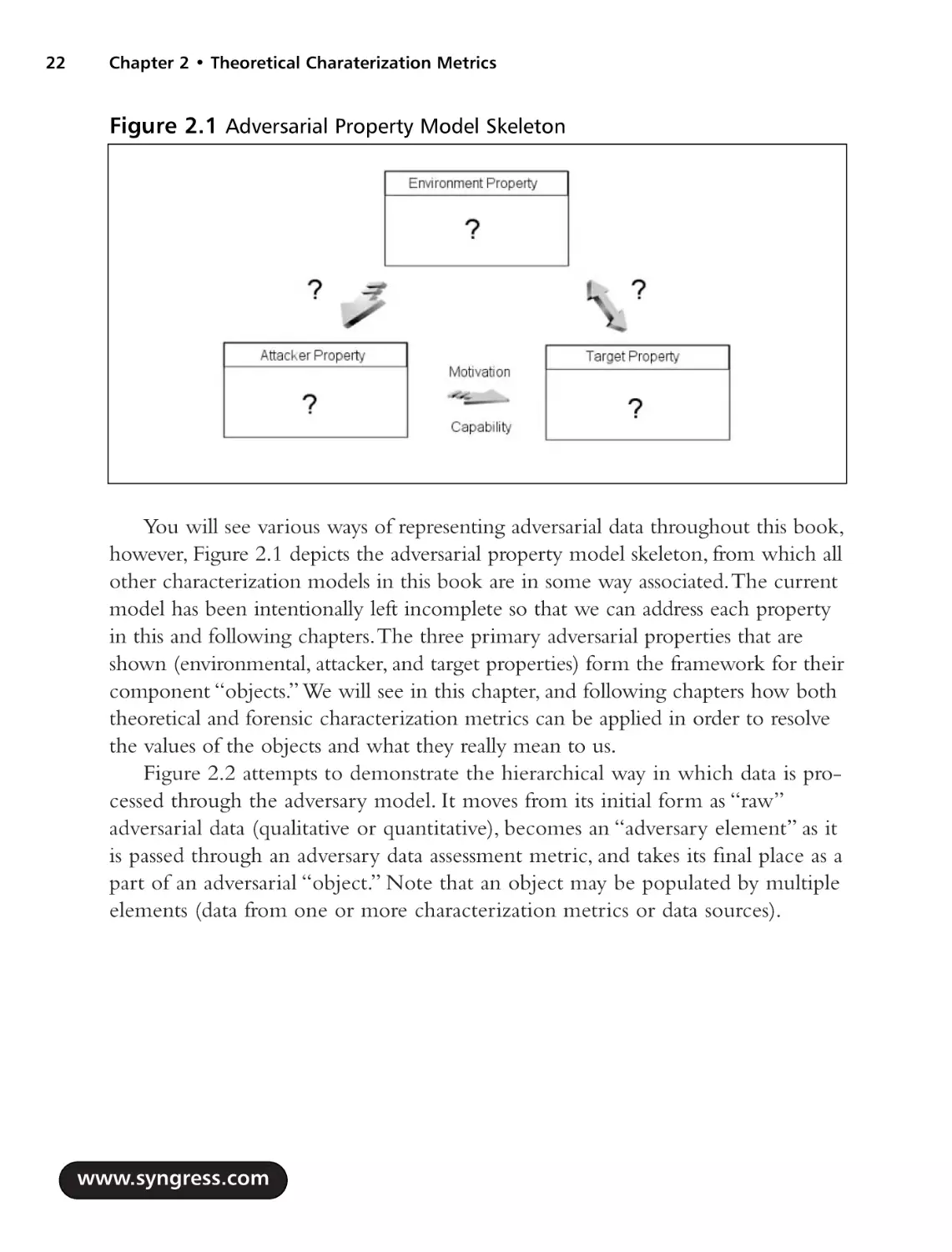
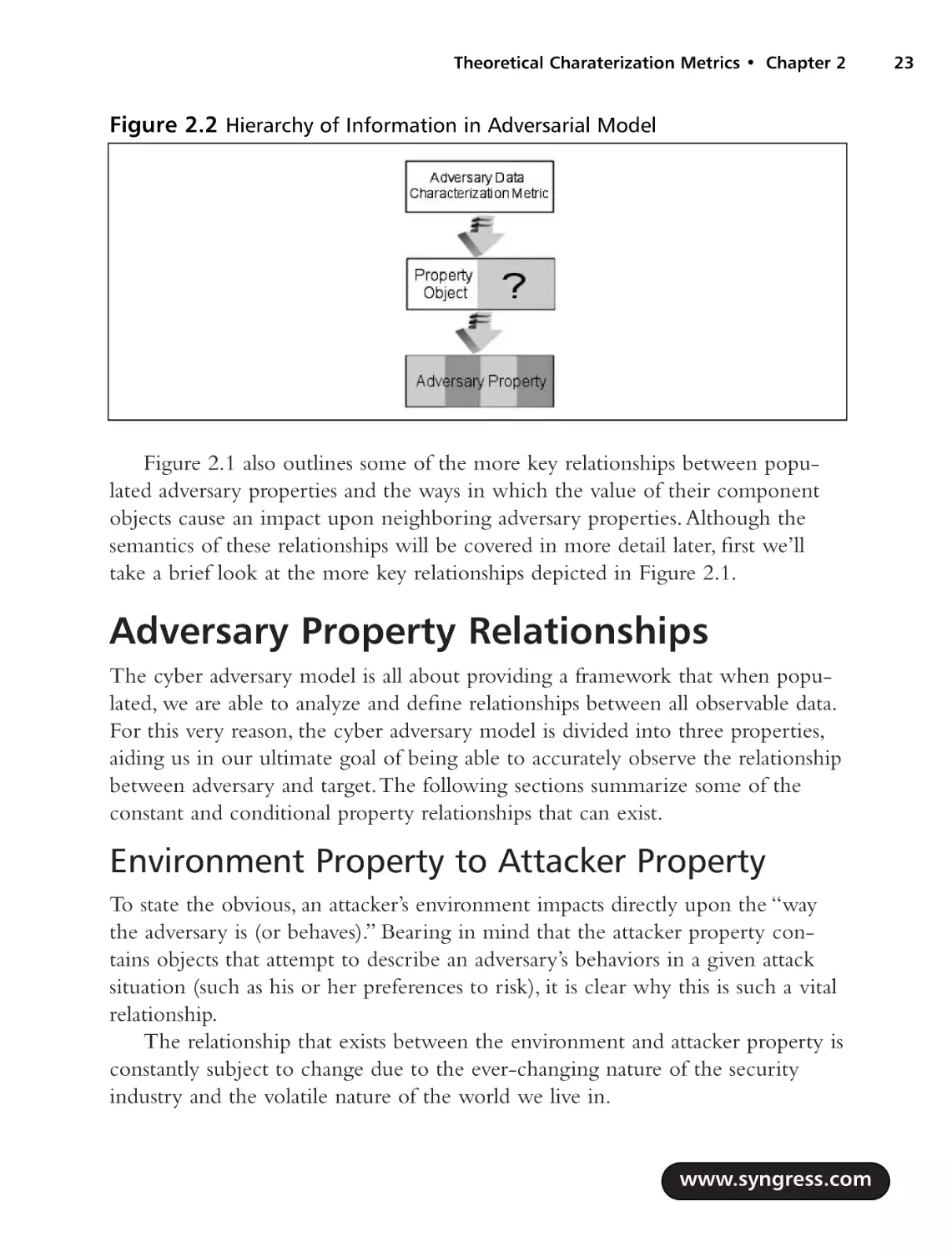














Автор: Parker T. Devost M.G. Sachs M H. Stroz E.
Теги: programming languages programming computer science software engineering hacking
ISBN: 1931836051


Текст
                    Register for Free Membership to
solutions@syngress.com
Over the last few years, Syngress has published many best-selling and
critically acclaimed books, including Tom Shinder’s Configuring ISA
Server 2000, Brian Caswell and Jay Beale’s Snort 2.0 Intrusion
Detection, and Angela Orebaugh and Gilbert Ramirez’s Ethereal
Packet Sniffing. One of the reasons for the success of these books has
been our unique solutions@syngress.com program. Through this
site, we’ve been able to provide readers a real time extension to the
printed book.
As a registered owner of this book, you will qualify for free access to
our members-only solutions@syngress.com program. Once you have
registered, you will enjoy several benefits, including:
■

Four downloadable e-booklets on topics related to the book.
Each booklet is approximately 20-30 pages in Adobe PDF
format. They have been selected by our editors from other
best-selling Syngress books as providing topic coverage that
is directly related to the coverage in this book.

■

A comprehensive FAQ page that consolidates all of the key
points of this book into an easy to search web page, providing you with the concise, easy to access data you need to
perform your job.

■

A “From the Author” Forum that allows the authors of this
book to post timely updates links to related sites, or additional topic coverage that may have been requested by
readers.

Just visit us at www.syngress.com/solutions and follow the simple
registration process. You will need to have this book with you when
you register.
Thank you for giving us the opportunity to serve your needs. And be
sure to let us know if there is anything else we can do to make your
job easier.

http://avaxhome.ws/blogs/ChrisRedfield

This page intentionally left blank

Cyber
Adversary
Characterization
AUDITING THE HACKER MIND

Tom Parker
Matthew G. Devost
Marcus H. Sachs
Eric Shaw
Ed Stroz

Syngress Publishing, Inc., the author(s), and any person or firm involved in the writing, editing, or production (collectively “Makers”) of this book (“the Work”) do not guarantee or warrant the results to be
obtained from the Work.
There is no guarantee of any kind, expressed or implied, regarding the Work or its contents.The Work is
sold AS IS and WITHOUT WARRANTY. You may have other legal rights, which vary from state to
state.
In no event will Makers be liable to you for damages, including any loss of profits, lost savings, or other
incidental or consequential damages arising out from the Work or its contents. Because some states do not
allow the exclusion or limitation of liability for consequential or incidental damages, the above limitation
may not apply to you.
You should always use reasonable care, including backup and other appropriate precautions, when working
with computers, networks, data, and files.
Syngress Media®, Syngress®, “Career Advancement Through Skill Enhancement®,” “Ask the Author
UPDATE®,” and “Hack Proofing®,” are registered trademarks of Syngress Publishing, Inc. “Syngress:The
Definition of a Serious Security Library”™, “Mission Critical™,” and “The Only Way to Stop a Hacker is
to Think Like One™” are trademarks of Syngress Publishing, Inc. Brands and product names mentioned
in this book are trademarks or service marks of their respective companies.
KEY
001
002
003
004
005
006
007
008
009
010

SERIAL NUMBER
HV764GHJ82
PO5FG2324V
82JH2776NB
CVPLQ6WQ23
C3KLC542MK
VBT5GH652M
H63W3EBCP8
29MK56F56V
629MP5SDJT
IMWQ295T6T

PUBLISHED BY
Syngress Publishing, Inc.
800 Hingham Street
Rockland, MA 02370
Cyber Adversary Characterization: Auditing the Hacker Mind

Copyright © 2004 by Syngress Publishing, Inc. All rights reserved. Printed in the United States of
America. Except as permitted under the Copyright Act of 1976, no part of this publication may be reproduced or distributed in any form or by any means, or stored in a database or retrieval system, without the
prior written permission of the publisher, with the exception that the program listings may be entered,
stored, and executed in a computer system, but they may not be reproduced for publication.
Printed in the United States of America
1 2 3 4 5 6 7 8 9 0
ISBN: 1-931836-11-6
Acquisitions Editor: Christine Kloiber
Technical Editor:Tom Parker
Page Layout and Art: Patricia Lupien

Cover Designer: Michael Kavish
Copy Editor: Darren Meiss and
Darlene Bordwell
Indexer: Rich Carlson

Distributed by O’Reilly Media in the United States and Canada.

Acknowledgments
We would like to acknowledge the following people for their kindness and
support in making this book possible.
Jeff Moss and Ping Look from Black Hat, Inc.You have been good friends to
Syngress and great colleagues to work with.Thank you!
Syngress books are now distributed in the United States and Canada by
O’Reilly Media, Inc.The enthusiasm and work ethic at O’Reilly is incredible
and we would like to thank everyone there for their time and efforts to bring
Syngress books to market:Tim O’Reilly, Laura Baldwin, Mark Brokering, Mike
Leonard, Donna Selenko, Bonnie Sheehan, Cindy Davis, Grant Kikkert, Opol
Matsutaro, Lynn Schwartz, Steve Hazelwood, Mark Wilson, Rick Brown, Leslie
Becker, Jill Lothrop,Tim Hinton, Kyle Hart, Sara Winge, C. J. Rayhill, Peter
Pardo, Leslie Crandell, Valerie Dow, Regina Aggio, Pascal Honscher, Preston
Paull, Susan Thompson, Bruce Stewart, Laura Schmier, Sue Willing, Mark
Jacobsen, Betsy Waliszewski, Dawn Mann, Kathryn Barrett, John Chodacki, and
Rob Bullington.
The incredibly hard working team at Elsevier Science, including Jonathan
Bunkell, Ian Seager, Duncan Enright, David Burton, Rosanna Ramacciotti,
Robert Fairbrother, Miguel Sanchez, Klaus Beran, Emma Wyatt, Rosie Moss,
Chris Hossack, and Krista Leppiko, for making certain that our vision remains
worldwide in scope.
David Buckland, Daniel Loh, Marie Chieng, Lucy Chong, Leslie Lim, Audrey
Gan, Pang Ai Hua, and Joseph Chan of STP Distributors for the enthusiasm
with which they receive our books.
Kwon Sung June at Acorn Publishing for his support.
David Scott,Tricia Wilden, Marilla Burgess, Annette Scott, Geoff Ebbs, Hedley
Partis, Bec Lowe, and Mark Langley of Woodslane for distributing our books
throughout Australia, New Zealand, Papua New Guinea, Fiji Tonga, Solomon
Islands, and the Cook Islands.
Winston Lim of Global Publishing for his help and support with distribution of
Syngress books in the Philippines.
v

This page intentionally left blank

Author
Tom Parker is one of Britain’s most highly prolific security consultants. Alongside providing integral security services for some of
the world’s largest organizations,Tom is widely known for his vulnerability research on a wide range of platforms and commercial
products. His more recent technical work includes the development
of an embedded operating system, media management system and
cryptographic code for use on digital video band (DVB) routers
deployed on the networks of hundreds of large organizations around
the globe.
In 1999,Tom helped form Global InterSec LLC, playing a
leading role in developing key relationships between GIS and the
public and private sector security companies.Tom has spent much of
the last few years researching methodologies aimed at characterizing
adversarial capabilities and motivations against live, mission critical
assets. He also provides aid in identifying adversarial attribution in
the unfortunate times when incidents do occur. Currently working
as a security consultant for NetSEC, a provider of managed and professional security services,Tom continues to research practical ways
for large organizations to manage the ever-growing cost of security
by identifying where the real threats exist.

Contributors
Matthew G. Devost is President and CEO of the Terrorism
Research Center, Inc., overseeing all research, analysis and training
programs. He has been researching the impact of information technology on national security since 1993. In addition to his current
duties as President, Matthew also provides strategic consulting services to select international governments and corporations on issues
of counter terrorism, information warfare and security, critical
infrastructure protection and homeland security. Matthew also cofounded and serves as Executive Director of Technical Defense, Inc.,
vii

a highly specialized information security consultancy. Prior to that,
he was the Director of Intelligence Analysis for Infrastructure
Defense (iDefense), where he led an analytical team identifying
infrastructure threats, vulnerabilities and incidents for Fortune 500
and government clients including Microsoft and Citigroup.
Matthew is certified in the operation of numerous security tools
and in the National Security Agency’s INFOSEC Assessment
Methodology and is an instructor for the Threat, Exposure and
Response Matrix (TERM) methodology. He is a member of the
American Society for Industrial Security, the Information Systems
Security Association, and the International Association for
Counterterrorism & Security Professionals. He has appeared on
CNN, MSNBC, FoxNews, NPR, CBS Radio, BBC television,
NWCN, Australian television and over five dozen other domestic
and international radio and television programs as an expert on terrorism and information warfare. He has lectured or published for
the National Defense University, the United States Intelligence and
Law Enforcement Communities, the Swedish, Australian and New
Zealand governments, Georgetown University, American University,
George Washington University, and a number of popular press
books, magazines, academic journals and over 100 international conferences. Matthew holds an Adjunct Professor position at
Georgetown University, has received a B.A. degree from St.
Michael’s College, and a Master of Arts Degree in Political Science
from the University of Vermont.
Marcus H. Sachs is the Director of the SANS Internet Storm
Center and is a cyberspace security researcher, writer, and instructor
for the SANS Institute. He previously served in the White House
Office of Cyberspace Security and was a staff member of the
President’s Critical Infrastructure Protection Board. While a member
of the White House staff, Marcus coordinated efforts to protect and
secure the nation’s telecommunication and Internet infrastructures,
leveraging expertise from United States government agencies, the
domestic private sector, and the international community. He also
contributed to the National Strategy to Secure Cyberspace, upon his
joining of the National Cyber Security Division of the US
viii

Department of Homeland Security. While working for DHS, he
developed the initial concept and strategy for the creation of the
United States Computer Emergency Response Team. Marcus retired
from the United States Army in 2001 after serving over 20 years as a
Corps of Engineers officer. He specialized during the later half of
his career in computer network operations, systems automation, and
information technology.
Eric Shaw is a clinical psychologist who has spent the last 20 years
specializing in the psychological profiling of political actors and
forensic subjects. He has been a consultant supporting manager development and organizational change, a clinician aiding law enforcement
and corporate security, an intelligence officer supporting national
security interests and a legal consultant providing negotiation and litigation assistance. He has also provided cross-cultural profiling for the
U.S. Government on the psychological state and political attitudes of
figures such as Saddam Hussein, Iranian revolutionary leaders under
Khomeini, senior Soviet military commanders, as well as Yugoslav,
Laotian, Cuban and other military and political leaders. In 2000 he
helped develop a tool designed to help analysts identify political, religious and other groups at-risk for terrorist violence.This approach
examines the group’s cultural context, its relationship with allied and
competitive actors in the immediate political environment, their
internal group dynamics and leadership. It utilizes a range of information on the group, including their publications, web sites and internal
communications. Eric has recently published articles on cyber terrorism examining the likelihood of the use of cybertactics by traditional and emerging forms of terrorist groups.
Ed Strotz (CPA, CITP, CFE) is President of Stroz Friedberg, LLC,
which he started in 2000 after a sixteen-year career as a Special
Agent for the Federal Bureau of Investigation (FBI). Stroz Friedberg
performs investigative, consulting, and forensic laboratory services
for the most pre-eminent law firms in the country. Ed has advised
clients in industries including banking, brokerage, insurance, media,
ix

computer and telecommunications, and has guided clients through
problems including Internet extortions, denial of service attacks,
hacks, domain name hijacking, data destruction and theft of trade
secrets. He has supervised numerous forensic assignments for criminal federal prosecutors, defense attorneys and civil litigants, and has
conducted network security audits for major public and private
entities. Stroz Friedberg has pioneered the merging of behavioral
science and computer security in audits of corporate web sites for
content that could either stimulate or be useful in conducting an
attack by a terrorist or other adversary.
In 1996, while still a Special Agent, he formed the FBI’s
Computer Crime Squad in New York City, where he supervised
investigations involving computer intrusions, denial-of-service
attacks, illegal Internet wiretapping, fraud, money laundering, and
violations of intellectual property rights, including trade secrets.
Among the more significant FBI investigations Ed handled were:
Vladimir Levin’s prosecution for hacking a US bank from Russia;
the hack against the New York Times web site; the Internet dissemination by “Keystroke Snoopers,” a hacking group responsible for a
keystroke capture program embedded in a Trojan Horse; Breaking
News Network’s illegal interception of pager messages; the denial of
service attack against a major business magazine; efforts to steal
copyrighted content from the Bloomberg system; and the hack of a
telecommunications switch. Ed and his squad were also participants
in the war game exercise called “Eligible Receiver.”
Ed is a member of the American Institute of Certified Public
Accountants, the Association of Certified Fraud Examiners and the
American Society of Industrial Security. He is a graduate of
Fordham University, a Certified Information Technology
Professional, and a member of the International Association for
Identification. He is an active member of the United States Secret
Service’s Electronic Crimes Task Force, Chairman of the Electronic
Security Advisory Council and former Chairman of the New York
chapter of the FBI’s Ex-Agents Society.

x

Special Contribution
(The fictional story, “Return on Investment,” at the conclusion of this book
was written by Fyodor and was excerpted from Stealing the Network:
How to Own a Continent, ISBN 1931836051).
Fyodor authored the popular Nmap Security Scanner, which was
named security tool of the year by Linux Journal, Info World,
LinuxQuestiosn.Org, and the Codetalker Digest. It was also featured
in the hit movie “Matrix Reloaded” as well as by the BBC, CNet,
Wired, Slashdot, Securityfocus, and more. He also maintains the
Insecure.Org and Seclists.Org security resource sites and has
authored seminal papers detailing techniques for stealth port scanning, remote operating system detection via TCP/IP stack fingerprinting, version detection, and the IPID Idle Scan. He is a member
of the Honeynet project and a co-author of the book Know Your
Enemy: Honeynets.

xi

This page intentionally left blank

Preface

A book about hacking is a book about everything.
First, the meaning of hacker.
The word “hacker” emerged in an engineering context and became popular
at The Massachusetts Institute of Technology (MIT), among other places, as a
way to talk about any ingenious, creative, or unconventional use of a machine
doing novel things, usually unintended or unforeseen by its inventors. A hacker
was someone involved in a technical feat of legerdemain; a person who saw
doors where others saw walls or built bridges that looked to the uninitiated like
planks on which one walked into shark-filled seas.
The mythology of hacking was permeated with the spirit of Coyote, the
Trickster. Hackers see clearly into the arbitrariness of structures that others
accept as the last word.They see contexts as contents, which is why when they
apply themselves to altering the context, the change in explicit content seems
magical.They generally are not builders in the sense that creating a functional
machine that will work in a benign environment is not their primary passion.
Instead, they love to take things apart and see how machines can be defeated.
Their very presuppositions constitute the threat environment that make borders
and boundaries porous.
In their own minds and imaginations, they are free beings who live in a
world without walls. Sometimes they see themselves as the last free beings, and
anyone and anything organizational as a challenge and opportunity. Beating The
Man at his own game is an adrenalin rush of the first order.
The world of distributed networks evolved as a cartoon-like dialogue
bubble pointing to the head of DARPA. Hackers sometimes missed that fact,
thinking they emerged whole and without a history from the brow of Zeus.
The evolution of the “closed world” inside digital networks began to interpenetrate, then assimilate, then completely “own” the mainstream world of business,
xiii

xiv

Preface

geopolitical warfare, intelligence, economics, ultimately everything. Hackers
were defined first as living on the edge between the structures evolving in that
new space and the structures defined by prior technologies.That liminal world
requires a fine balance as the perception of the world, indeed, one’s self, one’s
very identity, flickers back and forth like a hologram, now this and now that.
When the closed world owned the larger world in which it had originally
formed, it became the Matrix, a self-enclosed simulated structure of intentional
and nested symbols. Once that happened, hackers as they had been defined by
their prior context could no longer be who they were.
During transitional times, it must be so.The models of reality that fill the
heads of people defined by prior technologies stretch, then make loud ungodly
screeching sounds as they tear apart and finally explode with a cataclysmic pop.
Instead of their annihilation yielding nothing, however, yielding an empty
space, the new world has already evolved. And like a glistening moist snakeskin
under the old skin, scraped off in pieces on rocks, defines the bigger bolder
structure that had been coming into being for a long time. Hierarchical restructuring always includes and transcends everything that came before.
Inevitably, then, the skills of hackers became the skills of everybody defending
and protecting the new structures; the good ones, at any rate. If you don’t know
how something can be broken, you don’t know how it can be protected.
Inevitably, too, the playful creative things hackers did in the protected space
of their mainframe heaven, fueled by a secure environment that enabled them
to play without risk or consequences, were seen as children’s games.The game
moved online and spanned the global network. Instead of playing digital games
in an analogue world, hackers discovered that the world was the game because
the world had become digital. Creativity flourished and a hacker meritocracy
emerged in cyberspace, in networks defined by bulletin boards and then web
sites. In, that is, the “real world” as we now know it.
But as the boundaries flexed and meshed with the new boundaries of
social, economic, and psychological life, those games began to be defined as acts
of criminal intrusion. Before boundaries, the land belonged to all, the way we
imagine life in these United States might have been with Native Americans
roaming on their ponies. Once dotted lines were drawn on maps and maps
were internalized as the “real” structure of our lives, riding the open range
became trespass and perpetrators had to be confined in prisons.
The space inside mainframes became the interconnected space of networks
and was ported to the rest of the world; a space designed to be open, used by a

www.syngress.com

Preface

xv

trusted community, became a more general platform for communication and
commerce. New structures emerged in their image; structures for which we still
do not have good name; structures we call distributed non-state actors or nongovernment global entities. Legal distinctions, which it seemed to hackers and
those who mythologized cyberspace as a new frontier, cyberspace hanging in
the void above meat space, all legal distinctions would cease to exist in that
bubble world, because hackers thought they were obliterated by new technologies. Instead they were reformulated for the new space in which everyone was
coming to live. First the mountain men and the pioneers, then the merchants,
and at last, the lawyers. Once the lawyers show up, the game is over.
A smaller group, a subset of those real hackers—people who entered and
looked around or stole information or data—became defined as “hackers” by
the media. Now the word “hacker” is lost forever except to designate criminals,
and a particular kind of criminal at that—usually a burglar—and the marks of
hacking were defined as breaking and entering, spray painting graffiti on web
site walls or portals, stealing passwords or credit card numbers, vandalism, extortion, and worse.
When we speak of the hacker mind, then, we have come to mean the mind
of a miscreant motivated by a broad range of ulterior purposes.We don’t mean
men and women who do original creative work, the best and brightest who
cobble together new structures of possibility and deliver them to the world for
the sheer joy of doing so.We mean script kiddies who download scripts written
by others and execute them with the click of a button, we mean vandals with
limited impulse control, we mean thieves of data, and then we mean all the
people who use that data for extortion, corporate or industrial espionage, statelevel spy craft, identity theft, grand larceny, blackmail, vicious revenge, or terror.
That’s lots of kinds of minds, needing to be understood, needing to be profiled, needing to be penetrated, needing to be known inside and out.
As security experts like Bruce Schneier are fond of saying, it takes one to
know one.The flip side of a criminal is a cop and the flip side of a cop is a
criminal. Saints are sinners, and sinners are always latent saints. Hackers have
hearts full of larceny and duplicity and if you can’t, at the very least, mimic that
heartset and mindset, you’ll never understand hackers.You'll never defend your
perimeter, never understand that perimeters in and of themselves are arbitrary,
full of holes, and built for a trusting world, the kind in which alas we do not
and never will live. A perimeter is an illusion accepted by consensus and treated
as if it is real.

www.syngress.com

xvi

Preface

Hackers do not live in consensus reality. Hackers see through it, hackers
undermine; they exploit consensus reality. Hackers see context as content—
they see the skull behind the grin. Hackers do not accept illusions.The best
hackers create them and lead the rest of us in circles by our virtual noses.
So if you do business, any kind, any how, or if you are entrusted with the
functions of government, or if you understand that distinctions between foreign-born and native are amorphous moving targets, then you had better
understand how the digital world has delivered new opportunities for mayhem
and mischief into the hands of mainstream people who appropriate the knowhow of hackers for their own nefarious purposes.
You had better understand how difficult security really is to do, how as one
gets granular and drills down, one finds more and more opportunities for
breaking and entering and taking and destroying the way electron microscopes
let you see the holes between things you thought were solid.
You had better understand that nested levels of fractal-like social and economic structures make deception necessary, identity fluid, and the tricks and
trade of the intelligence world available to anybody who learns how to walk
through walls.You had better understand why many exploits and flaws are
never fixed, because state agencies like it that way and use them to monitor
their enemies.You had better understand that “friend” and “enemy” is an arbitrary designation, that the digital world is a hall of mirrors, and, therefore,
“secure boundaries” will depend on your definitions and the limits of what you
know.You had better understand risks and how to manage them; what a loss
means or does not mean.You had better understand the real odds.You had
better understand the meaning of the implied and actual use of power in the
digital world, how networks change the game, how the project addressed by
this book is only the beginning of difficult decisions about securing your enterprise, your organizational structure, the flow and storage of critical information,
in fact, your life—your very digital life.
That’s why books like this are written. Because we had all better understand. “There is no inevitability,” Marshall McLuhan said, “so long as there is a
willingness to contemplate what is happening.”
Becoming conscious is not an option. But the digital world turns the project of consciousness into a multi-level twitch-fast game.
So ... let the games begin
— Richard Thieme

www.syngress.com

Contents

Preface . . . . . . . . . . . . . . . . . . . . . . . . . . . . . . . . . . . .xiii
Foreword by Jeff Moss . . . . . . . . . . . . . . . . . . . . . . .xxvii
Chapter 1 Introduction . . . . . . . . . . . . . . . . . . . . . . . .1
Cyber Adversary Characterization . . . . . . . . . . . . . . . . . . . 2
Case Study 1: A First-Person Account from
Kevin D. Mitnick . . . . . . . . . . . . . . . . . . . . . . . . . . .4
“I Put My Freedom on the Line for Sheer
Entertainment …” . . . . . . . . . . . . . . . . . . . . . . . .4
Case Study 2: Insider Lessons Learned . . . . . . . . . . . . .7
Cyber Terrorist: A Media Buzzword? . . . . . . . . . . . . . . . . . 8
Failures of Existing Models . . . . . . . . . . . . . . . . . . . . . . . 12
High Data Quantities . . . . . . . . . . . . . . . . . . . . . . . .13
Data Relevancy Issues . . . . . . . . . . . . . . . . . . . . . .13
Characterization Types . . . . . . . . . . . . . . . . . . . . . . . .14
Theoretical Characterization . . . . . . . . . . . . . . . . .15
Post-Incident Characterization . . . . . . . . . . . . . . . .16
Introduction to Characterization Theory . . . . . . . . . . . . . . 17
Chapter 2 Theoretical Characterization Metrics . . . . .19
Introduction . . . . . . . . . . . . . . . . . . . . . . . . . . . . . . . . . 20
The Adversary Object Matrix . . . . . . . . . . . . . . . . . . . . . 21
Adversary Property Relationships . . . . . . . . . . . . . . . . . . . 23
Environment Property to Attacker Property . . . . . . . . .23
Attacker Property to Target Property . . . . . . . . . . . . . .24
Other (Conditional) Adversarial Property Relationships 24
The Adversary Model—“Adversary Environment Properties” 25
Political and Cultural Impacts . . . . . . . . . . . . . . . . . . .25
xvii

xviii

Contents

Nothing to Lose—Motivational Impacts on
Attack Variables . . . . . . . . . . . . . . . . . . . . . . . . .28
Associations and Intelligence Sources . . . . . . . . . . .31
Environment Property/Attacker Property Observable
Impacts . . . . . . . . . . . . . . . . . . . . . . . . . . . . . . . . .33
Adversarial Group, not “Hacker Group”! . . . . . . . . . . .34
The Adversary Model—“Attacker Properties” . . . . . . . . . . 37
Resources Object . . . . . . . . . . . . . . . . . . . . . . . . . . .38
The Time Element . . . . . . . . . . . . . . . . . . . . . . . .39
Skills/Knowledge Element . . . . . . . . . . . . . . . . . . .39
“You Use It—You Lose It” . . . . . . . . . . . . . . . . . .39
Finance Element . . . . . . . . . . . . . . . . . . . . . . . . . .40
Initial Access Element . . . . . . . . . . . . . . . . . . . . . .40
Inhibitor Object . . . . . . . . . . . . . . . . . . . . . . . . . . . .41
Payoff/Impact Given Success (I/S) . . . . . . . . . . . . .41
Perceived Probability of Success Given an
Attempt (p(S)/A) . . . . . . . . . . . . . . . . . . . . . . . .42
Perceived Probability of Detection Given an
Attempt (p(d)/A) . . . . . . . . . . . . . . . . . . . . . . . .42
Perceived Probability of Attribution (of Adversary)
Given Detection (p(A)/d) . . . . . . . . . . . . . . . . . .43
Perceived Consequences to Adversary Given
Detection and Attribution (C/(d)) . . . . . . . . . . . .44
Adversary Uncertainty Given the Attack
Parameters (U/{P}) . . . . . . . . . . . . . . . . . . . . . .45
Driver/Motivator Object . . . . . . . . . . . . . . . . . . . . . .45
Payoff/Impact Given Success (I/S) . . . . . . . . . . . . .46
Perceived Probability of Success Given an
Attempt (p(S)/A) . . . . . . . . . . . . . . . . . . . . . . . .46
Summary . . . . . . . . . . . . . . . . . . . . . . . . . . . . . . . . . . . . 48
Chapter 3 Disclosure and the Cyber Food Chain . . . . .49
Introduction . . . . . . . . . . . . . . . . . . . . . . . . . . . . . . . . . 50
Vulnerability Disclosure and the Cyber Adversary . . . . . . . . 50
“Free For All”: Full Disclosure . . . . . . . . . . . . . . . . . .51
“This Process Takes Time” . . . . . . . . . . . . . . . . . . .53
Disclosure Attack Capability and Considerations . . . . . . . . 53
Probability of Success Given an Attempt . . . . . . . . . . .55

Contents

Probability of Detection Given an Attempt . . . . . . . . .56
“Symmetric” Full Disclosure . . . . . . . . . . . . . . . . . . .56
Responsible Restricted “Need to Know” Disclosure . . .58
Responsible, Partial Disclosure and Attack
Inhibition Considerations . . . . . . . . . . . . . . . . . . . .59
“Responsible” Full Disclosure . . . . . . . . . . . . . . . . . . .60
Responsible, Full Disclosure Capability and Attack
Inhibition Considerations . . . . . . . . . . . . . . . . . .61
Security Firm “Value Added” Disclosure Model . . . . . .62
Value-Add Disclosure Model Capability and Attack
Inhibition Considerations . . . . . . . . . . . . . . . . . .63
Non-Disclosure . . . . . . . . . . . . . . . . . . . . . . . . . . . .65
The Vulnerability Disclosure Pyramid Metric . . . . . . . . . . . 66
Pyramid Metric Capability and Attack Inhibition . . . . .67
Pyramid Metric and Capability:A Composite Picture
Pyramid . . . . . . . . . . . . . . . . . . . . . . . . . . . . . . . .68
Comparison of Mean Inhibitor Object Element Values .71
The Disclosure Food Chain . . . . . . . . . . . . . . . . . . . . . . . 72
Security Advisories and Misinformation . . . . . . . . . . . .73
Summary . . . . . . . . . . . . . . . . . . . . . . . . . . . . . . . . . . . . 76
Chapter 4 Rating the Attack: Post-Incident
Characterization Metrics . . . . . . . . . . . . . . . . . . . . .77
Introduction:Theoretical Crossover and the Attack Point
Scoring Systems . . . . . . . . . . . . . . . . . . . . . . . . . . . . . 78
The Source of the Problem . . . . . . . . . . . . . . . . . . . . . . . 78
Variables of Attack Tools to Consider . . . . . . . . . . . . . . . . 80
Tool-Scoring Metrics . . . . . . . . . . . . . . . . . . . . . . . .80
Attack Tool-Scoring Metrics Alone Are Not an
Accurate Measure of Capability . . . . . . . . . . . . . .81
The Ease With Which an Attack Tool Is Used . . . . . . .82
Types of Technical Ability or Skill . . . . . . . . . . . . . .82
Technical Ability/Skill Levels . . . . . . . . . . . . . . . . .83
The Availability of an Attack Tool . . . . . . . . . . . . . . . .83
Nontechnical Skill-Related Prerequisites . . . . . . . . . . .84
Common Types of Attack Tools . . . . . . . . . . . . . . . . . . . . 84
Mass Rooters . . . . . . . . . . . . . . . . . . . . . . . . . . . . . .84
Typical Skill Level Required . . . . . . . . . . . . . . . . .85

xix

xx

Contents

The Availability of the Attack Tool . . . . . . . . . . . . .85
Nontechnical Skill Prerequisites . . . . . . . . . . . . . . .86
Adversary Profile . . . . . . . . . . . . . . . . . . . . . . . . .86
Port-Scanning Tools . . . . . . . . . . . . . . . . . . . . . . . . . .86
Typical Skill Level Required . . . . . . . . . . . . . . . . .87
The Availability of the Attack Tool . . . . . . . . . . . . .87
Adversary Profile . . . . . . . . . . . . . . . . . . . . . . . . .87
Operating System Enumeration Tools . . . . . . . . . . . . .87
Typical Skill Level Required . . . . . . . . . . . . . . . . .88
The Availability of the Attack Tool . . . . . . . . . . . . .88
Adversary Profile . . . . . . . . . . . . . . . . . . . . . . . . .88
Software Exploits . . . . . . . . . . . . . . . . . . . . . . . . . . .89
The Ease With Which the Attack Tool Is Used . . . .90
The Availability of the Attack Tool . . . . . . . . . . . . .90
Adversary Profile . . . . . . . . . . . . . . . . . . . . . . . . .90
Commercial Attack Tools . . . . . . . . . . . . . . . . . . . . . .90
Typical Skill Levels Required . . . . . . . . . . . . . . . . .91
The Availability of the Attack Tool . . . . . . . . . . . . .91
Adversary Profile . . . . . . . . . . . . . . . . . . . . . . . . .91
Caveats of Attack Tool Metrics . . . . . . . . . . . . . . . . . . . . . 91
Attack Technique Variables . . . . . . . . . . . . . . . . . . . . . . . 92
Nontechnological Resources Required . . . . . . . . . . . .92
The Distribution Level of the Attack Technique . . . . . .92
Any Attack Inhibitors Reduced Through the Use of
the Attack Technique . . . . . . . . . . . . . . . . . . . . . . .93
The Ease With Which the Attack Technique Is
Implemented . . . . . . . . . . . . . . . . . . . . . . . . . . . . .94
Technique-Scoring Metrics . . . . . . . . . . . . . . . . . . . .94
Common Types of Attack Techniques . . . . . . . . . . . . . . . . 95
Network Service and Vulnerability Enumeration
Techniques . . . . . . . . . . . . . . . . . . . . . . . . . . . . . .95
Common Technique Differentiators . . . . . . . . . . . .95
Operating System Enumeration Techniques . . . . . . . . .98
Natural-Cover OS Enumeration . . . . . . . . . . . . . . .98
Nonpassive OS Enumeration . . . . . . . . . . . . . . . . .98
Technique Differentiators . . . . . . . . . . . . . . . . . . . .99
Automated and Mass-Exploitation Techniques . . . . . . .99

Contents

Technique Differentiators . . . . . . . . . . . . . . . . . . . .99
Automated Agent Attitude to Attack Inhibitor
Deductions . . . . . . . . . . . . . . . . . . . . . . . . . . . . .100
Perceived Probability of Detection Given Attempt 100
Perceived Probability of Attribution Given Detection 101
Web Application Exploitation Techniques . . . . . . . . . .101
Technique Differentiators . . . . . . . . . . . . . . . . . . .102
Additional Attack Scoring Examples . . . . . . . . . . . . .103
Caveats: Attack Behavior Masquerading . . . . . . . . . . . . . . 104
Summary . . . . . . . . . . . . . . . . . . . . . . . . . . . . . . . . . . . 105
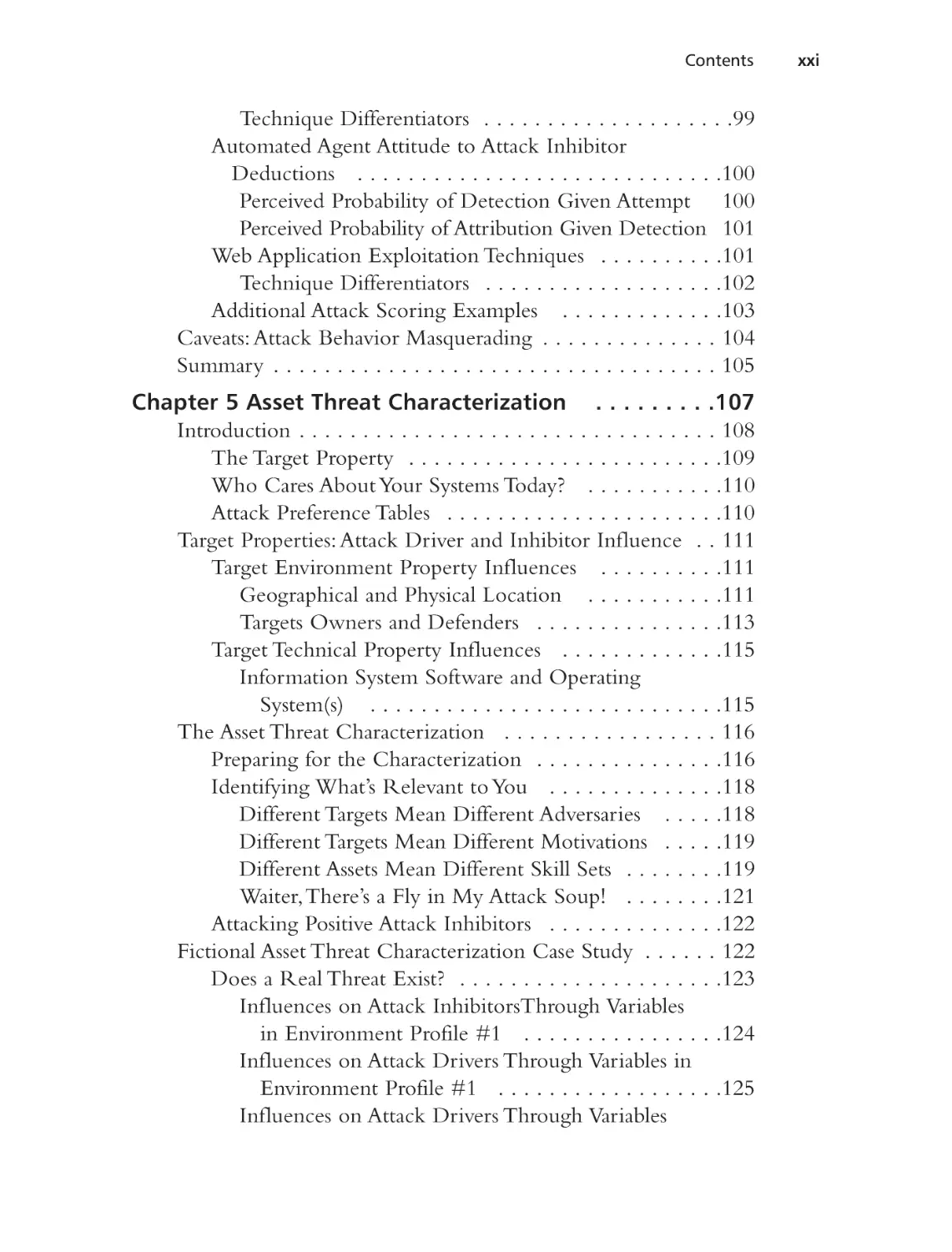
Chapter 5 Asset Threat Characterization . . . . . . . . .107
Introduction . . . . . . . . . . . . . . . . . . . . . . . . . . . . . . . . . 108
The Target Property . . . . . . . . . . . . . . . . . . . . . . . . .109
Who Cares About Your Systems Today? . . . . . . . . . . .110
Attack Preference Tables . . . . . . . . . . . . . . . . . . . . . .110
Target Properties: Attack Driver and Inhibitor Influence . . 111
Target Environment Property Influences . . . . . . . . . .111
Geographical and Physical Location . . . . . . . . . . .111
Targets Owners and Defenders . . . . . . . . . . . . . . .113
Target Technical Property Influences . . . . . . . . . . . . .115
Information System Software and Operating
System(s) . . . . . . . . . . . . . . . . . . . . . . . . . . . .115
The Asset Threat Characterization . . . . . . . . . . . . . . . . . 116
Preparing for the Characterization . . . . . . . . . . . . . . .116
Identifying What’s Relevant to You . . . . . . . . . . . . . .118
Different Targets Mean Different Adversaries . . . . .118
Different Targets Mean Different Motivations . . . . .119
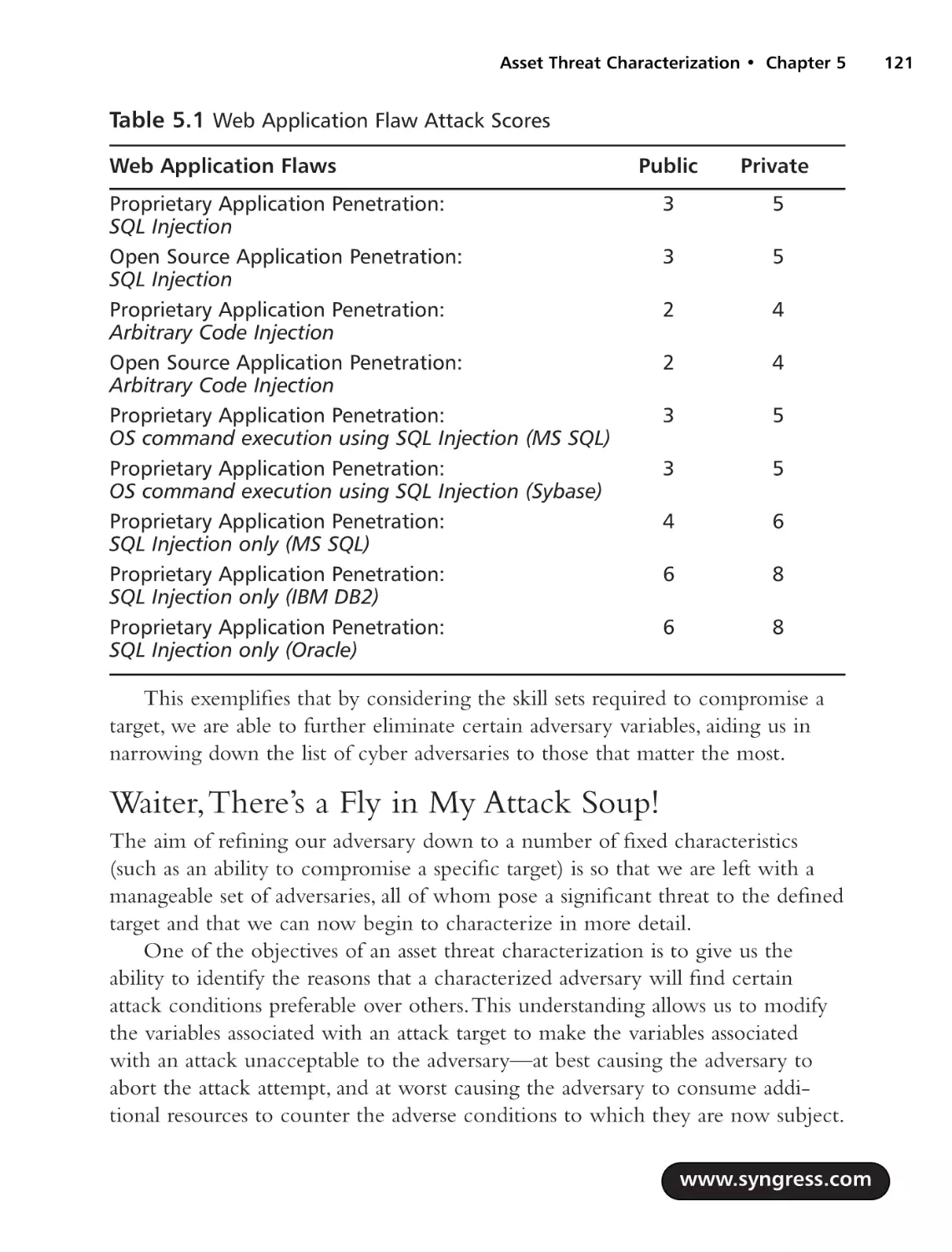
Different Assets Mean Different Skill Sets . . . . . . . .119
Waiter,There’s a Fly in My Attack Soup! . . . . . . . .121
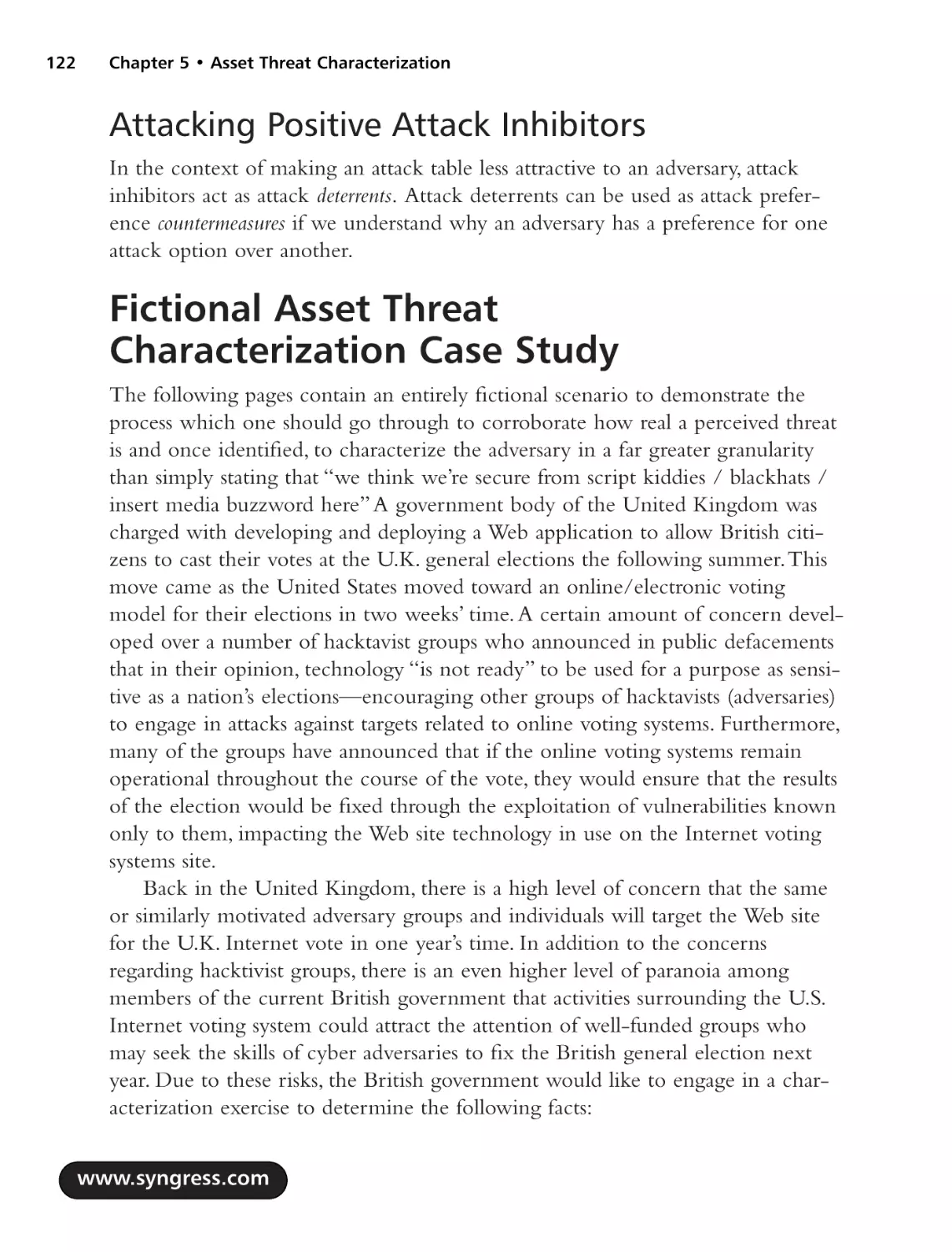
Attacking Positive Attack Inhibitors . . . . . . . . . . . . . .122
Fictional Asset Threat Characterization Case Study . . . . . . 122
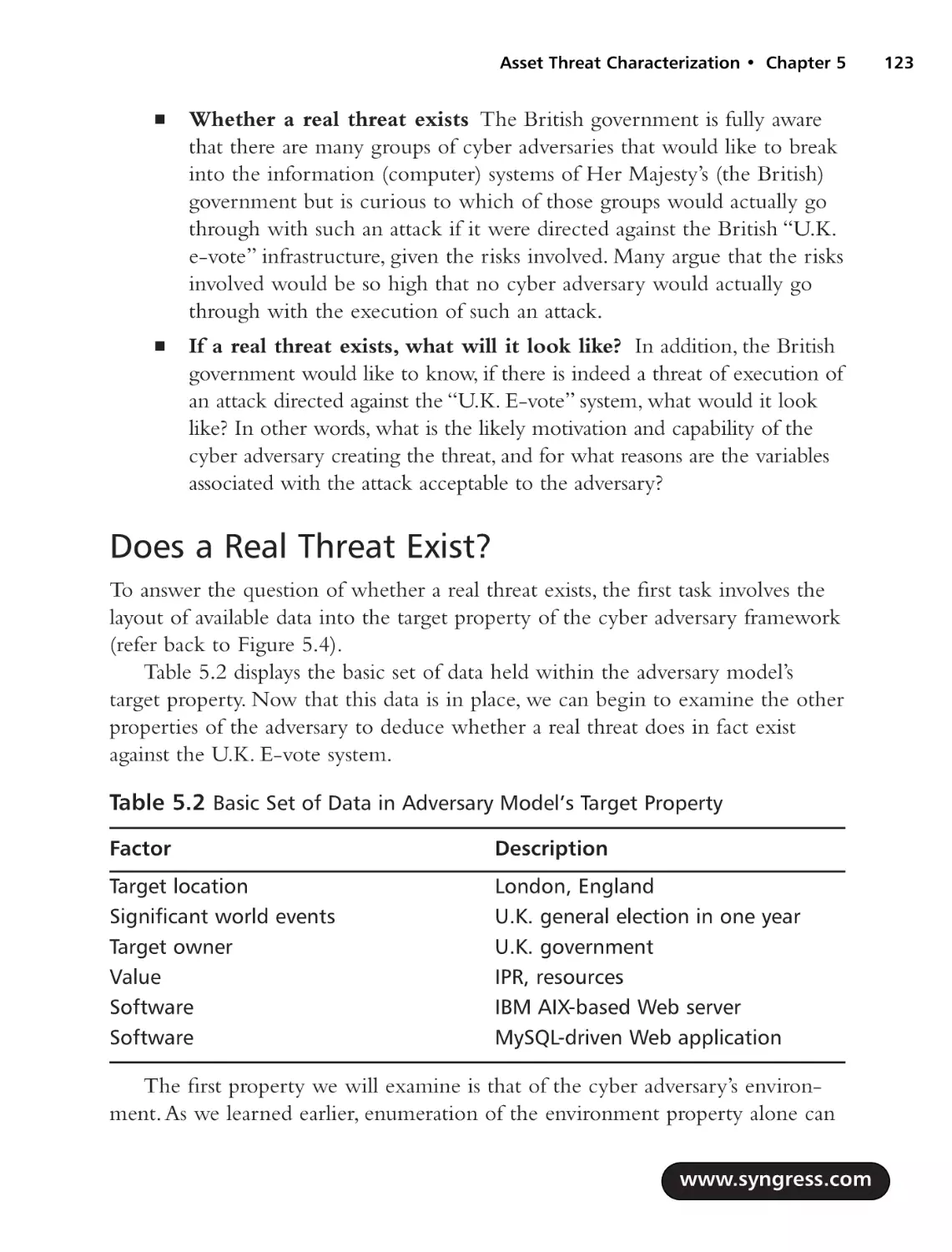
Does a Real Threat Exist? . . . . . . . . . . . . . . . . . . . . .123
Influences on Attack InhibitorsThrough Variables
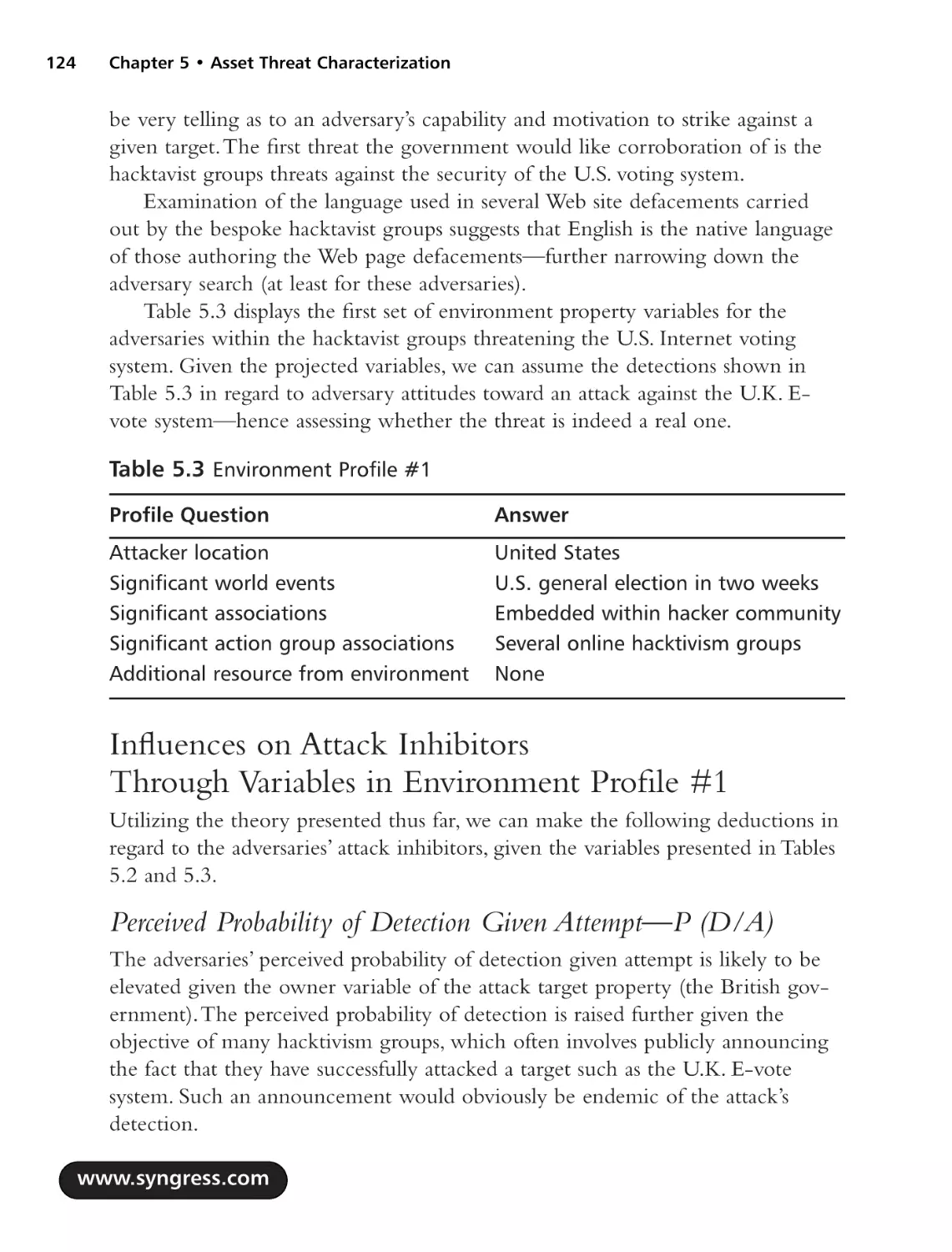
in Environment Profile #1 . . . . . . . . . . . . . . . .124
Influences on Attack Drivers Through Variables in
Environment Profile #1 . . . . . . . . . . . . . . . . . .125
Influences on Attack Drivers Through Variables

xxi

xxii

Contents

in Environment Profile #2 . . . . . . . . . . . . . . . .127
Influences on Attack Drivers Through Variables in
Environment Profile #3 . . . . . . . . . . . . . . . . . .130
Case Study Conclusions . . . . . . . . . . . . . . . . . . . . . .131
Summary . . . . . . . . . . . . . . . . . . . . . . . . . . . . . . . . . . . 136
Chapter 6 Bringing It All Together: Completing the
Cyber Adversary Model . . . . . . . . . . . . . . . . . . . . .137
Introduction . . . . . . . . . . . . . . . . . . . . . . . . . . . . . . . . . 138
Intermetric Component Relationships . . . . . . . . . . . . . . 138
Filling in the Blanks . . . . . . . . . . . . . . . . . . . . . . . . .138
Internet Metric Relationship Result Reliability
Calculations . . . . . . . . . . . . . . . . . . . . . . . . . . . . .141
Summary . . . . . . . . . . . . . . . . . . . . . . . . . . . . . . . . . . 143
Chapter 7 WarmTouch: Assessing the Insider
Threat and Relationship Management . . . . . . . . . .145
Introduction . . . . . . . . . . . . . . . . . . . . . . . . . . . . . . . . . 146
The Challenges of Detecting the Insider Threat . . . . . . . . 146
An Approach to the Insider Problem . . . . . . . . . . . . .148
Case Illustrations . . . . . . . . . . . . . . . . . . . . . . . . . . . . . . 149
Case 1: Detecting Insider Risk and Deception—
A Bank Systems Administrator . . . . . . . . . . . . . . . .149
Case 2: Robert Hanssen at the FBI . . . . . . . . . . . . . .153
Case 3: Identifying the Source of Anonymous Threats—
Are They from the Same Author? . . . . . . . . . . . . . .157
Case 4: Extortion Attempt by a Russian Hacker
Against Bloomberg Financial . . . . . . . . . . . . . . . . .158
Case 5: Monitoring a Cyber Stalker . . . . . . . . . . . . . .161
Case 6: Relationship Management . . . . . . . . . . . . . . .163
Summary . . . . . . . . . . . . . . . . . . . . . . . . . . . . . . . . . . . 168
References . . . . . . . . . . . . . . . . . . . . . . . . . . . . . . . . . . 169
Footnote . . . . . . . . . . . . . . . . . . . . . . . . . . . . . . . . . . . 170
Chapter 8 Managing the Insider Threat . . . . . . . . . .171
Introduction: Setting the Stage . . . . . . . . . . . . . . . . . . . . 172
Prevention . . . . . . . . . . . . . . . . . . . . . . . . . . . . . . . . . . 176
Screening and Its Weaknesses . . . . . . . . . . . . . . . . . .176
Hire A Hacker? . . . . . . . . . . . . . . . . . . . . . . . . . .178
Education and Prevention . . . . . . . . . . . . . . . . . . . . .179

Contents

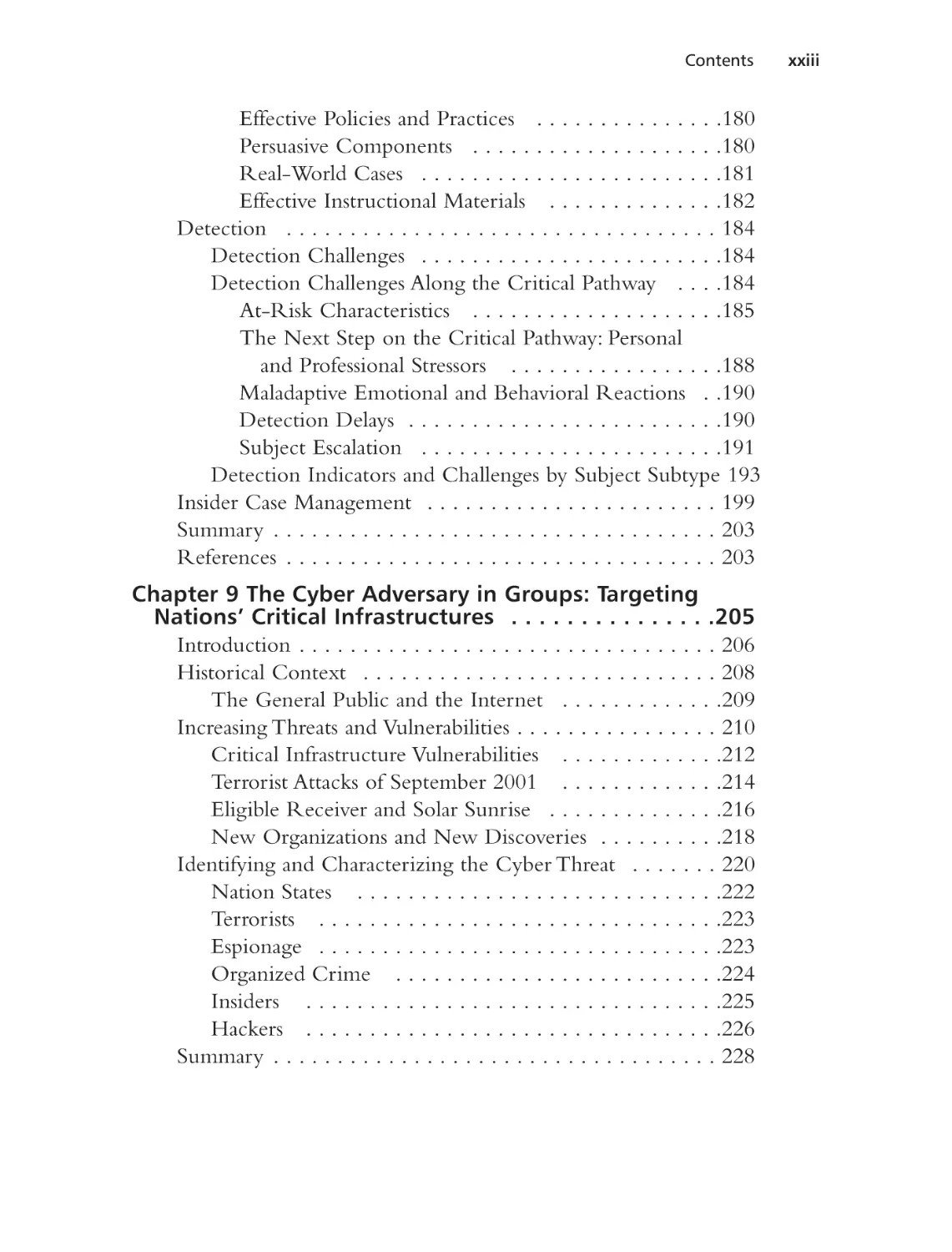
Effective Policies and Practices . . . . . . . . . . . . . . .180
Persuasive Components . . . . . . . . . . . . . . . . . . . .180
Real-World Cases . . . . . . . . . . . . . . . . . . . . . . . .181
Effective Instructional Materials . . . . . . . . . . . . . .182
Detection . . . . . . . . . . . . . . . . . . . . . . . . . . . . . . . . . . 184
Detection Challenges . . . . . . . . . . . . . . . . . . . . . . . .184
Detection Challenges Along the Critical Pathway . . . .184
At-Risk Characteristics . . . . . . . . . . . . . . . . . . . .185
The Next Step on the Critical Pathway: Personal
and Professional Stressors . . . . . . . . . . . . . . . . .188
Maladaptive Emotional and Behavioral Reactions . .190
Detection Delays . . . . . . . . . . . . . . . . . . . . . . . . .190
Subject Escalation . . . . . . . . . . . . . . . . . . . . . . . .191
Detection Indicators and Challenges by Subject Subtype 193
Insider Case Management . . . . . . . . . . . . . . . . . . . . . . . 199
Summary . . . . . . . . . . . . . . . . . . . . . . . . . . . . . . . . . . . 203
References . . . . . . . . . . . . . . . . . . . . . . . . . . . . . . . . . . 203
Chapter 9 The Cyber Adversary in Groups: Targeting
Nations’ Critical Infrastructures . . . . . . . . . . . . . . .205
Introduction . . . . . . . . . . . . . . . . . . . . . . . . . . . . . . . . . 206
Historical Context . . . . . . . . . . . . . . . . . . . . . . . . . . . . 208
The General Public and the Internet . . . . . . . . . . . . .209
Increasing Threats and Vulnerabilities . . . . . . . . . . . . . . . . 210
Critical Infrastructure Vulnerabilities . . . . . . . . . . . . .212
Terrorist Attacks of September 2001 . . . . . . . . . . . . .214
Eligible Receiver and Solar Sunrise . . . . . . . . . . . . . .216
New Organizations and New Discoveries . . . . . . . . . .218
Identifying and Characterizing the Cyber Threat . . . . . . . 220
Nation States . . . . . . . . . . . . . . . . . . . . . . . . . . . . .222
Terrorists . . . . . . . . . . . . . . . . . . . . . . . . . . . . . . . .223
Espionage . . . . . . . . . . . . . . . . . . . . . . . . . . . . . . . .223
Organized Crime . . . . . . . . . . . . . . . . . . . . . . . . . .224
Insiders . . . . . . . . . . . . . . . . . . . . . . . . . . . . . . . . .225
Hackers . . . . . . . . . . . . . . . . . . . . . . . . . . . . . . . . .226
Summary . . . . . . . . . . . . . . . . . . . . . . . . . . . . . . . . . . . 228

xxiii

xxiv

Contents

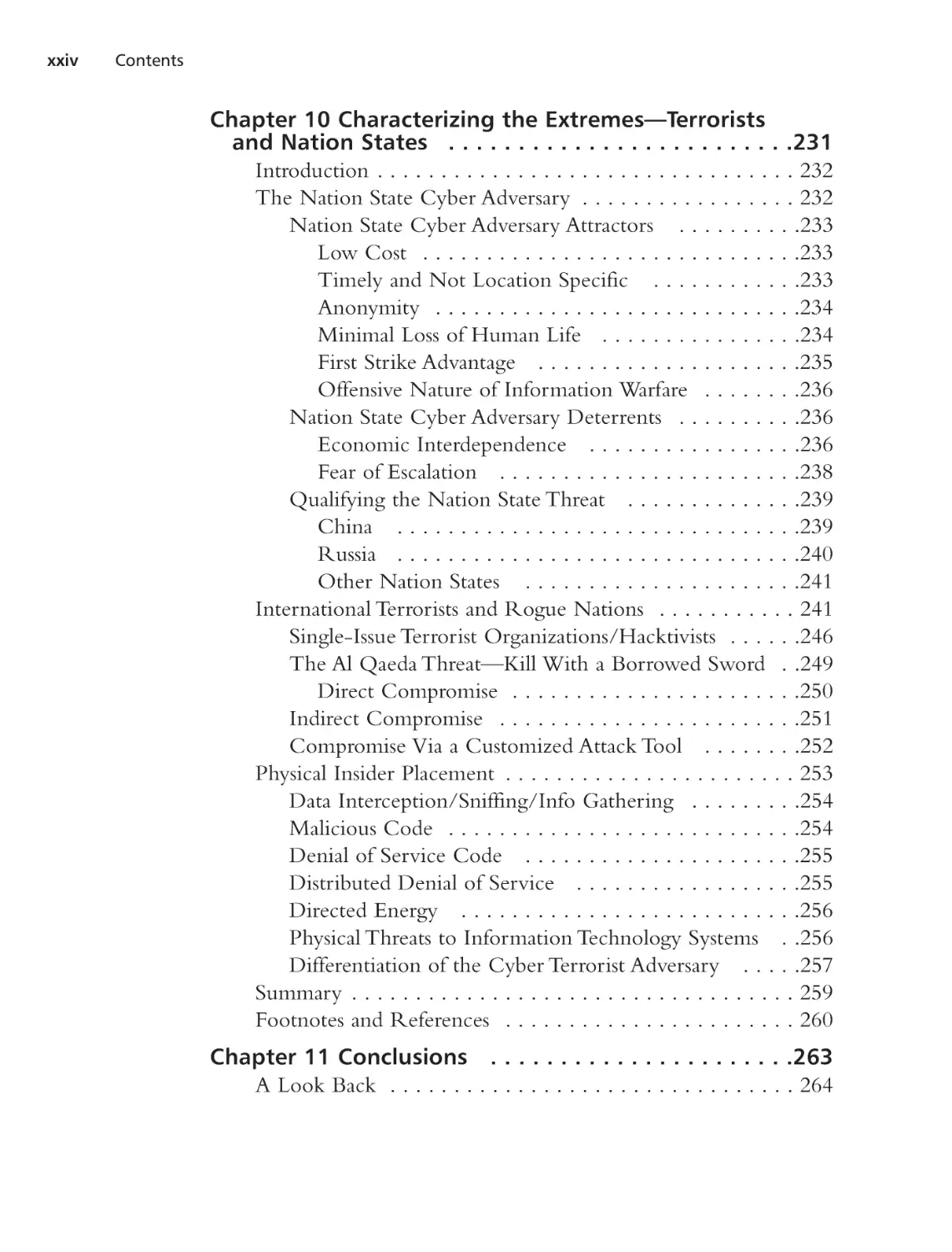
Chapter 10 Characterizing the Extremes—Terrorists
and Nation States . . . . . . . . . . . . . . . . . . . . . . . . .231
Introduction . . . . . . . . . . . . . . . . . . . . . . . . . . . . . . . . . 232
The Nation State Cyber Adversary . . . . . . . . . . . . . . . . . 232
Nation State Cyber Adversary Attractors . . . . . . . . . .233
Low Cost . . . . . . . . . . . . . . . . . . . . . . . . . . . . . .233
Timely and Not Location Specific . . . . . . . . . . . .233
Anonymity . . . . . . . . . . . . . . . . . . . . . . . . . . . . .234
Minimal Loss of Human Life . . . . . . . . . . . . . . . .234
First Strike Advantage . . . . . . . . . . . . . . . . . . . . .235
Offensive Nature of Information Warfare . . . . . . . .236
Nation State Cyber Adversary Deterrents . . . . . . . . . .236
Economic Interdependence . . . . . . . . . . . . . . . . .236
Fear of Escalation . . . . . . . . . . . . . . . . . . . . . . . .238
Qualifying the Nation State Threat . . . . . . . . . . . . . .239
China . . . . . . . . . . . . . . . . . . . . . . . . . . . . . . . .239
Russia . . . . . . . . . . . . . . . . . . . . . . . . . . . . . . . .240
Other Nation States . . . . . . . . . . . . . . . . . . . . . .241
International Terrorists and Rogue Nations . . . . . . . . . . . 241
Single-Issue Terrorist Organizations/Hacktivists . . . . . .246
The Al Qaeda Threat—Kill With a Borrowed Sword . .249
Direct Compromise . . . . . . . . . . . . . . . . . . . . . . .250
Indirect Compromise . . . . . . . . . . . . . . . . . . . . . . . .251
Compromise Via a Customized Attack Tool . . . . . . . .252
Physical Insider Placement . . . . . . . . . . . . . . . . . . . . . . . 253
Data Interception/Sniffing/Info Gathering . . . . . . . . .254
Malicious Code . . . . . . . . . . . . . . . . . . . . . . . . . . . .254
Denial of Service Code . . . . . . . . . . . . . . . . . . . . . .255
Distributed Denial of Service . . . . . . . . . . . . . . . . . .255
Directed Energy . . . . . . . . . . . . . . . . . . . . . . . . . . .256
Physical Threats to Information Technology Systems . .256
Differentiation of the Cyber Terrorist Adversary . . . . .257
Summary . . . . . . . . . . . . . . . . . . . . . . . . . . . . . . . . . . . 259
Footnotes and References . . . . . . . . . . . . . . . . . . . . . . . 260
Chapter 11 Conclusions . . . . . . . . . . . . . . . . . . . . . .263
A Look Back . . . . . . . . . . . . . . . . . . . . . . . . . . . . . . . . 264

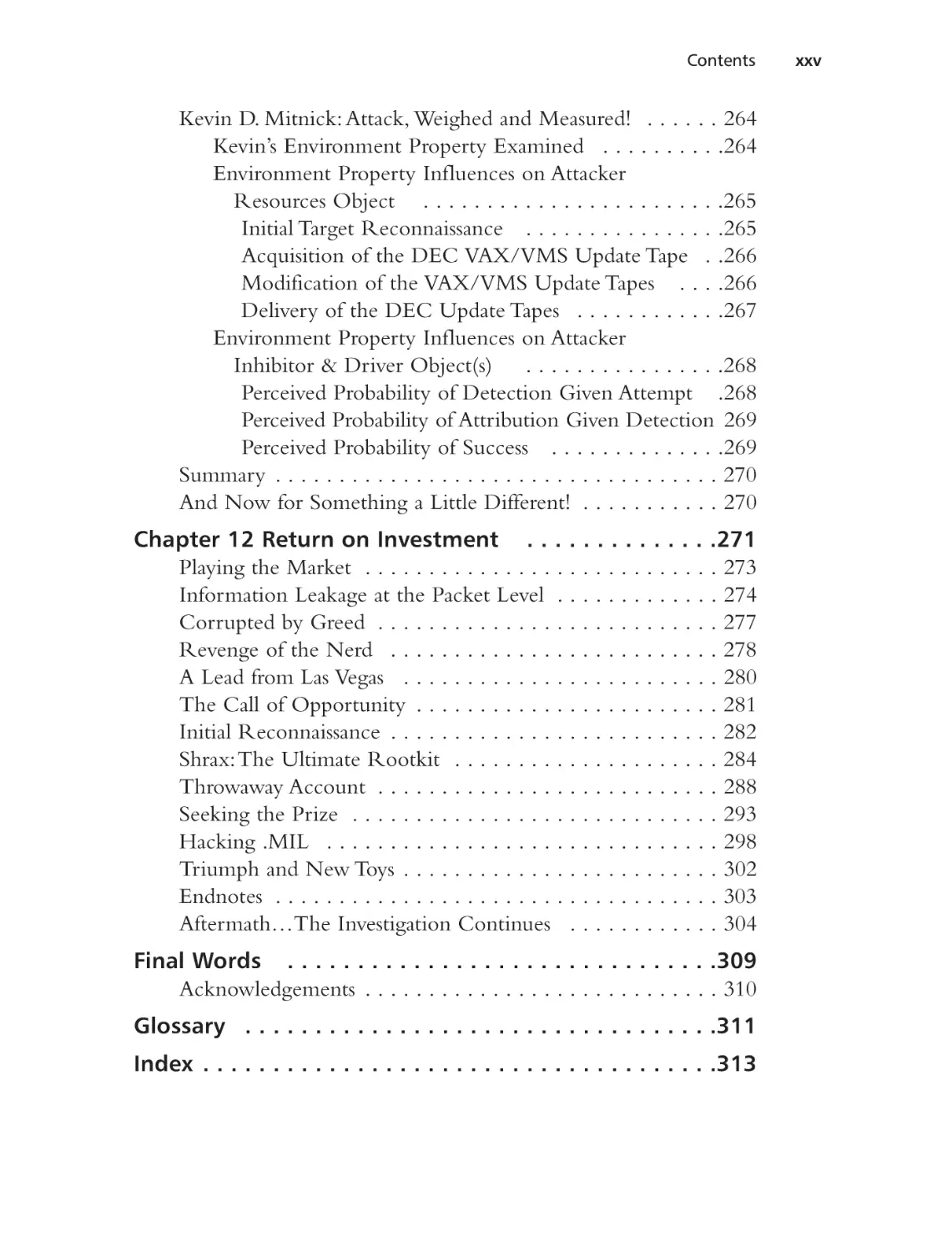
Contents

Kevin D. Mitnick: Attack, Weighed and Measured! . . . . . . 264
Kevin’s Environment Property Examined . . . . . . . . . .264
Environment Property Influences on Attacker
Resources Object . . . . . . . . . . . . . . . . . . . . . . . .265
Initial Target Reconnaissance . . . . . . . . . . . . . . . .265
Acquisition of the DEC VAX/VMS Update Tape . .266
Modification of the VAX/VMS Update Tapes . . . .266
Delivery of the DEC Update Tapes . . . . . . . . . . . .267
Environment Property Influences on Attacker
Inhibitor & Driver Object(s) . . . . . . . . . . . . . . . .268
Perceived Probability of Detection Given Attempt .268
Perceived Probability of Attribution Given Detection 269
Perceived Probability of Success . . . . . . . . . . . . . .269
Summary . . . . . . . . . . . . . . . . . . . . . . . . . . . . . . . . . . . 270
And Now for Something a Little Different! . . . . . . . . . . . 270
Chapter 12 Return on Investment . . . .
Playing the Market . . . . . . . . . . . . . . . . .
Information Leakage at the Packet Level . .
Corrupted by Greed . . . . . . . . . . . . . . . .
Revenge of the Nerd . . . . . . . . . . . . . . .
A Lead from Las Vegas . . . . . . . . . . . . . .
The Call of Opportunity . . . . . . . . . . . . .
Initial Reconnaissance . . . . . . . . . . . . . . .
Shrax:The Ultimate Rootkit . . . . . . . . . .
Throwaway Account . . . . . . . . . . . . . . . .
Seeking the Prize . . . . . . . . . . . . . . . . . .
Hacking .MIL . . . . . . . . . . . . . . . . . . . .
Triumph and New Toys . . . . . . . . . . . . . .
Endnotes . . . . . . . . . . . . . . . . . . . . . . . .
Aftermath…The Investigation Continues .

. . . . . . . . . .271
. . . . . . . . . . . 273
. . . . . . . . . . . 274
. . . . . . . . . . . 277
. . . . . . . . . . . 278
. . . . . . . . . . . 280
. . . . . . . . . . . 281
. . . . . . . . . . . 282
. . . . . . . . . . . 284
. . . . . . . . . . . 288
. . . . . . . . . . . 293
. . . . . . . . . . . 298
. . . . . . . . . . . 302
. . . . . . . . . . . 303
. . . . . . . . . . . 304

Final Words . . . . . . . . . . . . . . . . . . . . . . . . . . . . . . .309
Acknowledgements . . . . . . . . . . . . . . . . . . . . . . . . . . . . 310
Glossary . . . . . . . . . . . . . . . . . . . . . . . . . . . . . . . . . .311
Index . . . . . . . . . . . . . . . . . . . . . . . . . . . . . . . . . . . . .313

xxv

This page intentionally left blank

Foreword

The systematic approach to the issue of adversaries in the on-line world is not
new, but the detail and breadth of this book’s effort is. Cyber-crime has become
an all too real threat with the rapid growth and increased reliance on computers and the Internet. From a “hacktivist” concerned with worldly politics
and agendas, to a script kiddie looking for a little fun, criminal hackers are as
varied, as they are skilled. Recognizing and understanding these adversaries and
the potential threats they pose is key to securing any network. Cyber Adversary
Characterization: Auditing the Hacker Mind answers:Who is the hacker, what do
they want to hack, and why do they want to hack it. More than just a collection of anecdotes and speculation, the authors provide recent case studies and
profiling of cyber-terrorists including attacks from state-sponsored groups to
unhappy employees on the inside.
The ever-increasing emphasis and reliance on the use of computers and the
Internet, has come in hand with the increased threat of cyber-crime. Many systems and infrastructures are exceedingly vulnerable to attacks, as the complexity
of computer networks is growing faster than the ability to understand and protect them. Heightened vigilance is not enough, but needs to be coupled with
active defensive measures to guarantee the best protection.This book provides
the reader with understanding of and an ability to anticipate that “cyber adversary” silently waiting in the wings to attack.
Hackers are in the business of attacking things.They may not be doing it
for money or advancement, but that doesn’t mean they are any less skilled or
dangerous. Just like a cat burglar, the hacker needs a good tool box, and accurate information to be successful.The burglar needs to know when the occupants of the target house are gone, as well as what kind of safe is inside so they
can select the right safecracking tools.The tools are to help perform the techxxvii

xxviii

Foreword

nical aspects of defeating any mechanisms set in place to stop them, and the
information is to help decide how to best achieve the goal. Both tools and
information are critical to a successful attack.Without the right exploits and
tools the knowledge of a vulnerability is of no use, and vice versa.You have to
have the knowledge of a vulnerability in the target system, have the tools and
the skills to take advantage of it, be in both a physical and logical position to
perform the attack, and if all goes well, get away without a trace.
That is technically what must happen to claim victory.What this does not
address is the motivation of the attacker, which is critical to the defense of the
systems being attacked. Because of the economics of defense, it is simply not
possible to defend against all threats all of the time. Smart defenders therefore
want to spend their limited resources defending against the most likely attackers
and threats.This requires them to step back from the purely technical aspects of
their job, and to play psychologist and risk manager. How likely is it that an
angry employee will try and steal a customer database? That a drunk driver will
run into, and destroy the power lines to your facility? That a political opponent
deface your website? Each of these threats requires a completely unique
defense.
Security professionals generally group attacks into several categories. Natural
disasters, un-intentional attacks, and intentional attacks.While all of these
attacks have the potential to disrupt business, people generally understand and
accept the risks of mother nature (In contracts you see this referred to as “Acts
of God”) and accidents.What people have a hard time dealing with is the last
type, the intentional attack.What I am getting at is that if you don’t know who
is attacking you and why, it gets very expensive and time consuming to cover
every possibility.These intentional attacks comprises the majority of this book,
and are normally comprised of some combination of technical attacks, physical
attacks, and social engineering.
Purely technical attacks rely on software, protocol, or configuration weaknesses exhibited by your systems, and these are exploited to gain access.These
attacks can come from any place on the planet, and they are usually chained
through many systems to obscure their ultimate source.The vast majority of
attacks in the world today are mostly this type, because they can be automated
easily.They are also the easiest to defend against. Physical attacks rely on weaknesses surrounding your system.These may take the form of dumpster diving
for discarded password and configuration information or secretly applying a

www.syngress.com

Foreword

xxix

keystroke-logging device on your computer system. In the past, people have
physically tapped into fax phone lines to record documents, tapped into phone
systems to listen to voice calls, and picked their way through locks into phone
company central offices.These attacks bypass your information security precautions and go straight to the target.They work because people think of physical
security as separate from information security.To perform a physical attack, you
need to be where the information is, something that greatly reduces my risk,
since not many hackers in India are likely to hop a jet to come attack my network in Seattle.These attacks are harder to defend against but less likely to
occur. Social engineering (SE) attacks rely on trust. By convincing someone to
trust you, on the phone or in person, you can learn all kinds of secrets. By
calling a company’s help desk and pretending to be a new employee, you might
learn about the phone numbers to the dial-up modem bank, how you should
configure your software, and if you think the technical people defending the
system have the skills to keep you out.These attacks are generally performed
over the phone after substantial research has been done on the target.They are
hard to defend against in a large company because everyone generally wants to
help each other out, and the right hand usually doesn’t know what the left is
up to. Because these attacks are voice-oriented, they can be performed from
anyplace in the world where a phone line is available. Just like the technical
attack, skilled SE attackers will chain their voice call through many hops to
hide their location.When criminals combine these attacks, they can truly be
scary. Only the most paranoid can defend against them, and the cost of being
paranoid is often prohibitive to even the largest company.
Those who know me know that I love telling stories, and I am going to tell
you one to illustrate how hard it is from the defenders standpoint to understand
the motivations of an attacker. It was the mid-90s and someone didn’t like the
French.They thought they would be doing the world a favor if they made it so
the French were not on the Internet at all.To accomplish this, they started an
exhaustive undertaking of breaking into as many routers and servers as possible
in France to gain control of them. After many months, they had managed to
own over 1,100 boxes, about half way to their target of 2,500. By the time I
learned of this endeavor it had become a full time job for two people.When
not drinking, sleeping, or playing Nintendo they would be hacking.When I
asked them what the goal was they said, to paraphrase, “We want France to
wake up one morning and not be on the net.”To do this they were going to

www.syngress.com

xxx

Foreword

coordinate all the boxes they had owned to delete themselves all at the same
time. As you have probably guessed, this never happened. It became too much
of a management nightmare to keep root on all the machines, and they were
spending more time covering their tracks than compromising more machines.
They didn’t own enough machines to drop France from the net, and in order
to achieve their goal they would have to involve more people. And, that meant
more risk they were, understandably, not prepared to take.They just walked
away and never went back to any of the machines they had compromised.
Now, take a minute and think about how that would have looked to
France. How could they tell that the adversary was some disgruntled European
with an axe to grind against the “pretentious” French, as opposed to some hostile government or terrorist group?
As a Criminal Justice Major in college and later on as a law student, the
motivations of the attacker have always interested me. But, I must admit that
when I was asked to write this foreword I was a bit skeptical. I was not skeptical of the authors’ qualification, but of what practical knowledge could be
produced by a book looking at adversaries. I have seen talks on this subject at
security conferences, but was unsure if there was really enough compelling
information for a full book. It is often too easy to fall back on stereotypes,
“soft” explanations, and speculation when it comes to hackers and their motivations.The authors approach this problem head on, and whether you agree with
their conclusions or not, you have to acknowledge their effort to explore this
area in an objective way. From the theoretical to group behavior to state sponsored threats, it is refreshing to read something that is not full of buzzwords,
acronyms, and subjective statements.
The wonders and advantages of modern age electronics and the World
Wide Web have ushered in a new age of cyber-crime.The growing connectivity among secure and insecure networks has created new opportunities for
unauthorized intrusions into sensitive or proprietary computer systems. Some
of these vulnerabilities are waiting to be exploited, while numerous others
already have. Everyday that a vulnerability or threat goes unchecked greatly
increases an attack and the damage it can cause.Who knows what the prospects
for a cascade of failures across US infrastructures could lead to.What type of
group or individual would exploit this vulnerability, and why would they do it?
Cyber Adversary Characterization: Auditing the Hacker Mind sets the stage and cast

www.syngress.com

Foreword

xxxi

of characters for examples and scenarios such as this, providing the security specialist a window into the enemy’s mind—necessary in order to develop a well
configured defense.
Written by leading security and counter-terrorism experts, whose experience include first-hand exposure in working with government branches &
agencies (such as the FBI, US Army, Department of Homeland Security), this
book sets a standard for the fight against the cyber-terrorist. It proves that at the
heart of the very best defense is knowing and understanding your enemy.
—Jeff Moss
Black Hat, Inc.
www.blackhat.com
June, 2004

www.syngress.com

This page intentionally left blank

Chapter 1

Introduction

Topics in this Chapter:
■

Introducing Adversary Characterization

■

Cyber Terrorist: A Media buzzword?

■

Failures of Existing Models

■

An Introduction to Characterization Theory

1

2

Chapter 1 • Introduction

Cyber Adversary Characterization
When you picked this book from the shelf, chances are you did it for one of two
reasons: from mere curiosity about the subject matter or because you felt that it
will give you a better understanding of whom you are protecting your assets
against and how you can do a better job at that task. Systems administrators and
other IT professionals often find ourselves looking for a better understanding of
who it is that we are protecting our assets against; this often creates a feeling of
insecurity or vulnerability—the “not knowing” factor.
The “not knowing” feeling can be introduced into the equation at multiple
levels, and not always directly related to the administration of computer networks. Perhaps you’re a member of your firm’s human resources department,
unsure whether the young systems administrator you just hired may one day turn
on the firm, causing damage to company assets on a massive scale. And whose
fault would it be if that were to happen? So perhaps you should not take the risk
and just find another candidate. Does his young age and lack of experience on a
large corporate network make it more likely that he constitutes an insider threat
to your organization? That perhaps one day he will turn against the company,
giving systems access to his so-called friends on an Internet Relay Chat channel
he frequents, because he is upset over a salary dispute? Or is he likely to leak sensitive company intellectual property to a competitor when offered a bribe?
Perhaps you are that systems administrator, concerned that the systems it is
now your task to protect are at risk, but you aren’t sure from whom or what.
What does your adversary look like? What kind of attacks will he or she use in
trying to compromise the network? Indeed, what is it that’s motivating your
adversary? You are also concerned that a mission-critical application has not been
designed in a secure manner; what factors should the development team consider
when designing attack countermeasures?
These examples make up a minute percentage of the questions employees of
organizations large and small are asking themselves on a daily basis—but with
what authority are they answering them? What courses have they studied that
enable them to accurately identify a threat to their organization and mitigate in
an effective manner? The truth is, in the public sector, there is little data available
to average employees to enable them to answer these questions. Government
organizations and law enforcement are a little better off, given the threat-modeling systems many of them use on a daily basis.

www.syngress.com

Introduction • Chapter 1

There is a clear need for a better understanding of the cyber adversary of
today and tomorrow, from what it is that motivates an adversary to the threat
that said adversary poses to your organization’s assets. Of course, with hindsight it
is easy to make sweeping statements, such as a greater awareness of computer
security-related issues within your organization would have mitigated the repercussions of many of recent history’s computer security-related incidents, or perhaps even prevented the incident in the first place.
But as you’ll know if you’re a systems administrator, persuading management
that a threat exists, attempting to identify the nature of that threat, and expressing
it in a way that even a CEO will understand, especially when it involves budgetary considerations, is not so easy. Even in the case where an incident has
occurred, how do we learn from the incident? Sure, you can run around
patching systems that will probably be vulnerable again in a few months anyway,
but what can we learn from the adversary who has, in spite of what we admit in
public, outmaneuvered you?
It is clear that we need a better understanding of an adversary’s core properties and a set of proven threat characterization metrics to measure these properties and determine how any given adversary would behave in a defined
situation—or more important, against a specific asset.Throughout this book, you
will find various characterization metrics and theories, with each chapter
designed to focus on the differing applications of characterization theory. We
characterize the threat from adversaries inside your organization to the threat
your company may be exposed to from so-called high-end cyber adversaries,
such as members of terrorist organizations and well-funded rogue states.
The following pages document several case studies, either based on real
events containing partially fictitious information or accounts of actual incidents.
Although these case studies do not alone scope out the full extent of the characterization problem, they set the scene nicely for what’s to come.
The first case study is the infamous Kevin Mitnick’s first-person account of
an attack against a small technology company based in the San Fernando Valley.
The story was taken from Kevin during an interview with the author and details
his 1987/1988 attempt to gain unlawful entry to Digital Equipment Corporation
materials.The story exemplifies one of the many motivations of cyber adversaries—the retrieval of additional capabilities, in this case, source code. In the
concluding chapter, we will use the characterization theory we cover in the
intervening chapters to examine Kevin’s attack and the ways it could have been
prevented through a better understanding of the cyber adversary.
www.syngress.com

3

4

Chapter 1 • Introduction

Case Study 1: A First-Person
Account from Kevin D. Mitnick
“Over a decade ago, I had compromised a number of systems owned by Digital
Equipment Corp. [DEC], located on the corporation’s wide area network named
Easynet,” Kevin Mitnick recalls. “My ultimate goal was to gain access to the systems within DEC’s engineering department in order to retrieve the source code
for VMS—DEC’s flagship operating system product.The aim of getting the
source code for VMS and other operating systems was so that I could analyze the
extremely well-commented [documented] code, written by DEC developers, to
determine where security-related modifications had been made. DEC engineers
would often document the details of a fixed vulnerability next to the previously
vulnerable code segment. A generally unknown fact, my ultimate objective goal
as a hacker was to become the best at circumventing security systems, and overcome any technical obstacles that would get in my way; whatever the objective, I
possessed enough persistence to always succeed.”

“I Put My Freedom on
the Line for Sheer Entertainment …”
“Although I had already acquired access to the DEC Easynet network, none of
the systems to which I had access resided on the VMS development cluster. One
information-gathering method was to install network sniffers on the systems I had
previously compromised in hopes that I could intercept interesting information,
like user authentication credentials. My goal was to eventually gain access to the
VMS development cluster—complete with development tools and the latest
release of operating system source code. Unfortunately, back in those days, many
operating system vendors had yet to standardize the use of TCP/IP as the network
transport protocol of choice. Most, if not all, of the systems on Easynet primarily
used the DECNET/E protocol. I installed sniffers on certain compromised nodes
(systems) which allowed me to gain access to additional computing resources.The
targeted resources were other nodes on the network with a sufficient amount of
unused disk storage, and any system which had direct connectivity to the Internet.
The source code files were so large, even when compressed, that it would have
taken months to download over dial-up. I needed a way to transfer the code outside DEC so I could analyze it without the fear of being detected.

www.syngress.com

Introduction • Chapter 1

And so, I began to research the possibility of writing or acquiring a sniffer
that worked with the DECNET/E protocol. After a few of hours researching, a
few names of vendors came up.These vendors sold expensive products that
would have been useful in my endeavor to intercept traffic. Sometime later, I
stumbled across a network diagnostics program designed to analyze and monitor
DECNET/E protocols, written by a company in the San Fernando Valley named
Polar Systems. A feature of the network diagnostics suite was the ability to collect
and display packets collected from a DECNET interface.The tool was just what
I needed—I just had to figure out how I was going to borrow it.
My initial attempts to retrieve the software from Polar Systems consisted of
using my knowledge of the telephone system to identify which phone numbers
also terminated at the likely address where the product was developed, sold, or
supported. After every telephone number terminating at the Polar Systems
address, I proceeded to identify which of the lines were data, fax and voice. It
turned out that Polar Systems was actually run out of someone’s residence which
made my reconnaissance much easier. I identified two numbers that answered
with modem breath. I dialed into both, discovering the all-too-familiar beep,
indicating the box was waiting for me to enter the system password.
A security feature allowed the operator to require a password before the
system would prompt for a username and password.The telltale sign was a distinctive beep after hitting the return key on my VT100 terminal. I guessed that
Polar Systems used these numbers to remotely dial into their system—perhaps if
I could get access through their dial-in mechanism, I could access their development system, complete with sniffer software, and if I got lucky, source code! I
promptly disconnected from my dial-in session, as I did not want to raise suspicions if they happened to be watching the lights blink on the dial-up modem.
After all, the business was run out of someone’s home.
After much thought, I decided that the easiest way in was going to be
through a blended attack using both social engineering and technical expertise. I
remembered that DEC was under intense pressure to release security patches for
some newly discovered vulnerabilities that were recently publicized. Accordingly,
DEC set up a special toll-free number so anyone could call in and request the
latest security patch kit on magnetic or cartridge tape. As luck would have it, the
telephone operator at the toll-free number did not bother verifying whether the
customer was a legitimate customer.This meant that pretty much anyone with a
telephone line and the guile to call DEC could get themselves a free tape critical
security patch kit for the cost of calling a toll-free number—absolutely free.
www.syngress.com

5

6

Chapter 1 • Introduction

I placed several telephone requests for patch kits to be delivered to several
addresses in the Los Angeles area. After receiving the patch kits, I proceeded to
carefully remove the tape and written materials, wearing a pair of latex gloves to
ensure that my fingerprints would not be left on the tapes. I knew they would
eventually be in the possession of my target, and possibly thereafter, law enforcement. After extracting the files from the special VMS formatted back-up
(saveset), I decided the best way to meet my objective was to backdoor the patch
kit with some extra code that would covertly modify the VMS login program,
which was responsible for authenticating users at the operating system level,
which stood between me and Polar Systems IPR.
Figure 1.1 An Assembler Dump of the Target VAX Binary

After a number of hours of analysis I identified a segment of the binary
which could be used to inject my own instructions—in this case several jump
instructions to unused areas within the image of the login program, which would
include several “special” features that would give me full control of the system
once installed.To aid my work, I acquired a similar patch written by the Chaos
Computer Club (CCC) which did essentially the same thing on an earlier version of VMS. After a few days researching, programming and testing, I decided
that the patch was ready to be incorporated into the security patch kit.
I rolled up my patch with all the other legitimate files into a new VMS formatted backup; I wrote it to tape, and carefully repackaged the box just like it
arrived from DEC. I even went to the trouble of shrink-wrapping the cartridge
tape with the packing slip to give it that extra dose of authenticity.
www.syngress.com

Introduction • Chapter 1

I carefully repackaged the newly shrink wrapped tape into the DEC-labeled
box—the one I had originally received it in—taking care to ensure that no fingerprints, skin cells or hair was deposited on the tape or into the box.
My next step was figuring out the best way to get my target to install the
update from my “special” tape. I thought about mailing it from Los Angeles, but
that may have raised a red flag—the real tape was mailed from Massachusetts. I
had to think of a better way.
Once the target installed the “security” update on their systems, I would be
able to sneak in over their dial-in and retrieve the programs I needed to assist my
further penetration of DEC’s Easynet.
All was going to plan—I opted to become a UPS delivery man for a day and
hand-deliver the package to the residence where Polar Systems ran its operations.
After purchasing a UPS delivery outfit from a costume shop (Hollywood is a
great place to buy costumes), I made an early morning visit to the address for
Polar Systems. I was greeted at the door by some guy who looked like he needed
a couple more hours of sleep. I hurriedly asked the gentleman to sign for the
package as I complained about being late for another delivery.The gentleman
cooperatively signed for the package and took it into the house, closing the door
behind him.”
You may be wondering why I distracted him by acting in a hurry. Well,
although I did not want to raise suspicion by coming across in an unnatural
manner, I was lacking one vital object, possessed by all UPS delivery folks—a UPS
truck. Luckily, the inert gentleman did not notice anything out of the ordinary.”
The following day, I dialed into Polar Systems’ modems, entering the secret
phrase required to activate my backdoor.To my disappointment, the attempt
failed—I figured that they must have not installed the security patch yet. After
some 10 days, Polar Systems finally installed the critical update, allowing me to
bypass the authentication on the dial-up line, and yielding access to both the
source tree and binary distribution of the Polar Systems DECNET monitoring
tool.”

Case Study 2: Insider Lessons Learned
In May 1999, Kazkommerts Securities, a small company based in Almaty,
Kazakhstan, entered into a contract with Bloomberg L.P. for the provision of
database services to the firm. Shortly afterward, an employee at Kazkommerts
named Oleg Zezov (purportedly Kazkommerts’ chief information technology
officer) discovered that he could use his newly acquired access resulting from the
www.syngress.com

7

8

Chapter 1 • Introduction

acquisition of Bloomberg services to escalate his privileges on Bloomberg’s network to exploit software flaws and steal various user login credentials, including
those of Michael Bloomberg, the founder and then head of Bloomberg L.P.
After accessing the accounts of various Bloomberg employees and retrieving
data from those accounts, including Michael Bloomberg’s credit card details,
Zezov sent a threatening e-mail to Michael Bloomberg, demanding a substantial
amount of money. In return, Zezov offered to disclose the ways he had compromised the Bloomberg computer systems and retrieved the necessary authentication credentials to compromise the account and data of the company head. After
realizing the nature of the compromise, Bloomberg quickly remedied the software flaw that allowed Zezov access to the network and worked with the FBI to
apprehend Zezov and his counterpart in London, where they had agreed to
“resolve” the issue.
Although to this day, the details of the software flaw and the computer systems surrounding the break-in remain unclear (at least in the public domain), it
is clear that an accurate assessment had not been made regarding the threat posed
to the various technological assets at Bloomberg L.P., especially when it came to
the insider threat. Although Zezov was not an employee of Bloomberg, in some
ways he can be considered an insider, given that his attacks against Bloomberg
were made possible through authorized access he had to Bloomberg’s database
services as a customer.This case study is further examined in Chapter 7.

Cyber Terrorist: A Media Buzzword?
The term cyber terrorist falls under the same media buzzword umbrella as black hat
and even the overused and abused hacker.The idea that a so-called cyber terrorist
can compromise the security of a computer system and cause actual bodily harm
as a direct result of the system compromise, even in today’s world, is somewhat
far-fetched, where many compromises have only resulted in defacements of sites
or temporarily downed servers. But, even these defacements of government websites are more common than many people realize. Figure 1.2 displays the defacement of the official Whitehouse website, by the notorious group “Global Hell”.
It has, however, become more probable that a terrorist group could seek the
skills of a hacker to augment a more conventional act of terrorism.The following
account is loosely based on such an event where a teenage male was approached
by an individual, known to be associated with an eastern terrorist group.

www.syngress.com

Introduction • Chapter 1

Figure 1.2 Whitehouse Website Defacement by Global Hell

In June 1999, an Alaskan hacker named Ryola (aka “ne0h”)was chatting on
his favorite Internet Relay Chat channel as he did every other night, bragging
about his latest hacked systems (see Figure 1.3) and comparing the speeds of
their connection speeds with those of the other hackers in the channel. After
deciding to call it a night, he went to check his e-mail one last time and noticed
a message from an individual claiming to be from a group of eastern “freedom
fighters” who had been given Ryola’s contact details by an unidentified friend. In
the e-mail, the individual, who identified himself as Kahn, detailed a “project” he
was engaged in that required the schematics of three specific models of aircraft.
The offer being put forward to Ryola consisted of a one-time payment of $5,000
in return for the schematics of the aircraft models listed in the e-mail message.

www.syngress.com

9

10

Chapter 1 • Introduction

Figure 1.3 One of Many Web Defacements Carried Out by the
Notorious ne0h

At the time, Ryola had a job at a local computer vendor, fixing and building
home and business computer systems, but he needed the additional money to
fund the trip to Las Vegas he had planned for the following month. After a short
telephone call between Ryola and Kahn, made to a local call box that Ryola
used to protect his identity, the details of the task at hand were confirmed.
Several days later, after he had completed his initial network scans and determined the most likely place to find the schematics he had been asked for, Ryola
made his move and compromised multiple systems on one of the aircraft
designer’s many networks. He then used this access to leverage further attacks
against internal Windows networks, which the designer’s engineers used to store
schematics and other sensitive documents. Although it is arguable that Ryola “got
lucky,” he did complete the requested task and within days, the schematics of
three of the requested aircraft types were in Kahn’s hands. Months later, an aircraft matching the type documented by the schematics Ryola stole was hijacked
over Saudi Arabia by the same group Kahn had identified himself as representing
to Ryola.
A year went by and Ryola remained unpaid for the task he had undertaken
for Kahn, who Ryola now knew was a terrorist. In spite of several failed attempts
to contact Kahn and request the money he thought he had earned, he remained
unpaid. It wasn’t until February 2001 that Ryola heard once more from Kahn. In
www.syngress.com

Introduction • Chapter 1

an e-mail from a new address, Kahn apologized for having failed to pay Ryola,
claiming he had been in hiding as a result of investigations made to find the perpetrators of the previous year’s hijackings.To make up for this, Kahn promised
Ryola more than five times the sum previously promised to him, in return for
the retrieval of schematics of four more aircraft types. By this time, Ryola had
found a better job and was left with a bitter taste in his mouth from his previous
dealings with Kahn, so he gracefully declined the offer.
No more e-mail communications occurred between the two, and for Ryola,
his dealings with the individual were over. Several months later that same year,
Ryola had been up until 5:00 in the morning chatting to some of his online
friends about their plans to compromise the security of a South African-based ISP.
The next day, he awoke at about 2:00 in the afternoon and turned on the television.The day was Tuesday, September 11, 2001, and before his eyes were reports of
four planes being used for acts of terrorism, purportedly by a sister organization of
the “freedom fighters” he had previously worked for, using planes matching the
descriptions in the e-mail from Kahn some seven months previously.

NOTE
It should be noted that although real names, group names and other
details have been removed from the this account; the story is based
upon real life occurrences which are very real.

Although the connections between the portions of this fictional story that are
based on real events and the tragic events of September 11 are somewhat unclear,
the hijacking in 1999 was very real, as was the evidence linking the compromised
airplane schematics and the group that carried out the hijacking. When we think
about adversary characterization, it is important that we keep the bigger picture
in view.
The second that we become narrow-minded about the security of
our organizations and the resolve of our enemy is the second that
we become vulnerable.

In this case, the compromise of data on a poorly protected computer network
didn’t by itself create the hijacking situation—only the act of the hijacking’s perpetrators stepping onto the aircraft and taking it into their control did that.
However, the schematic data would have almost certainly aided them in planning
www.syngress.com

11

12

Chapter 1 • Introduction

the execution phase of the hijacking, increasing their chances of success and
reducing their chances of their plot being foiled during execution.
When performing a characterization, especially when it involves characterizing
the threats to assets within an organization and trying to establish which information would be of most value to an adversary, it is vital that we remember things
like the system that holds airplane schematics. Sure, it isn’t a database server holding
thousands of credit card numbers or authentication credentials. But different assets
have different values to different adversaries.The key lies in knowing which adversaries value which assets and how those adversaries are most likely to go about
compromising those assets.The hijacking is an excellent example of data that was
of high value to an adversary that at the end of the day compromised a very highvalue asset, aided by compromising data that was clearly characterized as being of
low value, at low risk, and therefore poorly protected.

Failures of Existing Models
Cyber adversary characterization as a whole is a rather large topic, and it would
create an unworkable situation if we were to attempt to solve the characterization problem by creating one large metric designed to take all possible data into
account. Past attempts at making sense of the vast amounts of adversary-related
data have in one way or another failed. Perhaps the primary reason for this
failure is that there is simply so much potentially meaningful data to take into
account and so many perspectives that it is extremely easy to lose focus of the
data that matters and, indeed, what you are actually trying to achieve. In past
characterization workshops and research groups, attended by most contributing
authors of this book, we have often asked the seemingly obvious question, What
are we all doing here? What is the common goal that brings us together, and
how can what one of us comes up with, which might on the surface apply to
only his individual work practices, help another? The problem here is that this
way of thinking is far too high level; a lower level of thought is required to
answer these questions.
The answers to these questions should become apparent as you read this
book, and they are fairly straightforward. At the end of the day, no matter what
your use for characterization data—whether to achieve greater levels of security
during the design of software, for more accurate network threat assessments, for
improved incident analysis, or to detect an insider threat—the group we are
trying to characterize remains the same, and the properties of this group remain
the same, and therefore, so does the set of characterization metrics required to
www.syngress.com

Introduction • Chapter 1

assess said adversarial/group properties.To summarize, a set of metrics to assess
the individual properties of the adversary and a methodology to assess meaningful relationships between these metrics would aid the characterization in
almost every circumstance.
Some of the problems encountered in attempting to deal with adversarial
data in other manners are discussed in the following sections.

High Data Quantities
Vast amounts of adversary data need to be, or at least could be, considered when
attempting to complete a characterization. Often much of this data in its raw
form is of little use to an individual attempting to perform a characterization and
does little more than present itself as “white noise” around the data that actually
means something. Due to often large data volumes, data must be categorized and
attributed to adversary properties for us to stand a chance of understanding it,
and if we were to attempt any kind of detailed characterization, high data volumes would make this impossible without such a methodology.

Data Relevancy Issues
Certain types of characterization data are often only of relevance in certain cases.
Indeed, the data that is available regarding a subject will also differ from case to
case. For this reason, use of a single metric and lack of a methodology for
breaking down an adversary’s individual properties would probably result in a
certain amount of the subject data being of no relevance to your circumstance,
potentially skewing your final result.
For example, during the characterization of a theoretical adversary type for a
threat assessment, no forensic data from an actual attack may be available since no
incident has occurred. Since a single characterization metric would have to take
forensic incident data into account, this would leave a black hole in the middle
of your metric because a dependency of the metric has not been met.
Furthermore, it would make it a tricky task to predict the kind of forensic data
that may be available.
As we already stated, much of the data that needs to be considered for an
accurate characterization is often of little use in its raw form—in other words,
without any supporting research or data evaluation metric to give it some
meaning. For the purposes of this book, we refer to this type of data as analog
data. An example of such analog data is an attempt to profile an individual
through the operating system she uses. Although this information can be of use,
www.syngress.com

13

14

Chapter 1 • Introduction

on its own, without the presence of a data evaluation or additional research data,
it is of little use. Because we are dealing with the profiling of real people here
and not artificial neural networks, all data associated with properties of an adversary tends to be analog. “Digital data” types are almost always encountered by
processing analog data via a data evaluation metric of some kind.
For example, we hypothesize that through the evaluation of the tools an
attacker uses in his or her attempt to compromise a system (an analog data type)
via a characterization metric, we are left with an integer type “score” that may be
representative of the threat that individual poses to a defined asset—and indeed,
their skill level. Whether this assessment is true or not, the point here is that any
two “digital” results should be directly comparable to one another; where s the
analog data that we started with is not.This strengthens the case for the use of
multiple metrics to assess the various properties of the cyber adversary rather
than trying to address the problem as a whole, which we outline in greater detail
in the following chapters.

Characterization Types
Typically, characterizations of cyber adversaries fall into one of two categories:
theoretical and post-incident (actual or forensic) characterization types.The primary purpose for making this distinction is that parameters the metrics use to
assess the adversarial properties will differ substantially, as will the uses for the
final characterization.To qualify whether a characterization is going to use theoretical or characterization methodologies, we must assess the nature of the situation and the information that is available to us to conduct the characterization.
Although metrics used to assess no observable data and attribute to adversarial properties during a theoretical characterization and the observable data to
attribute to adversarial properties during the characterization of an actual adversary will differ, many metrics used during an actual characterization are also
commonplace during a theoretical assessment, but not vice versa.
This is due to almost all metrics that are used for theoretical characterization
also being of use in the characterization of actual adversaries, but not the other
way around, since the additional metrics used in forensic characterizations rely on
data that will not always be available during a theoretical characterization, since
no actual incident has occurred. Although past attack data is of use for building
profiles of adversary types, during a theoretical characterization we can only
speculate that the subject will tender similar behavior to that displayed in a past
attack.To this end, past attack data is of most use for improving the metrics used
during theoretical characterizations rather than for making sweeping assumptions
www.syngress.com

Introduction • Chapter 1

that the behaviors of a past, purportedly similar adversary bearing similarity to a
theoretical one. Remember, no two adversaries will behave exactly the same way.

Theoretical Characterization
Theoretical characterization theory is possibly of most use for performing and
improving on the accuracy of asset threat characterizations, for improving the
designs of network topologies and data systems, and for conceiving efficient
methodologies to test said systems’ resilience against the known and unknown.

Introduction to Theory
Many members of groups developing trusted computer systems have expressed
that it would be an extremely useful thing to be in a position whereby a developer is able to assess the profiles of a handful of real hackers, identified as possibly
posing a threat to whatever it may be that’s being designed.This way they could
assess how each adversary would go about attacking their platform, using characterization theory to explain how each adversary behaved in the test and why
they behaved as they did.
Although such an approach may very well uncover several previously unseen
problems in the design or implementation of the solution, it is a somewhat ad
hoc methodology, since the hand-picked individuals would, without careful
assessment prior to the exercise, possess several unknown properties.
Furthermore, the process of using “real” hackers may itself taint any value gained
due to the individuals who agree to take part in the tests sharing common properties. In this scenario, the preferential methodology would place a developer in a
situation where he or she may “fuzz” adversaries by changing the properties (the
variables) of said adversary and, using the same techniques used to enumerate
each adversary, assessing how the resulting characterized adversary would behave
in a given situation.This methodology has the advantages of being highly controlled and scalable, and in a testing environment, tests to test the accuracy of the
methodology itself would be trivial to orchestrate with the use of adversary case
studies. More information on this topic is presented in Chapters 2 and 3.
This is one of the many uses for theoretical characterization theory.This
example is fairly specific to system design; the second most common use for theoretical characterization has been in the characterization a specific threat poses to
a given asset. Although the theory used for asset threat characterization remains
the same, the fact that you are now dealing with assets (computer systems or

www.syngress.com

15

16

Chapter 1 • Introduction

other) that have already been designed changes the process you must go through
considerably.

Post-Incident Characterization
During the course of most days on today’s increasingly hostile Internet, systems
administrators, network administrators, and personnel working in the network
operations centers of managed security service providers are faced with what
would be, if printed out, hundreds of reams of reports detailing information pertaining to purported incidents on their or their clients’ networks. Back in the bad
old days of intrusion detection, having a system that would report events on host
and network-based intrusion devices was considered sufficient. Of course, it
wasn’t long before most large organizations realized that the $20,000 IDS they
just invested in was generating more event logs per second than there were
employees in their organization to review each log entry.These organizations
realized they could either action a measured response, turn a blind eye to the
event, or (possibly most significantly) mark the event as a false positive. With this
came the age of the managed security service (MSS) provider who bought IDS
event correlation and false-positive detection technology into the commercial
marketplace. For most organizations the introduction of an MSS provider solved
the problem of having spent substantial amounts of their budgets on host and
network-based intrusion detection devices that they couldn’t afford to manage,
but one perhaps unseen problem remained.
For a moment, place yourself in the shoes of a systems administrator for a
large organization that has been through the process of purchasing networkbased intrusion detection devices, coupled with the acquisition of managed services from an MSS provider.You log onto the MSS portal site and view the
tickets that have been raised for your network segments as a result of multiple,
correlated IDS events.The first ticket you spot informs you that someone
coming from an IP address located in China has been scanning several specific
port ranges on one of your development networks. A note on the ticket says the
event has reoccurred several times over the last three days. Below the summary of
information are several pages of technical spiel regarding the determined source
operating system of the packets and the most likely tool that was used to perform
the scan—but you ignore this, since the port ranges scanned are of no significance to you and you have 90 other IDS tickets to go through before your operations meeting in an hour.

www.syngress.com

Introduction • Chapter 1

Two days later, a new-hire systems administrator announces over the company intranet message board that a Web server on your production network has
been compromised through stolen login credentials. It is now your job to lead
the investigation into what happened. Aside from your suspicion that an insider
was involved in the compromise of the host, which served the company’s primary cooperate Web site, you really aren’t sure in which direction you should
take your investigation. Although the server hosts a Web site and it is currently
receiving more than one 100,000 hits a day, the site content was not defaced in
any way; there are no logs of what the individual did while on the system, and all
you have is IDS data and a potential insider with no clue of what your adversary
“looks like” or his motivations for the attack.

An Introduction
to Characterization Theory
When we talk about post-incident or forensic adversary characterization, we are
referring to a situation where an incident of undetermined type has occurred,
presenting some form of data with which you will base the data you may have
after an incident, similar to our short example.There are several primary objectives of this form of characterization. Each objective hopefully provides leverage
to justify a measured reaction to an incident, whether that reaction is to leverage
to action change in the design of a production network to a more secure model,
to come up with an accurate profile of the adversary to aid in his or her capture,
or most important, to glean a better understanding of the kinds of people who
really want to break into your network, their motivations, and the kinds of
attacks you are likely to see coming from said characterized subset of adversaries.
Because an actual event has occurred, the starting point at which the characterization begins changes from the typical starting point of a theoretical characterization to the data (IDS or other) pertaining to an incident.To this end, one of
the applications of theoretical adversary characterization that has attracted substantial interest and raised many questions in the past is the possibility of a technology that can automate the characterization of adversaries from IDS data
alone, providing a real time “score” of the adversary responsible for triggering an
IDS. Although its important to remember that such an automated mechanism
could never be as accurate as doing things by hand due to the limited data IDS
has access to and limitations drawn from the IDS drawing its conclusions based
on hard and fast rules, therefore allowing an attacker to either trick or bypass
www.syngress.com

17

18

Chapter 1 • Introduction

those rules, such a technology is very possible. Metrics such as those that
examine the semantics of an attack could be used to draw conclusions about an
adversary from data such as the operating system the attacker is using, the exploit
they are using, the operating system of the target, and the difficulty of the hack.
The following chapters address some of the topics (and problems) introduced
in this chapter. Chapter 2 examines much of the characterization theory alluded
to in this chapter, including that which can be used for both theoretical (asset
type) characterizations and that we can use in the unfortunate times when incidents occur, giving us a framework through which we can seek attribution.

www.syngress.com

Chapter 2

Theoretical
Characterization
Metrics

Topics in this Chapter:
■

The Adversary Object Matrix

■

Adversary Property Relationships

■

The Adversary Model—“Adversary
Environment Properties”

■

The Adversary Model—“Attacker Properties”

19

20

Chapter 2 • Theoretical Charaterization Metrics

Introduction
As previously stated, cyber adversary characterizations can be divided up into two
categories:
■

Those that are of an entirely theoretical nature (such as characterizations
of the risk that a specific, theoretical adversary subset may pose to a
given asset)

■

Post-incident or forensic characterizations, where the threat that a “real,”
characterized individual may pose to a given asset, using information
available only after an incident has occurred (such as intrusion detection
data)

Although this definition may seem fairly clear cut, the moment you begin to
put either type of characterization into practice, the line between the two
becomes somewhat blurred.
This is primarily due to capability characterizations of actual (living, breathing)
cyber adversaries often being heavily reliant upon projected (assumed) data variables and therefore theoretical metrics.This is the case because more often than
not, collating sufficient data to satisfy all characterization metrics and form a clear
picture of what your adversary really “looks like” is just not practicable.
By a similar token, theoretical characterization metrics, which largely rely
upon quantitative data, can never be accurate without first considering “real” case
studies (of actual cyber adversaries), from which the quantitative data must be
derived.
A large part of adversary characterization theory is therefore dependent upon
the following:
■

Making accurate projections regarding what the values of unobservable
variables “might be,” using vectors derived from available/observable
data.

■

Being able to corroborate the accuracy of the final characterization
through the analysis of proven relationships between utilized metrics
(more on this later).

In accepting these statements, we must therefore accept that there is a need
for a set of theoretical characterization metrics (or measures) that can in some
way be attributed to adversarial behaviors (or properties) and ultimately—an
attack. After all, the properties of the adversary are what we’re really interested in.
www.syngress.com

Theoretical Charaterization Metrics • Chapter 2

The characterization metrics we utilize are simply a means of processing oftenqualitative data into a quantitative, meaningful form and are a function of the
final characterization.
In the same way that we could never understand the composition of complex
molecules without a basic understanding of the table of the elements, basic atomic
science, and the formulas we use to explain how complex molecules are formed,
we could never understand today’s cyber adversary and his or her reactivity with a
given element (the asset or target); without a basic understanding of the elements
(an adversary’s properties), which form the complex molecules that are cyber
adversaries.To take this analogy one step further, just like the possible number of
molecular constructs in our universe, the number of cyber adversaries and types of
people in the world is infinite. By the same token that we cannot possibly hope to
enumerate each molecule that will ever or has ever existed, we cannot hope to
enumerate each cyber adversary that has ever and will ever exist. But is this really
an issue? Consider that in the same way that we acquire an understanding
regarding the periodic table of the elements (our adversarial properties) and the
ways in which those elements interact with one another, we can predict the behaviors and state of any given configuration of adversarial properties.To this effect, we
are able to project the most likely values of unknown adversarial variables in cases
where not all necessary data is observable.
Analogies aside, let us start of by looking at the observable properties (or elements) of the cyber adversary and the ways in which they impact upon the final
characterization.

The Adversary Object Matrix
Prior to examining any actual adversarial elements and the data associated with
them, we require a model (See Figure 2.1) in order to establish a set of core
adversarial “properties” and the “objects” associated within those properties.The
secondary objective of such a model is to categorize the adversarial properties in
a manner that represents the way in which different adversarial properties and
objects interact with one another.

www.syngress.com

21

22

Chapter 2 • Theoretical Charaterization Metrics

Figure 2.1 Adversarial Property Model Skeleton

You will see various ways of representing adversarial data throughout this book,
however, Figure 2.1 depicts the adversarial property model skeleton, from which all
other characterization models in this book are in some way associated.The current
model has been intentionally left incomplete so that we can address each property
in this and following chapters.The three primary adversarial properties that are
shown (environmental, attacker, and target properties) form the framework for their
component “objects.” We will see in this chapter, and following chapters how both
theoretical and forensic characterization metrics can be applied in order to resolve
the values of the objects and what they really mean to us.
Figure 2.2 attempts to demonstrate the hierarchical way in which data is processed through the adversary model. It moves from its initial form as “raw”
adversarial data (qualitative or quantitative), becomes an “adversary element” as it
is passed through an adversary data assessment metric, and takes its final place as a
part of an adversarial “object.” Note that an object may be populated by multiple
elements (data from one or more characterization metrics or data sources).

www.syngress.com

Theoretical Charaterization Metrics • Chapter 2

Figure 2.2 Hierarchy of Information in Adversarial Model

Figure 2.1 also outlines some of the more key relationships between populated adversary properties and the ways in which the value of their component
objects cause an impact upon neighboring adversary properties. Although the
semantics of these relationships will be covered in more detail later, first we’ll
take a brief look at the more key relationships depicted in Figure 2.1.

Adversary Property Relationships
The cyber adversary model is all about providing a framework that when populated, we are able to analyze and define relationships between all observable data.
For this very reason, the cyber adversary model is divided into three properties,
aiding us in our ultimate goal of being able to accurately observe the relationship
between adversary and target.The following sections summarize some of the
constant and conditional property relationships that can exist.

Environment Property to Attacker Property
To state the obvious, an attacker’s environment impacts directly upon the “way
the adversary is (or behaves).” Bearing in mind that the attacker property contains objects that attempt to describe an adversary’s behaviors in a given attack
situation (such as his or her preferences to risk), it is clear why this is such a vital
relationship.
The relationship that exists between the environment and attacker property is
constantly subject to change due to the ever-changing nature of the security
industry and the volatile nature of the world we live in.

www.syngress.com

23

24

Chapter 2 • Theoretical Charaterization Metrics

Attacker Property to Target Property
Possibly the most obvious relationships in Figure 2.1 is the one between the
attacker and target.
When look at the specifics of a target and the attacker property, we can
observe the ways that objects within the attacker property will impact an adversary’s motivation toward a target, and more importantly his or her capability
against a target. Ultimately, it is the elements held within an attacker’s property
that will determine their relationship with the target that will determine two
vital factors contributing to both post-incident and theoretical characterizations:
■

Will the attacker actually initiate an attack against the target?

■

What is the adversary’s capability and motivation?

Other (Conditional)
Adversarial Property Relationships
There are many other, more subtle relationships that exist between the properties. However, these relationships are not always present; their existence is normally determined by the presence of additional adversarial variables within the
three properties and their impact on the property relationships that we have just
outlined.
An example of how such a conditional relationship may exist, Figure 2.1
alludes to a possible relationship between the attack target, the environment of
the adversary, and the ability of the attacker’s environment to impact the target.
To provide an example of how a property of a target could impact the environment of an adversary, suppose that an adversary has initiated an attack on a
U.S. government–owned computer system, is detected, and is attributed.
Although the attack may not have been successful, due to the nature of the
target, the adversary is detained and imprisoned at a Guantanamo Bay detention
camp awaiting trial—perhaps an extreme example, but nevertheless, a significant
impact upon our adversary’s environment, which would not have occurred had
the target not been a government-owned system.
Over the following pages, we will examine the relevance of the objects that
contribute to the cyber adversaries’ three core properties, depicted in Figure 2.1.

www.syngress.com

Theoretical Charaterization Metrics • Chapter 2

The Adversary Model—
“Adversary Environment Properties”
The adversaries’ environment property is where most good characterizations of
cyber adversaries should begin. When this property is populated with data, it
often aids in understanding the root causes of adversarial acts.This will often
include being able to explain why it is that an adversary is motivated into an
attack, and the level and origins of the resource (and ultimately capability) that
they possess. Perhaps a cyber adversary engages a target due to peer pressure from
an online community to which he or she belongs—a property environment
impact upon the adversary’s driver (motivator). Or perhaps the adversary lives in
a state with so little law enforcement awareness of cyber crime that he or she
feels entirely comfortable attacking almost any system—a direct environment
property impact upon the adversary’s preference to risk. Over the following
pages, we will examine some of the adversarial impacts, which given the correct
conditions, the objects within the environment property can have.

Political and Cultural Impacts
In early April 2001 a U.S. Navy EP-3E class spy plane collided with a Chinese
E-8 type fighter jet over the South China Sea, damaging the tail of the E-8 and
purportedly killing its pilot, “Wang Wei,” who, according to eyewitness reports,
had attempted to eject from his stricken craft. Quick to pick up on the story, the
world media reported the differing reports from U.S. and Chinese authorities.
The U.S. claimed that “Wei” was well known for his past attempts to buzz U.S.
aircraft in his fighter jet, while a Chinese eyewitness to the event argued that
“Wei” was the victim of a negligent American crew. Back in the United States,
politicians negotiated with the Chinese government to secure the safe return of
the EP-3E’s crew, but events elsewhere took an interesting turn for the worse.
Approximately one month after the midair collision, a group of Chinese hackers
waged what media groups dubbed as “cyber war” on a series of American Web
sites, purportedly in retaliation for the death of Wang Wei. A number of the Web
sites defaced during this time were operated by U.S. government bodies,
including systems run by the U.S. Geological Survey, the hurricane liaison team
of the Federal Emergency Management Agency, and the headquarters of the
commander of the Naval Surface Force of the U.S. Atlantic Fleet—an obscure list
by all accounts. Defacements donned anti-American, pro-Chinese slogans, many
of which protested the death of Wei.
www.syngress.com

25

26

Chapter 2 • Theoretical Charaterization Metrics

Other than their American connections, there were no obvious patterns
regarding the Web sites being hacked, indicating that the selection process used
by the Chinese hackers to select hosts for compromise was based upon factors
other than whether the hosts were high profile or not. Within hours of the first
Chinese defacements, a number of hackers either based in, or supporting
America, began their defacement onslaught of a slew of Chinese-operated Web
sites.They similarly targeted a fairly random series of systems, clearly chosen for
factors other than the perceived value of any individual target. It is interesting to
note that both groups of adversaries placed value in the sheer number of compromised hosts, rather than the value of any single target. It is of equal interest
that the hosts chosen for compromise were those that our adversaries were able
to compromise, possibly due to a lack of vulnerability intelligence.The events in
the online world that followed the U.S./Chinese mid-air collision exemplifies
our first adversarial character property: the environment.
When we talk about the environment in this context, we refer to such things
as the political environment in the state from which our adversary originates, the
wealth of the state, and indeed, the wealth of the individual, which may or may not
be impacted directly by the wealth of his or her state of residence. We are not
referring to the groups or individuals with which the adversary associates.
The Chinese/American incident in May of 2001 was an example of how the
political environment within a state can motivate individuals who almost certainly
had no direct involvement with a political incident into performing an adversarial
act. By the same token, patriotism was the primary motivational factor, which led
to the eventual retaliation by American hackers and those sympathetic to America,
who equally, didn’t have direct links to the events over the South China Sea earlier
that year. So we have established that the motivational factor that drove the initial
assault by Chinese adversaries was that of patriotism for their nation, but was it
really? Were the Chinese adversaries really driven by their political environment,
and if so, why did it not drive them to compromise higher profile United States
government systems? Or did the political environment simply provide justification
for their actions in the minds of those involved—an excuse to hack?
Unfortunately, the answers to these questions will have to wait; at this stage we
have neither enough adversarial data or enough theory to enable us to figure out
what really motivated these attacks.
Before most of us ever became aware of underground online groups, in the
computer security industry and online cultures we were very aware of the semantics of the physical environment we lived in, and moreover, the social and moral
values that were seen as acceptable in that environment. Such an awareness (or
www.syngress.com

Theoretical Charaterization Metrics • Chapter 2

indeed a lack of ) of what is acceptable in the adversary’s physical environment
plays an important role in the impact the environmental property has upon the
property of our attacker and ultimately, the relationships that may or may not exist
between attacker and target properties. Many of today’s “physical-world” cultures
see certain adversarial activities, particularly against other nation states. Justifications
differ for finding these activities acceptable.The horrific events that unfolded in
New York, Washington D.C., and Pennsylvania on September 11th, 2001 were justified in the minds of many as being an act of Jihad—or “holy war” (the equivalent
of a Crusade or “war of the cross” in the Western world). Many other cultures considered the actions as a blatant act of terror and/or war. In the same way that the
9/11 attackers’ cultures and environments impacted the individuals’ perceptions of
what was acceptable, a growing number of world cultures are accepting adversarial
acts in the cyber world as being justified. Although China and the United States
have laws prohibiting certain adversarial activities in cyber space, the initial Chinese
attacks and the eventual American retaliation demonstrated that at least for some, a
political event such as the U.S. spy plane row provided sufficient justification in the
minds of Chinese adversaries that what they were doing was “right.” It was also
apparent that the high levels of patriotism within the United States provided sufficient justification for the counter attacks.
Comparing the mind states of those who believed the events of 9/11 were justified with those of the individuals involved in the relatively harmless U.S.–Chinese
cyber attacks would be a gross mistake. But there are a growing number of nations
whose regimes and societies are not only beginning to deem cyber attacks against
the assets of foreign states acceptable, but they are condoning the attacks and in
some cases aiding their execution. Although the semantics of state-run programs in
nations condoning these activities are outside of the remit of “the environment” in
this particular context, the knowledge of their existence within the countries and
nation states running them can only result in a growing acceptance that such activities are OK.
Another factor that can act as a catalyst for adversarial activities in cyberspace
are the laws, or lack thereof, to prohibit such activities. Many countries in both the
Eastern and Western worlds have failed to pass laws that provide a sufficient deterrent to would-be cyber adversaries.The United States was one of the first countries to recognize this fact, adding a clause to the U.S. Patriot act (2001) amongst
other laws, ruling that under the correct circumstances, certain adversarial acts
against U.S. government–owned computer systems can constitute “an act of terrorism.” Several other countries, including England, have followed America’s lead.
But several countries with regimes that have encouraged adversarial acts in cyber
www.syngress.com

27

28

Chapter 2 • Theoretical Charaterization Metrics

space in the past or currently operate initiatives to verse their military in the art of
“cyber-war” have neglected to take steps to harden their aging computer crime
laws or indeed create them.
The wealth of the state where a potential adversary lives is also an important
factor for numerous reasons.The U.S.-led 2003 invasion of Iraq sparked media
speculation of whether Iraq would resort to technological attacks—seeking to
offset its inferior military power—against the critical infrastructures of nation states
cooperating with the United States. At the time, at least to anyone within the
defense or information security communities, it was clear that Iraq had insufficient
infrastructure and resources to pose a technological threat to the United States or
its allies. Iraq aside, a number of highly wealthy nation states have invested considerable resources toward telecommunications infrastructures and research initiatives
aimed at versing their nation in the art of cyber warfare.The wealth of a state can
become extremely relevant if it indirectly endorses adversarial activities to support
political objectives abroad. Although there are no documented instances of this,
suppose that a well-funded state were to financially support an adversary through
the course of his or her actions.This would increase the time (T) the adversary has
to conduct his or her act, it would increase the wealth (W) of the individual, and
may very well impact the intelligence (I) to which the individual has access.
From the perspective of the individual adversary, (groups will be dealt with later
in this book), the wealth of a state hosting a potential adversary is primarily a function of the wealth of the individual. Although the financial wealth of an adversary
obviously impacts the resources at his or her disposal, the presence of wealth (or
more importantly, a lack thereof ) is a clear motivational factor. Since the turn of the
millennium, adversarial activity directed against the high-value assets of financial
institutions, private companies, and individuals has shot up at a disproportional rate
and shows no sign of declining. One of the more memorable adversarial activities
during this era has perhaps been the increase in e-mail borne “scams” or email
“phishing.” Although certain activities have been linked to organized crime rings,
many of the scam emails we see arrive in our mail box are the work of one or two
individuals, primarily residing in countries that, although they have considerable
telecommunications infrastructures, are financially suffering in one way or another.

Nothing to Lose—
Motivational Impacts on Attack Variables
A wise man once said that a thief without hope is a hacker without fear.
Whether you’re talking about stealing bread from a store or stealing shadow
files, this statement always seems to ring true. Financial desperation is perhaps
www.syngress.com

Theoretical Charaterization Metrics • Chapter 2

one of the most powerful motivators and is the function of a set of adversarial
behaviors that is perhaps one of the most predictable. From the types of assets
that the adversary will pursue to the risks he or she will take to ensure success,
an attack by an adversary of this type will tend to stick out like a sore thumb. In
general, a lack of funds will act as a modifier on the technological resource an
adversary possesses; relative to the asset being compromised, reducing the chances
of success. However, the chances of success are increased when the subject feels
that he or she has nothing to lose.This state of mind results in a degree of complacency, which results in the neglect of several factors that may otherwise be
considered by an adversary, which are displayed in Tables 2.1 and 2.2.
Table 2.1 State of Mind Results (Change in Variables)
Impacted
Attack Variables
The likelihood of
success given a
fixed asset

The likelihood of
detection

The consequences
of detection

The nature of the
asset

Variable Impact Given Motivation

Weight

The likelihood that our adversary will
succeed in his or her attack is not
taken into as much consideration as
perhaps it otherwise would have been.
As far as our adversary is concerned,
they must succeed.
The likelihood of detection during the
attack is also not taken into as much
consideration as it perhaps otherwise
would have been. Although the
adversary is probably aware to some
degree of the likelihood of detection,
its weight is greatly reduced.
As with the likelihood of detection,
the adversary is probably aware of the
consequences of being detected. The
consequence of detection is a function
of the asset itself.
Considerations regarding the asset
itself. The value of the asset is a fixed
variable at this point, but factors such
as initial access required and efforts
required in acquiring such access may
be neglected more than it would
perhaps otherwise be.

Increase

Decrease

Decrease

Decrease

Continued

www.syngress.com

29

30

Chapter 2 • Theoretical Charaterization Metrics

Table 2.1 State of Mind Results (Change in Variables)
Impacted
Attack Variables
Resources required

Variable Impact Given Motivation

Weight

The adversary is less likely to consider
the resources required in order to
ensure success. This is due in part to
the lack of ability to acquire
additional resources, even if required.

Decrease

Table 2.1 displays a reduction in the weight behind most risk-oriented variables and an increase in the perception that he or she will succeed.This also
increases the chances of the adversary going through with the attack. Although the
“reckless factor” may contribute toward the attack being a success, our focus for
now is on the environmental/financial variable upon motivation. Further more, this
isn’t something that we can easily factor without further information regarding a
real or theoretical asset (see Chapter 5, Asset Threat Characterization).
Table 2.2 State of Mind Results (No Change in Variables)
Impacted Attack
Variables
The likelihood of
success given fixed
asset

Variable Impact Given Motivation

The likelihood of success is reduced; it
is far less likely that adversary will go
through with an attack against the
same asset without the right motivator.
The likelihood of
Due to the lack of the environmental
detection
property and therefore the motivator,
the importance/weight our adversary
puts in this attack property remains
unchanged.
The consequences of Due to the lack of the environmental
detection
property and therefore the motivator,
the importance/weight our adversary
puts in this attack property remains
unchanged.
The nature of the
In the eyes of the adversary, without
asset
the financial (environment property)
motivator, the value of the asset is
greatly reduced.

Weight
Decrease

Equal

Equal

Equal

Continued

www.syngress.com

Theoretical Charaterization Metrics • Chapter 2

Table 2.2 State of Mind Results (No Change in Variables)
Impacted Attack
Variables
Resources required

Variable Impact Given Motivation

Weight

The adversary is more likely to take
Equal
heed of the resources he requires in
order to ensure the attack is a success.

All weights invested in risk-oriented variables remain unchanged. No motivation properties due to financial environment have been defined and are therefore
equal to their previous values.The weight of the “likelihood of success given
fixed asset” is decreased because without the correct motivation, which there is
none, the attack would never have occurred.

Associations and Intelligence Sources
In physical-world theatres of war, knowing whom an adversary is loyal to, whom
an adversary is associated with, and who is aiding that adversary is a vital. Such
highly useful information can lead us to making several determinations with a
greater degree of certainty that our determinations are accurate. Such determinations can include the arsenal that may or may not be at the disposal of the adversary. Determining what resources various adversary types have access to enables
us to make fairly informed determinations regarding the kind of attacks we can
expect from the adversary, or from a post-incident perspective, the kind of adversary that initiated an attack. Although the resource and capability of our adversary is not an object of the environment adversary property, the associations and
intelligence source object is, and is possibly the primary contributing object
impacting the adversary’s resource object (covered later).
The way in which an adversary’s associations and other sources of intelligence will impact an attack against a given target will differ substantially,
according to the semantics of the attack construct. For example, was there a need
to seek out additional information at the reconnaissance phase of the attack? And
does the adversary really need to use a valuable intelligence resource, when he or
she can still be a success without retaining the resource? This will also be dependent upon the nature of the resource. Does the resource run out? Does the
adversary have to “give something back” to that resource for it to remain available to him or her, or is it something that is freely available and without risk of
exhaustion? The associations and intelligence object is primarily populated by
data pertaining to the knowledge the adversary possesses. Such information can
www.syngress.com

31

32

Chapter 2 • Theoretical Charaterization Metrics

include vulnerability and exploitation data learned through associations, data
regarding the schematics of possible target networks, and any other additional
information that the adversary may use to:
■

Increase his or her chances of success

■

Provide initial access to the adversary

One of the less obvious but growingly more common sources of such information are in fact, not online associations or software vulnerability discussion
mailing lists, but insiders. Insiders within organizations are increasingly being used
to provide external adversaries with both the information they need, whether it
be system passwords or network schematics of proprietary source code.They also
provide the initial access that the adversary may require to execute their attack. It
is important to remember, that although an insider may have achieved his status
as the result of a previous social engineering attack, the adversary model deals
with the adversary on a regular basis.The insider at the point of reaching insider
status is already within the “environment” of the adversary, and therefore a part
of the associations and intelligence object.
Although cyber and real-world adversaries are alike in many ways, they differ
in the ease of access to key resources. By definition, a cyber-adversary must have
some form of access to “cyberspace” and the recourses it yields. In the physical
world, adversaries do not have such immediate access to targets. Distance is an
issue, and most aren’t born into the world surrounded by an arsenal of weapons.To
the cyber adversary, the Internet represents a huge, relatively unrestricted and
unmoderated resource of tools and information that is available on a fairly ondemand basis. However, much like in the real world, the Internet is home to a
myriad of information that isn’t so freely available. In the right situation, this type
of information can be invaluable to the adversary in both the physical world and
cyberspace. An adversary’s ability to access such illicit information is almost always a
function of his or her ability to establish and maintain the right associations.
Without a doubt, the richest source of intelligence for the modern cyber
adversary is the Internet itself.There exists a vast number of online communities
whose soul purpose is to facilitate the discovery and further research of vulnerabilities—many of which impact some of the most sensitive information systems in
existence today. Using mediums such as Internet relay chat and private mailing lists,
such groups often engage in the sharing of tools to take advantage of unpublished
vulnerabilities in operating systems and proprietary source code for closed source

www.syngress.com

Theoretical Charaterization Metrics • Chapter 2

operating systems such as Microsoft Windows, SGI IRIX, Cisco’s IOS, and many
others. Other commonly traded artifacts include confidential hardware documentation for commercially available products and even network schematics of some of
the world’s most sensitive computer networks. An adversary’s ability to tap this
information, however, will vary substantially and depend heavily on his or her associations. For more information on this topic, please see Chapter 3.

Environment Property/
Attacker Property Observable Impacts
The following are often observable changes in the way that the environment
property can impact upon the attacker property:
■

Attack objective The objective of the adversary may involve those he
or she associates with, but without the presence of the group object
(covered later), the objective will normally be that of the individual
adversary rather than the objective of a group or association.

■

Knowledge/skills The skills and knowledge resources available to the
adversary will be the same resources available and/or attached to the
associations and intelligence object. Due to the attack objective being
that of the individual and not of a group or those attached to the associations and intelligence object, the degree of information shared by said
parties will vary substantially.

■

Attitude to AA risks of attack The individual attitudes towards the
attack will be that of the adversary alone, and not necessarily shared by a
group or associations in the adversary’s environment property.The individual attitudes of the attack are far more likely to be impacted by the
objective than they would otherwise be in a group situation.

■

Group affiliations One of the many challenges that today’s defensive
player faces is how one goes about defending from organized groups of
adversaries, determining how their attacks may differ from those of an
adversary acting alone, and how the risk from such attacks can be mitigated.The group object is the final and only conditional object within
the environment property.

www.syngress.com

33

34

Chapter 2 • Theoretical Charaterization Metrics

Adversarial Group, not “Hacker Group”!
It is important at this stage to be clear about the difference between groups and
associations. So-called information sharing “hacker groups,” who are normally
associated with the “associations and intelligence” object (just covered) are not
considered to be of an adversarial nature and are therefore not associated with
the adversarial group object. Unless a peer associated to an adversary is knowingly aiding an adversarial act, he or she is considered to be associated.Table 2.3
outlines the conditions, which a group may meet, in order to be associated with
this object.
Table 2.3 Conditions for a Group
Condition

Description

1

The group must in some way partake in the adversarial
activity (must contribute to at least one part of the attack).
The group or a group member is partaking in the adversarial
act, and the group or individual must be aware that his
actions are indeed of an adversarial nature (“dumb agents”
do not count).
The group is considered to be a part of the object if the
group or one of its members is motivating an individual into
an adversarial act.

2

3

Many “groups” of cyber adversaries, such as the now non-existent globalHell
and Keebler elves would in most cases, be classified as members of the associations object rather than as an adversarial group.The reason for this is that most
adversarial activities against computer systems carried out by such groups are
executed by individuals acting alone, most of the time without the knowledge of
other members of their “group.” Although most “hacker groups” fail to meet the
prerequisites to be considered an adversarial group, there are several exceptions
(defined by condition 3 in Table 2.3) that can result in their classification as part
of the group object. Other than in the rare cases when such groups do engage in
adversarial activities in a coordinated manner, they can be considered to be a part
of the group object if the group, or a member of the group motivates another
group member into an adversarial act. An example of this would be if a group
decision were made to compromise a specific target or group of targets, tasking a
group member to carry out the attack.

www.syngress.com

Theoretical Charaterization Metrics • Chapter 2

NOTE
The group “globalHell” (or “gH”) was founded in February 1998 by
Patrick W. Gregory (otherwise known as “MostHateD”), and Chad Davis
(otherwise known as “Mindphasr”). Between 1998 and 2000, the group
(whose membership was estimated between 15 to 20) globalHell compromised the computer systems and defaced the Web sites of multiple
government agencies and private companies—most notably the official
Web site of the White House. On April 12th, 2000, the 19 year old
globalHell cofounder Patrick Gregory pled guilty to one count charging
him with conspiracy to commit telecommunications fraud and computer
hacking, a violation of Title 18, United States Code, Sections 371, 1029
(a)(2) and 1030 (a)(5).

The kinds of adversary that will more often possess the group object usually
belong to groups of highly organized and sometimes very well funded cyber
adversaries who will carry out multistage attacks, utilizing all available skills held
by group members. Because they are acting as a group, there are elements of
endangerment by peers within such groups that more than often causes a greater
amount of time to be spent planning an attack to increase the chances of success
and decrease the chances of detection.They are also almost always directed at
very specific targets hosts, as opposed to the random-targeting methodology, typical to so-called “hacker groups.” It’s worth noting again that the random-targeting methodologies used by such hacker groups is indicative of the fact that
the attacks are executed by individuals (as opposed to a group effort), scanning
massive numbers of potential targets in the search for a host they are able to
compromise, something that would be next to impossible to orchestrate as a
group.Table 2.4 measures can be used to characterize what may be an attack
from an adversary whose group object is populated.
Table 2.4 Measures used to Characterize
Condition

Description

1

The attack will be focused on a specific target or group of
targets.
The reconnaissance and planning phase of the attack is likely
to be considerably more detailed.

2

Continued

www.syngress.com

35

36

Chapter 2 • Theoretical Charaterization Metrics

Table 2.4 Measures used to Characterize
Condition

Description

3

The scope of the attack will be much broader than if it were
from a single adversary. Even if an individual is involved in
the execution of the attack, the techniques used are likely to
be more thorough.

The following are often observable changes in the way that the environment
property impacts the attacker properties due to the presence of the group object:
■

Attack objective If the attack occurs as part of an adversarial group,
the objective will almost always be an objective that in some way benefits the group, whether it be financially or other.The group will have
discussed the objective, that is the remit of the attack.

■

Knowledge/skills The knowledge/skills used during the attack will
more than often be those of multiple members rather than any one
individual. As previously mentioned, an attack from an adversary with
the group object present within his or her environmental properties will
probably be part of a multistage attack, so the information used during
“his or her” phase of the attack could well have been retrieved by other
group members during preparatory attacks.

■

Finance If finance is required for execution of the attack, finance is
often more readily available to adversaries who have a group present in
their environment, than if not.

■

Time The time available to invest in the attack and its preparation is
greatly increased by an adversary possessing the group object within
their environment property.Time is an element of the resource object
within the attacker property.

■

Initial access An adversary possessing the group object within their
environment property may be able to gain an elevated level of initial
access through other group members.This being the case, there will be a
knock on effect on many other objects within the attacker property.

■

Attitude to attributes of attack (given an attempt) The attitude
to the attributes of the attack will probably be that of the group
attached to the group object within the adversary’s environment property, rather than that of just the adversary. For example, a group decision

www.syngress.com

Theoretical Charaterization Metrics • Chapter 2

may be made if the attack is likely to be a success or not and therefore if
it should be taken to execution.
Figure 2.3 Adversary Property Matrix

Figure 2.3 displays the adversary property matrix with completed environment property objects.The impact arrow is representative of the impact that artifacts attached to the environmental property object have upon the objects within
the attacker properties. Note that the impact’s listed objects in Figure 2.3 are not
a complete list, but represent the primary impacts of the respective objects. See
the respective object descriptions for a more complete listing of attacker property
impacts.

The Adversary
Model—“Attacker Properties”
The objects and respective elements held within the attacker properties are a
function of the data passed to the attacker property from the environment properties. None of the objects or respective elements within the attacker property
are static—they are all impacted upon by the values of objects contained within
the environment property.

www.syngress.com

37

38

Chapter 2 • Theoretical Charaterization Metrics

Resources Object
The elements within the resources object are primarily impacted by the associations and intelligence and group objects within the adversary’s environment properties. It’s important to note that all data and resource information used to populate
the resource object and its elements is derived from the environmental objects and
is relative to a given attack attempt (A) or moment in time.The primary function
of the resources in this object is to offset the variable values contained within the
inhibitor object in a manner that is in favor of the adversary and ultimately, the
success of the attack. When preparing for an attack, the adversary will make various
informed (and at times, not so well informed) decisions regarding the resources he
or she requires in order for their attack (given an attempt) to be a success. Figure
2.4 attempts to demonstrate the relationship between the resources possessed by an
adversary and the tradeoffs made in order to increase the chances of success and
decrease various other risks, such as being caught.
Figure 2.4 Relationship between the Resources Possessed by an Adversary
and the Tradeoffs

www.syngress.com

Theoretical Charaterization Metrics • Chapter 2

The Time Element
■

Group object (More bodies, more time!)

■

Political/personal object (Acting as part of funded project/lack of other
time-consuming obligations, and so on)

The time element is a measure of the time that an adversary takes to execute
his attack against a target.This is not necessarily a measure of the time that the
adversary has to execute the attack.The time used to execute the attack will also
be varied by the skill and experience of the adversary. A low-end, sloppy adversary will more than likely rush into the execution phase of his or her attack.To
this end, time (or lack thereof) is far more likely to be an issue for high-end adversaries.
Another secondary consideration to make is that time can also be a measure of
the time the adversary has to compromise the target, for example, in a case
where an adversary knew that the firewall on a network would be updated every
Sunday night at 11pm, giving him or her an hour of opportunity.

Skills/Knowledge Element
■

Group object (A group often represents a large knowledge base.)

■

Associations object (Offers variable amounts of knowledge—see
Chapter 3)

The skills and knowledge possessed by an adversary are perhaps the most significant part of the resource object, in terms of offsetting the properties of the
target host.They both account for exploitation of vulnerabilities held by the
target (which are a property) and repress various elements within the inhibitor
object in favor of the attack being success.There are two subcategories in which
the skills and knowledge element can be divided.These are the skills that the
adversary possesses, and in the context of a given attack, the skills and knowledge
that the adversary makes use of.The degree that the adversary will make use of
their skills and knowledge will vary greatly and primarily be based upon the
values of elements within the inhibitor object (which are dependent upon the
target properties).

“You Use It—You Lose It”
To most cyber adversaries, and for that matter, security professional’s vulnerabilities
and their exploit codes, have variable values, whether those values are financial or
www.syngress.com

39

40

Chapter 2 • Theoretical Charaterization Metrics

other. Most cyber adversaries with access to unreleased exploit code or information
pertaining to nonpublic vulnerabilities understands that they run the risk of the
vulnerability being discovered by a network or host-based intrusion detection
mechanism. Due to the presence of this risk, adversaries possessing such artifacts
will often make calculated decisions based upon the values of the inhibitor object.
For example, does the payoff for the adversary offset the value of the exploit code,
given success on attack? In the case that the adversary developed his or her own
exploit code, he or she will know information that may otherwise not be so
obvious, such as how reliable the exploit code is and how much “noise” the attack
generates, which impacts other inhibitor objects such as the chances of detection
given an attempt.This issue is exemplified in the inhibitor object description.

Finance Element
■

Group object (Distributed burden on any financial requirement)

■

Political/personal environment (Possible involvement with state-funded
program and/or financial health of the adversary)

The finance element provides a measure of the liquid finance to which the
adversary has access for the purposes of their attack. As the Internet’s short history of computer security incidents has shown, finance is by no means a prerequisite for the cyber adversary to execute a successful attack, but it can certainly
act against elements of the inhibitor object to the advantage of the adversary by
opening up new attack opportunities to the adversary. Finance could (for
example) enable the adversary to acquire an elevated level of initial access
through the bribery of an insider, increasing chances of success given an attempt.
This is not to say that the same level of access would be available to the
unfounded adversary—however in the case of the latter, the inhibitor elements
would probably not be as favorable for the adversary.

Initial Access Element
■

Group object (Group resource may yield higher level of initial access.)

■

Association object (Certain associations may yield or provide the means
to yield an elevated level of initial access.)

Because the initial access element provides somewhat of a stepping-stone, the
starting point of the adversaries’ attack, an elevated level of initial access, with the
www.syngress.com

Theoretical Charaterization Metrics • Chapter 2

exception of the payoff given success, changes all inhibition elements to a variable degree.

Inhibitor Object
The inhibitor object and its elements are representative of the adversaries’ attitude(s) to the adverse attributes of an attack against a known target, given an
attempt. As we have already established, the primary objects that impact the elements of the inhibitor object are
■

The objects within the properties of the target

■

The resource object within the attacker property

■

The driver object or “motivator” object within the attacker property

Table 2.5 summarizes the abbreviations and operators used in the rest of this
section. An example of their use would be: (I/S) = Impact Given Success.
Table 2.5 Summary of Abbreviations and Operators
Type

Object

Meaning

Operator
Operator
Abbreviation
Abbreviation
Abbreviation
Abbreviation
Abbreviation
Abbreviation
Abbreviation
Abbreviation

/
:
I
S
p
d
A
P
U
C

Given
Relative to
Impact
Success
Probability
Detection
Attempt
Attack Parameters
Uncertainty
Consequence(s)

Payoff/Impact Given Success (I/S)
Conditions The result of the impact given success calculation is only
considered to act as an attack inhibitor where the payoff given success is
less than the resources required to ensure success.

www.syngress.com

41

42

Chapter 2 • Theoretical Charaterization Metrics

Description Impact given success is a measure of the impact on the
target and resultant return on investment (ROI) in resources for the
adversary.The impact/result given success may vary in nature, from a
denial of service (or loss of service/availability) to loss of data (resulting
in data theft). Although it may be the aim of the attacker to use the
system to leverage an attack against a secondary information system, the
attack property matrix is always in the context of a single attack with a
given target (or objective), therefore the secondary attack may be within
the remit of the original objective and taken into account within the
inhibitor object.

Perceived Probability of
Success Given an Attempt (p(S)/A)
Conditions The result of the probability of success given an attempt
calculation is only an inhibitor under two conditions:
■

In cases where an adversary does not believe that they are capable of
achieving an objective.

■

In the case that strong motivator is present, therefore the determination of probability of success given an attempt is most likely going
to be grossly miscalculated or even neglected by the adversary in the
face of a strong motivator (see driver object).

Description The probability of success given an attempt is the likelihood of completion of an objective in the eye of an adversary.The perceived probability of success given an attempt is primarily impacted
upon by the adversaries’ perceived self-capability, which is a function of
the adversary environment property.

Perceived Probability of
Detection Given an Attempt (p(d)/A)
Conditions None
Description The accuracy of the (p(d)/A) calculation by the adversary
will be dependent on the observable properties of the target and the
data attached to the driver (or motivation) attacker property object. As
with the probability of success given an attempt, it is possible for an
www.syngress.com

Theoretical Charaterization Metrics • Chapter 2

adversary to neglect the probability of detection given an attempt. Such
neglect could occur for several reasons:
■

The attacker is unaware of sufficient target properties to determine a
high or low probability of detection.

■

The attacker is unaware of whether his or her resource is sufficient
for success given an attempt.

■

The attacker is unaware of the consequences of detection and
attribution.

The adversary may offset the probability of detection given an attempt with
the use of additional resources. He or she may augment the attack with the use
of lesser-known or nonpublic target vulnerability exploitation techniques, which
may not be so easily detected. He or she may also use further resources (such as
money) to escalate the levels of initial access, as in our example where we postulated that an adversary could use a financial resource to bribe an insider to gain
access.

Perceived Probability of Attribution
(of Adversary) Given Detection (p(A)/d)
Conditions None
Description The following objects impact the perceived probability of
attribution given detection:
■

The resource object (attacker property)

■

Target property objects (TP)

■

The environment property

In the eye of the adversary, the most significant of these points are
the properties held by the target.This is due to many adversaries asking
the question of their probability of attribution given detection in a
rather simplified form.

www.syngress.com

43

44

Chapter 2 • Theoretical Charaterization Metrics

“What Effort (If Any) Will Be
Made to Identify Me, Given Detection?”
Of course, attribution of the adversary does require effort to be applied, but is
not the determining factor of whether a successful attribution occurs. Many
adversaries will simplify this calculation because of a lack of information
regarding the target property objects—which even to high-end adversaries, are not
always available to the extent required to make an accurate calculation of
(p(NT)/d). Because of the potential for this calculation to be inaccurate, adversaries may use additional resources to ensure that their activities are not detected
in the first place. On top of this, additional measures may also be taken to ensure
the integrity of the attackers identity given detection. An example of this may be
the use of secondary attacks against infrastructures responsible for intrusion
detection; such secondary attacks obviously consume a lot of resources.

Perceived Consequences to Adversary
Given Detection and Attribution (C/(d))
Conditions None
Description The following objects impact the consequences to an
adversary given detection and identification (attribution):
■

Political/personal object (environmental property [EP])

■

Target property objects (TP)

The consequences to an adversary given detection are primarily in proportion
to the environmental properties, in relation to the target properties due to the law
and politics of the country where the adversary lives playing such a large part of
determining the plight of such individuals and groups. Many countries will choose
to not punish individuals caught performing adversarial acts against computer systems, especially those residing in foreign nations.This was the case when Oleg
Zezev, a Russian hacker was detected and identified as being responsible for both
computer crimes and attempts to extort money from Michael Bloomberg. of
Bloomberg Cooperation. Because of the political environment where he resided at
the time the crimes were committed, it wasn’t until Zezev was enticed into visiting
the United Kingdom (and therefore a change of environment) to take collection of
the funds he had attempted to blackmail from Michael Bloomberg that authorities
were able to capture and charge Zezev with the crimes he had committed.
www.syngress.com

Theoretical Charaterization Metrics • Chapter 2

The perpetrators of computer crimes committed in the United States, against
U.S. government systems that cost the sponsor of the systems over $5,000 in
damages can expect to be charged under the Patriot Act of 2001 and face as
much as 20 years in jail (and more). However, the same adversaries, with the
same targets, residing in North Korea will more than likely not even be contacted, given the lack of laws prohibiting such activities in North Korea and the
lack of leverage the United States would have to extradite the perpetrators.

Adversary Uncertainty Given
the Attack Parameters (U/{P})
Conditions None
Description U/{P} is a fairly ambiguous measure of any uncertainty
that may exist in the mind of an adversary, given a lack of information
regarding any of the elements within the inhibitor object and therefore
a lack of ability to make informed decisions regarding a cause of action.
The most likely result of high levels of uncertainty on the part of the
adversary is that the attack will be aborted.This determination will be
impacted upon by the driver/motivation object and the objective of the
attack (an element of the driver object).

Driver/Motivator Object
The driver object is primarily impacted by the events/political environment
object within the environmental adversary property and is responsible for
describing the adversaries’ objective and ultimately, their motivations.The data
held within the motivator object will often impact the attitude toward the
attributes of the attack represented by the inhibitor object. For an example of
this, refer to the case mentioned earlier in this chapter where an individual has
“nothing to lose.” In an instance where money is involved, and an adversary
really has nothing to lose, the strong motivators (drivers) attributed to the attack
will outweigh many of the adverse attributes associated with said attack (the
attack inhibitors).

www.syngress.com

45

46

Chapter 2 • Theoretical Charaterization Metrics

The primary objects impacting the elements of the driver object are:
■

The objects within the properties of the target

■

The resource object within the attacker property

Payoff/Impact Given Success (I/S)
Conditions The result of the payoff/impact given success calculation
is considered to be an attack driver (or motivator) if the payoff is considered by the adversary to be of greater value than the resources consumed in
an attack’s execution.
Description The following objects impact the payoff/impact given
success:
■

All environmental property objects (EP)

■

All target property objects (TP)

Impact given success is a measure of the impact on the target and resultant
return on investment in resources (ROI) for the adversary.The impact/result given
success may vary in nature, from a denial of service (or loss of service/availability)
to loss of data (resulting in data theft). Although it may be the aim of the attacker
to use the system to leverage an attack against a secondary information system, the
attack property matrix is always in the context of a single attack with a given target
(or objective).Therefore the secondary attack may be within the remit of the original objective and taken into account within the inhibitor object.
The payoff/impact given success motivator is perhaps the most dominant
amongst a majority of cyber adversaries.

Perceived Probability of
Success Given an Attempt (p(S)/A)
Conditions The result of the probability of success given an attempt
calculation is considered to be an attack driver (or motivator) under the
following conditions:
■

If the perceived probability of success given an attempt is
preferential!

www.syngress.com

Theoretical Charaterization Metrics • Chapter 2
■

If the presence of a dominant attack inhibitor such as the probability
of detection given an attempt does contradict an attack objective,
which includes not being detected or indeed, attributed to the
attack.

Description The following objects impact the perceived probability of
success given an attempt:
■

Inhibitor object (attacker property)

■

Resources object (attacker property)

■

Target property objects (TP)

The probability of success given an attempt is the likelihood of completion
of an objective in the eye of an adversary.The perceived probability of success
given an attempt is primarily impacted by the adversaries’ perceived self-capability, which is a function of the adversary environment property.

www.syngress.com

47

48

Chapter 2 • Theoretical Charaterization Metrics

Summary
The cyber adversary characterization model forms the basis for much of the
theory that is presented in the remainder of this publication. In the next two
chapters, we zero in on specific areas of the model, examining some of the issues
surrounding the technical capabilities of the cyber adversary—from how the
capability is acquired through the presence of certain variables in an adversary’s
environment (Chapter 3) to what we can lean about an adversary from the tools
they use, and the ways in which they are used. It is advised that before moving
forward, the reader has a clear understanding of the adversary model and the
object held within it.
Figure 2.5 displays the adversary property matrix, complete with attacker
property objects and relationships between attacker properties, target properties,
and vice-versa. Note that target property objects are discussed in greater depth in
Chapter 5, in the context of asset threat characterization.
Figure 2.5 Adversary Property Matrix, Complete with Attacker Property
Objects

www.syngress.com

Chapter 3

Disclosure and the
Cyber Food Chain

Topics in this Chapter:
■

Vulnerability Disclosure and the Cyber
Adversary

■

Disclosure Attack Capability and
Considerations

■

The Vulnerability Disclosure Pyramid Metric

■

The Disclosure Food Chain

49

50

Chapter 3 • Disclosure and the Cyber Food Chain

Introduction
In Chapter 2, we discussed the various properties of the cyber adversary and the
elements that contribute to those properties.The primary objective of this was to
enable us to make determinations relating to a theoretical cyber adversaries’ capabilities and motivation. As previously discussed, the key relationship that we must
be able to observe is that which exists between the cyber adversary and the target
in a given attack scenario. We allude to the way in which the cyber adversary
makes calculated (and uncalculated) judgments regarding the risks attached to an
attack and how he or she can utilize available resources to offset any attack
inhibitors. One of the most important judgments we allude to is the perceived
likelihood of success on the part of the adversary.This observation will be based
upon the adversaries’ perceived capability to compromise the target, given an
attempt, making use of the resources available to the adversary and therefore the
adversary’s perceived self-capability. Although under certain motivation-related circumstances where an adversary will go through with an attack in spite of a lack of
sufficient resources (an inadequacy which they may not be not aware of ), a result
of the capability–target observation by an adversary will often determine if the
cyber adversary will go through with an attack or not.
In the kinetic world, an adversary that is intent on destroying a target with an
explosive device will probably be aware if his or her tool (the device) is fit for
the task in hand, that is, destroying their target. By the same token, in the cyber
world, the cyber adversary is perhaps most aware of his or her cyber skills, that is,
their technical capability to achieve an objective.This technical ability may
involve their knowledge of an operating system, a vulnerability, or the possession
(or not) of an exploit code for a specific vulnerability affecting a target host.
Because of the prerequisite nature of such an capability in order for an attack to
take place, we will examine the cyber adversaries’ abilities to acquire what some
describe as the ballistic missiles of cyberspace (the vulnerability exploit code) and
the vulnerabilities or infrastructure weaknesses that pertain to them.

Vulnerability Disclosure
and the Cyber Adversary
Unlike ballistic missiles and physical infrastructure weaknesses, hundreds of new
vulnerabilities are discovered and published every month, often complete with
exploit codes—each offering cyber adversaries new tools to add to their arsenal
www.syngress.com

Disclosure and the Cyber Food Chain • Chapter 3

and therefore augmenting their adversarial capability.The marked increase in the
discovery of software vulnerabilities can be partly attributed to the marked increase
in software development by private companies and individuals, developing new
technologies and improving on aging protocol implementations such as FTP (file
transfer protocol) servers. Although the evidence to support this argument is plentiful, there has also been a marked increase in the exploration of software vulnerabilities and development of techniques to take advantage of such issues, knowledge
that through the end of the 20th century remained somewhat of a black art. Although many of those publishing information pertaining to software vulnerabilities
do so with good intentions, the same well-intentioned information can be, and has
been many times over, used for adversarial purposes. For this reason, many, often
highly heated discussions have been commonplace at security conferences and
within online groups, regarding individuals’ views on what they see as being the
“right” way to do things. Whereas one school of thought deems that it is wrong to
publish detailed vulnerability information to the public domain, preferring to
inform software vendors of the issue, causing it to be fixed “silently” in the preceding software version, there also exists a school of thought that believes that all
vulnerability information should be “free”—being published to the public at the
same time the information is passed to its vendor. Although there is no real justification for the view, this full-disclosure type approach is described by some as the
“black hat” approach.To gain an understanding of some of the more common disclosure procedures, the next few pages will examine the semantics of these procedures and the benefits and drawbacks of each, from the perspective of both the
adversary (offender) and defender.Through doing this, we ultimately hope to glean
an insight into the ways in which variable vulnerability disclosure procedures benefit the cyber adversaries abilities and to gain an improved understanding of the
problems that organizations such as the CERT® Coordination Center and software
vendors face when addressing vulnerabilities.

“Free For All”: Full Disclosure
Figure 3.1 depicts what some view as the more reckless of the vulnerability disclosure processes.The ethic that tends to drive this form of disclosure is usually
that of free speech, that is, that all information pertaining to a vulnerability
should be available to all via a noncensored medium.

www.syngress.com

51

52

Chapter 3 • Disclosure and the Cyber Food Chain

Figure 3.1 ”Free For All”: Full Disclosure Model

The distribution medium for this form of information is more often than not
the growing number of noncensored security mailing lists such as “Full Disclosure,”
and in cases where the list moderator has deemed that information contained
within a post is suitable, the Bugtraq mailing list operated by Symantec Corp. As
vulnerabilities are being released to a single point (such as a mailing list), the time it
often takes for the information to be picked up by organizations such as CERT
and the respective vendor is left to the frequency that the mailing list is checked by
the relevant bodies. In spite of the great efforts made by CERT and other advisory
councils, it can be days or even weeks before information posted to less mainstream
security lists will be noticed.
Due to the nature of organizations such as CERT, it is often the case that a
vendor’s first notification of a vulnerability for one of their products has been
announced via one of these lists will be from CERT itself, as it is within the
remit of CERT (and organizations like it) to ensure that the respective vendor is
aware of an issue and ultimately that the issue is remedied, allowing a CERT
advisory to be released, complete with information about the fix that the vendor
has come up with.The way in which advisory councils will respond to emerging
threats and feed information back into the computer security community is
depicted in Figure 3.2.

www.syngress.com

Disclosure and the Cyber Food Chain • Chapter 3

Figure 3.2 Method of Response to Emerging Threats

“This Process Takes Time”
In some cases, weeks may pass before a vendor will respond to an issue.The reasons can range from issues related to the complexity of the vulnerability, resulting
in extended time being required to remedy the problem, to the quality assurance
process, which the now-fixed software component may go through prior to it
being released into the public domain.The less security-savvy vendor can take
prolonged periods of time to even acknowledge the presence of an exploitable
condition.

Disclosure Attack
Capability and Considerations
The event, or a combination of the previously mentioned events, leaves the
skilled cyber adversary with a window of time, which in many cases will result in
a greatly increased capability against their target.This window of opportunity
will remain open until changes are made to the target to inhibit the attack. Such
changes may include, but are not limited to the vulnerability being fixed by the
vendor. Other attack inhibitors (or risk mitigators), which may be introduced at
this point, include “workarounds.” Workarounds attempt to mitigate the risk of a
vulnerability being exploited in cases where vendor fixes are not yet available or
cannot be installed for operational reasons. An example of a workaround for a
www.syngress.com

53

54

Chapter 3 • Disclosure and the Cyber Food Chain

network software daemon may be to deny access to the vulnerable network
daemon from untrusted networks such as the Internet. Although this and many
other such workarounds may not prevent an attack from occurring, it does creates a situation where the adversary must consume additional resources. For
example, the adversary may need to gain access to networks that remain trusted
by the vulnerable network daemon for this particular attack. Depending on the
adversary’s motivation and capability, such a shift in required resources to succeed
may force the adversary into pursuing alternate attack options that are more
likely to succeed, or force a decision that the target is no longer worth engaging.
Although attack inhibitors may be used as an effective countermeasure,
during the period of time between a vendor fix being released and information
pertaining to a vulnerability being available to the masses, we make three
assumptions when considering an inhibitor’s capability of preventing a successful
attack:
■

That we (the defender) have actually been informed about the
vulnerability.

■

That the information provided is sufficient to implement the discussed
attack inhibitor.

■

That the adversary we are trying to stop knew about the vulnerability
and gained the capability to take advantage (exploit) of it (a) at the same
time as the implementation of the inhibitor or (b) after implementation
of the inhibitor.

NOTE
The relationship between adversarial type and capability is examined
later in this chapter in the “The Disclosure Food Chain” section.

In spite of a defender’s ability to throw attack inhibitors into the attack equation, in almost all cases that vulnerability information is disclosed, and the adversary has the upper hand, if only for a certain period of time.
We hypothesize that an adversary may have the capability to exploit a
recently announced vulnerability and that there is currently no vendor fix to
remedy it. We also hypothesize that the adversary has the motivation to engage a
www.syngress.com

Disclosure and the Cyber Food Chain • Chapter 3

target affected by this vulnerability. Although there are multiple variables, there
are several observation, we can make regarding the adversarial risks associated
with the attack. (These risks relate to the inhibitor object within the attacker
properties.) Before we outline the impact of the risks as a result of this situation,
let’s review the known adversarial resources (see Table 3.1).
Table 3.1 Known Adversarial Resources
Resource

Value

Time

Potentially limited due to vulnerability information being in
the public domain
Sufficient to take advantage of disclosed flaw
Unknown
Sufficient to take advantage of disclosed flaw as long as the
target state does not change

Technologies
Finance
Initial access

NOTE
The matrices associated with an attack (also mentioned in Chapter 2)
such as likelihood of success and likelihood of detection are representative of the attributes associated with an attack through the eyes of the
adversary, with the information available to them. They do not necessarily reflect the attributes associated with the attack in reality. For
example, the likelihood of detection (as perceived by the adversary) may
be substantially higher than it really is because the target may not have
intrusion detection capabilities, but the adversary is not necessarily
aware of this.

Probability of Success Given an Attempt
The adversary’s probability of success is high, given his or her elevated capability
against the target. Probability of success will be impacted by the amount of time
between the vulnerability’s disclosure and time of attack.The more time that has
passed, the more likely it is that the target’s state will have changed, requiring the
adversary to use additional resources to offset any inhibitors that may have been
introduced.
www.syngress.com

55

56

Chapter 3 • Disclosure and the Cyber Food Chain

Probability of Detection Given an Attempt
Probability of detection will be low to begin with. But as time goes by, the
chances of the detection given an attempt will increase because it’s more likely
that the type of attack will be recognized.
Figure 3.3 depicts a typical shift in probability of success, given the attempt
versus probability of detection over a four-day period. Note that day 0 is considered to be the day that the vulnerability is released into the public domain and
not the more traditional interpretation of the “0 day.” As you can see, the probability of success decreases over time as the probability of detection increases. We
postulate that day 3 may represent the day on which a vendor fix is released
(perhaps with accompanying CERT advisory), resulting in the decrease in the
probability of success given an attempt [P(S/A)] and an increase in the probability of detection given an attempt [P(D/A)]. Note that unless the adversary can
observe a change in state of the target (that it is no longer vulnerable to his
attack), the P(S/A) calculation will never reach zero.
Figure 3.3 Typical Shift in Probability of Success

“Symmetric” Full Disclosure
A “symmetric” full disclosure describes the disclosure procedures that attempt to
ensure a symmetric, full disclosure of a vulnerability (and often an exploit) to all
reachable information security communities, without first notifying any specific
group of individuals.
www.syngress.com

Disclosure and the Cyber Food Chain • Chapter 3

This kind of disclosure procedure is perhaps commonly committed by those
who lack an understanding of responsible disclosure procedures, often due to a
lack of experience coordinating vulnerability releases with the software firms or
those capable of providing an official remedy for the issue. In the past, it has also
been commonplace for this form of disclosure to be employed by those wanting
to publicly discredit software vendors, or those responsible for maintaining the
software concerned. It’s noteworthy that when this occurs, exploit code is often
published with the information pertaining to the vulnerability, in order to
increase the impact of the vulnerability on the information technology community, in an attempt to discredit the software vendor further.
Figure 3.4 attempts to demonstrate the symmetric information flow, which
occurs when a vulnerability is released into the public domain using an “equalopportunity,” full-disclosure type procedure (or lack of procedure as is often the
case). It’s important to note that public disclosure is defined (at least in this context) as the point at which information pertaining to a vulnerability enters the
public domain on a nonsubscription basis—the point at which the vulnerability
information appears on security or news Web sites, for example. Although most
security mailing lists such as Bugtraq and Vuln-Dev are available to the general
public, they operate on a subscription and therefore not fully public basis.
Although the procedure depicted in Figure 3.1 does not constitute responsible
disclosure in the minds of most responsible disclosure advocates and software
vendors, the vulnerability is being disclosed to the vendor, government, and the
rest of the security community at the same point in time.
Figure 3.4 Symmetric Information Flow

www.syngress.com

57

58

Chapter 3 • Disclosure and the Cyber Food Chain

The result of this type of disclosure is that the software vendor and government vulnerability advisory authorities such as CERT stand a fighting chance of
conducting their own vulnerability assessment, working on a fix or workaround
for the issue, and ultimately releasing their own advisory in a reasonable time
scale, before the issue draws the attention of the general public and perhaps more
importantly these days, the media.
Although this form of disclosure procedure leaves those responsible for
finding a remedy for the disclosed issues a certain amount of time to ensure that
critical assets are protected from the new threat, the ball (at least for a short time)
is in the court of the cyber adversary. Depending on the skill of the individual
and quality of information disclosed, it can take a highly skilled and motivated
adversary as little as an hour to acquire the capability to exploit the disclosed
vulnerability.

Responsible Restricted
“Need to Know” Disclosure
When we talk about restricted disclosure, we are not necessarily referring to
restrictions that are placed on the distribution of information pertaining to vulnerabilities, but rather the restrictive nature of the information provided in an advisory
or vulnerability alert release. For the purposes of characterizing disclosure types, we
define responsible, restricted disclosure as the procedure used when partial information is released, while ensuring that the software or service vendor have been
given a reasonable opportunity to remedy the issue and save face - prior to disclosure. It will usually also imply that organizations such as CERT/CC and MITRE
have been notified of the issue and given the opportunity to prepare for the disclosure. Note that restricted disclosure does not imply responsible disclosure.The primary arguments for following a restricted disclosure model follow from the belief
that the disclosure of “too much” vulnerability information is unnecessary for most
end-users and encourages the development of proof of concept code to take
advantage (exploit) the disclosed issue. Secondary reasons for following a restricted
disclosure model can include the individual disclosing the vulnerability having an
insufficient research capability to release detailed vulnerability information.
Restricted disclosure is becoming an increasingly less common practice due
to a recognition of its lack of benefits; however, many closed-source software and
service vendors believe it is better to release partial information for vulnerabilities
that have been discovered “in-house,” since the public doesn’t “need to know”
the vulnerability details—just how to fix it.
www.syngress.com

Disclosure and the Cyber Food Chain • Chapter 3

Responsible, Partial Disclosure
and Attack Inhibition Considerations
Unless additional resources are invested toward an attack, the capabilities (given an
attempt) of a cyber adversary aiming at exploiting a flaw based upon the retrieval
of partial vulnerability information from a forum such as Bugtraq or Vuln-Dev,
which has been disclosed in a responsible manner will be severally impacted upon,
compared to our first two full disclosure–oriented procedures.The two obvious
reasons for this are (1) that due to the nature of the disclosure, by the time the
adversary intercepts the information, a vendor fix is already available for the issue
and (2) that only partial information regarding the vulnerability has been
released—excluding the possibility that proof of concept code was also released by
the original vulnerability source. Even in the eventuality of a proof of concept
code (to take advantage of the issue on a vulnerable target) being developed by the
adversary, this takes time (a resource), which has been seriously impacted upon by
the vulnerability being “known.”Therefore, a high likelihood exists that the state of
a potentially vulnerable target will change sooner rather than later. Also, because
the vulnerability is “known” and possible attack vectors are also known, the likelihood of detection is also greatly heightened.
Figure 3.5 plots comparative values of probability of success given an attempt
versus probability of detection given an attempt. Note that because of the previously discussed facts, driven by the nature of the vulnerability disclosure, the initial probability of success is greatly reduced, and the probability of detection is
heightened.
Figure 3.5 Comparative Value of Probability Given an Attempt

www.syngress.com

59

60

Chapter 3 • Disclosure and the Cyber Food Chain

“Responsible” Full Disclosure
A common misconception amongst many involved in the information technology industry is that providing “full” disclosure implies recklessness or a lack of
responsibility.
Full, responsible disclosure is the term we use to refer to disclosure procedures that provide the security communities with all (“full”) information held by
the discloser pertaining to a disclosed vulnerability and also make provisions to
ensure that considerable effort is made to inform the product or service
vendor/provider (respectively) of the issues affecting them.
So-called full-disclosure policies adopted by many independent security
enthusiasts and large security firms alike often specify a multistage approach for
contacting the parties responsible for maintaining the product or service, up to a
point that the vulnerability has been remedied or (in less frequent cases) the
vendor/provider is deemed to have no interest in fixing the problem. Responsible,
full-disclosure policies tend to differ on their approach to contacting organizations
such as CERT/CC and MITRE, however, it is more common than not that such
organizations will be contacted prior to the (full) disclosure of information to the
security community (and ultimately the public).
Figure 3.6 depicts the timeline of a typical full, responsible vulnerability disclosure. As previously discussed, the vendor and more often than not CERT,
MITRE, and other such organizations will be contacted prior to public disclosure.Typically, during the time period between vendor/CERT/MITRE notification, a substantial amount of coordination will occur between the respective
party and the source of the vulnerability information.The purpose of these communications is usually twofold: to clarify details of the vulnerability, which at this
stage may remain unclear, and to provide the original discloser with updated
information regarding the status of any remedies that the vendor or service
provider may have implemented. Such information is often published by the
original discloser alongside the information they eventually publish to the security communities and public.This follows the full disclosure principal of disclosing “all” information, whether it be in regard to the vulnerability itself or
vendor fix details.

www.syngress.com

Disclosure and the Cyber Food Chain • Chapter 3

Figure 3.6 Timeline of a Typical Full, Responsible Vulnerability Disclosure

Although in many cases the vulnerability discloser will contact the vendor,
organizations such as CERT and MITRE ensure that the vendor has been contacted with appropriate information to provision for the less-common cases
where an individual has contacted such an organization and not the vendor or
service provider.

Responsible, Full Disclosure Capability
and Attack Inhibition Considerations
The adversaries’ perceived capability would take a significant blow if an increased
level of technical data pertaining to a vulnerability was also offered and available
through the full disclosure of unfixed vulnerabilities.This would increase the
likelihood that that state of the target has changed, and would thus modify the
perceived likelihood of a successful attack. However, the likelihood of detection
also increases, due to the high probability that the security community would
detect attack vectors at an early stage (See Figure 3.7).
In spite of adverse changes in the discussed two attack inhibitors, the initial
probability of success given an attempt remains high, due to the likelihood that
the information disclosed either included a proof of concept code or alluded to
ways in which the issue could be exploited in a robust manner.This makes the
exploit-writing adversaries’ task much easier than if only few, abstract details
regarding exploitation were disclosed.

www.syngress.com

61

62

Chapter 3 • Disclosure and the Cyber Food Chain

Figure 3.7 Adversaries’ Perceived Capability

Although the perceived probability of success given an attempt is high at
first, it tapers off at a greater rate than the hypothetical data used to represent
P(S/A) for the restricted responsible disclosure model.
While many systems may remain theoretically vulnerable for days—even
weeks post-disclosure—the detail of the disclosure may have allowed effective
workarounds (or threat mitigators) to be introduced to protect the target from
this specific threat. In the case of a large production environment, this is a likely
scenario, because certain mission-critical systems cannot always be taken out of
service at the instant a new vulnerability is disclosed.
Although the use of responsible disclosure model—the full disclosure of vulnerability information and possible attack vectors—results in an initial high-perceived probability of success given an attempt, the eventual perceived probability
of success given an attempt over a relative period of time is reduced at a far
greater rate. Over time, the value of P(S/A) coupled with P(D/A) may very well
result in the attack being aborted due to the adverse conditions introduced by
the disclosure procedures.

Security Firm “Value Added” Disclosure Model
A growing number of information security firms, already well known for their
disclosure advisories into the public domain, have begun to offer a “value” added
vulnerability alert and advisory service.Typically, such services will involve a vulnerability being found in-house, or paid for by a provider of such services, and
the disclosure of the vulnerability is made in the form of an alert or full advisory

www.syngress.com

Disclosure and the Cyber Food Chain • Chapter 3

to a closed group of private and/or public “customers” who pay a subscriptiondriven fee for the service.
The time at which the affected vendor or service provider will be notified of
the issue will vary, depending on the policy of the advisory service provider.
However, it is often after an initial alert has been sent out to paying customers.
Certain security firms will also use such alert services to leverage the sale of professional services for clients who are concerned about a disclosed vulnerability
and want to mitigate the risk of the vulnerability being exploited. After disclosure to paying customers—and conditionally, the vendor—it is the norm that the
vulnerability will be then disclosed to the remainder of the security community
and ultimately the general public. Again, the nature of disclosures to paying
clients and the security community will vary, based upon the policies of the
security firm providing the servers; however, most appear to be adopting the fulldisclosure model.
Although we will deal with the semantics of prepublic disclosure issues further on in this chapter, the value-added disclosure model creates the possibility
for several scenarios—unique to this disclosure model—to arise. As detailed in
Chapter 7, the risk of adversarial insiders within large organizations is a very real
one. One of the possible scenarios caused by the value-add disclosure model is in
the lack of control the provider of the value-add service has over a disclosed
advisory (and often exploit code) once a vulnerability has been disclosed to its
paying customer base.

Value-Add Disclosure Model Capability
and Attack Inhibition Considerations
Often, value-add advisories and alerts will be circulated throughout the systems
administration and operations groups within the organizational structures of
firms paying for the service. It goes without saying that the providers of valueadd vulnerability alerting services will go to great lengths to ensure legally tight
nondisclosure contracts are in place between themselves and their customers, it is
seldom sufficient to prevent disclosed information from entering the (strategically) “wrong” hands.
Although there are only a few publicly documented instances where a valueadd vulnerability advisory provider has published an advisory to a paying client,
resulting in an insider within the paying client using the information for or to
augment an adversarial act, let’s hypothesize toward how the previously discussed
attack inhibitors may be impacted in such a scenario.
www.syngress.com

63

64

Chapter 3 • Disclosure and the Cyber Food Chain

NOTE
Although the adversary in this scenario is termed as an insider, they are
only an insider from the perspective of their technical capability, and the
scenario does not presume any elevated levels of initial access.

The values displayed in Figure 3.8 are rather arbitrary because the conclusions we assume the adversary will draw (such as the adversaries’ ability to enumerate the target’s capability to detect the attack given an attempt) will depend
upon other data to which we do not necessarily have access, such as available
skill-related resources.
Figure 3.8 Hypothesized Scenario with Attack Inhibitors

This said, it does represent the kind of perceived probability of success (given
an attempt) and perceived probability of detection (given an attempt) that would
be typical of an adversary who has insider access to vulnerability data provided
by a value-add vulnerability information provider.
Regardless of other resources available to the adversary, we are able to
observe a greatly elevated initial perceived probability of success given an attempt
due the low probability that the target’s properties consist of sufficient counter-

www.syngress.com

Disclosure and the Cyber Food Chain • Chapter 3

measures to mitigate the attack, and a low initial perceived probability of detection given an attempt due to the low likelihood that the targets properties consist
of the capability to detect the attack. Of course, even in the most extreme cases,
the perceived probability of detection given an attempt will never be zero, and
likewise, the probability of success never is finite due to the existence of the
uncertainty inhibitor.The adversary may very well be uncertain regarding issues
such as the possibility of the attack being detected through intrusion-detection
heuristics or even if the maintainers of the target also subscribe to the very same
value-add vulnerability notification service.

Non-Disclosure
In many cases, it wouldn’t be exaggerating to state that “For every vulnerability
that is found and disclosed to the computer security community, five are found
and silently fixed by the respective software or service vendor.”
As the software vendor and Internet service providing industries become
more aware of the damage that could occur through the disclosure of problems
inherent to their products, they are forced into taking a hard line regarding how
they, as a business will handle newly discovered problems in their products. For
the handful of software and service vendors who choose to remain relatively
open regarding the disclosure of information pertaining to vulnerabilities, discovered “in-house,” a vast amount remain who will fix such vulnerabilities, without
informing the security community, the public, or their customers of said issues
with their product or service.
Common reasons for employing this type of policy include a fear that disclosing the issue will cause irreparable damage to the company’s profile and the
fear that the disclosure of any vulnerability details, as few and abstract as they
may be, may lead to the compromise of vulnerable customer sites and ultimately
an adverse impact on the reputation of the software vendor or service provider.
In contrast to the nondisclosing vendor phenomena, a vast community of
computer security enthusiasts equally choose not disclose information pertaining
to vulnerabilities they have discovered to anyone other than those closest to
them. More often than not, they keep the vulnerability secret because the longer
it is kept “private,” the longer potential target systems will remain vulnerable,
hence heightening the perceived probability of success given an attempt.

www.syngress.com

65

66

Chapter 3 • Disclosure and the Cyber Food Chain

The Vulnerability
Disclosure Pyramid Metric
When we talk about vulnerability disclosure, one of the first models we tend
look to is the “pyramid metric.” A pyramid is used because its increasing breadth
from top to bottom (the X axis) is said to be representative of the increased distribution of information pertaining to a vulnerability, in relation to time—time
therefore being represented by the Y axis. In simple terms, the wider the pyramid
gets, the more people that know about any given vulnerability. Figure 3.9 depicts
the disclosure pyramid metric in the light of a vulnerability being disclosed via a
practice such as the full responsible disclosure.
Figure 3.9 Disclose Pyramid Metric

The pyramid metric clearly works well as a visual aid; however, up until now,
we have dealt with vulnerability disclosure and the consequences of vulnerability
disclosure in the light of an individual placed at a lower point in the pyramid than
the “source” of the vulnerability (those who make the original disclosure). In doing
this, we make a fatal error—the discloser of a vulnerability is hardly ever the actual
source of the vulnerability (he or she who discovered its existence).
To remedy this error, let us consider the following improved version of the
disclosure pyramid (see Figure 3.10).

www.syngress.com

Disclosure and the Cyber Food Chain • Chapter 3

Figure 3.10 Improved Version of Disclosure Pyramid

Figure 3.10 depicts the new and improved version of the disclosure pyramid,
which includes two additional primary information dissemination points:
■

The vulnerability’s actual discovery

■

The research that takes place on the discovery of a vulnerability, along
with further investigations into details such as possible ways in which
the vulnerability could be exploited (attack vectors) and more often
than not, the development of a program (known as an exploit) to prove
the original concept that the issue can indeed be exploited, therefore
constituting a software floor rather than “just a software bug”

Pyramid Metric Capability and Attack Inhibition
We hypothesize that for any given vulnerability, the higher the level at which an
individual resides within the pyramid metric, the higher the individual’s perceived (and more often than not, actual) capability will be.The theory behind this
is based around two points, both of which pertain to an individual’s position
within the pyramid:
■

The higher an individual is in the pyramid, the more time they have to
perform an adversarial act against a target prior to the availability of a
fix or workaround (attack inhibitors). And, as we discussed earlier in this
www.syngress.com

67

68

Chapter 3 • Disclosure and the Cyber Food Chain

chapter, the earlier in the disclosure timeline the adversary resides, the
higher the perceived probability of success given an attempt and the
lower the perceived probability of detection given an attempt will be.
■

The higher in the disclosure pyramid that an individual resides is in direct
proportion to the number of “other” people that know about a given
issue. In other words, the higher in the pyramid that an adversary resides,
the lesser the likelihood is that the attack will be detected (due to less
people knowing about the attack) and the higher the likelihood is of success given that countermeasures have probably not been introduced.

To summarize The higher in the disclosure pyramid an adversary is, the
higher the perceived probability of success given an attempt [P(S/A)] and the
lower the perceived probability of detection given an attempt [P(D/A)].

Pyramid Metric and Capability:
A Composite Picture Pyramid
Due to the nature of vulnerability disclosure, it would be somewhat naive to presume that a given adversary falls at the same point in the disclosure pyramid for
any given vulnerability. We must however remind ourselves that when we perform a characterization of an adversary, it is on a per-attack basis. In other words,
what we are really trying to assess is the “average” or composite placing of the
adversary within the disclosure pyramid in order to measure typical inhibitor
levels such as the perceived probability of success given an attempt.To demonstrate this point more clearly, Figures 3.11 and 3.12 depict the composite placing
for two entirely different adversary types.

www.syngress.com

Disclosure and the Cyber Food Chain • Chapter 3

Figure 3.11 Composite Placing for Adversary Types, Example 1

Figure 3.11 depicts a disclosure pyramid complete with the points at which a
single adversary was placed for multiple vulnerabilities.This kind of result is typical of adversaries who have a degree of interaction with the security community
but not to the extent that they are discovering their own vulnerabilities. Although
not implied, they are more than likely not developing their own proof of concept
(exploit) code to take advantage of the depicted vulnerabilities. We postulate that
through the ability to determine the “mean” placing, we are also able to determine the “mean” values for inhibitors, which are impacted upon by technical
capability. (See Chapter 2 for a full description of inhibitor/resource relationships.)
For purposes of demonstrating this theory, score values have been attributed to the
respective sections into which the pyramid diagram has been divided. In addition
to this, some example values of the previous discussed inhibitors have been
attributed to the values displayed within the pyramid for the respective categories.
(Note that a high number represents a high, perceived probability.)

www.syngress.com

69

70

Chapter 3 • Disclosure and the Cyber Food Chain

Table 3.2 Vulnerability Placings
Pyramid
Category Value

Perceived Probability
of Success Given
an Attempt

Perceived Probability
of Detection Given an
Attempt

1
2
3
4
5

1 (Low)
2
4
6
9 (High)

10 (High)
6
5
2
1 (Low)

Given the 14 vulnerability placings displayed in Figure 3.11 and the data in
Table 3.2, the mean inhibitor values for the adversary depicted in Figure 3.11 are
illustrated in Table 3.3.
Table 3.3 Mean Inhibitor Values for Figure 3.11
Inhibitor Object Element

Mean Value

Perceived P(S/A)
Perceived P(D/A)

((1*7) + (2*2) + (4*5))/14 =~ 2.214
((10*7) + (2*6) + (4*5))/14 =~ 7.288

Admittedly, these numbers are rather arbitrary until we put them into context through a comparison with a second example of an adversary whose placings within the disclosure pyramid are more typical of an individual who is
deeply embedded within the information security community and is far more
likely to be involved in the development of proof of concept codes to take
advantage of newly discovered vulnerabilities. Note that in spite of the adversary’s
involvement in the security community, a number of vulnerability placings
remain toward the bottom of the disclosure pyramid.This is because it’s nearly
impossible for a single adversary to be involved in the discovery or research of
each and every vulnerability—a prerequisite if every placing were to be toward
to the top of the pyramid metric.The mean inhibitor values for Figure 3.12 are
shown in Table 3.4.

www.syngress.com

Disclosure and the Cyber Food Chain • Chapter 3

Figure 3.12 Composite Placing for Adversary Types, Example 2

Table 3.4 Mean Inhibitor Values for Figure 3.12
Inhibitor Object Element

Mean Value

Perceived P(S/A)
Perceived P(D/A)

((6*1) + (5*3) + (3*6) + (2*9))/14 =~ 4.071
((6*10) + (5*5) + (3*2) + (2*1))/14 =~ 6.642

Comparison of Mean
Inhibitor Object Element Values
The higher an adversary’s composite placing within the vulnerability disclosure
pyramid, the lower the mean perceived probability of detection given an attempt,
and the higher the mean perceived probability of success given an attempt, as
demonstrated in Table 3.5.
Table 3.5 Example of Adversary’s Composite Placing within Vulnerability
Disclosure Pyramid
Example #

One (Figure 3.11)

Two (Figure 3.12)

Mean perceived P(S/A)
Mean perceived P(D/A)

2.214
7.288

4.071
6.642

www.syngress.com

71

72

Chapter 3 • Disclosure and the Cyber Food Chain

Do not be mistaken into the assumption that the disclosure pyramid metric is
also an indicator of the threat that an individual who is often placed at a high
location within the disclosure pyramid may pose.Threat is measured as a result of
observing both the motivations and capabilities of an adversary against a defined
asset—the pyramid metric not being any kind of measure of adversarial motivation. It does however play an important role in outlining one of the key relationships between an adversary’s technical resources and perceived attack preference
observations, such as perceived probability of success given an attempt.

The Disclosure Food Chain
As we allude to the existence of multiple possible procedures and eventualities,
which may play a part in the life cycle of data pertaining to system vulnerabilities, the disclosure pyramid becomes increasingly more complex, eventually outliving its usefulness.This resulted in the birth of what is now known as the
“disclosure food chain,” a pyramid-like Web chart. Similar to the disclosure
pyramid, it depicts the dissemination of vulnerability data to the public domain
over time, but it also attempts to demonstrate the multiple directions in which
vulnerability data can flow, depending on the way in which the vulnerability data
was disclosed. Although not in its entirety, a partial disclosure food chain is
depicted in Figure 3.13, outlining some of the more common routes that vulnerability information takes post-discovery.
Figure 3.13 Partial Disclosure Food Chain
Vulnerability Discovery

Time +0

Further Research
(POC Development)
Exploit Usage in Wild

Exploit Leak/Training

Information Shared with
Immedite Peers

Exploit Usage in Wild

Public Disclosure

Attack Detected

Vendor Fix /
Advisory Released

Information Dissemination
to Disclosure Company
Disclosure to Security
Firm Client Base
Vendor Coordination

Attack Forensic
CERT/MITRE Coordination

Vendor Coodination
Vulnerability Disclosure
Time +10

www.syngress.com

Public Disclosure

Vendor Fix /
Advisory Released

Disclosure and the Cyber Food Chain • Chapter 3

Security Advisories and Misinformation
Amongst the plethora of invaluable pearls of security wisdom available on forums
such as the full-disclosure and even Bugtraq mailing lists, the more informed reader
may find a few advisories and purported security alerts that for some reason just
don’t seem to make sense. Although there’s a chance the information you’ve been
reading was in fact been written by a 14-year-old, more interested in sending out
“shoutz” to his hacker friends than conveying any kind of useful information,
there’s an equal chance that the information you’ve read has been part of a plot to
misinform the computer security community in some shape or form.
As corporate security became higher on the agendas of IT managers around
the globe and more frequently discussed within the world media, peoples’ perceptions about secure communications also changed.
Peoples’ fear of what they have heard about on TV but fail to understand is
the very artifact played upon by an increasing number of groups and individuals
publishing misleading or otherwise entirely false information to forums such as
the full-disclosure mailing list. Past examples have included false advisories concerning non-existent vulnerabilities in the popular server software OpenSSH,
causing panic among the ill-advised systems administration communities, and
perhaps the more significant GOBBLES RIAA/mpg-123 advisory. In January
2003, the infamous group GOBBLES posted an advisory detailing a specific vulnerability in the relatively unknown media player called mpg-123 to Bugtraq.
In the advisory, the author made claims that the group had been hired by the
Recording Industry Association of America (RIAA) to author a software worm
to take advantage of vulnerabilities in more popular media players (such as the
Microsoft Windows Media Player).The aim of this alleged worm was to infect all
users of file-sharing platforms such as KaZaa and WinMX, ultimately taking
down all those who share copyrighted music (the copyright holders being clients
of the RIAA). Of course, all but the information pertaining to the mpg-123 vulnerability within the advisory was totally fabricated. At the time, however, the
RIAA was well known for its grudge against the growing number of users of file
sharing software, and the mpg-123 vulnerability was indeed real.This resulted in
a huge number of individuals believing every word of the advisory. It wasn’t long
before multiple large media networks caught on to the story, reciting the information contained within the original GOBBLES advisory as gospel, reaching an
audience an order of magnitude larger than the entire security community put
together. Naturally, the RIAA was quick to rebut the story as being entirely false.

www.syngress.com

73

74

Chapter 3 • Disclosure and the Cyber Food Chain

In turn, news stories were published to retract the previously posted (mis) information, but it proved a point that at the time the public was extremely vulnerable to a form of social engineering that played on fear of the unknown and the
fear of insecurity.
The following are extracts from original GOBBLES advisory. Please note that
certain statements have been removed due to lack of relevance and that GOBBLES is
not in fact working for the RIAA.
“Several months ago, GOBBLES Security was recruited by the RIAA
(riaa.org) to invent, create, and finally deploy the future of
antipiracy tools. We focused on creating virii/worm hybrids to infect
and spread over p2p nets. Until we became RIAA contracters, the
best they could do was to passively monitor traffic. Our contributions to the RIAA have given them the power to actively control the
majority of hosts using these networks. We focused our research
on vulnerabilities in audio and video players. The idea was to come
up with holes in various programs, so that we could spread malicious media through the p2p networks, and gain access to the host
when the media was viewed.
During our research, we auditted and developed our hydra for the
following media tools:
1. mplayer (www.mplayerhq.org)
2. WinAMP (www.winamp.com)
3. Windows Media Player (www.microsoft.com)
4. xine (xine.sourceforge.net)
5. mpg123 (www.mpg123.de)
6. xmms (www.xmms.org)

After developing robust exploits for each, we presented this first
part of our research to the RIAA. They were pleased, and approved
us to continue to phase two of the project — development of the
mechanism by which the infection will spread.
It took us about a month to develop the complex hydra, and
another month to bring it up to the standards of excellence that
the RIAA demanded of us. In the end, we submitted them what is
perhaps the most sophisticated tool for compromising millions of
computers in moments.

www.syngress.com

Disclosure and the Cyber Food Chain • Chapter 3

Our system works by first infecting a single host. It then fingerprints a connecting host on the p2p network via passive traffic
analysis, and determines what the best possible method of infection for that host would be. Then, the proper search results are
sent back to the “victim” (not the hard-working artists who p2p
technology rapes, and the RIAA protects). The user will then (hopefully) download the infected media file off the RIAA server, and
later play it on their own machine.
When the player is exploited, a few things happen. First, all p2pserving software on the machine is infected, which will allow it to
infect other hosts on the p2p network. Next, all media on the
machine is cataloged, and the full list is sent back to the RIAA
headquarters (through specially crafted requests over the p2p networks), where it is added to their records and stored until a later
time, when it can be used as evidence in criminal proceedings
against those criminals who think it’s OK to break the law.
Our software worked better than even we hoped, and current
reports indicate that nearly 95% of all p2p-participating hosts are
now infected with the software that we developed for the RIAA.
Things to keep in mind:
1. If you participate in illegal file-sharing networks, your computer now
belongs to the RIAA.
2. Your BlackIce Defender(tm) firewall will not help you.
3. Snort, RealSecure, Dragon, NFR, and all that other crap cannot detect
this attack, or this type of attack.
4. Don’t fuck with the RIAA again, scriptkids.
5. We have our own private version of this hydra actively infecting p2p
users, and building one giant ddosnet.

However, as a demonstration of how this system works, we’re providing the academic security community with a single example
exploit, for a mpg123 bug that was found independently of our
work for the RIAA, and is not covered under our agreement with
the establishment.”

www.syngress.com

75

76

Chapter 3 • Disclosure and the Cyber Food Chain

Summary
In this chapter, we have covered various real-world semantics of the vulnerability
disclosure process, and in turn, how those semantics affect the adversarial capability.
But what relevance does it have in the context of theoretical characterization?
Just as it is of great value to have the ability to gain an understanding for the
ways in which adversaries in the kinetic world acquire weapons (and their ability
to make acquisitions), it is also of huge value to have the capability to characterize
the lengths at which a cyber adversary must go to in order to acquire technical
capabilities.The vulnerability disclosure process and structure of the vulnerability
research communities play a vital role in determining the ease (or not) with which
technical capabilities are acquired. As we have also seen, an ability to assess the ease
at which adversary may acquire technical capabilities through their placement in
the disclosure food chain also entails the ability to glean an insight into the adversaries’ attitude to attack inhibitors such as the adversaries’ perceived probability of
success given an attempt and perceived probability of detection given an attempt.
In the following chapters, we will see how an understanding of the disclosure food
chain can also be of great help when performing asset threat characterizations and
post-incident adversary characterizations.

www.syngress.com

Chapter 4

Rating the Attack:
Post-Incident
Characterization
Metrics

Topics in this Chapter:
■

Are Attack Source Addresses Enough?

■

Attack Tool Differentiators

■

Types of Attack Tools

■

Attack Technique Differentiators

■

Types of Attack Techniques

■

Caveats: Attack Behavior Masquerading

77

78

Chapter 4 • Rating the Attack: Post-Incident Characterization Metrics

Introduction: Theoretical Crossover
and the Attack Point Scoring Systems
Whether we are characterizing an adversary from a theoretical standpoint or
with the power of hindsight (after an incident has occurred), the types of adversary with which we are dealing remain the same, and therefore so do many of
the adversary characterization metrics we use.
A basis for many of the post-incident characterization metrics is that one is
able to “score” an attack to determine the values of a number of variables pertaining to the adversary’s level of skill, preference to risks associated with the
attack, and even (in some cases) the adversary’s motivation.
We hypothesize that qualitative data associated with variables such as those
relating to an adversary’s skill can be enumerated by analyzing quantitative,
observable attack data such as that pertaining to the complexity of a given attack.
Through consideration of the theories we established in earlier chapters (such as
those governing the adversary’s risk exposure versus resources the adversary
used), we are able to glean invaluable insight into adversarial variables such as
preference to risk, the adversary’s motivators, and in laymen’s terms, how badly
the adversary wanted to compromise the attacked target host or network.

The Source of the Problem
Anyone who has ever dabbled with intrusion detection technologies and/or run
their own host-based (HIDS) or network-based (NIDS) intrusion detection
device on an Internet-connected host or network will acknowledge the fact that
more often than not, a large majority of attack activity appears to originate from
a specific set of network IP ranges. As with Internet domain names, IP addresses
can be associated with an individual or group to which the address is registered.
Due to the contact in the IP registration record often being the group responsible for maintaining the systems that reside on an allocated IP address, such data
is often useful for providing a “first point of call” in tracing the origins of an
attack. Information regarding to whom an Internet address is assigned can be
retrieved from the Web sites of the authorities whose job it is to allocate IP
addresses, such as the American Registry for Internet Numbers (ARIN;
www.arin.net) and Reseaux IP Europeens (RIPE; www.ripe.net).
Figure 4.1 displays the output of a typical whois query—in this case, of an IP
address that is registered to an organization in Beijing, China.
www.syngress.com

Rating the Attack: Post-Incident Characterization Metrics • Chapter 4

Figure 4.1 Typical Output* of a whois Query

* The mention of the IP range in Figure 4.1 in no way implicates its association
with an attack.

Although many of today’s observed Internet-based attacks appear to originate
in Asian countries, the question of the true origins of the people instigating those
www.syngress.com

79

80

Chapter 4 • Rating the Attack: Post-Incident Characterization Metrics

attacks is often into question. Are the individuals responsible for these attacks
really located in Asia? Or are the attacks launched by individuals in other countries who are using their access to compromised systems in Asia to leverage an
attack?
With IP data alone, it’s next to impossible to answer the question of an
attacker’s origins, at least with any degree of certainly—something to consider
the next time you or someone from your organization thinks that you are being
attacked by the Chinese.
A large body of data, derived from IDS and other attack data sources, suggests
that during the Internet boom, the hundreds of Asian-based computer networks
were some of the most insecure on the Internet.Taking this into consideration,
suggesting that an attacker’s origins are Asian or other based solely on the IP
address from which an attack originates would be somewhat fatuous.
There are two categories of observable data we are able to analyze in performing an attack characterization. Both categories pertain to the “Technology”
element within the resource object, a member of the attacker property (see
Chapter 2).These are:
■

The tools used during a single attack or attack attempt

■

The techniques used during a single attack or attack attempt

Variables of Attack Tools to Consider
There are a vast quantity of attack tools in existence today, some of which are
available within the public domain, many of which or not. When we sit and gaze
at intrusion detection logs after an incident has occurred, the question of how to
differentiate between attack tools used by one attacker and not another often
dwindles. Does the use of a certain attack tool by one attacker make him or her
“better” than the next? Is the tool used in the attack available within the public
domain? If not, what do I make of the adversary who used it successfully? The
next section of this chapter attempts to introduce some ways we can differentiate
between attack tools and what we can learn about our adversaries from these differentiators.

Tool-Scoring Metrics
Although it is true that many attack tools are endemic of a specific attack technique and it could therefore be argued that they and technique-scoring metrics
www.syngress.com

Rating the Attack: Post-Incident Characterization Metrics • Chapter 4

are one and the same set of measures, there is a fundamental reason that this is
not the case. Although an attack tool may employ a specific attack technique
(which, under the correct circumstances, could yield a high-capability level to an
adversary), many technique metrics do not take into account factors such as the
availability of an attack tool or its ease of use and, most important, do not define
the capability differentiators between different attack tools employing a similar or
identical attack technique. For example, two attack tools exploiting a remote
stack overflow, although using identical attack techniques, may yield variant capability levels to an attacker due to differences in the way the attack technique has
been implemented.

Attack Tool-Scoring Metrics Alone
Are Not an Accurate Measure of Capability
An attack trait that has been well emphasized by the world media is the ease
with which would-be adversaries can search for and download attack tools,
allowing them to leverage attacks against sometimes highly sensitive Internetconnected target systems.This simple trait emphasizes the fact that it would be a
gross mistake to characterize an adversary through the tool the adversary most
recently acquired from his or her favorite computer security Web site. For this
very reason, we are required to find additional sets of metrics to score not just
the attack tools to which our adversary has access but the semantics surrounding
the ways the tools are used.
In short, the cyber adversary attack tool variables we would like to
consider are:
■

The ease with which the attack tool is used

■

The availability of the attack tool

■

Nontechnical skill prerequisites

Note that “success” is always 1 (true) in the context of the these variables. In
other words, we are only interested in the properties of an attack tool when it is
used in a successful attack—not in attacks that failed due to the value of an
attack tool variable, such as its misuse. Misuse of attack tools is considered a technique, or lack thereof, and is covered in the attack technique section of this
chapter.

www.syngress.com

81

82

Chapter 4 • Rating the Attack: Post-Incident Characterization Metrics

The Ease With Which an Attack Tool Is Used
This variable relates to the skill (technical knowledge) required to use an attack
tool in order for the attack to be a success.
Many of the publicly available exploits (an exploit being a type of attack tool)
on the Internet today require a moderate to advanced level of technical understanding for the vulnerability that an exploit is leveraging in order for the exploit
to be run and the attack succeed.To truly understand why this is the case, we
must first understand some of the intentions held by the authors of attack tools
such as exploits themselves.
What can we measure from an attack tool’s ease of use?

Types of Technical Ability or Skill
Typically, different technical skill types are required in order to use different types
of attack tools. We believe that through analyzing the attack tool in use, we are
able to make determinations regarding the types of technical skills an adversary
possesses.Table 4.1 exemplifies some of the skill-type deductions that can be
made by examining tool types and the skill sets that are endemic of individuals
capable of utilizing them. In the context of the table, the tool “semantic” is the
“thing” that determines the attack tool’s ease of use.
Note that the tool semantics noted in Table 4.1 are for demonstration purposes only and are not necessarily endemic of their respective tool type.
Table 4.1 Skill-Type Deductions
Tool

Semantic

Programming

Networking

OS Specific

Remote,
Target memory
kernel exploit layout information required

Yes

No

Yes

SSL man-inthe-middle
attack tool

No

Yes

No

No

No

No

Target media
access control
(MAC) address
required

Mass rooter: Target network
remote stack IP range required
overflow
exploit

www.syngress.com

Rating the Attack: Post-Incident Characterization Metrics • Chapter 4

Programming
The adversary possesses the ability to both create and modify code in the language in which the attack tool is authored and an ability to understand the
details of the flaw being exploited, such as the semantics of buffer overflow vulnerabilities.

Networking
The adversary has the ability to understand basic networking concepts such as
the seven-layer OSI network model and the ability to understand the topology
of the network on which the target host resides.

OS Specific
The adversary possesses an ability to understand details of the operating system
the target host is running. Such details may include the location of configuration
files to the inner workings of the kernel, specific to the operating system.

NOTE: PREREQUISITE

TO

TECHNICAL ABILITY/SKILL-TYPE DETERMINATION

It is important to note that without access to the attack tool itself, your
ability to determine both the types of and levels of technical abilities an
adversary possesses is greatly reduced. In cases such as these, determinations must be made on the basis of the tool’s availability and the principles presented in the attack technique portion of this chapter.

Technical Ability/Skill Levels
Since the use of known attack tools (for which ease of use is determinable)
enables us to determine the types of skill an adversary possesses, it would be a
logical assumption that with the same data we would be able to measure the
levels of said skills in a greater granularity than a 1 (that they possess the skill) or
a 0 (that they do not).

The Availability of an Attack Tool
In the context of attack tool scoring, the availability of an attack tool is either a 1
or a 0; or in other words, the tool is either available in the public domain or not.
www.syngress.com

83

84

Chapter 4 • Rating the Attack: Post-Incident Characterization Metrics

In this context, we are only interested in the availability of the tool because we
want to analyze the tool to determine other attack tool properties, such as the
tool’s ease of use. In the case that an attack tool is not available within the public
domain, we must turn to attack technique scoring metrics to score the attack
through the technique used rather than the tool itself.

Nontechnical Skill-Related Prerequisites
This variable refers to any noncapability-related prerequisites an adversary must
possess to be able to use a specific attack tool. Such prerequisites may include
local area network access to a local account or even physical access to the target
system.

Common Types of Attack Tools
The following pages describe and summarize what we can learn from the adversarial use of some common types of attack tools.
Note that the aim of the following list of common attack tools and their
semantics is to exemplify some of the determinations we are able to make
through the analysis of utilized attack tools.This list by no means provides a conclusive inventory of all available attack tools and respective adversary traits associated with those attack tools.

Mass Rooters
Mass rooters (not routers) are attack tools that, when executed correctly, are able
to scan through large numbers of computer systems in the search for hosts with a
specific vulnerability or set of vulnerabilities.
Once a vulnerable host is detected, the mass rooter will attempt to automatically exploit the vulnerability, then notify the adversary as to whether the attack
has proven successful or not. Mass rooters employ a varied level of logic to determine whether a host is vulnerable (or not) to a specific software flaw. In some
cases, mass rooters apply no such logic whatsoever, attacking hosts irrespective of
their vulnerability to a specific flaw. In either case, the general use of mass rooters
makes for an extremely noisy attack, given their highly unsubtle nature. Figure 4.2
depicts a widely used mass rooter, designed to take advantage of a vulnerability in
OpenSSL, Common Vulnerabilities and Exposures ID: CAN-2002-0656.

www.syngress.com

Rating the Attack: Post-Incident Characterization Metrics • Chapter 4

Figure 4.2 Example of a Mass Rooter

Typical Skill Level Required
Although it is conceivable that a mass rooter that requires a high level of technical skill for its operation could exist, mass rooters are generally designed for the
less skilled adversary who is set on compromising nonspecific hosts on public
networks for the sake of compromising something—“hacking for the sake of
hacking.” Operation of a typical mass rooter involves the adversary simply
inputting the target network to be attacked (such as 123.0.0.0/8) and sending the
tool on its merry way.

The Availability of the Attack Tool
Many of the mass rooters in existence today are available within the public
domain, since many of them are written to enable adversaries with little technical
background knowledge to compromise computer systems, attempting to use vulnerabilities (which are often relatively old news) through scanning large numbers
of computer systems in the hope that at least one will prove vulnerable. It is
therefore the tool authors’ nature and intention to make their tools highly available on public security Web sites for their intended target audience to download.

www.syngress.com

85

86

Chapter 4 • Rating the Attack: Post-Incident Characterization Metrics

Nontechnical Skill Prerequisites
There are no prerequisites of significance in the context of this tool type.

Adversary Profile
As previously discussed, the typical types of cyber adversary who engage in the
use of mass rooters are those who are not concerned with compromising a specific target but rather compromising any vulnerable target that happens to fall
into their path. Due to the levels of noise generated by mass rooters, their general
use is considered in many circles to be rather reckless.Thanks to the previously
noted semantics endemic of mass rooters, we are able to make deductions
regarding the risk preferences (the adversary’s attitude to risk inhibitors detailed
in Chapter 2) of adversaries utilizing such tools.

Port-Scanning Tools
To state the obvious, port scanners are tools written with the primary purpose of
performing port scans. An adversary will engage in a port scan to enumerate the
network services that are available on a target host. Network services installed on
a host are often left wide open, with no form of access control to protect
them—often lending themselves well to an attacker gaining access to a target
host. For this reason, a port scanner is one of the first tools many adversaries use
to prepare for an attack. Figure 4.3 depicts the results of a port scan using the
popular tool Nmap—as used by Trinity in Matrix Reloaded to compromise the
control systems of a power plant!
Figure 4.3 Port Scan Using Nmap

www.syngress.com

Rating the Attack: Post-Incident Characterization Metrics • Chapter 4

Although the scanning techniques implemented by port scanners (covered in
the techniques section of this chapter) often differ, many publicly available port
scanners share common sets of properties relating to the quality of the implementation itself, rather than the actual techniques implemented.

Typical Skill Level Required
Although the typical skill level required to simply execute many publicly available port scanners is extremely low, it is often the case that to attain the intended
result from such a tool, a more in-depth knowledge of networking technologies
is required (detailed in the attack techniques section of this chapter).

The Availability of the Attack Tool
Port-scanning tools are widely available on many information security-related
sites around the Internet. Perhaps the most popular of all port scan tools is Nmap
by Fyodor, available at www.insecure.org. Nmap (which originally found fame
through an article titled “The Art of Scanning” in Phrack magazine,
www.phrack.org, in 1997) now dons several features over and above that of a
basic port scanner.These include a remote operating system enumeration capability and the ability to attempt to enumerate the versions of network services
available on a target. In addition to Nmap, a multitude of other port-scanning
tools are available in the public domain.These include Strobe and SuperScan.

Adversary Profile
Even though port-scanning tools are a part of almost every cyber adversary’s tool
box, it is not possible to profile an individual based on his or her possession of
such a tool alone. Instead, we must look to the ways in which such tools are
used, a topic examined in depth in the attack technique portion of this chapter.

Operating System Enumeration Tools
Operating system enumeration tools are used by cyber adversaries to determine the
operating system a target host is running. Such tools are often highly automated
and come complete with a set of OS “definitions”—allowing the tool to cross-reference detection scan results with the OS definition library to provide an immediate determination of the most probable OS installed on the target computer.

www.syngress.com

87

88

Chapter 4 • Rating the Attack: Post-Incident Characterization Metrics

Typical Skill Level Required
As with port-scanning tools, OS enumeration tools can often be used with great
ease but could require higher skill levels to attain the intended results. Many of the
techniques used by OS enumeration tools to determine which operating system a
target computer is running can be performed manually.To do this, a high level of
technical ability and knowledge of several slightly more complex tools is required.
To this end, adversaries often use OS enumeration tools such as Sprint (see Figure
4.4) to save the time required to perform a similar task by hand.
Figure 4.4 Example of an OS Enumeration Tool: Sprint

The Availability of the Attack Tool
As with port-scanning tools, remote OS enumeration tools are widely available
on various Internet sites. In addition to Nmap’s built-in OS detection capabilities, several other popular tools exist within the public domain.These include
Sprint by zillion and p0f by Michal Zalewski and William Stearns.

Adversary Profile
Although OS enumeration tools, like port-scanning tools, form a part of almost
every cyber adversary’s tool kit, it would be a reasonable to assume that an

www.syngress.com

Rating the Attack: Post-Incident Characterization Metrics • Chapter 4

adversary who utilizes an OS enumeration tool is interested in his or her target’s
OS version and that, once that information is found, they have some use for it.
As basic as this concept might be, adversaries who feel that they need to know a
detail such as a target’s operating system tend to be a cut above those who will
blindly attempt to compromise a target, irrespective of OS type or version. For
more information on the use of OS enumeration techniques, see the attack techniques section later in this chapter.

Software Exploits
Software exploits are the large family of attack tools that adversaries use to take
advantage of various classes’ programmatic flaws in computer software. Such flaws
include some of the more well-known issues, such as stack and heap overflow
vulnerabilities or format string vulnerabilities, and several less widely understood
issues, such as program signal and other forms of race conditions. Figure 4.5
depicts the screen of an adversary utilizing a software exploit to leverage a vulnerability in Microsoft Windows, described in Microsoft advisory ID: MS03-026.
Figure 4.5 Adversary Using Software Exploit

www.syngress.com

89

90

Chapter 4 • Rating the Attack: Post-Incident Characterization Metrics

Software exploits (public or not) account for a significant part of a cyber
adversary’s arsenal; in fact, it is estimated that such software exploits accounted
for approximately 85 percent of compromises of Internet-connected hosts
between 2000 and 2003.

The Ease With Which the Attack Tool Is Used
Software exploits account for a broad spectrum of attack tools; one can therefore
gain a greater understanding of an adversary’s skill levels through the ways he or
she uses a software exploit rather than via the semantics of the attack tool itself.
There are several properties of software exploits that (in cases where the exploit
code is available for assessment) we may consider in an attempt to characterize
the adversary’s skill level. Such considerations include:
■

Does the exploit require detailed knowledge of the respective
vulnerability?

■

Does the public version of the exploit require any modification to
function?

The Availability of the Attack Tool
A large number of software exploits are available in the public domain, with
many new such exploits published every day to Web sites and forums such as the
Bugtraq and “Full Disclosure” mailing lists.The use of and disclosure of previously nonpublic exploits (and vulnerabilities) is discussed in detail in Chapter 3
of this book.

Adversary Profile
Due to the broad nature of software exploits, we cannot expect to be able to
profile an adversary just from the fact that he or she has used a software exploit.

Commercial Attack Tools
Several commercially available attack tools have become available in recent years,
designed to allow nonsecurity-savvy IT workers to detect and demonstrate vulnerabilities in the infrastructures for which they are responsible. Unlike many
attack tools in the public domain, commercially available attack tools often come
with an easy-to-use graphical user interface. Also unlike many publicly available

www.syngress.com

Rating the Attack: Post-Incident Characterization Metrics • Chapter 4

attack tools, these tools function on desktop operating systems such as Windows
XP without the need for software compilers or any other third-party software.

Typical Skill Levels Required
Due to the skill level possessed by the users such tools are authored for, commercially available attack tools are almost always focused on providing an easy-to-use
interface requiring few technical skills.Typical users of commercially available
attack tools include systems and network administrators.

The Availability of the Attack Tool
Commercially available attack tools are far less available than many other forms
of attack tools on the Internet. Due to their high costs, many commercially available attack tools are not accessible by adversaries who lack sufficient resources to
acquire them through legitimate means. However, like most software, illegal
(“pirated”) copies of commercially available attack tools are available; illegal
copies of commercial attack tools tend not to be as readily available as mainstream pirated software due to their specialist nature and are therefore only available to adversaries sufficiently well connected to acquire the tools.

Adversary Profile
If you think that your systems have been accessed by an unauthorized party by
leveraging a vulnerability exploited by a commercial attack tool, chances are that
the attack tool was stolen. Due to their nature, commercial attack tools are tightly
licensed and are often watermarked (digitally fingerprinted) to the purchasing
user or organization. In other words, an adversary attacking a target with his or
her own copy of a commercial attack tool would be performing the digital
equivalent of committing a robbery with a gun licensed to someone other than
him- or herself.

Caveats of Attack Tool Metrics
When the correct attack data is available to us, assessing the tools used by an
adversary in an attack can aid us in understanding an adversary a lot better.
Unfortunately, many of the metrics alluded to up to this point are often of no
use given their over reliance on one having access to the attack tool itself for
analysis. It is often the case that simply not enough attack data is available in
order to identify the tool, which was used by an adversary, therefore making the
www.syngress.com

91

92

Chapter 4 • Rating the Attack: Post-Incident Characterization Metrics

acquisition and tool analysis process next to impossible.To counter this caveat, we
look to metrics which do not fall foul of these issues, assessing not the attack tool
but the attack methodology itself.These metrics are introduced through out the
remainder of this chapter.

Attack Technique Variables
When we refer to an attack technique, we are referencing the specific technologies
and attack methodologies leveraged to perform a given attack. Although (unlike
the attack tool metrics) attack technique metrics are nonspecific to the tool used
to leverage an attack technique, the tool used is often endemic of the technique.
To provide a basic example of why this is of value, many Web application (Web
site) vulnerabilities (or weaknesses) can be exploited (taken advantage of ) with a
Web browser such as Microsoft Internet Explorer or Mozilla alone.
This creates a situation in which, if one were to characterize an adversary’s
technological resource through the scoring of just the tool used (in this case, a
Web browser), the observed capability would be greatly diminished (and inaccurate), given that although the technique used may require a high level of skill, a
Web browser is a resource that is hardly difficult to come by and by no means
constitutes a “zero day” exploit. Attack technique scoring metrics attempt to
solve this lack of information through assessing the specific ways the Web
browser (the tool in this case) is used to leverage a Web application’s weakness.
There are several variables we might want to consider when assessing an
attack technique; those that are applicable will vary on a case-by-case basis.

Nontechnological Resources Required
Additional resources required to leverage an attack technique could include any of
the resource elements held within the attacker resource object (see Chapter 2),
such as the level of initial access. All attack techniques require at least some additional resources. An initial level of access, for example, is always required. Whether
the initial level of access is access to a Web server over the Internet or physical
access to a device in a data center, it remains a resource that is always a factor.

The Distribution Level of the Attack Technique
The distribution level of an attack technique is an indicator of how well known
an attack technique is. Assessing the distribution levels of an attack technique is
often paramount to answering other capability-related questions such as an
www.syngress.com

Rating the Attack: Post-Incident Characterization Metrics • Chapter 4

adversary’s placement within the “disclosure pyramid” or “adversary food chain”
(see Chapter 3). In many attacks in which a known technique is used, gauging
said attack technique’s distribution level is often no harder than performing an
Internet search, but measuring distribution levels of many other attack techniques
is often not quite as simple.
This increased complexity is often due to these attack techniques being
something of a black art—the information pertaining to them existing only in
the minds of members of nonpublic (or “underground”) communities. In cases
like these, simply knowing that a utilized attack technique is not publicly known
is enough to enable you to allude to an adversary’s placement within the disclosure pyramid and projected capability (see Chapter 3).

Any Attack Inhibitors Reduced
Through the Use of the Attack Technique
An adversary might use certain attack techniques with the specific intention of
reducing certain adverse parameters that are often associated with an attack. Such
adverse parameters often include the likelihood of detection, attribution, and the
more obvious—the likelihood that the adversary may fail to achieve an objective.
An example of how an attack technique can be used to reduce the probability of attribution is if an adversary were to use what is known as a “bounce”
scan when attempting to enumerate vulnerable services on a host. In short, a
bounce scan will “use” a misconfigured system on the Internet to perform a port
scan “through”—hence masking the real IP address of the adversary from any
systems administrators who might have observed the adversarial activity.
An example of a technique that adversaries can use to reduce the probability
of detection given attempt (P (d) / A) is through the use of an “encoded” attack
payload, or shell code.The attack payload is normally referenced when providing
a description of what an exploit does after it has successfully gained control of a
piece of software through the exploitation of vulnerability. Due to the variant
nature of software exploits in general, detecting an attack through a semantic of
the vulnerability alone is often nontrivial; it is therefore often the exploit payload
(or shell code) itself on which an IDS will rely for detecting such an attack.
Through encoding the shell code through a technique such as XOR (bitwise
exclusive or) encoding, an attacker is able to reduce the probability that at least
the payload (and therefore the attack) has caused the attack to be detected by an
IDS or other network security artifact, hence reducing the perceived probability
of detection given attempt.
www.syngress.com

93

94

Chapter 4 • Rating the Attack: Post-Incident Characterization Metrics

The Ease With Which the
Attack Technique Is Implemented
The ease with which an attack technique is implemented is only to be considered in cases in which the distribution level of an attack technique does not
include the public domain.This is not a measure of how easily an attack tool is
used; rather we are attempting to measure of how easy it was for an attacker to
implement a specific technique—whether in the form of a self-authored tool or
through the use of conventional attack tools in creative ways. A situation in
which this would be a consideration would be if an adversary had attacked a
software component, using a known flaw in that component but using a previously unknown technique to bypass a firewall protecting said vulnerable software
component. Although it is clear that expecting to be able to determine the exact
way in which an adversary implemented an attack technique is not practical,
through the careful analysis of all available attack data we can postulate the ways
the attack might have been achieved.

Technique-Scoring Metrics
The problems associated with scoring attack tools are twofold:
■

One must be able to determine the tool that is being used in the first
place.

■

One must be able to acquire said tool to satisfy most tool-scoring metrics.

In many post-incident cases, filling the two conditions is often not an easy
task.To this end, we must look to the information that we do have, such as IDS
logs, packet dumps of an attack, and forensics data from compromised systems.
We hypothesize that with this and other attack data, we are able to create a
generic attack-scoring interface, scoring not the attack tools used to generate the
attack data in our possession but the very technologies and methodologies implemented by the attack tools. Because of dependence on available attack data only,
we are neither required to have any knowledge of nor have access to the attack
tools used in the attack.
Before we look at the metrics themselves, let’s consider some differentiators
between attack methodologies that permit us to create said metrics in the first
place.

www.syngress.com

Rating the Attack: Post-Incident Characterization Metrics • Chapter 4

Common Types of Attack Techniques
To further understand some of the ways that technique differentiators can be
identified, let’s examine some of the more common attack techniques, identifying
the common attack differentiators that exist for each. It should be noted that the
purpose of the attack technique summary is not to provide a conclusive inventory of attack techniques used by adversaries but instead to exemplify the differentiators that can exist between the ways the respective techniques are utilized.

Network Service and
Vulnerability Enumeration Techniques
Network service and vulnerability enumeration techniques are employed by
cyber adversaries during the early phases of an attack to allow them to identify
weaknesses in a system that they can go on to exploit in the later phases of their
attack.The port-scan tools discussed earlier in this chapter implement several
attack techniques, some of which form a part of this attack technique category.
Due to the fact that many network service enumeration tools implement multiple techniques, some of which are more effective than others, we are able to
draw differentiators between said techniques. Some of the more common network service and vulnerability enumeration techniques are detailed in the following discussion.

Common Technique Differentiators
When performed in a reckless manner, the network service and vulnerability
enumeration phase of an attack can be an extremely noisy event—something that
a technically astute adversary will want to avoid at all costs, given that it could
mean his or her attack being detected at a very early stage. In other cases, if
implemented incorrectly, network service and vulnerability enumeration techniques can prove totally ineffective—throwing multiple false positives and leading
the unseasoned adversary’s eye to believe something that simply is not true. Some
of the semantics attached to an adversary performing network service enumeration of a target host or multiple hosts are summarized here.

Knock, Knock
Many network service enumeration techniques begin with sending an “Are you
there?” message, known as a ping request, to the target host to determine whether
www.syngress.com

95

96

Chapter 4 • Rating the Attack: Post-Incident Characterization Metrics

a system is available on a specific address. Although such messages are often
ignored by firewalls protecting targets or the targets themselves and are easily
detected by IDSs, many less astute adversaries fail to acknowledge these facts and
fail to take any measures to prevent said ping requests to be sent to targets.
Figures 4.6–4.8 exemplify a simple port scan. In Figure 4.6, the bespoke “Are
you there?” packet is sent, triggering an IDS running Snort (see Figure 4.7) and
failing to retrieve the data the adversary expected.The second example, shown in
Figure 4.8, demonstrates the exact same port scan, using the exact same tool
(Nmap), this time succeeding in retrieving the expected data and failing to
trigger the IDS.
Figure 4.6 A Network Service Enumeration Attempt Fails

Figure 4.7 An Intrusion Detection System Generates an Alert

www.syngress.com

Rating the Attack: Post-Incident Characterization Metrics • Chapter 4

Figure 4.8 A Network Service Enumeration Attempt Succeeds and Is
Undetected by the IDS

As simple as this example might be, it suffices to demonstrate that information as subtle as an adversary failing to employ techniques as simple as not
sending “Are you there?” ping requests to their target host can be used to gauge
the following:
■

Whether the adversary understands that many target hosts ignore ping
requests and that the adversary’s tool of choice will not even attempt to
enumerate the network services of those targets that do not respond to
ping requests.

■

Whether the adversary understands that by sending an “Are you there?”
ping request he or she is increasing the noise generated by the attack
and therefore probability of detection given attempt.

Pick a Port, Any Port
The “noise” generated by network service enumeration techniques often results
from the process of attempting multiple connections to a target host in a very
short period of time—something that in general is not expected during the
everyday operation of a server and is endemic of a network service enumeration
attempt, making the event easy to identify by an intrusion detection device.
An adversary who is familiar with this principle can reduce the “noise” created by a network service enumeration attempt in two ways:
■

By ensuring that the connection attempts are made over a drawn-out
period of time

www.syngress.com

97

98

Chapter 4 • Rating the Attack: Post-Incident Characterization Metrics
■

By attempting service enumeration on host ports that the adversary is
“interested in”

Operating System Enumeration Techniques
Earlier in this chapter we examined some of the properties of OS enumeration
tools. As with network service enumeration tools such as port scanners, OS enumeration tools can implement differing techniques for getting a similar job done.
Many such techniques have advantages over others, pertaining to the accuracy of
the technique and its respective level of covertness. We outline two broad categories of OS enumeration technique as detailed in the following sections.

Natural-Cover OS Enumeration
Natural-cover OS enumeration techniques take a passive, nonintrusive approach
to detecting the OS of a target system.They operate on the basis that there is no
need to request the data required for the OS enumeration attempt from a target
host, rather simply “waiting” for enough such data to be sent the way of the
attacker, from the target host. In many situations, this is not wholly possible
because, under normal circumstances, target hosts simply have no reason to communicate with the attacker’s computer system.Therefore, the adversary must find
ways of giving the target system a reason to send data back to his or her system.
It is the way that the attacker chooses to retrieve the required data that we
may be able to detect and rate. An example of a way that an adversary could
cause the required data to be sent back to his or her system is if the target host
were a public Web server, hosting a large commercial Web site. A simple Web
request with a normal browser such as Internet Explorer or Netscape would
cause more than a sufficient quantity of data to be sent back to the adversary’s
system, allowing the adversary to determine the OS of his or her target.

Nonpassive OS Enumeration
A less covert way of retrieving the same data is through the adversary establishing
an unauthorized connection to a File Transfer Protocol (FTP) service on the
target system. Although this would indeed cause the required data to be sent
back to the adversary’s system, because there is no reason for the adversary to be
connecting to the FTP service on the target, it is far more likely that the attempt
will be detected.

www.syngress.com

Rating the Attack: Post-Incident Characterization Metrics • Chapter 4

Technique Differentiators
The key to scoring detected OS enumeration attempts is to examine the ways
that the adversary retrieved the data required to perform the enumeration.
In cases where a noisy attempt was made—such as multiple connections to
network services on the target host—we can make one of two deductions:
■

The adversary was negligent of the techniques implemented by the OS
tool that he or she was utilizing.This may be indicative of an adversary
with little technical knowledge.

■

Although he or she understood that the attempt would raise their probability of detection, the adversary’s preference to perceived probability of
detection is such that the adversary does not believe that the attempt
will result in any kind of attribution.

Automated and Mass-Exploitation Techniques
The aim of automated, mass-exploitation techniques is literally to compromise as
many systems as possible, with as little effort as possible on behalf of the cyber
adversary.

Technique Differentiators
Several attack differentiators exist between the techniques utilized by conventional attack tools such as software exploits and those implemented by automated, mass exploitation tools.These are:
■

The levels of attack noise created Due to the techniques implemented by automated attack agents such as mass rooters, a significant
amount of attack noise is generated.
The first reason for this is that an attack tool utilizing a massexploitation technique will attack multiple hosts, often sequentially, in a
very short space of time—an attack trait that is easily spotted by an
intrusion detection device.The second is that automated exploitation
agents will often attempt to attack a target irrespective of its vulnerability to the issue that the attack tool has been written to leverage.
Neither of these attack traits is necessarily endemic of a nonautomated
attack agent and, when seen together, are almost always indicative of a
mass rooter-style tool utilizing mass-target exploitation techniques.
www.syngress.com

99

100

Chapter 4 • Rating the Attack: Post-Incident Characterization Metrics
■

Reduced numbers of attack phases Typically, an attack tool utilizing mass-target exploitation techniques will fail to perform the initial
reconnaissance phases of an attack that will normally be performed by
an adversary when targeting a host using nonautomated attack techniques.This is the case because there is often no need for an attack tool
utilizing a mass-exploitation technique to engage in any form of target
reconnaissance, because doing so would both add noise to an already
very noisy attack and extend the period of time required by the tool to
attack each host.

Automated Agent Attitude
to Attack Inhibitor Deductions
We postulate that through considering the discussed attack traits associated with
the use of mass rooter attack tools, we are able to make deductions regarding the
values of several elements held within the inhibitor object (see Chapter 2 on the
attacker property).

Perceived Probability of Detection Given Attempt
An adversary’s attitude to the probability of detection given attempt is determinable through the liberal use of mass rooter-type tools due to the amount of
attack noise endemic to these tools. Unfortunately, two possible deductions can
be drawn:
■

The adversary is unaware of the increased probability of detection caused as a result of the use of a mass rooter-type tool.
This deduction is also indicative of an adversary who lacks a technical
understanding of both what it is that the attack tool does and network
security artefacts such as IDS.

■

Although the adversary is fully aware of an increased probability of detection caused as a result of the use of a mass
rooter, he or she is negligent of said increased probability. This
attitude is typical of an adversary who feels that although attack detection may occur, attack attribution is highly unlikely.

www.syngress.com

Rating the Attack: Post-Incident Characterization Metrics • Chapter 4

Perceived Probability of Attribution Given Detection
An adversary’s attitude to the probability of attribution detection is determinable
as a result of previous observations made regarding an adversary’s attitude to the
probability of detection given attempt.The following observations therefore
come hand in hand with the previously noted observations regarding the adversary’s attitude to the perceived probability of detection:
■

In cases where the adversary is unaware of the increased probability of detection caused as a result of the use of a mass
rooter-type tool, the perceived probability of attribution given
detection is likely to be unaffected. It is worth noting that in cases
like these, the actual probability of attribution given detection is likely to
be increased, given that the adversary will have taken no additional measures to prevent attribution.

■

In cases where an adversary is fully aware of the increased
probability of detection and therefore increased probability of
attribution, the attacker will have almost certainly taken additional measures to prevent attribution in case detection occurs.
As we read in Chapter 2, taking such measures to offset attack inhibitors
such as the probability of attribution almost always means the consumption of additional resources. A real-world example of a resource that
could be used to reduce the probability of attribution could be a secondary, compromised system to launch mass-rooter attacks from, hence
further protecting the attacker’s identity and reducing the probability of
attribution.

Web Application Exploitation Techniques
Just as security-related programmatic flaws exist within software such as
Microsoft Windows and Linux, the applications written to drive Web pages
(known as Web applications) can suffer from a wide range of vulnerabilities, from
those that allow remote attackers to modify data such as the prices of products
sold on e-business Web sites to those that, when exploited correctly, allow
remote attackers to gain full access to the servers hosting the vulnerable Web
sites. Because of the wide range of technologies utilized to create Web applications, a large number of differentiators exist between the techniques in which an
adversary may use similar flaws in different Web applications utilizing different
technologies.
www.syngress.com

101

102

Chapter 4 • Rating the Attack: Post-Incident Characterization Metrics

Technique Differentiators
A number of differentiators exist between the ways in which Web application
flaws are leveraged and the difficulty level associated with the respective attack
technique.
The difficulty levels associated with Web application exploitation techniques
relate to various semantics of the language in which the application is authored and
any other technologies, such as database servers, that the Web application uses.
An example of how such a differentiator could exist is a case where a
Structured Query Language (SQL) injection-type flaw exists within a Web application. SQL injection flaws allow an attacker to execute arbitrary database
queries on the database servers on which many Web applications (such as electronic shopping cart applications) rely to operate. For the purposes of this
example, let’s consider two cases.
In the first, the database connected to the vulnerable Web application is
operated by Microsoft’s SQL Server 2000.The server has had all the available
security updates from Microsoft applied to it. In the second instance, the very
same Web application is connected to a MySQL database server that has also had
all the most recent security fixes applied to it. In the first instance, our adversary
is able to exploit the SQL injection flaw, executing commands on the host running the MS SQL server and eventually acquiring a Telnet (remote administration) like shell on the system through the use of a feature built into Microsoft
SQL server that allows the execution of system commands.
In the second case, our adversary cannot find any equivalent feature on the
MySQL server and is forced to consume additional resources to find a vulnerability in MySQL server that allows the execution of system commands. Because
the adversary does not possess the skill required to find and exploit a new vulnerability in the MySQL database server in total, this costs the adversary five days
of a friend’s time (to whom he now owes a favor) and potentially, the loss of the
information pertaining to a previously unpublished vulnerability in MySQL in
case his attack is detected.
This example demonstrates the variant skill level required to leverage the
same flaw in a Web applicator with differing techniques—required because of
the variant technologies utilized by the Web applications.
Table 4.2 further exemplifies how we can score the skill levels required to
reach an objective through leveraging flaws in Web applications that utilize differing technologies.

www.syngress.com

Rating the Attack: Post-Incident Characterization Metrics • Chapter 4

Table 4.2 Web Application Flaws
Web Application Flaws
Proprietary Application Penetration:
SQL Injection
Open Source Application Penetration:
SQL Injection
Proprietary Application Penetration:
Arbitrary Code Injection
Open Source Application Penetration:
Arbitrary Code Injection
Proprietary Application Penetration:
OS command execution using SQL
Injection (MS SQL)
Proprietary Application Penetration:
OS command execution using SQL
Injection (Sybase)
Proprietary Application Penetration:
SQL Injection only (MS SQL)
Proprietary Application Penetration:
SQL Injection only (IBM DB2)
Proprietary Application Penetration:
SQL Injection only (Oracle)

Public

Private

3

5

3

5

2

4

2

4

3

5

3

5

4

6

6

8

6

8

Additional Attack Scoring Examples
Tables 4.3 and 4.4 further demonstrate the ways we can score an attack based on
the skill level required to exploit (and in the case of the Private column, find)
flaws, depending on the technology in use and nature of the flaw. Note that for
the score to apply, success is always true!

www.syngress.com

103

104

Chapter 4 • Rating the Attack: Post-Incident Characterization Metrics

Table 4.3 Linux 2.4 User Space Software Flaw Exploits
User Land Software Exploits
Local Privilege Escalation (Linux 2.4)
Remote Daemon Exploitation (Linux 2.4)
Exploitation Via Mass Rooter (Linux 2.4)

Public

Private

3
4
1

6
8
3

Public

Private

1

3

5

9

3

6

Table 4.4 Linux 2.4 Kernel Exploits
Kernel Software Exploits
Remote Kernel Space Overflow Mass
(Linux 2.4)
Remote Kernel Space Overflow
(Linux 2.4)
Local Kernel Space Overflow
(Linux 2.4)

Caveats: Attack Behavior Masquerading
One of the caveats of rating an adversary through the techniques and tools utilized
in an attack is that a more advanced adversary could purposefully masquerade as an
unskilled adversary in the hope that he or she will lure those responsible for
defending their target into a false sense of security, exploiting a well-known fact
that there is a tendency among many systems administrators to pass judgment on
their cyber adversaries as being incapable of breaking into their systems.
A secondary reason for an adversary to masquerade as a less skilled attacker is
to camouflage the real attack within a high volume of attacks, supposedly from a
highly unskilled adversary.The good news is that in either case, even if an attack is
masked by a large quantity of “dummy” attacks from supposedly unskilled adversaries, the use of several well-placed IDSs should ensure that the real attack stands a
good chance of being logged. In the case that an adversary has attempted to camouflage an attack in other activity, it is almost always the case that they have done
so because they believe that without these measures, the attack would have been
noticed immediately.To this end, the only purpose that such activity serves is to
slow the detection process—after all, 10,000 lines of intrusion detection log files
take a whole lot more time to process than 10 lines.
www.syngress.com

Rating the Attack: Post-Incident Characterization Metrics • Chapter 4

Summary
In this chapter, we introduced some of the key principles regarding scoring
an attack based on data which is commonly available after an incident has
occurred. It is important to note that the attack tools and techniques detailed in
this chapter are only a tip of the iceberg.Those tasked with characterizing cyber
adversaries at an incident analysis phase are encouraged to be creative with the
attack data available to them, while referring back to the characterization principals introduced in this chapter. In the next chapter, we will examine how we can
use the theory presented thus far to characterize those who pose a threat to our
most valuable assets -- moving one step closer to truly “knowing thy enemy.”

www.syngress.com

105

This page intentionally left blank

Chapter 5

Asset Threat
Characterization

Topics in this Chapter:
■

Target Property Influences on Attack Drivers
and Inhibitors

■

The Asset Threat Characterization

■

Fictional Asset Threat Characterization Case
Study

107

108

Chapter 5 • Asset Threat Characterization

Introduction
In the first four chapters of this book, we have theorized, postulated, and hypothesized about the behaviors of cyber adversaries. We have established a framework
for helping us understand the cyber adversary (Chapter 2) and examined some of
the key components of the model, including an adversary’s preference to risk, the
adversary’s associations and motivations, and some tools and techniques adversaries use. Now that we have established some of the key principles, we are
almost ready to apply these principals to one of the most important information
security problems: characterizing the specific threats to specific key assets. Before
we can start answering this question in depth, in this chapter we first resolve the
final part of the cyber adversary puzzle: the target (or asset) property.
Just to refresh our minds, Figure 5.1 displays the adversary model we left off
with in Chapter 2. In it, the two adversary-related properties (environment and
attacker) are complete, including the key relationships between an adversary’s
environment and attacker property and the relationship between the attacker
properties and the target.
Figure 5.1 Adversary Model with Environment and Attacker Properties
Complete

As we also alluded to in Chapter 2, to truly understand and anticipate the
cyber adversary to perform tasks such as asset threat characterization, we must
www.syngress.com

Asset Threat Characterization • Chapter 5

fully understand the relationship between the attacker and target properties.To
do this, we must first examine the properties of the target and how those properties influence the adversary/target relationship.
Figure 5.2 displays the adversary model, complete with the target property
and the objects contained within it, which are detailed in the next section.
Figure 5.2 Adversary Model with Target Property

The Target Property
The target property is divided into three fairly broad categories that represent the
target as the cyber adversary sees it.The first of the three categories is the physical environment object, covering aspects of the target such as its physical location, its owner, and any defenders that exist within the target’s physical
environment. Second is the electronic environment object, which consists of
everything from the computer hardware attributed to the target to the target’s
operating systems, network operating systems, and any other technologies associated with the target. Finally, the value object consists of the elements of the
target that may be considered of value to the cyber adversary; these could
include intellectual property, Internet bandwidth, and any other returnable that
could add to any of the elements located within the attacker’s resource object
(such as finance or initial access to future targets).
www.syngress.com

109

110

Chapter 5 • Asset Threat Characterization

Who Cares About Your Systems Today?
Something that almost all systems administrators are guilty of at some point in
their careers is the integration of security artifacts (such as firewalls, intrusion
detection devices, and application proxies) without any real degree of forethought regarding the specific threats they are mitigating by integrating the
respective technology—and indeed, considering whether any new threats have
been introduced through the integration of the technology. As you will learn in
this chapter, through a careful consideration of who exactly it is that cares about
your systems and therefore who it is that you should be caring about, we begin
to form a way of establishing not only a course of threat mitigation but a steadfast methodology to allow you to explain why a certain course of threat mitigation is appropriate.

Attack Preference Tables
In Chapter 2 we examined some of the variables that can influence the way a
cyber adversary addresses a given attack profile. As we discovered, some of the
most prominent variables were those associated with the risk of an attack—the
attack inhibitors. Furthermore, we alluded to the ways an adversary may offset
attack inhibitors, such as the probability of detection given attempt and the probability of attribution given detection through the consumption of additional
resources from the resource object (within the attacker property).
When addressing an objective, almost every adversary will consider a number
of options from which he or she must pick.These options may pertain to anything from the individual systems to be targeted during an attack (in cases where
the attack target is a network of information, or computer, systems) to the way
the attack itself is carried out against the target host.Through our ability to
acknowledge the existence of an adversary’s choices when considering attacking
a target, we can begin to consider the reasons an adversary chooses one option
over another—more over, the reasons the adversary prefers one attack option over
another.
As we concluded in a previous chapter, many of the factors that contribute to
an adversary’s likelihood of actually going through with an attack are attributed
to the adversary’s inhibitor object (a member of the attacker property).Therefore,
to make an attempt at fully understanding an adversary’s attack options and the
reasons a given adversary chooses one option over another, it is logical to assume
that we must first understand which attack variables contribute to an adversary’s
www.syngress.com

Asset Threat Characterization • Chapter 5

preference to the inhibitors attached to an attack (values of an adversary’s
inhibitor object).This knowledge leads to an understanding of which attack variables ultimately influence an adversary’s choice of attack option.
Unfortunately, we must cover a final part of the theory before we can move
on: what determines the ways the properties of the attack target influence the
values of the inhibitor object elements, or in laymen’s terms, the ways an attack
target influences an adversary’s attitude toward risk.

Target Property Influences
on Attack Drivers and Inhibitors
Let’s look at each of the member objects of the target property, examining how
each in turn is able to negatively or positively influence the cyber adversary’s
preference for risk and ultimately how each can influence the adversary’s attack
preferences.

Target Environment Property Influences
The target property has almost as many influences upon an attacker’s behaviors
(and therefore the attacker property) as the attacker’s environment.The following
pages will explore some of the ways in which the target property and its values
can influence the behaviors of the cyber adversary.

Geographical and Physical Location
The geographical location variable of the target property can have as much
importance as the adversary’s physical location.

Target Property: Location Object
Influence on Perceived Consequences of Attribution
The geographical location of a target often has a significant impact on cyber
adversaries’ perception of what will happen to them if attribution (identification)
occurs.The reasons that geographical location is an influence are summarized in
the following list:
■

Physical separation The first reason for this phenomenon lies in
many adversaries’ perception that the greater the physical separation
between themselves and their target, the lesser the consequences of attribution at times when their attacks are detected. In the past, such a belief
www.syngress.com

111

112

Chapter 5 • Asset Threat Characterization

among many large groups of cyber adversaries resulted in increased
numbers of cyber attacks against countries such as Korea and China.The
result: an increased geographical distance between target and adversary.
The belief that the distance is significant often results in a reduced perceived consequence of attribution given detection, making the attack
more attractive! Of course, the exact opposite is also often the case,
because many adversaries will find themselves highly reluctant to engage
in attacks against targets located within their geographical proximity—
the attack in such cases being far less attractive given the increased perceived consequences of attribution given detection.
■

“It’s your law, not mine” Another reason for the geographical location influencing cyber adversaries’ attitude toward the consequences of
attribution/identification is the lack of knowledge cyber adversaries
hold (or don’t hold) in regard to the laws that govern how cyber attacks
are handled in both their country of residence and foreign states.This
misunderstanding commonly leads to a perception that because the
adversary is not a resident of the country in which the attack is occurring, he or she is in no way liable for any repercussions of the attack.
This belief often leads to an incorrect perception of the consequences of
attribution, as was the case when a Kazakhstan adversary named Oleg
Zezov was arrested in London for attacks against targets located in the
United States. Shortly after his arrest, Zezov was extradited to the
United States for questioning and trail.

Target Property: Location Object
Influences on Drivers and Motivators
As with attack inhibitors, attack drivers (or motivators) are also frequently
affected by the geographical location of an attack target. In fact, as we will see, a
target’s location alone can provide a sufficient reason for it to be engaged by
some adversaries.
As we saw in the case of the so-called Chinese/American “cyber war,” the
locations of multiple targets were the sole reason for attacks initiated against
them. Although during the conflict adversaries appeared to prefer systems owned
by the government of the foreign state, hundreds of nongovernmental systems
were attacked on the basis that their physical location was either China or the
United States.
www.syngress.com

Asset Threat Characterization • Chapter 5

The Target’s Owners and Defenders
As we previously discussed in this chapter, the location of a target can play a
large part in a cyber adversary’s attitude toward an attack. But is it really the
target’s location that makes the difference? Rather, is it the individual or organization that owns the attack target that causes the observed changes in adversarial
attitude toward a target.
Adversaries often consider the owner of an attack target prior to an adversarial act. Just as during forensic examinations of incidents, public databases can
be queried to determine the owner of an IP address range or domain from
which an attack came, attackers can and do frequently query the domain and/or
IP ranges of their targets to determine information such as the owner of the IP
range or domain and/or any information pertaining to those responsible for
administering or defending the target. But what does this information tell adversaries, and how does it influence their attitude toward attacking their target?

Target Property: Owner Object Influence
on Perceived Consequences of Attribution
The owner of a target system can play a significant role in determining the perceived consequences of attribution of a cyber adversary for a number of reasons.
Some of the more common reasons are an adversarial perception that the owners
of an attack target may seek compensation more aggressively and, perhaps more
commonly, that the owner of a target has a mechanism to increase the consequences if attribution occurs:
■

“Just don’t go there” syndrome Among the rafts of information
that passes between the many underground communities of potential
adversaries that exist today is a long string of stories that in the context
of this chapter serve as the cyber version of old wives’ tales.
Many of the stories tell of the experiences of cyber adversaries, past
and present, who have been unfortunate enough to have been detected,
attributed, and suffered the consequences of all of the above. Now; in
many cyber adversaries’ minds, attribution is the very worst thing that
can happen, and so the resulting effect among many of the small communities sharing such stories has been that attack deterrents have been
inadvertently created, ultimately based on the owners of the attack targets.To this end, it is commonplace for individual and groups of cyber
adversaries to hold mental lists of organizations that are in simple terms
www.syngress.com

113

114

Chapter 5 • Asset Threat Characterization

too “dangerous” to target, given their purported hostility to cyber adversaries and therefore increased perceived consequences of attribution given
detection.
■

Target owner consequence multiplier ability The owner of a
target can also influence an adversary’s perceived consequence of attribution (given detection) through a perceived or actual ability to increase
the consequences of attribution. A typical example is when a target is
owned by a government-funded agency, such as the U.S. Department of
Defense (DoD) or the British Ministry of Defence (MOD). A cyber
adversary targeting the systems of either department can be (in theory)
tried as a terrorist under either the United Kingdom’s antiterrorism act
or the U.S. Patriot Act of October 2001. In either case, the penalty for
attribution given attack detection is greatly elevated what it would be
had the owner of the target not been a government-funded body.
Although many adversaries consider the ability for a target’s owner
to influence the consequences of attribution, this factor is often
neglected, as was the case when Oleg Zezov targeted and attacked
Bloomberg’s computer systems. Although the owner of the target (in
this case, Bloomberg) is by no means a government agency and could
not try Zezov under such laws as the Patriot Act, Zezov clearly underestimated the possible consequences of attribution given detection—a
reality with which he forcibly came face to face when he was extradited
to the United States for questioning and trial.

Target Property: Owner Object
Influence upon Perceived Probability of Detection
As with the influence a target owner can cast on the perceived consequences of
attribution given detection, the perceived probability of detection (the condition
for attribution) can also be influenced.The reasons for this are similar to one of
those given for the former inhibitor: this is what the target owner has a reputation for.

Target Property: Owner Object
Influence upon Attack Drivers/Motivators
The target owner property often has a strong influence over the adversary’s attack
drivers (or motivators). Reasons for an adversary choosing a target based upon its
www.syngress.com

Asset Threat Characterization • Chapter 5

owner can include a grudge against the owners of a target , to the target holding a
specific resource (such as intellectual property – source code, blue prints etc) which
only exist on the systems of a specific organization.Targets are often chosen on the
basis of their owners in disgruntled employee adversary cases.

Target Technical Property Influences
The technical property of the target includes all technological aspects of a target
– whether the target be a single, one system ISP in a random town or a Fortune
100 company in New York.The technical property lends itself well to aiding us
in measuring the kinds of technical resources required by the adversary in order
to present a real threat – something we will demonstrate later on in the chapter.

Information System
Software and Operating System(s)
Operating Systems (OS), whether they be a Network Operating System (NOS)
on a core router, the OS of a simple work station, or the operating system on
your cable TV set top box, form the most critical part of any technology driven
organizations infrastructure – second only to the hardware itself.
To begin our examination of the target’s technical property, we will examine
the ways in which the operating system and the software which runs on it, can
influence the adversary’s attitude toward an attack.

Target Property:Technical Object
Influences on Perceived Probability of Success
Other than in cases where an adversary attempts an entirely “blind” attack against a
target (such as with mass rooters, described in Chapter 4), an adversary will always
view the technical properties of a target in terms of whether the technical
resources they possess are sufficient to ensure the success of an attack.The cyber
adversary’s perceived probability of success will therefore be heavily influenced by a
target’s technical property values, such as the operating system(s) and any other
software attributed to the target. As we discussed in Chapter 4, the perceived probability of success can also act as a motivator if the adversary believes that the probability of success is in his or her favor.This accounts for instances where cyber
adversaries are motivated to attack targets with no other attack drivers than that
they believe they are likely to succeed—hacking because they can. Many cyber
adversaries will go so far as to utilize tools such as Nmap (see Chapter 4) to scan
for systems to target on the single target search criterion of a favorable perceived
probability of success.

www.syngress.com

115

116

Chapter 5 • Asset Threat Characterization

The Asset Threat Characterization
Asset threat characterization forms one of the primary applications of theoretical
characterization theory. In short, the asset threat characterization serves two purposes. First, it allows us to determine whether a certain adversary type really poses
a threat to a given target. Perhaps an organization is concerned that they are at risk
from the threat of “script kiddies” attacking their proprietary web application; the
asset threat characterization process allows us to test the legitimacy of such a belief
and if it is found to be false, the same theory allows us to determine where the real
threats come from.The second purpose of the asset threat characterization process
is to, characterize the capabilities and motivations of the adversaries who we believe
to pose a real threat to a target. Before this can happen, we must prepare for the
characterization by examining “who” it is that we are trying to characterize.

Preparing for the Characterization
An analogy quoted in a previous chapter likened the issues surrounding attempts
to characterize each and every cyber adversary type and their behaviors when
attacking a given target to a nuclear physicist attempting to enumerate each and
every molecular structure, characterizing their behaviors against one another.
The solution we presented for this comparison was not to attempt to enumerate all possible adversarial behaviors but instead to develop a theory as to why
certain behaviors occur—much the way nuclear physicists theorize as to why certain molecular structures come about. Even now that we have established some key
principles to guide us through the characterization of capability an adversary poses
against a given target, we again find ourselves with the very same problem. Are we
to use the principles we have established and painstakingly enumerate each and
every possible adversary profile to determine the capability each poses against a
given target? In the context of asset threat characterization, the key to the practical
application of principles presented thus far lies in the identification of what is relevant to you.
There are two broad ways of looking at the theoretical characterizations of
threats to assets:
■

“This is where our threat may come from: I now want to understand
the adversaries’ capabilities and motivations in order to introduce attack
deterrents” (see Figure 5.3).

www.syngress.com

Asset Threat Characterization • Chapter 5

Figure 5.3 Need to Understand Attacker Property

■

“These are my target properties. What types of adversaries will I attract?
What are their capabilities and motivation?” (see Figure 5.4).

Figure 5.4 Need to Understand Environment and Attacker Properties

www.syngress.com

117

118

Chapter 5 • Asset Threat Characterization

In either case, the scope of the characterization can be significantly narrowed
from “all cyber adversaries” through simply looking at the types of adversary that
will be interested in you as a target.

NOTE
The following terms are used frequently throughout this chapter and
must be understood in the correct context:
•
•

Cyber adversary A set of variables held within the environment
and the attacker property.
Target A set of variables held within the target property—not
an individual information system.

Identifying What’s Relevant to You
When addressing an asset threat characterization; there is a four step thought
process which we must go through to ensure that the adversary we are characterizing poses a real threat and is not just a false alarm.
1. For which cyber adversaries do my assets become attractive targets?
2. What is the cyber adversaries’ motivation?
3. What is their capability?
4. How can we make the inhibitors associated with an attack unacceptable
to the adversary?

Different Targets Mean Different Adversaries
When performing a characterization of the threat an adversary poses to a specific
asset, consider the realism of the threat being characterized. Not in the sense of
asking whether the characterized threat could actually exist in the real world, but
in the sense of asking whether the characterized threat would be interested in
attacking the target in scope in the first place.
Remember that when we refer to a target, we are not referring to an individual information system but are referencing the target property, consisting of a
group of elements that could consist of many hundreds of information systems,
but more important, consists of you (the owner).

www.syngress.com

Asset Threat Characterization • Chapter 5

So, who are you? Are you a bank? Are you a government agency? Or perhaps
you are an Internet service provider (ISP). We are not here to tell you who you are
or to help you understand what your own business model looks like; you should
know that better than anyone else. Furthermore, if yours is a large organization,
you may already be aware of who you believe your adversary is. What we are here
to tell you is how you can corroborate your suspicions as to who your cyber
adversaries really are, what motivates them, and what their capability is to attack you.

Different Targets Mean Different Motivations
As we established when analyzing the influence the target property can have on
an adversary’s attack motivators (or drivers), target property variables such as the
owner of a target can provide sufficient motivation to an adversary to initiate an
attack. It is clear that different cyber adversaries have differing levels of motivation to engage in attacks against differing targets, and so identification of the
motivators required to cause an adversary to engage a target is an important step
in narrowing down the adversaries that need to be characterized.

Different Assets Mean Different Skill Sets
As obvious as it might be, although many cyber adversaries possess a broad range
of technical skills, due to the steep learning curves involved almost all adversaries
have a technical bent toward one technology or another. For that reason, adversaries often prefer attack targets they feel more able to compromise through an
increased perceived probability of success. From the perspective of the defender,
this simply serves as a reminder that we should be further restricting our adversary search to those who possess sufficient capabilities to constitute a threat to
the targeted asset in the first place.
Consider a large (fictional) online auctioneer whose management would like
to attempt to characterize the adversaries who pose the greatest threat to the
company’s online presence.
Because of the company’s arrangement with its insurers, from a business perspective there is no real concern regarding isolated incidents of fraudulent purchases made through the site or, for that matter, the theft of individual user
credentials resulting in fraudulent purchases. However, the business is concerned
that an adversary might be able to harvest or modify customer data stored on
company systems by leveraging vulnerabilities that could exist within the auction
Web site application. Furthermore, the business is concerned that through similar
means, an adversary could cause significant downtime of the Web site, resulting
in a loss of customer confidence in the firm.
www.syngress.com

119

120

Chapter 5 • Asset Threat Characterization

Although the firm in this scenario is attacked on a daily basis, what they are
really looking for is to characterize not the adversaries who fail in their daily
attacks but those who possess the correct technical bent to achieve success when
attacking their target. By analyzing which technical resources (a part of the
attacker resource object) must be present for the adversary to become a real
threat to the organization, we are able to further eliminate from the characterization adversaries who are of no real concern.
Such an analysis of the technical resources required for an adversary to
become of real concern (given the business’s risk acceptance parameters) would
be based on the target’s technical properties, such as any operating systems and
proprietary or third-party software it uses. Once the target’s technical properties
have been identified, the attack technique metric introduced in Chapter 4 can
come into play. For the purposes of this example, let’s assume that the target
technical property currently being considered is the organization’s public-facing
Web application, written in Microsoft Active Server Pages (ASP) and driven by a
Microsoft SQL Server 2000 database.

NOTE
The following is a summary of the steps involved in asset threat characterization objective (so far!):
1. Ascertain a common set of variables held by cyber adversaries
who find a given target attractive.
2. Identify the variables (over and above that the target is attractive) that could motivate the adversary into attacking.
3. Further refine possible adversaries through the identification of
attack variables that could result in an adversary capable of succeeding in an attack against the target.

In accordance with the Web application flaw attack score table shown in
Table 5.1 and introduced in Chapter 4, the projected attack score for an adversary who successfully compromised the target through the current target property (the ASP application) would be six, in contrast to a four one that had
knowledge of the flaw within the public domain.The point of this exercise was
not to score a theoretical attack but to demonstrate that as far as the business in
our example scenario is concerned, for an adversary to be a real threat he or she
would require a quite specific technical resource—in this case, Microsoft ASP
and Microsoft SQL Server 2000.
www.syngress.com

Asset Threat Characterization • Chapter 5

Table 5.1 Web Application Flaw Attack Scores
Web Application Flaws

Public

Private

3

5

3

5

2

4

2

4

3

5

3

5

4

6

6

8

6

8

Proprietary Application Penetration:
SQL Injection
Open Source Application Penetration:
SQL Injection
Proprietary Application Penetration:
Arbitrary Code Injection
Open Source Application Penetration:
Arbitrary Code Injection
Proprietary Application Penetration:
OS command execution using SQL Injection (MS SQL)
Proprietary Application Penetration:
OS command execution using SQL Injection (Sybase)
Proprietary Application Penetration:
SQL Injection only (MS SQL)
Proprietary Application Penetration:
SQL Injection only (IBM DB2)
Proprietary Application Penetration:
SQL Injection only (Oracle)

This exemplifies that by considering the skill sets required to compromise a
target, we are able to further eliminate certain adversary variables, aiding us in
narrowing down the list of cyber adversaries to those that matter the most.

Waiter,There’s a Fly in My Attack Soup!
The aim of refining our adversary down to a number of fixed characteristics
(such as an ability to compromise a specific target) is so that we are left with a
manageable set of adversaries, all of whom pose a significant threat to the defined
target and that we can now begin to characterize in more detail.
One of the objectives of an asset threat characterization is to give us the
ability to identify the reasons that a characterized adversary will find certain
attack conditions preferable over others.This understanding allows us to modify
the variables associated with an attack target to make the variables associated
with an attack unacceptable to the adversary—at best causing the adversary to
abort the attack attempt, and at worst causing the adversary to consume additional resources to counter the adverse conditions to which they are now subject.
www.syngress.com

121

122

Chapter 5 • Asset Threat Characterization

Attacking Positive Attack Inhibitors
In the context of making an attack table less attractive to an adversary, attack
inhibitors act as attack deterrents. Attack deterrents can be used as attack preference countermeasures if we understand why an adversary has a preference for one
attack option over another.

Fictional Asset Threat
Characterization Case Study
The following pages contain an entirely fictional scenario to demonstrate the
process which one should go through to corroborate how real a perceived threat
is and once identified, to characterize the adversary in a far greater granularity
than simply stating that “we think we’re secure from script kiddies / blackhats /
insert media buzzword here” A government body of the United Kingdom was
charged with developing and deploying a Web application to allow British citizens to cast their votes at the U.K. general elections the following summer.This
move came as the United States moved toward an online/electronic voting
model for their elections in two weeks’ time. A certain amount of concern developed over a number of hacktavist groups who announced in public defacements
that in their opinion, technology “is not ready” to be used for a purpose as sensitive as a nation’s elections—encouraging other groups of hacktavists (adversaries)
to engage in attacks against targets related to online voting systems. Furthermore,
many of the groups have announced that if the online voting systems remain
operational throughout the course of the vote, they would ensure that the results
of the election would be fixed through the exploitation of vulnerabilities known
only to them, impacting the Web site technology in use on the Internet voting
systems site.
Back in the United Kingdom, there is a high level of concern that the same
or similarly motivated adversary groups and individuals will target the Web site
for the U.K. Internet vote in one year’s time. In addition to the concerns
regarding hacktivist groups, there is an even higher level of paranoia among
members of the current British government that activities surrounding the U.S.
Internet voting system could attract the attention of well-funded groups who
may seek the skills of cyber adversaries to fix the British general election next
year. Due to these risks, the British government would like to engage in a characterization exercise to determine the following facts:
www.syngress.com

Asset Threat Characterization • Chapter 5
■

Whether a real threat exists The British government is fully aware
that there are many groups of cyber adversaries that would like to break
into the information (computer) systems of Her Majesty’s (the British)
government but is curious to which of those groups would actually go
through with such an attack if it were directed against the British “U.K.
e-vote” infrastructure, given the risks involved. Many argue that the risks
involved would be so high that no cyber adversary would actually go
through with the execution of such an attack.

■

If a real threat exists, what will it look like? In addition, the British
government would like to know, if there is indeed a threat of execution of
an attack directed against the “U.K. E-vote” system, what would it look
like? In other words, what is the likely motivation and capability of the
cyber adversary creating the threat, and for what reasons are the variables
associated with the attack acceptable to the adversary?

Does a Real Threat Exist?
To answer the question of whether a real threat exists, the first task involves the
layout of available data into the target property of the cyber adversary framework
(refer back to Figure 5.4).
Table 5.2 displays the basic set of data held within the adversary model’s
target property. Now that this data is in place, we can begin to examine the other
properties of the adversary to deduce whether a real threat does in fact exist
against the U.K. E-vote system.
Table 5.2 Basic Set of Data in Adversary Model’s Target Property
Factor

Description

Target location
Significant world events
Target owner
Value
Software
Software

London, England
U.K. general election in one year
U.K. government
IPR, resources
IBM AIX-based Web server
MySQL-driven Web application

The first property we will examine is that of the cyber adversary’s environment. As we learned earlier, enumeration of the environment property alone can
www.syngress.com

123

124

Chapter 5 • Asset Threat Characterization

be very telling as to an adversary’s capability and motivation to strike against a
given target.The first threat the government would like corroboration of is the
hacktavist groups threats against the security of the U.S. voting system.
Examination of the language used in several Web site defacements carried
out by the bespoke hacktavist groups suggests that English is the native language
of those authoring the Web page defacements—further narrowing down the
adversary search (at least for these adversaries).
Table 5.3 displays the first set of environment property variables for the
adversaries within the hacktavist groups threatening the U.S. Internet voting
system. Given the projected variables, we can assume the detections shown in
Table 5.3 in regard to adversary attitudes toward an attack against the U.K. Evote system—hence assessing whether the threat is indeed a real one.
Table 5.3 Environment Profile #1
Profile Question

Answer

Attacker location
Significant world events
Significant associations
Significant action group associations
Additional resource from environment

United States
U.S. general election in two weeks
Embedded within hacker community
Several online hacktivism groups
None

Influences on Attack Inhibitors
Through Variables in Environment Profile #1
Utilizing the theory presented thus far, we can make the following deductions in
regard to the adversaries’ attack inhibitors, given the variables presented in Tables
5.2 and 5.3.

Perceived Probability of Detection Given Attempt—P (D/A)
The adversaries’ perceived probability of detection given attempt is likely to be
elevated given the owner variable of the attack target property (the British government).The perceived probability of detection is raised further given the
objective of many hacktivism groups, which often involves publicly announcing
the fact that they have successfully attacked a target such as the U.K. E-vote
system. Such an announcement would obviously be endemic of the attack’s
detection.
www.syngress.com

Asset Threat Characterization • Chapter 5

Perceived Consequences of Attribution Given Detection—C (A/D)
Although the perceived consequences of attribution given detection will be elevated by the owner variable of the attack target property, if located in the United
States, the adversaries’ level of awareness of the laws in the United Kingdom that
govern the consequences of attribution if the adversaries attack, will be detected.

Perceived Consequences of Failure—C/F
Cyber adversaries who are members of hacktivism groups often fear failure more
than detection.This is often the case because of the adversarial perception that
failing to achieve an attack objective means failing the action group to which
they belong.To this end, an adversary who is a member of such an action group
will infrequently engage in an attack objective in which they fear they could fail.
This relates to the adversary’s perceived probability of success.

Influences on Attack Drivers
Through Variables in Environment Profile #1
The following observations can be made in regard to our third adversaries attack
drivers (motivators).

Target Property: Owner-Influenced Drivers
The attack target, an online voting system operated and developed by the U.K.
government, serves as an attack driver because of its high-profile nature. If
defaced, the Web site operating such an Internet voting system would be viewed
by potentially hundreds of thousands of visitors—something that would appeal to
many hacktavist groups, who seek as much public exposure as possible—hence
acting as an attack driver or motivator.

Environment Property: Significant Events-Influenced Drivers
For a hacktivist group whose aim is to persuade the public that we are not ready to
engage in Internet voting due to security concerns, the occurrence of a general
election utilizing an Internet voting system in their own country of residence (the
United States) is likely to motivate the group because it will provide further justification that “something needs to be done” regarding the use of Internet voting systems for such critical events. It is noteworthy that such a hacktavist group located
in the United States is unlikely to be motivated further by the Internet voting

www.syngress.com

125

126

Chapter 5 • Asset Threat Characterization

system pertaining to the British general election, since their motivation is drawn
from a belief that all Internet election voting systems are bad.

Environment Property: Group Association Drivers
The action (hacktivist) group to which the adversary belongs is likely to be the
source of the adversary’s primary motivator (driver).This is likely to be true for a
number of reasons:
1. Cyber adversary action groups such as hacktivist groups often consist of
many members, all of whom see one another as peers. Because of the
often highly political causes such groups support, there is often a great
deal of pressure on individual group members to succeed and to impress
their peers within the action group (true peer pressure!).
2. Many action groups often feed their members propaganda in support of
the action group’s cause. Such propaganda often justifies adversarial acts
in the minds of group members, motivating them even further.
Table 5.4 displays a projected set of environment property variables of a typical group of British hacktivists who may be motivated to target the “UK EVote” system.
Table 5.4 Environment Profile #2
Profile Question

Answer

Attacker location
Significant world events
Significant associations
Significant action group associations
Additional resource from environment

Great Britain
U.K. general elections in one year
Embedded within hacker community
Several online hacktivist groups
None

Perceived Probability of Detection Given Attempt—P (D/A)
As with the previous environment property set, the adversary’s perceived probability of detection is likely to be elevated given the owner variable of the attack
target property (the British government). Again, as in the previous environment
set, the perceived probability of detection is raised further given the objective of
many hacktivist groups, which often involves publicly announcing their activities—for instance, that they have successfully attacked a target such as the U.K.
www.syngress.com

Asset Threat Characterization • Chapter 5

E-vote system. Such an announcement would obviously be endemic of the
attack’s detection.

Perceived Consequences of Attribution Given Detection—C (A/D)
In Chapter 2 we discussed the influences an adversary’s environment can have on
the adversary’s perceived consequences of attribution given detection due to the
legal variables associated with the adversary’s location. Due to the location of the
adversary in environment property profile #2 (shown in Table 5.4), there is a
strong chance that the adversary will be aware of at least some of the laws that
govern the consequences of attribution given detection when engaging a target
owned by the government of the country in which he or she resides.To this end,
the perceived consequences of attribution given detection are likely to be elevated above those of an adversary with the environment property variables displayed in Table 5.3.

Perceived Consequences of Failure—C/F
As with the previous environment profile, an adversary who is a member of an
action group (such as a hacktivist group) will infrequently engage in an attack
objective in which they fear they may fail.This relates to the adversary’s perceived probability of success.

Influences on Attack Drivers
Through Variables in Environment Profile #2
The following are additional observations regarding the third adversarial attack
driver (motivators). Note the number of the drivers as a result in a change of the
location variable (within the attacker property).

Target Property: Owner-Influenced Drivers
The attack target, an online voting system operated and developed by the government in power within the country in which the adversary resides, serves as a
significant attack driver due to its high-profile nature.This is especially true if the
action group (hacktivist group) is orientated around U.K.-specific causes.

Environment Property: Significant Events-Influenced Drivers
For a hacktivist group whose aim is to persuade the public that we are not ready
to engage in Internet voting due to security concerns, the occurrence of a general election utilizing an Internet voting system in the United States is likely to
www.syngress.com

127

128

Chapter 5 • Asset Threat Characterization

motivate the group further because it will provide further justification that
“something needs to be done.” A significant event in the environment of the
adversary (in this case, their country of residence) such as an Internet-based general election occurring in the country in which the adversary resides would provide the perfect opportunity for such a group to convey their message.

Environment Property: Group Association Drivers
The action (hacktivist) group to which the adversary belongs is likely to be the
source of the adversary’s primary motivator (driver).This is likely to be true for a
number of reasons:
1. If the hacktivist group to which our adversary in this profile belongs is
oriented primarily around U.K. causes, an event such as an Internetbased general election and the opportunity to disrupt it would be of
enough significance to result in considerable pressure on the adversary
to take full advantage of the opportunity in support of the group’s cause.
2. The adversaries involved may, due to their location (in the United
Kingdom) and through a sense of patriotism, believe that they are
helping their country by demonstrating a flaw in something as critical as
an Internet-based general election voting system—hence justifying an
adversarial act and providing additional attack drivers (motivators).
Table 5.5 displays a projected set of environment property variables for
adversary of sorts who may threaten the security of the “UK E-Vote” system.
Table 5.5 Environment Profile #3
Profile Query

Answer

Attacker location
Significant world events
Significant associations
Significant action group associations
Additional resource from environment

St. Petersburg, Russia
Approached by U.K. business
Several U.K.-based businesses
None
Finance, if objective met

www.syngress.com

Asset Threat Characterization • Chapter 5

NOTE
The third adversary environment profile we will look at represents an
adversary who, although having no links to hacktivist or other action
groups, is associated with several U.K. businesses that stands to benefit
from the results of the general election falling in one direction rather
than another. We postulate that such an adversary may be paid by one
of the businesses he or she is associated with to cause the election
results to fall in a preferred direction.

Perceived Probability of Detection Given Attempt—P (D/A)
The perceived probability of detection of the adversary whose environment
properties include the variables in profile #3 (outlined in Table 5.5) will be significantly less than those of the hacktivist group adversaries.
The reason for a significantly reduced perceived probability of detection
given attempt is that it is in the interests of many hacktivism groups for their
activities be detected and published in the media. In fact, if detection of such
activities did not occur, many such hacktivist attacks would be in vain.This is not
true for the adversary whose environment properties are presented in this
example.Typically, such an adversary would take extreme measures to prevent
detection from occurring, for the reasons explained in the section pertaining to
the adversaries consequences of failure.

Perceived Consequences of Attribution Given Detection—C (A/D)
Due to the location variable of the adversary’s environment property and the
location of the target, the perceived consequences of attribution given detection
will be far less than that of the adversary with the adversary environment variables shown in Table 5.4.This is due to the amount of physical separation
between adversary and target and the laws (or lack thereof ) governing the adversaries’ country of residence. As we mentioned earlier, when considering the risks
associated with an attack, cyber adversaries frequently refer to bygone attacks by
other adversaries where detection and attribution has occurred. In the case of
our adversary (whose environment variables are displayed in Table 5.5) who
could consider the cases of other Russian adversaries who have been detected
and attributed in similar attacks, he or she may worry far less about attribution
since in almost every known case of a Russian adversary being detected and
attributed, the adversary escaped with few consequences of attribution.
www.syngress.com

129

130

Chapter 5 • Asset Threat Characterization

NOTE
Many of the cases in which Russian cyber adversaries have been
detected, attributed, and forced to face the consequences of detection
involved their extradition to the country in which the attack target
resided. In many such cases, this was only possible when the adversary
could be first lured into a friendly nation such as the United Kingdom.
Example cases include those of Oleg Zezov and Vladimir Levin.

Perceived Consequences of Failure—C/F
In the context of the adversary whose environment property variables are displayed in Table 5.5, failure may come in one of two forms:
■

Detection occurs If detected, the objective of manipulating data on
the attack target to fix the results of the UK E-vote would almost certainly be thwarted.

■

The target cannot be penetrated In this instance, the adversary does
not possess sufficient resources (technical or otherwise) to achieve the
objective of manipulating data on the attack to fix the results of the
U.K. E-vote.

In either case, a consequence of the failure to achieve an attack objective
would be that the adversary would not receive the financial resources from his or
her environment (in this case, probably from the sponsoring business on whose
instructions the adversary is acting). Due to the high amount of resources the
adversary may be forced into investing to ensure success (such as ensuring that
detection does not occur), if objective failure occurs, the adversary will almost
certainly be left with fewer resources than those which he or she possessed
before engaging the attack target.

Influences on Attack Drivers
Through Variables in Environment Profile #3
The following observations are a continuation of the discussion regarding the
“motivators” attack driver. Note how many of the drivers, significant in previous
examples are now of far less significance due to the introduction of a resource
driver (motivator) in the form of finance.
www.syngress.com

Asset Threat Characterization • Chapter 5

Target Property: Owner-Influenced Drivers
In the case of the adversary whose environment variable values are displayed in
Table 5.5, there is no data to support the adversary being motivated by the
owner variable of target property.

Environment Property: Significant Events-Influenced Drivers
Again, unlike the hacktivist group, which is drawn to the target because of its
significance in the context of the cause it supports, the adversary whose environment variable values are displayed in Table 5.5. is unlikely to be concerned with
the upcoming U.S. or U.K, general elections. He or she is, however, likely to be
influenced by the approach of a U.K.-based company.

Environment Property: Group Association Drivers
In the context of the adversary’s objective, the cyber adversary is a lone actor and
is therefore not motivated further by any associations he or she might have.

Case Study Conclusions
When we begun this exercise, we asked ourselves two questions. First, we asked
whether the concerns that a single adversary or group of adversaries might attack
the fictional U.K. E-vote system were well founded.To answer this question, let’s
take a look at the three adversary profiles side by side, scoring the discussed
attack variables in accordance with the deductions in this chapter.
Table 5.6 displays the three adversary profiles side by side, accompanied by
scores attached to the deductions made so far. First, let’s take a look at the two
hacktivist profiles. When considering the inhibitors (or deterrents) associated
with the attack targets presented and the payoff if the attacks were to succeed, we
are able to characterize that of the two hacktivist profiles, the first profile (Table
5.3) is the more attractive, given the reduced consequence of attribution. If we
now consider the risks associated with the more attractive of the two hacktivist
profiles, it is apparent that even the more attractive profile carries a high level of
risk for a payoff given success that could perhaps be achieved under less risky
conditions. In Chapter 2 we alluded to ways that adversaries can utilize increased
levels of resource to reduce adverse attack inhibitors such as the consequences of
attribution given detection; but unfortunately for the hacktivists, there is data
present to suggest that the adversary possesses the kind of resource required to
reduce the consequences of attribution, given the observable variables within
their environment property.
www.syngress.com

131

132

Chapter 5 • Asset Threat Characterization

Table 5.6 U.K. E-Vote Adversary Attack Profile Comparison
Payoff
Environment Probability
Consequences Probability Resource Given
Profile #
of Detection of Attribution of Success Weight
Success

1
2
3

0.9
0.9
0.9

0.6
0.7
0.3

0.5
0.5
0.5

0.2
0.2
0.2

Exposure
Exposure
Financial

Although the adversaries in both hacktivist examples may well possess the
technical resources required to achieve the attack objective, the attack inhibitors
associated with the attack target create conditions such that the adversaries whose
environment property variables are displayed in Tables 5.3 and 5.4 are highly
unlikely to go through with such an attack.
Of the three adversary profiles examined, the third (whose environment property variables are in Table 5.5) has an attack profile that is considerably more attractive than the previous two (see Table 5.6).The consequence of attribution is low
and the payoff given success is high, making for a highly attractive attack, as long as
the adversary can ensure success.
So to answer the first of the two questions: Both hacktivist adversaries in environment profiles #1 and #2 are simply unrealistic. Without additional resources or
sufficient motivation to cause the attack inhibitors to be less a concern, the risks
associated with the attack are so adverse that they would be found to be unacceptable by the adversary.
Let’s now take a look at answering the final question: What will the attacker
property consist of for adversaries who have been determined to present a real
threat?
When examining the inhibitors associated with the third adversary profile, we
determined that for the adversary to succeed in his or her objective, detection must
not occur. Although we found that the third adversary profile presents the most
real threat against the target given in this scenario, you will notice that an adverse
condition remains: the adversary’s perceived probability of detection. Since such a
condition could lead to an adversary determining that the inhibitors associated
with the attack are too adverse, making the attack less attractive, we must examine
the ways that the adversary could offset the remaining adverse attack inhibitor to
create a more acceptable attack.
Table 5.7 displays the variant weight of resources the adversary in our third
environment profile could invest in the attack to offset the remaining adverse
attack inhibitor—the perceived probability of detection.
www.syngress.com

Table 5.7 U.K. E-Vote Adversary Attack Profile Comparison

Probability of Consequences Probability of
Detection
of Attribution Success

Resource
Weight

Payoff Given
Success

1
2
3
3
3

0.9
0.9
0.9
0.5
0.2

0.2
0.2
0.2
0.4
0.9

Exposure
Exposure
Financial
Financial
Financial

N/A
N/A
0:2
0:1
1:1

0.3
0.7
0.2
0.2
0.2

0.5
0.5
0.2
0.4
0.7

www.syngress.com

Asset Threat Characterization • Chapter 5

Profile #

Resource
Expenditure
to Acquisition
Ratio

133

134

Chapter 5 • Asset Threat Characterization

The increased resource invested may include the use of intrusion detection
systems (IDS) evading attack techniques or other attack techniques that create
less attack noise but are less time efficient (time being a resource). An additional
column has been added to represent the adversary’s perceived value of outgoing
resources in relation to the resources acquired if the attack is successful. In the
first instance, the adversary invests few resources, and although the resource
expenditure to resource acquisition ratio is highly attractive, the risks associated
with the attack remain highly adverse. In the second instance, the resource
expenditure is heightened, reducing the probability of detection but also
reducing the resource expenditure to acquisition ratio.
In the final instance, the resources used are increased further, reducing the
probability of detection considerably but leaving the resource expenditure to
acquisition ratio at 1:1—in other words, in the adversaries’ eyes, if successful they
would be left with an equivalent resource to that which they exhausted through
ensuring that the attack is a success.
Table 5.8 displays the three attack scenarios, each with a variant level of
resource consumption and probability of detection, listed in the order of preference. It should be noted that although in the initial attack scenario, where the
resource expenditure to resource acquisition ratio was at its most preferential, the
high probability of detection would make the attack far less unattractive than that
with a lower probability of detection and slightly reduced payoff given success.

www.syngress.com

Table 5.8 U.K. E-Vote Adversary Attack Comparison
C (A/D)

P(S/A)

Resource
Weight

Payoff Given
Success

Resource Expenditure
to Acquisition Ratio

1
2
3

0.2
0.2
0.2

0.4
0.2
0.7

0.4
0.2
0.9

Financial
Financial
Financial

0:1
0:2
1:1

0.5
0.9
0.2

www.syngress.com

Asset Threat Characterization • Chapter 5

Preference # P(D)

135

136

Chapter 5 • Asset Threat Characterization

Summary
The example scenario presented in this chapter demonstrates both how we are
able to learn where the real threats to our assets lay and why those threats are
very real and not just conjecture or management paranoia.The security and
information risk management departments of many large organizations often fail
to consider not only the realism of the threats they believe put their business in
most jeopardy but the reasons those threats pose such a threat and the ways we
can tailor security measures to deter these specific threats. If you are responsible
for the management of any kind of asset that is on some level a potential target
to a cyber adversary, you are encouraged to think long and hard about who you
really believe your adversary is. Based on what you have learned so far, consider
why he or she is your adversary and the ways that you can make adversaries’
attack as unattractive as possible.
Whatever your role, whether you are responsible for the security posture of
an entire organization or a systems administrator fighting from the cyber war
trenches; the next time you consider the steps you must take to improve the
security of your organization, do not think firewall, do not think application
proxy, and do not think source code audit. Sit down with an analog pen and
paper and think long and hard about your “attack soup”—who wants to eat it;
why they want it, how they’re going to get it, and finally, how you can put some
flies in it. Remember that one person’s flies are the next person’s croutons!

www.syngress.com

Chapter 6

Bringing It All
Together:
Completing the
Cyber Adversary
Model
Topics in this Chapter:
■

Intermetric Component Relationships

137

138

Chapter 6 • Bringing It All Together: Completing the Cyber Adversary Model

Introduction
Over the last five chapters, we’ve learned about the adversary model that forms
the basis of our characterizations, as well as the component properties of the
adversary model and the variables associated with those properties. We examined
some of the measures (or metrics) we can utilize to determine the values of certain adversary variables given a set of observable data, such as the data pertaining
to an attack or data regarding a potential target for which we are attempting to
characterize the threat.
This chapter serves to detail the remaining theory covered by this book, introducing some principles that augment some of the previously documented theories.

Intermetric Component Relationships
As we have seen, when performing the characterization of a cyber adversary, it is
often the case that insufficient data is available to satisfy many of the metrics that
have been introduced.This situation was exemplified in Chapter 4, where we
alluded to several caveats of attack tool and attack technique scoring metrics that
stem from a lack of data relating to an attack technique or the specifics of a tool.

Filling in the Blanks
We hypothesize that through an understanding of the variables that impact the
result of an attack metric, such as the score given to a specific attack technique,
just as we can make determinations about an adversary’s resources, attack
inhibitors with data pertaining to an adversary’s environment property (see
Chapter 2), we can also project the most likely values of unknown variables in
the same or neighboring adversary objects. Figure 6.1 demonstrates a characterization metric with unsatisfied data inputs.
Figure 6.1 An Unsatisfied Characterization Metric!

www.syngress.com

Bringing It All Together: Completing the Cyber Adversary Model • Chapter 6

To examine how we can do this, let’s use one of the Chapter 4 attack tool
caveats as the basis for our example. In Chapter 4, we alluded to a situation in
which we are required to characterize an adversary utilizing an attack tool for
which we are unaware of the origins, but we are able to observe other variables
of the tool, such as its payload.
Our aim is to be in a position where we can predict the likely values of
attack tool variables that are unavailable to us, such as the probable distribution
level of the attack tool. Figure 6.2 displays such a scenario, where an attempt to
utilize the attack tool characterization metric (described in Chapter 4) is being
made. As you can see, only one out of three data pieces of the puzzle are available, leaving us with the task of predicting one, the attack tool’s distribution
levels, and two, any nontechnical perquisites required to leverage the attack tool.
Figure 6.2 Attack Tool Metric Missing Inputs

NOTE
Although the number of possible scenarios is almost indefinite and the
way that this problem is approached will differ slightly from case to
case, using a thorough understanding of the interaction between characterization metrics, determining the appropriate methodology for
retrieving the data required should be fairly intuitive.

In the case presented in Figure 6.2, we begin our characterization of the attack
tool with the data available to us (i.e. the attack tool payload). Let’s begin by
looking at projecting the most probable value of the “attack tool prerequisites”
www.syngress.com

139

140

Chapter 6 • Bringing It All Together: Completing the Cyber Adversary Model

variable within our attack tool characterization metric. As we mentioned in
Chapter 4, the technique utilized in an attack is often endemic of the attack tools
used; by the same token, the attack tool prerequisites will also (more often than
not) be endemic of the attack technique used. For these reasons and the fact that
attack techniques can, at least in part, be characterized by a tool implementing the
respective technique, we are able to glean at the very least a partially accurate idea
of the prerequisites of an attack tool. Some more obvious examples include if an
attack tool with unknown distribution and prerequisites payload resulted in a user’s
privileges being escalated to an Administrator user, it would in most cases be fair to
say that a prerequisite of the tool utilized was the initial possession of a local user
account.
Next up comes the distribution of the attack tool. As we learned in Chapter
4, the distribution of an attack tool is a useful thing to know because it allows us
to glean insight into the cyber adversary’s capability. As with the nontechnical
prerequisites of the attack tool, we again look to our attack technique theory,
introduced in Chapter 4, to help us out. Since attack techniques are endemic of
specific attack tools, by examining the distribution level of the attack technique
implemented by the attack tool—observable through the observable attack payload—we are able to determine the distribution of the attack technique, at least
to the extent of whether the implemented attack technique is within the public
domain or not. Chapter 3 examined what we called the disclosure pyramid (or
cyber food chain); we alluded to the way the disclosure pyramid can be used to
make determinations, including those pertaining to the adversary’s capability,
from their positioning within the pyramid. Just as we can assess capability
through positioning in the pyramid, we can also infer capability through the
attack technique, inferred from the attack payload, thereby deterring the probable
location of the adversary within the disclosure pyramid. As indicated in Chapter
3, the position of the adversary in the disclosure pyramid also acts as a measure of
the relative level of distribution of a vulnerability—in other words, distribution
increases as the position in the pyramid is lowered.
You might have noticed that one of the attack tool variables established in
Chapter 4 has yet to be mentioned—the attack tool’s ease of use.This is intentional because the ease of use of an attack tool is not commonly linked to any
other attack tool or, for that matter, other adversary variables and therefore
cannot be enumerated.To summarize, the ease with which an attack tool is used
is not easily enumerated without access to the tool itself.
Table 6.1 details the relationships between tool and technique metric variables.
www.syngress.com

Bringing It All Together: Completing the Cyber Adversary Model • Chapter 6

Table 6.1 Attack Tool to Attack Technique Metric Variable Relationships
Variable

Metric

Relationship

Relation Metric

Ease of use
Distribution level
Prerequisites

Attack tool
Attack tool
Attack tool

None
Pyramid metric
Attack tool
payload

N/A
Attack technique
Attack technique

Table 6.2 details the relationships between attack technique and attack tool
characterization metrics. Just as we are able to infer the values of unobservable
attack tool variables, we are also able to infer the values of attack technique
variables.
Table 6.2 Attack Technique to Attack Tool Metric Variable Relationships
Variable

Metric

Relationship

Relation Metric

Ease of
Implementation
Distribution level
Nontech
resources
Inhibitor
reductions

Attack technique

Attack tool

Attack technique
Attack technique

Attack tool
payload
Distribution level
Prerequisites

Attack tool
Attack tool

Attack technique

Prerequisites

Attack tool

Internet Metric Relationship
Result Reliability Calculations
When performing a characterization of an adversary with an amount of observable
data that requires us to attempt to predict the most likely values of unknown variables, it is helpful to be able to assess how accurate our conjecture is.
By analyzing the data inputs used for the characterization of a cyber adversary, we are able to score the quality of a characterization by assessing which of
the utilized metric input variables have a proven relationship with other,
unknown variables, thereby corroborating one another in cases where the results
of their respective metrics “agree.”
Figure 6.3 demonstrates how we can establish the accuracy of a characterization by examining the relationships between utilized variables. Note that a score
www.syngress.com

141

142

Chapter 6 • Bringing It All Together: Completing the Cyber Adversary Model

of 1 is given to a variable where it results in the corroboration of another variable. Such a score would occur if the attack tool payload variable was populated
to determine the unknown attack technique—ease of implementation variable. A
score of 2 is given where an attack variable corroborates two or more other variables, used in the same or neighboring metrics.This would be the case if the
attack tool prerequisites variable were used to determine both the attack technique—
nontechnical resources required and attack technique—inhibitor reductions variables.
Obviously, the more known (observable) variables that have known relationships
with other known (observable) variables, the higher the score and an increased
characterization accuracy.
Figure 6.3 Characterization Scoring Matrix

Figure 6.4 demonstrates the example given in Figure 6.2 where the only
available input data to the attack tool characterization metric (introduced in
Chapter 4) is the attack payload. Although the score for this particular characterization is only 3, based on the metrics displayed, it should be noted that additional
metrics would typically be used in a characterization and that the sole purpose of
the diagram is to demonstrate the way the scoring system would be used in a
real characterization.
Figure 6.4 Characterization Scoring Matrix Based on Figure 6.2

www.syngress.com

Bringing It All Together: Completing the Cyber Adversary Model • Chapter 6

Summary
Adversary characterization methodologies and metrics provide us with a firm
basis to begin to answer some of the questions that we put to ourselves early on
in this book.These questions included, What is our adversary’s capability? What
is our adversary’s motivation? And, perhaps most importantly, how do we really
know that someone is our adversary?
Whether the adversarial data being considered relates to the use of social
engineering, insider access to your organization, or an unpublished vulnerability
that an adversary possesses, the principles, methodologies, and metrics that we
have established apply across the board.The next four chapters examine the realities of dealing with some very real threats, including insiders within large organizations, what the mass media chooses to refer to as cyber terrorists, and the ways
that these specific threats can be detected and managed.The amount of data pertaining to an adversary has no bounds, but the principles remain the same. As you
read through the remaining chapters, consider what you have learned thus far;
consider how what you are reading about fits into the adversary model and how
it applies to you and your organization. If you are reading about insiders, consider how their additional resource—their elevated level of initial access to an
organization—influences the adversary’s perception of the risks attached to an
attack as was described in Chapter 5, and how it can make an attack more attractive to the adversary.

www.syngress.com

143

This page intentionally left blank

Chapter 7

WarmTouch:
Assessing the
Insider Threat and
Relationship
Management
Chapter Contributed
by Eric Shaw and Ed Stroz
Topics in this Chapter:
■

The Challenges of Detecting the Insider
Threat

■

Case Illustrations

145

146

Chapter 7 • WarmTouch: Assessing the Insider Threat and Relationship Management

Introduction
Columnist Jay Heiser recently drew the attention of the information security
community to the need to better understand and incorporate “Layer 8—the
human layer” of the Open Source Interconnection (OSI) Reference Model into
security thinking. According to Heiser, “The new and exciting infosecurity challenges don’t require coders—they require behavioral specialists (Heiser, 2004).”
For several years now, we have found that the best approach to security thinking
in general, and especially, the assessment and management of a range of cyber
attacks includes a broad repertoire of technical, security, legal, organizational, and
behavioral science expertise. For example, whereas many cyber adversaries confine their attacks to code, others accompany their messages with verbal communications.These messages often play a vital role in efforts to obtain revenge,
commit extortion, instill fear, or impress or coerce their targets. Others enjoy
including political statements, justifications or other messages along with their
attacks.This chapter describes a behavioral science tool we use to assess the
verbal communications that often accompany these activities, including insider
acts, anonymous threats, hacker extortion, cyber stalking, and other forms of
cyber attacks.

The Challenges of
Detecting the Insider Threat
Insiders remain one of the most potentially dangerous and difficult-to-detect
threats to the integrity of U.S. government and corporate institutions. In the
national security context, the individual insider’s access to systems, information,
resources and personnel make him, or her, a potentially disastrous force multiplier. Insiders can steal vital secrets, damage critical infrastructure, injure staff, or
even turn vital assets directly against his or her country. In the corporate context,
insider espionage and sabotage have become a major source of significant business losses (Computer Security Institute, 1997). In both government and corporate settings, disgruntled and disturbed insiders have also assaulted and killed
hundreds of fellow employees.
Within the last three decades, opportunities for insider activity have grown,
and the difficulty of detecting insider risk has increased. For example, the dispersion of computerized information systems throughout our institutions and
society has made once centrally located and controlled information more widely
www.syngress.com

WarmTouch: Assessing the Insider Threat and Relationship Management • Chapter 7

available. But, it has also created proportional vulnerabilities and opportunities for
damage. At the same time, the migration of daily business, legal, and personal
communications from face-to-face and telephone to online formats has made it
more difficult to detect the emotions, attitudes, and intentions of those communicating—important visual and auditory cues are no longer present.This relative
decrease in the amount of personal contact between coworkers has made it
harder to detect indicators of risk posed by angry, disgruntled, or otherwise
threatening individuals. In the workplace, identifying employees who are at-risk
for damaging the interest of their organization through espionage, sabotage, theft,
assault, or other acts has become more difficult.The growing use of emotion
icons in e-mail represents evidence of this problem and a crude, initial effort to
restore this lost information.
In the national security context, some of the best available information on
individuals who commit espionage comes from a series of in-depth interviews
with convicted traitors conducted by the federal government during the 1970s and
’80s, referred to as Project Slammer. According to the results of this research, significant symptoms of emotional distress are a detectable side effect of the process of
committing espionage. Without exception, the 40 Slammer subjects studied felt
dissatisfied with their circumstances, and the majority identified a significant situational stressor present at the time of their decision to spy. Approximately one-third
of the subjects described indicators of personal turmoil, which were ignored or dismissed by peers and supervisors.These indicators were not subtle.They included
symptoms of extreme anxiety, alcohol intoxication, frequent arguments, hostile
comments regarding U.S. foreign policy, undisguised extramarital affairs, conflict
with supervisors, inappropriate sexual comments, and acts of sexual harassment.
According to Project Slammer, supervisors and fellow employees either ignored or
rationalized these signs of disaffection for many reasons. Even when the changes
were detected, these coworkers and supervisors often chose not to intervene or
intervened in ineffective ways. In Chapter 8, a similar pattern of warning signs are
described in the corporate context with insiders who subsequently commit violations utilizing IT resources.This group displayed signs of disgruntlement or distress
an average of 11 months prior to the attack. However, these warning signs were
not detected, not taken seriously enough, or not well managed.
If such indicators of risk of espionage were difficult to detect and manage in
the largely face-to-face work environment prior to the dispersion of computerized information systems, they have become even more difficult to discover now.
Although there have been many technical solutions offered to assist investigators
www.syngress.com

147

148

Chapter 7 • WarmTouch: Assessing the Insider Threat and Relationship Management

in discovering individuals at-risk, they have produced as many problems as solutions. For a recent example, counter-intelligence staff at a U.S. research facility
using e-mail security monitoring software detected over a thousand violations of
bans on e-mail to restricted countries such as Iran, Iraq, China, North Korea,
Libya, and other locations.The sheer number of indicators left these investigators
struggling to find a way to prioritize their resources according to risk.They
noted that an approach that would allow them to identify disgruntled individuals—people who were violating the guidelines but might also be motivated to
do harm—would be a significant contribution and would help them prioritize
their efforts.
Clearly there is a need for improved detection and reporting of the risk of
such acts. According to recent research featured in this text, many of these acts
are preceded or accompanied by corresponding changes in psychological states,
attitudes, and behavior. A system that would increase the likelihood of detection
and improve the chances that the signs are not underestimated by supervisors or
peers would create a real opportunity to reduce the frequency of these and many
other damaging acts.

An Approach to the Insider Problem
We have recently produced and are currently testing computer software designed
to detect changes in the emotional state and attitudes of individuals from their
online communications, indicative of the emotions and attitudes associated with
disgruntlement and risk of dangerous behaviors.This patent-pending system,
called WarmTouch, is constructed to do the following:
■

Collect and analyze computer-generated and transmitted
communications.

■

Utilize psychological profiling algorithms to evaluate the psychological
state of the author with special emphasis on detection of psychological
states associated with threatening behaviors.

■

Use keyword algorithms to provide information on specific possible
behaviors or actions the author might take relevant to this threatening
psychological state.

■

Use communication-characteristic algorithms to assess possible targets of
these potential threatening actions or behaviors.

www.syngress.com

WarmTouch: Assessing the Insider Threat and Relationship Management • Chapter 7
■

Identify changes in the psychological state of an author from computerized communications that indicate an increased risk of potentially damaging actions.

■

Be programmed to draw the attention of qualified professionals and
authorities to these detected changes in order to more fully evaluate risk
potential, thereby increasing the ability of authorities to identify at-risk
individuals from large quantities of potentially monitored computergenerated communications.

■

Be flexibly programmed to generate specific types of alerts or warnings
and analysis depending on user requirements, including recommendations for user actions.

The psychological algorithms incorporated in the system were derived from
psychological content analysis methods used in academic research, intelligence,
and forensic profiling (Shaw, 2003; Shaw, 2001; Shaw et. al. 1999).

Case Illustrations
This chapter describes several case applications of this tool, including scenarios
on insider detection and management and the identification and management of
anonymous online and other threats, as well as the tool’s use with the management of more routine computer-mediated relationships.

Case 1: Detecting Insider Risk and
Deception—A Bank Systems Administrator
Several years ago, a New York bank woke up to find its accounting computers
sabotaged.The destruction was so finely designed that every effort to revive the
destroyed data was met with a technical obstacle that simply stated, “I’m smarter
than you and got here first.” Clearly this was the work of an insider, intimately
familiar with the system. Days before the destruction, the contract SysAdmin
who had designed, installed, and worked with the accounting department on the
system for the last 20 months, earning over $500,000 in the process, had quit.
Although he had been a model employee for the last two months prior to his
departure, the three preceding months had been filled with acrimony. A new
supervisor, viewing his overtime costs, noting his refusal to answer to IT management because of his close relationship with the accounting department, had
decided it was time for a change.
www.syngress.com

149

150

Chapter 7 • WarmTouch: Assessing the Insider Threat and Relationship Management

But her efforts to get this employee to keep colleagues up-to-speed or to
document system code were met with angry refusals. According to the FBI agent
investigating this case, as the conflict mounted, the subject decided it was time to
resign and leave the bank a destructive goodbye note.The investigator believes
the subject used the three month period between his resignation and departure
to design the elaborate sabotage of the system, while feigning loyalty to cover his
efforts.
Having acquired copies of the e-mails between the subject and his supervisor,
we wanted to find out if WarmTouch could detect the deterioration in their relationship and the deception campaign the employee used to cover his sabotage.
Figure 7.1 displays simple measures of threat risk associated with disgruntlement derived from actual perpetrator e-mail with his supervisor around three
months prior to an attack.The risk assessment utilizes no formula for “normal”
or “appropriate” psychological state or attitudes.The subject’s scores on measures
indicative of psychological states are compared only to his or her own preceding
mean scores. A significant change can signal a need for increased attention. Figure
7.1 displays measures for several sample psycholinguistic variables for the specific
hostile message being considered on April 10th (the bar on the left) and compares
it to mean levels of these indicators in his previous communications with his
supervisor. At the figure indicates, these values are more than double this subject’s
mean scores (the bar on the right), indicating a need for concern.

www.syngress.com

WarmTouch: Assessing the Insider Threat and Relationship Management • Chapter 7

Figure 7.1 Psycholinguistic Threat Measures: Mean Scores vs. Recent E-mail
Four Months Prior to Attack

For example, one message to his supervisor in the midst of their conflict
included:
“Until you fire me or I quit, I have to take orders from you. I’ll sit
with him after I’ve written some procedures on what he can do.
Just like he cannot have LAN supervisor password until he is a
trained LAN expert, I won’t give him Sybase ROOT access until he
has been trained to be of some minimal use. If you order me to
give him root access, then you have to permanently relieve me of

www.syngress.com

151

152

Chapter 7 • WarmTouch: Assessing the Insider Threat and Relationship Management

any duties on that machine. I can’t be a garbage cleaner if
someone screws up.”

The availability of this data would leave little doubt of the importance of this
change in the subject’s emotional state. In addition, independent security access
to this information would have overcome the frequent problem of supervisor
reluctance to report concerns to personnel or security staff.
Figure 7.2 deals with the same case at a later date when the subject deceived
his supervisor with charming pleasantries as he prepared his attack. For example,
one of these messages included the following:
“Hello, ‘Jane’. I would be honored to work until the last week of
July, but unfortunately I have a prior commitment which I cannot
delay for an additional two-week extension. You can always call me
or page me, even if I don’t work here… I can look into the possibility of working a few days on and off during August, but a twoweek extension won’t be enough time for me to look into
everything for such a critical and complex system…Thanks for all
your trust in me.”

Like his supervisor, normal e-mail screening measures would also have been
deceived by his cover story. However, the specialized measures used in Figure 7.2
(Psychological Distance) revealed the continued existence of intense underlying
hostility, indicating the presence of deception in his pleasant, overt communications.
Figure 7.2 Continued Covert Hostility: Psychological Distance over Time Prior
to 8/10 Attack

www.syngress.com

WarmTouch: Assessing the Insider Threat and Relationship Management • Chapter 7

Figure 7.3 demonstrates the persistence of covert hostility as overt hostility
diminishes. In this case, we now know that the subject began to actively plan his
attack when he stopped sending threatening e-mails and shammed loyalty, an
effort at deception that the psycholinguistic measures employed picked up.
Figure 7.3 Psycholinguistic Measurement of Deception: Overt vs. Covert
Deception

This early test of the software used the communications of a known violator
to see if the program could, after the fact, detect changes in his psychological
state indicative of risk and penetrate his efforts at hiding his underlying negative
attitudes.

Case 2: Robert Hanssen at the FBI
Another, more familiar, example of insider risk is the case of Robert Hanssen, the
FBI agent who was arrested in February 2001 for spying for the Soviets.
According to the unclassified review of his case published by the Justice
Department’s Inspector General in 2003 (DOJ, 2003), Hanssen’s espionage career
spanned three time periods: 1979–1981, 1985–1991, and 1999–2001. Several
public reviews of Hanssen’s personal and professional life have referred to the
emotional stressors that accompanied his spying during this period (for example,
see Shannon and Blackman, 2002) and the Inspector General’s report also notes
his increasing “recklessness” and “self-destructiveness during this period” (DOJ
2003: p. 14). As an additional test of the software, we utilized Hanssen’s published
communications with his Soviet handlers (Shannon and Blackman, 2002) over
www.syngress.com

153

154

Chapter 7 • WarmTouch: Assessing the Insider Threat and Relationship Management

the last two periods of his spying to see if the reported levels of anxiety, depression, and general emotional vulnerability reported could be detected across this
period in these communications.This involved applying WarmTouch to eight
notes written by Hanssen between October 1, 1985 and November 15, 20001.
Figures 7.4 through 7.6 display the WarmTouch results for several indicators
of Hanssen’s emotional state.The measures used for anger were his use of negatives (“no,” “not,” “never,” and so on) and the word “me.”The measures for emotional vulnerability—use of feelings, use of the word “I,” direct references to
others, and use of adverbial intensifiers (terms that exaggerate adverbs, such as
“so” in the phrase “I miss you so much”) were designed to portray the direct,
intense communication of emotion to another person. An individual’s use of
terms that qualify or discount statements (such as “I think I’ll go” or “I sort of
want to go”) and retract statements (like “but” and “although”)—known as
retractors and qualifiers—were used to measure anxiety (Weintraub, 1981, 1986,
1989). As Figures 7.4 through 7.6 indicate, there were marked increases in all of
these measures of emotional stress over the time period for which there was data
available encompassing the last two periods of Hanssen’s espionage. For example,
contrast these two messages in terms of their emotional content—one from June
1988 and a later communication from March 2000, the year of his arrest.
Although neither is bereft of emotional content, Hanssen’s depression and
fatalism are readily apparent in the second selection.
“I found the site empty. Possibly I had the time wrong. I work from
memory. My recollection was for you to fill before 1:00 a.m. I
believe Viktor Degtyar was in the church driveway off Rt. 123, but I
did not know how he would react to an approach. My schedule
was tight to make this at all. Because of my work, I had to synchronize explanations and flights while not leaving a pattern of absence
or travel that could later be correlated with communication times.
This is difficult and expensive. I will call the number you gave me
on 2/24, 2/26 or 2/28 at 1:00a.m., EDST. Please plan filled signals.
Empty sites bother me. I like to know before I commit myself as I’m
sure you do also. Let’s not use the original site so early at least
until the seasons change. Some type of call-out signal to you when
I have a package or when I can receive one would be useful. Also,
please be specific about dates, e.g. 2/24. Scheduling is not simple
for me because of frequent travel and wife. Any ambiguity multiplies the problems. My security concerns may seem excessive. I
believe experience has shown them to be necessary. I am much
safer if you know little about me. Neither of us are children about

www.syngress.com

WarmTouch: Assessing the Insider Threat and Relationship Management • Chapter 7

these things. Over time, I can cut your losses rather than become
one…P.S. “thank you” was deeply appreciated.”
“I have come about as close as I ever want to come to sacrificing
myself to help you, and I get silence. I hate silence…Conclusion:
One might propose that I am either insanely brave or quite insane.
I’d answer neither. I’d say, insanely loyal. Take your pick. There is
insanity in all the answers. I have, however, come as close to the
edge as I can without being truly insane. My security concerns have
proven reality-based. I’d say, pin your hopes on ‘insanely loyal’ and
go for it. Only I can lose. I decided on this course when I was 14
years old. I’d read Philby’s book. Now that is insane, eh! My only
hesitations were my security concerns under uncertainty. I hate
uncertainty. So far I have judged the edge correctly. Give me credit
for that. Set the signal at my site any Tuesday evening. I will read
your answer. Please, at least say goodbye. It’s been a long time my
dear friends, a long and lonely time.”

Figure 7.4 Changes in Detected Levels of Anger, Emotional Vulnerability, and
Anxiety, 1985–2000

www.syngress.com

155

156

Chapter 7 • WarmTouch: Assessing the Insider Threat and Relationship Management

Figure 7.5 Changes in Detected Levels of Emotional Vulnerability,
1985–2000

Figure 7.6 Changes in Detected Levels of Anxiety, 1985–2000

As more employee communications move online, so must means to detect disgruntlement, psychological distress, and deception. As the case of Hanssen illustrated, initial background investigations are not useful to detect employees that
become disgruntled while on the job. In addition, disgruntled employees have
done considerable damage to organizations and national security before (and after)
regular security (even polygraph) updates.The ability to detect changes in
employee communications indicative of increased risk of violations, to narrow a
www.syngress.com

WarmTouch: Assessing the Insider Threat and Relationship Management • Chapter 7

field of suspects, or to locate individuals with specific characteristics or vulnerabilities from their online communications could be a valuable assessment tool.

Case 3: Identifying the
Source of Anonymous Threats—
Are They from the Same Author?
Another frequent profiling challenge involving cyber adversaries is the analysis of
anonymous threats. Subjects seeking to extort payments from individuals and
companies, terrorize or discredit former colleagues, or seek revenge against organizations often use online channels to pursue their objectives. In addition to
assessing the characteristics of these individuals, it is often important to understand whether multiple threat communications are from the same author.This is
particularly important if the subject is pretending to send communications from
different sources in an effort to magnify the appearance of the threat.
Table 7.1 displays the results of analysis of four anonymous threats sent to an
organization in which the author—a suspected insider—threatened to reveal critical client information.The analytical tasks involved determining whether the
letters were written by the same author and whether the psycholinguistic characteristics displayed in the notes were consistent with other materials produced by
the suspected insider. When the four letters were compared, several consistent
patterns were noted indicating one author, including the following:
■

The lack of use of personal pronouns (“I,” “we,” “me”)

■

The lack of use of negatives and qualifiers

■

The unusually high use of direct references and evaluators

■

The unusually high use of rhetorical questions

This distinctive pattern left little doubt that the letters were from the same
source.

www.syngress.com

157

158

Chapter 7 • WarmTouch: Assessing the Insider Threat and Relationship Management

Table 7.1 Scores on Psycholinguistic Variables For Four Anonymous Threat
Letters
Threat Date

10/29A

10/29B

11/12A

11/12B

Mean Value

I
We
Explainers
Feelings
Me
Negatives
Qualifiers
Retractors
Direct
References
Evaluators
Intensifiers
Rhetorical
Questions

0
0
1
2
0
0
0
1
9

0
1
0
3
0
0
0
2
4

0
0
0
1
0
0
0
0
13

0
0
0
3
0
0
0
2
14

0
.25
.25
2.25
0
0
0
1.25
6.75

17
0
2

19
5
3

8
1
2

13
0
4

14.25
1.5
2.75

These distinctive characteristics were then compared to a writing sample
from a suspected insider, adding confirming data to support her identification.
Data from the system was then utilized to compile a psychological profile of the
suspect to assist in the management of her removal from the office and reduce
the likelihood of damage to the organization and their clients.
Related applications of WarmTouch with similar e-mail threats have been
used to study and then simulate the communication of adversary associates and
to design communications, based on profiling results, likely to be most effective
with a specific cyber adversary.

Case 4: Extortion Attempt by a
Russian Hacker Against Bloomberg Financial
On March 24, 2000, Michael Bloomberg, at that time head, founder, and owner
of Bloomberg L.P., a multinational financial communications firm based in New
York City, received an unsolicited e-mail from someone identifying himself as
“Alex.”The e-mail contained an attachment, with a letter from Alex, offering to
help Bloomberg “understand some drawbacks of your system.”These drawbacks
www.syngress.com

WarmTouch: Assessing the Insider Threat and Relationship Management • Chapter 7

included the claim that the Bloomberg Traveler—a small, portable version of the
Bloomberg terminal for sending and receiving financial information and email—was unprotected in terms of its security. Because Bloomberg offers subscribing clients financial reports, analytical software, and a members-only e-mail
service through which they can communicate with brokers to trade securities
and allows members to store their private financial data on its servers, this security gap was potentially quite significant. In addition, Bloomberg supplies news
service to its subscribers and the public worldwide.The subject claimed that he
could also place “disinformation” into the Bloomberg news service by entering
data under the user name of the editor of this service. He appeared to have access
to this editor’s user data.
In the e-mail,“Alex” supported this charge by claiming that he had obtained
access to all the Traveler’s functions and passwords of various Bloomberg
employees, including Michael Bloomberg, and was able to send and receive e-mails
on behalf of, and in the name of any Bloomberg user. Alex further stated that he
could prove his claims with screen shots of this access, and that he was not a “terrorist,” but was hoping “…that you’ll find my information valuable and kindly propose…adequate payment.” While noting that Bloomberg could refuse his help, he
closed the letter by stating that “your security and reputation are in your hands.”
The tale of FBI, Bloomberg staff, and private security efforts to lure “Alex”
(whose real name was Oleg Zezov) from his safe haven in Kazakhstan to a hotel
room in London where he was arrested and subsequently extradited to the U.S.
reads like a crime novel. On August 10, 2000, Zezov and a traveling companion
described as a lawyer named Igor Yarimaka, met with Bloomberg representatives
in a hotel room at the Hilton Hotel Park Lane in London. With the Bloomberg
staffer in the room were two British police officers—one posing as a security
guard and the other working as a translator. Mike Bloomberg joined the group
periodically. According to the transcript of the audio and videotape of the
meeting, negotiations see-sawed over Zezov’s demand for an employment contract prior to revealing the manner in which he penetrated the Bloomberg
system. Zezov and his lawyer noted that this contract was needed to protect
Zezov from prosecution and also to explain the resulting income to tax authorities in Kazakhstan.
In the course of the negotiations, the law enforcement team got Zezov to
admit that he had written the “Alex” e-mails and penetrated the system. Bloomberg refused to give Zezov the employment letter that would have legitimized his
attacks and threats. Having accepted the refusal for the employment letter,Yarimaka
www.syngress.com

159

160

Chapter 7 • WarmTouch: Assessing the Insider Threat and Relationship Management

asked for a verbal contract to cover Zezov’s legal exposure and tax liability.This was
also refused.The law enforcement team increased the pressure on Zezov to reveal
his methods prior to such a contract and Zezov continued to refuse to do so. As
the two groups continued to deadlock, the team decided to end the meeting and
British police entered the room and arrested the two men.
The team composing the e-mail responses to Alex sought to tempt him with
the payment he wanted while getting him to change his reluctance to meet in a
location with computer crime statutes or an extradition agreement with the U.S.
The team had to monitor Alex’s psychological state and be ready to both pressure
and mollify him depending on his reaction. He often reacted angrily, threatening to
expose the Bloomberg vulnerabilities to the press. At other times he was quite anxious about security guarantees designed to protect his safety and freedom.
Using copies of the e-mails between Alex and Bloomberg, we attempted to
determine if WarmTouch could be useful in assessing the levels of anger and
anxiety in Zezov as the team attempted to lure him to London.2 Figure 7.7 displays output directly from the system that groups together the psycholinguistic
indicators of anger used across the 20 e-mails sent by Alex. As the figure indicates, Alex’s level of anger peaks when things don’t go as planned early in the
negotiations, but slowly subsides, as he accepts the new plan.
Figure 7.7 WarmTouch Indicators of Anger in Zezov During E-Mail
Negotiations

Figure 7.8 displays WarmTouch output for retractors—a primary measure of
anxiety, over the same 20 e-mails. In a pattern similar to his anger, Alex’s anxiety
appeared to peak early but then decline, allowing the Team to “pull him in.”

www.syngress.com

WarmTouch: Assessing the Insider Threat and Relationship Management • Chapter 7

Figure 7.8 WarmTouch Indicators of Anxiety in Alex’s E-Mails over Time

Case 5: Monitoring a Cyber Stalker
Another recent case involving the potential use of WarmTouch for monitoring
involved cyber stalking by a former lover and coworker. In this episode, a female
employee who refused to restart a relationship with a former lover on his return
from overseas was receiving threatening e-mails from an anonymous source.
Although the stalker pretended to be of a different race and sex than her former
lover, she felt sure the messages were from him.The anger, desperation, depth of
felt betrayal, and threatening nature of the communications were of significant
concern to the subject and her employer.The military background of the former
lover also indicated his ability to make good on his threats. While providing consultation on the case, we also wanted to see if WarmTouch could prove sensitive
to the mounting anger the subject was experiencing and especially test the software’s capability to predict, after the fact, the subject’s move from online to realworld activities. Specifically, just before Valentine’s Day, the subject’s e-mails grew
in length and emotional expressiveness and he also damaged the employee’s car.
Figures 7.9 through 7.11 display actual WarmTouch output measures of anger
(Figure 7.9) and its components. Figure 7.9 shows the variables we combine to
create an overall measure of anger.These measures show a steep increase in value
in the subject’s e-mail coinciding with his attack on the victim’s property at time
period 12 (Valentine’s Day). Figures 7.10 and 7.11 disaggregate two of these
measures. Figure 7.10 displays the number of negatives (“no,” “not,” “never,” and
www.syngress.com

161

162

Chapter 7 • WarmTouch: Assessing the Insider Threat and Relationship Management

so on), considered one of the most direct measures of anger, that peaked the
same day of an attack on her vehicle while it was parked. Figure 7.11 displays the
subject’s use of the term “me,” considered by psychology professionals as a useful,
sensitive, measure of victimization, because “me” can only be used as an object of
the actions of others. It is very difficult to use “me” in a sentence in which the
subject is not passively being acted upon. In our experience, persons who feel
extremely angry and victimized by others are among those at greatest risk for
antisocial behavior. It was particularly interesting that this measure increased a
day prior to the actual attack and before the increase in the other anger measures.This is consistent with recent psychological research (Bushman and
Baumeister, 1998) that makes theoretical predictions that feelings of victimization
precede and contribute to an increase in the likelihood of aggression.
Figure 7.9 Aggregate Measures of Anger in a Cyber Stalker—17 E-Mails over
2.5-Month Period

Figure 7.10 Negatives in the E-Mails of a Cyber Stalker

www.syngress.com

WarmTouch: Assessing the Insider Threat and Relationship Management • Chapter 7

Figure 7.11 Use of “Me” as a Measure of Feelings of Victimization in a
Cyber Stalker

Case 6: Relationship Management
As noted, the shift to online communications has facilitated many forms of relationships, but the loss of visual and verbal clues makes it more difficult to understand the psychology of those with whom we are trying to communicate.
This problem led us to test the feasibility of using WarmTouch’s profiling
capability to help an individual assess and facilitate his relationships with his
superiors, colleagues, and subordinates at work. For this purpose, we asked “Jack,”
a corporate vice president at a large financial institution, to select three individuals with whom his working relationship was important. He selected his immediate superior, “Bob”; a fellow vice present, “John,” with whom he shared a fairly
uncooperative and competitive relationship; and “Phyllis,” a liaison between him
and his customers.
As a first step in our efforts we used WarmTouch to check the emotional
tone of the e-mail communications from John, Phyllis, and Bob to Jack. We
asked Jack to download these e-mails from a specific time period and asked
WarmTouch to tell us the emotional tone of the correspondence by scoring the
balance of positive and negative feelings and evaluators (judgments about persons, places, ideas, objects, and so on). We also counted the number of negatives
used in these e-mails as a measure of opposition or anger.This produced the
graph displayed in Figure 7.12, which charts the distribution of these e-mails by
visibility (number of e-mails from each party) and emotional tone of the e-mails,
or their valence.

www.syngress.com

163

164

Chapter 7 • WarmTouch: Assessing the Insider Threat and Relationship Management

As Figure 7.12 indicates, Jack receives many positive e-mails from his boss,
Bob; relatively fewer, less positive e-mails from Phyllis; and he rarely hears from
John, but when he does, these communications are negative. Jack’s e-mails to his
three colleagues mirror this pattern, as shown in Figure 7.13. He communicates
rarely with John, but when he does, his messages are negative. He communicates
more frequently with Phyllis, whom he reports having a good relationship with,
but his e-mails are still predominantly negative. He also rarely “speaks” with Bob,
and his communications are barely positive.
Figure 7.12 Visibility and Valence of E-Mails to Jack from Bob, Phyllis, and
John

Figure 7.13 Visibility and Valence of Jack’s E-Mails to Bob, Phyllis, and John

www.syngress.com

WarmTouch: Assessing the Insider Threat and Relationship Management • Chapter 7

Figure 7.14 summarizes the results of these findings by comparing the relative balance in tone of the e-mails of all four parties.This graph tells us a great
deal about Jack’s communication and how he can improve it. He needs to
increase the frequency and positive content of his communications. After helping
Jack understand this problem, we also helped him use WarmTouch to facilitate
this change. Before sending e-mails to these three, he ran the content through
the system, which told him the balance of negative and positive content, highlighted the words involved, and helped him alter the content accordingly.
Figure 7.14 Comparison of Negative and Positive E-Mail Contents

Next, we wanted to see if WarmTouch’s profiling capabilities could be of further assistance to Jack. We thought a comparison of some of Jack’s characteristics
with his colleagues might help him improve his communications. Figures 7.15
through 7.18 display comparative scores for the four employees on several
WarmTouch trait “dashboards” covering characteristics such as expressiveness,
team player, initiates versus reacts, dogmatic versus flexible, rational versus
morale-oriented in decision-making, and sensitivity to the environment.These
results told us that Jack has a great deal of common ground with John, and that
he is different from Phyllis and Bob in many ways.

www.syngress.com

165

166

Chapter 7 • WarmTouch: Assessing the Insider Threat and Relationship Management

Figure 7.15 Dashboard Comparison of Traits

Figure 7.16 Dashboard Comparison of Traits

Figure 7.17 Dashboard Trait Comparisons

www.syngress.com

WarmTouch: Assessing the Insider Threat and Relationship Management • Chapter 7

Figure 7.18 Comparison of Parties In Sensitivity

Based on this analysis, some of the recommendations regarding his communication with his colleagues included the following:
■

Add more emotionally expressive terms, such as positive feelings and
judgments, to all his communications, especially those with Phyllis and
Bob, to more closely match their communication style and personalities.

■

To improve his communications with John, incorporate their personality
similarities in his e-mails—both prefer to operate as individuals versus
team players, react to events rather than initiate, have strong values and
beliefs, and like to make decisions rationally rather than based on interpersonal or political issues.

■

Use his advantage in sensitivity to the environment (the ability to detect
subtlety and changes, and perceives shades of grey versus seeing things as
black versus white) in his communications.

Jack’s use of the system and this advice resulted in improved communications
and relations with all three parties, especially John. He used WarmTouch to start
sending John detailed e-mails containing factual information with conclusions that
emphasized their shared strong values and beliefs but also shared insights based on
his sensitivity to technical and political factors in the environment. Rather than
pressuring John to take the initiative on common issues, he presented detailed
information and gave John time to consider and react. Before sending these communications, he ran them through WarmTouch to ensure the correct emotional
and psychological tone and then charted John’s reactions using the system.
WarmTouch’s profiling and relationship-tracking and management capabilities
might be equally helpful for those with important e-mail relationships, such as
individuals using online communications for sales, management, or social life.
www.syngress.com

167

168

Chapter 7 • WarmTouch: Assessing the Insider Threat and Relationship Management

Summary
The shift of business and personal communications to computer-mediated channels (CMC) has left a void in our ability to detect traditional signals of motivation, personality, emotion, and attitudes, as well as indicators of trust. WarmTouch
represents an effort to restore this personal dimension to CMC. Our initial applications have been to the security world, especially the challenges of detecting
signs of risk of violations of trust from online communication. Our focus on
cyber adversaries has thus far emphasized insiders, authors of anonymous threats,
cyber stalkers, traditional hacker extortion, and efforts to discredit or damage
company reputations online. We are also exploring ways in which WarmTouch
technology can help restore the psychological insights lost in this “colder”
medium to assist users in more general and benign forms of personal and professional relationships.

www.syngress.com

WarmTouch: Assessing the Insider Threat and Relationship Management • Chapter 7

References
Bushman, B.J. and Baumeister, R.F. (1998) “Threatened egotism, narcissism, self-esteem and direct and displaced aggression: Does self-love or
self-hate lead to violence?” Journal of Personality and Social Psychology, 75,
219-229.
Computer Security Institute (1997) “Computer Crime Continues to
Increase, Reported Losses Total over $100 Million,” Press Release. March
6, 1997. www.gocsi.com.
Heiser, Jay (2004) “Layer Eight,” Information Security, page 30, January
2004.
Project Slammer Behavioral Science Team. (a) Character Traits of Convicted
Espionage Subjects: A Report for Investigators. Newington, VA: Community
Research Center (For Official Use Only).
Project Slammer Behavioral Science Team. (b) Monitoring the Continued
Reliability of Cleared Personnel. Newington, VA: Community Research
Center (For Official Use Only).
Project Slammer Behavioral Science Team. (c) Managing At-Risk
Employees: A Report for Supervisors. Newington, VA: Community
Research Center (For Official Use Only).
Shannon, E. and Blackman, A. (2002) The Spy next Door:The
Extraordinary Secret Life of Robert Philip Hanssen, the Most Damaging FBI
Agent in U.S. History, New York: Little and Brown.
Shaw, E. “Saddam Hussein: Political Psychological Profiling Results
Relevant to His Possession, Use and Possible Transfer of Weapons of
Mass Destruction (WMD) to Terrorist Groups,” Studies in Conflict and
Terrorism, Washington, D.C.: Rand Corporation, September/October
2003.
Shaw, E. “To Fire or Not to Fire,” Information Security, January 2001.
Shaw, E. Post, J. and Ruby, K. “Profiling the Dangerous IT Professional,”
Security Management, December, 1999.
U.S. Department of Justice, Office of the Inspector General, “A review
of the FBI’s Performance in Deterring, Detecting, and Investigating the

www.syngress.com

169

170

Chapter 7 • WarmTouch: Assessing the Insider Threat and Relationship Management

Espionage Activities of Robert Philip Hanssen,” August 2003
(Unclassified Executive Summary).
Weintraub, W. (1981). Verbal Behavior: Adaptation and Psychopathology.
New York: Springer.
Weintraub, W. (1986) Personality profiles of American presidents as
revealed in their public statements: the presidential news conferences of
Jimmy Carter and Ronald Reagan. Political Psychology, 7, 285-295.
Weintraub, W. (1989) Verbal Behavior in Everyday Life, New York,
Springer.

Footnote
1

The specific dates of these written notes as published in Shannon and Blackman (2002) were:
10-1-85, 10-10-85, 11-8-85, 6-13-85, 9-8-97, 6-8-2000, 3-14-2000, and 11-15-2000.
2
These e-mails were obtained from court records.

www.syngress.com

Chapter 8

Managing the
Insider Threat
Chapter contributed by Eric Shaw

Topics in this Chapter:
■

Prevention

■

Detection

■

Insider Case Management

171

172

Chapter 8 • Managing the Insider Threat

Introduction: Setting the Stage
Claude Carpenter, age 20, was hired by a noted defense contractor on March 13,
2000, to serve as a Web host and part-time systems administrator on three IRS
servers housed in a secure facility within the Department of Treasury’s computer
center located in the New Carrollton Federal Building in Lanham, Maryland.This
system tracks inventory for all hardware and software within the IRS. Within days
of starting work, Carpenter was in trouble. Frequent conflicts with his supervisor
and peers, late arrivals to work and inappropriate racial comments alienated him
from coworkers. Carpenter also abused his access privileges on the system,
attempting to impress IRS computer security staff with his ability to detect and
plug security vulnerabilities. However, many of these efforts were counterproductive as Carpenter closed access ports designed to be open to system users. In a
meeting with his supervisor on April 18, 2000 regarding his poor work performance, Carpenter reportedly became hostile, and his boss referred the matter to the
project manager, who advised Carpenter that any further difficulties with his attitude or performance would result in dismissal. But between April 20 and May 17,
2000 Carpenter reported late for work seven times and had other personal conflicts. As a result, management decided to limit his work and system access. On
May 18, 2000, following a dispute between Carpenter and a coworker, his supervisor prepared a draft letter of dismissal and sent it up the chain of command. He
did not print the letter, give it to Carpenter, or advise Carpenter of its existence.
On May 18, 2000 Carpenter was assigned to a 2:00 pm to 12:30 am shift on
one of the servers. He used it to log in to a server he was banned from and open
a host file to obtain root access. He then accessed his supervisor’s computer profile and edited it so that it read, in part:
“don’t you feel like a dumbass—while you are sitting here on your
fat ass, your entire network is being fucked…Connection Fucking
Terminated…Fuck with the wrong people gets you nowhere. This is
example #1.”

He also inserted several lines of destructive computer code but then “commented out” the code in his supervisor’s profile so that it would not execute.
Carpenter then inserted the same lines of active destructive code into several other
servers and set it to execute when the volume of data reached a designated level.
He then attempted to conceal his actions by turning off all system logs, removing
history files and seeking to have the destructive code overwritten after execution to
make it impossible for administrators to determine why the data was deleted.
www.syngress.com

Managing the Insider Threat • Chapter 8

“Bill” was a 37-year old Automation Technician and Safety and Control
Officer at a petroleum processing plant in the southern U.S. He was responsible
for the maintenance and repair of all pneumatic, electronic, computer process
controls and plant online cryogenic systems. He worked closely with the plant
electrical, measurement, and engineering teams to ensure optimum processing
conditions.
Bill’s new supervisor, concerned that the plant might be closed if improvements in efficiency were not made, sought tighter control over Bill’s hours and
overtime and pushed him to delegate responsibility to others. Bill resisted these
efforts, refusing to keep appointments with the supervisor and to improve his
collaboration with employees. In late January 1995, Bill attacked the team leader
verbally for behaving like a dictator and stormed out of a meeting.The next day
he verbally abused two fellow employees working on a plant repair approved by
the team leader that he disagreed with. At a team meeting requested by Bill the
following day, he again attacked the team leader for inappropriate technical procedures and stated that “we don’t need a soccer coach to coach a football team.”
On February 14, 1995 Bill was placed on progressive discipline and given a
written warning of unsatisfactory performance.The report accused him of the
following:
■

Withholding pertinent information from other team members

■

Overtaking the responsibilities of others rather than coaching them
through a problem-solving process

■

Making negative statements regarding other team members’ performance

■

Storming out of meetings

■

Harassing and intimidating team members and using profane and abusive language

■

Failure to improve his communication, teamwork, and listening skills
despite prior warnings

Bill was suspended with pay for four days and told to develop a plan to
improve his performance and measure his progress with regard to these issues.
When his performance failed to improve and further issues developed, Bill was
given a Final Written Warning of Unsatisfactory Job Performance on April 27,
1995. He was suspended without pay for one week and instructed to refrain
from any contact with plant personnel or work activities.This letter specifically

www.syngress.com

173

174

Chapter 8 • Managing the Insider Threat

cited him for failure to make the improvements requested in his February letter,
including continuing to withhold information, defying orders to get approval for
overtime work, and failing to make the improvements in plant safety and management procedures recommended by a consultant.The letter stated that any further problems would result in immediate dismissal.
Shortly after receiving this letter, Bill refused to provide a team member covering his assignment with a crucial password to a plant safety system. As time
progressed without team access to this system, actual danger to the plant
increased. It was not until Bill was contacted at home by a senior employee that
he provided this password. During this period of suspension, Bill was also implicated in two acts designed to portray his new supervisor’s inability to run the
plant successfully.The first act involved manipulation of computerized plant
safety and control mechanisms from a remote site to create a crisis.The second
act involved collaboration with another employee, who shared Bill’s frustration
with the new manager, to again impact the safety and control mechanisms to
produce a crisis. Both these actions appeared designed to demonstrate the supervisor’s inability to manage the plant without Bill’s input. However, these measures
were resolved without Bill’s involvement.
Bill’s actions while on suspension prompted a collaborative security/human
resources/operations investigation of his behavior and its impact on team members and plant productivity. In consultation with a security/mental health professional, the team also discovered that Bill had done the following:
■

Spread derogatory rumors regarding his supervisor

■

Verbally abused outside repair workers and suppliers

■

Made unwanted sexual advances toward, and stalked, a coworker

■

Made verbal threats of violence toward coworkers

■

Had a belligerent confrontation with a coworker at a group meeting
requiring physical intervention from others to avoid violence

■

Been suspended two years earlier for bringing a handgun to the worksite

■

Recently purchased a 30-round clip for a semi-automatic rifle he
owned

■

Was asked to leave a coworker’s property after shooting an effigy of his
supervisor with his rifle

www.syngress.com

Managing the Insider Threat • Chapter 8

Interviews with coworkers further revealed that:
■

A number of them feared for their safety due to his anger.

■

A friend saw him as “sick and in need of help.”

■

Another friend feared that his anger, alcohol abuse, impulsiveness, and
access to weapons might combine to create a disaster.

■

Another colleague described him as “looking through you.”

■

A friend expressed concern that he was verbally and physically abusive
to his wife who was undergoing chemotherapy.

■

A friend described him as increasingly isolated from social contacts.

Carpenter and Bill are two selections from dozens of insider cases that were
the subject of study and/or consultation over the last 10 years.This chapter uses
these cases and others to explore the challenges of managing insider threats.The
chapter is divided into sections on prevention, detection, and management, and
follows Carpenter, Bill, and other actual insider cases as they evolved. For this
purpose, prevention refers to policies and practices affecting the screening and
selection of employees and their assignment to tasks. Prevention also includes
policies and practices designed to deter these acts, such as education and awareness training. Detection refers to policies or practices that increase the odds that an
employee at risk for the commission of such acts will be noticed by personnel in
position to intervene. Management refers to the manner in which at-risk personnel are dealt with in order to reduce the risk of an insider attack or decrease
the consequences of an act, should it occur.
The conclusions and recommendations in this chapter are based in part on a
review of 40 insider cases for the Department of Defense carried out between
1998 and 2000, as well as in-depth analysis of 10 additional cases covered
between 2001 and 2003. It is also based on 16 years of practice as a clinical psychologist working directly with troubled employees and consulting with corporate security, human resources, and operations managers to assess and guide their
management and treatment—ranging from safe termination to rehabilitation.
This experience has also involved direct consultation with corporate security and
law enforcement in assessing and managing online threats from insiders and outsiders. However, this research is not designed to present a profile of individual
insider subjects.The insider phenomenon is too complicated and interactive for
such “silver bullets.” Our research has consistently found that the insider’s story,

www.syngress.com

175

176

Chapter 8 • Managing the Insider Threat

his or her pathway to the attack, is consistently propelled forward by plot twists
and turns that involve interactions with surrounding personnel, institutions, and
society. In order to make a contribution to insider prevention, detection, and
management, we have, however, concentrated on the insider’s presentation in the
workplace, especially his or her interaction with peers, supervisors, and the technology involved.

Prevention
This section focuses on key aspects of preventing insider cases, especially
screening candidates for hire and educating supervisors and coworkers on the
signs of risk. However, a great deal of previous research on employee screening,
insider activity, and espionage indicates that many employees turned disgruntled
after satisfying periods of employment.There are also serious obstacles to
detecting risk in job candidates for whom there may be little or no record of
previous computer misuse or other violations. Nevertheless, successful management of the insider threat begins with basic prevention measures.

Screening and Its Weaknesses
Claude Carpenter completed the application for a formal background check
prior to coming to work at the IRS. But the demand for IT staff was so pressing
that he was allowed to start work prior to the completion of the checks. By the
time the review came back recommending against hiring, Carpenter had already
attempted to sabotage the servers and been terminated.The recommendation
against hiring was due to prior convictions related to drug use and sales. Only
after the investigation of his sabotage at the IRS was it discovered that he had
reportedly been discharged from previous employment at Patmos International
Corporation for drug use and sales, as well as computer system misuse. According
to an investigator, Carpenter introduced multiple backdoors into the Patmos
system on his arrival. When personnel problems reportedly arose, and he learned
that he was going to be fired, he shut down the system and blackmailed the
company into paying him to come back and restore system operability. In addition, the investigator reported that Carpenter attempted similar violations at an
even earlier employer, Comcast Cable. His supervisor also learned that at the
time he was hired to work for the IRS contractor, there was an active FBI investigation of his activities at Patmos. It is noteworthy that Patomos reportedly went
bankrupt, in part, because of Carpenter’s activities.
www.syngress.com

Managing the Insider Threat • Chapter 8

Although employee screening can be a major firewall against hiring critical
workers with a history of risk factors, it is not a panacea. In the Carpenter case,
the delay between his start of employment and the completion of screening provided plenty of time for his employment to degenerate dangerously. In addition,
standard screening may reveal legal violations, civil complaints, and debts, but it
will rarely surface hacking violations that were not prosecuted, much less active
involvement in the hacker community.
Failure to screen for hacker connections or unprosecuted hacker crimes was
also a problem in two other cases we examined in-depth for the Department of
Defense’s (DoD) Personnel Security Research Center. For example, Jesus
Oquendo was fired from his previous position for attempting to extort security
fees from Web sites after attacking them to expose their vulnerabilities. He ran a
well-known hacker site on the Web where information on hacking technique
was exchanged. He also was a vocal critic of antihacking legislation on this site.
We studied an attack after he had been laid off by his next employer where he
used this access to target a subsidiary in order to convince a potential client of
the need for his group’s security services.This employer performed no background check on Oquendo prior to his being hired. Such a check might have
revealed a previous drug bust, but it would not have exposed this unreported
hacker extortion.
A help desk employee who worked at Globix Corporation we studied was
also hired without a background check, due in part to his brother’s employment
there. “Rick” was an active 2600 participant and was proud of his hacking
accomplishments, especially given his relative lack of formal training. However, it
was with the encouragement and active advice and participation of friends from
the hacker community that he transferred Globix’s proprietary engineering plans
to a friend sitting at a courtesy PC in the Globix lobby.This “friend” also happened to be employed by a Globix competitor and was happy to receive and
post the specifications on the Web. Globix did not learn of the violation until
another hacker from Rick’s circle provided the information in an effort to get a
job. Rick reported that he was motivated, in part, by Globix’s alleged exaggeration of its capabilities in its’ advertising. In his interview, he described this as “a
fraud against my friend, Globix customers, and the whole planet.” Consistent
with general hacker philosophy, he and his friend decided that this information
had to be shared, so the Globix engineering files were sent via FTP to a site his
colleague controlled called “users.informationwave.net/missinglink/
Globix/stash/.” Globix employees reported the posted documents to include
www.syngress.com

177

178

Chapter 8 • Managing the Insider Threat

engineering design schematics and technical specifications, correspondence,
spreadsheets, contracts, pricing charts, marketing information, and other data that
could give competitors a significant advantage in competing for business. Globix
staff assessed the value of the information involved at around $500,000. After the
content became known to others, company officials reported that Globix also
received weeks of attacks from the hacking community and ultimately launched
an internal investigation and notified the FBI.
Of the 10 cases we recently explored in-depth, none of the offenders had
received background checks prior to entering the workplace. Carpenter was the
only subject for whom a check was reportedly processed.Three of the 10 subjects were also hired, in part, due to family connections—a misleading guarantee
of lack of risk. As a matter of fact, in many cases family members and peer referrals can form dangerous coalitions against management.This was the case in the
episode involving Abdelkader Smires, who attacked his employer after his mentor
was fired. Smires joined Internet Trading Technologies, Inc. (ITTI) in January of
2000 and walked into an escalating controversy that pitted his brother and supervisor (and former professor/mentor) against management. All three ended-up
leaving the company and Smires reportedly attacked and disabled the trading
system as sensitive negotiations broke down.
Although it is clearly better to perform standard background checks than
not, employers must be aware of risk factors—such as dangerous hacking history—that may not be tapped by these measures. Other forms of clearance, such
as using an agency with access to hacker networks or online checks that examine
non-obvious associations from nontraditional areas should be utilized, especially
with critical hires. Even when these efforts fail to yield results, it may also be
useful to audit a new employee’s IT use during a very early probationary period.
Carpenter, “Rick,” and other hacker subjects tended to turn off security measures
and construct various backdoors early after their arrival at their new employers.

Hire A Hacker?
The question of whether organizations should avoid hiring individuals with prior
or current hacking background is controversial.There have been no longitudinal
studies of hacker performance in the workplace.That 4 out of 10 of the
offenders we studied in-depth were current hackers does not bode well, but our
sample is far from representative. But the question of whether to hire hackers
actually masks larger and simpler personnel security risk issues regarding how to
screen individuals for risk and the extent to which screening can be effective.
www.syngress.com

Managing the Insider Threat • Chapter 8

Our limited case study results do not address the issue or support the conclusion that persons with hacker background alone should be screened out of
employment. Of the 4 out of 10 subjects in our forensic sample who were
hackers, 2 had histories of criminal activity and previous online violations
resulting in damage to their corporations.These two individuals, Carpenter and
Oquendo, should have been screened out of employment (Carpenter was, but
too late) for their criminal activity, which they attempted to repeat in their new
positions. But clearly employment screening for hacking risk and computer
misuse in the workplace needs to improve.
But what other criteria could one use to screen out individuals with hacking
background? Our previous research has indicated that certain personality factors
may increase the risk of insider activity (Shaw et. al., 1998). However, far more
individuals have these traits and never commit insider acts than do, so they are of
limited value in screening. Our results show that only after individuals with these
traits get involved in stressful workplace conflicts may they become dangerous.
Like some of the most infamous espionage insiders in the history of the U.S.—
who passed initial employment screening measures, including polygraphs, with
flying colors—the majority of subjects in our sample became disgruntled on the
job. Although screening can eliminate the risk posed by a small proportion of
applicants, efforts at prevention probably have to rely to a greater extent, on early
detection and aggressive intervention to manage at-risk employees.

Education and Prevention
Education and awareness training are critical to early detection of risk, aggressive
intervention and prevention of escalation to insider events.The cases of Bill and
Carpenter are good examples of situations allowed to escalate until they reached
a crisis where there was significant risk. Our research indicates that successful
education and awareness training has several vital components—components that
have been missing from many organizations that have experienced insider events.
These ingredients include the following:
■

Effective policies and practices to prevent insider activity

■

Effective policy enforcement measures that are followed to intervene in
cases of policy violation and risk

■

Persuasive psychological components that encourage employees to identify with the workgroup and understand the potential negative impact
of insider activity on their livelihoods and those of their peers
www.syngress.com

179

180

Chapter 8 • Managing the Insider Threat
■

Real-world cases that employees and supervisors can identify and
struggle with, as they role play ways of managing insider challenges

■

Instructional materials derived from these actual cases that identify the
critical pathway often seen as they escalate from the early stages of
employee disgruntlement to attacks and specific warning signs along
the way

Effective Policies and Practices
An in-depth review of policies and practices relevant to insider prevention is
beyond the scope of this chapter. A review of the 10 in-depth case studies
describes the policy and practice gaps that either facilitated employee disgruntlement or were not in place to deter or prevent the insider activity. Policies covering the issue leading to disgruntlement (such as intellectual property
disagreements) or which could have deterred or prevented the attack (such as
password protection) were missing in six of the nine relevant insider cases we
recently reviewed in-depth. (One case involved a hack by a customer/subscriber
who was not subject to such policies.) Failure to implement existing relevant
policies was a problem in 7 of the 10 cases.The access of the customer/subscriber noted should have been cancelled for nonpayment according to existing
policy, which might have prevented the attack. Clearly lack of policy and lack of
policy enforcement are still challenges.
But policies and practices to prevent insider actions without accompanying
educational plans designed to sell these guidelines are useless. Employees need to
understand what these guidelines are and why they exist. But awareness and educational efforts alone will ring hollow if they do not contain relevant policies
that are also enforced. Policies that are not enforced undermine the reliability of
all other human resource and security policies and practices relevant to insider
prevention.

Persuasive Components
Security and human resource policies and practices can be burdensome. It can be
intimidating to approach a coworker you are concerned about or report this
concern to a supervisor or Employee Assistance Program representative. Even if
they are notified, supervisors do not like to report employee problems that suggest they cannot handle their staff. Personnel and security departments often do
not have good relationships with operational groups and are often not seen as a
www.syngress.com

Managing the Insider Threat • Chapter 8

source of assistance. Even as they feared for their safety and the economic viability of the plant, many of Bill’s coworkers failed to report their concerns to
authorities and tried to avoid getting caught up in the polarizing conflict
infecting the workplace. Although Rick’s direct supervisor was aware that he was
on probation for behavioral problems prior to the attack, his supervisor one step
up was not.There have been a number of attempts in the corporate sector to
make the reporting of ethical concerns and risky behavior easier, including the
use of anonymous hotlines, chat rooms, bulletin boards, and even the old suggestion box. Chapter 7 describes an online monitoring system designed to detect
increased risk of aggression. However, two key cultural components of groups we
have worked with in the past appear critical in overcoming these obstacles and
preventing the escalation of disgruntlement to insider attacks.
The first component is strong employee identification with the work unit as
a group. Like a platoon in combat, a working group that looks after its own to
ensure the survival of the whole group is more likely to be self-policing. A platoon member who is not up to doing his or her job risks group safety and is
more likely to receive needed support and attention and, as necessary, removal
from the unit. If employees at risk identify closely with the workgroup, they are
more likely to seek the assistance they need in order not to hamper the group.
They will also be respected for taking responsibility.
The second component is an understanding that insider activities can severely
damage the group, close a business, lead to layoffs, and otherwise threaten an
employee’s livelihood. In this regard, case studies of organizations like Patmos,
mentioned earlier, are a useful educational tool.The case of Bill also involved the
risk of violence by an insider, and it is often difficult to know how disgruntled
employees will express their anger. Good education and awareness programs
address the issue of disgruntlement in general, and therefore seek to prevent all
forms of escalation (Shaw, 1997).

Real-World Cases
Coworkers and supervisors are the frontline sensors most likely to detect at-risk
employees and situations. Effective education programs convey information associated with risk, but they also sensitize employees to their own gut instincts that
something is not right and should be addressed. Effective programs then provide
procedures for employees to do something about their concerns. But to get
employees to overcome obstacles to getting involved, risking confrontations, or
not minding their own business, we have to reinforce the importance of these
www.syngress.com

181

182

Chapter 8 • Managing the Insider Threat

gut instincts.To do this, we have to bring them into actual insider scenarios
emphasizing the intellectual and emotional experience and decision-making of
the coworkers and supervisors that were there.
For example, a behavioral description of Bill as he insulted his supervisor,
bullied coworkers, and ignored security sanctions can sensitize employees to academic or intellectual indicators of insider risk. But this profile is even more effective when it conveys the emotional state of the employees who were there. As
noted earlier, many of them were chilled by Bill’s potential for violence and
enraged by his bullying, and they purposely distanced themselves from anything
to do with him out of discomfort and fear. Intellectual recognition of risk is
vital, but it is the motivating discomfort of such emotions that gets employees to
take action.
For supervisors, behavioral profiles of problematic employees and situations are
also effective. But they have even greater impact when they are combined with
descriptions of the emotional conflicts and decision-making a supervisor experiences when trying to decide what to do about an at-risk employee. For example,
Carpenter’s former supervisor describes his desires to “salvage” one of the most talented programmers he had ever met, to hold on to a vital team member willing to
work undesirable shifts in the middle of an IT labor shortage, to make room for
self-taught as well as academically trained employees in his shop. He also describes
the many exceptions and dispensations from standard procedure he granted
Carpenter. Finally, he admits with guilt and regret that he should have acted
sooner, that his altruistic motives were displaced, and that Carpenter manipulated
him into ignoring his instincts.This is emotional experience and decision-making
feedback that supervisors can identify with and use when the need arises. By
bringing employees and supervisors into the thoughts and feelings that others just
like them have dealt with in insider scenarios, we better prepare them to recognize
and deal with these threats.Traditional brainstorming and role playing used in these
programs will then also be more effective.

Effective Instructional Materials
Our research and consultation experience indicates that insider actions do not
arise out of the blue but consist of an unfolding story with specific stages
involving the interactions of many players.This critical pathway will be described
in more detail shortly.The most effective instructional materials will help participants recognize where they are in the often complex, developing story of insider
risk, the roles being played by different parties involved, and how to get ahead of
the curve.
www.syngress.com

Managing the Insider Threat • Chapter 8

Insider scenarios are rarely a simple matter of recognizing risk factors and
removing the employee from the work environment. For example, in eight of
nine of the in-depth cases we examined, there were serious ongoing organizational or personal stressors in play influencing management of the problem. In
the case of Bill, his plant was on the edge of being closed for lack of productivity,
and his wife was dying of cancer. At Askit.com, where the former CTO attacked
the Web site and telephone system and threatened managers, employees were on
reduced wages as the company sought to survive after the Internet bubble burst.
Organizational and personal stressors often contribute to the occurrence of
insider attacks and complicate management’s ability to handle these challenges. If
the stressors are part of a larger industry or social trend (like the bursting Internet
business bubble) employees, supervisors, and senior managers may be suffering
similar stress.
In six of the nine cases, there were ongoing social or cultural conflicts that also
complicated and intensified case management.These included sociodemographic
differences between the subject and other employees and supervisors, as well as
educational and financial differences that affected the subject. Perhaps most significantly, in eight of nine cases, the organization had grown extremely dependent on
the subject, complicating their ability to manage the case. For example, Bill had
constructed very idiosyncratic safety and regulatory controls in the petroleum processing plant he had worked at for 15 years. Few others understood the system in
place to safeguard plant physical integrity. Like Bill, the former CTO of Askit.com
had the only password to the system he once ruled—in this case the company’s
Web site and phone system. Complicating case management even further, a
number of these subjects exercised independent political power, giving them the
ability to outmaneuver or delay their supervisor’s efforts.Tim Lloyd’s supervisor at
Omega Engineering attempted to fire Lloyd before he erased the production
database but was stopped by Lloyd’s long-term relationship with the owner. Lloyd
went on to use his power to eliminate all dispersed backup capabilities in the company’s computer system and centralize it under his authority. He was therefore able
to rehearse his attack with impunity and be assured of the full destruction of all
backups. Bill’s father was the former foreman of the plant where he worked and
had connections throughout the company, which he used to protect his son.To
make matters even more complex, in all nine of the cases we reviewed involving
employees, the subject was either terminated or on probation at the time of the
attack. As you will learn in the next section, identifying the problem and sanctioning or even firing the employee may not be sufficient to escape attack. It may
only open a new chapter in the developing insider struggle.
www.syngress.com

183

184

Chapter 8 • Managing the Insider Threat

Detection
Based on our previous research, the key to early insider detection is understanding how disgruntled employees move down a critical pathway, interacting
with their environment in a manner that can easily drive them toward attacks.
This section describes challenges to early detection, clues that an employee may
be a greater risk for insider actions, and the different pathways various types of
insiders have traveled on their way toward aggression.

Detection Challenges
In Chapter 7, some of the new challenges to detecting insider risk are summarized. For example, the movement of communication from face-to-face and telephone to online formats conceals emotional cues that could indicate the
presence of stress or disturbance associated with disgruntlement, Shaw et.
al.(1999, 1998) We have also discussed the characteristics of an at-risk subset of
IT employees that make it less likely that they will surface their concerns
through normal face-to-face channels or deal with disgruntlement in constructive ways.These characteristics make it less likely that their concerns will be
detected and dealt with appropriately.
For example, prior to exposing Globix’s proprietary data, Rick confirmed
that he was unhappy about not getting a promotion, getting rejected to work in
the engineering department, not getting recognition for using his hacking skills
to free up the frozen network when engineers had failed, and not getting credit
for using his hacker connections to steer a potential contract Globix’s way. When
discussing this last incident, he noted that the company’s behavior “crossed the
line.” But he also admits not complaining or taking other internal steps to rectify
these perceived injustices. Instead, he confided his dismay to his friends within
the hacking community, setting the stage for the problems to come.

Detection Challenges
Along the Critical Pathway
After reviewing 40 cases of insider activity, Shaw et. al. (1998) proposed a general
pathway or narrative template that described the interaction of a subject’s personal characteristics, stressors, interaction with his workplace environment, and
other factors, on the path to insider action. Our recent in-depth review of 10
new cases confirmed and highlighted components of this model while adding
www.syngress.com

Managing the Insider Threat • Chapter 8

more specific details depending on the type of subject involved. Awareness of
these progressive risk factors can aid employers in detecting problematic persons
and situations.

At-Risk Characteristics
The first component of this model is subject at-risk characteristics. As noted earlier, there are many employees who possess these traits who never become disgruntled or consider insider activity. Our findings indicate that these
characteristics create a vulnerability to other factors along the critical pathway and
increase the risk that a subject will interact with his environment in ways that
can become problematic. Some authors (Gudaitis, 1998) have taken this approach
out of context and characterized it as an effort to construct a “single” hacker
profile.This “straw man” argument against using at-risk traits is short-sighted and
unscientific. Just because more people have these traits than commit insider acts
does not rule out their contribution to the chain of events leading to insider
activity. We would not identify an individual with these traits as being at a greater
risk for insider activity without the presence of the other factors described
shortly. But just because everyone carrying a virus or genetic vulnerability to
develop an illness doesn’t manifest the syndrome doesn’t mean we shouldn’t try
to understand their vulnerability to the disease. Empirical research, rather than
dogmatic assumptions based on personal experience or professional orientation,
will be the best determinant of the contribution of these traits.
These predisposing characteristics described in Shaw et. al. (1998) may be
summarized in four broad traits:
■

A history of negative social and personal experiences This history appears to manifest itself in a lower threshold for frustration and a
propensity for anger at peers and authority figures.

■

Lack of social skills and a propensity for social isolation Many
subjects appear to lack the social skills that can lead to an increased
chance of success in school and social and professional settings.These are
not subjects that move freely between the face-to-face and online interpersonal worlds that are so dominant in the social networks of the last
decade.These are individuals who experience marked discomfort in
face-to-face interactions.They appear to have turned to the computer
and computer-based peer groups as a substitute for traditional social networks. Often the computer is used to mediate their social interactions at
www.syngress.com

185

186

Chapter 8 • Managing the Insider Threat

work.This lack of social skills tends to decrease the odds that the subject
will address difficulties in a constructive manner.
■

A sense of entitlement Many subjects in previous studies appeared to
behave as if they deserved special forms of attention and treatment such
as exceptions to standard work policies and requirements.These feelings
appeared to be derived from a sense that they possessed unique skills or
gifts or that past difficulties merited compensation in the form of preferential treatment.This characteristic manifested itself in poor treatment of
peers, difficulty adapting to social and professional requirements, and a
general need for unusual levels of attention from supervisors and peers.
These subjects were often described as “high maintenance.”

■

Ethical flexibility Subjects in previous research appeared to lack the
developed moral reasoning or attachment to others that would deter
them from ethical violations. Lack of a conscience, lack of empathy for
the harm they would be inflicting on others, and lack of loyalty to
peers, supervisors, and the organizations affected by their actions were
noted. When these characteristics existed, there was a failure to inhibit
angry impulses and plans.

Our recent research did not include collection of extensive data on the personal background of our subjects or provisions for direct psychological assessment
that would be best suited to determining the presence or absence of these characteristics and their role in the violations described. However, based on the limited information gained on their past histories and the data collected on their
behavior and motivation in the workplace connected to these incidents, we
found great consistency between these hypothesized traits and descriptors of 8 of
the 10 subjects for whom we had data.
These characteristics appear to have played a role in the subjects’ progression
down the critical pathway.
For example, on interview, Rick reported a long history of difficult international moves due to family financial stresses, being asked to leave his high school
in this country, and, just prior to his work problems, the divorce of his parents. He
also reported significant frustrations in successfully completing the computer
training necessary to become a network engineer. As noted earlier, Rick’s frustrations in the workplace began to mount rapidly at Globix when he felt he did not
receive the recognition he was entitled to for making important network engineering fixes. But rather than voicing his frustration to management, he withdrew
www.syngress.com

Managing the Insider Threat • Chapter 8

and complained about these problems to his friends in the hacker community.
Rick’s attitude problems and his inconsistencies at work lead to his being placed
on probation several months prior to the attack. He has written at length on how
managers must learn to handle hackers in the work environment differently than
regular employees, indicating that he feels entitled to special treatment.
Confronted by what he felt was false advertising on the part of his company, he
felt obliged to correct the alleged misstatement by smuggling out the company’s
proprietary engineering plans to a hacker friend working for a competitor. He
viewed this as getting the truth out and admits placing this value above loyalty or
legal obligation to his company.
Another case illustrating this pattern involves an insurance company employee.
This man’s personal history included multiple arrests for forgery, grand larceny, and
disorderly conduct.There were also court records covering complaints in landlordtenant disputes and a protection order for harassment. Fellow employees described
him as easily aroused with a “bad temper.”This employee also used his help-desk
position to make romantic advances toward a female employee, and illustrative of
his lack of social skills, repeatedly ignored and misinterpreted her statements of lack
of romantic interest. Despite these rejections, he escalated his pursuit, indicating he
could ignore this feedback. After further rebuffs, he reverted to harassment, significantly interfering with the female employee’s work and personal life through her
email communications.This aggressive behavior is consistent with that of entitled
individuals who become enraged at those who reject them. Consistent with this
framework, these individual tend to create their own moral guidelines as they go
along and frequently feel that they are the victims seeking justice. When confronted with his behavior, the subject denied the charges, even after being caught
on video tampering with her computer. After his dismissal from the company, his
acts of revenge escalated significantly, including unauthorized visits to the workplace and continued online sabotage.
Based on our in-depth case reviews, Figure 8.1 describes how these personal
traits interact with environmental stressors to increase the risk of insider acts. We
have found that a subject’s negative personal history creates a propensity for
anger, especially at authority figures seeking to control their behavior.The anger
derived from this previous negative history creates a lowered threshold for frustration when personal or professional stressors are encountered.

www.syngress.com

187

188

Chapter 8 • Managing the Insider Threat

Figure 8.1 How Personal Traits Interact on the Critical Pathway

The subjects’ lack of social skills then reduces the likelihood that they will
react in a constructive manner when these stressors are encountered.Their sense
of entitlement—that they are above the rules and needs and deserve special treatment—has several dangerous effects.These subjects appear to need constant reinforcement of their self-esteem in the form of feedback from others, special
treatment, and exemptions. As noted, they also react bitterly when they feel
rejected or denied the attention they deserve.This need for attention and rejection-sensitivity makes them vulnerable to showing off as well as exploitation by
others who will supply this needed reassurance. Finally, their lack of a conscience,
loyalty, and empathy reduce normal inhibitions against harming others, making
them more likely to undertake destructive actions.

The Next Step on the Critical
Pathway: Personal and Professional Stressors
Data on personal and professional stressors was available for 9 out of 10 of our
most recent subjects.Table 8.1 describes the types of stressors experienced by
each subject. As the table indicates, four of the organizations involved were
undergoing significant stress at an institutional level. ITTI was attempting to
transition out its software development team in favor of a staff with production
experience.The organization employing Oquendo ran out of funds, and its
www.syngress.com

Managing the Insider Threat • Chapter 8

employees were laid-off abruptly, without the back pay they were owed. After the
Internet bubble burst, the Internet company employing the CTO in the study
also went through massive layoffs, and the subject was placed on partial pay.The
refinery plant where Bill was employed was so inefficient compared to the price
of its product that it was at risk of closing.
Table 8.1 Personal and Professional Stressors by Subject
Subject By Stressor

Personal Stressor

Programmer at Internet
trading company
Insurance co. help desk
employee
Jesus Oquendo

Mentor, brother, and
self losing job
Romantic rejection,
harassment charges
Layoff without pay

Timothy Lloyd
Claude Carpenter
Globix help desk
employee

Former CTO

“Bill” at refinery

Investment banker

Professional/
Organizational Stressor
Transition to production
database team
Unknown

Layoff due to lack of funds
for startup
Threatened loss of
Former employee becomes
control of system
supervisor
Drug addiction, sales, Probation, threatened
interpersonal conflicts termination
Parental divorce,
Failure to get promotion,
brother leaves company failure to receive school
support, failure to receive
acknowledgement for contribution
High levels of conflict
Loss of pay due to
with coworker
company financial stress,
asked to train replacement,
conflict with management
over severance
Wife terminally ill,
Conflict with supervisor,
sexual harassment of
threat of loss of control
employee
over system, plant in
danger of going out of
business
Unknown
Placed on probation within
one month of promotion

In several of these cases, the organizational stress produced obvious personal
and financial stress for the employee. However, six of the subjects had indepenwww.syngress.com

189

190

Chapter 8 • Managing the Insider Threat

dent personal stressors of significant seriousness. For example, Bill’s wife was terminally ill, and the former CTO had had serious conflicts with other employees,
Carpenter appeared to be chronically late for work and in constant conflict with
coworkers.

Maladaptive Emotional and Behavioral Reactions
As the stress on the employees mounted, our subjects tended to react in ways that
increased, rather than helped resolve their problems. Bill at the refinery escalated
his conflict with his new supervisor and had to be physically restrained, placed
on probation, and asked to leave a neighbor’s house due to his intoxication and
use of a weapon.The programmer at the Internet trading company refused to
provide copies of code to the new employees and walked out on negotiations.
After his romantic rejection, the insurance company employee escalated his
harassment, actively interfered with the female employee’s email communications,
and tampered with her computer. As he felt his control over his part of the organization slipping away,Timothy Lloyd physically assaulted a female employee,
refused to collaborate with other team members, stole computer equipment, and
started lying about his work and personal activities. When confronted with his
security and personnel violations, Carpenter became even more aggressive and
hostile toward fellow employees, threatened his supervisor and ignored security
sanctions. As noted, the help desk employee at Globix withdrew and notified no
one of his unhappiness on the job but started to come in late and spend time on
nonwork activities in the workplace.

Detection Delays
Column two in Table 8.2 displays results indicating the time period during
which the subject was disgruntled compared to his time on the job.Column
three describes the elapsed time during which the company was aware of a personnel problem prior to the actual attack. Signs of disgruntlement in the nine
subjects where this was relevant appeared from 1 to 48 months before the attack.
The time period prior to the attack—during which there were active problems
requiring company intervention—ranged from 12 days to 19 months.These
results are extremely important for the detection of insider risk because they
indicate the existence of a “window” period during which effective employer
intervention may, or may not, reduce the risk of an attack. In addition, the findings indicate that this window may be expanded by months, in some cases, if disgruntlement is discovered sooner.
www.syngress.com

Managing the Insider Threat • Chapter 8

Table 8.2 Detection Issues by Subject
Detection Issue/Case
Programmer at Internet
trading company
Insurance co. help desk
employee
Jesus Oquendo
Investment banker
Timothy Lloyd
Claude Carpenter
Globix help desk
employee
Former CTO
Bill at refinery

Time from Disgruntled Time from Active
to Attack (Time on Job) Problems to Attack
2 months (2 mos.)

2 weeks

16 months (34 mos.)

16 months

1
7
4
1
6

None visible, deception
12 days
14 months
1 month
6 months

month (4 mos.)
months (18 mos.)
years (11 yrs.)
month (2 mos.)
months (19 mos.)

2 months (22 mos.)
19 months (15 yrs.)

2 months
19 months

Subject Escalation
Although detection may often be delayed, management interventions in these
cases lead these subjects to escalate rather than cease their dangerous activity.
Gudaitis (1998) observed that “the vengeful inside intruder is actively sabotaging
after they perceive their organization has done ‘damage’ to them.” Her conclusion is supported by the data displayed in Table 8.3 on the range of management
interventions that failed to derail subject escalation. In effect, these efforts are too
little, too late.
Table 8.3. Management Interventions Prior to Attacks
Subject

Management Intervention Prior to Attack

Programmer at Internet
trading company
Insurance co. help desk
employee
Jesus Oquendo

Negotiations over pay, options, job, security, then
termination of negotiations
Investigation without intervention followed by
confrontation of evidence and abrupt dismissal
Abrupt layoff without back pay followed by efforts
to help finance startup security firm
Probation

Investment banker

Continued

www.syngress.com

191

192

Chapter 8 • Managing the Insider Threat

Table 8.3. Management Interventions Prior to Attacks
Subject

Management Intervention Prior to Attack

Timothy Lloyd
Claude Carpenter
Globix help desk
employee
Former CTO

Counseled by supervisor, transferred, demoted
Probation under threat of dismissal
Probation for lateness, Web surfing

Bill at refinery

Reduced pay, counseled by supervisor, no
consequences
Suspension

These interventions ranged from counseling by a supervisor, to negotiations,
to suspension.The uniform failure of this range of efforts indicates that by the
time this stage of the critical pathway is reached, there may be few traditional
standard management options that can prevent an attack, and that an emphasis
should be placed on security and psychological management with such
employees.
A review of the reported psychological state of the employees suggests that
seven of the subjects were so disgruntled at this stage that an attack was
inevitable. In the case of Jesus Oquendo, the venture capital firm whose sponsored company was attacked opened itself to this aggression by offering to help
Oquendo with his startup.The manager in this case stated that he felt badly
regarding the abrupt layoffs by another of his subsidiaries.The termination of
negotiations at the Internet trading company when demands became unreasonable appears to have resulted in the attack on the system in order to force the
company back into negotiations. As noted, the investment banker did not mean
to damage the database affected when he stole proprietary data he felt entitled to.
However, the remaining subjects were involved in intense conflicts with
coworkers and/or their employers and their online attacks were preceded by
other violations.
The case of Bill offers some additional insight into management options
under these circumstances. Bill attacked the safety and control mechanisms at the
petroleum processing plant where he worked immediately after his suspension.
He was intimately familiar with these controls and appears to have attacked initially using remote access and subsequently with the cooperation of a fellow
employee. His efforts were reportedly aimed at demonstrating his supervisor’s
inability to run the plant safely without him. In the initial phases of this case, suswww.syngress.com

Managing the Insider Threat • Chapter 8

pension did not deter the attacks. However, shortly after these attacks a management panel advised by a mental health/security consultant designed an assessment and remediation program for Bill that was successful in preventing further
attacks and providing Bill with opportunities to seek employment elsewhere.The
investigation of past problems at this facility and psychological counseling were
major components of this program that appear to have contributed to the elimination of further attacks.

Detection Indicators and
Challenges by Subject Subtype
Earlier work efforts were made to create subject typologies describing the motivation of offenders and their specific attack types. Early efforts by Shaw et. al.
(1999, 2000) described a range of hypothesized subtypes with emphasis on their
motivation for attacks, as shown in Table 8.4.
Table 8.4 Eight Perpetrator Subtypes
Subject Type

Subject Characteristics

Explorers

Curious individuals who commit violations in the process
of learning or exploring the system, mostly without malicious intent; they are unaware that their activities violate
company information-security policies (or such policies
may not be in place).
Individuals who bypass protocols and hack into a system
to fix problems or accomplish assignments, believing
their efforts to be more efficient than following approved
procedures.
Individuals who have a prior history of hacking and continue penetrating systems after they are hired. These individuals have installed logic bombs or other devices in
company systems to serve as job insurance when their
activities are discovered. (They will defuse the trap in
exchange for severance considerations.)

Samaritans

Hackers

Continued

www.syngress.com

193

194

Chapter 8 • Managing the Insider Threat

Table 8.4 Eight Perpetrator Subtypes
Subject Type

Subject Characteristics

Machiavellians

Individuals who engage in acts of sabotage, espionage,
or other forms of malicious activities to advance their
careers or other personal agendas. They include those
who steal intellectual property to become consultants,
those who sabotage competitors (or superiors) and those
who cause outages to facilitate their own advancement
or ability to gain attention. Machiavellians may also use
their skills to advance social agendas.
Proprietor
Act as if they “own” the systems they are entrusted with
and will do anything to protect their control and power
over this territory. They may actively resist threats to their
control and are willing to destroy or damage the system
rather than give up control.
Avenger
Classic disgruntled employees, who act impulsively out of
revenge for perceived wrongs done to themselves.
Career thieves
Individuals who take employment with a company solely
to commit theft, fraud, embezzlement, or other illegal
financial acts.
Moles
Individuals who enter a company solely for the purpose
of stealing trade secrets and other information assets for
a competing company, outside group or foreign country.
(From Shaw et. al. 2000)

Subsequent efforts by Shaw (2001, 2002) attempted to expand the described
typology beyond motivation to include the subject’s behavioral presentation in
the workplace and relationships with peers and supervisors.These typologies are
not designed to function as templates for identifying employee insiders. As
research hypotheses regarding the complex pathway insiders travel toward their
acts, they are designed to further case-based research on insider paradigms. As we
collect more data, these typologies may be modified or replaced. In the meantime, informed readers, familiar with the scientific process, can utilize this background to help them evaluate specific cases of concern, much like a physician
would use current research to evaluate an illness or treatment for his patient.
As shown in Table 8.5, ten offenders in the current study were categorized by
perpetrator subtype according to case information available to researchers. As the
table indicates, the subjects were equally divided between the Proprietor and
Hacker categories, with two remaining subjects classified as Avengers.The insurwww.syngress.com

Managing the Insider Threat • Chapter 8

ance company employee described was classified as a Machiavellian turned
Avenger because he used his IT skills to pursue a romantic target and to attempt
to control and punish her for undesirable responses. His attacks on his former
organization’s payroll system appeared to be exclusively related to this interaction
and his termination for his behavior toward this employee.
Table 8.5 Subject Typology Category
Case/Category

Typology Category

Internet trading programmer
Insurance co. help desk employee
Jesus Oquendo
Investment banker
Timothy Lloyd
Oleg Zezov (chapter 7)
Claude Carpenter
Globix Help Desk Staffer
CTO of Askit.com
Bill

Proprietor
Machiavellian/Avenger
Hacker
Avenger
Proprietor
Hacker
Hacker
Hacker
Proprietor
Proprietor

The classification of subjects by type allows a closer focus on their specific
route on the critical pathway and the detection challenges each subject category
offers.
For example, the four Proprietors in this research behaved in characteristic
ways, consistent with their efforts to retain control of their systems.The Lloyd
case is paradigmatic of the Proprietor’s pathway, and recent research has highlighted the relatively high frequency and serious threat posed by the “Proprietor”
subtype (Shaw 2001). Like many Proprietors, Lloyd appears initially as a model
employee. He is knowledgeable, dedicated, and responsive to management needs.
Compared to other staff, he is on the cutting edge of a new technology, facilitating group dependence on his skills. However, with this success, he began to
operate as if he had personal control and ownership of the company’s computer
system. He successfully cultivated supportive relationships with senior employees
to protect his turf. He successfully resisted manager efforts to dilute or curtail his
computer policies and control of the system. He specifically refused orders to
train backup personnel, including his supervisor. He appears to have been willing
to destroy the system and damage the company rather than give up control. Like
www.syngress.com

195

196

Chapter 8 • Managing the Insider Threat

other Proprietors, he used his unique system knowledge to construct a long-term
strategy to disable the system, if necessary. Often, this strategy banks on the company being unable to run the system without him (and returning as a well-paid
consultant). In more extreme cases, there is an effort to destroy the system rather
than give up control.
Ultimately, his control over the system also facilitated unique operational
security for his plans, including the opportunity for multiple rehearsals of his
attack. His attack coincided closely with his termination—his loss of control of
the system—as in other Proprietor cases. Finally, he appears to have valued control over the system above his own self-interest as the attack was readily traced to
his activities.This level of irrational thinking is typical of Proprietors whose
unique position often leads them to overestimate their own abilities and underestimate the abilities of others.This may have been the case with Lloyd’s reported
plan to use the attack to rejoin the company as a consultant, underestimating the
extent and thoroughness of the company’s reaction. As more cases of proprietor
abuse emerge, the validity of this specific pathway model will be tested.Table 8.6
summarizes these elements of the Proprietor pathway.
Table 8.6 “Steps” along the Proprietor Pathway
“Steps”

Description

1. Initial presentation
2. Dependency grows

Dedicated, skilled, responsive, works long hours
Abilities and dedication foster growing delegation,
dependency, and autonomy
Increasingly personalizes “turf” and identifies with
system as his personal domain, subject to exclusive
control, needs his “protection” from less competent
Through independent service and relationships
with customers, growing ability to flank department supervisors and willingness and desire to
expand independence
Resists efforts to curtail control over system by
passive and active means (refuses to train backup,
offer access to “unqualified” personnel, or make
recommended system changes)

3. Personal turf

4. Political flanking

5. Resistance

Continued

www.syngress.com

Managing the Insider Threat • Chapter 8

Table 8.6 “Steps” along the Proprietor Pathway
“Steps”

Description

6. Potential conflict
behaviors

Uses unique control to help competitors fail in
order to demonstrate his unique skill and lack of
expendability; create long-term plan to damage
system if he loses control; and ensure operational
security of plans; may plan on returning as consultant to save system from the damage he has
instigated
7. Proprietor vulnerability May overestimate his ability and underestimate
that of others—to detect plans and operate
system without him

The relatively high frequency of Hackers in our insider cases was surprising.
However, when the three insider hackers (Oquendo, Carpenter, and the Globix
Help Desk staffer) are examined, there are notable similarities in their pathways
to the attack. and efforts to avoid detection.These included the following:
■

A significant negative personal history. Carpenter and Oquendo had
criminal records, and the Globix employee had been expelled from high
school and had a history of hacking activity.

■

A history of previous computer misuse.

■

On arrival or shortly thereafter, neutralization of organizational security
devices.

■

Ignoring security and personnel protocols.

■

Significant self-esteem issues that require unusual attention, make the
subject sensitive to slights or generally “high maintenance.”

■

Personnel conflicts or problems requiring official attention.

■

An angry reaction to a company policy or action related to him or his
interests.

■

A lack of inhibitions about retaliation or revenge for these perceived
activities.

The case of Carpenter particularly fits the Hacker subtype described in earlier research. His criminal background is consistent with other hackers studied in
this sample, including his history of previous computer misuse and drug offenses.
www.syngress.com

197

198

Chapter 8 • Managing the Insider Threat

Like other hackers studied, he set up a system to assure his operational security
upon his arrival.This reportedly included the elimination of the history logs and
the activation of sniffers to gain access to his supervisor’s files. For example, he
knew about his termination letter when it was in draft form on his supervisor’s
password-protected email program. His hacking skills also made him immune to
normal security controls and sanctions. He also demanded and received exceptional treatment due to his technical skills, ignored security policies and procedures, and actively fought security interventions designed to curtail his access. He
also made unilateral changes to system configurations without prior approval that
resulted in system disruptions. When he was finally threatened with termination,
he countered by attacking the system. His interpersonal behaviors (arrogance,
propensity for conflict with others, resisting authority, ignoring policies and practices) were also consistent with his hacker peers.Table 8.7 summarizes some of
these steps along the Hacker’s pathway to attack.
Table 8.7 “Steps” on the Hacker Pathway
“Steps”

Description

1. Wires on entry

Neutralizes monitoring and security devices on
his PC or workstation, wires turf with sniffers
and backdoors to monitor key individuals and
systems of interest
Ignores, evades, or neutralizes other security
protocols on larger systems on which he operates
Makes system changes without approval, often
designed to demonstrate abilities
Growing number of problems related to
working within standard rules, interpersonal
conflicts; demonstrates need for special treatment
Problems evolve to active conflicts with job and
computer-related consequences (access curtailed); often sanctioned by supervisor, which
only escalates hostility and resistance
Attacks designed to get “revenge” for sanctions
or perceived mistreatment

2. Evades

3. Initiates changes
4. Becomes highmaintenance employee

5. Active conflicts

6. Attacks

www.syngress.com

Managing the Insider Threat • Chapter 8

Insider Case Management
In the previous sections, we discussed many management functions relevant to
insider risk.These included the prevention functions of employee screening,
awareness, and education training, and the establishment of effective and enforced
policies and practices. Other management functions mentioned under detection
included sensitivity to the issues and events along the critical pathway that indicate the potential presence of growing insider risk; disgruntlement and ineffective
interventions in dealing with these problems were also highlighted as contributing to an increased potential for insider acts.This section summarizes some
of these earlier findings and discusses recommendations to improve management
of insider risk. Steps organizations can take to evaluate their ability to prevent,
detect, and manage insider risk have been described in greater detail in an article
on the insider personnel and security audit (Shaw et. al., 2000).
Table 8.8 summarizes these findings and recommendations.The high rates of
gaps in employment and security policies that either lead to insider activity or
failed to help prevent or detect it indicate the need for more widespread security
policy evaluation and education. An organization concerned about its insider risk
potential should immediately run its current personnel and security policies and
practices against a selection of these real insider cases. What, if any, policies and
practices would be relevant? What would happen if these policies and practices
were executed in a hacker case like Carpenter or a proprietor case like Lloyd?
The fact that there were even higher rates of policy implementation and enforcement failures suggests the existence of an even deeper problem. Would the
employees involved even be aware of the relevant policies and practices? In many
of these cases involving implementation and enforcement failures, technical
means were not present to enforce the policy, human resources were lacking, personnel did not understand the importance of the policy, or the offenders simply
utilized superior system knowledge to ignore and evade enforcement efforts.

www.syngress.com

199

200

Chapter 8 • Managing the Insider Threat

Table 8.8 Key Management Findings and Recommendations
Key Findings

Recommendations

Gaps in personnel and
security policies and
practices
High rates of personnel
and security policy
implementation and
enforcement failures
Lack of technical and
human resources and
education for policy
enforcement

Need for increased education and proliferation of
personnel and security policies and practices,
audits of policies and practices
Need for increased education and proliferation of
personnel and security policy implementation and
enforcement methods, management training in
enforcement practices, case management training
Improved education and awareness training
regarding policy enforcement, improved enforcement auditing, increased corporate self-regulation
of policy enforcement to avoid liability, government regulation and legislation
Offender ability to avoid Improved education and training of personnel and
detection of policy and
security personnel responsible for policy implemenpractice violations
tation and enforcement, improved technical and
human resources to assist these personnel
Window of opportunity Improved manager, personnel, and security
to intervene prior to
training regarding the risk of personnel problems,
attacks
need for aggressive detection and effective interventions to reduce risk
Need for improved case More coordinated information sharing and
assessment and planning planning involving HR, Security, and Operations,
more in-depth assessment of employees and security risks; need to consider insider actions as possible symptom of organizational problems.
Problems with probation Need for revised probation and termination
and termination processes procedures to decrease vulnerability to attacks,
reduce likelihood of attacks during these periods
and monitor attack risk more effectively
Subject use of remote
Need to revise remote access policies and
access for postpractices, especially after detection of subject risk
termination attacks
and during probation and termination periods

One of the most important findings of this research was that there was a
“window” of opportunity for dealing with the personnel problems affecting
these subjects. Although many authors have offered system-based tools for
detecting insider misuse (Magklaras and Furnell, 2002; Schultz, 2002), these
results indicate that offline personnel issues also provide early warning.These
www.syngress.com

Managing the Insider Threat • Chapter 8

individuals were reportedly disgruntled in some cases for over a year prior to
their attacks, and management was aware of these personnel problems weeks if
not months prior to the attack.Yet there were consistent intervention problems.
In fact, in many cases management actions exacerbated the problem.This finding
indicates the need for improved management training and procedures covering
interventions with at-risk individuals. A significant part of improving management of disgruntled employees that present a risk of insider activity should be
more in-depth and coordinated case assessment.
The case of Bill described in the introduction is a good example of effective
case assessment and planning.There were two key elements of the company’s
intervention that contributed to the quality of the resolution in this case,
including avoidance of further sabotage and the prevention of violence. First, the
use of an outside consultant allowed Bill to be viewed in the context of peers,
family, organization, community, and even the social and economic issues playing
a role in the crisis (such as the lowered price of petroleum placing economic
pressure on the plant) as these forces advanced over time.The use of the outside
consultant also facilitated the examination of organizational problems that had
helped move Bill down the critical pathway.These included the company’s difficulty adhering to its own policies and practices, its failure to intervene earlier,
and the fear that Bill was able to instill across the company to intimidate peers
and superiors.The outside consultant was also able to address the political connections that protected Bill from the consequences of his actions and realign
company priorities in this crisis. In addition, the clinical background of the consultant allowed the risk assessment and planning process to take account of Bill’s
personality, alcoholism, depression, risk of violence (Shaw and Post, 1997), and his
wife’s terminal illness and suicide attempts.
The second key element of the assessment was coordination among the different parties and departments involved, including Operations, HR, and Security.
With the parties sitting around the table comparing notes, new information was
discovered and shared, better contingency planning was developed, and more
detailed and in-depth solutions to the multidisciplinary challenges Bill presented
were also agreed to and enforced.This coordinated team approach also made it
easier to consider the difficulties in the case as symptoms of larger issues affecting
the organization in a post-incident review. Case assessment and planning with
Bill can be contrasted with the Lloyd case. In that situation, conflicts between his
line supervisors and management delayed a solution and allowed Lloyd time to
plan and execute his attack. Lloyd also had a complex medical and psychiatric
background that was never considered in the assessment and planning process.
www.syngress.com

201

202

Chapter 8 • Managing the Insider Threat

In addition to case assessment,Table 8.8 portrays several problems with the
probation and termination processes in these cases. Most notably, after the
employee had left the work site due to termination or was placed on probation,
there was a failure to block his access to the system, facilitating the high rate of
remote attacks. Nor was the access of employees on probation remaining onsite
effectively curtailed or monitored.The high rate of these attacks post-termination
indicates the need for a careful review of personnel and security issues prior to
the termination of at-risk employees. In addition, it may be beneficial to reexamine policies and practices related to remote access. Although remote access can
increase productivity, organizations may need safeguards (such as the right to
onsite inspection) to ensure that this access is not abused, especially post-termination.Termination of remote access may also be keyed to other forms of personnel violations.

www.syngress.com

Managing the Insider Threat • Chapter 8

Summary
Many standard personnel and security policies and practices require adaptation to
the new IT-dominated environment. Standard prevention, detection, and management practices—when used—do not appear to measure up to current insider
challenges.They do not screen out employee candidates with nontraditional risk
background or successfully detect those at risk in a timely fashion. Nor were
effective personnel and security policies and practices in effect and/or enforced
in a manner that facilitated early detection of risk or successful intervention in
our cases. Our results thus far also indicate strongly that getting the disgruntled
employee out the door is no guarantee of security from attacks.
Our approach to understanding the evolution of insider threats in this environment has been to attempt to follow the people, systems, institutions, and communities involved as they interact to contribute to increasing insider risk over
time. Our emphasis in this latest stage of research has not been on developing indepth offender personality profiles but on a more detailed, pragmatic understanding of how persons around the subject experienced his behavior in the
workplace.This is a scientific research venture designed to shed light on a
growing financial and national security issue by accumulating and analyzing case
study data (Kaarbo and Beasley, 1999). It is not a simple-minded effort to create a
set of insider personality templates to aid investigators. As more data is acquired,
the practical application of these results may become clearer. In the long run, it is
our belief that “nothing is more practical than a good theory.”

References
Gudaitis,T. (1998) “The Missing Link in Information Security:Three
Dimensional Profiling,” CyberPsychology & Behavior, Volume 1, No. 4,
pps. 321–340.
Kaarbo, J. & Beasley, R. (1999) “A Practical Guide to the Comparative
Case Study Method in Political Psychology,” Political Psychology, Vol. 20,
#2, 369–391.
Magklaras, G.B. and Furnell, S.M. (2002) “Insider Threat Prediction
Tool: Evaluating the Misuse,” Computers and Security, 21,1: 62–73.
Schultz, E. (2002) “A Framework for Understanding and Predicting
Insider Attacks,” Computers and Security, 210:526–531.

www.syngress.com

203

204

Chapter 8 • Managing the Insider Threat

Shaw, E. “Profiling the Corporate Information Technology Insider,”
Defense Personnel Security Research Center, Monterrey, Ca. September
30, 2002.
Shaw, E. “ To Fire or Not to Fire,” Information Security, January 2001.
Shaw, E., Post, J. and Ruby, K. “Managing the Insider Threat:The
Personnel Security Audit,” Information Security, July 2000.
Shaw, E. Post, J. and Ruby, K. “Profiling the Dangerous IT Professional,”
Security Management, December, 1999.
Shaw, E.D, Ruby, K. G., and Post, J.M. “The Insider Threat to
Information Systems,” Security Awareness Bulletin, Number 2-98, pp.
27–47, Security Research Center of the Defense Security Service.
Monterey, Ca, 1998.
Shaw, E.D. and Post, J. “Threats of Workplace Violence:The Role of the
Mental Health Professional on the Law Enforcement and Security
Team,” The Police Chief, March 1997.

www.syngress.com

Chapter 9

The Cyber
Adversary in
Groups: Targeting
Nations’ Critical
Infrastructures
Chapter contributed
by Marcus H. Sachs
Topics in this Chapter:
■

Historical Context

■

Increasing Threats and Vulnerabilities

■

Identifying and Characterizing the Cyber
Threat

205

206

Chapter 9 • The Cyber Adversary in Groups: Targeting Nations’ Critical Infrastructures

Introduction
A critical infrastructure is a vital physical or cyber asset or system, the destruction of
which would destabilize a national economy or way of life or jeopardize national
security. Some examples of these infrastructures are energy grids, transportation
systems, telecommunications networks, emergency first responders, healthcare
facilities, and government organizations. In today’s highly connected world, a
nation’s critical infrastructures depend on the reliability of two key systems,
which are also considered critical infrastructures: the electric power grid and
communications networks.
Attacks on either of these systems have the potential to cause ripple effects in
other infrastructures and could, in the worst case, lead to a national economic
collapse. Fortunately, both the electric power grid and the communications networks in the United States are now very mature, having their roots in the 19th
century. In both cases, redundancies and backups are in place to ensure their reliable operation in the worst of disasters. In the United States and most other
countries, the federal government regulates these industries and provides funding
for safety systems, surge capacity, and backup capabilities.
A relative newcomer to the infrastructure community is the global Internet, a
massive “network of networks” that sprang from a loose collection of academic,
private, military, and government computer networks in the 1970s and 1980s. In
less than 20 years, the Internet grew from fewer than 10,000 hosts to tens of millions of hosts worldwide. In the recorded history of humankind, there has never
been such explosive growth in a new method of communication. Critical infrastructures’ dependence on the Internet is growing annually and will surpass the
dependence on the traditional telephone system within the next decade.
The Internet is largely unregulated, controlled by rules that are more like
technical guidelines rather than rigid government-enforced laws and agreements.
Many of the technical standards were written in the early 1970s, when the
number of connected computers was only in the hundreds, yet these standards
are still prominently in use today.There are no government backup plans, no
mandated safety features, and no restrictions on who can connect to the Internet.
The only requirement is that users follow the basic technical requirements set
forth in documents known as Internet Requests for Comment, or RFCs. However,
software and hardware manufacturers, governments, private industries, and individuals frequently violate even that requirement.

www.syngress.com

The Cyber Adversary in Groups: Targeting Nations’ Critical Infrastructures • Chapter 9

Because of critical infrastructures’ growing dependence on the Internet for
the movement of information and data, nations are in jeopardy of becoming victims of economic or national security attacks manifested via attacks on the
Internet itself.Threats to the Internet are increasing rapidly, whereas the rate of
developing new methods for detecting and averting these threats in real time is
growing very slowly.

NOTE
The National Strategy to Secure Cyberspace, published by the White
House in February 2003, identified the Critical Infrastructures as one of
five areas that were of concern. The Strategy recommended that the
infrastructure sectors work together to share the burden of finding and
reducing cyber threats and vulnerabilities:
“When organizations in sectors of the economy, government, or
academia unite to address common cyber security problems, they can
often reduce the burden on individual enterprises. Such collaboration
often produces shared institutions and mechanisms, which, in turn,
could have cyber vulnerabilities whose exploitation could directly affect
the operations of member enterprises and the sector as a whole.
Enterprises can also reduce cyber risks by participating in groups that
develop best practices, evaluate technological offerings, certify products
and services, and share information. Several sectors have formed
Information Sharing and Analysis Centers (ISACs) to monitor for cyber
attacks directed against their respective infrastructures. ISACs are also a
vehicle for sharing information about attack trends, vulnerabilities, and
best practices.”

So how does a nation characterize these threats to protect against them and
thus ensure the reliable operation of critical infrastructures? How does a digital
economy built on standards that are not much more than simple gentlemen’s
agreements avert what appears to be a certain cataclysmic conclusion? Is more
government oversight and regulation needed, or will the Internet ultimately selfregulate through a process commonly called industry governance?
To answer these questions, this chapter reviews a few significant events over
the past quarter century that brought us to the situation we currently face. In
addition, the chapter takes a look at the different types of threat we know of

www.syngress.com

207

208

Chapter 9 • The Cyber Adversary in Groups: Targeting Nations’ Critical Infrastructures

today as well as future threats that are slowly becoming clear as we gain a better
understanding of what the Internet phenomenon means.

Historical Context
At the end of 1979, fewer than 1,000 hosts were connected to a few large computer networks collectively known as “the Internet.” Most of the pieces of the
domestic Internet during this time connected via circuits leased from various
telephone companies, with AT&T being the largest carrier. AT&T had enjoyed a
near monopoly on long-distance telephone service for almost a half century in
the United States, but that status would soon change.
Challenged by several companies accusing the phone giant of monopolistic
practices, the U.S. Department of Justice filed an antitrust suit in 1974 against
AT&T for anticompetitive behavior, seeking the breakup of the Bell System.
After many years of hearings and negotiations, both sides settled on a divestiture
plan in 1982, to take effect on January 1, 1984. Divestiture ultimately opened
domestic long-distance competition to several companies, including MCI
Communications and Sprint.
In the early 1970s, the Federal Communications Commission (FCC) granted
MCI permission to build and operate a limited number of microwave links separate from those operated by the Bell System. After divestiture, MCI’s small network grew into a coast-to-coast system that competed directly with AT&T’s
long-haul microwave system.
Another challenger to AT&T in the 1970s, the United Telecommunications
Company, had a different approach. Instead of building microwave links, this
company’s methodology was to bury thousands of miles of fiber optic cable to
interconnect cities across the United States. By 1980, United Telecommunications
had established UNINET as the world’s third largest packet switching network
and was laying fiber optic cable coast to coast as rapidly as the company could
acquire right-of-way access. Following divestiture, United Telecommunications
launched the first domestic all-fiber, all-digital long-distance telephone service, in
1986.The system was marketed under the Sprint brand name.
Without a high-speed backbone, the Internet was doomed to the relatively
slow speeds offered by copper wire.Thanks to the development of Sprint’s fiber
optic network (and many others that followed), Internet speeds in excess of several billion bits per second—several orders of magnitude higher than what was
possible with copper—were within reach.The availability of fiber, combined

www.syngress.com

The Cyber Adversary in Groups: Targeting Nations’ Critical Infrastructures • Chapter 9

with a growing commercial interest in the new data networks, set the stage for
massive Internet growth throughout the 1990s.
Missing in the mid-1980s was a “killer application,” an essential ingredient
necessary to fuel the coming network explosion. A scientist in Switzerland
invented such a killer app in 1989. Looking for a way to link documents across
multiple systems and networks,Tim Berners-Lee proposed a “hypertext” system
that eventually spawned what is now called the World Wide Web.

The General Public and the Internet
The creators of the Internet in the early 1970s did not envision today’s nearly
exclusive commercial and personal use of the invention.The core protocols,
switches, mechanisms, and software that underlie the Internet were developed and
perfected for a networked culture envisioned to be open and cooperative.The idea
of harming the network or using it for hostile purposes was beyond consideration.
After all, who would want to harm a capability as powerful as the new global network of computer resources? It was hard enough just to build and operate the
early networks; intentionally causing disruptions was counter-productive.
That mindset began to change in the late 1980s and early 1990s as more
users gained access to the Internet. Many of the newcomers were not computer
scientists or researchers.They were “regular people” looking for ways to expand
the use of personal computers widely available in offices and homes.The
Internet offered a new communications medium, and access to systems outside
the user’s office or home was an exciting concept. Natural curiosity led to
growing interest in seeing how far one could go on the Internet—to explore the
endless amounts of data and information that had previously been unavailable to
the average user.
Unfortunately, when access to any resource or facility previously off-limits or
not available is granted on such a broad basis, abuse of the privilege will occur.
This behavior is well understood in the physical world.Take, for example, a new
highway or mass-transit rail system, or even a new office building. Unless tightly
controlled, curiosity seekers will attempt to gain access as soon as possible, even
before construction has finished or while final testing is still under way. Drivers
will attempt to take a shortcut on new highways that are not yet open to the
public; curious commuters will stay on a subway past the last station to see what
a new line looks like before it is open for service. Except when confronted by a
security guard, inquisitive future occupants will roam through unfinished buildings or office complexes.
www.syngress.com

209

210

Chapter 9 • The Cyber Adversary in Groups: Targeting Nations’ Critical Infrastructures

In terms of the Internet, further complicating the situation was the explosive
growth of Internet commercialization through the 1990s, reaching a peak with the
“dot-com bubble” in early 2000. By the end of that decade, millions of users were
connected on the global network using computers more powerful than the best
mainframes or supercomputers of only 10 years earlier. Only a fraction of those
users had any idea how the computers worked or how they were programmed.
Still fewer had any concept of the power that a single computer represented.

NOTE
According to the FCC, by 2000 there were 7.1 million high-speed lines
connecting homes and businesses to the Internet:
■

■

■
■

5.2 million of these lines were residential and small business
subscribers.
4.3 million of theses lines provided services at speeds of over
200 kilobits per second (kbps) in both directions.
2 million lines were via DSL, and 3.6 million via cable.
High-speed subscribers were reported in 75 percent of the
nation’s zip codes, covering all fifty states, the District of
Columbia, Puerto Rico, and the Virgin Islands.

Increasing Threats and Vulnerabilities
Although network viruses, worms, denial-of-service (DoS) attacks, and unauthorized remote access increased in frequency through the 1990s, there was no corresponding defensive or security change in the culture of the Internet user.
Antivirus software was introduced in 1988 to address the growing problem of
viruses being spread by floppy disks.Through the mid-1990s, the main threat
vector from malicious software remained via infected diskettes, but most computer users did not use antivirus software.This was partially due to a lack of
awareness and because of the drop in performance that most users experienced
when using antivirus protection.
Likewise, the use of firewalls prior to the late 1990s was not as widespread as
it is today. Most home users and small to midsize businesses did not have a firewall or even know what one was. Unfortunately, today a significant percentage of
home users still connect to the Internet without enabling some type of firewall
protection.
www.syngress.com

The Cyber Adversary in Groups: Targeting Nations’ Critical Infrastructures • Chapter 9

Finally, the concept of updating and patching software to prevent security
breaches has taken a number of years to be understood by the general public.
Even today, a large number of Internet users do not keep their system software
updated or patched. Many believe that it is not necessary or that there is no
threat. Others do not understand what the blinking “Update” icon in the system
tray means. Unfortunately that is as dangerous as ignoring the “Check oil”
warning light on a car dashboard.
These three areas—antivirus protection, firewalls, and software patching—are
essential for providing a baseline of security to Internet users. Large numbers of
users today do not understand how to use these techniques, making the spread of
malicious software and other methods of attack trivially easy.The exponential
annual growth of broadband or high-speed residential connections makes the situation even worse.The Internet and the infrastructures that depend on it are at
risk of a catastrophic failure event occurring in the near future. Figure 9.1 reflects
the number of incidents reports to the CERT/CC from 1988 through 2003.
Figure 9.1 Incidents reported to the CERT/CC from 1988 through 2003
(source – CERT/CC)

www.syngress.com

211

212

Chapter 9 • The Cyber Adversary in Groups: Targeting Nations’ Critical Infrastructures

Critical Infrastructure Vulnerabilities
In the mid-1990s, the Clinton Administration launched an initiative to assess the
impact of the Internet on the nation’s economy and its underlying infrastructures. As part of this effort, the President’s Commission on Critical Infrastructure
Protection studied the critical infrastructures and found numerous significant
vulnerabilities. In Fall 1997, the commission proposed a strategy for protecting
the nation. Its report, Critical Foundations: Protecting America’s Infrastructures, called
for a national plan to assure the security of the United States’ increasingly vulnerable and interconnected critical infrastructures.The report noted that critical
infrastructure protection is a “responsibility shared by both the public and the
private sectors.”
A subsequent white paper the White House published in Spring 1998 to
accompany Presidential Decision Directive 63 (PDD 63) explained that the
nation’s military and economy were increasingly reliant on certain critical infrastructures and on cyber-based information systems:
Many of the nation’s critical infrastructures have historically been
physically and logically separate systems that had little interdependence. As a result of advances in information technology and the
necessity of improved efficiency, however, these infrastructures
have become increasingly automated and interlinked. These same
advances have created new vulnerabilities to equipment failures,
human error, weather and other natural causes, and physical and
cyber attacks. Addressing these vulnerabilities will necessarily
require flexible, evolutionary approaches that span both the public
and private sectors, and protect both domestic and international
security.
Because of our military strength, future enemies, whether nations,
groups or individuals, may seek to harm us in non-traditional ways
including attacks within the United States. Our economy is increasingly reliant upon interdependent and cyber-supported infrastructures and non-traditional attacks on our infrastructure and
information systems may be capable of significantly harming both
our military power and our economy.
—The Clinton Administration’s Policy on Critical Infrastructure
Protection: Presidential Decision Directive 63, May 22, 1998

www.syngress.com

The Cyber Adversary in Groups: Targeting Nations’ Critical Infrastructures • Chapter 9

PDD 63 recognized that the United States needed to develop the means to
protect the nation’s critical infrastructures from intentional acts that would significantly diminish its capabilities. Some of the items identified included:
■

The federal government’s ability to perform essential national security
missions and to ensure the general public’s health and safety

■

State and local government’s ability to maintain order and to deliver
minimum essential public services

■

The private sector’s role in ensuring the orderly functioning of the
economy and the delivery of essential telecommunications, energy,
financial, and transportation services

PDD 63 also recognized that “any interruptions or manipulations of these
critical functions must be brief, infrequent, manageable, geographically isolated,
and minimally detrimental to the welfare of the United States.”
The administration’s directive proposed the creation of five new resources:
■

A national coordinator whose scope included not only critical infrastructure protection but also protection against foreign terrorism and
threats of domestic mass destruction.

■

A National Infrastructure Protection Center (NIPC) at the FBI
created to fuse representatives from FBI, DOD, USSS, Energy,
Transportation, the Intelligence community, and the private sector into
an unprecedented attempt at information sharing among agencies in
collaboration with the private sector.The NIPC was charged with providing the principal means of facilitating and coordinating the federal
government’s response to an incident, mitigating attacks, investigating
threats, and monitoring reconstitution efforts.

■

Information Sharing and Analysis Centers (ISACs) were encouraged to be built by the private sector in cooperation with the federal
government and modeled on the Centers for Disease Control and
Prevention.

■

A National Infrastructure Assurance Council was to be drawn
from private sector leaders and state and local officials to provide guidance to the policy formulation of a national plan.

■

The Critical Infrastructure Assurance Office was to provide support to the national coordinator’s work with government agencies and
www.syngress.com

213

214

Chapter 9 • The Cyber Adversary in Groups: Targeting Nations’ Critical Infrastructures

the private sector in developing a national plan.The office was to also
help coordinate a national education and awareness program as well as
legislative and public affairs.
Of these proposed capabilities, all but the NIAC were implemented by the
end of the decade. All these functions ultimately became part of the U.S.
Department of Homeland Security in 2003.
Throughout this process, the primary risk that was identified was an attack
on the cyber networks, the common thread connecting all the critical infrastructures. It was also noted that the reliable operation of the electric grid and the
power system are fundamental to the operation of the critical infrastructures.
However, the Internet is accessible worldwide, making it a likely avenue for an
adversary wanting to disrupt or degrade these systems.
The publication of PDD 63 in the spring of 1998 marked a turning point in
the understanding of how dependent the nation was becoming on the Internet.
It laid the foundation for organizations that ultimately were incorporated into
the Department of Homeland Security. It also predicted that terrorist organizations might someday attack U.S. critical infrastructures.The thinking at that time
was that a future attack on the United States would come via bits and bytes, not
via airplanes flying into buildings.

Terrorist Attacks of September 2001
A simultaneous cyber attack on the critical infrastructures did not accompany the
terrorist attacks on September 11, 2001. Imagine the amount of damage if, at the
same time terrorists attacked buildings in New York City and Washington, D.C.,
cyber attacks took place against the communications systems used by the police,
fire, and other emergency response teams. What would the national reaction have
been if the local urban mass-transit systems, national rail-switching networks, or
the Federal Aviation Administration’s flight-tracking system were concurrently
disrupted or disabled?
We were fortunate that the events of that morning were limited to only three
geographic areas. Did Al Qaeda plan to add cyber attacks as a force multiplier but
was unable to or chose not to? We may never know the answer. What we do
know is that computers discovered in Al Qaeda safe houses in Pakistan a few
months after the attacks contained detailed information about many domestic
infrastructures, including maps, photographs, and technical data about their operations and interdependencies. What were the terrorists planning? Were additional
critical infrastructure attacks coming?
www.syngress.com

The Cyber Adversary in Groups: Targeting Nations’ Critical Infrastructures • Chapter 9

In spite of the tragic loss of human life and physical property, many lessons
were learned in the aftermath of the attacks. For example, a single central telephone office located adjacent to the World Trade Center complex serves most of
Lower Manhattan’s office buildings. Hundreds of thousands of telephone lines
connect to the Verizon building at 140 West Street, along with several million
data circuits. Next to the building, in WTC 7, were two of Con Edison’s electric
substations that served most of the Lower East Side and virtually every building
from Duane Street to Fulton Street to South Ferry.The collapse of WTC 7 late
in the day on September 11 instantly destroyed both substations.
Fortunately, the Verizon building did not collapse, but along with many other
buildings bordering the WTC complex, it suffered significant damage. Steel Ibeams and other heavy debris punctured many sections of the walls facing the
WTC complex, penetrating deep into switching rooms and offices. When WTC
7 fell, a large section of that building’s steel frame came to rest against the
Verizon building, causing additional damage.
Not visible in many of the photos taken that day was the chaos under the sidewalks and streets.The fiber optic and copper cabling entering the Verizon building
from below the streets was physically damaged by large steel girders that pierced
the sidewalks to a depth of several feet. Millions of gallons of water from broken
water mains, steam lines, and the Hudson River rushed into the underground conduits and chambers that carried not only the telecommunications cables but also
pneumatic mailing tubes, electrical cables, and other infrastructures.
The damage extended to a number of blocks around the WTC complex.
Several large bundles of underground fiber optic cables just outside the Verizon
building were literally sliced in half by the debris, then encased in water, mud,
and steam escaping from broken high-pressure lines. Due to the severe damage to
the underground conduits and tunnels, Verizon and Con Edison quickly decided
to restore operations using a street-level network. For many weeks after
September 11, the sidewalks of the area around the World Trade Center complex
became the pathways for miles of power and communications cables.
Years of telephone company mergers and acquisitions largely reduced the
redundancy previously engineered into the networks. For example, the New York
Stock Exchange had designed over a dozen separate communications paths, with
roughly half of them terminating at the Verizon building and the remainder traveling over diverse routes to other switching centers further north. On September
11, there were still over a dozen “separate paths,” but they were only virtual—all
but one physically terminated in the Verizon building.
www.syngress.com

215

216

Chapter 9 • The Cyber Adversary in Groups: Targeting Nations’ Critical Infrastructures

Many large metropolitan areas have two major central telephone-switching
centers, a remnant of the days when AT&T dominated the telephone market.
Since the terrorist attacks, many urban businesses have reexamined the physical
paths that their communications circuits take to their local switching office,
ensuring that they are not paying for what really amounts to “virtual” diversity.
The loss of communications towers and infrastructure, combined with a massive overload in calls, disrupted the cellular telephone service in Manhattan on
that day, making it virtually unusable for most of the day.The loss of cell phone
service affected both individuals attempting to call business partners or family
members and first-response organizations that had grown accustomed to using
the cellular telephone service as a primary means of communication.
Remarkably, although both the landline and cellular telephone systems suffered significant loss of service in the area around the WTC complex, most
Internet users in adjacent buildings were able to instant message or use e-mail to
communicate during the crisis. Due to the multiple cross-connections and weblike fabric of the Internet, data automatically routes around physically damaged
sections. Fortunately, there were no direct attacks on the Internet mechanisms
that morning in conjunction with the physical attacks.
The past few years have brought many “wakeup calls” to the vulnerabilities of
our critical infrastructures and dependence on the cyber networks.The terrorist
attacks in September 2001 were by far the most severe recent example, but two
other cyber events, frequently referred to as “wakeup calls” or “watershed events,”
inside the U.S. Department of Defense deserve mentioning.

Eligible Receiver and Solar Sunrise
At about the same time that the President’s Commission on Critical Infrastructure Protection was developing its report in 1997, the U.S. Department of
Defense (DoD) conducted a highly classified no-notice exercise. Code-named
Eligible Receiver 97, the drill’s purpose was to imitate a foreign cyber attack on
the Defense Department and to test the department’s planning and crisis action
capabilities. Over a period of a few weeks in June of that year, a team of government hackers portraying a hostile country successfully invaded multiple military
computers and networks.The ease with which they gained access shocked officials and revealed significant vulnerabilities in DoD information systems.
The exercise was real—there was an actual attack on key DoD information
systems, using known vulnerabilities and resulting in genuine disruptions noticed
by some system administrators.The attacks were launched from commercial
www.syngress.com

The Cyber Adversary in Groups: Targeting Nations’ Critical Infrastructures • Chapter 9

Internet accounts and used tools and techniques derived from open source
research. During the exercise, the attack team members gained root or administrator access to dozens of computer systems; were able to read and modify email, files, and passwords; and were even able to disrupt some telephone services.
Several key observations were made at the conclusion of the exercise:
■

Informational and operational security practices were poor and were
significant contributors to the overall DoD vulnerabilities.

■

Gaining attribution for an attack is nearly impossible, and usually inaccurate.

■

The DoD had nearly no means to detect or assess the impact of cyber
attacks.

■

The few existing methods of detecting, reporting, and reacting were too
slow compared with the speed of cyber attacks.

■

No special tools or techniques were needed beyond those available
through open source channels to severely degrade or disrupt DoD computers and networks.

NOTE
At the time of the exercise, there was a general understanding of the
increasing vulnerabilities and resulting risks to the security of the DoD
networks, but little was done to change the way that business was conducted. Many senior leaders felt that since the findings were from a simulation, they did not reflect the true nature of the threat. The consensus
was that “real” access to the DoD systems was possible only via specially
crafted attacks. That view would change about a half year later.

In early February 1998, the United States was preparing for potential military
action against Iraq in response to United Nations weapons inspection disputes.
While those preparations were under way, a subtle attack against DoD computer
networks began.The attack pattern looked like preparations for a larger attack
against all the department’s information and communication systems.
Appearing to come from sites in Israel, France, Germany,Taiwan, and the
United Arab Emirates, the attacks targeted Air Force, Navy, and Marine Corps
www.syngress.com

217

218

Chapter 9 • The Cyber Adversary in Groups: Targeting Nations’ Critical Infrastructures

computer systems worldwide.The intruders used a well-known vulnerability in
the Solaris operating system and followed the same attack profile against each
target:
■

Scanning and probing networks to find vulnerable systems

■

Exploiting the vulnerability

■

Loading a sniffing program to gather usernames, passwords, and
other data

■

Returning at a later time to harvest the sniffed data

The DoD and other government agencies went into 24-hour emergency
response mode, installed intrusion detection systems on key networks, and began
an intensive forensics effort to determine the source of the attacks. Investigators
began calling the case by its new code name—Solar Sunrise. Several leads were
followed, but it was unclear if the attacks were coming from Iraq, a terrorist
group, a foreign intelligence agency, or perhaps some hackers hired to gain access
to DoD systems.
For the DoD, the parallels between the February 1998 attack and the June
1997 exercise were unnerving. In both cases, the department had no effective
indications or warning system, meaning that they were unable to see either of
the attacks coming. Intrusion detection systems were available but were not
widely deployed and not well understood.There was no departmentwide plan or
organization for defending against computer network attacks. Identification of
cyber threat groups, profiles, and motivations was nearly nonexistent.
After weeks of investigating, the attackers turned out to be a pair of teenagers
in California. A teen in Israel was their guide. Known as The Analyzer, he eluded
capture for a few weeks and even granted interviews to reporters while on the
run.The teen’s motivations centered on ego, power, and the challenge of
breaking into Defense Department systems rather than a desire to disrupt the
operations aimed at Iraq.The attacks did not cause any serious damage to DoD
systems, but due to the interdependency of the civilian and military logistics
databases and networks with the department’s unclassified computer networks,
the potential for impact during the heightened tensions with Iraq was very high.

New Organizations and New Discoveries
Nineteen ninety-eight was a year of significant awakening in both the military
and the civil sectors of the U.S. government. In the spring of that year, the
www.syngress.com

The Cyber Adversary in Groups: Targeting Nations’ Critical Infrastructures • Chapter 9

Clinton Administration published PDD 63 and launched the first of several organizations that would eventually become central components of the Department
of Homeland Security in 2003.The National Infrastructure Protection Center
became part of the Department of Justice, and the Critical Infrastructure
Assurance Office joined the Department of Commerce.
The private sector also established the first of several sector Information
Sharing and Analysis Centers, each connected with a counterpart office in the federal government. ISACs are a mechanism for the private and public sectors to
create partnerships for sharing information about physical and cyber threats, vulnerabilities, and detected events that threaten the critical infrastructures.The ISAC
model grew slowly over the subsequent years, but in February 2000, distributed
DoS attacks against major e-commerce sites energized the sectors into action.
The Defense Department, reeling from the results of Eligible Receiver 97 and
Solar Sunrise, took quick steps in 1998 to respond to the growing threats in cyber
space directed at DoD computer networks. A new organization, the Joint Task
Force for Computer Network Defense, began operation at the end of the year, following several months of deliberation over its function, design, and placement
within the department. Like most cyber defense organizations of that time, the
JTF-CND focused initially on identifying and reducing the technical vulnerabilities of computers and computer networks within the networks under its control.
Concurrent with the creation of the JTF-CND in late 1998, the Pentagon
also proposed an idea that the DoD examine its networks not just for vulnerabilities in software or a lack of defensive technologies such as firewalls or intrusion
detection systems, but also for Web sites and other online resources that exposed
sensitive information to the Internet.That proposal came to life in early 1999
with the creation of the Joint Web Risk Assessment Cell, a reserve unit that
drilled on the weekends in cyberspace rather than at a Reserve Center.The
JWRAC was colocated with the JTF-CND and eventually became part of the
JTF under a restructuring effort a few years later.
Beginning at first with the DoD’s DefenseLINK web site and then extending
to all of the DoD’s online resources, the JWRAC confirmed what a foreign
Information Warfare officer was quoted as saying in early 1998:

www.syngress.com

219

220

Chapter 9 • The Cyber Adversary in Groups: Targeting Nations’ Critical Infrastructures

I am amazed at the amount and content of open-source material
available over the Internet from U.S. military and other government
agencies… An enemy of the U.S. does not need to have specific
war/operations plans when so much info about U.S. doctrine is
openly available.
—JWRAC briefing, November 27, 2001

During the first year of operation, the team examined hundreds of DoD Web
sites and found significant amounts of information that should not have been
available online, such as classified documents, detailed exercise participant information and lessons learned, and For Official Use Only documents and messages.
Other items they found included operations plans with annexes detailing logistics, equipment, and manpower data, briefings intended for select audiences,
detailed personal data, organizational charts, photos, and other information that
should not have been online.
Most of the individual items were unclassified by themselves, but in aggregate
a significant amount of classified information could be gathered simply using an
online search engine and simple keywords.The remainder of the federal government did not address the same information vulnerability in its Web resources
until after the September 2001 terrorist attacks. Even today, a rich amount of
information useful for an adversary conducting pre-attack reconnaissance on the
critical infrastructures remains online in government and private sector Web sites.

Identifying and
Characterizing the Cyber Threat
Publicizing a formal cyber threat identification and characterization methodology
is a new area for the DoD and the federal government. Until the late 1990s, any
discussion of foreign cyber offensive capabilities, the means and techniques used
to gain attribution for a cyber attack against government computers, or the fact
that there even was a cyber attack against government computer networks
remained classified.
With the establishment of the NIPC and JTF-CND in 1998, that mindset
began to change. Both organizations began studying and analyzing the specific
types of groups or organizations that might likely conduct an attack against the
critical infrastructures or government computer networks.They found that at the
national level, over 100 countries had an information operations capability, at
www.syngress.com

The Cyber Adversary in Groups: Targeting Nations’ Critical Infrastructures • Chapter 9

least 20 had targeted the United States in the past, and several had capabilities
equal to ours.They also found that tens of thousands of Web sites contained
cyber tools useful for a cyber attack and that millions of computer users possessed the skills to employ them in such a manner as to cause significant damage
to Internet components and mechanisms.
The findings supported earlier research that a rough ranking of the existing
threat groups was possible, ranging from the least common in terms of numbers
but most capable to cause damage to the most common but least capable to
cause widespread damage:
■

Nation states (least common, most potential for damage)

■

Terrorists

■

Spies, including corporate espionage

■

Organized crime

■

Insiders

■

Hackers (most common, least potential for damage)

NOTE
Another finding was that all six of these groups were both increasing in
numbers and increasing in capabilities. Unfortunately, the organizations
also found that the defensive community is not growing, nor is it
becoming more adept in defensive operations at anywhere close to same
rate.

All these groups represent overlapping sets of threat actors, and gaining attribution on specifically who or what organization is responsible for a particular
attack is extremely difficult. Intrusion detection systems, firewall logs, and
antivirus software will not tell the system administrator the name of the intruder.
A teenage hacker or a skilled foreign government can activate a buffer overflow
attack against a vulnerable application that renders a covert root shell listening on
a high TCP port.The techniques and tools used by all six of these groups are
typically the same, but the motivations and intentions vary widely.

www.syngress.com

221

222

Chapter 9 • The Cyber Adversary in Groups: Targeting Nations’ Critical Infrastructures

Nation States
A subject that was highly classified only a few years ago but is now in open discussion is the capability and intent of nations to conduct offensive cyber operations
against each other. Chapter 10 explores, in depth, a few of the larger and more
obvious threats, such as Russia, China, and others. Nearly all countries connect to
the Internet, and most know that information control via computer networks can
be a far more powerful weapon than guns, ships, or missiles.The cost of waging an
information war against larger and wealthier countries is extremely low, and access
to information on how to conduct computer attacks is easy to find.
Information warfare is not always destructive or disruptive. Some of the best
cyber attacks have been against the minds of the humans that use the computer
systems rather than against the computers and networks themselves. Instead of
physically attacking the communications infrastructure or launching malicious
code attacks against the computers themselves, this class of attack aims at influencing what a person thinks or does after receiving information from a computer-based system or network.
Direct attacks or disruptions of the cyber backbone would cause significant
problems with the operation of the critical infrastructures. However, imagine the
chaos that would ensue by injecting false information into the cyber control systems of an energy distribution system. Economic conditions, rather than consumer demand, control the flow of electricity in power grids.The price of
energy determines how much electricity flows from a generator to a particular
consumption area. Disrupting the barter and sale of energy by injecting false
energy values into the computerized energy sales system could have an extremely
serious effect on the balance and flow of electricity in a national grid.
The likelihood of a nation attacking another nation with cyber weapons is
very low, largely due to the probability that the attack can cause serious side
effects to their own Internet-based networks and because of the potential for
swift retaliation once the attack is discovered and attributed. However, the
amount of potential damage to the critical infrastructures is remarkably high if a
nation decides to use the Internet as a path for an attack. For this reason, it is
imperative that infrastructure owners and operators protect their systems from a
cyber attack and have a means for rapid restoration of operations should an
attack occur.

www.syngress.com

The Cyber Adversary in Groups: Targeting Nations’ Critical Infrastructures • Chapter 9

Terrorists
There is a great deal of hyperbole about cyber terrorism and the possibility that
terrorist groups like Al Qaeda might strike next via the Internet rather than via a
physical attack. Although the likelihood of a standalone cyber attack is low, a
cyber attack in conjunction with a physical attack is very likely and could be an
extremely effective force multiplier.
The number of organized terrorist groups grows annually, largely because of
the apparent success of Al Qaeda in September 2001 and because of growing distrust and dislike of anything “western” or “American” by societies that support
this type of violence. Formerly seen as a bunch of thugs with guns and bombs
and very little technical capability, the terrorist group model changed when evidence was uncovered that Al Qaeda and other groups actively recruit members
with advanced degrees and operate very complex communications systems.
Terrorist groups are not likely to attack the Internet or computer networks in
a destructive fashion unless the attacks would amplify the effects of physical
attacks.The Internet’s global reach and availability are far too valuable as a communications tool for these groups. If the likelihood of Internetwide damage is
low, disruptive attacks on specific targets such as a rail-signaling system or a
healthcare system are likely scenarios when coordinated to occur simultaneously
with a physical attack.
Although not an attack in the destructive sense, there is mounting evidence
that terrorist groups take advantage of the complexity of the Internet for
fundraising and money laundering. Several recent high-profile investigations
revealed online sales of drugs, weapons, and even pirated computer software
resulting in profits traceable to various terrorist groups. It is possible that some of
the recent rise in phishing e-mails, spam, and other online fraud schemes relate
to moneymaking operations connected with terrorist groups.

Espionage
Governments and businesses around the world spy on each other for a variety of
reasons. Most espionage operations focus on gathering intelligence about the
activities of an opponent to guess his next move or for the early detection of a
new weapons system or technology. Other reasons include monitoring an opponent for contract or treaty compliance or simply to maintain awareness of the
activities of key individuals.Theft of trade secrets or classified information is also
a common practice.
www.syngress.com

223

224

Chapter 9 • The Cyber Adversary in Groups: Targeting Nations’ Critical Infrastructures

Prior to the advent of the Internet, these types of intelligence-collection
operations required years of training for the individuals serving as spies and the
possibility of torture or death if captured.Today the risk to human life is much
less and the amount of information available via the Internet much more complete. Why risk a human life if all or most of the information needed about an
opponent is available online? This technique only works against opponents that
are active information publishers, but in today’s highly connected world, there are
very few that are not.
Gathering intelligence by itself will typically not have a physically destructive
or disruptive effect on the critical infrastructures. Many infrastructure owners
openly publish data about their systems, and the online search engines provide
easy access to billions of documents and files around the world. However, armed
with the technical knowledge of infrastructure interdependencies and potential
weaknesses, an opponent can focus an attack with much greater precision.

Organized Crime
The Internet of today has many parallels with the Wild West culture of over 150
years ago. Many groups on the Internet operate outside the reach of the formal
legal system.There are even groups that function like cyber vigilante posses,
hunting down online criminals in return for bounties paid for successful convictions. Government law enforcement organizations seem to be powerless to stop
online gambling, pornography, fraud, and sales of illegal substances. For some
Internet users, it seems like everybody is wearing a six-shooter and that law
enforcement is a job for the citizens rather than the sheriff.
Fueling the online criminal world is the rapid growth of spam e-mail containing fraudulent offers and links to counterfeit Web sites. Most of these sites
attempt to collect personal finance information such as credit card numbers or
bank account information. Some offer deals “too good to be true” that often
turn out to be just that.This is in contrast with the primary online organized
crime effort of only a few years ago—pornography.
To get the spam e-mails into a wider number of inboxes, organized crime
groups in the past year increasingly turned to the use of viruses and worms to
deliver malicious software that creates rogue mail servers.The growth of broadband and high-speed Internet connections in homes and small businesses as well
as the increased use of vulnerable peer-to-peer software makes this technique
easy and cheap. With millions of home computers “always on” and connected to
the Internet, the odds of finding a few thousand unpatched computers with no
www.syngress.com

The Cyber Adversary in Groups: Targeting Nations’ Critical Infrastructures • Chapter 9

antivirus protection is very good.These weakened computers make excellent
spam remailers.
Support of efforts at money making or perhaps laundering are the most likely
reasons organized crime groups would attack a critical infrastructure.These
groups rarely engage in online destructive behavior except perhaps to attack an
opponent’s system or resources. Some examples of organized crime attacks on
infrastructures might include attempts at electronically rerouting a package or
delivery, manipulating financial networks, or altering the value of a commodity
such as electricity, to profit from the change.

Insiders
A critical infrastructure insider is not necessarily an employee of the company or
organization that manages the system. In the context of cyber threats, insiders are
those who have access to the computers and computer networks and have knowledge of the value of the information contained within them.This group naturally
includes most employees, but it can also include business partners, family members,
customers, suppliers, and, in rare cases, competitors.The term insider by itself does
not imply maliciousness or hostility. It only means that the person has access and
knowledge, and most insiders are generally not intentionally malicious.
A technique known as social engineering helps malicious outsiders gain inside
access to organizations with otherwise strong technical security postures. Posing
as a legitimate employee or pretending to have authorized access, social engineers
take advantage of vulnerabilities in human social customs and courtesies. If they
are able to convince a legitimate insider of an organization to allow them to have
access to a physical or cyber resource, they are then elevated to insider status
since they now possess the two key items—access and knowledge.
Insider cyber threats are either intentional or nonintentional, and within
those two groups they can be destructive or nondestructive. An example of a
nonintentional, nondestructive insider threat is an employee who forwards sensitive e-mails to a home account to work on them overnight. Normally these
employees mean no harm, but no one has explained to them the risk they are
creating by forwarding internal e-mails to themselves via a public e-mail system.
Nonintentional and potentially destructive insider threats include users who
install peer-to-peer software on company computers when they do not know
that it is against company policy to do so.
On the other end of the scale, an intentional and (directly) nondestructive
insider threat includes actions taken to remove proprietary or classified information
www.syngress.com

225

226

Chapter 9 • The Cyber Adversary in Groups: Targeting Nations’ Critical Infrastructures

from an organization with the intent to pass it along to an adversary or competitor.
Intentional and destructive insiders—for example, a disgruntled system administrator who deletes important data from the organization’s file servers just before
resigning—are the worst case.
Several recent cyber crime surveys point to the insider as the number-one
threat facing organizations with computers and computer networks. Because of
the complexity of computer networks and the normally small ratio of support
staff to users, insiders have many opportunities to cause severe damage. Malicious
insiders are and will remain the highest threat to the reliable operation of critical
infrastructures.
Well-financed groups such as terrorist organizations or nation state-sponsored
offensive cyber organizations will use insiders as a means of gaining access to systems well protected from the Internet. Many infrastructure operators have security systems designed to protect their networks from technical attacks originating
on the Internet but lack sufficient detection mechanisms that can alert on malicious insider activity.This is an area where additional education for system
administrators as well as senior management staff will be a wise investment.

Hackers
The most common and most visible threat to computers and computer networks
connected to the Internet is the malicious hacking subculture. Unfortunately, many
system administrators and advanced computer users consider themselves members
of the general hacking scene, which makes it difficult to differentiate between
those who have malicious intentions and those who do not.The tools used by
both “white hat” (nonmalicious) and “black hat” (malicious) groups are identical.
For example, white-hat hackers use vulnerability scanners to find and fix security
holes to prevent unauthorized access; black-hat hackers use the same tools to find
and exploit security holes to gain unauthorized access. Further complicating matters is that many malicious hackers are also key security staff members in various
organizations, including many critical infrastructures.The generally accepted term
for those who wear both white and black hats is a gray-hat hacker.
Many hackers, white, black, or gray, get their start as teenagers. It begins with
a friend showing them a neat computer trick, or perhaps they stumble onto a
hacking Web site while surfing the Internet. In other cases, the teen finds that he
or she is the resident computer expert at home and at school and becomes interested in learning more about how the systems and networks work.Teenagers are
naturally curious and most shun adult authority, making the lure of becoming a
malicious hacker very tempting.
www.syngress.com

The Cyber Adversary in Groups: Targeting Nations’ Critical Infrastructures • Chapter 9

Adults and particularly parents of teenage hackers do a very poor job of
explaining to the adolescents the dangers of malicious computer activity. Our
society glorifies illegal computer activity through movies and television dramas.
The media places convicted cyber criminals on a pedestal, praising the fact that
after doing jail time, many have successful careers as cyber security “experts.” We
should not admire these people. Instead, we should treat them the same way that
we treat other convicted lawbreakers.
As in the physical world, adolescents online seek to join groups with
common interests and desires. Once in a group, a teen has a natural tendency to
want to achieve some sort of status or rank and to advance that status as the
membership continues. For malicious hacking groups, “ownership” of Internet
resources such as Web servers, routers, or armies of compromised home computers useful for conducting distributed DoS attacks brings increased status.The
underground hacking scene has its own currency, trading passwords of compromised computers, valid credit card numbers, and “zero-day” computer exploits—
tools that leverage obscure or hidden security holes in software for which there is
no available patch or update.There are even titles and ranks, ranging from script
kiddie at the bottom to über hacker or elite at the top.
Some hacking groups seek to increase their group’s status by defacing Web
sites or leaving other obvious markings around the Internet. Like inner-city
gangs with unique symbols and slogans, these online gangs have their own markings as well as territories and property considered their home turf.There are also
gang battles and “hacker wars” that are not unlike urban gang fights and conflicts.
Innocent third parties get caught in the crossfire and their sites suffer from the
equivalent of online graffiti and vandalism.
In rare cases, hacking groups might organize as hacktivists, or hacking activists,
to target online resources of organizations that they oppose. In even rarer cases,
organized crime organizations or terrorist groups seeking to pay for unauthorized access, online vandalism, or computer network disruption have contacted
individual hackers to contract for the service.Teenage hackers make especially
lucrative targets for this behavior, since the lure of money and the fact that they
are underage overweigh any fear of criminal arrest and conviction.
Most critical infrastructure owners view malicious hacking groups, gangs,
clubs, and individuals as a nuisance rather than a significant threat. In many cases,
this attitude is proper, since most of these groups tend to prey on weakly configured systems and networks. Defending against common malicious hackers is as
simple as keeping systems up to date, using good firewalls and intrusion detection
systems, and following industry best practices for system security.
www.syngress.com

227

228

Chapter 9 • The Cyber Adversary in Groups: Targeting Nations’ Critical Infrastructures

Summary
Sometimes investigators get lucky and find clues the cyber trespasser left behind
in files, leading to a quick arrest and conviction. Like many physical criminal
investigations, success in tracking down and finding the person or group behind a
cyber incident is largely dependent on evidence left behind at the crime scene.
Clues are available in the techniques or tools that the intruder used to gain
access, commonalities across multiple break-ins, or interception of communications between the intruder and his or her peers who brag about the unauthorized access.
Because of the difficulty in gaining attribution, the DoD and many government agencies characterize all intrusions as representative of hostile intent from a
foreign country until proven otherwise. Hackers and other curiosity seekers
attending recent information security conferences receive that message frequently
from government officials. Investigators regularly rule out terrorist and nation
state-sponsored groups early in a cyber incident investigation, but the significance
of the government’s position cannot be overemphasized.
Many feel that the bottom group, the hackers, is more a nuisance than a
threat to critical infrastructures. However, there is a general fear that eventually
one or more hackers will get “lucky” when experimenting with a new tool or
technique. Like Thomas Huxley’s proposal that an infinite number of monkeys
typing on an infinite number of typewriters will eventually type all the works of
Shakespeare, there is a good probability that one of the large number of hackers
banging away on computer keyboards will someday type the magic sequence of
keystrokes that causes significant damage.
To address the problem of attribution and threat identification and government’s relative inability to provide early indications and warning of a coming
cyber attack, the Department of Homeland Security and other government
agencies advocate that system administrators focus on their own system vulnerabilities rather than the threat.This makes sense, because most administrators have
full control over vulnerability mitigation and reducing their exposure to the
Internet. However, they have little or no influence over the threat groups and
generally have no way to predict their next move.
Vulnerability reduction is not always easy, and analysis of weaknesses frequently circles back to identifying the types of threats that might attack a particular system or network. Many system administrators and security professionals are
stuck in an endless loop.They try to figure out whom or what is their most

www.syngress.com

The Cyber Adversary in Groups: Targeting Nations’ Critical Infrastructures • Chapter 9

likely adversary, but they cannot.They want to orient on a threat, but they are
incapable of properly identifying or characterizing it.They then cannot move
forward on developing a defensive plan to counter the threat.
When unable to identify cyber threats and adversaries, system administrators
and managers of critical infrastructures should instead focus on vulnerability
reduction. After all, if no systems are vulnerable to an attack, there cannot be an
attack. With the threat vector (the vulnerabilities) reduced or eliminated, threats
cannot manifest themselves. Organizations with defensive postures that are threat
oriented rather than vulnerability or exposure oriented often overlook this
simple rule.
The critical infrastructures are vulnerable to attacks from many angles,
including both physical and cyber. Interdependencies between the infrastructures
place all at risk, such that a successful attack on one system will likely affect other
systems not directly attacked. As we grow more dependent on cyber infrastructures, we need to become more aware of the risks of cyber attacks and modify
the way that we design, install, operate, and maintain all our infrastructures, not
just the critical ones.
On an international level, several organizations have addressed the growing
need for a “culture of security” that must take root to enable our future digital
economy and way of life to be successful. One excellent example is a document
published by the Organization for Economic Cooperation and Development.
The OECD Guidelines for the Security of Information Systems and Networks are
available online from the OECD Web site at www.oecd.org.The guidelines suggest the need for a greater global awareness and understanding of security issues,
with a focus on security in the development of information systems and networks.
The guidelines contain nine complementary principles for participants at all
levels, including policy and operational levels:
■

Awareness

■

Responsibility

■

Response

■

Ethics

■

Democracy

■

Risk assessment

■

Security design and implementation
www.syngress.com

229

230

Chapter 9 • The Cyber Adversary in Groups: Targeting Nations’ Critical Infrastructures
■

Security management

■

Reassessment

Designed for nontechnical decision makers and leaders, the OECD guidelines suggest that awareness, education, information sharing, and training can lead
to the adoption of better security understanding and practices. Other international organizations such as the United Nations, the Organization of American
States, the Asian-Pacific Economic Council, and the European Union support
the principles developed by the OECD.
Threat identification is crucial to protecting the critical infrastructures, but so
is the identification and correction of vulnerabilities and exposures. Adoption of
a “culture of security” mindset by all will greatly increase the operational capability and reliability of critical infrastructures and will enable future generations
to enjoy the benefits of a globally connected society.

www.syngress.com

Chapter 10

Characterizing the
Extremes—Terrorists
and Nation States
Chapter contributed
by Matthew G. Devost

Topics in this Chapter:
■

The Nation State Cyber Adversary

■

International Terrorists and Rogue Nations

■

Physical Insider Placement

231

232

Chapter 10 • Characterizing the Extremes—Terrorists and Nation States

Introduction
Nation states and terrorist organizations represent the high end of the cyber
adversary spectrum. An attack launched by either of these entities will target critical infrastructures using methods designed to inflict maximum damage against
their targeted asset.The targets of attacks launched by national states and terrorists are also likely to be very similar and will focus on critical infrastructures such
as banking and finance, electric power, transportation, telecommunications, and
health and government services.i
A wide variety of factors influence a nation state’s or terrorist’s intentions and
capabilities to use cyber attacks. Although a nation state might have the technical
capability to wage an attack on critical infrastructures, there are many deterrents,
ranging from fear of escalation into conventional conflict to economic blowback,
that reduce their intentions to launch an attack. Likewise, a terrorist organization
certainly has the intentions to launch sustained cyber attacks against critical
infrastructures, but does not necessarily posses the technical capacity to engage in
such an attack.
This chapter evaluates those decision elements that will influence terrorist
and nation state cyber attack potential. It looks at attractors and deterrents to
attack and technical capabilities, and it provides insight into how we might characterize and differentiate these two distinct high-end cyber adversaries.

The Nation State Cyber Adversary
The concept of national security has evolved in recent years to include attack
and defense of the IT components of critical infrastructures. Many nations have
developed programs to accommodate this evolution from both offensive and
defensive perspectives. Government officials have estimated, in congressional testimony, that more than one hundred nations are currently developing information warfare programs in some capacityii.There are several interesting dynamics
that influence the characterization of the nation state cyber threat, which can be
nominally broken down into two categories: attractors and deterrents.
The nation state decision-making process is prejudiced by the nation’s role in
the global community (economic, military, and cultural) and is more likely to be
influenced by the deterrents to attack than the attractors. Given the potential costs
of engaging in a sustained cyber attack against the critical infrastructures of another
nation state, the attractiveness of launching the attack is significantly reduced.The
exceptions to this rule will exist when one or more of the following has occurred:
www.syngress.com

Characterizing the Extremes—Terrorists and Nation States • Chapter 10
■

An attack can be launched with guaranteed anonymity.

■

The nation state acts irrationally due to poor decision making by individual leaders.

■

The nation state is presented with a desperate situation such as fear of or
presence of conventional conflict, economic failure, or leadership crisis.

Nation State Cyber Adversary Attractors
Cyber attacks launched by nation states are likely to be characterized as information warfare attacks, which creates a unique dynamic because the term “warfare”
carries different connotations and commitment than those of the word “attack.”
Politically and strategically, there are many attractions to state-sponsored information warfare. It is low cost, timely, not location specific, provides no early warning, is not taboo, inflicts low human life costs, and can be waged in complete
anonymity. Each of these must be examined at length to gain perspective on the
nation state threat.

Low Cost
Information warfare is relatively cheap to wage, and you get a high return on
your investment through the use of information warfare techniques. Expert estimates in the mid-90s indicated that it would cost less than $100 million to
reduce the Unites States to information rubble.That amount is incredibly cheap
when compared to the cost of conventional military weapons. Later estimates
noted that the cost to develop a capable nation state cyber attack capability was
less than $100 million.This makes offensive information warfare attractive to
entities such as third world states and offers them the same basic capability to
inflict damage on information infrastructures as second and first world nations.

Timely and Not Location Specific
Information warfare is timely, and it is not location specific. Information warfare
can be waged at the “drop of a pin” (to steal an analogy from the telecommunications industry).There is no early warning system for information warfare; you
don’t know it is coming and so you must always anticipate it.This creates a high
level of paranoia. No radar can pick up a long distance phone call from overseas,
yet that one phone call may cause more monetary damage than a dozen planes
carrying conventional ordinance.The first World Trade Center attack is a perfect
example.The damage to the flow of information, estimated at over $1 billion,iii
www.syngress.com

233

234

Chapter 10 • Characterizing the Extremes—Terrorists and Nation States

proved to be more costly than the structural damage inflicted on the building.
Viruses can be imported into the United States through information networks,
telephone lines, or on simple floppy disks, which typically do not attract the
attention of U.S. customs inspectors.
Although a well-planned information warfare attack might take several years
to orchestrate, it can occur instantaneously.To uncover plans for such an attack
would involve a great deal of investigation and intelligence, or in many cases, a
stroke of luck. Most of the actors would be invisible, both to the victim and to
each other. Most of the preparatory work for lower levels of information warfare
can be done outside the traditional territorial boundaries of the victim nation.

Anonymity
Information warfare can be waged anonymously. Anonymity is the nature of new
technologies, especially telecommunications. An anonymous attack creates two
problems. Not only has a state’s national security been breached, but there is also
no one to hold accountable for the attack.This makes information warfare a very
attractive tool to covert operators. However, given the nature and intent of terrorism, it is highly unlikely that terrorists will remain anonymous while engaging
in information warfare, since it is in their best interest to claim the damage they
have inflicted.
Political dilemmas arise in the victim state when citizens demand retribution.
The government has no target.The result will be political instability as citizens
focus blame on the government for allowing this to happen. It might even be
possible to collapse a particular political system with prolonged, systematic
anonymous attacks.
“We need computers in our lives, but we do not trust them.” Winn
Schwartau calls these conflicting feelings “binary schizophrenia.” When used
anonymously, information warfare plays on feelings of binary schizophrenia,
causing insecurity and chaos. In this regard, anonymous information warfare is
comparable to the German blitzkrieg of World War II. It makes an impact on the
citizenry as well the government.Targets can be strategically selected to generate
the maximum amount of chaos and insecurity possible.

Minimal Loss of Human Life
Information warfare can also be waged to minimize the amount of human life lost
within a target nation.This makes information warfare techniques politically attractive
since there are no global taboos associated with waging war against machines. Jeff Legro
www.syngress.com

Characterizing the Extremes—Terrorists and Nation States • Chapter 10

gives three reasons why states might restrain from using certain weapons or means of
warfare. He argues, “Countries may pursue restraint because popular opinion vilifies certain weapons; because leaders calculate that escalation would damage their domestic and
international political support; or because states fear retaliatory attacks.”iv

How does information warfare fit within this framework? Because information warfare causes low levels of human casualties and structural damage, there is
little reason to believe that popular opinion will vilify it. In fact, populations will
not even know information warfare is being waged against them until it is too
late. Even at that point, very few people will understand the methods used.
Therefore it is highly unlikely that information warfare will be considered an
inhuman way to pursue diplomacy by other means.
There is also little reason to believe that using information warfare will be
politically damaging to the aggressor country. Information warfare’s potential
anonymity assures that the aggressor will be identified only if they wish to be.
When information warfare is waged by one nation against another without
anonymity, the political outcomes would resemble those of traditional warfare.
Strategic alliances could be formed, and some states could chose to remain neutral, though it is highly unlikely that neutral states will be able to avoid the global
economic aftershocks of high-intensity global information warfare.
If waged without anonymity, it is very likely that a victim nation would
respond to information warfare with retaliatory strikes. In this regard, fear of retaliation or escalation will act as a deterrent to using information warfare. However,
the first strike advantage of information warfare might neutralize any fears regarding retaliation using counter-information warfare, leaving victim nations with the
difficult decision of responding with conventional military force.

First Strike Advantage
In information warfare, there is a huge first strike advantage, but only if the goal
is unlimited destruction, and anonymity is utilized to prevent a conventional
response.There is a high correlation between the extent to which a nation damages its enemy’s information capabilities and their ability to respond using purely
information warfare techniques. A nation can execute this first strike anonymously if it so desires, thus delaying retaliation indefinitely.
The first strike advantage of information warfare complicates matters further
by creating a security dilemma in which those countries exercising the greatest
amount of restraint will likely incur the most damage. In information warfare, a
first strike decreases the likelihood and may even prevent an adversary from
www.syngress.com

235

236

Chapter 10 • Characterizing the Extremes—Terrorists and Nation States

responding.The strategic advantages of waging a first strike means that nations
will always keep a finger on the trigger. In an anarchic international system, hostilities or conflict might escalate quickly into information warfare in an effort to
generate a strategic advantage over one’s adversary. If conventional conflict is
inevitable, whoever destroys their adversary’s information systems first gains a
strategic advantage in battle.

Offensive Nature of Information Warfare
Information technology and computer systems are vulnerable by nature.
Therefore, taking defensive measures against the information warfare threat will
always be difficult and costly. Improving the defense of information systems also
contributes to the security dilemma since decreasing one’s susceptibility to information warfare increases the attraction of using information warfare offensively.
There are, however, as will be examined in the next section, several deterrents to
waging state-sponsored information warfare among technologically advanced
nations that will entice states to pursue defensive postures. In order to neutralize
the security dilemma presented by defensive postures, states may share defensive
technologies to ensure that a defensive equilibrium is maintained.This serves a
dual purpose: a relative balance of power is maintained among states; and the
offensive threat of rogue states or terrorist entities is reduced.Though states will
want to maintain offensive “just-in-case” capabilities, security is best maintained,
due to the nature of the threat, by developing defensive capabilities.

Nation State Cyber Adversary Deterrents
Among technologically advanced nations, there are several deterrents to waging
information warfare. Factors such as economic interdependence, fear of escalation, and lack of technical expertise detract from the advantages of state sponsored information warfare

Economic Interdependence
Perhaps the most useful definition of economic interdependence in any discussion of information warfare is the one put forth by Richard Cooper. He uses the
term to “refer to the sensitivity of economic transactions between two or more
nations to economic developments within those nations.”v Focusing on economic
sensitivity allows us to disregard conventional measures such as trade surpluses
and deficits and look at the interlinked effects of economic stability between
interdependent nations.
www.syngress.com

Characterizing the Extremes—Terrorists and Nation States • Chapter 10

Our focal point, from the information warfare perspective, must be upon the
extent to which interdependent nations will feel the economic aftershocks of
economic instability. Should the U.S. fall victim to information warfare directed
at our financial institutions, what effect would it have on the economic stability
of the European Community or Japan and the Pacific Rim nations? If interdependence is to act as a deterrent to information warfare, levels of interdependence must be high enough as to ensure that the costs of waging information
warfare outweighs the benefits. According to Rosecrance and Stein, the interdependence of the financial system is now formal because we have vested interests
in not letting the reserves of foreign currencies drop below a certain threshold,
which would harm our own economy.vi
With the realization that information warfare has potentially devastating economic effects, interdependence will act as a disincentive to state-sponsored information warfare. Economic interdependence introduces new complex variables
into offensive information warfare strategies. Joseph Nye notes that there is
power to be derived from making oneself less interdependent with other
nations.vii This is especially true where information warfare is concerned.The
effectiveness of offensive information warfare is increased as benefits exceed costs.
One benefit of less interdependence with the target nation is that economic
aftershocks will have fewer effects on the aggressor’s economy. Decreasing economic interdependence might be seen as a precursor to waging information warfare, but is not a readily realizable goal for most technologically advanced nations.
Reducing levels of economic interdependence is costly for two reasons: the benefits of interdependence can no longer be extracted and distributed among the
citizenry, perhaps decreasing a nation’s prosperity; and domestic political constraints can disrupt the nation’s internal balance of power.The domestic sectors of
society that benefit from interdependence (multinational corporations, financial
institutions, and other investors) will likely logroll interests to prevent the
breaking of interdependent links.viii
A decreasing level of economic interdependence also contributes to the intensity of security dilemmas and increases the likelihood of escalation. Decreasing economic interdependence might be interpreted as a threatening posture, especially if
one nation is more susceptible to attack than the other, as is the case with the
United States and most of its trade partners. Increasing economic interdependence,
however, might be seen as increasing relative security, especially for the nations
most susceptible to attack.This creates difficult policy decisions since traditional
forms of negative foreign policy, like economic sanctions, become less effective and
www.syngress.com

237

238

Chapter 10 • Characterizing the Extremes—Terrorists and Nation States

perhaps even threatening. If one nation is perceived as a threat, the most effective
way of deterring that nation from attacking is to make the costs of information
warfare exceed the benefits.This can be done by threatening to use conventional
military force or increasing levels of economic interdependence.
Also, interdependence does nothing to prevent states from waging information warfare against specific corporations of economic sectors to increase comparative advantage in those areas. Since such actions are being taken by allies of
the United States such as Germany, France, and Japanix, interdependence becomes
an ineffective deterrent. Fear of escalation (a result of attack detection and attribution) will act as a more effective deterrent, or at least will place limits on the
extent to which limited information warfare can be waged. Fear of escalation
relates to the cyber adversaries’ perceived probability of detection and attribution
given an attempt, and the consequences given detection and attribution given an
attempt, as described in Chapter 3.

Fear of Escalation
It has already been demonstrated that the military culture will probably use
information warfare methods as a strategic supplement to conventional methods
in any military conflict and that the escalation of information warfare is likely.
But does the reverse hold true? Will information warfare escalate to conventional
military conflict? In the context of the nation state cyber adversary, in order for
fear of escalation (consequences of attack detection and attribution) to act as an
attack deterrent, information warfare must be allowed to escalate into military
conflict. A country will not wage information warfare, especially against a
country with strong military capabilities, if they fear that the situation might
escalate into military conflict if the attack is detected and attributed.
Under these circumstances, information warfare becomes highly politicized,
and the domestic bases of power can be compromised. It is important that political
leaders declare ahead of time the value of information systems and assure the international community that conventional military tactics, even though they involve
the loss of human life, will be used to counter information warfare attacks.
Given that information warfare causes minimal loss of human life, response
will be difficult for nations without strong information warfare capabilities.The
urge to respond using Industrial Age warfare techniques will be great, but justifying such responses will be difficult unless the value of these information systems is declared before they are attacked. A White House official stating that the
U.S. reserves the right to respond to information warfare attacks with convenwww.syngress.com

Characterizing the Extremes—Terrorists and Nation States • Chapter 10

tional means may seem a little drastic, but information warfare is not to be taken
lightly by nation states.This type of warfare erodes a nation’s strength, destabilizes
its economy, and threatens its autonomy. Such responses might be necessary and
will certainly be advocated by many policy makers should the circumstances
arise. In order for the fear of escalation to work as a deterrent to information
warfare, this position must not only be advocated, but also adhered to.
Stated U.S. policy allows for both in-kind response (such as offensive computer network attacks) and conventional military response to information warfare
attacks.This policy is designed to deter those nations envisioning information
warfare attacks as an alternative to conventional warfare. However, it should be
noted that these factors do very little to deter a rogue state or nation from using
an information attack to gain strategic advantage within a conventional war theatre or to provoke a conventional response. A possible example of future statesponsored initiatives exists in a document entitled “Unrestricted Warfare” written
by Qiao Liang and Wang Xiangsui from the People’s Republic of China.
Enunciated doctrines such as unrestricted warfare combined with the potential
for anonymous attacks mandates additional consideration of this threat, particularly in a political environment where an anonymous attack is likely to be
blamed on multinational terrorists (such as Al Qaeda).

Qualifying the Nation State Threat
Having evaluated the factors that impact the nation state decision cycle for
engaging in cyber attacks, the following sections provide an overview of specific
nation state perspectives on information warfare.

China
China has emerged as one of the most proactive nations in the world with
respect to computer network attack/defense and information warfare concepts.
They have developed doctrine and training programs, and have conducted actual
information warfare exercises.
Some of the likely mechanisms that would be used as part of a Chinese
information warfare attack are discussed in the following analysis:
“If technology finds expression in arms and equipment, then information systems and even electrons can be strategy carriers. A good
strategy can “serve as a type of invisible fighting capacity; may
make up for inadequate material conditions to a certain extent;
may narrow a technological or equipment gap between an army

www.syngress.com

239

240

Chapter 10 • Characterizing the Extremes—Terrorists and Nation States

and its enemy; and may make up for a shortage of information,
fighting forces, or poor information operational means.”

Although many of these strategies are focused on disrupting military systems,
the potential for attack against civilian infrastructure targets is proposed as a
major thesis of the book “Unrestricted Warfare.” In addition, China has an active
hacker community, for which there is much speculation that the hackers actual
operate under the influence, if not the control, of the state government. An attack
from China might resemble “death by a thousand cuts” as opposed to a targeted
nation state attack generated by government resources, making the characterization of each adversary involved highly impracticable (see Chapter 9, Group
Characterization).

Russia
The Russian government has also expended resources examining and preparing
for the information warfare threat. However, the Russians also recognize the
potential “blowback” or unintended consequences associated with a wide-scale
attack, and the level of economic interdependence between the United States
and Russia acts as a substantial deterrent to attack.
The Russians define information weapons as follows:
“An information weapon is a specially selected piece of information
capable of causing changes in the information processes of information systems (physical, biological, social, etc.) according to the
intent of the entity using the weapon.” x

Russia equates information warfare capability development with maintaining
their nuclear capabilities, and to this end proposed an amendment to the United
Nations to reduce the potential for attack. Russia has also stated, like the U.S.,
that the use of information warfare attacks against them will be responded to
using the full means of attacks available, including, as stated here, nuclear:
“The use of IW means against Russia will categorically not be considered a non-military phase of a conflict... Russia retains the right
to use nuclear weapons first against the means and forces of IW,
and then against the aggressor state itself.”xi

This statement creates a strong requirement for secure systems within a
nation to prevent them from being “framed” for an attack against Russia that is
launched from compromised systems within their borders.

www.syngress.com

Characterizing the Extremes—Terrorists and Nation States • Chapter 10

Other Nation States
Although two individual nations have been directly referenced here, it should be
noted that numerous nation states possess the capability, if not the intent, to
target the critical infrastructures of several highly developed nation states. Several
countries actively research and utilize information operations techniques in support of other conflicts or national initiatives. For example, much has been written
regarding France’s use of advanced technologies to support state-sponsored
industrial espionage activities. Additionally, Israel has one of the most active
hacking and security communities in the world and, given the right political climate, may seek to utilize information attack capabilities. Such activities from
countries considered allies become much more likely if they believe that they
can conduct them anonymously, or in such a way that the resultant effects are
attributed to one or more of their own enemies.
Also indicative of the emerging potential for nation state threats is the
increasing number of attacks from emerging nations such as Korea, India,
Pakistan, and others. Although most of these attacks are believed to be the work
of unstructured hackers, we do not have a mechanism for absolute attribution or
adversary characterization that can discount the potential for state-sponsored
activity.

International
Terrorists and Rogue Nations
There are no strong indications that traditional terrorist groups will abandon
conventional tactics in favor of cyber-terrorism attacks. However, the threat of
cyber terrorism remains a high-profile concern. In a recent survey of U.S.
mayors, nearly 50 percent indicated they were concerned with the concept of
such attacks, while only 30 percent indicated concern with a nuclear attack.xii
Despite the lack of solid open-source evidence, cyber terrorism should be viewed
as a critical emerging threat for several reasons.
First, our ability to detect cyber capability is severely limited due to the
nature of the attack tools used. Given long-term planning cycles (three to five
years for an attack in some cases), it is quite possible that a terrorist organization
is currently seeking to develop a capability for future attacks. Although cyber terrorism hasn’t been added as a formal terrorist capability, we know acquiring such
a capability is on their radar screens. In addition, the proliferation of hacker tools
www.syngress.com

241

242

Chapter 10 • Characterizing the Extremes—Terrorists and Nation States

that can be launched using a user-friendly graphical interface has also lowered
the technical barrier required to obtain attack capabilities. In the past, these tools
were only believed to have a substantial impact on Internet Protocol networks.
However, in today’s environment some of America’s most critical infrastructures
have been irresponsibly connected to public IP networks, making them susceptible to attack.
Secondly, we must recognize that terrorist groups are being influenced by a
younger, more technical membership and that they understand and successfully
use technology in an operational capacity.There is evidence that terrorist organizations have gained both education and training to use information technology,
as part of a program to acquire a cyber-terrorism capability or to support the
infrastructure for logistics, planning, and communication for future conventional
attacks.xiii Given appropriate attention and resources, multinational terrorist organizations are capable of developing a critical infrastructure cyber-terrorism attack
capability and have indicated intent to do so.xiv
Additionally, given constraints on physical travel, financial, logistical, and support networks imposed on terrorist organizations through a cooperative war on
terrorism, it becomes much more attractive to pursue cyber attacks.The more
successful the U.S. and its allies are at preventing physical terrorist attacks, the
more attractive cyber attacks become because they require no physical travel and
can be launched simultaneously from distributed geographic locations (known as
networked warfare). In fact, it is likely that attacks would be launched from geographic staging areas and compromised hosts to ensure that we cannot respond
conventionally to the attack. In this scenario, organizations might be viewed as an
attractive target for the sole purpose of obtaining access to systems (with high
bandwidth availability) to be used in multistaged attacks against other organizations. See Figure 10.1 for examples of rogue nations.

www.syngress.com

Characterizing the Extremes—Terrorists and Nation States • Chapter 10

Figure 10.1 Examples of Rogue Nations
Examples of Rogue Nations
(State sponsors of terrorism identified
by U.S. State Department)
Cuba
Iran
Iraq (before CPA)
Libya
North Korea
Sudan
Syria

Single-issue terrorist organizations like the Earth Liberation Front (ELF) and
the Electronic Disturbance Theater (EDT) have adopted cyber terrorism as a
viable companion to continued physical attacks and could serve to inspire international terrorists if their actions are successful. For example, in 1998 the Animal
Liberation Front (ALF) issued the following warning:
“We will take offensive actions to damage animal abusers on the
Internet in any way possible…This may include denial of service
attacks, virus attacks, e-mail bombing, and hacking Web servers.
We have already cracked numerous computer systems and borrowed useful data; in the future we will also destroy data.”xv

Activists that specifically target IT infrastructures have also emerged and have
launched isolated inconsequential “hacktivist” attacks. As their level of sophistication and membership grows, they are likely to launch additional attacks. It is
likely that any adoption of cyber terrorism by multinational terrorist organizations will be spearheaded by the successes of single-issue terrorists against isolated
targets. (For specific discussion of single-issue terrorist/hacktivist threats, please
see the following section.) Alternately, a small cell of a multinational terrorist
group may develop an attack concept that is pursued in parallel with planning
for continued physical attacks or to conduct an attack to augment the impacts or
a traditional attack.

www.syngress.com

243

244

Chapter 10 • Characterizing the Extremes—Terrorists and Nation States

In recent discussion, one government official noted the following:
“Software tools for network intrusion and disruption are becoming
globally available over the Internet, providing almost any interested
U.S. adversary a basic computer network exploitation or attack
capability,” Vice Admiral Thomas Wilson said. “To date, however,
the skills and effort needed for adversaries to use tools and technology effectively, such as intensive reconnaissance of U.S. target
networks, for example, remain important limits on foreign cyber
attack capabilities.”xvi

However, a recent article in the Washington Post noted that members of terrorist organizations are conducting electronic reconnaissance and mapping critical infrastructures, most likely to launch an attack in support of or to augment a
conventional physical attack.
Additionally, the Institute for Security Technology Studies at Dartmouth
University has offered the following:
“Separate Islamic fundamentalist terrorist groups have become in
many ways a loose, global network of terrorist entities. These entities sometimes work together and sometimes in isolation. They
embrace the concept of asymmetric warfare: the use of unconventional tactics to counter overwhelming conventional military superiority. The hallmarks of their operations are surprise, scale, and
drama. They use both human couriers and encrypted satellite
phones. Further, the C.I.A has already identified two known Islamic
terrorist organizations, Hizballahand HAMAS, with the capability
and greatest likelihood to use cyber attacks against our infrastructures.”xvii

It also appears that unstructured hackers are increasingly involving themselves
with terrorist organizations and nation states, aligning themselves with a cause
(such as anti-American sentiment). Collaborating with terrorist organizations provides gratification and validation for hacking initiatives that may be attractive to
some parties. Recent cases of American citizens being recruited as holy warriors
and converting to Islam help support the notion that some individuals with
hacking skills may join or terrorist organizations for political or religious reasons. In
addition, recent cases of conversion such as John Walker Lindh, Aukai Collins, and
Jose Padilla demonstrate that the demographic for recruitment and conversion is
very similar to the demographics within the unstructured hacker community.

www.syngress.com

Characterizing the Extremes—Terrorists and Nation States • Chapter 10

Financial incentives also serve to help recruit hackers into performing actions
for terrorist organizations. Reportedly, some unstructured hackers have been
recruited by individuals affiliated with terrorist organizations. In 1999, a hacker
using the moniker “Chameleon” was approached by Khalid Ibrahim, believed to
be a member of the Pakistani terrorist group Harkat-Ul-Ansar that has ties to
those responsible for the killing of journalist, Daniel Pearl in early 2002. During
the interaction, Ibrahim provided a $1,000 cashier’s check in an attempt to purchase network architecture information about Defense Department networks.xviii
Terrorist organizations have also paid for information obtained through electronic infiltration to aid in physical attacks. In the fall of 1999, a young hacker
using the moniker “ne0h” was approached online by a Middle Easterner
requesting architectural schematics to an Airbus A300. In exchange for the
promise of $10,000, the hacker provided the plans but was never paid. It is
believed by some that those documents were instrumental in perpetrating a
December 1999 Indian Airlines hijacking to Kandahar, Afghanistan. xix In
February 2001, the same man, who promised double the initial payment in
exchange for schematics of additional aircraft, approached the same hacker again.
The hacker refused on the basis of a previous nonpayment. All requested
schematics turned out to be for aircraft identical to those used during the terrorist attacks of September 11th, 2001.One recent article noted the following:
“It is unlikely that a terrorist organization like al Qaeda currently
possesses the capability to launch a sustained cyber terrorism
attack against critical infrastructures. The ability to launch a sustained attack with national strategic implications requires extensive
planning and expertise that would take years to acquire, although
well-funded terrorist organizations would have the capability to
pay other parties to conduct electronic attacks.”

However, it is possible that an isolated cyber-terrorism attack would be used
in one of the following scenarios:

In Parallel with a Physical or WMD Attack
It is likely that terrorist organizations will seek to enhance the impacts of conventional attacks through the use of cyber-terrorism attacks.The objective of the
attack would be to reduce our response capability thus increasing the impact of
the physical attack. For example, a terrorist organization might seek to disrupt
emergency response communications or in the event of a chem/bio, nuclear, or
radiological attack, they might seek to disrupt key weather data that would be
www.syngress.com

245

246

Chapter 10 • Characterizing the Extremes—Terrorists and Nation States

used to calculate the dispersion of harmful material for the creation of evacuation
areas and/or evacuation routes.

To Decrease Confidence in
Critical Infrastructures/Psychological Operations
Isolated attacks against critical infrastructures could be used to create panic and
decrease public confidence in critical infrastructures. Attacks against financial,
transportation, or vital human services would cause significant panic and impact
our economic security.

To Cause Physical Damage and/or Loss of Human Life
Cyber-terrorism attacks against select infrastructures could be used as an alternative to conventional physical attacks to facilitate the accomplishment of traditional terrorist goals such as the loss of human life and destruction of property.xx

Single-Issue Terrorist Organizations/Hacktivists
Unfunded terrorists are threat agents driven by ideological or political goals, but
who, in most cases, do not have the intent or resources to impact public safety, utilize weapons of mass destruction, or inflict sustained infrastructure attacks. Agents
in this threat category may seek to temporarily disrupt critical infrastructure operations to make a political statement, file lawsuits to prevent operation of systems or
networks, or engage in the theft and/or distribution of sensitive information.
Since the attacks of September 11, 2001, single issue terrorists, including
those prone to using violence, have been displaced due to an increasing association of the concept of “terrorism” with radical Islamic fundamentalism bent on
launching attacks seeking maximum casualties and consequences.Those groups
that engaged in calculated political violence in support of a particular issue or
objective, are less inclined to utilize such techniques for fear that such attacks
would be associated with international terrorists and would attract the attention
of those perpetrating a war on terrorism. As those groups seek other means to
pursue their objectives, cyber attacks become increasingly attractive.
The term “hacktivists” has been coined to describe a class of issue-oriented
activists who have adopted hacking as a cost-effective alternative to their traditional protest mechanisms. Although they are generally less dangerous than
unfunded terrorists, the line between activism and terrorism is becoming blurred
by groups such as the Earth Liberation Front, which started as an activist group

www.syngress.com

Characterizing the Extremes—Terrorists and Nation States • Chapter 10

but has evolved into one of the leading domestic terrorist organizations in the
United States.
Although unfunded terrorist groups and hacktivists may lack substantial
monetary resources, this does not mean attacks from this threat category are
always harmless.The Internet itself provides a mechanism whereby these agents
can force temporary coalitions around current events. In fact, we see increasing
instances of these grass-roots activists demonstrating their allegiance to one cause
or another by relatively autonomous actions that, in the aggregate, can cause
serious disruption.There are also no clear limits to the extent with which these
groups will be satisfied with their results. If vulnerabilities allowing unfunded terrorist organizations or hacktivists to cause more serious harm to the critical
infrastructures present themselves, these groups may take advantage of them.
“The cyber attacks arising from the events of September 11 reflect
a growing use of the Internet as a digital battleground. It is not at
all unusual for a regional conflict to have a cyber dimension, where
the battles are fought by self-appointed hackers operating under
their own rules of engagement. A rash of cyber attacks has accompanied the conflict between Israel and the Palestinians, the conflict
over Kashmir, and the Kosovo conflict, among others. According to
iDefense, over 40 Hackers from 23 countries participated in the
Israeli-Palestinian cyber conflict during the period October 2000,
when the cyber battles erupted, to January 2001. They also
reported that two of the pro-Palestinian attackers had connections
to terrorist organizations. One of these was UNITY, a Muslim
extremist group with ties to Hezbollah. The Hackers launched a
coordinated, multiphased denial of service attack, first against official Israeli government sites, second against Israeli financial sites,
third against Israeli ISPs, and fourth, against “Zionist E-Commerce”
sites. The other group, al-Muhajiroun, was said to have ties with a
number of Muslim terrorist organizations as well as bin Laden. The
London-based group directed their members to a Web page, where
at the click of a mouse members could join an automated flooding
attack against Israeli sites.”xxi

The most likely attacks from this threat agent will be in the form of Web
defacements and denial of service attacks against Internet connection points, particularly those associated with public Web servers. Although these attacks will do
little to impact the operation of the organizations from a safety perspective, they
could have a negative impact on the confidence of the public, thereby impacting
congressional support.
www.syngress.com

247

248

Chapter 10 • Characterizing the Extremes—Terrorists and Nation States

Any organization or facility involved in any testing or advanced medical
research involving animals, companies producing hazardous materials, luxury
goods, or involved in housing or constructions projects could be directly targeted
by single-issue animal rights groups such as the Animal Liberation Front or Earth
Liberation Front.Typically, the Animal Liberation Front has targeted companies
and facilities that perform animal testing with physical attacks, including attacks
against individual employees and key organizational personnel.To this extent,
cyber attacks become attractive to facilitate the performance of physical violence.
Under this scenario, a single-issue group like ALF may seek to exploit vulnerable
systems that provide physical facility security/access control (to obtain access to
set animals free or perform acts of destruction/violence) or systems that contain
employee information, especially those systems that provide home addresses
and/or personal information such as social security numbers.
The best insight available into the emerging tactics deployed by these groups
can be obtained by examining the actions of a group called Stop Huntington
Animal Cruelty (SHAC). Huntington Life Sciences is a private company performing animal testing and research services in Europe. It is, without doubt, the
most hated company in the world by animal rights organizations.The SHAC
group was founded with the sole intention of putting Huntington out of business.Their tactics have been varied and increasingly sophisticated, and they publish doctrine and tactics to facilitate attacks by their members/supporters against
identified targets.
For example, when the Oklahoma-based Legacy Trading Company registered
to trade the Huntington stock as a “market maker.” SHAC, having identified
stock traders as viable targets, began posting information regarding Legacy and its
CEO on their Web site to intimidate them to stop trading the stock. SHAC supporters bombarded Legacy’s office and its CEO’s home with hundreds of phone
calls per day, mass email campaigns, snail-mail campaigns, and small physical
protests outside the CEO’s home. Using these tactics, SHAC claims to have
forced seven of eight market makers to drop the stock, with Legacy as the sole
holdout.
With Legacy resisting group intimidation, they expanded the scope of their
attack to include alleged electronic attacks against neighbors (breaking into their
computer systems and uploading destructive code for example) and the posting
of names and social security numbers on their Web site, almost directly calling
for intimidation through identity theft.

www.syngress.com

Characterizing the Extremes—Terrorists and Nation States • Chapter 10

Clearly, these groups are increasingly sophisticated and present an emerging
threat to anyone engaging in animal research activities.They have demonstrated a
willingness to not only attack the organization but also employees and key personnel. Although the actions of these groups is, by nature, overt, the tactics used
are covert as members of the group are heavily deterred by the fear of discovery
and apprehension. In fact, these groups are likely to favor tactics that decrease
their attack capability and reduce the impact of the action if those tactics provide
a reduced potential for individual attribution.
In addition, these groups favor group actions, or those campaigns that demonstrate strength in numbers as group attacks reduce the potential for individual discovery. For example, these groups will sponsor denial of service campaigns that are
announced in advance (thereby eliminating the element of surprise) to demonstrate
the level of support for the political objectives of the attack.

The Al Qaeda Threat—
Kill With a Borrowed Sword
Just as it is difficult to characterize Al Qaeda in general, it is difficult to characterize their potential for orchestrating a cyber attack.Terrorist organizations like
Al Qaeda tend to broadcast their intentions.Therefore, given today’s network
dominant environment, it is of no surprise that statements regarding targeting
intentions have started including the potential for cyber attack. In fact, Omar
Bakri Muhammad went so far as to declare that
“In a matter of time you will see attacks on the stock market…I
would not be surprised if tomorrow I hear of a big economic collapse because of somebody attacking the main technical systems in
big companies.”

If our measure of the cyber adversary threat from Al Qaeda is determined by
looking at the combination of intent and capability to conduct attacks, what does
that say for the Al Qaeda threat? Surely Al Qaeda posses the intent to attack, but
does it also posses the capability?
According to terrorism expert Brian Michael Jenkins, it is useful to think of
Al Qaeda as having the intent to use any weapons at their disposal:
“Operationally, al Qaeda is committed to spectacular violence
without limits. By placing jihad in the context of a defensive war
against American crusaders and their allies, who are guilty of perpetrating, instigating, or condoning continued mass atrocities

www.syngress.com

249

250

Chapter 10 • Characterizing the Extremes—Terrorists and Nation States

against Muslims (in Palestine, Iraq, Afghanistan, Bosnia, Chechnya,
and other fronts) jihadists are permitted to wage a like war against
them.
Moreover, since the jihadists see Allah as the ultimate dues ex
machina in this contest, it would be unimaginable, even blasphemous for them to reject capabilities that Allah puts before them
including weapons of mass destruction.”xxii

Although it is not clear that Al Qaeda focuses on issues of “grand strategy,” it is
quite apparent that their attacks have become more strategic in nature. For
example, the attacks in Madrid, Spain of 2004 appear to have been perpetrated
with the sole purpose of influencing the outcome of the election and reducing the
level of Spanish support for military operations in Iraq.Therefore, cyber attacks
become attractive to the extent that they can disrupt social integrity within the
target nation causing public panic, fear, and distrust in critical infrastructures or
making the cost of foreign policy objectives economically unbearable.
Although Al Qaeda is unlikely to posses a significantly sophisticated cyber
capability, it can employ some of the common threat/tool vectors that are
observed in use by other cyber adversaries.The following sections provide an
overview of the capabilities that might be utilized by a cyber terrorist adversary
such as Al Qaeda. Keep in mind that the capabilities terrorists deploy are unlikely
to be influenced by their potential for attribution.Terrorists will use the full
range of capabilities available to them, often viewing the possession of a capability as an obligation to use it. A cyber attack may be viewed as a simple extension of a suicide bombing with the individual perpetrator operating on the
assumption that his/her individual identity will be discovered and is willing to
accept that outcome as an upfront cost of engaging in the attack. Contrast this
with a nation state’s inherent preference to engage in attacks where the potential
attribution is minimized and one of the best characterization mechanisms might
be an immediate analysis at how well the attackers are covering their tracks.

Direct Compromise
Direct compromise is one of the most fundamental attack capabilities. A direct
compromise can occur against a variety of systems with varying implications and
be directed against artifacts, including workstations, servers, and infrastructure
components such as routers and telecommunication switches.

www.syngress.com

Characterizing the Extremes—Terrorists and Nation States • Chapter 10

Many direct compromise tools exist within the public domain and are thus
obtainable and utilized by the full range of threats. Public Web sites are the most
common source of direct compromise attack tools and techniques. Most have
been written to provide an automated attack/testing capability for a given vulnerability.
The potential impact from direct compromise varies somewhat depending on
the nature of the direct compromise exploit and the nature of the target system.
On a system afforded no protection from known vulnerabilities, the direct compromise exploit may allow for full system compromise of critical infrastructure
components that can be used to deny or degrade service or compromise the
integrity of the information the system contains or processes.
Here, the issue of connectivity is critical.The fact that a compromised system
is not itself a critical component does not mean that the compromise is unimportant. In fact, most sophisticated attacks deliberately avoid critical systems in
the initial phase in order to avoid discovery via security countermeasures.
Instead, an innocuous test system or other seldom-used system is compromised
and used as a base of operations/attack platform. From this relatively safe location, the entire connected network can be mapped, observed, and eventually
attacked.
It is also critical to note that sophisticated attackers do not always attack with
their most sophisticated tools. Attackers virtually always choose the path of least
resistance as long as they can do so without detection.Therefore, even a nation
state attacker with sophisticated tools will take advantage of obvious direct compromise opportunities if they are present.

Indirect Compromise
Indirect compromise occurs when an insecure system (compromised in a
preparatory attack) contains sensitive information pertaining to another information system or has a trusted relationship with another information system. For
example, a system might hold password information for other system(s) or may
be in some way “trusted,” allowing for remote login to other system(s) without
authentication. Indirect compromises are often cited as part of the classic domino
effect, where compromise of one system leads to cascading compromise of multiple interconnected systems. Indirect compromises can occur against a variety of
information systems, including workstations, servers, and infrastructure components such as routers and telecommunication switches, with varying implications.

www.syngress.com

251

252

Chapter 10 • Characterizing the Extremes—Terrorists and Nation States

The potential impact from a successful indirect compromise is similar to that
of direct compromise and is highly dependent on the nature of the target system
(asset) and the architecture of its surrounding network. Other key determinants
of indirect compromise vulnerability are the extent to which remote login capability exists on the network, and the policies regarding quality and protection of
passwords.
In addition, indirect compromise is an especially attractive tool within organizations that do not provide adequate segmentation from the Internet or within
the functional enclaves of the organization (such as accounting and administration).Therefore, the compromise of the most insignificant or insecure system can
lead to full compromise of critical systems on the network.

Compromise Via a Customized Attack Tool
This attack category is used to signify an advanced attack capability, possessed by
a reasonably sophisticated adversary that is able to invest significant resources in
the development of a customized compromise tool to target a specific asset.
These tools often exploit unpublished vulnerabilities, which the target asset will
have no prior knowledge of and therefore a greatly reduced capability to mitigate against. Within the security community, programs taking advantage of undisclosed vulnerabilities are typically called “zero-day” exploits, the zero referring to
the number of days that a given issue has been public.
Over the past several years, the number of zero-day exploits for unpublished
vulnerabilities has increased significantly as security experts scrutinize widely
used public protocols, protocol implementations and other software applications.
In the past years, multiple vulnerabilities have been discovered in protocol implementations such as those of SNMP (Simple Network Management Protocol) and
SSL (Secure Socket Layer), in applications such as Lotus Notes and Microsoft
Internet Explorer, and within core operating systems components such as those
within Microsoft Windows NT/2000/XP, the Linux Kernel, and AT&T Unix—
many of which were known to members of the underground hacker communities months, if not years, prior to their public disclosure and vendor remediation.
Even systems with stringent configuration control guidelines and solid security implementations are subject to compromise via a customized attack tool, as
attackers have the element of surprise in their favor. For example, during the
summer of 2000 an exploit was announced that described several methods for
compromising the Lotus Domino server, which is widely used within industry
and government.xxiii Although no exploit code was released, it is probably safe to
www.syngress.com

Characterizing the Extremes—Terrorists and Nation States • Chapter 10

assume that threat agents attempted to reproduce the exploit.There is a whole
subculture of hackers and security experts tracking zero-day exploits with literally hundreds queued up for potential attack.

Physical Insider Placement
This category addresses the deliberate placement of a person inside an organization to gain access to internal information and network resources.This allows
circumvention of perimeter security controls or access to a closed network with
no external connectivity. In this regard, mechanisms discussed in Chapter 7 for
differentiating insider motivations become essential. Models such as Warm Touch
can be augmented to allow for the detection and characterization of insiders that
do not emerge on the network over a period of time under the psychological
influence of internal factors, but rather systematically probe and compromise an
internal network.
The term “insider” also merits discussion.Today’s information technology
environment often includes a network infrastructure designed to accommodate
geographically diverse organizations as well as outsourcing of key functions.This
means that “insider” placement must include not only placement of personnel
within the physical boundaries of the enterprise, but also placement at contractor
locations, outsourcing facilities, and even network operation or service centers
that support the enterprise network.
As one expert noted, the Aum Shinrikyo cult had extensive IT support contracts within the Japanese government and industry.xxiv Furthermore, Aum
Shinrikyo executed these contracts as subcontractors to other firms, making it
almost impossible for the organizations to know who was developing the software. As subcontractors, the cult could have installed Trojan horses to launch or
facilitate cyber terrorist attacks at a later date.The Aum Shinrikyo cult, (now
Aleph) serves as a useful demonstration of how extensively an organization can
penetrate the IT environment of a specific target.
Evidence has also emerged that training programs within known terrorist organizations train individuals in the use of standard office tools such as word processors and spreadsheets.The implication of this information is that individuals
associated with terrorist organizations are acquiring the skills required to obtain
positions that might provide lowest common denominator access (such as regular
users and temporary employees) to the targeted network. If electronic insider access
is gained, the threat agent could plant backdoors or conduct network mapping. If
physical insider access is obtained, the threat agent could connect unauthorized
www.syngress.com

253

254

Chapter 10 • Characterizing the Extremes—Terrorists and Nation States

devices to the network to create an access point for external threat agents to access
via Internet tunneling or via dial-up access. During a recent cyber terrorism threat
conference, a scenario was described involving physical insider access and the
placement of “black box” hostile devices on the internal network that could be
accessed via a wireless connection.
Insiders can compromise the integrity, confidentiality, and availability of
information and services, and an insider intentionally placed with malicious
intent is likely to successfully exploit all three.

Data Interception/Sniffing/Info Gathering
The interception/sniffing/info gathering attack category includes a variety of
mechanisms through which agents can gain information about target systems and
networks.Though these attacks are generally passive in nature, they provide
invaluable guidance in the planning and execution of later attacks. Software and
hardware sensors can be employed.This function can be regarded as analogous to
military “reconnaissance in force.”
The information gathering phase can also be used in direct support of
advanced malicious code that seeks to develop “hit lists” of vulnerable computers
that are attacked during the first phase of a worm’s release, thereby maximizing
the initial damage and speed with which the worm spreads.

Malicious Code
Malicious code attacks occur when external entities attempt to install unwanted
code on a victim’s computer, either via direct compromise or by deceiving users
into executing the code on their systems.Typically, this code is designed to
adversely affect the performance of target machines, provide sensitive or personal
information to attackers, or even provide a remote facility through which the
attacker can control the compromised host.
One of the most destructive and increasingly popular threats to computer
networks worldwide, malicious code attacks require little expense to create, propagate quickly, and generate enormous exposure for their authors. According to
the Riptech Corporation Q1/Q2 – Internet Security Threat Report, attacks on
networks were up 28 percent since the beginning of 2002, and were projected to
grow at an annual rate of 64 percent per year.xxv It is estimated that in a single
incident, the Code Red worm, first released in July and August 2001, infected
millions of servers and caused $2.6 billion in damages.

www.syngress.com

Characterizing the Extremes—Terrorists and Nation States • Chapter 10

Malicious code attacks can be either direct or indirect, as discussed in the following sections.

Direct Malicious Code Attacks
Direct malicious code attacks occur when hostile entities place active or dormant
malicious code into custom or commercial off-the-shelf (COTS) software before
it is released, either surreptitiously or under the auspices of a legitimate work
order, and execute code on the infected machines after it has been distributed. In
one instance, attackers sent compact discs to unsuspecting corporate insiders containing tunneling software to assist them in a future attack.xxvi
Although not as prevalent as indirect malicious code attacks, direct malicious
code attacks are especially difficult to detect, in that they are usually embedded in
legitimate code and distributed with new internal software releases, inside of network protections.

Indirect Malicious Code Attacks
Indirect malicious code attacks, including viruses,Trojans, and worms, are typically self-propagating executables, distributed by a source via IP connections to
other, nonspecific IP addresses, mail, or messaging accounts, with the intent of
causing a variety of errors to the anonymous target computers. Attacks can create
many problems for infected machines, from degradation in performance to divulgence of personal information to complete loss of systems capabilities or content.

Denial of Service Code
This tool category encompasses single-source denial of service activity. Denial of
service is typically defined as “An attack on a network with the purpose of overwhelming the target with spurious data in order to prevent legitimate connection attempts from succeeding.” Contrasted to attacks whose purpose is to
penetrate the target system, denial of service (DoS) attacks do not reveal sensitive
data to the attacker. Examples of denial of service attacks are SYN flooding and
ping of death.”xxvii

Distributed Denial of Service
This tool category encompasses multisource denial of service activity, typically
defined as “a denial of service attack launched against a site from multiple
sources.” xxviii

www.syngress.com

255

256

Chapter 10 • Characterizing the Extremes—Terrorists and Nation States

“Generally, the attacker will place client software on a number of
unsuspecting remote computers and then use these computers to
launch the attack. A distributed denial of service attack is more
effective than a simple denial of service attack and is more difficult
to prevent. Trin00 and Tribal Flood are examples of distributed
denial of services attacks.”xxix

Two of the most disconcerting features of DDOS attacks are their capability to
propagate, and the difficulty with which target systems can defend against them. As
an Internet Relay Connection (IRC) chat recording where Mafiaboy, a known
perpetrator of devastating DDOS attacks to Yahoo, eBay, and Amazon.com, said,“U
just pin em so hard they can’t even redirect,” he continues, going on to say that he
had even bigger targets in mind for future attacks.“I’m thinking something big,” he
writes.“Maybe www.nasa.gov.”xxx
On October 21, 2002 the Internet root server backbone suffered what was
characterized as one of the largest DDOS attack against the backbone to date.
This demonstrates that DDOS attacks are increasingly likely, not only against
individual organizations, but also the Internet infrastructure.

Directed Energy
This category of threats is used to describe High Energy Radio Frequency
(HERF) weapons and other directed energy threats to information systems.
International security experts have warned this was a real threat, but validated
case studies documenting the use of these weapons do not exist in the public
domain.xxxi Regardless, the threat assessment methodology accounts for this type
of attack due to its potential impact.

Physical Threats to
Information Technology Systems
The reality of physical threats has been driven home by the events of September
11, 2001. When evaluating threats to one’s information technology environment,
it is important to recognize the viability of the physical threat and to evaluate the
impact a physical event would have on the continuity of business operations.
Physical threats may manifest themselves in the wide range of attacks from
“bomb” threats causing the evacuation of a key facility to large conventional
truck bombs. In our assessment methodology, we categorize over one hundred
types of physical attacks, each with its own implications and impact. As noted
www.syngress.com

Characterizing the Extremes—Terrorists and Nation States • Chapter 10

with the IRA attacks against London Square mile, physical attacks may be
launched with the intention of impacting the infrastructure, not the general population, and contingencies for this type of attack must be developed.

Differentiation of the Cyber Terrorist Adversary
Given that cyber terrorists are likely to employ some of the same capabilities and
tools as other cyber adversaries, it becomes increasingly difficult to engage in
characterization activities during or after an attack. Perhaps, the best method for
determining if terrorism is an objective of the attack is to evaluate the attractiveness of the target based on the following:
■

Is the target of the attack an infrastructure that would disrupt social
integrity (such as power, water, telecommunications, banking, and
finance), and is the attack being launched in a sustained manner?

■

Does the attack coincide with a physical attack?

■

Does the attack promote a specific political or strategic objective?

■

Does the attack introduce the potential for loss of human life?

■

Does the attacker fail to take measures to reduce the potential for attack
attribution?

If one or more of these criteria are met, the adversary could (but not necessarily) be a cyber terrorist, raising a whole plethora of response considerations.
In order to address the full range of cyber adversaries, modern organizations
must look at the attractiveness of the various attack capability vectors from the
full range of adversaries. For example, the following matrix in Figure 10.2 might
be used to provide a summary of the adversaries/capabilities facing a potential
nation or critical infrastructure component. In this notional example, “H” is used
to designate a high likelihood of threat.

www.syngress.com

257

258

Chapter 10 • Characterizing the Extremes—Terrorists and Nation States

Figure 10.2 Notional Threat Matrix

www.syngress.com

Characterizing the Extremes—Terrorists and Nation States • Chapter 10

Summary
Given the anonymous nature of electronic attacks, cyber adversary characterization is a daunting task, but it represents a crucial and lacking component of current risk management practices.There are a few certainties we can derive from
the analysis presented in this chapter.
First, sophisticated cyber adversaries do exist in the form of nation states and
terrorist organizations.
Secondly, both the intent and the capability to launch sustained attacks on
critical infrastructure exist. However, at this point in time, intent and capability
for sustained attacks do not exist within the same adversary. For example, a
nation state like China currently has the capability for sustained attacks, but not
the intent, and terrorist groups like Al Qaeda have the intent, but not the capability (for a sustained attack against a critical infrastructure).
In addition, the attacks launched by nation states and terrorists are likely to
resemble attacks from other cyber adversaries, with two exceptions. First the targets of the attack are likely to focus on critical infrastructure or force projection
(military logistics) systems. Secondly, the sustainability of the attack is likely to
exceed anything launched by other cyber adversaries thus increasing not only the
impact of the attack itself, but also increasing the psychological and potential for
disruption of social integrity.
Finally, the dynamic nature of networks and adversaries means that everything is subject to rapid change. Although I might pen today that those with the
intent lack the capability and those with the capability lack the intent, it might
not be true by the time these electrons hit the printed page.
Therefore, our models for performing cyber adversary characterization must
be highly adaptive and robust so as to provide maximum benefit for those
engaging in risk management and protection of information systems and critical
infrastructures.

www.syngress.com

259

260

Chapter 10 • Characterizing the Extremes—Terrorists and Nation States

Footnotes and References
i

I am greatly indebted to colleagues Neal Pollard, Don Hewitt, Jim Little, and James Kirkhope
for their insight and critical thinking on the issues discussed in this paper.
ii
“Prepared Testimony of Mr. Jack Brock, Director of Government and Defense Information
System, General Accounting Office before the Senate Subcommittee on Financial Institutions”,
Washington, D.C., May 18, 2000.
iii
Bowman, Stephen. When the Eagle Screams: America’s Vulnerability to Terrorism. (New York,
Carol Publishing Group, 1994)
iv
Legro, Jeffrey W. “Military Culture and Inadvertent Escalation in World War II,” International
Security, vol. 18, no. 4, Spring 1994, 108.
v
Cooper, Richard N. “Economic Interdependence and Foreign Policy in the Seventies,” World
Politics, Jan. 1972, 159.
vi
Rosecrance, Richard and Stein, Arthur. “Interdependence: Myth or Reality?” World Politics,
vol. 26, no. 1, 1973, 1-27.
vii
Nye, Joseph S. Understanding International Conflicts. (New York, Harper Collins, 1993), 166
viii
See Snyder, Jack. Myths of Empire: Domestic Politics and International Ambition. (Ithaca:
Cornell University Press, 1991).
ix
See Schweizer, Peter. Friendly Spies: How America’s Allies are Using Economic Espionage to
Steal Our Secrets. (New York, Atlantic Monthly Press, 1993).
x
Liang, Qiao & Xiangsui, Wang. “Unrestricted Warfare”, Beijing: PLA Literature and Arts Publishing
House, February 1999.
xi
Thomas,Timothy L. “China’s Electronic Strategies”, Military Review, May-June 2001.
xii
Thomas,Timothy L. “Chinese and Russian IW”, Foreign Military Studies Office
xiii
ibid.
xiv
“Mayors Doubt Readiness For Attacks”, Mimi Hall, USA Today, June 12, 2002
xv
Vince Cannistraro, former chief of counterterrorism at the CIA (in a November 2002
Computerworld article), indicated that “... many Islamic fundamentalists, some of them close to
al-Qaeda, have developed expertise in computer science. ‘And some are well schooled in how to
carry out cyberattacks,’ Cannistrarosaid. ‘We know from material retrieved from [al-Qaeda] camps
in Afghanistan that this is true.’ ” (as referenced in “Examining the Cyber Capabilities of Islamic
Terrorists”, Dartmouth Institute for Security Technology Studies, March 2004.
xvi
“Cyber-Attacks by Al Qaeda Feared”,The Washington Post, June 27, 2002
xvii
Windrem, Robert. “Eco-extremists Using E-mail Bombs”, MSNBC, October 24, 1998.
xviii
Wilson, Vice Adm.Thomas,Testimony before Senate Select Committee on
Intelligence, March 6, 2002.
xix
“Examining the Cyber Capabilities of Islamic Terrorist Groups”, Dartmouth Institute for
Security Technology Studies, March 2004.
xx
McKay, Niall. “Cyber Terror Arsenal Grows”, Wired Online, October 16, 1998.
xxi
Morgenstern, Michael, Global InterSec LLC Company Briefing, September 19, 2002
xxii
Devost, Matthew G. & Pollard, Neal A. “Taking Cyberterrorism Seriously: Failing to Adapt to
Emerging Threats Could Have Dire Consequences”, TRC Analysis Paper, June 27, 2002.
xxiii
Denning, Dorothy E. “Is Cyber Terror Next?”, Social Science Research Council, November 1,
2001.
xxiv
Jenkins, Brian Michael, “Looking at al Qaeda from the Inside Out”, Defense Adaptive Red

www.syngress.com

Characterizing the Extremes—Terrorists and Nation States • Chapter 10

Team Working Paper #03-4, December 2003.
xxv
“Security Experts Warn of Holes in Lotus Domino”, CNN Online, August 2, 2002
xxvi
Denning, Dorothy E. “Is Cyber Terror Next?”
xxvii
“Riptech Internet Security Threat Report,” Riptech Corporation, Volume II, July 2002.
xxviii
Denning, Dorothy E. “Is Cyber Terror Next?”
xxix
Abreu, Elinor Mills. “Experts Say Computer Hacking Becoming Easier”, Reuters, August 2,
2002.
xxx
This tool category encompasses single-source denial of service activity. Denial of Service is
typically defined as “An attack on a network with the purpose of overwhelming the target with
spurious data in order to prevent legitimate connection attempts from succeeding. Contrasted to
attacks whose purpose is to penetrate the target system, denial of service (DoS) attacks do not
reveal sensitive data to the attacker. Examples of denial of service attacks are SYN Flooding and
ping of death.”
xxxi
Definition taken from Checkpoint Security VPN Guide - http://www.checkpoint.com/vpnguide/d.html
xxxii
Ibid.
xxxiii
Burke, Lynne, “Hot on the Trail of Mafia Boy”, Wired Online, February 15, 2000.
xxxiv
“Russia Worries About HERF Gun Proliferation”, ITAR-TASS, December 23, 1998.The
article provides just one example of a public domain articles detailing the threat with no direct
evidence provided. Garage-developed versions of these weapons have also been demonstrated on
popular broadcast news magazines such at 60 Minutes.

www.syngress.com

261

This page intentionally left blank

Chapter 11

Conclusions

Topics in this Chapter:
■

A Look Back

■

Kevin D. Mitnick Attack, Weighed and
Measured!

263

264

Chapter 11 • Conclusions

A Look Back
In Chapter 1 we heard how the infamous Kevin Mitnick penetrated the information systems of a small software firm in the Californian San Fernando Valley.
His objective in the attack was to retrieve a network sniffer designed to operate
on networks using a proprietary computer networking protocol named
DECNET, designed by Digital Equipment Cooperation (DEC). Although
Kevin’s objective in the attack was to acquire access to a network sniffer, his ultimate objective was to use it on DEC’s own internal network (called EasyNet) to
capture authentication credentials to access DEC’s engineering network, on
which was stored the proprietary source code for DEC’s Virtual Memory System
(VMS) operating system.

Kevin D. Mitnick: Attack,
Weighed and Measured!
Let’s now reflect on the detailed attack against BadgerComp systems. What were
Kevin’s real motivations? What was he getting out of the attack, and what variables were present that made his attack such a success?

Kevin’s Environment Property Examined
At the time of Kevin’s attacks, the general level of awareness in the United States
of the ways that information systems, such as those Kevin compromised, could be
attacked was low compared to today’s levels.The Internet was only just beginning to take shape, and people’s general focus was on what they could create
with this new technology and not what people could break into. Many groups of
computer enthusiasts such as those to which the infamous John Draper (or
“Captain Crunch”) belonged engaged targets such as telephone switches in the
mindset that what they were doing was simply exploring a new technology and
therefore was justified. In this light, Kevin felt relatively comfortable engaging in
what was, in fact, putting his freedom on the line for sheer entertainment
value—something that he says did not fully sink in until after the fact.
A secondary impact of the environment that existed at the time of the attack
was that most people involved in information technology were so focused on
building (and not breaking) things that they were too short-sighted to see the
inevitable threats that loom over all computerized systems to this day. People
would run services such as network file systems (NFS) without considering who
www.syngress.com

Conclusions • Chapter 11

might attempt to access their sensitive data.The first firewall was a yet-to-befired neural rod in its inventor’s brain, and the need to characterize the cyber
adversary was not even a consideration, since there was simply no awareness that
a “cyber adversary” could exist.

Environment Property
Influences on Attacker Resources Object
As we have already discussed, the environment surrounding Kevin was one of
assumed trust, and the general level of awareness of cyber attacks was, to all
intents and purposes, nonexistent. But how did this affect the resources to which
Kevin had access? Let’s examine this question by first taking a look at the individual resources utilized in his attacks against BadgerComp’s computer systems.

Initial Target Reconnaissance
The initial phase of Kevin’s attack against Badger Computer Systems involved
the enumeration of the targets: BadgerComp’s telecommunications and computer
system infrastructure.This task involved his knowledge of the telecommunications infrastructure—in particular, his ability to determine which telephone
numbers terminated at the same private branch exchange (PBX) as
BadgerComp’s primary voice telephone number. With this information, Kevin
was then able to determine which of the enumerated telephone numbers represented voice, fax, and data—the data numbers obviously being of most interest in
the context of the proposed attack.The resources required to achieve this goal
were as follows:
■

Kevin’s deep knowledge of PBX systems and other telecommunications
infrastructures, which he almost certainly acquired through associations
within his environment and past experience.

■

The equipment required to perform his initial reconnaissance. Kevin
often acquired equipment through his associations and through “dumpster diving”—an act carried out by many adversaries to attain data and
technology artifacts from the waste disposal points of large corporations,
which regularly dispose of large quantities of deprecate technology.

www.syngress.com

265

266

Chapter 11 • Conclusions

Acquisition of the DEC VAX/VMS Update Tape
The ease at which Kevin acquired access to the VMS update tape was a direct
result of the lack of awareness of cyber crimes in the environment around him.
When he phoned DEC, the call recipients sought no authentication that he was
in fact a DEC customer or that he even owned a system to run the software on.
The chances are that the trust model at DEC was such that if you knew the telephone number to call to get update tapes, you were presumed to be a DEC customer. Furthermore, chances were good that the purpose for which Kevin had
intended the update tapes had yet to be realized by either DEC or his target,
Badger Computing.

Modification of the VAX/VMS Update Tapes
The modifications Kevin made to the VAX/VMS update tapes were heavily
based on several patches for VAX/VMS binaries, authored by the Chaos
Computer Club (CCC), a Berlin-based group of highly prolific computer security enthusiasts who remain active to this day.The CCC VMS binary patches
provided Kevin with a road map to make the modifications he needed to make
to the binaries contained on the DEC update tapes. Although at the time, the
CCC patches were not widely available, Kevin was able to obtain access to the
patches through several associations that already had access to the relevant code.
After acquiring access to the CCC patches, Kevin proceeded to modify the VMS
binaries using a technique similar to that used by CCC in their VMS patches.
Authoring his own backdoor code to give him dial-up access to the VMS server,
Kevin was then able to make the required modifications, utilizing his knowledge
of VAX Assembler.
In addition to the modifications of data on the DEC tapes themselves, Kevin
was also able to shrink-wrap the DEC tapes to appear almost identical to their
original packaging.This ability came from an associate within his environment,
who provided access to the relevant equipment. As insignificant as access to a
shrink-wrapping machine might seem, it played a critical role in the success of his
attack against Badger Computer Systems. So, in the context of the VAX/VMS
binary updates and the physical tapes, his ability to make the required modifications
stemmed from the following environment property impacts:
■

Kevin’s associations leading to the acquisition of the CCC “guideline”
VAX/VMS patches

www.syngress.com

Conclusions • Chapter 11
■

Kevin’s associations leading to a resource to shrink-wrap the VMS tapes
in an identical manner to their original packaging

■

Kevin’s prior knowledge of VAX Assembler, which we can fairly safely
presume resulted from one or more influences within his environment

Delivery of the DEC Update Tapes
The attack techniques Kevin used to deliver his backdoor onto Badger
Computing’s systems exploited the company employees’ lack of awareness of the
possible threats the DEC update tape presented. Although the tape itself was
indeed a genuine DEC update tape, complete with original packaging, Badger
made no apparent effort to verify either the origins of the delivery or the
authenticity of data contained on the update tape. As far as Kevin can recall,
DEC provided no form of checksums to allow companies to verify the authenticity of files provided on update tapes—a common practice today, especially
among open source development communities.
To summarize, the relevant resource Kevin possessed—allowing him to
deliver his backdoor onto the systems of Badger Computer System—was based
on his ability to take advantage of the assumed trust BadgerComp placed on the
update tapes, which were apparently from DEC.

Resource Summary
And so, the resources shown in Table 11.1 were available to Kevin, all of which
came about as direct result of the environment around him.The resources are
displayed next to their respective environment source object (as documented in
Chapter 2).
Table 11.1 Environment-Influenced Resources
Resource
Knowledge of PBX systems and other
telecommunications infrastructures
Computer equipment
Original DEC VAX/VMS update tapes
CCC VAX/VMS guideline patches
DEC VAC/VMS tape shrink-wrapping
VAX Assembler knowledge

Respective Environment
Property Object
Associations object
Associations/intelligence sources
Political/cultural (trust culture)
Associations/intelligence sources
Associations/intelligence sources
Associations/knowledge
www.syngress.com

267

268

Chapter 11 • Conclusions

This information shows how important it is that you carefully consider the
environment of the cyber adversary when performing both theoretical and postincident (“real”) characterizations.
The environment-related resources in Table 11.1 result in the resource elements shown in Table 11.2, which exist within the resource object of the attacker
property.
Table 11.2 Resultant Attacker Object Resources
Resource
Knowledge of PBX systems and other
telecommunications infrastructures
Computer equipment
Original DEC VAX/VMS update tapes
CCC VAX/VMS guideline patches
DEC VAC/VMS tape shrink-wrapping
VAX Assembler knowledge

Respective Attacker Property,
Resource Object Elements
Knowledge element/initial access (?)
Technical
Technical
Technical
Technical
Technical

(skills) element
(skills) element
(skills) element
(skills) element
(skills)/knowledge element

Environment Property Influences
on Attacker Inhibitor & Driver Object(s)
The influences on Kevin’s attack inhibitors would have been heavily influenced
by the variables associated with the political/cultural object within his environment property. As previously discussed, a high level of trust was endemic of the
culture at the time of his attacks against the computer systems of DEC and
BadgerComp.This climate would have impacted multiple inhibitor elements in a
number of ways, as detailed in the following sections.Take note of the way the
resources (detailed previously) to which Kevin had access also impact on his
attack inhibitors; this is another example of a relationship between characterization metrics (as alluded to in Chapter 6).

Perceived Probability of Detection Given Attempt
Kevin’s perceived probability of detection given attempt would have been low
due to the cultural attitude to trust the security of information systems such as
those that were compromised at Badger Computer Systems. Kevin was fully
aware of the fact that the employees of BadgerComp would not think to suspect
www.syngress.com

Conclusions • Chapter 11

the legitimacy of the package he delivered. Why would they? They had no idea
of what their adversary looked like, or even that they had an adversary!

Perceived Probability of Attribution Given Detection
The final phase of Kevin Mitnick’s attack against BadgerComp would have raised
Kevin’s perceived probability of attribution given detection to its highest point.
Since the final phase involved being face to face with a BadgerComp employee,
detection would have resulted in immediate attribution if anything went wrong.
This is perhaps the primary differentiation between the instances where Kevin
was attacking BadgerComp for the thrill of the hack or if he had been doing it
for malicious purposes. In the case of the latter, the chances are that Kevin could
have utilized an unwitting agent to deliver the package to the BadgerComp
offices; this, of course, would have taken away the thrill but would have significantly reduced Kevin’s perceived probability of attribution given detection. Of
course, this is not something that he was concerned with doing as the price of
attribution was traded off directly against the thrill value of the attack. In his own
words: “I put my freedom on the line for the sheer thrill of the hack”.

Perceived Probability of Success
Kevin knew that because of the general lack of awareness for cyber adversaries
and the techniques that they might use, that the chances of his attack proving to
be a success were extremely high.The resources to which he had access at the
time would have further heightened his perceived probability of success.

www.syngress.com

269

270

Chapter 11 • Conclusions

Summary
The success against the attack directed at the computer systems of BadgerComp
rested wholly on a lack of understanding for the threat that adversaries such as
Kevin Mitnick pose, and the value which adversaries such as Kevin place on
assets such as those held by BadgerComp.
As we enter a new era, we begin to recognize the existence of new threats to
our well being, the need to understand the nature of those threats becomes a
natural progression. As small as BadgerComp were when they were subject to the
antics of Kevin Mitnick, they played a vital part in a much bigger operation and
failed to realize the value that the resources held on their systems could have to
an adversary such as Mitnick.
This serves as a lesson to all, that no matter how insignificant you think you
are, whether you are a member of government agency, a nuclear power plant
employee or a private user of a home computer, we must all take a step back and
take a long hard look at not if we would become a target, but who we would
become a target for.

And Now for
Something a Little Different!
Many of the case studies we examined in previous chapters detailed incidents
impacting large private organizations and took the form of isolated incidents,
only having an impact on no more than one organization. In Chapters 9 and 10,
we alluded to the possibility that a cyber adversary may be used to augment a
traditional act of terrorism, espionage, or other significant organized crime that
would impact multiple large organizations, entire countries, or even continents.
At this writing, there are no examples of such a case study within the unclassified
domain that can be properly corroborated. For that reason, there is no real way
we can document such an adversarial act. However, do not fret.The following
pages contain an excerpted chapter, “Return on Investment,” authored by Fyodor
at insecure.org, from the book Stealing the Network: How to Own a Continent. In
the form of a techno-thriller type novel, this book documents some of the ways
an organized group, such as those we alluded to in Chapters 9 and 10, could go
about taking over many of the computerized infrastructures of a large country to
augment a traditional criminal act. At the end of the chapter (the “Aftermath”),
you will find the characterization of the cyber adversary featured in the chapter,
utilizing some of the metrics introduced in this book.
www.syngress.com

Chapter 12

Return on
Investment
by Fyodor as “Sendai”

Like many professional penetration testers,
Sendai was not always the wholesome “ethical hacker” described in his employer’s marketing material. In his youth, he stepped well
over the line between questionable (grey hat)
and flat-out illegal (black hat) behavior.Yet
he never felt that he was doing anything
wrong…

271

272

Chapter 12 • Return on Investment

Sendai did not intentionally damage systems, and was only trying to learn
more about UNIX, networking, security, phone systems, and related technology.Yet the law might consider some of his actions to be unauthorized
access, theft of services, wire fraud, copyright infringement, and trade secret
theft. In the rare times that Sendai thought of this, he found solace in the
words of the Mentor’s Hacker Manifesto: “Yes, I am a criminal. My crime is
that of curiosity.” Surely his innocent motives would prevent prosecution.
Besides, his teenage arrogance assured him that the government and targeted
corporations were too dumb to catch him.
This perception changed dramatically in 1989 and 1990 when the
“Operation Sundevil” raids took place. Well-known security enthusiasts,
including The Prophet, Knight Lightning, and Erik Bloodaxe, were raided and
many more were indicted.The popular Phrack e-zine was shut down while
its editor faced trial. Sendai worried that he, too, might be swept up in the
persecution. After all, he had been active on some of the same bulletin boards
as many suspects, performing similar activities. Sendai was never targeted, but
those nine months of stress and paranoia changed his outlook on hacking. He
was not exactly scared straight, but he ceased treating network intrusion as a
game or casual hobby. In the following years, Sendai became much more disciplined about hiding his tracks through multiple layers of indirection, as well
as always wiping logs, even when it was inconvenient. He also began to
research his targets and methods much more extensively. Failing to fully
understand a system could cause him to miss important defenses and lead to
detection. A side effect of this more methodical approach to hacking is that
Sendai substantially broadened his network security knowledge and skill set.
Sendai did not recognize the growing value of this skill set and clean
record until he was offered the “ethical hacking” job at a well-known
auditing firm.The burgeoning Internet was creating such intense demand for
security professionals that the firm asked few questions about his past. Using
his real name, they were unaware that he even used the hacker handle Sendai.
He did have some reservations about commercializing his hobby, not wanting
to be seen as a sell out. Despite these concerns, Sendai accepted the position
immediately. It sure beat his previous technical support day job! Soon he was
living in the security world during both days and nights.The job provided
legitimate access to exciting enterprise technologies, and he could hone his
hacking skills without risking arrest. Bragging about his exploits led to
www.syngress.com

Return on Investment • Chapter 12

bonuses instead of jail time. Sendai had so much fun cracking into systems for
money that he eventually ceased much of his nocturnal black hat network
exploration.

Playing the Market
Sendai’s new position pays far more money than his modest lifestyle requires.
After tiring of watching the money stagnate in his checking account, Sendai
opens a brokerage account and begins to dabble in investing. As with hacking,
Sendai learns everything he can about investing. Interestingly, he finds many
parallels between the two disciplines. Many books and articles suggest filling a
portfolio with funds that passively track broad indexes such as the S&P 500.
This insures diversity and reduces the risk of bad timing or stock-picking
mistakes. Sendai discards this advice immediately. It sounds too much like the
conventional wisdom that computer and telephone users should restrict
themselves to advertised behavior, and stay ignorant about how the systems
work. Sendai prefers stretching system capabilities to extract as much value as
possible, based on a comprehensive understanding. In other words, he wants
to (legally) hack the financial markets.
Sendai soon discovers another aspect of investing that is familiar to him.
Successful active trading is all about obtaining relevant information before it is
widely recognized and reflected in the stock price.This is similar to the security market, where the value of an exploit degrades quickly.The Holy Grail is
a zero-day exploit, meaning one that is not publicly known or patched.
Attackers who possess such an exploit can break into any system running the
vulnerable service.The attack is unlikely to be detected, either, because
administrators and IDS systems are not watching for what they do not know
exists. Once the vulnerability is published and a patch is created, the exploit
value decreases rapidly.The most secure installations will quickly upgrade to
be invulnerable. In the coming days and weeks, most organizations will patch
their systems. Soon, only the least security conscious networks will be
exploitable, and they are probably vulnerable to many other attacks anyway. As
other hackers (and in many cases worms) compromise the remaining vulnerable systems, the exploit value continues to dwindle.
In the security world, Sendai sometimes gains zero-day knowledge
through friends in the scene and private mailing lists or IRC/SILC channels.
www.syngress.com

273

274

Chapter 12 • Return on Investment

Other times, he finds them himself by auditing software for bugs. Auditing
produces the best zero-day exploits because the bugs are exclusively his, until
he discloses them (or they are independently discovered elsewhere).To find an
impressive and generally useful vulnerability, Sendai tends to look at widely
deployed and frequently exploitable software like Microsoft’s IIS webserver,
Sendmail smtpd, OpenSSH, or the ISC BIND DNS server. In the more
common case that Sendai wants to break into a specific company, he looks for
the most obscure software run on the target network.This specialized software is unlikely to have gone through the rigorous testing performed against
more popular packages. An alternative approach to obtaining zero-day is to
buy it from the controversial organizations that openly broker such information. Sendai has never resorted to this, for both ethical and financial reasons.
He still believes some information wants to be free.
The flow of valuable investment insights is similar to security information.
Someone with the right insider connections or a willingness to pay extravagant fees to research boutiques can learn information before it moves the
market. Unable to partake in these options, Sendai decides to do his own
research. Some of the most valuable preannouncement data are company
earnings and mergers, acquisitions, or big partnerships. After a couple hours of
brainstorming, Sendai comes up with several ways to use his security and networking expertise to his advantage.

Information
Leakage at the Packet Level
Because Sendai cannot think of above-board ways to learn public companies’
private earnings information directly, he looks for attributes that may correlate
strongly with earnings. One idea is to study the SSL traffic to e-commerce
sites.The amount of encrypted traffic they generate is often proportional to
the number of sales during that period.This begs the next question: How will
Sendai measure a company’s SSL traffic? They certainly will not tell him.
Breaking into a router barely upstream of the target host would give him
access to this data, but that is quite illegal and also requires substantial custom
work for each target. Sendai wants a general, unobtrusive, easy, and legal way
to determine this information.

www.syngress.com

Return on Investment • Chapter 12

Eventually, Sendai thinks of the fragmentation ID field in Internet
Protocol (IP) packets.This unsigned 16-bit field is intended to provide a
unique ID number to each packet sent between machines during a given
time period.The primary purpose is allowing large packets, which must be
fragmented during transit, to be reassembled properly by the destination host.
Otherwise a host receiving hundreds of fragments from dozens of packets
would not be able to match fragments to their original packets. Many OS
developers implement this system in a very simple way: they keep a global
counter and increment it once for each packet sent. After the counter reaches
65,535, it wraps back to zero.
The risk of this simple implementation is that it allows bad guys to
remotely determine traffic levels of a host.This can be useful for many sinister
purposes, including an extraordinarily stealthy port scanning technique
known as Idle Scan. Sendai will use it to estimate daily orders.
He decides to test whether popular public e-commerce sites are actually
vulnerable to this sort of information leakage. He visits the online sites of
Dell and Buy.Com, following the order placement path until reaching their
secure sites.These sites are designated by the https protocol in the URL bar
and a closed padlock icon on his browser.They are ecomm.dell.com and
secure.buy.com. Sendai uses the open source hping2 program (freely available
from www.hping.org ) to send eight TCP SYN packets, 1 second apart, to
port 443 (SSL) of the specified host.
1

Using hping2 and the IP ID Field to Estimate Traffic Levels
# hping2 -c 8 -S -i 1 -p 443 ecomm.dell.com
HPING ecomm.dell.com (eth0 143.166.83.166): S set, 40 headers + 0 data bytes
46 bytes from 143.166.83.166: flags=SA seq=0 ttl=111 id=8984 rtt=64.6 ms
46 bytes from 143.166.83.166: flags=SA seq=1 ttl=111 id=9171 rtt=62.9 ms
46 bytes from 143.166.83.166: flags=SA seq=2 ttl=111 id=9285 rtt=63.6 ms
46 bytes from 143.166.83.166: flags=SA seq=3 ttl=111 id=9492 rtt=63.2 ms
46 bytes from 143.166.83.166: flags=SA seq=4 ttl=111 id=9712 rtt=62.8 ms
46 bytes from 143.166.83.166: flags=SA seq=5 ttl=111 id=9974 rtt=63.0 ms
46 bytes from 143.166.83.166: flags=SA seq=6 ttl=111 id=10237 rtt=64.1 ms
46 bytes from 143.166.83.166: flags=SA seq=7 ttl=111 id=10441 rtt=63.7 ms
--- ecomm.dell.com hping statistic --8 packets transmitted, 8 packets received, 0% packet loss

www.syngress.com

275

276

Chapter 12 • Return on Investment

# hping2 -c 8 -S -i 1 -p 443 secure.buy.com
HPING secure.buy.com (eth0 209.67.181.20): S set, 40 headers + 0 data bytes
46 bytes from 209.67.181.20: flags=SA seq=0 ttl=117 id=19699 rtt=11.9 ms
46 bytes from 209.67.181.20: flags=SA seq=1 ttl=117 id=19739 rtt=11.9 ms
46 bytes from 209.67.181.20: flags=SA seq=2 ttl=117 id=19782 rtt=12.4 ms
46 bytes from 209.67.181.20: flags=SA seq=3 ttl=117 id=19800 rtt=11.5 ms
46 bytes from 209.67.181.20: flags=SA seq=4 ttl=117 id=19821 rtt=11.5 ms
46 bytes from 209.67.181.20: flags=SA seq=5 ttl=117 id=19834 rtt=11.6 ms
46 bytes from 209.67.181.20: flags=SA seq=6 ttl=117 id=19857 rtt=11.9 ms
46 bytes from 209.67.181.20: flags=SA seq=7 ttl=117 id=19878 rtt=11.5 ms
--- secure.buy.com hping statistic --8 packets transmitted, 8 packets received, 0% packet loss

The IP ID fields in both cases show a pattern of steady monotonic
increases, which is consistent with trivial packet counting behavior. During
this test, the Dell machine sends an average of 208 packets per second (10441
minus 8984 all divided by 7) and secure.buy.com is showing 26 pps. One
added complexity is that major hosts like Dell and Buy.Com have many systems behind a load balancer.That device ensures that subsequent packets from
a certain IP address go to the same machine. Sendai is able to count the
machines by sending probes from many different IP addresses.This step is
critical, as the pps rate for a single box will naturally decrease when more
machines are added to the farm or vice versa. Against a popular server farm,
he may need many addresses, but huge netblocks can easily be purchased or
hijacked.
Sendai begins to execute his plan. He writes a simple C program to do the
probing and host counting using Dug Song’s free libdnet library. It runs via
cron a few dozen times a day against each of many publicly traded targets that
are vulnerable to this problem.These samples allow an estimation of traffic for
each day. Sendai knows better than to jump in with his money right away.
Instead he will let his scripts run for a full quarter and count the cumulative
traffic for each company. When each company reports results, he will divide
their actual revenue for that quarter by his traffic estimate to compute revenue
per packet.The second quarter will be a test. He will multiply revenue per
packet by his calculated traffic to guess quarterly revenue, and then compare
www.syngress.com

Return on Investment • Chapter 12

that revenue to the official numbers released later. Companies that prove inaccurate at this point will be discarded. With the remainder, Sendai hopes finally
to make some money. He will watch them for a third quarter and again estimate their revenue. He will then compare his estimate to the First Call
Consensus. If his revenue estimate is substantially higher, he will take out a
major long position right before the earnings conference call. If he estimates a
revenue shortfall, Sendai will go short. Obviously he still needs to research
other factors such as pricing changes that could throw off his purely trafficbased revenue estimates.

Corrupted by Greed
Although Sendai feels that this plan is legal and ethical, greed has taken over
and waiting nine months is unacceptable. He thinks about other market moving
events, such as mergers, acquisitions, and partnerships. How can he predict those
in advance? One way is to watch new domain name registrations closely. In
some mergers and partnerships, a new entity combines the name of both companies.They must register the new domain name before the announcement or
risk being beaten to it by domain squatters. But if they register more than a
trading day in advance, Sendai may be able to find out early. He obtains access
to the .com TLD zone files by submitting an application to Verisign.This gives
him a list of every .com name, updated twice daily. For several days, he vets
every new entry, but finds nothing enticing. Again, impatience gets the best of
him. Sendai decides to cross an ethical line or two. Instead of waiting for a suggestive name, he will create one! Sendai takes a large (for him) position in a
small Internet advertising company. A few minutes later he registers a domain
combining that company name with a major search engine.The public whois
contact information is identical to that used by the search engine company.
Payment is through a stolen credit card number, though a prepaid gift credit
card would have worked as well.That was easy!
The next morning, the ad company is up a bit on unusually high volume.
Maybe Sendai wasn’t the first person to use this domain watching strategy.
Message board posters are searching to explain the high volume. His heart
racing, Sendai connects through a chain of anonymous proxies and posts a
message board response noting the new domain name he just “discovered.”
The posters go wild with speculation, and volume jumps again. So does the
price. A company spokesman denies the rumors less than an hour later, but
www.syngress.com

277

278

Chapter 12 • Return on Investment

Sendai has already cashed out. What a rush! If this little episode does not
receive much press coverage, perhaps investors of another small company will
fall for it tomorrow. Sendai clearly has forgotten the hacker ethic that he used
to espouse, and now dons his black hat for profit rather than solely for exploration and learning.
Freed from his misgivings about outright fraud and other illegal methods,
Sendai’s investment choices widen immensely. For example, his fundamental
research on a company would be helped substantially by access to the CEO
and CFO’s e-mail. He considers wardriving through the financial district of
nearby cities with his laptop, antenna, GPS, and a program like Kismet or
Netstumbler. Surely some public company has a wide open access point with
an identifying SSID. Standard network hacking through the Internet is
another option. Or Sendai could extend his domain name fraud to issuing
actual fake press releases. Sendai has seen fake press releases move the market
in the past. Still giddy from his first successful investment hack, Sendai’s mind
is working overtime contemplating his next steps.
Sendai has plenty of time to research investments during work hours
because pen-testing jobs have been quite scarce now that the dot-com market
has collapsed. Sendai is pleased by this, due to the free-time aspect, until one day
when the whole security department of his office is laid off. So much for the
best job he has ever had. Sendai takes it in stride, particularly because his severance pay adds to the investment pot that he hopes will soon make him rich.

Revenge of the Nerd
While home reading Slashdot in his underwear (a favorite pastime of unemployed IT workers), Sendai comes up with a new investment strategy. A
pathetic little company named Fiasco is falsely claiming ownership of Linux
copyrights, trying to extort money from users, and filing multibillion dollar
lawsuits. Sendai is sure that this is a stock scam and that Fiasco’s claims are
frivolous. Meanwhile, mainstream investors seem so fixated by the enormous
amount of money Fiasco seeks that they lose their critical thinking ability.
The stock is bid up from pennies to over $5! Sendai takes out a huge short
position, planning to cover when the stock tumbles back down. Since the
claims have no merit, that can’t take long.
Boy is he wrong! The Fiasco stock (symbol: SCUMX) climbs rapidly. At
$9 per share, Sendai receives a margin call from his broker. Being unwilling to
www.syngress.com

Return on Investment • Chapter 12

take the huge SCUMX loss, Sendai sells all his other positions and also wires
most of the balance from his checking account to the brokerage.This allows
him to hold the position, which is certain to plummet soon! It rises further.
Maybe this is still due to initial uncritical hype. Perhaps the momentum
traders are on board now. Maybe some investors know that anti-Linux corporations Microsoft and Sun secretly are funneling money to Fiasco. At $12,
Sendai is woken by another early morning margin call and he lacks the
money to further fund the account. He is forced to buy back shares to cover
his position, and doing so further raises the price of this thinly traded stock.
His account value is devastated.
In a fit of rage and immaturity, Sendai decides to take down Fiasco’s Web
site.They are using it to propagate lies and deception in furtherance of criminal stock fraud, he reasons. Sendai does not consider his own recent stock
shenanigans when judging Fiasco.
Web sites are taken down by attackers daily, usually using a brute packet
flood from many source machines (known as a distributed denial of service
attack). Sendai realizes that much more elegant and effective attacks are possible
by exploiting weaknesses in TCP protocol implementations rather than raw
packet floods. Sendai has taken down much bigger Web sites than Fiasco’s from
a simple modem connection. His favorite tool for doing this is a privately distributed application known as Ndos. He reviews the usage instructions.
Ndos Denial of Service Tool Options
# ndos
Ndos 0.04 Usage: ndos [options] target_host portnum
Supported options:
-D <filename> Send all data from given file into the opened connection
(must fit in 1 packet)
-S <IP or hostname> Use the given machine as the attack source address (may
require -e).

Otherwise source IPs are randomized.

-e <devicename> Use the given device to send the packets through.
-w <msecs> Wait given number of milliseconds between sending fresh probes
-P Activates polite mode, which actually closes the connections it opens
and acks data received.
-W <size> The TCP window size to be used.
-p <portnum> Initial source port used in loop

www.syngress.com

279

280

Chapter 12 • Return on Investment
-l <portnum> The lowest source port number ndos should loop through.
-h <portnum> The highest source port number used in loop
-m <mintimeout> The lowest allowed receive timeout (in ms).
-b <num> Maximum number of packets that can be sent in a short burst
-d <debuglevel>

Ndos is one of those tools that has no documentation (other than the
usage screen) and is full of obscure parameters that must be set properly. But
once the right values are determined from experimentation or actual understanding, it is deadly effective. Sendai starts it up at a relatively subdued packet
rate from a hacked Linux box.You can bet that the -P option was not given.
The Fiasco Web site is down until the compromised box is discovered and
disconnected three days later.
Although his little temper tantrum was slightly gratifying, Sendai is still
broke, jobless, and miserable. Only one thing cheers him up—the upcoming
annual Defcon hacker conference! This provides the rare opportunity to hang
out with all his buddies from around the world, in person instead of on IRC.
Sendai worries whether he can even afford to go now. Stolen credit card
numbers are not wisely used for flight reservations. Counting the pitiful
remains of his checking and brokerage accounts, as well as the remainder of
his credit card limit, Sendai scrapes up enough for the trip to Las Vegas.
Lodging is another matter. After mailing several friends, his hacker buddy Don
Crotcho (a.k.a The Don) offers to share his Alexis Park hotel room for free.
The following weeks pass quickly, with Sendai living cheaply on ramen
noodles and Kraft macaroni and cheese. He would like to try more “investment hacking,” but that requires money to start out with. Sendai blames
Microsoft for his current condition, due in part to their clandestine funding
of Fiasco, and also because he is one of those people who find reasons to
blame Microsoft for almost all their problems in life.

A Lead from Las Vegas
Sendai soon finds himself surrounded by thousands of hackers in Las Vegas.
He meets up with The Don, who surprisingly has sprung for the expensive
Regal loft room instead of the standard cheap Monarch room. Maybe they
were out of Monarchs, Sendai thinks.The two of them head to the Strip for
www.syngress.com

Return on Investment • Chapter 12

entertainment. Sendai wants to take in the free entertainment, though The
Don is intent on gambling. Upon reaching the Bellagio, Sendai sees a roulette
table and is tempted to bet his last remaining dollars on black.Then he realizes how similar that would be to the Fiasco speculation that landed him in
this mess. And as with airline tickets, using a stolen credit card at casinos is a
bad idea. Instead, Sendai decides to hang around and watch The Don lose his
money. Don heads to the cashier, returning with a huge stack of hundred
dollar chips. Shocked, Sendai demands to know how Don obtained so much
money.The Don plays it off as no big deal, and refuses to provide any details.
After several hours of persistence and drinking, Sendai learns some of the
truth. In a quiet booth in a vodka bar, Don concedes that he has found a new
client that pays extraordinarily well for specialized telecom manipulation,
which is The Don’s professional euphemism for phone phreaking.
Given his precarious financial situation, Sendai begs The Don to hook
him up with this generous client. Perhaps he needs some of the security scanning and vulnerability exploitation skills that Sendai specializes in.The Don
refuses to name his client, but agrees to mention Sendai if he finds a chance.
Sendai really cannot ask for anything more, especially after The Don treats
him to a visit to one of Vegas’ best strip clubs later that night. Don says it
reminds him of Maxim’s at home in Iceland.

The Call of Opportunity
The following Tuesday, Sendai is sitting at home reading Slashdot in his
underwear and recovering from a massive Defcon hangover when the phone
rings. He answers the phone to hear an unfamiliar voice. After confirming
that he is speaking to Sendai, the caller introduced himself.
“Hello Sendai.You may call me Bob Knuth.The Don informs me that you
are one of the brightest system penetration experts around. I’m working on a
very important but sensitive project and hope that you can help. I need three
hosts compromised over the Internet and an advanced rootkit of your design
installed.The rootkit must be completely effective and reliable, offering full
access to the system through a hidden backdoor.Yet it must be so subtle that
even the most knowledgeable and paranoid systems administrators do not suspect a thing.The pay is good, but only if everything goes perfectly. Of course
it’s critical that the intrusions are all successful and go undetected. A single slip
up and you will feel the consequences. Are you up to this challenge?”
www.syngress.com

281

282

Chapter 12 • Return on Investment

Thinking quickly, Sendai’s first impression is not positive. He is offended by
the handle “Bob Knuth,” as it was obviously patterned after the worldrenowned computer scientist Don Knuth. How dare this arrogant criminal
compare himself to such a figure! “His words also sound patronizing, as if he
doubts my skills,” Sendai thinks.There is also the question of what Knuth has in
mind. He volunteered nothing of his intentions, and for Sendai to ask would be
a huge faux pas. Sendai suspects that Knuth may be the vilest of computer
criminals: a spammer! Should he really stoop to this level by helping?
Despite this internal dialog, Sendai knows quite well that his answer is yes.
Maintaining his apartment and buying food trump his qualms. Plus, Sendai
loves hacking with a passion and relishes the chance to prove his skills. So he
answers in the affirmative, contingent of course on sufficient pay.That negotiation does not take long. Usually Sendai tries to bargain past the first offer in
principle, but Knuth’s offer is so high that Sendai lacks the tenacity to
counter. He would have insisted on receiving part of the money up front had
he not known that The Don has been paid without incident. Knuth sounds
extremely busy, so no small talk is exchanged.They discuss the job specifics
and disconnect.

Initial Reconnaissance
Sendai first must perform some light reconnaissance against the three hosts
Knuth gave him. Given the amount of “white noise” scanning traffic all over
the Internet, he could probably get away with scanning from his own home
IP address. A chill passes through him as he remembers operation Sundevil.
No, scanning from his own ISP is unacceptable. He moves to his laptop, plugs
an external antenna into the 802.11 card, then starts Kismet to learn which of
his neighbors have open access points available now. He chooses one with the
default ESSID linksys because users who do not bother changing router
defaults are less likely to notice his presence. Ever careful, Sendai changes his
MAC address with the Linux command ifconfig eth1 hw ether
53:65:6E:64:61:69, associates with linksys, and auto-configures via DHCP.
Iwconfig shows a strong signal and Sendai verifies that cookies are disabled in
his browser before loading Slashdot to verify network connectivity. He should
have used a different test, as he wastes 15 minutes reading a front-page story
about that latest Fiasco outrage.
www.syngress.com

Return on Investment • Chapter 12

Sendai needs only a little bit of information about the targets right now.
Most importantly, he wants to know what operating system they are running
so that he can tailor his rootkit appropriately. For this purpose, he obtains the
latest Nmap Security Scanner from www.insecure.org/nmap. Sendai considers what options to use. Certainly he will need -sS -F, which specifies a
stealth SYN TCP scan of about a thousand common ports.The -P0 option
ensures that the hosts will be scanned even if they do not respond to Nmap
ping probes, which by default include an ICMP echo request message as well
as a TCP ACK packet sent to port 80. Of course -O will be specified to provide OS detection.The -T4 option speeds things up, and -v activates verbose
mode for some additional useful output.Then there is the issue of decoys.
This Nmap option causes the scan (including OS detection) to be spoofed so
that it appears to come from many machines. A target administrator who
notices the scan will not know which machine is the actual perpetrator and
which are innocent decoys. Decoys should be accessible on the Internet for
believability purposes. Sendai asks Nmap to find some good decoys by testing
250 IP addresses at random.
2

Finding Decoy Candidates with Nmap
# nmap -sP -T4 -iR 250
Starting nmap 3.50 ( http://www.insecure.org/nmap/ )
Host gso167-152-019.triad.rr.com (24.167.152.19) appears to be up.
Host majorly.unstable.dk (66.6.220.100) appears to be up.
Host 24.95.220.112 appears to be up.
Host pl1152.nas925.o-tokyo.nttpc.ne.jp (210.165.127.128) appears to be up.
Host i-195-137-61-245.freedom2surf.net (195.137.61.245) appears to be up.
Host einich.geology.gla.ac.uk (130.209.224.168) appears to be up.
Nmap run completed -- 250 IP addresses (6 hosts up) scanned in 10.2 seconds
#

Sendai chooses these as his decoys, passing them as a comma-separated list
to the Nmap -D option.This carefully crafted command is completed by the
three target IP addresses from Knuth. Sendai executes Nmap and finds the
following output excerpts particularly interesting.

www.syngress.com

283

284

Chapter 12 • Return on Investment

OS Fingerprinting the Targets
# nmap -sS -F -P0 -O -T4 -v -D[decoyslist] [IP addresses]
Starting nmap 3.50 ( http://www.insecure.org/nmap/ )
[...]
Interesting ports on fw.ginevra-ex.it (XX.227.165.212):
[...]
Running: Linux 2.4.X
OS details: Linux 2.4.18 (x86)
Uptime 316.585 days
[...]
Interesting ports on koizumi-kantei.go.jp (YY.67.68.173):
[...]
Running: Sun Solaris 9
OS details: Sun Solaris 9
[...]
Interesting ports on infowar.cols.disa.mil (ZZ.229.74.111):
[...]
Running: Linux 2.4.X
OS details: Linux 2.4.20 - 2.4.22 w/grsecurity.org patch
Uptime 104.38 days

As the results scroll by, the first aspect that catches Sendai’s eye are the
reverse DNS names. It appears that he is out to compromise the firewall of a
company in Italy, a Japanese government computer, and a US military
Defense Information Systems Agency host. Sendai trembles a little at that last
one.This is certainly one of the most puzzling assignments he has ever had.
What could these three machines have in common? Knuth no longer appears
to be a spammer. “I hope he is not a terrorist,” Sendai thinks while trying to
shake thoughts of spending the rest of his life branded as an enemy combatant
and locked up at Guantanamo Bay.

Shrax: The Ultimate Rootkit
Sendai looks at the platforms identified by Nmap.This is critical information
in determining what type of rootkit he will have to prepare. Rootkits are very
platform-specific as they integrate tightly with an OS kernel to hide processes
www.syngress.com

Return on Investment • Chapter 12

and files, open backdoors, and capture keystrokes. Knuth’s demands are far
more elaborate than any existing public rootkit, so Sendai must write his
own. He is pleased that these systems run Linux and Solaris, two of the systems he knows best.
Rather than start over from scratch, Sendai bases his rootkit on existing
code. He downloads the latest Sebek Linux and Solaris clients from
www.honeynet.org/tools/sebek. Sebek is a product of the Honeynet Project,
a group of security professionals who attempt to learn the tools, tactics, and
motives of the blackhat community by placing honeypot computers on the
Internet and studying how they are exploited. Sebek is a kernel module used
to monitor activity on honeypots while hiding its own existence. Sendai
revels in the delicious irony of this white hat tool fitting his evil purposes
perfectly. A major plus is that it is available for Linux and Solaris.
Although Sebek serves as a useful foundation, turning it into a proper
rootkit requires substantial work. Sebek already includes a cleaner that hides it
from the kernel module list, but Sendai must add features for hiding
files/directories, processes, sockets, packets, and users from everyone else
(including legitimate administrators).The syslog functionality is also compromised to prevent intruder activity from being logged. Sendai adds several fun
features for dealing with any other users on the system. A TTY sniffer allows
him to secretly watch selected user terminal sessions and even actively insert
keystrokes or hijack the hapless user’s session.
The TTY sniffer makes Sendai smile, thinking back to those youthful days
when he would hack university machines just to pester students and professors. Watching someone type rapidly at a terminal, Sendai would sometimes
enter a keystroke or backspace, causing the command to fail.Thinking they
made a typo, the user would try again.Yet the typos continued! While the
user was wondering why she was having so much trouble typing and starting
to suspect that the keyboard was broken, phantom keystrokes would start
appearing on the screen.That is quite disturbing in itself, but induces panic
when the keystrokes are typing out commands like rm -rf ~ or composing a
nasty e-mail to the user’s boss! Sendai never actually took these damaging
actions, but derived a perverse pleasure from alarming the poor users. He
wondered what tech support would say when these users would call and
declare that their systems were possessed. Sendai now considers himself too
3

www.syngress.com

285

286

Chapter 12 • Return on Investment

mature for such antics, but implements the terminal reading capability to spy
on administrators that he suspects are on to him.
Sendai adds another user manipulation feature he calls capability stripping.
Linux process privileges are more granular than just superuser (uid 0) or not.
Root’s privileges are divided into several dozen capabilities, such as
CAP_KILL to kill any process and CAP_NET_RAW to write raw packets to
the wire. Sendai’s feature removes all these capabilities from a logged-in
administrator’s shell. He may still appear to be root from the id command, but
has been secretly neutered. Attempts to execute privileged operations are
rejected, leaving the administrator more frustrated and confused than if Sendai
had terminated the session by killing his shell.
The infection vector is another pressing issue. Sebek hides itself in the
kernel module list, but the module itself is not hidden on disk. Worse, the
system startup process must be modified to load the module, or a system
reboot will foil the whole plan.This is acceptable on a honeynet, because
there is no other legitimate administrator who would notice changes to the
start-up process. It does not meet Sendai’s requirements so well.Yet Knuth
was very clear that the system must be resilient in the face of reboots. Sendai’s
solution is to inject his evil kernel module (which he has taken to calling
Shrax) into a legitimate kernel module such as an Ethernet driver. This
avoids having an extra suspicious binary around and modifying startup files.
Additionally, Sendai adds an inode redirection system so that the module
appears unmolested once loaded.This should protect Shrax from file integrity
checkers such as Tripwire, Aide, and Radmind. Of course it is possible that the
Linux targets compiled their kernels without module support, as many
administrators still believe that will stop kernel root kits. No problem! Sendai
has tools for both forcing a module into a running kernel using just
/dev/mem, and for injecting a module into a static kernel image so that it
will be executed silently during the next reboot.
There is also the backdoor issue. One option is to simply compile and run
an ssh server on some obscure port number like 31,337. A trivial patch will
bypass the authentication and give root access when a secret username is
given. Shrax is capable of hiding the ssh process (and its children) from other
users, as well as hiding the socket so it isn’t disclosed by netstat and the like.
Despite this, Sendai finds the option unacceptable. Even though hidden
within the system, an outsider could find the open backdoor port with
4

www.syngress.com

Return on Investment • Chapter 12

Nmap. More importantly, Knuth insisted that he be able to activate the backdoor using a wide variety of protocols and subtle packets. Ssh would require
that the target network firewalls permit TCP connections to the chosen port.
Such permissive firewalls are unlikely at some of the sensitive organizations
Knuth wants to attack.
After further brainstorming, Sendai decides on an in-kernel backdoor
rather than relying on external programs such as ssh. For backdoors, this one
is pretty advanced. Knuth will be happy that its activation interface is the
epitome of flexibility. It puts the system interfaces in promiscuous mode
(hiding that fact, of course) and examines every IP packet that comes in,
regardless of the destination IP address or protocol.The first data bytes are
then compared to an identification string. At first Sendai sets that string to
“My crime is that of curiosity,” but then he smartly decides to be more subtle
and chooses a random-looking string. If the string matches, the remainder of
the packet is decrypted using AES and a configurable key.The result is interpreted as a response method description followed by a series of shell commands to be executed as root.There are also a few special configuration
commands for tasks like changing encryption keys, activating the TTY and
network password sniffers, and disabling Shrax and removing every trace of it.
Sendai is particularly proud of the response method description.This tells
Shrax how to send back command responses, which are always encrypted
with the shared key. Sendai is quite proud of all the transport methods supported. Of course, straightforward TCP and UDP to a given IP and port is
offered. Or the user can have responses sent via ICMP echo request, echo
response, timestamp, or netmask messages. ICMP time-to-live exceeded messages are supported, too.The data can be marshaled into a web request and
even sent through a socks or http proxy. Sendai’s favorite Shrax technique is
to use a series of DNS requests falling under a domain controlled by the
attacker. Shrax can even be set to poll a nameserver frequently for new commands. Unless the system is completely unplugged, Knuth should be able to
find a way to tunnel his data back. Of course, one can choose to execute a
command without returning a response.This allows the intruder to do so
completely anonymously with a spoofed IP packet.
Yet another unique Shrax feature is that it can transparently pass commands through a chain of rootkits. An attacker can configure the client to go
through an initial rooted machine in Romania, then to one in China, then to
www.syngress.com

287

288

Chapter 12 • Return on Investment

a web server on the target corporation’s DMZ, and finally to an internal
database machine.The first hops help the attacker cover his or her tracks,
whereas the final one may be necessary because the DB is accessible only
from the web server.
Sendai goes all out working on Shrax because he plans to use it for several
years to come and to share it with his buddies. If it had been written only for
this specific task, he would have likely hacked the targets first and written
only the most critical features.
After all this work on Shrax, Sendai is itching to deploy his new baby. He
wants to start hacking immediately, but knows better. Considering that military and government sites are involved, attacking from his neighbor’s wireless
connection would be foolish. Sendai remembers how the authorities tracked
down Kevin Mitnick based on a wireless connection from his apartment. And
if the police ever show up at Sendai’s apartment complex, he will be a prime
suspect. Sendai suddenly regrets ordering the license plate HACKME for his
vehicle.The police might not even notice a more subtle plate such as
SYNACK. Sendai has a number of compromised boxes all over the Internet,
but he really wants some machine that is unconnected to him, which he can
use once and then discard.

Throwaway Account
Sendai decides to venture outside after all these days writing Shrax. Perhaps a
day at the theatre, on the beach, or attending a game would be good for him.
Instead, Sendai heads for the annual ASR Cryptography Conference. He
cannot afford the presentations, but hopes to gain free schwag at the giant
expo. He won a Sharp Zaurus PDA the last time, which is wonderful for warwalking to find open WAPs. Sendai brings it along in case they have wireless
access at the conference.
Although ASR does offer free wireless connectivity, they attempt to secure
it with 802.1X and PEAP authentication.That major hassle causes lines at the
free wired terminals. Although Sendai would have checked his mail over ssh
(after verifying server’s ssh key) from his Zaurus, he certainly will not do so
from the terminal pavilion. Even if he trusted the ASR organizers (which he
does not), they are totally exposed for any hacker to plug in a keylogger or
defeat the software and install a program to do the same. In that instant,
www.syngress.com

Return on Investment • Chapter 12

Sendai’s expression turns from outrage to a mischievous grin as he recognizes
this as a source of throwaway accounts!
The next morning, Sendai arrives early at ASR to beat the crowds. He
takes an available terminal and loads Slashdot. Feigning frustration, he turns to
the back of the machine and unplugs the PS/2 keyboard cable. He blows on
the PS/2 port behind the machine, while his hands are inconspicuously slipping the KeyGhost SX onto the cable.This tiny device stores up to two million keystrokes and supposedly even encrypts them so that other
troublemakers at ASR cannot steal the passwords. Sendai plugs the keyboard
cable back in with his little addition, turns back to the front, and resumes web
surfing. He smiles to complete his little act that the machine had been broken
and is now working again. Darn those dusty keyboard ports! Nobody paid the
least attention to him during his charade and he could have been far more
blatant without attracting any attention, but it never hurts to be careful. Plus
it makes him feel sneaky and clever.
5

Attaching the Keyghost to Terminal Keyboard Cable

Sendai spends the next few hours at the expo collecting T-shirts, software
CDs, pens, a pair of boxer shorts, an NSA pin and bag, magazines, and a
bunch of candy treats. After a series of recent Internet worms, many vendors
apparently decided that worm-themed giveaways would be clever and unique.
Sendai was stuck with gummy worms, refrigerator magnet worms, and a
www.syngress.com

289

290

Chapter 12 • Return on Investment

keychain worm. He is tempted to watch the terminals from nearby to ensure
nobody steals his $200 KeyGhost.Then he realizes that even if he watches
someone discover and take it, he cannot risk a scene by approaching and
yelling “Hey! That’s my keylogger!” Sendai leaves for a long lunch and then
spends a couple hours browsing at a nearby computer superstore.
Late in the afternoon, Sendai returns to ASR, hoping the keylogger
remains undetected. He breathes a sigh of relief when it is right where he left
it.The terminal is open, so Sendai simply repeats his “broken system” act and
10 minutes later is driving home with all the evidence in his pocket.
At home, Sendai quickly plugs the Keyghost into his system to check the
booty. Sendai opens up the vi editor and types his passphrase. Upon recognizing this code, the KeyGhost takes over and types a menu. Sendai types 1
for “entire download” and watches as pages and pages of text fill the screen.
Scrolling through, he sees that the vast majority of users do little more than
surf the web. Security sites such as securityfocus.com, packetstormsecurity.nl,
securiteam.com, and phrack.org are popular. Many folks made the mistake of
checking their Hotmail or Yahoo webmail from the terminals. Sendai has little
interest in such accounts.There are also a surprising number of porn sites. No
purchases with typed credit card numbers, unfortunately. Search engine
queries are interesting. One user searched for “windows source torrent,”
another for lsass.exe, and someone else seeks “security jobs iraq.”
Downloading Keyghost Logs

www.syngress.com

Return on Investment • Chapter 12

Sendai starts to worry when he passes over half the file without a single
remote login.The few people who open terminal sessions only execute
simple commands like ls and cat /etc/passwd. Seventy percent into the file,
Sendai discovers promising data: A user logged in as antonio via ssh to
psyche.ncrack.com. Sendai scans through the following commands, hoping
the user will run su and type the password to become the root superuser.
There is no such luck—Antonio simply reads his e-mail with mutt, sends a
note to a coworker describing the conference, then disconnects. In all the
excitement of reading keystroke logs, Sendai almost forgets to erase the
Keyghost and remove it from his system. If he were to be convicted later
based on evidence from his own keylogger, Sendai would be the laughing
stock of the criminal hacker community. Such a gaffe reminds him of all the
hackers who have been caught based on evidence logged from the packet
sniffer they installed on a compromised box.
The keystroke logs contain no further remote system passwords, so Sendai
tries to make the most of psyche.ncrack.com. He moves to the laptop (which
is still associated with the linksys WAP) and successfully logs in to Psyche.
Now the pressure is on, as he must move fast to avoid detection. His first
action is to run the w command to see who else is online. He is relieved that
the real antonio is not online, but two other users are. Hopefully they do not
notice this suspicious antonio login from an unusual IP address. An attempt by
them to chat with the imposter antonio could be a disaster as well. Feeling
vulnerable and exposed, Sendai focuses on the task at hand. He runs uname
-a to determine that Psyche is running the Linux 2.4.20 kernel.The distribution is Red Hat 9 according to /etc/redhat-release. Sendai immediately thinks
of the brk() kernel exploit for kernels up to 2.4.22.That bug was unknown to
the public until it was used to compromise many Debian Project machines.
Sendai was a little miffed that he had not been in on it during that pre-publication 0-day period. It is a very interesting bug, and Sendai had spent two
days massaging assembly code into a working exploit. It is about to come in
handy. He uploads hd-brk.asm and types:

www.syngress.com

291

292

Chapter 12 • Return on Investment
psyche> nasm -f elf -o hd-brk.o hd-brk.asm
psyche> ld -o hd-brk hd-brk.o -Ttext 0x0xa0000000
psyche> ./hd-brk
# id
uid=0(root) gid=0(root)
groups=0(root),1(bin),2(daemon),3(sys),4(adm),6(disk),10(wheel)
#

Despite the hundreds of boxes that Sendai has compromised in his lifetime
(legally or not), he never fails to feel a joyful rush of triumph when he first
sees that glorious hash prompt signifying root access! But this is still only a
minor victory, as the purpose of Psyche is simply to cover Sendai’s tracks.
There would be no time for celebration even if it was warranted, as there is
now a suspicious root shell that other users might notice.
Sendai turns his attention to rootkit installation.The command lsmod
shows that the kernel allows modules and that almost 50 of them are installed.
This is typical for kernels from major Linux distributions. Sendai injects Shrax
into the parport_pc module which, as the name implies, handles PC parallel
ports. It is loaded early and unlikely to be changed, meeting the two most
desirable attributes. It is also easy to remove and then re-insert the parallel
port module without attracting attention. Sendai does so.
With the rootkit seemingly installed, Sendai tests his power. He issues the
Shrax hideall command against the sshd process through which he is connected. Suddenly that sshd and all of its descendants (including his rootshell)
are now hidden from system process lists.Their syslog messages are ignored
and sockets are concealed. Sendai wipes the relevant wtmp, lastlog, and syslog
records to remove any trace that antonio logged on this evening. He checks
up on the other two logged in users with the TTY sniffer to ensure that they
are doing their own thing and not suspecting that anything is remiss. Sendai
lightly tests a few complex system components including the compiler gcc
and emacs. One of the most common ways attackers are discovered is that
they inadvertently break something.The generally attentive Debian folks did
not notice intruders until kernel crashes began occurring on several boxes at
once. Sendai is glad that no problems have yet appeared with Shrax. A feeling
of relief rolls over him as he can now relax. His activities on the system are
well hidden now that Psyche is securely 0wn3d.

www.syngress.com

Return on Investment • Chapter 12

Seeking the Prize
After all this preparation, Sendai is ready to go after the three primary targets.
First he must learn as much as possible about them. He starts with an intrusive Nmap scan. Red Hat 9 comes with Nmap 3.00, which is far out of date.
Sendai grabs the latest version from www.insecure.org, then compiles and
installs it into a directory hidden by Shrax. As for the options, Sendai will use
-sS -P0 -T4 -v for the same reasons as for his previous scan. Instead of -F
(scan the most common ports), Sendai specifies -p0-65535 to scan all 65,536
TCP ports. He will do UDP (-sU) and IP-Proto (-sO) scans later if necessary. Instead of -O for remote OS detection, -A is specified to turn on many
aggressive options including OS detection and application version detection.
Decoys (-D) are not used this time because version detection requires full
TCP connections, which cannot be spoofed as easily as individual packets.
The -oA option is given with a base filename.This stores the output in all
three formats supported by Nmap (normal human readable, XML, and easily
parsed grepable). Sendai scans the machines one at a time to avoid giving the
other organizations an early warning. He starts with the Italian company,
leading to the following Nmap output.
Nmap Output: A More Intrusive Scan of Ginevra
# nmap -sS -P0 -T4 -v -A -p0-65535 -oA ginevra-ex fw.ginevra-ex.it
Starting nmap 3.50 ( http://www.insecure.org/nmap/ )
Interesting ports on fw.ginevra-ex.it (XX.227.165.212):
(The 65535 ports scanned but not shown below are in state: filtered)
PORT

STATE SERVICE VERSION

22/tcp open

ssh

OpenSSH 3.7.1p1 (protocol 1.99)

Running: Linux 2.4.X
OS details: Linux 2.4.18 (x86)
Uptime 327.470 days
TCP Sequence Prediction: Class=random positive increments
Difficulty=2325858 (Good luck!)
IPID Sequence Generation: All zeros
Nmap run completed -- 1 IP address (1 host up) scanned in 1722.617 seconds

www.syngress.com

293

294

Chapter 12 • Return on Investment

The results show that 22 is the only open TCP port. Sendai is a little disappointed. He was hoping for many more ports, as each is a potential security
vulnerability. He notices the line saying that the other 65,535 ports are in the
filtered state.That usually means administrators have made an effort to secure
the box, since most operating systems install in a default closed state. A closed
port returns a RST packet, which tells Nmap that the port is reachable but
no application is listening. A filtered port does not respond at all. It is because
virtually all the ports were filtered that Nmap took so long (almost half an
hour) to complete. Probes against closed ports are quicker because Nmap has
to wait only until the RST response is received rather than timing out on
each port. A RST response also means that no retransmission is necessary
since the probe obviously was not lost. Care clearly was taken to eliminate
unnecessary services on this machine as well. Most Linux distributions ship
with many of them open. It is also common for small companies to host
infrastructure services like name servers and mail servers on the firewall.They
do this to avoid placing these public services on a separate DMZ network, but
it substantially weakens their security. As a pen-tester, Sendai had compromised many firewalls because they were inappropriately running public BIND
nameservers. Apparently Ginevra is smarter than that.
According to Nmap, port 22 is running OpenSSH 3.7.1p1.This is another
service that would not be available to the whole Internet in an ideal world,
but Sendai can understand why administrators allow it. If something breaks
while they are far from home, the admins want to connect from the nearest
available Internet service. In so doing, administrators accept the risk that
attackers might exploit the service. Sendai intends to do just that. OpenSSH
has a sordid history of at least a dozen serious holes, though Sendai does not
recall any in this version. Several exploitable bugs in buffer management code
were described in CERT Advisory CA-2003-24, but those problems were
fixed in 3.7.1. Sendai may have to implement a brute force attack instead.
This is often quite effective, though it can take a long time. First Sendai will
troll the Internet looking for employee names and e-mail addresses. He will
search web pages, USENET and mailing list postings, and even regulatory
findings.These will help him guess usernames that may be authorized on fw.
He will also try to trick the public company mail server into validating usernames.The username root, of course, will be added to the brute force list.

www.syngress.com

Return on Investment • Chapter 12

With a list of users in hand, Sendai will begin the search for possible passwords. He already has a list of the 20,000 most popular passwords out of millions that he has acquired from various databases. Everyone knows words like
“secret,” “password,” and “letmein” are common. What used to surprise Sendai
is how common profane passwords are. “Fuckyou” is #27 on his list, just
above “biteme.” It is also surprising how many people think asdfgh is a clever,
easy-to-type password that no bad guys will ever guess.
Of course, common passwords differ dramatically based on the organization they are from. So Sendai cannot use just his top password list. He will
need to download an Italian language wordlist.Then he will recursively
download the entire www.ginevra-ex.it Web site and parse it for new words.
Finally, Sendai will whip out Hydra, his favorite open source brute force
cracker, to do the actual attack. It may take days, but Sendai is optimistic that
he will find a weak password.
Sendai is preparing his plan when he suddenly remembers an obscure vulnerability that affects only OpenSSH 3.7.1p1, and then only when the
Pluggable Authentication Modules (PAM) system is in use and privilege separation is disabled. PAM is often used on Linux boxes, so he decides to give it a
shot.The vulnerability is laughably easy to exploit.You simply try to login using
SSH protocol 1 and any password (except a blank one) is accepted. No wonder
that problem did not last long before being discovered and fixed! Sendai crosses
his fingers and begins to type.
psyche> ssh -1 root@fw.ginevra-ex.it
The authenticity of host 'fw.ginevra-ex.it (XX.227.165.212)' can't be
established.
RSA1 key fingerprint is 2d:fb:27:e0:ab:ad:de:ad:ca:fe:ba:be:53:02:28:38.
Are you sure you want to continue connecting (yes/no)? yes
Warning: Permanently added 'fw.ginevra-ex.it,XX.227.165.212' (RSA1) to the
list of known hosts.
root@fw.ginevra-ex.it's password:
#

There is that happy hash prompt again! Sendai will not have to spend days
preparing and executing a noisy brute force attack. He does a little root
dance, which is similar to what sports players sometimes do when scoring a
goal. Nobody is logged onto fw at the time, and the last command shows
that people rarely do. So Sendai takes his time cleaning the logs and installing
www.syngress.com

295

296

Chapter 12 • Return on Investment

Shrax. He is exceedingly careful not to crash or otherwise break the box, as
that sort of blunder could be ruinous.
With one down and two to go, Sendai moves his attention to the Japanese
government box. He launches the following intrusive Nmap scan.
An Intrusive Scan of koizumi-kantei.go.jp
# nmap -sS -P0 -T4 -v -A -p0-65535 -oA koizumi koizumi-kantei.go.jp
Starting nmap 3.50 ( http://www.insecure.org/nmap/ )
Interesting ports on koizumi-kantei.go.jp (YY.67.68.173)
(The 65535 ports scanned but not shown below are in state: filtered)
PORT

STATE

SERVICE VERSION

113/tcp closed auth
Running: Sun Solaris 9
OS details: Sun Solaris 9
Nmap run completed -- 1 IP address (1 host up) scanned in 1791.362 seconds

Oh dear! This host is even worse (from Sendai’s perspective) than Ginevra
in that it does not even have a single TCP port open! All ports are filtered,
except the identd (auth) port, which is closed. Leaving port 113 closed often
is done for better interoperability with some (poorly implemented) IRC and
mail servers. Even though Sendai cannot connect with closed ports, they
improve OS detection accuracy.The lack of open TCP ports will certainly
make cracking in more challenging.There must be another way. Sendai considers wardialing the department’s telephone number range for carriers,
though so many calls to Japan would certainly rack up the long distance
charges. Social engineering might work, though that is risky business. UDP
scanning is worth a try, though it tends to be slow as sin against Solaris boxes
due to their ICMP rate limiting. So Sendai does a UDP scan with the -F
option that limits it to about a thousand common ports. No responses are
received.This box is locked down tightly. Another idea is IPv6, particularly
since this host is in Japan where that protocol is used more frequently than
elsewhere. Psyche does not have an IPv6 interface, so Sendai tests this from
his laptop using one of the free public IPv6 tunneling services.They provide
an IPv6 address and also conceal his originating IPv4 host. Using the -6
option to activate IPv6 mode, Sendai takes another shot at scanning the host.

www.syngress.com

Return on Investment • Chapter 12

IPv6 Scan against koizumi-kantei.go.jp
# nmap -6 -sS -P0 -T4 -v -sV -p0-65535 koizumi-kantei.go.jp

Starting nmap 3.50 ( http://www.insecure.org/nmap/ )
Interesting ports on koizumi-kantei.go.jp
(2ffe:604:3819:2007:210:f3f5:fe22:4d0:)
(The 65511 ports scanned but not shown below are in state: closed)
PORT

STATE

SERVICE

7/tcp

open

echo

9/tcp

open

discard?

13/tcp

open

daytime

VERSION

Sun Solaris daytime

19/tcp

open

chargen

21/tcp

open

ftp

Solaris ftpd

22/tcp

open

ssh

SunSSH 1.0 (protocol 2.0)

23/tcp

open

telnet

Sun Solaris telnetd
Sendmail 8.12.2+Sun/8.12.2

25/tcp

open

smtp

37/tcp

open

time

79/tcp

open

finger

Sun Solaris fingerd

111/tcp

open

rpcbind

2-4 (rpc #100000)

512/tcp

open

exec

513/tcp

open

rlogin

515/tcp

open

printer

Solaris lpd

540/tcp

open

uucp

Solaris uucpd

587/tcp

open

smtp

Sendmail 8.12.2+Sun/8.12.2

898/tcp
open
http
Solaris management console server
(SunOS 5.9 sparc; Java 1.4.0_00; Tomcat 2.1)
4045/tcp

open

nlockmgr

1-4 (rpc #100021)

7100/tcp

open

font-service

Sun Solaris fs.auto

32774/tcp open

ttdbserverd

1 (rpc #100083)

32776/tcp open

kcms_server

1 (rpc #100221)

32778/tcp open

metad

1 (rpc #100229)

32780/tcp open

metamhd

1 (rpc #100230)

32786/tcp open

status

1 (rpc #100024)

32787/tcp open

status

1 (rpc #100024)

Nmap run completed -- 1 IP address (1 host up) scanned in 729.191 seconds

www.syngress.com

297

298

Chapter 12 • Return on Investment

Now this is exactly what Sendai likes to see! Many of the services may be
unpatched too, since the administrators assumed they were inaccessible.
Unfortunately they forgot to firewall IPv6 in the same way they do IPv4.
Sendai uses an IPv6-enabled rpcquery command to learn more about the
running RPC services, including many that are using UDP. He has several
avenues of attack available, but decides on a UDP sadmind vulnerability.
Sendai obtains an exploit from H.D. Moore’s Metasploit framework
(www.metasploit.com), and 10 minutes later is doing the root dance again.

Hacking .MIL
This leaves only one host remaining, and it is certainly the scariest. Hacking
Italian and Japanese hosts from the US is one thing. Hacking
infowar.cols.disa.mil is quite another.Yet it is too late to stop now. Sendai
launches an intrusive scan of the host, and is disappointed to see zero open
ports. Not again! This host has no IPv6 address and UDP scans come up negative. Sendai tries some more advanced scan types including Fin scan (-sF),
Window scan (-sW), and the ultra-sneaky Idle scan (-sI), all to no avail. He
knows Knuth will not accept two out of three, so giving up is no option.
Sendai broadens his search, launching an intrusive scan of every host in that
256-host subnet by issuing the command nmap -sS -P0 -T4 -v -A -p065535 -oA disanet infowar.cols.disa.mil/24 .That trailing /24 is CIDR
notation that tells Nmap to scan 256 addresses. Classless Inter Domain Routing
(CIDR) is a method for assigning IP addresses without using the standard IP
address classes like Class A, Class B, or Class C.
Upon seeing the results, Sendai grins because many machines are not
locked down as tightly as infowar is. Unfortunately, they seem to have their
patches in order. During the next day and a half, Sendai finds numerous
potential vulnerabilities only to fail in exploitation because the hole is already
patched. He is starting to worry.Then he begins to investigate
webpxy.cols.disa.mil and discovers a Squid proxy.

www.syngress.com

Return on Investment • Chapter 12

A Squid Proxy Is Discovered
Interesting ports on webpxy.cols.disa.mil (ZZ.229.74.191):
(The 65535 ports scanned but not shown below are in state: filtered)
PORT

STATE SERVICE

3128/tcp open

VERSION

http-proxy Squid webproxy 2.5.STABLE3

Device type: general purpose
Running: FreeBSD 5.X
OS Details: FreeBSD 5.1-RELEASE (x86)
Uptime: 110.483 days

Many organizations maintain a proxy to allow internal clients access to the
World Wide Web.They often do this for security reasons, so that material can
be scanned for undesirable or malicious content before being provided to the
client. It can also keep clients shielded on the internal network so that
attackers cannot reach them. Performance and site logging are further reasons
managers often prefer this approach. Unfortunately these proxies can do
much more harm than good when they are misconfigured. Sendai finds that
the Netcat utility (nc) is unavailable on Psyche, so he connects to the proxy
with the standard Telnet command and manually types an HTTP CONNECT request.
Open Proxy Test
psyche> telnet webpxy.cols.disa.mil 3128
Trying

ZZ.229.74.191 ...

Connected to ZZ.229.74.191.
Escape character is '^]'.
CONNECT scanme.insecure.org:22 HTTP/1.0

HTTP/1.0 200 Connection established

SSH-1.99-OpenSSH_3.8p1

Sendai is quite pleased.The proxy allows him to connect to port 22 (ssh)
of an arbitrary Internet host and the SSH banner display shows that it succeeded. So perhaps it will allow him to connect to internal DISA machines
www.syngress.com

299

300

Chapter 12 • Return on Investment

too! A hacker by the name Adrian Lamo was notorious for publicly breaking
into high-profile sites this way. Many companies thanked him for exposing
the weaknesses, though the New York Times did not appreciate the unsolicited security help and they pressed charges. Sendai tries to exploit this
problem by connecting to port 22 of infowar.cols.disa.mil through the proxy.
He had been unable to reach any port on this machine, but through the
proxy it works! Apparently he is behind the firewall now. Infowar is running
3.7.1p2, for which Sendai knows of no vulnerabilities. Nor does he have a
password, though brute force is always an option.
With the newfound power of his open proxy, Sendai wants to fully
portscan infowar and explore the whole department network. He curses the
fact that Nmap offers no proxy bounce scan option.Then Sendai remembers
a primary benefit of open source. He can modify it to meet his needs. Nmap
does offer an ftp bounce scan (-b) that logs into an FTP server and then tries
to explore the network by issuing the port command for every interesting host
and port.The error message tells whether the port is open or not. Sendai
modifies the logic to connect to a proxy server instead and to issue the
CONNECT command. After an afternoon of work, he is proxy scanning
likely internal IP ranges such as RFC1918-blessed 192.168.0.0/16 and
10.0.0.0/8 netblocks, looking for internal machines. He finds a whole intranet
under the 10.1 netblock, with the primary internal web server at 10.1.0.20.
That server is a gold mine of information about the organization. Sendai sifts
through new employee manuals, news pages, employee mailing list archives,
and more. In one mailing list post, a quality assurance engineer asks developers to try and reproduce a problem on the qa-sol1 machine.The password
to the qa role account is buserror, he helpfully adds.
Sendai moves quickly to try this sensitive information. He scans qa-sol1
and finds that the Telnet and ssh services are available. It would be simple to
Telnet into the proxy and then issue the CONNECT command himself to
log into the telnetd on qa-sol1, but Sendai cannot bear to do that. He wants
to connect more securely, using ssh. Sendai downloads an HTTP proxy shared
library to Psyche, which allows normal applications to work transparently
through the webpxy.cols.disa.mil proxy server. With that in place, Sendai
makes an ssh connection to qa-sol1 and successfully logs in as qa.The system
is running Solaris 8 and has quite a few users logged on. Sendai immediately
reads /etc/passwd and finds that the first line consists of “+::0:0:::”.This means
www.syngress.com

Return on Investment • Chapter 12

the system is using NIS (formerly called YP) to share accounts and configuration information among the whole department. NIS is wonderful from
Sendai’s perspective. It makes obtaining usernames and password hashes trivial
using the ypcat command.
Obtaining the Password File from NIS
qa-sol1> ypcat passwd
root:lCYRhBsBs7NcU:0:1:Super-User:/:/sbin/sh
daemon:x:1:1::/:
bin:x:2:2::/usr/bin:
sys:x:3:3::/:
adm:x:4:4:Admin:/var/adm:
lp:x:71:8:Line Printer Admin:/usr/spool/lp:
uucp:x:5:5:uucp Admin:/usr/lib/uucp:
smmsp:x:25:25:SendMail Message Submission Program:/:
listen:x:37:4:Network Admin:/usr/net/nls:
nobody:x:60001:60001:Nobody:/:
jdl:mY2/SvpAe82H2:101:100:James Levine:/home/jdl:/bin/csh
david:BZ2RLkbD6ajKE:102:100:David Weekly:/home/david:/bin/tcsh
ws:OZPXeDdi2/jOk:105:100:Window Snyder:/home/ws:/bin/tcsh
luto:WZIi/jx9WCrqI:107:100:Andy Lutomirski:/home/luto:/bin/bash
lance:eZN/CfM1Pd7Qk:111:100:Lance Spitzner:/home/lance:/bin/tcsh
annalee:sZPPTiCeNIeoE:114:100:Annalee Newitz:/home/annalee:/bin/tcsh
dr:yZgVqD2MxQpZs:115:100:Dragos Ruiu:/home/dr:/bin/ksh
hennings:5aqsQbbDKs8zk:118:100:Amy Hennings:/home/hennings:/bin/tcsh
[Hundreds of similar lines]

With these hundreds of password hashes in hand, Sendai goes to work on
cracking them. He starts up John the Ripper on every one of his reasonably
modern home machines. Each machine handles a subset of the accounts,
which Sendai has sorted by crypt(3) seed (the first two characters of the hash)
for efficiency. Within five minutes, dozens of the easiest passwords have been
cracked.Then the rate slows down, and Sendai decides to sleep on it.
The next morning, nearly a third of the accounts have been cracked.
Sendai is hoping that at least one of the users has an account on infowar
using the same password. From qa-sol1, Sendai tries repeatedly to ssh into
www.syngress.com

301

302

Chapter 12 • Return on Investment

infowar, trying each cracked account in turn.The attempt fails time after time
and eventually he runs out of cracked accounts. Sendai will not give up so
easily. After 24 more hours, he has cracked almost half the accounts and tries
ssh again.This time, he gets in using the account bruce! This is a Linux box,
so Sendai tries the brk() exploit that was so successful against Psyche. No
luck. He spends a couple hours trying other techniques in vain.Then he slaps
himself on the forehead upon realizing that bruce is authorized to execute
commands as root in the /etc/sudoers file. Sendai simply types sudo vi
/etc/resolve.conf, as if he planned to edit an administrative file.Then he
breaks out of vi to a root shell by issuing the command :sh. Game over!
Shrax is promptly installed.
Bursting with pride and looking forward to a wallet bursting with green,
Sendai composes an e-mail to Knuth’s e-mail address at Hushmail.com. He
describes the systems and how to access them via the Shrax client. An
encrypted version of Shrax has been posted on a free Geocities Web page that
Sendai just created. He then obtains Knuth’s PGP key from a public keyserver
and verifies that the fingerprint matches what Knuth gave him. A couple minutes later the encrypted and signed document is waiting for Knuth in his inbox.

Triumph and New Toys
The next morning, Sendai wakes up to find a glorious e-mail from PayPal
notifying him of a large deposit. Knuth keeps his word, and quickly too!
Sendai browses to eBay, pricing huge LCD monitors and Apple PowerBooks.
These are a good way to blow a bunch of money and have something to
show for it, unlike his Fiasco investment. Sendai is bidding on a 17” laptop
when Knuth calls. He has already tried out Shrax and verified that the
machines were fully compromised as promised. Suddenly Knuth drops a
bomb, mentioning that it is now time to “start the real work.” Sendai is
speechless. He spent weeks of nonstop effort to own those machines. What is
Knuth saying? Apparently Knuth has no interest in those boxes at all.They
were just a test to insure that Sendai is expertly skilled and reliable. “You
passed with flying colors,” Knuth offers in an unsuccessful attempt to restore
Sendai’s pride. He notes that those machines would make a great Shrax proxy
chain for safely owning the primary targets. Sendai highly approves of that

www.syngress.com

Return on Investment • Chapter 12

idea. It should allay his constant fear of being caught, and also brings value to
all of his recent efforts.
Sendai accepts the next assignment and Knuth starts rattling off the new
targets. Unlike the crazy assortment last time, these all belong to banks with a
heavy African presence.They include the Amalgamated Banks of South
Africa, Stanbic Nigeria, and Nedbank. Knuth wants numerous machines compromised with a covert Shrax install, as well as network maps to better understand the organizations. Knuth will apparently be doing the dirty work, as
Sendai need only document the access methods and leave.
“This is so much better than working at that accounting firm,” Sendai
thinks as he begins his first of many successful and lucrative bank intrusions.

Endnotes
1

Further information on this technique is available at www.insecure.org/nmap/idlescan.html.
Nmap was written by your humble author.
3
Your humble author is a Honeynet Project member.
4
Kernel module injection on Linux and Solaris is described at
www.phrack.org/show.php?p=61&a=10.
5
The KeyGhost is only one of many such products easily available over the Internet. The
KEYKatcher is another popular choice.
2

www.syngress.com

303

304

Aftermath

Aftermath…The
Investigation Continues
After “The Don’s” heavy involvement with Knuth and his operations
throughout Africa,The Don was now under a considerable degree of covert
surveillance. As the agent now responsible for the surveillance of The Don’s
activities in relation to Knuth, it was my task to observe The Don as he made
his way to Def Con, the annual hacker conference held at the Alexis Park hotel
– Las Vegas. As I arrived at the Alexis Park hotel (supposedly the only hotel in
Vegas without some kind of gambling) I reminded myself of last year when an
agent from our organization fell foul of the yearly “spot the fed” competition –
a fate which I was eager to avoid.This year,The Don was sharing his hotel
room at the Alexis with an individual named Sendai – an individual, who our
sources inform us, is an extraordinarily skilled cracker, who has written a
number of private kernel root kits and exploits codes in his time.
On the Saturday evening of the conference, Sendai and The Don were
observed in a secluded vodka bar located in a more seedy area of Vegas, several miles from the strip itself.Thanks to the audio monitoring equipment we
had been given for the purposes of this operation, we were able to hear
almost every word of their conversation. By then, both The Don and Sendai
had had far more than their fair share of flavored vodka drinks and had
become considerably more loose-lipped than they would have otherwise
been. Although we were unable to pick up all of their conversation,The Don
was caught describing a “new client” who had paid him extremely well for
“the manipulation of telecommunication equipment”. From my studies of the
hacker community, I have learned that many crackers/hackers/blackhats/
[insert media buzz word here], call them what you like – have a tendency to
be extremely entrepreneurial. Sendai, being no exception, saw the opportunity and enquired about The Don’s new client and his need for a highly
skilled cracker. In spite of The Don’s reluctance to provide Sendai with additional information, a promise was made to Sendai that his information would
be passed over to his “client” – “With a good reference”. With that, the two
disappeared off to one of the few strip joints in Vegas which sold both alcohol
and promised a “full” showing.
Although we were aware that Knuth was not the only client that The
Don had ever had, we were pretty sure that he was his only current client,
www.syngress.com

Aftermath

leaving a pretty good chance that the new client The Don referred to was
indeed Knuth. Given the possible severity of Knuth’s projects this information
proved more than sufficient to have a covert observation warrant signed for
young Sendai. Sure enough, the following Tuesday evening, Sendai received a
phone call at his current place of residence (his parent’s house) from an individual claiming to be a “Bob Knuth”. During the conversation, the two
agreed to terms under which Sendai would carry out a compromise of three
Internet based hosts – one of which was operated by the Defense
Information Systems Agency (DISA). Over the following weeks, our surveillance team made every effort to monitor the activities of Sendai, attempting
to monitor the attacks against both DISA and two other systems hosted outside of the United States.Through our monitoring of Sendai and the information which our behavioral science unit continues to send our way, I have
written the following capability and motivational analysis of Sendai.
After a careful analysis of the attacks initiated by the individual who is
known to his friends as just "Sendai", I have drawn the following
conclusions regarding both his capability and motivation to execute tasks,
which in this case are contrary to the Patriot Act of October 2001. For the
sakes of keeping this report short and to the point, the attack case study I
have chosen to use is that of the attack initiated against a system owned
and operated by the Defense Information System Agency (DISA).

Attack Inhibitors:

Consequences of attribution given detection (C(A)/D).

Due to the system concerned being the property of the United States
government, the consequences of attribution given detection for Sendai could
range from 25 years imprisonment to, in extreme cases, the death penalty.
Although in previous cases Knuth has made use of unwitting agents, we have
no reason to believe that Sendai was an unwitting agent and believe that he
was fully aware of his actions and the potential consequences if he were to
be detected and attributed to the attack. To this end, after a careful
analysis of Sendai's financial history, we believe that a lack of finances
motivated Sendai into performing a task which in the past, he may have
turned down due to the risks associated with the attack. Further to this, he
did not make any attempt to utilize resources to reduce the consequences of
attribution given detection – rather neglecting the consequences of
attribution given detection due to the significantly influential "attack

www.syngress.com

305

306

Aftermath
driver" or motivator – the bounty he would receive on successful completion
of the tasks Knuth had assigned to him.

Perceived Probability Of Attribution Given Detection (PP(A)/D)

Although not overly elaborate – Sendai went to considerable lengths to
ensure that if his attacks were to be detected, at the worse case scenario,
his attacks would be traced back as far as a neighbors wireless internet
connection. If his attacks were to be detected they would at very least be
traced back to the "psyche.ncrack.com" – a host compromised by Sendai to
leverage his attacks against his three primary target hosts. This is a
typical example of how adversaries are able to leverage a resource (in this
case the resource being another compromised system) to being the inhibitors
associated with an attack to an acceptable level. In this context, an
acceptable inhibitor level is the point at which an attacker is "happy" that
as far as he or she can see the attack conditions are in their favor.

Perceived Probability Of Detection Given Attempt (PP(D)/A)

Leveraging
customized
particular
detection,
acceptable

his considerable skill (a technological resource) Sendai wrote a
"root kit" to install on all hosts compromised during this
project. The root kit significantly reduced Sendai's probability of
again bringing the inhibitors associated with the attack to an
level through the use of resources.

Perceived Probability Of Success Given Attempt (PP(S)/A)

As we have already noted, Sendai is an individual who holds a substantial
technological resource and therefore capability, against most target hosts.
This resource was used in a measured manner in all observed attacks,
utilizing privately written proof of concept codes to exploit flaws in
software to achieve his objective – once more, leveraging his resource to
bring what may have otherwise been an attack inhibitor to acceptable level.
His exploitation of kernel level flaws (an activity which if performed
incorrectly can result in the failure of the information system attacked due
to the possibility of it being rendered unstable) also demonstrates that he
is either highly reckless, or (and I suspect this is the case given that
such a flaw was exploited with his own proof of concept code) extremely sure
of what he is doing.

www.syngress.com

Aftermath
Perceived Consequences Of Failure Given Attempt (PC(F)/A)

From an analysis of the intercepted phone call made by Knuth to Sendai, it
is clear that Sendai is somewhat frightened of the possible consequences if
he were to fail in the execution of the tasks given to him by Knuth. This in
itself acts as a motivator, and is worth noting that in this case the value
of PC(F)/A may have resulted in Sendai being more neglectful of other
variables such as the consequences of attribution or a low probability of
success.

To summarize, Sendai is an individual who is so well resourced and under the
correct conditions – motivated that in his mind, no single, conceivable
attack profile will consist of adverse attack inhibitors that are such that
are not counter-able by the resource to which he has access. In laymen's
terms – if motivated to do so, there are few, if any targets that Sendai
will decline to engage due to any adverse conditions which may exist. If now
under the full command of Knuth, which given past actions, I would suggest
he is – Sendai poses a somewhat greater threat than his counterpart The Don
and should be monitored carefully as Knuth's yet-unknown project develops.

www.syngress.com

307

This page intentionally left blank

Final Words

The topic of cyber adversary characterization is indeed a vast one, with many
avenues of which one can venture and many caveats down which one can fall.
As we become increasingly reliant upon technology for the day-to-day running
of our countries, businesses and lives, this problem will continue to grow, our
attack surfaces will increase and with it, the need to understand where the real
threats lay and what the true nature of those threats really are.
Throughout this publication, we have introduced a set of principals,
methodologies, metrics and how to manage the vast amount of data—all of
which have been designed to give structure to the process of characterizing
cyber adversaries and determining specific threats to specific assets.
The theories presented in this book were conceived in the hope that they
will aid in solving the growing problems which large corporations, government
agencies and private users of information technology all face on a daily basis.
With the growing use of information systems, the cost of managing the security of those systems will only increase, heightening the importance of understanding where the highest risk threats lay and how to manage those threats in
an effective and cost efficient manner.
To this end, efforts to research new characterization methodologies and
theories continue. Using the theory established thus far to form a firm foundation; we seek to document and discuss emerging issues surrounding the topic of
cyber adversary characterization, analyzing how the established theory can be
used to provide practicable solutions to some very real problems. The progress
of cyber adversary research has only been possible because of the diverse groups
of individuals, from both public and private sectors who have dedicated their
time to this topic—something that the authors of this book hope will gain
momentum as a result of this publication.
309

310

Final Words

If you feel that you would like to learn more about this topic or feel that
you can add to the extensive efforts which have already been dedicated, we
would like to hear from you.
The author, contributing authors of this publication and the organizers of
the working group responsible for furthering research in this area are available
by sending an email to: syngress@characterize.us.

Acknowledgements
On a personal note, I would like to personally thank the following people for
making this book possible. Marcus Sachs, Eric Shaw, Matthew Devost and Ed
Stroz whose efforts toward this book and dedication to the topic of adversary
characterization have made this book a total success.
From Syngress, Andrew Williams for acknowledging the need for a publication on and the importance of the topic of cyber adversary characterization and
Christine Kloiber for her editorial skills and guidance throughout the development of this book.
I would like to thank all of those who have been involved in the adversary
characterization workshops in the past, all who have contributed to the development of this topic in one way or another, including: Mark Rowe, John
Denneny and Dave Watson from Pentest Limited and Dave O’Farrell and Sami
Saydjari.
I would also like to thank Jon Harris, Martyn Ruks, Stephen Kho, Christian
Angerbjorn, Paul Midian, David Howorth, Chris Ransford, Brett Kells and
Cindy Bellefelluille, Nicola Calmeyer and Shaheena Ahmed from NetSEC for
supporting my efforts in the development of this publication.
Finally, I would like to thank my fiancée and family for their support over
the last six months, while this book became a reality.

www.syngress.com

Glossary

Attack A set of parameters associated with an offensive act against a target.
Attacker A Cyber Adversary
Attack Technique The systematic procedure through which an attack is
launched
Attack Tool A computer program designed to automate the execution of an
attack technique
Attack Noise The level of attack noise pertains to the level of anomalous
activity created by an attack. High levels of attack noise are typically undesired
by an adversary as attack noise often increases the chances of detection.
Adversary Objects A component part of the three adversary properties.
Adversary objects consist of multiple “adversary elements.” See Chapter 2 for
details.
Adversary Elements Component parts of adversary objects that pertain to
specific adversary variables, such as the time and finance an adversary has.
Attacker Property A collection of “objects” relating to the capability and
motivation of the cyber adversary.These include the attack inhibitor object and
the attack driver object (see Chapter 2).
Box An information system
CARC Cyber Adversary Characterization
CERT/CC The CERT Coordination Center (CERT/CC) is a center of
Internet security expertise, located at the Software Engineering Institute, a federally funded research and development center operated by Carnegie Mellon
University.
Cyber Adversary An opponent or enemy whose attack medium typically
consists of computer networks.
Characterization Metric A standard for measuring a variable associated with
an adversary, such as an attack tool characterization metric.
Digital Equipment Corporation (DEC) The company responsible for the
original version of the VMS operating system. DEC is now a part of Hewlett
Packard Corporation.

311

312

Glossary

Dumpster Diving The art of going through the refuse containers in the
hope of retrieving computer equipment and sensitive data such as authentication credentials.
Environment Property A collection of “objects” representing the environment surrounding an adversary.These include the association’s object and the
legal/political object (see Chapter 2).
Host An information system
Intrusion Detection System (IDS) An intrusion detection system will
attempt to detect certain types of attack.
Internet Protocol (IP) The Protocol widely used around the world to facilitate the networking of information systems
Insider An individual with an elevated inside level of initial access to an asset
such as an organization
Network A structure of interconnected information systems.The Internet is
comprised of many interconnected networks (hence “inter-net”).
Private Branch Exchange (PBX) A subscriber-owned telecommunications
exchange that usually includes access to the public switched network
Port Scan A process that is typically used to enumerate the services available
on a specific information system
Sniffer A software program designed to capture data from an information
system or network of information systems, such as the “DECNET” sniffer
sought by Kevin Mitnick
Target Property A collection of “objects” which represent the properties of
an attack target, specifically, the properties that are of most “interest” to the
cyber adversary.These include the owner object and the resource object (see
Chapter 2).
Virus A computer program that will infect the memory space of other files on
information systems
Virtual Address Extension (VAX) VAX systems were a line of mid-range
information systems developed by Digital Equipment Corp (DEC).
Virtual Memory System (VMS) An operating system developed by DEC
to run on DEC’s VAX information systems
Worm Not to be confused with a virus, worms have the ability to propagate
themselves between information systems, typically leveraging vulnerabilities in
software running on target systems.

www.syngress.com

Index
A
Active Server Pages (ASP), 120–121
adversarial groups
conditions for (table), 34
environment property impacts, 36
adversarial model. See cyber adversarial
model
adversaries
environment property, 24–25
political and cultural impacts, 25–28
types, placement in disclose pyramid,
68–72
adversary masquerading, 104
adversary object matrix model, 21–22
adversary property
matrix, 37, 48
model skeleton, 21–22
relationships, 23–24
advisories, security. See security
advisories
al-Muhajiroun, 247
al Qaeda
characterizing threat of, 249–250
and September 2001 attacks, 214
as threat group, 223
ALF (Animal Liberation Front), 248
American Registry for Internet
Numbers (ARIN) and IP
registration, 78
analog data, 13
anger of disgruntled employees,
measuring, 150–153
Animal Liberation Front (ALF), 248
anonymous threats
identifying source of (WarmTouch
case), 157–158
and information warfare, 234
antivirus software, 210–211
anxiety of disgruntled employees,
measuring, 150–153

applications, Web. See Web applications
Askit.com, insider threat at, 183
ASP applications, 120–121
assets
and target property, 108–109
threat characterization, 116–122
threat characterization case study,
122–135
and variable impact given motivation
(table), 29–30
Web application flaw attack score
tables, 120–121
associations, intelligence sources, and
impact of attack, 31
AT&T and Bell System breakup, 208
attack deterrents, 122
attack drivers, geographical, physical
location of target property, 112
attack inhibitors
and attack techniques, 93–94
influences on (case study), 124–125
and partial disclosure, 59–60
and pyramid metric capability, 67–68
workarounds, 53–54
attack preference tables, using, 110
attack techniques
attack inhibitors reduced through use
of, 93–94
described, resources required for, 92
network service, vulnerability
enumeration, 95–98
scoring metrics, 94
attack tools
See also attack techniques
availability of, 83–84
characterization metrics, 139–141
commercial, 90–91
customized compromise, 252–253
ease of use, 82–83
mass rooters, 84–86
metrics, caveats of, 91–92
313

314

Index

operation system enumeration tools,
87–89
port-scanning tools, 86–87
software exploits, 89–90
tool-scoring metrics, variables, 80–81
variables and variable impact given
motivation (table), 29–30
attacker properties
in adversarial model, 37–47
environment property and, 117
environment property impacts on, 33
to target property relationship, 23–24
attacks
adversarial groups, measures to
characterize (table), 35–36
on Bloomberg, L.P., 7–8, 114
buffer overflow, 221
calculating probability of success,
45–47
collecting data about, 14–15
combining information and convention
warfare, 245–246
data interception, sniffing, info
gathering, 254
denial of service (DoS), 255
on Digital Equipment Company, 4–5
on DoD computer networks, 217–218
‘dummy,’ 104
hacktivist, 243
information warfare, 232–233
Madrid, Spain 2004, 250
matrices associated with, 55
motivation of, 24–25
by nations. See nation states
pathways to, 185–188, 195–198
perceived probability of detection,
consequences of attribution and
failure, 124–125
predicting character, origin, payload of,
141–142
scoring, 78, 105
Trojan horses, 253
Web application flaws (table), 121

attractors, 232–236
Aum Shinrikyo cult, 253
authentication
in DEC attack, 5
and indirect compromise attacks,
251–252
automated, mass-exploitation techniques,
99–100
Avengers, perpetrator subtype (table), 194

B
background checks, 176–178
Badgercomp, 4–5
bank system administrator, insider case
study, 149–153
Berners-Lee,Tim, 209
black hats, 51, 226
Bloomberg, L.P., 7–8, 114
Bloomberg, Michael, 7, 44, 158
bounce scans, 93
buffer overflow attacks, 221
bug lists, 52, 57
Bugtraq mailing list (Symantec), 52

C
capabilities
accessing cyber adversary’s, 257–258
of attackers, 81
Career thieves, perpetrator subtype
(table), 194
Carpenter, Claude, 172, 182, 189, 191,
192, 197–198
case law
globalHell conviction, 35
Zezev, Bloomberg extortion, 44–45
CERT Coordination Center
(CERT/CC)
increasing number of incident reports
to, 211
and vulnerabilities, 51
‘Chameleon’ hacker, 245

Index

Chaos Computer Club (CCC), 6
characterization
metrics, intermetric component
relationships, 138–142
theory and asset threats, 116–122
characterizing
asset threats, 116–122
cyber adversaries, 12–18
cyber threats, 220–222
China and information warfare, 239–240
Chinese hackers’ Wei protest, 25
Clinton Administration initiatives to
access Internet vulnerabilities, 212
Code Red worm, 254
Collins, Aukai, 244
commercial attack tools, 90–91
communications shift from personal to
computer-mediated, 168
communications networks and critical
infrastructure, 206
computer-mediated communications
(CMC), 168
conditional adversarial property
relationships, 23–24
connectivity and compromised systems,
251
Cooper, Richard, 236
cost of information warfare, 233
countries. See nation states
crime, organized, 221, 224–225
criminal prosecution of cyber crime, 228
Critical Foundations: Protecting America’s
Infrastructures, 212
critical infrastructure
cyber threats and adversaries, 228–230
described, 206
of nation states, 222
and national security, 232
redundancy in, 215–216
vulnerabilities of, 212–214
Critical Infrastructure Assurance Office,
213

315

critical pathway and insider threat
detection, 185–188
cultural impacts, adversaries’ environment
property, 25–28
cyber adversaries
attack profile comparison (table), 132,
133, 135
characterization generally, 2–3, 12–14,
118
characterization model, 20, 48
characterization theory, 17–18
characterization types, 14–17
differentiation of adversaries, 257–258
nation states as, 232–241
cyber adversary model
intermetric component relationships,
138–142
and target property, 108–109
cyber attacks, laws governing, 112
cyber terrorism
See also terrorists
described, 8–12
differentiation of adversaries, 257–258
cyber threats
historical context of, 208–210
identifying and characterizing, 220–222
regulation vs. self-regulation, 207
cyber warfare, 28

D
Dartmouth University, Institute of
Security Technology Studies, 244
data
analog and digital, 13–14
interception attacks, 254
relevancy, and cyber adversaries, 13–14
David, Chad, 35
denial of service (DoS) attacks, 255
Department of Defense (DoD)
Eligible Receiver 97 exercise, 216–217
Personnel Security Research Center,
177

316

Index

review of insider cases, 175
Department of Homeland Security, 214
detection
delays, issues, 190–192
indicators and challenges by subject
subtype, 193–198
of insider threats, 175, 184
of problematic persons, situations, 185
deterrents
attack, 122, 232
nation state cyber adversary, 236–239
digital data described, 14
Digital Equipment Company (DEC),
attack on, 3–7
direct compromise attacks, 250–251
direct malicious code attacks, 255
disclose pyramid metric, 66–72
disclosure food chain, 72–75
disclosure of vulnerabilities. See
vulnerability disclosure
disgruntled employees
Askit.com case, 183
behavioral profiles of, 182
sabotage by, 172–176
threat posed by, 147
distributed denial of service (DDOS)
attacks, 255–256
driver/motivator object, attacker
property, 45–46
‘dummy’ attacks, 104

E
e-mail, psycholinguistic analysis of,
150–153, 163–167
Earth Liberation Front (ELF), 243,
246–247
economic independence as deterrent to
information warfare, 236–238
EDT (Electronic Disturbance Theater),
243
education and insider threat prevention,
179–180

electric power grids
attacks on, 222
and critical infrastructure, 206
electronic attacks. See cyber attacks
Electronic Disturbance Theater (EDT),
243
ELF (Earth Liberation Front), 243,
246–247
Eligible Receiver 97, 216
employees
disgruntled, 147, 172–176, 182
emotional vulnerability of, measuring,
150–153
hiring hackers as, 178–179
reporting coworkers, 180–181
screening, weakness of, 176–179
enumeration techniques
network service and vulnerability,
95–98
operating system, 98–99
environment property
to attacker property relationship, 23–24
event-influenced drivers, group
association drivers (case study),
125–126
impacts upon attacker properties, and
group object, 36–37
and impacts upon attacker property, 33
profile example (table), 124
escalation, fear of, as cyber attack
deterrent, 238
espionage
See also spies
Abdelkader Smires case, 178
employee screening and, 179
industrial, 241
profiles of, 147
Robert Hanssen at the FBI, 150–153
exploits
software. See software exploits
zero-day, 252
Explorers, perpetrator subtype (table),
193

Index

F
FBI (Federal Bureau of Investigation)
National Infrastructure Protection
Center (NIPC), 213
Robert Hanssen case, 153
finance
element, attacker property, 40
resources of adversarial groups, 36
financial motivation and cyber attacks,
28–29
firewalls
and Internet security baseline, 211
prevalence of, 210
food chain, disclose, 72–75
France, state-sponsored industrial
espionage, 241
free speech and full disclosure model,
51–52

G
gangs, hacker, 227
geographical, physical location of target
property, 111–112
Global Hell hack, 8–9
globalHell (gH), 35
Globix Corporation insider case,
177–178, 184, 191, 192
GOBBLES security advisories, 73–74
gray-hat hackers, 226
Gregory, Patrick W., 35
group objects and initial access element,
40–41
guidelines for reducing vulnerabilities to
cyber threats (OECD), 229–230

H
hacker extortion against financial
institution (WarmTouch case),
158–161
hacker groups and adversarial groups,
34–35

317

hackers
‘Chameleon,’245
criminal investigation of, 228
described, 8
hiring for insider threat prevention, 15,
178–179
motivations of, 25–28
perpetrator subtypes (table), 193
profiles of single, 185
steps along pathway, 197–198
as threat group, 221, 226–227
hacktivist attacks, 125, 128, 243, 246–249
Hanssen, Robert, 153
Harkat-Ul-Ansar, 245
heap overflow vulnerabilities, 89
Heiser, Jay, 146
HERF (High Energy Radio Frequency)
weapons, 256
Hezbollah, 247
hierarchy of information in adversarial
model, 22–23
high data quantities and security issues,
13
High Energy Radio Frequency (HERF)
weapons, 256
host-based intrusion detection (HIDS),
78
hostility of disgruntled employees,
measuring, 150–153
human casualties
and cyber-terrorism attacks, 246
and information warfare, 234–235
human resources
cyber adversaries and, 2
screening employees, 176–179
Huntington Life Sciences, 248
hydras for p2p networks, 74

I
identifying cyber threats, 220–222,
228–230

318

Index

IDS and network service enumeration
attempts, 96–97
indirect compromise attacks, 251–252
indirect malicious code attacks, 255
information gathering attacks, 254
Information Sharing and Analysis
Centers (ISACs), 207, 213, 219
information warfare
and China, Russia, 239–241
cost of, 233
deterrents to, 236–239
and national state cyber adversaries,
232
offensive nature of, 236
infrastructure, critical. See critical
infrastructure
inhibitor object
attack preference tables, 110–111
attacker property, 41–45
impact on perceived probability of
success, 47
initial access element, attacker property,
40–41
insider adversaries
approach to insider problem, 148–149
case management of, 199–202
dangers, potential harm from, 146–148
detecting, 253
perpetrator subtypes (table), 193–194
physical placement, 253–258
risk within large organizations, 63
source of information to adversaries, 32
subject typography category (table),
195
as threat group, 221, 225–226
window for dealing with personnel
problems, 200–201
insider threats
detection delays, 190–191
instructional materials to prevent, 182
preventing, 176–183
subject at-risk characteristics, 185
subject escalation, 191–192

Institute for Security Technology Studies,
244
instructional materials for insider threat
prevention, 182–183
international terrorists and cyberterrorism attacks, 240–253
Internet
and critical infrastructure, 206
general public and the, 209–210
as intelligence resource, 32
number of lines connecting, 210
Internet Trading Technologies, Inc.
(ITTI), 178
intrusion detection devices and source of
attack activity, 78
intrusion detection systems (IDS), 16
IP addresses, 78–80
Iraq invasion, 28
IRS, Claude Carpenter case, 172,
176–177
ISACs (Information Sharing and Analysis
Centers), 207
Israel
cyber attacks against, 247
information attack capabilities, 241
IT systems, threats to physical, 256–257

J
Jenkins, Brian Michael, 249
Jihad and adversarial acts, 27
Joint Task Force for Computer Network
Defense, 219

K
KaZaa file-sharing platform, 73
Kazkonmmerts Securities, 7
kernel exploits, 82
knowledge/skills
attacker property, 39
required for software exploits, 90
required for using attack tools, 82–83

Index

required to use mass rooter, 85
required to use port scanners, 87
resources of adversarial groups, 36

L
laws governing cyber attacks, 35, 44–45,
112
Legacy Trading Company, 248
Legro, Jeff, 234
Levin, Vladimir, 130
likelihood of attack detection
probability, given an attempt, 56
and variable impact given motivation
(table), 29–30
vs. probability of success, 59–60
likelihood of attack success
probability, given an attempt, 55
and variable impact given motivation
(table), 29–31
vs. probability of detection, 59–60
Lindh, John Walker, 244
Linux kernel exploits, 104, 252
Lloyd,Timothy, 189–192, 201–202
location element, information warfare,
233–234
Lotus Domino server, Lotus Notes, 252

M
Machiavellians, perpetrator subtype
(table), 194
Madrid, Spain 2004 attack, 250
malicious code attacks, 254–256
man-in-the-middle attacks, skill required
for (table), 82
managed security service (MSS), 16
management
of insider relationships, cases, 163–167,
199–202
of insider threats, 175
inventions prior to attacks (table),
191–192

319

masquerading adversaries, 104
mass rooters
described, 84–86
perceived probability of attribution
given detection, 101
perceived probability of detection
given attempt, 100
skill required for (table), 82
Matrix Reloaded (movie), 86
metrics
See also scoring metrics
intermetric component relationships,
138–142
Microsoft Internet Explorer, 252
Microsoft Windows vulnerabilities,
advisories, 89
Microsoft Windows Media Player,
vulnerabilities in, 73
Mindphasr, 35
misinformation and security advisories,
73–75
Mitnick, Kevin, 3
MITRE, restricted disclosure model, 58
models
adversary object matrix, 21–23
failure of existing, 12–13
full disclosure, 51–53
restricted vulnerability disclosure, 58
‘value added’ disclosure, 62–64
Moles, perpetrator subtype (table), 194
money laundering, 225
monitoring cyber stalkers (WarmTouch
case), 161–163
MostHateD, 35
motivation of attacks
See also attack drivers
different targets and, 119
political, 25–27
mpg-123 vulnerability, 73
Muhammad, Omar Bakri, 249
multistage attacks and adversarial groups,
35
MySQL, injection flaws, 102

320

Index

N
nation states
as cyber adversaries, 232–236
cyber adversary deterrents, 236–239
cyber threats posed by, 220–222
qualifying threats of, 239–241
rogue nations, 240–253
as threat group, 221, 222
National Infrastructure Assurance
Council, 213
National Infrastructure Protection
Center (NIPC), 213, 220
national security and cyber attacks, 232
National Strategy to Secure Cyberspace
(White House publication), 207
natural-cover OS enumeration
techniques, 98–99
ne0h hacker exploit, 9, 245
network-based intrusion detection
(NIDS), 78
network operating system (NOS), target
technical property influences, 115
network service, vulnerability
enumeration techniques, 95–98
network software daemons, vulnerability
workarounds, 54
networking, skill required to exploit,
82–83
networks and critical infrastructure, 206
NIPC. See National Infrastructure
Protection Center
Nmap port-scanning tool, 86
non-disclosure of vulnerabilities policy,
65
Nye, Joseph, 237

O
objects and adversarial properties, 22–24
OECD Guidelines for the Security of
Information Systems and
Networks, 229
online hacker gangs, 227

Open Source Interconnection (OSI)
Reference Model, 146
OpenSSH, false advisories about, 73
operating system (OS)
enumeration techniques, 98–99
enumeration tools, 87–89
Microsoft Windows vulnerabilities,
advisories, 89
skill required to exploit, 82–83
Solaris, vulnerability, 218
target technical property influences,
115
operators, inhibitor object, attacker
property (table), 41
Oquendo, Jesus, 177, 189, 191
Organization of Economic Cooperation
and Development (OECD), 229
organizational stress and insider
adversaries, 189–190
organized crime as threat group, 221,
224–225
OS. See operation system (OS)
owner object influence, 113

P
p2p networks, vulnerability
misinformation, 74
Padilla, Jose, 244
passwords and indirect compromise
attacks, 251
patches, software, 211
pathways
critical, 185–188
of perpetrator subtypes, 195–198
Patriot Act. See U.S. Patriot act (2001)
Pearl, Daniel, 245
perceived consequences of attack failure,
125, 127, 130
perceived consequences of attribution
given detection, 125, 129
perceived probability of attribution given
detection, 127

Index

perceived probability of detection given
attempt, 124, 126, 129
perpetrators subtypes (table), 193–194
personal traits of insider adversaries,
187–188
physical insider placement, 253–258
ping requests, network enumeration
technique, 95–98
pirated software, 91
planning cycles for cyber-terrorist
attacks, 241
Point to Point Protocol (PPP), 5
policies and practices
and insider risk management, 199–202
for insider threat prevention, 180
political impacts, adversaries’
environment property, 25–28
port-scanning tools, 86–87, 96
post-incident characterization metrics, 78
Presidential Decision Directive 63 (PDD
63), 212–213
President’s Commission on Critical
Infrastructure Protection, 212
prevention of insider threat, 175–183
probation policies and insider risk
management, 201–202
profiling
cyber adversaries, 15–17
environment property, 124, 126
insider adversaries, 148–149
programming, skill required to exploit,
82–83
Project Slammer, 147
Proprietors
perpetrator subtype (table), 194
steps along pathway, 195–197
prosecution of cyber crime, 228
protocols
Internet, 209
SNMP (Simple Network Management
Protocol), 252
psycholinguistic analysis of disgruntled
employee, 150–153

321

psychological assessments of potential
insider adversaries, 185–188

Q
qualifying threats of attacks by nation
states, 239–241

R
radio frequency weapons, 256
Recording Industry Association of
America (RIAA), 73
references, insider threat management,
203
relationships
between adversaries’ resources and
tradeoffs, 38
adversary property, described, 23–24
managing with WarmTouch, 163–167
remote exploit, skill required for (table),
82
remote stack overflow exploits, 82, 89
reporting coworkers, 180–181
Requests for Comments (RFCs),
Internet technical requirements,
206
Reseaux IP European (RIPE) and IP
registration, 78
resources
adversaries’ associations, intelligence
sources, 31–33
known adversarial (table), 55
object, attacker properties, 38, 47
responses to threats
to information warfare, 238–239
by Russia to information warfare, 240
vendor’s, 53
responsible vulnerability disclosure,
59–61
retractors, psycholinguistic analysis, 160
Riptech Corporation Q1/Q2 Internet
Security Threat Report, 254
risk mitigators, 53–54

322

Index

Robert Hanssen at the FBI (WarmTouch
case), 153–157
rogue nations and cyber-terrorism
attacks, 240–253
Russia
extradition of cyber adversaries, 130
and information warfare, 240
Ryola (ne0h), 9

S
Samaritans perpetrator subtype (table),
193
scanners, port, 86–87
Schwartau, Winn, 234
scoring metrics
of attack techniques, 94
characterization matrix, 141–142
Linux 2.4 user space software flaw, and
kernel exploits (table), 104
OS enumeration attempts, 99
theoretical characterization, 20–21
tool-scoring metrics. See tool-scoring
metrics
screening employees, 176–179
script kiddies, 227
Secure Socket Layer (SSL), 252
security advisories
Microsoft Windows vulnerability, 89
and misinformation, 73–75
semantic assessment of attack, 17–18
September 2001 terrorist attack
analysis of, 214–216
cost of, 233–234
SHAC (Stop Huntington Animal
Cruelty), 248
Simple Network Management Protocol
(SNMP), 252
single-issue terrorist organizations,
246–249
skills, attacker property, 39
Smires, Abdelkader, 178
sniffing described, 254

SNMP (Simple Network Management
Protocol), 252
social engineering, 225
software
adversary assessment. See WarmTouch
and direct malicious code attacks, 255
exploits, 89–90, 99
increasing threats, vulnerabilities,
210–211
patching and Internet security baseline,
211
pirated, 91
Solar Sunrise, 218–219
Spain, 2004 Madrid attack, 250
spam e-mail, 224
speed of Internet communications, 208
spies
See also espionage
as threat group, 221, 223–224
Sprint fiber backbone, 208
SQL injection flaws, 102
SSL man-in-the-middle attacks, skill
required for (table), 82
SSL (Secure Socket Layer), 252
stack overflow vulnerabilities, 89
Stop Huntington Animal Cruelty
(SHAC), 248
Structured Query Language. See SQL
Symantec Corporation, Bugtraq mailing
list, 52
symmetric full disclosure, 56–58
systems administrators
and cyber adversaries, 2–3
integrating security technology, 110

T
target properties
attack driver and inhibitor influence,
110–115
owner-influenced drivers (case study),
125
owner object influence, 113

Index

technical, 115
target property objects (TP)
described, 44
in adversarial model, 108–109
impact on perceived probability of
success, 47
targets defined, 118
technical requirements for critical
infrastructures, 206
termination processes and insider risk
management, 201–202
terrorist attacks
September 2001, 214–216
as threat group, 223
terrorist organizations
as cyber adversaries, 232
and cyber-terrorism attacks, 240–253
terrorists
single-issue, 246–249
as threat group, 221
theoretical characterization metrics,
20–21
threat groups, identifying and
characterizing, 220–227
threats
See also cyber attacks
al Qaeda, 249–250
characterization case study of, 122–135
cyber adversary characterizations,
20–21
managing with WarmTouch, 163–167
measuring using disclose pyramid, 72
physical, to IT systems, 256–257
time element
attacker property, environment
property, 38
information warfare, 233
tool-scoring metrics, 80, 91–92
Trojan horses, 253

323

U
uncertainty inhibitor, 65
UNINET described, 208
United Telecommunications, 208
UNITY group, 247
updating software and preventing
security breaches, 211
U.S./Chinese mid-air collision, 25–27
U.S. Patriot act (2001), 27, 45, 114

V
valence of e-mails, 163–167
‘value added’ vulnerability disclosure
model, 62–64
vendors
disclosure of their products’
vulnerabilities, 52
providing fixes for vulnerabilities, 58
victimization feelings and likelihood of
aggression, 162
viruses, 255
vulnerabilities
critical infrastructure, 212–214
placement in disclose pyramid, 68–72
reducing, 228–229
Windows Media Player, 73
vulnerability disclosure
and cyber adversaries, 50–51
full disclosure model, 51–55
‘need to know’ disclosure, 58
non-disclosure, 65
process, summary, 75
pyramid metric, 66–72
responsible, partial disclosure and attack
inhibition, 59–60
symmetric full disclosure, 56–58

324

Index

W
WarmTouch
approach to insider problem, 148–149
bank system administrator (case),
149–153
comparing traits, 163–167
hacker extortion against financial
institution (case), 158–161
identifying source of anonymous
threat, 157–158
monitoring cyber stalkers, 161–163
relationship management, 163–167
Robert Hanssen at the FBI (case),
149–153
weapons, information, 240
Web applications
exploitation techniques, technique
differentiators, 101–102
flaw attack scores (table), 121
flaws (table), 103
Web sites
American Registry for Internet
Numbers (ARIN), 78
attacks on, 183
OECD, 229

Reseaux IP European (RIPE), 78
software exploit forums, 90
vulnerability of, 220
Wei, Wang, 25
white hat hackers, 226
whois queries, using for locating attack
origin, 78–79
Wilson, Vice Admiral Thomas, 244
Windows Media Player, vulnerabilities
in, 73
WinMX file-sharing platform, 73
workarounds described, 53–54
worms
Code Red, 254
to exploit media players, 73

X
XOR encoding technique, 93

Z
zero-day exploits, 252
Zezev, Oleg, 7–8, 44, 114, 130, 159

This page intentionally left blank

Syngress: The Definition of a
Serious Security Library
Syn•gress (sin-gres): noun, sing. Freedom
from risk or danger; safety. See security.
AVAILABLE NOW

Zero Day Exploit: Countdown to Darkness

order @
www.syngress.com

Rob Shein aka Rogue Shoten and Marcus H. Sachs
The Holy Grail for malicious, criminal program and virus
writers is the “Zero-Day Exploit.” Just imagine the chilling consequences resulting
from a “Zero-Day” which exploits critical infrastructure systems falling into the
hands of international terrorists targeting the United States. Zero-Day Exploit:
Countdown to Darkness provides a fictional, yet realistic and downright scary tale
of cyber-terrorism. Written, edited, and reviewed by the cyber security experts
who monitor and safeguard the Internet in the real world, “Zero-Day” is a frighteningly realistic story about the elite and undercover world of Internet security.
With a special foreword by David Litchfield.
ISBN: 1-931836-09-4
Price: $49.95 U.S. $69.95 CAN

AVAILABLE NOW

Stealing the Network:
How to Own a Continent

order @
www.syngress.com

131ah, Russ Rogers, Jay Beale, Joe Grand, Fyodor, FX,
Paul Craig, Timothy Mullen (Thor), Tom Parker, Ryan Russell, Kevin D. Mitnick
The first book in the “Stealing the Network” series was called a “blockbuster” by
Wired magazine, a “refreshing change from more traditional computer books”
by Slashdot.org, and “an entertaining and informative look at the weapons and
tactics employed by those who attack and defend digital systems” by
Amazon.com. This follow-on book once again combines a set of fictional stories
with real technology to show readers the danger that lurks in the shadows of the
information security industry... Could hackers take over a continent?
ISBN: 1-931836-05-1
Price: $49.95 US $69.95 CAN

AVAILABLE NOW
order @
www.syngress.com

Richard Thieme’s
Islands in the Clickstream:
Reflections on Life in a Virtual World

Richard Thieme is one of the most visible commentators on technology and society,
appearing regularly on CNN radio, TechTV, and various other national media
outlets. He is also in great demand as a public speaker, delivering his “Human
Dimension of Technology” talk to over 50,000 live audience members each year.
Islands in the Clickstream is a single volume “best of Richard Thieme.”
ISBN: 1-931836-22-1
Price: $29.95 US

$43.95 CAN