/
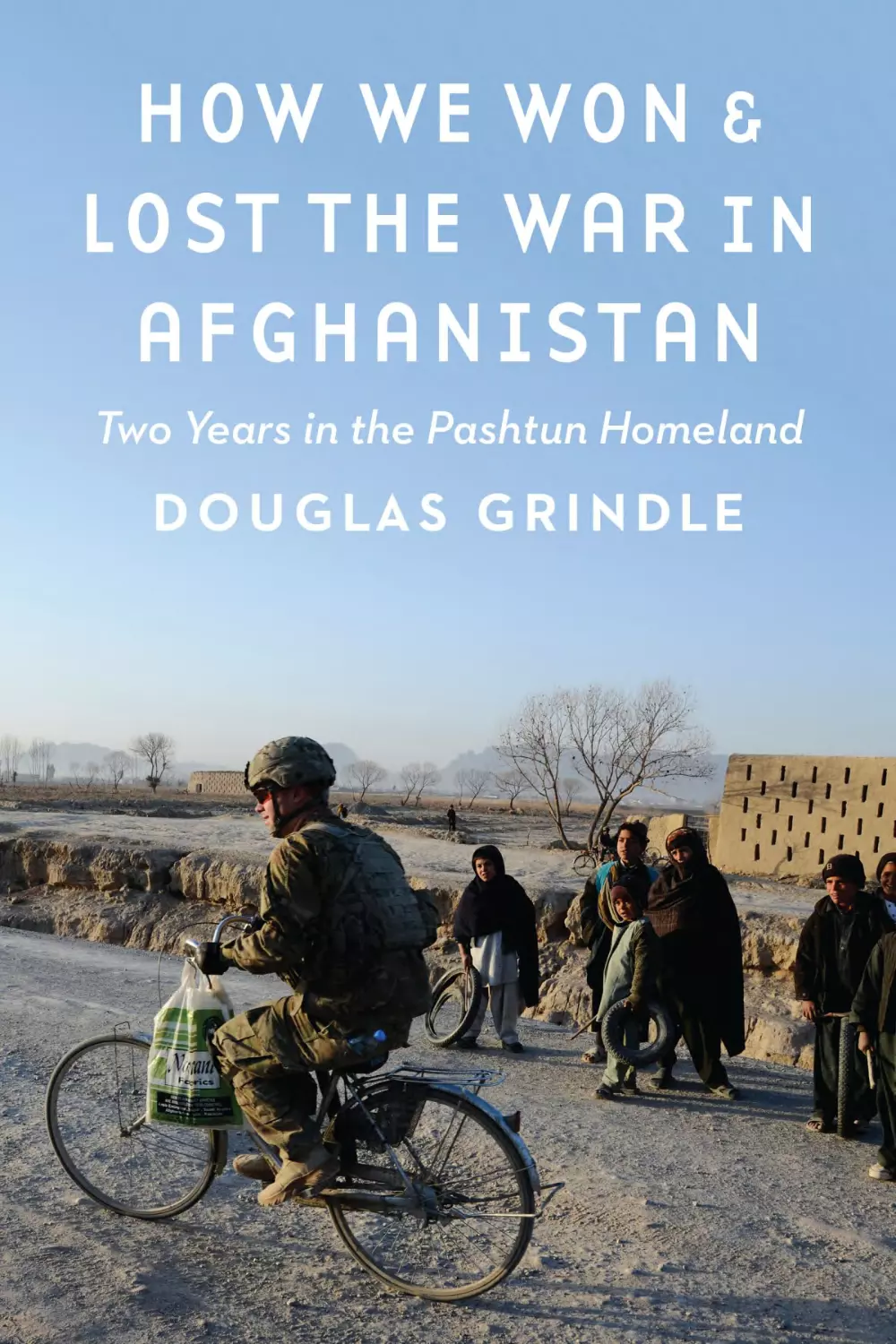


Автор: Grindle D.
Теги: history afghanistan history of peoples pashtuns history of afghanistan afghan war
ISBN: 9781612349930
Год: 2017


Текст
                    HOW WE WON &
LOST THE WAR IN
AFGHANISTAN

HOW WE WON &
LOST THE WAR IN
AFGHANISTAN
Two Years in the Pashtun Homeland

DOUGLAS GRINDLE

Potomac Books
An imprint of the University of Nebraska Press

© 2017 by Douglas Grindle. All rights reserved.
Potomac Books is an imprint of the University
of Nebraska Press. Manufactured in the United
States of America.
All photos by the author.
Library of Congress Cataloging-in-Publication Data
Names: Grindle, Douglas, author.
Title: How we won and lost the war in Afghanistan:
two years in the Pashtun homeland / Douglas Grindle.
Description: Lincoln: Potomac Books, an imprint
of the University of Nebraska Press, 2017. |
Includes bibliographical references and index. |
Identifiers: LCCN 2017017416 (print)
LCCN 2017037656 (ebook)
ISBN 9781612349541 (cloth: alk. paper)
ISBN 9781612349916 (epub)
ISBN 9781612349923 (mobi)
ISBN 9781612349930 (pdf )
Subjects: LCSH: Afghan War, 2001—Personal
narratives, American. | Afghan War,
2001—Journalists. | Grindle, Douglas.
Classification: LCC DS371.413 (ebook) |
LCC DS371.413 .G754 2017 (print) |
DDC 958.104/7— dc23
LC record available at https://lccn.loc
.gov/2017017416
Set in Lyon Text by John Klopping.

To those Afghans, Americans,
and people of allied nations who
gave much of themselves to
make Afghanistan a better place

CONTENTS
List of Illustrations

ix

Acknowledgments

xi

Prologue

xiii

Introduction

xv

List of Abbreviations

xix

PART ONE. Into Afghanistan

1. The Train-Up

3

2. KAF World

9

PART TWO. Into Dand

3. Settling In

17

4. Ousting the Taliban

27

5. Nazak’s Grand Bargain

35

6. Priming the Economy

45

7. Waiting to Work

55

8. Kick-Starting the Staff

68

9. Outpost Life

79

10. Security Holds

88

11. Women’s Work

100

PART THREE. Dand in the Balance

12. Stealing from Women

113

13. Still Starved of Money

122

14. Corruption of Many Kinds

139

15. Holding Back the Taliban

147

16. The Economy Misses

160

17. Solutions Made in Washington

169

18. Dand in the Balance

177

PART FOUR. On to Maiwand

19. Two Districts

189

20. Security Failing in Maiwand

199

21. Drugs, Not Jobs

209

Epilogue

217

Notes

225

Bibliography

233

Index

239

ILLUSTRATIONS
Following page 138
1. Dand District Center
2. Hamdullah Nazak, sub-governor of Dand District
3. Farmers crowd around a Dand District official
4. Farmer and boy on a tractor
5. American Stryker armored vehicle
6. Weekly meeting with elders at the Dand District Center
7. USAID trailers on Combat Outpost Edgerton at sunset
8. Village well in Nahre Shefe
9. Sewing machines
10. District Governor Nazak addressing an agricultural
conference
11. Captain Matt Kotlarski
12. Afghan National Police outpost
13. Commercial chicken farm in Dand District
14. Farmers in the village of Karz
15. Hills near Kandahar City
16. Salih Mohammad, sub-governor of Maiwand District
17. Shura in the village of De Maiwand
18. View of the Maiwand bazaar, Highway 1, and fields
19. U.S. and Afghan soldiers walking back to their base
Maps

1. Kandahar Province

xxi

2. Dand District

xxii

ACKNOWLEDGMENTS

This book could not have been written without help from a wide range
of people who provided the inspiration and insights needed to bring it
to fruition.
In Afghanistan I was incredibly lucky to collaborate with many colleagues in the field who worked in the military, in government, and in
private employment. They made it possible for us to understand our
options so we could push forward on many fronts and make our corner
of Afghanistan a better place. Without their wisdom and hard work, none
of this would ever have happened. Sadly, with the continuing instability in Afghanistan, it is best to leave a number of names of these brave
Afghans unwritten in the text.
The manuscript owes a great debt to my tireless editor, Laura Taylor,
who ensured common sense and good grammar prevailed.
The editors and staff at University of Nebraska Press, to include Tom
Swanson, Natalie O’Neal, and Leif Milliken, worked with understanding
and professionalism to ensure the best possible book emerged between
two covers. They are a first-rate team, and it has been a privilege to work
together.
I take sole responsibility for any errors that have crept into the work
despite the best efforts of all concerned.
Finally, I appreciate most of all the unending support of my wife, Joy
Grindle, who has made the writing of this book an easier task. She was
a model of forbearance as I disappeared for nights on end to polish and
repolish these words, and she is the best wife anyone could ask for.

xi

PROLOGUE

In the faded photo a woman stands in bright sunlight in the middle of a
poor Afghan village. She gazes confidently into the camera lens. She is
in her twenties, with almond skin and black hair tied back. She wears a
pleated skirt and a blazer, and she holds a sheaf of papers. Behind her is
a mud house. She is a government employee charged with helping villagers stay healthy, and she’s clearly proud of her position as a servant
of Afghanistan.
The woman was a community health worker. The photo dates from
the early 1970s, when she was sent into the villages to improve the health
of the women. If she is still alive she would be about seventy. There is a
good chance she died many years ago. The average life span for Afghan
women is fifty-one years, and forty-eight years for men. More than a
million people died during the Soviet war of the 1980s.
The Afghan government no longer sends neatly attired health workers into the villages. The picture is a relic of the past. The government
does maintain community health teams inside villages. Often they are
husband-and-wife teams. They receive limited training, and they usually
keep a low profile to avoid attracting the attention of the Taliban, who
would harass or kill them.
Thirty years later a man walks out of Mirwais Hospital in Kandahar
City. He is tall, thin, and in his mid-forties. He is dressed neatly, with
a worn blazer over his Afghan shalwar kameez clothing. But he wears a
harried look, as if the day is too short and life too ephemeral to carry the
many burdens he bears. He throws his leg over his motorcycle and starts
the engine, roaring off.
The man is Dr. Mousa, a full-time physician employed at the
government-run hospital. He also works as the government’s director
of health in Dand District, being responsible for its seventy-five thouxiii

sand people. He splits his time between the district and the hospital.
Because his pay at the hospital is low and he is not paid at all for his work
in Dand, he works a third job at a private clinic. His daily pace is frenetic.
Dr. Mousa has too many places to go and not enough time. Soon he will
lose his job at the private clinic for not putting in enough hours. Dr. Mousa
is constantly worried about earning enough money to feed his family.
Even though Dr. Mousa is the health officer for the district, he rarely
visits the husband-and-wife teams in the villages. Security threats don’t
deter him. Unfortunately he cannot afford to go. The government does
not pay him, nor does it provide a fuel allowance for his motorcycle. His
hospital pay will either feed his family or fund his visits to the community health workers, but not both.
In 2011 Dr. Mousa worked in Dand for nine months without pay. He
never received a fuel allowance. He never went to check on the village
health teams. Eventually the health ministry shifted Dr. Mousa to another
job that offered a salary.
The story of Dr. Mousa and of the old-time community health worker
is the story of life in the districts of rural Afghanistan. It is not an unusual
one. It is one wherein Afghan officials want to do the job they’ve been
assigned but find it difficult, or impossible, to succeed. It is a story of
problems but also one of hope, success, and future promise. But it is
offset by sadness and disappointment.
This is the story of a year in Dand District in southern Afghanistan,
followed by a year in nearby Maiwand District, and it is also the story of
how our U.S. government district team attempted to make things better.

xiv

PROLOGUE

INTRODUCTION

Possessing many noble and natural qualities, such as individual courage,
hospitality, and generosity, of fine and commanding appearance and
presence, good horsemen, capable of enduring, without complaint, much
exposure and fatigue, fond of all manly sports, and frank and social in
their bearing and manners, there was much calculated to prepossess
us in favour of the Affghans as a people on first acquaintance. Further
experience, however, proved them to be destitute of all regard to truth,
treacherous, revengeful, and bloodthirsty, sensual and avaricious, to a
degree not to be comprehended by those who have not lived among them,
and thus become intimately acquainted with their character. — Lt. General
George Lawrence, Reminiscences, 1875

Ten years after the Americans invaded Afghanistan and ousted the Taliban, the life of an average Afghan had changed in countless ways. More
than eight million children attend school, millions of them girls.1 The
bazaars bustle, and a woman can give birth to her baby in the local health
clinic. Villagers drive down smooth roads where before they navigated
potholed tracks.
Despite this type of progress, much of Afghanistan remains stubbornly
and overwhelmingly unchanged. It is a rural land where millions of small
farmers eke out a living on two or three acres of thin soil and often give
more than half of their harvest to their landlord. Even in 2011 it remained
desperately poor, ranking 172 out of 187 in the United Nations’ world
rankings for human development. With a per capita GDP in 2011 of only
$528, Afghanistan remains one of the ten poorest countries in the world.
Average life expectancy is 48.1 years, and infant mortality is the highest
in the world. Over a third of Afghans live below the poverty line.2 On top
of this, Afghans remain threatened by continuing insecurity. More than
xv

twenty-six thousand Afghans have died since the U.S. intervention, and
the death toll keeps rising as the Taliban insurgency continues to grow.3
Before the current war began Afghanistan was already a shattered
country, broken by the Soviet invasion and the subsequent decade of
fighting. It is hard to imagine the scale of suffering. By the time that war
ended more than a million had died, or roughly one in fifteen Afghans.
Seven hundred thousand became widows or orphans. Millions lived as
refugees in Pakistan and Iran. Five million to seven million land mines
were buried on precious farmland. Fragile irrigation channels that poor
farmers had relied upon for centuries lay in ruins.4
Into this land came the United States, with high hopes of improving
the lot of the Afghans. The U.S. government wanted to build a new and
democratic Afghanistan. The logic was simple. To keep out al Qaeda we
needed to keep out the Taliban. To keep out the Taliban we needed a
strong country capable of defending itself. To defend itself the country
needed a government that worked well enough to entice people to support it. To ensure the government was sufficiently effective we needed
to help the Afghans create institutions that could help people in urban
and rural areas, providing health care, education, roads, electricity, and
irrigation. In essence, to accomplish our goals we needed to help build
up the nation. That is what we tried to do.
But over time, distracted by Iraq, underresourced, working with allies
who routinely broke their promises, using development plans that continually overreached, and having a poor understanding of the society
that we endeavored to change, our nation-building efforts faltered. The
Taliban used this opportunity to filter back in, and the war started again
as a widespread insurgency, helped by corruption, popular disenchantment with the government and its foreign allies, and the missteps of the
United States and the international community.
Despite advances in education and health care, what could go wrong
did go wrong. Many districts had one medical clinic for fifty thousand
people, or none at all. Many of the teachers the government hired were
ghost teachers, who taught in ghost schools under trees or who didn’t
show up at work. Eight million kids were in school, but how many were
actually being taught? No one really knew.5 The Taliban also influenced

xvi

INTRODUCTION

our progress. They burned down scores of schools and killed thousands
of people who supported the government.
Slowly the United States turned away from nation-building. In a
speech in late 2009 at West Point President Obama told the cadets that
nation-building in Afghanistan was too difficult to achieve. He said,
“Indeed, some call for a more dramatic and open-ended escalation of
our war effort— one that would commit us to a nation-building project of up to a decade. I reject this course, because it sets goals that are
beyond what can be achieved at a reasonable cost, and what we need
to achieve to secure our interests.”6 Instead he said America would
stay in Afghanistan to clear out al Qaeda and put in place the security
forces that would keep them out. (At this time al Qaeda had roughly
150 men in Afghanistan.)
But just saying something doesn’t make it true. The original strategic calculus—arrived at by walking the dog backward—still ended with
the need for the United States to help the Afghans build their nation to
prevent the Taliban from getting back in. So U.S. assistance for nationbuilding continued after 2009, up from $748 million in fiscal year 2007
to more than $2 billion in FY 2011.7 Military assistance was vastly higher.
The United States pretended to give aid for new and different causes and
enterprises. In reality the United States still pursued the same nationbuilding idea. Simultaneously the surge in military forces ramped up
to as many as one hundred thousand fighting men in 2010, when troop
strength peaked. We simply doubled down on our effort.
To accompany the military surge the civilian agencies “surged” their
people on the ground. Far fewer than the military cohort, the number
of these civilians never even approached two thousand. I was one of
them, hired by the U.S. Agency for International Development (USAID)
in 2011 as a field program officer to help bring projects to villages in rural
Afghanistan and to improve health, education, roads, irrigation, and the
capabilities of the local Afghan government.
To be truly effective this field position called for paradoxical qualities
in its officers. They needed to possess the humility to put the wishes of
the Afghans first, paired with the obstinacy to push back against the
bureaucracy when it erred.

INTRODUCTION

xvii

The U.S. involvement had built in its own limitations. There was inflexibility in the U.S. approach, despite the need to be flexible in an insurgency that was always changing. There existed a willingness to label the
Afghans as quarrelsome troublemakers and as the root of many of our
problems, even as we expended billions of dollars and hundreds of lives
every year to help them take the initiative. Above all a deep-seated distrust toward our Afghan partners prevailed, when only they could win
the war and allow us to go home with honor.
This book is the result of the two years I spent in rural Afghanistan,
where these paradoxes and limitations came fully into play. It is a tale
of hope and success, and of anger and failure.
The story begins at a small coalition military base a short helicopter ride
to the south of Kandahar City, the largest city of southern Afghanistan
and the heart of the region. There lies a point where four roads radiate
out in a crooked cross, surrounded by a patchwork of green wheatfields
and brown patches of dirt baked hard by the sun. The landscape is dotted with villages. On either side of this broad stretch of land rise jagged
hills, like the teeth of a gigantic dog.
This place named Dand District was where we would work with poor
villagers who tilled emerald green fields irrigated by centuries-old canals
under blue skies. This story explains how our little group of Afghans,
Americans, and Canadians tried to keep out the Taliban and bring hope
to the poor farm families who resided in the villages.
Above all it is the tale of the Afghans— of what they tried to do, how
we outsiders supported them, and what held them back. It is their story,
and I am grateful to have worked among them for two years of my life.

xviii

INTRODUCTION

ABBREVIATIONS
ANA
ANP
ANSF
AVIPAUSAID
CERP
CHAMP USAID
CN
COIN
COMISAF
COP
DABS
DCOP
DDA
DDC or DC
DDP
DFID
DG
DOWA
DST
FSI
IDLG
IED
IRD
ISAF
ISI

Afghan National Army
Afghan National Police
Afghan National Security Forces
farm aid program
Commander’s Emergency Response Program
farm aid program
counternarcotics
counterinsurgency
Commander of International Security
Assistance Force
combat outpost
Da Afghanistan Breshna Sherkat (agency in
charge of electrical grid)
district chief of police
district development assembly (of elders)
Dand District Center
District Delivery Program
Department for International Development
(United Kingdom)
district governor (officially, district sub-governor)
Department of Women’s Affairs
district support team
Foreign Service Institute
Independent Directorate of Local Governance
improvised explosive device
International Relief and Development
(contractor for USAID)
International Security Assistance Force
Inter-Service Intelligence Directorate (Pakistan)
xix

KAF
LAV
MACV
MASH
MATV
MRAP
MRRD
NDS
NGO
NSP
O&M
PRT
RP
RRD
RSSA
SIGAR
S-RAD
USAID

xx

Kandahar Airfield
light armored vehicle
Military Assistance Command Vietnam
mobile army surgical hospital
MRAP all-terrain vehicle
mine-resistant ambush protected
Ministry of Reconstruction and Rural Development
National Directorate of Security
nongovernmental organization
National Solidarity Program
operations and maintenance
provincial reconstruction team
Regional Platform (South)
reconstruction and rural development
regional south stability assessment tool
Special Inspector General for Afghanistan
Reconstruction
Southern Regional Agricultural Development
Program
U.S. Agency for International Development

ABBREVIATIONS

URUZGAN
MIA
NESHIN

NESH

N

HELMAND
ZABUL
GHORAK

SHAH WALI
KOT

KHAKREZ

ARGHANDAB
MAIWAND

Kandahar City

ZHARI

DAND

Kandahar Airfield (KAF)
ARGHISTAN

PANJWAI

K AN DA H A R P RO VIN CE

MARUF

SPIN
BOLDAK

DAMAN

R E G

D E S E R T

SHORABAK
REGISTAN

N
ISTA
HAN
AFG ISTAN
PAK

MAP 1. Kandahar Province

KANDAHAR

0
0

10
20

20

30
40

40
60

50 mi
80 km

Kandahar City

N

Daman
District
Karz
Deh Bagh

Rumbasi

Panjwai
District

Bellanday

n
Tar

iver
ak R
Rawanay

Nakadak
Gorgon

Ruhabad

Nahre Shefe

0

1

2

3

4

Dari

Rud

5 mi

0 1 2 3 4 5 6 7 8 km

MAP 2. Dand District

RE G DESERT

Kandahar
Airfield (KAF)

HOW WE WON &
LOST THE WAR IN
AFGHANISTAN

PART ONE
Into Afghanistan

1
The Train-Up
But if you intend to keep India, you must manage to train up men in
the spirit of your Malcolms, Elphinstones, and Metcalfes of times past,
and of Sir George Clerk in later days;—men who by their character and
the confidence the natives have in them, can hold their own without
the immediate presence of battalions and big guns.— Sir Bartle Frere,
Afghanistan and South Africa, 1881

I gripped the steering wheel and twisted my head back over my shoulder. The instructor sat beside me, his beefy arm draped loosely across
the back of my seat as the speedometer of the old Ford Crown Victoria
wound up, passing 25, 35, and 40 as we accelerated down the racetrack
in reverse. We bounced tail-first along the speedway. I eased off the gas
as we approached the corner. My eyes followed the grass along the edge
of the track as I turned the wheel and we circled around the bend and
accelerated hard down the next straightaway.
People headed to Afghanistan were expected to know how to drive
themselves out of danger in the unlikely event they blundered into
an ambush. Reversing at speed and driving through solid objects was
designed to give us the confidence to drive ourselves out of dicey situations in the dangerous world we were about to enter.
Despite this danger, most trainees would never actually use these
skills. The only driving I would do would be in a minivan on Kandahar
Airfield or in the back of an armored military vehicle out on patrol. The
high point of the days at the speedway involved ramming through a car
that blocked the road, using the heavy Crown Vic as a battering ram. Tips
from our burly and brainy instructor included, “Slow down before hitting
3

the blocking vehicle,” “leave enough room to accelerate hard through
it,” and even more to the point, “hit the wheels, which are attached to
axles; this the most solid part of the opposing car.”
Lots of fun but not very useful for my destination.
It contrasted to our first week of training in Washington DC, where
we’d trooped from room to room in USAID headquarters, gathering ID
cards, attending security briefings, and completing life insurance forms.
Tedious stuff, but I appreciated being back in the United States. I had
just spent sixteen straight months in Afghanistan as a civilian researcher
for the Department of Defense working on a human terrain team. I visited villages in the farthest-flung districts in southern Afghanistan and
wrote reports for the military. Almost every month I went to a new district,
conducted fifty or sixty interviews with the local people, and reported
back to the U.S. Army commander on what the people thought about
security, how they made a living, what they thought about the Afghan
government, and how to improve the situation. My recommendations
would end up as projects, in new ways for the soldiers to talk to the people, or new ideas on where best to commit resources.
Three weeks before I arrived in DC I wrapped up my last study in
Shamulzai District in Zabul Province near the Pakistan border. I briefed
the brigade, delivered a thirty-page paper, stopped at Kandahar Airfield
to pick up my transit paperwork, and flew on to Kuwait, Atlanta, Fort
Benning, Fort Leavenworth, and finally Boston, where I took a threeweek break.
The previous sixteen months in Afghanistan had taught me a lot about
what the Afghans thought and how to influence them. I arrived in Washington DC for predeployment training for USAID in late February 2011.
USAID’s building was modern and impressive, with a quiet hum of activity and long carpeted hallways lined with hundreds of doors to open-plan
offices. It felt good to reconnect with a nine-to-five office environment.
Afghanistan felt a world away when contrasted with healthy-looking
Americans dressed in business attire. Yet here we were, part of the expansion of U.S. civilian presence in Afghanistan, our numbers increasing
from 320 to almost four times that total in under three years. We trod
a well-worn path from office to office, clutching our paperwork. Our inprocessing class was tiny, with only six people. All of my fellow class4

THE TRAIN-UP

mates were gracious, funny, and smart, and we soon became a happy
and close-knit group.
By our second week the flow of in-processing paperwork ceased and
we started to really learn in a weeklong seminar. The all-day classes were
taught by an experienced Afghanistan hand who had lived and worked
there for twenty years and was married to an Afghan man, as well as by
a USAID manager who knew the ropes. We learned how to interact with
the Afghans, how to identify the most important individual in a house
(only lackeys sit beside the door), and how not to insult the Afghans.
We soon moved to formal State Department training, held at the Foreign Service Institute (FSI) in Arlington, Virginia. Here we spent two
weeks in large classrooms, crammed in with about fifty people from other
agencies. Lecturer after lecturer came in to tell us about the arcane nature
of the bureaucracy and our place in it. Unfortunately the lecture material repeated much of the information we had already learned about the
culture of Afghanistan, including how the Afghan government worked.
We acquired background information instead of what we wanted: the
specifics of what we would be doing. Details were sparse. We asked what
we might be doing once we reached Afghanistan. A presenter explained,
“One of the most important things we can do is influence the master
narrative, especially among the young people.” This sounded awfully
smart, but did it mean anything?
Training was supposed to prepare us for the next year or two abroad.
The previous October, in 2010, a report by the Office of the Special Inspector General for Afghanistan Reconstruction (SIGAR) noted that trainees
received “limited information on their roles and responsibilities before
arriving at their assigned locations.” The State Department assured the
inspectors they were working to fix the problem.1
Annoyingly the instructors insisted on answering our questions with
one correct “book” answer. Despite fifty experienced people in the room,
this practice killed any chance for real discussion. Other students had
worked in places across the globe and implemented innovative ideas,
but they received no encouragement to explain them.
Much of the second week at FSI repeated the first week’s lectures with
a few variations. In my notes from early April are scrawled the words,
“Training hits rock bottom. Seeing the same COMISAF [Commander of
THE TRAIN-UP

5

International Security Assistance Force] slide three times today, plus
four times previously.”
Then one day a dapper-looking man came and spoke to us for about
forty-five minutes. He wore the kind of highly polished brown shoes
that are seen only in British Parliament or investment banks. Former
ambassador Ronald Neumann, who had recently finished leading the
U.S. embassy in Kabul for almost three years, said America had simply
not devoted the time and effort to winning the war, because it was distracted by Iraq and had let the Taliban back in.
In his experience short-term cycles of three-year plans had failed. And
he noted that now, in 2011, America was again embarking on a threeyear plan (2011–14) that would probably fail, because American planning
was still too focused on the short term. Clearly trying to tell the truth,
Ambassador Neumann was a marvel of forthrightness, clarity of vision,
and depressing realism.
To finish up our training we flew to Indiana, where the National Guard
runs a military-style camp. Here trainees are supposed to learn how to
interact with real Afghans in contrived scenarios. Unfortunately the students were ill prepared for the ordeal. Despite our many lectures at FSI,
we received no clues on how to deal with Afghans in meetings. Despite
our cultural training, we remained ignorant of the cultural and political
nuances that would affect our ability to run meetings effectively. The sole
advice given to us in the FSI lecture halls was to never promise more than
you can deliver or, even better, never promise anything at all.
Indiana was fraught with these unanswered questions. Should we
take a hard or soft approach to get Afghans to agree to do the right thing?
Which negotiating skills would work best? Indiana would be trial by fire.
The trainees included USAID development people, State Department
political officers hired temporarily for Afghanistan, law-enforcement
types, and bodies from a bevy of agencies, including the Office of the
Inspector General. The training assumed we already knew what made
Afghans tick. Most of us had never been to Afghanistan. This wishful
thinking broke down almost immediately when the scenarios began.
In Indiana the training kicked off on a somber note. During a video
teleconference from the U.S. embassy in Kabul we learned that we would
be arriving in an atmosphere of declining resources. One embassy staffer
6

THE TRAIN-UP

bluntly advised, “We are ramping down our work.” And we discovered
that most of the development work would be done at the provincial level,
not in the districts where a number of us were headed.
We lived in an encampment composed of steel-sided trailers, a large
sheet-metal central meal hall, and a similar classroom building. Every
day we traveled via military Humvees to an unused mental institution
redesignated as the staging area for our meetings. American mentors
accompanied us into the rooms where we would meet Afghan Americans pretending to be Afghan government officials. The trainees needed
to discern the individual’s problem and offer a solution as we fumbled
through each forty-five-minute meeting.
Before and after each session the instructors told us to never promise
anything to any Afghan, not ever. We were advised to “promise less” and
push the Afghans to use money from their own budget. This advice inevitably flew in the face of our real jobs as USAID field officers, which called
for us to guide the disbursement of hundreds of thousands of dollars in
a single district in a matter of months. It also ignored the reality that
the Afghan government had almost no money to fix anything, because
its own budgetary funds rarely reached the countryside. No matter; we
were to press on within the rules.
As the meetings progressed, the advice given by the American mentors and the Afghan American “players” rarely meshed. The week culminated in a helicopter ride, a traditional Afghan supper and dancing in
the old mental institution facility, and a van ride to the airport the next
morning. Our little group headed to the bar at the airport and tried to
forget the puzzling advice.
We received a course in countersurveillance during which we drove
around suburban Washington in a van and tried to learn to detect “terrorists” who were observing us. We managed a detection rate of about
5 percent in spotting lurking watchers, suggesting we had a lot to learn
if our eyes and ears were actually needed in our future high-threat
environments.
Then it was on to the speedway with high-speed driving in reverse
and then firing guns. The weapons instructors, rugged ex-military types,
seemed embarrassed by the lack of know-how among the trainees, the
majority of whom would be working at the embassy anyway. They advised
THE TRAIN-UP

7

us that once in Afghanistan we should avoid anything to do with a gun.
“Just unload any weapons you happen to see lying around on the ground,”
they urged soothingly. This was a far cry from my previous U.S. Army job,
in which we were issued rifles or handguns and expected to use them.
Four days later our little group of six boarded a packed United Airlines
Boeing 777 for a fourteen-hour flight to Dubai. We stayed overnight in a
luxury hotel, spent some government cash on beers and chicken wings
as we overlooked Dubai’s grand canal, and the next day flew to Kabul,
where we faced another week of paperwork and lectures while cooped up
inside sterile concrete walls. With twelve hundred staff housed in tower
blocks and temporary trailers, the embassy boasted all the modern conveniences: an American-style bar, a pool, dining facilities, a shop selling
low-priced liquor, a coffee shop, and the same chancery building that
had housed the embassy back in the 1970s when the Soviets invaded.
Five days later we scattered, three of us taking a flight to Kandahar.
We regretted splitting up our group, but we were glad to be leaving those
high embassy walls. I felt bad for the permanent inmates of the U.S. mission, the same relief and regret one feels when leaving a poorly run zoo.
The small turboprop roared down the runway in Kabul, bounded into
the air, and bounced in turbulence over Kabul’s hilltops. The embassy
receded behind us, though the hangover caused by our final night’s celebrations lingered.
Kabul was past. The Afghan capital represents the strategic and commercial center of the country, and whoever controls Kabul also controls
Afghanistan. Ahead of us lay Kandahar, the heart of the Pashtun belt and
the center of the insurgency. I’d left Kandahar just fourteen weeks earlier.

8

THE TRAIN-UP

2
KAF World
The Quetta Shura Taliban has made Kandahar province and its capital,
Kandahar City, primary objectives of their campaign in southern
Afghanistan. Kandahar is also the birthplace of the Taliban movement,
and the historical powerbase of the family of Afghan President Hamid
Karzai.— Carl Forsberg, The Taliban’s Campaign for Kandahar, 2009

The twin-engine turboprop steadily descended out of the flawless blue
sky on our approach to Kandahar City. Scattered clouds streaked the sky
above. Gradually the mountains of Uruzgan and Zabul Provinces fell
behind, and the hills of Kandahar, jagged and wind worn, rose from the
flat desert floor. The land reflected infinite shades of brown, dashed with
rectangles of green where fields clustered near streambeds and canals.
A large blue lake flashed by. Pooled behind the Dahla Dam, the lake
provides water for almost a million people in Kandahar Province. Then
Kandahar City slid past the right wing, tiny cars and motorcycles filling
the main streets that cut through neighborhoods of compounds, each
nestled behind thick walls. The city is flanked to the west by a line of hills
that divide the urban area from the rural western districts of the province.
The plane lowered its flaps, dropped its landing gear, and lined up for
Kandahar Airfield. Visible beyond the left wing, forty miles to the east,
Pakistan lay behind another line of hills jumbled like a mass of waves
rolling in from the Himalayas.
We descended the last few thousand feet over green grape vineyards
and fallow fields. The plane swept low over a highway that led to Pakistan. We thumped hard onto the runway, the plane braking as we rolled

9

past lines of dusty military helicopters, fighters, and transport planes on
adjoining aprons.
Kandahar Airfield, better known as KAF, holds the distinction of being
the world’s busiest military airfield. A kind of civilization of its own, it
lay fifteen kilometers southeast of Kandahar City. It rivaled the Afghan
metropolis, being a very American city covered in thick Afghan dust.
The airfield was built around Kandahar International Airport, a grand
title for a dusty runway and terminal building built in the 1960s as a way
station for propeller airliners on the Tehran-to-Delhi route. Even before
its completion the airport was obsolete, modern jets passing miles above.
Settling into dusty irrelevance, the airport was resurrected by the
American invasion in 2001. During the seven years previous to our team’s
arrival it had become a metropolis, a boomtown, and testimony to the
ever-expanding war effort. KAF was a sprawling monstrosity of modular
housing, domed metal workshops, dusty asphalt roads, tents, and the
bustle of tens of thousands of people running and servicing the war in
southern Afghanistan.
We stepped off the plane and into 85-degree sunshine on a ramp owned
by the U.S. embassy. The State Department maintained its own air fleet.
Vietnam- era Hueys lined up with rotors pointing crookedly at the sky
beside a Russian-built Mil transport helicopter and two old CH-46 Sea
Knight twin-rotor helicopters painted in State’s special gray-and-blue
livery, also Vietnam vintage.
We and our bags were whisked by minivan to the government civilian
compound, past military crews laboring over helicopters in various stages
of loading and unloading, some with their cowlings open and engines
exposed for maintenance. Hundreds of helicopters baked in the sun,
most closed up and empty.
At the civilian office we checked in with staff. Regional Platform South,
which accommodated civilian government employees who lived and
worked in three prefabricated, two-story buildings, was tucked inside
a tall wire fence.
The civilian buildings occupied a corner of a sprawling compound that
housed the military headquarters. In previous years the embassy staff
had worked in a drab, green-painted wooden building closer to the military. Now the hulking white prefabs of RP South represented a step up
10

KAF WORLD

and a step away from the military’s purview, as the enclosure was inside
a tall wire fence and sported its own entrance to the rest of KAF. Inside
the Platform the linoleum on the floors was clean and free of dust, and
the office doors were uniform and trim.
Regional Platform South complemented the military’s headquarters,
known as Regional Command South. Never mind that the military had
something approaching thirty thousand people in the south and the
civilians numbered around two hundred sprinkled across the bases in
Kandahar and three other provinces. The point was that the civilians
were making an “equal” effort, and the military surge troops were being
matched by equivalent civilians.
The Platform was organized into functional specialties, some people
working on governance, others on agriculture and economics, or infrastructure, health, or education. Oddly the whole setup was almost exactly
replicated about twelve miles away in downtown Kandahar City, where
civilians and their military counterparts worked at another coalition
base. There the Kandahar Provincial Reconstruction Team (PRT) worked
with Afghan ministries inside the city, covering the same subject areas
and generally feuding with the people assigned to similar jobs at KAF.
Shown to our temporary accommodation trailers, we were released and
told to be on hand for the next morning’s briefing. Inevitably daily life at
KAF revolved around meetings, usually with other Americans and sometimes with other Americans at the PRT. Few KAF personnel, with some
exceptions, met regularly with Afghans in the ministries in Kandahar
City. Encouragingly the women in charge of health and education interacted with the Afghans—the only way to learn how Afghanistan worked.
Two of us from my training class remained at KAF for a few days to
process in before heading to other areas. A third newbie would be based
at KAF permanently.
In our downtime we strolled around KAF. The compound was located
a short distance from the central quadrangle the Canadians had constructed of wood when they took control of Kandahar five years earlier.
Called the boardwalk, it contained shops and fast-food restaurants, with
coffee shops, a French-style bakery and deli, a German military exchange,
as well as a fully stocked TGI Fridays and a KFC. Off- duty soldiers and
a ragtag assortment of civilians in sunglasses and baseball hats strolled
KAF WORLD

11

the boardwalk at all times of the day and night. Inside the quadrangle the
Canadians had built a concrete-floored street hockey rink, complete with
professional-looking boards. Matches between teams of sweating soldiers
in an assortment of sports clothes were held before cheering crowds.
The surrealism of KAF was enhanced because of its disconnect in
space, time, and outlook from the surrounding countryside, as nearby
hills loomed over the hockey and volleyball games. A tall wire fence separated KAF from nearby villages, and the feel and flavor of the place was
American. Third-country-national staff hired from Manila, Delhi, or one
of a dozen other locales ran the dining halls and did most of the basic
labor around the base. The atmosphere was determinedly American.
All day and every day jet fighters blasted off from the runway or
screamed across the sky, making tight turns at a thousand feet to slow
down and line up for landing.
Insurgent rockets occasionally impacted inside the vast base. People queuing for hamburgers in the dining halls might hear an alert and
crouch down, waiting for a rocket to land, usually out of earshot. Minutes later they would go back to the buns and Heinz ketchup. The rockets arrived about four times a month but failed to bring the full reality of
Afghanistan onto the base itself. Causing a minor trickle of casualties,
they seemed like an unwelcome visitation from a war movie rather than
an act of war itself.
KAF’s boardwalk was a tenacious outcrop of American life, but in the
years before our team arrived it almost didn’t survive. The previous year
the U.S. Army commander, General Stanley McChrystal, and his command sergeant major had taken issue with the “soft” life provided by the
fast-food joints and knickknack shops. In his memoir McChrystal said
he was disturbed that soldiers in the most forward bases worked without respite while those in the rear at KAF had it easy. He ejected Burger
King, Subway, and a few pizza places from the boardwalk.
Six months later the army backpedaled. The “no-fun” policy was
scrapped and fast-food joints reopened, with some official mutterings
that a tight supply situation on the road from Pakistan had required the
shutdown. This reasoning was viewed, widely and correctly, as mealymouthed subterfuge. I never met a forward-based soldier who hated the

12

KAF WORLD

fast-food joints at KAF; they just hated KAF and viewed it as a bastion of
rear- echelon people who contributed little to the war effort.
Our stopover in KAF lasted a week. I had been assigned to a half dozen
districts by the time I reached KAF. Now I would be going to Dand, a small
rural district just south of Kandahar City and just over the rise of hills
to the west of KAF. Home to almost seventy-five thousand people, just
one American and one Canadian civilian staffed the district. The U.S.
guy had already left Dand, heading home, and we overlapped by about
forty- eight hours at KAF.
Keith Pratt, a man with a weatherbeaten farmer’s face and piercing
eyes, resembled a slimmed- down Santa Claus, complete with bushy
beard. He blended well with the beard-wearing rural Afghans. The beard
disappeared as he transitioned out.
Keith was opinionated and didn’t mind making waves. Unpopular in
some offices at KAF, he was popular with the Afghans in Dand who saw
in Keith someone who would fight for their interests. Keith was running
a particularly sharp feud with an adjoining office named the Stabilization
Unit, and he related the details with gusto.
Now firmly assigned to Dand, I would fly out the next day. Matthew,
from my training class, would be taken to the adjoining district, Panjwai,
which was unstable and dangerous.
Our forty-year- old refurbished Sikorsky Sea King helicopter lifted
off from KAF and clattered its way fifteen miles west from KAF toward
Dand. We flew past the jutting brown hills, looped up past Kandahar
City. As we entered Dand we saw scattered villages, each surrounded
by fields of yellow wheat and green grapes. Smoke climbed wispily from
tall chimney stacks.
The big helicopter circled and descended to a small military base near
a road junction. Military tents surrounded by gravel occupied one side
of the base; a cluster of white-painted concrete buildings took the other.
The base in Dand was home to about one hundred soldiers.
The helicopter circled once, banked harder, and then flared as it
crossed a double layer of fortifications to land with a bump on the gravel
by the tents. I grabbed my bags and dashed off the helicopter’s ramp. The
chopper lifted off, sprinkling the base with debris.

KAF WORLD

13

A tall guy dressed in short sleeves and old combat pants stepped forward, grabbed a bag, and headed past some shipping containers. We
dumped my bags and footlocker in front of a small white “living container” with a big satellite dish on top. A few dusty green tents flapped
limply in the breeze. I had arrived at my new home for the next year.

14

KAF WORLD

PART TWO
Into Dand

3
Settling In
We know by painful experience that the Afghans are a people of a totally
different character—turbulent—bred from infancy to the use of arms—
and with a passion for independence in which they are exceeded by no
people in this world. This love of independence is such as to make them
intolerant, not only of foreign rule, but almost of any national, tribal or
family rule. They are a people among whom every man would be a law
unto himself.— Sir George Campbell, The Afghan Frontier, 1879

The tall helpful guy was a Canadian development official named Antoine
Huss. In his early thirties, with sun-bleached hair and a chiseled face that
creased easily into a smile, Antoine served as the district political advisor
appointed by coalition forces, officially titled the International Security
Assistance Force (ISAF). In Dand for almost a year he would depart in
about six weeks. While Keith Pratt had concentrated on humanitarian
projects and the economy, Antoine tried to improve the performance
of the district sub-governor, Hamdullah Nazak, and keep Nazak’s relationship with ISAF running smoothly.1 Antoine spent hours each week
teaching English to DG Nazak and advising him on relations with ISAF,
villagers, and the provincial government. It helped that Antoine and
Nazak were roughly the same age and shared a similar outlook on life.
Although a native of France, Antoine had moved to Canada and worked
in a consular office before the tedium of processing passports and writing
reports became too much to bear. He envisioned adventure in Afghanistan, obtained a position with the Canadian foreign office, and moved
to Kandahar in 2010 after a brief stint in Mali. Wearing a light beard and

17

clothes faded by a year of the blazing desert sun, Antoine was well known
to Afghans throughout the district.
The year before Antoine’s arrival the Canadians had made a series of
mistakes in Dand, the biggest one the appointment of a political advisor
who rubbed DG Nazak the wrong way. A political advisor should help
the DG to govern better and improve his work habits. The job can be a
difficult balance, because the political advisor must implement policies
formulated at higher levels of ISAF. Often the local Afghans are unimpressed with these ideas. The political officer then becomes the piggy
in the middle.
The solution is for the political officer to make suggestions and to
persuade and influence the Afghans but never to pressure them, which
would place them in a subservient position from which they instinctively
recoil. Antoine realized that cajoling and persuading would work far better than pressuring, and he solved this problem so neatly that DG Nazak
consulted Antoine on almost everything of importance in the district.
The political advisor possesses several advantages, the most notable
the fact that Afghans regard him as a potent status symbol, like a human
Toyota SUV. The advisor’s mere presence proves that the governor is
important enough to warrant a foreigner assigned solely to him. A political advisor is generally treasured by the DG, even more so if he can access
money or development programs (a USAID officer has an automatic step
up on this score). The smart advisor builds on this natural advantage.
Antoine’s Canadian predecessor had squandered this advantage and
alienated DG Nazak with his brusque, dominant manner. Worse yet he
pressured DG Nazak and his staff rather than influencing. Nazak complained the advisor wanted to run the district, expecting him as district
governor to rubber-stamp ISAF’s ideas. DG Nazak felt sidelined within
his own district center. “The Canadians told me to do things,” Nazak
explained about that time. “So then I stayed outside at the clinic for
ten days.”
Nazak protested by moving from his office inside the Dand District
Center (DDC) to a small building outside the front gate that had once
been used as a clinic. He refused to return until the advisor left. He also
demanded the Canadian battle group strike its tents, which were then
only a few yards away from the DDC, and move to a new base that would
18

SET TLING IN

be built just outside the walls of the compound—which is how the gravelcovered military side of the combined base came into being.
With peace restored DG Nazak moved back into his office. Antoine
arrived soon after, becoming DG Nazak’s best friend in ISAF and his
most trusted advisor.
Nazak learned from this episode that ISAF could be defied if necessary. As security and governance in the district gradually improved and
as Nazak gained experience, his leverage over ISAF steadily increased.
Antoine was personable and knowledgeable. He split the daily duties
with Keith. Each day Antoine and Keith would walk through the gate
separating the ISAF side of the base from the district center compound.
Antoine would sit with the governor while Keith mentored the other staff,
especially the director of agriculture.
Antoine lived in a white sheet-metal trailer next to mine. His trailer
contained a desk and a bed. Mine had two desks, a bed, and a large metal
box that housed the satellite receiver equipment. After we lugged in the
footlocker filled with USAID-issued gear and my two bags from the helicopter, little space remained. I found that Keith had thoughtfully left a
year’s supply of coffee, a deluxe brewing machine, and two CDs with
files on all his activities.
One desk was mine and the other was used by the Afghan language
assistant– cum-political advisor, Mohammad Zahir, who worked for the
district support team (DST). A native of Kabul and in his early twenties, he was stocky and intelligent. He had worked for eight years for
ISAF, mostly as a U.S. Army interpreter. Now assigned by the State
Department to Dand, he kept the foreigners on our district support
team out of trouble by advising us on Pashtun customs and etiquette
even as he translated complicated Pashtu conversations into English
and vice versa. When I arrived in May, Mohammad had been in the
district for two months and was trusted by Nazak, which was invaluable as Antoine prepared to leave.
It didn’t take long to get settled into my little hooch. The metal container I lived in was located near the perimeter wall of the base and
sported a single window. Standing on the wall, which was built of wiremesh containers filled with dirt and stacked fourteen feet high, I could
see every part of the base because the other side was only one hundred
SET TLING IN

19

yards away. It took less than a minute to walk briskly from one side of
the base to the other.
Originally named Strongpoint Edgerton by the Canadians, in memory
of one of their soldiers who died in the vicinity, the base was later taken
over by the U.S. Army and renamed Combat Outpost (COP) Edgerton. It
housed about one hundred people who lived and worked in a dozen green
army tents. With a Kuchi nomad camp located just outside in the desert
dust, it was a sunnier version of a MASH unit. About a dozen Canadians,
who mentored the police and managed projects, worked in the place.
They would pull out at the same time Antoine departed.
A headquarters company of U.S. Army soldiers also lived on Edgerton. Three of its soldiers visited the district center daily. The rest of the
soldiers, including a platoon of scout-snipers, ran the camp and spent a
lot of time in the gym. On many evenings the scouts went out to snatch
any Taliban unwary enough to live in Dand. A few stray civilians and
military advisors rounded out the personnel.
The base was unlike the embassy and KAF, which were unhappy postings plagued with too many meetings, stifling bureaucracy, and a bar and
pool that reminded the inmates of home but did little to cure homesickness. Our base was a small, Spartan prison behind fourteen-foot walls,
well away from the pressures and demands of rear-echelon routine. Each
day proved different, and being close to the Afghans meant you could see
and interact with the people you were assigned to help. It was a happy
base. Most people felt physically connected to the war, whether it was
catching criminals and the Taliban or working alongside the Afghans.
Paradoxically time in Dand slipped by easily with the countryside pressing in and America feeling incredibly remote; the experience at Edgerton felt authentic.
The advantage of living cheek by jowl with the district center became
obvious. The morning commute took two minutes, and we could come
and go unescorted, spending as much time there as we wanted. That day
Antoine walked me over to the district center and showed me through the
offices. The DDC was a large, two-story building paid for with Canadian
money. It was just over a year old, with a blue stripe painted on the eaves
and wire mesh over the windows. Faded red carpets lined the halls and

20

SET TLING IN

framed photographs hung on the walls, memorializing school openings
and VIP visits during the previous eighteen months.
More than twenty Afghan district staff occupied small offices in the
building. First introductions felt a little bewildering, but the staff seemed
friendly. Keith and Antoine were clearly liked and respected.
The Afghans sat at desks, many of which had computers and printers. I had seen a succession of district centers over the previous sixteen
months, and almost none held any staff, let alone people working at
desks. In the wilds of Zabul Province, in districts such as Atghar, Daechopan, or Arghandab, the offices stood empty and the district governors
remained absent for months at a time. Many of the DGs, when they did
appear, did almost no work. Just getting them to show up was an almost
impossible task.
One of the most striking district centers was in Arghandab District in
Zabul Province. Located in a remote mountain valley, it was a concrete
building huddled behind high security walls with a guard tower at each of
the four corners. The place resembled the set of an old movie on imperial
soldiering, such as Beau Geste. The governor’s office was a room with a single desk shoved in the corner and a rug and pillows spread across the floor.
The DG, Mohammad Afzel, was a well-fed Afghan of about forty-five. He
said he wanted to help the people but had no resources. The Taliban had
infiltrated the district center, which made it risky for local people to come
and see him. Neither could he visit the villages because the Taliban were
too strong and the Afghan security forces too weak. He was reluctant to
place his life in the hands of his bodyguards from the Afghan National
Police, confiding, “They just smoke hash. I don’t trust the ANP guys. They
are a threat. I tell them to search houses, and they steal everything.”
From Arghandab the road to the provincial capital had been cut by the
Taliban, so the villagers traveled along a back route through the hills. To
get to the district the DG usually hitched a ride with the Afghan National
Army soldiers, who made the journey once a month when their supplies
ran low and cleared the road of bombs by hand using wooden poles.
Consequently he spent most of his time in the provincial capital, Qalat,
where he collected his pay and lay low. Governing ranked at the bottom
of his list of priorities, and one could hardly blame him.

SET TLING IN

21

Here in Dand the staff seemed interested, competent, willing, and
cheerful. They sat behind dusty Dell computers, some actually using
them. Antoine explained the current priority was to get Internet into
the building for the Afghan staff to use—his last goal before his departure, he said.
I met Mohammad Naseem, who held the portfolio for the Ministry of
Reconstruction and Rural Development (MRRD). He also coordinated
projects. Just getting into middle age and sporting a dyed beard and the
stance of a boxer, he laughed a lot and seemed very happy to be there.
He attended Kandahar University in his spare time. He had a computer
on his desk that he tapped at constantly, producing reports for the provincial MRRD offices.
Naseem was also a former businessman who traveled widely in the
region and as far as Greece and Turkey, and he had worked for several
medium-sized companies. Now he received the government wage of
about $250 a month, plus top-ups paid out by a new USAID program. I
suspected he knew more about Afghan trade than most of the American
economic advisors brought in at great expense to work at KAF. A colleague
in his office, a Mr. Qayum, happily and quietly filled innumerable notebooks, allowing Naseem to take the spotlight and share jokes with ISAF
people who came to the office for green tea each day.
The government advisor assigned to the district was Karim Kamin.
Only twenty- one, Karim dressed well and spoke polished English. He,
too, attended Kandahar University. His father ran the Ministry of Finance
section in Kandahar City, so whenever funds failed to clear the bureaucracy in Kandahar, Karim could quickly determine the cause.
Ambitious and smart, Karim had grown up in Kandahar City. Given
his pedigree, common sense, and his parents’ desire to see him married
and following in their footsteps, he would likely spend his life advancing
through the Afghan government bureaucracy. Technocrats were slowly
coming to the fore in Afghanistan as universities took advantage of the
booming economy and stable security in the cities to produce more
graduates.
The education director in Dand, Abdul Ahad, had managed to open
almost all the district’s schools, and he had twelve thousand students
enrolled. Tall, unsmiling, reserved, and thin, he was a Barakzai tribal
22

SET TLING IN

elder. His tribal status trumped that of his job. And while he earned
only about $500 a month, his visitors young and old often bowed and
kissed his hand.
Finally Antoine took me in to see DG Nazak. Thirty-three years old,
Nazak, slender with the beginnings of a paunch, knew some English
and had quick, sly eyes and an easy smile. Nazak held the reputation of
a young man with a future. After setting up a national youth organization that brought him credibility with the power brokers of the province,
he received an appointment as district sub-governor at the tender age
of twenty- eight. He possessed obvious shrewdness and willpower. The
success of Dand in tamping down the insurgency happened in large part
due to his ability to manipulate the villagers and gain their support in the
teeth of an armed opposition.
His youthfulness didn’t concern the Afghans. The historic father of the
Afghan people, Ahmad Shah Durrani, had risen to prominence at a young
age. A former chief bodyguard to the Persian shah, Ahmad Shah was
twenty- eight years old when the shah was murdered. Under suspicion,
young Ahmad fled with the other Afghan bodyguards back to Kandahar,
where he became the leader of the southern Afghans in 1747. He ruled
with an iron hand that unified the Pashtuns and made them a force to be
reckoned with in a region of much stronger neighbors. Nazak’s strengths
were considerable, and ISAF valued him because he got things done.
By the end of our visit I felt pleased that so many things seemed to
be going right. A convivial atmosphere prevailed among the staff, who
seemed to care about their responsibilities, and the foreigners appeared
to get along well with the Afghans.
Work ceased at midday for lunch. By two o’clock the DDC emptied as
people scattered to their homes in Kandahar City. No one lived at the
DDC; everyone commuted. I was struck by how similar the place felt to
the small-town government offices in central Massachusetts that I had
covered as reporter. Dand had a similar combination of coziness, amateurishness, and cheerful competence. An underlying open-mindedness
and willingness to learn felt refreshing too.
Back at the base we met the rest of the Americans. The infantry battalion occupied a nearby larger base. One of its companies worked at
Edgerton in a tent with offices constructed out of plywood and two-bySET TLING IN

23

fours shipped from the United States and nailed together to form cubicles
and a few tables. Radios buzzed, two screens showed readouts attached
to a camera mounted on a tall pole and focused outside the wire, and a
moving map displayed nearby ISAF patrols. The soldiers worked cheek
by jowl in a jumble of spare batteries, bullets, a rack of weapons, and old
magazines devoted to coverage of hot rods and hunting. A few handpainted signs from home adorned the walls. It was jumbled, but in its
own way it was as cozy as the Afghan setup across the fence.
An officer from battalion headquarters, Captain Matt Kotlarski, ran the
projects from the military end. What we couldn’t do with USAID money
Matt Kotlarski paid for with military money, which the Canadians had
already been doing for two years. With the Canadians heading home,
Matt would be the only game in town when it came to military-funded
projects. Luckily he lived on Edgerton along with a few other battalion
headquarters soldiers charged with coordinating the Afghans, the police
mentor team, and the battalion scouts.
Matt was dark-haired and fit, a long-distance runner and West Point
graduate who hailed from Indiana. His time in the army was scheduled
to conclude at the end of his tour, but he wanted to make things better
before he rotated out. He saw Dand as a good place to make a mark, and
he spent hours in the district center and behind his computer, writing
contracts, finding contractors, and consulting with the Afghans and the
battalion staff to make sure the details were right.
His boss, the battalion commander of 1- 5 Infantry, was Lt. Colonel
Brian Payne, a blunt and determined man with an army buzz cut. Medium
height and early forties, Payne had an imposing but friendly presence, and
with more than twenty years in the U.S. Army he acted as if this posting to
a battalion command in a combat zone was the prize of his life. Married
with four children, he openly drew parallels between his offspring and
the Afghans and his subordinates, as if the rules governing his children
back home applied universally. Smart and aggressive in doing whatever
it took to improve Dand, he supported the Afghans and Nazak.
A man on a mission, Payne intended to get his soldiers out of Dand,
which saw only sporadic insurgent activity, and into the more savage
fight next door in the very unstable Panjwai District. He wanted to
move his men as quickly as possible, but his five companies in Dand
24

SET TLING IN

could not leave if the situation deteriorated. So he needed to help the
U.S. civilians keep Dand stable while his soldiers left. He directed Matt
Kotlarski to work with us to figure out how to keep the insurgents out
with ever-fewer resources. He vowed to do whatever it took to make
that happen.
That was the vision for Dand laid out at the Platform, where the goal
was to begin to turn Dand over to the Afghans. It would be easy to work
together, because our basic goals meshed. I had lucked out. No one at
USAID had provided a blueprint of how to work with the military. Training
provided us even less insight. We’d been told to “be nice and cooperate
well.” Working closely with the military was key. The civilian plan and
the military plan were interdependent, requiring mutual support. If the
military and the civilians took off on different tangents while covering
exactly the same ground, it could be potentially disastrous, as when DG
Nazak moved out of the DDC and then kicked the Canadians off the base.
This lack of preparation for cooperation, or “civ-mil” in the jargon,
was puzzling. It was especially so because the previous fall the U.S.
government’s Office of the Special Inspector General for Afghanistan
Reconstruction (known as SIGAR) had issued a report pinpointing several
problems with this type of cooperation, noting that ISAF lacked a cohesive
structure through which the military and civilians could work together.
The report said that, in practice, the civilians and military tended to figure out how to work together once they arrived on the ground, for good
or for ill, depending on the personalities involved. It noted that “civilianmilitary integration relies primarily on individual personalities.”2
So in this crapshoot we had hit a vein of very good luck with Brian
Payne and Matt Kotlarski. Payne would consider anything that might
keep Dand stable as he pulled his men out company by company and
sent them to Panjwai, and he immediately made me his partner to ensure
the Afghan government was supported during the transition. In weekly
meetings held at the battalion base, which coordinated the companies,
the headquarters, and other elements such as the police training team,
he directed that I sit next to him and consulted me often as we considered different courses of action. No-nonsense and results oriented, Brian
Payne was willing to back up his convictions with time, cash, and manpower to quickly achieve his long-term results.
SET TLING IN

25

By the end of day one in Dand the district looked promising, but the
task would obviously be enormous: to improve the performance of the
Afghan government and keep insurgents out as security forces departed.
The number of civilian programs promised to begin dropping soon, too.
At the same time, I faced a steep learning curve. Even while observing
how the Afghan government really worked, I needed to develop plans to
improve governance and the economy and to reinforce security to make
the security gains irreversible, while also ensuring our plans accorded
with the plans at the battalion and Platform.
To do all this we would mentor the Afghans and help them to improve
governance by putting in a number of development or stabilization projects. The Afghan staff would learn to govern better the same way a college computer science student might learn to write code: by doing it. We
would help them by using American money and then help them as they
eventually started to govern using their own Afghan government money
(at that time in very short supply). It was a rough blueprint.
Potential problems loomed. Memories of a tension-filled first meeting
I had attended at KAF with Keith and two stabilization officials still lingered. They had butted heads over the way forward for Dand’s economy,
adjourning after an hour in mutual disgust. I wondered when similar
obstacles would begin to emerge for me and how long the honeymoon
would last.
But first I had other things to worry about. We would need a civilian
plan that would improve the Afghans’ staff, improve the economy of
the district, and shore up security as American soldiers left for Panjwai.
In 2011 Dand experienced only scattered roadside bombs and firefights,
but it had been an extremely violent place only a short time earlier and
it could easily slide back into the abyss. No one wanted that to happen,
least of all the local residents.

26

SET TLING IN

4
Ousting the Taliban
The overstretched Canadians began to concentrate on a smaller
geographical area around Kandahar City in the spring of 2009.
Having pulled out of Panjwai, the Canadian battle group announced
in April 2009 its plans to secure a small number of villages in
the Dand district, on the southern edge of Kandahar City, where
support for the government was stronger, and then to concentrate
development aid on these villages.— Carl Forsberg, The Taliban’s
Campaign for Kandahar, 2009
The metrics of success aren’t how many enemy troops you kill.
— Fred Kaplan, The Insurgents, 2013

Near the crossroads of two paved roads are about twenty family compounds standing shoulder to shoulder, their high mud walls almost touching. This is the little village of Deh Bagh, a small settlement of a thousand
farmers on the southern fringes of Kandahar City, where the urban sprawl
gives way to open fields.
Near the crossroads sits an unused high school where one day in May
2011 a group of ragged kids climbed a blue-painted jungle gym and played
on the swings. A tiny bazaar of a dozen shops occupies another corner
of the crossroads, a bakery sits at the third, and a mosque stands at the
fourth.
Next to the high school is the center of government for Dand District.
Every American calls the district center the DC or DDC, for Dand District
Center. In the military system of acronyms, the district governor becomes
the DG and the district chief of police is the DCOP (pronounced D-cop).
27

The DC is a concrete oasis of modernity amid the somber tans and
browns of the mud-walled village. The DC’s white paint reflects the sunshine brightly. Next to it stand two slightly shabbier buildings: the old
district center, which is hardly used, and the DCOP’s poorly maintained
police headquarters.
Dand is made up of widely scattered villages where farmers eke out a
living by growing grapes, pomegranates, wheat, and vegetables. By the
time I arrived in Dand in May 2011 the district had been effectively pacified, except for areas along the fringes to the north and southwest, where
soldiers drove cautiously and occasionally hit large bombs. The Taliban
skirted the district, infesting the fringes, and it still maintained a hold
in Panjwai, the district next door. Dand had not been pacified for long.
In 2009 when the Canadians first redirected resources from across the
province into Dand, they concentrated on Deh Bagh village. It became
their model village. Stabilizing Deh Bagh was the first step to pacifying
the entire district. They commissioned a Canadian NGO to make an
agricultural survey of the village, and the consultants suggested improving agriculture and coming up with alternative businesses to boost the
farmers’ incomes. The Canadians planned to expand that idea over the
entire district.1
Despite the new resources, security remained poor for a more than a
year. A favorite tactic of the insurgents was to use the homemade improvised explosive devices, or IEDs, that would explode when a person or
vehicle moved over an electrified switch, detonating a jug of low-tech
explosives. That year and the next, patrols regularly ran into IEDs. Canadian and American soldiers drove gingerly along the dirt roads, and
they walked warily through fields and along irrigation dikes. The rattle
of small-arms fire sounded routinely as security vehicles rolled across
the landscape.
Slowly the district improved. In fact 2009 was not the lowest point.
In 2007, when DG Nazak arrived, he inherited a district controlled by
insurgents. The district center in Deh Bagh had a siege mentality, and
the new DG was beleaguered.
“When I first got to Dand, the Taliban were all over the place,” Nazak
recalled. “Gorgan, Malajat, Nakadak—the Taliban were everywhere.
So I asked the people what their problems were and went from there.”
28

OUSTING THE TALIBAN

The Taliban had come back strongly since the American invasion. In
2001 the Taliban fled from Kandahar Province, heading northward and
eastward away from the advancing U.S. Special Forces and the Afghan
leaders Hamid Karzai and his local rival, Gul Agha Sherzai, a tribal
chief and former governor of Kandahar. People welcomed the change
of regime. But over time the Taliban slowly recovered and regrouped,
living just over the Pakistani border in the cities of Chaman and Quetta.
The Pakistanis helped the Taliban reorganize and push fighters back
across the border, often pressing reluctant former Talib commanders
back into the fray.
Meanwhile U.S. Special Forces and the Afghan government missed
opportunities to recruit onto their own side former Taliban leaders who
had given up the war, often persecuting them instead.2 Corruption set
in under Gul Agha Sherzai’s rule in Kandahar, and people became disenchanted with the government’s inability to bring positive change to
many rural villages. As the government and the security forces lost their
halo of goodwill in the countryside, slowly the Taliban grew stronger and
pushed in from their Pakistani bases, recruiting as they went.
For the first few years after 2001 Kandahar was quiet, NGOs operated
freely, and life improved as health care and education ramped up. But
then the number of insurgent attacks began to rise in the province and
across the south and east.
Across Afghanistan the lengthening casualty lists reflected the rising
number of attacks; 57 foreign soldiers had died in 2003, but by 2007
foreign forces had lost 232 service members.3 Worse, insurgents turned
increasingly to laying IEDs, often using techniques learned in Iraq to make
the explosions more deadly. The IEDs took an increasing toll. As the years
passed the attacks continued to accelerate. In August 2008 the number
of attacks per month was under fourteen hundred, but a year later that
figure had jumped to twenty-five hundred. A report by DFID, the international development agency for the United Kingdom, noted in late 2008
that across the country “the security situation is rapidly deteriorating.”4
The American military was also pessimistic. In September 2009 General Stanley McChrystal argued that forty thousand more troops should
be sent to Afghanistan to stabilize the worsening situation. Otherwise, he
stated bluntly, the war could be lost. According to McChrystal, “Failure
OUSTING THE TALIBAN

29

to gain the initiative and reverse insurgent momentum in the near-term
(next 12 months)—while the Afghan insurgency matures—risks an outcome where defeating the insurgency is no longer possible.”5
In 2007 DG Nazak stepped into the middle of this rising tide of insurgent violence. He had few police in Dand and less money, and he lived out
of a small, shabby district center in the middle of some fields in Deh Bagh.
Many of the villages where the Taliban held sway were in the southern
areas of the district and hard to reach. These were the poorest villages
in the district and were in a particularly dry area where Keith Pratt had
wanted to dig deep wells and grow alfalfa. In 2007 the insurgents relied
on these villages for food, accommodations, and information. It was thus
vital to get the farmers on the side of the newly arrived governor. But the
spread-out nature of the district made it difficult to gain a critical mass of
support among these farmers, who rarely ventured far from their villages.
Worse still, Afghan security forces in Dand suffered from divided loyalties between the two rival tribes that lived in the district.
The rising number of attacks of the recent past and the district’s historical experience suggested the security forces would not do well. During
the Soviet presence insurgents operating in Dand had overrun a Communist base at Deh Bagh village, killing fifty government soldiers. The
Soviets had rarely pushed into the heart of Dand, and when they had
they had not stayed long.
In one operation in 1985 the Soviets tried to kill a group of mujahidin
leaders meeting in the village of Rumbasi, about ten kilometers along the
road leading from Deh Bagh to Panjwai. Flights of troop-carrying helicopters and helicopter gunships swooped in to cut off the village, while
more Soviets in armored vehicles pushed down from Kandahar City to
sweep up the remaining insurgents.
It was a stiff fight. Trapped, the mujahidin skillfully fired on the encircling soldiers, trying to break out. According to an after-action report
written by the Soviet commander, as the armored vehicles approached,
“the enemy opened up with interlocking, integrated small arms fire which
did not let the main body approach the village. . . . Mujahidin who tried
to withdraw out of Rumbasi to Ruvabad were cut down by fire from our
first lift.”6

30 OUSTING THE TALIBAN

In this encounter one hundred mujahidin died, and they lost thirty
weapons. But the Soviet victory was short-lived, as the battalion immediately withdrew to Kandahar City, ceding the ground to the insurgents.
Dand would continue to be a sharp thorn in the side of the Communists
throughout the Soviet intervention.
So when Nazak arrived as district governor, he faced headwinds that
suggested to any farmer the insurgents would be hard to beat. Few farmers would want to align themselves with the side more likely to lose, and
this put the wind even more strongly in the sails of the Taliban.
Nazak faced a dilemma. Every day that passed with no progress would
diminish the influence of the young and untested governor. His sole
previous experience in government was as a simple village elder. It was
not immediately obvious whether the appointment of the twenty-eightyear- old as district governor would be a success. So Nazak needed to do
something immediately to pull the locals into his orbit. While he could
defend the district center, it would be difficult to win people over to his
side if he simply remained there and exerted little power in the villages.
Yet if he overreached and suffered a defeat, he would lose much of his
reputation even before he was established. He needed a plan to maximize his limited influence and resources.
Nazak set about exploiting the few advantages he had. Dand is the
historic home of the Karzai family; the family village, Karz, lies in the
northeast corner of the district. It is also the base of the Sherzais, an
equally influential family whose most prominent son was Gul Agha Sherzai, the local strongman who took the post of provincial governor with
the support of U.S. Special Forces in late 2001 after Hamid Karzai was
appointed national leader. Sherzai had been governor before the Taliban
took over in 1994. More than 60 percent of the people in Dand belong to
the tribes of these two prominent government families, a circumstance
that offered a natural opposition to the Taliban and was one of the few
advantages Nazak held.
Nazak was concerned that the Taliban shadow governor controlled
more of the district than he did. In effect Nazak’s radius of control around
the district center was about as far as a gun would fire.

OUSTING THE TALIBAN

31

According to Nazak, he knew the Taliban shadow governor’s name
was Hekmatullah and that he lived in Nakadak, a village about halfway
between the district center and the desert in the south.
Nazak heard that Hekmatullah would go to prayers at a mosque in
Nakadak every Friday. One night Nazak gathered up his six bodyguards,
drove the six miles toward Nakadak, crossing the wide Tarnak River on
the way, and approached the mosque as darkness fell. Coincidentally a
wedding party was making its way past Nakadak. Nazak slipped his car
into the line of revelers for cover. At the right moment the governor’s
car slipped away from the wedding convoy and parked near the mosque.
Nazak stationed his men near the mosque and walked inside.
Prayers were under way and Hekmatullah was bent over in prayer
with the other men. According to Nazak, he, too, bent over and joined
the service, kneeling a few feet behind Hekmatullah.
The prayers continued. At last the mullah finished, and Nazak rose
quickly. He called out for everyone to stay put, saying, “I am looking for
a district governor! The Taliban district governor! Who is that? I am the
real district governor! He or I will die!”
Hekmatullah stared at Nazak as he spoke. Nazak relates this tale with
gusto, his eyes shining as he speaks. Afghan culture is based on tales of
personal power and strength, but even allowing for hyperbole it was a
striking thing to do. Nazak’s six men were miles from assistance back at
the DDC, so it was a high-stakes gamble.
As it happened, no one died that night. Nazak, having made his point,
beat a hasty retreat. He and his men, afraid of getting shot in their car on
the way back to the district center, elected to walk the two miles north
to the Tarnak River, and they didn’t stop until they reached the district
center four miles beyond the river later that night.
The first roll of the dice in the war to oust the Taliban governor had
paid off. Nazak survived and improved his reputation.
Several nights later Nazak repeated his exploit. He took his handful of
men and pushed across the Tarnak River again, this time going farther
south. They went to a town called Gorgan, where they read out a list of
names of the Taliban sympathizers. They announced they knew who these
men were, and they would be watching for them. Nazak warned, “Don’t

32

OUSTING THE TALIBAN

ask for projects from me if you support the Taliban.” They departed,
again reaching the district center safely.
Chancing his luck a third time, Nazak and his men again drove south of
the Tarnak River, this time stopping in Chuplanay, a village near Nakadak.
Arriving at night, Nazak delivered the same message, calling on people
to stop supporting the Taliban. He and his men gave their short speech to
the startled residents, who could scarcely believe that the newly installed
district governor was pushing into areas far from the district center.
The lightning-strike visits were a clever stratagem. They showed Nazak
could get into any village in the district, even in the south. His presence
punctured the image of Taliban control. And it cost relatively little. In
each village Nazak said the same thing: don’t work with the Taliban; work
with me and get projects. Supporting the Taliban will lead to nothing. It
is time to switch sides. Nazak said the visits took the initiative away from
the Taliban, calling into question their control over the district.
More clandestine visits to villages in the south followed. Nazak and
his men were never caught. Eventually, as security began to improve
and more forces flowed in, Hekmatullah traveled to Pakistan and didn’t
return.
Nazak had begun the long road to taking the district back, but he
needed the support of the Canadians. When they had first arrived in
southern Afghanistan in 2005, the Canadians tried to hold a score of
districts, an impossible task. Gradually Canadian responsibilities narrowed to three districts: Dand, Panjwai, and Daman. The Americans
took over elsewhere.
Change in Dand came slowly. Throughout 2008 and early 2009 the
Afghan police waged a back-and-forth fight with the Taliban. Eventually
Canadian money began to flow more freely, funding two new mosques
and a playground in Deh Bagh, as well as the cleaning of several irrigation ditches in 2008.7
In the spring of 2009 the Canadians transformed Deh Bagh into a
model village, pouring in resources and sending agricultural experts to
visit farmers in their mud compounds. That summer the Taliban counterattacked but were beaten back over two days of fighting. The government, its seat secure, expanded projects into additional villages.

OUSTING THE TALIBAN

33

U.S. combat forces strengthened the district, and by September 2010
the tide had turned. Taliban attacks dropped significantly.
People told Nazak they wanted security and projects. Nazak invited
them to the district center, and he set about spreading police and projects throughout the district.
Money trickled first into the northern part of the district. It gradually
spread south toward the arid zone in the south bordering the Reg Desert. Projects reached the villages where Nazak had pursued the Taliban
shadow governor. More people appeared at the district center to ask
for projects. The Canadians spent millions of dollars to support those
requests.
More than three years after Nazak became governor of Dand, the
situation in the villages had been transformed. The district became the
most secure in Kandahar Province, with the people firmly on the side of
the district governor. As security improved, Nazak’s stature grew, with
the Taliban reduced to trying to ambush him on the road as he drove
past in his armored Toyota. Twelve ambushes at the district center, on
the road to Kandahar City, and at his home in the city failed to kill him.
When I arrived in May 2011, Nazak was a young man with influence
beyond his years. Elders visited him in the district center every day, one
group after another trooping into his office for hours on end, every day.
But on days when the elders filed into his office to sit on cushioned
chairs and ask for his judgment about a family fight or a dispute over
land with the neighbors, Nazak often got a wistful look in his eye. It was
the look of someone enmeshed in routine, who has reached his goals,
at least for the moment, and yet cannot help but remember past heroic
moments. In their place was a political system Nazak had designed from
scratch, one that was built upon the white-bearded elders who appeared
at his office each day.

34

OUSTING THE TALIBAN

5
Nazak’s Grand Bargain
At present, the grand vizier, and almost all the great officers of the
state, are Baurikzyes, and they owe their elevation to the courage and
attachment of their clan. . . . They are a spirited and warlike clan.
— Mountstuart Elphinstone, An Account of the Kingdom of Caubul
and Its Dependencies in Persia, Tartay, and India, vol. 2, 1842
Each section of a tribe, however small, has its leading man, who is
known as Malik, a specially Pathan title. In many, but by no means all,
tribes, there is a Khan Khel, usually the oldest branch of the tribe,
whose Malik is known as Khan, and acts as chief of the whole tribe.
But he is seldom more than their leader in war and their agent in
dealings with others; he possesses influence other than power, and
the real authority rests with the Jirga, a democratic council composed
of all the Maliks.— Intelligence Branch, Division of the Chief of
Staff, Army Headquarters, India, Frontier and Overseas Expeditions
from India, vol. 1, 1907

In the fall of 2001 Hamdullah Nazak sat in a jail cell in Kandahar City.
He was barefoot because his captors had taken his shoes, and his entire
body was battered.
Until that morning his uncle had been with him in the jail, but when
the sun rose his uncle was taken from his cell, escorted to the front of
a crowd of people in a downtown street of Kandahar City, and hanged
from a crane. Nazak knew fear. His Taliban captors had promised twentythree-year- old Nazak that his turn on the crane would come when the
sun rose the next day.
35

But by a remarkable stroke of good fortune for Nazak, the Taliban
ran out of time. The next morning the Taliban fled the city as American
and Afghan forces approached. Nazak lived to see his young life almost
ended and then suddenly restored.
Nazak was jailed because he was caught spying for the former governor, Gul Agha Sherzai. Four days after the American bombing began,
Nazak’s uncle, Abdullah Khyal, almost fifteen years Nazak’s senior, dispatched Nazak to Sherzai’s house in Quetta, Pakistan. There Sherzai
gave Nazak a satellite phone, a GPS device, and a small video recorder.
Nazak hid them behind the dashboard of his car and drove across the
border back to Kandahar.
Nazak, his uncle, and other helpers tracked the movements of the Taliban, plotted their positions, and telephoned the coordinates to Quetta.
They eyed the house of the Taliban leader, Mullah Omar, and walked
Taliban trenches near the airport. After American bombs struck, they
would assess the damage and report back. Sometimes the Americans
would strike again if the target was not completely destroyed. Nazak later
told a reporter that he hated the Taliban and felt they were an embarrassment to the country.
One day in November Sherzai called on the satellite phone and told
Kyal and Nazak to leave immediately. But the Taliban police moved in
too quickly, catching them with sketches of Taliban positions, target
lists, and a telltale satellite phone number. Nazak was beaten in jail with
truncheons and cables across his whole body for weeks on end. His uncle
died under the torture before the Taliban took his body to the square
to hang before the crowd. They left his corpse there for three days as a
warning to others, draping a banner on him that read “Abdullah, son of
Habibullah, inhabitant of Salehan, who had a satellite telephone and was
giving information to the Americans, and was killing Muslims through
the Americans.” Nazak learned of his uncle’s death only after he was
released from jail, and by then Sherzai was in the governor’s office in
Kandahar City. Nazak was rewarded by Sherzai with temporary command of more than a dozen soldiers.1
It was natural that Nazak and his uncle would have sought out
Sherzai as a benefactor, and it was his good fortune that he was
accepted, though it almost ended his young life and did end his uncle’s.
36

NAZAK’S GRAND BARGAIN

Nazak’s uncle was a strong supporter of the monarchy that had been
overthrown in the 1970s. Nazak’s own family came from a moderately distinguished line of military leaders. His village lay only a few
miles from Sherzai’s. Nazak was also a member of the same tribe,
the Barakzais.
Dand District holds a mix of Barakzai, Popalzai, Achekzai, and various
other tribes. Sherzai is not the only powerful figure to come from Dand
District; President Karzai, a Popalzai, also hails from the district. The
Karzai family seat in the village of Karz, in Dand, is a few short miles
from Sherzai’s home village. Karzai’s Popalzai tribe resides in the northeast of the district, while Sherzai’s Barakzai tribal power base occupies
the south and southwest.
Competition between the two tribes has lasted for centuries. The
Popalzais ruled at the very beginning of modern Afghanistan but were
supplanted by the Barakzais; they have tried to claw their way back to
dominance ever since. The rivalry exists, in part, courtesy of a common
lineage. Both belong to the Zirak Durrani tribal confederation.
This amalgamation of tribes is immensely powerful. The name Durrani
originated with Ahmad Shah Abdali, the modern state founder who unified Afghanistan. He was a member of the Sadozai, a minor subtribe of
the Popalzai. As a young man, Ahmad Shah was serving as the leader
of the bodyguards of a Persian emperor when the latter was suddenly
assassinated by unhappy liegemen. Ahmad Shah quickly returned to Kandahar before suspicion could fall on him, as he was carrying part of the
Persian state treasure. In 1747, already a noted warrior and suddenly the
holder of great wealth, Ahmad Shah was elected leader of all the tribes
in a grand jirga of tribal elders in Kandahar.
Ahmad Shah quickly took the title Durr-i-Durrani (Pearl of Pearls),
and the Durrani name was substituted for his former tribal name, Abdali.
Ahmad Shah quickly consolidated the tribes beneath him and embarked
on successful military campaigns into India.
Though Ahmad Shah hailed from the Sadozai subclan of the Popalzai
tribe, his fame kept alive the claim to Popalzai ascendancy for centuries,
even as the Popalzais were overtaken by the Barakzais in power politics.
Even in the twenty-first century President Hamid Karzai benefited from
his Popalzai heritage.
NAZAK’S GRAND BARGAIN

37

Tribal splits defined, in part, the fissure between the Taliban and the
government. The Taliban have a natural identification with a rival Afghan
tribal confederation known as the Ghilzais. And many more Taliban
adherents come from another tribal confederation, the Panjpai Durranis.
The very genesis of the Taliban is rooted in this split. According to
Peter Tomsen, who worked for years as a U.S. diplomat in the region, the
Pakistani intelligence service, known as the Inter-Service Intelligence
Directorate or ISI, helped to establish the Taliban in the late 1980s and
early 1990s, when the agency promoted young Mullah Mohammad Omar,
a Hotak Ghilzai, as a leader. This shrewdly worked the tribal angle. By
selecting Omar, they harkened back to the Ghilzai elders, who had led the
region before being shunted aside by the Durrani rule centuries earlier.2
Popular lore has it that the Taliban arose as a reaction to a single atrocity. The legend goes that a local leader of a gang of gunmen kidnapped,
raped, and killed the children of a family of travelers near Kandahar City
in 1994. By hanging the leader of that gang from the barrel of a tank gun
and then eliminating many other strongmen, the Taliban became a force
of popular resistance to the arbitrary disorder then reigning in Kandahar. Other accounts differ on the precise origins of the movement, with
the hanging occurring at a different place or time, but most agree that
a group of tribal elders and religious figures became disenchanted with
the actions of the warlords, who stole, raped, and molested people on
the roadways. They banded together to stop the lawless behavior. Mullah Omar, a village religious leader who had fought the Soviets in the
Kandahar area, was elected the leader of the group.
Rather than being a popular movement, the reality of how the Taliban
grew is murky, according to Tomsen, who says the Pakistani ISI played
the tribal card heavily when setting the Taliban in motion, as it had in
the 1980s when it supported hard-line party leaders over moderates
against the Soviets.
According to Tomsen, “Colonel Imam and ISI’s Quetta office had been
remolding the Argestan shura into the Taliban for over a year before
the apocryphal scene on the road to Kandahar took place. The ancient
vendetta between Afghanistan’s two largest tribal confederations, the
Durrani and the Ghilzai, played an important role in Imam’s shrewd

38 NAZAK’S GRAND BARGAIN

construction of the Taliban’s hierarchy. He gave overriding preference
to anti-Durrani Ghilzais, as Zia had in selecting the seven party leaders.
And he placed Ghilzai Hotaks, such as Mullah Omar, in strategic control
of the movement.”3
Though analysts differ on the details, they agree that the centuries-old
jostling between the Zirak Durranis and their rivals, the Panjpai Durranis
and the Ghilzais, fuels the conflict today.4 Many ordinary Afghans of the
Zirak Durrani, such as Nazak, would have turned naturally against the
Taliban. The Taliban’s tribalism and radical ideology separates it from
Karzai’s ethnically mixed government and most of the Afghan people,
because banning the education of girls, employment for women, and even
music is counter to most of the closely held beliefs of ordinary Afghans.
Given this tribal background, it was natural that Nazak would seek
out Sherzai to work against the Taliban. Nazak also wanted to rise. As
a teen he’d ping-ponged from job to job, working as a farmer, a carpenter, and in a brickyard, always looking for something better. Even as his
father advised him to settle down with a single profession, his mother
expressed faith that he would succeed. His home life not always happy;
young Nazak had something to prove.
So the arrival of the Americans in Kandahar City proved a double
bonus. It saved Nazak’s life and installed Sherzai into the provincial governor’s office, which he seized at the first opportunity.
In late 2001 Karzai was approaching Kandahar City from the north as
Sherzai came from the south. Both enjoyed having American advisors and
patronage, but in December Karzai was appointed the head of the interim
government. One of Karzai’s first moves was to appoint an Alikozai tribal
elder and veteran mujahidin commander, Mullah Naqib, as governor of
Kandahar Province. Outraged, Sherzai marched to the governor’s office
and refused to leave. Karzai hastened from Kabul to Kandahar City to
see Sherzai, which was probably a mistake, because in a tribal society it
made Karzai look weak. When Karzai emerged, Sherzai was still governor, either because Karzai gave in or Naqib acquiesced under pressure.
Naqib retired quietly to a district just north of the city, while Sherzai
consolidated his power and began to engage in the massive corruption
that marked his tenure as governor. A powerful leader, Sherzai ran Kan-

NAZAK’S GRAND BARGAIN

39

dahar as his personal fiefdom with little interference from Karzai, taking
over business rivals and extorting money by arresting tribal leaders, who
could pay the ransom for their release.
Meanwhile a now free Nazak lacked an obvious way forward. Still seeking advancement and progressing steadily in business and local politics,
he bounced from Dand to the border city of Spin Boldak and back again,
along the way becoming a village elder and a used- car dealer. He established a national youth organization, garnering positive attention from
provincial authorities. At age twenty-eight he received the appointment
as governor of the “unofficial” district of Dand. (As Kandahar Province’s
newest district, Dand had a constitutional status that remained in limbo
for years.)
By then Sherzai had been transferred to Nangarhar Province in the
north, and Nazak was operating on his own in Dand. He quickly moved
to undermine the Taliban, and the Canadians began to spend money
widely. Within three years Nazak had turned that money into a viable
political system capable of resisting the Taliban’s repeated incursions.
At the heart of Nazak’s system lay a bargain he made with local maliks,
or village headmen. He would send them projects, but only if they came
to the district center to arrange the assistance. A steady flow of maliks
began to stream into the district center, a visible sign of the success of
Nazak’s system.
In return for projects the elders also pledged security, and they would
prove this security worked by opening the local school. To do this, the
villagers would provide tips that allowed the security forces to weed out
the Taliban. “Security depends on the maliks,” was Nazak’s oft-repeated
maxim.
Under Nazak’s bargain, if villagers provided no tips about the insurgents and the maliks did not visit the DDC, then projects would not flow
to the village. If a village underperformed and the school failed to open,
Nazak replaced the malik and the village tried again. Nazak reckoned
his system created better security, improved the economy, and restarted
the dialogue between the people and the government, without which the
war could not be won.
As months passed farmers could see better security, and their perception of security became more positive, which in turn made them more
40 NAZAK’S GRAND BARGAIN

likely to inform on the insurgents, which improved security even more.
It was a virtuous cycle, but the system relied on a steady stream of quickimpact projects, such as a new well, that could be installed without a
lengthy delay. Nazak needed people to feel he was responding to their
needs, even if he was merely channeling foreign money while the foreign soldiers throughout the district actually handled most of the details.
The system worked, even though being a malik was risky. In 2009 the
Taliban began a campaign across Kandahar to kill tribal elders and political leaders, including those in Dand. As late as 2010 visiting Canadian
VIPs were shot at by insurgents who lurked outside the district center.
In mid-2011 elders were still being beaten up or killed by Taliban infiltrators. One kidnapped malik gained his freedom only after a group of
elders traveled to Panjwai District, where he was being held by the Taliban, and retrieved him.
It was risky for maliks to work with the government, but they gained
personal prestige by bringing projects to their people. This played into
the widespread Afghan desire to gain a public reputation. Tribal custom
is based on pride and honor. The more honor an Afghan male possesses,
the wider his reputation. Honor and reputation are bound together. In
a small village in Dand a malik who brought money and projects to the
people gained such a reputation. At the same time Nazak also exploited
the tribal ties that people shared with the government.
I already knew a few dollars could make a huge difference in a village,
despite the risk. The year before, on a patrol in a rural district north of
Kandahar City where I worked with the Department of Defense, we had
driven to the isolated village of Baghtu. Located near the main road to
Uruzgan Province, the collection of two hundred mud houses built at
the bottom of a deep valley drew few visitors from the passing traffic.
Rocky hills covered in scrub rose on either side. The villagers in Baghtu
wanted a stone wall to protect their crops and houses from the river that
ran through the village and surged with snowmelt each spring.
“The village needs a wall to keep out the flood waters,” one farmer
said. “The recent flood destroyed a lot, and all the wheatfields are hurt.
We have lost twenty-five acres of wheatfields this year due to the flood.”
The protective wall would cost about $11,000, and it represented the
first government gift to the village. But the risk was great. Several years
NAZAK’S GRAND BARGAIN

41

before, the people in the Baghtu Valley had risen up against the Taliban
and banned them from their village. But the Taliban returned in force to
kill the ringleaders on their doorsteps. At that time the government had
been no protection. Now the villagers just wanted help.
“If we take projects, the Taliban will be angry. They will come and
beat us,” the farmer told us. “But they will beat us anyway, and we want
the projects. We want the work, and we will deal with it.”5
In Dand, under the influence of projects, tribe, and pride, the maliks
signed up en masse with Nazak. Information flowed in. Schools opened
as projects flowed back into villages. Eventually most of the northern
part of the district near the district center became safe. Then the southern half of the district grew safer. By late 2010 it too was mostly pacified.
In early 2011 the Canadians further regularized Nazak’s system and
persuaded him to divide the district into twelve different clusters of villages, each of which would receive one million Afghanis, worth about
$20,000, to spend as one-time assistance. Each cluster of five to fifteen
villages would hold a weekly shura, or consultation council, composed
of local village maliks, and each cluster would send one cluster leader
to the district center with requests.
Nazak disliked the idea of having cluster leaders, which he viewed as
potential rivals for authority and who in practice unfairly favored their
own villages when it came to apportioning the Canadian money.
“I don’t want to work with the cluster leaders. I want to work with the
maliks,” insisted Nazak. “I don’t like the cluster system.”
But the ever-practical Nazak never turned down free money. He
approved the plan and simply worked around the leaders as best he
could.
With his system working and the district center humming, Nazak
next attempted to bring the local mullahs on board. For nearly a year he
assiduously courted them, but the Taliban closely monitored the mullahs. One mullah told Nazak that to visit the district center he needed
the police to pretend to arrest him and bring him to the DDC, where they
could discuss working together. He would then be taken back to the
village by the police, showing some light abuse to keep his cover story
intact. The pressure on the mullahs by the Taliban, plus the lack of funds
to offer them, made this idea a challenging one for Nazak to implement.
42

NAZAK’S GRAND BARGAIN

Nazak’s innovations were all the more remarkable when compared
with neighboring Panjwai District, where the government made few
inroads into the insurgency throughout 2011. Its political system floundered under steady insurgent pressure.
As Dand stabilized, Nazak began to look ahead to the next step in
his career. Perhaps he would become deputy provincial governor or the
mayor of Kandahar City or maybe even provincial governor, or one day
he might even take Karzai’s job. Why not? He had pacified Dand. But
even in his triumph the years wore on without advancement, and his
enthusiasm waned. The routine administration of villages seemed to
become boring to Nazak.
Even as Nazak’s system bore fruit in early 2011 it was threatened by
outside forces. Though the system was built on projects, that spring the
U.S. staff in Kandahar City began to discuss cutting Dand from projects
as an experiment to see what would happen when the inevitable U.S.
withdrawal began. Dand might become an early guinea pig to see how
districts could handle the inevitable reduction of resources. In meetings with Nazak U.S. officials promised their full support, while in official channels they worked to cut aid and begin an experiment leading
into the unknown. A few months later when Nazak heard about this, he
complained this concept would destabilize the district and his own personal prospects. It was too soon to pull resources, he argued, because
his system needed time to become fully entrenched. People needed to
have a robust trust in their government when resources were drawn
down in 2012 or 2013.
Nazak worried. He knew the Americans would leave and the projects
needed to control the district would have to come from the Afghan government. But would the Americans stop the flow of projects before his
own government, which until then had proved incapable of delivering
almost anything, stepped up? And would the Americans pull the plug
earlier than necessary in some sort of ill-advised experiment?
As Nazak looked ahead to the transition he suspected that the Americans would make pulling out a priority, and U.S. officials would find it
difficult to understand Nazak’s system. He suspected the Afghan government would fail to support the district for years to come, and therefore
the eventual failure of his system was almost assured.
NAZAK’S GRAND BARGAIN

43

He said only half-joking, “When the Americans pull out, I am leaving too.”
Three things would happen in the next year or two. First, the amount
of money and troops the Americans committed to Dand would steadily
decrease. Second, we needed to preserve the political system by finding
a low- cost option that would let us continue affecting people’s lives in a
positive fashion while using only a fraction of the money we used now.
Third, we would need to improve the economy so the people could see
their lives improving as well.
And so we turned to thinking about the economy. A booming economy would ensure the viability of Nazak’s system, while failure would
allow the Taliban to return. Recalling Keith’s turbulent experience with
the people at KAF, I figured it wouldn’t be easy to find a good economic
plan that would pass muster back at headquarters.

44 NAZAK’S GRAND BARGAIN

6
Priming the Economy
Floods in the Arghandab are reported to occur twice in the year, and
result in damage to a greater or less extent to the canal-heads. There is
a superintendent of canals, Akram Khan, and after a flood a new head is
generally dug in the line which then strikes the eye as most suitable. The
labour for this is supplied by the owners of the fields; no rent is charged
by the State for the water, and no pay is given to the men for their labour.
The canal continues in working order for about six months. — Augustus
Le Messurier, Kandahar in 1879, 1880
Most of all, funnily enough, they want security. Who wouldn’t? It’s a
very basic need for us all and is too often lost in an over-focus on
governance. Secondly, irrigation, then roads and electricity all of which
leads to the most important thing overall after security which is jobs.
—General Sir David Richards, quoted in Sandy Gall, The War against
the Taliban, 2013

During our training in Washington DC a favorite question had been,
“So what does a field program officer in a district actually do all day?”
We received no straight answer. Instead we were told, “Do not promise
projects to the Afghans. Do not think you are able to fund projects yourself; there is no money for this. Do write reports. Do coordinate with the
military unit that is on the ground with you.”
No one explained why either the Afghans or the military would want
to talk to a USAID district officer who had neither money nor any intention of using U.S. government funds. One recently returned USAID veteran had told us in vague terms that he spent his time “putting out fires.”
45

In fact the district officer spent most of his time mentoring the district government to help it learn to manage projects that were funded
by foreigners and would eventually be funded by Afghanistan’s own
national government. Unlike district officers in British India a century
before who ran the district to which they were assigned with sovereign
powers, the priority for a field officer in Kandahar was to engage and
empower the local government, while simultaneously making visible
changes in the district by managing projects. This simple but effective
mandate was not always echoed at the embassy or at KAF, which often
valued report writing over mentoring the Afghan staff, as well as rubberstamping USAID programs over ensuring they actually generated usable
and effective projects.
USAID spent millions of dollars every year in districts like Dand. In
fact, however, USAID doesn’t directly spend the money. Instead it hires
large American companies or nonprofit organizations based in Arlington,
Virginia, or Bethesda, Maryland, to run its multimillion-dollar programs.
Once these companies receive the contract from USAID, they open incountry offices and hire local people and contracting companies to do
the real work on the projects. These Afghan contractors all too often turn
around and hire other subcontractors, and this subcontracting process
might recur perhaps two or three times on a project before it is begun.
The impact of the program dollars is diluted with each layer of the subcontracting cake. All of the nearly $15 billion spent by USAID between
2002 and 2012 passed through this USAID system.1
It is a convoluted and often wasteful process made necessary by the
limited number of USAID staff working in the field. According to James
Petersen, a former U.S. government inspector for Afghanistan, only about
thirty cents of every dollar spent reaches actual projects in Afghanistan.
And of that thirty cents, even more is swallowed up. Petersen stated,
“Add in the cost of the USAID’s bureaucratic superstructure—including
$500,000 annually for each U.S. employee in Kabul, and the supporting
staffs in Washington—and sometimes less than 10 cents of every dollar
actually goes to aiding Afghans.”2
Since the mid-1980s the number of USAID people posted around the
world has steadily shrunk, and staff numbers dropped by half over twenty
years.3 In southern Afghanistan only a few dozen staff were in the dis46

PRIMING THE ECONOMY

tricts at all. In 2012 there were 130 embassy staff members to cover four
southern provinces and 3 million people. By mid-2013 that number had
dropped to 40, with none in the districts.4
The USAID system, which is built around the international development companies that manage projects directly, has a historical precedent. Even in its heyday of the 1950s, USAID hired private contractors
to build its projects. American engineering giant Morrison-Knudsen
built the Kajaki Dam in Helmand Province in the early 1950s, bringing
irrigation canals to farmers downstream. Now the USAID field officers
spread across the country oversaw what they could of the projects they
officially supervised, their access hindered by limitations in security,
transportation, time, and the meager inclination of many USAID field
officers to get in armored vehicles and visit villages where the projects
were actually under way. Many, though not all, officers felt that the risks
outweighed the benefits and avoided ever leaving the security of their
bases surrounded by high walls and razor wire.
Within the USAID system the USAID field program officer is supposed
to make sure the money is spent wisely and the district improves, with
better roads, better canals for irrigation water, more wells for drinking
water, or other projects that improve people’s lives. When I arrived in
Dand, USAID had about eight relevant programs there. Four of them
were having a significant effect, one had a positive effect only part of the
time, and three were moribund or almost completely ineffective. None
of the latter three had been canceled, however.
Two of the best programs involved building fixed infrastructure, such
as roads and canals, and training villagers. One program dug wells for
drinking water.
Another program, the District Delivery Program, offered extra funding to district staff to compensate them for the harsh conditions they
endured, though the money usually arrived late. It also paid for sofas
and printers in the offices. Bizarrely it failed to fund the district staff ’s
requests for fuel so they could visit the villages. This funding was denied
by provincial officials, who exercised veto power over the disbursements
and didn’t see why the local Afghan staff should visit project sites to
ensure the work was on track. In this matter the U.S. staff at KAF agreed
with provincial officials, against our objections.
PRIMING THE ECONOMY

47

The District Delivery Program also represented a warm-up exercise
in handling money—a training tool for the Afghans so they would be
prepared when the national government began to release funds to the
provinces. The program didn’t go well and was canceled early, after
only a fraction of the money allotted had been spent. It was an ominous
foreshadowing of later problems we would encounter with the national
budget.
USAID managed significant progress in some areas, such as improving access to health care, even as it fell short in a number of others. But
it was not the only offender in designing programs that ran into trouble.
I spent my first four months in Dand trying to determine what had been
done by Americans and Canadians during the preceding two years, a
nearly impossible task. Projects would be completed in villages only to
wither and fade away. Mohammad Zahir and I tried to track down these
projects when we visited villages with U.S. Army patrols. In one example
a Canadian agency had sent a dozen hives of bees to Dand, and they all
wound up in the backyard of one of the largest landowners in the district.
This diversion was a good thing, one of the elders explained, because
ordinary people feared bees. “The local people do not accept them,” he
said.
Canadian-funded vocational training had been conducted in several
villages, but these projects failed to create any new businesses. When we
visited the villages, no one could tell us who had undergone the training
or confirm that any training had taken place.
Another Canadian-funded project delivered between six thousand
and seven thousand sheep to eleven villages. The animals had been
given out in two lots: once to help poor farmers and a second time as
compensation for working on communal improvements. The district
agriculture director, Abdul Rashid, promised to get information about
who received the sheep and what the result had been. That was the last
we heard of the sheep.
Abdul Rashid explained apologetically, “The powerful village men try
to take the sheep.” Undoubtedly that was what had happened.5
Another time chickens had been distributed, along with a complete set
of machinery to grind grain into feed. The machinery, which we never
located, was apparently sitting within a mile of the district center gather48

PRIMING THE ECONOMY

ing dust, and most of the chickens were dead or had been eaten. USAID
also paid for 123 farmers to receive new orchards. For that project outlay
we could at least get the details of which villages were supposed to benefit, though no one on the ground could ever point to any new orchards.
Getting the full picture proved to be impossible.
Lackluster efforts that sank with barely a trace took tens of thousands
of dollars with them. This waste drove District Governor Nazak to anger
and borderline despair. He counted the waste as the cost of doing business with foreigners. He threatened to quit if the Americans continued
to implement the projects they favored without making any of his wishes
a priority. He wanted support for his staff, both in outside mentoring on
a variety of skills and in money and assistance to help keep the district
center running. Nazak lacked funds from his own government to cover
the most basic costs of running the district. For instance, the U.S. Army
had to pay for the fuel that ran the generator outside the DDC. He also
wanted projects that would prompt people to cooperate with his government. Above all he wanted to improve the economy, enrich the people,
and dispel any lingering temptation to work with the insurgency.
Nazak’s priorities made sense. What he said was in line with what
researchers had found in a survey for the Asia Foundation. When asked
what they cared most about, ordinary Afghans said they most wanted
security and an improved economy for their local areas (their replies differed for the problems of Afghanistan as whole). Of people surveyed, 32
percent said unemployment was the worst problem, topping even security, which 31 percent identified as the most critical matter.6
Research showed that one of the prime reasons young men decided to
join the Taliban was to make money. It made sense that, if we improved
the economy, we would remove the incentive for Dand youth to stir up
trouble.7
Consequently the first priority was to create an economic plan. When
I arrived I found no such workable vision to execute. Keith Pratt’s plan
had been smothered after he and the stabilization officials at KAF punted
his ideas back and forth for six months without agreement.
Dand is agricultural and arid. Its scattered villages would wither and
die without irrigation water, which people pump from canals or wells
into the fields. Villages follow the German model, with dense settlement
PRIMING THE ECONOMY

49

surrounded by green fields, the whole encircled by sandy dirt baked hard
by the sun. The southern part of Dand was more arid than the north, in
part because the Tarnak River cuts the district in half and prevents irrigation canals from extending from the north into the south. Water from
the mountains north of Kandahar City moved along a series of canals in
use for several centuries, but it benefited the northern area almost exclusively. Southern Dand remained drier, poorer, and less secure.
Keith developed a plan that proposed spending a million dollars to
buy thousands of sheep to pasture in the north and to grow alfalfa in
the south that would be irrigated by digging deep new wells. The alfalfa
would be sold to the farmers raising the sheep, which would then be sold
in Kandahar City. Everyone would make money. In his plan USAID would
pay for the wells, the sheep, and new tractors to plow the alfalfa fields.
Keith’s plan made sense only if all the moving parts could come
together simultaneously. But I knew nothing about deep-water wells,
and no one else I spoke with did either. I also did not know if the farmers
in the south would grow enough alfalfa to feed thousands of new sheep
in the north. My ambivalence became irrelevant because KAF said no to
Keith. Back to square one.
A minority of rich landowners sold cash crops such as pomegranates or
grapes in Kandahar City and made good profits. Most farmers worked as
subsistence farmers or sharecroppers, renting the land by giving part of
their crop to the landowners. Other small farmers tilled tiny allotments
of their own. Poor farmers often supplemented their incomes by working as day laborers in the bazaars of Kandahar City or Kabul, or in very
bad times they went to labor in the dismal coal mines over the border in
Pakistan. Inequality was rife, and the sparse wheatfields of a subsistence
farmer might lie next to the vineyards of a rich landowner, the grapes
ripening before being exported to Central Asia, Pakistan, or India.
Our problem was how to spread benefits throughout Dand and set
up a system so that, when we withdrew, the economy would continue
to hum. Keith’s plan had aimed to set up a sheep industry. Nazak had a
few ideas, Antoine Huss had others, and the farmers still more. After
spending $85.5 billion in Afghanistan for military and civilian assistance
(while other countries had added another $29 billion), we still were play-

50

PRIMING THE ECONOMY

ing these improvements at the district level by the seat of our pants.
(Of course 60 percent of the U.S. money had gone to fund and improve
the security forces, but what remained was still huge; USAID alone had
spent $15 billion.8) The United States was spending millions of dollars
to boost farm incomes with USAID programs such as AVIPA and CHAMP,
which trained farmers and distributed subsidized seed. There were plans
to bring several agricultural processing factories to Kandahar City, but
these efforts were not properly joined up with an economic plan for the
district. And many of the grander plans at the higher level ended up being
canceled or delayed indefinitely.
Planning by the U.S. team fell short in a number of other areas, not
just the attempts at improving the districts. The United States spent
more than $11.5 billion to build bases for Afghan security forces, but a
SIGAR report noted in 2012 that the United States risked constructing
bases that were either inadequate or “do not meet ANSF’s strategic and
operational needs.”9 These issues made me question our war effort. I
also wondered if the U.S. government could plan and execute a counterinsurgency campaign.
In Kandahar Province some USAID programs arrived in what seemed
an almost haphazard fashion. Similar districts received a completely different mix of USAID programs, which was understandable because of
the huge war effort and limited resources. District economic planning
represented a haphazard effort of U.S. officials, Afghan officials, and
individual aid programs that applied to different districts. The Afghan
government developed an economic plan for Dand, but it languished,
in part because it was mostly a wish list of projects. The overall strategy
left much to be desired.
We on the U.S. district team began to look at the available resources
and figure out what would work best. Some of our resources were more
flexible than others, because some programs, such as one for microcredit for small businesses, could not be altered at all. Consequently they
proved almost useless. But other programs, such as a large one to assist
farmers, could change the kind of activities supported, and we could get
more or less what we wanted from them. The military was exceptionally
flexible in pushing money into activities that were Nazak’s highest pri-

PRIMING THE ECONOMY

51

ority, because the local battalion commander, Brian Payne, could spend
military money where he wanted, and he met with us and Nazak at least
once or twice a week.
So within a few weeks, after getting input from Keith, Antoine, the
district governor, district staff, and people in the villages, we developed
a plan. It contained three parts—for short-term, medium-term, and longterm horizons. We hoped each stage would lead logically to the next.
District Governor Nazak said that he eventually wanted factories, electricity from the Kandahar City power grid, and more jobs. The district
staff said they wanted to build more roads, refurbish irrigation canals,
and give farmers free or subsidized seed and fertilizer. Irrigation canals
in the past had been maintained by villagers without government assistance. But since the Soviet war, when many people fled to Pakistan, this
practice had dwindled. Now the crops were at risk if the water did not
flow. The villagers in northern Dand said they could get to the market
fairly easily because ISAF had just built several roads, but they didn’t
know how to tap into the Kandahar City market for new types of crops
and thus needed help.
We decided in the very short term to continue to expand the road network and try to bring outlying villages in the south into the orbit of the
Kandahar City bazaars. By pushing the road south we would reduce the
travel time to Kandahar City from four hours each way to about forty
minutes. In turn it would help to cement the security situation there.
Our medium-term goal would be to develop villagers’ market crops
more intensively and help farmers sell more of their vegetables in Kandahar City. With more than 500,000 residents Kandahar City had a
voracious appetite for fresh vegetables, meat from chickens and sheep,
and other crops. Even poor farmers could increase production and boost
their incomes. We would try to develop new products for sale in the city,
such as commercially produced eggs, and also find ways to export the
cash crops more efficiently.
In the medium and long term we hoped to develop craft businesses and
tie the grapes and pomegranates into the new processing plants being
planned at the provincial level. Nazak’s ultimate goal of building new
craft factories and selling tomato paste and other processed food would
depend on the economy continuing to grow and ultimately on whether
52

PRIMING THE ECONOMY

the Kandahar City power grid could be extended to Dand, an unlikely
prospect in the next few years since the grid was already overstressed
and improvements behind schedule.
So three weeks after arriving we had the outline of our first economic
plan. The plan built on what Nazak wanted, repackaged his ideas, and
added a few new elements, such as improving production and marketing of new crops. It would be cheap and leverage existing USAID programs, which would provide the money and labor. It also had plenty of
unknowns, such as whether USAID’s plans to build provincial processing
plants would succeed, be delayed, or fail outright. But it seemed to have
a good chance of working, as well as of boosting incomes.
We felt a great deal of pressure on us because the clock had already
begun to tick. As the U.S. surge wound down and American forces left,
U.S. civilian assistance would wind down too. Less money would be
available to fund stabilization and development projects, which would
benefit the villagers. Those were the projects that brought people onto
the government’s side and helped to create security where none existed
before. Boosting the economy would, we hoped, allow us to remove
the projects without people turning back toward the Taliban when the
funding dried up. Getting the economy wrong would jeopardize all of
the progress already achieved. We needed to get it right.
But it would depend on us not getting stymied at KAF. If officials at KAF
heard we were concentrating some program efforts into activities they
thought unproductive, they could easily block us. We worked closely with
the international development companies that actually ran the USAID
programs, which in turn paid for the projects we wanted. We needed
Nazak to make the case to visitors that our plan would work. Antoine and
I schooled Governor Nazak on how best to present the plan as a series of
linked and progressive ideas. Nazak, a quick study, soon began to brief
visiting VIPs on the short-, medium-, and long-term aspects of his plan
to transform the economy and make Dand self-sufficient as outside aid
steadily dropped over the next year. He assured his guests of his confidence that the district staff could manage the job of managing the new
ideas, too.
Nazak told visitors the economic plan would enable the district to use
less NATO money because farmers would be richer and would demand
PRIMING THE ECONOMY

53

less from the government. Nazak, a clever and articulate advocate, soaked
up ideas like a sponge. The visitors were typically delighted with this kind
of talk. An Afghan with a multistage plan! At the district level this was as
rare as a dodo bird. The Afghan district staff members were enthusiastic as well. They followed the governor’s lead, ensuring that the farmers
would continue to throw their lot in with the government.
Obstacles would soon emerge. In coming months we would face constant pressure to reduce resources in Dand. We would need to constantly
refine our ideas for new business development. Improving the district
staff ’s ability to manage and oversee projects would require months of
concentrated effort.
But all that was blissfully in the future as we began to rapidly make
changes that would prevent Dand from backsliding. We had less than a
year to improve lives in the villages in order to solidify Nazak’s system of
political control. If the aid ran out before we finished, the entire district
could be ripe for a Taliban takeover.

54

PRIMING THE ECONOMY

7
Waiting to Work
The truth is, that in Afghanistan the only chance of exercising a
considerable authority is when power falls into the hands of a very strong
and wise man with money at his command. Without plenty of money,
not an angel from heaven could rule that country.— Sir George
Campbell, The Afghan Frontier, 1879
The constitution, which we are fighting, dying and spending getting
on for £6 billion of taxpayers’ money a year to support, is unstable,
because it is highly centralised—I am glad to say that it was designed
by a Frenchman and imposed by an American. But it is not sustainable,
because it does not go with the grain of Afghan tradition. We need
something much more decentralised.— Sir Sherard Cowper-Coles, in
UK House of Commons, Oral Evidence Taken before the Foreign Affairs
Committee regarding the UK’s Foreign Policy Approach to Afghanistan and
Pakistan, 2010

Almost every week a helicopter from KAF brought VIPs into Dand to kick
the tires. They would fly in, walk from the helipad at the adjoining U.S.
base, and spend an hour or two with DG Nazak in his office. Usually the
visitors were the same and featured the Canadian general in command
and a few civilians. Most weeks they covered similar ground and relied
heavily on platitudes.
In early June the helicopter brought a quartet of fresh faces—a ranking delegation of NATO officials, including a NATO administrator and
several parliamentary members from the smaller European countries.

55

They wanted to speak to Nazak and hear him explain the transformation
of Dand over the previous five years from basket case to model district.
The visitors settled back in the deep couches arrayed around Nazak’s
office. The European officials were surprisingly young, well educated,
and courteous. With only a shallow understanding of the Afghan situation, they listened attentively.
Nazak explained how security had changed, and how the people supported him now that he had made his bargain with them, that is, the
exchange of projects for security. But now, he said, the way ahead was
blocked. By now he’d guessed that KAF might prematurely cut support
for Dand. He was also acutely aware that the appointed time for the
withdrawal of the American troops, and the money that came with them,
would arrive in less than a year. He worried about the future.
“What else can I do?” Nazak asked. “If you people leave halfway
through this process, it will destroy this place. We need support for the
economy. Without support we will lose this place.”
The Europeans prevaricated. They promised that the Afghan government and Nazak in particular would continue to receive support from
NATO.
“We want to support economically the programs you said make a difference for the district,” one of the visitors told him.
Nazak knew the most important programs were from USAID and not the
Europeans, and he took little notice of their assurances. He expected the
Americans to continue to deliver USAID programs to the district and for
the U.S. Army to provide money for small projects as long as it remained
in- country. But he was talking about something else.
Nazak worried over two problems that seemed unsolvable. He needed
the Americans to fund the new economic plan for several years. And
his district staff was being starved of resources. He had carefully collected almost two dozen staff members to work in the DC, or district
center. There were hundreds of teachers, nurses, and health-care workers scattered around the district, but many of them were unable to do
much work.
His most valuable staff at the DC had the fewest resources. There was
no money for them to visit villages, paint clinics, or build an additional
classroom onto the most crowded schools. There was no money to run
56

WAITING TO WORK

the generator at the district center or pay for computers or spare parts.
The allowance for these things from the province was minuscule when
it existed, and he did not expect to receive any additional money.
To attack these problems Nazak’s strategy with high-level visitors
was to tell everyone what he needed, hoping that there eventually might
walk into his office the person who could and would do something to
help. Like most Afghans, Nazak possessed a limited understanding of
how important any particular VIP really was, and he had few resources
for finding such information. So he used a scattershot approach typical
of Afghans looking for help. Antoine Huss and I would review the list of
visitors and surmise how important they might be. Often the visitor of
the day could not help Nazak. But Nazak never stopped trying.
“I don’t see sustainment for the Afghans,” Nazak pressed his European
visitors. “There is no effort to help the Afghan economy. We here don’t
have the tools to do this ourselves. We have the people, but not the stuff.”
The NATO visitors looked bemused. They didn’t grasp that Nazak
desperately wanted two things: money to fund the economic plan and
money for his officials to do their jobs. To Nazak this would be the focus
of the next year. Catastrophe loomed if we got this wrong.
“If you leave there will be massive destruction as we fight each other,”
he insisted, looking from one visitor to the next. “Politicians say they
will fight. There is no system to give us taxes. We need this help.” Nazak
knew that districts were forbidden by law to collect their own taxes, so
they relied entirely on the province and outsiders for funding, though
this key point was often lost on his VIP guests.
The NATO visitors looked embarrassed and changed the subject. They
asked about how many Taliban had given themselves up, a moot point
because fighting had largely ceased by this time in Dand. There were no
Taliban there to surrender. But the new topic was easier to discuss than
addressing Nazak’s problems. The visitors lacked an understanding of
the situation and the power to influence it. Nazak told them the Taliban
operated in Panjwai instead, where the fighting raged. The VIPs departed
fifteen minutes later, leaving behind a frustrated district governor. This
meeting, as with countless others, consumed his time but proved fruitless.
Nazak was not shy about his problems. He repeatedly expounded
on them to Lt. Colonel Brian Payne. Our whole team worked closely
WAITING TO WORK

57

together, from Nazak and the district staff to Payne and his staff to our
USAID element. We met frequently in Nazak’s office.
One day in June Colonel Payne came to visit Nazak, who laid out his
points concisely. Payne was Nazak’s greatest ally among the Americans,
and he trusted the officer.
“We have our plan for long-term, short-term, and medium-term projects,” he told Payne. “But ISAF does its own thing. I’ve tried to resign
eleven times because of it. I will resign if I get no support. I will not ruin
my name by having the district go back to the way it was,” he added.
The situation seemed tenuous at best to Nazak. Not only was his
district secure, but he had also eradicated poppies, which remained a
scourge in Panjwai and districts farther west. But the elements he relied
upon from KAF, including U.S. support and the development of foodprocessing factories in Kandahar City, were stymied by slow progress,
an erratic electricity supply, and uncertainty about the intentions of the
Americans. Nazak’s consolation was that Payne seemed to appreciate
the big picture.
In fact Nazak’s problems stemmed from a deeper issue. They lay at the
roots of policy making and decisions made at the highest levels months
earlier. More than that, they emanated from a mindset among U.S. officials, one in which they had failed to foresee that someone as proactive
as Nazak could come to power in a district at all. Or that he could bring
together his kind of staff.
The official work day for the district staff began at 8:00. Staff usually
filtered in sometime around 9:00, walking across the threadbare red
carpets to slide behind their desks, exchanging welcomes as they progressed along the hallways. Everyone, even latecomers, received hearty
greetings. The DC was a convivial place in the mornings.
The routine seldom varied. Antoine disappeared into DG Nazak’s office.
I made the rounds of the other district officers.
I mentored everyone that Antoine didn’t, which in practice meant
everyone aside from the DG. For the first few months I was the only USAID
person present until Cip (pronounced Kip) Jungberg arrived later that
summer. Four staff members represented the four major ministries in
Kandahar City: health, education, agriculture, and rural development,
which handled village projects. Other, less crucial employees dealt with
58

WAITING TO WORK

correspondence, village affairs, legal disputes, and the routine operations of the DDC.
It soon became clear that the line directors did not do very much. The
education director stayed the busiest, with hundreds of teachers to keep
track of, but all of the directors were at least partially idle. Yet they all had
jobs to do that should have taken them routinely into the villages. For
instance, the education director ran twenty-eight schools across Dand
but usually failed to visit classrooms.
While he and his staff worked to ensure textbooks and salaries flowed
smoothly from the province, his participation inside the schools was
minimal. His absence from the schools resulted in a lack of follow-up to
address the needs of teachers and students. The headmaster at one school
complained of a lack of books, and his requests for more were ignored.
The education director assured us there were plenty of textbooks in the
district, but I suspected he had not seen the problem for himself.
Similarly the health director seldom inspected the five clinics under
his purview.
The official responsible for reconstruction and rural development
(or RRD; his title was “social mobilizer,” but he was accorded director
status in practice) was to ensure that work on projects funded by ISAF
proceeded smoothly. Visiting work sites was a vital part of his job, but
he and his office mate seldom bothered.
Meanwhile the staff under the agriculture director should have been
training farmers and assessing problems in the villages. Instead they
spent most of their time in their office, watching Iranian soap operas
and news shows on satellite TV.
In practice all the line directors intermittently visited villages. Some
schools had not seen the education director in months or years. Instead
the staff sat at their desks and filed reports to their provincial offices.
It was startling. I wondered if they all suffered from a poor work ethic.
The lack of dedication on the part of the health director, Dr. Mousa,
made sense. Although a few months into his appointment, he hadn’t
yet been paid. With a full-time job as a doctor at a hospital in Kandahar
City, Dr. Mousa showed up for work once a week. He doubted he would
be paid anytime soon. For the others, however, there was little obvious
explanation.
WAITING TO WORK

59

At first I figured that they were so busy handling ISAF assistance projects
that they simply had no time to leave their desks. After all, the Canadians
were throwing money at the villages in a highly effective but somewhat
indiscriminate manner. Canadian civil-military soldiers worked in a half
dozen locations, all of them pushing quick-impact projects into villages.
They were also finishing two major asphalt roads. That was a lot for the
RRD officer to keep track of.
Plus there were USAID projects. Over several months’ time they’d graveled a handful of roads and distributed seed and fertilizer to thousands
of farmers. This, too, would absorb the efforts of the district staff, who
would need to find the farmers and help with the distributions.
Still it was odd. Eventually after weeks of cups of tea we asked them if
they wanted to be busier. They answered with relief that yes, they wanted
to do much more. They couldn’t, though. They had the same problem
Nazak had scolded the NATO people about.
In general the district staff wanted to visit the villages. The development director chafed at the bit, but going required money for fuel. When
they visited villages, they paid out of pocket for the gas and drove their
own vehicles.
One member of the staff, the huquq, constituted the district’s entire
legal department and settled disputes across the district. One day in an
effort to explain the problem he talked about his motorcycle.
The huquq handled land claims and civil disputes in the villages. It is
a demanding job because Afghans can be independent, stubborn, and
fractious. This volatile mix of temperaments led to a steady stream of
problems in villages. Land and women have provided a never-ending
source of tension in Afghan society for centuries. The recent troubles
had done little to temper those issues. Many complaints also involved
American armored vehicles on patrol damaging crops and houses. To
solve these issues the villagers needed to find a respected elder to decide
the merits of the case. Depending on the seriousness of the case, they
might turn to their local village elder or go to see Nazak or the huquq,
traveling to the latter’s small office wedged in an old building at the side
of the district center.
The huquq would record the details of a case and then set off on his
motorcycle to visit the village, where he would seek out witnesses and
60

WAITING TO WORK

inspect the damage. Sometimes a single case would require two or three
trips to the village. But because the Afghan government paid the huquq
no money to put gasoline in his motorcycle, his job placed an enormous
burden on him.
Gasoline cost $4.60 per gallon in Afghanistan. An average government worker made perhaps $350 per month. Since all the officials lived
in Kandahar City, their commute to work every day on a motorcycle cost
a dollar or two. Visiting villages on top of this would cost the huquq even
more. Visiting ten villages a month, several times each, probably ran
up a gas bill of $100 a month, including commuting. The remainder of
his paycheck would have to cover the costs of food, clothing, rent, and
health care for his family. An educated man, the huquq lived a tenuous
existence; he could not even afford to replace his shoes, which were old
and split down the side.
His trips to the villages cost him money he could not spare. His wife had
fallen ill, and he said he could not afford to pay for her medical treatment.
When I asked other staff members about this, they all confirmed they
suffered similar problems. No government employee was receiving much,
if any, gas money to inspect the villages. They did what they could, visiting occasionally and spending far more time behind their desks than
they wanted. They were, in effect, chained to the district center.
Looking more closely made it obvious there was no money for almost
anything at the district center. The government provided only a modest
operational allowance. Nazak could spread that money around or keep
it for his own needs. There was no money for generator fuel, or travel,
or new computers, or roof repairs. When things fell apart, the staff were
forced to approach the foreign soldiers, but the soldiers refused to pay
for gasoline for motorcycles.
The shortfall of government money did not stop with a lack of gasoline
money for motorcycles. It extended to all aspects of the staff members’
jobs. Nazak paid for the staff ’s lunch of flat bread and fried eggplant every
day, but there wasn’t enough money to buy tea for guests.
As difficult as the shortfall made their lives personally, it also hobbled
their initiative. If the staff wanted to consult villagers or teach them new
farm techniques, they seldom had money to do so. Paradoxically there
was money to build new schools, which came from a central fund, but
WAITING TO WORK

61

little money to maintain them because the central fund for maintenance
was starved of cash.
Under the Afghan system, in theory, the provincial ministries would
provide funds for development projects and for operational expenses such
as fuel or paint for a clinic. In reality, however, the provincial ministries
seldom had money for such activities. The Afghan budget was poorly
funded and poorly executed. Budget funds seldom trickled down to the
province, let alone from the province to the district in the form of projects. DG Nazak said it was futile to rely on the province to get things done.
Many development projects were supposed to flow through Afghan
programs such as the National Solidarity Program, set up specifically
to help villages with their needs. But we saw little evidence of this work
being done in the villages of Dand.
This problem was made starkly clear months later when the deputy
education director of the province came to Dand and wrote out a chit asking ISAF to help maintain the schools. He sat in Nazak’s office, explaining
the lack of money to maintain schools in Dand. Then he wrote, “As you
respectfully know, the government cannot reach out to all the problems
as we do not have enough in our budget.” He told Nazak he had $35,000
to fix all the schools in the fourteen districts of Kandahar Province. He
had decided to concentrate the money on schools in Kandahar City, leaving the districts to their own devices. The unwieldy government system
required district staff to send requests for even minor repairs to offices
in Kandahar City, which then routed them to Kabul, where a year later
the requests would be turned down. An ineffective system for providing projects in the villages, it fell apart completely in terms of providing
funds for small incidentals such as gas for motorcycles.
And so the district education director usually didn’t take his car to the
villages. The agriculture director didn’t send his staff out to supervise the
training for farmers conducted by USAID contractors. The health director, poor as a church mouse, didn’t regularly inspect his clinics. The rural
development staff periodically ventured out, but not often. And they all
used their own gas money.
This persistent lack of adequate support snowballed into a palpable
sense of deprivation at the district center. With no money to paint the

62

WAITING TO WORK

halls or feed the generator, a feeling of beleaguered austerity prevailed.
The Americans were generally the last resort for addressing the most
important problems.
Though there was the USAID-supported District Delivery Program, or
DDP, which was meant to help with expenses such as fuel and furniture,
it worked poorly. It was a short-term experiment designed largely to see
if the national levels of government could handle money. DDP funds
arrived chronically late and seldom bought what the district needed at
that moment. Each section had its own DDP budget, but it was hit or miss
as to what would be approved.
DDP also topped up the staff ’s salaries, effectively doubling many of
the salaries from $225 a month to $450. This boost was a great success,
creating huge incentives for staff to do a good job.
When USAID suspended DDP six months after I arrived, there was
genuine consternation among the Afghan staff. They considered useful
the phone cards and extra printers supplied by DDP, even if the supply
remained erratic and unreliable. The salary top-ups, which had generally arrived at least four months late, had been an enormous boon. They
sorely missed the extra money.
DDP was canceled, paradoxically, for not spending money quickly
enough and for poor oversight. Having gone through less than $2 million
out of a $40 million budget, high-ranking USAID officials got nervous.
Cumbersome and slow but ultimately popular among the Afghan staff,
DDP represented a wasted opportunity.
And DDP did not solve the central problem of the district center not
having enough money to pay for basic operating functions such as its
staff visiting the villages.
It transpired that official U.S. policy called for district staff to receive
no direct support to do these things. No one at KAF or the embassy in
Kabul ever took seriously the need for the district staff to leave their
offices to inspect the situation in the villages or the need for resources
for them to do their jobs.
It took me far too long to figure out the basic problem. I had plenty of
clues. During our week at the embassy in Kabul we had a session about
this exact point. A middle-aged bureaucrat walked us through two plan-

WAITING TO WORK

63

ning documents he had penned, in late 2010 and early 2011, five months
before we arrived. These unclassified planning documents laid out U.S.
priorities when dealing with the Afghan government.
The documents stated that the embassy should concentrate its
resources at three levels: the national level, the provincial level, and the
large cities. Cities like Kabul, Kandahar City, Herat, and Mazar-i Sharif
should be able to spend their own money. But not districts.1 Districts
would not be a priority because there were too few resources to help
them, and the Afghans did not have the capacity to manage improvements there.
A second embassy planning document asserted that if we tried to
help districts spend money, we would fail. Funds for individual districts
could not be provided because it would be too “difficult.” The document
noted, “At the district level it would be difficult to implement such a fund
while the province’s capacity to manage public finances is not sufficient.
A District Fund (other than the current District Delivery Program) would
at this time outstrip sustainable Afghan capacity.”2
The document went on to say that the American district advisors in
district support teams (DSTs) such as ours should merely encourage
district and provincial officials to work together to provide resources
for the district, given the districts’ limited ability to govern. It said, “A
more viable approach in the year ahead would be for U.S. civilians in
DSTs to concentrate their efforts on supporting stabilization activities,
implementing DDP, and helping district officials push their priorities up
to provinces and center, while U.S. officials at PRTs encourage officials to
allocate resources in a way responsive to district priorities and needs.”3
PRTs were our counterparts at the provincial level.
This bureaucratic tussle from late 2010 ensured that district staff would
be inadequately resourced to do their jobs. There would be no effective
way for them to get money. Districts would instead rely upon the Afghan
provincial ministries to send chits for gasoline or to arrange for contractors to fix the school roofs. It was a cumbersome process, one that ensured
nothing would ever reach the districts, because the Afghan government
had little money of its own to spend and no mechanism for spending what
they did have. The staff at KAF and the PRT advised us in Dand that only
in 2012 would the Afghan government be expected to handle even half
64

WAITING TO WORK

of all the development money in Afghanistan. Until then it handled a
small fraction of the funds and did so badly. (Even this estimate would
later prove to be wildly optimistic.)
And it all constituted official U.S. policy.
We flagged this issue to the higher echelon at KAF, but we were
informed that the system was set and nothing could be done to alter
it. Given the serious nature of the problem, we felt even more discouraged, especially because, in other cases, workarounds had been found
and implemented.
When the Afghan government had failed to act in previous years on
other important issues, international donors found ways to circumvent
the government process. For pet projects, such as the national airline,
donors funded the task directly or they outsourced the problem entirely
to private organizations. DDP was, in its own way, an attempt to circumvent this problem.
Under the embassy’s scheme nothing incentivized the Afghan government to meet the needs of the districts. The system even created disincentives, hence the frustration and despair at the district center in Dand.
Without money flowing through its system the district government
could not meet many of the needs of the people. It would need to rely
upon USAID programs, or projects from the military, none of which was
handled directly by the provincial government. The district government
could weigh in on what should be done. In districts such as Dand foreigners did their utmost to comply with the district staff ’s wishes. But
the district government could not do what it needed to do, which was to
help its own staff help the people directly.
This gap in intention and credibility was old news. The pernicious
effects of this system were generally recognized, even in official channels. One British report from 2008 noted, “The resulting inability of the
government to provide or direct (through the private sector and civil
society) services to its citizenry has led to a legitimacy gap. The State is,
thus, believed to be ineffectual or, considering the corrupt and criminal
behaviour of many ANP officers and public officials, a greater source of
predation rather than protection.”4
Even the basics of counterinsurgency (COIN) theory put the greatest
emphasis on pushing the initiative down to the lowest levels possible, even
WAITING TO WORK

65

in poorly developed countries like Afghanistan. A primer of COIN practice from 2007 noted, “Establishing workable financial controls without
a banking system and in the absence of communications is a tall order.
However, simple but robust financial controls can limit corruption. First,
every school, clinic, police station, or other operating unit needs a budget.”5
The embassy plan to fix every level of government except the district,
which most affected the people, reduced the district staff to being the
least empowered officials in Afghanistan, although they wielded the
most influence with the people.
When our training class rotated through the embassy, we received the
planning documents. We raised some of the above points with the author
of the plan. Why, we asked, had the United States developed a system
that was bound to give second- or third-rate service to rural Afghans?
And why ignore the district staff, who have the most direct contact with
the people?
The embassy bureaucrat responded that there was no problem with
creating a system that did not work very well. He said the Afghan system
was designed to be third rate and that the villagers wouldn’t know any
better because they had never seen a decent government. Anyway there
were not enough qualified Afghans able to work in the districts, and the
task would have been impossible for that reason alone.
In Dand I found the consequences of these ideas were most felt by
the Afghan district staff, who needed the most help in winning the war.
We had qualified and competent Afghan officials who wanted to do their
jobs to a high standard, but they were starved of the resources to do so.
This was equally frustrating for ordinary Afghans, who expected their
district government to improve their villages and maintain a very small
number of functioning clinics and schools. People expected the district
governor to respond to their needs and demanded more than a third-rate
performance. Nazak’s bargain with the people depended on it.
The monies needed at the district center were modest. A generous gas
allowance for the huquq might cost $100 a month. Funds for district staff
to train farmers in the village might cost $1,000 a month.
When Nazak harangued the NATO visitors about his problems, he
was talking small potatoes. We would work to fund his economic plan
by folding the ideas into existing USAID programs, which might or might
66

WAITING TO WORK

not work because the programs were designed to do a limited number
of things and his ideas might not fit those plans. We also sought ways
to work around Nazak’s other problem—that his staff could not visit the
villages on a regular basis without a budget.
Every morning when we went to work at the district center we felt
the pressure. Unless we helped to solve Nazak’s problems, most of the
gains that Nazak and his foreign supporters had so painfully made over
the previous few years would likely prove fleeting.

WAITING TO WORK

67

8
Kick-Starting the Staff
Under the old regime the city revenue amounted to about 6 ½ lacs
of rupees, and this was sent direct to Cabul, not a pice of it being
spent in municipal improvements or otherwise at Kandahar.
— Augustus Le Messurier, Kandahar in 1879, 1880

Every Friday several four-wheel-drive armored trucks called MATVs left
our gate at COP Edgerton and drove ten kilometers south to the main
battalion base near the Tarnak River in the center of the district. At the
base the few of us who worked every day with the district government
climbed out of the vehicles with their reinforced doors and went inside
for the weekly staff meeting.
The battalion base was a maze of tents and workshops, with razor
wire and mud walls surrounding the camp. Three large wooden buildings with sloped roofs held the offices of the battalion staff, including the
operations room, where soldiers kept tabs on every military patrol out in
the area. Made of prefabricated sections standing fifteen feet high and
forty feet across, the sun-bleached pine of the buildings reflected bright
amber light from the late afternoon sunsets, like three Swiss chalets that
some madman had planted in the middle of the desert.
It represented the nerve center of the 850 troops of the battalion,
which had companies spread across the district. Every Friday the staff
officers and company commanders assembled in the conference room,
with a long table facing two screens and wooden benches arranged in
stadium-style seating against walls. The company commanders, all captains in their late twenties, sat at the foot of the table while the senior

68

battalion officers sat at the head. Straphangers from units attached to
the battalion sat on the benches. Everyone faced the two video screens.
The meetings could take hours as up to forty PowerPoint slides flashed
on the screen, one after another, each slide filled with words, arrows,
and staccato phrases hard to understand without further explanations.
Lt. Colonel Payne would inspect the list of activities he expected
the companies to do, read the PowerPoint descriptions of their activities, and listen to the explanations. Sometimes company commanders
explained their slides. Other slides came from Captain Matt Kotlarski,
who explained how the battalion was helping DG Nazak. Other slides from
supply people, the intelligence officer, and other staff officers flashed on
the screen. Everyone presented in turn.
Each meeting began with Payne explaining the grand scheme, which
often involved the need to help the Afghans take over from the United
States. Antoine Huss, and later Cip Jungberg and I, commented on how
we could improve operations or added cautionary notes. Meetings were
long and tedious but also useful and necessary. This weekly gathering
was where the nuts and bolts of our help for the Afghans could succeed
or fail. The weekly pilgrimage to Tarnak was also a chance to get away
from the district center for a day, so we made the trip every week in reasonably good humor.
The meetings were a mix of plans to kill Taliban who continued to
pass through the outskirts of the district, to shift the battalion from Dand
and into Panjwai, and to support the government. As weeks turned into
months and the line companies began to leave Dand for Panjwai, the
emphasis turned more and more to the security problems in Panjwai.
The meetings proved important, because we could explain in detail to
Payne why he needed to spend money on ideas that would help the district government.
Payne, a blustery and aggressive man, responded well to ideas that
promised results. Unfortunately the results we promised would be hard
to measure, which could potentially cause serious problems because the
military and their civilian counterparts in Afghanistan were obsessed
with metrics. How well are we doing? Are we winning the war? Is the
situation better this week than last week, last month, or last year? How

KICK-STARTING THE STAFF

69

to measure progress has never been satisfactorily answered. In counterinsurgency almost no simple metrics used in a vacuum, such as the
number of attacks, are suitable.
Payne had to report progress to his higher headquarters, and the only
real progress on the civil side we would show would take months to
appear. If events went awry and the Taliban seeped in and undermined
the government, it would happen after Payne’s companies had already
left, and thus it would be too late to remedy the situation. In supporting
USAID and the battalion’s governance people, such as Matt Kotlarski at
the district center, Payne took a leap of faith in a result he could not hope
to measure beforehand. He had no real choice in the matter, because our
ideas were the only game in town.
In the meantime we measured how well our civil initiatives moved
forward as best we could. There was no alternative, because how else
could we evaluate progress? The number of bombs and attacks? That
worked poorly. If there were no attacks, that might mean the insurgents
controlled an area but that the security forces were not strong enough
to fight them, and so paradoxically a lack of attacks could be a bad sign.
The amount of money spent on projects? Possibly. But money did not
always bring results. In many districts the U.S. government spent millions of dollars and achieved little in improved security or in attracting
more residents firmly to the government’s side. Complicating matters
was that the U.S. strategy called for the most money to go to the least
secure areas; 80 percent of the aid flowed to the restive east and south.
The amount of money spent could misleadingly suggest that more aid
led to more violence.
One true measure of progress in Afghanistan is the relationship
between the government and the people. The more the villagers support the government, the better the war is going. And this is relatively
simple to measure. The best metric is how many people visit the district
center every week. The presence of many elders indicated the government was doing well, because the people weren’t afraid to work with
government staff.
It was significant that the hallways of the Dand District Center were
busy almost every day. Some elders sought identity cards. Others talked
to the agriculture director about USAID programs, while others met with
70 KICK-STARTING THE STAFF

the rural reconstruction officer. A small crowd always wanted to talk to
DG Nazak, and they lounged on plush couches next to the peeling paint
in the hallway outside his office as they waited to see him.
Our challenge was to keep them coming and to figure out ways to keep
them coming even as the aid dollars dwindled in number. At the same
time, we needed to get the line directors back into the game and make
sure they were able to help people, not just channel USAID programs,
which often did not address what the people most wanted.
The district’s Afghan line directors saw many people, but when I arrived
their work mostly involved handling paperwork that turned ISAF money
from USAID and Canadian Army civil affairs soldiers into projects in the
villages. Pushing paper often left the staff overworked but underfulfilled.
It drove the heavy traffic of elders into the district center. The staff were
reduced to observing more than managing, but they believed they could
do better. More than shuffle paper, they wanted to act on their own ideas.
The problem stemmed from the way projects were run. The Afghan
staff had limited input on the course of USAID programs. And they oversaw projects that the Canadians and the villagers had worked out. But
they had their own ideas to contribute. Sometimes the flow of projects
completely bypassed the district staff, with the villagers talking directly
with Canadian soldiers. Improvements to schools and clinics were seldom high on the agenda for village elders in search of a new well. This
problem needed to be solved quickly, because when the Canadians left
in midsummer of 2011, they would take their pot of village assistance
money with them.
This problem was brought home sharply one day when the district
health officer, Dr. Mousa, became unhappy and loudly expressed his
feelings. He spoke with me and Captain Kotlarski, who had recently
moved to the district center to fill the gap left by the departing Canadians.
Dr. Mousa, a thin, intense man of about forty-five, spoke in a fluid
wave of Pashtu. He began with a frustrated wave of the hand. “I cannot
get the projects I need to improve the clinics approved,” he complained.
“They are never done!”
For five minutes he described how his five clinics needed more storage space, more electricity, and a coat of paint. Because he received no
funds from the provincial health department, he could not make the
KICK-STARTING THE STAFF

71

most rudimentary repairs. Neither the Americans nor the Canadians
appeared willing to fix the problems.
Dr. Mousa was passionate and committed. After all, he worked for
no pay. He just wanted something done. Eventually I broke in. Already
familiar with Dr. Mousa’s issues, Matt Kotlarski and I had prearranged
a solution.
“Dr. Mousa,” I said when he paused. “We have discussed this, and we
insist that you spend $10,000 in the next two weeks. We will not take
no for an answer.”
He barely listened, instead resuming his complaints. It took him about
fifteen seconds before he stopped. I repeated our offer. I explained that
we all wanted improvements. He would need to prioritize, provide us
with a list, and we would get started immediately using military funds.
Understanding and shock filled his face. Did we mean it? Yes, we did.
We would spend U.S. and Canadian military money to help him. And
with that we took our first step to get the district staff to begin addressing their own priorities.
Dr. Mousa would need to take his list to the ministry and have his
proposals approved. He would need to check on the projects as they
were built. He would coordinate the work with the clinic directors. Dr.
Mousa, in short, would need to start doing his job of managing the district’s health-care system. For good measure we suggested ways he could
improve his reporting to the province. In time he would be able to secure
official Afghan government money to pay for needed projects, even if
there was not yet any money available from the province. By the time we
explained all the things we wanted him to do, he was beaming.
Dr. Mousa was not alone. Every line director faced the problem of
receiving no money from the Afghan government to do anything—none
to visit the clinics and none for making repairs. This lack of money had
several effects, all of them bad. Some district line directors stopped working and simply waited for ISAF to hand out projects. The agriculture
department in Dand simply handled requests from farmers, hoping to
tap into USAID programs. Just as bad, the normal planning and coordination that should exist between the district and provincial staffs atrophied from the lack of anything substantial to discuss. The district staff

72

KICK-STARTING THE STAFF

informed provincial officials what was going on but rarely consulted the
province about anything because no one had insisted they do so before.
Worst of all, the lack of money stifled initiative. Line directors had
many good ideas about what would help people. Those ideas wouldn’t
cost much to implement, but there was no way to do so. Their ideas were
routinely ignored by the province. And ISAF usually went to the elders
and villagers, while making little use of the district staff.
Unfortunately this practice reduced the staff to managing the run-ofthe-mill projects ISAF had been doing for years, such as digging wells,
refurbishing mosques, or building walls. While useful, the line directors
lacked the power to initiate good ideas. The district lost its finest resource:
the expertise of its own staff. While there were weekly meetings between
the staff and village elders to work out priorities for projects, these shortchanged any initiative by the staff. They often tried to manage the desires
of elders, who pressed to obtain scarce resources for their own villages
with little regard for the district as a whole.
We were determined to change this dysfunctional dynamic. Henceforth, if the staff had innovative ideas, we would do our best to find the
money to back them.
The easy answer would have been if the Afghans had called up the
ministries and asked the Afghan government to pay for whatever the
district needed. Not possible. The Afghan government had little money
for projects. They rarely spent a fraction of what money they did possess,
because top officials performed poorly, the system was flawed, and the
financial workings were too complex. The provincial officials resisted help
that was offered by their American mentors, who only visited once a week.
The numbers were astounding. Aid in 2010–11 amounted to more
than $15 billion, roughly the GDP of the entire Afghan economy.1 The
bulk of those funds paid for the Afghan security forces, though considerable sums were also spent on the civilian side. But most of that spending was not handled by the Afghan government. Outside players such
as USAID and the U.S. military spent the bulk of the money, and while
the Afghan ministries in Kabul were consulted, they often did not actually dispense the money. As the World Bank described it, “In 2010, of
the roughly US$16.9 billion in total public spending, only US$3.3 billion

KICK-STARTING THE STAFF

73

were channeled through the ‘core’ budget and was under the control of
the government’s PFM [financial] systems.”2 So for every dollar spent by
an Afghan ministry, five more were spent by its international partners.
This imbalance was due to be evened out by 2012, when half of the
money allotted for development projects would be spent by the ministries. We planned for this to happen. It promised to give district staff
some positive answers to their requests. Little did we know the whole
idea would prove to be unworkable and the timetable hopelessly optimistic. The extent of the problem was hard to imagine. In the three years
leading up to 2011 the Afghan ministries managed to spend 40 percent
of the money they were given for development projects: they spent $950
million, leaving more than $1 billion sitting idle in bank accounts.3
The Afghans did manage to spend the operations and maintenance
money that the ministries received. The bulk of this money paid the
salaries of government workers, such as teachers and the police force.4
This money also paid for the maintenance of schools, clinics, and district
centers. But relatively little money was actually devoted to this funding
pool—a paltry $335 million in 2011, according to the World Bank.5
The money that was being spent also didn’t flow easily from Kabul
to the provinces. The World Bank reported, “There are problems with
efficiently allocating funds from the center to provinces/districts.”6 This
inefficient disbursement explained why Nazak never had money to pay
for the fuel for the generator at the district center and why the staff lacked
fuel for their motorcycles. There just wasn’t enough money making it
through the system to all who needed it.
This bottleneck in the distribution of funds would not have mattered
if the district staff was performing badly, because they would not have
needed the money. But for the most part our district staff were raring to go.
We focused our daily mentoring of the line directors for health, education, rural reconstruction, and agriculture on helping them decide
what project would most improve the district and then try to fund it.
Their lists of previously unfunded projects were long; they wanted to
repair roofs, add classrooms to schools, and repaint clinics. In previous
months villagers had asked for rugs for mosques because that was what
the village could absorb. (For instance, projects funded by the Canadians were required to benefit the entire village, which led to an unusual
74 KICK-STARTING THE STAFF

number of projects installing new solar lights in mosques or building a
new village shura room, because that fit the criteria). Now the district
staff asked for a new storeroom or solar panels at a clinic.
We slowly shifted from empowering village elders to empowering the
district staff, because the number of projects that could be addressed
would shrink as the Canadians and their dollars departed. This would
be how the system would work in the coming years, as the Afghans used
more of their own government money.
Some interesting ideas arose within just a few weeks. The rural reconstruction and development director, Mohammad Naseem, decided that
we should repair the wells in the villages. In many villages old drinking
water wells stood dusty from disuse. Often a well had one or two minor
things wrong with it but otherwise functioned adequately. For want of
a metal part or a new join where the plastic pipe had separated, the well
was useless. Residents said hundreds of these wells needed to be fixed,
and we figured we could do it for about $100 each.
Mohammad Naseem decided to hire a two-man team to go to villages and fix the wells. The team would repair two wells each workday,
forty- eight wells per month. This would cost about $6,000 per month.
Because several families used each well, the project would help hundreds of families very quickly, which would turn the villagers toward the
government and improve security. Lt. Colonel Payne dedicated military
funds to cover the costs of the well repairs.
So Mohammad Naseem quickly hired two men, who piled $2,000
worth of spare parts into a beat-up van and started to visit the villages.
Naseem took requests from village elders and placed a list of villages on
the wall of the district center by the staircase.
Within weeks the well repair project proved to be a howling success.
Mohammad Naseem did everything. He planned, prioritized, budgeted,
and wrote the monthly reports. Matt Kotlarski read the reports, checked
their accuracy, and then paid for the next month’s repairs.
Well repair represented a low- cost service that answered the villagers’
needs. Because it was low cost, Afghanistan could probably benefit from
similar homegrown ideas in years to come.
Some U.S. officials at KAF would criticize the program in the months
ahead, unsure how it would continue in the future. But DG Nazak and
KICK-STARTING THE STAFF

75

Mohammad Naseem assured us the ministry would be happy to fund
the repair team when the official budget money finally came through.
Meanwhile the education director, Abdul Ahad, came to us and complained that little progress was being made on his pet project, a school
offering vocational education. With Kandahar City a few short kilometers
away, a huge demand existed for skilled workers such as plumbers and
mechanics. The U.S. Army had been considering a proposal for a vo- ed
school for months, and the budget had ballooned north of $1 million.
After Abdul Ahad complained to Lt. Colonel Payne that the officer
in charge of the vo- ed school had made little headway, Matt Kotlarski
and I took a look at the plan and trimmed it down by about 95 percent.
Assured that the project might work, Payne approved a modest budget
of $52,000, which paid for a new teaching shed, some equipment, and
tools for the initial enrollment of 120 students.
Abdul Ahad had not been able to get approval for a new school building
to be built and equipped. By refurbishing an old madrassa at the edge of
a village in southern Dand, we saved hundreds of thousands of dollars
and got a vo-ed school up and running within four months. Education
ministry officials in Kandahar promised Abdul Ahad they would pay
for teachers and a nighttime security guard. The U.S. Army paid for the
improvements, because what we needed to do could not be fit into any
USAID programs, the latter being devoted mainly to aid for agricultural
and infrastructure such as roads. The school opened in the fall.
In trying to empower district staff we were not always successful.
The agriculture department in Dand had little interest in increasing its
workload. The office had five men on staff, but they continued to watch
television for much of the workday and wait for ISAF handouts, no matter how much we poked and prodded them.
The agricultural director, Abdul Rashid, had worked in Dand for nine
years, but he spent several days a week at his large farm in Helmand, fifty
miles to the west. He was also recently married. In the past he had worked
in the powerful secret police under the Communist regime, which led to
a sense of entitlement on his part. He ruled absolutely. One of his men
begged to be given something to do, even raising the problem in front
of Nazak. Enraged, Rashid soon eased him out.

76

KICK-STARTING THE STAFF

We suffered other reverses. The village affairs officer, in charge of
keeping a list of elders who ran each village, was a tall and very thin man
with a sparse beard. He had a problem showing up for work, missing
days at a time. Eventually word filtered through from the maliks that
he was soliciting kickbacks on construction projects, which was doubly
outrageous because he had nothing to do with managing the projects
and was relying on the gullibility of the villagers, who assumed he had
influence. Nazak fired him. A month later, he popped up again on the
staff in neighboring Panjwai District.
Other staff were found with their hands in the kitty. In July word came
that agricultural director, Abdul Rashid, had been beaten up. Two district officials, the executive manager and the administration manager,
both young men, had been demanding kickbacks from Abdul Rashid. A
USAID contractor company called IRD was distributing subsidized wheat
to hundreds of farmers, each of whom received bags of seed wheat and
fertilizer. The two officials pressed Abdul Rashid, who oversaw the distribution, to set aside seed wheat and fertilizer for them. A single bag of
wheat fetched forty dollars in Kandahar City.
Nazak told us the story the next day in his office. Abdul Rashid had
refused to cooperate with the men, even after being beaten and threatened, and he had instead sought help from Nazak. Nazak called in the
police and the Afghan intelligence officer for the district.
Confronted by the DG, the two officials made up a story that flipped
the blame. “I’ll fire either Abdul Rashid, or the executive manager, or
the administration manager,” vowed Nazak. He also ordered security
forces to keep a closer eye on the seed distribution.
This was not the first time the executive manager had run afoul of
Nazak. Six months earlier Nazak had gone to Dubai and left the executive
manager in charge of the district. The executive manager and another
official had pressured Abdul Rashid to pay them 100 Afghanis, worth
about two dollars, each time he handed out subsidized seed wheat to a
farmer. Presumably Abdul Rashid would in turn have dunned two dollars from each farmer so as not to be out of pocket, if he had agreed to
the scheme. Eventually Nazak returned from Dubai and Abdul Rashid
informed on the officials.

KICK-STARTING THE STAFF

77

“Abdul Rashid was ready to quit,” Nazak said. “I sent a letter to the
prosecutor. They needed to interrogate these guys.”7
As this situation unfolded we received anecdotal reports that seed and
fertilizer had been stolen by the chief of police and other district officials.
Distributions offered an opportunity for corruption that brought out the
worst in people. We took extra precautions, such as guards, razor wire
around the piles of wheat and fertilizer, and careful paperwork, but it
proved almost impossible to deal with the vultures. Every time a new
farm commodity distribution was announced we improved the measures to thwart corruption, but the cycle of attempted thievery and new
precautions remained unbroken.
Over time our scorecard with the district staff was pretty good. The
line directors planned, prioritized, and managed projects. The requests
were countersigned by the provincial directorates, which solidified the
relationship between the district staff and their provincial counterparts.
Even as the Canadians left and Dand’s aid budget steadily declined
over the summer and fall, villagers saw that the government was working
for them. Because the staff developed ideas that cost little to implement,
such as well repairs, there was a good chance they would eventually
be funded by the Afghan government. Over time our informal motto
became, “Spend a small amount of money that gives big results in the
village. Always respond to people’s needs.”
The fly in the ointment would be twofold. First, when would the Afghan
government have its own money to spend and could they spend it? And
second, how much opposition would our ideas run into from KAF?
Soon after July 2011, when our aid budget began to shrink, the number of U.S. soldiers also began to shrink. We had one chance to set up
the district for the future. We hoped that when we stepped away, the
Afghan government would step up. From the district all the way up to
Kabul the system would have to work properly or the peace we had won
would be in trouble.

78

KICK-STARTING THE STAFF

9
Outpost Life
To be allowed to sit in the Amir’s presence is a sign of great favour and
an honour accorded to few, and chiefs and high officials when asked
to sit down, would do so on the floor, sitting with their backs against
the wall, and if many were present they would sit in a line along the
wall on either side of the Amir, those highest in rank or favour being
nearest to him.— Frank A. Martin, Under the Absolute Amir, 1907

As summer turned into fall, one day dissolved seamlessly into the next.
We would arrive at the district center, speak with the line directors, and
brainstorm on their ideas and how to carry them out. We talked to whomever was in their offices—the directors of health, agriculture, education,
or rural development. Matt Kotlarski, Mohammad Zahir, and I, accompanied by Sergeant Brian Hull, who wrote reports for the army, walked
from office to office. We talked over ideas for projects the line directors
considered viable and figured out how to fund them.
Assisting Matt were several civil affairs soldiers. They helped the staff
learn about computers, in particular how to use spreadsheets and compose reports. The line directors’ computer skills were good, but their
assistants’ ability ranged from good to basic to nonexistent. One of the
agricultural assistants taught at Kandahar University and used his computer for a wide range of tasks. The education staff were generally well
up to speed, while the assistant for Mohammad Naseem in the rural
development office worked mostly with pen and paper. The village affairs
officer never turned on his computer. The Afghan governance advisor
assigned to the district had considerable expertise in computer use (he
was in his twenties and working on a bachelor’s degree at Kandahar
79

University, where Mohammad Naseem also studied). Governor Nazak
was completely fluent with his laptop, posting most days on his personal
Facebook account, while he employed several aides who had had little
experience with computers. We spent considerable time trying to teach
the basics of computers and cameras. Those skills became increasingly
important as we began to demand reports with photographs to prove the
projects we’d commissioned were being done.
In Afghanistan it is impolite to refuse tea from a host, so in the course
of the daily rounds we might get four or five cups of piping hot tea, one
after another. We sipped from dirty glass mugs with bits of the tea leaf
floating on top. Some days the cups were reused endlessly as more guests
arrived, with the remnants of the lukewarm tea tossed out and the cup
refilled immediately. You looked for a clean part of the rim before sipping. Refusing was out of the question, because that would be an insult.
Lunch presented the same dilemma. Most days lunch would arrive
in whichever office we were in. Sitting around communal bowls of eggplant swimming in vegetable oil accompanied by freshly baked loaves
of flat bread, each person ripped their bread and dug out a chunk of oily
eggplant. Decorum required leaving a little distance between your bit
of eggplant and that of the person next to you. Life in Afghanistan was
not for the squeamish. Some people avoided tea and lunch altogether,
heading back to the base as soon as lunch appeared. Most soon adjusted.
In Afghanistan it is also impolite to discuss business at lunch, so we
generally talked about life outside Dand. Karim Kamin, the governance
advisor assigned to the district by the Independent Directorate of Local
Governance (IDLG), faced two more years in his university studies. The
rural development director was a former businessman who had traveled
to Greece and India and was studying many subjects at Kandahar University. DG Nazak had his own colorful history.
In midsummer Cip Jungberg, the second USAID officer for the district,
arrived. As Antoine Huss left, the district needed two officers to work
there, plus Mohammad Zahir, our local cultural advisor-cum-interpreter.
Cip, who was from North Dakota, had worked on a provincial reconstruction team in Iraq, knew plenty about working in war zones, and had good
ideas about developing new businesses. With a wiry beard, a wry sense
of humor, and midwestern common sense, Cip was an immediate hit
80

OUTPOST LIFE

with the Afghans, who were impressed by his empathy and willingness
to try anything at least once to get results and back them up. Cip was not
a fan of the eggplant and oil.
The district center in Dand stayed busy during the work day. Maliks and
elders came to talk to district staff about the projects they’d requested.
We often waited our turn until a particular director’s office was clear of
elders so we could sit down and consult with him on our next moves.
Villagers also came to have their disputes settled by the district governor or the huquq (the government legal representative). To speak with
DG Nazak we sometimes waited an hour, though usually he had us sit
in the office as he dealt with his stream of visitors. The closer to your
turn you got, the closer you moved to Nazak, shuffling from one sofa to
another as the visitors came and left. If we were at the top of the square
and speaking with Nazak, we were often dislodged by important visitors,
starting again at the other end of the room. This was convenient because
when we had VIP visits from the military, Nazak could easily cast a subtle
glance down the room at our district team to get visual confirmation on
specific points, and visitors seldom would notice our nods or headshakes
in return. When Antoine was in the room, before he left in early summer,
he seldom left Nazak’s side and always occupied the plush chair next to
the district governor’s in almost every meeting.
At the entrance and in the hallways the police bodyguards carefully
eyed the visitors, checking papers and bringing tea for Nazak and his
guests.
In the midst of this bustle we would hear the whirl of helicopter blades
as a green or tan helicopter swooped onto the base next door. A few minutes later most of the activity at the district center would pause as a general officer, a foreign dignitary, or a U.S. civilian arrived to kick the tires.
Most often it was Canada’s Brig. General Dean Milner, come to inspect
“his” district. Dand was one of three districts in Kandahar Province
assigned to Canada, and he visited about once a week, often bringing
high-ranking guests with him.
His forces covered Dand, its neighbor to the west, Panjwai District,
and its neighbor to the east, Daman. Dand and Panjwai resembled twins
in a dysfunctional family: Panjwai, the violent ne’er-do-well, and Dand,
the shining boy wonder.
OUTPOST LIFE

81

Canada had varying experiences in Kandahar. On one hand it had
showered its districts with largesse, and Dand had been among the biggest
recipients of this bounty. Canadian money improved security in Dand
by allowing the villagers to see the benefits of working with the government in the form of freshly dug canals, new roads, and better mosques.
On the other hand, for years the Canadian Army was overtaxed in
Kandahar Province. The Canadians had too few troops to control all the
ground. In the early years of its deployment, its units would rush from
one spot to another, trying to put out fires. As soon as one fire was out,
the troops would be moved to another sector and insurgents would simply filter back in again. So the population saw much violent action but
little permanent security, which proved intensely frustrating for soldiers
and farmers alike.
The Canadians benefited from two things. First, in their early years in
Kandahar they saw few IEDs. Running in eight-wheeled light armored
vehicles (LAVs) armed with 20mm cannon, the Canadians could defeat
any opposition they encountered. When IEDs began to appear in volume in 2008, the LAVs began taking casualties. This problem would
later plague the Americans, who supplemented the Canadians and
who used an American version of LAVs, the Strykers. These would
eventually be redesigned because they offered too little resistance
to IED strikes.
The Canadians benefited as more Americans arrived, which allowed
them to reduce their territory and exert a much greater effect on the
area they retained.
Now Dand was part of the rump of Canadian- controlled territory.
Like clockwork every week the Canadian general visited District Governor Nazak. By the time the helicopters dropped their passengers and
departed, the general would be sipping his first cup of green tea.
Nazak had steadily improved the district center to impress guests. The
walls of the large meeting room were covered in shiny plastic patterned
to resemble wood. Glass coffee tables stood on red embroidered carpets.
Nazak called this conference area his “corruption room.”
He boasted that although a contractor offered him a kickback, he
declined, saying, “I won’t take the money. But now you can use that
money to refurbish the shura room here so all the people can bene82

OUTPOST LIFE

fit.” Dand was known for having the nicest district offices in Kandahar
Province.
Nazak often explained with a sly smile, “Having nice offices is good,
because people can see I am not just walking off with the government’s
money.”
Nazak and the general sat at the end of the room with the rest of the
visitors seated on the sofas lining the walls. Ordered by rank, the meeting resembled some bygone imperial court. Cip and I usually parked
ourselves far down the line, among the lowly lieutenants.
Nazak took full charge when he hosted visits.
Brigadier Milner’s visits helped to build a personal relationship with
Nazak, but their discussions seldom centered on anything specific or even
very useful for the district. The men talked in generalities—how Nazak
was dealing with his maliks, how things in Dand were better than elsewhere, the Canadians’ plans. They typically exchanged the latest gossip
about Kandahar Province’s governor Tooryalai Wesa, a divisive figure
and former college professor in Canada who did little to tamp down the
rampant corruption in the province.
After an hour or so the visit would conclude. Sometimes there would
be lunch, with rice, flatbread, and meat. Then the general would be
whisked away and we would return to business in the DDC.
As weeks passed the absence of substance in these VIP visits became
more and more astonishing. At that time the district center lacked electricity from the power grid (generators ran on expensive diesel fuel paid
for by the Americans), and the U.S. cohort was looking to take over the
area. It was one of many problems left unsolved. But by then, in the
waning weeks of the Canadian presence in Kandahar, what was there
left to say? Other VIP visits seldom got past the same vague generalizations about the district. Eventually we stopped hoping substance would
come out of these meetings. They were part of Afghan culture—strictly
for show, not for solving problems.
This waste of time did not bother Nazak. His expectations were low.
He mostly wanted to look good in front of ISAF, and avoiding any discussions of substance was a good way to accomplish that. He figured if
he looked good to ISAF, they would help him get promoted. He wanted
to become Kandahar City mayor, or deputy provincial governor, or even
OUTPOST LIFE

83

governor. Convinced that ISAF wielded major influence on President
Karzai’s appointments, he aimed to project the image of a savvy governor firmly in control of his district.
The weekly bustle at the DDC was followed by an abrupt quiet on
Thursday afternoons. Friday is the Sabbath in the Islamic nation, and by
the afternoon before the Sabbath the DDC would be deserted. Then Cip
and I would go back to our accommodations on the military base next
door and write the weekly report to KAF. Every Friday we would make
a trip to the battalion’s main base for the weekly planning meeting. On
Saturday the cycle started again. We didn’t get a day off.
On most business days the DDC would clear out after lunch, which
was served at about 12:30. The district staff worked on average three or
four hours a day. But they did actually work. They talked to maliks and
wrote reports for their own headquarters in Kandahar City. After lunch
most of the district staff headed home. No one lived at the district center, because Kandahar City was only ten minutes away by motorcycle.
Dand was a commuter district with a twist: people kept an eye out for
insurgents on the trips to and from the city.
After everyone left the DDC the Americans’ second workday shift
began. Cip and I would wade through emails and write reports; some
days we worked as late as 10:00 p.m. Some emails were about the USAID
programs we were overseeing, while others were requesting information
needed to help the staff with their jobs or simply expressing new ideas
to staff at KAF or in Kandahar City. Was Dand slated to receive any new
schools? Could USAID boost farm exports to India? Reports covered
USAID-funded projects such as roads, seed distributions, or new wells.
Many of the USAID programs essentially ran themselves. Others did not
because some partners were unreliable, doing shoddy work and failing
to make progress reports. The bad ones would require us to write reports
to KAF and correspond with the embassy people to exert pressure on the
companies to work harder.
One of our USAID contractors was digging eighty drinking water wells
in several villages. Several wells failed the water quality test. They were
retested, but the company dragged its feet on the retesting and didn’t
update us on progress or even pass along basic details such as the depth
of the wells. The coordination between us, KAF, the embassy, the con84

OUTPOST LIFE

tractor, and the district government dragged on for weeks. There was
no real way to take shortcuts.
Usually we finished up the work at about nine o’clock, and then it was
time to put on the music—usually from YouTube videos—and write a few
emails or call home or have a chat.
Cip lived in Antoine’s old trailer neighboring mine, and sometimes we
would walk fifty yards to the dining tent, in which eight wooden benches
faced a TV that, if it was working, could be used to watch movies. But most
people stayed in their tents at night and played video games or went to the
morale tent, where they could phone home or send email on a handful of
communal computers. There was also a laundry tent, where the washing
machines broke down frequently, a shower tent with a few moldy stalls
and water that was usually hot, and a small gym inside another tent. That
was the extent of the facilities; we had all the essentials and couldn’t ask
for much more. Who needed the boardwalk fast food of KAF when you
had autonomy instead? It was liberating. The stars at night were amazing, bright dots easily visible through the clear desert air.
Most Westerners in Afghanistan tended to have one of two experiences: either they had cushy assignments on bases such as KAF, complete with dining halls and coffee shops, or they lived on tiny forward
outposts where soldiers had to cut each other’s hair. Our life in Dand lay
about halfway between the extremes, because our small base actually
had washing machines—something the smallest outposts lacked. Most
people enjoyed movies and games on their computers, and the base
never suffered an attack.
On the other hand, the toilets were portables, the water in the showers
occasionally turned cold or stopped altogether, and patrols were sometimes attacked. In one year in Dand one U.S. soldier and about a half
dozen Afghan police and soldiers died on patrol. More were wounded.
In Dand things were generally okay, with a small frisson of bad. It was
dangerous and inconvenient enough to be interesting, but the danger
for most of us who spent the majority of our time on base was remote. I
would try to get out once or twice a week, accompanied by Mohammad,
to inspect projects or the sites of proposed projects or to visit villages and
get a sense of how the people lived and what they thought about the government, the United States, their jobs, and life in general.
OUTPOST LIFE

85

One of my earliest trips involved the village of Bellanday on the western
edge of the district, near Panjwai. An infantry company had located its
base next to the village school. We walked to the school, passing through
a gap in the fence. The school was clean and modern, with classrooms
arranged along three sides of an open square. Inside a small common
room with dusty floors and a few wooden tables we found the teachers,
who were friendly and offered us apricots.
They said the school was safe and secure, though three years before
the Taliban had come and killed two teachers and a school worker. They
experienced a few problems. They hadn’t been paid for a month, which
happened all the time because the provincial ministries were notoriously
slow in processing the budgeted funds. The school stood empty, because
the children were on summer vacation and would not return until the fall.
Eight teachers taught three hundred schoolchildren up to grade eight.
They needed books, although they’d received some supplies from the
province and 150 notebooks from the Canadian civil affairs soldiers
located at the base nearby. The books were important because each
student took seven courses: Pashtu, drawing, science, math, life skills,
religion, and, for the older children, English. It was a well-run, efficient
school. When we followed up with the district education staff, they said
the book shortage was being solved and it was not a problem (several
other schools complained of the same problem and we received the
same stock answer).
The teachers lived in Bellanday village, where the Canadians had built
a system of concrete-lined ditches to carry water from one end of the
village to another, channeled by metal sluice gates set at intervals. We
walked past the project, and the quality was top-notch. But the teachers
told us the project was supposed to include sixty sheep. Meant for the
local people, the sheep had been diverted to the contractor and to people at the district center, and the livestock had probably been divided
up among the contractor, the local elders, and various district officials.
“If the people at the district center were not involved, the contractor could not have taken the sheep,” one teacher explained, offering
an early lesson in the corruption that reached into almost everything in
Afghanistan.

86

OUTPOST LIFE

The opposite side of the village lay right against the border with Panjwai, and teachers said that side of the settlement was less secure. While
we were at the base the soldiers told us the next village, situated across
the border, was a hotbed of insurgent activity. Because it lay in Panjwai,
clearing it would require additional troops. It was a problem they would
solve once they shifted to Panjwai for good. Our trip lasted a day.
In July the Canadian Army cleared out the last thirty men at COP Edgerton, and the base grew very quiet. The battalion staff lived primarily at
the main U.S. base ten kilometers to the south of the district center. The
Americans at our little base either worked with the Afghan government,
ran the base, patrolled the nearby villages, or mentored the Afghan police.
Everyone had a purpose and time passed quickly.
There were horror stories on the large bases—booze, prostitution,
sexual assaults, and despair. At our little base we lacked such problems.
Life for us remained low-key, and we knew we’d lucked out.
We had occasional diversions. The soldiers in our headquarters element became enamored with a local cat that was striped and cute. He
promptly acquired the name Carl and a feeding schedule. From there
he became an Internet star for the soldiers’ families back home at Fort
Wainwright, Alaska. As the unit’s tour wound down, an Internet appeal
went out. Carl needed about $2,500 to be shipped home. The families
back home took about a week to raise the money. Even before the soldiers
arrived home, the cat had already arrived and was waiting for them. The
whole thing was amusing and bemusing; the average Afghan lived on
about $450 a year, and kids in the villages often went shoeless in winter. Other units didn’t take as kindly to pets. One day at dusk we heard
a sharp crack as a senior enlisted soldier of another unit shot a base cat
through the head with his 9mm pistol.
As USAID civilians, Cip and I each lived in a shipping container that
was half house and half office. We had our own computers and phones to
call home anytime we liked. We could complain, and sometimes we did.
Our setup was so good, it was slightly embarrassing to tell anyone the
details. A satellite dish sat atop my container, providing twenty-four-hour
Internet and free phone calls via the embassy in Kabul direct to America.
Cip and I were spoiled, and we knew it.

OUTPOST LIFE

87

10
Security Holds
You will naturally ask what remedy I propose for this state of things, and
I will briefly state the principle on which I would proceed. First of all,
I would endeavour to meet the danger as far as possible from our own
frontier, without placing any hostile power between us and our Indian
base. Some of those measures I have already described. They involve the
establishment of a perfect Intelligence department of European officers
in Affghanistan, and, if possible, a preponderating influence there;
but I would not attempt the subjugation of the country nor its military
occupation, because I believe that we can effectually keep out all rivals
by supporting a national government.— Sir Bartle Frere, Afghanistan
and South Africa, 1881
When I announced this surge at West Point, we set clear objectives:
to refocus on al Qaeda, to reverse the Taliban’s momentum, and train
Afghan security forces to defend their own country. I also made it clear
that our commitment would not be open- ended and that we would begin
to draw down our forces this July.—President Barack Obama, Speech
on Afghanistan, June 22, 2011

By the spring of 2011 the crack of rifle fire in Dand had been replaced by
the steady chug of tractors tilling the fields. Insurgents were reduced to
intimidating maliks, assassinating isolated victims, and setting bombs
at the fringes of the district.
Then, on June 2, we learned the Taliban had killed Haji Kakar Mohammad, who was a cluster leader in the northeast of Dand, a Barakzai tribal
elder, and one of the most influential men in the district.
88

It was not surprising the Taliban had taken out someone of his stature. Over the course of many years the Taliban had conducted a series of
assassinations targeting anyone connected with the government. A few
months earlier the Taliban in Dand had captured a man named Asadullah, the cluster leader for Deh Bagh village, and killed him. Speculation
mounted as to whether he had been killed by the Taliban or by drug dealers operating out of Panjwai, but several members of his family insisted
it was the Taliban who had done the deed.
Assassination was a favored Taliban tactic, and life in the province
had grown increasingly violent. One study suggested insurgents had
killed 515 elders and officials connected to the government in Kandahar
between 2001 and mid-2010.1 No one was safe—not aid workers, clerics,
government officials, or progovernment tribal elders. Later that summer
the Taliban killed a female aid worker in Dand after they captured her
in the eastern part of the district. She died in a village midway between
the strongholds of the Karzai and the Sherzai clans.
The higher the profile, the bigger the target. In quick succession
the Taliban killed the mayor of Kandahar City, the provincial police
chief, and one of the most prominent women in the province, Sitara
Achekzai. A member of the provincial assembly, Achekzai was the
only woman police officer in Kandahar. And in mid-July 2011 Ahmed
Wali Karzai, Hamid Karzai’s brother, was killed. The chief of his bodyguard detail, a man who had worked for Ahmed Wali Karzai for years,
took out his pistol and shot Karzai in the head at his home in western
Kandahar City. The shooter, quickly gunned down by other bodyguards, never revealed his motive; the Taliban claimed the man as
one of their own.
The reach of the Taliban’s assassination campaign seemed to extend
everywhere, putting the city on edge. They’d tried to kill Nazak twelve
times, usually when he traveled by car between Dand and his home in
Kandahar City. Once a suicide bomber infiltrated the second floor of
the district center before he detonated his explosives outside Nazak’s
office, blowing out the windows and scorching the interior. That event
happened the year before I arrived. There were few reminders of the
explosion except the extra careful screening that Nazak’s bodyguards
gave all visitors.
SECURITY HOLDS

89

The persistent threat of assassination became a source of tension when
Nazak’s armored car reached the end of its useful life and he asked for
a replacement. The political staff of the U.S.-run Kandahar Provincial
Reconstruction Team and the officials at KAF balked at the $120,000
cost, though the military generally paid for these political perks. They
suggested that Nazak buy his own armored car, even though several district governors in Kandahar had just received brand new armored Toyotas
at no cost. The officials argued that, because Nazak had an independent
income from his business interests, he should pay for his own vehicle. Of
course the Afghan government had no money to pay for such a vehicle,
and the option was not even raised.
Nazak replied that he had an income but was not rich, and $120,000
was a lot of money. Eventually a solution was found by Captain Matt
Kotlarski, who paid $80,000 of the cost from military funds while Nazak
covered the rest. Inevitably Nazak arranged the sale and got a better deal
on the car than the military could have, saving himself some money. In
return for Nazak kicking in his own money the military allowed him to
take the car with him to his next government job in 2012. Despite Kotlarski’s compromise solution, it rankled Nazak that the American civilians had tried to force him to foot the bill for his armored car when other
district governors received funding for their vehicles. This kind of small
and irritating incident was typical and acted as a constant burr under the
saddle of the U.S. relationship with Nazak.
The assassinations accompanied a trickle of other security incidents
in Dand in mid-2011. A U.S. patrol operating in the southwest corner of
the district near the border with Panjwai heard about a suspected IED.
As it arrived in the area, one of the eight-wheeled armored Strykers hit
the IED, which exploded near the driver and killed him— one of a series
of incidents over the previous two years that demonstrated the Strykers’
vulnerability to IEDs when hit in the wrong part of the vehicle. Eventually the army redesigned the bottom of the vehicle and mothballed the
old-style hulls.
Earlier that spring a patrol with Canadian, U.S., and Afghan soldiers
had struck another IED in the northwest fringe of the district, killing a
popular sergeant major of the Afghan National Army (ANA) and destroying the Ford Ranger he rode in. Because the ANA had few armored Hum90

SECURIT Y HOLDS

vees and usually traveled in unarmored Ford pickup trucks, an IED strike
was usually devastating and often killed several of the occupants riding
in the cab or in back. Mangled Fords of the Afghan army and police littered many of the American and Afghan bases, unwelcome reminders
of the poor equipment the Afghans were forced to use. Humvees were
armored but harder to maintain, and the ANA and ANP at the district
level were chronically short of parts for the few Humvees they possessed.
After years of delay the United States planned to deliver more than seven
thousand Humvees to the Afghans in 2011.2
On July 4 the Taliban placed two IEDs in eastern Dand near some
road-work contractors. One of the bombs detonated while the other malfunctioned. The police investigation revealed that the Taliban planned
to detonate the second IED after the first one had exploded and drawn
people to the area. Luckily the plan went awry and the contractors continued to rebuild the road.
Nazak was unhappy that the IED had gone off at all. He blamed the
villagers for not being more alert and cooperative. “For better security,
people must work more closely with the government,” he told his staff
and several maliks who visited his office.
So the insurgency in Dand continued at a slow boil, with a small but
steady trickle of incidents, with maliks kidnapped and occasionally murdered. Meanwhile farther west in Panjwai District the fighting reached
full throttle. Matthew Roberts, a USAID field officer in our training class
in Washington, reported difficulty in getting into the villages because
the security situation had become too tenuous. Also the local battalion
expressed reluctance to take him into the villages, because it had few
vehicles based at the district center in Panjwai, where he lived, and it
did not want to make special trips along a hazardous road to pick him up.
Matthew had purchased Kevlar underwear prior to coming to Afghanistan, for which he had received weeks of ribbing. It looked like he would
not be using his innovative undergarments any time soon.
By contrast it was easy for those of us with USAID in Dand to get out
on patrols. Mohammad Zahir and I tried to get out once a week, tagging
along with the scouts based near the district center or going to visit the
companies based around the district and hitching rides on their patrols.
Lt. Colonel Payne recognized that if we could not see what was going
SECURITY HOLDS

91

on, we would be of little use. We needed information directly from the
villagers, on whether the government worked, if it could be trusted, and
what they really needed. As Antoine Huss moved out and was succeeded
in August by Cip Jungberg, we were able to complete the picture we had
received from the district staff by talking directly with the elders in their
own villages. Without a weekly hands-on encounter, we would not have
a good feel for the current situation.
These side trips could take a few hours or several days. We might be
picked up at the district center, visit several villages, and be dropped off
at the end of the day. Or we might spend the night at a combat outpost
manned by an American company and go on two patrols, one on the first
day and one on the second. The local people gave their candid views of
the security situation, even in the more insecure areas.
During an early trip Mohammad and I headed to COP Ainsworth in
southwest Dand, an area still unstable because it bordered Panjwai. To
the south of the COP lies a large desert called the Reg. A mass of rolling
dunes covering hard rock, this desert spread for miles, running from
Helmand in the west to Pakistan in the east and the south. Kuchi nomad
settlements dotted the desert, hugging the river that bordered it to the
north and cut it off from Dand.
Insurgents coming from Pakistan often wound their way through the
desert, heading to Panjwai, a few miles west of Ainsworth. The trouble
they caused in Panjwai had spilled over the border into Dand. Our destination, a village named Nahre Shefe (pronounced NAH-ree SHEE-fa), lay
almost exactly at the nexus of the two bars of an upside- down T formed
by the desert to the south, Panjwai to the west, and Dand to the east.
Nazak had failed to persuade the village elders to send a representative
to the district center. They refused, complaining of the danger because
the Taliban had easy access to their houses. In retaliation Nazak decreed
the village would get no projects until they sent someone. The soldiers
also reported no success in persuading the villagers to go. Life was especially difficult for the villagers, who had only one drinking water well
for all the houses within a kilometer. They desperately needed another.
Mohammad and I wanted to hear the stories for ourselves.
We had spent the previous night in dusty green tents surrounded by the
high HESCO walls of the base. The COP, comfortable if cramped, boasted
92

SECURIT Y HOLDS

a gym, a small chow hall, and a shower tent. Plywood walls separated
the officers’ “rooms” inside the accommodation tents. Afghan soldiers,
still in Dand at the time, shared the base with the Americans.
We set out early one morning, bouncing in the back of a Stryker with
two other soldiers. Mohammad sat inside the back and dozed, and I
stood with my head out a rear hatch. The view inside the hull consisted
of the legs of the two men standing on the rear seats with their heads out
the hatches and a small monitor attached to a forward bulkhead fed by
a video camera on the nose of the Stryker. Swirls of dust rolled into our
faces and down through the hatches, coating everything with grit that
resembled beige ash from a fire.
Mohammad wore his usual outfit of well-used U.S. Army cargo pants
in the old desert pattern, topped with a tan-painted helmet issued by the
embassy. We both wore embassy-issued tan flak jackets that were bulky,
heavy, and uncomfortable. A veteran of hundreds of patrols, Mohammad had spent years working with U.S. Special Forces, so these jaunts
into the countryside were deeply anticlimactic for him. Growing up in
Kabul when the Taliban controlled it, Mohammad had been living this
conflict since primary school, and it had become routine. But we both
welcomed these patrols as interesting diversions that allowed us a break
from the stifling confines of the district center. As for IEDs, you either let
the threat bother you or you didn’t. Since the locals used this road frequently, it seemed more appropriate to doze than to worry.
The Strykers approached Nahre Shefe via a dirt track running across
the scrubby desert. The Americans and Afghans kept a sharp lookout
for IEDs. Eventually we passed some sparse green wheatfields with still
visible traces of old irrigation channels carved in the hard-baked dirt. We
followed a narrow road into the village, winding past several scattered
compounds. Once we pulled off the road the vehicles spread out. The rear
ramp dropped. Several soldiers dismounted. Others remained crouched
behind their guns. An Afghan army pickup truck faced the desert.
Walking past several mud houses, we found the drinking water well
and asked around. The village elder was in, and we were led by the ANA
troops into his large mud house. We shook his hand and settled down
onto thin wool rugs inside the thick mud walls. A young boy brought us
hot tea, and we began to chat.
SECURITY HOLDS

93

The elder was in his late sixties and rail thin, like most rural Afghans.
With high cheekbones, his face bore lines that framed shrewd eyes. His
mouth turned upward into something just short of a smile. He spoke
freely and easily even though our visit would almost certainly cause the
Taliban to pay him a visit in the next few days.
The elder said five or six tribes lived in the village, and he confirmed
the existence of only one usable well. “This well was done before the
Taliban came, and was done by an NGO,” he said.
There was not enough water because the other five wells in town were
too salty to use, and the people were having to haul water to their houses
from the next village over, about three miles to the east. This cost a lot
of money, he said, and the people were suffering.
But the elder again refused to go to the district center. He explained
that the tribes could not agree on a single representative, so sending one
was impossible. This was a convenient evasion of the central issue—
working with the government—which he was clearly reluctant to do.
Instead he said he wanted to work through the local tribal elder, who
lived in the town nearest to COP Ainsworth, where security was better.
Working through the elder would be less visible and allow him to deny
any cooperation with the government when the Taliban inquired. He
said that villagers had gone three or four times to ask this elder for a new
well, but nothing had been done.
We pointed out that the people in Nahre Shefe were missing out by
refusing to work with the government. Other villages sometimes received
sacks of subsidized seed wheat, and the only way to secure a new well
would be to work with Governor Nazak. In the end the elder declared he
would make a concession, and, if someone came to see him, he would
send someone to the cluster shura associated with the government,
which met every week near COP Ainsworth. Of course he never followed
through on his promise, nor did we really expect him to. As for going to
the district center, that would remain a nonstarter as long as the Taliban
passed by so frequently. Stalemate.
As we chatted he also told us the sorts of details we needed to plan
projects for the area: what the village grew (wheat), where they traded
(“We sell in Kandahar City, and it takes two or three hours to get to

94

SECURIT Y HOLDS

Kandahar City by tractor”), and how safe they felt (“We are close to
Panjwai and we have some fear. But the Taliban cannot stay here inside
the village”). After an hour we shook hands, thanking the man for his
tea and for telling us what he wanted. The soldiers piled back into the
Strykers, I popped my head through the hatch, adjusted the headset, the
ramp came up, and we lurched down the dirt track again, kicking up a
great plume of dust. We stopped at two more villages and repeated the
entire process, speaking to the elders and hearing their thoughts about
the government. Located in safer areas a few kilometers farther away
from Panjwai and the desert, these villages sent elders to see Nazak. In
return they received projects. One village even opened a school. Nahre
Shefe proved the exception rather than the rule.
The soldiers were happy to confirm this information. By seeing it for
ourselves we heard the nuances and assured ourselves that when we
discussed strategies with Nazak, he was giving us the straight information. We could talk to him as equals and better understand the people
he governed.
The fact that people even in the more unstable areas were willing to
talk was a testament to the ground covered by Nazak and the soldiers
from the Afghan, U.S., and Canadian military forces. It was a remarkable
turnaround in a short space of time. In other parts of Kandahar Province district governors struggled to do what Dand had accomplished by
building or reopening schools and health clinics and persuading maliks
to work with the government. Dand was quiet and that was good. It suggested few insurgents were operating freely.
In early June the security situation was poised to change. The Canadians would be pulling out in July and returning home, although some
of their forces would shift to Kabul to help to train the Afghan army. But
the kinds of intensive patrolling and fighting in the villages they had done
so much of over the previous six years would end.
The ANA left Dand that summer, too. The U.S. military started pulling
out its companies and reassigning them to Panjwai a few weeks later;
their pullout was spread over several months.
To settle all the questions surrounding these wrenching changes, Nazak
hosted a security shura attended by the ANA general in charge of the

SECURITY HOLDS

95

province, the Canadian general, and Lt. Colonel Payne. Nazak worried
that he would be shortchanged as the forces shifted out, but he was a
gracious host as the officers trooped into the district center on June 4.
A dozen village elders waited to greet them, as the military and Nazak
tried to get everyone on board with the changes coming soon.
The Canadian general, Brigadier Milner, noted that security efforts
in Dand had been successful. “Last September there were insurgents
here in Dand. But you don’t let the insurgents back in. That is the most
important thing,” he stressed.
Several maliks complained, though, that someone had set up a checkpoint the previous week, and no one knew if it had been ANA or the
Taliban. The elders said they could keep the Taliban out of the villages,
because they would not let in strangers, but they also stated that this
problem with checkpoints on the roads was almost impossible to solve
by themselves.
Nazak piped up and said the only solution was for the ANA to step up the
number of patrols. Checkpoints were useless because they were too static.
“Patrols are better because they reach more places,” insisted Nazak.
Several maliks agreed. They said the ANA needed to patrol more,
especially on the border with Panjwai. Insurgents had set up temporary
roadblocks on the border with Panjwai, and the people were afraid. The
insurgents viewed anyone who helped the government as the enemy.
“The Taliban says that by cooperating with the government we are
invaders and infidels,” one of the maliks complained loudly. The elders
declared they could guard the new schools and the villages, but they
were wary of getting caught by the Taliban roadblocks when moving
around the district.
Nazak urged the maliks to work with the government, pointing out
that in return for security the maliks would get projects. This prospect
made the maliks happy, and they agreed to provide security.
The upshot of the meeting was that the security forces would think
about patrolling more. But the drawdown was inevitable. This kind of
balancing act, between the demands of the elders and the steadily diminishing resources of the security forces, meant that the future of Dand
would hang in the balance.

96

SECURITY HOLDS

But as much as Nazak could control the maliks, a number of factors
exceeded his powers of persuasion and threatened to destabilize the
district as the troops started to pull out.
He could not fight geography. To the west sat Panjwai District, unstable and violent. Panjwai weakened Dand, because insurgents staged
weapons there for use in Dand and Kandahar City. Forty miles to the
east lay the border with Pakistan. Since the 1980s fighters from Pakistan
had infiltrated in from the east and south, passing through or along the
fringes of Dand. The border was irredeemably porous, and drug and
weapons smugglers used the desert south of Dand to move their wares.
Dand represented a pit stop on the underground highway from Quetta
to Kandahar City, as it had been for years.
Meanwhile the Taliban and drug smugglers sent a huge amount of
traffic through the district to the east abutting the Pakistani border, an
area called Spin Boldak, which was poorly patrolled. Few border police
or customs officers made much fuss beyond collecting customs revenue.
The problem expanded when in 2011 the head of the border police at
Spin Boldak, Brig. General Abdul Razziq, was appointed chief of police
for Kandahar Province as a whole. Little would change on the border,
where making an end run around the official border crossing could take
as little as two hours. More brazen individuals drove right through the
customs post, offering bribes on each side of the border.
If the porous border threatened Dand, so too did centuries- old tribal
problems. More than 40 percent of the population of Afghanistan is Pashtun. Areas where Pashtuns reside span the border between Afghanistan
and Pakistan. The border zone on both sides, known as Pashtunistan,
extends from Kandahar along the spiny border leading north. Consequently crossing the border is perceived as an age- old right rather than
a pressing national security issue.
The Pashtunistan concept has irritated relations between the governments on both sides of the border for decades, because reuniting
Pashtunistan at the expense of Pakistan was official Afghan government
policy. Afghans continue to lament the loss of their tribal members to
Pakistan, and it is national lore that the Durand Treaty, which established
the border line in 1896, is an injustice.

SECURITY HOLDS

97

Ideology also drives the war. The Pakistani government is comfortable
with insurgents’ radical Islam. For thirty years it has supported Islamists
such as the Taliban and Gulbuddin Hekmatyar, because it approves of
their view of the world. In the 1970s President Zia ul Haq, a devout Muslim, pursued policies to support and spread a strict version of Islam. Then
in the 1980s Pakistan supported the most hard-line and Islamist of the
mujahidin commanders, who received the lion’s share of the assistance
channeled to fight the Soviets. Pakistan continued to support these same
commanders in the 1990s, when it helped to develop the Taliban, and it
supports them even now, according to many reliable sources.
Taliban commanders have reported the movement derives direct
support from Pakistan’s ISI, or Inter-Service Intelligence Directorate,
the intelligence service. One study noted, “According to Taliban commanders the ISI orchestrates, sustains and strongly influences the movement. They say it gives sanctuary to both Taliban and Haqqani groups,
and provides huge support in terms of training, funding, munitions,
and supplies. In their words, this is ‘as clear as the sun in the sky.’”3 The
same study noted, “As a south-eastern commander put it: ‘We receive a
lot of training, weapons, ammunition and expenses from the Pakistan
government. . . . Everyone knows Pakistan gives money, it goes centrally,
then flows down.’”4
Pakistani support is both a strength and a weakness for the Taliban.
The average Afghan tends to believe the war is a Pakistani creation.
Nazak fully exploited this belief as he tried to persuade elders to work
with the government.
But Nazak had good reason to be worried. The ANA and ANP were
still ramping up to a full strength of 352,000 men. Even this was barely
adequate to the task, according to the ISAF commander, General Stanley
McChrystal, whose internal studies showed 400,000 Afghan security
forces would be needed in a country the size of Afghanistan.5 Since the
surge was due to conclude within a year, the size of the Afghan forces
was a key concern that would increase as security forces started to withdraw from Dand itself.
By midsummer 2011 the ANA had pulled out of Dand. Soon after, the
American soldiers began to reduce their forces in the district. Security
stayed about the same. Spending on projects remained strong, if slightly
98

SECURITY HOLDS

lower with the loss of the Canadians. The government continued to work
with the maliks and people.
By early 2012 almost all the Americans were gone. Still the government
remained strong and maliks kept coming to the district center, working
with DG Nazak. He had produced a fragile but functioning government.
The deadline for the end of the surge was mid-2012, and most districts
in Kandahar were unlikely to improve after that. Continuing security
depended on good performance by the district governments. The Taliban had no reason to ease off just because U.S. forces were leaving; it
had every incentive to go all in.
Looking ahead, so it proved. In late spring 2012, the start of the fighting
season, the number of attacks was 11 percent higher nationwide than at
that time the previous year.6 The pressure continued to rise thereafter.
We hoped that our experiment in nation-building in Dand would survive,
despite signs that the United States’ focus had shifted to simply getting
out, with scant regard for conditions on the ground.

SECURITY HOLDS

99

11
Women’s Work
The largest houses also have a garden attached to them, which is
surrounded by a high wall to ensure privacy when the women walk in it,
for no woman must allow her face to be seen by any man excepting her
nearest relations. The door leading to the women’s quarters in all houses
has a kopchee or door-keeper, and no one is allowed to enter any house
until its master has given permission, and no woman is allowed to leave
the house unless the kopchee has been told by the master to permit it.
—Frank A. Martin, Under the Absolute Amir, 1907

A small group of Afghan police guards, invariably with long hair and
sullen eyes and scruffily clothed in dirty blue coveralls, stood watch at
the entrance to the district center. What they lacked in presentation they
made up for in effectiveness. No one made it past the guards without
being searched thoroughly. Visitors were searched at the front gate to
the compound, the front entrance to the district center building, and at
the door to Nazak’s office. Every morning elders would arrive, bearded
and proud, to speak with Governor Nazak about the state of their villages
and to inquire about projects.
Into this stream of haughty, turbaned men a few shadowy figures
would try to insinuate themselves. Covered completely in black burqahs,
taking slow and often hesitant steps while keeping close to the walls, the
women cut quite different figures from the purposeful striding of the village elders. The women would try to seek out Nazak or one of his staff.
Though many tried to gain entry, most never made it through the front
gate before being turned away. Those who did navigate the gate would

100

shuffle to the side of the main district center office building and hunch
down, waiting for Nazak to appear. Occasionally they tried to make their
way past the guard at the front door and get inside to see him, but only
once or twice did a woman ever make it into the carpeted hallways. It
was not unusual to see the burqah-clad forms sit outside for hours.
The women were regarded by the guards as minor nuisances at best
and annoying pests at worst. Occasionally someone tried to help one of
them and asked who she wanted to see, but they were usually ignored.
Every once in a while someone would yell at one of the women and tell
her to leave. Women possessed no status in rural Afghan society. Any
woman in Dand who spoke with a male without having a male relative
present ran the risk of being condemned as a moral hazard.
Afghanistan is a patriarchal society, especially in the southern provinces. While women in Kabul worked in ministries and as teachers or
studied at the university, women in rural Kandahar Province led a very
different sort of life. In Kandahar one might often see a woman riding
to the bazaar behind her husband on his motorcycle. She would be fully
enveloped in a burqah, the black or blue fabric fluttering in the breeze.
On patrols in villages soldiers could hear women behind high mud walls,
but respectable women were never seen without male relatives.
Nazak occasionally spoke with the women at the district center, usually when he walked outside to his car and passed the waiting figures.
He felt exasperated by these women because they usually asked for
money. He had no money to give. There were too many for that to be a
viable option. The Afghan government subsidized the district center in
small ways, such as with a small allowance for gasoline for his car. But he
received no state money or support to help these women. Other district
staff or interpreters occasionally gave money to them. It was an ad hoc,
inadequate, and neglectful system that filled us with dismay.
Many of these women were impoverished widows. Afghan society’s
strict rules governing women’s lives were relaxed somewhat with widows,
whom society valued even less. But while widows gained the right to travel
unaccompanied outside the home without threat of condemnation, they
often lost the attention and care the family might have been expected
to provide. Distressed widows quickly became nonentities to society.

WOMEN’S WORK

101

The national government ran a pension program for war widows, but
the women seen at the district center rarely fell into that category. The
Afghan government also operated a Department of Women’s Affairs
(DOWA) in Kandahar City, but it was a small department and few of its
officials ever went into the villages. The DOWA offered little help for
these rural widows.
In Afghanistan when a woman is widowed, she is generally taken in
by her late husband’s family. His brother might marry her if she is still
young and desirable or offer charity and provide for her if she is not. But
if neither option appeals, the woman is out on her own.
Many women fall through the cracks of this family system because
they are elderly, have too many children, or the family spurns them for
other reasons. Even if they are taken in, the food given to them and their
children might be insufficient. Many widows relied on alms from villagers
and, if they were lucky, their families. Many of the women who came to
the district center had run out of food for their children and were in desperate straits. So the widows in Dand had no reliable safety net provided
by either their families or the government. They eked out a living, often
isolated on the margins of village life, and their children went hungry.
Often the women who came to the district center positioned themselves outside the entrance and waited until one of the foreigners came
by. The foreigners, potential sources of handouts, were a much better
bet than the governor. Luckily for the women, they had learned they had
one champion in the district center compound.
Sergeant Sonia Blaha, from the Canadian military, had long dark hair,
intense eyes, a tall, slender frame, and a purposeful manner. By the summer of 2011 she was at the tail end of her nine-month tour. In many ways
it had been a frustrating tour, for she had witnessed how little had been
done to help the women of Dand. She listened to the women’s problems
and saw that they had little recourse to alleviate them.
Sonia was not even tasked with helping women; she was a civil affairs
soldier in charge of projects on the remote northwest fringe of the district. Her schedule would take her on patrols to the edge of the district,
in the same sector where the Afghan army sergeant major had died in
an IED strike. She returned to our base next to the district center to file
her paperwork.
102 WOMEN’S WORK

In fact Sonia had been told by her command to leave the women alone
and to get on with the job of delivering projects to “her” villages. Characteristically and stubbornly she insisted on doing both. She found what
assistance she could for the women and looked for opportunities to help
them, scrounging around the base for care packages and donations.
But Sonia Blaha also had a plan. From talking with the women Sonia
Blaha knew they wanted to learn new skills and open new businesses. And
they wanted a way to communicate with the government besides skulking around the entrance to the district center. Sonia knew how to deliver.
She needed a dedicated Afghan woman willing to serve as their conduit
to the government and as a trainer to teach them new skills. She wanted
to begin a completely new women’s initiative that would bring training
and jobs to women in Dand and would also help them to earn money
in their village. Lack of income was, after all, the root of their problem.
Sonia Blaha collared me in early June about the women’s dilemma.
The Canadians were due to pull out over several weeks beginning in late
June, and Sonia was frustrated that she had been unable to generate any
interest in women’s programs during her entire time in- country. Now,
with a few weeks to go, in between her patrols in northwest Dand, finishing paperwork on a dozen old projects, squeezing in one more round
of extra projects for the health clinics with leftover cash, and packing
up her gear, she set out to help the women in Dand. There was a good
chance we could get money for her initiative if Nazak wanted it. Matt
Kotlarski, our reliable go-to man for support from the U.S. Army, would
likely sign up for a good idea, which would go a long way to getting final
approval from Lt. Colonel Payne, who trusted Matt not to pass stupid
ideas his way.
Coincidentally that summer the Afghan government dropped off at
the district center a large container that was supposed to house a DOWA
representative. Forty feet long and made of white-painted steel, it held
a desk, a conference table, and a bathroom because no female employee
would ever be able to use the restroom used by men inside the district
center. This separate housing/office unit was some headquarters wonk’s
notion of a good idea, but without Sonia’s idea to ramp up a women’s
program the container would have been yet another U.S.-funded white
elephant, because the provincial DOWA had no intention of sending a
WOMEN’S WORK

103

representative to Dand to work with the women. Maybe Sonia’s plan
could change that.
We spoke with District Governor Nazak about the idea. Nazak’s first
reaction was enthusiastic affirmation. He couldn’t wait to begin. It turned
out Nazak wanted to tie every segment of society to his government, and
women were no exception. What began as a general idea to help local
women soon became a district priority, and what was more important
was that Nazak wanted changes similar to those outlined by Sonia Blaha.
Within two weeks Sonia had contacted three NGOs and invited their
representatives down to speak with Nazak. The provincial DOWA director, Rokia Achekzai, also attended the meeting. One afternoon in late
June a dozen people filed into the shura hall at the district center and
settled into the plush couches. Some of the visitors perched on the sofas
and presented an earnest appearance, while others relaxed and sank
into the well-used cushions. Nazak outlined the problem and explained
what he wanted done.
“Widows and poor women never went to school. We need to give them
some economic help and some education. We need to get the NGOs in the
villages to help,” Nazak told the group. “We are the first district to start
this process. We will make a website to announce that the NGOs and the
Department of Women’s Affairs are working here.”
The NGOs then outlined their ideas. Not surprisingly, none of the
NGOs had any money and would need funds from the U.S. government
in order to proceed.
“With $10,000 we will try to teach tailoring,” promised one. Others
estimated that they would need in the neighborhood of $40,000 to get
started. Everyone agreed that someone needed to come up with a plan.
“To get a solution we need to figure out the needs of the women,” said
Sonia. “Then the NGOs can work on it.” DOWA director Rokia Achekzai
said the NGOs needed to help the government implement the plan.
With that we were off to a good start. Nazak took the idea to the district’s elders at the next weekly meeting. He reported that the elders had
been happy with the idea. Within a week Nazak was sitting in his office
and discussing Sonia’s idea with our district team again.
“Women need a job, some kind of job,” Nazak told us. “I told the
weekly shura about this idea, and I asked the elders how many widows
104

WOMEN’S WORK

there are. I told them to call on the widows in their villages, and we will
give them a helping hand. We’ll get rice and flour, and the women will
come and register with the DOWA here. We’ll have a ceremony.”
Nazak wanted to help the women in two ways: with humanitarian
assistance and with jobs and training. DG Nazak thought helping women
would improve his links with villages and his image with the Americans.
Nazak had always planned to reach into every segment of society: farmers, elders, mullahs, teenagers, and now women.
Dand, in the heart of Kandahar Province, is one of the most conservative provinces in Afghanistan. Mullah Omar and the Taliban began
there, working in districts outside of Kandahar City. Just nine months
earlier Dand had suffered serious security issues, with rampant Taliban
influence. It seemed an enormous leap to train women. So it was with
some skepticism that Sonia Blaha received DG Nazak’s enthusiasm.
But Nazak was serious; his biggest concern was how soon the training
could begin.
Who would pay for it? The DOWA’s budget in Kandahar City was more
than $700,000 a year, but according to the Americans in Kandahar City
who dealt with the DOWA, the money was actually spent by the ministry
in Kabul on projects in Kandahar City. Thus the Kandahar DOWA had no
resources to assist the districts. Over time that might change.
Lt. Colonel Payne liked the idea of offering assistance directly to
women, because it would strengthen the hold of the government over
the people, and supporting Nazak was his priority as he shifted his forces
to Panjwai. With that we received a commitment for our money, and our
women’s project was up and running.
But as yet no one had figured out what was needed to help each woman,
or how many women were in need, or what in particular could be done
to help them the most. Meanwhile the first group of Canadians pulled
out of Dand. Within two weeks they would all be gone, including Sonia.
We crossed our fingers that Sonia would be on the last lift out in the first
half of July. Without her the women’s program might just grind to a halt
before it had even properly begun.
As the clock ticked down, Rokia Achekzai came to the district for
another planning meeting. We faced the same issues, and we still didn’t
know how many women needed help.
WOMEN’S WORK

105

“We are collecting information, but it is not the same problem in each
village,” Nazak explained. “It depends on the place. In one village the
housing is good, but they need food there. We will have a plan. The
women can come here to the district center. They can go to the DOWA
trailer, and we will specify the day they can come. We will reach out to
each village in Dand. Before you go to a village, I will call the village elder
and they will hold a shura to tell everyone.”
The meeting concluded with the idea that we would figure out what
women wanted. Then the NGOs could come and do whatever needed to
be done. At the same time the U.S. Army could distribute humanitarian
aid (blankets and food) to the most desperate women. The village elders
could coordinate what happened in each village.
This idea made sense until we looked more closely at the numbers.
The cost of $40,000 for an NGO to teach tailoring to women in a village seemed excessive. We decided we’d be better off to empower the
DOWA to handle the training themselves. We could pay for the trainers
at a fraction of the cost, at most $500 a month. Adding in transportation
and materials, we could probably do an entire three-month program for
$10,000 to $15,000, a third of the money that the NGOs would charge
us. And best of all we would have a program that could be locally controlled by Nazak and the district staff.
In the next planning meeting the district education director, who ran
nearly thirty schools in Dand and was a Barakzai tribal elder, suggested
we concentrate the training in one village at a time. Doing so would
simplify monitoring, he said, and give us a test case to move forward.
“The women know embroidery,” Abdul Ahad said. “If you provide
cloth, the DOWA office in Kandahar City has a shop in which to sell it.
And they have a shop in Kabul, too.”
By the end of the day we had a plan to look at whether the DOWA
could find us a trainer. We could do the embroidery program on the
cheap, with maximum local involvement. The ideas came in the nick
of time. Within three days Sonia was sent to KAF on the first leg of her
journey out of the country. Given the convoluted methods of the military, it was an inevitable twist of fate when she spent the next two weeks
at KAF with little to do while we carried on as best as we could without
her organizational skills.
106

WOMEN’S WORK

We figured out the budget and a start date for the first project. The
elder for Ruhabad was pleased when his village was selected as the test
case. Without his support the whole idea would have been stillborn, but
he helped us find a place where the training could be held and the sewing machines and materials stored. He also gave permission for the first
group of thirty women to congregate and learn in a single class. Despite
the conservative Pashtun attitude toward women, it was relatively easy
to find elders who would support the training as long as a few basic questions were settled, such as safeguards for the women’s privacy and who
would lead the project. Pressure from Nazak and the education director
probably helped, too.
By the middle of July we had a rudimentary plan in place. The DOWA
trainer would visit three or four villages and report back on the needs of
the women. She would also double as the liaison to the district center,
but the issue of staffing the trailer by the district center to receive women
seeking help remained unresolved. Given the death of the female aid
worker in Dand earlier that year, security was paramount. The DOWA
hesitated to commit to specific times.
“Security is bad in Kandahar City,” said Rokia Achekzai. “We can do
two days a week in Dand. But security on the road is a problem.”
Given that the Taliban had tried to kill Nazak more than half a dozen
times alone on the road to Kandahar City in previous years, this concern for security was a significant one. As a measure of good faith, Rokia
Achekzai traveled to a village that month and delivered the first bit of
humanitarian aid to widows and poor women.
With Sonia gone, the U.S. battalion assigned women from its ranks to
form a female engagement team to help out. This effort was not an immediate success since their first suggestion was to accompany the DOWA
trainer into the villages in eighteen-ton armored fighting vehicles. The
Afghan women from the DOWA were aghast, because their lives depended
on keeping a low profile. They did not want the female soldiers even to
visit the same villages they were visiting. The idea was quietly dropped.
Within six weeks the program began in Ruhabad, and it was the first
district-led female engagement and training program in Kandahar Province. By sidestepping the NGOs, we had brought the idea of Afghans helping themselves to a new level. Afghans controlled the whole process while
WOMEN’S WORK

107

we monitored and advised. This idea of training women was old, but the
notion of such projects being executed with full control by local Afghan
government staff was, amazingly enough, brand new in the province.
NGOs often conducted job training programs for women. These had
varying amounts of success and often cost huge amounts of money for
each woman who attended. The long-term effects of these expensive programs were poorly measured. And because the provincial DOWA office
tried sporadically to influence the districts, the idea of an official liaison
officer who had resources to help women and serve as their spokesperson
to the district government would be more or less revolutionary.
If we were lucky and it worked, we would branch out once the concept was tested in Ruhabad. The goal was to make embroidery that was
good enough to sell in Kandahar City. Since embroidered goods sold
for between $10 and $100 apiece, and the average monthly wage in
rural areas was about $125, this project would improve family incomes
quickly if done well.
The biggest fly in the ointment was ensuring the embroidered goods
were sold. We would look into this in more depth in months to come. Our
desired outcome—women’s businesses—was simple but not easy. As time
went on we realized we would have to teach the women and the village
elders to market their products. Slowly the building blocks fell into place.
Ironically the person who had thought the whole thing up, Sonia Blaha,
never saw the fruit of her labors. Worse, the Canadian military never
acknowledged her work to help the women of Dand because it was not
part of her job assignment. This sort of thing happened all the time in
Afghanistan, where superlative performance was rewarded with brickbats or nothing at all.
Still we were pleased. By the end of September we had a working women’s program in Dand that was inexpensive, effective, and sustainable,
because the Afghan government could easily cover the costs of such a
low-budget program if they so desired. Given that the national plan was
to spend more money through the Afghan ministerial budgets, the DOWA
should be able to scale up its efforts in years to come. By involving the
head of the DOWA in Kandahar from the beginning and getting her input
in designing and carrying out the program, we figured we had plenty of
leverage to ensure the women’s program in Dand would be at the front
108

WOMEN’S WORK

of the line when her department received a boost in official funding from
Kabul sometime in the future.
As the women’s training in Ruhabad proceeded, we thought we were
finally in a good place. It all began to get interesting, as events threw us
some curveballs from a quarter we least expected.

WOMEN’S WORK

109

PART THREE
Dand in the Balance

12
Stealing from Women
Although women formally have little power, they are informally quite
strong, not only in home- decision making, but often in extra-family
economic activities, such as the sale of homemade items. Women
have, in fact, always been politically strong in Afghanistan, as is
well illustrated by the following quote from Vigne (1840, 256– 67):
“Muhammad Afzal Khan, the eldest son . . . I heard a very good account
of him, but he is motherless, and has fewer friends in the Zunana”
(i.e., harem or women’s quarters), therefore he had less power than his
half-brothers. —Louis Dupree, Afghanistan, 1997

By late autumn a number of programs were ticking along nicely. For
instance, a new vocational education school opened in Dand in early
October. It was a major success for DG Nazak, who invited in the media
and some leading provincial figures. The school almost hadn’t opened,
but the effort to do so had recovered nicely from dithering and delay that
spanned eight months.
Under the original ISAF plan the school would have cost $1.1 million,
but we had it up and running for $52,000. The school building was not
new; we used an abandoned concrete madrassa set in a high-walled
compound that was roughly two hundred meters square.
The idea of a vo-ed school had been cloaked with tension and animosity for months. First, it was a mystery how anyone could spend a million
dollars in a space that size, because in Afghanistan a spare classroom
would cost only about $5,000 to build. A million dollars of new building would have been enough to construct Dand’s version of the Empire
State Building.
113

What was worse was that the project had been delayed by months. By
the time we looked at it with Lt. Colonel Payne’s battalion in midsummer,
the proposal had already been rejected by U.S. forces. (Perhaps predictably, USAID had no programs that we could apply to help with refurbishing
and reequipping a building). Plans were rewritten and months passed.
The ripples of these delays flowed into the district center. At one point
the price of the original gold-plated plan dropped to $800,000, then
$450,000. Nazak and his staff could not understand what was going on.
Eventually we suggested that Captain Kotlarski and Lt. Colonel Payne
could help with about $50,000 from their discretionary funding, which
we figured would be plenty to open the school.
For one meeting in August Nazak invited the education director for
all of Kandahar Province to the district center. Nazak wanted to strongarm the provincial director into pledging money for teachers’ salaries if
we opened the school, and Abdul Ahad, the Dand education director,
was there to help twist his arm. Ahad complained about the $450,000
option and the army officer in charge of the project.
“Last week this guy told me to sign the $450,000 proposal,” Ahad
indignantly told the provincial director.
The provincial director laughed. “If you get $450,000, give it to the
Ministry of Education and we can spend that over five years,” he replied.
Nazak explained the alternate $50,000 plan. “We started this process
with the Canadians. They said that large amount of money is impossible.
But if we spend $10,000 to $50,000, we need teachers for this.”
“If we work well and cooperate, that would be good,” urged Ahad. “I
am disappointed in the $800,000 figure.”
The provincial director gave way to the low-cost idea. “We can agree
with this plan. I will provide the teachers, and I will get approval from
the Ministry of Education in Kabul,” he told Nazak and Ahad. They had
their school. By extracting the blessing of the provincial authorities, they
freed the U.S. military to assist as well, without USAID headquarters at
KAF criticizing them for bypassing the provincial departments.
The upshot: the colonel who developed the big budget rotated home,
Ahad found some teachers, and the school opened two months later,
teaching motorcycle repair and plumbing. Places in the school were
oversubscribed, and the opening made a splash in the local news media.
114

STEALING FROM WOMEN

By late autumn our plan to finish the road network was coming along
nicely, too. Our goal was to finish improving nearly all of the most important roads by using USAID money. Graveling these roads was possible now
that brand-new asphalt roads that had opened in June ran across the top
of the district from west to east, and another asphalt stretch pushed halfway down the district toward the south. Our extra improvements would
enable 90 percent of the residents in Dand to reach Kandahar City within
one hour or less, which would transform the lives of farmers in outlying
villages. Previously it took people living in most of southern Dand up to
four hours to reach the city, making day trips both difficult and expensive.
The improvements proved to be extremely popular with residents. Our
next step would be to try to get government money for future maintenance
of the road network. The road system would later prove to be a nationwide debacle, with relatively little money spent to maintain any part of it.
Nazak’s push to spread his influence into all parts of society was
boosted when he decided to support a new youth shura. He and Cip
Jungberg spent hours mentoring several young men who wanted to set
up a soccer league and build new playgrounds in villages. With the Taliban targeting disaffected young people as its prime demographic, the
idea of connecting young people more firmly to the government held
obvious attractions.
Despite Cip’s patience, only so much could be done on this front. The
youth organizer, Zahoor, made plans but took weeks to follow through
with the simplest steps. The education director in Dand offered to provide
computer training to the young people in the shura. When he brought
up the idea, the teens, the majority of whom had grown up before most
of the schools were reopened, just laughed.
“Nobody here can read or write!” one of them exclaimed.
The youth shura voted instead to build several playgrounds and fund
some adult literacy classes in the villages to help the young men catch up
on their lost years of education. This happened over the next few months
under the watchful eyes of Cip and Matt Kotlarski, who originally pledged
some start-up funds because USAID had no program that could help.
Our women’s programs were also ticking along. The U.S. Army had
sourced humanitarian assistance from its stocks at KAF, and the Afghans
had given it to widows in villages after the provincial Department of
STEALING FROM WOMEN

115

Women’s Affairs director had gone to a village herself. Poor women had
come to the district center, where Nazak distributed some of the packets,
which included rice, oil, and tea. And the two women selected by DOWA
to run our training program had distributed more in the villages. They
also spent several days a week at the district center in their specially
installed trailer where women could seek them out. Nazak directed the
DOWA training representative to attend the weekly staff meetings held
in the district center, which she did sporadically. She feared traveling the
road from Kandahar City to the district center due to the ever-present
insurgent threat.
The amount of money paid to the DOWA representative for doing the
training was a constant source of frustration. The U.S. Army paid for the
training with its discretionary funds, since no USAID programs had funds
that would cover it. Because we preferred to let the district government
handle the training, rather than an NGO, there was no way to apply for
State Department grants either. But the DOWA representative’s rate of
pay was derived from Kandahar City private rates, which were inflated
far above the government’s standard pay scale by the hefty wages that
NGOs paid to their staff. A common refrain at the district center was, “I
can find a DOWA lady for less than that!”
Despite these concerns, by midautumn our pilot women’s training
program was into the second of three months of teaching embroidery.
Thirty women in the village of Ruhabad were learning to produce items
they could sell in Kandahar City. The women received a tiny daily stipend along with free materials. Including widows in the mix of students
became a crapshoot, because the village elder selected the women designated to make up the lucky thirty. Besides receiving the stipend, the
women could develop skills that could boost their incomes for years.
Despite the conservative nature of local society, the village men, including
the elders, supported this eminently practical idea more often than not.
We did experience some growing pains with the program. Selecting
which village would undertake the program first and locating a private
house where classes could be held required a month’s work. We wondered if the embroidered items would be saleable. And Nazak presented
an unexpected obstacle.

116

STEALING FROM WOMEN

The women produced their first items in time to sell for Eid, a religious
holiday that fell in late summer. DG Nazak put the sale of any items on
hold. Instead he said he wanted a “business friend” to “help with the sale.”
The classes continued. The DOWA trainer kept visiting more villages,
trying to find out what the women needed and how we could help them.
Usually they wanted small animals such as chickens, tailoring training,
or, if they could get them, female sheep so that they could sell milk. The
DOWA trainer kept a running tally, which she occasionally shared with us.
The program ran smoothly for two months. Then the DOWA trainer left
and the program hit a serious speed bump. It turned out the provincial
DOWA director, Rokia Achekzai, had decided to help herself to some of
the money destined for the women being trained in Ruhabad.
In setting up the women’s program, Sergeant Sonia Blaha had envisioned that a district women’s trainer would organize the women’s teaching projects in the villages. This trainer would be in charge and handle
the money that paid for the program every month. Each month ISAF paid
the district trainer from DOWA the money allocated for transportation,
the teacher, rental of the room, and materials.
Suddenly the money went missing.
We found this out in October, when Nazak fired the district trainer,
because she did not visit the district enough. She had resisted doing so in
part due to security concerns, and it was near Ruhabad, where the training took place, that a female NGO employee had been shot a few months
earlier. Nevertheless the DG pressed the trainer to work more often, and
she quit. We could hardly blame her and were sorry to see her go.
On her way out she mentioned problems with the program. When
ISAF paid her the program money each month, she took it to the official
Department of Women’s Affairs office in Kandahar City. From there she
took it to the village. Usually. She confided that this month the money
had not made it to the village. Instead the provincial director of the women’s department, Rokia Achekzai, had kept half the money meant for the
women in Ruhabad.
The replacement DOWA trainer, also appointed by Rokia Achekzai,
arrived the following week at the district center. She told us the money,
when paid to the district trainer by Matt Kotlarski, did not go directly to

STEALING FROM WOMEN

117

the village. It went to the provincial office to be counted and then taken
to the village. She confirmed that for the first two months this had gone
smoothly, but in the third and last month of training Rokia Achekzai had
decided to keep half of the cash. Apparently she fell prey to the temptation of seeing $5,000 pass through her office every month.
Mohammad Zahir, the cultural advisor and interpreter on our USAID
district team, made a few calls to the old trainer and to Rokia Achekzai.
The old trainer confirmed a few more details, and we took the entire
story to Nazak.
While this was going on we were still looking to move forward with
more training projects in other villages, and the DOWA trainer was still
canvassing women across Dand. Some women wanted more tailoring
instruction, while others wanted to can sauces and sell them in Kandahar
City or use them at home in the winter. Still more women in another village requested training on raising and keeping chickens. A U.S. contractor,
IRD, which handled a USAID agriculture program, agreed to help them.
For weeks the issue with Rokia Achekzai simmered. We checked with
the village elder, who confirmed the money for that month had not yet
arrived. The replacement trainer said the students in the village were asking for their money. But what to do about it? Even Nazak was flummoxed.
Rokia Achekzai responded by denying everything. The payments had
been made, she claimed, despite the contrary tale presented by both of
her own trainers, the village elder, and the village women themselves.
Meanwhile the replacement trainer refused to handle any more money.
When it came time to buy more materials, she demurred, proclaiming,
“We don’t have the authority to buy stuff. If you guys in the district buy
it, that is best.”
Two weeks later she abruptly quit, caught between Rokia Achekzai
on one side and, on the other side, Nazak and the Americans, who also
wanted to know what had happened to the last month’s rent for the room,
which had disappeared along with the women’s stipend.
So we soon had a third district trainer, also hired by Rokia Achekzai.
Nazak demanded up-to- date lists of students. With more projects coming up soon, we ensured that the village elders were present when the
money was handed over.

118

STEALING FROM WOMEN

But annoyed as he was, Nazak was reluctant to call in the police. His
relations with the provincial officials such as the governor were fraught
enough already, and Rokia Achekzai was one of the few high-profile
women in the province.
Keeping a closer watch on the money and urging greater involvement
by the village elders, in December we began a second women’s training program in another village, Kulchiabad. IRD, the USAID contractor,
also began to train women, in another village, on how to keep chickens.
Because of an unfortunate Canadian chicken debacle of previous years,
when plans to grind feed in Deh Bagh village had failed, close supervision
would be required. At least it was a limited project, with Nazak’s oversight.
We never got the missing money back, and the women trainees never
received their stipend for the final month. Rokia Achekzai remained
safe in Kandahar City, and we could not travel there to confront her, nor
did we possess any other leverage to get the money back. We asked the
Americans mentoring Rokia Achekzai in Kandahar City to pressure her,
but this came to nothing. Their follow-up was sporadic, and if they had
pressured her they would have risked spoiling their relationship her. As
the sole Afghan government point of contact for women in Kandahar
Province, Rokia Achekzai was the only game in town. It made her invulnerable, and she knew it.
Instead we shifted to marketing items the women produced. Our
marketing director made a tour of the markets and took some of the
embroidery work with him. The shoppers made some suggestions for
improvements, which we passed on to the DOWA trainer, who took that
information back to the women. Often the items were not competitive
with cheap textiles from Pakistan, so the feedback was vital to ensure
that the students improved and produced things that did not compete
head to head with cheap imports. The work needed to be decorative and
attractive, but also cheap enough to sell. Without this feedback, the training would be much less effective. We figured that once we showed the
village elders how to market the items and improve them, the villagers
could take over in due time.
To top it all off, when we tried to account for all the embroideries it
turned out that Rokia Achekzai had purloined a dozen of them, worth
about twenty dollars each, and we pressed the trainer to get them back.
STEALING FROM WOMEN

119

But Rokia Achekzai had taken them to Helmand. It was so bad it would
have been funny if the women who had been deprived of their due hadn’t
already been so impoverished. The women were relying on the sales of
their pieces to buy more material and continue their work. Losing their
finished pieces represented losing their future capital.
The DOWA trainer promised, “We will get the pieces back, or we will
get the money back.” Surprisingly the purloined pieces were eventually
returned.
We planned future women’s projects, but we still avoided using NGOs.
Pushing the projects through the Afghan government made the government work better, because the staff had to plan, monitor, and manage
the projects. Using NGOs would have cut the Afghan government out of
the business of helping its own citizens and reduced their skills over the
long run, too.
Besides, avoiding NGOs saved a hell of a lot of money. Even the bestintentioned NGOs were terribly expensive. Our three-month women’s
program to teach embroidery cost $15,000. If an NGO had done it, it
would have cost $45,000—what NGOs had bid the previous summer.
Pushing projects through small Afghan NGOs threatened to be totally
unsustainable once the Americans left with their money, because local
NGOs generally had little money of their own nor any way to raise it
besides relying on U.S. funds. (International NGOs, such as CARE or Relief
International, are often huge international organizations with their own
funding streams that can supplement government contracts.)
Our team’s approach inevitably drove the people at KAF crazy. How,
they wondered, could we justify helping the Department of Women’s
Affairs, or any Afghan government department, do things directly? What
if the provincial government wouldn’t pay for our project in the future?
The message conveyed was that our idea was foolhardy and dangerous.
Our retort was, How would the provincial government know what
to spend money on in the future if they never tried anything new now?
At least now the Afghan government knew it could push projects into
the villages without using NGOs and knew roughly how much doing so
would cost. Women’s training would always be a government priority.
The DOWA would in the future receive more money to spend, but so far
it had little experience actually doing anything in the districts. Our ini120 STEALING FROM WOMEN

tiative changed that dynamic. Now that cooperation existed. And the
villagers supported it.
In 2012 the DOWA in Kandahar City received an allocation of $750,000,
with a staff of seven people. At some point the DOWA office would have
to get its act together, even if Kabul controlled almost all of the DOWA
spending for now.
Not every experiment would work, but we felt compelled to try. The
Afghan government had thus far failed to provide almost any low-cost
services that people wanted. In part this happened because there was
no way for it to experiment with new ideas.
The vo-ed school had opened to massive enthusiasm in the district,
although such schools almost never appeared in districts. The youth program was beginning. One of our goals was to help the Afghans figure out
how to make a large impact for a low cost, and to make the right connections to fund it in later years, when the central government would have
more money to spend. They should start now by working closely with the
provincial directorates that would in time control the purse strings. This
plan came straight from KAF’s playbook, which we had been told to follow.
Our speed bump with Rokia Achekzai had cost us almost $3,000.
Still, women had learned how to produce items for sale. It suggested
that, though problems would occur, we were generally on the right path.
But that $3,000 rankled. The saving grace was that Rokia Achekzai
lied not to the U.S. government but to her own—Nazak’s government.
Americans getting ripped off was more the rule than the exception in
Afghanistan. That it had happened to Nazak, and that he had come up
with a remedy by enlisting the help of the village elders, who would work
with him more closely in the future to ensure this never happened again,
put at least a partial silver lining in the cloud.
Our team was still learning, but tours in Afghanistan were short. Nine
months was a typical individual stint, and our own little team in Dand
would be broken up far too soon. As ever in Afghanistan, factors beyond
our control would keep us scrambling.

STEALING FROM WOMEN

121

13
Still Starved of Money
The Amir once told me, when speaking of the unruly character of the
people, and the difficulty of making them, by the example of others who
were punished, become peaceful and law-abiding, that he had ordered
over a hundred thousand to be executed since the beginning of his
reign, and there were still others who thought they could set his laws in
defiance.— Frank A. Martin, Under the Absolute Amir, 1907
When it is not corrupt, the bureaucracy is viewed as useless. People
who have significant issues to discuss with the government will often go
directly to the house of Ahmed Wali Karzai and wait for hours in hopes
of getting attention for their problems. The proudly independent people
of southern Afghanistan have traditionally lived without a strong central
government, and they see no reason to accept a new regime in Kabul if
this is all it has to offer.—Kandahar Province Handbook, December 2008

As the months passed, Lt. Colonel Payne’s attention was taken up more
and more with events in Panjwai as all his infantry companies, bar one,
moved there from Dand. In the late fall the battalion headquarters shifted
to Panjwai, too. The main base in central Dand closed. The battalion’s
three wooden buildings and many outbuildings were handed over to the
Afghan National Police.
As the police moved in, they quickly stripped the place, leaving the
three wooden buildings standing but taking almost everything that was
portable. For several days after the last American pulled out, we watched
a line of trucks pass the district center headed for the markets of Kandahar City, loaded with wood left behind by the battalion.
122

Then in early December Lt. Colonel Payne finalized preparations to
close six bases in Panjwai and Dand. The battalion began to prepare for
its return to Fort Lewis in Washington State; having arrived in March,
its tour was near conclusion, and its final few months would be spent
focused entirely on Panjwai. A new battalion would move into Dand at
much reduced strength in late December and early January.
At the district center Nazak was heavily engaged with the village elders.
He held meeting after meeting, and increasing numbers of elders waited
to see him in the hallway outside his office. Presumably he assured them
that the departure of most of the Americans would not affect his ability
to govern. The village elders still referred disputes to him, which was a
good sign. Foot traffic to the staff offices in the district center increased
rather than dropping off, also a good sign.
Every day Cip worked with some of the line directors while I tackled
others. The agriculture director, Abdul Rashid, still refused to send his
men into the villages to train the farmers. He claimed his people were
too busy, didn’t have enough skills to teach, and had no money for gas
to get there. Meanwhile most of the five men in his office continued to
spend hours every day watching Iranian and Pakistani TV. Abdul Rashid
kept busy by dealing with dozens of farmers coming in to discuss the
next tranche of foreign assistance for farmers, including that from the
UN and USAID.
Abdul Rashid and I had a sharp disagreement about all of this one day,
and for about a month Cip took over mentoring him. Rashid’s dark eyes
and poorly trimmed beard were set in a scowl as we went back and forth
over what could be done. Confrontation usually offers one little hope of
success when dealing with Afghans, but there were limits to my patience
when the other staff displayed a strong work ethic. Nazak chose not to
get involved, and there was little else we could do to get Abdul Rashid
to do his job. Any farmer training program run by Afghans, with training conducted by the district staff, remained a hope rather than a reality.
Rashid let the USAID-funded programs operate using U.S.-hired instructors. He spent his time organizing distributions of seed and plants, paid
for by USAID programs. His attitude bode ill for the day soon to come
when the distribution programs would cease, and the district staff would
have to work with the provincial government to help anyone. Could I
STILL STARVED OF MONEY

123

truly blame him? Why not take the easy option? By doing the absolute
minimum and riding on U.S. coattails, he was just doing what much of
the government in other areas did every day. Luckily the agriculture
director was an anomaly. The other line directors were as eager as ever
to improve the villages.
As 2011 slowly ebbed away we found that we had done quite a lot. The
women’s program had trained women how to embroider items and sell
them, and the women’s trainer visited other villages to evaluate their
needs.
The village well-repair program had chalked up some 350 wells
repaired. The two-person repair team visited villages where wells had
ceased to function. Usually there was nothing wrong with the water,
and often it was just a few pipes that needed to be replaced or repaired
with some glue or new mechanical parts. The project, which cost $125
per well, including labor, generated enormous support for the district
government. The staff photographed the wells and wrote reports that
Captain Kotlarski showed to Lt. Colonel Payne, who in turn extended
the project every month. To Mohammad Naseem’s relief, the provincial
ministry vowed to continue to fund the program in the future, pending
receipt of funds from the national level.
Using U.S. Army money, the health director worked with Matt Kotlarski to make additional modest improvements to clinics. And the district’s
vocational school, which taught plumbing and motorcycle repair, was
still functioning after a fashion, despite problems in getting the teacher
paid by the provincial education ministry, which had promised months
before to support the school with salaries for teachers, money for books,
and eventually maintenance, just like any other of the schools in Dand.
The money to refurbish the vo-ed school had of course come from Matt
because the education ministry had no funds.
We were still operating off the original U.S. embassy plan that 50 percent of all development money would go through the national budget by
2012; that is, half of new projects would be handled lock, stock, and barrel
by the Afghan government itself, from planning to payment. This would
be a sea change, since up until then only a fraction of the development
money had been spent by the Afghan ministries. In 2010–11 only $1.9

124

STILL STARVED OF MONEY

billion of total public spending ran through the ministries—so-called “on
budget” spending—and much of that went to salaries, not development.1
The bulk of development funding was spent by the international
donors themselves, as USAID or the Canadians did when they spent
millions of dollars on roads. They contracted the work directly. None
of that money got near the ministries. This proved to be a problem,
because when USAID drew down its spending the Afghan government
needed to continue to push projects into the villages to motivate people to stay on board with the government. Without that money going
to the ministries they would not be able to spend much money on
new projects.
The plan called for the Afghans to quickly and dramatically improve
their ability to spend the money they had been given. But the plan to push
more money into official Afghan hands hit heavy weather. The Afghan
ministries were having a difficult time spending what limited money they
already had in their budget. According to an official U.S. Department of
Defense progress report, in 2011 the ministries managed to spend only
39 percent of the millions they had received, and in 2012 that figure was
still only 52 percent.2 The rest languished in bank accounts, unspent,
because the Afghan officials in Kabul could not make the system work.
How could USAID hand over responsibility for even more money when
the Afghans couldn’t spend what they had already received?
As years passed this problem persisted. As late as 2015 only 25 percent
of the Afghan government’s development budget had been spent in the
first six months of the year, an annual rate of spending that had changed
little since 2012.3 Consequently the government would eventually try to
do an end run on its own system and let provinces spend development
money directly, without waiting for ministries in Kabul to disburse it.4
But at the end of 2011 we didn’t realize that the problems with the development budget would persist for years to come.
The budget for operations and maintenance (O&M) money had its own
issues. While the Afghans were having a tough time spending the development money they had received for new projects, their O&M money
was insufficient to cover all their needs. They could spend it, but they
had too little of it for everything that needed to be done.

STILL STARVED OF MONEY

125

Enter Matt Kotlarski. Using battalion money for maintenance and
general improvements, he facilitated the repair of clinic roofs or funded
new paint or added an extra classroom to an overcrowded school. The
infrastructure in the district was under constant assault by harsh sun and
wind in summer and by cold temperatures and damp in winter. Even small
items like fixing broken windows was important to the village elders who
looked to Nazak for help.
In Dand we received reminders of how bad the overall situation was
each day, as line directors tried to respond to the villagers’ requests.
Staff at KAF criticized us, insisting we needed to push the district officials harder to ask the provincial officials for money. We had done so.
Months earlier we had developed a system in which, before Matt sent a
request to Lt. Colonel Payne, the line director would first send the identical request to his ministry, which would stamp that request and refer
it back to us in the district, almost always because the province had no
maintenance money to help paint a school, build a new classroom, or
hand over a new solar panel to a clinic to run a refrigerator to preserve
vaccines. The line directors grew accustomed to ferrying the requests
up to Kandahar City, getting the stamp of rejection, and bringing them
back to us. We had the letters and stamps to prove it.
Just how bad the situation had grown was driven home one day in
mid-November. For weeks the Dand education director, Abdul Ahad,
had asked Matt for funds to add space to a woefully overcrowded school
in the northeast. Matt, Mohammad, and I had gone with a patrol to see
the school in Kulchiabad. It was a low-slung, clean building with eight
classrooms inside and two volleyball courts outside. The school director
reported that his classes were jammed full, and he had four hundred more
students than he knew what to do with. This was a high priority for us,
because the school was so overcrowded, and for Abdul Ahad, because
the school was in a Barakzai area and he was a Barakzai tribal elder.
That day Cip, Mohammad, Matt, and I walked into Nazak’s office and
found Abdul Ahad there with Nazak and a well-dressed man in his late
thirties. We were introduced, and it turned out the man was the deputy
education director for all of Kandahar Province. Perfect! Now was our
chance to find out why the ministry could not pay for an extra classroom
or for firewood to keep the children warm in the classrooms. This was the
126

STILL STARVED OF MONEY

meeting at which the deputy director told Nazak he had $35,000 to fix
all the schools in the fourteen districts of Kandahar and when he wrote
out a chit asking ISAF to help maintain the schools. The chit read, “As you
respectfully know, the government cannot reach out to all the problems
as we do not have enough in our budget.” The money was being spent
only on schools in Kandahar City.
We had also heard unconfirmed reports that during the previous winter Abdul Ahad had sold some firewood that should have gone to heat
classrooms, and we wanted to find out whether the persistent supply
shortages came from problems within the district or from the more general funding issues at the province level.
As we settled onto Nazak’s comfortable brown sofas, the governor
and the two education officials resumed their conversation. They were
talking about the winter. So far there was no firewood in the classrooms,
and parents were threatening not to send their kids to school until the
spring, which would extend the usual midwinter break by an extra month.
Also some schools had leaking roofs that needed to be sealed. Fixing
the roofs and windows might cost up to 800,000 Afghanis ($16,000).
The deputy education director was patient but firm. There would be
no firewood this year.
“We don’t have enough money for even one district,” he told Nazak.
“We cannot send it all to Dand. We have a budget for wood for the whole
province of 460,000 Afghanis [about $9,200].” The visitor wasn’t finished. “It is not enough. We have thirty-five offices for education,” he
continued. “That money is not enough to even cover firewood for our
offices. Abdul Ahad needs one million Afghanis [$20,000] for wood in
Dand. We have asked Kabul for help. But we rely on the district governors
and ISAF in the districts for help.” A few weeks later Kabul found some
emergency money and provided a bit of firewood for the districts after all.
The discussion continued, with us asking questions and Abdul Ahad
pressing for more resources. But the assistant director was adamant.
Apparently the O&M fund for Kandahar Province would cover just about
what was needed in one district. But there were fourteen districts in the
province. We would never get what we needed.
Nazak said that what he really needed was an operational fund for
Dand alone, so he could assign money to repair the roofs in the district
STILL STARVED OF MONEY

127

and pay for other expenses, such as firewood. But there was no fund for
each district; that was not how the system was set up. Districts did not
control money. They could not tax residents. They could only make individual requests to the province for anything, whether it be a new school
or the repair of a roof. All too often the answer was no.
The closest the United States had come to the idea of a district fund
was a USAID program called the District Delivery Program, which set
aside money for the districts to fund a little gasoline and some office
incidentals such as printer ink. But it was not nearly enough to spread
the benefits of government into the villages. The program, useful but
limited, was habitually late in delivering what assistance it did send.
There was no other reliable money for the district.
Nazak lamented that no one in the ministries was helping him maintain the district center either.
“I need the roof fixed, and they say to take the money from my own
pocket!” Nazak exclaimed. He had received similar responses on all
manner of requests to his higher command.
At the meeting the problem of repairing schools with Afghan money
seemed unsolvable.
“We do not have a budget to do that,” the deputy education director
repeated. “If they increase the budget, it is still not enough for education.
We still rely on the district governors to get support from ISAF to repair
the schools. We have engineers to assess the project. We will put the signatures of the provincial education director and the finance director on
the document of request.”
Clearly that request would quickly come back to the Americans for
action. The meeting wrapped up soon after on this less-than-hopeful note.
The information from KAF said that the current plan would push more
money onto the official budget soon, and money should start coming
through in about eight months, sometime in the summer of 2012. We
shrugged and pushed on. Matt could channel military funding for some of
the projects as a stopgap until the budget money started to come through.
Despite these problems, things slowly moved in the right direction, and
most of the credit for this turnaround belongs to DG Nazak, who encouraged his staff, praising good ideas and criticizing poor performance. The
line directors found they could make decisions, set priorities, and then
128

STILL STARVED OF MONEY

see them through. This change of mindset— empowering the Afghan line
directors and raising their expectations so they could do their jobs—was
our main goal. The disillusionment among the Afghan staff I had seen
when I arrived was gone. Things were hopping. Although the money at
this time came from the Americans, we were also mentoring the Afghans
on how to access money from their own budget in the future.
In spite of these improvements it was clear that the district center
itself was going to suffer over time. In fact it would probably shut down
because there would likely never be enough money to run the place. No
one, least of all Nazak, believed the Afghan provincial ministries would
ever send the fuel necessary to run the DDC generator or gas up the motorcycles staff used to visit the villages. Repairing the roof or repainting the
district center would also probably not happen.
Even if the Afghan government eventually paid for many of the activities we’d started in the villages, the district center itself would fall apart
and the district staff would remain caged in offices that would slowly
deteriorate, with no funds to visit the schools, clinics, and projects. I
repeatedly relayed this problem to KAF, but I received little response
except from the senior USAID officer, who considered the issue to be
important and said it needed a higher profile. Unfortunately she left
KAF and had moved to the embassy by the end of the year, so we lost an
important advocate.
Matters came to a head in early November, when staff members from
KAF and the provincial reconstruction team (PRT) in Kandahar City flew
into Dand to discuss the eventual transition to full Afghan governance
without American help. The staffers were a mix; some people had been
in Afghanistan for years, while others were on their first tour and seldom left KAF. Unfortunately, as my predecessor Keith Pratt had earlier
discovered, many of the people at KAF with greater Afghan experience
had become set in their attitudes and opinions. Ironically it was sometimes the case that the longer they’d been there, the less interested they
were in new developments. They already knew it all and had little use
for more fact finding.
The staffers from the PRT were tasked with mentoring the provincial
ministries, in the same way we mentored the district officials in Dand.
They were easier to deal with, more helpful, and more interested in what
STILL STARVED OF MONEY

129

was going on than personnel from KAF, perhaps because they worked
more closely with the Afghans. A rivalry over turf and responsibilities
had brewed between staffers at KAF and those at the PRT for more than
a year. My sympathies generally lay with the PRT.
Cip had departed on well-deserved leave the day before the visitors
arrived, and I faced a dozen civilian and military headquarters staffers
alone. They came by helicopter and trooped over to the district center,
where we sat in a dusty conference room on the second floor. Some of
the staffers seemed happy to be away from KAF for the day, while others
appeared to be along for the ride. I had not made much headway in my
concerns over the future thus far.
I described the gains made in the district, talking about how the district
staff were now prioritizing projects and completing them. They helped
residents by running innovative programs. Things were getting better.
Then I ran through the problems, including the risk of the district center falling apart and how money from the official Afghan government
budget had thus far failed to make much difference in the villages, except
for the building of schools and clinics now scattered throughout the district. I explained that the Afghan system delivered on some things but
not other activities the people wanted, and it was important to get this
right in 2012 as the budget increased.
We discussed a list of issues in Dand, including setting and finalizing
the border with Kandahar City, the political benefits we had accrued from
the well-repair program, and the inability of our line directors to receive
maintenance funding from the ministries in Kandahar City.
We then covered several of Nazak’s issues. Nazak had no faith the
Afghan government would ever pay for fuel to run the generator. Therefore, as soon as the Americans pulled out, there was an enormous risk
that the lights would go off, the computers and air-conditioning would
shut down, and the district center would cease to function. One idea to
prevent this shutdown scenario might be to hook the DDC up with the
Kandahar City electricity grid, which already brought power to within a
couple of kilometers of the district center. This would potentially give a
new lease on life to the district center, but it would cost about $50,000,
according to U.S. engineers at KAF.

130

STILL STARVED OF MONEY

I finished by suggesting that Nazak was probably right in his concerns, and the district staff would need support from the provincial
government in Kandahar City in the future to remain effective. The
Afghan government was not likely to help them out in the year ahead
because the priorities at the provincial level were seldom the priorities in the district.
We batted the issues around a bit. One of the KAF people suggested
again we weren’t trying hard enough to get money from the ministries.
“The district governor should take the line directors to their ministries
to ask for money,” the man said. He suggested that this approach would
be more successful in getting the money.
Other staffers agreed. “Push the district governor to push the agriculture ministry to help the Dand line director for agriculture,” said another.
At that time I didn’t know about the gaping hole in the O&M funding at
the provincial level; it would take the visit of the deputy provincial education director a few weeks later to hammer that home. The suggestions
sounded better in principle than they could produce in practice, though
I already suspected as much.
Instead I pointed out that the suggestion was unlikely to work because
we already sent requests to the provincial directorates on a regular
basis. The result: the ministries rejected the ideas by claiming poverty.
I explained that we had no way of knowing whether or not these claims
were true, because our district staff had no idea how much money the
ministries had. I thought they probably were true. But it would help if the
staff from Dand knew if the provincial branches had any money before
they made a request, so they could not be so easily fobbed off.
The group agreed and said they would start looking into how much
money the provincial ministries actually had. It seemed that no one had
really nailed down these numbers before. And the PRT would try to follow up on any requests Dand officials sent to the ministries. But because
the PRT had serious problems mentoring the provincial directorates, in
reality this offer was not likely to be effective. (PRT officials were hobbled
by a serious lack of transportation assets from the U.S. Army.) But it was
worth trying. The PRT staffers were eager to help, and they later figured
out what money was available to the provincial government.

STILL STARVED OF MONEY

131

If going through the provincial ministries did work, it would tie in
with the plans to send more money through the official Afghan national
budget.
I also wanted to make sure the staffers understood exactly what problems would likely sabotage the district in the future. Essentially the government needed to be run on the cheap. So I described the services the
villages were receiving, such as well repairs and training for farmers. I
said these types of services needed to continue in coming years, because
they cost much less than expensive construction projects. After all, repairing a well cost a twentieth of the amount needed to dig a new one. In
the future the government would want to show plenty of benefit derived
from small amounts of money. This would require some creative thinking and a new willingness to fund low-cost services that generated the
maximum impact in the villages.
The elephant in the room continued to be the district center. If the
lights went off and the staff ceased to work, the district could easily slide
back into Taliban control. I said there seemed to be no solution to the
problem of running the district center. We needed an innovative solution.
Knowing that the districts received almost no funds directly, that they
only received projects, I nevertheless took a deep breath and made a suggestion. I pointed out that if the district center staff had a discretionary
fund of $100,000 to $200,000 a year, most of the usual problems there
would all go away. The district center could maintain itself and also provide cheap services. This was an inexpensive and effective alternative
that needed to be considered in 2012, and it would be a useful addition
to the idea of getting funding from the regular provincial ministries using
the regular system. After all, I knew there were numerous precedents in
directing money outside the regular lines of the ministries. Donors had
a history of directly funding projects they favored. The Kabul airport
represented a striking example.
A grant to the DDC would be a low- cost and effective way to ensure
the districts functioned well. I doubted the staffers realized it would cost
$20 million a year to give the one hundred highest-performing districts
$200,000 a year. Compare that amount to the $1 million the United States
spent every year to keep a single service member in Afghanistan, and it paled
to insignificance. The current system would allow the districts to steadily
132

STILL STARVED OF MONEY

atrophy over time. For the price of an understrength platoon of twenty service members, we would neglect the entire system of local government.
I also added that ISAF should organize training for the district staff so
they could understand the system they were expected to use. I made it
clear that no one at the district understood how the new, larger budgets
would work. Common sense suggested that, if the district officials had
a poor understanding of their own system, they would perform poorly.
This training idea was destined to be stillborn, however, despite several
efforts to get it off the ground at higher levels.
Except for the idea of training, these suggestions were not well
received. Three times the staffers said I should not “think outside the
box.” They said the national budget plan was in place, and we all had
to follow the plan. Sure we could try to help the district staff know what
money was available at the provincial level, but if the whole system was
flawed, there was little recourse.
The meeting broke up. At least the staffers knew that Dand faced
serious problems going forward. I doubted the solutions they suggested
would work, but the idea of getting more information on the ministries
was at least a good step. Maybe the new information would give the
district officials in Dand more leverage to get support from the ministries. That hope took a big hit when we met with the provincial deputy
education director a few weeks later and we learned there was little
money anyway.
An unexpected upshot of the meeting was that I was branded as
unhelpful because I had floated the idea of getting funds directly into the
district. Still I warned about the danger of the district center going dark,
the need for low-cost services, and the inability of line directors to get
a positive response from provincial ministries. To the credit of the PRT
staffers, in coming months they worked hard to get the information on
what money the provincial ministries held. Rather than helping us get
more projects, though, it only proved that there was little money to repair
roofs, and the problem lay not at the district level but with the provincial
directorates and the entire system itself.
The last chance we had to personally present our problems to the
Americans at KAF came when the senior State Department civilian representative visited Dand toward the end of November. Andrew Haviland
STILL STARVED OF MONEY

133

was midway through his tour of almost eighteen months. Tall, lean, with
gray hair and clipped gray mustache and invariably dressed in a blue
Brooks Brothers shirt, Haviland was not a great listener and not beloved
by staffers at KAF or in the field. He also alienated many military counterparts by his failure to coordinate his civilian operations with theirs as
thoroughly as they wanted.5 Knowledgeable but arrogant, he was not the
chief of a happy ship. His eventual replacement in mid-2012 would be
hailed as a radical improvement by most staff.
Andrew dropped in on the base in the late morning and walked the two
minutes to Nazak’s office, settling onto the couches in the more formal
meeting room that Nazak kept for higher-ranking visitors. Andrew and
Nazak exchanged pleasantries, and Andrew reminded Nazak that the
war effort would be changing radically. He offered some advice.
Andrew told Nazak that district support teams such as ours would
be going away and that the Afghan government would then have full
control over everything. Kandahar itself would be handed over in two
years, at the end of 2013. The finances of the districts would rely on the
official process, which had the national government pushing resources
to the provinces, where the district could access assistance. He advised
Nazak to ask for money for pet projects from members of parliament.
This was the system that Nazak had spent half a year criticizing to me,
the military, and anyone else who would listen, including visiting NATO
delegations. He didn’t hold back now.
“We don’t care if the money comes from you or from the Afghan government,” he told Andrew. “But with the Afghan government, if we ask
them for something with a request, we need a response. We submit it
and what we get is a no six months or a year later. My development plan
is supported by USAID and the military. We are the only district with a
plan. Can you push this plan and see that it is done? The budget for Kandahar Province does not have enough money.”
He also told Andrew that if he knew how much money the province
received, he would adjust his district plan to accommodate it. But no one
knew anything about the province’s funding.
Andrew sat close to Nazak, their two chairs only a few feet apart. The
rest of us sat on sofas lined up along the walls. We waited for Andrew
to speak.
134

STILL STARVED OF MONEY

“The province doesn’t get much,” he told Nazak. “No government
does block grants to the provinces. Instead you need to say to them that
you need an item and then you argue why you should get it.”
Andrew seemed to be reciting details of the system for Nazak, who
knew far better than he the system and its failings. As far as Nazak was
concerned, this business-as-usual speech amounted to allowing the districts to fail, because their requests were seldom honored. Even worse,
no one could get any information about what was going on. He told
Andrew as much.
“The provincial director cannot see the minister in Kabul,” Nazak
explained in his high-pitched but authoritative voice. “Local services are
important, and the only place for the people is the district.”
A failing district would cause the entire government to fail, he added,
and so the government was on course to fail because the districts were
starved by the system.
Nazak continued, “If the budget is not spent, we need to ask why the
money was not spent. We need to know how much money comes to the
district and how much goes to the province.”
This information was what was deemed vital in the meeting with
the KAF staffers several weeks earlier. Nazak also believed getting that
information would be a good way to hold the province’s feet to the fire;
it would be easier to do that if we knew how much money the governments had in their bank accounts.
Andrew reiterated that the provincial directors had little money and
said the U.S. staffers would try to get the information on how much money
was flowing into Kandahar.
“We will ask in Kabul, too,” Haviland assured Nazak.
Nazak readily agreed. “The provincial director needs to know his subordinates and help the districts and monitor them to see they are doing
their jobs,” he said.
Andrew replied, “What we have been doing so far has not worked,
and we need to do something else.”
Nazak complained again that there was no money to fix the roof or
run the generators. “We need an operational budget,” he told Andrew.
That was probably a step too far for Andrew.
“Tell Doug your ideas,” Andrew told Nazak.
STILL STARVED OF MONEY

135

The meeting was over.
As I would find out a few months later when I moved to Maiwand District for a year to work with the district government there, other districts
had similar views of the Kandahar Province government. Unresponsive,
it made little effort to help the districts beyond providing salaries for the
police, schoolteachers, and clinic staff. The points Nazak had made were
the same elsewhere, to greater or lesser degrees.
I reiterated these concerns to Andrew in a side meeting held in a
small conference room a few minutes later, and he told me again that
the only way these issues could be resolved was through the established
government system, which he had just heard, and well knew, was not
working. I told him how an operational fund dedicated to the district,
adding up to $200,000 per year, would solve all these problems, but he
said this was impossible. So we discussed ways to find out how much
money the provincial ministries had, which was information that might
help when the district line directors went begging with their requests.
The PRT and its budget wunderkind, Billy Woodward, could at least be
trusted to do their best to dig up this information. Our meeting ended
on a positive note.
Nazak didn’t believe any of it. Within two weeks of Andrew’s departure he complained again to the U.S. Army brigade in charge of Dand
that there would be no money for generators to keep the lights on when
the Americans left. The only way to avoid the loss of power would be if
the army helped him string poles to connect the DDC to the Kandahar
City electricity supply.
“We don’t have fuel to run the generators,” he told the U.S. deputy
commander. He never trusted the Afghan government to do its job.
Nazak made one last try to find a solution to his problems when the
PRT sent visitors in mid-December. Planning was under way to reduce
the U.S. presence in the districts in 2013 and hand over to the Afghans.
The PRT wanted the unvarnished truth on what the major issues would
be. The PRT had a new civilian chief. She had not yet visited Dand, so we
were pleased that she wanted to come and see the situation for herself.
Except for the twenty-eight schools and five clinics open in Dand, there
were few signs of a government presence in any of the villages. Nazak
pointed out to the PRT staffers that Dand received no money from the
136

STILL STARVED OF MONEY

province to extend the presence of the government into the villages, and
no one knew the amount or availability of funding at the provincial level.
“We need to know how much money the line ministries have to do
things for Dand,” Nazak urged the PRT staffers. “We expect the province
to tell us what they can do for the districts and then do their plan. We can
spend however much we can get from the province.”
Nazak declared that, without an operational fund, he was very worried. He did not believe the province would send money for fuel. Only
the district could be trusted to make spending a priority, but how could
the district do that if it had no money? The district was legally forbidden to raise its own funds through taxes, and provinces never gave cash
grants to districts.
“We need a fund to be used for our plan that is spent according to our
priorities,” he urged.
The PRT staffers were helpful, but the problem exceeded their power
to address it.
“What did you get from the line ministries?” they asked.
“I got a letter from the province asking about the furniture,” replied
Nazak.
The military head of the PRT was not very impressed. He urged Nazak
to continue his discussions with the provincial ministries. This was, of
course, exactly the problem that Nazak complained about in the first place.
Nazak told the PRT staffers, “Even for the clinics and public health in
Dand, the ministry does not have any money to help us.”
This ended our best and only chance to push KAF into finding an imaginative solution to a system that everyone knew was not working. The PRT
couldn’t change the system that depended upon the province responding
to requests by the districts.
In the coming months the promised extra money due to appear on the
Afghan official budget failed to materialize again and again. We were told
to expect extra money coming through in the summer of 2012. By the
fall of 2012 savvy KAF staffers had despaired of seeing it. Planning began
with the assumption that the money would be available in the next fiscal
year, beginning in March 2013. That funding too was delayed. By early
fall 2013 the big influx of on-budget government money to the provinces
had not yet made its appearance.
STILL STARVED OF MONEY

137

In many ways this situation reflected the deep ambiguity in the relations between the Afghan central government and its regions. The only
ruler in Afghan history to have securely subdued the regions was Amir
Abdur Rahman Khan, who had ruled in the last twenty years of the nineteenth century. He systematically eliminated his regional rivals. He ruled
mercilessly, killing thousands of his opponents. But since the days of
the Iron Amir, the central government had struggled to keep its power.
In the words of one noted scholar, “Those Afghan leaders who would
best succeed during the next century would apply a ‘Wizard of Oz’ strategy. They declared their governments all-powerful, but rarely risked
testing that claim by implementing controversial policies.”6
Nazak, told to rely upon the central government, found it had little
ability or inclination to respond to the problems of the districts with
innovative ideas. Nor, for that matter, did the Americans, despite evidence that the system wasn’t working well. I wondered if other DSTs had
made similar complaints. How could they not? Perhaps they worried
more about not being a team player than giving due warning. National
budget issues were certainly outside the scope of most DST members’
daily concerns. It was understandable but very disheartening. I never
knew the true answer.
Our solution was to wait for the official money while we also tried to
keep services going with our own U.S. Army and USAID money. Without
the official money getting to Kandahar, we could not transition away from
reliance on the American funds. As each delay was followed by another
delay, the wait felt like an eternity. Meanwhile the American funds dwindled more with each month that passed. We held our collective breath
and worked to keep the district on the right path for as long as possible,
hoping that the money would arrive in Kandahar City before the Americans left. In the end it would not even be close. We missed by a mile.

138

STILL STARVED OF MONEY

14
Corruption of Many Kinds
However, it is not surprising that the Amir was chary of putting too much
authority in the hands of his officials, for those who had the authority to
judge minor cases invariably abused the authority given them, and the
people who suffered through such abuse of authority, feared the enmity
of the official too much to appeal to the Amir, and generally they were
given cause to do so.—Frank A. Martin, Under the Absolute Amir, 1907
This year corruption is again the second most often cited reason the
country is seen to be moving in the wrong direction.—Asia Foundation,
Afghanistan in 2011, 2011

Two roads stretch like ebony ribbons from Kandahar City into the heart
of Dand, past copses of green trees and wheatfields of brilliant gold.
Every hour Toyota taxis, large trucks, and horse-drawn carts passed by,
plying their trade.
These recently laid strips of asphalt were the arteries along which life
in Dand pulsed. No longer did travelers from the southern areas of the
district bump over rutted tracks to reach the bazaars of the city. Shoppers
could purchase their weekly staples and farmers could sell their produce
by making a quick and cheap day trip up to the city, moving most of the
way on smooth macadam.
Roads generate commerce, and commerce sharply improves the lives
of the people. Most farmers eking out a living on thin and sandy soil
cared little about the government, except when it came to roads. Then
they took notice, because their lives improved almost immediately when
roads went in and taxi fares and travel times dropped dramatically.
139

The Americans and Canadians paid tens of millions of dollars for
roads, because they translated into immediate support for the Afghan
government. Better roads also allowed the security forces easier access
into the remote villages. And roads of asphalt or hard-packed gravel were
much safer than a rudimentary dirt track. Insurgents found it much more
difficult to dig up hardened surfaces, and the villagers were more likely
to inform on insurgents who tried to blow up “their” road. While critics
contended that roads were both expensive and hard to maintain, the positive effects of a new road usually drastically outweighed the downside.
Over several days in early fall as we looked onto the roads running past
the Dand District Center, we saw early-morning convoys of trucks hired
by ISAF to carry cargo. They lined up cab to tail, always pointed south
into Dand. Because the American battalion was shifting its bases, with
some soldiers moving out of Dand and toward the fighting in Panjwai,
the trucks had been hired from local contractors to carry equipment
meant for new bases.
The trucks carried pallets of supplies, generators, and gravel used to
keep down the dust on ISAF bases. Huge concrete T-walls, shaped like
thick concrete slabs with a wide base, leaned drunkenly on the flatbeds;
these T-walls would be lined up shoulder to shoulder like defensive linemen to protect camps from rocket attacks. The T-walls each cost $800
or more, and they were stacked six or seven to a truck.
The convoys of trucks followed a set pattern. They drove down from
Kandahar City, reached the intersection, and stopped. They waited there
for half an hour and then trundled off to the bases deeper inside the district or on to Panjwai.
No obvious reason existed for the trucks to halt in front of the DDC.
There were no police checkpoints there, and the district center’s gate
guards expressed no interest in them because they never entered the
district center. Yet there they were, morning after morning, lined up
like school kids at recess, waiting for their morning milk. Stop. Wait a
bit. Inexplicably drive on.
Several shops clustered around the junction. Our team was at the time
administering microgrants to some of these small businesses. One day
we went out for a short walk to talk to the business owners about these
microgrants. That morning the trucks were lined up again.
140 CORRUP TION OF MANY KINDS

We left the ISAF base and walked toward the bazaar, noticing a private security guard who carried an AK-47 rifle and stood about thirty
meters from the district center’s gate. He was thin, young, wore soiled
khaki clothing, and had an open, friendly look. We asked him what he
was doing. He matter-of-factly replied that his job was to check the toll
receipts for the supply trucks hired by the Americans.
He said he worked for a private security company that ran checkpoints
on three roads that led into Dand. Trucks carrying material bound for ISAF
bases were required to pay a toll when they entered the district. The toll:
$125 per load for large trucks and $75 for small trucks. The tolls were paid
nearer to Kandahar City, and the drivers received a receipt. This guard
checked the receipts when they reached the junction. This applied only
to ISAF-hired trucks, he assured us, because they could afford to pay.
We walked back to the base, shaking our heads. The tolls were completely illegal. ISAF had become a milk cow for some well-connected
resident of Dand!
Further investigation revealed the security company that extorted
these illegal tolls was owned by Fatay Khan, the brother of District Governor Nazak. That connection made this corruption official, because it
had to be government sanctioned.
Even worse, Fatay Khan’s men were actually paid-up members of the
Afghan National Police and counted as part of the official police force,
although they did no work for the Dand police chief. This arrangement
had been sanctioned by ISAF for some time, which made it transparent
if not ideal. But the tolls were a new wrinkle on the problem.
In Afghanistan district governors were a mixed breed. Problem DGs
could be categorized into three types. The first type were the absentee
DGs, who rarely visited their districts because security was so bad. They
preferred to spend their time in the provincial capitals and only visited
their offices occasionally. It was hard to fault them when security was so
poor and their salary so low, coming to only $400 to $800 per month.
Another type of governor tried to make as much money as quickly as
possible from his position. He probably paid tens of thousands of dollars
for the appointment and had little interest in improving the district. For
him governance represented a money-making venture. Governors of
this type were widely distrusted and generally ineffective. They might
CORRUP TION OF MANY KINDS

141

try to improve the district, but only if it didn’t impede them from making
money off the residents.
The last category included DG Nazak. Leaders of this type ran a moderately clean office but allowed members of their extended family and
clan to profit without too much fuss. President Hamid Karzai adopted
this model. These men were rich, with enough money for them to survive
without resorting to obvious extortion. They personally refused bribes
and asked little or nothing from contractors. They were dedicated practitioners of crony capitalism, and they were the best type of governors
for the reality of Afghanistan. Their wealth allowed them to forgo much
in the way of personal profit, and their administrations were often less
dirty than the other types. That was why Nazak bragged about turning
down a bribe from a contractor and using the money to refinish walls in
the district center instead. This did not imply perfection; Nazak routinely
overcharged residents receiving official government IDs and used the
excess money for his own purposes.
In Hamid Karzai’s case his brothers ran Kandahar Province. Extremely
rich and powerful men, they grew steadily richer and more powerful.
In turn they protected and assisted their brother in Kabul. Sadly, what
was good for the Karzais was generally bad for the local people. When
Ahmed Wali Karzai was killed in the summer of 2011, many Americans
and Afghans figured it might be a chance to start over. Widely believed
to be connected to the opium trade, to have Taliban links, and to have
made millions of dollars off U.S. government contracts, Ahmed Wali
Karzai was a key source of intelligence for the Americans and the man
many Afghans turned to when they needed to get things done.1 The
wait to see him at his home was generally several hours long as scores
of Afghan elders took their turn to see him.
This kind of corruption might have been useful for the Karzai regime,
but the Afghan people resented it. The situation was worse in Kandahar,
because many people considered the provincial governor to be corrupt as
well. Earlier, in 2007, Governor Tooryalai Wesa had been fired from his
job with a USAID contractor over allegations of mismanaging contracts
and corruption.2 In Kandahar corruption flowed through his administration. A nationwide survey in 2011 reported that when people thought

142

CORRUP TION OF MANY KINDS

the country was headed in the wrong direction, corruption was their
second-biggest concern, after security.3
Another national survey in 2012 found that half of Afghans had paid
a bribe to a government official that year. This figure was down slightly
from previous years but still alarmingly high. Even worse for our fight
to sway hearts and minds against the Taliban, 42 percent of the Afghans
had paid off a police officer in 2012.4
This type of corruption alienated the people from their government.
A 2009 study done for the British parliament found that only 6 percent
of Afghans supported the government, noting, “Government corruption
and partisanship at provincial and district level was consistently cited as
a major reason for supporting opposition groups.”5
A U.S. government report confirmed that corruption was undermining the government, stating that “limited progress toward improved
governance at the ministerial, provincial, and district levels” was being
countered by rampant corruption, unqualified civil servants, and the
assassination of government officials.6
Corruption took many forms, from bribing sentries at checkpoints,
paying off judges to dismiss cases or release prisoners, and bribing officials or guards to allow drug convoys to pass, all the way to more sophisticated methods such as skimming contracts. All of this activity caused
Afghans to become cynical about their government.
But outright corruption was not the same as nepotism, often seen
when leaders handed out offices or channeled contracts to relations or
fellow tribe members and favored their businesses. Afghans elders were
expected to assist members of their own tribes, and though Afghans
grumbled when aid disbursements or contract awards were influenced
by favoritism, they generally understood that it was outside the control
of the office holder, who had a social debt to discharge. For instance, it
might cost $5,000 or $6,000 for outsiders to buy their way into a government job. But connected people often appointed their sons or daughters to offices. The former practice was arguably seen as more insidious
than the latter.
This nuance was important in dealing with Nazak’s brother, Fatay
Khan, who made money from a number of ISAF contracts, which made

CORRUP TION OF MANY KINDS

143

Americans uncomfortable but was permitted because it worked and
because the arrangement was a recognized part of Afghan life.
But now Nazak’s brother had moved into pure highway robbery, which
crossed accepted lines—both Afghan and American.
Money that Nazak made with Fatay Khan almost certainly helped pay
Nazak’s bills. Nazak had his own businesses, such as a land dealing company, but he jointly owned a car-import business with Fatay Khan, and
it was highly likely that their commercial dealings were mixed together
in a variety of ways. He might even have profited indirectly from the illegal tolls. And Nazak needed some of the money earned by Fatay Khan
to survive because his monthly expenditure was vastly larger than his
salary. While we seldom had direct proof of any arrangements between
the two brothers, the circumstantial evidence of crony capitalism was
overwhelming.
Normally projects went to Dand contractors who were connected to
Nazak’s family. To receive most ISAF contracts potential contractors had
to be on a list approved by the DDC staff, and it was fairly easy for Nazak
to rig the conditions to favor his extended family. At various times Fatay
Khan ended up building a new school, adding classrooms, and digging
wells, all of which were funded by ISAF. Other relations were awarded
other contracts.
There was little we could do about it. Nepotism, hardly unknown in
America, was the expected style of doing business in Afghanistan. Afghan
society is based upon clans and families; favoring one’s clan or family
was ingrained into the very fabric of society, and it was impossible to
stop favoritism when it happened.
However, the illegal tolls clearly crossed the line of what was acceptable, regardless of the cultural reference points. We nevertheless found
ourselves hard-pressed to figure out how to stop the practice. The Afghan
district chief of police and the district intelligence chief did not care,
and ISAF had other things to worry about than policing roads for illegal
toll stations.
Usually the companies paid and we heard nothing of it, which was
why it took us so long to discover the problem. While we pondered the
issue, it finally came out in the open one day when a convoy ran the tolls
and Fatay Khan’s men fired at the vehicles.
144 CORRUP TION OF MANY KINDS

That day Fatay Khan’s private security guards had stopped several
trucks. One group of drivers refused the shakedown and drove off. In a
rage Fatay Khan’s men fired their rifles at the trucks, punching several
holes in one of the vehicles. Luckily no one was hurt. The truck drivers
drove directly to the DDC and complained to the Afghan police chief. Of
course the police did nothing.
Mohammad Zahir and I were present in the DG’s office when Fatay
Khan came to talk to Nazak about incident.
Hearing the details, Nazak complained to Fatay Khan about the
shooting.
“Don’t take money from the ISAF trucks,” Nazak urged his brother
in rapid Pashtu he knew I could not understand. He said it looked bad
when ISAF vehicles were extorted.
Fatay Khan just laughed. “But it’s our district!” he exclaimed.
Mohammad related this later with a chuckle. Nazak probably assumed
he would not tell me the full details.
Nazak’s influence over his brother had limits. Fatay Khan was young
and cocky. The illegal tolls continued even though it was politically
embarrassing. As Hamid Karzai had also discovered, family can be an
embarrassment when shady practices become entrenched.
Ultimately we could do very little to stop the illegal tolls. Our power
was limited when we tried to award contracts to companies other than
Nazak’s clan, though we tried to get bids from all comers. Fatay Khan’s
companies multiplied faster than we could blacklist them.
We ended up writing several reports that detailed the stopping of the
trucks. Sergeant Brian Hull distributed them to the military, while we
pushed the story to the civilian side of KAF. Our reports dropped into a
black hole. No one really cared.
To stop this type of extortion, pressure needed to come from the Americans. But the Americans also needed a governor who ran a smoothfunctioning district, hence the need for Nazak. No one was about to
rock the boat.
In coming years corruption would continue to plague the country. In a
survey conducted in 2014 Afghans still labeled security, unemployment,
and corruption as the largest problems in the country.7 In 2015 the new
governor of Kandahar Province admitted that for thirteen years the govCORRUP TION OF MANY KINDS

145

ernment had served the interests of the powerful rather than the people.
He pledged to clean things up.8
In the end we were glad when the American military finally stopped
realigning its bases and the convoys ceased. As the convoys of trucks
carrying ISAF gear dwindled, the problem of illegal tolls dropped out of
sight, though not entirely out of mind.

146

CORRUP TION OF MANY KINDS

15
Holding Back the Taliban
American military officers criticized the French—and later the South
Vietnamese forces—for their “outpost” mentality. But in an armed
insurrection, areas not controlled twenty-four hours a day by progovernment forces become, ipso facto, areas of insurgent influence,
if not dominance. If outlying areas are visited only in daylight by
occasional government security patrols, which flag flies over the area
at night?—George Allen, None So Blind, 2001
The U.S. counterinsurgency strategy (COIN) in Afghanistan calls on
the military to secure key areas—“clear” and “hold”—while USAID and
its counterparts follow up with the “build” and “transfer” phases. The
goal is to provide security, strengthen local government institutions,
and build critical infrastructure, such as roads, schools, and clinics.
In theory, these steps can improve lives and weaken popular support
for the insurgency.—U.S. Senate Committee on Foreign Relations,
Evaluating U.S. Foreign Assistance to Afghanistan, 2011

The simple mud fort was old and battered. Home to more than a dozen
members of the Afghan National Police (ANP), the “fort” had once served
as a family’s home and was located in a green blanket of vineyards that
stretched in every direction. A dirt track beside the house led deeper
into the fields. Two hundred meters to the south, taxis, cars, donkeys,
and trucks swooshed by on a freshly tarmacked road. With easy access
in all directions, the house was a natural strongpoint for the ANP’s use.
The police were posted there to keep the Taliban out of neighboring
villages. Every few days Lt. Colonel Payne’s soldiers, who were based
147

up the road, stopped by to determine if the police had seen any Taliban
or if they needed any help, and then they would do a patrol in the area.
The U.S. patrol leader usually asked the checkpoint commander to send
two or three of his men out with them to patrol. Patrolling helped to discourage insurgents from lingering in the area.
On this day when the American soldiers arrived, the police were being
recalcitrant. Standing at the rear of the mud house, beside soot-encrusted
cooking pots and a battered cot, the Afghan and American leaders glared
at each other. The angry ANP officer thought the Americans came by too
often and brought too little with them. He blamed them for his lack of
supplies and fuel.
It didn’t matter that resupply was the responsibility of the Afghan
police commanders in Kandahar City and not this group of U.S. soldiers.
All the ANP commander’s frustrations poured out, built up over weeks
of running a poor, ill-equipped checkpoint forgotten in some vineyards
in the middle of nowhere. He chided and shouted.
“No!” he exclaimed. It was too much. “I will not go, nor will I send
anyone else either.”
There was more to it than that of course. There always is. The ANP
and Americans at this checkpoint did not enjoy a great relationship.
The police in this sector had been caught red-handed as they fouled up.
Five kilometers down the road to the west lay the village of Bellanday.
There the ANP moved into the village school, and they refused to move
out again. They’d stolen furniture from the classrooms and then burned
it for fuel or sold it.
Worse, the ANP checkpoint farther east had been caught hosting insurgents inside the post. Taliban fighters had spent time drinking tea with
police working there.
This post also had problems. These guys were so busy swearing and
shouting that they rarely did much patrolling. It was like pulling teeth to
get them out for a few hours.
There was little the American captain could do. Not officially in
charge of mentoring these police and solving their problems, he just
happened to live at a U.S. base down the road. Lt. Colonel Payne’s
soldiers weren’t official police mentors at all. That title belonged to a

148

HOLDING BACK THE TALIBAN

group of U.S. soldiers who lived at the base next to the district center
about nine kilometers to the east. That unit’s tour of duty was devoted
to improving ANP’s performance and logistics. They rarely made an
appearance, instead spending most of their time trying to whip into
shape the police leadership at the district headquarters and helping
them to solve their logistics problems.
Lt. Colonel Payne had an agreement with the official mentors that
his soldiers on the ground would help out the police, who were the only
Afghan security forces in the district by late 2011. The soldiers followed
some ideas sent along by the mentors and tried to train the police as best
as they could, usually by patrolling with them or teaching first aid. But
the soldiers were powerless to solve any problems of substance; only the
official mentors had the connections to do that. A poor situation, it satisfied few of the American soldiers, who had responsibility but no power
to help beyond occasionally bringing in a few supplies.
On bad days like this, it meant the patrol leader received the brunt of
the police commander’s misdirected angst.
The ANP supply chain left the police on this day in late November with
too few winter clothes, too little fuel, and a sense of abandonment. All
in all, it was a bad situation. The ANP adapted to their circumstances by
sitting in the shade and smoking hashish all day.
These pathetic police were located just a few miles from the turbulent
and hostile fringe of Dand District, which made matters worse. No one
could afford to have these guys not doing their job.
This was not a new problem, nor was it limited to Dand. The ANP had
been underperforming across the country for years. Everyone knew the
ANP logistics could often barely deliver food, let alone other necessary
items such as ammunition, fuel, winter coats, blankets, and clean water.
Logistics consistently failed to deliver what was needed, where it was
needed. Part of it was cultural; warehouse staffers preferred to keep
items on the shelves rather than dispense supplies. An Afghan supply
officer considered himself powerful if he had a full warehouse, because
his services and assistance were regularly solicited by Afghan officers
from many different bases. The supply officer who kept an empty warehouse felt less powerful, because no one would seek his help if he had

HOLDING BACK THE TALIBAN

149

nothing to offer. So he avoided empty shelves at all costs. Dispensing
too many items cut directly into his opportunity to increase his personal
power and prestige.
Problems also arose from the poor quality of police officers higher
up the chain, the ones who often could neither read nor write nor were
immune from corruption. The system, which gave a new meaning to the
word cumbersome, depended in large part on handwritten records, and
few items could be released without forms making their way through
several offices. Nor was the system designed to be responsive to emergencies, and outposts under attack could not be sure their supplies would
be restocked later.
In this case it turned out the ANP had no winter clothing, because
four months before, in July 2011, the U.S. Army command in charge of
assisting the Afghan police stopped supplying uniforms, including winter
coats, and had handed off the responsibility to the Afghan government.
The ministries couldn’t handle the task. When the ministries did order
winter clothing, the contract had to be torn up because the clothes didn’t
come from the United States; they had to be made in America because
that was the rule set by the Americans who paid the bill. The winterclothing football was kicked back and forth between the U.S. side and
the Afghans for the next few years, and in the fall of 2015 the Office of
the Inspector General for Afghanistan Reconstruction, or SIGAR, found
that the security forces would lack adequate winter clothing “for the
foreseeable future.”1
The upshot of these supply problems was that many of the Afghan
police, even those assigned to high-risk rural outposts, had no winter coat
and little more than a single magazine of thirty bullets, sometimes even
less. In turn that meant the police were less willing to take actions that
could disrupt the Taliban, who might then attack. This was no imagined
threat; the police took the heaviest casualties of all the security forces.
The system was flawed at almost every level, despite the considerable
bravery shown by individuals at many police outposts.
The Afghans’ problems with equipment covered more than beans
and bullets. Afghan forces lacked basics such as night-vision goggles,
enough helicopters to move around the battlefield for a few high-risk
missions, and mine detectors to find the IEDs littering the roads.2 And
150

HOLDING BACK THE TALIBAN

on this morning at this outpost in Dand they lacked fuel and winter coats
as the cold weather set in.
These issues were widely known in the U.S. community. About this
time, in January 2012, SIGAR recommended “improving ANSF logistics,
enhancing the capacity of the ministries of Defense and Interior, and
sustaining infrastructure” (ANSF, the Afghan National Security Forces,
includes both the police and the army).3 Police training and morale were
also key issues. The Afghan police had for many years taken advantage
of the people they were meant to help. Ambassador Richard Holbrooke,
the U.S. representative to the region, had called the police “an inadequate
organization, riddled with corruption.”4
Also notorious was the way the foreigners had addressed the problem. For years police training was neglected as NATO failed to provide
meaningful instruction.5 Yet the situation was routinely summarized as
“significant challenges remain but progress is being made.” Like the end
of the rainbow, solutions to the problems were always near at hand but
never quite realized. In mid-2015 a top-ranking U.S. general in Afghanistan conceded to a reporter that the logistics system for the army and
police still had “capability gaps.” But he claimed the Afghans “conducted
deliberate, planned operations that are well resourced and they’ve performed very well.”6
In 2012 one courageous U.S. Army officer described his dismay at the
misinformation concerning Afghan forces in an article published in the
Armed Forces Journal, a heavyweight magazine of commentary published
for U.S. military leaders. Lt. Colonel Daniel Davis wrote of his tour in
Afghanistan,
What I saw bore no resemblance to rosy official statements by U.S.
military leaders about conditions on the ground. Entering this deployment, I was sincerely hoping to learn that the claims were true: that
conditions in Afghanistan were improving, that the local government
and military were progressing toward self-sufficiency. I did not need to
witness dramatic improvements to be reassured, but merely hoped to
see evidence of positive trends, to see [Afghan] companies or battalions
produce even minimal but sustainable progress. Instead, I witnessed
the absence of success on virtually every level.7
HOLDING BACK THE TALIBAN

151

In response Lt. General Curtis Scaparrotti issued a familiar-sounding
rebuttal, insisting that Afghan forces could eventually look after themselves, though he “acknowledged that Afghan army and police still had
a way to go.”8
For years I had seen the poor performance of the police in a number
of places where people had complained that their local force extorted
money and didn’t pursue insurgents. The problem existed nationwide.
In 2007 I was reporting in Khost Province on the eastern fringe of the
country, on the border with Pakistan. I joined a team of U.S. soldiers
who were mentoring an ANP unit that patrolled some of the worst areas
of an unstable province, where insurgents routinely crossed the border
in large numbers and bypassed small police outposts. Villagers stayed
strictly neutral. Many had entirely forsaken the government. Once while
patrolling the main highway connecting Khost to provinces farther inside
the country I asked a U.S. mentor if he felt outraged that the police he
risked his life to help were extorting money from travelers.
“No,” he replied wearily. “The police only get paid about seventy dollars a month. If they didn’t take the money, their families would starve.”
To him the system that paid the police too little was a bigger problem
than the resulting corruption. This too was a nationwide problem, and
once corruption crept in it became very difficult to stamp out.9
Now, at this outpost in Dand, the ANP were resentful because they
saw Americans with plenty of gear and boxes of ready-to- eat meals and
cases of water on their armored trucks. The ANP had enough food of the
most basic variety, mainly rice and vegetables with a little chicken and
not much else, nor any real hope that with winter coming things would
improve anytime soon. Of course they were annoyed.
As for the American soldiers, what could they do? Their platoon wasn’t
part of the official police mentor team for Dand; they had no real control
over the police in this outpost nor any way to help them besides reporting their problems. The soldiers couldn’t offer more supplies for the ANP.
They wanted to improve security and keep out the Taliban. They needed
local beat cops to walk with them through the fields, which would be
difficult if the local cops refused to leave the run- down mud house that
served as their outpost.

152

HOLDING BACK THE TALIBAN

Eventually the American captain tired of arguing. He walked away
from the police outpost and headed down a dirt path deeper into the vineyards, his men hefting their weapons and walking after him. In some sort
of face-saving gesture a couple of ANP detached themselves from their
mud house before the Americans turned out of sight. They tagged along
behind the Americans like an unwanted kid brother. It wasn’t pretty, but
in this context it represented success.
Luckily for Dand, the police in other parts of the district were better
than this group in the northwest sector. Elsewhere the ANP were also
reluctant to patrol; the lack of fuel and winter clothing was universal.
But this particular area was notorious for its police consistently doing
the wrong thing. The district police chief eventually tired of the constant issues with this group and switched them out, sending them farther south into a quieter area and replacing them with police brought up
from the south. This tepid effort to solve the problem only shifted the
issues to another location. At least some action was taken, which meant
progress of a sort.
One indication that security in the northwest was bad was because
it was so quiet. Insurgents regularly passed through the area and were
known to stage nearby—to the west, just over the border in Panjwai,
and to the north, closer to Kandahar City. If the ANP were doing their
job you might expect to see some firefights, IEDs, or other activity as the
two sides jostled against each other. There were none, which suggested
that the Afghan police were ignoring the problem. Paradoxically in a
counterinsurgency even good areas can have a trickle of violent events.
This trickle might last for years, as it did when an IED exploded in late
November in northern Dand. Another went off in eastern Dand in March
2012, when a suicide bomber detonated his three-wheeled motorcycle
in the middle of a U.S. patrol, wounding half a dozen Americans. These
developments were not good, but they were the cost of doing business.
And it was probably better than absolute silence, such as in the northwest, where we had a genuine problem.
As autumn faded into winter in 2011 the ANP were almost the only
game in town as the bulk of the Americans steadily pulled out of Dand
and shifted to where the action was, in Panjwai District. But although

HOLDING BACK THE TALIBAN

153

Lt. Colonel Payne was leaving Dand with only one infantry company in
the south of the district, he wanted to ensure Dand remained stable and
able to defend itself.
With insurgents constantly coming from Pakistan into Panjwai and
Kandahar City, Dand could easily become a target again. The Taliban
might push back into villages no longer covered by daily or even weekly
patrols. Pulling out U.S. and Afghan soldiers from Dand was an enormous
gamble. Just a year earlier the Taliban had been very active in Dand. A
year prior to that the government had had little influence in many areas.
Amazingly, not much happened as the Americans left in 2011.
The major reason for that quietude was that Nazak kept a tight rein
on his village leaders. Under their influence the villagers continued to
support the government. Without their support the Taliban could filter
in without anyone informing the police. One of the measures Nazak
used to figure out how well he controlled the villages was whether they
grew poppy or not. Nazak took pains to ensure this did not happen. It
was sometimes harder to tell which he opposed more—the Taliban or
poppy. He took any poppy planting as a personal affront.
At most of the twice-monthly meetings he held with village elders, he
reminded leaders they needed to work together and avoid poppy, especially in the fall, when farmers decided what they would plant.
At a typical gathering in mid-November Nazak drew about twenty
elders together in the district center’s long meeting room. The men sat
along the sofas lining the wall, and the chief of police sat beside Nazak.
A handful of Americans squeezed into one of the corners. We never took
center stage in Nazak’s meetings; our best position was in the corner—if
not out of the minds of the assembled elders, at least not conspicuously in
sight. Nazak didn’t need our help to run his meetings, nor any reminder
of our indirect influence.
Opening the meeting, Nazak said, “The last time we met we discussed
poppy, and we’re going to talk about it again.”
He and they knew this was the decision time for farmers. Poppy would
be in the ground by early December, and the poppy seed in Kandahar
would push out its first tendrils within a month. By March the poppy
flowers would blanket some unfortunate districts such as Zhari, Panjwai, or Maiwand. In May all fighting and other farming came to a halt
154

HOLDING BACK THE TALIBAN

as the Taliban and itinerant farmers pitched in to harvest the crop at the
princely wage of eight dollars a day. The time to stop the cycle was in
October and November.
“When I first got here, I went to one village and eradicated all the
poppy with a tractor,” Nazak reminded his audience. “In Nakadak,” he
said, referring to a village near Panjwai District where poppy growing
was rampant, “you guys need to be careful not to plant poppy. You maliks
own a lot of land there. You can tell tenants they need to plant wheat. If
they want to plant poppy, don’t give them a lease.”
Some of the elders objected.
“Last year you eradicated my poppy and it was a small piece. But you
left some other places inside their compounds,” one complained.
“If they grow just half an acre of poppy, they will go to jail,” Nazak
replied. “The more land, the more jail time, and the bigger the fine.”
Another elder objected. “Last year you eradicated my poppy. My people went to prison. But in the next village over they planted poppy. That
was in Niko Karez, and this year too they are planting it.”
Nazak held up his phone. “I’ll call the chief of police and give the
order to get rid of it if someone tells me what is happening. I need you
to inform me, and I’ll get it sorted out,” he said.
The police chief shifted in his upholstered chair. Short and wide, Major
Rahmatullah had run the ANP in the district for more than a year.
“I have intel that Mard Qalah and Rawanay are also growing poppy,”
Rahmatullah said. “People will plant or decide to plant poppy. I will prepare
fifty ANP to go to these villages where people plant it. The maliks need to
let me know which villages plant poppy. I have the authority to destroy the
poppy. If maliks do not let me know, the maliks will be held responsible.”
Nazak turned from the chief of police back to the elders. “Five people
are responsible. The police checkpoint commander, the malik, the farmer,
the tenant, and the owner. You all should let the chief of police know.”
One of the maliks piped up. “I’ll give you all the information about
Niko Karez.”
“I’ll call the commander of the area to go get it fixed,” replied
Rahmatullah.
Echoing New York City’s zero-tolerance policy, Nazak and the maliks
worked toward a policy of complete prevention. The policy aimed to be
HOLDING BACK THE TALIBAN

155

100 percent effective in eliminating poppy, and it represented a cornerstone for security in Dand. Poppy attracted the Taliban, who were known
to fund farmers, provide them with seed, and cooperate with the drug
networks that grew and transported the crop. The Taliban made millions
of dollars a year from poppy. Nazak considered it a political and a security
issue that he could not ignore if he was to maintain control.
Nazak also sought to solidify his hold over the villages by getting the
mullahs on his side. He considered the mullahs to be the most important
group of people in the district, and he wanted them working for him. Even
a medium-sized village might have up to five mosques in it, with each
mullah leading prayers five times a day. Should mullahs preach every day
against the government, there could be catastrophic effects on his plans
to keep villagers on his side, especially as security forces left the area.
Nazak told us soon after I arrived, “If the village is progovernment
but the mullah is against the government, then the village will be against
the government.”
He said the mullahs were resisting his efforts to register them, and
they feared this would be the first step to being co- opted.10
Ideally Nazak wanted to pay the mullahs, but he quickly ran into trouble getting money to do so. Instead he tried to reach out to them directly,
either through phone calls or through the village elders. He closely monitored them. The village maliks who worked with Nazak kept close tabs
on the political leanings of the mullahs. He knew, for instance, that some
mullahs in eastern Dand sympathized with the Taliban and probably
helped their operations. It proved difficult in practice to displace them,
because they were installed by the village elders and it risked an offense
against Islam to move one out without extraordinary cause. Mullahs
routinely played upon the ignorance of the people, who were generally
poorly educated and vulnerable to manipulation.
Many mullahs also hesitated to talk with the district government
because, as high-profile leaders of their villages, they were subject to
Taliban intimidation. That was why Nazak had been happy to have the
ANP pretend to rough up a mullah who visited him at the district center.
No mullah could be sure whether a display of a progovernment attitude
would be reported back to the Taliban, with potentially fatal results.

156

HOLDING BACK THE TALIBAN

Nazak’s used this strategy with the mullahs for months. At a meeting
in October hosted by the Afghan army at its large base near KAF and
attended by district governors and chiefs of police from the three districts
flanking Dand, Nazak recommended bringing the mullahs on board with
the government, as he claimed he had been doing for months.
“The mullah registration process is about done in Dand,” Nazak told
the audience, seated in rows of folding chairs. “ISAF should register mullahs too. We have been most successful.”
Despite Nazak’s exaggerated claims, his premise was sound, though
it was unlikely ISAF would focus on bringing mullahs into the fold.
But Nazak kept hammering at the issue. When American members of
the provincial reconstruction team came to see Nazak in mid-December,
he complained to his visitors, who were seated on the sofas and chairs
in his office with steaming cups of green tea in front of them, that his
mullah strategy needed money but that there was no money at the provincial level to support his efforts.
“We don’t have funds to get the mullahs to be integrated with the district center,” he told them. “Mullahs are a sustainable move for Dand.”
A cheap investment, they would provide a lot of security for years to
come. But the PRT had no money to offer. In the end Nazak relied on
a carrot-and-stick approach for the mullahs. Even as he continued his
personal overtures, in the autumn of 2012 he deported thirty of them to
Pakistan, accusing them of fomenting rebellion against the government.11
One of the reasons Nazak pushed the mullah idea for so long was
that he was concerned about the future. Security and assistance were
changing.
As Lt. Colonel Brian Payne pulled troops out of Dand in the latter half
of 2011, he made sure the government had plenty of economic support
lined up from the battalion’s discretionary funds for development projects and incidentals, named the Commander’s Emergency Response
Program (CERP). On top of that, in the fall USAID pushed in more than
a million dollars in projects.
But all that began to recede as 2011 ebbed. Lt. Colonel Payne’s outfit, the 1- 5 Infantry Battalion, was rotating fully into Panjwai before it
headed back to the United States. In late December it was replaced by

HOLDING BACK THE TALIBAN

157

a new unit, the 5-1 Cavalry Squadron, which would be headquartered in
Dand but whose focus was mainly on stopping the rocket attacks on KAF,
fifteen miles to the east of the district center. The attacks came from villages outside KAF that were mainly on the border with Daman District,
a no-man’s-land that no one had spent much time trying to control.12
That meant the military force focused most of its attention on the villages in eastern Dand along its border with Daman. This eastern fringe
had been somewhat neglected by Nazak, both because the villages were
dispersed and also because he’d feuded with the most powerful elder
there, a man called Haji Hayatullah, who did not recognize Nazak’s
authority. Reconciling the political situation and patrolling near KAF to
cut the number of rocket launches would take up much of the new unit’s
energies in coming months as it pivoted the bulk of its military and civil
efforts eastward.
Aid money from the new squadron was considerably less than that
provided by Lt. Colonel Payne and Matt Kotlarski. It would be increasingly difficult to keep projects going, such as the women’s training initiative and the mobile well-repair program. Creating new projects that
affected the entire district soon became almost impossible. Meanwhile
we waited for any increase in official Afghan government funds. In early
2012 our USAID-funded programs became almost the only game in town
to help the villagers.
Luckily USAID continued to improve roads and distribute seed to farmers. Some U.S. programs, such as agricultural support programs with
acronyms like AVIPA, CHAMP, and later S-RAD, were helpful, even though
others, involving legal training, a microcredit initiative, and the training
of the district council, produced little impact. For now the money available propped up the security situation. Security held, though the expected
trickle of violence continued.
As a result, even as the security forces thinned out, the villagers kept
their bargain with Nazak. People still felt safe enough to talk freely with
the district government, and they received enough projects to make the
risks of cooperation worthwhile.
The danger was that, as U.S.-Afghan patrols ceased, people would
feel unprotected, so when insurgents knocked on their door, they might
not feel safe telling the government. Warning calls to the police and DG
158

HOLDING BACK THE TALIBAN

Nazak could dry up. The risk was very real. For years the Taliban had
been killing influential people, with a twofold purpose: to stop them from
working with the government and to intimidate other people. Over the
previous ten years five hundred prominent individuals across the province
had been killed, including the deputy provincial governor, the mayor of
Kandahar City, and hundreds of tribal and village elders.
As 2012 began, some worrying trends developed. The trickle of insurgent attacks rose slightly and then plateaued. The village of Karz, the
home of the Karzai family, became a major insurgent staging area, where
bomb-making materials destined for Kandahar City could be hoarded
and assembled. In March 2012 Karz was the site of a roadway suicide
bombing that wounded a half dozen U.S. soldiers. The number of IEDs
ticked upward. A police subcommander was shot dead near the district
center while riding his motorcycle. Maliks were abducted and intimidated. But the village elders still cooperated with Nazak.
The security situation was stable for now, but what would happen to it
as the amount of money we spent on projects steadily diminished? USAID
funding was on a sharp downward trend. Because projects underpinned
the political system and security, would the system weather a drawdown
in money for development projects too?
The chief of police vigorously lobbied the province for more police to
augment his 340-member force, but he had little success. He said the
number of ANP personnel allocated to Dand might be cut in coming years.
As winter set in, with freezing nights and sunny but chilly days, we
faced a number of fresh hurdles. We couldn’t help but wonder if the
money promised from the Afghan budget, and the projects it might bring,
would ever arrive in Kandahar Province.

HOLDING BACK THE TALIBAN

159

16
The Economy Misses
Yeah, . . . and that comes out of another sickness, and that is the
worship of charts. It gets to the point where that’s really the whole war—
fucking charts, and where they’re supposed to go up if you can make
them rise, and where they’re supposed to go down if you can push
them down, and by just about any means whatsoever, instead of really
thinking what the whole thing’s about, and what really has to be done.
Yeah, all these guidelines and objectives and so on—you can’t fault
them, and that ought to be part of it. But then we get wrapped around
the axle watching these charts, and it becomes—somehow the chart
itself becomes the whole damn war, instead of the people and the real
things!—General Creighton Abrams, quoted in Lewis Sorley, A Better
War, 1970
MACV [Military Assistance Command Vietnam] labeled its weekly
situation report the Headway Report. [General Paul] Harkins’
operations chief was put in charge of its content and carefully edited
the intelligence input so as not convey any lack of “headway” in the war
effort. Enemy developments or activities that might reflect adversely
on U.S.-Vietnamese progress in the war were carefully reworded,
discounted, or simply omitted.—George Allen, None So Blind, 2001

As 2012 began, the district encountered a trifecta of problems caused by
bad fortune and U.S. missteps.
The weather turned cold. I woke up one morning to find ice covering
the puddles left by the previous day’s rain. Walking to the district center,
we skirted shallow ponds and slithered through thick mud. We hopped
160

across large puddles from one wooden packing skid to another, the wood
slapping the water as we passed.
Inside the district center the carpets were pulled up and the concrete
halls were covered in mud. Shoals of muddy shoes left by fastidious
Afghans stood at the door of meeting rooms; the Americans tracked their
muddy boots across the ornate red rugs in the offices.
The chill hurt our plans to begin new businesses in Dand. Governor
Nazak wanted to boost the economy by developing new chicken businesses, but young chicks would perish in cold weather. We would need
to wait for warmer temperatures.
After four months of planning we’d discovered poultry businesses
would be ideal for Dand, because Kandahar City represented a huge
and untapped market for chicken and eggs. Most of the chicken eaten by
city residents came frozen from Pakistan. Aside from our own research
about the chicken industry, we’d been flying blind. USAID headquarters
at KAF didn’t know what kind of chicken businesses might work. Nor
did they know much about the kind of small agribusinesses that would
work best in a rural district.
We conducted our own market study in Kandahar City to pinpoint
what consumers there wanted. In October I flew to Helmand Province
to visit a headline USAID project dealing with chickens. No one else in
Kandahar had collected the information, and we needed to know what
was possible. USAID had spent $6 million to create a poultry farm in
Lashkar Gah, the capital of Helmand. A large, well-constructed facility
of about eight buildings, including a warehouse, breeding sheds, and a
feed-corn mill, it offered chicks and feed for sale. At that point it dealt
almost entirely with about sixty farmers around Lashkar Gah. We wondered if it could offer competitive prices for feed and chicks for chicken
farmers in Dand, who normally bought these items from Pakistan.
The lack of information was surprising. After all, USAID, the Canadians, and an alphabet soup of aid agencies and NGOs had spent nearly
a decade distributing chickens to farmers and their wives. Despite this
effort, no one could say for sure which model worked and which didn’t.
Was it best to give a woman a dozen chickens or ten dozen? Did you
distribute cages and feed or encourage the people to pay for these items
themselves? How did you ensure that the chickens given to the people
THE ECONOMY MISSES

161

wound up as the basis of a working business and not a series of meals?
No one knew, because no one had evaluated the projects after completion. Distributions of goods were commonplace; data on results were an
unknown. Most of the projects we heard about in Dand had sunk without
a trace; few people could even recall what had been done, let alone who
had benefited or whether any businesses had opened because of them.
We found a few reports on previous distributions across the country
and determined their cost, but because no one made follow-up visits to
the project sites we lacked information on whether they succeeded or
failed over time.
In Dand we found plenty of anecdotal evidence that suggested previous distributions had not worked. We called a half dozen people who’d
received chickens from the Canadians, and we discovered that after a
year most of these chickens were dead. The birds died of disease, starved,
or were eaten. The Canadians had also provided a milling machine to
make chicken feed; the mill now reportedly stood idle a few hundred
meters from the base.
Distributions like these were counted by the agencies as successfully
completed, but “success” was derived from the item having been given,
not from any assessment of the impact or long-term benefit. No one
checked on the creation of a business or even if the chickens had survived. The chickens were supposed to provide people with new businesses, usually women selling eggs. But did they? Without follow-up, no
one knew. Talking to farmers, we found that usually when forty to sixty
chickens were provided to someone, about a dozen chickens remained
alive a year later. It seemed a dozen chickens could forage for themselves
in the yard of a house, but sixty could not, because that number required
the farmer to sell eggs and buy grain to keep them alive. The returns on
sixty chickens didn’t justify the effort.
We knew chickens could work. The agriculture director told us about
a very successful commercial chicken farm in Dand, where three thousand chickens produced thousands of eggs a day. We visited one day. A
man was making mud bricks next to a small shed stuffed with feed bags
and empty egg crates ready to be filled and taken to market. Nearby a
large shed made of mud housed the chickens. Inside, two long rows of

162

THE ECONOMY MISSES

chickens extended down the hall, their heads sticking out of individual
wire cages. Long steel trays where eggs were collected ran the length of
each row of cages. The owner said people in Kandahar City were happy to
buy his eggs, and he described in detail the economics of the operation.
When I reported the information up to KAF, I was told by headquarters
that the chicken farm could not possibly be economically viable. But the
owner had proudly told me that he made so much money, he planned to
double the size of the operation over the next year.
So after months of investigation we knew pretty well what would work.
We should concentrate either on large commercial operations, with fifteen
hundred or more chickens, or small household operations, with just over
one hundred chickens. Fewer than one hundred birds would not create
a workable business selling eggs; the profits were too small to interest
farmers who were busy with other things, and a farmer’s wife could not
realistically run a successful egg-selling business in conservative, rural
southern Afghanistan without her husband’s help. Most of the chickens from such a small operation would soon go into the pot. We found
women were likely to be good recipients at the one-hundred-plus scale,
while male farmers excelled at the commercial level.
We wanted to know more. How could we expand this idea to include
selling chickens for meat rather than just selling the eggs? In January I
intended to head out to Helmand a second time, to get more information. Promoting meat sales seemed to be something we could manage
over time.
I booked my helicopter flight into the embassy’s automated system. But I soon received a curt message from headquarters at KAF.
Why was I, who was assigned to Dand, going to Helmand to look at
chickens? I was ordered to cease and desist pending approval from
headquarters at KAF.
Unwittingly I became caught up in KAF’s game of musical chairs. The
previous senior USAID representative, Patti Buckles, loved new ideas and
new methods, and she was a strong supporter of our efforts to squeeze
more success out of fewer dollars. In October she’d responded positively
to my trip to Helmand to investigate best practices. She wanted to see
good ideas implemented in places such as Dand.

THE ECONOMY MISSES

163

But Patti moved on, to the embassy in Kabul, and her successor proved
less open to new ideas. In fact in this case the senior State Department
man at KAF, Andrew Haviland, caught wind of my trip and vetoed it without asking for an explanation. The USAID chief relayed the bad news.
But it did not end there.
Soon he mandated an entire chicken review. He called a halt to any
plans for chicken businesses and said the idea would need a full market
evaluation to be conducted by “all interested parties” at KAF and the
provincial reconstruction team in Kandahar City, even though it was
only a minor pilot initiative costing about $20,000. Yet despite the ban
on pursuing the program in Dand, USAID continued to distribute chickens in Kandahar City.
The ban spelled almost instant death to our ideas. Time was of the
essence, because baby chicks dislike intense cold or intense heat. Given
that Kandahar’s desert climate swings rapidly from winter to summer,
we had a very narrow window of time for mild temperatures. Young
chicks could handle the stress of transport, but to survive they would
benefit from several weeks of mild weather as they grew larger before
having to withstand summer temperatures. It was vital to get this project started by mid-March at the latest, because April could be a very
warm month.
Due to the review we missed that window of opportunity. We wrote
the market study, but January passed with no review from KAF. Then
February passed, and then it was March. The people at KAF got off to a
slow start. They did not know why the review was necessary, and they
made it a low priority. Finally in late March KAF sent back a plan they
had developed in answer to our own, but it proved to be very complex
and totally unworkable. It ignored the lessons we’d uncovered during
our months of field research about optimal project size and other factors.
Ultimately we discounted the official report and tried to move forward, two months late, but in late March I received notice I had to leave
Dand. I was being sent off to a different rural district, Maiwand. I was
deflated and felt KAF had piddled away our chance to create new agricultural businesses.
The problem with chickens was not an isolated case of headquarters
wasting time, opportunities, and resources due to flabby thinking. Waste
164

THE ECONOMY MISSES

and torpor existed in a number of USAID programs. For instance, the
USAID-funded microfinance program for Dand was effectively moribund, yet the program sucked up millions of aid dollars.
Another case was Checchi. USAID had spent $9 million on a program
run by a consulting company called Checchi. It was designed to teach
village elders and district staff how to resolve disputes and other legal
issues. Checchi’s efforts were wildly popular at headquarters, in large
part because the program tried to teach women their rights. Successful
women’s programs were few and far between and consequently always
welcome back in Washington.
Unfortunately Checchi had serious flaws. At the end of 2011 Checchi’s
contract had expired but then been renewed and extended. However,
the new contract essentially required the company to redo training it had
just spent nine months delivering.
It seemed an awful waste. Soon enough we had a chance to dig into
the details of the program. Checchi officials came to the PRT base in
Kandahar City to discuss their projects with some of the district officers
who would oversee them, and I was invited to attend.
One worry was that with the contract extension the company would
just repeat its training, giving the same lessons to the same people. When
the program was extended, it was supposed to give classes either to new
people or give new information to the same people. The Afghans who
attended the training received a payment for coming and a free lunch,
so even if they didn’t learn anything they were very likely to show up
anyway for the fringe benefits. The Afghans had no incentive to confess
they had already received the training.
So scrubbing the list of attendees was key. But in our meeting at the
PRT the company told us it had inadequate records to ensure the same
people did not get the same training all over again. In the rush of the
extension all the old records detailing who had attended classes over
the previous iteration had been lost. When pressed on this point, the
Checchi officials admitted they simply had no lists to compare the first
run of the program with the second. Because they had expected to close
the program down they had let their staff go, they said. They didn’t really
know who had received training on which subjects and could not therefore exclude anyone from coming to the new sessions.
THE ECONOMY MISSES

165

In practice the majority of the training remained the same from one
year to the next, so it was likely that most of the same elders in Dand
would again receive the same training.
Checchi also did not know what sort of impact their activities had.
Would people who were trained change their behavior when it came to
resolving disputes? Could such change in fact be measured? The company
admitted it would take at least three years to measure the impact of this
sort of training, which was a period longer than their program would run.
“We don’t expect to see an improved level of effects in our timeframe,”
one of the managers said.
Checchi had an elaborate monitoring and evaluation plan, but it basically assessed whether the training sessions had taken place. It was too
hard to gauge the impact. In this matter Checchi’s program was hardly
alone; the same evaluation problem was mirrored in all of the eight USAID
programs I monitored in Dand in 2011.
Perhaps no one at USAID had previously asked these difficult questions about program effectiveness. But we did. Our inquisitive approach
throughout the session with Checchi officials at the PRT apparently ruffled
feathers. Prior to the next scheduled session several of us were quietly
told to cease giving the Checchi people a hard time with questions they
found difficult to answer.
Avoiding hard questions manifested itself in other ways over time,
such as in reporting. The official report used to gauge progress across
the southern region of the country was grandiosely called the RSSA, or
regional south stability assessment tool. It gave a brief summary of how
a district was doing on several fronts, including governance, health, the
economy, rule of law, education, infrastructure, and security.
Each RSSA was a spreadsheet made up of text and a series of colored
squares that would indicate how a district was progressing. Red was
“bad,” while green was “very good.” Amber and yellow were in the middle. The point was for us to devise ways to move the district out of red
and toward green; once progress reached yellow, then the district was
“good enough” and the Americans could safely go home.
The RSSA was a very basic way to report progress because it comprised
a series of short descriptions for each sector of effort, plus some bullet
points on what needed to be done next, plus the colored squares for that
166

THE ECONOMY MISSES

section. Consequently it was difficult to show how one sector affected
another. For instance, would the lack of education affect the economy?
Would fragile security affect governance? The report wasn’t set up to
tell us, and the reporting in the sections was narrowly stovepiped, so
discussing other topics was not allowed outside of each section beyond
a short introduction at the beginning.
In the autumn of 2011 the RSSA was simplified and the security section was dropped. At the time security was marginal in most areas of
Kandahar. According to one official at KAF, the security section was
dropped from the assessment because “security was covered elsewhere
in reporting.” But dropping the section coincidentally cleaned up the
look of several district charts.
So even though the RSSA had flaws, district officers could instead use
the weekly reports to describe the interrelatedness of problems and the
major hurdles. Weekly reports were the best way to communicate to
headquarters what was going right and what was going wrong.
But in early 2012 the field officers were told to change the weekly
reports. These would no longer explain what was happening but rather
would show how the district was progressing toward the goals identified
in the RSSA. The RSSA identified three actions in each sector as priority
tasks; we were told the weekly report should show what we were doing
to get these tasks done.
The changes were supposed to ensure district officers concentrated on
the things that would lead to transition. Our goal at the time was to transition the districts to full Afghan control and cut direct American involvement back to occasional visits. The effect of simplifying the weekly report
inadvertently made it more difficult to pinpoint the potential points of
failure. Highlighting progress in our reports could lead us to downplay the
obstacles we faced and potentially emphasize good news at the expense
of balance. To make the transition to Afghan control meant we had to
identify all the obstacles and then deal with them in a holistic manner.
Simplified reports would miss a lot of useful context and potential issues
that weren’t being dealt with in the RSSA.
We quickly sent in a complaint and were told that bad news would be
welcome in the weekly report. We were happy to get this message but
worried that the complaint was necessary at all. The whole episode sugTHE ECONOMY MISSES

167

gested that no one put a premium on understanding the bad news over
simply receiving the good.
This was probably just the natural state of bureaucracy asserting itself.
People at headquarters at KAF worked long hours and were dedicated to
their jobs. But I wondered whether they engaged in critical thinking and
foresight. Did staffers lack curiosity about Afghanistan just outside the
perimeter fence? Did they also worry that dumbing down reports could
lead to trouble over the long term, or were people too busy dealing with
the daily churn of paperwork to even care?
Civilians assigned to these “embassy” jobs were eligible for five vacations a year, and many people took all five, which meant they would be
away for up to sixty-four days every year. KAF was universally acknowledged as being exhausting, but where did all that hard work lead?
A lack of critical thinking led inexorably to distributing chickens that
soon died or USAID paying for entire programs with marginal impact or
even no impact that could be measured. It led to missed economic opportunities just as the war wound down, and each day grew more precious
as the departure date loomed.
We worried about the way things were going. And we worried about
whether anyone at KAF or the embassy would care enough to act if it
looked like we were getting fundamental issues wrong, especially since
the consequences for the Afghans we were trying to help would be potentially devastating.

168

THE ECONOMY MISSES

17
Solutions Made in Washington
Excepting in the Government workshops there are very few trades
carried on in the country. . . . The bulk of the commerce of the country
is confined to dried fruits, which are exported to India and Russia.
—Frank A. Martin, Under the Absolute Amir, 1907
Most villagers cannot believe that central governments, provincial
governments or individual local and foreign technicians want to
introduce permanent reforms. Previous attempts have generally been
of short duration and abortive, for once the “modernization” teams
leave, the villagers patch up the breaks in the “mud curtain” and
revert to their old, group-reinforcing patterns. Most villages listed in
governmental records of the developing world as “developed” have
never been revisited or rechecked, and the “development” only exists
on paper.—Louis Dupree, Afghanistan, 1997

As winter passed the rains tapered off, falling only once a week or so and
then not at all. In fields and orchards buds of grapes and pomegranates
flourished under the bright spring sunshine and winter wheat sprouted
pale green stalks.
Once a week Mohammad Zahir and I would accompany the soldiers
on their visits to villages. As spring advanced we saw farmers working
outside, channeling water into fields that were divided into sections with
small ridges of dirt. The chug of diesel pumps driving irrigation water
filled the air. By late spring the farmers had begun to cut wheat by hand
and feed it into small threshing machines that sputtered under the hot

169

sun. Red Massey Ferguson 240 tractors carrying plows trundled by on
the roads, preparing to sow the next crop.
One day we turned into the village of Nakadak, where Nazak had
once confronted the Taliban. The village elder invited us into his white
house. Made of mud bricks, it was the only one in the village that had
been painted, and his white Toyota Corolla sat in the driveway. We sat on
rugs in a small room with decorative curtains. A son of this elder served
us dried fruit, nuts, and tea. We discussed the growing season and this
year’s harvest. As ever, the elder complained that the farmers needed
more water. Drought had come to Kandahar Province ten years earlier
and stayed, and no real solution to the problem had been found.
Much of the irrigation water came from wells, supplemented by water
from a lake north of the city. Water from Dahla Dam flowed through a
complex and delicate network of canals that stretched across two districts before it reached Dand. Less water flowed than farmers needed,
and the Americans and Canadians planned to spend $275 million to raise
the dam and increase the draw.
Because many farmers pumped water from wells, they paid for a lot
of fuel. The diesel pumps often cost more than the crops were worth, but
the farmers needed the wheat to feed their families. Each pump cost up
to $150 per month to operate, and only grapes and pomegranates made
any real profit. The wheat was picturesque, but most of the farmers lost
money by growing it, though they lacked the cash to buy wheat in the
bazaar. Many fields outside the villages lay fallow.
The water discussion we had with the village elder was difficult. He
asked us what we were doing about it. In truth neither the Americans nor
the Afghan government could do anything except hope for more rain.
The Canadians paid for some of the main irrigation canals to be dredged,
but their outlay was not enough to help every village.
In this as in so many other things Afghanistan found itself betrayed by
its history, geography, and inclinations. As a landlocked country, it has
limited access to the outside world and thus poor access to the world’s
markets. This isolation made Afghanistan poorer and far more likely to
fail as a state.
Historically the rulers of Afghanistan had forbidden the building of
railroads. They watched the British presence in India creep steadily closer,
170 SOLUTIONS MADE IN WASHINGTON

steadily annexing the land that is now Pakistan, pushing railroads up to
the Afghan frontier, and even staging two major invasions into Afghanistan proper that lasted for years. The Afghans grew wary of more imperial ventures.
Without railroads Afghan exporters currently rely on the fragile road
network. Many of the overloaded trucks head east toward the delayridden docks of Karachi in southern Pakistan and west to the border
crossing into Iran.
Afghanistan is a nation of farmers. It lacks manufacturing, processing,
and large-scale operations to exploit its rich seams of minerals and vast
oil and gas fields. For centuries these resources were exploited poorly, if
at all, with the Afghan rulers wary of being plundered by their neighbors.
So Afghans rely on farming and trading, and the country’s fields and roads
are its greatest assets. Years of war, followed by a drought, have hammered the farmers of Dand with a particularly harsh double whammy.
The Americans helped the farmers in some ways, but many other things
were not being done. USAID and its partners relied on a limited number
of tried and true methods of assisting the farmers, usually with mixed
results. USAID distributed seed wheat, fertilizer, tractors, trees, and animals; it trained farmers, built demonstration farms, greenhouses, and
so- called farm stores; it cleaned clogged canals and operated a microcredit program.
Some ideas were spectacular successes, such as improving roads and
a few canal dredgings. Most were political successes, which drew people to the district center but provided limited economic benefits over
the medium term. Others failed both economically and politically. People didn’t care if they received the project benefits or not (beyond the
money received for attending daily training sessions). Once the training
or project ended, the impact or legacy disappeared with barely a trace.
Some things that could have been done inexpensively and sustainably
were not brought to fruition, such as introducing new crops, developing
new sectors of agribusiness, or assigning NGOs to coordinate those efforts
and thus boost farm exports. Eventually in late 2012 USAID diverted
an existing program into improving the processing and marketing of
produce, an effort that was a bit late given that this was the province’s
major activity.
SOLUTIONS MADE IN WASHINGTON

171

The task of boosting farmers’ output, opening new lines of production,
and improving their access to markets was not easy, especially because
farmers resisted change and clung to outdated methods. Farmers were
generally taught what they would easily accept, such as pruning techniques, which offered marginal benefits to farmers who had pruned trees
for generations.
But teaching other basic techniques, fundamental but outside the
experience of the average Afghan, could have gained the greatest results.
For instance, farmers irrigated by completely flooding their fields, which
wasted water and was very expensive given the cost of running irrigation pumps. Soil that was overwatered became rock hard and salty when
minerals leached out of the ground, a situation that grew worse every
year, unbeknown to the average farmer.
Afghan farmers were also unaware of the dangers of tilling twice a
year and failing to preserve the structure of the soil. They would take
their small tractors out into the fields and plow up the soil for planting.
After the harvest they collected the straw from the wheatfields and took
it home to burn, leaving the field untouched until planting began a few
months later. Little emphasis was placed on teaching farmers to help the
soil to maintain its structure with organic material, as American farmers
had learned to do. With careful preservation of the organic material in
the soil, the ground retained pockets of air and crops could grow better.
Instead the Afghan fields baked and hardened under the sun, and rain
packed the soil down even harder, which in turn led the farmer to overwater the next crop.
USAID training didn’t attempt to teach these simple tricks because
farmers resisted, insisting, “My father did it this way.” USAID and USDA
and the other agencies never really tried to sell the new methods. Good
ideas need selling, especially in rural societies with ancient traditions.
The district’s Afghan agriculture staff often made the problem worse;
they sometimes displayed woeful ignorance, making the job of selling
new ideas even harder. Even so, there was almost no effort to train them
on new techniques rather than minor incremental improvements to old
ones. In the end no one came up with a plan to popularize new techniques;
whether this was due to cultural chauvinism, a lack of time, or a sense of
hopelessness about changing historical practices we never knew.
172 SOLUTIONS MADE IN WASHINGTON

USAID did distribute seed wheat and fertilizer while demanding a
small copayment from the farmer. The USAID contractor handed out
two thousand of these packets at a time in Dand. This distribution was
meant to raise yields across the district, because now farmers would
use better grades of seed and fertilizer. It was impossible to tell if this
effort worked because two thousand was too low a number to produce
measurable impact in a district of seventy-five thousand people. It certainly lowered the market price of seed wheat. The political effects
proved tremendously positive, although the economic ones were more
doubtful.
Some ideas cooked up at KAF were hard to fathom. U.S. officials spent
most of 2011 working to send agricultural exports to Dubai by an air
bridge out of the civil airport co-located at KAF. USAID would subsidize
the costs of transport to make the shipments economical as the idea
got under way. The concept slowly got off the ground, with a handful of
shipments from Spin Boldak District being flown to Dubai in 2011 and
several more in 2012. One major issue was whether the transport would
prove to be too costly when the American subsidies ended in 2014. In
2012 the United States doubled down on the idea and built a cold-storage
facility at the airport. We hoped that a previous report by a U.S. agricultural expert, which detailed how the building of cold-storage facilities
by donors had turned out to be an expensive failure across Afghanistan,
would be wrong in this instance.
KAF planners also tried to bring processing plants to KAF or Kandahar
City, which would allow grapes and pomegranates to be processed and
packaged for export. But this idea saw delay after delay, well into 2012.
The related idea of a juice factory eventually faded entirely, while the
raisin plant struggled to open all through 2012. Even by late 2014 the idea
had still not worked because problems with assuring a consistent supply of
electricity and the inability to find investors overwhelmed the initiative.1
Mobile processing “plants” were also tried on a limited scale but with
the same result. Each mobile plant cost $75,000 and was built inside a
tent. The idea of such plants was thought up at KAF and pushed into the
districts. Few of these top- down ideas worked very well in practice. As a
result of these shortcomings, the big-picture ideas from KAF never had
any impact on farmers in Dand.
SOLUTIONS MADE IN WASHINGTON

173

We grew frustrated in Dand. Planners did not facilitate practical and
achievable goals, such as clearing away red tape to enable traders to
massively increase their exports to India, a traditional market for Afghan
produce. The Pakistanis refused transshipment of goods across their
country that would allow Afghan traders access to New Delhi. Solving
this puzzle over the space of a decade would have boosted farm incomes
immediately. Instead the planners messed around with costly air bridges
to Dubai. In July 2012 the Afghan commerce and industry minister noted
that Afghanistan’s exports to India were “insignificant.” He too sounded
frustrated.2
As all these ideas percolated, 2011 turned into 2012, and we encountered major problems with the economy in Dand. We faced a black hole in
terms of funding. The drawdown of money from USAID projects loomed,
with nothing to replace the funds that fueled Nazak’s political system.
We would lose hundreds of thousands of dollars every month when
the main USAID agricultural program, S-RAD, came to an end in mid2012. This program affected most of the villages. The maliks, elders, and
farmers wanted to work with the government to receive free seed and
fertilizer and to build roads and culverts.
To compensate for the scheduled end of the S-RAD program we needed
to make real gains in the economy. It would bolster the political system if,
when we departed, we could point to initiatives that continued to bring
benefits to more than a handful of villages. The construction of many
roads helped, but we needed something more. Agribusinesses would
fit the bill perfectly to shore up the political system. Meaningful farm
training that would have a positive impact on inputs and output, such
as teaching techniques to substantially cut the use of irrigation water,
would also demonstrate value.
We repeatedly pointed out this looming shortfall of money, and the
KAF planners identified a solution. The senior USAID advisor at KAF duly
told us we should fill the shortfall by applying for U.S. embassy grants
for Dand.
Grants from the embassy are like grants from any other organization.
You identify a need. You help an organization that wants to address the
need. The organization writes a proposal and applies for the money. You
wait. The proposal might be approved, or it might not.
174 SOLUTIONS MADE IN WASHINGTON

Grants required time, an outside organization (which we lacked
because no NGOs worked in Dand) to implement the idea, and the idea
itself. This combination made grants suitable for a very small number
of villages, if the money came through.
Consequently the suggestion to substitute a massive program like
S-RAD with grant applications lacked credibility. The previous summer
a woman working for a Kandahar City–based NGO had been killed in
Dand, and the effect was chilling. Even if there had been NGOs operating
in Dand, the number of projects that could be approved was relatively
tiny and the grants themselves not very large. The notion of grants replacing the pool of USAID-S-RAD funding was a nonstarter on the grounds
of scale alone.
To substitute for the loss of USAID money, what would be needed was
a funding stream from the Afghan government’s upcoming budget. That
was unlikely to happen until well past the spring of 2012, if at all. Grants
would certainly not compensate for either S-RAD’s end or the Afghan
government’s failure to push its funds through official channels.
As 2011 turned into 2012 we heard a great deal from KAF about developments designed to help the Afghan farmers, but S-RAD had been one
of the few programs that actually delivered. The other schemes would
have little or no impact in Dand throughout 2012.
In the end there was no answer for this problem of evaporating funds.
It simply happened. It was like watching two vehicles approaching a
crossroad at top speed. The crash inevitably occurred, and one could
not turn away from the ghastly sight.
By the time we identified the problem, in late 2011, it was too late anyway. USAID works at a glacial pace. Short of boosting the army’s funding,
interim funding could not be acquired in time to make a difference. The
system could not respond quickly.
So the S-RAD program would conclude in Dand. There would be no
near-term follow-up to fill a substantial gap in funding that would last
until official Afghan money came online. The political system would
come under even greater strain. District Governor Nazak would avoid
the stress of this problem and begin to search for another job. Even at
the critical moment when S-RAD ground to a halt in the summer and
the flow of money stopped almost completely, Nazak took a month off
SOLUTIONS MADE IN WASHINGTON

175

to vacation in Germany. A new USAID program would kick in months
later, but at a much reduced level.
When Governor Nazak returned from Germany his largest task was
to keep his political system functioning with fewer resources, a problem
we had identified a year before and had worked to solve. Had we done
enough to keep the engine running? Or had too many opportunities been
squandered, thus digging the hole too deep? The jury was out on whether
he would succeed or fail.

176

SOLUTIONS MADE IN WASHINGTON

18
Dand in the Balance
If in 1879 we secured a predominant influence for India in Afghanistan,
without risking hasty and dangerous annexations, we are now in the
position of having spent thousands of brave lives and fifteen millions, to
gain exactly—nothing.—Charles Gray Robertson, Kurum, Kabul and
Kandahar, 1881

In mid-July 2012 District Governor Nazak held a press conference and
announced his resignation. The district staff and residents were alarmed
and deeply unhappy. For them this was the end of an era and the beginning of an unsettling time in which nothing was certain anymore.
I didn’t call to commiserate or congratulate Nazak. I figured he had
his own thoughts and worries. Nothing I could add would make much
difference. His announcement reminded me of the day he’d told me
that when the Americans left, he’d be going too. I could imagine why
he had resigned.
By then Nazak had been attacked by the Taliban twelve times. One of
the worst attacks came in March 2009, when a suicide bomber made his
way up to the second story of the district center and detonated his vest.
Eight people died, six were wounded, and the entire floor was devastated.1
The threat level against Nazak was so high that continuing attacks
became an almost macabre joke. But he showed no fear. The Taliban targeted him four times in 2010 alone, the final time in December. During
an August attempt a suicide bomber tried to blow up Nazak’s armored car
when he was on his way home. Six children playing nearby died instead.
A second blast wounded two more children and a police responder a few
minutes later.
177

“I saw the children playing by the edge of the road, and they are still
in my mind,” Nazak told a reporter about the explosions. “I will not be
deterred from the campaign I have launched against the militants. I
just wish that it were me or one of my policemen who were killed. It was
painful that innocent children have been killed.”2
But Nazak didn’t resign because of the threats. Those would continue.
At the press conference he complained about the district staff not being
paid extra money to top up their salaries; the District Delivery Program
that handled the money was being quietly killed by the embassy. He
expressed anger that U.S. Army Special Forces had conducted a night
raid that targeted the compound of a tribal elder who had made it possible for him to win over the people. And he pointed out that the official
status of the district had never been resolved; Dand remained an “unofficial” district more than six years after it had been formed.
Nazak also noted that, despite all of the open schools in the district,
the government ignored the district when it came to additional projects.
Clearly he believed that outside support for the district was slipping
away. That spring the flow of projects was at a reduced rate, down from
$400,000 a month in funding to $200,000. Then, within the next few
months, the funding dropped to a tiny fraction of that.
We had hoped that several USAID projects would continue for at least
six months, which was when we estimated the Afghan government money
would begin to kick in. This is what Nazak asked his high-level visitors
from KAF to arrange. He explained that if USAID funding ended before
Afghan government resources arrived, the villagers and maliks would
be less inclined to engage with the government, which would spell deep
trouble in terms of security.
Our district team was splitting up too, which added to the sense of
uncertainty in the district. I wasn’t there to see Nazak’s announcement. On April 11, 2012, I left Dand for the last time. The sun shone
brightly, the day practically cloudless—a powder-blue replica of the
day on which I’d arrived more than eleven months earlier. Cip and my
replacement, Lulu, saw me off at the landing zone, helping me run my
boxes into the belly of the big CH-46 helicopter. After smiles all round,
a quick handshake from Cip, and a hug from Lulu the helicopter rose
with a whirl of dust.
178

DAND IN THE BALANCE

In August, after a year in the district, Cip departed too. Lulu represented an unknown quantity for Nazak. She had worked in Panjwai prior
to arriving in Dand, and she knew how to move USAID programs along.
But her playful practice of making balloon animals during meetings in
the district center and giving them to staff to take them home to their
kids probably did not endear her to Nazak, who had a serious fight on
his hands to keep his district together.
The previous winter and spring Nazak had seen his warnings about the
district center coming unglued go unheeded. This neglect was demonstrated by a long-running but ultimately futile battle to bring electricity
to the district center. Nazak lost, even though he did everything right
and followed every instruction from ISAF.
Nazak had conceived the idea of stringing a power line to the district
center the previous autumn. He hoped that with an electricity hookup,
the staff would no longer need to run a generator to power their lights
and computers. In order to connect to the Kandahar City power grid,
a line would need to be extended six kilometers from a village named
Spin Ziarat, located on the southern fringe of the city. Our district team
agreed to help Nazak investigate the idea. It turned out to be feasible,
but with caveats.
American technical officials at KAF estimated it would cost about
$50,000 to string the line. A project of that size required the approval
of the local U.S. Army brigade, since USAID lacked the money. It was too
large an outlay for the battalion to handle. The brigade commanders said
they would support it and provide the money if the necessary authorities,
both U.S. and Afghan, did too. Several USAID officials at KAF, hearing
the idea, immediately tried to quash it, because the electricity grid was
already overburdened and there was little chance of demand easing in
the future. But other USAID officials and the army indicated that, if the
Afghan company in charge of distributing electricity in the province
approved the idea, then they would consider it too. In fact extending
power to one building would have little impact on the long-standing
problem of giving power to neighborhoods across the entire city, but it
could be a game changer for Dand.
In February 2012 Nazak convened a meeting at his office to hash out
the issue once and for all. All the local players were present, including the
DAND IN THE BALANCE

179

brigade deputy commander, the district team, and the technical officer
from the PRT in charge of electricity. Nazak said he had the approval of
the state-owned power company, known as DABS, as well as the approval
of the provincial governor, the brigade, and the district team. We had
told him he needed to get these signatures on paper, which he had done.
Could he get approval from everyone in the room to go forward?
The technical officer from the PRT remarked that the primary DABS
engineer had told him that the agency hadn’t approved the idea. Nazak
promptly telephoned the engineer, Wali, who told the group via speakerphone, “I can give electricity to the district center, and this line is no
problem.”
The technical officer then commented that the head of DABS, Haji
Sultan, had told him the project was not possible.
“He said there is no extra power, and if I took power for this line I
would be taking power that is in short supply,” the PRT officer explained.
“I’ll call Haji Sultan,” Nazak answered, again reaching for his phone.
“Engineer Wali and I already went to see Haji Sultan.” Nazak waved the
signature sheet. “This is Haji Sultan’s signature and this is Provincial
Governor Wesa’s.”
Haji Sultan answered the call. Nazak explained the purpose of the
meeting and held up the phone so everyone could hear.
“I approve the power for the district center building but not for
the village,” said Haji Sultan. He then added, “Probably this is a
misunderstanding.”
The PRT officer shrugged. “He said yesterday to talk about it in the
future. I’ll send a letter saying DABS was in on the meeting and that they
approved it.”
The brigade deputy, a smart and dedicated soldier, stated the obvious—
that everyone in the room needed to agree. They did. With that the final
decision on the power line was pushed up to KAF, where it awaited the
signature of the brigadier general responsible for all large U.S. Army–
funded projects. He was very likely to sign, since everyone now approved.
By an ugly twist of fate Nazak’s electricity project died. The general
whose signature was needed went on vacation in March before he could
sign the final papers. During his absence a female captain on his staff
confessed to their superior that she and the brigadier had engaged in a
180

DAND IN THE BALANCE

years-long affair. The army took a hard line, and Brig. General Jeffrey
Sinclair never returned. In the turmoil of the moment, which coincided
with our local U.S. Army brigade leaving the country at the end of its
tour, Sinclair’s hastily appointed replacement never signed the paperwork. The power line was never extended to the district center— one in
a string of disappointments for Nazak.
A sense of futility probably weighed heavily on Nazak, and he simply decided it was time to go. Nazak’s very public resignation stirred
a response from the provincial governor and the U.S. headquarters at
KAF. Words were had. Nazak was persuaded to stay on, which he did
reluctantly. His tenure in Dand limped on for another six months, with
foreign correspondents coming to Dand to see the miracle at work.3 He
continued his push to bring mullahs into the fold. In October he expelled
thirty clerics he had decided were under Pakistani influence.4
Nazak still kept one eye on the exit, and in December word filtered
through that he was finally leaving for good. His ties to the extended
network of Gul Agha Sherzai continued to pay dividends, his sterling
stewardship of Dand being a useful rung on the ladder of progress. He
soon moved to Zabul Province for a higher profile government job that
entailed handling the provincial security service. After a year in Zabul he
took over the security service in Helmand Province, one of the highestprofile jobs in southern Afghanistan.
As Nazak’s final chapter played out, I’d left Dand and settled into a
new assignment in Maiwand District, a rural area forty miles to the west.
I was not happy to leave. About a month before I left, headquarters had
asked me to move to KAF to “make use of my experience” and to “let
others have a shot at a DST.” I declined that offer because, I explained,
I had come to help Afghans in a district, not to ride a desk. Then, three
weeks prior to my departure, headquarters phoned and told me I was to
leave Dand for Maiwand. The second phone call did not offer a choice.
I was told to leave within ten days, even though the American unit that
owned Dand, the 5-1 Cavalry Squadron, was also switching out that same
week and their replacements had not yet arrived. The brigade in charge of
the whole area was also leaving, as was the mentor team assigned to the
Afghan police in Dand. No one except Cip would know what was going
on, and he was on leave and due to return the day I would have departed.
DAND IN THE BALANCE

181

It was a typical headquarters screwup. I wangled an extra eleven days
to hand over to the incoming units as best I could. It would take time to
explain how the district operated, what the future plan entailed, and what
needed to be most urgently pushed forward. The normal army handover
lasted two weeks, and I would use every minute.
Now, as we lifted off and flew away, my mood hardly matched the
sunny sky. A single side gunner hunched over an M240 machine gun on
the starboard side, his face hidden behind a green plastic wind mask. The
big chopper made its shuddering way into the air, flying slightly crabwise
under the influence of its big rotors mounted fore and aft. I gazed out
the side windows as a second Sea Knight helicopter followed to the side.
Behind it the jagged hills bordering Dand receded. We passed the green
rectangular fields of Panjwai on our right, and the brown desert floor
etched with erosion marks of long-past streams flowed by on our left.
Leaving Dand, I felt uneasy. Some things had gone right. We had set
up programs that were economical and easy to continue, and we had the
attention and cooperation of the provincial officials. But the programs’
continued success depended on the next step working out: Afghan government funds filtering into the district to support these activities. I
knew it was a long shot that the situation would improve anytime soon.
We had also set up a number of programs to revamp local businesses,
but we hadn’t pulled the trigger yet because we were waiting for funds to
be released. Some of these initiatives, such as new chicken businesses,
had been opposed by headquarters for months. I doubted that Cip and
Lulu would overcome the bureaucratic obstacles to get them done quickly.
I wanted to stay for at least another three months to shepherd them
through, but it was not to be.
As the baked sand of the desert rolled by, I reflected on the past eleven
months. Personally I had enjoyed every minute of it. We had mentored
the Afghan officials almost every day, working together with friendship
and good cheer. Running USAID projects had also taken time, constantly
requiring emails with updates or inquiries to write, time spent investigating how the budget worked, or writing reports. One of the hardest
challenges had been to carve out time to think about the big picture of
what needed to be done and then to figure out how best to work that into
existing plans and programs.
182

DAND IN THE BALANCE

Ultimately the war in the district was not rocket science. When I left
Dand, it was much as I found it: reasonably quiet, somewhat prosperous,
and with a fully developed political system. For all these things Governor
Nazak and the ISAF units who served there deserved full credit.
Over the course of eleven months the U.S. Army had been pulling out,
going from more than three maneuver companies to none as the 5-1 Cavalry left. The Afghan army had also departed, and only Afghan police
remained. Of the U.S. forces, only the police advisors continued on, with
the USAID officers living alongside them. Yet peace held tight through
the drawdown of these units because the political system was strong.
When I left, I warned headquarters that simultaneously taking out
troops and projects would risk security. Projects should be downsized
incrementally and cautiously. Most important, almost all the activities
should be directed by the Afghans themselves, especially those who
knew how to extract the most impact in the villages per dollar spent.
As I left, a sufficient amount of projects and services remained, but not
for long. Within four months of my departure the main USAID program
disappeared. Its replacement program would not appear until 2013.
Our greatest fear, a gap in funding that was not filled by Afghan government money, was fully realized. The gap would persist for years,
not months.
Nazak’s grand bargain with the people persisted, but for how much
longer? It was unfortunate that convincing KAF of the seriousness of
this problem had been an uphill battle. When I first arrived, people in
headquarters argued that Dand should be cut off from assistance “to
see what happens.” We lobbied KAF intensely to kill this idea, but the
concept lingered.
Soon enough Dand experienced a string of events that threatened to
erode the system, much as an incoming tide laps against and damages
the pilings of a pier.
The DST was supposed to remain open until December 2012, or so
Nazak had been promised. But that summer as Cip left, KAF slated it for
closure. They reduced it from a seven-days-a-week presence to a day and
a half. A few months later KAF closed it down completely, with occasional
drop-in visits from KAF. These visits worked poorly, with limited coordination between the Afghan staff and the person assigned to drop in.
DAND IN THE BALANCE

183

One of the Afghan staff reported, “It is like no DST, because when he
comes he even does not see us and we don’t know when he comes and
goes.”5 The Afghans felt that they were on their own.
Nor had any way been found to fund the district center. Without enough
money for district staff to do their jobs thoroughly, the staff would again
work at a fraction of their potential. Headquarters at KAF took the strictly
legalistic point of view that nothing could be done, though ISAF had a
history of finding ways to push the government to do the unpopular but
correct thing. On this the issue was conceded, and there didn’t seem
to have been much of a fight to find a solution. The problem was just
assumed away; the district would simply make do.
And then we learned there would be no effort to train the district staff
in how to use their own Afghan budget system. They were expected to
figure it out themselves. The official line was that the district staff didn’t
need to know how the system worked, because they didn’t handle money,
just requests. That was hogwash. The more the staff knew about the system, the better they could make it work to their advantage. KAF had conceded as much when it said the district team should try to discover the
amounts of money that the provincial ministries had to spend, because
this knowledge would strengthen the arguments that district staff could
make when submitting requests.
The district staff would continue to do the best they could. But there
was another bleak omen.
In late fall 2012 the district chief of police, Major Rahmatullah, decided
to go to Gorgan, a village in southwestern Dand. He mounted up with
his men and drove south along an asphalt road that had been opened
barely eighteen months before. They followed the road as it wound past
vineyards, across the Tarnak River, and continued south.
The tires of the Ford Ranger whirred as it traveled south on the road
that carried taxis, tractors, and motorcycles going to and from Kandahar City.
The police chief passed Nakadak, the scene of one of Nazak’s greatest
triumphs, and approached Gorgan. Six months previously an elder had
been kidnapped in this village. The Taliban had bundled him over the
border with Panjwai, just three kilometers to the west, and held him for

184

DAND IN THE BALANCE

ransom. The Taliban let him go after a dozen elders intervened and he
promised to pay a $10,000 bounty.
But that was Panjwai and this was Dand. The last time anyone in this
area had died from insurgent violence was a year earlier, when an American patrol searching for an IED got too close to it and a Stryker was blown
up. That was two kilometers farther west, hard against the Panjwai border.
The day was bright and sunny, with a wind rushing in from the west.
Major Rahmatullah didn’t even know what hit him. Suddenly there was
an IED blast and his life ended. The subsequent investigation suggested
that one of his own men had fired a weapon during the incident and the
bullet struck him, probably accidentally.6
Did his death mean violence was creeping back into the area or was it
a random act? Major Rahmatullah’s death probably marked the beginning of the end of the time when Dand could be considered mostly safe.
In coming years it would be more difficult for government employees to
commute between Dand and Kandahar City. In 2011 they covered their
faces with scarves and commuted every day, keeping cautious and alert
but not fearful. Within a few years the drive became a much more serious enterprise.
And in coming years the district staff would return to the lives they’d
had before we’d started. With little money coming in and few projects
there was far less they could do to influence the villages. The schools
remained open, as did the clinics, which were run as they had always
been—by staff hired by an NGO.
After years of extraordinary efforts by thousands of people to bring
peace to Dand, and seeing it achieved to a large extent, we now contemplated how fast the district would progress downhill. Ultimately we could
not fix national problems, such as dysfunctional budgets and faltering
security, at the district level.
So we won. And then we lost. We failed to give the government the
tools to consolidate and make a political bargain that would stick for
years to come. As I flew toward Maiwand, twisting in the nylon webbing
seats to look out the small portholes of the helicopter, I reflected that it
had been a good year. We had figured out how to help villagers for small
amounts of money. The district staff felt motivated and empowered.

DAND IN THE BALANCE

185

They were set up for success. And every month Dand remained stable,
residents grew more accustomed to good government. As long as we
continued to avoid losing, we could win. If only the system wouldn’t let
them down. It was frustrating.
My experience in Dand would be good preparation for a year in Maiwand. But as I arrived in April 2012 at the new district, located on the
western fringe of Kandahar Province, I quickly found that everything we
had in Dand was absent from Maiwand.

186

DAND IN THE BALANCE

PART FOUR
On to Maiwand

19
Two Districts
The State Department and USAID are spending approximately
$320 million a month on foreign aid in Afghanistan. In part, the
administration has been using aid to “win hearts and minds.” For
instance, roughly 80 percent of USAID’s resources are being spent
in Afghanistan’s restive south and east. Only 20 percent is going
to the rest of the country.—U.S. Senate Committee on Foreign
Relations, Evaluating U.S. Foreign Assistance to Afghanistan, 2011
“If the generals had been allowed to sustain the early impact on
security and the civilians in charge had just focused on roads,
irrigation and electricity with governance being devolved to the
local level rather than too much held centrally, things would be
much brighter.”—General Sir David Richards, quoted in Sandy
Gall, The War against the Taliban, 2010

The flying time from Dand to Maiwand was less than thirty minutes. The
nose of the old twin-engined helicopter surged forward, leaving Dand
quickly behind. We flew over the Arghandab River with its brown water
dividing the green fields of Panjwai and Zhari Districts. On our right the
desert hues of sand stretched farther north in northern Zhari District. We
flew past a line of burnt-umber ridges seemingly close enough to reach
out and touch with your hand. Barren, jagged peaks towered over the
helicopter. Suddenly the hills gave way to a flat and dusty desert floor,
the broad landscape of Maiwand opening out below.
The villages were widely scattered, and green fields lay in strips across
a broader mass of bare ground. Farther north a few jagged peaks rose
189

out of the haze. Twenty miles to the south a thin band of green marked
the Arghandab River, known locally as the Dari Rud, as it curved westward toward Helmand Province. Across the river lay the high dunes of
the orange-tinted Reg Desert.
Then the helicopter banked toward the base. We passed a large outdoor
marketplace and skimmed over the inevitable wall of double-stacked
HESCO gabions. The nose came up, and we bumped down onto the gravel
landing zone. The ramp dropped. A soldier helped me move my bags
and boxes out of the helicopter before it lifted off with a blast of air that
blew the bags against the wall and peppered us with gravel. Welcome
to Maiwand!
The base was tiny, the size of COP Edgerton in Dand, less than two
hundred meters across. Dust-laden tents huddled between two hardwalled buildings, and a few single-wide trailers were scattered against
the walls next to some plywood shacks used as barracks and a laundry.
Guard towers were built at irregular intervals around the wall. The camp
wore an air of great tiredness, as if it had been there too long. Unlike
Dand, Maiwand was a bit of a dump.
The Maiwand DST was different too, with three men instead of two.
One of the men was on leave and the other was about to go. Unlike in
Dand, the district center was in a separate compound two hundred meters
from the base. Instead of starting the day with a short walk to the district
center, we accompanied a section of armed soldiers who never carried
fewer than two weapons.
The team leader in Maiwand, Eric, was tall and thin with a gray-flecked
beard. A veteran USAID employee, he had worked in a number of development jobs around the world. The other was Skip, a State Department
surge draftee who had spent much of his tour at KAF. Getting out to a
DST was a treat for Skip, who spent most of his time trying to figure out
the personalities in the district, writing reports, and compiling the information into a document for future teams.
The feel here was different. The DST didn’t visit the district center
every day, and the close ties we’d enjoyed with the district staff in Dand
were almost completely absent in Maiwand. Not just the physical space
was different; trust and camaraderie were missing. They would need to
be built up, almost from scratch. I got the sense early on that the Afghans
190

TWO DISTRICTS

regarded the Americans as being on a separate team, a feeling I had
never experienced in Dand, where we all worked very closely together.
The district center was scattered; it wasn’t really a district center at
all. It was a district center complex, with offices spread over separate
buildings. In contrast to Dand the hub of the Maiwand government was
the building housing the police chief. On one side was a small graveled
parade ground rimmed with small buildings used as barracks and offices.
Beyond the parade ground and past a swing-up barrier stood a large meeting building where the district governor, Salih Mohammad, had his office.
On the other side of the police building stood an open patch of ground
that was used as a demonstration garden and beyond that an agricultural
center, built at great cost several years earlier. The agricultural center
had five buildings, which were large, two-story affairs, now completely
empty except for the agricultural director’s office and meeting room.
The district governor had taken over another one to use as a residence.
A third would eventually be turned into a legal office where a judge could
hear cases. During my time there the judge held court only two times.
The hub of the government was the complex, not the government staff,
who were largely absent. The health director preferred not to operate
out of the district hub at all. He kept a small office at the health clinic in
downtown Hutal, the market village adjoining the base and the district
center. He rarely appeared in the district, much to the annoyance of the
district governor, even though he was well paid. I recalled Dr. Mousa
in Dand, who toiled for free. One Maiwand District staff member who
handled projects also doubled as the education officer and operated out
of a nearby school. The rest of the civilian staff was made up of the DG’s
bodyguards and men who issued ID cards from an office near the inner
barrier. In Maiwand issuing ID cards was big business, which I witnessed
the first time I went to the DG’s office building.
The DG sat on the veranda of the squat concrete building. A line of
men sat against the wall, waiting their turn. Each man clutched in his
hand a piece of paper that served as an identity card. The line began at
an inner gate and snaked around the corner of the building, barely moving. The men sat for hours.
The line ended at the DG himself, where one man crouched in front
of him. The DG held the man’s identity paper, or tashkira, in his lap and
TWO DISTRICTS

191

spoke with short, jabbing sentences. The DG was irritable, and though it
was only 11:00 a.m. he had been there for two hours, servicing the line
of men waiting for his signature.
DG Salih Mohammad, a bulky man in his mid-fifties with a gray-flecked
beard, was conscientious but lacked efficiency. His official stamp, needed
for each identity paper, was a long time coming. The Taliban had a strong
presence in Maiwand, and he wanted to be sure that each man was who
he claimed to be.
“Who is your father?” DG Salih Mohammad snapped. “Who is here
to vouch for you? Which village are you from?”
Snap, snap, snap. No time to waste with the men lined up for hours or
sometimes for days; he had to get through them all. The pace was both
hurried and slow at the same time.
In Dand DG Nazak had also issued ID papers, but via a much simpler
system. His staff asked all the questions and brought him the identity
papers ready to sign. The DG would stamp them, one after another—
stamp, stamp, stamp—as his assistant or his police guard pushed the correct paper in front of him and whisked it away once stamped. DG Nazak
hardly touched a piece of paper, spending no more than a few seconds
on each. He trusted his staff to get the details right.
DG Salih Mohammed was not so fortunate. He asked questions, then
scribbled on the application, signed it, and handed it back. Next! Amid
this hurry the DG would squeeze in other business. As the line of crouching men sidled up, the DG would discuss district matters with a circle of
elders in front of him.
It was scarcely surprising the DG was usually irritable. The phone also
rang constantly, and newly arrived visitors would butt into the circle of
elders to speak first. Life with DG Salih Mohammad while doing business
was never restful. Yet each of the crouching men paid good money for
his identity papers, perhaps $5 or more, and the DG kept some of it, perhaps a dollar or two or three. On his salary, not even $500 a month, he
could not afford to turn the line of men away even if he’d wanted to. Poor
security in the district necessitated that everything be carefully verified.
Maiwand was no Dand, in either the particulars of the district nor life
in the villages. In Dand, after years of effort, the Taliban been kicked out
of most areas. They skirted the fringe of the district, their movements
192

TWO DISTRICTS

exploiting a narrow, lightly policed area dividing the district from Kandahar City, but in general the insurgents were furtive and unwelcome
In Maiwand, however, the Taliban ran more of the district than did
the district governor. In May 2012 the DG dared not enter most areas in
the north or the far south. In most of central Maiwand the Afghan and
American security forces routinely got into firefights if they ventured
more than a few kilometers from the district center.
Only the daily routine was familiar. Each morning the sun rose from
behind a ridgeline to the east. At about nine o’clock I headed over to
the district center to make the rounds, talking with the DG and his staff,
if they were there. Sometimes the other DST members joined me and
sometimes they didn’t.
All the advantages of Dand seemed to have been reversed in Maiwand.
In Dand the district governor had already mastered the political arts,
forging alliances easily and bending the elders to his will. This district
governor lacked the political ideas and resources to persuade the elders to
enter into a bargain with the government. A former officer in the Afghan
police, DG Salih Mohammad failed to make the political calculations that
DG Nazak in Dand had found so easy to produce.
Marginal security, absent district officials, and the inconvenience of
checking their attendance all degraded the government, as did the overt
corruption. The projects director for the district, the one who doubled as
an education official, spent a great deal of his time trying to steal from
the education account and to grab a share of the funds from the few
projects paid for out of the official budget, which sporadically helped
people in the villages.
Yet he couldn’t be fired because no one would be foolish enough to
replace him. He spent thousands of dollars a year paying off the Taliban so he wouldn’t be killed. The money he made from corruption paid
off the Taliban, making his illegal takings a life- or- death issue for him,
according to the men he worked with every day. I soon longed for the
cheerful face of Mohammad Naseem, who had singlehandedly managed a program that repaired five hundred wells in a little more than six
months and who had also typed up the weekly reports on his computer.
In Maiwand only one official school was open, along with several more
unofficial ones hidden away in mud houses in the villages. The Taliban
TWO DISTRICTS

193

killed teachers in the official concrete schools, but they turned a blind
eye to teachers working incognito in the mud-house schools. The thirteen empty concrete shells of schools around the district testified to the
power of the insurgents.
Even when the district staff did turn up, little could be accomplished.
It was unsafe to operate in most of the villages. A small bubble of security extended out three miles from the district center. A small medical
clinic operated in the bustling market located next to the district center. It was open about four hours a day and closed on Fridays. It was the
only clinic in the entire district of about seventy-five thousand people.
At least the provincial government paid salaries for several dozen teachers and medical staff, but almost no projects arrived. The windows in the
school could not be repaired without American help, because there was
no official money (a problem we had also seen in Dand). The district’s
monthly operating fund was tiny, and the official development budget
was almost nonexistent.
Nor had ISAF made up for the shortfalls. Projects carried out in the
villages were few and far between. The villages farthest from the district
center received nothing. People in villages wanted wells, walls, and roads;
none of these projects had been carried out except in the most sporadic
manner. Meanwhile the concrete culverts that dotted the dirt roads in
central Maiwand were dilapidated and stamped with markings such as
“2004 Government of Japan.” A USAID program had pushed a thousand
parcels of seed and fertilizer into about thirty villages, but most of the
other programs run by the Afghan government or U.S. military either
didn’t work or were clustered around the district center, where security
was best.
It was not an auspicious start. Even worse, in April 2012 the district
governor and much of his staff were on nearly hostile terms with the
Americans.
The U.S. military and the civilians on the DST were in a war of words
with the Afghans, accusing the district staff of being ineffective, milking
projects for money, and generally being uncooperative and unimaginative in running the district. They argued the DG should hire more staff
and criticized him for failing to place more employees behind desks at
the understaffed district center.
194

TWO DISTRICTS

The DG replied that no competent staff member would want to work for
low wages in a district with such poor security. He faulted the Americans
for failing to bring projects to any of the villages in his charge. Deadlock.
Both were partly right. It was hard to blame the DG for his attitude.
In truth there was too little for the existing staff to do. No wonder they
seldom showed up. In previous years ISAF had not pushed most of its
limited budget into the villages scattered across the district. Instead
projects were showered on the central hub near the district center, where
security was tight. The villages were starving for projects.
And many of the projects they did do were not explained well enough,
so the DG and his staff never understood everything that was going on.
The Americans had fallen into the trap of thinking that one or two briefings would be enough to explain a project. Consequently the DG felt
constantly surprised with the goings- on around him and not really in
control of his district.
He often complained, “You don’t tell me what is happening!”
But the Americans thought he had a problem listening to what they
told him and so responded with equal vehemence, “You are just trying
to control the projects!”
The Americans believed the DG worked only to line his pockets, by
fleecing the contractors. The DG believed the Americans wanted to cut
him out of the decision making. He assumed they lined their pockets too
and thus wanted him out of the way to make it easier to take their cut.
This situation had turned from dysfunctional to acidic. ISAF officers
in Maiwand routinely pushed complaints about the DG and other staff
up their chain of command to headquarters at KAF. This stream of complaints spawned visits from the abrasive senior State Department official, Andrew Haviland, who descended by helicopter and threatened to
pull all ISAF projects out of the district unless the DG reformed himself.
After these visits the DG felt even more disempowered and under assault
from the people who were meant to help him.
The DG grew angry when projects did not go where he wanted—in
the villages— or had too little effect on the people. His criticism further
incensed the Americans. For example, the Americans wanted to begin
a training program near the district center to teach twenty young people
how to pour concrete, which would help the Afghans get jobs. But the DG
TWO DISTRICTS

195

argued it wasted money because it took funds out of the villages, where
projects were most needed. The project, run by an American NGO, went
ahead despite his objections.
As another example, when I arrived a new USAID program started up
that aimed to employ hundreds of local people. Initially the Americans
decided where the projects would go, with a bit of input from the DG.
These ideas soon proved unworkable, because security was poor and
the Afghans who lived in the villages didn’t want the projects, nor did
the elders of the development assembly, a council charged with organizing projects in the villages. As I began to work with the Afghans of
the assembly and the DG, we quickly decided to scrap these impossible
ideas and put the onus instead on these key district players to figure out
what they wanted and where. They soon developed a whole new list of
projects that we used going forward.
In other ways what had occurred before I arrived was unsatisfactory.
The USAID program known as S-RAD was winding down. We had used the
same program in Dand with great success. Having S-RAD money available
allowed us to gravel eight dirt roads and use hundreds of thousands of
dollars for other projects needed in the villages, including large distributions of seed. The economic and political benefits for DG Nazak were
enormous, giving him tremendously powerful leverage over the village
maliks. This same program had produced little for Maiwand besides distributing seed wheat and fertilizer to almost a thousand farmers, giving
villagers chickens that soon died, donating several tractors, and building
a wall at the district center.
It took six months of work to straighten out this knot of problems. As
in Dand, we operated on the principle of empowering the Afghans to help
themselves. In this case, because the district staff was so small, we used
the district’s development assembly of elders (the DDA) in a much more
proactive role than we had in Dand. They developed lists of projects and
plans, prioritized them, and worked closely with the village elders, along
with DG Salih Mohammad. The DDA became the de facto district staff,
and they did almost everything.
First I tried to squeeze projects for villages out of the existing S-RAD
agriculture program, and the Afghan staff quickly nominated several
project ideas. But it was too late and the program folded too quickly to
196

TWO DISTRICTS

accomplish much more, even though we were promised an extension
that would allow us to extract a few more projects, such as culverts.
Even though this effort failed the Afghans began to feel that their
opinions mattered. Less sidelined, they took charge of the district. Our
goal was to make sure that most ISAF-funded projects would henceforth
respond to their wishes and come from their ideas. This simple proposition seemed to them quite radical. The situation mirrored the exact
issues we had encountered when I arrived in Dand almost a year earlier.
We also streamlined the handling of projects. The DG and the district
development assembly would henceforth approve all projects not related
to security. Almost no project could go forward without the members’
signatures. And we tried to push the district staff to figure out what they
wanted to do and match those wishes to available funding. Once the
projects began to flow, we turned to maximizing political impacts by
demanding accountability from maliks and elders, just as DG Nazak
had done in Dand.
The turnaround proved to be a quick one, and ISAF found that DG
Salih Mohammad no longer held up projects. We instituted an official
list of companies, so the district staff felt in control over who worked in
the district. This trade- off, giving control in return for performance, was
not foolproof, as it offered an easy way for the assembly elders to extort
bribes. But over time it ended the bureaucratic skirmishing between the
Americans and the Afghans, who previously had sent the police to stop
contractors from working on projects when they felt blindsided.
Even the poisonous dialogue between the Afghans and the headquarters people at KAF stopped. The DST no longer sent up reports criticizing
almost everything the government did, and the government had less
reason to criticize the Americans. Peace broke out between allies.
This progress underscored a simple goal: get the Afghans ready to
handle their own money. Our thinking was that if the Afghans could
identify and manage projects now with American money and the DST’s
help, then they should be able to handle the projects that were sure to
be funded soon by their own government. This idea was tied into some
initially encouraging signs at the national level. America poured almost
as much development money into Afghanistan in 2012 as it had in 2011.
But in 2012 much more of it was being directed to the Afghan ministries.
TWO DISTRICTS

197

This offered hope for a time that money would finally begin to flow from
the budget to benefit the countryside.
Unfortunately this plan failed because most of the money sent to the
Afghan ministries never arrived in the provinces and districts. It transpired that throughout 2012 the Afghans in Kabul sent only some of the
official money down to the provincial government in Kandahar City
because the national officials distrusted the provincial staff. Much of the
money stayed in Kabul. Of course Kabul was too far away for the district
officials to have any influence on how the money was spent. Our main
goal—to bring the district officials to the point they could work with the
upper levels of their own government—faded away. Yet, without the
upper and lower levels of the government working together, nothing the
government did would be sustainable in coming years. It was like falling
at the final fence of the Grand National.
So much had been going so badly for the Afghan in Maiwand for so
long that I didn’t see how it could get any worse. Then for nearly six
months almost no ISAF money came through. DG Salih Mohammad and
the elders he worked with complained to us that they had promised more
than they could deliver; their reputations had been undermined by the
extreme shortfall in funding.
Finally, as 2012 drew to a close, some emergency USAID money arrived
and we could begin to work on some projects. A good omen? As 2013
approached we hoped the new year would be a lucky one.

198

TWO DISTRICTS

20
Security Failing in Maiwand
Young love if you do not fall in the battle of Maiwand;
By God someone is saving you as a token of shame
—Legendary cry of Malalai at the Battle Maiwand, 1880
I ’eard the knives be’ind me, but I dursn’t face my man,
Nor I don’t know where I went to, ’cause I didn’t ’alt to see,
Till I ’eard a beggar squealin’ out for quarter as ’e ran,
An’ I thought I knew the voice an’—it was me!
—Rudyard Kipling, “That Day,” 1896 poem about the
Battle of Maiwand

Maiwand District occupies a special place in the hearts of the Afghan
people, being the scene of one of their greatest victories over the British Empire. The defeat of the British at Maiwand in 1880, during which
969 British and Indian soldiers died, is the Afghans’ second-greatest
triumph after the defeat of the British army in the retreat from Kabul in
1842, when most of the invaders were wiped out.
During the Second Afghan War the British pushed into Maiwand,
where they built a fort in the center of the district. In July 1880 the British
dispatched a force of twenty-five hundred men led by Brigadier George
Burrows to run down and kill the youngest son of the emir they had
deposed the previous year.
Hearing that Ayub Khan was approaching fast, the British sallied forth
to meet him on the flat plain of central Maiwand. Streaming out of a
mountain pass from the west, Ayub Khan and twenty-five thousand men
199

hemmed in the British on three sides. Pummeling the British with artillery, the Afghans charged the enemy lines under the exhortations of a
young Afghan girl named Malalai. During the furious fighting the left
side of the British line ran out of ammunition, crumbled, and broke, and
the defense collapsed. Soldiers streamed back toward Kandahar City,
forty-five miles away. Hundreds of soldiers were cut up as they ran; hundreds more died of thirst on the road back. The Afghan army laid siege
to the city. Only when the great British general Frederick Roberts swept
down from Kabul and drove them away from the city did the siege end.
In 2012 everyone who worked in Maiwand knew its history. The old
British fort stood next to our base, adjacent to Maiwand’s main market.
We walked past it most days, uncomfortably aware that British troops
were currently trying to stave off massive attacks by the Taliban only
sixty miles west, in Helmand; history was repeating itself. This history
would make it difficult for the Afghans to publicly root for the British,
who were our very visible allies. Luckily most Afghans viewed the current insurgency as coming from Pakistan, which put the Afghans on our
side against a different set of invaders.
We assumed the Afghans saw us as the good guys, but daily issues that
cropped up made the situation not so clear cut. I arrived in April 2012.
Every Monday I attended a security meeting, or shura, at the district
police station. At one of these security shuras I saw how the Afghans
stuck together and regarded outsiders with suspicion.
The office of the police chief was comfortable. A television that captured twenty channels hung near a window, the floor was covered with
red carpets, and couches lined the walls. For the security shura a dozen
folding chairs had been brought in. U.S. and Afghan soldiers and police
and a few civilians filled the seats. In true Afghan tradition the most
important persons, including the district governor, the American lieutenant colonel in command of the U.S. battalion in Maiwand, and the
National Directorate of Security (NDS) chief, who ran the district security
service, all sat beside the police chief. Lesser ranks and other Afghans
filled in the open spaces.
Officers gave routine updates involving attacks, dispositions, and plans.
What most interested the Afghans was the arrest of three men several
days earlier. Several elders from the village of the suspects entered the
200

SECURIT Y FAILING IN MAIWAND

room and said they wanted the men returned. The trio had been arrested
after an IED went off nearby. The suspects were brought in—two older
men and one lad in his late teens who was the son of one of the men. An
elder declared the men were innocent.
District Governor Salih Mohammad replied, “We want to release the
detainees. We are all Afghan. But if one of them has any relations with
the enemy, I want him arrested.”
The NDS man chimed in, “We need to have family guarantees that
they will not do it again.”
One of the elders insisted the men had done nothing. “If you had no
evidence, why did you arrest them?” he asked.
The police chief, a large man with a heavy black beard and a deep
voice, asked the elders, “Will you guarantee these men? And will you
bring them back if we need them?”
One of the elders quickly agreed.
Another elder told the chief of police, “They were two kilometers away
from the IED. The U.S. arrested them and said it was close to their house.”
The NDS chief conceded that the men might be innocent. “We have
no information on these three. We will release two and seek more information. We can ask for information at the Wednesday shura and decide
then.” Every Wednesday many village elders attended a general shura at
the DG’s office. “We’ll release the two of them and keep the small guy,”
he concluded.
DG Salih Mohammad agreed, summing up for everyone. “Today is
Monday. ISAF arrested them near Loy Karez,” he said, referring to a village a few miles south of the district center. “ISAF did not know, so they
brought them to us. We got some information that they are good. We will
release the two guys. Two men from the bazaar are guaranteeing them.”
The American lieutenant colonel kept quiet, reluctant to justify the
arrest.
The DG turned to the detainees. “We brought you here and you are good
guys, so sorry for that. We are all families. We are all Muslims. We have
to help the young guy if I can get information about him. On Wednesday
we will release the young guy. Until then he stays here.”
The DG then gave the men a piece of paper with his stamp on it to
show they’d been released.
SECURIT Y FAILING IN MAIWAND

201

Security in Maiwand was poor, and people were arrested all the time.
Only a few villages were considered safe. From the district center a government official could work in an area two or three kilometers from east
to west, plus a kilometer to the north and a kilometer to the south. I’d
visited Maiwand in 2010 as a field researcher, and the size of this bubble
of security had barely changed.
Security depended on the villagers cooperating with the security forces.
But the villagers outside the security bubble were in a tight spot, squeezed
between the Americans and the government on one hand and the Taliban on the other. It was risky to inform on the Taliban, who controlled
most of the villages, and information was spotty.
When villagers were arrested, their families could ask the village elders
to vouch for the men and get them released. But the Taliban could just as
easily pressure village elders to vouch for guilty men. The security forces
hoped that if they asked enough questions they could separate the good
from the bad. It was an art rather than a science, despite the high-tech
gadgetry the Americans used, such as the chemical detector swab pads
applied to suspects’ hands to check for explosive residue.
If security across Maiwand was bad, the worst area included the
southern fringe, in a region named Band-i Timor. A long and narrow
patch of ground stretching the length of the district, Band-i Timor followed the Arghandab River as it flowed westward toward Helmand.
On the northern side of the river a series of villages lay in what was
known as the green zone, a lush and irrigated strip with many poppy
fields. Across the river on the southern side the orange dunes of the
Reg Desert towered high. Band-i Timor was a place where drug smugglers followed the riverbed toward Pakistan, while arms smugglers and
Taliban fighters followed it back the other way, deeper into Afghanistan. In late 2011 the Americans positioned two small firebases seven
miles apart in the green zone beside the river. Patrols leaving the bases
inevitably ran into firefights if they ventured more than five hundred
meters from the front gate.
One day in April the American and Afghan soldiers held the first-ever
government-sponsored mass meeting in the village of Pain Kalay, about
five hundred meters from one of the bases in the green zone. Thirty-five
elders showed up, a surprisingly high turnout. They squatted down in a
202

SECURIT Y FAILING IN MAIWAND

long line facing the soldiers. Most of the men were old, with dirty shalwar kameez clothing—long shirts and baggy trousers. Years of eking out
a poor living under a hot sun were etched heavily in their faces.
Merely holding this gathering was a major breakthrough for the soldiers. Every villager was vulnerable to Taliban reprisals for attending and
publicly speaking with the security forces. The Taliban would later visit
many of them, demanding to know what they’d discussed.
The men listened as the Afghan and American soldiers offered assistance. One officer said they could start a few projects and patrol more
often in the village to keep out the Taliban. They might even bring the
district governor to visit.
“We can hand out some seed,” offered the American officer. “After
the harvest we will meet and decide what to do.”
But the people dismissed most of these ideas. One man declared that
the village didn’t need any assistance. Another said they did need help,
but it was too risky.
“We need a school, seed, and a mosque, but we do not have security.
When we get security, then we will get everything that we need,” he said.
Another elder, old and thin with a full white beard, replied that it was
too soon to talk about this.
“Every elder from the village is here,” he said. “We are all scared of
the Taliban. This is the life for us. We will work with you when it is safe.”
Another elder complained that it was impossible to work with the
government. Whenever they went to the district center, the auxiliary
police stopped and arrested them and demanded money to release them.
“If we go there, they will throw us in jail,” one elder explained.
The soldiers persisted, eventually persuading the villagers to accept
two projects: two culverts that would be installed near the base, where an
irrigation canal had washed out the road. Although the villagers agreed
reluctantly, they pushed the start of work months into the future, explaining they were too busy with the harvest to work on them now. The culverts were never built.
Over the next few days I went with the soldiers on patrols in the area
to talk to other farmers. They reported similar problems. When they
went to the main market beside the district center, the auxiliary police
took the opportunity to shake them down. A man talked to us for twenty
SECURIT Y FAILING IN MAIWAND

203

minutes outside his compound, from which poppy fields spread into the
distance along the green zone. His kids played nearby.
“We cannot go to the district center,” he said. “They will detain us
and charge 5,000 or 6,000 Afghanis to let us go.” Equivalent to $100,
this sum was a month’s wage.
His village elder complained to the district governor, but it made no
difference. The next day another man two kilometers away reported a
similar experience. He said that the last time someone drove to central
Maiwand to buy oil in the bazaar this person was arrested by the auxiliary police for no reason. It had cost 120,000 Pakistani rupees, or about
$1,250, to get him and his car back. Four elders who had gone to retrieve
him had paid 30,000 rupees ($315) each, a massive sum in a farming
district. The man said the auxiliary police who controlled a checkpoint
closer to the green zone used to take money from travelers, but one night
the local Afghan army unit put a stop to it.
Another man complained that the fighting had grown worse since the
base had opened in Pain Kalay six months earlier.
“We are sick of the fighting. If the U.S. and Taliban keep shooting people, we will have to leave the area,” the man said flatly.
The police continued to regard the people in Band-i Timor as real or
potential enemies, even when a few days later the district governor and
the police chief went to the other American base in the green zone and
held a meeting with two local elders. This trip marked the first real effort
to get the government into Band-i Timor, and another shura would follow there the next month.
In Maiwand the Americans had an uphill battle persuading anyone to
work with them. With so few Americans spread out over a large area, the
soldiers couldn’t adequately cover every village. Most villages rarely, if
ever, saw any security forces.
The Americans and the government were sworn to stamp out poppy
production, but almost every farm grew poppy. Everyone feared for
the safety of their crop. The government periodically sent soldiers with
tractors into a few fields to knock down the poppy plants, but it was
common practice in southern Afghanistan for the landowners to bribe
corrupt government officials to bypass their land and move onto the
next farm.
204

SECURIT Y FAILING IN MAIWAND

To some extent it was a tribal problem. Some tribes opposed the government. Worst of all, the Americans had a dismal history in Band-i
Timor, and they had yet to live it down.
When I arrived, the local U.S. battalion was raiding villages in the desolate western sector of the district. Soldiers would drive out to villages
and search them, hoping to draw fire from lurking insurgents. The vehicles often met up with soldiers inserted by helicopters. The trips sparked
frequent firefights. The Taliban were very good fighters, yielding ground
grudgingly. Because the Americans left immediately after the firefights
and seldom returned, security never improved in the villages. The Taliban could always replace their losses. The U.S. effort didn’t produce longterm benefits, even if the Taliban stopped using an area for a few weeks.
Sometimes the soldiers pushed these raids south into Band-i Timor.
In 2012 the area was a hotbed of the insurgency in Maiwand. Ironically
the people in Band-i Timor in late 2001 had strongly supported the
Americans.
The story of what went wrong in Band-i Timor at the beginning of the
war started in Kandahar City. It’s documented by the American author
Anand Gopal. When Gul Agha Sherzai became governor of the province,
he didn’t just help Nazak. He turned on his enemies, among them the
tribal chiefs in Band-i Timor.
The tribal elders had by this time turned against the Taliban. In early
December 2001 the tribes in Band-i Timor had come together and decided
to back the Americans. They’d previously supported the Taliban, but the
extremists’ time was up. The Americans would bring schools, health care,
and roads. Even tribes traditionally opposed to Sherzai’s Barakzai tribe
signed up to support the government. It wasn’t just in Kandahar City,
where men cheered and shaved their beards, that people celebrated the
end of the old regime.
The elders persuaded Taliban bigwigs to turn themselves in and even
delivered guns taken from the Taliban to Sherzai’s office. Sherzai saw
Band-i Timor as a place where he could squeeze money out of tribal
elders for whom he had little regard and could strengthen his control of
the rackets that enriched him.
To do this he turned to the Americans. In December 2001, as the Taliban fled Kandahar City, many of them headed over the border to Pakistan.
SECURIT Y FAILING IN MAIWAND

205

Many others simply stopped fighting and returned home. The Taliban
was a spent force, and it would be two years before Mullah Omar even
thought about resurrecting his troops.
But the Americans had an ongoing mission: to catch and kill Taliban,
who might lead the way to al Qaeda. Sherzai pointed the Americans at
business competitors, tribal rivals, and those from whom he wished to
extort money. Families would pay hundreds or even thousands of dollars
to have their relatives released.
One night U.S. Special Forces arrived in Band-i Timor and stormed a
compound owned by one of the top tribal elders, Haji Burget Khan. They
detained fifty-five men in a village and took them to KAF. Several men
were shot in the raid, including Haji Burget Khan, who died in custody.
Those who survived were all later released. Sherzai’s war had come to
Band-i Timor, and it continued for months. Elders who had phoned Taliban leaders to persuade them to lay down their arms were accused of
being Taliban supporters themselves.
As the arrests and raids continued, people in Band-i Timor turned
against the Americans and the government. Influential elders who were
pro-American were scooped up. People drifted. Over time the old smuggling routes prospered, the Taliban came back, and Band-i Timor supported them as they had before 9/11.1
In 2012 Maiwand suffered because Band-i Timor had suffered ten
years earlier. It was tragic. The soldiers suffered alongside the villagers
as they patrolled Band-i Timor and tried to win back what had been lost.
As 2012 slipped by, security in parts of Band-i Timor improved.
Early one morning in November 2012 the Americans climbed into their
Stryker armored fighting vehicles at the easternmost base in the green
zone. They slowly pushed toward the other base, at Pain Kalay, setting
up checkpoints guarded by Afghan soldiers as they progressed. They
worked their way through several Taliban strongholds and put down
a gravel road as they inched forward. Roads would give the soldiers
access to the newly opened areas and allow the villagers to drive to
markets more easily.
For two weeks they pushed along the road. Most nights they slept in
abandoned mud compounds or in their trucks. The next day they rose
early and pushed on. They uncovered caches of IEDs in undergrowth,
206

SECURIT Y FAILING IN MAIWAND

in orchards, and along the riverbed. In one of the villages the Taliban
had recently convened its district court, trying cases brought by the
local people.
Progress eventually ground to a halt halfway to Pain Kalay as the soldiers finished a final section of gravel road. The Afghan security forces
ran out of men. Without more they could not build and guard additional
checkpoints.
A few days later another gravel road was built from the district center
north fifteen kilometers to the village of De Maiwand, where U.S. and
Afghan soldiers maintained a precarious hold on an outpost that anchored
security for the entire northern sector of the district. The soldiers had
found more than fifty IEDs in the south, and they had found another
eighty while driving north. Four security vehicles were blown up along
the way, but two weeks after the operation began the road to the village
of De Maiwand was declared open after being closed for years. Seven
new checkpoints were hastily built along the road.
The government was revitalized. In the course of a month the Taliban
had lost control of about a third of the district. Of the five important population centers in the district the security forces now controlled three.
Soon after the northern road opened, Afghan and American soldiers
from the base at De Maiwand called the village elders together. They
sat in front of a large concrete mosque with domed shapes cut below the
eaves of the roof. The soldiers told the elders that life was improving,
and it was time to support the government.
One elder answered warily, “We want peace and security in the village.” His beard was very white against his wide, dark brown face. “You
make promises, but you never do anything.”
The soldiers replied that the elders had asked for the road to be opened
and now it was. But this did not satisfy them. Every day the Taliban shot
at the checkpoints along the road within a mile or two of the village,
reminding the villagers that they remained close by.
Worse, the Taliban had banned the villagers from using the newly built
road and threatened to kill them if they did. Now local people had to use
an older, bumpier road, and the travel time to the bazaar in central Maiwand had jumped from half an hour to an hour. One man complained
the operation was making life worse, not better.
SECURIT Y FAILING IN MAIWAND

207

Yet the villagers made a partial opening to the soldiers. They wanted
projects and were willing to work with the government to get them.
Drinking water was a particular problem.
The elder with the white beard said, “We want many more wells, like
hand-pump wells. If we got five more wells that would be good.”
The soldiers replied that the elders needed to go to the weekly shura
and ask the district governor directly.
That was impossible, the elders insisted. The Taliban would surely
hear of it and kill them the same day. They said the district governor had
come a few weeks earlier and made promises and left. They received
nothing. So what was the point?
Time proved the elders right to stay on the fence. The Taliban remained
strong in the area and fighting raged on for years.
The U.S. Army closed its main base in Maiwand but left its soldiers
guarding the scattered outposts. The drawdown continued. Soon only
a mix of police and auxiliary police held the district, with periodic help
from Afghan soldiers operating out of the neighboring district of Zhari.
The Maiwand DST closed in mid-2013. By the end of 2014 all of the Americans were gone. That December an elder in Maiwand complained about
the intense fighting.
“The security situation is really bad, with constant fighting between
drug smugglers, the Taliban, and security forces,” said Malik Din Mohammad, one of the primary elders in charge of Pain Kalay in Band-i Timor.
“The government is not powerful enough to contain the situation,” he
told a reporter.2
The agony of Band-i Timor would continue well into 2015. As the year
began, heavy fighting was reported as the government battled to regain
control of the area.3
In Maiwand the close cooperation among the civil government, the
villagers, and the security forces never really got off the ground. Unlike
in Dand the security situation failed to reach escape velocity. Without
security the civil government couldn’t use its persuasive power to get the
villagers to work on its side. When I arrived, the Americans were poised
to leave, with about a year remaining. With time about to run out, we
tried to salvage something from our long-running effort there.

208

SECURIT Y FAILING IN MAIWAND

21
Drugs, Not Jobs
As of March 31, 2015, the United States has provided $8.4 billion for
counternarcotics (CN) efforts in Afghanistan since 2002.—Office of
the Special Inspector General for Afghanistan Reconstruction,
Quarterly Report to the United States Congress, 2015
Many ordinary Kandaharis believe the government’s counter-narcotics
programs are also corrupt. Villagers do not believe the government
genuinely wants to curb the opium industry, but instead wants to
damage the farmers and dealers who do not serve the government’s
own cartel. This impression breeds resentment; when police are
dispatched to insurgent- controlled districts to cut down poppy
fields, their actions are seen as hurting the poor, weak, and tribally
disenfranchised. As a result, such actions often result in violence.
—Kandahar Province Handbook, 2008

Every Wednesday morning District Governor Salih Mohammad walked
across the district center compound to his office building and met with
the elders assembled in his conference room. On alternate weeks they
discussed different subjects, so some village elders only came every
other week. On some days a dozen would show up, and on other days
thirty-five would come. They talked about projects, or about security,
or about the problems of the villages. In the fall of 2012 the DG spoke
often about poppy.
In a country that is the world’s number- one producer of opium poppy,
particularly in the southern tier of the country, Maiwand District was
notorious. Poppy fields lined both sides of the main river channel coming
209

from the mountains to the north. Over the previous ten years the poppy
problem had grown worse, not better. Eventually Afghanistan was producing 90 percent of the world’s poppy crop. The resulting oversupply
drove down heroin prices in America, where drug use skyrocketed.1
Because poppy needs relatively little water to grow compared to
wheat and vegetables, Kandahar’s ten-year drought had pushed more
farmers into planting it. Security had been so bad for so long, the Taliban also pushed farmers into growing poppy; the insurgents taxed
the trade and relied on it for perhaps 40 percent of their funding.2 To
make money many landowners imported sharecroppers into the central valley of Maiwand to grow poppy under contract. It was cultivated
almost everywhere, including Band-i Timor. The problem expanded
every year, feeding a vicious cycle. The more poppy fields bloomed,
the more water the farmers pumped from the aquifer below the desert
floor. The more the traditional wells and water sources dried up, the
poorer the people became. So they grew more poppy to compensate,
and the cycle began again.
In his weekly meetings the DG consistently called upon the elders
to stop poppy production. Fall was the time farmers began to plant the
crops that would appear the following spring. By April the bright flowers
would be replaced by the ugly, bulbous seed pods from which farmers
would extract the milky opium fluid. The DG stepped up his pressure on
the elders. In late November 2012 he told them that there was an alternative to growing poppy.
“The U.S. made a commitment that no one can grow opium,” he told
about twenty elders one day in November. “We have wheat and fertilizer.
I want farmers to use wheat. Bring letters from farmers to the people’s
shura and then they can get it.”
For years the U.S. government had tried to shift farmers away from
poppy and into other crops. The Americans had tried small-scale projects to grow saffron, cumin, and other crops. But those scattershot ideas
had failed to solve the problem. They also offered the stick; every year
the Americans paid hundreds of millions of dollars to knock down the
poppy plants before they could be harvested. In 2013 the government in
Maiwand planned to knock down a thousand acres of poppy. In 2011 the

210

DRUGS, NOT JOBS

former chief of police and the district governor had charged farmers a
fee to keep them off the list of fields targeted. Now the old police chief
had left, so that scam was unlikely to reappear. But piecemeal eradication efforts failed to halt the scourge.
It wasn’t just Maiwand; the counternarcotic effort was failing nationwide. Farmers across Afghanistan cultivated 131,000 hectares of poppy
in 2011, even more in 2012, and in 2013 they grew 209,000 hectares.3
Almost 3,000 hectares grew in Maiwand alone.
Given a general lack of seriousness about stopping the poppy, we knew
nothing would change in Maiwand. We received multiple reports that
the district chief of police accepted bribes when his men intercepted
smugglers in the southern half of the district, though the U.S. soldiers
didn’t think the allegations were fully proven. Assertions about corrupt
Afghan officials were nothing new; even Hamid Karzai was accused at
one time.4 In Kandahar Province, though, the allegations were very often
true. The Americans regarded the Maiwand police chief as an effective
leader and were loath to lose him.
At the DST we tried to persuade the staff at KAF to lay out an alternate
crop that might work for us. They refused. Cotton was not viable, they
said. Even though Helmand, fifty miles to the west, had a thriving cotton industry in the 1960s, attempts by USAID to revive it had faltered
badly. Saffron was apparently too fragile, of inferior quality for world
markets, and of too small a scale. Cumin, too. Beyond that there were no
options. Instead headquarters offered subsidized seed wheat and fertilizer, which had also been sent to Maiwand the previous spring. But the
basic economics of growing wheat in a drought zone made no sense to
the farmers. They would grow it to eat but not to sell, because the cost
of running the irrigation pumps was more money than they could get
by selling the wheat. Nor would these commodity distributions reach
most farmers in such a large district. Distributing subsidized seed and
fertilizer was a Band-Aid approach that appeared to solve a problem but
in reality masked it, unaddressed, for years.
As time went on the district fell into a listless state. The farmers barely
made ends meet, the water supply continued to shrink, and no one could
think of a solution. Some of the elders and soldiers said darkly that the

DRUGS, NOT JOBS

211

only long-term solution would be to completely clear out the population
of the district.
The government couldn’t offer answers to the farmers because it lacked
answers. We saw the malaise on our patrols.
One day we approached a group of farmers seated outside a mosque
in a village a kilometer south of the district center. The police had just
shooed the men out of the mosque so our patrol could speak with them.
Prayers were finished, so the men were in an agreeable mood as they sat
in the dust along the wall surrounding the mosque. The men opened tins
of low-grade hashish and put the green powder in their mouths as they
talked. Some sat in the shade of the wall and others sat in the sun, but
no one cared about the glare. They were weather-beaten from decades
in the harsh sun, their eyes bright beneath the mahogany of their skin.
“The government gives us nothing,” one man grumbled good-naturedly.
“It’s been twenty years!” exclaimed another with a laugh.
Sure, they conceded, the government provided polio shots this year
to their kids, who also went to the single official school open in the district, a thousand meters away. But they received no help with water or
seeds or new crops.
“It’s not just the water that’s the problem. There are no crops that will
work anyway,” an elder explained, absentmindedly drawing circles in
the dust with a stick. The economics of farming simply didn’t add up.
I had heard similar opinions in 2010, when I visited the district as a
field researcher for the U.S. Army. Back then we had walked the fields
south of the district center on a bright, sunny day in February, the poppy
leaves sprouting about four inches out of the ground. In the fields farmers hunched over their poppy plants, weeding. In spots the ground was
damp from being irrigated the day before. In field after field men tended
the crops. We stopped to talk to them.
One farmer explained that every day he watered his fields he used thirty
liters of fuel. Each liter cost at least a dollar, which he bought on credit.
“At the end of the year we have to pay the shopkeeper,” he told me.
“But we still owe at the end of the year.” He said he still owed his shopkeeper $2,000, because when he sold the poppy the previous year it
hadn’t earned him enough money to pay all of his debts.
Another farmer a few fields away agreed.
212

DRUGS, NOT JOBS

“At the end of the year we still owe,” he complained. He said farmers
could hold off selling the poppy resin until they could get a good price
from buyers who came to the village, but it still wasn’t enough.
“So we also work at the bazaar,” he said.
The problem was intractable because there were so few options. The
regular economy was overwhelmingly rural. The bazaar near the district
center was a thriving hub, with hundreds of shops that serviced the district and the traffic on Highway 1. The roadway, which was part of the
national ring road that connected Kandahar to Herat in the west, passed
between the market stalls and was a shopkeeper’s dream. But most people didn’t work in the bazaar. They worked in the fields.
The national government was having almost no effect. By the end of
December 2012 the province had spent half of all its development money
for the ministries, about $20 million, and not a single project had reached
Maiwand. Nor had any projects gone to the rural districts in Kandahar
Province, according to the people at KAF. The ministries in Kabul didn’t
trust the provincial staff, so Kabul-based staff spent the money, and they
funded projects near Kandahar City. The system had almost completely
seized up, both isolating the villagers from the government and reducing
their chances of finding employment by working on the projects.
Worse, we discovered that a major Afghan government program
to bring projects into the districts, the National Solidarity Program
(NSP), was a hotbed of corruption in Maiwand. The program, designed
to push projects into the villages, had been functioning for years. The
villagers would elect a council, which work with the NSP officials in
Kandahar City and with the district development official to get projects it nominated.
Unfortunately in the few villages in Maiwand where the program
existed the village councils were controlled by a small number of corrupt men who colluded with the NSP officials in Kandahar City and the
district development official to steal the money. They simply filed phony
plans for projects and pocketed the money sent from the province to pay
for work that was never done. The money was then split among all of the
officials. The corrupt village council members closed off membership
from anyone not in on the scheme. The scam had been going on for so
long the villagers forgot a council even existed.
DRUGS, NOT JOBS

213

We discovered the scheme by obtaining the NSP list of projects from
the Kandahar Provincial Reconstruction Team, visiting the villages, and
asking the local people about the projects on the list. They knew nothing about any projects. DG Salih Mohammad was furious when he heard
about this, and we spent five months trying to track down the responsible officials. By March of 2013 the DST was closed, with only occasional
visits by USAID officials based in a neighboring district. We ran out of
time to bring the offenders to justice.
The last option to boost employment was to rely upon the Americans.
USAID instituted a major project to build sidewalks in the bazaar and
beautify the place, and almost two hundred men worked on the project.
We tried to put in a road-graveling project to the village of Loy Karez,
a few kilometers south of the district center. But again the Americans
could do little to affect most of the villages. USAID contractors would not
operate farther than three kilometers from the district center. The villagers in the district were largely left to their own devices. Gold-plating
the area around the district center was not the answer, and the larger
problem remained.
By the spring of 2013 we’d run out of time. If we were lucky, one last
USAID agricultural program might show up in late 2013. By then the DST
would be closed. One of our last initiatives was to distribute chickens
to women who lived near the district center. Pushed hard by KAF, the
military, and my DST teammate, this plan gave women forty chickens
each, along with some feed to keep the birds alive for a month. Run by an
NGO, the project cost more than $30,000. This was the chicken-farming
model that had failed in Dand, yet here it was again. There were too
few chickens to make a viable business. Half the chickens were almost
certainly dead within the first week. I tried to find out what happened
to them, but, like so many other projects, few traces remained. Several
women told us after a few days that the chickens were mostly alive. We
could not contact the other women, because the NGO neglected to take
their husbands’ phone numbers so we could call and check. The entire
enterprise was a farce.
Then we received word in February that the DST would close the following month. Over the previous year we’d managed to set up a system
that could continue into the future. There was a fully functional district
214

DRUGS, NOT JOBS

development assembly of elders, who served as a point of contact for village elders who wished to request improvements for their villages. The
elders on the assembly could select projects, handle the oversight of the
contractors, and provide reports on finished work. But now the Afghans
were aghast that the DST would close, and they appealed the decision to
KAF, because they saw their only funds going with it. They were right.
When we left, nothing replaced us. As in Dand we had built the system
with the expectation that the official budget system would kick in and
there would be projects flowing from the province down to the districts.
In the spring of 2011 KAF informed us all of this would happen in the fall
of 2011. In the fall of 2011 we were told it would happen in 2012. In 2012
we were told it would happen in 2013. The passage of time showed these
assurances to be the triumph of hope over reality.
In 2015 the situation was sufficiently bad that the central government
authorized the provincial ministries to receive 40 percent of their development budget directly, as a block grant, without the need to check with
Kabul first for spending decisions. In the first five months of that year the
national ministries had managed to spend only 17 percent of the budget for projects. The promise of block grants seemed like a single bright
spark in a dark constellation of unfulfilled expectations. The minds of
the central mandarins were probably focused on budget problems after
two thousand staff members in the president’s office were not paid for
six months.5
Left to fend for themselves, the Afghan farmers simply adapted as
best they could and carried on. The pumps watered the poppy, and life
continued as it had for decades. There was nothing at this point the district government could do to stop poppy cultivation. It was impossible
to hold back the inexorable tide of green, white, and pink that filled the
desert plain as far as the eye could see.
As the DST closed, my final day in Maiwand was March 11, 2013. A
small contingent of soldiers from the battalion remained at the base.
Within months it would be turned over to a U.S. Special Forces team.
The rotors of the gray helicopter sent to pick me up were audible a minute before it appeared as a dot against a brilliant blue sky. It flew alongside the base and swooped onto the landing pad, blowing dust against
the gray HESCO walls. My DST teammate would stay for another few
DRUGS, NOT JOBS

215

days. I loaded up my bags and boxes, waved good-bye, and the chopper
jerked into the air, nose down, passing over the bazaar as we turned for
KAF and headed for home. After a week at KAF I was back in the United
States. Within the next week, after stopping in DC to sign some paperwork and have a mission debrief that lasted twenty minutes, I was home
in Massachusetts.
In Maiwand and Dand we had tried to make changes that would sustain the Afghans for years to come. In Maiwand I felt happy that we had
changed the way the district government worked so that villagers were
involved and the district had a functioning government. Again, as when
I left Dand, I had deep forebodings about the future of the district. Preserving the gains made at our low level in a rural district depended on
forces at the upper levels, beyond our power to change or even influence.
If the upper levels didn’t work, the lower ones wouldn’t last.
I suspected the U.S. civilian effort to help Afghanistan had been set
on autopilot a long time before my service there. Whether the system
that remained after its ministrations worked or not would hardly matter to the American bureaucrats now leaving the country and heading
home. We were drawing down, and the civilian war in the countryside
was all but over.

216

DRUGS, NOT JOBS

Epilogue
Throughout this extensive area he was able, as British Representative, to
settle outstanding quarrels, allay animosities, and make tribal warfare
cease—winning, at the same time, the affection of the Khan and chiefs
and tribesmen, over whom he exercised commanding influence till his
death.—Thomas Henry Thornton, description in Colonel Sir Robert
Sandeman, 1895
The Taliban now controls more territory than at any time since 2001.
—Office of the Special Inspector General for Afghanistan
Reconstruction, Quarterly Report to the United States Congress, 2016

The British successfully ruled the tribes along the edge of the NorthWest Frontier Province and Baluchistan for a hundred years, from 1848
to 1947. The regions of direct rule were known as the Settled Areas. Just
beyond, in the true border regions where the British had influence but no
direct control, lay the so-called tribal areas, which even today are outside
the full control of the Pakistani government and hotbeds of extremism.
Four British officers who spent their lives on the frontier stood head and
shoulders above the rest: John Nicholson, James Abbott, John Jacob, and
Robert Sandeman. Two Pakistani towns still retain the names of these
officers, Abbottabad and Jacobabad, as testaments to the enduring influence of the men.
Each officer improved his area of the frontier and altered its very nature.
They settled disputes among the tribes and dispensed justice. They collected taxes and built roads and canals. They created a government that
worked. To do this they relied upon the power of persuasion rather than
217

the sword. Backed by small security forces, each one built a culture that
rested on predictability and the rule of law, replacing feuds and isolation
with prosperity and trade.
James Abbott quelled the Hazara areas north of Peshawar by mediating between rival clans. Robert Sandeman settled decades of strife
between the khan of Khelat and his subordinate chiefs in Baluchistan by
negotiating a lasting compromise between them. Once John Jacob and
John Nicholson had stamped out highway robbery, trade flourished and
towns grew. Villagers were so impressed by Nicholson that they started
a religion that took him as their god. He whipped the adherents for this
offense against his own strong Christian belief.
In Afghanistan the central truism of counterinsurgency is that you cannot kill your way to victory. Despite years of killing, the official numbers
on the Taliban battle rolls hardly changed at all: between twenty-five
thousand and thirty thousand. Nor was killing the goal. Better security,
paid for by the hard fighting that went with it, provided a breathing space
into which the government could step and become effective. That in turn
improved security in a virtuous circle.
This dynamic worked both ways, and without an effective Afghan government our efforts were doomed to fail. People would turn away from
the authorities and security would steadily erode, making government
even less a part of people’s lives.
From the perspective of the average Afghan, the occupation since
2001 has failed. In some respects the average person’s life is better. There
are schools in some areas, the ring road is drivable, and medical clinics
operate in almost all districts.
Each of these achievements has its dark side. Almost half of children
receive no education at all. Schools are typically open for only three hours
a day. Thousands of ghost teachers on the books do not teach, wasting
millions of dollars. Those who do teach give lessons at a level that will
not afford students sufficient learning to boost their job prospects.1
Lacking maintenance, the ring road is deteriorating, with potholes
seldom fixed and security incidents proliferating. Nor does the highway
yet extend around the entire country. Clinics operate in districts, but
many districts have a single clinic for seventy-five thousand or a hundred
thousand residents, and the health-care system is fragile, even though
218

EPILOGUE

it is farmed out and administered by NGOs (and thus is not quite a government achievement). That is the story of U.S. “wins” in Afghanistan.
The failures include a predatory justice system of the police and judiciary, the nonperforming system of local and provincial governments that
fail to affect the lives of rural people in a meaningful way, and a security
situation that deteriorates with each passing year, with rising numbers
of attacks and civilian casualties and more territory lost to insurgents.2
The economy stagnates, with a lack of real trade access to India and
other partners, which pushes the unemployment rate to levels Americans would consider another Great Depression.3
Despite these problems, the people have no great love of the Taliban,
which they perceive to be a creature of Pakistan and a cruel movement
bent on tearing their country apart. People are suffering with little hope
for the future. How did this happen after $1 trillion in assistance?
In many respects we were behind the eight ball from the very beginning. When the Karzai government took over in 2002, aid trickled down
sporadically to the districts, affecting too few villages. Instead of seeing
an improvement in their daily lives people saw lawless police and corrupt
officials running roughshod over them, their elders, and their future. This
legacy effectively doubled the task the Americans faced, because years
of ineffective governance and high-handed official brigandage steadily
eroded public support. By 2009 a good government that provided security and responsive civilian officials was the best, and possibly only, way
out of what had steadily become a quagmire of our own creation.
This is what General Stanley McChrystal reported to the president. In
his words we had “an urgent need for a significant change to our strategy”
that would “improve the effectiveness of the Afghan National Security
Forces and elevate the importance of governance.”4
A government that ruled effectively could allow the U.S. forces to exit
with honor, while an ineffective one would doom the country to more
war and a return to chaos. Nothing in the character of the Afghan people predetermined the outcome of this struggle. The future hinged on
our performance working with the Afghans to create a government that
functioned.
For years the United States made all of the right noises. Security patrols
were nominally “Afghan-led,” when even a casual observer could clearly
EPILOGUE

219

see they were not. Trying to get a few Afghan police patrolmen or soldiers
to accompany Americans as they walked through a few villages could be
comical. Over time this situation improved, especially with the Afghan
army. But the sham persisted for more than a decade.
But the United States failed to make an equivalent effort on the civil
side. There, too, we made the right noises. We spent hundreds of millions
of dollars in the districts and made it appear that the Afghans handled
the money and decided which projects went to which village. In reality
we offered them a narrow palette of projects from insufficiently flexible
programs designed in Washington. We controlled the money. Starved of
responsibility, resources, and often of any choice in the matter, Afghan
local government at the district level existed on handouts from the Americans. When we left and U.S. money dried up, the system already rotten
from the inside withered to a husk. Because security went hand in hand
with projects, that too faltered. In September 2015 the Taliban captured
its first city, Kunduz, and held parts of it for two weeks.
We could have pulled out all the stops to institute a vibrant system of
local government that could support itself and function at an acceptable level. Whether doing so meant sending small block grants to the
districts (as our federal government sends block grants to U.S. counties
and states, and states send block grants to cities and towns), nothing in
our civilian effort ensured the lowest level of government in the districts
did not fall apart once the Americans left. Instead we instituted halfbaked ideas such as the District Delivery Program, which delivered items
to the district center if the Afghan staff went through sixteen different
steps, including getting competing bids from three different vendors for
each item. Expectations were out of sync with reality. Advice from the
embassy regarding DDP concluded, “If the DST doesn’t engage in this it
is NOT going to work”—as if the DST could force the Afghans to follow
rules that would be unworkable anywhere else.5
A basic problem: many, if not most, districts possessed too few
resources to ever pull themselves up to an acceptable level of operation. Unlike Dand but similar to Maiwand (or worse), the districts lacked
the security forces and the money to do much more than hunker down
behind the walls of the district center and hope their periodic supply
runs would arrive on time. In 2015 these runs often didn’t arrive at all.
220

EPILOGUE

Far-flung district centers were being overrun by Taliban massing outside.
This bunker mentality was seen by the embassy as proof that the Afghans
were not capable of governing. But that analysis was self-fulfilling; no
district governor could govern with no resources.
Our policy toward the districts stemmed from our rock-bottom expectations of them. It assumed most would fail if they did try to help the
people and instead relied upon a bureaucratic, top-down official system
that was clearly failing by 2011 and 2012. Under this policy it was helping
the national, provincial, and city officials who counted. It didn’t matter
if the system worked badly in the districts or not at all. We never tried to
alter our strategic course, despite the warnings that the districts would
likely fail once we left, even though they were the only thing keeping the
rural people on the side of the government.
One of the great tragedies of our intervention is how we deluded ourselves for so long that districts could survive after we left, with projects
parceled out at a tiny rate from a palsied national system. As General
Creighton Abrams warned when commanding in Vietnam, the graphs
that showed progress took precedence over the reality, and we stopped
asking ourselves if the important things were really getting done. Our
military and financial might was obvious, so we thought we couldn’t
lose, when in the countryside we were weaker than we imagined. So it
happened that even where we won, such as in Dand, we then began to
lose when we left, because we failed to give the government the tools it
needed to maintain a political bargain with its people for years to come.

***
To understand the American mindset requires only that one stroll across
KAF at night. To do so is to step into a science fiction movie. Dust hangs
in the air, kicked up by thousands of vehicles constantly crisscrossing the
vast base. Few streetlights exist, while the beams of headlights of cars
bouncing along the roads jerk sharply and skitter through the dirty air.
A journey by foot is tortuous, with many dead ends and turnarounds.
Shipping containers ringed with chicken wire and large concrete T-walls
topped with razor wire form individual yards. For mile after mile the
pedestrian dodges and weaves, cutting this way and that, trying to find
EPILOGUE

221

paths between the thousands of self- contained compounds that carve
up the base. The base is constantly being reconstructed; a pathway open
yesterday is closed today. Thousands of massive concrete T-walls protect
metal accommodation sheds and office blocks from rocket fire.
T-walls symbolize of the mighty U.S. effort here in Afghanistan. T-walls
are poured in a factory near Kandahar City, loaded four or five to a truck,
and delivered by the thousands to bases across the province. T-walls
come in a variety of shapes and sizes, and the utilitarian concrete is often
transformed by amateur artists taking a break from their day job. Units
paint medieval knights, attack helicopters, rifles, and shields on them.
T-walls are throwaway items to Americans. Like guardrails on an
American highway, you see them but they don’t register. But they are
emblematic of the American effort. In 2011 the average Afghan person’s
share of the national economy, or GDP per capita, was $1,000, according to the CIA. A single gaily painted T-wall cost $900. One of these
throwaway items is worth almost as much as an Afghan person’s work
for an entire year.
On KAF, with its enormity and solidity, the prospect of actually losing
seemed remote. On a firebase in a remote valley such as in Daechopan
District in Zabul Province, on a hill once occupied by the Soviets, where
thirty Americans and seventy Afghan soldiers and police constitute the
sole authority over a district of forty thousand people, the prospect of
losing is much more real, especially when the previous unit tells you the
Taliban attacked for two days straight and the soldiers almost ran out
of ammunition because choppers couldn’t fly through bad weather to
resupply them.
The American effort is massive. Most of the trillion dollars the United
States has spent in Afghanistan paid for security—T-walls and bullets,
along with pens, tents, and the salaries of U.S. soldiers, all serving to keep
the Americans in the game. It costs between $500,000 and $1 million
to keep a single American soldier in Afghanistan for one year.6 In fiscal
year 2011 the United States spent $118.6 billion in Afghanistan, mostly
on its own forces.
With this massive capability and outlay, how could we lose? The prospect seemed inconceivable. Our instinct defied our own perceptions. As
Ambassador Ronald Neumann told us in training at the Foreign Service
222

EPILOGUE

Institute in April 2011, every three-year plan that he’d seen had failed.
Yet we always assumed the next one would succeed.
We could have altered course, but we didn’t. We passed the buck.
When Afghans complained about the system the United States helped
to build, we told them it was their fault for building such a lousy system
in the first place, as if we had no hand in it. Many Americans forgot that
foreign advisors originally arrived in 2002 to help set up a national system. In the words of a British ambassador to Kabul, spoken only half in
jest, the constitution was “designed by a Frenchman and imposed by
an American.”7
Foreign advisors promised the system would be bottom-up. A key advisor to the Afghan finance minister from mid-2002 onward was British
national Clare Lockhart. She said the system they created was a good
one that would restore the faith of the people in their government. “We
designed national programs as the key instrument for fostering citizen
trust in its capacity to govern,” she later wrote.8 The Afghan finance minister she advised, Ashraf Ghani, was elected president in 2014 and began
trying to dismantle large parts of the faltering system he helped to create.
Already we see the Afghan government trying to reform itself. More
anticorruption governors are being appointed. The broken budget system is being cast aside where it doesn’t work, and new approaches are
being tried, such as sending block grants to the provinces. What the
Americans hesitated to do—wholesale reform of a system that didn’t
work—is being forced upon the Afghans, who cannot continue to settle
for a nonfunctioning government if they hope to avoid oblivion. At its
heart the national government is finally trying to empower the people at
the lowest levels—something we failed to do all along because we lacked
the awareness to admit it was both necessary and possible.
Afghans are a hardy, fierce, smart, and patriotic people. If they learned
anything from the Americans, they learned cynicism. They learned that
the powerful are rewarded with what they can grab and their enemies
(Pakistan) are rewarded by their friends (the United States). There is no
sign the Taliban will let up their attacks for years, until the government
proves it can survive under pressure. But it must adapt to survive.
After the Afghans spent years preparing to take over a system that
failed to work as soon as the switch was pulled, they must now and in
EPILOGUE

223

the future rely on the resilience of their own people. This is the surest
path to success. The Afghans are now adapting in order to stave off a
determined enemy. We could blame the precarious nature of the current
situation on the failings of the national government or the culture, but
any reasonable reading of the record suggests that it is we outsiders, just
as much as they, who should shoulder the blame for the current chaotic
state of affairs in Afghanistan.

224

EPILOGUE

NOTES
Introduction
1. U.S. Agency for International Development, U.S. Foreign Aid by Country:
Afghanistan.
2. World Bank and Islamic Republic of Afghanistan Ministry of Finance, Transition in Afghanistan, 18.
3. Shakeela Ibrahimkhail, “Afghan War Costs Country $9bn a Year,” TOLO
News (Afghanistan), October 19, 2015, http://www.tolonews.com/en
/afghanistan/21960-afghan-war-costs-country-9bn-a-year.
4. Office of the Special Inspector General for Afghanistan Reconstruction,
Quarterly Report to the United States Congress, January 30, 2012, 4.
5. Saleha Soadat, “Education Minister Says Predecessor Falsified Data on
Active Schools,” TOLO News, May 27, 2015, http://www.tolonews.com/en
/afghanistan/19727-education-minister-says-predecessor-falsified-data-on
-active-schools.
6. Obama, “Remarks by the President in Address to the Nation on the Way Forward in Afghanistan and Pakistan.”
7. U.S. Agency for International Development, Results of USAID’s Spending.
1. The Train-Up
1. Office of the Special Inspector General for Afghanistan Reconstruction, U.S.
Civilian Uplift in Afghanistan Is Progressing, 13.
3. Settling In
1. Although officially a district sub-governor, Nazak was always referred to as
the (district) governor or DG.
2. Office of the Special Inspector General for Afghanistan Reconstruction, U.S.
Civilian Uplift in Afghanistan Is Progressing, 14.
4. Ousting the Taliban
1. “These issues may be related to food security, subsistence agriculture, agricultural production to address market demand, or income generation activi225

ties within the context of community demand.” Agriteam Canada Consulting,
Afghanistan Villages Development Project Number A-033707, Mid-Term, 1.
2. Gopal, No Good Men among the Living, 192– 98.
3. Recovery and Development Consortium, University of York, Strategic Conflict Assessment of Afghanistan, Final Report, 2.
4. Recovery and Development Consortium, University of York, Strategic Conflict Assessment of Afghanistan, Final Report, 3.
5. McChrystal, Commander NATO International Security Assistance Force,
Afghanistan, Commander’s Initial Assessment, 1–2.
6. Grau, Bear Went over the Mountain, 84.
7. Liaison Office–Afghanistan (TLO), District Assessment—Dand District, Kandahar Province, 28.
5. Nazak’s Grand Bargain
1. Eric Slater, “These Spies Called the Shots in Strikes against Taliban,” Los
Angeles Times, February 24, 2002.
2. Tomsen, Wars of Afghanistan, 531–35.
3. Tomsen, Wars of Afghanistan, 533.
4. Gopal, Battle for Afghanistan, 6, 9.
5. Farmer in the Baghtu Valley, interview by author, Shah Wali Khot District,
Kandahar, February 12, 2010.
6. Priming the Economy
1. Richard W. Stevenson, “As U.S. Withdraws Troops, Fears That Afghan Aid
Will Dry Up,” New York Times, February 14, 2013.
2. James Petersen, “Was $73B in Aid to Afghanistan All for Naught?,” Bakersfield Californian, January 14, 2012.
3. Norris, “Crucible.”
4. Addleton, “Dust of Kandahar,” 26.
5. Abdul Rashid, in discussion with author, Dand District Center, Kandahar,
July 12, 2011.
6. Asia Foundation, Afghanistan in 2011, 25.
7. Ladbury and Cooperation for Peace and Unity (CPAU), Testing Hypotheses on
Radicalisation in Afghanistan, 4– 5, 29.
8. Office of the Special Inspector General for Afghanistan Reconstruction,
Quarterly Report to the United States Congress, January 30, 2012, 3.
9. Office of the Special Inspector General for Afghanistan Reconstruction,
Quarterly Report to the United States Congress, January 30, 2012, 15. ANSF
refers to the Afghan National Security Forces.
226

NOTES TO PAGES 29–51

7. Waiting to Work
1. U.S. Department of State, “Refining Our Governance Orientation in Light of
Transition,” 2–3.
2. U.S. Department of State, “Implementing a New Governance Orientation,” 4.
3. U.S. Department of State, “Implementing a New Governance Orientation,” 4.
4. Recovery and Development Consortium, University of York, Strategic Conflict Assessment of Afghanistan, Final Report, 47.
5. Dobbins, Jones, Crane, and DeGrasse, Beginner’s Guide to Nation-Building, 73
(emphasis added).
8. Kick-Starting the Staff
1. World Bank and the Islamic Republic of Afghanistan Ministry of Finance, Transition in Afghanistan, 5. See also World Bank and the Islamic Republic of Afghanistan Ministry of Finance, Executive Summary, Transition in Afghanistan, 1.
2. World Bank, Afghanistan Economic Update, 9.
3. World Bank, Afghanistan Economic Update, 9.
4. World Bank, Afghanistan Economic Update, 8.
5. World Bank and the Islamic Republic of Afghanistan Ministry of Finance,
Transition in Afghanistan, 13.
6. World Bank and the Islamic Republic of Afghanistan Ministry of Finance,
Transition in Afghanistan, 13.
7. District Governor Hamdullah Nazak, in discussion with author, Dand District Center, Kandahar, July 4, 2011.
10. Security Holds
1. Gopal, Battle for Afghanistan, 36.
2. “Afghan Taliban Seize Humvees for Sneak Attacks and Propaganda,” Reuters, September 22, 2015, accessed at http://news.yahoo.com/afghan-taliban
-seize-humvees-sneak-attacks-propaganda-104212488.html.
3. Waldman, Sun in the Sky, 1.
4. Waldman, Sun in the Sky, 14.
5. McChrystal, My Share of the Task, 345.
6. Lawrence Bartlett, “Afghan Forces Deaths Outstrip NATO’s 5–1: Officials,”
Agence France-Press, July 29, 2012, accessed at http://www.muscatdaily.com
/Archive/World/Afghan-forces-deaths-outstrip-NATO-s-5-1-Officials-1lfb.
13. Still Starved of Money
1. World Bank and the Islamic Republic of Afghanistan Ministry of Finance,
Transition in Afghanistan, 6–7.
NOTES TO PAGES 64–125

227

2. U.S. Department of Defense, Report on Progress toward Security and Stability
in Afghanistan.
3. Zabiullah Jahanmal, “Finance Ministry Irked at Under-Spending of Budget,”
TOLO News, July 16, 2015, http://www.tolonews.com/en/afghanistan/20488
-finance-ministry-irked-at-under-spending-of-budget.
4. “Provinces Being Authorised to Spend Budget,” Pajhwok News (Kabul),
May 6, 2015, http://www.pajhwok.com/en/2015/05/06/provinces-being
-authorised-spend-budget.
5. Chandrasekaran, Little America, 183– 84.
6. Barfield, Afghanistan, 164.
14. Corruption of Many Kinds
1. Lynsey Addario, “Assassination in Afghanistan Creates a Void,” New York
Times, July 12, 2011.
2. Joshua Partlow, “Afghan Central to U.S. Push in Kandahar Faced Allegations
in Job with Contractor,” Washington Post, May 26, 2010.
3. Asia Foundation, Afghanistan in 2011, 21.
4. United Nations Office on Drugs and Crime and Islamic Republic of Afghanistan
High Office of Oversight and Anti-Corruption, Corruption in Afghanistan, 5.
5. Ladbury and Cooperation for Peace and Unity (CPAU), Testing Hypotheses on
Radicalisation in Afghanistan, 180.
6. Office of the Special Inspector General for Afghanistan Reconstruction,
Quarterly Report to the United States Congress, January 30, 2012, 17.
7. “Public See Corruption as a Major Problem: Survey,” TOLO News, August 12,
2015, http://www.tolonews.com/afghanistan/public-see-corruption-major
-problem-survey.
8. Bashir Ahmad Naadim, “Past Kandahar Rulers Only Served Powerful:
Azizi,” Pajhwok News, August 12, 2015, http://www.pajhwok.com/en/2015
/08/12/past-kandahar-rulers-only-served-powerful-azizi.
15. Holding Back the Taliban
1. Office of the Special Inspector General for Afghanistan Reconstruction,
SIGAR Alert Letter to the Secretary of Defense.
2. Kevin Sieff, “For Afghan Troops, Donkeys Are the New Helicopters,” Washington Post, November 9, 2012.
3. Office of the Special Inspector General for Afghanistan Reconstruction,
Quarterly Report to the United States Congress, January 30, 2012, 19.
4. Miller, Hosenball, and Moreau, “Gang That Couldn’t Shoot Straight.” See
also Hosenball, “Afghan Cops.”
228

NOTES TO PAGES 125–151

5. David Isenberg, “The Contractors That Couldn’t Shoot Straight?,” Huffington Post, April 18, 2010, accessed at http://www.cato.org/publications
/commentary/contractors-couldnt-shoot-straight.
6. “Afghan Troops Doing Well but Still Need Coalition Support: Shoffner,”
TOLO News, August 14, 2015, http://www.tolonews.com/node/11013.
7. Davis, “Truth, Lies and Afghanistan.”
8. Quoted in Dan De Luce, “Afghan Forces Will Be ‘Good Enough’ to Take
Over: US,” Agence France-Press, February 8, 2012, accessed at http://english
/alarabiya.net/articles/2012/02/08/193469.html.
9. Soldier of the Iowa National Guard, interview by author, Khost Province,
October 2007. See also “Afghan Police Delayed for Years,” Doug Grindle:
Journalism Worldwide (blog), October 7, 2007, http://www.douggrindle
.blogspot.com/2007_10_07_archive.html.
10. District Governor Hamdullah Nazak, in discussion with author, Dand District Center, May 10, 2011.
11. Tahir Khan, “Over 30 ‘Pakistani Clerics’ Expelled from Afghanistan,”
Express Tribune (Pakistan), October 10, 2012, http://tribune.com.pk/story
/449394/over-30-pakistani-clerics-expelled-from-afghanistan/.
12. Geisler, 5-1 CAV Operations in Kandahar (video).
17. Solutions Made in Washington
1. Mohammad Ibrahim Spesalai, “Afghan Raisin Producers Hope for
Sweeter Future,” Institute for War and Peace Reporting, December 2, 2014,
https://iwpr.net/global-voices/afghan-raisin-producers-hope-sweeter
-future.
2. Gyanendra Kumar Keshri, “Afghanistan Keen to Trade with India via
Wagah-Attari Border,” The Nation (Pakistan), July 2, 2012, http://nation
.com.pk/national/02-Jul-2012/kabul-keen-to-trade-with-india-via-wagha
-border.
18. Dand in the Balance
1. Agence France-Press, “Afghan Suicide Blast Kills 8,” Australian Broadcasting Corporation, March 30, 2009, http://www.abc.net.au/news
/2009-03-30/afghan-suicide-blast-kills-8/1635776.
2. Taimoor Shah and Rod Nordland, “Car Bomber Fails to Reach Afghan Governor, but Kills Children at Play,” New York Times, August 2, 2010.
3. Bernard Smith, “Haji Hamdullah Nazak Defying Threats on Afghan Taliban
Turf,” Al Jazeera, November 12, 2012, accessed at https://www.youtube.com
/watch?v=OobjTiKMwtI.
NOTES TO PAGES 151–181

229

4. Tahir Khan, “Over 30 ‘Pakistani Clerics’ Expelled from Afghanistan,”
Express Tribune, October 10, 2012, http://tribune.com.pk/story/449394/over
-30-pakistani-clerics-expelled-from-afghanistan.
5. Communication to author, December 2013.
6. “Bomb Kills Police Chief in Afghanistan,” Al Jazeera, November 4, 2012,
http://www.aljazeera.com/news/asia/2012/11/201211382432216938.html.
20. Security Failing in Maiwand
1. Gopal, No Good Men among the Living, 101–17.
2. Ben Sheppard, “Conflicting Loyalties among Afghans at Mullah Omar’s
Mosque,” Agence Press-France, December 19, 2014, accessed at http://news
.yahoo.com/conflicting-loyalties-among-afghans-mullah-omars-mosque
-104804351.html.
3. “Afghan Forces Capture Taliban Bastion in S. Afghanistan,” Xinhua News
(China), February 7, 2015, http://news.xinhuanet.com/english/2015-02/07
/c_133977643.htm.
21. Drugs, Not Jobs
1. Elizabeth Chuck, “As Heroin Use Grows in U.S., Poppy Crops Thrive in
Afghanistan,” NBC News, July 7, 2015, http://www.nbcnews.com/news/world
/heroin-use-grows-u-s-poppy-crops-thrive-afghanistan-n388081.
2. Mirwais Khan and Lynne O’Donnell, “Afghanistan’s Poppy Farmers Say New
Seeds Will Boost Opium Output,” Associated Press, May 5, 2015, accessed
at http://www.huffingtonpost.com/2015/05/05/afghanistan-opium_n
_7216756.html.
3. Office of the Special Inspector General for Afghanistan Reconstruction,
Quarterly Report to the United States Congress, April 30, 2015, 117.
4. Anthony Boadle and Hamid Shalizi, “Ex U.S. Official: Afghan Leader
Shields Drug Trade,” Reuters, July 24, 2008, http://www.reuters.com
/article/2008/07/24/us-afghanistan-drugs-IDUSN2444215920080724
#gcRddLFFCscw0TQE.97.
5. “Provinces Being Authorised to Spend Budget,” Pajhwok News, May 6, 2015,
http://www.pajhwok.com/en/2015/05/06/provinces-being-authorised
-spend-budget. See also “Ministries Only Spent 17% Budget in 5 Months
of Fiscal Year: MoF,” Ariana News (Afghanistan), May 31, 2015, http://
ariananews.af/latest-news/ministries-only-spent-17-budget-in-5-months-of
-fiscal-yearmof/; and Shakeela Ibrahimkhail, “Presidential Palace Employees Have Gone Unpaid for Months,” TOLO News, July 28, 2015, http://www

230

NOTES TO PAGES 181–215

.tolonews.com/en/afghanistan/20646-presidential-palace-employees-have
-gone-unpaid-for-months.
Epilogue
1. “UNICEF Finds 40% of Afghan Kids Out of School,” TOLO News, January 12,
2016, http://www.tolonews.com/en/afghanistan/23263-unicef-finds-40
-of-afghan-kids-out-of-school. See also Saleha Soadat, “Education Minister Says Predecessor Falsified Data on Active Schools,” TOLO News, May 27,
2015, http://www.tolonews.com/en/afghanistan/19727-education-minister
-says-predecessor-falsified-data-on-active-schools.
2. Javed Hamim Kakar, “Taliban Scorn UN Report as a Propaganda Campaign,” Pajhwok News, August 5, 2015, http://www.pajhwok.com/en/2015
/08/05/taliban-scorn-un-report-propaganda-campaign.
3. Zabiullah Zhanmal, “Unemployment Rate Spikes in Afghanistan,” TOLO
News, October 2, 2015, http://www.tolonews.com/en/afghanistan/21676
-unemployment-rate-spikes-in-afghanistan.
4. McChrystal, Commander NATO International Security Assistance Force,
Afghanistan, Commander’s Initial Assessment, 1-1.
5. Unclassified email from IPA/SNG, U.S. Embassy, Kabul, July 2011.
6. Larry Shaughnessy, “Cost of Keeping One Soldier in Afghanistan Is Rising,”
CNN, February 28, 2012, accessed at http://security.blogs.cnn.com/2012/02
/28/one-soldier-one-year-850000-and-rising/.
7. Sir Sherard Cowper-Coles quoted in UK House of Commons, Oral Evidence
Taken before the Foreign Affairs Committee regarding the UK’s Foreign Policy
Approach to Afghanistan and Pakistan.
8. Lockhart and Ghani, Fixing Failed States, 205– 6.

NOTES TO PAGES 218–223

231

BIBLIOGRAPHY
Addleton, Jonathan. “The Dust of Kandahar.” Foreign Service Journal 92, no. 8
(October 2015): 25–31.
Agriteam Canada Consulting. Afghanistan Villages Development Project Number A-033707 Mid-Term Report. Calgary AB, November 2009. http://www
.agriteam.ca/projects/profile/afghanistan-villages-development-project/.
Allen, George. None So Blind. Chicago: Ivan R. Dee, 2001.
Asia Foundation. Afghanistan in 2011: A Survey of the Afghan People. San Francisco, 2011.
Barfield, Thomas. Afghanistan: A Cultural and Political History. Princeton NJ:
Princeton University Press, 2010.
Campbell, Sir George. The Afghan Frontier. London: Edward Stanford Publishers, 1879.
Chandrasekaran, Rajiv. Little America: The War within the War for Afghanistan.
New York: Knopf, 2012.
Davis, Lt. Colonel Daniel L. “Truth, Lies and Afghanistan: How Military
Leaders Have Let Us Down.” Armed Forces Journal, February 2012. http://
armedforcesjournal.com/truth-lies-and-afghanistan/.
Dobbins, James, Seth G. Jones, Keith Crane, and Beth Cole DeGrasse. The Beginner’s Guide to Nation-Building. Santa Monica CA: RAND, 2007. http://www
.rand.org/content/dam/rand/pubs/monographs/2007/RAND_MG557.pdf.
Dupree, Louis. Afghanistan. New York: Oxford University Press, 1997.
Elphinstone, Mountstuart. An Account of the Kingdom of Caubul and Its Dependencies
in Persia, Tartay, and India. Volume 2. Rev. ed. London: Richard Bentley, 1842.
Forsberg, Carl. The Taliban’s Campaign for Kandahar. Washington DC: Institute
for the Study of War, December 2009. http://www.understandingwar.org
/report/talibans-campaign-kandahar.
Frere, Sir Bartle. Afghanistan and South Africa: Letters to the Rt. Hon. W. E. Gladstone. 1881. 5th ed. Pretoria, South Africa: State Library, 1969.
Gall, Sandy. The War against the Taliban. London: Bloomsbury, 2013.
Geisler, Pfc. Andrew. 5-1 CAV Operations in Kandahar (video). 1st Stryker Brigade Combat Team, 25th Infantry Division Public Affairs, February 4, 2012.

233

https://www.dvidshub.net/video/136650/5–1-cav-operations-kandahar#
.Vi6ANCuq2VA.
Gopal, Anand. The Battle for Afghanistan: Militancy and Conflict in Kandahar. Washington DC: New America Foundation, November 2010. https://
www.newamerica.org/international-security/policy-papers/the-battle-for
-afghanistan.
———. No Good Men among the Living. New York: Metropolitan Books, 2014.
Grau, Lester, ed. The Bear Went over the Mountain. Fort Leavenworth KS: U.S.
Army Foreign Military Studies Office, 2005.
Hosenball, Mark. “Afghan Cops: A $6 Billion Fiasco.” Newsweek, March 18, 2010.
http://www.newsweek.com/afghan-cops-6-billion-fiasco-69333.
Intelligence Branch, Division of the Chief of Staff, Army Headquarters, India.
Frontier and Overseas Expeditions from India. Volume 1. Simla, India: Government Monotype Press, 1907. https://ia902608.us.archive.org/16/items
/frontieroverseas01indi/frontieroverseas01indi.pdf.
Kandahar Province Handbook. Arlington VA: IDS International, December 2008.
Kaplan, Fred. The Insurgents. New York: Simon & Schuster, 2013.
Kipling, Rudyard. “That Day.” 1896. Accessed at PoemHunter.com, http://www
.poemhunter.com/poem/that-day/comments/.
Ladbury, Sarah, and Cooperation for Peace and Unity (CPAU). Testing Hypotheses on Radicalisation in Afghanistan: Independent Report for the Department of International Development (DFID). Kabul: CPAU, August 14, 2009.
http://webcache.googleusercontent.com/search?q=cache:oDVl0PjCl0cJ:
d.yimg.com/kq/groups/23852819/1968355965/name/Drivers%2520of
%252Radicalisation%2520in%2520Afghanistan%2520Sep%252009.pdf+
&cd=1&hl-en&ct=c1nk&gl=us.
Lawrence, Lt. General George. Reminiscences: Forty Three Years in India. 2nd ed.
London: John Murray, 1875.
Le Messurier, Augustus. Kandahar in 1879: The Diary of Major Le Messurier. London: W. H. Allen and Company, 1880.
Liaison Office–Afghanistan (TLO). District Assessment—Dand District, Kandahar
Province. Kandahar, October 2010.
Lockhart, Clare, and Ashraf Ghani. Fixing Failed States. New York: Oxford University Press, 2009.
Martin, Frank A. Under the Absolute Amir. London: Harper and Brothers, 1907.
McChrystal, General Stanley. My Share of the Task: A Memoir. New York: Portfolio Penguin, 2013.
———, Commander NATO International Security Assistance Force, Afghanistan.
Commander’s Initial Assessment. U.S. Forces Afghanistan, Kabul, August
234

BIBLIOGRAPHY

30, 2009. http://www.dod.mil/pubs/foi/Reading_Room/Joint_Staff/10-f
-0025_Initial_United_States_Forces-Afghanistan_USFOR-A_Assessment
_08-30-2009.pdf.
Miller, T. Christian, Mark Hosenball, and Ron Moreau. “The Gang That
Couldn’t Shoot Straight.” Newsweek, March 19, 2010.
Norris, John. “The Crucible: Iraq, Afghanistan and the Future of USAID.” World
Politics Review, November 19, 2013.
Obama, Barack. “Remarks by the President in Address to the Nation on the Way
Forward in Afghanistan and Pakistan.” Office of the Press Secretary, the
White House, December 1, 2009. https://www.whitehouse.gov/the-press
-office/remarks-president-address-nation-way-forward-afghanistan-and
-pakistan.
———. “Text of President Obama’s Speech on Afghanistan.” Office of the Press
Secretary, the White House, June 22, 2011. https://www.whitehouse.gov/the
-press-office/2011/06/22/remarks-president-way-forward-afghanistan.
Office of the Special Inspector General for Afghanistan Reconstruction. Quarterly Report to the United States Congress. Washington DC, January 30, 2012.
https://www.sigar.mil/pdf/quarterlyreports/2012-01-30qr.pdf.
———. Quarterly Report to the United States Congress. Washington DC, April 30,
2015. https://www.sigar.mil/pdf/quarterlyreports/2015-04-30qr.pdf.
———. Quarterly Report to the United States Congress. Washington DC, January 30,
2016. https://www.sigar.mil/pdf/quarterlyreports/2016-01-30qr.pdf.
———. SIGAR Alert Letter to the Secretary of Defense. Washington DC, September
16, 2015. https://www.sigar.mil/pdf/alerts/SIGAR-15-86-al.pdf.
———. U.S. Civilian Uplift in Afghanistan Is Progressing But Some Key Issues Merit
Further Examination as Implementation Continues. Washington DC, October
26, 2010.
Recovery and Development Consortium, University of York. A Strategic Conflict Assessment of Afghanistan, Final Report. York, England, November
2008. https://www.york.ac.uk/media/prdu/documents/publications/pub
.Afghanistan%20Conflict%20Assessment%20Nov2008.pdf.
Robertson, Charles Gray. Kurum, Kabul and Kandahar. Edinburgh: David Douglas, 1881.
Sorley, Lewis. A Better War. New York: Harcourt, 1999.
Thornton, Thomas Henry. Colonel Sir Robert Sandeman: His Life and Work on
Our Indian Frontier. London: John Murray, 1895.
Tomsen, Peter. The Wars of Afghanistan: Messianic Terrorism, Tribal Conflicts, and
the Failures of Great Powers. New York: Public Affairs, 2011.
BIBLIOGRAPHY

235

UK House of Commons. Oral Evidence Taken before the Foreign Affairs Committee regarding the UK’s Foreign Policy Approach to Afghanistan and Pakistan.
November 9, 2010. http://www.publications.parliament.uk/pa/cm201011
/cmselect/cmfaff/514/10110901.htm and http://www.publications
.parliament.uk/pa/cm201011/cmselect/cmfaff/514/10110902.htm.
United Nations Office on Drugs and Crime and Islamic Republic of Afghanistan High Office of Oversight and Anti-Corruption. Corruption in Afghanistan: Recent Patterns and Trends. Kabul, December 2012. http://reliefweb.int
/report/afghanistan/corruption-afghanistan-recent-patterns-and-trends
-summary-findings.
U.S. Agency for International Development. “Education in Afghanistan.”
Washington DC. Accessed November 29, 2016. https://www.usaid.gov
/Afghanistan/education.
———. Results of USAID’s Spending. Washington DC. Accessed November 29,
2016. https://results.usaid.gov/afghanistan#fy2011.
———. U.S. Foreign Aid by Country: Afghanistan. Washington DC. Accessed February 28, 2017. https://explorer.usaid.gov/cd/AFG?measure=Obligations&
fiscal_year=2011.
U.S. Department of Defense. Report on Progress toward Security and Stability
in Afghanistan. Washington DC, December 2012. http://www.defense.gov
/Portals/1/Documents/pubs/1230_Report_final.pdf.
U.S. Department of State. “Implementing a New Governance Orientation.”
Unclassified cable, U.S. Embassy, Kabul, February 8, 2010.
———. “Refining Our Governance Orientation in Light of Transition: Strengthening Afghan Capacity to Spend Resources Effectively and Accountably
through Existing Systems and Institutions, at Three Key Levels of Government.” Unclassified cable, U.S. Embassy, Kabul, December 16, 2010.
U.S. Senate Committee on Foreign Relations. Evaluating U.S. Foreign Assistance
to Afghanistan: A Majority Staff Report Prepared for the Use of the Committee on
Foreign Relations. Washington DC, June 8, 2011. http://www.foreign.senate
.gov/imo/media/doc/SPRT%20112-21.pdf.
Waldman, Matt. The Sun in the Sky: The Relationship between Pakistan’s ISI and
Afghan Insurgents. Cambridge MA: Carr Center for Human Rights Policy,
Kennedy School of Government, Harvard University, June 2010. http://
sshukla.tripod.com/lse.pdf.
World Bank. Afghanistan Economic Update. Washington DC, October 2011.
http://siteresources.worldbank.org/AFGHANISTANEXTN/Resources
/305984-1297184305854/AFGEconUpdate2011.pdf.

236

BIBLIOGRAPHY

World Bank and Islamic Republic of Afghanistan Ministry of Finance. Executive Summary, Transition to Afghanistan: Looking beyond 2014. Washington DC, November 21, 2011. http://siteresources.worldbank.org
/AFGHANISTANEXTN/Resources/305984-1297184305854/AFTransition
.pdf.
———. Transition in Afghanistan: Looking beyond 2014. Kabul, November 21, 2011.
http://www.washingtonpost.com/wp-srv/world/documents/presentation
-transition-in-afghanistan.html.

BIBLIOGRAPHY

237

INDEX
Illustrations are indexed by figure numbers.
Abbott, James, 217–18
Abrams, Creighton, 160, 221
An Account of the Kingdom of Caubul
(Elphinstone), 35
Achekzai, Rokia, 104, 105, 107, 117–
20, 121
Achekzai, Sitara, 89
The Afghan Frontier (Campbell), 17, 55
Afghan government. See government
(national)
Afghanistan: isolation of, 170; statistics on, xv–xvi; U.S. attitudes
toward, xviii; U.S. nation-building
in, xvi–xviii
Afghanistan (Dupree), 113, 169
Afghanistan and South Africa (Frere),
3, 88
Afghan National Army (ANA). See ANA
(Afghan National Army)
Afghan National Police (ANP). See ANP
(Afghan National Police)
Afghan National Security Forces
(ANSF). See ANSF (Afghan National
Security Forces)
Afzel, Mohammad, 21
agriculture: in Afghan society, xv,
169–70; alternate crops, 210, 211;
Canadian-funded projects in, 28,
48–49; under DG Nazak’s system,

40–41; in economic plans, 50– 51,
52; following the Soviet invasion,
xvi; images of, fig. 4, fig. 14; impact
of roads on, 139; importance of
irrigation, 49– 50, 170; inequalities
in, 50; market crops of, 52; poppy
farming, 154– 56, 204, 209–13, 215;
projects for, 161– 64, 171–75, 210,
211; and the Taliban, 30; USAID
programs supporting, 51, 60, 123–
24, 158, 161– 64, 171–75, 194
agriculture ministry: in Dand District,
59, 76, 77–78, 123–24; in Maiwand
District, 191
Ahad, Abdul (Dand education director), 22–23, 76, 106, 114, 115, 126–28
Ainsworth, COP (combat outpost). See
COP Ainsworth
alfalfa project, 50
Allen, George, 147, 160
al Qaeda, xvi, xvii, 206
ANA (Afghan National Army): in Dand
District, 95– 96, 183; equipment
of, 90– 91; image of, fig. 19; in Maiwand District, 202–3, 208; patrols
of, 93– 95, 96; size of, 98; in Zabul
Province, 21
ANP (Afghan National Police): at the
border, 97; and corruption, 141, 145;

239

ANP (Afghan National Police) (cont.)
in Dand District, 33, 100, 159, 183;
equipment of, 91; impact on security, 153– 54; in Maiwand District,
203–4, 208; outposts of, fig. 12;
problems of, 149– 53, 219; relation
with U.S. military, 147–49, 152– 53;
size of, 98, 159; supply shortages,
149– 51, 152; taking over main base,
122; and the Taliban, 33, 147–48,
153– 54; women in, 89; in Zabul
Province, 21
ANSF (Afghan National Security
Forces): in Band-i Timor, 206– 8;
logistics problems, 151– 52; in Maiwand District, 208; size of, 98;
tribal loyalties among, 30; U.S.
strategy with, 219–20
Arghandab District, 21
Armed Forces Journal, 151
armored vehicles, fig. 5, 82, 90– 91
army (Afghan). See ANA (Afghan
National Army)
Asadullah (cluster leader), 89
Asia Foundation, 49, 139
assassinations, 88– 90
auxiliary police, 203–4
AVIPA USAID (farm aid program), 51,
158
Baghtu (village), 41–42
Band-i Timor (Maiwand District),
202–8, 210
Barakzai tribe, 37
Battle of Maiwand, 199–200
bees project, 48
Bellanday (village), xxii, 86– 87, 148
A Better War (Sorley), 160
Blaha, Sonia, 102– 6, 108, 117
240

INDEX

block grants, 215, 220, 223
border police, 97
British Empire, 199–200, 217–18
Buckles, Patti, 163– 64
budget (district): funding gaps, 56– 57,
61– 63, 138, 215; lack of training in,
133, 184; in Maiwand District, 194;
O&M funds, 61, 130–37; problems
with, 101; proposed system, 62,
108, 121, 134
budget (national): block grants from,
215; development funds, 74, 124–25,
197– 98; funding gaps, 128, 137–38,
183; O&M funds, 125–28; problems
with, 7, 48, 62, 73–74, 125–28, 132–
33, 215; proposed system, 48, 62,
108, 121, 134; road maintenance,
115; system reforms, 223
budget (provincial): block grants, 215;
for DOWA, 105; O&M funds, 125–28,
130–37; problems with, 62, 125–28,
215; proposed system, 62, 134
Burrows, George, 199–200
Campbell, George, 17, 55
Carl (cat), 87
CERP (Commander’s Emergency
Response Program), 157
CHAMP USAID (farm aid program),
51, 158
Checchi (consulting company),
165– 66
chicken farm projects, fig. 13, 48–49,
161– 64, 214
cluster system, 42
COIN (counterinsurgency), 65– 66, 70,
147, 218
Colonel Sir Robert Sandeman (Thornton), 217

community health workers, xiii, xiv
COP Ainsworth, 92– 93
COP Edgerton, 13–14; background of,
20; Canadian withdrawal from, 87;
facilities at, 20, 85; image of, fig. 7;
living conditions at, 19–20, 87; U.S.
military at, 24–25
corruption: among government officials, 77–78, 121, 193, 211; in the
ANP, 151, 152, 204; and the drug
industry, 209; extent of, 86; and
financial controls, 65– 66; forms of,
143; under Gul Agha Sherzai, 29,
39–40, 206; illegal tolls, 140–41,
144–46; in Kandahar Province, 83;
in Maiwand District, 193, 204, 211;
and nepotism, 143–44; in the NSP,
213–14; officially sanctioned types
of, 142–43; and the women’s programs, 117–20
counterinsurgency (COIN), 65– 66, 70,
147, 218
Cowper-Coles, Sherard, 55
crony capitalism, 142, 144
DABS (power company), 180
Dahla Dam, 170
Daman District (Kandahar Province),
xxi, 158
Dand District: base closures in, 122–
23; compared to Maiwand District,
192– 93; conservatism of, 105; DST
at, 13–14; importance of irrigation,
49– 50; map of, xxii; pacification
under DG Nazak, 34, 42; security in,
81– 82, 85, 95– 99, 157– 59; Taliban
activity in, 24–25, 88– 91, 153– 54,
159, 184– 85; tribes in, 37; unofficial
status of, 40, 178; U.S. objectives

in, 24–25, 26. See also Dand District Center (DDC); government
(district)
Dand District Center (DDC), 20–21,
27–28; activity at, 70–71, 123; Canadian political advisor to, 18–19;
corruption problems, 76–78; DG
Nazak’s impact on, 82– 83, 128–29;
DOWA trailer at, 103–4, 107; DST’s
removal from, 183– 84; electricity
needs, 130–31, 136, 179– 81; empowering staff of, 71–72, 74–76, 78;
images of, fig. 1, fig. 2; inadequate
resources for, 56– 57, 60– 65, 67,
129, 132, 184, 185; issuing ID papers,
192; normal routine at, 24, 58– 59,
79–81, 84– 85; personnel of, 21, 22–
23, 56, 58– 60, 79–80; security at,
89, 100; sending funding requests,
126; staff salaries, xiv, 22, 59, 63;
women seeking assistance at, 100–
101. See also budget (district); government (district)
Davis, Daniel, 141
DCOP (district chief of police): in Dand
District, 27–28, 153, 155, 159, 184–
85; in Maiwand District, 191, 200–
201, 204, 211. See also ANP (Afghan
National Police)
DDA (district development assembly),
196– 97, 215. See also maliks (village
elders)
DDC (Dand District Center). See Dand
District Center (DDC)
DDP (District Delivery Program), 47–
48, 63, 128, 178, 220
Deh Bagh (village), xxii, 27–28, 30, 33
De Maiwand (village), fig. 17, fig. 19,
207
INDEX

241

Department of Defense (DOD, U.S.), 4
Department of Women’s Affairs
(DOWA), 102, 103– 9, 116, 117–21
DFID (Department for International
Development) (United Kingdom),
29
District Delivery Program (DDP), 47–
48, 63, 128, 178, 220
district government. See government
(district)
district governors (DGs): acronyms, 27;
armored cars for, 90; and political
advisors, 18–19; types of, 141–42;
work habits of, 21. See also Nazak,
Hamdullah
district support team (DST). See DST
(district support team)
DOD (Department of Defense, U.S.), 4
DOWA (Department of Women’s
Affairs), 102, 103– 9, 116, 117–21
drug industry, 97, 154– 56, 202, 209–13
DST (district support team): in Dand
District, 13–14, 178–79; interpreters
for, 19; limitations of, 138; in Maiwand District, 190– 91, 193, 194– 97;
relations with Afghan staff, 190–
91, 194– 97; removal from Dand
District, 183– 84; removal from
Maiwand District, 208, 214–16;
responsibilities of, 64. See also field
program officers (USAID)
Dupree, Louis, 113, 169
Durand Treaty (1896), 97
Durrani, Ahmad Shah Abdali, 23, 37
Durrani tribe, 37–39

impact of funding on, 56– 58, 174–
75; impact of roads on, 139–40;
impact on security, 44, 53; inequalities, 50; Keith Pratt’s plan for,
49– 50; political impacts of, 174;
projects aimed at boosting, 161– 64
Edgerton, COP (combat outpost). See
COP Edgerton
education: building repairs needed,
126–28; challenges in, xvi–xvii, 61–
62; current state of, 218; in Dand
District, 22; in DG Nazak’s system,
40; in Maiwand District, 193– 94;
progress in, xv; supply shortages,
59, 86, 127; training in agricultural
techniques, 172; vocational training
programs, 48, 76, 104– 9, 113–14,
121, 124, 195– 96, 214
education ministry: on book shortages, 86; in Dand District, 22–23,
59, 76, 86, 126–28; in Kandahar
Province, 126–28; in Maiwand District, 191; and O&M funds, 126–28
electricity, 53, 83, 130–31, 136, 179– 81
Elphinstone, Mountstuart, 35
embassy (U.S.): attitudes toward projects, 168; attitude toward projects,
46; and the DDP, 178; declining
resources of, 6–7; district funding
policies of, 63– 66; grants for, 174–
75; in Kabul, 8; at KAF, 10–11; plans
for national budget, 124–25; predeployment training, 5– 6
embroidery program, 106– 9, 116–18,
119–20, 124

economy: DG Nazak’s plans for, 52–
54, 57– 58; funding DG Nazak’s plan
for, 66– 67; GDP per capita, xv, 222;

farming. See agriculture
field program officers (USAID):
empowering district staff, 74–76;

242

INDEX

limitations of, 47; living conditions,
19–20, 85, 87; normal routine, 79–
81, 84– 85; on patrols, 91– 95; predeployment training, 3–8; qualities
needed by, xvii–xviii; responsibilities of, 7, 26, 45–46, 47, 64; and the
RSSA, 166– 68; traveling to Afghanistan, 8; visiting villages, 85– 87,
92– 95; weekly planning meeting,
68– 69, 84. See also DST (district
support team); USAID (U.S. Agency
for International Development)
Forsberg, Carl, 9, 27
Frere, Sir Bartle, 3, 88
FSI (Foreign Service Institute), 5– 6
fuel allowances, xiv, 47, 60– 61
funding: amount of, xvii, 50– 51, 116,
189; from Canadian military, 42,
82; corruption, 117–20; of counternarcotics efforts, 209; District
Delivery Program, 47–48, 63, 128,
178, 220; empowering Afghan staff
through, 26; extreme gaps in, 198,
215; impact on villages, 34, 41–42;
inefficient distribution of, 73–74; by
international donors, 65; measuring results of, 70; objectives of, xvii,
26, 189; reductions in, 43–44, 53, 56,
78, 138, 158, 174–75, 178; for security, 50– 51; subcontracting process,
46–47; U.S. failures in, 220; from
U.S. military, 24, 51– 52, 69–70, 103,
126, 157– 58; for women’s programs,
103, 104, 117–20. See also projects
(development programs)
Gall, Sandy, 45, 189
Ghani, Ashraf, 223
Ghilzai tribe, 38–39

Gopal, Anand, 205
government (district): corruption in,
142–46; impact on security, 218;
inadequate resources for, 64– 65,
220–21; measuring support for, 70–
71; relations with provincial, 72–73,
120–21, 126–28, 131–38; staff salaries, xiv, 59, 61, 192; system failures, 198, 213, 216, 219, 221; Taliban
targeting, 89; U.S. failures in, 220–
21; U.S. objectives for, 46, 64– 66.
See also budget (district)
government (national): corruption in,
29, 142–46; programs for women,
102; public support of, 29, 219; staff
salaries, 61; system failures, 72–74,
125, 198, 213, 216, 221, 223; system
reforms, 223–24; technocrats in,
22; and tribal rivalries, 38–39; U.S.
failures in, xvi–xvii, 6, 219–20; U.S.
objectives for, 46, 64– 66, 197– 98.
See also budget (national)
government (provincial): corruption in, 142–46; relations with districts, 72–73, 120–21, 126–28, 131–38;
staff salaries, 61; system failures,
125, 198, 213, 216, 219, 221; Taliban targeting, 89; U.S. policies for
funding, 64– 66. See also budget
(provincial)
grants, 132–33, 215, 223
Haviland, Andrew, 133–36, 164, 195
Hayatullah, Haji, 158
healthcare system, xvi–xvii; clinics in
Dand District, 71–72, 124; clinics in
Maiwand District, 194; community
health workers, xiii, xiv; current
state of, 218–19
INDEX

243

health ministry: in Dand District, xiii–
xiv, 59, 71–72; in Maiwand District,
191, 194
Hekmatullah (Taliban shadow governor), 32, 33
Holbrooke, Richard, 151
Hull, Brian, 79, 145
Humvees, 90– 91
huquq (legal representative), 60– 61, 81
Huss, Antoine: background, 17–18;
departure of, 80, 92; economic
plans of, 50, 52; at weekly meetings,
69; work at DDC, 22; work with DG
Nazak, 17–19, 53, 57, 58, 81
identity cards, 191– 92
IDLG (Independent Directorate of
Local Governance), 80
IEDs (improvised explosive devices),
28, 29, 82, 90– 91, 206–7
Independent Directorate of Local
Governance (IDLG), 80
India, 174
Indiana National Guard camp, 6–7
insurgents. See Taliban
The Insurgents (Kaplan), 27
International Security Assistance
Force (ISAF). See ISAF (International Security Assistance Force)
Inter-Service Intelligence Directorate
(ISI) (Pakistan), 38, 98
IRD (International Relief and Development) (USAID contractor), 77,
118, 119
irrigation: Canadian projects, 86; in
economic planning, 52; importance
of, 49– 50; problems with, 170, 211–
12; Soviet war’s impact on, xvi; traditional methods of, 169–70, 172
244

INDEX

ISAF (International Security Assistance Force): in Dand District, 17,
18–19, 183; and district staff, 73, 133;
funding school repairs, 128; gaps in
funding, 198; in Maiwand District,
194– 95, 194– 97; military- civilian
cooperation in, 25; and mullahs,
157; relations with DG Nazak, 18–
19, 24, 58, 83– 84; supply truck convoys, 140–41, 144–46; vo- ed school
plan, 113–14; women’s program
funding, 117
ISI (Inter-Service Intelligence Directorate) (Pakistan), 38, 98
Islam, 98
Jacob, John, 217–18
Jungberg, Cip: arrival of, 58, 80– 81,
92; departure of, 178–79, 183; field
officer work, 83, 84– 85, 92, 115, 123,
126; on leave, 130, 181; living and
working conditions, 84– 85, 87; at
weekly staff meetings, 69
Kabul (Afghanistan), 8
KAF (Kandahar Airfield): on alternate
crops, 211; attacks on, 158; boardwalk at, 11–13; cold-storage facilities at, 173; criticism from, 75, 120,
126; and DDC’s electricity issue,
179–81; descent into, 9–10; development of, 10; on DGs’ armored
cars, 90; disconnect from Afghans,
11, 12, 58, 173–74; on fuel allowances, 47; on funding gaps, 128,
174–75, 215; funding policies of, 63,
129–33; maps of, xxi, xxii; Regional
Command South, 11; Regional
Platform South at, 10–11; relations

with field officers, 46, 53, 84– 85,
129–33, 163– 64; removing the DST,
183–84; and the RSSA, 167– 68;
symbolizing U.S. mindset, 221–22
Kajaki Dam, 47
Kamin, Karim, 22, 79– 80
Kandahar Airfield (KAF). See KAF
(Kandahar Airfield)
Kandahar City, xxi, xxii, 11, 161, 200
Kandahar in 1879 (Le Messurier), 45, 68
Kandahar Province, 8, 29–30; maps
of, xxi, xxii. See also government
(provincial)
Kandahar Province Handbook, 122, 209
Kaplan, Fred, 27
Karum, Kabul and Kandahar (Robertson), 177
Karz (village), xxii, 31, 159
Karzai, Ahmed Wali, 89, 122, 142
Karzai, Hamid, 9, 29, 31, 37, 39–40, 84,
142, 145, 211, 219
Karzai family, 31, 37
Khan, Amir Abdur Rahman, 138
Khan, Ayub, 199–200
Khan, Fatay, 141, 143–46
Khan, Haji Burget, 206
Khost Province, 152
Khyal, Abdullah, 35, 36–37
Kipling, Rudyard, 199
Kotlarski, Matt: background of, 24;
funding projects, 24–25, 71–72, 75,
76, 90, 114, 115, 117–18, 124, 126,
158; image of, fig. 11; as liaison, 24–
25, 79, 103; at weekly staff meetings, 69
Kulchiabad (village), 119, 126
LAVs (light armored vehicles), 82
Lawrence, George, xv

Le Messurier, Augustus, 45, 68
Lockhart, Clare, 223
Lulu (field program officer), 178–79
MACV (Military Assistance Command
Vietnam), 160
Maiwand, Battle of, 199–200
Maiwand District: compared to Dand
District, 192– 93; future of, 216;
landscape, 189– 90; map of, xxi;
during the Second Afghan War,
199–200
Maiwand District Center, 190– 92; and
corruption, 203–4, 211; daily routine at, 193; empowering Afghan
staff at, 196– 97; funding gaps
for, 215; identity cards at, 191– 92;
improvements in, 215; relations
with Americans, 190– 91, 194– 97;
removal of DST from, 208; security
shuras at, 200–201
Malalai (Afghan girl), 199, 200
maliks (village elders): on checkpoints, 96; dangers faced by, 41;
images of, fig. 6, fig. 10; in Maiwand
District, 201, 209–10; on poppy
farming, 154– 56, 209–10; weekly
shuras, 73, 154– 56, 201; working
with DG Nazak, 40–42, 123, 154– 56
Martin, Frank A., 79, 100, 122, 139,
169
McChrystal, Stanley, 12, 29, 98, 219
microfinance program (USAID), 165
military (Afghan). See ANA (Afghan
National Army)
military (Canadian): at COP Edgerton,
20; at KAF, 11–12; in Kandahar Province, 33–34, 81–82; projects funded
by, 28, 34, 48–49, 60, 71, 74–75, 82,
INDEX

245

military (Canadian) (cont.)
86, 162; withdrawal from Dand
District, 87, 95– 96; and women’s
programs, 102– 6, 108; working
with DG Nazak, 18–19, 42
military (U.S.): in Band-i Timor, 206–
8; casualties, 29, 85, 90; civil affairs
soldiers, 79–80; civilian researchers for, 4; COIN strategy, 65– 66,
70, 147, 218; cooperation with civilian agencies, 25; at COP Edgerton,
20, 24–25; costs for, 222; in Dand
District, 34; and DDC’s electricity
project, 179– 81; funding flexibility, 51– 52; funding infrastructure
repairs, 126; funding projects, 24,
71–72, 75, 76, 90, 103, 114, 116,
124; humanitarian aid, 106, 115–
16; image of, fig. 19; limitations to
approach of, xviii, 219–20, 222–23;
in Maiwand District, 202– 8; measuring progress, 69–70; nationbuilding efforts of, xvi–xviii,
xvii; and pets, 87; relations with
Afghans, 194– 97, 202–3; relation
with ANP, 147–49, 152– 53; troop
numbers, xvii, 29–30; withdrawal
from Dand District, 24–25, 43–44,
56, 95– 96, 98– 99, 122–23, 157– 58,
181–82, 183; withdrawal from Maiwand District, 208, 215
military bases: closing of, 122; in Dand
District, 68– 69; in Maiwand District, 190, 206–7; at Tarnak River,
68– 69. See also COP Edgerton; KAF
(Kandahar Airfield)
Milner, Dean, 81, 82, 83, 96
Mirwais Hospital (Kandahar City),
xiii–xiv
246

INDEX

Mohammad, Din, 208
Mohammad, Haji Kakar, 88– 89
Mohammad, Salih (Maiwand DG), fig. 16,
191– 98, 200–201, 204, 208–10, 214
Morrison-Knudsen (engineering company), 47
Mousa, Dr., xiii–xiv, 59, 71–72, 124
mullahs, 42, 156– 57, 181
Nahre Shefe (village), xxii, 92– 95
Nakadak (village), xxii, 32, 170
Naqib, Mullah, 39
Naseem, Mohammad (RRD ministry
director), 22, 75–76, 79, 80, 124, 193
national government. See government
(national)
National Solidarity Program (NSP),
62, 213
NATO (North Atlantic Treaty Organization), 55– 57, 151
natural resources, 171
Nazak, Hamdullah: ambitions of, 43,
83–84; and Antoine Huss, 17, 19;
appointed DG, 30, 40; background
of, 23, 37, 39, 40; and the Canadian
political advisor, 18–19; computer
skills of, 80; concerns of, 130–31;
and corruption, 77–78, 118–19, 121,
141, 142, 143–46; daily routine, 71,
81; and DDC’s electricity, 179– 81;
dealing with budget shortfalls, 61–
62, 134–38; dealing with provincial
government, 138; economic plans
of, 50, 51– 54, 57– 58, 161; external
threats to system of, 43–44, 97; and
Haji Hayatullah, 158; images of,
fig. 2, fig. 10; impact of, 99, 128–29,
183; issuing ID papers, 192; meeting with Andrew Haviland, 134–36;

meeting with maliks, 92, 98, 123,
154– 56, 159; meeting with VIPs, 55–
57, 81, 82– 83; mullah strategy, 156–
57, 181; official position of, 225n1;
and O&M funds, 126–28; political
skills of, 23, 193; and the poppy
industry, 154– 56; project system of,
40–42, 56, 66, 95, 96; removing the
Taliban, 28, 31–34; resignation of,
177, 178, 181; security shuras held
by, 95– 96; Taliban’s imprisonment
of, 35–37; Taliban targeting, 34, 89–
90, 177–78; vacation to Germany,
175–76; and the vo- ed school, 113–
14; on wastefulness, 49; and women’s programs, 100–101, 104–7,
116–18; and the youth shura, 115
nepotism, 143–44
Neumann, Ronald, 6, 222–23
NGOs (nongovernmental organizations): chicken-farming projects
run by, 214; in Dand District, 175;
expense of, 106, 120; in subcontracting process, 46–47; and women’s programs, 104, 106, 108
Nicholson, John, 217–18
None So Blind (Allen), 147, 160
NSP (National Solidarity Program),
62, 213
Obama, Barack, xvii, 88
Omar, Mullah Mohammad, 36, 38–39,
206
O&M (operations and maintenance)
funds, 61, 125–28, 130–37
opium industry, 97, 154– 56, 202,
209–13
Pain Kalay (village), 202–3

Pakistan, 29, 97– 98, 174, 200
Panjpai Durrani tribe, 38–39
Panjwai District: Canadian military’s
shift to, 87; map of, xxi; security in,
43, 81, 87, 91, 92, 97; U.S. military’s
shift to, 69, 122–23
Pashtunistan, 97
Payne, Brian: background of, 24; funding projects, 25, 52, 75, 76, 103, 105,
114, 124, 126, 158; patrols of, 91–
92, 147–49; relationship with DG
Nazak, 52, 57– 58; at security shuras,
96; at weekly staff meetings, 69–
70; withdrawal from Dand District,
24–25, 122–23, 154, 157– 58
Petersen, James, 46
police. See ANP (Afghan National
Police)
political advisors (ISAF), 17, 18–19
Popalzai tribe, 37
poppy farming, 97, 154– 56, 202, 204,
209–13, 215
Pratt, Keith, 13, 17, 19, 26, 30, 44, 49,
50, 52, 129
processing plants, 52– 53, 173
projects (development programs):
Afghan control over, 107–8, 196–
97; agricultural, fig. 3, 161– 64, 171–
75, 210, 211; boosting employment,
214; Canadian-funded, 28, 34, 48–
49, 60, 71, 74–75, 82, 86, 162; and
corruption, 213–14; costs of, 106,
113–14, 120; decreased funding for,
43–44, 158, 159; in DG Nazak’s system, 33, 34, 40–42; empowering
Afghan staff through, 26, 74–76,
196– 97; government funding for,
62, 124–25; limitations on, 45–47; in
Maiwand District, 194– 97, 203, 208;
INDEX

247

projects (development programs) (cont.)
measuring results, 70, 85–87, 162,
166, 171, 182–83, 214; obstacles to,
54, 71–74, 126–28; political impacts
of, 173, 183, 197; reduction in, 43–44,
178, 183; road improvements, 115;
subcontracting process for, 46–47;
successes, 34, 78, 124; U.S. failures in,
183, 220; U.S. military funding for, 24–
25; vo-ed school, 76, 113–14; wastefulness in, 46–47, 49, 164– 66; wells,
75–76, 84–85, 124; for women, 103– 9,
115–21. See also USAID (U.S. Agency
for International Development)
provincial government. See government (provincial)
PRT (provincial reconstruction team):
and Checchi’s training program,
165– 66; and DDC’s electricity issue,
180; and DG Nazak, 90, 136–37,
157; relaying problems to, 129–33;
responsibilities of, 11, 64– 65
Qayum, Mr., 22
Quarterly Report (SIGAR), 209, 217
radical Islam, 98
Rahmatullah, Major (DCOP), 155, 159,
184–85
railroads, 170–71
Rashid, Abdul, 48, 76, 77–78, 123–24,
162
Razziq, Abdul, 97
Reg Desert, xxii, 92
Regional Command South (KAF), 11
Regional Platform South (KAF), 10–11
Reminiscences (Lawrence), xv
Richards, David, 45, 189
ring road, 213, 218
248

INDEX

road networks: in Band-i Timor, 206–
7; deterioration of, 218; economic
impact of, 139–40, 171; in economic
planning, 52; impact on security,
140; improvements to, 115
Roberts, Frederick, 200
Roberts, Matthew, 91
Robertson, Charles Gray, 177
RRD (reconstruction and rural development) ministry, 59– 60, 75–76
RSSA (regional south stability assessment tool), 166– 68
Ruhabad (village), xxii, 107–8, 116–18
Sandeman, Robert, 217–18
Scaparrotti, Curtis, 152
schools. See education
Second Afghan War, 199–200
sheep projects, 48, 50, 86
Sherzai, Gul Agha, 29, 31, 36–37, 39–
40, 181, 205– 6
Sherzai family, 31
shuras (consultation councils): in
Dand District, 42, 95– 96, 104– 5;
image of, fig. 17; in Maiwand District, 200–201
SIGAR (Special Inspector General for
Afghanistan Reconstruction), 5, 25,
150, 151, 209, 217
Sinclair, Jeffrey, 180– 81
Sorley, Lewis, 160
Soviet Union, xiii, xvi, 30–31
Spin Boldak, xxi, 97
S-RAD (Southern Regional Agricultural Development Program), 158,
174–75, 196– 97
State Department (U.S.). See embassy
(U.S.)
Strongpoint Edgerton. See COP Edgerton

Strykers (armored vehicles), fig. 5, 82, 90
Sultan, Haji, 180
Taliban: and the ANP, 147–48, 150,
153– 54; assassination campaign
of, 88– 90; attacks on KAF, 12; in
Band-i Timor, 202–3, 205– 8; and
the Canadian military, 82; and
corruption, 193; in Dand District,
28–34, 57, 184– 85, 192– 93; death
tolls, xvi, 158– 59, 218; DG Nazak’s
strategy against, 31–34, 40–42;
and health workers, xiii; impact of
paved roads on, 140; imprisoning
DG Nazak, 35–37; increasing attacks
of, 99, 220, 222; in Maiwand District, 192– 94, 202, 205– 8; origins
of, 38–39; Pakistan’s support of,
98; in Panjwai District, 92, 96; and
the poppy industry, 155, 156, 210;
popular opinion of, 219; recruiting
young people, 49, 115; targeting DG
Nazak, 177–78; targeting maliks,
41, 96; targeting mullahs, 42, 156–
57; targeting teachers, 194; tribalism of, 38–39; use of IEDs, 28, 29,
82, 90– 91, 184– 85, 206–7; U.S. targeting, xvi; in Zabul Province, 21
The Taliban’s Campaign for Kandahar
(Forsberg), 9, 27
taxation, 57
“That Day” (Kipling), 199
Thornton, Thomas Henry, 217
Tomsen, Peter, 38–39
training (USAID): in countersurveillance, 7; driving techniques, 3–4; at
FSI, 5– 6; inadequacy of, 5, 45–46;
National Guard camp, 6–7; in Washington DC, 4– 5; in weapons, 7–8

training programs (vocational), 48,
76, 103– 9, 113–14, 121, 124, 165– 66,
195– 96, 214
T-walls, 140, 222
Under the Absolute Amir (Martin), 79,
100, 122, 139, 169
USAID (U.S. Agency for International Development): agricultural
programs of, 51, 60, 123–24, 158,
161– 64, 171–75, 194; and Checchi’s training program, 165– 66;
cooperation with military, 25; and
DDC’s electricity project, 179– 80;
decreasing funds from, 159, 174–75,
178; District Delivery Program, 47–
48, 63, 128, 178, 220; effectiveness
of, 47; funding economic plans,
66– 67; limitations of programs, 76,
114, 116; predeployment training
for, 3–8, 25, 45–46; problems with,
51, 84– 85, 173; road network projects, 60, 115; sidewalk project, 214;
spending amounts, 51; spending
process, 125; S-RAD program, 158,
174–75, 196– 97; staffing numbers,
46–47; subcontracting process, 46–
47; wastefulness in, 46–47. See also
field program officers (USAID)
vocational training programs, 48, 76,
104– 9, 113–14, 121, 124, 195– 96, 214
The War against the Taliban (Gall), 45, 189
wells: image of, fig. 8; need for, 92– 94,
170, 208; programs digging new,
50, 84– 85; repair projects, 75–76,
124; and water supply depletion,
210
INDEX

249

Wesa, Tooryalai, 83, 142–43, 180
widows, 101–2, 104– 5, 116
women: in Afghan society, 100, 101–2;
attempting to see DG Nazak, 100–
101; average life expectancy of, xiii;
in chicken businesses, 119, 163, 214;
embroidery program for, 106– 9,
116–18, 119–20; informal power of,
113; marketing items produced by,
119–20; projects for, fig. 9, 115–21,
124, 165; Sonia Blaha’s work with,
102– 6; widows, 101–2, 104– 5, 116

250

INDEX

Woodward, Billy, 136
World Bank, 73–74
youth shura, 115
Zabul Province, 21
Zahir, Mohammad, 19, 48, 79, 80, 91–
95, 118, 145, 169–70
Zahoor (youth organizer), 115
Zia ul Haq, Mohammad, 98
Zirak Durrani tribe, 37–39

FIG. 1. Dand District Center was a magnet for village elders seeking
an audience with its charismatic leader, Hamdullah Nazak.

FIG. 2. Hamdullah Nazak, sub-governor of Dand,
operating from his office at the district center.

FIG. 3. (top) Farmers crowd around a Dand District official for
distributions of seed and fertilizer in November 2011.
FIG. 4. (bottom) A farmer and a boy on a tractor in southern Dand.

FIG. 5. (opposite top) An American Stryker armored vehicle patrols the
chronically unstable northern fringe of Dand in November 2011. With the
Taliban pushed back, DG Nazak had a short window of opportunity in which
to cement the allegiance of the villagers by providing a working government.
FIG. 6. (opposite bottom) Elders gathered to speak with DG Nazak every week.
He discussed what he expected of them and explained his plans for the district.
Villages that failed to send elders to Nazak’s meetings received no projects.
FIG. 7. (above) The USAID trailers on Combat Outpost Edgerton at sunset.

FIG. 8. One of the few working wells in the village of Nahre Shefe.
FIG. 9. Sewing machines used by women training to produce
goods for sale. The women students waited inside the adjacent
building for visitors to leave before resuming their training.
FIG. 10. DG Nazak addresses an assembly of village elders at
an agricultural conference in Dand in the spring of 2012.

FIG. 11. Captain Matt Kotlarski served as Lt. Colonel Brian
Payne’s direct link to DG Nazak and as his eyes and ears for
village improvements, ensuring the U.S. military funded critical
projects, such as the highly effective well-repair program.

FIG. 12. An Afghan National Police outpost
in the middle of grape vineyards.

FIG. 13. (opposite top) A successful commercial chicken
farm in Dand District.
FIG. 14. (opposite bottom) Farmers in the village of Karz
prepare the ground for saplings provided by USAID.
FIG. 15. (above) Hills near Kandahar City seen from
the window of a Sea Knight helicopter.

FIG. 16. (above) Salih Mohammad, sub-governor of Maiwand
District, meets with people outside his office, December 2012.
FIG. 17. (opposite top) A shura, or consultative council,
in the village of De Maiwand, December 2012.
FIG. 18. (opposite bottom) Leaving Maiwand District, with a
view of the bazaar, Highway 1, and fields, March 2013.

FIG. 19. U.S. and Afghan soldiers walk back to their base
along a roadway inside the village of De Maiwand.