/


Автор: Craig R.D.
Теги: ethnography polynesian mythology myths of polynesia cultural traditions
ISBN: 1-57607-894-9
Год: 2004


Текст
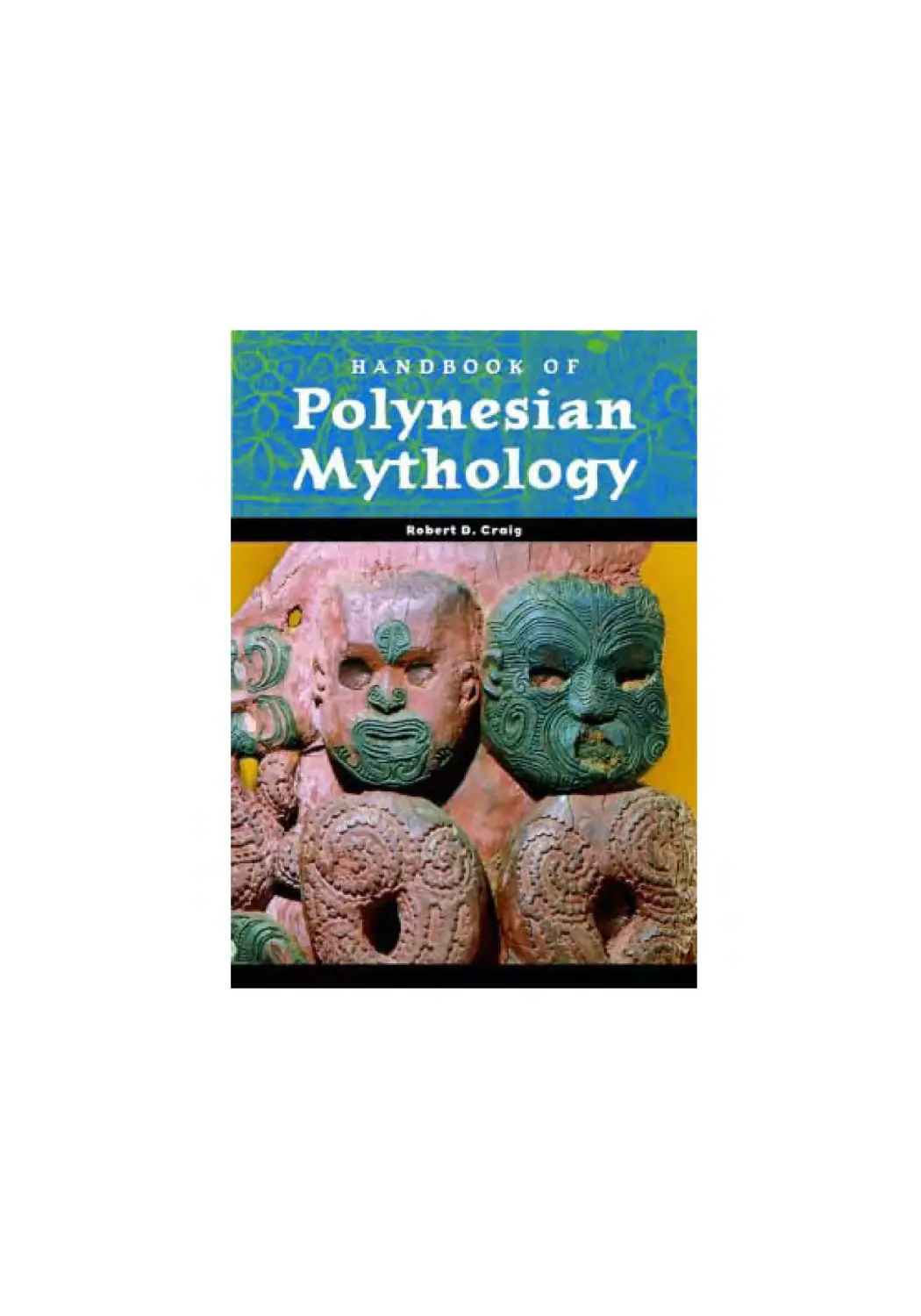
                    Handbook of
Polynesian Mythology

TITLES IN ABC-CLIO’s

HANDBOOKS OF WORLD MYTHOLOGY
Handbook of Arab Mythology, Hasan El-Shamy
Handbook of Celtic Mythology, Joseph F. Nagy
Handbook of Egyptian Mythology, Geraldine Pinch
Handbook of Hindu Mythology, George M. Williams
Handbook of Japanese Mythology, Michael Ashkenazi
Handbook of Mesoamerican Mythology, Kay Almere Read and
Jason J. González
Handbook of Norse Mythology, John Lindow

HANDBOOKS OF WORLD MYTHOLOGY

Handbook of
Polynesian Mythology
Robert D. Craig

Santa Barbara, California

•

Denver, Colorado

•

Oxford, England

Copyright © 2004 by Robert D. Craig
All rights reserved. No part of this publication may be reproduced, stored in a
retrieval system, or transmitted, in any form or by any means, electronic, mechanical,
photocopying, recording, or otherwise, except for the inclusion of brief quotations in a
review, without prior permission in writing from the publishers.
Library of Congress Cataloging-in-Publication Data
Craig, Robert D., 1934–
Handbook of Polynesian mythology / Robert D. Craig.
p. cm. — (Handbooks of world mythology)
Includes bibliographical references and index.
ISBN 1-57607-894-9 (hardcover : alk. paper)—ISBN 1-57607-895-7 (e-book)
1. Mythology, Polynesian. I. Title. II. Series.
BL2620.P6C72 2004
299'.924—dc22
07

06

05

04

2004006534
10

9

8

7

6

5

4

3

2

1

This book is also available on the World Wide Web as an e-book.
Visit www.abc-clio.com for details.
ABC-CLIO, Inc.
130 Cremona Drive, P.O. Box 1911
Santa Barbara, California 93116–1911
This book is printed on acid-free paper

∞.

Manufactured in the United States of America

To Katharine Luomala, whose spirit
remains as a voice on the wind

CONTENTS
Preface, xiii

1

INTRODUCTION, 1
Pacific Geography, 1
The Polynesians—From Whence Did They Come?, 2
Traditional Polynesian Society, Economy, and Culture, 6
Material Culture, 10
Polynesian Music, Dance, Games, and Diversions, 12
Polynesian Languages, 14
Polynesian Oral Literature, 17
Recorded Texts, 20
European Exploration and the Development of Island Nations, 25
The Cook Islands, 27
French Polynesia, 28
HawaiΩi, 30
New Zealand, 32
S∞moa, 34
American S∞moa, 35
S∞moa (“Western S∞moa” from 1890 to 1997), 35
Kingdom of Tonga, 36
Easter Island, 37
Tuvalu, 38

2

CREATION AND THE COSMOS, 39
General Characteristics of the Polynesian Creation Stories, 40
Tahiti, 41
New Zealand, 43
Tonga, 44
S∞moa, 45

vii

viii

Contents
HawaiΩi, 46
Mangaia (Cook Islands) and the Tuamotus, 47
General Characteristics of the Polynesian Cosmos (Heavens), 51
Characteristics of the Polynesian Gods and Goddesses, 53

3

DEITIES, THEMES, AND CONCEPTS, 59
Alele, Winged Thieves of S∞moa, 59
Arioi Society, 60
Birdman Cult, 63
Birds, 65
Breadfruit, Origin of, 66
Calendar, 70
Cannibalism and Human Sacrifices, 72
Canoes, 74
Boat Travel, 77
Canoe Building, 77
Ceremonies, Religious, 80
Chiefly Class, 85
Coconut, Origin of the, 88
Dance, 91
Death, 93
Deluge, 97
Dogs, 99
Drums, 101
Earthquakes, 103
Elves and Fairies, 105
Fire, 106
Fish, Battle of the, 108
Genealogies, 109
Ghosts, 111
Giants, 114
God Images, 116
HaΩamonga-a-M∞ui, 127
Haumea, 128
HawaiΩi-Loa, 129
Hawaiki, 131
Hina, 132
Hiro, 135
Hotu-Matua, 141

Contents
ΩIo, Ihoihi, or Kiho, 142
KamapuaΩa, 144
K∞ne, 146
Kava, 148
Kumulipo, 150
Kupe and Turi, 151
L∞Ωie-i-ka-wai, 154
Land, 155
Lau-ka-ΩieΩie, 158
Lono, 160
Makemake, 162
Mana, 163
Marriage, 164
M∞ui, 167
Menehune, 170
Meteorological Elements, 172
The Winds, 173
The Clouds, 173
Rainbows, 174
Thunder and Lightning, 174
Migrations, 175
New Zealand (Aotearoa), 176
HawaiΩi, 177
Easter Island, 179
Moai, Easter Island, 179
Monsters, 184
Moon, Origin of, 187
Muni: The Tongan Hercules, 188
Ocean, 190
Omens and Superstitions, 191
Meteorological Omens, 192
Animal, Bird, and Fish Omens, 193
Women, 193
Other Human Activity, 193
Pai, 194
Pele (Pere), 197
Pili, Lizard God of S∞moa, 202
Plants (Food), 203
Pleiades (Matariki), 207
Priests, 208

ix

x

Contents
Rangi and Papa, 211
Rata or Laka, 213
Rµ, 218
Schools of Education, 220
Sex and Sexuality, 222
Sharks, 224
SisimatailaΩa, 225
Sorcery, 227
Stars, 229
Storytelling and Chants, 230
Stretching Gods, 232
Sun God, 235
Tahaki, 236
T∞ne, 238
Tangaloa, 241
Tapu, 243
Tattoo, 244
Temples, 249
T≥ Plant, 253
Tinirau, 255
Uenuku and the Mist Maiden, 258
Underworld, 259
W∞kea, 261
Warfare and War Gods—Kµ, ΩOro, Nafanµa, 262

4

ANNOTATED PRINT SOURCES, 269
Mythological Sources and Commentaries, 269
Prehistory—General Polynesia, 278
Prehistory—Cook Islands, 281
Prehistory—Easter Island, 281
Prehistory—French Polynesia, 282
Prehistory—HawaiΩi, 284
Prehistory—New Zealand, 285
Prehistory—S∞moa, 286
Prehistory—Tokelau, 288
Prehistory—Tonga, 288
Prehistory—Tuvalu, 289
Polynesian Culture: Arts, Literature, Music, Dance, 290

Contents
5

INTERNET WEB SITES, 293
General Introduction to Polynesia, 294
American S∞moa, 294
Cook Islands, 295
Easter Island, 295
French Polynesia, 296
HawaiΩi, 296
New Zealand, 297
S∞moa, 298
Tonga, 298
Tuvalu, 298
Web Sites for Polynesian Mythology, 299
Glossary, 301
Index, 309
About the Author, 353

xi

PREFACE

I

t’s always nice to have a publisher ask you to write a book, and I appreciate
ABC-CLIO Press’s invitation to write this volume to complement the others
in its series on World Mythology. It’s also particularly interesting that the editors chose to include Polynesia within their geographical parameters for this series, because Oceania and particularly Polynesia have often been passed over by
other publishers on the subject. I am sure that those publishers are unaware of
the wonderful stories that survive from the ancient world of Polynesia.
Many of you may not be fully acquainted with Polynesians—the indigenous
people of the Pacific—who first settled the “many islands” of the North and
South Pacific thousands of years ago. They are the people who make up the island groups we call today American S∞moa, HawaiΩi, Cook Islands, Easter Island,
French Polynesia, New Zealand, S∞moa, Tokelau, Tonga, and Tuvalu. These are
the islands of Polynesia, and this book is about their cultural heritage.
Little was known about the enthralling Polynesian chants and legends outside the Pacific until well into the nineteenth century, when a few scholars collected and translated them into Western languages (primarily English and
French) so that they could be read and appreciated by modern readers. The “Introduction” that follows highlights several of these tireless scholars whose
works have become classics. Without them, much of what has transpired in the
field of folklore in the twentieth century could not have been achieved. I am one
of those appreciative researchers who continually stands in awe of the monumental work that they accomplished. I am also grateful for the resurgence in the
public interest in Pacific and Polynesian subjects (what we call the “Polynesian
Renaissance”) that emerged during the 1970s and 1980s. That Renaissance was
just getting under way when I first moved to HawaiΩi in 1966 and became interested in Polynesia. Ever since, I have been actively engaged in research and writing about the Pacific, and particularly about my “adopted” islands.
This Handbook of Polynesian Mythology was written for a general audience
rather than for the academic world. It does not pretend to be all-inclusive, where
one can find references to all of the mythological stories of Polynesia. Scholars
who wish such a volume are referred to my more monumental work, the Dictionary of Polynesian Mythology (New York: Greenwood Press, 1989). This

xiii

xiv

Preface
current volume concentrates on the retelling and commenting upon the important mythologies of the Polynesians so that the reader gains a much better understanding of their cosmology and culture. Of course, there is always the danger of inserting one’s own beliefs and interpretations into their writings, and,
hopefully, I have been sensitive to that issue. There is always another danger of
writing so close to the original texts that there is the possibility of committing
plagiarism. So I have tried to walk the tightrope between the two, and hopefully
the results are satisfactory.
Another requirement for scholarly research into these ancient texts is the
ability to read the indigenous Polynesian languages—Hawaiian, M∞ori, Rapanui,
Tongan, Samoan, Tuvaluan, and Tahitian, for example. Unfortunately, my ability in Pacific languages is limited to a little Tahitian and Hawaiian, and, as a result, my research over the years has been done almost completely through translation, primarily English, French, and German. I envy those scholars who read
the chants in the originals and who can interpret the various nuances that only
the originals offer. But, of course, there are many legends that were recorded for
the first time in English, French, and German, and in these cases, therefore, we
do not have any indigenous texts.
I am a trained historian (actually a medievalist with a literature minor) not
a folklorist, and my interests and understanding of these texts come from that
background. In all of my previous publications, I have had little or no opportunity to write beyond the strict interpretation of my data, but in this work, I have
had the task of summarizing stories and polishing my own interpretations so
that those summaries are interesting to my readers. It is my highest hope that
the stories contained herein might find a wider public than what they have in
the past. Perhaps, I might be able to be one of those trumpets “through which
the musical Polynesian voice might make itself heard and attract attention to
the power and personality behind the voice . . .” (Johannes C. Andersen, Myths
and Legends of the Polynesians. London: Harrap, 1928, 4).
There are many individuals who helped in the production of this work.
Thanks, of course, go to the first European explorers who visited the Pacific and
left vivid tales of the South Seas. It was those stories—the mutiny of the Bounty,
for example—that first attracted my attention to Polynesia, just as they have
done to millions of others who have read them. Thanks to the early missionaries and Polynesians who first set down these wonderful tales for posterity, and
then to the subsequent anthropologists who visited the more remote islands and
who left detailed summaries of their island cultures. A special thanks goes to my
friend Katherine Luomala, whose book Voices on the Wind (Honolulu: Bishop
Museum Press, 1955) and whose personal encouragement during her last few
years converted me to the study of Polynesian myths and chants.

Preface
There are, of course, more current people and organizations to thank for help
in this volume. First, my heartfelt thanks to the various members of the Institute for Polynesian Studies in HawaiΩi who have consistently come to my aid in
time of need—Vernice Wineera, Dale Robertson, Riley Moffatt, Max and Marge
Stanton, and Greg Gubler. Without them, I would not have been able to finish
this work within my publisher’s time frame. Another special thanks goes to individuals who assisted in obtaining illustrations—my son Larry Craig (Laguna
Beach, California), Christian Durocher (Tahitipresse, PapeΩete), and Bernard
Cloutier (Québec, Canada)—as well as the many other institutions whose names
are credited in the illustrations’ credits.
One other point before beginning, and this deals with the Polynesian languages and their orthography. Chapter 1 adequately handles both subjects, but
some readers may think it strange to see Hawaii written as HawaiΩi with a glottal stop (“reverse apostrophe”) between the two “i’s” or Samoa written as S∞moa
with a long vowel accent (“macron”) over the “a.” Printed Polynesian texts require these properly placed accent marks, just as French requires them over its
vowels (été, for example). The state of HawaiΩi began using these many years ago,
and other island groups are following suit. Their use prevents any ambiguity and
determines the proper translation of the written word. Another unusual feature
is the use of long proper names in Polynesia. The Tahitian name TupuanuitefaΩaonono, for example, is actually several words written together. Sometimes, a dash is placed between the words to indicate their separation, such as
Tupua-nui-te-faΩa-onono, meaning in English “Persistent Great Growth,” to aid
the reader, but on other occasions, and more properly, they are simply dropped.
The organization of this volume follows that which was established earlier
in this series on world mythology. Chapter 1 introduces the reader to the geography of the Pacific islands and more specifically to the islands of Polynesia. It
summarizes the various theories regarding the origin of the Polynesians and then
presents an overall summary of their cultures, including a discussion of their
languages and literature. A section on the “Recorded Texts” provides a bibliographical essay on the original texts from which I gathered my sources for the
main portion of this volume.
Chapter 2 details Polynesian cosmology and the creation of the world. It
briefly summarizes creation stories from several different islands, and then it reproduces part of a Tuamotuan creation chant—The Psalm of the Creation—in
English translation to illustrate the beauty of Polynesian chant.
Chapter 3, of course, is the main bulk of the work. This chapter includes
over eighty individual entries on different topics, ranging from biographical
sketches of gods, goddesses, and heroes (T∞ne, Hina, Pele, and M∞ui, for example) to more specific background information on Polynesian life (dance, drums,

xv

xvi

Preface
god images, and warfare, for example). Bibliographical references are given after
each entry so the reader can undertake further research on that specific topic.
Remember, though, that the number of entries within this chapter is not inclusive of the entire Polynesian repertory, but each was selected for either its being
widely accepted throughout the islands or for specific points that needed to be
included here for clarification.
Chapter 4 offers an annotated bibliography of the major sources, both
mythological and historical, for the writing of this book. It is not inclusive and
does not contain all of the references mentioned at the end of each of the entries
in Chapter 3. It does include, however, the most important sources on Polynesian mythology and prehistory, including individual island groups, and a brief
annotation after each source reveals something about the author and the book
itself. For a more complete bibliography, refer to my earlier publication, Dictionary of Polynesian Mythology (New York: Greenwood Press, 1989), pages xxix
through xlvii.
Chapter 5 is a brief annotated listing of the most current Internet Web sites
that provide general background information on the current status of the island
groups and a general introduction to Polynesian mythology. Very few Polynesian
legends are actually available online, and researchers still must resort to printed
texts for anything substantial. Hopefully, one of these days, a complete database
of Polynesian mythological references will be available online. Remember, too,
that Web sites very frequently go offline or change their URL addresses, so the
Internet references in Chapter 4 are not as permanent as published texts. In addition, it is important to assess the reliability of information posted on the Internet. Some information is more reliable than others, and the source should always be considered.
In conclusion, I hope this work may stimulate all of you to probe more
deeply into this fascinating and rewarding subject. A framework or a type of
skeleton is presented within the following chapters, and references for further
study are presented in the bibliography. Work still needs to be done in editing
old texts, and, of course, more sensitive and skillful writers than I are needed to
publish the stories in translation so that the beauty of the original Polynesian
word might be further appreciated by modern readers.
Robert D. Craig
Sarasota, Florida
August 2003

1
INTRODUCTION

M

y first acquaintance with Polynesia came in 1966 when I moved from
Texas, where I had been teaching, to my new assignment in HawaiΩi.
The five-hour flight from Los Angeles seemed interminable, and
when the plane doors finally opened in Honolulu, I got my first scent of the salty
ocean breeze, and the brisk trade winds brought a refreshing relief from the stifling airplane air I had been breathing. The welcome greetings on the tarmac
were unparalleled—smiling, brown-skinned hosts draped sweet-scented plumeria leis around us, and Hawaiian melodies came floating over the crowd from a
small instrumental band stationed near the lean-to from which we picked up our
luggage. Delicious, fresh pineapple juice flowed out of fountains from which you
could drink freely. My romantic dream of Polynesia had become a reality. Little
did I realize that scenes such as this had been experienced millions of times
since the first Europeans “discovered” these beautiful islands of Polynesia two
hundred years ago.
During my first year of teaching in HawaiΩi, I was determined to find out
more about Polynesia and its people. As a result, students in my senior history
seminar were given a research assignment to pick a particular topic on pre-European Polynesia for their senior project. The seminar was a huge success. We
had a dozen papers written about ancient Polynesia, many of them on the topic
of mythology, and I was hooked. From that time on, my interest grew until ten
years later, a small group of us formed the Institute for Polynesian Studies and
began publishing a scholarly journal entitled Pacific Studies, both of which are
still quite active. My research and writing about Polynesia have also continued
throughout the past thirty-seven years, for I have never ceased admiring the
unique peoples and cultures I first met in 1966.

PACIFIC GEOGRAPHY
The Pacific Ocean is the largest in the world. It stretches eleven thousand miles
from east to west at the equator, nine thousand miles from north to south, and
covers one-third of the earth’s surface. Far in the distant past, landmasses in this

1

2

Handbook of Polynesian Mythology
vast region rose and sank many times, leaving islands consisting of high volcanic
mountains or coral atolls that dot the vast regions of the ocean. A large number
of these islands were formed in the western Pacific as part of the Asian landmass, and today this thick belt of islands tapers off as we move further eastward,
reaching its apex at Easter Island in the South Pacific and HawaiΩi in the North
Pacific. Beginning with the Philippines and Indonesia in the west, these islands
form various groupings as they stretch across the Pacific. The Micronesian
(“small”) islands spread across the North Pacific, the Melanesian (“black”) islands toward the southeast, and the Polynesian (“many”) islands stretch from
there on to the eastern Pacific region. Collectively, the perimeter of the Polynesian islands resembles a large triangle, popularly called the Polynesian Triangle
that extends from HawaiΩi in the north to New Zealand in the southwest and to
Easter Island in the southeast (see map in Figure 1.1).The societies and cultures
contained within Polynesia can be further divided into Western Polynesia
(Tonga, S∞moa, and the Ellice group), Central Polynesia (the Cook, Society, and
Austral Islands), and Eastern Polynesia (the Tuamotus, Marquesas, and Easter Island with HawaiΩi to the north and New Zealand to the south).
The even, tropical climate of the Polynesian islands is generally tempered
by the ocean and winds, and, as a result, the islands do not experience the sweltering heat found on the neighboring continents. For most of the year, trade
winds blow from the north-northeast in the North Pacific and from the southsoutheast in the South Pacific. The ocean currents in the North Pacific circle
clockwise, but in the south, they circle counterclockwise. Where they come together at the equator, they form a narrow equatorial countercurrent, popularly
called the Doldrums. These prevailing winds and ocean currents aided the ancient Polynesians in exploring and settling these many chains of islands.
Before the Polynesians first settled them, however, these islands were lacking in natural resources necessary for survival. As the Polynesians explored from
one island to another, they had to bring with them plant foods—banana, breadfruit, coconut, taro, and yam—and animals such as the chicken, dog, and pig. All
of the major plants and animals had to be introduced into the islands by humans.

THE POLYNESIANS—FROM WHENCE DID THEY COME?
Thousand of years before Europeans knew anything existed beyond their limited
geographical landmass, Pacific peoples were sailing across these many islands in
search of new lands and homes. Sir Peter Buck (1880–1951), a famous M∞ori
scholar and writer, referred to these ancient peoples as the Vikings of the Pacific,
because they ventured eastward across the Indonesian landmass into the remote

Figure 1.1:

120˚E

150˚E

The Polynesian Triangle

135˚E

A U S T R A L I A

I N D O N E S I A

FEDERATED STATES
OF MICRONESIA

Guam

PAPUA
NEW GUINEA

PHILIPPINES

TA IWA N

J A PA N

Tuvalu

165˚E

180˚

165˚W

Niue

Samoa

Chatham

NEW
ZEALAND

Hawaiian Islands

s

150˚W

Tahiti

Rapa

135˚W

FRENCH POLYNESIA

P O LY N E S I A N T R I A N G L E
Tokelau

Wallis and
Futuna

O C EAN

Rotuma
Vanuatu
Fiji

New Caledonia

Solomon
Islands

Nauru

PA C I F I C

a
ng

To

I
ok
Co

nd
sla

Pitcairn

120˚W

30˚N

Easter

105˚W

15˚N

45˚S

30˚S

15˚S

Equator

4

Handbook of Polynesian Mythology
regions of the Pacific Ocean by the use of their sophisticated knowledge of the
stars, winds, and ocean currents similar to the medieval Vikings of Scandinavia
in their explorations of the North Atlantic.
When the early European explorers eventually happened upon these remarkable and unique people they called Polynesians, the explorers began to
question the Polynesians’ origins. British explorer Captain James Cook
(1728–1779), who explored much of the Pacific Ocean and who was familiar with
most of the Pacific cultures, surmised that the Polynesians had originated in
Malaysia (Southeast Asia) because their customs and languages resembled those
cultures found further to the west. Cook and his colleagues were not trained anthropologists, and it is remarkable that after two hundred years of speculation
and widespread disagreement, this theory still remains the most tenable.
In the nineteenth century, however, scholars proposed many other theories.
In 1837, Jaques A. Moerenhout, a Belgian/French merchant in Tahiti, proposed
the lost-continent theory—a theory that the Polynesians were descendents of
people who lived on a vast Pacific continent before it sank into the Pacific
Ocean. These ancient peoples, he said, had essentially settled the land before the
earth’s shift and were isolated on the mountain tops as the lower landmasses
sank into the ocean. Reverend Samuel Marsden (d. 1838), a British Christian
missionary to New Zealand, suggested that the Polynesians were remnants of
the Ten Lost Tribes of Israel and tried to connect their cultures and languages to
those of ancient Egypt, Greece, and Palestine. On the other hand, William Ellis
(1794–1872), a British missionary to HawaiΩi, argued that the Polynesians originated in Asia but sailed into the Pacific from the northwest coast of North
America, a thesis similar to the one adopted and promoted by Thor Heyderdahl
in the 1950s.
During the late nineteenth century, the scientific world introduced a new
method of approaching and evaluating truth. As a result, numerous new social
sciences came into being—anthropology, archaeology, economics, sociology,
psychology—and even historical research and writing went through revolutionary developments. As these new disciplines continued to develop in the twentieth century, new scholars evaluated the old theories concerning Polynesian origins, and others forged ahead doing field research to add to or to validate the data
that had previously been collected throughout the Pacific. Subsequent studies in
the area of botany, genetics, linguistics, archaeology, and mythology essentially
support the theory that Captain Cook proposed in the late eighteenth century—
that the Polynesians descended from the Mongoloid division of the human family and that they entered into the Pacific by way of Malaysia and Indonesia.
Almost all scientific evidence supports this Southeast Asian/Indonesian
point of origin. The plants (breadfruit, pandanus, yams, sugarcane) and animals

Introduction
(pig, dog, chicken) brought into the Pacific by the Polynesians were first domesticated in Southeast Asia. One exception, of course, is the sweet potato, which
certainly had its origin in South America. Some writers try to prove an American connection, saying that the first Polynesians set sail from South America,
bringing the sweet potato with them. It is more likely, however, that the Polynesians, in their explorations eastward, continued across the Pacific, hit the
coast of South America, where they came into contact with the potato, and then
returned with it to Polynesia.
Genetics also provides evidence of a racial mixture before entering the
area—a mixture consisting of paleo-Caucasoid, Negroid, and Mongoloid characteristics, which directly links the Polynesians to Melanesia, Indonesia, and
Southeast Asia. Polynesian languages (discussed later in this chapter) certainly
form a close affinity to the other Austronesian family of languages, a family that
stretches from Easter Island in the eastern Pacific through Melanesia and on to
Southeast Asia and Madagascar, off the coast of East Africa. Recent archaeology
since World War II maintains a similar argument of a western origin. Relics of
Lapita pottery in Tonga and to a lesser degree in S∞moa and the Marquesas (and
lacking in the rest of Polynesia) and carbon dating support this theory.
Based upon all of the available data, let us now summarize the general migration pattern of the Polynesians across the Pacific. In prehistory times (35,000
B.C.), two separate movements of human beings pushed into Southeast Asia
through New Guinea. The first was comprised of the hunter-gatherers of the
Pleistocene epoch, and the second was a wave of Austronesian-language speakers out of south China and Taiwan about 4000 B.C. The latter pushed through
Melanesia (most likely Fiji) fairly quickly, mixing with Melanesians on the way,
and arriving at the western edge of Polynesian about 2000 B.C. All evidence indicates that these peoples settled Tonga by 1300 B.C. and S∞moa by 1000 B.C.
After a lengthy time in S∞moa in which the language and culture became somewhat differentiated from the islands to the west, Polynesians began to push out
and settle the more remote islands to the east. The Marquesas Islands were settled by A.D. 400 and the Society Islands by A.D. 800. From the Marquesas, Polynesians settled Easter Island by A.D. 400–500, HawaiΩi by A.D. 750, the Cook and
Austral Islands by A.D. 800, and New Zealand by A.D. 1100. (It appears that two
separate migrations occurred both in HawaiΩi and in New Zealand.) By A.D. 1100,
essentially the last major regions of Polynesia had been settled.
One question that has always puzzled the modern scientist is how the Polynesians were able to settle these vast islands, some lying thousands of miles from
one another. Some scholars propose a “drift theory,” which maintains that Polynesians, sailing out to sea to fish or to visit a neighboring island in their small canoes or rafts, were blown out to sea. Some of these drifters evidently survived and

5

6

Handbook of Polynesian Mythology
reached safety at a distant island, and from there they settled down and created a
new society and culture. This, of course, contradicts numerous traditional stories
among the Polynesians of planned mass migrations from one island group to another and then a return voyage to pick up additional relatives and food supplies.
When Captain Cook visited Tahiti in 1768 and 1769, he discovered the remains of a huge, double-hulled canoe that would have held more men and supplies than his own ship. He also witnessed the mustering of hundreds of war canoes to battle by Chief Pomare to fight his enemies. This type of double-hulled
canoe (similar to a catamaran) is Polynesia’s single most important artifact.
Some of these canoes measured a hundred feet in length and carried three hundred passengers (see the “Canoes” entry in chapter 3). Most scholars agree that
the discovery of the various Pacific islands was deliberately planned by the Polynesians and that their navigational skills allowed them to return to their homeland after they had settled a new home.

TRADITIONAL POLYNESIAN SOCIETY, ECONOMY,
AND CULTURE
To make generalizations regarding all the cultures of ancient Polynesian societies would draw the ire of almost every Polynesian and scholar today. Although
these ancient societies varied from one group to another, there are some generally accepted characteristics that make individuals living in New Zealand,
HawaiΩi, and Easter Island seem related one to another. Those characteristics essentially make them Polynesian rather than Melanesian or Micronesian—the
other peoples of the Pacific.
Anciently, each Polynesian island was geographically divided into territorial
divisions. The high volcanic islands like HawaiΩi, S∞moa, and Tonga, for example, were divided into pie-shaped districts with the apex at the top of the mountains and their boundaries extending down to the seashore. Individual tribe
members who dwelt in each of the districts had access to the seashore for fishing, the uplands for living and crop planting, and the mountains for wood and
other foods. On small atolls like the Tuamotus, however, a single tribe might
have occupied an entire islet or a grouping of islets rather than a small portion
of land on one island.
Within these land divisions, Polynesians lived in scattered huts rather than
in villages. Some well-to-do or resourceful Polynesians may personally have had
several functional dwellings located throughout the district; for example, a Polynesian might have had an eating house for the men, separate from the women
and tapu (forbidden) to them; another house where the wife and children lived

Introduction
and not tapu to the husband; a shelter for the wife where she could beat her tapa
clothing during inclement weather; a house where the wife lived during her
monthly menstrual period; and a small family chapel where sacred artifacts were
kept. Sometimes, a canoe shed that housed and protected the outrigger canoe
would be built near the shore and another hut built for the protection and storage of food. Chiefs of the tribe would have retainers and companions who lived
in close proximity, and these nucleated huts somewhat resembled a village.
Individuals within each district of the island belonged to a specific tribe,
usually ruled over by a chief, who held this position by hereditary right, usually
from his father (see the “Chiefly Class” entry in chapter 3). Chiefs also claimed
additional authority through a power the Polynesians called mana (see the
“Mana” entry in chapter 3). Mana was inherited from famous ancestors, and it
could also be gained through impressive earthly achievements, such as success
in war. In some island groups (Tahiti, S∞moa, Tonga, and Mangareva, for example), the power of the high chiefs was so great that they had to be carried above
ground on a dais so that their feet would not touch land belonging to their subordinates; otherwise the land would revert to the chief’s ownership. In HawaiΩi,
the aliΩi nui (high chiefs) often hoped to preserve their powerful lineage by marrying their closest relatives, their sisters.
Europeans who first visited these islands observed a middle class, called the
mat∞pule in Tonga and the raΩatira in Tahiti. Description of this class by the
early European writers is vague and perhaps a little suspect. Many of these writers tried to describe Polynesian societies in European terms when really these
writers did not fully understand these new, foreign cultures. The mat∞pule may
have been retainers of the ruling chiefs, who gained this prestige from their association with the high chiefs, and in Tahiti, they were said to have been the
first inhabitants of the islands who had been conquered by the high chiefs, the
ariΩi nui. The usefulness of this middle class—being superb craftsmen, highly educated, or skilled in terms of warfare—may have brought about their elevation
from the common class. Whatever may have been the cause of their elevated status, this class remained extremely small in comparison to the largest class in
society—the commoners.
The commoners (makaΩ∞inana in HawaiΩi, manahune in Tahiti, tuΩa in
Tonga) consisted of all individuals in the tribe who were not members of the
chiefly class, slaves, or prisoners of war. These commoners were the farmers,
fishermen, laborers, and craftsmen. They faired fairly well compared to commoners in many other places in the world, for they lived on beautiful islands
that provided most of their food easily, and they were generally free of the infectious diseases and dangerous insects and animals that affected most of humanity. But they were not entirely free from arduous labor. The men were

7

8

Handbook of Polynesian Mythology
hardly ever idle. They had to provide labor for their chiefs’ many building projects, and they worked hard at gathering food every day for their family’s sustenance, either fishing in the lagoons or gathering foods from their gardens or
mountains. They had to fashion their various tools by hand and then, with
them, construct all their necessities. The men generally cooked the meals each
day, for it was tapu for a woman to touch food consumed by the adult males
in the family. Even while relaxing in the evenings, men routinely gathered
pieces of short coconut fibers and hand plaited them into long pieces of twine
called sennit.
Women also spent their days toiling in subsistence living. Their mornings
were filled with cultivating, gathering, and collecting food—including the exhaustive work of gathering firewood—for the main meal of the day, usually prepared in early afternoon. They were responsible for the production of tapa cloth
(for clothing and decoration), which took up a good deal of their time. The
sounds of the tapa beaters could be heard in every village throughout the daylight hours. The women also wove fine mats and a variety of baskets, food platters, and other mats for use in their homes. They supervised the rearing of children, but often the oldest child had to care for the younger ones when the mother
was otherwise busily engaged. She also taught the children whatever craft techniques they needed later in life. The status of women in ancient Polynesia was
somewhat demeaning because there were numerous tapus preventing them from
attending all the public ceremonies and rituals that were open to men. It was different, however, among the chiefly class, where a woman might have a more impressive lineage than any man, and in that case, she could assume duties and
privileges not normally available to her.
The daily ritual of a typical Polynesian would go as follows. The morning
was occupied in the main work for the day—gathering food from their farms inland, fishing in the lagoons, building houses, making tapa cloth—or simply in
friendly chatter and relaxation. Both men and women bathed at least twice a day
(some islanders even more), once in the morning when they first arose and again
in the evening. This activity was usually accompanied by lighthearted play. Beds
were simple tapa mats that were rolled up and stored in the rafters of the hut.
Breakfast consisted generally of leftover food from the previous day. The main
meal was prepared for early or midafternoon, and fish, bananas, breadfruit, and
taro were gathered in the morning and prepared in an imu or Ωumu (underground
oven). The busy time of the day, of course, was morning. After the main meal of
the day, almost everyone spent one or two hours sleeping. The heat of the day at
this time prevented any great amount of work from being done. Afterward, some
work was resumed, but most of the afternoon and evening were devoted to

Introduction
diversions and amusements. By nightfall, a light meal of leftovers was consumed, and after some talk and gossip, all was quiet. The only interruptions in
this daily ritual were probably their frequent wars, religious festivities, visits of
neighbors, and of course any natural calamity.
Ancient Polynesian histories are full of incessant wars that plagued the islands. Many scholars attribute the fast depopulation of many of the islands in
the late eighteenth and nineteenth centuries (and of Easter Island hundreds of
years earlier) to these wars. (Western diseases, introduced by European explorers
and settlers, also took their toll on the population.) Wars were fought because
one district chief was jealous of another, because chiefs or priests sought self-aggrandizement or domination of their neighboring territories, because rebellions
broke out against an oppressive leader, because someone broke off a treaty, or because rivals fought over a woman’s love. The list was endless.
Special councils were called by the chiefs to hear the reasons for and against
declaration of war. Priests were summoned and asked to offer prayers and sacrifices or to read animal entrails for any ill omens or phophetic signs. An especially serious war would demand a human sacrifice rather than the usual pig or
dog. After all was considered, the high chief would finally make his decision and
set the date for action. Heralds were sent throughout the villages announcing the
tribe’s plans and advising each area to contribute certain provisions. Great warriors were especially esteemed by the people. Since most wars were fought face
to face, war implements consisted of spears of all sorts (some formed with
sharks’ teeth to dismember the enemy even faster), heavy clubs fastened with
rope that could be thrown and then retrieved again, and slings and stones. It was
not unusual to see a chieftainess accompanying her warriors into battle. Very little planning or elaborate tactics were used or followed. Command and discipline
seldom existed. If things became too tough for the warriors, the common reaction was for the whole army to break and run. The victors would show their success by proudly committing all types of indignities upon the defeated enemy—
decapitation and cannibalism in some instances. Their own honorable dead, of
course, were given decent burials; religious ceremonies with human sacrifices of
their prisoners of war were conducted; the spoils of war were distributed; festivities were enjoyed; and finally the distribution of the newly won territory among
the chiefs carried out. Boundaries might be lost for a short time, but they always
seemed to be restored to their ancient lines of demarcation after the next war.
At the time of European arrival, the islands appeared like a patchwork quilt, over
which no one single political authority dominated a whole island or chain of islands. There were no kings as such, but several of the island groups (HawaiΩi and
Tonga, for example) were headed in that direction.

9

10

Handbook of Polynesian Mythology
Material Culture
Until the arrival of the Europeans, ancient Polynesians lived in a Stone Age culture. They had no metals with which to construct their various tools and utensils. Despite that, some of their surviving artifacts reveal that they achieved a
high sophistication of skill and technique with their simple tools. Their primary
construction tools consisted of various-sized stones that they used for hammers;
stone adzes, consisting of a sharp rock hafted to a wooden handle by means of
gum adhesives and cordage; sharp basalt flakes or seashells for scraping and cutting; and bones of animals for making needles for sewing, thatching, and weaving nets. Having no nails, the Polynesians had to bind objects together by the use
of a cordage called sennit. Making sennit was a never-ending task performed by
the men in the family. Short strands of husk from shells of the coconut were first
twisted together by rubbing them between the hand and the thigh and by adding
additional lengths of the husks until the two-ply cord became longer and longer.
After that, multiple lengths of these fragile cords were plaited together to form
even stronger cord. Once completed, the long length of sennit was generally
wrapped into a ball until it was needed. Sennit was also used in making fishnets
and the long lines attached to fishhooks, which were carved from bone, teeth, or
wood.
Textiles used for clothing and bedding were made from tapa (bark cloth) constructed from the inner bark of various trees. Making tapa and tapa products was
women’s work, and very much like the making of sennit by men, these tasks frequently were performed while socializing and discussing the affairs of the day
with others in the village. The quality of finished tapa ranged from the unadorned, sun-dried bark cloth to a highly decorated cloth painted with pigments
from various nuts, plants, or berries. Common clothing consisted of a loincloth
for the men (a rectangular piece of tapa cloth, about eight to twelve inches wide
and five to six feet in length) wrapped around the waist and then down the front
covering the genitalia and up the back where it was secured with the waist wrapping. Women wore a simple skirt, probably not much different from the p∞reu
casually worn in modern-day Tahiti. It was a rectangular piece of cloth, approximately thirty inches wide and three to four yards long. It was wrapped around
the waist with the free end tucked in to secure it, usually falling to the knees.
Plaited mats made from the inner bark or leaves of various trees provided
not only clothing, but floor coverings, room partitions, boat sails, and differentsized containers. Simple containers, plates, or head coverings could be made very
quickly by plaiting fronds from the coconut tree. Finer containers and mats were
made from the inner bark of certain trees and from the leaves of the pandanus
plant. Very fine and pliable mats frequently took months to complete and were

Introduction
highly prized, such as the Tongan taoΩvala, a fine mat tied around one’s waist,
which was (and still is) worn in public to show respect, discretion, and honor.
Fine mats were also used in gift exchanging and in paying one’s “taxes.”
Feathered cloaks were also used in Polynesia. The most exquisite ones come
from HawaiΩi, and numerous samples are found today in the Bishop Museum in
Honolulu. The artisans used red feathers from the ΩiΩiwi bird and golden feathers
from the mamo bird, and thousands of hours went into a cloak’s construction. A
net backing was first constructed and then each individual feather was hand tied
to create these remarkable cloaks. The New Zealand M∞ori also produced
exquisite cloaks, because the climate in that country is far from being tropical
and warm all year-round. The cloak or poncho worn by commoners, of course,
was usually made of tapa cloth with a hole cut into the center and was aimed
solely at protecting the individual from rain or the cold.
Buildings within Polynesia ranged from the simple lean-to and small hut to
the huge stone structures that rival any found elsewhere in the world. Most
Polynesians lived in unadorned huts with posts, ridgepoles, and rafters made
from the coconut trees or from the branches of other trees. Various types of
thatching (grasses or woven mats) were then tied over the rafters to create a roof.
The common house in Polynesia resembled what foreigners came to call a grass
hut or a grass shack. Larger community buildings, however, took on different dimensions. Large, round-ended buildings in S∞moa provided homes for chiefs as
well as public gatherings. These were fashioned with community support, and
the details of the lashing of the rafters and the fine mats and tapa make these extant buildings almost a national treasure. In New Zealand where the weather is
cooler, the buildings were more substantial, and here again, the public buildings
were highly decorated both inside and out.
Massive ancient stone structures are found in various parts of Polynesia.
These remarkable structures resemble the ones found in ancient Egypt,
Mesopotamia, and the Americas, but unlike the structures found in these other
areas, the Polynesian structures were fabricated without the use of any metal
tools. Such stone structures in Polynesia range from the Tongan HaΩamonga-aM∞ui, a Stonehenge-type of structure (see the “HaΩamonga-a-M∞ui” entry in
chapter 3), to the outdoor religious temples of Tahiti (see the “Temples” entry
in chapter 3), to the raised housing platforms found in the Marquesas, to the
world-famous stone platforms and moai found on Easter Island (see the “Moai,
Easter Island” entry in chapter 3).
Canoes were among the most important of all Polynesian artifacts (see the
“Canoes” entry in chapter 3). They ranged in size from the simple one-man
dugout to the massive double-hulled catamarans, which could hold up to three
hundred people and make voyages across thousands of miles of the Pacific

11

12

Handbook of Polynesian Mythology
Ocean. Some of these latter were highly decorated, and remnants of them can
be found in museums throughout the world (see Illustrations 3.7 and 3.8 in
chapter 3).

Polynesian Music, Dance, Games, and Diversions
Music and dance played major roles in the cultural life of ancient Polynesian societies, not only for entertainment but for religious ceremonies as well. The
number of musical instruments in Polynesia was extremely limited, and they
consisted primarily of various-sized drums, slit gongs, and nose flutes. The expertise exhibited by the Polynesians playing these instruments and performing
their dances, however, impressed the early explorers to the islands. Drums were
generally cylindrical in shape with a sharkskin membrane stretched over the top
of a hollowed-out log and held tightly tied to its bottom by the use of sennit. Slit
gongs (or drums) are found throughout the world. They are made by hollowing
out a trunk or branch of a tree, leaving a narrow slit along the top side and leaving the ends closed. Sticks of various sizes are used to beat on the slit gong to
produce a percussion sound. Nose flutes were popular as well. They were made
from sections of bamboo about a foot long and an inch in diameter. A hole was
drilled through the top of one section, and several holes through its bottom. The
performer placed the thumb of the right hand against the right nostril and held
the flute with the right fingers up to the left nostril through which air was
blown. Because the size of the holes and the length of the bamboo differed,
sounds from various flutes generally sounded different from one another. Also,
there were no written musical notations or standards against which to compare
sounds.
Dance is one of Polynesia’s most treasured and unique art forms. Anciently,
dances were performed both for religious ceremonies and for entertainment by
both men and women, singly or in a group. Polynesian mythology abounds with
stories of the many demigods and heroes who excelled in dance competitions
with their rivals, and there are stories that tell of how the first dances were introduced to human beings. The early European navigators described the Polynesian dances as graceful, eloquent, and diverse, and all classes of society participated in them. Anciently, the dances were performed to chants or to the
accompaniment of musical instruments—drums, slit gongs, and nose flutes—
and the steps differed widely from one island group to another. Dances from
S∞moa and Tonga, for example, were characterized by the rhythmic pulsating of
the legs and lower body and by hand clapping, while those from Tahiti and
HawaiΩi, on the other hand, were characterized by the swaying of hips, the var-

Introduction
ied movements of the hands, wrists, and arms, as well as facial contortions. Believing the traditional dances to be sinful, crude, and obscene, the early Christian missionaries forbade their performance. European musical instruments
made their way into Polynesia during the nineteenth century, and the structure
of music and dance changed drastically. In the twentieth century, new forms of
song and dance were created to appeal to the foreign tourists who flocked to the
islands in hopes of finding paradise, and the old forms were forgotten. During the
last thirty years, however, there has been a renewed interest in the revival of the
traditional music and dance, and in most dance competitions these days, the ancient dance performers gain the greatest audience approval.
Besides music and dance, Polynesians participated in numerous games and
sports. Children played games common all over the world—jump rope, hide-andseek, blind-man’s bluff, swinging, sliding, stilt walking, diving and swimming,
and as they got older, they added surfboard riding, footracing, boxing, wrestling,
boat racing, and cockfighting. Time never went idle for the Polynesians. When
not working or participating in the various sports mentioned above, there was
always what Europeans called idle chatter. Characteristically, Polynesians loved
to talk and to recite stories, and conversation—their chief strong point—was
their most pleasurable pastime. They would sit for hours reciting ancient chants,
prayers, ballads, maxims, proverbs, love lyrics, genealogies, riddles, jokes, and
jests.
No account of Polynesian diversions would be complete without some description of their sexual behavior, for the Polynesians considered sexual intercourse one of the most pleasurable of all activities. Sexual activity was openly
discussed, and every child became knowledgeable about it early. The subject permeated Polynesians’ daily discussions just as it did their secular and religious literature. Little children went nude until seven years of age, so knowledge of sexual anatomy was prevalent, and living in close quarters without partitions in
their homes provided children an opportunity to observe the act itself. In general, Polynesians regarded sex before marriage as permissible, especially among
the common class. Although some members of the society praised the status of
chastity, virginity was not a virtue. Daughters of high chiefs, however, were an
exception. Virginity among them was almost mandatory.
When the European explorers first visited the islands, the sailing captains
called the Polynesian women promiscuous, but their sailing crews usually took
advantage of whatever liberties they could with the local women. Women’s sexual services were offered to everyone aboard—husbands brought their wives and
fathers brought their daughters. At first, the sailors were dumbfounded, but they
soon began to appreciate the Polynesian sexual freedoms. At first these services
were provided freely, but when the Polynesian women saw the possible gifts

13

14

Handbook of Polynesian Mythology
they could earn, they began to demand certain reciprocal donations. In Tahiti,
for example, the two most desired gifts were nails and red feathers. Nails left the
ships so fast that one sea captain, fearing the destruction of his ship, had to declare it illegal, upon the pain of death, to extract any nails from the boards of the
ship! Red feathers, the symbol of royalty and extremely scarce in the islands,
were prized as highly as nails, and all ranks of society rushed to obtain them.
Captain James Cook, as recorded by the scientist Johann Forster in his Observations Made during a Voyage round the World (1778), wrote that no women in the
world had such latitudes as they did in Tahiti, and most reasearchers conclude
that the ancient Polynesians spent most of their time arranging, preparing for, or
engaging in copulation.

POLYNESIAN LANGUAGES
Sometime in their remote past and during their migrations into the Pacific, Polynesians most likely spoke a common language that scholars today call ProtoPolynesian. It likewise is part of a much larger language family called Austronesian, one that stretches halfway around the world from Easter Island and HawaiΩi
in the eastern Pacific, through Indonesia and Southeast Asia, to Madagascar. As
the Polynesians migrated eastward, settling the islands in the vast Pacific Ocean,
they became separated from one another, and different branches of the ProtoPolynesian language eventually divided into some thirty different spoken dialects of Proto-Polynesian today. The simplified chart in Figure 1.2 shows the relationship of these Polynesian dialects.
Their close relationship is best shown by examining a sample of cognate
words in each of the languages. (See Table 1.1 and the Glossary for additional
similarities.) Of course, not all words in the languages are similar. The words in
Table 1.1 were deliberately chosen, and another chart showing their differences
would be equally revealing.
Ancient Polynesians had no written language. Some of the early European
explorers to the islands in the late eighteenth century, Captain James Cook and
William Bligh, for example, were the first to record some of the Polynesian
words as they heard them spoken by the islanders. Without a standard orthography and method of spelling, these explorers would hear the same word but could
spell it several different ways, depending upon the native language of the
recorder. It wasn’t until the arrival of the Christian missionaries in the nineteenth century that a serious attempt was made to standardize the languages and
teach the Polynesians to read and write in their own tongue. It was indeed a
formidable task, one that had to be repeated in each of the island groups—

Introduction
PROTO-POLYNESIAN

PROTO-NUCLEAR POLYNESIAN

Proto-Central
Polynesian

PROTO-TONGIC

Proto-Samoic
Outliers

ProtoProtoTahitic Marquesic

Tongan
Niuean

Samoan
Tokelauan
Uvean
Rennellese
Pukapukan
E. Futunan
Tikopian
Mae
W. Futunan
Fila
Ellice
Sikaiana
Takuu
Kapingamarangi
Nukuoro

Easter Island

Mangarevan
Hawaiian
Marquesan
Maori
Tuamotuan
Tahitian
Rarotongan
Figure 1.2:

Relationship of the Polynesian Languages

S∞moa, Tonga, HawaiΩi, Tahiti, and so on. After much discussion and scholarly
debate, the missionaries decided that the various Polynesian languages could be
written in the Roman alphabet and that Latin could provide the basis for the
pronunciation. That became the basis for developing the various Polynesian dictionaries and grammar books; however, minor differences in pronunciation from
one island group to another caused slight differences in the way words were
spelled and/or pronounced. The general Polynesian consonants (b, f, h, k, l, m, n,
p, r, s, t, and w) are pronounced similar to those in English and are always followed by a vowel to make up one syllable. The vowels (a, e, i, o, and u) are pure
and pronounced similar to Latin or the Romance languages—Italian, Spanish,
French, and so forth. The use of macrons, or the long duration signs over a long
vowel (∞, ≤, ≥, ¥, and µ), has become standard within the last thirty years. When
the languages were first recorded, the missionaries did not systematically use
macrons, and as a result, older texts are frequently difficult to translate because
some words may be spelled alike but are pronounced differently as Table 1.2 will
show (using Hawaiian as an example).
The diphthongs ae, ai, ao, au, ei, eu, oi, and ou are always stressed on the first
letter, and the two vowels are not as closely pronounced as they are in English.

15

16

Handbook of Polynesian Mythology
Table 1.1

Cognate Words in Selected Polynesian Dialects

English

Tongan

Samoan

Marquesan

Tahitian

M∞ori

Hawaiian

Ancestor

tupu

tupu

tupuna

tupuna

tupuna

kupuna

Bird

manu

manu

manu

manu

manu

manu

Canoe

vaka

vaΩa

vaka

vaΩa

waka

waΩa

Fish

ika

iΩa

ika

iΩa

ika

iΩa

Love

ΩaloΩofa

alofa

kaoha

∞roha

aroha

aloha

Man

tangata

tane

kane

t∞ne

tane

k∞ne

Old

tefito

tafito

tehito

tahito

tawhito

kahiko

Six

ono

ono

ono

ono

ono

ono

Taro

talo

talo

kalo

taro

taro

kalo

Woman

feline

fafine

vahine

vahine

whahine

wahine

Yes

Ωio

ai

ae

Ωae

ae

Ωae

Table 1.2

Similar Spellings with Different Pronunciations (Hawaiian)

Long duration vowels (indicated by a macron over the vowel)
∞ … as in “calm”

n∞n∞ (look at)

≤ … as in “they”

k≤l∞ (this or that one)

≥

p≥p≥ (to sprinkle)

… as in “machine”

¥ … as in “no”

k¥k¥ (carrying net)

µ … as in “rule” or “tool”

ΩµΩµ ( to stammer or stutter)

Short duration vowels
a … as in “above”

hala (sin or offense)

e … as in “set”

pepe (flat, as a flat nose)

i

miki (quick, active)

… as in “city”

o … as in “sole”

koko (blood, rainbow-hued)

u … as in “put”

ΩuΩu (to strip a leaf or hoist a sail)

The glottal stop (Ω) or reverse apostrophe appears before some initial vowels
as Ωauw≤ (Oh!) and between some vowels in words such as koΩo (brace, partner)
and ariΩi (chief). The glottal stop is considered a consonant and may be the remnant of a “k” sound that once existed in the ancient Proto-Polynesian language.
For example, the Polynesian word for “fish” retains the “k” sound in Tongan,
Marquesan, and New Zealand M∞ori and is spelled ika, but in Samoan, Tahitian,
and Hawaiian, the lost “k” becomes a glottal stop (Ω) as in iΩa. Its pronunciation

Introduction
is best exemplified in the word oΩo (mature, ripe fruit), which is pronounced like
the English phrase “Oh, oh!”
Missionaries in some of the island groups used an isolated consonant “g” for
an “ng” sound, pronounced as in the English word “singer.” The Samoan Pago
Pago is therefore pronounced “Pango Pango,” and the god Tagaloa becomes
“Tangaloa.” Also the “w” and “wh” can cause some confusion. The “w” is normally pronounced similar to the English, but in Hawaiian, a “w” after a, e, and
i is usually pronounced like a soft “v.” In New Zealand, the “wh” is pronounced
almost like the English “f.” The M∞ori hero T∞whaki is pronounced “Tah-ffahFee-tee.”
kee” and Whiti as “F
Words are pronounced exactly as they are spelled, each letter is pronounced
(similar to Spanish, German, and Italian), and each syllable is given the same
emphasis and length. The spoken languages of Polynesia are melodious and
pleasing to the ear, and even a beginner can recite aloud some of the simple
chants and songs fairly accurately.

POLYNESIAN ORAL LITERATURE
Traditional Polynesian legends were transmitted orally from one generation to
another, in a manner similar to the transmission of ancient Hebrew, Greek,
Hindu, and German legends before these peoples too had a systematic form of
writing. When they were finally written down, they produced some of the finest
epics the world has ever known—the biblical stories, the Iliad and Odyssey, the
Mahabharata and the Ramayana, and the Song of the Niebelungs. So it was with
the Polynesians. When European navigators first came upon these islands of the
Pacific, the Polynesians were living in a Stone Age material culture, but their
high level of religious and literary life proved to be an enigma to these navigators. The Europeans marveled at the complexity and depth of Polynesian
mythology and at Polynesians’ remarkable oratory abilities—their ability to
communicate effectively in public and to recite (chant) extensive genealogies,
prayers, supplications, and stories of their gods, goddesses, and heroes. Some of
these stories, we are told, took days to complete. A mere greeting to another
could turn into a masterful eulogy and a farewell into a lengthy dirge. Like all
other professions, a Polynesian orator only gained that ability through training
and experience.
In some areas of Polynesia (Tahiti and New Zealand, for example), special
houses of education were established to train pupils in the intellectual arts—
genealogies, traditions, religion, agriculture, literary recitation, and composition—and in all the arts and crafts (see the “Schools of Education” entry in

17

18

Handbook of Polynesian Mythology
chapter 3). Most of the students, of course, were children of the nobility, and
many of them later became priests. There are no references to such schools in
Western Polynesia, but in S∞moa, there was a particular class of society called
the talking chiefs who served their superiors as the source of all traditions, genealogies, protocol, and new compositions. These gifted orators often assumed
more authority than the high chiefs themselves.
Attached to almost every chief’s court was a group of specialists whose sole
purpose was to provide entertainment by telling stories, singing songs, playing
games, and dancing. In HawaiΩi, they were called m∞koΩu, and they specialized
in all forms of the hula. In the Marquesas, they were called kaioi and in Tahiti
the arioi (see the “Arioi Society” entry in chapter 3). Their rigorous training was
extensive and lasted for years because the chants, dances, and other forms of entertainment were long and complicated. These specialists were uniquely honored during their lifetime, and after death they could expect a lovely reward in
paradise. The arioi traveled from one district to another, entertaining for days
(similar to a modern carnival) before moving on to the next district. They were
generally lavished with expensive gifts, offered the finest of foods, and given the
highest respect.
Almost every member of the nobility participated in the cultural arts, and
even the high chiefs were greatly admired for their abilities to sing and dance.
The common Polynesian also cultivated the arts. They often memorized the traditional stories and prayers they heard from the official entertainers, and then
they would recite them when the professional entertainers were gone. Prayers
and supplications to the gods had to be memorized and performed many times a
day—when a working tool was taken down to be used or when a canoe was
hauled out of the shed to be launched into the bay. Commoners also learned the
chants, songs, and dances by imitation, and then they would perform them
around the fires in the evenings.
Polynesian oral literature is colorful, appealing, abstract, metaphysical, and
complex. It is full of alliteration, parallelism, euphemism, symbolism, contrasting rhythm, stock phrases, and allegory, as well as layers of double and even
triple meanings. Polynesians have always been expert at creating puns, and they
prefer analogies rather than frank expressions. When we hear the description of
a canoe, for example, we are not quite sure whether the poet actually means a
canoe or whether he is referring to another object—a phallus, for example. Modern-day Tongans, for example, use a traditional technique called heliaki, the hiding of the real meaning in references to natural objects and places. The listeners
must always be on the alert for these subtle literary techniques and ask themselves, “Is this exactly what the poet meant?” Established rules also determined

Introduction
the exact vocabulary, musical pitch, and rhythm for each of the Polynesian
chant forms. Footnotes to modern translations of the chants are often double or
triple the length of the original chants, and some chants are so obscure that even
modern-day Polynesians cannot translate them. There were over a hundred different names for the different forms of the narratives and chants, most of which
were divided between the serious—which talk about the creation, gods,
demigods, heroes, and important chiefs—and those that are meant to pass the
time and entertain.
The exact dating of the ancient chants is forever lost. We can assume, however, that those chants that have facsimiles in several widely scattered island
groups had to have been in existence at the time of the Polynesian migrations
from a central “motherland” (Hawaiki as the Polynesians called it). The chants
extolling the adventures of M∞ui, T∞whaki, and Rata, for example, must have
been extremely ancient because their legendary narratives are found throughout
all of Polynesia. The Eastern Polynesians must have brought the chants with
them as they pushed out from S∞moa into the vast areas of the eastern Pacific.
Local stories that have no repetition elsewhere are perhaps more modern in origin, but it is still impossible to date them. Essentially, we can only divide Polynesian traditions and history into (1) prehistory, or pre-European, and (2) historical, or post-European. Modern scholars try to keep the two separate so that they
can describe more accurately what Polynesian culture was like prior to the coming of the Europeans and before it was drastically changed by modern society. By
the middle of the nineteenth century, for example, scholars and writers in the islands were already lamenting that the current generation hardly understood the
old ways. They complained, too, that the children could hardly understand the
language of their grandparents, even though they were speaking the same native
tongue.
The cause of much of this loss of culture was of course the introduction of
a forceful and aggressive white culture and an uncompromising religion—Christianity. The introduction of the use of iron, for example, drastically changed the
whole way the old culture created material objects. A simple nail transformed
building construction overnight, and the old died away; in one swoop again, the
iron ax shattered the use of the stone adz with its crude cutting techniques, and
the old died away. For better or worse, the traditional art forms were drastically
changed by the newcomers to the islands.
To make matters even worse, the early Christian missionaries destroyed the
old “pagan” ways and material objects, and in some of the islands, they eventually forbade the use of the native languages in their schools and churches. It is
indeed surprising that, with such a formidable opposition, the traditional

19

20

Handbook of Polynesian Mythology
languages and cultures survived at all, but some did. We cannot even begin to estimate the numbers of ancient stories that were lost along the way.

RECORDED TEXTS
Chronologically, the collection and publication of Polynesian mythological
texts falls into four major periods. The first period begins with the first Western explorers to the islands, generally in the late eighteenth century, and continues until the establishment of Christianity. During this first period, explorers, such as Captain James Cook, published bits and pieces of information they
gleaned from their contact with the islanders. Their primary purpose was not
necessarily to gain anthropological or mythological information, but to explore
for political and economic reasons. Cook’s later voyages, of course, brought numerous scientists and artists to the islands with him, and we are richer as a result of their descriptions of the society and material culture. Here again, only a
few references to religion and mythology were recorded, and we must scan page
after page of their journals to glean any mythological names or references. During this time, however, several beachcombers arrived in the islands (William
Mariner in S∞moa, for example), and some of them recorded their impressions
and narratives, leaving us with a few additional scraps of data on religion and
mythology.
It wasn’t until the second period—the arrival of the Christian missionaries—
that any serious attempt was made to record what the outsiders discovered about
the ancient beliefs of the islanders. The main purpose of the missionaries, of
course, was to wipe out all traces of pagan beliefs and convert the “heathens” to
Western Christianity—in most cases, to Protestantism. Idols and images were
burned, temples ransacked and overturned, and any traces of the ancient chants
and dances forbidden to be performed in public. A few of the missionaries, however, took it upon themselves to write details about the islands in order to interest the general public back home to support these the far-flung missions halfway
around the world. Prominent among these early writers was the Reverend
William Ellis (1794–1872) of the London Missionary Society, who spent 6 years
in Tahiti (1816–1822) and 2 years in HawaiΩi. He introduced the first printing
press to the islands and gathered extensive ethnographic data that were published
after his return to England. His Polynesian Researches (2 vols. 1829) and his Journal of a Tour around Hawaii (1825) are valuable reference works on the Society
and Hawaiian Islands. But like the explorers’ journals, there are only a sprinkling
of references to the ancient chants in his works. Ellis’s influence in HawaiΩi, however, led to the establishment of a school in Lahainaluna, M∞ui, by the Reverend

Introduction
Sheldon Dibble, whose purpose was to educate Hawaiian students to write about
their old culture. Two of his most famous students were David Malo (1795–1853)
and Samual M. Kamakau (1815–1876), whose writings were published in the
Hawaiian newspapers between 1866 and 1871. Kamakau’s articles were later collected, translated, and published in The Ruling Chiefs of Hawaii (1961) and in Ka
PoΩe Kahiko: The People of Old (1964). Other early missionaries whose writings
became famous are John M. Orsmond (1788–1856), whose granddaughter, Teuira
Henry, edited his voluminous manuscript Ancient Tahiti and published it only in
1928. About half of the book’s 651 pages contains chants and legends, in Tahitian
and English, relating to ancient mythology. In S∞moa, the missionary George A.
Turner (1818–1891) spent 19 years in the island and published 2 works—Nineteen
Years in Polynesia (1861) and Samoa: A Hundred Years Ago and Long Before
(1884)—which became the standard references to the S∞moa’s ancient religion
and customs. One of the finest collections of all early works on Mangaia (Cook
Islands) is that of the Reverend William Wyatt Gill (1828–1896), who spent 20
years on Mangaia where he learned the language and collected traditional stories.
Although freely translated to make them comprehensible to the English reader,
his published work, Myths and Songs from the South Pacific (1876), continues to
be one of the finest sources of traditional folklore.
Not long after the missionaries arrived in the islands, there was an influx of
colonial settlers and administrators. Most of the latter regarded island traditions
and languages as inferior and unimportant. A few, however, believed that a thorough and careful study of the language and customs was needed to do one’s job
effectively. Sir George Grey (1812–1898), governor of New Zealand (from
1845–1854 and 1861–1867) and premier (from 1877–1879), learned the language
and systematically collected myths and legends from the elders and high-ranking M∞oris. His published work, Polynesian Mythology (1855), became a milestone in Polynesian research. It was the first book devoted entirely to the compilation, in both English and the native language, of myths from any Polynesian
group. Despite the fact that his English translations are faulted and mistranslated to please his English-speaking audience, the book still remains a classic.
(The entire book is currently found on the Internet at http://www.sacredtexts.com/pac/grey/index.htm.) It also inspired others throughout the Pacific to
publish similar works. In New Zealand, Grey’s associate John White published
a six-volume edition of The Ancient History of the Maori (1887–1891), gleaned
from many sources, and Elsdon Best (1856–1931) published more than twentyfive books and fifty papers dealing with the M∞ori people and customs. Also honored for his timely devotion to M∞ori culture was Edward Tregear (1846–1931),
whose dictionary and The M∞ori Race (1904) serve as a substantial guide to
M∞ori customs and mythology.

21

22

Handbook of Polynesian Mythology
New Zealand was not the only island group to be blessed with scholars interested in recording ancient folklore. HawaiΩi provided a close second. In 1888,
Rollin M. Daggett, United States minister to the Hawaiian Islands, compiled and
edited a similar volume to Grey’s, supposedly written by King Kal∞kaua (reigned
1874–1891), entitled The Legends and Myths of HawaiΩi and consisting of over
five hundred pages. Most prominent among Hawaiian publishers is Abraham
Fornander (1812–1887), whose three-volume work An Account of the Polynesian
Race (1878–1885) and his three-volume Fornander Collection of Hawaiian Antiquities and Folklore (1916–1920) are considered the greatest repertory of
Hawaiian folklore. Thomas G. Thrum (1842–1932) published an annual almanac
that included numerous Hawaiian tales and folklore. He compiled them into
two volumes, Hawaiian Folk Tales in 1907 and More Hawaiian Folk Tales in
1923.
In S∞moa, several prominent German colonial administrators were also collecting and publishing texts at the same time as those in New Zealand and
HawaiΩi. (Germany administered the western Samoan islands as a colony from
1899 to 1914.) Werner von Bülow and Otto Stübel published numerous myths
in several scholarly journals during the 1890s, and Augustin Krämer, a medical
doctor who served four years in the Pacific and then returned again to gather
scientific and ethnographical information, published two massive volumes entitled Die Samoa-Inseln in 1902 and 1903. Fortunately for English readers, a
translation was finally published in 1994–1995 by the University of HawaiΩi
Press.
In the last quarter of the nineteenth century, a scientific revolution that had
begun earlier created a body of new, professional scholars who were university
trained and whose work in various subjects led to the development of several
new disciplines in the social sciences, including sociology and anthropology. Up
until then, scholars who had collected Polynesian data had done so without the
precise, critical, and scientific method that now dominates the field. With the
turn of the twentieth century, we see an ever-increasing number of professional
anthropologists interested in the cultures of the Pacific. Katherine Luomala, one
of the most respected folklorists of the twentieth century, suggests that it was
Roland Dixon’s publication Oceanic Mythology (one volume in the Mythologies
of All Races series) in 1916 that ushered in this third period (Luomala 1955, 432).
His volume was one of the first to do any comparative, critical study of the Pacific islands narratives. Dixon’s book ends with thirty-three pages of notes that
discuss the probable origin of some of the narratives and the evidence for their
diffusion.
Not long after, in 1919, appeared what could also be considered a landmark
in the beginning of the third period—the publication of the Hawaiian Romance

Introduction
of Laieikawai with Introduction and Translation by Martha Beckwith (d. 1959).
Beckwith collected the fragments of the story from the various Hawaiian-language newspapers, translated them, and then added a scholarly introduction on
the Polynesian literary style with notes and a summary of various other myths.
The romance was published in a scholarly journal and as such was intended primarily for scholars. Working through the Folklore Foundation of Vassar College,
Beckwith pioneered the way with her other ethnographic publications in the
twentieth century—her translations of Kepelino’s Traditions of HawaiΩi (1932),
The Kumulipo: A Hawaiian Creation Chant (1951), and Kamakau’s Ruling
Chiefs of Hawaii (1961). Her classic work, Hawaiian Mythology, appeared in
1940, and it has gone through numerous reprintings both in hardback and paperback editions. Its title is misleading because the volume includes vast details
of comparative studies between Hawaiian mythology and the mythology of
other island groups in Polynesia.
It was only appropriate that Beckwith’s colleague, Katharine Luomala, be
chosen to write an introduction to the volume when it was reprinted in 1969. I
first met Katharine years ago while I was editor of the journal Pacific Studies at
the Institute for Polynesian Studies in HawaiΩi. We would often meet in her office on the University of HawaiΩi campus and discuss the status of current ethnographic research throughout the Pacific. She allowed me to go through her extensive file of notes and materials to see what she had collected throughout her
career. My ulterior motive in all of this, of course, was to encourage her to write
an article for our new fledgling journal. The net result, however, was the completion of an unpublished manuscript, her Hula KiΩi: Hawaiian Puppetry. She
finished the manuscript, and the institute published the book in 1984 in cooperation with the University of HawaiΩi Press.
Luomala had a gift not only for precise, scholarly research but also for the
ability to write with such elegant flair. Her best work, I believe, is her paperback
volume Voices on the Wind (1955), and my interest and love of Polynesian
mythology dates from having read this exquisite volume when I first moved to
HawaiΩi in the mid-1960s. I highly recommend Voices on the Wind as the single
most entertaining book on the subject.
Other areas of the Pacific benefited from this modern, twentieth-century
era of research and writing. Some of the island groups, which had lacked an
ethnographer or anthropologist before, were now visited, and their stories
told. The first ethnographer to visit the Marquesas Islands, for example, was
the German scholar Karl von den Steinen, whose collection of myths (1897)
was published posthumously in the Zeitschrift für Ethnologie (Berlin) between 1933 and 1934. The Marquesas Islands, of course, were the first Polynesian islands to be visited by any European explorer (Mendaña in 1595), but

23

24

Handbook of Polynesian Mythology
they were never visited again until the nineteenth century. Warfare, alcohol,
and Western diseases decimated the population, and by 1920 there were only
1,500 Marquesans left from an estimated population of 100,000 in 1774. Not
only a population was decimated, but a whole culture vanished almost
overnight. Fortunately, the Bernice Pauahi Bishop Museum sponsored an expedition to the islands in 1920 to collect whatever it could. E. S. Craghill
Handy and his wife, Willowdean Chatterton Handy, published the results of
that expedition in their volume Marquesan Legends in 1930. Hawaiian
scholar Samuel Elbert visited the islands again between 1934 and 1935 and
added 50 new legends to that body of literature. The translated legends (341
pages), however, still lie in the Bishop Museum archives, unpublished, but
available for research on microfiche.
The major collection of Tongan tales and myths came only in the twentieth
century as well. Until then, the two-volume journal of Will Mariner, beachcomber in Tonga from 1806 to 1810, provided the primary source for early Tongan society, government, religious beliefs, and customs. Between 1920 and 1921,
Edward W. Gifford worked as an ethnographer in the islands for the Bishop Museum. His monograph, Tongan Myths and Tales, was printed in 1924. The Reverend Ernest E. V. Collocott collected his Tales and Poems of Tonga shortly
thereafter, and they were published by the museum in 1928.
Another collection of legends was printed in that same year. That volume
included the collected tales of Johannes C. Andersen, a Dane who immigrated to
New Zealand and became the librarian of the Alexander Turnbull Library. He
served as editor of its prestigious journal, the Journal of the Polynesian Society,
between 1925 and 1947. From this position, he gained access to hundreds of
myths and legends that had been printed in the journal as well as those
manuscript copies in the library. His work, Myths and Legends of the Polynesians, very much like that of Luamala’s Voices on the Wind, is written in such
a vibrant and interesting style that it has been reprinted several times, the last
in 1995. It is also a highly recommended book to read on Polynesian mythology.
As suggested above, HawaiΩi and New Zealand have enjoyed a fairly larger
cadre of scholars who have advanced folklore studies in their respective island
groups over the past century. The influence of Western advanced education may
have been one of the catalysts for such a development, because until only recently, HawaiΩi and New Zealand were the only two Polynesian island groups
that afforded any university training and education. Their stronger economic
bases also allowed for the development of libraries and research institutes with
the main purpose of gathering ethnographic and cultural data not only in their
own islands but throughout all of Polynesia. The result, of course, has been that

Introduction
scholars in HawaiΩi and New Zealand have gathered and published a greater
number of texts than exist regarding most of the other islands, upon which some
inhabitants live at the absolute subsistence level. Most studies of Polynesian
mythology, this one included, unfortunately are influenced by the availability of
texts. We must remember as well that it was only in 1998 that the first oral traditions from the island of Anuta (a Polynesian outlier in the Solomons) were
published by anthropologist Richard Feinberg. (These “historical” texts from
Anuta were not available to me when my previous book on mythology was published in 1989, and Anuta’s mythological texts have yet to be published.)
The collecting of original sources is pretty much over. The old generation
died a hundred years ago. Scholars would be very suspect if any supposedly “original” story might appear today in any of the island groups. What stories are believed among Polynesians today are generally those once gleaned from one of the
collections discussed above. If so, then, what is left for the scholar to do? Unfortunately, many of the older texts are deficient, and better and more accurate
editing and publishing of the original texts need to be done. Despite the great
work done by the earlier translators, their works need to be edited—rechecked,
corrected where needed, and prepared for republication. Sensitive and exceptional narrators are needed to retell these ancient stories in our modern languages so that they may reach a much wider audience. Some of these should be
in the form of children’s books, so that the new generation may grow up exposed
to the rich cultural heritage of Polynesia. Also, the Internet provides a wonderful tool for disseminating knowledge around the world, and it would be fairly
easy for a group of individuals to post the full texts of the Polynesian myths on
Web pages so that they might be available for interested readers. A few such Web
pages do exist, but nothing in comparison to what could be done.

EUROPEAN EXPLORATION AND THE DEVELOPMENT
OF ISLAND NATIONS
For over two thousand years, Polynesians developed their highly sophisticated
and complex Neolithic cultures in relative isolation. Chinese and/or Japanese
ships may have sailed through Polynesian waters in ancient times, but there is no
compelling evidence to prove it. Ferdinand Magellan was the first European to
cross the Pacific (in 1519 to 1521), but it wasn’t until 1595 that the Spanish explorer Alvaro de Mendaña became the first European explorer to land on a Polynesian island—the Marquesas. Fighting broke out between the two groups, and
Mendaña wantonly slaughtered over two hundred Marquesans, even though the

25

26

Handbook of Polynesian Mythology
Spanish acknowledged them as being friendly and gentle. For over two hundred
years after that, only a few Polynesians ever actually saw or met a European, despite the fact that numerous European explorers were sent out to “discover and
claim” new lands in the Pacific, and it took over three hundred years before Western explorers and scientists had actually mapped the whole of Polynesia.
The goals of the early Portuguese and Spanish explorers were to find a profitable sea route to the spice islands in the western Pacific, to explore and seize
whatever riches they could in the Americas, to find new lands that they could
claim as their own, and to determine whether the “Terra Australis Incognita”
lay in the South Pacific. The Terra Australis Incognita was the name used to denote a hypothesized large continent that European explorers believed had to
exist in the South Pacific in order to balance the landmasses in the northern
hemisphere. Spain so dominated the exploration of the Pacific during the sixteenth century that, for almost a hundred years after, the Pacific Ocean was popularly referred to as “The Spanish Lake.” But still, no Polynesian islands had
been “discovered” by the Europeans, because most of the trade that the Spanish
developed in the Pacific bypassed Polynesia.
The defeat of the Spanish armada by the English in 1588 signaled the collapse of Spanish influence throughout Europe and the Pacific. The Netherlands
proclaimed their independence from the Spanish in 1581, and the first Dutch
ship sailed into the Pacific via the Cape of Good Hope in 1596. The Dutch East
India Company was formed in 1602, and it sent out ships to explore and to add
to its profits. In 1642, Abel Janszoon Tasman briefly stopped in New Zealand
and Tonga, and his countryman Jacob Roggeveen landed on Easter Island (Rapanui) on Easter Day in 1722; by that time, however, the era of Dutch exploration was over, and very little scientific knowledge of the Polynesian people had
yet been recorded.
It was the Seven Years’ War in Europe (1756–1763) that brought France and
Great Britain into competition for overseas exploration. The war also inaugurated an era of scientific exploration, the recording of ethnic data for the Pacific
islanders, and the arrival of Western immigrants on the islands. From about 1760
to 1810, the British explorers James Cook, Samuel Wallis, and William Bligh,
and the French explorers Louis-Antoine de Bougainville, Jean-François de
Lapérouse, and Jean de Surville extended Europe’s knowledge of the geography
of the Pacific and more specifically its knowledge of the ancient Polynesian cultures. By the end of the period, there was little left to record about the geography
of the Pacific, while at the same time, the cultures of the Pacific peoples had
been forever changed. The introduction of European artifacts—iron and guns, for
example—and diseases, unknown before in Polynesia, reduced Polynesian culture to a shadow of its former self.

Introduction
Before moving on to the history of the various Polynesian island groups, a
word must be said about the most famous of all Pacific explorers—British Captain James Cook (1728–1779). His achievements are unparalleled in Pacific exploration, and he has been rightly called the greatest explorer of his age. Between 1768 and his death in 1779, he circled the globe three times and
“discovered” for the Europeans the various islands and cultures of the Pacific.
He was the first European to “discover” HawaiΩi, Christmas Island, New Caledonia, the Cook Islands, the Gilbert Islands, part of the Tuamotus, Fiji, and the
Tongan Islands. Although the Marquesas, the Solomons, and Easter Island had
been visited by Europeans before, it was Captain Cook who correctly placed
them on the map so that they could be visited again. He proved the nonexistence of the great unknown southern continent (the Terra Australis Incognita),
that New Guinea and Australia were not part of the same landmass, that New
Zealand consisted of two main islands and was not part of Australia, and that
an antiscorbutic diet prevented scurvy. He also discovered the Antarctic. He
met his death in HawaiΩi on 14 February 1779, during a skirmish that broke out
between his men and the followers of Chief KalaniΩ¥puΩu on the Big Island of
HawaiΩi. He was buried at sea a few days later, and today a white marker on
the shore of Kealakekua Bay marks the site of his death. Even after two hundred years, no one can visit the Pacific without seeing the hand of Cook
everywhere.

The Cook Islands
Archeological evidence shows that the first immigrants to what is currently
called the Cook Islands came from the Marquesas, and later oral traditions tell
us that invaders from Tahiti and S∞moa briefly conquered them in the thirteenth
century. The cultures of the various Cook Islands differed slightly one from another, but Rarotonga came to dominate much of the history of the Cook Islands
because that island contained the largest population.
In early modern times (1606), Spanish navigator Pedro Quirós was the first
foreigner to visit the islands, but it was Captain Cook who explored and
mapped them extensively during his visits in the 1770s. The first European immigrants came in 1821 with the arrival of the Christian missionaries, headed by
Englishman John Williams and supported by Papehia, a Polynesian missionary
from nearby R∞Ωiatea (French Polynesia). By 1827, Papehia, who had by this
time married the high chief’s daughter, had converted most of the people to
Protestant Christianity. A wholesale restructuring of island cultures brought
about Christian legal codes, village and island organizations, Bible schools

27

28

Handbook of Polynesian Mythology
(English language), foreign trade, and, of course, more immigrants who brought
with them their foreign and undesirable influences.
Anciently, the Cook Islands never developed a single ruler (king or queen)
over their entire group of thirteen inhabited islands (as occurred in HawaiΩi,
Tahiti, and Tonga), although in the late nineteenth century, “Queen” Makea
Takau dominated affairs around the growing town of Avarua on Rarotonga. In
1888, an imminent threat of a French invasion convinced Makea and the Council of Ariki (chiefs) to call upon the English government for protection. An English protectorate was established in October, and in 1901, the islands were officially annexed to the British Empire and placed within the governmental
jurisdiction of New Zealand. Another wholesale reorganization of the islands’
government ensued. The traditional courts and councils were abolished, and
New Zealanders took charge of the islands’ government and finance through an
appointed resident commissioner.
Many of the paramount chiefs disliked the changes. When Resident Commissioner Colonel W. E. Gudgeon retired in 1909, reaction to his stern measures
was swift in coming. A New Zealand investigation team visited the islands, and
in 1915, a Cook Islands Act was passed that codified many of the laws. Throughout the first half of the nineteenth century, dissatisfaction with New Zealand
control never subsided. During World War II (1939–1945), U.S. soldiers stationed
in the Cook Islands openly accused New Zealand of neglecting the islands, and
the dissatisfaction led to the development of several Cook Island nationalist
groups both in the islands and in New Zealand. Violent clashes broke out between the groups and the New Zealand government, and finally the New Zealand
government proposed some sort of independence for the islands. A legislative
council was formed in 1946, with more authority by 1957, and by 1964 a new constitution was promulgated that gave the Cook Islands internal self-government in
a free association with New Zealand rather than total independence. New
Zealand was to provide financial assistance, defense, and support in external affairs, and the Cook Islanders would retain their New Zealand citizenship.
The current Cook Islands parliamentary form of government consists of a
prime minister, eight ministers responsible to Parliament (made up of twentyfive members elected every five years), and an advisory Council of Ariki (consisting of fifteen hereditary chiefs).

French Polynesia
Although the English were the first to dominate modern Tahitian history
(1767–1847), it was the French who eventually gained colonial control of Tahiti

Introduction
and its neighboring islands. British explorer Samuel Wallis first landed on Tahiti
in 1767 and claimed the islands for the British crown. Frenchmen Louis-Antoine
de Bougainville landed shortly thereafter and did the same for the French. After
their visits to the islands, Bougainville and Captain Cook published vivid accounts of the lush islands and their warm, friendly people, and as a result, the islands, especially the island of Tahiti with its port PapeΩete, became favorite
stopovers for the ships crossing the Pacific. Neither France nor Great Britain,
however, pressed territorial claims for the islands until well into the nineteenth
century.
In the meantime, Pomare, the senior ranking chief on the island of Tahiti,
began exerting his influence over all the other chiefs, and with the arrival of the
English Protestant missionaries in 1797, he was recognized as the “king of
Tahiti.” His dynasty, similar to the one in HawaiΩi, ruled a quasi-independent
kingdom until the late nineteenth century. Tahiti’s most well-known sovereign,
Queen Pomare IV, reigned from 1824 to 1877, during which she saw drastic
changes to her island kingdom.
For example, the English missionaries influenced the early Pomares to establish law codes that coincided with their Protestant religious beliefs. The Law
Code of Pomare I (1819) became the first indigenous law code throughout all of
Polynesia. Subsequent laws codified the Ten Commandments and forbade alcohol and prostitution, both of which had been unbridled during the early whaling
days in Tahiti. Traditional singing and dancing were also prohibited. Before
being converted to Christianity, Queen Pomare had opposed the missionaries’
influence and frequently went into hiding to practice the old ways. By the mid1830s, however, the queen had been converted and was setting a righteous influence upon her subjects. PapeΩete became a booming port town where thousands of foreign whaling ships anchored each year in order to refurbish their
ships, gain fresh provisions, and let their crews relax in the casual atmosphere of
Polynesia.
Conflict between the English and the French came about in 1836, when two
French Roman Catholic missionaries attempted to land and proselytize the islands. The Protestant-dominated government opposed such religious diversity in
the islands, and there followed years of intrigue and war that eventually led to a
French Protectorate being established in 1847. The queen was allowed to continue her rule, but actual control was in the hands of the French. The queen died
in 1877, and her indebted son, Pomare V, willingly handed over his kingdom to
France for payment of his debts and a pension for life. The islands of French
Polynesia (the Society Islands, the Marquesas, the Gambiers, the Australs, and
Rapa) formed French Oceania, and a French governor was sent from Paris to
PapeΩete to administer the islands.

29

30

Handbook of Polynesian Mythology
During the first half of the twentieth century, the islands languished under
colonial neglect and because of their distance from Europe. Foreign immigration was minimal, and as a result, over 80 percent of the islands today remains
Polynesian, and Protestantism remains the dominant religion in the region
despite the influence of French Catholicism. During the 1930s, worldwide interest in the islands grew as a result of the Hollywood movies Taboo (1928) and
Mutiny on the Bounty (1934) and from the first shipload of California tourists
in 1934.
During World War II, French Polynesia joined General de Gaulle’s Free
French movement and sent three hundred volunteers to join Free French forces
in North Africa. Like many other colonial subjects after the war, French Polynesians were no longer content to remain loyal and obedient under French rule.
Since that time, the islanders have gained considerable internal autonomy without severing all of their ties with France. They have accomplished this through
a combination of violent demonstrations and strikes as well as peaceful negotiations. Internal autonomy was granted in 1977, and additional freedoms were
gained in a new statue in 1984. Since then, island politics have been complex
and unpredictable. French nuclear tests in the Pacific brought prosperity to the
small nation through outright grants to the government and employment of the
islanders. The tests have also created an economic dependency upon France that
most islanders are now unwilling to relinquish. Charismatic personalities dominate the political scene, and as a result, French Polynesian politics are far from
dull. French support, Tahiti’s tourism, its black pearl industry, and its exports
have created one of the highest standards of living anywhere in Polynesia (outside of New Zealand).

HawaiΩi
The Hawaiian Islands lie in the North Pacific, far from their Polynesian neighbors in the south, and for that reason, they were some of the last islands to be
settled by Polynesians. A group of immigrants from the Marquesas settled there
about A.D. 650, but the main wave of immigrants came from Tahiti approximately A.D. 1200. In isolation for over six hundred years, the Hawaiians developed a complex society and culture based upon subsistence and fishing. The islands were ruled by a hierarchy of high chiefs and subordinate chiefs, and by the
time Captain Cook, in 1778, visited the islands, several of the high-ranking
chiefs had begun to exert their influence over their surrounding islands.
Shortly after Cook’s last visit (1779), High Chief Kamehameha expanded his
rule from the Big Island and unified the remaining islands under a single

Introduction
sovereign. His family ruled the islands as an independent monarchy until it was
overthrown by a revolution in 1893. Similar to the other Polynesian islands in
the nineteenth century, HawaiΩi experienced drastic changes in every aspect of
its society and culture. Unlike the islands in the South Pacific, which were
Christianized by European missionaries, HawaiΩi was converted by Calvinist
missionaries from Boston who arrived there in 1820. Gaining support of the
royal family, the missionaries introduced Christian laws that were to govern society. Traditional customs, religion, and entertainment, including music and
dance, were forbidden. The early missionaries, however, retained Hawaiian as
one of the languages of instruction in their new schools. So vigorous was the educational system, that by midcentury, HawaiΩi boasted a higher literacy rate
than many of the developed nations in the world.
The booming whaling industry and HawaiΩi’s strategic location in the North
Pacific brought other foreign interests to the islands. France and Great Britain
saw the opportunity to press their imperial claims similar to their actions in
Tahiti. Fearing a French takeover in 1843, Captain George Paulet seized the islands for Great Britain, but his actions were disavowed by the British parliament,
and Rear Admiral Richard Thomas sailed to HawaiΩi to restore the independence
of the Hawaiian monarchy. By 1850, the Hawaiians were being threatened by
foreign immigration—settlers from the United States and sugar plantation workers being imported from China (1865), Japan (1868), and Portugal (1878). By the
late nineteenth century, foreign immigration and diseases had decimated the
Hawaiian population, and they now found themselves minorities in their own
land.
Meanwhile, American businessmen were concerned about the instability of
the Hawaiian monarchy and called for change. A palace revolution on 17 January
1893 overthrew Queen LiliΩuokalani and installed an American-dominated republican government headed by Sanford B. Dole, its new president. The new republic pressed for U.S. annexation of the islands. At first the U.S. government
refused, but by 1898 Congress was convinced that it should, whereupon it passed
a bill that formally annexed the islands in 1900. Consequently, HawaiΩi became
a U.S. territory and Dole its first appointed governor.
In the first half of the twentieth century, sugar production boomed, plantation owners gained control over the economy, the Republican Party dominated
politics, and organized labor began flexing its muscles in the workforce. Similar to other Pacific island nations, World War II was a major turning point in
Hawaiian history. American attention was turned directly to the islands after
the Japanese bombing on 7 December 1941 because hundreds of thousands of
American GIs were stationed in HawaiΩi or they passed through Honolulu on
their way to other Pacific ports. Hawaiians troops showed their loyalty to the

31

32

Handbook of Polynesian Mythology
United States by performing admirably in the European fronts, but when they
returned home, they were less reluctant to be as docile as they had been before
the war.
By 1946, organized labor had became a formidable force in the islands. Its
support of the Democratic Party and the power it wielded influenced Congress
to admit HawaiΩi as a state on 21 August 1959. Its first elected governor was
William F. Quinn, HawaiΩi’s only elected Republican governor; all subsequent
governors have been Democrats. Statehood and the development of the airline
industry brought the islands closer to the U.S. mainland, and as a result, booming population has brought major social and economic problems to the islands.
It has also resulted in the destruction of much of the natural beauty of the islands. High-rises, condominiums, housing developments, and hotels have all
eaten away at the land. Although the per capita income is about the same as on
the U.S. mainland, the cost of living in HawaiΩi is approximately 34 percent
higher. The indigenous Hawaiian population presses for recognition and retribution for past acts by the state of HawaiΩi and the U.S. federal government. Taken
together, all of these developments have caused major problems for the government in the area of land use, population density, and water.

New Zealand
In some ways, New Zealand history is similar to that of HawaiΩi. Both island
groups were incorporated into foreign powers—Great Britain and the United
States, respectively. Their indigenous peoples became minorities within their
own countries, their native languages (M∞ori and Hawaiian) almost became extinct, and yet today, they have the highest standards of living of any other Polynesian island nation.
The M∞oris of New Zealand trace their history back to a mythical land
called Hawaiki, which may have been the Society Islands (Tahiti), the Cook Islands, or the Marquesas. Various waves of M∞oris arrived in huge, double-hulled
canoes between A.D. 800 and 1200. They brought with them their Eastern Polynesian culture, but unique to the M∞oris were their tattoo designs, their artifacts
carved from greenstone (jade), their elaborately carved meeting houses and canoes, and their unique flax-constructed clothing.
Captain James Cook visited the islands between 1769 and 1774; he charted
the island chain and took possession of it for Great Britain. The vast size of the
islands (larger than all of the other Polynesian islands combined) allowed for foreign exploitation of the island resources—seals, whales, timber, and flax. British

Introduction
dealers set up stations around the islands and entered into a brisk trade with
New South Wales (Australia). Wesleyan missionaries arrived in 1814 under the
direction of the Reverend Samuel Marsden and later under William Williams.
They learned the M∞ori language and established schools and literacy in the islands. The Roman Catholics arrived in 1838. All was accomplished, of course,
with the destruction of the ancient ways of living and the introduction of Western and Christian ideals.
The early introduction of firearms also proved to be destructive to the
M∞oris. Tribe fought against tribe as the population became decimated. During
the 1830s, British settlers from New South Wales poured into the islands as a result of poor economic conditions in Australia. Threatened by possible French
competition for the islands, the British hurriedly founded settlements throughout the islands, and Captain William Hobson of the British government arrived
and proclaimed jurisdiction over the islands. He summoned the M∞ori chiefs to
a meeting on 6 February 1840, at which time they mutually signed the famous
Treaty of Waitangi. New Zealand became a crown colony the next year with
Auckland designated its administrative center.
Continual immigration from Australia created the need to lease lands from
the M∞ori for the settlers’ large sheep farms. Demands by the growing British
population led to the establishment of self-government in 1852. The government
consisted of a governor appointed from London, a legislative council (selected by
the governor), and a house of representatives (elected by the people).
Economic depressions in the late nineteenth century led to the establishment of a progressive liberal government that passed legislation to provide better factory conditions, shorter hours, old-age pensions, and workmen’s compensation—one of the first countries in the world to do so. New Zealand also was
the first country in the world to give women the right to vote (1893).
During World War I (1914–1918), New Zealand willingly contributed
100,000 troops to the war effort in Europe, and an era of prosperity followed. Immigration continued, and by 1930, New Zealand’s population numbered 1.65
million. The Great Depression (1929–1935), however, caused widespread unrest
and brought to power the Labour Party, which inaugurated wide social reforms
including free medical assistance and an increase in old-age pensions. When
World War II broke out (1939), New Zealand rallied to Britain’s side once again
while the Labour Party continued its strict control over the economy. In 1949,
the rising National Party (anti-Labour) came to power and has dominated New
Zealand politics ever since. Currently, M∞oris make up approximately 16 percent of the total population (3.8 million) of New Zealand, and a resurgence in
their traditional past has resulted in a more politically active M∞ori population.

33

34

Handbook of Polynesian Mythology
S∞moa
The Samoan islands are among the most ancient of all Polynesia. These South
Pacific islands were settled by 1000 B.C. by Lapita colonists who came from either Tonga or Fiji. The colonists created a highly complex and unique culture in
these islands. They lived in scattered valleys and costal homesteads rather than
villages and were engaged in full-fledged Polynesian horticulture, including the
storage of breadfruit in underground pits. They developed a unique governmental structure—their matai (chiefly titles) were not necessarily handed down from
father to son, and in some instances, they could be divided and distributed to
two or more recipients. Samoans were also responsible for the first exploration
and settling of the islands to their east—the Marquesas, the Society Islands, and
the Cook Islands, for example. The fact that many of the Eastern Polynesian
myths tell of an ancient Hawaiki (HavaiΩi, etc.) suggests that perhaps the Samoan
island of SavaiΩi may have been their homeland.
French explorer Louis-Antoine de Bougainville was the first European explorer to land on the Samoan islands (1787), and he lost twelve of his men in a
scuffle that broke out between them and the Samoans. Very little is known about
the islands until the arrival of the Christian missionaries from London in 1830
under the leadership of John Williams. By 1840, most Samoans had been converted. Meanwhile, a reciprocal commercial agreement was signed between the
Samoan chiefs and the British captain Bethune of the HMS Conway. This led the
way to an expansion of trade between S∞moa and the Europeans while at the same
time affording the Samoans “protection” from other outsiders. The German firm
of Godeffroy and Sons opened a plantation store in ∂pia in 1855, and copra (dried
coconut meat) became their main export item. The U.S. Central Polynesian Land
and Commercial Company and the German Godeffroys bought up vast stretches
of lands and planted them with coconut trees.
U.S. interest in the islands came about as a result of Captain Charles
Wilkes’s expedition to the South Pacific (from 1838 to 1842). After making a survey of the islands, Wilkes signed a contract with the Samoan chiefs for the use
of the excellent harbor at Pago Pago on the island of Tutuila. Meanwhile, High
Chief M∞lietoa VaiΩinupo failed in his attempt to consolidate all of the chiefs
under his control. Upon his death in 1841, his chiefly titles were divided, and the
islands witnessed over twenty years of internal civil war.
Meanwhile, the islands’ businesses in copra and whaling brought in numerous immigrants who generally settled in and around the growing town of ∂pia.
German, British, and American competition for control of the islands came to a
climax in March 1889 when warships from all three nations lay in ∂pia harbor
with their guns pointed at each other. A hurricane on 16 March damaged many

Introduction
of the ships, and over two hundred lost their lives. By June, however, a Berlin Act
provided for a tripartite condominium rule for the islands, but by December
1899 even that had ended in failure. Britain withdrew her interests in S∞moa (for
control elsewhere), and Germany and the United States divided the islands between them. The United States assumed control over the eastern islands—Tutuila and the ManuΩa group, subsequently called American S∞moa—and Germany received the western islands—SavaiΩi and ΩUpolu, subsequently called
Western S∞moa until 1997 at which time it reverted to its old name of simply
S∞moa.

American S∞moa
In an agreement with Samoan chiefs in 1900, the eastern islands became an unincorporated and unorganized territory of the United States. From 1900 to 1951,
administration of the islands fell under the jurisdiction of the U.S. Navy, after
which it fell to the Department of the Interior. Very few foreigners ever immigrated to these islands (as well as the western Samoan islands), and as a result,
the Samoan way of life (faΩaS∞moa) changed very little. In the 1960s, however,
international criticism of U.S. neglect of the islands led Congress to appropriate
extensive sums of money for the economic and political development of American S∞moa. A new constitution was created in 1960 that provided for an elected
governor and legislature, and subsequent plebiscites have resulted in the islands
retaining their current political status with the United States. Currently, the
American Samoan government relies heavily upon appropriations granted to it
from the U.S. government in Washington, D.C.

S∞moa (“Western S∞moa” from 1890 to 1997)
After the division of the islands in 1890, differences over the position of “king”
caused civil war to break out again among the Samoans, while at the same time
the Samoans became disgruntled with German rule. A revolt (Mau of Pule)
broke out in 1908, but it was squashed by the German governor, Wilhelm Solf,
who took punitive measures against its leaders. When World War I broke out in
1914, New Zealand forces quickly landed in the islands and seized them from
the Germans. New Zealand control (from 1914 to 1962) was disliked as much
as the German control. The revolutionary movement (Mau) continued against
the New Zealand government until 1936, when the New Zealand Labour Party
came to power and made peace with the Samoan dissidents. U.S. soldiers

35

36

Handbook of Polynesian Mythology
stationed in Western S∞moa during World War II introduced the islanders to a
more advanced, industrialized society. Afterward, world sentiment and the
growing desire of Samoans to become autonomous led the New Zealand government to prepare the islanders for self-government and independence. On 1
January 1962, Western S∞moa became the first Pacific nation to gain independence. It currently has a parliamentary form of government (universal suffrage
began only in 1990), but only matai holders can stand for election. Economically, S∞moa still remains one of the world’s least developed countries despite
heavy contributions from foreign nations. Samoan culture has remained closer
to its ancient past than any other Polynesian island group, except perhaps
Tonga. Ninety percent of the population is Samoan, and although English is
spoken, Samoan is the language heard in daily conversations. The dignity and
pride shown by the Samoan people in their traditional customs and culture are
enviable among Pacific islanders.

Kingdom of Tonga
Tonga is considered the most ancient of all the Polynesian islands. Similar to
S∞moa, Lapita peoples settled these islands by 1300 B.C., but unlike most other
Polynesian islands, the ancient Tongans recognized a central authority residing
in an individual called the TuΩi Tonga (“king” of Tonga), whose authority was
eventually divided between spiritual and temporal powers about A.D. 1470. Also,
no foreign power in modern times has ever gained full control over Tongan government and society. Essentially, Tonga has been able to accept or reject whatever Western culture presented to it. It also is the only remaining independent
kingdom in the South Pacific.
In early modern times, numerous European explorers visited Tonga (Jacques
le Maire and W. C. Schouten in 1616, Abel Tasman in 1643, and Captain Cook
in the 1770s, for example). Both Captain Cook and a beachcomber named
William Mariner, who visited Tonga between 1806 and 1810, left rich ethnographic accounts of Tongan politics, society, and culture. Clashes between Tongans and the early settlers often ended in conflict and death. The first English
Christian missionaries arrived in 1797, but they had to abandon their mission by
1800. The first successful Christian mission was reopened again in 1826, and
that success came about only upon the conversion of warrior-chief T∞ufaΩ∞hau
in 1831. By 1852, T∞ufaΩ∞hau gained political ascendancy in Tonga, and with it
brought the successful conversion of all of Tonga. T∞ufaΩ∞hau ruled as King
Siaosi (George) Tupou I until his death in 1893. He established law codes (1850

Introduction
and 1852) and a constitution (1875), built schools, roads, and buildings, and
signed treaties with France, Great Britain, Germany, and the United States that
recognized his independence. In 1905, a modified “protectorate” treaty with
Great Britain essentially brought Tonga within the jurisdiction of the British
Empire. Tonga’s most beloved Queen Salote (r. 1918–1965) significantly modernized Tonga through her very capable administration. In 1970, Tonga’s protectorate status with the British was lifted, and since then it has been an independent kingdom within the British Commonwealth.
Currently, Tonga’s conservative government consists of the king, a privy
council, a cabinet, and a legislative assembly (consisting of the king; the cabinet;
nine hereditary nobles, elected by the thirty-three nobles of Tonga; and nine
commoner representatives, elected by universal adult suffrage). Pro-democracy
movements continue to demand more say in the government, and Tonga’s poor
economy puts a strain on government and society alike. In the past, few foreigners immigrated to the islands, and consequently the population (100,200) is
predominantly Tongan. Most of them are bilingual, speaking Tongan and English (the language of education and government), and Tonga boasts a literacy
rate of 99 percent.

Easter Island
One of the most remarkable human feats of all times is the Polynesian settlement of Easter Island (locally called Rapanui). This island lies in the far eastern
Pacific Ocean, two thousand miles from the nearest habitable island or from the
South American continent, yet the island was most likely settled by seafaring
colonists from the Marquesas Islands by A.D. 450. These early settlers were
called “short ears,” and there was a later group of settlers called “long ears.”
They remained rivals on the small island, and in the early modern period, feuding broke out between them, bringing havoc and destruction. There is evidence
of some South American contact (the sweet potato, for example), but Polynesians could have sailed to the continent and brought the potato back with them.
Easter Island’s most famous ancient achievement, of course, is its massive moai
(stone statues), which were carved without the use of iron tools, and because of
which, in May 1996, UNESCO declared Easter Island a “Cultural Possession of
Humanity.”
Jacob Roggeveen first sighted the island on Easter Day 1722, thus the reason for its modern name, and other explorers arrived bringing Western culture
and diseases. The population was decimated between 1862 and 1863 by slave

37

38

Handbook of Polynesian Mythology
traders who landed and took 1,500 islanders to work in the guano mines in
Chili. Roman Catholicism was introduced in 1864. Several business entrepreneurs attempted to establish modern agricultural undertakings, but without success. By 1877, the population had dropped from 4,000 to only 110 individuals. In 1888, the island was annexed to Chili because of its strategic
location. During the twentieth century, Easter Islanders have revolted against
the Chilean government. It was only through a threatened invasion by France
(1966) that Chili granted Easter Island the status of a civil department and a
voice in the government. Since then, Chili has spent millions of dollars on
Easter Island.

Tuvalu
Ranking as the second-smallest nation in the world (Vatican City being the
smallest), Tuvalu consists of nine small islands and atolls and a population of
only 10,114. It lies north of Fiji within five degrees of the equator. The islands
were first settled by colonists from S∞moa, but evidence indicates that perhaps
settlers from both Tonga and the Micronesian Islands to the north may have
drifted to the islands. In early modern times, they were named the Ellice Islands
from the visit of Edward Ellice in 1819. They were visited by whalers and beachcombers in the early nineteenth century and by slave traders in the early 1860s.
The islands were Christianized in 1861 by missionaries from the Cook Islands,
and during the rest of the nineteenth century, they remained isolated. British
Captain Herbert W. S. Gibson declared a protectorate over them in 1892 to prevent France from doing the same. They were joined to the Gilbert Islands that
Britain had annexed the previous year. They were thus administered until 1967
when they gained a constitution, and again in 1975 when they gained independence, a constitution (1978), a parliamentary government, and a new name—Tuvalu (“eight standing alone”)—at which time they became a British dependency.
Tuvalu has one of the poorest economies in the world, and it relies heavily upon
subsidies from the outside and whatever innovative businesses its citizens can
devise. Tuvalu is one of those Pacific island nations seriously worried about
global warming, because any slight rise in the ocean surface from melting
glaciers and icebergs at the poles will inundate the islands and eliminate them
from the world map!

2
CREATION AND THE COSMOS

A

lmost all humans possess a strong yearning to know more about the universe in which they live and how it came into being. Wherever they
lived and traveled, the earliest humans spent most of their days out in
the open, being one with the air they breathed, the sky above, and the earth beneath. Most often, their nights were spent under the stars, where they observed
the march of the constellations across the heavens and the movements of the
planets weaving in and out among them. After the development of writing,
records were kept of these celestial phenomena for century after century. It is
not surprising, therefore, that our earliest societies—Mesopotamia and Egypt—
knew a great deal about the earth and sky, that they had identified and given
names to the five observable planets, and that they understood the circular character of the moon, sun, and earth. Although they understood these complex phenomena, these same humans nevertheless asked the questions, How did the
universe come into being? and Where did we come from? Almost every culture
and civilization has dealt with these complex issues, and almost every one has
established legends or stories to explain them.
The Polynesians are no different. Entering the Pacific from Southeast Asia
and being part of the vast human race that peopled the globe, these islanders most
certainly brought some oral traditions with them. Once established in these new
islands, however, the Polynesians were cut off and separated from any outside influence for thousands of years. Whatever oral traditions they brought with them
sooner or later became embellished and modified over that long stretch of time.
Even so, it is not surprising to discover that Polynesian creation myths differ, in
essence, very little from some of the other great mythologies of the world—Greek
and Indian, for example. The Greek theologian Hesiod wrote that in the beginning there was Chaos, vast and dark, and the Polynesian priest chanted that in
the beginning there was nothing but the deep, dark P¥ (night). Both claim that out
of Chaos or the P¥ other gods came into being, which eventually led to the creation of animals, plants, and humans. In India, the primordial waters brought
forth an egg that contained all of creation, and after a thousand years, Brahma
broke forth and commenced the act of creation. In Tahiti, a similar story is told.
For eons of time, the god TaΩaroa lived alone in his shell. Finally, he broke

39

40

Handbook of Polynesian Mythology
through his shell and began the act of creation. From one-half of his shell, he created the heavens, and from the other half, the earth. Other comparable examples
can be given to show similarities between other cultures and the Polynesians.
The major difference between them is that the two classical civilizations of
Greece and India have had several thousand years of learned commentaries written about their stories, while Polynesian mythology remains relative new, in its
academic infancy. I am not suggesting here that Polynesian mythology sprang
from the Greek or Indian cultures, but that the legends of early peoples have
many common denominators, simply because they are human and share a thinking process that emerged from some central origin in the far distant past. It is not
surprising, therefore, to find their reasons and explanations for the unknown not
far different from one another.

GENERAL CHARACTERISTICS OF THE POLYNESIAN
CREATION STORIES
Frequently, I am asked by students or interested persons to summarize what the
Polynesians believe about the creation. Unfortunately, there exists no one story
in Polynesia to answer that request. Polynesian creation stories vary in detail not
only from one island group to another but from one tribe to another living on the
same island. Sometimes you hear the name of a certain god mentioned in several localities, but very often the god’s attributes and characteristics vary widely.
Often you hear of certain gods performing similar feats here and there, but their
names hardly resemble each other. Even though Polynesians share many common characteristics, they are also as widely diverse a group as you will find anywhere. This is especially true concerning their mythology.
The numerous Polynesian creation stories, however, can be generally categorized under two major themes. The most common is creation through an evolutionary or procreation process, through a natural sexual union of male and female
entities. The second and less known is the creation by a single, supreme being who
creates the world out of himself. The second apparently is a newer innovation, and
some scholars believe it came into being only after the introduction of JudeoChristian beliefs among the Polynesians in the late eighteenth and early nineteenth centuries. This chapter will investigate these two themes in depth and will
then summarize the diverse beliefs found in each major island group—HawaiΩi,
Tahiti, the Marquesas, the Tuamotus, the Cook Islands, S∞moa, and Tonga.
Ancient Polynesians knew the intricacies of procreation. Most of the
Westerners who first set foot upon the islands recorded that Polynesians loved

Creation and the Cosmos
sex. There were very few taboos regulating their behavior in this regard. Sex
was simply a high form of joy and entertainment and was appreciated by all. It
was open and freely engaged in, and even the youngest Polynesian understood
that human creation came through the union of male and female. So when
seeking answers to the question, How did the universe come into being? the
Polynesian surmised that it must have come into existence like all other creation—through the natural union of male and female entities. Similar to
human families, Polynesians believed that creation itself had a genealogical
pedigree that began in the far distant past and extended down to the present
generation, and they were a part of it. In many cases, the beginning started in
p¥ (darkness), and darkness begot light, which begot daylight, which begot enduring light, and so forth. Often both male and female are named, such as Sky
Father and Earth Mother, and they united and formed the first great gods. Or
perhaps certain male and female rocks mated and formed other aspects of creation, or the “End of the Day” united with “Beginning of the Day” and the two
brought forth the rain, the heavens, and so forth. Creation by sexual union can
be found in all of the island groups.
Although most of the Polynesian myths begin with male and female entities already in existence, there are some that begin with a supreme god of creation, but, as suggested before, these stories may have been altered as a result of
contact with the arrival of the Christian explorers and missionaries, who caused
major changes in island belief, life, and customs. In these stories, the creator god
dwelled in the heavens without father or mother, without light, without day, or
without land. For some reason, the god awoke or became conscious and formed
the heavens and earth from a shell (coconut or an egg) from which he emerged,
and then from parts of his body, he created the various life forms on earth. On
Mangaia and in the Tuamotus, however, it was a supreme goddess who had this
auspicious task of creation. It is interesting to note that stories of a supreme
deity are found only in Central and Eastern Polynesia (Tahiti, New Zealand, the
Tuamotus, the Cook Islands, etc.) but not in Western Polynesia (S∞moa and
Tonga, for example). Specific details of the creation myths from each of the islands are discussed in greater depth below.

Tahiti
Many myths of creation are told in Tahiti. The island’s most famous ethnographer, Teuira Henry (1847–1915), published most of the known ones in her famous book Ancient Tahiti, which first appeared in 1928. Details in her book

41

42

Handbook of Polynesian Mythology
were based, however, on the extensive notes of her grandfather, the Reverend
John M. Orsmond, who lived in Tahiti from 1817 until his death in 1856. He
carefully recorded the sacred chants from various high priests and other officials
who knew these ancient stories. There are many similarities in these creation
myths, yet each often adds interesting details not found in the others, and some
are not always in agreement. Collectively, they rival any of our other world’s
cultures in their epic character and length.
Most tell of the great creator god TaΩaroa, the creator of all, without father and mother, who for all eternity resided in a “shell,” a type of egg that
floated in an endless void. There was no sky, no land, no sun, no moon, or no
stars. TaΩaroa finally broke out of his rumia (shell) and shouted, Who is there?
Hearing no answer, he returned back into his shell, where he slept again for
eons of time. Finally, he emerged once again from his close confinement and
loneliness and began the act of creation. From one-half of his shell he made
stratum rock, earth, and sand, and from the other half he made the dome of
the sky, but the two halves were still closely confined, and there was darkness all around. In the darkness, he created the lesser gods. He breathed life
into “foundation” and it became husband (tumu-nui), into “stratum rock”
and it became wife (Papa). He commanded that they mate, and from their
union came forth other forms of rock and earth. He called upon the god Tµ to
aid in the creation. TaΩaroa shook off some of his feathers, and they fell to
earth, where they became trees, plants, and other forms of vegetation. But the
earth and sky were still confined within the closeness of TaΩaroa’s shell. As
land became firm, TaΩaroa separated the earth and formed pillars to hold up
the sky so that ∂tea (space) could be extended. ∂tea increased until there
were ten skies or heavens. Then rain emerged and fell everywhere, and sea
and earth life increased rapidly. When TaΩaroa saw all, he was pleased. He
called it HavaiΩi—the birthplace of gods, the birthplace of life, and the birthplace of humans.
TaΩaroa and Tµ jointly proclaimed: “We must now make humans.” Thereupon, they created TiΩi, the first man, from the Ωaraea (red earth), and TiΩi married the beautiful goddess Hina. They begot children who became the high royal
families of Tahiti, the ariΩi, the only ones privileged to wear the unique symbols
of royalty—the red-feathered girdle, called the maro Ωura, and the long feathered
capes. The manahune (common people) were simply “conjured” into being by
TiΩi and Hina; and when these manahune intermarried with the royal ariΩi families, a middle class or “gentry” (raΩatira) was formed. The raΩatira settled in the
great bays, while the commoners settled along the seashore leading up to the
lands of the nobility. TaΩaroa saw all and approved.

Creation and the Cosmos
New Zealand
In New Zealand, there are also many different versions of the M∞ori creation
story. The most popular, however, is not the creation by a single god, but the genealogical male and female pairing of entities beginning with Sky Father (Rangi)
and Earth Mother (Papa). Actual M∞ori cosmology begins far back before the first
union of Rangi and Papa, however, with the preexistence of vast ages of time—
Te P¥ (The Night), Te Ao (The Light), and Te Kore (The Nothingness or Emptiness). Each of the three stages is subsequently divided into numerous subgroups,
such as Te P¥-Tamaku (The Age Smoothed Off), Te P¥-Kararauri (The Age of Extreme Darkness), and countless others. When this creation chant is recited, and
even if you do not know the exact meanings of the words, you can almost feel
the waxing and waning of the ages as if they were pregnant and about to give
birth themselves. Te Kore, the last age, finally concludes with the appearance of
Rangi and Papa, whose origins were both unspecified and who were already entwined together in a tight embrace. Between them existed numerous children—
gods born of their union. Some legends list seventy sons. The most important
ones, however, were T∞whiri (winds and storms), Tangaroa (sea and fish), Rongo
(sweet potato and food plants), Haumia (fern root and wild plants), Tµ (fierce
man), and T∞ne (forest and birds).
Tired of being confined in such a tight, dark place, the children held a council to see what could be done. One son proposed that they kill their parents in
order to separate them. T∞ne, however, suggested that they merely rend them
apart. Only the youngest, T∞whiri, objected, for he refused to see his parents torn
from each other’s loving embrace. Each of the older sons tried to separate them,
but without success. Eventually, T∞ne placed his head against Papa (earth) and
his feet against Rangi (sky) and pushed with all his might. The two parents were
thus rent apart. Some legends say that the clinging arms of Rangi and Papa had
to be severed before the two could be completely separated and that four poles
or props had to be secured in order to hold them apart. It is said that the blood
from their severed arms can still be seen in the red clay of the earth and in the
red glow of the sunset. After the separation of Rangi and Papa, the sky was filled
with rain and mist from the tears they shed for each other. Eventually, the children had to turn Earth Mother over so she and Rangi would no longer be forced
to gaze upon each other and endure such endless grief.
T∞whiri, the powerful wind god who had objected originally to such stringent measures, then declared war on his brothers for their dastardly deed. He
warred against them with his fierce winds and hurricanes with their ominous
lightning and thunderstorms. Many forests were destroyed, and dry land began

43

44

Handbook of Polynesian Mythology
to appear. Waters were gathered together in such abundance that huge oceans
emerged. Eventually, T∞whiri defeated all of his brothers except Tµ, who stood
tall and brave, and through whose bravery, all of creation was saved.
The god T∞ne then took it upon himself to increase the light in the world.
From the god Tongotango (intensely dark), he created the stars, the moon, and
finally the sun. He separated the sun from the moon and gave space to each by
creating day and night.
T∞ne was also responsible for the creation of humans. Some myths merely
state that the first man (Tiki) was made by T∞ne in Hawaiki, and that the first
woman (Io-wahine) was made to be his wife. Others say that T∞ne sought a wife
for Tiki and finally went to a sandy beach where he mixed mud and sand and
shaped it into the form of a woman. He breathed into her mouth and poured his
procreative powers over her, and she became a living woman. The first human
couple then multiplied and produced numerous progeny that spread across the
islands of the sea.

Tonga
There are actually very few Tongan creation stories, and in all cases, they tell
nothing of a void in the beginning with a single god of creation. They begin with
an already existing sky, moon, sun, stars, sea, land, and Pulotu (the underworld).
One of the most authentic creation stories was published by Father P. Reiter in
1907. He said that one of the first Catholic missionaries had heard it from the
mouth of a chief who was well advanced in age when he related it some sixty
years before and that it had been passed down to him.
In this particular account, Limu (seaweed) and Kele (vase or receptacle) were
found entwined together, floating upon the waves of the ocean until they
reached Pulotu, where they gave birth to Touiafutuna (a large female, metallic
stone) and where she remained. Then Touiafutuna stirred and gave forth a sound
like a thunderbolt across the sky. She split open and out fell a set of twins—the
male was called Piki and the female Kele. Touiafutuna remained there; once
again she trembled and groaned, and gave birth to three other sets of twins—Atugaki (male) and Maimoa-alogona (female), Tonu-uta (male) and Tonu-tai (female), and Lupe (a dove) and Tuku-hali (a sea turtle or snake). The first set of
twins cohabited and gave birth to a son, Tau-fuli-fonua, and a daughter, Havealolo-fonua, and the next two sets of twins each gave birth to only daughters—
Vele-lahi and Vele-sii. The last pair, Lupe and Tuku-hali, had no children. Taufuli-fonua and Havea-lolo-fonua, children of the first couple, cohabited and gave
birth to a son, Hikuleo. The two younger girls, Vele-lahi and Vele-sii, saw that

Creation and the Cosmos
they did not have husbands, so they agreed to become the wives of Tau-fulifonua. They brought forth sons, whom they named Tagaloa and M∞ui. The three
grandsons, Hikuleo, Tagaloa, and M∞ui, decided to divide up the world between
them. Hikuleo received Pulotu (the underworld), Tagaloa received the sky, and
M∞ui received the earth. Each became the governing god of each, although the
powers of Hikuleo were widespread over the earth as well as his domain of Pulotu. Together they commanded Tuku-hali to go live in the sea and Lupe to go
live on the land. And so this was the origin of the gods. Each one of the original
three multiplied and filled up the land, the sea, and the sky with their children.
It was the sky god Tagaloa who first decided to create land. He was tired of
just seeing water when he looked down from his abode in the heavens. He told
his woodworking son Tangaloa Tufunga to throw his excess wood chips down to
earth. Eventually, Tagaloa sent his pet bird (Tagaloa ΩAtulongolongo) down to
see if he could find land. Finally on the third try, the bird spied an island being
formed. It was called ΩEua. Other islands were subsequently formed from the
wood chips. In most Polynesian legends, however, it was the god M∞ui who was
responsible for the creation of most of the Polynesian islands. Numerous legends
throughout the islands tell of his “fishing” the islands up from the bottom of the
sea (see the “M∞ui” entry in chapter 3).
Once, Tagaloa ΩAtulongolongo flew through the sky with a seed in his beak.
It accidentally dropped it on the island of ΩAta, where it grew into a creeping
vine. The bird returned once again and found that the vine had rotted and there
was a fat, juicy worm curled up inside. The bird pecked it in two, and from the
two portions emerged the first two men of Tonga, named Kohai and Koau. A
morsel of the worm from the bird’s beak fell off, and it grew into a third man,
named Momo. Seeing that they were without partners, the god M∞ui went to Pulotu where he found wives for them, and the three couples became the ancestors
of the Tongan people.

S∞moa
In many ways, the Samoan creation myths mirror the stories found in Tonga. In
the beginning, it is said, the High Rocks (Papatu) united with the Earth Rocks
(PapaΩele) and the original gods were produced, including the gods Saolevao (god
of the rocks/earth) and SaveasiΩuleo (god of the underworld, or Pulotu). In the
seventh generation, the god Tangaloa was born, and he is generally referred to as
the principal god, the progenitor of all the other gods and humans on earth. One
tradition maintains that Tangaloa had a son called Tuli (a type of plover bird)
who flew down from the heavens and surveyed the surface of the earth. He found

45

46

Handbook of Polynesian Mythology
no land on which to land, so he returned to his father and complained about his
plight. Tangaloa thereupon threw a stone down from heaven, and it became land.
Another tradition suggests that Tangaloa “fished” up the first land from the bottom of the sea with a fishhook. The rocks spread across the surface of the ocean
and other islands were formed. Finally vegetation emerged, and Tuli returned to
Tangaloa to complain once again. This time, he said that there were no men to
inhabit the land. Thereupon, Tangaloa instructed Tuli to return to earth, pull up
the grass, and let it rot. Two grubs would be produced. From them, Tuli and
three of Tangaloa’s assistants carefully formed two living men, who lived on the
land that Tangaloa had created. One day, the two men went fishing. Unfortunately, one of them died from an injury caused by a little fish called the lo. Tuli
flew to heaven once again and complained to his father, who sent his messenger
Ngai-tosi to earth to bring the man back to life. Before doing so, however, Tangaloa changed the sex of the dead man into that of a female, so that when the
human was reanimated, it was in the form of a woman. The two humans united
and became the parents of the whole human race.

HawaiΩi
The creation myths so elaborately and beautifully told in the other islands located in the South Pacific are not found in HawaiΩi (located in the North Pacific).
There are no stories of a supreme god of creation that at one juncture in time
began the physical act of creation of the universe. There are no stories of the
forceful separation of heaven (Rangi) from earth (Papa) or of the struggles between the children of heaven and earth after the deed was done. The few stories
that do suggest incidents such as these are generally regarded as spurious because of their post-Christian origin in the late nineteenth century.
This does not mean, however, that there are no myths regarding the prehuman period on earth. On the contrary, there are many lengthy and detailed accounts of the early acts of the gods. According to scholar Martha Beckwith (1940),
High Priest David Malo Kupihea, who was descended from a long line of priests
on MolokaΩi, claimed that the great gods of HawaiΩi had immigrated to the islands
at different times. The first two were Kµ (male generative power) and Hina (female fertility), and they first landed at Kµ-moku on the island of L∞naΩi. Later
came the gods K∞ne and Kanaloa, accompanied by the hero M∞ui. Lono eventually followed, but he landed on the island of M∞ui. Their arrival in the Hawaiian
islands, of course, presupposes their origin elsewhere. The strong tradition of the
origin of the Hawaiian people far to the south in a land called Kahiki (Tahiti?) prevented such island-centered creation myths from arising in HawaiΩi.

Creation and the Cosmos
The Hawaiian myths that do exist, however, proclaim that it was K∞ne who
was the generative power that created the heavens, the earth, and human beings.
Although Kµ was considered the great ancestral and primal god, it was K∞ne who
was worshipped the most in ancient HawaiΩi.
There is one notable exception to the previous statement regarding the lack
of any Hawaiian creation myths. That is the legend called the Kumulipo (translated by Beckwith 1951). This myth offers a long and detailed genealogical account of the creation beginning with p¥ (darkness) of the earth, from which
emerged Kumulipo (male) and PoΩele (female). Their union brings forth first the
smallest animal life in the ocean and later the more advanced life forms on earth.
This creation myth, however, was pretty much unknown to most of the Hawaiians because it was composed only in 1700 and recited only on two occasions before it was made public by King Kal∞kaua during his reign (1874–1891). Further
details regarding the Kumulipo creation chant can be found in chapter 3.

Mangaia (Cook Islands) and the Tuamotus
Two unique creation myths stand out above all the others; one comes from the
island of Mangaia and the other from the Tuamotus. These two different traditions are unique because they attribute the origin of all creation to female
deities, the goddess Vari-ma-te-takere on Mangaia and the goddess Kiho in the
Tuamotus.
The Mangaian legends maintain that Vari-ma-te-takere dwelled alone at the
very beginning of creation in the underworld (Avaiki). From her own body, she
plucked forth her six children—V∞tea (Avatea), the father of gods and men; Tinirau, lord of the seas; Tango, lord of the birds; Tumu-te-ana-ao (Echo), female
rock; Raka, the wind god; and Tµ-metua, a beloved daughter whom Vari held
close to her in Avaiki. Vari’s first-born, V∞tea, became the great god of earthly
creation. It is said that once he dreamed of a beautiful maiden, but could not find
her anywhere. He finally set a trap consisting of freshly ground coconut spread
on the ground deep inside a nearby cave. V∞tea then hid behind a rock, and when
he saw a dainty arm reach for the coconut, he grabbed it. Of course, it belonged
to the beautiful goddess Papa (Foundation), and consequently she became his
cherished wife. They had five sons; Tangaroa and Rongo, twin gods, were their
first-born. After these sons had grown up, dissension arose between them, and
they decided to divide creation between them. Tangaroa received all that was the
color of red (the sacred color), and Rongo got everything else. When the piles of
possessions were collected together, of course, Rongo’s was the largest, and as a
result he became the paramount god of Mangaia. His wife was T∞k∞, and their

47

48

Handbook of Polynesian Mythology
only daughter was Tavake. When Tavake grew up, she gave birth to three sons—
Rangi, Mokoiro, and Akatauira. Rongo loved his grandsons and wished that they
would come and live with him. The grandsons, however, desired their own
lands, and working together, they pulled up rocks from the bottom of the sea to
“the world of light.” These rocks formed islands known today as the Cook Islands. Rangi, Mokoiro, and Akatauria took up residence on Mangaia, where they
became its principal gods and chiefs, and from them sprang the three principal
tribes of the island.
Similar to the Mangaians, the Tuamotuans were convinced that their islands (the center of their universe) had been created by a powerful creator goddess by the name of Kiho. One of the most splendid translations of this creation
myth was made by the American scholar John F. Stimson (1883–1958) in the first
half of the twentieth century. Stimson went to Tahiti in 1912 where he lived for
the rest of his life. He mastered four of the Central Polynesian language dialects
and became an obsessive collector of old tales and legends. His interpretive
translations have never been surpassed in their elegance and beauty. In particular is his Tuamotuan “Psalm of the Creation,” which vividly describes the creation as told by the interplay between male and female entities. Portions of the
original are reproduced below to give an example of the beauty and quality of
this ancient chant.

A Psalm of the Creation
Whilst the Supreme Goddess was, the heavens were not.
There was no land;
There was no living thing.
Kiho—Eternal Sleeper—lay dreamless in the void of space.
At last the goddess awoke.
Then Kiho looked upward into the black, gleamless Night—
It was the First Beginning of all things;
And Kiho glanced down at her abiding-place
within the immemorial Night, saying:
“This is indeed the dark Night of Havaiki!”
Then Kiho mused of all things whatsoever that might be;
And she caused her thoughts to take form—
She spoke to her Other Self—to Kio of the heavens, saying:
“May I be eloquent of my occult wisdom,
May I be prodigal of my outpouring knowledge—
so that all things to be shall hearken!”
Began to stir the inner urge of the land,

Creation and the Cosmos
Began to stir the inner urge of Havaiki.
The Night-world lay in untroubled sleep
beneath the non-existence of the earth.
It was the inner urge stirring,
It was the inner urge budding forth,—
Sheath wrapped,
Reaching upward,
Moving freely,
Branching out above,
Taking root below!
It was the creative urge of life
about to stand erect within the Mother Earth,
It was the male principle of life
soon to stand proudly Forth in Havaiki!
Never had existed the upward urge of the land,
Never had existed the different levels of the earth,
The fluidity of the earth,
The rigidity of the earth,
The emergence of the land,
The wide spreading of the land,
The fissuring of the land,—
The multiplicity of all the lands of the earth.
Not yet had come into being
the overhanging curvature of the land masses,
Not yet had come into being the two thighs of the Unknowable One—
the reproductive power of the Earth-mother.
Original-darkness was sleeping
beneath the non-existence of the land,
Original-brightness was sleeping
beneath the non-existence of the land.
...
The rock base of the Universe was sleeping
beneath the non-existence of the land,
The radiant realm of the Sky Regent was sleeping
beneath the non-existence of the land.
Then Kiho conjured forth the Primordial waters
through the divine power of her outpouring eloquence.
They commenced to rise, flowing upward—
The Primeval waters welled up in the bowl of the vast abyss.
Now Kiho spoke to her Other Self—
to Kio, her husband-brother, saying:
“Make thou violently to quake the very rock base of Havaiki

49

50

Handbook of Polynesian Mythology
so that I become aware of all existence—
So that the Universe be torn asunder,
and all things be set apart in their rightful places!”
And at once Kiho made her eyes to glow with fire—
red as the volcano’s womb in parturition
of the molten Earth
AND THE DARKNESS BECAME LIGHT.

...
Then Kiho created Land-established-in-darkness—
It was an earth realm, it was below.
And Kio created Land-established-in-light—
It was a sky realm, it was above.
Now Kiho rose, nearly upright, in the World of Darkness,
And Kio rose, not yet fully upright, in the World of Light.
Then Kiho created Havaiki-the-ancient-homeland—
It was an earth realm, it was below.
And Kio created Life-seed-of-the-sacred-one—
It was a sky realm, it was above.
Now Kiho straightened up to her full height in the World of Darkness,
And Kio rose, fully erect, in the World of Light.
...
And she took the red earth and heaped it into a mound,
forming a woman’s parts;
And Kiho blew into the mound of red earth her sacred,
vitalizing breath—
And this red, cherished earth became imbued with life.
Then Kio, the divine giver of life, impenetrated that red,
cherished earth, filling it wholly,
And immediately it was transformed into a sentient being.
This living being was slumbering—
Then it awoke.
...
Then Kiho spoke to Kio, saying:
“O Mighty Brother and Husband—co-ruler and Sovereign Supreme!
O Kio of the highest heaven!
Thou shalt mount upward,
Thou shalt soar on high,
Thou shalt fill the firmament above—
Thou shalt become forever established in thy Heaven-sphere;
Thou art the Center post of thy house,
Thou art the Builder of thy home—
Verily thou art the Foundation of thy heaven!

Creation and the Cosmos
Thou art the Above,
Thou art the Below,
Thou art the Beginning,
Thou art the End—
Thou art the First longing and the Last fulfillment,
THOU ART THE ALL!”(Stimson

1957, 4–9)

GENERAL CHARACTERISTICS OF THE POLYNESIAN
COSMOS (HEAVENS)
All Polynesian peoples conceived their universe as being made up of certain elements, among which are the heavens, the world of humans, and the underworld. Although varying differences are found from one island to another, there
are certain themes that are shared by all. First, most Polynesians believed the
universe was formed round in the shape of the common coconut, but sometimes
in the shape of an egg. The coconut is the Polynesian staff of life. Nuts are easily broken in two by a sharp whack with a stone on the natural line that runs between the “eyes” of the coconut. In most cases, the coconut breaks cleanly and
evenly, leaving two equal halves. So it is with the universe. The top half of the
coconut resembles the dome of heaven with its stars, moons, sun, and clouds,
and, of course, the residing places of the deities. An imaginary platform between
the two halves resembles the earth’s surface where humans live. The lower half
of the coconut corresponds to the underworld. Both halves—the heavens and the
underworld—are subsequently divided into divisions or levels designated for the
residents of specific heavenly or otherworldly beings. This concept of divisions
within heaven and the underworld is similar to the famous Italian epic poem the
Divine Comedy, written by Dante (early fourteenth century), in which his
Christian heaven and purgatory are both divided into nine different levels.
The New Zealand M∞ori talk of ten different levels of the heavens and
give each a specific name, and each is presided over by a specific god or goddess. The four highest heavens, for example, are ruled by the omnipotent god
Rehua, who is depicted as having long locks of flowing hair and lightning
flashing from under his arms, and whose powers include curing diseases and
raising the dead. The three lowest heavens are ruled over by Maru with his
wind, storm, and rain, and the next three by T∞whaki, one of the most beneficial of M∞ori gods. T∞whaki was originally a human whose celestial wife left
him to return to heaven. Desperately, T∞whaki pursued her by climbing a spiderweb (or vine) and entered heaven. There he assumed divine powers with
command over thunder and lightning and three of the ten heavens. Each of

51

52

Handbook of Polynesian Mythology
the successive heavens rises above the earth, one above one another, and each
is supported by pillars that have been created specifically for that purpose. (In
Tahiti, the heavens are supported either by pillars or by an octopus with its
long, clinching tentacles.)
Interestingly, the ten M∞ori lower worlds are ruled over by goddesses. The
first four levels under the earth are ruled over by Hine-nui-te-po, the Great Lady
of the Night. She originally lived in the heavens as the goddess of light, Hinetitama, daughter of the great god T∞ne. She fled from his presence, however, and
sought refuge in the world below, where she became the great goddess of the
night and of death. The next three realms of the underworld are ruled over by
Rohe, wife of the great demigod M∞ui; and Miru, the hell goddess, rules the lowest three realms—the realms of darkness—surrounded by reptile gods,
witchcraft, and a multitude of evil deities.
In 1869, a particularly interesting drawing of the Polynesian universe was
made by Chief Paiore from the Tuamotu atolls, located northeast of the island
of Tahiti. The drawing was published in the Journal of the Polynesian Society in
1919 and is reproduced here as Figure 2.1 to illustrate how the Polynesians
viewed their upper and lower worlds (Young 1919). Several similar drawings
have survived from the same time period and have been collected by the Bishop
Museum in Honolulu. In an article he wrote in 1939, Professor Kenneth Emory
of the museum cautions us that “Polynesian cosmogonies do not lend themselves readily to pictorial representation—and so far as we know the Tuamotuans did not attempt to represent events pictorially” (Emory 1939, 16). Note the
many humans propping up the various levels above them and the steps in the
center of creation that run from the lower depths of the underworld to the uppermost parts of the heavens.
In 1928, Teuria Henry published a creation story attributed to Paiore, the
same chief who drew the original of the chart reproduced in Figure 2.1. In this
story, Paiore states that after the people had greatly multiplied, Hoatu (combination of the gods ∂tea and Hotu) proposed that they increase their living space
by raising the layer above them. “So strong men,” Paiore says, “raised the layer
above them with their arms, mounting upon each other’s shoulders as they did
so until the highest trees could stand upright. When the lowest layer of earth became filled with creation,” he continues, “the people made an opening in the
middle of the layer above, so that they could get upon it also, and there they established themselves, taking with them plants and animals from below. Then
they raised the third layer in the same manner as the first, and ultimately established themselves there also, so that human beings had three abodes. Above
the earth were the skies, also superposed, reaching down and supported by their
respective horizons, some being attached to those of the earth; and the people

Creation and the Cosmos
continued to work expanding
one sky above another in the
same manner, until all were set
in order” (Henry 1928, 347).
In 1876, William Gill published another interesting drawing (reproduced as Figure 2.2)
that shows how the people of
Mangaia (Cook Islands) conceived their universe. Again,
the basis of the universe resembles a coconut, the interior of
which, as Gill explains, represents Havaiki or the underFigure 2.1: Drawing of the Tuamotuan universe as
world with its six divisions or
described by Chief Paiore in 1869. (Journal of the
“lands.” The dark stem at its
Polynesian Society)
base depicts the very beginning
of things, and its tapered point
is called Te-Aka-ia-Ro≤ (the
Root of all Existence). Immediately above Te-Aka are two other foundation beings—Te-Vaerua (Breathing or Life) and Te-Manava-Roa (The Long Lived). At
the lowest depths inside the “coconut” lies the creator goddess Vari-ma-tetakere (The Very Beginning, as we have already discussed above), and above her
the other divisions of Havaiki, or the underworld. On the very top of the shell
lies the island of Mangaia, which legends tell us was “dragged up” from Havaiki
at the bottom of the sea, and on which the Mangaians live. Their philosophers
also say that the island represents a crude form of an invisible essence that still
remains deep within the underworld. The drawing also depicts the sun and
moon circling Mangaia. Above the island stretches ten heavens or spirit lands,
each built of azure stones with apertures in them for intercommunication and
travel. As Gill points out, any Polynesian island could be substituted for Mangaia and it would pretty much represent that island’s cosmology.

CHARACTERISTICS OF THE POLYNESIAN GODS
AND GODDESSES
Ancient Polynesians drew a clear division between their mortal world and the
world occupied by their various atua (deities, demigods, and ghosts). Each occupied different parts of the universe—human beings inhabited the earth, and the

53

54

Handbook of Polynesian Mythology
atua occupied the various
levels of the heavens above
and the world beneath. According to Polynesian traditions, there existed a hierarchy or ranking of deities in
their world just as there existed a distinctive social
ranking of human society
here on earth. The most
powerful atua, of course, occupied the topmost level of
the heavens. These atua consisted of the original gods,
the great gods of creation—
Figure 2.2: William Gill’s 1876 drawing depicting
Tangaloa, Tµ (Kµ), T∞ne
the Mangaian view of the universe. (Courtesy of
(K∞ne), ΩOro, ∂tea, Rangi,
Myths and Songs from the South Pacific, by William
and so forth. They were the
Wyatt Gill. London: Henry S. King, 1876, p. 3)
primordial ones—those who
assisted in the creation of the
universe. The minor gods
and goddesses occupied the other levels of the heavens and underworld. In a Tahitian prayer, for example, a priest at ΩOpoa on R∞Ωiatea called upon numerous heavenly messengers to “run” to the various deities and summon them to their religious ceremony. Some of the messengers had to run to the various heavens and
underworlds, while others ran under the sea, to some far distant and mythical
land, or to the winds and stars to summon the gods to R∞Ωiatea. Subordinate to
these highest-ranking deities was an enormous number of others—gods of districts, villages, and families—and there were also gods of occupations, such as carpenters, fishermen, builders, hairdressers, and thatchers, while other gods presided
over sporting events, games, dances, wars, and adultery or fornication. Even
thieves had their patron gods!
The exact nature and shape of these deities, unfortunately, are uncertain because much of the scant evidence we have is unreliable (collected after Christianization of the islands) or incomprehensible because of the vague and almost
unintelligible translations. The surviving creation chants contain so much poetic imagery and allusive references within them that their translations are almost meaningless. Some references in these chants, however, lead us to believe
that these ancient gods resembled human beings. The Hawaiians, for example,

Creation and the Cosmos
believed their deities had arrived in their islands from a distant homeland called
Hawaiki or Kahiki. Their lives in HawaiΩi resembled those led by their sacred
high chiefs, the aliΩi nui, except, of course, the atua had far superior knowledge
and supernatural powers than the chiefs. The deities lived, ate, drank, married,
indulged in sexual activities, fought, and quarreled among themselves very
much like the classical Greek gods and goddesses on Mount Olympus. The Polynesian atua were influenced, we are told, by the same motivations that operate
upon the minds of humans, and they could be influenced by bribes, or one atua
could be neutralized by the intercession of another more powerful atua.
Although many of the gods were indifferent to human endeavors, some demanded human devotion and food or animal sacrifices. If these demands were
fulfilled, the gods would watch over their devotees and reward them. (Polynesians never worshipped or praised their gods as Christians might do. They offered sacrifices to them when they had a specific need.) The wrath and punishment of the gods came about only as a result of their being neglected, not
because of some “immoral” act committed by a human. Similar to the ancient
Sumerian gods, who “ate” the burnt offerings of their worshipers, the Polynesian gods, also, demanded the same type of offerings so that they, too, might
eat. These offerings consisted of fish, dogs, pigs, coconuts, breadfruit, bananas,
and so forth. Major events, such as wars between island groups, the inauguration of a new high chief, or the dedication of an important new building often
required human sacrifices. Sacrifices in these instances usually came from
members of the slave class or from prisoners of war (and never women), and
they were never placed upon the altar and slain like we find in other cultures
of the world. They were placed upon the altar already dead, for they had been
killed elsewhere with as little bloodshed as possible, because the gods would
not accept a disfigured sacrifice.
Communication between gods and humans occurred on frequent occasions.
Gods sometimes assumed the form of an animal before appearing before humans. For example, the light-yellow thrush, always recognized as a messenger of
the god ΩOro, might land upon a sacrifice or on a particular branch of a nearby
tree to indicate that ΩOro had acknowledged their prayers. In this case, it was believed that the god ΩOro had temporarily transformed himself into the bird to
make his wishes known. Atua could change themselves into any object or animate being, or they could take possession of it. An ordinary pig under normal circumstances would demand little or no respect, but when possessed by the god
ΩOro during a religious ceremony, it became extremely sacred and everyone
trembled and feared a disaster was forthcoming. On other occasions, an atua
might take possession of a human being (a priest, for example), who would then

55

56

Handbook of Polynesian Mythology
verbally express the atua’s wishes. (For further information on this subject, see
the “Priests” entry in chapter 3.)
Throughout Polynesia, carved stone or wooden statues also served as earthly
vehicles through which the gods communicated with mortals. Theoretically,
these statues were not actually worshiped, but became a sacred vehicle on occasion through which the gods might communicate their desires. Usually the statues were carefully stored away, out of sight, until needed. Then, they would be
retrieved, unwrapped, and set up to receive the god’s spirit. (For further information, see the “God Images” entry in chapter 3.) These anthropomorphic statues were usually stored behind the altars of sacred, open-air structures called
marae or heiau. Elaborate ceremonies, presided over by high chiefs and priests,
would accompany their unveiling, after which they would be carefully
rewrapped and returned to their safe hiding places. (See the illustrations of god
images in the illustrations for the entry “God Images” in chapter 3.)
Other methods of divination included the reading of auguries. This, of
course, required very specific and specialized knowledge by the priest doing the
reading. Certain animals were killed upon the altars of the outdoor temples and
their entrails carried and laid before a high priest. Prayers were offered up by subordinate priests while the high priest very carefully examined the animal’s entrails. After the reading, the remains of the animal would either be burned upon
a fire or thrown into a pit inside or outside the walls of the temple.

REFERENCES AND SUGGESTED READING
Beckwith, Martha. Hawaiian Mythology. New Haven, CT: Yale University Press, 1940,
pp. 42–46, 310–313.
———. The Kumulipo: A Hawaiian Creation Chant. Chicago: University of Chicago
Press, 1951.
Collocott, Ernest. E. V. “Notes on Tongan Religion.” Journal of the Polynesian Society
30 (1921): 152–163.
Emory, Kenneth. “The Tuamotuan Creation Charts by Paiore.” Journal of the
Polynesian Society 48 (1939): 1–29.
Gill, William W. Myths and Songs from the South Pacific. London: H. S. King, 1876, pp.
1–22.
Henry, Teuira. Ancient Tahiti. Honolulu: Bernice P. Bishop Museum Press, 1928, pp.
336–344, 348.
Reiter, P. Father, S. M. “Traditions tonguiennes.” Anthropos 2 (1907): 230–240.
Stimson, John F. Songs and Tales of the Sea Kings. Salem, MA: Peabody Museum of
Salem, 1957, pp. 4–9.

Creation and the Cosmos
Turner, George. Samoa: A Hundred Years Ago and Long Before. London: Macmillan,
1884, pp. 3–5, 10, 222–223.
White, John. Ancient History of the M∞ori. 6 vols. Wellington, NZ: George Disbury,
1887, 1:17–53.
Young, J. L. “The Paumotu Conception of the Heavens and of Creation with Notes by
J. L. Young.” Journal of the Polynesian Society 28 (1919): 209–211.

57

3
DEITIES, THEMES, AND CONCEPTS

ALELE, WINGED THIEVES OF S∂MOA
Cultural Group: S∞moa
Anciently, there lived on the western part of SavaiΩi (S∞moa) a mythological people called the Alele. They had wings and could fly from one island to another,
successfully stealing whatever they could find. They often swooped down on
plantations, gathered great quantities of food on their backs, and then flew away.
(Their deeds remind us of the Harpies in Greek mythology—winged women, the
“hounds of Zeus,” who would swoop down, capture humans, and carry them
away without a trace.)
Once, we are told, the Alele went too far. When they stole the entire yam
crop of Chief Tuisamata on Tutuila island, he called for his grandson, Le-leΩasapai, to come and rid them of these terrible winged creatures. The rest of the
story tells of Le-leΩa-sapai’s quest to find the Alele and destroy them. Having prepared his canoe, he sailed westward toward SavaiΩi to find the culprits, but somehow he was blown off track and wound up in Pulotu (the Samoan underworld).
Once there, he met SaveasiΩuleo, king of the underworld, and told him of his
plan to destroy the Alele. Savea and his demons, however, were friends of the
Alele and secretly planned to kill Le-leΩa-sapai before he left. Le-leΩa-sapai, however, was aware of their deceit and successfully survived three different tricks
that Savea played on him. The demons finally conceded defeat and agreed to let
Le-leΩa-sapai leave, but before going, they told him that he must lie in wait at a
certain pool to ambush the Alele and that he must kill all of them except their
king. Le-leΩa-sapai followed their advice and killed the Alele. Fearful and defeated, the Alele king swore that none of his people would ever again visit S∞moa
and plunder its gardens. That is why the people of S∞moa still have yams today.
That is also why, when they do not know the name of a robber, they say that it
must have been the Alele who did it.
Another surviving legend of the Alele ends the story in a different way.
When Le-leΩa-sapai reached the underworld, he was actually befriended by its
king, SaveasiΩuleo, who gave him advice on how to defeat the Alele and get
his yams back. Savea also gave Le-leΩa-sapai a magical war club and told him

59

60

Handbook of Polynesian Mythology
to secretly place it where the Alele bathed. When the Alele came down to
bathe, they began fighting among themselves for control of the beautiful club.
When all was done, the Alele lay dead on the ground. When their king arrived
and saw the devastation, he agreed that he would never rob the people of
S∞moa again. Savea only had three yams left, but he gave them back to LeleΩa-sapai, who returned them to his grandfather on Tutuila. When planting
time came, the three yams were planted, and from these three came all the
subsequent yams of Tutuila.
See also Elves and Fairies; Ghosts; Monsters; Plants (Food); Underworld
Suggested Reading:
Fraser, John. “Some Folk-Songs and Myths from Samoa.” Journal and Proceedings
of the Royal Society of New South Wales 24 (1890): 203–206.
Krämer, Augustin F. Die Samoa-Inseln. Vol. 1. Stuttgart: E. Schweitzerbart, 1902,
pp. 115–116.

ARIOI SOCIETY
Cultural Group: Tahiti (French Polynesia)
This unique fraternal order of wandering entertainers, dedicated to the perpetuation of the worship of the war god ΩOro, is found in no other Polynesian island
group. The first European explorers who came to these islands in the late eighteenth and early nineteenth centuries left their vivid impressions of the “wild
and debaucherous” group of young men and women who went from place to
place, entertaining with song and dance, engaging in all sorts of sexual pleasures,
and demanding lavish gifts for their visits. It was not surprising that the society
became one of the first segments of Tahitian society condemned by the Christian missionaries when they arrived in 1797. Despite its condemnation, the society survived until after the 1830s. In fact, before Queen Pomare IV (1813–1871)
was converted to Christianity, she openly supported and participated in the arioi
activities on the outer islands; however, the cult slowly died out after her conversion in 1835.
Legends tell us that the society had its origins in Tahiti’s primeval past.
For some unknown reason, the powerful god ΩOro cast his wife down to earth,
where she became a pillar of sand. His subsequent loneliness caused his two
sisters to set out to seek a new wife for him. Their journeys finally brought
them to the islands of Tahiti, Huahine, R∞Ωiatea, and TahaΩa, but none of the
local maidens was beautiful enough for their brother. Finally they discovered
a ravishing maiden on Bora Bora by the name of Vai-rau-mati, who cordially
welcomed the goddesses into her hut. Pleased with the young maiden and her
willingness to become a bride for their brother, the goddesses returned to

Deities, Themes, and Concepts
heaven and announced their success to ΩOro. The next morning, he descended
to earth on a brilliant rainbow, and the couple was married. As was the custom, Vai-rau-mati presented her new husband with many valuable gifts, but
unfortunately ΩOro had nothing with him to give to his bride. He quickly returned to heaven, called for his sisters’ two servants, and turned them into sacred pigs (a boar and a sow). He returned to earth and presented the two pigs to
his new wife. (The two pigs were called Uru-tetefa and ΩOro-tetefa and were
recognized as deities.) The following night, the sow brought forth a litter of
five piglets, the first of which, ΩOro-i-tetea-moe, was recognized as especially
sacred. ΩOro presented it to King Tamatoa I of R∞Ωiatea along with rules for the
organization of a unique society (arioi) for the perpetuation of his particular
cult of worship here on earth. The king then set about establishing lodges of
the sect on the islands of Tahiti and MoΩorea, and from there it spread
throughout most of the other Society Islands. By the end of the eighteenth century, it is estimated that approximately one-fifth of the population of these islands belonged to this unique group.
Theoretically, the presiding leader of the sect was the chief priest who lived
on R∞Ωiatea, and each of the island districts had a subordinate grand master who
controlled the day-to-day operations within that particular lodge. There were
eight orders within the society; each was distinguished by a particular way of
dressing and by various degrees and variations of tattoo. The highest order (a
man over the men and a woman over the women) was distinguished by its rulers
being heavily tattooed from their feet up to their groins, and, as a result, they
were frequently referred to as “black legs.” Their dress consisted of loincloths
made of tapa and colored with red and yellow dyes, the symbols of Polynesian
royalty. All of the lower orders had distinguishing tattoos and less colorful dress.
The arioi was opened to all classes in society, but most of the top-ranking positions were members of the aristocracy. Novices entered the society through an
elaborate ceremony and could only advance from one degree to another by mastering the intricate techniques of the dance, music, storytelling, and acting. As
such, most of their lives were devoted to practicing and becoming proficient in
the entertaining arts. They could not be encumbered with having children, and,
consequently, abortion or infanticide was widely practiced. If children were born
to the highest rank, however, they were considered offspring of the gods and
were able to inherit their parents’ titles.
The troops of the arioi spent most of their time practicing and preparing for
their various journeys around the islands. When the day approached, they gathered up their precious belongings, made their obligatory prayers at the marae
(temples) dedicated to ΩOro, and set off on double-hulled canoes (similar to large

61

62

Handbook of Polynesian Mythology
catamarans) toward their planned destination. As they approached shore, the
members aboard would begin their entertainment—singing loudly, clapping, and
dancing on platforms constructed between the double-hulled canoes. Representatives of the local arioi lodge would officially welcome them, escort them to the
local marae where reception ceremonies were held, and then present them before the chief, who normally welcomed them with a large feast and lavish gifts.
The entertainment usually took place in large arioi houses constructed especially for this purpose. The high chiefs and priests were given places of honor
high above the heads of the commoners. After an opening ceremony, the entertainment began. Some arioi told hilarious stories, many of which poked fun at
the local rulers, priests, and commoners alike. Others performed frenzied dances
with explicit sexual acts done with the utmost candor and ardor. To the early
Europeans, the dances looked scandalous; however, to the Tahitians, they were
neither reprehensible nor shocking. They were merely facets of ordinary life,
facets that gave them great physical pleasure.
The performances lasted all night. The arioi slept during the day and then
began their performances again the next evening. This continued for many days
until the arioi decided that they had worn out their welcome or that the district
no longer had the provisions to continue its lavish support. The troop would
then gather up its implements and food and continue on its way, perhaps to the
next district, where the whole amusement would begin all over again.
The arioi were highly regarded, considered sacred, and in times of war, were
generally left in peace. When members of the arioi could no longer perform, they
retired to a normal life, but they were still regarded as members of the sect.
When they died, appropriate ceremonies were conducted for them in the marae
dedicated to the god ΩOro, and their bodies were interred within the precincts of
the marae. Of course, everyone believed that their souls had gone to that great
arioi paradise that hovered just over the sacred island of R∞Ωiatea.
See also Dance; Sex and Sexuality; Tattoo; Temples
Suggested Reading:
Beckwith, Martha. Hawaiian Mythology. New Haven, CT: Yale University Press,
1940, pp. 37–38.
Henry, Teuira. Ancient Tahiti. Honolulu: Bernice P. Bishop Museum Press, 1928,
pp. 231–233.
Moerenhout, Jacques A. Voyages aux îles du grand océan. 2 vols. in one. Paris:
Bertrand, 1837, pp. 131–132. Translated by Arthur R. Borden Jr. as Travels to
the Islands of the Pacific Ocean (Lanham, MD: University Press of America,
1993, pp. 243–253).
Oliver, Douglas. Ancient Tahitian Society. 3 vols. Honolulu: University of HawaiΩi
Press, 1974, pp. 913–933.

Deities, Themes, and Concepts

Illustration 3.1:

63

The rocks of Orongo, Easter Island. Carvings on the rocks on the left depict the

bird man, and the small islets off the coast are the destinations of the swimmers during the annual
bird man contest. (Courtesy of Dr. M. J. Mahoney, Jet Propulsion Laboratory, California Institute of
Technology)

BIRDMAN CULT
Cultural Group: Easter Island
On Easter Island, there emerged around A.D. 1500 an interesting system of choosing the primary leader of the island—an annual ceremony that continued until
1867. This remote island in the South Pacific was settled many centuries earlier
by Polynesians, and the most important ruler of the island usually gained his
powerful position through intertribal wars and intrigue. A new development in
the choice of a ruler came, however, around 1500 when the islanders instituted
an annual competition, rather than war, to determine their ruler for the next year.
This unique ceremony was dedicated to Makemake (pronounced “mah-kay-mahkay”), the creation god, and is referred to as the Birdman Cult of Easter Island.
Every spring (September, since Easter Island lies in the southern hemisphere), the villagers would make their way to the southwestern tip of the island, a sacred, rocky place called Orongo. There, each of the tribal leaders would

64

Handbook of Polynesian Mythology
select a young warrior to represent him in a competition
that would follow. Festivities
and religious observances
would be held for days, while
the
participants
eagerly
awaited the return of the
manutara (sooty tern birds)
from their annual migration.
Once the birds were seen arriving far out over the ocean,
the priests would give a signal, and the young men
would make their way down
the precipitous cliff, dive into
the cold ocean water, and
swim to the small islets, located about 1 mile (1.5 kilometers) away (see Illustration
3.1). There they would wait
for the first eggs of the tern to
be laid. The young man who
gathered and successfully returned with the first egg of
Illustration 3.2: Rubbing taken from a petroglyph
the season was designated the
of the bird man, Orongo, Easter Island. (Courtesy of
Dr. M. J. Mahoney, Jet Propulsion Laboratory,
winner, and his chief became
California Institute of Technology)
the tangata-manu (birdman)
for the coming year, a position that insured various material privileges as well as religious and social prestige. The tangata-manu would
be housed in a special hut located near Rano Raraku on the eastern side of the
island. There he would be regarded as tapu (sacrosanct) and held similar to a
“hermit monarch” until his rule was over the following spring. The religious
ceremonies held at Orongo also insured the islanders of a good food supply for
the coming year.
The rocks surrounding the Orongo site are carved with numerous petroglyphs (etchings in stone). The most remarkable ones combine the body of a man
and the head and feet of a frigate bird, a bird sacred to the Rapanui nobility (see
Illustration 3.2). The islanders also carved wooden statues in similar form, and
some say they represent the god Makemake.

Deities, Themes, and Concepts
See also Birds; Makemake; Moai, Easter Island
Suggested Reading:
Bellwood, Peter. The Polynesians: Prehistory of an Island People. London: Thames
and Hudson, 1978, pp. 121–123.
McCall, Grant. Rapanui: Tradition and Survival on Easter Island. Honolulu:
University of HawaiΩi Press, 1981, pp. 38–42.

BIRDS
Cultural Group: All of Polynesia
Birds are common in Polynesian myths perhaps because of their unique character of being able to fly through the heavens—something that most other living
creatures cannot do. Because of this uniqueness, most birds are regarded as having a sacred nature, sacred enough to become the messengers of gods and, in
many cases, incarnations of the gods themselves. In S∞moa, for example, Turi
was the bird messenger of the god Tagaloa during the creation, and in the story
of Tinirau, Rupe took the form of a pigeon and flew down to rescue Sina and her
son. Other legends tell similar stories of birds and their interactions with humans. Many birds have the ability to speak—pigeons, plovers, snipes, ducks, and
mud hens—and others are gigantic in size, large enough to carry humans from
one island to another. Some even have the power of witchcraft.
In some island groups, it was believed that deceased ancestors sometimes returned to their families in the form of birds for one reason or another. Polynesians also believed that birds (especially white ones) were shadows of the gods,
and every island group identified their many different birds with their representative deities. For example, in Tahiti the brightly colored parakeet was the
shadow of the powerful god Tµ, the god of stability, and the yellow thrush was
the shadow of the god ΩOro, one of the most powerful gods in all of Tahiti. In
HawaiΩi, the great white albatross was identified with the god K∞ne, and in
Tahiti with TaΩaroa. The Ωelepaio (fly catcher) was the goddess of canoe builders,
and when a tree was chosen for the designated canoe, the builders waited to see
if the Ωelepaio lit upon the tree and pecked at it. If it did, they knew the tree was
rotten; therefore, they would not use it.
Ancient Polynesians’ knowledge of birds was exhaustive and extraordinarily detailed. During their long oceangoing travels in their large double canoes,
Polynesians relied on birds to help direct them to their remote destinations. It
is also said that the ancient Polynesians used to send handcrafted pearl fishhooks from one island to another tied to the legs of birds, and today, we hear
of other islanders who communicate by sending messages back and forth to
friends on other islands, similar to the use of carrier pigeons elsewhere in the
world.

65

66

Handbook of Polynesian Mythology
Polynesians also used to hunt birds, not for food, but for their colorful feathers. Feathers were generally considered sacred and were used in religious ceremonies and for human ornamentation. When praying, priests held sacred feathers upright to the skies to attract the attention of the gods, either a single feather
or a wooden wand with numerous feathers attached to its end. Religious clothing was adorned with colored feathers from various birds and fowl. It was only
the high chiefs, however, who could afford such feather ornaments, for it is said
a single feather was worth the price of an entire hog. Some chiefs sent messengers to remote islands far distant from home in order to hunt or trade for these
feathers. On the messengers’ return, the chiefs had various types of clothing decorated with the feathers. Especially striking are the regal Hawaiian helmets
made of a light frame over which were woven thousands of red and yellow feathers; the chiefs’ flowing capes and standard-bearers were decorated in similar
fashion. Comparable decorative clothing can be found throughout the other island groups. The most colorful feathers were also used to beautify the many sacred god statues used by the Polynesian priests in their marae (open-air temples).
When they went hunting, Polynesians constructed snares so that they could
catch the bird, pull out the required feathers, and then release the bird back into
the wild. Anciently, the islands abounded with thousands of species of birds,
some indigenous to the islands, but when outsiders with their guns, rats, cats,
and the like arrived, the bird population began to disintegrate. As a result, some
islands today have only but a handful of bird species.
See also Birdman Cult; Hina; M∞ui; Rata or Laka; T∞ne; Tangaloa; Tinirau
Suggested Reading:
Beckwith, Martha. Hawaiian Mythology. New Haven, CT: Yale University Press,
1940, pp. 90–93.
Henry, Teuira. Ancient Tahiti. Honolulu: Bernice P. Bishop Museum Press, 1928,
pp. 384–389.
Moerenhout, J. A. Travels to the Islands of the Pacific Ocean. Translated by
Arthur R. Borden Jr. Lanham, MD: University Press of America, 1993, pp.
243–253.
White, John. Ancient History of the Maori. 6 vols. Wellington, NZ: G. Disbury,
1887, 2:142, 175; 3:127.

BREADFRUIT, ORIGIN OF
Cultural Group: All of Polynesia
For thousands of years, breadfruit (Artocarpus incisa) has been one of the staple
foods throughout the Pacific, and its fame in modern times spread worldwide as
a result of the famous story of the mutiny on the Bounty that occurred in 1789.
(See Illustration 3.3.) Two years previously, the British government commis-

Deities, Themes, and Concepts

Illustration 3.3:

67

A breadfruit tree. These trees grow to enormous heights, and their fruit is a staple

food throughout Polynesia. (U.S. Geological Survey)

sioned Lieutenant William Bligh to set sail for Tahiti, where he was to obtain
starts of the breadfruit tree and then to transport them to the West Indies. The
British surmised that the cheap and prolific fruit would be accepted by the slaves
as a suitable food. Of course, Bligh’s original mission was unsuccessful since it
ended in a mutiny aboard his ship. After the mutiny and Bligh’s return to Britain,
he sailed again to Tahiti, where he gathered additional starts and successfully
transported them to the West Indies. Ironically, the slaves there did not like the
breadfruit and refused to eat it.
In Polynesia, however, breadfruit still remains a major food source, and almost every island group offers its own legends regarding its origin. The most
elaborate was recorded on the island of R∞Ωiatea in French Polynesia over a hundred years ago, and it tells the story of the selfless devotion of a father to his
starving family. Once during the reign of King Noho-ariΩi, a severe famine
spread throughout the islands. On Tahiti, one man by the name of Rua-taΩata,

68

Handbook of Polynesian Mythology
his wife Rumau-ariΩi, and their four children fled to the mountains in search of
food. Finding little to eat, they retreated to a small cave, where they were forced
to feed upon whatever small ferns they could find. As days passed, Rua-taΩata
became desperate. Then one evening he told his wife, “When you awake in the
morning, go outside, and you will see my hands which have become leaves;
look at the trunk and two branches of the tree, and they will be my body and
legs; look at the round fruit upon it, which will be the cranium of my head, and
the heart inside of the fruit will be my tongue.” He then instructed her to pick
the fruit from the tree, roast it over a fire, soak it in water, beat the skin off it,
and then offer the delicate insides to the children for food. After he had given
his instructions to his wife, Rua-taΩata went outside, leaving his wife and children forever.
The next morning, Rumau-ariΩi awoke and found her husband missing. She
went outside as she had been instructed and found a magnificent, strange tree
that had sprung up overnight. On the ground, she found ripe fruit that had fallen
off the tree. Finally realizing the significance of her husband’s instructions, she
desperately grieved for what he had done—he had given up his life for the survival of his family. After she gathered the fruit and prepared it according to her
husband’s instructions, she and her four children heartily ate the new food. Now
with the fruit of this new tree, they could survive the devastating famine.
Not long after, the king’s servants happened to come upon some of the
breadfruit remains as it washed down the mountain stream to the valley floor.
They tasted the delicious leftovers and immediately rushed to find their origins.
Eventually, they came upon the small valley in which Rua-taΩata’s family dwelt
and saw the majestic tree.
They asked Rumau-ariΩi, “What is this fruit?”
She replied, “It is Ωuru.” (ΩUru is ancient Tahitian and meant the “head” of
her husband.) “It comes from my husband, Rua-taΩata, who let himself become
breadfruit because of his sorrow for me and our starving children.”
The servants named the valley Tua-Ωuru (“place of the breadfruit,” located on
Tahiti just east of the capital of PapeΩete and south of Point Venus) and transplanted the tree down near the coast. Then they loaded up their canoes with its
ripe fruit and set sail to the sacred island of R∞Ωiatea, where they presented the
fruit before the king. Once he tasted the delicious fruit, he demanded that the tree
and Rua-taΩata’s family be brought to his island. The tree was then planted near
the royal residence at ΩOpoa, and it gained such a notoriety that many people
begged to be allowed to take cuttings of the tree home with them. Eventually, the
tree became bare, and Rumau-ariΩi feared for its survival; however, it eventually
sprouted new shoots, and the tree survived. From R∞Ωiatea, breadfruit spread to
the neighboring islands of TahaΩa, Bora Bora, and then to all the islands through-

Deities, Themes, and Concepts
out Polynesia. Local legends on R∞Ωiatea maintain that up until the twentieth
century, the original tree was still growing by the sacred temple of Taputapuatea
near the modern village of ΩOpoa. Today, tour agents will often point to a nearby
breadfruit tree, briefly tell the story of Rua-taΩata, and maintain that it is the original tree brought here from the valley of Tua-Ωuru on the island of Tahiti.
Also, the word Ωuru is no longer used in modern Tahitian to refer to one’s
head. After King Noho-ariΩi’s death, his successor took the name Mahuru (using
the suffix Ωuru), and in deference to his royal station, Ωuru was forever banned as
a meaning for “head”; a new word, upoΩo, was substituted instead. ΩUru, however,
continues to be the Tahitian term for breadfruit, and in Hawaiian it is called Ωulu.
There are several Hawaiian stories telling of the origin of the breadfruit that
mirror details of the Tahitian legend. One from the Big Island tells of a man
named ΩUlu who died from a famine. The local priests ordered his family to bury
his body near a small stream of water. The next morning, the family awoke to
find a mature breadfruit tree growing outside their hut, and the fruit provided
food to nourish the family and thus alleviated the devastating famine.
Breadfruit can be roasted or steamed, and after it is peeled, it can be eaten as
is or prepared in several ways. The taste resembles that of the potato. Tahitians
frequently mash it up with bananas and eat it like the Hawaiians do their poi
(made of mashed-up taro), or Tahitians mash it up and then dip it into warm coconut milk. Breadfruit can also be sliced thin and deep fried; add salt, and you
have something similar to potato chips. In addition to the fruit, ancient Polynesians used the trunks of the tree for heavy beams in house construction or for
their large outrigger canoe hulls. The inner bark of its branches was pounded out
by the women into tapa cloth, and its resin was used to caulk canoe seams and
to ensnare small birds. Even its large leaves were used for many everyday
chores—as wrappings for food or other household items, for example. Because of
its popularity, it is not surprising that the tree is mentioned so frequently in so
many Polynesian legends of their gods, goddesses, and heroes.
See also Coconut, Origin of the; Fire; Hina; Plants (Food); T≥ Plant
Suggested Reading:
Beckwith, Martha. Hawaiian Mythology. New Haven, CT: Yale University Press,
1940, pp. 97–99.
Henry, Teuira. Ancient Tahiti. Honolulu: Bernice P. Bishop Museum Press, 1928,
pp. 423–426.
Pukui, Mary. Folk Tales of HawaiΩi. Honolulu: Bernice P. Bishop Museum Press,
1995, pp. 8–10.
Swartvagher, Michel, and Michel Folco. Tahitian Cooking. PapeΩete: Les Éditions
du Pacifique, 1975.
Thrum, Thomas, ed. More Hawaiian Folk Tales. Chicago: McClurg, 1923, pp.
235–241.

69

70

Handbook of Polynesian Mythology
CALENDAR
Cultural Group: All of Polynesia
Unlike many peoples of the world, most Polynesians had little or no interest in
the reckoning of time. Without a written language, detailed information regarding time could not be collected and then passed down to subsequent generations.
As a result, most Polynesian languages had no equivalent to our time designations—day and year, for example. Most Polynesians, therefore, soon forgot the
ages of their children. Few adults could tell you exactly how old they were. They
did, however, have various ways of describing the passing of day and night, the
completion of a lunar month of twenty-eight days/nights, and the realization of
the passing of another solar year.
The day, of course, was obviously divided between the rising and setting of
the sun. The sun provided the Polynesians with a regular and visible astronomical occurrence. Their days consisted of four time periods, but there were no sharp
divisions between them. Morning began when there was enough light to be able
to distinguish someone else’s face in the early twilight. Midday began sometime
when the sun was overhead enough to cast its shortest shadow, and midafternoon
continued shortly thereafter until the setting of the sun. Night had no divisions
because there were no distinguishing phenomena that could aid the Polynesians
in calculating time changes. There might have been exceptions especially among
priests and more educated persons who may have had more training in the passing of the heavenly constellations and the moon through the sky.
Months, of course, could be naturally observed through the waxing and waning of the moon. Polynesians could tell pretty much which day of the lunar
month it was by the size and shape of the moon. The first observable night might
be called “breaking-forth,” full moon might be called “clear-sky,” and the new
moon “severed.” The moon also determined the rise and fall of the tides, so fishing terms could also be designated for certain days of the month—for example,
“when fish hide away,” or “when bonito fishing is good.”
The passing of a year was determined several ways. First by the rising of the
Pleiades (Seven Sisters) constellation on the horizon at dusk, which began the
new year or the season of plenty (late November), and the setting of the constellation, which ended the season of plenty (late May). The ripening of the various species of breadfruit at different times of the year also provided the Polynesians with the concept of the passing of another year, and some island groups
distinguished six different periods during the annual breadfruit cycle. In order
to reconcile the lunar and solar years, the Polynesians had thirteen lunar
months; one month would be “thrown away” when the lunar year did not coincide with the annual rising of the Pleiades (the solar year). The names of the
thirteen lunar months consisted of “when harvest is coming in,” “when bread-

Deities, Themes, and Concepts

Illustration 3.4:

71

A wooden tablet from Easter Island with rongorongo inscriptions, the only

written language ever created in ancient Polynesia. It may have developed on the island after a
Spanish visit in 1770, and after 1860, it ceased to be used and became extinct. Several modern
scholars, however, have proposed various decipherments. (© The British Museum Institution
Reference: Ethno, 1903-150/Heritage Image Partnership)

fruit is scarce,” “the rainy month,” “when the leaves turn yellow and brown,”
and so forth.
Polynesians were little concerned about time and its passing. Some talked
of the phases of the moon, while others made reference to the rainy season or to
the period of a certain type of breadfruit. It is not surprising, therefore, that communication regarding specific times between one person and another could often
be ambiguous and imprecise.
There is one exception regarding the previous statement about the absence
of a written Polynesian language. The Easter Islanders apparently had begun the
process of creating a written language when the first Westerner, Father Eugène
Eyraud, settled on the island in 1864. He wrote to his superiors that he had found
hundreds of wooden tablets and staffs incised with thousands of hieroglyphic figures. Unfortunately, most of these tablets were destroyed within a short time,
and today, only 26 have survived. One in particular is significant to this entry on
the calendar. It is the Mamari tablet, measuring 11.3 inches (290 milimeters) in
length and 7.6 inches (196 milimeters) in width, which contains hieroglyphs on
both of its sides. Although there are doubts regarding the exact translation of
these tablets, modern scholars agree that lines 6 to 8 on side A of the Mamari
tablet reveal a lunar calendar consisting of twenty-eight basic “nights.” If this is

72

Handbook of Polynesian Mythology
so, then the Marmari tablet represents the only textual calendar found in all of
Polynesia. (See Illustration 3.4.)
See also Hina; M∞ui; Moon, Origin of; Pleiades (Matariki); Schools of Education;
Stars; Sun God
Suggested Reading:
Barthel, Thomas S. Grundlagen zur Entzifferung der Osterinselschrift. Hamburg:
Cram, de Gruyter, 1958.
Fischer, Steven. Rongorongo: The Easter Island Script. New York: Oxford
University Press, 1997.
Henry, Teuira. Ancient Tahiti. Honolulu: Bernice P. Bishop Museum Press, 1928,
pp. 327–334.

CANNIBALISM AND HUMAN SACRIFICES
Cultural Group: All of Polynesia
Archaeological and eyewitness accounts testify that both cannibalism and
human sacrifices were practiced throughout the Pacific islands, perhaps dating
well back into ancient times. To the early European navigators who first sailed
the Pacific in more modern times, these remote islands were often referred to as
“The Cannibal Islands.” Their reasoning was obvious. After years of exploration,
however, most of the navigators came to recognize that the Polynesian islanders
were friendlier than their neighbors to the west—the Melanesians, for example.
As a result, the Polynesian islands became the most favored stopover for foreign
sailing ships in the Pacific.
Even so, most of the Polynesian islanders practiced both cannibalism and
human sacrifices prior to European intrusion, although the practice was not
common nor was it the type normally associated with those practiced in other
parts of the world. One prominent Pacific anthropologist maintains that probably
less than one-tenth of the islands actually practiced cannibalism, not as a food
source but as a means of punishment or revenge upon their enemies. Tahitian and
Hawaiian legends have references to cannibalism, but there is no evidence that
Tahitians or Hawaiians practiced it themselves. To the other Polynesians, however, cannibalism was the supreme act of defiance over their enemies, and apparently it was the dead enemy that provided the source for both human sacrifices
and cannibalism. Bodies of the slain were used as human sacrifices in the marae
or heiau (open-air temples) or cooked and eaten by the victors as the highest form
of revenge. “I will roast you” was the greatest insult spoken by a Samoan. Another reason for eating one’s enemy was to absorb any good qualities of that
enemy, such as their desirable attributes, skills, or magical powers.
Human sacrifices were common, and most were associated with certain religious ceremonies held in the temples, such as the celebration of a victory over

Deities, Themes, and Concepts

Illustration 3.5:

Human sacrifice to the Tahitian god ΩOro. Drawing by John Webber

on Captain Cook’s third voyage around the world, 1777. The intended sacrifice is tied
to a pole on the ground, while a pile of human sculls is visible in the background.
(© The British Library/Heritage Image Partnership)

one’s enemy, the investiture of a new high chief, or perhaps a sacrifice to help
a sick chief or priest become well. In Polynesia, there was no sacrificial slaying
of live humans upon an altar—a practice found in some cultures of the world.
Polynesians sacrificed humans who were already dead. When a sacrifice was
needed, however, there were times when a live human was chosen, although in
most cases it was a prisoner of war or an undesirable member of the community. Women were not deemed appropriate for these sacrifices. The designated
person was killed unknowingly by a blow to the back of the neck to prevent any
disfiguration to the rest of the body. The body would then be wrapped in palm
fronds and carried to the temple, where the priest would place it on the high
altar. After the appropriate prayers and rites, the body would either be buried or
left to decompose in the open air. Months later, the skull would be cleansed and
placed on exhibit around the altar. John Webber, one of Captain Cook’s artists,
left an impressive sketch of a human sacrifice in a marae during his visit to
Tahiti in 1777 (see Illustration 3.5).

73

74

Handbook of Polynesian Mythology
References to both cannibalism and human sacrifices abound in Polynesian
legends. The most infamous cannibal is Whaitiri, the goddess grandmother to the
great hero T∞whaki (Tahaki), who, in his attempt to rescue his father, visits his
grandmother and restores her sight. There is also an interesting legend from
S∞moa that tells how cannibalism first began there. In the distant past, the great
cannibal god Maniloa dwelt in a deep ravine and used to shake its bridge as humans passed in order to cause them to fall to their death. Maniloa would then devour them. Several young Samoans, however, found a way around the bridge, and
attacked and killed Maniloa, whereupon, his spirit entered into the young men
and caused them to acquire his taste for human flesh. In HawaiΩi, it is the god Kµwaha-ilo, father to the volcano goddess Pele, who first introduced human sacrifices and cannibalism to the islands. He appears in several Hawaiian legends and
usually descends from the heavens preceded by lightning, thunder, earthquakes,
and heavy winds, and generally laps up his victims with his thirsty tongue.
See also Ceremonies, Religious; Death; Pele (Pere); Tahaki; Temples; Warfare and
War Gods—Kµ, ΩOro, Nafanµa
Suggested Reading:
Beckwith, Martha. Hawaiian Mythology. New Haven, CT: Yale University Press,
1940, pp. 339–343.
Goldman, Irving. Ancient Polynesian Society. Chicago: University of Chicago
Press, 1970, pp. 33, 128, 150, 328, 330.

CANOES
Cultural Group: All of Polynesia
If I was asked to indicate the single most important artifact of the Polynesian
people, I would unquestionably reply, “the canoe.” Polynesians were maritime
people; they initially explored and peopled one-third of the vast Pacific Ocean
over two thousand years ago. They accomplished this remarkable feat by sailing
in skillfully crafted, oceangoing canoes, some measuring over a hundred feet in
length. Once they had settled these newly found islands and atolls, the sea continued to be part of their daily lives simply because the Polynesians had to live
near the shore, and they relied upon its resources to provide food in their daily
lives. Also, the ocean was the easiest means of travel and communication between the various districts on their island or between other islands in the
archipelago; the canoe was the facilitator of that travel.
When we hear the word “canoe,” we often think only of the small one- or
two-man canoes used in fishing in the various streams and small lakes throughout the rest of the world. The Polynesian canoes, however, ranged in size from
the small outrigger canoe of perhaps ten to fifteen feet in length to the gigantic
sea-voyaging, double-hulled canoes that could measure up to one hundred feet in

Deities, Themes, and Concepts

Illustration 3.6:

75

Herb Kane’s contemporary painting of a War Pahi of Tahiti. In 1774, Captain

Cook reported seeing a gathering of 160 of these war canoes accompanied by 170 smaller canoes,
all of which carried no less than 7,760 men. (War Pahi of Tahiti, by Herbert Kawainui Kane)

length and accommodate at least one hundred people or more. It would be more
fitting probably to refer to these larger canoes as “ships” rather than “canoes” in
the same way that we do not call a yacht a “boat.” When many of the Western
explorers first visited Polynesia and saw these canoes (Captain James Cook, for
example), they were struck not only by their immense size, but by the workmanship that had gone into constructing them.
Essentially, most Polynesian canoes were of three types:
•

•

A small dugout constructed from a single felled tree, outfitted with a smaller
outrigger support for stability, and used primarily for inshore or lagoon fishing and for transportation around the shoreline of the island. It certainly
would not have exceeded more than 20 feet in length.
A larger dugout with built-up sides, outfitted more often with another
dugout of equal size, lashed together, with high upward-curving sterns.
These canoes could measure 70 feet in length, and various types of platforms
constructed between them could accommodate numerous people.

76

Handbook of Polynesian Mythology

Illustration 3.7:

An elegantly carved prow from an eighteenth-century M∞ori war

canoe (Tuere), probably from the Hokianga district, North Auckland, New Zealand.
The panel has openwork carving on both sides and rolling spirals on the elongated
figures, a style very popular in the north. (© The British Museum. Institution Reference:
Ethno, 1900.7-21.1/Heritage Image Partnership)

•

A double-hulled, composite-plank keeled canoe made of internal ribs over
which were placed wooden planks fastened together by stitching or lashing
with sennit (coconut-fiber rope). The seams and any holes were plugged by
using caulking made from the sap of the breadfruit tree. These doublehulled “catamarans” were then finished by constructing various wooden
platforms between them where the passengers could sit, cook, and sleep.
Often protective canopies and/or small huts, made of palm fronds, were
also built on top of the platform. Ships this size often averaged 30 to 100
feet in length and 35 feet in width. Captain Cook observed one Tahitian
war canoe that accommodated 100 fighters, and George Vason claims
(1810) to have seen one in Tonga that carried 250 individuals. (See Illustration 3.6.) Outfitted with food and other provisions, this type of canoe could

Deities, Themes, and Concepts
sail the open ocean for 30 days before needing to restock its supplies. Most
likely, it is this type of canoe that made most of the long-distance voyages
between the various island groups of Polynesia.
Most of the small canoes in Polynesia were utilitarian and did not warrant
decorations of any kind, but the larger, more formal canoes sported various types
of decorations. The prows of the double-hulled canoes, for example, almost always extended to a great height (some twenty-six feet high) and were decorated
with streamers made of sennit and feathers. The M∞oris of New Zealand hand
carved enormous prows and sterns with intricate geometric designs and humanlike figures (see Illustrations 3.7 and 3.8). Sometimes additional carvings were
added down the top narrow beading on each of the outer hulls. The prows,
sterns, and beading were generally painted black with splashes of white and decorated with white feathers.
BOAT TRAVEL
All Polynesian canoes could be propelled either by human paddlers or by sail. A
small, one-man dugout would not normally have a sail; its forward movement
came completely from paddling. Even the larger canoes, including the great war
canoes, could be maneuvered by the use of paddlers, but on most other occasions, the canoes sped forward in the water by the use of sails. Sails were made
of fine woven mats in the form of an inverted triangle or in the form of a crab’s
claw and lashed to masts rising from the centers of the hulls. Polynesians were
experts in steering their ships by means of the stars, the sun, the swells of the
ocean waves, the winds, the birds, and the clouds, and a seagoing vessel could
easily make 100 to 150 miles a day. Round-trips of over 2,000 miles were
recorded in ancient Polynesian legends and stories.
CANOE BUILDING
Constructing a canoe was a sacred ritual in which prayers and sacrifices were required. Most of the timber for canoe building came from forests that grew only
on the upper slopes of the mountains. Timber such as the tall kamani (Colophyllum inophyllum), ironwood, breadfruit, mango, coconut palm, or even the
hibiscus could be used. Once it had been decided to fell a tree or gather wood for
a canoe, certain individuals would be designated for the task, and they would be
held sacred or taboo while they were at their task. Canoe builders were usually
male, but sometimes women helped with the less skillful tasks. Prayers would
be invoked to the various gods—K∞ne (T∞ne), TaΩere, Tangaloa (TaΩaroa), Kµ, and
so forth—and then the workers would set out to find the proper trees. Once a
tree had been found, it was often observed for days before any cutting began. A

77

78

Handbook of Polynesian Mythology

Illustration 3.8:

A decorative carving on the stern of a M∞ori canoe named Ng∞tokimatawhaorua,

which at 36 meters (117 feet) is the world’s longest. (Nik Wheeler/CORBIS)

priest would observe to see if any flycatcher bird would light upon the tree and
peck at certain portions of it. If it did, then that tree was determined to be hollow or possibly rotten. Once a tree was approved, other sacred rituals and prayers
followed, and then the tree was felled. Most often, trees were dragged down the
mountains to shore, where they were customarily finished. If the tree was huge,
however, much of the hollowing out or making timber planks was done on site.
The single most important tool of the canoe builders was the stone adz, for
metal was unknown to the Polynesians, and specific prayers were invoked to the
gods to bless the builders’ tools during construction. One particular moving
chant comes from Tahiti:
Go and take hold of the axe
In the aperture in HavaiΩi [the sacred temple where the axe was stored];
Hold, that it be taken out [of its place in the temple] enchanted,
Made light; that it may produce sparks
In doing varied work.

Deities, Themes, and Concepts
It is whetted with fine sand;
Made smooth with loose-grained sand;
It is set in a firm handle of sacred miro [ironwood],
United with many-stranded sennit of [the god] Tane.
The axe will become sacred
In the brilliant sennit of the artisan,
Which touches and holds
As a girdle for the axe,
For the handle of the axe,
The back of the axe,
To make one the axe and the handle,
To make light the axe,
To consecrate the axe,
To impel the axe,
To complete the axe,
To give power to the axe. (Henry 1928, 146–147)

Usually, the canoe builders constructed sheds at the seashore to protect the
workers and the emerging canoe. Once the canoe was completed, a great feast
would be held to “christen” and name the canoe. It was decked out with fine
tapa cloth, mats, and feathers, and then the villagers would make their way to
the temple, where prayers and sacrifices were offered for the proper dedication of
the canoe. In some instances, a human sacrifice was made, and in others, the sacrifice was merely a pig. Afterwards, the canoe was pushed onto rollers and
launched into the sea. Priests, of course, were on hand to offer whatever particular chants and prayers were needed. Polynesians always offered benedictory
prayers when they set out on important journeys and then gave prayers of
thanksgiving when they reached their destination.

See also K∞ne; Migrations; Rata or Laka; T∞ne
References and Suggested Reading:
Haddon, Alfred C., and James Hornell. Canoes of Oceania. Vol. 1, Canoes of
Polynesia, Fiji, and Micronesia. Honolulu: Bernice P. Bishop Museum Press,
1975, pp. 3–454.
Henry, Teuira. Ancient Tahiti. Honolulu: Bernice P. Bishop Museum Press, 1928,
pp. 146–147.
Lewis, David. We, the Navigators: The Ancient Art of Landfinding in the Pacific.
2nd ed. Honolulu: University of HawaiΩi Press, 1994.
Oliver, Douglas. Ancient Tahitian Society. 3 vols. Honolulu: University of HawaiΩi
Press, 1974, pp. 194–219.

79

80

Handbook of Polynesian Mythology
CEREMONIES, RELIGIOUS
Cultural Group: All of Polynesia
Every religion has its rituals, rites, and ceremonies that are performed periodically to mark certain significant events in the life of a community or of an individual. Similar to other peoples, the Polynesians employed their priests to organize and perform most of these ceremonies. Yet, on other occasions, the ordinary
Polynesian could personally recite a wide variety of personal charms and invocations to bring good luck or ward off evil.
Priests used a number of natural objects to accompany their incantations,
such as colorful bird feathers, human or animal blood, plantain (banana) shoots,
rosewood leaves and branches, t≥ plants, and seawater. The most widely used
were the red and yellow feathers from the colorful, tropical birds found on the
islands. These highly prized feathers, they say, were favorites of the gods, and
the priests gained their attention by waving one or several of the feathers tied at
the end of a stick high in the air during their religious ceremonies. Human blood
was required for certain “national” rituals. On other occasions, blood from animals (especially pigs) could substitute for the human variety. In both cases, the
blood would be smeared over the statues of gods or over other sacrifices on the
altars. The mixing of blood between two parties also signified the sealing of an
important compact or pledge between them. Young shoots of the plantain signified “peace,” and they were often laid at the foot of another to show one’s humility and peaceful intentions. Long shoots of the plantain were sometimes used
in lieu of a human sacrifice. The Pacific rosewood plant (Thespesia populnea)
was especially favored by the gods, who often spoke to humans through the
rustling of its leaves in the trees. Priests also waved sprigs of this plant above
their heads during their invocations to gain the attention of the gods. The t≥
plant (Cordyline terminalis) was equally as sacred, and it and the rosewood were
always found growing around the open-air temples. Leaves of the t≥ plant were
used as coverings for the god images, as wrappings for various types of sacrifices,
and for a variety of other purposes. Seawater was another vital element in religious services. Priests sprinkled it over objects or persons, or larger amounts of
it were used for bathing or immersion. Seawater apparently invested the person
with sacredness (tapu) as well as removing the sacredness from a tapu person.
Last but not least were bones. Very often, skulls of deceased warriors, ancestors,
or high chiefs were used to communicate with the spirits beyond this life. Skulls
and bones also became the vehicles through which a departed spirit could speak
to individuals in the physical world.
Besides these natural objects, there were other handmade objects that were
used in religious ceremonies—images of the gods (tiki), finely woven mats, sennit (rope), tapa cloth, drums, and other paraphernalia. God images, of course, were

Deities, Themes, and Concepts
of great importance when a ceremony involved the general public or was performed for the high chiefs of the island. These images insured that these special
ceremonies were endowed with great authority (mana). Woven mats, sennit, and
tapa cloth were needed for wrapping sacred articles or for ground covering for the
priests and participants in the ceremonies. No religious festival could be performed without the assistance of drums. Various sizes and methods of playing
were used for different functions. The great drum of the high priest signified the
beginning of a religious ceremony. Other temple drums were played on various
occasions, depending upon the purpose of the ceremonies, and a slowly beaten
base drum signaled the beginning of a ceremony that required a human sacrifice.
Religious ceremonies also required certain physical acts of contrition on the
part of the participants. Prostration was required of everyone in the presence of
a god image (with the exception of the officiating priests, of course). Baring of
one’s upper torso to the waist, crouching, or kneeling were all similar signs of
humility and contrition. Often a “sinner” would tie a rope around his neck and
symbolically offer himself before the god to ask for forgiveness. During some
ceremonies, such as the death of a high chief or one’s close relative or even marriage, an individual would take a heavy instrument imbedded with sharks’ teeth
and then make deep cut marks either in the head or on some other part of the
body. This symbolized either great grief or joy. Often two individuals would cut
themselves and commingle their blood in order to solemnize a mutual compact
before the priest. Contrarily, it could also signify the dissolution of a compact.
Unwanted spirits or demons could be eliminated by burying certain objects
while chanting a charm or token, or on other occasions, they could be eliminated by sending an object out to sea in an unmanned canoe. A third attempt
would be the burning of the object thought to have been responsible for the bad
luck or the bad spirit.
Polynesians participated in many religious ceremonies throughout their lifetimes. The nobility, of course, generally were parties to more of these than commoners. When a chief’s first son was born, for example, numerous religious ceremonies were performed. A high-ranking, pregnant woman was moved to a
separate birthing house where she was attended to by numerous female companions. Priests would surround the hut and offer up innovations to bring relief
to the mother. These chants were offered to Hina, the moon goddess and the goddess of childbearing. Often the genealogical pedigrees of the mother and father
were chanted in order to give import to their supplications. Other religious ceremonies occurred when the child’s umbilical cord was first cut and then when
the cord fell off. The officiating priest held the child in his arms and chanted certain supplications that would endow the child with excellent qualities and that
would bring the child good fortune in life. The priest would use a combination

81

82

Handbook of Polynesian Mythology
of twigs, leaves, and water in the ceremonies. Marriages between chiefly classes
also required elaborate ceremonies. (Commoners hardly observed any marriage
ceremony.) Usually a large feast was held, during which the bride and groom
were brought forward, and the priest then recited different charms and invocations while waving sacred objects over their heads. These invocations would
help ward off evil spirits and protect the couple in their marriage, impart a sacredness to the occasion, and cause their union to produce healthy prodigy.
Sickness and death both required elaborate rituals. Polynesians believed
that sickness was caused by the gods. (Sometimes, however, it could have been
caused by a sorcerer; and in that case, the rituals became even more elaborate.)
A sick person would appear before the priest to seek aid. After inquiring, the
priest would give the patient a certain twig or branch from a sacred tree with the
advice that the patient should tap the sick part of the body with the twig while
saying certain prayers. Some had no meaning while others were names of holy
or sacred (tapu) places known to the patient. It was thought that by repeating
certain sacred words, the gods would take away the patient’s suffering. On other
occasions, the priest would take a reed (twig or branch), place its end on the body
of the patient, and then repeat “Here is your path; go to your ancestors; go to
your parents; go to your elders; go to the mana of your ancestors” (Best 1995,
372). This was done in the belief that the twig or branch would allow the evil
spirit an exit out of the body of the patient. Headaches, they say, could be cured
by the priest chanting certain spells while waving a cooked fern root over the
sufferer’s head. Needless to say, many different chants and solutions were required by the priest in diagnosing the cure of his numerous patients.
Death required many mourning ceremonies. Even before death, the priest
was usually summoned to aid in one’s final moments. Friends and relatives surrounded the hut and offered up their mournful cries of farewell. The priest recited prayers at the time of death to assist the soul in passing from this life into
the spirit world. Upon death, the body would be placed upright in a sitting position against a post for several days for the required mourning rites. Friends and
close relatives would visit and lacerate parts of their body as a token of their affection and sorrow. The priest would continue his invocations to prevent the
spirit from returning from the spirit world in the form of a ghost or a lost spirit.
Little is known regarding burial rites since this sacred ceremony was done totally in secret so that no one would know where the body had been laid to rest.
War also required many elaborate ceremonies. When war was declared,
priests were responsible for performing those sacred duties that would bring triumph and glory to the tribe. The warriors’ weapons were brought before the
priest so that he could render them more effective through his blessings. The
weapons were then returned to the warriors, who often placed them close to

Deities, Themes, and Concepts
their lips and inhaled the sacredness they now possessed. Then the warriors
would strip nude before a stream of water so that the priest could perform a rite
of protection over them. He would take a branch and leaves of the Coprosma
plant, dip it into the water, and then tap each warrior on the right shoulder while
he recited his war chant. This ceremony dedicated each of the warriors to the
war god (usually Tµ or Kµ) and rendered them tapu for the length of battle. While
battles waged, priests on both sides usually chanted prayers in their loudest
voices so that their compatriots could hear and be inspired to victory. After the
battle, priests offered up prayers over the slain as well as the victors. Returning
to their home districts, the warriors would appear before the priest again so their
sacredness (tapu) could be lifted before returning to ordinary life.
Religious ceremonies performed on a “national” level were much more
elaborate and extensive than the ones already discussed. Two will be briefly described here to show their overall composition. The “First-Fruits Ceremony”
was common throughout all of Polynesia and was generally regarded as the most
important religious ceremony of the year. It was a time when the first fruits of
all produce (plant foods as well as fish) were presented to the gods as an offering
so that the gods would look favorably upon them as a people. In Tonga, the ceremony was called the inasi, in Tahiti the pararaΩa matahiti (ripening of the
year), and in HawaiΩi the makahiki. In Tonga, the event was held the first week
in October, but preparations for the event had already been under way for several months. Although yams were the chief product emphasized during the
inasi, other items had been gathered—tapa cloth, fine mats, colorful ribbons,
flour, bananas, dried fish—all of which were designated for the gods but were
given to the TuΩi Tonga (King of Tonga), whom everyone believed was divine. On
the day of the inasi, the whole island was filled with people bringing their goods
to the great malaΩe (open area) in front of the tomb of one of the TuΩi Tonga.
There the chiefs and their spokesmen formed a large semicircle, bowed their
heads, and clasped their hands in front of them. The ceremonial procession of
the yams then began. Young men carried the large yams, individually wrapped
on a tall pole, into the semicircle. All the while, the older men followed singing
the inasi song “Rest thou, do no work; thou shalt not work.” After all had been
assembled, the speaker for the king addressed the gods and the TuΩi Tonga and
gave them thanks for the bountiful harvest that was forthcoming. Especially
named were each of the high chiefs who sat within the circle. Conch shells
sounded and the chiefs dispersed into the crowd. The TuΩi Tonga was then given
the responsibility of dividing the goods among his subjects. The gods were given
one-fourth, the TuΩi Tonga one-fourth, and the secular high chief (the Hau) onehalf. A kava circle of the high chiefs completed the ceremonies, after which
there was feasting, merrymaking, and sports for everyone the rest of the day.

83

84

Handbook of Polynesian Mythology
The Tahitian religious ceremony called the paiatua was purely religious in
nature. Essentially, it was the public revealing of the god images stored in the sacred houses in the marae (open-air temples), a ceremony very similar to the
parading of Christian saints’ statues through the streets on high holy days. The
paiatua was convened only upon the most sacred of occasions—the inauguration
or sickness of a high chief, for example—and much preparation was needed. Food
had to be gathered, the religious leaders had to prepare themselves spiritually,
and the marae and god images all had to be prepared. Two days before the
evening of the ceremony, messengers went around the island announcing the
forthcoming event. At nightfall, marae drums began their occasional beating to
announce the cessation of all ordinary activities. The next day was devoted to
cleansing the marae and making last-minute preparations. The priests sat chanting their devotions to the gods while bathing and cleaning the statues that were
to be unwrapped and revealed the following day. On the given day, the ceremonies started with the high priest leading a procession to the marae. The various god images were carried by subordinate priests into the marae in their individually covered boxes. When all had assembled (women could not be present,
and only priests sat within the walls of the marae), the high priest took the
wrappings off each of the gods and exposed them to all those gathered. Everyone,
of course, lay prostrate upon the ground before such spiritual power as manifested through the images. Finally, the main god was uncovered and placed in a
conspicuous place high up on the ahu (altar) of the marae. Then, each subordinate priest carried a lesser god and presented it before the high priest and the
main god. Red feathers were exchanged, and the lesser god was then reinfused
with mana and power. Afterwards, a sacred male pig was offered to the gods
along with a prayer of atonement. Each of the gods was then rewrapped with new
tapa cloth and placed in its house. Finally, an invocation was offered by the high
priest that released the participants from their sacredness. A huge feast followed—the laity having gone to their own villages while the priests remained at
the marae. Then the high priest offered a final benediction that closed the whole
affair:
Let sacredness remain here that we may become ordinary.
O host of gods, those thousands of gods!
We are returning to our homes to put on unconsecrated clothes,
To do domestic war, caress, farm and become ordinary.
Be not farsighted, be not farhearing to us.
Turn your faces to darkness, and turn your back to the light.
We are leaving sacredness, let holiness be there [with you],
O gods. (Henry 1928, 176–177)

Deities, Themes, and Concepts
See also Drums; God Images; Kava; Mana; Marriage; Plants (Food); Priests; Sorcery;
Tapu; Temples; T≥ Plant; Underworld; Warfare and War Gods—Kµ, ΩOro, Nafanµa
References and Suggested Reading:
Best, Elsdon. Maori Religion and Mythology. Vol. 1. Wellington, NZ: Te Papa
Tongarewa Museum of New Zealand, 1995, pp. 357–391.
Ferdon, Edwin N. Early Tonga as the Explorers Saw It, 1616–1810. Tucson:
University of Arizona Press, 1987, pp. 82–95.
Henry, Teuira. Ancient Tahiti. Honolulu: Bernice P. Bishop Museum Press, 1928,
pp. 157–177.
Oliver, Douglas. Ancient Tahitian Society. 3 vols. Honolulu: University of HawaiΩi
Press, 1974, pp. 106–120.

CHIEFLY CLASS
Cultural Group: All of Polynesia
Polynesian societies were generally divided into three major classes—commoners, a middle class, and a chiefly class. Polynesian chiefs, called ariΩi, aliki, alike,
aliΩi, or Ωeiki, claimed lineal descent from the ancient gods, and as a result, these
chiefs assumed powers unequal to any other rulers in the Pacific Ocean or in the
Southeast Asian countries in the same time period. Their powers were comparable to those held by the ancient emperors of Japan or by the early modern European kings who proclaimed to rule by “divine right.” The position of aliΩi nui
(great aliΩi) in HawaiΩi, for example, was so divine that brother and sister marriages were common so that their impeccable, royal pedigrees could be preserved.
Exact powers of the ruling chiefs, of course, varied from one island group to
another, but usually the larger, volcanic islands, containing large populations,
such as HawaiΩi, Tahiti, S∞moa, Tonga, and New Zealand, for example, were generally the most stratified and regulated. Chiefs in these islands were surrounded
by elaborate rituals and reverence, and they commanded the power of life and
death over their subjects. Chiefly status on the small, far-flung atolls, however,
was usually more egalitarian, but even here rank and status were recognized.
Chieftainship, of course, implies some sort of political power of one group
over another. In Polynesia, this political power was divided among various
chiefs who ruled certain geographical divisions of land. In almost all cases,
there existed no single ruler who ruled a whole island chain. (Tonga was an exception.) In other words, there were actually no Polynesian “kings.” Each of the
high, volcanic islands in Polynesia was politically divided into geographical sections resembling pie slices with the tip of the “pie” at the top of the inland
mountains and the larger outer edge along the shore. Essentially, all members
of such sections of land belonged to a single tribe and were usually related to
some degree. The general population lived in isolated huts or sometimes in

85

86

Handbook of Polynesian Mythology
scattered hamlets—there were no large villages or towns. All members of the
tribe had access to the ocean for fishing, the inland valleys for agriculture and
fresh water, and the mountains for hunting.
Each division was ruled over by a tribal chieftain whose status was based primarily on hereditary right, but this genealogical claim was frequently backed by
physical and ritual force. The basic right to rule was based upon primogeniture.
The ruling chief was usually the eldest son of an eldest son, and his genealogical
pedigree could be traced back to their original tribal ancestor or even to the gods.
First-born sons were regarded as a distinct class. They were given special treatment as children, because they were destined to be chiefs. They were superior, sacred, and oftentimes called akua (gods). In New Zealand, the Tumu-whakare
(greatest ariki and head of a clan) was so sacred he could do nothing at all. His
younger brother had to do all of his work. Similar situations existed elsewhere. In
Tahiti, for example, the ariΩi nui (great ruler) had to be carried on a dais because
all lands he stepped upon would become his own personal property. His name
was so sacred that it was forbidden to be spoken or ever used during his lifetime.
In Tonga, everyone had to strip down to their waists and sit cross-legged on the
ground when the TuΩi Tonga (king of Tonga) approached. His marriage and burial
ceremonies were much different from anyone else’s, and there was even a special
form of speech that was required to be spoken only in his presence.
Although male descent was the general rule, the first-born daughter was recognized as having powers of her own, and with them she might claim higher
rank than the ruling chief. In New Zealand, for example, she was called the
Tapiru, and being the first-born, she assumed the duties of the high priestess of
the tribe. She participated in all ceremonies and religious rites usually forbidden
(tapu) to all other women. Although she could not enter the whare-kura (sacred
schools of education) as a child, she was tutored by a high priest in a special location not far away. She was so sacred, no one could eat in her presence.
In Tonga, genealogical rank was inherited through the mother, and the oldest sister of the TuΩi Tonga could sometimes outrank her brother. In early historical times, the princess Sinaitakala outranked her younger brother, the TuΩi
Tonga, and she ruled jointly with him. She married a Fijian, and her two daughters and one son were still considered higher ranking than the succeeding TuΩi
Tonga, although they did not rule. A similar situation occurred in Tahiti in the
late eighteenth century. Chief Tavi held supreme political authority over the island. Once after a war, he demanded that everyone recognize a tapu on the eating of pork for one whole year. In opposition, chieftainess Tetuaehuri, from a
neighboring district, claimed higher genealogical rank than the chief and refused
to recognize the tapu. Tavi was furious and declared war. His invading forces
were utterly crushed by the opposition. Tetuaehuri’s son Teu inherited his

Deities, Themes, and Concepts
mother’s titles and became the highest-ranking chief on the island. His son, Pomare I, became Tahiti’s first crowned “king.”
Although genealogical status determined basic ranking, often ambition and
personality brought a junior line to the fore. Polynesians believed that everyone
possessed a certain “spiritual” power called mana. Much of it could be inherited
from powerful ancestors, but an equal amount could be assumed through heroic
deeds done in this life. High chiefs were expected to exhibit the greatest degree
of mana through their bravery, courage, intelligence, and generosity. Sometimes
a dying chief would pass over his eldest son in favor of a younger son whom he
thought best to rule. That son would then inherit his father’s mana. Frequent
Polynesian wars also caused major disruptions in the traditional line of succession. A case in point is the meteoric rise of chief Kamehameha I (ca. 1758–1819)
from the island of HawaiΩi. Born of chiefly status, he skillfully trained in the arts
of warfare throughout his younger years. After the death of the highest-ranking
ruler of the island, Kamehameha went to war against the legitimate heir to the
title. Because of his military prowess, Kamehameha defeated his rival and gained
the title of high chief. From there, he went on to establish sovereignty over all
of the other Hawaiian islands by right of conquest. Meanwhile, Europeans had
begun to settle in the islands, and the designation of aliΩi nui was then converted
into the Western title of “king.”
Theoretically, high chiefs held possession of all the land, and they parceled
it out among their subchiefs, who then parceled it out among the commoners.
When a high chief died or when there was a victory in battle, the land would be
divided again among the new ruler’s faithful followers. Commoners owed periodical tribute for the use of this land, tribute they usually paid in kind, such as
food products, bark cloth (tapa), finely woven mats, and colorful feathers. On
other occasions, the chiefs demanded labor services (corvée) from them to assist
in preparing ceremonial festivals, in building roads, temples, irrigation ditches,
or in a multitude of other jobs that needed to be done. Commoners had little say
in the communal work that was required by the chiefs.
In ancient times, all members of a tribe knew exactly their social ranking.
The population was small and there was little changing of boundary lines. As
time went by, the expanding population, the interconnection of family pedigrees, and war increased so much that there were too many lineages to be remembered by all. There was an exception, of course, and that was among the
chiefly class, who hired professional court genealogists to memorize, maintain,
and recite their lengthy pedigrees when the occasion arose. After all, status depended upon it. A Polynesian scholar once told me that these pedigree keepers
often would “clean up” lineages for the victorious chiefs in order to make them
more “respectable” and “acceptable.”

87

88

Handbook of Polynesian Mythology
See also Arioi Society; Genealogies; Land; Mana; Priests; Tapu; Warfare and War
Gods—Kµ, ΩOro, Nafanµa
Suggested Reading:
Ferdon, Edwin N. Early Tonga as the Explorers Saw It. Tucson: University of
Arizona Press, 1987, pp. 26–36.
Goldman, Irving. Ancient Polynesian Society. Chicago: University of Chicago
Press, 1970.
Handy, Edward Smith Craighill, and others. Ancient Hawaiian Civilization. Rev.
ed. Rutland, VT: Charles E. Tuttle, 1970, pp. 35–47.
Tregear, Edward. The Maori Race. Wanganui, NZ: A. D. Willis, 1904, pp. 146–153.

COCONUT, ORIGIN OF THE
Cultural Area: All of Polynesia
No other plant contributes as much material to support Polynesian life than the
coconut palm, a tree that is common to the tropics around the world (see Illustration 3.9). In Polynesia, its trunk provides wooden posts for house structures;
its fronds supply plaited mats for roof coverings and for woven baskets; the inner
husks of the coconut fruit provide sennit (twine) to lash house pillars, canoe
supports, tools, and spears together; the nuts themselves can be used for cups
and bowls for drinking or carrying liquids; and of course the flesh inside the nuts
provides coconut milk and meat for flavoring foods.
Legends concerning the origin of this important tree are widespread
throughout Polynesia, with the most popular ones originating from S∞moa and
Tonga. These stories tell of an eel god that once lived in a pool of water at the
foot of a mountain in Tonga. Nearby lived a couple who had a beautiful young
daughter named Sina (Hina), whom some say was a princess. After constantly
seeing Sina’s beauty while she bathed in his pool every day, the eel became infatuated with her, assumed the form of a man, and seduced her. Sina became
pregnant and decided to visit the pool to tell her lover, the eel. When she reached
the pool, the eel told her that a great flood would sweep over the village that very
night and destroy most of the houses except hers. The eel said he would swim
to her threshold and that she must have someone cut off his head and bury it
near her hut. “Soon,” he continued, “a tree will sprout and grow from my head
in the ground, but no one should touch its leaves or branches. After three years,
the tree will produce clusters of fruit, called coconuts, and each will bear the resemblance of my face—two eyes and a nose” (see Illustration 3.10). The eel then
instructed Sina on the use of the various parts of the tree. The liquid inside its
fruit could be used for drinking, the flesh of the nut eaten for food or squeezed
to make milk, the husk for sennit, and the rest of the tree for many other necessities. “When the nuts are old,” he said, “you can squeeze the meat inside and
obtain an exotic oil that you can use to anoint yourself and the young daughter

Deities, Themes, and Concepts

Illustration 3.9:

89

A coconut palm tree, common throughout Polynesia. Its various parts are used

for food and materials to build houses, ropes, baskets, and tools. (Robert D. Craig)

that you will soon bear.” The eel bade her farewell and took his leave. Sure
enough, the flood came as expected and Sina carried out all of her instructions.
This is how the coconuts first came to Tonga.
A Tahitian legend has some elements that are similar to its counterpart in
Tonga and S∞moa and others that are drastically different. The beautiful Princess
Hina, it says, was born of the highest-ranking nobility in Tahiti, and the sun and
moon gods arranged a marriage between her and the king of Lake Vaihiria in
southern Tahiti. On her wedding day, she and her flower-bedecked attendants
made their way up into the valley to meet her chosen husband, who turned out
to be a monstrous eel. Seeing her prospective husband approach, Hina fled in horror and sought refuge at the home of the mighty hero M∞ui. He took pity upon
the young maiden, baited his fishhook, and caught the eel with his magical fishing pole. M∞ui then hacked the eel to pieces, wrapped up his head in tapa cloth,
and delivered it to Hina with instructions that she should “plant” the head once

90

Handbook of Polynesian Mythology

she got home. He also warned her
that she should not lay the package
down until she reached home.
On the way, however, Hina
stopped at a local pool to bathe and,
forgetting M∞ui’s instructions, laid
the package down. Immediately, the
“package” began sprouting roots and
a trunk and within a short time had
grown into a large coconut tree, the
first of its kind ever seen on earth.
Hina was distraught at having disIllustration 3.10: A husked coconut showing its “eyes”
obeyed M∞ui, but a local woman
and “mouth” that resemble the face of an eel. (Robert
took her into her home and introD. Craig)
duced Hina to her two sons. Hina
eventually married the first son and
gave birth to a daughter, whom they called Te-ipo-o-te-marama (Pet of the moon).
By this time, the coconut tree had matured, and everyone enjoyed its many benefits. Not too long after this, however, Hina’s husband died, and she decided to
marry his brother, who resembled her first husband in many ways. Hina then gave
birth to another beautiful daughter she named Te-ipo-o-te-here (Pet who loved).
One day, the two sisters were gathering coconuts when they were caught up
by the gods on a rainbow. They were transported to the island of AnaΩa in the
Tuamotus. The youngest of the two girls, however, displeased the gods, who carried her away into the clouds, and she was never heard of again. The other sister, Te-ipo-o-te-marama, took up residence on AnaΩa, where she planted her coconut, and from that one planting, coconut palm trees spread throughout the
whole Pacific. Local traditions maintain that Te-ipo-o-te-marama’s tree was still
standing when the cyclone of 8 February 1906 tore it asunder and washed it out
to sea. Hina, we are told, lived happily ever after with her husband in TaiΩarapu,
the mountainous peninsula that juts out from Tahiti’s southeast coast, better
known as Tahiti-iti (small Tahiti).
See also Breadfruit, Origin of; Hina; M∞ui; Plants (Food)
Suggested Reading:
Gifford, Edward W. Tongan Myths and Tales. Honolulu: Bernice P. Bishop
Museum Press, 1924, pp. 181–183.
Henry, Teuira. Ancient Tahiti. Honolulu: Bernice P. Bishop Museum Press, 1928,
pp. 421–423, 615–619.
Kirtley, Bacil F. “Slain Eel God” In Folklore International: Essays in Traditional
Literature, Belief, and Custom in Honor of Wayland Debs Hand, edited by
D. K. Wilgus, pp. 89–107. Haboro, PA: Folklore Associates, 1967.

Deities, Themes, and Concepts
DANCE
Cultural Group: All of
Polynesia
Polynesians have always
loved to dance. It is one of
their most treasured and
unique art forms, and one
that is performed at almost
every gathering—at birthdays, graduations, marriages,
Illustration 3.11: Tahitian dancers as depicted by
inaugurations, picnics, family
artist John Webber on his visit to the island in
reunions, political rallies, re1777. (Courtesy of A Dance in Otaheiti, an
ligious ceremonies, and so
engraving after a sketch by John Webber. London,
forth. Dances are performed British Library)
singly or in groups of both
men and women and are executed either spontaneously or
formally. Audiences worldwide have come to appreciate the diverse character
and beauty of these captivating dances, until the Polynesian dance has almost
become the symbol of the South Seas (see Illustration 3.12).
The first foreigners to visit these islands in the late eighteenth century
were the European explorers, and many of them left comments regarding these
“strange” dances (see Illustration 3.11). Unfortunately, they did not leave sufficient details so that we can determine the exact nature of the movements of the
dancers. Most of their comments were their reactions to what they saw. Some
described them as precise, graceful, eloquent, and diverse, while other more
prudishly called them obscene, lascivious, violent, immoral, and sexually explicit. Once the Christian missionaries arrived, of course, they banned the
dances immediately, and it is surprising that the dances even survived. Some
scholars go so far as to suggest that the dances today may not at all resemble
the dances that were once performed in “old Polynesia.” Certainly, most of the
modern, showbiz-type dances that are performed at night clubs or for Hollywood are not legitimately recognized by most islanders as typical Polynesian
dances, yet many outsiders still believe these represent the typical Polynesian
dance. Fortunately, some of the classical dances did survive through the nineteenth and twentieth centuries, and in the past thirty years, there has been a renewed interest in these ancient dance forms. At annual dance competitions
today, for example, traditional dances are often chosen and preferred, even by
the audiences, over those of more modern origin.

91

92

Handbook of Polynesian Mythology

Traditional Polynesian dancing
has a close affinity with mythology.
In some island groups, it is believed
to have been first performed anciently by the gods and goddesses.
In HawaiΩi, for example, the hula
was first introduced by the goddess
H¥poe to her friend HiΩiaka, a sister
to Pele, the volcano goddess. Near
KeΩa-au, in the Puna district of the
Big Island of HawaiΩi, there is a
fallen rock that resembles a dancing
figure. Locals claim the rock is the
figure of H¥poe caught by Pele’s
lava flow while she was still dancing. But it was Pele’s other sister,
Laka, who later became accepted as
the traditional guardian and godIllustration 3.12: Modern Tahitian dancers perform at
dess of the dance. The majority of
the Polynesian Cultural Center, L∞Ωie, HawaiΩi.
Hawaiian hulas today are often ded(Polynesian Cultural Center, L∞Ωie, HawaiΩi)
icated to Pele, HiΩiaka, or Laka, and
their names can often be heard by
the singers or chanters who accompany the dance. It is said that the main purpose of the hula is the tell the stories of the gods and goddesses and to honor
them, and every step of the dance is a prayer or a chant.
In New Zealand, the sun god Tama-nui-te-r∞ and his wife Hine-raumati
(summer maiden) gave birth to T∞ne-rore, who is credited with having originated
M∞ori dancing (the haka). T∞ne-rore is represented by the trembling of the air as
often seen on the hot days of summer. This same trembling motion is often duplicated by the dancers’ hands when performing the haka. Another M∞ori legend
maintains that the great god Rongomai visited the underworld with two companions to learn all kinds of magical charms, songs, and dances from the goddess
Miru. Unfortunately, his two companions paid the price demanded by Miru for
this knowledge—their lives. Only Rongomai was able to return to the upper
world to teach dancing to mortals.
Other Polynesian stories abound with stories of demigods and heroes associated with the dance. In the Tuamotus, for example, two legends tell of the
great demigods Hiro and HonoΩura, who both enter dance competitions to gain
the kings’ daughters as wives. On Mangaia, the god Tautiti presides over the
dance (the tautiti). He is a brother to the elves and fairies and the originator of

Deities, Themes, and Concepts
the dance. When mortals dance the tautiti today, it is said that these little people often make their appearance, delighted that the tautiti is still being performed. Another Mangaian tradition maintains that the mysteries of the dance
were first introduced to humankind by Koro, son of he demigod Tinirau, who
followed his father one night and observed him “dancing” with the fishes in the
sea.
See also Arioi Society; Ceremonies, Religious; Drums; Elves and Fairies; Hiro; Pele
(Pere); Tinirau; Underworld
Suggested Reading:
Kaeppler, Adrienne. Poetry in Motion: Studies in Tongan Dance. NukuΩalofa,
Tonga: VavaΩu Press, 1993.
K∞retu, T≥moti S. Haka!: The Dance of a Noble People. Auckland, NZ: Reed, 1993.
McLean, Mervyn. Weavers of Song: Polynesian Music and Dance. Honolulu:
University of HawaiΩi Press, 2000.
Moulin, Jane F. Dance of Tahiti. PapeΩete, Tahiti: Christian Gleizal, 1979.
Stagner, Ishmael. Hula! Pamphlets Polynesia Series. L∞Ωie, HI: Institute for
Polynesian Studies, 1985.

DEATH
Cultural Group: All of Polynesia
Most Polynesians believe that death entered the world because the great
demigod M∞ui was unsuccessful in his quest to gain immortality for humans.
Unfortunately, his colossal attempt also brought about his own destruction.
Since that time, death has been a natural occurrence among humans, and it appears that the ancient Polynesians accepted death much more readily than many
world cultures. In 1789, the British explorer William Bligh observed that “It is
astonishing what indifference these People speak of Death—it has even appeared
to me that they cared little how short their existence was, they are nevertheless
afraid of the final stroke, when by War or accident they have reason to expect it;
while in disease they are patient and not alarmed” (Bligh ms., 169).
Yet, when death did occur, Polynesians held elaborate and lengthy mourning rituals to commemorate one’s passing from this life into the next. In Tahiti,
for example, when an individual died of natural causes, a priest quickly prepared
the body and its soul for what was to come. He placed an amulet made of red
(Ωura) feathers on the deceased’s little fingers to ward off evil spirits and leaves of
the sweet scented maire (Alyxia olivaeformis) plant on his head, for it was believed the head was where the soul left the body. The attending priests then attempted to reunite the soul with the body with their charms and incantations.
When they were unsuccessful, they would cry out, “The spirit is drawn out by
the gods,” and the death rituals would begin.

93

94

Handbook of Polynesian Mythology
The grieving relatives would bathe the body, anoint it with coconut oil, and
dress it in its final clothing. In some areas of Polynesia, the attending relatives
became tapu because they had handled the extremely tapu body of the dead. For
a length of time, sometimes up to a year, they were forbidden to feed themselves;
they had to be fed by their relatives. (See Gottfried Lindauer’s painting Tahunga
under Tapu, Illustration 3.13.)
Then a branch of the sacred t≥ plant was placed beside the body and spikes
of the breadfruit tree and banana leaves placed at various locations. The body
was kept in the home three to four days, during which time relatives and neighbors visited to help mourn. They would offer various gifts to the family and deliver eulogies about the good life of the deceased.
In most areas of Polynesia, mourning implied weeping, wailing, and selfmutilation. In Tahiti, it was characteristic of the women to provide the weeping,
wailing, and beating of breasts around the corpse day and night. The men expressed their grief through various acts of self-mutilation, the degree of which
usually was determined by the social class of the deceased. Male mourners beat
their cheekbones with their knuckles until bruised and bleeding, or they used
clubs, spears, or knives to inflict more severe wounds upon various parts of their
bodies. They also used stones to knock out some or all of their teeth—all done
in remembrance of the deceased.
This type of mourning lasted three to four days while the body lay at home.
Afterwards, the body was transported to the family marae (temple), anointed
once again, and placed in a temporary hut, guarded by priests. The body was then
wrapped in sweet-scented tapa cloth and placed in a type of coffin, which had
been hewn out of a tree trunk. Sometime later, the body was moved to a cave in
the mountain whose location would forever remain secret. Frequently, the skull
of the deceased would be kept by the family as a memento and placed with their
other ancestral heirlooms in the sacred places of their homes. Ceremonies for
high chiefs, of course, were much more elaborate, tapus much longer, mourning
more serious, and gifts more expensive.
Most Polynesians believed in some type of life after death, but there are so
many contradictions, variations, and inconsistencies within islands and between
groups that a single definitive summary is almost impossible. Again, recorded
details come from Tahiti that generally summarize these beliefs, beliefs that collectively are called the “journey of the spirit after death.” As mentioned above,
the soul of the deceased exited out of its head, and its immediate journey depended upon the manner of death. Warriors killed in battle, for example, haunted
the battlefield for a period of time; the souls of fishermen who died at sea entered

Illustration 3.13:

Gottfried Lindauer’s painting Tohunga under Tapu, depicting a M∞ori priest

who has become so holy after performing funeral rituals that he has to be fed by a family member.
(Auckland Art Gallery Toi o Tamaki, gift of Mr. H. E. Partridge, 1915)

96

Handbook of Polynesian Mythology
into sharks; those who committed suicide haunted the person responsible for
their anguish; and young souls of children became guardians of the home.
The soul remained in the body for three days before exiting. Once it left, it
began a journey that took it to TataΩa Point, located on the northwest coast of
Tahiti, just south the modern FaΩaΩa airport and where the Travel Lodge Hotel
now sits. There, souls would find two stones—“life” and “death.” If a soul hit
upon the “life” stone, it would return back to its body—if “death,” then it would
continue its journey.
From the sacred bluffs above TataΩa Point, the soul then dove into the ocean
and swam to the island of MoΩorea, where it ascended Mount Rotui and then
flew to Mount Temehani on the sacred island of R∞Ωiatea. There, it met the god
Tµ-ta-horoa and was shown two paths. The one on the right led to the upper region called the ao (light) and the other led to the p¥ (darkness). Tµ-ta-horoa
guided the soul to one or the other. If the soul was guided to the right, the path
led to the god Roma-t∞ne to whom it showed the red feathers given to it by the
priests, whereupon, it was allowed to enter the Polynesian “paradise.” The left
road led to a zone of utter darkness and to the god TaΩaroa-nui-tuhi-mate (Great
TaΩaroa Whose Curse Is Death). All souls (including chiefly classes) who wound
up here became menial servants to the gods. Not all souls, however, made it to
R∞Ωiatea. Malevolent spirits and ghosts lay in wait along the path to grab any
soul they could. The result, of course, was complete annihilation of the soul. It
was important, therefore, that the departing spirit have the correct amulets and
incantations to help protect it along its journey.
After a year had past, the deceased’s relatives held an anniversary observance in which they would plead to the departed soul to return to them once
again. Some legends say that the god TaΩaroa would take pity on them and allow
some souls to return not as human beings but as guardian spirits to their relatives or as an evil spirit to lie along the paths waiting to strangle and devour the
living on their nightly journeys.
See also Elves and Fairies; Ghosts; M∞ui; Sorcery; T≥ Plant; Underworld
References and Suggested Reading:
Beckwith, Martha. Hawaiian Mythology. New Haven. CT: Yale University Press,
1940, pp. 226–237.
Bligh, William. “Journal of the Voyage of H.M.S. Providence.” Unpublished
manuscript in the Pubic Record Office, London. Reference: Adm. 55/152, p.
169.
Henry, Teuira. Ancient Tahiti. Honolulu: Bernice P. Bishop Museum Press, 1928,
pp. 200–202.
Williamson, Robert W. Religion and Social Organization in Central Polynesia.
Cambridge: Oxford University Press, 1937, pp. 273–276.

Deities, Themes, and Concepts
DELUGE
Cultural Group: All of Polynesia
Stories of massive and destructive floods are found throughout Polynesia.
Many of these stories may have been based on actual floods that occurred
sometime in the remote past. Catastrophes such as tidal waves and earthquakes are common in the South Pacific; both cause extensive flooding, and
both can be extremely disastrous to small low-lying islands. A tidal wave can
suddenly wash over an atoll and destroy its entire population. Villagers seeing
such oncoming threats might attempt to seek shelter on higher ground (if it
can be found), or perhaps they might even think of climbing a tall coconut tree
for safety. Survivors of the tragedy most likely would pass on their beliefs of
what caused the disaster and the details of their heroic efforts to survive. The
high volcanic islands of the Pacific are not as vulnerable as the atolls, but they
too have their share of calamities. Villagers on these islands can flee to the
mountains when a tidal wave hits, but, of course, ancient Polynesians could
not predict the approach of such tidal waves, and the results would have been
just as disastrous. A few individuals might survive to tell their children and
grandchildren of how they escaped. Earthquakes and volcanic eruptions can
also cause land or even islands to sink below the ocean. All of these natural
events may have been the origin of the many and diverse flood stories found in
Polynesian mythology.
Some of these extant stories contain elements that are remarkably similar
to the Judeo-Christian account of Noah and his family’s survival. These Polynesian legends, of course, helped reinforce the faith of the early Christian settlers to these islands in the nineteenth century. The settlers believed that they
had found additional proof of an actual worldwide flood described in the bible.
Unfortunately, most of these Polynesian stories have pretty much been debunked by modern scholars, who believe that the Polynesian informants who
told these tales were often very willing to offer whatever stories were needed to
please these new immigrants, even to the point of making up details the newcomers wished to hear. Nevertheless, many of these suspect stories have survived, and they are currently believed by a great number of residents in the islands today.
In her book Ancient Tahiti (1928), the renowned Tahitian scholar Teuira
Henry published two flood stories that she says were the most original and free
from foreign elements (452). Even in her lifetime, she recognized that some of
the stories that had been recorded might be “tainted.” Her Tahitian legend
(recorded in 1829) claims that once the islands of Tahiti and MoΩorea (sister
island to Tahiti) were submerged underwater. No reasons are given for the

97

98

Handbook of Polynesian Mythology
disaster. The gods, however, caught up the insects and birds into the heavens
and saved them, and the only survivors on earth were a human couple and the
animals they could gather up with them. The husband proposed to escape to
safety to Tahiti’s highest mountain, ΩOrohena, but his wife insisted on Pitohiti, a companion summit next to ΩOrohena. Once they reached Mount Pitohiti, the ocean rose and flooded all the land below them. After ten days, the
flood subsided and dry earth began to appear, but destruction and death occurred everywhere. Nothing had survived. The water-soaked mountains began
to give way, and landslides threatened the couple. Immediately, the husband
dug a cave into the mountain in which they took shelter. For several days, all
they could hear were the sounds of landslides and rocks falling all about them.
Finally, nothing more was heard, so they opened the entrance and walked out.
The earth was dry, but there were no trees, grass, flowers, food plants, or animals. For years they survived only on red clay and fish during which time the
couple gave birth to many children, who grew to maturity. The land flourished
and was populated once again. A new nation had been born from the one couple, but the land today is still scarred from the landslides, and boulders still
cover the landscape.
Henry’s second story (recorded in 1822) comes from the sacred island of
R∞Ωiatea, and it differs somewhat from the Tahitian version. In it, two friends,
Te-aho-roa and RoΩo, decide to go fishing. They paddle from one spot to another. Without realizing it, they approach the favorite sleeping spot of the
ocean god Ruahatu. They drop their stone fishhooks, and one of them hits the
head of Ruahatu and wakes him up. Ruahatu angrily grabs their lines and surfaces before the two men. Recognizing what they have done, the two friends
apologize profusely to the god. Ruahatu inquires whether they belong to the
same tribe as his mortal lover, the Princess Airaro. When they answer in the
affirmative, Ruahatu tells them to return home and gather her and all those
they can and sail to the small island of Toa-marama, for he plans to inundate
the island of R∞Ωiatea that very evening. The two friends hurry home and tell
everyone of the threatening danger. Only the royal family and some of the two
fishermen’s family believe them. That group boards a boat and sets out for
Toa-marama. Meanwhile, all of the insects, birds, and animals are caught up
into the heavens by their respective deities, and after night falls, the rushing
sound of the incoming waters becomes louder and louder. By midnight, everything is submerged under the sea except Toa-marama. In the morning when
the sun rises, the land appears once more, but devastation is everywhere.
There are no people, houses, plants, or animals—all is desolate. The people
aboard the boat return to their homes, but for many days they are without food

Deities, Themes, and Concepts
and shelter. Eventually, of course, greenery returns to the islands. The royal
family has been preserved, and within a few years, the island is populated as it
once was.
The following M∞ori story, “The Deluge of Para-whenua-mea,” is one of
many that illustrate the biblical influence upon Polynesian legends. It declares
that the creator god T∞ne commissions two representatives, Para-whenua-mea
and Tupu-nui-a-uta, to visit mortals on earth and preach his true doctrines,
which earthlings have forgotten. The two “evangelists” are mocked and threatened by the people, and after a while, they build a raft with a wooden house
upon it with their stone axes. After loading appropriate food and supplies, they
pray for rain, which falls until all the land has been covered. Every living creature dies, and the only human survivors are the two “evangelists” and the few
men and women who are aboard with them. After eight months adrift, signs appear above their altar on board to indicate that the flood is subsiding. The raft
finally lands on a mountain in Hawaiki (ancestral homeland of the Polynesians), and the people go ashore, where they build an altar to offer up their
prayers and sacrifices. While they are so engaged, a rainbow (the god Kahukura)
appears in the sky.
See also Hawaiki; K∞ne; T∞ne
References and Suggested Reading:
Henry, Teuira. Ancient Tahiti. Honolulu: Bernice P. Bishop Museum Press,
1928, pp. 445–452.
Tregear, Edward. The Maori Race. Wanganui: A. D. Willis, 1904, pp.
434–436.

DOGS
Cultural Group: All of Polynesia
Dogs were not native to the Pacific islands prior to the coming of the Polynesians. They represent one of the three domesticated animals that the Polynesians brought with them as they settled these islands (the pig and fowl were the
other two), and they were a different breed from the more common dogs seen
today. Some say they resembled the fox with its long, slender body and bushy
tail, but that they were less intelligent and had a less sensitive sense of smell.
Polynesians raised them for their hunting abilities and for food. They could be
trained to catch ground game such as flightless birds and wild pigs, and their
skins and tails were highly prized, especially the white-haired ones. Dogs were
fattened up on birds, rats, and fish for a source of food, but roasted dog was eaten
only by chiefs and other men on rare occasions. It was also tapu (forbidden) to
women. This ancient breed of dog disappeared with the introduction of new

99

100

Handbook of Polynesian Mythology
strains in modern times, although some of its blood may be running through the
veins of the mongrels we see in the islands today.
Polynesian mythology tells us that the first dog was created by the
demigod M∞ui. Once he and his brother-in-law, Irawaru, went fishing out on
the open ocean. Irawaru happened to catch far more fish than M∞ui, and as a
result, M∞ui became extremely jealous and distressed. A disagreement over
their fishing lines and their bait caused the two to cut the day short and return
home. Once on shore, Irawaru helped haul their canoe to land, but M∞ui
pushed so hard that Irawaru was fatally trapped under the outrigger. M∞ui then
stepped forward and chanted magical spells over Irawaru’s body, whereupon
Irawaru was turned into a dog, the first ever seen in this world. M∞ui’s sister,
Hina, was distraught when she learned that M∞ui had turned her husband into
a dog, and in a rage, she gathered up her magical girdle and threw herself into
the tempestuous ocean.
Other ancient stories tell of dogs who possessed supernatural powers or who
became goblins or monsters and haunted certain locales. The M∞ori tell of the
god Maahu who lived in Lake Te Rotonuiaha and whose bark foretold the impending death of a M∞ori chief. Another story tells of a chief whose pet dog was
killed by a falling tree. The chief commanded his dog’s spirit to enter the tree,
and ever after, the tree would “bark” whenever travelers stopped and addressed
it. The legendary ogres of the South Island, we are told, hunted with ferocious
two-headed dogs, and a certain dog named Mohorangi could turn humans into
stone just by looking them in the eye. So closely related to humans were M∞ori
dogs, that it was believed that after death they went to the same “heaven” as
human beings, but along a different path.
Hawaiian mythology tells numerous stories of half-human and man-eating
dogs. Kµ-Ω≥lio-loa, half man, half dog, originally came from Tahiti, where he was
known for his ferocious and terrorist ways. Once in HawaiΩi, he had many similar adventures, but eventually he happened to meet KamapuaΩa, the infamous pigman of Hawaiian mythology. The two ended up in a vicious battle, and although
Kµ-Ω≥lio-loa was killed by KamapuaΩa, his legends live on in many other stories.
Another famous legend tells of Puapualenalena, who lived on the Big Island of
HawaiΩi. He was a thief and a trickster and was successful only because he could
turn himself into a dog and go about the countryside stealing whatever he
wanted. His most famous theft was a sacred conch shell called K≥h∞-pµ, which at
that time was in the possession of a group of spirits living in the steep cliffs above
WaipiΩo Valley. Supposedly after the conch shell was stolen by Puapualenalena
and returned to its owner, it was handed down through generations of the royal
Kamehameha family, until it was finally deposited in the Bernice Pauahi Bishop
Museum in Honolulu.

Deities, Themes, and Concepts

101

See also Hina; KamapuaΩa; M∞ui
Suggested Reading:
Beckwith, Martha. Hawaiian Mythology. New Haven, CT: Yale University Press,
1940, pp. 346–351.
Tregear, Edward. The Maori Race. Wanganui: A. D. Willis, 1904, pp. 166–172.

DRUMS
Cultural Group: All of Polynesia
Drums were used throughout all
of ancient Polynesia, except New
Zealand, and they were made in a variety of forms and used for many purposes. The most popular type of
drum was cylindrical and hollowed
out from a piece of polished wood.
The bottom end, however, remained
solid. A membrane of sharkskin
would be stretched over the top and
secured with sennit (twine) to various slots cut into the bottom portion
of the drum. These drums were fashioned into different shapes and sizes,
depending upon the tone and their
intended purpose. Many were richly
carved and were finished with
exquisite wrappings of sennit. (See Illustrations 3.14 and 3.15.)
A bass drum would normally
be 12 to 14 inches in diameter and
about the same in height. A middle
tone was produced from a drum
about 2.5 feet high and about 10
inches in diameter, and the highest
pitched drum would stand 3.5 feet
high and be 7 to 8 inches in diameter. Sharkskin drums were usually
beaten by using the hands or fingers, although in modern times
they are sometimes beaten with
two sticks.

Illustration 3.14:

Drawing of a simple Tahitian drum

made of sharkskin stretched over a hollowed-out tree
trunk. (Otto Bay/Bishop Museum)

102

Handbook of Polynesian Mythology

Illustration 3.15:

An intricately carved drum from

the Austral Islands, slightly over 4 feet tall.
(Cambridge Museum)

Another type of drum
was the slit gong or the slit
drum (see Illustration 3.16).
These drums were hollowedout tree trunks or limbs of
various lengths with an open
slit in their lengths. They
were beaten with one or two
hard sticks to produce loud
sounds; their tones, of course,
depended upon their size and
shape. Slit gongs or drums
were not found in either
HawaiΩi or the Marquesas Islands.
Drums played a major
role in Polynesian societies.
They provided the background musical accompaniment for dancers and singers
whenever they gathered for
entertainment. They were
used to encourage warriors
on the battlefield and to communicate messages from one
village to another. Priests
used prayer drums in all of
their religious ceremonies.
They beat on them to signal
to the villagers to gather for
prayers or that an heir had
been born to a high chief.
Mournful beatings would signify that an important individual was sick or on his
deathbed, or they would be
used to chase away evil spirits. On the other hand,
priests would drum in a loud

Deities, Themes, and Concepts

Illustration 3.16:

103

An example of a Cook Island slit gong, approximately 2 1/2 feet in length.

(Harvard Peabody Museum of Archaeology and Ethnology)

and animated fashion to catch the attention of their patron god and then use a
prayer drum to provide accompaniment to their lengthy chants and prayers.
See also Ceremonies, Religious; Dance; Death; Priests; Storytelling and Chants;
Temples
Suggested Reading:
Kaeppler, Adrienne L., ed. Cook Voyage Artifacts in Leningrad, Berne, and
Florence Museums. Honolulu, HI: Bishop Museum Press, 1978, p. 31.
McLean, Mervyn. Weavers of Song: Polynesian Music and Dance. Honolulu:
University of HawaiΩi Press, 1999, pp. 348–351.

EARTHQUAKES
Cultural Group: All of Polynesia
Earthquakes are quite common in the high, volcanic islands of Polynesia, while
many of the low islands and atolls hardly ever encounter them. Violent land shiftings, which occurred from time to time in the past, could have caused unexpected

104

Handbook of Polynesian Mythology
tsunamis or even whole islands to sink below the ocean. These catastrophic
events were not easily forgotten, and the ancient Polynesians sought some explanation of their cause. Over the centuries, different stories emerged from one island group to the other, but most of them agree that earthquakes are caused by
some underworld god or goddess.
In S∞moa, for example, a one-armed god by the name of MafuiΩe causes
earthquakes. Stories say that once the demigod M∞ui traveled to the underworld
to discover the secret of making fire for mortals. There, he confronted MafuiΩe,
the guardian of fire, and in their ferocious battle, M∞ui tore MafuiΩe’s arm off. He
may have torn the other arm off as well, but one of MafuiΩe’s assigned jobs was
to hold up the earth (the Samoan islands) with his mighty sticks. Not wanting
to cause the islands to sink below the sea, M∞ui, therefore, ended his battle and
returned home. Ever since then, MafuiΩe sometimes shakes his stick and all the
islands tremble. When such an earthquake occurs, the Samoans say, “Thank
goodness for MafuiΩe’s one arm. What would the earthquake have been like if he
had had two!”
Some M∞oris in New Zealand say their earthquakes are caused by the god
Rµ turning over in his sleep in the underworld. More detailed legends, however, maintain that Rµ was the youngest of all the gods, and that he had not
yet been born when Sky Father (Rangi) and Earth Mother (Papa) were forcibly
separated from one another. Rµ, however, was in his mother’s womb, and his
brothers and sisters took pity upon him and endowed him with ahi tipua (sacred volcanic fires) to keep himself warm. Today, when Rµ turns from one position to another in his mother’s womb, his movements cause earthquakes in
the world above. In the spring, he turns over completely and brings warmth to
the earth, and in autumn, he turns again, withdraws his fire, and the earth becomes cold.
Although Hawaiians acknowledge K∞ne-lulu-moku as their god of earthquakes, it is the goddess Pele who causes most of the earth-shattering destruction in HawaiΩi with her belching fire and lava spewing out of the cracks in the
sides of the mountains. Everywhere she goes, she is accompanied by earthquakes
and volcanic eruptions. Less is known about K∞ne-lulu-moku.
See also M∞ui; Meteorological Elements; Pele (Pere); Rµ
Suggested Reading:
Beckwith, Martha. Hawaiian Mythology. New Haven, CT: Yale University Press,
1940, p. 46.
Reed, Alexander Wycliff. An Illustrated Encyclopedia of Maori Life. Auckland,
NZ: A. W. Reed, pp. 61, 68, 151.
Turner, George. Samoa: A Hundred Years Ago and Long Before. London:
Macmillan, 1884, p. 211.

Deities, Themes, and Concepts
ELVES AND FAIRIES
Cultural Group: New Zealand
Almost all ancient Polynesians believed in elves or fairies—those bands of small,
mythical creatures who inhabit out-of-the-way places and who often startle
human beings with their sudden appearance. There is actually a wide variety of
different types of elves and fairies, and an exceptionally long list comes from the
New Zealand M∞oris. There, they are known by many different names, the principal ones being Turehu, Patupaiarehe, Korakorako, Tahurangi, and Heketoro—
depending upon which tribe tells its story. Although there are some tales of
these forest folk being diminutive in size, most of the M∞ori legends describe
them as being of ordinary stature. They also all agree that they are fair skinned,
wear white garments (although some go nude), sometimes have blue eyes, and
are without tattoos. They live in caves found inland, high upon the sides of the
mountains, and play musical instruments that can be heard floating down the
hills. They usually are active at night, going about their work of building fish
ponds, canoes, stone works, bridges, and other useful structures. They are very
seldom seen alone. They prefer being in the company of others where they can
safely converse, sing, and play the flute. When a human being happens to come
upon a band of them, they vanish immediately, abandon that place, and establish their homes elsewhere.
They often appear in the legends of the demigods, where they have magical
powers and where they often play tricks on the famous heroes. In the Rata legend, for example, the forest fairies hindered Rata from building his canoe by undoing all of the work he accomplished the previous day. Frustrated, Rata finally
discovered their plot, captured their chief, and only released him when the elves
promised to complete the construction of his canoe in one night’s work. Sure
enough, the next morning Rata found his magical canoe completed, and he set
out on his sea adventure taking his new friends with him. The hero M∞ui was
also accompanied by a band of small elves who aided him during his visit to
Hine-nui-te-po in the underworld.
Names of other elves are found in M∞ori legends. The Pakepakeha and the
Pakehakeha are creatures that are often seen floating down the river on driftwood, singing as they go. The Porotai are half human and half stone and have
two faces, but, of course, M∞ori legends say they no longer are visible to human
beings. The voices that sailors often hear singing out upon the open ocean are
the voices of the Arawaru and the Irewaru, and the elves you might see dancing
on the sands of the beach are known as Tutumaiao. They have grotesque forms,
we are told, and disappear when you get close enough to them. Other coastdwelling elves are called Tuturi-whekoi who appear in the form of a mist arising
out of the ocean. It is unlucky to come upon them, but they do foretell calm

105

106

Handbook of Polynesian Mythology
weather. Once, a mortal named Kahukura was walking upon the beach at night
and came upon a band of Tutumaiao pulling in their fishnets. He began assisting them, but when the elves found out he was mortal, they disappeared but left
their nets behind. Kahukura took their nets home and became the first human
to discover the art of fishnet making.
The Maero sound more like goblins than elves. They appear as wild men
having long yellow hair, tusk-type teeth, and immense fingers and nails, with
which they capture their food (fish and birds) and eat it raw. They often capture
mortal women and children and carry them off into the forest. The Nanakia
elves are mischievous and strangely similar in character to the Maero. They live
in trees in the deep, dark forests, do not know how to make fire, and thus eat
their meat raw as well. One famous legend tells how a M∞ori wife was snatched
from her husband by a Nanakia and taken to live with him in the forest. Eventually the husband found his abducted wife and connived with her to escape by
attacking and slaying the Nanakia when he was sound asleep.
Many of the traditional legends of elves and fairies have been published;
countless others, however, were never set in print. Almost daily, Polynesian parents tell their children fantastic stories they remember hearing from their own
parents or relatives, or perhaps they even make them up spontaneously to serve
as emergency bedtime stories or to frighten their children into doing what is
right.
See also Ghosts; M∞ui; Menehune; Monsters; Rata or Laka
Suggested Reading:
Best, Elsdon. Maori Religion and Mythology. Vol. 1. Wellington, NZ: W. A. G.
Skinner, Government Printer, 1924; vol. 2. Wellington, NZ: P. D. Hasselberg,
1982, pp. 544–560.

FIRE
Cultural Group: All of Polynesia
Most Polynesians are familiar with the famous story of how humans first gained
the knowledge of fire making from the goddess Mahuika (MafuiΩe, M∞huike). It
was a result of the young demigod M∞ui, who visited his grandmother in the underworld and who tricked her into revealing how to make fire. Of course, he
barely survived the ordeal himself, but from that time forward, humans had the
ability to create fire without the intervention of the goddess again.
But the ultimate origin of fire was not with Mahuika but with Rangi, Sky Father, who in the beginning of all creation carried a set of fire-generating sticks
around his neck. With a stroke of these sticks, Rangi created the sun god, R∞, who
married two sisters—the Summer Maiden and the Winter Maiden—and who
eventually bore a son named Auahi-tu-roa, whose physical form was that of a

Deities, Themes, and Concepts
comet. As R∞ crossed the sky every day, he looked down upon humans and saw
that they lacked the warmth and conveniences of his fire, so he sent Auahi-tu-roa
to earth with instructions on what he should do. Auahi-tu-roa descended to earth
as a flaming comet, married Mahuika, sister to Hine-nui-te-po, the goddess of the
underworld, and had five children who represented the five different forms of fire.
M∞ori children can remember the names of the five children because they are the
names of the five fingers on the hands—Takonui, Takoroa, Mapere, Manawa, and
Toiti. The goddess Mahuika guarded her beloved children by keeping them in the
fingernails of her hand. When she gave up her fingernails to M∞ui, of course, it
meant the demise of each of her children. The last child, however, survived when
Mahuika sent it into a nearby tree. From that day forward, humans have found
that they can make fire themselves by rubbing two tree sticks together.
Because of its celestial origin, Polynesians considered fire to be sacred. For
this reason, it was often worshiped as well as being an essential element in almost every religious ceremony. Priests would rub sticks together while offering
up specific chants in order to produce a special, sacred fire for use in their temple rites. This fire would thus be endowed with the necessary mana so that the
requisite atua (god) could enter in it and make his presence known. This ritual
fire and its surrounding area would then become tapu, and it would take another
priest and another ceremony to release its “forbidden” character. Some sites, it
is said, remained tapu for generations because this cleansing ceremony had been
forgotten.
Ritual fires such as these were kindled on numerous occasions. War was especially important. Sacred fires signaled the beginning of war, and priests often
rekindled more fires to give their own warriors courage and bravery to push back
the enemy. On other occasions, sacred fires were used to foretell the future, to
aid a successful hunt, to mark the felling of a tree for the construction of a canoe,
to offer up the first fruits to the gods, to mark a tattooing ceremony, to conjure
up magical rites, and to destroy evil spirits or to wrong other humans who may
have hurt them.
One remarkable fire ceremony found in a few Polynesian islands was that of
fire walking—a participant strolling leisurely across a hot bed of coals barefoot.
These rare occurrences were publicly performed to add prestige or to give certain
heightened effects to important events. The ceremony usually took a week to
prepare. The performers, usually priests, went into seclusion, where they were
considered tapu and where they fasted and prepared their minds. On the day of
the event, a bed of coals was prepared similar to a Polynesian underground oven
(imu, Ωumu), but on a much larger scale. Stacks of wood were gathered and placed
in the bottom of a square pit (up to 18 feet wide), upon which were placed various sizes of stones. The wood was then lit and allowed to burn for at least 7 to

107

108

Handbook of Polynesian Mythology
9 hours. When the fire had burned down, the extremely white, hot stones were
arranged in a level manner. When the preparations were complete, the fire walkers made their entrance, wearing only a tapa loincloth and a wreath of ferns
around their heads. They also carried a bundle of sacred t≥ leaves in each hand,
which they used to beat out the flames of any remaining fire. As the crowd became silent, the priests offered up incantations to the gods, and then they began
their slow stroll over the hot rocks. One followed the other without looking
from side to side or to his back. They continued the slow process across the
coals, sometimes repeating the process over and over again. When they finished,
they walked straight forward out of the coals onto the cooler ground for several
yards. Sometimes their hair and eyebrows would be singed from the heat, but
amazingly their feet would suffer no blisters. On some occasions, a group of islanders (both men and women) would gather up enough courage and inspiration
to walk behind the priests in a single file. Usually, they came through the ordeal
unscathed as well. Modern fire walkers still perform this feat in various parts of
the world, and scientists yet cannot explain the phenomenon of how they perform the feat without injury to their feet and legs.
See also Earthquakes; M∞ui; Pele (Pere); Underworld
Suggested Reading:
Best, Elsdon. The Maori. 2 vols. Wellington, NZ: Polynesian Society, 1924,
2:243–250.
Henry, Teuira. Ancient Tahiti. Honolulu: Bernice P. Bishop Museum Press, 1928,
pp. 214–219.

FISH, BATTLE OF THE
Cultural Group: New Zealand
Long ago, before the fishes of the ocean had gained their distinguishing marks,
M∞ori legends tell us that a violent war broke out between them and the human
race. It all occurred because a certain M∞ori warrior deserted his wife and never
returned home. Distraught, the wife sought high and low for him, but without
success. She asked the trees of the forest, the house fire, his fishing lines, and the
door to their house if anyone had seen him. They all replied they had not. As a
last resort, the woman went to Tangaroa, the great god of the ocean and king of
all the fish, and told him of her plight. Tangaroa took pity upon the weeping
woman and called all of his fish to assemble for an important meeting.
Once assembled, Tangaroa told his followers of the woman’s state of affairs,
and after much discussion, it was decided that they should declare war upon the
whole human race, their old enemy. The sea creatures formed in tanks and practiced for days going through their various battle maneuvers. Finally, Tangaroa
called for an attack. The fish marched off in groups across the plain, for in those

Deities, Themes, and Concepts
days, it is said, fish could travel on land as well as the sea. Once they reached the
pa (human fortification), each of the fish battalions fought bravely against the
humans one after another, and many on both sides were slain. Finally, Tangaloa
called in his contingent of huge whales, and with all of their force they were able
to crush the wooden barriers of the formidable fort. The fish charged in, and the
humans fled. The contest was over, and the sea creatures had won. Tangaroa
called his fish followers together and awarded them with the spoils of war. Each
group was granted whatever distinguishing physical characteristics it desired—
the stingray got a barbed tail, the flounder a flat form, and another a spear-type
nose—each in succession until they had all been awarded their victory prize.
And, so the legend tells us, this is why there are so many types and colors of fish
in the sea.
See also Birds; Dogs; Monsters; Ocean; Sharks; Tangaloa
Suggested Reading:
Best, Elsdon. The Maori. 2 vols. Wellington, NZ: Polynesian Society, 1924,
1:182–185.

GENEALOGIES
Cultural Group: All of Polynesia
Because of the importance of heredity to one’s status in society, most ancient
Polynesians displayed an absorbing interest in genealogy and the recitation of
their personal pedigrees. The recitation of an important pedigree was essential to
most Polynesian ceremonies. High chiefs ruled because they had the proper pedigree—they were descended from the senior line of a noble ancestor whose mana
(power) passed down through successive generations from father to eldest son
(primogeniture).
High chiefs took great pride in having their family pedigrees preserved and
passed down from one generation to another. They often employed skilled genealogists, usually priests, to carry out this important chore. Some Polynesian
pedigrees that have survived into the modern period (early 1800s) stretch back
over a hundred generations. In 1842, for example, King Kamehameha of HawaiΩi
claimed a pedigree of 117 ancestors that stretched back through all human existence to the island’s first creation. Pedigrees collected from other islands—the
Marquesas and New Zealand—have helped anthropologists and historians pinpoint the approximate time that the first immigrants settled that particular island group. In New Zealand, it was also important that a chief be able to trace
his ancestors back to one of the initial canoes that first sailed to the islands from
Hawaiki.
It was also expected of a chief to remember the pedigrees of each of the families within his tribe, because, in a stratified society such as Polynesia, rank was

109

110

Handbook of Polynesian Mythology
of the utmost importance. In a small island tribe, everyone knew his or her rank
vis-à-vis every other person, even though it meant memorizing pedigrees of all
uncles, aunts, nephews, nieces, and cousins to the twentieth degree. Since Polynesians had no written language, genealogy keepers frequently had carved sticks,
notched with certain marks, to help toggle their memory, because no mistakes
could be made in the recitation of important lines of descent.
Just like the stratified societies in Polynesia, pedigrees were ranked from the
greatest to the least worthy. Those pedigrees that extended back further were
considered the more honorable; shallow pedigrees the least honorable. Seniority
and the descent through the first-born son was the next-ranking category. To the
Polynesians, the first-born (whether male or female) inherited the most mana
from the father. As pedigrees became entangled over the centuries through intermarriage, it often happened that an individual in the tribe could possess a
more lustrous pedigree than the actual ruler. Examples could also be given where
a female claimed social status higher than that of a tribe’s ruler and refused to
obey his commands.
Interestingly, some lengthy pedigree charts in one island group find counterparts in other parts of Polynesia. The Puna genealogical line in HawaiΩi, for
example, is well known in Tahiti and the Cook Islands, while the Hema line is
known as far away as New Zealand. These discoveries lead one to believe that
these noble pedigrees were carefully kept throughout the centuries, but other
lengthy pedigrees, on the other hand, look suspect. Some appear to have been altered by the adding of prominent heroes’ names to enhance one’s family, some
appear to have added the pedigree of a slain enemy, and others are obscure names
that cannot be verified. The genealogical priests were essentially the washbasins
of the chiefs, and it was their duty to produce the most notable pedigree of all
(Beckwith 1940, 10).
Pedigrees are still being kept by modern-day Polynesians. Many of the old
families continue to preserve their family chants, songs, and historical records.
Also, the Mormon Church (The Church of Jesus Christ of Latter-day Saints),
which plays a much larger role in Polynesia than in many other parts of the
world, emphasizes pedigree record keeping among its members. The courts in
Tonga retain the official records that verify the authenticity of certain pedigree
charts there. A few modern social organizations require tracing one’s pedigree
back to a certain ancestor before being admitted to these groups, similar to the
requirement by the Daughters of the American Revolution (DAR) in the United
States. And, of course, there are still the “blue bloods” in some islands who
claim certain noble status based upon genealogical right. In many cases, they are
given respect and recognition by family and friends who dream of the old Polynesian ways.

Deities, Themes, and Concepts
See also Arioi Society; Chiefly Class; Hawaiki; Mana; Migrations; Priests; Tapu
Suggested Reading:
Beckwith, Martha. Hawaiian Mythology. New Haven, CT: Yale University Press,
1940, pp. 3, 10, 293.
Bellwood, Peter. The Polynesians: Prehistory of an Island People. London: Thames
and Hudson, 1978, pp. 30–33.
Goldman, Irving. Ancient Polynesian Society. Chicago: University of Chicago
Press, 1970, pp. 14–28.
Tregear, Edward. The Maori Race. Wanganui: A. D. Willis, 1904, pp. 383–386.

GHOSTS
Cultural Group: All of Polynesia
Ancient Polynesians believed that their society consisted of the world of humans and the world of spirits and that the two simply resided in different
“rooms.” The spirit world (sometimes referred to as the underworld or the p¥)
included their deities, demigods, and the souls of deceased persons, more often
referred to as “ghosts.” Polynesian myths suggest that humans have both a body
and a soul (or spirit) and that upon death, the soul departs the body and makes
its journey either to paradise or to a type of limbo. Some say the soul leaves the
body through the cranium, while others say through the mouth when the last
breath is taken. As long as there is any flesh left upon the deceased’s bones, there
remains a link between the body and the soul. In some instances, the soul hovers around the body for some time before beginning its journey to the underworld. For these reasons, Polynesians afforded their deceased kin a timely and
secret burial so that the body would remain out of reach of their enemies, who
might do it harm.
For one reason or another, the souls of some departed spirits never reach the
underworld but return to the realm of the living as ghosts. These ghosts can be
divided into three major categories. First, the good ghosts who return to watch
over the welfare of their living kin. In these instances, the ghost enters into its
former skull, where it resides and where its kin often preserves and assigns it to
a sacred place within their homes. Then, there are the rambling ghosts who take
only an occasional interest in the affairs of their surviving relatives. Third, there
are the fierce, malevolent ghosts who bring destruction upon anyone who crosses
their path—relatives or not. These ghosts can physically injure or kill humans by
causing accidents or they can guide an enemy’s lethal weapon to a vulnerable
spot upon the body. They can also enter human bodies and cause major damage
to their internal organs. More seriously, these ghosts can seize and destroy the
spirit of a human being by kidnapping it directly from the body or while the soul
is wandering out of the body during sleep. These malevolent ghosts more often

111

112

Handbook of Polynesian Mythology
appear in Polynesian myths than any other, primarily because they cause fear and
trembling in the hearts of the listeners, and they make for a good story.
Spirits or ghosts can communicate to the living by various means—through
omens, auguries, and dreams. For example, if a man or woman continually meets
with failure after failure, it can only mean that a malevolent spirit is the cause.
Likewise, if persons meet with continued success, it means that a family spirit
is watching out for them. More immediate communication between the living
and dead comes through physical signs or omens. A sudden rustling of the leaves
on a tree can have a certain meaning. The appearance of a sacred bird along one’s
path can mean something else, and a falling star or comet certainly foretells certain calamities or blessings in one’s future. Spirits or ghosts can appear in a
dream to give a warning or to threaten some impending danger. In these last
cases, the dreamer will certainly visit a priest or seer to have the true meaning
of these signs revealed.
All Polynesian societies have an endless array of ghost stories or of spirits
who play significant roles in their traditional legends. Unfortunately, very few
of these stories have actually been collected together and published in a single
volume. An exception is in HawaiΩi, where historian William D. Westervelt
(1849–1939) collected and published a small booklet entitled Hawaiian Legends
of Ghosts and Ghost-Gods in 1915. This ever-popular work has been reprinted
numerous times, the last being in 1998. The 262-page booklet includes more
than eighteen full-length Hawaiian tales that Westervelt collected and translated into English.
One story in particular, the “Hawaiian Ghost Testing,” includes many of
the generalizations made previously regarding ghosts and their unique characteristics. The story tells the legend of the beautiful rainbow maiden
Kahala(opuna), or sometimes called Ω∂nuenue, who lived in M∞noa Valley, located just up the mountainside from Waik≥k≥ on the island of OΩahu. Two neighboring chiefs sought her hand in marriage—the wicked KaΩuhi from Waik≥k≥ and
the virtuous Mahana from Kam¥ΩiliΩili. Scorned by Kahala, KaΩuhi angrily killed
and buried the young maiden. Fortunately, her guardian owl god dug her up and
brought her back to life. This occurred several times until KaΩuhi decided to bury
her under a large koa tree, whose strong roots would prevent the owl from exhuming her. Again, Kahala’s spirit lingered around the vicinity in hopes of being
resurrected once more. But unfortunately, her guardian owl could not help. Time
was of the essence, and Kahala’s spirit grew ever more anxious as it grew ever
more distant from her body. Finally, the handsome Mahana wandered by, felt the
eerie presence of a wandering spirit, and spied the newly dug grave. He dug down
through the roots of the tree, uncovered the body of the beautiful maiden, and
hurriedly carried it back home, where he sought the help of his brother, a

Deities, Themes, and Concepts
kahuna (priest), in restoring her to life. The kahuna prayed and prayed, but nothing happened. Finally, he appealed to Kahala’s two guardian sister spirits to help
bring her back to life. The sisters obeyed. They grabbed Kahala’s spirit and
“forced” it back into her body through her feet (the usual way in which a spirit
reentered its body). It took several days, however, before Kahala fully recovered.
Meanwhile, Mahana sought revenge against KaΩuhi and proposed personal
combat. KaΩuhi finally admitted that that he had slain Kahala, but Mahana retorted that she was alive and living with his sisters, who actually were Kahala’s
two guardian spirits. KaΩuhi believed Mahana was lying and that he was actually
harboring an imposter or a ghost. He proposed that if Mahana’s “imposter”
passed certain tests that proved him wrong, KaΩuhi would willingly be slain and
baked in an imu (underground oven). The test, of course, would determine
whether or not the imposter was a ghost or whether it was human. The test was
simple. The imposter and the sisters had to walk across a bed of dried Ωape (taro)
leaves. If the imposter was human, the leaves would be crushed. If it was a ghost,
the leaves would remain whole, and Milu, the god of the underworld, would be
there to snatch the spirit and take it back with him. To KaΩuhi, his plan sounded
like a win-win situation, for he believed that Kahala was indeed still dead.
To Kahala and her guardian spirits, however, it was a real ordeal. The sister
spirits warned Kahala that she had to walk across the leaves and crush as many
of them on both sides of her as she could, otherwise, the two sisters would be
detected by Milu and snatched away to the underworld. The day of the event arrived, and Kahala and her two guardian spirits walked through the crowd and
across the leaves. Kahala crushed as many leaves as she could, but one of the
spectators, a powerful sorcerer, somehow detected the presence of certain spirits. He demanded that another test be passed. This time it was the gourd test.
Everyone knew that only spirits made a certain type of reflection in water contained in gourds. When the gourd full of water arrived, the sorcerer could hardly
contain himself. He forced his spirit to leave his body so that he could see the
test close up. Since his spirit face was immediately reflected in the gourd, the
testing priest grabbed the reflection and crushed it to death. Naturally, the sorcerer died on the spot. The test was then halted, and the two sister spirits were
spared. KaΩuhi was punished for his crimes and put to death. Mahana received
his lands, and he and Kahala lived happily ever after.
See also Death; Elves and Fairies; Menehune; Monsters; Underworld
References and Suggested Reading:
Cunningham, Scott. Hawaiian Religion and Magic. St. Paul, MN: Llewellyn
Publications, 1995, pp. 151–157.
Westervelt, William D. Hawaiian Legends of Ghosts and Ghost-Gods. Boston: G.
H. Ellis, 1915. Reprint, Honolulu: Mutual Publishing, 1998, pp. 84–93.

113

114

Handbook of Polynesian Mythology
GIANTS
Cultural Group: All of Polynesia
Almost every culture of the world has its mythological tales of giants. These
enormous creatures usually lived in the far-distant past and were enemies of
both humans and gods. They were often portrayed as being tall and human in
appearance, like the giant in the nursery tale “Jack and the Beanstalk,” but on
other occasions, they were portrayed as fearful monsters or ogres, sometimes
with several heads and a multitude of eyes. Polynesian stories, also, have their
own collection of such gargantuan creatures.
In S∞moa there is a story of an ancient war between the S∞-Tangaloa (gods
in the heavens) and a band of giants who lived on the earth. Once the S∞-Tangaloa wanted to have some fish to eat, so they sent messengers down to earth to
instruct their earthy servant, the giant Losi, to fetch some up to heaven for them.
Obeying the gods’ wishes, Losi went fishing, caught a lot of fish (probably
bonito, for they were the favorite of the gods), and carried them up to heaven.
Once there, Losi decided to play a practical joke on the gods. He placed a fish on
the threshold of each of the huts where the gods were sleeping. The next morning as the gods stepped outside, they slipped on the fish and fell flat on their
backs. Losi roared with laughter, but of course, the gods were humiliated and
angry, but they took no reprisals against him.
Meanwhile, the gods prepared a large underground oven to cook their taro
for themselves and for their guest, Losi. Not having this heavenly food on earth,
Losi decided to steal a start of the taro, hide it in his loincloth, and bring it back
to earth with him. Suspecting Losi’s theft, the gods searched him thoroughly before he left heaven, but they found nothing. Losi, however, was insulted because
of the strip search, and when he reached earth, he called upon his fellow giants
for a war of revenge. He gathered a group together and set off for heaven once
again. This time, the S∞-Tangaloa knew what they were up to and devised their
own strategic plan of defense.
First, the gods invited the earthlings to a dinner, where they planned to attack and kill them while they were eating. The giants, however, suspected the
plan and prepared their own meal, thus thwarting the efforts of the gods. The
next day a club battle between one of the most courageous gods and the giant
Moso ended in the god’s humiliating defeat. After several similar unsuccessful
events to rid themselves of the giants, the gods decided to try a pitched battle.
The giant Le-Fanonga, however, took on all of his competitors and killed everyone. Taking advantage of their newfound success, the giants gathered all the
heavenly trees and food plants they could and brought them down to earth with
them, and this is the reason humans have these delicious foods—taro, breadfruit,
coconut, and kava—that once provided nourishment only for the gods.

Deities, Themes, and Concepts
Several stories from the island of Rotuma (a Polynesian island, geographically located today in the island nation of Fiji) tell of how several giants were
outwitted and killed by humans. One story is about a woman named Kirkirsasa,
whose armpits were completely covered in tattoos. One day she sent her two
maidservants to the seashore to get some seawater for cooking. When they
reached the beach, they casually strolled along, sightseeing rather than doing
what they had been told. Soon, they came upon a sleeping giant lying on a bluff
above the beach, and they decided to tease him by pelting him with stones. Immediately, the giant arose and ran after the frightened girls. Exhausted, they
made their way back home, where Kirkirsasa chastised them for what they had
done and told them to sit down and that she would take care of the giant. The
giant, too, was exhausted when he arrived at Kirkirsasa’s house, and Kirkirsasa
invited him to sit down and relax for a while. The giant insisted, however, that
once he had rested, he intended to eat the two adversaries who had awakened
him. Kirkirsasa suggested that she entertain him, and then after that he could go
about his business. He agreed. Kirkirsasa began dancing this way and that, while
all the time raising her arms to show off her beautiful tattoos. The giant was
amused at her gyrations and inquired regarding her tattoos. He proposed that if
she could get his armpits tattooed like hers, then he would forget about his revenge against her servants. Kirkirsasa agreed, but in the back of her mind, she
had other plans.
She gathered her helpers around and built an enormous fire to heat the large
stones, which she told the giant were needed for the tattoos. She also instructed
him to lie down between two posts so they could tie down his arms in order that
he would endure the tattooing process. After his limbs were securely tied, Kirkirsasa and her helpers took the large stones, burned his armpits, eyes, nose, and
the rest of his body so much that the giant died on the spot. Kirkirsasa then
scolded her servants severely and warned them never to do such a thing ever
again.
Stories of Polynesian giants are told elsewhere in Polynesia as well. The giants in the Tuamotus are called hivas, and the islanders tell about Patira, a hiva,
who kidnapped the beautiful wife of Moeava, the greatest warrior in all the Tuamotus. Seeking revenge, Moeava put on his magical malo (loincloth) and with
his large sling killed the mighty giant, reminiscent of the David and Goliath
story in Hebrew mythology. A war followed as Patira’s relatives killed several of
Moeava’s children. Moeava, however, won the day. He eventually slaughtered
the giant’s family and, as a result, gained political control over the islands. Once,
they say, two hivas landed on Marokau Island seeking to live there. Two Tuamotuan warriors, Te Huo and Mati, were finally able to slay them, but only
after a huge hole had been formed in the ground from the battle. A similar story

115

116

Handbook of Polynesian Mythology
is told of three hivas who landed on Hao Island and took refuge in the marae
(temple). The Tuamotuans finally were able to get rid of them by secretly feeding them dog meat, a food kapu (forbidden) to the giants. When they found out
about the deception, the giants were furious and went into a rage. They tore up
the reef, broke down coconut trees, and threatened the lives of the islanders. It
is said that another hiva, Hitiraumea, had gills under his ears that he could use
while swimming!
M∞ori legends also tell of their giants. South Island was once supposed to
have been inhabited by a giant race of people called K∞hu-tupua, and they could
step from one mountain peak to anther, swallow whole rivers down in a single
gulp, and transform themselves into any form they wished. One of these, they
say, was 42 feet (7 fathoms) tall, and he warred with another giant who was 48
feet tall. A Mangaian giant (Moke), it was clamed, was 60 feet tall, and his footprints in the rocks measure 2 feet, 8 inches in length.
See also Cannibalism and Human Sacrifices; Elves and Fairies; Menehune;
Monsters; Stretching Gods
Suggested Reading:
Audran, Père Hervé. “Legends from the Tuamotus.” Journal of the Polynesian
Society 27 (1918): 26–35; 28 (1919): 31–38.
Frasier, John. “Some Folk Songs and Myths from Samoa.” Journal of the
Polynesian Society 26 (1893): 264–293.
Gardiner, J. Stanley. “The Natives of Rotuma.” Journal of the Royal
Anthropological Institute of Great Britain and Ireland 27 (1898):
510–512.

GOD IMAGES
Cultural Group: All of Polynesia
There seems to be a natural inclination among humans to fashion images of gods
and goddesses from earthly materials. Most cultures have left some physical
form of them—ranging from the small fertility goddesses made out of clay by the
early Sumerians to the highly carved statues later left by the artists in Egypt and
India. Polynesians were no exception. Some Polynesians, however, did not give
much importance to god images—Tongans and Samoans, for example—and, as a
result, fewer images from these islands have survived. Despite the fact that early
nineteenth-century Christian missionaries destroyed as many of these as they
could, some managed to endure. They later made their way into public museums
and private collections, where they have been preserved. As a group, the god images from Polynesia may be categorized by their medium—whether they were
made from stone, wood, or wicker and feathers.

Deities, Themes, and Concepts

Illustration 3.17:

117

An ancient Hawaiian fish god as represented by this stone locted near M∞Ωili

Point on the island of OΩahu, HawaiΩi. Notice the current offerings and “sacrifices” by passing
fishermen. (Photo by Jane Gutmanis, the Pacific Institute, HawaiΩi)

Most likely the oldest of the Polynesian gods were simple upright stones,
unworked by human hands, or perhaps they were slightly incised to give them a
more supernatural quality. The Hawaiian stone god in Illustration 3.17 represents an ancient fishing god found along the Waianae coast near M∞Ωili Point on
the island of OΩahu. As you can see from the current offerings of fish, sennit, and
gourd, this god image is still being revered by the local fishermen. Likewise in
New Zealand, there exists a group of four stones that the M∞oris consider images
of their ancient gods Maru-te-whare-aitu, Rongomai, Ihungaru, and Itupawa.

118

Handbook of Polynesian Mythology

These stones are located at an ancient site called Puhirua near Rotorua.
Larger and more impressive
carved stone images, however, are
located further east in the South Pacific—in the Marquesas Islands,
Raivavae (Austral Islands), and
Easter Island. Here, the stone gods
are seen at their best and are ranked
in quality and size from those in the
Marquesas to Raivavae and Easter
Island. Impressive stone god images
up to 8 feet (2.5 meters) high are
found in Taipivai Valley on Nuku
Hiva (Marquesas). The ancient
craftsmen who carved these statues
also built huge stone platforms on
which their community buildings,
their temples, and their god images
stood. The physical characteristics
of these Marquesan images are very
similar. They are squat with bent
knees, goggle-eyed, flaring nostrils,
thick lips, and hands placed on their
tummies (see Illustrations 3.18 and
3.19). Carbon dating places their
construction around A.D. 1500. SimIllustration 3.18: A stone statue from Taipivai Valley,
ilar examples of impressive stone
Nuku Hiva, Marquesas Islands. (James L.
images can be found on the island of
Amos/CORBIS)
Raivavae, some of which stand
taller than those in the Marquesas.
The most impressive of all the
stone images in Polynesia, of course, are the six hundred moai found on Easter
Island (see Illustrations 3.31, 3.32, and 3.33 in the “Moai, Easter Island” entry).
Wood was scarce on Easter Island, and as a result, the islanders turned to the
plentiful supply of rock they found around them. From it, they formed these
colossal images, which represent their ancestors or perhaps their gods. No one
can determine for sure. Similar to the statues in the Marquesas and on

Deities, Themes, and Concepts

119

Raivavae, the Easter Island moai
are stereotypical, and their overall
style changes only slightly from
one to another. This slight difference is probably due to the different
carving technique used by the various artists.
Similar to god images made of
stone, wooden ones also range from
the simple to the complex. Wooden
images are popularly called tikis in
English (kiΩi in Hawaiian, tiΩi in
Tahitian, and tiki in New Zealand
M∞ori). Ancient images of the great
Tahitian god ΩOro, for example,
were simple wooden club-looking
objects, ranging from one to three
feet in length, and wrapped carefully with coconut fiber rope (sennit). The toΩo (wrapped object) was
then decorated with various red
and yellow feathers. ΩOro’s image
was brought out when needed during religious ceremonies and then
stored in special temple houses
Illustration 3.19: A stone god image (tiki) found at
built on the sacred marae. SomeMiΩAe Oipona, Hiva Oa Island, in the Marquesas
times, the artist would give the
Islands. (Wolfgang Kaehler/CORBIS)
club-shaped image more anthropomorphic characteristics by interweaving additional layers of sennit
to form facial features such as the eyes, nose, mouth, and ears (see Illustration
3.20). Images such as these were not actually considered gods, but vessels or
receptacles for the gods in which they could enter during religious ceremonies.
Hawaiian legends tell us that image worship there was introduced only in the
twelfth century, many centuries after the first settlement of the islands. The
story alleges that LaΩa-mai-kahiki, a priest from Kahiki (Tahiti?), sailed to
HawaiΩi by invitation of the great Hawaiian explorer Moikeha and brought
with him various musical instruments (drums), the hula, and, of course, the
practice of image worship.

120

Handbook of Polynesian Mythology

In New Zealand, simple post carvings of the gods are among the oldest.
One dating from A.D. 1200–1500 depicts
Uenuku, the war god of the Waikato
tribe. When the Waikato went to war,
their priests would invoke Uenuku to
inhabit a smaller image of the god, and
then they would carry it into battle as
their guardian. Very few wooden god
images, however, have survived in New
Zealand, primarily because most of
their god images were simple and less
important than the highly decorated ancestral images they carved in their tribal
meeting houses. Another interesting
post carving, now housed in the Otago
Museum in Wellington, shows the
mythological pair Rangi (Sky Father)
and Papa (Earth Mother). Here we see a
highly incised sculpture of the two
deities in a sexual embrace (see Illustration 3.38). The exquisite wall figures in
bas-relief carved in most of the M∞ori
meeting houses, however, are generally
of images of M∞ori ancestors rather than
of their gods. M∞oris also carved
portable stick gods, which they could
Illustration 3.20: Representation of the Tahitian
easily carry from one place to another
god ΩOro, made from a wooden club wrapped with
(see Illustration 3.21). They were genersennit (cording) and further decorated to form facial
ally 12 to 15 inches in length with carvfeatures. (Cambridge Museum)
ings on one end and a sharpened peg on
the other. The tohunga (priest) could either hold the god in his hands or plant it
into the ground.
More elaborately formed wooden statues, however, come from the other
Central Polynesian islands of Rarotonga (Cook Islands), Rurutu (Austral Islands),
Easter Island, and HawaiΩi. Here the statues are freestanding and three-dimensional, and some reach large proportions. Illustrations 3.22 through 3.24 represent the finest wood carvings of gods found in all of Polynesia.

Illustration 3.21:

A M∞ori stick god (taumata atua), made of manuka (tea-tree) wood

and found in 1973 on the shores of Akaroa Harbor, Bank’s Peninsula, New Zealand. It
is the largest (2 feet) and oldest yet to be found. (Werner Forman/CORBIS)

Illustration 3.22:

A god image from Rarotonga, Cook Islands, dating back to at least

1834 when it was discovered by a missionary from the London Missionary Society. It
stands 22 1/2 inches high and is made of wood. (George Oritz, In Pursuit of the
Absolute, Art of the Ancient World, cat. no. 274, rev. ed. Bern: The George Ortiz
Collection, 1996; www.georgeortiz.com)

Illustration 3.23:

A fisherman’s wooden canoe god from Rarotonga, Cook Islands, stands 16 3/4

inches high with painted patterns resembling tattoos. (Harvard Peabody Museum of Archaeology
and Ethnology)

124

Handbook of Polynesian Mythology

Two of them, Illustrations 3.22
and 3.23, represent fishing gods
from Rarotonga and are relatively
similar in style. They were carved
from hardwood (perhaps ironwood),
and their combined features exert a
powerful impression upon the observer. Notice also their uniquely
hand-painted tattoo marks. These
Rarotongan images were carved in
such a way that they could easily be
attached to the prow end of a Polynesian canoe. Another unique
wooden god image, shown in Illustration 3.24, comes from Rurutu,
and again, it perhaps represents only
one type of many that did not survive destruction by the Christian
missionaries. In 1821, this particular statue was taken by the missionaries from Rurutu to R∞Ωiatea (Society Islands), where it was added to
Illustration 3.24: Figure of the creator god Tangaroa
the samples of “gods” being sent
from Rurutu in the Austral Islands. It stands 45-1/2
back to their headquarters in Loninches high and shows him producing other beings from
don. The wooden sculpture is said
his body. Its hollow body was probably used to house
to represent AΩa, the supreme god of
other religious articles. (Werner Forman/CORBIS)
Rurutu. Some identify it also as the
creator god Tangaroa (TaΩaroa), and
the small figures attached to it symbolize his creations. The statue is
hollow and open in back, where various religious implements were stored when
the image was not being used.
Although Easter Island is noted primarily for its stone statues, there are
several wooden ones from there that warrant our interest. Illustration 3.25
shows a wooden image of Makemake, the supreme god worshiped on Easter Island and another that appears with a human body and a bird head, thus called
“the bird-man.” His image appears everywhere on rock carvings (petroglyphs)
around the island. Another fine wood carving from Easter Island is that of a
male ancestral spirit. Although not used for worship, this exquisite statue pos-

Deities, Themes, and Concepts
sessed certain spiritual powers that could influence the
outcome of certain events
among his descendants.
The finest of all Polynesian wood god images come
from HawaiΩi. When Captain
Cook first visited the islands
(in 1778 and 1779), he and his
crew were impressed with
the majestic wooden gods
they found there. Cook and
subsequent explorers to the
islands gathered samples of
the images and sent them
back to their national museums throughout Europe.
Those that survived in
HawaiΩi eventually made
their way into private collections and into the Bernice
Pauahi Bishop Museum
in Honolulu. The “Warfare
and War Gods—Kµ, ΩOro,
Nafanµa” entry later in this
chapter includes two photos
(Illustrations 3.48 and 3.49)
that show different versions
of the same god—Kµ-k∞Ωilimoku, the Hawaiian war god
and a personal favorite of King
Kamehameha I, who died in
1819. After his death, according to tradition, the original
Kµ god image was placed into
a canoe by its keeper and sent
back to Kahiki (Tahiti?), from
whence it had come. It was
never seen again.

Illustration 3.25:

A wood carving of the god

Makemake (moai kavakava) from Easter Island.
(Christie’s Images/CORBIS)

125

126

Handbook of Polynesian Mythology

Illustration 3.26:

A feathered god image, 40 1/2

inches high, from HawaiΩi, collected by Captain
Cook on his third voyage around the world
(1778–1779). (F.003699/06, Museum of New
Zealand Te Papa Tongarewa)

Another unique form of
a god image is the wickerbased, feather-covered images from HawaiΩi (see Illustration 3.26). Nowhere else
in Polynesia is this particular sophisticated art form
found. The Hawaiians were
skilled craftsmen in woven
feather work, as attested also
by the magnificent feather
cloaks they created for their
chiefly class. The wicker god
images were constructed of
woven mountain vines over
which a finely woven netting
was secured. Sacred feathers
(usually yellow, red, and
black) were hand-sewn onto
the netting and overlapped
so that the quill ends could
not be seen. Mother-of-pearl
shells formed the image’s
eyes, and dogs’ teeth made
up its mouth. The whole impression is one that would
strike awe and fear into its
worshipers.

See also Temples; Warfare and War Gods—Kµ, ΩOro, Nafanµa
Suggested Reading:
Bellwood, Peter. Man’s Conquest of the Pacific. New York: Oxford University
Press, 1979.
Kaeppler, Adrienne L. “Artificial Curiosities,” An Exposition of Native
Manufactures Collected on the Three Pacific Voyages of Captain James
Cook, R. N. Honolulu: Bernice P. Bishop Museum Press, 1978.
Moore, Albert C. Arts in the Religions of the Pacific: Symbols of Life. London:
Printer Publishers, 1995, pp. 123–188.
Rose, Roger C. HawaiΩi: The Royal Isles. Honolulu: Bernice P. Bishop Museum
Press, 1980.

Deities, Themes, and Concepts

Illustration 3.27:

HaΩamonga-a-M∞ui (“The Burden of M∞ui”), a monumental stone

structure in Tonga, said to have been built about A.D. 1200 by Tonga’s eleventh king.
(Photo courtesy of Bernard Cloutier from his Web site, “The Globetrotter’s Trail,” at
http://berclo.net)

HAΩAMONGA-A-M∂UI
Cultural Group: Tonga
Several Polynesian islands are noted for their ancient monumental stonework.
The most famous, of course, is Easter Island with its six hundred moai statues
and platforms; equally important, however, are the massive stone walls and
squat statues found in the Marquesas, the outdoor temples found in HawaiΩi and
the Society Islands (Tahiti), and the trilathon monument found in Tonga, called
the HaΩamonga-a-M∞ui (“The Burden of M∞ui”) (see Illustration 3.27).
Nicknamed the “Stonehenge of the Pacific,” this massive, hand-carved coral
structure stands at the northeastern tip of the island of Tongatapu, about 20 miles
(32 kilometers) from the modern capital of NukuΩalofa. Two enormous coral
slabs, each weighing approximately 35 tons, stand upright between 14 to 16 feet
and are approximately 10 to 12 feet apart, 8 to 10 feet wide, and 4 feet thick. When
erected, deep notches were carved in the tops of the slabs to hold a third stone
(the lintel), which itself weighs approximately 10 tons and is 24 feet long, 4 to 5
feet wide, and 2 feet thick. Like other massive monuments in Polynesia, the
building of this structure is amazing when you consider that the Tongans had no

127

128

Handbook of Polynesian Mythology
iron tools to cut the slabs, no wheels on which to transport the stones from the
beach area, and no pulleys to hoist up the lintel to the top of the two other slabs.
For these reasons, popular mythology maintains that it was the demigod M∞ui
who created the trilathon since no human could possibly have made such a colossal structure. Others suggest that the two upright slabs represent M∞ui’s arms
supporting the third gigantic stone and thus the nickname “The Burden of M∞ui.”
Scholars tell us, however, that the structure was built about A.D. 1200 by the
eleventh TuΩi Tonga (king of Tonga) in honor of his two sons, represented by the
two upright supports, and the strong bond between them, represented by the lintel. Some say that it later became the entrance to the royal compound that once
stood at its back. In 1967, Tonga’s current king, T∞ufaΩ∞hau Tupou IV, conducted
scientific experiments and concluded that the structure was used as an astronomical observatory to determine the beginning of the summer solstice and thus
a new year. In 1972, he declared the monument and the surrounding area a protected national park.
See also M∞ui; Moai, Easter Island; Temples
Suggested Reading:
Bellwood, Peter. Man’s Conquest of the Pacific. New York: Oxford University
Press, 1979, p. 312.
Ferdon, Edwin N. Early Tonga as the Explorers Saw It, 1616–1810. Tucson:
University of Arizona Press, 1987, pp. 14–15, 84.

HAUMEA
Cultural Group: Primarily HawaiΩi
Haumea is a mysterious Hawaiian fertility goddess who takes various forms and
identities. Being a sister to the gods K∞ne and Kanaloa, she is ranked among the
highest of Hawaiian deities, and she is one of the oldest worshiped in the islands.
She is sometimes linked as a wife to the god Kanaloa, with whom she has several children, most prominent being the war god Kekaua-kahi, the volcano goddess Pele, and her brothers and sisters, including the beautiful HiΩiaka. Other
stories maintain that Haumea is actually Papa, goddess of the sacred earth and
wife to W∞kea (vast space), and the two are the progenitors of all creation, including humans.
Haumea possesses a magical stick called the Makalei that attracts fish and
helps in the production of food. It also empowers her to change from an old wrinkled woman into a beautiful young girl. Having this power, an aged Haumea returns to her homeland time and time again, changes herself into a young girl,
and returns to marry one of her children or grandchildren in order to perpetuate
the human race. After numerous generations, her identify is eventually discovered, and in anger she ceases living with her human creations.

Deities, Themes, and Concepts
As the goddess of fertility, Haumea is also recognized as the patroness of
childbirth. It is said that Muleiula, the daughter of a famous Hawaiian chief,
once was in childbirth. Her painful cries were heard by Haumea, who appeared
before her. Haumea discovered that mortals gave birth only by cutting open the
mother and delivering the child, similar to a Caesarean section. Haumea made a
pain potion from flowers of the Kani-ka-w≥ tree (Spondias dulcis), gave it to
Muleiula to drink, and then helped push the baby out the normal way. Ever
since, humans have given birth the natural way.
See also Pele (Pere); Rangi and Papa; W∞kea
Suggested Reading:
Beckwith, Martha. Hawaiian Mythology. New Haven, CT: Yale University Press,
1940, pp. 276–290.
Westervelt, William D. Hawaiian Legends of Old Honolulu. Boston: G. H. Ellis,
1915, pp. 47–51.

HAWAIΩI-LOA
Cultural Group: HawaiΩi
Traditional Hawaiian legends say that HawaiΩi-loa was a famous Polynesian explorer who sailed the vast expanse of the Pacific Ocean and who was the first to
discover and settle the Hawaiian Islands, possibly in the eleventh or twelfth century. One account alleges that he was born in a distant land called Ka-Ω∞ina-kaimelemele-a-k∞ne (Land in the Yellow Sea of K∞ne), but another account specifically says Kahiki-honua-kele (Kahiki a land reached by sailing), an island widely
believed to be Tahiti, lying 2,730 miles (4,393 kilometers) to the south of
HawaiΩi. HawaiΩi-loa and his three brothers—K≥, Kanaloa, and LuΩu-Kapu—were
sons of Aniani-ka-lani, and from an early age they had become expert sailors and
fishermen. Their long fishing voyages (sometimes lasting a year) took them to
far-distant lands throughout the Pacific. Legends also suggest that K≥ was the
first to settle the Tahitian islands and his brother Kanaloa was the first to settle
the Marquesas Islands.
Once during a long sea voyage, HawaiΩi-loa’s navigator MakaliΩi suggested
that they follow the route of certain stars, for he believed that land lay to the
east. Sure enough, after several days’ voyage, they arrived at a beautiful, verdant island, and HawaiΩi-loa named it after himself—HawaiΩi. After staying for
a while and replenishing their food supplies, HawaiΩi-loa returned with his
crew to Tahiti with the intention of returning with his family and making
HawaiΩi his home. Arriving in Tahiti, it took some time before plans could be
completed for the return to HawaiΩi. Most likely, his double-hulled canoe had
to be repaired, food had to be collected, and proper good-byes said to family and
relatives.

129

130

Handbook of Polynesian Mythology
The group finally set out for its new home in HawaiΩi. Accompanying
HawaiΩi-loa were his wife and young children, and eight skilled, but single
sailors. They finally reached the Hawaiian Islands again, and as they sailed
among them, HawaiΩi-loa named each of the major islands after his own children—M∞ui after his first-born son, OΩahu after his daughter, and KauaΩi after his
youngest son. They came ashore and settled on the island of HawaiΩi. After living there for some time, HawaiΩi-loa realized that his children had no mates, so
he planned a return visit again to visit his brother K≥ in Tahiti and to obtain
spouses for them.
While visiting in Tahiti, apparently HawaiΩi-loa agreed to set out with his
brother on another voyage of discovery and settlement before returning to
HawaiΩi. They sailed westward to the island of SawaiΩi (SavaiΩi in S∞moa?) and
left a couple there to settle the island. The couple consisted of HawaiΩi-loa’s
granddaughter Keaka-i-Lalo and K≥’s grandson Te AriΩi Aria. Legends say this
couple became the ancestors of all the people in that island chain. Having completed his visit, HawaiΩi-loa returned to HawaiΩi with the intended spouses for
his children. For his favorite daughter OΩahu, HawaiΩi-loa arranged a marriage to
his brother’s first-born son, Tu-Nui-Ai-a-te-Atua. The descendants of this marriage, of course, became the highest-ranking chiefs in all of HawaiΩi. On the
other hand, commoners in HawaiΩi claim descent from HawaiΩi-loa’s chief navigator, MakaliΩi.
HawaiΩi-loa must have lived a long life, for we hear of numerous other voyages that he took to Tahiti to seek spouses for his grandchildren and great-grandchildren. For several generations thereafter, voyages between the two island
chains were apparently frequent. In the fifth generation from HawaiΩi-loa, for example, one of his great-granddaughters, Papa, supposedly traveled eight times
between Tahiti and HawaiΩi and finally died in Tahiti at a place called Waieri.
She gave birth to children both in HawaiΩi and Tahiti of different high-ranking
chiefs, and thus she became the progenitor of all the high-ranking families on
both islands. After that, voyages between the islands must have ceased, for we
hear of no more until modern times.
See also Hawaiki; Kupe and Turi; Migrations; Pleiades (Matariki); Rµ
Suggested Reading:
Beckwith, Martha. Hawaiian Mythology. New Haven, CT: Yale University Press,
1940, pp. 363–365.
Fornander, Abraham. Fornander Collection of Hawaiian Antiquities and Folklore.
Vol. 3. Honolulu: Bernice P. Bishop Museum Press, 1920, pp. 278–281.

Deities, Themes, and Concepts
HAWAIKI
Cultural Group: Eastern Polynesia.
The word Hawaiki (Havahiki, Havaiki, HawaiΩi, etc.) in traditional Polynesian
chants refers to a geographical location. It usually means the land from which
the ancient Polynesians migrated just before they arrived in their new land, but
exact details regarding this homeland are vague and confusing because in some
cases the Polynesians named one of their newly discovered islands after this
revered homeland. For example, the Hawaiians have their HawaiΩi, the Marquesans their Havaiki, Rarotongans their Avaiki, the Samoans their SavaiΩi, the
Tongans their Habai, and the islands of R∞Ωiatea and Fakarava in French Polynesia were both called Havaiki. As a result, the listener to these chants frequently
does not know whether the reference is to the present island or the one in their
distant past. When the Polynesians were first visited by Western explorers and
Christian missionaries, they were asked where they came from. The Polynesians, of course, normally gave the reply “from Hawaiki.” You can imagine the
frustration and confusion this caused the new visitors who then tried to pinpoint
the exact origin of these islanders.
There is also confusion in the legends themselves. In New Zealand, for example, legends tell us that the demigod M∞ui lived in Hawaiki and that he
“fished up” the islands of the Pacific—in this case, New Zealand—but the legends go on to maintain that these islands were the first ones created, the ones
from which the M∞oris left to migrate to New Zealand. Confusing, but apparently not enough to cause any major concern among the M∞ori listener.
More often, the word is meant to represent a mystical, faraway place, a place
unknown to mortals’ understanding, and a place where the demigods and heroes
carry out their superhuman and supernatural exploits. For example, the demigod
M∞ui lives in the primordial world of Hawaiki, and the great navigator Rata
moves back and forth between Havaiki and the kingdom of Puna. Frequently,
Hawaiki is the name of the underworld itself, the place where human spirits go
after death. When the famous hero Tahaki dies, for example, the god T∞ne enthrones him as the supreme god of Havaiki-nui, the underworld.
See also M∞ui; Rata or Laka; Tahaki; Underworld
Suggested Reading:
Smith, S. Percy. Hawaiki, Original Homeland of Maoris. Wellington, NZ:
Whitcombe & Tombs, 1910.
Tregear, Edward. Maori-Polynesian Comparative Dictionary. Wellington, NZ:
Government Printer, 1891.

131

132

Handbook of Polynesian Mythology
HINA
Cultural Group: All of Polynesia (with various spellings)
No matter how it is spelled—Hina, Hine, Ina, or Sina—she is the goddess most
recognized throughout all of Polynesia, and many Polynesian goddesses have
names beginning with Hina—Hina-tu-moana (Tahiti), Hina-uri (New Zealand),
Hina-Tuafuaga (Tonga), Hina-i-ka-malama (HawaiΩi), Hina-Hele (Tahiti), Ina-anivai (Mangaia), Hina-Oio (Easter Island), Sina-soΩumani (S∞moa), and on and on.
Hundreds of unique stories are told of this goddess, and many of them contain
several common themes.
The most common is that Hina is a goddess who resides in the moon, who
is the patroness of tapa (cloth) beaters, and who is the protector of travelers at
night. Various reasons are given for Hina’s decision to leave earth and travel to
the moon. In HawaiΩi, she was fed up with the way she was treated by her family, especially her husband Aikanaka, who demanded more and more work from
her. She, therefore, decided to leave and take her personal belongings with her.
She first tried to visit the sun, but that trip became blistering hot. She decided
instead to set out for the moon on a moon rainbow and just barely escaped the
clutching hands of her ungrateful husband.
In Tahiti, however, the tone of the story is far different. Hina and her brother
Rµ were famous voyagers who had traveled throughout the islands and who had
visited faraway places such as New Zealand, HawaiΩi, S∞moa, and the Cook Islands. One day, Hina’s curiosity about the exotic character of the moon caused
her to pack up her belongings and to set out in her famous canoe to visit this faraway destination. Once there, she was pleased with its solitude, and she decided
to stay. Today, Tahitians see Hina in the moon sitting with her calabash (gourd)
full of her personal belongings, especially her tapa-beating implements. The
shadows of the moon are said to be branches of the breadfruit tree from which
Hina makes her tapa. Once, it is said, Hina attempted to climb the tree, but one
of the branches fell and landed on the island of R∞Ωiatea (near Tahiti), and from
there breadfruit spread throughout the islands. Today, tour guides on R∞Ωiatea
point out to tourists the exact spot where Hina’s breadfruit branch first landed
on earth. There also used to be an ancient breadfruit tree that stood in the spot
to verify their stories.
Polynesians everywhere place Hina in the legendary stories of their gods,
demigods, and heroes. Being the mother or wife of many of these famous personalities, she therefore played major roles in their celebrated exploits. In Tahiti,
for example, Hina was the daughter of the sky god ∂tea and his wife, Hotu. She
and her brother Rµ lived on the sacred island of R∞Ωiatea, where she spent her
days beating tapa cloth under a great breadfruit tree. It is said that once she and
Rµ set out to explore the world. They left through a pass in the reef called Te-

Deities, Themes, and Concepts
ava-o-Hina and sailed throughout the South Pacific, where they discovered and
named many of the Polynesian islands. (One legend, however, claims they were
from New Zealand and were the first to “discover” the Tahitian islands.) Having returned and having been satisfied about the world, she then set sail to the
moon, where she now resides as the lunar goddess and the goddess of travelers.
In New Zealand, Hina(-uri) is the sister to the popular demigod M∞ui and is
married to Irawaru. Once on a fishing expedition, Irawaru’s success at fishing
displeased M∞ui; whereupon, M∞ui angrily turned him into a dog. Distraught,
Hina threw herself into the sea and sunk to the bottom. Unconsciously, she
floated to Motutapu (sacred island), where she was rescued by two brothers who
take her to wife. When chief Tinirau heard of the remarkable story of the rescue
of the beautiful maiden, he persuaded the two brothers to give Hina to him as
his wife. They did, and Hina returned with Tinirau to his home on Motutapu,
where she was confronted by Tinirau’s two other jealous wives. The two wives
treated her miserably. Hina, however, took revenge. She uttered a powerful incantation, and the two sisters fell dead, face down upon the ground. Meanwhile,
Rupe, Hina’s distraught brother, had looked everywhere for her, even up to the
tenth heaven of Rehua, where he finally found news about where Hina was living. He immediately turned himself into a pigeon, flew to Motutapu, and returned home with Hina and her newborn son.
In the Tuamotus (French Polynesia), Hina is also identified as the sister to
the mighty demigod Hiro (Hilo). Contrary to her brother’s advice, she set out to
find the handsome prince Te Rogo-mai-Hiti on the island of Motutapu. On her
trip, she sought the services of several sea creatures, which all disappointed her.
She first tried to ride upon the back of a flounder, but it only sunk under her
weight. Angrily, she beat it flat, snatched out one of its eyes, and placed it on the
same side as the other. That is why the flounder is flat with both eyes on the
same side. She then hit the rock cod upon the head and crumbled it in. She
knocked the turtle on the back with her coconut and caused the lump on the
upper end of the turtle’s back. Finally, she climbed aboard a whale and cracked
her coconut open on its tail. This is why the whale’s tail is split. She finally arrived at Motutapu and married her handsome prince. Meanwhile, her brother
Hiro had set out to find her, and after many exciting adventures, he found her
and her husband and was reconciled with them.
In S∞moa, Sina is not only recognized there as the “woman in the moon”
who beats her tapa cloth and who guards travelers at night, but she is also identified as the daughter of the creator god Tagaloa (Kanaloa), who sent her down
from heaven in the form of a pigeon to locate the first dry earth. Time after time
she visited the earth, until she finally discovered a rock rising from the crashing
waves of the ocean. Upon each visit, Sina found the rock growing larger and

133

134

Handbook of Polynesian Mythology

Illustration 3.28:

A beautiful Ω¥hiΩa lehua (Metrosideros collina) blossom of HawaiΩi, sacred to the

goddess Hina. (U.S. Geological Survey)

larger, and eventually Tagaloa sent her down once more with a creeping vine
that she placed upon the rock. Shortly thereafter, the green vine turned into the
first human. She is also identified as the wife of the famous hero Tigilau (Kinilau) who, in the form of a bird, rescued her. The Samoans also tell the story of
Sina and the origin of the coconut, a story told throughout most of Polynesia.
In the Marquesas, Tahiti, and other parts of French Polynesia, Hina is recognized as the wife of TiΩi, the first man, and the mother of all humankind. At
first, she was born as the goddess, Hina-mahaΩi-tua-mea, but she was given in
marriage to TiΩi, and the children of this sacred union became the ruling family
of Tahiti. Children that TiΩi and Hina simply “conjured up” became the commoners, and the intermarriage between the two groups of children created the
upper class of society.
It is in HawaiΩi, however, where Hina is given the highest ranking. There,
she and her husband Kµ are revered as the greatest ancestral gods of all the heav-

Deities, Themes, and Concepts
ens and earth. They were the first of all the gods and goddesses to arrive in the
islands, even before the powerful gods K∞ne, Kanaloa, M∞ui, and Lono. Kµ thus
presides over the male gods, while Hina presides over the female. As such, Kµ
represents the male generating power, while Hina represents the female power
of growth and reproduction. Kµ symbolizes “rising upright,” and Hina means
“lying down.” Thus the rising sun is Kµ, and the setting sun is Hina. The morning belongs to Kµ and the afternoon to Hina. The elaborate sexual symbolism of
this pair permeates many Hawaiian stories. Hawaiian legends also tell the story
of how the great creator god W∞kea (vast space) seduces Hina after his first wife,
Papa, leaves him to return to Tahiti. After some length of time, Hina becomes
pregnant and brings forth the island of MolokaΩi “to the great rage of Papa.” Papa
eventually returns to HawaiΩi and is reconciled with W∞kea, and afterwards they
become the parents of other Hawaiian islands.
Hina is also the goddess of the Ω¥hiΩa lehua (Metrosideros collina) tree,
whose sacred flowers (see Illustration 3.28) play a major role in modern-day hula
competitions. As in other parts of Polynesia, Hawaiians know Hina as the goddess in the moon, who spends her time beating out her tapa cloth; as wife of the
great voyager KahaΩi whose son Laka encounters all forms of supernatural encounters in his epic voyages; as the mother of the famous demigod M∞ui; and as
the mother of the pig god KamuapuaΩa.
The name Hina permeates Polynesia, and it is not surprising to hear that the
most popular name for newborn girls is Hina.
See also Hiro; KamapuaΩa; M∞ui; Rata or Laka; Rµ; W∞kea
Suggested Reading:
Beckwith, Martha. Hawaiian Mythology. New Haven, CT: Yale University Press,
1940, pp. 214–225.
Grey, George. Polynesian Mythology. London: G. Willis, 1855, pp. 32–34.
Henry, Teuira. Ancient Tahiti. Honolulu: Bernice P. Bishop Museum Press, 1928,
pp. 407–408, 462–464, 563–565.

HIRO
Cultural Group: Tuamotus
The mythical figure Hiro (Hilo, Iro, or Whiro) is known throughout Eastern Polynesia as a god of thieves, but in the Tuamotus he is recognized as a demigod
whose voyaging exploits border on the epic. A published résumé of the entire
legend occupies over fifty pages, and it is said that the whole narrative in the Tuamotuan language would take several days to tell.
Similar to mythical gods and goddesses elsewhere in the world, the Tuamotuan Hiro embodies both good and bad characteristics. Just as Zeus might
secretly visit the earth and seduce a mortal woman without his wife knowing

135

136

Handbook of Polynesian Mythology
it, so the same can be said about Hiro. Just as the Hiro epic relates the deeds
of heroic and fearless demigods, the story also contains elements of hatred,
domestic violence, incest, revenge, and murder. There are also references to
explicit sexual acts, and these may be offensive to some modern readers, but
to the ancient Polynesians, these references were descriptions of normal relations between two human beings, and they carried no immoral implications
whatsoever.
The story begins with the mighty warrior “Hiro the Tall” who once sailed
from his homeland in search of adventure. He arrived at an island called Upper
Havaiki. After landing, he met a group of people who were heading toward a village where the king was sponsoring a dance competition. The prize was the
king’s own daughter’s hand in marriage. Hiro was intrigued, so he joined the
group and traveled with them to the village. That evening, the dance drums
sounded loudly, and the contest began. The king’s daughter Tiaki-tau danced
with every contestant. Hiro, however, waited until last. When it came his turn,
he threw his poncho over his head so that Tiaki-tau could not see his face and
danced more intensely and expertly than all the others. This “mysterious”
dancer intrigued the king’s daughter so much that she yearned to see his face.
Upon the completion of the dance, she snatched he poncho away and saw his
handsome face. Her “mysterious” dancer, however, dashed away without leaving a trace. Young Tiaki-tau was in tears. Here she had found the perfect suitor
only to have him vanish in the night. A search by the king’s servants found
nothing. Another dance competition was called for the next night, and again
Hiro waited until the last competitor to participate. This time, he did not hide
his face, and immediately Tiaki-tau announced to the people that she had found
the love she so desired. The couple retired to her home, and the next morning
she announced her marriage choice to her parents, but the king demanded that
Hiro had to pass another test, because Tiaki-tau was not only beautiful, but she
was also the daughter of the king. Hiro had to go and fetch a gourd full of sweetscented oil that belonged to a mean, old ogress named Nona.
Hiro set out to do what he had been asked. In the meantime, however, the
ogress had heard of the king’s plot, and she planned an ambush. While on his
way, Hiro’s spirit companions warned him of Nona’s intent and told him the
best way to steal her gourd. He waited until nightfall, and when Nona was
asleep, Hiro entered the cave and destroyed her secret powers that were hidden
in two magical caskets. He then grabbed the gourd with the sweet-scented oil
and rushed out. Hearing the noise, Nona awoke and tried to gather up her powers, but without success. Her powers and magic were gone. Safely, Hiro returned
to his bride and gave the gourd to the king, who then finally consented to their
marriage.

Deities, Themes, and Concepts
The day of the marriage arrived, and the king had planned a grand reception.
Everyone was enjoying the singing and dance. Just before the actual marriage ceremony, however, the young princess arose and performed a solo dance. Out of
nowhere, a violent wind appeared, descended upon the gathering, and snatched
the young princess away. It was none other than the demon Mata-mata-aho, who
kidnapped and carried the young princess off to his home at the bottom of the
sea. Everyone was distraught over the loss of the lovely Tiaki-tau—none more
so, however, than her intended husband, Hiro. Again, Hiro’s spirit companions
told him where Mata-mata-aho was hiding and what he needed to do to rescue
his bride. He put out to sea, where he was confronted by a giant whale. He
speared the whale in its head and began paddling swiftly, while the whale
thrashed about behind. Finally, the whale gave up and died. Its body sank to the
bottom of the sea, and from it emerged Mata-mata-aho with the Princess Tiakitau. They both swam swiftly to the surface, where Hiro was waiting for them.
Mata-mata-aho, however, grabbed Tiaki-tau and held her over his head for defense. Hiro, however, aimed closely, speared the monster, and saved his bride-tobe. The couple returned to Havaiki, where a joyous people thanked Hiro for what
he had done. As a reward, the king retired and bestowed all of his treasures and
power upon his new son-in-law.
Hiro and Tiaki-tau lived together for many years and had two sons, Tautu
and Marama, and a daughter Piho, but Tautu was his father’s favorite. By the
time the children had grown up, the family had moved to another island called
Tonga-nui, and King Puna was their sovereign. One day, the king sent word that
he wished Tautu to come and be his chief servant, and Tautu willingly agreed.
King Puna’s sons, however, disliked the new arrival and arranged to cause his
downfall. Soon afterwards, the king sent his sons and Tautu fishing for mullet,
a favorite of the king. When the men returned, however, the sons cooked and
ate the best portions for themselves. When the king saw what was left for himself, he was enraged and ordered them to fish again the next day. Again, and
against Tautu’s advice, the sons cooked and ate the best portions for themselves, and again the king was upset. Disgruntled, the king commanded them
to go out the third day and catch a turtle. They did, and again, the sons ate the
best portion. This time, the king demanded retribution, and he called for the beheading of Tautu, whom he felt responsible. Rather than undergo such humiliation, Tautu committed suicide. After some investigation, the king learned of
the deception of his sons and with his magical powers restored Tautu to life but
imprisoned him inside a tree. Meanwhile, Hiro was becoming impatient for the
return of his son. When messengers came to him with news of his son’s imprisonment, he swore revenge and began building a large, double-hulled canoe
to set sail.

137

138

Handbook of Polynesian Mythology
All the while, affairs had not been good between Hiro and Tiaki-tau. Apparently, Tiaki-tau was in the habit of spending much of her time gossiping with
her neighbors. On several occasions, Hiro overheard his wife making disparaging
remarks about the size of his penis. Of course, he was enraged and forbade her
never to visit her friends again. Tiaki-tau then started spending her time helping
her husband in the building of his canoe. While she was helping lash the timbers
together, she accidentally got her finger caught and could not free herself. Rather
than help her, Hiro, who was still enraged over her gossiping remarks, snatched
up a mallet and clubbed her to death. He took her body, flung it into a pit, and
covered it up with sand. The once beautiful marriage had now ended in tragedy.
That evening, Marama returned home and learned of his mother’s death.
Grieving, he found her body and carried her body to the marae (temple), where
he gently placed her and sang a painful dirge.
Meanwhile, Hiro asked his daughter, Piho, where Marama had gone. She
told him she did not know. Hiro, however, knew of Marama’s disobedience and
that Piho was lying, and he planned revenge. He told Piho that the next day she
had to set out to find Marama, but Hiro also gave her precise instructions on how
she should do it. The next day, Piho set out and every so often would stop and
shout, “O Marama, here is your food; my lips are tainted with passion.” As instructed, she would then raise up her clothing (poncho) to hide her face and at
the same time to reveal her nude body beneath. Marama eventually spied her
and, not seeing her face, did not recognize her. He only saw the voluptuous nude
body of a beautiful young girl. Sexually aroused at such beauty, Marama grabbed
Piho and seduced her. Afterwards, Piho pulled down the poncho and unveiled
her face. In shame, Marama realized that through his father’s trickery he had seduced his own sister. He swore revenge upon his father. As they traveled home,
Marama and Piho took the route through King Puna’s lands, where they released
their brother from prison and told him of their father’s dastardly deed. They finally reached home, where Hiro’s army was waiting for them. The children slew
all of their father’s army, and Hiro retreated in his great canoe. Tautu then became the guardian of Hiro’s lands, while Marama planned to set out and rescue
his mother’s spirit from the underworld.
Marama began his preparations by building a huge ship, one he would call
Hotu-taihi-nui. He hiked up into the mountains to fell a suitable tree. He returned home, however, without first performing the proper rituals and ceremonies in building a canoe. A few hours later, several neighbors ran and told him
that they had seen his tree roll down the mountainside and float out to sea.
Marama would not believe them, so he returned to the mountainside, and sure
enough the tree was gone. Hurriedly, Marama sought the aid of a tahunga

Deities, Themes, and Concepts
(priest), who informed him that he had not followed the prescribed rituals and
gave him instructions on what he should do. Doing as he was told, Marama
swam out to sea, dove down to the bottom, found his log, and released it from
its entanglement. When the log floated to the surface, it gave Marama a lecture
on what he should have done to make his ship of vengeance. Marama complied
with all that he had been told. That night Marama had horrible nightmares and
awoke several times. He told his tahunga that he dreamed he saw the ship already completed. The next morning when Marama rushed out of his hut, he
looked and saw the beautiful ship, the Hotu-taihi-nui, floating in the bay before
him. Quickly, he selected a crew and made the needed preparations of food and
provisions for a long journey. Once out to sea, Marama gave specific instructions
to the crew on what was to be done. While he slept, the crew became lax in its
duties and failed to follow his precise instructions. As a result, the ship sank to
the bottom of the ocean, the crew floated to the surface, and Marama kept sleeping for three months. He finally awoke, however, swam to the surface, retrieved
his crew and ship, and continued his journey to the underworld to rescue his
mother.
Finally, he reached the underworld, where he encountered two wicked
witches who seduced him into sleeping with them in return for their help. Later
that night while Hiro slept, the two witches conjured up his mother’s spirit, and
she appeared before her son. He awoke, embraced his mother, and convinced her
to return to the upper world with him. She did, but as they traveled back home,
they encountered numerous demons who wished to thwart their travels. Each
time, however, Marama threatened them with his club, and they disappeared in
the night. They finally reached the upper world, where his mother’s spirit entered back into her body, and they then sailed back home to Tonga-nui.
Meanwhile, Hiro’s sister Hina set out on an adventure of her own, where
she met and married a handsome prince from Motu-tapu named Te-Rogo-maiHiti. (See the entry “Hina” in this chapter for details of her adventures.)
Hiro learned of his sister’s disobedience and set out in his mighty ship to
find her. During the course of the journey, Hiro warned his crew not to bother a
giant white-tailed bird that flew around and belonged to the god T∞ne. While
Hiro slept, the bird swooped down upon the ship and its droppings fell onto the
deck until it was full. The crew was furious, and when the bird made another
swoop, they grabbed it and clubbed it to death. Hiro finally awoke and was upset
at what had happened, but advised the crew that since the bird was dead they
might as well cook and eat it for all the damage it had caused. The ship’s captain, however, feared the wrath of the great god T∞ne and with his magical incantations resurrected the bird from the few body parts that were left. The bird

139

140

Handbook of Polynesian Mythology
flew home and told T∞ne what had happened. Enraged, T∞ne called upon the
wild north winds, which blew so hard they toppled Hiro’s boat. Similar to the
Marama incident earlier, the crew swam to the surface while Hiro slept below
the waves for nearly eleven months (“cycles”).
At last, Hiro awoke, swam to the surface, regained his ship and crew, and
set out once again to find Hina. His magnificent ship forged ahead through the
rough seas until they finally reached the island and came ashore. Hina was waiting for them on the beach, and she hesitantly approached her brother, but instead of hatred and pain, tears of joy rolled down their cheeks, and the two were
reconciled. Hiro returned to his ship and set sail to a land called Rangi-Varu
(Eighth Heaven).
On Rangi-Varu, Hiro met a beautiful and seductive queen called Fakahotu.
They both fell in love and made passionate love to each other. A short time after,
Hiro decided to continue his journey, whereupon the queen begged him to stay
and informed him that she was pregnant. Hiro, however, told her that he had already decided to leave, but that he would soon return. Upon reaching his destination, the island of Havaiki, Hiro met a warrior king, Te Hono, who challenged
him to battle. They both fought valiantly, but eventually it ended in a draw, and
Hiro returned to Rangi-Varu in peace.
On the same island, there also lived a beautiful princess named Mongi-Here
who possessed great magical powers. Hiro’s curiosity got the best of him, and he
decided to visit the lovely princess. Mongi-Here, however, wished nothing to do
with the brash navigator, and as Hiro’s ship neared her home, she first caused
the wind to stop so that Hiro and his crew had to paddle toward shore. Then she
conjured up a great gale that blew in the opposite direction. Not to be outdone,
Hiro invoked his magical spells and the wind became calm again. When Hiro
landed, the local people told him that Mongi-Here had gone eel fishing and
would return eventually. Hiro waited and finally became impatient. He set out
to find her, and then realized that she had played a trick on him. He decided to
get revenge. He reached the beach where he covered himself up with sand except
his penis, which stood erect. Mongi-Here noticed the strange object on the
seashore and bent down and picked it up. Immediately, Hiro stood up, and the
princess was terribly embarrassed, but moreover, she was outraged over his
shameful trick. She summoned up all her powerful wind reserves that blew
down, picked her up, and carried her away while she sang a song of rage. Hiro,
however, interpreted her song as a sign of love and followed her in his ship. He
caught up with her several times, but each time she flew away just as he got
within reach. At last they arrived at the gates of Havaiki, where Hiro again
caught up with her. He proclaimed, “Because of my love for you, I faced the
storm and peril of the sea with unfaltering courage—nor did I once draw back.”

Deities, Themes, and Concepts
Impressed with his expressed devotion, the princess let go of all her anger and
fury. The couple passed through the gates of the underworld to the world above
and made their way to Hiro’s home, where they lived happily ever after.
The adventures of Hiro are concluded.
See also Hawaiki; Hina; Ocean; Rata or Laka; Sex and Sexuality; T∞ne; Tinirau;
Underworld
Suggested Reading:
Stimson, John F. Songs and Tales of the Sea Kings. Edited by Donald Marshall.
Salem, MA: Peabody Museum Press, 1957, pp. 137–190.

HOTU-MATUA
Cultural Group: Rapanui (Easter Island)
Hotu-Matua, the first to discover and settle Rapanui (Easter Island) about fifteen
hundred years ago, ranks as one of the greatest Polynesian explorers of all times.
Easter Island legends claim that he and his followers originally came from an island called Marae-Renga, lying far to the west. (Actually, linguistic and cultural
research place the origins of the Rapanui in the Marquesas Islands, over two
thousand miles northwest of Easter Island.) The legends say that war raged on
Marae-Renga between Chief Hotu-Matua and Chief Oroi because Oroi had been
humiliated by Hotu-Matua’s fickle sister-in-law. As a result, Oroi had sworn revenge against the family.
Seeking some sort of solution to this conflict, Hotu-Matua consulted his advisor Haumaka, who told him that he had had a dream of a fair island lying far
to the east. Hotu-Matua took it as a good omen and believed that the island
could become a new home for him and his people. He then ordered a scouting
party of six men to set out in advance to find the island. They stocked their
canoe, Te Oraora Miro (The Living Wood), with sufficient provisions for a long
journey and with starts of useful plants they would need once they arrived. They
sailed two months before they finally discovered the island. After landing, they
planted their yam starts so that they could soon have food. Then, they scouted
the island to find a suitable location for the residence of Chief Hotu-Matua.
When the scouting party reached Orongo point in the southwest, it spied
two large canoes on the horizon. One belonged to Hotu-Matua and the other to
his priest TuΩu-ko-ihu. When the double-hulled canoes landed, traditions say
there were approximately four hundred men, women, and children aboard each
vessel. When they landed, the wives of both Hotu-Matua and TuΩu-ko-ihu gave
birth simultaneously—a son, TuΩu-ma-heki, to Hotu-Matua and a daughter,
Avareipua, to TuΩu-ko-ihu. After the proper navel-cutting ceremonies were concluded, the rest of the people disembarked and made their way inland, where
they eventually settled.

141

142

Handbook of Polynesian Mythology
The story becomes intriguing when it was learned that Hotu-Matua’s old
rival, Chief Oroi, had secretly hidden himself in the hull of the priest’s canoe and
had come with them. Once the ship had landed, Oroi secretly disembarked by
nightfall and went into hiding for some time. He waited until the time he could
take his revenge. Finally one day, six of Hotu-Matua’s children came down to
the beach to bathe. As they fell asleep on the rocks, Oroi came from his hiding
place and savagely killed them one by one. The old conflict between the two
rival chiefs began all over again. Eventually, Chief Oroi was captured and slain,
leaving only Hotu-Matua as the high chief on the island. The people of Rapanui
multiplied and settled throughout the island, and they were not to be visited
again until the first white men (a Dutch crew under the leadership of Jacob
Roggeveen) landed on their shores on Easter Day, 5 April 1722.
See also Birdman Cult; HawaiΩi-loa; Hawaiki; Kupe and Turi; Migrations; Moai,
Easter Island; Rµ
Suggested Reading:
Alpers, Antony. Legends of the South Seas. New York: Thomas Y. Crowell, 1970,
pp. 233–241.
Métraux, Alfred. Ethnology of Easter Island. Honolulu: Bernice P. Bishop Museum
Press, 1940, pp. 58–65.
Thomson, William J. Te Pito te Heuna or Easter Island. Washington, DC: U.S.
National Museum Annual Report, 1889, pp. 445–552.

ΩIO, IHOIHI, OR KIHO
Cultural Group: Eastern Polynesia
Many contemporary Polynesians from HawaiΩi, New Zealand, the Society Islands, the Tuamotus, and the Marquesas tell creation stories that closely parallel those found in the Christian Bible. They claim that a supreme being, named
ΩIo, Ihoiho, or Kiho, created the heavens and the earth out of nothing, that he
created the first man out of the red earth, and that while the man was asleep, ΩIo
took a rib from man’s side and formed the first woman. They continue to tell
you that a Polynesian “Noah” was warned by ΩIo to construct an ark to save humans and animals from a great flood (deluge), and they describe the afterlife in
terms of a heaven where the righteous go and a hell designated for sinners.
This Christian concept of the creation contradicts the traditionally held
Polynesian view, in which creation came about as a result of pairing between the
various forces of nature that led from one creation to another. For example, Sky
Father and Earth Mother conjoined to form the various heavenly and earthly
forms—the gods, sky, moon, animals, plants, human beings, and so forth.
Debate on the authenticity of these creation stories began very early after
European contact, and it continued well into the twentieth century. In Tahiti,

Deities, Themes, and Concepts
for example, where missionaries arrived in 1797, Polynesian creation stories that
sounded very much like the biblical account started appearing two generations
later. The Reverend William Ellis, an early Christian missionary to HawaiΩi and
Tahiti, wrote in 1829 that he never placed any reliance on these stories because
he felt they were merely recitations of accounts the Polynesians had heard from
some European. One of the most famous Polynesian scholars, Sir Peter Buck (Te
Rangi Hiroa), agreed when he wrote in 1949 that these teachings were confused
and contradictory and that they were post-European additions after knowledge
of the biblical creation was acquired. In HawaiΩi, the god ΩIo was not known until
after 1920, and the “Christian” stories of the creation were not part of the true
Hawaiian tradition. They have been traced to adulterations made to Hawaiian
mythology in the mid–nineteenth century and further popularized through their
publication in the local newspapers. Many of the adulterations of Marquesan
myths can be attributed to Thomas Clifton Lawson, a sailor who visited the
Marquesas in 1843, and who wrote numerous letters to the Christian missionaries in HawaiΩi in hopes of getting his writings published. Even the Christian
missionaries in HawaiΩi did not believe them, but several of his chants were published by other Europeans in the late nineteenth century—Fornander, for example. In 1923, Edward S. Handy, a highly respected scholar, reported that the
chants were fictitious fabrications of a European mind. One, he said, sounded
like it had been translated from English into Marquesan and not the other way
around.
Dorothy B. Barrère, one of the foremost scholars of Polynesian mythology,
carefully summarizes the debate in her 1967 article. She concludes that toward
the end of the pre-European history of Polynesia, there were certain Polynesian
gods that had gained ascendancy in the islands’ cosmology—TaΩaroa in Tahiti
and ΩIo in New Zealand, for example—and that it was a simple matter for the
Polynesians to merge these concepts with the newly introduced Christian god.
Adulterations were made to their traditional beliefs by influential Polynesians,
and these changes were then passed down from generation to generation as being
ancient, indigenous teachings.
See also Deluge; Kumulipo; Priests; Rangi and Papa; Storytelling and Chants;
Tangaloa; Underworld
References and Suggested Reading:
Barrère, Dorothy B. “Revisions and Adulterations in Polynesian Creation Myths.”
In Polynesian Culture History, edited by Genevieve Highland, pp. 103–119.
Honolulu: Bernice P. Bishop Museum Press, 1967.
Buck, Sir Peter. Vikings of the Sunrise. New York: Frederick A. Stokes, 1938, pp.
435–438, 535–536.
Handy, Edward S. C. Native Culture in the Marquesas. Honolulu: Bernice P.
Bishop Museum Press, 1923, pp. 244, 328.

143

144

Handbook of Polynesian Mythology
KAMAPUAΩA
Cultural Group: HawaiΩi
KamapuaΩa (“Kah-mah-poo-ahΩah”) is one of the most popular kupua (demigods)
in all of HawaiΩi. Contemporary children’s books recount the unique exploits of
this peculiar Hawaiian kupua who is half man and half pig (puaΩa) and who can
miraculously turn himself into any animal, fish, or plant at will. Even when in
human form, KamapuaΩa maintains some physical characteristics of a hog—stiff,
black bristles down his back, for example, which he always covers by wearing a
cape. Brave, adventuresome, and mischievous, he falls madly in love with many
women while avoiding all forms of responsibility and duty. He also succeeds in
all of his endeavors, and for all of these reasons, or in spite of these, he is well
liked by all those who read his stories.
Several versions of his exploits have survived, the longest of which, it is
said, takes over sixteen hours to tell. Generally, the epics are organized around
his four major battles. The first tells of his birth and his conflict with his fatherin-law, Olopana, on the island of OΩahu; the second details the struggle between
him and a rival chief on KauaΩi; the third occurs in Kahiki (Tahiti?) between him
and Lono-of-the-eight-foreheads-of-stone; and the fourth tells of his quarrel with
Pele, the volcano goddess, on the island of HawaiΩi.
The KamapuaΩa traditions are considered to be ancient, dating perhaps back
to the early migrations of Polynesians to HawaiΩi, and KamapuaΩa’s genealogy reveals that he is descended from the early gods. The stories of KamapuaΩa are
unique—nowhere else in Polynesia is a pig worshiped as a god. The epic begins
actually with the exploits of his grandmother, Ka-maunu-a-niho, a chieftainess
and sorceress who sailed from Kahiki to HawaiΩi, where she and her family
landed on the island of M∞ui. She and her second husband, Kalana-nuΩu-nui-kuamamao, had a daughter named Hina, who married Olopana, an old chief on
OΩahu, but unfortunately Hina fell in love with his younger brother, Kahiki-Ωula.
This illicit love affair between Hina and Kahiki-Ωula produced a son called KamapuaΩa (child-hog). Some say that it was this illicit love affair that may have
caused the deformity of the young child. Olopana was furious at Hina’s deception, and it is said that upon KamapuaΩa’s birth, his half-brother saved him from
the wrath of Olopana by taking him to live with his grandmother. Apparently,
KamapuaΩa learned much of his trickery and sorcery at his grandmother’s knees.
As KamapuaΩa matured, he grew into a handsome, smart, and strong individual with godlike characteristics, all of which increased Olopana’s hatred of
him. In retaliation, KamapuaΩa collected a group of young men, plundered
Olopana’s lands, and robbed him of his prized chickens. KamapuaΩa was caught
several times, and on each occasion his grandmother released him with her magical spells. At wit’s end, Olopana sought the advice of an old kahuna (priest),

Deities, Themes, and Concepts
who appeared to be loyal to him. KamapuaΩa was captured once more and was
destined to be sacrificed the next morning in a heiau (outdoor temple). The old
priest, however, supported KamapuaΩa and secretly instructed his servants just
to act as if they were tying KamapuaΩa’s arms and legs to the altar. When
Olopana showed up the next morning to witness the sacrifice, KamapuaΩa rose
up and slayed him and all of his men except MakaliΩi, his uncle, the ruling chief
of KauaΩi.
Then recognized as the ruling chief of OΩahu, KamapuaΩa, however, gave it
all up. He assumed the form of a large fish and swam from OΩahu to the island
of KauaΩi, where he became embroiled in the struggle between his uncle MakaliΩi
and a subordinate chief called K∞ne-iki. K∞ne-iki had two lovely daughters,
whom KamapuaΩa courted and married. He took up the cause of his new fatherin-law and went into battle against his own uncle. Using his magical powers,
KamapuaΩa turned himself into a ferocious hog with human hands to wield his
spears. He defeated MakaliΩi’s forces and banished him to the mountains. Once
again, KamapuaΩa gained a chiefly title, but again it was only short-lived. His
immediate family on OΩahu—his father, mother, and brother—heard of the family feud and sailed to KauaΩi to take up MakaliΩi’s cause. In anger, KamapuaΩa renounced his family, left KauaΩi, and sailed to a faraway, mystical island, an island of his ancestors, an island called Kahiki.
In Kahiki, KamapuaΩa encountered two rival chiefs at war—Lonokaeho and
Kowea. Knowing KamapuaΩa’s weakness for women, Kowea gave his two beautiful daughters to KamapuaΩa for wives. Similar to the situation on KauaΩi, KamapuaΩa took up his father-in-law’s cause and went to battle against Lonokaeho, a
demon who had eight stone foreheads. Lonokaeho attacked KamapuaΩa, but as
his foreheads came down to strike KamapuaΩa, they hit the lava rocks instead
and became dull. Using his own supernatural forces, KamapuaΩa called upon his
plant resources, which rose up and entangled Lonokaeho while KamapuaΩa
struck him down. KamapuaΩa’s accompanying horde of pigs furiously rushed
upon Lonokaeho and devoured him and his followers. Shortly after this battle,
KamapuaΩa happened upon the strongest man in Kahiki. It was none other than
Kµ-Ω≥lio-loa, a demigod similar to KamapuaΩa but who could turn himself into
the form of a dog. Apparently, Kµ-Ω≥lio-loa’s two wives had requested KamapuaΩa
to help them in their domestic struggle against their wrathful husband. As payment for his services, they swore to be his wives. Face to face, the two opponents
stood their ground. Kµ-Ω≥lio-loa snarled and showed his canine teeth, while
KamapuaΩa turned into a monstrous hog. As the battle began, KamapuaΩa called
upon his plant resources once again to come to his aid. They appeared, wrapped
themselves around Kµ-Ω≥lio-loa, and held his mouth open while the horde of hogs
entered his body and devoured him.

145

146

Handbook of Polynesian Mythology
KamapuaΩa’s fourth and final epic details his battle and love affair with Pele,
the volcano goddess. Briefly, the story tells of KamapuaΩa’s attempt to gain the
love of the beautiful Pele on the island of HawaiΩi. Pele rejected his offer and sent
molten lava to engulf him. KamapuaΩa, however, sent a deluge of water that extinguished her flames. A compromise was finally agreed upon, and the two divided the island of HawaiΩi between them. Ironically, the two became lovers, and
their son, Ωπpelu-nui-kau-haΩalilo, became the progenitor of the ruling chiefs of
HawaiΩi. (See the “Pele (Pere)” entry later in this chapter for further details of
this particular epic.)
Numerous geographical sites in HawaiΩi are connected to the KamapuaΩa
stories. Modern-day tour guides are eager to point out, for example, the gaps in
the mountains slashed out as a result of KamapuaΩa’s battles with his rivals or
the “Waters of M¥ΩiliΩili” (a district of Waik≥k≥) where two sisters, fleeing from
KamapuaΩa, turned themselves into gushing springs. Sightings of KamapuaΩa,
too, are frequent. Just a few years ago, several neighbors near HauΩula (northeast
shore of OΩahu) swore they saw KamapuaΩa and chased him into the hills, but his
hoofprints disappeared abruptly at a barbed wire fence. Most who know of him
will agree that KamapuaΩa is still one of the most intriguing and mysterious
kupua in all of Hawaiian myths.
See also Dogs; Pele (Pere)
Suggested Reading:
Beckwith, Martha. Hawaiian Mythology. New Haven, CT: Yale University Press,
1940, pp. 201–213.
Fornander, Abraham. “Collection of Hawaiian Antiquities and Folk-lore.” Edited
by Thomas G. Thrum. Honolulu: Bernice P. Bishop Museum Press, Memoirs
4, 5, 6:1916–1919, 5:326–362.
KameΩeleihiwa, Lilikal∞ K. He MoΩolelo o KaΩao a KamapuaΩa: An Annotated
Translation of a Hawaiian Epic from Ka Leo o Ka L∞hui. Honolulu: Bernice
P. Bishop Museum Press, 1996.
Rice, William. Hawaiian Legends. New York: Kraus Reprints, 1971, pp. 51–54.
Westervelt, William D. Hawaiian Legends of Old Honolulu. Boston: G. H. Ellis,
1915, pp. 261–276.

K∂NE
Cultural Group: HawaiΩi
The powerful god K∞ne (“Kah-nay”) in HawaiΩi is the counterpart of T∞ne in
Tahiti and New Zealand. But in HawaiΩi, he is recognized as the principal god,
the god of creation, the progenitor of all chiefs and commoners alike. In the creation, he was assisted by two other powerful gods, Kµ and Lono, and the highest
of the three heavens they first created was reserved for K∞ne alone. Several
Hawaiian chants of K∞ne were set down in writing in the nineteenth century,

Deities, Themes, and Concepts
but all seem to have been influenced significantly by the early Christian missionaries, who arrived in 1819. In these Hawaiian myths, for example, there is a
trinity of gods—K∞ne, Kµ, and Lono—and a creation of the heavens and earth in
five days. On the sixth day, they created a man (Kumuhonua) and woman (Lalohonua) in an earthly paradise called the great land of K∞ne, and on the seventh
day they rested. These stories are strikingly different than the Kumulipo creation story as told by King Kal∞kaua (d. 1891) in which the creation is told in
terms of pairings or matings between female and male from the simplest creature up to the formation of humans and the royal family of King Kal∞kaua.
Despite these contradictions and similarities to Christian beliefs, there is
no doubt that K∞ne worship occupied the highest status in ancient HawaiΩi.
Every family worshipped K∞ne in one form or another, and although there
might be thousands of epithets beginning with the name K∞ne, they all refer
back to the mighty K∞ne. For example, the thunder god K∞ne-hekili is literally
an Ωaumakua (lesser family god) worshiped on the island of M∞ui, but who is essentially only one of the many manifestations of the supreme god K∞ne. Prayers
to the god K∞ne, such as the one that follows, were heard in all the Hawaiian
heiau (temples):
O K∞ne-of-the-great-lightning,
O K∞ne-of-the-great-proclaiming-voice,
O K∞ne-of-the-small-proclaiming-voice,
Silently listening in the mountains—
In the great mountains,
In the low mountains,
O K∞ne-of-the-thunder,
O K∞ne-of-pale-flowers,
...
A petitioning voice to you all, my guardians,
The male Ωaumakua,
The female Ωaumakua,
Turn all of you.
Guardians of the night and of the day,
I am your offspring,
To me, the man, grant life! (Beckwith 1940, 55–56.)

The mythical K∞ne-h∞n∞-moku (Hidden land of K∞ne) where K∞ne dwells is
a floating cloud that lies midway between earth and heaven, a paradise where
once the first man dwelt before he was forced out. It lies to the west of the
Hawaiian island chain, off the coast of KauaΩi, and some Hawaiians maintain
that it has been visited by mortal beings on more than one occasion. It is also

147

148

Handbook of Polynesian Mythology
the location of the Wai-akua-a-K∞ne (sacred water of life of K∞ne), whose magical properties include the resurrection of humans who are sprinkled with it.
Hundreds of mortals have been known to set out to find the sacred island in their
canoes, but very few have ever returned.
See also ΩIo, Ihoihi, or Kiho; T∞ne; Tangaloa; Underworld
Reference and Suggested Reading:
Beckwith, Martha. Hawaiian Mythology. New Haven, CT: Yale University Press,
1940, pp. 42–80.

KAVA
Cultural Group: Most of Polynesia.
In Polynesia, kava (Ωawa in HawaiΩi) is a drink prepared from the roots of the
Piper methystium (member of the pepper plant), and it can be used in official ceremonies or drunk as one would a bottle of soda or beer (see Illustration 3.29). It
is nonalcoholic, but it does produce a type of euphoria or relaxation. Drunk to
the extreme, it can produce immobilization of the limbs and deep sleep. Until
recently (within the last ten years), kava was unknown outside of the Pacific islands, but since then, Asian and Western pharmaceutical companies have
learned of its soothing effects and have begun manufacturing and distributing it
worldwide. Kava bars have sprung up in many large metropolitan cities, but kava
is more popularly distributed in pill form, where individuals usually take two
pills (1,200 milligrams) to reduce stress and promote relaxation.
In Tonga, the drink plays a vital role in any official ceremony, whether on a
national or local level. An ancient and strict protocol regulates the way it is
made fresh from the kava roots and the precise manner in which it is offered to
all the dignitaries present. Tongan mythology offers several stories on the origin
of the kava plant, but most of them contain a similar theme. High Chief Loau
decided to visit his servant FevaΩanga and his wife Fefafa on the island of ΩEueiki
during a severe famine. Unfortunately, his servants had nothing appropriate to
offer their chief to eat except their daughter KavaΩonau, who suffers from leprosy. The couple cooks the meal and presents it before their chief. Realizing
what has happened, Loau refuses to eat the meal, but tells his servants to take
the food and bury it in the back of the house. They bury the head in one spot and
the innards in another. Five days later, two strange, new plants emerge from the
graves. From the daughter’s head grows a plant called “kava” and from the other
a plant called “sugarcane.” When the plants mature, the couple takes them to
Loau, who teaches them about their use. The root of the kava is pulverized,
mixed with water, and served in the leaves of the banana plant.
Other islands suggest that the kava was originally the drink of the heavenly
gods, and it was introduced to earth through various means. The Samoans claim

Deities, Themes, and Concepts

Illustration 3.29:

A kava ceremony being performed in S∞moa. Kava is drunk

throughout most of Polynesia, although several of the island groups reserve it only for
special occasions. (Jack Fields/CORBIS)

the god Tangaloa once visited the earth and desired to have kava to drink. Not
finding any available, he returned to the heavens where he dug up a plant and
brought it back to earth. Once introduced to earth, kava retained its sacred nature and was, therefore, used in all of the official religious ceremonies. The ancient Hawaiians, for example, used Ωawa as a type of holy water, which they
poured or sprinkled over their sacred images in their heiau (temples). Even the
vessels that contained the Ωawa were considered sacred and had to be diligently
washed and cared for. Various species of the plant exist, and the Hawaiians designated each for a particular class within the society, the most sacred, of course,
being reserved for the high chiefs and deities.
See also Breadfruit, Origin of; Coconut, Origin of the; Plants (Food)
Suggested Reading:
Ferdon, Edwin N. Early Tonga as the Explorers Saw It, 1616–1810. Tucson:
University of Arizona Press, 1987, pp. 51–67.
Gifford, Edward W. Tongan Myths and Tales. Honolulu: Bernice P. Bishop
Museum Press, 1924, pp. 71–75.

149

150

Handbook of Polynesian Mythology
KUMULIPO
Cultural Group: HawaiΩi
The Kumulipo (Beginning in deep darkness) is a sacred Hawaiian creation chant
that belonged to the family of King Kal∞kaua (1836–1891). During his reign
(1874–1891), the king made the chant public for the first time, and upon his
death, the manuscript passed to his sister, Queen LiliΩuokalani (1839–1917), who
translated it into English and published it 1897. In 1951, Martha Beckwith, a
renowned scholar of Hawaiian mythology, retranslated the manuscript, added
important commentary and annotations, and published it again.
The 2,000-line chant was composed in commemoration of the birth of High
Chief Ka-Ωi-Ωi-mamao, one of King Kal∞kaua’s ancestors, born about A.D. 1700. It
was recited again upon his death and never chanted again until British explorer
Captain James Cook first visited the islands in 1779. After it was performed for
Captain Cook, it was held in secret again until the time of Kal∞kaua’s reign. The
king may have revealed it at that time in order to strengthen his shaky claim to
the throne upon the death of the last Kamehameha dynasty. The chant traces
Kal∞kaua’s “divine origin” back through all generations of time to the first spark
of life in the universe. For this reason, it is often referred to as a Hawaiian creation chant.
But it is considered even more than that. Hawaiian chants frequently have
various levels of meaning under the surface of the literal message of the words.
This process of embedding meaning in Hawaiian chants is called kaona and is
commonly used throughout Polynesia by poets and chanters. In her commentaries on the Kumulipo, Beckwith offers various interpretations given to her by
other Hawaiian authorities on the chant’s real meaning.
On the surface, the chant reveals an evolutionary process of the creation of
the world. It begins in the deep darkness (p¥). Then in a process of conception
and birth from one generation to another, it moves from the depths of the ocean
with its teeming fish and sea creatures to the creation of land, the separation of
the sky and earth, to the creation of land animals, and finally to the creation of
humans and the royal family of High Chief Ka-Ωi-Ωi-mamao. The text ends with
the birth of the young Ka-Ωi-Ωi-mamao, who is actually referred to as Lono-i-kamakahiki-hoΩi in the chant. The opening lines of the Kumulipo in English are as
follows:
At the time when the earth became hot
At the time when the heavens turned about
At the time when the sun was darkened
To cause the moon to shine
The time of the rise of the Pleiades

Deities, Themes, and Concepts
The slime, this was the source of the earth
The source of the darkness that made darkness
The source of the night that made night
The intense darkness, the deep darkness
Darkness of the sun, darkness of the night
Nothing but night.
The night gave birth
Born was Kumulipo in the night, a male
Born was PoΩele in the night, a female
Born was the coral polyp, born was the coral, came forth
Born was the grub that digs and heaps upon the earth, came forth
Born was his [child] an earthworm, came forth
Born was the starfish, his child the small starfish came forth
Born was the sea cucumber, his child the small sea cucumber came forth
...
Multiplying in the passing time
The long night slips along
Fruitful, very fruitful
Spreading here, spreading there
Spreading this way, spreading that way
Propping up earth, holding up the sky
The time passes, this night of Kumulipo
Still it is night. (Beckwith 1972, 58–60)
See also Genealogies; Rangi and Papa; Underworld; W∞kea
References and Suggested Reading:
Beckwith, Martha Warren, trans. and ed. The Kumulipo: A Hawaiian Creation
Chant. Honolulu: University Press of HawaiΩi, 1972.
Luomala, Katharine. Book review of Beckwith’s Kumulipo, 1951 edition. Journal of
American Folklore 64, no. 254 (1951): 429–432.

KUPE AND TURI
Cultural Group: New Zealand
M∞ori legends tell a fascinating adventure of how the great Chief Kupe from
Hawaiki became the first person to discover and explore the islands of Aotearoa
(New Zealand). They tell of Kupe’s return home and how he gave such a glowing description of the new islands to his brother-in-law Turi that Turi gathered
his family and friends together and set sail to settle the new land. This is how
New Zealand first came to be discovered and settled.
Legends say that over seven hundred years ago, High Chief Kupe ruled the islands of Hawaiki (possibly Tahiti), Rarotonga (in the Cook Islands), and Rangiatea

151

152

Handbook of Polynesian Mythology
(R∞Ωiatea north of Tahiti). Every morning he would send his men out to fish in the
ocean. But one day, they caught nothing because something kept stealing the bait
off their hooks. This went on for several days, until the crew discovered that it
was the doings of a giant octopus, named Muturangi. They tried everything, even
threatening to kill it if it did not stop. Nothing worked, so the next day Kupe
gathered up his family and fishermen to confront Muturangi with force. Joining
him in a companion canoe were his friend Ng∞te and his crew.
Once out to sea, they spied Muturangi and sailed after it. After some time,
Kupe and Ng∞te realized that Muturangi was leading them far out to sea, possibly to another island unknown to them. Days passed and they finally spied
an undiscovered island on the horizon that looked like a long white cloud.
Kupe named it Aotearoa (Long White Cloud), the M∞ori name for New
Zealand. He landed and explored the east coast while Ng∞te’s canoe sped after
Muturangi. After discovering and naming many of the topographical sites,
Kupe caught up with Ng∞te and the giant octopus at the southern tip of North
Island. Kupe and Ng∞te finally confronted Muturangi in battle. (The legends
maintain that Muturangi’s body was 24 feet wide and its tentacles stretched
240 feet long.) Ng∞te devised a plan to slay the beast. He threw several calabashes full of water out into the ocean. Thinking the large calabashes were
human beings, Muturangi attacked them. Kupe, however, was on the side
waiting for him with his power paoa (stone axe). He struck hard at its head and
eyes until Muturangi was dead. At that moment, Kupe looked up and for the
first time caught a glimpse of the snow-capped mountains of South Island—a
sight most likely never seen before by a warm-climate Polynesian. In remembrance of this moment and his final battle with Muturangi, Kupe named South
Island “Ara-Paoa” after his powerful axe.
Kupe and Ng∞te then explored South Island, where they discovered a precious greenstone called pounamu (jade), a mineral resource that is still very popular in New Zealand. Wherever they went, these first explorers found no other
people on the islands. Concluding that the islands were uninhabited, Kupe’s
daughter suggested that they take possession of the island. They all consented,
celebrated with a huge feast, and then decided to leave for home.
Once Kupe returned home, he astounded everyone with his tales of his fight
with the giant octopus and of his marvelous journeys to a beautiful new island
group. Many of his listeners diligently inquired about the islands’ exact location,
and Kupe replied that they could be reached by sailing to the right of the setting
sun, the moon, or Venus during the summer month of Tatau-uru-ora (November).
Among Kupe’s listeners was Turi, Kupe’s young brother-in-law, who had
fled Hawaiki because he had committed adultery with his chief’s wife and had
murdered the high priest’s son. Turi listened intently as Kupe related the details

Deities, Themes, and Concepts
of his remarkable expedition to Aotearoa. Afterwards, Turi proposed to Kupe
that they gather up their families and provisions and set sail to the islands. Kupe
declined the invitation, but repeated his directions so that Turi could find the islands on his own. For some time, Turi made plans for the long voyage. He would
take his wife Rongorongo, their small children, and anyone else who wished to
accompany them. They would leave in his mighty canoe, the Aotea, which his
father-in-law had built for him. High Chief P¥toru, with his family and crew, decided to join Turi in P¥toru’s canoe, called the Te Ririno.
Gathering whatever provisions they could, the party secretly left in the dark
of the night. The journey, however, was marred by several unpleasant incidents.
First, Turi’s brother-in-law Tuau had planned to come aboard just to help maneuver the canoe out of the harbor. Unfortunately, when he finally realized how
far they had gone, it was too dark to swim back to shore, and Turi refused to turn
around. Tuau was devastated that he had to leave his family. The next morning
another incident occurred. One of the crew members became insolent and belligerent to Turi, who angrily threw him overboard. After the drowning man repented of his actions and begged for forgiveness, Turi hauled him back aboard
the canoe. Days passed and the Aotea developed several leaks that threatened to
sink it. Fortunately, Turi made his way to a small island where they landed and
refurbished the damaged canoe. Once the repairs had been made and the necessary prayers offered to the gods, the crews were ready to set sail. Before they
could get under way, however, Turi and P¥toru disagreed over the exact directions to Aotearoa. Heated words passed between them, and when Turi finally
conceded to P¥toru’s proposal, they set out once again. Unfortunately, P¥toru’s
directions were wrong, and soon after they had set sail, the two canoes got
caught in a swift current that led them toward a dangerous reef. P¥toru’s canoe
crashed against the jagged reef, and all that were with him perished. Fortunately,
the passengers on the Aotea survived. Turi then set his course of direction in
line with his original plan, and off they sailed once more, making landfall at
Waitemata Harbor in Aotearoa (on the west coast of the North Island). The
Aotea had fortunately survived the long journey, but when the damaged canoe
reached a small bay south of Waitemata, Turi finally bade it farewell and sank it
to the bottom. The bay is named Aotea, and local residents swear today that on
a clear day they can still see the canoe at the entrance of the bay.
Turi and his party set out on foot, explored the west coast of the island,
named topographical sites along the way, and planted their seeds and food cuttings wherever they went. After rounding the peninsula on the west coast, Turi
finally settled down at P∞tea, a most favorable location that Kupe had suggested
to him. Turi’s descendants, who currently live throughout the general area, call
themselves the tribes of Whanganui and Ng∞ti-Ruanui.

153

154

Handbook of Polynesian Mythology
See also HawaiΩi-loa; Hawaiki; Migrations; Ocean; Rµ
Suggested Reading:
Grey, Sir George. Polynesian Mythology. New York: Taplinger Press, 1970, pp.
161–171.
Smith, S. Percy, trans. “Kupe, the First Discoverer of New Zealand.” Journal of the
Polynesian Society 4 (1913): 118–133.

L∂ΩIE-I-KA-WAI
Cultural Group: HawaiΩi
L∞Ωie-i-ka-wai (“lah-ee-∞-ee-kah-wai”) is the Hawaiian goddess of the twilight,
mist, and mirage, and her story is ranked as one of the most popular romances
in Hawaiian mythology. It represents one of the many legends about a mortal
who, after death, is raised to the status of godhood. L∞Ωie and her twin sister
L∞Ωie-lohelohe were born in the village of L∞Ωie (named after L∞Ωie-i-ka-wai), located on the northeast shore of the island of OΩahu, to Chief Kahauokapaka and
his wife M∞laΩekahana. The chief, however, had sworn that he must have a son
first, and that any daughters born would not be allowed to live. Unfortunately,
M∞laΩekahana gave birth to the twin daughters and knowing her husband’s oath
secretly hid them away with her relatives rather than having them killed. L∞Ωie
was hidden in a dark cave at the bottom of a deep pool. Some say the pool was
the one nicknamed “Beauty Hole” that used to be located in L∞Ωie near the beach
between Laniloa Point (more popularly called L∞Ωie Point) and Temple Beach,
about a block from my home when I lived there. My young sons would often fish
in the pool, and when it was hot, they would cool off by jumping in, swimming
across, and then quickly getting out. It was about fifteen to twenty-five feet
across, and some claim that it was so deep it had no bottom. Years ago it had a
diving board and a changing shed, but they were washed into Beauty Hole forever during the destructive tidal wave of 1946. Because of its easy access and
subsequent dangers, the real estate manager of L∞Ωie had it filled in back in 1969,
and so the famous pool no longer exists.
After being hidden there for some time, L∞Ωie’s guardian, Waka, took her to
Puna on the Big Island of HawaiΩi. There, she was hidden away in a kapu (taboo,
or sacred) hut, surrounded by a cloud of mist, and guarded by colorful birds until
a time when Waka could arrange a suitable marriage for her. Her first suitor was
the chief of the island of KauaΩi, but because of his first wife’s reappearance, he
returned home without L∞Ωie. Other suitable suitors from KauaΩi attempted to
woo the young chieftainess, but all were rejected. One of these young men, Aiwohikupua, however, had five goddess sisters who befriended L∞Ωie, and when
their brother left, they became L∞Ωie’s best friends and adopted sisters.

Deities, Themes, and Concepts
A marriage was finally arranged for L∞Ωie, but just before it was held, a young
scoundrel by the name of Hala-aniani showed up, won her over with the help of
his sorceress sister, and carried her away on his surfboard. L∞Ωie’s guardian set
out to track them down, and finally found them sleeping together. He was furious, denounced L∞Ωie for her frivolous ways, and stripped her of her chiefly rank
and privileges. She was destitute, but one of her adopted sisters was determined
to rectify the wrong and decided that her eldest brother, god of the inner sun, was
the most suitable husband for L∞Ωie. She visited the sun and arranged the match,
whereupon her brother descended to earth, revenged the wrongs done to L∞Ωie,
and took her to live with him in the heavens. Some time later, however, L∞Ωie
learned that her husband had visited the earth once again and was having an affair with her twin sister. L∞Ωie reported this infidelity to his parents, who angrily
rescinded his power and banished him to earth to wander forever as a bodiless
ghost. Now lonely and without close friends, L∞Ωie returned to earth, where she
was reunited with her sisters and where she became the goddess of the twilight,
mist, and mirage.
See also Marriage; Sun God
Suggested Reading:
Beckwith, Martha. Hawaiian Mythology. New Haven, CT: Yale University Press,
1940, pp. 526–537.
———. “Hawaiian Romance of Laieikawai” (by S. N. Haleole, 1863) in the ThirtyThird Annual Report of the Bureau of American Ethnology (1919): 285–666.
Reprint, Honolulu: First People’s Productions, 1997.
Moffat, Riley. Historical Sites around LaΩie. L∞Ωie, HI: BYUH Press and Design
Center, 1997.

LAND
Cultural Group: HawaiΩi
Land throughout ancient Polynesia was owned only by high chiefs and their subordinate leaders. Commoners seldom owned any land that they could call their
own. In HawaiΩi, all land on a mokopuni (island) was theoretically held by the
aliΩi nui, a great high chief, who divided the land into moku (districts) and distributed the rights to inhabit and use it to his aliΩi ai moku (subordinate chiefs).
On OΩahu and the island of HawaiΩi, for example, there were six moku, and the
island of NiΩihau had only five.
These subordinate chiefs then divided their districts into various subdistricts called ahupuaΩa of various sizes and shapes (see Figure 3.1). The typical
ahupuaΩa was in the shape of a pie slice with its point at the top of a central
mountain peak and its wider edge at the seashore. This configuration would

155

156

Handbook of Polynesian Mythology

Typical AhupuaÔa
A Single ÔIli

Kuleana

Moku

Moku

A MoÔo
A Lele

Moku

Moku

Moku

Figure 3.1:

Drawing illustrating the Hawaiian Division of an Island (mokopuni) into

Districts (moku) and then into Subdistricts (ahupuaΩa).

allow all people living in the ahupuaΩa access to the mountains for timber and
the various plants there, a flat coastal plain for agriculture and living, and the adjacent ocean for fishing. Boundaries were well defined by natural topography or
well-placed stones, and no one from one ahupuaΩa could cross into another to
collect food or to fish, but they were free to permanently move from one to another. A ruler over an ahupuaΩa was called a konohiki, and he could be replaced
by the ariΩi nui if he did not perform his duties properly.
In some cases, families lived on portions of land within an ahupuaΩa that
were not contiguous to each other. In that case, the primary residence was called
a kuleana (primary residence) and the secondary residence a lele. In other instances, a family could live in an Ωili, which reached to the shore line but did not
extend to the mountain top, or another family could live inland on a moΩo and

Deities, Themes, and Concepts
not have direct access to the ocean. Commoners tilled the land and fished for
four days, and on the fifth, they worked for the konohiki for their “rent.” Other
“rent” demands were made by the ruling class at different times throughout the
year. When Europeans first visited the islands, they detected a similarity between the economic and social system in HawaiΩi and that of medieval Europe,
with its manor lords and serfs. The Hawaiian commoners, however, were free to
move between ahupuaΩa, but medieval serfs could not move from one manor to
another. If the konohiki was oppressive, for example, Hawaiians could simply
move across ahupuaΩa boundaries to another district. An aliΩi nui might become
suspicious, however, if there was a sudden drop in population numbers in a particular ahupuaΩa and an increase in its neighboring one. An investigation might
cause the aliΩi nui to replace his konohiki.
Polynesians held a special reverence for their lands. They also believed that
stones from these lands held supernatural powers. There is an old Hawaiian
saying “He ole ka p¥haku a he make ka p¥haku” (There is life in the stones
and death in the stones). “Life in the stones” refers to the fact that stones were
used for cooking in the underground ovens, and “death in the stones” refers to
the fact that their warriors used stones to kill their enemies. Stones could also
be the habitat of wandering spirits that did not make it to the underworld after
death. Some stones, therefore, were to be feared as homes of horrific ghosts.
Gods could also reveal themselves by occupying certain stones during religious
ceremonies, and for this reason, stone god images wrapped in tapa and brightly
colored feathers were placed on the altars during sacred ceremonies in the openair temples.
Rocks or stones also were characterized by sex. A solid, phallus-looking
stone, of course, was male, and a porous, loaf-shaped stone was female. It was
also believed that rocks could grow and eventually reproduce. Some families had
“pet” rocks that they watered frequently because they felt they were “alive” and
if they tended to them, the family would be blessed. Certain large stones standing alone on a particular stretch of land might be worshiped as fertility gods or
goddesses, and well into the twentieth century, Hawaiians used to visit the
Wahiaw∞ healing stones on OΩahu thinking that they held special healing powers for women and young children. Famous, too, are the stories today regarding
tourists who carry off lava stones from the Big Island of HawaiΩi. They later send
them back through the mail to HawaiΩi, because the stones had brought them
bad luck. Stories of mysterious stones similar to these are found in almost all of
the other Polynesian islands scattered throughout the Pacific.
See also Chiefly Class; Ghosts; God Images; Mana; Pele (Pere); Plants (Food);
Temples

157

158

Handbook of Polynesian Mythology
Suggested Reading:
Beckwith, Martha. Hawaiian Mythology. New Haven, CT: Yale University Press,
1940, pp. 88–90.
Gutmanis, June. Pohaku: Hawaiian Stones. L∞Ωie, HI: Brigham Young University,
HawaiΩi Campus, Pamphlets Polynesia Series, n.d.
Handy, Edward S. C., and others. Ancient Hawaiian Civilization. Rev. ed.
Rutland, VT: Charles E. Tuttle, 1965, pp. 81–92.

LAU-KA-ΩIEΩIE
Cultural Group: HawaiΩi
The mythological romance of the goddess Lau-ka-ΩieΩie (Leaf of the trailing pandanus) was one of many that explained to the ancient Hawaiians the origins of
the beautiful plants and blossoms they found in the islands. The story takes
place in the picturesque and sacred WaipiΩo Valley, located near the northern tip
of the island of HawaiΩi. The valley was the ancient home of the gods and the
first Polynesian immigrants to the islands, and many of the ancient legends tell
of its sharp cliffs and precipices, its many winds, waterfalls, and clouds.
The legend of Lau-ka-ΩieΩie is more than a romance, however; it relates a
story of the deep and abiding love between brothers and sisters, “the children of
the valley,” and of their desires to help each attain their dreams. Lau-ka-ΩieΩie
and her two brothers, HiΩilawe (god of waterfalls) and Makani-kau (god of winds),
were children of the steep precipices of the WaipiΩo Valley, but Lau-ka-ΩieΩie was
reared by her aunt (P¥kini) and uncle (Kau-kini) (a Hawaiian custom) who are
childless, and Makani-kau was reared by the beautiful goddess Hina-Ωulu-Ω¥hiΩa.
Lau-ka-ΩieΩie grew into a beautiful young woman, surrounded by her most
trusted friends—Lau-ka-pali (Leaf of the precipice), Leaf of the Morning Glory,
Pupu-kani-Ωoi (the singing land shell), and Pupu-hina-hina-Ωula (Shell beautiful
with rainbow colors). She spent her days singing and playing with them, and during the night they serenaded her with their singing and chanting. They all loved
one another.
One night, Lau-ka-ΩieΩie dreamed of a handsome young chief who lived on
the island of KauaΩi and desired him to be her husband (reminiscent of the Pele
legend). All of her friends volunteered to set out on the perilous journey to find
the young chief, but it was Pupu-kani-Ωoi who was chosen to go. Pupu-kani-Ωoi
summoned her other leaf and shell friends to go with her, and she called upon
her wind brother Makani-kau to accompany and protect them. They journeyed
all around the islands of HawaiΩi and OΩahu, but they could not find anyone who
met Lau-ka-ΩieΩie’s description of the man in her dreams. Pupu-kani-Ωoi, however, met a young chief, with whom she fell in love, and lingered on OΩahu while
Makani-kau and the rest of the search party continued to KauaΩi.

Deities, Themes, and Concepts
Shortly thereafter, Makani-kau was confronted by two dragon ladies who
tried to thwart his search, but he simply left them behind in his wind. Crossing
the channel between OΩahu and KauaΩi, Makani-kau rescued a canoe full of people who were being threatened by a monstrous shark. He turned the shark away
and dashed him upon the shore, where the shark became the shark stone of
H∞Ωena, KauaΩi. On KauaΩi, Makani-kau finally met the object of his sister’s
dreams—Kawelona, the first-born son of the high chief of KauaΩi—gently being
carried on the backs of his guardian birds over the hills and valleys of the island.
Revealing his spiritual power (mana) in his true form, Makani-kau informed
Kawelona of his mission, whereupon Kawelona revealed that he, too, had a
dream in which he met the beautiful Lau-ka-ΩieΩie, and that his parents were
willing to let him go find her.
Makani-kau led him to the shore, where he summoned up his friends, the
cloud gods, who sent a long, white cloud-boat to ferry Kawelona across to
HawaiΩi. The gentle winds and the beautiful birds all accompanied the group,
and as they passed one island after another, they stopped and gathered whatever
friends wanted to come and participate in the wedding. Stopping at OΩahu, they
picked up Pupu-kani-Ωoi and her new husband and three female spirits. The boats
sped across the sea, stopping for a time on the small island of KahoΩolawe, where
the travelers were entertained at a great feast by the shark god Ka-moho-aliΩi and
his fellow sharks.
From here, they made their way swiftly to HawaiΩi, where Lau-ka-ΩieΩie was
anxiously waiting. The party again was sidetracked, this time by the goddess
Hina, who took them to the top of Mauna Kea (the highest mountain in
HawaiΩi), but finally they made their way to WaipiΩo. There, they summoned all
of their friends (even the sharks from KahoΩolawe) to the wedding. Hundreds of
gods and goddess appeared in the form of clouds, winds, flowers, vines, fish, and
sharks. Makani-kau set seashells upon the tips of all the precipices of WaipiΩo,
and then he gently blew through them to create a beautiful melody that was
heard throughout the entire valley. When the marriage ceremony ended, all returned to their respective homes, and the young couple settled down. Makanikau, however, made one more journey. He swept over to KauaΩi again and returned with Kawelona’s parents, who happily lived with their son and
daughter-in-law on the Big Island.
Years passed and Lau-ka-ΩieΩie’s family grew old. Her brother HiΩilawe became ill and died. She removed his malo and flowered leis and buried them on
the side of the mountains, where they turned into trees and clinging vines.
Makani-kau buried his brother’s body near the top of the highest cliffs, where it
turned into a stone (some say you can still see it today). The goddess Hina captured her adopted son’s spirit and turned it into the mists of WaipiΩo so that

159

160

Handbook of Polynesian Mythology

HiΩilawe could always look into the
eyes of his people (his last wish).
Eventually, Hina, too, grew old, and
when she died, she turned into the
beautiful and sacred Ω¥hiΩa lehua
tree (Metrosideros collina), which
still grows on the sides of the volcanoes on the Big Island (see Illustration 3.28 in the entry for “Hina” for
a photo of the lehua blossoms).
When it came time for Lau-ka-ΩieΩie
to die, her faithful brother Makanikau watched over her. After her
Illustration 3.30: The beautiful Hawaiian ΩieΩie vine
death, he carried her body into the
(Freycinetia arborea) with its vivid red flowers is said to
hills of WaipiΩo and buried her near
have grown out of the body of the goddess Lau-ka-ΩieΩie
the goddess Hina. Just like Hina,
after her death and burial in WaipiΩo Valley on the
Lau-ka-ΩieΩie, too, turned into a
island of HawaiΩi. (U.S. Geological Survey)
wooded plant, the fiery ΩieΩie (Freycinetia arborea) vine, which clings
and gracefully twines around tall
trees in the forests with its green leaves and its blazing red flowers (see Illustration 3.30).
See also Chiefly Class; Dance; Ghosts; Hina; Mana; Pele (Pere); Plants (Food);
Sharks; Underworld
Suggested Reading:
Westervelt, William D. Hawaiian Legends of Ghosts and Ghost-Gods. Boston:
G. H. Ellis, 1915, pp. 36–48.

LONO
Cultural Group: HawaiΩi
The god Lono is considered one of the three major gods of ancient HawaiΩi. Creation chants say that the gods K∞ne, Kµ, and Lono came out of the night (p¥) and
created three heavens, one for each of them, with Lono’s being the lowest and
nearest the earth. Then the three gods created the earth, all its abundant life, and
then the first human beings. Lono’s paramount importance to Hawaiian mythology is undeniable.
His full name is Lono-nui-noho-i-ka-wai (Great Lono Dwelling in the
Water), for he is associated with the heavenly manifestations of clouds, storms,
rain, thunder, and all other similar displays, such as earthquakes and so forth. He
is also a god of fertility, and heiau (temples) were erected to him in which the

Deities, Themes, and Concepts
priests prayed for rain and an abundance of crops. HawaiΩi’s rainy season (October to February) was dedicated to him, and during the rainy season, a festival
called the makahiki was organized by the ruling chiefs and priests. The
makahiki celebrations began when the chief’s representatives appeared in the
local district carrying Lono’s symbol (the akua loa)—a tall staff about 10 feet in
height with a crosspiece about 16 feet, tied near the top of the staff, on which
hung decorations of feathers, ferns, and huge billowing kapa (bark cloth). The
makahiki was a time of celebration for the annual harvest, and the commoners
brought their tribute or “taxes” to the chief’s representatives as their contribution for the upkeep of the nobility (aliΩi) and priests. Their contributions consisted of all kinds of vegetables, wild animals, dried fish, fine kapa and mats, and
other valuable property. Afterwards, mock battles, wrestling matches, and other
popular celebrations were conducted until Lono’s symbol was carried out of the
district, and then the new year was said to have begun.
Several legends suggest how the makahiki had its first beginnings. They say
that once Lono decided to take a wife, he sent two of his brothers to earth to find
a suitable bride. They found her—the beautiful Ka-iki-lani—living in WaipiΩo
Valley on the Big Island of HawaiΩi. The brothers returned and announced their
“find” to Lono, who descended from heaven on a rainbow and presented himself
before Ka-iki-lani. They were married, and they lived happily together, spending
much of their time in their favorite sport of surfboarding. Eventually, however,
Lono suspected his lovely wife of infidelity and in anger beat her to death. Before
she died, however, she maintained her innocence and expressed her true love for
her husband. Finally realizing his error, Lono repented of his dastardly deed and
in her honor instituted the original makahiki celebrations. He traveled around
the island challenging any opponent in wrestling matches, and then eventually
he decided to leave the island. While he built an enormous outrigger canoe, the
Hawaiians collected a bounty of food and supplies to aid him on his journey. As
he sailed away, he promised that one day he would return, not in a canoe, but on
an island covered with coconut trees and swarming with an abundance of
wildlife.
In 1778, by happenstance, the British explorer Captain James Cook sailed
into Hawaiian waters during the makahiki festivities on the Big Island. He was
the first white foreigner the Hawaiians had ever seen. As Cook’s ship sailed into
Kealakekua Bay, the Hawaiians mistook his huge ship with its billowing sails for
the mysterious island spoken of anciently by Lono, and they believed Lono had
returned. The Hawaiians initially believed Captain Cook was the god Lono, and
in due respect, the priests of the island reverenced him in a sacred ceremony in
one of their heiau (temples). Later, of course, on 14 February 1779, Captain Cook
eventually met his death at Kealakekua Bay during a skirmish between the

161

162

Handbook of Polynesian Mythology
British and the Hawaiians. During Cook’s stay in the islands, the Hawaiians had
come to realize that Cook and his men were mere mortals and not the great god
they had so anticipated.
See also Arioi Society; Chiefly Class; Land; Kumulipo; Temples
Suggested Reading:
Beckwith, Martha. Hawaiian Mythology. New Haven, CT: Yale University Press,
1940, pp. 31–41.
Malo, David. Hawaiian Antiquities. Honolulu: Hawaiian Gazette, 1903, pp.
186–210.
Thrum, Thomas G., ed. Hawaiian Folktales. Chicago: McClurg, 1907, pp. 108–116.

MAKEMAKE
Cultural Group: Easter Island
Anciently, Makemake (“mah-kay-mah-kay”) was the supreme god of Easter Island (Rapanui), and yet his name is hardly spoken without mentioning his companion, the god Haua. Both of these names are not found elsewhere in Polynesia, and unlike the legends of the other Polynesian islands, Easter Island
mythologies hardly mention the great gods T∞ne, Tangaloa, Kµ, Rongo, and
heroes M∞ui, Tinirau, and Rata, who are found in most of the mythologies elsewhere.
One short legend tells of the origin of Makemake. Once upon a time, a
human skull rested upon the huge ahu (platform for island statues) at Tongariki
(southeast coast of the island), and a certain priestess was given the task of being
its guardian. One day, a huge wave came and washed the skull out to sea. In desperation, the priestess dived into the water and rescued the skull, but in doing so
she was carried out to a small island where she found rest. While there, the god
Haua appeared before her and told her that the skull she rescued was none other
than the great god Makemake and that the priestess had to return to the island
and teach the people to offer up sacrifices and prayers both to him and to Makemake. She returned to Rapanui and instructed the people as she had been told.
Meanwhile, Haua and Makemake decided to chase all of the sea birds from
the island, because the humans were eating their eggs. The gods chased them
from one place to another, until the birds finally settled on a small islet called
Motu-nui off the southwest tip (Orongo) of the island, where no humans lived.
To commemorate the event, the Rapanui initiated a yearly ceremony, called in
modern terms the “Birdman Cult of Easter Island.” Each spring, the young men
swam to the island, and the first one back with the first egg of the season was
designated the winner. That young man’s chief would then become the tangatamanu (birdman) for the coming year, a position that insured various material
privileges as well as religious and social prestige. The hand-carved petroglyphs

Deities, Themes, and Concepts
on the rocks at Orongo apparently depict what the islanders believed Makemake
looked like. The figure combines the body of a man with the head and feet of a
frigate bird, a bird sacred to the Rapanui nobility. (See Illustration 3.2 in the
entry “Birdman Cult.”)
See also Birdman Cult; God Images; Hotu Matua; Migrations; Moai, Easter Island
Suggested Reading:
Métraux, Alfred. Ethnology of Easter Island. Honolulu: Bernice P. Bishop Museum
Press, 1940, pp. 125–127, 311–315.
Routledge, Katherine S. Mystery of Easter Island. London: Sifton, 1917, pp. 254–268.

MANA
Cultural Group: All of Polynesia
Definition of the Polynesian word “mana” is complex and elusive, and it generally requires more than a few words to describe it adequately. As a word now accepted in the English language, it means “the power of the elemental forces of
nature embodied in an object or person.” Other synonyms could be suggested,
such as “supernatural or divine power, might, authority, influence, prestige, reputation, and charisma.” Although it might be hard to describe precisely, most
Polynesians can recognize persons who possess a great deal of mana. It might be
a prestigious leader, who is well respected in his or her community; it might be
a grandfather or grandmother whose life exemplifies the finest qualities one can
imagine; or, it might be an artist or craftsman whose exquisite work and whose
personality set him or her apart from all the others. Once when asked whom I
regarded as a Pacific personality who possessed great mana, I responded without
hesitation “The king of Tonga and Ratu Sir Kamisese Mara, the prime minister
of Fiji.” Other names, of course, came to mind immediately thereafter.
Anciently, mana emanated from the gods who possessed it to a superlative
degree. A Polynesian legend suggests that when the god T∞ne threw his lightning
bolt and killed ∂tea (space), ∂tea’s mana did not die with him but passed down
to his earthly descendants, the high chiefs and nobility of Polynesia. One way
humans can obtain mana, therefore, is through genealogy or birthright. Chiefs,
especially those in the highly structured societies of Tonga, Tahiti, and HawaiΩi,
were imbued with a kind of supernatural aura or power inherited from their father. The more mana that the father possessed upon his death, the more that
could be transmitted to his eldest son. Junior sons as well as daughters could inherit this power, but to a lesser degree, and marriages were frequently arranged
between children of high-ranking families—even between brothers and sisters—
in order to preserve the family’s unique mana.
Another way of receiving mana was to acquire it during one’s lifetime. A
young priest acquired ritual mana through exposure or contact with the

163

164

Handbook of Polynesian Mythology
supernatural during his training, and as he grew in wisdom and stature, his
mana increased exponentially. A craftsman obtained mana as his expertise and
skills increased, and as a result, he became well respected in the community.
As a brave warrior succeeded in victory after victory over the tribe’s enemy,
his reputation (mana) rose accordingly. But acquired mana is volatile. A priest
who forgets the proper chants, a craftsman whose skill is lost because of old
age or blindness, or a warrior whose victories have turned to defeats may all
lose a portion or all of their mana. The common explanation for this loss of
mana is that the gods have become displeased and have relinquished this person’s mana; or perhaps, an evil entity has gained power over the individual. If
the latter is the case, the person may have to resort to religious ceremonies and
priestly advice to help alleviate his problem.
Even those born with the potential of great mana may not rise to the expectations of society. The way rulers conduct their lives and carry out their duties
determine the actual mana gained during their lifetime. Weak rulers or perhaps
those that rule despotically might find themselves without subjects or perhaps
the object of a revolution to depose them.
See also Chiefly Class; Genealogies; Priests; Tapu
Suggested Reading:
Goldman, Irving. Ancient Polynesian Society. Chicago: University of Chicago
Press, 1970, pp. 10–13.
Henry, Teuira. Ancient Tahiti. Honolulu: Bernice P. Bishop Museum Press, 1928,
pp. 349–352.

MARRIAGE
Cultural Group: All of Polynesia
If marriage is defined as entering into a mutual, personal relationship, with some
degree of public acceptance, with a member of the opposite sex for a given period of time in exchange for services (including sex) and objects, then it is safe to
say that most Polynesians have entered into marriage at least once, or more
often, during their lifetime. That is not to say, however, that an actual public
ceremony took place, because in most cases, marriages among commoners simply meant “moving in with one another.” On some occasions, however, the families of the new couple hosted a large feast, where gifts between the two families
were exchanged. Polynesians’ approval of sex before marriage, for at least the
commoners, created no biological urge to drive young people to marry at an early
age, but the traditional division of labor between adult males and females led
most young people to enter into such unions once they had entered puberty.
Customarily, girls married younger than boys, but boys married later because
they were supposed to have proved their manhood or prowess before marriage.

Deities, Themes, and Concepts
The chiefly class, on the other hand, took marriage unions more seriously,
especially in the highly structured societies of Tahiti, HawaiΩi, Tonga, S∞moa,
New Zealand, and the Marquesas Islands. In these cases, marriages were formal
alliances between ruling families, and in the Marquesas, for example, chiefly
children were often betrothed even before they were born. Various tapus (taboos)
were established to regulate such unions. Marriages between individuals in the
same tribe were favored in order to prevent a possible war between tribes should
the husband have serious domestic problems with a wife of another tribe. But,
of course, chiefly marriages between different tribes were often arranged to cement ties of friendship and peace between the two. Tapus prohibited marriages
between closely related individuals. Marriages between cousins were not permitted except by the very high chiefs (the ariΩinui), where, in HawaiΩi, for example, the royal heir would often marry his sister in order to preserve the divine
character of their pedigree. In these cases, such intermarriage was encouraged,
accepted, and any male heir reared as if he were divine.
An aristocratic daughter was not permitted the sexual freedom allowed by
daughters of the lower classes, and she was often carefully guarded until her
wedding day. She had little say in the choice of her husband, a practice not found
among the lower classes, where in many cases, the bride could actually initiate
the relationship. Usually, chiefly marriages consisted of merely feasting and entertaining for several hours or even a day, after which the new couple set up
house, but “royal” marriages often became elaborate social and religious ceremonies that took several days. Such marriages were witnessed by some of the
early navigators and missionaries to the islands; one witnessed by the Reverend
William Ellis sometime between 1817 and 1823, for example, was described as
follows (Ellis 1829, II:568–570).
Weeks before the intended wedding, the families of the bride and groom
gathered together great quantities of food, tapa cloth, fine mats, and colorful
bird feathers. The day before the ceremony, a group of arioi (see the “Ariori Society” entry earlier in this chapter) was called in to entertain the crowd of
well-wishers with their exuberant singing, dances, and pantomime. The following morning, the groom’s family set out to the bride’s home to accompany
her and her family back to the groom’s home. Accompanying her, of course,
were all the splendid provisions that had been collected over the past several
weeks. When the bride arrived at the groom’s house, the goods and gifts were
piled on sections of tapa cloth that had been laid out for the affair. The groom’s
provisions were piled up as well, and it is said that the generous gifts of both
had to equal each other or else one family would be shamed. The couple sat
upon freshly made mats and tapa cloth while the gift exchange began. Food
was prepared, and feasting and entertaining continued throughout the day.

165

166

Handbook of Polynesian Mythology
That night, the bride and her family stayed in the houses provided by the
groom.
On the following day, the bride and groom were dressed in white tapa cloth
and led to the open-air temple, the marae, where a priest, dedicated to the god
ΩOro, officiated in the religious ceremony. The bride and groom took up their positions approximately six yards apart. The priest then asked each, “Will you not
cast away your spouse?” After negative answers from each, he addressed them:
“Happy will it be, if thus with ye two.” Often genealogies of both bride and
groom were recited, and then prayers offered for the happiness of the new couple. The bride’s parents then spread a large white tapa cloth on the ground for
the couple to sit on, and the ancestral bones and skulls of both families were
brought out from hiding and openly revealed. The couple then clasped hands,
and the bride’s family took a piece of sugarcane wrapped in a sacred branch of
the miro tree (Thespesia populine), touched the head of the groom, and then laid
it down between them. The groom’s family did the same to the bride. This act
presumably symbolized the equality that now existed between the two families.
Customarily, relatives of both sides of the family punctured their faces or body
with sharp instruments to cause blood to flow and drop upon the marriage cloth.
Another white tapa cloth was brought out and thrown over the couple for a
few minutes (some say that the young couple had their first sexual union at that
time), and then it was withdrawn. The blood-stained marriage cloth was ripped
into two sections, each folded around the other emblems of marriage (the sugarcane and miro branch), and buried near the marae by each side of the family.
After these religious ceremonies were complete, the bridal party returned to the
bride’s home, where additional merriment, toasting, and feasting might last several days, depending, of course, upon the rank and wealth of the families.
Plural marriages (polygamy) among the chiefly class were common, and
there are several instances where a wife had more than one husband, but that
was very infrequent. Divorce for both husband and wife was simple. Either could
announce that they were leaving, gather their belongings, and merely leave.
They were both free to enter into any subsequent relationship they wanted, and
there was no social stigma attached to such separations.
See also Ceremonies, Religious; Chiefly Class; Genealogies; Mana; Sex and
Sexuality; Temples
References and Suggested Reading:
Biggs, Bruce. Maori Marriage: An Essay in Reconstruction. Wellington, NZ:
Polynesian Society, 1960.
Ellis, William. Polynesian Researches. 2 vols. London: Fisher, Son, and Jackson,
1829.
Henry, Teuira. Ancient Tahiti. Honolulu: Bernice P. Bishop Museum Press, 1928,
pp. 282–284.

Deities, Themes, and Concepts
M∂UI
Cultural Group: All of Polynesia
M∞ui (correctly pronounced “Mah-oo-ee,” but more popularly pronounced
“Mau-wee”) is one of the most popular demigods in all of Polynesia, and legends
of his superhuman exploits are found in almost every island group. Modern writers refer to him as the “Hercules of Polynesian mythology” or “the South Seas
Superman” because of his marvelous and superhuman achievements. Children
love to hear the stories of M∞ui who, as a little boy, played a thousand tricks on
his companions; and almost everyone admires his heroism, altruism, and brash
accomplishments set among the family of gods and goddesses. His more popular
escapades include separating the earth and sky, snaring the sun to lengthen out
the day, discovering the secret of fire making, fishing up the islands of the sea,
battling against monsters and demons, and ultimately, but unsuccessfully, attempting to find immortality for humans.
The fullest and most complex story of M∞ui comes from New Zealand.
There, M∞ui was the son of Ataranga and her husband Makeatutara, but when
he was prematurely born, his mother threw the fetus into the sea with a lock of
her own hair. Water spirits and jellyfish rescued the young boy and then transported him to his divine ancestress Tama-nui-te-rangi, who nurtured him until
he became a teenager. Then M∞ui set out to find his own family—his mother,
his four brothers (all named M∞ui) and his sister, Hina. Ataranga was overjoyed
at his return, but his brothers were more apprehensive about the attention his
mother showered upon the new arrival. It was only after M∞ui revealed his supernatural powers by turning himself into different kinds of birds that his brothers finally accepted him.
All went well for a while, but M∞ui soon became curious when he discovered that every day his mother left them at dawn and returned only at dusk.
M∞ui decided to play a trick on his mother to find out exactly where she went.
That night, he plugged up the openings in their house so that no light could enter
and awake his mother. The next morning, Ataranga awakened extremely late,
rushed around to find her clothes, and then dashed out of the house. M∞ui turned
himself into a pigeon and followed her through a hole to the underground world,
where he was united with both his mother and father. His father performed the
necessary sacred purification rites upon his son, but they were faulted. He forgot
to mention a particular god in the incantation, and thus the ceremony was
tainted. Similar to Achilles in Greek mythology, M∞ui received supernatural
powers, but had one mortal fault—he could experience death.
Soon thereafter, M∞ui returned to the upper world, informed his brothers of
what occurred while he was gone, and then began his famous exploits. First,
M∞ui visited his old, cannibalistic grandmother and gained possession of her

167

168

Handbook of Polynesian Mythology
magic jawbone, which he used in his first great exploit—the snaring and slowing
down of the sun. M∞ui convinced his brothers that the sun traveled too swiftly
through the heavens. (In the Hawaiian myth, M∞ui slowed the sun so that his
mother, Hina, could have enough time during the day to dry her newly made
tapa cloths.) M∞ui first taught his brothers the art of rope making, and after considerable work, they constructed a huge snare in which to catch the sun. After
all preparations were made, the brothers set out toward the eastern horizon and
set the snare for the following day. Sure enough, as the sun rose through the
snare, the brothers strongly yanked on it as M∞ui used the magical jawbone to
beat the sun until he could no longer speed along his regular path.
His second major exploit was the fishing up of the islands of the sea. Each
day M∞ui’s brothers went fishing, but they always refused to take M∞ui with
them because they were afraid of his magical tricks. One day, however, M∞ui hid
in their canoe and suddenly revealed himself when they were far out to sea.
M∞ui drew out his fishhook made from the magical jawbone of his grandmother,
baited it with some blood from his nose, and then lowered it deep down into the
ocean. The hook snared Great Tonga, grandson of the ocean god Tangaroa, and
M∞ui pulled the “great fish” up into the boat. After they reached shore, he instructed his brothers to guard the fish while he went and made the appropriate
offerings to the gods. In the meantime, his brothers became ravenous and began
to cut up the fish to eat. The fish, however, jumped ashore and miraculously
turned itself into land that became the islands of New Zealand. The islands
would have been flat and smooth rather than jagged with mountain ranges and
valleys if M∞ui’s brothers had left the fish alone.
M∞ui next discovered the secret of making fire. Since the beginning of time,
humans had obtained fire directly from the fire goddess, Mahuika, and had kept
their campfires burning so that they would not have to go to the underworld and
encounter Mahuika again. Believing he could solve this problem, M∞ui extinguished all the campfires that night and then the next morning ordered his servants to build a fire. They discovered the fires were out, and no one dared offer
to go to the underworld to face the formidable fire goddess. M∞ui, however, volunteered and gained permission from his parents to go. Underground, he met
Mahuika, who gave him one of her fingernails as a spark of fire. (Her fingernails
are actually her five children, whom she had been guarding.) Not satisfied with
just a “spark,” M∞ui tricked her into parting with all ten of her fingernails and
nine of her toenails. When M∞ui demanded the last, she angrily pulled it out and
dashed it to the ground, whereupon the whole country became engulfed in
flames. M∞ui barely saved himself by turning into a soaring eagle and flying
away. He then called upon the gods, who sent a flood of water to extinguish all
the flames. Seeing the possible total loss of fire, Mahuika sent the last remain-

Deities, Themes, and Concepts
ing sparks of the fire into the nearby trees. From that day forward, humans have
found that they can make fire themselves by rubbing two sticks together. When
M∞ui returned home, his parents scolded him for undertaking such dangerous
tricks—the humiliation of the sun god and the destruction of the fire goddess’s
powers. They warned him that if he did not mend his ways, he might not be so
fortunate the next time.
M∞ui’s next trick, that of turning his brother-in-law into a dog, finally
caused his expulsion from the upper world back to the underworld of his father
and mother. M∞ui had a beautiful young sister named Hina, whose husband,
Irawaru, went fishing with M∞ui. When Irawaru pulled in far more fish than
M∞ui, M∞ui became jealous and the two had heated arguments. On their journey
home, M∞ui turned his brother-in-law into a dog. When he returned home, M∞ui
told his sister that Irawaru was waiting for her down on the beach. When Hina
found that her husband had been turned into a dog, she was distraught and wept
bitterly. In rage, she gathered up her magical girdle and cried:
“I weep, I call to the steep billows of the sea,
And to him, the great, the ocean god;
To monsters, all now hidden,
To come and bury me,
Who now am wrapped in mourning.
Let the waves wear their mourning, too,
And sleep as sleeps the dead.”
(From an ancient M∞ori chant of New Zealand. Westervelt 1910, 105)

She then threw herself into the raging ocean. Some myths say she perished,
but others tell of her rescue and of her famous adventures.
M∞ui’s father reproached him for his malicious deeds and warned him that
his good luck could not last forever. He told M∞ui of the supernatural power of
Hine-nui-te-po (Great Hine of the Underworld), the goddess of death, whose
power even M∞ui cannot conquer. Arrogantly, M∞ui boasted of his many superhuman accomplishments and then defiantly asked his father where he could find
this great lady. As soon as his father told him, M∞ui set out to find her. First, he
gathered up some companions—a flock of birds whom he had befriended—and
as they approached the place where the horizon meets the sky, they found the
sleeping maiden. M∞ui told his friends that in order to slay her, he had to enter
her body between her thighs and come out her mouth, claiming that should he
do so, he would achieve immortality not only for himself but for all humanity.
The birds were terrified, but M∞ui warned them not to make a chirp, otherwise,
they would awaken the goddess, and he would be killed. The little birds watched
as M∞ui began his task. Just as M∞ui’s legs were about to disappear between

169

170

Handbook of Polynesian Mythology
Hine’s thighs, the little Water Wagtail could no longer contain himself and
laughed out loud. As expected, the Great Hine awoke, saw what was happening,
and crushed M∞ui to death. Human immortality thus died with the magnanimous M∞ui. A little-known M∞ori legend sheds further light on M∞ui’s death. It
claims that Hine-nui-te-po was actually the sister of the fire goddess, Mahuika,
whose children M∞ui destroyed in learning how to make fire, and Mahuika slew
M∞ui in revenge for the death of her sister’s children.
Nowhere can you go in Polynesia without encountering the tricks and superhuman exploits of the demigod M∞ui. Details may vary from one island to another, but everyone agrees that the stories of M∞ui are the most familiar and
beloved of all the mythological stories throughout Polynesia.
See also Death; HaΩamonga-a-M∞ui; Hina; Sun God; Underworld
References and Suggested Reading:
Beckwith, Martha. Hawaiian Mythology. New Haven, CT: Yale University Press,
1940, pp. 226–237.
Best, Elsdon. “Maui Myths as Narrated by Natives.” Journal of the Polynesian
Society 38 (1929): 1–26.
Grey, George. Polynesian Mythology. Auckland, NZ: Brett, 1855.
Luomala, Katherine. Voices on the Wind: Polynesian Myths and Chants.
Honolulu: Bernice P. Bishop Museum Press, 1955, pp. 85–98.
Westervelt, W. D. Legends of Ma-ui, a Demigod of Polynesia and of His Mother
Hina. Honolulu: Hawaiian Gazette, 1910.
White, John. Ancient History of the M∞ori. Vol. 2. Wellington, NZ: George
Didsbury, 1887, pp. 62–120.

MENEHUNE
Cultural Group: HawaiΩi
Of all the mythological stories of old HawaiΩi, none have survived and been perpetuated as much as the popular stories of the little people—the menehune.
There is hardly an elementary-school student who has not heard of the remarkable tales of these unusual-looking dwarfs who only appear at night and who undertake remarkable construction projects. Not too long ago, even an adult—an
elementary-school teacher on KauaΩi—dismissed her students so that they could
carry on a serious search for one of these small creatures, who she believed had
been lurking around her classroom. Of course, the whole project was given up
when the principal appeared and put an immediate stop to the activity. The
myth has also been perpetuated at the university level; the mascot of the football team of the University of HawaiΩi, M∞noa campus, for example, used to be
a cartoon figure of a menehune, an appropriate symbol, since these little people
are said to have lived up in M∞noa Valley. Tourists to the islands can pick up a
wide assortment of colorful trinkets—from cartoon coloring books to drinking

Deities, Themes, and Concepts
mugs—that carry replicas of these jolly-looking Hawaiian dwarfs on them. They
then carry the trinkets back to their hometowns, where the pictures and stories
of the menehune are spread even further outside the Hawaiian culture.
The legends of these mythical creatures date far back into the distant past;
in fact, the menehune are believed to have been the first inhabitants of the
Hawaiian Islands. When the first Polynesians arrived on those shores, they found
monumental structures—fish ponds, heiau (temples), and dams—all presumably
built by the little menehune, who lived in caves up in the valleys of all the islands. Menehune men were attracted to the newly arrived Hawaiian women, and
intermarriage frequently occurred, always to the disapproval of the menehune
chiefs. Legends also tell of the mass migration of the menehune from the islands
because of this social intercourse, and an examination of current Hawaiian genealogies will often reveal several menehune names on pedigree charts. The belief in these little people permeated Hawaiian culture so much that a census
taker early in the nineteenth century unabashedly recorded the names of sixtyfive of these menehune, who supposedly were living up in the valleys of KauaΩi.
In modern times, these little people are normally invisible to anyone other
than their own kind, but sometimes they are reported as having been unexpectedly seen by island residents. Their height, they say, ranges from two to three
feet tall (although one little girl reported seeing one that was only six inches
high), and they are strong and muscular with long hair and eyebrows. Their simple diet consists of starchy puddings, fruit, berries, and taro leaves, and it is reported you can get them to work all night for you for one shrimp and a serving
of poi. They play and work equally hard; they love playing old Hawaiian games—
top spinning, shooting arrows, foot races, sled races, and diving off cliffs—and
they generally complete major construction jobs, such as fence walls, canoes,
and temples, within a single night because of their superior strength. They often
live on a mystical island called Kuaihelani, which floats in the heavens and descends at night in order for the little people to climb aboard or to disembark to
carry out their various tasks. They are generally said to be serious-looking and
not very handsome, but they are almost always friendly and jolly little pixies,
unless they are crossed. Then they can be downright nasty and malicious.
One of the most remarkable structures attributed to the menehune is the
Menehune Ditch (sometimes called Ola’s Water Lead) on the island of KauaΩi, a
ditch that brings water from Waimea River to the taro patches on the other side
of the mountain, some six miles away. The remarkable stonework used in its
construction is unique and can only be found in one other place in Polynesia—
the Marquesas Islands, approximately two thousand miles south of HawaiΩi. One
legend maintains that chief Ola could not get his own men to complete a stone
wall around a fish pond, so Pi, one of Ola’s less willing workmen, bribed the

171

172

Handbook of Polynesian Mythology
menehune to complete the work for him in exchange for some little wrapped
packages of fish and poi—all in one night. Ola handsomely rewarded Pi for his
work and convinced him to get the menehune to work for him again the next
night. Pi summoned his menehune relatives, and all night long they passed
stones between each other to the site in order to complete the dam and the
lengthy ditch. The various narratives of the story may differ on particular names
and events, but all maintain that the menehune did the construction.
As time passes and the stories of ancient sites and ruins become forgotten,
legends of the little people grow exponentially. In the past century, for example,
villagers on KauaΩi once knew the exact story of how their ancestors had worked
to construct a particular site for their chief. Their ancestors’ names were well
known and revered. Within ten years and as the older generation passed away,
however, the details regarding the original story were forgotten, and the younger
generation began to attribute the remarkable work to the menehune rather than
to their own ancestors. Considering reports such as this, then, one can assume
that legends of the little people will never dwindle either in popularity or in
number.
See also Elves and Fairies
Suggested Reading:
Luomala, Katherine. The Menehune of Polynesia and Other Little People of
Oceania. Honolulu: Bernice P. Bishop Museum Press, 1951.
Rice, William H. Hawaiian Legends. Honolulu: Bernice P. Bishop Museum Press,
1923, pp. 34, 39–48, 91,
Thrum, Thomas G., ed. Hawaiian Folk Tales. Chicago: McClurg, 1907, pp.
110–111, 114–117.

METEOROLOGICAL ELEMENTS
Cultural Group: All of Polynesia
The various meteorological forces in this world—clouds, winds, rain, thunder and
lightning, and rainbows—are commonly encountered by Polynesians on nearly a
daily basis. Tropical island weather patterns are far different than those found on
continents. One part of the island, for example, may be having torrential rains,
while another experiences beautiful blue skies. The windward sides of the islands
may be lush with tropical vegetation, while the leeward sides are dry and better
adapted at growing cactus. Low clouds are ever swirling around the tops of the
mountains, and on occasion the beaches are dry and sunny, while rain falls heavily on the mountainsides, usually accompanied by a beautiful rainbow or even a
double rainbow. These powerful forces of weather always seem closer and more
personal to islanders than to anyone else in the world, and it is not surprising,
therefore, that many variant Polynesian myths and legends tell about them.

Deities, Themes, and Concepts
THE WINDS
The New Zealand M∞ori give prime importance to their wind god, T∞whirim∞tea, who played a major role in the early creation of the universe. When the
council of powerful gods first discussed the physical separation of their parents,
Rangi (Sky Father) and Papa (Earth Mother), it was only T∞whiri-m∞tea who opposed such a dastardly act. After the god T∞ne successfully separated them,
T∞whiri-m∞tea immediately declared war on his brothers. He dispatched all of
his progeny to help him. He sent forth “fierce squalls, whirlwinds, dense clouds,
massy clouds, dark clouds, gloomy thick clouds, fierce clouds, clouds that precede hurricanes, clouds of fiery black, clouds reflecting glowing red light . . .
clouds of thunder storms, and clouds hurriedly flying”(Grey 1855, 7). He snapped
off gigantic trees, dashed them to earth, and rendered them into atoms. He then
swooped down upon the seas and unleashed his wrath upon the ocean. It seemed
that no one could resist his anger, but in the end it was his brother Tµ who finally won the day and brought tranquility to the heavens once again. When
Rangi and Papa finally became separated, T∞whiri-m∞tea’s four winds—north,
east, south, and west—were called upon to help prop up the sky and hold it aloft.
M∞ori priests of old, we are told, could command the winds, and oftimes a traveler would seek out a tohunga who used his charms to calm the inclement
weather for them.
THE CLOUDS
The M∞ori also claim that it was T∞ne who first created the clouds. After the
separation of Rangi and Papa and seeing that they were bare and naked, T∞ne
spread a kura (red) garment over them to conceal their nakedness. He then
pushed the kura back and adorned his parents with heavenly stars for decoration
and turned the kura into clouds to conceal them from time to time. On the island of Bora Bora, legends say that clouds were formed by the great god TaΩaroa
during the first creation. As he climbed out of his primordial shell, TaΩaroa saw
that nothing existed, whereupon, he took various parts of his own body and created the heavens and earth. From his ribs, he created the mountain ranges, and
from his vitals, he created the low-lying clouds. A similar tale comes from the
neighboring islands of MoΩorea and Tahiti, where Rµ, the artisan for TaΩaroa, created the first clouds. The chants say that as Rµ pushed up the sky above the
mountains on Bora Bora and R∞Ωiatea, he became badly ruptured and his intestines fell out and settled as clouds along the horizon of the two islands. But
the injured Rµ could no longer help in the creation. It was only through the
heroic efforts of the demigod M∞ui and eventually the great god T∞ne that the
sky was raised to its fullest height. On Mangaia, Hina (the goddess in the moon)
is responsible for the making of clouds. Her job is to make tapa, and as she beats

173

174

Handbook of Polynesian Mythology
it, she frequently shakes the cloth out vigorously in the air. The fragments from
her beaten tapa are turned into the white, fluffy clouds that float over the islands
and ocean.
RAINBOWS
Rainbows are a favorite mythological subject worldwide because of their beauty
and mystical appearance. In ancient Polynesia, however, very few stories were
told of the rainbow, although rainbows were recognized to be closely connected
to the ruling chiefs and the gods and goddesses. In HawaiΩi, they were the signs
of the high chiefs and were reportedly good omens, but elsewhere they were
most closely related to the gods and goddesses who would sometimes appear to
humans in the form of a rainbow. The Mangaians say that the goddess Hina is
linked to several rainbow stories. One claims that the rainbow originated as a result of a love affair between Hina and the god Tangaroa. Once, it says, Hina was
bathing in the refreshing waters on earth, when she was seen by the great god
Tangaroa from his home above. He unfastened his malo (loincloth) and allowed
it to unravel and hang down to earth so that Hina could climb the “rainbow” and
join him in heaven. Many children were produced from their union. In another
story, Hina fell in love with a mortal man and invited him to come live with her
in the moon. As years passed and he neared death, Hina grieved, and she sent a
rainbow to span the distance from the moon to earth so that her beloved could
return to earth to die. For, you see, had he died on the moon, he would have introduced death into the other world, and Hina could not have been responsible
for that. A double rainbow in M∞ori myth is the result of the god Uenuku and
his lover Kahukura embracing in the heavens. The darker and usually the higher
portion of the two arches is male, while the lighter and lower arch is female.
Ω∂nuenue appears as the rainbow maiden in several Hawaiian legends. In the
lengthy story of the “Maid of the Golden Cloud,” she acted as a messenger for
her two brothers, the gods T∞ne and Kanaloa. They sent her on several missions
to obtain the children born to Hina and her husband Kµ for them to rear as adoptive parents, as was the custom in ancient HawaiΩi. In the romance of Lau-kaΩieΩie, Ω∂nuenue also appeared but played only a minor part. In the ghost story of
Laka, however, she played the lead, being of course Laka herself.
THUNDER AND LIGHTNING
In the ancient myths, thunder and lightning are closely intertwined just as the
two phenomena are in the natural world. Some say that thunder and lightning
are the results of Hina shaking out her tapa cloth, while other stories attribute
them to T∞whaki-m∞tea, the god of thunder and lightning and the grandson of

Deities, Themes, and Concepts
the thunder god Whaitiri. T∞whaki-m∞ stands upon the mountaintops and
clothes himself with lightning, and he stamps on the floor of heaven causing the
thunder to roll across the earth. Forked lightning and sheet lightning are his children and foretell some misfortune that might befall earthlings. If lightning
streaks straight down from the sky, misfortune will affect those immediately
within its vicinity. If it aims toward other areas, those areas are sure to meet
with some impending doom.
See also Deluge; Earthquakes; Ghosts; Hina; Lau-ka-ΩieΩie; Moon, Origin of;
Ocean; Rangi and Papa; Rµ; Stars; Sun God; Tahaki; Uenuku and the Mist
Maiden; W∞kea
Suggested Reading:
Beckwith, Martha. Hawaiian Mythology. New Haven, CT: Yale University Press,
1940, pp. 19, 234, 250.
Best, Elsdon. The Maori. 2 vols. Wellington, NZ: Polynesian Society, 1924,
2:411–423.
Grey, George. Polynesian Mythology. Auckland, NZ: Brett, 1855.
Henry, Teuira. Ancient Tahiti. Honolulu: Bernice P. Bishop Museum Press, 1928,
pp. 339, 364, 392–394, 410.
Westervelt, William D. Hawaiian Legends of Ghosts and Ghost-Gods. Boston:
G. H. Ellis, 1915, pp. 36–48, 116–151.

MIGRATIONS
Cultural Group: Eastern Polynesia
Many stories about the migrations and settlements of the ancient Polynesians
have survived into modern times. Some, however, appear to have had their origins in the nineteenth century and, as a result, should not be taken at face value.
Even some of the old tales are suspected of having been exaggerated, but the fact
remains that Polynesians did settle the vast area of the Pacific Ocean, and that
one accomplishment alone ranks it among the world’s most notable human
achievements. Polynesian legends abound with tales of their mythological
heroes—Rata, Tinirau, M∞ui, TafaΩi—who sailed the enormous ocean, defeating
monsters and demons, and who saved the human race from one enemy or another. These wonderful stories are told elsewhere in this volume. Less remembered, however, are the ancient human explorers of the Pacific—those men and
women who made the first settlement in these islands hundreds of years ago.
This entry is about them.
Not all island groups, however, have settlement stories. Among those that
do not are the Western Polynesian islands of S∞moa and Tonga, which were settled well before 1000 B.C., and the Society Islands (Tahiti) and the Marquesas, the
earliest ones settled in Eastern Polynesia. These islands maintain that they were

175

176

Handbook of Polynesian Mythology
the center of human creation, and, therefore, there was no need for a settlement
from somewhere else. The few migration stories summarized below were selected as representative of the many that could have been chosen.
NEW ZEALAND (AOTEAROA)
The New Zealand M∞ori tell of the first discovery of their country by the great
explorer Kupe (before A.D. 1000) and then a few centuries later by a group of Polynesians who emigrated in their numerous canoes and settled the islands from
their homeland in Hawaiki.
Kupe’s discovery of Aotearoa came about as a result of a tangled love affair—
Kupe was in love with his good friend’s wife. One day Kupe and his friend Hoturapa went fishing on the open sea. After Kupe dropped his line, he complained
to Hoturapa that something was wrong with it and suggested that Hoturapa dive
down into the water and find out what was the matter. Not suspecting foul play,
Hoturapa did as his friend asked and dived to the bottom of the sea, but then
Kupe quickly hauled in his anchor and sailed back to shore. Unfortunately, Hoturapa drowned because he was too far out to sea to swim back. Once at home,
Kupe kidnapped Hoturapa’s wife Kura-maro-tini, fled with her from her revenging relatives, and quickly set sail in his famous canoe, the Matah¥rua. Eventually, they reached an unfamiliar group of islands (Aotearoa), sailed around exploring them, and had numerous encounters with sea monsters and demons.
After finding no human inhabitants, Kupe and Kura returned to Hawaiki to tell
their family and friends of their remarkable adventures. It was these stories that
later convinced others to leave Hawaiki and sail to Aotearoa.
Centuries later (ca. A.D. 1250), descendants who remembered Kupe’s description of his new land left Hawaiki because of famine, overpopulation, adventure, or tribal warfare. Although seven canoes (the Arawa, Tainui, Aotea,
Kur-haup¥, Toko-maru, Takitimu, and Matatµa) are popularly remembered as
being the ones that brought the first emigrants to New Zealand, there are others that have been identified. It is now believed that over several centuries
there were actually many that may have made the trip from Hawaiki to
Aotearoa.
One of the first to leave was Turi, a chief who remembered hearing of Kupe’s
incredible tales of his journey to a new world. Turi felt he had to leave Hawaiki
because he was in the middle of a bitter quarrel between himself and High Priest
Uenuku over the murder of Uenuku’s son. The situation became so desperate
that Turi decided that the most logical place of refuge would be Kupe’s new land.
So Turi and his family gathered together their belongings, loaded the ship with
every type of animal and plant foods they could, and set sail in the Aotea canoe
according to Kupe’s directions. The Te Ririno canoe, carrying Turi’s other fam-

Deities, Themes, and Concepts
ily members, accompanied them. Once out to sea, the Aotea developed a leak,
and the group had to land on a small island for repairs. A dispute broke out regarding the proper sailing directions to Aotearoa, and the Te Ririno canoe headed
off on its own; it eventually was lost and destroyed on a reef. Turi’s family,
aboard the Aotea, finally sighted Aotearoa, landed in a harbor now called Aotea,
and then journeyed down the coast to the Patea River, where they settled. Turi
and his wife had several children, and they became the progenitors of the
Whanganui and Ng∞ti-Ruanui tribes of New Zealand. Stories of the other canoes’
voyages to Aotearoa are just as fascinating, and their details can be found in the
references following this entry.
HAWAIΩI
There are three widely popular migration or settlement myths in HawaiΩi—the
stories of HawaiΩi-loa, PaΩao, and Moikeha—that tell us of the first immigrants
into the Hawaiian Islands and then of several subsequent journeys back and
forth centuries later. The first of these great explorers is HawaiΩi-loa, whom the
Hawaiians claim is the ancestor of all the Hawaiians. The Hawaiian legends
begin far back into antiquity, far back in a mythical land called the Ka-Ω∞ina-kaimelemele-a-kane (Yellow Sea of the God K∞ne) where Aniani-ka-lani lived with
his four sons—HawaiΩi-loa, K≥, Kanaloa, and LaΩa-kapu. The legends maintain
that these four sons were responsible for the original discovery and settlement
of several major island groups of Polynesia. HawaiΩi-loa settled HawaiΩi, K≥ settled Tahiti and its neighboring islands, and Kanaloa settled the Marquesas Islands further to the east.
The story of HawaiΩi-loa, of course, is more detailed. It recounts that he was
a great fisherman in K∞ne’s mythical land and spent months fishing out in the
ocean with his expert navigator MakaliΩi. Once, while on a long voyage, they
happened upon an inviting group of islands (HawaiΩi) full of coconuts and kava.
They decided to return home, bring back their families, and make this their new
homeland. The stories maintain that HawaiΩi-loa sailed several times to Tahiti,
where his brother K≥ now lived, to obtain suitable mates for his children. All
modern-day Hawaiians, legends tell us, are descended from this initial group—
the chiefly and priestly class from HawaiΩi-loa’s family and the commoners from
MakaliΩi. During his last voyage to Tahiti, HawaiΩi-loa discovered that his
brother K≥ had abandoned their old gods and was now worshiping a new one,
whereupon, HawaiΩi-loa returned back to HawaiΩi and forbade anyone from ever
visiting Tahiti again.
Apparently his kapu was recognized for centuries, for the next time we hear
of a migration is the story of a priest named PaΩao, who lived in northern Tahiti.
He and his brother Lono-pele fought over some stolen food, and both of their

177

178

Handbook of Polynesian Mythology
sons were killed. PaΩao decided to leave Tahiti, so he gathered his belongings,
family, navigator, and forty paddlers and set sail northward. Great winds were
sent by the gods to thwart their mission, but they pressed ever onward until they
reached the Puna coast on the Big Island of HawaiΩi. Once ashore, PaΩao constructed several heiau (temples) and dedicated them to the gods who had brought
them safely to the islands. Eventually, PaΩao returned to Tahiti once again for
the purpose of reinstituting a fresh, royal bloodline into the royal lineage of
HawaiΩi, for the chiefly class of HawaiΩi had intermarried so much with commoners that their lines were no longer pure. He returned to HawaiΩi with PilikaΩaiea, who became a beloved and respected chief and whose family line continued ruling in HawaiΩi until the end of the nineteenth century. Genealogical
pedigrees also indicate that the priestly lineage of PaΩao’s continued throughout
the centuries until the death of King Kamehameha in 1819.
The third major story is of Moikeha, whom historians date as living sometime in the eleventh or twelfth century. Moikeha’s grandfather Maweke sailed
to HawaiΩi with his family, including his three sons MulielealiΩi, Keaunui, and
Kalehenui, and after landing, they divided the rule of the island of OΩahu between them. Apparently for some reason, MulielealiΩi’s family returned to
Tahiti, where his two sons Moikeha and Olopana become involved in a dispute
over Olopana’s wife LuΩukia. As a result, Moikeha gathered his family, friends,
and provisions and set sail for HawaiΩi. The group first landed on the Puna coast
of the Big Island, where his younger brothers ruled as chiefs. The rest of the party
traveled from one island to another visiting old family members until they finally reach the island of KauaΩi. Eventually, Moikeha decided to send a ship once
more to Tahiti to bring back his nephew (and adopted son) LaΩa, whom they had
left behind. The aging Moikeha, however, knew he was too old to make the trip,
so he proposed that one of his sons be in charge of the trip. After several contests
among them, Moikeha’s beloved Kila was chosen for the long journey. Having
outfitted his canoes, Kila first sailed to each of the Hawaiian Islands visiting his
relatives before setting out on such a long voyage. He eventually sailed south
until he reached Tahiti, where he tried to find LaΩa. At first, his relatives told
him that all of his family had died, but eventually he did find an uncle and
nephew. Olopana, however, would not let his son leave until after he had died.
After Olopana’s death, LaΩa and Kila sailed back to HawaiΩi, where Kila became
the ruling chief of KauaΩi. LaΩa, we are told, was responsible for introducing several new innovations into Hawaiian society—specifically, the worship of
wooden god images, the playing of drums, and the dancing of the hula.
After these three major voyages back and forth from Tahiti to HawaiΩi, we
never hear of any further two-way voyages until the coming of the Europeans in
the eighteenth century.

Deities, Themes, and Concepts
EASTER ISLAND
The story of the first Polynesian emigrants to Easter Island, some fifteen hundred years ago, is related in more detail under the entry “Hotu-Matua.” The surviving legends tell us that a group of individuals from the distant island of
Marae-Renga became embroiled in a civil war between two rival chiefs—Hotu
Matua and Oroi. Once one night, Hotu Matua dreamed of an island lying far to
the east of them, and upon awakening, he sent out a scouting party to see if they
could find it. After two months sailing, the party landed upon Rapanui (Easter
Island), and while investigating its terrain, Hotu Matua, who could not wait for
their return, came sailing into its harbor in two large canoes. Legends say that
four hundred people accompanied him—even his old enemy, Oroi, who had
stowed away on board one of the ships. The old conflict between the two broke
out again, but it finally ended with the death of Oroi, leaving Hotu Matua the
principal chief on the island. The Rapanui today maintain that they are all descendants of this original settlement.
See also Birdman Cult; Canoes; Chiefly Class; Hawaiki; HawaiΩi-Loa; Hotu-Matua;
Ocean; Rata or Laka; Tahaki; Tinirau
Suggested Reading:
Alpers, Antony. Legends of the South Seas. New York: Thomas Y. Crowell, 1970,
pp. 237–241.
Andersen, Johannes C. Myths and Legends of the Polynesians. London: Harrap,
1928, pp. 35–44.
Beckwith, Martha. Hawaiian Mythology. New Haven, CT: Yale University Press,
1940, pp. 352–375.
Grey, George. Polynesian Mythology. Auckland, NZ: Brett, 1855, pp. 161–171.

MOAI, EASTER ISLAND
Cultural Group: Easter Island
Today, six hundred stone megalith statues, called moai, gaze out from their various resting places on Easter Island, a small Polynesian island located in the eastern Pacific a thousand miles from its nearest neighbor. These unique statues attest to the tenacity and determination of the ancient Easter Islanders to build
appropriate monuments to their revered deities or ancestors despite the fact that
they had only crude and primitive tools with which to sculpt them and then to
move them from the quarry to their final resting place several miles away. The
reasons for exerting so much human effort in building these strange-looking statues remain an enigma, and as a result, this puzzle is often referred to as the Mystery of Easter Island.
Unfortunately, the mystery may never be solved, since most of island’s ancient culture was destroyed long before Westerners had a chance to visit the

179

180

Handbook of Polynesian Mythology
island and make reliable accounts of exactly why and
how the statues were fashioned. The first modern foreigner to visit the island was
the Dutch explorer Jacob
Roggeveen, who landed there
on Easter Day in 1722, and
thus its name “Easter Island.” Several other European
Illustration 3.31: Drawing of an Easter Island
navigators visited the island
moai as depicted by the artist Duché de Vancy in
in the eighteenth century—
1786. (Francois Godefroy. Insulaires et monumens
Filipe González in 1770,
de Île de Pâques. By permission of National Library
James Cook in 1774, and Jean
of Australia.)
de la Pérouse in 1786, whose
artist, Duché de Vancy, provided the best drawings and
descriptions of the statues in the eighteenth century (see Illustration 3.31). It
wasn’t until the twentieth century, however, that scientific expeditions provided more complete, detailed records regarding the statues and the few remnants of the mysterious Easter Island hieroglyphs. These researchers were
Katherine Routledge (1914), Alfred Métraux and Henri Lavachery (1934–1935),
Thor Heyderdahl (1955–1961), and William Mulloy (1960s and 1970s), and their
published results provide the basis for most of the current academic discussions
regarding the mystery of Easter Island.
The origin of the Easter Islanders is shrouded in mystery because of their
contradictory tales of their own origins, the various archaeological expeditions,
and the anthropological work of Thor Heyderdahl almost fifty years ago. The orthodox view is that the islanders migrated from the west possibly by A.D. 500,
most likely from the Marquesas Islands in Eastern Polynesia, despite the popular and sensational versions that claim they came from South America, Melanesia, the lost continent of Mu, or from outer space.
Rapanui’s ancient past has been divided into three major periods—Early
(A.D. 500–1000), Middle (1000–1600), and Late Period (1600—)—and the moai
building period extended from about A.D. 500 to 1600, when tribal warfare between the islanders resulted in the decline of the population and culture. During
the battles, many of the moai were overturned from their ahu (bases), and some
were destroyed. Carving of new statues ceased, and finished statues were left to
remain at the quarry sites. Such were the conditions when Roggeveen happened
upon the island in 1722.

Deities, Themes, and Concepts

Illustration 3.32:

Moai busts on Easter Island. (Kevin Schafer/CORBIS)

Apparently, the Easter Islanders brought with them the Polynesian tradition
of building ahu (raised platforms) around which they lived and worked. Easter Island ahu, however, are much larger in size and complexity than the ahu constructed by their Polynesian cousins to the west. Easter Islanders also brought
with them the tradition of carving ancestral figures, and for the first few hundred
years after their arrival, most of the figures they carved were small and unadorned. Legend tells us, however, that once an islander discovered a dense
basalt quarry in the Rano Raraku Volcano crater and thought that a large figure
could be carved from the stone he found there. Two friends sought out the advice of an oracle, who revealed to them how the statue should be formed. Extensive work began immediately and, theoretically, it never finished until almost a thousand years later when nearly 600 statues had been carved (150,
however, remain unfinished in the quarries). (See Illustration 3.32.)
The unfinished statues pretty much reveal how they were carved. Large
trenches were cut around the outlined stone figure from which the carvers would
work. As they chipped away the stone with their primitive stone mauls, the
workers cleared and pushed the rubble down the hillside. The statue was kept intact by an uncut spine running down its back. Once finished, the workers slung
ropes from above and wrapped them strategically around the statue; then the

181

Illustration 3.33:

Moai with topknots at Ahu Anakena, Easter Island. (Wolfgang Kaehler/CORBIS)

Deities, Themes, and Concepts
statue’s spine was severed, and the statue raised upright. The statues were then
“finished” and transported several miles away to their final resting places. For
many years, it remained a mystery just how they were able to transport these
huge megaliths, since the largest unfinished statue is no less than 65 feet (20 meters) long. In the 1960s, archaeologist William Mulloy proposed that they were
transported by the use of a large forked sled attached to the front of the statue in
a system of leverage using a bipod. Mulloy maintained that it would have taken
30 men 1 year to carve an average-sized statue, then 90 men 2 months to move it
from the quarry, and then another 3 months to get it erect. Many statues were
broken along the way, and they lie silently along the tracks from the quarry.
Remarkably, the statues all resemble each other, and there appears no evolutionary variation in style or design once the original design had been established. The heads make up approximately one-half the size of the statue; more
precisely the statues are actually busts rather than full-length figures. Most have
extended or elongated earlobes, heavy foreheads, ski-type noses, and sharp chins.
In typical Polynesian style, they have remarkably long fingers, which are carved
around their waists, and each statue is adorned with a topknot “hat” (see Illustration 3.33), which was carved separately in a quarry in Punapau crater. The
largest statue ever raised upon an ahu stood 37 feet (11.5 meters) high and
weighed almost 100 tons.
We may never know the inspiration behind these stone statues. Some say it
was the desire to portray deceased chiefs; others say the statues represent their
gods. Unfortunately, the sudden decline of moai building along with the overall
collapse of the culture several centuries ago prevents the real story from ever
being known. But the mystery of moai’s origins and the reasons for building
these megaliths still remain. Modern gas and electrical engines have been used
to stand many of these statues upright, and they once again gaze over the horizon as enduring monuments to a people who, with crude instruments, created
some of the greatest stone monuments of all times.
See also Birds; Birdman Cult; Hotu-Matua; Makemake; Migrations; Temples
References and Suggested Reading:
Bellwood, Peter. Man’s Conquest of the Pacific. New York: Oxford University
Press, 1979, pp. 361–377.
Fischer, Steven Roger. Rongorongo: The Easter Island Script, History, Traditions,
Texts. New York: Clarendon Press, 1997.
Lapérouse, Jean-François. Voyage de La Pérouse autour du monde. 4 vols. Paris:
Imprimerie de la République, 1797.
McCall, Grant. Rapanui: Tradition and Survival on Easter Island. 2d ed.
Honolulu: University of HawaiΩi Press, 1994.
Orliac, Catherine, and Michel Orliac. Easter Island: Mystery of the Stone Giants.
New York: Abrams, 1995.

183

184

Handbook of Polynesian Mythology
MONSTERS
Cultural Group: All of Polynesia
Ancient Polynesians were extremely superstitious. They believed their world
was inhabited not only by their traditional gods, but by other mythological creatures such as elves, fairies, ghosts, and monsters of all sorts. (Elves, fairies, and
ghosts are discussed elsewhere in this volume.) Terrifying monsters of one form
or another appear in almost all Polynesian legends. Some of these tales were told
to glorify the bravery and courage of the mighty heroes who confronted the monsters, and others were told to create fear and trembling in the minds of the eager
listeners. Some stories, like the proverbial fairy tales in other countries, impart
certain moral or ethical lessons to children. For all these reasons, Polynesians
wove fantastic stories of mythical monsters in their lengthy legends of gods, goddesses, and heroes.
One form of monster found pretty much worldwide is the giant, either in
human or animal form. M∞ori stories tell of giants who once inhabited South Island before the M∞oris landed in New Zealand. They say these giants were so tall
they could stride mountains, drink up entire riverbeds, and transform themselves into whatever form they wanted. They were called Kahui-Tipua, and
some legends maintain that they savagely hunted with two-headed giant dogs.
Samoan legends maintain that a giant ogre by the name of Gaugatolo once
lived in the islands and was feared by everyone. One night, the villagers of
G∞gaΩemalae decided to set a trap and slay the monster. (G∞gaΩemalae is located
on the southwest coast of SavaiΩi, and the area is rich with tales of monsters and
demons.) Unfortunately, the whole affair ended tragically for the villagers. One
villager feigned to be dead and was placed in the middle of the road, covered
with tapa cloth. Some of the other villagers sat around the “corpse,” singing
dirges and wailing at the top of their lungs, while the brave warriors secretly hid
in the trees on each side of the valley. Their plan was to trap Gaugatolo when
he came looking for the cause of all the noise. Finally, Gaugatolo approached,
but it was so dark he could not see where he was going. His strident steps
caused the mountains on both sides of the valley to collapse. The two camps of
warriors hiding nearby fled in fear; some dived into the ocean and swam for
safety to the nearby village of SalaΩilua, where they hid among the sleeping villagers. Many of the others were caught and eaten as Gaugatolo pursued them.
When Gaugatolo finally arrived at SalaΩilua, he saw that everyone was asleep.
In order to discover which ones were from G∞gaΩemalae, he went from hut to
hut sniffing and licking every villager. Those that tasted salty were grabbed and
gobbled up, for they must have been the warriors who swam the salty ocean in
their flight from G∞gaΩemalae. The story ends by saying that “many lost their
lives that night.”

Deities, Themes, and Concepts
The Tuamotuans assert that they were visited anciently on several occasions by foreign giants who caused all sorts of destruction to their islands. When
two giant ogres landed at Ngake on Marokau atoll, they were attacked by Te
Huo and his brother Mati. The giants were slain, but not before a huge hole had
been formed in the ground from their fierce fighting. Two other giants, we are
told, landed at Hao Island and sought refuge in the marae (temple). The king
tried to persuade them to leave but to no avail. Finally he roasted and fed them
dog meat, which he knew they abhorred. Upon discovering the treachery, the giants went into a rage. They picked up huge boulders and coconut trees and threw
them across the island. The gashes in the reef and landscape and the huge boulders lying about can still be seen today. One fearful Tuamotuan giant, named Hitiraumea, had gills behind his ears that would allow him to breathe underwater
similar to a fish.
In New Zealand, one ogress by the name of Houmea had an insatiable
hunger. When her husband went fishing, she secretly ate up all the catch and
then blamed it on the fairies or robbers. Of course, after several instances like
this, her husband started to doubt her word. So one day, he asked his two children to watch their mother and report whether or not she had eaten the fish.
Again, the same thing happened. Houmea ate up the entire day’s catch, tore up
the surrounding bushes, and blamed it on the robbers. The children reported the
truth to their father, and a fierce domestic quarrel followed. The next day, the
husband set out again to do his daily fishing. In revenge for her children’s disloyalty, Houmea called them over to her and swallowed both children, one gulp
at a time. When the husband returned and did not see his children, he suspected
the worst. He called his wife to his side and examined her lips for any traces of
the dastardly deed. He chanted a magical spell that caused the children to spring
forth alive from Houmea’s stomach. After that episode, of course, both husband
and children feared Houmea. The next time she complained of being hungry,
however, the husband asked her to open her mouth wide. She was so engrossed
in expecting a huge morsel of food, she did not see her husband take some
wooden thongs, pick up some hot coals, and thrust them down her throat. Of
course, she perished, and that was the end of the nasty ogress called Houmea.
There exist many other Polynesian stories that tell of wicked ogresses or witches
who are killed by the customary manner of forcing hot coals down their necks.
Certain natural geographical sites were also believed to be inhabited by
demons or goblins that caused fear and trembling in the hearts of the Polynesians. These sites were often trees, large boulders, mountain ranges, streams,
lakes, or ponds that were possessed by some obnoxious spirit who disliked humans disturbing his or her peace. Any mortal passing by had to placate the
spirit by making some offering, no matter how small, and by reciting certain

185

186

Handbook of Polynesian Mythology
charms; otherwise, they might find themselves in mortal danger, or at least followed by all manner of back luck.
Other mythological monsters feared by most Polynesians were giant lizards
(called moΩo or moko), whose forms differed little from the descriptions of the
dragons described in medieval European legends, except that the Polynesian
lizards did not spew forth fire from their mouths. Lizards are quite common
throughout the islands, and some—the tuatara in New Zealand, for example—
grow to two feet in length with a spiked crest down the middle of their backs.
Enlarged to nearly the size of a whale, the presence of such a giant lizard would
indeed cause fear and trembling even in the most courageous listener.
The most feared moΩo in HawaiΩi was MoΩoinanea, who traditionally was responsible for bringing the first lizards to the islands many years ago. She and her
kin settled in NuΩuanu Valley, OΩahu, located just mountainside of present-day
downtown Honolulu. She was a demigoddess whose powers rivaled HawaiΩi’s
other major gods, Kµ, K∞ne, and Kanaloa, and she often appeared to mortals as a
beautiful woman. Her moΩo descendants spread throughout the islands, and
many of her descendants jealously guarded their paths over the mountains or
across the lakes and streams. Human intruders to these parts who had not offered up the required sacrifice or chant were usually slain. Two such moΩo sisters guarded the passage over the pali (pass) between Honolulu and Kailua, a
town located on the other side of the KoΩolau Mountains. Today, two huge black
stones mark their original residence, and foot travelers crossing the pali today
usually leave some sort of offering upon the stones. These Hawaiian moΩo eventually intermarried with the local inhabitants, and from them descended some
of the most famous rulers and priests in all HawaiΩi. Ancient priests and sorcerers established religious cults to these demigods and appeased them by offering
up the proper prayers, sacrifices, and incantations.
In New Zealand, moko monsters are called taniwa. Many of them live in
the islands’ numerous lakes and harbors, and their movements in the water
often cause small tsunamis. One taniwa by the name of Tutae-poroporo used to
live in the Whanganui River (southern tip of North Island) and threatened every
human being that came near the place. Once, a powerful M∞ori chief named
Aokehu happened by, and Tutae-poroporo gobbled him up. Fortunately, Aokehu
was carrying his enchanted spear with him. Once inside the taniwa’s stomach,
Aokehu offered the required prayer to his spear, and with it, he sliced open a
huge hole in the taniwa’s side. Tutae-poroporo flailed and dashed about until it
finally died from exhaustion. Aokehu, however, was saved, and the taniwa no
longer bothered anyone again. Local stories of taniwa such as this one are told
in almost every village and hamlet throughout New Zealand.

Deities, Themes, and Concepts
Other formidable creatures encountered in Polynesian legends are giant
eels, cuttlefish, birds, and sharks, all of whom have magical powers and who, on
occasion, can turn themselves into other animals or human beings. Sometimes,
they appear half animal and half human.
See also Elves and Fairies; Ghosts; Menehune
Suggested Reading:
Craig, Robert D. Dictionary of Polynesian Mythology. New York: Greenwood
Press, 1989, pp. 43–44, 262–263.
Tregear, Edward. The Maori Race. Wanganui, NZ: A. D. Willis, 1904, pp. 531–551.
Westervelt, William D. Hawaiian Legends of Ghosts and Ghost-Gods. Boston:
G. H. Ellis, 1915, pp. 256–259.

MOON, ORIGIN OF
Cultural Group: All of Polynesia
The goddess Hina is recognized throughout Polynesia as being the “woman in
the moon” (see the “Hina” entry in this chapter), but there are, unfortunately,
very few Polynesian myths that detail the moon’s actual origin. All of the legends about Hina being the moon goddess or the woman in the moon assume that
the moon already existed, and that Hina decided to leave her abode here on
earth, for one reason or another, and take up residence in the moon. There are
only a few passing references in these myths that actually shed light on the
moon’s origin.
Many of these legends simply refer to the sun and moon as being brought
into existence by one of the great gods of creation, and they say nothing more.
There are a few legends, however, that offer some interesting alternatives. The
Tongans and the Cook Islanders say that the sun and moon are the eyes of V∞tea
or ∂tea (space) and that, at one time, V∞tea and his son Tongaiti claimed parentage of a particular child born to the earth goddess Papa. Their heated argument
became bitter, and in the end, the child was cut in two. V∞tea gathered his half
together, rolled it up into a ball, and thrust it up into the heavens, where it became the sun. Tongaiti, however, neglected his half and left it lying upon the
ground, until he saw the beautiful sun rushing through the heavens and became
jealous. Not to be outdone, Tongaiti took his half, and when the sun went down
that evening, he thrust it high into the sky, where it became the moon. Unfortunately, his half had been drained of all of its blood while lying upon the
ground. It could not shine as brightly as the sun, nor could it make the darkness
disappear like the sun. Since that time, the powerful sun dominates the day with
its warmth, while the weaker moon sheds its delicate light upon the earth at
night.

187

188

Handbook of Polynesian Mythology
According to the New Zealand M∞oris, the reason that the moon (Marama)
wanes and eventually disappears is because she has a disease that eternally consumes her. It gradually causes her to grow smaller and smaller until she is forced
to go and bathe in the magical Wai-ora-a-T∞ne (Living Waters of T∞ne), T∞ne
being the god of good and light. Afterwards, the moon is revitalized with the
force and vigor she had when she was first created and sets out once again on her
journey across the sky.
See also Hina; M∞ui; Sun God
Suggested Reading:
Dixon, Roland B. The Mythology of All Races. Edited by Louise B. Gray. Vol. 9,
Oceanic. Boston: M. Jones, 1916, p. 37.
Westervelt, W. D. Legends of Ma-ui, a Demi-God of Polynesia, and of His Mother
Hina. Honolulu: Hawaiian Gazette, 1910, pp. 30–31.
White, John. The Ancient History of the M∞ori, His Mythology and Traditions. 6
vols. Wellington, NZ: George Didsbury, 1887, 1:50, 141–142.

MUNI: THE TONGAN HERCULES
Cultural Group: Tonga
The tales of Muni-matamahae (Muni of the torn eye) are extremely popular in
Tonga, and several versions of this ancient legend have survived. Muni’s marvelous exploits remind us so much of the difficult labors successfully performed
by Hercules, the great hero of Greek mythology, that he is popularly referred to
as the Tongan Hercules.
The legends tell us that Muni-matamahae’s parents, Motukuveevalu and his
wife Kae, lived in Tongatapu (Tonga), but the land was being ruled by a wicked
cannibal named Pungalotohoa, who killed and even ate his own people. Pungalotohoa became so threatening to Motukuveevalu that he, along with many
other men of the village, decided to flee and take refuge out in the bush. Some
time later, Pungalotohoa decided to sail to HaΩapai Island, and when Motukuveevalu heard of this, he suggested to his wife Kae that she should gain passage
and stay there with her parents because she was pregnant. Kae agreed, gathered
her belongings together, and set sail with the other passengers. As they neared
HaΩapai, however, Motukuveevalu’s enemies on board recognized Kae and killed
her. They tore her unborn child from her abdomen and threw it overboard. The
abandoned child, however, miraculously survived and was carried by the winds
and tides to a beach called Muni.
Once on the beach, the young defenseless baby was vulnerable to the elements and wild animals. Several sea birds flew down and began pecking his face,
and, as a result, he was forever left with scars. For this reason, he was always
known as matamahae (torn face). By and by, an old couple from Lofanga found

Deities, Themes, and Concepts
the baby and took him home to rear as their own. Muni grew up to be the
strongest lad in the village, and he could beat up any of his playmates. His
naughty and mischievous ways also provoked his neighbors, who eventually
agreed to get rid of him. So one day, the village council decided to assign him
several impossible tasks, and told him that if he could not perform them satisfactorily, he and his parents would be exiled or executed.
The first impossible task given to Muni’s family was to weave half of a large
communal fishing net by themselves while the rest of the villagers wove the
other half. Muni told his parents not to worry and to forget about the work.
Meanwhile, he set himself to the task, and well before the other villagers had
finished their half, Muni presented his before the chief. The villagers were
dumbfounded, so they gave him another task to perform.
This time, the elders proposed that Muni and his parents build one-half of a
huge fence around an enormous enclosure by the following day. Again, Muni
successful accomplished the task without difficulty, and once more the elders
assigned him another task. This time it was to construct an outrigger canoe and
a shed in which to house the canoe, all within a short period of time. Muni set
about felling trees and gathering materials to build the boat. He completed his
task in two days, well before the rest of the villagers had even begun theirs.
Again having failed to deter the strong young man, the elders agreed to another
plan. This time, Muni and his parents had to watch over a boat anchored in the
bay during the night. Nothing could befall the ship or Muni would be punished.
During the night, the villagers cut the boat’s line, broke holes in the sides of the
vessel, and pushed it out to sea. Sleeping aboard the boat, Muni and his parents
floated out to sea, further and further from their home village. When Muni
awoke and saw the boat sinking, he looked for his paddles and water bailers, but
they were gone. Desperately, Muni took a food bowl and bailed out as much
water as he could; then he tore a plank from the side of the canoe, and rowed
swiftly until they finally reached land. By this time, the boat had made its way
to Fiji, where he and his parents landed and set up camp. During the night,
Muni’s parents awoke and, thinking Muni was still asleep, talked about their
love for him and about the day they found him on the beach. Muni overheard
them and demanded to be told of his parents. Sadly, they revealed the story of
his mother and told him that his father was hiding in the bush from a powerful
cannibal on Tongatapu. They felt it was time for Muni to meet his father, so
they gave him proper instructions to get back safely to his father’s village.
Eventually, Muni made his way home to his father Motukuveevalu, who
embraced him and welcomed him to his makeshift abode. The next day, Muni
set about clearing the trees and foliage around his shelter and building a fire to
cook food. Motukuveevalu was terrified, for now his protection was gone, and

189

190

Handbook of Polynesian Mythology
the powerful cannibal chief could find him and his associates from the smoke of
the campfire. Muni, however, told him not to fear, and on the next day, he set
out to confront Pungalotahoa. Arriving at his dwelling, Muni tore down his gate,
raped his concubines, and pulled up his prized kava plant in the yard. Returning
home and hearing what had happened, Pungalotohoa pursued Muni and angrily
challenged him to a throwing contest and then a boxing match. In the final battle, Pungalotahoa’s body was so completely crushed that he died, but shortly
thereafter he revived and gave Muni his lands, titles, and possessions—even his
wives. Muni then summoned his father and all of the other expatriates home
from the bush to live in peace and safety. He gathered all of the villagers around
him, and, we are told, he became a beloved ruler and lived happily ever after.
See also Cannibalism and Human Sacrifices; Chiefly Class; Kava; M∞ui
Suggested Reading:
Brown, George. “Folk Tales from Tongan Islands.” Folklore 27 (1916): 426–432.
Gifford, Edward W. Tongan Myths and Tales. Honolulu: Bernice P. Bishop
Museum Press, 1924, pp. 120–138.

OCEAN
Cultural Group: All of Polynesia
When seen from above in an airplane, the many islands of Polynesia appear as
tiny specks of land floating in a vast expanse of water we call the Pacific (called
moana by Polynesians). The total surface area of land in the Pacific compared to
the total surface area of the ocean equates to about two units of land to about
one thousand units of water. Anciently, the greatest percentage of people on
these small islands lived near the shore in close proximity to the ocean (with
perhaps the exception of the M∞oris of New Zealand, who lived on two islands
much larger than the combined total of all the other Polynesian islands). The
ocean, therefore, played a major role in the everyday life of the Polynesians. First
of all, it provided them with their daily supply of protein—fish—and the daily
occupation of almost every adult male was to fish in the lagoons or out in the
open ocean. These waters also provided sporting entertainment such as swimming, canoe racing, and surfing, and it is not surprising, therefore, that every
Polynesian took to the water very early in life. Furthermore, the Polynesians
used the ocean as great highways on which they easily sailed from island to island, whereas, in some areas of the world, the ocean acted as a hindrance, like
mountain ranges might do, in preventing contact with one another.
Polynesian myths abound with stories about the ocean. All of the gods and
heroes are described as expert fishermen, and many of them swim to the bottom
of the sea, where they carry out their exploits and defeat their formidable ene-

Deities, Themes, and Concepts
mies. The mythical Polynesian homeland of Hawaiki and the supernatural upper
world lie far out beyond the ocean’s horizon—where the ocean meets the sky.
These, likewise, provide fascinating subject matter for hundreds of legends and
tales.
The creation of the ocean, on the other hand, appears shrouded in miasmal
mist. Samoans and Tongans tell nothing of the first creation of the ocean. To
them, everything in the beginning was already covered with primeval water, and
it was only later that the earth was formed, some say by M∞ui, who “fished” the
islands up from the depths of the ocean. Others say the earth was formed by the
gods who threw rocks down from heaven to create the islands. Similarly, Tahitian myths tell of the oceans being created by the gods, but with little detail. The
great god TaΩaroa, for example, simply created all things in the hollow of his
hand, and then he formed the earth. Another Tahitian myth (like the Samoan
and Tongan myths) assumes that the primeval waters already existed, and
TaΩaroa created rock and sand (land) in the midst of the waters. Likewise, New
Zealand myths suggest that all waters were created before the separation of Sky
Father and Earth Mother. In M∞ori legends, “ocean” is female—called Hinemoana, whose mother, Para-whenua-mea, daughter of the great god T∞ne, is the
origin of all waters of the earth, including the rivers and streams that feed the
ocean. Hine-moana continually wars with her ancestor Mother Earth and constantly sends her powerful waves and tides to assault her. But Mother Earth is
forever being guarded by her daughters Hine-one (Sand Woman), Hine-tuakirkiri
(Gravel Woman), and Rakahore (Rocks). We are also told that Hine-moana and
her husband, Kiwa, are the progenitors of the varied forms of ocean life—including various types of fish, shellfish, and seaweed—through their several children.
See also Canoe; Deluge; Earthquakes; Fish, Battle of the; Hawaiki; M∞ui; Monsters;
Rangi and Papa; Sharks; Underworld
Suggested Reading:
Gifford, Edward W. Tongan Myths and Tales. Honolulu: Bernice P. Bishop
Museum Press, 1924, pp. 14–20.
Orbell, Margaret. The Illustrated Encyclopedia of M∞ori Myth and Legend.
Christchurch, NZ: Canterbury University Press, 1996, p. 129.

OMENS AND SUPERSTITIONS
Cultural Group: All of Polynesia
Ancient Polynesians lived close to nature and to their deities. Their gods and
goddesses as well as the spirits of their dead made their homes among the living
and, as a result, they greatly influenced the daily lives of the Polynesians. Polynesians, therefore, looked everywhere for telltale signs that they thought might

191

192

Handbook of Polynesian Mythology
foretell ill fortune, disaster, or even death. Similar to other cultures, these signs
are called omens or superstitions. “Breaking a mirror means seven years’ bad
luck,” “walking under a ladder brings bad luck,” or “crossing the path of a black
cat brings bad luck” are several superstitions that are well known in the United
States.
The Polynesians were no exceptions, and perhaps because they lived in
more primitive societies and believed in the closeness of the other world, they
seemed to read omens, signs, and portents in almost everything that happened.
The most trivial incident, for example, might actually foretell the coming of a
most disastrous ill fortune upon someone. Despite a century or more of Christian influence, some of these superstitions still survive among the Polynesians,
just as they do in our Western societies. M∞ori mythologies tell us that Aitu∞
(misfortune or calamity) was the first-born son of the primal parents, Rangi (Sky
Father) and Papa (Earth Mother), and that his descendants are the ones that bring
bad luck to humans. Hundreds of these ancient bad luck omens (but only a few
good luck ones) have been recorded, and the following is only a sampling of what
has survived.
METEOROLOGICAL OMENS
Ancient Polynesians derived a vast amount of information from signs in the
heavens, especially from the shape and movement of the clouds. If a large cloud
appeared above a setting sun, it was surely the sign of the death of a high chief.
Pointed cumulus clouds foretold rain and storms. Rainbows were often the sign
of death, but at the time of birth, it was a favorable omen for the child. If anyone set out on a journey and spied a rainbow, that person generally returned
home. Even parents warned their children about pointing toward a rainbow, lest
their arms might begin to swell. The appearance of a rainbow during battle, however, foretold ultimate success. Astronomical omens were important as well.
The strange movements or colorings of the stars, plants, sun, or moon all predicted future events. The eclipse of the sun (the god Ra) signified his displeasure.
A comet foretold the imminent approach of a calamity—a disaster in war or
sickness at home. A ring around the moon signified successful fishing, but a
much larger ring foretold stormy weather ahead. The phase (night) of the moon
at one’s birth (astrology) indicated the future character of that individual. A light
rain that fell upon ceremonies indicated the gods’ approval, especially if they
were being attended by the nobility (aliΩi). Winds rustling the leaves of certain
trees indicated that a particular spirit was wanting to communicate with the living. All other natural phenomenon, like thunder, lightning, whirlwinds, and
landslides, were omens that needed to be heeded.

Deities, Themes, and Concepts
ANIMAL, BIRD, AND FISH OMENS
Unusual behavior in animals, birds, and fish was often an indication of unusual
future events. If you heard a bird cry on your left side, it indicated back luck, on
the right side, good luck. Owls were considered wise birds, and if one was heard
at night, it meant the approach of a war party. Feathers plucked from a bird
caught in the forest had to be buried, lest the surviving birds fly away to another
part of the island. Seeing an albino pigeon signified some calamity would befall
the person who saw it, or that a near relative would pass away. Lizards were also
considered especially ominous, and if one crossed your path, it was a very bad
sign indeed. The howling of a dog at night meant that ghosts or spirits were
somewhere near or that a death had occurred. Since most Polynesian men spent
much of their time fishing, it is not surprising that a large number of omens were
associated with the movements of fish. A large school of a certain fish, for example, might mean death or that the power of the chief would be transferred
from him to another. If two parrot fish were observed “kissing,” the fisherman
knew his wife was flirting with someone else back home. If he happened to
break his fishhook, he knew his wife was having sex with another man, and he
dropped everything he was doing and headed back to shore.
WOMEN
There were numerous omens surrounding the actions of women. Menstruating
women especially were ominous. Of course during her menstrual period, a
woman had to remain isolated in a hut built especially for that purpose. If she
happened to walk on a beach, the shellfish would migrate elsewhere, and if it
was through a gourd or sweet potato patch, the plants would die. A pregnant
women would not cut her hair lest the child’s growth be stunted. If she dreamed
of an open tiare blossom, her child would be a girl; if she dreamed of a tiare bud,
the child would be a boy.
OTHER HUMAN ACTIVITY
Numerous omens and superstitions pertained to the human body. Generally, the
right side of humans was considered the strongest, and warriors, therefore, carried their weapons on the right side. Sneezing meant the coming of trouble, and
a yawning fisherman meant he would catch no fish. It was considered unlucky
to leave a row of unplaited work (baskets, mats, etc.) when quitting for the day,
or to plait in the presence of strangers, or to plait after sunset. Similar to our
modern superstitions, the Polynesians believed that ringing in the ears foretold
the arrival of a visitor, and the throbbing of the foot certainly signified an impending journey.

193

194

Handbook of Polynesian Mythology
Frequently the meanings of omens were quite explicit, but on some occasions, omens were subtle and required the services of an expert to determine
their exact meanings. These experts, of course, were priests, and in some of the
Polynesian societies, there were full-time specialists who spent their time observing the stars and sky, predicting the weather, and studying other unusual
phenomenon. In HawaiΩi, for example, they were called the kahuna (priest), kilokilo (astrologer, sky gazer), the kahuna n∞n∞ uli (weather predictor), the kahuna
kilo makani (observer of the winds), and the kahuna kilo h¥kµ (observer of the
stars and moon), all of whom were usually court favorites of the high chiefs.
When contradictory meanings of an omen were given by several priests, or when
the meaning of an omen was not clear, a priest would often resort to reading auguries (the entrails of certain animals) or to other divination practices such as
spirit possession, dreams, or reading “tea” leaves (in this case kava remains).
See also Birds; Ceremonies, Religious; Ghosts; God Images; Mana; Monsters;
Priests; Sorcery; Tapu; Temples; Warfare and War Gods—Kµ, ΩOro, Nafanµa
Suggested Reading:
Best, Elsdon. Maori Religion and Mythology. 2 vols. Wellington, NZ: W. A. G.
Skinner, 1924, 2:594–623.
Cunningham, Scott. Hawaiian Religion and Magic. St. Paul, MN: Llewellyn
Publications, 1995, pp. 180–194.
Henry, Teuira. Ancient Tahiti. Honolulu: Bernice P. Bishop Museum Press, 1928,
pp. 225–228.
Turner, George. Samoa: A Hundred Years Ago and Long Before. London:
Macmillan, 1884, pp. 21–72.

PAI
Cultural Group: Tahiti
Pai, a powerful warrior of ancient Tahiti, resembles in many ways the mighty
Achilles in Greek mythology. Pai was a mortal who gained superhuman
strength, and because of this strength, he mingled with gods, defeated any mortal he chose to, and changed geographical features of the earth.
Like most Polynesian legends of heroes, this one begins with the story of his
parents, Chief Rehia and his wife Huauri, who were both related to High Chief
TaΩihia of Tautira, located on the southeast coast of Tahiti. One day while out
walking, Huauri heard conch shells blowing from the sea, and when she approached the seashore, she saw an enormous canoe full of the most delectable
things to eat sailing within a stone’s throw. Being pregnant, Huauri became obsessed with having some of these delicious foods, so she told her husband to welcome the guests ashore. He did, and the rowers told him that they were taking
the prized pigs and bananas to High Chief TaΩihia and his family. Knowing his

Deities, Themes, and Concepts
wife’s intense cravings, Rehia traded the provisions for his finest colored feathers, mats, and beautiful tapa cloth. The rowers then turned their canoes around
and headed back home to gather more provisions for the high chief.
Meanwhile, Rehia prepared a huge feast for his family and all of his neighbors. His enemies, however, started rumors that Rehia had actually stolen the
chief’s food and was distributing it around for his own honor and prestige. Some
of Rehia’s old enemies heard the rumors and decided it was time to take revenge.
They sent word to Rehia and his wife, who had just delivered a baby girl, that
they wanted to adopt their young daughter as their own queen. Of course, Rehia
and Huauri were honored, and when the young girl was weaned, a group of warriors came with numerous presents of fine mats and feathers and took the baby
home. On the way, however, they dashed out her brains against a tree and buried
her body in their marae (outdoor temple). Shortly thereafter, Rehia and Huauri
heard the terrible news of their daughter’s death and went into deep mourning.
As years passed, Huauri became pregnant, and once again she had a craving,
this time for some juicy yams that were out of season. Her husband, however,
knew where he could find some of these wild yams growing on the mountainsides, so he set out. Not long into his search, he happened to meet two old
witches, who told him exactly where he could find some of these delicious
yams. He had to dig near a stone area (the marae). Rehia did what he was told,
not knowing that this was the same marae where his daughter lay dead. He did
indeed find some large yams, but little did he know that the witches were friends
of his enemies. After Rehia had dug a huge hole in the ground seeking more
yams, the two witches rolled an enormous stone over him and buried him alive.
Meanwhile at home, Huauri desperately waited for her husband, and when
he did not come home, she knew that he had met with foul play. Fearing for her
own life, she packed her belongings and fled, just in time. Shortly thereafter,
Huauri delivered her child prematurely. She packed the fetus into a basket, hung
it from a tree, and called upon the god TaΩaroa for protection. Immediately, a
group of elves appeared before her and took the baby to the underworld. The
young boy was placed inside a gourd, where he was nourished until the time of
his birth. Then, he broke open the gourd and announced his arrival into the
world. Word was sent to TaΩaroa about his birth, and after TaΩaroa had proved the
strength of the young child, he took and dressed him formally in his first malo
(loincloth) and gave him the name of Pai.
Because he was human, Pai was “imprisoned” in a small hut, where he was
told that he had to live separately from the other gods and that he could not eat
any of their sacred food. Soon, of course, Pai became hungry, and so he reached
out between the slats of the hut and seized one of the beautiful bananas. At first,
he was cautious about eating it, but after his first bite, he could not stop eating

195

196

Handbook of Polynesian Mythology
the delicious fruit. He continued eating bananas day after day until he grew in
such size and strength that he broke through his hut and ate everything in
sight—sugarcane, pigs, fowl, fruit, dogs, taro, and yams. Of course, eating all of
this sacred food caused him to grow in size and strength until one day, he realized that he had eaten everything in sight. There was no more. Desperately, Pai
finally called upon TaΩaroa, who appeared before him, vexed because his lands
had been stripped of all his food. When Pai innocently called TaΩaroa “father,”
TaΩaroa sternly rebuked him and told him the truth of his mortal history, whereupon, Pai asked to be returned to his mother and the world of the living.
TaΩaroa did as he requested. When Pai arrived at the gates of the upper
world, he was stunned at the dazzling sun and the beautiful scenery, and dutifully he offered sacrifices and prayers to his gods at his family’s marae. He then
sought out his mother and called from outside the hut to let him in. Thinking it
was her old enemies, Huauri at first refused, but when Pai convinced her of his
identity, she opened the door and embraced her long-lost son. Shortly thereafter,
Huauri went to the stream to gather drinking water, where she was accosted by
two warriors who had been sent by her enemies to find out whether her son had
truly returned. She honestly replied that he had, whereupon the warriors told her
that they would return on the morrow to meet him in battle.
Huauri rushed home and informed her son that they were doomed, but little did she realize the strength of her son—that TaΩaroa had implanted warrior
strength in his Herculean body. Pai looked for weapons to defend himself, and at
first tried to use his father’s, but they were too flimsy, so he went into the forest and formed weapons stronger than seen by any other mortal. By the next
morning, he was ready to meet his formidable challengers. The messengers of
the king arrived and escorted Pai to the assembly grounds, where everyone who
had heard of the impending battle had gathered. Nine robust opponents were
waiting to challenge Pai to a duel. In breathless silence, the throng witnessed the
vain attempts of each of the fighters to defeat Pai. One by one, Pai countered
their attacks with spears that killed some and severely wounded others. Eventually, Pai was proclaimed the winner, and a reconciliation was made between
Pai and his parents’ old enemies.
Now that his sister’s death had been atoned, Pai set out to find the two
witches responsible for his father’s death. When he found them in a cave up on
the mountainside, he killed them. From their bones, he made tips for his spear
(named Ru-fau-tumu) that gave it magical powers, and with his new formidable
weapon, he entered into the service of high chief TaΩihia and served him for
many years.
Pai’s greatest feat, however, was yet to come. It involved saving the island
of MoΩorea (off the northeast coast of Tahiti) from being stolen and taken back

Deities, Themes, and Concepts
to the island of R∞Ωiatea. Apparently Hiro, the god of thieves, decided that he
wanted to reunite MoΩorea to R∞Ωiatea, where legends say it originally existed. So
one night, Hiro and his followers rowed over to MoΩorea, lassoed the peaks of
Mount Rotui, and began to row fiercely back to R∞Ωiatea. At that moment, Pai
was asleep at PunaΩauia, Tahiti, where he was awakened by his friendly gods,
who told him what was happening and that they needed his help. Pai hurriedly
made his way to TataΩa Hill (on the northwest coast of Tahiti), where he took his
magical spear and so robustly threw it across the channel that it pierced Mount
MouΩa-puta on MoΩorea and then sailed on until it hit the southern tip of
R∞Ωiatea. Its thud was so loud that it woke up all the roosters, who began to crow
loudly from one island to another. Fearing the coming of daybreak, Hiro and his
band of thieves rushed to their canoes with only a small cone of the mountain
with them. They dragged it back to R∞Ωiatea, however, where they placed it on a
hillside at Opoa, and the beautiful island of MoΩorea has ever remained where it
is today—a sister island to Tahiti.
See also Hiro; Lono; M∞ui; Rata or Laka; Tahaki; Tangaloa; Tinirau
Suggested Reading:
Henry, Teuira. Ancient Tahiti. Honolulu: Bernice P. Bishop Museum Press, 1928,
pp. 578–589.

PELE (PERE)
Cultural Group: Primarily HawaiΩi
Pele (“pay-lay”), the volcano goddess, is unmistakably the most popular goddess
in all of HawaiΩi (see Pele statue in Illustration 3.34). She is not known throughout the rest of Polynesia, except slightly in Tahiti by the name of Pere, the goddess of fire. The Tahitian story may be of modern origin, however, and may have
been introduced only after European contact in the early 1800s, when the Christian missionaries from HawaiΩi could have taken the story to Tahiti.
The Pele cycle of myths is one of the most elaborate in all of Polynesia. It
tells of her birth and genealogy in a faraway mythical land; of her dispute with
her family and of her migration to find a suitable home in the Hawaiian Islands;
of her tragic love affair with Chief LohiΩau of KauaΩi (the HiΩiaka story); of the
stormy love affair between her and the demigod KamapuaΩa; and of her interfering in the affairs of Hawaiian nobility. Another ever-growing body of modern literature comes from humans who have had encounters with the goddess in the
nineteenth and twentieth centuries.
The ancient Hawaiian legends tell us that Pele was born to the fertility goddess Haumea and her husband Moemoe, who live in a land lying far to the south
of HawaiΩi called Kahiki (Tahiti?). Pele’s family consists of several brothers and
sisters, her beloved sister HiΩiaka being the youngest. One legend recounts how

197

198

Handbook of Polynesian Mythology
Pele seduced the husband of her older sister, the sea goddess, and of Pele’s subsequent forced expulsion from Kahiki. She gathered other members of her family together, set out in her great canoe, the Honua-iΩa-kea, and sailed northward,
as recounted in this ancient chant:
The woman Pele comes from Kahiki,
From the land of Polapola,
From the ascending mist of Kane, from the clouds that move in the sky.
From the pointed clouds born at Kahiki.
The woman Pele was restless for HawaiΩi.
“Fashion the canoe Honua-iΩa-kea,
As a canoe, O KamohoaliΩi [Pele’s brother], for venturing to the island.”
Completed, equipped, is the canoe of the gods,
The canoe for (Pele)-of-the-sacred-earth to sail in.
From the straight course the heavenly one turned
And went around the island, and the multitude of the gods stepped ashore.
“Who were behind at the stern of the canoe?”
“The household of Pele and her company,
Those who bail, those who work the paddles,
On the canoe were Ku and Lono.”
It came to land, rested there,
The island rose before them, HiΩiaka stepped ashore seeking for increase of divinity,
Went and came to the house of Pele.
The gods of Kahiki burst into lightning flame with roar and tumult,
Lightning flames gushed forth,
Burst forth with a roar. (Beckwith 1940, 172–173)

As they neared the Hawaiian Islands, they were met with lightning and volcanic eruptions. The group traveled from one island to another trying to find a
suitable homesite. Each time as Pele dug into the earth with her divining rod,
her p∞Ωoa, the sea rushed in and drove her away. It was none other than her older
sister, N∞-maka-o-KahaΩi, the sea goddess, who had followed them from Kahiki.
On the island of OΩahu, Pele carved three craters, known today as Diamond
Head, Koko Crater, and MakapuΩu. From OΩahu the group continued its journey
down the island chain to Maui, where Pele scooped out the famous Hale-a-ka-l∞
(House of the sun) Crater. Finally after reaching the Big Island of HawaiΩi, Pele
finds a suitable spot and establishes a permanent home in K≥-lau-ea, an active
volcanic crater on Mauna Loa (long mountain).
Many legends and tales are told of Pele. One of the longest and most romantic is the story of Pele and her young sister HiΩiaka. The English translation
takes over two hundred printed pages. The legend begins with Pele’s migration
from Kahiki and the establishment of her home on the island of HawaiΩi. It then

Deities, Themes, and Concepts
relates a charming story of
the origin of the hula, the traditional dance of HawaiΩi, in
which Pele and her sisters decided to go on an enjoyable
outing down to the beach.
Upon arrival, they caught
sight of two friends of HiΩiaka
performing a unique dance.
Pele was enthralled over their
graceful movements and
asked her sisters to perform
in a like manner. They declined, saying that they did
not know how. HiΩiaka, however, took up the challenge.
She first decorated her friends
with leis (flower necklaces)
made from her famous lehua
blossoms (see Illustration Illustration 3.34: A wooden statue of Pele, the
Hawaiian fire goddess, possibly dating to the
3.28 in the entry for “Hina”),
seventeenth or eighteenth century. (Werner
and then she chanted while
Forman/Art Resource, NY)
she gracefully danced. As a
result of her endeavors,
HiΩiaka became the supreme
patroness of the hula, and all mele pule (prayer chants) for the hula are named
after her or her sister Pele. Many of the traditional hulas performed in HawaiΩi
today are dedicated to the two sisters, and as you listen to the accompanying
chants in the background, you can discern one or both of their names.
Shortly after this event, Pele returned home and fell into a deep sleep. In it,
her spirit was transported northwestward to the island of KauaΩi, where she met
and fell in love with a local chief called LohiΩau. They remained together for several days. Pele finally decided to return to HawaiΩi but told LohiΩau that she
would send a messenger back for him within five days. LohiΩau, however, was
distraught over her departure and, unbeknownst to Pele, hung himself with his
malo (loincloth).
Meanwhile on HawaiΩi, Pele stirred from her sleep and asked her sisters for
a volunteer to return to KauaΩi to accompany LohiΩau back to HawaiΩi. None of
her sisters except HiΩiaka accepted this dangerous and formidable task. Before
HiΩiaka set out, however, Pele bestowed various supernatural powers upon her

199

200

Handbook of Polynesian Mythology
but warned her that she had to return within forty days and that she must not
touch or embrace LohiΩau. HiΩiaka set out, but her journey was marred by many
supernatural enemies who wished to obstruct her mission. She finally arrived on
KauaΩi but only to learn of LohiΩau’s death and burial. HiΩiaka, however, was not
deterred from her mission. She summoned up his spirit and with her magical
powers restored him to life. Shortly thereafter, the two set out on their arduous
journey to HawaiΩi and to the awaiting Pele.
During their return home, HiΩiaka and LohiΩau were delayed by numerous
spirits and forces who opposed the proposed union between a goddess and a mere
mortal. Meanwhile, the long delay had enraged Pele, who believed that her sister had disobeyed her two commands. She belched forth fire and lava, in which
HiΩiaka’s favorite lehua flowers and friends were destroyed. It was true that, during their long voyage to HawaiΩi, HiΩiaka and LohiΩau had fallen in love. They
feared the worst from Pele, and they swore their love for each other. Finally, the
two arrived on the island of HawaiΩi, where HiΩiaka learned of the death of her
beloved friends and of the destruction of her lehua blossoms. On the rim of K≥lau-ea Crater and in Pele’s full view, HiΩiaka and LohiΩau defied Pele and embraced. Enraged, Pele sent forth her vengeful fire and brimstone to destroy the
pair. Being mortal, LohiΩau was immediately consumed, but HiΩiaka’s magical
powers saved her. Distraught, HiΩiaka swore to leave Pele’s royal court on
HawaiΩi and to return to KauaΩi, where she and LohiΩau first met. Once again,
LohiΩau’s spirit was caught in its wanderings and returned to its charred body on
HawaiΩi. Alive again, he made his way back to KauaΩi, where the two lovers were
reunited forever.
Pele is a goddess not to be reckoned with, and there are many legends that
tell of Pele’s vengeance upon anyone who offends her. One of the most popular
is the story of Pele and KamapuaΩa (pig-man), a demigod whose exploits themselves are legendary. One day, KamapuaΩa decided to visit Pele in the guise of a
handsome, mortal man and to offer his love. Pele was not deceived, however,
and in her usual rage, sent flames and lava to engulf him. KamapuaΩa retorted by
sending deluges of water upon her. The battle eventually ended and the two decided to divide the island of HawaiΩi between them. Pele kept her favorite lands
of Puna, Ka-µ, and Kona (the volcanic lava lands), and KamapuaΩa acquired Kohala, Kamakua, and Hilo (the wet, windward districts of the island). Eventually,
Pele fell in love with her arch enemy, and they had a son named Ωπpelu-nui-kauhaΩalilo, who later becomes the progenitor of the ruling chiefs (aliΩi) of HawaiΩi.
It is reported that a particular chief, named Kah∞wali, living in the Puna district of the Big Island, had a close encounter with the goddess. Appearing as a
beautiful woman, Pele visited the district and challenged the young chief to a

Deities, Themes, and Concepts
h¥lua race. (H¥lua is a sport similar to snow sledding except that it is done
downhill on slippery grass.) Kah∞wali rebuffed the woman and took off down the
hill on his sled. Enraged at his rejection, Pele turned into a fiery lava flow and
angrily pursued the young man down the hill. Fortunately, Kah∞wali made it in
time to the sea, where his brother saved him in his canoe. It goes without saying that the young man never returned to his home again.
In 1790, it appears that Pele may have interfered in the civil war that raged
on the Big Island between chiefs Ke¥ua and Kamehameha. Apparently Ke¥ua and
his men roused the anger of Pele, and as one of his contingents marched across
her volcanic lands, she erupted and spewed ash everywhere, killing them all.
Chief Ke¥ua was so distraught that he gave up his battle against Kamehameha.
His defeat, of course, led to the success of Kamehameha in the eventual unification of all the Hawaiian Islands under his jurisdiction. By the time of his death
in 1819, Kamehameha had established a unified and independent kingdom that
lasted until the overthrow of Queen LiliΩuokalani in 1893.
In 1824, chieftainess KapiΩolani (Arch of heaven), a new convert to Christianity, publicly denounced Pele on the rim of K≥-lau-ea Crater without a response from the sleeping goddess. Subsequent members of the Hawaiian nobility, however, were not nearly as bold. It is reported that during the devastating
volcanic eruption of 1868, King Kamehameha V “sacrificed” all kinds of precious articles to the goddess. Diamonds, dresses, and the like were all thrown
into the crater as an offering to placate the irate Pele. The articles were valued
at $8,000 and were paid for by the king’s minister of the interior. Another eruption in 1881 threatened to destroy the town of Hilo, whereupon the formidable
Princess Ruth KeΩelik¥lani (1826–1883), a descendant of King Kamehameha I and
a believer in the old ways, sailed to HawaiΩi, trekked up to the crater, made offerings (red handkerchiefs and brandy), and chanted loud prayers to Pele. Shortly
thereafter, we are told, the lava flow stopped and Hilo was saved.
From time to time, other individuals in HawaiΩi have reported seeing Pele in
the form of a beautiful woman or a wrinkled old lady who asks favors of them.
Sometimes these stories make their way into the local newspapers. No one on
the Big Island doubts her existence when K≥-lau-ea Volcano erupts with its terrifying flames, smoldering ash, and destructive lava flows. Numerous gifts in the
form of food, tapa cloth, or even bottles of whiskey are offered up to her to appease her in these threatening times.
Most prominent of the local personalities during the past century were
George Lycurgus, longtime manager of the Volcano House, who appeased her by
offering her gin, and Leatrice Bellesteros, “the lady in red,” who claims to have
had frequent visits from Pele and who helped her in healing ceremonies.

201

202

Handbook of Polynesian Mythology
See also Dance; Fire; Hawaiki; KamapuaΩa; Land
References and Suggested Reading:
Beckwith, Martha. Hawaiian Mythology. New Haven, CT: Yale University Press,
1940, pp. 167–213.
Emerson, Nathaniel B. Pele and Hiiaka, a Myth from Hawaii. Honolulu: Honolulu
Star Bulletin, 1915.
Henry, Teuria. Ancient Tahiti. Honolulu: Bernice P. Bishop Museum Press, 1928,
pp. 576–597.
Star-Bulletin & Advertiser, Sunday, 23 February 1969, front page.

PILI, LIZARD GOD OF S∂MOA
Cultural Group: S∞moa
The story of the lizard god Pili is known throughout S∞moa because he is recognized as the principal ancestor of the ruling families of S∞moa—the M∞lietoa.
(The current head of state in S∞moa is M∞lietoa Tanumafili II.) One legend
claims that Pili, lizard son of the great god Tagaloa, came down to earth and fell
in love with Sinaleana, daughter of a great high chief. From their union were
born four sons, Tua, ΩAna, Saga, and Tolufalo (the last two were twins), and these
brothers became the ancestors of the ruling families of S∞moa.
A more detailed legend claims that Pili was the lizard son of Loa and Sina,
who lived in the beautiful bay at Fagaloa, located on the northeastern shore of
the island of ΩUpolu. Pili had a sister, also named Sina, whom he loved deeply.
Word of Sina’s beauty traveled extensively throughout the Pacific islands until
it reached the ears of Tuifiti (the king of Fiji). Tuifiti came to Fagaloa and courted
Sina until she agreed to return with him to Fiji to be his wife. Pili, however, became distraught that his sister might leave him, so he pleaded to go with her. Of
course, Pili was a big, black lizard, one not likely to be accepted by outsiders, so
Pili shrunk himself so that Sina could hide him inside her pocket.
The return to Fiji lasted far longer than anticipated, and the party soon ran
out of food. Tuifiti and his crew became so famished that they decided to cook
and eat Sina as a “kava snack.” Pili, however, heard their plans and showed Sina
where some food had been hidden on the boat. Fortunately, Sina was saved for
the time being, but the same event repeated itself and Pili once again came to
Sina’s rescue. (Of course, the food had materialized as the result of Pili’s magical powers.) Tuifiti’s crew finally realized what had happened and surmised that
Pili possessed demonic powers, which they believed were evil in intent. They
also convinced Sina of the fact, and, in disgust, she threw Pili overboard. Pili,
however, was rescued by his two bird brothers Fuialai¥ (starling) and Maomao
(honeysucker), who had been sent by their father, Loa.

Deities, Themes, and Concepts
Tuifiti, Sina, and crew finally made it to Fiji, and Pili himself eventually
landed on the island, but he never revealed himself to his sister. As time passed,
famine again stalked Fiji, and food became scarce in all the islands except those
gardens owned by Pili. Again, Sina’s life was in danger as people were captured
and cooked for food. Once more, Pili came to his sister’s rescue. His magical
palai (yam plants) grew so luxuriously that they made their way over to Sina’s
property. While desperately digging for food, Sina came upon palai, and day after
day she dug the tubers and offered them to her husband, the king. Prosperity finally returned to Fiji once again. As Sina continued to dig for yams, she eventually reached her brother’s plantations, and the two were reconciled. Later, Pili
left his sister, ascended to heaven, and ultimately settled to the island of
ManuΩa.
Another story claims that Pili visited the various Samoan islands, where he
aided the people in their fishing and agriculture. He eventually settled down on
ΩUpolu, where he married the daughter of high chief Tui ∂Ωana, and they became
the parents of four sons whose names were mentioned above. After many years,
the four sons and their families went their separate ways so that they might find
adequate living space. Three of the sons settled on different parts of ΩUpolu,
which eventually became its important districts—Tua founded ∂tua, ΩAna
founded ∂Ωana, and Saga founded Tuam∞saga. Tolufalo, however, traveled westward and founded the island of SavaiΩi. Not long after that, however, a disagreement broke out between the brothers, and that resulted in what is known in
Samoan history as the “War of the Brothers,” a rivalry that continued down into
historic times.
See also Cannibalism and Human Sacrifices; Hina; Land; Monsters; SisimatalaiaΩa;
Tangaloa
Suggested Reading:
Bülow, Werner von. “Eine Samoanische Flutsage.” Internationales Archiv für
Ethnographie 11 (1998): 80–82.
Krämer, Augustin F. Die Samoa-Inseln. Vol. 1. Stuttgart: E. Schweitzerbart, 1902,
pp. 24–27, 438–443.

PLANTS (FOOD)
Cultural Group: All of Polynesia
Because of the warm, tropical climate and the rich, fertile soil of the Pacific islands, most Polynesians had an abundant supply of plant food; the precise number of different plants, however, was actually limited. Of course, small, rain-free
islands and low-rising atolls produced no food at all, and as a result, these generally remained uninhabited. There were a few indigenous plants on the Pacific

203

204

Handbook of Polynesian Mythology

Illustration 3.35:

Hawaiian taro (kalo) plants, whose leaves can be cooked similar to spinach and

whose tuber roots are cooked and pounded into poi. (Larry Craig)

islands before the Polynesian arrived, but most of the food plants were brought
with them in their migrations across the Pacific. Staple foods in the Polynesian
diet consisted of primarily breadfruit, taro, sweet potatoes, yams, arrowroot, sugarcane, coconuts, bananas, plantains, the t≥ plants, Tahitian chestnuts, and
turmeric. The less tropical climates of Easter Island and New Zealand would not
allow the widespread cultivation of the coconut and breadfruit trees, and some
islands preferred one of the staple foods over another.
According to Polynesian mythology, most plants were created in the beginning by the gods. In New Zealand, it was T∞ne who created them. In Tahiti, the
god TaΩaroa arose from his shell and shook off his feathers, and where they fell,
they created the greenery of the earth. But after that first creation, Polynesian
myths tell us that many new plants sprang into existence by growing from the
bodies of the gods and goddesses or that certain deities were turned into plants.
In HawaiΩi, for example, the kalo (taro; see Illustration 3.35) grew from the embryonic child of Papa and W∞kea, and the edible Ω¥helo berries (Vacinium reticulatum and related to the cranberry family) found on the volcanic mountains

Deities, Themes, and Concepts
grew from the body of Pele’s sister KaΩ¥helo. We are also told that one of the sisters of the wind god Makani-keΩo≤ was turned into the ΩieΩie plant (Freycinetia
arborea) and the other into the sweet-scented kiele (gardenia) blossoms found on
the slopes of the mountains. Additional examples could be cited.
Other plants, they say, grew from the bodies of certain noble human beings
who died and were buried. The best example comes from Tahiti, where a father
gave up his life to save his starving family. From his grave grew the stately breadfruit tree (see the “Breadfruit, Origin of” entry earlier in this chapter). In Tonga,
a leprous daughter of poor parents was sacrificed to provide food for Loau, a visiting high chief. From her head grew the sacred kava plant, and from her intestines the sweet sugarcane.
Another category of myths tells stories of how humans traveled to the underworld and brought back certain foods they obtained from the gods. A clever
one is told of the Hawaiian trickster KaΩulu who, when born, assumed the shape
of a rope because of the jealousy of an older brother. After he had grown up and
had assumed human form, his kind brother, KaΩeha, was kidnapped and taken
away up into the heavens. In desperation, KaΩulu set out to rescue him. He encountered many obstacles along his path, but he succeeded in vanquishing them
all. Once in heaven, he played several tricks on the gods, one of which was the
theft of all of their food plants. He visited the gods’ vegetable patch and tricked
the guard into letting him have “all that he could carry.” Without knowing
KaΩulu’s physical powers, the guard gave him his permission just to get rid of the
pest. Consequently, KaΩulu gathered up every plant he found and returned to
earth. When the unfortunate gods found out what had happened, they were
forced to beg KaΩulu for starts of each plant in order to restock their own gardens!
In S∞moa, a giant fisherman by the name of Losi was instructed by the god
Tagaloa to deliver some fresh fish to the gods in heaven. Losi obeyed, but he laid
a fish on the doorstep of each one of the gods. When they awoke the next morning and rushed out, they slipped and fell. Losi was amused, and in the melee, he
gathered up some of the sacred taro cuttings and hid them in his loincloth. Even
though he was thoroughly searched by the gods before he left, they did not find
the taro. When Losi returned to earth, he planted the shoots and thus introduced
taro among his fellow Samoans. Losi continued to be angry because of his bodily search in heaven, and in revenge, he gathered up a huge army of giants, invaded heaven, and defeated the gods at every turn. Victorious, the giants gathered up every exotic food known to the gods and brought cuttings back to earth.
This is how the fruit trees and food plants came to S∞moa.
There are several interesting Tongan tales of how four gods and one goddess
visited Pulotu (the underworld) and how they brought back the first yams and

205

206

Handbook of Polynesian Mythology
taro. (One legend maintains, however, that it was humans who performed the
deed, and another suggests it was a mixture of three men and a goddess.) In the
first story, four male gods—Haveatoke, Fakafuumaka, Haelefeke, and Lohi—
reluctantly invited the goddess Faimalie to accompany them on a journey to Pulotu. Arriving on the beach, they secured their outrigger canoe and headed to the
home of HikuleΩo, goddess of the underworld. She was not there, so the visitors
decided to hide themselves until she returned. One of the gods turned himself
into an insect, another into a stone, and the others hid themselves in the ground.
HikuleΩo’s neighbors heard and smelled the foreigners and spent long hours trying to find them, but with no luck. HikuleΩo returned and took up the search.
She called in numerous experts, but still the visitors could not be found. Finally,
HikuleΩo called out to them to reveal themselves. They did, and the people of the
underworld were astonished at such power.
HikuleΩo ordered a kava plant to be prepared for a welcoming ceremony.
When the kava root arrived, it was so enormous that it took twenty coconut
trees to support it. HikuleΩo then demanded that the visitors drink the entire
bowl of kava. If they could not, they would be slain. This was their punishment
for entering her domain without her permission. The four gods wept, for they
knew they could not drink the kava. The old goddess Faimalie sat silent. The
four gods could only drink one cup each. HikuleΩo demanded that Faimalie
drink, whereupon, Faimalie not only drank the huge bowl of kava, but also ate
the bowl and all of the twenty coconut trees. Nothing was left. HikuleΩo was furious at her defeat and ordered everyone in Pulotu to cook yams, taro, and pigs
and bring them to her. An enormous pile of food lay before them. Again HikuleΩo
demanded that if the visitors could not eat the food, they would be killed. Similar to the kava, the four gods could only eat a portion, whereupon Faimalie not
only finished the entire amount, but she also ate the baskets, ropes, and the
other paraphernalia used in cooking the food in the underground ovens.
Once more, HikuleΩo was angry and demanded that they enter into several
competitive games. Again, if the visitors did not win, they would be slain. The
first competition was surfing. Time and time again, the god Haveatoke and a
champion from the underworld swam out and caught the huge waves to shore.
Finally, Haveatoke grabbed his rival by the back of the neck and killed him.
Haveatoke surfed to the shore and was declared the winner. The second sporting
competition was underwater diving, and the one to hold his breath the longest
was the winner. In this case, the god Fakafuumaka entered the competition, and
the two competitors dived under the waves. Both remained for over a month
until Fakafuumaka’s competitor gave out and began to swim to the surface.
Fakafuumaka grabbed him, however, and held him under the water until he
drowned. Then Fakafuumaka emerged from the ocean, the winner.

Deities, Themes, and Concepts
The final competition was
picking and eating all of the fruit
from the enormous v≥ (mango) tree
without allowing any fruit to fall to
the ground. (See Illustration 3.36.)
This time, the god Haelefeke came
forward, spread himself out under
the mango tree, gathered up all the
limbs together, shook the tree, and
caught all the fruit. But it was the
goddess Faimalie again who saved
the day. She finished all the fruit
and then ate all of the leaves and
limbs of the tree. HikuleΩo became
so furious that she ordered the visitors to leave and never to come
back again. The five departed, but
not until after Faimalie had secretly
swallowed a whole yam and Lohi
had stolen some taro and had hidden it on his person. When they
reached the upper world, they retrieved and planted the starts of the
yam and taro. This, they say, was
the origin of the best yams and taro
in Tonga.

Illustration 3.36:

207

A tree full of delicious, ripe mangoes.

(© Ian Maguire UF/IFAS/TREC)

See also Breadfruit, Origin of; Coconut, Origin of the; Kava; T≥ Plant; Underworld
Suggested Reading:
Beckwith, Martha. Hawaiian Mythology. New Haven, CT: Yale University Press,
1940, pp. 363–368.
Fraser, John. “Some Folk-Songs and Myths from Samoa.” Journal and Proceedings
of the Royal Society of New South Wales 26 (1893): 265–267.
Gifford, Edward W. Tongan Myths and Tales. Honolulu: Bernice P. Bishop
Museum Press, 1924, pp. 155–164.

PLEIADES (MATARIKI)
Cultural Group: All of Polynesia
The Polynesian word Matariki (MakaliΩi, Makaliki, Mataliki, etc.) is known
throughout most of Polynesia, and in almost all cases it has some connection to
a popular constellation in the sky we call the Pleiades or the Seven Sisters. On

208

Handbook of Polynesian Mythology
Mangaia in the Cook Islands, one legend maintains that originally Matariki was
the brightest star in the heavens. This enraged both Aumea (the star Aldebaran)
and Mere (the star Sirius) because if it weren’t for Matariki, they would be the
two most dazzling stars in the universe. Finally, the great god T∞ne joined
Aumea and Mere in their anger, and together they set out to destroy Matariki.
Fearing for his life, Matariki fled and hid in a nearby stream. Mere finally
reached the stream and drained off all of its waters. Matariki was again vulnerable, and the pursuit began once more. T∞ne conceived a plan. He gathered up
Aumea in his arms, hurled him at Matariki, and broke him into six shining
splinters. The splinters formed a cluster of stars the Polynesians called the
Matariki (little eyes). In several of the northern Cook Islands, Mataliki was worshiped as one of their major gods until the introduction of Christianity in the
1850s.
In HawaiΩi, MakaliΩi was an expert in star lore and, as a result, became the
chief navigator for HawaiΩi’s most famous explorer HawaiΩi-loa. MakaliΩi eventually settled on the island of KauaΩi and became the progenitor of the common
people. His expertise in agriculture led the Hawaiians to name a month after
him (December/January) and to refer to the Pleiades as na k¥k¥ a MakaliΩi (the
net of MakaliΩi) because the constellation resembled a fine mesh net in which
MakaliΩi carried his plants.
The constellation also holds an important place in Polynesian astronomical
calculations. Its first appearance on the eastern horizon at sunset (usually late
November or early December) marks the beginning of a new year.
See also Calendar; HawaiΩi-loa; Migrations; Stars; Sun God; T∞ne
Suggested Reading:
Beckwith, Martha. Hawaiian Mythology. New Haven, CT: Yale University Press,
1940, pp. 363–368.
Gill, William W. Myths and Songs from the South Pacific. London: H. S. King,
1876. Reprint, New York: Arno Press, 1977, pp. 43–44.

PRIESTS
Cultural Group: Tonga and Tahiti
Humans who receive and interpret messages from the gods and who persuade
the various spirits or gods to comply with human desires or wants are called
priests. In ancient Polynesia, the character, duties, and status of priests ranged
from one end of the spectrum to the other. At one end were the Tongan tohunga,
who constituted no special class and who could not be distinguished from the
rest of society, and at the other were the Tahitian priests, who had extensive education, wore identifiable clothing, held prestigious status, and who performed
a wide variety of religious duties within the community.

Deities, Themes, and Concepts
Tongan priests came from the mat∞pule (attendant or servant) class within
their society. When not functioning in a priestly role, the Tongan priest could
not be distinguished from anyone else, and there was no special group set apart
specifically for priestly functions. A description of how Tongan priests functioned might clarify this. When a chief wanted to know the outcome (future) of
a certain predicament, he would call his subordinate chiefs and their mat∞pule
to convene in a sacred house dedicated to a certain god. They would sit in a kava
circle according to rank, and after appropriate ceremonies, the gathering would
grow quiet and wait for the god to speak. The god would appear to enter into one
of the mat∞pule and make himself known by speaking through him in a low, distinctive voice. This speaker was now considered a priest, and he would often deliver his message in a calm manner. On other occasions, he would exhibit
strange physical contortions—twisted facial features, trembling body, tears, ponderous breathing, and/or blackened lips—accompanied with heavy perspiration
and other strange symptoms. During the séance, other members of the mat∞pule
would direct questions to the priest for him to respond. Once the séance was
over, the priest returned to his natural position as well as his normal status in
society. He was never given any special recognition because of his experience
since anyone in the kava circle might have become so possessed. Should any
prophecy not be fulfilled, it was never the fault of the priest but that of the deity
who had inspired the message. Polynesian gods were infallible, and they had
every right to change their minds.
Of course, certain mat∞pule became proficient in receiving messages from
the gods. As a result, their advice was often sought after, and they frequently
were chosen to be the negotiators of peace between warring groups in the islands. They also were chosen to be the caretakers of the houses dedicated to specific gods, and often their positions were inherited by their oldest sons.
The situation in Tahiti was much different. There, the tahuΩa (priests) were
full-time constituents of an elite and high-ranking social group, whose members
were highly trained, educated, and revered. Schools were built for their training,
and only well-formed and handsome young men from the chiefly (ariΩi) class
were chosen as students. After an arduous education and apprenticeship, the
young men became members of a highly ranked fraternity of tahuΩa who were
responsible for the maintenance of the elaborate religious structures called the
marae, in which solemn religious ceremonies were held. A highly respected
tahuΩa might eventually be chosen as a tahuΩa-nui, or high priest, and he would
then preside over several marae around the island. Several high priests might be
found on a single island, and they too were ranked according to seniority and effectiveness. The most powerful high priest was chosen by the chief or king to advise him in all religious matters.

209

210

Handbook of Polynesian Mythology

Illustration 3.37

Copy of a nineteenth-century

drawing showing various weapons, costumes, and
artifacts from Polynesia. The central item is a
Tahitian priest’s or warrior’s gorget, worn over the
chest and made with an elaborate sennit base over
which feathers, animal teeth, and hair are attached.
(Ratzel, Friedrich, The History of Mankind, by
Friedrich Ratzel. Translated from the second German
edition by A. J. Butler with an introduction by E. B.
Taylor. Volume 1. London: Macmillan and Co., Ltd.,
1896. From “Polynesian Weapons and Costume,” pp.
154–155.)

The tahuΩa conducted prayers
within the marae; they delivered religious speeches, chanted war songs
to inspire warriors, acted as peace
negotiators, carried out rituals to
protect individuals from witchcraft,
offered prayers for successful fishing, and forecasted the future by
reading the various phenomena in
the sky. Payment for their services
was primarily offerings of food—
baked fish, hogs, and breadfruit—as
well as fine mats, tapa cloth, and
colorful feathers. At the annual
First-Fruits Ceremony, the priests
received their portion of the gifts before anyone else, including the
chiefs. These annual festival offerings to the gods provided the tahuΩa
with a plentiful supply of “wealth”
for their maintenance.
The dress of the tahuΩa was
simple. It consisted of merely a loincloth, because coolness was liked by
the gods, but on certain public occasions, a gorget was worn around the
neck (see Illustration 3.37). It consisted of a colorful shoulder cape,
fringed with feathers, that reached
down to the waist. A headdress
made of decorated white tapa cloth
was sometimes worn. High priests
wore a distinguishing yellow loincloth that set them apart from the
others.
One interesting class of Tahitian priest was called the Ωorero. An
Ωorero was a highly educated
spokesman who delivered most of

Deities, Themes, and Concepts
the public prayers, speeches, chants, benedictions, and invocations. He had to
perform these intricate and lengthy chants without hesitation and without error.
To err might cost him his life. The Ωorero usually inherited his important position from his father, from whom he had learned his skill. Once Christianity had
been introduced into the islands, the position, of course, became extinct. In
1998, however, emphasis was once more placed upon this ancient art form when
the annual Heiva i Tahiti (the annual dance festival) added “chanting” to its
repertoire of national competition. The judges honor the winner by awarding
him the prestigious title of best Ωorero for the year.
See also Arioi Society; Chiefly Class; God Images; Kava; Mana; Omens and
Superstitions; Schools of Education; Sorcery; Tapu; Temples
Suggested Reading:
Ferdon, Edwin N. Early Tonga as the Explorers Saw It, 1616–1810. Tucson:
University of Arizona Press, 1987, pp. 77–82.
Henry, Teuira. Ancient Tahiti. Honolulu: Bernice P. Bishop Museum Press, 1928,
pp. 154–155.

RANGI AND PAPA
Cultural Group: New Zealand
The tragic love story of Rangi (Sky Father) and Papa (Earth Mother) is undoubtedly the most beloved story of the New Zealand M∞ori, and certain elements of
it have already been discussed in chapter 2. Rangi and Papa were the source of
all living things—gods and goddesses, the heavens, the earth and its greenery, all
animals, and, of course, human beings. Rangi and Papa themselves were the children of the p¥ (darkness), which had been created out of kore (chaos), and they
lay together in a tight and loving embrace (see Illustration 3.38). Children gods
and goddesses were born to their union, but for ages they lived only in darkness,
for light had never broken between the couple.
Tired of their narrow existence, six of the most important gods finally held
a council to see what could be done. Tµ-matauenga, the fiercest of all his brothers, spoke up first and proposed that they slay their parents in order to separate
them; however, T∞ne-mahuta, the god of the forests, proposed that they only
force them apart—father Rangi pushed to the skies above and mother Papa left
close below to be their nurturing mother. Eventually five of the brothers agreed
to the separation. Only T∞whiri-m∞tea, the god of the winds and storms, objected to such a dastardly act, for he grieved to think of the separation of his loving parents.
The next task was the actual job of separating their parents. Each god in turn
rose up and attempted to separate them—Rongo-ma-tane, the god of cultivated

211

212

Handbook of Polynesian Mythology

food; Tangaroa, god of fish and reptiles; Haumia-tikitiki, god of food
plants—but they all failed. Finally,
T∞ne-mahuta, the god of the forests,
placed his head against Mother
Earth, and with his feet against Father Sky, he strained and pushed
them apart. Rangi and Papa cried
out and moaned as they were separated, but T∞ne did not stop until
Rangi had been pushed far up into
the heavens. Light poured into the
realm of darkness, and for the first
time, the whole of Rangi’s and
Papa’s creations could be seen.
Meanwhile,
T∞whiri-m∞tea,
angry for what had happened, fled to
father Rangi for safety, and there he
devised a plan for revenge. He created many children—all types of
clouds, winds, thunderstorms, lightning, hurricanes, squalls, and whirlwinds. With all these “weapons,”
Illustration 3.38: A wood carving from the front of a
T∞whiri-m∞tea declared war upon
storehouse in New Zealand depicting the M∞ori gods
his brothers. T∞ne and his forests
Rangi (sky father) and Papa (earth mother) as a
were the first to feel the force of
copulating couple. In M∞ori myth they were finally
T∞whiri’s wrath. His terrible blast
separated from their embrace only by the intervention
of hurricanes snapped T∞ne’s trees
of their son T∞ne, god of the forests. (Werner
like they were tooth picks. He then
Forman/Art Resource, NY)
turned on Tangaroa and all of his
children, who fled to safety—some
to the ocean and some inland.
Rongo-ma-tane and Haumia-tikitiki were next, but mother Papa hid them safely
within her bosom. Finally, Tµ-matauenga was the only one standing; his brothers had deserted him. T∞whiri’s forces were no match against Tµ, and the two
brothers called a truce. Tµ, however, was furious that his other brothers fled and
left him alone to fight T∞whiri’s forces. He now plotted revenge. He gathered up
his forces, sought after his brothers, and devoured them. Only two major gods remained—Tµ and T∞whiri—and quiet once more settled over the earth. But the
earth had changed. The violent storms, rains, and hurricanes had submerged a

Deities, Themes, and Concepts
good portion of mother earth, and as a result, only a small portion of it remained
above water. The beings that survived the separation and family violence multiplied and increased upon the earth. Tµ had numerous progeny, some of whom
became ancestors to many of the heroes and demigods of New Zealand.
Father Rangi was forced to be content with his lot and place in the heavens,
being forever separated from his wife, Papa. Yet his love continues down to this
day. His tears of love fall in the form of dew and rain upon the forests and lands
of Papa, while her warm sighs from her bosom ascend to Rangi in the form of
mists from her beautiful lakes, mountains, and valleys. So sorrowful were their
moans and cries in the separation that eventually Papa had to be turned over so
that the two lovers would never have the pain of facing each other ever again.
See also Earthquakes; K∞ne; T∞ne; Tangaloa; W∞kea
Suggested Reading:
Grey, George. Polynesian Mythology. New York: Taplinger Press, 1970, pp. 1–11.
White, John. Ancient History of the M∞ori. 6 vols. Wellington, NZ: George
Disbury, 1887, 1:17–35.

RATA OR LAKA
Cultural Area: All of Polynesia, but especially Eastern Polynesia
Polynesians consider the legendary Rata as the most daring and successful seafaring navigator ever to have lived and as one of the four most renowned
demigods of all times, the others being M∞ui, Tahaki, and Tinirau. M∞ui’s reputation and exploits are so well known, it is surprising that Polynesians would
even dare place Rata before that clever hero, but they do. The epic poems that
detail Rata’s exploits are especially lengthy in New Zealand, HawaiΩi, Tahiti,
and the Tuamotus, where they relate not only his adventures but those of his
celebrated father and grandfather as well. These three generations (Kui, Vahivero, and Rata; or Tahaki, Vahieroa, and Rata) are so famous that the royal
houses of HawaiΩi, Tahiti, and Rarotonga claim the whole group in their genealogical pedigrees (see Figure 3.2).
Considered the longest, the Tuamotuan epic recounts first the genealogy of
Rata and the exploits of his grandfather, then the abduction of Rata’s parents to
the underworld, and finally the remarkable canoe voyage of Rata to rescue his
parents. The legend tells us that the demigod Kui, the grandfather of Rata, possessed great magical powers and dwelled in a land called Vavau-nui in Havaiki.
He passed much of his time fishing and planting, but one day he noticed that
someone had been eating his tubers. He lay in wait for two nights and finally
caught the culprit. It was a female goblin named Rimahoro, whom he took home
and with whom he had two children—a daughter, Rimapoto, and a son, Rimaroa.
Rimahoro eventually became homesick and decided to return to her home in Ko-

213

214

Handbook of Polynesian Mythology

Figure 3.2:

Three generations of the Kui-Rata family genealogy.

rorupo (the netherworld). She took her daughter, Rimapoto, with her, and she
left her young son, Rimaroa, with Kui to rear. When Rimaroa became a young
man, he set out to visit his mother in Kororupo, where he fell in love with a
lovely water nymph, the Princess Mahau-ariki. Together they had a beautiful
daughter named Tahiti-tokerau, who was a water nymph like her mother and
who would later become the mother of the great voyager Rata. Rimaroa never returned to his father in Vavau-nui but lived in Kororupo until his death.
Meanwhile back in Vavau-nui, Kui had taken another wife, the Princess
Puehuehu, who gave birth to four children, the last being a son named Vahi-vero,
who was especially loved by his father. One day Kui took the small boy fishing,
but when he left him on the beach alone, two huge birds swooped down and abducted the young boy and carried him off to Hiva-ro-tahi, where he was placed
under the watchful eye of two witches—Nua and Mere-hau. Vahi-vero’s parents
were devastated, and during the night, a voice came to Princess Puehuehu in a
dream that told her what had happened to her son. The next morning Puehuehu
told her husband Kui what she had heard. He immediately climbed a tall coconut
tree, snared the two thieving birds as they flew overhead, and forced them to swear
they would return his son. Released, the birds flew away, but were not heard from
again. A year passed, and finally Kui decided to visit Hiva-ro-tahi himself.

Deities, Themes, and Concepts
Kui’s seafaring journey to Hiva-ro-tahi was wrought with dangers, but Kui’s
reputation as a great voyager went before him. Guided first by a flying fish and
then a billfish, Kui finally made it to the netherworld of the two witches. They
saw him coming and sent seven monstrous waves toward his ship in the hopes
of crashing it to the bottom of the sea. Kui, however, used his ingenuity, sailed
through each one of the walls of water, and successfully landed on the beach. A
wrestling fight began, and Kui threw the two witches far out into the sea, where
his billfish snatched them up and carried them back home to Vavau-nui. Kui
then searched the island and finally found his son asleep in a privy, where the
two birds had imprisoned him. He cleaned his son up and then summoned his
billfish to carry them both back home. On his way, Kui captured the two devious birds and brought them home to be eaten in a great feast in honor of his successful return. The two witches, however, were granted a stay of execution after
having successfully entertained Kui’s gathered guests, but they were forever forbidden to leave the island.
Years passed, and Vahi-vero became a gifted young man through the careful
tutelage of his father. One day Vahi-vero trekked inland, where he came upon
Tahiti-Tokerau, a water nymph and none other than his half-brother’s daughter,
bathing in a lovely pool of water. He became infatuated with her beauty and
rushed home to tell his father of his “find.” He proclaimed that her cheeks were
like the gleaming rays of the moon, and her hair was like the lustrous black
feathers of the male frigate bird, and as for her eyes, they were like the eyes of
the dove. Kui was pleased and told his grandson how to capture the water
nymph. Vahi-vero returned to the pool, followed his grandfather’s instructions,
and caught Tahiti-tokerau. Frightened, she swore that if he let her go and returned home, she would come back and be his wife. The deal was made and
Tahiti-Tokerau left.
Vahi-vero waited and waited, but Tahiti-Tokerau never returned. Finally,
Kui surmised that King Puna of the netherworld must have abducted her during
her voyages, and Kui instructed his son how he could rescue his lovely fiancée.
Vahi-vero set out, dove down into the pool where he first met Tahiti-Tokerau,
reached the land of Puna, and rescued her. Shortly thereafter, Puna discovered
that he had been deceived and swore revenge. Upon returning to Vavau-nui,
Vahi-vero and Tahiti-Tokerau became husband and wife. Tahiti-Tokerau soon
became pregnant, and she delivered a son, whom they named Rata. Meanwhile,
Puna gathered up all his powerful forces and set out to seek his revenge. On the
beach at Vavau-nui, he came upon Vahi-vero and Tahiti-Tokerau, who were
gathering food for their young son, who was home with his grandfather. Puna
summoned up his savage shark Matuku-tagotago and all of his supporting
demons. The huge shark seized Vahi-vero, bit off his head, and swallowed him

215

216

Handbook of Polynesian Mythology
whole. The other demons seized Tahiti-Tokerau, plucked out her eyes, and took
her back to Kororupo, where they buried her in the ground head first with her
feet turned up to serve as supports on which her younger sister, Huarei, now
mistress to King Puna, could hang her baskets.
Now orphaned, baby Rata was left to be reared by his grandfather, who told
the young boy as he grew up that he had no parents. One day while Rata was
playing with his companions, who were losing the game, they began to taunt
him about his parents. They harangued Rata that his father had been eaten by
a shark and that his mother’s legs were being used for basket supports near a latrine. Rata was furious and forced his grandfather to tell him the true story of
his parents. Upon hearing his account, Rata decided to avenge his parents and
sought counsel from Kui, who told him that he had to build a large canoe in
order to sail to the netherworld to rescue his parents. The next day, Rata headed
into the forest, found a suitable tree, and felled it swiftly by using Kui’s magical axe. When he returned the next day to begin hollowing out the trunk of the
tree, to his amazement, he found the tree upright. Rata felled the tree once
more, layed a trap that evening, and snared two elves (Tavaka and Togo-hiti)
who had returned to upright the tree once again. They pleaded that if Rata released them, they would agree to finish his canoe in one night with the aid of
Kui’s magical axe. Rata agreed and returned home to dream of his new voyaging canoe. Sure enough, the next morning, Rata’s magnificent canoe was delivered to him, accompanied by a myriad of elves, gods, and goddesses, and after
the proper dedication, prayers, and sacrifices, Rata set out on his journey to find
King Puna.
Rata, however, was not alone. Tavaka, Togo-hiti, and their numerous invisible goblins friends and deities accompanied him and spurred him on his way,
while his grandfather assumed the form of a bird and from high above guided the
ship ever onward. Not too long into their journey, Rata encountered his first
challenge. He happened upon a famous warrior named Manukura, who had just
returned from King Puna’s lands where he had just won Puna’s daughter (Te
Pupura-o-te-tai) in a competitive sports match against the king himself. Rata became enraptured with the young princess and asked Manukura to give her to
him. The negotiations ended in a competition over the length of their loincloths,
the winner receiving the “prize.” Both young warriors used their magical powers, but those of Rata were far superior to those of Manukura. After winning the
competition, Rata agreed, however, that Manukura could take the princess
home and satisfy his lust for her, while all along Rata was conniving how to
abduct the young princess out from under the very eyes of Manukura. Manukura
arrived home and called for the young princess. Meanwhile, Rata landed on the

Deities, Themes, and Concepts
island, magically changed his physical features to disguise himself, and volunteered to take the young girl to Manukura. En route, however, Rata abducted the
young princess and took her back to his homeland, where he placed her in the
charge of his grandfather. Once again, he set out on the journey to avenge the
death of his father and mother.
As the canoe and its entourage neared King Puna’s island, demon monsters,
guarding the island, rose up against them. First the monster shark Matuku-tagotago tried to swallow the entire ship. Tavaka, however, rushed to the prow of the
ship, and after having impaled the shark with his magical spear, brought it on
deck and opened its stomach, where they found the various parts of Rata’s father. One after another, the many demons attempted to thwart the mighty Rata,
but all failed. Finally in desperation, Puna sent his most devastating obstacles—
seven tidal waves—to prevent Rata’s landing. Rata, however, used his grandfather’s magical axe and chopped through each of the monstrous waves as they
rushed toward the ship. Again using his magical axe, he hacked an entrance
through the reef for his canoe and landed on the beach where King Puna was
waiting for him.
They began their fighting by agreeing first to a girdle contest, and, of course,
Rata’s magical girdle wrapped round and round Puna many times, but Puna’s
would not encircle Rata even once. Then Puna proposed a fighting match using
spears. The battle waged but ended in a draw, whereupon, Puna invited Rata to
a sumptuous feast at his house. Rata believed, however, that the invitation was
a guise to entrap him, so he sent his two goblins to thwart whatever plans Puna
had devised. In disguise, the goblins joined Puna’s servants, who went crabbing
along the beach and then went with them to their sleeping quarters. Early before
the sunrise, the two goblins crowed like roosters and caused the lizard guards to
leave their posts at the entrance of the hut. Tavaka then entered the hut, threw
a noose around Puna, and dragged him to the ship. Rata axed him to death and
now was satisfied that at least his father had been revenged.
From the land of Puna, they set sail for Kororupo, where Rata’s mother was
being held captive. Rata landed and trekked inland, where he found his mother’s
insidious sister Huarei plaiting some fine house mats. He killed her with a spear,
and then nearby he found his mother. He pulled her out of the ground, replaced
her eyes, and they both embraced each other and wept for joy. During their voyage home to Vavau-nui, they encountered several obstacles, but they were minor
because now the whole world had heard Rata’s exploits and few dared challenge
him. Arriving home, Rata and his family moved inland to a sacred valley called
Ihu-gata, where he lived until his death, and thus ends the Tuamotuan story of
Rata.

217

218

Handbook of Polynesian Mythology
The epics from the other Polynesian islands may differ in detail, but in all
of them, Rata (also known as Laka, Lasa, ΩAka, Raka) remains the illustrious
canoe builder whose expertise in seafaring has never been surpassed. Some Polynesians still believe that Rata sails with them on their daily fishing trips out in
the treacherous ocean in their small outrigger canoes. Others have seen him sail
through the billowing, cumulus clouds in the heavens and have heard his chorus of goblins singing:
Rata! There is none like Rata.
Rata! There is none like Rata.
O bravely beating heart!
Bravely beating heart like Ruanuku [god of armies],
Ever seeking the destined land.
Let the beloved assume his place.
Let him stand proudly erect in his ship!
Rata! There is none like Rata.
Rata! There is none like Rata. (Luomala 1955, 178)
See also Hawaiki; M∞ui; Tahaki; Tinirau
References and Suggested Reading:
Beckwith, Martha. Hawaiian Mythology. New Haven, CT: Yale University Press,
1940, pp. 263–275.
Henry, Teuira. Ancient Tahiti. Honolulu: Bernice P. Bishop Museum Press, 1928,
pp. 468–515.
Luomala, Katherine. Voices on the Wind: Polynesian Myths and Chants.
Honolulu: Bernice P. Bishop Museum Press, 1955, pp. 161–178.
Stimson, John. F. Tuamotuan Legends: Island of Anaa. Honolulu: Bernice P.
Bishop Museum Press, 1937, pp. 96–147.

R∫
Cultural Group: Central Polynesia
The great explorer Rµ is known throughout most of Central Polynesia (the Cook
Islands and French Polynesia) as one of the greatest explorers of all times. So impressive were his adventures that several of the extant legends acknowledge him
as one of the gods. One, for example, identifies him as the god Rµ who, during
the creation of the universe, separated the sky from the earth, and another identifies him as one of the supporters of the heavens. Although the Rµ chants are
relatively brief when compared to many of the other legends of heroes and
demigods, the descriptions of his extensive travels throughout the Pacific are incredible.

Deities, Themes, and Concepts
One Tahitian chant, recorded in 1824, asserts that he indeed was the god responsible for separating the earth and sky. Some time later, he prepared a magnificent canoe, named Te-Apori, and with his goddess sister Hina set out to map
out the world. (Although the English translation says “to circumnavigate the
earth,” this perhaps was not the meaning of the original Tahitian. Unfortunately, we do not have the original.) Another chant suggests that the two set sail
from New Zealand (called Te-Ao-Tea-Roa in the chant) and that they first gave
names to the various geographical directions of the earth—south, north, east,
west—as they traveled. (Notice that the Tahitians say south first and then north,
just the opposite of English speakers.) Hina sat at the bow of the canoe and
watched for new lands as Rµ sat astern guiding Te-Apori with his sturdy paddles.
The rhythmic sound of the chant along with the repetition of certain words and
phrases give it a particularly haunting and melodic resonance, like the waves of
the ocean lapping against the canoe. According to the chants, the specific islands
they discovered are Te-Aotearoa (New Zealand); Bora Bora, R∞Ωiatea, MoΩorea,
Tahiti, Maupiti, Mangareva, Tubuai, and Huahine in French Polynesia; Mangaia,
Araura, and Aitutaki in the Cook Islands; Tutuila, ΩUpolu, and SavaiΩi in S∞moa;
Vavau in Tonga; the Marquesas Islands; and even “burning HawaiΩi” to the
north. The one-way distance from New Zealand to HawaiΩi alone is 4,385 miles
(7,057 kilometers), and Rµ’s voyage represents a sailing feat unparalleled in any
other part of the world during the same time period. (The distance from New
Zealand to Tahiti is 2,542 miles [4,091 kilometers].)
One of the chants describes how Rµ brought two hundred emigrant men,
women, and children from HavaiΩi and found the island of Aitutaki in the Cook
Islands. The island was so inviting that they settled and established their homes
there. Seven of the original elders were appointed chiefs over them, and the people prospered and increased in number. Eventually, another group of settlers emigrated from a land called Western HavaiΩi, a land they say lay in the opposite direction than the originally HavaiΩi.
Today, there is a break in the reef on the island of R∞Ωiatea (north of Tahiti)
called Te-Ava-o-Hina (The Passage of Hina), where the locals say that the explorer Rµ and Hina entered the lagoon, anchored their canoe at Motutapu (sacred
island), and came ashore. Not too far away also is the place where Hina supposedly beat her tapa cloth and the breadfruit tree on which she hung her tapas out
to dry.
See also HawaiΩi-loa; Hawaiki; Kupe and Turi; M∞ui; Migrations
Suggested Reading:
Henry, Teuira. Ancient Tahiti. Honolulu: Bernice P. Bishop Museum Press, 1928,
pp. 459–463.

219

220

Handbook of Polynesian Mythology
SCHOOLS OF EDUCATION
Cultural Group: New Zealand and Tahiti
Prior to European contact in the late eighteenth century, Polynesians did not
have a written language, and as a result, their storehouse of wisdom and knowledge had to be committed to memory and transmitted from one generation to
another by word of mouth. Parents taught their children to plant, cook, and fish
by example and explanation. More advanced knowledge, such as family genealogies; religious lore, chants, liturgies, and spells; astronomy; agricultural
techniques; and above all mythology—the knowledge of the cosmos and the infinite stories of the gods and goddesses—required more than a casual approach
to the subject. In almost all Polynesian societies, priests were usually the designated cultural bearers of this sacred knowledge, and they were attached to every
court as advisors to the high chiefs. Priests learned their trade by being an apprentice to their predecessor; they jealously guarded their secrets and very seldom dispensed their valuable knowledge to anyone other than their designated
trainee. There are two exceptions to this scenario, however; in New Zealand and
Tahiti, formal schools of training were physically established in every district of
the islands for the sole purpose of educating the next generation in the knowledge of the elders. In New Zealand the schools of mythology and religion were
called whare-kura (“fah-ray-koo-rah”) and in Tahiti fare-Ωai-raΩa-upu (“fah-rayaye-rah-ah-oo-poo”), and they were intended primarily for future priests. Other
less sacred schools existed for the teaching of more mundane subjects, such as
agriculture, astronomy, and so forth, and these could be attended by anyone in
the villages.
In New Zealand, the whare-kura were constructed and dedicated to provide
an isolated place for the teaching of the sacred lore of mythology, religion, and
history primarily to the sons of the priests. Only priests could build these structures, which then would be consecrated by the offering of a blood sacrifice of either a dog or human being. It was used for no other purpose than the teaching of
sacred lore, which usually took place for approximately five months during the
winter. Between twenty and thirty male students were chosen each year to begin
their training. One female, however, was also designated for each class to help
care for its needs. Fathers of the students attended to provide discipline and additional input on their knowledge of the various subjects. Elaborate ceremonies,
consisting of various cleansings and incantations, began and ended the periods
of training. Strict taboos were recognized during the period—there could be no
sexual intercourse, no menial tasks such as food preparation and the collection
of firewood, and no association with ordinary people.
The memorization classes began at sunset and ended at midnight; the
priests in turn recited the various mythologies, incantations, liturgies, songs of

Deities, Themes, and Concepts
gods and heroes, and sacred lore over and over while the students listened intently, for they knew they would soon be brought forward to exhibit their
knowledge on the subjects. After the evening’s sessions, the participants slept
from midnight until sunrise; their daily activities consisted of exercising,
bathing, and practicing their newly acquired skills. Once the season was over,
the school was closed with impressive ceremonies, and all returned to their villages until the following autumn. The normal length of training took four to five
years, after which, the trainees were usually advanced to lower positions in the
priesthood or were assigned as teachers.
Similar to the M∞oris in New Zealand, the Tahitians erected two types of
schools, the sacred schools called fare-Ωai-raΩa-upu (houses to absorb incantations) and teaching schools called fare-haΩapiΩiraΩa (houses of learning); both
were erected on sacred grounds and found in almost every major district in the
islands. The sacred schools were primarily for the sons of the priests, while the
students in the teaching schools were both men and women. Candidates for the
sacred schools were handpicked from the tallest and most able-bodied young
men among the priests’ families. The candidates would then withdraw themselves from their families and retire to the fare-Ωai-raΩa-upu, where they were
taught mythology, prayers, genealogies, war songs, astronomical signs, and incantations of all sorts. They often retired to deep caves in the valleys where they
prayed and communed with their gods.
Upon completion of his training, the novice appeared before a select council of priests and recited the required answers to its many questions. If the student faltered or hesitated, he had to return to his training until he could pass the
final oral exam without blemish. Knowing the extensive length of many of these
genealogies and mythological chants, we can fully admire the extreme tenacity
of these students. (We are told that some of the ancient chants took several days
to relate.) In many respects, the process sounds similar to the university doctoral
examinations of the European Middle Ages, when students were required to recite from memory long passages of texts from their extensive readings. After
graduating with honors, the Tahitian student was then accepted into the fraternity of priests. His family prepared a tasty feast for the priests during which the
candidate would arise and offer his first oration before that exalted group. He
would then offer appropriate gifts to the gods upon the sacred altars of the marae
(temple) and to his numerous teachers, after which he was accepted as a permanent member of the priesthood.
A less elaborate form of instruction was found in the Marquesas Islands.
There, any father could build a special mata oho au (house of instruction) for his
children and for any others (adults as well) who might like to participate. The father would hire a tuhuna oΩono (bard) who closely supervised the students for

221

222

Handbook of Polynesian Mythology
approximately a month of vigorous instruction. Similar to practices in New
Zealand and Tahiti, various tapu and strict codes of living were established for
the duration. After the instruction was complete, the temporary building was
razed and the bard returned to his home.
Schools in other Polynesian islands may have existed; however, the early explorers, missionaries, and historians failed to mention their presence. Nonetheless, it seems unlikely that similar means of instruction did not exist elsewhere.
See also Arioi Society; Chiefly Class; Genealogies; Mana; Omens and
Superstitions; Priests; Storytelling and Chants; Tapu; Temples
Suggested Reading:
Best, Elsdon. The Whare Wananga or Maori School of Learning. Wellington, NZ:
Government Printer, 1923.
Handy, Edward. Marquesan Legends. Honolulu: Bernice P. Bishop Museum Press,
1927, p. 20.
Henry, Teuira. Ancient Tahiti. Honolulu: Bernice P. Bishop Museum Press, 1928,
pp. 154–155.
White, John. Ancient History of the Maori. 6 vols. Wellington, NZ: G. Disbury,
1887, 1:8–16.

SEX AND SEXUALITY
Cultural Group: All of Polynesia
Polynesia’s reputation of uninhibited sexual pleasures spread widely after the
first Western explorers and sailors visited the islands and returned to Europe.
These first visitors to the islands reported that the Polynesians spent most of
their time arranging, preparing for, or engaging in sexual activity. To some degree, that reputation survives into modern times. Certain areas of Polynesia are
still regarded by outsiders as more free and more sexually open than many other
parts of the world. Anthropologists are still drawn to the islands to examine this
peculiar characteristic of Polynesian societies. A case in point, of course, is the
famous research done by Margaret Mead in S∞moa during the 1920s. Her conclusions regarding the promiscuity of S∞moa’s teenagers were published in her
famous book Coming of Age in Samoa (1932).
Ancient Polynesians regarded sex as a natural and pleasurable activity, similar to that of eating and sleeping. They were not impeded from talking about it
casually in their daily conversations, and they were frequently quite public in
the indulgence of the act themselves. This sexual frankness is also reflected in
their mythology. Cosmic creation, they say, came about as a result of the sexual
union between male and female forces within the universe. Sky Father and Earth
Mother, for example, lay in a sexual embrace that brought forth numerous
progeny. One such progeny was the great god T∞ne, who searched far and wide

Deities, Themes, and Concepts
for the right sexual partner before deciding to create the perfect one himself. The
result, of course, was a mortal women, created out of clay from Earth Mother.
T∞ne had intercourse with her, and subsequently she gave birth to the first
human man, named Tiki. Sexual acts are mentioned frequently in the legends of
the other gods and heroes, and these legends make numerous references or allusions to male and female sexual organs. Sex was simply an eternal principle, and
there was no shame in its performance or discussion. Some modern-day translators and analysts of these recorded legends have been far more modest and embarrassed in confronting this frankness, and as a result, they have simply
dropped those passages from their discussion.
Although sexual intercourse among the ancient Polynesians was much freer
than in Western societies, there were some noted exceptions. Generally, the
higher the class of the female, the less free she was. Daughters of high chiefs, for
example, were expected to marry within their own class, and they were expected
to be virgins upon their wedding night. Some of the daughters were highly concealed, guarded, and protected until the marriage had been arranged. Wives of
high chiefs were considered tapu by lower-class men, but there are many instances where high-ranking women lived separately from their chiefly husbands
and had numerous lovers. Chiefs frequently had multiple wives and concubines
(mistresses). In Tonga, for example, a chief’s new wife was expected to bring her
uncle’s daughter as her new husband’s concubine. Of course, there were no similar obligations on the part of the lower classes, whose marriages consisted
merely of agreeing to live with one another. Divorce by either party of the union
was simple. Husband or wife could simply pick up and move back to his or her
own family without cause or discussion. Couples who had lived together longer
would mutually agree regarding children and possessions before they separated.
The differences in male and female anatomy were learned very early because
young children went naked until about the age of seven years. Knowledge of the
sexual act came equally early, since there were no partitions in most of the
sleeping quarters and since public exhibitions of sex often occurred during certain religious ceremonies and evening entertainment. It is reported that most
young girls and boys had had several sexual encounters by the time they had
turned eleven years of age. Since girls matured sooner than boys, most females
were married at a younger age—usually just after puberty.
Homosexuality was looked upon with indifference, and in some cases it was
actually encouraged. It is difficult to determine exactly how widespread the
practice was in ancient times, but there are several references to it by the early
explorers. They write that the practice occurred among all classes, and they
know for a fact that the current kings indulged in it openly without the least bit
of guilt or embarrassment. Another custom among the Polynesians was rearing

223

224

Handbook of Polynesian Mythology
a young boy as a girl. From childhood, he lived, dressed, and acted as a woman
and was called a m∞hµ. Considered by society to be a woman, he had to abide by
all the tapu normally associated with women. Some sources say that this practice was promoted because the family needed an older sister to care for the
younger siblings. Other sources say that they were reared solely for the pleasure
of the principal chiefs within the tribe. In any case, the writers agree that the
m∞hµ was generally “valued as a good friend, equally respected and esteemed.”
See also Arioi Society; Chiefly Class; Haumea; K∞ne; Marriage; Rangi and Papa;
T∞ne
References and Suggested Reading:
Ferdon, Edwin N. Early Tonga as the Explorers Saw It. Tucson: University of
Arizona Press, 1987, pp. 127–137.
Mead, Margaret. Coming of Age in Samoa. New York: Blue Ribbon Books, 1932.
Oliver, Douglas. Ancient Tahitian Society. 3 vols. Honolulu: University of HawaiΩi
Press, 1974, pp. 350–374.

SHARKS
Cultural Group: All of Polynesia
Although sharks were greatly feared by most Polynesians, there were many islanders that worshipped them as family gods. Several even kept them as pets.
Certain sharks were supposed to be possessed with the spirits of departed humans, and in these cases, the sharks never molested their family members when
they came into contact with them. On occasion, it is said, these particular
sharks even rescued their relatives who were lost at sea. They would carry them
on their backs or in their jaws until they reached land.
In Tahiti, High Chief Moe, for example, had a pet shark he kept in a great
hole in the coral reef. Although it was ferocious to all strangers, it knew and protected Chief Moe or any members of his family who might venture out to sea.
Similar stores are told in HawaiΩi, where in 1923, for example, Annie Aiona told
a story of a policeman and his wife who sailed from M∞ui to MolokaΩi on business. Once at sea, a storm capsized their boat, and the couple began to sink. The
policeman prayed to any of his family gods that might be residing in the ocean
to rescue them. Almost immediately, a great shark appeared and carried the couple safely to shore. Perhaps this was the famous Hawaiian shark Kane-i-k¥-kala,
who had the reputation of rescuing shipwrecked people and bringing them safely
to shore.
In Tonga, a story is told of Seketoa, a young Tongan nobleman, who fled his
home because of the threat of being murdered by his jealous older brother. Before leaving, however, he promised his people he would always be helpful to
them. Reaching the seashore, he flung himself into the ocean and at that point,

Deities, Themes, and Concepts
the gods granted him immortality and turned him into a large shark. To this day,
he swims the lagoons around his village protecting its inhabitants from the other
monsters of the deep. He can be recognized by an old, white battle scar he carries on his side. True to his word, Seketoa became famous for protecting his people and guiding their ships safely into port. Sightings of Seketoa and his supernatural maneuverings were reported as late as the twentieth century.
In Hawaiian mythology, the most famous shark god is Ka-moho-aliΩi, an
elder brother to Pele, the volcano goddess, and king of all the sharks. He takes
human form whenever he wishes (but always as a high chief), and a cliff overlooking the crater of K≥lauea (Pele’s home) is sacred to him. They say that smoke
and ash from Pele’s crater never come near the cliff because even she fears his
sacred power.
See also Fish, Battle of the; Monsters; Ocean; Pele (Pere)
Suggested Reading:
Beckwith, Martha. Hawaiian Mythology. New Haven, CT: Yale University Press,
1940, pp. 128–135.
Collcott, Ernest E. V. Tales and Poems of Tonga. Honolulu: Bernice P. Bishop
Museum Press, 1928, pp. 56–58.
Emerson, Nathaniel B. Pele and Hiiaka: A Myth from Hawaii. Honolulu:
Honolulu Star Bulletin, 1915, pp. xxv–xxxiii.
Henry, Teuira. Ancient Tahiti. Honolulu: Bernice P. Bishop Museum Press, 1928,
pp. 389–390.

SISIMATAILAΩA
Cultural Group: Tonga
The Tongan story of SisimatailaΩa (Sisi of the sun face) reminds us of the Greek
mythological story of Pandora’s box. When opened, it brought all the ills of humanity into the world. Several versions of the legend of SisimatailaΩa survive,
but most of them agree regarding the main events in the story.
SisimatailaΩa was the son of a mortal woman, MakamakaΩa, who became
pregnant from exposing herself to the sun, and SisimatailaΩa matured into a
handsome and brave young man without ever knowing his father. One day, the
king of Tonga and his entourage planned a tour of all the islands in hopes of finding a suitable young man to marry his daughter Fatafehi, who remained at home.
When the king arrived at the home of MakamakaΩa and was introduced to SisimatailaΩa, he immediately decided that the young man was to be his new son-inlaw. A great feast was prepared and eaten, after which the party boarded the canoes to continue its tour of the islands. Everywhere they landed, the king
debarked but gave instructions to SisimatailaΩa that he must remain on board to
guard the boats, for the king firmly believed that all the eligible young girls

225

226

Handbook of Polynesian Mythology
would try to snatch SisimatailaΩa from his intended bride. Sure enough, everywhere they went, the daughters of the reigning chiefs sought out SisimatailaΩa
and seduced him. Undaunted, however, the king continued his journey on to
S∞moa, and finally they reached home.
Once on shore, the king introduced SisimatailaΩa to his young daughter, and
the two took to each other immediately. SisimatailaΩa informed the king, however, that before the wedding could take place, he had to return home to check
on his mother and to inform her of his intended marriage. Upon arriving at
home, SisimatailaΩa found his mother deathly ill, but once she saw his face
again, she revived. SisimatailaΩa told her of his marriage plans and then pleaded
with her to tell him about his father. She told him of her unusual pregnancy and
that he was the son of the sun god LaΩa. When SisimatailaΩa demanded to go see
him, his mother told him that he would have to visit a certain old woman who
lived far out to sea. SisimatailaΩa sailed eastward until he arrived at the small island and met the old woman, who gave him instructions about visiting his father. SisimatailaΩa sailed on to the sunrise, but failed to get there in time, so he
had to wait until the next day to talk to his father. (Several versions say that he
overslept several days before he had the opportunity of visiting his father at sunrise.) SisimatailaΩa informed his father of his marriage to the king’s daughter,
whereupon, the sun told him to return to the old woman who had two bundles—
one was called Monu (Lucky) and the other Mala (Unlucky). He warned him,
however, that he was to take only one bundle—Monu—for his wedding gift.
Returning back to the old woman, SisimatailaΩa’s greed got the best of him,
and he informed her that his father had given him both bundles as a wedding gift.
The old woman was skeptical, and she warned him about ever opening the Mala
(Unlucky) bundle. On his return home, SisimatailaΩa could not resist. He opened
the Mala bundle anyway, whereupon the heavens opened, a torrent of rain came
down, and a violent hurricane swept him and his canoe back to the island. The
old woman suspected what had happened. She scolded him and accepted the
Mala bundle back. She then instructed him to continue home, to put the Monu
(Lucky) bundle inside his new home, and to open it only when it was ever
needed.
En route back to his intended bride, SisimatailaΩa stopped at home and
picked up his mother so she could attend the wedding feast and thereafter live
near the new couple. The day of the wedding came, and the king’s servants
brought countless gifts that overflowed the couple’s new home. Embarrassed,
SisimatailaΩa and his mother regretted that they had nothing to give in return,
but then SisimatailaΩa remembered his Monu bundle. He opened it, and immediately the whole place was filled with pigs, kava, yams, and every delectable
food imaginable. His reputation and prestige were saved, and the couple went

Deities, Themes, and Concepts
straight away and were married. After much feasting and entertainment, all the
guests returned back to their homes.
An interesting variant maintains that the young couple took the two bundles from the old woman, and on the way home, the young bride opened Mala
and such a mass of goods came out of the bundle that the vessel sank from the
weight of it, and the couple was drowned.
See also Marriage; Plants (Food); Sun God
Suggested Reading:
Gifford, Edward W. Tongan Myths and Tales. Honolulu: Bernice P. Bishop
Museum Press, 1924, pp. 111–119.

SORCERY
Cultural Group: All of Polynesia
Sorcery or black magic existed in every island group throughout Polynesia. Sorcery, or necromancy, is the art of gaining the assistance of evil spirits for the purposes of causing revenge upon one’s enemies, revealing the future, or influencing the course of human events. Polynesian sorcerers were frequently members
of the priestly class, but more often they were a class set apart, highly respected
and feared by most of the community. In Tahiti, these specialists were called
kindlers from the designation feia tahutahu (feia meaning a group of people, and
tahu meaning to kindle a fire). In many of the other island groups, they were just
referred to as priests (kahuna, tahunga, etc.) who held supernatural powers.
The sorcerer performed his magical powers through the use of a “fetcher.”
Fetchers were small human-like statues, fashioned out of stone or wood, which
would serve as a dwelling place for the malevolent spirit or ghost conjured up by
the sorcerer. A kindler could own several different fetchers, which he carefully
protected by placing them in a small house-like structure built on stilts high off
the ground. The kindler would spend hours on end in the house caring and praying to the statues as if they were his own children. The kindler would arrange
various seashells among his fetchers through which they could verbally communicate.
The specific ceremony of the kindler would proceed as follows. A client
would appear before the sorcerer requesting some particular deed he wanted performed. He would bring some personal items from the intended victim to be used
in the actual ceremony, such as some hair, nail clipping, droppings of food, a piece
of clothing, and so forth. These personal belongings contained a certain amount
of the victim’s “essence” and provided a necessary link between the ceremony
being performed and the victim. The sorcerer would then place these personal
items in a closed container made of stone or wood and arrange them upon the
altar among his fetchers. The kindler would then offer prayers to invite his spirits

227

228

Handbook of Polynesian Mythology
into the statues to hear his petition. In most cases, the kindler would request that
the malevolent spirit enter into the victim’s body and destroy it. Theoretically,
the spirit would then enter the body and attack its internal organs. The destruction of the organs would result in the victim running a high fever, writhing about
in agony, foaming at the mouth, and eventually dying. Sometimes, however, the
kindler wished only to gain information from the victim or have the victim act
in a certain manner. In these cases, a type of hypnosis would overcome the victim, and the spirit would gain what was needed and then depart.
Realizing that such black magic might befall them from time to time, Polynesians were extremely careful to make sure that any of their personal items did
not fall into their enemy’s hands. They were also careful to offer up prayers for
protection to their own personal gods on a regular basis. Should an individual
have suspected that he was being threatened by black magic, he would have
sought out a specialist who would have diagnosed whether or not he was being
threatened. The specialist would have determined what actions were required,
and if it was sorcery, the victim would have needed to offer up certain prayers
and sacrifices to a particular god to thwart the power of his opponent. If it did
not work, it was known that bribes could frequently be accepted on the part of
the opposing kindler.
Sorcerers were highly paid for their services, especially if they were successful. Those whose reputations became renowned throughout the islands were often
employed in the courts of the various high chiefs. Many of them exhibited supernatural powers. It is said that one M∞ori sorcerer by the name of Papahurihia, who
had descended from a long line of witches and wizards, could transport himself
from place to place through the air in a split second. He could also make himself
invisible and conjure up spirits from the underworld to converse with their living
relatives. Other remarkable tales have been recorded. The sorcerer Kiki, they say,
wielded such power that his shadow could cause a plant to wither and die when
he passed in front of it. In more modern times, one of the last pagan priests in New
Zealand was Chief Te Heuheu, who was visited by Anglican Bishop George Selwyn (1809–1878) for the purpose of trying to convert him to Christianity. Te
Heuheu demanded a miracle from the bishop, but the bishop refused his request.
Te Heuheu demonstrated the power of his ancient gods by throwing a dead, brown
leaf up in the air. When it fell upon the ground, it had turned alive and green again.
The bishop left the meeting without having converted the great M∞ori chief.
See also Elves and Fairies; Ghosts; Menehune; Monsters; Priests; Underworld
Suggested Reading:
Oliver, Douglas. Ancient Tahitian Society. 3 vols. Honolulu: University of HawaiΩi
Press, 1974, pp. 474–481.
Tregear, Edward. The Maori Race. Wanganui, NZ: A. D. Willis, 1904, pp. 498–522.

Deities, Themes, and Concepts
STARS
Cultural Group: All of Polynesia
Although the stars played a major role in Polynesian oceangoing navigation and
time reckoning, there is little mythological information regarding their creation
and placement in the heavens. They are said to have been created along with the
sun and moon by Rangi, Sky Father, but it was the god T∞ne who gathered them
together and permanently affixed them to the breast of his father as a beautiful
ornamentation. Polynesians referred to the stars as little suns, and they were
placed in the care of their elders—the sun and the moon. Because of their wanderings among the constellations and because they did not twinkle, five of the
stars were recognized as planets—Mercury, Mars, Venus, Jupiter, and Saturn—
and were called wandering stars. The rest of the stars were collectively called
trembling stars, and they were placed together in constellations in the heavens.
The brighter stars were considered “noble,” and the lesser stars “common.” The
Milky Way was called the flying cloud, the flying fish, or the fish of M∞ui.
Most of the major stars in the night sky were named, and some were
grouped together into constellations. A good number of these are located in the
southern hemisphere and are, therefore, unknown in the north. Some of the
most important ones to the Polynesians were the Pleiades (see the “Pleiades
(Matariki)” entry in this chapter), Orion’s Belt, Antares (the brightest star in
Scorpio), Centaurus (a southern constellation between the Southern Cross and
Hydra), Canopus (a bright star in the constellation Carina, not visible north of
37 degrees latitude), and Sirius (the bright Dog Star in the constellation Canis
Major). A beautiful woman was flattered when she was referred to as “the star
Venus flashing along the horizon.” Comets and meteors were called stars that
give off sparks as they fly, and both foretold of impending doom. Whatever evil
was to come had to be warded off by religious incantations.
Stars also provided navigational aid when sailing long distances between island groups. Traditional chants found both in New Zealand and HawaiΩi tell of
star reckonings that were used to sail from one island group to another. Two
thousand miles separate HawaiΩi from Tahiti, but in the olden days, it is said that
several round-trip journeys were made between them. Setting out for Tahiti, the
Hawaiian navigators would site the North Star astern until they passed Piko-oW∞kea (the equator), and then they would pick up their bearings by the use of the
star Newe, most likely the Southern Cross. On their return voyage from Tahiti,
however, the prevailing southeast and then the northeast trade winds provided a
challenge. To confirm their navigational bearings at sea, the Polynesians invented
what they called a magical calabash, which essentially served as a sextant and
compass. The top of a common calabash (gourd) was cut open and four holes
bored at set distances from the top and from one another. Observations were then

229

230

Handbook of Polynesian Mythology
made through the holes, which had been “set” for HawaiΩi. By the use of this simple instrument, the Polynesians were able to keep themselves on course. Knowledge of wind and sea currents and the course of migrating birds also assisted the
Polynesian navigators in their long-distance travels throughout the Pacific.
The rising and setting of stars also indicated the changing of seasons. In
most Polynesian islands, for example, the rising of the Pleiades (about 20
November) marked the beginning of a new year and a time for rejoicing, for these
stars introduced the Polynesian season of plenty.
See also Calendar; Canoes; Migrations; Moon, Origin of; Pleiades (Matariki; Sun
God; T∞ne
Suggested Reading:
Andersen, Johannes C. Myths and Legends of the Polynesians. London: George G.
Harrap, 1928, pp. 41–43, 77–78, 403.
Lewis, David. We, the Navigators: The Ancient Art of Landfinding in the Pacific.
2d ed. Honolulu: University of HawaiΩi Press, 1994, pp. 82–122.
Tregear, Edward. History of the Maori Race. Wanganui, NZ: A. D. Willis, 1904, pp.
401–403.

STORYTELLING AND CHANTS
Cultural Group: All of Polynesia
Having no written language, the ancient Polynesians passed down their mythological stories, songs, prayers, histories, genealogies, astronomies, geographies,
similes, and other literature, from one generation to another through chants.
Chanting was a vital part of daily life in Polynesia, and almost everyone from the
high chiefs and priests to the lowest commoner had occasions to make use of it.
Prayers and charms were chanted to ward off evil, and they symbolized the deep
and sacred relationship between mortals and their deities. Knowledge in any
form was considered sacred (even dance chants), and for this reason, chanting
was a serious experience.
Most of the chants heard today throughout Polynesia are generally considered modern in origin and have been greatly influenced by Western musical notation. Writers in the late nineteenth century lamented the fact that chanting
differed drastically than what it had been earlier in the century. And chants
recorded on tapes or cylinders in the early twentieth century differ from what we
hear today. Describing the exact character of ancient chanting is, therefore, difficult, since many of the exact meanings of the ancient words, phrases, and expressions to describe such chants have become incomprehensible to modern
readers. Despite all that, some generalizations of this near lost art can be presented, and the following paragraphs are an attempt to describe Polynesian
chanting in simple, easy-to-understand terminology.

Deities, Themes, and Concepts
First of all, Polynesian chanters used a central pitch (a principal tone, or
monotone) with only slight variations from time to time either up or down the
musical scale, often using quarter steps, within a very limited range. On the
other hand, Western music uses half or full steps within a wide range of several
octaves. Since Polynesian quarter steps are impossible to note on a modern scale,
many ancient chants could not be notated and, therefore, have been lost, although their texts have survived. The closest resemblance to Polynesian chanting today that most American contemporaries can relate to is Native American
chanting, although Polynesian chants are slightly more intricate and varied in
their presentation.
Another character of Polynesian chanting is the great variations in voice
quality—using loudness and softness, trills and tremors, vowel clipping, pulsating tones, and stresses and unstressed syllables. Based upon his long study of
Polynesian chants, Hawaiian scholar Nathaniel B. Emerson (1839–1916) describes Polynesian chanting in the following way: “The voice goes wavering and
lilting along like a canoe on a rippling ocean. Then, [all] of a sudden, it swells upward, as if lifted by some wave of emotions; and there for a time it travels with
the same fluctuating movement, soon descending to its old monotone, until
again moved to rise on the breast of some fresh impulse” (Emerson 1909,
170–171).
Polynesians were word-oriented people, and the composers of the ancient
chants deliberately employed various literary devices to make the meanings of
their words obscure by introducing various levels of meanings and symbolic associations into their texts. For example, direct references to Polynesian royal
families or mentioning their names was tapu, therefore, symbols or allusions
were used instead. A “cluster of roses” or the name of a heavenly constellation
might be used in the song to refer to the royal family. In Tonga, this popular device is called heliaki—to refer to natural objects and places by the use of allusions or symbols rather specifics. A contemporary Tongan poet, Nau Saimone,
makes use of this device when he says, “I bow to the dove in the tower, And the
lion in MalaΩe Kula” (Shumway 1977, 33). The “dove in the tower” refers to
Queen Salote (1900–1965) and the “lion in Mala’e Kula” to the grave of her greatgrandfather King George Tupou I (with a lion statue guarding it) in NukuΩalofa,
Tonga’s capital. Other literary devices, such as alliteration, metathesis, repetition, parallelisms, rhetorical questions, allegories, the use of stock phrases, word
and name splitting, and the lengthening of final vowels, all add to the complexity of Polynesian chants.
Ancient chanters usually received lengthy training in special schools (see
the “Schools of Education” entry in this chapter) or through long apprenticeship
instruction. Only members of the chiefly class became chanters, although we

231

232

Handbook of Polynesian Mythology
sometimes hear of a gifted commoner who picked up the art through careful imitation. There were special “talking chiefs” in S∞moa whose specialty was keeping instructions on proper protocol, traditions, genealogies, and composition.
HawaiΩi had a group of genealogical specialists who preserved chiefly pedigrees
and recited them at certain public gatherings. The arioi (traveling entertainers)
in Tahiti and the Marquesas Islands preserved the dramas, mythologies, songs,
and other lengthy narratives in entertainment form. Every craft’s occupation had
its own variety of chants and incantations that governed its tools and work, and
certain prayers had to be recited at the beginning of the day—to “wake up” the
tools, for example—and then at night to put them to bed. Fables, proverbs, and
other stories handed down from mother to child were recited in chant form,
much like nursery rhymes and songs are recited or sung to children today.
Most of the Polynesian mythological stories that have come down to us in
published texts were set down in writing over a century ago. Unfortunately, the
chant forms that relayed these fascinating stories to one another in ancient
times have been lost, and today we are left with only the bare skeletal remains
of what was once a vibrant and living art form—the chant.
See also Arioi Society; Chiefly Class; Dance; Genealogies; Priests; Schools of
Education
References and Suggested Reading:
Emerson, Nathaniel B. Unwritten Literature of HawaiΩi: The Sacred Songs of the
Hula. Washington, DC: Government Printing Office, 1909.
Luomala, Katherine. “Polynesian Literature” In Encyclopedia of Literature, edited
by Joseph Shipley, vol. 2, pp.772–789. New York: Philosophical Library,
1946.
Shumway, Eric B. “Ko e Fakal∞langil∞ngi: The Eulogistic Function of the Tongan
Poet.” Pacific Studies 1 (1977): 25–34.
Tatar, Elizabeth. Nineteenth-Century Hawaiian Chant. Honolulu: Bernice P.
Bishop Museum Press, 1982.

STRETCHING GODS
Cultural Group: Eastern Polynesia
Throughout many of the islands of Eastern Polynesia, there exist tales of gods
and heroes who have the marvelous ability to stretch themselves to enormous
lengths or heights. They appear as giants who can step from one island to another, cause great gashes in the rocks, and effect other drastic changes in the contours of the islands. Some writers often refer to them as “telescoping gods.” The
most famous are HonoΩura from the Tuamotu islands, Ono from the Marquesas,
Ono Kura from Mangaia (Cook Islands), and Kana from HawaiΩi. Some scholars
think that these tales are somehow related and may have originated from a sin-

Deities, Themes, and Concepts
gle source hundreds of years ago. Two such stories are summarized below—one
from the Tuamotu islands and one from HawaiΩi.
The lengthy Tuamotuan story of the hero HonoΩura actually begins with the
exploits of his grandparents (Chief Teena of Tahiti and Princess Ru-marei-hau
from Bora Bora) and then of his parents (Aua-toa and his princess wife Te-moreariΩi-vahine) well before he was born. This technique of providing lengthy introductory materials is used in many Polynesian legends, for they set the place and
geography for the subsequent story. The narration begins with Ru-marei-hau, a
beautiful young princess on Bora Bora, who heard rumors of an extremely handsome young man and set out to find him. She wound up at Tautira on the southeast coast of Tahiti, where she met and eventually married Teena, a local chief
who lived inland. Soon, they had a son, Aua-toa, who grew up and set out to see
the world. He first made his way around the southern coast of the island to
PunaΩauia, where he fell in love with the beautiful Princess Te-more-ariΩivahine. A marriage was arranged between their two families, and the princess returned to TaΩaroa to live with her husband and family.
Not long after, Te-more became pregnant and prematurely gave birth to a
son they named HonoΩura. Unfortunately, the child appeared only as a clot of
blood, so the father set out to bury it in the woods. Suddenly, a woodland spirit
appeared and told Aua-toa to place the clot in a mountain cave. Shortly thereafter, HonoΩura sprang out of the clot and grew into a strong, muscular giant
with the ability to lengthen and shorten himself at will, but all the while, he remained alone in his cave.
One day, a stranger, Tautu, came to the cave to offer sacrifices to the sun
god RaΩa and found HonoΩura crouching down and ashamed because he was
naked. Returning home, Tautu sent word to HonoΩura’s parents that their son
was still alive, whereupon, they sent their three sons to the cave with appropriate clothing and food for HonoΩura and to ask him to come home with them.
HonoΩura said that he needed to remain in the cave for a short time longer, but
that his brothers should return to the village and tell everyone that he would
show himself the next morning. Sure enough, the next morning HonoΩura
donned his new loincloth, strolled out into the open, and began to stretch. Meanwhile, thousands of villagers, waiting in the valley floor, looked up and saw
HonoΩura stretching far up into the heavens, even above the clouds that surround
the mountaintops.
Soon afterward, the district chief prepared a great feast and invited
HonoΩura to come down from the mountain and join them. Before he was able
to do so, however, a war party from the Tuamotu islands invaded the district
and killed many of its people—even the chief’s young son. When HonoΩura
reached the village and heard of the tragic news, he was furious and swore

233

234

Handbook of Polynesian Mythology
revenge. Before setting out for the Tuamotu islands, however, he made a trip to
his mother’s family in PunaΩauia and then returned to his cave to mourn for the
chief’s son. After the required period of mourning, HonoΩura carved a magical
spear (named Rua-i-paoΩo) out of a single ironwood tree and prepared for battle.
He and his men traveled to R∞Ωiatea and then finally to Hiva, where they met
the enemy in a bloody battle. King Tµ-tapu was slain and his widow, Queen Tepuna, was captured, destined to become the wife of Chief TaΩiha on Tahiti.
On their way back to Tahiti, however, the party was blown off course and
landed on the island of FakaΩau (FaΩau). Its members camped in a mountain cave
there for a time, during which they had several intriguing experiences. HonoΩura
and his friends entered an island dance contest. HonoΩura, of course, was the
most limber and the most handsome and, therefore, gained the greatest applause.
Unfortunately, he and his brother Tumu had a falling out over HonoΩura’s killing
Tumu’s beloved princess, but finally made up and continued to be friends. Meanwhile, HonoΩura married the beautiful RaΩi-e-ho-ata-nua, and they had a son they
named ΩAitu-taΩata-matataΩi-te-Ωaro-Ωaua.
From FakaΩau, the war party eventually continued its way to avenge their
chief’s death. They finally reached Ta-kume, found their chief’s corpse decaying
upon the enemy’s marae (temple), and encountered a deadly ocean monster (TeaΩu-roa), whom HonoΩura destroyed with his magical weapons. Soon, they met
their enemy’s extensive forces, and defeated them by ambushing them. With
their revenge complete, HonoΩura and his warriors returned to Tahiti. Of course,
his fame spread throughout the islands, and he was offered the sovereignty of the
entire island, but he refused. He lived the rest of his life in retirement. Today Tuamotuan islanders still point to various outbreaks in the rocks and mountains
and tell stories of how they were created by HonoΩura in his famous battles
against their ancestors.
Numerous Hawaiian epic stories tell of their stretching god, Kana, who,
similar to HonoΩura, created gashes in the mountains and formed stone ledges
and immense footprints in the islands. Some maintain that he could step from
one island to another or wade through the sea from one island to another. The
Kana legends relate the stories of the dramatic rescue of his mother Hina, who
was captured and carried off by a chief from MolokaΩi. Kana joined his father’s
war party to rescue her, but his sheer weight sunk every canoe he boarded. Finally, an ancient canoe was unearthed from the island’s uplands just to bear
Kana across to MolokaΩi. (The legend doesn’t say why he just didn’t walk across!)
In the ensuing battle, Kana stretched himself high into the sky, turned himself
into a huge spiderweb, and crushed the enemy. Once the battle ended, Kana returned to HawaiΩi with his mother, Hina. Another legend tells how Kana rescued
the stars, sun, and moon that were abducted to Kahiki (Tahiti?) by its chief Ka-

Deities, Themes, and Concepts
hoa-lei. Kana stretched far up into the sky from HawaiΩi and then dropped down
on the island of Tahiti. There he was befriended by relatives who restored the
objects stolen from HawaiΩi, including the stars, sun, and moon. Various geographical sites in HawaiΩi are attributed to Kana—a footprint on the island of
KauaΩi, the hill Haupµ and the Rocks of Kana on MolokaΩi, the island Molokini,
and a notch in the crater of Hale-a-ka-l∞ on the island of M∞ui, where he leaned
across its majestic mountain.
See also Hina; Hiro; M∞ui
Suggested Reading:
Beckwith, Martha. Hawaiian Mythology. New Haven, CT: Yale University Press,
1940, pp. 464–477.
Henry, Teuira. Ancient Tahiti. Honolulu: Bernice P. Bishop Museum Press, 1928,
pp. 516–532.

SUN GOD
Cultural Group: All of Polynesia
Although all Polynesians recognize the sun as one of their gods, none of them
gives him the reverence that other ancient peoples have done—the Egyptians,
Sumerians, and Indians, for example, all of whom regarded the sun as one of
their principal gods. In fact, very little information regarding the sun god (called
R∞ or L∞) can be found in the traditional myths from Tahiti, S∞moa, or Tonga (although some do exist). The absence of reference to the sun god in HawaiΩi leads
some scholars to believe that perhaps the ancient legends were suppressed in
modern times because of their being either erotic or extremely sacred in character.
The M∞oris of New Zealand, however, have several extant legends regarding
the sun. They call him R∞, son of Rangi, the great Sky Father, and his wife, Werowero. R∞’s half-sister is the moon goddess Marama. One M∞ori chant tells us:
’Twas Rangi who, with Atu-tahi,
Brought forth the moon.
And Rangi Wero-wero took,
And, yet unseen, the sun produced.
He, silent, skimmed the space above,
And then burst forth the glowing eye of heaven
To give thee light, O man! (White 1887, 1:7)

Another chant tells us that R∞’s two wives live in the depths of the ocean, Hinetakurua (winter) far to the north and Raumati (summer) far to the south, and R∞
spends his time throughout the year visiting one wife and then the other. It is

235

236

Handbook of Polynesian Mythology
said that originally R∞’s daily path across the sky was much faster than it is
today. As a result, the great goddess Hina had little time to dry her tapa cloths
in the open air and sunshine. She complained to her son M∞ui, the illustrious
demigod, who took pity upon her and subsequently devised a plan to slow down
the sun. He made a long rope from his sister’s hair, and with a magical club he
received from his grandmother, he set out toward the east, the place of the rising sun. When the skittery R∞ appeared on the horizon the following morning,
M∞ui lassoed him with his rope and then beat him with his magical club until
the sun agreed to slow down his travels through the heavens and make the days
much longer. Since then, R∞ slowly limps across the heavens, and humans have
much more time to do their daily chores.
See also Hina; M∞ui; Moon, Origin of
References and Suggested Reading:
Luomala, Katharine. Maui of a Thousand Tricks. Honolulu: Bernice P. Bishop
Museum Press, 1949.
Tregear, Edward. Maori-Polynesian Comparative Dictionary. Wellington, NZ:
Government Printer, 1891, pp. 383–384.
White, John. The Ancient History of the M∞ori. 6 vols. Wellington, NZ: George
Didsbury, 1887, 1:7, 2:62–120.

TAHAKI
Cultural Group: Central Polynesia.
Tahaki (variant spellings include KahaΩi, Kahaki, TafaΩi, Tavai, and T∞whaki) is
considered the second most popular hero/demigod in all of Polynesia, second
only to the famous M∞ui. Although stories of Tahaki can be found in most of the
island groups, the most detailed are those that come from Central Polynesia
(Tahiti, the Tuamotus, Rarotonga, S∞moa, and New Zealand). Polynesians regard
Tahaki as the chief of all chiefs, the exemplary aristocrat, and the textbook role
model who provides an ideal by which all other chiefs are compared. Although
details of his famous exploits are echoed in many other Polynesian myths, it is
his outstanding character that endears him to the eager listener and thus makes
his legends timeless.
In the Tuamotus, Tahaki’s father, Hema, and mother, Huauri, had a tumultuous courtship before their marriage. When their first son Karihi-nui was born,
his grandmother, Kuhi (a witch), prophecied that he would be no good. But when
Tahaki was born, he was given a special blessing with magical powers. (Some
legends claim that the two boys were actually first cousins.) Not too long afterward, Hema decided to go crabbing on a stretch of beach that was kapu (taboo).
The beach was the domain of a group of goblins from a land called Matuauru.
After lying in wait for several nights, the goblins captured Hema and carried him

Deities, Themes, and Concepts
off to Matuauru, where King Puna disgustingly turned him into a privy seat in
his outhouse. Then, Puna tore out Hema’s eyes and gave them to his daughters
(the star maidens) to use for light during their nightly occupations. At home,
Hema’s disappearance had left his sons alone and fatherless.
One day, the two boys were playing on the beach when some of their friends
began teasing and insulting them about their father. They blurted out that he was
filthy and living in a dung heap. Devastated, the two boys questioned their mother,
who told them the true story of their father’s fate. The boys swore revenge and
began to make preparations to set out and rescue their father. As they left, their
mother rushed after them to offer advice on how to protect themselves at sea.
En route, the two brothers decided to stop to visit Kuhi, their blind grandmother who was a witch and who did not permit strangers into her territory.
Tahaki warned his brother to be careful of her devious tricks. Approaching her
hut, the two boys saw her fishing in her favorite pool with a hook decorated with
brilliantly colored red feathers. Karihi-nui could not resist the colorful lure and
moved closer to investigate. This time, Kuhi cast her line and snagged Karihi-nui
in the armpit. Not recognizing her grandson, she reeled him in and tied him up.
Tahaki considered what he should do. Immediately, he climbed a nearby coconut tree, but the tree grew taller and taller as he worked his way to the top. Finally reaching the nuts on top, he called to his grandmother and, at the same
time, he threw a coconut that hit her in the eye. Remarkably, the old lady regained her sight in that eye. Tahaki threw again and this time hit her other eye.
Both eyes had regained their sight. Once the grandmother recognized her two
grandchildren, she untied Karihi-nui and welcomed them with open arms.
She offered them the only sleeping quarters she had—under the beds of the
three star-maidens, whom she said were the daughters of King Puna. When the
first evening star went to sleep, Karihi-nui attacked her, but she got away. The
same happened with the midnight star. Kuhi became disheartened with her
grandson and sent him home. Tahaki, however, needed no instructions. When
the morning star arrived for her rest, Tahaki grabbed her and the two struggled
until they reached the ceiling of heaven. Upon the advice of his grandmother,
however, Tahaki released her, but not long after, the star maiden returned to
Tahaki, and they lived together for some time.
Again Tahaki set out to find his father. First, however, he had to find directions. For this purpose, he had to visit the other star maidens, one of whom knew
where his father was located. Once there, he overheard the midnight star exclaim that she had just returned from the land of Puna, where she saw Hema
being used as an outhouse. Immediately, Tahaki rushed to Puna, where he rescued his father, cleaned him up, and returned him to the safety of the two other
star maidens. Returning to Puna, Tahaki wove a large fishing net, threw it over

237

238

Handbook of Polynesian Mythology
the hut where the goblins were sleeping, and set it on fire. The goblins awoke
but could not make their way through the magical net. Tahaki then clubbed
them to death, rejoined his father, and then the two returned home.
A fragment of another chant tells us that some time afterward, Tahaki went
to visit his father far inland. While there, Tahaki was struck with a spear and
died. His spirit, however, rose to the sacred heavens of the god T∞ne, who encircled Tahaki with a red-feathered girdle (signifying divinity and royalty) and ordained him as god and regent of Havaiki-nui, that mysterious Polynesian underworld, or homeland, in the sky.
Other island stories of Tahaki tell of his many adventures and romances,
and they, too, supply further details concerning his personality and character.
Most of the stories refer to him as the most handsome hero who ever lived. Striking are his red complexion (skin) and his curly auburn hair, red being the color
beloved by gods and chiefs alike. His eyes twinkle like the stars in the heavens,
and his size and long fingernails indicate that he is of chiefly rank, for no decent
Polynesian chief would do any menial work that could be done by servants or
slaves. Although being human, Tahaki faces his faults with dignity and reserve.
His humility is shown in stories in which he willingly takes the part of an outcast of society—an old, dirty man or a slave, for example—in order to right a
wrong. He often exhibits his humility by giving up a prize to an underling rather
than taking it himself.
Although having some magical powers as an earthling, Tahaki becomes a
god only upon his death. The M∞oris proclaim him the god of thunder and lightning, and other islanders revere him as a god of health, for in one story, he restores himself back to life time and time again.
See also M∞ui; Rata or Laka
Suggested Reading:
Beckwith, Martha. Hawaiian Mythology. New Haven, CT: Yale University Press,
1940, pp. 238–258.
Grey, George. Polynesian Mythology. New York: Palinger Press, 1970, pp. 46–61.
Luomala, Katherine. Voices on the Wind: Polynesian Myths and Chants.
Honolulu: Bernice P. Bishop Museum Press, 1955, pp. 139–158.
Stimson, John F. Tuamotuan Legends: Island of Anaa. Honolulu: Bernice P. Bishop
Museum Press, 1937, pp. 60–96.

T∂NE
Cultural Group: Tahiti and New Zealand
T∞ne (K∞ne in HawaiΩi) represents one of the greatest deities in all of Polynesia,
and he is worshiped in almost every island. In Tahiti, for example, he is the son

Deities, Themes, and Concepts
of the goddess ∂tea (vast space), daughter of the creator god TaΩaroa, and her consort Papa-tuΩoi. One of the sacred chants tells us that originally T∞ne was born
without shape or form:

ΩAere e, Ωaere Ωere e!

O, shapeless, O shapeless

ΩAore mata Ωaore upoΩo, Ωaore ihu,

No face, no head, no nose, no

Ωaore e tariΩa,
ΩAore vaha, Ωaore ΩaΩ≥, Ωaore tua, Ωaore
Ω¥uma,
ΩAore ΩaoΩao, Ωaore Ω¥pµ, Ωaore
pito,

ears,
No mouth, no neck, no back, no
chest,
No ribs, no abdomen, no
umbilicus,

ΩAore huh∞, Ωaore tohe, Ωaore e turi,

No thighs, no buttocks, no knees,

ΩAore Ω∞vae, Ωaore tupuaΩe Ω∞vae!

No legs, no sole of the foot!

Eaha te tupu o teie tamaiti?

O, what growth is this little child?

ΩAere e, Ωaere Ωere e!

O, shapeless, O shapeless nothing!

I f∞nau r∞ ia vai ia tama?

Who could have borne such a child?

I f∞nau i∞ Ω∂tea e i∞ Papa-tuΩoi,

He is born of ∂tea and Papa-tuΩoi,

O te fanauΩa ΩunaΩuna a TaΩaroa.

The handsome offspring of TaΩaroa.
(Henry 1828, 364, accents by author)

TaΩaroa saw the shapeless form of his grandson and sent out messengers to
find workers who could fashion it into a child. Finally, two artisans agreed to the
task, and they picked up their tools and set forth. Upon reaching the spot, however, they could not stand the presence of the powerful goddess ∂tea, and they
returned home. Other workers volunteered, but they all failed to reach the young
child. Finally, the messengers returned to TaΩaroa and relayed the unfortunate
news, whereupon TaΩaroa sent his own spirit to shape the young child. He took
bark from all the important trees to create the child’s skin—bark for a red skin,
bark for a smooth skin, bark for a porous skin, rays from the sun for a warm skin,
and from the moon for a light skin. He then fashioned every other part of T∞ne’s
body from his head to his toes. When TaΩaroa finished, the child became a living
god. TaΩaroa then placed him in the tenth sky, where the Milky Way flows and
where T∞ne was given two friends to be his companions—a handsome shark and
a little pet bird (a white sea swallow) called Tae-fei-aitu that nestled lovingly
against his neck. Mariners at sea knew they were being protected by the great
god T∞ne when they saw these small birds light upon their ship. Then TaΩaroa
formed a wife for T∞ne; her name was Aruru (collector), because it was her duty

239

240

Handbook of Polynesian Mythology
to collect all of T∞ne’s tools for him. T∞ne stood proud and tall for he was now
one of the major gods of heaven.
Another Tahitian legend tells of a major war between T∞ne and the god Te
Tumu, one of the gods who holds up the pillars of heaven. The exact reason for
their falling out is not given, but tragically the earth became the scene of their
battle. Te Tumu sent heavy rains to fall upon the earth; T∞ne countered by sending down clear weather and sunshine to dry up the rain. Te Tumu then caused
famine and death everywhere among humans, but the enraged T∞ne sent down
a plentiful supply of fish and other nourishing food. Te Tumu caused drowsiness
and sleep to fall upon everyone, but T∞ne retorted by sending wakefulness by day
and sleep by night. The vigorous battle continued between the two, and T∞ne decided to end the conflict by destroying the earth. Humans, however, heard of the
news and assembled at PunaΩauia (on the west coast of Tahiti) to offer up their
prayers. T∞ne and his messenger RoΩo descended from heaven, but rather than
destroying the earth, T∞ne brought a peace offering, a pua tree (Beslaria lorifolia), which he planted in PunaΩauia. He proclaimed “when strife arises in the
morning, let there be peace in the evening; and if there is contention in the
evening, let there be reconciliation in the morning.” Earth and heaven were once
again reconciled.
In New Zealand, T∞ne is the son of Rangi (Sky Father) and Papa (Earth
Mother), the god of good and light and the god of forests, birds, and insects. In
the beginning, T∞ne and his brothers were instrumental in separating their loving parents so that light could brighten their day. His brother T∞whiri-m∞tea
(god of storms) opposed the separation, and as a result, the two gods waged a
fierce war in which T∞whiri-m∞tea’s howling storms ravaged the beautiful
forests of T∞ne. During the creation, T∞ne was responsible for scattering the
twinkling stars throughout the heavens, for spreading the vast oceans throughout the world, and for creating the first humans, the man Tiki and the woman
Hine-hau-one. There also exists in the highest heavens, a pool called the Waiora-a-T∞ne (Sacred waters of T∞ne), where the M∞oris believe the waning moon
goes each month to renew itself by bathing in its holy waters.
See also K∞ne; Rangi and Papa; Tangaloa; W∞kea
Suggested Reading:
Grey, George. Polynesian Mythology. New York: Taplinger Press, 1970, pp.
1–11.
Henry, Teuira. Ancient Tahiti. Honolulu: Bernice P. Bishop Museum Press, 1928,
pp. 353–354, 364–369, 455–459.
White, John. Ancient History of the Maori. 6 vols. Wellington, NZ: George
Disbury, 1887, 1:158–165.

Deities, Themes, and Concepts
TANGALOA
Cultural Group: All of Polynesia
Tangaloa (or spelled Kanaloa, TaΩaroa, Takaroa, Tagaloa) is considered one of the
greatest deities in all of Polynesia, although his actual position of authority
varies from one island group to another. In S∞moa, some stories claim that Tangaloa was the original creator of all the heavens and earth. As he looked down
from the heavens, he saw only rolling, crashing waves that covered the entire
earth. He could not find a place on which to rest, so he decided to create land.
One tala (story) says he threw heavenly rocks down into the watery deep and
thus created the first islands of S∞moa, but others say he caused the islands to
simply rise up out of the ocean. They all agree on one point, however, that the
sacred island of ManuΩa (eastern S∞moa) was created first, then the other Samoan
islands—SavaiΩi, ΩUpolu, Tutuila, and so forth—and lastly the island groups of
Tonga and Fiji, which lie far to the west. Tangaloa’s faithful daughter Turi was
his helper. Again and again, she was sent down to earth in the form of a bird
until she finally found suitable land upon which to rest. She returned to heaven
and reported back to her father.
Tangaloa then sent her down once again with a creeping vine that brought
forth humans who, at first, resembled worms—no legs, arms, heads, or faces. But
Tangaloa descended from heaven and fashioned them into human beings so that
they might be suitable to entertain Tangaloa when he returned to earth once
more.
As is customary in Polynesia, Tangaloa in S∞moa assumes many suffixes, for
example: Tangaloa-lagi-tuavalu (Tangaloa of the eighth heaven), Tangaloa-faΩatupu-nuu (Tangaloa the creator of lands), and so on. His primary residence is the
moon, and the Samoans refer to its shadows as the “man in the moon.” The
month of May was sacred to Tangaloa, and many taboos prevented the ancient
Samoans from carrying on their normal duties during that month. Tangaloa had
many children, and his earthly descendants became the ruling chiefs of ManuΩa,
and their titles were recognized as the most sacred in all of S∞moa. (Since
ManuΩa became one of the islands ceded to the United States in 1905 and is not
currently part of the independent state of S∞moa, the title of Tui ManuΩa is currently vacant.)
In New Zealand, Tangaroa is the lord of the oceans, the son of Rangi (Sky
Father) and Papa (Earth Mother), and in the creation, Tangaroa and his three
brothers were responsible for tearing apart their parents who had been forever
in a deep embrace. The separation, fortunately, brought about the existence of
day, night, and space in which gods and humans could dwell comfortably. Tangaroa’s one brother T∞whiri-m∞tea, however, opposed the separation of their

241

242

Handbook of Polynesian Mythology
parents and declared war against Tangaroa and his brothers. Fearing for his life,
Tangaroa fled to the ocean for safety where he became the god of the seas and
all of its creatures.
In Tahiti, TaΩaroa’s position as the primordial force of creation is without
question. Tahitian epics proclaim that from the beginning there was only
TaΩaroa, the great creator god without father or mother, who created himself
alone in his shell of utter darkness for eons of time. He broke out of his shell
(similar to an egg), and from one-half of the shell he made the heavens and from
the other half the earth. He breathed into “foundation” and it became tumu-nui
(husband), into “stratum rock” and it became Papa (wife). The two cohabited and
brought forth other earthly forms. Then TaΩaroa created the various trees, vegetation, animals, and humans with their unique and varied social and political
structures.
By the time the first European explorers arrived in Tahiti (1767 and after),
TaΩaroa’s status in the hierarchy of gods had surprisingly become subordinate
to that of his son, the war god ΩOro, and his worship. The famous marae (temple) at Tapu-tapu-∞tea on R∞Ωiatea, for example, had originally been dedicated
to the god TaΩaroa, but sometime in the distant past, it had transferred allegiance to the new god ΩOro, and the worship of TaΩaroa slipped into the background.
The ancient Tahitians fashioned their gods out of the ironwood tree (Casuarina, or more popularly called the Australian pine). The simple carvings
resembled a club with one end larger than the other, and they were then covered with tightly woven sennit (twine made from coconut fibers) or tapa
cloth and decorated with brightly colored feathers. The only known TaΩaroa
idol extant today is the one owned by the Metropolitan Museum of Art in
New York City.
See also K∞ne; God Images
Suggested Reading:
Fraser, John. “Some Folk Songs and Myths from Samoa.” Journal and
Proceedings of the Royal Society of New South Wales 24 (1890):
206–217.
Henry, Teuira. Ancient Tahiti. Honolulu: Bernice P. Bishop Museum Press,
1928, pp. 336–353.
Krämer, Augustin F. Die Samoa-Inseln. 2 vols. Stuttgart: E. Schweitzerbart,
1902, 1:392–393.
Monberg, Torben. “TaΩaroa in the Creation Myths of the Society Islands.”
Journal of the Polynesian Society 65 (1956): 253–281.

Deities, Themes, and Concepts
TAPU
Cultural Group: All of Polynesia
The English word “taboo” is derived from the Polynesian word “tapu” (“kapu”
in HawaiΩi), a common word that is understood throughout all of Polynesia. Similar to the English, it means forbidden, sacred, or banned from general use. To
the Polynesians, however, it carried much more significance and force than its
English equivalent. To the ancients, it meant death to anyone who might break
a particular tapu, whether it had been established by a secular tribal chief or by
a sacred high priest.
Taboos regulated every aspect of Polynesian society. There were taboos regulating the relationships between men and women, between commoners and
their secular superiors, and between the secular and the religious. There were
taboos that regulated every occupation—fishing, hunting, tapa-cloth making,
and the like—and there were taboos regarding the eating of foods, sexual relations, and the observances of various religious ceremonies.
The following examples will present an idea of the pervasive character of
ancient Polynesian taboos. Chiefs could establish taboos on certain foods at
given times in the year. The purpose of the tapu was to either control the economy and production of agriculture for the good of the whole, or it might have
been established to provide for their own personal use. In the latter case, the particular taboo did not pertain to their own plantations. Lengthy taboos were
placed upon the whole community when a high chief or priest died. During the
time of mourning, all activity was highly restricted and regulated.
All sacred grounds, outdoor temples, and religious paraphernalia were also
taboo and could be touched only by sacred individuals—in most cases by only
priests. Members of the nobility were often so taboo that when they visited the
house of a commoner, the house had to be burned. Shadows cast by the very high
nobility could cause the ground to be hallowed and forbidden to be used by the
lower classes. A nobleman’s shadow accidentally cast upon a commoner might
bring the commoner’s death. In some islands, members of the high nobility had
to be carried upon a dais or the shoulders of a servant to prevent the ground he
touched from becoming his personal possession and taboo to anyone else. In
Tahiti, it was taboo even for a commoner to utter the name of a member of the
high nobility.
Taboos upon women were even more extensive. They could not eat with the
men or eat food prepared by men. (Men usually did the cooking in ancient Polynesia.) Women and children could not eat certain foods commonly eaten by male
members of the family. Women could not touch the fishing implements of her

243

244

Handbook of Polynesian Mythology
husband, nor could she touch his fishing canoe for fear of contaminating its sacred character. She could not enter the outdoor temples or touch anything designated religious. (Exceptions, however, were made to high-ranking women
among the nobility.) Women could not enter homes where a chief had visited.
And the list could go on and on.
There were numerous taboos regulating the various occupations. Certain
days were taboo for catching particular fish, and there were specific seasons in
which certain fish could not be caught at all. When this latter type of taboo was
finally lifted, the first day of fishing was dedicated to the gods. Only one canoe
would be allowed to go out to fish; the catch from it was given to the priests. The
second day was set aside for the chiefs, and it was only on the third day that the
commoners were allowed to fish for themselves. Certain areas of the lagoons or
reefs (“fishing holes,” for example) could be set aside as taboo, and only a certain
individual had the right to fish there. A tapu site could generally be recognized
by the several poles on the reef or shore on which were attached bunches of bamboo leaves or tapa cloth. Today, Polynesians use modern signs that read in bold
letters “TAPU,” or in HawaiΩi “KAPU,” and these words are much more effective than the English “No Trespassing” signs.
See also Chiefly Class; Mana; Priests; Temples
Suggested Reading:
Ferdon, Edwin N. Early Tonga as the Explorers Saw It, 1616–1810. Tucson:
University of Arizona Press, 1987, pp. 219–223.
Goodman, Irving. Ancient Polynesian Society. Chicago: University of Chicago
Press, 1970, pp. 10–13.
Oliver, Douglas. Ancient Tahitian Society. 3 vols. Honolulu: University of HawaiΩi
Press, 1974, pp. 66–67, 90, 226, 310, 314, 330.

TATTOO
Cultural Group: All of Polynesia
One of the most unique art forms of ancient Polynesia was body tattooing, an art
form that today has been popularized and widely disseminated throughout the
world. The Polynesians, however, did not originate the art of decorating their
bodies with permanent markings, but because of the European and American exploration of the Pacific in the eighteenth and nineteenth centuries, the art form
caught on with the visiting sailors, who obtained tattoos in Polynesia, and then
popularized them back home. The English word “tattoo,” in fact, comes from
the Tahitian word “tatau” (tapping).
The early Polynesians brought the art form and its original designs with
them from their origins in the southwest Pacific, either from Melanesia and/or

Deities, Themes, and Concepts

Illustration 3.39:

245

Painting by Gottfried Lindauer depicting an ancient M∞ori tattooist (tohunga-

ta-moko) at work. The tattooist strikes the patient with a small chisel made of obsidian or bone
whose teeth were dipped into pigment to create the designs. (Aukland Art Gallery Toi o Tamaki,
gift of Mr. H. E. Partridge, 1915)

Austronesia (Southeast Asia). Wherever the Polynesians subsequently settled
throughout the Pacific, they carried the art form with them, and it was considered an important cultural rite of passage among the islanders. The missionaries
who converted the Polynesians to the Christian faith, however, discouraged tattooing, and the practice almost died out in the Pacific. In the late twentieth century, however, there began a renaissance of Polynesian cultures, and the art of
tattooing was revived and became popular once again.
The electric drills we see used in tattoo parlors today, of course, were not
used anciently. The Polynesian artist, who held a high place in society, applied
his complex designs with a sharp serrated comb (usually made of bone) attached

246

Handbook of Polynesian Mythology

to a short-handled rod that was hit
with a wooden or bamboo mallet.
Pigments for the color were made
from the soot or ashes from various
plants or from earth minerals and
mixed with oil. The chisel-comb
was dipped into the pigment and
then placed on the recipient’s skin.
The tattoo artist then gave the
chisel a swift and forceful tap with a
mallet so that it pierced the upper
skin and deposited the colored pigment (Illustration 3.39). This
painful procedure was usually accompanied with various religious
rituals, chanting, and feasting. Both
men and women were tattooed, although women were tattooed to a
far lesser degree than the men. Of
all the Polynesians, the Marquesans
tattooed their bodies far more extensively than the others. Some early
explorers wrote that the Marquesan
chiefs were almost black from the
Illustration 3.40: An engraving by George H. Langsdorf many tattoos they had obtained
throughout their lifetime (see Illusshowing a full-body tattoo of a Marquesan Islander.
tration 3.40).
Marquesan tattoos were the most elaborate in all of
There are several myths regardPolynesia. Women there were also tattooed, but less
elaborately than men. (Bettmann/CORBIS)
ing the origin of the tattoo. In
S∞moa, a story is told of two
Siamese goddesses, TaΩem∞ and
Tila-faig∞, who were born on the island of TaΩµ in the ManuΩa group. When they were grown, they set out to explore
the world. They decided to swim to the neighboring island of Tutuila, and while
doing so, they were hit by a floating log that severed them in two. Once on Tutuila, they performed many marvelous feats to impress the Samoans with their
powers. They formed the first war clubs from huge boulders and thus introduced
warfare among the islanders. From here, they made their way to the Fijian islands far to the west. They were introduced to the art of tattooing of women by

Deities, Themes, and Concepts

Illustration 3.41:

A contemporary Samoan tattoo done in the traditional fashion of

decorating the body only from the waist to the knees. Once discouraged, traditional
Polynesian tattooing has again become fashionable. (Bob Krist/CORBIS)

two artists named Filelei and Tufou, who gave the sisters their tattoo instruments. The sisters were determined to bring the art of tattooing women back to
S∞moa with them. On their return home, the sisters swam and sang their song
of the tattoo: “Women alone are tattooed, but not the men.” By the time they
reached S∞moa, the cold ocean and the stress of the journey caused them to forget the exact words, and they had reversed the order and sang, “Only men are
tattooed, but not the women.” That is why only men in S∞moa are tattooed. (See
contemporary Samoan tattoo in Illustration 3.41)
In New Zealand, the M∞ori tell how humans first learned the art of tattooing. (See Illustration 3.42.) Far in the distant past lived a chief named Mataora
whose wife Niwareke was descended from Rangi and Papa, the ancient gods of
New Zealand. Once in a heated argument, Mataora hit Niwareke, whereupon
Niwareke left him and went to live with her family in the underworld. Now
penitent and desperate, Mataora soon rushed after her. Having passed through
the doors to the underworld and having traveled a way down a path, he spied a
campsite where a man, Ue-tonga, was tattooing the face of another man. When

247

Illustration 3.42:

M∞ori facial tattoos (ta moko) were intricate with spiral and

rectilinear designs. Ancient legends say that Chief Mataora visited the underworld
where he was the first mortal to be tattooed in the traditional style, similar to this
photo. (Bettmann/CORBIS)

Deities, Themes, and Concepts
Ue-tonga looked into the face of Mataora and saw designs drawn upon his face
merely with charcoal, he quickly wiped the ta moko (tattoo) off and said,
“Those above do not tattoo properly.” Ue-tonga then threw him to the ground
and began carving the designs into his face with his sharp instruments.
Mataora, of course, cried out in pain, but he endured the process. His mournful
cries were eventually heard by his wife Niwareke, who was living nearby and
who was weaving mats. She rushed to the scene to see her father, Ue-tonga,
carving the designs upon her husband’s face. She had pity upon her husband,
and after the ritual was over, she took him home to take care of his wounds
until they had healed. The reconciled couple then made their way back to the
door of the underworld, but at the gate, they forgot to make the customary gift
token to the gatekeeper, and so the gate was forever closed behind them. As a
result, humans were no longer allowed to return from the underworld, and permanent death was thus introduced into the world. Back at home, Mataora continued to live with his wife, and he passed the art of the “correct” form of tattooing to others.
See also Arioi Society; Priests; Tapu
Suggested Reading:
Barbieri, Gian Paolo. Tahiti Tattoos. New York: Taschen, 1998.
Blackburn, Mark. Tattoos from Paradise: Traditional Polynesian Patterns. Atglen,
PA: Schiffer Publishing, 1999.
Emory, Kenneth. Hawaiian Tattooing. Honolulu: Bernice P. Bishop Museum Press,
1975.
Fraser, John. “Some Folk-Songs and Myths from Samoa.” Journal of the Polynesian
Society (1896): 171–183.
Graham, John E., ed. Maori Paintings: Pictures from the Partridge Collection of
Paintings by Gottfried Lindauer. Wellington, NZ: A. W. Reed, 1965.
Graham, Pita. Maori Moko or Tattoo. Auckland, NZ: Bush Press, 1994.
Handy, Willowdean C. Tattooing in the Marquesas. Honolulu: Bernice P. Bishop
Museum Press, 1922.
Turner, George. Samoa: A Hundred Years Ago and Long Before. London:
Macmillan, 1884, pp. 55–56.

TEMPLES
Cultural Group: All of Polynesia
Not all Polynesian societies built elaborate structures in order to worship their
gods. The earliest Polynesians who settled S∞moa and Tonga, for example,
built simple fale aitu (god houses) constructed of wooden beams and thatched
roofing. They were built directly on the ground or on a small raised platform
(some say star-shaped), but time and climate have taken their toll. As a result,

249

250

Handbook of Polynesian Mythology

Illustration 3.43:

A 1797 drawing of the large Tahitian marae (outdoor temple)

Mahaiatea by English missionary James Wilson. Constructed in the 1760s by “Queen”
Purea, the marae is currently in ruins and neglected. (From A Missionary Voyage to the
Southern Pacific Ocean, 1796–1798, by James Wilson.)

very few archaeological remains of these structures have survived in these two
island groups.
In contrast, the eastern Polynesian island groups constructed huge open-air
temples generally called marae (malae, maΩae) and dedicated them to their gods.
These temples were built of ahu (stone platforms), on top of which were constructed various sacred buildings (similar to the god houses in S∞moa and
Tonga), upright stone slabs for seats, sacrificial altars and pits, and sometimes
dwelling places for the officiating priests. Since the introduction of Christianity
in the early nineteenth century, most of these marae are now in ruins; fortunately, some of the early explorers and missionaries to the islands left detailed
descriptions and drawings of them. The largest of all the stone marae are found
in the Marquesas Islands. In the nineteenth century, the famous writer Herman
Melville visited the Marquesas and described one that was 97.5 feet (30 meters)

Deities, Themes, and Concepts

Illustration 3.44:

251

A slightly smaller marae (temple) at Arahurahu, Tahiti, lies in a beautiful

valley not far from the Mahaiatea marae and is being restored. (Robert D. Craig)

long and 15 feet (4.6 meters) high. On top, he found a flat open space around
which were various structures, some of which were dwellings for chiefs, warriors, and priests. These large structures seem even more remarkable when one
considers that the huge stones used in their construction were cut and closely fit
together without the aid of any metal tools. There were often stone statues,
some as tall as 6.25 feet (2.5 meters), strategically placed at various points on top
of the platform.
The marae in French
Polynesia (Tahiti and neighboring islands) are almost
equally as elaborate as those
in the Marquesas. The great
marae at Mahaiatea on
Tahiti, for example, resembles a rectangular step pyramid. Its foundation measures
71 by 263 feet (22 by 81 meters), on top of which are Illustration 3.45: The small marae Taputapuatea
built eleven steps rising to a on R∞Ωiatea (an island north of Tahiti) was once
height of approximately 50 considered the most sacred temple throughout all of
feet (15.5 meters). In 1797, Polynesia. (Douglas Peebles/CORBIS)
the English missionary James

252

Handbook of Polynesian Mythology

Illustration 3.46:

City of Refuge, the PuΩuhonua-o-Honaunau complex, on the island

of HawaiΩi, built as early as 1450, served as a place of refuge for defeated Hawaiian
warriors or for those who had broken sacred laws. (Anders Ryman/CORBIS)

Wilson visited the site, described it in detail, and drew a remarkable sketch of
the temple that appeared in his history published in 1799. Unfortunately, most
of the marae are currently in ruins.
The most celebrated of all eastern Polynesian marae is Taputapuatea located at ΩOpoa on the sacred island of R∞Ωiatea (north of Tahiti; see Illustration
3.45). It is not nearly as large or elaborate as the other marae, but its reputation
is known throughout the South Pacific. It is said that anciently the various Polynesian islands (even as far away as New Zealand) would send yearly sacrifices to
Taputapuatea. This marae consists of a simple ahu, approximately 130 by 23
feet (40 by 7 meters), paved with smooth stones, and surrounded by a number of
stone slabs, some measuring 13 feet (4 meters) high, which served as backrests
for the priests participating in the ceremonies.
In HawaiΩi, the open-air temples are called heiau rather than marae. Although Hawaiian heiau do not compare in size to those in the Marquesas, they
are still remarkable. Several are especially significant. One called Kaneaki on the
island of OΩahu has recently been reconstructed.

Deities, Themes, and Concepts
The officiating priest would enter the oracle towers (originally covered with
tapa cloth) in order to communicate with the gods. Another interesting Hawaiian complex is the City of Refuge, a huge stone enclosure located at Honaunau
on the Big Island of HawaiΩi. It has been restored and is currently maintained by
the U.S. Park Service. It consists of a massive 13-foot-high (4-meter) wall enclosure that houses 3 heiau, 2 of which have been recently reconstructed by using
extant drawings made by the early missionaries to the islands in 1819 (see Illustration 3.46).
Surprisingly, the New Zealand M∞oris did not build large structures for the
worship of their gods. M∞oris call the open space within their fortified villages a
marae, which to them simply means the communal gathering place in front of
their meeting house rather than a religious building. M∞oris lacked the elaborate
religious ceremonies found elsewhere in Polynesia, so their religious sites were
generally simple shrines or secluded spots marked by unique-looking stones or
some other natural object.
See also Ceremonies, Religious; God Images; Moai, Easter Island; Schools of
Education; Tapu
References and Suggested Reading:
Bellwood, Peter. Man’s Conquest of the Pacific. New York: Oxford University
Press, 1979, pp. 311–361.
Goldman, Irving. Ancient Polynesian Society. Chicago: University of Chicago
Press, 1970.

T∏ PLANT
Cultural Group: All of Polynesia
The t≥ plant (Cordyline terminalis) is known throughout the Pacific. It is spelled
t≥ in New Zealand, Tahiti, and S∞moa; k≥ in HawaiΩi; and s≥ in Tonga. Polynesians have used this common plant for a variety of purposes for thousands of
years—for food, decoration, clothing, medicine, and religious ceremonies. It is
one of the most highly regarded of Polynesian plants, and there are more than
twenty varieties. The plant is easily propagated from stem cuttings, and new
species can be created from cross-pollinated seeds. The plant sends up single
shoots, out of which emerge long, glossy leaves, some of which at maturity
might reach four to five feet in length (see Illustration 3.47). T≥ plants periodically bloom, but their flowers are insignificant when compared to many other
tropical flowers.
The Polynesians used all parts of the plant. The roots were used as a food additive, mashed and mixed with other foods to give them sweetness, and the
stems could then be made into various utensils or tools. The long, broad leaves

253

254

Handbook of Polynesian Mythology
of the plant were made into
skirts, worn at various
lengths and by both sexes.
The leaves were hand-sewn
vertically, with the stem at
the top attached to a girdle
made of bark (tapa) cloth or t≥
leaves. The leaves were overlapped so the skirt was full
and secure. Most commoners
wore this simple, easy-tomake skirt. The Samoans
Illustration 3.47: T≥ plant (Cordyline terminalis),
also constructed a loincloth
used by ancient Polynesians for food, decoration,
out of the leaves of the red t≥
clothing, medicine, and in religious ceremonies.
plant, in which case it was
(Robert D. Craig)
called the titi. Dancers preferred t≥-leaf skirts because
they made rustling sounds
when swished, and the
dancers could obtain a variety of effects from their movements. On certain occasions, the leaves were shredded to create other sounds, and in Tonga, this was
the preferred type of an everyday s≥-leaf skirt.
Leaves of the plant also possessed certain supernatural qualities. Fire
walkers in the South Pacific, and especially in Tahiti, used t≥-leaf skirts in
their fiery demonstrations. The t≥ plant was sacred to the fire goddess, and the
thick leaves provided the walkers with some protection from the heat. T≥
leaves were also used to ward off unwanted ghosts and spirits. A t≥ leaf, for example, could be tied to a certain object to stop any unwelcome visitor, or an
individual would carry a t≥ leaf at night to avoid any uninvited ghosts. The leaf
was also regarded as a major religious symbol in the marriage ceremonies uniting a man and woman, and no religious marae or heiau was built without
planting slips of the plant around the structure. Sacred offerings to the gods in
the marae or heiau were normally wrapped in t≥ leaves. This led to the custom
in certain islands today of wrapping a stone (the “offering”) in a t≥ leaf and
leaving it upon the walls or altars of the heiau or marae as a spiritual oblation
by the visitor to the site.
See also Breadfruit, Origin of; Ceremonies, Religious; Coconut, Origin of the;
Plants (Food); Tapu; Temples

Deities, Themes, and Concepts
Suggested Reading:
Beckwith, Martha. Hawaiian Mythology. New Haven, CT: Yale University Press,
1940, pp. 144, 285.
Ferdon, Edwin N. Early Tonga as the Explorers Saw It, 1616–1810. Tucson:
University of Arizona Press, 1987.
Henry, Teuira. Ancient Tahiti. Honolulu: Bernice P. Bishop Museum Press, 1928,
pp. 36–38.

TINIRAU
Cultural Group: Central Polynesia
There are many Polynesian stories told of the handsome Tinirau and his beautiful Hina. Collectively, they thread together a romance that might be called the
Polynesian soap opera. It goes something like this. Boy pursues girl, but girl rejects boy. Girl has change of heart and pursues boy. Boy rejects girl but eventually falls in love with her, and the two get married. Domestic troubles arise and
plague their family throughout the next generation. All of this conflict is accompanied by intrigue, murder, attempted suicide, and supernatural forces. In
some islands, Tinirau (with variant names such as Kinilau, Tinilau, Tigilau, Tingirau, Sinilau, etc.) is regarded as one of the gods, but in others, only as a high
chief. Similarly, Hina (with variant names such as Hine, Ina, or Sina) is often
linked with the moon goddess Hina, and in some stories she is a daughter of a
high chief—in S∞moa called a taupou.
Many of the stories in Western Polynesia tell of the young Tigilau from
S∞moa who heard of Sina’s remarkable beauty and traveled a great distance to
Tonga to locate her. Late at night, he forced his way into her secluded living
quarters, and Sina angrily rebuked him. As Tigilau turned to leave, Sina suddenly recognized that he was the handsome Tigilau. She pleaded with him to
take her with him, but then indifferent to her pleas, Tigilau returned home
alone. Back in S∞moa, he prepared to marry another young maiden of his own
village. Meanwhile, the distraught Sina threw herself into the ocean and swam
after her beloved. She had numerous adventures and was aided in her journey
by various sea creatures. Arriving in S∞moa, she was exhausted, crawled upon
the shore, and fell asleep. She was found by Tigilau’s mother, who discovered
who she was and decided to help her gain Tigilau’s love—Sina had to gain his
attention by singing loudly and juggling oranges. Unfortunately, Tigilau was
not impressed, and still in a bad humor, he demanded to know who told her to
do such things against his specific commands. Hearing it was his own mother,
he called for his mother’s execution and banished Sina to a hut in the forest.

255

256

Handbook of Polynesian Mythology
Distraught, Sina wasted away almost to nothing. One day, however, Tigilau
came upon the hut and found the neglected Sina. Seeing the destitute condition
of the poor girl, he had a change of heart and returned home with her. Not long
after, Sina’s uncle came looking for her with a fleet of Tongan canoes. Seeing
her look so pale and undernourished, Sina’s uncle grabbed her, returned to
Tonga, and placed her back into her secluded house. This time, it was Tigilau
who followed in his canoe, accompanied only by Sina’s pet dog. Tigilau arrived
in Tonga, but Sina’s family would not let him see his beloved. This time, it was
Tigilau who pined and wasted away. He eventually sent a basket of yams to
Sina to request that she chew them into mash and send them back “to feed her
dog.” Once the yams had been returned, Tigilau ate the mash, and this public
sign of humiliation deeply affected Sina’s parents, who rejoined the couple and
approved of their marriage.
Another Samoan story relates an interesting sequel to the foregoing tale. In
it, Tigilau had other wives who were jealous of the beautiful Sina. Having demonic powers, they immediately plotted a scheme to rid themselves of their
newest rival. One evening when the villagers brought their required fresh fish
catch of the day to Tigilau’s hut, the wives ate it all and blamed Sina for it.
Again, Sina was exiled to the forest, where she eventually gave birth to a son.
Upon his birth, Sina sent to Tigilau for some oil and mats for the young child,
but again his wives intervened and prevented the news from reaching his ears.
Eventually, Sina’s brother Rupe (pigeon) learned of her distress, flew to her with
101 of the finest mats, showered them down upon her, and planned to carry her
and her son back to Tonga. Sina’s servant, however, immediately rushed to Tigilau, where he told him of his son and of Sina’s great dowry. Tigilau hastened to
the exiled Sina, but he was too late. Rupe had just gathered Sina and her son up
into his wings and was just about ready to fly away. Tigilau succeeded in grabbing his son, but Rupe successfully flew away with Sina. Tigilau and his son immediately followed after them.
Back in Tonga, Sina’s parents had been encouraging the courtship of Sina
to many prominent chiefs. Upon hearing this, Tigilau was disturbed and sent
his son to Sina to beg that she chew a piece of taro for him. At first Sina did
not recognize her own son (since some time had lapsed) and refused. She eventually recognized her son, heard of Tigilau’s lamentations, and sorrowfully returned to them. All her suitors were sent away, and some legends say that they
were so distraught that they beat their heads against the house posts or stones
to show their grief (a common way to show grief or distress among the ancient
Polynesians).

Deities, Themes, and Concepts
M∞oris legends in New Zealand tell of Tinirau and Hine, and the details differ slightly from the stories told in central Polynesia. After narrating events
leading up to the couple’s separation, the story tells of the two’s reconciliation
and of Tinirau’s stay with Hine’s family, where he miraculously ended a famine
by producing all kinds of fresh fish. Afterwards, Tinirau, Hine, and their son returned to Tinirau’s homeland. They were accompanied by Kae, a magician
(priest) and a good friend of Hine, who had officiated at the naming ceremony
of Tinirau and Hine’s son. After a while, Kae decided to return home, and Tinirau offered the services of his pet whale, Tutunui. Kae climbed aboard the
whale and set out. Arriving near his home island, Kae forced Tutunui against
the sharp coral, where he was severely wounded. Kae then called for the assistance of his relatives, and together they finished killing the whale, cut him up,
and cooked him for dinner. Delicious smells from the roasting whale made
their way to Tinirau, who was patiently waiting for Tutunui’s return. Tinirau
was enraged and planned revenge. He swiftly sent his sisters to Kae’s island to
entrap him and to bring him back for his personal revenge. He told them that
they could identify Kae by his missing two front teeth. The sisters finally arrived before Kae’s tribe and performed such hilarious haka (dances) that Kae
grinned widely and exposed his missing teeth. Afterwards, the sisters lulled
him into a deep sleep and secretly exported him back to Tinirau. The next
morning, Kae awoke and realized what had happened, but it was too late. Tinirau killed him (and some stories say that he was cooked and eaten), and Tinirau’s revenge was accomplished.
Other less well-known stories continue the saga and tell of the vengeful
wars between the families of Tinirau and Kae; and yet others more well known
tell of Hina’s subsequent exploits and her “sailing” to the moon, where she becomes the moon goddess.
See also Hina; Mana; Marriage; Moon, Origin of; Ocean; Sex and Sexuality
Suggested Reading:
Gill, William W. Myths and Songs from the South Pacific. London: H. S. King,
1876, pp. 88–104.
Grey, George. Polynesian Mythology. New York: Palinger Press, 1970, pp. 62–76.
Krämer, Augustin. The Samoa-Islands. 2 vols. Translated by Theodore Verhaaren.
Honolulu: University of HawaiΩi Press, 1994–95, 1:156–180.
Luomala, Katherine. Voices on the Wind: Polynesian Myths and Chants.
Honolulu: Bernice P. Bishop Museum Press, 1955, pp. 101–120.
White, John. Ancient History of the Maori. 6 vols. Wellington, NZ: George.
Disbury, 2:126–146.

257

258

Handbook of Polynesian Mythology
UENUKU AND THE MIST MAIDEN
Cultural Group: New Zealand
All Polynesian islands have fascinating stories regarding the origin of the rainbow, but none as tender and as romantic as that of the New Zealand M∞ori.
They say that long before the rainbow was ever created, the Celestial Mist
Maiden, Hine-kohu, and her sister Hine-wai, the Rain Maiden, routinely came
down from heaven at night to bathe in the refreshing waters on earth. As the
first rays of dawn appeared, they would ascend back to heaven enveloped in a
mist so as to be invisible to human eyes. After some time had passed, however,
Hine-kohu met a mortal named Uenuku, with whom she became romantically
involved. Each night, she would visit him and spend the night. Her sister,
Hine-wai, would be left outside to guard the hut and to warn Hine-kohu when
the first rays of dawn were approaching. Hine-wai would then call her sister,
and the two would return to heaven as the ascending mists of the morning.
Whenever Uenuku awoke, of course, he always found his beloved Hine-kohu
gone.
As time passed, Uenuku longed to tell his people about his beautiful lover,
and he pressed Hine-kohu to stay with him and reveal herself to them. Hinekohu, however, warned Uenuku that he must not tell anyone of their love until
their first child had been born, otherwise, she would leave and never return.
Uenuku continued to be vexed that he could not tell anyone of his beautiful
Mist Maiden. Finally, he conceived of a plan. He would seal up all the holes and
cracks in his hut so that the morning sun could not leak into his quarters, and
then he would detain Hine-kohu until his people could gather around and see
her as she left. The next day, he carried out his plans, and as usual, Hine-kohu
and Hine-wai appeared that evening. When the first rays of dawn appeared the
next morning, Hine-wai called for her sister, but Uenuku detained his love, saying that Hine-wai was mistaken because obviously there was no light coming
through the cracks in the hut. Several times, Hine-wai called for her sister, but
there was no response. Finally, Hine-wai was forced to return to heaven, leaving
her sister in the hut and in the arms of Uenuku.
Eventually, the rays of the Morning Maiden reached the hut and flung open
its doors. As the bright light filled the hut, Hine-kohu knew what had happened.
She had been duped. She quickly left the hut, which by that time had been surrounded by a multitude of people, and ascended to the top of the roof. There,
clothed only in her long flowing hair, she sang a final farewell to her lover. A
mist from heaven descended, wrapped itself around the beautiful maiden, and
carried her off into the heavens. Never again did Hine-kohu descend to earth in
her earthly form, and never again did Uenuku set his eyes upon his beautiful

Deities, Themes, and Concepts
Mist Maiden. Wrought with grief, he spent the rest of his years roaming from
one place to another in hopes of being able to atone for his foolishness and to
find his beautiful bride. Death finally came to the grief-stricken Uenuku in a faroff land. So great was his love and his atonement that the gods in the heavens
took pity upon him, gathered him up into their abode in the sky, and transformed him into a beautiful rainbow. Sure enough, whenever you happen to see
the two sisters, Hine-kohu and Hine-wai, in accompaniment with the Morning
Maiden, you are sure to see Uenuku spanning the heavens in all his glory and
near his beloved.
See also Moon, Origin of; Rangi and Papa; Sun God; W∞kea
Suggested Reading:
Best, Elsdon. Maori Religion and Mythology. 2 vols. Wellington, NZ: Dominion
Museum, 1924, 2:417–421.

UNDERWORLD
Cultural Group: All of Polynesia.
The Polynesian underworld is a mysterious and mystical place, a place that normally eludes the view of human beings and one that generally arouses fright and
terror in the listener of these ancient tales. The underworld can take on many
forms. It is the home of gods and goddesses, the place of origin of the physical
world, a dark region where demons and monsters dwell, a place where human
spirits go after death, and where ancient heroes perform their mighty feats of
courage and bravery.
Most Polynesians place the underworld directly beneath the earth, but some
Hawaiian stories say it lies far to the west, under the ocean; Tongans maintain
that it lies to the northwest of their island chain; and the M∞oris believe it rests
at the foot of Cape R≤inga (the extreme north point of New Zealand). Whether
it lies to the north or to the west, ancient Polynesians firmly believed that it
physically existed, and that on certain occasions humans, as well as other creatures, could travel there and back, if they could only find the proper entrance. In
the M∞ui legend, for example, the entrance is an opening in the ground covered
by soil and grass through which M∞ui’s mother travels when she goes back and
forth each day. In the Mangaian (Cook Islands) story of Kura and Eneene, it is
merely a hole in the ground through which Eneene accidentally falls. In S∞moa,
its entrance is a hollow pit or cave, and at its depths flows a river that carries
travelers on to the underworld; and in the Tuamotuan story of Rata, the hero
Vahi-vero dives into a pool of water to reach the underworld.
Some legends describe the entrance as having gates or doors, usually guarded
by a god or goddess of the underworld, similar to classical mythology in which

259

260

Handbook of Polynesian Mythology
Cerberus (a three-headed dog) guards the gates of Hades. In the Tuamotus, children are also told that demons lie in wait along the path of the underworld to try
to capture any stray mortals who may venture there.
According to some, the underworld is divided into ten divisions, the lowest of which is presided over by the chief goddess of the underworld herself.
This division in the underworld explains why paradise and hell can both be located there, why it is a residing place for both bad and good gods, and why there
are many different lands where heroes and demigods battle for victory.
Paradoxically, the underworld is the origin of all mortal ills as well as all
that is good. For example, after the separation of Sky Father and Earth Mother,
the M∞ori god Whiro fled to the underworld with his followers where they became the originators of all human ills. These forces became the goblins, ogres,
and demons that lie in wait to snare human beings and drag them down to their
destruction. But at the same time, the underworld is a place where all that is
magical and good resides. The Tongan goddess Faimalie visited the underworld
and brought back the yam, and Lohi brought back the taro, both staple foods
throughout Polynesia. M∞ori chief Ihing∞ brought back charms, songs, and
games for New Zealand; M∞ui located the fire goddess and brought back the secret of making fire for humans; and chief Mataora of New Zealand brought back
the important art of body tattooing.
There are many unresolved discrepancies regarding the Polynesians’ belief
in life after death, but generally they believe the underworld to be a place where
all human spirits go after death. Those who have not kept the laws or respected
the gods can only look forward to the lowest depths of the underworld, where
they are either burned or consumed by the god(dess) Milu (Miru). Generally commoners are placed in this category. Nobles, on the other hand, can look forward
to a “paradise,” where they are well fed, where the women are beautiful, and
where there are no ills or sorrows. Unfortunately, some departed spirits never
make their way to the underworld; in this case, they remain on earth, where
they become the spirits and ghosts that frighten humans who dare come near
their domain.
Many Polynesian stories tell of gods and demigods who traveled back and
forth to the underworld, but the number of mortals who traveled there and back
safely are much fewer. On Mangaia, for example, Kura fell through a hole into
the underworld and was captured by demons, but her husband Eneene followed
and eventually saved her. In New Zealand, a tragic story is told of beautiful Pare
and chief Hutu. Pare fell in love with Hutu, but he would not return her love. In
anguish, Pare hung herself and her spirit traveled to the underworld. Meanwhile,
Pare’s tribe held Hutu responsible, and to save his own life, he followed her spirit

Deities, Themes, and Concepts
below. Once there, Hutu had to pass several “tests” before Pare finally agreed to
return to earth with him. A similar story is told in HawaiΩi, where the rejected
K∞welu strangled herself and her spirit descended to the underworld. Her object
of love, Hiku-i-ka-nahele, had a change of heart and followed her. Being reunited
below, the two returned to earth, where they lived happily ever after. A Marquesan woman by the name of Kipo-kino was put to death because of her infidelity. Her sisters-in-law, however, set out to the underworld (HavaiΩi), caught
her spirit, and returned it to the upper world, where her spirit entered into a
wooden tiki and became mortal once again. Another Marquesan, hero, Kena, set
out to find his wife’s spirit in the underworld. Once there, he defeated sirens,
ogres, and crushing rocks to rescue his wife. He placed her spirit in a basket to
return to earth, however, Kena went against a prescribed tapu, peeked inside the
basket, and lost his wife once more. Fortunately, he was allowed one more attempt, and this time, he did not break the tapu. Several amusing stories tell of
mortals whose spirits upset the gods of the underworld so much that they are
gratefully expelled. Milimili from the Marquesas, for example, found his soul in
the underworld, but he beat a wooden drum so loudly that the gods threw him
out. Tinopau, a Bellona Islander, composed such a bad song once he got there
that the irate gods simply “yanked” him out.
See also Death; Earthquakes; Hina; M∞ui; Tattoo
Suggested Reading:
Beckwith, Martha. Hawaiian Mythology. New Haven, CT: Yale University Press,
1940, pp. 144–164.

W∂KEA
Cultural Group: Eastern Polynesia
W∞kea (∂tea, Avatea, or V∞tea) means “space, universe, light, noon-day.” As a
god, he maintains an important ranking in the folklore of Eastern Polynesia
(Tahiti, HawaiΩi, New Zealand, the Marquesas, and the Tuamotus), but on Mangaia in the Cook Islands, he is given supreme ranking as the father of all the
other gods.
Mangaian traditions tell us that V∞tea is the first of five sons “born” to the
great creator goddess Vari-ma-te-takere (The very beginning), all of whom were
“plucked” from her side. Sometimes, V∞tea is physically represented as half
human and half fish. His assigned home is a land called Papa-rairai, which lies
just under the upper world where humans dwell. His two eyes, however, are the
sun and the moon, one to watch over the world by day and the other by night.
Once while he was asleep, V∞tea dreamed of a beautiful goddess, and when he
awoke, he set out to find her. After searching far and wide, he finally came to a

261

262

Handbook of Polynesian Mythology
cave, which he suspected the fair damsel used as the vehicle to enter and exit his
dreams. He set a trap for her, and sure enough when she appeared the next night,
he caught her, and made her his wife. Her name was Papa (Foundation) and as
the chant continues, “ΩTwas in the shades V∞tea first saw his wife, And fondly
pressed her to his bosom” (Gill 1876, 8). V∞tea and Papa had many children—
gods and goddesses—a set of twins, Tangaora and Rongo, Tonga-iti, TongiΩia, and
T∞ne (the last two being the principal gods of Mangaia). All of his children are
important in directing the affairs of the universe, and most Polynesians worship
them as the most powerful gods in the ∞tea (heavens).
In HawaiΩi, some legends suggest that W∞kea and his wife, Papa, were the
creators of the island of Kahiki (Tahiti?) as well as the Hawaiian Islands. In the
distant past, they say, Papa gave birth to a gourd from which W∞kea formed a
calabash. He threw open its lid and it became the sky. The calabash itself became the land and ocean, its pulp became the sun, its juice became the rain, and
its seeds became the stars. Sometime later, W∞kea seduced the goddess Hina,
and she gave birth to the Hawaiian island of MolokaΩi. Other Hawaiian legends
maintain that W∞kea and his sister-wife Papa-hanau-moku were mortals—the
ancestors of the chiefly class (aliΩi) of HawaiΩi—while the children of his two
brothers L≥hauΩula and M∞kuΩu were the kahuna (priests) and makaΩ∞inana
(commoners).
See also Chiefly Class; God Images; Hawaiki; Hina; K∞ne; Lono; Moon, Origin of;
Ocean; Rangi and Papa; Stars; Sun God; T∞ne; Tangaloa; Underworld
References and Suggested Reading:
Andersen, Johannes C. Myths and Legends of the Polynesians. London: Harrap,
1928, pp. 356–361.
Gill, William. Myths and Songs from the South Pacific. London: H. S. King, 1876,
pp. 3–22.
Henry, Teuira. Ancient Tahiti. Honolulu: Bernice P. Bishop Museum Press, pp.
342–352.

WARFARE AND WAR GODS—K∫, ΩORO, NAFAN∫A
Cultural Group: All of Polynesia
Warfare was common among all Polynesians. Those few islands that had developed more centralized governments—Tonga, for example—experienced fewer
wars than the other islands. But even in Tonga, ancient warfare was frequent,
fierce, and savage. As a result, war gods came to play a major role in Polynesian
culture, and some war gods ranked among the highest in the pantheon of gods.
War was frequently declared by one tribe or district against another, and on
a few occasions, war occurred between different island groups, such as S∞moa

Deities, Themes, and Concepts
and Tonga. Reasons for going to war among the ancient Polynesians were numerous, just as in modern times—jealousy of one chief for the possessions of another, murder of a member of another tribe, breaking a treaty or an oath, famine
and the competition for food, rebellion of a tribe against its chief, self-aggrandizement, the desire for the love of a beautiful woman, and the list can go on.
When a chief felt he had been wronged or injured, he would call a council of
subordinate chiefs and priests to discuss the urgent situation. Designated speakers would present their points of view before the council and the high chief, after
which the high chief would make his decision. If it was war, the council would
then discuss the logistics and strategies of such a war. The council would then
be dismissed and heralds instructed to travel throughout the island to announce
the forthcoming war. Although some chiefs kept a few highly respected warriors
as retainers, most of the warriors actually came from the general population.
Once they had heard the news of war, men would prepare their weapons for
the coming conflict. Their weapons were generally made of ironwood and consisted of various forms and lengths of spears, scythes with shark teeth embedded
in the edges in order to disembowel the enemy, clubs, slings, and stones. The
type of dress for war varied from the simple malo or maro (loincloth) worn by
the Tongans to the highly decorated clothing of the Tahitians, many of whom
wore their finest garments of capes, helmets, and gorgets. Many would oil themselves and decorate their bodies with colorful flowers. Warriors would often construct a type of protective armor by wrapping closely woven sennit around their
torsos and by swathing their heads in heavy tapa cloth to prevent deadly blows
from the enemy.
The assembled warriors would be accompanied into battle by doctors,
priests, and orators whose job it was to encourage the fighting with their songs,
chants, and harangues. Women sometimes fought alongside of their husbands in
the front lines. Others would accompany the soldiers to care for the wounded
and to prepare meals at the end of the day. The old, infirm, and children would
by gathered together into certain houses under the protection of designated
priests.
Land fighting normally took place in an open field, usually near a beach.
Both sides would approach each other according to rank, often to the accompaniment of drumbeats and conch-shell trumpets. Nearby, priests would begin
their prayers to the gods, prepare victims for sacrifice, and assist the wounded.
The hand-to-hand fighting was fierce and savage; the sole purpose was to beat
the enemy to a pulp and thoroughly devastate his lands. Spears and clubs were
thrown, and hand weapons tore at the enemy until he fell in battle. The bodies
of the enemy were quartered and disemboweled, and the battle scene was one of

263

264

Handbook of Polynesian Mythology
carnage. Very few prisoners were taken, and those that were eventually became
slaves or sacrifices to the gods, or were murdered. The enemy’s lands were pillaged and all food either gathered up and distributed to the victorious chiefs or
destroyed. Trophies of skulls, jawbones, or the whole bodies of certain warriors
were gathered and taken back home, where they were deposited in the open-air
temples, the stench of which could be smelled for long distances.
Fighting sometimes ended in a draw when both sides withdrew either to
fight again another day or to negotiate for peace. At other times, one side would
send a delegation to the other with tokens of peace—tapa cloth and a branch
from the ironwood tree. Councils would then be held to discuss a truce. The assembled delegates sat facing each other and their designated orators discussed
terms of peace. When all had been agreed upon, other tokens were exchanged—
certain tree branches woven into wreathes and gifts of dogs or pigs. Each side offered up a long strip of tapa cloth, both of which were seamed together to indicate their bond of friendship. Offerings were made to the gods, and both sides
swore never to break the established treaty. The assembly ended with feasting,
games, and dancing, after which everyone went home. The warriors then cleaned
their weapons and hung them up in a sacred part of their huts until they were
called out again.
Traditional Polynesian histories are replete with accounts of incessant wars
between tribes and island groups, and therefore, preparations for war took up
much of the community’s time. It is not surprising, therefore, that the war gods
of Polynesia maintained a lofty status within the hierarchy of gods. The war god
Kµ (or Tµ) is commonly known throughout many of the islands, including
HawaiΩi, New Zealand, the Marquesas, and S∞moa. The words kµ and tµ mean
“standing tall,” “stability,” or “rising upright.” In HawaiΩi, Kµ represents one of
the most powerful ancestral gods possessing the reproductive or generative
power of the universe. One of his many manifestations is Kµ-k∞Ωili-moku, the infamous Hawaiian war and sorcery god whom King Kamehameha I was favoring
when Captain Cook first visited the islands in 1778. Several images of the god
still exist. The most famous is the impressive wooden one currently located in
the British Museum in London, but it originally stood in the sacred Kawailae
heiau (temple) dedicated to the god Kµ at Kailua on the Big Island of HawaiΩI (see
Illustration 3.48). A smaller wooden image that was said to have been the personal god of Kamehameha I and to have been in his family for generations is
shown in Illustration 3.49. This roughly carved statue (22 inches [56 centimeters] high) once was adorned with yellow feathers (now lost) and used to accompany the king in his many battles. Accounts say that the wooden god would

Illustration 3.48:

The war god Kµ from the heiau at PuΩuhonua-o-Honaunau, island of

HawaiΩi. (Michael T. Sedam/CORBIS)

266

Handbook of Polynesian Mythology
utter shrieking cries that
could be heard above the
clash of weapons of the fighters during the battles. Other
visual representations of
HawaiΩi’s war god existed.
The richly colored feathered
“heads” of ancient HawaiΩi
were also said to have been
dedicated to him.
The ancient Tahitians
knew Tµ as a great god who
assisted in the creation of the
universe and humans. But
they also had several war
gods—T∞ne, Hiro, ΩEre-Ωerefenua, and ΩOro. They say the
powerful god T∞ne (K∞ne) became a war god only after he
had tasted human flesh, and
Hiro was recognized by several islands as their war god.
The goddess ΩEre-Ωere-fenua
Illustration 3.49: Hawaiian wooden image,
(black land) brought destrucclaimed by King Kal∞kaua to be Kµ-k∞Ωili-moku,
tion in her path, including vithe war god of King Kamehameha I, made of kauila
olent storms and wars. But it
wood. (Bishop Museum)
was the war god ΩOro that
came to dominate the entire
Tahitian cosmogony. He is
not only considered the most powerful god in the Tahitian pantheon, he is considered the god. His worship developed hundreds of years ago, first on the island
of R∞Ωiatea and then spread through most of the islands by the Arioi Society. ΩOro
was originally the god of peace, the son of the creator god TaΩaroa and his wife
Hina-tµ-a-uta. Sometime in the fourteenth century, his position in the hierarchy
of gods increased to such an extent that he outshone his father and took over as
the supreme god of the famous Taputapuatea marae on R∞Ωiatea. His character
changed from that of a peaceful god to that of war, and it is said that his three
daughters, ToΩi-mata, ΩAi-tµpuai, and Mahu-fatu-rau, accompanied him into battle.

Deities, Themes, and Concepts
ΩOro’s recognition spread to numerous far-flung Polynesian islands, some
say as far away as New Zealand, Rotuma (between Fiji and Tonga), and the Austral Islands (south of Tahiti). Legends state that up until about 1350, these islands routinely sent several double-hulled canoes filled with sacrifices, offerings, and gifts to ΩOro’s marae on R∞Ωiatea. Foreign priests and chiefs would
meet in a type of convention for several days, the times of which were decided
upon and publicized far in advance. On the designated day, the gift-laden canoes
would sail through the pass of Te-ava-moa into the lagoon at ΩOpoa on R∞Ωiatea
amidst the loud trumpet sounds from the conch shells and the throbbing beats
of the great drums. The local high chiefs and priests would welcome the visitors and supervise the unloading of the various sacrifices (human and animal).
The sacrifices would be strung up around the marae, while the various gifts
were carried into the open space of the marae. Sacrificial prayers would be
made to ΩOro, such as:
Now eat of thy long-legged fish [reference to humans], ΩOro-mata-Ωoa!
O my king. Eat of thy fish of the sea, my king, ΩOro-tau∞ (Fighting-warrior);
Welcome to you, O host of gods, in coming here to ΩOro in his home;
The home of all the gods. Hail to the gods! (Henry 1928, 124–125.)

The belief in offering animal and/or human sacrifices was that the sacrifices
were the foods for the gods. The ancient people of the Middle East had similar
beliefs. Their burnt sacrifices were also offered for the sole purpose of “feeding”
their gods. Contrary to the highly sculpted figure of Kµ in HawaiΩi, the earthly
image of the Tahitian ΩOro consisted of a simple ironwood club, five to six feet
long, and wrapped with hand-woven sennit (rope). This simple object was then
decorated with sacred yellow, red, and black feathers and would be housed in the
marae in a special receptacle, only to be brought out on very sacred occasions.
Prayers and orations would then be performed within the marae by the various
priests in attendance. Several days of activities followed, consisting of discussion
and negotiations of alliances, feasting, entertaining, and dancing. Finally, the
event was over, and all the guests gathered up and sailed back to their home islands, but not before a new date had been set for the next get-together. No other
god in all of Polynesia demanded as much as ΩOro.
The ancient Samoans, however, did not know the Tahitian god ΩOro, and although they did have a god named Tµ, he was not their war god. It was Nafanµa,
a female deity, who surprisingly became their mighty goddess of war. Like most
Polynesians, the Samoans never questioned her sex as a war deity, and when
once she was aroused, Nafanµa’s wrath was much more destructive than that of

267

268

Handbook of Polynesian Mythology
her male counterparts. One of several legends says that Nafanµa was the daughter of Savea-siΩuleo, god of the underworld, and his wife, Taem∞. The ancient legend says that Nafanµa was born prematurely and that her mother tenderly
wrapped the blood clot up and buried it in the garden. A few days later, people
passing nearby heard its cries, discovered the baby, named her Nafanµa (hid in
the earth), and reared her as their own.
As she became older, she and her mother were reunited. When she asked
about her father, Taem∞ told her that he was living in S∞moa, at Falealupo, and
was under subjection of enemy tribes to the east. Nafanµa convinced her mother
to travel with her to S∞moa and help free her father. After several other adventures along the way, they finally reached Falealupo. They met two young boys
on the seashore and sent them to fetch their fathers. Upon hearing of the strange
women, the men rushed home and introduced themselves to the two goddesses.
While they were talking, Nafanµa heard loud sounds coming from afar, and she
asked the men what they were. They told her that they were a subjugated people, and the cries were from the cruelties that they were suffering. The two goddess, therefore, devised a plan to free the people. They told the men of the village to approach their conquerors and cry out, “Get out. We are revolting against
you!” Of course, this angered the conquerors; they immediately met in council
and declared war upon their subjects once again. According to their plan, the
goddesses stood their ground on one side of the road, while all the men of the village held the other. As the enemy forces approached, they were picked off one by
one, until they were entirely defeated. Savea-siΩuleo and his fellow villagers were
now the conquerors. From this time forward, Nafanµa was recognized throughout S∞moa as the supreme goddess of war.
See also: Arioi Society; Cannibalism and Human Sacrifices; Ceremonies,
Religious; Chiefly Class; God Images; K∞ne; Priests; Temples
References and Suggested Reading:
Abercromby, John. “Samoan Stories.” Folklore 2 (1891): 459–463.
Beckwith, Martha. Hawaiian Mythology. New Haven, CT: Yale University Press,
1940, pp. 12–30.
Henry, Teuira. Ancient Tahiti. Honolulu: Bernice P. Bishop Museum Press, 1928,
pp. 124–125, 154–155.

4
ANNOTATED PRINT
SOURCES

MYTHOLOGICAL SOURCES AND COMMENTARIES
Alpers, Antony. The World of the Polynesians: Seen through Their Myths and
Legends, Poetry and Art. Auckland, NZ: Oxford University Press, 1987.
Originally published in 1970 as Legends of the South Seas, Alpers’s work
(415 pages) includes Polynesian legends and myths from a variety of islands
that have never been published before.
Andersen, Johannes C. Myths and Legends of the Polynesians. London: Harrap,
1928.
Andersen’s charming style in the retelling of numerous Polynesian myths
in 500 pages makes this volume worthy of republishing time after time.
Andersen, a Dane, was awarded the British Royal Society Medal for Ethnology in 1944 for his lifelong devotion to Polynesian mythology and especially for his work as editor (1925–1947) of the prestigious Journal of the
Polynesian Society. The numerous romantic illustrations scattered
throughout the book were created by the artist Richard Wallwork.
Beckwith, Martha. Hawaiian Mythology. New Haven, CT: Yale University
Press, 1940.
Considered one of the best single sources for its summaries and scholarly
commentaries on Hawaiian myths as well as for its references to the other
islands of Polynesia. The popular volume has gone through numerous
reprints and is published in paperback. Also recommended is Beckwith’s
translation of The Kumulipo: A Hawaiian Creation Chant (Chicago: University of Chicago Press, 1951) and her “Romance of Laieikawai” by S. N.
Haleoli (1863) in the Thirty-third Annual Report of the Bureau of American Ethnology (1919), pp. 285–666.

269

270

Handbook of Polynesian Mythology
Best, Elsdon. The Maori. 2 vols. Wellington, NZ: Polynesian Society, 1924.
Born in New Zealand, Best (1856–1931) worked as a road foreman and later
as a government health inspector, where he came into contact with local
M∞ori people who shared their traditional histories and mythology with
him. His collection was published in 2 volumes and is considered one of his
best works among his other 25 published books and 50 papers.
Buck, Peter H. Vikings of the Sunrise. New York: Frederick A. Stokes, 1938.
One of the most readable and fascinating prehistories ever written on Polynesia. Born in New Zealand, Buck (1880–1951) became a doctor and health
administrator before joining the faculty of Harvard University and the Bernice Pauahi Bishop Museum in Honolulu. His Vikings recounts the fabulous story of the migration of the ancient Polynesians across the vast Pacific Ocean. The volume has gone through numerous reprints, even in
paperback.
Collocott, Ernest E. V. Tales and Poems of Tonga. Honolulu: Bernice P. Bishop
Museum Press, 1928.
Collocott’s small monograph (170 pages) includes a wealth of local lore,
songs, and stories that augments the more extensive work of Edward W.
Gifford (listed later in this section).
Craig, Robert D. Dictionary of Polynesian Mythology. New York: Greenwood
Press, 1989.
A comprehensive dictionary of mythological figures (gods, goddesses, and
ancient heroes) including brief summaries of myths, legends, and stories.
The volume is indexed and cross-referenced for easy use.
Ellis, William. Polynesian Researches. 2 vols. London: Fisher, Son, and Jackson,
1829.
Ellis served as a Christian missionary to Polynesia between 1816 and 1822.
While there, he gathered extensive ethnographic data on HawaiΩi, French
Polynesia, and New Zealand. He published the data when he returned to
England. His several volumes, which include several references to local legends, serve as first-hand accounts of the islands just at the time of Westernization.
Emerson, Nathaniel B. Unwritten Literature of Hawaii. The Sacred Songs of
the Hula. Washington, DC: Smithsonian Institution, 1909.

Annotated Print Sources
Emerson is considered one of the finest collectors and translators of traditional Hawaiian literature. His Unwritten Literature of Hawaii is still considered the authoritative source for the history and culture of the songs and
dances of ancient HawaiΩi. Some of his recorded legends exist nowhere else
in print. His other work, Pele and Hiiaka, a Myth from Hawaii (Honolulu:
Honolulu Star Bulletin, 1915), is regarded by some as one of the finest in
the world.
Fornander, Abraham. Account of the Polynesian Race. 3 vols. London: Trubner,
1878–1885; Fornander Collection of Hawaiian Antiquities and Folklore. 3 vols.
Honolulu: Bernice P. Bishop Museum Press, 1916–1920.
Fornander (1813–1887) was born in Sweden, but lived most of his life in the
islands, where he married a local Hawaiian chieftainess. In his Account,
Fornander pieces together the ancient history of HawaiΩi by combining legends, language, and folklore. His Collection in 3 volumes remains one of
the greatest repositories of Hawaiian folklore. It was edited and published
many years after his death.
Forster, Johann. 1778. Observations Made during a Voyage round the World.
London: G. Robinson.
Forster (1729–1798) was a German naturalist who became the first academic expert on Pacific subjects. Although a clergyman, his interests lay in
science, philosophy, and linguistics (he read 17 different languages). He was
living in England when he was appointed scientist and naturalist to Captain James Cook’s second voyage around the world (1772–1775). His meticulous details of his observations of Pacific peoples and their cultures during his voyage aided in the later development of the field of anthropology.
Gifford, Edward W. Tongan Myths and Tales. Honolulu: Bernice P. Bishop
Museum Press, 1924.
Gifford spent 9 months (1920–1921) with the Bernice Pauahi Bishop Museum staff in Tonga collecting the myths and tales that were published in
his 200-page monograph. Some of the tales are printed in Tongan with their
English translation, and the work still remains one of the very few sources
on ancient Tongan mythology.
Gill, William Wyatt. Myths and Songs from the South Pacific. London: Henry
S. King, 1876.
In 1851 at the age of 23, Gill set out from England as a Christian missionary

271

272

Handbook of Polynesian Mythology
to Mangaia in the Cook Islands. He learned the indigenous language thoroughly, and for more than 22 years, he collected numerous traditional stories that he published in 1876. His collection’s stories of the hero M∞ui
served as a reference for subsequent storytellers. Reprint editions of his
work are still available, such as the 1977 edition by Arno Press in New York.
Grey, George. Polynesian Mythology and Ancient Traditional History of the
M∞ori as Told by Their Priests and Chiefs. London: A. D. Willis, 1855.
Grey (1812–1898) represents one of the first Westerners to become interested in M∞ori traditions and folklore and to set them down in writing before they became lost. His publication in 1855 provided Europeans with
their first popular acquaintance with Polynesian mythology. His text is
currently available via the Internet at: http://www.sacred-texts.com/
pac/grey/index.htm. It contains the popular M∞ori stories of the separation
of Sky Father and Earth Mother, the war among their children, the creation
of animal and human life, the stories of the ancient heroes, and the ultimate migration of the M∞ori from Hawaiki to New Zealand.
Handy, Edward S. C. Marquesan Legends. Honolulu: Bernice P. Bishop
Museum Press, 1930.
Handy and his wife, Willowdean Chatterton Handy, traveled to the Marquesas Islands (1920–1921) as part of a Bernice Pauahi Bishop Museum expedition, organized to gather whatever extant materials might be available
on the traditional history, ethnography, and folklore of the Marquesas. Fortunately, Handy was able to locate a learned islander who provided him
with extensive notes for his publication. Many of the legends published in
this 140-page monograph are printed in Marquesan accompanied with their
English translation. These are the very few ancient Marquesan legends that
have survived into modern times. Mrs. Handy became equally as important
as a result of her pen and ink drawings of the many tattoo designs she observed while there. Her book, Forever the Land of Men: An Account of a
Visit to the Marquesas Islands (New York: Dodd, Mead, 1965), details her
personal encounter with a people who had experienced a tragic and devastating encounter with Westerners.
Henry, Teuira. Ancient Tahiti. Honolulu: Bernice P. Bishop Museum Press,
1928.
Granddaughter of an English missionary to Tahiti, Henry (1847–1915) grew
up in Tahiti speaking English, Tahitian, and French. She spent most of her
later life collecting and editing the ethnographic work left by her father, the

Annotated Print Sources
Reverend John Orsmond. Before his death in 1856, Orsmond had systematically collected thousands of oral traditions from chiefs, priests, and other
important islanders. The final work, Ancient Tahiti, was published after
Henry’s death by the Bishop Museum. Half of its 600 pages contains many
quotations both in Tahitian and English translation. The novelist James
Michener considered Ancient Tahiti one of the finest books ever published
in HawaiΩi. It continues to be available in paperback and reprint editions
such as the 1985 edition by Kraus Reprint and a 1993 French translation.
Kal∞kaua, David. The Legends and Myths of Hawaii. Edited by Rollin M.
Daggett. New York: C. L. Webster, 1888.
King Kal∞kaua’s book is primarily historical and political, but about onesixth of its 530 pages contains stories of ancient Hawaiian folklore. Although Kal∞kaua (1836–1891) is the named author, the volume was probably the work of the Honorable R. M. Daggett, U.S. minister to the Hawaiian
Islands. It is an interesting book, but very few references are given for the
sources of the legends.
Kamakau, Samuel M. Tales and Traditions of the People of Old. Translated by
Mary Kawena PukuΩ≥. Edited by Dorothy B Barrère. Honolulu: Bernice P. Bishop
Museum Press, 1993.
Considered the best writer on Hawaiian traditions, Kamakau (1815–1876)
left a collection of his newspaper articles, consisting of traditions and legends, that remained untranslated and unpublished until 1993. The articles
in this volume of 184 pages were translated by Mary Kawena PukuΩ≥ and
edited by Dorothy B. Barrère, both renowned Hawaiian scholars.
Kirtley, Bacil F. Motif-Index of Traditional Polynesian Narratives. Honolulu:
University of HawaiΩi Press, 1971.
An indispensable reference volume (486 pages) that provides cross-references to almost all of the many themes and figures appearing in Polynesian
myths and legends.
Krämer, Augustin F. Die Samoa-Inseln. 2 vols. Stuttgart: E. Schweitzerbart,
1902–1903. Translated by Theodore Verhaaren as The Samoan Islands. 2 vols.
Honolulu: University of HawaiΩi Press, 1994–1995.
Krämer’s monumental work is considered the foremost authority on ancient Samoan traditions and history. As a German ethnologist, Krämer
spent 4 years in the Pacific (1893–1895 and 1897–1899), where he collected
a vast amount of ethnographic data on the Samoan Islands, at that time

273

274

Handbook of Polynesian Mythology
under German administration. The book remained available only in German until recently, when it was translated and published in English.
Luomala, Katharine. Voices on the Wind: Polynesian Myths and Chants.
Honolulu: Bernice P. Bishop Museum Press, 1955.
An extremely well-written and enjoyable retelling of several of the most
popular Polynesian legends, including the exploits of the famous heroes
Tinirau, Rata, Tahaki, and M∞ui. Joseph Feher illustrated the monograph
with bold black-and-white drawings that resemble block prints. Luomala’s Maui of a Thousand Tricks (Honolulu: Bernice P. Bishop Museum
Press, 1949) and her Menehune of Polynesia and Other Little People of
Oceania (Honolulu: Bernice P. Bishop Museum Press, 1951) are also recommended.
Métraux, Alfred. Ethnology of Easter Island. Honolulu: Bernice P. Bishop
Museum Press, 1940.
Métraux’s monographs are regarded as the best books ever written on the
ethnology and history of Easter Island. In 1934 as a Swiss anthropologist, he
joined a scientific expedition to the island whose purpose was to investigate the ancient customs and religion of the islanders. His Ethnology contains more than 400 pages.
Moerenhout, Jacques A. Voyages aux îles du grand océan. 2 vols. in one. Paris:
Bertrand, 1837. Translated by Arthur R. Borden Jr. as Travels to the Islands of
the Pacific Ocean. Lanham, MD: University Press of America, 1993.
Moerenhout (1796–1879) was a Belgian merchant who came to Tahiti in
1828 and remained there for 20 years. His 1837 publication includes numerous references to ancient legends, traditions, and stories, some of which
are found nowhere else. It was translated into English by Arthur R. Borden
and published in the United States in 1993.
Orbell, Margaret Rose. A Concise Encyclopedia of M∞ori Myth and Legend.
Christchurch, NZ: Canterbury University Press, 1998.
One of the most respected contemporary writers of M∞ori myths and legends, Orbell has produced one of the best single-volume encyclopedic
works on M∞ori myths, legends, folklore, and religious beliefs. The work is
a culmination of many years of academic research and writing on the subject. The book is illustrated throughout with important drawings and historical photographs.

Annotated Print Sources
Reed, Alexander Wyclif. An Illustrated Encyclopedia of Maori Life. Auckland,
NZ: A. W. Reed, 1963; Maori Tales of Long Ago. Wellington, NZ: A. W. Reed,
1957; Maui, Legends of the Demi-gods of Polynesia. Wellington, NZ: A. W.
Reed, 1943; Myths and Legends of Polynesia. Illustrated by Roger Hart.
Wellington, NZ: A. W. Reed, 1974
Reed (1908–1979), a New Zealand–born writer, established the publishing
company of A. W. Reed and wrote numerous monographs on M∞ori themes
and biographical studies. The ones listed immediately above are his most
significant.
Rice, William H. Hawaiian Legends. Honolulu: Bernice P. Bishop Museum
Press, 1923.
Born in HawaiΩi (1846) to early missionary teachers, Rice spent his early
years learning Hawaiian and listening to the tales told to him by the old
Hawaiians. In his later years, he became the last governor of the island of
KauaΩi before U.S. annexation, and after being pressed by his associates, he
set down in writing the English translations of the tales he had heard. The
small volume finally appeared in 1923.
Routledge, Katherine S. Mystery of Easter Island. London: Hazell, Watson, and
Viney, 1919.
An Australian archaeologist, Routledge first visited Easter Island in 1913
through 1915 as part of the Mana Expedition, where she recorded for the
first time detailed accounts of the island’s ancient statues, petroglyphs,
writing tablets, and way of life. Her 400-page account appeared in 1919 and
contains hundreds of photographs and engravings. She had planned an even
more massive scientific volume before her death in 1935.
Shortland, Edward. Maori Religion and Mythology. London: Longmans Green,
1882; Traditions and Superstitions of the New Zealanders. London: Longmans
Green, 1856.
Shortland’s valuable summary, Maori Religion and Mythology (112 pages),
is currently available online at the Internet Sacred Text Archive
(http://www.sacred-texts.com/pac/mrm/).
Stair, John B. Old Samoa or Flotsam and Jetsam from the Pacific Ocean.
London: Religious Tract Society, 1897.
Stair’s book includes sections on the people of S∞moa, political life, social
and domestic habits, amusements, trades, employments, marriages, births,

275

276

Handbook of Polynesian Mythology
deaths, natural history, mythology, wars and warfare, and Samoan voyages
and settlement.
Steinen, Karl von den. Von den Steinen’s Marquesan Myths. Translated by
Marta Langridge. Canberra, Australia: Target Oceania/Journal of Pacific
History, 1988.
A medical doctor, Steinen (1855–1929) visited the Marquesas Islands in
the 1890s and became enthralled with their cultures and customs. He
learned their language and then set down into writing some of the tales
and genealogies narrated to him by the old men and women of the islands.
Many of his notes were published throughout his life in the Journal of the
Polynesian Society and the Zeitschrift für Ethnologie. His German collection, Marquesanische Mythen, appeared posthumously in 1933 (Berlin: J.
Springer) and this English translation by Marta Langridge appeared in
1988.
Steubel, C. Tala o le Vavau: Myths, Legends and Customs of Old S∞moa,
adapted from the collections of C. Steubel, A. Krämer, and Brother Herman.
Illustrated by Iosua Toafa. Rev. ed. Auckland, NZ: Pasifika Press, 1995.
Steubel was a German consul in S∞moa from 1884 to 1894, during which
time he collected this book of myths, legends, and customs of the Samoan
people. The collection was translated by Brother Herman of the Marist
Brothers, who came to S∞moa in 1914 and remained until his death in 1970.
The legends include the creation story and the deeds of gods and heroes, as
well as descriptions of various Samoan customs—punishments, incest,
marriage, polygamy, theft, and so on.
Stimson, John F. Songs and Tales of the Sea Kings. Edited by Donald Marshall.
Salem, MA: Peabody Museum, 1957.
A long resident in the islands of the Pacific, Stimson (1883–1958) learned
fluently the various Polynesian dialects spoken in French Polynesia. He
sailed among the islands collecting stories and chants offered to him from
many individuals, including the late Queen Marau (1860–1934) of Tahiti.
His records were published in several works, including the Legends of Maui
and Tahaki (Honolulu: Bernice P. Bishop Museum Press, 1934) and the Tuamotuan Legends: Island of Anaa (Honolulu: Bernice P. Bishop Museum
Press, 1937). His Sea Kings offers a wonderful collection of Polynesian poetry in English translation.

Annotated Print Sources
Thrum, Thomas G., ed. Hawaiian Folk Tales: A Collection of Native Legends.
Chicago: McClurg, 1907. Reprint, Hawaiian Folk Tales: A Collection of Native
Legends. Honolulu: Mutual Publishing, 1998; More Hawaiian Folk Tales.
Chicago: McClurg, 1923.
Thrum (1842–1932) was a prolific collector and publisher of Hawaiian antiquities. His own 2 volumes of Hawaiian folk tales were compiled from
stories that had appeared years before in Hawaiian-language newspapers.
Thrum also was responsible for editing the vast Abraham Fornander Collection (listed previously) published by the Bernice P. Bishop Museum Press
between 1916 and 1920.
Tregear, Edward. Maori-Polynesian Comparative Dictionary. Wellington, NZ:
Government Printer, 1891.
An outstanding public servant in New Zealand, Tregear (1846–1931) was
active in M∞ori scholarship throughout his life. His Dictionary not only
serves as an important linguistic dictionary for the M∞ori language, but as
a substantial guide to M∞ori mythology as well. Many of his entries are
names of M∞ori mythological figures, which he then fully details and compares to similar figures in other Polynesian groups. Tregear’s 600-page
M∞ori Race (Wanganui, NZ: A. D. Willis, 1904) also remains a standard reference for details on traditional M∞ori culture and customs.
Turner, George. Nineteen Years in Polynesia. London: J. Snow, 1861; Samoa: A
Hundred Years Ago and Long Before. London: Macmillan, 1884.
One of the first collectors of Samoan folklore, Turner (1818–1891) served as
a missionary to S∞moa for 19 years, during which he collected data on
S∞moa’s ancient culture and religion. His subsequent book became one of
the most important works on Samoan culture.
Westervelt, William D. Legends of Ma-ui, a Demigod of Polynesia, and of His
Mother Hina. Honolulu: Hawaiian Gazette, 1910; Hawaiian Legends of Ghosts
and Ghost-Gods. Boston: G. H. Ellis, 1915. Reprint, Honolulu: Mutual
Publishing, 1998; Hawaiian Legends of Old Honolulu. Boston: G. H. Ellis,
1915; Hawaiian Legends of Volcanoes. Rutland, VT: Charles E. Tuttle, 1963.
Westervelt (1849–1939) was a prodigious writer of Hawaiian folklore. His
articles and books total over 1,000 pages. He collected an extensive Hawaiian library and became an authority on traditional Hawaiian customs. His
volumes, though small in size, contain an enormous amount of fascinating

277

278

Handbook of Polynesian Mythology
details, ranging from the gods and creation, to the spirits and ghosts that inhabit the islands, to the legends of the most famous Polynesian hero of
all—M∞ui.
White, John. The Ancient History of the Maori, His Mythology and Traditions.
6 vols. Wellington, NZ: George Didsbury, 1887–1891.
White (1826–1891) published a 6-volume reference work on M∞ori myths
and traditions that has essentially become the standard in New Zealand. It
is the fullest and richest account ever published on the subject. Because of
his superb command of the M∞ori language, White was frequently called
upon to act as an official interpreter for various New Zealand administrators, and the government commissioned him to compile this work.
Williamson, Robert W. Religious and Cosmic Beliefs of Central Polynesia. 2
vols. Cambridge, UK: Cambridge University Press, 1933; Religion and Social
Organization in Central Polynesia. Cambridge, UK: Cambridge University
Press, 1937.
Williamson’s 2 scholarly volumes are detailed discussions of the religious,
mythological, and social beliefs of almost all of the Polynesian islands. He
discusses the many varieties of creation chants, describes the major Polynesian deities generally recognized throughout all the islands, and then offers details on the unique island gods specific to each island group.

PREHISTORY—GENERAL POLYNESIA
Barclay, Glen St. John. A History of the Pacific from the Stone Age to the
Present. New York: Taplinger Publishing, 1978.
Published the same year as Peter Bellwood’s volume (immediately below),
this less-pretentious volume summarizes the available scientific data on
the peopling of the Pacific from the earliest times in Australia (500,000 B.C.)
to the coming of the Polynesians about 1300 B.C.
Bellwood, Peter S. Man’s Conquest of the Pacific: The Prehistory of Southeast
Asia and Oceania. London: Collins, 1978.
Archaeologist Bellwood presents one of the most comprehensive syntheses
of scientific data (archaeological, anthropological, linguistic, etc.) for the
settlement of the Pacific Ocean in his folio 450-page volume. A shortened
version written for the layperson appeared as The Polynesians: Prehistory

Annotated Print Sources
of an Island People (London: Thames and Hudson, 1978. Revised, London:
Thames and Hudson, 1987).
Buck, Peter H. Vikings of the Sunrise. New York: J. B. Lippincott, 1938.
One of the most respected and distinguished Pacific scholars from New
Zealand, Buck (1880–1951) offers a well-written volume on the migrations
of the Polynesians across the Pacific based to a great extent on the use of
oral traditions and genealogies. Buck suggests the origin of the Polynesians
was in India, with a migration through Micronesia before settling elsewhere. The volume has been reprinted numerous times, even in paperback.
Craig, Robert D. Historical Dictionary of Polynesia. 2d ed. Lanham, MD:
Scarecrow Press, 2002.
Although the focus is on modern historical times, this single volume offers
a general introduction to Polynesia, its culture and history.
Goldman, Irving. Ancient Polynesian Society. Chicago: University of Chicago
Press, 1970.
Drawing upon a wide range of professional data, this book of 600 pages is
one of the most comprehensive summaries of all ancient Polynesian societies. Goldman discusses in detail the aristocratic nature of the island governments, kinship, social relations, government, economy, and ritual.
Heyerdahl, Thor. Kon-Tiki Expedition. London: Allen & Unwin, 1950;
American Indians in the Pacific: The Theory Behind the Kon-Tiki Expedition.
Chicago: Rand McNally, 1953.
Heyerdahl (1914–2002) gained worldwide fame in 1947 when he drifted
from South America to the islands of Polynesia aboard his balsa raft KonTiki to prove that the Polynesians first originated in the Americas. Although subsequent scientific research has proved this untenable, Heyerdahl’s books continue to be read for the vast scope and energy expended in
proving his theory.
Jennings, Jesse D., ed. The Prehistory of Polynesia. Cambridge, MA: Harvard
University Press, 1979.
American cultural anthropologist/archaeologist, Jennings presents a dozen
essays, by well-known specialists in their fields, that summarize the
known data on prehistoric Polynesia. Jennings became interested in the Pacific as a result of his excavations in S∞moa during the 1970s. Seven of the
15 chapters are devoted to island-group surveys (S∞moa, Tonga, the Mar-

279

280

Handbook of Polynesian Mythology
quesas, Easter Island, HawaiΩi, the Society Islands, and New Zealand), and
the remaining 8 are on general topics such as language, physical anthropology, settlement patterns, and the like.
Lewis, David. From Maui to Cook: The Discovery and Settlement of the
Pacific. Sydney: Doubleday Australia, 1977; The Voyaging Stars: Secrets of the
Pacific Island Navigators. New York: W. W. Norton, 1978.
Lewis remains one of the foremost authorities on ancient seafaring by the
early Pacific peoples. His books detail how these apparently “simple” people sailed from one island to the other in their double-hulled canoes by the
use of their extensive knowledge of the winds, ocean currents, birds, stars,
and heavenly bodies.
Oliver, Douglas. Oceania: The Native Cultures of Australia and the Pacific
Islands. 2 vols. Honolulu: University of HawaiΩi Press, 1988.
Considered the “dean” of Pacific anthropology, Oliver presents one of the
most detailed summaries of the prehistorical cultures of Australia and the
Pacific Islands. His many other books on Pacific peoples and cultures continue to be required readings on many university campuses.
Smith, A. Percy. Hawaiki, The Original Home of the Maori: With a Sketch of
Polynesian History. 3d ed. London: Whitcombe & Tombs, 1910.
Depending on traditions and genealogies collected from Rarotonga, Smith
(1840–1922) traces the Polynesian origins back to India via Indonesia and Fiji.
Suggs, Robert C. The Island Civilizations of Polynesia. New York: New
American Library, 1960.
A most interesting volume on the settlement of the Pacific by the Polynesians. Suggs is a severe critic of Thor Heyerdahl (cited previously), and he
claims that the Marquesas and Tahiti were the origins of the peoples in the
eastern Pacific (Easter Island, HawaiΩi, Mangareva, the Tuamotus, New
Zealand). He is also critical of accepting Polynesian legends as a matter of
fact without questioning their origins and verity.
Thorne, Alan, and Robert Raymond. Man on the Rim: The Peopling of the
Pacific. Sydney and London: Angus & Robertson, 1989.
Written at the request of the Australian Broadcasting Corporation, this volume by Thorne and Raymond is a very readable account of the prehistory
of all human origins from their first appearance in the African continent to
the settlement of the Pacific and Polynesia many years later.

Annotated Print Sources

PREHISTORY—COOK ISLANDS
Buck, Peter H. Mangaian Society. Honolulu: Bernice P. Bishop Museum Press,
1934; The Material Culture of the Cook Islands. New Plymouth, NZ: Avery,
1927. Reprint, New York: AMS Press, 1976.
Two of the very few studies that offer information regarding the prehistory
of the Cook Islands, written by a most distinguished Pacific scholar—Sir
Peter Buck (1880–1951)—who served on the staff of the Bishop Museum
from 1927 until his death. He published numerous archeological and ethnological studies about the islands of Polynesia.
Gill, William W. Historical Sketches of Savage Life in Polynesia. Wellington,
NZ: Government Printer, 1880.
Gill (1828–1896) wrote numerous books on Polynesia, and in his Historical
Sketches, he presents numerous ancient traditions from the island of Mangaia in the Cook Islands. These provide a basis for a more detailed understanding of the prehistory of the islands.

PREHISTORY—EASTER ISLAND
Barthel, Thomas S. The Eighth Land: The Polynesian Discovery and Settlement
of Easter Island. Translated by Anneliese Martin. Honolulu: University of
HawaiΩi Press, 1978.
This 372-page volume attempts to reconstruct Easter Island prehistory in
light of a modern indigenous manuscript, called “Manuscript E” (reproduced on pages 304–306). The work was originally written in German
and is primarily a reference work rather than a readable and enjoyable
text.
Englert, Sebastian. Island at the Center of the World: New Light on Easter
Island. Translated and edited by William Mulloy. New York: Charles
Scribner’s, 1970.
Father Englert (1888–1969) was a monk who settled on Easter Island in
1936. He studied the language, published a grammar and dictionary, and
in this volume summarizes his extensive studies of the language, presents
data on the island’s past, and describes the many moai statues and ancient island artifacts. The book remains a major source for Easter Island
ethnology.

281

282

Handbook of Polynesian Mythology
Fischer, Steven Roger. Rongorongo: The Easter Island Script, History,
Traditions, Texts. New York: Clarendon Press, 1997.
When this monograph appeared in 1997, it was the only comprehensive
documentation of Easter Island’s rongorongo script (the only known ancient Polynesian written language, which had remained a mystery since its
discovery a century before). Controversy over the translation of the rongorongo tablets raged during the years, and it was reported in 1997 that
Fischer had successfully deciphered this unique Pacific language. This volume is the culmination of his work.
Heyerdahl, Thor. Aku-Aku: The Secret of Easter Island. New York: Rand
McNally, 1958. Reprint, London: Unwin, 1989; Easter Island: The Mystery
Solved. New York: Random House, 1989.
After his famous raft drift from South America to the islands of Polynesia
(1947) to prove a South American origin for the Polynesians, Heyerdahl
(1914–2002) embarked on numerous other archeological studies, including
a visit to Easter Island in 1955–1956 to study the moai (statues) and traditional artifacts. The result was the publication of several volumes describing in great detail the archeological remains on the islands and his interpretation of the ancient history of the Rapanui (Easter Islanders).
Métraux, Alfred. Easter Island: A Stone-Age Civilization of the Pacific.
Translated by Michael Bullock. New York: Oxford University Press, 1957.
Besides his Ethnology of Easter Island (listed in the “Mythological Sources
and Commentaries” section previously in this chapter), Métraux’s StoneAge Civilization is considered the best single book on the “mystery” of
Easter Island. Métraux led a Franco-Belgian expedition to the island in 1934
and 1935 to systematically record ethnography data. He collected all the accounts he could find, and it is upon his versions of the traditions that most
other histories of the island are based.

PREHISTORY—FRENCH POLYNESIA
Craig, Robert D., ed. The Marquesas Islands: Their Description and Early
History, by the Reverend Robert Thomson. 2d ed. L∞Ωie, HI: Institute for
Polynesian Studies, 1980; Tahitian Society before the Arrival of the Europeans
by Edmond de Bovis. Translated by Robert D. Craig. 2d ed. L∞Ωie, HI: Institute
for Polynesian Studies, 1980.

Annotated Print Sources
Written in the nineteenth century, these two small monographs describe
life in the Marquesas Islands and Tahiti prior to European contact.
Ellis, William. Polynesian Researches: Society Islands. 2 vols. London: Fisher,
Son, and Jackson, 1829. Revised edition, 4 vols. Rutland, VT: Charles E. Tuttle,
1969.
English missionary Ellis (1794–1872) came to the Society Islands (now
French Polynesia) in 1817 and introduced the first printing press to the Pacific. He made copious notes during his years of work, and after his return
to England, he published his Researches, which includes geographical and
historical data, descriptions of the traditional culture of the islands, the introduction and growth of Christianity, and miscellaneous tidbits about the
islands (including HawaiΩi). The volume has gone through numerous
reprints.
Ferdon, Edwin N. Early Tahiti as the Explorers Saw It, 1767–1797. Tucson:
University of Arizona Press, 1981.
Ferdon offers a detailed summary of the ethnography of the island of Tahiti
at the time of European contact in the late eighteenth century.
Gleizal, Christian, ed. Encyclopédie de la polynésie française. 9 vols. PapeΩete:
C. Gleizal/Multipress, 1986–1989.
Although in French, this is considered the most valuable single reference
on French Polynesia. The volume titles include: (1) The Oceanic Islands,
(2) Flora and Fauna (land), (3) The Sea World, (4) Research on Ancient
Polynesia, (5) Daily Life in Ancient Polynesia, (6) Polynesia Is Opened to
the World (1769–1842), (7) France and Polynesia, 1842–1960, and (8) and
(9) Life in Polynesia. The volumes are profusely illustrated and include
maps.
Henry, Teuira. Ancient Tahiti. Honolulu: Bernice P. Bishop Museum Press,
1928. Reprint, Kraus Reprints, 1985.
Henry’s work (650 pages) is the primary source for island history and culture in ancient times. Numerous reprints exist, the most recent cited
above. It is highly recommended. (See more details in the annotation in the
“Mythological Sources and Commentaries” section previously in this
chapter.)
Oliver, Douglas L. Ancient Tahitian Society. 3 vols. Honolulu: University of
HawaiΩi Press, 1974.

283

284

Handbook of Polynesian Mythology
Oliver offers a 3-volume, detailed summary of ancient Tahitian society
based upon the records left by the explorers, beachcombers, missionaries,
visitors to the islands, and the few Tahitian writers who left accounts of
their ancestors. Oliver quotes lengthy passages from his sources, and as a
result, the reader seldom has to refer back to the original source.

PREHISTORY—HAWAIΩI
Daws, Gavan. Shoal of Time: History of the Hawaiian Islands. New York:
Macmillan, 1968.
Considered the best single-volume history of the Hawaiian Islands, although it is somewhat dated and needs revisions.
Ellis, William. A Narrative of a Tour through Hawaii. London: Fisher, Son, and
Jackson, 1826. Reprint, Honolulu: Advertiser Publishing, 1963.
As an English missionary, Ellis (1794–1872) toured HawaiΩi in 1823. He
recorded detailed descriptions (440 pages) of the geography, history, ethnology, and customs of the Hawaiians. This valuable account of the “Sandwich Islands” has been reprinted many times (under variant titles) and
forms an important part of his larger work Polynesian Researches (listed
previously in the “Mythological Sources and Commentaries” section of
this chapter).
Fornander, Abraham. An Account of the Polynesian Race: Its Origins and
Migrations and the Ancient History of the Hawaiian People to the Times of
Kamehameha I. 3 vols. London: Trubner, 1878–1885. Reprint, Rutland, VT:
Charles E. Tuttle, 1969.
Fornander (1812–1887) came to HawaiΩi in 1823 and worked as a coffee
planter, surveyor, publishing editor, and judge. In his Account, Fornander
uses folklore and language to prove the origin and migrations of the Polynesian people. He then uses legends, various other stories, and genealogies
to offer a history of the Hawaiian people, often, however, selecting those
sources that prove his theories and rejecting those that did not.
Ii, John Papa. Fragments of Hawaiian History. Translated by Mary Kawena
PukuΩ≥ and edited by Dorothy B. Barrère. Honolulu: Bernice P. Bishop Museum
Press, 1959. Last reprinted as the fourth edition in Honolulu by Bernice P.
Bishop Museum Press in 1983.

Annotated Print Sources
Born in HawaiΩi about 1800, Ii began collecting and writing stories for the
KuΩokoΩa newspaper during the 1860s. His work primarily deals with
Hawaiian history from the time of King Kamehameha (1758–1819), but he
also makes references to more ancient times throughout his text. His work
(185 pages) was translated into English and finally published only in 1959.
Kamakau, Samuel M. Ruling Chiefs of Hawaii. Honolulu: Kamehameha
Schools Press, 1961. Revised ed., Honolulu: Kamehameha Schools Press, 1991
(Translation of his “Ka moolelo o Kamehameha I.” Articles orginally published
in Ka nupepa Kuokoa, 1866–1869).
Besides his Tales and Traditions of the People of Old (listed in the “Mythological Sources and Commentaries” section earlier in this chapter), Kamakau also left a rich trove of historical tales and biographies of the important chiefs of old HawaiΩi. Most of these appeared as articles in the
nineteenth-century newspaper the KuΩokoΩa, all in Hawaiian. Various
translations of the texts were collected and reviewed by Hawaiian scholar
Mary PukuΩ≥, and they were published in a large volume (513 pages) in
1961. Although interesting, many of the texts were based upon fabricated
stories by other authors during the nineteenth century, and therefore, the
reader must be wary of accepting all of them at face value.

PREHISTORY—NEW ZEALAND
Belich, James. Making People: A History of the New Zealanders from
Polynesian Settlement to the End of the Nineteenth Century. Honolulu:
University of HawaiΩi Press, 1996.
Belich is considered a prominent, contemporary New Zealand historian.
His book Making People (nearly 500 pages) recounts the history of the
M∞ori before European contact up through the late nineteenth century,
often done through a delightful use of puns and sometimes straightforward
humor. His second volume, Paradise Reforged: A History of the New
Zealanders from the 1880s to the Year 2000, appeared in 2001 (Honolulu:
University of HawaiΩi Press).
Best, Elsdon. The Maori. 2 vols. Wellington, NZ: Polynesian Society, 1924.
Best is regarded as one of the finest scholars of the early New Zealand
M∞ori. His 2-volume descriptive study provides valuable details on ancient
New Zealand culture and history.

285

286

Handbook of Polynesian Mythology
Buck, Peter H. The Coming of the Maori. Wellington, NZ: Whitcombe and
Tombs, 1949. Revised ed., Wellington, NZ: M∞ori Purposes Fund Board, 1966.
Besides his famous Vikings of the Sunrise (listed in the “Mythological
Sources and Commentaries” section previously in this chapter), Buck left a
valuable study (548 pages) of the history of the first settling of New Zealand
by the M∞ori. His book has become the standard reference for the ancient
history and culture of the M∞ori.
Davidson, Janet. The Prehistory of New Zealand. Auckland, NZ: Longman
Paul, 1984.
A most readable and contemporary synthesis of the early history of New
Zealand by one of New Zealand’s most noted archaeologists. Davidson has
carried out excavations in numerous islands of the Pacific, and her writings
reflect a cultural and historical approach to her subject matter.
Sinclair, Keith. A History of New Zealand. New York: Oxford University Press,
1961. Reprint, Auckland, NZ: Penguin, 1991.
Anyone researching the history of New Zealand can hardly miss the many
references to the author Keith Sinclair, late professor of history at Auckland
University. His History was first published in 1961 and has gone through 5
editions and numerous reprints (the last was in 1991). His well-received,
single-volume Oxford Illustrated History of New Zealand (New York: Oxford University Press) appeared in 1990 and then again in 1996. Both volumes contain chapters on the early history of the M∞ori, and of course his
History needs updating.
Tregear, Edward. The Maori Race. Wanganui, NZ: A. D. Willis, 1904.
The volume studies the M∞ori from childhood to death in its nearly 600
pages. It succeeds by providing the most comprehensive, single-volume
study on the ancient M∞ori by one of New Zealand’s most authoritative
writers, whose M∞ori dictionary is reviewed in the “Mythological Sources
and Commentaries” section previously in this chapter.

PREHISTORY—S∂MOA
Buck, Peter H. Samoan Material Culture. Honolulu: Bernice P. Bishop Museum
Press, 1930. Reprint, New York: Kraus Reprints, 1988.

Annotated Print Sources
Buck (see also the “Mythological Sources and Commentaries” section previously in this chapter) became a staff member of the Bernice Pauahi Bishop
Museum in Honolulu and during that time he participated in numerous expeditions to the Pacific islands. His report entitled “Samoan Material Culture” in 1928 secured him an international reputation and a lectureship at
Yale University. Buck enjoyed an advantage over previous academics who
carried out research in the Pacific because, being a M∞ori, he was accepted
by local islanders who were more willing to open up to his inquiries.
Henry, Brother Fred. Samoa: An Early History. Revised by Tofa Pula and
Nicholao I. Tuitelapaga. Pago Pago: American Samoa Department of Education,
1980. Reprint, History of S∞moa, ∂pia: Commercial Printers, 1992.
This nearly 200-page work is a collection of legends recorded in English by
Brother Fred Henry (1879–1945) in 1930. The work includes maps and illustrations and covers Samoan ethnology, history, and legends. The Department of Education in American S∞moa had them translated into
Samoan and published in 1980.
Holmes, Lowell D. Samoan Village: Then and Now. 2d ed. New York: Harcourt
Brace Jovanovich, 1992.
Distinguished professor emeritus at the University of Kansas, Wichita,
Holmes first visited S∞moa in 1953 through 1954, and during subsequent
visits, he has documented the changes that have taken place since Margaret
Mead’s visit there in 1925. He has been the only other anthropologist who
has done extensive work on the island of TaΩu. In his book, Holmes emphasizes the effects of technology and how the island has opened up because of improvements in transportation.
Krämer, Augustin F. Die Samoa-Inseln. 2 vols. Stuttgart: E. Schweitzerbart,
1902–1903. Translated by Theodore Verhaaren as The Samoan Islands. 2 vols.
(Honolulu: University of HawaiΩi Press, 1994–1995).
(See review in the “Mythological Sources and Commentaries” section previously in this chapter.)
Turner, George. Samoa: A Hundred Years Ago and Long Before. New York:
AMS Press, 1979. Reprint, Suva: Institute of Pacific Studies, University of the
South Pacific, 1989.
(See review in the “Mythological Sources and Commentaries” section previously in this chapter.)

287

288

Handbook of Polynesian Mythology

PREHISTORY—TOKELAU
Hopper, Antony, and Judith Huntsman, transl. Matagi Tokelau: History and
Traditions of Tokelau. Suva: Institute of Pacific Studies, University of the
South Pacific, 1991.
The book of 223 pages was originally written in Tokelauan by people or by
groups of people for whom one person acted as a scribe. It is one of the very
few documents on ancient Tokelauan traditions. The history traces Tokelau’s origins, inter-atoll conflicts, and the arrival of the explorers and Christian missionaries, bringing events up to about 1987.
Huntsman, Judith, and Antony Hooper. Tokelau: A Historical Ethnography.
Honolulu: University of HawaiΩi Press, 1996.
An anthropologist at the University of Auckland, Huntsman is regarded as
the foremost contemporary authority on the islands of Tokelau. This volume (355 pages) is an ethnographic study completed in 1970 of 3 Tokelau
atolls. It discusses Tokelau’s ancient past, the arrival of European explorers, and their subsequent colonial history through the use of foreign documents and local narratives and records. It is profusely illustrated with over
100 images.

PREHISTORY—TONGA
Campbell, Ian C. Classical Tongan Kingship. NukuΩalofa, Tonga: ΩAtenisi
University, 1989; Island Kingdom: Tonga, Ancient and Modern. Christchurch,
NZ: Canterbury University Press, 1992.
Professor of history at the University of Canterbury (Christchurch, New
Zealand), Campbell presents one of the finest histories of the Kingdom of
Tonga—the story of Tonga since its foundation about 1500 B.C. It is an essential reading for anyone seeking to understand the island kingdom and
its people.
Ferdon, Edwin N. Early Tonga as the Explorers Saw It, 1616–1810. Tucson:
University of Arizona Press, 1987.
Ferdon (1913–2002) worked as an anthropologist at the University of Arizona and associate director of the Arizona State Museum. In this work on
Tonga, he offers a detailed summary of the ethnography of the island at
the time of European contact. During his lifetime, Ferdon published

Annotated Print Sources
widely on subjects ranging from Ecuadorian geography to Polynesian cultural and crop origins to Hohokam ball courts and the ruins of Tonala,
Chiapas.
Kirch, Patrick. Niuatoputapu: The Prehistory of a Polynesian Chiefdom.
Seattle: Burke Museum, 1988.
Hawaiian-born Kirch became an anthropologist and served with the Bishop
Museum in Honolulu between 1975 and 1984. He conducted numerous research expeditions to the South Pacific and has published numerous monographs and books, his most recent being Hawaiki, Ancestral Polynesia: An
Essay in Historical Anthropology. Cambridge: Cambridge University Press,
2001.
Mariner, Will. An Account of the Natives of the Tonga Islands in the South
Pacific Ocean . . . arranged by John Martin. 2 vols. London: Will Mariner, 1817.
As a fifteen-year-old, Will Mariner (1791–1853) was shipwrecked on the islands of Tonga and from 1806 to 1810 was held in friendly captivity. He
learned the Tongan language fluently and was taken under protection of the
“king.” Mariner’s book provides a wealth of anthropological and historical
information on the islands of Tonga. The book was actually written by
London physician John Martin. The volumes have gone through numerous
printings.
Vason, George. An Authentic Narrative of Four Years’ Residence at Tongataboo . . . in 1796. London: Longman, Hurst, Rees, 1810.
As one of the first missionaries to Tonga in 1797, Vason (1772–1838) married a local Tongan woman and adopted many of the Tongan ways—acts
that were frowned upon by the other Christian missionaries. After Vason
returned to England, he wrote of his adventures, which provide some of the
earliest narrative histories of the islands.

PREHISTORY—TUVALU
Besnier, Niko. Tuvaluan: A Polynesian Language of the Central Pacific. New
York: Routledge, 2000.
After many years of study, research, and publication on the Tuvaluan language, Besnier has presented a substantial (662 pages) first dictionary/grammar on this Polynesian dialect.

289

290

Handbook of Polynesian Mythology
Koch, Gerd. The Material Culture of Tuvalu. Suva: Institute of Pacific Studies,
University of the South Pacific, 1984. Reprint, Suva: Institute of Pacific Studies,
University of the South Pacific, 1991.
An English translation of Materielle Kultur der Ellice-Inseln (1961), this
work (215 pages) is an ethnological study of the peoples of Tuvalu, including their food supply and preparation, hygiene, clothing, ornaments, cords,
houses, furniture, rafts, canoes, games, and weapons in their historical and
cultural context.
Laracy, Hugh, ed. Tuvalu: A History. Suva: Institute of Pacific Studies,
University of the South Pacific, 1983.
Considered the best history of Tuvalu (208 pages), its chapters were written by several individuals, including Simati Faaniu, from the Institute of
Pacific Studies in Suva, Fiji.

POLYNESIAN CULTURE: ARTS, LITERATURE, MUSIC,
DANCE
Barrow, Terence. Art and Life in Polynesia. Rutland, VT: Charles E. Tuttle,
1973.
Noted M∞ori and Polynesian art expert, Barrow (1923–2001) wrote over 20
books on the subject of Polynesian art. He worked for many years in New
Zealand before joining the Bernice Pauahi Bishop Museum staff in Honolulu, where he lived until his death. This volume, Art and Life in Polynesia, is considered the work that brought him his worldwide fame, although
his volumes on M∞ori art are considered his finest.
Gathercole, Peter W., Adrienne L. Kaeppler, and Douglas Newton. The Art of
the Pacific Islands. Washington, DC: National Gallery of Art, 1979.
Written by 3 of the foremost authorities on Pacific islands art, this folio volume of 365 pages is actually a catalog of the exposition of Pacific art that was
held at the National Gallery of Art in Washington, D.C., from 1 July to 14
October 1979. Hundreds of artifacts from around the world were on exhibit,
and the book not only provides photos and descriptions of each item, but it
also offers valuable chapters written by each of the separate authors on “Continuities and Changes in Western Pacific Art” (Newton), “Polynesian Cul-

Annotated Print Sources
tural History” and “New Zealand M∞ori” (Gathercole), and “Aspects of
Polynesian Aesthetic Traditions” (Kaeppler). Most of the photographs, unfortunately, were reproduced in black and white rather than color.
Kaeppler, Adrienne L. “Artificial Curiosities” Being an Exposition of Native
Manufactures Collected on the Three Pacific Voyages of Captain James Cook,
R. N. Honolulu: Bernice P. Bishop Museum Press, 1978.
Kaeppler has worked at the Smithsonian Institution in Washington, D.C.,
as curator of Oceanic artifacts for many years. She is a prolific researcher
and writer, having written numerous works on Pacific islands’ cultural
arts. In 1978, an exhibition of Captain Cook’s artifacts was held at the Bernice Pauahi Bishop Museum in Honolulu. Kaeppler compiled this folio-size
catalog, cited above, of nearly 300 pages, described the thousands of artifacts on display, and placed them in the context of the various islands’ history and culture. Superbly written and exquisitely illustrated, her most recent work, Oceanic Art (New York: Harry N. Abrams, 1997) of 633 pages
will remain the standard reference on Polynesian arts for years to come.
Refer also to her Cook Voyage Artifacts in Leningrad, Berne, and Florence
Museums. (Honolulu: Bernice P. Bishop Museum Press, 1978).
Kooijman, Simon. Tapa in Polynesia. Honolulu: Bernice P. Bishop Museum
Press, 1972.
Kooijman’s massive work of nearly 500 pages is considered the definitive
study of tapa production throughout Polynesia. Illustrated and thoroughly
detailed in its history and descriptions.
McLean, Mervyn. An Annotated Bibliography of Oceanic Music and Dance.
Wellington, NZ: Polynesian Society, 1977. Second ed., Warren, MI: Harmonie
Park Press, 1995.
One of the most elaborate and inclusive works (543 pages) dealing with 2
of the most important cultural contributions of Polynesia to world art
forms—music and dance. This volume is well indexed and includes a valuable bibliography. McLean also published an important Annotated Bibliography of Oceanic Music and Dance (Wellington, NZ: Polynesian Society,
1977) and a 418-page volume on Maori Music (Auckland, NZ: Auckland
University Press, 1996).
Meyer, Anthony J. P. Oceanic Art = Ozeanische Kunst = Art océanien. 2 vols.
Köln: Konemann, 1995.

291

292

Handbook of Polynesian Mythology
An American-born art dealer and Paris-based gallery owner, Meyer published 2 volumes that serve as an introduction as well as a major reference
work on the fine arts of Oceania (including Melanesia, Micronesia, and
Polynesia) in 640 pages (including 689 colored photographs), primarily of
monumental wood sculpture. To appeal to a wide segment of the world’s
readers, the text is printed in parallel columns in English, German, and
French.
Oliver, Douglas L. Oceania: The Native Cultures of Australia and the Pacific
Islands. 2 vols. Honolulu: University of HawaiΩi Press, 1988.
A 2-volume, authoritative summary of the native cultures of the Pacific islands including Australia, Micronesia, Melanesia, and Polynesia. Part 1 describes the geography of the Pacific and the biological, linguistic, and archaeological evidence concerning the origins of the Pacific peoples and
their migrations from island to island. Part 2 describes their tools and techniques and how they met their basic survival needs, and Part 3 details the
various social structures of island societies. Oliver summarized this massive 2-volume study into a smaller volume (172 pages) entitled Native Cultures of the Pacific Islands (Honolulu: University of HawaiΩi Press, 1989),
available also in paperback.
Thomas, Nicholas. Oceanic Art. London: Thames & Hudson, 1995.
Thomas presents a concise and colorful overview of the beautiful art of the
Pacific islands in 216 pages, including numerous color and black-and-white
photographs and drawings. He describes the various art forms from the various peoples of the Pacific and provides meaning to both the islanders and
Westerners.
Tryon, Darrell T., ed. Comparative Austronesian Dictionary: An Introduction
to Austronesian Studies. 5 vols. Berlin: Mouton de Gruyter, 1995.
Currently a managing editor of the journal Pacific Linguistics and professor
of linguistics at Australian National University (Sydney), Tryon is considered one of the major authorities on Pacific languages. This monumental 5volume set is one of the most important recent publications in Pacific linguistics. It contains an introduction to the Austronesian languages, an
overview of the current state of Austronesian linguistics, and an annotated
comparative thesaurus of some 1,200 items in 80 Austronesian languages.
A valuable reference book.

5
INTERNET WEB SITES

I

nternet Web site addresses appear and disappear so frequently that one is reluctant to include them in a publication such as this, but because of the popularity of the World Wide Web and the general information it provides millions of readers, the following two sections are being included. The first, a
“General Introduction to Polynesia,” lists sites that offer overall introductions
to the islands of Polynesia, and the second, “Websites for Polynesian Mythology,” provides a listing of the Web sites that include any substantial Polynesian
mythological data. It must be remembered, however, that these latter Web sites
had to obtain their information originally from the older, printed sources listed
in chapter 4 and the references and recommended readings cited at the end of
other chapters and entries in this volume, and therefore, I refer you to these
sources, which are the best-written sources on the subject.
Internet researchers are also encouraged to learn to use the excellent search
engines to their fullest potential. Several are recommended—Google, AltaVista,
AllTheWeb.com, and so on. These powerful search engines index an extremely
large percentage of available Web pages, and they have many special features to
help find exactly what you’re looking for. For example, Web sites for individual
island mythologies may be found by typing in an island name and the word
mythology in the particular search window; for example, typing in “samoan
mythology” (using the quotation marks) will find Web sites that have the phrase
“samoan mythology” somewhere on that page. The two most prominent island
finds, of course, will be for HawaiΩi (“hawaiian mythology”) and New Zealand
(“maori mythology”), and these two searches will produce a wealth of information. The smaller island groups, however, are less represented, and researchers
who wish to read these mythologies will again have to resort to the printed
sources listed elsewhere in this volume.

293

294

Handbook of Polynesian Mythology

GENERAL INTRODUCTION TO POLYNESIA
CIA World Factbook
http://www.odci.gov/cia/publications/factbook/index.html
For many years, the Central Intelligence Agency (CIA) of the U.S. government has sponsored a Web site that offers short, detailed information on all of the
nations of the world, including among them the island nations of Polynesia. The
Factbook attempts to present data as accurately and concisely as possible on the
nations’ government, geography, people, economy, military, and transportation.
Michael R. Ogden’s Pacific Islands Internet Resources
http://www2.hawaii.edu/~ogden/piir/index.html
Frustrated by the scattered and incomplete nature of the World Wide Web
and other Internet links to resources on or about the Pacific Islands, Michael
Ogden at the University of HawaiΩi decided to create his own page of links back
in 1995.
Pacific Islands News and Information—Pacific Islands Report
http://pidp.eastwestcenter.org/pireport/news_links_text.htm#Country
This is one of the oldest and best all-around Web sites for an introduction to
the islands of the Pacific. Although its primary purpose is to provide current
news-related data, its links connect to some of the best Polynesian Web sites on
the Internet. Its sponsors are the Pacific Islands Development Program/EastWest Center and the Center for Pacific Islands Studies at the University of
HawaiΩi. Its founding editor was Al Hulsen, and its current news editor is Peter
Wagner.

American S∞moa
Note: See also “S∞moa” later in this chapter
American S∞moa Government Web Site
http://www.asg-gov.com/
This is the official Web site for the government of American S∞moa. It has
direct links to the news, government departments and services, press releases,
general island information, history, and other data. Its chronological and historical calendar since 1606 is an important feature.

Internet Web Sites
Cook Islands
Cook Islands Government Web Site
http://www.cook-islands.gov.ck/
This official government site contains a wide range of information about
Cook Islands government and its news, and a brief history of the islands, as well
as links to the various government ministries and departments. The site is maintained by Govmedia, the Cook Islands government communications unit attached to the prime minister’s office.
The Cook Islands: The Definitive
http://www.ck/index.html
This is another more-detailed Cook Islands Web site that offers more specific information on the islands’ government, history, art, religion, travel,
events, and sea sports. It is geared to the tourist and the interested researcher.
Cook Islands Tourism Association
http://www.cook-islands.com/
This is the official Cook Islands Tourism Association Web site. It provides
excellent data as well as up-to-date information in its online Drumbeat Newsletter, which is published periodically.

Easter Island
Centre for South Pacific Studies
http://www2.hawaii.edu/~ogden/piir/pacific/Rapanui.html#AUTHOR
This Web site reproduces a well-written article by Professor Grant McCall,
originally published in the seventeenth edition of Pacific Islands Year Book
(Suva: Fiji Times, 1995). McCall is currently one of the foremost authorities on
Easter Island and is associated with the Centre for South Pacific Studies, University of New South Wales, Sydney, Australia.
Easter Island Foundation
http://www.islandheritage.org/
This Web site is maintained by the Easter Island Foundation. Established in
1989, the foundation is located in California, and its main purpose is to promote
conservation and to protect the cultural heritage of Easter Island and other Polynesian islands. Among its many projects, it created, and continues to support, a

295

296

Handbook of Polynesian Mythology
William Mulloy Library on the island. This Web site provides a general guide to
Easter Island history and offers a photo gallery and information regarding the
purpose and goals of the foundation.
Easter Island Home Page
http://www.netaxs.com/~trance/linklist.html
A good place to start for research on Easter Island. Its home page provides
numerous links to the various interests on Easter Island.

French Polynesia
French Polynesia Government Web Site
http://www.presidence.pf/index.php?–1
The official government Web site in English for French Polynesia. It offers
detailed information regarding French Polynesia’s governmental organization
and functions, as well as providing links to its history, culture, people, and economy. It is also an excellent tourism page.
Tahiti Press
http://www.tahitipresse.com/index
An online news journal (available in English), sponsored by Tahiti Press,
that provides up-to-date information on the happenings in French Polynesia as
well as a gallery of beautiful photos from the islands.
TravelNet
http://www.tahiti-explorer.com/index.html
A tourist Web site, sponsored by TravelNet in Los Angeles, that offers detailed information regarding all of the islands of French Polynesia, beautiful photos, and numerous links to other sources.

HawaiΩi
HawaiΩi Government
http://www.hawaii.gov/
HawaiΩi’s official state Web site that provides links to all the needful information regarding living and visiting the fiftieth U.S. state.

Internet Web Sites
Hawaiian Department of Business, Economic Development, and Tourism
http://www.hawaii.gov/dbedt/db01/index.html
A comprehensive data book (2001) for the state of HawaiΩi, compiled by the
Department of Business, Economic Development, and Tourism, and entitled the
“State of Hawaii Data Book, the Official Summary of Statistics on the Social,
Economic, and Political Organization of Our State.” The data book provides
valuable statistics for every level of Hawaiian government, society, and economy. Sections of the different topics, provided in PDF format, are available for
downloading to your own computer.
HawaiΩi Visitors and Convention Bureau
http://www.gohawaii.com/
The official HawaiΩi Visitors and Convention Bureau Web site that provides
everything you need to know about traveling to HawaiΩi.
Polynesian Voyaging Society
http://leahi.kcc.hawaii.edu/org/pvs/
Web site of the Polynesian Voyaging Society (PVS), founded in 1973 to research how Polynesian seafarers discovered and settled nearly every inhabitable
island in the Pacific Ocean before European explorers arrived in the sixteenth
century.

New Zealand
New Zealand Government Web Site
http://www.govt.nz/en/home/
The official Web site for the different levels of government for New Zealand,
including links for M∞ori services and to information regarding the country, its
history, and so forth.
Statistics New Zealand (Te Tari Tatau)
http://www.stats.govt.nz/domino/external/web/prod_serv.nsf/htmldocs/Profile+of+New+Zealand
Profile of New Zealand 2000 is an introduction to New Zealand. Much of
the material presented is abridged from the New Zealand Official Yearbook
2000. It provides quick facts for almost every facet of government and society.

297

298

Handbook of Polynesian Mythology
S∞moa
S∞moa Government Web Site
http://www.govt.ws/
The official Web site for the government of S∞moa. Besides the official government data, it provides general information on the islands’ history, geography,
and so on.
Samoalive.com
http://www.samoalive.com/
This Web site provides comprehensive links to Samoan businesses, education, entertainment, fashion, government, news, personal, society and culture,
sports, and travel. It also includes a mythology section where individuals can
post stories.

Tonga
Tonga Government Web Site
http://www.pmo.gov.to/
This official Web site for the government of Tonga provides links to its official departments, services, ministries, trades, press releases, and picture
gallery.
Tongan Visitors’ Bureau
http://www.vacations.tvb.gov.to/index.htm
Tongan Visitors’ Bureau Web site that provides some additional information
about the islands.

Tuvalu
Tuvalu
http://www2.hawaii.edu/~ogden/piir/pacific/tuvalu.html
Sponsored by Michael R. Ogden, a communications professor at the University of HawaiΩi, this is a general overview of the country of Tuvalu. The population of 10,200 lives on 8 of Tuvalu’s 9 atolls, with a total land area of less than
10 square miles. Tuvalu is a “special member” of the Commonwealth, eligible
for benefits from its functional affiliates but not required to attend the heads of
government meetings.

Internet Web Sites
Tuvalu Online
http://www.tuvaluislands.com/
“Tuvalu Online” is the best all around Web site for the small nation of Tuvalu (formerly part of the Ellice and Gilbert Islands). It provides news headlines
since 1997 and details on its history, flag, anthem, photo albums, stamp collections, and other links.

WEB SITES FOR POLYNESIAN MYTHOLOGY
Encyclopedia Mythica
http://www.pantheon.org/
This Web site, established in 1995 and maintained by M. F. Lindemans, proclaims to be an encyclopedia of world mythology that contains over 6,000 definitions of gods and goddesses, supernatural beings, legendary creatures, and
monsters from around the world. The Mythica contains approximately 275 articles on Polynesia, most of which were extracted from Jan Knappert’s book Pacific Mythology (London: Harper Collins, 1992).
The Internet Sacred Text Archive
http://www.sacred-texts.com
“Sacred Texts” was established in March of 1999 to provide electronic texts
about religion, mythology, legends and folklore, and occult and esoteric topics.
The site offers copies of sacred texts in English or in their original languages that
were gleaned from around the world. Its electronic texts come from scanned
books and articles in the public domain or from other sources such as the Internet. Its Polynesian collection includes: an excellent introduction to Polynesian
mythology by Roland B. Dixon from his 1916 Oceanic Mythology volume;
William J. Thomson’s monograph on the Easter Island language, the Te Pito Te
Huna: or Easter Island; George Grey’s famous M∞ori Polynesian Mythology
(1854); Edward Shortland’s 1882 monograph M∞ori Religion and Mythology; S.
Percy Smith’s The Lore of the Whare-Wananga (1913); Martha Beckwith’s translation of the Hawaiian creation chant The Kumulipo; the four Hawaiian volumes by William D. Westervelt—Legends of M∞ui (1910), Hawaiian Legends of
Old Honolulu (1915), Hawaiian Legends of Volcanoes (1916), and Hawaiian
Legends of Ghosts and Ghost-Gods (1916); and The Samoan Story of Creation
by John Fraser, published in the 1891 Journal of the Polynesian Society.
Jane Resture’s Oceanic Mythology
http://www.janeresture.com/oceania_myths/index.htm

299

300

Handbook of Polynesian Mythology
Jane Resture’s Oceanic Web site includes myths from “each of the islands
and atolls that make up Oceania.” Her Polynesian section includes a general introduction to Polynesian mythology and then brief overviews of the mythologies
of Easter Island, HawaiΩi, New Zealand, Tahiti, and Tuvalu. The articles are illustrated with appropriate pictures of artifacts from Polynesia. Her other Web
site, found at http://www.janesoceania.com/index.html, is an excellent source
for general information on the islands of Oceania, including Polynesia. Jane is an
islander (from Kiribati) who moved to Australia, spent many years in government service, but now Dr. “Dame” Jane Resture spends her time in research and
writing about the Pacific.
The Wikipedia Encyclopedia
http://www.wikipedia.org/wiki/Polynesian–mythology
This Web site is a multilingual project, started in January of 2001 to provide
a free encyclopedia on the Internet. The site contains 270 short entries describing Polynesian deities all of which provide cross-referencing to other entries.
Windows to the Universe
http://www.windows.ucar.edu/tour/link=/mythology/polynesia_culture.html
This site proposes to develop a fun and different Web site about the earth
and space sciences. Begun in 1995, its goal is to build an Internet site that includes a rich array of documents, images, movies, animations, and data sets. It
is intended for public school students and teachers, museums, libraries, and
home-study groups and is written for three levels: elementary, middle-school,
and high-school students.
Despite its “scientific” leaning, the site includes several M∞ori legends on
Papa, Tangaroa, T∞whiri, Rona, Rangi, and Papa, and one Hawaiian legend of
Pele.

GLOSSARY
A raised platform, usually associated with a religious structure. In Easter
Island, for example, the large moai statues were placed on an ahu. In Eastern Polynesia, an ahu was a shrine or altar frequently found in outdoor
temples. See also Heiau and Marae/Malae/MalaΩe.
ΩAito (Tahitian) The Australian pine or the ironwood tree (Casuarina equisetifolia), a deciduous tree with a soft, wispy, pine-like appearance that can
grow to one hundred feet or more in height. It produces a cone-like fruit
that resembles a pine tree, and its scale-like leaves look like pine needles.
It grows throughout Polynesia, and its hard, strong trunk provides wood for
building materials, carvings, and weapons. The word also means brave,
strong, and hence “a strong warrior or hero.” See also Koa/Toa.
Akua/Atua An Eastern Polynesian word meaning “god, goddess, spirit, supernatural being, image, or ghost.” Polynesians offered sacrifices (food) in
praise to them; and an atua might take possession of a priest and speak
through him, or it might enter into a bird or the wind to reveal his will. The
Samoan word is aitu.
Aliki/AliΩi/AriΩi/Ariki (Marquesan; Hawaiian; Tahitian; M∞ori) A chief, chieftainess, or leader of a tribe, referring both to female and male genders. Most
aliki claimed genealogical descent from some primordial god and/or a famous ancestor. Polynesians believed their rulers also possessed a spiritual
power called mana, part of which they had inherited through their ancestors and part of which they had gained through mortal experiences. See also
the “Chiefly Class” entry in chapter 3 and Mana later in this glossary.
Alofi (Samoan) An assembly of chiefs gathered for instructions or to participate
in a kava ceremony. See also Fono and Kava.
Aloha/Aroha/Arofa (Hawaiian; Tahitian) A Polynesian word with many meanings—love, a loved one, compassion, mercy, as well as greetings for hello
and good-bye. See also Kia ora.
Ao A Polynesian word meaning light, day, daylight, to become dawn, cloud,
world, and earth.

Ahu

301

302

Glossary
Aotearoa (M∞ori) White, clear, cloud, or day. Anciently, it referred specifically
to the North Island of New Zealand as the “long, white cloud.” In the
twentieth century, however, the word came to refer to the entire island
state of New Zealand.
ΩAva Samoan word for kava. See Kava.
ΩAwa Hawaiian word for kava. See Kava.
Eastern Polynesia A cultural division within Polynesia consisting of the major
island groups of HawaiΩi, the Cook Islands, New Zealand, French Polynesia
(Tahiti, Marquesas, etc.), and Easter Island. See also Western Polynesia.
Fafine/Fefine (Samoan; Tongan) A word meaning woman, wife. See also
Vahine/Wahine.
Fale/Fare (Samoan; Tahitian) House or building; hale in Hawaiian and whare
in New Zealand M∞ori. See also Hale and Whare.
Fau (Samoan, Tahitian, and Tongan) The hibiscus plant (Hibiscus tiliaceus),
whose fibers are used as strainers in kava preparation; hau in Hawaiian. See
also Hau/Fau and Kava.
Fono (Tongan and Samoan) A meeting or an assembly of chiefs gathered for instructions or to participate in the kava ceremony. See also Alofi.
Haere mai/Hele mai (M∞ori and Tahitian; Hawaiian) An expression meaning
come here, come to my house, welcome, and so forth.
Haka (M∞ori) A dance or to dance. The haka is referred to as a “posture dance,”
and one form of it is popularly known as a war dance. The group is headed
by a leader (either male or female) and the dancers go through numerous defiant gestures—protruding eyes and tongues and contorted bodies—accompanied with the wielding of various weapons of war. See also Hula.
Hale (Hawaiian) House or building. See also Fale/Fare and Whare.
Haole (Hawaiian) Foreign or foreigner, usually in reference to white (Caucasian) people. See also P∞keh∞, Palagi, and PopaΩ∞.
Hau/Fau (Hawaiian; Tongan) The hibiscus plant (Hibiscus tiliaceus) whose
fibers are used in S∞moa and Tonga as strainers in kava preparation. Its colorful flowers were used as personal decorations or for houses and temples.
Its inner bark was sometimes used to make kapa (bark cloth). See also Fau,
Kava, and Tapa.
Heiau (Hawaiian) An open-air temple in which pre-Christian Hawaiians
worshiped and offered sacrifices to their deities. Heiau ranged in size
from a small enclosure for a single family to a huge stone enclosure hundreds of feet in length designated for tribal or interisland worship. See
also the “Temples” entry in chapter 3 and Marae/Malae/MalaΩe later in
this glossary.

Glossary
Hula (Hawaiian) A dance or to dance. Hawaiian mythology indicates that it
was the goddess HiΩiaka, sister to the volcano goddess Pele, who first introduced the hula. Their sister Laka, however, eventually became recognized as the guardian and goddess of the dance. See also Haka.
Imu/Umu (Hawaiian; Tahitian) Underground oven used for cooking food, usually circular or rectangular, a few feet wide and several feet deep. Firewood
and stones (preferably lava) are first placed in the pit, and the wood set
ablaze. The stones become heated and are then covered with banana leaves.
Various foods are then placed at different places within the imu, and then
they are covered with banana and/or t≥ leaves and topped with dirt. The enclosure works like a large steam oven, keeping the food moist while it is
being cooked. See also T≥.
K∞hili (Hawaiian) A long stick or a standard (up to twenty feet in height) with
a type of colorful “feather duster” tied at the top and used as a symbol of
royalty. K∞hili were carried in various processions of the chiefs, or they
were set up in royal residences for different ceremonies. They were dismantled when not in use and the feather tops stored in large calabashes
until they were needed again.
Kahuna (Hawaiian) An ancient priest or sorcerer, or more correctly “an expert.” Kahunas usually came from the chiefly class, and they were highly
trained either in schools or as apprentices. The great kahunas (kahuna nui)
were often advisors to the high chiefs (aliΩi nui) while the kahuna pule were
the prayer experts who generally attended to the various religious duties.
There were numerous other kahunas who were expert at specific duties for
which they were trained. See also the “Priests” entry in chapter 3 and Tohunga later in this glossary.
Kalo (Hawaiian) See Taro/Kalo/Talo.
K∞ne (Hawaiian) Male, man, male lover, husband, also the name of one of the
principal Hawaiian gods. See T∞ne.
Kapa (Hawaiian) Polynesian bark cloth. See also Tapa.
Kapu (Hawaiian) Taboo, prohibition, inaccessible. See also S∞ and Tapu.
Kava Kava (Piper methysticum) is commonly used throughout Polynesia. It is
a type of narcotic or intoxicant drink, and anciently it was drunk with
meals. In Tonga, however, its use was ceremonialized, and it became the
central focus of most official gatherings. The drink is prepared by mashing
and squeezing the kava root over and over again in water. When it is finished, it resembles muddy water. Drinking too much kava results in a type
of stupor rather than drunkenness.
K≥ (M∞ori) The common t≥ plant. See also T≥.

303

304

Glossary
Kia ora (M∞ori) Informal, everyday greeting, literally meaning “good health.”
See also Aloha/Aroha/Arofa.
KiΩi (Hawaiian) Image, pictures, or statue carved from wood. See also Tiki/TiΩi.
Koa/Toa (Hawaiian; Tahitian) Brave, fearless, strong, soldier. Also the name of
a large tree, the Acacia koa, strong enough for carving surfboards, canoes,
calabashes, and furniture. See also ΩAito.
Kµmara/Kumala/ΩUmara (M∞ori; Tongan; Tahitian) Sweet potato (Batatas
edulis), one of the principal foods throughout all of Polynesia, and especially popular in HawaiΩi, where it is known as Ωualu. Its South American
origin has caused much speculation among scholars regarding its spread
throughout Polynesia, whether it was brought to the islands by ancient
Americans or whether Polynesians visited the Americas and returned
home with starts of the tuberous vegetable. Growing these starchy tubers
is labor intensive, and for this reason, they were not as popular in some islands. The ripened tubers are dug out of the ground and cooked, after which
their insides become sweet and soft.
L∞/LaΩa (Samoan; Tongan) Sun, day, daylight, sacred, holiness. Generally recognized and worshipped throughout Polynesia as the sun god. See also
R∞/RaΩa/Ra.
Lauhala (Hawaiian) The pandanus (Pandaniflorae) plant, often called the
screw-pine, whose long, tough leaves were used in the plaiting of mats, baskets, pillows, fans, and even sails for outrigger canoes.
Lehua (Hawaiian) More specifically, the Ω¥hiΩa lehua (Metrosideros polymorpha) tree/bush, which grows on the uplands of the Big Island of HawaiΩi
and is dedicated to the goddesses Pele and HiΩiaka. See Illustration 3.28 in
chapter 3.
Lei (Hawaiian) A decorative wreath or garland of shells, leaves, beads, or flowers usually worn around the neck.
LµΩau (Hawaiian) In contemporary times, means a “feast.” It actually refers to
the leaf of the young kalo (taro) plant in which food is wrapped while it is
being cooked in the underground oven (imu). See also Imu/Umu and
Taro/Kalo/Talo.
Mahana (Tahitian and M∞ori) Sun, day, warm. See also L∞/LaΩa and R∞/RaΩa.
Mahi/MaΩi/M∞i (Tongan; Marquesan; Tahitian) Fermented breadfruit. Some
Polynesians enjoyed fermented breadfruit. In preparing it, the rind was cut
off the ripened breadfruit, and the pulp placed into a leaf-lined pit and covered, where it was left to ferment for several months. The paste was then
taken out and baked or mixed with other ingredients. Some island groups
prepared for droughts or famines by fermenting breadfruit in this manner.

Glossary
Maile (Hawaiian) A vine (Alyxia olivaeformis) whose fragrant green leaves are
made into leis. Its shiny leaves have a musty, vanilla-like odor when
bruised. It grows as a climber or twining shrub in both wet and dry forest
regions of the islands. Today, maile leis are expensive and are generally
given to honor an individual’s special achievements. See also Lei.
Malae/MalaΩe (Samoan; Tongan) A grassy clearing in a village for gatherings
and dances. See also Marae/Malae/MalaΩe.
Malama/Marama/Masina (Hawaiian; Tahitian and M∞ori; Samoan) Light,
month, moon. In New Zealand, Marama is the moon goddess, sister to R∞,
the sun god. See also the “Moon, Origin of” entry in chapter 3 and R∞ later
in this glossary.
Malo/Maro (Hawaiian; Tahitian and M∞ori) A traditional, male loincloth garment, usually made from a long strip of kapa (tapa) cloth (one foot wide and
six to eight feet long) and wrapped between the legs and tied around the
waist. The free ends were left to hang in the front and back.
Mana A Polynesian word meaning “power, authority, prestige, mightiness.”
See the “Mana” entry in chapter 3.
Marae/Malae/MalaΩe (Tahitian and M∞ori; Samoan; Tongan) In Tahiti, it is an
open-air temple, a place to worship, of various sizes; in New Zealand,
S∞moa, and Tonga, it is a grassy assembly area—the “village green.” See the
“Marae” entry in chapter 3.
Matai (Samoan) The head of a family or clan, a chief. Ancient Samoan government was feudal in nature with a hierarchy of chiefly titles (matai). The
matai presided over his extended family (Ωaiga) and provided for its needs.
The title was not hereditary and could be split and administered by more
than one individual (male or female). See also Aliki/AliΩi/AriΩi/Ariki.
Mat∞pule (Tongan) A traditional chief attendant, assistant, spokesman, the intellectual elite of Tonga, the wards of Tongan culture, a position handed
down from father to son. Essentially, it was the mat∞pule who ran the affairs of state.
Mele (Hawaiian) A song or chant, to sing or to chant. See also Oli.
Menehune (Hawaiian) Name of the mythical dwarfs who originally inhabited
the Hawaiian Islands. See the “Menehune” entry in chapter 3.
Moko/MoΩo (M∞ori; Hawaiian and Tahitian) Geckos or lizards, many described
as mythological monsters similar to the dragons depicted in medieval European legends. Moko are quite common throughout the Pacific, some
growing to two feet in length. See the “Monsters” entry in chapter 3.
Moku/Motu (Hawaiian; Central Polynesia) Island.
Ngatu Tongan word for tapa. See Tapa.

305

306

Glossary
Oli (Hawaiian) A song or chant not accompanied by a dance. See also Mele.
P∞ (M∞ori) To fortify or to defend. Anciently, it meant a fortified village versus
a kainga, an unfortified one. Similar to other world cultures, the M∞ori
placed their villages on defensible terrain—riverbanks, islands, hills, or
edges of precipices. When built on hills, the p∞ was fortified with stockades
and ramparts to protect the village from attack.
P∞keh∞ (M∞ori) Foreign or foreigner, usually in reference to white (Caucasian)
people. See also Haole, Palagi, and PopaΩ∞.
Palagi (S∞moan) Foreign or foreigner, usually in reference to white (Caucasian)
people. See also Haole, P∞keh∞, and PopaΩ∞.
Papa (Hawaiian and M∞ori) Foundation, stratum. In M∞ori mythology, it refers
to Earth Mother. See the “Rangi and Papa” entry in chapter 3.
P∞Ωµ (Hawaiian) Women’s clothing consisting of a long piece of kapa (tapa)
cloth wrapped around the body from the waist to the knee.
P¥ (M∞ori, Tahitian, and Tongan) Night, chaos, darkness, and in mythology,
the underworld. See also Pulotu.
Poi (Hawaiian) A starchy food made from the tubers of the cooked kalo (taro)
plant, mashed and mixed with water; a paste-type substance; in New
Zealand, it is a ball attached to a string used in dancing. See also
Taro/Kalo/Talo.
PopaΩ∞ (Tahitian) Foreign or foreigner, usually in reference to white (Caucasian) people. See also Haole, P∞keh∞, and Palagi.
Puhi (M∞ori) A village maiden. See also Taupo.
Pulotu (Samoan and Tongan) Underworld or paradise, presided over by the goddess Hikuleo (Tonga) or SaveasiΩuleo (S∞moa). See the “Underworld” entry
in chapter 3 and P¥ earlier in this glossary.
R∞/RaΩa/Ra (M∞ori; Rarotongan and Tahitian) Sun, day, daylight, sacred, holiness. Generally recognized and worshiped throughout Polynesia as the sun
god. See also L∞/LaΩa.
Rangi (M∞ori) Sky, and in mythology, Sky Father, who mated with Papa (Earth
Mother) to create a progeny of children. See the “Rangi and Papa” entry in
chapter 3.
Reinga (M∞ori) To leap, the place where departed spirits “jump off” this world
into the underworld, located at the northern tip of New Zealand. See the
“Death” entry in chapter 3.
S∞ (S∞moa) Forbidden or sacred. See Tapu.
S≥ (S∞moa and Tongan) The common t≥ plant (Cordyline terminalis) of Polynesia. Refer to Illustration 3.47 in chapter 3. See T≥.

Glossary
Siapo (S∞moa) Terminology for the traditional Polynesian handmade bark
cloth. See Tapa.
T∞ne (M∞ori and Tahitian) Man, husband. See K∞ne.
Tapa (Tongan and Tahitian) Terminology for the traditional Polynesian handmade bark cloth made from the inner bark of the paper mulberry tree
(Broussonetia papyrifera). The bark is beaten until thin. Then it is
stretched and “glued” crosswise to another piece for stability. It is referred
to as kapa in HawaiΩi, ngatu in Tonga, and siapo in S∞moa.
Tapu (Tahitian, M∞ori, and Tongan) Taboo, prohibition, inaccessible, no trespassing, sacred. Anciently, the word indicated that the person or place
could not be freely approached and was forbidden. High-ranking persons
and priests were tapu, all sacred ground and paraphernalia could only be
touched by priests, women could not eat with men, and so forth. See the
“Tapu” entry in chapter 3 and Kapu and Sa in this glossary.
Taro/Kalo/Talo (M∞ori and Tahitian; Hawaiian; Tongan) A starchy, tuberous
plant (Colocasia antiquarum v. esculentium) grown and used as a principal
food by most Polynesians. Its tubers grow ten to twelve inches long. They
are then dug up, baked or boiled, and eaten. It then has a slight purplish
color. Hawaiians mash their cooked kalo (taro) with water into a delicacy
called poi; its consistency depends, of course, upon the amount of water
added. Hawaiians refer to its varied consistency as one-finger, two-finger,
or three-finger poi. See also Poi.
Taupo (S∞moa) A village maiden, one who represents the whole community
on festive occasions. In New Zealand she was called a puhi.
T≥ (Tahitian and M∞ori) A common plant (Cordyline terminalis) grown
throughout Polynesia in more than twenty varieties. Its leaves were used
for clothing, thatching for housing, and cooking, and its roots were used for
sweetening various foods. The Hawaiians call it k≥ and the Tongans s≥. See
the “T≥ Plant” entry and Illustration 3.47 in chapter 3.
Tiki/TiΩi (M∞ori; Tongan) Image, pictures, or statue carved from wood. Also
name for the first man.
Tohunga (M∞ori) An ancient priest or sorcerer, or more correctly “an expert.”
See also Kahuna.
ΩUalu (Hawaiian) Sweet potato. See Kµmara/Kumala/ΩUmara.
Ufi/Uhi/UΩi/Uwhi (Tongan; Tahitian; Rarotongan; M∞ori) The yam (Dioscorea
alata) was grown throughout Polynesian. In Tonga, it was the most important root crop and figured prominently in sacrificial offerings, but in New
Zealand, where it was harder to grow, it was given little attention.

307

308

Glossary
ΩUlu/ΩUru (Hawaiian and Samoan; Tahitian) Breadfruit (Artocarpus incisa), the
staff of life among ancient Polynesians. See the “Breadfruit, Origin of”
entry in chapter 3.
ΩUmu (Tongan and Tahitian) Underground oven. See Imu.
Vahine/Wahine (Tahitian; Hawaiian and M∞ori) Woman, wife. Fafine in
Samoan, Fefine in Tongan.
Western Polynesia A cultural division within Polynesia consisting of the
major island groups of Tonga, S∞moa, Tuvalu, Tokelau, Wallis, and Futuna.
See also Eastern Polynesia.
Whare (M∞ori) House. See Fale/Fare and Hale.

INDEX

Note: Page references in bold type refer to articles in the handbook devoted to
that topic.

AΩa (god), 124
Abortion, 61
An Account of the Polynesian Race
(Fornander), 22
Agriculture
access to, 6, 86, 156
schools of education and, 17
taboos and, 243
Ahi tipua, 104
Ahu (raised platforms)
Easter Island and, 180–181
Makemake and, 162
religious ceremonies and, 84
temples and, 250, 252
Ahu Anakena (Easter Island), 180, 182
AhupuaΩa (subdistricts of land),
155–157
Aikanaka (god), 132
Aiona, Annie, 224
Airaro (princess), 98
Aitu∞, 192
ΩAi-tµpauai, 266
ΩAitu-taΩata-matataΩi-te-Ωaro-Ωaua, 234
Aitutaki (Cook Islands), 219
Ai-wohikupua, 154
ΩAka. See Rata

Akaroa Harbor, Bank’s Peninsula
(New Zealand), 121
Akatauira (god), 48
Akua (gods). See Gods
Akua loa, 161
Albatross, 65
Alcohol, 29
Aldebaran, 208
Alele, 59–60
Alexander Turnbull Library, 24
AliΩi. See Chiefs
AliΩi ai moku, 155
AliΩi nui. See High chiefs
Aliki, 85. See also Chiefly class
Alpers, Antony, 269
American S∞moa, 35, 294
ΩAna, 202–203
AnaΩa (island), 90
Ancestors
images of, 120
Kumulipo chant, 150
menehune and, 172
returning as birds, 65
Tu-matauenga as, 213
The Ancient History of the Maori
(White), 21

309

310

Index
Ancient Tahiti (Orsmond/Henry), 21,
41, 97–98
Andersen, Johannes C., 24, 269
Aniani-ka-lani, 129, 177
Animal sacrifices
canoes and, 79
devotion to gods and, 55
reading of auguries, 56, 112, 194
religious ceremonies and, 80, 84
schools of education and, 220
Taputapuatea temple and, 267
warfare and, 9
Animals
in creation stories, 39, 42, 46
dogs, 99–101
gods as, 55
introduction of, 2, 4–5
KamapuaΩa and, 144
omens and, 193
Antarctic, 27
Antares, 229
Antiscorbutic diet, 27
Ω∂nuenue, 112, 174
Anuta (island), 25
Ao (light), 96
Aokehu (chief), 186
Aotea canoe, 153, 176–177
Aotearoa. See New Zealand
ΩApe (taro). See Taro
∂pia, 34
ΩAraea (red earth), 42
Arahurahu (Tahiti), 250
Ara-Paoa, 152
Araura (Cook Islands), 219
Arawa canoe, 176
Arawaru, 105
AriΩi. See Chiefly class; Royalty
AriΩi nui (great ruler), 7, 86, 165
Ariki, 28, 86. See also Chiefs
Ariori (entertainers)

Arioi Society, 60–62, 266
storytelling and, 232
variants of term, 18
wedding celebrations and, 165
See also Entertainment
Arrowroot, 204
Aruru, 239–240
Asia, 4
Astronomical observatories, 128,
220–221, 230. See also
Meteorological elements
Ataranga, 167
∂tea. See Heavens; W∞kea
∂tua (ΩUpolu), 203
Atua (deity/god), 53–56, 107. See also
Gods
Atugaki, 44
Atu-tahi, 235
Auahi-tu-roa, 106–107
Aua-toa, 232
Auguries, reading of, 56, 112, 194
ΩAumakua (lesser god), 147
Aumea (Aldebaran), 208
Austral Islands (French Polynesia)
drums and, 102
French Oceania and, 29
god images, 118, 120, 124
settlement of, 5
society and culture, 2
war gods and, 267
Australia, 27, 33
Australian pine. See Ironwood tree
Austronesia, 5, 14, 245
Avaiki, 47, 131. See also Hawaiki
Avareipua, 141
Avarua (Raratonga, Cook Islands), 28
ΩAwa (drink), 148–149
Bank’s Peninsula (New Zealand), 121
Barclay, Glen St. John, 278

Index
Barrère, Dorothy B., 143, 284–285
Barrow, Terence, 290
Barthel, Thomas S., 281
Bathing, 8
Beauty Hole (OΩahu, HawaiΩi), 154
Beckwith, Martha, 23, 46, 47, 110,
150–151, 198, 269
Belich, James, 285
Bellestero, Leatrice, 201
Bellona Island, 261
Bellwood, Peter S., 278–279
Berlin Act (1889), 35
Bernice Pauahi Bishop Museum, 11,
24, 52, 100, 125, 266
Besnier, Niko, 289
Best, Elsdon, 21, 82, 270, 285
Bethune (captain), 34
Birdman Cult, 63–65, 124–125,
162–163
Birds
feathers from, 80
Kawelona and, 159
Kui and, 214–215
Makemake and, 162
M∞ui and, 167, 169
Muni and, 188
navigation by, 230
omens and, 112, 193
Polynesia and, 65–66
Rata and, 216
T∞ne story and, 239
Tangaloa story and, 241
Bishop Museum. See Bernice Pauahi
Bishop Museum
Black legs, 61
Black magic, 227–228
Bligh, William, 14, 26, 67, 93
Blood, commingling, 80–81
Boat travel. See Canoes
Bora Bora (French Polynesia)

Arioi Society, 60
breadfruit and, 68
cloud story, 173
Rµ and, 219
Ru-marei-hau and, 232
Bougainville, Louis-Antoine de, 26,
29, 34
Brahma, 39
Breadfruit (Artocarpus incisa)
for canoe building, 77
concept of time and, 70
creation stories, 205
as food, 204
giant story, 114
Hina and, 132, 219
mourning rituals and, 94
origin of, 66–69
S∞moa and, 34
British Museum (London), 264
Buck, Peter H. (Te Rangi Hiroa), 2,
143, 270, 279, 281, 286–287
Buildings
breadfruit and, 69
coconut palm and, 88–89
grass huts, 11
house of instruction, 222
Polynesians and, 6–7, 11
of stone, 11
Bülow, Werner von, 22
Butler, A. J., 210
Calabash. See Gourds
Calendar, 70–72, 208, 241, 244
Campbell, Ian C., 288
Canis Major constellation, 229
The Cannibal Islands, 72
Cannibalism
human sacrifices and, 72–74
Pili legend and, 202–203
Pungalotohoa and, 188

311

312

Index
Cannibalism (cont.)
Tigilau story and, 257
war and, 9, 266
Canoes
Arioi Society and, 61–62
building, 77–79, 88–89
catamarans and, 6, 76
god images and, 124
goddess of, 65
Hiro and, 138
Hotu-Matua and, 141
importance of, 11–12
Kana story and, 234
Kupe and Turi legend, 153,
176–177
Lono and, 161
M∞ori and, 32, 76–78
migration stories and, 179
Muni and, 189
overview, 74–77
Pele legend, 198
protection for, 7
Rata legend and, 216–217
Canopus, 229
Cape of Good Hope, 26
Cape R≤inga (New Zealand), 259
Carbon dating, 118
Carina constellation, 229
Carved sticks, 110
Catamarans, 6, 76
Catastrophes, 97–99, 142
Catholicism, 29–30, 33, 38
Centaurus, 229
Central Polynesia
company, 34
creation stories, 41
Rµ and, 218–219
society and culture, 2
Tahaki story and, 236–238
Cerberus (dog), 260

Ceremonies. See Religious ceremonies
Chants
canoe building, 78–79
communication via, 17
about creation, 23
dances and, 12, 92
differences historically, 230
hidden meanings of, 18–19
for hula, 199
Kumulipo, 23, 47, 147, 150–151
Lawson and, 143
M∞ui and, 169
of New Zealand, 43
pedigrees in, 110
priests and, 211, 230
religious ceremonies and, 81–83
about Rµ, 218–219
as sacred knowledge, 220
star reckonings, 229
storytelling and, 230–232
of Tahiti, 42
tattoos and, 246
Chaos (kore), 39, 211
Chiefly class
Ωawa and, 149
chants and, 230–232
class system and, 85–88
HawaiΩi-loa lineage and, 130, 177
land ownership and, 155
marriage among, 165, 178
mourning rituals and, 94
polygamy and, 166
sexual behavior of, 223
training priests, 209
W∞kea and, 262
Chiefs
Cook Islands and, 28
dogs as food, 99
feather ornaments and, 66
First-Fruits Ceremony, 210

Index
HawaiΩi-loa’s lineage and, 130
mana and, 163
marriage and, 7
menehune and, 171
meteorological omens and, 192
ΩOpelu-nui-kau-haΩalilo and, 146,
200
priests and, 209
rainbows and, 174
religious ceremonies and, 81, 83–84
remembering pedigrees, 109–110
sexual behavior of, 13, 223
status of women and, 8
taboos and, 243
talking (S∞moa), 18, 232
temples and, 251
warfare and, 9, 263
See also High chiefs
Childbirth, 81, 129
Children
clothing and, 13, 223
goblins and, 106
rearing, 8
traditional games, 13
warfare and, 263
Chile, 38
China, 5, 31
Christianity
creation stories alteration, 41
loss of culture and, 19
Ωorero and, 211
Queen Pomare and, 29
Te Heuheu and, 228
Christmas Island, 27
Church of Jesus Christ of Latter-day
Saints, 110
City of Refuge (HawaiΩi), 253
Class system
homosexuality and, 223–224
overview, 85–88

pedigrees and, 110
priests and, 208–211
See also Chiefs; Commoners;
Nobility; Royalty
Climate, 2, 203
Clothing
children and, 13, 223
decorating, 10–11
elves and fairies and, 105
feathers and, 66, 210
of M∞ori, 11, 32
for tahuΩa, 210
tapa for, 11, 61
t≥ plant and, 254
See also Loincloth
Clouds, 173–174, 192
Cloutier, Bernard, 127
Coconut (palm)
for canoe building, 77
containers from, 10
as food, 204
giant story, 114
origin of, 88–90
Sina and, 134
Tahaki story and, 237
universe seen as, 51, 53
Collocott, Ernest E. V., 24, 270
Coming of Age in Samoa (Mead), 222
Commoners
chants and, 230, 232
class system and, 85
cloaks and, 11
in creation stories, 42
cultural arts and, 18
Hina and, 134
land and, 155–156
life after death and, 260
makahiki celebration and, 161
MakaliΩi (navigator) lineage and,
130, 177, 208

313

314

Index
Commoners (cont.)
marriage and, 82, 223
overview, 7–8
religious ceremonies and, 81
sexual behavior of, 13–14, 223
taboos and, 243
t≥ plant and, 254
tribute paid by, 87
W∞kea story and, 262
Communication
carrier pigeons and, 65
between gods and humans, 55–56,
80, 102–103, 209
with spirits, 80, 112
via chants, 17
Compasses, 229
Conch shells, 83, 100, 194, 263
Consonants (Polynesian), 15–16
Constellations, 229
Cook, James
achievements of, 27
Easter Island and, 27, 180
as explorer, 4, 26
god images and, 125–126
in HawaiΩi, 30
Kµ-k∞Ωili-moku and, 264
Kumulipo chant, 150
makahiki celebration and, 161–162
in New Zealand, 32
recording Polynesian words, 14, 20
in S∞moa, 36
in Tahiti, 6, 29
on Tahitian women, 14
on war canoes, 75–76
Webber and, 73
Cook Islands
creation stories, 41, 47–51
development of, 5, 27–28
god images, 120, 122–124
Hawaiki and, 32

Hina, 132
Kupe and Turi legend, 151
Mataliki and, 208
origin of moon and, 187
prehistory, 281
Puna genealogical line, 110
Rµ and, 219
Samoans and, 34
slit gong, 103
society and culture, 2
Tuvalu and, 38
Web sites, 295
See also Mangaia; Rarotonga
Cook Islands Act (1915), 28
Copra (dried coconut), 34
Coprosma plant, 83
Cosmos. See Creation stories;
Heavens
Council of Ariki, 28
Craig, Larry, 204
Craig, Robert D., 251, 254, 270, 279,
282–283
Creation stories, 40–51, 175–176
animals in, 42, 46
in Cook Islands and Tuamotus,
47–51
earth in, 45–46, 142, 160
Earth Mother in, 41, 43, 142, 191
in Eastern Polynesia, 142–143
feathers in, 204
fish in, 114, 205
goddesses and, 41, 44–45, 204–206
gods and, 41, 44–45, 204–206
in HawaiΩi, 142–143, 204
humans in, 39, 42, 44, 134, 206,
223, 241
kava in, 148, 205–206
Cultures. See Societies and cultures
Daggett, Rollin M., 22

Index
Dancing
giant story, 115
Hiro and, 136–137
HonoΩura and, 234
missionaries and, 31, 91
overview, 12–14, 91–93
sacrifices and, 267
in Tahiti, 12–13, 29, 91–92
t≥ plant and, 254
Tigilau story and, 257
warfare and, 264
See also Ariori; Entertainment;
Haka; Hula; Music
Dante, 51
Darkness. See P¥
Daughters of the American
Revolution (DAR), 110
David and Goliath story, 115
Davidson, Janet, 286
Daws, Gavan, 284
De Gaulle, Charles, 30
Death
life after, 111, 260
Mataora story and, 249
M∞ui and, 167, 170
on moon, 174
old saying, 157
overview, 93–96
rainbows and, 192
religious ceremony and, 82
Decorations
of buildings, 11
canoes and, 12, 76–77, 79
of clothing, 10–11
on drums, 101
feathers and, 66
gorgets and, 210
stars as, 229
tattoos as, 244
t≥ plant and, 253–254

Deities. See Gods
Deluge, 97–99, 142
Demigods
dancing and, 92
elves and fairies and, 105
Hina and, 132
incantations to, 186
kupua, 144
underworld and, 260
See also specific demigods
Department of the Interior, 35
Diamond Head (OΩahu, HawaiΩi),
198
Dibble, Sheldon, 21
Die Samoa-Inseln (Krämer), 22
Diphthongs (Polynesian), 15
Diseases, 7, 9, 31
Diversions, 12–14
Divine Comedy (Dante), 51
Divorce, 166, 223
Dixon, Roland, 22
Dog Star (Canis Major), 229
Dogs
Cerberus, 260
as food, 99, 116
giants and, 184
Kµ-Ω≥lio-loa as, 145
M∞ui and, 100, 133, 169
omens and, 193
overview, 99–101
as sacrifices, 220
Doldrums, 2
Dole, Sanford B., 31
Dreams, 112, 194
Drift theory, 5–6
Drums, 12
introduction of, 178
origin of, 119
overview, 101–103
religious ceremonies and, 81, 84

315

316

Index
Drums (cont.)
underworld and, 261
warfare and, 263
Dutch East India Company, 26
Dwellings. See Buildings
Earth
in creation stories, 40, 42, 45–46,
142, 160
Tangaloa story and, 241
underworld and, 259
Earth Mother (Papa)
Aitu∞ and, 192
cloud story, 173
in creation stories, 41, 43, 142, 191
earthquakes and, 104
god image of, 120
human ills and, 260
Niwareke and, 247
overview, 211–213
sexual behavior of, 222–223
T∞ne and, 240
Tangaloa story and, 241
wind story and, 173
Earth Rocks (PapaΩele), 45
Earthquakes, 103–104, 160
Easter Island (Rapanui)
Birdman Cult, 63–65, 162–163
Cook and, 27, 180
development of, 5, 37–38
god images, 118, 120, 124–125
Hina and, 132
Hotu-Matua, 141–142
language and, 14
migration stories, 179
moai on, 11, 37, 118–119, 127,
179–183
Pacific geography, 2
plants on, 204
prehistory, 281–282

Roggeveen on, 26, 37
rongorongo inscriptions, 71
society and culture, 2
warfare and, 9
Web sites, 295–296
Eastern Polynesia
chants and, 19
creation stories, 41, 142–143
Hawaiki, 131
Hiro, 135
migrations, 175–179, 180
societies and cultures, 2
stretching gods, 232–235
temples and, 250
W∞kea and, 261
Eating. See Food
Echo (Tumu-te-ana-ao), 47
Education. See Schools of education
Eel god, 88–89
Eggs, 41–42, 51, 64, 162, 242
Egypt
cosmos and, 39
god images, 116
Polynesians and, 4
similarity of buildings in, 11
sun god, 235
ΩEiki, 85
Elbert, Samuel, 24
ΩElepaio (fly catcher), 65, 78
Ellice, Edward, 38
Ellice Islands. See Tuvalu
Ellis, William, 4, 20, 143, 165–166,
270, 283–284
Elves and fairies
dancing and, 92–93
Pai legend and, 195
Rata and, 216–217
stories about, 105–106
superstitions and, 184
Emerson, Nathaniel B., 231, 270–271

Index
Emory, Kenneth, 52
Eneene, 259–260
England. See Great Britain
Englert, Sebastian, 281–282
Entertainment
chief’s courts and, 18
missionaries and, 31
sacrifices and, 267
sex as, 41, 223
See also Ariori; Dancing; Music;
Songs; Sports
ΩEre-Ωere-fenua (goddess), 266
Ethnographic data collection, 20
ΩEua, 45
ΩEueiki, 148
Exploration
dancing and, 91
Hawaiians and, 119
HawaiΩi-loa, 129–130
Hotu-Matua and, 141–142
Kupe and Turi legend, 152
ocean and, 190
overview, 25–38
Polynesians and, 74
stars and, 229–230
temples and, 250
Eyraud, Eugène, 71
FaΩaS∞moa, 35
FaΩau, 234
Fagaloa (ΩUpolu), 202
Faimalie (goddess), 206–207, 260
Fairies. See Elves and fairies
FakaΩau (FaΩau), 234
Fakafuumaka (god), 206
Fakahotu (queen), 140
Fakarava, 131
Fale aitu (god houses), 249
Falealupo (S∞moa), 268
Fare-Ωai-raΩa-upu, 220–221

Fare-haΩapiΩiraΩa, 221
Fatafehi, 225
Feathers
capes and, 210
in creation stories, 42, 204
as gifts, 14
god images and, 119, 126, 157,
266–267
hunting birds for, 66
“journey of the spirit after death,”
96
omens and, 193
religious ceremonies and, 80, 84
rituals for death, 93
Tahaki story, 237–238
as tribute, 87
woven work, 126
Fefafa, 148
Feia tahutahu, 227
Feinberg, Richard, 25
Females. See Women
Ferdon, Edwin N., 283, 288–289
Fertility, 46, 128–129, 160
Fetchers, 227
FevaΩanga, 148
Fiji
discovery of, 27
King Tuifiti, 202–203
migration pattern and, 5
Muni on, 189
prime minister of, 163
Rotuma island and, 115, 267
S∞moa and, 34
tattoos and, 246
Tuvalu and, 38
Filelei, 247
Fire
goddess of, 197
M∞ui and, 106–107, 168–169
Pele and, 200

317

318

Index
Fire (cont.)
stories with, 106–108
Tahaki story and, 238
t≥ plant and, 254
underworld and, 260
Fire walking, 107–108
First-Fruits Ceremony, 83, 210
Fischer, Steven Roger, 282
Fish
battle of the, 108–109
in creation stories, 114, 205
fish god, 117
omens and, 193
taboos and, 244
T∞ne story and, 240
Tangaloa and, 46
Tangaroa and, 212
Tigilau story and, 256–257
V∞tea as, 261
Fishing
access to, 6, 86, 156
flood story and, 98
giant story, 114
god images and, 117
Makalei and, 128
M∞ui and, 100, 168
ocean and, 190
omens and, 193
Rata and, 218
sennit and, 10
taboos and, 243
Flute, 105. See also Nose flutes
Fly catcher (Ωelepaio), 65, 78
Folklore Foundation (Vassar College),
23
Food
chiefly class and, 86
coconut and, 88–89
cooking and men, 8, 243
dogs as, 99, 116

elves and, 106
from gods, 55, 205
of menehune, 171
mourning rituals and, 94
as offerings to gods, 267
Pai legend and, 195–196
as payment for services, 210
plants as, 203–207
Rongo-ma-tane and, 211–212
sacrifices and, 267
taboos and, 243
t≥ plant and, 253–254
typical, 8–9
underworld and, 260
warfare and, 264
Forbidden. See Tapu
Forman, Werner, 199
Fornander, Abraham, 22, 143, 271,
284
Fornander Collection of Hawaiian
Antiquities and Folklore
(Fornander), 22
Forster, Johann, 14, 271
France
Easter Island and, 38
exploration and, 26
French Polynesia and, 29–30
HawaiΩi and, 31
New Zealand and, 33
Tonga and, 37
Free French movement, 30
French Oceania, 29–30
French Polynesia
Arioi Society, 60–62
breadfruit and, 67
development of, 28–30
Hina and, 134
homeland, 131
prehistory, 282–284
R∞Ωiatea, 27

Index
Rµ and, 219
temples in, 251
Web sites, 296
See also Austral Islands; Bora Bora;
Gambier Islands; Marquesas
Islands; Tuamotu Islands
Fuialai¥, 202
G∞gaΩemalae, 184
Gambier Islands (French Polynesia),
29
Games
as entertainment, 18
menehune and, 171
overview, 12–14
underworld and, 260
warfare and, 264
Gathercole, Peter W., 290–291
Gaugatolo (ogre), 184
Genealogies
chants and, 230
chiefly class and, 86–87
of KamapuaΩa, 144
Kumulipo chant, 150
mana and, 163
marriage ceremony and, 166
overview, 109–111
Rata/Laka family, 213
as sacred knowledge, 220
schools of education and, 17, 221
Genetics, 5
Geography
chants and, 230
exploration and, 25–27
Pacific Ocean, 1–2
Polynesian islands, 6
Germany, 22, 34–35, 37
Ghosts
fetchers and, 227
grabbing souls, 96

L∞Ωie-i-ka-wai legend and, 155
overview, 111–113
remaining on earth, 260
returning spirits as, 82
stones and, 157
superstitions and, 184
t≥ plant and, 254
Giants
gods and, 114–115, 205
in monster stories, 184–185
overview, 114–116
stretching gods, 232–235
Gibson, Herbert W. S., 38
Gifford, Edward W., 24, 271
Gilbert Islands, 27, 38
Gill, William Wyatt, 21, 53–54, 262,
271–272, 281
Gleizal, Christian, 283
Global warming, 38
Glottal stop (Ω), 16
Goblins, 106
God images
as communication vehicles, 56
feathers and, 119, 126, 157,
266–267
introduction of, 178
overview, 116–126
prostration and, 81
religious ceremonies and, 80–81, 84
Tahiti and, 242
war gods, 264–266
Goddesses
of canoes, 65
characteristics of, 53–56
creation stories and, 41, 44–45,
204–206
dance and, 12, 92
fire and, 197
monsters and, 184
on moon, 132

319

320

Index
Goddesses (cont.)
rainbows and, 174
schools of education and, 220–221
superstitions and, 191
See also specific goddesses
Godeffroy and Sons, 34
Gods
animals as, 117, 144, 202–203,
224
Ωaumakua, 147
cannibalism and, 266
characteristics of, 53–56
chiefly class and, 85–86
coconuts and, 88–90
communication with, 55–56, 80,
102–103, 209
creation stories and, 40–41, 44–45,
204––206
dance and, 12, 92
fire and, 107–108
First-Fruits Ceremony, 83
flood stories, 98
food from, 55, 205
giant story, 114–115, 205
hierarchy of, 54
humans becoming, 154–155
kava and, 148
messengers of, 54, 65
migration stories and, 177–178
monsters and, 184
ocean and, 190–191
origin of, 39, 261
prayers to, 18, 186, 228, 267
rainbows and, 174
sacrifices to, 55, 186, 201, 267
schools of education and, 220–221
sexual acts of, 223
sickness and, 82
souls as servants to, 96
stones and, 157

stretching, 232–235
superstitions and, 191
t≥ plant and, 254
underworld and, 260–261
WaipiΩo Valley, 158
warfare and, 43–44, 262–268
wooden, 119–125
See also Demigods; specific gods
Goldman, Irving, 279
González, Filipe, 180
Gorget, 210
Gossiping, 138
Gourds
gourd test, 113
Hina and, 132
Hiro and, 136
Kupe and, 152
navigation and, 229
as offerings, 117
Pai legend and, 195
Papa and, 262
Grass huts, 11
Great Britain
English protectorates and, 28,
37–38
exploration and, 26
HawaiΩi and, 31
New Zealand and, 32
S∞moa and, 34–35
Tahiti and, 29
Great Depression (1929-1935), 33
Great Tonga, 168
Greece, 4, 40, 55
Greek mythology, 59, 188, 194, 225
Grey, George, 21, 173, 272
Gudgeon, W. E., 28
HaΩamonga-a-M∞ui, 11, 127–128
HaΩapai Island (Tonga), 188
Habai (Tonga), 131

Index
Hades (underworld), 260
Haelefeke (god), 206–207
HaΩena (KauaΩi, HawaiΩi), 159
Haka (dances), 92, 257
Hala-aniani, 155
Hale-a-ka-l∞ Crater, 198, 235
Handy, Edward S. C., 24, 143, 272
Handy, Willowdean Chatterton, 24
Hao Island (Tuamotus, French
Polynesia), 116
Harvest, 83, 161
Hau (high chief), 83
Haua (god), 162–163
Haumaka (advisor), 141
Haumea (goddess), 128–129, 197
Haumia (god), 43
Haupµ, 235
HauΩula (OΩahu, HawaiΩi), 146
Havahiki, 131. See also Hawaiki
HavaiΩi, 42, 219, 261. See also
Hawaiki
Havaiki
Hiro and, 137
Hiro legend and, 140
as homeland, 131
as underworld, 53
Vavau-nui in, 213–215, 217
See also Hawaiki
Havaiki-nui, 131, 238
Havea-lolo-fonua, 44
Haveatoke (god), 206
HawaiΩi
aliΩi nui, 85
Ωawa, 148–149
beliefs in, 54–55
birds and, 65
books about, 22
breadfruit, 69
cannibalism and, 72, 74
chiefly class and, 85, 87

creation stories and, 46–47,
142–143, 204
dancing and, 12–13, 18, 92
development of, 5, 30–32
discovery of, 27
distance to New Zealand, 219
distance to Tahiti, 229
districts on, 155
dog stories, 100
early political authority, 9
earthquakes, 104
ghost stories, 112
god images, 117, 119–120, 125–126
Hina and, 132, 134–135
homeland, 131
hula, 18, 92
interpreting signs, 194
KamapuaΩa and, 144, 146
Kana and, 232, 234–235
K∞ne, 146–148
kapu, 243
k≥ plant, 253
Kumulipo chant, 150–151
land division of, 6
language study, 14–17
Lau-ka-ΩieΩie and, 158–159
lizards and, 186
Lono and, 129, 160–162
makahiki ceremony, 83
mana and, 163
marriage and, 165
M∞ui and, 135, 168
menehune, 170–172
migration stories, 177–178
ΩohiΩa lehua tree, 160
old saying, 157
outdoor temples (heiau), 127
Pacific geography, 2
pedigrees, 109
Polynesian society in, 7

321

322

Index
HawaiΩi (cont.)
prehistory, 284–285
Puna, 178, 200
rainbow stories and, 174
Rata and, 213
Rµ and, 219
sharks and, 224–225
slit gongs and, 102
star reckonings, 229
sun god and, 235
temples (heiau) and, 252
tikis, 119
traditional clothing, 11
university training and, 24–25
W∞kea and, 261–262
war gods and, 264–267
Web sites, 296–297
Hawaiian Folk Tales (Thrum), 22
Hawaiian Legends of Ghosts and
Ghost-Gods (Westervelt), 112
Hawaiian Mythology (Beckwith), 23
Hawaiian Romance of Laieikawai
with Introduction and
Translation (Beckwith), 22–23
HawaiΩi-loa (explorer), 129–130, 177,
208
Hawaiki
Cook Islands and, 32
in creation stories, 44
flood story, 99
as homeland, 19, 32, 55, 131
Kupe legend, 151–152, 176
ocean and, 191
Samoans and, 34
as underworld, 131
“He ole ka p¥haku a he make ha
p¥haku,” 157
Headdresses, 210
Heathens, 20
Heavens

in creation stories, 40, 42, 45, 142,
160
dogs in, 100
general characteristics of, 51–56
meteorological omens and, 192
sacred knowledge of, 220
stars in, 229
stretching gods and, 233
Tahaki story and, 237
Tangaloa story and, 241
W∞kea and, 262
written records of, 39
See also Sky Father
Hebrew mythology, 115
Heiau. See Temples
Heiva i Tahiti, 211
Heketoro, 105
Heliaki, 18, 231
Hema, 110, 236–237
Henry, Brother Fred, 287
Henry, Teuira
Ancient Tahiti, 21, 41, 97–98
annotated print source, 272–273,
283
benediction, 84
canoe building chant, 79
creation story, 52–53
prayer to ΩOro, 267
T∞ne story, 239
Hercules, 188
Heroes
dance and, 12, 92
Hina and, 132
monsters and, 184
ocean and, 190
schools of education and, 221
sexual acts of, 223
stretching gods and, 232–235
See also specific heroes
Hesiod, 39

Index
Heyerdahl, Thor, 4, 180, 279, 282
Hibiscus, 77
Hieroglyphics, 71, 180
High chiefs (aliΩi nui)
chiefly class and, 85
gods and, 55
as king, 87
land ownership and, 155–157
marriages of, 7
See also Chiefly class
High Rocks (Papatu), 45
HiΩiaka (goddess), 92, 128, 197–200
HiΩilawe (god), 158–160
Hiku-i-ka-nahele, 261
Hikuleo (HikuleΩo), 44–45, 206–207
Hilo. See Hiro
Hilo (HawaiΩi), 200–201
Hina (Sina)
chants to, 81
cloud story, 173–174
female fertility and, 46
KamapuaΩa legend, 144
Kana and, 234–235
Lau-ka-ΩieΩie and, 159–160
legend of, 88–90, 132–135
M∞ui and, 100, 133, 135, 167–169,
236
moon and, 132–133, 135, 174, 187,
257
R∞ story and, 236
rainbow stories and, 174
Rµ and, 219
as Sina, 65, 88–89, 202–203,
255–256
thunder and lightning and, 174
TiΩi and, 42
Tinirau and, 255–257
variant names, 255
W∞kea and, 262
Hina-Hele (goddess), 132

Hina-i-ka-malama (goddess), 132
Hina-mahaΩi-tua-mea, 134
Hina-Oio (goddess), 132
Hina-Tuafuaga (goddess), 132
Hina-tµ-a-uta, 266
Hina-tu-moana (goddess), 132
Hina-Ωulu-Ω¥hiΩa, 158
Hina-uri (goddess), 132–133
Hine. See Hina
Hine-hau-one (first woman), 240
Hine-kohu (Mist Maiden), 258–259
Hine-moana, 191
Hine-nui-te-po (goddess), 52, 105,
107, 169–170
Hine-one, 191
Hine-raumati (goddess), 92
Hine-takurua, 235
Hine-titama (goddess), 52
Hine-tuakirkiri, 191
Hine-wai, 258–259
Hira, 139–140
Hiro (demigod)
dancing and, 92
Hina and, 133
Pai legend and, 197
stories about, 135–141
as war god, 266
History
chants and, 230
prehistory, 19, 46–47, 278–290
teaching of, 220
of warfare, 263–264
Hitiraumea (giant), 116, 185
Hiva-ro-tahi, 214–215
Hivas (giants), 115–116
HMS Conway, 34
Hoatu (god), 52
Hobson, William, 33
Hokianga district (New Zealand), 76
Holmes, Lowell D., 287

323

324

Index
H¥lua race, 201
Homosexuality, 223–224
Honaunau (HawaiΩi), 253
HonoΩura (demigod), 92, 232–233
Honua-iΩa-kea canoe, 198
Hooper, Antony, 288
H¥poe (goddess), 92
Hotu (goddess), 52, 132
Hotu-Matua (chief), 141–142, 179
Hoturapa, 176
Hotu-taihi-nui, 138–139
Houmea (ogre), 185
Huahine (French Polynesia), 60, 219
Huarei, 216–217
Huauri, 194–196, 236
Hula
HawaiΩi and, 18, 92
introduction of, 178
Ω¥hiΩa lehua, 135, 199
origin of, 119, 199
See also Dancing; Entertainment;
Haka
Hula KiΩi: Hawaiian Puppetry
(Luomala), 23
Human sacrifices
cannibalism and, 72–74
canoes and, 79
religious ceremonies and, 80–81
schools of education and, 220
slaves and, 55
Taputapuatea temple and, 267
warfare and, 9, 55, 73, 263–264
Humans
bad luck and, 192
battle of the fish, 108–109
becoming gods, 154–155
birds and, 65
communication with gods, 55–56,
80, 102–103, 209

in creation stories, 39, 42, 44, 134,
206, 223, 241
death and, 93, 249
earth and, 53–54
fire and, 106–107, 169, 260
flood stories, 98–99
ghosts and, 111
giant story, 115
lizards and, 186
mana and, 163
omens, 193–194
Pele and, 197
T∞ne story and, 240
T∞whaki as, 51
underworld and, 260
Hunting
access to, 6, 86
birds, 66
dogs and, 99
Pleistocene epoch and, 5
Polynesians and, 8
taboos and, 243
Huntsman, Judith, 288
Hutu (chief), 260–261
Hydra, 229
Idle chatter, 13
ΩIeΩie (Freycinetia arborea), 160,
205
Ihing∞ (chief), 260
Ihoiho (supreme being), 142–143
Ihu-gata (valley), 217
Ihungaru (god), 117
Ii, John Papa, 284–285
ΩIΩiwi bird, 11
ΩIli (land division), 156
Imu (Ωumu), 8, 107, 113
Ina. See Hina
Ina-ani-vai (goddess), 132

Index
Inasi ceremony, 83
Incantations
to demigods, 186
fire walkers and, 108
Hina and, 133
Hiro legend and, 139
schools of education and, 220–221
stars as omens and, 229
variety in, 232
India, 39–40, 116, 235
Indonesia, 2, 4–5, 14
Infanticide, 61
Institute for Polynesian Studies, 1,
23
Internet, 25, 293–300
ΩIo (supreme being), 142–143
Io-wahine (first woman), 44
Irawaru (demigod), 100, 133, 169
Irewaru, 105
Iro. See Hiro
Ironwood tree (Casuarina)
canoe building and, 77
god images from, 242
magical spear from, 234
as peace symbol, 264
weapons from, 263
Israel, 4
Itupawa (god), 117
Jade (pounamu), 152
Japan, 31
Jennings, Jesse D., 279–280
Journal of a Tour Around Hawaii
(Ellis), 20
Journal of the Polynesian Society, 24,
52–53
“Journey of the spirit after death,”
94–96, 111
Jupiter (planet), 229

Ka PoΩe Kahiko: The People of Old,
21
Ka-Ω∞ina-kai-melemele-a-k∞ne, 129,
177
Kae, 188, 257
KaΩeha, 205
Kaehler, Wolfgang, 180
Kaeppler, Adrienne L., 290–291
KahaΩi, 135
Kahaki. See Tahaki
Kahala(opuna), 112–113
Kahauokapaka (chief), 154
Kah∞wali, 201
Kahiki
god images and, 119, 125
as homeland, 46, 55
KamapuaΩa and, 144–145
Kana story and, 234
Maumea and, 197
Pele and, 198
W∞kea and, 262
See also Tahiti
Kahiki-honua-kele, 129
Kahiki-Ωula, 144
Ka-hoa-lei (chief), 235
KahoΩolawe (HawaiΩi), 159
Kahui-Tipua, 184
Kahukura
as god, 99
as mortal, 106
as Uenuku’s lover, 174
Kahuna. See Priests
Kahuna kilo h¥kµ, 194
Kahuna kilo makani, 194
Kahuna n∞n∞ uli, 194
K∞hu-tupua, 116
Ka-Ωi-Ωi-mamao (high chief), 150
Ka-iki-lani, 161
Kailua (OΩahu, HawaiΩi), 186, 264

325

326

Index
Kaioi, 18
Kal∞kaua, David, 273
Kal∞kaua (king), 22, 47, 147, 150, 266
Kalana-nuΩu-nui-kua-mamao, 144
KalaniΩ¥puΩu (chief), 27
Kalehenui, 178
Kalo (taro). See Taro
Kamakau, Samuel M., 21, 23, 273,
285
Kamakua (HawaiΩi), 200
Kamani, 77
KamapuaΩa (demigod), 100, 144–146,
197, 200
Ka-maunu-a-niho (chieftainess), 144
Kamehameha I
conch shell, 100
god images and, 125
lineage of PaΩao, 178
military prowess of, 87
Pele and, 201
unification under, 30–31, 201
war god and, 264, 266
Kamehameha III, 109
Kamehameha V, 201
KamohoaliΩi, 198
Ka-moho-aliΩi (god), 159, 225
Kam¥ΩiliΩili, 112
KamuapuaΩa (god), 135
Kana (god), 232, 234–235
Kanaloa (explorer), 129, 177
Kanaloa (god). See Tangaloa
Kane, Herbert Kawainui, 75
K∞ne (god)
as albatross, 65
canoe building and, 77
as god of creation, 46–47, 54
Haumea and, 128
HawaiΩi and, 135, 146–147, 160
migration stories, 177
MoΩoinanea and, 186

overview, 146–148
Pele and, 198
story of, 238–240
See also T∞ne
Kaneaki temple (OΩahu, HawaiΩi), 252
K∞ne-h∞n ∞-moku, 147
K∞ne-hekili (god), 147
K∞ne-iki (chief), 145
Kane-i-k¥-kala (shark), 224
K∞ne-lulu-moku (god), 104
Kani-ka-w≥ tree (Spondias dulcis),
129
KaΩ¥helo, 205
Kaona, 150
Kapa, 161
KapiΩolani (chieftainess), 201
Kapu. See Tapu
Karihi-nui, 236–237
Ka-µ (HawaiΩi), 200
KauaΩi (HawaiΩi),
chief LohiΩau, 197
KamapuaΩa and, 144–145
Kana story and, 235
L∞Ωie and, 154
Lau-ka-ΩieΩie and, 158–159
MakaliΩi and, 208
menehune and, 170–172
Menehune Ditch, 171
migration stories, 178
naming of, 130
Pele and, 199–200
shark stone of, 159
as son of HawaiΩi-loa, 130
KaΩuhi (chief), 112–113
Kauila wood, 266
Kau-kini, 158
KaΩulu, 205
Kava
in creation stories, 148, 205–206
as drink, 148–149

Index
giant story, 114
interpreting signs and, 194
“kava snack,” 202
Muni and, 190
KavaΩonau, 148
Kawailae temple, 264
Kawelona, 159
K∞welu, 261
KeΩa-au (HawaiΩi), 92
Keaka-i-Lalo, 130
Kealakekua Bay (OΩahu, HawaiΩi), 27,
161
Keaunui, 178
KeΩelikolani, Ruth, 201
Kekaua-kahi (god), 128
Kele (receptacle), 44
Kena (hero), 261
Ke¥ua (chief), 201
KepelinoΩs Traditions of HawaiΩi
(Beckwith), 23
K≥ (explorer), 129–130, 177
K≥ plant. See T≥ plant
Kiele (gardenia), 205
Kih∞-pµ, 100
Kiho, 47–50, 142–143
KiΩi, 119
Kiki (sorcerer), 228
Kila, 178
K≥-lau-ea Crater, 198, 200–201, 225
Kilo-kilo, 194
Kindlers, 227–228
Kinilau. See Tinirau
Kio, 48–50
Kipo-kino, 261
Kirch, Patrick, 289
Kirkirsasa, 115
Kirtley, Bacil F., 273
Kiwa, 191
Koa tree, 112
Koau, 45

Koch, Gerd, 290
Kohai, 45
Kohala (HawaiΩi), 200
Koko Crater (OΩahu, HawaiΩi), 198
Kona (HawaiΩi), 200
Konohiki, 156–157
KoΩolau Mountains (OΩahu, HawaiΩi),
186
Korakorako, 105
Kore (chaos), 39, 211
Koro (demigod), 93
Kororupo (netherworld), 213–214,
216–217
Kowea (chief), 145
Krämer, Augustin F., 22, 273–274,
287
Krist, Bob, 247
Kµ. See Tµ
Kuaihelani (island), 171
Kuhi (witch), 236–237
Kui (demigod), 213–216
Kµ-Ωilio-loa (demigod), 100, 145
Kµ-k∞Ωili-moku (god), 125, 264, 266
Kuleana (primary residence), 156
Kµ-moku, 46
Kumuhonua, 147
Kumulipo, 23, 47, 147, 150–151
Kupe, 151–154, 176–177
Kupihea, David Malo, 46
Kupua(demigods), 144, 146
Kura, 259–260
Kura (red garment), 173
Kura-maro-tini, 176
Kur-haup¥ canoe, 176
Ku-waha-ilo (god), 74
L∞ (god). See R∞
La Pérouse, Jean-François de, 26, 180
LaΩa, 178, 226
LaΩa-kapu, 177

327

328

Index
LaΩa-mai-kahiki, 119
Labor services (corvée), 7–8, 87
Labour Party (New Zealand), 33, 35
Lahainaluna (M∞ui), 20
L∞Ωie (OΩahu, HawaiΩi), 154
L∞Ωie-i-ka-wai (goddess), 154–155
L∞Ωie-lohelohe, 154
Laka, 92, 135, 174. See also Rata
Lake Te Rotonuiaha, 100
Lake Vaihiria, 89
Lalohonua, 147
L∞naΩi (HawaiΩi), 46
Land
divisions of, 6–7, 85–86
HawaiΩi and, 155–158
Tangaloa story and, 241
W∞kea and, 262
See also Earth
Langsdorf, George H., 246
Languages
Austronesia family of, 5
loss of culture and, 19–20
overview, 14–17
in S∞moa, 36
in schools, 31
settlers learning, 21
Stimson and, 48
of Tonga, 37
Laniloa Point (OΩahu, HawaiΩi), 154
Lapita people, 5, 34, 36
Laracy, Hugh, 290
Lasa. See Rata
Lau-ka-Ωie-Ωie (goddess), 158–160, 174
Lau-ka-pali, 158
Lavachery, Henri, 180
Law Code of Pomare I (1819), 29
Lawson, Thomas Clifton, 143
Le Maire, Jacques, 36
Le-Fanonga (giant), 114

The Legends and Myths of HawaiΩi
(Daggett), 22
Lehua. See ΩohiΩa lehua
Leis, 199
Lele (secondary residence), 156
Le-leΩa-sapai, 59
Lewis, David, 280
Lightning. See Thunder/lightning
L≥hauΩula, 262
LiliΩuokalani (queen), 31, 150, 201
Limbo, 111
Limu (seaweed), 44
Lindauer, Gottfried, 94–95, 245
Literacy, 31, 33, 37
Literary recitation, 17
Lizards, 186, 193, 202–203
Lo (fish), 46
Loa, 202
Loau (high chief), 148, 205
Lofanga, 188
Lohi (god), 206, 260
LohiΩau (chief), 197, 199–200
Loincloth (malo)
fire walkers and, 108
giant story, 114–115, 205
HiΩilawe and, 159
HonoΩura and, 233
LohiΩau and, 199
Pai legend and, 195
rainbow stories and, 174
Rata legend and, 216
t≥ plant and, 254
for tahuΩa, 210
tapa and, 61
traditional attire, 10
warfare and, 263
yellow, 210
London Missionary Society, 20
Long Before (Turner), 21
“Long ears,” 37

Index
Lono (Lono-nui-noho-i-ka-wai) (god)
HawaiΩi and, 46, 135
Pele and, 198
stories of, 160–162
T∞ne and, 146–147
Lono-i-ka-makahiki-hoΩi, 150
Lonokaeho (chief), 144–145
Lono-pele, 177
Losi (giant), 114, 205
Lost-continent theory, 4
Lunar cycle, 70–71
Luomala, Katharine, 22–24, 218, 274
Lupe (dove), 44–45
LuΩu-Kapu (explorer), 129
LuΩukia, 178
Lycurgus, George, 201
MaΩae. See Temples, open-air
Maahu (god), 100
Macrons, 15
Madagascar, 14
Maero, 106
MafuiΩe, 104
Magellan, Ferdinand, 25
Maguire, Ian, 207
Mahaiatea temple, 250–251
Mahana (chief), 112–113
Mahau-ariki (princess), 214
Mahoney, M. J., 63, 64
Mahorangi (dog), 100
M∞hµ, 224. See also Homosexuality
Mahu-fatu-rau, 266
Mahuika (MafuiΩe, M∞huike)
(goddess), 106–107, 168, 170
Mahuru, 68–69
M∞Ωili Point (OΩahu, HawaiΩi), 117
Maimoa-alongona, 44
Maire plant (Alyxia olivaeformis), 93
MakaΩ∞inana. See Commoners
Makahiki ceremony, 83, 161–162

Makalei (magical stick), 128
MakaliΩi
as chief, 145
as navigator, 129–130, 177, 207–208
Makaliki (Pleiades), 207
MakamakaΩa, 225
Makani-kau (god), 158–160
Makani-ke-Ωo≤ (god), 205
MakapuΩu (OΩahu, HawaiΩi), 198
Makea Takau (queen), 28
Makeatutura, 167
Makemake (god), 63–65, 124–125,
162–163
M∞koΩu, 18
M∞kuΩu, 262
Mala (Unlucky), 226–227
MalaΩe (open area), 83. See also Marae
MalaΩe Kula, 231
M∞laΩekahana, 154
Malaysia, 4
Males. See Men
M∞lietoa Tanumafili II, 202
Malo. See Loincloth
Malo, David, 21
Mamari tablet, 71–72
Mamo bird, 11
Mana. See Power
Manahune. See Commoners
Manawa, 107
Mangaia (Cook Islands)
cloud story, 173
creation stories, 41, 47–48
dancing and, 92–93
drawing of universe, 53–54
giant story, 116
Hina and, 132
Matariki and, 208
Ono Kura and, 232
rainbow stories, 174
recorded texts, 21

329

330

Index
Mangaia (cont.)
Rµ and, 219
underworld and, 259
W∞kea and, 261
Mangareva (French Polynesia), 7, 219
Mango, 77
Maniloa (god), 74
M∞noa Valley (OΩahu, HawaiΩi), 112,
170
ManuΩa island group (American
S∞moa), 35, 203, 241
Manuka (tea-tree) wood, 121
Manukura (warrior), 216–217
Manutara, 64
Maomao, 202
M∞ori people
battle of the fish, 108–109
books about, 21
canoes and, 32, 76–78
clothing of, 11, 32
cloud stories, 173–174
on cosmos, 51–52
creation stories and, 43, 191
dancing and, 92
dog stories, 100
earthquakes and, 104
elves and fairies, 105–106
flood story, 99
giant story, 116, 184
history of, 32
homeland legends, 131
images of ancestors, 120
Kupe and Turi legend, 151–154
language of, 16, 32–33
lizards and, 186
M∞ui and, 169–170
omens and, 192
origin of moon and, 188
rainbow stories, 174
Rangi and Papa, 211–213

sorcery and, 228
stick gods, 120–121
sun god and, 235
Tahaki story and, 238
tattoos and, 245, 247–248
temples and, 253
tikis, 119
Tinirau and Hine story, 257
Uenuku story, 258–259
underworld and, 259–261
Wai-ora-a-T∞ne and, 188, 240
wind stories, 173
The M∞ori Race (Tregear), 21
Mapere, 107
Mara, Kamisese, 163
Marae. See Temples, open-air
Marae-Renga (island), 141, 179
Marakau Island (Tuamotus), 115,
185
Marama, 137–139, 188, 235
Mariner, William, 24, 36, 289
Maro Ωura, 42
Marquesan Legends (Handy), 24
Marquesas Islands (French Polynesia)
arioi, 232
buildings in, 11
Cook and, 27
creation stories and, 142
Easter Island and, 37
entertainment specialists, 18
explorers on, 25
first settlers, 129
French Oceania and, 29
god images, 118
HawaiΩi and, 30
Hina and, 134
homeland, 32, 131
language of, 16
Lawson in, 143
marriage and, 165

Index
menehune and, 171
migration stories, 175, 177, 180
Ono and, 232
pedigrees, 109
Rapanui and, 141
Rµ and, 219
Samoans and, 34
schools of education, 221–222
settlement of, 5
slit gongs and, 102
society and culture, 2
stone walls, 127
study of, 23–24
tattoos and, 246
temples in, 250–251
underworld and, 261
war god and, 264
Marriage
brother/sister, 7, 85, 165
chiefly class and, 165, 178
commoners and, 82, 223
dancing at, 91
Hiro and, 137
Lau-ka-ΩieΩie and, 159
overview, 164–166
pedigrees and, 110
religious ceremonies, 82
SisimatailaΩa story, 226
t≥ plant and, 254
Mars (planet), 229
Marsden, Samuel, 4, 33
Maru (god), 51
Maru-te-whare-aitu (god), 117
Matah¥rua canoe, 176
Matai, 34, 36
Mataliki (Pleiades), 207–208
Matamahae (torn face), 188
Mata-mata-aho (demon), 137
Mataora (chief), 247–249, 260
Mat∞pule, 7, 209

Matariki (MakaliΩi, Makaliki,
Mataliki), 207–208
Matatµa canoe, 176
Material culture, 10–12
Mati (warrior), 115, 185
Mato oho au, 221
Matuauru, 237
Matuku-tagotago, 215
Mau of Pule, 35
M∞ui (demigod/hero)
chants about, 19
cloud story, 173
creating ocean, 191
in creation stories, 45–46
death and, 93
earthquakes and, 104
eel god legend, 89–90
elves and, 105
fame of, 213
fire and, 106–107, 168–169
HawaiΩi and, 168
Hawaiki and, 131
Hina and, 100, 133, 135, 167–169,
236
migration legend, 175
Milky Way and, 229
overview, 167–170
Rohe and, 52
trilathon monument and, 128
underworld and, 259–260
Maui (island)
in creation stories, 46
KamapuaΩa and, 144
Kana story and, 235
K∞ne-hekili, 147
naming of, 130
Pele and, 198
sharks and, 224
Mauna Kea (HawaiΩi), 159
Mauna Loa (HawaiΩi), 198

331

332

Index
Maupiti, 219
Maweke, 178
McLean, Mervyn, 291
Mead, Margaret, 222
Melanesia, 2, 5, 180, 244
Mele pule (prayer chants), 199
Melville, Herman, 250
Memorization, 220–221. See also
Oral literature
Men (males)
chiefly class and, 86
cooking and, 8, 243
in creation stories, 42, 44–46, 142,
147
dancing and, 91
dogs as food, 99
first man, 44, 223, 240
making sennit, 10
mourning rituals, 94
in paradise, 147
rainbow stories and, 174
rearing as girls, 224
school of education and, 220–221
taboos and, 243
warfare and, 263
Mendaña, Alvaro de, 23, 25
Menehune (little people), 170–172
Menehune Ditch, 171
Mercury (planet), 229
Mere (Sirius), 208
Mere-hau (witch), 214
Mesopotamia, 11, 39
Messengers of gods, 54, 65
Metal, 10–11, 19
Meteorological elements, 172–175,
192. See also Astronomical
observatories
Métraux, Alfred, 180, 274, 282
Metropolitan Museum of Art (New
York), 242

Meyer, Anthony J. P., 291–292
Micronesian Islands, 2, 38
Middle class (raΩatira), 7, 42, 85
Migrations
chants and, 19
importing plants and, 203–204
overview, 5, 175–179
Ru and, 219
Milimili, 261
Milky Way, 229, 239
Milu (god), 113, 260
Miro tree (Thespesia poluline), 166
Miru (goddess), 52, 92, 260
Missionaries
Arioi Society, 60
on Cook Islands, 27
creation stories alteration, 41, 143
dancing and, 31, 91
god images and, 116, 122, 124
in New Zealand, 33
recording Polynesian words, 20–21
on S∞moa, 34
standardizing languages and,
14–17
in Tahiti, 29
tattoos and, 245
temples and, 250, 253
in Tonga, 44
in Tuvalu, 38
Mist Maiden (Hine-kohu), 258–259
Moai. See Statues
Moana, 190
Moe (high chief), 224
Moeava (warrior), 115
Moemoe, 197
Moerenhout, Jaques A., 4, 274
Moikeha, 119, 177–178
MoΩiliΩili, 146
Moke (giant), 116
Moko, 186

Index
Mokoiro (god), 48
Moku (land districts), 155–156
Mokupuni (island), 155–156
MolokaΩi (HawaiΩi)
creation and, 46
Hina and, 135, 262
Kana story and, 234
Rocks of Kana, 235
sharks and, 224
Molokini, 235
Momo, 45
Mongi-Here (princess), 140
Mongoloid characteristics, 4–5
Monsters, 184–187, 259
Monu (Lucky), 226
MoΩo (land division), 156
MoΩo (lizards), 186
MoΩoinanea (demigoddess), 186
Moon
in creation stories, 229
Hina and, 132–133, 135, 174, 187,
257
interpreting signs, 194
Kana story and, 234–235
meteorological omens and, 192
origin of, 187–188
Tangaloa story and, 241
V∞tea’s eyes, 261
MoΩorea (French Polynesia)
Ariori Society and, 61
cloud story, 173
flood story, 97–98
“journey of the spirit after death,”
96
Pai legend and, 196–197
Rµ and, 219
More Hawaiian Folk Tales (Thrum),
22
Mormon Church, 110
Morning Maiden, 258–259

Mortals. See Humans
Motukuveevalu, 188–189
Motu-nui (Easter Island), 162
Motutapu (sacred island), 133, 139,
219
Mount MouΩa-puta (MoΩorea), 197
Mount Olympus, 55
Mount Rotui (MoΩorea, French
Polynesia), 96, 197
Mount Temehani (R∞Ωiatea, French
Polynesia), 96
Mourning rituals, 93–94, 102, 243,
256
Mu (continent), 180
Muleiula, 129
MulielealiΩi, 178
Mulloy, William, 180, 183, 281
Muni-matamahae, 188–190
Music
HawaiΩi and, 119
instruments used, 101–103, 105
missionaries and, 31
overview, 12–14
religious ceremonies and, 81
Mutiny on the Bounty (movie), 30
Muturangi (octopus), 152
Mythologies of All Races series, 22
Mythology
adulterations to, 142–143
annotated print sources, 269–278
chants and, 230
creation stories, 39–51
dancing and, 92
Greek, 59, 188, 194, 225
Hebrew, 115
schools of education and, 220–221
sexual behavior in, 222
sources, 20–25
sun god in, 235
Web sites, 299–300

333

334

Index
Myths and Legends of the
Polynesians (Andersen), 24
Myths and Songs from the South
Pacific (Gill), 21
Na k¥k¥ a MakaliΩi, 208
Nafanµa (goddess), 267–268
Nails, 14, 19
N∞-maka-o-KahaΩi (goddess), 198
Nanakia elves, 106
National Party (New Zealand), 33
Native Americans, 231
Natural disasters
deluge, 97–99, 142
earthquakes, 103–104, 160
meteorological omens and, 192
Natural resources, 2, 32–33, 152
Nau Saimone, 231
Navigation. See Exploration
Necromancy, 227–228
Negroid characteristics, 5
The Netherlands, 26
New Caledonia, 27
New Guinea, 5, 27
New South Wales, 33
New Zealand
Akaroa Harbor, 121
Andersen in, 24
canoes and, 76
chiefly class and, 85
Cook and, 27
creation stories and, 43–44, 191,
204
development of, 5, 32–33
distances from, 219
drums and, 101
elves and fairies, 105
giant stories, 184–185
god images, 117–118, 120
Grey in, 21

Hema genealogical line, 110
Hina and, 132–133
homeland legends, 131, 151–153
language study, 16–17
lizards and, 186
marriage and, 165
Marsden in, 4
M∞ui and, 167–168
migration stories, 176–177
pedigrees, 109
plants on, 204
Polynesian Triangle and, 2
prehistory, 285–286
Rangi and Papa, 211–213
Rata and, 213
S∞moa and, 35–36
schools of education, 17, 24–25,
220–222
sorcery and, 228
star reckonings, 229
Tahaki story, 236
T∞ne and, 146, 240
Tangaloa story and, 241
Tasman in, 26
Te-Aotearoa as, 219
t≥ plant, 253
traditional clothing, 11
Tumu-whakare, 86
W∞kea and, 261
war gods and, 264, 267
Web sites, 297
See also M∞ori people
New Zealand Labour Party, 33, 35
Newe (star), 229
Newton, Douglas, 290–291
Ngai-tosi, 46
Ngake (Marokau), 185
Ng∞te, 152
Ng∞ti-Ruanui tribe, 153, 177
Ng∞tokimatawhaorua, 78

Index
NiΩihau (HawaiΩi), 155
Nineteen Years in Polynesia (Turner),
21
Niwareke, 247–249
Nobility
creation stories, 205
entertainment and, 18
life after death and, 260
makahiki celebration and, 161
meteorological omens and, 192
pedigrees and, 110
Pele and, 197, 201
religious ceremonies and, 81
taboos and, 243–244
See also Chiefly class; Royalty
Noho-ariΩi (king), 67, 69
Nona (ogress), 136
North Africa, 30
North America, 4
North Island (New Zealand),
152–153, 186
North Pacific, 30–31
North Star, 229
Nose flutes, 12
Nua (witch), 214
Nuku Hiva (Marquesas Islands,
French Polynesia), 118
NukuΩalofa (Tonga), 127, 231
NuΩuanu Valley (OΩahu, HawaiΩi), 186
OΩahu (HawaiΩi)
districts on, 155
fish god and, 117
ghosts and, 112
HauΩula, 146
KamapuaΩa and, 144–145
Kaneaki temple, 252
L∞Ωie, 154
Lau-ka-ΩieΩie and, 158–159
migration stories, 178

naming of, 130
NuΩuanu Valley, 186
Pele and, 198
Wahiaw∞ healing stones, 157
Ocean currents, 2, 230
Oceanic Mythology (Dixon), 22
Ωπhelo berries (Vacinium
reticulatum), 204
ΩπhiΩa lehua (Metrosideros collina),
134–135, 160, 199–200
Ola (chief), 171–172
Ola’s Water Lead, 171
Oliver, Douglas, 280, 283–284, 292
Olopana, 144–145, 178
Omens, 174, 191–194, 229
Ono (god), 232
Ono Kura, 232
ΩOpelu-nui-kau-haΩalilo, 146, 200
Open-air temples. See Temples, openair
ΩOpoa
breadfruit, 68–69
MoΩorea and, 197
prayer example, 54
Taputapuatea temple, 251–252,
266–267
Oral literature, 17–20, 39, 220
See also Chants
Orbell, Margaret Rose, 274
ΩOrero (priest), 210–211
Orion’s Belt, 229
ΩOro (god)
Arioi Society, 60–62
dedication to, 166
as god of creation, 54–55
human sacrifices to, 73
images of, 119–120
TaΩaroa and, 242
as war god, 266–267
yellow thrush and, 65

335

336

Index
ΩOrohena (Tahiti), 98
Oroi (chief), 141–142, 179
ΩOro-i-tetea-moe, 61
Orongo (Easter Island), 63–64,
162–163
ΩOro-tetefa, 61
Orsmond, John M., 21, 42
Orwitz, George, 122
Otago Museum (Wellington, New
Zealand), 120
Pa (human fortification), 109
PaΩao (priest), 177–178
Pacific islands, 1–2
Pacific Ocean, 1–2, 26, 190–191
Pacific rosewood plant (Thespesia
populnea), 80
Pacific Studies, 1, 23
Pago Pago (Tutuila, American
S∞moa), 17, 34
Pai (warrior), 194–197
Paiatua ceremony, 84
Paiore (chief), 52–53
Pakehakeha, 105
Pakepakeha, 105
Palai (yam), 203
Paleo-Caucasoid characteristics, 5
Palestine, 4
Pali (pass), 186
Paoa, 152
P∞Ωoa, 198
Papa
as Foundation, 47, 262
granddaughter of HawaiΩi-loa, 130
Haumea as, 128
taro plant and, 204
W∞kea and, 135
as wife, 42, 242
See also Earth Mother
PapaΩele (Earth Rocks), 45

Papa-hanau-moku, 262
Papahurihia (sorcerer), 228
Papa-rairai, 261
Papatu (High Rocks), 45
Papa-tuΩoi, 239
PapeΩete (Tahiti, French Polynesia),
29, 68
Papehia, 27
Paradise
on earth, 147
entering, 96
journey to, 111
life after death and, 260
underworld and, 260
Parakeets, 65
PararaΩa matahiti ceremony, 83
Para-whenua-mea, 99, 191
Pare, 260–261
P∞reu, 10
Partridge, H. E., 95
P∞tea (North Island, New Zealand),
153, 177
Patira (giant), 115
Patupaiarehe, 105
Paulet, George, 31
Pedigrees
chiefs remembering, 109–110
importance of, 109
lineage of PaΩao, 178
marriages and, 165
menehune and, 171
Rata/Laka family, 213
Peebles, Douglas, 251
Pele (goddess)
earthquakes, 104
father of, 74
Haumea and, 128
KamapuaΩa and, 144, 146
Ka-moho-aliΩi and, 225
KaΩ¥helo and, 205

Index
Laka and, 92
Lau-ka-ΩieΩie and, 158
overview, 197–202
Pepper plant (Piper methystium), 148
Pere (goddess). See Pele
Petroglyphs, 64, 124, 163
Philippines, 2
Pi, 171–172
Pigs, 144
Piho, 137–138
Piki, 44
Piko-o-W∞kea, 229
Pili (god), 202–203
Pili-kaΩaiea, 178
Pitohiti (Tahiti), 98
Planets (wandering stars), 229
Plantains, 80, 204
Plants
in creation stories, 39, 42
as food, 203–207
introduction of, 2, 4–5
KamapuaΩa and, 145
religious ceremonies and, 80
Pleiades (Seven Sisters), 70, 150,
207–208, 229–230. See also
MakaliΩi
Pleistocene epoch, 5
P¥ (darkness)
creation and, 39, 41, 47
Kumulipo chant and, 150
Lono and, 160
path to, 96
Rangi and Papa and, 211
spirits and, 111
PoΩele, 47, 151
Poi, 69, 204
Point Venus (Tahiti, French
Polynesia), 68
P¥kini, 158
Polapola, 198

Polygamy, 166
Polynesian Mythology (Grey), 21
Polynesian Researches (Ellis), 20
Polynesian Triangle, 2–3
Pomare (chief), 6, 29
Pomare I (king), 87
Pomare IV (queen), 29, 60
Pomare V (king), 29
Porotai, 105
Portugal, 26, 31
P¥turu (high chief), 153
Pounamu jade), 152
Power (mana)
chiefs and, 7
inheritance of, 87
Makani-kau, 159
as male regenerative, 46
pedigrees and, 109–110
priests, 163–164
of stones, 157
Prayers
canoe building and, 77, 79
chants and, 230
dancing and, 92
example of, 54
to gods, 18, 186, 228, 267
for hula, 199
to K∞ne, 147
priests and, 129, 211
for rain, 129
sacred feathers and, 66
schools of education and, 221
sorcerers and, 227
T∞ne story and, 240
variety in, 232
warfare and, 263
Prehistory, 19, 46–47, 278–290
Priests
canoe building and, 77–79
chants and, 211, 230

337

338

Index
Priests (cont.)
drums and, 102
fire walking and, 107–108
god images and, 119–120
gourd test, 113
in Hiro legend, 138–139
interpreting signs, 112, 194
KamapuaΩa and, 144–145
mana and, 163–164
marriage ceremony and, 166
mourning rituals and, 93–94
offerings to war god, 267
overview, 208–211
power and, 163–164
prayers and, 129, 211
religious ceremonies and, 80–85
religious cults and, 186
school of education and, 220–221
sorcery and, 227
taboos and, 243–244
Tahiti and, 208–211
temples and, 251
Tigilau story and, 257
W∞kea and, 262
warfare and, 263
winds and, 173
Primogeniture, 86, 109–110
Printing press, 20
Procreation, 40–42. See also Sex and
sexuality
Pronunciation, 15–17
Prostitution, 14, 29
Prostration, 81, 84
Protestantism, 29–30
Proto-Polynesian language, 14–16
“Psalm of the Creation” (Stimson), 48
Pua tree (Beslaria lorifolia), 240
PuaΩa (pig), 144
Puapualenalena, 100
Puehuehu (princess), 214

Puhirua (New Zealand), 118
PukuΩ≥, Mary Kawena, 284–285
Pulotu (underworld). See Underworld
Puna
genealogical line, 110
in HawaiΩi, 154, 178, 200
king of Matuauru, 237
king of netherworld, 215–217
king of Tonga-nui, 137–138
kingdom of, 131, 237
PunaΩauia (Tahiti), 197, 233–234, 240
Punapau crater, 183
Pungalotohoa, 188, 190
Pupu-hina-hina-Ωula, 158
Pupu-kani-Ωoi, 158–159
Purea (queen), 250
PuΩuhonua-o-Honaunau temple, 265
Quinn, William F., 32
Quirós, Pedro, 27
R∞ (RaΩa), 106–107, 192, 235–236
RaΩatira (middle class), 7, 42, 85
R∞Ωiatea (Society Islands, French
Polynesia)
Arioi Society, 60–62
breadfruit and, 67, 69
cloud story, 173
flood story, 98
Hina and, 132
homeland, 131
“journey of the spirit after death,”
96
Kupe and Turi legend, 152
messengers of gods and, 54
missionaries and, 27, 124
ΩOro and, 266
Pai legend and, 197
Rµ and, 219
Tapu-tapu-∞tea, 242

Index
Taputapuatea temple, 251–252,
266–267
Te-Ava-o-Hina reef, 219
RaΩi-e-ho-ata-nua, 234
Rainbows, 132, 174, 192, 259
Raivavae (Austral Islands, French
Polynesia), 118
Raka (Rata). See Rata
Rakahore, 191
Rangi, 48. See also Sky Father
Rangiatea, 151
Rangi-Varu, 140
Rano Raraku, 64, 181
Rapa (French Polynesia), 29
Rapanui. See Easter Island
Rarotonga (Cook Islands)
Avarua on, 28
genealogical pedigrees, 213
god images, 120, 122–124
homeland, 131
Kupe and Turi legend, 151
Tahaki story, 236
Rata (Raka)
chants about, 19
legend about, 105, 213–218
migration legend, 175
as navigator, 131
underworld and, 259
variant names for, 218
as wind god, 47
See also Laka
Ratzel, Friedrich, 210
Raumati, 235
Raymond, Robert, 280
Recorded texts, 20–25, 110
Reed, Alexander Wyclif, 275
Rehia (chief), 194–195
Rehua (god), 51
Rehua (tenth heaven of), 133
Reiter, P., 44

Religion
Catholicism, 29–30, 33, 38
missionaries and, 31
Protestantism, 29–30
religious cults, 186
schools of education and, 17, 220
See also Christianity
Religious ceremonies
dancing at, 91
drums and, 102
fire and, 107
god images and, 56, 119, 157
human sacrifices and, 72–73
kava and, 148–149
M∞ori and, 253
marriage and, 165
mourning rituals, 93–94, 102
overview, 80–85
school of education and, 220
seawater and, 80
sex during, 223
taboos and, 243
t≥ plant and, 254
Reverse apostrophe (as glottal stop),
16
Rice, William H., 275
Rimahoro (goblin), 213–214
Rimapoto, 213–214
Rimaroa, 213–214
Rite of passage, 245
Rocks of Kana, 235
Roggeveen, Jacob, 26, 37, 142, 180
Rohe (goddess), 52
Roma-t∞ne (god), 96
Rongo (god), 43, 47–48, 262
Rongomai (god), 92, 117
Rongo-ma-tane (god), 211
Rongorongo (wife of Turi), 153
Rongorongo inscriptions, 71
RoΩo, 98, 240

339

340

Index
Rotorua (New Zealand), 118
Rotuma (Fiji), 115, 267
Routledge, Katherine S., 180, 275
Royalty
brother/sister marriages, 85
marriage and, 165
red dyes for, 61
red feathers and, 238
referencing names of, 231
symbols of, 42
See also Chiefly class
Rµ, 104, 132, 173, 218–219
Ruahatu (god), 98
Rua-i-paoΩo (spear), 234
Ruanuku (god), 218
Rua-taΩata, 67–69
Ru-fau-tumu, 196
The Ruling Chiefs of Hawaii, 21
Ruling Chiefs of Hawaii (Kamakau),
23
Ru-marei-hau (princess), 232
Rumau-ariΩi, 68
Rupe, 65, 133, 256
Rurutu (Austral Islands, French
Polynesia), 120, 124
Ryman, Anders, 251
Sacredness
of birds, 65
of chants, 230
of feathers, 66, 126
of fire, 107
of t≥ plant, 80
of weapons, 82–83, 264
Sacrifices
to gods, 55, 186, 201, 233, 267
protecting against sorcery and, 228
Taputapuatea temple and, 252,
267
warfare and, 263

See also Animal sacrifices; Human
sacrifices
Saga, 202
SalaΩilua, 184
Salote (queen), 37, 231
S∞moa
Alele, 59–60
books on, 22
buildings in, 11
cannibalism and, 74
chiefly class and, 85
chiefs and, 7
Cook in, 36
creation stories, 41, 45–46, 191, 205
dances from, 12
development of, 2, 5, 34–35
earthquakes and, 104
eel god legend, 88–89
giant story, 114
god images, 116
Hina and, 132–134
homeland, 131
insults, 72
kava and, 148–149
land division of, 6
language of, 15–17
lizard god of, 202–203
marriage and, 165
Mead in, 222
migration stories, 27, 175
monster stories and, 184
origin argument and??, 5
prehistory, 286–287
Rµ, 219
schools of education, 18
SisimatailaΩa story and, 226
sun god and, 235
Tahaki story, 236
talking chiefs, 18, 232
Tangaloa story and, 241

Index
tattoos and, 246–247
temples in, 249–250
t≥ plant, 253
Tigilau and, 255–256
Turi and, 65
Turner in, 21
Tuvalu and, 38
underworld and, 259
war gods and, 264, 267–268
warfare and, 262
Web sites, 298
Samoa: A Hundred Years Ago
(Turner), 21
Saolevao (god), 45
S∞-Tangaloa (gods), 114
Saturn (planet), 229
SavaiΩi (S∞moa)
Alele and, 59–60
founding of, 203
Germany and, 35
HawaiΩi-loa and, 130
as homeland, 34, 131
monster stories, 184
Rµ and, 219
Tangaloa story and, 241
Savea-siΩuleo (god), 59, 268
SawaiΩi (island). See SavaiΩi
Schafer, Kevin, 180
Schools of education
chants and, 231–232
chiefly class and, 86
in intellectual arts, 17–18
New Zealand and, 24–25
overview, 220–222
for priests, 209
Schouten, W. C., 36
Scorpio, 229
Scurvy, 27
Séances, 209
Seketoa (nobleman), 224–225

Self-mutilation, 94
Selwyn, George, 228
Sennit
coconut palm and, 88
defined, 8
god images and, 119–120, 267
gorgets and, 210
making, 10
as offerings, 117
religious ceremonies and, 81
Serf system, 157
Seven Sisters. See Pleiades
Seven YearsΩ War (1756-1763), 26
Sex and sexuality
Arioi Society, 60
aristocrats and, 165
creation stories and, 40
dancing and, 91
in epic narratives, 136
homosexuality, 223–224
before marriage, 164
overview, 222–224
Polynesians and, 13–14, 40–41
stones and, 157
taboos and, 243
Sextant, 229
Sharks, 159, 224–225, 239
Shell. See Eggs
“Short ears,” 37
Shortland, Edward, 275
Shumway, Eric B., 231
S≥ plant. See T≥ plant
Siaosi (George) Tupou I, 36–37
Sina. See Hina
Sinaitakala (princess), 86
Sinaleana, 202
Sina-soΩumani (goddess), 132
Sinclair, Keith, 286
Sinilau. See Tinirau
Sirius (star), 208, 229

341

342

Index
SisimatailaΩa, 225–227
Skulls
good ghosts and, 111
Makemake and, 162
mourning rituals and, 94
as trophies, 264
Sky. See Heavens
Sky Father (Rangi)
Aitu∞ and, 192
cloud story, 173
in creation stories, 41, 43, 54, 142,
191
earthquakes and, 104
fire and, 106
god image of, 120
human ills and, 260
Niwareke and, 247
overview, 211–213
R∞ and, 235
sexual behavior of, 222
stars and, 229
T∞ne and, 240
Tangaloa story and, 241
wind story and, 173
Slaves
breadfruit and, 67
Easter Island and, 37–38
sacrifices and, 55
warfare and, 264
Slit drums, 102
Slit gongs, 12, 102–103. See also
Drums
Smith, A. Percy, 280
Social ranking. See Class system
Societies and cultures
annotated print sources, 290–292
exploration and, 26
learning language and, 21
loss of, 19
origins of, 2–6

rite of passage, 245
of S∞moa, 33–34
schools of education and, 17–18
taboos and, 243
traditional, 6–14
warfare and, 36
See also Class system
Society Islands (French Polynesia)
Arioi Society, 61
creation stories and, 142
French Oceania and, 29
god images, 124
Hawaiki and, 32
migration stories, 175
outdoor temples in, 127
Samoans and, 34
settlement of, 5
society and culture, 2
Solf, Wilhelm, 35
Solomon Islands, 27
Songs
chants and, 230
as entertainment, 18
pedigrees in, 110
schools of education and, 221
in Tahiti, 29
underworld and, 260–261
Sorcery, 227–228, 256, 264. See also
Witchcraft
South America, 5, 180
South Island (New Zealand), 116, 152,
184
South Pacific, 26, 34
Southeast Asia, 4–5, 14, 245
Southern Cross, 229
Spain, 26
“Spanish Lake,” 26
Spice islands, 26
Spirits
communicating with, 80, 112

Index
fire and, 107
as ghosts, 82
grabbing souls, 96
HiΩiaka and LohiΩau and, 200
interpreting signs and, 194
placating, 185–186
sorcerers and, 227–228
stones and, 157
superstitions and, 191
t≥ plant and, 254
underworld and, 111, 260–261
Sports
in creation story, 206
h¥lua race, 201
makahiki celebration and, 161
Polynesians and, 13
Rata legend and, 216
Stair, John B., 275–276
Stars
Kana and, 234–235
star maidens, 237
stories about, 229–230
W∞kea and, 262
Statues, stone
on Easter Island, 37, 64, 127,
179–183
as god images, 56, 117–119, 159
religious ceremonies and, 84
sorcerers and, 227–228
stone structures as, 11
See also God images
Status. See Class system
Steinen, Karl von den, 23, 276
Steubel, C., 276
Stick gods, 120–121
Stimson, John F., 48, 51, 276
Stone statues. See Statues, stone
“Stonehenge of the Pacific,” 127
Stoneword, 127–128
Storytelling, 230–232

Stretching gods, 232–235
Stübel, Otto, 22
Subsistence living, 8, 25
Suffrage, 33
Sugarcane, 148, 166, 204–205
Suggs, Robert C., 280
Sumeria, 235
Summer Maiden, 106
Sun
in creation stories, 229
Kana story and, 234–235
M∞ui and, 168
meteorological omens and, 192
origin of moon and, 187
W∞kea and, 261–262
Sun god. See R∞
Superstitions, 184–185, 191–194
Supplications to gods, 18
Surville, Jean de, 26
Sweet potato, 5, 37, 204
Ta moko. See Tattoos
TaΩaroa (god). See Tangaloa
TaΩaroa-nui-tuhi-mate (god), 96
Taboo. See Tapu
Taboo (movie), 30
Tae-fei-aitu, 239
Taem∞ (TaΩema), 246, 268
TaΩere (god), 77
TafaΩi. See Tahaki
Tagaloa (god). See Tangaloa
Tagaloa ΩAtulongolongo, 45
TahaΩa (French Polynesia), 60, 68
Tahaki, 131, 213, 236–238
Tahiti (French Polynesia)
Austral Islands and, 267
birds and, 65
Bligh and, 67
breadfruit and, 68–69
buildings in, 11

343

344

Index
Tahiti (cont.)
cannibalism and, 72
canoe building chant, 78–79
chiefly class and, 85–86
clothing in, 10
cloud story, 173
Cook in, 6, 29
on cosmos, 52
creation stories and, 39–42,
142–143, 191, 204–205
dancing and, 12–13, 29, 91–92
development of, 27–29
distance from, 219, 229
dog stories, 100
Ellis in, 20, 143
entertainment specialists, 18,
60–62, 232
first settlers, 129
flood story, 97–98
gifts for sexual favors, 14
god images, 242
HawaiΩi and, 30
HawaiΩi-loa in, 129–130
Hina and, 132–134
HonoΩura and, 234
human sacrifices, 73
Kahiki-honua-kele as, 129
as Kahiti, 46
KamapuaΩa and, 144
Kana story and, 234–235
Kupe and Turi legend, 152
Lake Vaihiria, 89
language of, 15–16
mana and, 163
marriage and, 165
migration stories, 175, 177–178
Moerenhout in, 4
mourning rituals, 94
Pai and, 194, 196–197
paiatua ceremony, 84

Papa and, 135
pararaΩa matahiti ceremony, 83
Pere, 197
Polynesian society in, 7
priests and, 208–211
Puna genealogical line, 110
PunaΩauia, 197, 233–234, 240
R∞ and, 219
Rata and, 213
Rµ and, 219
schools of education, 17, 220–222
sharks and, 224
sorcery and, 227
Stimson in, 48
sun god and, 235
TaΩaroa story, 242
taboos in, 243
Tahaki story, 236
TaΩiha of, 234
T∞ne and, 146, 238–239
TataΩa Point, 96
tattoos and, 244
Tautira, 194, 232
Teena of, 232
temples and, 250–251
t≥ plant, 253
tikis, 119
Tua-Ωuru, 68
W∞kea and, 261
Wallis on, 29
warfare and, 75–76, 263, 266
See also Kahiki
Tahitian chestnuts, 204
Tahiti-iti, 90
Tahiti-Tokerau, 214–216
TahuΩa (priests), 209–210
TahuΩa-nui (high priest), 209
Tahunga. See Priests
Tahurangi, 105
TaiΩarapu, 90

Index
TaΩiha (chief), 234
TaΩihia (high chief), 194, 196
Tainui canoe, 176
Taipivai Valley (Marquesas Islands,
French Polynesia), 118
Taiwan, 5
T∞k∞, 47
Takaroa (god). See Tangaloa
Takitimu canoe, 176
Takonui, 107
Takoroa, 107
Ta-kume, 234
Tales and Poems of Tonga
(Collocott), 24
Talking chiefs, 18, 232
Tama-nui-te-r∞ (god), 92
Tama-nui-te-rangi, 167
Tamatoa I (king), 61
T∞ne (god)
cloud stories and, 173
creation stories and, 54, 191, 204
flood story, 99
Hine-titama and, 52
Hiro legend and, 139–140
mana and, 163
Matariki and, 208
origin of moon and, 188
rainbow stories and, 174
sexual behavior of, 222–223
stars and, 229
story of, 43–44, 238–240
Tahaki story and, 131, 238
Tahiti and, 146
V∞kea and, 262
as war god, 266
wind story, 173
See also K∞ne
T∞ne-mahuta (god), 211–212
T∞ne-rore (god), 92
Tangaloa (Kanaloa, TaΩaroa, Tagaloa)

as albatross, 65
canoe building and, 77
cloud story, 173
in creation stories, 39–40, 42, 143,
191, 204
Haumea and, 128
HawaiΩi and, 135
Hina and, 133–134
kava and, 149
lizard son of, 202
Losi and, 205
MoΩoinanea and, 186
mourning rituals and, 96
ΩOro and, 266
Pai legend and, 195–196
position in universe, 54
pronunciation of, 17
rainbow stories and, 174
Samoan legend, 45–46
story of, 241–242
T∞ne story and, 239
Turi and, 65
variant names, 241
See also Tangaroa
Tangaloa Tufunga, 45
Tangaloa-faΩa-tupu-nuu, 241
Tangaloa-lagi-tuavala, 241
Tangaroa (god)
battle of the fish, 108–109
Great Tonga and, 168
image of, 124
rainbow stories and, 174
Rangi and Papa and, 47, 212
sea and fish and, 43
V∞kea and, 262
Tangata-manu (birdman). See
Makemake
Tango, 47
Taniwa, 186
TaoΩvala, 11

345

346

Index
Tapa
breadfruit and, 69
in buildings, 11
for clothing, 11, 61
cloud story and, 173–174
fire walkers and, 108
headdresses of, 210
Hina and, 132, 135, 219
making, 8, 10
marriage ceremony and, 165–166
mourning rituals and, 94
as peace symbol, 264
Pele and, 201
religious ceremonies and, 81
taboos and, 243–244
temples and, 253
thunder and lightning and, 174
t≥ plant and, 254
as tribute, 87
women and, 8, 10
Tapiru, 86
Tapu (kapu), 154
chiefly class and, 86
cooking and, 8
dogs as food, 99, 116
dwellings, 6–7
fire as, 107
fire walking and, 107
of HawaiΩi-loa, 177
hermit monarch and, 64
m∞hµ and, 224
marriage and, 165
mourning rituals and, 94
overview, 243–244
religious ceremonies and, 83
royalty and, 231
schools of education and, 220,
222
seawater, 80
sexual behavior as, 41, 223

status of women and, 8
Tahaki story and, 236
underworld and, 261
warriors as, 83
Tapu-tapu-∞tea, 69, 242
Taputapuatea temple, 251–252,
266–267
Taro
breadfruit and, 69
in creation stories, 204–207
giant story, 114, 205
test and, 113
Tigilau story and, 256
underworld and, 260
Tasman, Abel Janszoon, 26, 36
TataΩa Point (Tahiti, French
Polynesia)), 96, 197
Tatau-uru-ora (November), 152
Tattoos
Arioi Society and, 61
fire and, 107
god images and, 124
Kirkirsasa and, 115
overview, 244–249
underworld and, 260
TaΩµ (ManuΩa island group), 246
T∞ufaΩ∞hau (chief), 36
T∞ufaΩ∞hau Tupou IV (king), 128
Tau-fuli-fonua, 44–45
Taumata atua (stick god), 121
Taupou (high chief), 255
Tautira (Tahiti, French Polynesia),
194, 232
Tautiti, 92–93
Tautu, 137–138, 233
Tavai. See Tahaki
Tavaka (elf), 216–217
Tavake, 48
Tavi (chief), 86
T∞whaki, 17, 19, 51, 74

Index
T∞whaki-m∞tea (god), 174–175
T∞whiri (god), 43–44
T∞whiri-m∞tea (god), 173, 211–212,
240–241
Taylor, E. B., 210
Te Ao (The Light), 43
Te AriΩi Aria, 130
Te Heuheu (chief), 228
Te Hono (king), 140
Te Huo (warrior), 115, 185
Te Kore (The Nothingness), 43
Te Oraora Miro, 141
Te P¥ (The Night), 43
Te P¥-Kararauri, 43
Te P¥-Tamaku, 43
Te Pupura-o-te-tai, 216–217
Te Rangi Hiroa. See Buck, Peter
Te Ririno canoe, 153, 176–177
Te Rogo-mai-Hiti, 133, 139
Te Tumu (god), 240
Te-aho-roa, 98
Te-Aka-ia-Ro≤, 53
Te-Aotearoa (New Zealand), 219
Te-Apori canoe, 219
Te-aΩu-roa (monster), 234
Te-ava-moa, 267
Te-ava-o-Hina (reef), 132–133, 219
Teena (chief), 232
Te-ipo-o-te-here, 90
Te-ipo-o-te-marama, 90
Te-Manava-Roa, 53
Te-more-ariΩi-vahine (princess), 232
Temple Beach (OΩahu, HawaiΩi),
154
Temples, open-air
ahu (altar), 84
Arioi Society and, 61–62
Ωawa and, 149
ceremony for Cook, 161–162
feathers and, 66

giant story, 116, 185
god images and, 56, 119
HawaiΩi and, 127
Hiro legend and, 138
HonoΩura story and, 234
human sacrifices, 72–73
KamapuaΩa and, 145
K∞ne and, 147
Lono and, 128–129
marriage ceremony at, 166
menehune and, 171
migration stories and, 178
mourning rituals and, 94
overview, 249–253
Pai legend and, 195–196
priest’s responsibilities, 209–210
religious ceremonies and, 84
taboos and, 243–244
in Tahiti, 11
Tapu-tapu-∞tea, 69, 242
t≥ plant and, 254
war gods and, 264–267
See also Marae
Ten Commandments, 29
Ten Lost Tribes (Israel), 4
Te-puna (queen), 234
Terra Australis Incognita, 26–27
Teru (chief), 86–87
Tetuaehuri (chieftainess), 86
Te-Vaerua, 53
Thatching, 11
Thomas, Nicolas, 292
Thomas, Richard, 31
Thorne, Alan, 280
Thrum, Thomas G., 22, 277
Thunder/lightning
meteorological omens and, 192
Pele and, 198
stories about, 174–175
Tahaki and, 238

347

348

Index
T≥ plant (Cordyline teminalis)
fire walkers and, 108
as food, 204
funeral ceremony and, 94
overview, 253–255
sacredness of, 80
Tiaku-tau, 136–138
Tigalau (Kini-lau) (hero), 134
Tigilau. See Tinirau
Tigilau story and, 256
TiΩi, 42, 119, 134
Tiki
as first man, 44, 223, 240
as wooden image, 119, 261
Tila-faig∞ (goddess), 246
Time, concept of, 70–72
Tingirau. See Tinirau
Tinilau. See Tinirau
Tinirau
fame of, 213
Hina and, 133
Koro and, 93
as lord of the seas, 47
migration legend, 175
Rupe and, 65
story of, 255–257
variant names for, 255
Tinopau, 261
Titi, 254
Toa-marama, 98
Togo-hiti (elf), 216
Tohunga. See Priests
“Tohunga under Tapu” (Lindauer),
94–95
Tohunga-ta-moko, 245
ToΩi-mata, 266
Toiti, 107
Tokelau, 288
Toko-maru canoe, 176
Tolufalo, 202

Tonga
chiefly class and, 85–86
creation stories, 41, 44–45, 191,
205–207
dances from, 12
development of, 5, 36–37
discovery of, 27
early political authority, 9
eel god legend, 88–90
god images, 116
HaΩamonga-a-M∞ui, 11, 127–128
heliaki, 18, 231
Hina and, 132
homeland, 131
inasi ceremony, 83
kava and, 148
land division of, 6
language of, 15–16, 24, 37
mana and, 163
marriage and, 165
migration stories, 175
Muni-matamahae, 188–190
origin of moon and, 187
pedigree charts, 110
Polynesian society in, 7
prehistory, 288–289
priests and, 208–211
Rotuma Island and, 267
Rµ and, 219
S∞moa and, 34
sexual behavior in, 223
sharks and, 224
s≥ plant, 253
SisimatailaΩa story, 225–227
society and culture, 2
sun god and, 235
Tasman in, 26
temples in, 249–250
t≥ plant and, 254
Tigilau story and, 256

Index
Tuvalu and, 38
underworld and, 259–260
war canoes, 76
warfare and, 262–263
Web sites, 298
Tonga-iti, 187, 262
Tongan Myths and Tales (Gifford), 24
Tonga-nui, 137, 139
Tongariki (Easter Island), 162
Tongatapu (Tonga), 127, 188–189
TongiΩia, 262
Tongotango (god), 44
Tonu-tai, 44
Tonu-uta, 44
ToΩo (wrapped object), 119
Tools, 10–12
Touiafutuna, 44
Trade winds, 2, 229
Training. See Schools of education
Treaty of Waitangi (1840), 33
Tregear, Edward, 21, 277, 286
Trembling stars, 229
Tryon, Darrell T., 292
Tµ (Kµ)
as ancestral god, 47
canoe building and, 77
as fierce man, 43
as god of creation, 42, 44, 54
HawaiΩi and, 134–135, 160
images of, 267
legends, 264–266
as male regenerative power, 46
MoΩoinanea and, 186
parakeets and, 65
Pele and, 198
rainbow stories and, 174
religious ceremonies and, 83
T∞ne and, 146–147
wind story, 173
Tua (tuΩa), 7, 202

Tuam∞saga, 203
Tuamotu islands (French Polynesia)
creation stories and, 41, 47–51, 142
discovery of, 27
drawing of universe, 52–53
giant story, 115–116
Hina and, 133
Hiro and, 135
HonoΩura and, 232–234
land division of, 6
monster stories and, 185
Rata and, 213
society and culture, 2
Tahaki story, 236
underworld and, 259–260
W∞kea and, 261
Tuatara, 186
Tuau, 153
Tua-Ωuru, 68–69
Tubuai (French Polynesia), 219
Tufou, 247
Tuhuna oΩono, 221–222
Tui Ωana, 203
Tui ManuΩa, 241
TuΩi Tonga, 36, 83, 86, 128
Tuifiti (king), 202–203
Tuisamata (chief), 59
Tuku-hali (sea turtle/snake), 44–45
Tuli (god), 45–46
Tµ-matauenga (god), 211–213
Tµ-metua, 47
Tumu, 234
Tumu-nui (as husband), 42, 242
Tumu-te-ana-ao, 47
Tumu-whakare, 86
Tu-Nui-Ai-a-te-Atua, 130
Tupou I, George (king), 231
Tupu-nui-a-uta, 99
Turehu, 105
Turi, 65, 151–154, 176, 241

349

350

Index
Turmeric, 204
Turner, George, 21, 277, 287
Tutae-poroporo, 186
Tµ-ta-horoa (god), 96
Tµ-tapu (king), 234
Tutuila (S∞moa)
Alele legend and, 59–60
overview, 34–35
Rµ and, 219
Tangaloa story and, 241
warfare and, 246
Tutumaiao, 105–106
Tutunui (whale), 257
Tuturi-whekoi, 105
TuΩu-ko-ihu (priest), 141
TuΩu-ma-heki, 141
Tuvalu, 2, 38, 289–290, 298–299
Uenuku
as high priest, 176
invoking god, 120
as mortal, 258–259
rainbow stories, 174
Ue-tonga, 247–249
ΩUlu. See Breadfruit
ΩUmu (imu), 8, 107, 113
Underworld
atua and, 54
dancing legend, 92
earthquakes and, 104
fire and, 106
foods from, 205
god of, 113, 268
Havaiki-nui as, 131, 238
Hawaiki as, 131
Hiro legend and, 139
Kororupo as, 213–214, 216–217
Mangaia on, 53
M∞ui and, 167–168
Niwareke in, 247

overview, 259–261
Pai legend and, 195
Pulotu as, 44–45, 59, 205–206
Puna as king of, 215–217
sorcerers and, 228
spirits and, 111, 260–261
tattoos and, 247–249
universe and, 51
UNESCO, 37
United States
ManuΩa and, 241
New Zealand and, 32
S∞moa and, 34–35
superstitions in, 192
territories of, 31, 35
Tonga and, 37
Universe, 51–54, 173, 262
University of HawaiΩi, 170
University of HawaiΩi Press, 22–23
ΩUpolu (S∞moa), 35, 202–203, 219, 241
UpoΩo, 69
Upper Havaiki, 136
ΩUru, 68–69
Uru-tetefa, 61
U.S. Central Polynesian Land and
Commercial Company, 34
U.S. Navy, 35
Vahieroa, 213
Vahi-vero, 213–215, 259
VaiΩinupo (high chief), 34
Vai-rau-mati, 60–61
Vancy, Duché de, 180
Vari-ma-te-takere (goddess), 47, 53,
261
Vason, George, 76, 289
Vassar College, 23
V∞tea. See W∞kea
Vatican City, 38
Vavau (Tonga), 219

Index
Vavau-nui (Havaiki), 213–215, 217
Vele-lahi, 44
Vele-sii, 44
Venus, 229
V≥ (mango) tree, 207
Vikings of the Pacific, 2
Virginity, 13, 165
Voices on the Wind (Luomala), 23–24
Volcano House, 201
Vowels (Polynesian), 15
Wahiaw∞ healing stones, 157
Wai-akua-a-K∞ne, 148
Waianae coast (OΩahu, HawaiΩi), 117
Waieri (Tahiti), 130
Waikato tribe, 120
Waik≥ki, 112, 146
Waimea River, 171
Wai-ora-a-T∞ne, 188, 240
WaipiΩo Valley (HawaiΩi), 100,
158–161
Waitemata Harbor (North Island,
New Zealand), 153
Waka, 154
W∞kea (∂tea, V∞tea)
as god of earthly creation, 47, 54,
132, 187
Hina and, 132, 135
Hoatu and, 52
K∞ne and, 163
legend, 261–262
origin of moon and, 187
Papa and, 128
as space, 42
T∞ne story and, 239
taro plant and, 204
Wallis, Samuel, 26, 29
Wandering stars, 229
Warfare
Arioi Society and, 62

drums and, 102
on Easter Island, 37
explorers and, 25–26, 34
giant story, 114
god images and, 120
gods and, 43–44, 262–268
HonoΩura and, 234
human sacrifices and, 9, 55, 73,
263–264
implements used, 9
Kamehameha I and, 87
mana and, 164
negotiators of peace, 209
Pele and, 201
rainbows and, 192
religious ceremonies and, 82–83
sacred fires and, 107
in S∞moa, 35
settlers and, 36
stones and, 157
T∞ne story and, 240
temples and, 251
Water, access to, 8, 86
Water Wagtail, 170
Weaving, 8, 10–11
Web sites, 293–300
Webber, John, 73, 91
Wero-wero, 235
West Indies, 67
Western HavaiΩi, 219
Western Polynesia, 2, 41, 175
Western S∞moa, 35–36
Westervelt, William D., 112, 169,
277–278
Whaitiri, 74, 175
Whanganui River (North Island, New
Zealand), 186
Whanganui tribe, 153, 177
Whare-kura, 86, 220
Whiro. See Hiro

351

352

Index
White, John, 21, 235, 278
Whiti, 17
Wife (Papa), 42
Wilkes, Charles, 34
Williams, John, 27, 34
Williams, William, 33
Williamson, Robert W., 278
Wilson, James, 250, 251–252
Winds
interpreting signs, 194
Makani-ke-Ωo≤ and, 205
myths and legends about, 173
navigation and, 230
Rata and, 47
Tawhiri-matea and, 211–212
trade winds, 2, 229
Winter Maiden, 106
Witchcraft, 65, 210, 215. See also
Sorcery
Women (females)
canoe building and, 77
chiefly class and, 86
in creation stories, 44–46, 142, 147
dancing and, 91
dogs as food, 99, 116
first woman, 44, 240
goblins and, 106
human sacrifices and, 55, 73
making tapa, 8, 10
menehune and, 171
mourning rituals, 94
ocean as, 191
omens and, 193

rainbows and, 174
religious ceremonies and, 84
school of education and, 220–221
sexual behavior of, 13–14, 223
status of, 8
suffrage in New Zealand, 33
taboos and, 243–244
tattoos and, 246–247
warfare and, 263
Wooden gods, 119–125
Word of mouth. See Oral literature
World War I, 33, 35
World War II, 28, 30–31, 33
Written language
Polynesians and, 14–17, 220
printing press, 20
records of cosmos and, 39
rongorongo inscriptions, 71
Yams
Alele legend and, 59–60
in creation stories, 204–207
Hotu-Matua and, 141
inasi ceremony, 83
Pai legend and, 195
Sina and, 203
Tigilau story and, 256
underworld and, 260
Yellow thrush, 65
Young, J. L., 52
Zeitschrift für Ethnologie (Steinen),
23

ABOUT THE AUTHOR

Robert D. Craig, emeritus professor of history from Alaska Pacific University
(Anchorage), currently resides in Sarasota, Florida, where he continues his research and writing. His many achievements include Alaska Professor of the Year
(1992), founder and first editor of the journals Pacific Studies (Hawai‘i, 1977) and
Pacifica (Alaska, 1989), and author or editor of numerous books, monographs,
and articles. His nonacademic interests include computer technology, reading,
swimming, traveling, and family.

353