/





Текст
                    ABOUT THE AUTHOR
Anthony Beevor was educated at Winchester and
Sandhurst. A regular officer in the 11th Hussars, he
served in Germany and England. He has published
several novels, and his works of non-fiction include The
Spanish Civil War', Crete: The Battle and the Resistance,
which won the 1993 Runciman Award; Stalingrad; and
Berlin: The Downfall, 1945. With his wife, Artemis
Cooper, he wrote Paris after the Liberation: 1944-1949,
now issued in a new edition. Stalingrad was awarded the
Samuel Johnson Prize for Non-Fiction, the Wolfson
History Prize and the Hawthomden Prize in 1999. Berlin:
The Downfall, 1945 was also a number-one bestseller and
has been translated into twenty-four languages. Most of
his t itles are published by Penguin.
Antony Beevor is a Fellow of the Royal Society of
Literature and a Chevalier de L’Ordre des Art s et des
Lettres in France. In 2003 he received the first Longman
History Today Trustees’ Award. He was the 2002—2003
Lees Knowles lecturer at Cambridge and is a visiting
professor at Birkbeck College, University of London. He
is now chairman o f the Society of Authors.
www.antonybeevor.com

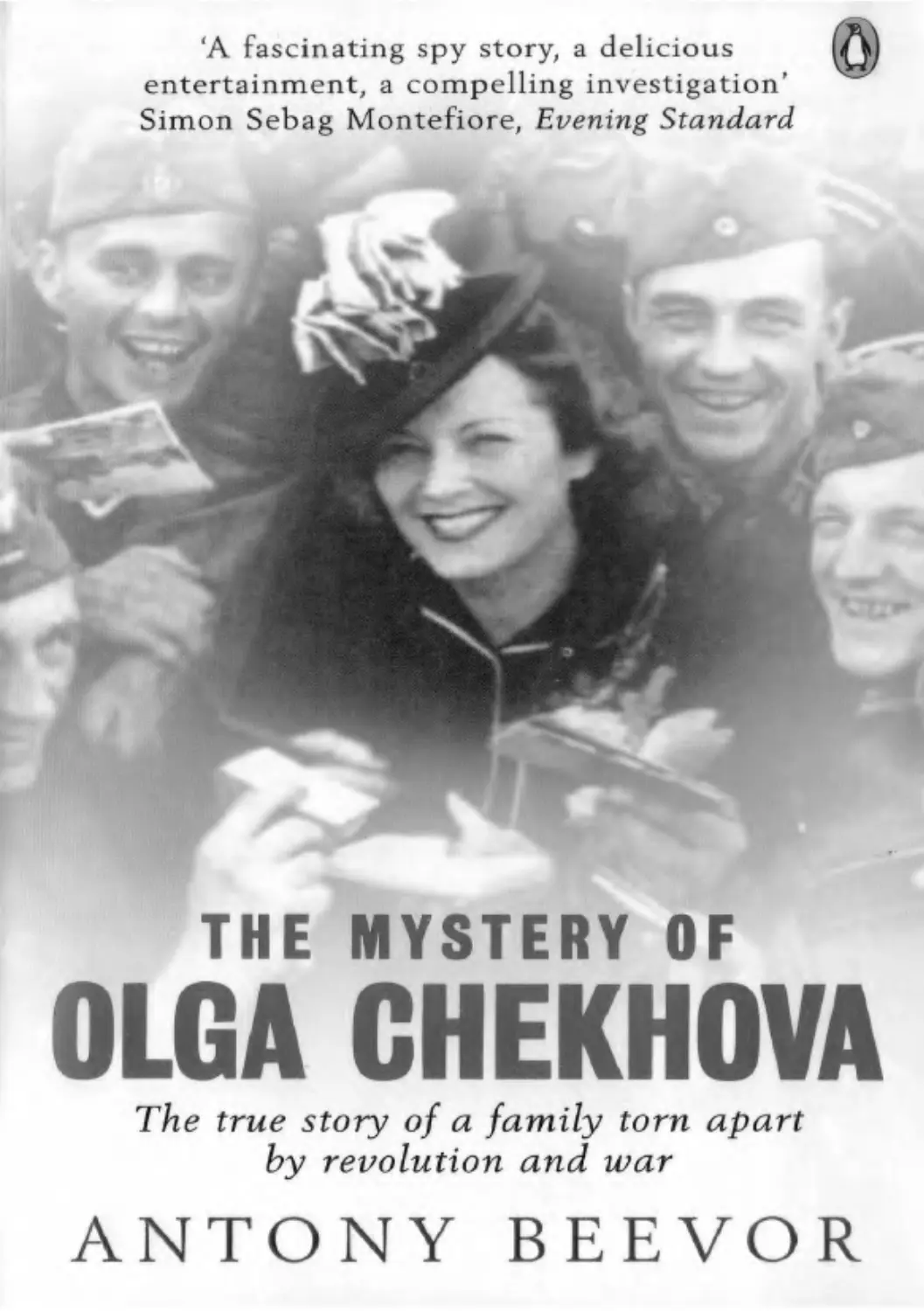
‘A fascinating spy story, a delicious entertainment, a compelling
investigation’ Simon Sebag Montefiore, Evening Standard
The Mystery of
Olga Chekhova
The true story of a family torn apart
by revolution and war
ANTONY BEEVOR
PENGUIN BOOKS

Published by the Penguin Group
Penguin Books Ltd, 80 Strand, London WC2R 0R1, England
Penguin Group (USA) Inc., 375 Hudson Street, New York, New York 10014, USA
Penguin Group (Canada), 10 Alcorn Avenue, Toronto, Ontario, Canada M4V 3B2
(a division of Pearson Penguin Canada Inc.)
Penguin Ireland, 25 St Stephen’s Green, Dublin 2, Ireland
(a division of Penguin Books Ltd)
Penguin Group (Australia), 250 Camberwell Road, Camberwell, Victoria 3124,
Australia
(a division of Pearson Australia Group Pty Ltd)
Penguin Books India Pvt Ltd, 11 Community Centre, Panchsheel Park, New Delhi -
110 017, India Penguin Group (NZ), enr Airborne and Rosedale Roads, Albany, Auckland
1310, New Zealand
(a division of Pearson New Zealand Ltd)
Penguin Books (South Africa) (Pty) Ltd, 24 Sturdee Avenue, Rosebank 2196, South
Africa
Penguin Books Ltd, Registered Offices: 80 Strand, London WC2R 0R1l, England
www.penguin.com
First published by Viking 2004
Published in Penguin Books 2005
Copyright © Ocito Ltd, 2004
All rights reserved. The moral right of the author has been asserted
Set by Rowland Phototypesetting Ltd, Bury St Edmunds, Suffolk
Printed in England by Clays Ltd, St Ives pic
Except in the United States of America, this book is sold subject to the condition
that it shall not, by way of tr ade or otherwise, be lent, re-sold, hired out, or
otherwise circulated without the publisher’s prior consent in any form of binding or
cover other than that in which it is published and without a similar condition
including this condition being imposed on the subsequent purchaser

For Artemis

CONTENTS
LIST OF ILLUSTRATIONS IX
MAP XII
DRAMATIS PERSONAE XIV
I. The Cherry Orchard of Victory
1
2. Knippers and Chekhovs
9
3. Mikhail Chekhov
21
4. Misha and Olga
27
5. The Beginning of a Revolution
35
6. The End of a Marriage
41
7, Frost and Famine
50
8. Surviving the Civil War
60
9. The Dangers of Exile
68
10. The Far-Flung Family
79
11..The Early 1920s in Moscow and Berlin
87
12. Home Thoughts from Abroad
100
13. The End of Political Innocence
111
14. The Totalitarian Years
125
15. The Great Terror
141
16. Enemy Aliens
156
17. Moscow 1941
165
18. A Family Divided by War
183
19. Berlin and Moscow 1945
197
20. Return to Berlin
211
21. After the War
220
Olga Chekhova’s films
235
REFERENCES
240
SOURCE NOTES
242
SELECT BIBLIOGRAPHY
274
ACKNOWLEDGEMENTS
277
INDEX
279

LIST OF ILLUSTRATIONS
1. Victory celebrations in Red Square, 9 May 1945.
2. The searchlights and fireworks of victory night, 9 May 1945.
3. Anton Chekhov reading The Seagull to the Moscow Art Theatre,
1898.
4. Stanislavsky, Gorky and Lilina, Yalta, 1900.
5. Anton Chekhov and Olga Knipper-Chekhova (Aunt Olya).
6. Konstantin and Lulu Knipper in the Caucasus.
7. The Knipper children in 1904.
8. Konstantin and Lulu Knipper with their children.
9. Vasily Kachalov and Olga Knipper-Chekhova in The Cherry
Orchard.
10. Konstantin Knipper, Aunt Olya, Lev and Olga Knipper and
Vasily Kachalov.
11. Lubyanka Square in Moscow before the First World War.
12. The future Olga Chekhova with a dog, c. 1913.
13. Lev Knipper in cadet uniform, 1912.
14. Cousins and friends in 1914: Misha Chekhov, unidentified,
Volodya Chekhov, Igor Stanislavsky, Ada and Olga Knipper.
15. Members of the bourgeoisie t rying to sell their possessions, 1918.
16. Red troops on an armoured train in the civil war.
17. Olga Chekhova in Der Todesreigen (Dance of Death, 1922).
18. Olga with Oskar Homulka in Brennende Grenze (Burning
Frontiers, 1926).
19. Olga with her Talbot convertible and chauffeur.
20. Olga in Moulin Rouge (1928).
21. Olga directing her ex- husband Misha Chekhov in Der Nan seiner
Liebe (The Fool of Love, 1930).
22. Olga with Conrad Veidt in Die Nacht der Entscheidung (The
Night of Decision, 1931).
23. Olga in Liebelei (1931).
24. Olga with Ada and Adele Sandrock in Der Favorit der Kaiserin
(The Empress’s Favourite, 1936).
25. Lev Knipper, Lyuba and their son Andrei, 1931.

26. Lev Knipper in Red Army uniform, 1936.
27. Lev Knipper, composer and NKVD agent, 1938.
28. Olga Chekhova’s wedding .to Marcel Robyns, Berlin, December
1936.
29. Olga celebrat es New Year 1938.
30. Olga and Willi Forst in Bel Ami (1939).
31. Olga Chekhova with Hitler.
32. Olga’s lover Jep, the Luftwaffe fighter pilot in the Battle of
Britain.
33. Olga Chekhova with Goring, Hitler and Keitel at Ribbentrop’s
reception, May 1939.
34. Olga with Wehrmacht troops in Paris, October 1940.
35. Olga visits a Luftwaffe fighter wing, September 1940.
36. Mariya Garikovna.
37. Lev and his fellow co mposer Prokofiev, 1941.
38. Red Army troops march past Stalin in Red Square, November
1941.
39. Lev in Teheran, 1942.
40. Olga with Rudolf Prack in Der ewige Klang (The Eternal Tune,
1944).
41. Abakumov, the chief of SMERSh, receives the Order of Kutuzov
1st Class, April 1945.
42. Lev and Aunt Olya soon after the war.
43. Lev climbing again in the Caucasus after the war.
44. Olga Chekhova, along with Konrad Lorenz, receives the Cross of
the Order of Merit, 1972.

Photographic Acknowledgements
AD-MCY Arkhiv do ma-museya Chekhova Yalta (Archive of the
Chekhov house-museum at Yalta): 8, 12, 14
AKG Archive: 29
The David King Photographic Archive: 1, 2, 3, 4, 5, 11, 15, 16, 38
Andrei Knipper private collection: 13, 25, 26, 27, 37, 39, 42, 43
Aleksandr Melikov private collection: 36
PAK/T Privatarchiv Knipper/Tschechowa, Berlin: 6, 7, 17, 18, 19,
20, 21, 22, 23, 24, 28, 30, 34, 35, 40
Harvey Pitcher, Chekhov’s Leading Lady: 9
Russian State Film Archive: 41
Mariya Shverubovich private collection: 10
Olga Tschechowa, Meine Uhren gehen anders: 32, 44
Ullstein: 31, 33

DRAMATIS PERSONAE
The Knipper Family by Generation
KONSTANTIN KNIPPER Konstantin Leonardovich
(1866—1924). Railway engineer. Father of Olga
Chekhova, Ada Knipper and Lev Knipper. Brother of Olga
Knipper-Chekhova (‘Aunt Olya’) and Vladmir Knipper,
the opera singer. Married ‘Lulu’ Ried, later known as
‘Baba’ .
‘AUNT OLYA’ KNIPPER-CHEKHOVA Olga
Leonardovna (1868-1959). Actress. Married Anton
Chekhov in May 1901. Sister to Konstantin, the railway
engineer, and Vladimir, the opera singer.
VLADIMIR KNIPPER Vladimir Leonardovich (1877—
1942). Usually known as Vladimir Nardov, his stage name.
Singer, and director at the Bolshoi. Younger brother of
Konstantin Knipper and Olga Knipper-Chekhova (‘Aunt
Olya’), and uncle of Olga Chekhova and Lev Knipper.
Father of Vova.
LULU (later BABA) RIED-KNIPPER Yelena Luise
(1874-1943). Mother of Ada, Olga and Lev.
ADA KNIPPER Ada Konstantinovna (1895-1985).
Actress. Sister of Olga and Lev, and mother of Marina
Ried.
OLGA CHEKHOVA Olga Konstantinovna (1897-1980).
Daughter of Konstantin and Lulu Knipper, sister of Ada
and Lev, and mother of Ada (christened Olga).
LEV KNIPPER Lev Konstantinovich (1898-1974).
Composer. Brother of Olga and Ada, and husband of

Lyuba, then of Mariya Garikovna Melikova and finally of
Tatyana Alekseevna Gaidamovich. Father of Andrei
Knipper.
VOVA KNIPPER Vladimir Vladimirovich (1924—95).
Son of Vladimir, the opera singer, and first cousin of Lev
Knipper and Olga Chekhova.
ADA CHEKHOVA RUST Ada Mikhailovna (1916-66).
Daughter of Olga Chekhova and Misha Chekhov. Married
Wilhelm Rust. Mother of Vera. Killed in a plane crash.
MARINA RIED Marina Borisovna Rschevskaya (1917-
89). Daughter of Ada Knipper and Boris P. Rschevsky
(1872- 1922), and niece of Olga Chekhova.
ANDREI KNIPPER (1931- ) . Geologist. Son of Lev
Knipper and Lyuba (Lyubov Sergeevna Zalesskaya).
The Chekhov Family by Generation
ALEKSANDR CHEKHOV Aleksandr Pavlovich (1855-
1913). Writer. Brother of Anton and Masha, and father of
Misha. Husband of Natalya Golden.
ANTON CHEKHOV Anton Pavlovich (1860-1904).
Writer, doctor and playwright. Married Olga Knipper in
May 1901. Brother of Aleksandr, and uncle of Misha,
Volodya and Sergei.
‘AUNT MASHA’ CHEKHOVA Mariya Pavlovna (1863-
1957). Keeper of the Chekhov museum in Yalta. Sister of
Aleksandr, Anton and the other Chekhov brothers. Aunt of
Misha, Volodya and Sergei.

MISHA CHEKHOV Mikhail Aleksandrovich (1891-1955).
Actor. Son of Aleksandr Chekhov and Natalya Golden,
nephew of Anton Chekhov, husband of Olga Chekhova
and father of Ada (Olga Mikhailovna) Chekhova.
VOLODYA CHEKHOV Vladimir Ivanovich (1894—
1917). Student and lawyer. First cousin of Misha and
Sergei. Committed suicide 1917.
SERGEI CHEKHOV Sergei Mikhailovich (1901—73).
Family historian. First cousin of Misha and Volodya.

15
I. The Cherry Orchard of Victory
During the night of 8 May 1945, lights stayed on all over
Moscow. People waited impatiently for news of the final
German surrender. Only the most privileged members of
the Soviet elite, such as the writer Ilya Ehrenburg,
possessed a radio set which they dared to tune to foreign
stations. In Stalin’s Russia, victory did not bring freedo m
from the secret police.
The announcement of the German surrender taken by
Marshal Zhukov in Berlin was eventually made by Levitan,
the Radio Moscow newsreader, at ten past one on the
morning of Wednesday 9 May. ‘ Attention, this is Moscow.
Germany has capitulated . . . This day, in honour of the
victorious Great Patriotic War, is to be a national holiday, a
festival of victory.’
The Internationale was played,
followed by the national anthems of the United States,
Great Britain and France.
The inhabitants of communal apartments did not wait
for the music to finish. They surged out on to the landings
in all stages of dress to congratulate each other. Those with
telephones rang their relations and closest friends to share
this historic moment with them. ‘It’s over! It’s over!’ they
kept repeating. Many broke down in tears of relief and
sorrow. With some 25 million dead as a result of the war,
there was barely a family in the whole Soviet Union which
had not known suffering. By four in the morning,
Ehrenburg noted, ‘Gorky Street was thronged: people stood

16
about outside their buildings, or poured along the street
towards Red Square. ’
It was, as Ehrenburg wrote, ‘an extraordinary day of joy
and sadness’ . He saw an old woman, crying and smiling,
showing a photograph of her son in uniform to passers-by
and telling them that he had been killed the previous
autumn. It was a festival of remembrance as much as a
celebration. When bottles of vodka were passed round, the
first toast was to those who had not lived to see this day,
although loyal party members should have first paid tribute
to Comrade Stalin, the ‘great architect and genius of the
victory’.
Officers in uniform, above all those with medals, were
cheered and sometimes bounced in the air as victors. Even
Ehrenburg, the most famous propagandist of the Red
Army, was recognized in the street and suffered the same
honour, to his great embarrassment. Foreigners too were
‘kissed, hugged and generally feted’ . Around Red Square,
‘foreign cars were stopped and their occupants dragged
out, embraced and even tossed in the air’. Outside the
American embassy, the crowds shouted their admiration
for President Roosevelt, who had died just over a month
before, to their genuine sorrow.
Khmelev, the director of the Moscow Art Theatre,
addressed a spontaneous meeting of the company in the
foyer. What immense joy is ours today!’ he said. ‘We’ve
been waiting for this so long, but now that it’s come, I
can’t find words to express what we feel. When the radio
played victory marches, I saw a woman through the
brightly lit window of a house, dancing and singing to
herself.’

17
During the course of that day between 2 and 3 million
people packed the centre of the capital, from the
embankments of the Moskva river up to the Belorussky
station. Most of them ca me armed with bottles of vodka or
Georgian champagne, which had been hoarded religiously
for this very day. Workers and their families from the
suburbs had come into the centre wearing their best
clothes. Muscovites who had stayed in the capital during
the war were better dressed than those from elsewhere
because, during the panic of October 1941, evacuees from
the city had sold all the clothes they could not take with
them to the thrift shops. Moscow, although it had been
bombed that winter, had been truly fortunate.
Comparatively few buildings had been damaged.
Elsewhere, to the south and west, towns and villages lay in
ruins for hundreds upon hundreds of miles. Some 25
million people were homeless. Survivors lived in dugouts -
literally holes in the ground covered by trunks, branches
and turf.
That evening, Stalin’s victory speech was broadcast and
a salute of 1,000 guns was fired, the shock waves rattling
the windows. Hundreds of aircraft flew overhead, releasing
red, gold and purple flares. Searchlights from Moscow’s
antiaircraft batteries illuminated a huge red banner held up
by invisible balloons. Stalin was cheered spontaneously.
Many, like his protégé Ehrenburg, did not reflect until later
upon the fate of all those whose lives had been wasted or
who had been executed on false charges to cover up the
blunders of their leader. Yet even as strangers embraced
each other in the streets on that deeply emotional day, a
true feeling of victory and joy somehow still seemed just

18
beyond their reach. The only certain sensation was an
exhausted, slightly numb relief.
After these celebrations, members of the Moscow Art
Theatre felt that they too should mark the end of the war.
The Kremlin was planning a huge military parade on Red
Square to commemorate the achievements of the Great
Patriotic War. They, meanwhile, decided on a special
performance. They simply wanted to give thanks that
Russian culture had survived the terrible onslaught of the
Nazis.
With Anton Chekhov’s flying seagull emblazoned on
the curtains, the choice of author was not in doubt. The
plays which he had written for the Moscow Art Theatre,
giving it such international prestige, used to be known
before the revolution as its ‘battleships’ . And the work
decided upon for this occasion was Chekhov’s last, The
Cherry Orchard.
Chekhov’s widow, Olga Knipper-Chekhova, a founder
member of the company, would take the part of the
unworldly landowner Ranyevskaya. She had played it
during the very first performance in January 1904, watched
by their friends Feodor Chaliapin, Maxim Gorky and
Rachmaninov. It had painful memories. Anton, her
husband, had been seriously ill. In fact he was so ‘deathly
pale’ that there had been gasps of horror when he appeared
on stage to receive a tribute. Konstantin Stanislavsky, the
presiding genius of the Moscow Art Theatre, remarked that
this triumphant occasion ‘smelled of a funeral’. Six months
later the playwright was dead.

19
In those days, Olga Knipper-Chekhova, with her small,
animated eyes and firm jaw, had possessed the clean good
looks of a determined, intelligent governess. But now, aged
seventy-six and quite stout despite the short rations of the
war, she was a living monument of the Russian theatre. She
had been appointed a People’s Artist of the Soviet Union as
early as 1928. Yet under Stalin, this was no protection. She
had spent much of the war fearing arrest at any moment by
the NKVD secret police.
In the spy-mania of the time, her anxieties were
perfectly understandable. Both her father and mother were
of German origin. Her brother had assisted Admiral
Kolchak, the White commander in Siberia during the civil
war. Her favourite nephew, the composer Lev Knipper, had
been a White Guard officer fighting the Bolsheviks in the
south of Russia. But most dangerous of all by far, her
niece, Olga Chekhova, had been the leading movie star in
Berlin, honoured since 1936 with the title of ‘State Actress’
of the Third Reich and allegedly adored by Hitler. There
had even been photographs of her at Hitler’s side at Naz i
receptions. And her niece’s former husband, Mikhail
Chekhov, was in Hollywood. They were a family of
émigrés at a time of Stalinist xenophobia.
The elderly actress was almost the last survivor of that
extraordinary group led by Stanislavsky which had started
to revolutionize dramatic art in 1898. Stanislavsky, whom
she described as ‘a huge chapter’ in her life and who had
fired them all with his artistic ideals, had died in 1938. Tall
and elegant, with white hair and black eyebrows, he could
have been an immensely distinguished professor or
diplomat when not disguised in one of the many parts in

20
which he immersed himself. The intensity with which he
engaged in a role left him exhausted after a performance.
Actors entering his dressing room discovered that he
relaxed by taking off all his clothes and smoking a cigar.
‘Just as he could wear any kind of costume, ’ observed one
of the cast, ‘he could wear his own naked flesh genuinely,
with the utmost Hellenic simplicity.’
Shortly before his last illness in 1938, Stanislavsky had
wanted the brilliant actor and director Vsevolod
Meyerhold, a companion of the early days, to succeed him
at the Moscow Art Theatre. But Meyerhold had attracted
the hatred of the Soviet authorities, and Stanislavsky could
do little to help from beyond the grave. Meyerhold, who
had been a supporter of the Bolsheviks at the time of the
revolution, had fallen foul of the Stalinist regime because
his plays did not conform to the new doctrine of Socialist
Realism. He attacked the sterile state of Soviet theatre in a
suicidally brave speech at the All-Union Congress of Stage
Directors. He was arrested in June 1939. Two weeks later,
his Jewish wife, the well-known actress Zinaida Raikh, was
murdered in their apartment. Her body was mutilated and
her eyes were gouged out. Meyerhold may well have bee n
one of those personally tortured by Lavrenty Beria himself
before being killed. Stalin signed his death warrant. Few
now dared to mention his name, or that a former mistress
of Beria had been given the Meyerhold apartment.
Even the play chosen to celebrate the Soviet victory
over Germany seemed to have its own ghosts. In 1917, the
Moscow Art Theatre had performed The Cherry Orchard
on the night of the Bolshevik coup d’état. And in May
1919, Olga Knipper-Chekhova had been in Kharkov with a

21
touring party to escape starvation in Moscow, when they
heard during the second act of the play that the city had
suddenly fallen to the White Army of General Denikin. But
the heady advance of the White armies was short-lived.
Denikin’s forces fell back in chaos towards the Black Sea
coast. Along with a sta mpede of civilian refugees fearing
Bolshevik vengeance, they were decimated by typhus and
starvation. Olga Knipper-Chekhova and her companions in
the travelling group escaped south across the Caucasus to
Georgia. There, The Cherry Orchard had been their last
performance in the capital, Tiflis, just before crossing the
Black Sea into an indecisive exile.
From September 1920 until their return to Moscow in
the spring of 1922, Olga Knipper-Chekhova had been an
émigré: a category of deep suspicion to the Soviet
authorities. But this brief period, although dangerous in
itself, was nothing in comparison to the flamboyant career
of her niece and namesake in Germany.
In the autumn of 1943, the Moscow Art Theatre had
requested a special honour for their greatest actress to mark
her seventy-fifth birthday, but this had been received with
an ominous silence from the Soviet authorities. Throughout
the war she had never been invited to speak on the radio or
to give solo performances as before. Other members of the
family encountered similar sinister rebuffs. In the Soviet
Union such signs could not be ignored. And now people
were finding that the great victory had not eased the
paranoia of the Stalinist regime. The recent wave of
denunciations and pre-dawn raids by the NKVD made
Muscovites afraid that another round of purges had begun.

22
At least the building was reassuringly familiar. This
theatre had literally been a second home to her for over
half a lifetime. Apart from a great Art Nouveau bas-relief
above the entrance, the outside was not so very different
from most Moscow three-storeyed facades. Inside, the
circle of ceiling lamps and door handles of the auditorium
were also of Art Nouveau design. The fronts of the seats
were upholstered in plush, but otherwise the walls and
floors were bare of decoration. Stanislavsky had
disapproved of anything which distracted attention from
the performance. On the grey-green curtains, the only
emblem was Chekhov’s single stylized seagull in flight.
This symbol of a new reality in the theatre had remained in
place throughout the revolution and the famine-stricken
civil war. It had even survived the Stalinist Terror and the
company being forced to stage Socialist Realist plays of
pure propaganda.
Olga Knipper-Chekhova had little to fear professionally
in such a well-known role as the one she was to play for
this special performance of The Cherry Orchard. In the
autumn of 1943 she had played the part for the thousandth
time for the troops and received fan letters from the front
afterwards.
Anton Chekhov had not written the part of
Ranyevskaya with his wife in mind - he had in fact
intended it for a much older actress — but this worked later
to her advantage. It allowed her, even in her seventies, to
continue playing the character and receive tumultuous
applause, although the acclaim was perhaps more for a
revered institution. She was known for her expressive hand
movements — in the role of Ranyevskaya, they were

23
fluttering and elegantly clumsy to express her emotional
confusion - yet Olga Knipper-Chekhova herself overdid
things when nervous. Nemirovich-Danchenko once sent
her a message which she had never forgotten: ‘One pair of
hands is enough. Leave the other dozen pairs in the
dressing room.’
That evening, as the curtains closed on Stanislavsky’s
final sound effect off-stage — the hollow thud of an axe
chopping down cherry trees in the lost orchard - the 500-
strong audience gave a standing ovation on this highly
emotional occasion. Olga Knipper-Chekhova took her bow
a few moments later. Her lowered eyes focused on the
front rows. A beautiful, well-dressed woman in her forties
gave her a discreet wave. Olga Knipper-Chekhova reeled
back in shock and collapsed behind the curtain in
confusion and terror. The glamorous woman who had
waved to her, right there in the triumphant Soviet capital,
was her niece, Olga Chekhova, the great star of the Naz i
cinema.

24
2. Knippers and Chekhovs
Olga Knipper-Chekhova, People’s Artist of the USSR and
grande dame of the Moscow stage, had no Slav blood in
her body. Her husband, Anton Chekhov, had never ceased
to be bemused by the utterly un-Russian family into which
he had married in 1901. To the consumptive playwright,
the Germanic Knippers looked so healthy; and they seemed
so tidy and organized and bourgeois in comparison to his
own chaotic family.
The Knippers originally came from Saarbrücken, where the
name was common. They were said to have been builders,
which may explain the choice of family motto, Per ardua
ad astra. Olga’s father, Leonard Knipper, had made
enough money during those nineteenth-century boom years
in the volatile Russian economy to allow his family to
adopt the upper-middle-class style of the period. There was
a grand piano in the drawing room and well-upholstered
furniture. They had five servants, and the children were
sent to private schools. Konstantin studied to become an
engineer, while Olga, usually known as Olya, took lessons
in languages, music and singing. She longed to be an
actress, but her father and mother considered a career on
the stage unthinkable for a well-brought-up girl.
When Leonard Knipper died in 1894, a shock awaited
his family. He had concealed his bankruptcy, but his death
revealed their desperate situation. His widow, Anna, had to
move to a small apartment with Olya, by then twenty-five,
and Vladimir, who was just starting as a law student.

25
Konstantin had already e mbarked on his career as a railwa y
engineer. In their dramatically reduced circumstances, the
small apartment had to be shared with two eccentric uncles.
To make ends meet, Anna Salza -Knipper gave singing
lessons. Her musical talents were clearly considerable. She
eventually became a professor at the Moscow
Conservatoire. Olya, meanwhile, gave music lessons to
earn money to help her through drama school, opposition
to a stage career having collapsed after her father’s death.
Vladimir, the youngest in this handsome and talented
family, later proved to have an even better voice than his
mother and sister. After a brief career as a lawyer, he
became a famous opera singer.
Olya Knipper, in spite of the memory of her father’s
bankruptcy, showed little regard for the accumulation of
money or personal possessions. The theatre was all that
mattered to her. She impressed the theatre director
Vladimir Nemirovich-Danchenko at the Moscow
Philharmonic School, and was one of the young actors
chosen in his crusade to revolutionize the theatre with
Konstantin Stanislavsky. They wanted to throw out the
pompous and melodramatic, and focus instead on everyday
life, using new acting techniques which recreated that
reality. Stanislavsky’s theory, which became known as the
‘System’ - the idea that actors should immerse themselves
totally in their part - later became famous in Hollywood as
the ‘Method’.
Nemirovich-Danchenko and Stanislavsky, helped
greatly by Stanislavsky’s family money and the subsidies
of rich supporters, set up the Moscow Art Theatre in 1898.
Olya became the mistress of Ne mirovich-Danchenko, a

26
great friend of Anton Chekhov and the champion of his
play The Seagull. It was presumably quite an energetic
relationship, since Nemirovich-Danchenko’s pet name for
Olya was ‘my vaulting-horse’. But this did not stop her and
Chekhov from falling in love after their first meeting that
September, during rehearsals for The Seagull. Chekhov had
sometimes railed against actresses - he once called them
‘cows who fancy they are goddesses’ and ‘Machiavellis in
skirts’ - but this was partly due to his inability to keep
away from them, and they from him.
The love affair between Anton Chekhov and Olya
Knipper was mostly a curious long-distance process.
Except for summer visits, she stayed in Moscow with the
theatre. The consumptive writer, meanwhile, was forced to
remain for much of the year in the far warmer climate of
Yalta in the Crimea. He called this exile ‘my hot Siberia’ .
The gap was bridged by letters to and fro. They sparred,
sometimes quite mercilessly. She joked about Anton’s
adoring former mistresses, whom she nicknamed the
Antonovkas — the name of a variety of luscious apple. He
teased her about her relationship with her former lover, the
theatre’s elegant director. ‘Have you been carried away by
his moire silk lapels?’ he wrote. Occasionally, his jester’s
mask slipped, revealing his jealousy. But he had little to
fear. Nemirovich-Danchenko, a pragmatist more than a
cynic, knew that Olya’s relationship with the playwright
was of great importance to the Moscow Art Theatre. He
and Stanislavsky privately viewed the relationship as the
theatrical equivalent of an important dynastic marriage.

27
In the summer of 1900, as Chekhov settled down to
write The Three Sisters, he resolved to marry Olya
Knipper, his ‘little Lutheran’. But even when he had
finished the play and they arranged their marriage the
following year in Moscow, he still did not quite have the
nerve to warn his mother and his utterly devoted sister,
Mariya, always known as Masha. Olga’s mother, Anna
Salza, was also unhappy about the marriage. After the brief
service, Olya Knipper-Chekhova, as she now became, and
Anton slipped away to see his friend and fellow playwright
Maxim Gorky. An amazed Gorky slapped her on the back
in congratulation. After this impromptu visit, the bride and
groom departed for the railway station. Bewildered guests
at the wedding reception were left to wait in vain, but this
does not seem to have been that abnormal in the
spontaneous chaos of the Chekhovian circle. Only after the
wedding was over did Chekhov send his mother a telegra m
to announce it.
The Chekhov and the Knipper families could not have
been more different, as the playwright had so often joked.
Yet there were odd similarities. Anton’s father, Pavel
Chekhov, who had been born the son of a serf, became a
hard-nosed shopkeeper in Taganrog on the Sea of Azov,
but he also went bankrupt like Leonard Knipper.
The bankruptcy of a parent often proves a powerful
influence on the children affected. Some become
determined to make so much money that they will feel
beyond such dangers, but others long to emancipate
themselves from a poverty of experience and knowledge,
even more than from financial hardship. The Chekhov
children took the latter route. The eldest, Aleksandr,

28
wanted to be a writer. Nikolai became an artist and
caricaturist. Anton trained as a doctor while writing his
early comic pieces and short stories. Ivan was a primary
school teacher, Mariya a painter and Mikhail, the youngest,
a translator and general dogsbody on a literary magazine.
Anton was the only one who made any money, so the
others frequently turned to him for help and burdened him
with their private catastrophes interrupting his work. Many
friends and former mistresses who had fallen on hard times
did likewise. In the prodigal and disordered world of the
late-nineteenth-century Russian intelligentsia, few bothered
to save money against unforeseen disaster. That was
regarded as bourgeois and disgracefully un-Russian.
Chekhov’s choice of subject for the play The Three
Sisters was not entirely surprising. He had always been
fascinated by such trios. One family in particular, the
Golden sisters, had become closely linked with Anton and
two of his brothers in St Petersburg’s bohemia of the early
1880s, a smoky demimonde of debts, drinking and
fornication. It was no wonder that the young Dr Chekhov,
like most of his medical contemporaries, had to spend a
large part of his professional life coping with venerea l
infections.
The Chekhovs and Goldens lived and worked in the
same round of literary weeklies, the boys as contributors,
the girls as secretaries. The eldest of these three Jewish
sisters, Anna Golden, a divorcee, became the common-law
wife of Anton’s brother Nikolai, or Kolya. The youngest,
darkest and thinnest of the three, Natalya Golden, fell in
love with Anton, and their affair lasted two years. She was

29
his ‘little skeleton’, even though her appetite for food was
apparently as voracious as her sexual desire.
They drifted apart, but then, in October 1888, Anton
received an astonishing letter from his brother Aleksandr.
‘Natalya is living in my apartment, running the household,
fussing over the children and keeping me up to scratch.
And if she crosses sometimes into concubinage, that’s none
of your business. ’ Perhaps the greatest surprise came at the
end of the letter. ‘If our parents, whose old age I intend to
console by exemplary behaviour, don’t view this
“ intimacy” as incest, fornication and onanism, then I have
nothing against marriage in church.’ Natalya also wrote to
Anton professing her own astonishment at how things had
turned out. She too was now keen on the idea of middle-
class respectability; in fact the ‘onanism’ mentioned by
Aleksandr was almost certainly due to her fear of
becoming pregnant before they were married. The
condoms he bought at thirty-five kopecks apiece did not
seem to work. He bragged to Anton that they burst because
they were not large enough.
Nobody could accuse Natalya of being maritally
ambitious. Aleksandr was a writer whose lack of financial
and critical success was cruelly highlighted by the growing
renown of his younger sibling. He was reduced to
journalism for the right-wing Suvorin press in St
Petersburg. Aleksandr was a big, powerful man with a
‘thunderous voice’ who loathed modern inventions such as
the telephone or typewriter, preferring a goose-quill pen.
He was also decidedly eccentric. He tried to train his
chickens to use one door of the henhouse for entry and the
other for exit, but they failed to understand such logic and

30
neither threats nor inducements would alter their random
behaviour. Utterly unpredictable in his own life, squalid in
his surroundings and obscene in his language, both on the
page and in public, he had often sought escape in the bottle
and in the beds of indulgent women.
Anton, who visited the couple in St Petersburg just over
two months later, was appalled by his eldest brother’s
crude behaviour in front of children and servants and his
mistreatment of Natalya. On 2 January 1889, he wrote a
letter of devastating criticism. It had a marked effect. From
then on, Natalya ruled the marital roost. Yet her position of
virtual ostracism within the wider Chekhov family
improved only when she gave birth to a son, Mikhail, on
16 August 1891. This was the first legitimate grandchild
for Pavel and Evgenia Chekhov and they were oveijoyed.
Aleksandr was soon trying to convince Anton of the
blessings of marriage — or ‘Godfearing coitus’, as he
preferred to put it - but it was not long before he started to
suffer from impotence, probably as a result of his semi-
chronic alcoholism.
The marriage continued to undergo severe strains,
mainly according to whether Aleksandr was on or off the
bottle.
Sometimes he just disappeared. A telegram would
arrive saying: ‘Am in the Crimea’ or ‘Am in the Caucasus’ .
Sometimes Natalya threw him out of the house when he
lapsed again into alcohol and impotence. It was perhaps
typical of this morally anarchic circle that the demanding
Natalya, Anton’s former mistress, should write to him,
complaining of his brother’s inability to satisfy her. She

31
asked what he, as a doctor, could do to help. The answer
was clearly discouraging.
Natalya nevertheless remained devoted to Anton,
especially if he came to see them on visits to St Petersburg
and praised his young nephew Mikhail’s emerging talents.
‘Misha is an amazingly intelligent boy,’ he wrote in
February 1895. ‘There’s a nervous energy shining in his
eyes. I think he’s going to grow into a talented man. ’
Aleksandr was also boastful of his son’s precocious
prowess. He later claimed that, as well as speaking French
and German, Misha at the age of twelve was already
chasing girls. Natalya, however, had been so determined to
protect her precious Misha from bad influences that she
had made Aleksandr send Kolya, the unruly fourteen-year-
old elder son from his previous liaison, away to the
merchant navy. She became increasingly eccentric. Misha
could do no wrong in her eyes, but her overpowering
possessiveness evidently unbalanced him. He later told
friends that she had seduced him. This was almost certainly
untrue, but the brilliant youth who was to marry Uncle
Anton’s niece by marriage was slightly unbalanced. He
seems to have inherited his father’s self-destructive streak.
During these turn-of-the-century years, Anton
Chekhov’s brother-in-law Konstantin Knipper, had become
a successful engineer in the great days of Russian railroad
expansion. With his immaculate beard and the official
frock-coated uniform of the imperial railways, Konstantin
Knipper had the air of a better-looking version of the Tsar
himself. He directed the construction of the Trans-
Caucasian line, living with his young family near Tiflis.

32
His wife, Yelena, usually known as Lulu, was also
German, and also musical. Their daughter Olga, Mikhail
Chekhov’s future wife, later claimed that Tchaikovsky had
been her mother’s first love, a particularly improbable
invention. She also claimed, in her exasperatingly
disingenuous memoirs, that her mother was close friends
with Tolstoy, Rachmaninov and the Tsarina.
A slight confusion even surrounds Olga’s birth on 26
April 1897. Official Soviet documents, including later
reports of the NKVD and SMERSh, record her place of
birth as Pushkin (the former Tsarskoe Selo, near St
Petersburg), yet she was undoubtedly born at
Aleksandropol in the southern Caucasus. The family did
not move to St Petersburg until several years later.
Olga Chekhova’s first recollection of childhood in
Georgia focused on a summer afternoon. She and her elder
sister, Ada, tiptoed about the house outside Tiflis, because
their parents were nervous and irritable. Their little brother,
Lev, lay in a darkened room, with his feet fastened to the
end of the bed. Traction was exerted on his back through
weights attached to his feet and a leather loop under his
chin. Anton Chekhov, then the lover but not quite yet the
husband of their Aunt Olya, as they called her, had come to
see the invalid child. He diagnosed tuberculosis of the
bone. Their mother, Lulu, having tried many medical
practitioners who all agreed with this diagnosis, had turned
in desperation to Chekhov, the only doctor close to the
family. In later years, Lev’s sister Olga could not resist
embroidering the event in her memoirs, with the unlikely
detail that Anton Chekhov had brought the two-year-old a
gramophone as a present because he was already aware of

33
this future composer’s musical gifts. Lev’s love for music
did not become evident until much later.
The house — Olga later described it as ‘a hunting
lodge’ - was made with wood from the mountain forest. It
had a library, a billiard room and a sitting room with a
piano on which Olga and Lev’s parents played four-handed
duets. A nanny supervised them from breakfast until
bedtime prayers, but they still seem to have had
adventures. Olga claimed that, •is a baby, she had bee n
dragged from the garden by a jackal which emerged from
the surrounding wilderness, and that, at the age of five, she
was molested by the gardener. Neither experience appears
to have daunted her.
Lev, after being sent to Moscow for treatment,
recovered gradually and slowly began to walk again. But
his childhood illness made him a solitary, rather introverted
character. He did not join his two sisters when they played
in laundry baskets, pretending that these were ships in
which they sailed from room to room, each one designated
a different country. The girls read Robinson Crusoe and
Don Quixote, and adored dressing up. Yet even though
they were not unduly noisy or ill-disciplined, Konstantin
Leonardovich Knipper often exploded into rages,
especially if his authority was questioned. Olga claimed
that she once threw herself out of a ground-floor window in
protest at one of her father’s outbursts. Whether or not the
father’s rages were a contributory factor, Lev appears to
have grown into a boy who controlled and concealed his
emotions. Nobody knew what he was thinking.
Konstantin Knipper, although he loomed large when at
home, was frequently taken away by his work on the

34
railways. In 1904, with the onset of the Russo-Japanese
War, he was summoned to rebuild a large section of the
Trans-Siberian railway to help transport troops to the Far
East. Whenever possible, Lulu Knipper accompanied her
husband. On one of these occasions, she left the four-year-
old Lev in the custody of his Aunt Olya. She adored Lev
and wrote to Anton, now her husband, afterwards: ‘I
hellishly wanted a son like that for you and me.’ From then
on she saw herself virtually as Lev’s surrogate mother.
It was around this time that the family left Georgia for
Moscow, a temporary resting place, before they moved on
to St Petersburg once Konstantin Knipper became an
official in the Ministry of Transport. The fact that he was
of German origin and a Lutheran did not impede his career.
Konstantin Knipper made clear at home that he wanted his
only son, Lev, to follow in his footsteps as an engineer.
Lev showed little reaction, as usual.
He started to recover from his childhood illness. Aunt
Olya gave him boxing gloves and a football, which
provoked energetic protests from the boy’s mother,
convinced that he should take no risks. But it was not long
before Lev became attracted to dangerous physical activity,
almost certainly to compensate for the humiliations of an
over-coddled childhood. He was also to become extremely
competitive. His only foray into engineering as a child was
to build a rudimentary plane ‘which looked like a see-saw’ .
It crashed, injuring his spine. The two sisters, Ada and
Olga, looked after him for a whole summer holiday, and
Aunt Olya also came to care for him.
Behind his controlled mask, Lev was clearly intelligent,
so his overt refusal to indicate any special interest

35
exasperated his father. Lev had in fact discovered his
vocation, but did not reveal it to anyone, including himself,
for many years. When he was about six, his parents took
him to a concert in St Petersburg, presumably hoping like
most adults that he would not embarrass or irritate them by
shuffling around out of boredom. But the music - it was
Tchaikovsky’s 6th Symphony — struck him with such
exquisite power that he was quite overcome. He later
described it as his ‘first music shock’ . It was so intense
that, to his mother’s alarm, he burst into tears. An evidently
displeased Konstantin Knipper had to lead his young son
out of the concert hall and take him home.
The two Knipper girls received piano lessons as a
matter of course, but even in this musical family Lev did
not. His mother used to organize musical soirees at home,
so Lev hid in the drawing room to listen. He loved the
Gypsy folksongs called romans performed by a friend of
his mother: they seem to have had a lasting influence on
some of his subsequent work. And whenever Aunt Olya
was visiting St Petersburg with the Moscow Art Theatre
during its spring season, she used to play adaptations of
Beethoven symphonies with her brother Konstantin or sing
bergerettes to her own accompaniment. Clearly Lev had so
sealed himself off in boyhood that he never expressed his
musical yearnings and nobody in the family guessed the m
until he became an adolescent.
Lev’s secondary schooling took place at the First
Classical School Gymnasium. He was fortunate to have an
excellent music teacher, and at last his inclination
blossomed. In the school orchestra he wanted to learn all
the instruments - wind, percussion and string. He even

36
started to become a normal boy of his time, reading Jules
Verne, Fenimore Cooper and The Three Musketeers. Most
strikingly, he showed himself determined to conquer all the
feelings of physical inferiority he had experienced as a
child. He spent time running and engaging in the Russian
version of French wrestling. Aunt Olya, thrilled to see this
physical improvement, and proud of the presents she had
given him to such family outrage, now brought back a full
footballer’s outfit from one of her foreign trips.
At home as well as at school, Lev followed one passion
after another. He was given a chemistry set and
experimented constantly until an explosion led to its instant
confiscation.
His parents finally found a piano teacher for him, but
the teacher in question was clearly of the old-fashioned
school, making him play scales the whole time. After the
freedom and innovation of the orchestra, this irritated Lev
profoundly and his ‘unruly character’ revolted against this
‘sc ale torture’. The lessons were stopped.
Lev’s sister Olga showed none of his academic promise
at all. In 1913, at the Stroganov Art School in St
Petersburg, her final marks for religious education,
Russian, maths, algebra, geometry, history and physics
could hardly have been lower. Her French and German
were adequate and she distinguished herself only in art.
The reaction of many within the family was that ‘such a
beauty didn’t need to go to school anyway’.
Young Olga longed to go on the stage, but her father,
Konstantin, absolutely forbade any idea of the theatre as a
career. He could not say so, out of loyalty to his sister, the
great symbol of the Moscow Art Theatre, but actresses,

37
like ballerinas, were seen in imperial Russia as not much
better than high-class prostitutes. Yet Lulu, her mother,
seems to have secretly sympathized. According to young
Olga, her aunt, when acting for a season in St Petersburg,
brought the great Italian actress Eleanora Duse to the
house. Duse, she later claimed, patted her head and said:
‘You will definitely become an actress one day, my little
one. ’ Nobody, however, would have predicted that, like
Aunt Olya, Olga too would marry into the Chekhov family,
although in her case the marriage would prove disastrous.

38
3. Mikhail Chekhov
The acting talents of Olga’s future husband, Misha
Chekhov, were evident from an early age. In 1907, when
he was just sixteen, his besotted mother, Natalya, moved
him to the school of the Maly Theatre in St Petersburg. He
studied there for three years and graduated with distinction.
In October 1911, aged only nineteen, he was given the lead
role in the Maly’s production of Aleksei Tolstoy’s Tsar
Feodor. It was the play which had launched the Moscow
Art Theatre just before The Seagull and brought fame, as
well as Chekhov’s attention, to Aunt Olya in the role of the
Tsarina Irina.
Misha was an instant success. He had an extraordinary
gift for mimicry, both facial and vocal, while his
mesmerizing eyes and haunted face allowed him to play
old men convincingly even before he was twenty. A first
cousin, Sergei Chekhov, described Misha in the spring of
1912: ‘He was short, thin and moved restlessly. He dressed
carelessly in a shabby velvet jacket and, horror of horrors,
he did not just lack a starched collar, he wore no collar at
all. But he had a captivating tenderness about him. He was
warm and had a sweet smile which made one forget that he
was not handsome. He would pull up his trousers in a
characteristic gesture of exaggerated elegance, and rolled
his eyes in an amusing way.’ The two of them went for
walks together, fooled around and danced the tango, which
was then the rage in St Petersburg. Misha gave his cousin a

39
photograph of himself frowning and signed it with the
words: ‘This is how I look after the tango. ’
During the spring of 1912, the Moscow Art Theatre
came to St Petersburg for its annual season. Anton
Chekhov’s sister, Masha, the devoted guardian of the
playwright’s flame, arranged for him to meet her sister-in-
law Olga Knipper-Chekhova, still the star of the Moscow
Art Theatre, and she in turn promised to arrange an
audition with Stanislavsky. Misha spent a sleepless night
beforehand, so keen was he to join the company. The next
morning he found that the collar of his only suitable shirt
was so tight that it produced a ringing in the ears, and his
trousers had to be hauled up so high ‘as if I had to step over
puddles’.
‘Thank you, Aunt Masha, ’ he wrote afterwards. ‘I can
imagine what a silly and funny impression I made upon
them. I am terribly shy. I can’t speak, and when I meet a
person for the first time, I can’t even say two words. ’ But
Stanislavsky recognized his talent immediately and invited
him to join the Moscow Art Theatre. The fact that he was a
nephew of the theatre’s patron saint was certainly not a
hindrance. In August of that year, Misha left St Petersburg
for Moscow.
At first he lived under Aunt Masha’s wing in her
apartment on Dolgorukovskaya ulitsa. She was a
vegetarian at the time and was teased by the rest of the
family. Misha called his aunt ‘the Countess’, and kissed
her hand most elaborately. When he returned to St
Petersburg the following year with the Moscow Art
Theatre on its spring tour, he found that his father did not
have much time left to live. Natalya had thrown Aleksandr

40
out in 1908, because of his relapse into alcoholism. Since
then, Misha’s father had been living in a small dacha with
one servant, his dogs and his chickens, and he was now
dying from cancer of the larynx. Misha spent his spare time
by his father’s deathbed. Despite the pain, Aleksandr
continued to make jokes until the end Came in May 1913.
Misha was deeply touched. The experience, as he admitted
later, influenced his portrayal of death on the stage.
When Misha returned to Moscow after his father’s
death, Natalya moved there with her two dachshunds to
join him. They began to enjoy a style beyond his modest
salary at the theatre. Perhaps they were living off the
proceeds from the sale of the house near St Petersburg. In
any case Misha, with his success on the stage, had acquired
a taste for theatrical extravagance. ‘I visited Mishka several
times,’ Volodya Chekhov, another first cousin, wrote to his
mother, who was staying during that last summer of peace
in the playwright’s house at Yalta. ‘He is living in a four-
roomed apartment with electric light near the Patriarshie
ponds. He has bought a new piano and now he no longer
borrows twenty kopecks from the porters, but is constantly
handing out tips all round. He pays eighty-five roubles for
his apartment. Natalya Aleksandrovna sits there in a black
robe, squints and smokes, while Misha, in red shoes, grey
unbuttoned trousers and no jacket, lies on the sofa and
“ spits at the ceiling” [an old Russian phrase which means
doing nothing]. ’
Volodya, younger by nearly three years, hero-
worshipped Misha. He also felt himself to be in his shadow
and something of a poor relation. Volodya had secretly
longed to be an actor too, but lacked sufficient confidence

41
in his own talents. He also faced parental disapproval. His
father, the fourth of the five Chekhov brothers, had not
even graduated from secondary school. Ivan Chekhov, who
appears in family photographs as elegantly bearded and
bearing a faint resemblance to the young Stalin, had taught
in a primary school. There he had met Volodya’s mother, a
beautiful young fellow teacher with fair hair. But his career
had not been a happy one.
Their side of the family saw comparatively little of the
more artistic members, perhaps partly because Ivan
Chekhov had convinced himself that actors were ‘second-
rate people’ . Volodya had not met Misha before because
his parents would have nothing to do with Natalya, Misha’s
mother and Anton’s former mistress. Volodya, now
studying law at Moscow University, finally set eyes on him
at one of Aunt Masha’s family dinners. Volodya adored the
way Misha could not stop performing, often with brilliant
improvisations and imitations. The two of them would
invent and act out whole scenes together. And for Volodya,
such associations with the theatre must have had a heady
whiff of the forbidden.
The cousins used to play charades after Aunt Masha’s
dinners, using all the shawls, rugs, old hats, sheets and
even the big carpet from the floor in the sitting room.
Sergei remembered ‘Volodya wrapped in this carpet,
wriggling on the floor, pretending to be a whale’ . Misha,
draped in a sheet and holding a staff, played Jonah and
plunged into the carpet’s mouth. Another night, however,
when perhaps playing the part of Noah too literally, he fell
asleep having drunk too much.

42
On some evenings, to Aunt Masha’s considerable
distress, Misha would arrive already inebriated. She
dreaded him inheriting his father’s alcoholism and offered
him twenty-five roubles a month if he gave up drink. He
promised to do so and took the money. Aunt Masha was
very relieved, but then one evening he turned up swaying
and slurring his words again. Volodya, who was with him,
said gloomily that he had found Misha in this state outside
in the street. Aunt Masha burst into tears, reproaching him.
Misha, who had been putting on an act for fun, was
horrified by the intensity of her reaction. He fell on his
knees. ‘My darling Mashechka, calm down,’ he called to
her in a sober voice. ‘I was pretending. Please forgive me. ’
Aunt Masha was consoled and later used to tell the story,
boasting how great an actor her nephew was. Yet the
reprieve from alcoholism was only temporary.
The cousins’ charmed life continued after the
announcement of war in August 1914. They had ignored
the middle-class crowds rejoicing in the streets. Even the
terrible news when the First and Second Russian Armies
were destroyed in East Prussia seemed to make little
difference to their existence. Volodya was in his second
year at university and, during that autumn season of 1914,
Misha played in Turgenev’s A Woman from the Provinces.
He also enjoyed great success in an experimental version
by the Moscow Art Theatre studio of The Cricket on the
Hearth by Charles Dickens.
Stanislavsky’s ‘System’, Misha found, produced great
demands on the actor, but he felt that he was learning far
more than he ever had in St Petersburg at the Maly Theatre.
It was not up to the actor simply to follow the director’s

43
instructions. He had to create the role in a literal sense, by
imagining the character he was playing and inhabiting his
life. Stanislavsky did not want an actor to imitate the
externals. The actor’s own emotional memories were to be
used to help his re-creation, making it personal and real to
him, and thus to the audience. Stanislavsky loathed the
stock gestures of the theatrical profession which had made
acting so mannered.
‘Agitation is expressed by pacing up and down the
stage very quickly,’ he wrote, ‘by the hands being seen to
tremble when a letter is being opened or by letting the jug
knock against the glass and then the glass against the teeth
when the water is being poured and drunk.’ He regarded
this as a lazy shorthand, a caricature of human behaviour, a
copy of a copy of a copy, which had evolved into a
standard pattern of theatrical clichés. The point for
Stanislavsky was to convey inner feelings through every
other means.
Misha often had breakfast with Stanislavsky, who
would suddenly tell him to eat in a manner which
expressed a particular mood: for example, as if he had just
suffered the death of a child.
In the winter, the cousins went skiing in the Sparrow
Hills outside Moscow. The ill-constructed trenches of the
eastern front, in which several million men from the Tsarist
army stood in icy mud up to their knees, must have seemed
a whole world away. Misha and his mother dreaded his
conscription into the army, yet the Moscow Art Theatre
carried on as before.
The younger generation of Knippers as well as
Chekhovs also started to move to Moscow from St

44
Petersburg, now renamed Petrograd by the Tsar in a
gesture of wartime Russian nationalism. Olga was sent to
Moscow by her parents in 1914 to study art. She moved
into Aunt Olya’s apartment on the first floor of 23
Prechistensky bulvar, a typical late-nineteenth-century
Moscow stuccoed building with Italianate windows on the
top two floors. It still stands on the broad Boulevard Ring,
with a promenade bordered by large maples and grass
running between the two carriageways. The view from
Aunt Olya’s windows was of trees and the magnificent
town houses of magnates on the far side of the boulevard.
The following year, Lev too came to Moscow to attend
a new school. Aunt Olya made sure that she saw her
favourite nephew frequently and she encouraged him in
every way. The school, which was progressive for the
times, put on a performance of Aleksandr Blok’s play The
Rose and the Cross, for which Lev was allowed to select
and adapt the music. Lev had mixed feelings about the
move to Moscow. He had fallen in love with the beauty of
St Petersburg a year or so before leaving it, yet the city in
its wartime guise of Petrograd was starting to change.
There was a new, ugly mood. The Knipper parents had
discussed the political unrest quite openly at table. They
were extremely concerned at the strikes and the ossified
reaction of the Tsar and his entourage to an increasingly
dangerous situation.

45
4. Misha and Olga
Along with Aleksandr Chekhov’s alcoholism, Misha had
also inherited a compulsion to seduce, although mercifully
in a rather more romantic fashion than his father. ‘From my
earliest youth,’ he wrote later, ‘I found myself in a constant
state of falling in love. ’
Misha must have first met Olga Knipper when he was
still at the Maly Theatre in St Petersburg. Just before the
First World War, two or three of the Chekhov cousins went
out to the Knipper house at Tsarskoe Selo to play tennis,
swim and dance. Misha presumably did not pay much
attention to her then, for she was almost six years younger
than him. But when Olga came to Moscow in 1914 to study
art she was seventeen and enchantingly beautiful. She had
not yet emerged from an innocent naivety and a tendency
to daydream, even though she had already demonstrated on
occasion a streak of determination.
Her own account of these early years is heavily
romanticized. She claimed that as a child she used to play
with the little Grand Duchesses at Tsarskoe Selo and that
she had encountered Rasputin in alarming circumstances.
She even recounted that she had been accepted at the
Moscow Academy of Art at the age of twelve and later
studied under Bakst and Rodin. But this compulsive
mythologizing may well have been provoked by the
patronizing attitude of a family which refused to take her
seriously because of her beauty.

46
Misha and Volodya met her at the apartment of Aunt
Olya Knipper-Chekhova and at Aunt Masha’s Sunday
night supper parties. In one after-dinner charade, Misha,
wearing a white coat, played an unskilled medical assistant
in a clinic. He rushed back and forth to a patient, played by
young Olga, carrying medical implements and water,
which he spilled in his clumsiness, all the time being
shouted at by the doctor. Misha and Volodya became
increasingly competitive in their acting and their joking.
They had both fallen for their fair cousin-in-law.
Perhaps inevitably in such a story of tangled love, none
of the accounts agree. According to Sergei Chekhov,
Volodya followed Misha to St Petersburg for the Moscow
Art Theatre’s 1914 spring season. Misha came across
Volodya carrying a tennis racket and dressed in check
trousers, white shoes and a boater. Volodya was apparently
intent on proposing to Olga during a moonlit walk, but then
Misha, his best friend and hero, insisted that, since he was
three years older, he had priority. Volodya answered that
there was no priority in love. Misha retorted that he already
had some standing in society, while Volodya was still a
student and his future was uncertain. Volodya replied that
he would make Olga promise to wait for him until he
graduated from the university.
‘Your father is not going to let you marry her!’ Misha
almost shouted.
At this Volodya just grinned.
‘So what are we going to do?’ Misha asked more
calmly.

47
‘Let’s toss a coin,’ Volodya replied. ‘The one who gets
tails will leave Olya for ever and keep no place for
bitterness in his heart. ’
He tossed the coin and it came down tails. The cousins
embraced without a word.
Volodya recounted all this to Aunt Masha in 1917,
when he was staying with her down in the Crimea. Misha
never really gave his side, except in the most offhand way.
The only other version of events is that written by Olga
herself She was utterly besotted with Misha, her cousin by
marriage, who appeared to be as brilliant an actor as his
uncle had been a playwright. Olga, then studying at the
Moscow Academy of Art, went to as many of his
performances in the Studio of the Art Theatre as she could.
She helped paint the scenery for The Cricket on the Hearth,
in which he had the lead part. But carried away with the
story, she claimed in her memoirs that the key moment in
their romance took place after she played Ophelia to his
Hamlet in the Moscow Art Theatre for a charity
performance. Her version includes everyone, including
Stanislavsky and Aunt Olya, congratulating her on her
performance after the curtain. An emotional Misha then
pulls her into the wings and kisses her passionately.
Although the circumstances are unlikely, she was so
innocent of the facts of life that she may well have thought,
as she claims, that she would have a child if such a man
kissed her.
‘But now you must marry me, ’ she told him.
‘What could be better?’ he laughed.
Misha and Olga, whatever the exact details surrounding
their decision to get married, undoubtedly acted on the spur

48
of the moment without telling anyone. They knew that if
they did ask for permission, it would be refused on the
grounds of Olga’s age and Misha’s circumstances, and she
would be taken home to Tsarskoe Selo immediately.
So early one morning in September 1914, soon after the
outbreak of war, Olga packed a small suitcase with her
passport, wash-bag and a new nightdress and slipped out of
Aunt Olya’s apartment on Prechistensky bulvar without
being seen. It must have taken considerable courage, even
when carried away by romantic fever. She took a drozhky
to join Misha and together they drove to a small Orthodox
church at the other end of Moscow. Misha, saying that they
did not have much time, handed their passports to the
priest, a very old man with a wrinkled face. The priest
clearly did not want to be hurried and kept shaking his
head in disapproval. The bride and groom each grasped a
flickering candle, and two bystanders, engaged by Misha,
held the crowns over their heads. The fact that Olga was a
Lutheran does not appear to have been a problem. By
Orthodox standards it certainly seems to have been a
simple, short ceremony. Even so, Olga claimed later that
Misha was constantly looking at his pocket watch, afraid of
being late for that afternoon’s performance.
For Olga, the enormity of what they had just done sank
in only after they had returned to Misha’s apartment. They
sat down to drink some tea from the samovar in his
bedroom. The bed was so small that she wondered where
she was supposed to sleep. Although the apartment had
appeared large to Sergei Chekhov, it must have seemed
very small to Olga, brought up in the houses at Tiflis and
Tsarskoe Selo. And they had to share it with Misha’s old

49
wet nurse as well as her mother-in-law. The atmosphere
must have been unbearably oppressive. Next door, Natalya
lay prostrate in her darkened bedroom. She had collapsed
in shock and grief at discovering that her beloved son had
married without telling her. That afternoon, even the
egocentric Misha must have realized that he could not go to
work at the theatre on the day of his wedding, leaving
together these two irreconcilable women in his life.
Aunt Olya found out a few hours later. One of the
actors at the Moscow Art Theatre came up and
congratulated her. She asked why.
‘Oh, but your nephew has got married, ’ he said to her.
‘Which nephew?’ she asked.
‘Mikhail Aleksandrovich.’
‘Who’s he married?’
‘Your niece, Olga Konstantinovna. ’
Distraught, she went straight home to Prechistensky
bulvar. Olga wasn’t there, so she rushed round to Misha’s
apartment. Olga herself opened the door. Aunt Olya fainted
on the landing and Misha had to carry her into the
apartment. Volodya, the defeated rival who turned up soon
afterwards, described the situation in a letter to his mother:
‘You can’t imagine what a scene it was. [Aunt Olya]
wanted to give Mishka a beating, then she changed her
mind. She started to faint, she sobbed. In another room
[Olga] was in hysterics. In the third one Natalya
Aleksandrovna was lying unconscious. The scandal was
grandiose and is still going on. I can’t imagine how it is
going to end. Aunt Olya sent a telegram to St Petersburg
and probably the parents are going to arrive tomorrow.

50
How terrible it all is! Boris [his friend] and I have sworn
never to get married.’
Aunt Olya returned home in despair. She sent an
emissary that evening to try to convince Olga to return to
the apartment, and then in the early hours Uncle Vladimir,
the opera singer, arrived to persuade the young bride to
come back. Olga received little support from Misha, who
was appalled by the scandal they had unleashed. The self-
absorbed young actor clearly felt sorrier for himself than
for his seventeen-year-old bride. ‘ I said that [Olga] herself
should make the decision,’ he wrote to Aunt Masha, ‘and
she decided to go to see her aunt just to calm her down. I
decided to allow [Olga] to go back to St Petersburg with
her mother in order to prepare her father and tell him the
news. Now a few words about myself. I am in such a state,
that I cannot write coherently. I won’t say anything about
the insults and worries that I have undergone. A lot more
are still to come my way.’
Aunt Olya, meanwhile, had sent a telegram to her
sister-in-law, Lulu Knipper: ‘Come at once. ’ On receiving
it, Olga’s mother had taken the next train to Moscow and
arrived the following evening. Her first question was
evidently to find out whether Olga had married because she
was pregnant. Olga assured her that was not the case.
‘Thank God for the lesser evil,’ replied her mother.
The train journey by wagon-lit back to Petrograd took
thirteen hours. Before they reached Tsarskoe Selo, her
mother told her to go straight to bed and stay there. She
would tell her father when he returned from the ministry
that she was ill.

51
Olga clearly needed little encouragement. She stayed in
bed for two days, ‘ crying her eyes out’.
Her mother gave her a good talking-to, emphasizing
that she and Misha were married and nothing could now be
done about that, but she should not commit a second
blunder by having a child with Misha before she had got to
know him better. Olga was confined to her bedroom, but
she had already seen how she could exploit her position.
She threatened suicide if her parents refused to allow her to
return to Misha. Even her father in all his anger had to face
the fact that the marriage was lawful and could be annulled
only by a Church consistory. Olga, no doubt to heighten
the pathos, recounted in her memoirs how she was allowed
finally to return to Moscow, taking with her no more than a
single set of clothes and no jewellery, on her father’s
insistence.
Misha and his mother met her at the station in Moscow.
Apparently, not a word was said in the drozhky on the way
back to the apartment. It was a most unromantic
homecoming. Things, however, must have improved that
winter, both in their relationship and in Misha’s career. The
next year, when Misha came back to Petrograd with the
Moscow Art Theatre for the spring season, the young
couple appear to have become completely accepted by the
parents. ‘We’re already in Petrograd for a week,’ Olga
wrote to Aunt Masha in Yalta. ‘Misha has given three
performances. The success is unbelievable. However, you
probably know that already from the newspapers. We’re
staying with my parents. Papa is treating Misha very very
well. There is complete peace. ’

52
‘Beautiful Mashechka, ’ wrote Misha at the same time
to his aunt. ‘ Let your genius nephew greet you and tell you
that here in Olya’s family he is being received wonderfully
. . . Today [Olga’s] family are going to see The Cricket. I
am longing to go home to Mama and if it wasn’t so
wonderful with [Olga’s] family, I would have long ago
died from homesickness. Waiting for your honoured reply.
Count Mikhail Chekhov.’
Another member of the family recorded: ‘I was at the
family dinner with [Olga’s] parents. I can remember being
very surprised seeing Misha wearing a jacket and a collar
although the collar was a soft one. [Olga] and he were
sitting next to each other at the table, kissing every minute
and putting the best bits of food on to each other’s plates.’
But the idyll did not last long when they returned to
Moscow in the early summer. Misha told her that she
would get used to the apartment, but having to share it with
an insomniac mother-in-law who hated her made it hard to
hide her unhappiness. Meals were a penance, and Olga
would try to find an excuse to slip away as soon as possible
to escape to their bedroom. Only Mariya, the clumsy old
peasant wet nurse, who had ‘two left hands’ , was kind to
her. According to Olga, Mariya was treated ‘like a slave’ ,
with Natalya screaming at her in the kitchen and
summoning her in the night when she could not sleep.
Misha, like almost everyone in Russian intellectual
circles, wanted to avoid conscription. He later wrote how
‘waiting for one’s call-up medical examination was agony’.
He admitted that he was in a state of total panic as he made
his way towards the conscription centre in Moscow. He
had confided his fears to an elderly member of the Moscow

53
Art Theatre staff, who had then accompanied him to
provide moral support. Misha almost froze when prodded
and yelled at by corporals, who ordered these young male
civilians to strip off in the filth and cold of the building. It
seemed to go on for hours and with no purpose. Anxious
relatives peered through the windows, trying to see what
was going on. The conscripts stood in line naked for two
hours or more as they queued for the doctors. Misha’s legs
could hardly keep him upright. The exhausted doctor, who
finally examined his heart and lungs with his stethoscope,
called out: ‘Three months!’ Misha nearly collapsed in
relief. There was some doubt about his state of health, so
they would call him back for re-examination later. His
sentence was suspended. It took him nearly another hour to
recover his clothes, and when he emerged he was deeply
touched to find that his confidant from the theatre was still
there to ascertain his fate.
Olga’s brother, Lev, on the other hand, ran away from
his high school at the age of seventeen to volunteer for the
army. He later called it a ‘surge of false patriotism’.
Although frustrated at the time, he was most fortunate. The
authorities sent him back to his school to finish his studies.
He progressed to the Moscow Higher Technical College,
where he was allotted to a reserve unit. Then, almost as
soon as he reached the front, he was sent back as an officer
candidate at the school of horse artillery at Orel. He would
graduate just as the Russian Revolution was about to
destroy the world in which they had all grown up.

54
5. The Beginning of a Revolution
The ability of the theatrical community to exist apart from
the terrible reality of the First World War seems slightly
bewildering in retrospect. Their letters and personal
accounts make few references to the events which were
shaking Russia to pieces. They had despised the ‘patriotic
plays’ of ‘theatrical pasteboard’ put on in the early days of
the war and concentrated on their own work.
Stanislavsky later acknowledged that ‘art showed that it
had nothing in common with tendencies, politics and the
topics of the day’. The collapse of the Russian armies in
central and southern Poland during the summer of 191$
could have happened on another continent. Among the
Knippers, that most Germanic and musical of families,
there appears to have been no mention of the anti-German
riots of June 1915 in Moscow, when Bechstein pianos were
hauled into the street and set on fire.
These disorders were largely inspired by hatred for the
Tsarina - ‘the German woman’. She was seen, along with
ministers bearing Germanic-sounding names, as proof of
the enemy within. Rumour-mongers assured everyone that
she had a direct telephone line, to Berlin to give away the
plans of the Russian high command. Her treachery, they
claimed, was the reason why so many Russian soldiers
were suffering in vain. This growing belief that the
incompetence of the Tsarist regime was in fact a
smokescreen for corruption and treason did not disturb
Misha and his friends in the theatre. Their bohemian world

55
despised politics and politicians as much as military
patriotism and futile sacrifice. Some of them' such as
Meyerhold, passionately supported the cause of revolution.
And even Konstantin Stanislavsky, a patrician merchant as
well as actor, looked forward to ‘the miraculous liberation
of Russia’ . He was convinced that it would bring a new era
of artistic freedom and enlightenment. He also failed to
foresee that his family business, which subsidized the
Moscow Art Theatre, would be expropriated.
Apart from officers of the old school, the greatest
believers in the war against Germany had been their
relatives: the young women of the nobility and upper
middle class who had volunteered to roll bandages and
serve as nurses for the tragic mass of suffering soldiers -
the amputees, the blind, the gangrenous and the shell-
shocked. Many of these well-brought-up young ladies
regarded this service as much more than a duty. They saw
it as a spiritual experience, a homage to Christ washing the
feet of the poor. The Tsarina set up her own little hospital,
with the young Grand Duchesses suitably attired, but their
patients do not appear to have been chosen for the
seriousness of their wounds, which suggests something
akin to a Petit Trianon version of medicine.
The mainly peasant soldiers, patronized by these
earnest women, had never shared the middle class’s
enthusiasm for the war on its outbreak. They had known
that once again the peasantry would be treated as ‘meat for
the cannon’. Their villages had mourned their departure
with the traditional lamentations of a funeral, never
expecting to see these sons again. And the fact that they
were commanded by young barins, members of the

56
landowning class, who in recent years had taken back their
land to profit from rising corn prices, had not improved
relations between officers and men who felt that they were
still treated as little better than serfs.
The war did not stop a group from the Moscow Art
Theatre, including Stanislavsky, Olya Knipper-Chekhova
and the great actor Vasily Kachalov, from touring southern
Russia in the late spring of 1916. When it was over, the
cast relaxed at the Caucasian spa of Essentuki, which
Stanislavsky knew well from previous visits. They enjoyed
trips out into the steppe and other diversions, but
Stanislavsky himself found it hard to relax. He was in the
middle of a row with Nemirovich-Danchenko over the
management of the theatre.
Misha had not accompanied them. ‘I hope you aren’t
angry with me for not having written for a long time, ’ he
wrote from Moscow to Aunt Masha that summer. ‘It is so
nice not to be doing anything, although we are all three in
town, but we are still in a very peaceful mood. My
Kapsnlka [my little capsule, i.e. Olga, who was now
pregnant] isn’t particularly happy to be stuck in the city
with Mama. She was dreaming of sketching somewhere in
fields and forests. But what can I do? She shouldn’t have
married me. She could have married Volodya, for example.
But she preferred to share my fame with me than to be the
wife of a provincial judge. ’
For the heavily pregnant Olga, relations with Misha’s
possessive mother in the shared apartment had become
unbearable. To make matters far worse, Misha was
drinking again. He poured vodka into his beer for what he
called ‘deep effect’ , claiming that he was ‘a true Russian’,

57
and drank constantly until he collapsed. At night he would
wake suddenly and cry out: ‘Paper! Pen! Write, Olinka!
Write! Great thoughts have come to me. ’
As the earlier letter suggested, Misha had fallen out
with his cousin, Volodya, who resented the way he was
treating Olga. ‘My dear Masha, ’ he wrote to his aunt, ‘ I
love you but please keep that harmful parasite Volodka
away from you. I know that he is sitting in your house in
Yalta, writing letters to girls in Moscow, saying that you
are going to give him a marriage settlement. He can write
whatever he wants, but I am sorry for the girls, and your
honour also means something to me. ’ This letter also
contained three drawings, a self-portrait signed ‘me’, a sun
with big rays, labelled ‘you’, and the third, a heap of
rubbish with flies buzzing round it, entitled ‘Volodka’ .
Olga claimed later that she had tried to terminate the
pregnancy with hot baths. When she had told Misha that
she was expecting a child, he had avoided her gaze,
shrugged his shoulders and left the apartment. The
marriage was a farce, she realized. One day she returned to
the apartment and found their bedroom door closed. She
heard a giggle. Misha had brought one of his girlfriends
home.
Moscow in the summer was unbearable, so finally
Misha rented a dacha. Olga described it as a ‘small, utterly
primitive little place, which one would only take for the
shortest possible time’ . She distracted herself painting
while Misha, when reasonably sober, played tennis at a
nearby court with a succession of girlfriends, one of whom
would become his second wife. In August, when the birth
approached, she returned to Moscow. Olga was just over

58
eighteen years old when their child, a baby girl, was born
on 9 September 1916. They christened her Olga, but she
was always known as Ada in this family of confusing
names.
Olga suffered a nervous collapse soon after the birth,
presumably a form of post-natal depression, exacerbated by
the state of her marriage. Another source states that she
went down with meningitis. Her romantic illusions were
finally crushed by her experiences during the course of that
year and the next. Misha showed no interest in their
daughter and began drinking even more heavily. Olga had
long been treated like a little girl, but now she found that
the man she had worshipped was nothing more than a
mother-dominated little boy, whatever his undoubted
theatrical talents. She found herself forced to reassess
everything. Married to a selfdestructive drunk, she was
trapped by responsibility for a baby daughter. Yet it was
not just her own marriage that was collapsing. The whole
of Russia and the secure existence that she had known
since childhood were starting to disintegrate as fronts
collapsed and talk of revolution spread in the streets.
The winter of 1916, the third of the war, was the
harshest of them all. Food supplies became increasingly
scarce in the rear, while at the front soldiers froze in their
makeshift trenches. Their officers did not share their
suffering. They lived in requisitioned houses behind the
lines. Meanwhile, in Petrograd, the large garrison was
becoming increasingly unreliable. Only a few of the
officers were regulars. The majority now were recently
commissioned civilians, many of whom began to
sympathize with the demands of the soldiers to put an end

59
to the war. Even the Tsar’s regiments of foot-guards were
affected.
The greater the crisis, the more obdurate Tsar Nicholas
II became. No politician could persuade him to make
changes to save his throne. Once again the deep cultural
split in the Russian nation emerged. The mass of the
people, especially the rural population, became conscious
of their own Russian identity, in contrast to their perception
of foreign contamination within the court. And yet that
hapless Tsar, crippled by an obsessive wife and his own
obstinacy born of weakness, was the most austere, uxorious
and Slavophile member of the Romanov dynasty in living
memory. He had never liked the imported neo-classical
style of Peter the Great’s capital. He longed instead for
onion domes and massive Muscovite brick walls.
The nobility and the thoughtless rich, sensing that their
privileged existence was sliding towards disaster, lost
themselves in gambling parties and debauchery, drinking
up their wine cellars, buying smoked sturgeon and caviar at
wildly inflated prices on the black market and indulging in
shamelessly open affairs. In Petrograd, following the Latin
American footsteps of the tango, cocaine had also become
fashionable in this danse macabre. French and British
diplomats were shocked at the ‘hysterical hedonism’ and
the careless, apocalyptic mood.
This had spread beyond the idle rich. According to
Stanislavsky, it had even affected the Moscow Art Theatre
itself. ‘The ethical side of the theatre is at present very
low,’ he had written to Nemirovich-Danchenko from
Essentuki.
‘Nowhere is there more drinking, more
drunkenness than in our theatre, nowhere is there such

60
conceit and disdain for other people and such insulting
outbursts. ’

61
6. The End of a Marriage
Stanislavsky, on the urging of Aunt Olya, intervened yet
again at the end of 1916 to save Misha Chekhov from
conscription. This was no longer a case of unjustified
privilege. Not long after the birth of his child, whom he
refused to acknowledge, Misha began to suffer a nervous
breakdown. Like his father, he was incapable of assuming
responsibility for himself, let alone for a young family. He
could not cope with the emotional demands of a jealous
mother and a miserable young wife. It is hard to imagine
that any young woman could have met the approval of this
emotional vampire.
‘She had been brought up in an orderly German
environment,’ wrote Sergei Chekhov, ‘and could not put up
with the breadth of his soul and his indifference towards
the conditions in which he lived. She was attuned only to
the superficial tone of life and his philosophical mind was
alien to her. I think that he never opened his spiritual world
to her and apparently she thought him simply insane
sometimes. Her relations with her mother-in-law became
worse and worse. ’ This explanation, while basically true,
was unsympathetic and also misleading in one sense.
Misha really was close to madness and to suicide, as he
admitted himself much later. ‘In the drawer of my writing
table, ’ he wrote, ‘lay a loaded Browning, and I found it
very hard to resist the temptation.’ Not many eighteen-
year-olds, and especially from Olga’s sheltered

62
background, could have been expected to cope with Misha
and his semi-demented mother.
One also wonders how they coped at a time of acute
food shortages. Misha’s old wet nurse, Mariya, had to
stand in queues for them while Olga looked after their little
daughter and Natalya retired to her bedroom. Misha used
black-market contacts to maintain his supplies of vodka, a
commodity banned by the Tsar in a show of austere
patriotism at the beginning of the war. In fact the bread
riots of 1915 and 1916 were partly caused by peasants
diverting grain supplies to the far more profitable exercise
of making samogon, moonshine vodka. As the government
took a tougher line with the rural population to secure food
supplies, the peasants increasingly held back their grain or
fed it to their cattle. Prices rose even more rapidly and food
shops in the cities emptied. Queuing for bread now
sometimes meant sleeping in the street outside a bakery.
And bread queues seethed with rumours and political
argument.
Olga’s younger brother, Lev Knipper, was by now an
officer cadet at an artillery school. He graduated as an
ensign of artillery in the early spring of 1917 and, like so
many, his fate in the coming civil war was largely dictated
by his whereabouts at its outbreak.
Lev and Olga’s parents, meanwhile, were fortunate to
be living in Tsarskoe Selo rather than in Petrograd itself.
Although the spontaneous chaos of the February revolution
which overthrew the Romanovs was comparatively good-
natured at first, an uglier side appeared within a few days.
Gangs looted shops and middle-class houses, looking for
alcohol. Women and girls were raped with impunity, since

63
policemen who had escaped lynching were in hiding and
trying to escape the city. Any respectably dressed citizen in
a collar and tie was likely to be robbed in the street on the
grounds that he was a bourgeois. The left-wing writer
Maxim Gorky predicted that the revolution ‘would
probably collapse in ruin worthy of our Asiatic savagery’.
Many also remembered Pushkin’s phrase: ‘the Russian riot,
senseless and without mercy’.
The final downfall of the Romanov dynasty came on 3
March, with the renunciation of the throne by the Grand
Duke Mikhail, who had been nominated as the Tsar’s
successor. The news produced scenes of wild rejoicing in
the streets of Petrograd and Moscow. Red flags were
brandished and hung from windows. Crowds sang a
Russian version of the Marseillaise, railwaymen sounded
the whistles on locomotives at main-line railway stations,
while industrial workers sounded the steam whistles of
their factories. No owner or foreman dared object. In many
places, enthusiasts broadcast the message of freedom by
ringing church bells, whether or not the priest agreed. In
Moscow, the monstrous statue of Tsar Alexander III was
brought down with dynamite and crowds hauling on ropes,
as if the Lilliputians were finally victorious. Red flags were
raised at the front and on warships, to the horror of Tsarist
officers, and parades were held, with military brass bands
booming out the Marseillaise.
The sudden collapse of the autocracy took professional
revolutionaries, such as Lenin and Trotsky, completely by
surprise. They were exasperated to find themselves so far
from the centre of events. But as things turned out, they
had not missed their opportunity. The leaders of the

64
Provisional Government, acting out of high-minded liberal
naivety in the case of Prince Lvov, and theatrical vanity in
the case of his successor, Aleksandr Kerensky, proved easy
to outmanoeuvre. The neck of the new freedom was
exposed to the unscrupulous Leninists.
Kerensky was a lawyer. He was small and his starting
eyes and curved nose made him look like a very intelligent
frog, yet with ringing rhetoric and bursts of emotional
energy he could dominate huge crowds. (Olga Chekhova
later observed that whenever she saw Dr Goebbels speak,
she could not help thinking of Kerensky.) Kerensky
managed to convince many highly educated people -
Stanislavsky and Nemirovich-Danchenko among them —
that he was a political genius, the Napoleon who would
bring revolutionary excesses back under control and
produce human justice. But historical parallels, especially
in times of revolution and war, are often dangerously
misleading. The balancing act which he had to undertake
between reassuring the bourgeoisie and Russia’s Western
allies on one hand, while at the same time appeasing the
impatience of workers and peasants to take over factories
and farmland, would have undermined the credibility of
even the greatest leader.
Stanislavsky’s family business, the Alekseiev factories,
were seized by the workers, and his house, as he admitted
to a friend, had been ‘done over’. Respect for private
property had collapsed with the elastic notion of
‘revolutionary expropriation’.
Stanislavsky now had
nothing more than a salary from the Moscow Art Theatre.
He could no longer subsidize it as in the past. Yet his
enthusiasm for this new world of freedom did not diminish.

65
He was certain it would lead not only to a fairer world, but
to a more beautiful one. On the other hand, he also
admitted that he was politically illiterate.
Kerensky was certainly no Napoleon, yet there were,
nevertheless, a number of echoes of the French Revolution.
Scurrilous, often pornographic pamphlets circulated
depicting sexual excesses at court in lurid detail. It was an
interesting example of supposedly patriotic prurience. The
Tsarina - ‘the German woman’ —
was accused of
extraordinary sexual antics with Rasputin, rather as Marie
Antoinette - ‘the Austrian woman’ - had been with her
favourite, the Princesse de Lamballe.
A far more important resemblance to 1789, and every
other revolution to come, was the abrupt collapse of law
and order. Suspects, especially if well-to-do, were lynched,
not tried. Citizen militias sprang up everywhere, especially
the Red Guards, young workers with captured rifles ready
to defend their factories against ‘sabotage’ by the
proprietors. They formed a prototype for the Bolshevik
militia later that year.
On 18 June, 400,000 people marched through Petrograd
with banners proclaiming ‘All Power to the Soviets!’, a
Bolshevik slogan, even though many did not yet know it.
The strikes were endless as the demands of workers
mounted and so many political meetings took place that
production was continually interrupted anyway. This new
attitude spread rapidly to the front, where soldiers refused
to be on duty for more than eight hours a day, in line with
the demands of the industrial workers. More ominously,
the number of mutinies grew as well as the increasingly

66
brutal murder of officers. The military authorities did not
dare institute court-martial proceedings.
The more technical side of the civil administration was
less threatened. Olga’s father, Konstantin Knipper, was
fortunate to be a railway engineer as well as an official. His
skills were still needed. But if he had been one of the
Tsar’s ministers, as Olga later claimed in her memoirs, he
would not have survived as he did.
The very last performance of the Moscow Art Theatre
before the Bolshevik takeover in Moscow was a special
guest performance of The Cherry Orchard at the Theatre
of the Soviet of Workers’ Deputies. Stanislavsky
remembered ‘gray-clad mobs’ outside on the street, and
‘ mysterious preparations’ with soldiers ‘gathering around
the Kremlin’. The atmosphere in the auditorium was
feverish and the actors stood behind the curtain listening to
the buzz. They wondered what this working-class audience
would make of The Cherry Orchard at such a moment.
‘We won’t be able to finish the performance, ’ Stanislavsky
records them saying to each other. ‘Either they’ll drive us
from the stage or they’ll attack us. ’
In a not entirely convincing account of the evening,
Stanislavsky attributed the play’s success to ‘the lyricis m
of Chekhov, the eternal beauty of Russian poetry, [and] the
life-mood of country gentility in old Russia ... It seemed to
us that all of them wanted to wrap themselves in the
atmosphere of poetry and to rest there and bid peaceful
farewell forever to the old and beautiful life that now
demanded its purifying sacrifices.’ Yet the final sound-
effect of the axe chopping down a cherry tree was rapidly

67
followed by the distant sound of gunfire. When the
audience emerged into the street, wounded revolutionaries
and bystanders were already being taken away in trucks.
The Moscow Art Theatre soon sent a message to the
Moscow Soviet, asking how it could best serve the people.
The reply came back telling them to reopen as soon as
possible.
The Bolshevik coup was resisted more effectively in
Moscow than in Petrograd and the centre of the city
suffered during ten days of heavy fighting. St Basil’s
Cathedral was damaged in the artillery exchanges. This
upheaval sent Misha into a hysterical state, but other
members of the extended family ran greater risks. Vladimir
Knipper, living at 51 Arbat, was seized by officers resisting
the Bolshevik takeover after an unbalanced inhabitant on
the top floor of their building started lighting different
lamps in different rooms. This had provoked suspicions
that he was signalling to the enemy. A drunk staff captain
put a Nagan pistol to Vladimir’s head: ‘The Bolsheviks are
ruining our capital and you’re helping them, you bastards.
I’ll kill you.’ Another officer whispered to him that he was
Olga Knipper-Chekhova’s brother and he relented.
A real tragedy befell the family less than a month later,
on 13 December 1917. Volodya Chekhov, Misha’s cousin
and former rival in love, somehow managed to take
Misha’s Browning pistol from the drawer of his writing
table and shoot himself.
Just before the funeral, Misha caught sight of his uncle,
Ivan Chekhov, Volodya’s father. He looked emaciated as
well as crushed. Misha never forgot his prominent nose,
the suit hanging off him and the crumpled trousers. He

68
looked ‘like a carved wooden figure nailed to the floor’.
Volodya’s mother gently nudged Misha, who was staring
at the corpse of their son in its coffin. ‘ Go to him,’ she
whispered, ‘but I beg you, my dear, don’t cry.’ Misha
gazed at his cousin’s face, remembering it with make-up
and burnt cork from the charades after Aunt Masha’s
Sunday night supper parties.
We cannot tell whether Volodya shot himself because
he was still in love with Olga, as she suggested later, or
because his father was so determined that he should be a
lawyer. Perhaps the destruction of their world also played a
part in his decision to kill himself. In any case, the effect
on Misha was profound. He collapsed completely and was
granted a six-month leave of absence from the Moscow Art
Theatre. Photographs show that he aged dramatically
during this period.
Another member of the family to suffer at this time was
Aunt Masha, who came to Moscow from Yalta for
Volodya’s funeral and contracted typhoid. As was standard
practice in this lice-borne disease, her head was shaved
immediately. She took that in good heart, but Volodya’s
death had hit her hard. Aunt Masha, like almost everyone,
was so impoverished that she found food very hard to
obtain. She had inherited the rights to her brother Anton’s
plays, but the Moscow Art Theatre could no longer pay
royalties. Their mother, Evgenia Chekhova, who was still
alive and living with her in Yalta, was too senile to
understand that things had changed and that economies
were necessary. Aunt Masha was reduced to taking in
sewing.

69
Olga realized during the course of that tumultuous year
of two revolutions that she would have to leave her
increasingly unbalanced husband. In May, Misha had to
abandon rehearsals of The Seagull due to nervous
depression exacerbated by drinking.
It appears that Olga had left Misha shortly before
Volodya’s suicide, but this is not entirely certain. There is
as little common ground in the accounts of the end of their
marriage as there was about its beginning. Misha wrote
later that Olga had been lured away by an adventurer called
Ferenc Jaroszi, an officer of the Austro-Hungarian army
who had been a prisoner of war in Russia. ‘He was,’
according to Misha, ‘an adventurer of the sort about which
my father had recounted many fascinating stories. Elegant,
good-looking, charming and talented as he was, he had at
his disposal a great inner strength, which made him
irresistible. ’ Misha claimed that when Olga came into the
room — ‘already in her overcoat’ - to say goodbye that
December, she remarked: ‘How ugly you look! Well, be
happy. You’ll soon forget it.’ She then, apparently, gave
him a friendly kiss and left. Not once in his memoirs does
Misha mention their daughter.
Olga’s account is that she simply could not put up with
Misha’s drunkenness and obsessions any longer. Her
adolescent infatuation for him had clearly turned as much
to pity as to anger. She moved her possessions and the
baby to the Knipper family’s apartment in Moscow at 23
Prechistensky bulvar. But having made the decision to
leave, she knew that she could not survive on the small
sums of money her mother secretly sent her in defiance of
Konstantin Knipper, who was still furious with his

70
favourite daughter. The rampant inflation of the time made
each batch of banknotes increasingly worthless. And city-
dwellers, even when in possession of money, found that
food was increasingly hard to come by. People began to
live off barter and contacts. Olga claimed that her
daughter’s life was saved during that winter of 1917—18
by the great singer Feodor Chaliapin, who gave her milk
from the cow which he had brought into Moscow for his
family’s use.
The shock of being poor for the first time in her life
was considerable, and undoubtedly created Olga’s
determination and ambition for the future. Since she could
no longer depend on Misha, she had to forge her own
career. Her paintings would not provide a secure income,
so she worked for a wine merchant as an office assistant.
She also claimed to have carved chess pieces from wood to
sell, but perhaps she borrowed this idea from Misha, who
used to make them when in his lowest depths of
depression.

71
7. Frost and Famine
Lenin’s dissolution of the Constituent Assembly in the first
week of January 1918 condemned Russia to the most
terrible civil war in history. The Bolsheviks, to their fury,
had received no more than 24 per cent of the total vote in
the country’s first free elections. Lenin was determined to
suppress any opposition to his new ministerial committee,
the Sovnarkom - an acronym for the Council of People’s
Commissars. Yet the most immediate threat to the new
regime came not from the outraged opposition parties but
from a major German advance. The Kaiser’s general staff
finally decided to exploit the disintegration of the Russian
army and the collapse of Trotsky’s delaying tactics at the
Brest-Litovsk peace negotiations. Petrograd was threatened
in February, so the capital of the new Soviet Republic was
moved to Moscow. The Bolshevik leadership took over the
Kremlin, from the state apartments to the servants’
bedrooms.
Olga’s parents had also left an increasingly dangerous
Petrograd to join her and her sister Ada in Moscow at 23
Prechistensky bulvar. The Knipper family, with the
exception of Lev, who was down in the south with his
artillery unit, lived together there for a short time with
Aunt Olya. Not long afterwards, the Knipper parents set off
for Siberia, which Konstantin knew well from his work on
the railways. Olga’s mother offered to take her little girl
with them away from Moscow. She stood a far better
chance of escaping starvation in the countryside.

72
There was a huge exodus from Moscow as well as
Petrograd during that winter. Tens of thousands of
industrial workers, finding themselves without food and
without work in the expropriated factories, returned to their
peasant roots to escape starvation. Members of the nobility
and the professional and merchant classes fled the city in
various stages of disguise. Some hoped to find refuge on
their estates, convinced that their peasants really cared for
them. Most were bound for the less revolutionary south of
Russia, especially the Crimea and the Don Cossack capital
of Novocherkassk, where opposition to the Reds began to
consolidate in the form of the Volunteer Army, manned
almost entirely by embittered Tsarist officers. Travelling
for the first time in their lives with the common people, the
dispossessed refugees were shocked to encounter such a
visceral hatred for the old order. It was this incoherent
anger and desire for revenge which had led to the wanton
destruction by peasants of works of art and books in the
country houses which they stormed. The Bolsheviks did
not hang back from exploiting to the utmost a deep desire
among the poor for class warfare.
‘Death to the
Bourgeoisie!’ was a truly popular slogan.
Olga stayed behind in Moscow with Ada. The remains
of the winter in early 1918 were still cruelly cold. There
was no coal. Foraging for firewood was outlawed, but
almost everyone was desperate enough to take the risk of
being shot by Red Guard patrols to bring home boughs
from a tree or planks from a step. The two sisters were
reduced to burning their father’s books from his library in a
little iron stove. In an attempt to retain some body heat at
night, Olga and Ada even built a tent out of a Persian

73
carpet over a mattress on the bedroom floor to keep them
warm.
Although much of Olga’s time had to be spent
searching for food, her ambitions to become an actress had
not slackened. She claimed later to have joined a cabaret-
theatre group called Sorokonozhka, or ‘The Little
Centipede’ , because there were only twenty members and
they possessed but forty feet. Most surprisingly of all,
considering the circumstances of the time and her total lack
of experience, she had been given a part in a silent movie,
Anya Kraeva. Two other parts followed, one in Cagliostro
and the other in The Last Adventure of Arsene Lupin.
These may seem unexpected titles for Y ear Zero of the
Leninist revolution, but the semi-amateur movie-makers
seem to have been left to their own devices by the new
Bolshevik authorities.
Theatres, on the other hand, were much more closely
controlled. The Moscow Art Theatre soon had to search for
a repertoire more attuned to the new era, just as
Stanislavsky and Nemirovich-Danchenko had to forget
their earlier enthusiasm for Kerensky, who had fled into
exile following the Bolshevik coup in Petrograd. In fact the
tall and distinguished Stanislavsky now strode down
Moscow streets with his fur coat thrown wide open to show
a large red bow, demonstrating his revolutionary loyalty.
The actors and stage crew of the Moscow Art Theatre
became state employees on pitiful salaries and answerable
to People’s Commissar for Enlightenment, Anatoly
Lunacharsky.
Bolshevik agitprop groups brought factory workers into
the much larger Solodovnikovsky Theatre, just across the

74
road, where Stanislavsky and his colleagues performed as
part of a programme, designated ‘Proletkult’, to bring
culture to the factory floor. This organization, promoted so
strongly by Lunacharsky, was designed through groups of
actors, musicians and singers to create a cultural revolution
for the working class, just as the encyclopedistes had
produced one for the bourgeoisie of eighteenth-century
France. Lenin, however, was privately scathing about such
efforts, partly because his own tastes owed more to the
ancien regime, but also because he knew perfectly well that
this was not real proletarian culture. At best, it was simply
an attempt to force-feed the masses on high-minded
political correctness. At worst, it was an excuse for cultural
nihilists, such as Futurists like Mayakovsky, to call for the
destruction of all traditional art works as a shock tactic of
cultural liberation.
Some of these workers gaped in bewilderment at the
Moscow Art Theatre production or simply ignored the
proceedings and just ate, drank, smoked and chatted
together. Others, however, shuffled their feet in irritation at
what seemed to them a sympathetic portrayal of bourgeois
life. Many yelled their opinions. On some occasions, the
noise and behaviour struck Stanislavsky as so unseemly
that he went front of stage to remonstrate with the
audience. The Moscow Art Theatre, which had appeared so
revolutionary when it began in 1898, now looked dated, if
not reactionary. It was a depressing twentieth anniversary
for those who, in Stanislavsky’s phrase, ‘always served
beauty and nobility’. But he also acknowledged rather
abjectly that ‘we have become the representatives of
experience; we have been placed as conservatives with

75
whom it is the holy duty of the innovator to struggle. One
must have enemies to attack.’
They were indeed bewildering times. ‘Masha my
dearest,’ Aunt Olya wrote to her sister-in-law in February
1918, ‘I so want to write to you and I don’t know where to
start. There are so many things, new and alien, things that
one needs time to grow accustomed to. One’s soul needs to
digest them and they keep on coming at you. If Anton were
alive, he would be wonderful making out what is what . . .
From the outside our life still looks the same. I go to
rehearsals and to performances.’ Yet nothing was really the
same.
No theatre, in that time of total poverty, had any
heating. Everyone kept on their overcoats. The audience’s
heads were huddled into their shoulders, the women’s
wrapped in scarves, the men’s with fur or cloth shapkas
pulled down. The cast, who had to take off their overcoats
and hats just before they went on stage, became severely
chilled and most fell ill. Many of the costumes had bee n
stolen, and the shortage of wigs meant that Olga Knipper-
Chekhova - Aunt Olya - had to dye her hair, which was
now quite grey.
The intellectual debates of the early years in the
Moscow Art Theatre were now a distant memory.
Exhaustion from malnourishment made it hard to
concentrate and to act. It often seemed as if the only
subject of conversation was food, and where you might
find the basic necessities. Horsemeat and dogmeat became
vital commodities. Aunt Olya was beside herself with
happiness when she obtained an egg, the first she had seen
in three months. The revolution in the countryside, with the

76
burning of manor houses which had begun a couple of
months after the abdication of the Tsar, had drastically
reduced food production. It was to be made far worse when
Lenin launched a civil war against the peasantry to force
them to hand over their grain to the starving cities. The
Bolshevik leaders had a profound contempt for the rural
population: what Trotsky famously labelled as the Russia
of ‘icons and cockroaches’. But the peasants hid their grain
and the Red ‘food brigades’ resorted to terror and torture in
an attempt to force them to hand it over. Soon the new
Soviet government was having to put down far more
peasant rebellions than any Tsar had faced in modern
memory. Even the supposed backbone of the movement,
the industrial proletariat, was coming out on strike against
Leninist authoritarianism and their declining living
standards.
Aunt Olya was one of the few members of the Moscow
Art Theatre who did not fall ill, but she was utterly
dejected by ‘the devastation and neglect, the filth and
chaos, in which we are living’. Decidedly unpolitical, she
could not see the point of the appalling sacrifices to be
made in the name of the new order. ‘It’s not revolution that
one wants, ’ she had written at the time of the 1905
uprising,
‘but freedom, room to move, beauty,
romanticism’, and she deeply regretted the victims ‘who
belonged neither to one party nor the other’.
There was no middle-ground. You either supported the
Bolsheviks or you were an ‘enemy of the people’ . The
population now inhabited a world dominated by
commissars in black leather jackets and caps, establishing a

77
discipline of terror at the point of their Mauser pistols.
They even became known as ‘the leather coats’.
The fate of a human being became utterly arbitrary. In
the People’s Courts, if the accused had uncalloused hands,
he risked an immediate death sentence, whatever the crime.
It was also dangerous to have lent anyone money. A debtor
could denounce a creditor as ‘a blood-sucking bourgeois’.
But nothing was as sinister as the new Cheka — the All-
Russian Extraordinary Commission for Struggle against
Counter-Revolution and Sabotage — which could define
whatever it liked as a capital crime and carry out
executions on the spot. It was the forerunner of the Stalinist
NKVD, which was to play a considerable part in the lives
of the Knipper family.
Class war meant encouraging the total subjugation of
the burzhooi, a term which encompassed the nobility as
well as the bourgeois. They were put to work cleaning
streets and clearing snow to humiliate them, just as the
Nazis did to the Jews less than two decades later. The
pleasure for the overseers was to force their former social
superiors to accomplish the most menial tasks, then watc h
those unused to manual labour as they were reduced to a
clumsy exhaustion.
As unproductive workers, burzhooi were allowed only
the most minimal rations. Purely to survive, remnants of
the nobility and middle classes were reduced to standing in
flea markets, where they tried to barter any possession
from icons and bibelots to redundant Tsarist uniforms and
diamond rings, in the hope of a small bag of flour or a
fragment of a loaf of sugar. Within a year or so, when the
civil war further disrupted the food supply, well-brought-

78
up young ladies were reduced to prostituting themselves. A
couple of years later it was estimated that 42 per cent of
Moscow’s prostitutes came from wealthy families ‘ruined
by the revolution’, a social category defined in a revealing
Soviet euphemism as ‘former people’ . Several of these
young women became the mistresses of leather-jacketed
leaders of the new Bolshevik order. The moral
disintegration became almost total.
Privilege had not been abolished. A new form had
appeared, as Aunt Olya described in another letter to her
sister-in-law. ‘I was playing patience late into the night,
looking up from time to time at the row of brightly lit
confiscated mansions on the opposite side of the bulvar and
the reflection of brightly lit windows in the liquid mud. It
was rather like being in Venice. ’ The young commissars
had wasted little time in expropriating the grand houses of
those they had dispossessed in a show of high moral
outrage. ‘I have received violets in a letter from Gurzuf
[the little house in the Crimea given to her by Anton
Chekhov],’ she went on. ‘Such a touching impression in
this time of devastation and chaos and hopelessness and
dirt in which we are now living.’
The flight of the upper and middle classes from
Moscow encouraged the local Bolshevik ‘building
committees’ to reallocate accommodation. Since most of
their members came from the former servant class, they
relegated property owners to cellars or attics, and took the
best rooms for themselves and their friends. Revolution in
their view meant literally turning the social order upside
down. They were now the new masters.

79
Olga and Ada soon found more and more strangers
billeted on them, with four or five people to a room. The
house was also used as a billet for soldiers and the sisters
seem to have narrowly escaped rape at the hands of two
sailors. ‘Every day, my sister Ada and I,’ wrote Olga later,
‘were prepared for the worst. ’
The following winter of 1918-19 was also cruel. There
was no fuel for heating inside the houses, so the water
pipes froze. The two sisters cleaned their faces with wood
ash and cooked frozen potatoes on a small wood-burning
stove, known as a burzhuika because it was supposed to be
like a fat-bellied bourgeois. People chopped up the last of
their furniture to provide fuel for their stoves. Very few
books were left and hardly a tree remained standing in the
city. Not only was there no water available from taps, but
the sewerage system had frozen solid, producing
unimaginably squalid conditions. The courtyards behind
houses had to be used as open-air lavatories. Not long
afterwards, Moscow suffered a cholera epidemic.
That winter was a time of even greater famine in the
cities than the previous one. So many horses had bee n
slaughtered for meat that carts and drozhkys were hauled
by women and children. ‘Sugar is seventy-five roubles per
pound,’ Aunt Olya wrote to Aunt Masha in the Crimea.
‘Butter is 100 to 120 roubles per pound. They are eating
horsemeat everywhere and sell dogmeat as well.’ Hardly
anybody could afford such prices.
Her niece, Olga Chekhova, bundled in old clothes and a
headscarf to keep warm and to avoid looking like a
bourgeois, set off by train for Kostroma on the Volga to
barter valuables in exchange for potatoes and flour.

80
Hundreds of thousands from the city were attempting to do
the same. It was known as ‘bagging’, from all the bags they
carried to fill with food.
Olga suffered the usual squalor of travel at that time in
cattle wagons, with only a hole in the floor for a lavatory
and insect-infested straw to sleep on. Once they reached
Kostroma, she had to evade patrols of Red Guards, and
when she finally made a deal with a local peasant, he fell
through the ice with the sledge bearing all the provisions
she had purchased. Whether or not this was strictly true,
she returned to Moscow empty-handed. It would have been
a desperate venture in any case, because almost any woman
alone was likely to be robbed.
The desperation, especially among demobilized soldiers
and deserters, was so great that more and more resorted to
robbery. To venture into the street after nightfall was
considered extremely dangerous. Rumours multiplied
people’s fears. One of the most bizarre was that Russian
soldiers had captured special German boots with springs in
the soles to help them leap over trenches. And at night,
dressed in white, they jumped in the street as high as the
first floor of houses, causing people to faint in fright, and
they then robbed them.
While everybody else suffered, Misha Chekhov, with
characteristic perversity, had found 1918 an improvement
on the year before. During the depression which followed
Volodya’s death, he had vowed to give up the theatre. He
also resolved never to commit suicide himself. Having
spent much of the winter at his writing table scribbling
down nightmare descriptions, such as the state of a man

81
crushed by a tram, his nervous state improved during the
spring of 1918.
Xenia Karlovna Ziller, the blonde girlfriend and tennis
partner who had so provoked Olga during her pregnancy,
became his second wife on 3 June. Xenia’s family was also
German - the Chekhovs seemed to have had a decided bent
in that direction - and her father owned, or rather used to
own, a factory in Moscow for automobile lubricants.
Xenia, by her kindness and calmness, managed to restore
Misha’s confidence. ‘She fell in love with a ruin of man,’
wrote Sergei Chekhov, ‘and managed to restore this ruin to
life. ’ Misha, with a typical disregard for the political and
economic reality of the moment, then set up an acting
studio, where his teaching skills attracted a number of
young actors.
‘Chekhov’s Studio’ helped restore his
professional confidence, even if it did little for his fortunes.
He was still vulnerable, however, to the ravages of
alcohol when under stress. His mother, Natalya, died in
March 1919 and this triggered another crisis. Misha claims
to have travelled across Moscow to find her body among a
pile of corpses, all the victims of a typhus epidemic, just
before they were thrown into a mass grave.
Other accounts, including that of his cousin Sergei,
suggest that he was so drunk and in such a nervous state
when he buried his mother that he forgot where her grave
was afterwards: an interesting case of psychological
suppression, if true. Yet the death of his mother appears to
have lifted a huge, menacing presence from his mind, and
soon after he rejoined the Moscow Art Theatre. His
haunted, tragic clown’s face was able to smile again.

82
Many old people expired in that terrible winter of cold,
disease and starvation. Misha also lost his Chekhov
grandmother. Aunt Masha had sent news from Yalta that
Evgenia Chekhova was dead. And Olga’s grandmother,
Anna Salza-Knipper, the professor at the conservatoire,
also succumbed. It was almost as if the new regime had
planned an accelerated removal of those who could not
adapt to the harsh realities of Soviet life.

83
8. Surviving the Civil War
The Russian Civil War, without clear front lines and
covering huge distances, became a ‘railway war’ .
Armoured trains provided both the symbol and the reality
of conspicuous power and terror. Small armies and
irregular bands attacked and counter-attacked from town to
town along the endless tracks. There was little alternative.
Neither side had more than a handful of motor vehicles and
the unsurfaced roads turned to mud during the rainy
seasons of spring and autumn - the rasputitsa. Konstantin
Knipper’s expertise as a railway director therefore made
him extremely valuable to Admiral Kolchak’s White Army
when it began to establish itself astride the Trans-Siberian
railway during the winter of 1918-19.
The defeat of Germany in November 1918 and the
promises of the Entente powers to aid the Whites produced
a surge of optimism among anti-Bolsheviks. In fact
Bolshevik control appeared to be waning rapidly. The
Ukraine, the ‘breadbasket’ of Russia, became the territory
for a triangular, if not a quadrilateral, civil war betwee n
Reds, Whites, Anarchists and Ukrainian nationalists. The
Volunteer Army, now commanded by General Denikin,
which had survived two bitter campaigns in the Caucasus,
swelled with Cossack auxiliaries after the savage advance
of Red Guards through their villages across the Don steppe.
But the Cossacks were a law unto themselves and
deliberately uncooperative. The attempt by their so-called
Don Army to take Tsaritsyn on the lower Volga at the end

84
of 1918 was an abject failure. The myth of its heroic
defence helped Stalin, the commissar there, on his way to
power. Later, the expanding city was rebuilt and called
Stalingrad in his honour.
The Whites were so short of ordinary soldiers that
junior officers had to serve as privates and corporals, while
majors and colonels found themselves with the equivalent
of a lieutenant’s command. There were so many generals
from the old Tsarist army that some of them were reduced
to commanding battalions or even companies. This
frustrated obsession with rank inevitably produced terrible
rivalries and constant prima donna outbursts. The White
commanders were fixated with their Tsarist uniforms,
shoulder-boards, salutes and Peter the Great’s ‘Table of
Ranks’ , which defined all hierarchy. They had truly learned
nothing and forgotten nothing during the revolutionary
period of the last two years. Their insistence on attempting
to turn back the clock to the days of Tsarist autocracy and
erase all hope of land reform deterred even anti-Bolshevik
peasants, whose support they badly needed if they were to
maintain their armies in rations as well as manpower.
Many commanders were so obsessive in their hatred of
Bolshevism that they seem to have become totally
unbalanced. Lev Knipper, serving with the Whites in the
south, later described their commander, General Khludov.
He had a heavy stare and would walk up and down the
lines on inspection, paying particular attention to any man
forcibly conscripted into their ranks. Sometimes, after a
long gaze, he would suddenly say to one of them: ‘You’ve
got red devils playing in your head!’ and would shoot him
on the spot.

85
Lev in later years rewrote his own history in a
shamelessly disingenuous fashion. He claimed that at the
time of the revolution he had been staying with relatives in
the south of Russia — presumably Aunt Masha in Yalta —
and had been conscripted into the White Army. He went on
to write that he had found ordinary soldiers to be
physically, morally and intellectually superior to him and
he had then deserted. In fact Lev had remained with the
army of Baron Wrangel right until the end and went into
exile with it in 1920.
The Whites’ loathing of Bolshevism had started with a
burning resentment at their loss of privilege, wealth and
power. It was then immeasurably strengthened by the
cruelty with which captured officers were treated by left-
wing mobs. There were numerous cases of mutilation,
including castration and flaying alive. The hated shoulder-
boards of captured officers were sometimes nailed into
their shoulders. According to White sources, the most
notorious torture carried out by local Chekas on captured
officers was known as ‘the glove treatment’, in honour of
what soldiers saw as a key item of a Tsarist officer’s
apparel. The victim’s hands and forearms were plunged
into boiling water and held there until the skin peeled off.
Chekas would compete with each other in the horrifying
originality of the tortures they could inflict on their victims.
Red Terror begat White Terror and Russia reverted to
the barbarism of Ivan the Terrible and the cruel repression
of the Pugachev rebellion. The Whites did not hold back in
their revenge on the Antichrist. Even the wives and
children of suspected ‘red’ workers and peasants were

86
bayoneted indiscriminately when a village or town was
captured. Similar reprisals would be taken by Red Guards
against bourgeois families. In the murderous chaos,
Stanislavsky’s brother and three nephews were shot in the
Crimea. It was not surprising that so many preferred
suicide to capture in this politically sadistic conflict.
The Russian civil war was also a war of confusion and
misunderstanding. Even those in the Kremlin itself, with
access to telephone and telegraph, seldom had a clear idea
of what was happening across the great Eurasian landmass.
The general public knew far less, in fact nothing beyond
rumours and the optimistic communiques published in
Pravda.
At the beginning of May 1919, a touring group from the
Art Theatre left Moscow for a three-week season in the
eastern Ukraine. One of the initial reasons behind this tour
was the greater ease of feeding the cast in the south than in
Moscow. Nobody had told them that the civil war had
erupted again, this time with a three-sided attack on central
Russia. Admiral Kolchak, with the grand title of ‘Supreme
Ruler’, was advancing out of Siberia with 100,000 men
towards the Volga. General Denikin had started an attack
northwards from the anti-Bolshevik heartland of the south,
while General Yudenich was to advance later on Petrograd
from the Baltic states.
Stanislavsky had no inkling of the ‘catastrophe’ about
to befall his theatre. He went to the station to see off the
touring group, led by Olga Knipper-Chekhova and Vasily
Kachalov, the leading actor of his time, on their way to
Kharkov. There were a number of hangers-on and spouses

87
who accompanied them, including Kachalov’s wife and
their sixteen-year-old son, Vadim Shverubovich.
The Art Theatre group, in high spirits to be leaving
Moscow, travelled south in specially disinfected cattle
wagons with their scenery and props. In Kharkov, they
were billeted in an abandoned and dilapidated hotel, the
Russia, which ‘still retained an air of pre-revolutionary
elegance’ . Their performances began at six to allow
audiences home before the curfew, which started at nine.
The cast were surprised to find that, despite the confident
pronounce ments of Soviet newspapers, Kharkov appeared
to be on a war footing. One evening, their performance of
The Cherry Orchard began on time but during the second
act there seemed to be an unusual amount of noise on the
street outside. The Art Theatre’s stage manager went to see
what was happening and found that the advance guard of
General Denikin’s White forces had entered the city
unopposed. The Red Guards had fled. The stage manager
returned and announced to the audience what had
happened. Once the cheering had died down, he added that
the play would resume where it had left off.
The rapidity of the city’s capture was a far greater
mercy than they realized. Usually, a local Cheka
detachment would murder all their prisoners before
abandoning a city, along with any bourgeois they could
find. And the Kharkov Cheka, led by the notorious Saenko,
a cocaine-addicted psychopath, was one of the cruellest.
Nevertheless, the Kachalov group, as it came to be called
after their leading actor, found itself in a quandary. Should
they try to cross the lines, abandoning their props and
scenery, to rejoin the Art Theatre in Moscow? Or would it

88
be wiser to await events? The Reds seemed to be in full
retreat on all fronts. Kachalov’s son, Vadim, rushed off to
join the White Army in a burst of enthusiasm. His parents
were horrified when they discovered what he had done.
On 19 June, Tsaritsyn finally fell to Baron Wrangel’s
Caucasian Army, supported by British tanks. The White
commanders were convinced that the capital was now in
their grasp. One actor called Podgorny, desperate to rejoin
his wife in Moscow, decided to take his chances. He did
manage to get back, but this made all those members of the
cast who stayed in White territory suspect in the eyes of the
Bolshevik authorities. There were rumours in Moscow
about the ‘political demonstration’ of the Kachalov group,
an impression that was not helped when White generals
insisted on giving banquets in honour of the Art Theatre
actors.
The guest season in Kharkov was extended until the
end of June, then the actors took a holiday in the Crimea.
They arranged to meet up again in September. Everyone
expected that Moscow would have fallen to the Whites by
then. Olga Knipper-Chekhova went straight to Yalta to see
her sister-in-law, Masha, now tending the Chekhov house
as a museum. She stayed in her own little house not far
away at Gurzuf, on the shore of the Black Sea. There, with
other members of the touring group, they planned an
autumn season, starting in Odessa. Masha, who had seen
Lev in good health, completely forgot to tell Aunt Olya,
who worried desperately about what might have happened
to her favourite nephew. Olga Knipper-Chekhova was
overcome with disbelief and exasperation later when she
found out that such an important detail had slipped

89
Masha’s mind. Vasily Kachalov and his wife, meanwhile,
were overjoyed to see Vadim during their holiday in the
Crimea. He was fit and well, but still serving in the ranks
of a White regiment.
Communications within the diminishing territory of
Soviet Russia were so bad that the Art Theatre in Moscow
did not hear of the capture of Kharkov by the Whites until
early August. An emergency meeting was called and
Stanislavsky, who was away from Moscow at the time, had
to travel back overnight to the capital. They all knew that
the loss of their most experienced actors ‘took away all
chance of producing any new plays and also of continuing
our old repertoire’. There was little choice. ‘We had to
refill our ranks with actors from the Studios, they with
actors who had nothing to do with the Art Theatre.’ For
some, this was a blessing rather than a disaster. The
absence of the theatre’s leading actor, Kachalov, was to
give Mikhail Chekhov his great opportunity.
Nemirovich-Danchenko’s continuing disagreements
with Stanislavsky made decision-making exceptionally
hard. He felt, with a good deal of justification, that
Stanislavsky was a hopeless idealist. In his view, the
Moscow Art Theatre had to cut back to survive.
Stanislavsky’s grandiose plans, including the main theatre
and its offshoot studios, had even extended to opening a
provincial theatre network. But the argument was soon
resolved from above. In December, the whole profession
was reorganized under state control. The Art Theatre, along
with its former imperial counterparts, became an

90
‘Academic’ theatre of the Soviet state, and was subsidized
accordingly.
Stanislavsky, despite
Nemirovich-Danchenko’s
suspicions, believed far more passionately in the theatre
than in himself. He did everything he could to make sure
that other members of the Art Theatre had food and
lodging, yet when the local Bolshevik housing committee
evicted him from his own house, he told nobody at first.
Stanislavsky, who bent over backwards to avoid criticizing
the revolution, made no complaint, just as he had never
protested when the family factory and all his other wealth
were confiscated. He apparently wept in private at the loss
of his home, yet made no attempt to contest the eviction
order. Fortunately word reached Lunacharsky, the People’s
Commissar for Enlightenment, who went straight to Lenin.
Lenin had become a great admirer of the Moscow Art
Theatre. After all his years of exile, he took every
opportunity to catch up on its productions, especially
Chekhov’s The Seagull, The Cherry Orchard and Uncle
Vanya. He was also deeply impressed by Stanislavsky’s
performance as General Krutitsky in Ostrovsky’s Enough
Stupidity in Every Wise Man. ‘Stanislavsky is a real artist, ’
Lenin wrote afterwards. ‘He transformed himself into the
General so completely that he lived his life down to the
smallest detail. The audience don’t need any explanations.
They can see for themselves what an idiot this important-
looking general is. In my opinion this is the direction the
theatre should take. ’
Lenin had little time for
Lunacharsky’s doctrine of Proletkult.
The most scathing critic of Chekhov and Stanislavsky
at this time was the Futurist poet Mayakovsky, who

91
described their theatre as ‘putrescent’ and satirized it with
lines about ‘Auntie Manya, Uncle Vanya, sitting on the
sofa whining’. Yet Mayakovsky would be one of the
casualties of the brave new world which he had so gladly
welcomed. ‘We interpreted Mayakovsky’s suicide, ’ the
writer Isaac Babel told his NKVD interrogators before he
was executed, ‘as the poet’s conclusion that it was
impossible to work under Soviet conditions.’
The early autumn of 1919 proved the critical moment
of the Russian Civil War. Admiral Kolchak’s forces
advancing from Siberia had started to disintegrate under
pressure from the Red Army in front and from peasant
revolts in the rear, provoked by the Whites’ looting and
brutality. But the southern front still struck fear into the
Bolsheviks. By the end of August, General Denikin’s
White forces had captured almost all the major cities of the
Ukraine. Deep cavalry raids by Cossack commanders such
as General Mamontov seized key cities on the road north,
including Voronezh on the upper Don.
General Denikin had laid down the plan of attack in his
‘Moscow Directive’ . On 14 October, one of his armies
captured Orel, just 250 miles from Moscow, and stood
ready to threaten Tula, the Soviet Republic’s centre of arms
manufacture. At the same time, General Yudenich’s army,
advancing out of Estonia, had reached the outskirts of
Petrograd, ‘the cradle of the Revolution’. In Moscow,
escape plans were made for leading Bolsheviks, with the
issue of false passports and Tsarist currency. In the Crimea,
the upper- and middle-class refugees from the north were
convinced that the Bolshevik nightmare was almost over

92
and that they would soon be able to go home. In that early
autumn of 1919, the promenade in Yalta was once again
full of ladies and girls in long white dresses, with parasols
and large straw hats, and even the odd small dog, just as it
had been in Anton Chekhov’s day.

93
9. The Dangers of Exile
The collapse of the White armies in the autumn of 1919
was sudden, catastrophic and largely of their own making.
They had utterly alienated the peasantry in their rear by
arrogance, brutality, looting, rape and the execution of
hostages in villages where men evaded conscription. As the
Whites advanced on Moscow, even those who loathed the
Bolsheviks began attacking their lines of communication,
especially in the Ukraine. The White generals had also
alienated all those peripheral nations who wanted to loosen
their links to Russia. These diehard imperialists banned the
speaking of Ukrainian and refused the slightest degree of
independence to their Cossack allies.
Denikin’s armies, some 150,000 strong at the start,
became increasingly short of supplies. Men had to be sent
back to guard the rear from partisan attacks, and at the
front their ill-fed conscripts deserted in large numbers. The
situation was even more disastrous on their flank, where
the Cossack Army of the Don began to melt away. Its
advance had already been greatly slowed by the wagon
trains of booty acquired on the way. The Cossacks, who
saw no reason why they should fight for an ungrateful
Russia, wanted to return to the Don steppe with their ill-
gotten loot. They utterly failed to foresee the vengeance
which the Reds would exact on their villages once the
Whites were defeated.
The ranks of the Bolsheviks, on the other hand, were
swelling that autumn due to a change of policy. The

94
Kremlin leadership had offered an amnesty to deserters. By
mid-October they outnumbered the Whites on the southern
front.
They were also helped by the fact that the peasants,
who hated them, loathed the idea of a White victory even
more. Those who now worked the land seized from the
barins feared the loss of all their gains in the revolution.
The Reds concentrated their efforts on the defence of
Tula and its arms factories. At the same time they prepared
their counter-attack, a strike at the flank of the Volunteer
Army marching on Tula. This was carried out by the
Bolshevik Praetorian Guard, the division of Latvian
Riflemen. The Red cavalry, an arm which the Bolsheviks
had lacked until then, was thrown against the Cossacks.
Meanwhile, just as Petrograd was about to fall to
Yudenich’s army, Trotsky rushed to the city. In a
whirlwind of energy, he revived its defence with rousing
speeches and ruthless executions.
The Whites collapsed on all fronts. Kolchak’s forces
abandoned Omsk in November and, within two months,
Admiral Kolchak himself would be handed over to the
Reds for execution. The pattern of total disintegration,
moral as well as military, was repeated in the south. The
sauve-qui-peut was rendered even more despicable by
massacres of Jews in the retreat. The Whites had become
obsessively anti-Semitic, convinced that all Jews must
somehow be tainted with Bolshevism simply because
Trotsky and a number of other leading commissars were
Jews.
The utter corruption and selfishness of most of the
Whites had been revealed in the speculation and looting

95
which lay behind their crusade to save Russia. Such self-
defeating short-sightedness also contributed to the British
government’s decision in November to withdraw all
support. The nobility and middle class sheltering in the
south were thrown into panic. Everyone tried to exchange
their Don roubles for foreign currency only to find that
they had become worthless virtually overnight. Nobody
wanted them. Panic spread as fast as the epidemic of
typhus passed on by the lice-ridden troops as they fell
back.
Olga’s brother, Lev Knipper, who was also lice-
infested, was extremely fortunate not to have contracted
typhus. He appears to have been better nourished than
many, which may have increased his resistance to the
disease. Although deprived of a balanced diet, he and his
fellow officers had acquired a life-saving source of eggs
and lived off gogol-mogol — a Russian version of eggnog.
He also managed to keep up his spirits at a time when
many officers, especially the wounded and ill, had started
to shoot themselves. No officer dared to be taken alive by
the victorious and avenging Reds. Lev was also fortunate
to be part of the forces which withdrew into the easily
defended Crimea.
Those forced back into the neck of the Caucasus faced
a terrible experience. The scenes at the end of that winter
as fear-stricken White refugees fled to the port of
Novorossiisk on the Black Sea provide some of the most
painful descriptions in modern history.
Unaware of the collapse of Denikin’s armies, the
Kachalov group had sailed from the safety of the Crimea to

96
Novorossiisk. They were on their way to perform at
Rostov-on-Don. There, they found filth, chaos and railways
in a state of virtual collapse. The only place left to sleep
was on the platform.
Rostov, like most of the region, was suffering a typhoid
epidemic and the theatre in which they were supposed to
perform had become an improvised hospital. They found
another building in which to put on The Cherry Orchard.
This persistence was partly due to professional pride, but
also to financial need at a time of exponential inflation as
the Don rouble crashed. Aunt Olya must have wondered
constantly about Lev during that disastrous winter and
whether their paths had crossed without them knowing it.
Yet it was Vasily Kachalov and his wife who experienced a
miracle. Quite by chance, a man appeared at one of their
performances to tell Kachalov that his son, Vadim
Shverubovich, was lying sick with typhus in the railwa y
station.
Vadim was close to death when they found him and
brought him back to less squalid surroundings. They
brought a doctor, who provided them with medicine and
some carbolic acid to clean and sterilize his skin. The
doctor warned them that Vadim was approaching the crisis
in his fever. During that night, Vadim’s mother knew that
the crisis must have arrived as his temperature dropped
rapidly. She poured what she thought was the medicine
down his throat, but in her flustered state she had picked up
the carbolic acid. It began to burn his insides. Somebody
found some milk once they realized what had happened
and that soothed the delirious boy a little. And they then
gave him the right medicine. Kachalov maintained his self-

97
control with irony. You know, this has the air of a rather
vulgar melodrama, ’ he announced. A mother, who has
been waiting desperately for her son, poisons him on the
very first night of his return. This just isn’t possible in real
life. ’ They nursed Vadim back to health, but even after all
his experiences, the boy did not want to let go of his pistol.
As the Red armies advanced in February 1920, the
Kachalov group had only one route of escape left. It lay
south across the Caucasus. They moved first to
Ekaterinodar, but that, they realized, would also be
attacked before long. Fortunately, the director of the State
Theatre in Tiflis, capital of the now independent Georgian
Republic, had studied with the Moscow Art Theatre and
was delighted to provide an official invitation.
To get to Tiflis they had to return to Novorossiisk in a
goods train. They hoped to find a boat there to take the m
down the Black Sea coast to Georgia. Vadim
Shverubovich, now fully recovered, described Aunt Olya
in a coal wagon, sitting erect on a suitcase, reading a book
in a gilt morocco binding, oblivious to the dirt, the bitter
wind and the sound of gunfire in the distance. Novorossiisk
was already filling rapidly with refugees and no ship’s
captain was keen to take a company of actors with their
costumes and props, however much they pleaded. Finally,
the master of an Italian steamer took them on as deck
passengers and they escaped the growing horrors of the
port.
In the course of the next two weeks, abandoned
weapons and the corpses of White officers and civilians,
killed in their thousands by typhus, cold and starvation,

98
marked the route to Novorossiisk. Survival depended upon
getting on one of the French or British ships in the harbour
before the Reds surrounded the town and bombarded the
port. Some 50,000 troops were evacuated by the end of
March 1920, but a further 60,000 military personnel and
countless civilians were left behind once the Red forces
arrived and brought up artillery. Allied warships fired
salvoes of covering fire as the last ships hauled in their
gangplanks. Thousands of screaming people on the
quayside, including mothers with babies, begged the ships’
crews to save them. Cossacks shot their horses down by the
harbour as if this would somehow oblige the foreign ships
to take them away. Scores committed suicide, either
throwing themselves into the icy water or blowing their
brains out.
The arrival of the Kachalov group in Georgia, and the
welcome accorded them in the delightful city of Tiflis,
made their recent experiences seem like a bad dream. It
was spring and the Georgians were generous with their
excellent food and wines. Aunt Olya was suffering badly
from arthritis, especially in her hands. This had not bee n
helped by months of living off horsemeat and no
vegetables. The contrast with Bolshevik Russia made
Georgia seem a paradise, but she was again afflicted by an
acute homesickness for the Art Theatre in Moscow and a
longing to revisit her husband’s grave in the Novodeviche
cemetery. Tiflis had many Russian refugees, and their
performances at the State Theatre were eagerly attended.
But the Kachalov group knew that they could not stay, nor
could they return northwards through the Caucasus.

99
Terrible reprisals were being exacted by the victorious Red
Army on the villages of the Terek, Kuban and Don
Cossacks.
The hospitable Georgian authorities even arranged for
the group to spend a long summer holiday at the Georgian
spa of Borzhomi. There the Georgian government put the m
up in the Likani Palace, a summer retreat built for the
Tsar’s brother Grand Duke Michael in Riviera Muscovite
style, with many neo-classical and Italianate touches. It
later became one of Stalin’s country houses and he spent
some of the happiest times there with his wife, Nadya,
before she committed suicide.
For the Kachalov group, their large and empty lodgings
provided an awkward splendour, but at least they were left
alone to discuss their future. They had to choose betwee n
exile and a very uncertain return to Bolshevik Moscow. It
was hard, especially for those who found themselves in a
minority, because the one thing that they all agreed on was
that they could only survive together.
‘I have been suffering for a month in Borzhomi,’ Aunt
Olya wrote to Masha, ‘unable to make up my mind
whether to go to the west or not. I don’t think that I have
shed so many tears in my life. I did not want to give the
others my consent and I have been expecting from moment
to moment to receive a summons back to Moscow ... We
had a crazy day. We had been sitting together from
morning to night and could not decide what we had to do . .
.
How I want to go to Moscow! How tired I am of
wandering!’
But with no guarantee from the authorities permitting
their free return, even Stanislavsky realized that it was still

100
far too dangerous to intervene on their behalf. The decision
of the Kachalov group went against Aunt Olya’s longing to
return at any price, but she understood Kachalov’s need to
secure a safe-conduct for Vadim, who as a White Guard
could easily face a death sentence despite his youth. ‘So it
seems as if we’re almost certainly leaving, Masha, ’ she
continued her letter. ‘We’ll travel via Sofia, the Slav
countries, Prague — then maybe Berlin, Paris? . . . Masha,
try to sense it when we set off across the Black Sea. My
God, how revolting and shameful it is to go abroad! ’
The dinner parties of the two aunts in Moscow for all
their young nephews and nieces must have felt like part of
a previous and completely separate life. The last
performance of the Kachalov group before departing into
European exile was The Cherry Orchard. The play’s note
of valediction haunted her more than ever. Just before
leaving she wrote a farewell letter to Stanislavsky. ‘ “ Our
life in this house is over”, as they said in The Cherry
Orchard. And God knows where we will be united again
and how we will find each other.’
Lev, once again, was on her mind. In her letter to
Masha, she remonstrated with her once again for not
having told her of his visit. ‘You don’t understand what a
joy it would have been for me to hear that Lev is alive.’
But any news of him was by now nearly a year old, a time
during which hundreds of thousands of people had died
from war, disease and starvation.
Despite his later claim to have deserted from the White
Army, Lev had in fact remained with Baron Wrangel’s
forces in the Crimea after the terrible evacuation of

101
Denikin’s men from Novorossiisk in March. Wrangel knew
that he had neither the men nor the popular support on the
mainland of southern Russia to risk an offensive. But in
June, when the Poles forced the Red Army on to the
defensive with their attacks, he decided to sally forth from
the Crimean peninsula. His army managed to seize a large
part of the Tauride provinces, but hopes of reuniting the
Don and Kuban regions with the White cause were vain. In
October, the Soviet regime concluded a ceasefire with the
Poles. This allowed them to bring vastly superior forces
south-eastwards against Wrangel. The Whites, who had
only 35,000 men facing Red armies 130,000 strong, were
forced to retreat rapidly back into the Crimea. All Wrangel
could hope to do was to hold them back at the landbridge
to the mainland, the Perekop isthmus, and prepare for
evacuation.
Once again the White currency collapsed in value as
civilians scrambled for places on the ships. But Wrangel’s
withdrawal was at least far better organized, mainly thanks
to the geography of the Crimea and the determination of
the rearguard to hold the Perekop defence line. Altogether
126 ships, British, French and White Russian, took part in
the evacuation, ferrying 150,000 people across the Black
Sea to Constantinople and the Bosphorus.
Britain and France arranged for the remains of
Wrangel’s army to be housed on the Gallipoli peninsula,
the site of Britain’s painful military disaster five years
before. The defeated Turks were not of course consulted.
Wrangel’s men remained in uniform and in their regiments.
The evacuation had forced them to leave horses and
artillery in the Crimea, but they had been allowed to retain

102
side arms and personal weapons. Once they were settled in
their extremely primitive billets — the headquarters of the
Nikolaevskoe military college was a commandeered
mosque - Wrangel ordered that military training should
recommence on 21 January 1921 to maintain morale. But
this mainly consisted of endless parades, either to celebrate
regimental days or in honour of visiting White Russian
dignitaries.
Lev was evidently among those young officers who
wanted to leave, but it was not easy. A special commission
considered the applications of those wishing to be
dismissed because of illness or injury. Those who fell into
this category were moved to a ca mp for refugees. Those
who wanted to quit the army for other reasons encountered
various obstacles. A common practice was to stop giving
them their rations, taking away their warm clothes and
blankets. Lev wanted to leave, but without money he did
not stand a chance. He feared that if he stayed, he would
die. His only hope was Aunt Olya, but he had no idea
where she was.
Lev was indeed fortunate that his aunt had not been
able to return to Moscow as she had hoped. The Kachalov
group had been in Constantinople but encountered no
success in arranging a season of performances. The
shortage of money had forced them to move from a modest
hotel to a virtual dosshouse, before taking ship for the
Balkans.
Aunt Olya’s brother, Konstantin Knipper, was much
luckier in his attempts to return to Moscow. After the

103
collapse of Admiral Kolchak’s forces, he somehow
managed to get back from Siberia with his wife and Olga’s
child. The importance of his skills as a railway engineer
saved him. The Bolshevik government was prepared to
make temporary concessions to get the right expertise at
that time, and repairing the railroad system was vital if the
starving cities were to be fed. On their return to the family
apartment at 23 Prechistensky bulvar, Olga’s little daughter
did not recognize her mother after so long. She refused to
allow Olga to kiss her or to hold her hand, because she did
not consider her to be her ‘real mother’.
This was to be the last time that Olga ever saw her
father. She was thinking of leaving Russia, at least for a
while. In those ‘hunger years’, survival itself was
degrading. Most young actresses were forced to resort to
part-time prostitution and venereal disease was rife. Olga
wanted to try her luck in Berlin, leaving her daughter, Ada,
once again with her mother. She was greatly encouraged in
this plan by Ferenc Jaroszi, the Austro-Hungarian cavalry
captain described by Misha. He and other members of the
family were certain that she married him. Olga applied for
a six-week exit permit. Later, in a typical example of
compulsive embroidery for her movie memoirs, she
claimed in one volume that permission had been given by
Lunacharsky himself, thanks to the intervention of Aunt
Olya (this was most unlikely, since she was still abroad as
an illegal émigré); and elsewhere that her exit pass had
been signed by Lenin’s wife, Krupskaya.
According to her own account, the twenty-three-year-
old Olga set out in January 1921 from Moscow’s
Belorussky station looking like a young peasant woman.

104
Her head was wrapped in a large headscarf and she wore
valenki felt boots and a bulky overcoat. Her few
belongings were stowed in a bag made out of an old piece
of carpet. She claimed to have concealed her most valuable
item, a diamond ring to turn into cash in Berlin, under her
tongue while pretending to be semi-mute. She would have
been arrested if the ring had been found at one of the many
control points. The export of jewellery was strictly
forbidden to prevent ‘former people’ taking anything of
value out of the Soviet Republic, where all such items were
now forfeit to the state. Passengers were searched at the
Belorussky station by Red Guards in their strange
budyonovka - pointed hats with earflaps, shaped like an
Asiatic helmet, but with a large red star on the front.
But the date which Olga Chekhova gives for her
departure seems highly unlikely. In her letter of 11
September 1920, Aunt Olya wrote to Masha: ‘They have
written to me that my Olya has gone abroad with a new
husband.’ This would indicate, when one considers the bad
communications, that Olga had left for Berlin in August
1920 at the latest. Olga Chekhova’s claim that she thought
that she was leaving Soviet Russia for just six weeks is also
unconvincing. But she could never have foreseen the
manner of her only return to the city, when, at the end of
April 1945, she was to be flown back from Germany by
special aeroplane on the orders of the chief of SMERSh.
Both brother and sister had, within a few months of
each other, become émigrés, one of the key words in the
Bolshevik lexicon of hate. Lev ranked even higher in the
order of enmity as a ‘White Guardist’ . Yet both became

105
valued agents of the Soviet intelligence services at a key
moment in history.

106
10. The Far-Flung Family
In that time of civil war and chaotic communications, it
seems miraculous that any letters managed to reach their
intended recipient. Yet Lev, stranded and penniless on the
Gallipoli peninsula with a miserable mass of other White
officers from the Wrangel army, somehow made contact
with his exiled Aunt Olya, touring in the Balkans with the
Kachalov group. As soon as she heard of her favourite
nephew’s plight, she immediately sent money and told him
to join her.
Aunt Olya had the funds to send to him only because a
Russian émigré organization, planning to start a movie
studio in Milan, had paid the Kachalov group a large
advance to take part in an adaptation of a novel by Knut
Hamsun. The project collapsed, but the group did not have
to pay back anything. They had by then reached Bulgaria,
and this financed their first foreign season in the capital,
Sofia.
Vadim Shverubovich later described the complications
of touring abroad. The group had brought The Three
Sisters into their repertoire in Sofia and they needed a band
to play the Skobelev March when Masha is saying goodbye
to Vershinin in the last act, the most moving scene of the
whole play. A Bulgarian military band was found, but the
bandmaster, corseted with gold braid and sporting a huge
moustache, did not know the Skobelev March, so he
launched his men into a thumping Prussian alternative.
Aunt Olya, whose definitive version of Masha had always

107
been played with the Skobelev, ‘rushed towards the
orchestra pit, looking like some wounded bird in Masha’s
long black dress’. She screamed at the bandsmen and fled
to her dressing room, completely distraught. Aunt Olya,
like Masha in The Three Sisters, was pining for Moscow.
She was close to nervous collapse, longing for a message
from Stanislavsky to say that the authorities had forgiven
them and that they were needed back at the Art Theatre.
The Kachalov group proceeded north-westwards
through the Balkans to the newly created kingdom of
Yugoslavia. Aunt Olya wrote to Stanislavsky from Zagreb,
describing their celebration of the New Year of 1921,
according to the old Russian calendar. ‘We lit candles in a
fir tree, and several of the young ladies told fortunes. Then
everyone got carried away with memories of the theatre. A
lot of stories were told. We spoke a lot about you and the
performances, marvelled at them, and remembered Anton
Pavlovich, and I recounted his last days in Badenweiler. It
was quiet and everyone softened. Our performances are
going well. The Croats are in love with us. If we have
succeeded and if we are popular is all thanks to you and
Vladimir Ivanovich [Nemirovich-Danchenko]. You are
with us always and everywhere, invisible and untouchable
but inseparable from us. We always talk of you at
rehearsals. How would you have done this or that and what
you would have said.’
When Lev joined them in Zagreb, his gratitude to his
saviour was so great that Kachalov called Olga Knipper-
Chekhova ‘the aunt who gave birth to her nephew’. Lev
adopted the remark and it became a catch-phrase in their
relationship. He continued on with the group and became

108
friends with young Vadim Shverubovich, whose life was
also to take some strange and dangerous turns. The two
young men and their likely fate at the hands of the Cheka if
they returned home greatly complicated the return to
Moscow for which Aunt Olya so yearned.
While Aunt Olya dreamed of returning to Moscow, her
niece Olga had abandoned it. If one leaves aside the
questions of date and her relationship with the Hungarian
cavalry captain, Ferenc Jaroszi, the basis of Olga’s version
may still have elements of truth. She claims to have been
the only young woman on a train full of German, Austrian
and Hungarian prisoners of war. The journey from
Moscow in that January of 1921 via Riga to Berlin was
long and exasperatingly slow. At the Schlesischer Bahnhof,
a schoolfriend from Petersburg came to meet her.
The schoolfriend utterly failed to recognize the figure
bundled in overcoat and boots until Olga took off her
headscarf. With words of sympathy for the exhausted and
famished traveller, she insisted on taking her to a nearby
Cafe-Konditorei for coffee and cakes with whipped cream.
‘Are you staying for good?’ the schoolfriend asked.
‘No, six weeks.’
The coffee and cakes were too much for a stomac h
reduced by the hunger years in Moscow. She was violently
sick and remained unwell for several days.
Olga’s schoolfriend found her a room in a dilapidated
house in Gross-Beeren-Strasse. The place, run as a
pension, belonged to the widow of an officer killed in the
war. Olga, despite her claims that the family had spoke n
German at meals on alternate days, hardly spoke the

109
language at all. Her friend told the maid to keep bringing
her camomile tea. After a few days, Olga recovered and the
two young women went to a jeweller to sell the ring
supposedly smuggled under her tongue. (In another version
of her own story it was sewn into her overcoat.) The
jeweller named a price which made her friend go pale.
Olga, who did not understand his exact words, realized that
he was offering far less than it was worth. The two of the m
rose to leave. Finally, he improved his offer with a lot of
protestations about the difficult times. Olga accepted and
went straight to buy some proper shoes to replace her felt
boots.
On the other hand, one wonders about her short-lived
relationship with Jaroszi. One account indicates that she
abandoned him almost as soon as she reached Berlin and
that he became a doctor. To survive in Berlin, Olga again
claimed that she carved and sold chess pieces. She also did
any odd jobs that she could find and tried to sell her
drawings and small sculptures. No doubt helped by the
Chekhov name, she quickly made friends in Berlin’s large
Russian community. She soon met people in films and,
through them, the producer Erich Pommer, who became
the leading figure at the UFA (Universum-Film AG) movie
studios at Babelsberg, just outside Berlin, next to Potsdam.
Pommer had brought Fritz Lang from Vienna, but Olga
Chekhova’s first director was to be Friedrich Wilhelm
Mumau. Murnau had not found anyone for the part of ‘the
young chatelaine’ in his silent movie Schloß Vogelöd.
Olga’s account of meeting Murnau has, as usual,
novelettish touches which may well be a complete
invention. She claims that a Russian Grand Duke who had

110
commissioned her to do some sculpture told her ‘that she
had the quintessential face for the cinema’. He apparently
dabbled on the fringes of the movie business and invited
her to lunch at the Hotel Bristol, arranging for them to sit at
the table next to Pommer and Murnau. The producer and
the director began to look at her. Knowing her host
slightly, they joined him and Olga at their table. The Grand
Duke told them she was an actress.
‘Have you ever done any filmwork?’ Pommer asked
her.
‘Unfortunately not in Germany,’ she answered. ‘Only
in Russia.’
It was one of the very few times when she
acknowledged her small Russian film parts. In future, they
would be written out of her life. Pommer invited her to
come to their studio at Babelsberg the next morning for
some test shots.
Olga spent the rest of the day borrowing clothes and
polishing herself up. Murnau obviously liked what he saw
and she was given the part. Over the next few days, acutely
aware that she had hardly ever seen a movie, she tried to
catch up by visiting just about every cinema she could.
The other members of the cast were German and
Austrian stage actors. She kept quiet about her three little
film parts in Moscow, but more than made up for it by
claiming to have been a member of the Moscow Art
Theatre and to have been trained in person by the great
Stanislavsky. This, of course, was totally untrue. A few
years later, when she obtained her first theatre part, Olga
admitted that it was her very first stage role in a letter to
Aunt Olya in Moscow, who knew that she had never had

111
anything to do with the Art Theatre. ‘I could not imagine
what I would feel before I stepped on the stage, because I
never had any acting training except for studying with
Misha. There was just the influence from his studio where
we used to spend days and nights. ’
She was also safe from close inquiry about her acting
experience because her German was so bad. In fact she had
to work from a script translated into Russian for her. Olga
described the filmset as a madhouse. In those days of
German silent film, there was a piano player trying to put
the actors in the right mood as they mimed their lines. Not
understanding what anyone was saying and with working
conditions totally confusing, Olga found it very hard to
concentrate.
Schloß Vogelöd opened in a cinema on the
Kurfiirstendamm called the Marmorhaus, or Marble House,
an extravagant mixture of ancient Egyptian and Greek
architecture. The premiere took place on 7 April 1921. The
date alone is enough to cast the most serious doubts on
Olga Chekhova’s story that she had left Moscow in
January 1921. Clearly she must have left the previous
summer, as Aunt Olya indicated in her letter from Tiflis.
Olga hated her performance when she saw the final cut,
but the press liked it — one critic even compared her to the
great Eleanora Duse - and she found herself being
promoted as ‘Die Tschechowa’ . The demand for interviews
and her very limited capacity to speak German forced her
to start learning the language properly. But even as a
supposed ‘star’, everything was so terrifyingly expensive in
this time of hyper-inflation that she had scarcely enough
money for the rent.

112
In September 1921, the Kachalov group had still not yet
heard from Moscow, so they began a season in Prague after
a summer break in the mountains. The group was
rehearsing Hamlet to broaden their repertoire, with
Kachalov in the title role. ‘We will be playing Hamlet in a
week’s time. God help us!’ Aunt Olya wrote to an old
friend. ‘Kachalov was looking beautiful, ’ she wrote to
Stanislavsky. ‘He was looking younger and more supple
than before. ’
Vadim Shverubovich, who became Lev’s friend during
this émigré year, described how a banker from Prague,
‘with a family name like either Rosenkrantz or
Guildenstern’, took them up and gave parties for them.
‘We spent a lot of time with him and drank a lot. Soon we
started addressing our host as Herr Rosenkrantz or Herr
Guildenstern. ’ But despite such levity, his father began to
suffer from serious depressions. They had heard from a
young Polish actor who had been with the Moscow Art
Theatre that it was faring badly in their absence. Aunt Olya
too was still suffering from acute homesickness. ‘I have
been ill recently,’ she wrote to a friend. ‘I had a
temperature of about 40 and was delirious. I saw a
Valkyrie flying to Moscow and how I suffered not being
able to fly with it. I saw little lamps on the graves of the
Novodeviche monastery. I felt that the Last Judgement was
drawing close, and saw an archangel blowing a trumpet!’
‘You mustn’t think that we don’t want a reunion,’ she
wrote to Stanislavsky that September. ‘It is my dream that
Stanislavsky will spread his wings and create the kind of
theatre that is needed now, and that it will be in Russia!’

113
However heartfelt, perhaps she chose her words knowing
that they might be seen by other eyes. After Prague, the
group travelled on to Germany that winter. Following a
short season in Leipzig, they reached Berlin at the
beginning of February 1922.
On 14 February, Kachalov received a letter from
Nemirovich-Danchenko. At last it looked as if they were to
be recalled to Moscow. Aunt Olya sat down to write to him
as soon as she heard the news. Yet there is a hint of
repressed anger at the start of this letter to her old lover.
The fact that Nemirovich-Danchenko had not written
during all their time abroad had clearly hurt her. ‘I have
just come back from playing in The Cherry Orchard and
read your letter to Vasily Ivanovich [Kachalov] and for the
first time I felt the desire to write to you.’ But the thought
of Moscow was too exhilarating to permit such resentments
to fester. ‘Your letter has finally told me what I have been
dreaming secretly about all the time. That our return is
needed.’ Perhaps her heart had softened towards him,
influenced by the fact that she had just been playing
Ranyevskaya, who could not resist forgiving her heartless
lover in Paris. ‘Maybe when we are close and we are
looking into each other’s eyes, we will understand without
saying anything how dear we still are to each other . . .
what I am looking forward to most of all is to see you
again, you and no one else.’ On the other hand, Aunt Olya,
who was so generous and kind towards her own family,
had a reputation for scheming within the Moscow Art
Theatre. She knew she needed help at this moment, and she
was certainly prepared to exploit any lingering loyalty from
an old flame.

114
11. The Early 1920s in Moscow and Berlin
The Moscow Art Theatre was indeed in a sorry state during
the absence of the Kachalov group. Despite the
appreciation of Lenin, it felt embattled under the new
regime. Proletkult had been calling for the abolition of all
pre-revolutionary theatre, and the most influential new
critic, Vladimir Blum, referred to the Moscow Art Theatre
as the ‘standard-bearer of the bourgeoisie’.
Even
Stanislavsky himself had very mixed feelings about
Chekhov’s work after the horrors of the civil war. ‘When
we play the farewell to Masha in The Three Sisters I am
embarrassed,’ he wrote to Nemirovich-Danchenko. ‘After
all that we have lived through it is impossible to weep over
the fact that an officer is going away and leaving his lady
behind. ’
The only new production during the years of revolution
and civil war had been a disastrous attempt by Stanislavsky
to stage Byron’s Cain. Meyerhold, the most avant-garde
director of all, came to Stanislavsky’s defence, praising his
courage to stage such an ambitious work, but he was a lone
voice.
The Art Theatre’s artistic fortunes only started to
improve in the early spring of 1921. Since their leading
actor, Kachalov, was still abroad, the decision was made to
give the lead in Strindberg’s Erik XIV to Mikhail Chekhov.
The play opened on 29 March to a storm of controversy.
The most obsessive opponent of the Moscow Art Theatre
attacked Misha’s performance as ‘the same old snub-nosed
little idiot Petrushka’ . But most reviews were adulatory.

115
Misha had risen to the challenge with a performance of
genius.
That autumn Stanislavsky gave Misha the lead role in
Gogol’s Government Inspector, and another opportunity to
develop the theatre of the grotesque — what Stanislavsky
defined as ‘the vivid, external, audacious justification of
enormous inner content, which is so all-embracing as to
verge on exaggeration’. Misha had found his forte. His
Hamlet, which followed, was a truly original interpretation
and produced an even greater success.
Misha’s cousin Sergei Chekhov found his performance
‘unforgettable’ . He later described how he met up again
with him. ‘ As the play finished, I stood up to applaud with
everyone else. When [Misha] was taking his bow, he saw
and recognized me and smiled through Hamlet’s make-up
with that sweet Misha smile. He invited me afterwards to
come and see him.’ Sergei was happy to find that, in
marked contrast to the last time he had seen his cousin, at
Volodya’s funeral, he was ‘well-groomed, nicely dressed
and looking well’.
Backstage, Misha discovered that Sergei had just
arrived back in Moscow from the Chekhov home town of
Taganrog and had nowhere to live. Longing to talk about
members of the family, such as Aunt Masha, and to
reminisce about their youth before the revolution, Misha
immediately invited him to stay with him and his wife,
Xenia, in their large apartment off the Arbat. Apart from
the bedrooms, it had a dining room, where Sergei slept on a
sofa behind a screen, and a round sitting room, where there
was a small stage with a canvas curtain. Here the Chekhov
Studio had held lessons and now it served as a workspace

116
for the young actors who gravitated towards Misha. There
was even a housekeeper-cum-cook to look after them,
which was typical of Misha at such a time of anti-
bourgeois agitation.
‘I am staying with Misha, whose hospitality exceeds all
limits, ’ Sergei wrote to his parents in March 1922. ‘His
wife is very sweet and kind. Apart from us, another six
young people are living here as a commune. I became part
of the family at once. I am already much less thin.’
Sergei had reached Moscow half-starved. The region of
Taganrog had suffered cruelly during the Red Terror that
followed the collapse of Denikin’s armies. Sergei,
compulsively hungry all the time, simply stared at butter or
anything sweet on the table. Misha and Xenia noticed this
and pushed them closer, but the biggest treat, he found,
was black bread. The bread was kept in a stove near where
he slept in the dining room and at night he could smell it.
He could not resist his craving and broke off pieces to eat,
riddled with guilt even though he knew he would be
forgiven. Misha, with his own addiction to alcohol still
unconquered, was no doubt the first to understand.
Xenia Karlovna simply adored Misha, ’ wrote Sergei.
‘Once Misha took a bath. I heard him go to his bedroom
afterwards. Several minutes later the door to my room
opened and Xenia Karlovna summoned me. “ Sergei,” she
said, “just come and see this charming picture.” Misha was
lying in bed covered by a quilt. His dark hair was very
distinct against the white pillow. He was smiling in an arch
way and Xenia Karlovna stood by the bed, her hands
folded almost as if in prayer, marvelling at her husband.’

117
Misha enjoyed teasing his wife. He would sometimes
bring out a picture of Olga and show it to her. ‘Xenia,’ he
would say, making succulent noises, ‘just look what a
beauty my first wife was.’ An embarrassed Xenia would
then try to snatch the photo from Misha’s hands, and kept
saying: ‘Mishka, don’t you dare. Mishka, give it to me. ’
On a beautiful spring day in Moscow, Misha and Xenia
decided to go for a walk. They invited Sergei to come with
them. He remembered how passers-by turned to look at
Misha, with a smile of recognition.
‘Well, it’s not
surprising,’
Xenia said, so happy for him. ‘You are now the most
famous actor of all.’
Misha may have become famous in Moscow, but his
first wife, Olga, was unlikely to have kept a photograph of
him. Her main preoccupation, apart from her career, was
how to get her mother and her daughter out of the newly
constituted Soviet Union. In the meantime, she
concentrated on learning German and on her work at the
UFA studios at Babelsberg.
Universum-Film AG had been conceived in 1917 under
military auspices to provide propaganda films, both
newsreel and feature, for German army Feldkinos set up
behind the front line for resting troops. Field Marshal
Ludendorff had greatly encouraged the project, which
would depend on private capital from major industrialists.
Even defeat in 1918 did little more than interrupt a studio
production line that started with Ernst Lubitsch’s films
starring Pola Negri. Madame Dubarry, made in 1919, was

118
such a success abroad as well as in Germany that Pola
Negri was enticed over to the United States by Hollywood.
For Olga Chekhova to have been taken up by Pommer
and to have had a success in her first film with Murnau just
as the UFA studios were in full expansion was a
remarkable stroke of fortune. Pommer soon built the
largest studio complex in Europe, employing at its height
some 4,000 people. And with directors like Lubitsch,
Murnau and Fritz Lang, who made Metropolis there in
1925 and 1926, German cinema attracted the interest of the
world. Both stars and directors were sought by Hollywood,
and the American cinema of the time was greatly
influenced by what Pommer had started.
Aunt Olya and Lev returned finally to Moscow via
Scandinavia with the Kachalov group in May 1922. There
is no mention in any of their letters that they had met Olga
in Berlin, yet they did make contact. The Russian émigré
grapevine was far too effective for Olga not to have known
of her aunt’s arrival. It also appears that Sergei Bertensson,
the Moscow Art Theatre stage manager on the tour, met
her and fell hopelessly in love.
In Moscow, on the other hand, the slightest whisper of
the word émigré put people on their guard. The Kachalov
group, to their dismay, found that nobody had come to the
Belorussky station to welcome them back. And when the
two parts of the Moscow Art Theatre met up again, there
appears to have been a good deal of unease on both sides.
Lenin, on the other hand, could afford to ignore such
political squeamishness. ‘At last!’ he is said to have
exclaimed on hearing of the Kachalov group’s return. ‘It

119
will be very interesting to discover their reaction to the new
Russia, to the new Moscow. They are a sensitive lot. In any
case, our audiences will be very happy to see them again.’
Lenin certainly spoke for himself. He far preferred the old
productions of the Moscow Art Theatre to the hectoring
Proletkult worthiness espoused by Lunacharsky. It was an
interesting paradox that Lenin, who wanted to exterminate
the bourgeoisie, should have been so fond of Anton
Chekhov’s plays. And less than a decade later, Stalin
adored Mikhail Bulgakov’s play Days of the Turbins,
which was condemned as reactionary, if not counter-
revolutionary, by his culture commissars. The Soviet leader
went to see it no fewer than fifteen times at the Moscow
Art Theatre.
Aunt Olya was careful when expressing her reaction to
the new Russia. Clearly the reality of Moscow had not
lived up to her longings from abroad, but above all she had
been shocked to find that so many friends had died in her
absence. ‘Here I am in Moscow after three years of
wandering,’ she wrote to her sister-in-law Masha in the
Crimea, ‘and so far I am happy to be in Russia. I don’t
know how I am going to feel afterwards. ’ The main
purpose of this hurriedly written letter was to take
advantage of a reliable courier, the brother of the poet Osip
Mandelstam, who could take Masha earnings from
Chekhov plays staged abroad.
‘I only learned late
yesterday evening that Yevgeny Emilevich [Mandelstam]
is going to the Crimea today. In August we are leaving for
America with the theatre for a year. ’ Mandelstam was
asked to deliver part of the Chekhov royalties from the
earnings of the Kachalov group, most of it in German

120
marks, the rest in ‘lemons’ , the joke-name for inflated
Soviet banknotes at the time, because million sounded like
limon.
For Aunt Olya, part of the pleasure of her return to 23
Prechistensky bulvar was to see her two great-nieces - Olga
and Ada’s little daughters. Although it was a large
apartment by Soviet standards, the compulsively generous
Aunt Olya shared it with many members of the extended
family.
Aunt Olya was the only one to have a whole room to
herself. Her nephew Vova, Vladimir’s son, described it:
‘There was a small bed in the far corner behind a silk
screen, with a coverlet of red fox fur, a marble washstand
and a wardrobe with a mirror. By the window there was a
small desk and an antique little round table with several
armchairs. ’ It must have been quite a large room, because it
also contained a grand piano, where Lev later wrote his
music, and the pelt of a polar bear spread-eagled on the
floor. Two glass-fronted bookcases on another wall were
filled with publications presented to her by friends. Gorky
had written the following dedication in one of them: ‘For
you, Olga Leonardovna. I would like to have bound this
book with the skin of my heart, but my wife would bark at
me. You are nice, you are good, you are a sweet person and
you are talented. I could say a lot more to you but it would
be better if I just silently shake your hand with all my
heart.’
She invited Sofya Chekhova, the mother of Volodya,
who had shot himself in 1917, to move in after her husband
died. There were also her brother Konstantin, now too sick
to return to work as a railway engineer, his wife, Lulu, Ada

121
and the two little girls. Lev turned up from time to time to
stay as well. Aunt Olya, however, appears to have known
about only one side of her adored nephew’s life.
‘On my return to Moscow,’ wrote Lev many years later,
‘I could not fight my passion for music any more.’ He was
twenty-three. At first, his family was highly sceptical. His
aunt, his father and his uncle Vladimir, the opera singer, sat
as a jury to hear whether he had any talent, both as a pianist
and as a composer. Their verdict was ‘very discouraging’
and they tried to persuade him to give up his plans. Lev,
however, was adamant.
Aunt Olya, despite her participation in the unfavourable
verdict, could not resist wanting to help. She introduced
Lev to Yelena Gnesina, the director of the best-known
music school in Moscow. Gnesina employed him as the
administrator of the school building. Lev claimed later that,
as a ‘White Guardist’ , he could not be taken on officially as
a pupil, so Gnesina gave him a job and private lessons. In
fact the only problem was that Lev, at twenty-three, was far
too old in a school for students between the ages of seven
and seventeen. ‘Those were hard years,’ Lev wrote towards
the end of his life, but his memoirs are just as disingenuous
as those of his sister Olga, even if he did not indulge
himself with fantasies.
According to the spymaster General Pavel Sudoplatov
and other Soviet sources, Lev Knipper, ‘after he returned to
Moscow in 1922, was interviewed many times by state
security organs’ (at that stage the newly constituted OGPU,
the forerunner to the NKVD and later KGB). Lev’s status
as a ‘former White Guard officer’ left him little option but
to comply. Whether he was forced to recruit his sister in

122
Berlin straight away or later is impossible to tell without
access to the relevant files, which remain firmly closed, but
according to General Sudoplatov’s son, Professor Anatoly
Sudoplatov, who knew Lev’s controllers, ‘in the 1920s
[Olga Chekhova] was a key figure, instrumental in
arranging all sorts of meetings among Russian émigrés in
Germany’. In any case, Lev was to visit her in Berlin quite
frequently, a link neither of them ever mentioned, even to
their relatives. Apparently Lev Knipper, ‘as sisted by the
NKVD, maintained regular communications with Olga
Chekhova during the 1930s’ .
In the beginning, Lev may have seen his relationship
with the OGPU as an intriguingly dangerous game. He
seems to have enjoyed a surge of self-confidence at this
time. He had conquered his childhood weakness, he had
survived the civil war, he was extremely good-looking and
enjoyed the admiration of many women, and especially of
his aunt, one of the most respected figures in Russian
cultural life. Perhaps his new secret life encouraged him to
think that he could flaunt Western ways and new artistic
ideas and ignore the dreary dictates of Proletkult. Yet in his
youthful arrogance, he must have also underestimated the
dangers. As a former White Guard, he was forever in their
power and might have to denounce friends and colleagues
in the arts. It was probably a classic case of refusing to see
that he was selling his soul, and then having to persuade
himself of higher motives later, once the bitter truth
became clear. One side of his character might also have
been attracted to the work. Lev was extremely touchy and
he did not forget a slight, whether perceived or real. His

123
highly controlled exterior, according to some of those who
knew him, concealed some deep resentments.
Aunt Olya, meanwhile, was impressed and worried by
Lev’s dedication to his musical studies. ‘Lev has just
turned up,’ she wrote to a friend that August. ‘He has
completely plunged into his music. He was working so
hard that he utterly exhausted himself. He has lost fourteen
pounds and the doctor has forbidden him to do any work
and to rest and put those pounds back on.’
According to Lev, having learned the basics of theory,
he started on harmony in that same month of August. He
was also composing in any spare moment. The pressure of
overwork, he claimed, led to a recurrence of his childhood
osteotuberculosis and ‘a committee of professors decided
that it would not be possible to cure me’ . Next month, a
large group from the Moscow Art Theatre was about to go
on tour abroad, first to Western Europe and then to the
United States. It was part of the Bolshevik regime’s
attempts to normalize relations and re-establish trade links
after the civil war. Aunt Olya was able to arrange for Lev
‘to join the theatre on paper’ so that he could be treated by
specialists in Berlin.
That a recently returned White Guardist should be
allowed back to Berlin within such a short time would have
been surprising to say the least. But as a cover story for a
mission, it could hardly have been bettered. Lev was to re-
establish contact with his sister Olga and report on any
White Russian émigré activities in Germany, while he
pursued his musical studies there as a cover. ‘From time to
time, ’ General Sudoplatov cryptically wrote later, ‘we used
Lev Knipper’s contacts with the émigrés.’

124
This period was one of intense secret operations abroad
mounted by INO (Inostrannyi Otdel), the Foreign
Intelligence Department of the OGPU. Even after the
destruction of the White armies, Lenin was determined to
pursue counterrevolution abroad. In December 1920, Feliks
Dzerzhinsky, the founder of the Cheka, had begun to
organize operations against émigré groups in France and
Germany. Berlin alone contained 200,000 White Russian
refugees.
Relatives of prominent émigrés were seized as hostages
at home and agents were rapidly recruited for operations
abroad to infiltrate émigré organizations and arrange the
kidnapping of their leaders. A sophisticated development
was to create fake White Guard organizations within
Russia to trap the regime’s enemies. These activities were
given the highest priority. For the first dozen years of its
life, INO’s ‘main foreign target remained the White Guard
movement’.
The White Guard movement was directed from Paris by
the Russian Combined Services Union (ROVS), led by
General Kutepov, who was kidnapped in Paris by OGPU
agents in January 1930. A successor, General Miller, was
also kidnapped in December 1936. He was taken back to
the Soviet Union drugged inside a trunk, interrogated,
tortured and then shot. The émigré world of White
Russians in the early 1920s was a political demi-monde of
agents and double agents, mostly working for the OGPU.
Homesick White Russians in Paris and Berlin, many of
them well-born officers working at night as taxi drivers,
were prepared to betray their closest friends for the chance

125
of what they thought was a guarantee of safe conduct
home.
Lev, however, was not expected to take part in
kidnappings. His task was to identify those émigrés,
especially intellectuals, who could be persuaded to return
to the Soviet homeland as obedient citizens. He apparently
played a quiet but important role in providing information
for the OGPU on writers like Aleksei Tolstoy, a former
White officer like Lev and the author of the Moscow Art
Theatre’s early success Tsar Feodor, in which Olga
Knipper-Chekhova made her name and attracted the
interest of Anton Chekhov. Tolstoy, who became known as
‘the Red Count’, was allowed back in 1923 as a ‘repentant
expatriate’ and never disappointed the Kremlin. He was
raised to the status of grand old man of Soviet letters after
Gorky’s death.
The Russian émigré community in Berlin was more like
a colony, largely because it was so concentrated on the
western centre of the city. Berliners jokingly called the
Kurfurstendamm
the
‘Nopski Prospekt’ ,
and
Charlottenburg was known as ‘Charlottengrad’. Writers
including Vladimir Nabokov, Ilya Ehrenburg and Boris
Pasternak treated the cafes of the area, such as the Prager
Diele, in the same way as French existentialists later used
the cafes of Saint-Germain. There were around 200
Russian-language newspapers, magazines and journals in
Berlin, a number of publishing houses and even a Russian
high school. But this already precarious community was to
be devastated and scattered within a decade by the
economic crisis and unemployment triggered by the Wall
Street Crash.

126
The Moscow Art Theatre touring group, some sixty
strong, with Lev discreetly in attendance, reached Berlin at
the end of September 1922. They had sailed from
Petrograd down the Baltic to Stettin, encountering heavy
storms on the way. Most of them felt very sick and battered
when they took their train to Berlin, arriving a week after
Stanislavsky.
Stanislavsky was very nervous. He could relax even
less in foreign countries than at home in Moscow. Every
arrangement for the tour had been made by the impresario
Morris Gest, who was also a great publicist. As a result,
Stanislavsky, already ashamed of his shabby overcoat,
found himself, as he stepped from his carriage in the
Friedrichstrasse station, ambushed with flashbulbs and
moving-picture cameras. He even had to repeat his
departure from the station for their benefit.
The tour, as he knew only too well, was an immense
undertaking and politically fraught. Outside Russia they
were likely to be seen as representatives of the regime
which had butchered the Tsar and his children, while any
soothing remarks they made abroad could be interpreted at
home as ‘counter-revolutionary’. The fact that Lenin and
Lunacharsky had given permission for this foreign tour was
not a guarantee of their safety on return.
The tour did not start well in Berlin. Stanislavsky was
trying to lick the cast into shape for Tsar Feodor, only to
find that they could not rehearse properly at their theatre,
because they were sharing it with another company. Max
Reinhardt, the great impresario of the period, stepped in to
help with the offer of his own company’s workshops.

127
Stanislavsky insisted that not a minute should be wasted.
Although nearly a quarter of a century in the Art Theatre’s
repertoire, Tsar Feodor had not been performed for some
time and needed a good dusting.
At the technical rehearsal on 24 September
Stanislavsky was sitting in the auditorium. The dramatic
moment came when the bells of the Kremlin were to ring
out, but the sound was tinny. ‘ And when are we going to
hear the real chimes?’ Stanislavsky called out from the
darkness of the deserted rows. Somebody in Moscow,
without telling Stanislavsky, had decided to leave the main
bell behind because it weighed one and a half tons and was
thus far too heavy for a European and American tour.
Stanislavsky’s pent-up nerves exploded in a magisterial
tantrum. He insisted that the performance must be
cancelled. Eventually, a stagehand suggested that a large
circular saw, if suspended, could prove a reasonable
substitute if struck in the correct way. Circular saws were
summoned for a trial from a nearby workshop,
Stanislavsky was finally convinced and the play went
ahead.
While the real members of the Moscow Art Theatre
concentrated on Tsar Feodor, Lev Knipper slipped away
for his ‘intensive treatment’. He certainly saw his sister
Olga at this period and later, during his fifteen-month sta y
in Germany. Some of the time he spent in Freiburg at a
sanatorium, where he had a piano in his room and
composed; the rest he spent in Berlin. There can be no
doubt at all about Lev’s driving musical passion. And
thanks to the OGPU he had the rare opportunity of being
allowed to live in Germany and study modern composition.

128
How much spying he managed to do on the émigré
community in Berlin is impossible to tell, yet he must
surely have achieved some results, because the OGPU and
then the NKVD allowed him to go abroad again and again.

129
12. Home Thoughts from Abroad
The contrast between life at home in Soviet Russia and life
abroad could be very disorientating for members of the
Moscow Art Theatre. ‘My fate has torn me away from
Russia and from the life I had been dreaming of,’ Aunt
Olya wrote to a friend from Paris. ‘ And with a kind of
anger I have plunged into the easy life, feeling satisfied
with momentary impressions. This city is unbelievably
beautiful. It is a joy to walk in the streets.’
It was also unsettling for White Russians in Paris when
the Moscow Art Theatre arrived to perform The Cherry
Orchard. ‘This must have been so disturbing for our
former fellow countrymen,’ she added. Many White
Russian émigrés were reduced to tears, seeing the re-
creation of the country they still longed for and loved, and
experiencing once again its poignant, painful ending, with
Ranyevskaya leaving for Paris and the lover who she knew
was faithless.
Aunt Olya dreaded the next and largest stage of their
tour, the United States. ‘Please think of me on the 27th
when we sail from Europe’s shore,’ she wrote in the same
letter of December 1922. Her misgivings were rapidly
confirmed by the restlessness and brashness of the New
World. ‘It’s so noisy here. Everything is catching up and
overtaking. There’s a dance-hall for every three houses.
There are movie theatres, restaurants and concerts, but the
nation itself does not have a drop of artistic blood in it. It’s
a kingdom of incredible advertising. You go out in the

130
evening and you don’t believe your own eyes. One doesn’t
know where to look. There’s a sea of light, everything is
jumping, moving, shimmering, with words written in light .
. . We are a huge success, but to be honest with you, it does
not please us. ’
The reputation of the Moscow Art Theatre was so great
that the Friday matinees were packed with actors, treating
the performance as a master class. And the general effect
on the theatrical profession in the United States was
inestimable. But even that was little consolation for Aunt
Olya. She was homesick for the potholed road which led
from her apartment building on the Prechistensky bulvar to
the Moscow Art Theatre on Kamergersky pereulok. She
could not understand the United States. ‘It’s like some
wind-up clockwork machine. It’s impossible to read
anything in people’s faces. It’s as if everything is always
all right. This is the expression they wear in the street and
when they go about their business. ’ On the other hand, she
was honest enough to admit that she loved the en-suite
bathrooms in the hotels and the constant hot water.
The Moscow Art Theatre was clearly not prepared for
the contrast in New York between well-heated hotels and
freezing rehearsal rooms. Many of them fell ill with flu and
even bronchitis. Aunt Olya was amazed by the luxurious
fur coats of American women worn over (by Soviet
standards) revealing little dresses. In her eyes, the dresses
of the 1920s left women almost naked.
She received a letter from her brothers Konstantin and
Vladimir in Moscow and burst into tears. She could not put
on her make-up for the performance. Her homesickness
cannot have been improved by Rachmaninov, Anton

131
Chekhov’s old friend, coming to see them. ‘He’s thin and
angular,’ she wrote after a late dinner with him on 5 March
192 3, following a performance. ‘There’s suffering in his
face and incredible tiredness. ’ After another meeting with
Rachmaninov, she wrote: ‘It is so touching when he speaks
of Anton Pavlovich [Chekhov] and asks me to talk about
him. His face lights up.’ For all émigrés, Chekhov was the
essence of the Russia which they had loved and lost.
Lev, on the other hand, rejoiced in the stimulus of
foreign culture. From Freiburg, he went deep into the
Black Forest for the festival of modern music at
Donaueschingen, where he met Paul Hindemith. Hindemith
and Arnold Schoenberg were great influences on him at
this time. He was in a whirl of new discoveries. ‘I’m
plunged into expressionism,’ he wrote to Aunt Olya on her
return to Europe. He urged her to bring his sister Olga
down with her from Berlin, because she needed rest.
In that summer of 1923, his adopted mother rejoined
him there after the first part of their American tour. ‘I spent
only three days in Berlin,’ wrote Aunt Olya to her brother
Vladimir. ‘After the hellish work in America I arrived after
a twelve day sea trip, scatter-brained and not knowing what
to do with myself. ’ She stayed in Berlin with Olga and
was most impressed by the way she had decorated her
apartment. After America, even the hated Berlin — ‘all
green and almost beautiful’ — appealed to her. Germany
seemed ‘almost small, sweet and cosy’ after New York.
‘I decided to move south to join Lyova [Lev]. The
Stanislavskys are here too. At the moment I am staying
with Lyova, who has moved from the sanatorium to a

132
private house [in Freiburg]. I am thinking of wandering in
the mountains [of the Black Forest] to return to my senses.
Lyova has got his own room with a grand piano. He is
writing music, but very advanced music. I haven’t yet
heard enough of it to make it out.’ Stanislavsky was also
taking a break from the American tour to write his book
My Life in Art. Maxim Gorky was in the area as well, so
Aunt Olya and Stanislavsky went over to visit him.
Olga came down a little later from Berlin to join them
and, while Lev composed, she and Aunt Olya walked and
sat together chatting. Olga told her about her life in Berlin
and also about Sergei Bertensson, the stage manager of the
Moscow Art Theatre who had fallen in love with her. ‘I
know that our Bertensson had serious intentions, ’ Aunt
Olya wrote to Vladimir in Moscow, ‘and that he had
proposed to her, but nothing came of it, and she keeps him
by her side as a friend. He is very much in love with her
and he does everything that she commands him to do. She
has told him that she is not going to have any more ties in
her life without strong feelings. ’
At the end of August, when ‘more slave labour in
America’ appeared on the autumn horizon, she wrote
again. ‘It looks as if Lyova is going to become someone
very interesting. In my opinion, his compositions are
intriguing. I feel that it is not nonsense. He has met many
young composers and was beyond himself with awe at this
artistic environment. He is very confident of his talents. ’
Lev and Olga, accompanied by Aunt Olya, soon
returned to Berlin. Lev began studying with Philip Jarnac h
and spent much time at the Society of Modern Music.
While Olga returned to work in the studios at Babelsberg,

133
Aunt Olya had to embark on the second part of the
American tour, which she so dreaded. But it was
Stanislavsky who suffered the most in the United States.
He received a telegram from Nemirovich-Danchenko in
Moscow warning him that the Communist satirical
magazine Krokodil had quoted him in an interview in
America describing the results of the Russian Revolution.
‘What was our horror,’ he was reported as having said,
‘when the workers invaded the theatre with dirty clothes,
uncombed, unwashed, with dirty boots, demanding the
performance of revolutionary plays. ’
Stanislavsky immediately sent back a rebuttal to be
printed in Pravda, claiming that this interview was ‘lies
from beginning to end’. He had in fact said the very
opposite, boasting of the Art Theatre’s great success with
proletarian audiences. This was some way from the truth,
but Stanislavsky was outraged at the position he found
himself in. ‘Moscow accuses us of disloyalty,’ he wrote to
Nemirovich-Danchenko, ‘but we get even blacker looks
abroad ... In Paris a considerable number of people, both
French and Russian, boycotted us because we came from
Soviet Russia and therefore were Communists. Now they
won’t let us into Canada, officially declaring us
Bolsheviks. ’ Not long afterwards, Prozhektor, another
satirical magazine, published a photograph of Stanislavsky
and Olga Knipper-Chekhova with Prince Feliks Yousupov,
the assassin of Rasputin. The obvious implication was that
the Moscow Art Theatre mixed with émigrés whenever it
was abroad.
In Germany, Olga Chekhova had to be even more
discreet about politics. In the absence of accessible records,

134
one can only speculate about the details of her recruitment
by Lev, but the most obvious incentive presented would
have been exit visas for members of her family, especially
her mother and little daughter. These were indeed delivered
the following year, again an unusual gesture to assist a
Soviet citizen who had failed to return after the expiry of
her own exit permit.
According to General Sudoplatov, who was later in
charge of Soviet intelligence in Germany, the basis for
Olga Chekhova’s collaboration consisted of ‘a trustful
relationship with us and the obligations imposed by
recruitment’. This rather Delphic but standard phrase in
Soviet intelligence circles denotes that although she signed
a paper (probably under pressure), she was a voluntary,
unpaid agent. Professor Anatoly Sudoplatov, who worked
with his father on every aspect of his book, said that the
main interest in Olga Chekhova was as a ‘sleeper’, to be
activated when her contacts in high places might be useful.
She was not considered the right material to be an active
agent.
Olga Chekhova was indeed unsuited for imminent
operational needs in that autumn of 1923. It was a period of
intense OGPU and Comintern activity in Germany. A self-
deluding myth had gripped the Politburo in Moscow that
an uprising by Communist workers could trigger a German
revolution. They were desperate for this momentous event
to take place before the death of Lenin, who had suffered a
series of strokes. Zinoviev had given the order to the
German Communist Party in August. Trotsky could hardly
contain himself with excitement. ‘Here at last, Comrades,’
he told fellow members of the Politburo, ‘ is the tempest we

135
have been expecting impatiently for so many years . . . The
German revolution means the collapse of world
capitalism.’
Experts to direct this revolution were sent from Moscow,
including the deputy chief of the OGPU, who was to set up
a similar organization in Germany to crush the
counterrevolution. But all the Politburo’s hopes were in
vain. The German Communists represented a small
minority of the working class, and when the order went out
for a rising on 23 October, it was ignored everywhere
except among the Hamburg dockers, who had unloaded
weapons secretly shipped to them from Petrograd. They
were rapidly crushed. Lenin had to be told that his
favourite prediction had not come to pass. Although
incapable of coherent speech, he was still mentally alert
and the news must have been another heavy blow. Olga
Chekhova, meanwhile, concentrated on her career.
Following her success as the Baroness Safferstadt in
Murnau’s Schloß Vogelöd, she played in over forty silent
movies during the 1920s. She also worked hard to perfect
her German and lose her rather heavy Russian accent. This
would enable her to take on stage roles as well, but it also
meant that she was well prepared for her first talkie in
1930.
The most controversial movies of her early career were
Der Todesreigen (Dance of Death) and Tatyana. Both were
made in 1922 and both were set in the Russian Revolution.
In Der Todesreigen Olga Chekhova played a young
Russian aristocrat who falls in love with a revolutionary
and the revolution, but the horrors, the squalor and the
misery depicted in the film were far too vivid for German

136
Communists. In one notorious scene, Olga was seized and
mauled by Red Guards. German left-wingers attacked the
theatre where it was premiered, chanting ‘Down with anti-
Bolshevism!’ and a riot developed. Olga avoided any
comment on these events and this interesting moment in
her career naturally raises the question of her agreement to
help Lev and Soviet intelligence.
Olga wanted to help her family back in Russia, and
particularly Lev, who needed it most after his time as a
White Guard. She had also decided to get her daughter out,
having created a far better life for herself in Germany. In
her new country, she was admired and taken seriously, a
very welcome change for her after the patronizing attitude
of Misha and the Moscow Art Theatre circle. Her political
instincts, as Soviet intelligence recognized in 1945, were
basically those of an old-fashioned conservative. But for
purely pragmatic reasons she was ready to be a ‘fellow-
traveller’.
After filming Der verlorene Schuh, based on the fairy
tale The Lost Shoe, Olga Chekhova then played a young
fishwife in Das Meer, set on a Breton island off Brest. She
also played the part of Nora in an adaptation of Ibsen’s
Doll’s House. This received excellent reviews. But soon
afterwards, in December 1923, she and Lev heard from
Moscow that their father was extremely ill. Lev decided to
return immediately. He was only just in time. Konstantin
Knipper died on 6 January 1924. Lev sent a telegram in
German to Aunt Olya in New York: ‘Papa gestorben 6
Januar. Leo’ .
Lev wrote a long letter to Aunt Olya describing her
brother’s end. Konstantin Knipper had been delirious,

137
talking about his work and making speeches. But the death
itself was peaceful. Lev had then clearly been irritated
when his Uncle Vladimir arrived and ‘sobbed like a child’,
which ‘broke our harmony’. As well as Lulu Knipper and
Lev, Olga’s former husband Misha joined them at the
deathbed. ‘I was living through the most beautiful moment
of my life,’ Lev continued in his letter. ‘I sensed Papa’s
presence all the time. I feel no pain. I am happy for him.
There aren’t many people who die in such a good and pure
way. Misha and I washed and dressed him. We did it all
with our own hands. I didn’t let Mama do anything. He
seemed alive, he was still warm. It seemed to me as if he
were still breathing. I am endlessly grateful to Misha for
the colossal moral support that he’s given us. I will never
forget this. He’s got such a generous and complete soul.’
After Misha left, Lev stayed with his mother. Lulu felt
that all she had left after her husband’s death was Olga’s
little girl. She did not want to go to Berlin, but at the same
time she did not want to be parted from her granddaughter,
whom Olga now wanted with her. Lev told their mother
that she had to go to Germany.
In the same letter to Aunt Olya, he started talking of the
future without wasting any time. ‘Now, on quite a different
subject. You know what I mean. Money . . . My happiness
lies in my art, in my work. I’ve made a huge step forward
in the last two months. One more year, and I will stand on
my own two feet. But now I don’t really want to work for
money. I’ve written a foxtrot and sold it for fifty roubles,
but it was so hard and unpleasant. My darling Aunt Olya,
please forgive me for approaching you like this. You don’t
like this. But you know me. I need money very, very much.

138
Because the funeral is going to cost us (a very modest one)
200—250 dollars. I will take a break from my lessons and
try to raise some money, but the problem isn’t so much
mine, but Mama’s. [Olga], of course, will send us some
money, but it won’t be much. Please don’t cry, don’t
grieve. Death is beautiful, I’ve understood it clearly now
for the first time. It is a great, mysterious celebration.’ And
so ended Lev’s rather chilling letter.
Once family matters were attended to, Lev wasted little
time in trying to establish his supremacy in modern music
in a city cut off from all new developments abroad.
Composers, conductors and musicians were indeed bowled
over by this young apparition from abroad. His opinions, to
say nothing of his plus fours and golfing shoes, left them
open-mouthed. ‘Everyone was such a formalist in those
days, ’ wrote the conductor E. A. Akulov almost seventy
years later. ‘I remember Lyovushka Knipper’s return from
Berlin. We were all penniless and looking like shabby alley
cats after a fight, and he came back wearing some
incredible shoes. So, anyway, Knipper said to us: “One
really can’t write music in this way.” We were looking at
his incredible shoes with leather festoons, his unbelievable
trousers, and we believed that major chords with three
notes had actually been cancelled all over the world.’
In Berlin, meanwhile, Olga’s career had become
exhaustingly successful. Germany was in an appalling
economic crisis, and thus in desperate need to forget its
present worries and the trauma of defeat in the First World
War. The studios at Babelsberg were initially working flat
out, but soon the financial situation reduced the output by
half as inflation destroyed the value of money. Fortunately,

139
in spite of the demand for escapism, the new industry
attracted some brilliant directors from the theatre who were
longing to experiment. Many came from Vienna. There
were few prospects for them in that beautiful shell, emptied
of meaning by the collapse of the Austro-Hungarian
empire.
After playing the title role in Nora, Olga Chekhova
tried to produce her own film, Die Pagode, but this was not
a commercial success. Her determination to seize every
opportunity pushed her into accepting almost any part
going, to the point where she was making up to five or
even more films a year. Most of these roles stereotyped her
as a society lady, but where she was extremely clever was
in the way she could almost change her face at will for
each part. One can compare photographs of Olga
Chekhova in a dozen different movies, and even when you
know it is the same actress, it is very hard to see. This did
not just come with changing the style or colour of her hair;
it seems that she even managed to change the shape of her
face.
She also made every effort to play the publicity game,
with interviews, articles and photographic sessions. She
had moved to a slightly larger apartment at 21
Berchtesgadener Strasse in Berlin-Schoneberg, but, as
Aunt Olya had remarked in one of her letters, Olga had no
time for relationships and was exhausting herself with
work. There can be little doubt that after her feeling of
helplessness when her marriage to Misha fell apart during
the Russian Revolution, she never wanted to depend on a
man again. This made her extremely circumspect in her
relations with suitors beyond the usual good-mannered

140
flirting. She was determined to earn enough money to
avoid any such vulnerability, a feeling which must have
been greatly strengthened by everyone’s sense of
powerlessness during the raging inflation of 1923.
The collapse of savings during the inflation had deeply
damaged the middle classes, psychologically as well as
financially. The west end of Berlin became famous for
large, gloomy apartments turned into boarding houses by
ruined war widows. But once the currency was stabilized in
a bold move by the Weimar government, economic
prospects began to revive, at least for those who were
employable.
Alongside the terrible unemployment and misery, the
febrile gaiety of the 1920s was something of a danse
macabre to banish any memory of what the world had just
been through. The revealing short dresses which had so
shocked Aunt Olya in New York were eagerly bought in
Berlin by those women who could afford them. Olga
Chekhova, now beyond the stage of needing to borrow
clothes, had also had her hair bobbed, a style which the
Germans called the Bubikopf, because it made a woman’s
head look like a boy’s.
Once her German was good enough, she managed to
obtain a one-year contract at the Berliner Renaissance-
Theater. No doubt the theatre management was taken in by
her totally false claims to have been a member of the
famous Moscow Art Theatre. Yet she still drove out early
to Babelsberg every morning for filming, which made it a
very long day. The compensation, of course, was that her
spending power was increased considerably. Soon she
bought a smart new Talbot convertible with the enormous

141
running boards of the period. She even had a chauffeur, but
often preferred to drive the car herself. Olga Chekhova
clearly revelled in the idea that she was at last in control of
her life.

142
13. The End of Political Innocence
Misha Chekhov came back into the lives of the Knipper
family again in 1924. Aunt Olya told Nemirovich-
Danchenko that she would ‘be happy to play the mayor’s
wife’ in The Government Inspector, the Gogol play in
which Misha was now the star. He was about to be made
the first Honoured Actor of the USSR. The drama of
Olga’s elopement with Misha must by then have seemed
almost as distant a memory as a crisis in childhood.
Misha was certainly ambitious, yet all the time he held
passionately to his ideals. Lev Knipper, on the other hand,
seems to have harnessed his artistic credo to his driving
ambition, yet he believed in himself so intensely that he
felt he could follow any unconventional path which took
his fancy. A month after his father’s death, Lev proudly
sent Aunt Olya, then back in New York, a newspaper
clipping which stated: ‘Intensive work is going on to
prepare a new programme of plastic compositions based on
the music by Liszt and L. Knipper - a young composer who
has arrived from Berlin.’
The letter which accompanied it was briskly energetic
in its descriptions of what he was up to. ‘I have left the
Gnesina school and now I am studying on my own,
preparing for the Conservatoire, for its conductors’ faculty.
I am studying hard. At the same time, I am writing a ballet.
It is going to be staged this autumn ... I am already being
spoken of in Moscow music circles . . . The ballet is based
on an absolutely new concept - a harmonious combination

143
of music, eurhythmies and light, because I have concluded
after studying them that the attempts of Wagner and
Scriabin were erroneous from the start.’ He finally turned
to the subject of the family. ‘I need to send Mama abroad
as soon as possible, she is falling to bits from her illness.
And I can’t leave [Sofya Chekhova, the mother of the
suicide Volodya] in charge of our apartment, it would ruin
the place.’
Lev must have been in touch with Olga about exit
permits, warning her to prepare for the arrival in Berlin of
their mother and her two granddaughters. Olga herself was
also flushed with success at this time and could not resist
boasting to their aunt. ‘Darling and dearest Aunt Olya, ’ she
wrote triumphantly of her first experience of the stage at
the Renaissance-Theater.
‘I have just been baptized.
Posters of me are everywhere and newspapers are writing
about me. ’ She was playing an aristocrat in a drama set in
the French Revolution. ‘I could not understand what I
would feel before I stepped on the stage, because I never
had any acting training except for studying with Misha.
There was just the influence from his studio, where we
used to spend days and nights. ’ This is the clearest possible
admission from her own pen that she had not acted in the
Moscow Art Theatre, as she had claimed on her arrival in
Germany. It was a fiction she shamelessly maintained
throughout her life. In her 1973 memoirs she lists ‘The
Most Important Theatrical Pieces in which I Played a
Leading Role’ . They include Russian productions of The
Cherry Orchard, The Three Sisters and Hamlet, plays in
which Misha had acted.

144
‘The theatre is full all the time, ’ she wrote six days
later, 16 March 1924. ‘They are predicting that I will be a
very good actress. It is hard for me to write to you about
this because I find it so funny that I have become famous
here and that people go to the theatre just to see me and
that they believe in me. ’ She then made an interesting
admission. ‘I find that what I am able to give people in the
theatre is simpler for me than life outside the theatre. ’
She acted in three plays in four weeks, then left for ten
days’ filming in Rome and Florence. She returned to Berlin
on 4 May and took up again the punishing routine of
making films by day, then leaving the studio at Babelsberg
to drive to the theatre for her evening performance. ‘O f
course it is very tiring to be filmed, ’ she told her aunt, who
had never strayed from the stage, ‘but one’s got to get
along.’ In her case, this meant making as much money as
possible. She now knew for certain that her mother, her
daughter, Ada, and her niece, Marina Ried, were to arrive
on 10 May. ‘I’ve got to buy them clothes and find a place
to live. ’ O lga wanted ‘to earn a lot of money this summer’,
to take Ada and Marina ‘to the south of France or Italy for
six weeks’ .
Before leaving Russia for the last time, Olga’s mother,
Lulu Knipper, took the seven-year-old Ada round to
Misha’s apartment to say goodbye. Misha, then at the
height of his success in Moscow, never imagined that he
too would soon follow the path of exile.
Aunt Olya went back with Lev to Germany that
summer, visiting both Freiburg and Berlin. On their return
to Russia, they went down to Yalta to see Aunt Masha,

145
who was still guarding her brother’s house as a shrine to
his memory. After Moscow, the tall cypresses and the
meridional warmth of the Crimea exerted an irresistible
appeal. Aunt Olya, almost like a child, had a ritual on first
catching sight of the sea. She would stand up in the railway
carriage and bow to it, ‘with a slightly guilty smile’.
They first visited Masha at the Chekhov house in Yalta.
The local young ladies, hearing of their arrival, came over,
ostensibly to pay their respects to Chekhov’s widow, but
also, it would appear, to make the acquaintance of her
good-looking nephew. Lev was evidently an effective
seducer, but one suspects that he gave little away
emotionally.
After the visit to Yalta, the two holidaymakers from
Moscow spent most of the time at Gurzuf, where Aunt
Olya had the small seaside house left to her by Anton
Chekhov. This simple house of whitewashed walls,
terracotta tiles and pale green shutters was situated at the
base of a promontory formed by dramatic rocks
overlooking a small bay. The house had a handful of
cypresses to provide a little shade from the blinding
sunlight.
Soon after their return to Moscow, Aunt Olya received
a letter from Masha in Yalta. ‘I am now working for the
Soviet state,’ she wrote with a mixture of amusement and
pride. ‘I am now officially director of the Chekhov house-
museum. Give my greetings to Lyova and tell him that he
has put splinters into the hearts of local ladies. They are
unable to forget him.’ But the real reason for the letter
came at the end: 1924 marked the twentieth anniversary of
Chekhov’s death and there was to be a celebration in the

146
Kremlin to mark it.
‘Tell me,’
she wrote,
‘how
Lunacharsky sees Anton Pavlovich in the light of the
present situation.’
Aunt Olya reported back a fortnight later.
‘The
commemoration of Anton Pavlovich did not go very well
in my view,’ she wrote. It had taken place in the Kremlin in
the Hall of Columns. The audience consisted of two
sharply opposite worlds, the lovers of the theatre and of
Chekhov on the one hand, and hard-line Bolsheviks on the
other. Aunt Olya had not enjoyed reading her memories of
life with Chekhov to such a divided crowd. ‘What was
liked by one made the other sceptical . . . My memories
could only be understood by an audience used to literary
life. Lunacharsky spoke for a long time, but I did not liste n
and I told him so. He seemed to be talking about a
“ Chekhovist movement” which had not been understood
correctly.’
In Berlin, Olga eagerly awaited the arrival of all her
surviving family, save Lev. Her sister Ada was going to
follow later. Olga had rented a new apartment with fifteen
rooms at Klopstock Strasse 20 in the Tiergarten district of
Berlin. There had been no problem with exit visas. Lulu
Knipper arrived safely with the two little girls. They had
taken the same sea route as Aunt Olya, down the Baltic
from Leningrad to Stettin, but they were spared from
dreadful weather.
The Klopstock Strasse apartment soon looked partially
lived in, with icons and family photographs brought out of
Russia by Lulu. But the walls seemed strangely bare in the
principal living rooms, as if they were about to move on

147
again. The revolution, the civil war and the death of her
husband, Konstantin, had changed Lulu, now known to the
whole family as Baba. From the musical young mother, she
had become an imposing grey-haired, stout woman. She
was also a very heavy smoker, with a gruff voice and
manner, although her heart was warm.
Baba ran the household and dealt with the staff, while
Olga earned the money in her punishing regime of work.
As well as the cook, Baba oversaw the parlour maid,
Olga’s lady’s maid, the chauffeur and an English governess
for the two girls. The household — and the chaos -
increased later with the arrival of Lux, a large white dog
resembling a half-grown polar bear. The Knipper family,
which Anton Chekhov had considered so very German in
Moscow, seemed to become increasingly Russian during
their exile in Berlin.
The Knipper matriarchy was, of course, surrounded by
other Russian émigrés in the western part of Berlin. But
Olga’s social life revolved around her work, especially the
theatre. She would go occasionally to grand receptions,
where she could meet interesting and useful people. At the
Ullstein Villa in the Grünewald, she met the foreign
minister, Gustav Stresemann. In typical style, she claims
not only to have become great friends with him, but that he
arranged for her German citizenship.
She travelled frequently, sometimes making movies
abroad, but always at a hectic pace. ‘Dear Aunt Olya!’ she
wrote in April 1926. ‘As you see, I am in Paris. I’ve come
here to rest for ten days in between two films. ’ One of
them was Rene Clair’s The Italian Straw Hat. ‘The most
important thing is to get a breath of a different pace of life

148
for the new film . . . Next winter I’ll be playing with
Reinhardt.’
That year she also had a role in a very German film, Die
Mühle von Sanssonci (The Mill of Sans Souci). It was the
first of several films glorifying Frederick the Great. The
story in this case was impeccably democratic - Frederick
wanted to pull down a mill overlooking his new palace of
Sans Souci at Potsdam, but was thwarted by his own law
courts. Yet almost anything about the Prussian king and
legendary strategist held an almost sacred appeal to
nationalists embittered by the Treaty of Versailles. Hitler, a
fanatic of the cinema, would almost certainly have seen it,
having already greatly admired Olga Chekhova in a movie
earlier that year, Brennende Grenze or Burning Frontiers.
Olga Chekhova, on the other hand, would probably have
been barely aware of the future Führer’s existence at this
stage.
In July Olga wrote from Italy to her aunt, who was then
staying with Masha in Yalta. ‘I am stuck here again with
filming. Yesterday we visited new archaeological works at
Pompeii. My God, how interesting! Yesterday there was a
little eruption of Vesuvius - the sight was grandiose. Did
you get my [money] transfer? I will write again at the end
of the month. Kisses and greetings to everyone. ’
Having never been taken seriously by her aunt,
especially after her disastrous marriage to Misha, it was
hardly surprising that Olga could not resist alluding to her
success. ‘I will be here [in Berlin] until 15—20 October,’
she wrote the following year, ‘then off to London, and back
here only at Christmas. Karenina is a big and beautiful role
...
In this film world every other word is “money”, and

149
every day away from here costs money. Sometimes it is so
hard to live like this, like a gypsy. I have to travel because
of my work, but what can one do?
.
.
.
They keep inviting me to America, but I am not
going, I cannot work among people who have no heart and
soul.’ What she did not mention in the letter was that the
movie she was making in Paris and London at that time
was Moulin Rouge, which became a great succes de
scandale.
Olga Chekhova was still trying to broaden her range of
parts away from the typecasting of baroness and society
beauty. In the French version of Moulin Rouge, she
performed an erotic dance with a python wrapped round
her, and the chorus line included many bare breasts. Even
though Moulin Rouge proved a huge success all over
Europe and in the United States, and at last made her an
international star, it was one of the films which she failed
to mention in her letters to Aunt Olya, in case it shocked
her.
Olga was now thirty years old and playing the grande
dame in real life, even if she tried to avoid it in front of the
cameras. She commissioned a very expensive stained-glass
panel with the Knipper coat of arms and her writing paper
was embossed with a specially designed monogram,
consisting of her initials in German, OT for Olga
Tschechowa. She used it in her letters to her aunt, written
always in pre-revolutionary style. She even insisted on
referring to her aunt’s address in its old form of
Prechistensky bulvar, rather than its new name,
Gogolevsky bulvar. Above all, she enjoyed inviting her

150
aunt to stay in Berlin, insisting that she would pay for
everything.
In September 1929, she wrote to her aunt from a film
set in Bavaria. ‘I am studying singing and learning to
breathe properly, and studying English too. I am surprised
at myself.’ She was learning English because Hollywood,
fascinated by European actresses such as Greta Garbo and
Marlene Dietrich, felt compelled, as always, to try to
replicate a winning formula.
The comedy Die Drei von der Tankstelle (Three from
the Filling Station), her first ‘talkie’ in 1930, had also
achieved international success. Later that year, Olga
Chekhova sailed for New York from Cuxhaven on the
transatlantic liner Europa. She was under contract to
Universal to make a romantic comedy, Love on Command.
In Hollywood, she went to parties with Greta Garbo,
Douglas Fairbanks, Harold Lloyd and Charlie Chaplin.
Chaplin asked her to teach him how to chew sunflower
seeds in the true Russian style, spitting out the husks.
Olga Chekhova was deeply impressed by the technical
advances which she encountered in American film-making.
It was the first time that she had seen a camera able to
move around, following the actors and the action. No
longer did the actor have to play as if on a tiny stage. Yet
her brief time in Hollywood was not a great success. In
Love on Command, another talkie, Olga Chekhova’s
Russo-German accent proved rather too strong for
American tastes. This was a major disadvantage, since
Greta Garbo and Marlene Dietrich had already cornered the
sophisticated Nordic market. The studio bosses also made
it clear to her that she was overweight and demanded that

151
she lose up to twenty pounds. Perhaps not surprisingly,
Olga Chekhova strongly echoed her aunt’s dislike of the
United States when she returned home.
In Moscow, Lev had started to make a mark, but he had
not yet achieved anything like the fame of his sister. The
first public performance of his music took place in 1925 in
the Revolution Theatre. The piece bore the slightly
pretentious title ‘Fairy Tales of a Plaster Idol’.
‘It was shameful and scary,’ Lev wrote many years
later, ‘because my music was disgusting. It must be the
usual thing for any young composer when his music is
played for the first time. ’ During a rehearsal, a famous
critic had come in wearing an expensive coat open down
the front and wearing a fur hat.
‘“ What are you playing there?” he asked.
‘“ It’s my own composition.”
“‘ Ah, it sounds very interesting.”
‘The next day this critic published a laudatory review of
my music, which he did not really listen to. Others praised
me too. Others warned me of “dangerous tendencies”. I
should give up a lot of clever inventions. I had to look for a
simple and understandable musical language. ’
Lev did not waste time consolidating a reputation, he
wanted to move on. The following year he began work on
an opera based on Voltaire’s Candide. ‘My dream was to
perform it in the Leningrad Opera Theatre,’ he wrote.
Initially, the reaction to his work in Leningrad was clearly
encouraging. ‘They are making such a fuss about me here,’
he wrote to Aunt Olya. ‘I won’t say it’s unpleasant, but I
don’t swell up. I modestly oppose exaggerations and say
that one shouldn’t get carried away if the first act has been

152
a success. This does not automatically mean that all the
following acts would be as good.’
Perhaps they were not as good, or perhaps his overall
scheme failed. He aimed to combine symphony music,
opera, dancing and speaking. ‘Even Radlov, who was a
very daring producer, ’ Lev had to admit in later years, ‘got
scared by the complication of the whole performance and
never staged it.’
That summer Lev spent as usual in the Crimea in Aunt
Olya’s house at Gurzuf. ‘My life is still much the same: I
see no one, go out only to play tennis. I am extremely
well.’ The competitive Lev was soon the tennis champion
of the Crimea.
Then, like the rest of the family, he gravitated towards
the complex of the Moscow Art Theatre. Nemirovich-
Danchenko employed him as a consultant to its Music
Theatre for opera in 1929, which suited Lev perfectly as he
was determined to write a piece by which he would always
be remembered. Nemirovich-Danchenko advised him on
the first version of his adaptation of a play about a
notorious incident during the civil war — the killing by the
British of twenty-six commissars from Baku. In its final
form as North Wind, the opera proved a considerable
success.
A more sinister explanation has also been advanced for
Lev’s work with the Moscow Art Theatre. As an institution
it was increasingly seen as ‘politically unreliable’ and Lev
may well have been expected by his OGPU masters to
report on his colleagues. There are even rumours that Aunt
Olya was suspected of denouncing rivals and that she had
promised young lovers in the cast that she would save them

153
from arrest. Such stories are probably more indicative of
the back-stabbing within the theatre than anything else.
There is no evidence that either Lev or Aunt Olya
denounced anybody, nor that any members of the company
were arrested at this time. Lev may even have used his
influence with the ‘security organs’ , as he did later, to help
friends.
Lev’s controller at this time was Major of State
Security, later Commissar of State Security, Viktor Ilin.
Ilin worked in the secret political department and was in
charge of running informers among the intelligentsia, ‘and,
more importantly, with persons among the intelligentsia
and political figures who had relatives abroad’ . During the
1920s, Lev’s primary task for the OGPU had been to
provide intelligence on émigré intellectuals, but he was
also expected to report on Russians of German origin
within the Soviet Union. Under Stalin, a new mood of
xenophobia was developing along with the hunt for
Trotskyists.
Misha Chekhov’s greatest achievement on the Moscow
stage was almost certainly his Hamlet of 1924 with the
Second Studio of the Moscow Art Theatre. As well as the
title Honoured Actor of the USSR, he was elected to the
Moscow Soviet. But over the next three years he fell foul
of the Soviet cultural authorities, including Lunacharsky.
According to Misha’s loyal cousin Sergei, ‘his enemies
spread a rumour that Misha’s philosophy was counter-
revolutionary’. His views, especially on dramatic art, were
indeed counter-revolutionary, because Misha believed in
artistic truth rather than Communist political correctness.

154
Opportunists began to create trouble for him at the
theatre and he made a bad situation even worse for himself.
During the winter of 1927-8, he did not create a single new
role and in the following spring he and his wife, Xenia,
went abroad. One rather tall tale claims that Misha had
played chess with the notorious OGPU chief Yagoda and
won, thus gaining an exit visa. Whether or not he had made
up his mind before they left, it was soon clear that they
would not return to the Soviet Union. Almost as soon as he
had departed, rumours began to circulate that he was
working in Vienna with Max Reinhardt. This later proved
to be true. It could not have been a wiser decision. Misha
would never have been able to stand the regime of Socialist
Realism which began six years later. And he might well
have suffered the same fate of torture and execution as
Meyerhold.
When Misha and Xenia reached Berlin in 1928, his
former wife, Olga, came to their rescue. She found them a
small apartment near to her own so that eleven-year-old
Ada could visit her father easily. But perhaps the most
piquant part for her of this gentle reversal of fortunes was
to direct Misha in her own film called Der Narr seiner
Liebe (The Fool of Love). Shortly after Misha played the
village idiot in the movie Troika, in which Olga starred.
Misha moved to Paris in 1931, where he played several
of his most famous roles: Hamlet, Malvolio in As You
Like It and Strindberg’s Erik XIV in the Theatre de
Montmartre. Then, under the encouragement of a new
Swiss admirer, Georgette Boner, he set up a company
called the Theatre de l’Avenue. They created a play, Le

155
Chateau s’eveille (The Castle Awakes), based on the fairy
tale of Prince Ivan.
Olga’s sister, Ada, who had never enjoyed anything
like her sister’s success, joined her former brother-in-law’s
cast as ‘1st Witch’. Ada had clearly not accustomed herself
to life outside Russia as easily as Olga. ‘I both accept the
West and push it away with all my force,’ she wrote to
Aunt Olya. ‘I am avoiding people here, they are all
strangers. . . I’ve enrolled as an actress here, and can you
imagine, it’s all going very successfully from the first play
. . . Misha is content, he says I’m a good actress.’
In her letter, Ada recounted that everybody at home in
Berlin was fine, but they were hard up. ‘ Olga only played
in one film, in June. ’ This comparatively lean period would
not last long, and soon Olga was working again as hard as
ever. Her most successful movie at this time, Liebelei,
directed by Max Ophuls, was a tragic romance based on
Arthur Schnitzler’s famous play about codes of honour in
late-nineteenth-century Vienna. The storyline was typical
of those inter-war years. A good-looking officer falls in
love with a violinist’s daughter, but a past love affair with a
baroness comes back to haunt him.
Yet even during the six-month period of little work,
Olga had shown hardly any inclination to become seriously
involved with a man. Perhaps seeing Misha again had
reminded her of the disadvantages of men trying to run her
life.
Her brother, Lev, on the other hand, had married quite
suddenly the previous year. His choice of partner was
surprising for a supposedly penitent White Guardist. His

156
wife, Lyubov Sergeevna Zalesskaya, was the daughter of a
famous architect of noble family. She was daring,
intelligent and avant-garde, and looked the part with short
hair and tennis shoes. At a time of developing Stalinist
conformity, it was almost shocking.
Lyuba and Lev moved in with Aunt Olya at 23
Gogolevsky bulvar, and a year later their son, Andrei, was
born. The population of the apartment even included Lev’s
old nanny, Fanny Stangel, who still spoke only German.
Lev himself, however, was hardly ever there. He was
supposedly touring Central Asia, composing songs for the
Red Army, to whose propaganda department he was now
attached.
Lev’s apparent freedom to roam seems extraordinary at
such a time of bureaucratic controls. In 1930, the year of
his marriage, he travelled down the Caucasus, through
South Ossetia and along the Black Sea coast. He was
fascinated by the polyphonic singing he had heard on the
way, but his real reason for vowing to return was a growing
obsession with the mountains themselves. ‘I was addicted
for ever,’ he wrote later. He argued that this love of rock
climbing was not to conquer peaks, but to explore his own
limits of endurance, to train his will and to survive
everything that nature put in his path.
As the tensions of the Stalinist regime began to build in
the 1930s, the dangers would not come on a cliff-face.
Nobody would be safe, even in their own apartment. Fear
took on a different dimension as people lay in bed before
dawn, awakened by the footsteps of an arrest squad rushing
up the communal staircase. They relaxed only after they
heard the hammering on somebody else’s door.

157
14. The Totalitarian Years
On 30 January 1933, after a day of confusion and
uncertainty, the evening paper in Berlin announced: ‘Hitler
Reichschancellor’. A few hours later, massed ranks of SA
Brown Shirts marched in a victory parade through the
floodlit Brandenburg Gate. Their supporters on both sides
of the Pariser Platz cheered and chanted, their arms erect in
the Nazi salute.
From the windows of the Adlon Hotel, the rich looked
on as if from theatre boxes, still unable to take such vulgar
street drama seriously. But even those who could imagine
what it signified experienced a sense of angry disbelief.
There were many who loathed the Nazis in Berlin, a city
which had always taken pride in its irreverent jokes. The
Nazi vote, to the frustration of Goebbels, who had been put
in charge of the party in the capital, had always been lower
than anywhere else. But the parade that evening was a
warning that electoral percentages were about to become as
irrelevant as the rule of law.
Those who believed that such a grotesque political
movement could not last long were rapidly disabused.
Carnival in Berlin, a more nervous one than in previous
years, was suddenly pushed aside by the Reichstag fire on
28 February. The Nazis had called the Reichstag a ‘hot air
factory’, but Hitler, seizing the opportunity, promoted it to
the symbol of German civilization. Well before dawn, the
first Nazi snatch squads were on their way to arrest

158
Communists and Socialists alike. Within hours, emergency
legislation gave Hitler total power.
Even after the suspension of all civil liberties, many
Berlin Jews still joked that they had passed through the
Red Sea and that they would ‘pass through the brown shit’.
Others had a clearer idea of what was at stake. Left-
wingers and Jews in the theatre and cinema would never be
allowed to work again. Ernst Toller and Max Reinhardt
soon left for the United States. Altogether that year, 40,000
Jews left Germany, including twenty Nobel laureates,
Einstein among them. Others in artistic and scientific
circles waited much longer, in many cases until 1938, to
see whether their world would return to its senses. Conrad
Veidt, who in 1931 had starred with Olga Chekhova in Die
Nacht der Entscheidung (The Night of Decision), left
because his wife was Jewish. Yet he later became famous
in the English-speaking world for his role as Major Strasser
‘of the Third Reich’ in Casablanca.
The very fact of staying enforced a large degree of
collaboration on actors who continued to work. Some of
the theatrical anecdotes which tried to mitigate their
complicity with the regime were less than convincing. Olga
Chekhova recounted the following story. She and a friend,
the elderly comic actress Adele Sandrock, who called her
‘Mouse’ (presumably because she was so unmouselike),
were apparently invited to the propaganda ministry, known
to Berliners as the Promi. ‘Adele had some fluffy garment
wrapped around her and had a huge embroidered handbag.
Hitler appeared and started one of his monologues as
always. He said that he knew the Burgtheater, where Adele
was playing, and he had admired their previous plays, but

159
he had to point out that in a recent performance Jewish
actors had been enthusiastically applauded. Adele
interrupted him. “ Herr Reichschancellor,” she said. “ Please
drop this subject. I don’t want to hear about it. But between
you and me, I must admit that my best lovers were
Jewish.” Hitler was stunned into silence. Adele got up from
her chair, turned to Olga Konstantinovna. “Mouse, can you
take me home, please?”
‘ “ Of course, dear Adele,” she said, and bade Hider and
Goebbels farewell: “Alles Gute, meine Herren.” ’
This highly dubious vignette raises a question about
Olga Chekhova’s first meeting with Hitler. Her version of
events depended upon her audience. In her two post-war
volumes of memoirs, she of course played down her
contacts as much as possible. She was also a good deal less
than frank in her written report for Abakumov, the chief of
SMERSh, in Moscow in May 1945. Yet she did reveal in
her first SMERSh interview in Berlin on 29 April, while
the fighting still raged in the city, that she had been
presented to Hitler very soon after the Nazi takeover:
Q [COLONEL SHKURIN]: Did you happen to meet
leaders of the German fascist state?
A [OLGA CHEKHOVA]: When Hitler came to power
in 1933 I was invited to a reception given by Propaganda
Minister Goebbels where Hitler was also present. I and
other actors were introduced to Hitler. He expressed his
pleasure at meeting me. Also he expressed his interest in
Russian art and in my aunt, Olga Leonardovna Chekhova.

160
It is a great pity that she did not record in more detail
Hitler’s opinions on Russian art. Would he, like Lenin,
have enjoyed the plays of Chekhov, while wanting to
exterminate the human material in which they were set? Or
was he, the arriviste dictator, simply fawning upon a star he
had worshipped in his years as an outcast?
Both Hitler and Goebbels were obsessed with the
cinema. Goebbels is estimated to have seen more than
1,100 films in the dozen years of the Nazi regime. On
Hitler’s fiftieth birthday, Goebbels presented him with a
collection of 120 movies for the screening room in the
Führer’s Alpine retreat, the Berghof.
Albert Speer later recounted how Hitler used to keep
them up into the early hours of the morning, lecturing the m
on what they had just seen as if he were a frustrated movie
critic.
Hitler was also fascinated by the Swedish actress Zarah
Leander, who was frequently compared to Olga Chekhova.
Leander was famous for her singing in a low, husky voice.
Hitler used to coax his adored dog, Blondi, to sing when he
wanted to impress his inner circle of secretaries and
officers at the Berghof. Then, when she began to give
voice, he would say: ‘Sing lower, Blondi, sing like Zarah
Leander!’ and she would howl like a wolf. It has recently
emerged that Zarah Leander was probably a much more
active agent for Soviet intelligence than Olga Chekhova.
Leander, who was given the NKVD codename of ‘Rose-
Marie’, had the advantage of being able to travel back to
Sweden, where she could make contact unseen with her
controller, Zoya Rybkina, the deputy rezident in
Stockholm. Rybkina would not have been informed of

161
Olga Chekhova at that time, but Beria made Rybkina Olga
Chekhova’s controller in extraordinary circumstances in
1953, as will be seen later.
For Hitler and Goebbels, the movies were a make-
believe world of intoxicating power. Nazism, like
Communism, had copied much from the Church, but it
owed just as big a debt to the artifical glamour and
emotions of the Kino. It is highly significant that the Nazis
saw nothing strange in the idea of politics imitating popular
art. It was part of their breathtaking irresponsibility. Of
course, Hitler and Goebbels also saw the cinema as a
powerful weapon of propaganda and social engineering.
The Nazification of the industry was vital for their
purposes and UFA returned to the role originally planned
for its prototype in 1917.
Yet this was not an entirely dramatic change of course.
During the two years before Hitler’s assumption of power,
the UFA studios, financed by right-wing money, had
produced a series of strongly patriotic historical movies,
such as Der Choral von Leuthen, another Frederick the
Great film in which Olga Chekhova starred, Yorck, the
hero of the Prussian volte-face against Napoleon, and Der
schwarze Husar (The Black Hussar). Another film, the
story of a heroic struggle by a German U-Boat crew against
a British destroyer during the First World War, happened
to be launched on the day after the Nazi assumption of
power.
In the beginning, the new rulers of Germany also
needed glamour, especially at their government receptions.
Most of the heavily built Nazi wives constituted both an

162
aesthetic and a social embarrassment. Some of the leaders
themselves were little better. Himmler, according to Olga
Chekhova, used to shuffle his feet. He was both gauche and
uneasy in female company. The presence of movie stars,
especially one like Olga Chekhova, famous for her roles as
a baroness, was important for the nouveaux puissants. It
was slightly reminiscent of Napoleon’s hope that the young
émigré nobles whom he had allowed to return would raise
the tone of his court. But the cosmopolitan sophistication
of stars like Olga Chekhova was also needed to make the
regime more acceptable internationally.
Olga’s mother, Baba Knipper, was indignant when an
early-morning call summoned her daughter to an early-
evening reception given by Goebbels. ‘What sort of
manners is it to invite a lady by telephone in the morning to
command her to come to something in the afternoon?’ she
demanded. Olga Chekhova, a true professional, was far
more concerned with the effect on the day’s filming, which
did not finish until seven. Her director, however, told her
that she must go. Nobody at Babelsberg could afford to
thwart the Reichsminister for Propaganda and People’s
Enlightenment. As Olga left the studio, she found a ‘little
man’ from the propaganda ministry waiting to drive her in
a sports car to the reception in the Wilhelm Strasse. On the
way, she insisted that he stop so that she could buy a rose
to smarten up her dress.
Magda Goebbels, the only grande dame the Naz i
regime possessed, reproved her gently. ‘So late, Frau
Chekhova. ’
‘I came here straight from work, Frau Goebbels,’ she
replied, ‘and I only received the invitation by telephone

163
this morning.’ Hitler on this occasion was talking about
what he expected from the arts, which led him on to the
subject of his own painting as a young man. He spoke to
Olga Chekhova about her movie Burning Frontiers,
released in 1926. ‘Hitler flooded me with compliments, ’
she recounted, and she remarked on his ‘Austrian
courtesy’. In her view Hitler made an effort to be
charming, while Dr Goebbels succeeded by dint of
tremendous application, ‘a polished intellect’ and a sun-ray
lamp. According to one of Hitler’s secretaries, her
counterparts at the propaganda ministry used to rush to the
window to watch him leave the building. ‘Oh,’ they gushed
to her amazement, ‘if you only knew what eyes Goebbels
has, and what an enchanting smile!’
Goebbels often described Olga Chekhova in his diaries
as ‘eine charmante Frau’, but how far he attempted to
exercise his own charm with her is not known. The
Reichsminister for Propaganda was so famous for his
casting-couch tactics that starlets were known as
‘Goebbels-Gespielin or ‘Goebbels playthings’ . Berliners
used to joke that he did not sleep in his own bed, but in his
own big mouth, because the slang word for mouth -
‘Klappe’ - also meant a clapperboard in the movies.
The diminutive and club-footed ‘Goat of Babelsberg’
was not, however, all-conquering. His pouncing was seen
as an unpleasant rite of passage to be brushed off by those
who had the courage. The actress Irene von Meyendorff
said of him:
'Ach, dermitseinem Regenwurm!’ (‘Oh, him with his
little worm!’)

164
Goebbels probably did not really love women. He just
needed to conquer them because he had a severe inferiority
complex due to his physical limitations. One of the
intriguing paradoxes is that Goebbels preferred exotic-
looking women and was not attracted by the stereotypes of
blonde Aryan beauty which he lauded in his propaganda
films. Nevertheless, all that can be said in his favour is that
his approach was less brutal than Beria’s technique of
kidnap, rape and then Gulag for those who resisted.
The Goat of Babelsberg’s greatest mistake was to fall
dramatically in love with a young Czech actress called
Lida Baarova. He met her just before the 1936 Berlin
Olympics on the set of the aptly named movie Stunde der
Versuchung (Hour of Temptation). Lida Baarova, who was
slim and extraordinarily beautiful, with wonderful eyes,
lived with her co-star, Gustav Frohlich. They shared a
house close to the Goebbels villa on the Schwanenwerder
peninsula next to Wannsee. Frohlich is said to have
surprised the secret lovers in the back of a car. According
to some versions, Frohlich punched the Reichsminister for
Propaganda, but he is more likely to have taken it out on
Lida Baarova.
The rumours in movie and Nazi circles intensified over
the next eighteen months. Goebbels tried to cover his
tracks in the evening. On several occasions, he invited
himself to Olga Chekhova’s apartment to provide himself
with an alibi. Not surprisingly, he was unable to keep the
affair secret. When confronted by his outraged wife,
Magda, he told her that he wanted a divorce. This was
unwise. Magda was a formidable opponent. She
worshipped Hitler, and he in return admired her

165
enormously for her damenhaft, or ‘ladylike’ qualities,
which were so rare among the wives of the Nazi elite.
Hitler was furious when Magda Goebbels told him
what was happening. He had no idea, because nobody
around him had dared to repeat the stories. Goebbels was
the great propagator of Nazi family values. His ministry
had even issued an immodest amount of newsreel footage
about the perfection of the large Goebbels family, with a
row of shining, well-drilled children, almost as if they
constituted the ersatz royal family of the National Socialist
state. And now Goebbels wanted to divorce Magda and
marry a non-German - in fact a Slav. Hitler clearly thought
that his most trusted deputy had taken leave of his senses.
Goebbels was told in very harsh terms that he must return
to his wife immediately. Lida Baarova was never to be
seen in Berlin again. Her last movie for UFA was
Preussische Liebegeschichte (Prussian Love Story) in
1938. She returned to Prague that autumn, just as a far
more tragic event befell her country as a result of the
Münich agreement.
A frenzy of gossip had spread from Babelsberg back to the
capital. Berliners of all political persuasions were
fascinated by the tale of the Reichsminister’s thwarted love
affair. Goebbels, who had been one of Hitler’s closest
friends, now found himself distanced from his beloved
leader. The two of them only really became close again
during the final days in Berlin in April 1945, when
Goebbels proved himself to be the sole leading Nazi
prepared to die with his Führer. Not only that, he and
Magda were ready to kill all of their six idealized children
to save them from the horrors of a non-Nazi world.

166
Goebbels never saw Lida Baarova again, but he had kept a
photograph of her hidden in his desk until just before his
decision to destroy the whole family. It was one of the last
things he burned at Schwanenwerder as the Red Army
approached the outskirts of Berlin.
A curious part of the relationship between politics and
culture is the way that artists and writers generally achieve
a far greater significance in a dictatorship than in a
democracy. They are either demonized as traitors -
Mandelstam remarked that poetry was nowhere so highly
valued as in Russia, where people were shot for it - or, if
compliant, seen as a status symbol for the regime,
bolstering the vanity of the tyrant. Stalin, for example,
spent almost as much effort in persuading the writer
Maxim Gorky to return to the Soviet Union from his exile
in Italy as he had in forcing Trotsky to leave.
Gorky and Lenin had been very close before the
revolution, but Lenin had forced his increasingly outspoke n
friend to leave the country. ‘If you won’t go, then we’ll
have to send you,’ Lenin had told him in October 1920.
Gorky had finally left a year later. Although strongly on
the side of the revolution, he had been a fearless critic of
the Bolshevik suppression of other parties. His great
achievement was to save the intelligentsia of Petrograd
from starvation or arrest by the Cheka. Gorky’s
pronounce ments from abroad on Bolshevik tyranny were
one of the most painful thorns in the side of the regime.
Yet when wooed by Stalin, who begged him to put his
great art at the service of the Russian people, Gorky found
it hard to refuse. He returned for the first time in 1928, not

167
realizing that the OGPU was infiltrating and bribing his
entourage. Yagoda, the terrifying chief of the OGPU, had
been ordered by Stalin to stay close to Gorky.
In 1932, Stalin ordered a massive celebration to honour
Gorky’s forty years as a writer. Countless streets, factories
and collective farms were named after him; even the city
and region of Nizhny Novgorod. The main park in Moscow
became Gorky Park, and the Moscow Art Theatre had his
name attached, despite a reminder to Stalin that Chekhov
was the playwright most associated with it. ‘That doesn’t
matter,’ Stalin retorted. ‘Gorky is a vain man. We must
bind him with cables to the party.’
Gorky seems to have mislaid all the intellectual honesty
he had shown in his earlier years. Above all, he failed to
perceive a truth which the optimistic Stanislavsky had
taken a decade to recognize.
‘Revolution,’
wrote
Stanislavsky, ‘violates art, stuffing it with sharpness of
form and content’, an observation as true of the National
Socialist revolution as it was of the Communist. Stalin’s
cruellest humiliation for Gorky in that year of his
celebration was to make him approve a far more intensive
stage in this process.
On 26 October 1932, a party was organized in the
Moscow mansion on the Boulevard Ring which Stalin had
presented to him. The gathering was a curious mixture of
Kremlin leaders and around fifty members of the Soviet
literary elite. Politically unreliable writers and poets, such
as Osip Mandelstam, Anna Akhmatova, Mikhail Bulgakov,
Boris Pasternak and Isaac Babel had been deliberately
excluded. Food and drink were served on tables covered in
white tablecloths and the chandeliers were dazzlingly

168
bright. After a variety of speeches, Comrade Stalin himself
spoke. He expounded the doctrine of what was to be called
Socialist Realism and announced that writers should be
‘engineers of the human soul’, and added that the
production of souls was more important than the
production of tanks. Socialist Realism should depict ‘the
heroic present in brighter tones and speak of it in a more
elevated and dignified manner’. In other words, it meant
that all artists and writers were to be conscripted into the
service of Stalinist propaganda. Even Goebbels himself
would not have dared go so far. Gorky said nothing.
Musicians at this stage were under less pressure to
conform than writers, yet Lev Knipper, who ten years
before had taken such pride in controversial
experimentation, was now receiving a great deal of
approval.
He was obviously treated more seriously by the OGPU.
Lieutenant Colonel of State Security Maklyarsky had taken
over as his controller from Major Ilin. Other officers were
also involved in his work, including Lieutenant Colonel of
State Security Marsia. With such backing, Lev enjoyed a
great deal of travel at this time in his guise as musical
adviser to the political directorate of the Red Army. In
1932 he had been ‘unexpectedly asked to join a team of
actors and go with them as an amateur instructor through
Siberia and down the Amur to Sakhalin and back to
Vladivostok’ .
He certainly made use of the experience. The following
year, his Third Symphony, known as ‘The Far Eastern
Symphony’, was performed for the first time in the Central

169
House of the Red Army and highly praised. These could be
dangerous times for a composer. In 1934, Stalin famously
walked out of the first performance of Shostakovich’s
opera Lady Macbeth of Mtsensk. This triggered an
immediate attack by Pravda under the heading ‘Nonsense
instead of Music’. Lev, on the other hand, was taking no
chances with the avant-garde. In 1934, he worked on his
Fourth Symphony, a work that was politically
irreproachable. The original idea had been a set of four
symphonic marches set in the civil war, but the final
version took a more narrative form in honour of a
Komsomol member who was a hero of the time. Some
twenty years later, it was turned into an opera called The
Komsomol Soldier.
Whatever Lev’s work for the OGPU at this stage, it is
striking how hard the former White Guard who had fought
on the other side was trying to redeem his past. It is
impossible to say whether this was out of a new attempt to
convince himself of the rightness of the Soviet regime or
because he sensed the looming Terror. He was clearly
trying to persuade himself that somehow he had bee n
reborn. ‘I am thinking about you, “ Aunt who’s given birth
to her nephew” ,’ he suddenly wrote to Aunt Olya. ‘I think
back to the years of my “birth” - 1919-1922.’
The great success of his Fourth Symphony in the Soviet
Union was assured by a musical theme which later became
known as the song ‘Polyushko polye’ - roughly translated
as ‘My Field, My Sweet Field’. Even its usually less than
modest composer was astonished by the effect it had. ‘ I
didn’t realize then that I had discovered a pearl,’ he wrote
later. While working on the symphony, he had asked the

170
poet Viktor Gusev to write a song to accompany this
particular tune. In a very short time it was being sung all
over the Soviet Union.
Lev was amused and complimented to hear that
everyone imagined it to be a traditional folk song. But the
scale of his ambition was revealed a few years later, when
his young cousin Vova, the son of the opera singer
Vladimir Knipper, asked why he did not write any more
songs. ‘Songs don’t live long,’ Lev answered, ‘and I want
to write things which last for ever.’
Lev was away from Moscow a great deal in the early
1930s. He travelled in Buryat Mongolia and with Gusev on
a ship called the Paris Commune. He spent time afloat with
the navy, running musical master classes on warships and
even torpedo boats. But whenever he could, he returned to
the Caucasus for rock climbing. He composed a symphonic
poem after looking out from the Caucasian mountains,
thinking of the civil war.
Sometimes his wife, Lyuba, and their little son, Andrei,
accompanied him. But Andrei’s happiest memories of
childhood ca me from living in Aunt Olya’s apartment at 23
Gogolevsky bulvar. The little boy loved the improvised
parties when people dropped by. But this was not to last
once the cycle of arrests and forced denunciations began.
In the summer of 1936, the rising of Nationalist generals in
Spain led by General Franco began the Spanish Civil War.
Stalin was loath to become involved, even though a
Popular Front government was being attacked. Trostky
condemned his inaction from abroad and a furious Stalin
was forced to react. News of International Brigade
volunteers encouraged Vadim Shverubovich, Lev’s friend

171
from the ‘years of his birth’, to put his name forward.
Vadim, Kachalov’s son, could not resist a war, but since he
had been on the wrong side in the last one it was not
entirely surprising that the OGPU should treat his
application with deep suspicion. He belatedly understood
that the Soviet definition of a ‘volunteer’ was not the same
as in other countries. The only Soviet citizens being sent to
Spain were designated Red Army officers and members of
the OGPU with the task of eliminating Trotskyists abroad.
Another of Lev’s adventure-loving friends did,
however, go to Spain. Paul Armand, a colourful Lithuanian
who had saved himself from starving in Paris by becoming
a pickpocket, was sent as part of the small Soviet tank
force. Their T-26 tanks helped smash the Nationalist
attempts to encircle Madrid in the autumn of that year. For
conspicuous if not foolhardy bravery, he received the gold
star of Hero of the Soviet Union. But like other veterans of
the war, Armand was to suffer on his return to Russia.
Influenced by Stalin, the OGPU had started to suspect
almost anyone, including their own colleagues in the
Inostrannyi Otdel, or Foreign Intelligence Department, of
being tainted with treason simply for having had contact
with foreigners.
In that autumn of 1936, Olga Chekhova, to the surprise
of all her family, concluded her own foreign alliance. At
this time, a year after she had been appointed
Staatsschauspielerin, or ‘Actress of the State’ , by the Naz i
regime, she had just finished filming Willi Forst’s
Burgtheater. ‘Our Olga has made up her mind to get
married by Christmas,’ her sister, Ada, wrote to Aunt Olya.

172
‘I still can’t quite get used to it in my mind, but it’s more
than likely to happen. After two “mad” weeks in Berlin,
Olga took off for Brussels. The “fiancé” is Belgian, almost
a millionaire, forty-one years old, very good-looking.
Maybe it will all turn out well this time. He produces a
good, very special, impression, has a huge place in
Brussels, and no end of money.’
Olga Chekhova’s wedding to her Belgian businessman,
Marcel Robyns, took place at the registry office in Berlin-
Charlottenburg on 19 December 1936. Olga wore a fur coat
and her silver-haired bridegroom wore a black silk top hat.
The reception took place at the Hotel Bristol. Olga
Chekhova may have been marrying a foreigner, but she had
been reassured on one point. On the day before the
wedding, Hitler had invited her to a small breakfast
reception in the Reichschancellery. During their
conversation, he gave her permission to retain her German
nationality. This may well have been at Goebbels’s
instigation. He had made plain his determination to help
the month before in his diary. ‘I will do it gladly,’ he
wrote. ‘She is a charming woman.’
Olga’s sister, Ada, went to Brussels to stay with the
newly married couple a month later, in January 1937.
Reading between the lines of Ada’s letter to Aunt Olya in
Moscow, all was not well with the marriage from the start.
One suspects that Marcel Robyns had simply wanted to
acquire a trophy wife, while Olga had sought security awa y
from the hectic world of Babelsberg. All she found was a
sense of claustrophobia. From being the central figure in
the Knipper matriarchy in Berlin, she suddenly found
herself expected to play a very subsidiary role entertaining

173
his boring business associates. The apartment on the
Avenue des Nations in Brussels was very modern in the
Art Deco style. Even the dining plates were made out of
black glass. Yet Olga lacked her ‘own little comer, where
one could sit cosily’. The couple had four servants and, in
true Belgian style, the food was munificent. ‘There are
always people in the house — all of them businessmen.
Conversations are in French, German, English, Dutch,
Flemish, and Russian.’ Ada now had very mixed feelings
about her new brother-in-law. ‘He is a very good and
decent man, looks extremely well, very pampered, but he is
a hard, dry businessman. One feels quite uneasy in his
company, and somehow it’s not comfortable here in spite
of all the external beauty. Olga cheered up when I arrived.
She wants to go to Berlin with me for a couple of weeks -
she is better off there. ’
Marcel Robyns came as often as he could to Berlin to
bask in the reflected glory of his wife, especially during the
great success of her role in the play Der Blaufuchs (The
Blue Fox). Olga’s friends dubbed him ‘Herr Tschechowa’
behind his back. She and her family began to be
increasingly irritated by his presence. He then brought his
own family to stay at Olga’s apartment at 74 Kaiserdamm.
‘We have had guests staying for three weeks,’ Ada
wrote to Aunt Olya. ‘Olga’s husband, his mother, and his
daughter with a governess. We had to employ a cook, and I
slept in a comer in Mother’s room, Olga was feeling
nervous and always escaped from the house, as every
evening she is performing, with a stunning success, in Der
Blaufuchs. The theatre is always full, Olga is spoken about
as a remarkable actress. And our Belgians have turned the

174
whole household upside down. To make things worse,
Maman [Robyns] does not speak a word of German, and
Marcel is afraid to go out on his own. It’s a mystery to me
why Olga married him, as she has to pay for everything
with her own money.’
Another thought crossed Ada’s mind.
‘I’ve been
thinking that maybe you don’t really want to receive letters
from us any more,’ she wrote in the same letter. The show
trials in the Soviet Union and the atmosphere of Stalinist
xenophobia had been reported in the German press. It
would not be long before the two sides of the Knipper
family, the German and the Russian, would be split by
greater events.

175
15. The Great Terror
It may seem strange that the Knipper family
correspondence between Nazi Germany and the Soviet
Union should have been able to continue until the end of
1937. But there can be little doubt that the NKVD was far
more thorough in its censorship of letters and the
examination of parcels than the remarkably idle Gestapo.
Olga Chekhova had clearly enjoyed playing ‘the
American uncle’ with her presents from abroad in the early
1930s. She had sent her young cousin Vova (the son of her
Uncle Vladimir) a series of gifts: a German alphabet when
he was a baby, then a sweater, then a suit. Finally, she sent
him a gnome with eyes which lit up with a crackle when
you pressed a button. She also sent Lev’s son, Andrei, a
sailor suit, as if the Tsarist fashion for dressing children
remained de rigueur in the Soviet Union.
Vova asked his father who had sent him the gnome.
‘Papa flew into a fury and talked loudly for a long time,
saying that they were going mad in Germany.’ He showed
Vova a photograph of a beautiful woman wearing a white
summer dress and told him that she was his cousin and an
actress in the movies. Vova’s father then hid the gnome
and the photograph of Olga Chekhova in the bottom
drawer of his desk and ordered Vova not to say anything to
anybody about the present or about the members of the
family in Germany. The Knippers in Moscow had bee n
getting increasingly nervous since 1934. They were not

176
only of German origin, they were also members of the
closely watched artistic community.
The dragooning of artists for political purposes in the
Soviet Union involved measures against any recalcitrants.
Action against ‘counter-revolutionary writers’ who rejected
Socialist Realism began comparatively gently, then
intensified along with the Great Terror of 1937 and 1938.
During the night of 16 May 1934, soon after the poet
Anna Akhmatova reached the apartment of Osip and
Nadezhda Mandelstam, three OGPU operatives burst in.
(The OGPU became the NKVD two months later.) They
examined every scrap of paper and took every book to
pieces. The object of their search was a copy of a poe m
about Stalin which Mandelstam had recited to friends. One
of them must have been an informer. The OGPU officers
never found the poem, but Mandelstam was forced to write
it out for them at the Lubyanka, with the introductory
confession: ‘I am the author of the following poem of a
counter-revolutionary nature.’ Its most dangerous line
referred to Stalin’s ‘large laughing cockroach eyes’.
At first Mandelstam was sent into internal exile.
Perhaps Stalin did not want to attract too much
controversy. But a second arrest and condemnation to the
labour camps left him, a sick man, with no hope of
survival. He died on 27 December 1938 in a transit camp
outside Vladivostok. He was buried in a mass grave for
Gulag prisoners. In a final, unintentional insult, the NKVD
even spelt the writer’s name wrong on the death certificate.
The event which provided the rationale for Stalin’s
purges took place on 1 December 1934, when Sergei
Kirov, the chief of the Communist Party in Leningrad, was

177
assassinated. This was Stalin’s equivalent of the Reichsta g
fire. All civil liberties, notional though they had been
already, were suspended. The NKVD started to work night
and day as the witch-hunt against Trotskyist saboteurs
widened to include almost anyone with foreign contacts.
Soviet authorities later admitted that between 1935 and
1940, 19 million people were arrested, of whom over 7
million died, either in the Gulag or by execution.
In Moscow, the executions took place in specially
constructed cellars with sloping concrete floors which
could be hosed down. Bodies were burned in the ovens of
the Donskoi monastery in central Moscow and ash covered
the whole area as if from a reactivating volcano. Thousands
of others were driven out in covered trucks to Butovo,
where KGB officers later built their dachas. ‘ The execution
squads worked in a terrible hurry, day and night, the shots
drowned out by the deafening noise of the running engines.
People were lined up above a previously dug trench and
shot. . . They filled in the pit, levelled off" the earth and
prepared another trench.’ In a typical touch of the Soviet
‘se curity organs’ , orchards were planted over the graves to
hide their crimes, and so that the citizens of Moscow could
benefit in ignorance from these enemies of the people.
The main frenzy of denunciations, false accusations and
forced confessions of the Great Terror was known in
Russia as the ‘Yezhovshchina’ , after the diminutive NKVD
chief Nikolai Yezhov. Stalin had put this wildly unstable
character in charge of what became known as the ‘mincing
machine’ . He was given every encouragement, only to be
punished later for all the ‘excesses’ . Stalin brought in his

178
fellow Georgian Lavrenty Beria as Yezhov’s deputy in July
1938, then crushed Yezhov at the end of the year.
An imperceptible hint of the horrors to come from Nazi
Germany reached Aunt Masha in Yalta in the summer of
1935. A postcard arrived from Berlin showing Olga
Chekhova in one of her roles. On the other side, Olga’s
sister, Ada, asked Masha to send a ‘certain document’ as
soon as possible.
The document in question, a deposition finally signed
in Yalta on 14 August 1935 by Aunt Masha and her brother
Mikhail Chekhov, testified that the Chekhov family was
entirely of Russian Orthodox descent. This was because
Olga Chekhova’s daughter, Ada, was at risk. Misha’s
mother, Natalya Golden, had been Jewish. Olga Chekhova
had decided to act quickly, having perhaps heard at some
propaganda ministry reception of the forthcoming
Nuremberg Laws, which were announced at the Nazi Party
rally in September.
Aunt Masha and her brother were prepared to perjure
themselves in a good cause. ‘There were not any persons of
non-Christian faith in our family, either on our father’s or
our mother’s side, ’ they wrote. ‘Our late brother Alexander
Pavlovich Chekhov was married to a resident of Moscow,
Natalya Alexandrovna Galdina, Russian and Orthodox
Christian.’ Misha’s mother, with her name changed from
Golden to Galdina, became a Gentile posthumously. The
registration fee was two roubles.
Apart from a small group in the Kremlin, hardly
anybody in the Soviet Union knew of Hitler’s racist
theories. ‘Fascism’ was never explained in anything other

179
than the most misleading generalities. It was, according to
Stalinist definition, the most extreme form of capitalism
and thus the Antichrist to Communism. Yet Stalinism was
to produce its own version of xenophobia. Foreign
Communists sheltering within the Soviet Union, especially
Germans, Poles and Yugoslavs, were at great risk.
Meanwhile, Soviet citizens of German origin, like the
Knippers, risked becoming the Jews of Stalinist
totalitarianism. Lev Knipper was later to be accorded a
special role in the filtration process.
During the Great Terror, Lev, like hundreds of
thousands of Soviet citizens, was clearly going through a
personal and political crisis. He was trying desperately to
convince himself of the rightness of the Stalinist purges,
even when surrounded by the madness of arrests and
denunciations all around him. We have no proof that he
was directly involved in such NKVD work himself, yet he
knew many of those who were arrested, especially in the
purges in the Crimea, where many of Aunt Olya’s friends
disappeared.
The first hint within the family of Lev’s political
harshness had emerged suddenly during a New Year party,
almost certainly for 1937, at 23 Gogolevsky bulvar. Aunt
Olya asked young Vova Knipper to call everyone to the
table. ‘Gospoda!’ he called out, meaning ladies and
gentlemen. Lev interrupted him. ‘Volodya, ladies and
gentlemen are long gone to the bottom of the Black Sea
and fish are feeding on them.’ Those present were clearly
shocked at this remark coming from a former White Guard
who had himself escaped across the Black Sea.

180
‘Really?’ said Aunt Olya, clearly not agreeing with
Lev. ‘ Gospoda, will you please come to the table?’
In early April 1937, not long after the second wave of
show trials, Lev wrote a striking letter to Aunt Olya. ‘My
life has become a lot more complicated, confused, and
harder than it was before, when I still had many illusions of
youth, self-importance, young unspent strength and boiling
energy which covered up for everything else. And now the
time has come to pay the bills. And it’s turned out that I’ve
accumulated next to no interest on my capital, and that I
will have to pay from the reserve.
When I was twenty-three, a new life began for me,
thanks to you ... I was somehow careless about everything
—
like a bird which knows nothing of tomorrow, like a
creature who, it seemed to me, was “lucky” in its life. And
really, I’d soared over dozens of my colleagues, like a
rocket. I won’t say it was undeserved. My talent isn’t a
minor one, I possess a huge supply of energy, and my will
for life is also not small . . . Selfishness and a somewhat
exaggerated self-assurance are the reasons for my
loneliness. And now, thirty-nine years old, I am facing
myself, absolutely alone in all senses. And this is the most
terrible of all. With all the force of my brain, I desire to be
a true Bolshevik, and for this I lack knowledge. This has
impeded my development as a composer in the last three to
four years . . . Nothing can ever remove my feeling of guilt
towards the party and the Soviet regime about the years of
the civil war. Because every time someone mentions, in
any connection, “ White Guardist” in my presence, it’s like
a knife in my flesh, and I always think they’ve said it about
me. This is the hardest trauma in my life, and there’re only

181
two ways to cure it — either the party would accept me in
its ranks, or death will get me. I am not afraid of it, and
I’ve thought of it frequently in the last five to six years.’
We do not have Olga Knipper-Chekhova’s reply to her
nephew, but she was clearly quite angry, especially about
one part of the letter, when Lev wrote: ‘What had I got
from life before the age of twenty-four? Nothing. Or rather,
negative values only. I blame no one for that.’ Considering
everything that she had done for the sick child and all the
encouragement she had given him, growing up in a highly
musical family, she found his remarks about ‘negative
values’ ungrateful to say the least. Above all, she must
have hit the mark by suggesting that he was desperately
trying to persuade himself of these doctrines rather than
believing in them naturally.
His reply can hardly have soothed her feelings. ‘You
see, my dearest Aunt Olya, politics is one of the reasons
which make the two of us unable to talk to each other from
soul to soul. And the reason for this is that for me politics
is something deeply personal, lyrical, exciting. I am
fighting for the Soviet regime (and therefore I love it, and
mistakes are painful for me).’ The ‘mistakes’ he referred to
were presumably the millions of false accusations of the
Great Terror. But Lev was unrepentant. ‘For me, my
personal life, my creative work, absolutely everything is
intertwined with the issues of the party life. You don’t
want to believe in this, you think that I want to “be this
way”, rather than I already am this way.’
He went on to reject ‘absolute’ human values,
dismissing them as ‘intelligentsia ethics’. Lev had imbibed
the essential ruthlessness of Leninism. ‘More than anything

182
else, I can’t stand people who use “intelligentsia
principles” and “humanity” to justify a general, deeply
anti-Soviet behaviour.
‘I need to learn what sort of a person one has to be to
become, in this decisive moment of the fight, part of the
millions giving all of themselves (not from the brain, but
from the heart) to the future of humankind.
‘By the way,’ he added at the end, ‘all that I’ve written
above about “negative values” is not related to you at all.
On the contrary, I consider you one of the most positive
factors, and this makes me love and respect you even more.
However, your attitude towards people around you (though
not towards yourself) sometimes makes you draw very
erroneous conclusions, and this makes me angry, when
you, clever woman, want to overlook so many things. By
the way, could you tell Masha that Rekst has been fired,
and his case has been handed over to the investigative
organs. I think he is in trouble. I said so to Masha a month
ago.’ It is very hard to know how far Lev wrote these
letters conscious of the NKVD censor, who would read
them, and yet if he had, he surely would have seen that the
very nature of his argument with Aunt Olya could put her
at risk. Unless, of course, Lev had so immersed himself in
Stalinist brutality that even the ‘aunt who gave birth to her
nephew’ might have to be seen as an incidental casualty in
the great struggle.
Lev’s first cousin Vova Knipper had a friend who was a
barber in the proezd Serova near the Lubyanka. Most of his
clients were NKVD officers. When the barber’s shop
opened at eight in the morning, NKVD interrogators, in a

183
nervous state with heavy stubble, turned up in either
military uniform or civilian clothes. They wanted a shave
and a face massage to freshen up after a hard night’s work
beating confessions out of their prisoners. They asked for
bloodstains to be daubed from their tunics and trousers
with eau-de-Cologne. Some were so exhausted that they
would fall asleep in the chair, and the barber found it hard
to wake them up afterwards. But those who stayed awake
talked compulsively about their work. The hairdresser
warned Vova about the need to keep his mouth shut at all
times. We’re all in a trap,’ he warned.
Aunt Olya herself was only too well aware of the
dangers of the age. She and Kachalov went with a touring
group of the Moscow Art Theatre to Paris in August 1937.
The great international exhibition there was turned into a
symbolic struggle between Fascism and Communism as
the Spanish Civil War still raged. Nazi Germany and
Soviet Russia competed to provide the most impressive
pavilion. Picasso finished his painting of Guernica to
conjure up the Luftwaffe’s barbarity of aerial warfare for
the pavilion of the Spanish Republic. Even the visit of the
Art Theatre formed part of the propaganda war. Attacks in
Paris on the show trials in Moscow had encouraged the
Soviet authorities to send the Art Theatre there to give an
impression of political freedom. Yet the members of the
theatre were closely watched by NKVD agents, whom they
dubbed ‘archangels’ .
A Russian émigré in Paris called Leo Rabeneck, who
had helped Olga Knipper-Chekhova in 1904 as Anton
Chekhov was dying at Badenweiler, spotted her one
evening. She was sitting at a table in a restaurant with two

184
men. As soon as she recognized him, she looked down at
her plate. Rabeneck realized that something was wrong and
kept his distance. The next morning he ran into Kachalov
on the Champs-Elysees and told him what had happened.
‘She was sitting with two archangels, ’ Kachalov replied.
‘How could she speak to you? They watch us here. They
don’t allow us to fraternize with émigrés.’
What is much more surprising is that Aunt Olya was
apparently allowed to stop off with her namesake niece in
Berlin on the way back to Moscow. According to Vova
Knipper, Aunt Olya claimed later that Olga, to her horror,
threw a party to which Nazi leaders came. But this sounds
more like family folklore. Both women would surely have
been much more circumspect at such a time.
Olga Chekhova claimed after the war that she was
hardly a favourite with the Nazi regime, because she was
never invited to the small, intimate parties of only twenty
or thirty people. This was partly true, but also
disingenuous. On a number of occasions, she seems to
have dropped in to see Goebbels to talk of her ‘worries and
joys’ or ‘professional concerns’ , as the Reichsminister
recorded in his diary, repetitiously adding that she was
‘eine charmante Frau. ’
Yet the fact remained that Nazi leaders did not entertain
in the same way as the theatrical community. Olga
Chekhova was naturally not a habitué of the
Reichschancellery or the Berghof above Berchtesgaden,
because she never belonged to the exclusively Nazi inner
circle of the leadership. But it was hardly surprising that
the Soviet embassy saw her as the ‘prima donna of the

185
Nazi film industry’, because she was invited to the major
receptions which received great publicity. ‘From 1936 I
had a lot of invitations, ’ she later acknowledged, ‘because
from that year on I had a great success on the stage and all
the foreigners who came to visit Berlin were brought to see
my performances as if it were a zoo.’ Yet Olga also sought
peace and quiet away from her smart apartment at 74
Kaiserdamm, which no doubt reminded her too much of
her second failed marriage.
Marcel Robyns does not appear to have accompanied
her to any of the Berlin parties after 1937, mainly because
an exasperated Olga had packed him off back to Brussels.
By September 1938, she had decided to divorce him.
‘Well, that’s life!’ Goebbels noted in his diary. The
marriage had lasted just over two years and then only in
name. Olga, realizing she had made a major mistake,
sought consolation in the arms of a younger and far more
amusing man, the actor Carl Raddatz, with whom she had
filmed Befreite Hande. Fair-haired, with unconventional
good looks, the pipe-smoking Raddatz was a frequent
visitor to the Knipper family dacha out at Gross Glienecke.
This simple, single-storey wooden house west of Berlin
was some way across the Havel from the Goebbels villa at
Schwanenwerder. It offered great peace and Olga used the
apartment on the Kaiserdamm less and less. The other big
advantage of the dacha was that it was an easy drive from
Babelsberg.
In May 1939, Olga Chekhova saw a lot of Goebbels.
On 4 May, he came to see her at the theatre in Aimee. ‘The
piece was not up to much,’ he wrote in his diary, ‘but la
Tschechowa played wonderfully. So full of charm and

186
grace. ’ He went round afterwards, laughed and chatted
with her and Raddatz for a long time and went to bed late.
It must have been a great success, because Olga invited
him to Sunday lunch at Gross Glienecke ten days later. It
was ‘a beautiful, sunny May Sunday’,
and the
Reichsminister drove with pleasure through ‘awakening
Nature’ on the way there. He recorded that he had ‘laughed
and chatted all afternoon’, adding, ‘That does so much
good after so much work.’
Also that May, Joachim von Ribbentrop gave a lavish
garden reception for the diplomatic corps. Olga was seated
in the front row next to Hitler. The photograph was widely
published, and rumours of it spread back to Moscow, to the
great unease of the Knippers still there.
According to Olga, she danced that evening with Count
Ciano, Mussolini’s son-in-law and foreign minister, and he
asked her to play Anna Karenina in Italy. She claimed that,
as she left, she heard Goebbels saying to his wife that she
and Contessa Attolico, the wife of the Italian ambassador,
should keep the Italians in the little saloon, as they are
‘poking their noses everywhere’.
The following month, the Nazis held eight days of
celebrations in honour of the Yugoslav regent, Prince Paul,
whom they were trying hard to woo. Hitler began with a
banquet at the Reichschancellery and five hours of
Wagner’s Meister-singer. Goebbels gave a party at his
country house forty miles north of Berlin. Ribbentrop then
gave one at Potsdam. But the most extravagant of all
parties was of course given by Goring, who organized a
huge candlelit reception in Schloss Charlottenburg with
everyone in the period dress of Frederick the Great.

187
Costumes were not hard to obtain, since the king was the
favourite subject of Nazi movies. ‘After supper I sat in the
garden with the royal couple, ’ Olga recorded later, ‘and we
spoke about my films and my guest appearances.’ She
claimed that her presence had been specially requested
because they had seen her films and the regent’s wife,
Princess Olga, who was half-Russian, wanted to meet her.
There has been a certain temptation in the former
Soviet Union to overstate the role of Olga Chekhova at this
time.
Some sources claim that she stayed in touch with
Moscow through ‘our people in Scandinavia’, but this is
most unlikely. Others say that she lost touch with Moscow
from 1937 as a result of the purges of the Foreign
Intelligence Department of the NKVD, yet she was not a
regular agent, like Zarah Leander. Almost certainly,
contact through Lev became far too dangerous at this time.
Her role, if called upon, was to establish contact with
German generals and officials who were against the idea of
a war with Russia. This was indeed a high priority for
Stalin at the time. He knew that, after his purge of the Red
Army, he must buy time before taking on the Wehrmacht.
British weakness over Czechoslovakia convinced him that
he could not possibly rely on the Western democracies.
With true Stalinist paranoia mixed with outrageous
falsehood, the Kremlin convinced itself that this
appeasement was part of a British and French secret plan to
encourage Hitler to attack the Soviet Union.
After the conclusion of the Ribbentrop-Molotov pact in
August 1939, the Kremlin decided to show the German

188
military attaché their arms factories in the Urals to
convince him that the Wehrmacht would have to fight a
long, hard war if it did attack. And after the German
invasion of Poland in September 1939, when the Red Army
occupied the eastern part of the country, Beria ordered that
Prince Janusz Radziwill should be brought straight to the
Lubyanka. Beria interviewed him in person and, when
Radziwill agreed to work for him, he said to him: ‘Prince,
people like you will always be needed in this unstable
world.’ Radziwill was sent back to his estates in Poland
with full honours. He was to go to Germany to contact his
great shooting companion Hermann Goring, to persuade
him against the idea of invading the Soviet Union.
Lev Knipper’s love for the mountains of the Caucasus
had drawn him into a relationship that could have bee n
even more dangerous. At the end of the 1930s, he had
begun on an increasingly frequent basis to leave Lyuba and
Andrei in Moscow with Aunt Olya in order to spend more
time with Marina Garikovna Melikova, a striking young
woman, half-Armenian, half-Ukrainian. Her father, Garik
Melikov, had been a senior Tsarist prosecutor in Tiffis
whom Beria had pardoned after the revolution in return for
his cooperation.
Beria, before he took over the NKVD, had started to
create his own network of spies and informers. Mariya
Garikovna (as she was always known) became one of his
unofficial agents, either through gratitude or obligation. To
a certain degree she also became Beria’s protégée. She was
a tall, loose-limbed woman of great intelligence, dark good
looks and an astonishing elegance for Soviet Russia.

189
In 1932, at the age of twenty-two, she had come to
Moscow, where she was given a clerical job with the
OGPU. She then attracted the attention of an outstanding
foreign service officer, General Nikolai Baldanov, a Buryat
from the borders of Siberia and Outer Mongolia. They soon
began to live together and she travelled with him on his
missions abroad to Paris and even to China.
Mariya Garikovna was related through her Ukrainian
mother to a prominent White émigré, Prince Kochubei,
then living in Brussels. As a result, she was associated with
Soviet operations against émigrés in the mid-i930s, and
proved herself to be a most effective agent. But, in 1937,
Baldanov was arrested and executed, another victim of
service abroad at a time of paranoid xenophobia. Mariya
Garikovna was perhaps fortunate to escape with nothing
worse than the confiscation of Baldanov’s apartment and
belongings. But with the progressive downfall of Yezhov
in the second half of 1938, Beria was able to reinstate her.
To have foreign connections as a citizen of the Soviet
Union was tantamount during the Yezhovschina’ to
‘organized treachery in our rear’. Lev’s great friend Paul
Armand, despite his gold star of Hero of the Soviet Union,
was arrested not long after his return to Russia, like many
veterans of the Spanish Civil War. Armand, however, was
unusually fortunate. He was suddenly released, which may
well have been Lev’s doing. In any case, Lev’s son,
Andrei, remembers Paul Armand turning up at Aunt Olya’s
apartment. ‘ Lyovka, you son of a bitch!’ he yelled. ‘Why
aren’t you in jail? All the honest people are.’

190
Soon after the German invasion of Poland in September
1939, Lev was recalled to active duty by the NKVD. He
was sent to the south-eastern parts of Poland, now renamed
‘the Western Ukraine’ by its new Soviet occupiers. Lev
Knipper, according to the son of his subsequent controller,
‘became the key figure in unmasking German espionage in
these most risky operations’ , for which he was issued with
a Walther pistol. He was also responsible for the Bukovina
and the region of Bessarabia seized from Romania.
Lev had gone with a group of Red Army dancers as a
cover, but his real mission was to interrogate and filter
Germans picked up by the NKVD under General Serov,
who was carrying out mass deportations and executions of
Poles. Lev was apparently responsible for identifying an
Abwehr agent with the codename of Alma. The weasel-
faced Serov intended to enjoy life during his appalling
repression of the Poles. He apparently acquired, whether by
force or not, the famous Polish singer Bandrowska-
Turskaya as a mistress.
Although Stalin did not want to upset his new allies,
Soviet intelligence was certain that the Germans had
infiltrated many agents in the region to spy out the land.
The Stalinist regime was already trapped in the curious
imagination-lock of knowing that Hitler intended to attack
the Soviet Union after the defeat of France, yet refusing to
believe it.

191
16. Enemy Aliens
As the fragile peace in Europe ca me to a close, the most
important of Olga Chekhova’s pre-war movies, Bel Ami,
was released. A sophisticated, slightly decadent film based
on a Maupassant story, it belonged more to the Weimar era
than to the uncompromising age of National Socialism.
Once war was declared, however, Babelsberg was
mobilized. Movies became more nationalistic and stars
were expected to volunteer for their own form of duty —
helping to publicize the war effort and entertaining the
troops. In a phrase that only a Nazi bureaucrat could have
invented, the programme was known as ‘Edification and
Cheerfulness in Hard Times’.
In September 1940, during the Battle of Britain, Olga
Chekhova visited a Luftwaffe fighter wing based near the
Chateau de Beauregard in Normandy. There was a parade
in her honour with a band, she signed autographs for the
men and she was photographed by the yellow nose
spinners of Messerschmitt 109 fighter aircraft. In Paris in
October, where she was playing at the Theatre des
Champs-Elysees, she was shown surrounded by soldiers on
the front cover of Das Mustrierte Blatt. She also visited
German forces in Brussels and Lille.
It was in Lille, in a restaurant where she had been
invited for a drink by the boring town commandant, that
she met the new love of her life. This young Luftwaffe
captain was, according to her, ‘tall and sure of himself, but
without a trace of arrogance’ . She was fascinated by his

192
eyes as he gazed at her from the door and then laughed. He
walked up to her and said: ‘I knew that I would meet you.’
They began to talk like old friends. He turned out to be
called Jep and was a squadron commander in General
Adolf Galland’s fighter group.
After her dismal marriage to Marcel Robyns, Olga
Chekhova, now forty-three, had acquired a taste for much
younger and livelier men. Carl Raddatz had been fiftee n
years younger than her and there was a similar age gap
with Jep. But for Olga, her meeting with Jep was clearly a
question of fate. However, while her affair with Raddatz
had been easy to maintain, with her waterside dacha at
Gross Glienecke so close to the Raddatz house, Jep’s
posting to northern France meant that the lovers had to rely
mainly on letters and the occasional telephone call. He
wrote to her about aerial dog-fights over the Channel and
southern England, while she entertained him with studio
gossip.
Olga was preparing a new film, Der Fuchs von
Glenarvon, a piece of anti-British propaganda set in
Ireland. She played Gloria Grandison, an Irish patriot
staunchly supporting freedom fighters at a time when the
Wehrmacht was shooting them on the spot, along with
hostages, in occupied Europe. It was to be followed a year
later by Menschen im Sturm, which supposedly justified
the German invasion of Yugoslavia on the grounds of a
persecuted family of German origin. The fact that there
was no German minority in the country to speak of did not
of course get in the way of a good nationalistic melodrama.
It ended with Olga Chekhova being shot by Yugoslav
soldiers during an escape in a horse-drawn carriage

193
towards the German frontier. She dies a martyr, with her
last words: ‘ Wir fahren in die Heimaf — ‘We are going
home. ’ But how Olga Chekhova would have defined her
own homeland at this time is not easy to tell.
On 13 November 1940, soon after a grey, wet dawn, a train
with two luxurious saloon carriages reached Berlin. It
pulled into the Anhalter Bahnhof just a few hundred yards
south of the Reichschancellery. As well as a guard of
honour from the SS Leibstandarte Adolf Hitler, Joachim
von Ribbentrop and General Wilhelm Keitel stood by the
red carpet. The station itself was decorated with flags —
the Nazi red banner and swastika paired incongruously
with the yellow hammer and sickle on the Soviet red flag.
The band struck up as the Soviet foreign minister,
Vyacheslav Molotov, stepped down from the carriage on to
the platform. Ribbentrop and Keitel gave the Nazi salute.
Molotov’s interpreter, Valentin Berezhkov, thought that
this must be the first time the Internationale had been
played in Berlin since Hitler crushed the German
Communists seven and a half years before. ‘For singing
that song of the proletariat, people had been thrown into
death camps by the Gestapo, and now here in the Anhalter
Bahnhof, German generals and high-ranking officials of
the Nazi Reich had to stand to attention while the
Communist anthem was played. ’
A motorcade of huge, six-wheeled black Mercedes with
SS motorcycle outriders swept them northwards to Schloss
Bellevue, where they were staying. Berezhkov claims to
have seen workers secretly waving red handkerchiefs from

194
the windows of a nearby factory, but this is more likely to
have been the product of an optimistic imagination.
After a sumptuous breakfast, they were driven back
across the centre of Berlin to the Reichschancellery.
Berezhkov describes how Molotov and his party were
taken through ‘tall bronze-clad doors’ and ‘an enfilade of
dimly lit rooms and windowless hallways’ lined by sentries
who clicked their heels and raised their arms in the Nazi
salute. The entry to Hitler’s huge study ‘was invested with
the theatricality that only the Nazis were capable of. Two
tall blond SS men in black, tightly belted uniforms clicked
their heels and threw open the tall, almost ceiling-high
doors with a single, well-practised gesture.’ Hitler, wearing
his usual mouse-grey tunic, with Iron Cross, was dwarfed
by the huge size of his own room.
German intelligence appears to have been unaware of
the real identity of Molotov’s two most important
companions. His deputy, Vladimir Dekanozov, a
diminutive, balding Georgian associate of Beria, was the
first head of the NKVD’s Foreign Intelligence Department
to be posted as an ambassador abroad. His appointment to
the Berlin embassy was announced during the visit. But
Dekanozov, despite all his experience, was to follow
Stalin’s wilful blindness about the growing threat from
Germany. Over the coming months, he convinced himself,
like Stalin, that every warning of Operation Barbarossa
was a provocation from British intelligence. It was all part
of a plot by Churchill to trick the Soviet Union into war
with Germany.
Molotov’s
other chief companion,
Vsevolod
Nikolayevich Merkulov, was even less of a diplomat. It

195
emerged many years later that he was responsible, on
Beria’s orders, for the massacre of Polish officers in the
Katyn forest. This visit was Merkulov’s very convenient
cover ‘to assess personally the operational situation in
Germany’. The purges had caused chaos in the Foreign
Intelligence Department, and, to make things worse, Stalin
had imposed restrictions on spying in Germany to avoid
antagonizing Hitler any further. The only worthwhile agent
networks were linked to Soviet military intelligence, the
GRU. Just about the only agent the NKVD had on its files
in Berlin was Olga Chekhova, even though she was just a
‘sleeper’. The purge of foreign intelligence officers during
the Great Terror had proved disastrous.
That day’s meeting with Hitler was extremely
frustrating, if not alarming, for the Soviet delegation. Hitler
wanted to talk about his imminent victory over Britain and
his plans for the dismemberment of its empire. The
implication was that he was prepared to share the spoils
with the Soviet Union. Despite Molotov returning again
and again to the main Soviet concern, the increase of
German troops in Finland and Romania, Hitler refused to
provide satisfactory answers. He even tried to claim that
his forces in Finland were on their way to Norway, which
seemed rather a roundabout route. While Hitler talked,
Ribbentrop sat with his arms folded, staring at him. The
Nazi foreign minister was nothing but a vain and empty
poseur. ‘Occasionally,’ noted Berezhkov, ‘he would put
both his hands on the table and tap it lightly with his
fingers, and, after looking round the table at each of those
present in a manner that gave none of his thoughts away,
would resume his former position.’

196
That evening, Molotov held a reception for his Nazi
hosts at the massive Soviet embassy on Unter den Linden.
In the marble hall, a buffet for 500 people had bee n
prepared on tables covered in white cloths, with displays of
carnations and antique silver confiscated after the
revolution. Hitler did not attend, leaving this duty to other
Nazi leaders, including Ribbentrop, Rudolf Hess and
Reichsmarshal Goring, who appeared in the sky-blue and
silver uniform which he had designed himself. The Soviet
officials were fascinated by his huge rings, and the stories
they had heard of him dressing in a Roman toga and
sandals studded with diamonds when relaxing at home.
Photographers and newsreel cameras recorded the
arrival of the guests and their reception by Molotov. At
some stage, Olga Chekhova was drawn aside, perhaps by a
junior member of the embassy staff, to be introduced to
Merkulov. This was not dangerous, even if a Gestapo agent
had been watching. In German eyes, it would have bee n
perfectly normal for a Russian to want to meet a member
of the Chekhov family. And it presumably became much
easier for them to talk undisturbed, since just after glasses
were raised for the first toast, air-raid sirens warned of
another bombing raid by the Royal Air Force.
According to Berezhkov, the Nazi leaders made straight
for the door to be driven to their air-raid shelters round the
corner in the Wilhelm Strasse. The Soviet embassy had its
own torture chamber for interrogating suspect members of
the staff and the Soviet community in Berlin, yet it lacked
an air-raid shelter, even though Britain and Germany had
been at war for over a year. It was almost as if Stalinist

197
conspiracy theories did not allow them to believe that the
perfidious British were dropping real bombs.
Although the idea ‘was not to use [Olga Chekhova] as a
rank and file informer’, she certainly appeared to be in a
good position to assist the two main priorities for Soviet
intelligence. The first was Stalin’s insistence that they must
discover ‘Hitler’s source of strength’ within his own
country. How had he managed to achieve such a following
and such power? The other, as already mentioned, was to
identify influential people in Germany who opposed the
idea of an attack on the Soviet Union. Certain members of
the old school, such as the German ambassador in
Moscow, Count von der Schulenberg, strongly believed in
Bismarck’s dictum that Germany should never attack
Russia. It was hoped that Olga Chekhova, like Prince
Janusz Radziwill, could help in this way. What they could
have achieved in practical terms is hard to imagine, and in
any case Soviet intelligence had almost certainly over-
estimated the effectiveness of Olga Chekhova’s contacts,
probably as a result of seeing the photograph of her seated
next to Hitler. Rumours had circulated in limited circles in
Moscow that she virtually acted as Hitler’s hostess on
occasion.
For Olga Chekhova at least, the meeting with Merkulov
offered reassurance that her family was safe in the Soviet
Union. It is said that Merkulov almost certainly brought a
message from Lev to reassure her that her family was
protected.
Olga Chekhova returned to France the following month to
see Jep again. In Paris on 23 December, she received a

198
large Christmas parcel from Hitler, passed on to her via the
German embassy there. It contained a card showing the
Fuhrer’s portrait and signed by him with a dedication,
together with cakes, chocolate, nuts and gingerbread, as if
she were a soldier at the front. As she was about to return
to Germany and hoped to smuggle large supplies of
expensive scent and other presents back, she threw out all
the little delicacies and refilled the package with her
forbidden luxuries. At the frontier, the customs officer and
frontier guard insisted on searching the large, heavy
package. But when they came across Hitler’s Christmas
card, with the handwritten dedication,
‘Frau Olga
Tschechowa in sincere admiration and veneration, Adolf
Hitler’, they leaped to attention with their right arms thrust
out in the Nazi salute and cried, ‘Heil Hitler!’
For the Knippers left in Moscow, this was a time of great
anxiety. If war broke out with Germany while the other
half of the family in Berlin was associating with the Nazi
elite, they would be in a very dangerous position. By the
time the rumours of Olga in Berlin reached her Uncle
Vladimir, the story went that Hitler had actually introduced
her to Molotov as his hostess. Soon after, a small truck
with an antenna revolving on top was spotted driving
slowly along Gogolevsky bulvar. The Knippers
immediately thought that it was spying on them.
‘We’ve got to look after ourselves,’ Vladimir Knipper
explained, more to himself than to his son, Vova. ‘They
were sweet girls [Olga and Ada], but we had to stop
corresponding. It’s crazy, but that’s what one has to do
nowadays. ’

199
Only Lev seemed unaffected by these fears. If anything,
he seems to have rediscovered his confidence on his return
from the mission in Poland in the spring of 1941. Much of
this may of course have been due to his relationship with
Mariya Garikovna, whose extrovert nature complemented
his character and if anything encouraged him to relax.
Sources disagree on when they met. Some people do
not think that their relationship began until 1941. Former
Lieutenant Colonel of State Security Shchors, who was
later the liaison officer between Lev and General Kobulov,
even believes that Mariya Garikovna was selected as Lev’s
fellow agent and that they were ordered to marry. This was
apparently a common practice at the time and few objected.
‘Well,’ said Shchors, ‘I have heard about a man who, on a
similar occasion, demanded a medical certificate proving
that his bride was a virgin. But usually everything was all
right.’ Shchors himself never set eyes on his wife before
she turned up at his apartment with a new passport in the
name of Natalya Shchors. Now they have been together for
sixty years. So he does not imagine that Lev would have
objected.
Vova Knipper, then just about to finish high school,
remembered the telephone ringing in their apartment. He
answered it and recognized Lev’s voice.
‘Who’s that? Is that young Knipper? Is your father at
home?’
Half an hour later Lev appeared. Vova admired his
much older first cousin enormously. ‘I tried to learn to
walk like he did with springy steps like tennis masters
should,’ he wrote later. ‘He had played for the main Red
Army team and was champion in the Crimea, but Lyova’s

200
chief passion was for mountains. At this time he was an
instructor for the Red Army in mountain warfare. ’
Vova was at a very impressionable age, as he admitted.
He had naively refused to believe that prostitutes existed
under Soviet society, so schoolfriends dragged him off to
watch them hanging around the square in front of the
Bolshoi Theatre, just a few hundred yards from the
Kremlin. But he was not blinded by his hero-worship for
Lev. He sensed that there was something deeply unsettling
about him.

201
17. Moscow 1941
An unexpected declaration of war is bound to produce a
sense of shock, yet no country was as psychologically
unprepared as the Soviet Union on 22 June 1941. Stalin,
the great trickster, had refused to believe warnings of
Hitler’s betrayal.
Ordinary Russians, persuaded by countless newsreels
and radio programmes about their country’s industrial and
military might, never believed that the Germans would
dare attack. But once the truth sank in, the Russian people
reacted far more rapidly than their leaders. There were
queues of volunteers within hours of Molotov’s woode n
announcement on Radio Moscow. Stalin was too
traumatized to speak.
Some of the improvisation might have appeared
ridiculous to a professional eye, but there can never be any
doubt about the determination to defend the Motherland.
Even the Moscow Art Theatre put itself on a war footing.
Classes in civilian anti-aircraft defence were held in the
theatre’s ‘red corner’, the obligatory Communist shrine
with a bust of Lenin. Olga Knipper-Chekhova, at the age of
seventy-two, lectured newcomers on how to deal with
incendiary bombs: ‘One has to take it by the fins,’ she told
them, ‘and throw it out of the window into the sand [piled
outside]. It is very simple. ’
Popular belief in the might of the Soviet state was soon
shaken when it became clear that the Germans had not
been thrown back at the frontier. The Wehrmacht was

202
advancing with great speed. One army group was heading
for Leningrad, another was pushing through Belorussia on
the road to Moscow and a third was driving into the
Ukraine. ‘This, ’ wrote Lev, ‘was when we really started to
learn the geography of our country from the names of
villages and towns which we had hardly known before and
which were like burning scars on the body of the
Motherland.’
When war broke out, Lev had been in the central
Caucasus, training Red Army soldiers in mountain warfare
at a camp named ‘Rot Front’, in honour of German
Communists. They had been scaling a peak, and on
returning to their camp on 23 June, the day after the
invasion, they had expected their comrades there to come
out to welcome them. But the faces of those they
encountered gave the first intimation of the disaster which
had befallen the country. ‘Don’t be surprised if you find
out I am at the front,’ Lev immediately wrote to Aunt Olya.
‘This is my greatest desire.’ But Lev, to his evident
frustration, was ordered to stay there and continue training
his men.
In July 1941, a few weeks after the invasion, Magda
Goebbels rang Olga Chekhova to invite her to a Sunday
lunch out at Schwanenwerder. A ministry car would be
sent to fetch her. There were about thirty-five people at the
lunch, a mixture of actors, diplomats and officials from the
propaganda ministry.
Goebbels was exultant at the rapidity of the Wehrmacht
advance. He was convinced that the capture of Moscow
was a foregone conclusion. Goebbels turned to Olga

203
Chekhova and, according to her account, the following
conversation took place.
‘We’ve got a Russian expert here, Frau Chekhova.
Don’t you think, Madam, that this war will be finished
before winter comes and that we will celebrate Christmas
in Moscow?’ ‘No,’ she claims to have replied.
‘Why not?’ Goebbels demanded.
‘Napoleon saw what the space of Russia was like. ’
‘There’s a huge difference between us and the French,’
Goebbels smiled. ‘We’ve come to Russia as liberators. The
Bolshevik clique is going to be overthrown by the new
revolution.’
‘In the face of new danger, Russians will show
solidarity as they have never done so before. ’
Goebbels leaned forward slightly and said coldly: ‘I
wonder, Madam. Does this mean that you do not believe in
German military power? You are predicting a Russian
victory.’
‘I am not predicting anything, Herr Minister. You just
asked me whether our soldiers will be in Moscow by
Christmas and I just expressed my opinion, which may
prove right or wrong.’ Goebbels, she wrote later, gave her
a long suspicious stare. There is no mention of this
exchange in the Goebbels diaries, and it has proved
impossible to verify. It may well have been what she would
like to have said.
It looked as if Goebbels would be proved right. Smolensk
had fallen, and Field Marshal von Bock’s Army Group
Centre, with 1.5 million men, appeared unstoppable. On 22
July, Moscow was bombed for the first time. The

204
Luftwaffe followed up the attack on the two following
nights. The windows of apartments, including those of 23
Gogolevsky bulvar, were blasted in and dogs went wild in
terror, but there was comparatively little structural damage.
Food was already in short supply. Vladimir Knipper as
an opera singer received a free lunch of soup and potatoes
each day at the Central House of Workers in the Arts. His
son, Vova, depended more and more on the contents of the
little billycan in which his father brought the meal to share
with him. Vova’s ration was only 400 grams of bread, and
yet he had been drafted already into digging anti-tank
ditches outside Moscow. Their dog was the first to
succumb to the combination of stress from the air raids and
starvation. Vladimir Knipper was also having to borrow
money from Aunt Olya, who continued to act with
uncomplaining generosity as the family banker. In the
middle of that terrible summer for the Soviet Union, Aunt
Olya and her great friend Sofya Ivanovna Baklanova came
to say goodbye to Vladimir Knipper and his son, Vova. A
group of actors from the Moscow Art Theatre was being
evacuated from the capital to the Caucasus. Conversation
was halting. Aunt Olya suggested that he and Vova should
come with them, but Vladimir, apparently sad and nervous,
said that he could not leave his books and piano.
Aunt Olya wrote once a week back to Moscow. On 15
August, she described how they were living in a train
parked beside a huge pear orchard, with the snow-capped
peaks of the Caucasus range in the distance. She could
think only of home. A week later, she asked Vladimir to
check on other members of the family to see how they
were.

205
In September, she told Vladimir that two of the leading
members of the Moscow Art Theatre group, Tarasova and
Moskvin, were trying to leave for Moscow. She was
clearly upset and jealous. ‘They have been asked by the
theatre to come back and we are just “Firsovs” .’ Firsov was
the old servant forgotten and abandoned at the end of The
Cherry Orchard.
The only consolation for her was a visit from Lev, who
had come up from his mountain-warfare training camp. But
her great friend Sofya was clearly uneasy about Aunt
Olya’s surrogate son. ‘We are at a complete loss as to what
we should do,’ she wrote to Vladimir Knipper. ‘Many
Moscow Art Theatre people are already going back. Lyova
is going back to the mountains. Lyova is still the same.
There is a lot in him that isn’t clear to me. Olga
Leonardovna doesn’t know anything about Andryusha and
we are worried.’
They were right to be concerned about Lev’s young
son, Andrei. He and his mother, Lyuba, were almost
starving in Tashkent and Lev did not reply to their pleas for
help. When Vova Knipper asked him a month later for
news of Andrei, Lev Was clearly embarrassed. He tried to
pretend that the situation with Mariya Garikovna made it
very hard for him to stay in touch with Lyuba.
Personal suffering attracted little attention at this moment
of supreme danger for the Motherland. Operation Typhoon,
the German assault on Moscow, was launched on 30
September 1941. Guderian’s tanks dashed forward on the
southern flank and entered the centre of Orel, overtaking

206
streetcars whose occupants had no idea that the enemy was
upon them.
On 5 October, a Soviet reconnaissance aircraft spotted a
twelve-mile-long column of German armour on the
Yukhnov road, no more than eighty miles from Moscow.
The news caused such disbelief in the Kremlin that Beria
wanted to arrest the air force officer concerned for
‘provocation’. Two more aircraft were sent up and their
pilots confirmed the news. There was panic in the Kremlin.
Stalin gave the order to the commander of the Moscow
military district to mobilize everything he had. He did not
know that Hitler had already claimed that the victory was
won and had sworn a Carthaginian fate for Moscow. The
city was to be razed to the ground and the site flooded to
create a huge lake.
Field Marshal von Bock’s panzer forces achieved a
stunning double encirclement at Bryansk and another
round Vyazma. They destroyed 1,242 Soviet tanks and cut
off 665,000 Soviet soldiers. These captured Red Army men
were destined for terrible suffering, in most cases death
through starvation and disease, in German prisoner of war
camps. One of them was Kachalov’s son, Vadim
Shverubovich, the White Guard who had become Lev’s
companion in exile. The forty-year-old Vadim, having
been prevented from volunteering for the Spanish Civil
War, was now one of 4 million people to come forward to
join the opolchentsy home guard. These scandalously ill-
armed forces were thrown into utterly hopeless attacks
against Wehrmacht and SS divisions and suffered
terrifying casualties. Many of the men were still in civilian
clothes and risked being shot out of hand as partisans.

207
Vadim and his comrades had exhausted themselves
trying to find a way out of the German encirclement. They
woke up one morning, stiff from an early frost and
snowfall, to find German soldiers standing over them. They
were marched to a camp near Yukhnov and began to
experience the horrors of capture on the eastern front. They
received no shelter, little drinking water and hardly any
food. From time to time food was thrown over the fence,
and the guards laughed to watch them fight each other in
their desperation to grab morsels from the mud. With no
huts, tents or latrines, the conditions were unspeakably
squalid. Soon real winter arrived, and ‘they were left to die
in the snow’ .
One morning, Vadim Shverubovich woke up to find
himself surrounded almost entirely by corpses. He realized
that he too was going to die if he continued to lie there.
Some instinct of self-respect made him decide to shave. In
his pouch he had, like most Red Army soldiers, a small
piece of broken mirror and a rusty razor. He had no soap,
of course, so he used spittle. A German officer observed
this curious act amid such appalling surroundings. He
called out as a joke: ‘Cream, powder, massage?’
Shverubovich looked up at him. The German officer
ordered him to stand to attention. Shverubovich did as he
was told.
‘Do you speak German?’ the officer asked.
‘Yes, I do.’ His German was in fact excellent.
‘Do you want to work?’
‘Yes.’
‘Translate for the others. I want to know who else can
work.’

208
Shverubovich translated and several men hauled
themselves to their feet.
‘If you want us to work,’ Shverubovich said, ‘you
should first feed us. ’ They were given some soup. Almost
immediately Shverubovich felt his strength returning.
Vadim’s father, Kachalov, who was with Aunt Olya in
the Caucasus, received with great self-control the news that
Vadim was missing. Aunt Olya could imagine only too
well what he must be suffering. She knew what it would
have meant to her if Lev had been posted missing.
On 14 October, the SS Das Reich and the 10th Panzer
Division reached the Napoleonic battlefield of Borodino.
Memories of 1812 and Napoleon’s entry into Moscow
were rife, but many drew the wrong conclusions. On the
same day, the 1st Panzer Division seized the town of
Kalinin, with its bridge over the Volga, and severed the
Moscow—Leningrad railway line.
On the evening of 15 October, foreign embassies and
government departments were told to prepare to leave the
city. Orders were issued for the evacuation to Kuibyshev,
500 miles to the east. Even Lenin’s mummified corpse was
removed secretly from the mausoleum on Red Square and
sent east in a refrigerated railway car. Government files
were destroyed in huge bonfires in the courtyards of
ministries. There was a smell of burnt paper as charred
fragments floated over the centre of the city, rather as the
human ashes from the Donskoi monastery had done during
the purges four years earlier. ‘We were walking on black
snow, ’ Vova Knipper wrote later. There was indeed an
echo of the purges, as the execution squads in the

209
Lubyanka and other NKVD prisons worked overtime
shooting prisoners to prevent them falling into the hands of
the Germans.
Around the city, steel hedgehogs were set up to block
roads against enemy armour, and tens of thousands of ill-
equipped civilians were marched out to dig more anti-tank
ditches. Word spread that Moscow was about to be
abandoned to the enemy and large parts of the population
became panic-stricken. Families stormed the city’s eastern
railway stations, especially the Kazansky station, desperate
for a place on what they thought might be the last train out
before the Germans encircled the city. People had barely
left their apartments before neighbours and block
supervisors began looting them.
Even government officials who were supposed to stay
behind deserted their posts to escape the city. On 16
October, Aleksei Kosygin, the deputy chairman of
Sovnarkom, the Council of People’s Commissars, entered
its headquarters to find the place abandoned. A few sheets
of paper were blowing around in the draught, and once or
twice a telephone rang, but the person at the other end rang
off as soon as he answered it. Eventually one caller asked
quite brazenly whether Moscow would be surrendered.
Stores of alcohol as well as food shops were stormed
and there was much drunkenness on the streets. Wild
rumours described the drop of German paratroopers on Red
Square. Natalya Gesse, a friend of the physicist Andrei
Sakharov, was nearly lynched as she hobbled along on
crutches after an operation. People were convinced that she
had broken her legs when coming down by parachute.
Other panic-mongers claimed to know on the best authority

210
that Stalin had been arrested in a Kremlin coup. A rumour,
which in this case proved accurate, ran round the city that
huge demolition charges were being laid in the Metro ‘for
well-known reasons’. Most people still feared to voice
openly the idea of Moscow falling to the enemy. The crime
of defeatism was dealt with by firing squad. Yet the panic
in the Moscow Conservatoire had been such that Vova’s
father had seen fellow teachers openly burning their
Communist Party cards, an act which could carry the death
penalty.
On 19 November, Beria sent in several regiments of
NKVD troops to restore order through summary
executions. Anyone suspected of desertion, looting or even
drunkenness after the storming of alcohol outlets was
seized and put up against a wall without the slightest
pretence of an investigation.
In this atmosphere of collapse and despair, the
seventeen-year-old Vova found that his girlfriend, Margo,
had fallen for a lieutenant colonel of NKVD troops with a
bull-like neck who was old enough to be her father. Vova,
on entering her apartment, discovered her sitting on his lap.
She slipped off when Vova burst in and hurriedly said that
they had just returned. ‘Nikolai is hunting for deserters,’
she added, as if that was an explanation for her conduct. As
Vova stormed out, he passed Margo’s mother in the
corridor. She turned her head away in embarrassment.
Vova left the building in tears. Margo’s attachment to such
a man at such a moment was part of the desperate sauve-
qui-peut atmosphere.
Vova must have been frightened, bearing a German
name at this moment of pitiless struggle. Daily bulletins

211
from Informburo were attached to trees and walls. On one
of them he was shaken to see an excerpt from a letter taken
off the body of a German soldier called Hans Knipper. And
a school-friend of his, a Volga German about to be
transported to Siberia, came to see them in despair. Vova’s
father, Vladimir, advised him to volunteer for the army to
save himself from an exile of forced labour which would
be as bad as the Gulag, but Vova’s friend replied that the
description ‘German’ was stamped on his papers and they
would not accept him in the army. Those of German origin
were implicitly categorized as potential enemies of the
state. The NKVD had not wasted time assembling records
on every Soviet citizen of German descent, some 1.5
million people. Local NKVD departments ‘from Leningrad
to the Far East’ began a programme of arrests immediately
after the Wehrmacht invasion. Yet no member of the
Knipper family was touched.
Other Germans in Moscow were also in a strange
position, but for different reasons. In the same building as
the Knippers lived the family of Friedrich Wolf, the
famous German Communist playwright, who had left
Germany as soon as Hitler came to power in 1933. They
were part of the so-called ‘Moscow emigration’ of foreign
Communists seeking sanctuary and would have faced
instant execution at Nazi hands if the city fell. Vova used
to act as a roof-top fire-watcher, ready to deal with
incendiary bombs, along with Wolf’s two sons, Markus
and Koni. Markus later became the chief of East German
intelligence and the original of Karla in John Le Carre’s
novels, and his younger brother, Koni, became a film-
maker, writer and the president of East Germany’s

212
academy of arts. During air raids, Vladimir Knipper and
Friedrich Wolf sat in the cellar, chatting together in
German. ‘People sitting round us, ’ wrote Vova, ‘turned to
look at the two of them with anger and fear. There they
were in the centre of Moscow arguing about something in
the enemy’s language. ’
To Vladimir and Vova’s surprise, Lev suddenly turned up
at their apartment just after they had received an anxious
letter from Aunt Olya asking for news of him. Despite the
desperate situation, Lev still had ‘an energetic sporty gait,
his left eyebrow was always raised’. He was accompanied
by his new wife,
Mariya Garikovna, whom Vova remembered as ‘a very
beautiful Armenian woman with long strong legs’. Lev
talked to Vladimir and Vova about the threat to Moscow
and offered to organize their evacuation. He asked Vova to
come into the adjoining room with him, which was Vova’s
bedroom. Lev looked at the photo of his girlfriend, Margo,
and guessed that she was the reason why Vova did not
want to leave Moscow. ‘Well, you should remember,’ Lev
told him, ‘that you’re a Knipper and you’ll have lots of
such girls. ’ The seventeen-year-old Vova did not know
how to reply. ‘I was in awe of Lyova,’ he wrote later. ‘He
lived a strange, different life. He disappeared from
Moscow when everyone else was still there and then
reappeared on the coldest of winter days with the deepest
of suntans. He often smiled, showing his strong teeth,
slightly yellowed by tobacco. At that time in the war I did
not like him very much.’

213
His father, on the other hand, was touched by Lev’s
visit. His nephew had brought them some real coffee,
which was unobtainable in Moscow, and Vova began to
grind it.
‘Ah,’ sighed Vladimir, ‘the air smells of
peacetime. ’
Vladimir, with his bad legs and a horror of abandoning
his books, declined Lev’s offer of evacuation. And so did
Vova, who still longed for Margo. She had rung him to
make an emotional confession. Nikolai, the giant of an
NKVD officer, had now started beating her up. Margo
even admitted that she had been excited at first when he
had offered her rides in the Voronok - the type of
camouflaged vehicle in which the NKVD secretly
transported its prisoners.
Vova was not the only one to be unsettled by Lev.
Mariya Garikovna went with Lev to see off a close friend
of hers at a railway station. In tears, Mariya Garikovna
murmured to her evacuee friend, indicating Lev: ‘I am
afraid of him.’ This may well have been because Lev was
even more ready to die in the defence of Moscow than she
was. Lev, after that time during the Great Terror when he
was trying to conquer any lingering moral scruples with
belief in the Soviet Motherland, was now in a mood of
exultant self-sacrifice.
The true reason for Lev’s reappearance in Moscow with
Mariya Garikovna was indeed extraordinary. At the end of
that first week of October, Stalin had made it abundantly
clear to his close entourage, most notably Beria, that they
faced annihilation and must react with total ruthlessness.
The enemy’s rear was to be harassed by partisan attacks.
All houses capable of offering shelter to German soldiers

214
as winter approached were to be destroyed, whatever the
suffering this entailed for Russian civilians trapped behind
German lines. Above all, the partisan war was to be
extended to vengeance operations with special stay-behind
groups. Beria appointed General Pavel Sudoplatov to be
the chief of the Special Tasks Group of the NKVD, in
addition to his other responsibilities.
‘In October of 1941,’ wrote General Sudoplatov, ‘when
Moscow was under serious threat, Beria ordered us to
organize an intelligence network in the city to be activated
after its capture by the Germans. We also created an
autonomous group which was to eliminate Hitler and his
close associates if they turned up in Moscow after its
capture. This operation was to be carried out by composer
Lev Knipper, brother of Olga Chekhova, and his wife
Mariya Garikovna. ’ As well as his immediate controller,
Colonel of State Security Mikhail Maklyarsky, Lev also
reported to one of Beria’s deputies, Commissar of State
Security Bogdan Kobulov. As a security precaution, the
NKVD chiefs had moved from the Lubyanka to a training
school for fire-fighters next to the Comintern headquarters.
Lev and Mariya Garikovna were far from alone in this
underground resistance operation, even though their
mission was the most ambitious. ‘General Sudoplatov
mobilized all his officers to take different posts,’ recorded
Zoya Zarubina, who was the NKVD liaison officer with
Lev and Mariya Garikovna. ‘I remember myself, I had two
different passports, living in two or three different places at
the same time, just to make sure. In one place I was
registered with my baby, in the second I was just a
student.’ Lieutenant Colonel of State Security Shchors,

215
who also liaised with Lev, was responsible for sabotaging
the city’s water supply if the Nazis came and his agent-
wife was their radio operator. There were at least a doze n
‘battle groups’ , each operating individually on a cell basis.
They were provided with safe-houses, secret arms dumps
and instructions on dead-letter drops. Sudoplatov’s officers
were to direct an unusual mixture of volunteers, including
‘key figures among [the] Russian intelligentsia, who were
important agents for [the NKVD]’.
Zarubina made contact with Lev and Mariya Garikovna
as instructed. By a strange coincidence, she had known the
exotic Mariya Garikovna from China, where she had bee n
with her parents, both famous members of the OGPU and
NKVD. She greatly admired Mariya Garikovna, not just
for her elegance, beauty and intelligence, but also because
she was such a brilliant agent, using her charm with
devastating effect. Lev, on the other hand, she found
introverted, but he was clearly very competent and
energetic, even though he said little. Zoya Vasileevna
Zarubina had been recruited in 1941, partly for her own
foreign languages, but also because she could hardly have
been better connected in NKVD circles. Her father, Vasily
Mikhailovich Zarubin, had been the illegal rezident in
Germany, Scandinavia and later Washington. Her
stepmother, who worked with him, was Lisa Gorskaya,
another famous OGPU and NKVD agent. Zarubina’s
stepfather was Nahum Eitingon (alias General Kotov), the
organizer of Trotsky’s assassination, director of partisan
operations in Spain against Franco, and now Sudoplatov’s
deputy.

216
On 19 October, Lev wrote to his surrogate mother,
Aunt Olya. This letter, churning with mixed feelings of
sadness and fierce joy at his mission, is undoubtedly the
most emotional and spontaneous of his life.
‘The city has produced a very strange impression on
me, ’ he wrote. ‘It’s a mixture of “Feast during a plague”
[by Pushkin] and the well-known play by Hemingway [The
Fifth Column (1937), set in Madrid during the Spanish
Civil War], I am feeling odd, too, like a bird sitting on a
branch, knowing it might have to take off at any second . . .
And it’s not even so frightening to die. There are at last
some powerful things in which I believe and which have
helped to stiffen my spine ... I am Russian, Russian to the
marrow in my bones. I’ve realized that I love my
ridiculous, idiotic, uncultured and dirty Motherland, love
her with a tender Levitan love, and it’s a pain to me to see
her big, beautiful body violated. [Levitan, a great friend of
Anton Chekhov, was the painter of wonderfully spiritual
landscapes of Russia.] I know for sure what I will be
fighting for and what, if needed, I will die for. And it’s
only now, grey-haired and balding, that I have begun to
understand many things. But it’s too late. I might die with
the curtains of my soul still shut, with twilight in it, while
there’s so much sun around, so much joy, and so much of
that most important thing that justifies life and which I
have never had — love. Some people weep from
happiness, and I weep for happiness. It will never come my
way. And it’s my own fault . . . Don’t worry about me: I
am not going to sell my life cheaply.’

217
The mission assigned to Lev and Mariya Garikovna was
indeed special, and it went beyond Sudoplatov’s terse
description in his book. They had a second role beyond that
of the other stay-behind groups. ‘ They were being prepared
for a certain assignment to be sent to Germany to make
contact with Olga, ’ Zarubina recounted with professional
reticence, even more than sixty years after the event. ‘The
assignment was not very pleasant.’
This medium-term plan was for Lev and Mariya
Garikovna to ‘falsely defect’ to the Germans if they found
the opportunity. Otherwise, they would fight in the same
way as the other ‘battle groups’ . Lev had eleven men,
including a radio operator. They were equipped with
‘remote control grenades, explosives, ammunition,
everything that he needed for an active assault’. Their chief
priority was to assassinate Hitler and any other Nazi
leaders who came to Moscow to savour their triumph. Lev,
with his Aryan looks, perfect German and mastery of its
regional accents, could easily pass for a German officer.
But assuming that he and Mariya Garikovna did manage to
stage a defection, Lev was to claim that, as an artist and a
German persecuted for his origins, he longed to work with
the ‘liberators’ of the Soviet Union and rejoin his sister,
Olga, in Berlin. The triumphant Germans would find it
entirely natural that someone like Lev should hate
Stalinism, so the security screening process was unlikely to
be especially arduous. And his sister’s well-known
acquaintance with the Führer and some of the Nazi elite
should help to confirm his good intentions.
Others sources, however, insist that Lev’s task was to
go no further than Turkey. His mission was to assassinate

218
Franz von Papen, the German ambassador there. Papen was
the politician who had allowed Hitler to come to power.
The panic of early and mid-October turned to mass courage
in early November. Radio Moscow had broadcast Stalin’s
decision to stay in the city. On the eve of the anniversary of
the revolution, Stalin made a powerful speech. ‘If they
want a war of extermination,’ he declared, ‘then they shall
have one!’
The next day, 7 November, the annual parade on Red
Square took place on Stalin’s insistence. Beria and
Molotov had been appalled at the threat of air attack, but
Stalin ordered in all available anti-aircraft batteries and
insisted on a fighter umbrella over the city. His idea,
designed mainly for newsreels around the world, was that
reinforcements for the Moscow front should march through
Red Square, past the saluting base on Lenin’s (now empty)
mausoleum, and march on westwards towards the enemy.
The key elements in the battle for Moscow were the
rapidly deteriorating weather, which was bound to favour
the better-prepared Red Army, and Stalin’s secret
reinforcements from the Far East. Stalin, finally convinced
by signal intercepts that the Japanese were indeed about to
attack the Americans and not the Soviet Union (he had not
trusted the reports of their brilliant spy in Tokyo, Richard
Sorge), could now bring his Siberian armies westwards.
Soon Soviet ski-troops were making surprise attacks on the
German rear. Large cavalry formations mounted on shaggy
Cossack ponies appeared out of forests to sabre the
German supply personnel in their dumps. But the main
battle was a frozen, bloody stalemate either side of the

219
Minsk chausse, the main road into the capital. The
temperature had dropped to minus 20 centigrade and the
ground was like iron.
Bock’s army commanders, General Guderian and Field
Marshal von Kluge, planned to withdraw without telling
Hitler. Then General Zhukov sprang his surprise on 5
December, two days before the Japanese attacked Pearl
Harbor. All the Siberian divisions and reserve tank units, of
which the Germans had no idea, were launched in a series
of counterattacks. The Germans were forced to fall back
rapidly to avoid encirclement. Moscow was saved.
The great plan to kill Hitler in Moscow in fact proved a
double miscalculation on the part of Stalin, Beria and
General Sudoplatov. The city never fell and Hitler, they
discovered after the end of the war, never had the slightest
intention of visiting Moscow, even in the cursory manner
of his early-morning tour of Paris in the summer of 1940.
Both Lev and Mariya Garikovna nevertheless received
medals from the NKVD for the defence of Moscow. Aunt
Olya, hearing of the great battle for Moscow, was tom
apart by worry. On 6 December, the day of the greatest
Soviet counter-attack, she sent a telegram from Tbilisi to
Lev at 23 Gogolevsky bulvar: ‘Lyova my darling I am
thinking of you please please write I am so worried kisses
Olga. ’
Lev Knipper, a Russian of pure German blood, had become
passionately devoted to the cause of the Soviet Union in
the Great Patriotic War. His sister, Olga Chekhova, on the
other hand, appears to have become more and more

220
Germanic, whatever she might have been prepared to do to
help her relatives in the Soviet Union.
Her wartime passion for Jep, her lover in the Luftwaffe,
and his for her, seems to have developed into a real
telepathy, although they were usually several hundred
miles apart. He claimed in his letters that he could hear her
voice on the wind. He also recounted his dreams. In his
favourite one, he had been forced to bale out by parachute
over England. He found himself coming down in the small,
overgrown park of a country house. And in this house,
which had thick walls, he found her there all alone. The
two of them knelt before the fire and she told him that he
would find great peace in this place. He had wanted the
dream to continue, but it had ended there.
Their separation was made unbearably poignant for him
whenever he saw her picture in the newspapers or heard
her on the radio. The local cinema near their air base in
northern France sometimes showed movies which she had
made. In March 1941, he had again been to see Befreite
Hande — dubbed into French as Les mains libres — in a
small local cinema. He simply wanted to feast on images of
her even though it was very strange to watch her with a
Frenchwoman’s ‘darker, veiled voice’ issuing from her
mouth on the synchronized soundtrack. The fact that
Olga’s co-star in the movie, Carl Raddatz, had been her
lover at the time either does not appear to have bothered
him or he did not know.
His greatest comfort when flying his Messerschmitt
fighter was a small case she had given him with a
photograph of her. It became a form of talisman for him.
‘The case with the little photograph gives me such great

221
happiness, ’ he wrote to her, ‘because I can always take it
with me. Whenever I feel like it, I can look at it thousands
of metres over England, knowing that it will share the same
fate as me - burnt with me or taken into a prisoner of war
camp, or frozen with me in the icy sea.’
He seems to have known that he was going to die, and
she must have expected it too, especially after the dream he
had recounted. In December 1941, at the same time as Lev
emerged unscathed from the battle for Moscow, Jep was
shot down over England, no doubt still carrying her
photograph in its little case.

222
18. A Family Divided by War
The battle for Moscow may have been the real turning
point of the war, but few Muscovites experienced many
immediate benefits, save one. Vova Knipper saw the
carcasses of horses killed in the fighting on their way to the
slaughterhouses in open trucks, with their legs in the air.
Vova still survived on the billycan of soup which his
father brought back from lunch at the Central House of
Workers in the Arts. His father usually poured some of his
own soup into his son’s plate. ‘I looked down ashamed,’
wrote Vova, ‘because I did want more.’ The main course
consisted of some kasha, reheated on their little burzhuika
stove, and a couple of kotleta, meatballs made from
unidentifiable animals, but now probably from the Cossack
mounts of the two cavalry corps which had been savaging
the German rear. The freezing temperatures had kept the
meat fit for human consumption.
After the successful defence of the city, Vova and his
father were at least reassured that the restaurant for
Workers in the Arts would not be closed, as they had
feared during the panic in October. Yet Vova still found
that he was so weak from lack of food that journeys on foot
took almost twice as long as in peacetime. He often had to
sit and rest. On one occasion he watched girls in steel
helmets and Russian army boots launching barrage
balloons into the evening sky.
Aunt Olya, meanwhile, fretted in Tbilisi, just as she had
in 1920 during the civil war. On 27 December she wrote to

223
her brother, Vladimir: ‘Lyova has disappeared. I am so
worried. My life now consists of waiting.’ But before
Vladimir could reply to tell her that Lev had been in
Moscow, she saw him herself. ‘ Lyova suddenly turned up
for the New Year with his new wife,’ she wrote again.
‘Well, so what? If they love each other, why shouldn’t they
live together? The news about Lyova getting married has
had a great effect on me. His letter arrived at the end of
December. I was very upset at first, but then felt calmer
when I met her. She’s sweet, well-brought up and
unpretentious in her manner. ’
When it became clear in the first week of December that
the Germans no longer stood any chance of taking
Moscow, Lev and Mariya Garikovna received new orders.
They travelled south-eastwards via the new government
centre at Kuibyshev. There Lev heard the first part of
Shostakovich’s Seventh Symphony, which the composer
had started writing in Leningrad during the siege. Lev
described the route as ‘like stations of the cross of evacuees
-
how can one forget the lampposts with notes attached to
them from which human grief was crying at you - mothers
looking for children, wives for husbands and brothers for
their sisters?’
In Tbilisi, Prokofiev showed him the new pieces which
he had so far composed during the war, but the most
important event there had been for Lev to introduce Mariya
Garikovna to Aunt Olya. The two of them moved on to
Tashkent on 10 January 1942. Tashkent was where Lev’s
ex-wife and son were stranded, without money and close to
starvation, yet Lev never visited them.

224
He must have avoided them out of what one can only
conclude was a callous moral cowardice. He consoled
himself with the idea that he had dedicated to his son
‘some short children’s pieces for string and wind
instruments’ .
Lyuba and Andrei had been helped by Lev’s friend Paul
Armand, the Lithuanian free-spirit. Although a Hero of the
Soviet Union from his bravery in the Spanish Civil War,
Armand was consistently rejected when he tried to
volunteer for the front. This may well have been the result
of his arrest by the NKVD in 1938. He remained in a base
unit in Tashkent, where he passed part of his rations to
Lyuba and Andrei. Armand’s requests for frontline service
were finally permitted late that year after the Germans
reached Stalingrad. He was killed there by a sniper’s bullet.
Aunt Olya, meanwhile, went with the other members of
the Moscow Art Theatre group down to Yerevan in
Armenia. Her hands crippled with arthritis, the seventy-
three-year-old actress found travelling over the rutted roads
of the Caucasus both exhausting and excruciatingly
painful. But her main concern at this time was the fate of
her sister-in-law Masha in Yalta, which had been captured
by the Germans in October 1941. ‘I shudder to think about
what has become of Mariya Pavlovna, ’ she wrote on 14
January 1942, just before she left for Yerevan.
Her other concern was for Lyuba and Andrei in
Tashkent. She sent them money and tea and bacon lard
when she replied to Lyuba’s ‘very agitated letter’. She told
Vladimir that she had assured Lyuba that her feelings for
her were not affected by Lev’s new situation, ‘but she had
to find a new way of leading her life. It is all very hard.’

225
The ever-generous Aunt Olya also sent Vladimir 1,000
roubles, even though she was starting to run short of
money herself. Her main reassurance was that Lev seemed
all right, mainly thanks to Mariya Garikovna. ‘It seems as
if he has finally found happiness,’ she wrote. ‘Mariya is
very caring, she is fun, she is brave. ’
Both Lev and Mariya Garikovna needed to be brave. The
plan now was for the two of them to attempt a defection to
the Germans via Iran, Turkey and then perhaps Bulgaria.
They were not the only ‘defectors’ involved in this
ambitious, if not desperate, operation. In Germany they
were to make contact with an assassination group led by
Igor Miklashevsky. Miklashevsky, a champion boxer and
also the son of an actress at the Moscow Art Theatre, had
defected soon after the battle for Moscow was over. He had
an uncle by the name of Blumenthal who really had fled to
the Germans at an early stage of the Moscow campaign.
This uncle then became a radio announcer for the Nazi
propaganda radio station destined to persuade the Soviet
people that Hitler came as a liberator.
Miklashevsky was determined to kill his traitor uncle,
but the NKVD had given him a higher priority. He was to
pretend to defect to the Germans, saying that he wanted to
join his uncle. Two other Soviet agents were instructed to
join Miklashevsky in Berlin and await instructions. It
appears that Lev and Mariya Garikovna were given the
task by General Sudoplatov of ‘defecting’ via a new route,
and then persuading Olga Chekhova to use her contacts
and influence to get them into a position to assassinate
Hitler in a suicidal attack. Although Olga must have

226
expected some sort of approach at this critical period, she
cannot have had any idea ‘that her connections might be
used for assassination plans’ .
Lev’s first visit to Iran was quite brief. He flew down,
accompanied by Colonel of State Security Maklyarsky. It
was presumably a reconnaissance. The Kremlin’s interest
in Iran at that time was considerable. With a young Shah
precariously on the throne, the political situation had
echoes of the late-nineteenth-century cloak-and-dagger
‘Great Game’ against British influence in the region. Lev
apparently carried United States dollars for his mission
hidden in the false bottom of a large tin of caviar.
Not long before, the Comintern chief, Georgi Dimitrov,
wrote to Stalin on the situation in Iran. ‘I don’t think it
expedient in the circumstances to restore the Communist
Party there (as fascists would use it to scare the
bourgeoisie). Communists must work within the People’s
Party and pursue their own line ... I also think that it is not
expedient to send a delegate from the Iranian Communists,
as this would be used by our enemies in Iran. Instead we
should probably send one of our own men there, a suitable
one who could work under a legal cover and who could
help our comrades in Iran.’
Lev, although highly suited for such a role, was not to
be a ‘legal’, which meant working from within the Soviet
embassy. He was to be an ‘illegal’, preparing his move
with Mariya Garikovna from outside. The only cover was
his work as a composer. He was there to research Iranian
folk music and establish cultural contacts. It was thought
that his defection to the Germans from within the embassy
would have provoked far greater suspicion. But late that

227
year, after Lev and Mariya Garikovna had returned to Iran
for ‘defection to Turkey and then via Bulgaria to Germany
to join Olga there’ , the whole project, ‘although endorsed
by Beria and Merkulov, was cancelled by Stalin’.
Stalin had suddenly recognized the implications of the
dramatically changed situation. The German Sixth Army
had been encircled at Stalingrad with deep, tank-led thrusts
far in its rear. Zhukov and Vasilevsky’s restructuring of the
Red Army had proved its worth. It was capable not just of
heroic defence, but also of outwitting and outfighting the
supposedly unbeatable Wehrmacht. The oil supplies of the
Caucasus would soon be restored, and the United States
was providing massive support in the form of Lend-Lease
steel, vehicles and food.
Hitler could no longer defeat the Soviet Union in such
circumstances and his own downfall was virtually
inevitable. But Stalin now feared the consequences of an
assassination.
With Hitler out of the way, the Western Allies might
make peace with a new regime and leave the Soviet Union
to fight on alone. For Stalin, who judged others by himself,
the temptation seemed far too great for Roosevelt and
Churchill to leave the Soviet Union and Germany to fight it
out to the end. Hitler, who had sworn Stalin’s defeat and
destruction, now seemed to be his best guarantee of
survival.
It was easy for the NKVD’s First Directorate to warn
Lev Knipper and Mariya Garikovna in Iran that the whole
operation had been cancelled, but how Igor Miklashevsky
was contacted is still not clear. Miklashevsky did, however,
succeed in killing his traitor uncle in Berlin.

228
Aunt Olya, meanwhile, had fallen ill and recovered, but
Nemirovich-Danchenko was now so unwell that he could
not be moved. She and Kachalov, who still feared that his
son, Vadim Shverubovich, had died, insisted on staying
with Nemirovich-Danchenko, while the rest of the Moscow
Art Theatre group left for Saratov. On 11 August, she had
received a letter from Andrei asking where his papa was.
Lev, however, on the way back to Iran, was himself
passing through Saratov, where he saw the group’s
performance of The Seagull.
Aunt Olya was still very concerned for her sister-in-
law, Aunt Masha, cut off in the Crimea several hundred
miles behind German lines at Stalingrad. She had received
some food supplies from friends just before the Germans
captured most of the Crimea at the end of October the
previous year. But the terrible siege of Sevastopol had
continued until May 1942.
Masha, the staunch defender of her brother’s memory
and the Chekhov house-museum, did everything she could
to prevent the Germans from occupying the house. ‘On one
occasion,’ wrote a niece, ‘a German officer turned up, a
Major von Baake. He had a look at the house and
demanded to be quartered in Anton Pavlovich’s study and
bedroom. Mariya Pavlovna would rather have died than
give in. She had a long conversation and persuaded him
that those rooms were relics. She was allowed to lock the m
up. The Herr Major lived in the dining room and his men
on the ground floor. He only stayed for one week, and
when leaving, he wrote on the door that the house was his,

229
and this was why no Germans were quartered there
afterwards. ’
Masha survived only by selling her own clothes and
possessions in order to buy food. Like most of the people
in the occupied territories of the Soviet Union, she lived on
the edge of famine. A little assistance of an unusual sort
did, however, arrive at the Chekhov museum from an
unexpected source. Aunt Masha received a picture postcard
of Olga Chekhova from Berlin, with a message of greetings
on the back from her sister, Ada. It was accompanied by
two canvas bags filled with chocolates and biscuits.
There were unfounded rumours after the war that Olga
Chekhova had exerted her great influence in Nazi circles to
protect the museum. There was even one story that she had
flown to Yalta to visit it in an aeroplane lent to her by
Hitler.
One good reason why these stories of Olga Chekhova’s
extraordinary influence could never have been more than
wishful thinking lay with Hitler himself. In an act of
conspicuous self-denial, he had put all contact with movie
stars and movies aside. ‘I can’t watch films while the war
is on,’ he told Eva Braun after she tried to coax him back to
his favourite pastime, ‘when the people have to make so
many sacrifices and I must make such grave decisions. I
must also save my sensitive eyes for reading maps and
reports from the front.’ Only Goebbels continued to take an
interest in the UFA studios at Babelsberg. The minister for
propaganda realized only too well, now that the war had
turned against Germany, that escapism was needed as well
as exhortation. This did not, of course, stop film stars from

230
being roped into patriotic public messages. Newsreel
footage showed some stars bicycling to work, the actor
Heinz Rühmann arriving in a pony trap and Olga
Chekhova on foot. She was furious to have been denied the
use of her automobile.
The most revealing incident had come during
Goebbels’s notorious speech on 18 February 1943 at the
Berlin Sport-palast, following the defeat at Stalingrad,
when he had screamed at the audience, ‘Do you want total
war?’ And they had bayed their reply. Newsreel cameras
picked out various celebrities in the audience, who had
been encouraged to attend by the propaganda ministry.
Olga Chekhova was glimpsed briefly, hiding her head in
her hands, as if in disbelief. This was not shown in the final
Deutsche Wochenschau version.
In fact, Olga Chekhova was so much out of things that
she would not have been of much use to Lev and Igor
Miklashevsky if they had persisted in their assassination
missions. She almost certainly had as little idea as the
average Berliner of Hitler’s whereabouts. He seldom left
his gloomy Wolfsschanze headquarters in East Prussia and
any movements were kept completely secret.
Olga Chekhova may have had little contact with the Naz i
leadership at this time, but people still believed that she
did. Vadim Shverubovich, acting as an interpreter in his
prison camp, suddenly saw in a magazine a photograph of
her in some movie role. Although slightly younger, Vadim
had known her quite well in Moscow before the revolution
because of his father’s close friendship with Aunt Olya.
‘Oh, that’s Olenka Knipper,’ he said without thinking to

231
the German officer for whom he worked. ‘I know her
well.’
The officer was genuinely impressed. The photographs
of Olga Chekhova with Hitler had created a strong
impression (if her influence in Germany too. He said to
Vadim, one does not know how seriously: ‘Let me tell that
to the chiefs and you’ll be in Berlin tomorrow. ’
Vadim, suddenly alarmed, begged him to forget what
he had just said. He knew instinctively that if he went to
Berlin, he would never see Moscow again. Curiously,
another Olga Chekhova myth arose after the war when it
was claimed that she had arranged Vadim’s escape. He did
escape later, but it had nothing to do with her.
The war had completely cut the Berlin Knippers off from
any news of the Moscow side of the family. Olga had no
idea that her Uncle Vladimir, the one sent to fetch her back
by Aunt Olya on the night of her elopement with Misha,
had died on 12 November 1942. Nor did she know that
Misha himself, now based in the United States, was
making a movie in Hollywood called The Song of Russia.
This Louis B. Mayer production might best be described as
Hollywood’s attempt at a second front in solidarity with
the Soviet Union. The wonderfully implausible story has
Robert Taylor as an American conductor visiting ‘a
collective farm where the peasants sing, smile and dance
all day’. He then falls in love and marries ‘a lovely Soviet
peasant’, the screen daughter of Misha. The Germans
invade and the collective farmers resist heroically to the
strains of Tchaikovsky. The script was indeed not up to
much, but the two writers on it were treated very unfairly.

232
When the movie was examined by the Committee on Un-
American Activities after the war on the grounds that it
was pro-Communist, Louis B. Mayer and Robert Taylor
pointed the finger of political blame at the two scriptwriters
and they were both blacklisted.
For his part, Lev was unaware of their mother’s death
in Berlin on 9 May 1943. The indomitable ‘Baba’ had
succumbed to a combination of age and incessant smoking,
not to mention the massive and relentless air raids of the
US Air Force by day and the RAF by night.
To avoid the worst of the bombing, Olga decided to
abandon her Kaiserdamm apartment in west Berlin and
move out permanently to her dacha at Gross Glienecke,
close to the UFA studios at Babelsberg. She brought with
her the large stained-glass panel of the Knipper arms, that
rather pretentious extravagance which she had
commissioned some years before.
Lev returned to Moscow in 1943. He and Mariya
Garikovna moved back into 23 Gogolevsky bulvar, despite
the fact that his ex-wife Lyuba had returned from Tashkent
and was living there once more with Andrei. Relations
between them, however, were much easier, for Lyuba had
now found a new man, a conductor, and the misery of 1941
was mostly forgotten.
According to Lev’s liaison officer, Colonel Shchors,
General Sudoplatov and General Kobulov visited the
apartment, bringing supplies completely unobtainable in
the shops, such as ‘wine, different kinds of sausage, apples,
oranges, canned milk’. This would indicate that even if
Lev’s immediate family had no more than suspicions about

233
his work before the war, they must have known for certain
that he was working for the NKVD by 1942 at the latest.
Lev returned to Iran from time to time, still under the cover
of his musical activities. But in 1944 he was attached as a
political officer — again with his Walther pistol — to
either the 2nd or the 3rd Ukrainian Front, advancing into
Romania. He still loved climbing, so he organized the
ascent of a peak in the Carpathians.
The rapid advances of the Red Army also meant that
the Crimea had finally been liberated. Aunt Olya, to her
great relief, received word that her sister-in-law was alive.
Another example of Olga Chekhova myth-making in the
Soviet Union also occurred after the Red Army liberated
Yalta on 16 April 1944. A military interpreter told Vova
Knipper following the war how he had entered liberated
Yalta with the troops and on the first day went to see
Mariya Pavlovna Chekhova at the Chekhov house-
museum. He claims to have seen the photograph of a
beautiful woman on her table and asked who she was.
‘This is Olga Chekhova, the cinema actress,’ Mariya
Pavlovna had replied, according to him. ‘I don’t know
whether the museum would have survived if it were not for
her.’
This story is doubly dubious in the circumstances. The
museum had survived almost unscathed, but Aunt Masha,
who had been stricken with typhoid, was so weak when the
Red Army arrived that she could not walk or even stand up.
She simply sat there crying.
Vova himself, now just eighteen, had meanwhile been
called up and was serving on the Kalinin Front. He had

234
received letters from Aunt Olya, who was sorry for him,
particularly after the death of his father, and she looked
after him during a twenty-four-hour leave in Moscow. He
had fallen asleep from exhaustion on Aunt Olya’s bed soon
after arriving. He woke briefly to see her ironing his
uniform, which she had just washed for him.
The rapid advance of the Red Army in the south also meant
that many prisoner of war camps had to be moved further
westwards. Vadim Shverubovich found himself transferred
to a camp in southern Austria, not that far from the Italian
border. He managed to escape with an Italian prisoner and
cross the border through the mountains. It was a terrible
journey, for they had no boots, only scraps of cloth bound
round their feet. On the Italian side, they sought shelter in
the house of a village priest.
German troops, alerted of their escape, came to the
priest’s house, but they did not believe that the men could
have made it over the mountains already. They just told the
priest to keep his eyes open for them. ‘They will be here
tomorrow or the day after.’ It was dangerous for the priest
to shelter them any longer, so they were passed on down a
chain to the Italian resistance.
When the Americans eventually arrived, Vadim was
again able to make use of his great talent for languages. He
worked for them as an interpreter, helping with the
repatriation of displaced persons. In the meantime, his own
family in Moscow had been informed officially that he
must be dead. Kachalov, his father, refused to believe this
and wrote begging for help to Stalin, who had always
admired his theatrical genius.

235
In October 1944, with the Red Army on the border of East
Prussia, the Western Allies close to the lower Rhine and
German cities being bombed by day and by night, it was a
welcome relief for actors to work away from the capital.
Olga Chekhova found herself filming in the ski resort
of Kitzbühel in the Austrian Tyrol. There she encountered
Julius Schaub, Hitler’s personal adjutant, when he came
over to join her at dinner in the hotel dining room. Schaub,
she found, was almost totally deaf, having been with Hitler
in the conference room at the Wolfsschanze when
Stauffenberg’s bomb went off. Schaub revealed a grim
fascination in the experience, for he regaled Olga and her
companions with all the grisly details of the explosion. He
described how Hitler’s arm and leg were burned and his
clothes were literally hanging in tatters. She also heard that
supplies of canned foods and weapons were being
delivered to the Berghof above Berchtesgaden, but whether
Schaub or somebody else told her this is not clear.
Olga Chekhova tried to pretend after the war that her
outspoken comments to Goebbels on the invasion of the
Soviet Union had led to her being blacklisted. Yet she
made no fewer than eight films between 1942 and 1944
and she still received the odd invitation from Goebbels. In
one of her movies, Mit den Augen einer Frau, she even
managed to obtain another film role for her daughter, Ada,
with whom she had acted in Der Favorit der Kaiserin in
1935. But with the relentless Allied bombing of the Berlin
area, fewer films were made at Babelsberg. Prague, still
virtually untouched by the war and with its shops full of

236
luxuries unobtainable in Berlin, had become the new
‘Mecca of the film-world’.
She also travelled to different cities within Germany for
guest performances at theatres. In Cologne, however, her
hotel was hit in a British bombing raid and burned down.
She claimed that she had had to take the train back to
Berlin still wearing her stage costume.
A major preoccupation of actors in Berlin appears to
have been their cars and the impossibility of obtaining fuel.
Olga Chekhova’s former lover and close friend Carl
Raddatz was reduced to a wood-burning contraption. She
herself was furious with Goebbels for having refused her a
supplementary ration for her Fiat Topolino. The maximum
allowance was just fifteen litres a month, and buying fuel
on the black market was very dangerous, since it was
usually stolen from the Wehrmacht and therefore the
offence could carry the death penalty. By the end of 1944,
she was reduced to the S-Bahn suburban train and walking,
sometimes up to six miles at a time.
Olga Chekhova had continued with one sort of war work,
without any pressure from the propaganda ministry. She
used to sing for the wounded soldiers in the Tubingen
military hospital. Goebbels still had his favourites, and ‘the
charming Olga Chekhova’, as he had so often described her
in his diaries, was no longer one of them, especially after
the way her mother, the formidable Baba, had snubbed him
publicly in a theatre. The propaganda minister’s favourite
actress during the war was yet another foreigner, the
Hungarian star Marika Rokk. This time, however, Magda
Goebbels approved of her too. Marika Rokk was a brilliant
all-rounder, famous for her song and dance routines. Soviet

237
intelligence sources, however, claim that she was spying
for them. ‘When our troops reached Germany,’ wrote
Beria’s son, ‘she moved to Austria, where she set up her
own movie company, not without support.’ And yet the
odd invitation from Goebbels still came from time to time.
To celebrate the five hundredth performance of the play
Aimeé, Goebbels invited the cast to his country house at
Lanke, where they feasted on roast venison — a ‘Wander’
at that stage of the war, with rations so drastically reduced.
The guests found that Goebbels was entertaining alone. His
wife and children were away on what Berliners called a
‘bombing-holiday’ in Austria. Olga Chekhova asked
Goebbels whether he planned to extend the house, which
by Nazi standards was surprisingly small and
unpretentious. ‘The land does not belong to me,’ he
replied, ‘but to the local town, and in any case for whom
should I carry on building? If I am no longer alive, should
my children take on the burden of the hatred directed at
me?’ The future of their children in the event of a Naz i
downfall was a subject which preoccupied him more and
more, yet he publicly berated as cowards and traitors
anybody who mentioned the possibility of defeat.

238
19. Berlin and Moscow 1945
On 1 February 1945, Olga Chekhova returned to Berlin by
train from another acting engagement in Prague. It was the
same day that forward units of Marshal Zhukov’s 1st
Belorussian Front crossed the frozen Oder to seize
bridgeheads on the west bank. The Red Army was within
sixty miles of Berlin. The news caused horror in the Naz i
capital. As far as the propaganda ministry was concerned,
the Mongol hordes were at the gates.
Olga’s chief concern was for her family — her
daughter, Ada, and her granddaughter, Vera. But she had
also become extremely fond of another young officer
called Albert Sumser. Bert Sumser, like a couple of her
previous lovers, was a good deal younger than her: sixtee n
years in this case. A trainer of the Olympic athletics team,
he had met her at a party in Wannsee, which was close to
Potsdam, where he was serving as a signals officer. Sumser
had no idea who she was, but he had been the only man to
stand up when she entered the room, and they began to
talk. She gave him her card and invited him to call. He ‘did
not even dare to think about making an advance towards
this beautiful woman’, and arrived at the dacha bringing,
‘instead of red roses’, a brace of wild duck he had shot.
With food in such short supply, the very practical Olga
Chekhova had greatly appreciated the gesture, as well as
his good manners. Then, in the early spring of 1945, when
he fell ill, she walked all the way to his barracks in
Potsdam with some food for him. It was a round trip of

239
nearly twelve miles on foot through the Konigswald pine
forest, because by then there was no fuel for the car. Their
relationship, ‘all based on her initiative’ , was no doubt
made more intense by the dangers and difficulties of the
moment.
Olga apparently refused several offers of evacuation.
She had decided to stay with her daughter and
granddaughter out at the dacha in Gross Glienecke. Ada’s
husband, a gynaecologist called Wilhelm Rust, had bee n
called up as a Luftwaffe doctor. He was away in the north,
attached to the headquarters of General Stumpff, who later
signed the final surrender to Marshal Zhukov with Field
Marshal Keitel. Their daughter, Vera (who had also, with
remorseless predictability, been christened Olga), was only
four years old. When Zhukov finally launched the great
offensive against Berlin in April, all that Olga and Ada
knew of Wilhelm Rust’s whereabouts was that his field
hospital had been withdrawn northwards towards Lübeck,
on the Baltic coast.
Within the family, they had discussed whether Wilhelm
should desert and whether they could hide him successfully
out at Gross Glienecke, but the pitiless execution of
deserters by the SS and Feldgendarmerie made them decide
against the idea. To make matters worse, the Luftwaffe
airfield at Gatow was only a mile away. Olga later told her
SMERSh interviewers in Moscow, ‘We agreed that he
would surrender at the first opportunity and refer to me,
and I could give all the guarantees for him. ’ Lübeck was
expected to fall to the Red Army and Olga Chekhova’s
‘guarantees’ on his behalf could have come only from her
intercession with the Soviet authorities. It was a highly

240
significant indication of the influence she knew she
wielded in Moscow.
The potential problem there, which she probably did
not realize at the time, lay with the barriers of secrec y
between the different departments and organizations of
Soviet intelligence. Beria was her principal protector as a
result of Mariya Garikovna and Lev, yet he and his deputy,
Merkulov, whom she had seen in November 1940, did not
even inform their own First Department of the NKVD
about the identity of certain agents. And they certainly did
not tell SMERSh, the Soviet counter-intelligence force
attached to the Red Army.
SMERSh was headed by Beria’s former deputy, Viktor
Semyonovich Abakumov, who had been promoted by
Stalin to provide a counterbalance to Beria’s power. On 14
February, exactly two weeks after Olga Chekhova’s return
to Berlin, Abakumov became the first Soviet officer to
enter the Wolfsschanze, Hitler’s secret headquarters in East
Prussia. His very detailed report was addressed to Stalin,
but a copy was also sent to Beria, a man far too dangerous
to alienate.
While the population of Berlin, especially the women, felt
they were now living on the edge of a volcano, Muscovites
longed for the peace which finally seemed within their
grasp.
‘We are already dreaming of the Crimea,’ Aunt Olya’s
friend Sofya wrote to Vova Knipper on 2 April. ‘ Lyova is
going there very soon for about two weeks. He needs rest.
He has been working a lot. Yesterday his last piece for the
Symphony Orchestra was performed. He conducted it

241
himself.’ Lev had returned to Moscow from his role as a
commissar in the Balkans, where no doubt his excellent
German had been used once again in the hunt for Fascist
spies.
His sister at Gross Glienecke, meanwhile, was
preparing for the storm to come. Like many Berliners, they
began to bury their silver and any other valuables in the
garden, and prepared for a siege with food and drinking
water in jars in their cellar. Because Olga spoke Russian,
neighbours, including the Afghan ambassador and Carl
Raddatz and his wife, began to inquire whether they could
join her and her companions when the Red Army arrived,
as she would be the only person able to communicate with
the conquerors.
The great onslaught began on the Oder front before daw n
on 16 April. Out at Gross Glienecke, beyond the western
edge of Berlin, the three generations of Chekhovas could
not hear the massive bombardment, but throughout the
eastern suburbs of the city the vibration was so great that
walls shook, pictures fell from their hooks and telephones
rang on their own.
Goebbels and his wife, Magda, made a last visit to their
lakeside villa at Schwanenwerder. While Magda carried
out an inventory of the house to which she knew she would
never return, Goebbels destroyed his correspondence and
personal memorabilia. That was when he showed a
colleague who had come to say goodbye the signed
photograph of Lida Baarova, which he had kept hidden in
his desk since 1938. ‘ Look,’ he said, ‘that’s a woman of
perfect beauty.’ He then threw her picture into the flames.

242
On Friday 20 April, Goebbels attended Hitler’s birthday in
the bomb-damaged Reichschancellery, the last reception of
the Nazi regime. It was a beautiful day, Führer weather,
according to Nazi superstition. But the anniversary was
also well known to the US Air Force, whose Flying
Fortresses appeared over the city in a penultimate raid.
Along with all the other dignitaries of the Wehrmacht and
the Nazi Party, Goring appeared, having just dynamited his
characteristically vulgar country house, Karinhall.
Ribbentrop was also there, arrogant and ill at ease. The
occasion was a little like the final gathering of a corrupt
stock-company going into liquidation. The directors were
longing to slip away. The only question in their minds was
whether the founder, to whom they owed everything,
would fly out of the city or stay to shoot himself.
These were the men with whom Olga Chekhova had
been associated in their heyday. This again begs the
question whether she had been an ‘adventuress’, as Aunt
Olya believed, or a dedicated agent of the Soviet Union. As
is so often the case, neither alternative tells the whole truth.
Olga Chekhova had accepted the invitations to Naz i
receptions, partly to safeguard her career and partly out of
curiosity. She was neither a Nazi nor a Communist. As one
White Russian acquaintance testified, when interrogated by
SMERSh later, her politics belonged to the pre-Nazi era.
Like her mother, she despised Hitler and his entourage, but
she knew that she had to work with them. She genuinely
loathed their anti-Semitism and had helped a Jewish actor
called Kaufmann and his family. The simple answer is that
Olga Chekhova, ever since the collapse of her marriage to

243
Misha Chekhov, had been a determined survivor, prepared
to make whatever compromises were necessary. She had a
number of failings, particularly her relationship with the
truth, yet she remained a brave and resourceful woman
whose main priority was to protect her family and close
friends.
Also on 20 April, Olga Chekhova walked all the way to
Potsdam again to Bert Sumser’s barracks. ‘I have to talk to
you,’ she said to him. ‘What do you want to do after the
war? Or do you want to die? I want to save you. Come and
stay with me. I will hide you.’ Sumser decided to follow
her. He escaped from the barracks on an army motorcycle,
just as his unit was marched off to defend Potsdam from
the Soviet armies about to encircle Berlin. Hitler gave the
very weak division, under General Helmuth Reymann, the
preposterously inflated title of Army Group Spree. It did
little to help them as the Soviet 3rd and 4th Guards Tank
Armies advanced from the south-east.
Olga was also concerned at that stage about her sister,
Ada, and her daughter, Marina Ried, who were living
further out from the city. Yet they were the first to be
liberated by the Red Army. ‘My darling, darling Auntie
Olya!’ Ada wrote on 26 April, presumably just after the
Red Army arrived. ‘I am writing to you at this first
opportunity. We are alive and in good health - miracles do
happen. I still know nothing about Olga and Olechka - they
are in Glienecke. I am living with Marina and her husband
near Berlin - all that we had in the city has been destroyed
by bombs. Mama died two years ago.’ This breathless
letter continued and then finished: ‘I’m so excited, I can
hardly write.’ How Ada managed to send the letter is

244
unknown. Perhaps she persuaded an impressionable young
Soviet officer that it must be all right to send a letter to the
widow of the great Anton Pavlovich Chekhov.
Stalin had ordered Marshal Zhukov and Marshal Konev to
encircle the city. This was to prevent both the Nazi leaders
from escaping and the Americans from slipping into the
city from the south-west. Packed into her little air-raid
shelter, the first that Olga Chekhova and her companions
would have heard was the battle on 26 April for Gatow
airfield, just the other side of a thin barrier of pine trees.
There, a mixture of Luftwaffe cadets and elderly
Volkssturm militia depressed the barrels of the 88 mm anti-
aircraft guns to minimum elevation and took on the Soviet
tanks advancing through the chaos of wrecked and burned-
out aircraft. Their resistance lasted most of the day.
The Soviet troops were from the 47th Army, which had
advanced north of Berlin via Oranienburg and then swept
south to meet up with the 3 rd Guards Tank Army near
Potsdam. On that evening and the following day, Soviet
soldiers fanned out, searching the area for German
stragglers. Their faces were masked by the dirt of the last
ten days of fighting.
Olga Chekhova’s version of their arrival is
characteristically melodramatic. The Katyusha rocket
launchers have fallen silent. Only isolated shots can be
heard. A Red Army soldier suddenly appears in the
doorway to their cellar. There is blood on his forehead. He
staggers, and they realize that he is mortally wounded. He
points his sub-machine-gun at them, but just as he looks as
if he is about to fire, he falls dead at their feet. Her

245
cinematic instincts clearly got the better of her. The dead
soldier’s comrades burst in. One of them says accusingly:
‘You killed Kolya!’ Then they march Olga and her family
off to the Soviet kommandatura. ‘The sentence was
execution,’ she wrote. ‘Just like a film.’ But to judge by the
general state of affairs at this time, if the soldiers had for a
moment believed that their comrade had been killed, they
would have immediately gunned down every occupant of
the house. And a local kommandatura would not have bee n
set up and operational before the neighbourhood had been
secured.
Albert Sumser’s version is more convincing. They were
sitting in the house, waiting for the first Russians. He was
next to Olga and had her little dog, Kuki, on his lap. The
first soldiers, surprised to find that Olga spoke Russian,
appear to have called a woman commissar. He remembered
her black, greasy hair and enormous breasts, and above all
her fury. She screamed at Olga that she was a traitor to the
Motherland, then grabbed her by the throat, shouting
threats. She was fortunately interrupted by the arrival of a
colonel, who demanded to know what was happening. Olga
immediately told him who she was. The colonel promptly
turned on the woman commissar and began yelling at her,
telling her she was stupid and ignorant if she had never
heard of Chekhov. He ordered her out and told two of the
soldiers to stay there and guard the house. No doubt he
reported his discovery to higher command, and word was
passed to SMERSh counter-intelligence.
The next evening, a staff car containing two Soviet
officers pulled up under the tall pine trees outside the
house. Olga Chekhova was told to pack a few things and to

246
accompany them. She said goodbye to her daughter,
granddaughter and Bert Sumser, who, although of military
age, had not been taken away as a prisoner. The two
officers were escorting her to the headquarters of Marshal
Zhukov’s 1st Belorussian Front. This was in the former
military engineers school at Karlshorst, on the other side of
Berlin, and a wide detour was necessary to avoid the
fighting which still continued in and around the centre of
the city.
At Karlshorst, she was interrogated on the following
day, 29 April, by Colonel Shkurin of SMERSh. It was a
strangely restrained and truncated interrogation, almost as
if the interrogator had received instructions to do little
more than go through the motions. This, it must be
remembered, was at a time when White Russians found in
Berlin were either executed on the spot or rounded up,
ready to be turned into ‘camp dust’ in the Gulag. The next
morning, 30 April, Colonel Shkurin’s protocol was sealed
in an envelope with a covering letter from Lieutenant-
General Aleksandr Anatolievich Vadis, the head of
SMERSh attached to the 1st Belorussian Front. Two days
later, Vadis, harried by telephone calls and signals from
Moscow, was in charge of the hunt for Hitler’s corpse in
the Reichschancellery.
The package containing the documents on Olga
Chekhova was handed to her chief escort officer. It was
addressed to Viktor Semyonovich Abakumov, the chief of
SMERSh, who had received the Order of Kutuzov 1st
Class on 21 April and would soon be promoted to Colonel
General, even though the only shots he had ever heard fired
had been those of execution squads. Olga Chekhova and

247
her escort were then taken by staff car, probably an
American Willys, and driven eastwards to Poznan,
captured after a brutal siege in late February. There, an
aircraft sent from Moscow awaited her.
Twenty-five years after leaving the Belorussky station,
Olga Chekhova found herself back in Moscow. According
to Soviet intelligence sources, she was taken ‘for a 72-hour
rendezvous’ to an NKVD safe-house in central Moscow.
Abakumov’s habit of taking ‘actresses, cheating wives,
secretaries and foreign visitors’ to safe-houses for his illicit
affairs compromised these secret locations and was well
known within the NKVD. This weakness later featured on
the list of charges against him under the category of
ignoring ‘Communist moral principles’.
General Ivan Serov, the NKVD chief in Berlin, when
attacked by Abakumov later — almost certainly on Stalin’s
orders - wrote a letter of denunciation to Stalin on 2
February 1948, describing Abakumov’s behaviour during
the battle for Moscow in late 1941: ‘Let Abakumov tell the
Central Committee about his cowardly behaviour during
the hardest period of the war when the Germans were near
to Moscow. He went round like a wet hen, moaned and
sighed about what would happen to him and did not do
anything. His cowardly behaviour influenced the
subordinates of the department. His obsequious servant
Ivanov, who was responsible for his household, was sent to
us to measure up for boots to be made for running awa y
from Moscow. The generals who stayed in Moscow
witnessed Abakumov’s behaviour. Let Abakumov refute
the evidence that during the desperate days of the war, he

248
went to Moscow and chose girls of easy virtue and brought
them to the Hotel Moskva. ’
In May 1945, Abakumov was thirty-seven years old.
‘The very ideal of a Chekist’ , he was tall and quite good-
looking, with sensual lips and ‘a shock of black hair’. Like
Beria, he was a sex addict, although he resorted less to
rape. And also like Beria, he was a sadist who thoroughly
enjoyed torturing his victims. Solzhenitsyn recorded that in
order not to spoil the Persian carpet in his office, ‘a dirty
runner bespattered with blood was rolled out’ before the
unfortunate prisoner was brought in.
Abakumov was also obsessed with stage and film stars,
which was perhaps part of the reason for his interest in
Olga Chekhova, even though, at forty-seven, she was ten
years older than him. He later arrested General V. V.
Kryukov, a dashing cavalry commander and close friend of
Marshal Zhukov, tortured him personally, and then had his
wife, Russia’s most famous singer, Lydia Ruslanova,
dragged in. She spurned him and Abakumov sent her
straight to a Gulag labour camp.
There is no clear indication whether Olga Chekhova
slept with Abakumov, either under duress or because she
considered it a necessary insurance. Perhaps nothing
happened between them at all. But if Abakumov did sleep
with Olga Chekhova and he had known of Beria’s
patronage, he would very probably have sought his
agreement first. Abakumov would not have risked
antagonizing Beria at this stage. Olga Chekhova’s two
subsequent letters to him, released by the KGB along with
the other papers, are far from conclusive on the issue,
despite the fact that she asks in one of them, ‘When are we

249
going to meet?’ and they were both addressed to ‘Dearest
Vladimir Semyonovich’.
Even the ‘Dearest’ is
inconclusive, since it may have been an actress’s
professional effusiveness, and the fact that she called him
Vladimir instead of Viktor apparently reflects Abakumov’s
habit of using a nom de guerre even in unmilitary
situations.
Olga Chekhova’s account of her time in Moscow is
significantly evasive and flat, though she could have made
a wonderfully melodramatic story, as she had of her
adventures in Nazi Germany. She claims that she was
lodged with the wife of a Red Army officer still listed as
missing in Germany. In her version, charming officers who
spoke several languages visited her constantly, played
chess with her, chatted and then took her off for
interrogation sessions in the Kremlin, the only purpose of
which was to fill in details about Hitler’s circle.
It is certainly true that, for Stalin, the interrogation of
all those close to Hitler was a very high priority. Stalin was
still obsessed with his enemy and the source of his power
over the German people. The copy of Olga Chekhova’s
handwritten deposition, which the KGB released to Vova
Knipper just as the Soviet regime was collapsing, tends to
support this. Yet this deposition is far from complete and in
any case it was written for SMERSh military counter-
intelligence, not for the Foreign Intelligence Department of
the NKVD, or Beria’s innermost circle. The KGB, not for
the first or last time, was shamelessly playing games with a
highly selective release of material.
Yet even the limited selection of material made
available is enough to demonstrate that Olga Chekhova

250
was taken extraordinarily seriously by the chiefs of Soviet
intelligence — one suspects far too seriously. This is amply
confirmed by the VIP treatment accorded to her on her
return to Berlin some eight weeks later.
During her time in the Moscow apartment after the first
safe-house, Olga Chekhova pretended to keep a diary and
hide it. She must have known that her SMERSh guardians
would find it and read it secretly. ‘All that Olga Chekhova
wrote,’ Sergo Beria surmised years later, ‘was clearly
written for Abakumov’s men to read. Apparently,
Abakumov’s men really believed that the woman could be
naive enough to keep a diary while living in a safe-house
of military intelligence. ’
Olga Chekhova, a ‘talented actress’ , he concluded, ‘ was
not and could not have been a naive person’. An excerpt
from her supposedly secret diary was quoted in another
document by Major General Utekhin, the head of
SMERSh’s foreign counter-intelligence.
‘Rumours
circulating about me are worthy of a novel,’ Olga
Chekhova scribbled.
‘Apparently, there’s information
about me being intimate with Hitler. My God, I laughed a
lot about it. How come and what are all these intrigues
about? Incredible and mean slander! When one’s
conscience is clear, nothing can affect one. And how
wonderful it is to speak the truth. Time will show whether
they will believe me or not. ’
An even more bizarre event took place in Moscow while
Olga Chekhova was there under SMERSh protection. Aunt
Olya received a telephone call from a Red Army officer
whom she did not know, to say that he had brought a parcel

251
for her from Berlin. She asked a friend of the family called
Sofya Stanislavovna Pilyavskaya to go and fetch it. Aunt
Olya must have been uneasy at anything coming from
Berlin after sighting her niece at the end of the victory
performance of The Cherry Orchard.
The parcel which she fetched was addressed to ‘Olga
Knipper-Chekhova’.
Aunt Olya opened it, read the
accompanying letter and suddenly exclaimed in alarm: ‘It
isn’t for me!’ The parcel contained evening dresses and the
letter was from Olga Chekhova’s daughter, Ada, who had
sent on these extra clothes, assuming that her mother had
been taken back to the Soviet Union to perform in some
guest performances at the Moscow Art Theatre.
Aunt Olya rang Kachalov to tell him what had
happened and ask him if he knew anything about an
invitation to her niece to perform in the Soviet Union.
Kachalov was a friend of the military governor of Berlin,
the very popular General Berzarin, and managed to put a
call through to him. To his consternation, Berzarin was
most unwelcoming and abrupt. ‘I know nothing about Olga
Chekhova, and don’t call me any more, forget about it.’
A very confused and alarmed Aunt Olya felt that she
had even more reason to hasten down to the Crimea. She
wanted, with Aunt Masha, to bum all the letters and
postcards from their nieces in Germany.
Aunt Olya, despite the holiday in her beloved Crimea, soon
fell seriously ill. Whether or not it was hastened by nervous
exhaustion and the strain of recent times, it is impossible to
tell. Lev was with her, and when Vova Knipper wrote to

252
Aunt Olya from Moscow about his engagement to Margo,
it was Lev who replied.
‘Dear Vova,’ he wrote. ‘I read your letter out to Aunt
Olya. She’s been in bed since the 6th. Her seventy-fifth
birthday on the 22nd was a sad day. And she had an
operation on the 23 rd. For two weeks her temperature
ranged between 38 and 39 degrees. Now she’s feeling
better after the operation. We think that she’ll be out of the
hospital by the 30th. We are very happy for you. We are
glad that Margo’s family has received you so warmly. This
means that you won’t be so lonely in Moscow at the start
of your stay there. It’s good that you have completed your
studies. Nowadays one does need an education, especially
if one wants to be an actor. By the way, I did not know that
you were interested in this profession. It is hard work. You
have to work hard on yourself. Masses of reading, thinking,
and most important for any artistic profession are inner
discipline, self-control, and an ability to withstand failures,
which are usually much more numerous than successes,
even for talented actors. But you saw how your father
could work. And Aunt Olya is still working. Knippers are
hard-working and they persevere in achieving their goals.
Well, that’s enough moralizing. I will be in Moscow
around 10 October and Aunt Olya later, when she’s feeling
better. She sends her kisses. I shake your hand. Say hello to
Margo for me because I do not know their telephone
number in Moscow. Yours Lev Knipper.’
Aunt Olya may have had an additional reason for not
wanting to reply in person. She had apparently heard
unsettling rumours that Vova had not acquitted himself
well during the war and an air of disgrace hung over him

253
within the family. But there was at least one major
reassurance for her at this time. On the occasion of her
seventy-fifth birthday on 22 September, the veteran actress
received the Order of Lenin on the instructions of the
Central Committee. Apart from the prestige attached to the
award, it was a clear signal that the Knipper family was not
under threat from the NKVD

254
20. Return to Berlin
On Beria’s orders, Olga Chekhova was flown back to
Berlin in the last week of June. Her lover, Albert Sumser,
described her as looking exhausted and shaken. Those
weeks in the snakepit of Soviet intelligence had clearly
been a considerable nervous strain, especially since
SMERSh was not to know about her relationship with
Beria and Merkulov. It would also have been a very
unpleasant shock for her if she had heard from Beria or
Merkulov about Lev and the plan to use her in the
assassination attempt. Her family and everything that she
had ever worked for would have been destroyed in such a
desperate attempt. One wonders how much this affected
her relationship with Lev. They never saw each other
again, and it appears, despite some remarks she made at the
end of her life, that they did not communicate.
The proof of the importance which Soviet intelligence
accorded to Olga Chekhova comes in a letter from General
Vadis, by then the chief of all SMERSh groups in
Germany, to Abakumov, just after her return to Berlin.
Vadis reported on everything that they had done for her.
‘According to your instructions, on 30 June 1945,
Chekhova, Olga Konstantinovna, together with her family
and her belongings, was moved from the place Gross
Glienecke to the eastern part of Berlin, the town of
Friedrichshagen, where she was given a house in Spree
Strasse No. 2. The move was carried out using the

255
resources of the counter-intelligence department SMERSh
of the Group of Soviet Occupation Troops in Germany.’
The large house into which Olga Chekhova was moved
had been carefully chosen, and one suspects that she had a
decisive voice in the matter. Built between the wars, with
heavy tiles and a rough stucco finish, it was in many ways
a far more spacious version of her dacha at Gross
Glienecke. It too had a private, peaceful setting, looking
out across water, with its own wooden jetty and heavy
willows. The only sound was of ducks quacking gently.
The previous occupant had been moved out by a
detachment from the nth NK VD Rifle Brigade.
‘After the move, ’ Vadis continued, ‘we satisfied the
following of Chekhova’s requests, either directly or
through the military commandant, 1. Cleaning and partial
repairs of the house have been performed. 2. Two cars
belonging to Chekhova have been repaired. 3. Chekhova
has been supplied with food (two months’ rations). 4. Food
ration cards provided for the whole family. 5. A supply of
milk has been organized. 6. Coal has been purchased for
heating. 7. She has been given money, 5,000 Marks. 8.
Guards have been placed on the house: three soldiers from
the 17th (NKVD) Independent Rifle Battalion. ’
The only one of Olga’s demands which they refused
was that she should be provided with an escort of soldiers
whenever she went visiting friends or her dressmaker, to
make sure that Soviet soldiers did not steal her car.
Although she seemed unconcerned about such a
conspicuous indication of her relationship with the Soviet
authorities, they wanted to be more discreet. ‘We don’t

256
give her an escort, using well-founded pretexts,’ Vadis
explained.
There was absolutely no restriction on her movements.
She was visiting the western sectors of the city just as
much as the Soviet zone, where she paid courtesy calls on
the Red Army commandant and other officials. (In her
memoirs she even tries to pretend that she was not living in
the Soviet sector.) The report ended: ‘Chekhova has
expressed great satisfaction with our care and attention.
Signed Vadis. ’
Olga Chekhova was careful not to make any comment
to SMERSh officers on her future plans. Her daughter,
however, made polite noises about wanting to go and live
and work in the Soviet Union, but their main preoccupation
at the time was trying to find out what had happened to
Ada’s gynaecologist husband, Wilhelm Rust, who was
thought to be a prisoner of war with the British. On 24
July, Willi Rust suddenly turned up at the house at Spree
Strasse. General Vadis was instinctively suspicious,
presumably because Rust had been released fairly rapidly
by the British. ‘He was being kept in a prisoner of war
camp in Denmark,’ Vadis reported to Abakumov, ‘where
he continued to work as a doctor. Apparently, at his own
request, he was transferred to another camp in the town of
Braunschweig. He was provided with necessary
documents, an ambulance with medical supplies and a
medical assistant who was also a prisoner of war. Under
the pretext of moving to the new place of work in the zone
of Berlin occupied by English troops, Rust arrived at
Chekhova’s house in the ambulance. While travelling in
occupied German territory, he was stopped several times

257
by English and Soviet patrols, which let him proceed after
checking his documents and the vehicle . . . The
circumstances of Rust’s return to Berlin arouse suspicion
and demand thorough investigation. I need your
instructions. Vadis. ’
The Soviet military authorities must also have offered
Olga Chekhova their postal facilities. Ada had been able to
send the parcel of dresses to Moscow and now Olga
Chekhova, who had presumably seen a photograph of Aunt
Masha in some Soviet publication, sent her another
postcard of herself: ‘Dear Aunt Masha, Judging by your
photographs, you have remained the same, and this is why
I have also decided to become a vegetarian. Kisses your
[Olga].’ Whether or not the two aunts had recovered from
their fright by this stage is unknown, but they must have
remained uneasy until the award of the Order of Lenin was
announced.
Olga Chekhova still managed to surprise her protectors,
even though it would appear from several reports that the
Spree Strasse house must have been bugged by SMERSh
or the NICVD before she was moved there; and one also
wonders to whom her Russian maid, Nadia, reported.
Despite such surveillance, SMERSh suddenly woke up to
the fact that there was another person living in the Spree
Strasse house for whom they had not accounted. This,
according to the report to Abakumov in Moscow, was
‘someone called Sumser, Albert, born 1913, German
teacher at the academy of physical education in Berlin,
champion in field and track athletics, who lives with
Chekhova and has intimate relations with her’. The fact

258
that Bert Sumser had been with the household all along
appears to have escaped their attention.
Very soon after Willi Rust returned late in July, Olga
Chekhova made a quick trip to Vienna. Travel was not
easy at the time, but no doubt General Vadis arranged her
journey down there. On her return, she wrote Aunt Olya a
letter which was intercepted by the NKVD and ended up in
the KGB archive. ‘My dear and dearest Aunt Olya, finally I
can write to you. I was stuck in Vienna. Now I’m back here
organizing my new home. [Ada] and her husband and
Verochka are living with me. Dr Rust has started to work
here in the hospital. Today I visited Ada [her sister] and
Marina and laughed until I cried when I saw how Ada
milked her cow. They’ve got quite a household now.’ It is
hard to imagine Ada also acquiring the very rare luxury of
a cow without Olga’s help, since almost all livestock had
been seized by the Red Army. The idea of them each
having their own household now was perhaps prompted by
Olga’s memory of Chaliapin’s row, which had kept her
daughter alive in Moscow during 1 he first winter of the
revolution.
‘You’re so mobile, ’ she continued in her letter to Aunt
Olya, ‘that it won’t be a problem for you to come and visit.
We are all so looking forward to seeing you. You know all
the events of the last years from Ada and [Olga’s daughter
Ada] and Marina. Poor Mama did not survive to see the
victory of Russians, to which she had been looking forward
so much. I can’t tell you much about myself, because the
move has exhausted me completely. Simonov has visited
us and told us a lot about Lev.’

259
Konstantin Simonov, the novelist and poet, who later
became a great friend of Marshal Zhukov, reached Berlin
as a war correspondent at the very end of the fighting. One
longs to know what he told them about Lev, and this
reference may have been the reason why this particular
letter was intercepted.
Olga Chekhova had other visitors, including Western
journalists. SMERSh operatives carefully noted their
comings and goings. General Zelenin, who took over from
General Vadis as head of SMERSh in Germany, reported
to Abakumov that she had been visited by an American, a
Dr Gun. Dr Nerin E. Gun was a journalist who had recently
been liberated from Dachau by US Forces. He later
produced a biography of Eva Braun and on these visits was
no doubt getting Olga Chekhova’s reminiscences of the
Nazi leadership. Other visitors, including a French general,
were congratulating her on her aunt receiving the Order of
Lenin. The British commandant, on the other hand, was
given a conspicuously cold reception when he invited her
to dinner.
Olga Chekhova cannot have felt any better disposed to
the British when, on 14 October, a London Sunday
newspaper, the People, published a sensational article
about her entitled ‘The Spy Who Vamped Hitler’. The
author of this piece, Willi Frischauer, poured forth every
rumour about her. ‘O lga Tschechova [5/c],’ it began,
‘famous German stage and screen actress, now lives in a
castle on the eastern outskirts of Berlin, feted by the
Russians . . .’ It claimed that during the war she had a room
reserved for her at Hitler’s field headquarters ‘wherever he

260
went’. Hitler was ‘casting his covetous eyes upon her’ and
her allure was so effective, the article claimed, that Nazi
leaders almost queued up to ask her to persuade the Führer
to do this or that. She was portrayed as a ‘Polish’ Mata
Hari and Madame de Pompadour rolled into one.
According to Frischauer, her chauffeur was her courier. He
rushed off after each meeting with her little notebook, and
the details written with her diamond-studded pencil were
on their way to Moscow. The inventions and inaccuracies
were flagrant, but the article set off a media storm.
Olga Chekhova heard of the article the following day
and marched into General Zelenin’s office. He reported the
whole scandal to Abakumov and included a letter which
she wrote to Abakumov on 18 October. This made no
mention of the row and was clearly intended to win his
support: ‘Dearest Vladimir Semyonovich, I take this
opportunity to send you my heartfelt greetings and my
gratitude for everything. I am giving a lot of performances
both for our people [sic] and for Germans glorifying
Russian literature. I so wanted to see you in my house and
if you do come over again, please do visit me. I had a letter
from the Crimea from Olga Leonardovna . . .’
‘Chekhova is extremely worried by the publication of
this article, ’ Zelenin reported to Abakumov in a covering
letter. He also included a copy of the interrogation of a
childhood acquaintance of hers, a White Russian called
Boris Fyodorovich Glazunov, accused of being part of ‘the
intelligence organ Zeppelin’. SMERSh, in true Stalinist
fashion, suspected everyone and often beat confessions of
anti-Soviet conspiracies from any of the usual suspects, of
whom the first were Russian émigrés.

261
Less than a month later, on 14 November, Kurier, a
German-language newspaper in the French zone of Berlin,
recycled stories from the People article, and claimed that
Olga Chekhova, the movie star, ‘the Queen of Nazi
society’, had received a major decoration from Stalin for
her intelligence services during the war.
Olga was furious. A young German woman had spat in
her face in the street and called her a traitor. She went
straight to Red Army headquarters at Karlshorst and
demanded that the Soviet authorities act at once. Kurier
was forced to print the following statement on 19
November. ‘The information bureau of the Soviet Military
Administration has informed us that it has been authorized
to announce the following:
The article reprinted in Kurier from Mainzer Anzeiger
about the German actress Olga Chekhova does not reflect
the true facts. The truth is that the Praesidium of the
Supreme Council of the USSR on 22 September 1945
decorated not the German actress Olga Chekhova but the
Russian actress Olga Leonardovna Knipper-Chekhova on
her seventy-fifth birthday. Olga Chekhova in turn wrote us
a letter from which we would like to quote the following:
1. I never received such a high Russian decoration,
particularly from Generalissimo Stalin himself. So far I
have not had the honour of meeting Generalissimo Stalin.
Olga Chekhova, Anton Chekhov’s widow, who is my aunt,
received the medal on her seventy-fifth birthday.
2. Ex-foreign affairs minister Ribbentrop met me only
at official receptions. I never met foreign affairs minister

262
Count Ciano. I never entered the Führer’s headquarters and
I did not even know where it was.
3. I know nothing of my influence on Hitler because,
like my colleagues, I saw him only at official receptions
and I hardly spoke to him. This is why there is confusion
about my influence on Hitler in various military and
business circles.
4. It is also incorrect that a general whom I knew asked
me to intervene with Hitler to ask for the production of
special guns.
5. It is also incorrect that the Gestapo arrested my
driver in the last few days of the war. I have not had a
driver for six years. I could not have a driver because Dr
Goebbels, for propaganda purposes, took away my car four
years ago so that the people would see that even celebrities
had to walk. So now you see what great influence I had on
Hitler.’
Kurier finished its grovelling apology with a tribute to
‘Frau Chekhova, whom we respect very much’.
This time General Serov, the NKVD chief in Germany,
reported the whole matter to Beria, sending copies for
Abakumov and Beria’s deputy, Merkulov. ‘With regard to
Olga Chekhova’s visit to Moscow in May this year,
English newspapers were also publishing different rumours
about her connections with Russian intelligence. I put this
to you and it is for you to come to a decision and give
orders. Signed Serov.’ Beria scrawled across his copy:
‘Comrade Abakumov, what do you suggest should be done
about Olga Chekhova?’ It was a Delphic remark, yet when

263
he signed it and wrote the date — 22.11.4$ ~ a stamp
appeared immediately underneath: ‘Taken under control.
Secretariat of the NKVD of the USSR’.
When this copy of the report reached Abakumov, he
added his own instruction: ‘Comrade Utekhin. Provide a
reference on all materials concerning Chekhova. 22.11.45’ .
General Utekhin of the 4th Department was SMERSh’s
most feared mole-hunter. Did Abakumov suddenly wonder
whether he had been taken in by a double agent? Her
friendship with Glazunov of the so-called Zeppelin Group
clearly rang alarm bells. But it would appear that Beria
intended to keep Olga Chekhova in place and unharmed,
ready for use at a later date, this time against the Western
Allies.
The procession of Western journalists to Olga Chekhova’s
house in Spree Strasse did not stop, as General Zelenin told
Abakumov on 24 November. She took these opportunities
to deny the stories of her spying, but it did not seem to do
much good. An American journalist called Sam Wagner
apparently told her that she should not deny them. They
could make her .1 fortune if she ca me to act in the States.
He brought cigarettes and Cognac as a goodwill offering.
SMERSh assumed that ill these journalists were really
intelligence officers in disguise, just because they wore the
uniform of war correspondents.
Olga Chekhova finally managed to win peace a few
years later when a Stuttgart newspaper repeated the story
of the medal from Stalin, illustrating their claim with a
ridiculous forgery of photo-montage. They took a still from
Befreite Hande, her movie with Carl Raddatz, in which she

264
is holding up a small statuette, then replaced the object
with a Soviet decoration. Olga sued on the grounds that
this was damaging her career and she won. But her
relationship with the Soviet intelligence services had still
not ended.

265
21. After the War
By the time Olga Chekhova returned from Moscow, the
endless work parties of German women had cleared most
of the streets and sidewalks. Many of these exhausted
Trummerfrauen, or ‘rubble-women’, tried to live without
thinking. Their only hope was to rebuild some normality
into their children’s lives.
It was easier for most not to reflect on the war which
had just ended. They had reached ‘Stunde Null’ - the hour
zero of their country’s lowest moment. For the majority,
exhaustion and the shock of defeat, combined with the
demands of the Allies to accept partial guilt for the
concentration camps, made thinking seem too hard. All
they could do was to keep putting one foot in front of the
other.
Their husbands were still in Soviet camps and these
women, in all too many cases, had faced rape on their own,
just as they had had to face the relentless Allied bombing
of the city and the Soviet onslaught. Many were deeply
scarred by their experiences, some were shattered, but it
seems that most were immeasurably toughened by the need
to survive the downfall of Nazi Germany.
Signs of the determination to move forward arose
rapidly from the ruins. The black market flourished, with a
standing souk around the Brandenburg Gate and in the
Tiergarten. Prostitution was the shortest route to food and
other necessities, but the ubiquity of venereal infection was
terrifying. The newly arrived British troops said that in

266
Berlin VD stood for ‘Veronika danke-schon’. Flyposters on
burned-out tanks advertised dance classes in a strange city
of foreign soldiers and German women whose husbands
and boyfriends were their prisoners.
Olga Chekhova, whose strength had come from
surviving the Russian Revolution, had been spared the
suffering of other German women in 1945. Yet the nervous
strain of her tune in Moscow should not be underestimated.
Considering the dangerous game in which she was
involved, her nerve was remarkable. At a time when the
discovery of a firearm in a house would trigger the instant
execution of every inhabitant, Olga Chekhova fired off her
pistol at drunken Soviet soldiers who tried to steal her car
one night. The fact that she had been provided with a gun
is significant enough. And she promptly wrote to
Abakumov, asking for more sentries to guard her waterside
mansion in Friedrichshagen.
For Olga Chekhova, Stunde Null did not exist. She was
in .my case determined to keep working as an actress.
Since few films were likely to be made in Berlin at that
time, she gave guest performances and ‘chanson evenings’
in improvised or patched-up theatres, mainly in west
Berlin. Even the deepening division of Berlin between the
Soviet and Western sectors did not hamper her freedom of
movement.
Perhaps the most extraordinary story of survival in the
younger Chekhovian circle was that of Kachalov’s son,
Vadim Shverubovich. Having escaped into Italy from the
Wehrmacht prison camp in Austria, an outrageous fate

267
awaited him entirely in character with the brutal
indifference of the Soviet system.
His father’s letters to Stalin about him finally had an
effect. Vadim was located in the American camp in north
Italy, where he was helping to translate in refugee camps.
His return to the Soviet Union was organized, but almost as
soon as he was back in the country, the NKVD arrested
him simply because he was a former prisoner of war. Any
Red Army soldier who had surrendered to the Germans
was being screened for treason. Most were sent to labour
camps. Nobody believed his story that he had been ordered
back to report in the capital.
‘What, in Moscow?’ the NKVD officer asked
contemptuously. ‘Well, you need to work a bit more -
felling trees.’ Vadim was sent to a Gulag camp which was
just as bad as the German ones he had experienced. He was
there in the summer and autumn of 1945. Then, after
another inquiry from the Kremlin, he was again traced by
the authorities. The NKVD camp administration shipped
him back to the Lubyanka. He was by then in a terrible
state, ill, emaciated and not very far from death. To cover
up the blunder, he was kept there for a month and fattened
up on a ‘double officer’s ration’. At the end of the month,
he was suddenly told he was free to go home. His prison
clothes had rotted, so he was issued with a smart suit that
was almost new. Shverubovich, when putting it on, found
that it had two small holes high in the back of the jacket. It
had evidently come from the NKVD warehouse of good-
quality clothes saved from the corpses of their most
distinguished victims. He received nothing else, and he had

268
to make his own way on foot to his parents’ apartment on
Bryusov pereulok.
Aunt Olya often went out to the Kachalov dacha after the
war. She and her fellow actor had been friends as well as
colleagues for fifty years, and they sat together on the
veranda surrounded by tall trees. The strain of the war
years had taken its toll on both of them, with Aunt Olya
worrying about Lev and Kachalov about Vadim. ‘I’ve
distanced myself from life, ’ she wrote to Olga’s sister,
Ada, in Berlin. ‘I no longer have the strength to live at a
modern pace.’ Her only journey away from Moscow was to
the Crimea to stay at her beloved Gurzuf. Lev and Mariya
Garikovna came to visit her there, bringing their large
black poodle, Judy. But by 1947 she was becoming more
and more house-bound, often finding it hard to breathe.
Yet even if she had distanced herself from life, life
continued to come to her in the form of friends and
admirers. ‘In the evenings, there is always somebody
dropping by, and Sofya [Baklanova] always cooks
something delicious. ’ The immediate post-war New Year’s
Eve parties at her apartment, especially that of 1947, were
memorable. Candles were lit on a Christmas tree, food laid
out and the grand piano prepared for Lev and other
musician friends, such as Svyatoslav Richter.
Iev’s former wife, Lyuba, came, with her new husband,
the conductor Nikolai Pavlovich Anosov, and the
Kachalovs came with their family.
The following year, 1948, marked the fiftieth
anniversary of the Moscow Art Theatre. Kachalov, the only
other survivor from the early days, was not at all well by

269
then, so Aunt Olya went out to his dacha as often as she
could. ‘We sit together he and I - the last two of the Old
Guard.’ The forty-fourth anniversary of Anton Chekhov’s
death was also approaching, she observed to Ada in a
letter, ‘and I am still alive’ .
There was also a big party each year for Aunt Olya’s
birthday on 22 September. Kachalov’s granddaughter,
Mariya Shverubovich, remembers Lev with his hair turning
white and his ‘very charming face’ which ‘always looked
tanned’ . Lev at this time was starting to lose the hard,
haunted look of earlier photographs.
It was impossible to forget the war, even in the most
unlikely places. When Lev had the chance in 1947, he
organized another mountaineering expedition in the
Caucasus. With a small group, he tackled the ascent of
Mount Elbrus, the highest mountain in Europe. During the
climb, they found bunkers, food depots and the corpses of
German Alpine troops frozen into the snow. Preserved by
the cold, their skin had gone a dark brown. These were
members of General Konrad’s 49th Mountain Corps, who
had fought on the flanks of the mountain in 1942, just at
the start of the battle for Stalingrad. One group had
managed to reach the top, a feat trumpeted by Goebbels in
the Nazi press.
During his immediate post-war travels, Lev frequently
encountered German prisoners of war repairing roads or
working on construction projects. He evidently enjoyed
their surprise and curiosity when he chatted to them with
his perfect command of the language. Lev was to remain
under General Sudoplatov’s command until 1949 - there

270
was still the task of identifying anti-Communist Russians
abroad — but he was never called upon once the war was
over. It may well have been this gradual sense of
retirement from the NKVD which allowed him to relax at
last.
Perhaps it was no coincidence that his relationship with
Mariya Garikovna, in a way the most intense point of his
involvement with the NKVD, should have begun to
disintegrate. In the summer of 1947, she had to stay in
Moscow with her mother, who was dying from stomach
cancer, while Lev took his son, Andrei, climbing in the
Caucasus. While friendship with his first wife, Lyuba, had
been restored, Lev’s current marriage was giving way to
his next.
It is hard to know whether Mariya Garikovna was still
afraid of Lev, but she certainly remained in awe of his
music. Whenever anybody came to visit and Lev was
composing, she would tiptoe up to them and whisper:
‘Lyova is working!’ Judy, the dog, was locked in the other
room so that the maestro would not be disturbed. Even
after Lev left her, Mariya Garikovna was very upset when
Lev failed to receive some important prize. ‘How is it,’ she
would way, ‘that they didn’t include Lyova?’
Mariya Garikovna, a brilliant linguist, continued to
work for Soviet intelligence. It was on the very morning of
her state exam at the Institute of Foreign Languages that
Lev told her lie was leaving her. She replied with bitter
humour that he might have waited until she had finished
the exam. When he left Mariya Garikovna that morning,
Lev took only his briefcase with him: a point of honour
among Russian males when leaving a wife. His first wife’s

271
new husband, the conductor, had rushed round soon
afterwards with a heavy overcoat. ‘ Lyova, ’ he said, ‘don’t
be a fool, it’s winter!’
Lev’s suffering was, however, minimal in comparison
to that of Mariya Garikovna. She was so upset when the
truth sank in that she virtually lost her sight for a week.
Some time later Lev dropped by to visit her and suggested
that they could remain friends and lovers. She slapped his
face.
Even though Mariya Garikovna continued to admire
Lev the composer, his musical career was not enjoying the
same success as before the war. He had been one of the
composers invited to create a new national anthem, but his
version was not chosen. Then, in 1948, at a time when
Stalinism was entering another manic period, the Soviet
authorities condemned Prokofiev and Shostakovich for
‘Formalism’. Stalin’s enforcer in cultural matters, Andrei
Zhdanov, is said to have picked out tunes on the piano to
show the sort of music the party wanted. Apparently Lev
was out of favour too for -peaking imprudently on
Prokofiev and Shostakovich’s behalf Hut he was also
frustrated with his own work. Aunt Olya often had to
remind him that there had to be failures as well is successes
in life. Failure seems to have come partly from his
concession to the political pressures of the late 1930s. A
few years later Lev admitted that many people thought that
his symphonies were in some ways like ‘propaganda
posters’ .
★

272
Lev’s sister remained even more of a mystery. Olga
Chekhova and the whole family suddenly moved in 1949
from their SMERSh-sponsored house in Friedrichshagen to
a new apartment in Charlottenburg in the western sector.
That she managed to do this at the height of tension during
the Berlin Airlift and the tight Soviet cordon on the western
sectors of the city is striking to say the least.
Olga Chekhova had been in contact since 1947 with the
NKVD’s star agent, Aleksandr Demyanov, working with
Lev’s old paymaster, Colonel Shchors. She apparently also
maintained her contacts with Abakumov and General
Utekhin, until shortly before both were purged in August
1951. In his inimitably devious way, Stalin had used
Abakumov against Beria, then he allowed Beria to destroy
him, slowly and cruelly. Abakumov was held in appalling
conditions, not knowing from one day to the next whether
he was to be released or killed. Photographs showed a
dramatic ageing in five years. Olga Chekhova, because of
her known contact with Abakumov, was regarded as
dangerous, but it appears that Beria still wanted to keep her
as a card up his sleeve.
In 1952, the Berlin-Karlshorst KGB rezident was
ordered to find out everything he could on Olga Chekhova.
Somebody at Moscow Centre had heard ‘a rumour’ that
she had been flown to the Soviet capital at the end of the
war. They wanted to ascertain why, thus demonstrating the
confusion caused by watertight compartments within the
intelligence world.

273
Stalin’s death in March 1953 produced an outpouring of
grief in the Soviet Union, even among families who had
suffered during the Terror. Ordinary people wept openly in
the street. Hundreds of thousands queued for days and
nights to walk past Stalin’s coffin. They cried as much in
fear as from a sense of loss. What would happen to them
now that the great leader was gone? Would there be
another war?
The inter-regnum which followed was uneasy, mainly
because the inner circle of the Politburo was nervous, and
with good reason. Lavrenty Beria seized back control of
Soviet intelligence and security. They knew that he was not
just powerful because of his position, he was also the most
energetic and intelligent of them all. And Beria, they soon
discovered, had a master plan. He wanted to end the Cold
War through the reunification of Germany in return for
massive aid to the Soviet Union from the United States. It
may seem ironic that the most feared name of the Soviet
system should have wanted to do this. Yet Beria, although
never one of nature’s democrats, was at least a pragmatist.
He knew that the Soviet Union could not catch up and beat
the West economically through heavy-handed autarchy.
Beria first needed to sound out the West’s likely
reaction through unofficial channels. He called on Prince
Janusz Radziwill again and warned him to prepare to visit
the United States, acting as his personal emissary. He also
decided to find out what leading West Germans would feel
by using Olga Chekhova. But Soviet intelligence still
‘over-estimated the importance of Olga Chekhova in both
the cultural and political life in Germany’. In June, Beria
summoned the head of the KGB German Department,

274
Colonel of State Security Zoya Ivanovna Rybkina, who
had been Zarah Leander’s controller during the war. She
was instructed to fly to Berlin to meet Olga Chekhova and
brief her on her task. On I7june, Last German workers
rioted. Red Army tanks were ordered in to suppress the
revolt. Beria, despite the alarm sown among his colleagues
by events in Germany, decided to press ahead with his
plan.
On 26 June, Rybkina met Olga Chekhova in East
Berlin.
■
We have no idea whether any of the Western
intelligence services had their eye on Olga Chekhova and
became aware of this meeting. In any case, the whole
project was doomed for a very different reason. That very
morning in the Kremlin, on Nikita Khrushchev’s
instructions, several senior officers, armed with pistols and
led by Marshal Zhukov, burst into a meeting and arrested
Beria. The plan to reunify Germany had been denounced
by his rivals as ‘a direct capitulation to imperialism’.
Olga Chekhova must have slipped back into West
Berlin unnoticed. Rybkina, meanwhile, was the one in
greatest danger. Khrushchev, who had some idea of what
was afoot, wasted no time. He ordered General Grechko,
who was in Berlin with a ‘special commission’, to
investigate KGB activities there. Officers at the
headquarters at Karlshorst were interrogated to find out if
anybody from Moscow Centre had turned up in the city.

275
Rybkina was saved by one of Grechko’s GRU military
intelligence officers whom she had known during the war.
He helped her on to a plane back to Moscow while other
KGB personnel loyal to Beria were rounded up. The purge
was even more thorough in Moscow. General Sudoplatov,
who had worked closely with Beria during the war, was
sentenced to fifteen years’ imprisonment on one of the
usual trumped-up charges. Many others of more junior
rank suffered too. Lev’s former liaison officer during the
battle for Moscow, Zoya Zarubina, was thrown out of the
KGB simply for having been one of Sudoplatov’s group.
Rybkina also had to leave the KGB. She was sent as part of
the Gulag labour camp administration to Kolyma in the far
north-east of Siberia.
To the astonishment of her chief in the KGB, she made
no protest. ‘Do you realize where you are going?’ he asked.
‘Yes, I do,’ she replied. She went to Kolyma and spent two
years there. She tried to help those prisoners whom she
knew. She even met a German there, a prisoner whom she
had met before the war, when he came to Moscow with a
German opera group.
Mariya Garikovna also suffered, as another member of
Soviet intelligence closely associated with Beria. She was
thrown out of the KGB and could not get another job. It
was, of course, a small hardship in comparison to what
would have happened to her a dozen years before, but she
found herself reduced to poverty for the first time in her
life. According to her nephew, she was down to a single set
of underwear, which she washed each night and dried on
the radiator. This penury continued for several years until
suddenly a new intelligence regime realized that her

276
linguistic gifts were wasted. She was recalled for foreign
service, mainly in Western Europe. It seems as if she was
now acting as an ‘archangel’ to delegations sent on cultural
and economic missions abroad. This was a sad waste of her
talents, but that was a common fate. Even sadder was the
manner of her death. Before a trip to Paris, she underwent
plastic surgery on her face. In the Soviet Union such rarely
practised techniques were crude to say the least. Mariya
Garikovna died the following day from unforeseen
implications.
Of the younger Chekhovian circle of cousins from Moscow
in 1914, one of the first to die was Misha Chekhov. Aunt
Olya showed Sergei Chekhov, who had almost worshipped
him, a copy of an American newspaper dated 30 September
1955. It announced that the actor Mikhail Chekhov had
died in Beverly Hills. Misha, the anointed of Stanislavsky,
had been the ‘Method’ guru to many actors, including
Gregory Peck and Marilyn Monroe. Aged just sixty-four,
he had looked much older than his years. Sergei felt, as
perhaps Misha did himself, that he had never sustained the
brilliant promise of his days with the Moscow Art Theatre
as Hamlet, Erik XIV, Malvolio and Gogol’s Government
Inspector. Did the genius simply wither, once separated
from his Motherland, or did he burn himself out with
alcohol?
Misha’s former wife, Olga, on the other hand, never
seemed to bum out, partly because she was a strong
pragmatist. Unlike Misha, she never allowed herself to
suffer the disillusionment of dashed ideals. Misha himself

277
had been her only ideal, and she was probably grateful in
retrospect for the harsh lesson of their failed marriage.
She knew that her profession had increasingly little to
offer a woman of her age, but she was determined not to
give in. Her slightly raffish and voluptuous elegance had
served her well in so many movie roles, but she knew those
days were past. She would try other roles more suited to
her fifties. To take advantage of the great appetite for the
cinema in West Germany during those hard years before
the economic miracle, she even set up her own film
production company, ‘Venus-Film München/Berlin’. O lga
made contact with the new Communist regime at the old
UFA studios at Babelsberg to attempt co-productions and
to sell her films to East Germany. Her big mistake,
however, was to make herself the star in three
consecutively unsuccessful movies, and ‘Venus-Film’
collapsed. Yet she still made the most of that boom period.
Between 1949 and 1974 she had parts in twenty-two films,
nearly half of them in 1950 and 1951.
With Babelsberg in the Soviet sector, the German movie
industry was reborn in Münich, with American support.
Olga Chekhova moved there herself in 1950. So did her
granddaughter, Vera, who also wanted to become an
actress. Olga realized at this time that she needed a new
parallel career as her movie-making days came to an end.
In 1952 she published her first volume of colourful and
misleading memoirs under die shameless title Ich
verschweige nichts! (I Conceal Nothing!). She also made
her first move into the world of cosmetics, with the
publication of a ‘beauty and fashion guide’ entitled Frau
ohne Alter (Ageless Woman). Although full of Olga

278
Chekhova’s rather trite philosophy of beauty, it adopted a
surprisingly sexy approach for that repressive decade in
Germany. Encouraged by the response, she decided to form
her own cosmetics company..
‘Olga Tschechowa Kosmetik’ was set up in Münich in
1955, and ‘expanded very rapidly’. Considering that ‘the
millions which she had earned during her career were lost’
at the end of the war, and that ‘Venus-Film’ had so recently
failed, it poses the question of where she managed to
obtain financing. I "his is of interest because Soviet
intelligence sources are absolutely convinced that Olga
Tschechowa Kosmetik was set up almost entirely with
money from Moscow. One even considers that it offered a
very useful opportunity for making contact with the wives
of NATO officers.
One must, however, treat such assertions with caution,
since Russians still take great pride in the Soviet Union’s
intelligence coups. This has encouraged exaggeration and
myth-making. Stalin is even quoted as having said in 1943
that the actress Olga Chekhova will be very useful in the
post-war years’. On the basis of the evidence currently
available, this seems an unlikely remark, yet perhaps there
was more to her career than we know. SMERSh certainly
treated her with an extraordinary degree of care and respect
on her return to Germany in the summer of 1945. The KGB
officers who passed Vova Knipper the batch of papers
about his cousin referred to the case as ‘a complicated and
somewhat unusual story’. There remain a considerable
quantity of documents on the subject which have not seen,
and probably never will see, the light of day.

279
Olga Chekhova, although not one of nature’s
businesswomen considering her failures in the past, was
nevertheless immensely disciplined and hard-working. Her
extraordinary vitality, which had attracted men so much
younger than herself, did not desert her even in her sixties.
She still found time to appear in another six films while
running Olga Tschechowa Kosmetik. She also encouraged
her granddaughter, Vera, in her acting career.
Vera had caught the eye of the most famous member of
the United States Army. On 2 March 1959, Private First
Class Elvis Presley drove with his two companions, Lamar
Fike and Red West, to Münich to visit Vera Chekhova at
her grandmother’s house in Fresenius Strasse in
Obermenzing. Presley had fallen for Vera, by then a
beautiful nineteen-year-old, soon after he joined the US
Seventh Army near Frankfurt am Main. During his visit to
Münich, Vera was acting each evening in a play called Der
Verführer (The Seducer), but the young couple saw a good
deal of each other during the day. Presley even sat through
a special screening of all her films, and he returned again in
June.
In 1962, Olga Chekhova received the Deutscher
Filmpreis, in her case a life-time achievement award ‘For
many years of outstanding contribution to German Film’ .
More intriguing, after the row over her supposed Order of
Lenin, was her award from the West German government
in 1972. The President decorated her with the
Bundesverdienstkreuz, the Cross of the Order of Merit of
the Federal Republic. She received it along with Konrad
Lorenz.

280
In 1964, five years after Aunt Olya’s death, Olga
Chekhova wrote to her companion, Sofya Baklanova. She
announced that she intended to visit Moscow, accompanied
by a small retinue including her masseur, her secretary and
her doctor. She wanted a suite in the Hotel National and
proposed to visit the graves of Uncle Anton and Aunt Olya
in the Novodeviche ce metery. Among the forms she filled
in, she claimed once again that she had acted at the
Moscow Art Theatre under Stanislavsky’s direction. In the
end, she never went. It was her last chance of seeing Lev.
Lev did, however, reply to a letter from Ada ten years
later. He was still travelling, mostly in Siberia and Central
Asia, and planning more musical projects. He was off to
East Germany to produce a Symphony-Oratorium on
Germany between 1933 and 1945. He was also working on
an opera, Count Cagliostro, based on the novel by Aleksei
Tolstoy, whom he had persuaded to return to the Soviet
Union fifty years before. Lev continued to compose
obsessively right up to his very last hours in July 1974. A
final consolation for this morally tormented patriot was to
receive the title of ‘People’s Artist of the USSR’ a few
days before his death.
His sister clearly never suffered from political angst in any
form. She continued to live in Obermenzing, where she
refused to watch a single documentary on television about
the war. She complained in a letter to her sister, Ada, that
her cosmetics company was getting too large, with 140
employees. This authoritarian matriarch was clearly fed up
with all the social aspects and personnel relationships
involved. ‘ A proletarian will always be a proletarian,’ she

281
wrote. ‘The demands get bigger and bigger but the faculty
of reason does not keep up!’
At the very end of her life, Olga Chekhova
demonstrated both courage and an urge to follow family
tradition. At the age of eighty-three, she was dying
painfully from leukaemia, but never complained. On 9
March 1980, knowing that the end was near, she whispered
her last request to her granddaughter, Vera.
When Anton Chekhov was on his deathbed in Baden-
weiler, he had told Aunt Olya that he would like a glass of
champagne. He had drunk his champagne and then died.
Olga Chekhova decided to follow his example. She was
even able to direct Vera to the correct shelf in the wine
cellar. When Vera returned, Olga Chekhova drank down
the glass. Her last words were, ‘Life is beautiful.’
Although of German blood, Lutheran by baptism and
German by nationality for over half a century, Olga
Chekhova left instructions that she was to be buried
according to Russian Orthodox rites.
Rumours about her mysterious life continued to grow.
A German newspaper wrote that Himmler had wanted to
arrest her in 1945, because by then he was convinced of her
treachery. In Russia it was claimed that on Stalin’s
personal order Olga Chekhova, with the help of the SS
General Walter Schellenberg, went to the concentration
camp where Stalin’s son, Jakov Djugashvili, was held, but
she did not manage to save him. Some time later, the
President of Russia, Boris Yeltsin, made a dramatic
announcement about the Amber Room - that magnificent
present from a Prussian King to a Russian Tsar, seized
back by the Wehrmacht during the war and lost. Yeltsin

282
claimed that he knew where this treasure was hidden in
Thuringia and that the codename of this bunker was Olga.
It would have been so suitable if it had proved true. Olga
Chekhova was part of that ancient fascination between
Russia and Germany, a dangerous borderland of shifting
frontiers and loyalties.

299
OLGA CHEKHOVA’S FILMS
1917
Anya Kraeva
1918
Kaliostro
Poslednie priklucheniya Arsena Lupena
1921
Schloß Vogelöd Friedrich W. Murnau
Hochstapler
Violet
922
Der Todesreigen William Karfiol Tatyana
1923
Puppenhaus
Nora Berthold Viertel Die Pagode Olga
Tschechowa
Der Kampf ums ich
Der verlorene Schuh
Die Fahrt ins Glück
1924
Soll und Haben Die Venus vom Montmartre Die
Bacchantin Das Meer
1925
Mädels von heute Die Millionenkompagnie Das
alte Ballhaus Soll ma n heiraten?
Der Mann aus dem Jenseits/ Feldgrau Die Stadt
der Versuchung

300
1926 Trude, die Sechzehnjährige
Der Feldherrnhügel
Der Mann im Feuer
Sein großer Fall
Kreuz in Moore
Familie Schimeck
Die Gesunkenen
Brennende Grenze
Die Mühle von Sanssouci
Rudolf Walther-Fein
1927 Der Florentiner Hut/Le
Chapeau de Paille d’Italie
Diane — Die Geschichte einer
Pariserin Feuer
Die selige Exzellenz
Der Meister der Welt
Rene Clair
1928 Moulin Rouge Marter der Liebe Ewald Andre Dupont
Weib in Flammen 1812
After the Verdict/Die Siegerin
Olga Chekhova
1929 Stud. ehem. Helene Willführ
Blutschande Irrlichter
Auf Befehl der Republik
Die Liebe der Brüder Rott
1930 Die Drei von der Tankstelle
Der Narr seiner Liebe
Liebling der Götter
Liebe im Ring
Troika
Der Detektiv des Kaisers
Die grosse Sehnsucht
Olga Tschechowa

301
Zwei Kra watt en Ein Mädel von
der Reeperbahn Love on
Command /Liebe auf Befehl
Mary/Sir John greift ein
Alfred Hitchcock
1931 Liebelei
Max Ophüls
Panik in Chicago
Die Nacht der Entscheidung
Dmitri Buchowetzki
Das Konzert
Leo Mittler
1932 Nachtkolonne
Der Choral von Leuthen
Carl Froelich
1933 Trenck
Die Galavorstellung der
Fratellini /Spione im Savoy-
Hotel Ein gewisser Herr Gran
Gerhard Lamprecht
Wege zur guten Ehe
Adolf Trotz
Der Polizeibericht meldet
Georg Jacoby
Um ein bißchen Glück
Heideschulmeister Uwe Karsten
Carl Heinz Wolff
1934 Maskerade
Willi Forst
Peer Gynt
Fritz Wendhausen
Maria Walewska
Zwischen zwei Herzen
Herbert Selpin
Die Welt ohne Maske
Harry Piel
Was bin ich ohne dich!
Arthur Maria Rabenalt
Abenteuer eines jungen Herrn Gustav Fröhlich
in Polen Regine
Erich Waschneck
19 3 5 Der General Lockspitzel Asew Piel Jutzi
Liebesträume
Heinz Hille
Künstlerliebe
Fritz Wendhausen

302
Ein Walzer um den Stefansturm J. A. Hübler-Kahla
Chetnin de Paradis
Die ewige Maske
Sylvia und ihr Chauffeur
Werner Hochbaum
1936 Der Favorit der Kaiserin
Werner Hochbaum
Burgtheater
L’argent
Willi Forst
Hannerl und ihre Liebhaber
Werner Hochbaum
Seine Tochter ist der Peter
Heinz Helbig
1937 Liebe geht seltsame Wege
Hans Heinz Zerlett
Unter Ausschluß der
Öffentlichkeit
Paul Wegener
Die Gelbe Flagge L’amour
Gerhard Lamprecht
Gewitteiflug zu Claudia
Erich Waschneck
1938 ZweiFrauen
Hans Heinz Zerlett
Das Mädchen mit dem guten
Ruf
Hans Schweikart
Rote Or chideen
Es leuchten die Sterne
Nunzio Malasomma
Verliebtes Abenteuer
Hans Heinz Zerlett
1939 Befreite Hände
Hans Schweikart
Bel Ami
Willi Forst
Ich verweigere die Aussage
Otto Linnekogel
Parkstraße lj
Jürgen von Alten
Die unheimlichen Wünsche
Heinz Hilpert
1940 Angelika
Jürgen von Alten
Leidenschaft
Walter Jansen
Der Fuchs von Glenarvon
Max W. Kimmich
I941 Kameraden
Menschen im Sturm
Fritz Peter Buch
1942 Mit den Augen einer Fra u
Das große Spiel
Karl Georg Külb
1943 Reise in die Vergangenheit
Hans Heinz Zerlett

303
Andreas Schlüter
Herbert Maisch
Gefährlicher Frühling
Hans Deppe
1944 Der ewige Klang
Günther Rittau
Melusine
Shiva und die Galgenblume
Hans Steinhoff
1945 Mit meinen Augen/Im Tempel
der Venus
Hans Heinz Zerlett
1949 Eine Na cht im Separee
1950 Kein Engel ist so rein
Aufruhr im Paradies
Maharad scha wider Willen
Zwei in einem Anzug
Der Mann, der zweimal leben
wollte
1951 Eine Frau mit Herz
Begierde/Die Perlenkett e Talent
zum Glück/Das Geheimnis
einer Ehe
Mein Freund, der Dieb Alles für
Papa
1952 Hinter Klostermauern
1953 Heute Nacht passiert’ s
1954 Rittmeister Wronski Rosen-
Resli
1955 Die Barrings
Ich war ein hässliches Mädchen
1958 U-47 Kapitänleutnant Prien
Harald Reini
1970 Gestrickte Spuren
1971 Duell zu Dritt
1973 Die Zwillinge vom Immenhof
1974 Frühling auf Immenhof

304
AD-MCM
REFERENCES
Abbreviations
Arkhiv doma-muzeya Chekhova Melikhovo
AD-MCY
(Archive of the Chekhov house-museum at Melikhovo)
Arkhiv doma-muzeya Chekhova Yalta (Archive of
BA-FA
the Chekhov house-museum at Yalta) Bundesarchiv —
Filmarchiv, Berlin
GARF
Gosudarstvenny Arkhiv Rossiiskoy Federatsii (State
MMKhAT
Archive of the Russian Federation), Moscow Muzei
Moskovskogo Khudozhestvennogo
OR
Akademicheskogo Teatra (Archive of the Moscow Art
Academic Theatre Museum)
Russian State Library manuscript section
PAK/T
Privatarchiv Knipper/Tschechowa, Berlin
RGALI
Rossiisky Gosudarstvenny Arkhiv Literatury i
RGASPI
Iskusstva (Russian State Archive for Literature and the
Arts), Moscow
Rossiisky Gosudarstvenny Arkhiv Sotsialno-
TB-JG
Politikeskoi Istorii (Russian State Archive for Social-
Political History), Moscow
Die Tagebücher von Joseph Goebbels - Im Auftrag
VAR
des Instituts für Zeitgeschichte. Edited Elke
Fröhlich, Münich, 2001
Voennye arkhivy Rossii, No. 1, 1993

305
References
Interviews
Lew Aleksandrovich Bezymenski (formerly Major GRU); Professor Tatyana
Alekseevna Gaidamovich (widow of Lev Knipper); Vadim Glowna (Olga Chekhova’s
grandson-in-law); Academician Andrei ILvovich Knipper (son of Lev Knipper);
Aleksandr Aleksandrovich Melikov (Mariya Garikovna Melikova’s nephew); Eduard
Prokofievich Sharapov (former Colonel KGB); Igor Aleksandrovich Shchors (former
Colonel KGB); Mariya Vadimovna Shverabovich (Granddaughter of Vasily Kachalov);
Professor Anatoly Pavlovich Sudoplatov (son of General Pavel Sudoplatov); Albert
Sumser (Olympic trainer and lover of Olga Chekhova in 1 94 5 ); Vera Chechowa (Olga
Chekhova’s granddaughter); Zoya Vasileevna Zarubina (former Captain First
Directorate NKVD, liaison officer tor Lev Knipper and Mariya Garikovna).

306
SOURCE NOTES
l. The Cherry Orchard of Victory
p. I ‘Attention, this is Moscow . . quoted Porter and Jones, p. 210.
p. I ‘Gorky Street was thronged’, Ehrenburg, p. 1 87.
p. 2 ‘kissed, hugged and generally feted’, Manchester Guardian,
quoted Porter and Jones, p. 210.
p. 2 ‘What immense joy . . . ’, ibid.
p. 2 Muscovites and clothes, Berezhkov, 1994, p. 322.
p. 4 The Cherry Orchard special performance, AD-MCM, V. V .
Knipper Fond.
p. 4 Maxim Gorky (1868—1936) was a pen name. His real name was Aleksei
Maximovich Peshkov.
p. 4 ‘deathly pale’, ‘smelled of a funeral’, Stanislavsky, 1924, p. 422. p. 5
Stanislavsky’s real name was Konstantin Sergeievich Alekseiev, but to hide
his youthful passion for acting from his father, Moscow’s most distinguished
merchant, he adopted the stage name of Stanislavsky.
p. 5 ‘a huge chapter’, Olga Leonardovna Knipper-Chekhova to Stanislavsky,
Tiflis, 19 September 1920, Vilenkin (ed.), Vol. II, p. 1 22.
p. 5 ‘Just as he could wear . . .’, quoted Benedetti, 1988, p. 140. p. 5 Stalin’s
order for the execution of Meyerhold, Isaac Babel, Koltsov (the original of
Karpov in Hemingway’s For Whom the Bell Tolls) and 343 others was signed
on 16 January 1940. Meyerhold was shot on 2 February 1940, Shentalinsky, p.
70; Montefiore, p. 287.

307
p. 6 Beria’s former mistress, V. Matardze, and Meyerhold apartment,
Parrish, p. 37. p. 6 Tiflis is now Tbilisi.
p. 6 Moscow Art Theatre request in 1943 for honour for Olga Leonardovna
Knipper-Chekhova refused, AD-MCM, V. V. Knipper Fond.
p. 7 Thousandth performance, letter to Olga Leonardovna Knipper-
Chekhova, 12 November 1943, Vilenkin (ed.), Vol. II, p. 206.
p. 7 Chekhov and Ranyevskaya. On 14 October 1903, he wrote to Olga
Leonardovna Knipper-Chekhova that the part ‘will be played by you,
there’s no one else’, Chekhov, Pisma, XI, pp. 273-4, quoted Benedetti,
1988, p. 128.
p. 8 ‘One pair of hands is enough . . .’, V ilenkin (ed.), Vol. I, p. 226, quoted
Pitcher, p. 183.
p. 8 Stanislavsky’s sound effects. His admitted ‘enthusiasm for sounds on
the stage’ during The Cherry Orchard provoked a sharp joke from
Chekhov. ‘“What fine quiet,” the chief person of my play will say,’ he
remarked to somebody nearby so that Stanislavsky could hear. “‘How
wonderful! We hear no birds, no dogs, no cuckoos, no owls, no clocks, no
sleigh bells, no crickets” ’, quoted Stanislavsky, 1924, p. 420.
p. 8 Olga Leonardovna Knipper-Chekhova sights Olga Konstaninovna
Chekhova, AD-MCM, V. V . Knipper Fond. The exact date of this special
performance has been impossible to find in the files of the Moscow Art
Theatre, which are clearly incomplete since there is no record of her
appearing in any production of The Cherry Orchard between 1938 and
1948, though she completed her thousandth performance in 1943.

308
2. Knippers a nd Chekhovs
p. 9 August Knipper, the actress’s grandfather, however, was a metalworker.
His son, Leonhardt Knipper, left Germany to seek his fortune as an engineer at
the age of twenty-five. Leonard Knipper (he had soon dropped the Germanic
spelling of his first name) moved to Glazov in the Urals to run a paper factory.
His wife, Anna Salza, a talented pianist, came from Baltic German stock. She
was ten years younger than him. Leonard and Anna spoke German at home
and remained Lutherans, even though they took on Russian nationality.
Konstantin, their eldest child, had been born before their move to Glazov, and
Olga was born there, but in 1872 the family moved to Moscow, where a second
son, Vladimir, or Volodya, was born later. They spent their winters there in a
villa on the Novinsky bulvar. Knipper ancestry, V. V . Knipper, pp. 26—30;
Helker and Lenssen, p. 22; and Andrei Lvovich Knipper, interview, 22
September 2002. In her memoirs Olga Chekhova claims that the Knippers were
of noble descent. This is not really true. The Knipper ancestor who had been
the court architect of Wenceslas III, the Elector of Westphalia, had been
ennobled, but the title was stripped from him later. Olga Chekhova’s father,
Konstantin Leonardovich Knipper, was automatically ennobled according to
Peter the Great’s ‘Table of Ranks’, purely because of his post as an official in the
Ministry of Transport, but then so was Lenin’s father as an inspector of
schools. Another branch of the Knipper family had gone to Russia in the
eighteenth century. Karl Knipper, a ship-owner, had setup and sponsored a
group of German actors in St Petersburg in 1787. V. V . Knipper, p. 22 .
p. 1 0 ‘my vaulting-horse’, quoted Rayfield, n. 37, p. 622.
p. 1 1 ‘cows who fancy . . .’, ‘Machiavellis in skirts’, quoted Ray-
field, 1997,p. 183.
p. 1 1 ‘Have you been carried away by his moire silk lapels?’, quoted ibid. , p.
505.

309
p. 1 2 Just before Chekhov’s death in 1904, Gorky was so provoked by a
jealous attack from Olga Leonardovna Knipper-Chekhova’s former lover
Nemirovich-Danchenko that he severed his ties with the Moscow Art
Theatre. For the row between Nemirovich-Danchenko and Gorky in April
1904, see Benedetti, 1988,
pp.139-48.
p. 1 3 ‘little skeleton’, OR 331/62/27, quoted Rayfield, 1997, p. 118.
p. 1 3 ‘Natalya is living in my apartment. . .’, 24 October 1888, quoted ibid.,
p. 179. These two children, Nikolai (Kolya) and Anton, were the children of
Aleksandr and his common-law wife, the divorcee Anna Ivanovna
Khrushchiova-Sokolnikova. p . 1 4 ‘thunderous voice’, Cechov, 1992, p. 1 2. p .
15 ‘Am in the Crimea’, ibid., p. 20.
p. 1 5 ‘Misha is an amazingly intelligent boy’, Sergei Mikhailovich Chekhov,
MS, AD-MCM/Sakharova/File 81. p . 1 6 Konstantin Knipper’s wife’s name
in her passport had been Yelena Yulievna Ried, but within the family she
was Luise or Lulu, .md later, when a grandmother, Baba.
p. 1 6 Her school records give her date of birth as 1 3 April 1897, but that
was according to the old Orthodox calendar, RGALI 677/ 1/4087.
p. 16 Olga Konstantinovna Chekhova’s birthplace according to official
documents, AD -MCM, V. V . Knipper Fond.
p. 1 7 ‘a hunting lodge’, Tschechowa, 1 952a, p. 53.
p. 18 ‘I hellishly wanted . . . ’, quoted Rayfield, 1997, p. 573.
p. 18 ‘which looked like a see-saw’, Andrei Lvovich Knipper, interview,
22 September 2002.
p. 18 ‘first music shock’, L. K. Knipper, p. 11.
p. 20 ‘unruly character’, ibid.
p. 20 Olga Chekhova’s school record, Stroganov Art School, personal file of
Olga Konstantinovna Knipper, 1913, RGALI 677/ 1/4087.
p. 20 ‘such a beauty . . Tatyana Alekseevna Gaidamovich, interview, 4 January 2003.
p. 20 ‘You will definitely . . Tschechowa, 1973, p. 37. Needless to say, her conversation
with Duse is different in the two versions of her memoirs. In the 1952 version Duse
also gives her a tiny pair of silver ice-skates for a doll and says: ‘You are so beautiful
that you should be kept away from the theatre!’, Tschechowa, 1952a, p. 69.

310
3. Mikhail Chekhov
p. 21 Mikhail Chekhov at Maly Theatre School, Sergei Mikhailovich Chekhov, MS,
AD-MCM/Sakharova/File 81. p. 21 October 1 9 1 1 , Cechov, 1992, p. 44.
p. 21 ‘He was short, thin and moved restlessly . . Sergei Mikhailovich Chekhov, MS,
AD-MCM/Sakharova/File 81. p. 22 ‘as if I had to . . .’, Cechov, 1992, p. 57. p . 22 ‘Thank
you, Aunt Masha . . .’, quoted Sergei Mikhailovich Chekhov, MS, AD-
MCM/Sakharova/File 81. p. 22 Aleksandr Chekhov’s death, Cechov, 1992, pp. 28—9.
p. 23 ‘I visited Mishka several times . . .’, Valdimir Ivanovich Chekhov, 19 August
1 9 1 3 , quoted Sergei Mikhailovich Chekhov, MS, AD-MCM/Sakharova/File 81.
p. 23 ‘second-rate people’, Sergei Mikhailovich Chekhov, MS,
AD-MCM/Sakharova/File 81.
p. 24 ‘Volodya wrapped in this carpet . . .’, ibid.
p. 24 ‘My darling Mashechka, calm down . . . ’, ibid.
p. 25 ‘Agitation is expressed . . .’, Stanislavsky, Sobranie sochineny,
Vol. VI, p. 48, quoted Benedetti, 1988, p. 1 9 1 .
p. 25 Breakfasts with Stanislavsky, Cechov, 1992, p. 58.
p. 26 Prechistensky bulvar was renamed Gogolevsky bulvar in the early 1920s, after
the revolution.
p. 26 The Rose and the Cross, L. K. Knipper, p. 1 3.4. Misha and Olga
p. 27 ‘From my earliest youth . . Cechov, 1992, p. 33.
p. 28 Misha’s only comment on their engagement was: ‘Olga Leonardovna Knipper-
Chekhova had two nieces staying with her and I decided to marry one of them’, ibid.,
p. 71. He was, however, more generous about the failure of their marriage later.
p. 29 If such a man kissed me’, Tschechowa, 1973, p. 53. See also Tschechowa, 1952a,
pp. 83-4 for other variations.
p. 30 To this day, a passport in Russia is also the state internal identity card.
p. 30 ‘Oh, but your nephew . . .’, Sergei Mikhailovich Chekhov, MS, AD-
MCM/Sakharova/File 81. According to Olga Chekhova, Olga Leonardovna Knipper-
Chekhova rang the apartment to find out why Misha had failed to appear at the
theatre, Tschechowa, 1973, pp. 86-7.
p. 31 ‘I said that [Olga] herself. . Sergei Mikhailovich Chekhov, MS, AD-
MCM/Sakharova/File 81. p. 31 ‘Come at once’, Tschechowa, 1973, p. 56. p. 32 ‘Thank
God . . .’, ibid.
p. 32 If Olga’s father, Konstantin Knipper, was there at that time, then it was
probably on a brief visit. Between 1912 and 1915 he was based mostly in Ekaterinburg,
where Olga’s imagined friends the Grand Duchesses were to be murdered four years

311
later, p. 32 ‘crying her eyes out’, Tschechowa, 1973, p. 57. p. 32 Olga’s threatened
suicide, Tschechowa, 1952a, p. 87 . p. 32 ‘We’re already in Petrograd for a week . .
Sergei Mikhailovich Chekhov, Sakharova (ed.), p. 264.
P- 33 ‘Beautiful Mashechka . . .’, quoted Sergei Mikhailovich C Chekhov, MS, AD-
MCM/Sakharova/File 81.
P- 33 ‘I was at the family dinner . . ibid.
P- 33 ‘two left hands’, Tschechowa, 1973, p. 58.
P- 33 ‘waiting for one’s call-up . . Cechov, 1992, p. 148. p . 34 ‘surge of false
patriotism’, L. K . Knipper, p. 14.
5. The Beginning of a Revolution
p. 35 ‘patriotic plays’, ‘art showed that it had . . Stanislavsky, 1924, p. 548.
P- 36 ‘ the miraculous liberation of Russia’, Stanislavsky to Kotliarevsky, 3 March 1917,
quoted Benedetti, 1988, p. 225.
p. 37 ‘I hope you aren’t angry . . quoted Sergei Mikhailovich Chekhov, MS, AD-
MCM/Sakharova/File 81.
p. 37 ‘Deep effect’, ‘a true Russian’, ‘Paper! Pen! . . .’, Tschechowa, 1 952a, pp. 88—9.
p. 37 ‘My dear Masha . . .’, AD-MCM/Sakharova/File 81. p. 38 ‘ small, utterly
primitive . . .’, Tschechowa, 1973, p. 65. p. 38 Olga Chekhova and meningitis, Silvia
Flonold, ‘Gespräch mit Olga Tschechowa’, Münich, 1962, unpublished MS, p. 136,
quoted Helker and Lenssen, p. 60. p. 40 ‘hysterical hedonism’, Figes, p. 283.
p. 40 ‘The ethical side of the theatre . . Stanislavsky to Nemirovich-Danchenko, 11
August 1916, quoted Benedetti (ed.), p. 303.
6. The End of a Marriage
p. 41 ‘She had been brought up . . Sergei Mikhailovich Chekhov, MS, AD-M
CM/Sakharova/File 81. p. 41 ‘In the drawer . . .’, Cechov, 1992, p. 72. p. 42 Bread
queues, Figes, pp. 299—300.
p. 42 Lev Knipper and military career, Andrei Lvovich Knipper, interview, 23
September 2002.
p. 42 ‘would probably collapse . . .’, quoted Figes, pp. 321, 276. p . 44 Olga Chekhova
on Kerensky, Tschechowa, 1952a, p. 92. p . 44 ‘done over’, Stanislavsky, quoted
Benedetti, 1988, p. 225.
p. 45 ‘gray-clad mobs’, etc., Stanislavsky, 1924, pp. 553-4. For The (Cherry Orchard at

312
the Theatre of the Soviet of Workers’ Deputies, see Benedetti, 1988, p. 226.
p. 46 ‘The Bolsheviks are ruining . . V. V. Knipper, p. 83. p. 47 ‘like a carved . . .’,
Cechov, 1992, p. 80. p . 48 ‘He was an adventurer . . ‘already in her overcoat’, ibid., pp.
78-9.
7. Frost and Famine
p. 52 Anya Kraeva, etc. Olga Chekhova’s movies made in Russia were never
mentioned on her curriculum vitae in later years. As far .is her version of history is
concerned, Schloß Vogelöd, the first film ■ lie made in Germany, was her first film, p.
52 ‘Proletkult’, Figes, pp. 736-7, 74-2, 745- p. 53 ‘always served beauty . . ‘we have
become . . .’, Stanislavsky, 1924, pp. 556, 563.
p. 53 ‘Masha my dearest. . Olga Leonardovna Knipper-Chekhova to Mariya Pavlovna
Chekhova, Moscow, 28 February 1918, Vilenkin (ed.), Vol II, p. 118.
p. 54 ‘the devastation and neglect . . .’, ‘It’s not revolution . . .’, ibid. , pp. 119, 74,
quoted Pitcher, p. 217.
P- 56 42 per cent of Moscow’s prostitutes, ‘mined by the revolution’, Figes, p. 605.
p. 56 ‘I was playing . . .’, Olga Leonardovna Knipper-Chekhova
10 Mariya Pavlovna Chekhova, Moscow, 1 0 April 1918, Vilenkin (ed.), Vol. II, p. 1 19.
p. 57 ‘Every day, my sister Ada and I . . Silvia Honold, ‘Gespräch mit Olga
Tschechowa’, Münich, 1 962, unpublished MS, p. 51,
11 noted Helker and Lenssen, p. 62.
p. 57 ‘Sugar is seventy-five roubles . . .’, Olga Leonardovna Knipper-Chekhova to
Mariya Pavlovna Chekhova, Moscow,
1
: 26 January 1919, Vilenkin (ed.), Vol. II, p. 120.p . 59 Death of Natalya Aleksandrovna,
Cechov, 1992, p. 121; and Sergei Mikhailovich Chekhov, MS,AD-MCM /Sakharova/File
81.
4. Surviving the Civil War
p. 61 ‘You’ ve got red devils . . Andrei Lvovich Knipper, interview, 22 September 2002.
p. 61 Lev Knipper’s version of his role in the Russian civil war, L. K. Knipper, p. 1 5.
p. 62 Cheka atrocities, Figes, pp. 646—7 for examples, p. 63 ‘catastrophe’,
Stanislavsky, 1924, p. 557. p. 63 Shverubovich was Kachalov’s real family name;
Kachalov was just a stage name.
p. 63 This account of the Moscow Art Theatre group in Kharkov is based mainly on

313
that of the stage manager, S. Bertensson, Vokrug iskusstva, Los Angeles, 1957, quoted
Pitcher, pp. 219—25.
P- 65 ‘ took away all chance . . . ’, Stanislavsky, 1924, p. 557. p . 66 ‘Stanislavsky is a
real artist . . .’, quoted N. I . Komarovskaya, Videnoe i perezhitoe, Moscow, 1 965, p. 139,
quotedBenedetti, 1988, p. 230.
p. 67 ‘Auntie Manya, Uncle Vanya . . .’, Mayakovsky, SS, Vol. IX, pp. 107—8, quoted
Benedetti, 1988, p. 248. p. 67 ‘We interpreted Mayakovsky’s suicide’, quoted
Shentalinsky, p. 48. Mayakovsky killed himself in 1930. Stalin later insisted, with
unparalleled cynicism, that Mayakovsky was ‘the most talented poet of our Soviet
epoch’ and that ‘indifference to his memory is a crime’.
p. 67 Anton Chekhov’s day. Less than five years later, Stanislavsky wrote: ‘The life
that Chekhov painted is gone, but his art is still with us. Many young people know
nothing of that life, for they appeared on the scene long after it passed. Revolutions
and wars created cruel but interesting moments in the life of man, who in one day,
sometimes in one hour, passed through what it took a man of the generation before
tens of years to experience’, Stanislavsky, 1924, p. 565.
9. The Dangers of Exile
p. 70 Lev Knipper in civil war, Andrei Lvovich Knipper, interview, 23 September
2002.
p. 70 Kachalov group in the Caucasus. This account comes mainly from Pitcher, pp.
221- 6, which in turn comes partly from S.
Bertensson, Vokrug iskusstva, Los Angeles, 1957.
p. 71 Vadim Shverubovich, Mariya Vadimovna Shverubovich, interview, 16 September
2003.
p. 72 Novorossiisk, Figes, p. 679.
p. 73 Likani Palace, Montefiore, p. 546.
p. 73 ‘I have been suffering . . .’, Olga Leonardovna Knipper-Chekhova to Mariya
Pavlovna Chekhova, Tiflis, 11 September 1920, Vilenkin (ed.), Vol. II, p. 121.
p. 74 ‘ “Our life in this house is over” . . .’, Olga Leonardovna Knipper-Chekhova to
Stanislavsky, Tiflis, 19 September 1920, ibid., p. 122.
p. 74 ‘You don’t understand . . Olga Leonardovna Knipper-Chekhova to Mariya
Pavlovna Chekhova, Tiflis, 11 September 1920, ibid., p. 121.
p. 75 Wrangel army at Gallipoli. ‘One fifth of the corps left Gallipoli prior to its
exodus to the Balkan countries [principally Bulgaria]. One soldier in four and one

314
officer in six became refugees •ibid left the peninsula before the rest of the army.
Only 3.67 per i cut returned to Soviet Russia, of which a little over 0.5 percent were
officers’, N. D . Karpov, ‘Krym - Gallipoli — Balkany’, Voenno- istorichesky arkhiv, No.
1 (16), 2001, pp. 4—16. p. 77 ‘real mother’, Tschechowa, 1973, p. 85. p. 77 Krupskaya
signing Olga Chekhova’s exit pass, Silvia Honold, 'Gespräch mit Olga Tschechowa’,
Münich, 1962, unpublished MS, quoted Helker and Lenssen, p. 63; Lunacharsky,
Tschechowa, 1973, pp. 85-6 .
p. 78 ‘They have written to me . . .’, Olga Leonardovna Knipper-Chekhova to Mariya
Pavlovna Chekhova, Tiflis, 11 September 1920, Vilenkin (ed.), Vol. II, p. 121.
10. The Far-Flung Family
p. 79 Hamsun novel, In the Claws of Life, Pitcher, p. 227.
p. 79 ‘rushed towards the orchestra pit. . Vilenkin (ed.), Vol.
II, p. 344, quoted Pitcher, p. 227.
p. 80 ‘We lit candles. . . .’, Olga Leonardovna Knipper-Chekhova to Stanislavsky,
Zagreb, January—February 1921, Vilenkin (ed.), Vol. II, P- 1 23.
p. 80 ‘the aunt who gave birth . . Andrei Lvovich Knipper, interview, 23 September
2002.
p. 80 The complications in the return to Moscow, Mariya Vadimovna Shverubovich,
interview, 25 September 2003. p . 81 ‘Are you staying . . Tschechowa, 1973, p. 87. p. 81
Pension in Gross-Beeren-Strasse, ibid., p. 89. This version is rather more convincing
than Olga Chekhova’s earlier account, in which she claimed that she rang Gräfin von
Trittleben, whose daughter had stayed with the Knipper family in Moscow, and was
received in luxury, Tschechowa, 1952a, p. 101. Perhaps the schoolfriend was the
Trittleben daughter, but it is sometimes very hard to unravel the different versions.
p. 81 The ring smuggled under her tongue. This was according to Tschechowa, 1973,
p. 86. But Tschechowa, 1952a, p. 101, states that it was ‘sewn into my overcoat’.
p. 82 ‘that she had the quintessential face . . . ’, ibid., p. 103. p . 83 ‘I could not imagine
. . . ’ , Olga Chekhova to Olga Leonardovna Knipper-Chekhova, 16 March 1924,
MMKhAT, K-Ch No. 2761.
P- 83 The premiere of Schloß Vogelöd, Helker and Lenssen, p. 82. p. 84 ‘We will be
playing... ’, Olga Leonardovna Knipper-Chekhova to E. N. Konshina, Prague, 12-18
September 1921, Vilenkin (ed.), Vol. II, pp. 1 24-5.
p.84 ‘Kachalov was looking beautiful’, Olga Leonardovna Knipper-Chekhova to
Stanislavsky, Prague, 1 8-19 September 1921, ibid., pp. 126-7.

p. 84 ‘with a family name . . Vilenkin, p. 184. p . 84 ‘I have been ill recently’, Olga
Leonardovna Knipper-Chekhova to E. N . Konshina, Prague, 1 2—18 September 1921,
Vilenkin (ed.), Vol. II, pp. 124—5.
P- 85 ‘You mustn’t think . . .’, quoted ibid., p. 127. p. 85 ‘I have just come back . . .’,
Olga Leonardovna Knipper-Chekhova to Nemirovich-Danchenko, Berlin, 1 4 February
1922, ibid., p. 130.11.
The Early 1920s in Moscow and Berlin p. 87 ‘standard-bearer of the bourgeoisie’,
quoted Benedetti (ed.),
1991, P- 316.
p- 87 ‘When we play the farewell . . . ’, Stanislavsky to Nemirovich-Danchenko, Berlin,
1922, Stanislavsky, Sobranie sochineny, Vol. VII, p. 29, quoted Benedetti, 1988, p. 249.
p. 87 ‘the same old snub-nosed little idiot Petrushka’, ibid., p. 247. p . 88 ‘the vivid,
external. . .’, Stanislavsky, Sobranie sochineny, Vol. VI, p. 256, quoted Benedetti, 1988,
p. 246.
p. 88 ‘unforgettable’, ‘As the play finished . . .’, Sergei Mikhailovich Chekhov, MS,
AD-MCM/Sakharova/File 81. p. 88 ‘I am staying with Misha . . .’, ibid. p. 90 UFA
development in 1920s, see Beyer, 1992, pp. 10—11 . p . 91 ‘At last!’, ‘It will be very
interesting . . . ’, quoted Vladimir Bonch-Bruevich, ‘Zritel i slushatel’ , Sovetskoe
iskusstvo, 29 January 1934, quoted Turovskaya, pp. 206—7 .

‘Compelling ... as engaging a read as Stalingrad and Berlin’
David Edgar, Guardian
Olga Chekhova was a stunning Russian beauty and a famous Nazi-era
film actress who was closely associated with Hitler; she was also the niece
of playwright Anton Chekhov. After fleeing Bolshevik Moscow for Berli n
in 1920, she was recruited by her composer brother Lev to work for Soviet
intelligence. In return, her family were allowed to join her. The
extraordinary story of how Olga and her relatives lived through the Russian
Revolution, the Civil War, the rise of Hitler, the Stalinist Terror and the
Nazi invasion of the Soviet Union becomes, in Antony Beevor's hands, a
breathtaking tale of compromise and survival in a merciless age.
‘Beevor uses the story to evoke a world - the vague ideological
borderlands of Nazism and Communism ... Exhibits Beevor’s big-book
knack: he can write excitingly yet with restraint, and never resorts to grand
guignol to grip you’
Felipe Fernandez-Armesto, The Times
‘An extraordinary drama of exile and espionage’
Boyd Tonkin, Independent
‘Fascinating. An intricat e, gracefully told and often moving social hist ory
of a talented family in times of revolution, civil war, dictatorship and world
conflict’
Rachel Polonsky, New Statesman
‘Fascinates ... explores the shadowy, morally ambiguous world of the
Russian émigré. Beevor lays out the story with the same precision, clarity
and depth of research as his massive canvases’
Donald Rayfield, Literary Review
‘A true story that is dramatic, evocative and well worth unearthing’
Observer
ISBN 0-141-01764-3017648
780141
penguun.com
PENGUIN
History
U.K. £8.99
Cover photograph: PAK / T Pri vatarchiv Knipper / Tschechowa, Berlin