/



Текст
                    а. ЙО1
WAR DEPARTMENT - FIELD MANUAL
INFANTRY
ANTITANK COMPANY., INFANTRY
REGIMENT AND ANTITANK
PLATOON, INFANTRY BATTALION
----~	oMTRiCTEO MATTER.
*!SS£MlNArX ь end -
= of	=	nn arE «ОР-
-v—	xi^oted
, 10 CT u —ment «ОЛ * LTonz.d Pub
‘ - -"L ' nrta^p-.5^-^V^BiAR3a^5,7BSePT^
_nclcE. i5c« *ls°
WAR DEPARTMENT • [5 MARCH 1944
С 1
WAR DEPARTMENT FIELD MANUAL
INFANTRY ANTITANK COMPANY, INFANTRY REGI-
MENT AND ANTITANK PLATOON, INFANTRY
BATTALION
Changes!	-WAR DEPARTMENT,
No. 1 j Washington 25, D. C., 13 November 1944.
FM 7—35, 15 March 1944, is changed as follows:
2.	ARMAMENT.
* * * * *
b. Crew-served weapons.
*****
(2) ANTITANK ROCKET LAUNCHERS.
* * * * *
(a) Launchers are issued on the basis of one
per gun squad in the antitank squad, and one to the
platoon headquarters in the antitank mine platoon. They
are normally * * * (See app. I.)
*****
13. WARNING SYSTEM.
*****
d. Warning signals. To give warning of the approach
or presence of hostile aircraft or armored vehicles, the
following standard warning signal is prescribed: three long
blasts of a whistle, vehicular .horn, siren, or klaxon, re-
peated several times; or three equally spaced shots with
a rifle, carbine, or pistol; or three short bursts of fire from
an automatic weapon. In daylight, the * * * may
be employed.
1GO11D 810404°—44
I
WAR DEPARTMENT FIELD MANUAL
14. ACTION IN CASE OF AIR ATTACK. (Superseded.)
o. Regardless of the effectiveness of the security measures
taken by higher command through the offensive action of
combat aviation, all units must consider the probability of
air attack and reconnaissance and employ appropriate
security measures. Passive measures include dispersion,
concealment, and camouflage. Active measures comprise
firing at enemy airplanes.
Ь.	(1) Upon receiving warning of air attack, person-
nel of the antitank company in position, bivouac or billets
seek the nearest concealment or cover and remain motion-
less, except gun crews who are engaged in a fire fight with
hostile tapks. Such crews continue to combat the tanks.
(2) When on the march, foot troops deploy and seek
cover. When the situation indicates the necessity for
continued movement, and the time of warning permits,
foot troops deploy off the road and continue.the march.
Motorized troops continue the march. The company
must be prepared to accept some casualties rather 'than
arrive late at the destination.
c.	Crews of caliber .50 machine guns and individuals
armed with rifles should be constantly prepared to fire on
low-flying aircraft upon command or prearranged signal
of the company commander or responsible Unit leader.
No aircraft will be fired upon unless it has been clearly
recognized as hostile, or is positively identified as hostile,
or attacks with bombs or gunfire.
21. CLASS V SUPPLY.
г
АПО 71Г>
infantry
(2)	Initial supply of *. * * carried as follows;
For—	' Carried on—	- ;
Antitank gups____Prime movers and company am-
munition vehicle.
#	*	. *	* 	 *.
b. Replenishment.
. *	* #	* *.	.
(2) GENERAL PLAN OF REPLENISHMENT, (a)
Ammunition for the antitank guns and other weapons
is ordinarily delivered to the company ammunition supply
point by the company ammunition vehicle and/or
by vehicles of the regimental train. The company
distributes * • * , * (See fig. 4.)
(5) ANTITANK PLATOON, (д) Replenishment in
al tack.
1, Because of the * * * the ammunition sup-
ply. If replenishment in larger quantities
becomes necessary,, the company ammu-
nition vehicle should be used and/or
arrangements made for use of additional
vehicles from the regimental train.
# * * * »
83. AMMUNITION SUPPLY. The company comihandcr
* * * becomes seriously depleted. Upon occupation
of the position, the company ammunition vehicle
and regimental train vehicles are unloaded in covered and
concealed locations as close as practicable to localities
where their loads are to be used. As soon as the vehicles
AGO 710
3
WAR DEPARTMENT FIELD MANUAL
are unloaded, they are withdrawn to the rear, at which
time the company ammunition vehicle and regi-
mental train vehicles revert to company and regimental
control respectively. If the company commander
anticipates the early need of additional ammu-
nition and the terrain permits, the company
ammunition vehicle, after being reloaded with
ammunition, may be retained at the company
ammunition supply point; otherwise, it should
revert to regimental control in the train bivouac.
Replenishment of * * * see paragraph 21.
88.	NIGHT WITHDRAWAL.
* * * * #
d. (1) If considerable amounts * * * or assembly
area. The company ammunition vehicle may
also be used for removal of ammunition.
Provisions should be * * * cannot be removed.
* * # * *
151. ANTITANK MINES. An antitank mine * * *
of a tripwire. For a description of antitank mines, in-
cluding assembly, disassembly, care in handling, burying
and camouflaging and packing and marking, see FM
5-31.
152. OTHER MATERIEL EMPLOYED AS ANTITANK
MINES.
* * # * *
b. Bangalore Torpedo. For use of the Bangalore
torpedo as an antitank mine, see FM 5—31.
4
AG0T1D
infantry
155.	DELIBERATE MINE FIELDS. A deliberate mine
* - * * this type of operation. For deliberate mine
field patterns, organization for laying, duties of personnel
and operation of antitank mine details, camouflage and
removal of deliberate mine fields, see FM 5—31.
156.	HASTY MINE FIELDS. A hasty mine * * *
(see app. III). For the hasty mine field pattern, drills
for laying the pattern, organization of an antitank mine
detail, and duties and methods of operation of the lay-out
party, surveying party, and laying party or parties, see
FM 5-31.
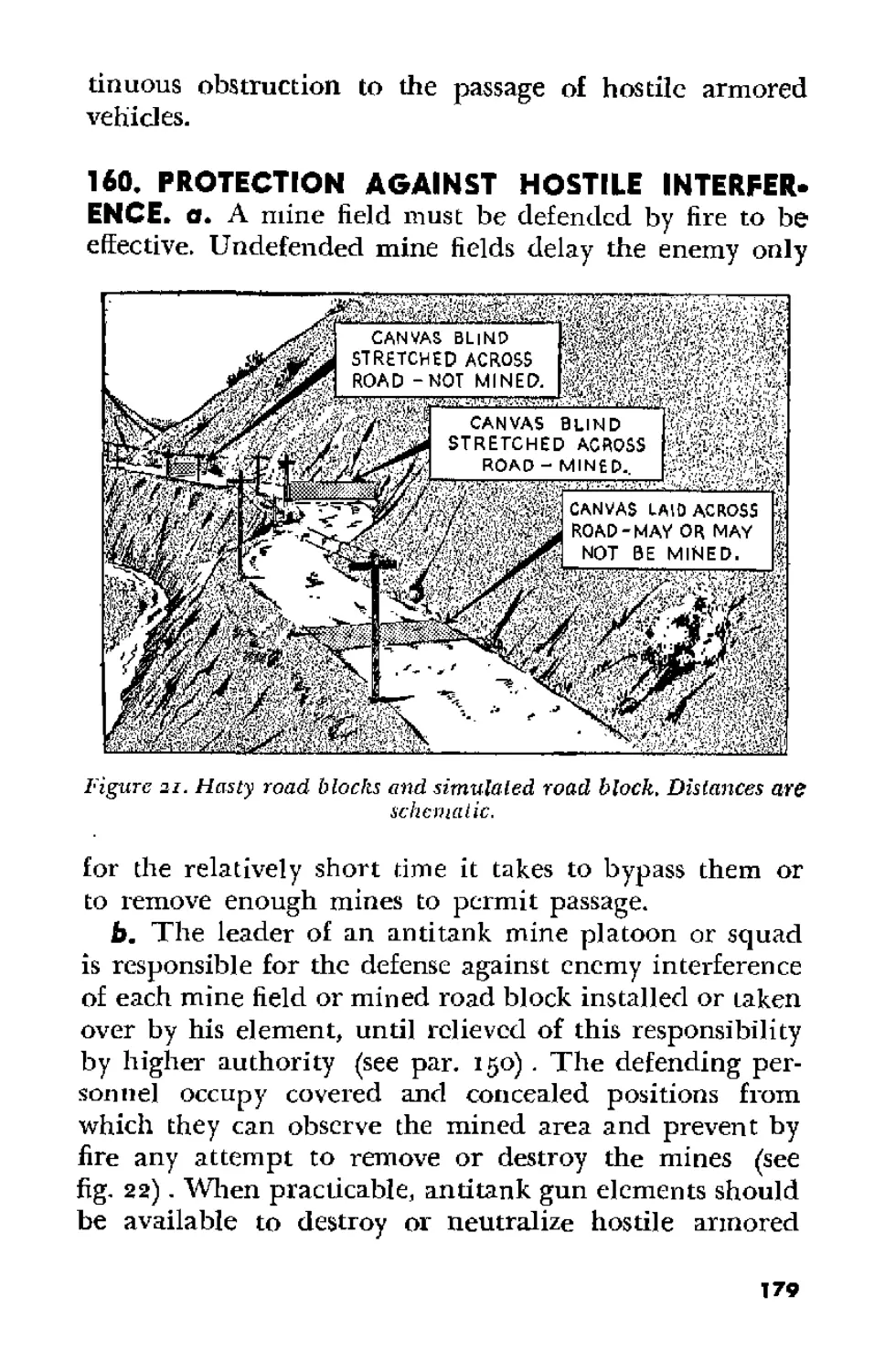
158.	ROAD BLOCKS, a. General. A road block
* * * around the block. In a mined road block,
mines alone may be quickly placed across a road and
sufficiently beyond to block the movement of enemy ve-
hicles, or the road itself may be blocked by other obstacles,
while the mines are used on one or both flanks to prevent
vehicles from detouring around the road block. (See
FM 5-31.)
159.	BARRIERS. A barrier is defined as a large system of
bands and zones of obstacles. (See FM 5-31.) Barriers
are especially * * * hostile armored vehicles.
175.	SUPPLY, a. The battalion commander * * *
the platoon sergeant * * * the ammunition and
pioneer platoon of the battalion headquarters company
may assist in ammunition supply. (See FM 7-30.)
*****
AGO 71D
5
WAR DEPARTMENT FIELD MANUAL
178. MISSIONS, a. Primary Mission. The primary1
mission * * * its own battalion.
. * ... 1 * > * . #
183. AMMUNITION SUPPLY.
* * » * #
c. (1) In an attack, because of the limited mobility
of the antitank gun when moved by hand, the prime mover
should normally remain under cover near the gun position.
The platoon headquarters * * ‘ * the ammunition
supply. If replenishment in * * * regimental train.
The prescribed ammunition loads of prime movers
should be maintained as continuously as possible. In a.
rapid forward * * * from higher headquarters. ,
(Э) The hand carry of ammunition from the location '
of the prime mover is controlled, by squad leaders, under
the general supervision of the platoon leader and platoon
sergeant. .
Subparagraphs e and f are relettered d and e.
199. ATTACK IN WOODS.
*
c. During the advance * * * of the woods. In
fairly open * * * front and flanks. When a platoon
of the antitank company is attached flank guns may be
reinforced with guns from this platoon. Where .th?,
woods * * * will be necessary.
* * *	* •	#
6
AGO 71D
INFANTRY
APPENDIX III
GENERAL TRAINING
3. MINES AND BOOBY TRAPS. As members of
* * *. (See d (1) below.) For methods and princi-
ples of training in the employment of mines and booby
traps see FM 5—31, TM 5-325, and TM 11—1122.
c. Antitank mine platoons. The antitank mine pla-
toon will be trained in methods of laying, marking, and
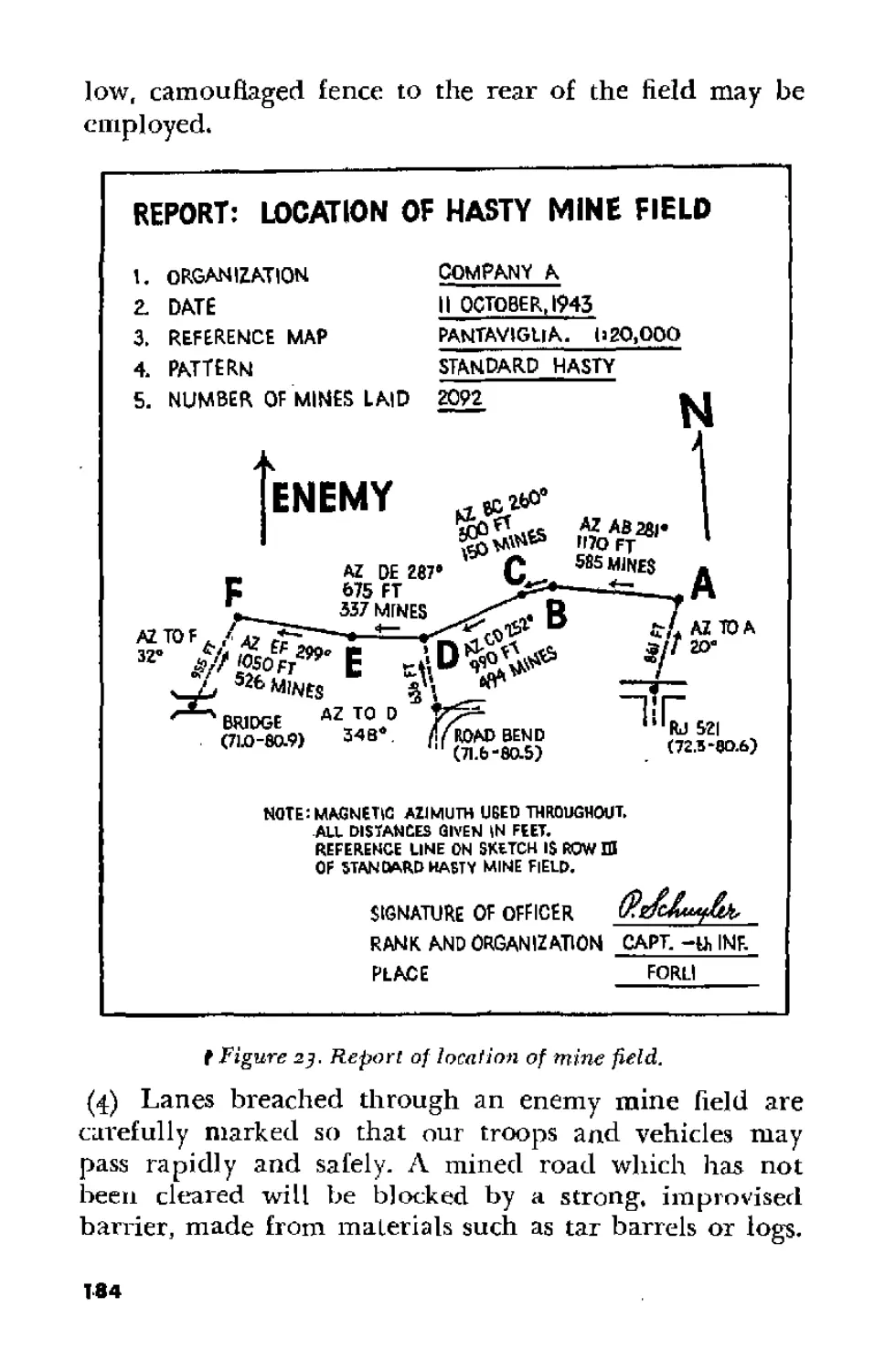
registering mine fields (see fig. 23); recognition of all types
of mines and booby traps used by friendly and enemy
troops; technique of disarming, lifting, and destroying
activated antitank and antipersonnel mines and booby
traps of all types used by friendly and enemy troops;
gapping extensive mine fields.
(AG 300.7 (25 Oct 44).]
AGO 71П
7
WAR DEPARTMENT FIELD MANUAL
By order of the Secretary of War :
G. C. MARSHALL,
Chief of Staff.
Official :
‘ J, A. ULIO,
Major General.
The Adjutant General.
Distribution :
As prescribed in paragraph 9a, FM 21-6 except
Inf Sch (9000); T of Opns (2); Island C (2);
Base 0(2); Def C (2), Sectors (2), Sub-sectors
(2); Base Sectors (2); HD (2); Depts (2);
SvC (oversea) (2); Armies (oversea) (2); Corps
(oversea) (2); D (oversea) (2); В 7 (2); R 7
(2); Bn 7 (6) ; IC 7 (15).
IC 7: T/O & E 7-19.
For explanation of symbols, see FM 21-6.
IL f. eOVERHHEHT PRINTING OFFlCli Ll<<
8
AGO 71D
CHANNON, R.' f,
WAR DEPARTMENT FIELD MANUAL
F M 7-35
This manual supersedes FM 7—35, Antitank Company. Rifle Regiment, 23
May 1941, including Changes No, 1, 31 December 1941, and Training Circular
No. 33, War Department, 1942,
INFANTRY
ANTITANK COMPANY, INFANTRY
REGIMENT AND ANTITANK
PLATOON, INFANTRY BATTALION
WAR DEPARTMENT • 15 MARCH 1944
DISSEMINATION OF RESTRICTED MATTER.
TEe information contained in restricted documenta and the essentia] char-
acteristics of restricted material may be given to any person known to be
in the service of the United States and to persons of undoubted loyalty
and discretion who are cooperating in Government work, but wilt not be
communicated to the public or to the press except by authorized military
public relations agencies, (See also par. 18h, AR 380-5, 28 Sep 1942.}
United States Government Printing Office
Washington; 1944
WAR DEPARTMENT,
Washington 25, D. C., 15 March 1944.
FM 7-35, Infantry Field Manual, Antitank Company,
Infantry Regiment and Antitank Platoon, Infantry Bat-
talion, is published for the information and guidance
of all concerned.
[A. G, 300.7 (21 Jan 14).]
By order of the Secretary of War:
G. C. MARSHALL,
Chief of Staff.
Official:
J. A. ULIO,
Major General,
The Adjutant General.
Distribution:
R and H 7 (2) ; Bn 7 (6) ; IC 7 (15).
(For explanation of symbols see FM 21-6).
CONTENTS
PART ONE
ANTITANK COMPANY,
INFANTRY REGIMENT
Paragraphs Раце
CHAPTER 1.	GENERAL.
Section 1. Composition ................... 1-4	1
П. Tactical employment.,............ 5-7	12
III.	Combat duties of company commander 8-1 a	rg
IV.	Protective measures............ 13-16	25
CHAPTER 2.	MEDICAL SERVICE AND
EVACUATION.................................. 17-19	«9
CHAPTER 3.	SUPPLY AND MOTOR
MAINTENANCE.
Section I. Supply...................... 20-23	31
II.	Motor maintenance............. 24	40
CHAPTER 4.	MARCHES AND BIVOUACS.
Section I. Marches .................... 25-31	41
11.	Bivouacs ..................... 32-ЗЗ	5®
CHAPTER S.	OFFENSIVE COMBAT.
Section I. General ....................34-36	54
II.	Approach march................ 37“4l	55
III.	Assembly areas .............. 42“43	*1°
IV.	Reconnaissance prior to attack, plans,
and orders ...................... 44-47	62
V.	Employment in attack.......	48-61	67
VI.	Special operations .......... 62—6g	7^
Paragraphs Page
CHAPTER 6.	DEFENSIVE COMBAT.
Section 1. General ........................... 70-72	gt
II.	Employment in defense........... 73-85	92
III.	Retrograde movements............ 86-105	l05
IV,	Special operations .............. 91-96	113
CHAPTER 7.	ANTITANK PLATOON.
Section I. General .......................... 97-104	119
II.	Approach march .............. 105-108	130
III.	Employment in aitack......... 109-iao	136
IV.	Employment in defense......... 121-132	148
V.	Retrograde movements.......... 133-135	157
CHAPTER B.	ANTITANK SQUAD.
Section I. General ......................... 136-138	160
II.	Tactical employment .......... 139-148	R63
CHAPTER 9.	ANTITANK MINE PLATOON.
Section I. General ......................... 149-150 172
II.	Antitank mine equipment and supply 151-154	174
JU. Mine Helds and road blocks.... 155-162	176
IV. Tactical employment .......... 163-172	185
PART TWO
ANTITANK PLATOON,
INFANTRY BATTALION
Parugra-phs Payir
CHAPTER 1.	GENERAL.
Section I. Composition	................... 173~174	‘95
II.	Supply, medical service and evacua-
tion .................................. 175-176	196
III.	Tactical	employment .............. 177-183	197
IV.	Marches	and	bivouacs.............. 184-185	202
Paragraphs Page
CHAPTER 2.	OFFENSIVE COMBAT.
Section I. Approach march and assembly area... 186-188 206
II.	Employment in attack.......... 189-198	210
III.	Special operations .......... 199-206	217
CHAPTER 3.	DEFENSIVE COMBAT.
Section I. Employment in defense........... 207-216	223
ll. Retrograde movements.......... 217-219	227
APPENDIX I. INDIVIDUAL PROTECTION AND EMPLACE-
MENTS FOR ANTITANK WEAPONS.......................	231
II.	STREAM CROSSING EXPEDIENTS FOR
ANTITANK GUNS AND VEHICLES..............	249
III.	GENERAL TRAINING.................... 262
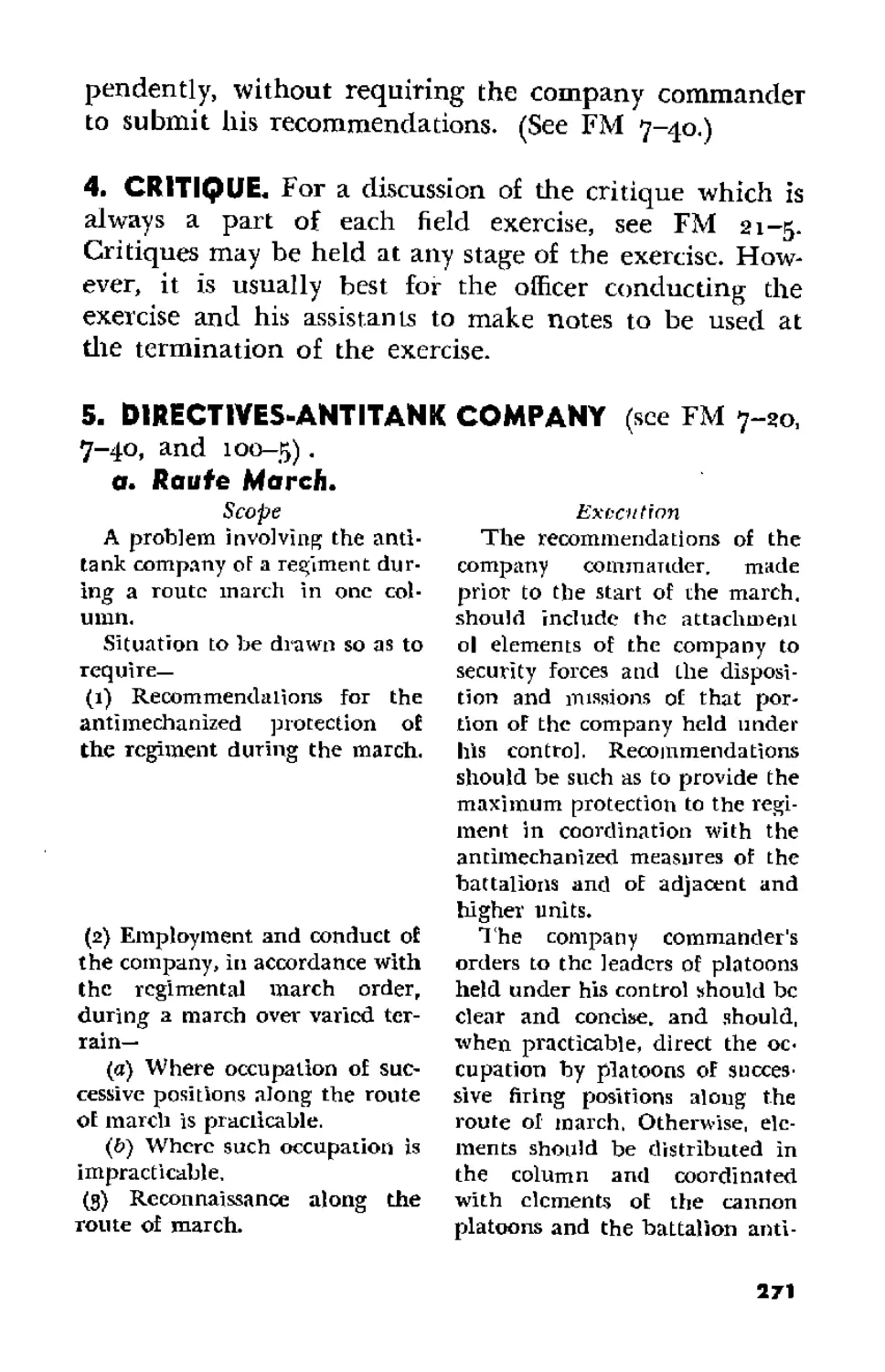
IV.	DIRECTIVES FOR TACTICAL TRAINING OF
ANTITANK COMPANY, INFANTRY REGb
MENT. .............................. 269
INDEX............................................. «99
This manual supersedes FM 7—35, Antitank Company, Rijle Regiment, 23
May 1911, including Changes No. 1, 31 December 1941, and Training Circular
No. 38, War Department, 1942.
Note. Attention is directed to FM 21-7 for details as to how appropriate
Training Films and Film Strips are intended to be used and how they are made
available for use during training.
PART ONE
ANTITANK COMPANY
INFANTRY REGIMENT
CHAPTER i
GENERAL
SECTION I
COMPOSITION
1. ORGANIZATION, a. General. The antitank com-
pany consists of a company headquarters, three antitank
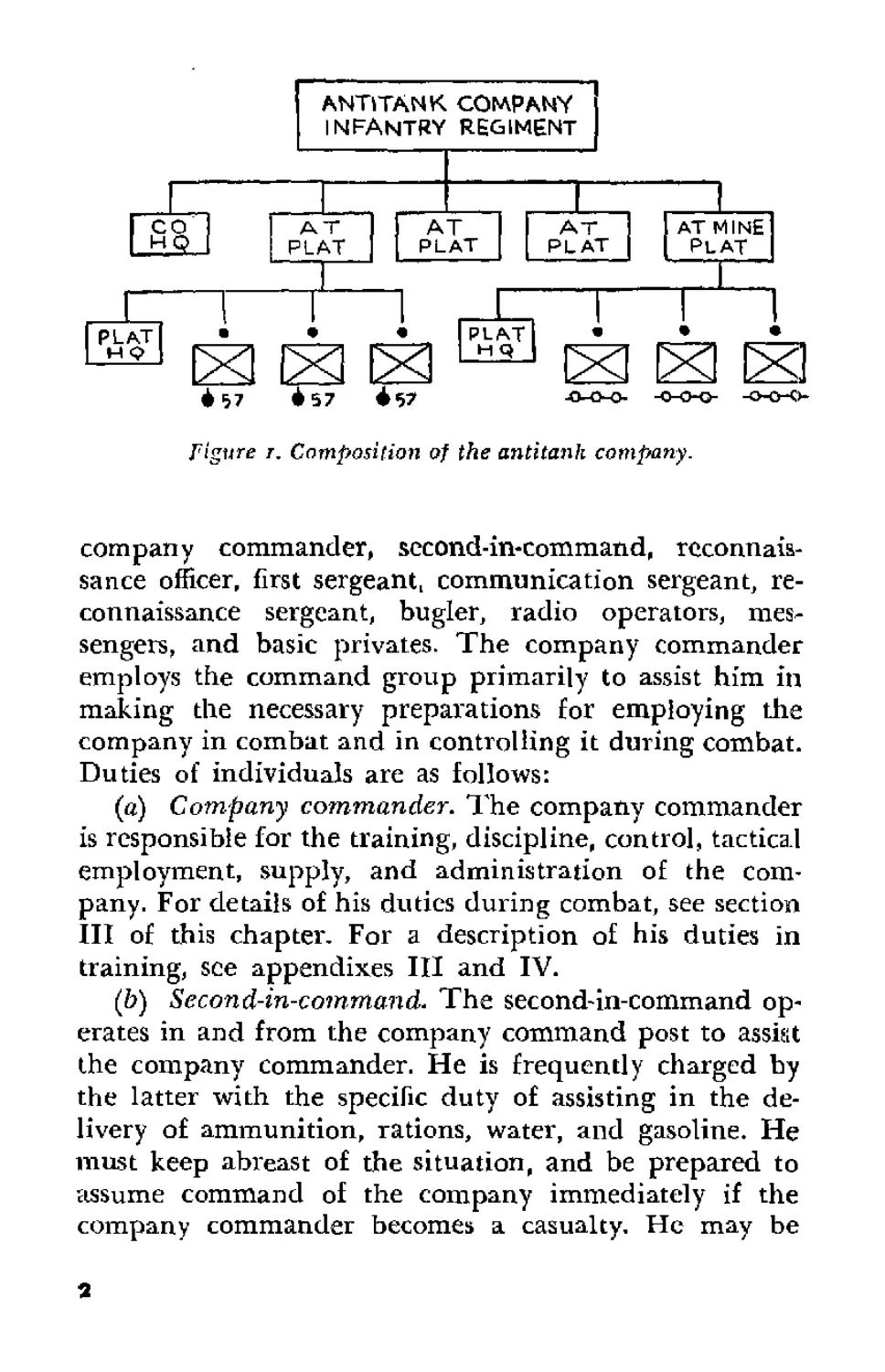
platoons, and one antitank mine platoon (see fig. i),
b. Сатрапу Headquarters. The company head-
quarters personnel are divided according to the nature
of their duties into the command group and the ad-
ministration group.
(i) COMMAND GROUP. This group consists of the
------------------
ANTITANK COMPANY
INFANTRY REGIMENT
^57 A 5 7	4 57	-O-O-O- -0-0-0- -0-0-0-
Figure r. Composition of the antitank company.
company commander, second-in-command, reconnais-
sance officer, first sergeant communication sergeant, re-
connaissance sergeant, bugler, radio operators, mes-
sengers, and basic privates. The company commander
employs the command group primarily to assist him in
making the necessary preparations for employing the
company in combat and in controlling it during combat.
Duties of individuals are as follows:
(a) Company commander. The company commander
is responsible for the training, discipline, control, tactical
employment, supply, and administration of the com-
pany. For details of his duties during combat, see section
III of this chapter. For a description of his duties in
training, see appendixes HI and IV.
(i>) Second-in-command. The second-in-command op-
erates in and from the company command post to assist
the company commander. He is frequently charged by
the latter with the specific duty of assisting in the de-
livery of ammunition, rations, water, and gasoline. He
must keep abreast of the situation, and be prepared to
assume command of the company immediately if the
company commander becomes a casualty. He may be
a
used by the company commander as his representative
at the regimental command post.
(c) Reconnaissance officer. The reconnaissance officer
assists the company commander in conducting the re-
connaissance. He also assists, when necessary, in directing
or guiding platoons to areas or positions designated by
the company commander. For a discussion of his duties
in reconnaissance, sec paragraph 10.
(d) First sergeant. The first sergeant, under the super-
vision of tiie company commander, establishes and op-
erates the company command post. He assists the com-
pany commander in maintaining contact with the regi-
mental command post, antitank platoons, antitank mine
platoon, administration group, and company transport.
When the communication sergeant is performing duties
away from the company command post, the first sergeant
may be required to operate or supervise the operation
of the company message center (see also (e) below).
(c) Communication sergeant. The communication
sergeant is the principal assistant of tire company com-
mander in maintaining communication. He is respon-
sible for the establishment and operation of the unit
message*center at the company command post, and for
the installation, operation, and maintenance of com-
munication equipment throughout the company. He
may frequently be required to accompany the company
commander at the observation post, or in his move-
ments throughout the company area. During such ab-
sence from the command post, the company message
center may operate under the supervision of the first
sergeant, or may be maintained by other available per-
sonnel as directed by the communication sergeant, in
the first sergeant’s absence. The communication sergeant
is responsible for the training of appropriate company
personnel in the installation, operation, and mainte-
nance of communication equipment issued to the com-
pany. (See app. III.)
з
(/) Reconnaissance sergeant. The reconnaissance ser-
geant performs such reconnaissance as may be assigned
to him by the company commander or reconnaissance
officer. He may assist in the establishment of the observa-
tion post, and may also act as a guide.
(g) Bugler. The bugler is (rained to act as a signal-
man, guide, observer, and messenger. He drives the com-
pany headquarters radio truck (^-ton weapon carrier,
equipped with radio), and is responsible for driver
maintenance.
(Л) Radio operators. The radio operators are trained
to operate the radio set issued to the company for com-
munication in warning nets or with higher headquarters,
in conformity with the current plan of signal communi-
cation. They aid in the training of other company per-
sonnel in the operation of the radiotelephone used in
the company command net. They may receive their
training in code practice, and in the installation, opera-
tion, and maintenance of radio sets, with the regimental
communication platoon.
(i) Messengers. Messengers when not engaged in
carrying messages, may be used as guides, and as assist-
ants to other personnel at the company command post.
They are trained in die operation and maintenance of
the company communication equipment. They drive
the i^-ton trucks assigned to company headquarters and
are responsible for driver maintenance.
(j) Basic privates. The basic privates are used as re-
placements, and are trained as observers and messengers,
(a) ADMINISTRATION GROUP. This group con-
sists of the transportation sergeant, supply sergeant,
armorer-artificer, mess sergeant, cooks and cooks’ helper,
automobile mechanic^ and company clerk. Their prin-
cipal duties are:
(a) Transportation sergeant. The transportation ser-
geant is in charge of the company transport. He super-
4
vises the operation and maintenance of the motor
vehicles of the company. For his duties in ammunition
supply, see paragraph ei.
(.6) Supply sergeant and armorer-artificer. The supply
sergeant is responsible for the replenishment and dis-
tribution of all supplies, except rations and water. He
keeps the company commander informed of the needs
of the company. He also supervises the work of the
armorer-artificer. During combat, lie will usually be in
the forward area in order to assist the company com-
mander in matters relating to supply, particularly of
ammunition. The armorer-artificer will usually be in
the train bivouac, where he assists in the procurement
and distribution of supplies, executes minor repairs on
weapons and other equipment, and performs simple
carpentry tasks.
(c) Mess sergeant, cooks, and cooks1 helper. The mess
sergeant is responsible for checking the rations and
water issued to tire company, the division of rations into
meals, the supervision of the cooks and cooks' helper in
the preparation of meals, and the distribution of meals
to the company. He and his assistants work in the regi-
mental train bivouac, under the direct supervision of
the service company commander, except when distribut-
ing meals in the forward area.
(d) Automobile mechanic. The automobile mechanic
performs company maintenance of company transporta-
tion under the supervision of the transportation sergeant.
He drives die maintenance truck (з^-ton weapon car-
rier) , and is responsible for driver maintenance. (See
par. 24.)
(c) Company clerk. The company clerk keeps the
company records. As a member of the regimental per-
sonnel section, he functions under the personnel officer.
In combat, the personnel section may be separated from
the regiment, and operate and move with the' rear
5
echelon of the division or corps; otherwise, it operates
in the regimental train bivouac.
C. Pfafoons. For the composition of antitank platoons
and the antitank mine platoon, see figure i and para-
graphs 97 and 149, respectively.
2. ARMAMENT, a. General. The armament of the anti-
tank company includes crew-served and individual
weapons.
(1) The crew-served weapons are tire 57-mm antitank
gun, the antitank rocket launcher, and the caliber .50
machine gun.
(a) The individual weapons are the rifle, the carbine,
and the pistol.
(3) For descriptions and characteristics of weapons, see
TM 9-303 and FM 23-5, 23-7, 23-30, 23-35, 23—65, and
*3-75-
b. Crew-served Weapons. (1) 57-MM ANTITANK
GUN. The principal weapon of tjie antitank company is
the 57-mm antitank gun. This gun has a high muzzle
velocity and flat trajectory; its practicable rate of fire is
15 to 20 rounds per minute. The rate of fire is influenced
more by observation of effect than by any limitations of
the piece. It has a relatively wide traverse (go°) ; the
trails can be shifted readily to permit it to engage targets
appearing beyond this traverse.
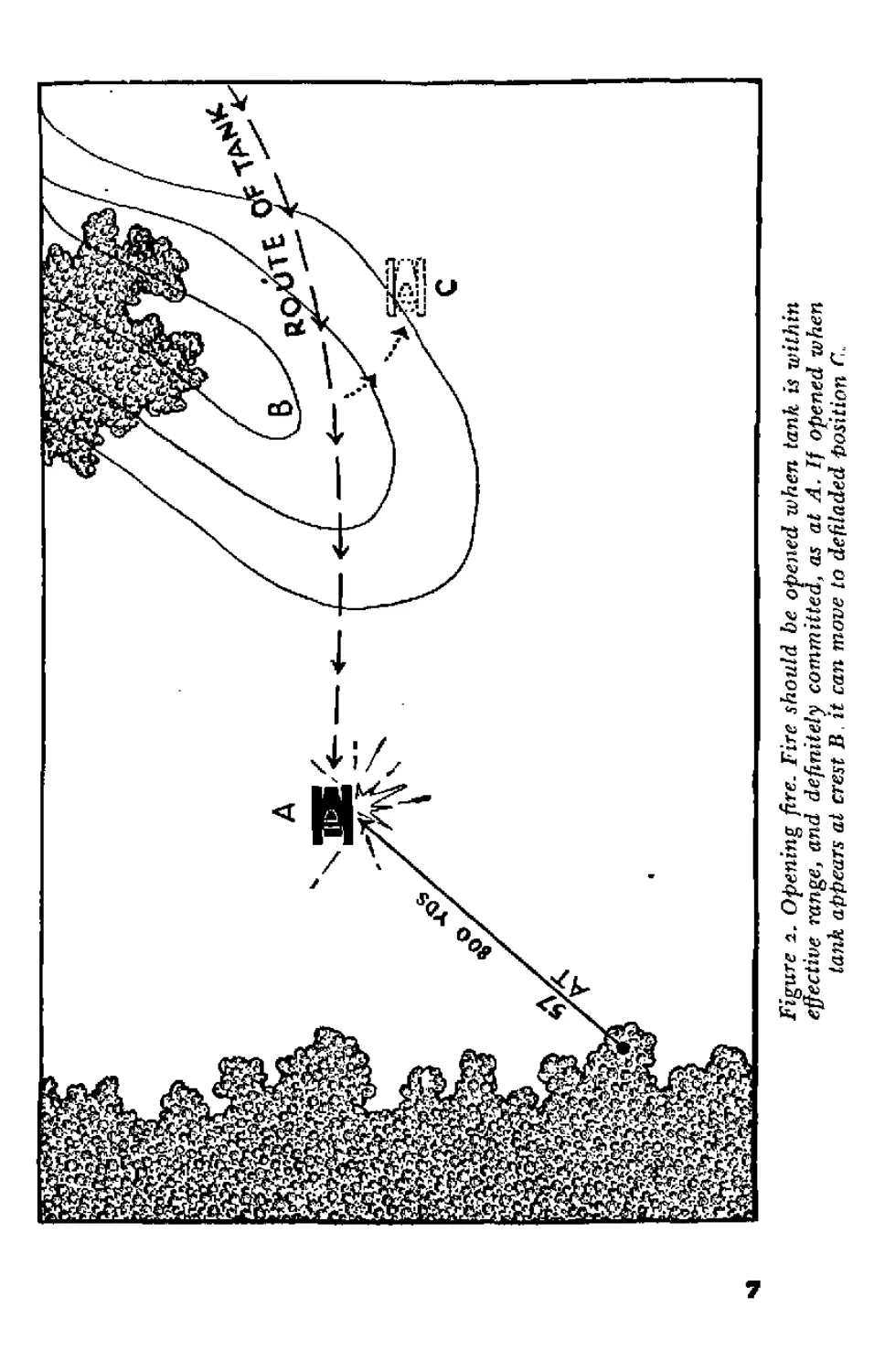
(a)	Ranges. The effective range of the gun when
used against moving vehicles is limited largely by the
ability of the gunner to secure hits on a moving target.
Normally, fire will not be opened against tanks at ranges
greater than 800 yards. Fire opened at longer ranges, or
without regard for the terrain, subjects the gun positions
to premature disclosure and consequent loss of surprise.
Such action enables hostile tanks to take position with
hull defilade and open fire on the guns, (See fig. 2.)
6
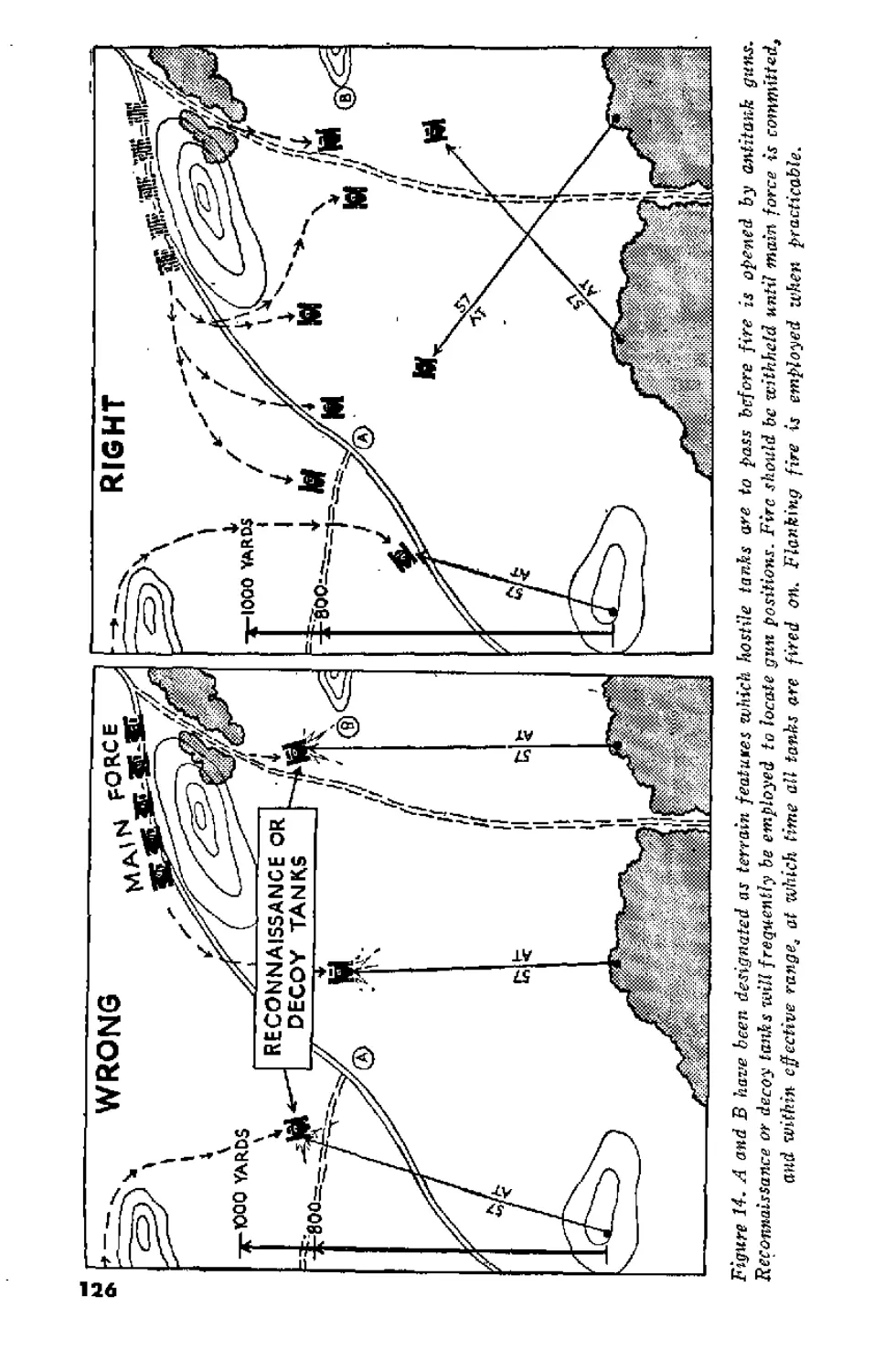
Figure Opening fire. Fire should be opened when tank is within
effective range, and definitely committed, as at A. If opened when
tank appears at crest В, it can move to defiladed position C.
(b)	Angle of impact. The penetrating ability of the
armor-piercing projectile ic ' latest when tire angle be-
tween the path of the projec and the plane of the
portion of the target which it sti* ;es is go0. The pene-
trating ability lessens as the angle deviates from go°,
and is markedly reduced when the deviation is greater
than 2o°. Armored vehicles usually have their heaviest
armor in front, with much thinner armor on the sides,
rear, and underneath. Every effort should be made to
obtain hits on the sides, rear, and under surfaces of
these vehicles, even though the angle of impact deviates
from 90°.
(c)	Mobility. When drawn by prime mover, the gun
has high mobility, both on roads and across country.
Because of its weight, it has a limited capacity for move-
ment across country by hand. Every effort should be
made to provide additional assistance to the squad when
long movements must be made by hand.
(d)	Vulnerability. The antitank gun is extremely
vulnerable during movements in the zone of infantry
fire. It is also more or less vulnerable when in firing
position, depending upon whether or not it is emplaced
and, when emplaced, upon the nature of the terrain.
Because of the risk that a gun will be discovered and
destroyed, or that its crew will become casualties from
hostile fire before it can be effectively used, it should
be kept in a cover position until a hostile attack is im-
minent. (See par. 66.)
(2)	ANTITANK ROCKET LAUNCHERS. Antitank
rocket launchers and high explosive rockets are provided
for use against tanks and other armored vehicles. The
rockets are also effective against buildings and masonry.
(a)	Launchers arc issued on the basis of two per
squad in the antitank squad, and one to the platoon
headquarters in the antitank mine platoon. They are
normally carried on prime movers. Ammunition bearers
8
or other members of gun crews not absolutely required
for service of the principal weapon are designated as
rocketeers by the squad leaders. To provide necessary
assistance in loading and reloading, antitank rocket
launchers are normally operated by teams of two men
each. The rocket may be fired from the prone, standing,
sitting, or kneeling position; it may be fired from an
emplacement (pit or pit fox hole), provided this is so
constructed that the blast from the rear of the launcher
will not be deflected against the loader or other nearby
personnel. (See app, I.)
(b)	The rocket has a maximum range of 650 yards.
It is reasonably accurate against moving targets at ranges
up to 300 yards. In order to achieve greater accuracy
and assist in effecting surprise, fire against moving targets
is withheld until the last practicable moment.
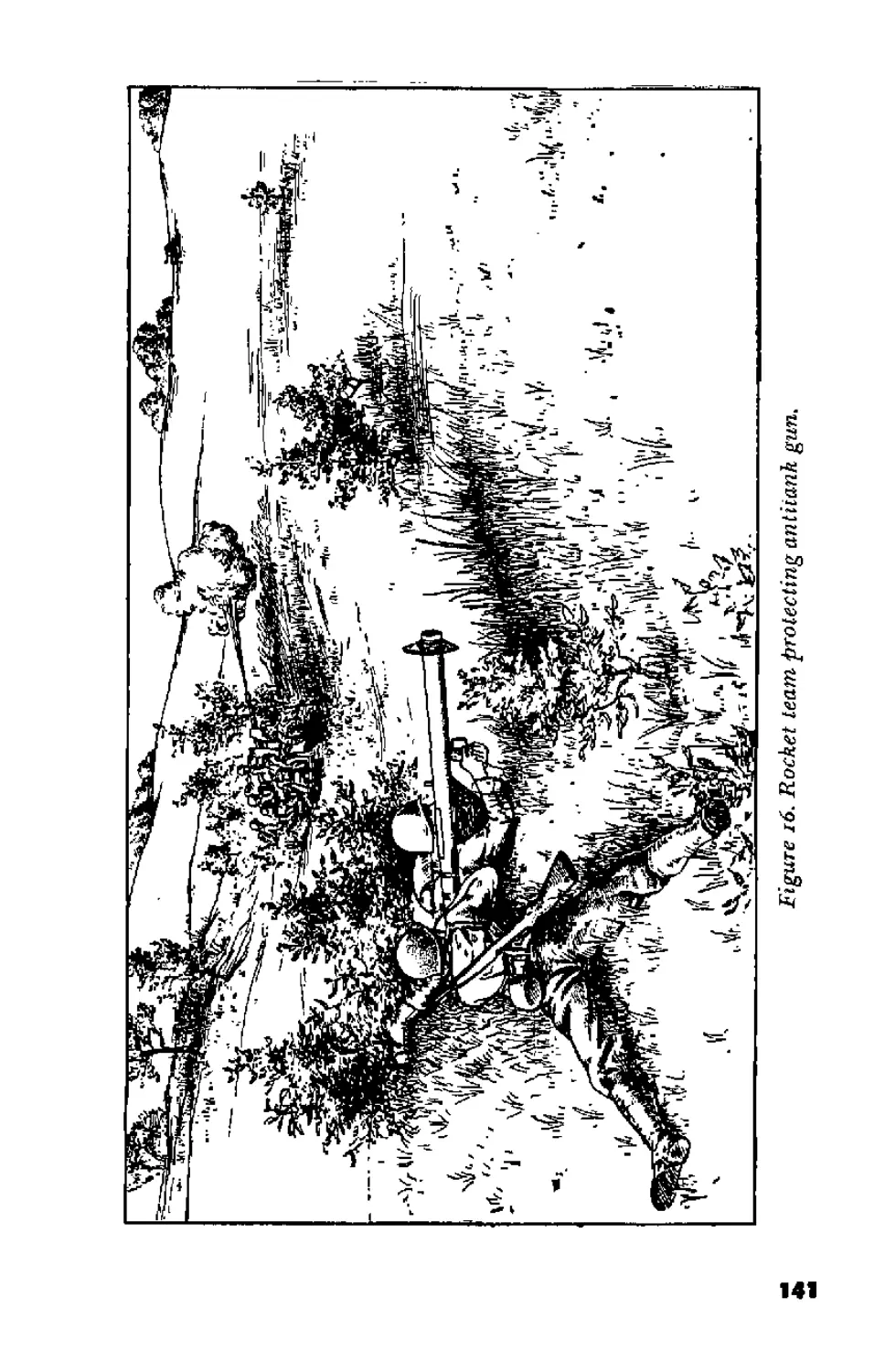
(c)	The flanks and rear of crew-served weapons are
particularly vulnerable to mechanized attack.. When
such an attack is imminent, the rocket team takes posi-
tions which permit flanking fire against the lighter
armor on the sides and rear of armored vehicles. Employ-
ment in pairs of teams will facilitate the action of com-
bating two or more hostile armored vehicles which
attack simultaneously from different directions.
(d)	Likely avenues of approach for hostile armored
vehicles not covered by antitank guns, are reconnoitered,
and firing positions for rocket teams selected and pre-
pared as soon as practicable.
(<?) For use of the antitank rocket as an antitank
mine, see paragraph 163.
(3)	MACHINE GUNS. A caliber .50 machine gun is
mounted on one of the three 1 p£-ton trucks (prime
movers) in each antitank platoon, chiefly for employ-
ment in the antiaircraft defense of the platoon transport.
A ground mount is also provided for the local protection
of the platoon transport All personnel are trained to
9
fire the Weapon. When the truck is halted, and only the
driver is present, he will execute such fire, if necessary*
c. Individual Weapons, (i) CARBINES, RIFLES,
AND PISTOLS. These weapons are employed for the
emergency defense and local protection of individuals,
groups, guns, and company installations, (See par. 15.)
When elements of the company are operating in ex-
posed positions, it is imperative that additional riflemen
be detailed for their close-in protection,
(2) RIFLE GRENADES, (a) The antitank rifle gren-
ade is used against tanks and armored vehicles. (See
FM 23-30.) It is fired frpm such rifles and carbines in the
company as are equipped with grenade launchers. Within
its effective range, approximately 75 yards, the high ex-
plosive grenade is effective against all known light and
medium tanks; it may also be used as an antipersonnel
grenade at ranges up to 260 yards.
(b) Each truck driver is armed with a rifle or carbine,
and grenade launcher, to be used primarily for the pro-
tection of his truck against attacks by armored vehicles
approaching within effective range. The leader of each
antitank squad may utilize the truck driver, when not
required with the vehicle, to assist in protecting the gun
and crew against mechanized attack, particularly from
directions not covered by the fire of antitank guns.
3. EQUIPMENT, o. General. For equipment of the
antitank company, see Table of Organization and Equip-
ment.
b. Signal Co mm a nicotian Equipment. The antitank
company is provided with the following signal com-
munication equipment: a vehicular radio set, low-power
portable radiotelephones, sound-powered telephone
equipment, pyrotechnic devices, panel sets, and mainte-
nance equipment,
10
(i) The vehicular radio set operates in a division or
higher unit warning net when such operation is pre-
scribed; otherwise, it may be used for communication
with regimental headquarters.
(s) Low-power portable radiotelephone sets are used
for communication within the company command net
or any other designated net within the regiment.
(3) Sound-powered telephone equipment is used for
communication within the company when the elements
are not too widely separated. Ail or any number of the
sound-powered telephone sets may be retained by com-
pany headquarters for communication between —
(a) The company command post and a company
warning post or security detachment.
(i>) The company command post and the platoon
leaders.
(c) The company command post and other head-
quarters,
(4) Projectors may be used within die company and
between the company command post and the command
posts of higher and adjacent units. Panels are used for
air-ground communication,
4. TRANSPORT, a. The company transport comprises
the vehicles organically assigned to die company (see
Table of Organization and Equipment). Ordinarily,
these vehicles are used for command, communication
and maintenance, as prime movers, and for transporta-
tion of ammunition and company personnel.
b. Whenever the terrain is suitable, and hostile fires per-
mit, 57-mm guns and ammunition arc moved by prime
movers. Individual arms, except those on weapon carriers
and prime movcrs1 arc carried by the individuals to
whom assigned. When effective hostile fire prevents
movement by vehicles, the guns and ammunition are
moved by hand,
11
C. One truck and trailer of the transportation platoon,
service company, are allotted to the company as the
antitank company section of the regimental kitchen and
baggage train.
SECTION II
TACTICAL EMPLOYMENT
5. GENERAL a. Took Tactics. (i). Tanks are likely
to attack in large numbers with the mission of breaking
through and overrunning our defended localities. They
endeavor to gain surprise by attacking from unexpected
directions, and across terrain which appears to be im-
passable for armored vehicles. Extensive bombardment
and dive-bombing will frequently precede the launching
of the attack. The attack is usually led by large numbers
of tanks which seek to destroy our antitank guns; the
tanks will be followed by infantry, who destroy any
areas of resistance left by the tanks and exploit success.
Reserve infantry and antitank guns may be brought up
to carry out encircling attacks from a flank.
(2)	On encountering an antitank gun, one tank will
seek cover and pin the gun by fire, so that other tanks
can envelop the gun and attack it from the flanks and
rear. Tanks normally attack by fire; seldom by charging.
They make full use both of their machine guns and anti-
tank weapons, ranging from 50-mm upwards, for this
purpose. At close quarters they also make use of gren-
ades.
(3)	During the extensive reconnaissance preceding the
attack, the enemy makes full use of decoys, and sends
out fighting tank reconnaissance to discover the where-
12
abouts of antitank guns. This fighting reconnaissance
will both bait antitank guns at long ranges and pene-
trate into localities in an attempt to make the guns
disclose themselves.
(4)	Tanks usually avoid firing when on the move; con-
sequently, upon discovering targets, they will attempt
to get into positions in hull defilade prior to opening
fire.
b. Function of Antitank Company. The function of
the antitank company is to provide protection, in con-
junction with the battalion antitank platoons, to the
regiment or its elements against attacks of hostile
armored vehicles, whether in offensive or defensive com-
bat. Surprise, mobility, aggressiveness, and flexibility are
essential. Combat action is never static in the sense that
the guns remain constantly in one position, prepared to
expend their fire power on a single target.
(1) PRIMARY MISSIONS, (a) The company may be
assigned one or more of the following primary missions
by the regimental commander: to reinforce the antitank
defense of front-line battalions; to deepen the anti-
mechanized defense within the regimental zone or sector;
to protect the flanks and rear of the regiment against
armored attack. The last named mission may include
protection of the regimental command post, of ammuni-
tion distributing points, and of the route of ammuni-
tion advance. The regimental commander may assign
sectors of responsibility including specific avenues of
approach, or may specify directions of fire. In order to
insure continuous protection of the regiment against
hostile armored attack, the employment of units of the
antitank company must be included in the general plan
of action of the regiment as a whole, and their move-
ments and positions coordinated with those of cannon
company howitzers and of the antitank elements of bat-
talions, adjacent units, and higher units, Their employ-
13
ment as independent defensive elements results in wide
dispersal and loss of mutual fire support, and leads to
uncoordinated action and loss of effectiveness.
(i>) Missions assigned by the regimental commander
are usually based on recommendations made by the
company commander; if not, it is the duty of the latter
to recommend any changes which, in his opinion, the
situation requires. (See par. 8b.)
(2) SECONDARY MISSIONS, (a) The regimental
commander may assign antitank elements of the com-
pany a secondary mission of neutralizing or destroying
hostile observation posts, and antitank and other
weapons which have survived preparatory or other fires
and which offer a threat to friendly troops. The regi-
mental commander may also assign fire missions against
definitely located crew-served weapons, emplacements,
pill boxes, groups of personnel offering remunerative
targets, or similar point targets. Such missions are fre-
quent when the regiment is engaged in a special opera-
tion, such as an attack against a town or fortified posi-
tion.
(i>) If a hostile mechanized attack develops while
guns are engaged in any secondary mission, they revert
at once, without further orders, to their primary mission
of antimechanized defense.
(c) To avoid premature disclosure of the location of
antitank defenses, such secondary missions should be
performed, whenever possible, from supplementary firing
positions well removed from primary firing positions.
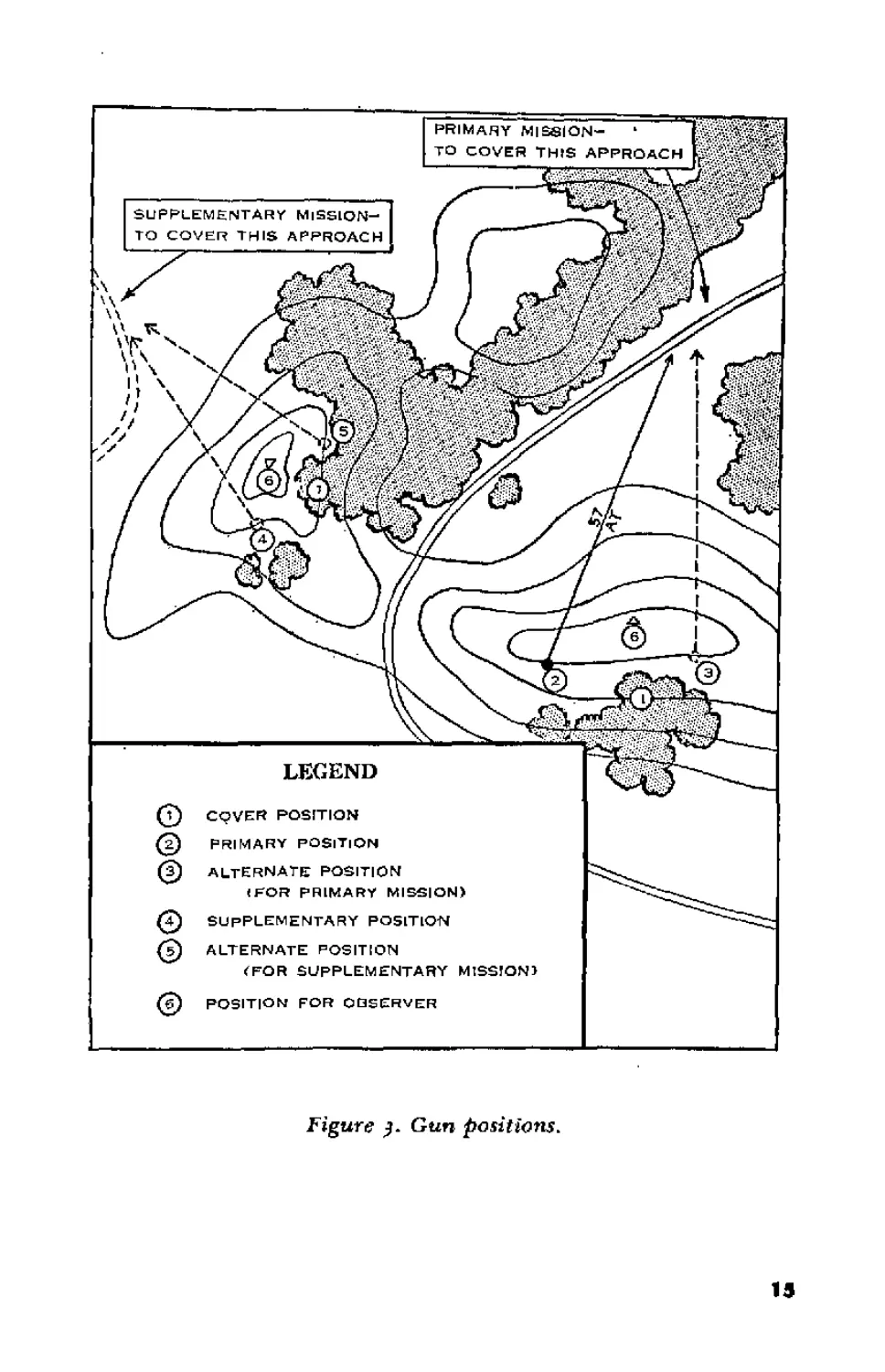
6. POSITIONS (see fig. 3). a. Firing Positions. Firing
positions of antitank guns are classified as primary, sup-
plementary, and alternate.
(1)	PRIMARY. The primary firing position is the posi-
tion from which the gun can best execute its primary
mission.
14
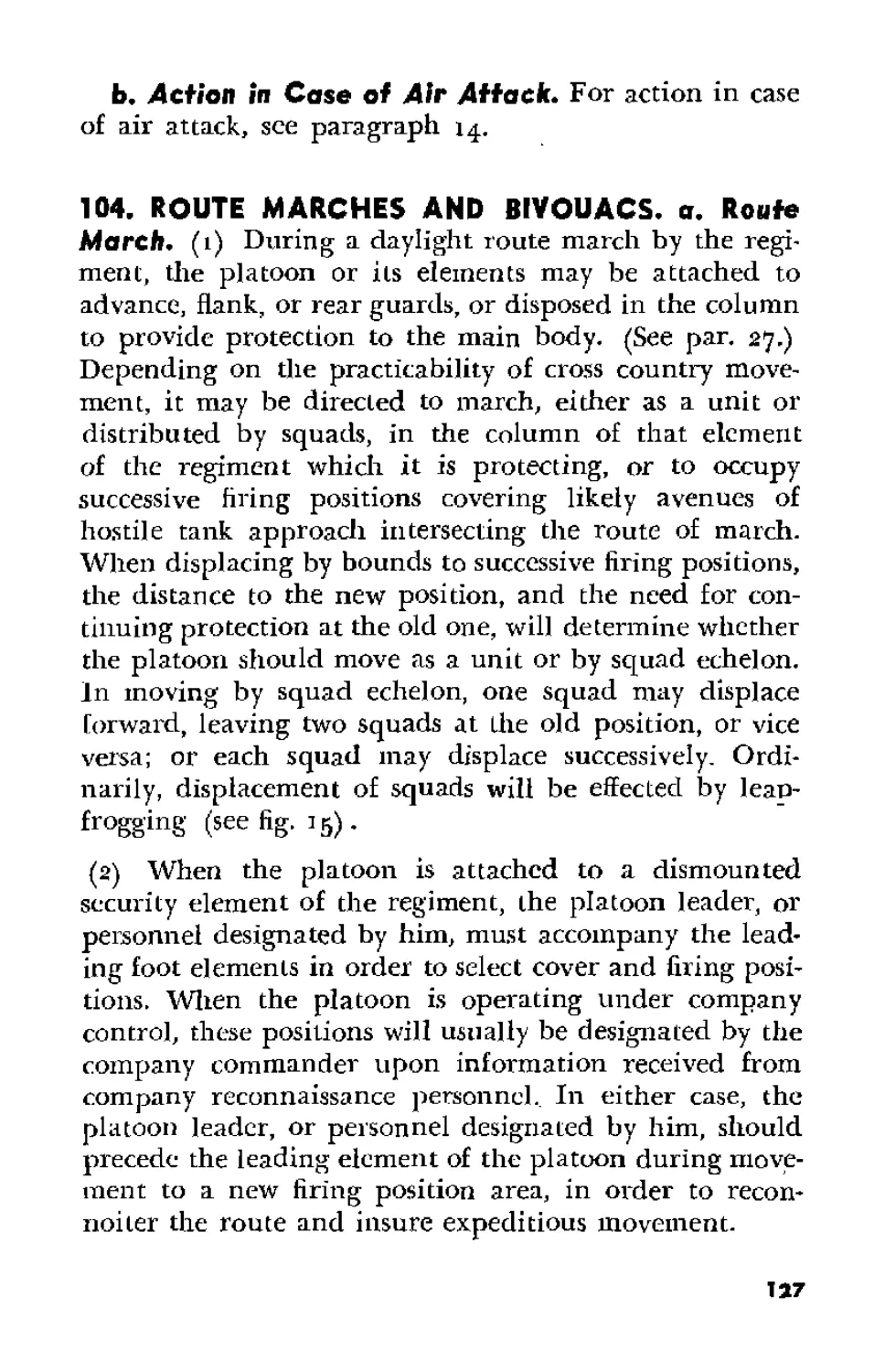
Figure Gun positions.
13
(2)	SUPPLEMENTARY. A supplementary firing posi-
tion is one from which the gun can perform a fire mis-
sion which cannot be accomplished from its primary
position.
(3)	ALTERNATE, (a) An alternate firing position is
one which is occupied to avoid enemy fire directed at a
primary or supplementary position, and from which the
same fire missions can be executed as from the respec-
tive primary or supplementary position. An alternate
position must be close enough to the primary (supple-
mentary) position for movement of the gun by hand,
and by routes affording cover and concealment. It should
be located far enough (at least 75 yards) from the
primary (supplementary) position to avoid being in-
cluded in the effective area of fires directed on that posi-
tion. When practicable, several alternate positions should
be selected for each primary and supplementary position.
(i>) Fire, once opened, is not interrupted while hostile
tanks remain within range. This fire will, however, dis-
close the location of the firing position, necessitating
movement to an alternate position. In such case, ad-
vantage should be taken of any lull in the action to
effect the movement.
b. Cover positions. Cover positions are those (other
than firing positions) in the immediate vicinity of the
gun, which afford defilade and concealment for men and
weapons not actively engaged with the enemy.
C. Firing Position Areas. The areas within which
the firing and cover positions of platoons (squads) are
located arc known as firing position areas. Firing posi-
tion areas should afford — good observation and fields of
fire; suitable locations for primary, supplementary, and
alternate firing positions for each gun; partial defilade
for firing positions; nearby cover positions defiladed
from hostile fiat-trajectory fire; covered routes to firing
positions for movement of the guns and replenishment
16
of ammunition; concealment from air observation in
both cover and firing positions; protection against mech-
anized attack by natural or artificial obstacles, particularly
on the flanks of the area; sufficient distance from features
likely to attract hostile fire, such as crossroads and mortar
or artillery positions. Whenever practicable, the field of
fire should contain no ground which affords hull defilade
positions to hostile tanks.
d. Uncoupling Positions, (i) Uncoupling positions
are those where guns are uncoupled, and from which
they are moved by hand to firing or cover positions.
Uncoupling positions should be under cover and de-
filaded, if possible, and as near as practicable to firing
or cover positions.
(2) While the guns of an antitank unit are in firing or
cover positions, the vehicles of the unit arc held in a
covered and concealed location in rear. In moving situa-
tions, this location should be close enough to the firing
position to permit communication by arm-and-hand
signals, and reduce the manhandling of ammunition to
a minimum.
e.	Readiness for Action, Crews manning antitank
guns must be prepared at all times to meet a sudden
mechanized attack. The guns may be in one of the fol-
lowing degrees of readiness for action.
(i)	MOBILE. Guns held mobile are kept coupled to
the prime mover; engines of prime movers are kept
warm; in urgent situations, crews remain entrucked.
(2)	IN COVER POSITION, (a) The gun remains in
its cover position until required, when it is moved quick-
ly by hand to the firing position. At times, fires in
directions other than the principal direction of fire of
the gun may be delivered from the cover position, while
the gun and crew remain defiladed from the front.
(b) It may frequently be necessary to dig emplace-
ments and fox holes at cover positions for protection
17
against the heavy preparatory artillery fires, aerial bom-
bardment, and infantry supporting fires which usually
precede hostile mechanized attack.
(3)	IN FIRING POSITION. A gun ordinarily cannot
be kept in a firing position exposed to flat-trajectory fire
from the front except in defensive combat or in other
situations where it is practicable to prepare and camou-
flage an emplacement at the firing position. When de-
filaded from such fire it may be placed (emplaced, if
time permits) in a firing position covering a sector of
responsibility extending to the flank; such a location is
similar to that which would be a suitable cover position
if the sector of responsibility extended to the front.
f.	References. For mechanical training, gun drill,
and technique of fire, see FM 23-75. For the training
of individuals in other weapons, sec FM 23-5, 23-30,
23—35, 23-60, an(f ^3'^5-
7. TERRAIN. Within the limitations fixed by the loca-
tion and mission of troops, the terrain and its probable
influence upon a hostile mechanized attack govern the
distribution of the antitank gun units and tire employ-
ment of the antitank mine platoon. Terrain particularly
influences the operation of armored vehicles in the fol-
lowing respects:
a.	Covered and concealed routes of approach are
sought.
b.	Open spaces, or terrain exposed to distant observa-
tion, will be avoided or crossed at high speed.
e. Water, soft ground, steep banks, heavy woods, and
similar difficult terrain usually will be avoided. How-
ever, the defender must not place undue reliance for
antitank defense on features which are unfavorable to
tank action, but must be prepared to cover them, as
well as favorable terrain, by fire.
18
SECTION III
COMBAT DUTIES OF COMPANY
COMMANDER
8. COMMANDER AND STAFF OFFICER, a. As Com-
pany Commander, (i) The commander of die antitank
company must anticipate and plan in order to prepare
the company for prospective missions; his supervision
must be continuous to insure that ail subordinates prop-
erly execute their part in the company task. In con-
formity with orders from higher headquarters, he is
responsible for decisions as to specific courses of action.
Wiiiie he may accept advice and suggestions from any
of his subordinates, he aione is responsible for what his
unit does or fails to do.
(2) For a description of the duties of the company com-
mander in supply and motor maintenance, see chapter 3.
b. As Regimental Antitank Officer. The commander
of the antitank company is the regimentai antitank
officer. He advises the regimental commander on matters
pertaining to defense against armored vehicles. He main-
tains close contact with the regimental S-3, through
whom he may submit his recommendations, and receive
the regimental commander’s orders. (See FM 7-40 and
100-5.) His duties include—
(1) Making timely recommendations for the anti-
mechanized defense of the regiment, to include the em-
ployment of the antitank company, battalion antitank
platoons, and other battalion and regimental antitank
weapons; necessary coordination with the regimental
howitzer officer whenever cannon units are directed to
supplement the antimechanized defense of the regiment;
the improvement of natural obstacles; and the construc-
19
tion of artificial obstacles. If, prior to submission of
recommendations by die antitank company commander,
the regimental commander has already made a decision,
the former recommends such changes as he considers
necessary.
(3)	Keeping S—2 informed of all steps taken for anti-
mechanized defense which are likely to affect the plans
for the regimental antiair-antimechanized warning sys-
tem.
(3)	Coordination of all antimechanized activities, in-
cluding supporting and attached units, within the regi-
mental area, and of these activities with the plans of
higher and adjacent units.
(4)	Making timely recommendations for the breaching
of hostile mine fields.
(5)	Making timely recommendations for changes in the
locations or missions of any elements of the anti-
mechanized defense of the regiment, as changes in the
situation require.
9. CONTROL, a. The degree of control which the com-
pany commander exercises over the activities of each
platoon dining combat depends on several factors: the
time available to effect reconnaissance and issue orders;
his ability to observe the zone of action or sector of the
platoon; facilities for rapid communication with the
platoon; his ability to employ efficiently the agencies of
signal communication available in the company; and
the speed and intensity of the action. Whenever prac-
ticable, control is exercised as follows:
(1)	Each antitank platoon is assigned a position area;
or concealed and defiladed area, if guns are to be held
mobile. It is also assigned a sector of responsibility and
principal direction (s) of fire covering one or more likely
avenues of hostile tank approach, and is given specific
instructions as to the conditions under which it will
20
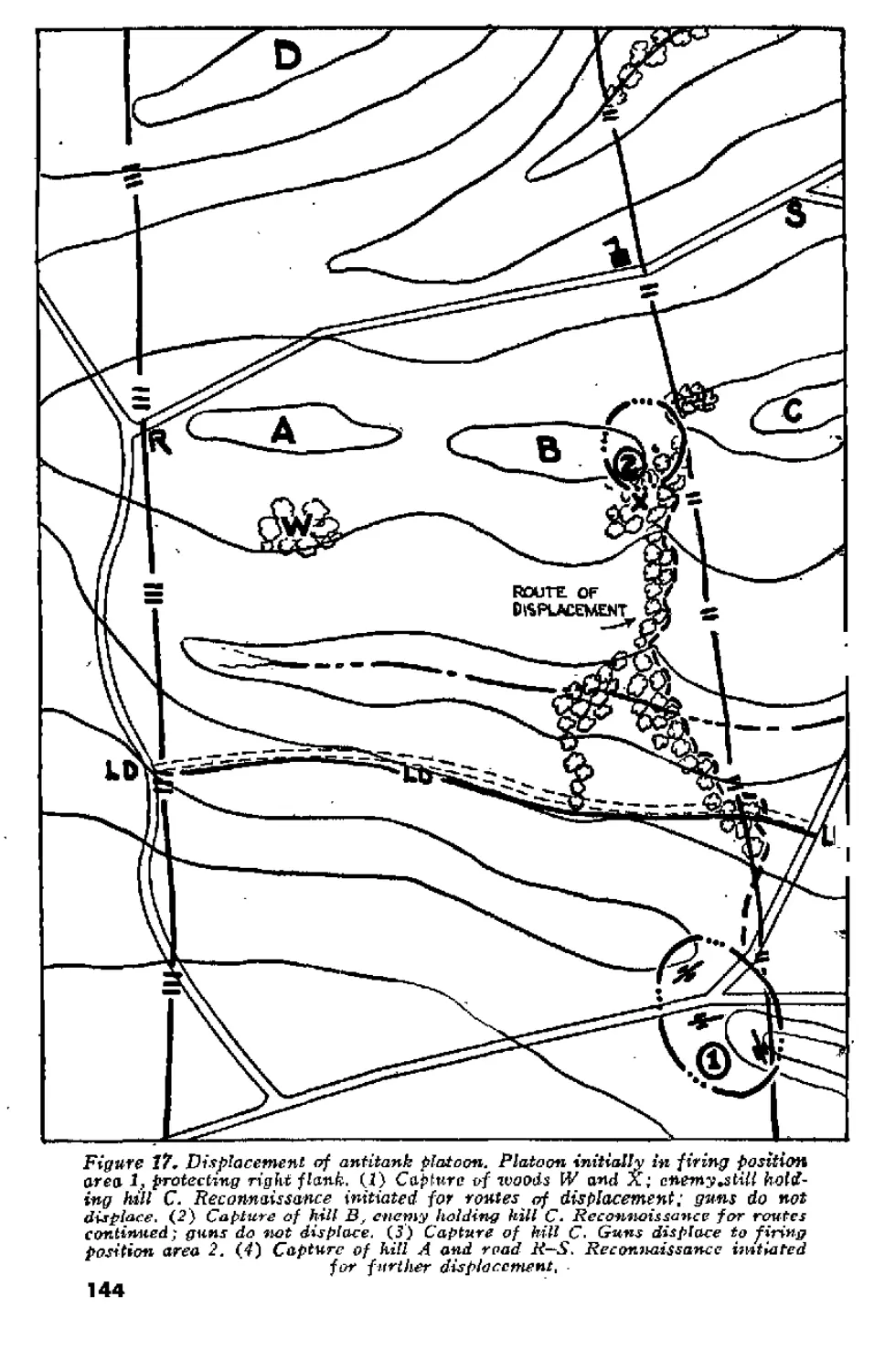
open fire. If the platoon is to occupy successive positions,
similar instructions are issued for each position. In
addition, the time, route, and method of displacement
to each successive position may be prescribed by the
company commander.
(2)	The mine platoon is assigned locations for mine
fields and mined road blocks, and is given specific in-
structions and information concerning the instajla-
tion (s) which must be effected, the protection to be
given the platoon by other units while the mines are
being laid, and the responsibility of the platoon for
guarding the installation after its completion. If the
mines are to be removed and laid again in successive
locations, similar instructions are issued for each loca-
tion; in addition, the company commander prescribes
the time or conditions upon which tire removal is to
commence, and the route to be followed to the new
location (s).
(3)	The company commander controls the movement
of ammunition vehicles in rear of each platoon area,
and the supply of ammunition or mines to that area,
b. When, as is frequently the case, such complete and
centralized control is impracticable, control will be par-
tially decentralized to platoon leaders by means of
mission orders. A mission order is one which assigns a
definite mission to a subordinate unit, but leaves a part
or all of the details of execution to the subordinate unit
leader. The degree to which control may be decentral-
ized by the company commander will be based upon a
determination of the method which will best insure
maximum antimechanized protection for the regiment
under the existing conditions. Examples are as follows:
(1) Tn a moving situation, a platoon may be assigned
an initial firing position area, a sector of responsibility
and a principal direction (s) of fire, with the mission
21
of protecting a flank of the regiment from the initial
firing position area and subsequent firing position areas
to be announced later. In this case, determination of the
conditions for opening fire is decided by the platoon
leader.
(2) A platoon may be assigned the mission of protecting
a flank of a battalion which is advancing in the leading
echelon of the regiment. In this case, the initial posi-
tion (s) to be occupied, the conditions for opening fire,
the location of subsequent positions, and the time and
method of displacement thereto, are decided by the
platoon leader.
10. RECONNAISSANCE. a. General. (1) The anti-
tank company commander keeps himself informed of
the locations and capabilities of tire antitank means with-
in the regiment. He secures this information by personal
reconnaissance; by repot Is from his reconnaissance officer,
or other personnel; and by conference witii battalion com-
manders or battalion antitank officers, and the regi-
mental howitzer officer. In a similar manner, he obtains
information of tire location and nature of existing anti-
tank obstacles, and determines the feasibility of creating
others by construction or by improvement of existing
terrain features.
(2) Initially, the antitank company commander may
have little more than a general knowledge of the meas-
ures for the antimechanized defense being taken by
adjacent or higher units. In such cases he must take
prompt advantage of every opportunity to secure the
necessary additional information, by reconnaissance or
contact with appropriate unit commanders. After the
receipt of such information, he recommends any neces-
sary changes in the regimental plan of antimechanized
defense.
22
b. Planning. Upon receipt of the regimental field
order, or on the basis of prior instructions of the regi-
mental commander, the company commander should—
(i) Analyze ail parts of the order or instructions which
affect the antitank company.
(2)	Briefly consult with other appropriate officers con-
cerning details of cooperation and fire support.
(3)	Plan the reconnaissance.
(4)	Issue early instructions for any preparatory move-
ment or dispositions of the company.
(5)	Inform the second-in-command and first sergeant of
his route of reconnaissance (if conducted by the com-
pany commander personally), and the place and time
subordinates are to assemble to receive the company
field order, if such assembly is practicable.
c. Making Reconnaissance. (1) Antitank reconnais-
sance is the examination of terrrain for likely avenues
of hostile armored approach; location of firing position
areas and cover and firing positions; concealed positions
and tentative firing positions and routes thereto for guns
held mobile; possible enemy tank assembly areas and
avenues of approach thereto and therefrom; existing or
potential tank obstacles; locations for the employment
of antitank mines; and communication routes and dis-
tributing points. Reconnaissance habitually precedes
movement and occupation of positions; its extent, thor-
oughness, and the assistance required are determined by
the amount of time available.
(2) Reconnaissance must be—
(a) Timely.
(i>) Carefully planned. Use is made of all available
information, including observation reports, maps, and
photos.
(c) Continuous and progressive.
(d) So conducted as to take full advantage of cover
and concealment.
33
11.	ORDERS. cr« Having decided upon a detailed plan,
of action to carry out an assigned mission, the.company
commander assigns specific missions to his subordinate
units. Sketches or overlays are furnished when prac-
ticable. Prior to combat, subordinates can frequently be
assembled to receive the order. This facilitates orienta-
tion prior to issuance of ordeis, and enables the com-
pany commander to insure that the orders are under-
stood. In attack, assembly of subordinates will often be
impracticable because of hostile observation and fires.
Leaders engaged with the enemy should not be called
away from their units for the purpose of receiving orders.
When the commander cannot issue orders to leaders
personally, they may be transmitted by messenger.
b.	In many situations, it may be necessary or desirable
to issue warning orders of impending operations. The
principal purpose of a warning order is to initiate early
planning, movement, and reconnaissance, and to avoid
subsequent delays.
c.	The company commander supervises the execution
of his orders to insure that they are properly understood
and executed by subordinate units.
12.	LOCATION DURING COMBAT. During combat,
the antitank company commander goes where he can
best observe the action of the company or exert the
greatest influence to obtain decisive results. He will
ordinarily spend the greater part of his time at the
observation post or some other point at which he can
obtain the fullest and most direct information regard-
ing the operations and situation of his company. He
maintains continuous contact with the command post,
and, before leaving the observation post, orients his
staff as to future plans, including his approximate routes
and time schedule. He keeps abreast of the situation at
all rimes, considers future possibilities, and prepares
34
tentative plans to meet them. If he issues orders, or
acquires information affecting the general situation, he
informs higher headquarters at the earliest opportunity.
SECTION IV
PRO TEC 7TVE MEASURES
13.	WARNING SYSTEM, a. General. The regimental
antiaircraft-antimechanized warning system includes an
intelligence system and a signal communication system,
both coordinated to insure early and continuing in-
formation of the presence and action of hostile air,
armored, and motorized forces. (See FM 7-40.)
b. Regimental Antiaircraft-Antimechanized Warn-
ing System. (1) The regimental S-2 is responsible for
the establishment and supervision of the regimental
warning system, and for its coordination with the ob-
servation system of supporting artillery and the warning
systems of adjacent and higher units. He utilizes the
services of the antitank company commander to assist
him in these functions.
(2) The regimental warning system includes all recon-
naissance and security detachments operating under regi-
mental control, all observation facilities within the regi-
ment, and air-antitank guards equipped with means for
giving the alarm. The regimental system of signal com-
munication is used to transmit warnings between other
elements of the warning system and regimental antitank
units. All elements in the system make immediate re-
port of mechanized threats by the most expeditious
means of communication available. AH warning messages
are classified as urgent.
35
e. Local Warning Systems. Air units and motor
reconnaissance elements usually give the first warning
of the presence of hostile tanks in the vicinity of the
regiment. However, the antitank company commander
is responsible that an effective local warning system is
constantly in operation within the company. He insures
that air-antitank guards are posted by each squad, and
that warnings received from the regimental warning
system and from such guards are promptly transmitted
to all elements of the company,
d. Warning Signals. To give warning of the approach
or presence of hostile aircraft or mechanized vehicles,
the following standard warning signal is prescribed:
three long blasts of a whistle, vehicular horn, siren, or
klaxon, repeated several times; or three equally spaced
shots with a rifle, carbine, or pistol; or three'shoft bursts
of fire from an automatic weapon. In daylight, the in-
dividual giving the signal indicates, by pointing, the
direction of the impending danger. At night, the alarm
signal will be supplemented by voice to indicate the
direction. In addition to the standard signals, other
available means, such as radio and pyrotechnics, may
be employed.
14. ACTION IN CASE OF AIR ATTACK, a. Regard-
less of the effectiveness of the security measures taken
by higher command through the offensive action of
combat aviation, all units must consider the probability
of air attack and reconnaissance and employ appropriate
security measures. Passive measures include dispersion,
concealment, and camouflage. Active measures comprise
firing at attacking airplanes.
b. Fire will not be delivered on any aircraft unless it
is clearly recognized as hostile, or is positively identified
as hostile, or unless the aircraft attacks with bombs or
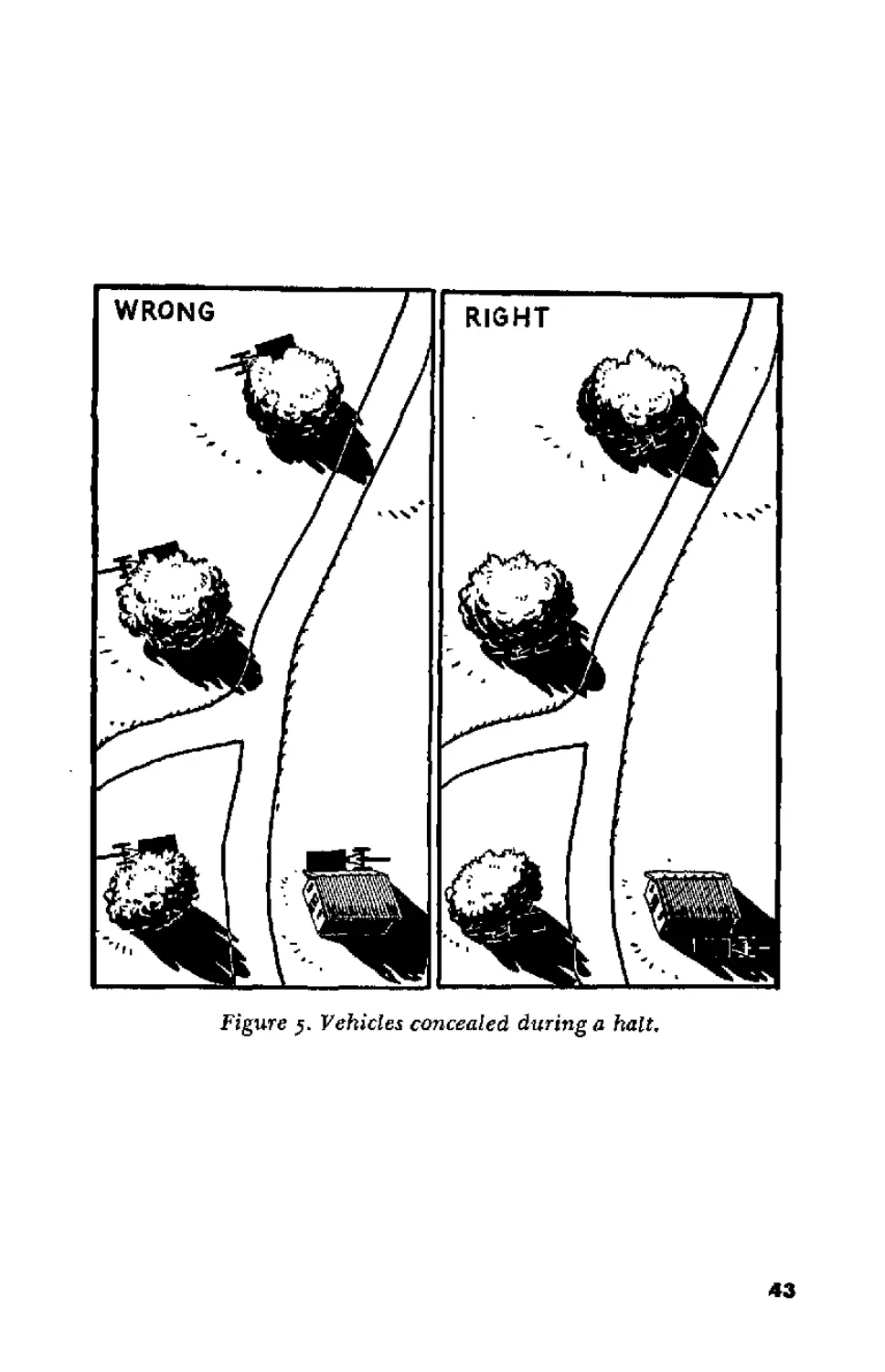
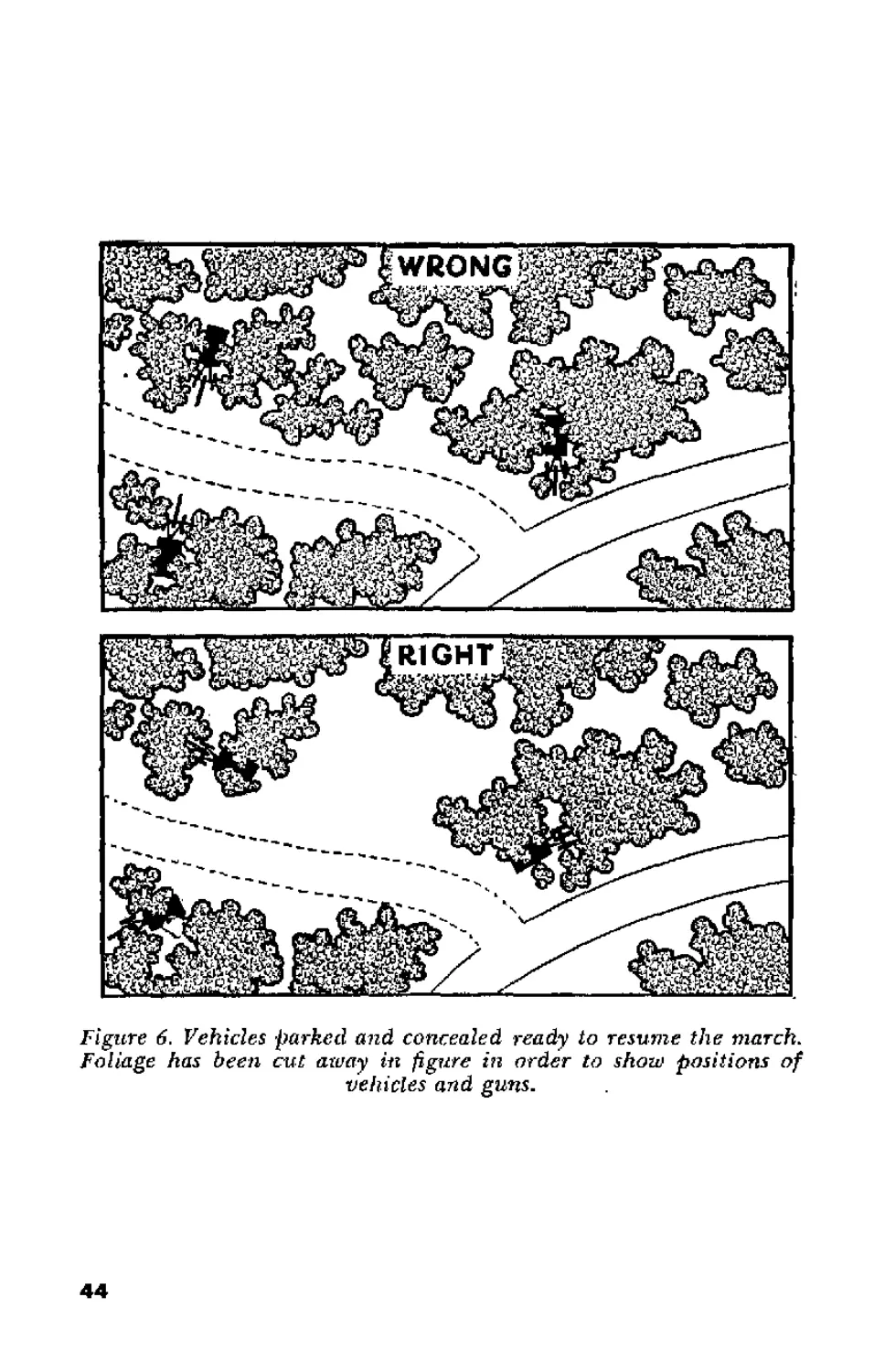
gunfire. Concealment and camouflage are used whenever
26.
possible to prevent detection by enemy aircraft. If con-
cealment is believed to have been achieved, no weapons-
are fired at approaching enemy aircraft.
c. (i) On die march, upon receipt of warning of
hostile air attack, prime movers and other vehicles are
driven off the road; whenever terrain and time permit
they are driven oH the road far enough to clear the
probable impact area. Maximum use is made of any
available cover and concealment. All men, except those
designated as crews for the caliber 150 machine guns,
dismount and take cover, but remain close enough to
their vehicles to resume movement as soon as the attack
has passed.
(2) In other situations, upon warning of air attack,
personnel of the antitank company disperse and take
cover, except gun crews who arc engaged in a fire fight
with hostile tanks; such crews continue to combat the
tanks.
(3) Caliber .50 machine guns and individuals armed
with rifles and carbines open fire upon attacking planes
only upon command or prearranged signal of the com-
pany commander or responsible unit leader, given as
soon as the planes are within effective range.
15. CLOSE-IN DEFENSE AGAINST MECHANIZED AT-
TACK. If tanks succeed in approaching within 300 yards
of an antitank gun, personnel not engaged in operating
or serving the gun, or in firing at accompanying foot
troops, employ rockets and individual weapons against
the tanks. Doors and turrets, if open, offer particularly
favorable targets to small-arms fire, as do also vision
slits and periscopes. Should tanks succeed in approach-
ing close enough to warrant such action, incendiary
grenades, antitank bombs, and smoke grenades may be
used. Fire is continued until defenders are forced to
take cover to avoid the crushing action of tanks. (See
az
арр. 1.) They return to their firing positions as soon
as the tanks have passed, and continue their fire on
these vehicles or on other approaching tanks or accom-
panying infantry.
16. INDIVIDUAL PROTECTION, a. Full advantage
should be taken of available cover and concealment,
both while in movement and while halted.
b. Whenever troops are halted in a combat zone, in-
dividual protection will be sought and improved, or
excavated. When the halt is expected to be brief, they
will take advantage of such natural protection as is
afforded by the terrain. When the halt is expected to
be for a longer period, as, for example, a halt in an
assembly area, fox holes will be dug. Full advantage?
will be taken of natural cover and concealment in the
construction of fox holes. Guns are emplaced and con-
cealed whenever time permits.
c. For details of construction and camouflage of fox
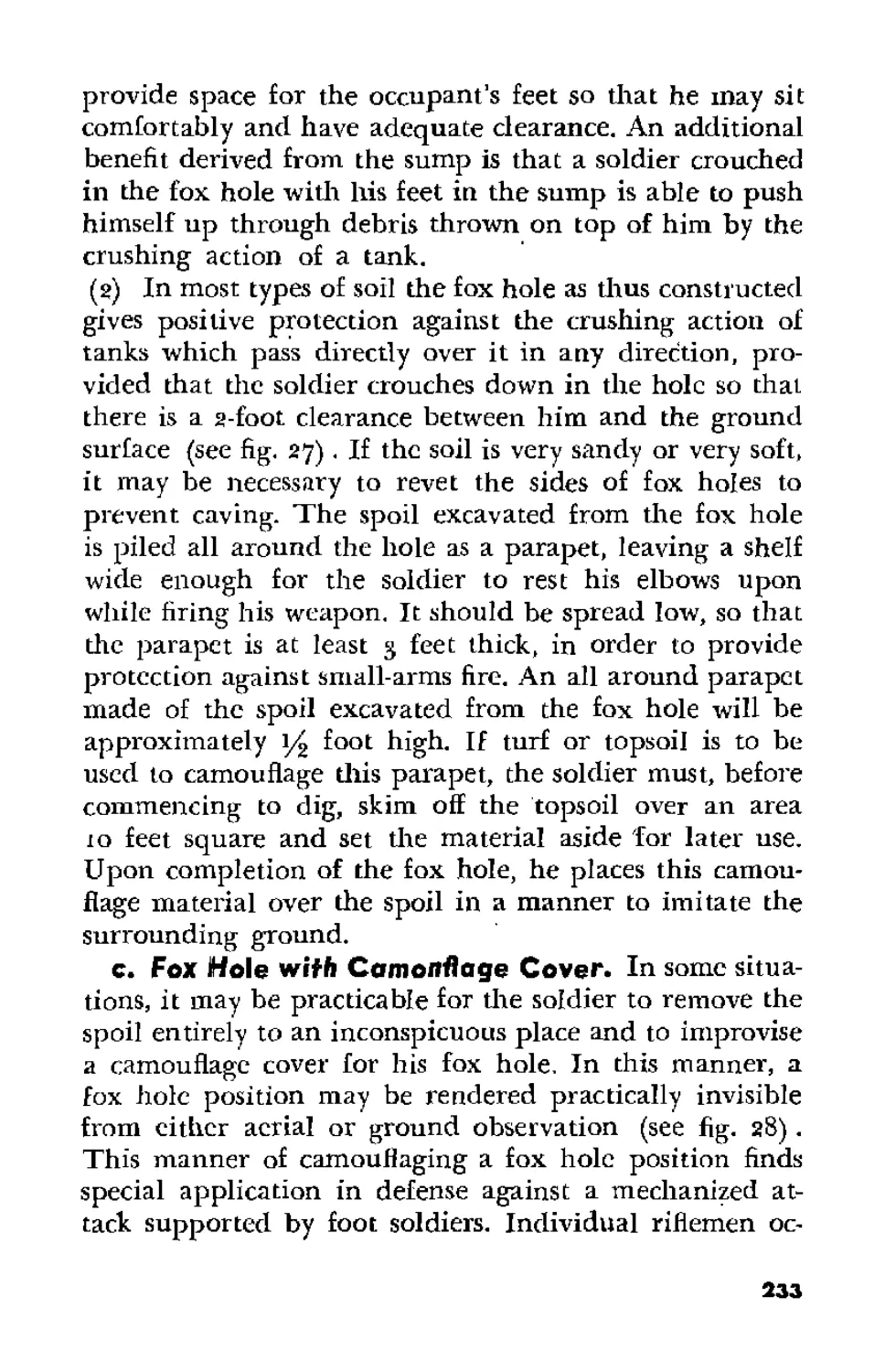
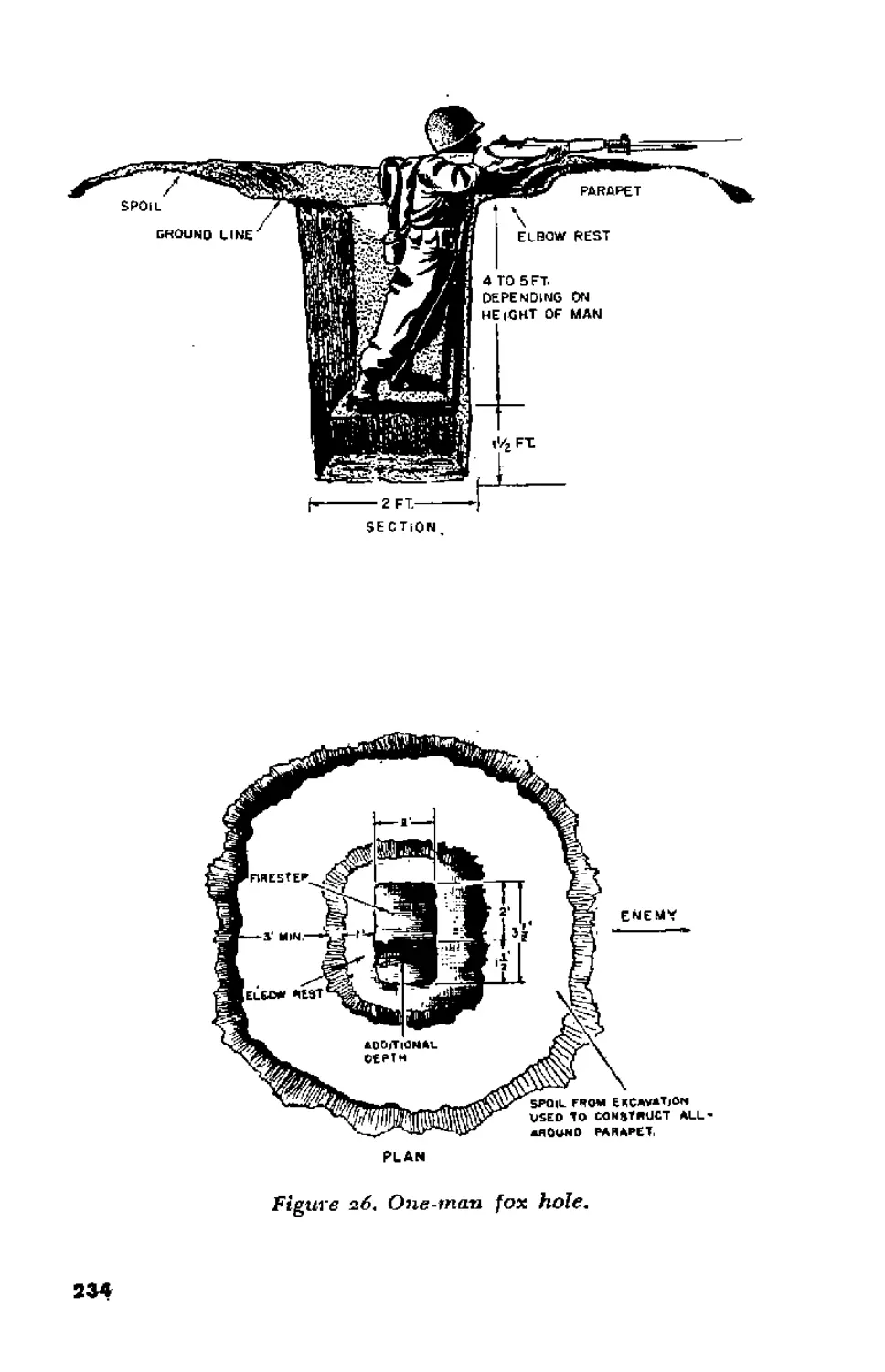
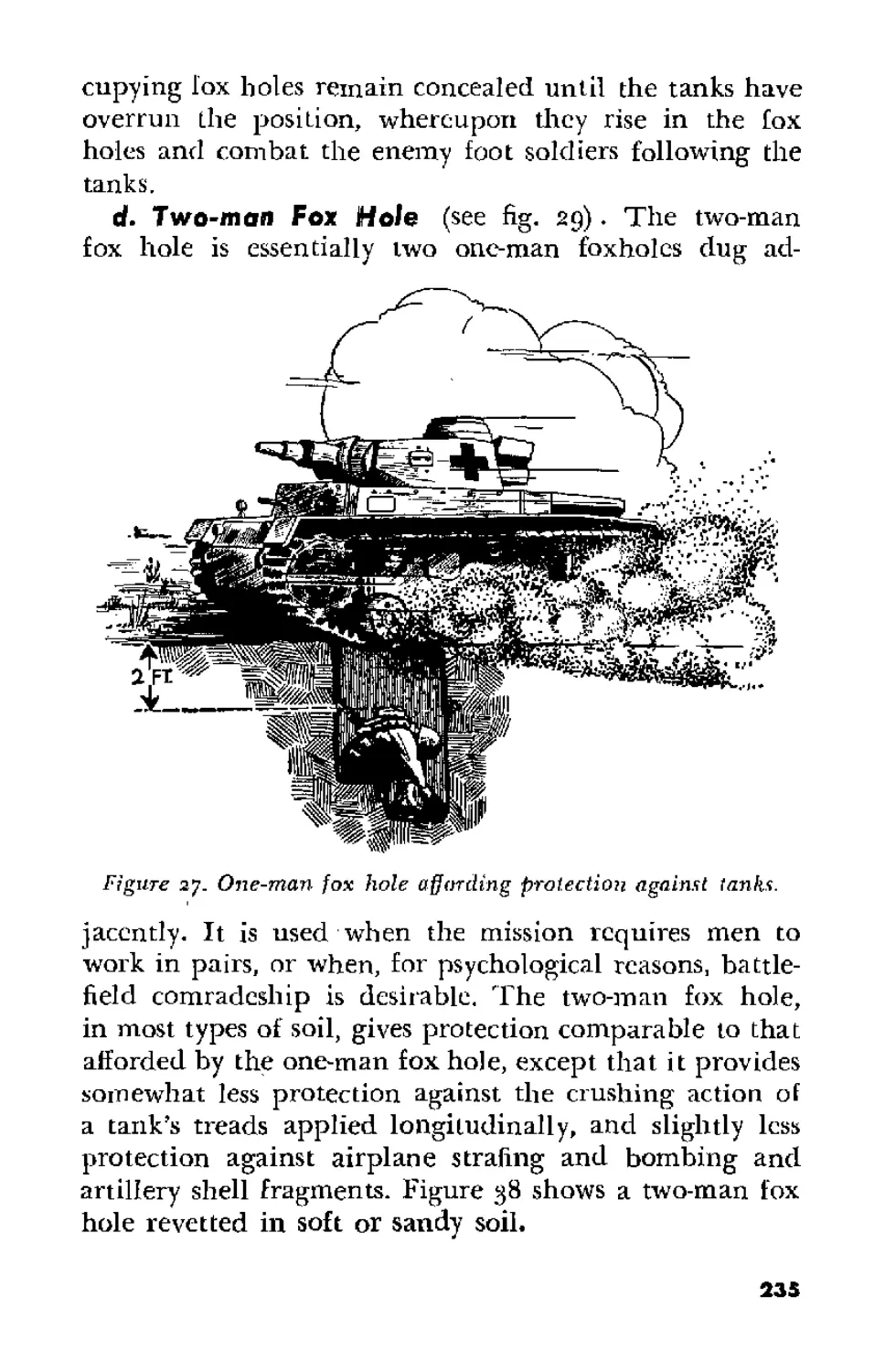
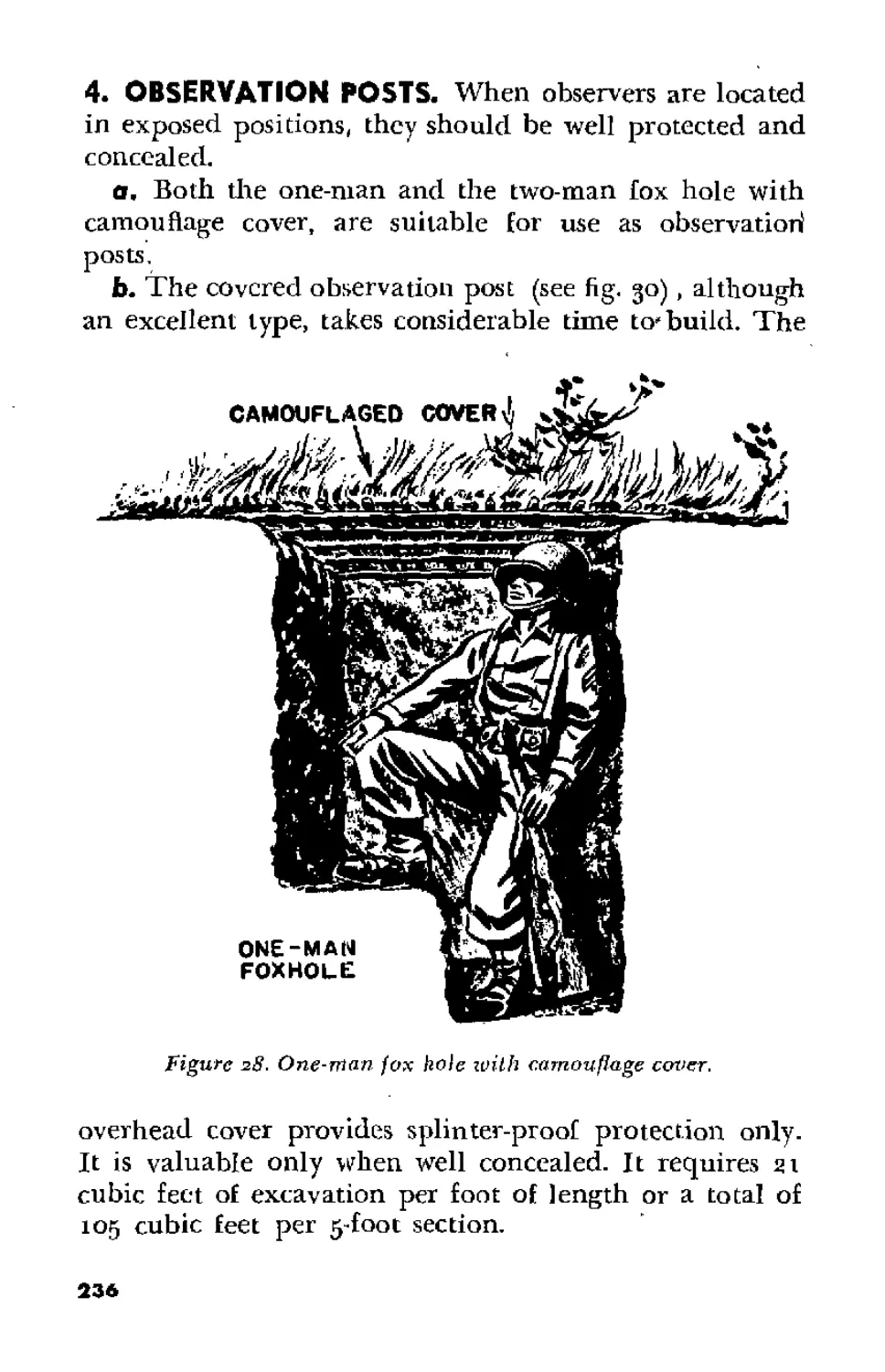
holes and weapon emplacements, see appendix I.
28
CHAPTER 2
MEDICAL SERVICE AND EVACUATION
17. AID STATIONS, a. Elements of the antitank com-
pany utilize the aid stations of battalions in whose areas
they are operating. If not operating in a battalion area,
they utilize the regimental or nearest battalion aid sta-
tion.
b. At the beginning of an action, tire antitank com-
pany commander con tacts the regimen tai surgeon to
insure a clear understanding as to which aid stations are
to be utilized by the elements of the company; there-
after, he keeps the surgeon informed of changes in the
location of these elements, since such changes may re-
quire corresponding changes in designation of aid sta-
tions which they are to utilize.
18. COMPANY AID MEN AND LITTER BEARERS, a.
Company Aid Men. Company aid men are attached to
battalion lettered companies and the antitank company
on a basis of three per company. They are attached in
turn to platoons of their respective companies. Elements
of the antitank company are served by their own com-
pany aid men. These aid men operate between forward
positions and battalion aid stations.or the regimental
aid station. The battalion antitank platoon is served by
aid men of the nearest lettered company. Duties of com-
pany aid men are—
29
(i) To follow closely the unit to which they are at*
rached.
(?) To administer emergency treatment to the sick and
wounded.
(3) To send information to the battalion (regimental)
surgeon by walking wounded or litter bearers. These
messages give the location of the unit, any contemplated
changes in location or disposition, and the approximate
number and location of casualties in the unit.area.
(4) To instruct walking sick and wounded as to the
exact location of the aid station and the route thereto.
(5) To place seriously sick and wounded in sheltered
locations on the route of advance of the company which
they serve.
(6) To examine, tag, and mark the location of the dead.
b. Litter Bearers. A litter bearer section of 12 men is
attached to each battalion. These sections work in teams
of 2 or 4 men; teams vary in size according to the weight
of the load and the carrying distance. Litter bearers
evacuate non walking wounded from battlefield positions
to battalion aid stations. Leaders of antitank elements
desiring litLer evacuation of wounded personnel contact
appropriate aid stations and request such evacuation.
19.	ORDERS. The antitank company order will include
the designation and locations of aid stations to which
casual tie; will be evacuated. AH members of tile company
will be informed of these designations and locations.
If, during the course of the action, the casualties of any
element of the company are to be evacuated to a different
aid station from that originally announced, or any other
changes in the system of evacuation are to be made, the
company commander issues the necessary additional in-
structions.
30
CHAPTER з
SUPPLY AND MOTOR MAINTENANCE
SECTION I
SUPPLY
20.	REFERENCES. For definitions and methods relating
to supply, see FM 7-30 and 100-10; for logistical data,
see FM 101-ю; for administrative procedures, see TM
12-250 and 12-255.
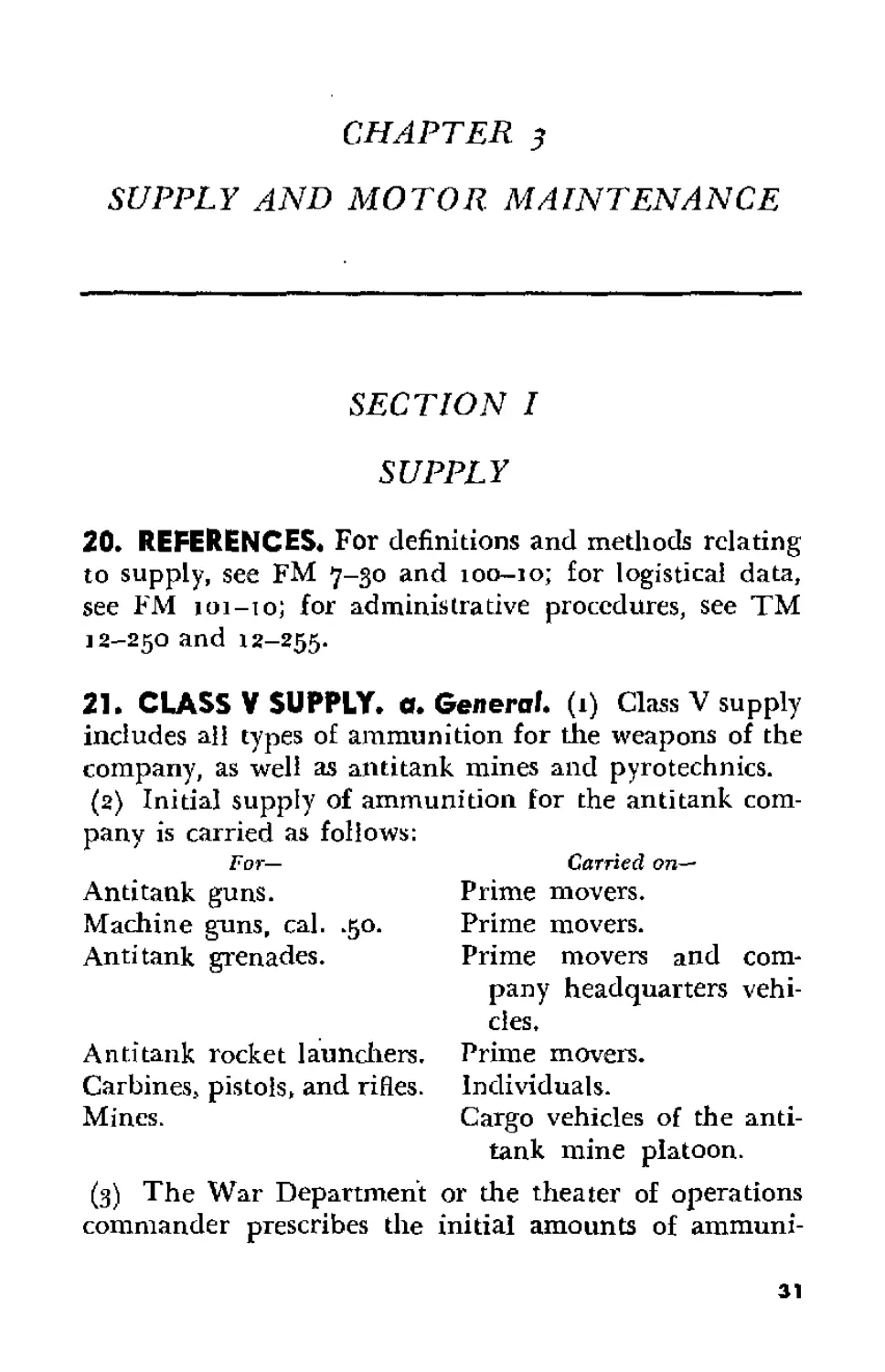
21.	CLASS V SUPPLY. a. General. (1) Class V supply
includes ail types of ammunition for the weapons of the
company, as well as antitank mines and pyrotechnics.
(2) Initial supply of ammunition for the antitank com-
pany is carried as follows:
For—	Carried on—
Antitank guns.
Machine guns, cal. .50.
Antitank grenades.
Antitank rocket launchers.
Carbines, pistols, and rifles.
Mines.
(3) The War Department
commander prescribes the
Prime movers.
Prime movers.
Prime movers and com-
pany headquarters vehi-
cles.
Prime movers.
Individuals.
Cargo vehicles of the anti-
tank mine platoon.
or the theater of operations
initial amounts of ammuni-
31
tion to be carried. The amount carried on the individual
and on the company transport is that deemed sufficient
to enable the company to enter and sustain combat until
replenishment can be effected.
b. Replenishment, (i) RESPONSIBILITY. The regi-
mental commander is responsible for making ammuni-
tion available, in adequate amounts, to the company
ammunition supply point. The company commander is
responsible for distributing ammunition to his platoons.
The platoon leaders are responsible for distributing
ammunition to their squads.
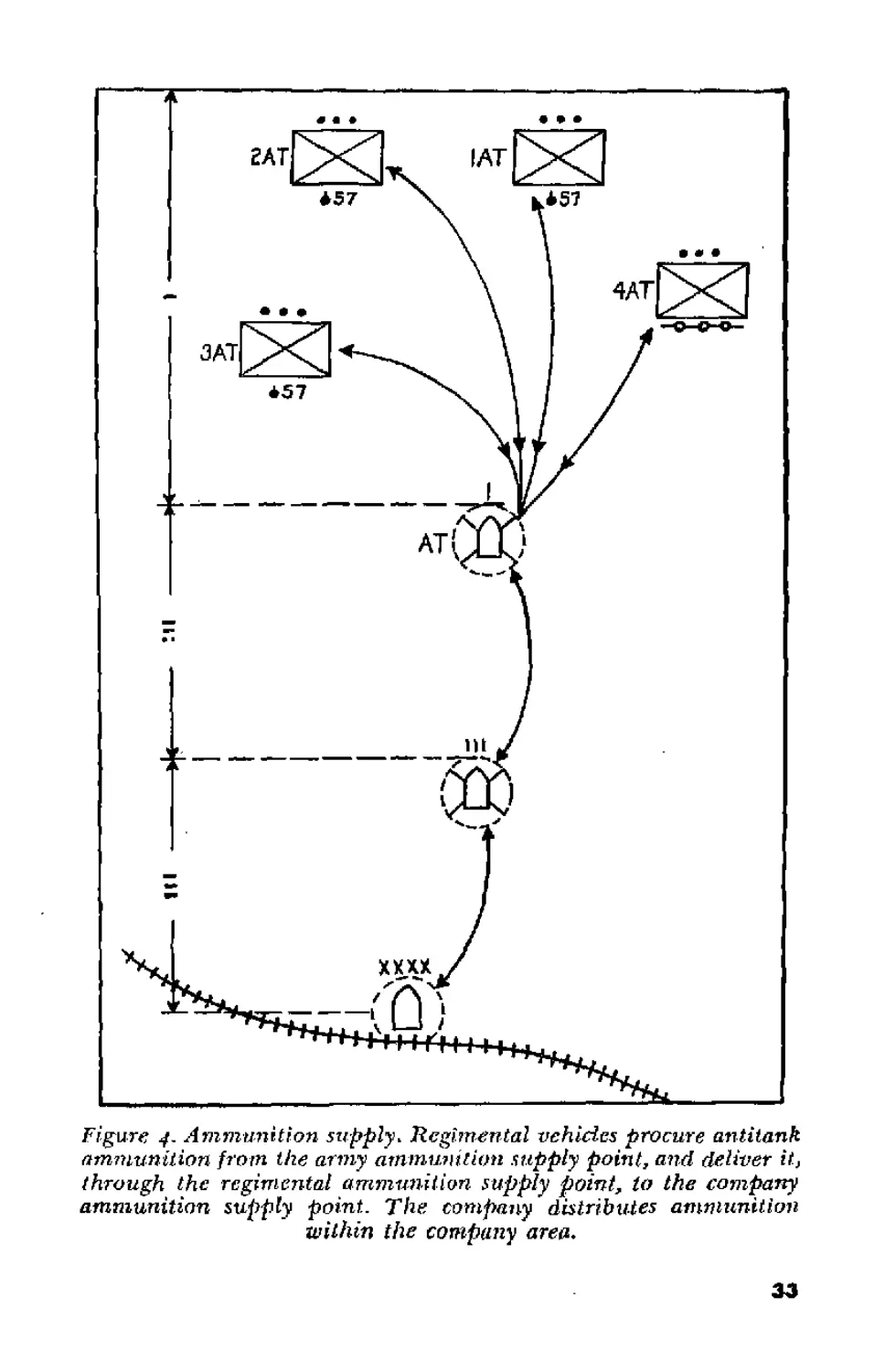
(2)	GENERAL PLAN OF REPLENISHMENT, (a)
Ammunition for the antitank guns and other weapons
is ordinarily delivered to the company ammunition sup-
ply point by vehicles of the regimental train. The com-
pany distributes its ammunition from this point. (See
fig- 4-)
(i>) Ammunition for the battalion antitank platoon
and any elements of the antitank company attached to
the battalion is the responsibility of the battalion com-
mander. He arranges for replenishment of ammunition
from or through the regimental ammunition supply
point.
(3)	COMPANY AMMUNITION SUPPLY POINT,
(a) The company commander selects the company am-
munition supply point, which usually will be near the
company command post, so as to take advantage of the
company communication net. Vehicles proceeding to
or from the company ammunition supply point will be
routed so as to avoid passing closer than necessary to
the company command post. Desirable characteristics
a company ammunition supply point are—
Location at or in rear of a point from which
of
covered routes to the platoons diverge.
Concealment from air and ground observation.
Defilade from hostile flat-trajectory fire.
32
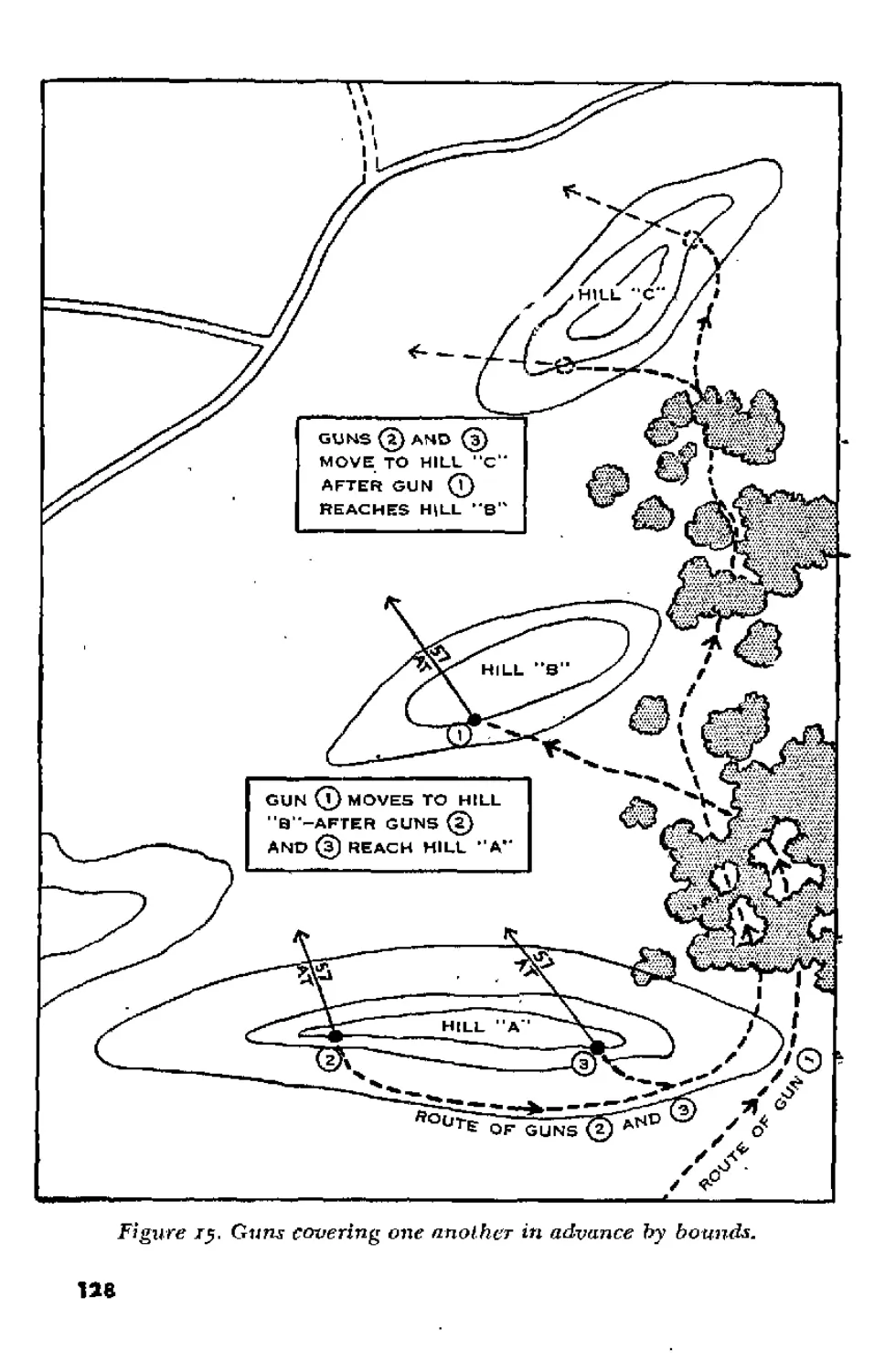
Figure 4- Ammunition supply> Regimental vehicles procure antitank
ammunition from the army ammunition supply point, and deliver it,
through the regimental ammunition supply point, to the company
ammunition supply point.. The company distributes ammunition
within the company area.
33
Ease of identification.
Facility of motor movement to the rear.
(i>) The supply sergeant, assisted by other personnel
designated by the company commander, operates the
company ammunition supply point. The status of am-
munition supply within the platoons must be reported
frequently to operating personnel at this point during
all phases of combat.
(4)	CONTROL OF PLATOON VEHICLES. All plat-
oon vehicles remain under platoon control while within
a platoon area. The company transportation sergeant
supervises, coordinates, and expedites the movement of
vehicles used for carrying ammunition while en route
from the platoon area to the company ammunition sup-
ply point, and return.
(5)	ANTITANK PLATOON, (fl) Replenishment in
attack,
1. Because of the limited mobility of the antitank
gun when moved by hand, the prime
movers should normally remain under
cover near the gun positions. In an emer-
gency, the truck in platoon headquarters
may be used to replenish the ammunition
supply. If replenishment in larger quan-
tities becomes necessary, arrangements must
be made to secure a vehicle from the regi-
mental train.
2. The platoon sergeant keeps himself informed
regarding the status of ammunition within
the platoon. The tactical situation permit-
ting, he dispatches the platoon headquart-
ers truck to tire company ammunition sup-
ply point for emergency replenishment.
The noncommissioned officer in charge of
the company ammunition supply point has
this vehicle refilled and dispatches it to the
34
platoon from which it came. The normal
ammunition loads of prime movers should
be continually maintained. Small stocks of
ammunition may be located near gun posi-
tions, and sufficient quantities to meet esti-
mated needs kept at tire position.
j. A platoon leader confronted with emergency
ammunition requirements so notifies the
company commander, who may direct pri-
ority of ammunition supply to that platoon,
or transfer of ammunition from platoons
whose expenditure has been less.
(£>) Replenishment in defense.
1. The regimental commander will prescribe the
amount of ammunition to be unloaded in
the regimental sector of the battle position.
After the enemy has advanced to contact,
replenishment of ammunition from the
rear is frequently practicable only under
cover of darkness. Provision must be made,
however, for the immediate resupply of any
antitank elements of the company whose
ammunition becomes seriously depleted.
This is accomplished by keeping a propor-
tion of the ammunition at die company
ammunition supply point, established in
the vicinity of the company command post,
or by transfer of ammunition from platoons
whose expenditure has been less, as in 3
above.
2. Ordinarily, platoon leaders will be instructed
to report, at or shortly before dark, the
amounts of ammunition on hand. Basing
his action on these reports, the company
commander plans and effects distribution
35
to the platoons of the resupply of ammu-
nition brought forward after dark.
(c)	Replenishment of antitank elements attached to
battalion. A stock of antitank ammunition should, if pos-
sible, be held at the battalion ammunition supply point
for lhe battalion antitank platoon. In an emergency,
replenishment for attached antitank elements may be
effected from this stock; at other times, vehicles of these
elements are refilled at the company ammunition supply
point, being routed through the battalion ammunition
supply point.
(d)	Replenishment during rapidly moving situations.
In a rapid forward movement, such as with an advance
guard or in pursuit, the system of ammunition supply is
similar to that in attack. When distances from supply
points are so great as to make replenishment difficult,
needs must be anticipated and additional quantities of
ammunition and transport secured from higher head-
quaners.
(e)	Replenishment in retrograde movements. During
retrograde movements, replenishment of ammunition
will be held to the minimum necessary for antimecha-
nized defense. Sufficient amounts for die contemplated
action are left with each unit. Regimental ammunition
carrying vehicles may be released to the company or
platoon on rear positions; or resupply may be effected
by the establishment of ammunition supply points by
higher headquarters, either on selected delaying positions
or along the route of withdrawal. The regimental com-
mander will inform the company and battalion com-
manders as to tire location of such supply points.
(/) Replenishment by hand-carrying. At times, the sit-
uation may prohibit the movement of vehicles between
platoon firing position areas and the company ammuni-
tion supply point. When such a condition occurs during
a moving situation, it is ordinarily impracticable for
36
antitank company personnel alone to hand-carry suffi-
cient ammunition to effect adequate replenishment. The
regimental commander, upon request of the company
commander, insures replenishment either by reinforcing
the company with additional personnel or by delivering
the ammunition, through hand-carry by personnel of
other units, to one or more points designated by the
company commander from which hand-carry by per-
sonnel of the company is practicable. Similar assistance
is made available by battalion commanders to battalion
antitank platoons and any attached antitank elements;
personnel of the ammunition and pioneer platoon and
necessary additional personnel may be employed.
(6) REPLENISHMENT OF ANTITANK MINES, (a)
In certain situations, particularly in defensive action, it
may be necessary to use all of die mines carried in the
antitank mine platoon vehicles. Whenever practicable,
however, approximately one-third of the initial allow-
ance of the antitank mines should be kept on one of the
vehicles as a mobile reserve.
(b)	When the situation indicates that mines will be
required in certain locations for a limited period of time
only, after which they must either be recovered or aban-
doned, the regimental commander may direct that the
mine platoon vehicles (cargo trucks and trailers) be held
available to transport the recovered mines. Unless the
vehicles are to be employed for this purpose, the mine
platoon leader sends them through the company ammu-
nition supply point to the regimental ammunition sup-
ply point, as soon as they have been emptied. The regi-
mental munitions officer may in turn dispatch the vehi-
cles to the army ammunition supply point for refill.
(c)	When the need for any given mine field or mined
road block no longer exists, the mines should be dis-
armed, collected, and inspected, and usable mines loaded
on available platoon vehicles. When cargo space is in-
37
sufficient to load ail mines so collected, the surplus mines
will be placed in small dispersed piles, and their location
reported to the regimental commander for disposition.
(d)	If lack of time, shortage of personnel, or other
reasons prevent recovery of planted mines, the mine field
must be guarded by a traffic guard (s), and the location
reported to the regimental commander. An exception to
such, procedure is the abandonment of a mine field dur-
ing a retrograde movement after all friendly vehicles
have passed.
22. ORDERS, a. Administrative details in company or-
ders include such of the following items as are applic-
able:
(i)	Location of company ammunition supply point and
of regimental ammunition supply point.
(2)	Route of advance of ammunition (in attack only).
(3) Amount of ammunition to be placed on positions.
(4) Disposition of company vehicles.
(5) Location of class III supply point (s).
(6) Location of regimental and battalion aid stations.
b. Additional directions of an administrative nature
may be included in the order, or issued later in frag-
mentary form to those concerned. These directions may
include the plan for feeding, and the detailing of guides
and carrying parties.
c. Similar appropriate information is contained in the
order of the platoon leader.
23. EXPEDIENTS IN THEATER OF OPERATIONS, a.
Exploitation. Efficient use must be made of all resources
in the regimental area to supplement supply and to pro-
vide for deficiencies when the normal means for procure-
ment and distribution of supplies are inoperative or
partially inoperative. Troops must be trained to load,
lay, and fire captured weapons in general use by the
38
enemy; and to effect minor repairs and operate enemy
transport, botii mechanized and motorized, in constant
use within the theater of operations.
b. Battlefield Recovery of Vehicles* Weapons, and
Other Sapplies. Means within the regiment must be em-
ployed to recover vehicles, both our own and those of
the enemy, which are serviceable or can be made ser-
viceable within the combat zone before the fluctuation
of battle permits the enemy to recover or destroy them.
When ammunition is exhausted and serviceable weapons
and ammunition of the enemy are available, these should
be used. Usable stocks of all types of supplies which are
discovered within the regimental area must be guarded
and higher authority immediately notified of the general
type, amount, and location of such supplies.
c. Destruction of Serviceable or Reparable Vehi-
cles and Usable Supplies. Troops must be trained in
quick, effective methods for the destruction of materiel
and supplies of all types. In the case of weapons and
vehicles, efficient destruction will require further action
than the mere removal of certain working parts. If or-
ganic means are not supplied with vehicles, efficient
methods must be improvised for destruction of the latter
and to render useless all other types of supplies. Prompt
action will be taken to prevent serviceable equipment
or usable supplies from falling into the hands of the
enemy. (See FM Я3-75.)
39
SECTION II
MOTOR MAINTENANCE
24. RESPONSIBILITY AND DUTIES, a. The company
commander is responsible for the operation and mainte-
nance of his vehicles. Operating personnel are carefully
selected. The most important link in the chain of main-
tenance is the driver. He is selected for his ability, judg-
ment, and conscientious performance of duty. He is
carefully instructed in driving, in the required march
inspections, and in driver maintenance. By observation
and frequent personal and staff inspections, the company
commander insures that these duties arc properly per-
formed.
b.	The company automobile mechanic, under the
supervision of the transportation sergeant, is charged
with company maintenance. The service company main-
tenance section will perform organizational maintenance
which is beyond the capabilities of the antitank com-
pany automobile mechanic.
c.	Vehicles requiring maintenance beyond the capa-
bilities of the antitank company are reported to S-4.
For echelons of maintenance, see AR 850-15.
d.	For a discussion of the problems involved in the
operation and maintenance of motor vehicles in cold
climates and in desert country, see FM 25-10, 31-15,
and 31-25.
40
CHAPTER 4
MARCHES AND BIVOUACS
SECTION I
MARCHES
25.	REFERENCES. For the fundamental doctrines gov-
erning troop movements, see FM 100-5. For technical
and logistical data pertaining to troop movements, see
FM 101-10. For conduct of the regiment and battalion
in route marches, see FM 7-40 and 7-20. For operation
of regimental trains, see FM 7-30. For detailed treatment
of motor movements, see FM 25-10. For forms for march
orders, see FM 101-5.
26.	GENERAL, a. The antitank company commander
is charged with the organization and coordination of
the antimechanized defense" of the regiment on the
march in accordance with instructions from the regi-
mental commander.
b. The recommendations of the company commander,
made prior to the start of the march, should include the
attachment of elements of the company to security forces
and the disposition and missions of that portion of the
company held under his control. Recommendations
should be such as to provide maximum protection to
the regiment in coordination with the antimechanized
measures of the battalions and of adjacent and higher
units;
41
27.	DAYLIGHT ROUTE MARCHES, a. Antitank Com-
pany. (i) The elements of the antitank company must
be so distributed for the protection of the regiment as
to provide defense against mechanized attack from aii
directions. If the terrain permits rapid cross-country
movement, or road conditions permit elements of the
company to pass the regimental column, these elements
occupy successive bring positions along the route of
march. While roads intersecting the route of march are
the most dangerous and should be covered by either
gun units or obstacles (including mines) or both, the
possibilities of infiltration by hostile armored vehicles
must also receive constant consideration.
(a) Antitank units move by bounds from one position
to another. Each prime mover follows, the preceding
one at a distance of from 50 to 100 yards. If a leading
vehicle halts, vehicles in rear are halted; distances are
maintained unless vehicles are signaled to close up-
Drivers of vehicles which have halted as a result of
mechanical failure signal rear vehicles to pass. When a
column is halted, drivers move the vehicles a short
distance off the road or trail, and disperse and conceal
them (see fig. 5) . Guns and vehicles are parked so that
they may readily resume the march (see fig. 6). Over
rough ground or hard going, men dismount and follow
the vehicles, helping if necessary. One man goes ahead
to select a route. Covered routes are sought. Edges of
woods, and scattered buildings or trees contribute to
concealment (see fig. 7). Open crests are avoided. When
moving to positions not fully protected by other troops,
vehicles advance by bounds, each bound being recon-
noitered by designated personnel.
42
figure 5. Vehicles concealed during a halt.
43
Figure 6. Vehicles parked and concealed ready to resume the march.
Foliage has been cut away in figure in order to show positions of
vehicles and guns.
44
Figure 7. Vehicles taking advantage of edge of woods.
45
Ь. Дnfjmechanized Security, (i) For an interior
regiment, the most likely direction of hostile armored
attack during an advance is from the front. For this
reason, elements of the antitank company should be
attached to the advance guard or should march well
forward in the column in order that they may rapidly
reinforce the antitank platoon of the advance guard bat-
talion. In the latter case, priority on roads for the anti-
tank company should be requested by the company com-
mander.
(2)	A hostile mechanized attack in flank becomes more
probable as the interval between regiments increases.
In an advance with an exposed flank, antitank company
elements should be attached to the flank guard. When
several dangerous flank localities must be passed during
the progress of a march, echelons of the flank guard
move by bounds from one position to another (see fig.
8). If there is a single avenue of approach from a
threatened flank, the flank guard may occupy a single
key terrain feature, the possession of which will afford
the necessary antimechanized protection to the main
body. This key terrain feature may be utilized as an
initial delaying position or defended until the mission is
accomplished. In case of attack, the main body com-
mander is immediately notified and the flank guard
delays the advance of the enemy until the main body
can prepare for action or until the tail of the column
passes designated point. (See FM 7-40.)
(3)	In a inarch toward the enemy, the rear of the regi-
ment is usually protected by a small rear guard; an ele-
ment of tire antitank company may be attached to this
force. In a retirement, the regimental rear guard will
be much stronger and may include the attachment of
one or more antitank platoons, and a part or all of the
mine platoon from the antitank company. In general,
the combat action of antitank elements attached to the
46
Figure S. Flank guard protection. Main body is moving on road indicated by arrows. Flank guard moves on road
to the right. Antitank elements furnish protection at intersection approaches, ©., ©, and d), by gunfire and road
blocks. (.See also fig. 22.)
rear guard in close contact with the enemy is conducted
in accordance with rhe procedure described for a de-
laying action (occupation of successive delaying posi-
tions to the rear).
(4)	The antitank units (including battalion antitank
platoons), cannon company elements, and supporting
field artillery in the main body, are so disposed as to
effect coordination with antitank elements of the advance,
flank, and rear guards in providing antitank defense to
the regiment. The detailed distribution of the antitank
company in the main body varies with the terrain and
anticipated tactics of hostile armored elements. When
the terrain facilitates movement, it is generally pre-
ferable to hold the bulk of the weapons under cen-
tralized control in a position favoring quick reinforce-
ment of any part of the column which is under im-
mediate threat of hostile armored vehicles that have
evaded or penetrated the security elements.
(5)	A reconnaissance detail, headed by the company
reconnaissance officer, marches well forward with the
advance guard in order to furnish early information of
possible routes of approach of hostile armored vehicles,
and suitable positions for guns and mine fields. This
detail should be furnished with radiotelephones for com-
munication with tire regimental command group.
C. Command Group. The company command group
habitually marches with the regimental command group.
The company commander is with or maintains liaison
with the regimental commander.
d. Action in Case of Attack, Upon receipt of warn-
ing of a mechanized attack, the company commander
obtains the decision of the regimental commander as to
whether the regiment will meet the attack in place or
continue the march to a more suitable locality. He must
be prepared to submit brief, specific recommendations
for the employment of all antitank weapons not attached
48
to security forces. If time permits the use of mines, he
should recommend that they be laid in localities where
they will divert the hostile mechanized attack or canalize
it into areas covered by rhe concentrated fire of antitank
weapons. Elements of the company should at all times
be prepared to move into firing positions without delay.
28. NIGHT ROUTE MARCHES, a. At. night the com-
pany usually marches as a unit in the regimental motor
column. However, if there is danger of a hostile mechan-
ized attack, elements of the company may be distributed
throughout the entire column; attached to Hank guards,
or employed to establish road blocks on approaches in-
tersecting the flanks. (See FM 7-40.)
b. The company commander and all subordinate
leaders devote particular attention to march discipline
to include sound and light discipline, maintenance of
contact, and security. Units are kept well closed up, and
distances are greatly reduced. If illuminated by flares
from aircraft, all elements of the company halt; in-
dividuals keep their heads down and remain motionless
until the light dies out. Normally, hostile aircraft are
not engaged by fire.
c. If the company is to establish road blocks along the
flanks, a detailed daylight reconnaissance of the route
and of the road block sites should be made, if practic-
able. Personnel making this reconnaissance should in-
clude the company commander and the leader of each
unit which is to be employed to establish such road
blocks. If circumstances prevent a terrain reconnaissance,
a map reconnaissance should be made. In either event,
route sketches must be prepared for the use of each
leader responsible for establishing a block. These
sketches should show the road, prominent landmarks
near the road which can easily be recognized at night,
road junctions, cross roads, and any distinguishing fea-
49
lures thereof, compass bearings for each important
change of direction, and distances from the initial point
to the more important features. When the situation per-
mits a terrain reconnaissance, it should be conducted by.
single vehicles in order not to attract enemy attention.
The route is carefully marked, particularly at road junc-
tions and cross roads. Guides, luminous markers, lime,
tape, or paper strips may be used. If guides are posted,
they remain concealed during daylight and display no
lights at night, except as authorized by the company
commander for control of the movement.
29. ANTIMECHANIZED PROTECTION DURING MO-
TOR MOVEMENTS, a. Antimechanized protection of
the regiment during motor movements includes both
active and passive defense measures. Within the column,
units having suitable weapons are in general responsible
for their own immediate defense. Units not having such
weapons are so disposed as to receive protection from
suitably armed units, or special provision is made for
their defense.
(i) Active defense measures include the distribution
of antitank weapons of the regiments throughout the
column; however, the bulk of the antitank company is
frequently attached to security elements.
(2) Passive defense measures include concealment, dis-
persion, deception, speed, and use of mines and other
obstacles, both natural and artificial.
b. When the route of the motor movement is inclosed
by natural tank obstacles with but few openings, anti-
mechanized defense of the motor column is best obtained
by the placing of elements of the antitank company at
or near these openings prior to the advance of the main
body (sec fig- 8). After passage of the command, these
elements successively resume their places in column or
join the rear of the column.
50
30.	MARCHES UNDER SPECIAL CONDITIONS. For
discussions of marches in mountainous terrain, deserts,
jungles, and in extreme cold, see FM 100-5, 3l-I5> 3*~2°
and 31-25.
31.	MARCH OUTPOST. When antitank elements are
attached to security elements and the latter become
march outposts, antitank guns are employed in a manner
similar to that in antimechanized protection of a bivouac
area. (See par. 32.)
51
SECTION II
BIVOUACS
32.	ANTIMECHANIZED PROTECTION OF BIVOUAC
AREA (see fig, 10). a. In a route march protected by
covering forces to the front, the regimental commander
may direct the antitank company to proceed directly to
the bivouac or assembly area and establish temporary
antimechanized defense prior to arrival of the rest of
the regiment. Although the antitank elements cannot
precede the regiment in an uncovered route march, it
is especially important that the antimechanized defense
of the bivouac or assembly area be established promptly
upon arrival of the troops. During the march, the anti-
tank company commander may be required to formulate
a plan for such antitank protection. He ordinarily rec-
ommends the employment of the battalion antitank
platoons in firing position areas on the perimeter, in the
sectors allotted to their respective battalions. Considera-
tions of terrain and the limitations of the guns determine
the portions of tire perimeter which can be thus pro-
tected. If, in the opinion of the company commander,
the battalion antitank guns are insufficient in number
for complete perimeter defense, he may recommend that
a part or all of the antitank company guns be employed
to assist in such defense. Any remaining guns may be
held mobile pending the completion of a reconnaissance
of the bivouac area. Whether the antitank company
precedes or accompanies the remainder of the regiment
to the bivouac area, the company commander initiates
as early a reconnaissance thereof as is practicable, pre-
paratory to recommending a coordinated plan for its
defense.
b.	Whether the regiment bivouacs alone or as part of
a larger force, it is frequently necessary to place all bat-
5-2
taiion and regimental antitank guns, except those in-
cluded in mobile detachments, in firing position areas
around the perimeter of die bivouac area. Howitzers of
the cannon company may also be employed to cover
secondary avenues of approach, or to reinforce the fires
of antitank guns from rear positions. The employment
of howitzers is coordinated through the regimental S-3.
Whether the regiment bivouacs alone or in proximity
to a larger force, mobile detachments which include
antitank guns, howitzers, and artillery elements may be
organized. These detachments are held within the bi-
vouac area until a threat of hostile mechanized attack
develops, when they are employed to meet, disrupt, and
delay the attack outside the perimeter of defense.
c.	Mines may be laid across tank approaches so as to
canalize hostile tanks into the fire of defending antitank
guns. They may also be used in the immediate vicinity
of antitank guns to protect such guns against attacking
tanks. Guards and suitable warning signs must be used
to prevent accidental detonation of the mines by friendly
troops or vehicles.
33.	OCCUPATION OF BIVOUAC AREA. a. Within
the portion of the bivouac area assigned to the antitank
company, the company commander assigns locations for
those elements not employed on security missions, and
for the company command post and kitchen. Vehicles
are ordinarily placed in concealment and defilade, and
so disposed in direction and position as to be able to
resume the march with the minimum of confusion and
delay. An in tenor guard is establ ished to maintain
camouflage discipline and to give the alarm in case of
attack. (See FM 7-40.)
b. All personnel, wherever located, are required to dig
one-man or two-man fox holes. These fox holes, as well
as tentage, if used, must be camouflaged from aerial
observation.
53
CHAPTER 5
OFFENSIVE COMBAT
SECTION I
GENERAL
34.	REFERENCES. For the fundamental doctrines cov-
ering offensive combat, see FM 100-5. For general doc-
trines governing offensive combat by the infantry regi-
ment and battalion, sec FM 7-40 and 7—20, respectively.
For signal communication and combat intelligence, see
FM 7-25. For supply sec FM 7-30.
35.	INFANTRY MISSION. In the attack, the primary
mission of infantry is to close with the enemy, and de-
stroy or capture him.
36.	DISTRIBUTION OF TROOPS. The general distri-
bution of the infantry regiment in offensive action com-
prises a reconnaissance and security echelon, an attack-
ing echelon, a reserve echelon, and an administrative
echelon. The security echelon may include reconnais-
sance elements, an advance security detachment (ad-
vance guard), Hank and rear security detachments, and
connecting groups or contact patrols. The attacking
echelon may comprise one or more battalions, with any
attached units or weapons. The administrative echelon
comprises the service company (less regimental head-
quarters personnel) and the regimental medical detach-
ment. The reserve echelon comprises the remainder of
the regiment.
54
SECTION II
APPROACH MARCH
37.	DEVELOPMENT ORDER. The regimental com-
mander's development order assigns protective missions
to the antitank company. These missions may include —
a. Flank protection of the regiment against armored
attack from specified directions or areas.
b. Protection of the advance of the leading bat-
talion (s), or echelon (s), of the regiment.
36. DISTRIBUTION OF ELEMENTS OF ANTITANK
COMPANY, a. When the regiment is in the leading
echelon of the division, and is advancing without cover-
ing forces to its front, or bell in d covering forces which
are inadequate to prevent hostile mechanized attack, the
distribution of the antitank company during the ap-
proach march is frequently as follows:
(i) One or more antitank platoons attached to or sup-
porting tile leading battalion (s) .
(2) The remaining antitank platoon (s) disposed to
provide protection to the second echelon of the regi-
ment. Protection of the flanks and rear are primary con-
siderations.
(g) The mine platoon usually marches with the second
echelons, prepared to move promptly to any threatened
locations upon development of a hostile mechanized
attack.
(4) The company command group moves with the
regimental command group. The company commander
is with, or maintains liaison with die regimental com-
mander, He maintains contact with his platoons by
radiotelephone (unless radio silence is prescribed) and
by motor messengers to coordinate their operations with
55
the activities of battalion antitank platoons to insure
continuous protection to the regiment.
b. When the situation requires that the regiment
establish a flank guard, elements of the antitank com-
pany are usually attached thereto.
39. MOVEMENT OF MOTOR VEHICLES. Upon initia-
tion of the approach march, the regimental commander
releases antitank company vehicles to the company com-
mander. Since movement by hand of the 57-mm anti-
tank guns is impracticable for extended distances, the
prime movers of the antitank platoons usually accom-
pany their units. Movement may be made by long bounds
from cover to cover. Routes which follow easily dis-
tinguishable terrain features are preferable, even diough
circuitous.
40. DAYLIGHT APPROACH MARCH, a. Formations.
A daylight approach march must be made in formations
which afford protection against artillery fire, attack by
ground forces, and air attacks. Maximum advantage of
the terrain will be taken for concealment and cover, and
for firing positions affording good observation and fields
of fire against likely hostile armored attack. -Platoons
will be separated laterally, or in depth, or both, depend-
ing upon the terrain, the frontage which each must
cover, and the proximity and actions of the enemy. The
company commander does not usually prescribe the
formations within platoons, but promptly corrects any
erroneous formations adopted by the latter.
b. Company Commander's Development Order.
(1) By prompt, concise orders, frequently in fragment-
ary form, the company commander distributes the pla-
toons for the execution of the missions assigned to the
company. He prescribes the initial positions or locations
in the regimental formation, and the mission of each
56
platoon. Orders for the movement of antitank units
which are to be attached to battalions or other elements
are issued by the company commander at the earliest
practicable moment following receipt of the regimental
order.
(2) The company commander also prescribes the
method of movement of each platoon; that is, whether
it is to move so as to maintain approximately its initial
position in the regimental formation, or by bounds from
one firing position area to another. Unless mechanized
attack is imminent, each gun on completing a bound
remains coupled to its prime mover in a cover position
located near a tentative firing position. Ordinarily, the
antitank weapons are moved by echelon, so that at least
part of them are always prepared for action. When the
platoon is directed to move by bounds, the company
commander, either in tire initial order, or by subsequent
fragmentary orders, should inform the platoon leader
of the time or conditions of release from each successiye
location, and whether the latter is responsible for recon-
naissance of these locations. He may also prescribe
whether the displacement will be made by the entire
platoon at one time, or by leapfrogging individual guns.
c. Reconnaissance Daring Approach March. (1)
The company commander is responsible for continuous
reconnaissance throughout the approach march. He is
assisted by the reconnaissance officer, reconnaissance ser-
geant,. and such other personnel as he may designate.
If the company commander personally heads a recon-
naissance detail, the second-in-command is placed in
control of the company, and may act as the representa-
tive of 1 he company commander with the regimental
commander.
(2) Reconnaissance is executed to locate likely avenues
of tank approach, gassed areas, areas exposed to hostile
observation, tank obstacles, routes of advance, obstacles
57
Figure Deviation from assigned route of advance. Routes exposed
to hostile observation and artillery pre are avoided. A concealed and
covered route is joll&wcd.
58
to motor movement, detours, stream crossings, and die
selection of firing position areas and locations for anti-
tank mines. Maps and aerial photographs, if available,
are used to supplement study of the ground.
d.	Conduct of Platoons. During the inarch, routes
are utilized affording cover and concealment from hostile
ground and air observation, gassed areas arc detoured,
and areas being shelled avoided (see fig. 9). When
shelled areas or prominent points exposed to hostile
observation cannot be avoided, vehicles are required to
cross these areas or points individually, at high speed.
Preparation for immediate action is maintained through-
out the movement.
e.	Antiaircraft Security. Subordinate units are re-
sponsible for their own protection against air attack.
41.	NIGHT APPROACH MARCH, a. A night approach
march differs from a daylight approach march principally
in the great difficulty of maintaining direction and con-
trol. Detailed plans are made to reduce these difficulties.
Routes are carefully selected. If the march is made across
country, routes are plotted on maps or sketches, so that
direction can be maintained by compass readings and
the use of landmarks. Lateral dispersion is avoided, and
distances and intervals are reduced. Bounds, when used,
are shorter than those by day.
b.	The antitank company usually marches as a unit
with the regimental motor elements. Squads or platoons
may, however, be given specific security missions to pro-
tect the front, flank (s), or rear against surprise mechan-
ized attack.
c.	The company commander's order for a night ap-
proach march is similar to that for a daylight approach
march, with appropriate modifications.
d.	If a separate route or zone of advance is assigned
to the company, a daylight reconnaissance should be
59
made by the company commander, or by such personnel
as he may designate, for the purpose of securing accurate
compass directions, plotting and marking the routes,
and posting guides at critical points. Circuitous routes
which follow easily distinguishable terrain features are
preferable to more direct But less clearly marked routes.
SECTION III
ASSEMBLY AREAS
42.	OCCUPATION OF ASSEMBLY AREA. When prac-
ticable, the regiment occupies assembly areas preliminary
to deployment for attack. 'The attack is organized and
coordinated in these areas; equipment not essential to
combat is disposed of, and extra ammunition issued.
Units are assigned positions in the area in accordance
with their subsequent employment in action, but are
kept sufficiently dispersed so as not to present con-
centrated targets to air attack or artillery fire. Recon-
naissances are made and orders issued before departure
from the assembly positions. (See FM 7-40.)
43.	ANTIMECHANIZED PROTECTION OF ASSEM-
BLY AREA (see fig. 10). a. When the approach march
of the regiment is made under the protection of covering
forces to the front, the antitank company commander,
with reconnaissance personnel, may precede the regiment
in order to initiate early reconnaissance for the anti-
mechanized protection of the assembly area. If the cover-
ing forces are sufficiently strong, all or part of the anti-
tank company may be directed to precede the regiment
during the later stages of the approach march in order
to establish (antimechanized protection prior to the
arrival of the regiment at the assembly area.
60
b.	When directed to submit recommendations, and a
terrain reconnaissance is impracticable, the company
commander makes an immediate study of available maps,
aerial photographs, and reconnaissance reports. He then
submits recommendations for the defense of the peri-
meter of the assembly area, specifying areas to be covered
by die fires of the battalion antitank guns, which, to-
gether with areas covered by his own guns and the
howitzers of die cannon company (if used), will insure
the all around defense of the assembly area. He may
recommend, after consultation with the howitzer officer,
that howitzers which are not required to be emplaced
initially to supplement- and reinforce the defense, be
held mobile at a central location. He may recommend
die laying of antitank mines, if his knowledge of the
situation and terrain is sufficient to warrant such action
at this time.
c.	Upon receipt of die regimental commander’s order,
the company commander issues fragmentary orders
specifying the firing position areas to be occupied by
platoons upon their arrival at the regimental assembly
areat and principal direction of fire of each platoon.
d.	The company commander should promptly initiate
an inspection of the antimechanized defense, employing
the second-in-command or reconnaissance officer to assist
him. This inspection should determine —
(i) Whether all tank approaches to the area are under
observation and are adequately covered by fire.
(я) Whether changes are necessary in the locations or
missions of any antitank weapons engaged in antitank
defense.
(3) Whether mines should be employed.
e. Changes in the dispositions within platoons of his
own company, necessary for the proper fulfillment of
their assigned missions, are effected by the company com-
mander at once. Immediately following this inspection,
61
he recommends to the regimental commander the loca-
tion of any antitank mine fields to he laid, and any
changes required in the initial assignment of locations
or missions of his own or battalion antitank platoons,
in the employment of rocket teams, or in the employ-
ment of cannon company weapons necessary to provide
effective antimechanized defense. If the situation is
urgent, recommendations are dispatched by messenger
during the course of the inspection.
f. The company commander must insure that —
(i)	Advantage is taken of all natural concealment, and
of every accident of the terrain, to disperse and conceal
troops, vehicles, and guns from hostile aerial or ground
observation and to minimize the effects of artillery or
aerial bombardment.
(2)	Advantage is taken of all available obstacles to tank
movement, such as streams, closely spaced stumps,
boulders, or large trees.
(3)	All personnel dig fox holes.
(4)	Local security, unless provided by other troops de-
tailed for the purpose, is promptly established.
(5)	If time permits, the physical condition and equip-
ment of each individual is checked by his immediate
superior.
(6)	Men are given all possible rest.
SECTION IV
RECONNAISSANCE PRIOR TO ATTACK,
PLANS, AND ORDERS
44. REGIMENTAL RECONNAISSANCE PARTY. The
regimental commander is assisted by certain staff officers
in reconnaissance. The reconnaissance party usually
62
Figure io. Defense of an assembly area. An antitank platoon of the
antitank company, and one from a battalion, occupy firing positions
covering mined avenues of approach. Two antitank company pla-
toons and two battalion antitank platoons are held mobile, prepared
to move rapidly to reconnoitered firing positions upon warning of
Itos tile tank attack.
63
breaks up into small groups for detailed reconnaissance,
as directed by the regimental commander. The antitank
company commander may be instructed to accompany
the regimental commander on reconnaissance, or to meet
him, at a designated time and place, prepared to submit
recommendations for the antimechanized protection of
the regiment during the advance to the line of departure
and the attack. In the second instance, the antitank
company commander will initiate a reconnaissance upon
which to base the required recommendations. (See FM
7"4°-)
45. RECONNAISSANCE, a. The company commander
must carefully plan his reconnaissance in order to
achieve the maximum results in the time available. Be-
fore starting, he makes a brief map study, secures perti-
nent information of the enemy and of adjacent and sup-
porting units, and decides how much ground he can
cover in the time available. He issues instructions for
any necessary preparatory movement of the company,
and announces the time and place subordinates are to
assemble to receive the company attack order, if such
assembly is practicable. He also informs the senior officer
with the company of his route of reconnaissance, so far
as known. He confers with adjacent and higher com-
manders, either prior to, during, or following the recon-
naissance, for coordination of firing position areas and
other details of antimechanized defense. Time may be
so pressing that reconnaissance by the regimental com-
mander, prior to the issuance of his attack order, will
be extremely limited, or even confined to a map study.
Under these circumstances, the company commander
completes a reconnaissance, similar in scope to that de-
scribed in b below, at die earliest practicable moment
after the regimental attack order is issued. He then sub-
mits recommendations for any essential changes in the
64
positions or missions assigned to elements of the com-
pany in the regimental order.
b. The regimental zone of action is frequently too
large for thorough reconnaissance by one individual in
the limited time available. The company commander
may, therefore, divide the area for detailed reconnais*
sance among reconnaissance personnel, platoon leaders,
and himself, or he may divide the area among these
individuals, while he makes a general survey from a few
selected vantage points.
c. The reconnaissance should be executed according
to the prepared reconnaissance plan. For a discussion of
antitank reconnaissance, see paragraph io. If the regi-
ment is to pass through a covering force, the reconnais-
sance ‘should include a determination of the locations
and missions of antitank units of that force, and the in-
structions which they have received as to their conduct
after the attack commences.
46. PLANS, a. During his reconnaissance, the company
commander makes his plans for the employment of the
antitank elements of the regiment in the attack and tire
advance thereto. His plan will include the times, or
conditions, for elements of tire company to commence
their forward movement. This may involve the selection
and occupation of intermediate positions between those
occupied for protection of the assembly area and those
to be initially occupied for the attack. If the movement
of the regiment to the line of departure is to be made
at night, the plan ordinarily includes blocking all roads
leading into the regimental zone of action from the
flanks by means of mines or other obstacles.
b. As the attack progresses, the company commander
must be constantly prepared to recommend, and to effect,
such changes in the locations or missions of platoons as
may become necessary through changes in the situation
and as dictated by the terrain.
65
47. ORDERS, a. Following the receipt of the regi-
mental attack order, the company commander initiates
the movement of any element of the company which is
to support or be attached to a battalion or other sub-
ordinate unit of the regiment, and issues the attack
order.
b. Whenever practicable, the order is issued to the
officers and selected noncommissioned officers of the com-
pany at a location affording cover and concealment, and
from which terrain features referred to in the order can
be pointed out. In rapidly moving situations, the as-
sembly of leaders is usually impracticable, and orders
must be issued in fragmentary form to individual pla-
toon leaders, either orally or by written messages.
C. The attack order, whether issued in complete or
fragmentary form, covers —
(i) Necessary information of the enemy and of friendly
troops, to include —
(я) Types of enemy tanks operating in the vicinity.
(i>) Locations of known or suspected enemy mine
fields or mined road blocks; information as to passages
and warning signs.
(c)	Proposed movement and plan of action of friendly
tanks operating in the vicinity, their identifying marks,
and signals.
(d)	The challenge signal (if prescribed) to be used
in requiring drat tanks believed to be friendly identify
themselves.
(e)	Location of nearby antitank guns of other units,
and of known mine fields and other obstacles pertaining
to friendly troops.
(s) Regimental zone of action and objectives, general
plan of attack, and mission of the company.
(3)	(a) Instruction to each antitank platoon to cover
as many of the following details as are appropriate: un-
coupling positions; firing position area, sector of re-
66
sponsibility and principal direction о( fire (or its loca-
tion and mission (s), if guns are to be held mobile) ;
conditions for opening fire; any special instructions con-
cerning coordination with other antitank elements
operating in its zone of action. The order should in-
dicate at what time, or under what circumstances, as for
c-xainple, the initiation of movement by a specified bat-
talion or other element of the regiment, platoons will
move to initial positions for the attack, and should con-
tain any necessary instructions for the conduct of the
movement.
(b) Location of mine fields or road blocks to be laid
by the mine platoon; any special instructions concern-
ing the laying or guarding of mines; reconnaissance and
other preparations for laying additional fields; location
of the mine platoon upon completion of its tasks.
(4)	(a) Ammunition supply; location of company
ammunition supply point; instructions for disposition
of prime movers.
(b) Location of regimental and battalion aid stations.
(5)	Provisions for signal communication, details of
warning system not covered in prior instructions, perti-
nent extracts from signal operation instructions, such
as call names, frequencies, prearranged message code,
map coordinate code, and pyrotechnic signals; location
of regimental, battalion, and antitank company com-
mand posts; location of company commander.
SECTION V
EMPLOYMENT IN ATTACK
48. GENERAL a. (1) When the regiment moves to
attack positions in daylight, one or more platoons of
the antitank company will usually be employed to re-
inforce the antimechanized defense of the leading bat-
67
tali on (s) during the advance to the line of departure
and the attack. These platoons, under company control,
will usually occupy positions in rear of the guns of the
battalion antitank platoons, to reinforce their fires and
furnish them mutual support; to limit penetrations
made by hostile armored vehicles; to cover approaches
on the flanks and rear of the attacking battalions; and
to maintain the continuity of protection of these bat-
talions by timely displacement (see fig. u) .
(2) When the regiment moves at night to positions
from which it will launch a daylight attack, roads enter-
ing the flanks or rear of the regimental zone of action
will often be the only feasible routes by which hostile
armored vehicles can interfere with this movement. The
company commander reconnoiters for suitable locations
for road blocks to be established after dark. The recon-
naissance should also cover firing position areas and
mine field locations for the attack as well as enemy mine
fields offering a threat to the advance of friendly troops.
Routes to firing positions and mine field locations are
marked, and guides familiarized therewith. Whenever
practicable, the company commander submits his recom-
mendations to the regimental commander and issues
his orders to subordinates in time to permit them to
reconnoiter their assigned positions during daylight. By
conferences with commanders or antitank officers of bat-
talions and of higher and adjacent units, he insures co-
ordination of all antitank means, including rocket teams.
All movements arc made quietly and without lights;
they should be completed without confusion or loss of
time. Radio silence is preserved. Firing positions are
occupied prior to daylight.
b.	In cases where organic battalion antitank weapons
are inadequate to protect the attacking echelon of a bat-
talion, or to cover all of the forward approaches, a gun
or guns of the antitank company may be used forward,
Figure n. Initial dispositions for coordinated use of antitank guns in
a regimental attack. Regimental antitank guns, from positions in the
center and rear, deepen the antimechanized defense, provide protec-
tion to the flanks and rear, and assist in the coordination of fires with
the guns of adjacent units.
69
near the leading troops. This may be effected through a
specific mission-type order to the element (s) of the anti-
tank company so employed, or by the attachment of a
squad or platoon to the battalion. When a platoon is
attached, the battalion commander may employ the bat-
talion antitank platoon on one flank of the battalion
area, and the attached platoon on the other, bringing
forward the required number of guns from each platoon
to cover the forward approaches. For details of employ-
ment of the platoon in such a case, see paragraph too.
c.	The remainder of die company is employed to pro-
vide antimechanized defense in depth for the regimental
zone. The positions and missions of elements of the com-
pany so employed are coordinated with the antimechan-
ized defense of the reserve battalion and of the support-
ing artillery. When the available elements of the com-
pany are insufficient to cover all likely avenues of hostile
lank approach, they may be disposed in depth toward
the most vulnerable area; a portion may be held mobile.
(See par. 6e (i).)
d.	(i) In the attack, mines are used principally to
supplement the antitank defense of the flank (s) and
rear of the attacking echelon by the establishment of
hasty mine fields and road blocks across likely avenues
of approach for hostile armored vehicles. Roads extend-
ing in the direction of the attack may require blocking
in the event of enemy counter-attacks. Mines may also
be employed to protect command and administrative
installations. (See ch. 9.)
(2) Elements of the antitank mine platoon are respon-
sible for the protection of all mine fields or mined road
blocks which they have installed, unless other troops are
specifically detailed for the purpose, or until relieved
by higher authority, Such protection includes the mainte-
nance of a traffic warning guard and posting of warning
signs to prevent casualties to friendly troops and ve-
70
hides; small arms fire is employed to prevent hostile in-
terference with mine installations, (See par. 161.) They
are also responsible for gapping or assisting in gapping
enemy mine fields as directed by the regimental com-
mander. (See par. 169.)
49.	LOCATION OF COMPANY COMMANDER. The
company commander goes where 11’4 presence is most
needed (see par. 12). If necessary, he designates his
second-in-command or other available individual to
maintain liaison with the regimental commander.
50.	RECONNAISSANCE DURING ATTACK. Recon-
naissance should be continuous throughout the attack.
Reconnaissance personnel closely follow the attacking
echelon, and reconnoiter areas previously indicated by
the company commander for advance firing position
areas for the elements under company control, routes of
advance thereto, observation posts, and routes for am-
munition vehicles. The reconnaissance officer and the
reconnaissance sergeant are furnished with radiotele-
phones when practicable. They report the locations of
enemy mine fields, likely avenues of tank approach, and
possible locations for mine installations. They recom-
mend to the company commander new firing position
areas and principal directions of fire for the antitank
platoons, together with covered routes to the new areas.
In making these recommendations, consideration is
given to the existing dispositions of battalion antitank
guns and cannon company howitzers and, as far as can
be ascertained, their planned dispositions, in order to
insure coordination. When a platoon or other element
of the company is operating under a mission order which
leaves the selection of successive positions to the judg-
ment of its leader, the company commander promptly
relays to the latter any pertinent information concern-
71
ing positions or routes received from reconnaissance per-
sonnel.
51.	PROTECTION OF COMMAND POST. In combat,
the antitank company command post is usually located
near the regimental command post. For the security of
the latter, the regimental headquarters commandant
posts air-antitank guards and patrols. These guards and
patrols may also provide security for the antitank com-
pany command post; however, the antitank company
commander is responsible for the security of his own
installations and personnel. The headquarters com-
mandant also prepares plans for the assembling and
employment of all available personnel when the ap-
proach of hostile units is reported; these plans may in-
clude the use of such personnel as are present at the
antitank company command post. The antitank com-
pany commander and the regimental headquarters com-
mandant will coordinate the defenses of the respective
command posts so as to effect mutual support. Antitank
mines are frequently employed (see fig. 35 and par. 172) -
52.	CLOSE-IN PROTECTION OF ANTITANK GUNS.
Close-in protection of antitank guns against attack by
nonmechanized ground forces is provided either by
members of the gun crews armed with individual
weapons and with tire platoon machine gun, supple-
mented, if necessary, by the detail of troops armed with
rifles and bayonets, or by moving the antitank guns
within an area occupied by riffemen. Mines may be
employed to supplement the close-in protection of gun
positions. Protection by troops armed with rifles and
bayonets is particularly important at night.
53.	ANTIAIRCRAFT SECURITY, a. Each element of
the antitank company relies chiefly on passive antiair-
72
craft measures for its own security. When concealment
is essential, and is believed to have been achieved, fire
is not opened on hostile aircraft. Time for preparing
cover will rarely be available, and advantage must be
taken of such natural features as are in the immediate
vicinity of each unit or individual. To avoid detection
by hostile aerial observation, firing positions which af-
ford concealment and have concealed routes leading
thereto are utilized when practicable. Vehicles are
habitually concealed when not in movement.
b. For procedure in case of air attack, see paragraph
H-
54.	AMMUNITION SUPPLY. For the system of am-
munition supply in the attack, see paragraph 21.
55.	DISPLACEMENT, a. When an element of the anti-
tank company has been assigned the mission of protect-
ing a specific rifle unit, tire control of displacement is
ordinarily delegated to the leader of that element. The
displacement of a platoon supporting a leading battalion
must be initiated at such time as will insure continuous
reinforcement of the antimechanized defense of the bat-
talion. Exceptionally, when the attacking echelon oc-
cupies a position on or near a crest, guns of these pla-
toons may move into the position of the leading rifle
units, or occupy nearby cover, in readiness for such
displacement.
b. For other elements of the company, the company
commander prepares for displacement by timely instruc-
tions. He may regulate die displacement by the assign-
ment to platoons of zones of advance, or by prescribing
the location of new position areas selected on tire basis
of his reconnaissance or reports from reconnaissance
personnel. He usually leaves the details of the displace-
73
meni to platoon leaders, although he may require that
they secure his approval prior io the movement,
56.	ACTION WHEN ADVANCE IS HELD UP. When
the advance of the regiment is held up in front of a
hostile position which cannot be outflanked, the regi-
mental commander may arrange for a coordinated as-
sault, supported by the antitank company, cannon com-
pany, heavy weapons companies, and artillery. Antitank
units support tire action by Tiring on suitable targetis-
Rapid displacement must be made to positions from
which to resist any possible mechanized counterattacks
or to support the attacking echelon in a continuation
of the attack, (See par. 55b.)
57.	ACTION DURING REORGANIZATION OF REGI-
MENT. a. The regiment may halt for reorganization,
either on the final objective or on an intermediate ob-
jective before the final objective is reached. Measures
for defense against mechanized attack must be taken
promptly, as the regiment is particularly vulnerable to
such an attack at this time. The antitank company com-
mander coordinates the dispositions of the company with
those of the battalions, the cannon company, and adjacent
or higher units, to insure all around protection during
the reorganization. Mines may be laid if the situation
and terrain make their employment feasible and profit-
able.
b. The company commander insures that platoon
leaders take advantage of the first favorable opportunity
to reorganize their platoons, and that they report their
strength and ammunition status. He replaces casualties
among his command group and platoon leaders, makes
any necessary adjustment of strength among platoons,
and expedites the replenishment of ammunition. (See
FM 7-40.)
74
c. While the reorganization is in progress, the com-
pany commander initiates a reconnaissance to select new
observation posts and firing position areas, and deter-
mines any changes in missions which may be required
to insure the continuance of effective antimechanized
protection. Upon approval of his recommendations by
the regimental commander, he promptly issues the neces-
sary orders, including instructions for movement to new
positions. Movement to these positions must be con-
ducted in such a manner as to insure uninterrupted pro-
tection to the regiment.
58.	PURSUIT, a. General. Upon capturing the final
objective, leading regiments may be ordered to continue
the advance in order to maintain pressure on the de-
feated enemy and prevent his successful withdrawal. At
the same time, reserve forces, under control of a higher
commander, may carry out an encircling maneuver to
block his retreat.
b.	Regimenf in Direct Pressare. When a regiment
is assigned the mission of exerting direct pressure, an
antitank platoon is usually attached to each leading
battalion. Antitank guns may be employed to use long-
range fire in disabling enemy vehicles in defiles and on
bridges, when such action will interfere with enemy
withdrawal; they may also be employed to destroy or
neutralize point targets, particularly armored vehicles,
firing from delaying positions. Elements of the mine
platoon may also be attached, although the platoon
usually remains, at least initially, under the control of
the company commander. The remaining portion of
the company is employed primarily for protection of
the flanks and rear of the regiment. The company com-
mander usually attaches reconnaissance personnel to
detached platoons. (See FM 7-40.)
75
c.	Regiment as Encircling Force. When the regi-
ment forms all or part of an encircling force, the em-
ployment of the antitank company is similar to that
described for marches, motor movements, and the ap-
proach march. Elements of the company may be attached
to advance, flank, or rear guards. If a motorized detach-
ment precedes the regiment, antitank company elements
are usually included.
d.	Battalionlsl In Direct Pressure and as Encir-
cling Force. A regiment operating alone or at a con-
siderable distance from other units, may maintain pres-
sure with tile leading battalion (s), and carry out an
encircling maneuver by tile battalion (s) in the rear.
(See FM 7-20.) In such an operation, battalions may
be reinforced by the attachment of elements of the anti-
tank company, as in b and c above.
59. ACTION WHEN ADVANCE IS DEFINITELY
HALTED. When the advance of the regiment is definite-
ly halted by hostile resistance, the leading rifle battalions
pass to the defensive on the ground they have gained.
During the organization of the position, the antitank
company commander employs his weapons to provide
the attacking echelon with antimechanized protection
in a manner similar to that provided during reorganiza-
tion. He reconnoiters for more suitable defensive posi-
tions, and for positions from which the attack may be
supported when resumed, recommends any appropriate
changes in the regimental scheme of antimechanized
defense, and effects any changes ordered by the regi-
mental commander. Upon approval, he issues the ap-
propriate orders, and supervises their execution. If an
attack is interrupted by darkness, elements of the anti-
tank company are promptly disposed to cover the most
favorable routes of approach for hostile armored vehicles
76
leading into the position occupied by the regiment. For
conduct of the antitank company in defense, sec chapter 6.
60. NIGHT ATTACK, a. For tire general characteristics
of night operations, see FM 100-5. For details of the
employment of the rifle company, and of die infantry
battalion and regiment in night attacks, see FM 7-10,
7-20, and 7-40.
b.	Difficulty of maintaining direction and control
makes it essential that a night attack be preceded by day-
light reconnaissance and detailed plans and orders, es-
pecially by subordinate commanders. Plans should pro-
vide for the protection of attacking echelons against
hostile mechanized counterattacks immediately upon
capture of the objective, and for covering the withdrawal
of the attacking units in case the attack is discovered and
repulsed before the objective is reached.
c.	When one or more battalions are employed in a
night attack, antitank company platoons may be at-
tached. Provision is made for every eventuality which
can reasonably be foreseen. The order of the battalion
commander to antitank elements includes the initial
firing position area (s) and principal directions of fire,
or location of mobile position (s) if elements are to be
held mobile; designation of elements to displace to the
objective after its capture, time and method of displace-
ment, new position area (s), and direction (s) of fire;
and changes, if any, to be made prior to daylight by any
elements not displacing to the objective. (See FM 7-qo.)
d.	When the objective is reached, immediate measures
for the defense of the position arc undertaken. Antitank
guns are emplaced to cover likely approaches for hostile
armored vehicles. Mines may also be employed to block
these approaches. All defensive measures are checked.
e.	Rear elements move forward upon the prearranged
signal announcing capture of the objective. All elements
77
should be in position by daylight. Final adjustments in
antitank gun positions are made at dawn.
61.	ANTITANK COMPANY OF RESERVE REGIMENT.
All or part of die antitank company of a reserve regi-
ment may be detached temporarily for special missions.
Typical examples are—
a.	Support of the leading regiments of the division
in the initial stages of attack.
b.	Reinforcement of tire division antimechanized de-
fense to meet a serious mechanized threat.
SECTION VI
SPECIAL OPERATIONS
62.	ATTACK IN WOODS, a. For general considera-
tions governing the conduct of an attack in woods, see
FM 100-5, 7-20, and 7-40. For a discussion of jungle
warfare, see FM 31—20.
b. During a daylight attack by the regiment against
the near edge of a woods, the antitank company is em-
ployed in a manner similar to that described in para-
graphs 48 to 59, inclusive. If, as is frequently tire case,
the attack is made under cover of smoke or darkness,
particular attention is devoted to approaches leading
into the flanks or rear1 of the regimental zone of action.
c. (1) During an attack through woods, the antitank
platoons of the leading battalions provide frontal and
flank protection for the attacking echelon. The antitank
platoon of the reserve battalion usually provides that
battalion with the necessary close-in antimechanized pro-
tection. Mine elements may be attached to leading bat-
talions, or mines may be issued to the battalions for
installation by battalion personnel. Owing to the short
78
fields of fire, rockets and antitank rifle grenades will be
freely employed for antimechanized protection, both
by leading battalions and antitank units, and in depth
throughout the regiment.
(2)	The distribution of elements of the antitank com-
pany will depend upon the possibility of hostile mech-
anized attacks. A platoon of the regimental antitank
company will usually be employed to protect a flank of
the regiment which extends to or beyond the edge of
the woods. In fairly open woods, in which most of the
terrain is suitable for the approach of tanks but control
of ground troops is difficult, a platoon from the anti-
tank company will frequently be attached to each lead-
ing battalion; that portion of the company remaining
under regimental control will be used for protection of
the flanks and rear. If the nature of the woods precludes
hostile tank attack in one portion of tire regimental
zone, the bulk of the antitank company will be used for
protection of the more exposed portion (s). If the nature
of the terrain and tire number of guns available makes
it impossible to cover the entire zone satisfactorily by
any of the above methods, elements of the company may
be held mobile. In an advance through thick woods
w'hich contain roads and clearings, antitank weapons
may move forward by bounds to cover such possible
avenues of approach, particularly those leading into the
flanks of the zone of advance. This may be accomplished
by leapfrogging by squads or larger elements of the
company.
(3)	In an advance through woods, antitank platoons
protecting the flanks move abreast of the regiment until
the latter is held up by resistance, or halts for any other
reason. Guns then occupy the most suitable firing posi-
tions in their immediate vicinity and are held in readi-
ness for immediate delivery of fire until the regiment
resumes its advance. Antitank platoons protecting the
79
rear operate in a similar manner; formations are usually
in line and with squads well separated.
(4)	Suitable routes for prime movers will usually be
few in number, and frequently cannot be determined in
advance. The company commander should therefore
request blanket priority for movement of antitank ele-
ments over all routes.
(5)	All leaders must cope with the difficulty of main-
taining direction, contact, and control, and of operating
with short and obstructed fields of fire. Compass direc-
tions of advance should usually be prescribed. Vigorous
reconnaissance for suitable routes for movements by
prime mover, and for firing positions, must be con-
ducted. Visual contact with adjacent units is maintained
whenever practicable. In woods too dense to permit such
visual contact to be maintained by available personnel,
liaison agents from platoons may be stationed with
nearby units of the regiment or with the company com-
mander; each such agent should be accompanied by a
messenger or provided with other means of communica-
tion. Frequent reports from these liaison agents will
assist platoons to maintain their place in the formation
or to displace at the proper time from one avenue of
tank approach to another.
(6)	The concealment afforded by woods offers oppor-
tunity for surprise attack by hostile patrols or hostile
elements by-passed by the leading rifle units. The com-
pany commander should request the attachment of
sufficient riflemen to provide additional close-in pro-
tection for each gun. During movement by prime mover,
gun crews should be formed into small dismounted
patrols furnishing all around protection with their in-
dividual weapons.
d. The regiment is rapidly reorganized short of the
far edge of the woods; it then continues its attack from
the edge of the woods in generally the same manner as
BO
for an attack in other open terrain. During the reor-
ganization and subsequent attack, the antitank company
is employed to reinforce the antimechanized defense of
the leading battalions and provide additional protection
on the flanks. Since the edge of a woods is a favorable
target for hostile artillery, every effort is made to locate
the initial firing positions as far within the woods as
is practicable. These positions must permit effective fire
to be delivered against hostile tanks which may attack
while the exit is in progress. Firing lanes may be hastily
prepared if time permits. All antitank gun elements
should displace promptly to new positions outside the
woods, as soon as such positions become available.
63. ATTACK OF TOWNS, a. The" employment of the
antitank company during the attack of the near edge
of a town, and during the exit from the town, is similar
to that described for an attack in woods and the exit
therefrom. Frequently, platoons of the company will be
employed to neutralize automatic weapons, located in
fortified buildings and on the edge of the town, which
have not been neutralized by artillerv. cannon company
howitzers, or other supporting weapons.
b. (i) In a large town (where the entire regimental
zone of action lies within the town) , all around anti-
mechanized protection is essential. Tanks can be readily
concealed within the town, and may attack from several
directions with little or no warning. Attacks against the
flanks or rear are particularly likely if the regiment has
progressed more rapidly than adjacent units. An anti-
tank platoon is frequently attached to each leading
battalion. The remaining antitank platoon (s) may be
employed under the company commander to complete
the all around protection of the reserve, the regimental
command post, and other regimental installations and
units. Frequently, the mine platoon is similarly divided
81
between the leading battalions and the reserve elements;
in such a case, additional transportation will be re-
quired.
(3) Firing positions may be selected in buildings, taking
advantage of doorways от of loopholes knocked in the
walls; guns may also be placed in the debris of ruined
buildings or behind street barricades. Since it is difficult
for leading battalions to mop up completely as they
advance, antitank units must be closely protected by
riflemen, both while firing and while in movement.
(3) Elements of the company employed in protecting
the regimental reserve and installations can ordinarily
use their vehicles in effecting displacements. The vehi-
cles, protected by details of riflemen, are held in side
streets, if necessary, in the shelter of buildings or other
concealed positions, until needed.
c. In a small town which lies entirely within the regi-
mental zone of action, a portion of the regiment is
usually assigned the mission of securing positions out-
side the town, from which it can command the defenders’
line of communications and prevent reinforcement or
block retreat. Since this portion of the regiment is par-
-ticularly subject to armored attacks against its flanks
and rear, the bulk of the antitank company, under con-
trol of the company commander, will usually furnish
protection against such attacks. Elements of the company
may be attached to the units of the regiment actually
advancing through the town.
d. For further discussion see FM 100-5, 7—and
64. ATTACK OF RIVER LINE. a. For general principles
governing operations at river lines, see FM 100-5. F°r
technical details of stream crossing equipment and the
use of assault boats, see TM 5-270. For expedients in
82
stream crossing, see appendix II, For the regiment in
attack of a river line, see FM 7—40.
b. The immediate object of the attack of a river line
is the establishment of a bridgehead which will protect
the crossing of the remainder of the command. River
crossings by the regiment may be made under any of
the following circumstances:
(t) When the enemy is not actively holding the river
line, or when his forces holding the river line are weak,
and no defensive organization has been accomplished.
(2) When mobile ground forces, or parachute units1
precede the regiment in an effort to secure the far bank,
and the regiment’s effort consists of a prompt reinforce-
ment of such forces.
(3) When strong hostile forces, organized for defense,
hold the far bank. (Sec FM 7-40.)
c.	When an attack by hostile armored forces on the
near side of the river is possible, protection is usually
provided by antitank units under the control of higher
headquarters. However, if the enemy possesses mecha-
nized units, tank attacks can be expected on the far bank
after all or part of lite regiment has crossed the river,
and before sufficient forces and materiel have been
crossed to permit a bridgehead to be firmly established.
Such attacks are most probable after leading units have
pushed forward so far from the river that cannon com-
pany weapons and artillery on tire near side can no
longer deliver effective fire against tanks attacking these
units, and before bridges or rafts can be constructed to
displace this heavy materiel across the river. All bat-
talion and regimental antitank units must therefore be
moved across at the earliest practicable moment after
the leading units have seized the far bank, in order
to be properly disposed to protect die regiment during
this critical period.
33
d.	In order to seize a crossing or crossings not field
by enemy forces, or weakly held, and with no defensive
organization accomplished, the regimental commander
organizes and dispatches one or more motorized detach-
ments to precede die advance of the regiment. These
detachments should be strong enough to hold the cross-
ings against any enemy forces known to be capable of
intervening before die arrival of the remainder of the
regiment. The bulk of the antitank company will usually
be attached to such motorized detachments, frequently,
the entire company will be attached. Upon arrival at
the river, supporting weapons, including the bulk of the
antitank gun§, may be placed in suitable firing positions
on the near bank in order to protect die leading units
while the latter cross the river and initiate their advance
from the far bank. This action is usually taken when
the river is not too wide, and suitable firing positions
are readily available, even though the opposite bank is
believed to be unoccupied. Antitank guns are usually
the first supporting weapons moved across the river be-
hind the leading rifle units. If there is no bridge, and
ponton rafts or other engineer crossing means are not
promptly provided, improvised methods of crossing must
be employed. (See app. IT.)
e.	When the far bank of the river has already been
seized by units preceding the regiment, antitank guns
are seldom placed in position on the near bank. After
crossing, die employment of the company is similar to
that for any other attack except that, at least initially,
die supply of ammunition may be restricted by the
necessity for moving it across the river by boats or rafts.
f.	(i) When strong hostile forces, organized for de-
fense, hold the far bank, the regiment forces a crossing
on a broad front, usually with either one or two bat-
talions in the attacking echelon. Ordinarily, at least one
antitank platoon and an element of the mine platoon
84
are attached to each leading battalion. The leaders of
these attached elements should join the respective bat-
talion commanders as soon as regimental orders for the
attachment arc received. While reconnaissance and other
preparations for the crossing are in progress, battalions
occupy initial assembly areas located far enough from
the river to be out of range of hostile light artillery.
They move from these initial assembly areas to final
assembly areas near the river under cover of darkness.
To avoid confusion, elements of the antitank company
attached to battalions should join these in the initial
assembly areas well in advance of the time of departure
therefrom.
(й) All elements of the antitank company may be at-
tached initially to the leading battalion (s). Usually,
however, a portion of the company is held under con-
trol of the company commander. It is moved across the
river at the earliest practicable moment after the crossing
of the leading battalion (s) is completed. Ordinarily, its
first employment after reaching the far bank is to provide
close-in antimechanized protection for the area in which
the regimental reserve is to assemble. If the crossing is
to be made at dawn, or in daylight, and the river is not
too wide, the guns may be placed initially in firing
positions on the near bank to assist in covering the
crossing of the leading elements by direct fire at hostile
automatic weapons. If not so employed, this portion
of the company is moved under cover of darkness into
a concealed and defiladed final assembly area near the
river and held mobile under cover, until the time for
crossing. Daylight reconnaissance and marking of the
final assembly area or firing positions, and of the routes
thereto, is essential.
(3) Prior to leaving the initial assembly area, the com-
pany commander issues orders to that portion of tire
35
company remaining under his control. These orders
should cover—
(a)	Mission, firing position area, sector of responsi-
bility and principal direction of fire for each platoon or
element which is to occupy firing positions on the near
bank, including the conditions under which fire is to
be opened.
(6)	Final assembly area (if to be occupied) .
(c)	Time and place of crossing for each subordinate
unit.
(d)	Detailed instructions as to the means by which
each subordinate unit is to make the crossing.
(e)	Instructions for the disposition of motor vehicles
which arc not to cross with their units.
(/) Initial mission of each subordinate unit after
crossing the river, to include the initial firing position
area, sector of responsibility, and principal direction of
fire.
(g) Secrecy measures.
(/t) Instructions concerning ammunition supply and
evacuation of casualties.
(i) Means of communication. Location of the com-
pany commander on the near bank, his time of crossing;
and his location immediately after crossing.
(4) Elements of the antitank company attached to lead-
ing battalions may revert to company control as soon
as the first, objective of the regiment has been gained.
This objective ordinarily is a position the occupation of
which will secure the crossing against effective hostile
small-arms fire. Thereafter, the company is employed to
reinforce the mechanized defense of leading battalions,
and to protect the flanks of the regiment, as in other
attacks.
(5) Elements of tire mine platoon may be attached to
units in the attacking echelon to assist in blocking the
approaches of enemy armored vehicles attempting to
3»
attack the bridgehead. Mines are of particular impor-
tance in supplementing other elements of antimecha-
nized defense on the flanks of the attacking troops as
these troops advance inland from the river bank. Since
the number of mines which can be transported by hand
in such a situation is necessarily small, their immediate
use may be to furnish protection to the antitank guns
of die attackers. Personnel of the mine platoon may
function as rocket teams until mines can be brought
across the river in greater numbers.
65. ATTACK OF FORTIFIED POSITION, a. For a
general discussion of die employment of infantry in an
attack against a fortified position, see FM joo-5. For
employment of the battalion and regiment in such an
attack, see FM 7-20, 7-40, and 31-50.
b. The antitank company is employed to reinforce the
antimechanized defense of leading battalions, and to
protect the flanks and rear of the regiment, substantially
as in other daylight attacks. Additional features fre-
quently connected with such an operation are—
(1) Inclusion in the regimental and company orders of
a considerable amount of detail relating to the conduct
of the company and platoons, respectively.
(2) Assignment of missions involving firing against em-
brasures, loopholes and other openings in fortifications.
(3) Several rehearsals of the initial phases of die attack.
Sufficient time for such rehearsals will ordinarily be
available.
c. When contact has been established, antitank guns
will normally execute the firing missions. described in
(2) above. However, once the hostile fortified position
has been penetrated, repeated counterattacks by hostile
armored units and infantry must be expected. Ordi-
narily, the enemy will have prepared these counter-
attacks in great detail in advance. Initially, while the
87
penetration is shallow, fires supplementing those o£ the
leading battalion (s) against automatic weapons and
other point targets will be the primary mission o£ the
antitank company. As the penetration deepens, counter-
attacks on the regimental flanks are to be expected, and
antimechanized protection of these flanks may become
the primary mission. Since these prepared counterattacks
may be launched with great speed, displacements to cap-
tured terrain masks must be effected with the minimum
delay. Hasty mine fields or road blocks may be employed
to delay such counterattacks.
66. RAIDS. Raids are made to capture prisoners, capture
or destroy materiel, obtain information, inspire confi-
dence and aggressiveness in the raiding troops, and
harass the enemy. They are usually made by a battalion
or smaller element of the regiment, employing hit-and-
run tactics. (See par. 203.) Elements of the antitank
company may be employed to protect the flanks or rear
of the raiding force against armored attacks. Antitank
elements may also reinforce fires of other supporting
elements by direct fire on located point targets. They
may be employed either under regimental control, or
attached to the raiding force.
67. DESERT OPERATIONS, a. Deserts vary greatly in
character. The surfaces may consist of loose sand and
sand dunes, over which the movement of motor ve-
hicles is greatly impeded, or it may be hard enough to
permit free movement of mechanical transport at con-
sidera ble speed. There are seidom any we] 1-defined
roads; trails often exist between water sources. Because
there are few landmarks, maintenance of direction is
often difficult. Mirage is a constant source of error.
Distances are deceptive and are usually underestimated.
When the surface consists of loose sand, operations will
BB
probably involve chiefly the use of foot troops and ani-
mals. In such operations, the use of antitank elements
may be restricted because of reduction in the speed of
vehicles and added difficulties of movement and supply.
Operations on hard surfaces will probably involve the
employment of motorized and mechanized forces. In
such operations, weapons of the antitank company can
furnish powerful support both offensively and defen-
sively because of their mobility and flexibility of their
fires.
b. Desert movements require strong all around secur-
ity forces. Elements of the antitank company are fre-
quently attached to the advance, flank and rear guards;
their employment is similar to that on corresponding
missions on ordinary terrain.
c. Lack of natural concealment places special empha-
sis on dispersion, deception, camouflage, and proper
employment of active measures for security. Since attacks
may come from tire air or from any direction on tire
ground, the protective measures taken should insure
that—
(1)	Air-antitank guards and ground patrols, provided
with adequate signal communication equipment (radio
and/or radiotelephone) , are posted so as to give early
warning of an impending attack. An air-antitank guard
is designated for every vehicle on the move, and as
required at the halt,
(2)	Gun crews arc in constant readiness for immediate
action.
(3)	Vehicles are dispersed in width and depth.
(4)	Antiaircraft weapons (caliber .50 machine guns)
are constantly manned and prepared for immediate lire.
(5)	Strict discipline as to lights, direction, and rate of
movement is maintained.
89
d. Support of an attack will, in general, be similar
to that indicated in section V of this chapter.
e. For furdier details, see FM 31-25.
68. TACTICAL EMPLOYMENT IN ESTABLISHMENT
OF BEACHHEAD, a. In the establishment of a beach-
head, the antitank company is employed in a manner
similar to that in the establishment of a bridgehead in
a river crossing. The priority of landing of the guns
depends upon the likelihood of mechanized counter-
attack, and upon whether the guns are to be employed
against targets other than armored vehicles.
b. Prior reconnaissance, other than by map and aerial
photo, is often impracticable. Once ashore, reconnais-
sance will be promptly and vigorously conducted.
C. Owing to the difficulties of supply, reinforcement,
and of tire landing itself under varying conditions of
weather, visibility, and enemy resistance, the closest co-
ordination must be effected in advance between the anti-
tank elements and the units which they support.
69. MOUNTAIN OPERATIONS. Mountain operations
are characterized by the difficulties which the terrain
offers to movement. Likely approaches for hostile arm-
ored vehicles are, in general, restricted to roads and
trails. Antitank units may be employed to defend or
block such approaches, especially passes or other defiles,
both by gun fire and mines. For a discussion of moun-
tain warfare, see FM 100-5,
90
CHAPTER 6
DEFENSIVE COMBAT
SECTION I
GENERAL
70.	REFERENCES. For the fundamental doctrines cover-
ing defensive combat, see FM 100-5. For general doctrines
governing defensive combat by the infantry regiment
and battalion, see FM 7-40 and 7-90, respectively. >or
data pertaining to field fortifications, see FM 5-15. Vor
signal communication and combat intelligence, see FM
7-25. For supply, see FM 7—30.
71.	DEFENSIVE DOCTRINES. The general object of
defensive combat is to gain time pending the develop-
ment of more favorable conditions for undertaking the
offensive, or to economize forces on one front for the
purpose of concentrating superior forces for a decision
elsewhere. The organization of a principal defensive
position presupposes determination to hold at all costs.
Defensive considerations require a determined defense
of certain key terrain, the loss of which would endanger
the entire defensive position. In order to make the de-
fense strong against hostile armored attack, not only
must full advantage be taken of natural antitank obsta-
91
cles, but antitank mines and other artificial obstacles
may also be installed so as to divert hostile armored
vehicles from favorable avenues of approach and into
areas which can be effectively covered by the bulk of
the available antitank weapons.
72.	MISSION. The principal mission of the antitank
company of a regiment defending a sector of the battle
oosition is to reinforce or add depth to the antimechan-
ized defense provided by the organic antitank weapons
of front-line battalions, and to protect the flanks, and,
if necessary, die rear, of the regimental sector.
SECTION II
EMPLOYMENT IN DEFENSE
73.	SUPPORT OF OUTPOST, a. General Outpost
The general outpost may be established and controlled
by higher authority, or it may be furnished by front-
line infantry regiments, and its actions coordinated by
higher authority. Its mission is to provide time for the
main force to prepare itself for combat, to deceive the
enemy as to the location of the battle position, and to
delay and disorganize his advance. When a regiment
furnishes an outpost for a larger force, a portion of the
guns of the antitank company, and all or part of the
mine platoon are usually attached. A battalion assigned
to the general outpost is frequently given a delaying
mission; one or more elements of the antitank company
may be attached to that battalion. For employment of
the antitank company in a delaying action, see para-
graph 90.
b. Combat Outpost. Combat outposts, detailed from
each front-line battalion in die battle position, cover the
92
foreground of the battle position wheii the general out-
post is at a considerable distance from the main line of
resistance, when the enemy situation prevents the estab-
lishment of a general outpost, or when battle is inter-
rupted by nightfall. The mission of combat outposts is
to provide security of a more local nature than that pro-
vided by the general outpost or, when there are no
friendly troops to their front, to perform those duties of
the general outpost which their strength and location
permit. When the combat outpost is located on terrain
which permits of effective antitank fire, and covered
routes of withdrawal are available, antitank elements
may be included. The withdrawal of antitank elements
is initiated in time for them to occupy firing positions
supporting the regimental defense area before the hostile
attack strikes the main line of resistance.
74.	TACTICAL CONSIDERATIONS, a. Frequently, one
platoon of the regimental antitank company is employed
to reinforce or add depth to the antimechanized defenses
of each front-line battalion, and provide protection to
its flanks (see fig. 19). However, this distribution is not
invariable. If the nature of the terrain makes a strong
hostile armored attack against a given battalion unlikely,
an antitank element, if so employed, may be smaller
than a platoon.
b. The remaining guns of the company afe assigned
firing positions from which they may limit hostile
mechanized penetrations of forward areas, and provide
protection against attacks striking deep on the flanks or
from the rear. They may initially be held mobile, in a
concealed and centrally located area. However, as soon
as the direction and strength of a mechanized attack
becomes known, guns held mobile must occupy previ-
ously reconnoitered and prepared firing positions from
which to meet this attack. Although located in firing posi-
93
Figure 12. Antitank platoon of antitank company reinforcing the antimechanised
defense of a front-line battalion. Regimental aiititawfe guns, from positions in
the rear, limit the advance of hostile tanks which penetrate front-line defenses,
supplement, where the range permits, the forward antimechanised defense,
furnish antimechanised protection to the flanks and rear, and assist in the co-
ordination of fires with adjacent units.
04
tions with assigned sectors of responsibility, certain desig-
nated guns should be prepared to move to previously
reconnoitered and prepared firing positions to meet an
armored threat in some other sector of the regimental
defense area.
C. Guns of the antitank company, attached initially
to outposts established by the regiment or by battalions,
withdraw when so directed by the outpost commander.
Upon completion of the withdrawal, they revert to con-
trol of the antitank company commander, who utilizes
them in previously determined areas of the defense
position.
75.	USE OF ANTITANK MINES, a. The use of antitank
mines is coordinated with natural and other artificial
obstacles, and with the employment of battalion and
regimental antitank guns and other weapons, to provide
all around antitank protection. Mines are laid to divert
or prohibit the movement of hostile mechanized units
in certain areas, and force them into areas more effec-
tively covered by antitank gun fire.
b. Outpost lines of resistance may be strengthened by
the use of mines; these arc left in place when the outpost
troops are forced to withdraw.
c. In a defensive situation, a large number of antitank
mines should be available. This permits of the establish-
ment of much more extensive mine fields than is prac-
ticable in other situations. Mine fields may be laid not
only across likely avenues of tank approach to the main
line of resistance, but in depth throughout the regi-
mental sector to prevent tanks which penetrate the front
line from maneuvering freely in rear thereof. Mine fields
within the defensive position should, if possible, be so
placed as to supplement existing' natural obstacles in
providing all around protection for individual areas of
resistance. The responsibility for laying these fields, as
95
well as those in front of the position, may be delegated
to front-line battalions. Mine fields within the defense
area must be laid in accordance with the regimental
scheme of antimechanized defense. Upon completion, a
report should be submitted to the antitank company
commander. (See fig. 23 and par. 162.)
Mine fields should be laid in a zone roughly from
50 to 500 yards (effective small-arms range) from die
organized and occupied portions of defended localities.
Mine fields and exposed personnel, weapons, or installa-
tions should be at least 100 yards apart. Mine fields
should not be laid across areas to be covered by the
close-in defense fires of supporting artillery and mortars.
(See also par. 166.)
e.	When the regimental commander allots prescribed
quantities of mines to front-line battalions, the mine
platoon delivers these mines to specified locations, and
lays, or assists in laying, the mines in accordance with
instructions issued by the battalion commanders. At
other times, when the division engineer has been made
responsible for the laying of all mines in the division
area, the mine platoon may operate under his direction.
When neither of these conditions applies, the mine
platoon lays mines under company control in accordance
with the regimental plan for antimechanized defense.
f.	For further details, see chapter 9.
76.	ACTION BY COMPANY COMMANDER PRIOR
TO OCCUPATION OF REGIMENTAL SECTOR, a.
Prior to occupation of a regimental sector of a battle
position, the antitank company commander formulates
and recommends a plan for regimental antimechanized
defense. The procedure which he follows includes—
(1) Making a map study and tentative plan for defense,
(a) Providing for the forward movement of the coni'
pany.
96
(3)	Designating the time and place for the issuance of
the company order.
(4)	Planning the ground reconnaissance and conferring
with higher and adjacent commanders, regimental S—2,
and battalion staff officers.
(5)	Gnecking t,hc tentative plan by a personal recon-
naissance of the ground.
(6)	Completing and submitting to the regimental com-
mander his plan for the antimechanized defense of the
regimental sector.
b. When time is available, the antitank company com-
mander will usually accompany the regimental com-
mander on reconnaissance; he may, however, be directed
to execute an independent reconnaissance. In the latter
case, selected members of the company may accompany
him. Lack of time may frequently require the issuance
of fragmentary orders and hasty occupation of a posiiion
without prior detailed reconnaissance.
77.	RECONNAISSANCE, PLANS AND ORDERS, a.
Reconnaissance. (1) The reconnaissance should cover
the regimental sector and adjacent areas, and is usually
made in the following sequence: the foreground, the
interior, the flanks in order of vulnerability, and the
rear. The reconnaissance of the foreground of the sector
is made to determine likely avenues of tank approach,
and locations in which mines can be effectively em-
ployed, and other antitank obstacles constructed or im-
proved. The reconnaissance of the interior of the sector
is made to determine likely areas for hostile tank pene-
11 aiion and positions from which antitank guns can
(. aver these areas and the flanks and rear of the regiment.
In the reconnaissance of the flanks, the exchange of in-
formation should be effected with adjacent regimental
commanders or their agents for the coordination of anti-
tank defense between regiments. An exterior regiment
97
should consider die exposed flank as part of the fore-
ground. Reconnaissance of the rear includes the ex-
change of information with commanders or agents of
reserve units. The company commander submits his
recommendations for antimechanized defense during, or
immediately after, this reconnaissance. If he accompanies
the regimental commander on reconnaissance, he will
often be sufficiently acquainted with the regimental plan
of defense to be released without waiting for the issuance
of the regimental order.
(2) Additional reconnaissance may be necessary in order
to determine more definitely the locations of firing posi-
tion areas, as well as to select uncoupling positions and
routes thereto, the company observation post (s) and
the company ammunition supply point. Much of this
reconnaissance will frequently be delegated to the recon-
naissance officer and his assistants.
(3) When necessity for immediate occupation of the
position precludes prior ground reconnaissance, the regi-
mental commander will assign the company general
missions, and areas into which to move the vehicles and
guns. The company commander then selects platoon
firing position areas, or positions of units to be held
mobile, and prescribes platoon missions. Since speed is
essential, all practicable steps are taker) to expedite the
occupation of positions. The company commander
promptly inspects the dispositions of the company, and
directs such changes as are necessary to provide adequate
all around antimechanized defense of the regimental
sector.
b. Plans. (1) A plan for the antimechanized defense
of the regimental sector should include—
(a)	Employment of mines, and construction or im-
provement of other antitank obstacles.
(b)	Employment of the antitank platoons of the com-
98
папу, including attachment of any elements to outposts
established by the regiment or battalions.
(c)	Coordination with the howitzer officer for em-
ployment of cannon company weapons to supplement
the fires of antitank guns, whenever necessary.
(2) The company commander prepares the antitank fire
plan at the earliest practicable moment, and submits it,
usually in the form of an overlay, to the regimental com-
mander for approval. This plan shows the location of
all mine fields and other antitank obstacles, both natural
and artificial, together with the primary, supplementary,
and alternate positions, and the principal and supple-
mentary directions of fire of all antitank guns, including
those of battalions and adjacent units, so far as they im-
mediately affect the antimechanized defense of the regi-
mental sector. It also indicates guns designated by front-
line ba ttalion commanders to open fire on hostile armored
vehicles engaged on reconnaissance or acting as decoys.
(See FM 7-20.) The plan is reviewed and modified as
necessary by the regimental commander to insure —
(a) That the fires of regimental and battalion anti-
tank weapons are coordinated primarily for defense of
the forward portion of the battle position.
(i>) That provision is made to meet mechanized
threats from the flanks and rear.
(c) That all antitank fires are coordinated, for all
around defense, with mine fields and other natural and
artificial antitank obstacles, and with the fires of antitank
weapons of adjacent units.
c. Orders. (1) POINT OF ISSUANCE. After receiv-
ing the regimental defense order, the company com-
mander issues the company defense order. This may be
done by assembling the platoon leaders at one location
for tire issuance of a complete order or conducting them
to the areas their respective platoons are to occupy, and
there issuing the order; when time is limited, he may
99
use his reconnaissance officer to conduct one or more
platoon leaders to the area (s) to be occupied and there
issue the order or tire platoon (s). To avoid delay in the
occupation and organization of the position, the order
may be issued in fragmentary form. Orders are issued
in time to enable platoon leaders to reconnoiter assigned
firing position areas, effect dispositions, and initiate con-
struction of emplacements without delay.
(2) CONTENTS. The defense order covers—
(a) Necessary information of the enemy and of
friendly troops to include-
г. Types of enemy tanks operating in the vicinity.
2.	Proposed movement and plan of action of
friendly tanks operating in the vicinity,
their identifying marks, and signals.
3.	The challenge signal (if prescribed) to be used
in requiring that tanks believed to be
friendly identify themselves.
4.	Location of nearby antitank guns of other
units, and of known mine fields and anti-
tank obstacles^
(i>) Regimental sector of defense, trace of the main
line of resistance, missions of the company.
(c)	Instructions to each antitank platoon to cover-
г. Firing position areas, sector of responsibility,
and principal direction of fire.
2.	Construction (to include priorities) of em-
placements, measures for concealment and
camouflage, location and construction of
 dummy emplacements.
7.	Conditions governing opening of fire.
Coordination with nearby antitank and other
units.
(d)	Instructions to the mine platoon to include loca-
tion of mine fields or road blocks to be laid by the mine
platoon, any special instructions covering the laying or
too
guarding of mines or assistance to front-line battalions
in laying mines, reconnaissance and other preparations
for laying additional mine fields, location of the mine
platoon upon completion of its tasks.
(e)	Instructions for the conduct of each individual in
case hostile parachutists or other troops reach the firing
positions.
(f)	Ammunition supply, quantities to be placed at
firing positions, location of company ammunition supply
point, instructions for disposition of vehicles.
(g)	Location of regimental and battalion aid stations.
(h} Provisions for signal communication, details of
warning system not covered in prior instructions, perti-
nent extracts from signal operation instructions such as
call names, frequencies, prearranged message code, map
coordinate code, and pyrotechnic signals; location of
regimental, battalion, and antitank company command
posts; location of company commander.
78.	OCCUPATION AND ORGANIZATION OF FIR-
ING POSITIONS. Upon arrival at the firing position,
each gun is concealed and camouflaged in a temporary
firing position, and prepared to open fire at once to
cover its assigned sector.
a.	Unless otherwise prescribed, work is immediately
commenced on primary emplacements, and, when these
are completed, on their alternate emplacements. Sup-
plementary emplacements and their alternate emplace-
ments are ordinarily next in priority. Fox holes are dug.
Dummy works may be prepared concurrently with work
on true positions. Tools and materials made available
by the regimental commander are allotted in accordance
with the amount and urgency of the work to be done.
b.	The company commander inspects the dispositions,
and makes any necessary changes^ (See par. 77a (3).)
TOT
c« When the work is completed, guns and personnel
occupy cover positions, unless terrain or reduced visi-
bility necessitates occupation of firing positions. Ob-
servers are posted.
79.	CONDUCT OF DEFENSE, a. Early warning of a
mechanized attack is essential to the conduct of the
defense, in order that the antitank weapons may be
moved to firing positions in time to meet the attack
with effective fire, f lic vehicular radio of the antitank
company is ordinarily included in tire division warning
net, as part of the regimental warning service established
by S—2. (Sec par. 13.) Every available means must be
utilized to insure prompt transmission to all elements
of the company of any warning of the approach of
armored vehicles. Antitank gun crews and observers im-
mediately take, their posts. Communications are retested.
Personnel take advantage of emplacements and indi-
vidual fox holes during hostile artillery preparations,
aerial attack, or other preparatory fires.
b. The fires of the antitank guns should be withheld
until hostile tanks reach the range or the points desig-
nated by the company commander for opening of fire.
Gun crews must not be deceived into opening fire on
decoy vehicles, thus prematurely revealing their positions
unless their gun (s) has been specifically designated to
fire on such vehicles. If not designated by the company
commander, platoon leaders designate for each gun
certain terrain features which hostile tanks are to cross,
or pass, before fire is opened.
C. When necessary, the company commander should
recommend changes in the initial plan of antimechanized
defense to meet new situations. Such changes should not
contemplate any use of the antitank platoons of front-
line battalions, or of elements of the antitank company,
which would unduly weaken the defense against a frontal
102
attack. By active supervision, the company commander
should coordinate and expedite the movement of all
units displacing to repel hostile mechanized attack (s),
and insure that their fires are so coordinated as to con-
tinue the all around antimechanized defense.
d. In the event that one or more of the battalion anti-
tank guns are put out of action, guns of the antitank
company may be employed to fire on appropriate targets
in the sectors thus left undefended.
80.	CLOSE-IN DEFENSE AGAINST MECHANIZED AT-
TACK. For action in close-in defense against mechanized
attack, see paragraph 15.
81.	POSITION AND DUTIES OF COMPANY COM-
MANDER DURING HOSTILE ATTACK. The company
commander ordinarily occupies his observation post dur-
ing the hostile attack. From this point, assisted by the
reconnaissance officer, reconnaissance sergeant, and such
other observers as he may designate, he maintains con-
stant observation over the conduct of the antitank fires
in order to keep both himself and the regimental com-
mander informed of the situation, and to be prepared to
make any necessary changes in fire missions or disposi-
tions, Communication between the company observation
post and the platoons is insured by tire use of all avail-
able means. (See par, 3b.)
82.	SUPPORT OF COUNTERATTACK. A counterattack
executed by tire reserve cither of a front line battalion or
of the regiment is supported.by elements of the antitank
company, which fire at antitank weapons, automatic
weapons, groups of enemy personnel offering remunera-
tive targets, and observation posts. This support is co-
ordinated by the antitank company commander in ac-
cordance with orders of the regimental commander. If
103
enemy armored vehicles make their appearance, antitank
elements revert to their primary mission of destroying
or neutralizing such vehicles.
83.	AMMUNITION SUPPLY. The company commander
exercises continuous supervision over ammunition sup-
ply. His prior arrangements should enable him to re-
plenish promptly the ammunition of any elements of
the company whose supply becomes seriously depleted.
Upon occupation of the position, prime movers and
regimental train vehicles are unloaded in covered and
concealed locations as close as practicable to localities
where their loads are to be used. As soon as the vehicles
are unloaded, they are withdrawn ter the rear, at which
lime prime movers and regimental train vehicles revert
to company and regimental control, respectively. Re-
plenishment of ammunition on the position will usually
be effected under cover of darkness. Movement of vehi-
cles at night is made without lights. Supply vehicles are
returned to the rear area prior to daylight. For further
details, see paragraph 31.
84.	ANTIAIRCRAFT SECURITY. For antiaircraft secur-
ity, see paragraphs 13 and 14. Additional security may
be provided by nearby heavy machine-gun and rifle
elements.
85.	ANTITANK UNITS OF RESERVE REGIMENT. Re-
serves of a division or larger force held out for counter-
attack may include infantry, tank or armored force
units, and tank destroyer units. Antitank units of a
reserve regiment are assigned definite missions in ac-
cordance with the division plan of antimechanized de-
fense. These missions, in addition to providing protec-
tion for the assembly area of the reserve regiment, may
include the defense of avenues of approach leading into
104
the rear areas of forward regiments. Exceptionally, these
antitank units may reinforce the antitank defense of
forward regiments.
SECTION III
RETROGRADE MOVEMENTS
86.	REFERENCES. For the general doctrines covering
retrograde movements see FM 100-5. For details of
operation of supply and evacuation of the regiment, see
FM 7-30. For details of operation of signal communi-
cation and intelligence, see FM 7-25. For conduct of the
regiment in a withdrawal, see FM 7-40.
87.	WITHDRAWAL. a. A withdrawal from action is the
operation of breaking off combat with a hostile force.
It may be followed by a retirement, or by the occupation
of a rear position, or area, from which subsequent offen-
sive or defensive action will be conducted. Withdrawals
are classified as night withdrawals or daylight with-
drawals, according to when the movement is begun.
Since daylight withdrawals usually result in excessive
losses, withdrawals should, whenever practicable, be
effected under cover of darkness. (See FM 7—40.)
b. Any order for a withdrawal must be carefully
verified.
88.	NIGHT WITHDRAWAL, a. Upon receipt of the
regimental warning order for a night withdrawal, the
company commander issues warning orders to the
platoons, and promptly initiates reconnaissance of the
company assembly area and route (s) of withdrawal of
the regiment, and of the rearward defensive position,
if one is to be occupied. Time for a reconnaissance by
105
daylight is ordinarily available. Since the company com-
mander should remain with his unit while a defensive
action is in progress, this reconnaissance will usually be
delegated to the reconnaissance officer or the second-in-
command, assisted by other selected personnel. The com-
pany commander’s recommendations for the protection
of the withdrawal, based on a map study and on reports
received from reconnaissance personnel, should be sub-
mitted in time to be acted upon prior to the commence-
ment of the widrdrawal. Ordinarily, these recommenda-
tions should include provisions for the protection of
defiles and the establishment of mined or other road
blocks on roads intersecting the route of withdrawal.
b. Ordinarily, no elements of the company are left
with the covering force. The regiment, less the covering
force, withdraws, assembles, and marches to the rear.
During the march to the rear, antimechanized protection
of any rear position which is to be occupied is similar to
that of other defensive positions. While at a rear posi-
tion oh reconnaissance the reconnaissance personnel
confer with the representatives of battalions in order to
coordinate plans for the antimechanized defense of the
position. They select firing positions, locations for mines
or other obstacles, and routes thereto, secure approval
of these positions and locations by the representative of
the regimental commander at the rear position, and mark
them or otherwise make provisions for their ready identi-
fication during darkness.
C. Vehicles are brought forward, after dark, to tire
company assembly area. Prime movers are then moved as
close to firing positions as the tactical situation, including
the requirements for secrecy, will permit; if practicable,
their location is immediately in rear of the first crest
behind the firing positions. AU movements after dark
should be made quietly and without lights; radio silence
may be prescribed. Such elements of the company as are
106
located in battalion defense areas are ordinarily attached
to those battalions for the initial phases of the with-
drawal, reverting to company control in the company
assembly area. From this location, the company may
be required to proceed to a regimental assembly area.
Frequently, however, it is directed to precede die regi-
ment, either to a rear defensive position or to establish
firing positions and road blocks protecting the route (s)
of withdrawal. As the elements of the company reach
the rear position (if one is to be occupied), they are
met by members of die reconnaissance detail and guided
to their firing positions. (See FM 7—40.)
d. (1) If considerable amounts of antitank ammuni-
tion remain in the forward area when a withdrawal is
contemplated, the regimental commander may instruct
the regimental S—4 to make arrangements for its removal.
As much of the ammunition as can be carried on the
prime movers should be removed when guns are with-
drawn from their firing positions. In order to provide
space for extra ammunition, some of the members of
the squad may be required to proceed to the rear on
foot, with the rifle elements in whose areas they are
initially located, rejoining their squads in the rear de-
fensive position or assembly area. Provisions should be
made for the destruction of any ammunition which can-
not be removed.
(2) The plan of ammunition supply on the new posi-
tion will be determined by the mission and the tactical
situation.
e. The occupation and construction of firing posi-
tions, and the laying of antitank mines, should be con-
ducted as prescribed in the occupation of a battle posi-
tion. Daylight must find the guns in their new firing
position areas ready for action against mechanized at-
tack.
107
89. DAYLIGHT WITHDRAWAL (see fig. 13). a. In
order to control the withdrawal of forward battalions,
the regimental commander may assign zones of with-
drawal and phase lines. When phase lines have been
designated, the battalion commander designates the first
phase line as the battalion assembly area; otherwise, he
designates the first suitable delaying position in rear
of the regimental covering force as the assembly area.
Subordinate units move directly to the assembly area and
occnpy it as for a delaying action. (See par. 90.) Further
movement to the rear is executed as directed by the
regimental commander.
b. In a daylight withdrawal the bulk of the com-
pany antitank guns and all or part of the mine platoon
are usually attached by regimental order to the cov-
ering force and to any flank guards established by the
regiment. (See FM 7-40.) The remaining elements of
the company, if any, are employed to reinforce the pro-
tection provided by battalion antitank platoons during
the further movement of the regiment to the rear, and
during the occupation and organization of any rear
defensive position (s).
C. Antiaircraft security is obtained through the use
of dispersed formations by all units. For further details,
see paragraph 14.
d.	Upon receipt of the regimental order for the with-
drawal, the company commander promptly designates
the elements of the company to be attached to security
forces, and issues the necessary orders. When movement
of these elements is necessary, the orders announce the
place (s) at which they are to report to the units to
which attached, the time movements are to commence,
and the time they are to be completed. Instructions as to
the method (s) of movement may be included. He also
dispatches reconnaissance personnel to reconnoiter
108
i’oute (s) of withdrawal, and any designated rear de-
fensive position.
e.	The company commander, assisted by designated
members of his command group, closely supervises the
forward movement of prime movers. This movement is
made by infiltration as rapidly as possible, and by in-
dividual vehicles if time permits; otherwise, in small
groups. Prime movers are brought as close to firing posi-
tions as practicable. Ammunition is kept mobile; only
that sufficient for estimated needs is placed at firing
positions.
f.	Elements of the company located in battalion de-
fense areas are attached to those battalions for the
initial phases of the withdrawal. Elements to be attached
to the covering force or flank guards arc released from
attachment to battalions as they reach the areas occupied
by the covering force or flank guards, and should then
be guided to previously reconnoitered positions. Anti-
mechanized protection for the regiment (less security
forces), during movement to the rear, is provided as
for a route march or approach march. The action of
antitank company elements attached to security forces
is conducted as for a delaying action.
g.	In a daylight withdrawal, all security elements,
including the covering force, must be prepared to lay
and defend hasty mine fields and road blocks. Attached
elements from the antitank company may be directed to
employ their guns and rocket launchers in the defense
of such obstacles.
Й. Destruction of materiel subject to capture is a
command decision, and will be undertaken only when
in the judgment of the division or higher commander
such action is necessary. For methods of destruction of
guns and vehicles, see FM 7-30.
109
90.	DELAYING ACTION, a. Delaying action is a form
of defensive action employed to delay the enemy’s ad-
vance and gain time without becoming decisively en-
gaged. Delay is usually obtained by forcing the enemy
to early deployment and to time-consuming preparations
for battle. (See FM 7-40.)
b.	Owing to the extended frontage on which a delay-
ing action is ordinarily conducted, the bulk of the anti-
tank company is usually attached to front-line battalions
and flank security elements, while the remainder of the
company, if any, is held in readiness or disposed to
protect rear installations.
c.	The antimechanized protection of a regiment con-
ducting a delaying action on one position is not mate-
rially different, except for the extended frontage, from
that of a regiment occupying a position in sustained
defense.
d.	When successive positions are to be occupied, and
a portion of the company remains under direct control
of the company commander, he employs his reconnais-
sance personnel to reconnoiter the flanks of the first
delaying position for tentative firing positions, as well as
for locations where mines can profitably be employed.
As time permits, this reconnaissance is extended to the
rear to include tire flanks of the next delaying position.
When all platoons of the company are attached to sub-
ordinate units of the regiment, the company commander
employs his reconnaissance and other command group
personnel to assist these subordinate units, primarily
by furnishing them with information regarding routes
and antitank positions to their rear; and by assisting
in the supply of ammunition.
e.	If practicable, firing position areas should be such
that filing positions may be located near topographical
crests, with nearby cover positions for prime movers to
facilitate withdrawal. The firing position is selected to
110
I
FRONT LINE UNITS
-------	I
INSURES
antimechanized /
PROTECTION ON ?
FLANK DURING '
withdrawal I
\
I
J
I
Figure 7j. Front-line regiment in withdrawal. Antitank platoon of
antitank company, attached to left battalion, shown in figure. Dis-
tances are schematic.
HI
favor long-range fires. Guns open fire at the earliest
moment that promises effect against the type of hostile
armored vehicles employed, as well as such secondary
targets as automatic weapons and groups of personnel.
Ammunition is kept mobile; only that sufficient for
estimated needs is placed at firing positions.
f.	In open country, where hostile forces have freedom
of action, the regiment will be particularly vulnerable
to encirclements and flank attack. The antimechanized
measures employed during its withdrawal from one de-
laying position to the next must provide all around
protection. Elements of the company should be con-
stantly prepared to go into action in any direction with-
out delay. Antitank guns, protected by riflemen, may be
placed temporarily in intermediate delaying positions
to delay hostile armored or motorized units closely fol-
lowing the withdrawal or working around the flanks.
Mines are extensively employed to block roads and de-
files. Traffic warning guard (s) must be maintained over
mines placed in rear delaying positions until tire last
friendly vehicles have cleared.
g.	The difficulties of supply in a delaying action re-
quire that the company commander make an early esti-
mate of the additional mines and ammunition required,
and initiate timely recommendations to the regimental
commander for the use of additional mines, as well as
requests to S-4 for additional mines and ammunition.
Command group personnel are employed to assist in
insuring the delivery of these supplies at tire proper times
and places.
SECTION IV
SPECIAL OPERATIONS
91.	DEFENSE IN WOODS, a. For defense in woods, the
antitank company is usually employed in a manner sim-
112
ilar to that in other defensive operations, although the
need for reinforcing the antimechanized defense of front-
line battalions may be reduced, and correspondingly
greater- weight given to defense of the flanks and rear
of the regiment. Within the woods, antitank weapons
and mines are sited to cover roads or other likely ave-
nues of approach for hostile armored vehicles. If a lateral
edge of the woods lies within the regimental sector,
guns protecting that flahk should, if practicable, be
located cither well within or well outside the edge.
The edge itself docs not provide suitable positions, since
it is particularly subject to artillery preparatory fires.
b. Close-in protection for antitank guns is essential.
Unless they are emplaced within areas defended by
riflemen, the company commander shonld request the
attachment of sufficient riflemen to provide adequate
close-in protection. (See also par. 62.)
92.	DEFENSE IN TOWNS (see FM 31-50). a. When the
regimental sector of the battle position lies within a
town, all around antimechanized protection is essential.
Hostile tanks which succeed in entering die town may be
able to move unobserved to attack positions very close
to the defensive positions. Although tank attacks are
largely canalized along streets, the time during which
antitank weapons can fire at the approaching vehicles
before the latter overrun the position is brief. The debris
of destroyed building's also limits the defenders’ ability
to move antitank weapons rapidly to threatened points.
For these reasons, antitank guns are seldom held mobile.
b.	Adequate close-in protection for antitank guns is
particularly important because of the ability of small
groups of enemy foot troops to work their way, unob-
served, through or over buildings.
c.	Some of the streets in the town may be obstructed
by fallen walls, as a result either of hostile shelling or
113
of deliberate demolition by the defenders, thus denying
approaches to armored vehicles. Open streets leading to
the position should be barricaded. These street barri-
cades may be constructed by using vehicles (such as
streetcars or eardi-filled trucks with wheels removed) ,
car rails, beams, or rubble obtained from ruined build-
ings.
d.	Antitank guns are usually sited to cover street
intersections, street barricades, and open streets, parks,
or other areas along which tanks can approach the posi-
tion. Fields of fire should be cleared of obstructing
fences, hedges, and buildings. Guns should be emplaced
in tire debris of ruined buildings or placed within build-
ings to fire through loopholes. Loopholes should be con-
cealed when1 possible. Dummy loopholes are prepared
in order to deceive the enemy. Sandbags should be placed
behind each unused loophole, to prevent the passage
of enemy fire. An ordinary brick wall usually will not
afford protection against a sustained burst of machine-
gun fire at short range, nor will an ordinary floor protect
against small-arms fire from above or below. Positions
inside buildings should be reinforced by sandbags, or
any other available containers filled with sand or rubble.
Window panes should be broken and removed to pre-
vent casualties from flying glass. All exterior doors
should be barricaded, chimneys closed near the top,
and windows screened or covered to prevent hand gre-
nades from being thrown or dropped into the building.
Supplies of water, food, and ammunition, as well as first
aid and fire fighting equipment, should' be stocked at
each gun position.
e.	Mines are used to assist in blocking favorable tank
approaches.
f.	Antitank guns and rockets will frequently be nsed
to neutralize or destroy automatic weapons which the
enemy succeeds in advancing to positions sheltered bc-
114
hind the concrete or brick walls oE buildings or piles
of debris. Antitank grenades may be employed to ad-
vantage against targets which cannot be neutralized by
Hat-trajectory weapons.
g.	Troops should prepare shelters affording protection
from flying masonry.
93.	DEFENSE OF RIVER LINE. a. When the regiment
defends a river line, some antitank guns may be em-
placed on or near the bank with the mission o£ firing
on boats, amphibian tanks, landing barges, and hostile
automatic weapons supporting the attack. However,
since the enemy may be expected to use smoke, only
the minimum number of guns should be employed on
these missions. Guns should be provided with adequate
close-in rifle protecion, and promptly displaced to the
rear when the enemy attacks under conditions which
prevent their effective employment.
b.	When it is known that the enemy does not possess
amphibian tanks and landing barges, antitank guns are
not emplaced on the river bank, since tanks usually
will not be ferried across until other hostile troops
establish a bridgehead. The antitank company should
be held mobile in one or more positions in the general
vicinity of the regimental reserve. The company com-
mander must be informed of the regimental plans for
defense and counterattack. In accordance with these
plans, the regimental sector is thoroughly reconnoitered
to select tentative firing position areas and routes there-
to.
c.	If the enemy succeeds in establishing a bridgehead
and bringing tanks across the river, the antitank com-
pany may be employed to reinforce battalion antitank
platoons in neutralizing such tanks as cross to the bridge-
head. Prior to that time, if its guns are employed, their
115
fire is directed against hostile automatic weapons and
antitank guns.
d.	For further details, see FM 7—20.
94.	DEFENSE AGAINST AIRBORNE OPERATIONS, a.
Troops transported by air include parachute troops and
air-landing troops. The latter, transported by airplanes
or gliders, are usually landed in combat units equipped
with infantry weapons. Light artillery, lightly armored
combat vehicles, and the smaller types of wheeled trans-
port may be landed with the troops. Ordinarily, this
materiel can be landed only after suitable landing areas
have been seized by parachute troops.
b.	The hostile attack is usually preceded by extensive
aerial reconnaissance. Immediately preceding an at-
tempted landing by airborne troops, enemy combat
aviation may be expected to bomb and machine-gun all
defenses surrounding the selected area (s). During and
following a landing, it may be expected to continue
machine-gun and low altitude bombing attacks.
c.	Elements of the antitank company may be attached
to any portion of the regiment employed as a task force
in defending areas against airborne attack. These ele-
ments may be employed to establish and defend road
blocks for the purpose of delaying the hostile advance
from areas in which landings have been accomplished.
Antitank guns may also be assigned position areas, with
the mission of firing upon hostile gliders and airplanes
as they land.
d.	The area commander’s plans will include intercep-
tion and neutralization of airborne landings before the
enemy can occupy any critical terrain features. When
the numbir and size of probable landing areas for air-
planes anti gliders are so limited that an effective defense
of each area can be provided, all troops may be dis-
tributed in defensive positions to protect these areas.
116
When probable, landing areas are so numerous that
such fixed defense of each area cannot be provided, the
entire force may be held mobile. In many situations, a
combination of the above methods will be employed.
e.	Antitank elements which form part of mobile units
must conduct, in advance, intensive reconnaissance of
routes and tentative position areas in order to be pre-
pared to move rapidly to any threatened locality. In
selecting firing positions, concealment from hostile aerial
observation during movement thereto is of particular
importance. Formations, as well as routes and methods
of movement, should be planned to reduce losses from
tire intensive air attacks which are to be expected.
f.	Leaders of antitank elements included in units
assigned to the fixed defense of a probable landing area
select and prepare as many alternate firing positions
as possible, in order that the guns may occupy positions,
during the attack, different from any occupied during
hostile reconnaissance, and to permit prompt displace-
ment when so required. All positions must be concealed
and camouflaged, and numerous dummy positions con-
structed. When time permits, sufficient one-man or two-
man fox holes for all members of gun crews should be
constructed near each firing position.
g„ Close-in rifle protection for all antitank units is
essential. In addition, it is particularly important that
plans of fire and maneuver be so prepared and executed
that friendly troops will not fire upon one another.
A. Constant alertness is required. It must be impressed
upon every individual that there is no “front.” Each
subordinate unit, whether assigned to a defensive position
or forming part of a mobile unit, must be prepared to
go into action, at a moment’s notice, in the area in
which it is located, or to move to any threatened locality.
117
95. DESERT OPERATIONS. For a discussion of desert
operations, see paragraph 67.
96. MOUNTAIN OPERATIONS. For a discussion of
mountain operations, see paragraph 69.
118
CHAPTER 7
ANTITANK PLATOON
SECTION I
GENERAL
97. COMPOSITION, a. The antitank platoon of the
antitank company consists of a command group (head-
quarters) and three gun squads (see fig. i). The com-
mand group consists of the platoon leader, platoon
sergeant, and messenger.
b. For composition of antitank squads, see chapter 8.
c. For armament, equipment, and transport, see Table
of Organization and Equipment.
98. DUTIES OF COMMAND GROUP, a. Platoon
Leader. The platoon leader commands the platoon and
is responsible, under such orders as he may receive from
the company commander, for its training, discipline,
control, and tactical employment. So far as applicable,
his duties are similar to those of the company commander
described in paragraphs 8a, and 9-12. Assisted by tire
platoon sergeant and the messenger, he controls the
action of the platoon through timely orders issued to
the sqnad leaders.
119
b.	Platoon Sergeant, (i) The platoon sergeant, the
second-in-command, assists the platoon leader in the exe-
cution of his duties, and commands the platoon when the
fatter is absent or becomes a casualty.
(2)	In the attack, the platoon sergeant performs any
duties assigned by the platoon leader. Initially, he will
be in the rear of the platoon at a point where he can
supervise ammunition supply. He may command the
rear element of the platoon during displacement. When
the squads are widely separated, he may be employed
to reconnoiter for the displacement of one or more
squads.
(3)	In defense, he may remain with the platoon leader,
or, when tire squads are widely dispersed, supervise
the actions of one or more of the squads. He may op-
erate the observation post. He performs any necessary
administrative duties when the platoon is detached.
(4)	He controls the platoon vehicles when they are
assembled, and insures their security by timely recon-
naissance, dispersion in defilade, concealment, and cam-
ouflage. He posts truck drivers as observers near their
vehicles in order to insure observation in all directions,
and designates one driver to observe for signals and
receive messages from himself or from the platoon leader.
He supervises fuel requirements and driver maintenance
of vehicles.
c.	Messenger. The messenger transmits oral and writ-
ten messages. He may be directed to act as observer,
assist in performance of security missions, and operate
the signal equipment allotted to the platoon. Excep-
tionally, he may be used as a liaison agent between the
platoon and the unit supported. He drives the vehicle
assigned to platoon headquarters, and is responsible for
driver maintenance.
120
99. COMMUNICATION, a. The antitank company
commander, and the commander of the unit which the
platoon supports, are responsible for maintaining con-
tact with the platoon. Similarly, the platoon leader is
responsible for maintaining contact with his squads.
b. For communication, the platoon leader employs the
messenger, as well as arm-and-hand signals, panel set,
pyrotechnic projectors, sound-powered telephones, and
radiotelephones. The last two items of equipment are not
provided organically, but may be made available by the
antitank company commander.
100. MISSIONS AND TACTICAL EMPLOYMENT, a.
The missions of the platoon are assigned by the anti-
tank company commander, except when the platoon is
attached to another unit of the regiment. Primary mis-
sions may include reinforcement of the antitank defenses
of a front-line battalion, deepening of the antimecha-
nized defense within the regimental zone or sector, and
assisting in the protection of the regimental command
post, flanks, rear, and ammunition distributing point.
At times, the platoon may be assigned secondary missions
of firing on hostile antitank guns, automatic weapons,
emplacements, pill boxes, or other point targets (see
par. 5).
b.	When the platoon is employed under company
control in the mission of reinforcing the antitank de-
fense of a front-line battalion, it will generally occupy
a position which will afford depth and density in fire,
and flank and rear security to the battalion. When so
operating, its guns will be placed farther to the rear
than the battalion guns; however, every effort should
be made to locate the guns so that they can fire forward
of the leading troops to the greatest practicable distance,
as well as toward the flanks and rear of the battalion.
(See FM 7-20.)
131
c.	The regimental commander may frequently attach
a part or all of a platoon of the antitank company to
a leading battalion. In such cases, the battalion com-
mander may employ the regimental guns as outlined in
b above, or, if there are wide frontages and many frontal
avenues of approach to be covered, he may employ the
greater number of all available guns in forward areas.
One method of covering an extended frontage is to
divide the battalion area into two zones or sectors, using
the battalion antitank platoon in one zone (sector),
and the attached platoon in the other. Each platoon will
then have the mission of providing antimechanized de-
fense for its allotted portion of the battalion area, and
may bring its greater strength forward to protect the
leading troops and cover the forward avenues of ap-
proach.
d.	When an antitank platoon of the antitank company
is attached to a forward battalion, and is to be employed
in one of the two zones (sectors) as described in c above,
both antitank platoon leaders must insure—
(i) That there are no unprotected avenues of approach
near the boundaries of the two units.
(2) That the guns of tire platoons provide each other
with mutual fire support; this is particularly important
during displacements.
e. When the regiment is advancing in attack, antitank
platoons of leading battalions ordinarily complete their
displacements to more advanced firing position areas
before any elements of regimental antitank platoons
arrive in the new location. Tn the organization of a
defensive position, the battalion antitank guns fre-
quently occupy their positions prior to tire arrival of
units of the antitank company which are to be employed
in their vicinity. In both attack and defense, platoon
leaders of the antitank company note on arrival the
locations of the battalion antitank guns and other
122
weapons which may be employed against tanks, as well
as the location of any nearby mine fields and obstacles.
They then assign such firing position areas and sectors
of responsibility to their squads as will effect maximum
coordination of fires.
f. Antitank mines may be made available to the
platoon for the establishment of road blocks and other
mined obstacles to tank approach, especially when the
platoon is employed on security missions. The platoon
leader is responsible for tire laying of mines by the
squads, and for their recording, guarding, and marking.
Technical assistance may be furnished by attached indi-
viduals of the mine platoon. (See also par. 158.)
101. COORDINATION AND COOPERATION WITH
ADJACENT UNITS. So far as his orders permit, the
platoon leader insures that the location (s) and actions
of his unit, in coordination with adjacent antitank guns,
antitank grenadiers, rocket teams, mine fields, and other
obstacles, provide the best possible protection to the
unit which his platoon is supporting, or the area which
it is protecting. This is of particular importance when
the platoon is protecting a flank. He arranges with the
commander of any antitank clement which may be
located in the immediate vicinity of his firing position
area (s), for mutual support in case of hostile attack.
He also effects coordination with any nearby friendly
units in regard to local security, use of communications,
warning of hostile tank approach, and similar matters.
(See also par. 100b.)
102. F/RE CONTROL, a. The gun squad is tire basic
fire unit. Squad leaders usually control the fire of their
guns; direct control by platoon leaders is exceptional.
Antitank squads must be prepared at all times to fire
on any tanks appearing within effective range, (See
123
par. ab (/) (a) .) However, in order to carry out die
mission assigned him. by the company commander, the
platoon leader will, as a general rule, assign a definite
sector of responsibility to each squad. The size of the
sector will depend on the terrain, visibility, and prox-
imity of mutually supporting guns. Whenever practic-
able, sectors should overlap those of adjacent squads.
Although gun squads are primarily responsible for firing
on hostile tanks appearing at effective range within
tlieir sectors of responsibility, they are also responsible
for engaging dangerous targets in adjacent sectors. The
squad leader is responsible for continuous observation
of his assigned sector, as well as the flanks and rear.
b. The platoon leader assigns a principal direction of
fire to each gun. The squad leader is responsible for
placing the gun in its firing position. Whetlier in a
primary or alternate position, the gun is so placed that
it can fire in the assigned principal direction without
shifting trails. However, it will frequently be necessary
to shift the trails to engage targets appearing elsewhere
either in or outside the squad’s sector of responsibility.
C. Usually each squad is assigned its firing and cover
positions by the platoon leader. If lack of time prevents
him from selecting these positions, he will designate the
firing position area for each squad and the principal
direction (s) of fire, and delegate the selection of firing
and cover positions to the squad leader.
d. The platoon leader may control the opening of fire
either by prescribing ranges or designating terrain fea-
tures which hostile vehicles are to cross or pass before
fire is opened. (See par. 47c.) Opening fires are with-
held until the target is positively recognized as a hostile
vehicle. A vehicle is assumed to be hostile if its crew
fails to establish its identity in accordance with a pre-
arranged code. When such a code has not been estab-
lished, recognition may be effected by the appearance,
114
sound, and actions of die vehicle. The possibility of the
enemy’s using vehicles captured from friendly forces,
and of friendly forces’ using vehicles captured from the
enemy, must be considered. Reconnaissance and decoy
vehicles will not be fired on except by order of the
company commander, or, if the platoon is attached to
a battalion, the battalion commander. (See figs. 9 and
14.)
e. When the guns of the platoon are in a firing posi-
tion for a considerable period of time, control by the
platoon leader is greatly facilitated by the use of sound-
powered telephones. Such telephones, together with wire,
should be made available for this purpose by the com-
pany commander.
103. SECURITY, a. Warning Service. (1) The platoon
leader directs each squad leader to post at least one
air-antitank guard prior to the fire fight, to warn of the
approach of hostile aircraft, armored vehicles, or foot
troops. All around observation must be maintained by
these guards, and other members of the squad must be
constantly alert for signals which the guards transmit.
Gun crews located in cover positions also maintain con-
stant observation, and are particularly watchful over
their assigned sector of responsibility. Leaders of squads
which have good observation in all directions from the
firing position will not post an air-antitank guard during
the fire fight itself; squad members at the gun will main-
tain all-around observation.
(9) All personnel of the platoon should be informed of
the location and movements of friendly tanks and their
identifying signals; they must know the identifying fea-
tures of both hostile and friendly tanks and aircraft.
In addition to the standard warning signal (par. 13),
they must know any other warning signals prescribed
by higher commanders.
135
126
Figure 14, A and В have been designated as terrain features which hostile tanks are to pass before fire is opened by antitank guns,
Reconnaissance or decoy tanks will frequently be employed to locate gun positions. Fire should be withheld until main force is committed,
and within effective range, at which time all tanks are fired on. Flanking fire is employed when practicable.
b. Action in Case of Air Attack. For action in case
of air attack, see paragraph 14.
104. ROUTE MARCHES AND BIVOUACS, a. Route
March. (1) During a daylight route march by the regi-
ment, tlie platoon or its elements may be attached to
advance, flank, or rear guards, or disposed in the column
to provide protection to the main body. (See par. 27.)
Depending on the practicability of cross country move-
ment, it may be directed to march, either as a unit or
distributed by squads, in the column of that element
of the regiment which it is protecting, or to occupy
successive Bring positions covering likely avenues of
hostile tank approach intersecting the route of march.
When displacing by bounds to successive firing positions,
the distance to the new position, and the need for con-
tinuing protection at the old one, will determine whether
the platoon should move as a unit or by squad echelon.
In moving by squad echelon, one squad may displace
forward, leaving two squads at the old position, or vice
versa; or each squad may displace successively. Ordi-
narily, displacement of squads will be effected by leap-
frogging (see fig. 15).
(2) When the platoon is attached to a dismounted
security element of the regiment, the platoon leader, or
personnel designated by him, must accompany the lead-
ing foot elements in order to select cover and firing posi-
tions. When the platoon is operating under company
control, these positions will usually be designated by the
company commander upon information received from
company reconnaissance personnel. In either case, the
platoon leader, or personnel designated by him, should
precede the leading element of the platoon during move-
ment to a new firing position area, in order to recon-
noiter the route and insure expeditious movement.
117
Figure 15. Guns covering one another in advance by bounds.
138
(a)	In an advance guard, antitank squads may be
advanced from one suitable firing position to another,
so as to afford continuous antimechanized protection
to the marching column. In such movements, antitank
units are given priority on roads and move rapidly to
successive positions. Only the amount of ammunition
required for immediate needs is unloaded at die gun
positions. If such employment of the antitank platoon
is impracticable, as in a motorized movement, the guns
are distributed in die support and reserve, usually by
squads, so as to afford protection throughout the advance
guard. Speed in going into action is essential. When guns
are in cover or firing positions, members of the crews
are posted to observe in all directions. Gun crews must
at all times be on the alert for warning signals from
air-antitank guards. When contact with the enemy is
gained, the platoon is employed as in offensive or de-
fensive combat, depending upon the action of the ad-
vance guard.
(b)	For the employment of the antitank platoon with
a flank guard, see paragraph 27c (2).
(c)	Antitank guns employed with a rear guard are
distributed in the column, or move by bounds, as in an
advance guard. As in advance and flank guards, firing
positions are selected from which the guns may fire on
hostile armored vehicles before the latter are able to
disrupt the progress of the rear guard, or break through
and attack the main body. The platoon may be disposed
with a squad on each flank of the rear guard to prevent
its encirclement by hostile mechanized forces. If addi-
tional guns are attached, two or more guns may be placed
on each flank. A single gun operating on a flank should
be reinforced with one or more antitank grenadiers, as
well as riflemen and/or machine guns.
(3) For employment of the platoon in night marches,
see paragraph 28.
199
(4) For the employment of the platoon during motor
movements by tire regiment, see paragraph 29.
b. Bivouacs. (1) When the regiment bivouacs, or
makes a long halt, the platoon may be attached to the
bivouac outpost; employed under company control in
antimechanized defense of the bivouac area, or held
mobile (see par. 32). When the platoon is attached to
the outpost, or when there has not been an opportunity
for detailed prior reconnaissance by company reconnais-
sance personnel, extensive reconnaissance by platoon per-
sonnel frequently is necessary. To afford immediate
protection to the bivouac, temporary positions may be
occupied until a more detailed reconnaissance can be
completed. (See par. 42.)
(2) Platoon vehicles arc held in concealment and de-
filade near the guns. Personnel dig fox holes for indi-
vidual protection. Fox holes, and tentage, if employed,
must be camouflaged from aerial observation.
SECTION II
APPROACH MARCH
105. GENERAL. In an approach march, the platoon
usually operates as a unit under the immediate direction
of tire platoon leader. Its assigned mission may be to
protect a flank of the regiment, or to support a desig-
nated rifle unit or echelon. Occasionally, it may be
attached to a leading battalion. If attached to a bat-
talion, the platoon leader receives his orders from the
battalion commander.
106. DAYLIGHT APPROACH MARCH, a. (1) Move-
ment in a daylight approach march is effected in a
130
series of bounds. The platoon leader’s order for the
inarch, in accordance with that of the company com-
mander, includes directions and distances of bounds, and
objectives. (See par. 40.)
(2) When the platoon operates under company control,
the company commander prescribes the initial position
of the platoon, and indicates whether it is to maintain
approximately its initial position in the regimental for-
mation, or is to move by bounds from one firing position
area to another. When assigning a mission of flank pro-
tection, the company commander indicates known or
likely avenues of tank approach which are to be de-
fended. His initial orders, or subsequent instructions,
also state the time, or conditions, of release from the
antitank defense of each designated approach or area,
and whether company or platoon personnel will re-
connoiter for successive positions. He may attach re-
connaissance and communication personnel to the
platoon.
b.	(1) When the leader of a platoon assigned the
mission of defending successive tank approaches leaves
the platoon in order to conduct a reconnaissance of the
firing position area for defense of the first approach, he
usually arranges for the movement of the platoon to a
prescribed location, where it will remain under cover,
prepared for instant action, until he directs further
movement. The prescribed location should be as close
as practicable to the first probable firing position area
of the platoon.
(2)	While tire platoon leader is engaged on reconnais-
sance, the platoon sergeant conducts the platoon to the
designated covered location, and makes appropriate pro-
visions for security, both en route and upon arrival
thereat.
(3)	Having completed his reconnaissance, the platoon
leader rejoins his platoon, or dispatches a messenger to
131
conduct it promptly to the firing position area. Upon
arrival of the platoon at the firing position area, he
causes air-antitank guards to be posted, and, if necessary,
establishes communication between his command post
and the observation post (s). He assigns firing position
areas, sectors of responsibility, and principal directions
of fire to the squads, and takes the necessary measures
for the local defense of the platoon. Guns may be kept
coupled or may be uncoupled, depending on the terrain
and the probability of mechanized attack. If uncoupled,
guns occupy cover positions, when available; otherwise,
they move directly into firing positions. The platoon
leader promptly informs the company commander of his
dispositions.
c.	When definite approaches to be defended are not
specified, or when the mission of the platoon is to
support a designated unit or echelon, the platoon usually
moves by bounds to successive terrain features. The
rear squad (s) usually does not commence displacement
until the leading squad (s) has completed its bound, so
that at least one squad can go into action without delay
in case of hostile attack (see fig. 15) .
d.	Battalion antitank pl atoons usually advance be-
tween the leading and second echelons of their bat-
talions; their primary mission is antitank protection of
the leading echelon. (See par. 186.) A platoon of the
antitank company assigned the mission of supporting a
designated battalion of the regiment, moves generally
abreast of the rear elements of the battalion unless other-
wise ordered. It should be prepared at all times to en-
gage hostile tanks attacking from the flank or rear, or
which break through the leading echelon. The platoon
leader coordinates the operations of his platoon with
that of the battalion antitank platoon to insure con-
tinuous all-around protection of the unit which it is
supporting.
132
e.	(i) itie platoon leader studies tne. terrain, and
orders such initial dispositions of the platoon, less any
detached elements, as will best enable him to screen his
unit from hostile observation, move it in such a manner
as to avoid or minimize the effect of hostile fire, and
retain the greatest practicable degree of control over all
elements. He varies dispositions throughout the approach
march in accordance with changes in the nature of the
terrain and in the situation. Squad leaders take up
initial formations as directed by the platoon leader.
Thereafter, they may change formations whenever neces-
sary to maintain control and take advantage of available
cover and concealment.
(2) The platoon leader may dispose tire platoon in
line of squads, in column, with squads echeloned, or in
triangular formation. A formation in line of squads is
generally best adapted to rapid movement over exposed
terrain, and reduces vulnerability to fire from the front,
but increases the difficulties of control. A column forma-
tion is vulnerable to fire from the front, and requires a
change in disposition to employ the weapons toward
the front; however, it is easily controlled and maneu-
vered. It is especially suitable for narrow, covered routes
of advance, for maneuvering through gaps in mine fields
and between areas receiving hostile artillery fire, and for
moving through woods, smoke, or darkness. A formation
with squads echeloned to the right or left rear is more
easily controlled than squads abreast, and is less vul-
nerable to fire from the front than platoon column; it-
also facilitates rapid entry into action toward an exposed
flank- Control is more difficult than in a column forma-
tion. A triangular formation may be used to advantage
when neither flank is secure. Characteristics of ease of
control and vulnerability to fire are similar to those
in a formation with squads echeloned.
(3) Platoons 011 security missions, or otherwise detached
133
from the company, should be furnished with radiotele-
phones in order to communicate rapidly with the anti-
tank company commander and commanders of supported
units. The messenger may also be employed, as well as
any other available agencies of communication.
f. For further details, see section II, chapter V.
107.	NIGHT APPROACH MARCH, a. The warning
order for a night approach march should, if possible, be
issued in time for a daylight reconnaissance of the route.
b.	When the platoon is assigned a separate route or
zone of advance, and march objectives, the platoon
leader makes such daylight reconnaissance as is prac-
ticable in order to secure accurate compass directions,
plot the route, and post guides at critical points. The
route should follow easily distinguishable terrain fea-
tures, rather than routes which, though more direct,
may be less clearly defined.
c.	For purposes of control, the platoon usually moves
in column, with reduced distances.
d.	For further details, see paragraph 41.
108.	ANTIMECHANIZED DEFENSE OF ASSEMBLY
AREA. a. When, during an approach march, the regi-
ment halts and occupies an assembly area, antitank
platoons are ordinarily ordered to occupy firing position
areas on the outer perimeter of the area- Platoons may
be assigned principal directions of fire, or be directed
to cover specified tank approaches. Frequently, due to
lack of prior ground reconnaissance, the orders received
describe the firing position area (s) merely as being in
a generally designated locality, or localities. These or-
ders are usually received from the company commander
during the course of the approach inarch, and require
the platoon to move to its position and establish anti-
mechanized protection immediately upon arrival at tire
134
assembly area, Speed in establishing such protection is
essential.
b. (i) When the platoon is directed to occupy one
firing position area only, the platoon leader informs the
platoon sergeant of the route to be followed and, accom-
panied by the necessary guides, precedes the platoon
to the designated locality for tire purpose of effecting a
reconnaissance.
(2) Whenever practicable, tire platoon leader completes
his reconnaissance of the locality in time for the platoon
to move directly into firing or cover positions. Each
squad is met by guides dispatched by tire platoon leader
and is conducted, without halting, into the uncoupling
position. The guide points out the firing and cover posi-
tions to the squad leader, who immediately has the
gun moved into whichever position is designated. The
platoon leader may direct the squad leaders to remain
at the gun positions to receive his further orders there,
or to report to him for orders while the guns are being
moved into position. Orders should be brief and definite,
prescribing lire firing position, principal direction of
fire, and sector of responsibility of each squad.
(3) (a) When time is limited and immediate protection
is necessary, temporary firing and cover positions which
appear, from a map or from limited observation, to
afford protection for the assembly area, may be selected
by the platoon leader. He directs the occupation of these
positions until he can complete a more detailed recon-
naissance. They should afford defilade from flat-trajec-
tory fire and concealment from air observation.
(&) When the area to be reconnoitered is extensive,
it may be divided among the platoon leader and the
platoon sergeant and one or more squad leaders. Each
of these individuals, accompanied by a messenger, rap-
idly reconnoiters his particular portion of the area. The
officer or noncommissioned officer making the recon-
135
naissance selects firing and cover positions, and, upon
completion of the reconnaissance, returns or sends tire
messenger to his unit to guide it to such positions. When
squad leaders do not participate in the reconnaissance,
the platoon leader issues instructions personally or by
messenger as to the general route to be followed, the
location o£ the firing position area, and the missions of
each squad.
(/.) While the reconnaissance for firing and cover
positions is in progress, squad' leaders or, in their ab-
sence, the gunners, place their guns in the designated
temporary firing positions and check the condition of
guns, rocket launchers, individual weapons and equip-
ment, and vehicles. All elements of the platoon are held
in readiness for prompt movement.
C. After each squad has occupied its firing or cover
position, the platoon leader makes an immediate inspec-
tion, and orders any necessary changes.
d. For further details, see section III, chapter V.
SECTION III
EMPLOYMENT IN ATTACK
109. RECONNAISSANCE PRIOR TO ATTACK, a. The
platoon leader may be summoned to receive the com-
pany attack order at a location from which the initial
firing position area of the platoon can be pointed out,
or, if guns are to be held mobile, the initial location
of the platoon and probable firing positions. Frequently,
however, the order will be issued to the platoon leader
at the location occupied by the platoon for the defense
of the assembly area. The platoon leader may be directed
to assist the company commander in reconnaissance prior
136
to the time the company attack order is issued.
b. The interval between receipt of the company attack
order and the time the platoon must commence move-
ment to its attack positions will frequently be brief;
however, if the platoon leader has not already made a
reconnaissance, he makes one in as thorough a manner
as time and circumstances permit. Prior to leaving on
reconnaissance, he informs the platoon sergeant of his
planned route and destination, and may issue instruc-
tions for the forward movement of die platoon to its
firing position area.
c. During his reconnaissance, the platoon leader seeks
information concerning—
(i)	Likely avenues of approach for hostile armored
vehicles.
(2)	Natural and artificial tank obstacles.
(3)	Locations of supported rifle troops and their plan of
action.
(4)	Positions and principal directions of fire of nearby
battalion or other antitank units.
(5)	Cover, primary, and alternate positions, and sector
of responsibility for each squad.
(6)	Supplementary and alternate firing positions. When
time is pressing, it may be necessary to defer the selection
of supplementary firing positions until after the platoon
attack order is issued, and the firing position area occu-
pied.
(7)	Uncoupling positions as far forward as concealment
and defilade for the prime movers permit, and concealed
or covered routes therefrom to firing or cover positions.
(8)	Location of enemy mine fields.
(9)	Covered routes for forward displacements from ini-
tial firing position areas.
(10)	A platoon observation post from which the platoon
leader can observe all elements of the platoon or, if
137
this is impracticable, from which he can observe the
squad (s) having the more important mission (s).
110. ORDERS, a. When practicable, the platoon leader
issues his order to squad leaders at a point from which
they can see the terrain over which they are to advance.
Ground which is favorable for tank action, as well as
existing tank obstacles, should be pointed out.
b. If time permits, the platoon leader may direct
that squad leaders go forward to receive the order while
tire squads are in the assembly area. In such a case,
squad leaders, after receiving the order, return, or send
a messenger, to guide the squads into their firing or
cover positions. If the squads have already advanced to
the initial firing position area, the platoon leader may
direct that the squad leaders report to him at the point
where the order is to be issued, as soon as the guns
are in temporary firing positions.
C. The platoon leader’s order covers—
(i)	Necessary information of the enemy and friendly
troops, to include—
(a)	Types of enemy tanks operating in the vicinity.
(b)	Location of known or suspected enemy mine fields
or mined road blocks, information as to passages and
warning signs.
(c)	Proposed movement and plan of action of friendly
tanks operating in the vicinity, together with their iden-
tifying marks and signals.
(d)	Challenge signal (if prescribed) to be used in
requiring tanks to identify themselves.
(e)	Location of nearby antitank guns of other units,
and of known mine fields and other antitank obstacles.
(f)	Available details of the plan of action of nearby
antitank units, or other friendly troops, so far as they
may affect the action of his platoon.
(2)	Mission (s) of the platoon.
138
(g)	Instructions for each squad, to include—
(a) Location of cover, primary, and alternate posi-
tions, principal direction of fire, and sector of respon-
sibility.
(h)	Conditions governing opening of fire (see par-
JO2c) .
(c)	Locations of supplementary and alternate posi-
tions, and conditions under which they are to be occu-
pied.
(d)	Employment of rocket teams. '
(e)	Construction of emplacements.
(f)	Engagement of secondary targets.
(g)	Instructions which can be given at this time con-
cerning displacement to more advanced position areas.
(Л) Establishment of liaison with nearby units.
(4)	Location of company ammunition supply point; in-
formation covering resupply of ammunition; location of
aid station to be utilized by the platoon.
(5)	Location of platoon leader; location of company
command post; any warning signals, or other pertinent
details of the warning service, not covered in standing
operating procedure; pertinent extracts from signal op-
eration instructions, such as call names, prearranged
message code, map coordinate code, and pyrotechnic
signals.
111. OCCUPATION OF INITIAL FIRING POSITION
AREA. a. The platoon leader initiates the movement
of his platoon to the initial firing position area at such
time, or under such conditions, as may be prescribed by
the company commander, as, for example, the initiation
of forward movement by a specified battalion, or other
element, of the regiment. (See par. 109b.) Whenever
practicable, the platoon leader personally leads the
platoon; otherwise, he employs a guide for that purpose.
b. Upon arrival at the uncoupling positions, sufficient
139
ammunition to meet contemplated needs is unloaded
from squad prime movers, and vehicles are disposed in
nearby defiladed and concealed positions. The movement
of the guns to cover or firing positions, and of ammu-
nition to firing positions, is completed by hand. Upon
arrival at the designated position, an air-antitank guard
is posted by each squad leader, and the platoon ob-
servation post manned. Rocket teams arc designated.
Emplacements and fox holes arc constructed for the
weapons and personnel. Technical means of communi-
cation (sound-powered telephones or radiotelephones)
which may be furnished the platoon are tested. The
platoon leader notifies the company commander when
the platoon is in position. Eor ammunition replenish-
ment in attack, see paragraph 21.
112. ACTION AGAINST HOSTILE MECHANIZED AT-
TACK. a. Guns remain in cover positions until action
is imminent, at which time they are moved quickly, by
hand, to firing positions. Fire is opened and conducted
as prescribed in paragraph 102. Individuals not engaged
in the operation of the guns maintain observation for
hostile tanks which may approach from the flanks or
rear, and employ their weapons in the close protection
of the guns and crews. Antitank rockets and grenades
are employed Eor protection against tanks approaching
from directions other than those in which the guns are
firing (see fig. 16). The platoon leader closely super-
vises the action, and promptly orders any changes in
the conduct of squads which may be necessary for the
accomplishment of the platoon mission.
b. Fire, once opened, is not interrupted during the
progress of a tank attack, except when advantage is
taken of lulls in the action to move to alternate positions.
Immediately after accomplishing a fire mission, guns
must often be moved to cover or alternate firing posi-
140
Figure 16. Rocket team protecting antitank gun.
dons, since the muzzle blast and distinctive noise will
have disclosed the location of primary positions. Ordi-
narily, this movement is accomplished under the super-
vision of squad leaders, and without specific orders
from the platoon leader.
c. Continuous mutual support between guns insures
that hostile tank attempts to overrun one gun position
will be met by the flanking fire of another gun.
113. RECONNAISSANCE DURING ATTACK, a. Re-
connaissance for new firing and cover positions, and cov-
ered routes thereto, is continuous throughout the attack.
The platoon leader initiates this reconnaissance at the
earliest practicable moment.
b. Before leaving a firing position area on reconnais-
sance, he issues fragmentary orders to the platoon ser-
geant and squad leaders. These orders usually include—
(i) Signal or conditions for the platoon to initiate
displacement; if on signal, tile locality from which the
signal will be given.
(?) Method of displacement (whether by platoon as a
unit or by squad echelon).
(3) Method of movement (whether coupled or by hand;
if by hand, whether trucks will move under platoon or
squad control).
(4) Information of proposed route of platoon leader,
and where he can be reached for further instructions.
When the intervening terrain is not entirely visible, or
is nnknown, information as to the route (s) to be fol-
lowed may be sent hack during the course of the recon-
naissance; otherwise, they must be marked by pre-
arranged means, or guides sent back before the displace-
ment is commenced.
c. The leader of a platoon designated to protect a
leading battalion, accompanied by a messenger, follows
the attacking echelon closely, and reconnoiters for the
142
displacement of his platoon. Reconnaissance covers the
location of die attacking echelon, including nearby
rocket teams, likely hostile tank approaches, enemy mine
fields, routes for displacement, firing and cover posi-
tions, and locations where trucks may be held under
cover. Routes are marked, or squad leaders informed of
their location, as described in b (4) above. During his
reconnaissance, the platoon leader maintains contact
with die battalion antitank platoon leader.
114.	DISPLACEMENT, a. Platoons operating under
mission orders must displace when the mission can no
longer be accomplished from the positions occupied.
Displacement of platoons retained under company con-
trol is effected upon order of die company commander.
Displacement is made rapidly, as soon as the first terrain
mask occupied by the enemy has been captured. De-
pending upon the need for maintaining protection at
the initial position, displacement may be made by squad
echelon — two squads displacing, with one remaining in
place, or vice versa — or by platoons displacing forward
as units, cither under the control of platoon leaders or
platoon sergeants. Squads are met on nearing new firing
position areas, and guided into position. Preparations to
repel armored counterattack are completed without de-
lay. A platoon providing flank protection for an advanc-
ing unit must quickly occupy new firing position areas
to defend tank approaches on the flank as these ap-
proaches are uncovered by the advancing troops.
b. Although antitank guns may be moved moderate
distances by hand, they are dependent upon their prime
movers for movements over extended distances. Since
movement over terrain exposed to observed hostile fire
invites, destruction, covered routes should be followed
whenever practicable, even though this may involve de-
touring. At times it may be necessary to await the cap-
143
Figure IZ. Displacement erf antitank platoon. Platoon initially in firing Position
area 1, protecting right flank. (I) Capture of woods tV and X; enemy .still hold-
ing hill C. Reconnaissance initiated for routes erf displacement; guns do not
displace. (2) Capture of hill B, enemy holding hill C. Recounoissance for routes
continued; guns do not displace. (3) Capture of hill C. Guns displace to firing
position area 2. (4~) Capture of hill A and road R—S. Reconnaissance initiated
for further displacement,
144
ture of terrain which will provide defilade, before com-
mencing displacement (see fig. 17).
с. И possible, the platoon leader meets each squad in
the vicinity of the new firing position area and points
out to the squad leader the uncoupling position, cover
position, squad sector of responsibility, and principal
direction of fire. Otherwise, a guide with this informa-
tion meets the squad nearing new firing position areas
and conducts it to its new firing position (see par. a
above).
115.	PROTECTING REORGANIZATION OF LEADING
RIFLE UNITS. After leading rifle units have captured a
hostile position, they may halt to effect reorganization,
at which time hostile mechanized counterattacks are to
be expected. The antitank guns are promptly displaced
forward to positions where they will be able to cover by
fire all likely avenues of approach. (See par. 57.)
116.	REORGANIZATION OF ANTITANK PLATOON.
Whenever a leader or other key man becomes a casualty,
he is promptly replaced. During a fire fight, guns whose
crews have been seriously depleted by casualties are kept
in action by temporary readjustment of duties among
other squad members, and, if necessary, by reassignment
of men within the platoon. Complete reorganization
usually is postponed until the final objective has been
reached. The reorganization must be so conducted that
an attack by hostile armored vehicles can be immediately
and effectively engaged. The situation, strength, and am-
munition status of the platoon are promptly reported to
the company commander without waiting for completion
of the reorganization.
117.	PURSUIT, a. For a discussion of pursuit, and of
the employment of the antitank company therein, see
paragraph 58.
145
Ь. A retreating enemy must be expected to employ
armored vehicles in counterattacks to assist in disengag-
ing his retreating units, or to disrupt and delay the
pursuit. The platoon must be prepared to engage such
counterattacks at all times.
C. Pursuit usually requires decentralization of control,
and always requires the exercise of initiative, judg-
ment, and aggressiveness on tire p£.rt of platoon and
squad leaders. They must be constantly alert for oppor-
tunities to engage and destroy retreating armored ve-
hicles or motorized units which arc in march column or
traversing defiles, as well as hostile automatic weapons
or other point targets which are holding up tire pursuit
and are not being effectively engaged by other weapons.
118.	EMPLOYMENT AT NIGHT, a. Action when Ad-
vance is halted. If an attack is interrupted by darkness,
the platoon leader promptly disposes his platoon to cover
the most favorable tank approaches leading into his
sector of responsibility. He contacts the company com-
mander, or, if attached to a battalion, the battalion com-
mander, for further instructions.
b. Preparation for Daylight Attack, (i) Recon-
naissance by daylight should, if possible, precede a night
movement in preparation lor a daylight attack. When
attached to, or supporting a leading battalion, the pla-
toon should be moved to the area of departure in time
to be in position at daylight. The platoon may displace
to the area of departure as a unit, or by individual
squads under tire control of their squad leaders. Anti-
mechanized protection must be continued during the
forward displacement.
(2)	It is frequently impossible to select exact firing posi-
tions prior to dawn. In such cases, temporary firing posi-
tions are occupied. The selection of exact firing positions
146
must be completed as soon after dawn as possible, in
order that movement of the guns thereto may be com-
pleted before the platoon is exposed to hostile observa-
tion. The platoon leader prescribes in advance the exact
duties which each individual is to perform during this
period, and insures that all members of the platoon
understand their duties. By inspection, both en route
and after occupation of firing positions for the attack,
he assures himself that all guns can perform their as-
signed missions, and so informs the company commander.
(3)	If prime movers are not employed, additional per-
sonnel may be required to assist in moving the gun, and
in hand-carrying ammunition.
(4)	For further details see paragraph 48a,
c. Night Attack. (1) When a night attack is to be
made, the preparations by a platoon leader include
prompt issuance of warning orders to subordinates, fix-
ing the time and place at which squad leaders are to
report for orders, and reconnaissance of the terrain over
which tire advance is to be made.
(2) The attack order goes into much greater detail than
a similar order for an attack by day. The squads are
assigned initial firing position areas and principal direc-
tions of fire, or locations of positions for guns to be held
mobile, if so employed. Instructions for squads displac-
ing to tire objective after its capture include tire signals
for and method of displacement, any necessary informa-
tion as to passage of mine fields, new firing position
areas, and new directions of fire. Instructions for squads
not displacing to the objective include changes, if any,
to be made prior to daylight. Instructions for all squads
include security measures, methods and rates of advance,
and special measures for control and coordination.
(3) For further details see paragraph 60.
147
119.	AMMUNITION SUPPLY. For the system of am-
munition supply in attack and duties of the platoon
leader in connection therewith, see paragraph 31.
120.	SPECIAL OPERATIONS. For the employment of
the antitank platoon in attack in woods, of towns, of a
river line, of a fortified position, in support of raids, in
desert operations, in mountain operations and in the
establishment of a beachhead, see chapter 5, section VI,
SECTION IV
EMPLOYMENT IN DEFENSE
121.	TACTICAL EMPLOYMENT. In defense, the pla-
toon may be employed to reinforce the antimechanized
defense of a front-line battalion, or as part of the regi-
mental antimechanized defense in depth.
122.	MISSIONS, a. The company commander assigns
the mission (s) of the platoon and indicates its general
position area (s). The primary mission of the platoon
is to destroy or neutralize hostile armored vehicles which
threaten that portion of the defensive position of the bat-
talion or regiment within the assigned sector of re-
sponsibility of the platoon, or adjacent thereto.
b. The platoon, or one or more squads, may be at-
tached initially to an outpost established by the regi-
ment. (See par. 73.) When so employed, the leader of
the platoon, or lesser element, promptly reports to the
outpost commander for orders, and, as soon as possible,
reconnoiters for firing positions on the outpost position.
It is essential that an early and thorough reconnaissance
be made of firing position areas in the battle position,
148
the routes by which the platoon, or element, is to with-
draw thereto. This reconnaissance will ordinarily be
performed by company reconnaissance personnel, who
will also act as guides if the platoon is to occupy posi-
tions selected by them.
123.	RECEIPT OF COMPANY DEFENSE ORDER, a.
When time is available, the platoon leader will usually
be directed to report to the company commander and
receive a complete order at a location from which his
firing position area, or mobile position, and the disposi-
tions of nearby friendly troops, can be pointed out (See
par. 77c.)
b,	When time is limited, the company order will
usually be issued in fragmentary form and, initially, may
designate only the general mission of tire platoon, and
the location of its firing position area (or mobile posi-
tion) . It may consist of a message transmitted to the pla-
toon leader while his platoon is en route to that battle
position.
c.	Il the defensive position is to be occupied at night,
orders should be issued in time to permit daylight recon-
naissance by the platoon leader.
124.	RECONNAISSANCE. «. General. While the pla-
toon leader may be directed to accompany the company
commander on reconnaissance of the regimental sector
of the battle position prior to the time the company
defense order is issued, his reconnaissance usually will
follow the receipt of the defense order from the company
commander. Before leaving on reconnaissance, he issues
any necessary instructions for the forward movement of
the platoon. If the platoon is to reach the battle position
prior to completion of reconnaissance by the platoon
leader for firing positions, guides are sent back to lead
it to the vicinity of the firing position area, or position
149
where it is to he held mobile. If the positions ате to be
occupied during darkness, the selected positions and the
routes thereto should be marked during daylight; the
platoon leader designates guides and insures that they
familiarize themselves with tire routes and positions..
b. Platoon Emplaced in Firing Position Area With-
in Defense >5rea of Front-line Battalion, (.1) When
the platoon has been assigned a firing position area
within the defense area of a front-line battalion, the
platoon leader should contact the leader of the battalion
antitank platoon and effect necessary coordination. He
seeks to locate —
(a) Probable avenues of approach for hostile armored
vehicles.
(&) Natural and artificial tank obstacles, and areas
which should be covered by mine fields.
(c)	The position of nearby friendly troops, particu-
larly the positions and principal directions of fire of
die battalion antitank platoon, and other nearby anti-
tank units.
(d)	Cover, primary, and alternate positions, sector of
responsibility, and principal direction of fire for each
squad.
(e)	.Supplementary and alternate positions for each
squad.
(f)	Emplacements for rocket launchers.
(g)	Position (s) for platoon observation post (s).
(a) The platoon leader should select squad firing posi-
tions which permit coordination of fire with nearby anti-
tank guns. Guns are emplaced to be mutually supporting
so that when a tank attempts to overrun one gun posi-
tion it will be engaged in flank by another gun. Guns
usually are placed not less than 100 yards apart, and
should be located where they can receive close rifle pro-
tection. Alternate and supplementary positions must be
close enough to the primary firing positions for move-
150
ment of the guns by hand. The platoon’s firing positions
must be coordinated with those of the guns of the bat-
talion antitank platoon and nearby rocket teams, so that
hostile tanks will be compelled to advance against an
effective volume of frontal and flanking fire.
c. Platoon not Located Within Battalion Defense
Area. The procedure described above applies so far as
applicable when the platoon is assigned a firing position
area which is not located within a battalion defense
area.
d. Platoon held mobile, (i) When the platoon is
to be held mobile, the company commander will inform
the platoon leader of its probable missions, and the areas
in which its employment is contemplated. Unless other-
wise directed by the company commander, the platoon
leader promptly initiates reconnaissance to locate tenta-
tive firing position areas from which the probable mis-
sions can be accomplished, and tire most suitable routes
for movement thereto (see fig. 18). The scope of the
reconnaissance of each firing position area is similar to
that described in b(i) above.
(2) Missions assigned to the platoon may include pro-
tection of the regimental reserve while the latter is in
the assembly area, and reinforcements of its antimech-
anized defenses when it occupies battle positions. Close
cooperation between the platoon leader and the anti-
tank officer of the reserve battalion is essential; whenever
practicable, they should reconnoiter and develop their
plans together. Coordination must also be established
with the leader of any nearby tank destroyer'unit.
125. FIRE PLAN. The platoon leader formulates his
fire plan and, when time permits, submits it to the com-
pany commander for approval, usually in the form of an
overlay or sketch. This should show the location of all
nearby mine fields and other antitank obstacles, both
151
Figure 18. Guns, held mobile, prepared to move to firing positions.
Foliage in figure has been cut away to show initial locations of guns.
153
natural and artificial; the sector of responsibility, prin-
cipal direction of fire, and primary, supplementary and
alternate positions of each gun; rocket launcher em-
placements, and the positions and directions of fire of
nearby antitank guns of other units.
126. ORDERS, a. After receiving the order of the com-
pany commander, the platoon leader issues his orders
at a location from which he can point out to each squad
leader the position the squad is to occupy, and its sector
of responsibility and principal direction of fire. If no
single location provides the requisite field of view, it
may be necessary to issue orders to individual sqUad
leaders in their respective areas. The order covers the
following:
(j) Necessary information of the enemy and friendly
troops, to include —
(a)	Types of enemy tanks operating in the vicinity.
(b)	Proposed movement and plan of action of friend-
ly tanks operating in the vicinity, their identifying marks,
and signals.
(c)	The challenge signal (if prescribed) to be used
in requiring that tanks believed to be friendly identify
themselves.
(d)	Locations of friendly troops, mine fields, and
other antitank obstacles; locations, missions, and fields
of fire of nearby antitank guns and rocket teams.
(3)	Mission (s) of the platoon.
(3)	Instructions for each squad, to include —
(a)	Location of cover, primary, and alternate posi-
tions, principal direction of fire, and sector of re-
sponsibility.
(b)	Conditions governing opening of fire.
(c)	Location of supplementary and alternate posi-
tions, and conditions under which they are to be oc-
cupied.
153
(d)	Employment of rocket teams.
(e)	Construction (to include priorities) of emplace-
ments and fox holes, concealment and camouflage, con-
struction of dummy positions, if arty.
(f)	Establishment of liaison with nearby units.
(4)	Ammunition supply, amounts to be placed at firing
positions, location of company ammunition supply point,
disposition of vehicles, and location of aid station which
the platoon is to utilize.
(5)	Location of platoon leader, location of company
command post and command post (s) of nearby unit (s),
any warning signals, or other pertinent details of tire
warning service, not covered by standing operating pro-
cedure; pertinent extracts from signal operation instruc-
tions, such as call names, prearranged message code, map
coordinate code, and pyrotechnic signals.
b. If the platoon sergeant is not present when the
platoon leader issues his orders, the latter acquaints him
with its contents at the earliest opportunity.
127.	OCCUPATION AND ORGANIZATION OF FIR-
ING POSITIONS, a. Guns are uncoupled as near to
the cover positions as practicable, and placed in im-
mediate readiness for action in temporary firing posi-
tions. Observers are posted. Construction of emplace-
ments, fox holes and ammunition shelters, and measures
for concealment and camouflage are carried out accord-
ing to the priorities prescribed in the orders of the pla-
toon leader. The platoon leader exercises supervision
to insure that the terrain is used to best advantage, and
that the work on the position progresses without loss of
time or wasted effort. He makes an inspection when the
work is completed, and orders any necessary changes.
b.	When time permits, dummy works may be con-
structed. These should be located at least 150 vards from
154
/
any true position, so that fire directed at them will not
include occupied areas.
c.	If time is pressing, the platoon leader may designate
the general locations of firing positions for the squads-
Squad leaders then determine the exact locations of such
positions for their respective guns.
d,	If the defense area must be occupied under hostile
artillery fire or air attack, cevered locations may initially
be selected and occupied, and organization of exposed
positions either postponed until dark or completed piece-
meal by daylight.
e.	If the platoon is held mobile, emplacements for
primary, supplementary, and alternate positions in all
'selected firing position areas should be constructed and
camouflaged, and the routes thereto marked, if necessary.
128.	CONDUCT OF DEFENSE, a. During combat, the
platoon leader takes position where he can best observe
and control the action of his platoon. This position
should, if practicable, permit easy communication with
the company commander. If the width of the platoon
sector of responsibility is great, he may assign a portion
of the sector to the platoon sergeant for supervision and
control.
b. Unless terrain or reduced visibility necessitate ini-
tial occupation of firing positions, cover positions are
occupied until warning of a hostile tank attack is re-
ceived, at which time firing positions are occupied. After
a hostile, tank attack is launched, the platoon leader can
have little influence on the course of action. Hostile
armored vehicles appearing in a squad sector of respon-
sibility are fired upon as soon as they come within the
range or pass the limiting features designated by the
platoon leader, and are held under constant fire until
they are destroyed or neutralized, or pass beyond effec-
tive range. Rockets and grenades should be employed
155
against tanks approaching from directions other than
those in which the guns are firing, as well as in areas
which cannot be covered by the guns. (See par. 119.)
Guns are moved to alternate positions during lulls in
the firing,
C. A platoon held mobile remains alerted in the ini-
tial position until the extent and direction of the hostile
tank attack is determined. The decision to move a
mobile platoon to a firing position area is made by the
regimental commander or by the battalion commander
if the platoon is attached or may be delegated to the anti-
tank company commander. On receipt of the order or
signal announcing this decision, the platoon moves
rapidly over the reconnoitered route to the designated
firing position area. The platoon leader precedes the
platoon by the fastest available means in order to select
the firing positions to be occupied by each gun, if not
already selected. This information is given promptly to
the squad leaders. Squads move without halting to the
designated firing positions and execute their fire missions
as described in b above.
129.	ANTIAIRCRAFT SECURITY. For antiaircraft se-
curity, see paragraph 53.
130.	LOCAL SECURITY. For local security, sec para-
graphs 15 and 16.
131.	AMMUNITION SUPPLY. For ammunition supply,
see paragraph 31.
132.	SPECIAL OPERATIONS, For discussions of the
employment of the antitank platoon in defense in woods,
of towns, of a river line, against airborne operations, in
desert operations, and in mountain operations, see para-
graphs 91 to 96 inclusive.
156
SECTION V
RETROGRADE MO VEMENTl
133.	NIGHT WITHDRAWAL, a. Prior to a night with-
drawal, a company warning order is, if practicable,
issued in time to permit each platoon leader to perform
q daylight reconnaissance. This order covers the time of
commencement of the withdrawal, location of the com-
pany assembly area, and any other necessary details.
Upon receipt of the order, tire platoon leader promptly
initiates a reconnaissance of route (s) to the designated
assembly area. If a defensive action is in progress at the
time, he remains with his platoon, and delegates this
reconnaissance to an appropriate individual, usually the
platoon sergeant.
b. If the platoon position is within the defense area
of a frontline battalion, the platoon is attached to that
battalion for the withdrawal, and released at the anti-
tank company assembly area. The platoon leader receives
instructions as to the time and other details of the with-
drawal from the battalion commander.
C. Prime movers are brought forward under company
control after dark to locations as close in rear of firing
positions as practicable. Guns are moved by hand to the
prime movers at the prescribed time, and proceed,
coupled, to the company assembly area. All movements
must be conducted quietly and without lights. (See
par. 88.)
d. During further withdrawal, the platoon may be
given the mission of covering one or more road blocks
protecting the flanks of tire route of withdrawal. At-
tached riflemen, or members of the platoon armed with
rifles or carbines, are so placed as to provide close-in pro-
tection to the guns and prevent dismounted enemy per-
157
г! from removing die road blocks. Defending per-
iod are usually located closer to a road block, at night
nan during daylight; care must be exercised, however,
that they are beyond grenade throwing distance.
134.	DAYLIGHT WITHDRAWAL, a. In a daylight
withdrawal, quick decisions, clear orders, and prompt
action by all leaders are essential. Time is usually not
available for reconnaissance prior to the commencement
of the withdrawal, A platoon located in the defense area
of a frontline battalion is attached to that battalion until
completion of the initial withdrawal to the location of
the regimental covering force, when it reverts to com-
pany control. Thereafter, it may be employed with the
regimental covering force, or with a flank guard. Prime
movers are brought forward, by infiltration, under com-
pany control (see par. 8ge). Upon receipt of warning
orders for a withdrawal, the platoon leader immediately
contacts the battalion commander for further orders.
b. If a platoon is to be detached from the company
to operate with the regimental,covering force or flank
guard, the platoon leader promptly dispatches available
personnel, usually under the direction of the platoon
sergeant, to contact the commander of the force, obtain
instructions, select firing positions to carry out the mis-
sions assigned, and guide the elements of the platoon to
the selected locations. The guns are moved to a defiladed
coupling position by hand, thence, by prime mover to
join the covering force or flank guard. The operations
of the platoon, after joining the covering force or flank
guard, are conducted as for a delaying action. (See par.
135-)
135.	DELAYING ACTION, a. Platoons located in front-
line battalion areas are attached to battalions in whose
areas they are located. If possible, firing positions are
158
located near topographical crests, with prime movers
near the gun positions, and concealed behind the crest,
in order to facilitate withdrawal. Guns are sited so drat
their fire will force the enemy to leave the roads, thus
slowing down his mechanized advance, and causing him
to expend time-consuming preparations for attack. The
firing position is selected to favor long-range fires. Guns
open fire at the earliest moment that promises effect
against the type of hostile armored vehicle employed,
as well as such secondary targets as automatic weapons
and groups of personnel.
b. When the platoon is attadied to a battalion, or to
a regimental security element, early reconnaissance of
routes of withdrawal and of rear positions is initiated by
the platoon leader. If not so attached, reconnaissance is
effected by the company commander, as described in
paragraph рос.
c. If the prime movers can be retained close to the
gun positions, an amount of ammunition sufficient only
for the immediate mission is unloaded and placed at
these positions. If practicable, withdrawals to rear posi-
tions are usually made by leapfrogging squads, so that
a part of the platoon is constantly prepared to engage
hostile mechanized elements,
159
CHAPTER 8
THE ANTITANK SQUAD
SECTION I
GENERAL
136. COMPOSITION. The antitank squad consists of a
squad leader, gunner, four cannoneers, three ammuni-
tion bearers, and one truck driver who is also an am-
munition bearer.
137. DUTIES, a. Squad Leader. The squad leader is
responsible, under such orders as he may receive from
the platoon leader, for the training, discipline, control,
and proper execution of all missions of his squad. Tn
combat, his duties include —
(i)	Selection of firing positions (primary, supple-
mentary, and alternate) and cover positions, if not
already prescribed by the platoon leader; supervision of
construction of emplacements and fox holes, and of
measures for concealment and camouflage.
(2)	Supervision of movement of gun into position (s),
and preparations for firing.
(3)	Fire direction and control. Selection of terrain fea-
tures or maximum ranges limiting the opening of fire,
if not already prescribed by the platoon leader.
160
(4)	Preparation in duplicate of a range card of bis
assigned sector, as well as adjacent and rear sectors,
which can be covered by fire from or near his firing
position. Data on range cards should include reference
Figure i<). Range card prepared by squad leader.
points and ranges thereto (see fig. ig). One copy of the
range card is sent to the platoon leader.
(5)	Supervision of ammunition supply, to include keep-
ing the platoon leader informed of the amounts of am-
munition on hand.
(6)	Security. Posting of an air-antitank guard to warn
of the approach of hostile armored vehicles, airplanes, or
foot troops.
161
(7)	Designation of rocket teams.
(8)	Coordination of the fire of Iris gun, and the small-
arms fire of the squad, to include that of antitank rockets
and rifle grenades, with the fire of nearby units, as di-
rected by the platoon leader, or, if not so directed, on
his own initiative.
b.	Truck Driver. The driver of the squad prime
mover operates his vehicle in compliance with the in-
structions of the squad leader, except when it is under
the control of the platoon sergeant. He is responsible
for driver maintenance of the vehicle, for concealing and
camouflaging it at all halts, and for defending it with
his individual weapon against attacks by hostile armored
vehicles, airplanes, or patrols. When at a halt and in the
absence of other personnel, he is prepared to operate
the caliber .50 machine gun, when the machine gun is
allotted to his truck. (See par. tb.) When the prime
mover is located close enough to the gun position for
visual signaling between tire squad leader and the truck
driver, the latter will take a position where he can
observe arm-and-hand signals from the squad leader.
He provides for his own protection by digging a fox
hole near the vehicle. If his presence is not required at
the truck, he acts as an ammunition bearer when the
situation so demands.
c.	Other Individuals. The gunner and cannoneers
operate the gun. The ammunition bearers supply the
gun with ammunition and assist the gunner and can-
noneers when it is moved by hand. For details of their
duties, see FM 23-75.
138.	COMMUNICATION. Communication within the
squad is effected by voice or arm-and-hand signals. Com-
munication with the platoon leader, or commander of
a unit to which the squad is attached, may be by arm-
and- hand or oilier prearranged signals, or by messengers.
162
When the situation docs not call for frequent movement,
the next higher leader may establish communication
with the squad by sound-powered telephone. (See par,
102.)
SECTION II
TACTICAL EMPLOYMENT
139.	MISSIONS, a. While in the combat zone, the anti-
tank squad is employed to assist in furnishing anti-
mechanized protection to a designated portion of the
regiment, whether the latter is advancing in a route
march or an approach march, occupies a bivouac or
assembly area, or is engaged in an attack, in defense of
a position, in a withdrawal, in a delaying action, or in
special operations. It may also be employed in secondary
missions, such as firing on hostile antitank guns and
other located crew-served weapons, emplacements, pill
boxes or other point targets. The squad ordinarily func-
tions as a part of the platoon, and is assigned missions
by the platoon leader. Occasionally, however, it may be
detached from the platoon, in which case, the squad
leader receives his orders directly from the antitank com-
pany commander, or, if the squad is attached to a unit,
from the commander of that unit. If two squads of the
platoon are detached for a special mission, they will
usually be commanded by the platoon leader or the
platoon sergeant. If only one squad is detached, the
squad leader, in the absence of both the platoon leader
and the platoon sergeant, executes the reconnaissance
and other duties of the platoon leader so far as they
apply to his squad.
163
b. In most situations, the mission assigned the squad
will be to occupy a designated firing position and de-
stroy or neutralize all hostile armored vehicles approach-
ing in an assigned sector of responsibility, and from
specified directions, if prescribed, in adjacent sectors.
The order assigning the mission designates a principal
direction of fire within the squad sector of responsibility.
Instructions frequently include restrictions on opening
fire against single or small groups of armored vehicles
engaged on reconnaissance or acting as decoys.
C. Since tire squad will frequently be located at a
considerable distance from the platoon leader, with only
limited means of communication, the squad leader, par-
ticularly while a hostile! tank attack is in progress, will
often be faced with situations requiring a decision on
his part before instruction can be secured from the
former. In such situations he must act aggressively, dis-
playing initiative, good judgment, and prompt decision.
140.	POSITIONS. For definitions of primary, supple-
mentary, and alternate bring positions, cover position,
uncoupling position, and firing position area, see para-
graph 6.
141.	METHODS OF MOVEMENT, a. The squad prime
movers are used to tow the guns and to carry the crews,
ammunition, and accessories on the march, and in cross-
country movement, whenever the situation permits. On
difficult ground, men may be required to dismount and
assist the vehicles; squad leader's precede the vehicles on
foot in order to select (he best route. For field expedients
to assist motor movement in difficult terrain, see FM
25-10. For stream crossing expedients, sec appendix II.
b. The gun will be moved by the prime mover as far
forward as possible, usually to a designated cover posi-
tion; movements from cover to primary firing positions,
164
or from primary to alternate firing positions, are executed
by hand. Movement of the gun from a cover position, or
from primary or alternate firing positions, to supple-
mentary firing positions are usually executed by hand.
If the prime mover is lost or destroyed, or the nature of
the terrain, or the intensity of hostile fire makes move-
ment by the prime mover impossible, the squad leader
must show ingenuity and aggressiveness, and take active
steps to secure any necessary assistance from other troops
or vehicles. The squad must be so trained that loss or
destruction of the prime mover will not result in im-
mobilization of the gun.
142.	SQUAD HELD MOBILE. A squad held mobile
goes into action on orders of the platoon leader, or in
accordance with a prearranged plan. It is assigned a
covered and concealed position, preferably centrally
located, from which it can move quickly to firing posi-
tion areas by covered routes. It will usually be assigned
two or more firing position areas. Each firing position
area and route thereto must be reconnoitered promptly.
Firing positions are selected; if time permits, emplace-
ments are constructed. During the period in which the
squad is held mobile, the squad leader posts observers,
who give warning of the approach of hostile tanks far
enough in advance for the squad to go into action.
143.	RECONNAISSANCE AND OCCUPATION OF
FIRING POSITION, a. (i) The platoon leader fre-
quently assigns the squad a covered and concealed loca-
tion to be occupied while he completes his reconnais-
sance. He may direct the squad to move to this location
independently, or under control of the platoon sergeant.
While en route to this location, or shortly alter arrival
thereat, the squad leader may be summoned to join the
platoon leader for orders. If summoned while cn route,
165
he turns over the command of the squad to the gunner,
and gives him instructions concerning the route and
destination. Orders to tire squad leader include die mis-
sion of the squad, and its firing position, cover position,
sector of responsibility, and principal direction of fire
within the sector. Having received his orders, the squad
leader returns to the squad and directs the movement
to the firing position.
(2) If a firing position area only has been assigned, the
squad leader must conduct a reconnaissance to select
firing positions. When diere is danger of an immediate
attack, he will direct that the gun be brought forward
and set up in a temporary firing position while he com-
pletes his reconnaissance. As soon as time permits, he
selects supplementary and alternate positions, including
covered routes thereto, in addition to primary firing
positions. When necessary, he selects a position for the
air-antitank guards.
b.	The squad leader supervises the construction and
concealment of emplacements and fox holes He dis-
patches the prime mover to a nearby covered and con-
cealed location, and insures that the vehicle, emplace-
ment, and fox holes are properly concealed and camou-
flaged. He insures that sufficient ammunition to meet the
estimated needs in the particular situation is stored at
the firing position, and is so placed as to avoid inter-
ference with the employment of the gun.
c.	The squad leader issues his order to all members
of the squad at the earliest practicable moment after
occupation of the position. If practicable, he selects a
vantage point from which to orient the squad and issue
his orders. Such a point must afford observation of the
area to be covered by the fire of the squad. When it is
impracticable to issue the order to all members of the
squad, the leader insures that it is issued to the gunner,
and to such other members as the situation permits.
166
The order should include all items of the platoon
leader's order which pertain to the squad (see pars, no
and 126).
d,	In moving to firing positions, squads make full
use of cover and concealment in order to get their
weapons into action without being discovered by the
enemy. Ammunition bearers usually remain in cover
positions when not delivering ammunition.
144. LOCAL SECURITY. 0. When the gun is advanc-
ing by prime mover through areas where hostile patrols
and other small enemy groups or individuals, such as
snipers, may be encountered, members of the squad may
move on foot to the front and flanks of the vehicle for
more efiective close-in defense. When halted, protection
is provided by rifles, carbines, and rocket launchers, sup-
plemented, if necessary, by the antitank rifle grenade fire
of the truck driver. The machine gun (one per platoon)
may be used for protection against either ground troops
or aircraft.
b. For close-in defense against mechanized attack, see
paragraph 15.
C. For local security when the squad is in a firing
position, see paragraph 103.
145. ACTION AGAINST HOSTILE MECHANIZED
ATTACK. 0. Guns occupy cover positions until armored
attack becomes imminent, and its direction is deter-
mined. They are then moved to their primary or sup-
plementary positions, depending on the direction of the
attack. If the primary or supplementary positions can-
not be occupied because of hostile fire, alternate posi-
tions will be occupied.
b. During the fire fight, there is a strong tendency
for all members of the squad to concentrate their atten-
tion on the tank at which the gun is firing. The squad
167
leader, by prior orders and supervision, must insure that
some member (s) of the squad maintain continual all
around observation to prevent a surprise attack by tanks
approaching from the Hanks or rear, or from immo-
bilized tanks which are still able to fire. (See par. 103.)
Any sign that immobilized tanks arc preparing to con-
tinue the fight, such as rotation of the turret, should be
brought to the immediate attention of the squad leader;
additional fire should be directed at such tanks at the
earliest practicable moment.
C. Fire, once opened, is not interrupted while hostile
tanks remain within range. When movement to an alter-
nate position becomes necessary, this should be effected
during lulls in the fire fight.
d. The squad leader must at all times keep himself
informed of the status of ammunition supply, and ar-
range for timely replenishment.
146. DISPLACEMENTS, a. General. The platoon
leader’s order usually prescribes whether the platoon will
displace as a unit or by squad echelon, whether the dis-
placement is to be made coupled or by hand, and, if by
hand, the disposition of the vehicles. Unless the squad
is detached from its platoon, the squad leader commences
each displacement on the order of the platoon leader.
The time, conditions, or signal for the displacement are
prescribed by the platoon leader prior to his reconnais-
sance for new firing position areas. When a signal is to
be used, the squad leader is informed of the locality from
which to expect such signal, and either watches for it
personally, or designates a member of the squad to do
so. Frequently, the platoon leader requires that the
squad advance along a specified route or to a designated
point while he is engaged in reconnaissance. In such a
case, he will, upon completion of lhe reconnaissance,
168
send a guide to meet the squad, or mark the route in
order to insure that the squad will reach its new posi-
tion area. (Sec par. 114.)
b.	Daring Marches. In displacements during the
route or approach march, the squad leader precedes the
squad. He reconnoiters for crossings or minor detours
by which the prime movers may pass obstacles. (See
figs, q and so.) He detours the squad around gassed
areas and areas being shelled. In order to cross dangerous
areas, such as roads or ridges, which are exposed to
hostile observation or are being shelled, he may direct
that members of the squad dismount and cross the area
by infiltration or by a single rush. The prime mover
follows at high speed. Movements of the squad are
usually controlled by arm-and-hand or other prearranged
signals.
c.	Daring Combat. In displacements during the fire
fight, advantage is taken of all available covered routes.
Upon arrival at the uncoupling position, the squad
leader directs that the gun be moved immediately into
the firing or cover position. If the platoon leader has
designated only a firing position area, the squad leader
will select a temporary cover or firing position for the
gun, and direct the gunner to move the gun thereto and
to post an air-antitank guard, while he (the squad
leader) makes a reconnaissance of the area. He then
directs the gun to be moved, if necessary, into a more
suitable position, and completes all other preparations
to meet a hostile mechanized attack.
d.	Detached Squad. When the squad is detached
from die platoon, or on other occasions when the time
and method of displacement arc to be determined by
the squad leader, he should precede the squad and con-
duct a reconnaissance similar to that conducted by the
platoon leader (see also pars. 106, 109, 113, and 124).
169
147, REORGANIZATION, a. The squad leader must
reorganize his squad whenever disorganization prevents
its further effective employment as a fighting unit. He
Figure 20. Reconnaissance of route. Failure to reconnoiter causes
delay while searching for passable routes. Prior reconnaissance results
in prompt movement.
replaces key men who have become casualties. He re-
ports the strength of the squad and ammunition require-
ments to the platoon leader, or, if the squad is detached
from the platoon, to die commander of the unit to which
170
it is attached. He may call on the truck driver, i£ within
signaling distance, to assist in the operation of tire gun;
if tire squad becomes so reduced by casualties that it can
no longer keep the gun in action, he calls on nearby
rifle units for assistance.
b. After issuing his orders for reorganization, the
squad leader makes a brief reconnaissance to the front
and flanks to observe the area over which the squad may
be ordered to advance or withdraw, in order to select
the best available routes.
148. COVERING AN OBSTACLE, a. An antitank
squad (reinforced if necessary) is frequently detailed to
cover an obstacle with fire. (See fig. за.) The gun is
located to cover the avenue of approach of hostile tanks,
as well as adjacent areas into which they are likely to
be diverted by the road block, mines, or gun fire. Rocket
teams supplement gun fire on these targets, and also pro-
tect the gun and crew from tanks approaching from the
flanks and rear. Grenadiers of any reinforcing rifle ele-
ments supplement this local protection; riflemen and
machine guns cover the obstacle and its flanks, to pre-
vent dismounted personnel from removing the obstacle.
They also protect the gun and crew from attacking foot
troops. If security vehicles accompany or precede the
hostile tanks, they are engaged by rocket teams, rifle-
men, machine guns, and, if within range, by grenadiers.
b. The riflemen covering the obstacle are concealed
from hostile observation and placed at such distance
from the obstacle as to be outside the zone of dispersion
of artillery fire or dive bombing directed at die obstacle
(soo to 400 yards). After dark, the men occupy positions
closer to the obstacle; such positions must be beyond
hand-grenade throwing distance from the obstacle.
C. When the squad is protecting a mine field, the
squad leader establishes guards over the mined area to
prevent casualties to friendly troops and vehicles.
171
CHAPTER 9
ANTITANK MINE PLATOON
SECTION I
GENERAL
149.	COMPOSITION, a. The antitank mine platoon
consists of a command group (headquarters) and three
antitank mine squads.
b.	Command Group. The command group consists
of the platoon leader, platoon sergeant, surveyor, topo-
graphic draftsman, and three truck drivers.
c.	Antitank Mine Squad. The antitank mine squad
consists of a squad leader and seven pioneers.
d.	Armament, Equipment, and Transport. For arma-
ment, equipment, and transport, see Table of Organiza-
tion and Equipment.
150.	DUTIES OF PERSONNEL, a. Command Group.
(i) PLATOON LEADER. The platoon leader com-
mands the antitank mine platoon and is responsible for
its training, discipline, and control. He employs it ac-
cording to instructions from the company commander
or other officer under whom the platoon or its elements
may be operating. In combat, he is responsible for the
preparation and prompt transmittal to the company
171
commander of reports, based upon accurate surveys,
which record the locations of all mines laid by the
platoon. He also submits reports when mine fields or
mine road blocks are removed by the platoon. Until
relieved of responsibility by higher authority, he is re-
sponsible for maintaining traffic guards near mine dumps
and mines laid or taken over by the platoon, in order
to prevent casualties to friendly troops or vehicles.
(2) PLATOON SERGEANT. The platoon sergeant,
the second-in-command, assists the platoon leader and
replaces him if he becomes a casualty; he may be directed
by the platoon leader to supervise the resupply of mines
to the platoon, or the recovery of previously laid mines.
(3) SURVEYOR AND TOPOGRAPHIC DRAFTS-
MAN. The surveyor and the topographic draftsman,
under tire direction of the platoon leader, stake out on
the ground the designated lines along which mine fields
are to be laid; make accurate surveys, prepare sketches,
and keep records of all antitank mine fields laid by the
platoon. They also determine on the ground, from maps
or reports furnished to them, the precise location of
mines previously laid by other units.
(4) TRUCK DRIVERS. The truck drivers operate the
trucks assigned to platoon headquarters. They are re-
sponsible for driver maintenance of their vehicles, for
their camouflage and concealment when halted, and for
their protection against attack.
b. Antitank Mine Squad. (1) SQUAD LEADER,
(a) The squad leader is responsible, under the direction
of the platoon leader, for the training, discipline, and
control of his squad, and for the proper execution of
all missions assigned to it. He employs the squad under
the direction of the platoon leader or die commander
of a unit to which it is attached. He indicates to the
members of the squad the area in which diey are to be
employed, and supervises their work. He must be
173
familiar with the safety factors which limit the distance
at which mines should be located from friendly per-
sonnel (sec also par. 166).
(i>) When the squad is attached to a unit, he must
be prepared to act as an advisor to the commander of
that unit on matters concerning the employment of
antitank mines.
(u) PIONEERS. The members of the squad, classified
as pioneers, are employed in laying, marking, and regis-
tering mine fields; in disarming, lifting, and destroying
activated antitank and antipersonnel mines and booby
traps of all types used by friendly and enemy troops;
and in gapping extensive mine fields. They arc trained
as riflemen in order that they may be used to protect
mine fields, road blocks, and other obstacles.
SECTION II
ANTITANK MINE EQUIPMENT AND
SUPPLY
151.	ANTITANK MINES. An antitank mine is a type
of land mine designed for use against mechanized ve-
hicles. An antitank mine which has been fuzed and the
safety devices released is armed. An antitank mine is
activated when it is equipped with a supplementary fir-
ing device which explodes the mine either by movement
of the mine or by disturbance of a tripwire. For a de-
scription of antitank mines, including assembly, dis-
assembly, care in handling, burying and camouflaging,
and packing and marking, see FM 5-30.
152.	OTHER MATERIEL EMPLOYED AS ANTITANK
MINES, a. In addition to its use as a projectile when
174
fired from the launcher, the antitank rocket, 2.36 inch,
may be prepared for firing electrically and used as an
improvised mine. For preparation of the rocket for fir-
ing, see FM 23-30. The rocket may be placed in a road-
bed, or set horizontally in the side of a cut or bank.
b. Bangalore Torpedo. For use of the Bangalore
torpedo as an antitank mine, see FM 5-30.
153.	EQUIPMENT FOR LAYING MINES. The follow
ing items of equipment are available within the infantry
regiment for use in surveying mine fields and preparing
reports of mine field locations, and as pioneer tools for
burying, camouflaging, or recovering the mines, and for
clearing lines of sight for the surveyor:
a.	Sketching Equipment. For description, see FM
21-35.
b.	Aiming Circle, Ml far MI9I6 ar M1916A1J.
This instrument is used for measuring azimuths and
angles in the surveying' of mine fields.
c.	Protractors. Used in plotting angles.
d.	50-toof Metallic Tape.
e.	Tape, White Tracing, and Flag Sets. Used in
marking the outline of mine fields and gaps in mine
fields.
f.	Pioneer Equipment. Axes, picks, shovels, sandbags,
saws, brushhooks, machetes, and demolition equipment
sets.
154.	ANTITANK MINE SUPPLY, a. When the regiment
receives a supply of antitank mines, a running account
of receipts and expenditures is maintained by the regi-
mental munitions officer, under the supervision of S-4,
and coordinated with S-3. The mine platoon leader
keeps a similar record. This is to insure against failure
to account for any mines which have been laid and sub-
sequently ordered to be recovered, since each unre-
175
covered mine may endanger friendly troops and ve-
hicles. The account should show at all times the number
of mines on hand, together with the dates of receipts
and expenditures thereof. Since mines are repeatedly
laid and recovered in combat, the account should ex-
plain by suitable notation any difference between the
number laid and the number reclaimed.
b. The initial supply of antitank mines for the regi-
ment is carried in the transport of the antitank mine
platoon. For details of replenishment, see paragraph
21b (6).
c. The removal and recovery of previously laid mines
may cause a unit to have more mines than it can trans-
port. When this occurs, the regimental munitions officer
should be informed at once of the situation and the
location of the surplus mines. Pending receipt of in-
structions as to their disposition, they should be placed
in small piles, well .dispersed.
SECTION III
MINE FIELDS AND ROAD BLOCKS
155.	DELIBERATE MINE FIELDS. A deliberate mine
field is one which is laid when time permits of extensive
preparation. The mines are buried and carefully camou-
flaged. The field is deep in pattern and normally in-
cludes, in addition to armed mines, activated and anti-
personnel mines. The platoon performs the function of
laying and removing deliberate mine Gelds under the
supervision of engineers only, or when operating as part
of a specially trained infantry unit for this type of
operation. For deliberate mine field patterns, organiza-
tion for laying, duties of personnel and operations of
176
antitank mine details, camouflage, and removal of de-
liberate mine fields, see FM 5-30.
156.	HASTY MINE FIELDS. A hasty mine field is one
which is laid in expectation of immediate attack. The
field is shallow in pattern. Generally, no provision is
made for burying mines, for activating selected mines,
or for installing antipersonnel mines. The mines should
be concealed to the extent that time permits; leaves,
weeds, or grass are often used for this purpose Laying
hasty mine fields for its own protection is a primary
responsibility of the infantry, Each infantry regiment
and battalion must be able to furnish trained details
for this purpose (sec app. Ill) . For the hasty mine field
pattern, drills for laying the pattern, organization of an
antitank mine detail, and duties and methods of opera-
tion of the lay-out party, surveying party, and laying
party or parties, see FM 5-30.
157.	DUMMY MINE FIELDS. A dummy mine field is
an area not actually mined, but so prepared that it will
appear to be mined to an observer, or on an aerial photo-
graph. Its primary purpose is to deceive the enemy. Mine
fields can be simulated by installing either practice
mines, or imitation mines consisting of circular wooden
or concrete blocks about eight inches in diameter. Clods
dug up in a standard mine field pattern and then re-
placed, thus giving an area the appearance of a mine
field, require no dummy mines. Dummy mine fields
should not be too obvious; they should, however, permit
of detection by hostile observers.
158.	ROAD BLOCKS, a. General. A road block is an
obstacle or group of obstacles used to deny enemy ve-
hicles along a road at and around the block. In a mined
road block, mines alone may be quickly placed across
177
a road and sufficiently beyond to block the movement
of enemy vehicles, or the road itself may be blocked by
other obstacles, while the mines are used on one or both
flanks to prevent vehicles fr®m detouring around the
road block. (See FM 5-30.)
b. Installation. (1) A road block established with
antitank mines should have a density twice that of a
normal mine field. The mines may be laid directly on
the road surface. If the nature of the roadbed and time
permit, mines are buried. Mines laid on the surface
should be covered with brush, sandbags, or a strip of
cloth or canvas, so as to require personnel of an ap-
proaching hostile vehicle to dismount in order to de-
termine the nature of the block by dose inspection. If
the enemy has become accustomed to encountering road
blocks of this type, die mere placing of the camouflaged
material, without mines, may suffice to cause enemy
vehicles to halt, thus exposing them to the fire of the
defenders. (See fig. 21.)
(2) In some cases, an antitank mine laying detail may
be called upon to prepare to block roads at previously
designated points, the actual blocking to be effected
upon order, or upon the approach of the enemy. In such
instances, the necessary personnel and antitank mines
are left at the designated location (s), the mines being
held in readiness. This action permits the uninterrupted
use of the road by friendly troops until the moment
arrives for placing the block.
159. BARRIERS. A barrier is defined as a large system
of bands and zones of obstacles. (See FM 5-30.) Barriers
are especially useful in creating relatively impassable
regions over large ground areas. From the viewpoint of
the antitank mine platoon, a barrier consists of mine
fields and road blocks laid in gaps between natural or
other artificial antitank obstacles so as to offer a con-
178
tinuous obstruction to the passage of hostile armored
vehicles.
160. PROTECTION AGAINST HOSTILE INTERFER-
ENCE. a. A mine field must be defended by fire to be
effective. Undefended mine fields delay the enemy only
Figure 21. Hasty road blocks and simulated road block. Distances are
schematic.
for the relatively short time it takes to bypass them or
to remove enough mines to permit passage.
b. The leader of an antitank mine platoon or squad
is responsible for the defense against enemy interference
of each mine field or mined road block installed or taken
over by his element, until relieved of this responsibility
by higher authority (see par. 150) . The defending per-
sonnel occupy covered and concealed positions from
which they can observe the mined area and prevent by
fire any attempt to remove or destroy the mines (see
fig. 22). When practicable, antitank gun elements should
be available to destroy or neutralize hostile armored
179
figure 22. Road block covered by gun and small-arms fire. Gun cov-
ers road and other tank approaches. Small-arms fire covers road block
and mines, preventing their removal, and also protects gun and crew
from enemy foot troops. Rocket teams, located in or near small-arms
positions supplement the gun pre and also protect the gun and crew
against hostile tank attacks from the flanks and rear. Rifle grenadiers,
if employed, supplement such protection.
ISO
vehicles disabled or slowed down by mine fields or mined
road blocks. (See FM y-ao.)
16b SAFEGUARDING FRIENDLY TROOPS OR VE-
HICLES. An antitank mine field, mined road block, or
other barrier is potentially as dangerous to friendly
troops and vehicles as to those of the enemy. Safeguards
must be provided by posting guards and marking the
mined areas,
a. Gnards. (i) As soon as the antitank mine platoon
begins the laying of mines, the platoon leader causes
observers to be posted to warn of enemy approach while
the work is in progress. When the work is completed,
or danger of enemy interruption thereto is no longer
likely, the observers function as guards to warn friendly
troops of the presence of the mines, and, when necessary,
guide them through mine-free gaps. These guards are
maintained until the platoon leader is relieved of this
responsibility by higher authority. Normally, this re-
sponsibility will be transferred by higher authority to
die commander of a unit assigned the mission of cover-
ing the mined area or road block with fire.
(a) When contact with the enemy appears to be im-
minent, the officer or noncommissioned officer of the
platoon or lesser element charged with protecting mines
against hostile interference, directs the removal of any
signs or markers which might disclose the location or
extent of the mined area. He may substitute guards
therefor when such action appears necessary. (See (c)
below.)
(3) In tactical situations requiring die opening of mine-
free gaps through friendly or hostile mined areas, each
passageway must be guarded, in addition to being sign-
posted, and outlined by guide wire, tracing tape, or
luminous buttons. On dark nights, when outline markers
are difficult to see, it is especially important that guides
IBl
be provided to lead friendly troops and vehicles through
the passageways. These guides must be carefully selected
for their dependability, and must be thoroughly ac-
quainted with the boundaries of the passageways.
b. Mine Field Marking, (i) GENERAL. Mine held
marking is the responsibility of the unit which lays the
field. All mine fields are marked as they arc laid.
(s) STANDARD MARKING SIGNS, (a) Standard
mine warning signs and' notices will be used.
(b)	The sigu MINES DANGER is used to warn when-
ever mines are present which arc not otherwise marked.
The sign SATE LANE is used to mark safe passages
through mined areas.
(c)	The standard method of marking mine fields is
to use a barbed wire fence on which triangular-shaped
red signs are suspended by one apex at 2£-yard intervals.
Il tactical wire fences, such as double-apron or con-
certina types, serve also as mine field marking fences,
the markers are placed on them.
(d)	Warning signs should habitually be placed along
only those parts of a mined area where friendly approach
is likely and hostile approach unlikely. At times, to ob-
tain surprise and deception, warning signs may be placed
to mislead the enemy. Dummy areas, or passages through
actual mined areas, may be marked to indicate that they
are mined. When such deceptive measures are resorted
to, care must be exercised to see that the markings are
not too obvious, and that friendly troops are fully in-
formed of the special marking means used. The use of
warning signs is especially important for the mined areas
located around command posts and supply installations
within friendly lines.
(3)	MINE FIELD MARKING FENCE. The type of
mine field marking fence erected will vary according to
current local conditions.
(a)	A forward mine field is marked with a fence be-
182
hind its rear edge. Since the location of the field must
not be disclosed to lhe enemy, its forward edge is not
marked- Isolated inconspicuous markers, such as gasoline
tins or piles of stones, may be placed forward of the field
to warn friendly patrols.
(i>) Whenever practicable, all mines laid in rear of
friendly front lines should be completely enclosed by a
marking fence consisting of several strands of barbed
wire.
(c)	Mine field fences must be strong, so they do not
collapse and leave the mine field unmarked. Concertina
wire fencing for a mine field must be fastened firmly
to the ground so that the wind cannot shift sections of
it. Mine field marking fences must be regularly inspected
and maintained. The higher command fixes areas of
responsibility for such maintenance.
(d)	Marking fences completely inclosing mine fields
are erected around an area larger than that actually
covered by the mine field so as not to disclose its actual
boundaries. The boundary fence wire must have changes
of direction different from the mine field traverses. To
mislead the enemy, additional wire fences may cross the
mine field from front to rear in various directions.
(e)	The fence should be so placed with relation to
a mine field that after friendly troops encounter it there
will still be sufficient time and room for vehicles and
personnel to alter their direction of movement before
encountering the mines.
(f)	In a defensive situation, the tactical barbed wire
in front of tire main line of resistance may also serve as
part of the marking fence around a mine fieltl. In such
employment, the mine field and the tactical wire each
protect the other against the actions of the enemy. In
other situations, such as when mines are laid in an out-
post area or on an exposed flank where complete fencing
would aid hostile troops to locate the mined area, a
таз
low, camouflaged fence to the rear of the field may be
employed.
REPORT: LOCATION OF HASTY MINE FIELD
I.	ORGANIZATION
2.	DATE
3.	REFERENCE MAP
4.	PATTERN
COMPANY A
II OCTOBER,1943
PANTAVIGLlA. I a20,000
STANDARD HASTY
N
5. NUMBER OF MINES LAID 2092
NOTE: MAGNETIC AZIMUTH UBED THROUGHOUT.
ALL DISTANCES GIVEN IN FEET.
REFERENCE LINE ON SKETCH IS ROW Ш
OF stancardhastv mine field.
SIGNATURE OF OFFICER
RANK AND ORGANIZATION
PLACE
CAPT. -th INF.
FORLl
f Figure 2j. Report of location of mine field.
(4)	Lanes breached through an enemy mine field are
carefully marked so that our troops and vehicles may
pass rapidly and safely. A mined road which has not
been cleared will be blocked by a strong, improvised
barrier, made from materials such as tar barrels or logs.
184
Signs, visible at night, indicating that the road is mined
must be displayed conspicuously on the barrier. Such
signs should be hooded to shield ihem from aerial ob-
servation.
162.	RECORDS OF ANTITANK MINE INSTALLA-
TIONS. a. Records of the location and extent of mined
areas must be maintained in order to. inform higher
commanders of the location of the field, prevent casual-
ties to friendly personnel and vehicles, and facilitate
removal operations by friendly troops.
b. The platoon leader must insure that the location
of any mine field or mined road block laid by the pla-
toon is recorded with such accuracy that personnel, other
than those laying the field, can locate each mine with a
minimum of hazard. A report, usually in the form of a
sketch, of each mine field or mined road block, is prompt-
ly transmitted to the company commander lor his in-
formation and that of higher headquarters. Units, other
than the antitank mine platoon, which may lay mine
fields, submit similar reports. For a suggested form for
such a report, sec figure 23. Removal of each mine field
or mined road block is also reported.
SECTION IV
TACTICAL EMPLOYMENT
163.	GENERAL. The antitank mine is used tactically
in almost all types of operation, offensive as well as de-
fensive. It must be regarded as a mobile weapon to be
readily placed, removed and placed again, in any situa-
tion where there is a threat of armored attack.
185
164.	CHARACTERISTICS OF MECHANIZED AT-
TACK. Open terrain, where fires of antitank guns and
howitzers are likely to be encountered, will usually be
avoided by mechanized units. For routes of approach,
tanks seek defiladed or concealed corridors which serve
to restrict or prevent tire use of tire defender's antitank
weapons. Antitank mines, by blocking those corridors,
force the hostile tanks into the open, and reduce the
number of antitank guns required to protect the area.
165.	MISSIONS, a. The missions which may be as-
signed to the platoon or its elements include -
(i)	Laying of antitank mine fields or preparing mined
road blocks, This includes the accurate surveying, record-
ing, reporting, protecting, guarding, and marking of
such installations.
(2)	Preparation or laying of dummy mine fields, or
dummy sections of mine fields, and road blocks.
(3)	Removal of mines laid by the platoon or by other
friendly units, when no longer needed, salvaging un-
exploded mines, and camouflaging the mine field after
removal of mines.
(4)	Reconnaissance for enemy mine fields, or furnishing
technical experts to accompany patrols dispatched for
such reconnaissance.
(5)	Removal or gapping of enemy mine fields, or as-
sisting in such operations when so directed.
b. Elements of the platoon attached to subordinate
units of the regiment are assigned missions by the com-
manders of these units. At other times, the mission as-
signed to the platoon by the company commander may
require the delivery of mines to tiro subordinate units
of the regiment in quantities prescribed by the regi-
mental commander, and the laying, or assisting in lay-
ing, of the mines in accordance with orders issued by
the commanders of the units to which the mines are
ISA
allotted. The platoon may also be ordered to function
under the direction of the division engineer. If not
specifically employed on missions as above described,
the platoon operates under the direction of the company
commander in accordance with the regimental plan of
antimechanized defense.
166. SELECTION OF LOCATIONS FOR MINED
AREAS, a. At least the general areas in which mines
are to be laid are prescribed by the company commander
or other officer from whom the platoon or its elements
receive their missions. At times, the exact location (s)
for tire mines will be prescribed. When permitted some
latitude in selecting the exact site, the platoon leader
(or the leader of a detached element of the platoon'i
must choose a location affording the highest practicable
degree of coordination with adjacent obstacles, nearby
antitank guns, and the dispositions of troops able to
cover the mines with small-arms fire. Care will be ex-
ercised that mines are not installed, too close to positions
occupied by friendly personnel. (Sec par. 73d.)
b. In broken terrain, mine fields should be placed
across narrow tank approaches in such a way as to block
further direct advance, and force the hostile tanks which
continue the advance to emerge from cover to open
areas within effective range of antitank guns. It is always
desirable that mine fields be laid so as to force the
hostile tanks to expose themselves to the flanking fire
of friendly antitank guns (see fig. 24). In open terrain,
where there are few or no obstacles to tank approach,
the mine field should extend completely around the area
Lo be protected, so far as the available number of mines
permits. Where there are insufficient mines to accomplish
complete encirclement, mine fields are laid so as to
canalize attacking tanks into areas where they will en-
187
(T) Hostile tanks advancing under cover of edge of woods.
(?) Tanks are forced into open, and come under antitank gunfire.
Figure 24. Use of mine field in woods.
188
counter the concentrated fire of the defender’s antitank
weapons.
167. EMPLOYMENT DURING ROUTE MARCHES AND
MOTOR MOVEMENTS, a. Route Marches, (i) Dur-
ing daylight route marches (see par. 27), members or
elements of the antitank mine platoon may be attached
to security units in order to assist in the installation of
road blocks and local mine fields, or in the removal of
mines from enemy road blocks. The bulk of tire platoon,
however, ordinarily moves with the main body or motor
echelon of tire regiment, prepared to install mine fields
or mined road blocks as directed by the company com-
mander. The platoon leader, accompanied by his survey-
ing detail, moves with tire company commander unless
otherwise directed.
(2) During a night route march (see par. 28), the pla-
toon usually moves with the remainder of the company
in tire motor echelon of the regiment.
b. Motor Movements. During motor movements (see
par. 29), elements of the platoon may be attached to
advance, flank, or rear guards; the remainder of the
platoon, if any, moves with the main body of the regi-
ment, as directed by the company commander. When the
route is flanked by natural tank obstacles with but few
openings, mines may be employed to block these open-
ings before tire main body passes them. These mines are
ordinarily defended by antitank gun elements of the
company and attached rifle elements. Details from the
platoon may be left with these forces to assist in remov-
ing the mines after die column has passed.
168. EMPLOYMENT IN DEFENSE OF BIVOUAC OR
ASSEMBLY AREA. When mines are used in the de-
fense of a bivouac or assembly area (see fig. 10), mem-
bers or elements of the platoon may be employed to
189
assist in their installation. Mines may also be issued to
antitank platoons for close-in protection of the guns.
(See pars. 32, 42, and 52.).
169. EMPLOYMENT IN OFFENSE, a. Approach
March. During the approach march, members or ele-
ments of the platoon may be attached to security units
as in the route march. Mines employed are removed
when no longer necessary to protect tire regiment. The
platoon, less detached elements, usually moves with the
second echelon of the regiment, prepared to establish
mine fields or road blocks in any location which may
be prescribed by the company commander. (See par.
38.) Protection of the flanks and rear of the regiment is
of primary importance.
b. Attack. (1) (a) In the attack, the mine platoon
is used principally to protect the flanks and rear of the
attacking echelon of die regiment by establishing hasty
mine fields or road blocks across likely avenues of ap-
proach for hostile armored vehicles conducting a counter-
attack, as such avenues are uncovered by the progress
of the attacking echelon. (See par. 48.) The platoon
leader initiates timely reconnaissance of the rear and
the flanks of the attacking elements, and selects locations
for such mine fields and road blocks. He dispatches ele-
ments of the platoon to install the mine fields and road
blocks when so ordered by the company commander.
(ft) The mine platoon is also employed to remove or
gap enemy mine fields, and assist in such operations
when so ordered. The platoon leader initiates a recon-
naissance for enemy mine fields, or furnishes personnel
to accompany patrols dispatched for that purpose.
(2) Roads entering the flanks or rear of the regimental
zone of action will usually be lhe only feasible routes by
which hostile armored vehicles can interfere with a night
advance of the regiment to positions from which it can
190
launch a dawn attack. During the attack, such roads,
particularly those leading to, or toward, regimental com-
mand posts and administrative installations, must be
blocked to halt such armored vehicles as may have ef-
fected penetrations through friendly units on the flanks
of the regiment. Roads extending in the direction of
the attack may require blocking to halt hostile counter-
attacks on forward elements. The regimental plan of
antimechanized defense may stipulate that the platoon
block these roads, or that it be prepared to do so either
upon order or upon the approach of the enemy. As in
the case of flank and rear approaches, the platoon leader
initiates early reconnaissance for likely locations for
road blocks.
(3) As the attack progresses, the platoon moves by
bounds from one terrain feature to another.
c. Reorganization. The platoon or elements thereof
may be directed to employ mines to assist in protecting
the reorganization of the regiment. (See par. 57.) Dur-
ing this period, if time permits, reorganization of the
platoon is effected, otherwise, at the earliest favorable
opportunity. A report of the situation, strength, and
mines and ammunition status of the platoon is trans-
mitted to the company commander.
170. EMPLOYMENT IN DEFENSE, a. The use of anti-
tank mines by a regiment occupying a sector of a battle
position in defense is discussed in paragraph 75. Ele-
ments of the antitank mine platoon which deliver the
mines to front-line battalions are frequently required to
assist units engaged in laying them. Unless the exact
sites for mine fields are prescribed by front-line battalion
commanders, or by other commanders from whom the
platoon may receive its instructions, the antitank mine
detail leader should ascertain the exact location of
planned defensive fires of supporting artillery and mor-
191
tars, in order to avoid placing mines in these areas.
b. Mine fields may be laid not only across probable
avenues of tank approach to the main line of resistance,
but also in depth, to prevent the free maneuver in the
regimental sector of tanks which succeed in effecting
penetration. Wherever practicable, mine fields within the
defensive position should be so placed in relation to
natural obstacles as to provide all around protection for
company or battalion defense areas. The responsibility
for laying these fields, as well as for those in front of
tire position, may be delegated to one or more battalions.
171. EMPLOYMENT IN RETROGRADE MOVEMENTS,
a. General. In retrograde movements, mines arc par-
ticularly valuable in blocking flank approaches, and de-
laying pursuit. They arc used freely in both day and
night operations. Mines used to delay pursuit are gen-
erally left in place.
b.	Night Withdrawal. During a night withdrawal,
mines are extensively employed to block roads which
intersect the route of withdrawal of the regiment. (See
par. 88.) Such road blocks are frequently established
and defended by gun elements of the antitank company
or battalion antitank platoons, reinforced by rifle units.
Mine platoon personnel may be attached to such ele-
ments to assist in laying and removing the mines, and
to assist in their protection. Precautions to prevent casu-
alties to friendly troops and vehicles are especially im-
portant under such conditions. Traffic warning guards
must be maintained until the last vehicles and troops of
the covering force have cleared the area, unless the road
blocks are removed earlier by regimental order.
c.	Daylight Withdrawal. In a daylight withdrawal,
all or part of the mine platoon is usually attached to the
regimental covering force; a part of the platoon may
be attached to a flank guard, if established by the regi-
192
£41
Figure 25. Use of mines to protect a command post.
ment. (See par. 8g.) After joining the units to which
they are attached, these elements of the platoon are
employed as in a delaying action. Any part of the
platoon not so attached may be used to assist in estab-
lishing and defending road blocks, as described in a
above.
d.	Delaying Action. In a delaying action, die entire
platoon is usually attached, by elements, to front-line
battalions. (See par. go.) The wide frontage occupied
by the regiment, and the limited number of mines
available, usually restrict the use of mines to the block-
ing of roads and defiles. Road blocks located to protect
the flanks of the regiment during withdrawal to rear
delaying positions, or to slow down direct pursuit by
the enemy, are frequently installed by the platoon be-
fore the regiment commences its withdrawal from the
forward delaying positions. When the supply of mines
is inadequate to perform all tasks desired, dummy mine
fields or road blocks may be constructed to deceive the
enemy.
172.	PROTECTION OF COMMAND POSTS AND AD-
MINISTRATIVE INSTALLATIONS. Command posts and
administrative installations, such as the regimental am-
munition supply point, may be furnished antitank pro-
tection by the placing of mines across likely avenues of
tank approach when the number of available mines
permits such action without depriving the combat ele-
ments of the regiment of essential mine protection (see
194
PART TWO
ANTITANK PLATOON
INFANTRY BATTALION
CHAPTER i
GENERAL
SECTION I
COMPOSITION
173.	GENERAL, a. In strength and composition, the
battalion antitank platoon is identical with the antitank
platoon of the antitank company. (See par. gy.)
b. For armament, equipment and transport, see Table
of Organization and Equipment.
174.	DUTIES OF PERSONNEL a. Command Group.
(i) PLATOON LEADER.
(л) The platoon leader commands the platoon and
is responsible, under such, orders as lie may receive froth
the battalion headquarters company commander, for its
195
training and discipline.
(6) As the battalion antitank officer, his duties, so
far as applicable, are similar to those of the regimental
antitank officer, described in paragraph 8b. He assists
tire battalion commander in the planning and execution
of the battalion antitank defense, and keeps him in-
formed of any changes in the situation. He accompanies
'the battalion commander on reconnaissance, or makes
a separate reconnaissance, and submits recommendations
for the employment and coordination of battalion and
attached antitank weapons. He receives his orders from
the battalion commander, unless his platoon is detached
from the battalion and placed under tire control of
another commander.
(2) PLATOON SERGEANT. The duties of tire platoon
sergeant are similar to those of the platoon sergeant in
the antitank platoon, antitank company (see par. 98).
(3) MESSENGER. The messenger transmits oral and
written messages. He may be directed to act as observer,
assist in performance of security missions, and operate
the signal equipment issued to the platoon. He drives
the vehicle assigned to platoon headquarters, and is
responsible for driver maintenance.
b. Squad Personnel. The duties of squad personnel
are similar to those of the personnel of the antitank
squad, antitank company (sec par. 137 and FM 23-75).
SECTION II
SUPPLY, MEDICAL SERVICE AND
EVACUATION
175.	SUPPLY, o. The battalion commander is respon-
sible for the initial procurement and replenishment of
all supplies in combat. The platoon leader is responsible,
196
under the battalion commander, for ammunition supply.
(See par. 183.) He is also responsible for initiating the
resupply of gasoline and oil for platoon vehicles. He
is assisted in these duties by the platoon sergeant. The
ammunition and pioneer platoon of the battalion head-
quarters company may assist ill ammunition supply. (See
FM 7-20.)
b. Since the platoon or its elements will frequently
be at a considerable distance from the mess location of
the battalion headquarters company, the company com-
mander must insure, by prior planning and coordination
with other units, that the men will be fed adequately
and on time. The battalion commander must insure that
all company commanders understand their responsibility
for feeding these men when operating nearby, whether
attached or not, in the absence of facilities for their
being fed by their own company.
176.	MEDICAL SERVICE AND EVACUATION. For a
description of medical service and evacuation, see chap-
ter 2, part one.
SECTION III
TACTICAL EMPLOYMENT
177.	REFERENCE. For a discussion of the operations
of the infantry battalion in troop movements and bivou-
acs, in offensive and defensive combat, and in retrograde
movements, and for directives for the tactical training
of the battalion antitank platoon, see FM 7—20.
178.	MISSIONS, a. Primary Missions. The primary
mission of the battalion antitank platoon is to provide
antimechanized defense to the battalion. To provide all
197
around security, its guns must be coordinated with the
other antimechanized means of the battalion and tire
regiment. Frequently, the antimechanized defense of the
battalion is supplemented by elements of tire regimental
antitank company. Exceptionally, it is detached for
special missions. The antitank company commander, as
regimental antitank officer, will frequently include the
employment of the battalion antitank platoon in his
plan for regimental antimechanized protection, partic-
ularly in defense. Ordinarily, the platoon will be em-
ployed within the area of its own battalion.
b. Secondary Missions. Secondary missions include
firing on hostile antitank guns and other located crew-
served weapons, emplacements, pill boxes and other
point targets. Secondary targets will be many and fre-
quent when a battalion is employed as a front-line unit
or on an exposed flank, or is engaged in a special
operation, such as an attack against a town or fortified
position.
179.	READINESS FOR ACTION. The guns of the bat-
talion antitank platoon are kept in a state of readiness
for action in the same manner as described for the guns
of the antitank company in paragraph 6c. They are
held mobile less frequently than are the latter guns.
180.	COORDINATION WITH OTHER ANTITANK
MEANS. The platoon leader makes timely recommenda-
tions to the battalion commander for the employment
of his platoon. His plan must insure that the combina-
tion of antitank guns, antitank rifle grenades and rockets,
and mine fields and other obstacles provides tire best
possible antimechanized protection to the battalion. He
also effects coordination with the commander of any
other antitank elements which may be located in the
immediate vicinity of his firing position area (s).
198
1ST. SECURITY, a. Warning System. (i) The bat-
talion antimechanized warning system is included in
that of the regiment. (See par, 13.) Information of
hostile mechanized threats received by radio is trans-
muted by the battalion commander to tire leader o£ the
antitank platoon. The latter must be prepared at all
times to relay such information promptly to the elements
of his platoon. When these elements are widely separated,
he may request that he be provided with additional
technical means of communication; or, if available
means within the platoon are inadequate, that elements
of the platoon receive such warning direct from the
battalion command post,
(2) In addition to the above measures, the platoon
provides its own air-antitank guards. For details, see
paragraph 13c and d.
b. Other Security Measures. (1) The platoon and
squad leaders are responsible for security measures and
close-in protection against hostile air and ground attack.
For details, see paragraphs 13-16.
(2) As battalion antitank officer, the platoon leader is
responsible that a traffic warning guard is maintained
over any mines laid by elements of the battalion in the
battalion area, and that these mines are protected by
small-arms fire and also, if possible, by antitank guns,
antitank rifle grenades, and rockets.
182. COMMUNICATION. With the exception of radios,
which may not be available, the means of communica-
tion employed are similar to those in tire antitank
platoon, antitank company ( see par. 99). While it is
the responsibility of the battalion commander to main-
tain contact with the platoon, the platoon leader should
assist him in this respect by the utilization of all means
of communication at his disposal.
199
183. AMMUNITION SUPPLY. a. The platoon leader is
responsible, under the battalion plan, that sufficient am-
munition is available at gun positions, and that ex-
pended ammunition is promptly replenished. He usually
delegates supervision of ammunition replenishment to
the platoon sergeant, who keeps himself informed of
the status of ammunition within the platoon,
b.	Upon arrival of the platoon, or a squad, at its
uncoupling position, sufficient ammunition to meet con-
templated needs is unloaded from the squad prime
mover and hand carried to the firing position. The
amount unloaded will depend on the strength of the
probable mechanized threat, as indicated by the number
of hostile tanks believed to be within striking distance,
and the likelihood of firing on emplaced enemy auto-
matic weapons, pill boxes, or other secondary targets.
c.	(i) Because of the limited mobility of the anti-
tank gun when moved by hand, the prime mover should
normally remain under cover near thfe gun position. The
platoon headquarters truck may be used in emergencies
to replenish the ammunition supply. If replenishment in
larger quantities becomes necessary, and battalion trans-
portation is not available, arrangements must be made
by the battalion commander to secure a vehicle from
the regimental train. The normal ammunition loads of
prime movers should be maintained as continuously as
possible.
(a) In a rapid forward movement, such as with an
advance guard, or in pursuit, tire system of ammunition
supply is similar to that in attack. When distances from
supply points arc so great as to make replenishment
difficult, needs must be anticipated, and additional
quantities of ammunition and transport secured from
higher headquarters.
200
d.	The hand carry of ammunition from the location
of the prime mover is controlled by squad leaders, under
the general supervision of the platoon leader and platoon
sergeant.
e.	In defensive situations, the battalion commander
will prescribe the amount of ammunition to be unloaded
in the battalion defense area of the battle position.
Frequently, after the enemy has established contact, re-
plenishment of ammunition from the rear is practicable
under cover of darkness only. Provision must be made,
however, for the immediate resupply of elements of the
platoon whose ammunition becomes seriously depleted.
This is accomplished by keeping a proportion pf the
ammunition at a platoon supply point established near
the gun positions. Basing his estimates on tire record of
ammunition expenditure maintained by the platoon
sergeant, the platoon leader plans and effects the dis-
tribution to the squads of the resupply of ammunition
brought forward after dark. Ammunition is distributed
among primary, supplementary, and alternate emplace-
ments and stored in ammunition shelters dug in the
sides of the emplacements, Additional ammunition may
be stored in other nearby shelters. The requirements of
an ammunition shelter are that the ammunition be kept
dry, protected, and concealed.
f.	During retrograde movements, replenishment of am-
munition will be held to tire minimum necessary for
antimechanized defense. Amounts estimated to be suffi-
cient for the contemplated action are left with each unit.
Regimental or battalion ammunition carrying vehicles
may be released to the platoon on rear positions, or
resupply may be effected by the establishment of ammu-
nition supply points by higher headquarters, either on
rear positions or en route thereto. The battalion com-
mander will inform the platoon leader as to the location
of such supply points.
201
SECTION IV
.MARCHES AND BIVOUACS
184. MARCHES. The battalion may form a part of the
main body of the regiment, may be detailed as a security
force of the regiment or of a larger unit, or may march
as an individual unit. (See FM 7-20.)
a.	When the battalion forms a part of the main body
of the regiment, the antitank platoon may be employed
under regimental control for the protection of the col-
umn as a whole; its conduct is then similar to that of
an antitank platoon of the antitank company as de-
scribed in paragraph 104. When not employed in the
protection of the column as a whole, the platoon is
disposed by the battalion commander for the protection
of the battalion, cither by distributing squads through-
out the column, or directing them to occupy successive
firing positions along the flanks.
b.	WWh Advance Guard. (1) When the battalion
constitutes the advance guard of the regiment, the action
of the antitank platoon is coordinated with that of any
attached antitank guns. (Sec par. 104a (3) (a).) If called
upon for recommendations, tire platoon leader must
consider the employment of both his own and tire at-
tached weapons. Antitank squads may be advanced from
one suitable firing position to another, to afford con-
tinuous antimechanized protection to the marching col-
umn. In such movements, antitank units are given
priority on roads and move rapidly to successive posi-
tions. The platoon leader or other personnel designated
by him accompanies the leading foot elements in order
to select cover and firing positions. Only the amount of
ammunition required for immediate needs is unloaded

at the gun position. If such employment of Lhe antitank
platoon is impracticable, as in a motorized movement,
the guns are distributed in the support and reserve,
usually by squads, so as to afford protection throughout
the advance guard.
(3) Speed in going into action is essential. When guns
are in cover or firing positions, members of the crews
are posted to observe in all directions. Gun crews must
at all times be on the alert for warning signals from
air-antitank guards. When contact with the enemy is
established, the platoon is employed as in offensive, or
defensive combat, depending upon the action of the
advance guard.
c.	With Flank GnarcL When the battalion constitutes
a flank guard of tire regiment, the employment of the
antitank platoon is generally the same as with an ad-
vance guard. When several dangerous tank approaches
must be passed during tire progress of a march, elements
of tire platoon move by bounds from one position to
another (see fig. 11). If there is a single avenue of ap-
proach from a threatened flank, the battalion commander
may direct the platoon leader to move to a single feature
which may be utilized as an initial delaying position,
or defended until tire mission is accomplished.
d.	With Rear Guard. See paragraph 104a (2) (c).
e.	Battalion Marching Alone. When the battalion
marches alone, it details its own advance, flank, and
rear guards. A squad of tire battalion antitank platoon
is usually attached to the advance guard. (See FM
7—20.) A squad of the battalion antitank platoon may
be attached to a flank or rear guard having a strength
of not less than a rifle platoon. The remainder of the
battalion antitank platoon marches in the main body
of the battalion, prepared to move promptly in any
direction to meet a hostile mechanized threat.
203
f.	Night Marches. Elements of the platoon are sel-
dom employed with security elements of the battalion
during a night march. Ordinarily, the platoon marches
as a unit in the motor column of the battalion. If the
battalion is marching alone, tire platoon may be em-
ployed, usually by squads, to protect road blocks estab-
lished along the flanks of the route of march. Excep-
tionally, when the battalion marches as part of the
regiment, the platoon may be employed in a similar
manner under regimental control.
g.	Motor Movements. In motor movements, the bat-
talion antitank platoon is usually distributed by squads
throughout the battalion column, irrespective of whether
the battalion is moving in the main body, as a security
element of a larger force, or is moving independently.
When the route is enclosed by natural tank obstacles
with but few openings, elements of the platoon may be
sent forward to cover these openings prior to the advance
of the main body, and join the rear of the column as
it passes. Such employment usually occurs only when the
battalion is moving independently, or as a security
element. (See par. gg.)
185. BIVOUACS, a. Battalion Operating as Part of
Regiment, (i) The battalion bivouac area is usually
designated by the regimental commander. The distribu-
tion of units in the area should be made so as to facilitate
the succeeding operation.
(2) (a) A battalion detailed as a bivouac outpost is
ordinarily reinforced by the attachment of antitank com-
pany elements. Its defense may be supplemented by the
employment of engineers for construction of mine fields
and other obstacles.
(&) Antitank elements are disposed to cover tank
approaches to the outpost position; reserve elements may
be hefd mobile, prepared to move rapidly to any one
204
of several previously reconnoitered positions. Each anti-
tank squad organizes its position as for defense on a
wide front. An air-antitank guard is constantly on duty
at each gufi position. Gun crews construct emplacements
and fox holes and prepare camouflage in a manner
similar to that in the organization of a defense area of
a battle position.
b. Bqtfalion Operating Alone, (i) When the bat-
talion bivouacs alone, the battalion commander details
ihe bivouac outpost. He prescribes the necessary meas-
ures for antimechanized defense, and for close-in pro-
tection against attacks by infiltrating enemy groups.
(2) The antitank platoon is usually attached to the
bivouac outpost. It may be employed to assist in estab-
lishing road blocks, or to cover by fire likely approaches
for hostile armored vehicles. Rocket teams cover ap-
proaches to the bivouac area not covered by antitank
guns.-Exceptionally, the lack of sufficient guns to provide
adequate all around protection may require that the
platoon be held mobile ready to occupy prepared firing
positions.
205
CHAPTER 2
OFFENSIVE COMBAT
SECTION I
APPROACH MARCH AND ASSEMBLY
AREA
186.	DAYLIGHT APPROACH MARCH, a. Genera/.
(i)	For the dispositions and conduct of leading and
rear battalions in a daylight approach inarch, see FM
7-ЯО.
(2)	The development order of the battalion commander
prescribes the locations of the antitank platoon in the
battalion formation. The rear of the battalion ordinarily
is protected by regimental antitank guns, and, in the
case of a leading battalion, by those of battalions in rear.
For this reason, the antitank platoon is usually directed
to move between the first and second echelons of the
battalion with the primary mission of furnishing frontal
and flank protection to the leading echelon.
(3)	The battalion order may prescribe whether the
platoon is to move as a unit, or is to be distributed by
squads under platoon control; However, this decision
may be left to the judgment of the platoon leader.
When the battalion is advancing on a narrow front, or
206
when only one Hank is exposed to mecnanizcu at luck,
the platoon usually marches as a unit. Distribution by
squads is ordinarily essential when an extensive front
must be covered, or when tank attacks against both
flanks of the battalion are posiblc. When the nature of
the terrain is such, or the frontage of a leading bat-
talion is so extensive, that the fires of the battalion anti-
tank platoon are insufficient to furnish adequate anti-
mechanized protection, a platoon or lesser clement of
the antitank company may be attached to the battalion.
b. Platoon Marching as Unit, (i) When the anti-
tank platoon marches as a unit, the platoon leader
may dispose it in line of squads, in column, with squads
echeloned, or in a triangular formation. For a discussion
of these formations, see paragraph iofie(2).
(2) The platoon leader, accompanied by the messenger,
usually moves with the leading echelon of the battalion,
the platoon sergeant remaining with the platoon. The
platoon leader conducts constant reconnaissance as de-
scribed in paragraph 106. When heavily shelled areas
cannot be avoided, the platoon leader may direct that
squads cross the area individually; the unit, under the
supervision of the platoon sergeant, reforms on a desig-
nated terrain feature on the opposite side. The platoon
may be directed to cross any dangerous area, such as a
road or ridge exposed to hostile observation, in a single
rush with vehicles abreast and as widely separated as
is practicable. When the terrain affords long fields of
fire and wide observation to rhe front and flanks, the
platoon of a leading battalion moves by bounds to
successive terrain features. Depending upon the need
for maintaining protection at the initial position, dis-
placement may be made by squad echelon—two squads
displacing, with one squad in place, or vice versa—or
the platoon may displace as a unit. The platoon leader
selects forward firing position areas prior to the arrival
207
of the leading squad (s). If a platoon from the regimental
antitank company is attached to the battalion, the
platoons may advance by bounds, leapfrogging each
other.
c. Squads Marching Separately, (i) Each squad
may be given the mission of providing antitank protec-
tion in a zone covering approximately one-third of the
battalion zone of advance. If the battalion moves with
two rille companies abreast in its leading echelon, one
squad may be assigned the mission of protecting each
of the leading rifle companies. The remaining squad
may be employed to supplement the antitank defense of
the more vulnerable of the leading rifle companies, or
held mobile in a central location prepared to move to
the assistance of either company as the situation re-
quires. If necessary, an additional gun (s) of the anti-
tank company may be attached (see also a (3) above).
(2) The squad leader precedes his squad by a sufficient
distance to perform reconnaissance similar to that of
the platoon leader (see b(g) above). He selects tenta-
tive firing positions, unless these are designated by the
platoon leader.
(3) When squads march separately, the platoon leader
utilizes the members of his command group to assist in
maintaining control. Necessary instructions for changes
in the dispositions or conduct of the squads are trans-
mitted by signals or messengers.
d. Employment of Prime Movers. Prime movers arc
employee! to tow the gun and to carry the crew, ammu-
nition, and accessories whenever the situation permits.
At halts, each gun is placed in a cover position (un-
coupled, when necessary) located near a tentative firing
position. Squads must be in a state of readiness for
action or resumption of movement at all times.
208
187. NIGHT APPROACH MARCH. For a night ap-
proach march, the battalion is generally divided into
a foot echelon and a motor echelon. All vehicles in the
battalion, except those required for command and
security purposes, form the motor echelon, which is held
in a concealed bivouac in the rear, and moves forward
in time to reach the new assembly area shortly after
the arrival of the foot elements. The antitank platoon
usually moves with the motor echelon. It may move as
a unit or be distributed in the motor column by squads.
The platoon, or elements thereof, may form part of a
motorized detachment sent ahead to block possible
avenues of tank approach which threaten the foot
echelon of the battalion. It may also form part of a
motorized detachment sent ahead to block possible
talion assembly area or other march objective. (Sec
par. 107.)
188. ASSEMBLY AREA. a. At times, the regiment may
enter the attack directly from the approach march.
Whenever practicable, however, it interrupts its ap-
proach march to occupy assembly area (s), preliminary
to deployment for attack, under protection of a covering
force established by higher headquarters or of a regi-
mental outpost. If the battalion has been the advance
guard, or the leading battalion of the main body during
the approach march, it ordinarily establishes the regi-
mental outpost. For employment of the battalion anti-
tank platoon, see paragraph 108.
b. When tire battalion occupies an assembly area
which is protected by an outpost established by higher
authority, the antitank platoon leader will usually be
directed to occupy one or more firing position areas and
provide 1 ocal antimechanized protection for tire bat-
talion. These orders will ordinarily be received in time
for the platoon to move directly from the approach
209
march to its firing position area (s) without halting. The
designated firing position area (s) will frequently have
been selected from a map only; the prompt selection
and occupation of firing positions on the ground is the
responsibility of the platoon leader.
SECTION II
EMPLOYMENT IN ATTACK
189. GENERAL, a. The battalion antitank platoon is
employed primarily for tire antimechanized protection
of the front and flanks of the attacking echelon of the
battalion. For deeper protection on the flanks, and to
the rear, the battalion is frequently reinforced by a pla-
toon of the antitank company. (See par. 48b.) At times,
the platoon may also be employed on secondary missions
of firing on point targets. (See par. 178b.)
b.	The battalion commander will ordinarily designate
an initial firing position area for the platoon or for each
squad.- from which it will protect the attacking echelon
against armored attacks from specified directions or
avenues of approach. The order will usually designate
the location of at least the next firing position area(s),
and the time at which the displacement is to be effected.
The time is usually fixed by prescribing that displace-
ment be made immediately upon capture by the attack-
ing echelon of certain specified terrain features. The
mission (s) to be accomplished in the new location are
included. (See FM 7-20.)
c.	When it is impossible to designate in advance the
location of subsequent positions, the battalion com-
mander may direct the platoon to continue its mission
of protecting the attacking echelon, and leave the details
310
of execution to the platoon leader. As the attack pro-
gresses, the latter designates a rlew firing position area (s),
and orders such changes in die employment of die pla-
toon as changes in the situation and the terrain require.
d.	Exceptionally, the battalion commander may at-
tach the platoon or elements thereof to attacking rifle
companies, or direct that the platoon or its elements
follow and protect these companies. In such cases, the
responsibility of the squad leader include those de-
scribed in c above, so far as they pertain to a squad.
190. RECONNAISSANCE PRIOR TO ATTACK, a.
When time permits, the platoon leader may be directed
to accompany the battalion commander while the latter
makes his reconnaissance, or he may be required to make
a separate reconnaissance and submit recommendations
to the battalion commander, prior to the issuance of the
battalion attack order. Such recommendations include
initial missions of the platoon.
b. Prior to leaving on reconnaissance, or when sum-
moned to receive the battalion attack order, the platoon
leader informs the platoon sergeant of his planned route
and destination. The platoon leader is usually accom-
panied by the messenger. When a platoon of the regi-
mental antitank company is attached, the platoon leaders
should, if practicable, make their reconnaissance to-
gether'.
c. During his reconnaissance preparatory to submit-
ting recommendations to the battalion commander, the
platoon leader seeks information concefning —
(i)	Likely avenues of approach for hostile mechanized
units.
(2)	Location of enemy mine fields.
(3)	Natural or artificial tank obstacles.
(4)	General dispositions of friendly troops already in
position in tire battalion zone of action, the line (or
911
areas) of departure, units of the attacking echelon, and
boundaries of the battalion zone of action,
(5) Cover positions for the squads.
(6)	Primary and alternate firing positions (see par. 6)
for the squads which will enable the platoon to cover
the most likely avenues of hostile mechanized attack
against the front and Hanks of the attacking echelon of
the battalion.
(7)	Supplementary and alternate firing positions. When
time is pressing, the selection of these positions may have
to be deferred until after the platoon attack order has
been issued and squads have occupied their firing posi-
tion areas.
(8)	A platoon observation post providing observation
over the front and flanks of the battalion, and from
which the platoon leader can observe^ll elements of the
platoon or, if this is impracticable, one from which he
can observe the most probable area for hostile tank
attack.
(9)	Uncoupling positions as far forward as concealment
and defilade for the prime movers permit, and concealed
or covered routes therefrom to firing or cover positions.
(10) Covered routes for forward displacement from the
initial firing position area (s).
d. Frequently time will not permit reconnaissance by
the platoon leader prior to receipt of the battalion com-
mander’s attack order. In such a case, the scope of the
reconnaissance is similar to that described in c above,
except that the platoon leader must select firing positions
and sectors of responsibility for each squad which will
permit fires to be executed in the principal direction (s)
of fire assigned to the platoon in the battalion com-
mander’s order.
191. ORDER OF PLATOON LEADER, a. When prac-
ticable, the platoon leader issues his orders to squad
212
leaders at a point from which they can see the terrain
over which they are to advance. Ground which is favor-
able for tank action, as well as existing tank obstacles,
should be pointed out.
b. The platoon leader may direct that squads occupy
temporary firing positions, and that the leaders report
to him at the point where the order is to be issued, as
soon as the guns are in their temporary positions. If
time permits, he may direct that squad leaders go for-
ward to receive the order while the squads are in the
assembly area. In such a case, squad leaders, after re-
ceiving the order, return, or send a messenger, to guide
the squads into their firing or cover positions.
e. The platoon leader’s order covers —
(i) Necessary information of the enemy and friendly
troops, to include —
(«) Types of enemy tanks operating in the vicinity.
(b)	Locations of known or suspected enemy mine
fields or mined road blocks; information as to passages
and warning signs.
(c)	Proposed movement and plan of action of friend-
ly tanks operating in tire vicinity, together with their
identifying marks and signals.
(d)	Challenge signal (if prescribed) to be used in
requiring that tanks believed to be friendly identify
themselves.
(e)	Location of nearby antitank guns of other units,
and of known mine fields and antitank obstacles.
(f)	The following details of tire battalion plan of
action, so far as they affect the action of the squads:
1.	Initial location, scheme of maneuver, and ob-
jective of rifle companies.
2.	Location of battalion supporting weapons; pre-
arranged fires of heavy weapons units and
supporting artillery.
213
J. Location and mission (sj oi supporting or at-
tached elements of Lhe antitank company.
(2)	Mission (s) of the platoon.
(3)	Instructions for each squad, to include —
(a)	Location of cover, primary, and alternate posi-
tions, principal direction of fire, and sector of respon-
sibility.
(ft) Conditions governing opening of fire (see par.
102c).
(c)	Locations of supplementary and alternate posi-
tions, and conditions under which they are to be oc-
cupied.
(d)	Employment of rocket teams.
(e)	Construction of emplacements; concealment and
camouflage.
(f)	Instructions which can be given at this lime con-
cerning displacement to more advanced firing position
areas.
(g)	Establishment of liaison wiih nearby units.
(4)	Location of battalion ammunition supply points;
location of battalion aid station.
(5)	Location of platoon leader; location of battalion
and platoon command posts and observation posts; any
Warning signals, or other pertinent details of the warn-
ing service, not covered in standing operating procedure;
pertinent extracts from signal operation procedure, such
as call names, prearranged message code, map coordinate
code, and pyrotechnic signals.
192.	OCCUPATION OF INITIAL FIRING POSITION
AREA, a. General, The movement from the firing
position area occupied to protect a battalion assembly
area, to that occupied during the initial phase of the
attack, must be so conducted as to provide uninterrupted
protection to the attacking echelon of the battalion dur-
ing its movement to Its attack positions. This may re-
quire that the movement be conducted by bounds. If
time permits, the platoon leader returns and leads the
214
platoon forward. Otherwise, it is moved forward either
by means of prearranged signals or by a guide sent back
by the platoon leader. In effecting this change of firing
position areas, guns are moved by prime movers as close
10 cover or firing positions as the terrain and hostile fires
permit. They are then uncoupled and the movement
completed by hand.
b. Occupation of Primary Firing Positions. Upon
arrival at the designated primary firing positions, each
squad leader posts an air-antitank guard and initiates
the construction of emplacements. The procedure is
similar to that described for the antitank company pla-
toon (see par. nib),
193.	ACTION AGAINST HOSTILE MECHANIZED
ATTACK, a. For action of the platoon against hostile
mechanized attack, see paragraphs 102 and 112.
b. For action of squads, see paragraph 145.
194.	RECONNAISSANCE DURING ATTACK, a. Re-
connaissance for new firing and cover positions, and
covered routes thereto, is continuous throughout the at-
tack. The platoon leader initiates this reconnaissance at
the earliest practicable moment. An enemy who is on
the defensive and possesses armored vehicles will or-
dinarily employ them in counterattacks to restore his
position. Such counterattacks are most likely to occur
immediately after the attacking echelon has captured a
terrain objective masking the fife of antitank guns which
have not displaced to that objective. If the battalion
antitank platoon is to perform its mission of providing
protection to the attaching echelon during this critical
period, it must occupy new firing position areas on tire
objective at the earliest possible moment after the latter
has been captured. Rapid movement to the objective
will be possible only when routes have been recon-
noitered in advance, and either marked or described to
squad leaders in sufficient detail for ready identification.
2TS
Similarly, after the guns have reached the vicinity of the
objective, rapid occupation of Tiring positions ordinarily
is possible only when at least the approximate locations
of suitable firing positions have been determined in
advance.
b.	Before leaving a firing position area on reconnais-
sance, tire platoon leader issues fragmentary orders con-
cerning displacement to his platoon sergeant and squad
leaders. Thesd orders are similar to those issued by the
leader of an antitank platoon of the antitank company
on a similar mission. (See par. 113a and b.)
c.	The conduct of reconnaissance during the attack
is similar to that of the platoon leader of the aniitank
platoon of the antitank company. (See par. 113c.) When
an antitank platoon of the antitank company is support-
ing or attached to the battalion, this reconnaissance
should, if practicable, be coordinated with the leader
of that platoon.
195.	PROTECTING REORGANIZATION OF BAT-
TALION. When the battalion halts for reorganization
following a successful assault, or at any other time during
the attack, the platoon leader disposes his guns so as
best to protect the front and flanks of the attacking
echelon of tire battalion. He directs any necessary re-
organization of the platoon, and arranges for replenish-
ment of ammunition.
196.	REORGANIZATION OF ANTITANK PLATOON.
Whenever a leader or other key man becomes a casualty,
he is promptly replaced. During a fire fight, guns whose
crews have been seriously depicted by casualties are kept
in action by temporary readjustment of duties among
the other members of the platoon. Complete reorganiza-
tion usually is postponed until the final objective has
been reached. The platoon leader then equalizes strength
216
by reallocation of men among the squads. If squads are
seriously depleted, he requests the battalion commander
or nearest company commander to detail riflemen as re-
placements. During reorganization, platoon and squad
leaders insure that their units are in a State of continual
readiness lor immediate action.
197.	PURSUIT. During pursuit of an enemy, tile anti-
tank platoon is usually sent forward in close support of
the leading elements of the battalion. The platoon ad-
vances by bounds to cover likely avenues of approach
for hostile armored vehicles. (See par. 117.)
198.	EMPLOYMENT AT NIGHT, a. If an attack is in-
terrupted by darkness, the platoon leader promptly dis-
poses the platoon to cover the most favorable routes of
approach for armored vehicles leading into the battalion
position, and contacts the battalion commander for fur-
ther instructions.
b. For conduct of a night movement preparatory to
a daylight attack by the battalion, and employment in
a night attack, see paragraph 118.
SECTION HI
SPECIAL OPERATIONS
199.	ATTACK IN WOODS, a. For the general prin-
ciples governing tire employment and conduct of an
infantry battalion during an attack in woods, see FM
7-20.
b.	The attack against the near edge of a woods is
frequently made under cover of smoke or darkness; the
battalion antitank platoon is then employed in a manner
217
similar to that during a night attack. When the attack is
made in daylight, the platoon protects the front and
Hanks of the attacking echelon of the battalion as in
any other attack over open terrain.
c. During the advance through the woods, the em-
ployment of the antitank platoon depends primarily on
the density of the woods. In fairly open woods, one
squad is usually directed to follow closely each flank of
the attacking echelon, and provide protection against
attacks from the front and flanks. When a platoon of
the antitank company is attacked, flank guns may be
reinforced with guns from this platoon. Where tire woods
are so dense that hostile tank attack is practicable only
through such avenues of approach as roads or small
clearings, guns are advanced by bounds to cover these
approaches. If guns must be moved by hand, tire attach-
ment of additional personnel will be necessary.
d. The battalion is rapidly reorganized before reach-
ing the far edge of the woods. It then continues its at-
tack in a manner similar to that for an attack over other
open terrain. During the reorganization and the initial
phase of the subsequent attack, the firing positions of
the guns should be located as far within the edge of tire
woods as is practicable, since tire edge is a favorable
target for hostile artillery. Firing lanes may be,hastily
prepared if time permits. All guns should be displaced
to new positions outside the woods as soon as practicable-
с.	For further details, see paragraph 62.
200.	ATTACK OF TOWNS. For a discussion of the at-
tack of a battalion within a town, see FM 7—20. For em-
ployment of antitank weapons in tire attack of towns,
see paragraph 63.
201.	ATTACK OF RIVER LINE. a. A battalion which
is to force a crossing of a river defended by the enemy
21B
usually makes its preparations in an initial assembly area
located far enough from the river to be out of range of
tire hostile light artillery. It moves from this assembly
area to a final assembly area near the river under cover
of darkness. The actual crossing may be made at night,
at dawn, or in full daylight. In the latter case, the cross-
ing is usually made under the cover of smoke or fog.
(See FM 7—20.)
b.	When an attack by hostile armored forces on the
near side of the river is possible, protection is usually
provided by antitank units under the control of higher
headquarters.
c.	(1) While leading rifle units arc assembling on
the hostile shore and initiating their advance from the
river, tlie antitank guns of a leading battalion are placed
initially in firing positions on the near bank in order to
provide antitank protection for the rifle units across the
river. Such employment of the guns is ordered by die
battalion commander whenever the river is narrow;
when the leading rifle units are to cross just before dawn
or during daylight, and when suitable firing positions
are available. If the river line is strongly held by the
enemy, these antitank guns may also be used to destroy
hostile automatic weapons by direct fire. They open
fire only when the crossing has been discovered.
(2)	When not initially employed as described in (1)
above, the platoon is held under cover near the river
until crossing time.
(3)	When antitank company guns are attached to a
leading battalion, the battalion antitank platoon may
be employed as a unit to provide protection on one part
of the front and on one flank of the battalion, while
the antitank company guns provide protection on the
remainder of the front and on the other flank.
d.	In order to afford subordinate leaders the maxi-
mum time for reconnaissance (preferably by daylight)
219
and planning, the battalion commander issues warning
orders as soon as practicable. The attack order is usually
issued in fragmentary form, and covers the movement
from rear assembly areas on the near side, to the initial
battalion objective on the far side of the river. The order
should be specific, and as detailed as practicable. Orders
for the antitank platoon should prescribe the platoon
firing position area (or its final assembly area near the
river, if the guns are to be held initially under cover) ;
disposition of its motor transport, its missions prior to,
and after crossing the river; die points on tire near bank
at which it will embark for the crossing; its landing
points on the far bank; and the route and other details
for the movement from the initial assembly area to its
firing position area (or final assembly area). In the
interest of secrecy, restrictions on reconnaissance arc
frequently imposed. At tire initial objective, the bat-
talion commander must usually issue additional orders
for the continuation of the attack.
e.	The platoon leader (accompanied by his squad
leaders and such other key personnel as the battalion
commander’s instructions will permit) makes a thorough
reconnaissance, marks the route from the point where
tire platoon will leave the battalion column, and marks
all positions to be occupied. Before the platoon leaves
the initial assembly area, the platoon leader issues orders
which cover in detail the conduct of all subordinate ele-
ments, to include their initial firing positions and mis-
sions after reaching tire far bank of the river. For con-
tents of these orders, so far as applicable, see paragraph
64.
f.	If the enemy possesses armored vehicles, antimech-
anized protection may become necessary at any time after
the battalion reaches the far bank of the river. The
platoon must therefore be moved across at the earliest
practicable moment after the leading units have seized
320
and cleared the far bank. Engineer means, such as ponton
rafts, may be made available sufficiently early to permit
timely crossing by the platoon. Frequently, however, it
will be necessary for the platoon to improvise means for
ferrying its guns and vehicles, if it is to cross in time to
perform its mission. The advance by the attacking eche-
lon from the first objective must be well protected by
antitank weapons. For a description of improvised means
of effecting a river crossing, see appendix II.
202.	ATTACK OF FORTIFIED POSITION. For a dis
cussion of the employment of antitank units in tire at-
tack of a fortified position, see paragraph 65 and FM
7-20.
203.	RAIDS, a. (1) Raids are classified as supported
and unsupported. Supported raids may be made in day-
light or darkness. They depend for protection on sur-
prise and the fires of supporting weapons. Unsupported
raids are conducted without the fires of supporting
weapons, and depend primarily on surprise, and on
darkness, fog, or smoke, for protection. (See FM 7-20.)
(2) The battalion as a unit engages only in supported
raids. Each plan must be devised to fit tire existing ter-
rain and situation. A simple plan, thoroughly under-
stood by all the raiding troops, and thorough reconnais-
sance are essential. Subordinate commanders should
make at least one night reconnaissance in addition to
that made in daylight.
b. The battalion antitank platoon may be employed
in support of raids, both to provide all around anti-
mechanized protection to the raiding . force, and to
neutralize located point targets by direct fire. When
the limitations of effective range prevent these missions
from being accomplished from firing positions within the
friendly front lines, it may be necessary to occupy posi-
211
tions in advance of the lines. Such positions should be
within supporting distance of friendly troops. Displace-
ment of guns and ammunition by hand may be neces-
sary; when this is the case, the platoon leader should
request die attachment of additional personnel to assist
in such displacement. The attachment of riflemen for
closc-in protection will also often be required. During
the withdrawal of the raiding force, the platoon usually
operates as in a delaying action. (See par, 319.)
204.	BEACHHEADS, a. In tire establishment of a beach-
head, prompt measures arc taken to provide a strong
and vigorous antimechanized defense. Mines are issued
to the battalion antitank platoon prior to landing. Addi-
tional personnel may be attached to assist in movement
of the guns by hand.
b.	As in the attack of a river line, antitank guns
should by landed as soon as the beach has been secured
by the leading elements of the battalion.
c.	Reconnaissance is immediately undertaken for
likely avenues of hostile tank approach and for suitable
firing positions for antitank guns and rocket teams. Anti-
tank guns and rocket launchers may also be employed
against point targets which are holding up the advance
of foot troops.
d.	Close coordination must be established promptly
between antitank elements and the units which they
support.
205.	DESERT OPERATIONS. For a discussion of the
employment of antitank units in desert operations, see
paragraph 67.
206.	MOUNTAIN OPERATIONS. For a discussion of
the employment of antitank units in mountain warfare,
sec paragraph 6g.
222
CHAPTER 3
DEFENSIVE COMBAT
SECTION I
EMPLOYMENT IN DEFENSE
207. GENERAL, a. Primary Mission. The primary
mission of the antitank platoon of a front-line battalion
is the antitank defense of the main line of resistance.
(See FM 7-30.) The guns of the platoon are emplaced
to cover, in conjunction with mines and other obstacles,
the most likely avenues of hostile mechanized approach,
and to fire effectively on each hostile tank before it can
reach the main line of resistance. Positions which permit
flanking fire on approaching tanks are most desirable.
Positions near the first terrain feature in tire rear of the
main line of resistance should be selected, provided they
permit the desired fire in front of the main line of re-
sistance. Guns are emplaced within the forward platoon
defense areas if fire support of the main line of resistance
can be delivered only from such positions. The guns are
emplaced so as to be mutually supporting. Thus, when
a hostile tank attempts to overrun one gun position, it
will be engaged in flank by another gun. (See fig. is.)
The guns of the regimental antitank company add depth
233
to the antitank defense of the battalion, and protection
to the flanks and rear (see par. 73),
b.	Support of General О nt post. When a battalion
is assigned to the general outpost, the antitank platoon
will be assigned the mission of covering roads or other
likely avenues of approach for armored vehicles. (See
FM 7-20.) If tire outpost order prescribes that the area
will be held for a specified time, or until other further
orders, the platoon occupies and organizes its firing posi-
tion in a manner similar to that described in paragraph
137 for a platoon of tire antitank company. Prime movers
are held close to the gun positions.
c.	Support of Combat Outpost. The platoon or ele-
ments thereof may be attached to the combat outpost
of a defensive position. Employment is similar to that
in the support of a general outpost. Upon withdrawal,
the combat outpost1 usually withdraws directly to the
battle position without occupying an intermediate posi-
tion. The antitank guns withdraw directly to previously
selected positions in the battalion defense area,
d.	Employment of Antitank Platoon of Reserve
Battalion. The antitank platoon of a battalion in regi-
mental reserve may be assigned missions by the regi-
mental commander. When the platoon remains under
battalion control, its primary mission is tire all around
protection of the battalion assembly area. (See FM
7-20.) When tire reserve battalion occupies a defensive
position, its antitank platoon is disposed to limit the
penetration of tanks beyond forward positions, protect
the flanks and rear of the battalion, and, if fields of fire
permit, supplement tire fires of leading battalion anti-
tank guns in protection of the main line of resistance.
208.	RECONNAISSANCE AND FIRE PLAN. a. The
antitank platoon leader receives his orders directly from
the battalion commander, and is usually included in
224
the latter’s reconnaissance party. He may be assigned
independent antitank reconnaissance missions. He may
be directed to report on natural obstacles in front of the
position, and likely avenues of hostile mechanized ap-
proach, and to submit recommendations for the method
of employment of the platoon, locations for mines and
other obstacles, and any additional support required
from the regimental antitank company.
b. The platoon leader formulates his fire plan and
submits it to the battalion commander for approval,
usually in the form of an overlay or sketch. Such an
overlay or sketch should show the location of all nearby
mine fields and other antitank obstacles, the sector of
responsibility, principal direction of fire, and primary,
supplementary, and alternate positions of each gun, and
the primary and supplementary positions and principal
directions of fire of nearby antitank guns and rocket
teams of other units. It should also indicate the condi-
'tions established for the opening of fire, including desig-
nation of guns which are to engage hostile reconnais-
sance or decoy vehicles. The plan is revised and modified
as necessary by the battalion commander. (See FM 7-20.)
209.	RECONNAISSANCE PRIOR TO OCCUPATION
OF POSITION, a. Upon receipt of the battalion order,
the platoon leader makes such additional reconnaissance
as is necessary to select cover positions and primary and
alternate firing positions for each squad. He also selects
supplementary and alternate firing positions, observa-
tion posts from which to observe the more important
avenues of hostile tank approach, and covered routes of
approach for the movement of the platoon into position.
Supplementary positions should be near enough to pri-
mary firing positions for the guns to be moved thereto
by hand.
235
b.	If the defensive position is to be occupied during
darkness, the selected positions and routes thereto should
be reconnoitered and marked during daylight. If pos-
sible, the platoon leader issues his orders in time for
squad leaders to make their reconnaissance; otherwise,
he designates guides, and insures that they familiarize
themselves with tire routes and the selected positions.
c.	When a platoon of the antitank company has been
assigned a firing position area within the defense area
of the battalion, the leader of the battalion antitank
platoon furnishes him with any necessary data, and as-
sists him in effecting necessary coordination. (See par.
134b.)
210.	ORDERS. See paragraph 126, except that the or-
ders of the platoon leader of the battalion antitank
platoon cover the locations of the battalion ammunition
supply point, the battalion aid station, and the battalion
command post, rather than those of the corresponding
installations used by tire platoons of the antitank com-
pany.
211.	OCCUPATION AND ORGANIZATION OF FIR-
ING POSITIONS. Occupation and organization of firing
positions are conducted as described for the antitank
platoon, antitank company (see par. 127).
212.	CONDUCT OF DEFENSE. During combat, the
platoon leader takes position where he can best observe
and control the action of his platoon. This position
should permit of easy communication with the battalion
commander. Tf the width, of the platoon sector of re-
sponsibility is great, he may assign a portion to the
platoon sergeant for supervision and control. For further
details, see paragraph 128b.
226
273. ANTIAIRCRAFT SECURITY. For antiaircraft se-
curity, see paragraph 53.
214. LOCAL SECURITY. For local security, see para-
graphs 15 and 16.
215. AMMUNITION SUPPLY. For ammunition supply,
see paragraph 183.
216O SPECIAL OPERATIONS. For discussion of the em-
ployment of the battalion antitank platoon in defense
in woods, of Lowns, of a river line, against airborne
operations, in desert operations, and in mountain opera-
tions, see paragraphs 91-96.
SECTION II
RETROGRADE MOVEMENTS
217. NIGHT WITHDRAWAL, a. For the conduct of a
night withdrawal by the battalion, see FM 7—20. The
battalion commander may direct that one or more guns
be left in position with the battalion covering force to
cover avenues of approach suitable for use by mechan-
ized forces at night. The platoon, less such guns as may
be left with the covering force, is withdrawn with the
battalion. Daylight reconnaissance of routes of with-
drawal is initiated by the platoon leader. The platoon
sergeant, assisted by other available personnel, may be
used for such reconnaissance. The platoon leader usual-
ly remains with the platoon.
b.	The forward limit of transportation is prescribed
by the battalion commander. For a front-line battalion,
this is usually not farther' forward than the first terrain
227
feature in rear of tile main line of resistance. Prime
movers arc ordered forward to positions as near the
guns as this limit will permit.
c.	The withdrawal is made quietly and without lights.
Guns arc moved by hand from the emplacements to the
location of the prime movers. For the withdrawal from
the coupling position to the battalion assembly area,
elements of the platoon will usually be attached to the
rifle companies in whose areas the guns are emplaced.
Guides arc posted to meet the squads as they withdraw
and lead them to the prime movers. Guns may be dis-
patched and guided individually from the coupling posi-
tion to the battalion assembly area, where, upon arrival,
they are guided to the platoon assembly area. When all
elements of the platoon have arrived in the assembly
area, the platoon is reformed and prepared to move to
the rear. Further action is conducted as for a night route
march (see par. 184^
d.	Elements remaining with the battalion covering
force withdraw under the control of the covering force
commander, and rejoin lire platoon as directed.
278. DAYLIGHT WITHDRAWAL, a. In the daylight
withdrawal of a front-line battalion (see FM 7-20) , the
antitank platoon is used to protect it against pursuit by
hostile tanks. Guns emplaced in the areas of front-line
rifle units are attached to such units during the initial
phase of the withdrawal. Upon reaching the location of
the battalion reserve, these guns may be attached to the
battalion covering force (battalion reserve) and operate
directly under the commander of that unit, or they may
be given a mission order to protect an exposed flank of
the battalion. The platoon leader promptly dispatches
available personnel, usually headed by the platoon ser-
geant, to reconnoiter and select firing positions from
which to carry out tire assigned mission and guide ele-
228
men is of the platoon to these positions. If the platoon
is attached to the battalion covering force, the recon-
naissance personnel contact the commander of that force
for instructions prior to leaving on reconnaissance. The
platoon leader regains control of elements attached to
rifle companies as soon as they are released from such
attachment. Vehicles are sent forward as far as prac-
ticable to permit prompt displacement of the guns. The
battalion covering force withdraws under die protection
of the regimental covering force. The antitank platoon
is employed during further movement to the tear as in
a route march (see par. 184c).
b. A reserve battalion usually acts as the covering force
of a regiment or larger unit. It occupies a position from
which it can stop, delay, or divert the advance of the
enemy in order to permit the front-line battalions to dis-
engage diemselves, move to the rear, and assemble. Anti-
tank guns must be prepared to move laterally to threat-
ened areas. When the battalion withdraws, it executes
a delaying action or acts as a rear guard; die conduct
of the antitank platoon is as described for a delaying
action (see par. 219a).
219. DELAYING ACTION, a. On One Position. The
antimechanized protection of a battalion which is con-
ducting a delaying action on one position is not mate-
rially different from diat of a battalion occupying an
organized position in sustained defense, except that the
battalion may be extended over a frontage much greater
than that ordinarily occupied. (See FM 7-20.)
b. On Successive Positions. (1) Upon arrival at the
first delaying position, the platoon leader, in company
with the battalion commander, or independently, as the
latter may direct, reconnoiters for die disposition of his
platoon, the location of mine fields, and the construction
or improvement of other antitank obstacles. Upon com-
229
pletion of the reconnaissance, he submits his recom-
mendations. In general, the dispositions recommended
for the guns of tire platoon will be similar to those for
defense of an organized position (see pars. 309-213),
except that firing positions should, if possible, be located
near a topographic crest, with prime movers near the
gun positions, and concealed behind the crest, in order
to facilitate withdrawal. Firing is opened at long range
at the earliest moment that promises effect against the
type of hostile armored vehicle employed.
(з) Early reconnaissance of delaying positions in rear of
the first position, and routes of withdrawal, must be
initiated by the platoon leader. The platoon sergeant,
accompanied by other available personnel, may be em-
ployed for this reconnaissance. Prompt reconnaissance
and selection of supplementary positions to cover the
flanks, and of covered routes,thereto is essential.
(3) Vehicles are held as close to firing positions as is
practicable. Ammunition is kept on vehicles; only a suf-
ficient amount to meet estimated immediate needs is
placed at gun positions. Fire is opened at maximum
effective ranges. Withdrawals to rear positions are usual-
ly made by leapfrogging squads, so that part of tire pla-
toon is constantly ready to engage hostile armored ele-
ments.
230
APPENDIX I
INDIVIDUAL PROTECTION AND
EMPLACEMENTS FOR ANTITANK
WEAPONS
1.	GENERAL. It must become a habit of all soldiers to
seek individual protection when halted. When tire halt
is expected to be brief, troops take advantage of natural
protection afforded by the terrain, such as ditches or
holes in the ground. Whenever the situation becomes
stabilized temporarily, they dig inlrenchments for their
individual protection and emplacements for the protec-
tion of their weapons. Intrenchments and weapon em-
placements are located so as to cover a selected area with
fire and, at the same time, provide maximum conceal-
ment and protection from air "and ground observation
and fire. In order to confuse the enemy, judicious use
must be made of decoys or dummy positions.
2.	CONSTRUCTION, a. Full advantage should be taken
of all existing natural features. Many terrain features
may be used in their natural state to provide conceal-
ment and protection from fire; frequently, a little labor
can convert them into strong defensive positions.
b.	Intrenchments and emplacements are usually laid
out and constructed by the troops who are to utilize
them.
c.	As far as practicable, tasks are undertaken concur-
rently, so that the position will have progressive over-all
defensive strength during its development.
231
3.	FOX HOLES, a. Use. J he fox hole is the intrench-
mcnt normally dug for individual protection when con-
tact <with the enemy is imminent or in progress. Fox
holes provide excellent protection from small-arms fire,
artillery shell fragments, airplane fire or bombing, and
the crushing action of tanks. Fox holes at intermediate
stages of construction afford limited protection, depend-
ing upon the depth to which the excavation has pro-
gressed. In some situations, where tire need for rest is
paramount, commanders may permit soldiers to cease
excavation before full depth has been reached. For units
within the battle position, fox holes are sited with the
longer side generally parallel Lo the front; they arc dis-
tributed around weapon emplacements to provide for all
around defense. Troops remain in their fox holes only
when an attack is imminent or in progress. The one-man
and the two-man fox holes are basic types. Often both
are employed in a given situation. If a choice of type is
not made by higher authority, it is made by the squad
leader.
b. One-man Fox Hole (see fig. gfi). (i) Considera-
tions affecting the size and shape of the fox hole are as
follows:
(a)	It is as small as practicable ip. order to present
the minimum target to enemy fire.
(6)	It is wide enough to accommodate the shoulders
of a man sitting on the fire step.
(c)	It is elongated Lo the extent necessary to permit
the use of large size intrenching tools in digging it.
(d)	Its depth from the surface of the ground to the
fire steps depends upon the height of tire man who is
to occupy it, but under no circumstances is it less than
4 feet. It should permit him to fire his rifle or oilier
weapons while standing on the fire step.
(e)	Additional depth for a sump at one end provides
for collecting water so that it may be bailed out and to
232
provide space for the occupant’s feet so that he may sit
comfortably and have adequate clearance. An additional
benefit derived from the sump is that a soldier crouched
in the fox hole with his feet in the sump is able to push
himself up through debris thrown on top of him by the
crushing action of a tank.
(2) In most types of soil the fox hole as thus constructed
gives positive protection against the crushing action of
tanks which pass directly over it in any direction, pro-
vided that the soldier crouches down in the hole so that
there is a a-foot clearance between him and the ground
surface (see fig. 27). If the soil is very sandy or very soft,
it may be necessary to revet the sides of fox holes to
prevent caving. The spoil excavated from tire fox hole
is piled all around the hole as a parapet, leaving a shelf
wide enough for the soldier to rest his elbows upon
while firing his weapon. It should be spread low, so that
the parapet is at least 3 feet thick, in order to provide
protection against small-arms fire. An all around parapet
made of the spoil excavated from the fox hole will be
approximately foot high. If turf or topsoil is to be
used to camouflage this parapet, the soldier must, before
commencing to dig, skim off the topsoil over an area
to feet square and set tire material aside for later use.
Upon completion of the fox hole, he places this camou-
flage material over the spoil in a manner to imitate the
surrounding ground.
c.	Fox Hole with Camonflage Cover. In some situa-
tions, it may be practicable for tire soldier to remove the
spoil entirely to an inconspicuous place and to improvise
a camouflage cover for his fox hole. In this manner, a
fox hole position may be rendered practically invisible
from either aerial or ground observation (see fig. 28).
This manner of camouflaging a fox hole position finds
special application in defense against a mechanized at-
tack supported by foot soldiers. Individual riflemen oc-
233
SECTION
PLAN
Figure 26. One-man fox hole.
234
cupying lox holes remain concealed until the tanks have
overrun the position, whereupon they rise in the fox
holes and combat the enemy foot soldiers following the
tanks.
d.	Two-man Fox Hole (see fig. 29). The two-man
fox hole is essentially two one-man foxholes dug ad-
Figure 27. One-man fox hole affording protection against tanks.
jaccntly. It is used when the mission requires men to
work in pairs, or when, for psychological reasons, battle-
field comradeship is desirable. The two-man fox hole,
in most types of soil, gives protection comparable to that
afforded by the one-man fox hole, except that it provides
somewhat less protection against the crushing action of
a tank’s treads applied longitudinally, and slightly less
protection against airplane strafing and bombing and
artillery shell fragments. Figure 38 shows a two-man fox
hole revetted in soft or sandy soil.
235
4.	OBSERVATION POSTS. When observers are located
in exposed positions, they should be well protected and
concealed.
a.	Both tire one-man and the two-man fox hole with
camouflage cover, are suitable for use as observation}
posts,
b.	The covered observation post (see fig. 30), although
an excellent type, takes considerable time to* build. The
Figure 28. One-rrian fox hole with camouflage cover.
overhead cover provides splinter-proof protection only.
It is valuable only when well concealed. It requires
cubic feet of excavation per foot of length or a total of
105 cubic feet per 5-foot section.
236
section
PLAN
Figure 2$. Two-man fox hole.
237
5.	FAN TYPE EMPLACEMENT FOR 57-MM GUN.
Figure 31 illustrates the fan type of emplacement for
the 57-mm gun. It permits Гис through an arc of approxi-
mately no0. If desired, larger sectors of fire may be
obtained by modifying the parapet accordingly. This,
however, decreases the protection afforded the gun crew.
PLAN	CROSS-SECTION Al
Figure jo. Covered observation post-
The ramp by which the gun is moved into and out of
the emplacement is normally in the rear of the emplace-
ment, but may be in the forward part if terrain condi-
tions require. Fox holes for the gunner and die assistant
gunner are dug within the emplacement. Additional fox
holes for other members of the crew are dug in the im-
mediate vicinity. The spoil is piled to both sides of the
emplacement to form a parapet approximately feet
high and 3 feet thick.
6.	EMPLACEMENTS FOR ROCKET LAUNCHERS.
There are two types of emplacement for the rocket
launcher — the pit fox hole type and the pit type.
23B
a.	Pit Fox Hole Type (see fig, 35). This emplacement
is a circular pit, 3 feet in diameter and about 314 feet
deep. It is large enough for two men. It permits the
assistant rocketeer to rotate as tire rocketeer traverses
Figure 31. Fan type emplacement for jy-mm antitank gun.
the weapon in order that the former will never be in
rear of the weapon when it is fired. Its depth is such that
the rear end of the rocket launcher at maximum eleva-
tion in any direction will be clear of the parapet, in
order that the back blast from the rocket will not be
deflected into the emplacement and burn the occupants.
339
Except in firm soil, this requirement can be met only by
an emplacement which is too shallow Lo give protection
against the crushing action of tanks; in such a case, fox
holes for the rocketeer and assistant rocketeer are dug
PERSPECTIVE VIEW
PLAN
Figure 52. Pit fox-hole type emplacement. for rochet launcher.
nearby. As the antitank mission of the rocket launcher
requires that it be kept in action against hostile tanks
until the last possible moment, these fox holes will be
occupied only as a last resort when a tank is about to
overrun the emplacement.
b.	Pit Type (see fig. jg) . In firm soil, the circular pit
of the pit fox hole type emplacement (fig. 32) can be
enlarged from 3 to 4 feet in diameter, with an additional
circular pit 2 feet deep and 2 feet in diameter excavated
240
SECTION
Figure Pit type emplacement for rocket launcher.
241
in the center. This provides a circular fire step i foot
wide and about 3I/2 feet below the surface. When tanks
appear about to overrun the position, the rocketeer and
assistant rocketeer crouch down into the lower pit. When
the tanks have passed, tire rocket launcher is quickly
returned to action.
7.	CONCEALMENT AND CAMOUFLAGE, a. Conceal
ment and camouflage are of prime importance in con-
structing defensive works. Measures for concealment
from aerial observation must be planned from the begin-
ning and carried on continuously throughout the work.
Over both the area to be excavated and that on which
soil is to be piled to form a parapet, all turf, sod, leaves,
or forest humus are removed carefully, set aside, and
replaced over tire soil when finally completed. The table
in paragraph 11 shows the area to be camouflaged in
the construction of each type of intrenchment described
in this appendix.
b. Tn order to prevent discovery of the work during
the process of excavation, camouflage nets should be
suspended from stakes or trees before any excavation is
undertaken. Excavation should be confined to the area
beneath the camouflage net. The net is suspended at
such a height above the ground as to permit the workers
to excavate the emplacement without snagging equip-
ment or intrenching tools on the net. After tire excava-
tion has been completed and the spoil covered with sod
or other natural camouflage material, the net should be
lowered close to the ground so as to be inconspicuous
from ground observation. Nets are kept in position to
conceal the emplacement when the weapon is not being
fired. Arrangements must be made to lift or withdraw
the camouflage net during action in order not to inter-
fere with firing. In the figures showing construction of
fox holes and emplacements, camouflage nets have been
342
Figure 34, Gun covered by camouflage net. Unless net is properly
garnished, or its edges drawn down, it may throw a strong shadow
easily distinguishable from the air.
243
Figure 35, Use of camouflage. Unnatural camouflage betrays, rather
than protects, a position. Material used shottld blend readily with the
surroundings.
244
omit led, and the effect of natural camouflage materials
subordinated in order to permit the details of construc-
tion to be easily seen.
с.ч Personnel, weapons, and equipment are camou-
flaged whenever this will assist in concealing them from
the enemy, or misleading him as to their true nature.
For detailed discussions of camouflage, see FM 5-20 and
TM 5-267.
8.	DISPOSAL OF SPOIL. The concealment of excava-
tion is facilitated by the complete removal of spoil from
the site, if this is practicable. When this is done, the
excavation must be made.somewhat deeper in order to
obtain the same protection that is given when the spoil
is used to construct a parapet. In disposing of spoil, care
must be taken not to create paths or vehicle tracks which
might disclose the position; the spoil must be dumped
in inconspicuous locations such as along natural drain-
age ditches, or along hedge rows, and at the base of
trees.
9.	DRAINAGE. Provision must be made for taking care
of rain water, surface drainage, and seepage. In general,
a shallow ditch a few inches deep around the excava-
tion will carry off surface water. Water which falls into
an excavation or seeps in through the ground must be
removed by bailing.
10.	REVETMENT. Revetment may be necessary in soft
or sandy soil to prevent caving. It may consist of lum-
ber, wire netting, small branches, brush, sandbags filled
with earth, or other available materials (see fig. 38).
The dimensions of the excavation will have to be modi-
fied slightly to provide for die space occupied by the
revetment.
245
Figure 36. Use of camouflage. Good camouflage breaks the outline of
the gun and shield. When the outline is broken, concealment is facili-
tated in relatively open terrain.
246
Figure 37. Removing blast marks. Blasi marks will disclose to air
observation an otherwise carefully camouflaged gun. They should be
removed and the natural appearance of the ground restored when-
ever opportunity arises.
247
11.	ESTIMATES OF EXCAVATION. The table below
gives estimates of the quantity of excavation and the
mai^-hours required to construct the emplacements de-
Figure jS. Revetment of two-man fox hole.
scribed in this appendix. The over-all dimensions of the
area whichinust be camouflaged in order to conceal each
type of in trenchmen t should be especially noted.
TABLE
Weapon	Type of emplacement	Area to be camouflaged (feet)	Excavation (cubic feet)	Man-hours to construct in medium soil
Rifle . 			Fox hole..	10 by 10. .	37 		П/г
Rocket launcher	Pit fox hole.	1O by 10. .	25 without Cox holes. 87 with fox holes.	1 41/2
	Pit 		5 by 5..	50 		3
57-mm ЛТ gun.	Fan 		24 by 39..	410 		21
248
APPENDIX II
STREAM CROSSING EXPEDIENTS
FOR ANTITANK GUNS AND VEHICLES
1. GENERAL. It is frequently of vital tactical impor-
tance to furnish antitank protection on the far bank of
an unfordable stream when no bridges are available,
and before engineer troops can establish bridges or vehi-
cular ferries. The expedients described herein may be
employed in such a situation.
2. FLOTATION OF 57-MM ANTITANK GUNS-
GENTLY SLOPING BANKS (see fig. 39). a. If both
stream banks are gently sloping, the 57-mm gun can be
floated and towed across a stream by the use of brush
rafts. The procedure is as follows;
(1)	The canvas cover of a it^-ton truck is used for each
of two large rafts. The canvas cover of a ^4-ton truck is
used for each of two small rafts. Brush bundles are built
of sufficient size so that, when laid side by side in tire
center of the canvas, the canvas will extend beyond them
about 18 inches on all four sides. The sides and ends of
the canvas are raised in order to form side walls, and
are secured by tie ropes. The walls of the canvas should
be as nearly vertical as possible.
(2)	It is desirable to tie the brush in separate bundles
of convenient size for movement by one man, before
placing on the canvas. To build such a bundle, the fol-
lowing steps are taken: stakes are driven into tire ground
249
to outline die desired size of the brush bundle. Eithei
green or dry brush is piled between the stakes and bound
with rope, marline or old telephone wire. The ends of
die brush arc trimmed by cutting with a machete or
Figure 39. Flotation of 57-mm antitank gun on brush raft.
other cutting tool so as to provide a square end to the
bundle.
(3)	The gun is prepared for flotation by depressing the
muzzle to horizontal and locking the trails. Tt is moved to
the edge of the water by hand, trail leading, using suf-
ficient personnel to control it with safety, and the trail
placed on one of the smaller rafts, with spades extending
beyond the raft. The gun is moved a short distance into
the water, and a large brush raft placed beside each
wheel. The other small brush raft is placed under the
barrel and recoil cylinder of the gun. Two poles, 6
inches in diameter, and about 12 feet long, are placed
beneath the recoil cylinder of the gun. The ends of tire
poles should rest on the brush rafts beside the wheels,
250
and the centers on the small brush raft under the recoil
cylinder. When the entire raft is floated, it is towed
across the stream. A winch truck crossed early in the
operation may be used, or the raft may be towed by
hand. (See par. 4 of this apendix.) When the water at
Figure 40. Method of placing gun on raft by use of sandbag ramp.
the stream’s edge is not deep enough to allow the rafts
to be inserted under the pole supporting the recoil
cylinder, it may be necessary to construct a temporary
sandbag ramp. Running the gun out over this ramp will
allow the rafts to be placed beneath the poles. (See fig.
40.) In the figure, the large rafts are shown at a distance
from the wheels in order to illustrate the method of
placing tire various items. In actual use, they are placed
close to the wheels, as shown in figure 39. In using rafts,
care must be exercised to insure that the brush runs
parallel with the barrel of the gun (perpendicular to
the supporting poles).
251
b.	If available, rubber boats of the five-man recon-
naissance type are used instead of the two small rafts.
Otherwise, tire arrangement is similar to the above
method. Somewhat higher flotation is thus provided.
c.	Ammuni tion and personnel must be separately
crossed, utilizating brush rafts or boats, if available.
3.	FLOTATION OF ’A-TON TRUCKS-GENTLY SLOP-
ING BANKS. If both stream banks are gently sloping, a
%-ton truck with three men and its normal load of am-
munition and equipment can be floated across the
stream by the use of four small brush rafts employing
the canvas covers of ton. or ii4'ton trucks. (See fig.
41.) Two poles, each 16 or 18 feet long, are cut. One is
securely fastened with wire or rope to the front bumper
of the truck so that it projects approximately equally on
each side; the other is similarly fastened to the rear
bumper. Two brush rafts are spotted in tire water so
that the truck can be driven between them. The fan belt
of the truck is disconnected to avoid flooding tire motor
with waler. The truck is then moved under its own
power until the front pole rests on the center of the
rafts. This will float the front end of the truck. It is
then moved, under its own power, still farther into the
stream until the other two brush rafts can be placed in
like manner under the ends of the pole fastened to the
rear bumper. If the banks shelve so rapidly as to make
the above method impracticable, the brush rafts may be
lashed to the ends of the saplings before the vehicle
is moved into the water. With tire entire load floating,
the truck is towed across the stream by one of tire
methods described for the gun. (See par. 2 of this ap-
pendix.) On arrival at the opposite bank, the brush
rafts are removed from the front end of the vehicle and
the truck is pulled out of the stream or run out under
252
its own power. The poles are then removed and placed
on the rafts and returned to the near shore.
4.	FLOTATION OF %-TON TRUCKS - GENTLY
SLOPING BANKS. The з%-ton truck can be ferried
across a stream in a manner similar to that described
Figure jr. Flotation of i^-ton truck on brush raft.
for tire 14-ton truck. Brush rafts employing canvas cov-
ers of 11^-ton or larger trucks are used, constructed as
described for the flotation of the 57-тш antitank gun.
The poles fastened to the front and rear bumpers of the
truck must be somewhat longer than those used for the
i^-ton truck, and not less than 8 inches in diameter.
The method of placing the brush rafts under the sap-
253
lings, and of propelling the truck across the stream, is
similar to that described for the 1/-ton truck.
5.	FLOTATION OF LARGER VEHICLES. Flotation by
rafts of vehicles larger than the зД-ton truck is usually
impracticable. However, flotation of such vehicles, as
well as 34'ton trucks, may be effected by the employment
of canvas tarpaulins. Although infantry units are not
equipped with tarpaulins of suitable size for this pur-
pose, large tarpaulins, 20 feet, 6 inches by 40 feet, are
issued to each field artillery battalion in the division.
These tarpaulins may be used to float trucks- as follows:
a.	A launching site is selected which provides access
to the stream at a point where the drop-off is free from
stumps, rocks, and roots, and deep enough under the
center of a tarpaulin (placed as described in b below)
to float the vehicle. Empty vehicles float with the water
line approximately 6 inches below the top of the fender.
It may be necessary to deepen the stream at tire launch-
ing and beaching points.
b.	The tarpaulin is spread at the water's edge and
dragged over the water with a few feet of one end rest-
ing on the bank. (See fig- 42.) Men should be stationed
about every 3 feet around the tarpaulin to hold the edges
out of the water.
c.	A piece of canvas or a folded truck cover should be
stretched underneath the truck from bumper to bumper
to prevent U-bolts, spring shackles, and other sharp pro-
jections from tearing the tarpaulin.
d.	Except with an extremely sharp drop-off, the truck
should be driven onto the canvas front end first, using
rear chive only. Men hold the sides and end of the tar-
paulin out of the water as the truck is driven onto it.
After the front wheels are afloat and the rear wheels
lose traction, the tarpaulin is folded about the vehicle;
the comers arc tied diagonally. The tie ropes along the
Э54
K>
Ш
(я
Figure 42. Flotation of ri/z-ton truck by use of tarpaulin.
sides and ends of the tarpaulins are tied to convenient
points of the body of die vehicle.
Caution: If the front wheel drive is engaged and the
front wheels slip, there is danger of tearing die tarpaulin.
e.	When wrapped in the tarpaulin, the truck can be
pushed outward by die crew until it floats. The truck
may then be towed across the stream by a truck winch
or by hand.
f.	Flotation of the i/^-ton truck in the cover of a 2i/£-
ton truck may be effected in a manner similar to that
described above.
6. USE OF AERIAL CABLEWAYS. ar General When
the banks of a stream are high and steep, it is impossible
to launch or land heavy flotation equipment. For such
streams and for ravines, up to widths of 200 feet, an
aerial cableway may be used to make a crossing. Ordi-
narily, this is prepared by attached engineers or mem-
bers of battalion ammunition and pioneer platoons.
b.	Equipment. The following equipment will be re-
quired:
Two 21/2* or ii/£-ton winch trucks.
Four 8-inch steel snatch blocks suitable for use on
winch truck cables.
300 feet 34-inch, manila rope.
Two towing chains from ai/g- or iy£-ton trucks.
c.	Selection of Site for Aerial Coble Crossing, The
best type of site for an aerial cable crossing is one in
which the loads can be taken from a high bank to a
low bank, or between banks of equal height. To go
from a low bank to a high bank is very difficult, and
should not be attempted unless absolutely necessary. For
a double-cable crossing, die site should have two large
trees on each bank to support the cables; for a single-
cable crossing, it should have one large tree on each
bank. For a double-cable crossing, each pair of trees
256
should be located approximately 12 feet apart, and in
such a place that the cables can be rigged directly in
line with the winches on the trucks. The trees on the
near bank should be not less than 30 feet and those on
the far bank not less than 50 feet from the edge of the
Figure 43. Method of measuring slack. Amount of slack, B, is meas-
ured at center of cable,
water. The farther away from the edge of the water the
cables can be rigged on the far bank, the easier will be
the crossing. In a crossing between banks of equal height,
cable anchor trees should, if practicable, be located so
that the point at which tire load is landed is at the mid-
point of the cables. This is an ideal condition, because
the load will run by gravity to tire center point, and if
this center point is the point at which tire equipment is
to be landed, the crossing will be quickly effected and
very easily controlled-
d.	Safety Precaution. It is possible to overload the
cables. For this reason, it is essential that they be prop-
erly rigged to keep the loads within their carrying ca-
pacity. To be sure that they are properly rigged to carry
loads up to 2,750 pounds (tire weight of the gun) in
double-cable crossings, allow 5 feet of slack for every
257
loo feet of cable. Slack must always be measured at the
mid-point of the cables. (See fig. 43.) Additional slack
in the cables will decrease the load thereon, and increase
the factor of safety for the crossing.
e.	Rigging* (1) Drive the winch trucks into position
so that their winch drums are in line with the cable-
Figure 44. Aerial cableway showing movement of 1^-ton truck by
double-cable crossing.
ways. Anchor both winch trucks firmly in place. Trucks
can be anchored by butting them against trees, or by in-
stalling dead men or other suitable anchorages. For each
cable, place a snatch block well up on the two trees on
the bank of the stream where the trucks are located.
These snatch blocks should be located high enough on
the trees to allow for the slack required for the crossing.
Place the cables through the snatch blocks, take them tc
the far bank and fasten them well up on the anchor
trees which have been selected on that bank.
Э5В
(2) To carry the %-ton truck place one snatch block on
each cable. Take a pole 4 inches in diameter, 12 feet
long, and notched near each end, and fasten one end to
the hook of each snatch block. This is the spreader pole,
and should be wired to the hooks at the notches in order
Figure 45. Aerial cableway showing movement of 57-mm antitank
gun by double-cable crossing.
to keep the blocks from sliding together. (See fig. 44.)
Fasten a hold-back line to the snatch blocks by tying
the rope around thcni with a bridle. Fasten another rope
in a similar manner and carry the free end to the far
banks, where it. is used to pull the load across the stream.
A 57-mm gun, in which the weight is distributed un-
evenly, will require two pairs of snatch blocks and two
spreaders. With this rigging the hold-back line is fastened
to the near snatch blocks and the pulling rope is fastened
to the far snatch blocks. (See fig. 45.)
239
f, Suspension. Place the load beneath the cables be-
tween the trees and the edge of the stream. Rig this load
to the snatch blocks, using the towing chain of the truck.
(See fig. 44.) The load is picked up by tightening the
two cables. When the winches are used to pick up loads
as heavy as the i^-ton truck, care must be taken to see
that the winch trucks are operated together as a team,
so that the load will be picked up uniformly and without
jerking the cables, A sudden jerk may give an instan-
taneous overload which will be sufficient to break the
cables. Make sure that the hold-back line is snubbed
around a suitable snubbing post, such as tire towing
hooks of the winch trucks.
g. Crossing. Release the hold-back line gradually, so
that the load will cross the stream on the cables at a
uniform rate of speed. In some installations, it will be
necessary to continue to pick up the cables all during
the crossing. This will be true when a crossing is made
from a very high bank to a low bank.
ft. Lowering. When the load reaches the far bank,
lower the cables to permit the load to reach the ground,
then unhook the chains and return the snatch blocks to
the starting point for additional loads.
i. Loads. Suitable loads to be crossed on the aerial
cable-ways are i^-ton trucks and 57-mm guns. Lighter
loads may be crossed by constructing a platform of logs
and suspending it from the snatch blocks in tire same
manner as the i^-ton trucks. Personnel, weapons, and
other loads can be crossed by this means. Equipment
available within the infantry regiment is inadequate for
crossing loads as heavy as 1 i/g-ton trucks. When such loads
must be crossed, assistance from engineers will be neces-
sary.
J. Rigging of Single-Cable Crossings. Single-cable
crossings are suitable for loads as heavy as 1,000 pounds,
when rigged with tire amount of slack specified for
260
double-cable crossings. For loads as heavy as the 14-ton
truck (2,500 pounds) and the 57-mm gun (2,750
pounds), a single-cable crossing requires a minimum of
10 feet of slack for every 100 feet of cable. Although the
i^-ton truck and 57-mm gun may thus be crossed on a
single cable, it is recommended that the double-cable be
employed. It will be the exception to find a site which
will permit of sufficient slack for a single-cable crossing.
k. Cable and Winch Capacity. The above limits are
for both double- and single-cable crossings based on a
cable and winch capacity of 7,500 pounds. Care should
be exercised that the cable is in good condition, and free
from kinks or snarls.
261
APPENDIX III
GENERAL TRAINING
1. SCOPE OF TRAINING. AH members of the antitank
company are given basic training as infantry soldiers.
To permit flexibility in assignment of personnel, thus
insuring die ability of the company to carry out its
missions in spite of casualties, all members of the com-
pany are trained in the operation of the gun, rocket
launcher, and grenade launcher, in the technique of
laying and removing antitank mines, in the identifi-
cation of friendly and hostile armored vehicles, in the
operation of die caliber .50 machine gun against air or
ground emergency targets, and in the operation of
organic motor vehicles.
2. TRAINING OF ANTITANK SQUADS. The antitank
squad is the basic fire unit of the antitank platoon. The
successful operation of the antitank gun against hostile
armored vehicles is the goal toward which all training
is directed. To achieve this goal, members of each squad
receive intensive and diversified training. This includes—
a.	Thorough knowledge by every man of die use and
capabilities of the antitank gun and of all other weapons
within the platoon.
b.	Training each member of the gun crew in the
duties of all odicr members (see FM 23-75), with em-
phasis on prompt and sound decisions on the following
points:
262
(i)	The time at which the gun should be moved from
a cover position to a firing position to engage hostile
armored vehicles.
(2)	Positive recognition of hostile and friendly mecha-
nized vehicles.
(3)	The conditions which justify moving the gun into
a supplementary position to engage a target which can-
not be engaged from the primary firing position. Vehicles
may be employed to represent hostile tanks. Varied situ-
ations should be presented, including those in which
prompt decision to move into a supplementary position
is necessary in order to engage tanks before they can
reach cover. The maintenance of observation in the
assigned principal direction of fire should be stressed.
This training should be continued at frequent intervals
to insure that the action of the squad will not be ham-
pered by indecision on the part of the observer, irre-
spective of which member of the squad is acting in
that capacity.
c.	Constant practice in putting the gun into action,
including moving from cover to firing positions, to sup-
plementary and alternate positions over difficult terrain,
and in shifting the trails to place fire quickly over widely
separated areas. Training should be carried out with
time as an important factor; as in b (3) above, it may
be conducted by using vehicles to represent hostile
tanks. These should simulate attacks in such a way as
to require many short, quick movements of the gun to
place fire in different areas, and presenting the squad
with the most difficult situations to show clearly tire
penalties for failure to manhandle tire gun properly
and promptly.
d.	Instruction covering conditions limiting the open-
ing of fire, in order to prevent premature disclosure of
the gun position. Instruction in enemy tank tactics in
order that gun crews may detect feints, decoys, or dummy
263
tanks employed to cause antitank guns to open fire
prematurely, thus disclosing their positions.
e.	Thorough training in tracking and ftring on mov-
ing targets.
f.	Training in fire orders and fire control by the squad
leader, and in keeping the gun in action, even though
one or more members of the squad have become casu-
alties.
g.	Constant practice in rapid displacements.
ft. Placing the gun in position under cover of darkness
or smoke. This may be particularly applicable in open
terrain, when nearby cover and concealment are limited,
and a suitable natural cover position is not available.
I. Instruction in the operation of the rocket launcher.
Each man should be trained to serve as both rocketeer
and loader in the rocket team.
/. Evaluation of terrain for the selection of positions
affording cover arid concealment and good fields of fire.
k.	Continuous emphasis on the importance of camou-
flage and camouflage discipline when in uncoupling,
cover, and firing positions, including means of reducing
the effects of muzzle blasts. (See figs, 26 to 29, incl.)
Precautions must be taken against over-camouflage which
tends to disclose the gun position to air observation,
or prevents the gun, when in firing position, from going
into instant action against ground targets.
1,	Instruction concerning local security for the squad
by tire use of personnel, weapons, observation, and in-
trenchmcnts.
m.	Rigid physical conditioning to insure sufficient
manhandling of the antitank gun, its accessories, and
ammunition.
3.	MINES AND BOOBY TRAPS. As members of the
regiment, all individuals of the antitank company are
trained in the basic mine and booby trap subjects pre-
264
scribed for all personnel of the regiment. (See a below.)
As platoons of combat units of the regiment, all platoons
of the antitank company are trained in the subjects
prescribed for all platoons of regimental combat units.
(See b below.) The antitank mine platoon of the anti-
tank company is trained in the additional subjects
prescribed for all ammunition and pioneer platoons and
the antitank mine platoon. (See c below.) All leaders
in the antitank mine platoon and selected leaders of
tire other platoons of the antitank company are given
the detailed training prescribed for selected leaders in
all platoons of the regiment. (See d(i) below.) All
leaders of the antitank mine platoon me given the
additional training prescribed for selected leaders of all
ammunition and pioneer platoons and all leaders of the
antitank mine platoon. (See d (2) below.) For methods
and principles of training in the employment of mines
and booby traps, see FM 5-30, TM 5-325, and TM
11—1122,
a.	All Personnel. Precautions to be taken in tire
vicinity of mines and booby traps; use of the portable
mine detector; locating mines by probing, and marking
mines to be picked up later by a clearing party; method
of removing mines and traps by the use of wire or ropes,
b.	All Platoons. In addition to the training prescribed
in a above, all platoons of the antitank company will
be trained in technique of mine laying; passage of mine
fields (to include the use of portable mine detectors,
probing methods, and wire or ropes) ; initial road .clear-
ance.
c.	Antitank Mine Platoon. In addition to the training
prescribed in a and b above, the antitank mine platoon
will be trained in methods of laying, marking, and
registering mine fields (see fig, 23); recognition of all
types of mines and booby traps used by friendly and
enemy troops; technique of disarming, lifting, and des-
265
troying activated antitank and antipersonnel mines and
booby traps of all types used by friendly and enemy
troops; gapping extensive mine fields.
d.	Training of Unit Leaders, (i) ALL PLATOONS.
In addition to the training prescribed in a and b above,
all officers and noncommissioned officers of the antitank
mine platoon and selected officers and noncommissioned
officers of all other platoons of the antitank company
should receive extended and more detailed training in
the technique of gapping mine fields to qualify them
as leaders of mine field gapping details.
(g) ANTITANK MINE PLATOON. In addition to
the training prescribed in a, b, and c above, the platoon
leader and all noncommissioned officers of the antitank
mine platoon will receive the following additional train-
ing to qualify them as leaders of lay-out, survey, and
laying parties (elements of a detail charged with laying
a hasty mine field), and as leaders of gap clearance
parties for gapping extensive mine fields: tactical use
of antitank mines; tactics of enemy mechanized attack
so far as they influence the tactical use of mines; recon-
naissance and evaluation of terrain for suitable location
of antitank mine fields; sketching; surveying with com-
pass (or aiming circle) and tape; preparation of reports
of location of antitank mine fields; map and aerial photo-
graph reading, with particular emphasis on the appear-
ance of mine fields on aerial photographs; supply and
transportation of antitank mines,
e.	Concurrent Training. In addition to the training
during periods provided for antitank mine training in
training schedules, concurrent training in the use of
antitank mines, the gapping of enemy mine fields, and
precautions against booby traps should be incorporated
in all other appropriate phases of unit training. Offensive
phases should include the gapping of enemy mine fields,
precaution against booby traps, and use of antitank
26A
mines for protecting installations and in establishing
road blocks. Defensive phases should include the laying
of hasty mine fields, the protection of rear areas by
mines, and the use of antitank mine road blocks.
f,	Training of Instructors. To attain maximum effi-
ciency of instruction, it is desirable that one or more
selected officers or noncommissioned officers of each
platoon be given thorough preliminary training in all
of the phases of antitank mine and booby trap training
which arc to be included in the training of their re-
spective platoons. This can best be given in division
schools, under the supervision of the division engineer.
If such schools are not available, regimental schools
should be conducted under the supervision of the regi-
mental antitank officer. Instruction in appropriate sub-
jects should also be included in the curriculum of offi-
cers' and noncommissioned officers' schools.
4.	COMMUNICATION TRAINING, a. The first ser-
geant, reconnaissance sergeant, transportation sergeant,
bugler, and company and platoon messengers are trained
in the following subjects:
(i)	Panels (types and uses).
(2)	Pyrotechnics.
(3)	Use of radiotelephones, and radiotelephone pro-
cedure.
(4)	Use of sound-powered telephones.
(5)	Wire splices and ties,
(6)	The communication sergeant, bugler, and messen-
gers should receive such training in code practice as time
permits.
b. The radio operators are trained in the installation,
operation, and maintenance of the company radio set.
They may receive this training with the regimental head-
quarters platoon. They are also trained in the use of
radiotelephones and in radiotelephone procedure,
267
C. The supply sergeant is trained in the use of the
radiotelephones and sound-powered telephones, and in
radiotelephone procedure.
d. All members of gun squads are trained in the fol-
lowing: •
(i) Use of sound-powered telephones.
(2) Wire splices and lies.
e. All personnel of the command group of the anti-
tank mine platoon, as well as selected personnel of the
antitank mine squads, are trained in the use of radio-
telephones and radiotelephone procedure, sound-pow-
ered telephones, and visual signaling. Selected personnel
within the platoon are trained as messengers.
5. MOTOR MAINTENANCE. The bugler, messengers,
and truck drivers are trained in driving and in driver
maintenance. The transportation sergeant and automo-
bile mechanic are trained in company maintenance. (See
par. 24, and AR 850-15.)
268
APPENDIX IV
DIRECTIVES FOR TACTICAL TRAINING
OF ANTITANK COMPANY, INFANTRY
REGIMENT
1.	GENERAL, a. The directives which follow are de-
signed to assist the company commander of the antitank
company and his subordinates in the preparation and
execution of tactical exercises in which the company
will participate with the regiment as a part of its field
training. The directives are based on the tactics pre-
scribed for the company in this manual and in FM 7-40.
They arc to be considered as guides only, and may be
expanded or modified as local situations and the partic-
ular needs of individual units may warrant However,
an antitank company will not be considered as being
fully trained until it has participated in exercises cover-
ing all phases of each type of operation outlined in
these directives.
b. In addition to serving as guides for the tactical
training of units, the directives cover essential points
which should be included by higher commanders in
testing the tactical efficiency of antitank companies.
2.	PREPARATION AND CONDUCT, a. For a general
discussion of the preparation of field exercises and field
maneuvers, and for their control and conduct, see FM
Sl-5-
269
b.	The company should be allowed to solve each
exercise as its commander sees fit. The officer conducting
the exercises should have in mind solutions to the
various situations which will confront the company, but
he should not force it, or any of its components, to
follow his preconceived ideas as to what actions should
be taken. Umpires may assess penalties or inject events
which will cause the company or its components to act
in a suitable manner should the need arise. However,
these control measures must be logical and appropriate.
c.	Unit umpires must strive to make the exercise as
realistic as possible and to provide impressions similar
to those actually experienced on the battlefield. For the
duties, responsibilities, and conduct of umpires, see
FM 105-5. Full use should be made of noncommissioned
officers.
3.	GENERAL PRINCIPLES, a. Ample time should be
given each unit to solve its problems logically. Recon-
naissances must be made, subordinate leaders assembled
when necessary, and orders issued. Full use must be
made of such concealment and cover as the terrain
provides. If troops are rushed through preparatory
measures and are permitted to move freely over terrain
under hostile observation and assumed hostile fires, they
will acquire unnatural impressions which later may
bring disastrous results.
b. Throughout this series of directives it will be noted
that the company commander, as regimental antitank
officer, is required to submit recommendations for the
antimechanized defense of the regiment. While this pro-
cedure may be followed in many instances, the company
commander must realize that the regimental commander
may direct his plans and training officer (S-g) to submit
recommendations, or he may arrive at his decision inde-
270
pendently, without requiring the company commander
to submit his recommendations. (See FM 7-40.)
4.	CRITIQUE. For a discussion of the critique which is
always a part of each field exercise, see FM 21-5.
Critiques may be held at any stage of the exercise. How-
ever, it is usually best for the officer conducting the
exercise and his assistants to make notes to be used at
the termination of the exercise.
5. DIRECTIVES-ANTITANK COMPANY (see FM 7-20,
7-40, and 100-5) •
a.	Route March.
Scope
A problem involving the anti-
tank company of a regiment dur-
ing a route march in one col-
umn.
Situation to be drawn so as to
require—
(1)	Recommendations for the
antimechanized protection o£
the regiment during the march.
(2)	Employment and conduct o£
the company, in accordance with
the regimental march order,
during a march over varied ter-
rain—
(a) Where occupation of suc-
cessive positions along the route
oE march is practicable.
(ft) Where such occupation is
impracticable.
(3)	Reconnaissance along the
route of march.
ZJxccwfron
The recommendations of the
company commander. made
prior to the start of the march,
should include the attachment
ol elements of the company to
security forces and lhe disposi-
tion and missions of that por-
tion of the company held under
his control. Recommendations
should be such as to provide the
maximum protection to the regi-
ment in coordination with the
antimechanized measures of the
battalions and of adjacent and
higher units.
The company commander's
orders to the leaders of platoons
held under his control should be
clear and concise, and .should,
when practicable, direct the oc-
cupation by platoons of succes-
sive firing positions along the
route of inarch. Otherwise, ele-
ments should be distributed in
the column and coordinated
with elements oE the cannon
platoons and the battalion anti-
271
Scope
(4) Security against air attacks
and local attacks by small
ground units.
(5) Communication and liaison.
Execution
tank platoons. Coordination In-
volving employment of cannon
company elements should be ef-
fected with the howitzer officer,
through ihe regimental S-3.
When displacing by hounds to
successive firing positions, the
distance to the next position and
the need for continuing protec-
tion at the o]d position deter-
mine whether the platoon should
move as a unit or by squad eche-
lon. In moving by squad echelon,
one squad may displace forward,
leaving two squads at the old
position, or vice versa; or squads
may displace successively, leap-
frogging the squads remaining
in position.
The company commander
should employ his reconnais-
sance personnel, moving with
the advance guard, to locate the
most likely avenues of hostile
tank approach, together with
suitable firing positions and
routes thereto, as well as loca-
tions for antitank mines. If a
definite threat of hostile tank
attack arises during the march,
the company commander should
recommend that antitank mines
be laid in localities where they
will serve to canalize or block
such attack.
Air-antitank guards and roc-
ket teams should be designated.
Full advantage should be taken
ol available cover and conceal-
ment, both while in movement
and while halted. Subordinate
elements of the company should
272
Scope
b.	Approach March.
Scope
A problem involving the anti-
tank company in a daylight ap-
proach march by an interior
regiment; protected to the front
by covering forces which are in-
adequate to prevent mechanized
attack.
Situation to open with the
regiment marching in route col-
umn, with elements of the anti-
tank company attached to the
advance guard battalion. An oral
regimental order is issued re-
quiring the immediate develop-
ment of the regiment for ap-
proach march. The order directs
the advance guard (leading) bat-
talion to advance on a broad
front, relieves elements of the
aniltank company from attach-
ment to the advance guard, and
assigns to the antitank company
Execution
he constantly prepared to pro-
tect themselves with their indi-
vidual weapons and organic ma-
chine guns in case of attack by
aviation or small ground forces.
The company command group
should march with the regimen-
tal command group; the com-
pany commander should be with
the regimental commander or,
when necessarily absent, should
maintain contact with him
through a liaison agent, usually
the second-in-command. All
available facilities should be
utilized to maintain communica-
tion within the company and
with higher headquarters.
 Execution
Clear, concise orders to pla-
toon leaders should prescribe the
Initial positions and methods of
movement of all platoons, and
should assign definite mission (s)
to each antitank platoon. When
an antitank platoon is assigned
the mission of protection against
attack from successive areas or
likely avenues of approach, the
time (or conditions) of release
Irom each successive location,
and a definite statement as to
whether the platoon leader or
the company commander is re-
sponsible for the reconnaissance
of successive location, should be
included in the inirial or in sub-
sequent orders.
When platoons are assigned to
protect against attack from suc-
cessive areas or likely avenues of
273
Scope
the mission ol reinforcing the
antimechanized protection of the
leading battalion, and of pro-
tecting the flanks and rear of
the regiment, during the march.
Situation to be drawn so as to
require—
(i)	Movement on an extended
front with both flanks exposed
to tank attack.
(2)	Prompt issuance of orders by
the company commander in ac-
cordance with the regimental
development order.
(3)	Employment and conduct of
the company during the ap-
proach march.
(4)	Reconnaissance of the zone
of advance by antitank company
personnel.
(5)	Security against air attacks
and local attacks by small
ground units.
(C) Communication and liaison.
Execution
approach, displacement is ef-
fected as described in Lhe pre-
ceding directive for route march.
The company commander
should employ his platoons, and
platoon leaders their squads, in
such manner as to achieve maxi-
mum coordination with the ac-
tivities of the battalion antitank
platoons, and insure continuous
all around protection.
The reconnaissance officer,
with a reconnaissance detail,
Should accompany the leading
rifle elements. He should locate
and report tank obstacles, likely
□venues of tank approach, ob-
stacles to motor movement (and
necessary detours), suitable firing
positions, and suitable locations
for antitank mines.
Assisted by available members
of their command groups, pla-
toon leaders should reconnoiter
for favorable routes oE advance,
the best method of crossing or
avoiding dangerously exposed
areas, and possible uncoupling,
cover, and firing positions. Simi-
lar reconnaissance should be
made by squad leaders. Rocket
teams should be designated. Pla-
toon leaders should closely su-
pervise the conduct of their
squads, and promptly issue any
nceessary instructions for changes
in their dispositions or conduct.
Maximum use should be made
of cover and concealment.
As successive firing position
areas are occupied, air-antitank
guards should be posted, Guns
274
Scope	Execution
may be kept coupled or may be
uncoupled, depending on the
terrain and the probability of
mechanized attack. If uncoupled,
guns should occupy cover posi-
tions when available; otherwise,
they should move directly Into
firing positions. If guns are un-
coupled, ammunition should be
placed at the firing positions.
The same measures for secur-
ity against attacks by aviation or
small ground forces, and for
maintenance of communication
and liaison, should be taken as
are prescribed in the preceding
directive for route march,
c. Defense of Regimental Assembly Area.
Scope	Execution
A problem involving the anti-
tank company in the daylight
defense of a regimental assembly
area. This problem is a continu-
ation of the preceding directive.
Situation to be drawn so as to
require—
(i) Recommendation by the
company commander for the an-
timechanized defense of a regi-
mental assembly area the loca-
tion of which is announced dur-
ing the approach march.
(a) Preparatory measures to ex-
pedite establishment of the anti-
mechanized defense of the area.
(3) Occupation by platoons of
the firing position areas assigned
by the company commander.
When directed to submit rec-
ommendations, the company
commander should make an im-
mediate study of available maps,
or aerial photographs, and of any
available reconnaissance reports
of the area. Alter coordination
with the regimental howitzer ol-
ficer, he should recommend the
areas, or sectors, on the peri-
meter of the assembly area to be
protected by battalion antitank
guns, together with firing posi-
tion areas and principal direc-
tions of fire for his own platoons
and cannon company howitzers
(if used) which will complete
the defense provided by the anti-
tank platoons and rocket teams
of the battalions. He may recom-
mend that any antitank guns
and cannon company howitzers
which are not required to be
275
Scope
(4) Inspection by the company
commander 10 insure coordin-
ated antimechanized defense of
the area.
Execution
emplaced initially, be held mo-
bile at a central location. He may
recommend the laying of anti-
tank mines if his knowledge of
the situation and terrain is suf-
ficient to warrant such action at
this time.
Upon receiving the regimental
commander’s decision, the com-
pany commander should issue
fragmentary orders directing an-
titank platoons to occupy speci-
fied firing position areas upon
their arrival at the regimental
assembly area, and assigning
their principal directions of fire.
If mines are to be laid, these
should be issued to antitank pla-
toons, or elements of the mine
platoon attached to such pla-
toons.
Each antitank platoon should
proceed rapidly to its assigned
firing position area as soon as it
reaches the immediate vicinity
of the regimental assembly area.
The firing position area should
be promptly reconnoitered, be-
ing divided between selected
leaders if extensive. Air-antitank
guards should be posted, cover
posit ions occu pied, and firing
positions selected.
Upon completion of his recon-
naissance, the platoon leader
should meet squad leaders for
the issuance of orders. Orders
should be brief and definite, pre-
scribing the firing position, prin-
cipal direction of fire, sector of
responsibility for each squad,
and the employment of rocket
276
Scope
Execution
teams in the protection oE the
guns. Each antitank platoon
leader should inspect his firing
positions and make any neces-
sary adjustments.
The company commander
should promptly initiate an in-
spection oE the antimechanized
defense, employing his second-
in-command to assist him. This
inspection should determine—
(i) Whether all tank approaches
to the area are adequately cov-
ered by observers, and by anti-
tank guns, rocket teams, and can-
non company howitzers.
(a) Whether changes in the lo-
cations or missions oE any anti-
tank guns, rocket teams, or can-
non company howitzers are re-
quired to provide a coordinated
and effective protection to the
area.
(3) Whether additional mine
fields should be laid or mined
road blocks established.
Any changes in the disposi-
tions oE subordinate elements oE
the antitank company required
tor the proper carrying out oE
their assigned missions should
be effected by the company com-
mander at once. Immediately
Endowing his inspection, he
should recommend to the regi-
mental commander any changes
required in the locations or mis-
sions oE his own or battalion an-
titank platoons, tn the employ-
ment oE hattalion rocket teams,
or, aEter consultation with the
howitzer officer, in the employ-
277
Scope	Execution
ment of cannon company howitz-
ers necessary to provide effective
antimechanized defense. If Lhe
situation is urgent, recommenda-
tions should be dispatched by
messenger during the course of
the inspection.
d. Protection of Night Advance to Line of De-
parture, Preparatory to Daylight Attack.
Scope	Execution
A problem involving the anti-
tank company in protecting the
advance of the regiment, at
night, from an assembly area to
the line of departure, prepara-
tory to a daylight attack; the at-
tack to be made by the regiment,
as part of a larger force, against
a has til у-in trenched enemy
known to possess armored
strength.
Situation to begin with the
company disposed for defense of
the assembly area. Situation to
he based on regimental orders
and Lo be drawn so as to re-
quire—
(i)	Reconnaissance and recom-
mendations г of the company
commander for the employment
of all regimental antitank means
to protect the night movement
of rhe regiment and the initial
phase of the attack.
(2)	Establishment by the anti-
tank company of antimechanized
protection of the regiment dur-
ing the night movement.
(3)	Movements of elements of
the antitank company io initial
firing position areas.
(4)	Reconnaissance by platoon
To protect the night move-
ment of the regiment, the com-
pany commander should recon-
noiter suitable locations for road
blocks, mined and otherwise,
and for firing positions from
which guns will cover them, on
all roads leading from the flanks
into the regimental zone ol ac-
tion. The reconnaissance should
also cover firing position areas
and antitank mine field locations
for the initial phase of the at-
tack. Routes to firing positions
and antitank mine field locations
should be marked, and guides fa-
miliarized therewith. Whenever
practicable, the company com-
mander’s recommendations
should be submitted, and his or-
ders issued, In time to permit
subordinates to reconnoiter their
positions in daylight.
The antitank company com-
mander should insure coordina-
tion of all antitank means, con-
ferring with battalion command-
ers or antitank officers, if neces-
sary.
Road blocks Eor protection
of the night movement should be
established, and firing positions.
378
Scape
leaders for the employment of
their platoons,
(5) Orders of platoon leaders to
execute missions assigned in the
company order.
Execution
to cover them occupied by desig-
nated elements, after dark. All
movements after dark should be
made quietly and without lights;
they should be completed with-
out confusion or loss of Lime.
Radio silence should be en-
forced. ЛП mined road blocks or
antitank mine Gelds should be
guarded to prevent casualties
among friendly troops or ve-
hicles. Movements to initial fir-
ing position areas should be
completed prior to daylight.
Platoon leaders, accompanied
by their squad leaders, should
reconnoiter assigned firing posi-
tion areas both for the protec-
tion of the night movement and
for the initial phase of the at-
tack, including routes thereto.
Routes should be marked. In ad-
dition, if time permits, guides
should be posted.
The orders of platoon leaders
should be clear and concise, and
should assign definite missions.
Each squad should be assigned
a firing position covering a road
block or mine field, or he di-
rected to protect one or more ele-
ments of the attacking bat-
talions. When firing positions
and sectors of responsibility are
assigned, they should be occu-
pied after dark. Firing positions
should be protected by desig-
nated rocket teams,
By questioning, platoon lead-
ers should insure that all mem-
bers of their platoons under-
stand their duties. By inspection.
279
Scope
e. Daylight Attack,
Scope
A problem involving the anti-
tank company in the antimech-
anized defense of a regiment
during the initial stages of a
daylight attack.
Situation to be drawn so as
to req itire-
ft) Ac least one displacement by
platoons to new positions, to in-
clude—
(a) Reconnaissance by platoon
leaders to facilitate displacement
to new positions.
(h) Displacement to provide
continuous antitank protection
to the attacking echelon, upon
capture of a terrain mask.
(a) Gapping of hostile mine
fields.
(3) Replenishment of ammuni-
tion.
(4) Reconnaissance and control
by the company commander, as-
sisted by bis command group.
Execution
both en route and after occupa-
tion of initial firing positions for
the attack, they should insure
that all guns can perform their
assigned missions, and so inform
the company commander.
During the initial phase of the
attack, platoon leaders should is-
sue tentative instructions for
displacement and other matters
outlined in the next directive.
Execution
After issuing tentative instruc-
tions for displacement to squad
leaders, leaders of platoons
designated to protect leading
battalions, accompanied by mes-
sengers, and assisted by the pla-
toon sergeants if the squads are
widely separated, should follow
the attacking echelon closely and
reconnoiter for Lhe displacement
of their platoons. Reconnais-
sance should cover the location
of the attacking echelon, and
nearby antitank weapons, likely
hostile tank approaches, routes
for displacement, firing and
cover positions, and locations
where trucks may be held under
cover. Routes should be marked,
or squad leaders informed of
their location.
Displacement should be uiade
rapidly, as soon as the first hos-
tile terrain mask lias been cap-
tured. Depending upon Llie need
for maintaining protection at
the initial position, displacement
should be made by squad eche-
lon—two squads displacing, with
280
Scope
Execution
one squad in place, or vice versa
—or by platoons as units, under
the control either of platoon
leaders or platoon sergeants.
Squads should be met on near-
ing new firing position areas and
guided into position. Prepara-
tions to repel mechanized coun-
terattack should be completed
without delay.
Platoons operating under mis-
sion orders should displace at
the earliest practicable moment
when the mission can no longer
be accomplished Erom the posi-
tions occupied. The company
commander should issue timely
orders Eor displacement oE pla-
toons held under his immediate
control.
The compa ny commander
should direct elements oE the
antitank mine platoon to assist
in the gapping oE hostile mine
fields which delay the advance of
front-line battalions. When ex-
tensive mine fields are encoun-
tered, he should designate gap
clearance parties to be employed
under the supervision oE engi-
neers, iE the latter have been
made available.
The company commander
should provide personnel Eor the
operation oE the company am-
munition supply point, require
platoon leaders to keep him in-
formed of the status of ammuni-
tion supply, and insure timely
replenishment.
The reconnaissance personnel
should closely follow the attack-
281
Scope
Execution
ing echelon, reconnoiter . areas
previously indicated by the com-
pany commander, and report the
location oE tank obstacles and
likely avenues Гог hostile tank
approach, and locations for anti-
tank mine fields and covered
routes thereto. Information per-
tinent to platoons should be
promptly relayed to platoon
leaders; reconnaissance person-
nel should, when appropriate,
guide platoons to new locations.
The company commander should
retain control of his company
by personal observation and
timely orders, and by employing
his command group; as the situa-
tion changes, he should prompt-
ly recommend any required
changes in the disposition or
missions oE the elements of his
company.
Communication between ele-
ments of the company and with
the regimental command post
should be maintained.
Continuation of attack.
Execution
The company commander
should promptly dispose his pla-
toons to protect the reorganiza-
tion of the regiment. He should
recommend the laying of anti-
tank mine fields when the situa-
tion and terrain warrant such ac-
tion. These disposilions should
he coordinated with those of the
cannon company, battalion anti-
tank platoons, and adjacent
units, and should insure ade-
quate protection for the flanks
f. Reorganization and
Scope
A problem involving the anti-
tank company during a reor-
ganization of the regiment and
resumption oE the attack.
Situation to be drawn so as to
require—
(i) Selection and occupation of
firing positions to protect the re-
organization oE the regiment.
(a) Reorganization of the com-
pany and replenishment of am-
mu nition.
(3) Reconnaissance, orders, and
282
Scope
occupation of firing positions to
protect the regiment when the
attack is resumed.
(4) Ammunition supply,
(5) Communication.
Execution
and rear of the regiment.
The company commander
should replace casualties among
his command group and platoon
leaders, make any necessary ad-
justments oE strength among
platoons, and insure that am-
munition is promptly replen-
ished. Platoon leaders should di-
rect the necessary reorganiza-
tion oE platoons, replace leaders
or key men who have become
casualties, and equalize the
strength oE squads, where neces-
sary, by transfer among squads.
The company commander
should initiate early reconnais-
sance Eor new firing position
areas co protect rhe regiment
when the attack is resumed. Af-
ter securing the regimental com-
mander’s approval, he should
issue the necessary orders and
insure that movement is so con-
ducted as to maintain continu-
ous protection Eor the regiment.
Platoon leaders should
promptly displace their guns so
as to carry out their assigned
missions. They should initiate
an early reconnaissance for new
firing positions from which to
protect the attacking echelon
when the attack is resumed, and
should issue appropriate orders
to platoons. Movement to new
positions is made as directed.
Platoon leaders are responsible
that a sufficient amount oE am-
munition is available at gun
positions Eor completion oE fire
missions.
283
g. Occupation of Regimental Sector of Baffle
Position in Daylight.
Scope
A problem involving the anti-
tank company during the occu-
pation of the regimental sector
of a battle position, in daylight,
by a regiment which is part of a
larger force.
Situation to be drawn so as to
require—
(i)	The company commander’s
reconnaissance and recommen-
dations for the antimechanized
security of the regimental sector
of the battle position, to include
laying of antitank mine Helds.
(2)	Coordination of antimech-
anized security measures within
the regimental sector and with
those of adjacent and higher
units.
(3)	issue of orders by the com-
pany commander,
(4)	The platoon leaders’ recon-
naissance during movement to
the bathe position, and during
its organization.
(5)	Orders of platoon leaders,
and dispositions of platoons.
(6)	Construction of primary,
supplementary, and alternate
gun emplacements, in accord-
ance with the regimental de-
fense order. The regimental de-
fense order prescribes the posi-
tions and missions of the pla-
toons and the quantity of am-
munition to be placed on the
positions.
(7)	Establishment of anti air-
anti mechanized warning system.
(8)	Ammunition supply.
Execution
Following a reconnaissance of
the regimental sector of the
battle position, either indepen-
dently or in company with the
regimental commander as the
latter may direct, the company
commander should submit re-
commendations to the regimen Lal
commander covering—
(1)	Locations for antitank mine
fields, and construction or ini'
provement of other antitank
obstacles, natural or artificial.
(2)	Employment of platoons, in-
cluding any elements with an
outpost established by the regi-
ment, to provide all around an-
timechanized protection.
(3)	Flans for the coordination
of elements of the cannon com-
pany with antitank units in the
antimechanized defense of the
regiment.
The employment of all ele-
ments of the antitank company
should be coordinated with
battalion antimechanized plans,
primarily for defense of the
forward portion of the battle
position, but with provisions for
meeting attacks from fiank or
rear as well. Guns should be lo-
cated so that their fires arc co-
ordinated with antitank mine
fields and other obstacles, and
with the dispositions of the can-
non company, adjacent units,
and any antitank elements of
higher units reinforcing the an-
timechanized defense of the
284
Scope
Execution
regiment. Antitank mine fields
may be laid by engineers, the
antitank mine platoon, or hy
details from the troops occupy-
ing the position, assisted by the
mine platoon. They should be
covered by small-arms fire to
prevent their removal by the
enemy, and guarded and
marked to prevent casualties to
friendly personnel and vehicles.
If practicable, all antitank ob-
stacles should also be covered
by the fire of antitank weapons.
Clear, concise, company or-
ders, usually oral and frequent-
ly in fragmentary form, should
be issued to platoon leaders in
time to enable them to recon-
noiter assigned firing position
areas, make dispositions, and
initiate without delay the work
of emplacing guns. The com-
pany commander should inspect
the area and supervise the car-
rying out of his orders.
Depending upon the assigned
mission, platoon leaders prompt-
ly initiate reconnaissance for
primary, supplementary, and al-
ternate firing positions in for-
ward battalion defense areas or
in rear areas where their pla-
toons are likely to be employed.
Reconnaissance of supplemen-
tary and alternate positions
should be conducted while pri-
mary positions are heing or-
ganized.
Clear, brief, oral orders
should be issued to squad lead-
ers in time to enable them to
285
Scope
Execution
reconnoiter assigned firing posi-
tion areas, make dispositions,
and initiate work of emplacing
guns without delay. For pla-
toons emplaced in front-line
battalion defense areas, ammu-
nition should be placed at each
emplacement; platoons which
are to be held mobile should
retain their ammunition on
their vehicles. When ammuni-
tion is placed at firing posi-
tions, empty transportation
should be assembled under con-
trol of high authority in the
rear area. Emplacements for
rocket launchers should be con-
structed in locations from which
guns in firing positions can be
given close-in protection.
Provision should be made lo
insure prompt relay of any anti-
air-antimechanized warning to
all elements of all platoons, by
proper utilization of available
means of communication.
The company commander
should provide personnel for
the operation of the company
ammunition supply point. He
should also provide means for
replenishing ammunition, either
from the company ammunition
supply point, or by transfer of
ammunition from one platoon
co another whose expenditure
has been greater. All ammuni-
tion should be placed under
cover in ammunition shelters.
2B6
h. Occupation of Regimental Sector of Battle
Position at Night.
Scope
A problem involving the anti-
tank company during the occu-
pation of the regimental sector
of a battle position, at night, by
a regiment which is part of a
larger force.
Situation to be drawn so as
to require—
(i)	Daylight reconnaissance by
the company commander, and
his recommendations for the
antimechanized defense of the
regimental sector of the battle
position, io include laying of
antitank mine fields, all to be
accomplished during darkness.
(2)	Orders of the company com-
mander issued prior to dark-
ness, and before contact with
the enemy has become immin-
ent.
(3)	Daylight reconnaissance by
platoon leaders.
(4)	Platoon leader's orders. Day-
light reconnaissance by squad
leaders. Marking of routes and
primary, supplementary and al-
ternate positions for quick rec-
ognition at night. Movement to
assigned locations, construction
of gun emplacements, and in-
stallation of mines during dark-
ness.
(5)	Establishment of antiair-anti-
inechanized warning system.
(6)	Ammunition supply.
(7)	Readiness by daylight to
meet a mechanized attack from
any direction.
Execution
The company commander
should make a thorough recon-
naissance of the regimental sec-
tor of the battle position during
daylight, cither independently
or in company with the regi-
mental commander as the latter
may direct. He should employ
his reconnaissance personnel to
amplify and expedite this recon-
naissancc. He should then sub-
mit recommendations covering
the matters outlined in the pre-
ceding directive.
The company commander
should issue clear, concise or-
der’s to platoon leaders at the
earliest practicable moment fol-
lowing announcement of the
regimental commander’s deci-
sions on antimechanized de-
fense, Orders should be frag-
mentary whenever essential to
permit platoon and subordinate
leaders time for daylight recon-
naissance and other necessary
preparations.
Platoon leaders should recon-
noiter assigned firing position
areas, formulate their fire plans,
and submit them to the com-
pany commander. When time
does not permit submission of
plans to the company com-
mander, platoon leaders will is-
sue orders to squad leaders
without delay. Orders may be
issued to assembled squad lead-
ers, or successively to squad
leaders in tbe respective firing
287
Scope
Execution
position areas. In any case, pla-
toon leaders should issue their
orders in time to permit squad
leaders the maximum amount
of daylight in which to recon-
noiter and mark the exact posi-
tions to be occupied,
The platoon leaders’ orders
should assign each squad a pri-
mary firing position; when time
Is limited, they should direct
squad leaders to select supple-
mentary and alternate positions
as well as cover positions. Prin-
cipal directions of fire and sec-
tors of responsibility should be
pointed out on the ground
whenever practicable. Positions
for rocket teams in each squad
should be indicated. If the con-
ditions under which fire is to
be opened have not been pre-
scribed, platoon leaders should
themselves prescribe the condi-
tions. Wherever practicable, fir-
ing positions should be so lo-
cated that they will not endan-
ger other nearby installations
because of hostile fires directed
against the guns. Provision
should be made to insure local
protection of weapons and in-
stallations against hostile infil-
tration.
Prior to darkness, gun posi-
tions, antitank mine field loca-
tion (s), and routes thereto,
should be marked and guides
familiarized therewith.
The occupation and organiza-
tion of positions should be con-
ducted quietly and without
288
Scope
i. Conduct of Defense.
Scope
A problem involving the anti-
tank company in the defense
by the regiment of an interior
sector of the battle position.
Situation to be drawn so as
to require—
(i) Employment of tbe com-
pany, in coordination with the
antitank platoons of the front-
Execuiion
lights, and in strict compliance
with any other measures for se-
crecy prescribed by the regimen-
tal commander. All positions
should he reached without con-
fusion or loss of time. Work on
emplacements or obstacles, and
laying of antitank mines, should
be so organized as to accom-
plish tbe maximum results in
the lime available, consistent
with the nature of the terrain
and conditions of visibility. Pro-
vision should be made to insure
prompt relay of antiair-anti-
mechanized warning to all ele-
ments by proper utilization of
available means of communica-
tion.
Provisions for ammunition
supply should be similar to
those prescribed in the preced-
ing directive.
By personal inspection, the
company commander should su-
pervise the carrying out of his
orders and insure that all ele-
ments of the company are pre-
pared by daylight to meet a
mechanized attack from any di-
rection.
Execution
Platoon leaders should desig-
nate terrain features which hos-
t ile armored vehicles m ust
cross, or pass, before guns open
fire. Only such guns as have
been designated in the company
order should open fire on hos-
tile vehicles or tanks apparently
engaged on reconnaissance-
289
Scope
line battalions, against hostile
mechanized forces attempting to
penetrate the main line o£ re-
sistance.
(a) Employment of the com-
pany in coordination with ele-
ments of the cannon company
and the antitank platoon of the
reserve battalion against a hos-
tile armored attack which has
penetrated an adjacent regi-
mental sector,
(3)	Action against attack by
hostile air and foot elements.
(4)	Ammunition supply.
(5)	Communication and liaison.
Execution
Other guns should open fire
only when the hostile tank at-
tack is definitely committed and
within effective range. The com-
pany commander should closely
supervise the action and
promptly order any changes in
the conduct of platoons which
are necessary to repulse the hos-
tile attack.
In order to protect the regi-
ment against attack by tanks
which have penetrated an ad-
jacent sector, the company
commander should promptly
recommend any necessary
changes in the regimental plan
for antimechanized defense to
include employment of elements
of the cannon company (after
consultation with the howitzer
officer) and any available anti-
tank guns and rocket teams of
the reserve battalion. If the sit-
uation warrants the laying of
additional antitank mines, he
should recommend such action.
Any use of the antitank pla-
toons of front-line battalions, or
of elements of the antitank
company, which would unduly
weaken the defense against a re-
newal of the frontal attack of
the main line of resistance
should not be recommended.
Upon receipt of the regimental
order, the company commander
should issue fragmentary orders
by the most expeditious means
available, By active supervision,
lie should coordinate and expe-
dite the movement of all units
290
Scope
j. Night Withdrawal.
Scope
A problem involving the an-
titank company in a night with-
Execution
displacing to repel the attack
and should insure that their
fires are so coordinated as to
cover effectively the regimental
flank.
Security against hostile air at-
tack should be provided by con-
cealment, dispersion, and use of
fox holes. Additional security
may be provided by nearby
heavy machine-gun and rifle
elements.
Security against hostile foot
elements should be provided by
adjacent rifle units. When at-
tacked by hostile foot elements,
personnel other than that op-
erating the gun should take
cover in fox holes and open fire
with individual weapons.
The company commander
should keep himself informed
of the status of ammunition
supply at all times. He should
insure prompt replenishment
of ammunition of any elements
of the company whose supply
becomes seriously depleted.
By utilizing all available
means of communication, and
by employment of his command
group, the company commander
should maintain constant com-
munication with all elements of
the company. Liaison should be
continuously maintained with
the regimental commander and
the company command post.
Execution
Upon receipt of the regimen-
tal warning order, the company
291
Scope
drawal, by an interior regiment
Of a larger force, from a de-
fensive position to a new de-
fensive position located several
miles to the rear.
The regimental warning or-
der to prescribe the location of
the company assembly area and
attach all elements of tbe com-
pany which arc located in the
defense areas of front-line bat-
talions to those battalions for
withdrawal to the vicinity of
the company assembly area.
Situation to be drawn so as
to require —
(i) Daylight reconnaissance of
routes of withdrawal and of the
regimental sector of the rear
defensive position.
(a) Recommendations by the
company commander for the
antimechanized protection of
the regiment (less the covering
force) during the withdrawal,
(3) Execution of the withdrawal
by all elements of the company,
Execution
commander should promptly
dispatch the second  in - com-
mand or reconnaissance officer,
assisted by other selected per-
sonnel, to reconnoiter the routes
of withdrawal, tbe company as-
sembly area, and the new de-
fensive position, and to act as
guides. Fragmentary warning
orders should be issued to pla-
toon leaders without delay;
upon receipt of these orders,
platoon leaders should dispatch
personnel to reconnoiter routes
to the company assembly area.
The company commander and
platoon leaders should remain
with their units during the de-
fensive engagement.
The company commander's
recommendations for the pro-
tection of the withdrawal of the
regiment, based on a map study
and on reports received from
reconnaissance personnel, should
he submitted in time to be
acted upon prior to commence-
ment of the withdrawal. Ordi-
narily, these recommendations
should contemplate the protec-
tion of defiles and the estab-
lishment of local mine fields
and road blocks on approaches
intersecting the route of with-
drawal.
Daylight activities which
might disclose the intention to
withdraw should be avoided.
Vehicles should be brought for-
ward after dark to the company
assembly area; prime movers
only should be brought farther
293
Scope
(4) Construction and occupa-
tion of firing positions at the
rear position before daylight,
and the preparation of mined
road blocks and laying of local
antitank mines.
Execution
forward, if practicable, to loca-
tions behind the first crest in
rear of firing positions. All
movements after dark should be
made quietly and without
lights; regimental restrictions
on the use of radio should be
enforced. Elements attached for
withdrawal to front-line bat-
talions should withdraw as di-
rected by the commanders of
those battalions; other elements
should withdraw under orders
of the company commander.
The latter should regain con-
trol of the entire company in
the company assembly area.
The company should move to
the rear in compliance with
regimental orders and carry out
its assigned protective missions
en route in a controlled and
orderly manner.
At the new defensive posi-
tion, the second-in-command or
reconnaissance officer, assisted
by other members of the
company reconnaissance party,
should, prior io arrival of the
company, select firing positions
for the platoons and locations
for road blocks and local mine
fields, and secure approval of
these dispositions by tbe repre-
sentative of the regimental com-
mander. They should mark
these locations, and routes there-
to, meet the company on its
arrival, and guide tbe elements
of the company co their posi-
tions. The occupation and con-
struction of firing positions, and
293
Scope	Execution
the laying of antitank mines,
should be conducted as pre-
scribed for occupation of a battle
position. The guns should be in
tbeir new firing position areas,
ready for action against mecha-
nized attack, by daylight.
k. Daylight Withdrawal.
Scope
A problem involving the anti-
tank compa ny in a dayligh t
withdrawal by an interior regi-
ment. The situation to he
drawn with tbe entire battle
position under severe hostile
pressure, following an unsuc-
cessful counterattack by the re-
serve battalion against a pene-
tration on the right flank; the
rifle company formerly consti-
tuting the battalion reserve of
the left front-line battalion has
been designated as thenew regi-
mental reserve.
The regiment is ordered to
withdraw promptly to a new de-
fensive position several miles to
the rear. The regimental com-
mander designates tbe newly
constituted regimental reserve,
under the command of the left
front-line battalion commander,
as the regimental covering force.
A rifle platoon of the reserve is
ordered to establish and defend
a road block on an important
Execution
The antitank platoon at-
tached to the right Front-line
battalion should withdraw un-
der orders and control of the
battalion commander. Upon ar-
rival in the vicinity of the cov-
ering force and release from
battalion control, it should be
met by guides who lead the
respective elements to positions
designated by the company
commander.
The platoon attached to the
reserve battalion employed in
the unsuccessful counterattack
should reorganize and withdraw
in accordance with the battalion
commander's orders. It should
provide antitank security to the
battalion throughout its with-
drawal and rearward move-
ment, using the remaining gun
and available rocket teams, in
coordination with the weapons
of the battalion antitank pla-
toon.
Instructions should be issued
for the immediate forward
movement of prime movers by
infiltration. Release of vehicles
to platoons attached to bat-
talions should be as far forward
as the situation and hostile fires
294
Scope
highway entering tbe zone of ac-
tion of the regiment from the
critical (right) flank.
The antitank company is dis-
posed with one platoon in posi-
tions protecting the reestablished
defense area of tbe right front-
line battalion, one platoon at-
tached to the battalion com-
mitted in the con literal lack (pla-
toon now badly disorganized,
with two guns out ol action),
and tbe company, less two pla-
toons, in the vicinity of the regi-
mental reserve, with guns in fir-
ing positions.
Action to be initiated by a
regimental order directing—im-
mediate withdrawal by the regi-
ment; attachment of the anti-
tank platoon in the defense
area of the right front-line bat-
talion to that battalion for
withdrawal to tbe location of
the covering force only, there-
after to revert to company con-
trol; the continued attachment
of the platoon with the bat-
talion committed ill the coun-
terattack throughout its with-
drawal, and tbe attachment of
one antitank mine squad to
that battalion; the attachment
of one antitank squad and one
Execution
will permit. Movement and re-
lease of vehicles should be un-
der supervision of designated
personnel of the company com-
mand group.
Firing positions for all anti-
tank elements to be attached to
the covering force should be oc-
cupied promptly and without
confusion. Ammunition suffi-
cient only for estimated needs
should be unloaded from vehi-
cles, Prime movers should be
retained near the gun positions.
The company commander
should initiate early reconnais-
sance, in accordance with or-
ders of tbe covering force com-
mander, to protect the further
retrograde movement of the
regiment. Such protection
should provide security against
hostile armored elements at-
tempting pursuit.
395
Scope
antitank mine squad to the rille
platoon defending the road
block; the attachment of the
company, less detachments, to
the covering force, It is assumed
that smoke is available to facili-
tate the initial phase of the with-
drawal.
J. Delaying Action.
Scope
A problem involving the anti-
tank company in delaying ac-
tion on successive positions. The
situation to be drawn with the
regiment (reinforced) conduct-
ing independent delaying ac-
tion as a general covering force
for a larger unit and required
to arrive at the first delaying
position approximately i hour
before the enemy can make con-
tact
Situation to be drawn so as
to require:
(i)	Recommendations of the
company commander for the
antimechanized protection of
tbe first delaying position.
(2)	Employment of the elements
of the company which may be
attached to the outpost, and
their withdrawal to the first de-
laying position.
(3)	Reconnaissance of positions
on the fiankg and rear,
(4)	Employment of the com-
pany on at least two delaying
positions, to include use of an-
titank mines.
(5)	Employment of some or all
elements of the company, pro-
tected by riflemen, on interme-
Execution
Execution
Upon arrival at the first de-
laying position, the company
commander, assisted by his
reconnaissance personnel, should
make a rapid reconnaissance.
This should be made indepen-
dently or in company with the
regimental commander, as the
latter may direct. He should
then recommend the initial dis-
positions of platoons and any
locations where antitank mines
should be laid in front, on the
flanks, or closely in rear of the
first delaying position. Ordinar-
ily, recommendations should
contemplate the attachment of
the bulk of the company to bat-
talions and security elements,
and the holding mobile of tbe
remainder of the company, if
any, under regimental control,
for protection of the flanks and
rear.
Elements initially attached to
the outpost should disrupt,
canalize, and delay hostile ar-
mored forces. If practicable,
they should withdraw, when di-
rected by the outpost com-
mander, by the leap-frog meth-
od, and continue their delaying
296
Scope
diate delaying positions.
(6) Ammunition supply.
F.Xfru. /on
action en route. These elements
may revert to regimental con-
trol upon withdrawal to tbe
first delaying position, Upon
withdrawal, any antitank mines
previously laid should be left
in place to delay the enemy ad-
vance.
When any elements of the
company are to be held under
regimental control, the company
commander should promptly
dispatch reconnaissance person-
nel to reconnoiter the flanks of
the first delaying position for
tentative firing positions. Loca-
tions for antitank mines should
also be sought. As time permits,
this reconnaissance should be
extended to the rear to include
the flanks of the next delaying
position. Similar reconnaissance
to the rear should be initiated
promptly by leaders of elements
of tbe company attached to bat-
talions or security detachments.
These elements should either
be reinforced by members of
the company command group
in order to facilitate this recon-
naissance, or should be furn-
ished by the company comman-
der with information secured
by his reconnaissance personnel.
Elements of the company at-
tached to sulx>rdinatc units of
the regiment usually will oper-
ate initially as for defense,
opening fire at maximum effec-
tive ranges. Firing positions
should be located near topo-
graphical crests, and prime
297
Scope
Execution
movers held close to gun posn
lions. Positions on forward
slopes should be avoided. Any
units held under regimental
control should be able to move,
ivirhout delay or confusion, to
selected positions on the flanks
or to tbe rear. Withdrawal to a
rear position should be made
rapidly and without loss of con-
trol
Leaders of antitank elements
attached to subordinate units of
the regiment should initiate
early reconnaissance of succeed-
ing delaying positions and
routes of withdrawal.
During movement between
positions, antitank elements
should be constantly prepared
to go into action in any direc-
tion without delay. Rapidity of
decision and action is essential.
Ammunition should be kept
mobile; a sufficient amount for
estimated needs only should be
placed at firing positions, Or-
ganic machine guns and truck
drivers’ individual weapons are
used for protection of vehicles.
The platoon sergeant should su-
pervise the resupply of ammu-
nition, if resupply is required.
The company commander should
make an early estimate of addi-
tional antitank mines and am-
munition required, request 8-4
lo procure them, and em ploy
members of bis command group
to insure delivery of ammuni-
tion at the proper times and
places to all elements of the
company.
29S
INDEX
Action:	.	Paragraph
Against hostile mechanized attack.........15,	145, 193
By company commander prior to occupation of
regimental sector .......	......................   76
During reorganization of regiment................57,	16g
In case of air attack,.......................14,	27, 103
Prior to occupation of defense area....76,	124, 125
143, 208-210
Readiness for..................................G,	129
When advance is definitely halted.............59,118
When advance is held up........................   5G
Administration:
Medical service and evacuation.............17,	18, 176
Motor maintenance ................................24
Supply ........................................20—21
Administration group:
A mo rer-artificer ............................... i
Automobile mechanic............................... 1
Company clerk ..................   ,.............  1
Cooks and cooks’ helper........................... i
Mess sergeant ............. ..,................... 1
Supply sergeant .................................. 1
Transportation sergeant........................... 1
Administrative orders ............................. 22
Advance guards, support of,.............27,	104. 167, 184.
Page
27,167,
96
74,190
26, 42,
125
96>97-
149,151
165.224
M-156
76,146
74
29,197
40
31
1
1
i
Aerial cableways ..........................    Арр.	II
Aid men, company...................................  18
Aid stations ...................................     17
Air attack, action in case of.................14,	27, 103
Alternate firing positions.................... 6
Ammunition bearer .......................... 137
Ammunition supply ..................  .9,	21,54, 83
119,131,183,215
Antiaircraft and antimechanized warning system:
Company ................................... 13
Platoon ................................... 103
38
42.127,
18g,203
249
29
29
26,42,
*2.5
*4
160
20,31,73,
104,148,
156, 200,
227
25
125
299
Antiaircraft and antimechanized earning Paragraph
system—Continued
Regimental ....................................	13
Antiaircraft and antimechanized warning signals. ...	13
Antiaircraft security ..........,......,... 14,40, 53, 84
12g, 181, 213
Antimechanized protection;
Assembly areas ..................:.......43,108, 168, 188
Bivouac areas ...........................26, 32,33, 104
168,185
Close-in ................................15, 52, 80,193
During motor movements.................29,167,169,184
Marches ..............................25-31, i°4> *67
184,186, 187
In special operations,................62-69,	91-96, 120,
132, 199-206, 2[6
Antitank company. {See Company, antitank.)
Antitank mine platoon. {See Mine platoon, antitank.)
Antitank platoon. (See Platoon, antitank;
Battalion antitank platoon.)
Antitank rifle grenades............................2
Antitank rocket launcher.......................... 2
Antitank rockets:
Employment ...................................... 2
Use as antitank mines.......................... 152
Antitank squad. (See Squad, antitank.)
Approach march:
Action in case of air attack....14
Antiaircraft security	.............. 13
Antimechanized security ...........  13,38,4041,	169
Page
25
25
26, 56, 72,
104,156,
199.227
60,134,
189,209
41.52.53.
127, 189,
204
27,72,
103,215
50,189,
1go,202
41,127,
189,202,
206,209
78,112,
148,156,
217,227
6
6
6
‘74
Antitank company...............................37-41
Antitank platoon ....................105-107,186,187
Antitank mine platoon........................... 169
Antitank squad ..........................        146
Airborne operations, defense against................94
26
25
25,55.5®'
59.‘О»
55
130,2O6T
209
189
168
116
300
Paragraph
Areas, firing position..,........................... 6
Armament, equipment, transport:
Antitank company ............................... 1-4
Mine platoon ............................... 149.153
Assembly areas, antimechanized defense;., .43,43,108, 168
188
Assembly positions ..........................42,43,108
Attachment for rations. (See Classes of supply.)
Attack:
Action when advance is halted. ........57*59,1*5,1’8
169,195
Advance against fortified position. ..........65, 202
Antitank company in............................48-59
Antitank platoon in..................109-120,177,178
189-206
Antitank mine platoon	in.................... 169
Antitank squad in........... ,. ............. ,.. 145, 146
Assembly positions in....................45-43, i°8
At night .................................60,	118,198
Beachhead operations ..........................68,	204
Command post security..........;..............51,172
Communication during. {See Communication.)
Conduct ...............................48-69,109-120
139-148, 169, 189-206
Page
14
1
17я-175
6o, 134,
189,209
60, 134
74, 76,
145,146
I90, 216
87,221
87
I36T 197
210
>9°
167,168
60.134
77-«46.
317
90, 222
72-194
67,136
I63, 190,
210
Control .......................................  9-1'7	20- 145
Coordination ..........................8, 101, 166, 180	19, 123,
187,198
Daylight withdrawal ...................89,134,171,218 108,158,
192,228
Decentralization of control.  .....................  9	so
Displacements .........................55, 119, >46, 169	73, 148,
168, 190
Duties and positions of leaders...........1,8,	12,81,98 1, 19,24.
137- *50, '74	«03,119
180,172,
195
Individual protection ............................Арр.	I 231
Night attacks ........................... .60,	118, 198	77, 146,
217
Night withdrawals ......................88,133,171,217	105,157,
192,227
301
Attack—Con li n nod
Orders .......
Paragraph
11,22.37,47
120,191
Plans .......................................46,47,125
208
Positions, firing................................... 6
Preparation for daylight...........................118
Pursuit ....................................58,	117. 197
Raids .......................................66,132, 203
Page
Я4. 38- 55-
66,148.
218
65, 66,
151,224
>4
146
75’ 45.
217
88,156,
221
Reconnaissance during. (Sec Reconnaissance.)
Reorganization dining. (See Reorganization.)
Security during. (See Security.)
Special operations ................... G2-69,	120, 199-206
Automobile mechanic .........................1,24
Bangalore torpedoes, use as antitank mines....... 152
Barriers ........................................ ijy
Basic privates .................................... 1
Battalion aid station............................. 17
Battalion antitank platoon:
Action against hostile mechanized attack....... 193
Advance guard, support of.....................  184
Ammunition supply........................at, 183, 215
Antiaircraft security.........................   213
Approach march ...............................   186
Assembly areas, protection and occupation.......	188
Attack in woods................................. 199
Attack of—
Fortified positions .......................... 202
Towns ......................................   200
Beach heads ................................	... 204
Bivouacs ......................................  185
Combat outposts, support	of................... 207
Command group, organization and duties............ 124
Communication .................................. 182
Composition..................................... 173
Conduct of defense.............................. 212
Coordination ..................................  180
Daylight approach march......................... 186
78,148,
217
1,40
174
178
1
29
2*5
202
31, 200,
227.
227
2o6
209
217
221
218
222
204
223
49
’99
195
226
198
206
302
Battalion antitank platoon—Continued	Paragraph
Daylight withdrawal ............................ 218
Delaying action.....,........................... 21g
Desert operations..............................  205
Duties of—
Messenger..........:.......................... 174
Platoon leader.............................    174
Platoon sergeant.............................. 174
Fire plan....................................... 208
Flank guard, support of................,........ 184
Fortified position, attack of.........,....., ,.. 202
General outpost, support of..................... 207
Local security ................................. 214
Marches—
Approach ...................................186,	187
Route ..............................,......... 184
Medical service and	evacuation...........17-18,	176
Messenger, duties ..............................	174
Missions .................................. 148,	207
Mountain operations............................. 206
Night employment............................, ,. . 198
Night withdrawal................................ 217
Occupation of firing positions...............192,211
Organization of firing positions..,..........194,211
Platoon leader, duties.......................... 174
Protecting reorganization of battalion.......... 195
Pursuit ........................................ 197
Raids........................................... 203
Rear guard, support of...........................184
Reconnaissance—
During attack .................................. 194
In defense ...............................208,	20g
Prior to attack........................        igo
Reorganization ...........................       196
Retrograde movements.........................217-219
River line, attack ............................. .. 201
Special operations........................ . 189-206, 216
Tactical employment............................  177
Towns, attack .................................  200
Warning service .............................. . . ., 181
Withdrawal .................................217,218
Woods, attack	in............................... 199
Battalion reorganization, protection of........... 195
Battlefield recovery of vehicles, weapons, and other
supplies ......................................... 23
Раце
228
229
222
>95
195
>95
224
202
221
223
22y
2o6,209
202
29->97
>95
171, 223
222
217
227
214,226
215,226
>95
216
217
221
202
2>5
224,225
211
216
227
218
810,227
197
218
>99
227,228
217
216
38
303
Paragraph. Page
Beachheads, establishment and support............68,204	90,222
Bearer, ammunition ................................ 137	160
Bivouac area, antimechanized defense,... .32, 33,104,168	52,53,
185 127,189,
204
Booby traps and mines, training in. (See Mines and
booby traps, training in.)
Bugler, duties .....................................  1	1
Camouflage ...................................... Арр.	I 231
Cannoneers, duties........,.,..................... 137	160
Classes oE supply................................21-23	31
Class V Supply..............................21,175,183	31,196,
200
Close-in defense against mechanized	attack...15,52,80	27,72,
103
Combat duties of company commander.......1,8-12. 76, 77	1,19,96,
81	97,103
Combat outpost .............................73,122,207	92,148,
223
Command group:
Antitank company ................................	1	1
Antitank platoon ................................ 98	119
Battalion antitank platoon...................... 174	195
Mine platoon.................................... 149	172
Command post, protection........................51, 172	72,194
Communication:
Company .......................................... 3	10
Messengers ...................................1,98	1,119
Plaroon ....................................3,99,182	10,121,
199
Radio operators .................................. 1	1
Sergeant ......................................... 1	1
Signal equipment.................................. 3	10
Squad .......................................... 138	162
Training ...................................App,	III 262
Company, antitank:
Action—
During reorganization of regiment.............. 57	74
When advance is definitely halted.............. 59	76
When advance is held up........................ 56	74
Administrative group ............................. 1	1
Airborne operations, defense against............. 94	116
304
Company, antitank—Continued	Paragraph
Ammunition supply .......................21,54,83
Antiaircraft security ................14,4°,53> 84
Approach march ,.....,...................  	-32-41
Armament ....................................2-4
Assembly areas  ............................	42,43
Attack employment in ... ................... .47-69
Basic privates ............................... 1
Beachheads .................................  68
Bivouac areas ..........................26,32,33
Bugler ......................................  i
Close-in defense ...........................52, 80
Command group ................................ 1
Communication ................................ 3
Composition .................................1-4
Conduct of defense .......................... 79
Counterattack, support ...................... 82
Daylight-
Approach march ............................ 40
Withdrawal ..............................87,89
Defensive com bat .........................70-96
Defensive doctrines ................*.......... 71
Delaying action ............................	90
Desert operations ..........................67,95
Development order ............  ............37,4°
Displacements .............................. 55
Duties and position of company
commander ............................12, 38, 49, 81
Employment in	offensive combat .............34-69
Equipment ....................................  3
Fortified position,	attack.................... 65
Location of company commander
in combat...........................8-12,38,49,81
Marches—
Approach .................................37“4'
Daylight ...............................   4°
Distribution of elements.................... 38
Movement of motor vehicles ...........     39
Night .................................... 41
Page
3L73-
104
Кб, 56, 72,
104
5»
6
60
66
I
9°
4L52.53
1
72.103
1
to
1
102
103
56
105, 108
9'
91
110
88, 118
55.56
73
24.55,7c
103
54
10
87
19,55,7L
103
55
56
55
56
59
305
Company, antitank—Continued	Paragraph
Route ....................................26-28
Medical service and evacuation..............>7-19
Missions .............................5>	37>47« 72> 77
Mountain operations..........................-69.96
Movement oE motor vehicles...................... 3g
Night attack ................................... 60
Night marches .. .............................28-41
Night withdrawal .............................87,88
Occupation and organization oE firing positions.. 78
Offensive combat .............................34-69
Orders ..........................ii,	19, 22, 37, 47,77
Organization ....,.............................. i
Outposts, support of........................... 73
Plans .................................... 8,46,77
Position of company commander in combat......49,81
Protection of command post..................... 51
Pursuit ....................................... 58
Raids ......................................... 66
Reconnaissance .....................10,40,45,50,77
Reorganization ................................. 57
Retrograde movements..........................86-90
River line operations.........................64,93
Route marches .........................       26-28
Special operations	.......62-69, 91-96
Supply .......................................20-23
Support of counterattack........................ 82
Support of outpost.............................. 73
Tactical considerations .. • ..............      74
Training:
General .. .,..............................App.	Ill
Tactical directives for .......       .	. . .Арр- IV
Towns, operations in .....................   ,	.63, 92
Use of mines.................................... 75
Weapons..........,..............................  2
Woods, operations in ............62,91
Withdrawals ..................................86-90
Company, antitank, of reserve regiment..........61,85
Company aid men and litter bearers,	  18
Company ammunition supply point .............21,47,77
Page
41
«9
12,55,66,
9^.97
90, 118
56
77
49
105
101
54
24.30.38-
55> 66, 97
1
9a
19.65, 97
7‘. 1()3
72
2Й, 56, 64,
7b97
74
105
82,115
41
78,112
31
103
92
93
262
269
81.113
95
6
78,112
105
78,104
29
31,66,97
Company clerk ...........................
306
Paragraph
Company commander, duties ..................1,8-13,81
Company beadquarters ............................   1
Company transport ................,................ 4
Composition of—
Antitank company	..........................1-4
Antitank mine platoon ......................... 14g
Antitank platoon	.......................... 97
Antitank squad................................. 136
Battalion antitank	platoon..................... 173
Conduct of attack:
Antitank company .............................48^69
Antitank platoon ............,..............109-120
Antitank mine platoon ......................... 169
Antitank squad -.............,..............139-148
Battalion antitank platoon..................>89-206
Conduct of defense:
Antitank company .............................70-96
Antitank platoon ...........................121-135
Antitank mine platoon.......................... 170
Antitank squad .............................139-148
Battalion antitank platoon...............  ,207-219
Cooks and cooks' helpers........................... 1
Coordination ..............8,	26, 07, 33, 38,46, 48, 77. 100,
« 101, 166, 170, 20g
Counterattacks, support ........,..................  82
Covering an obstacle............................... 148
Covering forces...................................87-90
Cover positions ..................................... 6
Crew-served weapons ...............................   2
Daylight withdrawal	....87,89,134, 171, 208
Delaying action .......................90,135,17^,219
Defense;
Against airborne operations......................  94
Ammunition supply ................21,83,131,183,215
Page
1, 19,103
172
”9
160
195
67
136
19°
163
310
91
148
191
163
223
1
19- 4‘-43-
53-55- 65*
67,97.
121,123,
187, 191,
225
103
171
103
6
105,108,
158.192.
224
110,158,
192,229
116
31, 104,
156,200,
227
307
Defense-Continued
Paragraph
Antiaircraft security ...,....,	,. .. 13, 14,40, 84, 129, 213
Antimechanized,	close-in ............15,130,144,214
Combat outposts, support of .................73, 207
Conduct of	 79,128,212
Counterattacks ..............................82,128
Covering an obstacle .......................... 148
Delaying actions	 .... .90,135,171,21g
Employment of—
Antitank company	 73-96
Antitank platoon ..................;......121-135
Antitank mine platoon ....................... 170
Antitank squad............................139-148
Battalion antitank	platoon ...............207-219
Fire plan ............................ ,	.77, 125, ao8
Individual protection ................... 1 б, Арр. I
Local security .................. 13,14,103,130,214
Missions .....................5,121,122,139,165, 207
Mine fields and road blocks.................155~158
Occupation of firing positions. .... .6, 78, 127, 142,211
Orders .......................................77,126, 2io
Organization of the ground................78,127, 211
Outposts, support of..,.......................  73,	207
Reconnaissance in, (See Reconnaissance.)
Retrograde movements .... 86-90,133-135,171, 217-219
River line, defense of, {See River line operations.)
Special operations .....................91-96,132,216
Towns, defense in. {See Towns, operations in.)
Withdrawal. {See Withdrawals.)
Page
25,26.56,
104, 156,
227
27, 156,
167, 227
02,223
102,I55,
226
Ю3, I55
171
1 IO, 158,
192, 229
92
148
191
163
223
97- «5Ь
224
28,231
25,26,
125, 156.
227
12,148.
163,186.
223
' 176
14.101.
154,165,
226
97’153>
226
101,154,
226
92.223
105,157,
192,227
112,156,
227
308
Defense—Continued	Paragraph
Woods, defense in. (See Woods, operations in.)
Defense areas ..................................... 6
Defense of obstacles .....................148,158-161
Delaying action ...........................9°>135>219
Deliberate mine fields .......................... 155
Desert operations ..................... 67,95,130,138
Destruction of serviceable or reparable vehicles and
usable supplies ................................ 23
Development order:
Company ...................................     -	40
Regimental ...................................... 37
Directives for tactical training ..............Арр,	IV
Displacements ...................       55,	114,146, 16g
Distribution of supplies .....................  2»,	154
Dummy mine fields................................. 157
Emplacements:
Antitank gun, 57-mm.........................  Арр.	I
Rocket launcher .............,...........     Арр.	I
Equipment .............................3,97,*53,	*73
Evacuation, medical ..........................  176
Expedients:
Battlefield recover of vehicles, weapons and other
supplies ..................................... 23
Destruction of serviceable or reparable vehicles and
usable supplies ...............................    23
Exploitation ..................................... 23
Mine .......................................... 152
Extra ammunition ...................................  21
Page
*4
no, 158,
22g
176
88, 118,
148,156
3s
56
55
269
73, *43,
168, 190
3D *75
*77
231
231
10,119,
72- *95
*97
38
38
38
*74
3*
Fences and signs................................... 161	t8i
Fiie control .....-.............9,47,77,102,110,126,137	20,66,97,
123,138,
153,*6°
l ire plan..................................77,	125, B08	97, 151,
224
Firing positions....................................... 6	14
First sergeant......................................... 1	1
Flank guard, support.................... 27,104, 167, 189	42,127,
189,210
Flotation of guns and vehicles.................... Арр, IT 249
309
Paragraph Pajje
Fortified position, attack...................65,120,203	87,148,
221
Fox holes, construction............................Арр.	I 231
General outposts, support ......................... 207	233
General plan 0Г ammunition replenishment.......... 21	31
General training .............................App. Ill	26г
Group, command ............................1,98,149,174	1,119,
*72,	’95
Guards, mine field................................. 161	181
Gunners, duties.................................... 137	160
Hasty mine fields.................................. 156	177
Headquarters, company ........................,,,,	1	1
Individual protection ........................16, Арр. I 28,231
Individual weapons .................................. 2	6
InEantry mission In attack.......................... 35	54
Installation of mines, record.................154, 1G2	175, 185
Utter bearers ...................................... 18	29
Local security ...........................13-16,144,213	25,167,
227
Location during combat;
Company commander..............................12,49,81	24,71,
103
Platoon leader ..............................98.138,150	119, 155,
172
March outpost ...............................        31	51
Marches;
Approach-
Daylight .... .........................40, 106, 186	56, 130,
206
Development order	37	55
Distribution of elements........................ 38	55
General ............................... a6,105, 169	41,130,
1 go
Motor vehicles, movement  ...................... 39	56
Night ...................................41,107,187	59,134,
209
General ......................................36,146	41,168
Rou tc—
Daylight ....................................... 27	42
General .. ............................26, 104, 184	41, 127,
302
Motor movements, antimechanized protection
during ...................................29,167	50,189
310
Marches—Continued	Paragraph
Night ....................................... aS
Special conditions, under...................... 30
Medical service and evacuation:
Aid stations .................................... 17
Company aid men ............................... 18
Гог battalion antitank platoon...............  176
Orders ........................................ 11
Mess sergeant, cooks and cooks'	helper,.........   1
Messengers ..................................'.98.174
Mines;
Employment in —
Approach march ...............................  ifig
Attack ....................................   ,	169
Barriers, use ................................ 159
Motor movements .............................. 167
Reorganization .............................   169
Retrograde movements ......................... 171
Route marches ................................ 167
Expedients ...................................   152
Fields ......................................<55-’57
Guards ......................................... 161
Installation, records........................... 162
Locations ...................................... 166
Platoon .................................... 149-172
Protection—
Against hostile interference.................. 160
Of assembly areas and bivouacs...............  168
Of command posts and administrative installa-
tions .....................................   172
Record of installations........................  162
.Squad ......................................    149
Supply ......................................... 154
Mines and booby traps, training, ..........   .App.	Ill
Mine platoon, antitank:
Armament, equipment and transport............... 149
Barriers ....................................... 159
Composition of—
Command group................................    149
Platoon ...................................... 149
Squad ....................................     149
Control ....................................       g
Deliberate mine fields.......................... 155
Dummy mine fields............................... 157
Page
49
5»
29
«9
'97
24
1
1. 119,
«95
190
190
178
189
190
192
189
'74
176
181
185
187
172
l79
189
194
185
172
>75
262
172
178
172
172
172
20
176
i77
311
Mines—Continued	Paragraph
Duties of—
Command group.................................. 150
Platoon leader................................. 150
Platoon sergeant..............................  150
Pioneers ....................................   150
Squad leader.........................-........ 150
Surveyor ...................................... 150
Topographic draftsman ......................... 150
Truck driver................................... 150
Employment in—
Approach march................................. 169
Attack ..................... .................	169
Command posts, administrative installations and
protection.................................   172
Defense ...............................,168,170
Motor movements .......,....................... 167
Reorganization ................................ 16g
Retrograde movements...........,.....,......... 171
Route marches ................................  167
Equipment ...................................     153
Expedients ...................................... 152
Pences and signs................................. 161
Guards .......................................... 161
Hasty mine fields................................ 156
Location for mines............................... iGG
Mines, records.....,............................. 162
Missions ....................................     165
Protection of—
Protection against hostile interference......... 160
Assembly areas and bivouacs...................  168
Command posts and administrative installations.	172
Road blocks..................................... 158
Safeguarding friendly troops.................... iGr
Supply .......................................... 154
Missions:
Antitank company ................................5,72
Antitank platoon ........................    no,	122
Antitank mine platoon............................ 165
Antitank squad................................... 14g
Battalion antitank platoon,...................178,207
Mobile:
Platoon held .................................124,128
Squad held ..................................     142
Page
172
172
172
172
172
172
17a
17a
190
190
194
18g, 191
189
igo
xga
189
175
. *74
181
181
177
187
185
186
179
189
*94
*77
181
*75
is, ga
138,148
186
17a
197, 223
*49’*55
165
312
Mountain operations.........
Motor maintenance;
Responsibility and duties
Paragraph
. ,69.96, 120
132, 20б, 216
Page
go, 119,
148,156,
227,27s
1,24,98,137 Ь4О. ug.
160
Training In..................................App.	Ill 262
Motor movements, antimechanized protection during 26,	41
27-29-39-’84	42-50.
56,202
Movement of weapons...........................4,27,141	11,42.
164
Night attack...........................60,118,169,198	77,146,
190,217
Night withdrawal ..................,87,88, 133,171, 217 105.157,
192,227
Obstacles, defense .....................  148,	158-161	171,177
Occupation and organization of firing positions.6, 78,	14, 101
111,127,143,192,211 139-154-
165,214,
226
Offensive combat. (See Attack.)
Orders (see also Administrative orders.)....11, 19, 27, 37,	24, 30,
4°.47- 77' 11O>126, 191, 210	42, 55
56,66. 97,
138. 15З-
212,226
Organization and occupation of firing positions, (See
Occupation and organization of firing positions.)
Outposts:
Bivouac ........................................33.185	53,204
Combat ..................................73,122,207	92.148.
223
General ....................................... 207	223
March .......................................... З1	51
Pioneers ........................................ 150	172
Platoon, antitank:
Action—
Against hostile mechanized attack................ 112	140
In case of air attack....................... 103	125
When advance is halted...................... 118	146
Ammunition supply........................21, 119, 131	31, 148,
156
313
Platoon, antitank—Continued	Paragraph
Antiaircraft security.....................103, 129
Antimechanized defense of assembly area...... 108
Approach march ...........................105-107
Assembly area, antimechanized defense........ 108
Attack, employment in.....................109-120
Bivouacs and route inarches...............    104
Command group................................. 98
Communication ..............................   99
Company defense order, receipt............... 123
Composition ................................   97
Conduct of defense.........................   128
Control, fire .............................   102
Coordination ...........................  too,	ioi
Covering an obstacle............:............ 148
Daylight withdrawal ......................... 134
Defense, employment in....................121-135
Delaying action.............................. 135
Displacement ................................ 114
Duties of command gioup....................    98
Employment:
Attack, in ............................  109-120
Defense, in ............................121-135
Night, at.................................. 118
Fire control ................................ 102
Fire plan ................................... 125
Held mobile.......................... 124,128
Leader, duties ..............................  98
Local security .............................. 130
Messenger, ditl ies .......................    98
Missions and tactical employment......too,	121, 125
Night withdrawal .............................  133
Occupatipn of firing positions..............1 H, 127
Occupation of initial firing position area....	111
Orders .....................................110,	126
Protecting reorganizing rifle units............. 115
Preparation for daylight attack...............  118
Pursuit ....................117
Receipt of company defense order. ..........    123
Reconnaissance ....................108,10g, 113, 124
Reorganization  ..............................  n6
Retrograde movements....................   >33~>35
Page
125,156
184
130
44
136
127
И9
121
>49
ll9
>55
123
121,123
171
I58
148
158
>43
49
I36
I48
I46
123
151
49- ’55
i>9
156
i >9
121, 148,
>5*
>57
139. >54
>39
138,153
45
146
45
>49
134.136-
142,149
>45
>57
314
Paragraph
Route marches and bivouacs...................... 104
Sergeant, duties .............................    98
Special operations...........................120,132
Warning service .............................    103
Withdrawals ..........................       133-135
Platoon leader, duties....t.............. .	.98.150, 174
Platoon sergeant, duties....................98.	149. 174
Position areas, firing...............................  6
Positions, firing	.................,........  6
Primary firing positions,............................  6
Prime movers, movement......................21, 27,29, 133
141,184, 187
Protecting reorganization of—
Battalion ........................................ 195
Leading riHe units......................*....... 115
Regiment .....................................57.169
Protection of command	post..,...............51,172
Protective measures (see also Local security)... 13-16, 103,
181
Pursuit ................................... 58.	117, 197
Radio operators .................................    1
Radiotelephones .................................... 3
Raids ....................................66, iso, 203
Range card........................................ 137
Rations:
Attachment for. (See Classes of supply,)
Method 0Г distribution. (See Classes of supply.)
Readiness for action...........................  b.	179
Rear guards..................-............27,104.167,184
Reconnaissance ................ io, 40,45, ,40, 77,109. 1 r 3,
124,143, 166, 169,
190, ’91,	209
Page
127
"9
148,156
12p
157
49* ‘72.
195
119.173-
*95
U
>4
4
3L42-
50, *57’
164, 202,
209
216
M5
74,190
72- ‘94
25-125.
‘99
75. ‘45-
217
t
10
88,148,
221
160
14,198
42,127,
189,202
22,56, 64,
7L97.
13G,142,
‘49-l65.
187,190,
211,215.
224,225
315
Page
Paragraph
Reconnaissance officer ............................ i
Reconnaissance sergeant ........................... i
Records of mine installations...................154, 162
Regiment as encircling force.....................  58
Regiment in direct pressure....,	............... 58
Regimental-
Aid station......................................  17
Antitank officer..............................'..	8
Warning system ................,...........      13
Reorganization of—
Company ..........................................  57
Platoon ................................116,169,196
Regiment ....................................   57
Squad .......................................... 147
Replenishment of ammunition. {See Ammunition
supply.)
Replenishment of mines.........................2t, 154
Reserve battalion antitank platoon.............  207
Reserve regiment, antitank company.............61,85
Responsibility for supply......................21, 175
Retrograde movements	.86-90,133-135
171,217,219
Rifle....................................................
Rifle grenade.................................      2
River line operations.....................64,93,120,132
201.216
Road blocks and mines......................    ,28,	158
Rocket launchers ................................. й
Rockets .......................................    2
Rocket teams...................................... 2
>75*>s5
75
75
29
>9
25
74
>45* >9°.
Я16
74
170
3>* l75
223
78,104
31- >96
105,157,
192, 227,
229
6
6
82.115.
148,156
218,227
49->77
6
6 ,
6
4‘-12-
127,189/
202
Route marches .....................26,	27,104, 167, 184
Secondary missions..............................5,	178	12,197
Secondsn-comand. {See Company, antitank, com-
mand group.)
Security, local ..................  13-16,	144, 160,161	25. 167.
179; 181
Sergeant:
Communication ................................    '>	J
316
Sergeant—Continued	Paragraph
1‘laioon ....................................... 174
Reconnaissance ................................... 1
Signal communication. (See Com inimical ion.)
Signal communication equipment.............,........ 3
Signal lamps, flag sets and projectors.............. 3
Signals, warning .................................. 13
Signs and fences.................................. 161
Sketches and overlays......................11,16s, 208
Special operations	,......................... 63-459,91-96
120-132, 199-206, 216
Squad, antitank:
Action against hostile mechanized attack....... 145
Ammunition bearers, duties..................... 137
Cannoneer's, duties........................     137
Communication ................................. 137
Composition ............................,,..... 136
Delense of obstacles........................... 148
Detached, action............................... 145
Displacements ................................. 146
Duties of—
Cannoneers ................................. 137
Gunner ..................................... 137
Squad leader ............................... 137
Truck driver...............,....,............137
Idling positions, occupation,................142,143
Methods of movement.......................      141
Missions ,..:..................................,	139
Mobile held ................................... 142
Reconnaissance ..............................   142
Reorganization ................................ 147
Security, local ............................... 144
Squad leader, duties,.........................  137
'radical employment.........................139-148
Squad leader, duties...........................   137
Stream crossing expedients.....................App,II
.Supplementary firing positions.....................6
Supply:
Administrative group ...........................  1
Mines......................................  21,	154
Orders ......................................... 22
Points ......................................... 2i
Responsibility ..............................Si, 175
Раве
‘95
io
10
25
181
24,185,
224
81, 112
148, 2(7,
227
167
l60
l6o
16O
l6o
171
167
l68
16O
16O
l6o
 6O
165
I64
I63
165
I65
I70
167
t6o
163
16O
2+9
>4
3D 175
38
3»
31,196
317
Supply—Continued	Paragraph
Transportation ..............................   4
Supply sergeant................................... t
Surveyor ......................................  150
Tactics, tank ...................,.,,,.,...-..5,7,164
Tactical training directives....................Арр.	IV
Targets Eor antitank gun............................. 5
Teams, rocket .....................................   2
Topographical draftsman............................ 150
Towns, operations in and. against.........  .63,	93, 130
133,200, 206
Training, general ...............................Арр.	HI
Training directives, tactical...................  App.1V
Transport, company ................................... 4
Transportation sergeant .............................. 1
Truck driver ..................................1,	137. ’5°
Uncoupling position ............................. 6
Use of mines. ............................75
Warning:
Service.......................................... 103, 181
Signals...................................      13
System .......................................... 13
Weapons, crew-served .............................  2
Weapons, individual ................................. 2
Withdrawals ...........................  86-90,	133-135
171,217-219
Woods, operations in..........................62,91,	120
132.199.216
Page
11
I
172
ia, 18,
186
269
12
6
172
81. 113.
148.156,
218,222
262
269
11
1
i, 160,
172
4
95
125.199
25
25
(«
6
105. 157.
192,227
78,112,
148.156.
217,227
О
318