/



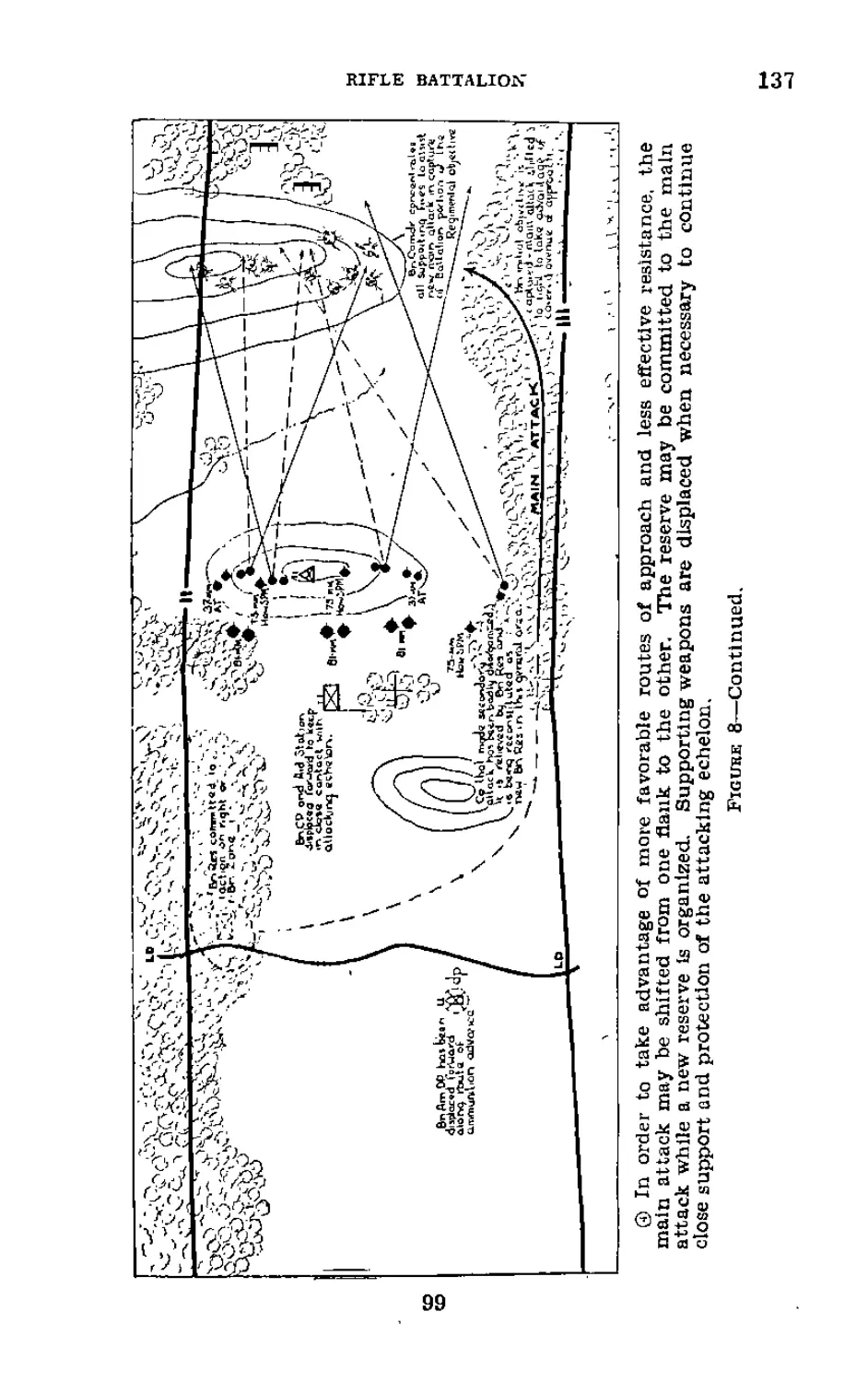



Текст
                    111ГОР U.S. ARMY MILITARY HISTORY INSTITUTE
WHlIw » CARLISLE BARRACKS, PA 17О)8^|ХУ)-20
ton I—
WAR DEPARTMENT
INFANTRY FIELD MANUAL
RIFLE BATTALION
September 28, 1942
FM 7-20
INFANTRY FIELD MANUAL
j»
RIFLE BATTALION
UNITED STATES
GOVEENMENT FEINTING OFFICE
WASHINGTON ; 1942
For Bale b; the Superintendent of Documenta, Washington, D. C.
WAR DEPARTMENT,
Washington, September 28, 1942.
FM 7-20, Rifle Battalion, is published for the information
and guidance of all concerned.
[A. G. 062,11 (8-20-42).|
By order of the Secretary of War:
G. C. MARSHALL,
Chief of Staff.
Official :
J. A. ULIO,
Major General,
The Adjutant General.
Distribution :
R and H 1-4 (5), 5-7, 17 (10), 18, 19 (3); IBn 1-3, 10,
11 (2); Bn 4-6 (4), 7 (10). 17-19 (3); IC 2-5, 11 (2);
C 6 (3), 7 (5), 17, 18, 19 (3),
(For explanation of symbols see FM 21-6.)
n
TABLE OF CONTENTS
Paragraphs Page
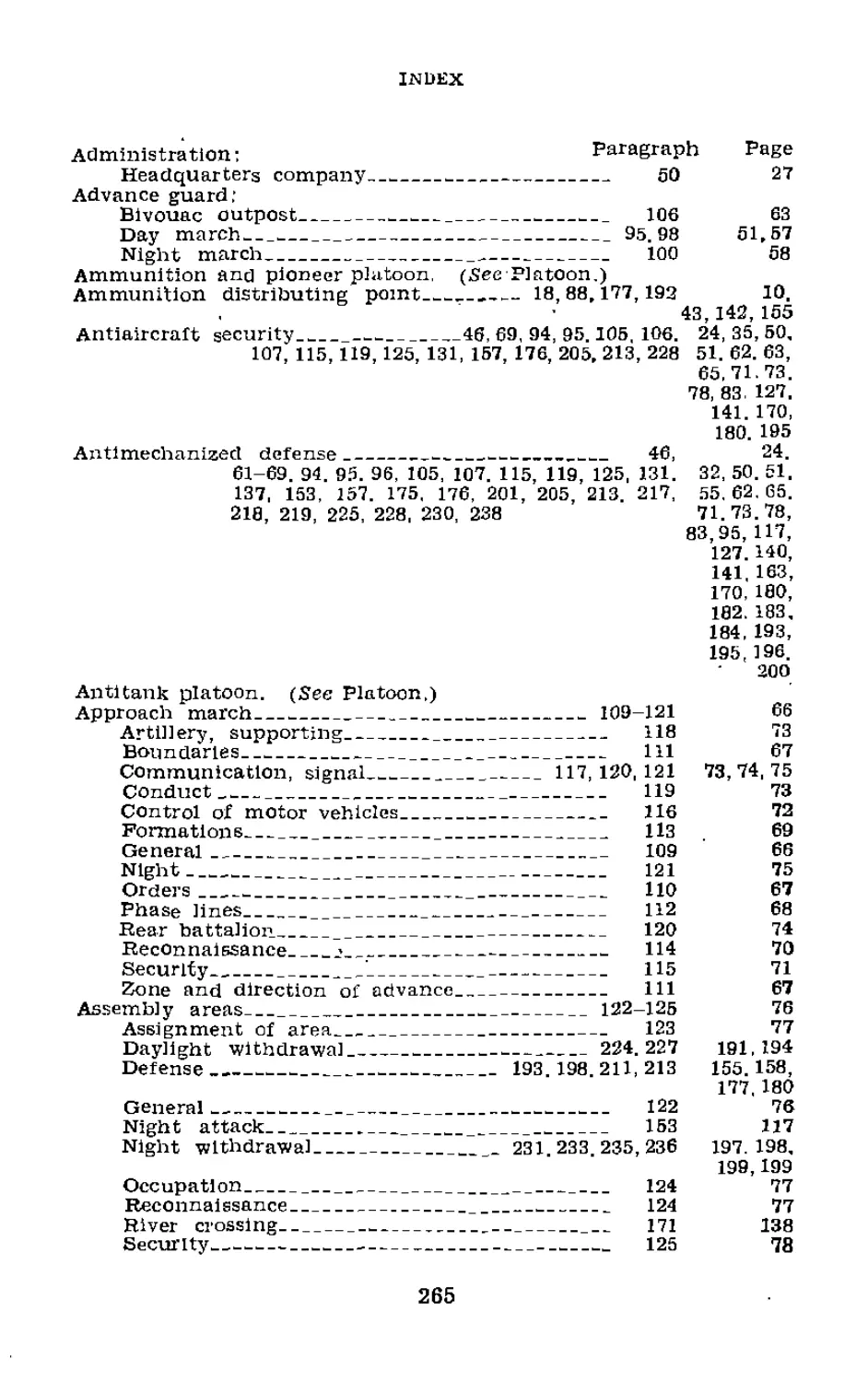
Chapter! General_______________________________ 1—2	1
Chapter 2. Battalion commander and staff.
Section I. Battalion commander________________ 3-6	3
II. Battalion staff and staff duties_	7-23	4
Ш. Troop leading______________________ 24—28	14
IV. Staff records, reports, and maps_	29-35	18
V. Command post______________________ 36-44	20
Chapter 3. Battalion headquarters company.
Section I. Company headquarters_________________ 45-50	24
П. Battalion headquarters section____	51	27
Ш. Communication platoon______________ 52-56	27
IV.	Ammunition and pioneer platoon. 57-60	30
V.	Antitank platoon__________________ 61-68	32
VI.	Security ___________________________ 69	35
Chapter 4. Battalion medical section____________ 70-77	36
Chapters. Administration.
Section I. Battalion, trains________________ 78-80	39
II. Supply____________________________ 61-91	40
Chapter 6. Troop movements and security on the
march.
Section I.	General _____________________________ 92	50
II.	Day marches_____________________  93-99	50
1П.	Night, motor, and rail movements. 100-102	58
Chapter 7. Bivouacs __________________________ 103-107	61
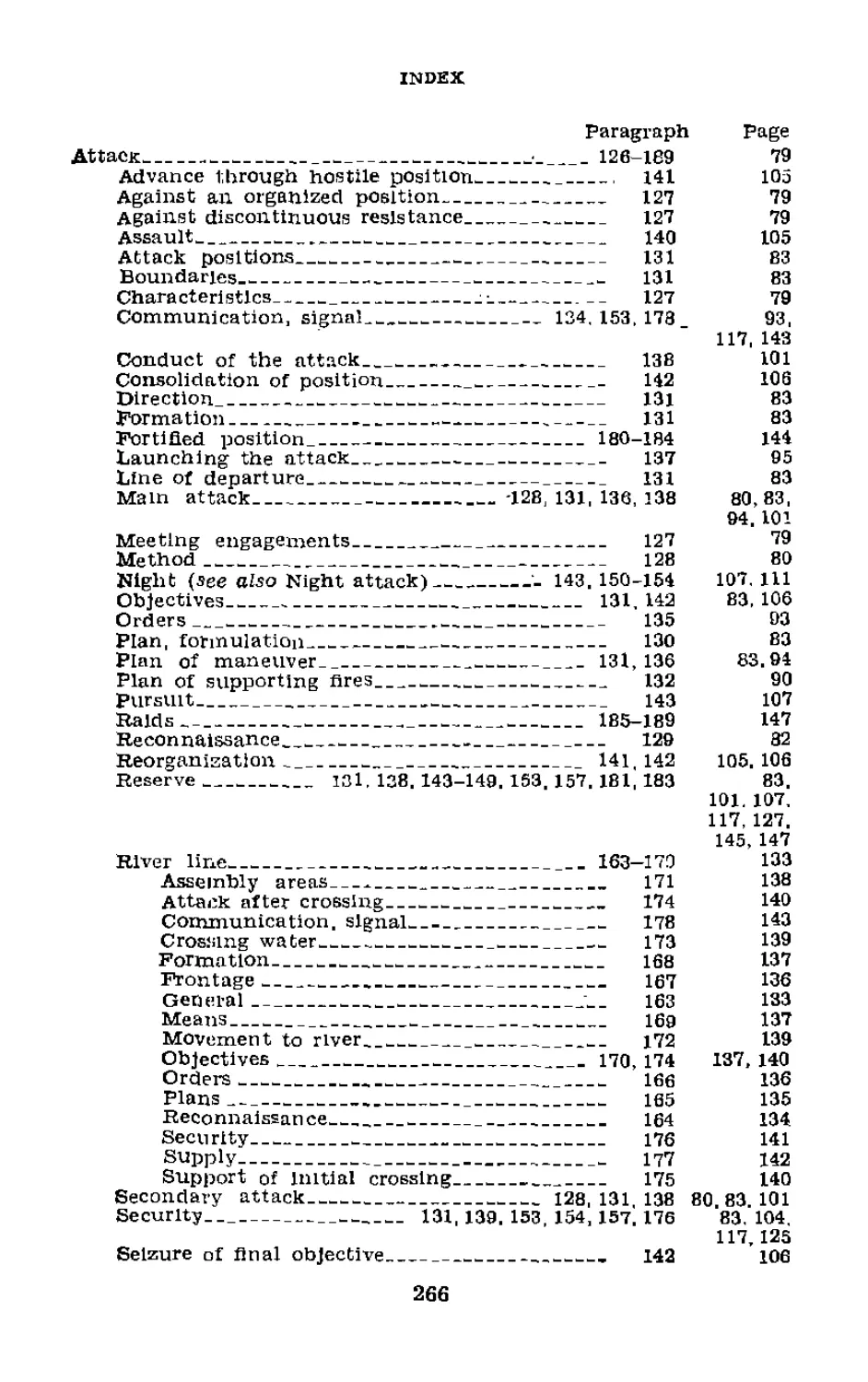
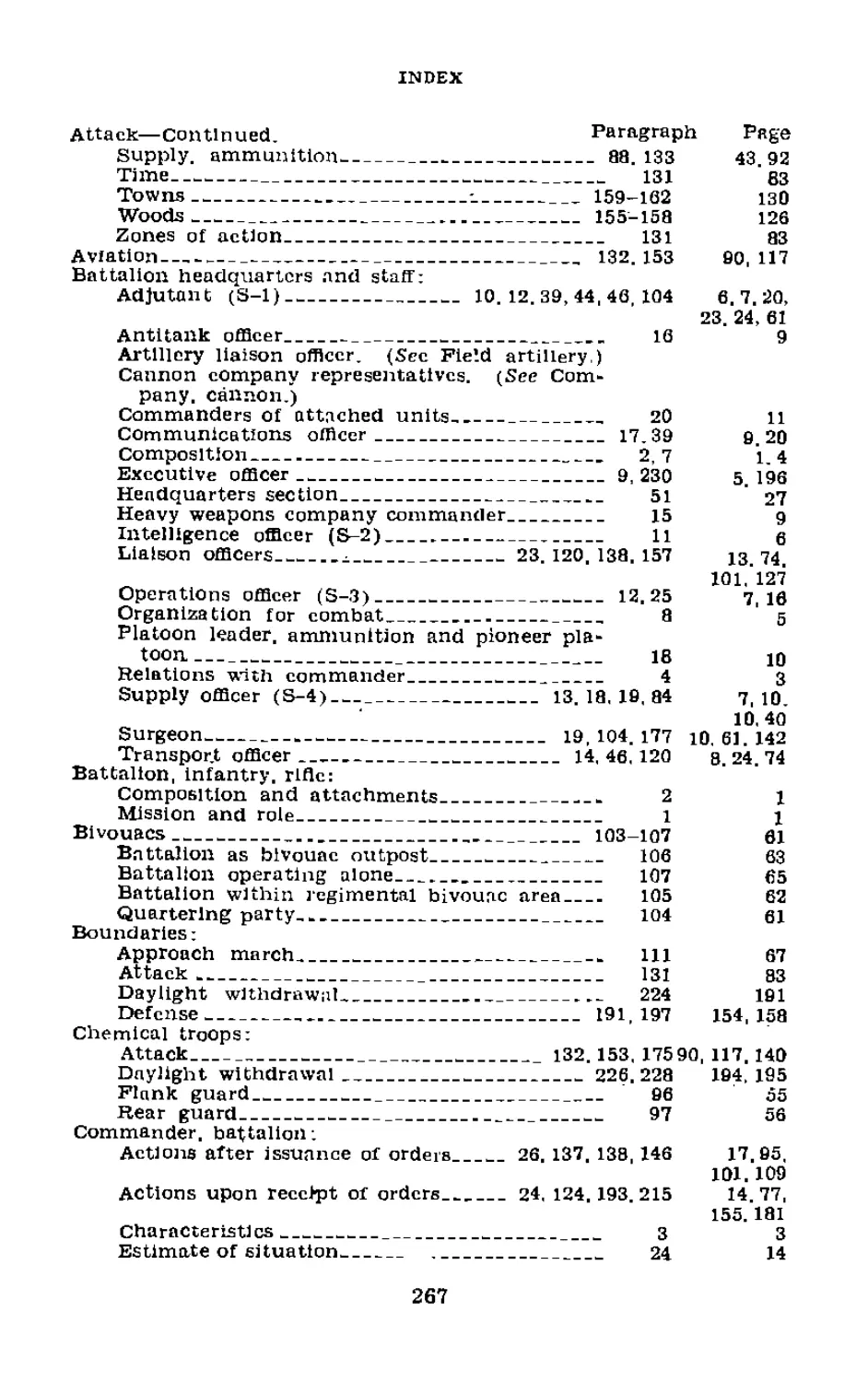
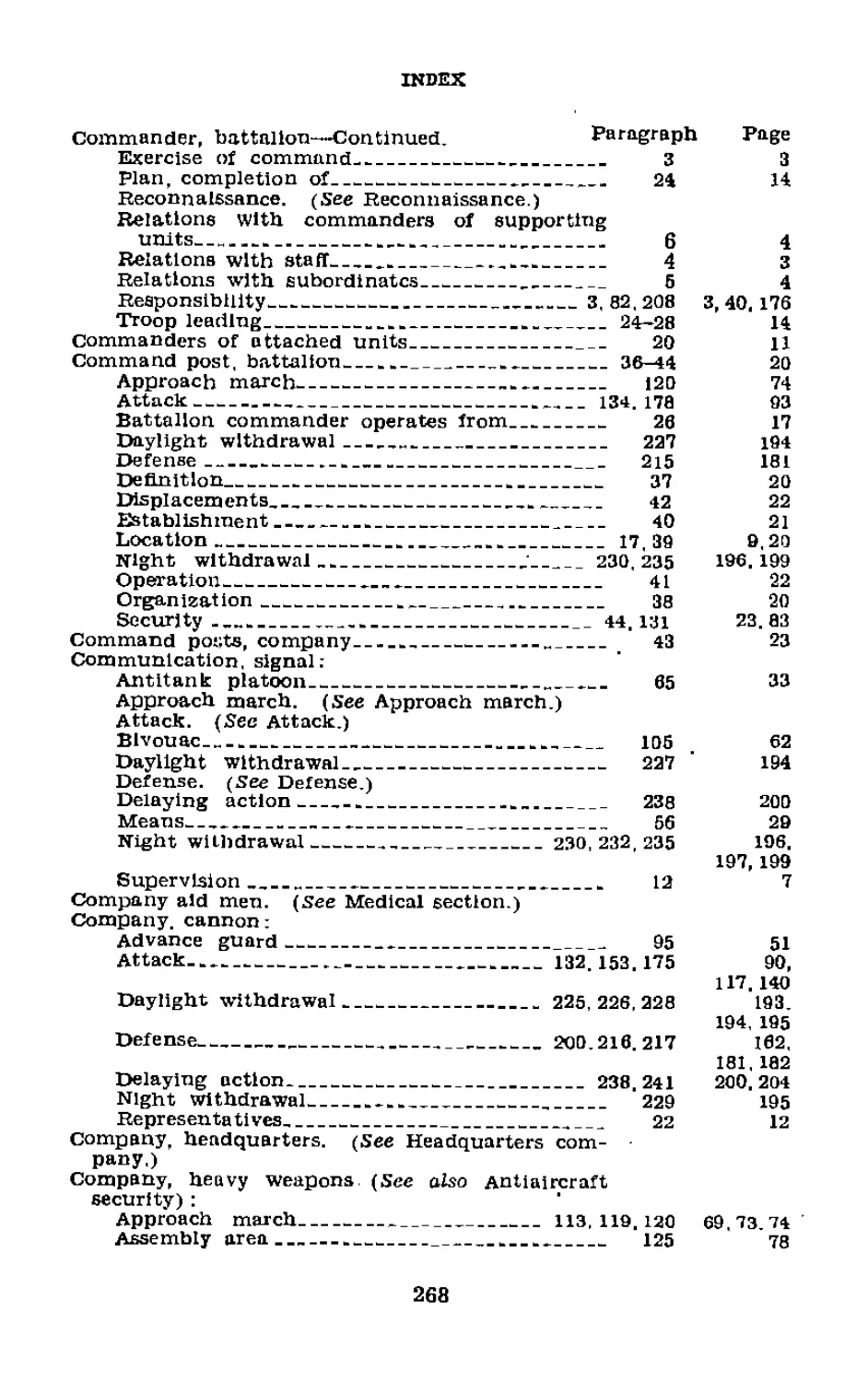
Chapters, The offensive.
Section I. General _______________________________ 108	66
II. Approach	march_________________ 109-121	66
П1. Assembly	areas	(positions)______ 122—125	76
IV.	Characteristics and methods of
attack_____________________________  128-128	79
V.	Reconnaissance, plans, and orders
for an attack against an organ-
ized position______________________ 129-135	82
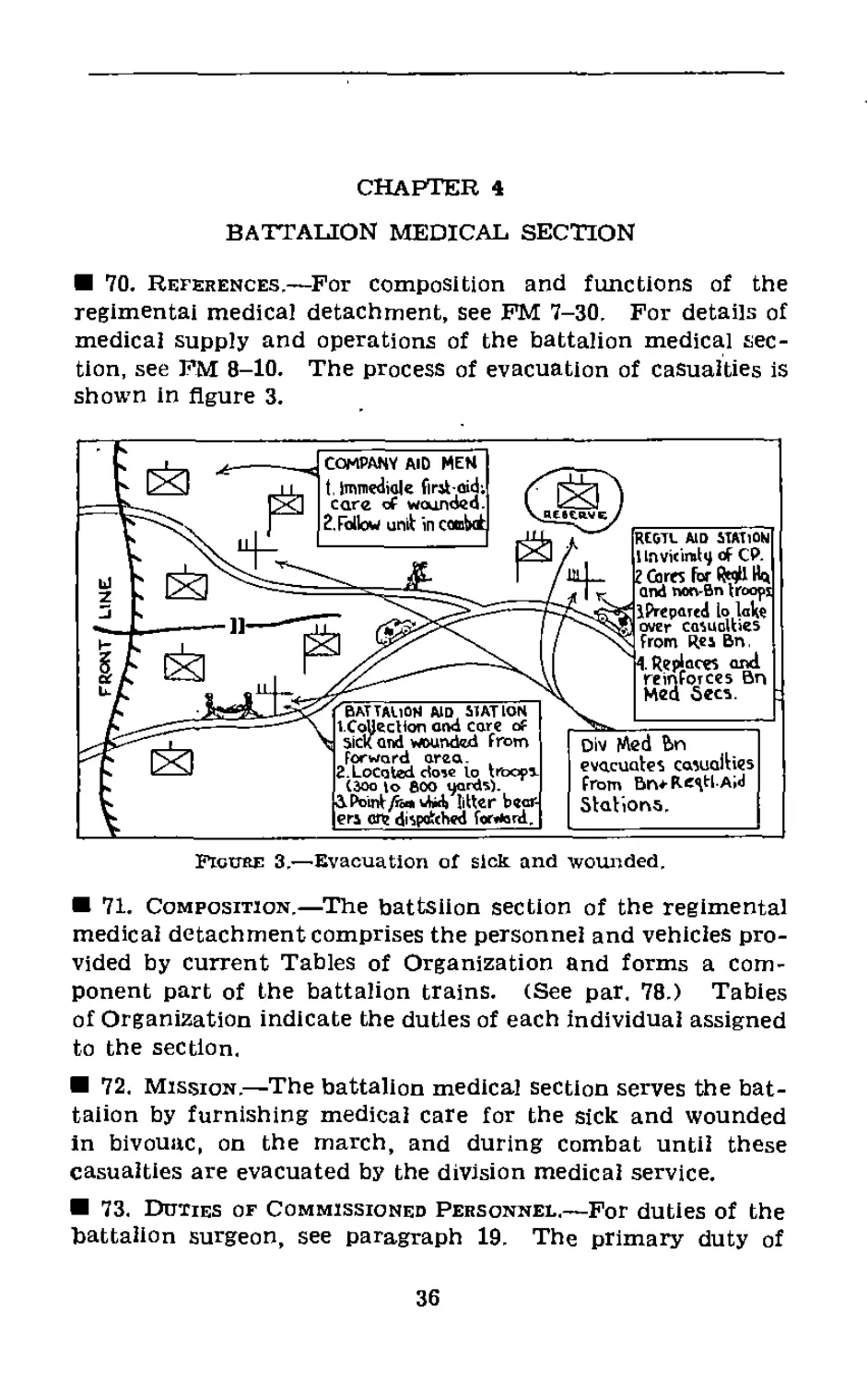
VI.	Conduct of the attack__________ 138-143	94
VII.	Reserve battalion____________  144^-149	108
VIII.	Night attack___________________ 150-154	111
IX,	Attack In woods_________________ 155-158	126
X.	Attack of towns_________________ 159-162	130
XI,	Attack of a river line___1______ 163—179	133
ХП. Attack of a fortified position____ 180-184	144
XIII. Raids__________________________  185-189	147
Chapter 9. The defense.
Section I. General_________________________190-191	154
П. Front-line battalion____________ 192-208	155
Ш. Reserve battalion________________ 209-215	177	;
IV. Defense on a wide front, in woods,
In towns, and of a river	line------216-219	181
V. Defense against air-borne opera-
tions ______________________________ 220-222	185
Ш
TABLE OF CONTENTS
Chapter 10. Retrograde movements.	Paragraphs Page
Section I, General____________________________ 223	191
II. Daylight	withdrawal______________224-228	191
Ш. Night withdrawal________________  229-238	195
IV. Delaying	action________________  237-242	200
Appendix. Directives lor the tactical training of
rifle battalion and antitank platoon
of battalion headquarters company 1—7	206
IV
FM 7-20
INFANTRY FIELD MANUAL
RIFLE BATTALION
This manual, together with FM 7-10, June 2. 1942, and FM 7-15,
May 19, 1942, supersedes FM 7-5, October 1, 1940 (Including С 1,
November 15, 1941).
CHAPTER 1
GENERAL
	1. Role of Infantry Battalion.—The rifle battalion is the
basic tactical unit of Infantry. It usually operates as an.
element of the Infantry regiment. Its mission is assigned by
the regimentai commander, and its actions are coordinated
with those of other units of the regiment. Exceptionally,
the battalion may be detached from the regiment to perform
an independent mission. It has administrative functions,
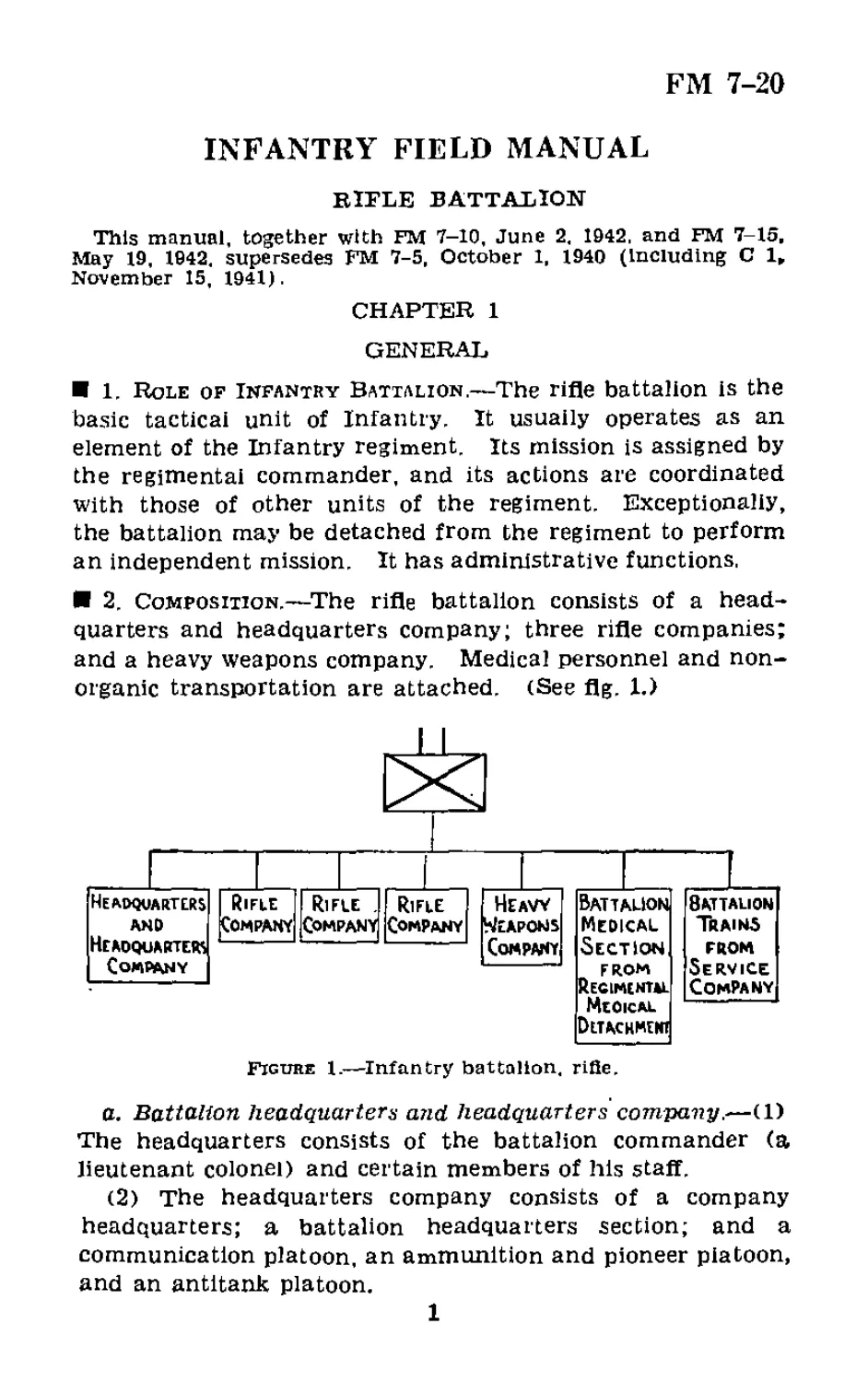
	2. Composition.—The rifle battalion consists of a head-
quarters and headquarters company; three rifle companies;
and a heavy weapons company. Medical personnel and non-
organic transportation are attached. (See flg. 1.)
Battalion
Medical
Section
from
Regimental
Meoical
Ditachmthi
Battalion
Trains
from
Service
Company
Figuhe 1.—Infantry battalion, rifie.
a.	Battalion headquarters and headquarters company.—(1)
The headquarters consists of the battalion commander (a
lieutenant colonel) and certain members of his staff.
(2)	The headquarters company consists of a company
headquarters; a battalion headquarters section; and a
communication platoon, an ammunition and pioneer platoon,
and an antitank platoon.
1
2
INFANTRY FIELD MANUAL
b.	Rifle company.—Each rifle company consists of a com-
pany headquarters, three rifle platoons, and a weapons
platoon.
c.	Heavy weapons company,—The heavy weapons company
consists of a company headquarters, two caliber .30 (heavy)
machine-gun platoons, and an 81-mm mortar platoon.
* 37-ми *37-mm
Figure 2.—Headquarters and headquarters company, infantry bat-
talion, rifle. (See T/O7—16.)
d.	Attachments.—For operations, the battaiion section
from the regimentai medicai detachment joins its battaiion.
(See FM 7-30.)
e.	Motor transport.—(1) Organic motor transport of the
rifle battalion consists only of the company transport of its
component elements. (See FM 7-30 and Tables of Organi-
zation.)
(2) The battaiion trains are an integral part of the regi-
mentai trains. They include kitchen and baggage, ammuni-
tion, and maintenance vehicles organically assigned to i.he
service company, and medical vehicles organically assigned
to the medicai detachment, In operations, and when the
battalion supply echelon is operative, the battaiion section
of the service company transportation platoon (regimentai
trains) joins its battalion, except for those elements which
may be retained under regimental control,
2
CHAPTER 2
BATTALION COMMANDER AND STAFF
Paragraphs
Section I. Battalion commander_______________________ 3-6
II.	Battalion staff and staff duties---------- 7-23
III,	Troop leading____________________---------24-28
IV,	Staff records, reports, and maps__'-----— 29-35
V,	Command poet_______________________________36-44
Section I
BATTALION COMMANDER
 3. General,—a. Aggressiveness and the ability to take
prompt and decisive action are prime requisites for a success-
ful battalion commander. By these qualities he inspires con-
fidence, By his boldness, energy, and initiative he influences
both individual and collective conduct and performance.
Ъ.	The battalion commander is responsible to the regi-
mental commander for the condition and operations of the
battalion. He meets this responsibility by anticipation; by
timely decisions, plans, and orders; and by supervision of
execution,
c.	In preparation for combat, the mission of the battalion
commander is to bring his unit to a high state of combat pro-
ficiency. He subordinates administration to training. He
encourages initiative, ingenuity, and aggressiveness among
his company officers. Having indicated his policies and given
his orders, he allows his subordinates maximum freedom of
action in order to foster self-reliance and initiative. He
supervises the carrying out of his orders,
d.	The battalion commander must make his authority felt
by each individual of his battalion. He exercises his au-
thority by means of instructions, orders, and personal
supervision,
e.	For principles of command and leadership, see FM 100-5,
 4, Relations with Staff,—The battalion commander
makes all major decisions for the operation of the battalion.
He is provided with a staff to relieve him of details, to act as
his agents, to prepare detailed orders, and to assist in super-
3
4-7
INFANTRY FIELD MANUAL
vising the execution of these orders. He must make full use
cf his staff in order that he may devote himself to his more
important command duties.
	5. Relations with Subordinate Commanders and Troops.—
The battalion commander makes inspections and informal
visits to his units during which he talks to individuals and to
groups. In combat, such visits promote confidence, respect,
and loyalty. They give the commander first-hand knowledge
of the tactical situation and of the needs and capabilities of
his units. The battalion commander must not interfere with
the command responsibilities of his subordinates, except in
emergencies.
	6. Relations with Commanders of Supporting Units.—A
field artillery battalion (105-mm howitzers) is usually placed
in direct support of an infantry regiment. An artillery liaison
officer, assisted by a liaison section, is sent by the artillery
battalion commander to remain with each front-line battal-
ion. The liaison officer acts as artillery adviser and assists
the infantry battalion commander in obtaining supporting
fires. (See par. 21.) Elements of other units, such as the
regimental cannon company, engineers, chemical troops, and
quartermaster truck units may be attached to or support the
infantry battaiion. Liaison is maintained by supporting units
through their commanders or representatives who report to
the battaiion commander and maintain contact with him.
Units attached to the battaiion become a part of the battalion
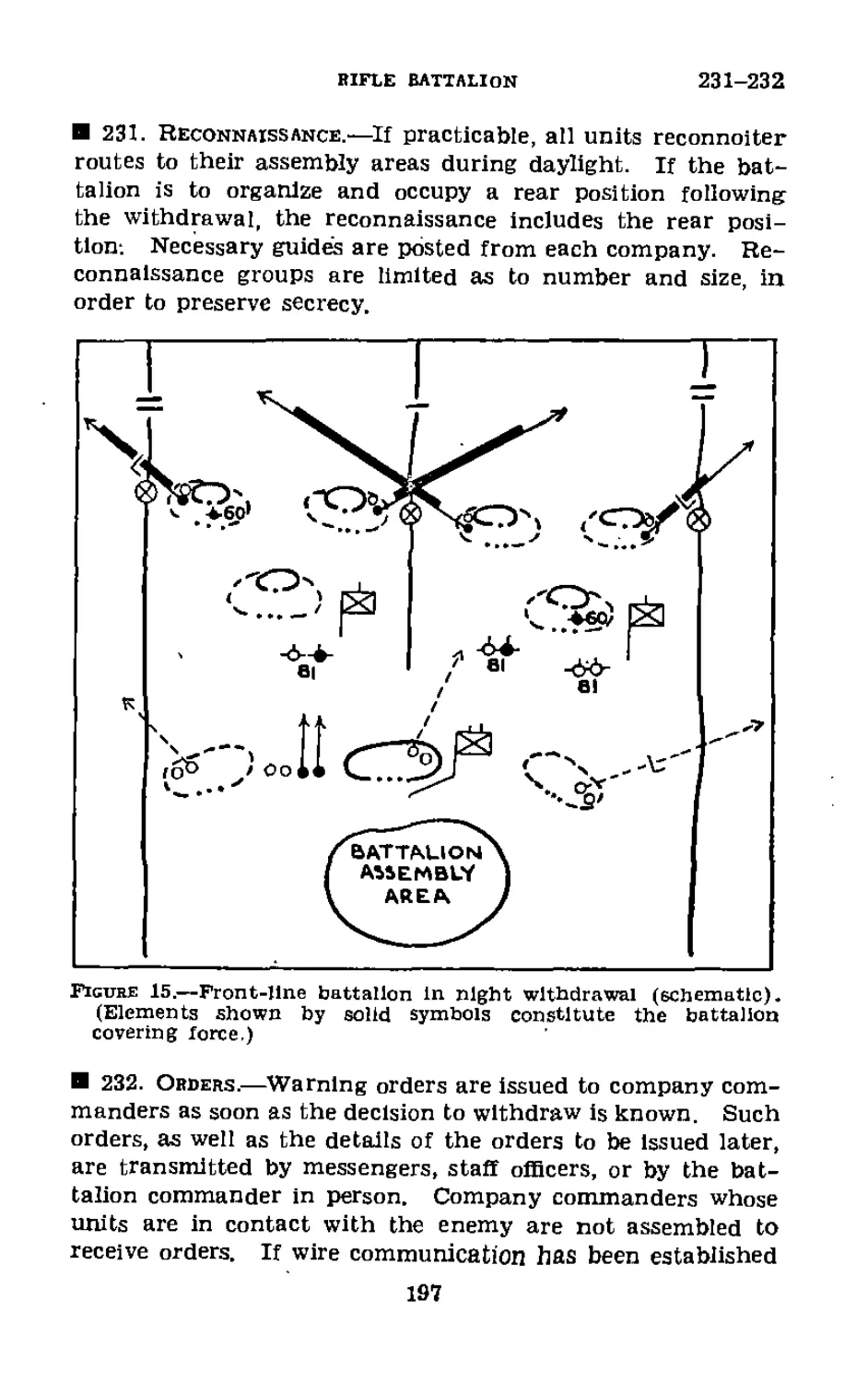
commander’s command.
Section П
BATTALION STAFF AND STAFF DUTIES
 7. Composition.—a. The battaiion unit staff consists of
the foilowing:
(1)	Executive officer (second-in-command).
(2)	Adjutant (S-l) (company commander, battaiion head-
quarters company).
(3)	Intelligence officer (S-2).
(4)	Operations officer (S-3).
(5)	Supply officer (S-4) (from the service company).
4
RIFLE BATTALION
7-9
b. Certain officers who are charged with technical and
administrative duties, and who are commanders of subordi-
nate, attached, or supporting units, have staff duties as
advisers to the battalion-commander and staff in matters
pertaining to their specialties in addition to their primary
duties of command. Such officers are—
(1)	Battalion transport officer (second-in-command, bat-
talion headquarters company).
(2)	Company commander of the heavy weapons company.
(3)	Antitank officer (commanding battalion antitank pla-
toon) .
(4)	Communication officer (commanding battalion com-
munication platoon).
(5)	Platoon leader of the battalion ammunition and pio-
neer platoon.
(6)	Surgeon (commanding the battalion medical section).
(7)	Commanders of attached units, such as regimentai
cannon, artillery, tank, antitank, engineer, or chemical units.
(8)	Artillery liaison officer (from an artillery battalion in
direct support).
 8. Organization of Battalion Headquarters for Combat,—
The battalion command group should be so organized that it
can function continuously, day and night, throughout an
operation. To this end staff officers are trained to perform
the duties of other staff officers. Each staff officer keeps brief
notes to enable him to inform the commander, or other staff
officer, of the situation,
 9. Executive Officer.—a. The executive officer is second-
in-command and principal assistant of the battalion com-
mander. He performs such duties as are delegated to him
by the battalion commander.
b. The executive officer usually remains at the command
post when the battalion commander is away. He makes
decisions in the name of the battalion commander as the
occasion demands. He keeps abreast of the situation and of
the battalion commander’s plans, and keeps the battalion
commander informed of the strength, morale, training, equip-
ment, supply, and tactical situation of the battalion. He
coordinates aJl staff activities. He verifies the execution of
5
9-11
INFANTRY FIELD MANUAL
orders and notifies the battalion commander of any matters
needing correction. He supervises the keeping of the unit
situation map and checks reports and orders prepared by
the staff for correctness, completeness, clarity, and brevity.
 10. S-l.—a. The company commander of battalion head-
quarters company is also the battalion adjutant, S-l. For
duties as company commander see paragraph 46.
b. The duties of S-l include—
(1)	Receiving and delivering replacements to units.
(2)	Securing means for recreation and for building and
maintaining morale.
(3)	Maintaining strength and casualty reports.
(4)	Maintaining the unit journal.
(5)	Arranging the, interior installations (except signal
communication agencies) and supervising the movements
cf the command post.
(6)	Allotting space to subordinate units in bivouac and
assembly areas (coordinating with S-3).
(7)	Arranging for quartering parties. The battalion S-l,
if available, wiii accompany quartering parties; otherwise he
will arrange for the detail of another officer.
(8)	Preparing data for tactical reports.
(9)	Arranging for security of the command post.
 11. S-2.—a. The battalion Intelligence officer (S-2) is
primarily concerned with the collection, recording, evalua-
tion, and dissemination of information of the enemy. He
must be prepared at any time to give his commander a synop-
sis of the hostile situation and an estimate of the enemy
capabilities as they affect the battaiion.
b. Other duties of S-2 include—
(1)	Planning of reconnaissances (coordinating security
measures with S-3).
(2)	Posting of S-2 data on unit situation map.
(3)	Preparing data for tactical reports.
(4)	Giving special training to the battalion intelligence
personnel and controlling them during operations.
(5)	Preparing intelligence plans and orders, (Orders go
to intelligence personnel direct; the battalion commander’s
orders are issued to units through the executive or through
S-3.)
6
RIFLE BATTALION
11-13
(6)	Establishing and operating battalion observation posts.
(7)	Coordinating battalion information-collecting agen-
cies. Exchanging information with the regiment and with
adjacent and subordinate units.
(8)	Examining enemy personnel, captured documents, and
material for information of immediate importance to the
battalion. (See FM 7-25.)
(9)	Procuring maps, aerial photographs, and photomaps
from the regimental S-2 and distributing them.
(10)	Verifying camouflage and concealment measures.
 12, S-3,—a. The battaiion operations officer (S-3) is con-
cerned primarily with the training and tactical operations
of the battalion. He must be prepared at any time to give
his commander a synopsis of the situation of the battalion
and of adjacent and supporting troops, and to recommend
possible lines of action,
b. Other duties of S-3 include—
(1)	Planning of security measures (coordinating measures
for reconnaissance with S-2),
(2)	Insuring that S-3 data are placed on the unit situation
map.
(3)	Preparing data for tactical reports,
(4)	Planning and supervising all training in accordance
with the regimental training program.
(5)	Maintaining training records and preparing training
reports.
(6)	Preparing detailed plans based upon the battalion
commander’s decision (coordinating with S-l and S-4).
(7)	Preparing operation maps.
(8)	Assisting the battalion commander in the preparation
of fleid orders (coordinating with other staff officers).
(9)	Supervising signal communication and liaison with
higher, adjacent, and subordinate units,
(10)	Transmitting orders and instructions for the battalion
commander,
 13. S-4.—a. The battalion supply officer (S-4) is assigned
to the transportation platoon, service company (see FM 7-30).
He performs staff and supply duties as directed by the bat-
talion commander and is responsible for the functioning
7
13-14
INFANTRY FIELD MANUAL
of the battalion supply system in the field and in combat,
with particular, reference to rations, water, ammunition,
gasoline, and oil. For details of battalion supply, see
chapter 5,
b. The duties of S-4 include—
(1)	Preparing the battalion supply plan based upon the
regimentai supply plan and the tactical plan of. the battalion
commander.
(2)	Controlling elements of the battalion trains (ammu-
nition and kitchen and baggage trains) when they are
operating under battalion control. He is assisted in this
duty by tile battalion transport officer,
(3)	Coordinating the regimental supply echelon with de-
tails relating to the movement of battalion supplies and
trains.
(4)	Ascertaining the supply requirements of companies
and attached units through personal contact.
(5)	Responsibility for establishing and operating the
battaiion ammunition distributing point.
(6)	Insuring, during combat, that an adequate supply of
ammunition is delivered to companies and any attached
units. (For functions of the transport officer in ammuni-
tion supply, see par. 14.)
(7)	Making a reconnaissance for covered routes between
the battalion and the regimental distributing points and
points of release of trains, and regulating the movement of
vehicles on these routes.
(8)	Keeping in close touch with the battalion command
post in order to coordinate supply operations with the tacti-
cal situation, and the supply plans with the tactical plans
of the battalion commander.
 14. Transport Officer,—a. The transport officer is second-
in-command of the battalion headquarters company. His
staff duties as transport officer constitute his principal func-
tions.
b. The duties of the transport officer include—
(1)	In inarch or approach march situations, controlling
such company transport and elements of the regimental
trains as may be grouped under battalion control,
8
RIFLE BATTALION
14-17
(2)	Supervising, coordinating, and expediting the move-
ment of company weapon carriers, ammunition train vehicles,
and hand-carrying parties within the battalion area (be-
tween company areas and the battalion ammunition dis-
tributing point) so as to insure an adequate supply of ammu-
nition to all companies.
(3)	Supervising and coordinating the activities of second
echelon motor maintenance facilities operating within the
battalion,
	15, Heavy Weapons Company Commander,—The heavy
weapons company commander, in addition to his command
duties, performs such staff duties as the battaiion commander
may direct. He assists the battalion commander in develop-
ing the battalion fire plan. He accompanies the battaiion
commander on reconnaissance, or makes separate reconnais-
sance and recommendations for the employment of supporting
weapons as directed.
	16. Antitank Officer.—The leader (platoon commander)
of the battaiion antitank platoon is the battaiion antitank
officer and performs such staff duties as the battalion com-
mander may direct. He assists the battalion commander in
the planning and execution of the battaiion antitank de-
fense. He accompanies the battalion commander on recon-
naissance or makes a separate reconnaissance and recom-
mendations for the employment and coordination of antitank'
means as directed.
 17. Communication Officer,—a. The battaiion communi-
cation officer is responsible for the technical training and
proficiency of the communication platoon of the battalion
headquarters company, and for supervision of such technical
training of communication personnel throughout the bat-
talion as may be delegated to him by the battalion com-
mander. He is responsible to the battalion commander for
the planning, installation, operation, and maintenance of the
battalion communication system. His duties include recom-
mending (usually to S-3) initial and subsequent locations of
the command post, if not previously designated by the
regiment.
9
17-19
INFANTRY FIELD MANUAL
b. For detailed duties of the battalion communication officer
in combat, see FM 7-25.
 18. Platoon Leader of Ammunition and Pioneer Platoon.—
a. The leader of the battaiion ammunition and pioneer pla-
toon performs such staff duties as the battalion commander
may direct. He is charged with the supervision of his platoon
in the execution of their ammunition, supply, and pioneer
tasks. He accompiishes simple field engineering (pioneer)
tasks not requiring the technical and special equipment of
engineer troops. He assigns duties to members of his platoon
in accordance with the requirements of the situation after
consultation with the battalion S-4. He is also the battalion
gas officer.
b. His duties include—
(1)	Performing pioneer reconnaissances: controlling the
pioneer operations of his platoon. (See ch. 3.)
(2)	Assisting S-4 in selecting, establishing, and operating
the battalion ammunition distributing point. (See pars. 59
and 60.)
(3)	Within the battalion, supervising and coordinating gas
defense training, gas defense measures, and use of decon-
taminating agents.
(4)	Inspecting gas defense equipment.
(5)	Supervising gas reconnaissance of routes and areas
before their use by troops,
 19. Surgeon.—a. The battalion surgeon is a member of the
battalion commander's staff and commands the battalion
medical section. His staff functions pertain to the health
and medical service of the battalion. He is the battalion
sanitary inspector. The battalion section normally has no
administrative or supply functions. The battalion surgeon,
when practicable, is present when field orders are issued.
b. His duties include—
(1)	Obtaining from the battalion commander available
information of tactical plans for the battalion; making a
medical estimate of the situation; reconnoitering for aid sta-
tion sites; submitting medical plans (when practicable,
through S-4) to the battalion commander for approval.
10
RIFLE BATTALION
19-21
(2)	Establishing the aid station, supervising its operation,
and personally assisting in the care and treatment of
casualties.
(3)	Evacuating sick and wounded within the battalion
area to the battaiion aid station.
(4)	Keeping the battaiion commander informed of the
medica] situation.
(5)	Furnishing information concerning the medical sit-
uation on the battaiion front to the regimental surgeon and
to the collecting company in immediate support.
(6)	Making timeiy requests to the regimen tai surgeon for
special support, additional supplies, additional personnel,
and for the emergency evacuation of casualties.
 20. Commanders of Attached Units.—a. Commanders of
attached units are advisers to the battaiion commander and
staff.
b. Their duties include—
(1)	Submitting plans and recommendations to the bat-
talion commander and staff for the tactical employment of
their units.
(2)	Keeping the battalion commander and staff advised
of the combat capabilities of their units.
 21. Artillery Liaison Officer and Forward Observers.—
a. The liaison officer sent to a front-iine infantry battalion
by an artillery unit in direct support is the personal repre-
sentative of his artillery commander and remains under his
command. Whenever practicable, the liaison officer makes
early contact with the infantry battalion commander, ac-
companies him on reconnaissance, and thereafter remains
with him. The liaison officer secures detailed information as
to the specific fire missions desired. He is assisted by an
artillery liaison section.
b.	The primary mission of the artillery liasion officer is to
keep his artillery commander informed of the plans and op-
erations of the supported infantry battalion and to assist
the infantry battaiion commander in obtaining the desired
supporting fires.
(1)	To carry out his mission, the liaison officer acts as ar-
tillery adviser to the infantry battalion commander and
11
21-22
infantry field manual
must be able to inform him of the capabilities of the artillery
in delivering any fires desired and promptly transmit to his
headquarters requests for supporting fires failing within
those capabilities.
(2)	To enable the liaison officer to carry out his mission,
the supported infantry battalion commander must keep the
liaison officer informed at all times of the locations of hostile
troops and his own front lines, the scheme of maneuver, and
the immediate needs of the supported unit.
c.	As a secondary mission the artillery liaison officer may
be called upon to adjust the fires of his unit, but he will not
be used normally as a forward observer of artillery fire.
d.	In order to secure timely information as to the location
of targets and enable the artillery to place accurate observed
fire on those targets which cannot be engaged by infantry
weapons, each artillery battery sends out a forward observer.
He is provided with a detail of assistants and suitable means
of communication. The forward observer makes contact
with the commander of the leading rifle company and ob-
servers for 81-mm mortars and renders assistance by calls
for fire direct to his battery. He is not attached to any rifle
unit and does not permit his contact with a supported unit
to interfere with his primary mission.
 22. Cannon Company Representatives.—Ordinarily 75-mm
howitzer platoons are utilized for furnishing close, direct sup-
porting fires for front-line battalions; 105-mm howitzers are
usually retained under regimental control for general support
and long-range missions. When supporting or attached to
a leading or front-iine battalion, the platoon leader reports
directly to that battaiion commander and becomes his ad-
viser. when practicable, the platoon leader accompanies the
battalion commander on reconnaissance; thereafter, he re-
mains with or leaves his own representative with the battalion
commander. The platoon leader seeks detailed information
as to specific fire missions desired; the majority of these will
be direct fire upon targets of opportunity. Frequent dis-
placement of weapons is required In order that they may not
be engaged by hostile artillery. Communication is main-
tained between the platoon leader and his section leaders by
12
rifle battalion
22-23
means of light, portable radiotelephones; sound-powered
telephones, motor messengers, and arm-and-hand signals;
pyrotechnics also may be used.
 23. Liaison Officers.—a. Staff or other officers may be used
as liaison officers. They may be sent to higher or subordinate
units or to adjacent units (including advanced reconnaissance
elements under control of higher commanders). Contrary to
the employment of liaison officers by larger units (see FM
101-5), their missions will usually involve brief visits to other
units and prompt return to the battalion commander, in
order that they may be readily available for subsequent
missions.
b.	Prior to departing on a mission, a liaison officer should
receive from the battalion commander—
(1)	Definite and detailed instructions, in writing if prac-
ticable, as to the liaison mission.
(2)	Information of the battalion commander’s plans, par-
ticularly if they affect the unit to which he is to be sent.
(3)	Information as to what facilities (signal and trans-
portation) are available for transmission of any messages the
liaison officer is to send prior to his return.
c.	Prior to departure the liaison officer should—
(1)	Become familiar with the situation of his own unit
and so far as practicable with that of the unit to which sent.
(2)	Insure that arrangements for communication (signal
and transportation) are adequate.
(3)	Obtain credentials in writing unless obviously unneces-
sary.
d.	On arrival at the headquarters to which sent, the liaison
officer should—
(1)	Report promptly to the commander, stating his mission
and exhibiting his directive or credentials, if in writing.
(2)	Arrange for the transmission of messages he may be
required to send.
(3)	Familiarize himself with the situation of the unit to
which sent.
(4)	Accomplish his mission without interfering with the
operations of the headquarters to which sent.
(5)	Keep a record of messages sent to the battalion com-
mander-
4811930—42----2	13
23-24
INFANTRY FIELD MANUAL
(6)	Advise the visited unit commander of the contents of
messages to be sent to his battalion commander.
(7)	Make prompt report to his battalion commander if he
is unable to accomplish his liaison mission.
(8)	Report his departure to the visited unit commander
on the completion of his mission.
e.	On return to his battalion commander the liaison
officer should—
(1) Report on his mission.
(2) Transmit promptly any requests of the commander
from whose headquarters he has Just returned
Section III
TROOP LEADING
 24. Actions Prior to Issuance of Orders.—a. Estimate of
the situation.—The estimate of the situation is a continuing
process for the battalion commander throughout an operation.
During combat operations extending over a period of several
days, the battalion commander seldom faces an entirely new
situation. Combat usually consists of a series of connected
incidents most of which must be acted on immediately. The
battalion commander must be constantly thinking ahead to
make plans for future operations and for contingent situa-
tions that may develop. Infantry is frequently engaged on
short notice and time is a vital factor. Quick and successful
engagement depends on the preliminary planning of the
commander and on the execution of his plans by his troops.
The necessary preparations for combat, including reconnais-
sance, estimate of the situation, formulation and issuance of
orders; the movement of troops into assembly areas (posi-
tions) ; and arrangements for supply, evacuation, and com-
munication are carried on concurrently so far as is possible.
For a form for a commander’s estimate of the situation, see
FM 101-5,
b. Action upon receipt of orders.—(1) The regimental or-
ders may be delivered to the battalion commander; or he may
be directed to report to the regimentai commander to receive
them. In the latter case before leaving the battalion area,
he Issues to his executive officer (second-in-command) in-
14
BIFLE BATTALION
24
structions for the conduct of the battalion in his absence. He
takes with him the necessary personnel, communication facili-
ties, and transportation. His party may include S-l, S-2,
S-3, S-4, the heavy weapons company commander, antitank
officer, communication officer, artiiiery liaison officer (if he
has reported), operations sergeant, radio personnel with suit-
able equipment, and one or more messengers. The battaiion
commander leaves the majority of his party in a concealed
location within signaling distance and takes* only one or two
officers to receive the regimental order.
(2) When the battaiion commander receives an oral order
from the regimental or higher commander, he makes such
notes as are necessary to outline his mission and to assist
him in planning his own order. His notes must be sufficiently
clear and comprehensive to permit his successor to under-
stand the assigned mission should the battalion commander
become a casualty.
(3) Upon receipt of the order he obtains, or has his staff
obtain, from the regimental staff and from any representa-
tives of units in contact with the enemy, any additional infor-
mation that applies particularly to his battaiion. If he is
not furnished an operation map, he has pertinent data, shown
on the regimental map, copied on his own map. He makes
a brief map study and forms a tentative tactical plan. He
sends to his battalion any necessary instructions for immedi-
ate movement or for expediting its preparations for combat.
Whenever possible, he will designate a time and place for
subordinate commanders to assemble to receive his orders.
He arranges for coordinated action with commanders of ad-
jacent and supporting units or reaches an agreement to effect
this coordination when plans have been developed. He in-
forms the staff of his tentative plan and of the recommenda-
tions he wants from them, and designates a time and place
to receive their reports. His further actions depend on the
situation and the time available.
c. Reconnaissance.—When time is pressing, the battalion
commander’s plan of action may of necessity be based solely
on a map reconnaissance or on his previous knowledge of {he
situation and terrain. Whenever practicable, however, it is
based on a personal ground reconnaissance. Before start-
15
24-25
INFANTRY FIELD MANUAL
Ing he estimates the time available, decides on the route to
follow, and determines what to look for. Sufficient time
must be allowed to issue orders to subordinate commanders
and permit them to make their reconnaissances, prepare their
plans for combat, and issue their orders. The battalion com-
mander usually is accompanied by S-3, the artillery liaison
officer, and in defensive situations, the heavy weapons com-
pany commander. Other available officers may accompany
him on his reconnaissance; however, quicker results can be
obtained by directing these officers to reconnoiter separately,
secure specific information, and report at a designated place
and time with their recommendations. He may take with
him a portable radiotelephone in order to maintain contact
with his command post and other elements.
d. Completion of plan.—(1) After completing his recon-
naissance, the battalion commander receives any reports or
recommendations not previously rendered and completes his
plans. If time permits he has operations maps (or overlays
or sketches) prepared for issue to the company commanders.
He may release those officers who have accompanied him
on his reconnaissance and who are familiar with his plan, in
order that they may begin their preparations for combat.
(2) When the battalion commander has not directed an
assembly of subordinates to receive his orders, he dispatches
fragmentary orders by the most expeditious means, usually
by a staff officer. Otherwise he promptly prepares notes for
his order while a member of his staff orients the company
commanders on the situation and the terrain.
 25. Battalion Field Orders.—The battalion commander
issues field orders to warn the battalion of impending opera-
tions (warning orders) or to direct operations. Items shown
on operation maps or covered by standing operating proce-
dure will be called to the attention of subordinates at the
beginning of the order. Such items and other information
already known by subordinates need not be repeated in the
order.
(4. Warning orders.—Battalion warning orders should give
preliminary notice of contemplated action and enable sub-
ordinates to make necessary preparations to carry out the
16
RIFLE BATTALION
25-26
action to be directed by a more complete field order which
is to follow. Warning orders should normally include only
the answers to such of the interrogates who, what, when,
where, and why as are available. Details included in the
warning orders may be omitted from the subsequent order.
b. Fragmentary orders.—The battalion commander issues
fragmentary orders when speed in delivery and execution
are imperative. He may issue them orally in person, direct’
a staff officer to issue them orally, or have them sent as mes-
sages. .In fragmentary orders adequate information must
be included regarding the action' of units other than the
particular one(s) to which the orders are issued.
c. Oral orders.—Mutual understanding and more thor-
ough coordination is assured by issuing complete oral orders
to assembled subordinate commanders. Such orders must,
however, be issued in sufficient time to permit these sub-
ordinate commanders to make their reconnaissance and pre-
pare plans for combat. The place of issue preferably is one
from which much of the field of operations is visible; loca-
tions which may receive hostile fire are avoided. The bat-
talion commander uses simple, clear, concise language.
When he is sure of mutual understanding, he announces the
time and has watches synchronized. S-3 makes notes so
that a record of the order may be entered in the Journal.
	26. Actions after Issuance of Orders.—a. Supervision.—
The battalion commander supervises the execution of his
orders to Insure that the plan is understood and is carried
out by subordinate units.
1)7 Keeping abreast of the situation.—During combat the
battalion commander goes where he can best observe the
action of the battalion or exert the greatest influence to
obtain decisive results. Although the battalion commander
operates from the command post, he will ordinarily spend the
greater part of his time at the observation post or some other
point at which he can obtain the fullest and most direct infor-
mation regarding the operations and situation of his com-
panies. He makes such reconnaissance as he considers
necessary and frequently visits his subordinate commanders
and his troops. He maintains continuous contact with his
17
26-30
INFANTRY FIELD MANUAL
command post and, before leaving the observation post, he
orients his staff as to future plans and informs them of his
itinerary and approximate time schedule. At all times he
studies the situation and considers possible contingencies and
prepares tentative plans to meet them. He keeps his staff
informed of any orders issued or information acquired. If
he issues orders or acquires information affecting the general
situation, he informs higher headquarters at the first oppor-
tunity.
	27. Operation Map.—a. The operation map may be a
graphic representation of all or part of the battalion com-
mander’s decision and tactical plan. The map should be
authenticated, have such brief explanatory notes as are
necessary, and should present a clear picture. Detailed in-
structions that cannot be shown graphically are put into the
accompanying order. FM 101-5 gives examples of some of
the items which may be placed on the operation map.
b. The battalion commander issues some form of operation
map whenever practicable. It may be only a rough sketch
or an overlay. It should clarify the tactical plan for the
company commanders and serve to shorten the order; it may
constitute the entire order. Sufficient copies are reproduced
to furnish one to each unit concerned.
	28. Standing Operating Procedure.—Standing operating
procedure of the battalion will supplement that of the regi-
ment to make routine those administrative and tactical fea-
tures that may be standardized without loss of effectiveness.
(See FM 7-40.) Tactical decisions and dispositions cannot be
subject to standing operating procedure. They must be based
on the immediate situation and cannot be standardized.
Section IV
STAFF RECORDS, REPORTS. AND MAPS
	29. References.—For the general form and description of
staff records, reports, and maps, see FM 101-5 and 7-40.
	30. General.—Battalion staff records should make infor-
mation readily available, form a basis for reports and histori-
cal records, and enable the commander, or any member of
18
RIFLE BATTALION
30-35
the battalion staff, to orient himself quickly concerning the
situation. Staff records must be reduced to the simplest
form and fewest number, in order that the staff may function
in rapidly moving situations, in the field, at night (with little
or no light), and under adverse weather conditions,
	31. The Journal.—a form for a journal and a description
of its use are contained in FM 101-5, The battalion head-
quarters keeps one unit journal; it is kept under the super-
vision of S-l,
	32. Situation Map,—a. The battalion situation map is a
graphic record of the tactical situation at any time. It is
usually maintained at the command post under the super-
vision of the battaiion executive. It should be conveniently
accessible to the battalion commander and staff.
b. Military symbols prescribed in FM 21-30 are used on
the situation map. Entries are removed as they become
obsolete,
c. Copies or-overlay tracings of the situation map as it
stands at the close of given periods may be prepared to accom-
pany battalion reports. Maps are filed as a record.
	33. Staff Notes (Work Sheets),—Each battalion staff
officer keeps such notes as are necessary to write his part of
the unit report.
	34, Unit Reports.—a form for a unit report and instruc-
tions concerning it are contained in FM 101-5. It is pre-
pared under the supervision of the battalion executive.
Members of the staff furnish material to be included under
topics pertaining to their staff functions.
	35. Maps, Overlays, and Sketches.—Maps, overlays, or
sketches showing graphically the situation as of a particular
time are a valuable aid in shortening and clarifying unit
reports sent to regimental headquarters. Maps, overlays,
and sketches are used by reconnaissance and security de-
tachments and by subordinate units to advise the battalion
commander with regard to their situation and information
of the enemy.
19
36-39
INFANTRY FIELD MANUAL
Section V
COMMAND POST
	38. References.—For duties of personnel of the battalion
headquarters company at the command post, see Chapter 3.
For additional details concerning duties of personnel of the
battalion communication platoon, see FM 7-25 and 24-5.
	37. General.—In the field the headquarters of the bat-
talion Is called the command post. All agencies of signal
communication in the battalion center at the command post.
The battalion commander, the staff, and such other officers
as are required by the commander (see par. 7) constitute the
command group that operates at and from the command
post.
	38. Organization.—The command post is organized to
furnish facilities for the battalion commander, the staff,
communication agencies, and such other officers and enlisted
personnel as must be present. It should be concealed from
air observation. The different installations should be sepa-
rated by at least 50 .yards to avoid destruction of more than
one by a single shell or bomb.
 39. Location.—a. On the march.—During tactical marches
the battalion command group usually moves near the head
of the battalion. The number of vehicles is held to a mini-
mum; those not necessary for corhmand purposes move at
the head of the battalion motor echelon. Part of the bat-
talion communication platoon (messengers and radio) is pre-
pared to furnish communication and marches near the com-
mand group. This group and its accompanying communica-
tion agencies constitute a march command post. When the
battaiion is acting as an advance guard, the command group
marches at the head of the reserve.
b. During combat.—(1) During combat the general loca-
tion of the initial battalion command post Is usually pre-
scribed by the regimental commander, who may also pre-
scribe subsequent locations. If the general location is not so
prescribed, the battalion commander selects and reports Its
location to the regimental command post.
20
RIFLE BATTALION
39-40
(2)	The battalion command post is so located as to facil-
itate control of the battalion. Other considerations that in-
fluence its location are the type of tactical operation involved
(attack or defense), routes of communication to the regi-
mental command post and to subordinate units, cover and
concealment, proximity to good observation in order to facili-
tate communication with the observation post, and obstacles
to mechanized attack. Entrances to towns and villages, cross-
roads, and other places which attract enemy fire are avoided.
An alternate location is selected to which the command post
can move, if necessary. In static situations wire should be
laid to the alternate command post. In the attack the ini-
tial location should be well forward to avoid eariy displace-
ment. In wooded or rolling terrain command posts can usu-
ally be located farther forward than in terrain which oilers
less cover and concealment. In defensive situations they are
generally located in the rear part of the battalion defense
area, in rear of the organized position of the battaiion re-
serve, in order to avoid displacement in the event of a local
enemy penetration.
(3)	The command post should be designated by reference
to some terrain feature which is easily located on the ground
and on the map. Guides are posted to direct personnel and
vehicles to the command post and parking area,, respectively.
(4)	After the general location of the command post has
been prescribed, S-l, accompanied when practicable by the
communication officer, selects the exact site in the genera]
vicinity of the designated point. When S-l is not available,
the communication officer may be designated to make this
selection.
 40. Establishment.—The officer selecting the exact site
determines the interior arrangement of the command post
and designates the location for installations. The battaiion
communication officer directs the installation of communica-
tion facilities; wire is laid to the battalion observation post(s).
(See FM 7-25.) Motor vehicles are parked in a concealed
iocation, removed from the command post so as not to dis-
close the presence of the command post. Traffic entering
and leaving the parking area is rigidly controlled. Tents are
pitched only at night or when concealment is assured. Sen-
21
40-42
INFANTRY FIELD MANUAL
tries are posted to enforce orders relative to camouflage, con-
cealment, and control of traffic,
 41. Operation.—a. The command post is organized for
continuous operation and to insure the necessary rest for
personnel. Staff officers relieve each other and the battaiion
commander as necessary. Enlisted personnel work in shifts.
b.	Full use of signal communication facilities is made in
the transmission of orders and messages. All incoming mes-
sengers go first to the message center. Messages delivered
by scheduled messengers are receipted for by the message
center clerk on duty. The battalion sergeant major super-
vises the delivery of messages to addressees, their circula-
tion to interested officers, and their return for entry in the
unit journal. Staff officers mark on the message any action
taken.
c.	Outgoing written messages are usually sent through the
message center. After the message center chief receives
notice that the message has been delivered, he places the
duplicate copy in his dead file which is turned over periodi-
cally to S-l for entry in the unit journal.
d.	Officers see that a synopsis of each message or order
sent or received orally, or by telephone or radiotelephone, is
sent to the unit journal.
 42. Displacements.—In an offensive situation the battalion
command post is kept close to the attacking echelon in order
to facilitate communication between the command post and
the troops, and to afford .protection to the command post.
To permit rapid displacement the movement of the command
post must be anticipated and reconnaissance made in time
to permit its accomplishment at the desired time. (See
FM 7*25.) The communication officer keeps the wire head
pushed close to the advancing troops in order that wire com-
munication may be available when the command post is
moved. When the battalion commander directs that the
command post be moved forward, the old iocation is aban-
doned except for temporary guides, and the staff and other
personnel proceed to the new location without delay. When
desirable, a staff officer may remain at the old location with
enough communication personnel to operate the agencies of
22
RIFLE BATTALION
42-44
signal communication and to close these agencies when they
are no longer required. If the regiment has not prescribed
the general locations of command posts for the battalion
along an axis of signal communication, the battalion com-
mander prescribes the new location. The communication
officer establishes communication in the new location, in ad-
vance, when practicable. The regiment is kept informed of
the movement. For displacement of the command post in
retrograde movements, see paragraphs 227, 235, and 238.
	43. Company Command Posts,—In combat, companies se-
lect the locations for their command posts and report those
locations to the battalion commander.
	44. Security.—The battalion command post, being well
forward, is provided incidental security against hostile air
and ground forces by front-iine units(s) and the battaiion
reserve. However, smaii hostile groups may suddenly appear
at any point in the area and the command post must be pro-
vided with a weli-pianned system of iocai protection. The
headquarters company commander (S-1) is responsible for
the security of the command post in combat. He uses avail-
able personnel of the battalion headquarters company who
are at the command post, and such other troops as may be
detailed for the purpose. Observers and small patrois should
be employed to cover ail approaches. The command post
must be concealed from air observation. Air-antitank guards
are posted to give warning of hostile mechanized or air ap-
proach including the descent of Hostile troops by parachute
or giider. For the protection of personnel, fox holes are
dug to provide individual protection against air and mecha-
nized attack.
23
CHAPTER 3
BATTALION HEADQUARTERS COMPANY
Paragraphs
Section I. Company headquarters______________________1- 45-50
II.	Battalion	headquarters	section________________ 51
III.	Communication platoon--------—--------------52-56
ГУ. Ammunition and	pioneer	platoon--------------57-60
V. Antitank	platoon___________________________ 61-66
yi. Security------------------------------------    59
Section I
COMPANY HEADQUARTERS
 45. Composition.—For tactical operations, company head-
quarters is divided into a command group and an adminis-
tration group.
a.	The command group consists primarily of personnel
whose duties in combat are directly associated with battalion
headquarters and in large part performed at the battalion
command post, ammunition distributing point, or train
bivouac, in this group are the following;
Company commander (battalion adjutant (S-D).
Second-in-command (battalion transport officer).'
First sergeant.
Motor sergeant, chauffeurs, and motor mechanic.
Bugler and orderlies.
Basic privates.
b.	The administration group consists of personnel whose
duties relate to the mess and supply of the headquarters and
headquarters company, and to company personnel admin-
istration. This group includes the following;
Mess sergeant, cooks, and cooks’ helpers.
Armorer-artificer.
Company clerk.
c.	For duties of the supply sergeant, see paragraph 47b.
 46. Duties of Command Group.—a. Company commander
(.battalion adjutant).—The company commander is respon-
24
RIFLE BATTALION
46
sible for the administration, discipline, and training of the
company and for the proper maintenance of its transport.
He assigns appropriate duties to individual members of the
company in accordance with the Table of Organization, and
provides for additional training of individuals to replace key
personnel. The company commander also functions as the
battaiion adjutant (S-l). For the duties of S-l, see para-
graph 10. Individuals armed with the M1903 rifle and anti-
tank grenades, and chauffeurs armed with the Browning
automatic rifle, are trained in the use of those weapons. The
M1903 rifles and antitank grenades are used for the anti-
mechanized protection of vehicles, installations, and person-
nel. A minimum of three men should receive training and
practice in firing for each Ml903 rifle provided for antitank
defense in the Table of Organization. (See FM 23-30.) The
automatic rifles are used for antiaircraft defense of the motor
vehicles; they may be used against enemy ground personnel.
b.	Second-in-command {battalion transport officer).—The
second-in-command performs the norma] duties of the sec-
ond-in-command of a company. In addition he serves in
the special capacity of battaiion transport officer. For his
duties as transport officer, see paragraph 14.
c.	First sergeant.—The first sergeant assists the company
commander in the administration of the company.
d.	Motor sergeant.—The motor sergeant is responsible to
the company commander for first ccheion maintenance of
all motor vehicles assigned to the company and for the
training of ail chauffeurs in the company. He directs the
activities of the company motor mechanics, within the means
of the company, in second echeion maintenance of motor
vehicles assigned to the company and those assigned to the
rifle companies of the battaiion. (See FM 25-10.) He su-
pervises the loading and movement of any cargo trucks at-
tached to the company and also acts as assistant to the
battalion transport officer.
e.	Motor mechanics.—The motor mechanics perform sec-
ond echelon maintenance under direction of the motor
sergeant.
t. Orderlies.—Orderlies serve the battaiion commander and
staff. They participate in the defense of the command post.
25
48-49
INFANTRY FIELD MANUAL
g.	Bugler.—The bugler sounds such calls, warnings, and
alerts as may be ordered. He is especially trained as a mes-
senger and serves the company commander in that capacity.
He participates in the defense of the command post.
h.	Chauffeurs.—The chauffeurs operate their assigned ve-
hicles as directed by the company commander and perform
first echelon maintenance.
i.	Basic privates.—Basic privates are used as messengers,
for replacements, and in the defense of the command post.
 47. Duties of Administration Group.—a. Jfess sergeant.—
The mess sergeant is responsible to the company commander
for the procurement of rations and water, division of rations
into meals, training of cooks and cooks’ helpers, and for
operation of the headquarters and headquarters company
mess. The mess sergeant, cooks, and cooks' helpers operate
in the kitchen location, which is usually in the regimental
train bivouac. (See FM 7-30.)
b. Supply sergeant.—The supply sergeant is charged with
receiving and issuing supplies, except rations and water, for
battalion headquarters and for the several components of
headquarters company. He supervises the work of the ar-
morer-artificer. During combat he usually wiil be in the
forward area in order to assist the company commander in
matters relating to supply, particularly ammunition supply.
c. Company clerk.—The company clerk is employed in the
regimentai personnel section under the supervision of the
personnel officer.
 48. March Dispositions.—a. When not performing duties
that require their presence elsewhere, the members of the
company command group usually march with or near the
battalion command group.
b. The administration group marches with the battalion
trains, commanded by the senior present but subject to the
orders of the train commander,
	49. Training.—In addition to being trained for their special
duties, all personei of company headquarters are trained as
individual soldiers.
26
RIFLE BATTALION
50-52
	50. Company Administration.—The battalion headquarters
company Is administered in a manner similar to that of a
rifle company. For details see FM 7-10, FM 7-30, and TM
12-250,
Section П
BATTALION HEADQUARTERS SECTION
	51. Composition and Duties.—The battalion headquarters
section is composed of a group of men provided for the opera-
tion of the battalion command post and observation post(s).
Personnel and their duties are as follows:
ct. Sergeant major.—Supervises the functioning of enlisted
men in battalion headquarters; assists the'executive officer
and S-l; also handles messages. (See par. 41.)
b.	Operations sergeant.—Keeps the situation map and as-
sists S-2 and S-3.
c.	Intelligence sergeant.—In charge of battalion observation
post(s) and scouts; operates at observation post or with
patrols; and may assist operations sergeant, especially in
work for S-2.
d.	Clerk, headquarters.—Keeps records and does any typing
required.
e.	Gas corporal.—Battalion gas noncommissioned officer;
assists battalion gas officer. (See par. 18 and FM 21-40.)
/. Scouts and observers, intelligence,—Operate at observa-
tion post(s), or accompany front-line units, patrols, raiding
parties, or reconnaissance and security detachments as in-
telligence scouts.
g. Chauffeurs.—Operate assigned motor vehicles, and per-
form first echelon maintenance.
Section HI
COMMUNICATION PLATOON
 52. General.—The communication platoon is composed of a
platoon headquarters, a message center section, a wire section,
and a radio and visual section, under command of the bat-
talion communication officer. For duties of the battalion
communication officer, see paragraph 17. He is assisted by
27
52-53
INFANTRY FIELD MANUAL
the battalion communication chief who is second-in-com-
mand; together they, with any basic privates assigned to the
platoon, compose the platoon headquarters. The regimental
communication officer supervises the technical training of
the platoon. For methods of installing, operating, and main-
taining the means of signal communication, see FM 24—5.
For details of communication methods and procedure and
use of technical equipment, see FM 7-25. For equipment and
transportation, see Table of Basic Allowances No. 7 and
Table of Organization 7-16.
 53. Message Center Section.—a. Composition.—The per-
sonnel of the message center section consist of a section
leader, a chief record clerk and assistants, messengers, and
chauffeurs.
b. Mission.—The message center section operates the bat-
talion message center; its sole purpose is to speed the trans-
mission of messages. In a message center as small as that of
the battalion, one man may perform the duties of the message
center during slack periods. Each member of the message
center team must be trained to perform all the duties incident
to message center operation. The message center section
should be able to operate as two or more teams in order to
provide for continuous operation when the command post is
being moved and to allow rest for its membsrs.
. c. Duties of personnel.—(1) The section leader is the mes-
sage center chief. He organizes the message center, assigns
locations within the message center for clerks and messengers,
places necessary guides along routes of approach to the com-
mand post in order to guide messengers and others, instructs
messengers in the route to ail command posts and other
installations, sees that sufficient forms and other message
center equipment are on hand, notifies the battalion com-
munication officer and the battalion sergeant major as soon
as the message center is in operation, and supervises opera-
tion of the message center.
(2) The message center record clerks are assistants to the
message center chief. They perform such encoding and de-
coding of messages as may be necessary.
(3) Foot and motor messengers are provided for the deliv-
ery of messages to subordinate, higher, and adjacent units.
28
RIFLE BATTALION
54-56
 54. Wire Section.—The wire section includes a section
leader who is battaiion wire chief, a chief switchboard oper-
ator and assistants, linemen (telephone and telegraph), and
chauffeurs. The wire section installs the switchboard, tele-
phones, and telegraph instrument at the command post and
operates the switchboard. The section delivers the sound-
powered telephone equipment to battalion personnel desig-
nated to use it. The section is responsible for constructing a
wire line to the battaiion observation post(s) and keeping a
.wire line weii forward in an attack ready for prompt dis-
placement of the command post. In defensive situations the
wire section may be required to install lateral lines to adja-
cent battaiions, and in prolonged defensive situations when
extra telephones are made available, lines to front-line com-
panies wiii be instaiied. In some circumstances it may be'
directed to iay wire between its own command post and the
regimentai command post; normally, however, the regimental
wire section lays wire to the initial battaiion command post
which is thereafter extended by the battalion wire section
prior to movement of the battaiion command post.
 55. Radio and Visual Section.—The radio and visual sec-
tion includes a section leader who Is battalion radio and visual
chief, radio operators, and chauffeurs. The section installs
and operates the radio equipment, panel display and message
dropping ground, and the pick-up message equipment; it
operates the telegraph instrument and visual signaling equip-
ment used at the battalion command post, such as lights, flags,
or pyrotechnics.
 56. Means of Signal Communication.—a. The technical
communication equipment carried by the communication
platoon consists of light field wire with the means to iay
and recover it; battery operated telephones and telegraph
instruments; sound-powered telephone sets; key- and voice-
operated radio sets; and visual signal equipment. Motor
and recover it; battery-operated telephones and telegraph
means of communication whenever necessary.
b. Reliance is not placed upon any one means of communi-
cation to the exclusion of others. Wherever possible during
combat, the battalion command post wiil have wire communi-
481 103 e—42-3
29
56-59
INFANTRY FIELD MANUAL
cation to the regimental command post and to the battaiion
observation post. It will have radio communication to the
regimentai command post and the companies and between
the command post and the battalion commander wherever
he may go. These will be the minimum technical means
which will be in use.
Section IV
AMMUNITION AND PIONEER PLATOON
	57. References.—For training in simple field engineering
and field expedients, see FM 5-15 and 25-10.
	58. Composition.—The battalion ammunition and pioneer
piatoon consists of one officer (platoon leader), one platoon
sergeant, two chauffeurs, one basic private, and three squads.
Each squad consists of a corporal (squad leader) and seven
privates (ammunition bearers),
	59. Functions.—The ammunition and pioneer platoon is
concerned with the ammunition supply of the battalion and
the accomplishment of simple field engineering tasks not re-
quiring the technical training and special equipment of engi-
neer troops. The platoon has two functions: ammunition
supply and pioneer work. The platoon leader assigns duties
to members of the platoon in accordance with requirements
of the situation after consultation with S-4. During combat
the piatoon operates the battalion ammunition distributing
point as a base for ali of its activities.
 a. Ammunition supply.—In combat the platoon leader
makes available to the battalion supply officer Such portion
of ihe platoon as is necessary for ammunition supply. The
platoon operates the battalion ammunition service as di-
rected by the battalion supply officer, loads and unloads
ammunition vehicles, and when the situation does not per-
mit the transportation of ammunition by weapon carrier
beyond the battalion ammunition distributing point, it car-
ries the ammunition forward by hand to the company areas
where it is taken over by company ammunition bearers. It
may carry the ammunition directly to the weapons.
30
RIFLE BATTALION
59-60
b. Pioneer work.—The pioneer duties of the platoon in-
clude minor road repair, bridging of small streams and
ditches, temporary repair of small bridges and culverts, mak-
ing ravines and ditches passable for motor vehicles, mainte-
nance of crossings at fords, elimination of obstructions and
obstacles to motor vehicles (including mines and traps),
marking routes and localities, executioin of minor demoli-
tions, and execution of such field expedients as are necessary
for the road and cross-country movement of the battalion
vehicles. On the march, when engineers are not attached,
the platoon may be divided into two groups. The first group
is employed near the head of the battalion for minor road
maintenance and repairs and for removing obstacles and
obstructions. The second group accompanies the battalion
trains and assists their movement. During combat a por-
tion of the platoon will usually be employed on pioneer tasks
in order to assist the forward movement of vehicles.
 60. Duties of Personnel.—a. The platoon leader super-
vises the work of his platoon and may assist S-4 in the
operation of the battalion ammunition distributing point.
He also functions as battalion pioneer and gas officer. (See
par. 18.)
b.	The platoon sergeant is assistant to the platoon leader.
He may be placed in charge of ail men of the platoon assigned
for duty with ammunition supply, or he may be used to
assist in supervising pioneer work.
c.	The squad leaders supervise the work of their squads in
the supply of ammunition or on pioneer work.
d.	The chauffeurs drive the vehicles assigned to the platoon
and perform first echelon, maintenance.
e.	The privates are the ammunition bearers and also per-
form pioneer work. Under the supervision of their squad
leaders they may be used, in whole or in part, for the follow-
ing ammunition supply functions;
(1)	To advance ammunition by hand from the forward
limit of movement of ammunition-carrying vehicles to the
company areas or the position of the weapons.
(2)	For attachment to one or more subordinate units when
it appears that considerable movement of ammunition by
hand will be necessary.
31
60-83
INFANTRY FIELD MANUAL
(3)	To accompany empty ammunition vehicles to assist
in loading them at the regimental ammunition distributing
point. For duties performed in pioneer work, see paragraph
59b.
Section V
ANTITANK PLATOON
	61. References.—For characteristics of the 37-mm gun
and for mechanical training, gun drill, and technique of Are.
see FM 23-70. For training of individuals in other weapons,
see FM 23-5, FM 23-7, FM 23-10, FM 23-15, and FM 23-30.
For tactics of the squad, section, and platoon, see FM 7-35.
	62. Composition.—a. The platoon consists of a command
group (headquarters) and two antitank sections of two
squads each. A minimum crew accompanies each gun in all
combat situations; however, when practicable, all personnel
are transported on organic vehicles. The command group
includes a platoon leader, platoon, sergeant, agent corporal,
transport corporal, chauffeur, and messengers.
b. For organization, equipment, armament, and transpor-
tation see T/O 7-16 and T/BA 7.
 63. Mission.—a. The mission of the antitank platoon is
the antimechanized defense of the battalion. To insure the
accomplishment of this mission, Are must not be opened too
early. The conditions under which Are should be opened
may be prescribed by the battalion commander. Platoon,
section, and squad leaders usually designate terrain features
which hostile armored vehicles are to cross (or pass) before,
the antitank guns open Are. These designated features
should place the hostile armored vehicles in such position that
there is a reasonable expectation of obtaining effective nits
and that the vehicles are definitely committed. Different ter-
rain features may be designated which different types of ar-
mored vehicles, according to the character of their armor,
must cross (or pass) before antitank guns open fire. Fire
against moving targets at ranges greater than 1.000 yards Is
unremunerative; best resuits are obtained at ranges of 600
yards or less. For illustration, of when fire should and should
not be opened, see FM 7-35.
32.
RIFLE BATTALION
63-66
b. The use of antitank guns against targets .other than
armored vehicles is exceptional. In the execution of a spe-
cial task such as the attack of a fortified position the Platoon
may be ordered to fire against emplaced heavy weapons, pill
boxes, or similar point targets.
 64. Readiness for Action,—Crews manning antitank guns
must be prepared at ali times to meet a sudden armored at-
tack. Men are trained to fire in any direction in the short-
est possible period of time. During marches, when the pia-
toon is directed to provide protection by occupying successive
positions along the route or zone of advance, guns may be
held mobile, coupled to truck (prime mover), in the vicinity
of each tentative firing position. In other situations guns
are uncoupled and either occupy firing positions or cover
positions in the immediate vicinity of firing positions. For
definition of primary, alternate, and supplementary firing
positions; cover positions; and for characteristics of suitable
firing position areas, see FM 7-35.
 65. Communication.—The piatoon must rely on foot mes-
sengers, arm-and-hand signals, and the piatoon headquar-
ters truck for transmitting orders or information unless ade-
quate technical means, such as sound-powered telephones or
radiotelephones, are allotted to it. Messages pertaining to
ammunition supply are usuaiiy transmitted by chauffeurs of
trucks going to the rear for ammunition. The piatoon leader
ordinarily maintains contact with the battalion commander
by stationing the platoon agent corporal with him.
 66. Antimechanized Warning Service.—a. Ali leaders
within the platoon must be informed as to the location and
movements of friendly tanks, their identifications, warning
signals, and the distinguishing features of hostile tanks. In
addition to the standard warning signal described in b below,
other means, such as radio and pyrotechnics, are employed
to give warning. At least one observer is posted near each
gun position to observe for signals and to give warning to the
crew of the approach of hostile mechanized vehicles.
b. The following standard signal is prescribed for use in
transmitting warning of the approach or presence of hostile
33
66-68
INFANTRY FIELD MANUAL
aircraft or mechanized vehicles: Three long blasts of a whis-
tle. vehicular horn, siren, or klaxon, repeated several times;
or three equally spaced shots with rifle, carbine, or pistol;
three short bursts of Are from machine gun, automatic rifle,
or submachine gun. In daylight, the individual giving the
signal points in the direction of the impending danger; at
night, the alarm signal wiil be supplemented by voice warn-
ing to indicate the direction of danger.
 67. Coordination with Other Units.—a. The platoon
leader makes timely recommendations to the battalion com-
mander for the use of his platoon to insure that the combi-
nation of antitank guns, antitank grenades, antitank mine
fields, and obstacles provide the best possible protection to
the battalion. He cooperates with the commander of any
other antitank elements which may be located in the imme-
diate vicinity of his position area(s).
b. Antitank guns must be protected against night attack
by specially detailed troops armed with rifles and bayonets,
or be moved within an area occupied by riflemen.
 68. Ammunition Supply.—The platoon leader is respon-
sible that sufficient ammunition is available at gun positions
and that the ammunition supply is promptly replenished.
He usually delegates supervision of ammunition supply for
one or both sections to the platoon sergeant.
a.	Attack.—In the attack, resupply is normally effected as
follows: Section leaders send empty squad trucks to a point
designated by the platoon leader or platoon sergeant; the
latter then directs these vehicles to the battalion ammunition
distributing point for refill and return. For further details,
see chapter 5.
b.	Defense.—(1) In the defense, ammunition for front-line
units is placed on positions in such quantities as prescribed
by higher authority. Replenishment will generally be ef-
fected only during the hours of darkness. Ammunition
placed on positions is distributed between primary, alternate,
and supplementary emplacements in ammunition shelters
dug into the sides of the emplacements. Additional ammu-
nition may be stored in other nearby shelters. The require-
ments of an ammunition shelter are that the ammunition
be kept dry and concealed.
34
RIFLE BATTALION
66-69
(2) After the initial supply of ammunition is completed,
trucks of platoons whose guns are emplaced in the areas of
forward battalions are assembled under battalion or regi-
mental control in rear of the battle position. The battalion
transport officer is charged with the movementof the trucks
to the rear. He informs the transport corporal as to the
route the trucks are to follow and the iocation of the truck
assembly area. The vehicles of the antitank platoon of a
battalion in regimentai reserve wiil usually be retained with
the platoon in order to move the guns to supplementary posi-'
tions in defense of an area occupied by the reserve battaiion,
or to move with the battaiion in the execution of a counter-
attack.
Section VI
SECURITY
 69. General.—a. For antiaircraft security the elements of
the company employ al] practicable passive measures which
are consistent with their mission. Passive measures include
dispersion, concealment, and camouflage. In case of air at-
tack, personnel take cover except gun crews of the anti-
tank piatoon who are engaged in^a fire fight with hostile
tanks; such crews continue to combat the tanks. Individuals
armed with the M1903 rifle and antitank grenades combat
hostile tanks when they approach within effective range. (See
FM 23-30.)
b. Individual protection wiil be sought and improved, or
excavated, whenever troops are halted. When the halt is
expected to be brief, troops, take advantage of such natural
protection as is afforded by the terrain. When the halt is
to be for a longer period but less than 6 hours, individual prone
shelters (silt trenches) will be constructed. When the dura-
tion of the halt may be more than 6 hours, standing type
one- or two-man fox holes will be dug. For types of emplace-
ments for the 37-mm gun, see FM 7-35.
35
CHAPTER 4
BATTALION MEDICAL SECTION
 70. References.—For composition and functions of the
regimentai medica] detachment, see FM 7-30. For details of
medical supply and operations of the battalion medical sec-
tion, see FM 8-10. The process of evacuation of casualties is
shown in figure 3.
Figure 3,—Evacuation of sick and wounded.
 71. Composition.—The battsiion section of the regimental
medical detachment comprises the personnel and vehicles pro-
vided by current Tables of Organization and forms a com-
ponent part of the battalion trains. (See par. 78.) Tables
of Organization indicate the duties of each individual assigned
to the section.
	72. Mission.—The battalion medical section serves the bat-
talion by furnishing medical care for the sick and wounded
in bivouac, on the march, and during combat until these
casualties are evacuated by the division medical service.
	73. Duties of Commissioned Personnel.—For duties of the
battalion surgeon, see paragraph 19. The primary duty of
36
RIFLE BATTALION
73-76
the assistant battalion surgeon is to care for the sick and
wounded. On the march he accompanies the aid station
group at the rear of the battalion to care for march casualties.
During combat he functions at the battalion aid station.
	74. Company Aid Men.—Three company aid men are at-
tached to each lettered company and one to the battalion
headquarters company when on the march, in biouvac, or in
combat. The respective company commanders attach one
company aid man to each rifle platoon, to each platoon of the
heavy weapons company, and to the antitank platoon. Their
duties are as follows:
a.	To follow closely the-platoon to which they are attached.
b.	To send information to their battaiion surgeon by iitter
bearers and walking wounded. These messages give the loca-
tion of the platoon, any contemplated changes in location or
disposition, and the approximate number and location of
casualties in the platoon area.
c.	To administer first aid to the sick and wounded.
d.	To inform sick and walking wounded of the exact loca-
tion of the aid station and the best route thereto.
e.	To place ail seriously wounded in defiladed locations
along the route of advance. This facilitates the work of the
litter bearers.
	75. Litter Squad.—The litter squad provides teams of litter
bearers. Four-man teams are habitually used for long hauls.
The vehicles of the section are utilized to assist the iitter
bearers in those areas which are comparatively free from
aimed small-arms fire. In combat the litter bearers are sent
out to move ali seriously wounded within the battalion area
to the aid station.
	76. Aid Station Group.—The aid station group establishes
and operates the battalion aid station; emergency treatment
is given. Only minor surgical procedures are attempted, and
then only when immediately imperative. Casualties requir-
ing evacuation to hospitals are held at the aid station until
picked up by litter bearers or ambulances from the division
collecting company. Walking wounded are directed to divi-
sion collecting stations. The slightly wounded are sent or
escorted back to their companies.
37
77
INFANTRY FIELD MANUAL
	77. Expedients in Theater of Operations.—The exigencies
of combat may require the use of civilian shelter, utilities, and
transport for the care and evacuation of the wounded. Pris-
oners of war may be used for the evacuation of their own
nationals. All available means for caring for the wounded
within the battaiion area must be thoroughly exploited.
38
CHAPTER 5
ADMINISTRATION
Paragraphs
Section I. Battalion trains______________________78-80
П. Supply_________________________________81—91
Section I
BATTALION TRAINS
	78. Composition.—Battalion trains comprise the battalion
section of the transportation platoon of the service company
and the battaiion section of the regimentai medical detach-
ment. The battalion trains are composed of the personnel
and vehicles provided by current Tables of Organization.
(See T/O 7-11 and 7-13.)
	79. Mission.—During tactical operations and when the bat-
talion supply echelon is in operation the mission of the bat-
talion trains is to furnish supply, maintenance and evacua-
tion facilities for the battalion. For details, see section П
and FM 7-30.
	80. Duties of Personnel.—a. For duties of the battalion
supply officer (S-4), see paragraph 13.
b.	The battalion supply sergeant is the principal enlisted
assistant to the battalion supply officer and works in the bat-
talion area under the supervision of the battalion supply
officer.
c.	The section truckmaster is responsible for the move-
ment of vehicles entrusted to his charge. He usually ac-
companies the battalion kitchen and baggage train. When
vehicles in his charge are under battalion control, he is re-
sponsible to the battalion supply officer for their movement;
when they are under regimental control, he is responsible to
the regimental transport officer.
d.	The chauffeurs, in addition to operating the vehicles of
the battalion transportation section, perform first echelon
maintenance duties and man the weapons provided for anti-
39
80-84
INFANTRY FIELD MANUAL
aircraft security and antimechanized defense of the vehicles.
e.	The basic private is trained as a chauffeur and is used
as a replacement.
Section II
SUPPLY
	81. References.—For definitions, fundamentals, and meth-
ods relating to supply, see FM 100-10: for logistical data, see
FM 101-10; for supply within the infantry regiment, see FM
7-30, For medica] supply and evacuation, see chapter 4 and
FM 7-30.
	82. Responsibility.—Supply is a responsibility of command
which cannot be delegated. When the battalion echelon of
supply is in operation, the battalion commander is respon-
sible for the initial supply and the replenishment of all classes
of supply to his battalion. He is responsible for submitting
to the regimental commander an estimate of supplies needed
for all the elements of his battalion. This estimate must
Insure an adequacy of supplies for his present or contem-
plated strength without creating an immobilizing surplus.
Estimates or requisitions must be forwarded sufficiently in
advance to enable the regiment to make suppiles available for
distribution in time to meet the requirements of the bat-
talion. The battalion commander must use the means at
his disposal to effect this distribution.
	83. Means.—a. To assist him with the supply the battaiion
commander employs his staff, principally the battaiion supply
officer (S-4) and the transport officer. (See pars. 13 and 14.)
He employs personnel of the ammunition and pioneer platoon
to assist in ammunition supply, Supplies for battalion head-
quarters are furnished by the battaiion headquarters com-
pany. (See ch. 3.)
b, Transportation for supplying the battalion is furnished
by the battalion trains and by company transport organic
within the battalion. (See FM 7-30.)
 84. Class I Supply.—a, General.— (1> Rations and water
are the principal items of class I supply for the battalion.
40
RIFLE BATTALION
84
These items are consumed at a relatively uniform rate irre-
spective of combat operations or terrain,
(2) The field ration may consist of field ration А, В, C, or
D, or combinations of these. For a description of these rations
and their use, see FM 7-30.
(3) Troops should receive three meals daily, A minimum
of two of these meais should be hot. Plans for feeding troops
are based upon the tactical situation, availability of vehicles,
road net, traffic conditions, terrain, and weather. Methods of
preparation and distribution of rations are discussed in FM
7-30. (See fig. 4.)
b. Battalion feeding plan.—(1) During tactical operations
the kitchen and baggage train usually moves and bivouacs
under regimental control. The battaiion section of the train
is released to battalion control when necessary. The regi-
mental supply plan for feeding the troops prescribes the place
and hour that kitchen vehicles will be released to the battalion
and when and where they will be returned to regimental con-
trol. Based upon the regimental plan and the tactical plans
of the battalion commander, the battalion supply officer for-
mulates a plan for feeding troops. This plan includes—
(a)	Attachment to companies for rations of units operat-
ing with the battalion which do not have messing facilities.
(b)	Provision for feeding elements of companies in re-
mote locations.
(c)	Route and plan of movement for kitchen vehicles
from the regimental point of release to the battalion point
of release.
(d)	Place and hour that kitchen vehicles will be released
to companies and when and where they will be returned to
battalion control.
(e)	Route and plan for movement of kitchen vehicles to
return them to regimental control.
(2) When the battalion commander has approved the plan,
the battalion supply officer informs each company of the
place and hour that kitchen vehicles will be released and
when and where they are to be returned to battalion control.
He arranges for company guides to meet the kitchen vehicles
and conduct them to company mess locations (see fig. 4).
For characteristics of desirable mess locations, see FM 7-10.
41
85-86
INFANTRY FIELD MANUAL
 85. Class П Supply.—a. Ciass П supplies comprise arti-
cles for which allowances are established by Table of Basic
Allowances. Type items are clothing, gas masks, arms,
trucks, and items of signal equipment.
b. Clothing and equipment are ordinarily replaced during
periods when the battalion is not engaged in combat.
e. During tactical operations companies send requests for
necessary replacements of weapons, or prescribed items of
Figure 4.—Ration distribution.
equipment, through command channels to the regimental
commander. Delivery is made in the same manner as ciass I
supplies. Damaged weapons or equipment are sent for repair
or replacement to the regimental train bivouac by the first
available transport going to the rear.
 86. Class Ш Supply.—a. Ciass П1 supplies include gaso-
line, lubricating oil, and grease. The regiment carries a
reserve of gasoline and oil in containers. A part of this
reserve may be distributed to battalion vehicles. During
movement or in combat regimental and higher headquarters
wiil establish distributing points for gasoline and oil. At
such points resuppiy may be effected by exchanging empty
for filled containers or by direct filling of vehicle tanks from
multiple-outlet trucks.
42
RIFLE BATTALION
86-88
b. During movement these distributing points are estab-
lished along the route of march when necessary. During
combat individual vehicles of the battalion going to the rear
reflli at regimental distributing points established at the train
bivouac or other convenient locations, such as the regimental
ammunition distributing point. Also they may reflli at dis-
tributing points established in rear areas by higher authority.
For refilling vehicles which do not make trips to the rear,
the battaiion commander (usually through his supply officer)
arranges for small stocks of class HI supplies to be estab-
lished at a convenient location in the battalion area, such as
the battalion ammunition distributing point, or he may ar-
range for Ailed containers to be sent forward when meals
are delivered to the troops.
 87. Class IV Supply.—a. Ciass IV supplies comprise arti-
cles which are not covered in the Table of Basic Allowances
and for which demands arc directly related to current or con-
templated operations, except articles in classes III and V.
Type items are fortification materials.
b. In defensive situations, when engineer tools and field
fortification materials are furnished the battaiion, tools and
material wili be released to the battalion on trucks at dis-
tributing points accessible to the battalion. The battaiion
commander (usually through his supply officer) arranges for
delivery of tools and material to companies. He also ar-
ranges for the return of tools when work is completed.
 88. Class V Supply.—a. General.—(1) Class V supplies for
the battalion include ammunition, pyrotechnics, antitank
mines, and chemicals. The amount of such supplies carried
on weapon carriers and on the battaiion ammunition train i;
that deemed necessary to initiate and sustain combat until
replenishment from the rear can become effective. In addi-
tion the battaiion ammunition train carries a smaii unit
reserve.
(2) The Table of Basic Allowances prescribes the amount
of ammunition carried by the individual soldier for emer-
gency use, and the amount initially carried on weapon car-
riers and the ammunition train. Also it prescribes the
amount of extra ammunition to be issued prior to combat to
43
88
INFANTRY FIELD MANUAL
rifle units, and any special ammunition (mortar ammunition,
grenades, and pyrotechnics) which may be issued to any
unit. A small reserve, after extra ammunition has been is-
sued, is prescribed in the same table and is carried in the
battalion ammunition train.
(3) The battaiion commander prescribes the location of
the battalion ammunition distributing point and, in offensive
situations, the route of advance for ammunition.
b. Initial supply.—Prior to entry into combat the regiment
releases to the battaiion all weapon carriers moving under
regimentai control and the battalion section of the ammuni-
tion train. As soon as their need is foreseen, the battaiion
commander releases weapon carriers to companies; he re-
leases ammunition train vehicles for the issue of extra am-
munition to rifle units or In order to dump loads on company
defense areas. Usually extra ammunition Is issued in the
battalion assembly area before the battaiion develops for
combat. At the same time, ammunition train vehicles may
be released temporarily to the heavy weapons company for
the issue of special ammunition such as mortar ammunition
and grenades. Upon completion of the issue or dumping of
ammunition, ammunition train vehicles are returned to the
battalion ammunition distributing point. The battalion sup-
ply officer is usually charged with controlling the ammuni-
tion train vehicles in initial supply. (See par. 13.) He may
be assisted by the battalion transport officer. In defensive
operations, in accordance with the regimental order, the bat-
talion commander prescribes the amount of ammunition to
be placed on the battalion defense area. The minimum
amount so prescribed should be an amount sufficient to obvi-
ate resuppiy prior to darkness. When the amount exceeds
loads carried by the weapon carriers and ammunition train
vehicles, a sufficient number of emptied vehicles is returned
to the regimentai ammunition distributing point to obtain
the additional amounts required. (See fig. 5.)
c. Replenishment.—(1) General.—(a) The battaiion am-
munition plan must provide for replenishment in amounts
and types which wlli support the tactical situation. Often
the ratio of types and amounts of ammunition requested by
company commanders, to satisfy their immediate or future
44
RIFLE BATTALION
88
requirements, wil] vary from the normal loads of ammuni-
tion-carrying vehicles. The battalion commander is respon-
sible for the delivery of ammunition to points selected by
company commanders from which the company commanders
can effect distribution.
(&) The battaiion commander will keep the regimental
commander informed of his requirements. (See par. 82.)
(2) Battalion ammunition distributing point.—The bat-
talion ammunition distributing point is located In the most
advanced area that is practicable in the situation. The bat-
io,Am
suppkj Pt
Bn Am Th
and Wpn
Carrs move
under Bn S4
between
Bn and
Reatl
Ara DPs.
Bn Comdr
(thro u oh S-4)
assists Соз
by furnish-
ing .carrying
parries, when
needed.
Bn TO coordin-
ates .supervises,
., --------- and expedites
—.. Sup Sat movement of Wpn
—•’rates Co Am Pt Carrs from Bn
To areas -
. -------------- ------Co T
ment of Wpn Carrs. NCOs.
. SSTh* Co Comdr mokes
Plat Lar rrspon- requirement) for
sible for hand- Am and -hand-
carru to Wpns. carry known to
Keep! Co,Gomdr Bn. SupSat .	_______
informed as operate) CoAmPt Carrs fr<
to status of when established. DP io Cc
ammunition T NCOW coritroli поте- through
supply.merit of WpnCarrs. NCOs.
D'X'AmPt
Figure 5.—Ammunition supply, Infantry battalion.
talion supply officer establishes and operates the battalion
ammunition distributing point and organizes hand-carrying
parties with personnel furnished from the ammunition and
pioneer platoon. In attack the battalion ammunition dis-
tributing point is advanced by bounds along a route of am-
munition advance prescribed by the battaiion commander.
Desirable characteristics of battalion ammunition distribut-
ing points are—
(a) Convenience to the units served.
(&) Location at or in rear of a point where routes to
subordinate units diverge.
(c)	Facility of motor movement to the rear.
(d)	Concealment from air and ground observation,
481193°—42----4	45
88
INFANTRY FIELD MANUAL
(e)	Defilade from hostile flat-trajectory fires.
(/) Ease of identification by day or night.
(.g) Adequate space for truck turn-around and transfer of
loads.
(3) Control о/ weapon carriers.—(a) Prior to entry into
combat, weapon carriers are released to company control.
(b) In general, the battalion commander (through the
transport officer) supervises, coordinates, and expedites the
movement of weapon carriers in rear of company areas.
He assumes control of company transport when enemy ac-
tivity or lack of cover and concealment precludes its reten-
tion in company areas, or when it reports to the battalion
ammunition distributing point for refilling. Weapon car-
riers are returned to company control as soon as practicable.
(c) In defensive situations weapon carriers whose pres-
ence Is not essential on the battle position are usually as-
sembled under regimental control in or near the train bivouac.
The tactical situation and the terrain permitting, a part or
all of the company transport of the heavy weapons company
of a battalion in regimental reserve may be retained within
its company area.
(4) Offensive operations.—(a) To maintain adequate
stocks at the battalion ammunition distributing point from
which replenishment to the companies can be effected, loads
of partially emptied trucks are consolidated or unloaded in
order to obtain empty vehicles for immediate dispatch to the
regimental ammunition distributing point. Loaded trucks
are usually held at the battalion ammunition distributing
point until emptied or moved forward along the route of am-
munition advance. As soon as emptied each ammunition
truck is sent back to the regimental ammunition distributing
point for refill.
(b)	Replenishment of ammunition to companies is effected
by means of ammunition-carrying vehicles, usually weapon
carriers, supplemented by hand-carrying parties when neces-
sary. Companies return emptied vehicles to the battalion
ammunition distributing point, where they are refilled or
dispatched to the regimental ammunition distributing point
for refill and return.
46
RIFLE BATTALION
88-89
(c)	When conditions, such as unsuitable terrain or inten-
sity of hostile fires, prevent the movement of vehicles over
al] or part of the routes to company areas, hand-carrying
parties from the ammunition and pioneer platoon or other
personnel are used to complete the movement of ammunition
to company areas or to the weapons.
(d)	The battaiion transport officer assists in the replenish-
ment of ammunition by supervising, coordinating, and ex-
pediting the movement of vehicles and hand-carrying parties
forward of the battaiion ammunition distributing point.
(5) Defensive operations.—When the initial supply of am-
munition has been placed in the battalion defense area (b
above), weapon carriers and ammunition train vehicles are
returned to the battalion ammunition distributing point,
where they normally revert to regimental control. They
usually are refilled and held under cover at or near the regi-
mentai train bivouac. After dark, ammunition train vehicles
and weapon carriers are released to the battaiion and brought
forward to the ’ battalion ammunition distributing point.
Replenishment of ammunition is effected in the same manner
as in offensive operations.
(6) Fast moving situations—pursuit, motorized security,
and retrograde movements—(a) During fast-moving situa-
tions when considerable distances may separate the battalion
from distributing points, ammunition requirements for the
operation must be anticipated, additional transport secured,
ammunition issued, and replenishment obviated so far as
practicable.
(b) Plans for ammunition supply in retrograde movements
must include provisions for an adequate amount of ammuni-
tion, without repienishment, for elements of the battalion
with the covering force. Temporary ammunition distribut-
. ing points, when required, wiii be established along the route
of withdrawal to provide repienishment for the remainder of
the battaiion.
 89. Orders,—a. Administrative matters in the battalion
order may include such of the following items as are appli-
cable:
(1)	Hour and place of issue of extra ammunition.
47
89-91
INFANTRY FIELD MANUAL
(2)	Location of the battalion ammunition distributing
point,
(3)	Route of advance of ammunition (in attack only),
(4)	Amount of ammunition to be placed on position (in
defense only).
(5)	Disposition of company transport or of train vehicles,
(6) Location of the battalion aid station,
b. Any additional directions of an administrative nature
may be included in the order or issued iater in fragmentary
form to those concerned, These directions may include plans
for feeding, instructions concerning supply of gasoline and
oil, and disposition of individual roils,
	90. Individual Rolls.—On the march the individual roils
of units of the battaiion may be transported in kitchen and
baggage train vehicles when part of organic loads have been
dumped, Roils are delivered to units during long halts when
the duration of the halt and weather conditions warrant,
During offensive combat roils are usually sent forward with
supper and collected after breakfast. In defensive situa-
tions the men often may keep individual rolls with them.
The battalion commander (usually through the battalion
supply officer) makes the necessary arrangements for the
transportation of rolls and for their delivery and collection,
	91. Expedients in Theater of Operations.—a. Exploita-
tion.—Efficient use must be made of ali resources in the
battaijon area to supplement supply and to provide for de-
ficiencies when the normal means for procurement and dis-
tribution of supplies are inoperative or partially inoperative,
TroOpsmust be trained to load, lay, and fire captured weapons
in general use by the enemy; and to effect minor repairs and
operate enemy transport, both mechanized and motorized, in
constant use within the theater of operations.
b, Battlefield recovery of vehicles, weapons, and other sup-
plies.—Means within the battalion must be employed to re-
cover vehicles, both oUr own and those of the enemy, which
are serviceable or can be made serviceable within the combat
zone before the fluctuation of battle permits the enemy to
recover or destroy them. Individuals or crews may often
find it expedient to discard their own weapons for those of the
48
RIFLE BATTALION
91
enemy when their ammunition is exhausted and serviceable
weapons and ammunition of the enemy are available. Usable
stocks of aii types of suppiles which are discovered within the
battalion area must be safeguarded and higher authority
immediately notified of the general type, amount, and loca-
tion of such supplies.
c. Destruction of serviceable or reparable vehicles and
usable supplies.—Troops must be trained in quick, effective
methods for the destruction of materiel and supplies of aii
types. In the case of weapons and vehicles, efficient de-
struction will require further action than the mere removal
of certain working' parts. If organic means are not supplied
with vehicles, efficient methods must be improvised for their
destruction and to render useless ail other types of supplies.
Prompt action wiii be taken to prevent serviceable equipment
or usable supplies from failing into the hands of the enemy.
Generally, such action should be initiated only in compliance
with the orders of a platoon leader or higher authority.
49
CHAPTER 6
TROOP MOVEMENTS AND SECURITY ON THE MARCH
paragraphs
Section I. General__________________________________ 92
П- Day marches____________________________ 93-99
III. Night, motor, and	rail movements____ 100—102
Section I
GENERAL
	92. References.—For the fundamental doctrines govern-
ing troop movements, see FM 100-5. For technical and logis-
tical data pertaining to troop movements, see FM 101-10.
For operation of regimental trains, see FM 7-30, For detailed
treatment of motor movements, see FM 25-10, For details of
march hygiene, see FM 21-10. For forms for march orders,
see FM 101-5, For details of infantry troop movements, see
FM 7-40,
Section П
DAY MARCHES
	93. General,—The battalion may form part of the main
body, it may be detailed as a security force of a larger unit,
or it may move as an individual unit. When the battalion
forms part of the security force of a larger unit, it may be
detailed as the advance, flank, or rear guard.
	94. As Part of Main Body of a Larger Force.—When part
of the main body, the battalion conducts its march in ac-
cordance with the orders of the column commander or the
provisions of standing operating procedure. The motor ele-
ments of the battalion usually march under regimental con-
trol in a separate serial. Normally only such vehicles march
with the battalion as are required for command, communica-
tion, and antiaircraft and antimechanized protection. Heavy
machine guns for antiaircraft protection may be distributed
throughout the battalion or advance by bounds on the flanks
of the battalion. The antitank platoon may be held under
regimental control for the protection of the regiment as a
50
RIFLE BATTALION
94-95
whole; otherwise it is disposed by the battalion commander
for the protection of the battalion., usually by distributing
squads or sections throughout the column. The battalion
sends patrols to the flanks to furnish ground security and
function as air-antitank guards, and requires each subor-
dinate unit to designate men to transmit warning signals.
 95. As Advance Guard of a Larger Force.—a. Mission.—
The mission of the advance guard battalion is to prevent un-
necessary delay of the main body and to protect It against
surprise and ground observation. The advance guard bat-
talion insures for the main body the time and space re-
quired for its deployment for action.
b.	Control.—(1) The march order of the regimental or
column commander prescribes the composition of the ad-
vance guard, route or zone of advance, objective of the march,
hour it will pass the initial point, distance at which the main
body will follow, and any special instructions required, such
as successive terrain features to be seized along the route or
zone of advance.
(2) Based on the orders of the higher commander, the
battalion commander prescribes the formation of the ad-
vance guard, including attached units, and such instructions
concerning security and reconnaissance measures and the
conduct of the advance as are not covered in standing oper-
ating procedure. When contact with the enemy becomes
imminent, he Joins the support commander to gain first-
hand information upon which to base his direction of the
advance guard action. When the battalion commander leaves
the vicinity of his command post at the head of the reserve,
he takes with him a radiotelephone and a motor messenger
for prompt communication with his command post and with
his companies.
c.	Reinforcements.—The advance guard battalion may be
reinforced by elements of the intelligence and reconnaissance
piatoon, a part of the antitank company, elements of the can-
non company, and a detachment of engineers. Engineer and
artillery reconnaissance details march as far forward as pos-
sible in the advance guard. When not attached to the advance
guard, elements of the cannon company usually foiiow it in
close support. Artillery support usually is furnished by units
51
95
INFANTRY FIELD MANUAL
with the main body. When road conditions are such that ar-
tillery with the main body cannot give prompt support to the
advance guard, or when the advance guard is motorized, at
least a battery of light field artillery is attached.' In some
situations tanks are attached.
d.	Formation.—From front to rear the advance guard bat-
talion is divided into a support and a reserve. It may be
preceded by elements of the regimental intelligence and
reconnaissance platoon. When contact is not imminent and
the bulk of the advance guard is able to march in route col-
umn on a two-way road, its vehicles not employed for com-
mand, reconnaissance, security, and control usually move by
short bounds in rear of the foot troops of the main body
under control of the battalion transport officer. The trans-
port officer maintains communication with the battalion
commander by radiotelephone and motor messenger. On
roads not favorable for passing, vehicles may follow or be
within the column of advance guard foot troops.
(1)	Motorized elements.—When under control of the ad-
vance guard commander, the elements of the regimental in-
telligence and reconnaissance platoon precede the leading
foot elements by from 3 to 5 miles. They halt for observation
on successive objectives constituted by the more important
terrain features. Routes leading from the flanks as well as
from the front are observed. Communication with the ad-
vance guard commander is maintained by radiotelephone and
motor messenger. When the elements of the intelligence and
reconnaissance piatoon which precede the advance guard
operate under regimental control, the advance guard com-
mander maintains contact with them, usually by a liaison
officer.
(2)	Support—The support is usually a rifle company. It
sends forward the advance party. Weapon carriers of the
support, when not under battalion control, follow immedi-
ately in rear of the foot elements. Motor messengers and
supporting weapons may be attached to the support. Sup-
porting weapons may include one or more sections of the
cannon company, heavy machine guns, 81-mm mortars, and
antitank guns. Foot elements of engineers usually march
with the support; when engineers are not attached to the
52
RIFLE BATTALION
95
advance guard, elements of the battalion ammunition and
pioneer platoon are attached to the support.
(3)	Reserve.—The reserve constitutes the principal maneu-
vance guard commander upon encountering strong hostile
The march command post of the battalion is usually at or
near the head of the reserve. When artillery is attached
to the advance guard, it marches with the battalion motor
echelon; its commander accompanies the battaiion com-
mander.
(4)	Patrols.—The advance guard sends out patrols to the
flanks to reconnoiter those points which afford extended
observation of the main body, or which provide concealment
for hostile reconnoitering or harassing detachments. Such
patrols ordinarily are sent out under direction of the support
commander, either directly from the support or (to points
close to the route of march) from the advance party. If
necessary the battalion commander attaches elements from
the reserve to the support to enable it to conduct patrolling
to more distant points, or he may send out motorized patrols
from the reserve.
(5)	Antiaircraft security elements.—The machine-gun
platoons of the heavy weapons company furnish antiaircraft
security for the advance guard battalion. They may be
distributed throughout the depth of the column, or may
furnish protection by successive displacement of sections to
firing positions adjacent to the route of march. Guns are
mounted in weapon carriers and are manned by minimum
operating crews. Air-antitank guards occupy successive
points near the route of march. These guards are detailed
from both the support and the reserve. When they fall
behind the advancing column, they Join the tail of the re-
serve; additional guards are sent out as required. Fiank
patrols also act as air-antitank guards. Antiaircraft pro-
tection of the motor echelon is provided by the automatic
rifles of vehicles so equipped.
(6)	Antimechanized defense elements.—The battalion com-
mander directs the distribution of organic and attached anti-
tank units according to the terrain, the hostile mechanized
threat, and the location of adjacent columns. Antitank
units may be distributed as follows:
53
95
INFANTRY FIELD MANUAL
(a)	Guns of the antitank platoon and any attached anti-
tank units may occupy successive positions along the route
of march. Antitank units are given priority on roads to
permit rapid movement to successive positions.
(b)	Mobile antitank units may be distributed throughout
the column. At least one section of guns is usually attached
to the support; one of those guns may be attached to the
advance party.
(c)	A combination of methods (a) and (b) above may be
employed.
e. Operation of advance guard battalion.—(1) The advance
guard battalion accomplishes its mission by reconnoitering
the terrain to the front and on each side of the line of march,
overcoming isolated hostile resistance, and preparing so far
as practicable the route of advance by removing obstacles
and by repairing bridges or constructing detours around them.
Observation aviation, the regimentai intelligence and recon-
naissance platoon, and foot and motor patrols furnish the
battalion commander prompt information of hostile forces.
At aii halts the advance guard forms a march outpost. Ob-
servers from the forward elements are sent to nearby points
of observation to cover the front and flanks, During long
halts, units of the support occupy critical terrain features
controlling the approaches to the column. These portions
are organized as for a bivouac outpost and reconnaissance
is initiated. (See par. 106.)
(2) When contact .becomes imminent, or when entering
the zone of effective hostile artillery Are, the support moves
forward on a broad front. The reserve may be ordered
to adopt a partially deployed formation. Weapon carriers
are brought forward and may be released to companies.
When the enemy is encountered, the support promptly at-
tacks or seizes favorable terrain according to the mission
assigned the advance guard. The battalion commander in-
forms the artillery commander dr his liaison officer of the
fire support desired, and directs the employment of the heavy
weapons company and attached elements of the cannon
company. Antitank guns are disposed to prevent the advance
of hostile mechanized elements.
54
RIFLE BATTALION
95-96
(3) The mission given the advance guard in the regimental
march order determines the action to be taken by the ad-
vance guard commander upon encountering strong hostile
resistance. The advance guard mission may require defensive
or delaying action against a greatiy superior force. Usually
the mission is aggressive. The attack of an advance guard
is executed on a broad front holding out small or no reserves.
It is delivered promptly to drive the enemy out of position
or seize a terrain feature that will cover the deployment of
the main body.
 96. Flank Guard of a Larger Force.—a. Mission.—The
mission of the flank guard battalion is to protect the march-
ing column from ground observation and surprise attack
from the flank and, in the event of an attack in force, to
provide the necessary time and space for the development of
the main body or for its uninterrupted passage.
b. Reinforcement,—The reinforcements of the flank guard
battalion may include a squad of the intelligence and recon-
naissance platoon, artillery, engineers, tanks, chemical troops,
and antitank units. The employment of these reinforcing
units is generally the same as the employment of similar
units with an advance guard. The flank guard battalion may
be given special material, such as antitank mines and chemi-
cals, and the means for constructing obstacles and executing
demolitions. In addition to the usual means of communica-
tion, observation aviation may be used to maintain liaison
between flank guards and the main body and to transmit
enemy information directly to flank guards.
c. Operations,—On the march the formation of the bat-
talion and its conduct of antiaircraft security and anti-
mechanized defense are similar to the advance guard battalion
(par. 95d(5) and (6)). The flank guard battalion employs
the necessary patrols and advance, flank, and rear guards
for its own protection and to give timely warning of the
approach of hostile forces. It takes advantage of terrain
features on the exposed flank, such as stream lines and
ridges, to establish road blocks and prepare demolitions at
deflies. Its operations are conducted with special reference
to the routes which favor attack against the flanks of the
55
96-97
INFANTRY FIELD MANUAL
command. When the locality from which an attack is ex-
pected is well defined, the flank guard battaiion occupies a
position covering the routes of hostile approach until the
main body has passed and, on completion of its mission,
joins the rear of the main body. When a route generally
paraiiei to the line of march of the main body exists,' the
battaiion inay move on that route, distributed in detachments
over sufficient depth to offer resistance at various points. If
the battalion is motorized, echelons of the battalion may move
by bounds from one position to another.
 97. Rear Guard of a Larger Force,—a. Mission.—A bat-
talion may be employed as the rear guard of a retiring force
with the mission of protecting the main body from harass-
ment and attack. By the successful execution of this mis-
sion the battaiion enables the main body to avoid battie and
regain freedom of action. It must execute its mission with-
out help from the main body.
b.	Strength and composition.—The rear guard battalion
normally is reinforced by the attachment of antitank weapons
and elements of the cannon company, and may be reinforced
by artillery, engineers, chemical troops, and motor transport
for foot elements. Elements of the regimental intelligence
and reconnaissance platoon may be attached for employment
on reconnaissance and security missions; otherwise the bat-
talion commander uses such motor transport as is available
to organize the necessary motor patrols for these missions.
Sufficient motors should be made available to the battalion
commander for placing motorized patrols or detachments on
exposed flanks.
c.	Formation.—When the distance from the enemy permits,
the rear guard battalion moves in march formation in the
reverse order of an advance guard battalion. The successive
elements, starting with the one nearest the enemy, are one
cr more motor patrols, a rear point, a rear party, a support,
and a reserve. The support sends out the rear party which,
in turn, sends back the rear point. The strength of each sub-
division corresponds, in general, to that in an advance guard
battalion. When a rear guard battalion moves on foot, the
motor echeion, moving by short bounds, precedes the foot
elements of the reserve. The battaiion antitank platoon
56
RIFLE BATTALION
97-98
may be distributed in the column, or disposed with a section
moving by bounds on each flank of the rear guard to prevent
its encirclement by hostile mechanized forces.
d.	Operation.—(1) The rear guard battaiion opens long-
range fire with its infantry heavy weapons and artillery in
order to force the enemy to deploy and thus delay him. Anti-
tank guns are placed in positions from which they can fire
on hostile armored vehicles before those vehicles can disrupt
the progress of the rear guard or break through it and strike
the main body. Unless the security of the main body re-
quires a defense in place, the rear guard battaiion conducts
itself as in a delaying action on successive' positions. (See
sec. IV, ch. 10.)
(2) Engineers, if available, and the ammunition and pio-
neer platoon are employed to execute demolitions (such as
the destruction of bridgesand roads passing through deflies),
to construct obstacles, and to keep open routes of with-
drawal. Chemical troops execute appropriate smoke missions,
such as the screening of withdrawing elements; they con-
taminate obstacles and demolitions.
(3) Antiaircraft security and antimechanized defense are
conducted as for an advance guard (par. 95d(5) and (6)).
 98. Battalion Marching Alone.—The battalion conducts an
independent march in accordance with the principles and
technique prescribed for the regiment. (See FM 7-40.) The
commander of a battalion marching alone details the neces-
sary detachments for security.
a.	Strength and composition of advance guard.—The ad-
vance guard usually consists of a rifle company reinforced by
any or all of the following:
(1)	One section of the antitank platoon.
(2)	One platoon or one section of heavy machine guns.
(3)	One or more squads of the ammunition and pioneer
platoon, depending upon condition of roads and availability
of engineers.
(4)	Engineer troops, if attached to the battalion.
b.	Formation.—The advance guard is organized as a sup-
port which sends forward an advance party in the same
manner as when the battaiion is the advance guard of a
larger force. The support also sends out patrols to oper-
57
98-100
INFANTRY FIELD MANUAL
ate on a broad front. The battalion follows the advance
guard at approximately 500 yards.
c.	Flank security.—The battalion secures its flanks by flank
guards and by the patrols sent out from the advance guard.
Flank guards seldom exceed the strength of one rifle platoon
reinforced by a heavy machine-gun platoon, an 81-mm mor-
tar section, a section of the antitank platoon, and a squad
of the ammunition and pioneer platoon. Such flank guards
operate In the same manner as do flank guards of larger
units.
d.	Rear guard.—When advancing toward the enemy, a rear
guard seldom exceeds in strength a reinforced rifle platoon
and may consist only of a rifle squad. It is normally motor-
ized and follows the motor echelon. In retrograde move-
ments it may consist of a rifle company, reinforced as indi-
cated in b above. It is formed as a support which sends back
a rear party.
	99. Training for Endurance.—Troops must be trained to
march 20 miles a day for several successive days without
undue fatigue. Upon occasion troops will be required to
march as much as 35 miles in 24 hour's and arrive at their
destination fit for combat. In training areas and in rear
areas of the combat zone, the battalion commander so con-
ducts training that his unit achieves and maintains a high
standard of proficiency in marching. For march technique,
see FM 7-40.
Section HI
NIGHT, MOTOR, AND RAIL MOVEMENTS
	100. Night Marches.—Night marches are conducted by the
battalion in accordance with the principles governing the
regiment. (See FM 7-40.)
a.	Control.—(1) To insure maintenance of direction the
battalion commander provides guides and route markers
when these are not provided by higher authority, designates
the officer to lead the battalion column(s) and employs his
staff to supervise the march.
(2)	The battalion commander prescribes the password and
identifying marks to be worn by subordinate commanders,
security elements, and messengers.
58
RIFLE BATTALION
100-101
b.	Security.—The strength of an advance guard for the
battalion during the night march will vary from a rifle pla-
toon to a rifle company reinforced with engineers or elements
of the ammunition and pioneer platoon. Flank and rear
security detachments are usually smaller than for day
marches, and consist of rifle units and engineer or pioneer
elements. The battalion may constitute a security force for
the regiment or larger unit.
Figure 6,—Routing of vehicles for movement of regiment by motor
during darkness. (Battalion entrucking points are shown.)
 101. Motor Movements.—a. For details of operation, in-
spection, maintenance, and management of motor transport
and the training and duties of operating, maintenance, and
traffic personnel, see FM 25-10. For general doctrines gov-
erning shuttling, see FM 100-5. For logistics of motor move-
ments, see FM 101-10. For details of motor movements of
the infantry regiment, see FM 7-40.
b. Motor movements made by the battalion are governed
by the principles prescribed for the regiment in FM 7-40.
c. When entrucking can be accomplished under cover of
darkness, battalion (and company) entrucking points may
be used. (See fig. 6.)
59
101-102
INFANTRY FIELD MANUAL
d , If a battalion must be entrucked in daylight, vehicles
cannot remain in column on or along the side of a road
while troops and equipment are being loaded, even if pro-
tected by natural concealment. Hence entrucking areas and
initial points are designated for companies in order to insure
orderly loading and movement to the battalion (or regi-
mental) initial point. (See fig. 7.) Concealment and dis-
persion are used to afford passive protection during en-
trucking.
 102. Rail Movements.—For general procedure governing
movements by rail, see FM 100-5. For technical and loghsti-
Ftgure 1.—Daylight entrucking area of one battalion showing com-
pany entrucking areas and numbered company initial points.
cal data pertaining to rail movements, see FM 101-10. For
check list for orders and for entraining and detraining tables,
see FM 101-5. For the general organization, operation, and
control of rail transportation, see FM 100-10. For details
of rail movements of a regiment, see FM 7-40. Usually the
battalion making a rail movement will do so as part of the
regiment; exceptionally, it wiirmove alone by rail. When
the battalion moves alone by raii, the duties of the battalion
commander and his staff are similar to those prescribed for
the regimental commander and staff. (See FM 7-40 and
AR 30-945.)
60
CHAPTER 7
BIVOUACS
	103. General.—The battalion bivouac area is usually se-
lected by the regiment. The distribution of units in the
area should be made so as to facilitate the succeeding opera-
tion. For the requirements of bivouac sites, see FM 7-40
and 100-5.
	104. Quartering Party.—a. Composition.—To facilitate
movement into the bivouac, the battalion commander should
designate a battaiion quartering party comprising generally—
(1)	A quartering officer, usually the battalion adjutant.
(2)	A guide, preferably a noncommissioned officer, from
each company of the battalion and each attached unit with
the battalion.
(3)	When the battalion is operating alone, a medicai offi-
cer, if available.
b. Duties.—(1) The battaiion quartering officer with his
party reports to and accompanies the regimental quarter-
ing officer. He subdivides the battalion bivouac area and al-
lots space to subordinate units and to the battaiion command
post. When kitchens are released from regimental control,
he locates them on one side of the battalion bivouac area
and latrines on the opposite side. Upon the arrival of troops
he reports to the battalion commander.
(2) Shortly before the troops are due to arrive, the bat-
talion quartering officer assembles the Company and unit
guides at the point' where the troops leave the route of march
to enter the bivouac area. Guides meet their units, including
vehicles with the motor echelon, and lead them to their re-
spective areas without halting the movement until arrival
thereat, in order to avoid blocking roads.
(3) When the battalion is operating alone, the quartering
officer reserves locations for the aid station and the interior
guard and plans the disposition of the guard. He has the
surgeon examine the sources of water supply and mark the
places for obtaining water for drinking and cooking, for
481193”—42-
61
104-105
infantry" field manual
bathing, and for washing clothes; he obtains his recom-
mendations concerning the location of kitchens. When the
guard is detailed, he sees that it is posted for the interior
security and control of the area (sentries over'water sources
and at entrances into the area). Unit guides function as
indicated in (2) above.
 105. Battalion within Regimental Bivouac Area.—a. Se-
curity.—When the battalion occupies a bivouac area within
the regimental area, the regimental commander usually de-
tails the interior guard and coordinates the antiaircraft
security and antimechanized defense of the area. The bat-
talion commander requires all individuals to dig individual
prone shelters or standing type fox holes for occupancy in
case of hostile air or mechanized attack. He also requires
emplacements to be dug for all machine guns and antitank
guns assigned security missions, and for all other machine
guns and mortars which may be employed in defense of the
bivouac.
b. Alerts.—(1) One officer at the battaiion command post
and at each company command post, and one noncommis-
sioned officer in each platoon are constantly on duty to alert
the battalion in case of attack.
(2) The battalion commander Instructs all units of the
battalion as to the action to be taken when alerted. The
action usually is prescribed in the standing operating pro-
cedure of the unit.
c. Signal communication.—(1) Within the battalion biv-
ouac area communication is normally maintained by foot or
motor messenger. Units of the battalion establish command
posts within their respective areas and notify the battalion
commander and their own subordinate units of the location.
Company messengers, who are familiar with the route to
their own company command posts, are held readily available
at the battalion command post. Sound-powered telephones
may be employed.
(2) The regimental commander usually maintains com-
munication with the battalion by foot and motor messengers;
wire is not installed unless the length of stay and distance
between command posts justify it. Radio is employed only
when authorized by the regimental commander.
62
RIFLE BATTALION
105-106
d, Control of motor elements.—Within the battalion biv-
ouac area, vehicles are controlled as directed by the battalion
commander. Vehicles are dispersed, if practicable, with a
minimum of 75 yards between vehicles. They are parked
irregularly and concealed or camouflaged, At night, each
vehicle moving within the bivouac must be preceded by a
man on foot to prevent running over sleeping personnel.
(1) Company transport,—Company vehicles are usually
parked in the subareas of the units of the battalion to which
they pertain.
(2) Battalion trains.—Kitchen and baggage trucks are
released to their companies upon arrival in the bivouac area.
The battalion section of the ammunition train, if present,
is parked as directed by the battalion commander.
 106. Battalion as Bivouac Outpost,—a. Mission.—The
battalion may be detailed as the bivouac outpost of the regi-
ment or division, or it may be assigned as part of the division
bivouac outpost. (See FM 7-40 and FM 100-5.)
b.	Control.—(1) The commander of a battalion assigned
to outpost duty wiii receive his instructions from a higher
commander. These instructions include the designation of
the outpost line of resistance, the limits (if any) of the bat-
talion outpost position or sector, any detached posts to be
established, action to be taken if the outpost is attacked
in force, special reconnaissance to be executed, approaches
to be especially guarded, signal communication to be estab-
lished, and coordination with adjacent units (if any) of
the outpost.
(2) The advance (or rear) guard battaiion assigned out-
post duty may reconnoiter and occupy the outpost position
under the protection of a march outpost provided by its
support. In this event the reserve wiil usually occupy the
outpost line of resistance and the support will be withdrawn
to become the reserve of the outpost battalion, when occu-
pation of the outpost line of resistance is complete.
c.	Strength and composition.—The battalion on outpost
duty is normally reinforced by antitank guns. Engineers
may be directed by higher authority to construct obstacles,
mine fields, and other barriers, Artillery support for the
63
106
INFANTRY FIELD MANUAL
outpost usually is provided by artillery with the main body
at the rate of one battalion of light artillery per rifle battalion
of the outpost. If the outpost is operating at such distance
from the main body that it cannot be supported by the
artillery with the main body, such artillery should be at-
tached. Motors, motor patrols, or elements of the regimental
intelligence and reconnaissance platoon may be attached to
the battalion to be used for distant patrolling.
d.	Organization.—(1) The elements of an outpost battalion
from front to rear are motorized detachments or patrols,
supports, and a reserve.
(2)	The outpost line of resistance is subdivided into support
areas. Supports are numbered from right to left; they vary
in size from a rifle platoon to a rifle company and are rein-
forced by attachments from the heavy weapons company
and the antitank piatoon. Small groups (outguards) are
posted by the supports to maintain observation over the sup-
port sector.
(3)	The size of the reserve depends on the width of the
outpost sector and the mission. If the mission is delay,-
only a small reserve need be held out. If the mission is to
hold the outpost line of resistance, a larger reserve is desig-
nated. The reserve usually will not exceed a rifle company.
(4)	Some heavy machine guns usually will be attached to
the supports. (See FM 7-15.) Heavy machine guns having
the primary mission of antiaircraft defense during daylight
hours usually remain under control of the outpost com-
mander. Such guns may be moved and attached to supports
at right or during periods of reduced visibility. 81-mm
mortars are empiaced to Are in support of the outpost line of
resistance. Artillery defensive fires are prepared. The anti-
tank platoon is disposed to cover approaches to the outpost
position; elements of the platoon with the reserve may be
held mobile prepared to move rapidly to any one of several
previously reconnoitered positions. The battalion commander
maintains communication with the support by wire, radio-
telephone, and messenger.
(5)	Patrols cover the intervals between the supports and
the foreground of the position. Distant patrolling is con-
ducted in accordance with instructions from higher head-
quarters.
64
RIFLE BATTALION
106-107
(6)	Weapon carriers are with the outpost. Kitchen and
baggage trucks and the battalion ammunition train usually
remain with the regimental trains.
 107. Battalion Operating Alone.—When the battaiion
bivouacs aione, the battalion commander details the bivouac
outpost and interior guard. He prescribes the necessary
measures for antiaircraft security and antimechanized de-
fense. and for the local protection of the battaiion trains
and the command post against attacks by small groups of the
enemy who may succeed in inflitrating through the bivouac
outpost.
a.	Bivouac outpost.—The bivouac outpost may consist of
one rifle company and attached supporting weapons. The
company is responsible for the all around protection of the
bivouac area. It covers approaches to the area by locating
detachments at critical points, establishing road blocks, and
by patrolling. It normally does not hold out a reserve. Suf-
ficient force for necessary patrols may be centrally located
or the detachments may be required to do the necessary
patrolling. Ordinarily the antitank platoon and not more
than one platoon of heavy machine guns are attached to the
bivouac outpost. In case of attack the battalion occupies a
previously reconnoitered locality for defense. Communica-
tion within the outpost may be by wire, radiotelephone, and
messengers.
b.	Antiaircraft. security.—At least one platoon of heavy
machine guns is employed for the antiaircraft protection of
the bivouac area. The guns are emplaced in open spaces
on high ground around the perimeter of the bivouac area.
All guns are carefuiiy camouflaged.
c.	Antimechanized defense.—Antitank guns attached to the
bivouac outpost retain their prime movers for rapid move-
ment to threatened areas. Men armed with M1903 rifles and
antitank grenades are posted to cover those approaches to
the bivouac area not covered by antitank guns..
65
CHAPTER 8
THE OFFENSIVE
Paragraphs
Section I, General-------------------------------------------- 108
II.	Approach	march------------------------------- 109—121
ill.	Assembly	areas (positions)___________________ 122-125
IV.	Characteristics and	methods of attack_________ 126—128
V.	Reconnaissance, plans, and orders for an attack
against an organized	position_________________ 129—135
VI.	Conduct of the attack_________________________ 136-143
VII.	Reserve battalion______________________________ 144-149
VIII.	Night attack________________________1---------- 150-154
IX.	Attack In -woods.-____________________________ 155-158
X.	Attack of towns_____________________________   159-162
XI.	Attack of a river line________________________ 163-179
ХП. Attack of a fortified position__________________ 180-184
XIII. Raids_________________________________________  185-189
Section I
GENERAL
 108. References.—For fundamental doctrines of offensive
combat, see FM 100-5 and 7-40. For tactics of the rifle com-
pany and heavy weapons company, see FM 7-10 and FM 7-15.
For tactics of the battalion antitank platoon and the anti-
tank company, see FM 7-35. For details of antimechanized
defense, see FM 5-30.
Section П
APPROACH MARCH
 109. General.—a. For the battaiion, the approach march
begins when it changes from route march formation to one
made up of several smaller columns and ends when its at-
tacking echelon crosses the line of departure. The battalion
ordinarily initiates the approach march upon receipt of a
development order from the regimentai commander. (See
FM 7-40.) However, when necessary to reduce losses from
artillery or air attack, battalion commanders promptly Ini-
tiate the development of their own units. The commander of
66
RIFLE BATTALION
109-111
an advance, flank, or rear guard battalion also initiates its
development when necessary to increase readiness for action,
b. The planning and conduct of the approach march of a
leading battalion by day are considered in paragraphs 110
to 119, inclusive. The conduct of the approach march of a
rear battalion is covered in paragraph 120. For a discussion
of a night approach march, see paragraph 121.
 110. Orders of Battalion Commander.—Depending upon
his knowledge of the situation, the opportunity for prior re-
connaissance, and the instructions received from ihe regi-
mental commander, the battalion commander initially may
issue complete instructions for the movement of the battalion
to the flnai march objective, or he may issue partial instruc-
tions and supplement these instructions by fragmentary or-
ders as the approach march progresses. Development orders
may include the following;
a.	.Information of the enemy and friendly troops.
b.	Battalion assembly area (position) or other flnai march
objective.
c.	Battalion zone of advance, or frontages and directions
of advance for subordinate units.
d.	Phase lines (successive march objectives) and hours or
conditions for continuing the march beyond each of these
lines, or instructions for periodic reports of progress.
e.	Formation, designation of base company (if any), dis-
tance between successive echelons.
/. Instructions for reconnaissance, security, and contact
(connecting groups), to include instructions to leading com-
pany or companies, and missions of antitank weapons, heavy
machine guns (including antiaircraft defense), and ammu-
nition and pioneer platoon.
g.	Instructions for control of motor transport (whether
company vehicles are to be retained under battaiion control
or released to companies), route and method of movement of
vehicles retained under battalion control.
h.	Instructions for signal communication.
i.	Location of march command post or its axis of advance.
 111. Zone and Direction of Advance.—a. The regimental
development order usually prescribes a zone of advance for
67
111-112
INFANTRY FIELD MANUAL
the battalion. (See FM 7-40.) The battalion commander
announces it in his Held order by designating easily dis-
tinguishable terrain features along the lateral limits of the
zone.
b. The battalion commander normally prescribes a front-
age and direction of advance for subordinate units in order
to reguiaie and control their movements and actions; ex-
ceptionally he may prescribe a boundary between leading
rifle companies. He usually designates a rifle company as a
base company on which other units guide.
 112. Phase Lines (Successive March Objectives).—a.
Phase lines are usually employed when the distance to the
final march objective is considerable, the width of the bat-
talion zone is abnormal, or the visibility is poor. They serve
as intermediate, successive march objectives for the control
and coordination of further action. They are particularly
valuable in wooded and broken terrain, and when the situa-
tion is obscure.
b. Distances between phase lines will depend largely upon
the character of the terrain and conditions of visibility;
to a lesser extent they depend upon the imminence of contact
with the enemy. When contact is imminent, the battalion
must be able to protect, with its supporting weapons, the
advance of itfc security elements to the next phase line.
Hence, in open country, under conditions of normal visibility,
phase lines may be from 1,000 to 2,000 yards apart; when the
terrain or visibility limits the observation of supporting
weapons, phase lines should be closer together. In open
country, when contact with strong enemy forces is not ex-
pected, phase lines may be several miles apart.
c. When phase lines are not prescribed by the regimental
development order, the battalion may be required to report
its progress at stated times or time intervals. In such case
the battalion commander may prescribe phase lines on his
own initiative, or require reports of progress from his sub-
ordinate units. When phase lines are prescribed by the regi-
mental order, the battaiion commander may designate inter-
mediate phase lines if required by conditions of the terrain
or poor visibility. However, when the advance is made in a
68
RIFLE BATTALION
112-113
zone of normal width with good visibility in open terrain,
phase lines need not be employed since the battalion com-
mander will be able to observe and control the movement
or action while advancing generally abreast of his leading
echelon,
 113. Formations.—a. Depending upon the terrain, width
of the zone of advance, and whether the flanks are ex-
posed or are protected by adjacent units, the battalion may
be disposed in wedge formation, inverted wedge formation,
or column of companies.. A wedge formation with one rifle
company in the leading echelon, one echeloned to the right
rear, and one to the left rear, is a suitable formation when
neither flank is secure or when the situation indicates that
prompt enveloping action toward either flank may be re-
quired. An inverted wedge formation, with two rifle com-
panies in the leading echelon and one in the second echelon, is
indicated when the zone of advance is too wide or visibility
is too restricted for one rifle company to provide adequate
frontal security across the entire zone. A column formation
may be employed when the zone of advance is narrow and
both flanks are secure; if the battalion has an exposed flank,
security is increased by echeloning the rear rifle .companies
toward that flank. Placing three rifle companies in the
leading echelon is avoided; a zone so wide or of such limited
visibility that it cannot be secured by two rifle companies re-
quires extensive use of flank patrols.
b.	If contact with hostile ground forces is probable during
the march, a machine-gun section (or platoon) and a mor-
tar section may be attached to each leading rifle company or
directed to follow and support it. Heavy machine-gun ele-
ments on antiaircraft security missions may be distributed
throughout the width and depth of the formation. The heavy
weapons company (less detachments) usually moves abreast
of or behind the rear rifle company or companies of the
battalion.
c.	Since the rear of the battalion is protected by regimental
antitank guns and by those of battalions in rear, the bat-
talion antitank platoon usually moves between the leading
and second echelons. Messenger and radio elements of the
69
113-114
INFANTRY FIELD MANUAL
communication platoon move with the march command post,
which is Usually with the second echelon. In the absence
of an engineer reconnaissance detail a similar detail from the
ammunition and pioneer platoon may move with the leading
echelon. The remainder of the battaiion headquarters com-
pany usually moves with the heavy weapons company (less
detachments).
d.	Distances between echelons will vary from 200 to 500
yards, depending upon the terrain and conditions of visi-
bility.
 114, Reconnaissance,—a. Reconnaissance Is continuous.
Maps and aerial photographs, if available, are used to sup-
plement study of the ground. Friendly troops to the front
and on the flanks are valuable sources of information.
b.	Unless covering forces to the front are sufficiently strong
to protect the regiment against ground attack except by hos-
tile patrols or armored units, the regimentai intelligence and
reconnaissance platoon usually operates, under regimental
control, from 3 to 5 miies ahead of the foot elements of the
leading echelon of the regiment. Part of this platoon, usually
a reconnaissance squad, may be attached to the battaiion
when the latter comprises the entire leading echelon of the
regiment. Instructions of the battaiion commander to an
attached unit of this platoon may include—
(1)	Route or zone of advance and approximate hour the
leading echelon of the battalion will reach each phase line.
(2)	Areas to be reconnoitered (such as ridge lines, defiles.
_stream crossings) and the essential information to be sought.
(3)	Arrangements for liaison with friendly units operating
in front of the battaiion.
(4)	Times and places for periodic contacts with Lhe bat-
talion command post; any special instructions regarding
reports.
c.	The battaiion comander directs the commander(s) of the
leading company (or companies) as to reconnaissance to
be made by dismounted patrols. He may augment tile pa-
trols with battalion intelligence personnel.
d,	(1) The battalion commander makes a continuing esti-
mate of the situation so that combat action of the battalion
70
rifle BATTAIJON
114-115
can be initiated in a minimum period. He reconnoiters the
zone of advance for areas exposed to hostile observation,
gassed areas, and obstacles to motor movement; necessary
detours; stream crossings; areas where mechanized or air
attack are most probable and ways of avoiding or protecting
such areas; favorable routes of approach and tentative firing
positions for the battaiion supporting weapons; and suitable
locations for successive march objectives. He is assisted in
his reconnaissance by his staff and by a reconnaissance detail
from the heavy weapons company, headed either by the
company commander or by the reconnaissance officer. He
may also require reconnaissance to be made by the antitank
officer, the leader of the ammunition and pioneer platoon,
and other subordinates.
(2) When covering forces to the front are sufficiently
strong, the battalion commander and his party may precede
the battaiion in order to obtain eariy information of the
enemy and plan the attack.
 115. Security.—a. In addition to the security provided by
advance motorized elements, the leading echelon provides for
frontal security of the battalion-. It covers its advance with
scouts or patrois. (See FM 7-10.)
b.	When the battalion is on an exposed flank, a flank guard
is usually detailed by the regimental commander, a small
patrol from the leading echelon will usually suffice to protect
an interior flank when the interval between the battalion and
the adjacent unit is smaii, the terrain is open, and visibility
is good. Under less favorable conditions, larger patrois or
detachments (squads or, rarely, platoons) may be detailed
from supports or reserves with the mission of providing secur-
ity and maintaining contact with adjacent units.
c.	For antiaircraft security the battalion commander in-
sures fuil utilization of concealment and dispersion, and
assigns antiaircraft missions for heavy machine guns. (See
FM 7-15.) He directs the detailing of air-antitank guards
to cover the front, flanks, and rear of the battalion.
d.	As far as is consistent with the tactical situation, the
battalion commander directs the movement of the battaiion
so as to utilize terrain difficult for hostile tank action. The
71
115-116
INFANTRY FIELD MANUAL
location of such terrain is considered- in determining phase
lines. (See par. 112.) Connecting groups and security pa-
trols may be reinforced with antitank rifle grenadiers.
e.	(1) The battalion antitank platoon is employed to pro-
vide frontal and flank antitank protection to the battalion.
It is usually directed to march and operate as a unit when
the battalion zone of advance is narrow or when only one
flank of the battalion is exposed to mechanized attack. Dis-
tribution by sections is usually essential when an extensive
front must be covered or when tank attacks against both
flanks of the battalion are possible. When units of the regi-
mental antitank company are attached to the leading bat-
talion, they are disposed to give depth to antitank defense
and to provide additional flank protection.
(2) When the terrain affords long fields of fire and wide
observation to the front and flanks, antitank guns cover the
advance of the battalion by moving by bounds to successive
terrain features. Unless an armored attack is imminent,
each gun on completing a bound remains coupled to its prime
mover in a cover position located near a tentative firing
position. Ordinarily the antitank weapons are moved by
echelon so that at least part of them are always prepared
for action.
 116. Control of Motor Vehicles.—a. Upon initiation of
the approach march the regimental commander releases
weapon carriers and battalion ammunition vehicles to the
leading battalion. The battalion commander releases com-
pany transport to units unless the situation or terrain condi-
tions prohibit vehicles from closely following their units; in
this event vehicles arc moved forward, weapons and an
initial supply of ammunition are unloaded and carried by
hand, and vehicles revert to battalion control.
b.	Since movement by hand of the 37-mm antitank guns
is usually impracticable for extended distances, the vehicles
of the battaiion antitank platoon usually accompany the
unit even if movement by circuitous covered routes is
necessary,
c.	Ordinarily, when other unit transport is retained under
battalion control, the vehicles of the heavy weapons com-
72
RIFLE BATTALION
116-119
рапу headquarters and the headquarters truck of each heavy
weapons platoon are released to their units.
d.	Whenever practicable, transport retained under bat-
talion control follows the battalion by short bounds. Under
unfavorable conditions movement by long bounds from cover
to cover or by circuitous covered routes may be necessary.
 117. Signal Communication.—Communication is main-
tained by foot and motor messengers, by visual signals, and
by radio when not silenced. Wire is not laid until initial com-
mand and observation posts for the attack are established.
In using pyrotechnic signals the possibility of disclosing the
presence of troops to the enemy must be considered.
	118. Supporting Artillery.—The battalion of light artil-
lery which normally supports the infantry regiment is usually
given the mission of direct support for the leading infantry
battaiion(s). An artillery liaison officer with his liaison sec-
tion accompanies the commander of each leading infantry
battalion. Artiiiery battery forward observers advance with
each rifle company in the leading echelon.
	119. Conduct of Approach March.—a. The units of the
leading echelon, moving on a broad front, advance aggres-
sively from one phase line to the next or as directed by the
battalion commander. By close adherence to the prescribed
direction of advance or by regulation on the base company,
delays for readjustment are avoided. Minor deviations from
the prescribed direction of advance are authorized in order
to take advantage of trails or more favorable terrain. Prin-
cipal roads, important road junctions and crossroads, and
prominent landmarks are avoided.
b.	Companies in rear of the leading echelon take advantage
of cover, and where practicable, use trails or secondary roads.
c.	The appropriate supporting weapons of the battalion are
kept in constant readiness for use in defense against hostile
air and mechanized attacks and are prepared to render prompt
support to the leading echelon. When covering forces in
advance of the battalion are sufficiently strong, heavy ma-
chine-gun and antitank-gun elements may be sent ahead in
order to establish antiaircraft security and antimechanized'
73
119-120
INFANTRY FIELD MANUAL
defense for a defile or for the battalion assembly area prior
to the arrival of the battalion. When the battalion is to re-
lieve or pass through other infantry units, elements of the
heavy weapons company and the antitank platoon may be
sent ahead to supplement the covering forces and occupy
initial flring positions for the attack prior to the arrival of
the rifle companies.
d.	Regular halts are omitted. Such halts as are neces-
sary to rest or reorganize the troops are made on phase
lines or at the time when periodic reports of progress are
made. (See par. 112.) Higher commanders provide lor
long halts as indicated by the situation; when such a halt is
made, a march outpost is established by the leading battalion.
e.	The actions of the leading battalion upon encounter-
ing the enemy are similar to those prescribed for an advance
guard battaiion in paragraph 95e.
 120. Daylight Approach March, Rear Battalion.—A bat-
talion in rear of the leading echelon of a regiment seeks
maximum concealment, but maintains readiness for action
against ground forces. Except for variations noted below,
the principles enunciated in the preceding paragraphs are
equally applicable to the rear battaiion.
a.	Distribution of troops.—The heavy weapons company
(less those machine-gun elements providing antiaircraft se-
curity to rear elements of the battalion) may move in I he
leading echelon in order to establish early protection for the
battalion when it halts on phase lines or occupies an assembly
area.
b.	Route of advance.—Greater advantage is taken of paths
and trails. Movement is directed along the edges of woods
and cultivated fields and along the sides of ravines or hilis to
make concealment and progress easier.
c.	Contact.—The battalion maintains contact with the
leading battalion by means of connecting groups; a liaison
officer provided with means of radio communication may
also be used on occasion.
d.	Motor vehicles.—The motor elements of the battalion,
less those essential for reconnaissance, security, and control,
are grouped in either a battalion or a regimental motor
74
RIFLE BATTALION
120-121
serial. The battalion transport officer usually controls the
battalion vehicles.
e.	Signal communication.—The march command post
moves with the leading echelon.
 121. Night Approach March.—The procedure, except as
noted below, is as prescribed for night marches in chapter 6-
a.	Reconnaissance.—When practicable, the battalion com-
mander conducts a daylight reconnaissance of the route of
march and of the battalion assembly area or other final
march objective. When practicable, he takes with him com-
pany guides who will conduct the companies from their point
of release from the battalion column to their respective lo-
cations on the final march objective.
b.	Orders of battalion commander.—The battalion com-
mander’s order includes the foilowing;
(1)	The latest information relative to the enemy and
friendly troops, including the security force.
(2)	March objective.
(3)	Route.
(4)	Initial point.
(5)	Time the head of the leading unit passes initial point.
(6)	Formation of the battaiion.
(7)	Special measures prescribed for security, secrecy, and
control.
(8)	Instructions as to dispositions and security measures
to be taken upon arrival at the final march objective or
when and where such instructions will be issued.
(9)	Instructions relative to company transport and bat-
talion train.
(10)	Location of the battalion commander.
c.	Distribution of troops.—Usually the foot elements of the
battaiion are marched in column without distance. With
the exception of the vehicles needed for command and con-
trol purposes, transport is held in a concealed area and
moved forward so as to arrive at the flnai march objective
shortly after the foot elements arrive. The battaiion anti-
tank platoon usually moves with the battaiion motor serial.
(See e beiow.)
75
121122
INFANTRY FIELD MANUAL
d.	Control.—The success of a night approach march de-
pends in great measure upon the forethought exercised to
insure control. Successive bounds, when used, are shorter
than in daylight. Routes are carefully marked. At the
final march objective, guides are provided and active super-
vision is exercised by the battaiion commander and his staff,
in order to insure that units move to their assigned locations
without halting.
e.	Security.—If practicable contact is gained before dark
with the security force covering the march objective and
its dispositions are made known to the battalion. In some
situations a motorized detachment, including antitank guns
and heavy weapons, may be sent ahead of the battaiion to
outpost the battaiion march objective. For other security
measures in a night march, see chapter 6.
f.	Signal communication.—Chief reliance for signal com-
munication is placed on the foot messenger. Radios nor-
mally are silenced. Pyrotechnic or other visual signals, and
sound signals when close to the enemy, are prohibited except
in an emergency following certain discovery of the movement
by the enemy. Some use may be made of motor messengers,
particularly between battalion and regimental command
posts.
Section III
ASSEMBLY AREAS (POSITIONS)
 122. General.—a. When the battalion is an advance guard
or the leading unit in an approach march not protected by
friendly forces to the front, it may go into action directly
from the approach march. When practicable, however, the
battaiion interrupts its approach march to occupy an assem-
bly area preliminary to deployment for attack. In the assem-
bly area the attack is organized; equipment not essential to
combat is discarded; any weapon carriers under battalion
control are released to company control; and extra ammu-
nition is issued to rifle companies. (See par. 88b.) Recon-
naissances and plans for the attack are completed while the
troops are in their assembly positions.
b. (1) When the attack is to be launched approximately
at dawn, the battalion may be rested in a rear assembly area
76
RIFLE BATTALION
122-124
and conducted under cover of darkness to a final assembly
area. Movement to the final assembly area is made at such
time as will insure complete and coordinated dispositions for
the attack. 'The utmost precautions must be taken to pre-
serve secrecy.
(2) If the rear assembly area is less than 1 hour’s march
from the line of departure, companies usually move directly
to their attack positions without halting in a final assembly
area.
 123. Assignment of Battalion assembly Area (Posi-
tion).—a. The battalion assembly area usually is designated
by the regimentai commander; exceptionally, it is selected
by the battalion commander.
b.	Except when a rear assembly area is occupied prepara-
tory to an attack at dawn, the assembly area should be the
most forward locality in rear of the line of departure which
affords cover from smail-arms fire and concealment from
hostile air and ground observation. It should be sufficiently
iar&e to permit dispersing all elements of the battalion.
Terrain is desirable which permits all around observation on
or near the perimeter of the area, turn-arounds for motor
vehicles, and natural protection against mechanized attack.
 124. reconnaissance and Occupation of Assembly Area.—
a. The regiment may send a quartering party, which includes
the battalion quartering party, to the assembly area. (See
FM 7-40.) Composition and operation of the battaiion quar-
tering party are generally the same as for movement into a
bivouac. (See par. 104.)
b. When time prior to the attack is short, the battalion
commander usually will be engaged in reconnaissance and
preparation of plans for the attack while the assembly area
is being reconnoitered. He then informs the quartering offi-
cer of his contemplated formation for the attack and any de-
sired arrangement of units within the assembly area. He
directs the quartering officer to aiiqt space to all elements
of the battalion, including attached units. When time per-
mits, the battalion commander precedes his battalion to its
assembly area in time to reconnoiter the area and approve
481103“—42----6	I?
124-125
INFANTRY FIELD MANUAL
the allotments of space made by the quartering officer, or
direct the necessary changes.
c.	So far as practicable units are placed*in the assembly
area to conform to their prospective employment in order to
facilitate their forward movement to attack positions. Due
consideration also is given to concealment and dispersion of
troops and transport.
d.	All elements of the battalion move directly to their
designated positions in the assembly area without pausing.
Congestion is avoided.
И 125. Security.—a. Each battaiion commander is respon-
sible for the iocal security of his battalion, including the
establishment of an air-antitank warning system. The regi-
mental commander will coordinate the security measures
taken by the battalion commanders (see FM 7-40) and have
the advance guard or leading battalion establish an outpost
to protect the assembly position of the regiment.
b.	The occupation of a battalion assembly area is protected
by elements of its leading rifle company (or companies).
Each company in the assembly area is responsible for its
own local security.
c.	The battalion commander should direct that part or all
of the heavy machine guns occupy positions to provide anti-
aircraft security and iocai security to the assembly area.
Positions which afford all around Are are sought on or near
the perimeter of the assembly area. Any heavy machine guns
not employed on antiaircraft security missions and the 81-mm
mortars may be temporarily emplaced to support the action
of the covering force, outpost, or local security detachments.
d.	Protection against mechanized attacks striking deep in
flank or from the rear is normally provided by regimental
antitank guns or by adjacent units. The battalion antitank
platoon is ordinarily employed to provide protection to the
front and forward flanks of the assembly area. It is directed
to occupy, as a unit or by sections, positions which cover the
most favorable approaches for hostile armored vehicles pre-
pared to repel attacks coming from specified directions.
e.	Instructions for the antitank platoon, for heavy machine
guns employed for antiaircraft security, and for local security
elements, are issued in time for these elements to move to
78
RIFLE BATTALION
125-127
positions directly from the approach march without halting
in the assembly area.
/. For passive measures for security and local protection,
see paragraph 69.
g. If the occupation of the assembly area is to continue from
daylight into darkness, plans are made in daylight for changes
in the positions of weapons or local security detachments
to be effected at dark. If practicable the battaiion com-
mander should request authority to move the entire bat-
talion shortly after dark to a new assembly area located at
least У2 mile from the area occupied in daylight.
Section IV
CHARACTERISTICS AND METHODS OF ATTACK
	126. General.—The battalion ordinarily attacks as part of
the regiment. The regimental attack order assigns each bat-
talion in the attacking echelon a mission (usually the capture
of a terrain objective), designates its zone of action or front-
age, indicates supporting (or attached) units, prescribes a
line of departure, and usuaiiy Axes the time of attack. Inter-
mediate terrain objectives may be prescribed.
	127. Characteristics of Attack.—a. Meeting engage-
ments.—A meeting engagement is a collision between two
opposing forces neither of which is fuliy prepared for combat.
The time element is usually vital and the force which attacks
first in a decisive direction wiil gain a tremendous advantage.
The conduct of an advance guard battalion in such a situa-
tion is discussed in chapter 6. Regimental orders to bat-
talions in rear are usuaiiy issued in fragmentary form. The
battalion commander is frequently directed to continue the
movement of his battalion toward a prescribed area while
he reports for orders. Foilowing receipt of the order, recon-
naissance must be limited to essentials, decisions promptly
reached, and orders to subordinates issued by the most ex-
peditious means. The control of supporting weapons is fre-
quently decentralized. Ordinarily the attack should be co-
ordinated so far as this can be accomplished within a limited
time. Speed in launching the attack and rapidity of action
79
127-128
INFANTRY FIELD MANUAL
are more essential to success, however, than thoroughly co-
ordinated and powerful fire support.
b. Attack against discontinuous resistance.—Resistance
that is not continuous may be encountered by an advance
guard battalion, by leading battalions in approach march,
or by battalions engaged in pursuit. Maneuver by the lead-
ing elements rather than the organization of a powerful
attack is reiied upon to reduce such resistance. Infiltration
of small groups along covered approaches and the continued
advance of elements which encounter no resistance will out-
flank isolated detachments- and usually bring about their
withdrawal. Hostile elements continuing to resist are reduced
by encirclement or by combined fronta] and flanking action.
c. Attack against an organized position.—Thorough co-
ordination and either tank support or the development' of
great Are power in the initial stages are required when the
enemy has prepared his position and organized his fires.
The delays required for preparing and coordinating the at-
tack of such a position will vary with the degree io which
the enemy has been able to organize his defense; against a
highly organized position they may be considerable. Prep-
arations must be made as rapidly as is consistent with thor-
oughness in order to reduce to the minimum the time avail-
able to the defender for improving his defenses.
 128. Method of Attack.—a. Whether an attack is the result
of a meeting engagement, is directed against discontinuous
resistance, or is a deliberate attack against an organized posi-
tion, its conduct is essentially the same. Differences exist
mainly in rhe coordination and speed developed in the opening
phase.
b.	The battalion attacks in daylight by combining Are and
movement to close with the enemy and then by employing
shock action to complete his destruction or capture. Fire
weakens iiie enemy by inflicting casualties and neutralizes
his elements by forcing them to take cover; in the presence
of the enemy, Are must be used to protect all movements not
masked by cover, or by fog, smoke, or other conditions of
reduced visibility. Through movement the battalion in-
creases its Are effect by decreasing the range and by placing
elements in positions on the hostile Aank from which they
80
RIFLE BATTALION
128
can develop convergent fires; by movement, also, the battalion
advances its attacking echelon close enough to the hostile
position to permit the assault to be made with hand grenades
and the bayonet.
c.	The battalion envelops by preference. However, in the
initial stages of an attack against a hostile position it is
seldom possible for the main attack of the battalion to be di-
rected so as to pass the flank of the hostile position and
strike its flank and rear, unless the battalion is on an ex-
terior flank of a larger force. An interior battaiion must
usuaiiy make what is essentially a frontal attack. However,
it endeavors to combine flanking with frontal action by ef-
fecting a penetration. The penetration secures positions from
which flanking Are of light machine guns and other flat-
trajectory weapons can be placed on hostile elements still
resisting, or from which attacks of supports and reserves can
be directed against the hostile flank or rear.
d.	The cover from Are and concealment from observation
afforded by the terrain will seldom be uniform in aii parts
of the battalion zone of action, nor wiil the available sup-
porting Ares normally be sufficient to neutralize at one time
ail the hostile forces opposing the advance of the battalion.
The battaiion commander’s plan, therefore, must provide for
a concentration of effort for the purpose of advancing a por-
tion of the attacking echelon toward objectives whose cap-
ture wiil facilitate the advance of the remainder of the bat-
talion. This constitutes the main attack. It is usually made
through the weakest part of the hostile dispositions, that is,
in terrain where the defender cannot use his weapons to ad-
vantage, where covered approaches permit an advance close
to his position, or where his defensive works are exposed to
observation by the attacker’s heavy weapons and artillery.
The main attack must be made in conduction with a second-
ary attack in order to force the defender to disperse his
efforts so that he cannot use his full defensive strength against
one portion of the attacking echelon. In attack orders, how-
ever, the battaiion commander does not distinguish between,
nor use the terms "main attack” and '‘secondary attack.’’
e.	To increase the power of the main attack the battalion
commander concentrates the bulk of his supporting fires on
81
126-129
INFANTRY FIELD MANUAL
those targets whose destruction or neutralization will most
effectively assist its advance. (See FM 7-15.) The power
of the main attack may also be increased by .assigning to it a
narrower zone of action than that given to the secondary
attack.
/. The secondary attack is designed to hold the enemy in"
position, to deceive him as to where the main attack is being
made, to prevent him from reinforcing the elements opposing
the main attack, and to cause him to commit his reserves
prematurely and at an indecisive location. Since these pur-
poses can best be accomplished by a vigorous advance, the
secondary attack is seldom directed to support the main
attack, Initially, by fire only, it is given this mission only
when its departure position lies within effective range of its
objective and when its zone of advance is so lacking in cover
that its initial advance depends upon the capture of a ter-
rain feature by the main attack. When given such an initial
mission, the secondary attack advances, at the latest, as soon
as it is able to maneuver elements in rear of the main attack
so as to facilitate its own advance by flanking fire.
Section V
RECONNAISSANCE, PLANS, AND ORDERS FOR AN
ATTACK AGAINST AN ORGANIZED POSITION
 129. Reconnaissance.—Upon receipt of the regimental at-
tackorder the battaiion commander conducts reconnaissance,
formulates his plan, and prepares to issue his attack order.
The battaiion commander conducts his personal reconnais-
sance and directs that of his staff so as to obtain informa-
tion of the following:
a.	Zone of action, assigned line of departure, and battalion
objective(s).
b.	Critical points and areas held or likely to be occupied
by the enemy.
c.	Areas swept or likely to be swept by hostile fiat-trajectory
fire.
d.	The location, extent, and type of obstacles; the location
of gassed areas.
e.	The location, nature, and extent of favorable avenues
of approach to the hostile position (areas where the defender’s
82
RIFLE BATTALION
129-131
observation and fire are restricted by the nature of the ter-
rain) .
f.	The location of suitable company objectives,
g.	The location of any friendly units through which the
battalion is to pass and determination of assistance that
may be expected from them,
h.	The location of suitable position areas and targets for
supporting weapons.
г. Determination of the extent to which the battalion
nanks will be initially protected by the location of adjacent
units and the nature of the intervening terrain.
j. Suitable locations for the reserve, for supply and evacu-
ation facilities, and for the battalion observation and com-
mand posts,
k. Location of likely avenues for hostile tank attack.
	130. Formulation of Plan,—Based on the information se-
cured by reconnaissance, the battalion commander decides
how best to employ the elements of his battalion and at-
tached or supporting units in order to accomplish his mission
promptly and with the fewest casualties. He makes any nec-
essary adjustments in his tentative plan of attack. His final
plan of attack must insure maximum teamwork between the
attacking rifle elements and the supporting weapons. It con-
sists of two main parts, the plan of maneuver and the pian
of supporting fires. In addition, it covers the administrative
details of supply and evacuation, and the establishment of
the signal communication system necessary for control, (See
fig. 8 ®.)
	131. Plan of Maneuver.—The battalion commander’s plan
of maneuver is his plan for employing his rifle companies to
accomplish his mission. It includes determination of com-
pany objectives; where-and in what direction the main and
secondary attacks are to be made; zones of action of the
attacking rifle companies; formation of the battalion; secu-
rity measures initially necessary; and in some cases the time
of attack,
a. Objectives.—(1) The regimental attack order usually di-
rects each leading battalion to capture a terrain objective
or a succession of terrain objectives. (See FM 7-40.) The
83
131
INFANTRY FIELD MANUAL
objective assigned to the battalion (or the initial objective
where more than one is assigned) may be located so far
in rear of the hostile main line of resistance that the assign-
ment of portions of this objective as initial objectives for
leading rifle companies would resuit in the attack breaking
down into separate, uncoordinated attacks by isolated com-
panies. To prevent this the battalion commander selects
intermediate terrain features and assigns them as successive
objectives to his attacking rifle companies.
(2)	Suitable successive objectives for the main attack are
those terrain features whose capture will make untenable
nearby portions of the enemy position or which wii] facili-
tate flanking or enveloping action against them. The first
of these successive objectives, which should constitute the
initial battaiion objective, is usually the first critical terrain
feature in rear of that on which the hostile main line of
resistance, is located.
(3)	Suitable successive objectives for the secondary attack
are hostlie positions which prevent or impede the advance of
the main attack, or terrain features on which such hostile
positions could be established.
(4)	Objectives assigned to attacking companies Should—
(a) Be easy to recognize on the ground.
(b)	Be visible from the line of departure or previous ob-
jective whenever practicable. (Suitable objectives for the
company making the main attack may lie beyond and be
masked by terrain occupied by hostile forward groups. Also
an objective may not be visible because of Intervening woods
used as a covered approach by an attacking company.)
(c)	Be such that their attainment will promote the ac-
complishment of the mission of the regiment and facilitate
probable future action.
(d)	Afford good observation and suitable terrain for fire
support of a further advance.
(e)	Whenever practicable be within effective range of bat-
talion supporting weapons located on or in rear of the line
of departure (or last previous objective).
(5) No pause is made on any objective forward of the
initial objective assigned to the battalion, except where im-
perative for reorganization. Continuity of fire support is
84
RIFLE BATTALION
131
insured by prompt forward displacement of organic and at-
tached supporting weapons.
b. Location of main and secondary attacks.—(1) Main at-
tack.—Prior to the attack, knowledge of the hostile disposi-
tions and strength will usually be incomplete since the enemy
will seldom disclose his exact strength or dispositions until
forced to do so. The battalion, therefore, primarily attacks
terrain. The location of the main attack of the battalion may
be prescribed in the regimental order. Otherwise the bat-
talion commander directs his main attack at the weakest
part of the hostile position in his zone. (See par. 128d.)
(2) Secondary attack.—An interior battalion is usually
assigned a zone of action from 500 to 1,000 yards in width.
It is not necessary that elements of the battalion extend con-
tinuously across this entire zone; part of .the zone often
can be covered by fire, by small patrols, or by both, where
the battalion zone is narrow, the unit making the secondary
attack may be given all of the battalion zone not allocated
to the main attack, in order to permit maneuver of its ele-
ments. In a wide zone a gap may be left between the units
making the main and secondary attacks; the unit making
the secondary attack then is directed to attack in a zone of
action which contains the best remaining cover and conceal-
ment.
c. Direction of attack.—The battalion commander desig-
nates the direction of attack by magnetic azimuth and,
whenever practicable, by successive landmarks. When the
main attack and secondary attack initially are convergent
(for example, when the main attack is directed to outflank
hostile resistance on the initial battalion objective while the
secondary attack is made frontally), separate directions of
attack should be prescribed for each. Otherwise only a single
direction of attack indicating the general direction of advance
of the battalion as a whole is ordinarily prescribed.
d. Zones of action.—(1) Each rifle company in the at-
tacking echelon is assigned a zone of action. It is responsible
for driving out or destroying all hostile elements within its
zone.
(2) The battalion commander ordinarily does not designate
boundaries between companies but defines their zones of ac-
85
131	INFANTRY FIELD MANUAL
tion by assigning each company an area or a section of the
line of departure from which to start its attack and by es-
tablishing the lateral limits of its objective (s). If desired
the width of the zone may be indicated by directing that the
company attack on a frontage prescribed in yards. An inte-
rior company may be assigned a zone of action from 200 to
500 yards wide.
(3) Companies remain within the battalion boundaries
unless they are authorized to cross them by the battalion
commander or his representative. However, either attacking
company is authorized to move elements in rear of the adja-
cent company of its own battalion in order to execute a flank
attack or place flanking fire on the enemy.
e. Attack positions.—The regimental attack order may di-
rect the battalion to attack from a given area or locality;
this is particularly applicable to an exterior battalion making
an envelopment. Usually, however, the regimental comman-
der prescribes a line of departure. At times a line of de-
parture prescribed by the regimentai commander may be
difficult to locate on the ground or be so located that it can-
not be reached without exposure to hostile observation and
fire. Under these circumstances the battaiion commander
should prescribe a more suitable line of departure Or direct
each attacking company to launch its attack from a pre-
scribed area; these attack positions must not be in advance
of the line of departure prescribed by the regimental com-
mander.
' f. Reserves.—(1) Initially, a portion of the rifle strength
must be held in reserve for later use in repelling counterat-
tacks, replacing an exhausted or disorganized part of the
attacking echelon, exploiting a hostile weakness developed
by the attacking echelon, or striking the final blow necessary
to capture an objective.
(2) The reserve may vary in size from one platoon to two
companies (see g below). When the reserve that can be held
out initially is considered inadequate, the battalion com-
mander may also require that company commanders secure
his prior approval before committing their supports.
(3) The reserve is placed initially in a locality where it
is afforded protection against hostile observation, flat-
86
rifle battalion
131
trajectory fire, and air or mechanized attack. It should be
able to move rapidly to points of possible employment, par-
ticularly to further the main attack. If the battalion is
making an envelopment the reserve usually is disposed toward
the outside flank so that it may promptly extend or exploit
the envelopment. When the battalion has an exposed flank,
the reserve should be disposed so that it can move promptly
to meet any hostile threat that may develop.
g. Formation.—The formation of the battalion is gov-
erned by the relative strength of the main and secondary
attacks and of the reserve. Most frequently the battalion
commander will place one rifle company in the main attack,
one in the secondary attack, and one in battalion reserve.
When he has only two rifle companies at his disposal, the
battalion commander normally takes the reserve from one
rifle company and uses the remainder of that company to
make the secondary attack. When the situation is obscure,
the zone of action is narrow, or passage through part of the
zone is to be avoided, both the main and secondary attacks
may be made by elements of one rifle company; the two
rifle companies in reserve may be in column behind the
leading company or echeloned toward an exposed flank. Ex-
ceptionally, when the battalion is making a secondary attack
on a very broad front with limited objectives requiring a
short advance and with hostile resistance expected along vir-
tually the entire front, three rifle companies may be placed
in the attacking echelon and one or two platoons, from one
or two different companies, held in reserve.
h. Security.—(1) Flank.—(a) The battaiion commander is
responsible for the close-in protection of his flanks through-
out the attack irrespective of any flank protective measures
that may be taken by the regimental commander. Protec-
tion of an interior flank is usuaiiy provided by the presence
of the adjacent unit if that unit is ahead or generally abreast;
it is then sufficient to employ a connecting group to maintain
contact with the adjacent unit and to report periodically the
location of its nearest flank. A flank security patroi should
be detailed for an exterior flank or for an interior flank
where the iocation of the adjacent unit, or the nature of the
intervening gap, would permit a hostile counterattack to
87
131	INFANTRY FIELD MANUAL
strike the flank of the battalion without coming under effec-
tive fire from the adjacent unit,. The size of the security ele-
ments depends upon the terrain, distance to any adjacent
unit, and probable number of messages to be sent back; for
an interior flank the size will seldom exceed one rifle squad.
(For the method of operation of connecting groups and flank
security patrols, see FM 7-10.) Ali connecting groups and
flank security patrols may be furnished by the reserve, or
they may be furnished for one flank by the unit making the
secondary attack. Preferably they operate dlrectiy under the
battalion commander; however, the commander of a reserve
company may be made responsible for flank security.
(b) Other measures for providing security on an exposed
flank may include locating the reserve toward that flank
and disposing heavy machine guns so that they can cover
the exposed flank in addition to their other missions.
(2) Antiaircraft.—The battalion commander insures that
each company details air-antitank guards. (For the stand-
ardwarningsignal, see par. 66b.) Security against air attack
is also gained by dispersion of ail units and vehicles and by
concealment of ail elements not yet engaged. The battaiion
commander’s instructions must insure that Are is not opened
on hostile airplanes by units or from vehicles whose conceal-
ment is essential and is believed to have been achieved. In
case of air attack, subordinate leaders of other units (and
drivers of vehicles) direct the fire of rifles, automatic rifles,
and heavy machine guns at attacking airplanes when, in their
opinion, the air attack is a more immediate threat than
are available ground targets.
(3) Antimechanized.—(a) The battalion commander em-
ploys his antitank platoon for the protection of the front
and flanks of the attacking eeheion of the battalion; deeper
protection to the flanks and rear is provided by the regimental
commander. Usually the battalion commander directs that
the piatoon initially occupy a designated firing position area
or that its sections occupy designated areas prepared to pro-
tect the attacking eeheion by fire in specified directions of
iikely enemy mechanized attack. These directions are best
defined by reference to prominent terrain features visible
from the firing position area(s). (For conditions under
88
RIFLE BATTALION
131
which Are should be opened, see par, 63.) The attack order
should also prescribe at least the next position area(s) to
which the platoon or its sections are to displace and the
time at which the displacement is to be effected. The time
is usually fixed by prescribing that displacement be made
immediately upon the capture by the attacking echelon of
certain specified terrain features. The mission(s) to be
accomplished in the new location are included.
(b) When it is manifestly impossible to foresee the best
employment of the platoon after displacement from initial
Positions, the battalion commander may direct the platoon
leader to maintain the protection of the attacking echelon
and leave to him both the selection of new firing position
areas and decision as to the method of operation of the pla-
toon.
(c) Exceptionally, the platoon or elements thereof may
be attached to attacking rifle companies or be directed to
follow and protect them.
(4) Command post.—The battalion commander must in-
sure that the command post is provided with adequate local
security against attack by hostile patrols or air-borne troops.
For details, see paragraph 44.
i. Time of attack.—(1) The time of attack is usually pre-
scribed by the regimental commander; depending on the
instructions received from him, it may be announced as a
definite hour or subordinate elements may be directed to
commence the attack on a prescribed signal or at the time
a prescribed tactical action occurs.
(2) When the time of attack must be determined by the
battaiion commander, he allows time for the movement of
the battaiion to its attack positions and also for the neces-
sary reconnaissance, preparation of plans, and issuance of
orders by himself and his subordinate leaders when these
activities cannot be carried on concurrently with the move-
ment.
(3) If the battalion commander prescribes a line (or areas)
of departure in rear of the line of departure set by the regi-
mental commander, he must advance the time of attack suffi-
ciently to insure that his leading elements will cross the
regimental line of departure at the time prescribed in the
regimen tai order.
89
132
INFANTRY FIELD MANUAL
 132. Plan of Supporting Fires.—The plan of supporting
fires must be designed to support the plan of maneuver and
give maximum assistance to the advance of the main attack.
Therefore the major portion of the available fire support
is directed initially against the targets most likely to endanger
the main attack, whether they are in its zone of action or
in adjacent zones. The plan includes determination of the
employment to be made of the fires of battalion supporting
weapons and of the fires of attached or supporting artillery,
cannon company weapons, chemical units, and combat avia-
tion.
a. Fires of the heavy weapons company.—(1) Exception-
ally, when the nature of the terrain makes control extremely
difficult, heavy machine-gun and 81-mm mortar units may
be attached to rifle companies of the attacking echelon.
Ordinarily, however, the battalion commander retains control
of these units and employs them through orders issued to
the heavy weapons company commander. The battalion
commander plans to employ their fires in coordination with,
and to supplement the fires of, the artillery and the regi-
mental canon company and those of any available chemical
units, To effect coordination between the various units under
his control the battalion commander designates the position
area to be occupied by the heavy weapons company or, if
practicable, by each of its platoons. These position areas
and the initial Are missions of the company are announced
in the battalion order. When fragmentary orders are issued
to a rifle company commander, information of positions and
missions of the heavy weapons company which will directly
affect the rifle company’s operations is included. (For suit-
able targets for the heavy machine gun and 81-mm mortar
and for the characteristics of suitable position areas for
heavy weapons units, see FM 7-15.1
(2) Heavy weapons are emplaced initially as close as prac-
ticable to the line of departure to delay forward displace-
ment for the maximum time. It is desirable for the heavy
weapons to be able to cover, from their initial positions, the
advance of the attacking echelon to the initial battalion
objective.
90
rifle battalion
132
(3) Short preparatory machine-gun fires may be employed
in conjunction with an artillery preparation. 81-mm mor-
tars seldom fire prior to the time of the attack.
b. Artillery fires.—(1) An artillery battalion usually is
placed in direct support of the infantry regiment. The in-
fantry regimentai commander and ’ the artillery battaiion
commander prepare the general plan of artillery fire sup-
port. This includes the location and duration of any prepar-
atory fires to be put down prior to the time of attack, the
priority in which the artillery is to give support to the at-
tacking battalions during the initial stages of "the attack, and
the pyrotechnic signals to be employed in calling for the
placing or lifting of artiiiery fires.
(2) The supporting artillery sends a liaison detail, includ-
ing a liaison officer, to each attacking infantry battaiion (see
par. 21). The infantry battaiion commander and the artil-
lery liaison officer prepare the detailed plan of close artillery
fire support. In accordance with his plan of maneuver the
battaiion commander indicates to the liaison officer the exact
locations on which he desires artillery fire to be placed or
for which he desires the data to be prepared so that fires may
be placed upon call. For each location where fire is to be
placed, the battaiion commander Indicates the duration and
density of fire desired and the purpose the fire is intended to
accomplish. Where appropriate, he also indicates the se-
quence in which the targets are to be engaged. The liaison
officer makes the necessary arrangements for securing the
fires requested. For fires which are to be placed or lifted on
call from attacking rifle company commanders the battalion
commander and liaison officer mutually agree on at least
one alternate means for the company commanders to em-
ploy in transmitting the request, to supplement the pyrotech-
nic signals prescribed by the regimental commander.
(3) When a rifle company is to attack through terrain
which prevents effective observation from any point in rear,
the artiiiery liaison officer wiii often be able to arrange for
a battery forward observer to foiiow it; this will frequently
be the only way of insuring effective artiiiery support to the
company. For a discussion of the operations of battery for-
ward observers, see paragraph 2 Id.
91
132-133
INFANTRY FIELD MANUAL
C. Cannon company fires.—(1) A 75-mm platoon of the
regimental cannon company usually is placed In direct sup-
port of an attacking rifle battalion; occasionally it may be
attached. When in direct support, any employment of the
platoon in preparatory fires is directed by the regimental
commander.
(2) The cannon platoon stations a representative with the
battalion commander. He is equipped to communicate the
battalion commander’s requests for Are support to the sup-
porting or attached platoon; radiotelephone is used when
practicable.
(3) The battalion commander employs the cannon pla-
toon as a highly mobile supporting unit to provide close
support to the attacking echelon, often by direct Are. it
supplements but does not replace the Ares of the supporting
artillery. Its primary use is promptly to neutralize or destroy
hostile emplacements, pill boxes, machine guns, or forward
cannon against which Ares of the heavy weapons company
are ineffective and on which the Are of the supporting artil-
lery cannot be immediately secured. In case of hostile tank
attack it is employed as a powerful reinforcement to the bat-
talion antitank defense.
d. Chemical support.—The 81-mm mortars and supporting
artillery may be employed to place smoke screens of limited
extent and duration. When the need for an extensive smoke
screen can be foreseen, the regimental commander should
be requested to arrange for the placing of the screen by the
division 155-mm howitzer battalion or by chemical troops.
If available a chemical platoon may be attached to the bat-
talion for such missions. A chemical platoon with normal
organic ammunition loads is equipped to place a smoke screen
800 yards in length and to maintain it under average wind
conditions for approximately 25 minutes.
e. Support of combat aviation.—For methods of obtain-
ing support of combat aviation, appropriate missions, and
prearranged means of identification, see FM 7-40 and 31-35.
 133. Supply and Evacuation.—Before deciding on the sup-
ply and evacuation details of his plan, the battalion com-
mander usually considers the recommendations of the bat-
talion S-4 for the location of the battalion ammunition dis-
92
RIFLE BATTALION
133-135
tributing point and route of ammunition advance, and the
recommendations of the battalion surgeon regarding estab-
lishment of the battaiion aid station. For further details,
see chapters 4 and 5 and FM 7-30.
 134. Signal Communication.—a. The initial general loca-
tion of the command post and the axis of its advance (axis of
signal communication) normally are prescribed by the regi-
mental commander. Otherwise they are determined by the
battalion commander. The initial location of the command
post should be as far forward as practicable. For details of
the establishment and operation of command posts, see para-
graphs 40 to 42, inclusive,
b. Communication between the command post and obser-
vation post ordinarily is established by radiotelephone and
messenger, and, when practicable, by telephone, The com-
mand post of the heavy weapons company is located near
the battalion command post, Communication between the
battaiion command post and the rifle companies is by mes-
senger, radio, and visual signals, Between the battalion and
regimental command posts communication is by radio, tele-
phone, telegraph, and messenger (motor or foot), Com-
munication between the battalion and aviation ordinarily is
conducted through the regimental command post, but may
be direct by means of radio, panels, dropped and picked-uP
messages, and pyrotechnic signals,
 135, Attack Orders.—a. It is essential in offensive situa-
tions that subordinates be informed without delay of plans
for the employment of their units in order that they may
have the maximum available time for reconnaissance and
the preparation of their plans. For this purpose warning
and fragmentary orders are used freely, (See par. 25.)
b. Battalion attack orders include—
(1)	Pertinent information of the enemy which is not
already known by the companies,
(2)	Information relative to the situation and missions of
the regiment, adjacent battalions, supporting artillery, tanks,
aviation, and covering force, not already known by the
companies and which have a direct bearing on the battalion's
attack,
481103°—42--7	93
135-136
INFANTRY FIELD MANUAL
(3)	Battalion mission, formation, objective, plan of ma-
neuver, zone of action, line of departure, direction of attack,
and hour of attack.
(4)	Specific instructions to each rifle company in the at-
tacking eeheion, including its zone of action and objective (s)
and any security mission assigned it.
(5)	Instructions to the antitank platoon and the heavy
weapons company, including general position areas, pilncipal
direction(s) of fire for antitank guns, targets or sectors of
fire for heavy weapons, and conditions or time for opening
fire and for forward displacement if that can be foreseen.
(6)	Reserve; initial location; contemplated employment,
if determined; security or other special missions.
(7)	Instructions regarding any alterations or additions to
standing operating procedure, or concerning security, secrecy,
or other matters, which apply to more than one subordinate
unit.
(8)	Initial location of ammunition distributing point, route
of advance of ammunition, and any alterations or additions
to standing operating procedure.
(9)	Instructions relative to company transport and the bat-
talion train,
(10)	Initial location of aid station.
(11)	Any alterations or additions to signal operations in-
structions or standing operating procedure; special provi-
sions for the use of radio or wire communication; initial
location of battalion command post and observation post, and
axis of signa] communication.
C. For discussion of battaiion field orders, see paragraph 25.
Section VI
CONDUCT OF THE ATTACK
 136, Flexibility,—a. An attack seldom progresses exactly
as planned. The battalion commander should carry out his
plan vigorously but not adhere to it blindly, He must be
alert to exploit favorable developments and overcome unfore-
seen obstacles. He gives his main attack all the assistance at
his command so long as it has a chance of success, but if
enemy resistance blocks all its efforts to advance, he must be
94
RIFLE BATTALION
136-137
prepared to shift his main attack to another part of his
front where hostile weakness has been discovered.
b. For schematic representation of a battalion plan of at-
tack and supporting fires, and for subsequent maneuver in the
conduct of the attack, see figure 8.
 137. Launching the Attack.—a. Without tank support.—
(1) The attack begins when the leading elements of com-
panies in the attacking echelon cross the line of departure.
The battaiion commander coordinates the forward movement
of his units from the assembly area to insure that the lead-
ing rifle company elements crosS the line of departure at the
prescribed hour and that his supporting weapons occupy their
initial positions in time to support the rifle elements. He
also insures that the movement of the antitank platoon from
position area(s) which were occupied to protect the battalion
assembly area to position area(s) for the attack provides
uninterrupted protection for the attacking echelon ‘during its
movement to its attack positions.
(2) The heavy weapons commence firing in accordance
with the battalion plan of supporting fires. The attacking
echelon crosses the line of departure in deployed formation;
leading rifle units continue their deployed advance until
forced to return the hostile Are. The supporting artillery,
cannon company, and heavy weapons are relied upon initially
to gain fire superiority. At ranges beyond 500 yards, rifle
company weapons open fire oniy when other available fire
support is inadequate.
b. With tank support.—(1) When GHQ tanks are employed
to assist the advance of infantry, an officer of the GHQ tank
unit contacts the battalion or regimental commander prior to
the attack and informs him of the detailed plan for the tank
attack. Together they select passages for the tanks through
the infantry; these passages are marked by tank personnel.
The infantry commander promptly informs all infantry
units, attached troops, and representatives of supporting
units of the location of these passages and insures that the
latter are cleared of friendly troops well in advance of the
hour of attack.
(2)	The infantry and supporting weapons support the tank
attack by neutralizing or destroying hostile observation posts
95-

<0
о
INFANTRY FIELD MANUAL
® When the attacking echelon crosses the line of departure, the bulk of the supporting fires are
concentrated on the initial battalion objective in support of the main attack.
«э
RIFLE BATTALION
® When the main attack is held up hy fires from the initial objective of the secondary attack, the
battalion commander concentrates his supporting fires to neutralize or assist in reducing the hostile
elements which are holding up the main attack.
Figure 8.
INFANTRY FIELD MANUAL
® As the attacking echelon advances, displacement of part of the battalion weapons becomes necessary
in order that they may continue to give close support and protection to the attacking echelon. Forward
displacement of the command post Is completed and preparations commenced for early displacement of
the aid station and ammunition distributing point.
RIFLE BATTALION
® In order to take advantage of more favorable routes of approach and less effective resistance, the
main attack may be shifted from one flank to the other. The reserve may be committed to the main
attack while a new reserve is organized. Supporting weapons are displaced when necessary to continue
close support and protection of the attacking echelon.
Figuhe 8—Continued.
137
INFANTRY FIELD MANUAL
and antitank weapons which have survived preparatory fires
and by firing in defense of tanks threatened by hostile in-
fantry. Hostile antitank weapons are fired on as soon as
they are revealed by flashes or movement,
(3)	The tanks usually precede the leading infantry units
and attack in two or more echelons, The leading echelon
penetrates the hostile forward positions and attacks the
hostile light artillery. The rear echelon dominates the hos-
tile forward areas, destroys remaining automatic weapons,
and is available to break up counterattacks,
(4)	It is essential that the leading rifle companies arrive
on the objective close behind the rear tank echelon.
(a)	Where the line of departure is within 600 yards of
the hostile position, the leading rifle companies support the
attack by Are and advance as soon as the rear tank echelon
reaches the hostile position. Supporting weapons are ad-
vanced by echelon in order to maintain continuous fire sup-
port of the tank attack; the leading echelon follows the
riflemen as closely as possible.
(b)	When the line of departure is beyond 600 yards from
the hostile position and the tank formation does not have
great depth, the infantry advances rapidly and occupies’
successive intermediate objectives not more than 600 yards
apart. The advance to each successive objective is initiated
as soon as it is reached by the rear tank echelon. Heavy
weapons support the attack and displace in the same manner
as outlined in (a) above.
(c)	When the line of departure is beyond 600 yards from
the hostile position and the tank dispositions are deep enough
to cover the entire area between them, the infantry sup-
ports the leading echelon of tanks by fire and then advances
rapidly close behind the last tank elements. Supporting
weapons, while displacing, are prepared for immediate
employment.
(5) For further details, see FM 7-40 and 17-10.
c. Location of commander.—During the attack the bat-
talion commander spends much of his time at successive ob-
servation posts or with his subordinate units; he is seldom
at his command post. He keeps his executive officer, who nor-
mally remains at the command post, informed of his location.
100
RIFLE BATTALION
137-138
He must be able to communicate promptly with his command
post, all company commanders, and supporting or attached
units. When at an observation post, he usually communi-
cates with the command ppst by telephone, radio, and
messengers.
d. Command and staff visits.—Frequent visits to the at-
tacking companies by the battalion commander and members
of his staff, particularly during critical periods in their action,
promote teamwork, coordination of effort, and confidence.
During such visits full information of the situation is ex-
changed.
 138. Conductinc the Attack.—For troop leading by the
battalion commander, see paragraph 26. The battalion com-
mander keeps himself informed of the situation by personal
observation and reconnaissance, and by information received
from his intelligence personnel and from subordinate, higher,
and adjacent units. He requires special reports upon the
capture of an objective or when a rifle company commits its
support. Whenever necessary, he details a liaison officer to
secure information from an adjacent battalion. He influ-
ences the action by shifting the flres of his heavy weapons
and ,those of any attached cannon company weapons; by re-
questing that fires of supporting cannon company weapons,
artiiiery, or chemical units either be shifted or render addi-
tional assistance; by arranging for mutual assistance be-
tween his attacking companies and for cooperative action be-
tween them and adjacent battalions; by coordinating the
action of his units with that of any supporting combat avia-
tion; and by the employment of his reserve.
a. Attacking echelon.—(1) The attacking echelon seldom
encounters a uniformly held or continuous line of hostile re-
sistance. Inequalities in the resistance encountered and in
facilities for advance afforded by the terrain and by sup-
porting fires result in the delay of some attacking units while
other units are able to advance.
(2) When such action seems to promise attainment of
his objective, the battalion commander may shift supporting
fires from the main attack to assist the secondary attack (see
fig. 8®) or may direct a more advanced company to assist
by fire or flanking action an adjacent company that Is held
101
138
INFANTRY FIELD MANUAL
up. However, he does not stop or delay the advance of a
company which has outdistanced the units on Its flanks
merely to preserve a general alinement, or in order to adhere
rigidly to his plan of attack. He protects an advanced com-
pany against counterattack or infiltration of the enemy into
its rear by advancing his reserve and supporting weapons
sufficiently close behind the exposed company to be able to
render prompt support. (See fig. 8® J As the attack pro-
gresses he may shoulder forward, shifting the weight of the
attack from one flank to the other in order to take advantage,
of more favorable routes of approach or to avoid making his
main effort frontally against known or suspected hostile
strength. This is accomplished by shifting the bulk of his
supporting fires and, when the situation warrants as indi-
cated in c below, by committing the reserve.
(3) The battalion commander continues to press the ad-
vance of his attacking echelon to the final objective even
though it outdistances the adjacent battalions. He keeps the
regimental commander informed as to his situation. He
makes prompt report should he lose contact with flank bat-
talions. If such action would delay his advance he does not
divert his reserve or the fire of his supporting weapons to as-
sist a battalion held up on his flank unless directed to do so by
the regimental commander. However, he assists adjacent bat-
talions whenever such action will assist the advance of his
unit or serve to protect an exposed flank. When he believes
such action will further the regimental plan of attack, he
asks that more advanced battalions assist his attack; other-
wise he secures permission to cross the boundaries in rear
of adjacent battalions whenever such action will enable him
to employ flanking Arcs or to execute flank attacks.
b. Employment of supporting weapons.—(1) As the attack
progresses the battalion commander assigns new position
areas and missions to the heavy weapons company and anti-
tank platoon in order to Insure continuous close support and
protection for his attacking echelon, and to adjust the plan
of supporting fires in case he makes any changes in his
initial plan of maneuver. He may delegate determination of
the time and method of displacement to the commanders of
the heavy weapons company and the antitank platoon. Dis-
102
RIFLE BATTALION
138
placement of heavy weapons is ordinarily made by echelon
to insure that at least part of the weapons are in position at
all times to support the attacking echelon. (See fig. 8.)
(2) During the attack the battalion commander requests
such fires of supporting cannon company weapons and ar-
tillery as are necessary to give prompt support to his attack-
ing echelon. He coordinates these fires with those of the
heavy weapons company. To give effective support the sup-
porting artillery and cannon company elements must know
at all times the location of the leading elements of the
attacking echelon. Although the’ artillery liaison officer and
representative of the cannon company are responsible for
maintaining liaison and communication with the infantry
battalion, the battalion commander must insure that these
agents are kept informed of the situation of the attacking
echelon and of his contemplated actions.
c. Employment of reserve.—(1) Usually the commander of
the battalion reserve stays with the battalion commander
or operates from the. battalion command post prior to the
employment of the reserve. The reserve moves only on orders
of the battalion commander, except in emergencies so grave
as to justify immediate movement on the initiative of its
commander. As the attack progresses it must be kept within
supporting distance of the attacking echelon; that is, it
must be close enough to intervene before the attacking ech-
elon can be overwhelmed by a hostile counterattack. The
battalion commander must therefore issue timely orders for
its advance to successive positions. (See fig. 8®-) To facili-
tate prompt movement he directs the reserve commander to
reconnoiter and recommend suitable positions and routes to
them; these positions should afford cover and concealment
for the reserve in deployed formation. Usually the reserve
is advanced initially in rear of the company making the main
attack. Later it is advanced in rear of the company making
the most rapid advance in order to protect that company
against counterattack and infiltration into its rear.
(2)	As the attack develops the battalion commander, as-
sisted by his staff, considers tentative plans for possible em-
ployment of the reserve, indicates probable employment to
the reserve company commander, and directs that he recon-
103
138139
INFANTRY FIELD MANUAL
noiter In accordance with these plans so that he can act
promptly when the decision is made to commit the reserve.
(3)	The reserve should be employed to exploit success at
points where the enemy is weakening rather than to redeem
failure where he is offering stubborn resistance, Resistance
holding Up the attacking echelon should be enveloped or at-
tacked in flank whenever possible, When the reserve is used
to continue the action of a portion of the attacking echelon
which is disorganized, depleted, or exhausted, it should, if
practicable, be committed on the flank of the unit being
relieved and attack in a new direction rather than pass
through the unit being relieved and attempt to continue an
unsuccessful attack, (See fig, 8®.)
(4)	Choosing the proper time for committing the reserve
to action is often the battalion commander's most difficult
and important decision. The natural desire to retain con-
trol of this means of influencing the action must not be per-
mitted to obscure the importance of maintaining the mo-
mentum of the advance. It should be committed without
hesitation whenever the attacking echelon can no longer
advance or the situation offers an opportunity to expedite
capture of a battalion objective through its employment as
a maneuvering unit, The battalion commander prescribes
its objective and usually its direction of attack. If possible
he prescribes Its departure position. He informs other units
of the battalion of its contemplated action and shifts sup-
porting fires, as necessary, to assist it, The regimental
commander is notified as soon as the decision to commit the
battalion reserve has been reached,
d, Coordination with tank, attack.—If an attack by GHQ
tank units is to be initiated while the infantry is attacking
an objective, tank routes and passages through the infantry
are defined prior to the tank attack. Infantry units in or
close to these passages must be fully informed of their loca-
tion and the time of attack, Where practicable, infantry
commanders keep their units clear of the passages.
	139, Security,—Security measures planned on the initia-
tion of the attack (see par, 131h) are continued in force or
modified according to the progress of the attack.
104
RIFLE BATTALION
140-141
	140. Assault.—a. In the attack, hostile resistance is fre-
quently reduced by a series of local assaults delivered at dif-
ferent times by rifle companies or platoons.
b. When the entire battalion is held up in front of a hostile
position that cannot be outflanked, the battalion com-
mander arranges for a prepared and coordinated assault by
his attacking echelon, supported-by the regimental cannon
company, the artillery, and his heavy weapons. He either
fixes a time for the lifting of supporting fires and delivery of
the assault, or employs a prearranged signal for this pur-
pose. When supporting fires are lifted, the attacking echelon
delivers assault fire and closes with the bayonet. Supporting
fires lift to targets on the fianks and in rear. (See FM 7-15.)
 141. Advance Through Hostile Position.—a. Ordinarily
the battalion commander can make definite plans and issue
orders only to cover the conduct of the attack as far as
the initial objective assigned to the battalion. Until this
point is reached, companies in the attacking echelon pause
only long enough to accomplish any essential reorganization
and immediately continue the attack (see par. 131a).
b.	When companies in the attacking echelon have reached
the last objective prescribed for them by the initial orders
of the battalion commander, he must quickly reorganize his
attack and issue additional orders for its continuance. Speed
in reconnaissance and issuing of orders is vital in order to
permit resumption of the advance in time to take advantage
of the initai success.
c.	The battalion commander insures timely displacement
of battalion supporting weapons to each objective so that
they can afford protection from possible hostile counterat-
tack and prepare to support the continuation of the attack.
The antitank platoon leader-and heavy weapons company
reconnaissance personnel must continuously reconnoiter close
in rear of the attacking echelon. This Insures that informa-
tion of routes and of new firing position areas may be secured
in time to permit rapid displacement.
d.	During any pause on an objective the battalion com-
mander insures that his advanced elements maintain con-
tact with the’enemy.
105
142
INFANTRY FIELD MANUAL
 142. Seizure of Final Objective and Consolidation .—a.
The action of the battalion upon attainment of its final
objective usually will be prescribed by the regimental com-
mander. In the absence of orders the battalion commander
promptly takes steps to consolidate the position, reorgan-
ize, and be prepared either to defend the ground won or con-
tinue the attack, as the regimental commander may order.
He provides for the security and defense of the position and
for maintaining contact with the enemy. He reconstitutes a
reserve if necessary. His orders include—
(1)	Battalion area in which reorganization is to be accom-
plished.
(2)	Measures for security.
(3)	Genera] location of the temporary line of resistance
and the. responsibility for its defense.
(4)	Position areas and missions for the battalion support-
ing weapons.
(5)	Defensive fires of artillery and other supporting units.
(6)	Movement forward of ammunition vehicles to permit
replenishment of supplies; and other administrative details
such as assembling and disposition of stragglers and prisoners
of war.
(7)	Location of command post.
b. During the process of reorganization the battalion com-
mander assisted by his staff visits each company, if the situ-
ation permits, to ascertain the relative strength and readiness
for combat of the companies. He makes such transfers of
officers, men, and ammunition between units as are neces-
sary to obtain the desired strength in each and the presence
with each unit of a suitable leader. The integrity of units is
maintained as far as practicable.
c. If, because of hostile interference, it is both impossible to
advance and impracticable to take methodical measures for
reorganization and consolidation, troops dig in where they
find themselves. The battalion commander subsequently fixes
the main line of resistance to conform to orders of the
regimental commander (see FM 7-40) and to make best use
of the terrain held within the battalion zone of action. Re-
adjustments may be made during darkness. The battalion
106
RIFLE BATTALION
142-143
commander coordinates the fire of the heavy weapons com-
pany a nd, weapons platoons of rifle companies and a'rranges
for artillery support.
 143. Pursuit.—a. Battalion in direct pressure.—(1) When
the battalion reaches its final objective,’the regimental com-
mander is notified immediately. Pursuit is not commenced
until ordered by him.
(2)	When the battalion is ordered to pursue by direct
pressure, it takes up the advance in deployed formation. Its
action is similar to that of a leading battalion in the ap-
proach march. (See par. 119.) Company commanders are
allowed maximum freedom of initiative. The battalion com-
mander’s Orders, usually brief and fragmentary, give mis-
sions. departure positions, directions of advance, and objec-
tives. Objectives usually are much more distant than in the
attack. The advance is expedited by all practicable means.
Elements of the heavy weapons company are usually at-
tached by section or platoon to leading rifle companies.
(3)	When the battalion reserve is intact at the time the
final objective is captured, it may be used to begin the pursuit
immediately. A new reserve Is then constituted. During the
pursuit the reserve is committed promptly whenever neces-
sary to prevent the enemy from making a stand.
(4)	The battalion commander calls for fires of supporting
artillery and of the regimental cannon company, but does not
delay his action awaiting artillery support when such delay
can be avoided by use of the fires of his heavy weapons com-
pany or by maneuver.
(5)	Pursuit is pushed to the limit of endurance. No op-
portunity is given the enemy to reorganize his forces or
reconstitute his defense, even at night.
(6)	If the pursuit has progressed without serious resistance
the regimental commander may order continuation of the
advance during the night. In this case full use is made of
roads, trails, and open routes of march. If resistance has
been more determined the regimental commander may order
a series of limited objective night attacks. Prompt report is
made on arrival at each objective. These night attacks are
made in accordance with the general principles of section
VIII, but the time for preparation is reduced to a minimum
107
143—144
INFANTRY FIELD MANUAL
and opportunities for daylight reconnaissance may be lack-
ing.
b. Battalion in encircling force.—(1) The battalion may
participate in an encircling maneuver as part of a larger
force making an encirclement. Ordinarily the battalion will
be provided with additional motor vehicles for the transpor-
tation of foot elements and will move by motor, detruck in
an assembly position, and then attack.
(2) The battalion as the reserve of a regiment engaged
in pursuit by direct pressure may be directed to envelop or
encircle hostile forces holding up the regiment. The envel-
opment may be very wide; it will be characterized by rapid
inarching, hasty. reconnaissance, prompt issuance of frag-
mentary orders, and all other possible steps to expedite action.
Section VH
RESERVE BATTALION
 144. General.—a. For an attack the regimental com-
mander may initially hold one or two battalions in reserve
(see FM 7-40). The regimental commander prescribes in-
itial and subsequent locations of a reserve battalion so that
it is afforded maximum protection from hostile observation
and air and mechanized attack, can furnish fiank security
for the regiment, and will be able to move rapidly to pos-
sible points of employment. It is kept within supporting dis-
tance of the attacking echelon.
b.	Initially and until committed to action a reserve bat-
talion may be assigned missions to—
(1)	Protect the flank(s) of the regiment.
(2)	Maintain contact with adjacent units.
(3)	Protect the rear of the regiment.
(4)	Assist attacking battalion(s) by the fire of its heavy
Weapons.
c.	During the attack a reserve battalion may be assigned
missions to—
(1)	Exploit a success of the attacking echelon.
(2)	Exploit any hostile weakness developed by the attack-
ing echelon.
(3)	Protect a flank exposed by the advance of the attack-
ing echelon.
108
BIFLE BATTALION
144-146
(4)	Envelop or outflank resistance that is holding up the
attacking echelon.
(5)	Continue the action of the attacking echelon when it
becomes disorganized, depleted, or exhausted (this may re-
quire a passage of lines but preferably is executed by move-
ment to a flank of the unit relieved).
(6)	Meet hostile counterattacks.
 145. Movement to Initial and Subsequent Positions.—
Upon receipt of the regimental order the battalion com-
mander moves his battalion to the initial position designated.
Extra ammunition is issued and individual rolls are stacked
and concealed in an accessible location in the Initial posi-
tion, if these actions have not previously been accomplished.
Except in grave emergency the reserve is moved only on order
of the regimental commander. However, if the battalion falls
behind the attacking battalions to the extent that it is beyond
effective supporting distance, the battalion commander re-
ports this fact to the regimental commander together with
his recommendations for movement to a new position. Move-
ment to and occupation of initial and subsequent positions
in reserve is conducted as for an approach march and occupa-
tion of assembly areas. (See secs. П and HL)
 146. Actions While in Reserve.—a. In accordance with
assigned missions the commander of a reserve battalion de-
tails the necessary patrols and connecting groups to protect
the flanks and rear of the regiment and to maintain contact
with adjacent units. He will usually detail these elements
from one company of the battalion, preferably the company
he contemplates placing initially in reserve should the bat-
talion be committed to action. Patrols and connecting groups
operate as prescribed in FM 7-10.
b. As directed by the regimental commander, the com-
mander of a reserve battalion makes the necessary reconnais-
sance and prepares tentative plans for all possible missions
for his battalion. To keep abreast of the situation and the
regimental commander’s plans, he or a member of his staff
remains with the regimental commander or at the regimental
command post. Assisted by his staff the battalion com-
mander reconnoiters probable areas of employment for the
481193°—42-
3
109
146-149
INFANTRY FIELD MANUAL
battalion and routes thereto in order that he may commit
his battalion to action promptly when ordered to do so.
His reconnaissance and plans and his attack orders when
the battalion is directed to attack conform to those described
in section V for a battalion in the attacking echelon.
c. The regimental commander may temporarily detach all
or part of the heavy weapons company of a reserve battalion
for use on special missions, such as to support the leading bat-
talions of the regiment in the initial stages of an attack.
Such detached elements are usually returned to the battalion
when their fires from initial positions are masked or their
special missions are completed. In any event they are re-
turned before the battalion is committed to action,
 147. conduct of Attack.—When it is committed to action,
the reserve battalion conducts the attack as described in
section VI, When assigned the mission of attacking a hostile
force making a counterattack, the battalion commander
makes every effort to strike the hostile counterattack in the
flank before it can disrupt the action of the attacking echelon,
	148. Reserve for Larger Units.—A battalion may be placed
in division or army corps reserve. Its missions and employ-
ment then will be prescribed by the commander of the
unit, concerned and are generally similar to those for the bat-
talion in regimental reserve, (See FM 100-5.) The battalion
may be motorized by the higher commander,
	149. Relief to Continue the Attack.—a, A reserve bat-
talion may be employed to relieve a battalion engaged with
the enemy in order to restore the momentum of the at-
tack, When the relief is executed at night, the battalion
relieved is withdrawn to its designated assembly position as
soon as units of the relieving battalion are in position; how-
ever, it may be ordered to leave heavy weapons in position to
support the attack initially until fires are masked, Con-
versely, when the relief is made in daylight, the battalion re-
lieved or passed through remains in position and continues
Are support of the relieving battalion until its fires are
masked and until the new attack has progressed far enough
for the battalion relieved to be assembled and reorganized
without undue casualties.
110
RIFLE BATTALION
149-150
Ь. The approach inarch and attack of the relieving bat-
talion are conducted as described in sections П to VI, inclu-
sive. When it passes through the battalion relieved, the
line of departure will be the line held by the advanced ele-
ments of the battalion relieved or a covered position just in
rear of that line.
С. Because a hostile air or artillery bombardment, while
the relief is in progress, may result in heavy casualties, the
utmost precautions are taken to preserve secrecy and to keep
both battalions properly dispersed,
d. When time permits formal relief of one battalion by
the other, as in a relief prior to a resumption of the attack
at dawn, the battalion commanders of both the relieving bat-
talion and the battalion to be relieved issue warning orders
including approximate hour the movement for the relief
is to begin, zone in which relieving battalion is to operate,
and instructions for reconnaissance to include restrictions on
size of parties, routes, and hours of operation. The com-
mander and staff of the relieving battalion and those of the
battalion to be relieved meet, if practicable, to arrange and
agree upon the details of the relief, Detailed planning de-
pends upon the time available. It may include—
(1)	Guides to be furnished by the relieved battalion.
(2)	Use of roads and routes.
(3)	Fire support to be furnished by the relieved battalion.
(4)	Security measures that will be provided by the re-
lieved battalion for the incoming battalion.
(5)	Time command passes to the relieving battalion.
Section VIII
NIGHT ATTACK
 150. General,—a, For the general characteristics of night
operations, see FM 100-5. For details of the rifle company
and heavy weapons company in night attacks, see FM 7-10
and 7-15.
b.	A battalion may be ordered to make a night attack
to accomplish one or more of the following purpokes;
(1)' To complete or exploit a success.
Ill
150
INFANTRY FIELD MANUAL
(2)	To gain important terrain for future operations.
(3)	To avoid heavy losses which would be incurred by
attacks in daylight over open terrain.
(4)	To deceive the enemy and cause him to hold forces
in position or attract his reserves.
c.	A night attack requires careful planning and prepara-
tion, special measures to preserve secrecy and secure surprise,
and precision and cohesion in execution. A battalion should
have a minimum of 3 hours for daylight preparation. If
such time is not available the principles given hereafter are
applied so far as practicable. Night attacks are seldom justi-
fied without ample time for daylight preparation.
d.	Aimed Are during darkness is of little effect. The en-
trenched defender can cover his front with the fires of heavy
weapons laid on specific lines or areas by day while the
attacker’s ability to neutralize the sources of these fires is
greatly reduced by darkness. The attacking force must
quietly approach its objective, close with the position before
the defensive fixed fires can be brought down, and overcome
the defenders by a bayonet assault. Hence, surprise is
essential to success.
e.	A night attack cannot be expected to progress through
the depth of the hostile position because adjacent and rear-
ward garrisons will be aroused and surprise lost when the
assault is made. Therefore, the objective should be a spe-
cific area or terrain feature close to the hostile front which
is of such width and depth that it can be captured in a
single assault by the force detailed to make the night attack.
It should be well defined and easily recognizeable at night.
The approaches to it should permit silent movement. Day-
light observation of the objective and of the terrain leading to
it must be practicable. The attack is facilitated if roads,
fences, hedges, pole lines, or other directional aids exist.
/. The regimental commander in ordering that a night
attack be made prescribes the objective, the support avail-
able from units outside the battalion, and the mission to be
accomplished after capture of the objective. Usually his
instructions also include the time of attack and whether the
entire battalion or one rifle company of the battalion will
112
RIFLE BATTALION
150-151
make the attack; exceptionally, these matters may be left
to the discretion of the battalion commander,
 151. Reconnaissance and Other Preparatory Actions.—
a. The preparations to be made by a battalion commander
include—
(1)	Prompt determination of the rifle strength to be em-
ployed in the attacking echelon and tentative time of attack
(if not prescribed by the regimental commander),
(2)	Selection of rear assembly area(s) and arranging [or
occupance if participating units are improperly located for
the attack.
(3)	Prompt issuance of warning orders. The warning
order should fix the time and place at which company com-
manders are to report for orders. The warning order to
the heavy weapons company, the battalion antitank platoon,
and any attached cannon company elements or artillery
should include directions that each commander submit recom-
mendations at an earlier hour for the employment of his
unit.
(4)	Determination by reconnaissance of the limits of the
objective, the most suitable terrain over which to approach
it, and the area from which the attack is to be made,
(5)	When the attack is to be made by the entire battalion,
determination of the formation of the attacking echelon and
selection of forward assembly area(s), line of departure,
exact lateral limits of each company’s objective, limit of
advance, and line or points for deployment of the attacking
echelon, (See par. 153e.)
(6)	Issuance of a fragmentary attack order and of in-
structions for night patrolling in time to permit subordinate
leaders to make their reconnaissance before dark. When,
one rifle company is to make the attack, the order should be
issued at least 2 hours before dark. It should include the
objective, approximate time of attack, location of the rear
assembly area, the forward assembly area, and the mission
of the company after capture of the objective. Other details
may be included. The recommendations of the company
commander concerning the location of protective fires and
other desired assistance may be called for.
113
151-152
INFANTRY FIELD MANUAL
(7)	If the battalion is to move from the rear assembly area
to the forward assembly area(s) under battalion control,
reconnaissance and marking of the route(s) to be used.
(8)	If necessary, issuance of instructions or completion of
arrangements for coordination with any friendly troops oc-
cupying the selected forward assembly area(s) and for the
creation of gaps in the front lines for passage of the attack-
ing echelon and of other elements displacing to the objective.
(9)	Completion of the plan of protective fires, of the plan
for employment of the antitank platoon, and of other details
of the attack.
(10)	Issuance to subordinates of the final details of the
attack order.
b. Daylight reconnaissance by the battalion commander
and by all subordinate leaders including the leaders of
patrols is essential, it is supplemented by additional recon-
naissance during dusk and by the study of the most recent
vertical and oblique aerial photographs. The battalion com-
mander should secure sufficient aerial photographs of the
area to permit distribution of at least one set to each com-
pany and to the antitank platoon. The battalion com-
mander requires reconnaissance to be conducted with due
regard to secrecy.
c. During daylight reconnaissance of terrain not held by
friendly troops is usually limited to observation from points
in rear of our front lines. Frequently the only means of
securing detailed information of the terrain in the zone
of action as well as of the location and strength of hostile
outguards and listening posts is by night patrolling. These
patrols may also be required to select and mark routes for-
ward of the line of departure and to furnish guides for sub-
ordinate units. The battalion commander’s instructions to
rifle company commanders define the area each company is
to patrol and the information required; the number of
patrols, their size, and other details may also be prescribed.
 152. Orders.—a. The order for a night attack goes Into
much greater detail than a similar order for an attack by
day. Provision is made for every eventuality that can reason-
ably be foreseen.
114
BIFLE BATTALION
152
Ъ. The outline below indicates the matter to be included
in the order when the attack is to be made by the entire
battalion. When one rifle company is to make the attack,
the battalion attack order may contain only those items
indicated by an asterisk (*); the battalion commander may
include such additional details as he does not desire to leave
to the judgment of the company commander.
*(1) Information of the enemy.
*(2) Information of friendly troops, including support by
elements of the cannon company, artillery, and combat avia-
tion, if made available.
(3)	Mission and general plan of the battalion, including—
Objective.
Formation;
Direction of attack.
Boundaries of battalion zone of action and, when
practicable, a boundary between companies.
*Line of departure.
*Time of attack.
Base unit,
(4)	Specific mission for each rifie company in the attack-
ing echelon to include—
Formation,
•Forward assembly area,
"Objective.
•Limit of advance.
Reorganization on the objective.
•Company mission upon capture of the objective and
mission at daylight.
Security measures applicable to individual companies.
(5)	Instructions for reserve, to include—
Initial location.
Any mission to be accomplished or movement to be
made prior to capture of the objective.
Mission after capture of the objective.
(6)	Mission of heavy weapons company, to include—
•Position areas and targets upon which the company
is to be prepared to fire if it is to furnish protective
fires (or its initial location and formation if ail
protective fires are to be furnished by other units).
115^
152
INFANTRY FIELD MANUAL
•Designation of elements to displace to the objective
after its capture, time and method of displacement,
new position areas, and targets or sectors of fire
after daylight. '
Sector (s) of fire or target(s) to be fired on after day-
light by any elements of the company not displacing
to the objective.
(7)	Mission of antitank platoon, to include—
•Initial firing position area(s) and principal direc-
tlon(s) of fire, or location of position(s) in readiness.
•Designation of elements to displace to the objective
after its capture, time and method of displacement,
new position area(s), and new direction (s) of fire.
•Changes, if any, to be made prior to daylight by any
elements not displacing to the objective.
•(8) Mission (s), if any, of ammunition and pioneer pla-
toon, Including attachment of elements to heavy weapons
company or antitank platoon.
(9) Tactical instructions applicable to more than one sub-
ordinate unit, including—
Special measures for control and coordination,
•Means of identification.
Measures to maintain secrecy.
Security measures.
Method of advance.
Rate of advance.
Action when hostile security elements are encountered.
When to form in line of squad columns, if that forma-
tion is to be used.
When to deploy as skirmishers.
When to load rifles,
(10) Administrative instructions, to include—
•Arrangements, if any, for feeding.
•	Use or disposition of weapon carriers.
•	Location of battalion aid station (s).
•	Location of battalion ammunition distributing point.
•	Route of ammunition advance after daylight (where
applicable).
•Amount of ammunition to be carried.
116
RIFLE BATTALION
152-153
*Instructions concerning tools, wire, antitank mines,
or other special equipment when captured position
is to be organized for defense.
(11? Instructions concerning signal communication, to in-
clude—
* Pyrotechnic signals.
*Special instructions for radio and wire communica-
tion.
*Location of battalion command post prior to and
during attack and after capture of objective.
*Location of battalion commander.
*Any special instructions concerning signal communi-
cation to be established at objective.
 153. Plan of Attack.—a. General.—(1) Maintenance of
direction, of contact and communication between units, and
of control over subordinate elements is difficult at night.
These difficulties vary directly with the degree of visibility
existing at the time of the attack and the methods used must
be chosen accordingly. No set method can be followed.
(2) The added difficulties involved in any attempt to
change direction at night and the possibility of mistakes in
Identity, should friendly forces converge, prohibit any ma-
neuver other than a simple frontal attack by the battalion
or by a rifle company.
b. Objective and strength о/ attacking echelon.—The ob-
jective is usually assigned by higher authority, but the bat-
talion commander determines its exact lateral limits; when
the attack is to be made by the entire battalion, he assigns
specific portions to each leading rifle company. Since the
riflemen of one company, when deployed at 2-yard intervals,
cover a front of approximately 225 yards, each company
objective ordinarily should have a maximum width which
does not materially exceed this frontage. However, this
limit may be increased if conditions of visibility permit the
maintenance of control and cohesion. , A minimum width
of 100 yards may be assigned to a rifle company. The width
of the objective, therefore, will usually determine the strength
of the attacking echelon prescribed by the regimental or
battalion commander. (See par. 150/.)
117
153
INFANTRY FIELD MANUAL
e. Time of attack.—When the attack is to be continued at
daylight, a night attack usually is made late in the night
in order to permit the enemy a minimum time to organize
an effective counterattack under cover of darkness. How-
ever, the attack should begin early enough to complete the
capture of the objective, displace heavy weapons, and allow
at least Vb-hour of darkness for reoganization and for hasty
organization of the captured position. In determining when
to begin the advance, the possibility of unforeseen delays, such
as those involved'in silencing hostile patrols and outguards
or waiting for hostile illumination to die down, are takeninto
account. When the mission is to capture, organize, and de-
fend an objective, the battalion (or rifle company) usually
attacks as soon after dark as it can be made ready and
information of hostile night dispositions can be obtained.
No set rule can be followed; in order to obtain surprise, an
attack may be made shortly after dark even though the
battalion (or rifle company) is to continue the attack the
following morning.
d. Battalion (or company) rear assembly area.—Troops
should be rested and fed, extra ammunition issued, plans
completed, and final orders issued prior to the movement
of the attacking force to the vicinity of the line of depar-
ture. Whenever practicable, these actions are accomplished
in a rear assembly area concealed from hostile air and ground
observation and defiladed from small-arms fire.
e. Formation.—(1) For formation of the rifle company in
night attack, see FM 7-10.
(2)	When the attack is to be made by the entire battalion,
the battalion commander prescribes the formations (dispo-
sitions) of the battalion as a whole and those of the leading
rifle companies. Leading rifle companies usually cross the
line of departure in line of platoon columns. However, if
visibility permits control to be maintained, line of squad
columns may be used initially. Intervals between columns
are such that a skirmish line may be formed with approxi-
mately 2-yard intervals between men without overlapping
of platoons. Weapons platoons of these companies, less
transport, either follow rifle elements at a distance greater
than the limit of visibility or advance by bounds in rear of
118
RIFLE BATTALION
153
rifle elements upon orders of the respective company com-
manders. If the distance to the objective is not excessive
they may be left in the forward assembly area to displace
forward, rapidly upon capture of the objective. The width of
the company objective usually requires all rifle strength for
the assault; hence leading rifle companies ordinarily do not
hold out a support unit. When supports are held out, they
ordinarily move with weapons platoons and are employed
after the objective has been taken. With the exception of
members of the weapons platoon, officers and men of a rifle
company who are armed with the carbine and participate in
the night attack may be furnished rifles and bayonets bor-
rowed from members of the administration group.
(3)	The battalion commander constitutes a reserve, usually
at least one rifle company, for the primary purpose of pro-
viding a force with which to protect the flanks of the cap-
tured position against hostile counterattacks launched at or
shortly after daylight. Unless the distance from the line of
departure to the objective is over 1,000 yards the reserve is
usually held in rear of the line of departure until after the
objective has been captured. By daylight the reserve must
be under cover within supporting distance of troops on the
captured objective. At that time elements of the reserve
may be employed to mop up any enemy groups left in rear
of the attacking echelon.
(4)	The attacking echelon usually retains its initial forma-
tion until it forms skirmish line for the assault. However,
an initial formation of line of platoon columns may be
changed to squad columns for crossing a level or evenly slop-
ing intermediate area which might be subject to hostile graz-
ing machine-gun fire; line of squad columns then is retained
until skirmish line is formed prior to the assault.
(5)	The battalion commander may direct that columns
deploy as skirmishers for the'assault upon arrival at a previ-
ously designated line (or series of terrain features) or that
the assault be assumed upon his order transmitted as indi-
cated in r below. Ordinarily, deployment as skirmishers
should be effected when the attacking echelon is from 100
to 200 yards from the objective. Battalion orders must pro-
119
153
INFANTRY FIELD MANUAL
vide for immediate deployment on the initiative of company
commanders following discovery by the enemy.
/. Line of departure.—The line of departure must be under
control of friendly troops, easily and unmistakably identified
at night, and approximately perpendicular to the direction of
advance. If no terrain feature can be found which fulfills
these requirements, the line may be indicated by tape. The
ideal situation is found when the line of departure forms the
forward edge of the forward assembly area(s).
g.	Forward assembly area.—A forward assembly area is
selected which can contain the attacking echelon in the exact
formation to be employed for the advance across the line of
departure. In this area control measures and directions are
verified and security groups moved into position. The se-
lected area should contain a minimum of obstacles and be
situated on the axis of advance close to the line of departure.
Defilade from fiat-trajectory fire is desirable, but not essential,
since darkness provides protection. When necessary, separate
company-forward assembly areas are prescribed.
h.	Limit of' advance.—In order to retain control and
cohesion and to prevent the attacking echelon from being
endangered by friendly protective fires, the battalion com-
mander establishes a limit of advance both in depth and to
the flanks of the objective. To be effective this limit must
be defined by relation to terrain features which can be identi-
fied at night.
i.	Reorganization.—The battalion order prescribes that the
attacking echelon (or the rifle company making the night
attack) reorganize immediately upon capture of the objec-
tive. This reorganization is in the hands of each company
commander and his subordinate leaders. The battalion
commander, however, requires that he be notified immedi-
ately of the capture of the objective in order that fires may
be brought down to protect the reorganizing units. (See
FM 7-40.) To insure prompt notification, the commander
of each leading rifle company uses a prearranged pyrotechnic
signal or communicates the information by radiotelephone.
3- Action after objective is captured.—The missions to be
accomplished by each subordinate unit and, as far as possible,
the dispositions it is to assume upon capture of the objective
120
RIFLE BATTALION
153
must be prescribed in the attack order of the battalion com-
mander. Otherwise confusion, uncertainty, and loss of valu-
able time will result,
k. Employment of supporting weapons.—(1) Prearranged
protective fires are planned by the battalion commander to
protect the attacking echelon. The plan provides for their
release, upon call, after the attack has been discovered or
the objective captured. They include—
(a)	Fires to box In the objective.
(b)	Any additional fires needed to cover probable areas of
departure or routes of approach for hostile counterattack
against the captured objective.
(2)	When the battalion heavy weapons company and anti-
tank platoon are to participate in prearranged protective
fires, the fires of heavy machine guns, 81-mm mortars, can-
non company weapons, and artillery are fully coordinated
so as to provide a complete system of protective fires. Anti-
tank guns are located initially to cover roads or other likely
avenues of approach for hostile armored reconnaissance
vehicles. Positions for supporting heavy weapons, antitank
guns, and cannon company weapons must be reconnoitered
and marked, and firing data prepared during daylight.
Weapons are emplaced under cover of darkness,
(3)	Since secrecy is indispensable to the success of a night
attack an artillery preparation is usually undesirable. How-
ever, for an attack against a strong position the battalion
commander may arrange for a short, violent artillery prepa-
ration to be placed on the objective immediately preceding
the assault and to be lifted on a time schedule.
(4)	All or part of the heavy weapons company is displaced
to the captured objective in time to be in firing positions by
daybreak in order to assist in repelling counterattacks,
When only a portion of the company is to displace, its firing
positions are chosen with a view to facilitating prompt dis-
placement, All or part of the antitank platoon is similarly
displaced, Reconnaissance elements of the heavy weapons
company and antitank platoon follow the attacking echelon
of the battalion (or the rifle company making'the attack)
closely in order to select new firing areas and guide displacing
elements to them,
121
153
INFANTRY FIELD MANUAL
(5)	When the attack is to be made by the entire battalion,
sufficient supporting weapons from units outside the bat-
talion may be made available to furnish all the necessary
protective fires. In this event the battalion commander has
his own heavy weapons company follow the attacking echelon
by bounds in time to occupy positions on the objective by
daybreak.
(6)	For details of employment of the heavy weapons
company, see FM 7-15.
I. Other supporting arms.—(1) Observation aviation, if
made available, may be used to reconnoitsr by visual and
photographic means prior to the attack and, exceptionally,
may drop directional fiares far behind the enemy lines dur-
ing the actual advance. Such directional fiares must shed
no illumination on the area of attack. Flares may also be
dropped after the captured position is organized for defense
in order to illuminate areas of possible enemy troop move-
ments or counterattacks. Air reconnaissance is continued at
daylight. When sufficient illumination exists, combat avia-
tion, if available, may be employed to bomb probable form-
ing-up areas for hostile counterattack.
(2) Engineers may be attached to remove or demolish ob-
stacles, repair routes of communication, and assist in ihe
defensive organization of the objective after capture.
(3) Chemical troops, if attached, are employed after the
capture of the objective to assist in its defense or in the
continuation of the attack.
m. Employment 0/ ammunition and pioneer platoon.—
Elements of the ammunition and pioneer platoon are fre-
quently attached to the heavy weapons company and to the
antitank platoon in order to assist in hand-carrying of am-
munition to the captured objective. (See FM 7-15.) When
no engineers are available, elements of the platoon may be
employed, if necessary, to accomplish the tasks given in 1(2)
above.
n. Control measures.—When the attack is made by the
entire battalion, control will'be facilitated by the designation
of a base unit, by directing that column formations Ье“та1п-
tained as long as practicable, and by the use of connecting
groups when required by conditions of visibility. Roads,
122
HIFLE BATTALION
153
fences, streams, and similar terrain features leading toward
the objective may be used as boundaries between subordinate
units as well as for directional guides. A magnetic azimuth
and a rate of advance should be prescribed (see r below).
Each column commander should be required to march at the
head of his column and either an officer or a noncommissioned
officer to march at the tail.
o.	Identification measures.—Prescribed means of identi-
fication are usually both visual and oral. The former may
consist of any available distinctive object, such as a hand-
kerchief, underclothing, or a luminous disk which can be
seen at close range during darkness. Oral identification is
usually accomplished by means of passwords or the designa-
tion of a challenge and answer.
p.	Secrecy.—Measures to secure secrecy are rigidly en-
forced. Bayonets are required to be fixed before leaving
the forward assembly area and weapons are carried un-
loaded until after the capture of the objective. Lights of
every kind are prohibited. Articles of equipment or clothing
which make sound or are capable of reflecting light are se-
curely wrapped, replaced, or eliminated. (Luminous dial
compasses and watches are, however, expressly authorized.)
Talking is forbidden; orders and reports are given in mur-
murs. Vehicles are left, under cover, sufficiently in rear of
the forward assembly area to prevent their noise reaching
the enemy.
q.	Security.—Security during the advance is provided by
means of patrols. When the attack is to be made by the entire
battalion, elements of the battalion reserve are located so that
they can protect the flanks of the attacking units. A small
patrol precedes each advancing column at the limit of visi-
bility in order that hostile elements encountered by the patrol
may not also discover the column. Plank patrols operate at
distances which do not materially exceed the limit of visi-
bility from the element to be protected. If practicable,
patrols include men who speak the hostile language in order
that they may answer if the patrol is challenged.
r.	Method and rate of advance.— (1) The method and rate
of advance of the attacking echelon of the battalion is pre-
scribed so as to cause a simultaneous assault by the leading
123
153
INFANTRY FIELD MANUAL
companies. The advance may be made as a continuous for-
ward movement when the visibility is such as to permit con-
trol and contact to be maintained, Ordinarily, however, the
advance is by bounds, with periodic halts for the purpose of
checking on contact and on direction. The battalion com-
mander may prescribe that such halts be made on arrival at
designated well-defined terrain features, at prescribed time
Intervals, or after advancing a prescribed number of paces.
He directs that columns, at each halt, verify or reestablish
contact and alinement with adjacent columns in the direction
of the base unit. He prescribes that the advance will be
resumed only on his order, which may be transmitted from the
base unit by messengers or passed from column to column.
(2)	Forward of the line of departure the care necessary to
preserve silence usually limits the rate of advance to approxi-
mately 100 yards in from 6 to 10 minutes, depending upon
the degree of visibility and on the nature of terrain being
traversed, In an attack made shortly before daylight the
rate of advance is considered in  determining the time of
attack.
s.	Signal communication, battalion in night attack.—(1)
The battalion command post usually remains in rear of- the
friendly front lines until the objective Is captured. The bat-
talion commander, designated staff officers, and messengers
usually follow the base unit of the attacking echelon closely.
(2)	The battalion commander and the commanders of lead-
ing rifle companies are provided with radiotelephones. How-
ever, their use is prohibited until the enemy discovers the
attack.
(3)	To facilitate communication between the battalion com-
mander and his command post a telephone line may be ad-
vanced at such distance in rear of the attacking echelon as
to prevent the noise of wire laying reaching the enemy. Foot
messengers may also be employed.
(4)	Pyrotechnic signals, supplemented in emergencies by
radiotelephones, are used to call for prearranged protective
fires. Care is taken to select distinctive pyrotechnic signals*
or combinations thereof since the enemy may also employ
various flares and rockets. The battalion commander re-
tains these signals under his personal control or under the
124
RIFLE BATTALION
153—154
control of the leading rifle company commanders in order
to prevent their premature or unauthorized use.
(5)	Telephone.communication to the objective should be
established promptly after its capture.
 154. Conduct of Battalion in Night Attack.—a. Advance.
Prior to the jump-off for the attack the battalion com-
mander insures that troops and leaders are in the prescribed
formation and security patrols are posted. During the ad-
vance he constantly verifies that direction, contact, and
cohesion are maintained. The advance is made stealthily
and slowly in order to maintain silence, control, contact, and
direction. When hostile listening posts or patrols are en-
countered, nearby columns halt and lie down while leading
security groups promptly, dispose of them with the bayonet.
When the advance is made by bounds, scouts or patrols
reconnoiter for the next advance at the end of each bound.
Halts are as short as practicable. If the sound of discharge of
hostile fiares is detected, all troops quickly but quietly sink
to the ground so as to be concealed when the fiares burst
into illumination. If the troops are caught unexpectedly
by the illumination of a hostile flare, all men halt instantly
and remain immobile until the flare dies out. Units which»
lose contact with adjacent units continue to press forward
toward their own objectives. If the attack is discovered,
the battalion commander may call for prearranged protec-
tive fires but, if ^practicable, he avoids their use until the
objective is captured.
b. Assault.—Precautions must be taken to prevent desultory
firing by the enemy from bringing on a premature assault
and to avoid a prolonged pause for deployment as skirmish-
ers. Upon deployment the advance is continued at a walk
until hostile resistance is met, when the assault is delivered
with the bayonet. Once the assault is launched, the morale
of the troops, their individual initiative, and the quality
of the leadership by junior officers and noncommissioned
officers must be relied upon to decide the issue.
c. Action after capture of objective.—Reorganization be-
gins as soon as the objective is captured. Officers and non-
commissioned officers organize the men in their immediate
481163
9
125
154-155
INFANTRY FIELD MANUAL
vicinity into groups and dispose them to resist hostile counter-
attacks. All weapons are loaded. Rifle company weapons
units move promptly to cover likely avenues of enemy ap-
proach. Heavy weapons and antitank guns which have been
directed to move to the objective begin to displace forward
at once. By daylight ail elements should be in position and
the battalion reserve should be within supporting distance
of the objective, Final adjustments in machine-gun, mortar,
and antitank-gun positions are made at dawn,
Section IX
ATTACK IN WOODS
 155. General.—a. For general characteristics of combat
in woods, see FM 100-5, For a discussion of jungle warfare,
see FM 31-20. For the regiment in an attack in woods,
see FM 7-40,
b.	The enemy is forced out of a position in woods by
maneuver whenever the terrain permits such action. Situ-
ations where this is not practicable are considered here.
The battalion commander must reduce a hostile defensive
position by an attack through woods which extend generally
across his zone of action, The phases of such an action are
the attack against the near edge of the woods, the advance
through the woods, and the exit from the woods.
c.	Accurate information of the density of the woods and
of roads,' trails, streams, natural landmarks, and obstacles
within the woods Is of particular importance. Much of this
information can be most readily obtained from the latest
aerial photographs and by means of air reconnaissance.
The battalion commander orders intensive ground patrolling
to determine the location of hostile units defending the near
edge of the woods.
d.	When the near edge of the woods is captured, the at-
tacking echelon must halt to reorganize. This usually in-
volves a redisposition of smaller units in order to so reduce-
distances and intervals that cohesion can be maintained
during the advance through the woods, Since the edge of
woods is a favorable target for hostile artillery and aviation,
the battalion commander must reduce to a minimum the
126
RIFLE BATTALION
155-157
halt for reorganization and necessary redispositions, Con-
sequently he plans the reorganization and advance through
the woods at the same time as he plans the initial attack.
 156. Attack Against Near Edge of Woods.—a. Plans for
the advance to and capture of the near edge of the woods
will usually conform to plans for any other attack. Salients
of the woods may be assigned as initial objectives since they
offer natural approaches into the hostile position and can be
neutralized readily by supporting fires.
b. When the attack must be made over ground entirely ex-
posed to observation and fire of a concealed enemy, It should
be made under cover of smoke or darkness. (See sec. VIII,)
 157. Advance Through Woods.—a. In his initial attack
order Issued prior to the attack against the near edge of the
woods, the battalion commander includes provisions for
reorganization and tentative instructions for the advance
through the woods. The order includes—
(1)	Assignment о/ rifle companies to attacking echelon
and reserve.—Frequently the width of the battalion zone
will require the battalion to attack with two companies
abreast. When feasible, a wedge formation (see par, 113a
offers the greatest degree of flank security.
(2)	Instructions to attacking echelon concerning forma-
tions, frontages, and maintenance о/ contact and direction,—
(a) Within each company of the attacking echelon the forma-
tion usually adopted will be small columns with reduced dis-
tances and intervals. Patrols and scouts precede the leading
elements. Supports follow the leading elements more closely
than in attack in terrain affording more visibility, Each
leading rifle company is assigned a magnetic azimuth.
(b) The frontage assigned a leading company should not
require it to employ a large percentage of its strength in con-
necting groups in order to maintain contact between its
subordinate units and with adjacent companies. If woods are
dense and the battalion frontage cannot adequately be cov-
ered by two leading companies strong flank patrois from the
battalion reserve should be employed to cover the intervals
between the attacking echelon and adjacent battalions,
127
157
INFANTRY FIELD MANUAL
(3)	Missions for battalion heavy weapons.—When visibility
is restricted and fields of fire are short, heavy machine-gun
elements may be designated to follow and support certain
specified rifle units; it may be necessary to attach elements
to rifle companies. If a lateral edge of the woods is within
or near the battalion zone of action heavy machine guns may
advance by bounds near the edge to cover the flank and pro-
vide antiaircraft security. The heavy weapons company less
elements directed to support specific rifle units or to furnish
flank protection is ordered to follow the attacking echelon
closely, generally in the center of the battalion zone.
(4)	Missions for battalion antitank platoon.—In dense
woods antitank guns are advanced by bounds, usuaiiy by indi-
vidual guns or section's, to cover successive possible avenues
of approach for armored vehicles. In fairly open woods one
section is usuaiiy directed to follow each flank of the attack-
ing echelon and provide protection against attack from the
front and flank.
(5)	Instructions to the reserve.—Depending on the visi-
bility within the woods the reserve is kept within 300 to 500
yards of the leading rifle elements.
(6)	Instructions for patrolling.—Instructions to the
attacking echelon should provide for the establishment and
maintenance of contact with the enemy by intensive patrolling
during reorganization in the near edge of the woods.
(7)	Instructions for flank and rear protection.—Protection
of the flanks and the rear of the battalion is essential, since
the concealment afforded by the woods offers opportunity
for surprise attacks by hostile patrols or by hostile elements
by-passed by leading rifle units. It is also frequently neces-
sary to provide close-in rifle protection to antitank gun and
mortar sections by the attachment of small rifle elements
from the reserve.
b. (1) While reorganization is being effected the battalion
commander confirms or modifies the tentative instructions
he issued before the attack against the near edge; he starts
the advance as soon as the reorganization is completed.
Short halts are employed to check direction and contact and
to restore control. These halts are preferably made at well-
defined lines or areas, such as cross trails, streams, or near the
edge of clearings. If satisfactory areas or lines are not found
128 ‘
RIFLE BATTALION
157-158
in the woods, halts on a time schedule may be prescribed.
For the advance of the leading rifle companies in woods, see
FM 7-10.
(2) Observers from supporting heavy weapons units, can-
non company elements, and artillery accompany the attack-
ing echelon. The battalion commander accompanied by
members of his staff and communication personnel follows
the attacking echelon closely and checks constantly the main-
tenance of direction and contact. Ordinarily a liaison de-
tail consisting of a designated officer and intelligence person-
nel, messengers, and a radiotelephone operator follows each
flank of the attacking echelon. Instructions to these details
should require them to report to the battalion commander
at frequent intervals the location and situation of all units
near which they are located and, when hostile resistance is
met, to reconnoiter immediately and report the best method
of employing the battalion reserve on their respective flanks.
c. Heavy machine guns are employed to cover roads, trails,
and clearings, particularly during halts. When hostile re-
sistance is encountered, the attacking echelon employs
frontal and flanking action to overcome it. Machine guns
fire from positions near and through gaps between rifle
units. For further details, see FM 7-15. Assistance from
81-mm mortars and artillery usually is limited by lack of
observation and the difficulty of defining targets. The bat-
talion commander, however, employs his mortars whenever
overhead clearance permits them to fire and their fire can
be observed and adjusted. Support from artillery and can-
non company weapons is requested whenever necessary and
practicable. Based on his own reconnaissance and that of
his liaison details, the battalion commander commits the
reserve to envelop hostile resistance or to meet hostile coun-
terattacks. When required, elements of the reserve may be
used to mop up areas passed through by the attacking
echelon.
 158. Exit from Woods.—The battalion commander reor-
ganizes his battalion short of the far edge of the woods.
The attacking echelon is held deep enough within the woods
to avoid hostile fires directed at the far edge, while scouts
and patrols are pushed forward to reconnoiter the terrain,
129
158—159
INFANTRY FIELD MANUAL
determine hostile dispositions, and protect the reorganiza-
tion. The next objective of the battalion is selected; if pos-
sible, it should include terrain masking the far edge of the
woods from hostile observation and small-arms fire. Orders
for the continuation of the attack are then promptly issued.
If hostile artillery fire is expected on the edge of the woods,
leading elements of the attacking echelon may be directed
to debouch in a single rush; if the danger from small-arms
fire is greater than from artillery fire, the debouchment may
be by infiltration, Heavy weapons and antitank guns are
brought up and placed in position to support and protect
the attacking echelon during the debouchment, Any neces-
sary arrangements for fire support are made with the ar-
tillery liaison officer and cannon company representative.
(See FM 7—40.) When preparations are complete, the ad-
vance is resumed and is conducted as in any other attack.
Sectton X
ATTACK OF TOWNS
 159, General.—a. When practicable, the populated area
of a town is avoided; the defenders are blinded by smoke and
neutralized by artillery and mortar fire while the attacking
troops advance on one or both sides to seize the exits, in
towns which cannot be avoided but are lightly defended, lead-
ing battalions advance rapidly through the town and seize the
exits; the defense within the town is then mopped up by
units following in rear. (See FM 100-5.) Attack by a lead-
ing battalion against a strongly held town which cannot be
reduced by either of these methods is described here.
b. Attack through towns, particularly those in which the
houses are close together, is generally similar to attack in
woods and the phases of the action are the same (see sec,
IX). As in the case of an attack in woods the battalion
commander issues tentative orders for reorganization and
the advance through the town at the time he issues instruc-
tions for the attack of the near edge, Aerial photographs of
the town should be made available and detailed advance
planning Is ordinarily practicable,
c, When a town is so small as to be entirely within the bat-
talion zone of action, the attack of a portion of the battalion
130
RIFLE BATTALION
159-161
should be directed to secure positions outside the town from
which it can command the line of communication and retreat
of the defenders and prevent their reinforcement.
И 160. Attack of Near Edge.—The attack against a large
town whose near edge or perimeter is not wholly within the
battalion zone of action is similar to the attack against the
near edge of woods.
 161. Attack Within a Town.—a. For attack within a town,
companies in the attacking echelon are assigned zones of
action which make them responsible for one or two streets
and the buildings on each side. (See fig. 9.) Direction is
easier to maintain than in woods, but contact and control
are frequently more difficult to maintain. Cross streets pro-
vide definite objectives near which halts can be made to
restore contact and control.
b. Companies in the attacking echelon advance by bounds
from street to street or from house to house. The leading
elements may move on the streets or through buildings and
their adjoining yards. Movement along the streets generally
is more rapid, but presents a more favorable target to snipers;
movement through buildings and yards increases the difficul-
ties of control. When the roofs of adjoining buildings are
of such type as to permit free movement, detachments may
be advanced along the roofs on each side of the street to
prevent sniping from windows or housetops. Upon reaching
each cross street the old roof detachment covers the advance
from roofs or commanding windows on the near side and
then rejoins its unit. New roof detachments may be sent
out at each cross street. Hostile resistance bypassed by the
leading echelon must be promptly mopped up. The battalion
commander either furnishes parties from his reserve to assist
company supports in mopping up or directs companies to
report any hostile groups they are unable to mop up without
undue delay, and then uses his reserve to reduce these groups.
The battalion commander also employs elements of his re-
serve for close protection of his flanks and rear and for pro-
tection of supporting heavy weapons as for an attack in woods.
c. (1) Heavy machine guns are usually advanced by
bounds behind the leading rifle units. They may be em-
131
161
INFANTRY FIELD MANUAL
ployed to sweep main thoroughfares at the principal inter-
sections and to fire on any remunerative hostile targets
encountered, particularly hostile firing from doors and win-
dows or from apertures in barricades.
(2)	In a town mortars are not hampered by lack of over-
head clearance and targets for artillery and mortars can
Figure 9.—Company zones of action within a town.
usually be described with exactness. Consequently these
weapons can ordinarily render effective support. Mortars
are displaced as in any attack. Artillery and mortar observa-
tion is obtained from house tops, windows, and forward
positions in streets.
(3)	Elements of the regimental cannon company, attached
or in close support, may be employed for direct fire against
buildings and barricades held by hostile elements.
(4)	Antitank guns are displaced by short bounds to give
close protection to the front and fianks of the attacking
echelon; they may be employed for direct fire against build-
132
RIFLE BATTALION
161-163
ings and barricades when no cannon company weapons are
available.
	162. Exit from a Town.—The battalion makes its exit from
a town'in a similar manner to its exit from woods. Machine
guns may support the attack from firing positions located
in buildings.
Section XI
ATTACK OF A RIVER LINE
	163. General.—a. For general principles governing oper-
ations at river lines, see FM 100-5. For technical details of
stream crossing equipment and the use of assault boats, see
TM 5-270. For the regiment in attack of a river line, see
FM 7—40.
b. When the enemy does not actively hold the river line
or when our mobile ground forces have previously seized
the far bank, a leading battalion Is not actively employed
until after reaching the far side of the river. In the usual
case this is also true for a reserve battalion in an opposed
crossing. After crossing, the operations of the battalion are
identical with those for any attack except that, at least
initially, ammunition may have to be brought across the
river by boats or rafts and then hand-carried to weapon
position.
c. When the far bank of the river is held by the enemy, a
battalion usually attacks the river line as part of its regi-
ment operating in conjunction with other forces. The bat-
talion may constitute a bridgehead force or it may cross as
a subordinate unit’of a larger bridgehead force. The mis-
sion of such a force is to effect a crossing and seize a bridge-
head in order to protect the subsequent crossing of other
troops.
db The regimental attack order usually includes the fol-
lowing information and instructions:
(1)	Information of the enemy and information of terrain
within the area of crossing operations.
(2)	Mission, hour of crossing, zone of action, and objectives
of the battalion.
(3)	Plan for the employment of the regimental cannon com-
pany, artillery, aviation, and other supporting troops.
133
163-164
INFANTRY FIELD MANUAL
(4)	Engineer materiel and personnel which wiil assist in
the crossing, including where and when they wiil be available.
 164, reconnaissance.—a. Preparations for the crossing
include the search for all obtainable information, both of the
enemy and the terrain, in the area where the battalion is to
operate. Whenever practicable, ample time is allowed for
daylight reconnaissance by all subordinate leaders. If the
attack is to be launched on the following day, small patrols
are sent under cover of darkness to the enemy side of the
river for information of hostile strength, composition, and
dispositions. These patrols must return to their units several
hours before daylight in order that effective use may be made
of the information obtained.
b. Personal reconnaissance of the battalion commander
supplemented by other sources of information should develop
all obtainable data concerning the following points:
(1)	Composition and distribution of hostile forces, includ-
ing the location of enemy weapons, defensive works, and
undefended or weakly defended crossing points.
(2)	Well-defined terrain features suitable as company
objectives.
(3)	Suitable locations for subordinate unit assembly areas
on the hostile shore,
(4)	Road and trail net on the enemy side of the river.
(5)	Favorable routes of approach through the enemy
position,
(6)	Suitable terrain features on the near side of the river
for observation posts and for position areas for supporting
weapons.
(7)	Location of favorable crossing points in the battalion
zone of action, largely determined by—
(a)	Width, depth, and current of the river,
(b)	Existence of sand bars, reefs, islands, dams, or artifi-
cial obstructions placed by the enemy.
(c)	Steepness and height above water of both river banks.
(d)	Approaches to both river banks,
(e)	Existence of fords, ferries, bridges, and old bridge sites.
(8)	Exact location of concealed final assembly areas on
the near side of the river. These should readily be identi-
fied at night and accessible to trucks.
134
RIFLE BATTALION
164-165
(9)	Concealed routes which lead directly from final as-
sembly areas to the crossing points on the near bank.
(10)	Initial (or rear) assembly area prescribed by the
regiment.
(11)	Routes from the initial assembly area to the final
assembly areas. For daylight movement concealed routes
are selected. For movement during darkness, well-defined,
and easily traversed routes are selected.
 165. Plans.—Based on the regimental comniander's or-
der and on the additional information secured through recon-
naissance, the battalion commander prepares as detailed a
plan as time permits. The details of the plan include—
a.	Coordination with supporting and adjacent units.
b.	Determination of width of crossing front, when not
prescribed by the regimental commander.
c.	Formation for the crossing; in particular, the number
of companies to cross in the leading wave and the designa-
tion and initial location of reserve units.
d,	Allotment of assault boats to units and assignment of
other means of crossing.
e.	Zones or frontages and initial objectives of leading rifle
companies and dei.ermination of unit crossing points.
/. Establishment of local security on the far bank to pro-
tect the construction of foot bridges.
g.	Formation for tlie advance to initial objectives.
h.	Missions, firing position areas, and targets (or sectors
of fire) and principal directions of fire for the heavy weapons
company units and antitank platoon in support of the initial
crossing, including the conditions under which fire will be
opened.
i.	Time of crossing of battalion supporting weapons and
their employment after crossing.
j.	Antiaircraft security during and after the crossing.
k.	Antitank defense on the hostile shore.
I.	Provisions for the early crossing of artillery and can-
non company liason details and reconnaissance details of
the heavy weapons company and antitank platoon.
m.	Secrecy measures.
ft. Designation of final assembly areas with routes thereto
and the hour of arrival of each unit.
135
165-167
INFANTRY FIELD MANUAL
o.	Provisions for guides to lead units to their final assembly
areas.
p.	The place and time of contact between subordinate
unit commanders and the engineer in charge of each group
of assault boats or other material means of crossing.
q.	Disposition of motor vehicles.
r.	Ammunition supply, including necessary special meas-
ures.
s.	Establishment of aid stations and method of evacuation.
t. Communication measures within the battalion and be-
tween it and the next higher unit.
u. Axis of signal communication and command posts.
v. Any special information concerning the initial location
of the battalion commander, his time of crossing, and his
location just after crossing.
 166. Orders.—In order to afford subordinate leaders the
maximum time for reconnaissance and planning the battalion
commander issues appropriate warning orders as soon as
practicable. The attack order is usually issued in frag-
mentary form and covers the movement from rear assembly
areas on the near side to the initial battalion objective on
the enemy side of the river. The order should be specific
and as detailed as practicable. At the initial objective the
battalion commander usually must issue additional orders
for the continuation of the attack.
 167. Width of Crossing Front.—a. The crossing front is
usually prescribed by higher authority by means of boundary
lines or frontages or by designating limiting points on the
river between which the battalion is to cross.
b. The crossing is habitually made on a broad front. For
protection during the crossing and ease of deployment after
landing, intervals between assault boats during the crossing
should roughly approximate the intervals between squad
columns on land.
c. The following frontages may be employed as guides in
river crossing operations:
Unit	frontage in yards
Platoon	200 to 300
Company	300 to 1,200
Battalion	600 to 2,400
136
RIFLE BATTALION
168-170
	168. Formation,—The determination of the rifle strength
to participate in the initial crossing depends upon the width
of the prescribed zone of action, number of available assault
boats or other crossing means, and the enemy situation.
Rifle companies in the attacking echelon usually cross with
three rifle platoons abreast. The battalion commander usu-
ally holds at least one rifle company or the bulk of it in
reserve.
	169. Assignment of Crossing Means.—a. Sufficient assault
boats should be provided to accommodate the leading wave of
the battalion; these boats are available for continued ferry-
ing operations until the completion of foot bridges. Ponton
equipment may also be made available for ferrying. One or
more foot bridges are usually provided.
b. Tactical unity is maintained as far as possible in assign-
ing personnel to boats and other crossing expedients. If the
above means are available one satisfactory method of dis-
tributing them is as follows:
In assault boats:	Leading wave: Attacking rifle
companies (less (transport)
and artillery forward observ-
ers.
Second wave: Heavy weapons
company (less transport),
first echelon of the battalion
command post, and artillery
and attached (or supporting)
cannon platoon liaison de-
tails.
On improvised rafts (or Antitank platoon.
ferried in pontons):
On foot bridge (or ferried Battalion reserve, battalion
in pontons):	headquarters company (less
detachments), and medical
section (less detachments).
By ponton-raft ferry (or All motor transport,
ponton bridge):
 170. Objectives.—a. The initial battalion objective as-
signed is usually a terrain feature the capture of which pre-
137
170-171
INFANTRY FIELD MANUAL
vents hostile direct small-arms fire on the crossing points.
Leading rifle companies are assigned portions of this ob-
jective as their initial objectives. Every effort is made to
delimit these company objectives by clearly defined, easily
recognizable terrain features.
b. The second objective of the battalion is usually an area
the capture of which prevents hostile ground-observed artil-
lery fire on the bridge sites in the river-crossing area and
which can be supported by light artillery located on the at-
tacker’s side of the river.
c. The final objective is usually an area the capture of
which prevents all artillery fire on the bridge sites and pro-
vides adequate maneuver space for further operations of the
entire attacking force on the enemy side of the river.
 171. Assembly Areas.—a. Initial assembly area.—The ini-
tial assembly area, normally prescribed by higher authority,
is usually within easy night marching distance of the river
line and beyond hostile light artillery range.
b. Final assembly area.—(1) The battalion commander se-
lects final assembly areas for rifle companies and firing posi-
tion areas for the heavy weapons company and antitank pla-
toon. The final assembly areas of units in the leading wave
are the localities where engineer troops distribute the boats
along the foot routes to the river so that they can be readily
picked up by Infantry carrying parties.
(2)	The chief attributes sought for final assembly areas
are—
(a)	Ease of identification at night.
(b)	Accessibility to trucks or carrying parties which trans-
port the assault boats to the final assembly areas.
(c)	Concealment from hostile ground and air observation.
(d)	Proximity to easily identified and concealed foot routes
to the river.
(e)	Proximity to ihe actual crossing fronts.
(/) Terrain suitable for distribution of troops parallel to
the front. This distribution allows troops to proceed direct-
ly and without delay to embarkation points and permits them
to cross the river simultaneously along the entire front.
(gO Cover from hostile artiiiery and small-arms fire.
138
RIFLE BATTALION
172-173
 172. Movement to River,—a. Movement. from initial as-
sembly area to final assembly area.—(1) The battalion com-
mander causes guides from each subordinate unit to make
daylight reconnaissance of their respective final assembly
areas and of routes leading thereto from the initial assembly
area, These routes are marked,
(2)	Before the battalion leaves the initial assembly area
the following actions are taken:
(a)	The orders of all subordinate units are completed.
(b)	Personnel are divided into boat groups (each consist-
ing of the infantrymen who are to cross in a designated as-
sault boat) or are assigned other specific crossing means,
(3)	When practicable, the troops move forward under
centralized control until such time as subordinate units must
diverge toward their respective final assembly areas. Com-
pany commanders adopt march dispositions which permit
boat groups to move into their final assembly areas prepared
to pick up their assault boats without reorganization or de-
lay and carry them promptly to the river,
b. Movement from final assembly area to river.—Upon ar-
rival in final assembly areas, units of the leading wave are
met by engineer guides and conducted silently to boat loca-
tions. Engineer leaders time the departure of the boat groups
from the several final assembly areas so that assault boats
of the leading wave are launched at approximately the same
time. The boat groups carry their assault boats to the river
guided and supervised by two engineers assigned as crew to
each boat. All suitable forward routes from the final as-
sembly area are used in order to avoid congestion and bunch-
ing on the more easily traversed routes.
 173. Crossing the Water.—Under command of an engi-
neer, each boat starts across as soon as loaded and proceeds
as rapidly as possible by^the most direct route to the opposite
bank. No attempt is made to maintain formation of any kind
while on the water, although intervals between boats should
be preserved. Neither is any effort made to counteract drift
by paddling upstream unless the relative positions of landing
and embarkation points and the nature of the current have
led the battalion commander to issue prior specific orders
to that effect. Firing from the boat is rarely attempted in
139
173-175
INFANTRY FIELD MANUAL
daylight; at night it is expressly prohibited. On reaching
the hostile shore troops disembark rapidly. The engineer
boat crews then return the assault boats to the friendly shore
and continue ferrying operations.
 174. Attack after Crossing.—a. The river bank is promptly
cleared and the boatloads of men raUy at prominent terrain
features selected by their platoon leaders. Rifle platoons,
followed by weapons platoons, then push forward to the ini-
tial objective, where company commanders reestablish control
over their companies.
b. The battalion commander sends his heavy weapons
forward to reinforce his leading elements and personally
crosses the river as soon as he observes or is notified that
any of his leading units have seized their initial objectives.
Upon arrival at the initial battalion objective the battalion
commander organizes the attack against his second objective.
This attack is pushed home without delay, employing those
rifie elements over which he is able rapidly to regain control,
Capture of the second objective is promptly reported to the
regimental commander on whose order the attack against
the final objective is launched,
 175. Support of Initial Crossing.—a. Artillery and combat
aviation support is arranged by the higher commander. He
may place rifie and heavy weapons companies of reserve units
and units not engaged in the initial crossing in positions
from which they may fire on the hostile river bank in sup-
port of the initial crossing wave. For a daylight crossing,
chemical troops are often made available to the bridgehead
force, in which case the crossing is usually effected under
cover of a smoke screen laid on the hostile river bank.
Ъ.	(1) The heavy weapons of the battalion are initially
emplaced in positions from which they are prepared to cover
the crossing of the leading wave by fire. (See FM 7-15.)
(2)	Usually the thick woods often found along a river
line together with the wide crossing front compel the wide
separation of heavy machine-gun platoons. Mission type
orders to support a particular rifie company during and after
the crossing ar^ then given to each platoon.
140
RIFLE BATTALION
175—176
(3)	When practicable, the 81-mm mortars are. emplaced
in positions from which they can fire upon any hostile re-
sistances, especially automatic weapons, located on the cross-
ing front of the battalion.
(4)	All heavy weapons (less transport) are crossed without
delay to the hostile shore in assault boats when the opposite
river bank is secured by the leading wave.
c.	If suitable firing positions are available, the 37-mm anti-
tank guns are placed on the near bank so as to provide ini-
tial antitank protection to the leading wave on the hostile
shore. If no such firing positions are available on the near
bank, antitank guns are held under cover near the river.
AU guns cross in the second wave as soon as the hostile bank
is secured by the leading wave. They usually cross the river
in pontons or by means of improvised raft ferries prepared
by the engineers.
d.	If the crossing is to be forced against a strongly held
river line during daylight the leading wave usually crosses
under the cover of all available supporting fires. Otherwise
the supporting artillery, infantry cannon, and heavy wea-
pons remain silent until the crossing is discovered by the
enemy.
 176. Security.—After effecting a river crossing, elements
of the battalion promptly establish security measures as for
any daylight attack. Vigorous patrolling, especially on the
flanks to secure early information of hostile counterattacks,
is essential.
a.	Antiaircraft security.—The neutralization of all hostile
air operations over the crossing area after the crossing is
discovered is vital. Higher authority usually provides avia-
tion and antiaircraft units for antiaircraft security. A part
of the heavy machine guns of the battalion may assist anti-
aircraft units or may be employed in lieu thereof in anti-
aircraft missions.
Ъ.	Antimechanized defense.—After crossing the river, anti-
mechanized defense must be promptly established. Organic
and attached antitank guns, and antitank mines if available,
are employed in the same manner as for any daylight attack.
481193 °—42-——io
141
177	INFANTRY FIELD MANUAL
 177. Supply and Evacuation.—In river crossing operations
the problems of supply and evacuation differ from normal
only between the time of landing of the leading wave and
the subsequent crossing of motor transport.
a. Supply.—(1) Individuals who participate in the initial
crossing operations are usually provided with one oi‘ more
individual reserve rations.
(2) Ammunition required in the initial phase of operations
on the hostile shore is carried on the person and in assault
boats. Some ammunition may be dropped on the far side
of the river by parachute when airplanes therefor are avail-
able. Ordinarily, however, the replenishment of ammuni-
tion for heavy weapons and antitank guns must be accom-
plished by hand-carry, via assault boats and footbridges, and
is a serious problem. The battalion commander facilitates
this, supply by the following methods, either singly or in
combination:
(a)	He may set up an advanced ammunition distributing
point on the hostile shore close to the route of ammunition
advance. By means of carrying parties especially detailed
for the purpose, and by using boats, rafts, or footbridges, am-
munition is moved from the battalion ammunition distrib-
uting point on the near side to the advanced ammunition
distributing point. Ammunition is accumulated there and
carried by hand to the using units on call, or is issued to
carrying parties from front-iine units.
(b)	He may attach additional personnel to the heavy
weapons company and the antitank platoon, These men as-
sist the organic ammunition bearers to move ammunition
from the ammunition distributing point on the near side of
the river direct to the using units.
b. Evacuation.—(1) Casualties occurring on the near bank
are usually evacuated to the regimental aid station or aid
stations of reserve units if they are in the vicinity. If not,
the battalion aid station is set up on the near side of the
river.
(2) The surgeon crosses with the battalion command group,
The bulk of the battalion medical section usually crosses
behind the battalion reserve. It establishes the aid station
on the far side of the river without delay. The evacuation
142
RIFLE BATTALION
177-179
of casualties to the rear from this aid station is limited to
those who can be transported in returning assault boats until
such time as footbridges are completed.
 178. Signal Communication.—a. (1) The first echelon of
the command post of the battalion usually crosses in the sec-
ond wave of assault boats. The remainder of the command
post personnel and equipment crosses not later than the
capture of the initial objective; usually it displaces forward
to the far side behind the reserve. Wide latitude is ac-
corded the battalion commander in the selection of command
posts.
(2) Due to the difficulties of control the prompt and ac-
curate reporting of company command post locations is
emphasized.
b. (1) Prior to the departure of the leading wave from the
near river bank, the usual communication agencies are nor-
mally employed except that radios remain silent in the interest
of secrecy.
(2)	With the crossing of the leading wave the ban on the
use of radio is usually lifted. The radiotelephone then be-
comes the chief means of communication between the bat-
talion commander and his forward elements.
(3)	Higher headquarters may furnish additional radio-
telephone sets to the battalion.
(4)	Communication to the front and rear is maintained
initially by radio, visual signals, and messengers. When
available, pigeons and airplanes may be used for communica-
tion to the rear.
(5)	Wire lines are usually extended across the river on
foot or ponton bridges. They can rarely be strung over the
river unless the stream is very narrow.
 179. Improvised Means of Crossing.—a. Improvised means
of crossing a stream are employed by the battalion when
standard crossing facilities are not available in sufficient
quantity, or when the situation demands an attack of the
river line before engineer crossing means can be procured.
b. (1) The principles and, technique of crossing with im-
provised means are the same as for crossing with standard
equipment and are applied as completely as time and facili-
143
179-180
INFANTRY FIELD MANUAL
ties permit. The means employed to cross may consist pri-
marily of swimming supplemented by the use of boats, logs,
rafts, and any other suitable material found in the neighbor-
hood.
(2) The shelter .tent float, which can be prepared by two
riflemen in 7 minutes, is one improvised means of ferry-
ing rifle company combat equipment. For details of con-
struction, see FM 7-10. Ammunition and other supplies vital
to the initial stage of the operation on the enemy side are
apportioned to the two-man teams and ferried across.
(3) As soon as the hostile bank has been secured by the
leading echelon antitank guns and heavy weapons are ferried
across promptly by means of improvised pontons, brush
rafts, and other expedients. (See FM 7-35 and 5-10.)
c. (1) If the ammunition train and kitchen and baggage
train are released to the battalion; the canvas covers of the
2'2-ten trucks are available for use in floating ^-ton trucks
as described In FM 5-10. Box frames and outriggers also
may be used for ferrying &-ton trucks.
(2) Other transport is usually left under cover on the near
side of the river until such time as bridges or heavy rafts can
be constructed.
Section XU
ATTACK OF A FORTIFIED POSITION
 180. Characteristics.—For a general discussion of the em-
ployment of infantry in an attack against a fortified posi-
tion. see FM 100-5. For the rifle company in such an attack,
see FM 7-10. The general characteristics of this operation
pertaining to the battalion are as follows;
a.	Usually a wide continuous antitank and antipersonnel
obstacle must be breached to reach the hostile position.
The position itself will be organized in great depth.
b.	Due to the completeness of the defensive preparations,
powerfully supported counterattacks must be expected after
the obstacle is crossed.
c.	Thorough reconnaissance is required; detailed informa-
tion of the enemy is essential.
d.	Ordinarily a relatively long time is available for prepara-
tions, and rehearsals are practicable.
144
RIFLE BATTALION
180-181
e.	Stringent measures must be taken to insure secrecy.
/. Initially the attack is methodical and according to de-
tailed plans. In the later stages coordination by higher com-
manders will be reduced, and initiative and bold action by
subordinate commanders wifi be required.
g. For the initial phase of the attack, plans as well as orders
to subordinate units must be in great detail.
 181. Plan of Attack.—The battalion plan of attack must be
based upon careful reconnaissance, including a thorough study
of aerial photographs and of the reports of visual air re-
connaissance. It must be coordinated with the plans for the
employment of aviation and supporting weapons which are
controlled by higher commanders.
a. Attachments.—Units of other arms and services may be
attached. These units may include engineers with demolition
equipment, additional antitank guns, antiaircraft guns, regi-
mental cannon company elements, chemical units, and tanks.
t>. Attacking echelon.—(1) The battalion commander di-
rects the organization of assault detachments composed of
infantry and attached engineers (or other specially trained
troops), which are employed to create gaps in obstacles and
to capture fortified works. Each rifle company in the at-
tacking echelon furnishes the infantry component of the
assault detachment(s) operating on its immediate front. The
detachments may operate directly under the battalion com-
mander or under company control. Companies in the attack-
ing echelon support the action of assault detachments by
neutralizing hostile elements able to interfere with them
and. if necessary, by capturing intrenchments supporting the
fortifications. They rapidly occupy and hold all ground
gained. They replace casualties in assault detachments or
send out new detachments.
(2) Tasks assigned assault detachments may include prepa-
ration of crossings through wire entanglements and tank
obstacles, clearing paths through mine fields, and reducing"
pillboxes or other fortifications.' The attached engineers (or
other specially trained troops) locate and destroy mines and
execute demolitions. Infantrymen usually perform all other
tasks, including placing and firing Bangalore torpedoes un-
der wire obstacles, placing wire netting over barbed wire en-
145
181-182
INFANTRY FIELD MANUAL
tanglements, marking routes through gaps in obstacles, us-
ing flame throwers and grenades, and producing local smoke
screens with candles or smoke pots.
(3) Each assault detachment includes a small support
element to protect it from hostile patrols and to provide
replacemente for men assigned key tasks. The detailed
organization of the detachments will vary. Each man must
be provided with the clothing and equipment necessary for his
particular task. The personnel assigned this duty must be
carefully selected; physical fitness and agility, mental alert-
ness, courage, and determination are requisites.
c. Reserve.—The reserve usually consists of at least one
rifle company. (See par.
d. Battalion supporting weapons.—Employment of the bat-
talion heavy weapons and antitank guns and of supporting
(or attached) cannon company weapons, chemical units, and
artillery, is similar to that for any attack. Principal dif-
ferences are as follows:
(1)	Planning for their use in the initial attack will be more
detailed.
(2)	Antitank guns may execute direct fire on loopholes
and openings in hostile fortifications.
(3)	Mortars will fire a large proportion of smoke and heavy
shell.
(4)	Machine guns and mortars will frequently participate
in preparatory fires.
 182. Preparations.—Preparations include thorough train-
ing of all personnel in their assigned duties and training
of replacements for key members of assault detachments.
The battalion commander arranges for a rehearsal of the ini-
tial phases of the attack. Because of the difficulties of blind-
ing or neutralizing all hostile observation, the preparation
of gaps through the obstacle in front of the hostile position
will usually be made at night or under a dense smoke screen.
Therefore rehearsals of assault detachments charged with
preparing these gaps should be conducted under similar con-
ditions. All personnel must be cautioned against picking
up souvenirs, stumbling over wires, or handling enemy mate-
rials after the enemy position is gained lest they fall victims
to booby traps.
146
rifle BATTALION
183-185
 183. Conduct of Attack.—a. Assault detachments create
and mark gaps in the obstacle in front of the position. The
battalion commander employs his supporting weapons to as-
sist in neutralizing hostile positions capable of placing fire
on the detachments. The attacking echelon followed by the
battalion reserve moves promptly through gaps as soon as
created. Inside the obstacle the battalion reserve prepares
to meet hostile counterattacks.
b. As soon as the obstacle is passed, assault detachments
proceed to reduce fortified points. Hostile intrenchments
supporting the fortified points are attacked by the leading
rifle companies only when necessary to assist the assault
detachments or to permit their own advance. Otherwise
intrenchments are by-passed and left to be mopped up by
the battalion reserve. The battalion commander employs his
supporting weapons to give prompt and continuous support
to his attacking echelon. He is alert to take immediate ad-
vantage of destruction of hostile resistance by assault detach-
ments and to act quickly when unexpected obstacles are
encountered within the position. When necessary, he
promptly employs his reserve to keep his attack moving and
to meet hostile counterattacks.
c. As the attack progresses and control becomes more diffi-
cult, the battalion commander frequently attaches support-
ing weapons to attacking rifle companies.
 184. Attack of a Well-Organized Position.—An attack
against a position which the enemy has held over a consid-
erable period of time, but on which he has not built perma-
nent fortifications, closely resembles an attack against a
fortified position. Similar care is required in planning and
in organization, but usually there will be no time for re-
hearsals since the longer the attack is delayed the more time
the enemy will have to prepare his defense. The same con-
stant alertness and timely action to defeat counterattack is
required.
Section ХШ
RAIDS
 185. General.—a. Purpose.—Raids are made to capture
prisoners; to capture or destroy materiel; to obtain informa-
147
185
INFANTHY FIELD MANUAL
tion of hostile dispositions, strength, works, intentions, or
methods of defense; and to inspire confidence and aggressive-
ness in the raiding troops and harass the enemy.
b.	Characteristics.—A raid is an attack followed by an in-
stant withdrawal upon accomplishment of the mission. Un-
less carefully planned and executed the withdrawal is the
most difficult and costly part of the operation. Flank security
is of vital importance, since both flanks of the raiding
force are exposed,
c.	Initiation.—Unless the battalion is detached, raids are
usually ordered or permitted by the regimental commander.
When he orders a raid, the regimental commander issues in-
structions covering its purpose and the fire support to be
furnished the battalion. Frequently he will also prescribe the
area to be raided, the size of the force to be employed, and
the date and hour of the raid.
d.	Classes.—(1) Raids are classified as supported and
unsupported.
(2)	Supported raids may be made in daylight or darkness.
They depend for protection on surprise and the fires of sup-
porting weapons.
(3)	Unsupported raids are conducted without the fires of
supporting weapons and depend primarily on surprise and
on darkness, fog, or smoke, for protection.
(4)	When the mission requires the capture of a few pris-
oners, followed by immediate withdrawal, an unsupported
raid by a small force is preferable. When the mission re-
quires the use of a larger force, or that the raiding force
remain in the hostile position for any length of time, the
fires of supporting weapons will usually be required for ade-
quate protection, particularly during the withdrawal.
e.	Organization о/ raiding force.—The raiding force is sub-
divided into smaller task forces, each organized and equipped
to accomplish a specific purpose. Task forces may include
assault parties for accomplishing missions within the hostile
position, parties to provide security for the assault parties,
parties for handling prisoners or removing captured materiel,
and a reserve party for use in emergency. Advance and flank
security parties are provided to deal with hostile patrols to
the front and protect the fiank. The exact organization
148
RIFLE BATTALION
185-188
varies with each situation. Tactical unity is maintained as
far as practicable; however, each party should be organized
for the specific mission which it is expected to accomplish.
 186. Selection of Area to be Raided.—a. The area to be
raided should be one which is lightly defended, or one which
is difficult for the enemy to defend because of restricted
fields of fire. In daylight raids, covered routes of approach
and withdrawal are desirable.
t>. The selected area should give reasonable promise that
the purpose of the raid can be accomplished.
c. The selection of an area close to our front lines and the
absence of serious obstacles or difficult ground to traverse
speeds up the raid and facilitates the withdrawal. In the
case of a supported raid it also facilitates fire support.
d. If the raid is to be supported the area should be so lo-
cated that it can be isolated by placing fires to neutralize
adjacent and rearward hostile positions without endangering
the raiding force.
	187. Size of Raiding Force.—The size of the raiding force
should be kept to the minimum which can reasonably be
expected to accomplish the purpose of the raid. As the size
of the raiding force increases so do the difficulties of achieving
surprise, control, and speed of execution.
	188. Raids by the Battalion.—The battalion as a unit en-
gages only in supported raids. Each plan must be devised to
fit the existing terrain and situation. A simple plan, thor-
oughly understood by all the raiding troops, and thorough
reconnaissance are essential. Subordinate commanders
should make at least one night reconnaissance in addition to
that made in daylight.
a. Date and hour of raid.—The maximum amount of time
should be allowed for reconnaissance, planning, registration
of supporting fires, and rehearsals. At least one night should
intervene between the receipt of orders for the raid and its
execution. Supported raids are preferably carried out at
dawn, twilight, or under similar conditions of low visibility,
in order to limit hostile observation and yet have enough
light for close combat purposes. However, supported raids
149
188
INFANTRY FIELD MANUAL
have been successfully executed both in broad daylight and
in full darkness. Successful execution of a raid in broad day-
light is usually dependent on the ability to blind all artillery
observation posts with smoke.
t>. Routes of advance and withdrawal.— (1) Unless the raid
is to be conducted under cover of full darkness, fog, or smoke,
a covered route (or routes) of approach should be utilized
and the raid launched from the last covered position. Under
conditions of reduced visibility, flank and advance security
parties precede the battalion in ample time to clear hostile
patrols from the area and prevent premature discovery of the
raid.
(2) Whenever practicable, the withdrawal is made by
route(s) other than those used in the advance, ’in any case,
the route(s) of withdrawal must avoid the known or sus-
pected location of all hostile defensive barrages, as the en-
emy is certain to put down these defensive fires before the
raid can be completed. Similarly, road intersections or
other prominent landmarks are avoided.
c.	Rallying points.—The battalion commander prescribes
a rallying point for each rifle company. It should be a con-
cealed and defiladed locality within our own lines. Its pur-
pose is to enable units to be promptly reassembled and to
facilitate the prompt collection and transmission to higher
headquarters of all materiel, prisoners, and information gath-
ered in the course of the raid.
d.	Passage of enemy wire.—A raid against a well-organized
position must usually overcome enemy barbed wire entan-
glements. Barbed wire is usually cut by leading elements
with wire cutters in accordance with prearranged plans.
If the wire is too extensive for this to be done rapidly, sur-
prise may have to be forfeited by employing artillery to
destroy the entanglements or by using Bangalore torpedoes
to blow out sections of the wire. Some types of wire may be
crossed without cutting by using chicken wire rolls.
e.	Training.—Time Is often available for rehearsals, par-
ticularly in a stabilized situation. At least one daylight re-
hearsal and, for night raids, an additional night rehearsal
should be held whenever possible. These rehearsals should
be conducted on ground that is similar to the area to be raided.
150
RIFLE BATTALION
188
/. Equipment.-—(1) The battalion commander prescribes
the equipment to be carried. The only insignia woYn are
insignia of rank. For night raids similar equipment and
means of identification to those for night attacks are
prescribed. (See par. 153o and p.)
(2)	Measures are frequently taken to make the appear-
ance of the troops blend with the terrain. For example,
white cloth may be worn over the uniform to match snow;
at other times both the clothing and the hands and faces
may be smeared with mud, pot black, or charcoal.
(3)	If the purpose of the raid includes the capture of
heavy or cumbersome materiel, some improvised means of
towing or carrying this equipment may have to be prepared
in advance.
(4)	Rehearsals should be conducted with the troops
carrying the exact equipment prescribed for the raid.
g.	Supporting fires.—(1) Supporting fires should neutralize
all hostile positions within effective radius of the area to be
raided and box in the area so as^o isolate the defending
troops. These fires must be precisely prearranged as to
targets and as to signals to be used. Supporting fires may
begin either at a specified time or upon call (by prear-
ranged pyrotechnic signal 'and radiotelephone) of the raid
commander. Signals are also used for shifting or lifting
fires.
(2)	Since the prescribed fires .must be accurately placed
under any conditions of visibility, they should be registered
in advance. In order to preserve secrecy, registration should
cover a considerable number of points in addition to those
for which data are desired and, if possible, should be spread
out over a period of more than 1 day.
(3)	Artillery may be employed to box in the objective by
fire on adjacent and rearward hostile positions and on avenues
of enemy approach -both during the raid and to cover the
withdrawal. Supporting fires prior to the raid may sacrifice
secrecy and surprise; however, the strength of the position
may require that a short preparation be placed on the area
to be raided,
(4)	Mortars extend or fill gaps in the fires of the artillery.
Heavy machine guns place bands of fire near the fianks of the
151
188—189
INFANTRY FIELD MANUAL
area; they may also be employed to thicken the artillery
preparation by firing barrages.
(5)	If certain weapons are to fire on more than one target
during the raid, specific instructions as to when their fire
is to be shifted are included In the order.
h.	Withdrawal.—The time when the various elements of
the raiding force start back to their own lines is either made
at a prearranged time or announced by a prearranged sound
or pyrotechnic signal.
i.	Conduct.—(1) If made at night or under conditions of
reduced visibility the raid is conducted in a similar manner
to a night attack (see sec. VIII); if conducted in daylight it
will differ from any other daylight attack only in the rapidity
with which it is carried to a conclusion. The withdrawal of
the assault parties is covered by the advance and fiank
security parties.
(2) The principal duties of the battalion commander dur-
ing the raid will be to decide when to call for, shift, or lift
supporting fires, to be constantly on the alert for unexpected
hostile reactions, to take prompt and adequate measures to
meet any unforeseen emergency, and to decide when to
order the withdrawal.
 189. Raids by Elements of the Battalion.—For a further
discussion of the rifle company in supported and unsupported
raids, see FM 7-10.
a.	Supported raids.—The battalion commander designates
the officer to command the raiding force and, taking into
account his recommendations, prescribes the composition
of the force and arranges for the necessary supporting fires.
He prescribes the mission, time, objective, route of advance,
route of withdrawal, and rallying point for the raid. He
insures that ample opportunity is allowed for day and night
reconnaissance and arranges for rehearsals if these are con-
templated. The organization of the raiding force and the
detailed instructions for its conduct are usually left to the
discretion of the commander of the raiding force. Adjacent
and supporting units are informed of the raid.
b.	Unsupported raids.—The battalion commander selects
the rlfie company to furnish the raiding force. He assigns
152
RIFLE BATTALION
189
the mission, approximate time, and objective of the raid;
he usually leaves other details to the rifle company commander
and the commander of the raiding force. He insures that
all adjacent troops are informed of the raid and of the route
of advance and withdrawal.
153
CHAPTER 9
THE DEFENSE'
Paragraphs
Section I.	General______________________________________190-191
II.	Front-line battalion_________________________192-208
III.	Reserve battalion_________________________   209-215
IV.	Defense on a wide front, in woods, in towns,
and of a river	line_______________________  216-219
V.	Defense against air-borne operations_________' 220—222
Section I
GENERAL
	190, References.—For fundamental doctrines of defensive
combat, see FM 100-5. For principles governing defensive
combat of the infantry regiment, see FM 7-40. For measures
to be taken for individual protection and concealment and
for types of emplacements for weapons, see FM 7-10, 7-15,
Б-35, and 21-45. For tactics of the battalion antitank pla-
toon and details of antimechanized defense, see FM 7-35 and
Б-30.
	191. Regimental Dispositions on Battle Position.—a. A
regiment assigned to the defense of a sector of the battle po-
sition distributes its elements in three echelons: security
forces, holding garrisons, and a reserve. It usually assigns
two battalions to the defense of the main line of resistance
(holding garrisons) and holds one battalion in reserve. The
reserve battalion may be assigned an initial mission in the
security echelon.
b. The regimental commander assigns defense areas to the
holding garrisons by designating boundaries and limiting
points. He may include further detailed instructions con-
cerning the course of the main line of resistance. Boundaries
define the lateral limits of responsibility. They extend for-
ward as far as the range of the weapons with which the bat-
talion is equipped and include the combat outpost line to fix
the responsibility for its defense. They extend rearward at
least as far as the rear limits of the battalion defense area,
154
RIFLE BATTALION
191-193
Easily recognizable terrain features are designated as limit-
ing points, where commanders arrange to meet, or send rep-
resentatives to meet, to coordinate their defensive dispositions
and insure mutualfire support. (See par. 207a.)
Section П
FRONT-LINE BATTALION
 192. Frontage and Depth.—A battalion occupying a defense
area on the main line of resistance will usually be assigned
a frontage of 1,000 to 2,000 yards, depending on the defen-
sive strength of the terrain. In open terrain affording long
fields of flanking fire or where obstacles in front of the po-
sition, such as swamps or streams, preclude the possibility
of strong attack against the area, a wider frontage may be
assigned. The depth of the defense area may vary from
800 to 1,400 yards. The regimental commander may indicate
the depth of the area by the rearward extent of the bat-
talion boundary or by the designation of a terrain feature.
The battalion is responsible for the defense of its assigned
area. All installations of the battalion are contained within
the area with the exception of administrative installations
such as the battalion ammunition distributing point. Regi-
mental approval is obtained before any such installations
are located in rear"of the assigned defense area.
 193. Movement to Battle Position.—The battalion com-
mander places his unit in the area which it is to defend with-
out loss of time in order to afford the maximum time for the
construction of defensive works. As soon as the battalion
defense area is designated by the regimental commander and
before beginning his reconnaissance, the battalion commander
provides for the resumption or continuation' of the move-
ment of his battalion toward the assigned area. He arranges
for subordinate commanders to precede their units and fur-
nishes them with transportation where practicable. He will
usually designate assembly area(s) within the defense area
toward which the battalion under command of the executive
officer is to move. However, when practicable, the battalion
commander makes timely decisions which will enable subordi-
nate units to move directly to their assigned defense areas
155
193-194
INFANTHY FIELD MANUAL
without halting in assembly area(s) and begin the work of
organization. The battalion is responsible for its local
security during the movement to the position and throughout
its organization.
 194. Reconnaissance.—a. The reconnaissance of the bat-
talion commander will be as detailed as the time permits. In
the hasty assumption of the defensive the reconnaissance
may consist solely of a map study.
b. When the defense is assumed out of contact with the
enemy, the battalion commander may instruct S-3, the heavy
weapons company commander, and the artillery liaison officer
to accompany him. Other personnel may be directed to
make detailed reconnaissance and report on specified areas
or to reconnoiter and recommend locations for installations,
weapons, and mine fields.
c. The battalion commander first identifies the area the
battalion is to occupy and selects covered approaches into the
area, His further reconnaissance determines the following;
(1)	The most likely avenues of approach for hostile foot
troops and armored forces.
(2)	Localities to be occupied by security forces in order
to screen the position from close hostile observation, (See
par. 205.)
(3)	Any natural obstacles in the foreground or terrain
features that can be readily converted into obstacles.
(4)	Areas in the foreground to be contaminated and demo-
litions to be executed.
(5)	Key points within the battalion area, the retention of
which by the battalion and subordinate units is vital to the
defense.
(6)	The trace of the main line of resistance.
(7)	Boundary and limiting point between companies. .
(8)	General locations for machine guns in close support
of the main line of resistance.
(9)	General locations for 81-mm mortars and areas to be
covered by their fires; areas into which supporting cannon
company elements are to be prepared to fire.
(10)	Details of defensive fires and barrages to be requested
from the supporting artillery, (See FM 7-40.)
156
RIFLE BATTALION
194-196
(11)	Genera] locations for antitank weapons and mines.
(12)	General locations lor rear machine guns, (See .par.
199a(2).)
(13)	Locations to be organized by the battalion reserve;
its assembly area, if one is to be occupied (par. 198b(2));
and its direction(s) of counterattack.
(14)	Location of observation post(s) from which the bat-
talion area and its surroundings can be viewed.
(15)	Location of the aid station, ammunition distributing
point, command post, and alternate command post.
 195. Plans.—a. The defense plan includes security, distri-
bution, and missions of rifle companies and battalion sup-
porting weapons, coordination of fire, use of the reserve (to
include counterattack), ground organization, communication,
and administration.
b. If the defense is assumed in contact with the enemy and
the situation does not permit a complete reconnaissance
and coordinated plan of defense, the battalion commander
indicates the general trace of the main line of resistance
and may initially attach heavy machine guns to rifle com-
panies for their immediate protection. As soon as .practica-
ble these initial measures are readjusted into a coordinated
defense of the battalion area.
 196. Selection of Main Line of Resistance.—a. The main
line of resistance is located to protect vital terrain. It is
traced to provide as many as practicable of the following
advantages:
(1)	Retention of essential observation of front and flanks.
(2)	Denial of close hostile observation into the position. •
(3)	Good fields for grazing and flanking fire of automatic
weapons.
(4)	Best possible use of natural obstacles, particularly
antitank obetacles.
(5)	Concealment of defensive works from air and ground
observation.
b. The trace of ihe main line of resistance will be irregular
and contain minor salients and reentrants to facilitate the
development of flanking fire. The formation of large salients
and reentrants is avoided.
481103°—4!
11
157
197-198
INFANTRY FIELD MANUAL
 197. Boundaries and Limiting Points.—The front-line com-
pany defense areas are assigned by indicating the main line
of resistance and designating a boundary between companies
and a limiting point on the boundary where the front-line
company commanders are to coordinate their defenses. The
boundary is fixed, so far as practicable, to avoid dividing re-
sponsibility for the defense of key terrain or a critical
avenue of approach. If practicable, one company is assigned
the defense of the approach and the terrain which dominates
it. Company boundaries are extended forward for at least
500 yards and to the rear to the limit of the company
defense areas.
 198. distribution of Rifle Companies.—The battalion com-
mander usually places two rifie companies on the main
line of resistance and holds one in reserve. (See fig. 10.)
He assigns frontages to the front-line rifle companies in
accordance with the defensive strength of the terrain and
the amount of supporting fires allocated to the support of
the area, in close, broken terrain with short fields of fire a
rifie company can defend a width of about 500 yards. In
more open terrain it may be assigned a frontage of 1.000
yards or more. The depth of the defense area assigned to a
rifle company usually does not exceed 700 yards,
a.	Organization 0/ front-line companies.—Front-line rifle
companies distribute their rifle platoons in width and depth;
usually two platoons are assigned defense areas on the main
line of resistance and one platoon is in support. The rifle
platoons physically occupy the important terrain features
and hold the intervals by fire, They are located to be mutu-
ally supporting and capable of all around defense; they afford
close rifie protection for supporting weapons placed in the
company area,
b,	Battalion reserve.—(1) Missions.—The battalion reserve
usually consists of one rifie company, it may be assigned the
following missions:
(a)	Extend in depth the organized resistance of the bat-
talion.—The reserve company usually organizes its position
with three platoons abreast. (See fig. 10.) Platoon defense
areas are located within supporting distance (500 yards) of
the support elements of the front-line rifie companies. These
158
BIFLE BATTALION
198
areas should be sufficiently far to the rear (150 yards) so that
they will not be included in the dispersion of fire directed at
the preceding echelon. Platoons are located to be mutually
supporting and capable of all around defense.
(b)	Protect the flanks of the battalion.—In order to be
prepared to block a penetration in an adjacent defense area
the reserve company organizes additional platoon defense
areas on each fiank and toward the rear of the battalion
defense area. These defense areas are so located as to pre-
vent the widening of the penetration and the envelopment of
the fiank and rear of the battalion.
(c)	Counterattack.—A counterattack is launched usually
against the shoulder of a penetration to regain lost portions
of the main line of resistance. Except on regimental order
the battalion reserve does not counterattack against an ob-
jective outside the battalion defense area. However, the
route to the location from which the counterattack is to be
made may cross into an adjacent battalion area if such ma-
neuver has been' coordinated with the commander of that
area. The enemy is pursued beyond the main line of resist-
ance by fire alone. The counterattack is supported by all
available supporting weapons. The battalion order lists the
assumed penetrations against which counterattacks are to be
planned and states the priority in which the plans will be
prepared. The reserve company commander prepares the
details of the plans and submits them to the battalion com-
mander for his approval and for the coordination of sup-
porting fires.
(2) Location and employment of reserve.—(a) Where the
situation indicates attack by infantry supported by artillery,
the reserve company, after completing the organization of
assigned defense areas, should be hastily intrenched in a
concealed and defiladed assembly area, if such an area exists
within the rear limits of the battalion defense area. The
location of such an assembly area should facilitate the entry
of bthe reserve into combat, provide sufficient dispersion for
the protection of all elements against artillery fire, and take
advantage of any natural obstacles for protection against
armored attack. If no such area exists, the reserve occupies
the defense areas that extend the depth of the battalion.
159
198
INFANTRY FIELD MANUAL
Figure 10.—Schematic diagram of organization and plan of close
defensive fires of front-line battalions.
Note,—For considerations involved in locating machine guns on
the MLB, see paragraph 199a. The distribution of light machine
guns shown above is not invariable.
160.
RIFLE BATTALION
198—199
(b) Where the situation indicates the likelihood of Inten-
sive bombardment by hostile aviation or armored attack
which might initially immobilize the reserve company, it
occupies its defense areas that extend in depth the organ-
ized resistance of the battalion. From those areas it is
prepared to support the front-line companies by fire; to
defend in place; move to counterattack; or to move to Its
prepared positions and protect a threatened flank.
 199. Distribution and Missions of Supporting Weapons.—
a. (1) The battalion order assigns general locations and
missions for both the heavy and light machine guns. Usually
one platoon of heavy machine guns and the light machine
guns of forward rifle companies are assigned missions In
close support of the main line of resistance. If additional
machine guns are required for this mission, the light ma-
chine guns of the reserve company are employed in preference
to the remaining heavy machine guns. Locations are as-
signed so as to emplace the light machine guns (except those
of the reserve company, if employed in close support of
the main line of resistance) within the areas of their respec-
tive companies and to facilitate control of heavy machine
guns by their platoon leader. These guns are assigned sec-
tors of fire and final protective lines. Final protective lines
are planned to present as nearly as possible a continuous
interlocking band of grazing fire across the front of the
battalion.
(2) The remaining heavy machine guns and the light ma-
chine guns of tiie reserve company (unless employed in
close support of the main line of resistance) are assigned
rear locations which will enable them to execute a primary
mission of long-range fire in support of that line and sup-
plementary missions for limitation of penetration, flank pro-
tection, and support of counterattacks. They may be lo-
cated initially with the combat outpost and later withdrawn.
(For antiaircraft missions for heavy machine guns, see
par. 205c.)
(3) Unless employed in close support of the main line
of resistance the light machine guns of the reserve com-
pany are assigned locations from which they can be readily
161
199—200
INFANTRY FIELD MANUAL
released to company control in case the company is employed
in counterattack,
b. The 81-mm mortars are usuaiiy distributed by section
in width and depth, They occupy positions in defilade within
communicating distance of observation posts which afford a
view over the foreground of the battalion area. They are
located generally in rear of the support platoons of the front-
line companies so that minor penetrations will not force them
to displace. They should not be located in the more likely
areas of hostile penetration. Supplementary firing positions
to the rear are assigned to permit continuous fire against
deep penetrations within the battalion area. The battalion
order assigns areas in which mortars are to be prepared to
mass their fires, specific areas to be covered as secondary
targets, and one primary target area to each mortar.
c. The 37-mm guns of the antitank platoon are assigned
firing positions from which they are able to fire in support
of the main line of resistance. If practicable, they are em-
placed near the first crest to the rear of the main line of
resistance, provided that from such locations they can cover
the most likely avenues of mechanized approach and fire on
each hostile tank before it can reach the main line of re-
sistance. Guns may be emplaced within forward platoon
defense areas if fire support of the main line of resistance
can be gained only from such positions, The guns are em-
placed to be mutually supporting so that when a hostile
tank attempts to overrun one gun position it will be engaged
in flank by another gun, The guns of the antitank com-
pany may reinforce these fires; they add depth to the anti-
tank defense of the forward battalions and protect their
flanks.
 200. Supporting Artillery and Cannon Company.—a. (1)
Normally one battalion of light artillery is allotted to sup-
port an infantry regiment. This battalion can fire only
three normal barrages for the close defense of the main line
of resistance and the regimental commander allots these
barrages to the battalions occupying that line. The re-
sponsibility for locating the allotted normal barrage(s) on
the ground is delegated to the infantry battalion commander.
162
RIFLE BATTALION
200-201
(2)	Other artiiiery fires which should be requested from the
supporting artillery include—
(a)	Fires covering avenues of approach, probable hostile
assembly areas, and observation post.
(b)	Fires in support of the combat outpost,
(c)	Fires within the battle position to repel or stop a
hostile penetration and in support of counterattacks.
(3)	With the assistance of the artillery liaison officer the
battalion commander plans ail supporting artiiiery fires. He
coordinates them with the fires of his own weapons,
b. One 75-mm platoon of the cannon company is usually
placed in direct support of each front-line battalion, and in
addition the 105-mm platoon may be placed in direct sup-
port of one of those battalions, Initially, if covered routes of
withdrawal are available, elements of the cannon company
may be located in front of the main line of resistance for
long-range fires; when so located, rifle protection against hos-
tile patrols must be provided. From positions within the
battalion defense area, cannon piatoon(s) are used for long-
range fires against observed targets and also for fires, by
direct laying, in close support of the main flne of resistance
and in support of counterattacks,
 201, Fire Plan,—a. The battalion fire plan seeks to take
the enemy under fire from the time he enters the zone of
surveillance of the combat outpost, hold him under an increas-
ingly heavy volume of fire as he approaches the battle posi-
tion, stop his assault by a dense band of closely coordinated
fires immediately In front of the battle position, limit his pen-
etration of the position by prepared interior fires, and eject
him from the position by a combination of prearranged fire
and counterattack, (See fig, 10.) The fire plan provides
for the opening of fires, signals for close defensive fires, rates
of fire, mutual support of adjacent units, and fires to be de-
livered under conditions of reduced visibility,
b.	Long-range interdiction fires by the supporting artillery
are normally a function of regimental planning, as such fires
must be coordinated with the location and withdrawal of
the general outpost. Long-range artillery, cannon, and mor-
tar fires to be observed from the combat outpost line are in-
cluded in the battalion plan. Such fires, and fires in close
163
201
INFANTRY FIELD MANUAL
support of the combat outpost are accomplished by locating
observers for these weapons with the combat outpost.
c.	The withdrawal of the combat outpost Is supported by
prearranged artillery, cannon, long-range machine-gun, and
mortar fires. Machine-gun fire support may be delivered by
rear guns or, if these guns are attached to the combat outpost,
by guns assigned missions in close support of the main line
of resistance and sited in temporary positions sufficiently in
front of or in rear of the main line of resistance so that their
fires will not disclose the location of that line. Upon with-
drawal of the combat outpost, fires against targets of oppor-
tunity are usually opened upon the individual initiative of
weapon commanders or observers. The heavy weapons com-
mander, the artillery liaison officer, and the representative
of the cannon company usually are with the battalion com-
mander at the battalion observation post. Through these
individuals, the battalion commander is able to concentrate
artillery, cannon, or mortar fire on any desired area.
d.	Fires from the main line of resistance ordinarily are
withheld until the enemy has approached within 500 yards
of the position. (See FM 7-40.) The battalion fire plan
may prescribe the withholding of these fires in certain areas
until the hostile attack is more definitely committed. Where
the front of the position is divided by cross compartments,
with intervening areas of dead space which afford the at-
tacker defilade from his own artillery and bombers, fires may
be withheld until the hostile attack has arrived at the nearest
ridge line.
e.	(1) Close, defensive fires are planned to place a dense
curtain of fire across the battalion front Just in front of the
main, line of resistance. These fires are a combination of
machine-gun final protective fires, fires on primary target
areas of 81-mm and 60-mm mortars, and the barrages of
the supporting artillery. Elements of the cannon company
supporting the battalion usually will not be assigned barrage
missions; when the terrain permits, they may fire through
gaps by direct-fire, hit-and-run tactics.
(2)	The battalion fire plan provides for the release of close
defensive fires across the entire front or in front of any
threatened locality. _Each front-line rifle company is usually
authorized to call for barrage Are. Close, defensive fires
164
RIFLE BATTALION
201
which support adjacent units may also be opened upon call
from either adjacent battalion. The battalion order includes
all necessary provisions for calling for these fires by ground
signals prescribed by the signal operation instructions of the
division and also by at least one nonvisual means of com-
munication. It also states the localities from which such
signals will be fired, those weapons which will open fire on
any given signal, the rates of fire for use under conditions
of reduced visibility, and the duration of fires. Only those
fires should be opened which protect the area calling for them,
(3)	Rates of fire usually prescribed are heavy machine
gun section, 250 rounds per minute for 2 minutes, and 125
rounds per minute thereafter; light machine-gun section.
125 rounds per minute for 2 minutes, and 60 rounds per min-
ute thereafter;' 81-mm mortar, 9 rounds per minute for 2
minutes and 6 rounds per minute thereafter. Rates of fire for
the supporting artillery will usually be prescribed by higher
headquarters.
(4)	Fire may be continued until the locality calling for such
fire signals or orders firing to cease, or the battalion order may
prescribe a time length for each call. In prescribing time
lengths of fire, ammunition supply must be considered. Each
fire usually should riot exceed 10 minutes. If additional fire
is needed the call may be repeated. Visual signals for cessa-
tion of fire should be used sparingly and time length of fire
should be varied in order that a routine of fire will not be
disclosed to the enemy.
(5)	While fires of the 60-mm mortars of front-line rifle
companies are included in the close, defensive fires of the bat-
talion, the battalion commander does not prescribe their loca-
tions, target areas, or rates of fire. These matters are
prescribed by their respective company commanders.
(6)	The 60-mm mortars of the reserve company may be
emplaced to deliver close, defensive fires; when these fires
cannot be observed, such employment is practicable only
where prior registration is possible. When so employed, these
mortars should be so located as to permit their release to the
reserve company upon its commitment to action.
/. Fires within the position to limit penetrations and support
counterattacks by the reserve company are planned for all
165
201-202
INFANTRY FIELD MANUAL
supporting weapons except those whose primary mission is
dose support of the main line of resistance,
g. The battalion commander prescribes the conditions un-
der which the battalion antitank guns open Are. His de-
fense order should assign not more than one gun per sec-
tion to fire on hostile vehicles or tanks apparently engaged
in reconnaissance. Fire о/ other antitank guns should be
withheld until the hostile tank attack has been definitely
committed. Terrain features usually are designated which
armored vehicles are to cross (or pass) before antitank
guns open fire; different terrain features may be prescribed
for different types of armored vehicles, These designated
features should place the hostile vehicles in such position
that there is a reasonable expectation of obtaining direct
hits.
 202. Organization of Ground.—Immediately upon the oc-
cupation of a position, steps are taken to strengthen the de-
fenses by clearing fields of fire and by the construction of
individual shelters, emplacements for weapons, and obsta-
cles. Measures for concealment and camouflage are carried
out concurrently with construction tasks. The sequence in
which these various tasks are to be accomplished is ex-
pressed in orders in the form of priorities.
a.	Planning and supervision.—(1) The battalion com-
mander’s plan for the organization of the ground should
prepare the battalion for combat in the shortest practicable
time. Tools and materials made available by the regi-
mental commander are allotted in accordance with the
amount and urgency of the work to be done by the various
subordinate units. The battalion commander and his staff
supervise the work to insure that the terrain is used to the
best advantage, that concealment and camouflage measures
are carried out, and that the work on the position progresses
without loss of time or wasted effort.
(2) If the defense area must be occupied under hostile
artillery fire or air attack, concealed positions, may initially
be selected and occupied, and organization of exposed posi-
tions either postponed until dark or accomplished piece-
meal by the infiltration of small groups.
166
RIFLE BATTALION
202
b.	Priorities.— (1) The normal order of priority of work is
indicated below; depending on the situation some or all of
these tasks are carried out concurrently.
(a)	Clearing fields of fire,
(b)	Laying of antitank mine fields and execution of dem-
olitions.'
(c)	Providing adequate signal communication and obser-
vation systems.
(d)	Preparing emplacements for weapons and individual
shelter.
(e)	Preparing obstacles (other than mine fields).
(/) Preparing routes for movement of reserves and for
supply and evacuation.
(2)	Priorities for front-line companies.—So far as possible,
front-line companies are assigned no initial tasks other than
the organization of their defense areas. Clearing of the
necessary fields of fire, digging of individual shelters, and
emplacement of their crew-served weapons receive first
priority.
(3)	Priorities for heavy weapons company.—First con-
siderations for the heavy weapons company include clearing
fields of fire, emplacement of weapons, establishment of
observation and communication, and digging individual
shelters.
(4)	Priorities for the reserve company.—Elements of the
reserve company not assigned to security missions may ini-
tially be ordered to assist the front-line companies in the
organization of the ground. Such tasks may include laying
of antitank mine fields, preparation of obstacles, and assist-
ing in the clearing of fields of fire. When the reserve com-
pany is to prepare fiank positions in the battalion reserve
area, the priority of the organization of such positions is
stated in orders. Work on these positions may be postponed
until the organization of the forward areas is well under way.
c.	Tasks for the battalion headquarters company.—The in-
stallation of the signal communication and observation sys-
tems, execution of demolitions, and preparation of routes
within the position are normal tasks for the elements of the
battalion headquarters company.
d.	Missions for engineers.—Engineers will usually be as-
signed special construction missions by higher headquarters.
167
202
INFANTRY FIELD MANUAL
When made available to the battalion, they can best be em-
ployed to construct obstacles and other works requiring spe-
cial equipment and specialized training, and to execute
demolitions.
e.	Construction and location of works.—For detailed in-
formation on types and methods of construction of various
field works, see FM 7-10, 7-15, and 7-35. All works are lo-
cated to take advantage. of natural concealment so far as
their tactical use permits. Where concealment cannot be
obtained they are camouflaged. (See FM 5-20.)
f.	Obstacles.—(1) Tactical obstacles are located to stop or
divert the hostile approach. Barbed wire entanglements
and antimechanized obstacles are placed, or natural obstacles
are improved, to break up the enemy’s attack formations
and hold him in areas which are covered by intense defensive
fires, particularly those of automatic weapons and antitank
guns. They are so placed that their removal or neutraliza-
tion by the enemy can be prevented by rifie or machine-gun
fire and where they will be inconspicuous both from the
ground and from the air. (See FM 5-15 and 5-30.)
(2) Protective obstacles are located to prevent the enemy
from delivering a surprise assault from areas close to each
defense area. Such obstacles should be near enough to the
defense area for adequate surveillance by day and night and
far enough away to prevent the enemy from lying beyond
the obstacle and employing hand grenades. Skillful location
may permit an obstacle to serve both tactical and protective
missions. Barbed wire is generally used for protective
obstacles.
g. Individual shelter and emplacements.—Riflemen and
personnel not manning crew-served weapons dig standing
type one-man fox holes. Men who work in pairs, such as
an automatic rifleman and his assistant, may dig two-man
fox holes. Primary and alternate emplacements are dug for
weapons. Such supplementary positions are dug as are neces-
sary for the all-around protection of each defense area.
Whenever possible, natural cover, drainage lines, ditches, and
other defilade are used for movement within the defense
areas. When such defilade is insufficient to permit covered
movement of machine guns and 60-mm mortars from their
168
RIFLE BATTALION
202-203
primary to their alternate or supplementary emplacements,
narrow crawl trenches are dug. They should be dug, where
practicable, in areas (under the limbs and foliage of trees
and bushes) concealed from air observation; if this is im-
practicable they should be extended at least 100 yards beyond
each emplacement.
h. Dummy zuorks,—When time permits their construction,
dummy works may be used to mislead the enemy. They are
prepared concurrently with work on the true position, They
should closely resemble genuine works, be constructed where
true Works might reasonably be located, and bear evidence
of an attempt at camouflage. They should be located at least
150 yards from any true position so that fire directed at ihem
will not include occupied localities. To further deceive the
enemy, dummy works may be manned with small groups dur-
ing preliminary phases when the enemy is seeking to locate
defensive works by active air reconnaissance and ground pa-
trolling.
 203. Orders.—a. If practicable, the battalion commander
issues a complete ora] defense order to his subordinate-com-
manders and staff. However, if such procedure will delay
the occupation and organization of the position, fragmentary
orders are issued. The commander of the heavy weapons
company should have sufficient information to place his com-
pany in position by the time he has completed the reconnais-
sance with the battalion commander. Other commanders
are given sufficient details of the battalion plan to place their
troops on the position and commence its organization. Com-
plete details of the defense plan are transmitted later.
b, The battalion field order includes—
(1)	Information of the enemy and of friendly troops, in-
cluding mission of the regiment, units on the flanks of the
battalion, covering forces, supporting artillery, supporting
elements of the cannon company, and antitank weapons of
higher units.
(2)	General plan of defense; boundaries of the battalion
defense area; general course of the main line of resistance;
limiting points; and distribution of rifle companies.
(3)	Missions for rifle companies.
169
203-205
INFANTRY FIELD MANUAL
(4)	Missions and distribution of machine guns, both heE,vy
and light.
(5)	General firing positions and missions for 81-mm mor-
tars; primary target areas and areas for the massing of fires.
(6)	General locations and principal direction of fire ;.'or
antitank guns; conditions for and restrictions on opening fire;
location of mine fields and obstacles.
(7)	Organization of the ground, to include priorities.
(8)	Composition, location, and mission of the combat out-
post.
(9)	Location of battalion ammunition distributing point;
arrangements for distribution of ammunition, including fhe
amount to be placed on the position; disposition of company
transport and battalion train.
(10)	Location of the battalion aid station.
(11)	Means of signal communication to be employed; loca-
tions of battalion command post, alternate command post,
and observation posts.
	204. Control of Motor Vehicles.—Upon occupation of fhe
position, weapon carriers and ammunition train vehicles are
unloaded in covered and concealed locations as close as prac-
ticable to localities where their loads are to be used. (See ИИ
7-10 and 7-15.) As soon as the position has been supplied,
all vehicles except those necessary for command and com-
munication are withdrawn to the rear and held under bat-
talion or regimental control, usually in the vicinity of the
regimental train bivouac. Replenishment of ammunition on
the position will usually be effected under cover of darkness.
Movement of vehicles at night is made without lights. Sup-
ply vehicles are returned to the rear area prior to daylight.
	205. Security.—Covering forces of higher units usually
provide distant security for the battalion during the initial
phases of a defensive operation. These covering forces may
include armored and motorized forces under army corps or
division control and a general outpost under division or
regimental control.
a.	Combat outpost.—(1) When the general outpost is al; a
considerable distance from the main line of resistance, or when
the enemy situation prevents the establishment of a general
outpost, or when battle is interrupted by nightfall, each front
170
RIFLE BATTALION
205
line battalion will establish a combat outpost. (See FM
7-10.)
(2)	The combat outpost line will usually be designated
by the regimental commander. ' It is located to provide ob-
servation over the foreground, deny enemy observation of the
battle position, and prevent direct hostile machine-gun fire
against the position.
(3)	The combat outpost usually consists of one or more
rifle platoons deployed as a series of outguards in a single
echelon. Usually the rifie units for the combat outpost and its
commander are detailed from the battalion reserve. However,
if-the combat outpost line is close to the battle position front-
line companies may be required to outpost their respective
fronts. As long as the general outpost is in position the com-
bat outpost consists chiefly of observers and small patrols who
keep the foreground of the position under observation. When
there are no friendly troops in front of it, the combat outpost
maintains contact with the enemy by patrolling, delays the
hostile advance by fire from its position, and seeks to deceive
the enemy as to where the principal resistance will be en-
countered. If the combat outpost position affords good fields
of fire and covered routes of withdrawal, battalion supporting
weapons and elements of the cannon company may be at-
tached. (For details of employment of heavy weapons with
the combat outpost, see FM 7-15.)
(4)	Communication may be maintained with the combat
outpost by wire, radiotelephone, and visual signaling.
(5)	Wide latitude is given to the combat outpost com-
mander in conduct of the action. The combat outpost with-
draws by predetermined routes, either upon the initiative of
its commander or upon order of the battalion commander.
Subordinate units and adjacent battalions are immediately
notified of the initiation of the withdrawal.
b.	Flank security.—(1) Information of the situation in ad-
jacent sectors is essential. This information is obtained by
observers who keep the flanks under constant observation
and from liaison, personnel, Lateral wire communication
(from right to left) is established between battalions. (See
FM 7-40,)
(2)	Exposed flanks may be secured by patrols and by de-
tached posts located to block the principal approaches. Use
171
205
INFANTRY FIELD MANUAL
is made of demolitions, obstacles, and ontaminations in ac-
cordance with directives from higher headquarters.
c.	Antiaircraft security.—(1) Security against aircraft is
obtained by the protective measures of warning, concealment,
dispersion, intrenchment, and Are,
(2)	The warning system is fully organized in a defensive
situation and is part of any aircraft Warning service organ-
ized by higher headquarters, Air observers are placed with-
in the battalion area and in the area of the combat outpost
to give warning to all troops within hearing by sounding a
prearranged signal by whistle, bugle, or other device. (See
par. 66.) Warnings received by radio or wire are imme-
diately relayed to the troops and higher headquarters, The
air warning system includes an “all clear” signal which is
counded promptly when airplanes have passed so that the
troops may resume their normal activities.
(3)	Measures taken for concealment aim to defeat both
visual reconnaissance and air photography, Fox holes, em-
placements, and obstacles are carefully sited to utilize con-
cealment afforded by nearby banks, buildings, brush, hedges,
(fitches, and cuts, Earth spoil from fox holes and other
ground works must be camouflaged or removed concurrently
with digging to avoid disclosure of the position to air ob-
servers or by aerial photographs. Wheel and foot tracks
must be concealed, obliterated, or extended beyond the in-
stallation co which they lead. White articles such as maps
and clothing carelessly exposed to air observation may disclose
the location of a unit otherwise concealed, At night, black-
out affords effective concealment.
(4)	When concealment is not essential or obviously does rot
exist, all suitable weapons are employed against low-flying
hostile aircraft. Weapons on or near the main line of resist-
ance will not Are at hostile aircraft until it is obvious that
the location of that line is known to the enemy, Such
weapons may be located initially in supplementary positions
to permit them to Are antiaircraft missions. (See FM 7-10
and 7-15.) Weapons of reserve units conform to this
doctrine.
(5)	When both air and ground targets exist, rifles, auto-
matic rifles, and heavy machine guns are employed against
172
RIFLE BATTALION
205-206
whichever target appears to offer the greatest threat to the
accomplishment of the mission of the unit to which the
weapon belongs.
d. Antimechanized defense.—(1) Measures for antimecha-
nized defense are developed concurrently with other defensive
measures. They consist of a coordinated combination of
obstacles, both natural and artificial, and the fire of antitank
guns and antitank grenades. Natural obstacles are strength-
ened. Artificial obstacles are constructed; these consist pri-
marily of such antitank traps or ditches as can quickly be
dug. Antitank mine fields are laid to deny an area or to
canalize the hostile tank approach into areas more effectively
covered by antitank gun fire. However, some antitank guns
should be sited to cover the mine fields and obstacles in order
to destroy hostile armored vehicles disabled or slowed down
by them.
(2) All combat troops should be proficient in the con-
struction of antimechanized obstacles and in the technique
of planting mines. Any antitank mine fields laid by the
battalion are reported to the regimental commander; the
regimental antitank mine platoon then records their location.
Until the need therefor no longer exists the battalion main-
tains a traffic guard over mine fields laid, in the battalion,
area in order to protect friendly troops against accidental
detonation.
(3) During a hostile tank attack, individals not equipped
with antitank weapons take cover in their fox holes or em-
placements in time to prevent being crushed. Personnel
armed with antitank grenades employ them within effective
range (75 yards). As soon as the tanks have passed, weapons
are mounted and all individuals resume their firing positions.
They are alert to prevent crews of hostile tanks from opening
doors to throw grenades into their fox holes or emplacements,
and to engage infantry following the tanks.
 206. Night Dispositions.—a. The defender must be pre-
pared at night or under other conditions of reduced visibility
to repel a hostile attack or prevent small groups from infiltrat-
ing into the position. Consideration should be given to mov-
ing machine guns and mortars whose positions have been dis-
closed by daylight firing to alternate or supplementary night
481103°—42---12	173
206-207
INFANTRY FIELD MANUAL
positions where this can be done without disrupting the
system of close defensive fires.
Ъ. (1) Defense at night depends upon prearranged fires,
fires with artificial illumination, and hand-to-hand combat.
Early information of hostile movement Is essential. Listening
posts are established to cover trails or other avenues of ap-
proach to the defense area from all directions. Patrols, mov-
ing stealthily, cover the front and the intervals between units.
Where necessary, readjustments are made in the forward
areas to fill gaps that would be covered by fire during daylight.
Elements of support platoons may be used to fill such gaps, or
front-line platoons may be extended to the flanks. If prac-
ticable, such supplementary positions are dug In and camou-
flaged. Elements of the battalion reserve may be placed to
protect an exposed flank.
(2) An attacking force that succeeds in gaining a foothold
within the position during the night can best be ejected by a
counterattack launched by the reserve during the half-light
of early dawn before the hostile force has had an opportunity
to observe its area and surroundings and plan Its defense.
Patrols locate the hostile position during the night. As soon
as it is sufficiently light to see, patrols search possible hide-
outs to mop up hostile groups which may have been overlooked
during the counterattack.
c. Fog and smoke create conditions similar to night. The
battalion commander decides to what extent night dispositions
will be adopted.
 207. Conduct of the Defense.—a. General.— (1) The integ-
rity of the battalion defense area is maintained by a combina-
tion of fire, hand-to-hand combat, and counterattack. Fires
are released in accordance with the battalion fire plan, (See
par. 201.) The attacker is held under an Increasing volume
of fire as he approaches the position. As he closes with the
position, machine guns are switched to their final protective
lines; close defensive artillery and primary mortar fires are
laid down, either on call from their observers or on prear-
ranged signal. The hostile assault is met successively by rifle
Are and the fire of supporting weapons, grenades, the bayonet,
and other forms of hand-to-hand combat.
174
RIFLE BATTALION
207
(2) The success of the defense depends upon the holding
of its assigned area by each unit down to and including
the rifle squad. Each unit entrusted with the defense of a
tactical locality must defend it to the last men, unless other-
wise authorized by higher authority. Local commanders rec-
tify gaps in their dispositions or fires by the use of their sup-
ports. Troops must be impressed with the fact that hostile
groups will work to their rear; that consequently they must be
prepared to fight in any direction; and that successful hold-
ing of their positions forms the basis for successful counter-
attacks by supports and reserves to their rear. (See FM
100-5.)
b.	Counterattack.—Should the enemy succeed in penetrat-
ing the battalion defense area the battalion commander first
seeks through fire to cause the immediate destruction or
withdrawal of the hostile force. If fire alone is not success-
ful the battalion commander must decide whether to counter-
attack, to have the reserve hold its prepared positions to
block the penetration, or to order a Combination of these
actions. A counterattack is launched if vital terrain is lost
or threatened unless an attacking armored force remains
in the area in which the reserve is to operate. When the
entire reserve counterattacks, a new reserve is constituted
from whatever troops are available. The regimental com-
mander is notified immediately when the decision to commit
the reserve has been made.
c.	Penetrations in adjacent areas.—Penetrations in adja-
cent areas are opposed by committing all or part of the re-
serve to flank positions in order to prevent the widening
of the penetration and the envelopment of the battalion
flank.
d.	Closing gaps.—Gaps created in the main line of re-
sistance by armored attack must be filled promptly by the
movement of supports or reserves.
e.	Defense against infiltration.—Constant vigilance is
maintained against small groups infiltrating into the bat-
talion area. During daylight, observers are posted within
each subordinate defense area, to keep the ground between
defense areas under constant surveillance; areas that can-
175
207-208
INFANTRY FIELD MANUAL
not be observed are searched by roving combat patrols. (For
dispositions at night or under conditions of reduced visibilily,
see par. 206.)
 208. Relief.—a. The relief of a battalion on the battle
position is preceded by a detailed reconnaissance of the area
by officers of the relieving unit. If time permits, all com-
manders down to and including platoon leaders visit the
position prior to execution of the relief. Company officers
familiarize themselves not only with the disposition of the
defending force but also with the known hostile dispositions
on their part of the front. Arrangements are completed
for the transfer of supplies and special equipment to be left
on the position by the battalion being relieved. Usually the
battalion being relieved takes with it only the ammunition
prescribed in the relief order together with all individual
and organizational equipment. Special equipment and am-
munition stores are left. The commander of each relieving
unit assures himself that the arms, clothing, and equipment
of his men are in proper condition and that each man has
the prescribed ammunition, reserve rations, and equipment.
Sufficient guides are detailed from the relieved unit to meiet
each platoon of the relieving battalion and conduct it to its
position.
b.	The commander of the relieving battalion should ac-
quaint himself with the artillery fire plan for the support
of the battalion being relieved and, in planning his own de-
fense, should request that any necessary changes be made.
c.	Secrecy in planning and conducting the relief is essen-
tial. The relief should be accomplished during darkness
and in time to permit the relieved unit to be beyond artillery
range prior to daylight, incoming leaders inspect the posi-
tion of each subordinate element as soon as occupation is
completed to insure their readiness for defensive action. The
commander of the relieving battalion reports to his regimen-
tal commander as soon as the battalion is in position.
d.	The execution of the relief takes place under direction
of the battalion commander being relieved; he remains re-
sponsible for the defense of his battalion area until the relief
has been completed.
176
RIFLE BATTALION
209-211
Section 1П
RESERVE BATTALION
 209. Missions during Organization of Regimental Sec-
tor.—a. Initially the regimental commander may employ
the reserve battalion, in whole or in part, on security missions,
to assist the front-line battalions (holding garrison) in the or-
ganization of their areas, or to execute other construction
tasks. (See FM 7-40.) Construction tasks may include
clearing fields of fire, developing natural obstacles, laying
mine fields, clearing routes for its own movement and for
supply and evacuation, and construction of dummy works,
b. Positions to deepen the defense, block penetrations from
the flanks, and provide all around protection are designated
for organization by the reserve battalion in the regimental de-
fense order (see fig. 11). The first positions reconnoitered
and prepared are those from which the reserve can best
protect the flanks and rear of the front-line battalions and
from which it can block the most probable penetrations of
the regimental sector,
c. The battalion executes its construction tasks and pre-
pares its positions in accordance with priorities expressed in
the regimental defense order,
	210. Initial Missions for the Heavy Weapons Company.—
The regimental order usually assigns initial locations, and
missions for long-range fires in support of the main line of
resistance to the heavy machine guns and 81-mm mortars
of the reserve battalion. These weapons, protected where
necessary by small rifle detachments, wiil usually be located
in the rear areas of the front-line battalions. Upon commit-
ment of the^ reserve battalion these weapons are released to
it. (For subsequent Are missions, see FM 7-15.)
	211. Assembly Area for the Reserve.—Where the terrain
within the area of the reserve affords a concealed, defiladed
position which is readily accessible to the defense areas and
to areas from which to counterattack, and which is of suffi-
cient size to permit the necessary dispersion of troops, it
may be assigned as an assembly area for occupancy by the
177
211-212
INFANTRY FIELD MANUAL
reserve (less heavy weapons emplaced for long-range fires).
For conditions governing its use see paragraph 213b. The
regimental order will designate its location. The assembly
area should be protected by natural obstacles. Mine fields
are laid and antitank obstacles are constructed as time
permits.
 212. Counterattack Plans.—a. The regimental order an-
nounces the assumed penetrations against which counter-
attack plans will be prepared. The commander of the reserve
battalion prepares the plans, effects the necessary coordina-
tion with supporting units, and submits the plans to the
regimental commander for approval,
b.	Unless specifically ordered by higher authority the
counterattack is not directed against an objective outside
the regimental sector. However, adjacent commanders col-
laborate in plans to eject penetrations which compromise
the integrity of both areas and the higher commander is
informed of such plans.
c.	A counterattack plan includes the route to the line of
departure; the line of departure; formation; direction of
counterattack; objective; initial missions for heavy weapons,
cannon company, and artillery, together with time or signal
to lift fires and subsequent fire missions; and tank support,
if provided. (For counterattack with tanks, see FM 7-40.)
If the route to the location from which the counterattack is
to be made crosses into the sector of an adjacent regiment,
the movement is coordinated with its commander.
d.	Subordinate commanders are fully acquainted with
counterattack plans. They are given opportunity to recon-
noiter the ground and familiarize their troops with the de-
tails of execution. If practicable, counterattacks are re-
hearsed.
e.	Each counterattack is planned to strike a single fully
coordinated blow, supported by all available fires, to regain a
lost portion of the main line of resistance. It is usually di-
rected against the shoulder of the penetration. Little or
no reserve is held out. Artillery and mortar fires may be
used to soften up the penetration or to prevent the entrance
of additional hostile troops into the penetrated area. If the
route of advance of the counterattacking force is exposed.
178
RIFLE BATTALION
212
smoke is freely used to blind the hostile observation. Usually
the cannon company will be placed in direct support of the
battalion for its counterattack; normally it executes direct
Are missions. The antitank platoon is employed as hi an
attack.
Figure 11,—Schematic organization or regimental battle position.
Notes
1.	Within each platoon defense area, arrow points In principal
direction of fire.
2.	Positions organized by the regimental reserve to block pene-
trations from the flank (a) and to deepen the defense are indicated
by broken lines.
3,	where the situation indicates the likelihood of Intensive
bombardment by hostile combat aviation or armored attack, the
regimental reserve occupies selected defense areas prepared to—
a.	Support forward battalions by the fire of Its heavy weapons.
b.	Defend in place.
c.	Move to counterattack.
4. Where the situation indicates attack by infantry supported by
artillery, the heavy weapons of the regimental reserve, protected by
small rifle detachments, are emplaced for the execution of prepared
defensive fires. That part of the reserve not so engaged is hastily
entrenched, if practicable, in a concealed, defiladed area within the
area of the reserve, prepared to occupy its selected defense areas or
move to counterattack. (3ee FM 7-40.)
179
212-214
INFANTRY FIELD MANUAL
/. If the counterattack succeeds in driving out the pene-
trating forces they are pursued by fire. The battalion then
occupies the recaptured area and organizes its position as
for defense of the main line of resistance. If the counter-
attack is stopped short of ita objective, units dig in and hold
the areas they occupy.
 213. Missions of the Reserve During Combat.—a. Where
the situation indicates the likelihood of intensive bombard-
ment by hostile combat aviation or attack by armored forces
which initially might immobilize the regimental reserve, it is
directed by the regimental commander to occupy selected
defense areas that it has previously organized. From these
positions it is prepared to support front-line battalions by the
fires of its heavy weapons (after their release by regiment
from initial missions), defend in place, move to counterattack,
or move to fiank or rear positions for all around defense.
b. (1) Where the situation .indicates attack by infantry
supported by artillery, heavy weapons are emplaced for the
execution of the initial missions prescribed by the regiment.
If an assembly area has been designated, that part of the
reserve not so employed is directed by the regimental com-
mander to occupy it, prepared to move to selected defense
areas or counterattack. Otherwise it occupies defense areas
designated by the regimental commander.
(2) When the reserve occupies an assembly area, units are
dispersed and individuals dig fox holes for protection against
air and tank attacks. The battalion antitank platoon is
disposed to protect the assembly area.
c. In either case given above, plans are formulated against
attempted landings from the air. Air-antitank guards are
assigned. Smail combat groups and security patrols are
employed for protection against enemy infiltration, particu-
larly at night. The regimental order defines the area of
responsibility for such action.
 214. Control of Motor Transport.—If the contemplated
movement of the battalion justifies their use and adequate
defilade exists, sufficient weapon carriers may be retained
with the battalion to move weapons and ammunition. Prime
movers for antitank guns are retained under platoon control.
180
RIFLE BATTALION
215—216
	215. Actions of Reserve Commander During Combat.—
When the enemy launches his attack, the commander of
the reserve battalion keeps himself informed of the situation
by personal reconnaissance and by the use of observers and
officers detailed to effect liaison. He must be in constant
touch with his command post and with the regimental com-
mander. He usually remains with the regimental commander
at the regimental observation post until his battalion is
committed to action.
Figure! 12.—EJattalion defending a wide front (schematic).
Section IV
DEFENSE ON A WIDE FRONT, IN WOODS, IN TOWNS,
AND OF A RIVER LINE
	216. Defense on a Wide Front.—a. When the battalion
is assigned a frontage of such width that mutual support
between front-line units would be impracticable if one de-
181
218—217
INFANTRY FIELD MANUAL
fensive position were organized in the normal manner, flexi-
bility in defense is essential. Plans must be prearranged so
that the battalion can shift its defensive weight rapidly to
meet the main attack of the enemy as it develops, and consti-
tute an island of resistance capable of all around defense.
If time permits, several battalion defense areas are prepared.
(See fig. 12.)
b.	The frontage of the battalion is normally divided be-
tween two.rifle companies, each of which covers its front-
age with a series of outguards and holds the bulk of its
strength mobile in' a concealed assembly area. The reserve
company is similarly held mobile. Elements held mobile dig
individual shelters in their assembly areas.
c.	If covered lateral routes permit the shifting of light and
heavy machine guns, the bulk of these weapons may initially
be located well forward where their fire power will delay the
hostile advance while the rifie companies (less their light
machine guns) are being shifted to meet the main attack.
If the terrain does not readily permit such forward use,
machine guns are distributed in depth. 81-mm mortars are
located to cover the principal avenues of hostile approach
and are prepared to move rapidly to supplementary posi-
tions. Antitank guns may be initially emplaced on the more
likely avenues of mechanized advance, with their prime mov-
ers nearby, prepared to move to a threatened area. Cannon
company weapons are usually held under regimental control;
if attached or in direct support of the battalion they are held
mobile in a central location prepared to move to previously
selected firing positions. Artillery concentrations and normal
barrages are planned to cover the front and flanks of each
battalion defense area that is organized.
d.	Early information of the direction of the hostile advance
is essential. Patrols furnished with rapid means of com-
munication, including portable radiotelephones, are pushed
well to the front and flanks.
 217, Defense in Woods.—a. Defense in woodsis character-
ized by short fields of fire, lack of observation, and difficulties
of communication. To compensate for these weaknesses,
reliance must be placed on a linear defense by riflemen,
closely coordinated defensive fires, constant patrolling, exten-
182
HIFLE BATTALION
217-218
sive use of local security groups, and the preparation of
routes for rapid’shifting of reserves.
b.	Limited fields of fire within the position necessitate re-
duction of distances between units, mobility, and preparation
of counterattack plans for company supports and the bat-
talion reserve. Forward platoons also may hold a squad
or half-squad mobile for local counterattack or to deal with
infiltrating groups.
c.	There will be little or no opportunity for long-range
machine-gun fires. Guns whose mission is not close support
of the main line of resistance are, therefore, initially sited
well forward to limit penetrations and protect the fianks of
the forward elements of the battalion. Supplementary posi-
tions are prepared. Fire lanes are cut to lay down bands
of machine-gun fire along the front and fianks of organized
areas. (See FM 7-15.) The 81-mm mortars are emplaced
in openings in the woods or openings are cut to make firing
possible. Every opportunity is taken to register fires before
contact.
d.	Antitank guns cover roads or other likely avenues of
armored advance.
e.	Elements of the cannon company supporting the bat-
talion are held in readiness where they can move forward
to fire through openings or prepared lanes against pene-
trations and in support of counterattacks.
/. Plans should be made for the supporting artillery to
cover avenues of approach by defensive concentrations which
can be fired without observation.
g. Constant patrolling is maintained to the front, fianks,
and within the position. Local security groups are equipped
with rapid means of communication, including portable ra-
diotelephones, in order to give immediate warning of hostile
advance.
h. Successful defense depends upon vigilance, accurate sur-
veillance of hostile movements, close defensive fires, hand-to-
hand combat, rapid counterattack, and the mopping up of
groups which infiltrate into the position.
 218. Defense in Towns.—a. The built-up portions of towns
canalize the hostile attack along the streets approaching the
183
218-219
INFANTRY FIELD MANUAL
position but permit small enemy groups to work unobserved
through or over buildings.
b, If the main line of resistance is along a street, close
defensive fires are coordinated on that street. Barricades for
machine guns are constructed In entrances to buildings or
other localities sufficiently removed from street intersections
to be out of the line of fire directed down the approaches,
Mortar and artillery fires cover approaches to the position,
Long-range machine-gun fires are obtained from elevated
positions in buildings, Antitank guns are sited to cover street
intersections.
c. The bulk of the troops on the main line of resistance
occupy positions on the ground or Lower floors of buildings,
Snipers are posted in upper stories, To provide adequate
fields of fire, open areas within the town are defended from
the near side. Reserves organize rear positions across lateral
streets parallel to the main line of resistance to add depth
to the position and provide flank protection. Concealed
routes for counterattack are obtained by cutting passageways
through buildings, where necessary.
 219. Defense of a River Line.—a. General.—(1) Battalion
defending a normal frontage.—(a) Where the river is an
effective barrier and the terrain is suitable for the development
of close defensive fires, the main line of resistance is placed on
the near bank of the river and the defense is organized as in
any other comparable terrain.
(b) If the banks of the river are heavily wooded and time
does not permit extensive clearing of fields of fire, or if 'the
terrain at the river bank is otherwise unsuited for close de-
fensive fires, the main line of resistance may be withdrawn
from the river in order to obtain improved fields of grazing
fire. The line must be close enough to the river (500 yards)
so that the near bank can be adequately covered by rifle and
machine-gun fire.
(2) Battalion defending a wide frontage.—The defense
of a river line where extremely wide frontages, have been
assigned, corresponds to the defense on a wide front on
other similar terrain. The near bank of the river is lightly
held by outguards equipped with automatic weapons. The
battalion, less detachments, is held mobile prepared to occupy
184
RIFLE BATTALION
219-220
previously prepared positions to block the most likely hostile
crossing points. The battalion reserve is prepared to counter-
attack to deny the enemy a foothold on the near bank.
t>. Antitank defense.—The antitank platoon is usually held
mobile in the rear area of the battalion. Unless the enemy
is known to possess amphibian tanks, no antitank guns are
emplaced on the river bank, since tanks will usually not be
ferried until other hostile troops establish a bridgehead.
c.	Covering forces.—If the main line of resistance is on the
near bank the combat outpost is located across the river. If
the main line of resistance is withdrawn from the near bank
the combat outpost may be located on the near bank and
send its patrols across the river.
d.	Demolitions.—All means of crossing the river are de-
stroyed. Bridges are completely demolished so that a cross-
ing cannot be made on the wreckage. Fords are destroyed
or rendered impassable with obstacles. The withdrawal of
covering forces is carefully coordinated with the work of
demolition crews.
e.	Signal communication.—Rapid dissemination of Infor-
mation and transmission of orders is essential to successful
defense. Reliance is not placed upon any one means of com-
munication to the exclusion of others. Combat outposts and
patrols should be provided with radiotelephones.
f.	Fires.—In addition to its defensive fires the supporting
artillery should be requested to prepare fires on portions of
the river that are suitable for ferrying operations and bridge
construction.
Section V
DEFENSE AGAINST AIR-BORNE OPERATIONS
 220. Nature of Attack by Air-Borne Troops.—a. Gen~
eral.—(1) Small groups of parachute troops may be used by
the enemy in any theater of operations to paralyze communi-
cation, disrupt traffic, seize bridges or other defiles, destroy
supplies, and conduct “fifth column” activities. For local
security of the command post of a front-line battalion against
such operations see paragraph 44: similar measures should
be employed for the prelection of administrative installations
185
220-221
INFANTRY FIELD MANUAL
such as the battalion ammunition distributing point and to
protect the command post of the reserve battalion,
(2) Troops landed by parachute and glider cannot long
sustain combat unaided because of the nature of their equip-
ment and the limited supplies initially landed with them.
Large-scale attacks by such troops will usually be made to
seize control of a bridgehead, local airfield, beachhead, or
other locality whose seizure will permit the rapid landing
of reinforcements. This section deals with defense against
this type of operation.
b. Conduct of the attack.—(1) The air attack may be
divided into four phases:
(a)	Air reconnaissance.
(b)	Aerial bombardment.
(c)	Attack by parachute troops and personnel in gliders.
(d)	Reinforcement.
(2) The attacker seeks to locate the areas favorable for
parachute or glider landings and to determine the defense
of those areas. Troops can be landed by parachute or glider
in any small open area. It is to be expected that extensive
aerial photographs of the area will be taken prior to the
attack. After locating the organized positions of the de-
fender the attack may be preceded by intense bombardment
to soften up or destroy the defenses. The air-borne attack
may be concentrated in one or more areas or it may be scat-
tered in small groups over a wide area and an attempt made
to converge against the objective. As soon as a base has
been captured the enemy may be expected to push in re-
serves by all available means. If reinforcement is attempted
by airplane the arrival of transport planes may be expected
to follow closely the initial attack. A few minutes only may
elapse between the parachute attack and the arrival of air-
landing troops.
 221. Principles Governing the Defense.—a. During hostile
reconnaissance.—In order to defeat air reconnaissance, con-
cealment and camouflage are perfected to the highest degree.
Alternate positions for weapons and men are dug so that the
defense is flexible and elements can be shifted without loss of
effectiveness. The ideal to be attained is never to be in the
186
RIFLE BATTALION
221-222
same exact location on two successive days. Extensive
dummy positions are constructed for deception.
b.	During aerial bombardment.—During the bombardment
phase troops take cover in their positions prepared to meet
the attack as soon as the bombardment ceases. Rifles, auto-
matic rifles, and machine guns are used against dive bomb-
ing attack.
c.	During hostile landings.—(1) The defenders endeavor to
destroy parachutists or personnel in gliders as they descend
and immediately upon landing. The defenders act promptly
and aggressively to destroy individuals and groups who suc-
ceed in landing during the short period which will ensue before
they can reach their weapons, organize, and effect any con-
certed action. Groups who escape destruction must be
searched out unhesitatingly. The defending commander
must guard against having his mobile forces lured too far
away from the objective by landings spaced and timed for
that purpose.
(2) The attacker's aircraft can render but slight close sup-
port to his landing groups until these have effected a con-
siderable degree of reorganization and assembly, since their
exact dispositions will not be known to his air units. During
this period, unarmored vehicles can be used without hesita-
tion to move troops within the threatened area.
d.	Counterattack.—Should the attacker succeed In gaining
his objective and in landing reinforcements the defender
must drive him out and regain the lost area. Depending
upon the situation and the size and composition of the
defending force, the local battalion commander may either
launch an immediate counterattack or occupy a defensive
position to block the hostile advance and form a base for
counterattack by a larger force charged with the defense
of the area.
e.	Armored vehicles.—Armored vehicles, to include elements
of the cannon company, may be used during the landing stage
of the attack to destroy hostile gilders or other aircraft as
they land, to patrol and quickly mop up landing groups, or
in conjunction with the counterattack.
И 222. Organization of Battalion Defense Area.—a. Gen-
eral.—(1) The battalion commander must so dispose his com-
187
222
INFANTRY FIELD MANUAL
mand and subordinate commanders must so employ their
personnel and weapons that any attempted parachute land-
ing will be surprised by the maximum amount of coordinated
fire, Plans must provide for immediate counterattack to
destroy hostile groups which succeed in forming after they
reach the ground. Distribution of troops to provide elements
for fixed defense and a mobile reserve, alternate positions to
permit all around fire, careful concealment and camouflage
of all defensive works, and provisions for rapidly alerting all
personnel are essential. It is particularly important that
plans of fire and movement be prepared and executed so that
different friendly elements do not fire into each other.
(2) Depending upon the size of the area to be defended
against air attack, its vegetation, and accidents of the terrain,
an infantry battalion may organize its position as shown in
figure 13. The landing area may be divided into two or more
support areas and a reserve area. The reserve area should
control the observation and block the most likely axis of
hostile advance from the landing area toward the probable
enemy objective, The reserve is held mobile in this locality
prepared for immediate counterattack into any of the support
areas, Attached artillery is located to fire on hostile groups
or aircraft while landing and to support counterattack of the
battalion reserve, Attached elements of the cannon company
Initially occupy positions dominating possible landing areas
for hostile aircraft and subsequently operate as assault
artillery with the reserve.
b.	Supporting weapons of the battalion.—One platoon of
heavy machine guns will generally be retained with the
reserve for antiaircraft protection and support of a counter-
attack. The remaining heavy machine guns may be at-
tached, by section, to the supports, If fires over the entire
landing area can be observed from a central location, the
81-mm mortars may be retained under company control,
Otherwise elements of the mortar platoon may be attached
to the supports. They are particularly valuable in support-
ing local counterattacks and In preventing hostile groups
from forming or reorganizing. The 37-mm antitank guns are
located to take hostile gliders and airplanes under fire as they
attempt to land, They may be attached to the supports,
188
RIFLE BATTALION
222
Figuhe 13.—Defense against air-borne operations (schematic
organization),
481183*—42----13
189
222
INFANTRY FIELD MANUAL
Supporting weapons must have close rifle protection and be
prepared for all around defense. (For details of employment
of heavy weapons, see FM 7-15.)
c.	Supports.—Each support prepares one or more positions
on terrain which dominates its assigned area and is held mo-
bile, prepared for immediate attack. Outguards are posted
to cover each likely landing area. Each outguard is assigned
an area of responsibility for fire and local combat. The
support commander employs his force aggressively to destroy
any troops that land within his area.
d.	Motor transport.—Motor transport is essential for the
reserve and the supports and in some cases for outguards.
Vehicles shoTild not be pooled; they should be distributed and
concealed near each major element.
e.	Signal communication.—Rapid communication between
elements of the battalion is essential. Wire communication
is maintained to the supports, in addition to radio, motor
messengers, and pyrotechnic and other visual signals.
/. Alertness.—Alertness is required in all echelons. Ob-
servers in each unit are constantly on duty to give warning
of air or ground attack from any direction. It must be im-
pressed upon each subordinate element that there is no
“front” and that each unit must be prepared to strike swiftly
and in any direction.
190
CHAPTER 10
RETROGRADE MOVEMENTS
Paragraphs
Section I, General_________________________________________223
П. Daylight withdrawal_______________________  224-228
III. Night withdrawal__________________________ 229-236
IV. Delaying action____________________________ 237-242
Section I
GENERAL
	223. References.—For the fundamental doctrines covering
retrograde movements, see FM 100-5. For principles govern-
ing retrograde movements of the infantry regiment and its
smaller units, see FM 7-10, 7-15, and 7-40.
Section П
DAYLIGHT WITHDRAWAL
	224. General.—a. The regiment may be required to break
contact with the enemy and withdraw, protected by a genera]
covering force detailed by the higher commander (in. addi-
tion to its own covering force), or it may be required to with-
draw protected solely by elements of the regiment designated
to cover the withdrawal. (For composition, placing, and
conduct of the regimental covering force, see FM 7-40.)
b. A front-line battalion executes a daylight withdrawal
from action by withdrawing each echelon under the protec-
tion of the next unit to its rear, (See fig. 14.) Each front-
line company withdraws its forward platoons under cover of
its support platoon. The front-line platoons execute their
withdrawal by a thinning out of their lines while protecting
themselves by the fire of automatic weapons left in position
to be withdrawn with the last elements. These platoons will
usually be assembled in rear of the battalion reserve (bat-
talion covering force). The support platoons of front-line
companies withdraw under the protection of the battalion
reserve in the same manner as do the front-line platoons and
191
224
INFANTRY FIELD MANUAL
rejoin their companies. If a regimental covering force is
established to the rear the battalion reserve withdraws under
its protection. If no covering force has been established by
higher headquarters, elements of the front-line companies
may be placed temporarily in position to cover the withdrawal
of the reserve company; otherwise front-line companies move
to a battalion assembly area (or initial phase line) as soon as
assembled. Thus the battalion shoulders its way to the rear
until contact is broken and the battalion can be re-formed.
Figuhe 14.—-Front-line battalion Ln daylight withdrawal (showing
schematically the sequence of withdrawal of units).
c. In order to control the withdrawal of the forward bat-
talions, the regimental commander may assign zones of with-
drawal and phase lines. When phase lines have been desig-
nated, the battalion commander designates the first phase
line as the battalion assembly area; otherwise he designates
the first suitable delaying position in rear of the regimental
covering force as the assembly area. Subordinate units move
directly to it and occupy it as for delaying action. Further
movement to the rear is executed as directed by the regi-
mental commander.
192
RIFLE BATTALION
235
 225. Plans and Orders of a Front-Line Battalion.—a.
Reconnaissance.—The nature of the action usually precludes
extensive reconnaissance by all echelons. If practicable, a
battalion staff officer reconnoiters and posts guides to direct
the withdrawing elements to the battalion assembly area (or
initial phase line). Subordinate units conduct such recon-
naissance of routes as time permits.
b. Orders.—The withdrawal orders of the battalion com-
mander are brief, fragmentary, and oral. Such orders are
Usually transmitted by staff officers in order to avoid sum-
moning the lower commanders whose units are engaged with
the enemy. The battalion order includes the following:
(1) Composition and location of the battalion covering
force.
(2)- Attachment of elements of the heavy weapons com-
pany and antitank platoon to front-line companies.
(3	) Time of withdrawal of each echelon.
(4	) Zones or routes of withdrawal for each company.
(5	) Location of battalion assembly area (or initial phase
line).
(6	) Route of withdrawal of battalion command post and
successive locations.
c.	Sequence о/ withdrawal.—The sequence of a daylight
withdrawal is usually the aid station group, headquarters
company (less antitank platoon), front-line rifle companies,
reserve company. The front-line rifle companies may be
echeloned in their withdrawal, beginning with the least closely
engaged; however, they are usually withdrawn simultane-
ously.
d.	Battalion supporting weapons.—Supporting weapons
located in the areas of the forward rifle companies are at-
tached to those companies for the initial phase of the with-
drawal. Rear heavy machine guns may be retained under
company control or attached to the battalion covering force;
if necessary, the forward guns may also be attached to the
battalion covering force as they reach the area it occupies.
The 81-mm mortars are withdrawn to the rear of the bat-
talion covering the withdrawal of the forward elements of
the battalion. One or more sections may be attached to the
Covering force. The battalion antitank guns are withdrawn
193
225227
INFANTRY FIELD MANUAL
with the forward companies and are then usually attached
to the battalion covering force. Weapon carriers and anti-
tank-gun prime movers are brought as far forward as prac-
ticable by infiltration,
e,	Attached elements о/ cannon company.—The regimen-
tal commander will usually attach to forward battalions any
elements of the cannon company which are located in the
areas of those battalions at the time the withdrawal is to be
executed. Such elements are ordinarily attached to the bat-
talion reserve and withdraw with it. Regimental orders usu-
ally terminate the attachment of these elements to the bat-
talion when the latter passes the area occupied by the regi-
mental covering force.
/, Supporting artillery,—When centralized control of the
supporting artillery battalion is impracticable, a part (usu-
ally one light battery per infantry battalion) of this artillery
is attached to each withdrawing infantry battalion. Whether
attached or in support, the mission of the artillery is to
insure the withdrawal of the unit it supports by remaining
in position and continuing Its fire support as long as possible.
 226. Conduct of the Withdrawal.—Once begun, the with-
drawal of a front-line battalion is conducted with all prac-
ticable speed to prevent the enemy from taking advantage
of the situation. Fires of supporting elements of the cannon
company and artillery and those of battalion supporting
weapons are directed to interdict hostile movement into the
gaps created by the withdrawal of elements of the forward
companies and employed to cover the withdrawal of those
elements still in close contact. Smoke fired by these weapons
or by supporting chemical troops is freely used to obscure
certain phases of the withdrawal,
 227, Signal Communication.—The battalion command
post, operated by a skeleton crew, remains open in the old
location until the forward rifie companies have passed the
area of the battalion covering force. All other command
post personnel and communication equipment move to the
battalion assembly area with the first echelon of the battalion
to withdraw, prepared to open upon battalion order. Wire
communication is not established to the rear,
194
RIFLE BATTALION
228-229
 223, Battalion as a Covering Force,—When the battalion
acts as the covering force of a larger unit, it has the mission
of stopping, delaying, or diverting the advance of the enemy
in order to permit the troops in contact with the enemy to
disengage, assemble, and move to the rear. Its initial posi-
tion and the time this position is to be held are prescribed by
the higher commander.
a.	Supporting arms.—Elements of the regimental antitank
and cannon companies ordinarily are attached to the bat-
talion. Units of the regimental intelligence and reconnais-
sance platoon, artillery, engineers, antiaircraft automatic
weapons, antitank weapons, and chemical troops also may
be attached.
b.	Conduct.—(1) The battalion organizes and defends the
covering position in a manner similar to that employed in
a delaying action. (See sec. IV.) The battalion commander
coordinates the long-range fires of his supporting weapons
with those of any larger general covering force established
by higher authority.
(2) When its mission is accomplished, the covering force
withdraws under cover of the fires of its own supporting
weapons and reserve. It then forms the rear guard for the
retiring force or, if aggressive hostile pursuit makes it neces-
sary, occupies successive delaying positions to the rear.
Section III
NIGHT WITHDRAWAL
 229. General.—a. A front-line battalion executes a night
withdrawal by the simultaneous withdrawal of all elements
of the battalion less troops left in place as a covering force.
The success of the withdrawal depends upon careful coordina-
tion and secrecy. The movement of troops and weapons out
of position and their assembly are conducted as quietly as
Possible. Troops of the covering force by their fires and
patrolling simulate the normal activities of the battalion.
b, The regimental commander will usually attach to a
front-line battalion all elements of supporting units located
in its area for withdrawal to the battalion assembly area.
Their further-withdrawal will be as directed by regimental
order.
195
230
INFANTRY FIELD MANUAL
 230. Covering Force.—a. The strength and composition of
the battalion covering force may be designated by the regi-
mental commander. The covering force usually consists of
not more than one-third of the rifle strength of the battalion
and such supporting weapons as are required.
b.	Normally, one rifle squad is left in place in the defense
area of each platoon of the forward rifle companies. (See
flg. 15.) As soon as the platoons have been withdrawn, per-
sonnel of the squad left in place by each front-line platoon
distribute themselves to cover the platoon area and afford
close protection to supporting weapons. The support squad
of each front-line company is kept intact to eject hostile
patrols attempting to enter the position and for local patrol-
ling. One rifle platoon is usually left in place in the battalion
reserve area. It is responsible for patrolling, for protecting
the covering-force command post, and for blocking the more
likely avenues of hostile approach into the position.
c.	One gun of each section of light or heavy machine guns
emplaced in close support of the main line of resistance is
attached to the covering force. If'the terrain permits the
firing of long-range fire missions by rear guns, one section
of these guns may also be attached. Not to exceed one-
half of the 81-mm mortars and of the 60-mm mortars of
front-line companies are left in position to fire normal night
missions.
d.	One or more antitank guns may be left in position to
cover those avenues of approach that can be traversed by
hostile armored vehicles at night; however, such approaches
may be defended by personnel equipped with M1903 rifles
and antitank rifle grenades, thus permitting the antitank
guns to be withdrawn with the battalion.
e.	The Covering force commander (usually the battalion
executive officer) takes over the battalion command post
with a skeleton operating crew, messengers, and the neces-
sary wire and radio communication facilities. The regi-
mental order will specify the medical personnel to remain
with the covering force; each battalion may be required to
leave part of its aid station group in place, or the regi-
mental aid station may supply all medical facilities.
196
RIFLE BATTALION
231-232
 231. Reconnaissance.—If practicable, all units reconnoiter
routes to their assembly areas during daylight. If the bat-
talion is to organize and occupy a rear position following
the withdrawal, the reconnaissance includes the rear posi-
tion-. Necessary guides are posted from each company. Re-
connaissance groups are limited as to number and size, in
order to preserve secrecy.
Figure 15.—Front-line battalion in night withdrawal (schematic).
(Elements shown by solid symbols constitute the battalion
covering force.)
 232. Orders.—Warning orders are issued to company com-
manders as soon as the decision to withdraw is known. Such
orders, as well as the details of the orders to be issued later,
are transmitted by messengers, staff officers, or by the bat-
talion commander in person. Company commanders whose
units are in contact with the enemy are not assembled to
receive orders. If wire communication has been established
197
232-233
INFANTRY FIELD MANUAL
to companies, orders are not transmitted by wire if there is
any possibility of hostile wire tapping. The battalion order
includes—
a.	Location of battalion assembly area (usually designated
by the regimental commander) and the forward assembly
area of each company.
b.	Routes and time of withdrawal for rifle companies and
supporting elements of the cannon company.
c.	Composition of the battalion covering force to be left
In position.
d.	Designation of the covering force commander and the
time he assumes command (usually just prior to the time the
front-line companies initiate their withdrawal).
e.	Attachment of elements of the heavy weapons company
and battalion antitank platoon to rifle companies for their
withdrawal.
/. Use of motor transport.
g. Ammunition supply for the covering force; for the with-
drawing force en route, if necessary; and on any rear position.
h. Signal communication measures, including steps to
deceive the enemy and provisions for movement of the
command post.
 233. Execution of the Withdrawal.—a. Front-line pla-
toons withdraw to the rear under cover where they are assem-
bled and moved to their company assembly areas. Upon
assembly each company moves directly to the battalion
assembly area. The movement should be so timed and coor-
dinated that there is no appreciable waiting in forward
assembly areas.
b. The regimental order may designate the forward limit
of movement for motor vehicles, usually no farther forward
than the first crest in rear of the main line of resistance.
Vehicles are moved singly or in small groups and all move-
ment is made without lights. Weapons emplaced in the areas
of the forward rifle companies are attached to those com-
panies for withdrawal to the location of the weapon carriers,
where they are dispatched singly tc the battalion assembly
area. Sufficient motor transport is left with the covering
force to move its supporting weapons.
198
RIFLE BATTALION
233-236
e. All elements of the battalion (less the covering force)
should arrive at the battalion assembly area in time for the
battalion to move to the new position area in accordance
with the regimental order.
И 234. Security.—The covering force provides the primary
security for the withdrawal of the battalion. The battalion
’commander provides additional close-in security for Its
movement to the rear position it is to occupy or to the regi-
mental assembly area. After reaching its position or rejoin-
ing the regiment, security measures are taken as directed
by the higher commander.
 235. Signal Communication.—a. The battalion command
post remains open in Its old location until the battalion (less
covering force) leaves the assembly area. The time of dis-
placement, route of movement, and new location of the bat-
talion command post are announced in the battalion order.
If the assembly area is Inconveniently located with respect to
the command post, a local line may be run to the assembly
area to provide rapid communication with the covering force
and with the regimental command post.
b. The covering force uses any wire lines already estab-
lished in the old position. A skeleton crew remains at the
old command post to operate it as the command post of the
covering force. For purposes of deception the covering force
maintains normal radio traffic. It employs pyrotechnics as
prearranged signals and as an aid in simulating normal ac-
tivity. Upon its withdrawal the covering force cuts wire
circuits and removes some of the wire to prevent use by the
enemy.
c. During the movement of the battalion from the battalion
assembly area to the rear the battalion command post (less
personnel remaining with the covering force) marches at the
head of the column. Radio is silenced during this movement
and in any new position the battalion is to occupy. Wire is
not laid to the rear.
 236. Withrawal of Covering Force.—The regimental order
specifies the time and route of withdrawal of the covering
force. If a rear position is to be occupied the covering force
is usually withdrawn in time to be brought under the protec-
199
236-238
infantry field manual
tion of the outpost covering the rear position by daylight.
The battalion covering force may be withdrawn simultane-
ously to an assembly area. The battalion covering force
commander protects his movement to the rear by detailing
necessary security groups. He is responsible for the protec-
tion of his assembly area or of an entrucking area If motor
transportation is furnished for movement to the new position
area.
Section IV
DELAYING ACTION
 237. General.—a. The purpose of delaying action is to
gain time while avoiding decisive action, Delay of an ad-
vancing enemy may be accomplished by offensive action, by
defensive action in one position, by delaying action in suc-
cessive positions, or by a combination of these methods. (See
FM 100-5.)
b. This section treats principally with the battalion In
delaying action in successive positions.
 238. In Successive Positions as Part of Larger Force in
Open Terrain.—When operating as a part of the regiment or
larger force, the battalion is assigned a sector on the initial
delaying position and a zone or route(s) of withdrawal.
a.	Frontages.—Units may be expected to conduct delaying
action on frontages twice as great as In defense. The bat-
talion may be required to occupy a front of from 2.000 to
4,000 yards.
b.	Distribution of rifle companies.—(I) The battalion oc-
cupies the extended frontage by placing a greater number of
rifle companies and platoons bn the line of resistance than
In a sustained defense on similar terrain and by allowing
greater intervals between platoons. (See fig. 16.) If their
flanks are secure, rifle companies assigned to the line of
resistance may occupy their defense areas with three platoons
abreast. Intervals between individuals and squads are not
increased. Intervals between adjacent units must permit
mutual support by flanking Are.
(2) Whenever practicable, the line of resistance is located
near a topographical crest to facilitate long-range fire and
200
RIFLE BATTALION
238
provide immediate defilade for withdrawal to the next delay-
ing position.
(3) The size of the battalion reserve (battalion covering
force) varies with the necessity for flank protection. It may
consist only of part of a rifle company when the flanks are
relatively secure and a daylight withdrawal is not contem-
plated. If the battalion has an exposed flank or is to with-
draw during daylight the reserve is made relatively strong
and may consist of a rifle company; for a daylight with-
drawal it should be reinforced by infantry supporting
weapons.
Figure 16.—Battalion in delaying action (schematic).
C. Distribution of supporting weapons.—All supporting
weapons are initially placed well forward. Heavy machine
guns and antitank guns may be located on the line bf resist-
ance; 81-mm mortars and elements of the cannon company
may be assigned position areas behind the first crest in rear
of the line of resistance. Antitank guns and guns of the
cannon company are prepared to move laterally to threat-
ened areas. Weapons that are to be withdrawn with rifle
units are attached to those units. All weapon carriers are
201
238
infantry field manual
retained as close as practicable to the weapons in order to
facilitate the withdrawal. Ammunition is kept on trucks;
only those amounts estimated to be required for immediate
missions are placed at the gun positions.
d.	Battalion covering force.—The reserve constitutes the
covering force and is placed in position to facilitate its em-
ployment for flank protection, to assist in extricating for-
ward units, and to act as a buffer to cover the withdrawal.
Once the withdrawal of the battalion is successfully under
way, the reserve becomes the rear guard for the battalion;
if the enemy fails to maintain direct pressure, it then con-
stitutes the outpost for the next delaying position.
e.	Conduct of delaying action.—The battalion commander
seeks to force the enemy off roads and slow down his advance
by the use of obstacles and long-range fires; stop the ad-
vance of his security elements by a heavy volume of fire;
and force him into time-consuming preparations for attack.
Supporting weapons (machine guns, mortars, cannon, and
artillery) open fire at maximum effective ranges; riflemen
and automatic riflemen open fire on hostile security elements
at extreme ranges (1,200 to 800 yards). Heavy weapons on
the line of resistance frequently open long-range fire from
primary positions, since the location of the line of resistance
near a topographical crest usually does not permit the use of
supplementary positions removed from that line and conceal-
ment of positions of weapons is less important than in
defense.
f.	"Withdrawal.—The withdrawal of the battalion may be
commenced on order of the delaying force commander or on
prearranged signal; it is coordinated with the withdrawal of
the other elements of the delaying force by the delaying
force commander. The delaying force commander orders
the withdrawal before the enemy approaches a position from
which he can launch his assault. Forward units withdraw
on designated and previously reconnoitered routes to com-
pany assembly areas. The withdrawal to the next delaying
position may be by battalion or companies may be withdrawn
by separate routes if the road net is adequate. Interme-
diate positions covering defiles, road blocks and demolitions,
or other terrain permitting delay by small units are desig-
202'
RIFLE BATTALION
236-240
nated by the battalion commander and occupied by machine
guns protected by small rifle groups. Such groups withdraw'
in time to avoid capture. The reserve covers the initial
withdrawal of the battalion. It counterattacks when neces-
sary to disengage the forward companies. It then secures
the movement of the battalion to the next delaying position’.'
g.	Action cm rear delaying positions.—The battalion com-
mander initiates early reconnaissance of successive delaying
positions and routes of withdrawal. The occupation of suc-
cessive positions and the action on those positions is similar
to the occupation of and action on the first delaying position.
h.	Supply and evacuation.—Arrangements are made for
replenishment of ammunition at each successive delaying
position. The aid station is evacuated prior to withdrawal.
i.	Signal communication.—The battalion command post is
assigned an initial location similar to that of a from-line
battalion in defense. (See par. 39b.) The command post
remains open until the forward units have initiated their
withdrawal. It then marches with the battalion or with one
of its elements if companies are ordered to withdraw by
separate routes.
 239, Independent Delaying Action in Successive Posi-
tions in Open Terrain.—When the battalion conducts delay-
ing action independently, its action is similar to that of a
regiment operating as an independent delaying force. (See
FM 7-40.) Rifle companies and supporting weapons are dis-
tributed, a covering force is constituted, and withdrawal is
executed as indicated in paragraph 238. The battalion ordi-
narily withdraws without accepting close combat when the
enemy launches his coordinated attack in superior strength-
The withdrawal to the next delaying position should be
started before enemy rifle fire becomes effective, usually at
about 500 yards. However, when the mission and situation
permit, defense of the Initial position (or defense of any suc-
cessive position) is prolonged in order to take advantage of
darkness to cover the withdrawal.
И 240. In Successive Positions in Close Terrain.—a. When
operating as a part of the regiment or larger force in delaying
action in close terrain, the battalion is usually assigned the
203
240-241
INFANTRY FIELD MANUAL
mission of delaying on one or more avenues of hostile ad-
vance, (See FM 7-40.) Successive positions to the rear to
be reached at stated times are prescribed by the regiment to
assure coordination and periodic resumption of control of
the regiment. In other respects the action of the battalion
is independent.
b.	In close terrain, lack of observation increases the diffi-
culties of coordination and control by all units but facilitates
surprise. In densely wooded areas the action will be executed
principally on or near trails. Delay is effected by surprise
fire from concealed riflemen and automatic weapons placed
to sweep trails or roads or to deliver flanking fire upon them,
preferably in areas which make It difficult for the enemy to
leave the roads or trails and which force him to make time-
consuming detours to outflank the defenders. Local attacks
against the hostile flanks may also be employed where con-
ditions are favorable.
c.	The battalion does not accept close combat; the with-
drawal Is so executed as to avoid being outflanked or en-
veloped and in time to reach the next delaying position by the
time prescribed by the regimental commander.
d.	For delaying action in jungle warfare, see FM 31-20.
 241. Artillery and Cannon Company Weapons.—a. When
the battalion is operating as part of the regiment in open ter-
rain, the cannon company is retained under regimental con-
trol whenever practicable. When frontages are very wide,
however, a platoon may be placed in direct support of the
battalion as in defense. The fires of artillery in direct sup-
port of the regiment are made available to the battalion
commander through the artillery liaison officer in accordance
with the priorities established by the regimental commander.
b. When the battalion is operating as an independent delay-
ing force, or when it is operating as part of the regiment but
under conditions which would make close support by artillery
or cannon company weapons held under regimental control
impracticable, one or more batteries of light artillery and one
or more cannon platoons may be attached to the battalion.
These units should be emplaced well forward so as to take
maximum advantage of their range.
204
RIFLE BATTALION
241-242
c. The battalion commander employs the fires of these
weapons, whether attached or in direct support, to assist in
delaying the enemy by long-range fires and to provide close
support during the withdrawal of all elements of the battalion.
 242. Delay in One Position.—The proximity of the enemy
may require delay in one position for a predetermined length
of time. The line of resistance is selected, the position is
organized, and the action is conducted as in defense on the
corresponding type of terrain. If the situation requires the
withdrawal of the battalion with the enemy In close contact,
the withdrawal is conducted according to the principles of
withdrawal of a front-line battalion given in paragraphs
226 and 233.
481183°—42---14	205
Appendix
DIRECTIVES FOR TACTICAL TRAINING OF RIFLE BAT-
TALION AND ANTITANK PLATOON OF BATTALION
HEADQUARTERS COMPANY
 1. General.—a, The directives which follow are designed
to assist the battalion commander, the platoon leader of the
battalion antitank platoon, and others in the preparation and
conduct of tactical exercises and field maneuvers in which
the battalion as a whole, or the battalion antitank platoon
alone, will participate as a part of their field training. The
directives are based on the tactics prescribed for the battalion
in this manual and for the battalion antitank platoon in
FM 7-35. and cover most of the actions in which these units
will be involved during their approach to the battlefield and
during combat. They are to be considered as guides only and
may be expanded or modified as local situations and the par-
ticular needs of individual units may warrant. However,
units will not be considered as being fully trained prior to
their participation in exercises covering all phases of each
type of operation outlined in the directives.
Ъ, In addition to serving as guides for the tactical training
of units, the directives cover essential items that should be
covered by superior commanders in testing the tactical effi-
ciency of the battalion or its antitank platoon.
 2. Preparation.—a. For a general discussion of the prep-
aration of field exercises and field maneuvers, see paragraph
118, FM 21-5. The directives in this appendix show the defi-
nite phases of combat to be covered in each exercise. Thus
an officer drawing up an exercise need only find terrain suit-
able for the operation outlined in the directive. In doing so
he visits the terrain under consideration, where he makes a
detailed reconnaissance by actually going over the ground
and studying it from the point of view of the participants in
the exercise. Having decided on the location the officer con-
206
RIFLE BATTALION
ducting the exercise formulates a situation which will con-
front the unit at the beginning of its participation. He also
determines the actions he will require of those elements
which are to represent the enemy and the control measures
and safety precautions that are essential. Ali of the above
should be simple. A unit should be told no more than would
be known in similar situations in actual combat. An elaborate
background of events leading up to. the initial situation is
unnecessary.
b. Prior to the actual conduct of the exercise it should be
played in unit schools either as a map exercise, a sand table
exercise, or a tactical walk, thereby giving subordinate officers
and noncommissioned officers a clear understanding of what
is expected of the unit. In addition this preliminary study of
the problem will probably result in less stringent control'
measures during the actual conduct of the exercise on the
ground. At the time when the directives are actually being
used to test the tactical efficiency of the unit, this preliminary
study will not be made,
 3, Conduct.—a. For the control and conduct of field exer-
cises and maneuvers, see paragraphs 119 and 120. FM 21-5.
The unit should be allowed to solve the problem as its com-
mander sees fit. The officer conducting the exercises should
have in mind solutions to the various situations that will
confront the unit, but he does not force the unit or any parts
of it to follow his preconceived ideas as to what actions should
be taken. Umpires may assess penalties or inject events
which will cause the units to act in a suitable manner should
the need arise. These control measures, however, must be
logical and appropriate.
b. The umpire must strive to make the exercise as real-
istic as possible and to provide impressions similar to those
actually experienced on the battlefield, For the duties and
operations of the umpire, see appendix П. FM 7-10, and
FM 105-5,
c. Full use should be made of noncommissioned officers
as umpires.
	4. Critique.—For a discussion of the critique, which is
always a part of each exercise, see paragraph 121, FM 21-5.
207
INFANTRY FIELD MANUAL
Should the need arise, critiques may be held at any stage of
the exercise. However, it is usually best for the chief um-
pire and his assistants to make notes to be used at the ter-
mination of the exercise.
	5. Time Allowed.—Ample time should be given each unit
to solve its problems logically. Reconnaissance must be made
and orders issued. Full use must be made of such cover as
the terrain provides. If troops are rushed through prepara-
tory measures and move freely over terrain under hostile
observation they will acquire unnatural impressions which
later may be disastrous.
	6. Antitank Platoon, Battalion Headquarters Company.
a. With an advance guard battalion on a route march (see
FM 7-20 and 7-35).
Scope
Execution
A problem involving the
employment of the 37-mm
antitank platoon of an ad-
vance guard battalion during
route march in one column,
when there is a hostile mech-
anized threat.
Situation to be based on
the battalion march order
and be drawn so as to re-
quire—
(I) Recommendations to
the battalion commander and
orders of the platoon leader
for the employment of the
platoon over varied terrain—
(a)	Where occupation of
successive positions along the
route of march is practicable.
(b)	Where movement out-
side the column is impossible.
(2)	Reconnaissance along
the route of march.
Under direction of the bat-
talion commander the pla-
toon leader should dispose his
platoon so that guns occupy
successive positions along the
route of march when practi-
cable; otherwise they should
be distributed throughout the
column. His orders to his
section leaders should be
brief, clear, and concise.
The platoon leader should
reconnoiter the route of
march for the most likely
avenues of hostile tank ap-
proach and for actual or pos-
sible uncoupling, cover, and
firing positions.
The platoon leader should
insure that air-antitank
guards are designated.
During short halts observ-
ers should be posted and the
208
RIFLE BATTALION
(3)	Security against attack
by mechanized or other
ground forces and by avia-
tion.
(4)	Communication and
liaison.
b.	Approach march.
A problem involving the
37-mm antitank platoon of a
leading battalion in day-
light approach march.
Situation to be based on
the battalion development
order which should.assign the
platoon the mission of pro-
viding frontal and fiank
antitank protection to the
battalion.
Situation to be drawn so
as to require—
(I)	The development order
of the platoon leader.
(2)	Movement on an ex-
tended front with both fianks
exposed tctank attack.
(3)	Air-antitank defense.
(4)	Communication.
(5)	Prompt occupation of
assigned position area(s) to
provide antimechanized pro-
tection for the battalion as-
sembly area.
guns prepared for immediate
employment.
The agent corporal should
assist in maintaining liaison
with the battalion com-
mander. The two messen-
gers should operate radio-
telephones or assist in
maintaining contact with
the elements of the platoon.
Orders of the platoon lead-
er to the section leaders
should be brief and definite.
They should direct that sec-
tions move separately in rear
of the leading echelon and
should assign a definite area
of responsibility to each sec-
tion.
Assisted by available mem-
bers of his command group
the platoon leader should
reconnoiter for favorable
routes of advance, the best
method of crossing or avoid-
ing dangerously exposed
areas, and possible uncou-
pling, cover, and firing posi-
tions. Similar reconnais-
sance should be made by sec-
tion leaders. The platoon
leader should closely super-
vise the conduct of the sec-
tions and promptly issue
any necessary instructions
for changes in their disposi-
tions or conduct.
209
INFANTHY FIELD MANUAL
The platoon leader insures
that maximum use is made of
available cover and conceal-
ment.
The platoon leader should
maintain contact with the
battalion commander
through his agent corporal.
He should utilize all available
means to communicate with
the battalion commander and
section leaders. Rapid recon-
naissance of the position
area(s) assigned by the bat-
talion commander is essen-
tial. If large, the area(s) to
be reconnoitered should be
subdivided among selected
leaders. Observers should be
posted, cover positions occu-
pied, firing positions selected,
and ammunition placed at
firing positions without loss
of time.
c.	Security.
A problem involving the
use of,the 37-mm antitank
platoon of a battalion on
combat outpost.
Situation to be based on
the battalion order attaching
the antitank platoon to the
outpost and to be drawn so as
to require—
(1)	Reconnaissance of an
assigned area by the antitank
platoon leader in company
with the combat outpost com-
mander for the purpose of se-
The platoon leader should
make a reconnaissance with
the combat outpost comman-
der after initiating the for-
ward movement of his pla-
toon.
Guns may be employed
singly. Positions selected
should cover the areas favor-
ing the advance of armored
vehicles, afford a long-range
field of fire, and be close to
the crest of high ground to
facilitate withdrawal. Posi-
210
RIFLE BATTALION
lecting firing position areas,
routes of movement, and po-
sitions for prime movers.
(2)	Orders of the platoon
leader based on orders of the
combat outpost commander.
(3)	Movement of guns to
firing position areas and oc-
cupation of cover positions.
(4)	Reconnaissance and
plan for withdrawal to the
battle position.
tions for the prime movers
should be In defilade and as
close to the combat echelon
as the situation and terrain
allow. Brief and concise or-
ders should be issued dispos-
ing the platoon in accordance
with the orders of the'com-
bat outpost commander and
specifying conditions for
opening fire.
Guns should be moved by
prime movers as close to fir-
ing position areas as the ter-
rain and hostile fires permit
and then by hand into
cover positions. Ammunition
should be placed at firing po-
sitions. Alternate and sup-
plementary positions should,
be selected and all prepara-
tions made to occupy them
quickly.
Routes for withdrawal
should be reconnoitered and
made known to all members
of the platoon. Routes se-
lected should not interfere
with fires from the battle
position.
d.	Daylight attack.
A problem involving the
battalion 37-mm antitank
platoon in a daylight attack.
Necessary rifle elements of
the battalion should be rep-
resented.
Situation to be based on
the battalion attack order
The platoon leader should
reconnoiter as directed by the
battalion commander and
make recommendations for
the employment of his pla-
toon.
The orders of the platoon
leader should be clear, con-
211
INFANTRY FIELD MANUAL
And to be drawn so as to re-
quire—
(1)	Reconnaissance by the
platoon leader and his rec-
ommendations for the em-
ployment of his platoon.
(2)	Orders of the platoon
leader to execute missions as-
signed in the battalion order.
(3)	Movement of platoon
from positions protecting an
assembly area to attack posi-
tions.
(4)	Reconnaissance to fa-
cilitate displacement.
(5)	Displacement to pro-
vide continuous antitank pro-
tection to the attacking eche-
lon upon capture of a terrain
mask.
cise, and assign definite mis-
sions. Each section should
be assigned a firing position
area, principal directions of
fire, and the conditions for
opening fire; or be directed
to protect a designated com-
pany.
The antitank platoon must
be prepared to protect the
battalion during its move-
ment to the line of departure.
Attack positions should be
occupied as described In the
preceding directive on se-
curity.
After Issuing tentative in-
structions for displacement
to section leaders the platoon
leader, accompanied by at
least one messenger (and as-
sisted by the platoon sergeant
if the sections are widely sep-
arated) , should follow the at-
tacking echelon closely and
reconnoiter for the displace-
ment of his platoon. His re-
connaissance should cover
the location of the attacking
echelon, hostile tank ap-
proaches, routes for displace-
ment, firing and cover posi-
tions, and truck assembly
areas. Routes should be
marked or section leaders in-
formed of their location.
Displacement should be
made rapidly, as soon as the
terrain mask is captured.
Sections should be met on
212
RIFLE BATTALION
nearing new position areas
and guided into position.
Preparations to repel ar-
mored counterattack should
be completed without delay.
e.	Continuation о/ attack.
A problem involving the
battalion antitank platoon
(37-mm gun) in the continu-
ation of a daylight attack.
Necessary rifle elements of
the battalion should be rep-
resented.
Situation to be based on
the battalion attack order
and to be drawn so as to
require—
(1)	Selection and occupa-
tion of positions to cover the
reorganization of the bat-
talion.
(2)	Reorganization of the
platoon.
(3)	Reconnaissance and
orders for continuation of
the attack.
(4)	Ammunition supply.
(5)	Communication.
The platoon leader should
promptly dispose his guns so
as best to protect the front
and flanks of the attacking
echelon during its reorgani-
zation against mechanized
attack.
The platoon leader should
direct the necessary reorgan-
ization of the platoon, re-
place leaders or key men who
have become casualties, and
equalize the strength of
units, where necessary, by
transfer from one section to
the other.
The platoon leader should
initiate an early reconnais-
sance for new firing positions
from which the platoon can
protect the attacking echelon
when the attack is resumed
and should issue appropriate
orders to his platoon. (Move-
ment to new positions is
made as directed by the bat-
talion commander.)
The platoon leader is re-
sponsible that ammunition
supply is promptly replen-
ished and that a sufficient
amount is available at gun
213
INFANTRY FIELD MANUAL
positions for completion of
fire missions.
Communication within the
platoon and with the bat-
talion commander should be
maintained by available
means.
/. Defense—occupation and organization of defensive posi-
tions in daylight—front-line defense area.
A problem involving the
antitank platoon Ш-mm
gun) in the occupation of a
front-line battalion defense
area in daylight.
Situation to be drawn so as
to require—
(1)	The platoon leader’s
reconnaissance and recom-
mendations for antimecha-
nized defense during move-
ment to the battalion defense
area and during its organiza-
tion and occupation to in-
clude recommendations for
the location of antitank ob-
stacles and mine fields.
(2)	Disposition of the pla-
toon and construction of
primary, alternate, and sup-
plementary positions, in ac-
cordance with the battalion
defense order which should
prescribe the positions and
missions of the platoon and
the quantity of ammunition
to be placed on the position.
(3)	Establishment of air-
antitank warning system.
The platoon should be dis-
posed to provide all around
antimechanized security for
the battalion from primary,
alternate, or supplementary
positions. Coordination of
the antitank defense of the
battalion with that of higher
and adjacent units is accom-
plished' by the regimental
antitank officer.
Based on the battalion
warning order and following
a reconnaissance of the bat-
tle position the platoon leader
should submit recommenda-
tions to the battalion com-
mander for the employment
of his platoon, for antitank
obstacles to be constructed or
improved, and for the loca-
tion of antitank mine fields.
Clear, brief, oral orders
should be issued to the section
leaders in time to enable
them and their squad leaders
to reconnoiter assigned posi-
tion areas, make dispositions,
and initiate work of emplac-
ing guns without delay. Am-
214
RIFLE BATTALION
munition should be placed at
each emplacement. Trans-
port should then be assem-
bled under control of higher
authority.
Provision should be made
to insure prompt relay of air-
antitank warning to all ele-
ments of the platoon by
proper utilization of available
means of communication.
g, Defense—occupation and organization of defensive po-
sitions at night-front-line defense area,
A problem involving the
battalion antitank platoon
(37-mm gun) in the occupa-
tion of a front-line battalion
defense area at night.
The situation to be drawn
so as to require—
(1)	Daylight reconnais-
sance by the platoon leader
and his recommendations for
antimechanized defense of
the battalion defense area to
Include recommendations for
the location of antitank ob-
stacles and mine fields,
(2)	Marking of routes and
primary, alternate, and sup-
plementary gun positions for
quick recognition at night.
(3)	Movement of the pla-
toon to the defense area and
occupation of positions dur-
ing darkness in accordance
with a battalion defense or-
der issued prior to darkness
and before contact with the
The platoon leader should
accompany the battalion
commander on reconnais-
sance or perform reconnais-
sance directed by him and
should submit recommenda-
tions covering the antimech-
anized defense of the bat-
talion defense area to in-
clude employment of the pla-
toon. the location of mine
fields, and the location or
improvement of antitank
obstacles.
He should Issue clear and
concise orders to section
leaders without delay to al-
low them and squad leaders
maximum daylight in which
to reconnoiter and mark ex-
act positions to be occupied,
Guides should be familiar
with routes forward and mark
them prior to darkness,
The movement to the de-
fense area should be con-
215
INFANTRY FIELD MANUAL
enemy has become imminent.
(The order to prescribe the
positions and missions of the
platoon and the quantity of
ammunition to be placed on
the position.)
(4)	Establishment of air-
antitank warning system.
(5)	Readiness at daybreak
to meet a mechanized attack
from any direction.
ducted without lights. Em-
placements should be con-
structed prior to daylight.
Ammunition should be placed
at each emplacement.
Provision should be made
to insure prompt relay of air-
antitank warning to ail ele-
ments of the piatoon by
proper utilization of available
means of communication.
All elements of. the com-
pany should be prepared for
action against air or mech-
anized attack at daylight.
Transport should be removed
to rear areas under control of
higher authority prior to day-
light.
A. Conduct of defense.
A problem involving the
battalion antitank platoon
(37-mm gun) in the conduct
of the defense.
Situation to be based on
the battalion occupying a de-
fense area and drawn so as
to require—
(1) Action against tank at-
tack in accordance with the
fire plan.
(2> Action against attack
by hostile air and foot ele-
ments.
As hostile armored vehicles
cross the terrain features
designaied in the fire plan
guns should open fire against
them. Priority of fire should
be given to the most danger-
ous targets.
Security against hostile air
attack should be provided by
concealment, dispersion, and
use of fox holes.
(Additional security may
be provided by heavy ma-
chine-gun elements located
nearby.)
Security against hostile
foot elements should be pro-
vided by adjacent friendly
rifle units. When attacked
216
RIFLE BATTALION
i.	Night withdrawal.
A problem involving the
battalion antitank platoon
(37-mm gun) in a night
withdrawal.
Necessary rifle elements of
the battalion should be rep-
resented.
Situation to be based on
the battalion order specify-
ing that one section of the
antitank platoon be reported
to the battalion covering
force commander to provide
antimechanized protection
for the withdrawal of the
covering force; and that the
platoon (less one section)
withdraw with the battalion
less the covering force. Ele-
ments of the platoon less the
section with the covering
force should be attached to
the rifle companies in whose
areas the guns are emplaced
for withdrawal to the cou-
pling position. The forward
limit of transport should be
prescribed. ' The situation
should be drawn so as to
require—
(1)	Plans, actions, and or-
ders of the platoon leader In
compliance with the battal-
ion order.
by hostile foot elements, per-
sonnel should take cover in
fox holes and open fire with
carbines unless engaged in
action against tanks.
The platoon leader should
initiate daylight reconnais-
sance to select routes of with-
drawal from the coupling po-
sition to the battalion assem-
bly area.
Guns attached to rifle com-
panies are moved by hand
from their emplacements to
the location of the prime
movers, where they are dis-
patched singly to the bat-
talion assembly area.
The leader of the section
designated to remain with the
battalion covering force
should report to the covering
force commander. Prime
movers for these elements
must be left with the cover-
ing force. The section is
withdrawn as directed by the
covering force commander.
217
INFANTRY FIELD MANUAL
(2)	Execution of the with-
drawal.
j.	Daylight withdrawal.
A problem involving the
battalion antitank platoon
(37-mm gun) in a daylight
withdrawal. Necessary rifle
elements of the battalion
should be represented.
Situation to be based upon
the battalion withdrawal or-
der directing the attachment,
for the withdrawal only, of
elements of the platoon to
rifle companies in whose re-
spective areas- these elements
are located. When available,
smoke should be used to fa-
cilitate the initial phase of
the withdrawal.
The platoon should be at-
tached to the battalion cover-
ing force upon reaching the
line held by it.
Situation to be drawn so
as to require—
As part of the battalion
covering force protection of
the battalion assembly area
and protection of further re-
trograde movement.
k.	Delaying action.
A problem involving the
battalion antitank platoon
(37-mm gun) in delaying
action.
Situation to be based on
the battalion, order for delay-
The platoon leader should
assist rifle company com-
manders in every way pos-
sible during their movement
to the position of the bat-
talion covering force.
Vehicles are sent as far
forward as practicable by in-
filtration. As elements of his
platoon arrive at the position
of the battalion covering
force the platoon leader
should assume control and
dispose them as directed by
the covering force с о m -
mander. Vehicles are re-
tained near the gun posi-
tions.
The platoon leader should
Initiate early reconnaissance
in accordance with the or-
ders of the covering force
commander to protect the
further retrograde movement
of the battalion. Protection
especially must be provided
against hostile armored ele-
ments attempting pursuit.
Based on his reconnais-
sance the platoon leader
should submit recommenda-
tions, when called for by the
battalion commander, for the
disposition of his platoon and
218
BIFLE BATTALION
ing action and to be drawn so
as to require—
(1)	The platoon leader's
reconnaissance and recom-
mendatlons’for disposition of
his platoon on the first de-
laying position.
(2)	Employment of the
platoon, in accordance with
the battalion commander’s
orders In support of the de-
fense of the initial delaying
position and at least one sub-
sequent delaying position.
(3)	Reconnaissance for
rear positions.
(4)	Employment of the
platoon during movement be-
tween positions.
(5)	Ammunition supply.
 7. Rifle Battalion.
a. Approach march on a
7-40).
Scope
A problem involving the
use of a rifle battalion as the
the location of antitank ob-
stacles and mine fields.
Initial employment of the
platoon should be as for de-
fense. Fire is opened at
maximum effective ranges.
Locations near a topographi-
cal crest should be selected.
Prime movers should be re-
tained close to the gun posi-
tions.
Early reconnaissance of
succeeding delaying positions
and routes of withdrawal
must be initiated by the pla-
toon leader. The platoon
sergeant or agent corporal
may be used for this recon-
naissance.
During movement between
positions the platoon should
be constantly prepared to go
into action, without delay, in
any direction. Rapidity of
decision and action is essen-
tial.
Only sufficient ammunition
to meet estimated needs
should be located near the
gun. The transport corporal
should supervise resupply of
ammunition, if resupply is
required.
broad front (see FM 7-20 and
Execution
The orders of the battalion
commander usually will be
219
INFANTRY FIELD MANUAL
leading echelon of an interior
regiment in approach march
on an extended front.
- Situation to be based on the
regimental order prescribing
the battalion zone of advance
and final march objective,
and assigning the battalion
the mission of providing
frontal security for the regi-
ment. Situation to be drawn
so as to require—
(1) Plans, actions, and or-
ders of the battalion com-
mander for—
(a)	Initial dispositions of
units.
(b)	Measures for control.
(c)	Measures for security.
(2)	Disposition and con-
trol of motor vehicles.
(3)	Use of ammunition and
pioneer platoon.
(4)	Action against hostile
elements.
(5)	Evacuation of wound-
ed.
oral and fragmentary.
Among other provisions his
initial order should include:
The battalion final march ob-
jective; initial location of
units in the formation; meas-
ures for control, Including an-
nouncement of phase lines
(or requiring reports of prog-
ress) ; direction of advance
and frontages (where appli-
cable) ; and measures for se-
curity, including missions of
leading company (or com-
panies). antitank weapons,
and heavy machine guns.
(Unless covered in standing
operating procedure the order
should include designation of
base unit and instructions
for posting of air-antitank
guards.)
The battalion commander
should utilize his staff to as-
sist in reconnaissance of his
zone of advance. He must
actively supervise the move-
ment to insure that subordi-
nate commanders maintain
direction and modify their
formations to meet changes
in the terrain and in the hos-
tile situation.
The formation adopted
should insure adequate cover-
age of the assigned zone.
When practicable, the bat-
talion should be distributed
in depth for proper use of
terrain and to insure maxi-
220
RIFLE BATTALION
mum flexibility in maneuver.
Contact should be maintain-
ed with adjacent units.
Ordinarily weapon carriers
should move with their re-
spective units. Communica-
tion (less one truck with
radio) , ammunition, and
medical vehicles should move
under control of the battal-
ion transport officer in rear
of the battalion.
Extra ammunition should
be issued to leading units be-
fore they take up the ap-
proach march. The ammu-
nition and pioneer platoon
should be utilized to facili-
tate forward movement of
the battalion transport.
Action against hostile ele-
ments should be character-
ized by aggressiveness to
overcome initial resistance
and develop enemy disposi-
tions.
Casualties should receive
treatment from company aid
men. Litter bearers should
direct ambulances to wound-
ed who are unable to walk or
carry the wounded to points
from which ambulances can
evacuate them.
b. Occupation of bivouac area at night (see FM 7-20 and
7-40).
A problem involving a rifle
battalion in the occupation
at night of a bivouac within
Movement of the battalion
into the bivouac area should
begin after dark and be ac-
481103°—42---15
221
INFANTRY FIELD MANUAL
range of hostile artillery, and
the establishment of a biv-
ouac outpost.
Situation to be based on
the regimental bivouac order
allotting the battalion a por-
tion of the regimental biv-
ouac area, assigning the bat-
talion a sector of the bivouac
outpost, and to be drawn so
as to require— '
(1) Movement of troops to
the bivouac area and utiliza-
tion of a quartering party.
(2) Actions and orders of
the battalion commander
for—
(a)	Establishment of the
outpost.
(b)	Provisions for air-anti-
tank protection.
(O Secrecy.
(3) Signal communication.
(4) Arrangements for feed-
ing and ammunition supply.
complished in secrecy and
without loss of direction.
Prior to darkness a battalion
quartering party should be
designated, to consist of one
officer from the battalion
and one noncommissioned
officer from each company to
function under the regi-
mental quartering officer.
The battalion quartering offi-
cer should suballot the bat-
talion area to companies and
orient each company guide.
Movement into company
areas should be without halts.
The battalion commander
should initiate reconnais-
sance of the outpost area
during daylight, prior to the
time the battalion reaches
the bivouac area, and should
establish the outpost
promptly upon arrival of the
battalion in the bivouac area.
In his outpost order, he
should direct the location
and establishment of sup-
ports and any detached posts
required; instruction should
be included for patrolling
and employment of support-
ing weapons.
The battalion commander
should exercise necessary
supervision to see that men
and vehicles are dispersed
within the area and that full
advantage Is taken of natural
cover. He should direct the
222
RIFLE BATTALION
prompt preparation of indi-
. vidual shelter and air-anti-
tank security measures with-
in the bivouac to include an
interior guard and measures
for maintaining secrecy re-
garding the location of the
area.
Prime reliance should be
placed on messengers for
communication within the
area. Radio should not be
used, but other available
means may be utilized.
The battalion supply officer
should be directed to make
necessary arrangements to
facilitate movement of
kitchen trucks to company
areas and return to regi-
mental control as directed.
He should also plan to re-
place any ammunition ex-
pended.
c. Preparations for a daylight attack (see FM 7-20 and
7-40).
A problem involving a rifle
battalipn as an interior unit
of the attacking echelon in
the occupation by night of an
assembly area which is cov-
ered by security elements of
the regiment and advance to
the line of departure prepar-
atory to an attack at day-
light.
Situation to be based on
the regimental attack order
prescribing the battalion as-
Assisted by selected mem-
bers of his staff, and accom-
panied by a small security
detachment, the battalion
commander should make a
daylight reconnaissance of
the assembly area and routes
thereto; in addition he
should complete necessary
reconnaissance to enable him
to issue his attack order.
He should direct the bat-
talion quartering officer to
223
INFANTRY FIELD MANUAL
sembly area, zone of action,
objective, line of departure
(less than 1!j miles from as-
sembly area), and time of at-
tack. and to be drawn so as to
require—
(1) Action, plans, and or-
ders of ihe battalion com-
mander for the movement to
and disposition of units in the
assembly area.
(2) Actions taken during
occupation of area for—
(a)	Feeding.
(b)	Disposal of packs.
(c)	Issuance of extra am-
munition.
(3)	Issuance of battalion
attack order.
(4)	Movement to line of
departure.
(5)	Disposition of weapon
carriers.
subdivide his assigned area,
and should make provisions
for its security, and for ade-
quate marking to facilitate
night movement and occupa-
tion.
The march should be ac-
complished expeditiously and
in secrecy. Weapon carriers
should be released to units in
the assembly area. Assign-
ment of units to subdivisions
of the assembly area should
facilitate their transition to
the attack.
Under direction of the bat-
talion commander and in ac-
cordance with the regimental
supply plan, the battalion
supply officer should super-
vise—
(1)	Feeding, including ar-
rangements to guide trucks
to company areas, feeding
appropriate hot meal(s) and
a cold lunch; returning ve-
hicles to regimental control.
(2)	Removal of packs from
unit areas on kitchen trucks.
(3)	Release of vehicles of
the battalion ammunition
train to rifle companies for
the issuance of extra ammu-
nition to individuals and
teams; prompt refill of weap-
on carriers; consolidation of
loads on vehicles of bat-
talion ammunition train and
prompt refill of empty trucks;
224
RIFLE BATTALION"
d. Daylight attack (see FM
A problem involving an in-
terior rifle battalion in a day-
light attack in compliance
with a previously Issued regi-
mental attack order.
The battalion to be sup-
and use of the ammunition
and pioneer platoon.
Warning orders, sufficient-
ly detailed, should be issued
in time to allow subordinates
to complete adequate day-
light reconnaissance. Final
details of the plans and or-
ders may be completed in the
assembly area. To insure
surprise, movement to attack
positions should be completed
under cover of darkness and
the movement to the line of
departure should be timed so
that forward elements cross
it with supporting weapons
in position to support the ac-
tion at the prescribed hour.
Weapon carriers normally
should be released to »units.
Exceptionally, where cover is
lacking in the forward areas,
they should be located under
cover near the route of am-
munition advance under
control of the battalion
transport officer.
Carriers should be returned
to their units whenever the
situation permits.
7-20 and 7-40).
Movement forward from
attack positions, if in rear of
a regimental line of depar-
ture. should be initiated at
such time that the leading
elements of the attacking
225
INFANTRY FIELD MANUAL
ported by the field artillery
which Is supporting the regi-
ment and to have one platoon
of the regimental cannon
company in direct support.
The artillery liaison officer
and the cannon piatoon liai-
son agent should have previ-
ously reported to the battal-
ion commander.
The situation to begin with
all elements of the battalion
in attack positions and to be
drawn so as to require—
(I) Initiation of the attack
at a prescribed hour.
(2) The decisions, actions,
and orders of the battalion
commander when—
(a)	Part of the attacking
echelon of the battalion is
held up short of its initial ob-
jective while the remainder
of this echelon has captured
Its Initial objective.
(b)	A company of the at-
tacking echelon is badly dis-
organized and unable to ad-
vance.
(c)	All of the attacking
echelon Is held up while an
adjacent battalion has
reached more advanced posi-
tions.
(d)	The enemy delivers a
counterattack against an ex-
posed flank of the battalion.
(3)	Signal communication.
(4)	Ammunition supply.
(5)	Display of marking
echelon cross the line at the
prescribed hour.
The battalion commander
should observe the progress
of the attack and further it
by timely instructions for dis-
placement of his heavy weap-
ons or for the shifting of their
fires. He should employ his
staff to assist him in control
and in securing information,
.maintaining supply and com-
munication, planning, and
disseminating information
and orders. He should ar-
range for fires or shifts of
fires from the artillery or
cannon platoon through the
liaison officer and liaison
agent, respectively. As the
attacking echelon advances
he should keep his reserve
within supporting distance of
the attacking echelon, mov-
ing it by bounds to successive
covered positions. He should
dispose the battalion antitank
piatoon to protect the at-
tacking echelon from succes-
sive positions.
The battalion commander
may concentrate supporting
fires to assist the unit which
is held up short of Its objec-
tive, direct the successful unit
to assist it, or employ the re-
serve to capture the objective
by flank attack.
He should employ the re-
serve to continue the attack
226
RIFLE BATTALION
panels on call from friendly in the zone of action of a dis-
planes.	organized company from po-
sitions on Its flank if practi-
cable; the replaced unit
should be directed to reor-
ganize and revert to battalion
‘ reserve as soon as hostile fires
permit.
When advance in an. adja-
cent zone creates an open
hostile fiank, he should
promptly arrange with the
adjacent commander for
movement of his reserve Into
that zone to envelop the hos-
tile resistance or for move-
ment of supporting weapons
to mole advantageous posi-
tions therein, or both.
AU available supporting
fires should be promptly
massed' against a hostile
counterattack and the re-
serve rapidly employed to re-
pel it, preferably by attack
against its fiank.
By timely orders to his
staff, he should insure that
his observation and command
posts are kept well forward
and that the ammunition dis-
tributing point and aid sta-
tion are advanced whenever
the situation, and terrain per-
mit.
On call from friendly avia-
tion front-line units should
display marking panels to in-
dicate their location.
227
INFANTRY FIELD MANUAL
e. Continuation of the attack (see FM 7-20, 7-30, 7-40,
and 30-15).
A problem Involving a rifle
battalion as an Interior ele-
ment of the attacking eche-
lon in con tlnu at ion of the
attack.
Situation to be initiated
with the battalion having
captured its initial objective
under circumstances requir-
ing the issuance of further
battalion orders before the
attack can be resumed.
The battalion has employ-
ed its three rifle companies,
suffered casualties, and be-
come badly disorganized.
Situation to be drawn so as
to require—
(1) Actions and orders of
the battalion commander
during reorganization with
particular reference to:
(a)	Security measures.
(b)	Supervision of reorgan-
ization and constitution of a
new reserve.
(C) Ammunition supply.
(d) Handling of stragglers
and prisoners of war.
(2) Preparations for the
continuation of the attack to
new objectives.
(3) Evacuation of wounded.
The battalion commander
should promptly initiate the
displacement of heavy weap-
ons and antitank guns to
cover the reorganization and
make’any necessary adjust-
ments in measures taken by
front-line companies for
local security.
He should assign areas to
companies for their reorgan-
ization, if necessary to avoid
confusion, and designate the
composition, Initial location,
and mission of a new reserve.
He should require units
promptly to report their
command post locations.
Assisted by his staff tie
should ascertain the relative
strength and readiness for
combat of subordinate units
and replace casualties In his
staff and among the com-
pany commanders.
He should Insure the
prompt forward movement of
ammunition vehicles to facil-
itate resupply and the collec-
tion and redistribution of
ammunition from dead and
disabled.
Stragglers should be re-
turned promptly to their own
organizations. Prisoners of
war should be assembled at
battalion headquarters where
22Я
RIFLE BATTALION
they should be searched and
briefly examined for Identifi-
cation and information of
Importance to front-line
units. Information concern-
ing new identifications
should be sent immediately
to the regimental com-
mander. Prisoners should be
sent under guard to the regi-
mental collecting point with
a brief of information discov-
ered, any captured docu-
ments and material, and hos-
tile identifications.
The battalion commander
should promptly Initiate re-
connaissance, develop plans;
and Issue orders for the con-
tinuation of the attack. Or-
ders should be issued In time
to permit the attack to be
resumed without delay after
reorganization is completed.
Company aid men should
locate and administer first
aid to the wounded, direct
walking cases to the aid sta-
tion, and Indicate the loca-
tions of those unable to walk.
Litter bearers from the bat-
talion section should carry
nonwalking wounded to the
aid station; when the aid
station displaces forward,
these men are left in groups
to be picked up by collecting
personnel of division units.
229
INFANTRY FIELD MANUAL
/. Organization of a battalion defense area in daylight (see
FM 7-20 and 7-40).
A problem involving the
occupation and organization
of an interior defense area on
the main line of resistance by
a rifle battalion during day-
light.
Situation to be based on
the regimental order and
drawn so as to require:
(1) Plans, actions, and or-
ders of the battalion com-
mander stressing—
(a)	Issuance of warning
orders to subordinates and
movement of battalion to the
defense area while reconnais-
sance. planning, and issuance
of orders are conducted.
(b)	Timely completion of
plan, and issuance of orders
for the establishment of a
combat outpost, and for the
occupation and organization
of the area to the company
commanders and other se-
lected personnel.
(c)	Supervision of the or-
ganization of the defense
area.
(2) Establishment of a
system of communication.
(3) Plans for supplying
ammunition and feeding the
men.
Upon receipt of the regi-
mental order the battalion
commander should make a
brief map study, confer with
the artillery liaison officer
and representative of the
cannon company, and decide
upon a tentative plan of de-
fense. He should take nec-
essary steps to initiate or con-
tinue movement of the bat-
talion to the position by using
a member of his staff (usually
the executive officer) to con-
duct the movement and to
acquaint the company com-
manders with the situation.
He should plan his recon-
naissance and announce the
time and place of issuance
of the battalion defense or-
der and the personnel to be
present. He then should
make a ground reconnais-
sance, accompanied by se-
lected personnel such as S-3,
the heavy weapons company
commander, the artillery liai-
son officer, the antitank pla-
toon leader, messengers, and
radio personnel with suitable
equipment. He may assign
other members of his staff to
make special reconnaissances
or contact adjacent unit com-
manders, or both.
Following his reconnais-
sance the battalion com-
230_
RIFLE BATTALION
mander should complete his
plan, which should coordinate
the fires of his heavy wea-
pons with those of adjacent
heavy weapons units, cannon
company, and supporting ar-
tillery. He should then meet
his company commanders
(who have preceded their
units) at the previously des-
ignated time and place and
issue an oral order to them
and to members of his staff
to Include at least the fol-
lowing:
(1)	The employment of the
rifle companies (to Include
composition, location, and
mission of combat outpost,
boundary between companies,
and trace of the main line of
resistance).
(2)	Locations or position,
areas and missions for heavy
weapons and light machine
guns; general firing positions
and principal directions of
fire for 37-mm antitank
guns; primary targets for
81-mm mortars.
(3)	Location of mine fields
and obstacles.
(4)	Location of the battal-
ion ammunition distributing
point and aid station.
(5)	Priority of work for the
organization of the position.
(6)	Disposition of weapon
carriers.
231
INFANTRY FIELD MANUAL
(7)	Instructions for estab-
lishing an air-antitank warn-
ing system. Additional de-
tails may be issued later.
The battalion commander
should supervise the organi-
zation of the ground person-
ally and through frequent
visits by members of his
staff.
He should require the com-
munication officer to estab-
lish communications to all
major units of the battalion,
utilizing all available means.
In compliance with the reg-
imental order he should di-
rect that the prescribed quan-
tity of ammunition be placed
on the position. (This
amount should obviate re-
supply prior to dark.) He
should check S-4’s arrange-
ments for the feeding of the
men and resupplying of am-
munition.
g. Organization of a battalion defense area at night (see
FM 7-20, 7-30. and 7-40).
A problem involving the
occupation and organization
of an interior defense area
on the main line of resistance
by a rifle battalion during
the night- The battle posi-
tion to be protected by a cov-
Upon receipt of the regi-
mental order the battalion
commander should make a
brief map study and then
plan a daylight reconnais-
sance of the area. He should
utilize his staff to assist him.
232
RIFLE BATTALION
ering force provided by
higher authority,
Situation to be initiated
with the battalion in a con-
cealed bivouac several miles
from the defense area, to be
based on a regimental order,
and to be drawn so as to re-
quire-—
(1)	Daylight reconnais-
sance of defense area by the
battalion commander and his
staff.
(2)	Issuance of battalion
order.
(3)	Reconnaissance by unit
commanders before dark.
(4)	Establishment of secu-
rity measures.
(5)	Movement of troops
into position during dark-
ness.
(6)	Distribution of engi-
neer tools.
(7)	Disposition of vehicles.
(8)	Organization of the
area prior to daylight.
Ordinarily staff officers are
directed to reconnoiter as
follows: S-2—the battalion,
observation posts; S-4—sup-
ply installations and com-
pany mess locations; sur-
geon—battalion aid station;
and communication officer—
battalion command post.
S-3, the heavy weapons com-
pany commander, the artil-
lery liaison officer, and the
leader of the antitank pla-
toon should accompany the
battalion commander on his
reconnaissance.
The battalion order should
be issued In time to permit
unit commanders to recon-
noiter and mark assigned
areas, firing positions, and
routes of movement to fix
sectors of fire and to orient
guides before dark,
All daylight reconnais-
sance parties must be small.
Ccmbat outposts should be
established by the battalion,
at or soon after dark for pro-
tection of troops during the
night occupation.
Movement of all troops and
vehicles should be made un-
der cover of darkness over
previously marked routes and
in secrecy. Lights should be
prohibited and noise should
be kept to a minimum.
Engineer tools should be
distributed under supervision
233
INFANTRY FIELD MANUAL
of S-4, as directed by the bat-
talion commander.
After depositing their loads
and supplying additional am-
munition, vehicles (except
those necessary for command
and communication) should
be withdrawn to the rear in
accordance with the regi-
mental order.
Frequent visits by the bat-
talion commander and staff
officers should be made to ail
units during the night to
check the progress of the
organization.
Prior to daylight an In-
spection should be carried out
and any necessary adjust-
ments made.
h. Conduct of defense—battalion on the main line of
FM 7-20, 7-40, and 100-5).
resistance (see
A problem involving a rifle
battalion in the conduct of
the defense of a battalion de-
fense area.
The battalion to be sup-
ported by one platoon of the
regimental cannon company
and by field artillery (one
light artillery battalion sup-
porting the regiment). The
liaison agent of the cannon
platoon and the artillery liai-
son officer have reported to
the battalion commander.
The general outpost has been
withdrawn.
Situation to be based on
the battalion occupying an
23$
The combat outpost should
be assigned the mission of de-
laying and deceiving the en-
emy and giving warning of
his approach to the troops on
the battle position; the bat-
talion order should require it
to withdraw before becoming
closely engaged. The with-
drawal should be made under
cover of long-range fires, by
routes previously selected by
the outpost commander and
approved by the battalion
commander.
Under orders of platoon
and section leaders troops in
rear of the main line of re-
BIFLE BATTALION
organized interior defense
area on the main line of re-
sistance, with a battalion
combat outpost in position
and the remainder of the re-
serve occupying its defense
areas that extend the depth
of the battalion. Situation
to be drawn so as to require—
(1)	Battalion orders to the
outpost commander and
plans to cover withdrawal of
the outpost.
(2)	The withdrawal of the
outpost.
(3)	Decisions, actions, and
orders of the battalion com-
mander, and conduct of sub-
ordinate elements when—
(a)	An air attack Is made
on the battalion defense area.
(b)	Enemy foot troops ap-
proach to midrange; to close
range.
(c)	Enemy foot troops at-
tempt an assault of the front-
line defense positions.
(d)	A deep penetration
within the battalion defense
area is effected by hostile
foot troops.
(e)	An adjacent area Is
penetrated by the enemy.'
(/> Hostile elements infil-
trate into the battalion area.
(?) A strong mechanized
attack succeeds in penetrat-
ing through the position.
(7i) The battle is inter-
rupted by nightfall.
sistance (and those on the
main line of resistance who
already have opened flre on
ground targets) employ their
rifles, automatic rifles, and
heavy machine guns for anti-
aircraft fires when air targets
offer a greater threat than do
ground targets. The battal-
ion commander should insure
that troops not directly un-
der an air (or artillery) at-
tack continue to flre, or are
prepared to flre, assigned
ground missions.
The battalion flre plan
should bring the attacker un-
der a steadily increasing vol-
ume of fire. Machine guns
sited in rear of the main line
of resistance should flre on
remunerative targets during
the approach of the enemy.
Mortars, supporting elements
of the cannon company, and
supporting artillery should
fire on enemy concentrations
or on suspected enemy loca-
tions.
Fires of elements on the
main line of resistance should
be withheld until the enemy
approaches within 500 yards
of their positions. Close de-
fensive fires should be deliv-
ered in accordance with the
fire plan as the enemy closes
with the position; they should
be delivered only in front of
those localities which are
235
INFANTRY FIELD MANUAL
threatened by the hostile at-
tack.
The hostile assault must be
met by rifle and supporting
fires, grenades, and the bayo-
net and other forms of hand-
to-hand combat, since the
success of the defense de-
pends upon each small unit
holding its assigned area.
When the enemy succeeds
In penetrating deeply into
the battalion defense area,
the battalion commander
should counterattack before
the attacker has time to or-
ganize the captured position.
In case of a penetration in
an adjacent area the battal-
ion commander should com-
mit the necessary portion of
the battalion reserve to pre-
viously reconnoitered and
prepared flank positions to
prevent the widening of the
penetration and the envelop-
ment of the battalion flank.
Constant vigilance must be
maintained against small
groups infiltrating Into the
battalion area, particularly at
night, or in fog or smoke.
Patrois and stationary ob-
servers cover the ground be-
tween defense areas during
periods of reduced visibility.
Local reserves should be used
to mop up any groups found.
If the enemy succeeds in
penetrating the front-line
236
RIFLE BATTALION
defense positions with a
strong mechanized attack the
battalion commander should
insure that units on the bat-
tle position close the gap thus
created without delay. When
necessary, he should use the
reserve to assist in closing the
gap.
When the battle is inter-
rupted by nightfall, the bat-
talion commander should es-
tablish local security and
make provisions for patrol-
ling and for Illuminating the
foreground and the intervals
between defense areas.
i. Organization of a regimental reserve area (see FM 7—15.
7-20. and 7-40).
A problem involving the
organization of the regi-
mental reserve area by a rifle
battalion under conditions
indicating the likelihood of a
hostile attack accompanied
by an intensive aerial bom-
bardment which might im-
mobilize the regimental re-
serve.
Situation to be based on a
regimental defense order di-
recting the battalion to or-
ganize and occupy a defense
area to protect the flanks
and rear of front-line bat-
talions and block the most
probable penetration of the
regimental sector. The order
Upon receipt of the regi-
mental defense order the
battalion commander should
make a reconnaissance to se-
lect positions from which the
reserve can best accomplish
its assigned missions; and to
determine the locations, mis-
sions, and primary targets of
his heavy weapons when they
are released from regimental
control. The battalion com-
mander should be accom-
panied by his S-3, heavy
weapons company с о m -
mander, and antitank pla-
toon leader. He should as-
sign other members of his
staff to make special recon-
481193°—42---16	237'
INFANTRY FIELD MANUAL
to direct reconnaissance and
organization of additional
positions from which to
deepen the defense, block
penetrations from the flanks,
and provide all around pso-
tection. The order should
include pertinent details of
the plan of fires of the sup-
porting artillery, regimental
cannon company, and at-
tached chemical troops; it
should assign initial loca-
tions (in rear areas of front-
line battalions) and long-
range missions in support of
the main line of resistance to
the battalion heavy weapons
company. Situation to be
drawn so as to require—
(1)	Reconnaissance by the
battalion commander and
his staff.
(2)	Selection of rifle com-
pany defense areas; positions
and missions for heavy weap-
ons after completion of in-
itial missions and release
from regimental control,
(3)	Issuance of battalion
order to staff and company
commanders.
(4)	Occupation and organ-
ization of the reserve area.
(5)	Measures for air-gas-
antitank warning, Measures
for security, to include mop-
ping up hostile elements that
infiltrate behind the forward
battalions.
naissance and to contact ad-
jacent unit commanders.
Following the reconnais-
sance the battalion com-
mander should complete his
plans, meet his staff and
company commanders, and
issue his orderrs.
Heavy weapons, protected
where necessary by small rifle
detachments, should be
promptly emplaced to per-
form the initial missions pre-
scribed by the regimental
order.
In organizing the defense
areas a high priority should
be given within the latitude
permitted by regimental or-
ders, to preparing emplace-
ments and fields of fire for
heavy weapons and indi-
vidual shelter for all person-
nel. The defense area in-
itially to be occupied should
be so organized that the re-
serve can—
(1)	Support front-line bat-
talions by fires of heavy
weapons (after their release
from regimental control).
(2)	Defend in place.
(3)	Move to counterattack,
(4)	Promptly occupy pre-
pared positions on either
flank or to the rear of the
reserve area. (Planning and
execution of counterattacks
as covered in the succeeding
directive.)
238
RIFLE BATTALION"
(6) Movement to flank po-
sitions to prevent the widen-
ing of a penetration in an
adjacent sector.
When the positions are or-
ganized, the reserve (less
heavy weapons initially
under regimental control)
should occupy the defense
area designated in regi-
mental orders. A system of
air - gas - antitank warning
should be provided.
The battalion commander
should establish small com-
bat groups and security pa-
trols to protect the reserve
area against infiltrating
groups. He should be pre-
pared to dispatch elements
promptly to capture or de-
stroy hostile groups which
have penetrated beyond the
holding garrison. Aggressive
leadership by small - unit
commanders should char-
acterize the action of these
elements.
When the developments of
the situation require occupa-
tion of flank position(s),
movement thereto should be
accomplished rapidly, with-
out confusion, and with max-
imum use of all available
cover.
j. Organization о/ a regimental reserve area, continued;
prior planning and execution of counterattacks (see FM 7-20
and 7-40).
A problem involving the
planning and execution of a
counterattack by a rifle bat-
talion in regimental reserve.
In his initial reconnais-
sance for the organization of
the regimental reserve area
the battalion commander
239
INFANTRY FIELD MANUAL
Situation to be based on a
regimental defense order
which directs the battalion
commander to prepare and
submit for approval a series
of plans to resist hostile
penetration by counterattack
and to be drawn so as to
require—
(1)	Reconnaissance by the
battalion commander and his
staff.
(2)	Preparation of at least
two plans based on possible
penetrations of the regimen-
tal sector.
(3)	Submission of plans to
the regimental commander.
(4)	Rehearsal of counter-
attack plans.
(5)	Execution of at least
one counterattack from the
assembly area of the bat-
talion.
should include plans for all
counterattacks directed by
the regimental order. Addi-
tional reconnaissance may be
necessary for detailed plan-
ning of support of heavy
weapons and for employment
of smoke or artillery fires.
The battalion commander
should develop a plan to meet
each possible penetration
outlined by the regimental
commander. Each plan
should provide for the use
and control of fires of all sup-
porting weapons (the regi-
mental cannon company, ar-
tillery, chemical mortars,
and tanks, if made available)
and should cover the forma-
tion, direction of counterat-
tack, objective, line of depar-
ture, and movement to the
line of departure, The plan
should provide for a single
coordinated blow, with little
or no reserve held out, and
should preferably be directed
against the shoulder of the
hostile penetration and to-
ward an objective within the
regimental sector,
Counterattack plans should
be written in the form of
brief notes, supplemented by
sketches or overlays, and
numbered or lettered when
submitted to the regimental
commander for approval so
that he may quickly order
240
RIFLE BATTALION
к. Night withdrawal (see F
A problem Involving a night
withdrawal of an interior
rifle battalion from a front-
line defense area.
Situation to be based on
withdrawal from contact to
a defensive position several
miles to the rear in accord-
ance with a regimental order
which should prescribe the
time of withdrawal, regimen-
that a given counterattack
plan be executed, when re-
quired.
When the situation per-
mits. counterattack plans
should be rehearsed, but if
this is impracticable as many
subordinate leaders as pos-
sible should be conducted
over the area and the plans
explained to them on the
ground.
Immediately upon receipt
of the regimental command-
er’s order the counterattack
should be launched to effect
surprise, and with boldness
and speed; supporting fires
should be coordinated to the
greatest possible extent.
The battalion commander
should promptly notify the
regimental commander of the
results of the counterattack.
The battalion should quickly
organize recaptured ground
for defense.
7-20 and 7-40).
Reconnaissance of routes
to the company, battalion,
and regimental assembly
areas, and of the rearward
battalion defense area should
be executed during daylight.
The reconnaissance parties
should include guides for each
company.
The battalion withdrawal
order should designate a cov-
241
INFANTRY FIELD MANUAL
tai and battalion assembly
areas, point of release and
forward limit of movement of
transport, and the time and
route of withdrawal of the
covering force. Situation to
be drawn so as to require—
(1)	Daylight ’ reconnais-
sance of routes, assembly
areas, and battalion defense
area In the new position.
(2)	Issuance of battalion
withdrawal order, including
designation of a battalion
covering force, its command-
er, and the time he assumes
command.
(3)	Enforcement of se-
crecy measures.
(4)	Withdrawal of the bat-
talion, less covering force.
(5)	Withdrawal of the cov-
ering force.
(6)	Ammunition supply.
(7)	Evacuation of wound-
ed.
ering force consisting of not
to exceed one-third of the
rifle strength and necessary
supporting weapons and a
covering force commander.
It should prescribe the time
at which the latter assumes
command, usually the hour at
which the forward elements
of the battalion Initiate their
withdrawal. The covering
force should consist of widely
deployed rifle elements and
single machine guns located
on the main line of resist-
ance, small supports placed
in the company support
areas, and a small reserve
held in the battalion reserve
area. One section of heavy
machine guns may be left in
position in rear of the main
line of resistance. Some anti-
tank weapons (37-mm guns
or rifles with antitank gre-
nades) should be left In place
to cover avenues of approach
suitable for use by mecha-
nized forces at night.
Secrecy measures similar
to those for a night attack
should be prescribed and
rigidly enforced. Motor ve-
hicles should not be permit-
ted forward of the line desig-
nated In regimental orders.
Any elements of the trains
present with the battalion
should be sent to the rear im-
mediately after dark follow-
242
RIFLE BATTALION
ed by any company transport,
not -required for security
purposes or to facilitate the
withdrawal. The combat
echelon other than the cov-
ering force should withdraw
at the hour designated in the
regimental order. Small ele-
ments should move to desig-
nated company assembly
areas and companies then
move to the battalion assem-
bly area. Supporting weap-
ons emplaced within the
forward areas should be at-
tached to rifle companies for
the withdrawal to the loca-
tion-of their trucks where
they may be dispatched sin-
gly to the battalion assembly
area. The battalion com-
mander must provide close-in
security for the movement to
the rear from the battalion
assembly area.
When assembled, the bat-
talion should move via the
regimental assembly area to
the rear defense area.
Sufficient transport should
be left to move the support-
ing weapons of the covering
force. The latter should
withdraw as prescribed in the
regimental order. Its com-
mander must provide close-
in security to protect it dur-
ing the movement.
An adequate supply of am-
munition should be left with
243
INFANTRY FIELD MANUAL
the battalion covering force.
Surplus stocks should be car-
ried out by hand or destroyed.
Resupply should be effected
in a rear assembly area or on
the new position.
Litters should be employed
to evacuate wounded to the
nearest available transporta-
tion. When this is imprac-
ticable, some aid men should
be left with the wounded.
I. Daylight withdrawal (see FM 7-10, 7-20, and 7—40).
A problem involving a day-
light withdrawal of an Inte-
rior rifle battalion from a
front-line defense area.
Situation to be based on a
withdrawal from contact to
a defensive position several
miles to the rear, protected
by a general covering force
and supported by artillery
and chemical troops in ac-
cordance with the regimental
order. Transport should be
released to the battalion at a
designated place in rear of
the regimental covering force.
Situation to be drawn so as
to require—
(1) Selection by the bat-
talion commander, within
limits imposed by the regi-
mental order, of the zones or
routes of withdrawal and of
the assembly area or phase
lines.
The battalion assembly
area should be the first phase
line if one is designated by
the regimental commander;
otherwise it should be the
first suitable delaying posi-
tion in rear of the regimental
covering force. If practica-
ble, the routes of withdrawal
to the initial phase line or
battalion assembly area
should be reconnoitered by a
staff officer. However, time
may permit a map study only.
In any case a staff officer
should be sent to the assem-
bly area to meet elements of
the battalion as they arrive.
Successive phase lines should
conform to the requirements
for successive delaying posi-
tions.
The battalion order should
be brief, fragmentary, and
oral. Company commanders
244
RIFLE BATTALION
(2) Issuance of battalion
withdrawal order to include—
(a)	Designation of battal-
ion covering force, and of its
commander, location, and
mission.
(b)	Disposition of support-
ing weapons.
(c)	Measures to Insure
con t г о I during the with-
drawal.
(d)	Ammunition supply.
(e)	Disposition of motor
vehicles.
(/) Use of supporting ar-
tillery and chemical troops.
(3) Withdrawal of the bat-
talion, less covering force.
(4) Withdrawal of the bat-
talion covering force.
should not be assembled to
receive it.
The covering force, con-
sisting of the reserve com-
pany and supporting heavy
weapons, should cover the
withdrawal of the forward
elements of the battalion
from the vicinity of the bat-
talion reserve area.
Rearward heavy machine
guns may be attached to the
covering force. Heavy ma-
chine guns and antitank guns
in close support of the main
line of resistance should be
attached to rifle companies
for the early phases of the
withdrawal; the antitank
guns should be attached to
the covering force upon
reaching its area; the heavy
machine guns may be so at-
tached. 81-mm mortar units
should be employed in gen-
eral support, under company
control, from positions in
rear of the covering force,
to which one or more sections
may be attached.
Positive measures must be
taken to maintain control
during the withdrawal. The
battalion commander should
prescribe the time of with-
drawal and a zone or routes
for each company.
Ammunition supply is iden-
tical with that for a night
withdrawal.
245
INFANTRY FIELD MANUAL
Weapon carriers and prime
movers should be brought as
far forward as practicable by
 infiltration.
The battalion commander
should employ the fire of the
supporting artillery to cover
the withdrawal of elements
in close contact with the en-
emy and to interdict hostile
movement into the areas ini-
tially vacated. Chemical
troops should cover, by smoke,
the withdrawal of front-line
platoons.
The withdrawal should be
conducted with all practica-
ble speed. Elements less
closely engaged or disposed
near the most favorable lines
of withdrawal should be the
first to be withdrawn. Ele-
ments of the heavy weapons
company not attached to rifle
units should move directly to
the battalion assembly area.
The battalion, less covering
force, should move to the
regimental assembly area
when assembled.
The battalion covering
force should be withdrawn,
under the protection of the
regimental covering force,
when all other elements of
the battalion have cleared a
line previously designated by
the battalion Commander.
246
RIFLE BATTALION
?72. Delaying action (see FM 7-20 and 7-40).
A problem Involving a rifle
battalion (with one platoon
of the cannon company at-
tached) as a covering force
which is to cover the daylight
withdrawal of its regiment
from the battle position.
Situation to be based on
orders from the regimental
commander, which include
the general location of the
first delaying position and
drawn so as to require—
(1)	Initial plans and ac-
tions upon receipt of the reg-
imental commander’s order.
(2)	Occupation, organiza-
tion, and conduct of defense
at the initial delaying posi-
tion.
(3)	Actions and orders for
and conduct oi the with-
drawal to successive posi-
tions.
(4)	Dispositions of motor
transport,
(5)	Supply and evacua-
tion.
(6)	Signal communication.
Upon receipt of orders for
his delaying mission the bat-
talion commander should
make a map study, selecc ten-
tative successive delaying po-
sitions, plan his reconnais-
sance, and warn subordinate
commanders. If necessary
he should issue orders to
initiate immediate movement
by the battalion.
He should then make a re-
connaissance to determine
the exact location of the
initial delaying position.
Company commanders with
parties may accompany or
follow the battalion com-
mander’s party.
Orders will usually be frag-
mentary. They should pro-
vide for the establishment of
security to give warning of
hostile approach.
In open country initial and
successive delaying positions
must provide good observa-
tion and fields of fire at long
ranges for all weapons. In
close terrain they should be
astride avenues of approach.
There should be concealed
routes of withdrawal; natu-
ral obstacles to the front and
flanks; and concealment for
units on each position. When
practicable, the line of re-
sistance should be on or near
a topographical crest. The
247
INFANTRY FIELD MANUAL
front may be twice that of a
normal defense area. The
strength of the reserve varies
with the need for flank pro-
tection and should not ex-
ceed one rifle company. All
supporting weapons should
be placed well forward; anti-
tank guns and elements of
the cannon platoon should be
able to move to a threatened
flank. Weapons that are to
be withdrawn with rifle ele-
ments should be attached to
them. Full advantage should
be taken of the mobility and
range of the cannon platoon,
Upon approach of the en-
emy all weapons should open
flre at maximum effective
ranges. Antitank weapons
should flre on armored ve-
hicles only. Fires of the can-
non platoon should be deliv-
ered as in any defense and
also to cover each successive
withdrawal.
Orders usually will be frag-
mentary. They should pro-
vide for the establishment of
security to give warning of
hostile approach.
The battalion commander
should initiate early recon-
naissance of successive de-
laying positions and routes
thereto.
Withdrawals to succeeding
positions should be effected
without becoming closely en-
248
RIFLE BATTALION
gaged with the enemy. If
the enemy gains close con-
tact with a position the with-
drawal must be made in gen-
eral conformity with the
methods for a daylight with-
drawal. If the situation per-
mits, defense of the initial
position or of any successive
position should be prolonged
in order that ths later stages
of the withdrawal may be
made under cover Gf dark-
ness.
The battalion commander
should designate small rifle
units with automatic weap-
ons to occupy intermediate
positions and effect maxi-
mum delay. These groups
should withdraw by previ-
ously designated routes in
time to prevent capture or
destruction.
Transport should be re-
leased to the companies and
retained as close as practica-
ble to their weapons in order
to facilitate ammunition sup-
ply and the withdrawal. Ar-
rangements should be made
for resupply of ammunition
at successive delaying posi-
tions.
Advance arrangements
should be made with higher
authority for evacuation of
aid stations prior to with-
drawal.
249
INFANTRY FIELD MANUAL
Timely measures should be
taken for establishment of
signal communication on
successive delaying positions.
Communication between bat-
talion headquarters and sub-
ordinate elements should be
effected largely by radio and
messenger.
n. Assumption о/ the defense following an unsuccessful
attack (see FM 7-10, 7-20, 7-40, and 100-5).
A problem involving an In-
terior rifle battalion which
has been halted on unfavor-
able terrain following an un-
successful attempt to capture
an objective.
Situation to be initiated
with all reserves of the bat-
talion committed and one
platoon of the cannon com-
pany in support. The battal-
ion commander to have been
previously informed by the
regimental commander that
the regimental reserve has
been committed and that no
assistance, other than nor-
mal artillery and cannon
company support, Is avail-
able for the battalion prior
to dark. The situation to be
drawn so as to require—
(I) Reconstitution of a
battalion reserve.
(2) Adjustments by ele-
ments or the battalion for
hasty organization of the de-
fense.
When an attack is halted
after all reserves have been
committed, the same general
principles apply as for con-
solidation of the final objec-
tive in the face of hostile in-
terference. The battalion
commander should insure
that leading elements dig in
and take all other feasible
steps, Including protection of
the flanks, so as to hold the
ground occupied. He should
notify the regimental com-
mander of the situation with-
out delay.
Assisted by his staff he
should promptly assemble
such individuals and small
groups as are in defilade, or
whose movement is possible
under existing conditions of
terrain and hostile fire, as a
temporary reserve. A mem-
ber of his staff may be de-
tailed to command this re-
serve, if necessary. Restric-
tions may also be placed on
250
RIFLE BATTALION
(3) Plans and orders of
the battalion commander for
the occupation and organiza-
tion of a more favorable de-
fensive position, after dark,
in accordance with a regi-
mental order.
(4) Movement of the bat-
talion, after dark, and occu-
pation of the new position,
any uncommitted elements
then under control of rifle
company commanders. If
permitted by enemy flre and
accidents of the terrain the
attacking echelon may be
gradually thinned out and the
reserve thereby increased.
After a hasty reconnais-
sance the battalion com-
mander should order such
changes In position areas and
missions of 81-mm mortar
and antitank-gun elements as
are necessary to provide
maximum protection against
hostile counterattack, He
similarly should direct that
necessary changes be made in
sectors of flre of machine
guns and that such guns as
are in positions where move-
ment is possible be moved to
more favorable position areas
for defense. These minor ad-
justments should be made
without delay. Smoke, when
available, should be used
when its employment will
permit movement that other-
wise would be impracticable.
The battalion commander
should inform the artillery
liaison officer of the defen-
sive barrages he desires and
arrange methods for their
release. He should inform
the cannon company repre-
sentative of fires which may
251
INFANTRY FIELD MANUAL
o. Night attack (see FM 7-20
A problem Involving a rifle
battalion acting alone In a
night attack.
Situation to begin with the
battalion in a suitable rear
assembly area. Situation to
be based on a regimental at-
tack order, issued not less
than 3 hours before dark,
which should direct the cap-
ture of a limited objective to
facilitate continuation of the
attack at daylight, prescribe
the time of attack, and place
one battalion of field artil-
lery and two platoons of the
cannon company in direct
support until the daylight at-
tack commences. The ob-
jective should be from 400 to
be desired from that com-
pany.
Within the limits pre-
scribed by the regimental or-
der, the battalion command-
er should reconnoiter for a
more favorable defensive po-
sition to be occupied and or-
ganized after dark, and make
the necessary preparations
for the movement of the bat-
talion to the new position.
The standards sei forth in
the directives for night with-
drawal and for organization
of a battalion defense area
at night are applicable to the
movement to this position.
and 7-40).
The battalion commander
should promptly issue a
warning order to his staff
and subordinate commanders
giving all available informa-
tion and setting a time and
place for issuance of further
orders. If not supplied he
should request aerial photo-
graphs of the objective and
approaches thereto. Assisted
by his staff he should then
make a detailed terrain re-
connaissance. He should is-
sue at least a fragmentary
attack order at such time and
containing such details of
the plan and such instruc-
tions for night patrolling as
will permit adequate daylight
252
RIFLE BATTALION
500 yards in width. The situ-
ation to be drawn so as to
require—
(1)	Actions, plans, and or-
ders of the battalion com-
mander in preparation for
the night attack.
(2)	Employment of the
battalion heavy weapons
company, supporting artil-
lery, and supporting cannon
platoons to protective fires.
(3)	Conduct of the attack.
(4)	Extension of technical
signal communication facili-
ties, and displacement of at
least part of heavy weapons
company.and antitank pla-
toon to the captured objec-
tive prior to daylight.
(5)	Action against a hos-
tile counterattack shortly
after daylight.
reconnaissance by all sub-
ordinate leaders. This should
include reconnaissance by
patrol leaders and selection
of firing positions for all sup-
porting weapons, together
with preparation of neces-
sary night firing data. Final
details of the plan may be
issued after dark.
The battalion commander
should arrange with the ar-
tillery battalion commander
or his liaison officer, and
with the commanders of the
heavy weapons company and
cannon platoons for a closely
coordinated system of protec-
tive fires to “box in” the ob-
jective and cover probable
areas of departure and routes
of approach for hostile coun-
terattack.
During the attack all
secrecy measures prescribed
by the battalion commander
(which should at least pro-
hibit loading of weapons
prior to capture of the ob-
jective, lights, smoking, and
talking except in murmurs on
official business), should be
rigidly enforced. The ad-
vance should be sufficiently
slow to insure quiet. Skir-
mish line should be formed
100 to 200 yards from the
hostile position and the ad-
vance continued at a walk
until hostile resistance is*
481193°—42---17
253
INFANTRY FIELD MANUAL
seen, when It is charged by
all who see it. The advance
is continued until the objec-
tive is captured, when reor-
ganization and preparations
to repel counterattacks are
commenced under cover of
protective fires.
The attacking echelon
should be equipped with both
radiotelephones and pyro-
technics for use In calling for
or IHting protective fires or
for emergencies. A pyro-
technic code should be pre-
scribed. A telephone line
should be run to the objective
promptly after capture.
At least part of the heavy
weapons company and anti-
tank platoon should reach
the objective in time to be in
position, by daylight, to as-
sist in repelling counterat-
tacks. Reconnaissance de-
tails should accompany the
attacking echelon to select
firing position areas and
guide displacing elements to
them. Firing positions
should be adjusted, as neces-
sary, at dawn.
Elements of the reserve
should mop up in rear of the
attacking* echelon at dawn.
Daylight should find a reserve
in hand within supporting
distance and the battalion
completely prepared to de-
fend the objective against
counterattack,
254
kifle battalion
p. Attack in woods (see FM 7-10, 7-20, 7-40, and 31-20)-
A problem involving an in-
terior battalion supported by
light artillery in an attack in
woods.
Situation to be based on a
regimental order placing one
platoon of the cannon com-
pany in direct support of the
battalion and to be drawn so
as to require—
(1) Plans, actions, and or-
ders of the battalion com-
mander for reorganization
within the woods after cap-
ture of the near edge.
(2) The conduct of the ad-
vance through the woods to
include—
(a)	Initial dispositions.
(b)	Measures for main-
taining control and direction.
(c)	Actions and orders of
the battalion commander
upon encountering enemy re-
sistance strong enough to
bring the attacking echelon
to a halt.
(3) Reorganization near
far edge of the woods.
(4) Plans and orders of
the battalion commander for
the debouchment from the
woods.
Upon capture of the near
edge of the woods the bat-
talion should halt to reor-
ganize for the attack through
the woods.
To reduce the halt to a
minimum the battalion com-
mander should make plans
for the reorganization and
the advance through the
woods when he plans the ini-
tial attack and issue ten-
tative orders accordingly.
Halts should be planned
on predetermined or well-de-
fined areas or lines, or if
satisfactory areas or lines
cannot be found then on a
time schedule so as to check
direction and restore con-
tact and cohesion. In dense
woods the battalion order
should require the leading
rifle companies to advance in
line of columns with reduced
intervals and distances pre-
ceded by scouts; in thin
woods the formation should
be more open.
The battalion commander
should confirm or modify
his tentative orders during
the reorganization and start
the advance as soon as reor-
ganization is completed.
Connecting groups should be
detailed. Companies should
move on assigned compass
azimuths.
255
INFANTRY FIELD MANUAL
The battalion reserve
should follow the attacking
echelon closely and mop-up
areas passed through. The
reserve should be prepared to
send units by selected routes
to infiltrate enemy rear posi-
tions. Heavy machine guns
should be kept well forward,
prepared to fire through
clearings and gaps between
advancing riflemen. 81-mm
mortars should be prepared
to fire whenever clearings in
the woods permit observed
fire; a section may be at-
tached to each leading rifle
company, in dense woods,
antitank guns should be ad-
vanced by bounds prepared
to block possible tank ap-
proaches, such as clearings
and trails; in more open
woods one section should fol-
low each flank of the attack-
ing echelon.
The artillery liaison officer
and the cannon platoon liai-
son agent should remain with
the battalion cammander in
rear of the leading rifle com-
panies prepared to assist the
advance whenever the ter-
rain affords the necessary
observation.
Battalion liaison details
should closely follow the at-
tacking echelon. When
strong enemy resistance
forces the leading rifle com-
256
RIFLE BATTALION
q. Attack of a river line (see FM 7-20, 7 -40, and
panles to halt, these parties
should reconnoiter to the
flanks and report the situa-
tion to the battalion com-
mander. Based on these
reports the battalion com-
mander should employ the
battalion reserve to envelop
the hostile resistance from
the weaker flank.
Upon capture of the woods
the battalion commander
should direct reorganization
far enough within the edge
of the woods to avoid hostile
fires directed at its edge.
Supporting weapons should
be displaced well forward to
support the debouchment.
Patrols should be sent for-
ward to reconnoiter the ter-
rain and determine hostile
dispositions.
Upon receipt of reconnais-
sance reports the battalion
commander should issue his
orders for continuing the at-
tack and seizing the next ob-
jective.
100-5).
Upon receipt of the regi-
mental order, the battalion
commander, assisted by his
staff, should make a detailed
reconnaissance to include the
river line. He should confer
with his engineer officer to
coordinate the technical de-
tails of the crossing. He
A problem involving a re-
inforced battalion as part of
a larger force in the attack
of a river line.
Situation to be initiated
with the battalion concealed
in a rear assembly area and
to be based on a regimental
order directing a crossing at
257
INFANTRY FIELD MANUAL
dawn. The order to attach
to the battalion one combat
engineer company reinforced
by one engineer light ponton
company (with 80 assault
boats and sufficient equipage
for two footbridges), a chem-
ical platoon (with smoke),
and the antitank mine pla-
toon and one 37-mm gun pla-
toon of the regimental anti-
tank company; to prescribe
the location of the battalion
final assembly area, the bat-
talion zone of action and ob-
jective, and to announce the
regimental plan for fire sup-
port (see par. 200, FM 7-40).
The situation should be
drawn so as to require—
(1)	Plans, actions, and or-
ders of the battalion com-
mander, including measures
for secrecy.,
(2)	Movement to the final
assembly area and disposi-
tions for the crossing.
(3)	Conduct of the cross-
ing including—
(a)	Utilization of assault
boats and footbridges.
(b)	Support of leading
echelon during the crossing.
should arrange for patrols to
reconnoiter on the hostile
shore under cover of dark-
ness. He should issue warn-
ing orders giving essential
data In time to permit ade-
quate reconnaissance by sub-
ordinate commanders.
Detailed plans and orders
should be prepared and Is-
sued wi th mini mum delay.
The battalion commander
should designate as company
objectives areas from which
the enemy can place direct,
observed small arms fire on
the crossing.
These objectives should be
clearly defined.
Movement to the final as-
sembly area should be made
quietly and without lights
under cover of darkness. El-
ements of the battalion
should be disposed therein
opposite the crossing points
and in the order in which
they are designated to cross.
Engineer troops should
control the movement from
the final assembly area to the
crossing points, and the em-
barkation and crossing.
The first wave crossing in
assault boats should be com-
posed of the leading rifle
companies and reconnais-
sance parties of the heavy
weapons company and of the
antitank platoons. The sec-
258
RIFLE BATTALION
ond wave should comprise the
heavy weapons company, an-
titank platoons, forward ech-
elon of battalion headquar-
ters, and artillery and can-
non company liaison details.
The reserve should cross in
the third wave, using the
footbridge if completed.
Supporting weapons, from
suitable positions on the near
bank, should be prepared to
support the leading wave,
and to fire on mechanized
vehicles and low-flying hos-
tile airplanes. The chemical
platoon should be employed
to prevent hostile observation
of the crossing by use of
smoke at dawn.
The battalion commander
should prescribe that parties
reconnoitering the shore line
in daylight be small and keep
well concealed; that every
precaution is taken to avoid
noise during the crossing;
and that weapons remain un-
loaded until the enemy dis-
covers the attack.
r. Establishment of a bridgehead (see FM 7-20, 7-40, and
100-5).
A problem involving a rifle
battalion, reinforced, as part
of a larger force in the es-
tablishment of a bridge-
head. (See par. 200. FM 7-
40.) (This problem may be a
continuation of the preceding
The battalion commander
should establish his command
post across the river as soon
as practicable to facilitate
control of the attack.
The battalion commander
employing the rifle companies
259
INFANTRY FIELD MANUAL
problem, or may be a sepa-
rate problem.)
Situation to be initiated
with the leading rifle com-
panies having captured their
initial objectives on the far
bank of the river. The situa-
tion based on a regimental
order to establish a bridge-
head on a, designated line
(and attaching one combat
engineer company reinforced
by one engineer light ponton
company a chemical platoon
(with smoke), and the anti-
tank mine platoon and one
37-mm gun platoon of the
regimental antitank com-
pany) , to be drawn so as to
require—
(1)	Continuation of the at-
tack to seize the assigned
portion of the bridgehead.
(2)	Air-antitank security
measures.
(3)	Establishing signal
communication including air-
ground.
(4)	Ammunition supply.
(5)	Evacuation,
which have crossed the river
should aggressively push the
attack to the second battal-
ion objective. He should lend
full support to this attack
with the fires of the artillery
and cannon company ele-
ments from their initial po-
sitions and with fires of the
heavy weapons which have
crossed the river. He should
exploit to the maximum any
advantage gained before the
enemy can move reserves to
counterattack. When one
company reaches the second
battalion objective, available
reserves and supporting
weapons should be employed
promptly to assist the ad-
vance of the other rifle com-
pany.
Upon capturing the second
battalion objective he should
promptly inform the regi-
mental commander, effect
necessary reorganization
without delay, and prepare
to continue the attack on
regimental order.
Since antiaircraft protec-
tion for the crossing usually
is furnished by higher eche-
lons battalion weapons should
flre on the aircraft only when
they appear to offer the
greatest threat to the accom-
plishment of the mission.
The battalion commander
should employ the antitank
260
RIFLE BATTALION
mine platoon and the anti-
tank guns to protect against
hostile mechanized attack
during the advance from the
river, bank, particularly on
the flanks.
For purposes of secrecy
radios should be silent until
after the attack starts. Then
they will constitute the prime
means of communication un-
til wire can be laid. Lead-
ing elements should be pre-
pared to display marking
panels to friendly airplanes
on call to facilitate air-
ground cooperation and sup-
port.
The battalion commander
should take steps to provide
necessary assistance to hand-
carry ammunition to sup-
porting weapons until such
time as weapon carriers cross.
Battalion medical person-
nel should cross the river as
soon after the footbridge is
constructed and establish the
aid station. Until vehicles
can cross, casualties are sent
back in returning assault
boats.
S. Defense of a river line (FM 7-15, 7-20, and 100-5).
A problem.involving an in-
terior front-line rifle bat-
talion in the defense of an
unfordable river on a wide
front.
Situation to be based on
the regimental defense order
261
During his reconnaissance
the battalion commander
should study the far shore
and his map or aerial photo-
graph to locate probable hos-
tile routes of approach to the
river line. Within his as-
INFANTRY FIELD MANUAL
prescribing the battalion
boundaries- and limiting
points on the main line of
resistance; on the estimate
that a hostile attempt to
cross within 24 hours is un-
likely; and to be drawn so as
to require—
(1) Development of plans
and orders for defense of the
battalion defense area.
(2) Organization of select-
ed positions, stressing—
(a)	Locations for out-
guards.
(b)	Location(s) for mobile
elements.
(C). Dispositions of bat-
talion supporting weapons.
(3) Occupation of one pre-
pared position to repel an
enemy attack.
(4) Counterattack plans
and action against successful
hostile crossing.
signed defense area he should
plan and organize two (or
more) prepared positions.
Each position should be lo-
cated so as to block a likely
point of hostile crossing.
The frontage of each pre-
pared position should be
within the limits of a normal
defense area. Each position
should be organized for nor-
mal defense. A battalion fire
plan, including support from
the cannon company and ar-
tillery, should be prepared.
The battalion commander
should designate locations
and prescribe the strength of
outguards to be posted at crit-
ical points along the river
line. He should furnish
them with rapid means of
communication. The bulk of
the battalion should be held
mobile and fully prepared to
occupy any one of the organ-
ized positions without delay.
Where cover permits rapid
lateral shifting of weapons
along the near bank the bulk
of the machine guns should
be attached initially to the
outguards; the remainder
may be disposed in depth.
Where lack of-cover along
the river bank prohibits
shifting, machine guns
should be disposed initially
in depth, with some light or
heavy machine guns at-
262
RIFLE BATTALION
tached to the outguards to
cover the most probable
points of crossing and the
bulk prepared to fire long-
range missions.
The 81-mm mortar platoon
should be disposed initially
on a wide front with primary
targets designated to cover
likely hostile approaches on.
the far bank.
Elements of the battalion
antitank platoon (37-mm
gun) should be emplaced in-
itially on the more likely
avenues of mechanized ad-
vance, with their prime mov-
ers nearby prepared to move
to a threatened area.
Routes of movement for all
weapons should be carefully
reconnoitered and plans
completed for rapid shifts to
meet threats.
When the enemy initiates
his attack, battalion supports
ing fires should be concen-
trated against his attempted
crossing point(s). Mobile
units should move promptly,
covered by these fires, to
previously prepared positions
to block the hostile crossing.
If the enemy employs smoke,
fires for close defense of the
river line should be laid ac-
cording to the battalion fire
plan.
The battalion commander
should direct and supervise
263
INFANTRY FIELD MANUAL
the preparation of counterat-
tack plans, by the com-
mander of the battalion re-
serve, to disrupt hostile
crossings before the enemy
can establish himself on the
near bank. Complete details
of supporting fires of the
cannon company and artil-
lery should be included in
each plan for counterattack.
The attack should be deliv-
ered aggressively, at the
proper time, and in a decisive
direc tion.
264
INDEX
Administration;
Headquarters company.
Advance guard;
Bivouac outpost_____
Day march_________
Night march____________
Ammunition
Ammunition
Paragraph Page
50
27
106
95. 98
100
63
51,57
58
10.
and pioneer platoon, (See Platoon.)
distributing point_____________ 18, 88,177, 192
43,142,155
24,35,50,
51. 62. 63,
65, 71.73.
78, 83. 127.
141. 170,
180. 195
24.
32, 50. 51.
55, 62, 65.
71. 73. 78,
83,95, 117,
127.140,
141,163,
170,100,
102. 183,
184,193,
195, 196.
200
Antiaircraft
security_________________46, 69, 94, 95.105, 106.
107, 115, 119, 125, 131, 157, 176, 205, 213, 228
Antimechanized defense___________________________ 46,
61-69. 94. 95. 96, 105, 107. 115, 119, 125, 131.
137, ’"	"
210,
153, 157. 175, 176, 201, 205, 213. 217,
219, 225, 228, 230, 238
Antitank platoon. (See Platoon,)
Approach march_________________________________ 109-121
Artillery, supporting______________________ 118
Boundaries_________________________________ 111
Communication, signal_____________   117,120,121
Conduct___________________________________   119
Control of motor vehicles___________________ 116
Formations_____________________________      113
General_______ __ ___________________________ 109
Night____________________________________    121
Orders___________________________________    110
Phase lines_____________________________     112
Rear battalion___________________________    120
Reconnaissance_____________________________  114
Security__________________________________   115
Zone and direction of advance--------------- 111
Assembly areas____________________________   122-125
Assignment of area__________________________ 123
Daylight withdrawal_____________________ 224.227
Defense_________________________ 193.198.211,213
General__________
Night attack_____
Night withdrawal
_____________ 122
_________	153
_ 231.233.235,236
Occupation_______________________________ 124
Reconnaissance___________________________ 124
66
73
67
73, 74, 75
73
72
69
66
75
67
68
74
70
71
67
76
77
191,194
155. 158,
177,180
76
117
197. 198,
199,199
77
77
138
78
River crossing.--------------------------------
Security_______________________________________
171
125
265
INDEX
Paragraph Page
Attack_________________ ___________________126-189	79
Advance through hostile position_______________  141	105
Against an organized position------------------- 127	79
Against discontinuous resistance---------------- 127	79
Assault________________________________________  140	105
Attack positions_______________________________  131	83
Boundaries_____________________________________  131	83
Characteristics___________________::___________	127	79
117,143
Conduct of the attack________________________  138	101
Consolidation of position____________________  142	106
Direction.____________________________________ 131	83
Formation____________________________________  131	83
Fortified position._______________________ 180-184	144
Launching the attack________________________   137	95
Line of departure_____________________----_	131	83
Main attack----------------------128, 131, 136, 138	80, 83,
94.101
Meeting engagements_______________________ 127	79
Method____________________________________ 128	80
Night (see also Night attack)_______- 143. 150-154	107, ill
Objectives________________________________ 131. 142	83, 106
Orders_____________________________________    135	03
Plan, formulation_____________________________ 130	83
Plan of maneuver.._______________________  131,136	83.94
Plan of supporting	fires______________________ 132	90
Pursuit_____________________________________   143	107
Raids____________________________________  185-189	147
Reconnaissance_____________________________—	129	32
Reorganisation _____________________________ 141, 142	105. 106
Reserve__________ 131. 138. 143-149. 153. 157. 181, 183	83.
101. 107.
117,127,
145,147
River line_______________________________  163—179	133
Assembly areas____-______________________  171	138
Attack after crossing____________________  174	140
Communication, signal___________________   178	143
Crossing water_________________________    173	139
Formation--------------------------------- 168	137
Frontage_________________________________  167	136
General ___________________________________163	133
Means_________________________________     169	137
Movement to river_____________________     172	139
Objectives____________________________ 170, 174	137, 140
Orders__________________________________   166	136
Plans ..._______________________________   165	135
Reconnaissance__________________________   164	134
Security__________________________________ 176	141
Supply_________________________________	177	142
Support of Initial crossing_______________ 175	140
Secondary attack______________________ 128,131,138	80,83.101
Security...________________ 131, 139. 153, 154, 157. 176	83, 104,
117,125
Seizure of final objective_________________	142	106
266
INDEX
Attack—Continued.
Paragraph Page
Supply, ammunition______________________ 88. 133
Time_____________________________________ 131
Towns_________________________________159-102
Woods_______________________________________ 155-158
Zones of action_____________________________ 131
Aviation---------------------------------------- 132. 153
Battalion headquarters and staff:
Adjutant (S-l)__________________ 10.12.39,44,40,104
Antitank officer___________________________ 10
Artillery liaison officer. (Sec Field artillery,)
Cannon company representatives. (See Com-
pany. cannon.)
Commanders of attached	units_____________  20
Communications officer_____________________ 17.39
Composition________________________________ 2, 7
Executive officer_________________________  9,230
Headquarters section_________________________  51
Heavy weapons company commander_______________ 15
Intelligence officer (S-2)____________________ 11
Liaison officers___________________ 23. 120, 138. 157
Operations officer (S-3)__________________  12,25
Organization for combat______________________   8
Platoon leader, ammunition and pioneer pla-
toon. ___________________________________     18
Relations with commander_______________________ 4
Supply officer	  13.18,19,84
Surgeon________________________________ 19, 104. 177
Transport officer______________________ 14, 40, 120
Battalion, Infantry, rifle:
Composition and attachments_________________   2
Mission and role______________________________ 1
Bivouacs__________________________________   103-107
Battalion as bivouac outpost________________ 106
Battalion operating alone___________________ 107
Battalion within regimental bivouac area___	105
Quartering party,._________________________  104
Boundaries:
Approach march_____________________________-. Ill
Attack____________________________________   131
Daylight	withdrawal______________________  224
Defense_________________________________ 191,197
43. 92
83
130
126
83
90,117
6.7.20,
23. 24, 61
9
11
9. 20
1. 4
5 196
27
9
6
13. 74.
101,127
7, 18
5
10
3
7, 10.
10, 40
10, 61. 142
8. 24. 74
1
1
61
03
65
62
61
67
83
191
154,158
Chemical troops:
Attack_________________________________ 132. 153, 175 90, 117. 140
Daylight withdrawal________________________ 226.228	194,195
Flank guard___________________________________   96	55
Rear guard___________________________________    97	56
Commander, battalion:
Actions after issuance of orders___ 26. 137. 138, 146	17.95,
101. 109
Actions upon receipt of orders______ 24, 124,193.215	14.77,
155. 181
Characteristics_____________________________ 3	3
Estimate of situation_____ __________________ 24	14
267
INDEX
Commander, battalion—Continued.	Paragraph
Exercise of command_______________________ 3
Plan, completion of_______________________ 24
Reconnaissance. (See Reconnaissance.)
Relations with commanders of supporting
units______________________________________   6
Relations with staff_______________________    4
Relations with subordinates__________________  5
Responsibility_________________________ 3,82,208
Troop leading_____________________________24-28
Commanders of attached	units_________________  20
Command post, battalion______________-________36-44
Approach march________________________________ 120
Attack____________________________________ 134. 178
Battalion commander	operates from_________ 26
Daylight withdrawal___________________________ 227
Defense_____________-_______________________ 215
Definition_______________________-________ 37
Displacements,  __________________________ 42
Establishment_____________________________ 40
Location___________________________ ______ 17, 39
Night withdrawal ___________________’_____ 230,235
Operation_________________________________ 41
Organization______________________________ 38
Security____________-_____________________ 44.131
Command pouts, company________________________.	43
Communication, signal:
Antitank platoon______________________________ 65
Approach march. (See Approach march.)
Attack. (See Attack.)
Bivouac______________________________________105
Daylight	withdrawal________________________ 227
Defense. (See Defense.)
Delaying	action_________________________    238
Means_______________________________________  56
Night withdrawal____________________ 230,232,235
Supervision__________________________________ 12
Company aid men. (See Medical section.)
Company, cannon:
Advance guard___________________________95
Attack_______________________________ 132.153.175
Daylight withdrawal_________________ 225, 226, 228
Defense________________________________ 200.216.217
Delaying action__________________________ 238.241
Night withdrawal_____________________________ 229
Representatives_______________________________ 22
Company, headquarters. (See Headquarters com-
pany,)
Company, heavy weapons. (See also Antiaircraft
security) :
Approach march_______________________ 113, 119.120
Assembly area_______________________________ 125
Page
3
14
4
3
4
3, 40, 176
14
11
20
74
93
17
194
181
20
22
21
9,20
196,199
22
20
23. 83
23
33
62
194
200
29
196.
197,199
7
51
90,
117.140
193.
194,195
162,
181,182
200,204
195
12
69, 73. 74
78
268
INDEX
Company, heavy weapons—Continued.	Paragraph	Page Attack				 132. 137.138,142.143 90,95.101, 106. 107 Commander		 	 _ _	15	9
Composition	 2 Daylight withdrawal			 225.226.228 Defense	 199. 201.202, 210. 216. 217, 218. 222 Delaying action	 238, 239 Night withdrawal	   230.233 Company, rifle: Approach march	 113.119 Attack	 131.137.138,142,143 Composition			 ,	2 Daylight withdrawal	 224 Defense	 198.199. 201, 202. 205.216. 217.218.222 Delaying action	 238.239 Night withdrawal	  2ЭО.2ЭЭ Covering force: Approach march.	 114,	119 Daylight withdrawal	 224,225.228 Defense	___		 205 Delaying action	 238.239 Night withdrawal.	 229,230.233.234.236 Defense	   190.222 Air-borne operations.	 220-222 Ammunition supply	   88.204.208.214 'Artillery, supporting	 200,	216 Assembly area	 193,198,211,213 Boundaries	 191.197 Cannon company	 200 Communication, signal	   201,20,5.219,222 Conduct of the defense	 207 Control of motor vehicles	 204.214 Counterattack	 198. 206, 207. 211. 212. 217. 218, 222	1 193, 194. 195 161.163 166. 177, 181.182. 183. 187 200,203 196, 198 69. 73 83. 95. 101, 106. 107 1 191 158, 161,163. 169, 170, 181. 182, 183.187 200,203 196.198 70. 73 191, 193, 195 170 200.203 195, 196, 198, 199,199 154, 187 185 43. 170, 176,180 162,181 155, 158. 177,180 154, 158 162 163, 170. 184.187 174 170,180 . 158. 173, 174. 177. 178. 182. 183,187
Defense areas_____________
191, 197, 198.213,216, 222
154. 158.
158. 180,
181.187
269
INDEX
Paragraph Page
Defense—Continued.
Depth_____________________________________ 102, 198
Fire plan______________________ 199, 200. 201.208. 222
Frontage______________________________ 192. 108. 216
Holding garrison_____________________________ 191,200
Limiting points______________________________ 191. 197
Main line of resistance, 101. 102. 106, 108, 199.218. 219
Movement to battle position__________________ 193
Night dispositions___________________________ 206
Orders_____________________-_______________ 203
Organization of ground___________________ 202.200
Outpost, combat______________1 191, 109, 201,205. 219
Outpost, general___________________________ -	295
Plans__________________________________________ 105
Reconnaissance_______________________ 193, 104,208
Regimental dispositions______________________191. 209
Regimental reserve line______________________ 209
Relief_______________________________________ 208
Reserve_________191. 198, 199, 205, 207. 20&-215. 210. 222
River line__________________________________ 219
Security___________________________ 101. 205. 206. 210
Supply, ammuntion_______________________,	204
Towns___________________________________ 218
Weapons, supporting________________199.210,216
Wide front____-____________________________ 216
Woods__________________________________________   217
Delaying action________________________________   237-242
General_______________________________________    237
Independent battalion____________________ 239
Larger force, successive positions, open terrain,	238
One position_____________________________ 242
Successive positions, close terrain...___ 240
Engineers:
Advance guard____________________________________ 95
Attack of for tided	position____________________  181
Bivouac outpost________________________________   106
Daylight withdrawal_____________________________  228
Defense_________________________________________ 202
Flahk guard,,,_________________________________    06
Night operations___________-__________-____100. 153
Rear guard.--------------------------------------  07
River crossing_______________________________ 171-173
Entrucking__________________________________________  101
155, 158
161.
162. 163.
176. 187
155.
158.181
154. 177
154. 158
154.
155, 157.
158, 161.
183, 184
155
173
169
166.177
154.
161. 1C3.
170. 184 ’
170
157
155.
156.176
154. 177
177
176
154. 158
161. 170.
174. 177.
184. 187
184
154. 170.
173.184
170
183
161.
177, 181
181
182
200
200
203
200
205
203
5 Г
145
63
105
166
55
58, 117
56
138
59
270
INDEX
Entrucking area.
Evacuation______
Paragraph
________ 101.236
.70 77,177.238
Field artillery:
Advance guard__________________________________ 95
Approach inarch_______________________________ 118
Attack________________________________ 132.153.175
Battery forward observers___________________21.118
Bivouac outpost_____________________________ 106
Daylight Withdrawal____________________ 225. 226. 228
Defense_______________________ 200, 217, 218. 219. 222
Delaying action______________________________ 241
Flank guard_________________________________   96
Liaison officer_________________ 6,21.118,132,200
Rear guard_____________________________________ 97
Field orders_______-_______________________________ 25
Administrative matters_________________________ 89
Attacks_________________________ 135.151,152,157. 166
Daylight withdrawal________________________   225
Defense______________________________________ 203
Night withdrawal_________________________ 232,235
Preparation--------------------------------12,25
Flank guard:
Day march_______________________________    96,98
Night march_________________________________  100
Gas officer____________________________________ 18. 51
Headquarters company____________________________45—69
Administration____________________________     50
Administration group, du ties _ -------------- 47
Battalion headquarters section. (See Bat-
talion headquarters and staff.)
Commander (See also Battalion headquarters
and staff, adjutant)-------------------------- 40
Command group, duties------------------------- 48
Company headquarters________________________45-47
Composition__________________________________   2
Defense, priorities__________________________ 202
Headquarters-------------------------------45 47
March dispositions____________________________ 48
Second-fn-command. (See Battalion head-
quarters and staff, transport officer.)
Training______________________1------------ 46. 49
Journal________________________________________ 31
Liaison officers:
Page
59. 199
36,
142. 200
51
73
90,
117.140
11,73
63
193,
194. 195
162, 1SS,
184, 187
204
55
4,
11,73,
90.162
56
16
47
93,
113.114,
127,136
193
169
197.199
7. 18
55, 57
58
10. 27
24
27
28
24
24
24
1
166
24
26
24. 26
19
83,113
Artillery. (See Field artillery.)
Battalion. (See Battalion headquarters and
staff.)
Line of departure_________________________________131.153
271
INDEX
Paragraph page
Maintenance, motor_______________________________ 46	24
Second echelon_______________________________ 14	8
Maps__________________________________________    35	19
14, 16. 18
Situation_________________________ 9.11,12,32,51	5.6,7.
19,27
Marches___________,__________________________ 92-102	50
Day_________________________________________ 93-99	50
Advance guard_____________________________  95	51
Battalion marching alone_____________—	97	56
Disposition, headquarters company__________ 48	26
Flank guard____________________________     96	55
Main body---------------------------------  94	50
Rear guard_______________________________   97	56
Motor_____________________________________     101	59
Night________________________________________  100	58
Medical section_______________________________   70—77	36
Aid station____________________________    230.238	196,200
Aid station group—___________________________   75	37
Commander_____________________________________  19	10
Company aid men___________________________—	73	36
Composition___________________________________  70	36
Duties of commissioned personnel_______________ 72	36
Evacuation______________________L________- 177.238	142.200
Expedients in theater of operations.  ___—	77	38
Litter squad________________________________	_74	37
Mission____________________________________ 71	36
Operations_________________________________ 2	1
Motor transport (See also Trains, battalion, and
transport, company) :
Battlefield recovery_________________________   91	48
Destruction of vehicles______________________   91	46
Motor march___________________________________ 101	59
Movements, rail___________________________________  102	60
Movements, troop. (See Marches.)
Night attack__________________________________ 150-154	111
Conduct_____________________________________   154	125
General______________________________________  150	111
Plan______________________________________	153	117
Preparatory actions--------------------------  151	113
Pursuit___________________________---------_	143	107
Reconnaissance______________________________   151	113
Objectives______112. 131. 142 150.153. 156, 158, 170. 174	68.
83. 106,
111,117,
127;129,
137,140
Observation post, battalion__________--------26,51	17,27
Offensive operations. (See Attack.)
Orders. (See Field orders.)
Outpost:
Assembly area________________________________ 125	78
Bivouac____________________________________ 106, 107	63, 65
Combat. (See Defense.)
Delaying action____________________________238	200
General____________________________________ 205.236	170,199
272
INDEX
Overlays___
Phase lines
Paragraph
_____	35
112,224, 225
platoon, ammunition and pioneer______________57-60
Commander---------------------------------- 18
Composition________________________________ 58
Duties of personnel______________________	60
Functions------------------- 59.97.100,113,153
Operation_________________________________ 46
platoon, an t i tanit (See also Antimechanized
defense)_____________.________________________61—68
Ammunition supply------------------------ 68
Antimechanized warning service___________ 66-
Approach march^________________________113.115
Attack______________________________131, 137. 138
Bivouac outpost________________________106,107
Commander_______________________________     16
Communication____________________________ 65
Composition_________________________________ 62
Coordination with other units____________ 67
Daylight withdrawal________________________ 225
Defense________________________ 199,201.213.222
Delaying action__________________________ 238
Missions_________________________________ 63
Night withdrawal_________________________ 230
Operation________________________________ 46
Headiness for action_____________________ 64
Platoon, communication (see also communication,
signal)_______________________________________52-56
Commander________________________-________ 17
Message center	section______________________ 53
Operation________________________________46.113
Radio and visual	section___________________  55
Training____________________________________ 46
Wire section________________________________ 54
Platoon, intelligence and reconnaissance, regi-
mental :
Advance guard__________________________—	95
Bivouac outpost___________________________  106
Daylight withdrawal________________________ 228
Rear guard_________________________________  97
Pursuit. (See Attack.)
Quartering party___________________________ 104.124
Rear guard:
Bivouac outpost____________________________ 106
Daylight withdrawal------------------------ 228
Day march_-_____________________________  97,98
Delaying action____________________________ 238
Night march-------------------------------  100
Reconnaissance__________________________________ 24
Page
19
68.
191.193
30
10
30
31
30,
56.58,
69.117
24
32
34
33
69.71
83.
95. 101
63. 65
9
33
32
34
193
161, 163,
180,187
200
33
193
24
33
27
9
28
24. 69
29
24
29
Б1
63
195
56
61. 77
63
195
Б6. 57
200
58
14
Approach march. (See Approach march.)
Assembly area. (See Assembly areas.)
Attack. (See Attack.)
273
INDEX
Reconnaissance—Continued.	Paragraph page
Daylight withdrawal___________________________ 225	193
Defense. (See Defense.)
Delaying action______________________________   238	200
Night withdrawal____________________________  231	197
Records, staff _______________________________     30	18
Relief____________________________________________ 149	110
Reserve:
Attack. (See Attack,)
Bivouac outpost________________----------- 106,107	63,65
Daylight withdrawal. (See Withdrawal.)
Defense. (See Defense.)
Delaying action_____________________________  238	200
Pursuit____________________________________   143	107
Retrograde movements_______________________   223-242	191
Ammunition supply------------------------  88,238	43,200
Rolls, individual___________________________   90,145	48,109
Security:
Antiaircraft. (See Antiaircraft security.)
Antimechanized. (See Antimechanized de-
fense.)
Approach march______________________________  115	71
Assembly area______________________________   125	78
Attack. (See Attack,)
Command post__________________________     44.131	23,83
Defense. (See Defense.)
Delaying action________________________   238,239	200.203
Motorized elements:
Advance guard________________________      95	51‘
Ammunition supply______________________   88	43
Rear guard--------------------------    97,98	56.57
Night withdrawal_____________________     234.236	199.199
Reserve________________________‘___________ 146	109
Sketches______________.----------------------- 35	19
Staff notes___________________________________     33	19
Standing operating procedure.________________  25.28	16,18
Supply_________________________________     81-91,208	40,176
Ammunition. (See Class V.)
Class I______________________________     84,153	40,117
Class П_____________________________________   85	42
Class III__________________________________    86	42
Class IV___________________________________    87	43
Class V_____ 59. 68, 88.145.153.177,204, 208. 214, 238	30, 34,
Expedients ________________________________ .	91
Means__________________________________        83
Plan________________________________     13,84,88
Responsibility_____________________________    82
Tanks:
43,109.
117,142,
170, 176,
180.200
48
40
7, 40,43
40
Advance guard-.
Attack_______
95	51
137. 138	95. 101
274
INDEX
Tanks—Continued.	Paragraph
Flank guard______________________________l 96
Security against. (See Antimechanized de-
fense.)
Training:
Headquarters company______________________ 49
March_____________________________________ 99
Trains, battalion_____________________________78-80
Ammunition supply_________-_______________ 88
Bivouac ________________________________105, 106
Composition___i___________________________ 2,78
Control_________‘______________ 13,14,116,204,233
Page
«5
Disposition On march_______________    94,95,97
Duties of personnel----------------------   80
Mission-----------------------------------  79
Transport, company;
Ammunition supply_________________________ 68, 88
Bivouac________—_________- —____________105, 106
Components____________________________—-	2
Control, 14. 88, 116, 120, 121, 122. 204, 214, 222, 233, 238
26
58
39
43
62, 63
1, 39
7, 8, 72,
170,198
50, 51,56
39
39
34, 43
62, 63
1
8. 43, 72
74, 75,
76, 170,
180, 187,
198, 201
Disposition on march____________________ 94, 95, 97 50, 51, 56
Unit reports________________. ._______________ 34	19
Warning service and signal__________________—	66	33
Weapon carriers. (See Transport.)
Withdrawal_____________________------------- 224—236	191
Daylight____________________— — --------- 224-228	191
Communication, signal. _----__-------- 227	194
Conduct_________________________________ 228	194
Covering force________________________ 228	195
General __---------------------------    224	191
Orders -------------------------------   225	193
Plans_________________________________   225	193
Reserve---------------------------- 224,225,228	191.
193, 195
Night--------------------------------------- 229-236	195
Communication signal..____________ 230.232, 235	196,
197, 199
Covering force____________ 229, 230. 233, 234, 236	195,
196, 198,
199,199
Execution_________________,____________
General_______________________________
Orders________л_
Reconnaissance..
Security________
233
229
232,235
231
234,236
198
195
197.
197
199,199
275