/
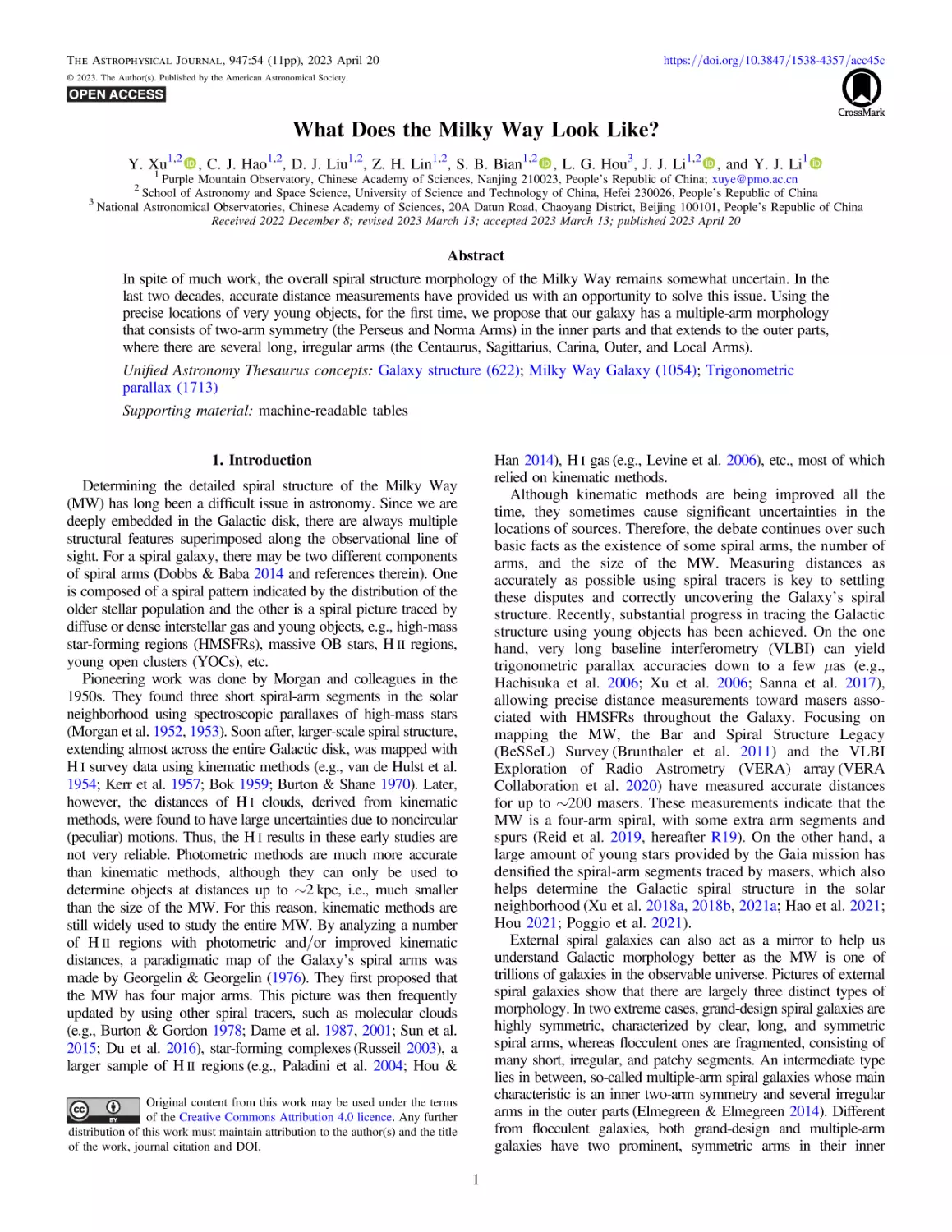





Текст
The Astrophysical Journal, 947:54 (11pp), 2023 April 20
https://doi.org/10.3847/1538-4357/acc45c
© 2023. The Author(s). Published by the American Astronomical Society.
What Does the Milky Way Look Like?
Y. Xu1,2
1
, C. J. Hao1,2, D. J. Liu1,2, Z. H. Lin1,2, S. B. Bian1,2
, L. G. Hou3, J. J. Li1,2
, and Y. J. Li1
Purple Mountain Observatory, Chinese Academy of Sciences, Nanjing 210023, People’s Republic of China; xuye@pmo.ac.cn
School of Astronomy and Space Science, University of Science and Technology of China, Hefei 230026, People’s Republic of China
National Astronomical Observatories, Chinese Academy of Sciences, 20A Datun Road, Chaoyang District, Beijing 100101, People’s Republic of China
Received 2022 December 8; revised 2023 March 13; accepted 2023 March 13; published 2023 April 20
2
3
Abstract
In spite of much work, the overall spiral structure morphology of the Milky Way remains somewhat uncertain. In the
last two decades, accurate distance measurements have provided us with an opportunity to solve this issue. Using the
precise locations of very young objects, for the first time, we propose that our galaxy has a multiple-arm morphology
that consists of two-arm symmetry (the Perseus and Norma Arms) in the inner parts and that extends to the outer parts,
where there are several long, irregular arms (the Centaurus, Sagittarius, Carina, Outer, and Local Arms).
Unified Astronomy Thesaurus concepts: Galaxy structure (622); Milky Way Galaxy (1054); Trigonometric
parallax (1713)
Supporting material: machine-readable tables
Han 2014), H I gas (e.g., Levine et al. 2006), etc., most of which
relied on kinematic methods.
Although kinematic methods are being improved all the
time, they sometimes cause significant uncertainties in the
locations of sources. Therefore, the debate continues over such
basic facts as the existence of some spiral arms, the number of
arms, and the size of the MW. Measuring distances as
accurately as possible using spiral tracers is key to settling
these disputes and correctly uncovering the Galaxy’s spiral
structure. Recently, substantial progress in tracing the Galactic
structure using young objects has been achieved. On the one
hand, very long baseline interferometry (VLBI) can yield
trigonometric parallax accuracies down to a few μas (e.g.,
Hachisuka et al. 2006; Xu et al. 2006; Sanna et al. 2017),
allowing precise distance measurements toward masers associated with HMSFRs throughout the Galaxy. Focusing on
mapping the MW, the Bar and Spiral Structure Legacy
(BeSSeL) Survey (Brunthaler et al. 2011) and the VLBI
Exploration of Radio Astrometry (VERA) array (VERA
Collaboration et al. 2020) have measured accurate distances
for up to ∼200 masers. These measurements indicate that the
MW is a four-arm spiral, with some extra arm segments and
spurs (Reid et al. 2019, hereafter R19). On the other hand, a
large amount of young stars provided by the Gaia mission has
densified the spiral-arm segments traced by masers, which also
helps determine the Galactic spiral structure in the solar
neighborhood (Xu et al. 2018a, 2018b, 2021a; Hao et al. 2021;
Hou 2021; Poggio et al. 2021).
External spiral galaxies can also act as a mirror to help us
understand Galactic morphology better as the MW is one of
trillions of galaxies in the observable universe. Pictures of external
spiral galaxies show that there are largely three distinct types of
morphology. In two extreme cases, grand-design spiral galaxies are
highly symmetric, characterized by clear, long, and symmetric
spiral arms, whereas flocculent ones are fragmented, consisting of
many short, irregular, and patchy segments. An intermediate type
lies in between, so-called multiple-arm spiral galaxies whose main
characteristic is an inner two-arm symmetry and several irregular
arms in the outer parts (Elmegreen & Elmegreen 2014). Different
from flocculent galaxies, both grand-design and multiple-arm
galaxies have two prominent, symmetric arms in their inner
1. Introduction
Determining the detailed spiral structure of the Milky Way
(MW) has long been a difficult issue in astronomy. Since we are
deeply embedded in the Galactic disk, there are always multiple
structural features superimposed along the observational line of
sight. For a spiral galaxy, there may be two different components
of spiral arms (Dobbs & Baba 2014 and references therein). One
is composed of a spiral pattern indicated by the distribution of the
older stellar population and the other is a spiral picture traced by
diffuse or dense interstellar gas and young objects, e.g., high-mass
star-forming regions (HMSFRs), massive OB stars, H II regions,
young open clusters (YOCs), etc.
Pioneering work was done by Morgan and colleagues in the
1950s. They found three short spiral-arm segments in the solar
neighborhood using spectroscopic parallaxes of high-mass stars
(Morgan et al. 1952, 1953). Soon after, larger-scale spiral structure,
extending almost across the entire Galactic disk, was mapped with
H I survey data using kinematic methods (e.g., van de Hulst et al.
1954; Kerr et al. 1957; Bok 1959; Burton & Shane 1970). Later,
however, the distances of H I clouds, derived from kinematic
methods, were found to have large uncertainties due to noncircular
(peculiar) motions. Thus, the H I results in these early studies are
not very reliable. Photometric methods are much more accurate
than kinematic methods, although they can only be used to
determine objects at distances up to ∼2 kpc, i.e., much smaller
than the size of the MW. For this reason, kinematic methods are
still widely used to study the entire MW. By analyzing a number
of H II regions with photometric and/or improved kinematic
distances, a paradigmatic map of the Galaxy’s spiral arms was
made by Georgelin & Georgelin (1976). They first proposed that
the MW has four major arms. This picture was then frequently
updated by using other spiral tracers, such as molecular clouds
(e.g., Burton & Gordon 1978; Dame et al. 1987, 2001; Sun et al.
2015; Du et al. 2016), star-forming complexes (Russeil 2003), a
larger sample of H II regions (e.g., Paladini et al. 2004; Hou &
Original content from this work may be used under the terms
of the Creative Commons Attribution 4.0 licence. Any further
distribution of this work must maintain attribution to the author(s) and the title
of the work, journal citation and DOI.
1
The Astrophysical Journal, 947:54 (11pp), 2023 April 20
Xu et al.
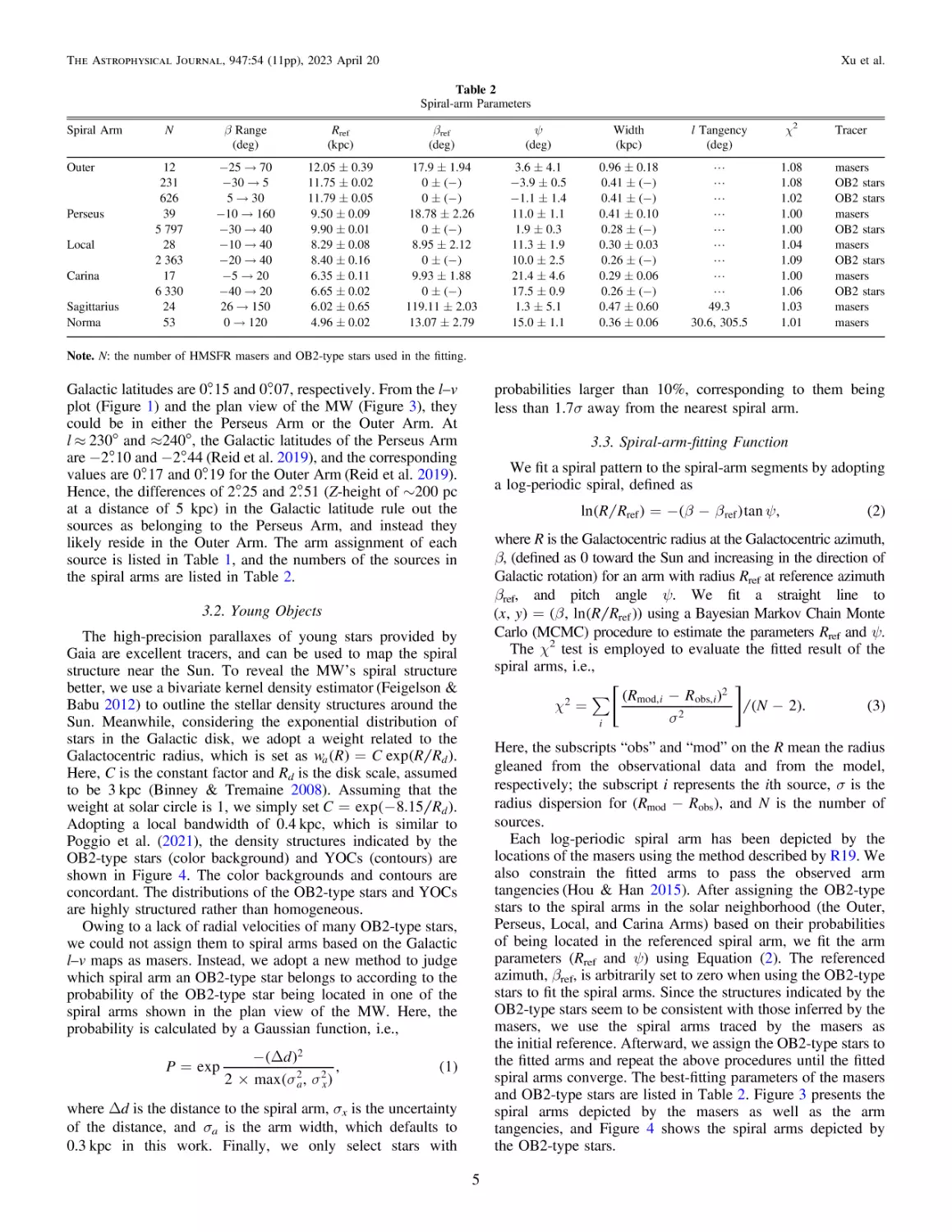
Table 1
The Astrometric Parameters of the HMSFR Masers
Source
G305.20 + 00.01
G339.88−01.25
G348.70−01.04
G359.61−00.24
G007.47 + 00.05
G000.31−00.20
G005.88−00.39
G009.21−00.20
G010.32−00.15
G011.10−00.11
G011.91−00.61
G012.68−00.18
R.A.
(hh:mm:ss)
Decl.
(deg:arcmin:arcsec)
Parallax
(mas)
μx
(mas yr−1)
μy
(mas yr−1)
v
(km s−1)
Spiral Arm
13:11:16.8912
16:52:04.6776
17:20:04.0360
17:45:39.0697
18:02:13.1823
17:47:09.1092
18:00:30.2801
18:06:52.8421
18:09:01.4549
18:10:28.2470
18:13:58.1205
18:13:54.7457
−62:45:55.008
−46:08:34.404
−38:58:30.920
−29:23:30.265
−22:27:58.981
−28:46:16.278
−24:04:04.576
−21:04:27.878
−20:05:07.854
−19:22:30.216
−18:54:20.278
−18:01:46.588
0.250 ± 0.050
0.480 ± 0.080
0.296 ± 0.026
0.375 ± 0.021
0.049 ± 0.006
0.342 ± 0.042
0.334 ± 0.020
0.303 ± 0.096
0.343 ± 0.035
0.246 ± 0.014
0.297 ± 0.050
0.416 ± 0.028
...
−6.90 ± 0.33
−1.60 ± 0.52
−0.73 ± 0.31
1.00 ± 0.40
−2.43 ± 0.10
0.21 ± 0.39
0.18 ± 0.34
−0.41 ± 0.45
−1.03 ± 0.36
−0.23 ± 0.38
0.66 ± 0.69
−1.00 ± 0.95
−0.52 ± 0.33
−1.90 ± 0.52
−2.83 ± 0.59
−1.50 ± 0.50
−4.43 ± 0.16
−1.76 ± 0.64
−2.26 ± 0.34
−1.69 ± 0.50
−2.42 ± 0.50
−2.01 ± 0.41
−1.36 ± 0.75
−2.85 ± 0.95
−38 ± 5
−34 ± 3
−9 ± 5
21 ± 5
−14 ± 10
18 ± 3
9±5
43 ± 5
10 ± 5
29 ± 5
37 ± 5
58 ± 10
Nor
Nor
Nor
Nor
Nor
Nor
Nor
Nor
Nor
Nor
Nor
Nor
Note. Nor, Norma Arm; Sag, Sagittarius Arm; Loc, Local Arm; Per, Perseus Arm; Out, Outer Arm; Car, Carina Arm. Sources indicated with “???” could not be
confidently assigned to an arm. v: LSR velocity.
(This table is available in its entirety in machine-readable form.)
regions, and almost no external galaxies present four spirals
extending from their centers to their outer regions (Elmegreen &
Elmegreen 1982, 1987, 1995). Today, it is widely accepted that the
MW galaxy has four continuous spiral arms extending outward
from the inner Galaxy to distant outer regions (e.g., Georgelin &
Georgelin 1976; Reid et al. 2019; Minniti et al. 2021). If that is the
case, the MW may be an atypical galaxy in the universe.
In the past few years, the number of young objects in the MW
with precisely measured distances haveincreased significantly. It
would be constructive to combine these high-quality data together
to provide a better understanding the MW’s spiral structure. In this
contribution, largely following the previously developed spiralarm-fitting approach presented by R19, we have synthesized the
available data set of spiral tracers with precisely measured
distances, including the parallax measurements of HMSFR masers
from VLBI observations, massive OB2-type stars, and YOCs
from the Gaia mission, aiming to uncover the real image of our
archetypal Galaxy.
coordinates and parallaxes of 204 HMSFR masers measured
with VLBI techniques, including the National Radio Astronomy Observatory’s Very Long Baseline Array, the Japanese
VLBI Exploration of Radio Astrometry project, the European
VLBI Network, and the Australian Long Baseline Array. For
the masers listed in Table 1, 199 were summarized by R19, and
five have been newly reported by Xu et al. (2021b) and Bian
et al. (2022) in the past 2 yr. The typical parallax accuracy of
the masers is ∼20 μas, and 19 of them have accuracies of
10 μas or better.
2.2. OB2-type Stars
High-mass stars are generally located near their birthplaces,
and thus they can also be used to trace the Galactic spiral
structure. Employing the same method as used by Gaia
Collaboration et al. (2022), we adopted the effective temperature, spectral type, distance from the galactic plane, and the
astrometric fidelity indicator, fa (Rybizki et al. 2022), to select
OB-type star candidates from Gaia DR3 (Gaia Collaboration
et al. 2022). We only use stars with a parallax precision better
than 20%, i.e., parallax_over_error >5. After applying
this criterion, we obtained a total of 495,965 OB stars.
Then, RR-Lyrae stars identified by vari_rryrae in Gaia
DR3 were removed. Next, we filter the tangential velocity
ntan = An (ma2 + md2 )1 2 v with ntan < 180 km s−1, the same as
*
Gaia Collaboration
et al. (2018), where μα* and μδ are the proper
motions in the R.A. and decl., respectively;ϖ is the parallax;and
Aν = 4.74 km yr s−1. After filtering based on the above criteria,
488,449 OB-type stars are left. In this work, we only consider
stars hotter than 20,000 K, which corresponds to OB2-type stars
whose typical ages are younger than 20 Myr (Chen et al. 2013).
The final sample is composed of 23,807 OB2 stars. We perform a
parallax zero-point correction for all OB2-type stars in the sample,
as indicated by (Lindegren et al. 2021). The median standard error
of the parallaxes of the OB2-type stars is 17 μas.
2. Data
Currently, VLBI maser parallax measurements are mainly
carried out in the northern hemisphere, with uncertainties of
typically ∼20 μas, while a number of observations have
uncertainties down to ∼10 μas or better, allowing reliable
distances to be determined for objects located at the Galactic
center (GC) and beyond (Zhang et al. 2013; Sanna et al. 2017;
Reid et al. 2019; Xu et al. 2021b). On the other hand, Gaia Data
Release 3 (DR3) data have uncertainties of order 20–30 μas,
which enable us to reveal the spiral structure within ∼5 kpc of the
Sun. In addition to using these distances to trace the spiral
structure directly, ascertaining arm tangencies is also a good way
to determine the locations of spiral arms, which are identified from
the distributions of stars, interstellar gas, dust, and star formation
sites in the Galactic plane (Hou & Han 2015).
2.1. Masers
2.3. Open Clusters
VLBI at radio wavelengths has been used to detect a large
amount of masers associated with HMSFRs, and they can be
used to map the spiral structure of the MW from the solar
neighborhood to the GC and beyond. Table 1 lists the
Since YOCs (<20 Myr) can trace the spiral arms well (Hao
et al. 2021), we only use OCs younger than 20 Myr as tracers in
this work. In recent years, taking full advantage of the high2
The Astrophysical Journal, 947:54 (11pp), 2023 April 20
Xu et al.
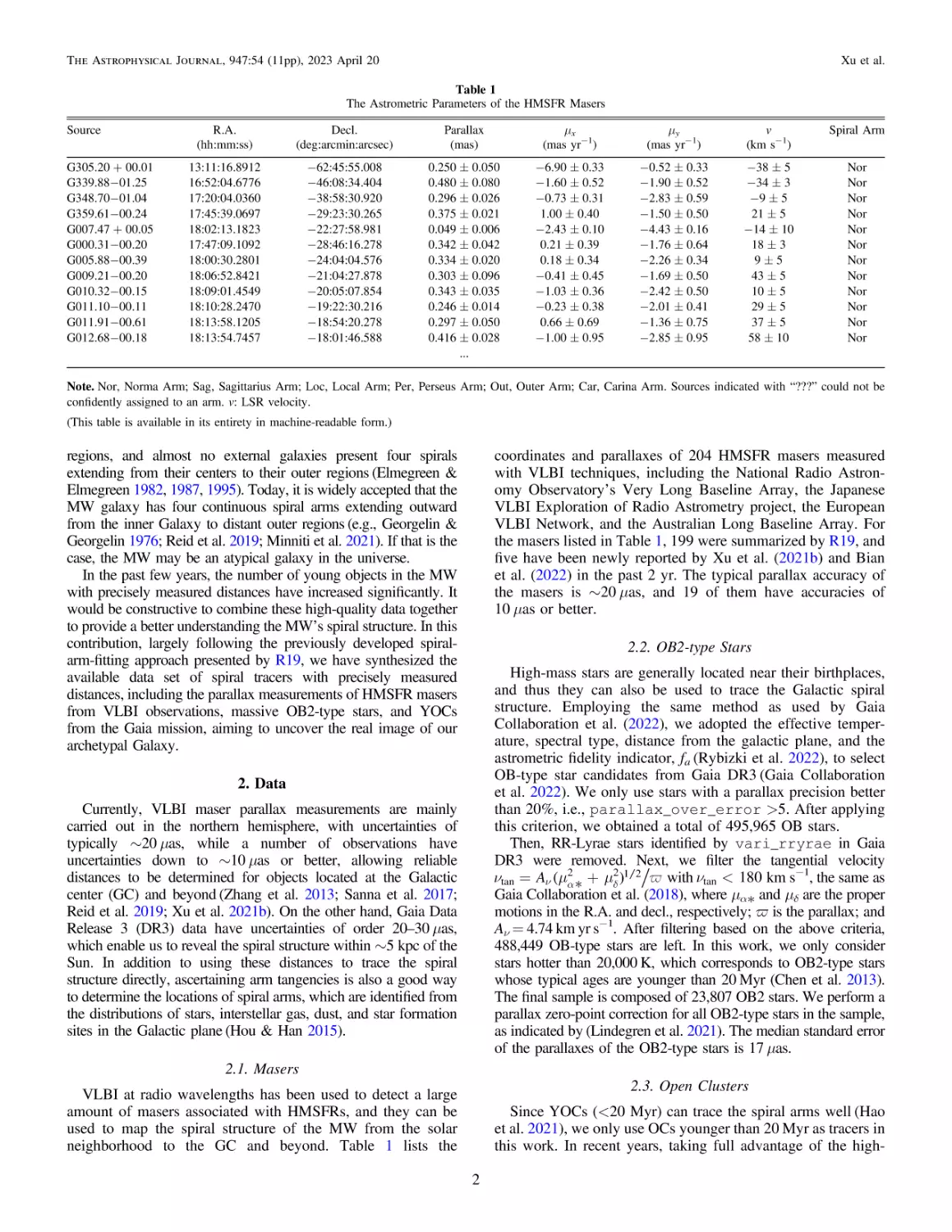
Figure 1. H I emission as a function of LSR radial velocity and Galactic longitude. The colored dots are HMSFR masers with parallax measurements: Norma Arm
(orange), Sagittarius Arm (cyan), Carina Arm (green), Local Arm (blue), Perseus Arm (magenta), and Outer Arm (red). The white dots indicate spurs or sources for
which the arm assignment is unclear. The H I emission is from the HI4PI survey (HI4PI Collaboration et al. 2016). The subfigure presents a zoomed-in view of the red
box, in which the masers are assigned to the Norma Arm (orange crosses) and the Scutum Arm (orange triangles) by R19, respectively, while here they are assigned to
the same arm, i.e., the Norma Arm.
precision astrometric data provided by Gaia, numerous studies
have identified thousands of OCs in the MW, and their ages
cover a wide range, from several megayears to a few gigayears.
Based on many previous works, Hao et al. (2021) compiled a
catalog containing more than 3700 OCs using Gaia Early Data
Release 3. Soon after, 704 and 628 newly found OCs in the
Gaia area were reported by Hao et al. (2022) and Castro-Ginard
et al. (2022), respectively. In this work, we have synthesized
the above three catalogs and obtained a large sample of 5021
OCs, of which 1011 OCs have ages younger than 20 Myr. We
apply a parallax zero-point correction for the member stars of
each OC, and then use the average parallax of all members as
the OC’s parallax (Lindegren et al. 2021). Similar to the OB2type star sample, we only use YOCs with parallax accuracies
better than 20%, resulting in a final number of 981 YOCs. The
median standard error of parallax of YOCs is ∼23 μas.
assignments are unclear. The arm assignments for most
sources, in terms of the (l, v) matches, are clear and consistent
with the parallax distances. It is worth mentioning that the
maser sources assigned to the Norma and Scutum Arms in
previous work (R19) are mixed together in the l–v, l–b, and x–y
plots (as shown by the zoomed-in subfigures in Figures 1–3),
respectively. Therefore, in this work, these sources are assigned
to the same arm, namely the Norma Arm. Besides, R19
indicated that the Sagittarius Arm has a 2 kpc gap centered at
l ≈ 43° near (x, y) = (2, 6) kpc (see Figure 3), and the arm
segment on the left of the gap belongs to the Sagittarius Arm.
As this arm segment is connected to the Carina Arm, here we
have assigned the masers to the Carina Arm.
Since the radial velocities (v) of different spiral arms are
almost equal to 0 km s−1 in the direction of the GC (340°
<l < 20°) and anti-GC (160° < l < 200°), the Galactic latitudes
and parallax distances are used as the primary indicators for
arm assignment. For sources within 5 kpc of the Sun, their arm
assignments can be determined confidently based on their
accurate parallax distances. However, for some distant sources,
their parallax distances may be consistent with two or even
three spiral arms within their 1σ uncertainties, so their Galactic
latitudes can provide strong evidence to resolve this issue.
G019.60−00.23 is a good example of this situation. Around
l ≈ 20°, b and v of the Sagittarius and Perseus Arms are
(−0°. 08, 39 km s−1) and (0°. 08, 26 km s−1), respectively (Reid
et al. 2016). Near (x, y) = (4, −4) kpc, G019.60−00.23 has a
velocity of ∼41 km s−1, implying it may belong to either the
Sagittarius Arm or the Perseus Arm judging from the (l, v)
match in Figure 1 and the (x, y) match in Figure 3. Considering
that the Galactic latitude of G019.60−00.23 is −0°. 23, we rule
out assigning this maser to the Perseus Arm based on the
latitude difference of 0°. 31 (Z-height of 70 pc at a distance of 13
kpc). The Sagittarius Arm matches this maser in both latitude
and v, and thus we assign G019.60−00.23 to the Sagittarius
Arm. The same technique for arm assignment is also adopted
for the sources G229.57 + 00.15 and G240.31 + 00.07, whose
3. Objects Assigned to Spiral Arms
3.1. Masers
The spiral arms of the MW show quasi-continuous structure
in CO and H I in Galactic longitude–local standard of rest
(LSR) velocity (l–v) maps. We initially assign masers to spiral
arms by comparing the (l, v) positions of the sources with the (l,
v) loci of arm segments provided by Reid et al. (2016).
Although a plan view of the MW from l–v plots cannot
accurately place HMSFR masers into spiral arms, one can, in
most cases, assign HMSFR masers to spiral arms by their
association with CO and H I emission features. In addition, the
Galactic latitudes and parallax distances can be helpful for
confirming the arm assignments of HMSFR masers and
avoiding any anomalous kinematic effects.
In Figure 1, we have overlaid the HMSFR masers on the l–v
plot of H I emission. Figure 2 shows the Galactic longitude–
latitude (l, b) positions of the maser sources and Figure 3
presents a plan view of the MW. In these three figures, the
white dots indicate spurs or sources for which the arm
3
The Astrophysical Journal, 947:54 (11pp), 2023 April 20
Xu et al.
Figure 2. Galactic longitudes of the HMSFR masers as a function of Galactic latitude. The colored dots are maser sources with parallax measurements, same as in
Figure 1. The subfigure is the same as in Figure 1.
Figure 3. Plan view of the MW from the north Galactic pole showing the locations of the HMSFR masers (triangles) with measured trigonometric parallaxes and the
spiral arms they trace. The distance uncertainties of the masers are indicated by error bars. The masers presented by white triangles indicate spurs or sources whose
arm assignments are unclear. The spiral arms traced by masers are color coded solid lines and their names have been presented in the legend at the upper left. The
dotted curved lines trace the centers of the inferred fitted spiral arms. The subfigure is the same as in Figure 1. The Galactic bar is indicated by a shaded ellipse
following Hilmi et al. (2020). The six spiral-arm tangencies are indicated by gray dashed lines. The GC (red asterisk) is at (0, 0) kpc and the Sun (red Sun symbol) is at
(0, 8.15) kpc (Reid et al. 2019). Galactic rotation is clockwise.
4
The Astrophysical Journal, 947:54 (11pp), 2023 April 20
Xu et al.
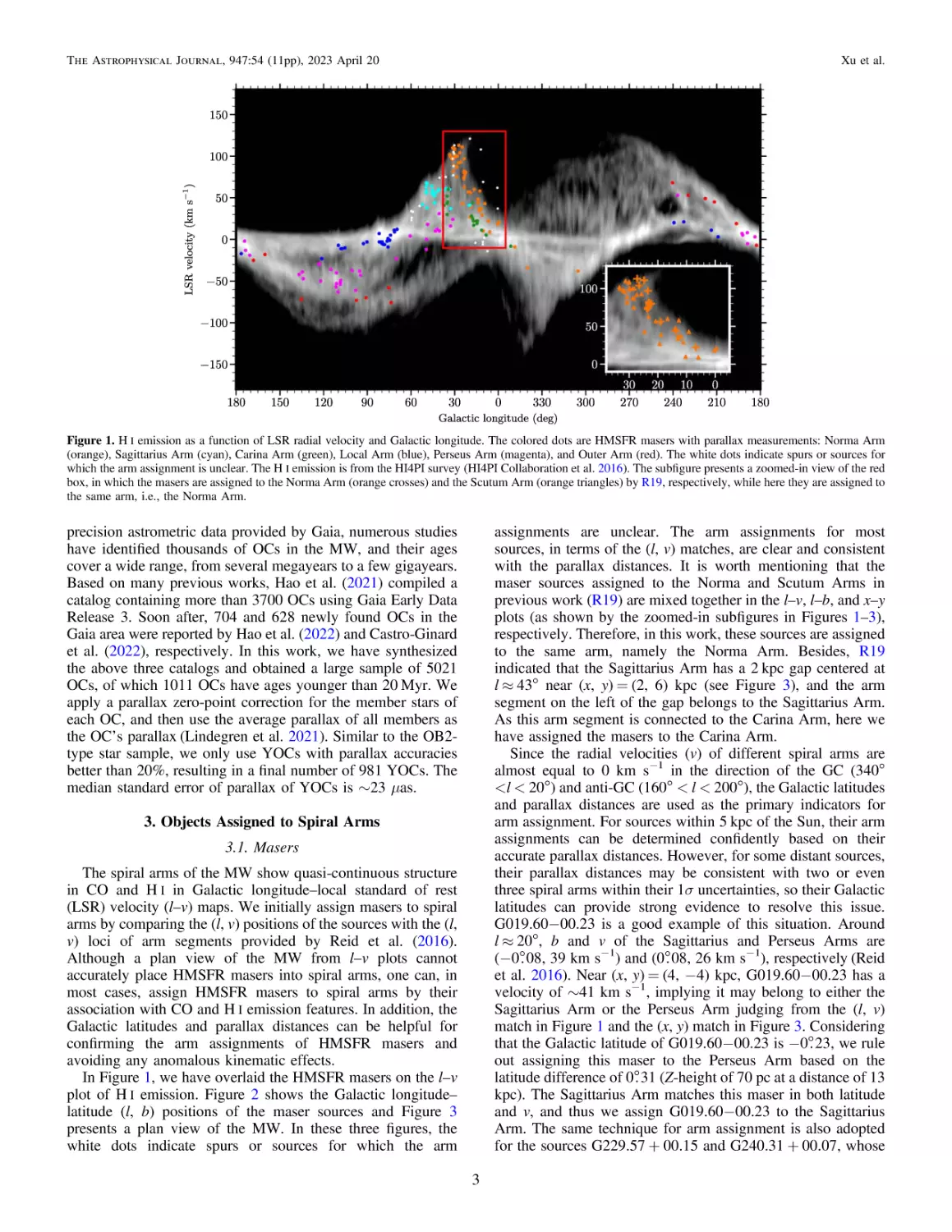
Table 2
Spiral-arm Parameters
Spiral Arm
Outer
Perseus
Local
Carina
Sagittarius
Norma
N
β Range
(deg)
Rref
(kpc)
βref
(deg)
ψ
(deg)
Width
(kpc)
l Tangency
(deg)
χ2
12
231
626
39
5 797
28
2 363
17
6 330
24
53
−25 → 70
−30 → 5
5 → 30
−10 → 160
−30 → 40
−10 → 40
−20 → 40
−5 → 20
−40 → 20
26 → 150
0 → 120
12.05 ± 0.39
11.75 ± 0.02
11.79 ± 0.05
9.50 ± 0.09
9.90 ± 0.01
8.29 ± 0.08
8.40 ± 0.16
6.35 ± 0.11
6.65 ± 0.02
6.02 ± 0.65
4.96 ± 0.02
17.9 ± 1.94
0 ± (−)
0 ± (−)
18.78 ± 2.26
0 ± (−)
8.95 ± 2.12
0 ± (−)
9.93 ± 1.88
0 ± (−)
119.11 ± 2.03
13.07 ± 2.79
3.6 ± 4.1
−3.9 ± 0.5
−1.1 ± 1.4
11.0 ± 1.1
1.9 ± 0.3
11.3 ± 1.9
10.0 ± 2.5
21.4 ± 4.6
17.5 ± 0.9
1.3 ± 5.1
15.0 ± 1.1
0.96 ± 0.18
0.41 ± (−)
0.41 ± (−)
0.41 ± 0.10
0.28 ± (−)
0.30 ± 0.03
0.26 ± (−)
0.29 ± 0.06
0.26 ± (−)
0.47 ± 0.60
0.36 ± 0.06
L
L
L
L
L
L
L
L
L
49.3
30.6, 305.5
1.08
1.08
1.02
1.00
1.00
1.04
1.09
1.00
1.06
1.03
1.01
Tracer
masers
OB2 stars
OB2 stars
masers
OB2 stars
masers
OB2 stars
masers
OB2 stars
masers
masers
Note. N: the number of HMSFR masers and OB2-type stars used in the fitting.
Galactic latitudes are 0°. 15 and 0°. 07, respectively. From the l–v
plot (Figure 1) and the plan view of the MW (Figure 3), they
could be in either the Perseus Arm or the Outer Arm. At
l ≈ 230° and ≈240°, the Galactic latitudes of the Perseus Arm
are −2°. 10 and −2°. 44 (Reid et al. 2019), and the corresponding
values are 0°. 17 and 0°. 19 for the Outer Arm (Reid et al. 2019).
Hence, the differences of 2°. 25 and 2°. 51 (Z-height of ∼200 pc
at a distance of 5 kpc) in the Galactic latitude rule out the
sources as belonging to the Perseus Arm, and instead they
likely reside in the Outer Arm. The arm assignment of each
source is listed in Table 1, and the numbers of the sources in
the spiral arms are listed in Table 2.
probabilities larger than 10%, corresponding to them being
less than 1.7σ away from the nearest spiral arm.
3.3. Spiral-arm-fitting Function
We fit a spiral pattern to the spiral-arm segments by adopting
a log-periodic spiral, defined as
ln (R Rref ) = - (b - b ref ) tan y,
where R is the Galactocentric radius at the Galactocentric azimuth,
β, (defined as 0 toward the Sun and increasing in the direction of
Galactic rotation) for an arm with radius Rref at reference azimuth
βref, and pitch angle ψ. We fit a straight line to
(x, y) = (b , ln (R Rref )) using a Bayesian Markov Chain Monte
Carlo (MCMC) procedure to estimate the parameters Rref and ψ.
The χ2 test is employed to evaluate the fitted result of the
spiral arms, i.e.,
3.2. Young Objects
The high-precision parallaxes of young stars provided by
Gaia are excellent tracers, and can be used to map the spiral
structure near the Sun. To reveal the MW’s spiral structure
better, we use a bivariate kernel density estimator (Feigelson &
Babu 2012) to outline the stellar density structures around the
Sun. Meanwhile, considering the exponential distribution of
stars in the Galactic disk, we adopt a weight related to the
Galactocentric radius, which is set as wa (R) = C exp (R Rd ).
Here, C is the constant factor and Rd is the disk scale, assumed
to be 3 kpc (Binney & Tremaine 2008). Assuming that the
weight at solar circle is 1, we simply set C = exp (-8.15 Rd ).
Adopting a local bandwidth of 0.4 kpc, which is similar to
Poggio et al. (2021), the density structures indicated by the
OB2-type stars (color background) and YOCs (contours) are
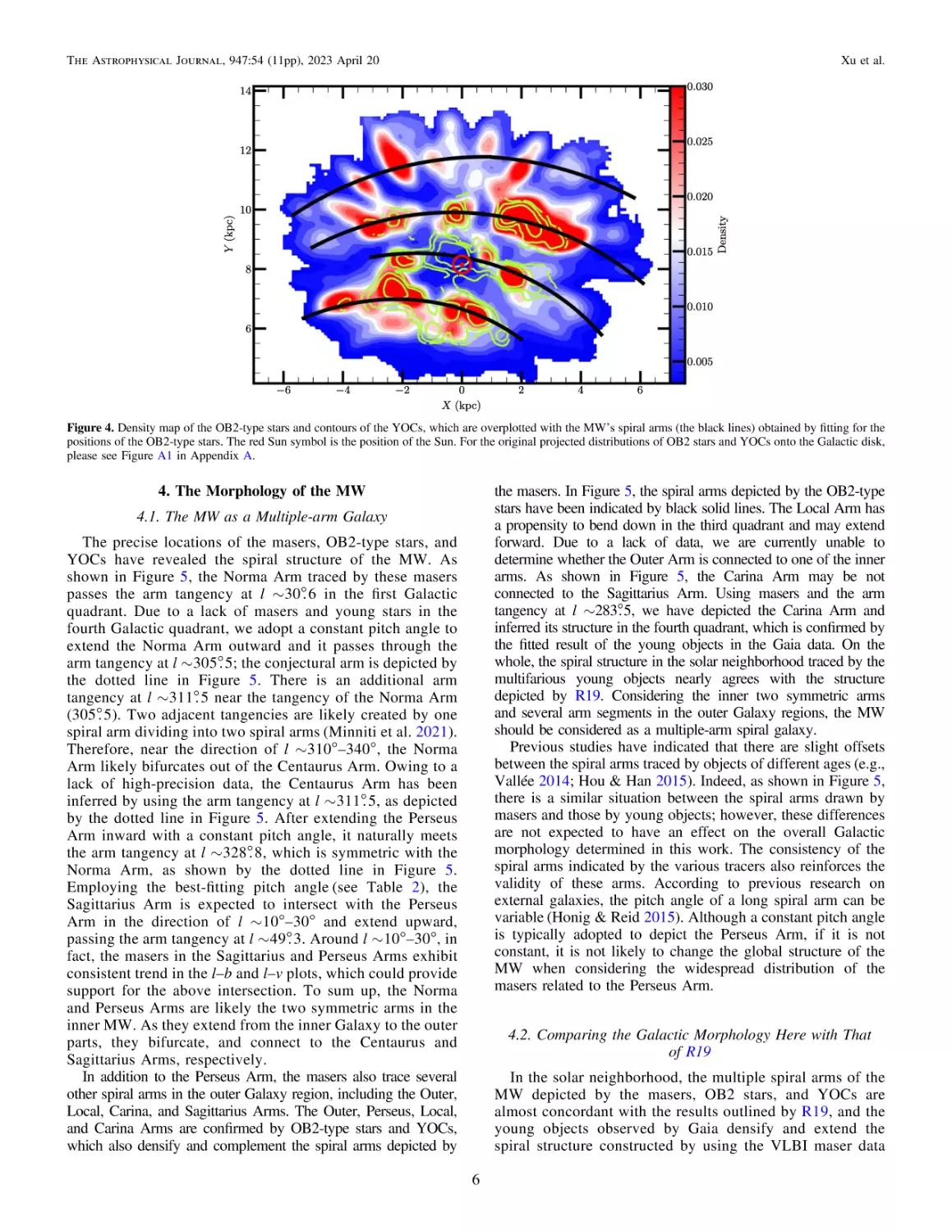
shown in Figure 4. The color backgrounds and contours are
concordant. The distributions of the OB2-type stars and YOCs
are highly structured rather than homogeneous.
Owing to a lack of radial velocities of many OB2-type stars,
we could not assign them to spiral arms based on the Galactic
l–v maps as masers. Instead, we adopt a new method to judge
which spiral arm an OB2-type star belongs to according to the
probability of the OB2-type star being located in one of the
spiral arms shown in the plan view of the MW. Here, the
probability is calculated by a Gaussian function, i.e.,
P = exp
- (Dd )2
,
2 ´ max (s 2a, s 2x )
(2 )
c2 =
(Rmod, i - R obs, i )2 ⎤
(N - 2 ).
⎥
s2
⎣
⎦
å ⎡⎢
i
(3 )
Here, the subscripts “obs” and “mod” on the R mean the radius
gleaned from the observational data and from the model,
respectively; the subscript i represents the ith source, σ is the
radius dispersion for (Rmod - Robs), and N is the number of
sources.
Each log-periodic spiral arm has been depicted by the
locations of the masers using the method described by R19. We
also constrain the fitted arms to pass the observed arm
tangencies (Hou & Han 2015). After assigning the OB2-type
stars to the spiral arms in the solar neighborhood (the Outer,
Perseus, Local, and Carina Arms) based on their probabilities
of being located in the referenced spiral arm, we fit the arm
parameters (Rref and ψ) using Equation (2). The referenced
azimuth, βref, is arbitrarily set to zero when using the OB2-type
stars to fit the spiral arms. Since the structures indicated by the
OB2-type stars seem to be consistent with those inferred by the
masers, we use the spiral arms traced by the masers as
the initial reference. Afterward, we assign the OB2-type stars to
the fitted arms and repeat the above procedures until the fitted
spiral arms converge. The best-fitting parameters of the masers
and OB2-type stars are listed in Table 2. Figure 3 presents the
spiral arms depicted by the masers as well as the arm
tangencies, and Figure 4 shows the spiral arms depicted by
the OB2-type stars.
(1 )
where Δd is the distance to the spiral arm, σx is the uncertainty
of the distance, and σa is the arm width, which defaults to
0.3 kpc in this work. Finally, we only select stars with
5
The Astrophysical Journal, 947:54 (11pp), 2023 April 20
Xu et al.
Figure 4. Density map of the OB2-type stars and contours of the YOCs, which are overplotted with the MW’s spiral arms (the black lines) obtained by fitting for the
positions of the OB2-type stars. The red Sun symbol is the position of the Sun. For the original projected distributions of OB2 stars and YOCs onto the Galactic disk,
please see Figure A1 in Appendix A.
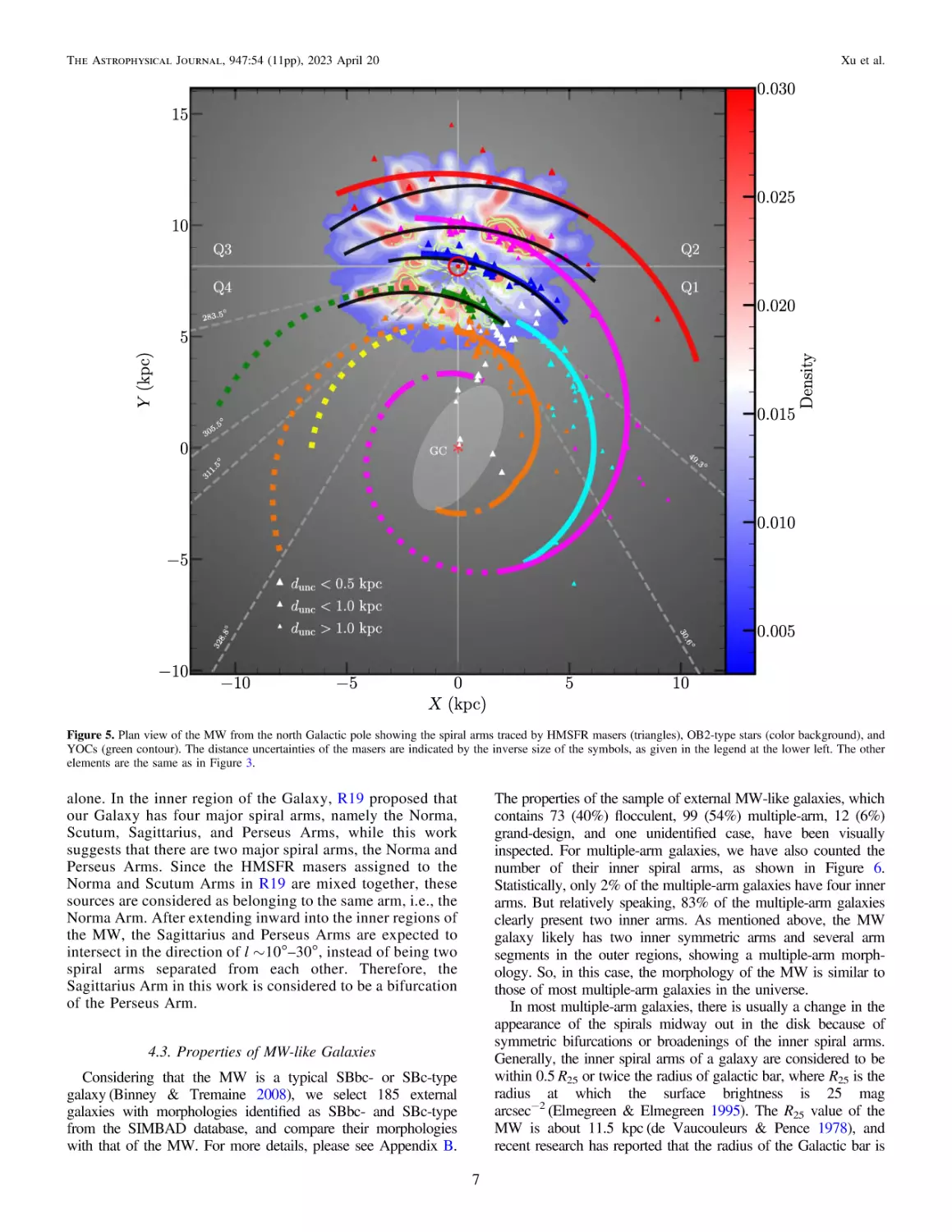
the masers. In Figure 5, the spiral arms depicted by the OB2-type
stars have been indicated by black solid lines. The Local Arm has
a propensity to bend down in the third quadrant and may extend
forward. Due to a lack of data, we are currently unable to
determine whether the Outer Arm is connected to one of the inner
arms. As shown in Figure 5, the Carina Arm may be not
connected to the Sagittarius Arm. Using masers and the arm
tangency at l ∼283°. 5, we have depicted the Carina Arm and
inferred its structure in the fourth quadrant, which is confirmed by
the fitted result of the young objects in the Gaia data. On the
whole, the spiral structure in the solar neighborhood traced by the
multifarious young objects nearly agrees with the structure
depicted by R19. Considering the inner two symmetric arms
and several arm segments in the outer Galaxy regions, the MW
should be considered as a multiple-arm spiral galaxy.
Previous studies have indicated that there are slight offsets
between the spiral arms traced by objects of different ages (e.g.,
Vallée 2014; Hou & Han 2015). Indeed, as shown in Figure 5,
there is a similar situation between the spiral arms drawn by
masers and those by young objects; however, these differences
are not expected to have an effect on the overall Galactic
morphology determined in this work. The consistency of the
spiral arms indicated by the various tracers also reinforces the
validity of these arms. According to previous research on
external galaxies, the pitch angle of a long spiral arm can be
variable (Honig & Reid 2015). Although a constant pitch angle
is typically adopted to depict the Perseus Arm, if it is not
constant, it is not likely to change the global structure of the
MW when considering the widespread distribution of the
masers related to the Perseus Arm.
4. The Morphology of the MW
4.1. The MW as a Multiple-arm Galaxy
The precise locations of the masers, OB2-type stars, and
YOCs have revealed the spiral structure of the MW. As
shown in Figure 5, the Norma Arm traced by these masers
passes the arm tangency at l ∼30°. 6 in the first Galactic
quadrant. Due to a lack of masers and young stars in the
fourth Galactic quadrant, we adopt a constant pitch angle to
extend the Norma Arm outward and it passes through the
arm tangency at l ∼305°. 5; the conjectural arm is depicted by
the dotted line in Figure 5. There is an additional arm
tangency at l ∼311°. 5 near the tangency of the Norma Arm
(305°. 5). Two adjacent tangencies are likely created by one
spiral arm dividing into two spiral arms (Minniti et al. 2021).
Therefore, near the direction of l ∼310°–340°, the Norma
Arm likely bifurcates out of the Centaurus Arm. Owing to a
lack of high-precision data, the Centaurus Arm has been
inferred by using the arm tangency at l ∼311°. 5, as depicted
by the dotted line in Figure 5. After extending the Perseus
Arm inward with a constant pitch angle, it naturally meets
the arm tangency at l ∼328°. 8, which is symmetric with the
Norma Arm, as shown by the dotted line in Figure 5.
Employing the best-fitting pitch angle (see Table 2), the
Sagittarius Arm is expected to intersect with the Perseus
Arm in the direction of l ∼10°–30° and extend upward,
passing the arm tangency at l ∼49°. 3. Around l ∼10°–30°, in
fact, the masers in the Sagittarius and Perseus Arms exhibit
consistent trend in the l–b and l–v plots, which could provide
support for the above intersection. To sum up, the Norma
and Perseus Arms are likely the two symmetric arms in the
inner MW. As they extend from the inner Galaxy to the outer
parts, they bifurcate, and connect to the Centaurus and
Sagittarius Arms, respectively.
In addition to the Perseus Arm, the masers also trace several
other spiral arms in the outer Galaxy region, including the Outer,
Local, Carina, and Sagittarius Arms. The Outer, Perseus, Local,
and Carina Arms are confirmed by OB2-type stars and YOCs,
which also densify and complement the spiral arms depicted by
4.2. Comparing the Galactic Morphology Here with That
of R19
In the solar neighborhood, the multiple spiral arms of the
MW depicted by the masers, OB2 stars, and YOCs are
almost concordant with the results outlined by R19, and the
young objects observed by Gaia densify and extend the
spiral structure constructed by using the VLBI maser data
6
The Astrophysical Journal, 947:54 (11pp), 2023 April 20
Xu et al.
Figure 5. Plan view of the MW from the north Galactic pole showing the spiral arms traced by HMSFR masers (triangles), OB2-type stars (color background), and
YOCs (green contour). The distance uncertainties of the masers are indicated by the inverse size of the symbols, as given in the legend at the lower left. The other
elements are the same as in Figure 3.
alone. In the inner region of the Galaxy, R19 proposed that
our Galaxy has four major spiral arms, namely the Norma,
Scutum, Sagittarius, and Perseus Arms, while this work
suggests that there are two major spiral arms, the Norma and
Perseus Arms. Since the HMSFR masers assigned to the
Norma and Scutum Arms in R19 are mixed together, these
sources are considered as belonging to the same arm, i.e., the
Norma Arm. After extending inward into the inner regions of
the MW, the Sagittarius and Perseus Arms are expected to
intersect in the direction of l ∼10°–30°, instead of being two
spiral arms separated from each other. Therefore, the
Sagittarius Arm in this work is considered to be a bifurcation
of the Perseus Arm.
The properties of the sample of external MW-like galaxies, which
contains 73 (40%) flocculent, 99 (54%) multiple-arm, 12 (6%)
grand-design, and one unidentified case, have been visually
inspected. For multiple-arm galaxies, we have also counted the
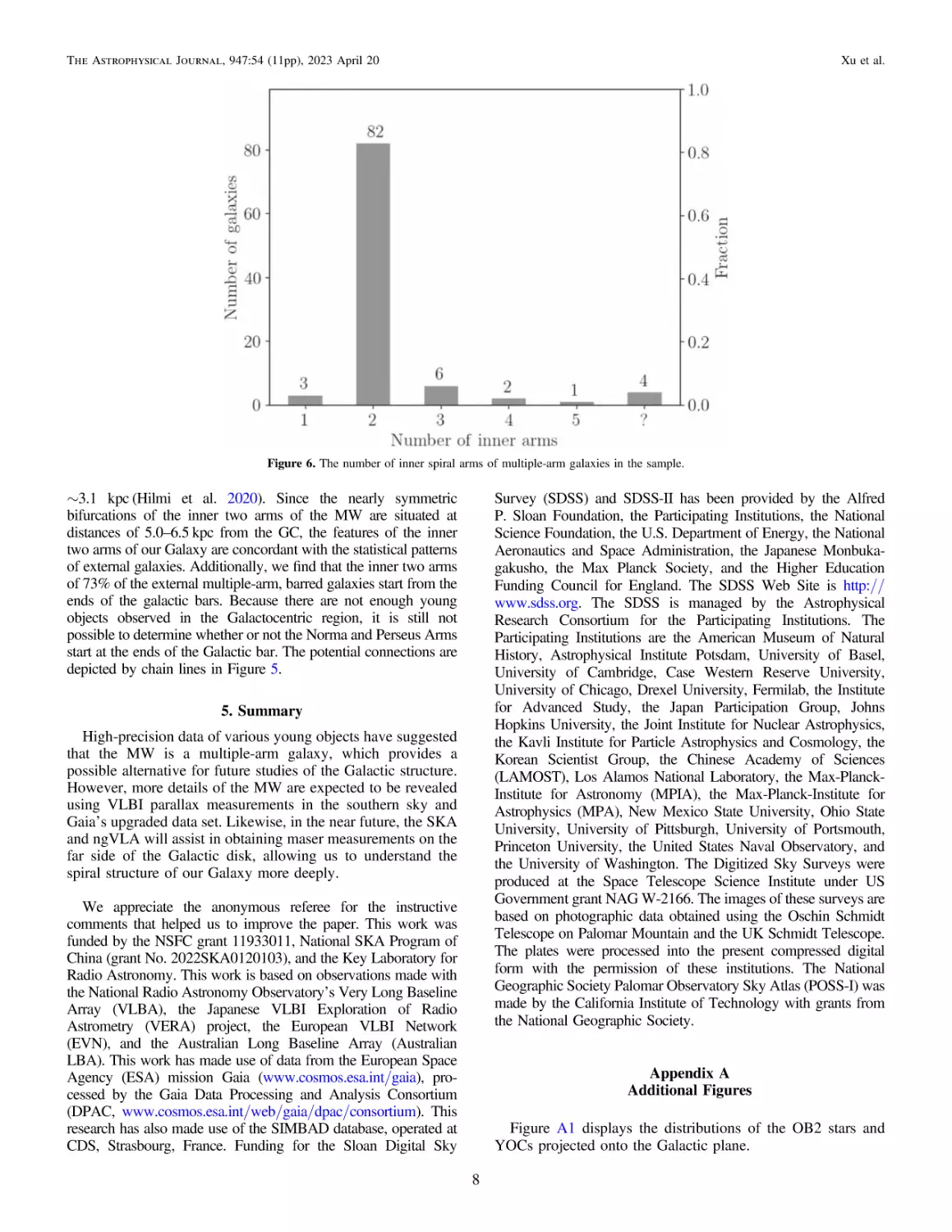
number of their inner spiral arms, as shown in Figure 6.
Statistically, only 2% of the multiple-arm galaxies have four inner
arms. But relatively speaking, 83% of the multiple-arm galaxies
clearly present two inner arms. As mentioned above, the MW
galaxy likely has two inner symmetric arms and several arm
segments in the outer regions, showing a multiple-arm morphology. So, in this case, the morphology of the MW is similar to
those of most multiple-arm galaxies in the universe.
In most multiple-arm galaxies, there is usually a change in the
appearance of the spirals midway out in the disk because of
symmetric bifurcations or broadenings of the inner spiral arms.
Generally, the inner spiral arms of a galaxy are considered to be
within 0.5 R25 or twice the radius of galactic bar, where R25 is the
radius at which the surface brightness is 25 mag
arcsec−2 (Elmegreen & Elmegreen 1995). The R25 value of the
MW is about 11.5 kpc (de Vaucouleurs & Pence 1978), and
recent research has reported that the radius of the Galactic bar is
4.3. Properties of MW-like Galaxies
Considering that the MW is a typical SBbc- or SBc-type
galaxy (Binney & Tremaine 2008), we select 185 external
galaxies with morphologies identified as SBbc- and SBc-type
from the SIMBAD database, and compare their morphologies
with that of the MW. For more details, please see Appendix B.
7
The Astrophysical Journal, 947:54 (11pp), 2023 April 20
Xu et al.
Figure 6. The number of inner spiral arms of multiple-arm galaxies in the sample.
∼3.1 kpc (Hilmi et al. 2020). Since the nearly symmetric
bifurcations of the inner two arms of the MW are situated at
distances of 5.0–6.5 kpc from the GC, the features of the inner
two arms of our Galaxy are concordant with the statistical patterns
of external galaxies. Additionally, we find that the inner two arms
of 73% of the external multiple-arm, barred galaxies start from the
ends of the galactic bars. Because there are not enough young
objects observed in the Galactocentric region, it is still not
possible to determine whether or not the Norma and Perseus Arms
start at the ends of the Galactic bar. The potential connections are
depicted by chain lines in Figure 5.
Survey (SDSS) and SDSS-II has been provided by the Alfred
P. Sloan Foundation, the Participating Institutions, the National
Science Foundation, the U.S. Department of Energy, the National
Aeronautics and Space Administration, the Japanese Monbukagakusho, the Max Planck Society, and the Higher Education
Funding Council for England. The SDSS Web Site is http://
www.sdss.org. The SDSS is managed by the Astrophysical
Research Consortium for the Participating Institutions. The
Participating Institutions are the American Museum of Natural
History, Astrophysical Institute Potsdam, University of Basel,
University of Cambridge, Case Western Reserve University,
University of Chicago, Drexel University, Fermilab, the Institute
for Advanced Study, the Japan Participation Group, Johns
Hopkins University, the Joint Institute for Nuclear Astrophysics,
the Kavli Institute for Particle Astrophysics and Cosmology, the
Korean Scientist Group, the Chinese Academy of Sciences
(LAMOST), Los Alamos National Laboratory, the Max-PlanckInstitute for Astronomy (MPIA), the Max-Planck-Institute for
Astrophysics (MPA), New Mexico State University, Ohio State
University, University of Pittsburgh, University of Portsmouth,
Princeton University, the United States Naval Observatory, and
the University of Washington. The Digitized Sky Surveys were
produced at the Space Telescope Science Institute under US
Government grant NAG W-2166. The images of these surveys are
based on photographic data obtained using the Oschin Schmidt
Telescope on Palomar Mountain and the UK Schmidt Telescope.
The plates were processed into the present compressed digital
form with the permission of these institutions. The National
Geographic Society Palomar Observatory Sky Atlas (POSS-I) was
made by the California Institute of Technology with grants from
the National Geographic Society.
5. Summary
High-precision data of various young objects have suggested
that the MW is a multiple-arm galaxy, which provides a
possible alternative for future studies of the Galactic structure.
However, more details of the MW are expected to be revealed
using VLBI parallax measurements in the southern sky and
Gaiaʼs upgraded data set. Likewise, in the near future, the SKA
and ngVLA will assist in obtaining maser measurements on the
far side of the Galactic disk, allowing us to understand the
spiral structure of our Galaxy more deeply.
We appreciate the anonymous referee for the instructive
comments that helped us to improve the paper. This work was
funded by the NSFC grant 11933011, National SKA Program of
China (grant No. 2022SKA0120103), and the Key Laboratory for
Radio Astronomy. This work is based on observations made with
the National Radio Astronomy Observatory’s Very Long Baseline
Array (VLBA), the Japanese VLBI Exploration of Radio
Astrometry (VERA) project, the European VLBI Network
(EVN), and the Australian Long Baseline Array (Australian
LBA). This work has made use of data from the European Space
Agency (ESA) mission Gaia (www.cosmos.esa.int/gaia), processed by the Gaia Data Processing and Analysis Consortium
(DPAC, www.cosmos.esa.int/web/gaia/dpac/consortium). This
research has also made use of the SIMBAD database, operated at
CDS, Strasbourg, France. Funding for the Sloan Digital Sky
Appendix A
Additional Figures
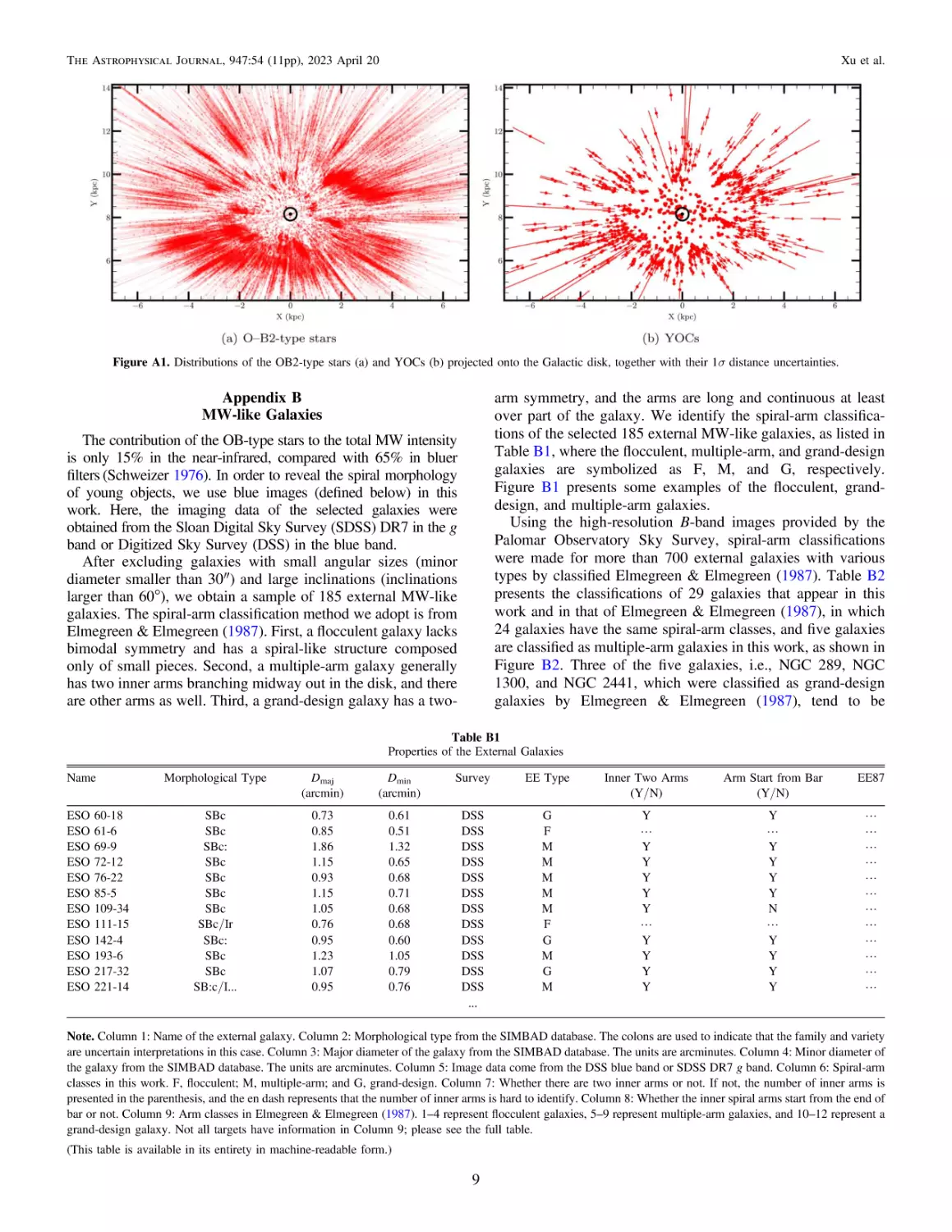
Figure A1 displays the distributions of the OB2 stars and
YOCs projected onto the Galactic plane.
8
The Astrophysical Journal, 947:54 (11pp), 2023 April 20
Xu et al.
Figure A1. Distributions of the OB2-type stars (a) and YOCs (b) projected onto the Galactic disk, together with their 1σ distance uncertainties.
arm symmetry, and the arms are long and continuous at least
over part of the galaxy. We identify the spiral-arm classifications of the selected 185 external MW-like galaxies, as listed in
Table B1, where the flocculent, multiple-arm, and grand-design
galaxies are symbolized as F, M, and G, respectively.
Figure B1 presents some examples of the flocculent, granddesign, and multiple-arm galaxies.
Using the high-resolution B-band images provided by the
Palomar Observatory Sky Survey, spiral-arm classifications
were made for more than 700 external galaxies with various
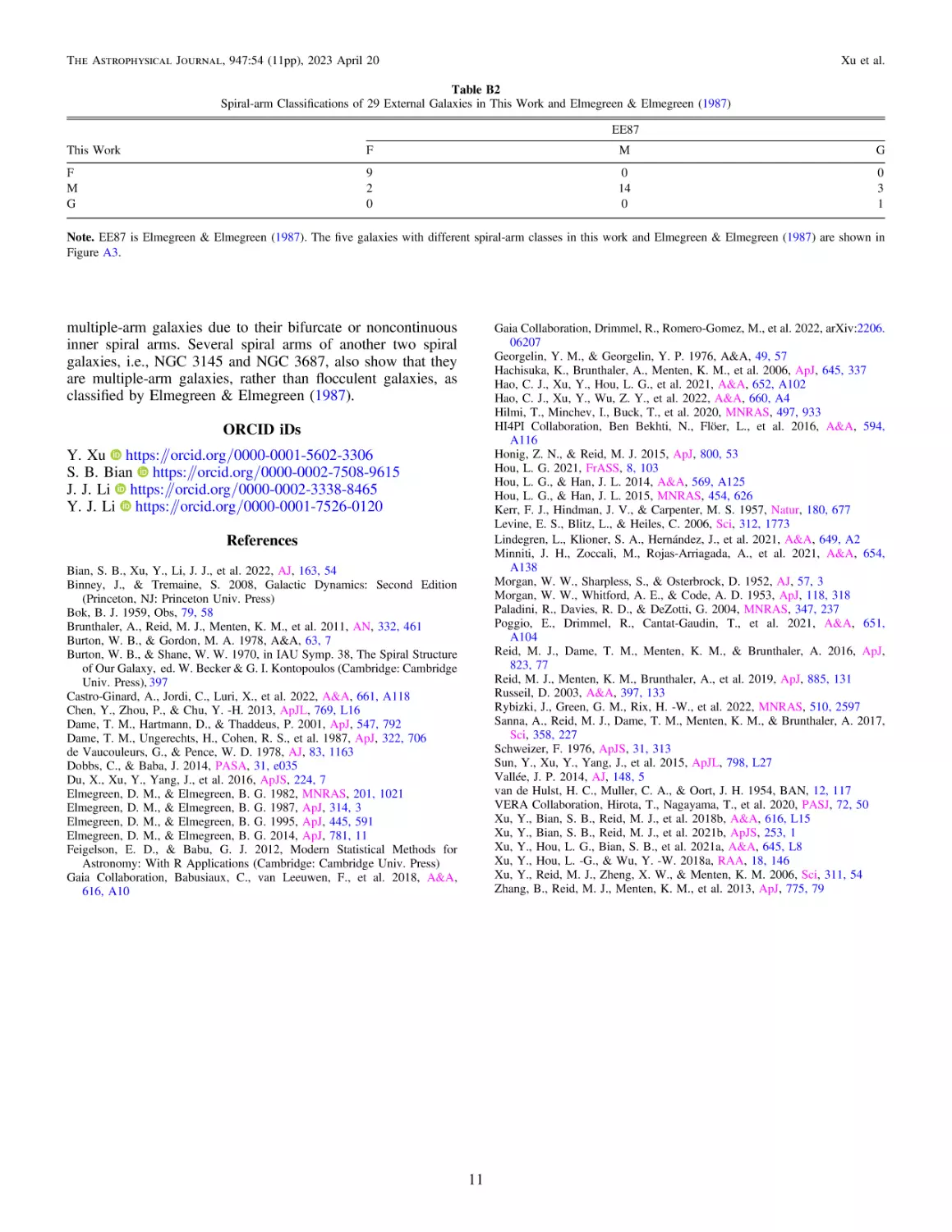
types by classified Elmegreen & Elmegreen (1987). Table B2
presents the classifications of 29 galaxies that appear in this
work and in that of Elmegreen & Elmegreen (1987), in which
24 galaxies have the same spiral-arm classes, and five galaxies
are classified as multiple-arm galaxies in this work, as shown in
Figure B2. Three of the five galaxies, i.e., NGC 289, NGC
1300, and NGC 2441, which were classified as grand-design
galaxies by Elmegreen & Elmegreen (1987), tend to be
Appendix B
MW-like Galaxies
The contribution of the OB-type stars to the total MW intensity
is only 15% in the near-infrared, compared with 65% in bluer
filters (Schweizer 1976). In order to reveal the spiral morphology
of young objects, we use blue images (defined below) in this
work. Here, the imaging data of the selected galaxies were
obtained from the Sloan Digital Sky Survey (SDSS) DR7 in the g
band or Digitized Sky Survey (DSS) in the blue band.
After excluding galaxies with small angular sizes (minor
diameter smaller than 30″) and large inclinations (inclinations
larger than 60°), we obtain a sample of 185 external MW-like
galaxies. The spiral-arm classification method we adopt is from
Elmegreen & Elmegreen (1987). First, a flocculent galaxy lacks
bimodal symmetry and has a spiral-like structure composed
only of small pieces. Second, a multiple-arm galaxy generally
has two inner arms branching midway out in the disk, and there
are other arms as well. Third, a grand-design galaxy has a two-
Table B1
Properties of the External Galaxies
Name
Morphological Type
Dmaj
(arcmin)
Dmin
(arcmin)
Survey
EE Type
Inner Two Arms
(Y/N)
Arm Start from Bar
(Y/N)
EE87
ESO
ESO
ESO
ESO
ESO
ESO
ESO
ESO
ESO
ESO
ESO
ESO
SBc
SBc
SBc:
SBc
SBc
SBc
SBc
SBc/Ir
SBc:
SBc
SBc
SB:c/I...
0.73
0.85
1.86
1.15
0.93
1.15
1.05
0.76
0.95
1.23
1.07
0.95
0.61
0.51
1.32
0.65
0.68
0.71
0.68
0.68
0.60
1.05
0.79
0.76
DSS
DSS
DSS
DSS
DSS
DSS
DSS
DSS
DSS
DSS
DSS
DSS
...
G
F
M
M
M
M
M
F
G
M
G
M
Y
L
Y
Y
Y
Y
Y
L
Y
Y
Y
Y
Y
L
Y
Y
Y
Y
N
L
Y
Y
Y
Y
L
L
L
L
L
L
L
L
L
L
L
L
60-18
61-6
69-9
72-12
76-22
85-5
109-34
111-15
142-4
193-6
217-32
221-14
Note. Column 1: Name of the external galaxy. Column 2: Morphological type from the SIMBAD database. The colons are used to indicate that the family and variety
are uncertain interpretations in this case. Column 3: Major diameter of the galaxy from the SIMBAD database. The units are arcminutes. Column 4: Minor diameter of
the galaxy from the SIMBAD database. The units are arcminutes. Column 5: Image data come from the DSS blue band or SDSS DR7 g band. Column 6: Spiral-arm
classes in this work. F, flocculent; M, multiple-arm; and G, grand-design. Column 7: Whether there are two inner arms or not. If not, the number of inner arms is
presented in the parenthesis, and the en dash represents that the number of inner arms is hard to identify. Column 8: Whether the inner spiral arms start from the end of
bar or not. Column 9: Arm classes in Elmegreen & Elmegreen (1987). 1–4 represent flocculent galaxies, 5–9 represent multiple-arm galaxies, and 10–12 represent a
grand-design galaxy. Not all targets have information in Column 9; please see the full table.
(This table is available in its entirety in machine-readable form.)
9
The Astrophysical Journal, 947:54 (11pp), 2023 April 20
Xu et al.
Figure B1. Examples of flocculent (a), multiple-arm (b), and grand-design (c) galaxies.
Figure B2. Images of galaxies with different spiral-arm classifications in this work and Elmegreen & Elmegreen (1987). (a) NGC 289 was classified as a granddesign galaxy by Elmegreen & Elmegreen (1987), while we can clearly identify the bifurcation of an inner arm in the middle bottom in the galaxy. Thus, we
classify NGC 289 as a multiple-arm galaxy. (b) NGC 1300 was classified as a grand-design galaxy by Elmegreen & Elmegreen (1987), while the two spiral arms
from the right side of the galactic bar are not continuous. Thus, we classify NGC 1300 as a multiple-arm galaxy, and this galaxy has inner three arms. (c) NGC
2441 clearly has several arms and is classified as a multiple-arm galaxy by us rather than a grand-design galaxy, as by Elmegreen & Elmegreen (1987). (d) NGC
3145 and (e) NGC 3687 also clearly have several arms and are classified as multiple-arm galaxies in this work rather than as flocculent galaxies, as by Elmegreen &
Elmegreen (1987).
10
The Astrophysical Journal, 947:54 (11pp), 2023 April 20
Xu et al.
Table B2
Spiral-arm Classifications of 29 External Galaxies in This Work and Elmegreen & Elmegreen (1987)
EE87
This Work
F
M
G
F
M
G
9
2
0
0
14
0
0
3
1
Note. EE87 is Elmegreen & Elmegreen (1987). The five galaxies with different spiral-arm classes in this work and Elmegreen & Elmegreen (1987) are shown in
Figure A3.
multiple-arm galaxies due to their bifurcate or noncontinuous
inner spiral arms. Several spiral arms of another two spiral
galaxies, i.e., NGC 3145 and NGC 3687, also show that they
are multiple-arm galaxies, rather than flocculent galaxies, as
classified by Elmegreen & Elmegreen (1987).
Gaia Collaboration, Drimmel, R., Romero-Gomez, M., et al. 2022, arXiv:2206.
06207
Georgelin, Y. M., & Georgelin, Y. P. 1976, A&A, 49, 57
Hachisuka, K., Brunthaler, A., Menten, K. M., et al. 2006, ApJ, 645, 337
Hao, C. J., Xu, Y., Hou, L. G., et al. 2021, A&A, 652, A102
Hao, C. J., Xu, Y., Wu, Z. Y., et al. 2022, A&A, 660, A4
Hilmi, T., Minchev, I., Buck, T., et al. 2020, MNRAS, 497, 933
HI4PI Collaboration, Ben Bekhti, N., Flöer, L., et al. 2016, A&A, 594,
A116
Honig, Z. N., & Reid, M. J. 2015, ApJ, 800, 53
Hou, L. G. 2021, FrASS, 8, 103
Hou, L. G., & Han, J. L. 2014, A&A, 569, A125
Hou, L. G., & Han, J. L. 2015, MNRAS, 454, 626
Kerr, F. J., Hindman, J. V., & Carpenter, M. S. 1957, Natur, 180, 677
Levine, E. S., Blitz, L., & Heiles, C. 2006, Sci, 312, 1773
Lindegren, L., Klioner, S. A., Hernández, J., et al. 2021, A&A, 649, A2
Minniti, J. H., Zoccali, M., Rojas-Arriagada, A., et al. 2021, A&A, 654,
A138
Morgan, W. W., Sharpless, S., & Osterbrock, D. 1952, AJ, 57, 3
Morgan, W. W., Whitford, A. E., & Code, A. D. 1953, ApJ, 118, 318
Paladini, R., Davies, R. D., & DeZotti, G. 2004, MNRAS, 347, 237
Poggio, E., Drimmel, R., Cantat-Gaudin, T., et al. 2021, A&A, 651,
A104
Reid, M. J., Dame, T. M., Menten, K. M., & Brunthaler, A. 2016, ApJ,
823, 77
Reid, M. J., Menten, K. M., Brunthaler, A., et al. 2019, ApJ, 885, 131
Russeil, D. 2003, A&A, 397, 133
Rybizki, J., Green, G. M., Rix, H. -W., et al. 2022, MNRAS, 510, 2597
Sanna, A., Reid, M. J., Dame, T. M., Menten, K. M., & Brunthaler, A. 2017,
Sci, 358, 227
Schweizer, F. 1976, ApJS, 31, 313
Sun, Y., Xu, Y., Yang, J., et al. 2015, ApJL, 798, L27
Vallée, J. P. 2014, AJ, 148, 5
van de Hulst, H. C., Muller, C. A., & Oort, J. H. 1954, BAN, 12, 117
VERA Collaboration, Hirota, T., Nagayama, T., et al. 2020, PASJ, 72, 50
Xu, Y., Bian, S. B., Reid, M. J., et al. 2018b, A&A, 616, L15
Xu, Y., Bian, S. B., Reid, M. J., et al. 2021b, ApJS, 253, 1
Xu, Y., Hou, L. G., Bian, S. B., et al. 2021a, A&A, 645, L8
Xu, Y., Hou, L. -G., & Wu, Y. -W. 2018a, RAA, 18, 146
Xu, Y., Reid, M. J., Zheng, X. W., & Menten, K. M. 2006, Sci, 311, 54
Zhang, B., Reid, M. J., Menten, K. M., et al. 2013, ApJ, 775, 79
ORCID iDs
Y. Xu https://orcid.org/0000-0001-5602-3306
S. B. Bian https://orcid.org/0000-0002-7508-9615
J. J. Li https://orcid.org/0000-0002-3338-8465
Y. J. Li https://orcid.org/0000-0001-7526-0120
References
Bian, S. B., Xu, Y., Li, J. J., et al. 2022, AJ, 163, 54
Binney, J., & Tremaine, S. 2008, Galactic Dynamics: Second Edition
(Princeton, NJ: Princeton Univ. Press)
Bok, B. J. 1959, Obs, 79, 58
Brunthaler, A., Reid, M. J., Menten, K. M., et al. 2011, AN, 332, 461
Burton, W. B., & Gordon, M. A. 1978, A&A, 63, 7
Burton, W. B., & Shane, W. W. 1970, in IAU Symp. 38, The Spiral Structure
of Our Galaxy, ed. W. Becker & G. I. Kontopoulos (Cambridge: Cambridge
Univ. Press), 397
Castro-Ginard, A., Jordi, C., Luri, X., et al. 2022, A&A, 661, A118
Chen, Y., Zhou, P., & Chu, Y. -H. 2013, ApJL, 769, L16
Dame, T. M., Hartmann, D., & Thaddeus, P. 2001, ApJ, 547, 792
Dame, T. M., Ungerechts, H., Cohen, R. S., et al. 1987, ApJ, 322, 706
de Vaucouleurs, G., & Pence, W. D. 1978, AJ, 83, 1163
Dobbs, C., & Baba, J. 2014, PASA, 31, e035
Du, X., Xu, Y., Yang, J., et al. 2016, ApJS, 224, 7
Elmegreen, D. M., & Elmegreen, B. G. 1982, MNRAS, 201, 1021
Elmegreen, D. M., & Elmegreen, B. G. 1987, ApJ, 314, 3
Elmegreen, D. M., & Elmegreen, B. G. 1995, ApJ, 445, 591
Elmegreen, D. M., & Elmegreen, B. G. 2014, ApJ, 781, 11
Feigelson, E. D., & Babu, G. J. 2012, Modern Statistical Methods for
Astronomy: With R Applications (Cambridge: Cambridge Univ. Press)
Gaia Collaboration, Babusiaux, C., van Leeuwen, F., et al. 2018, A&A,
616, A10
11