/
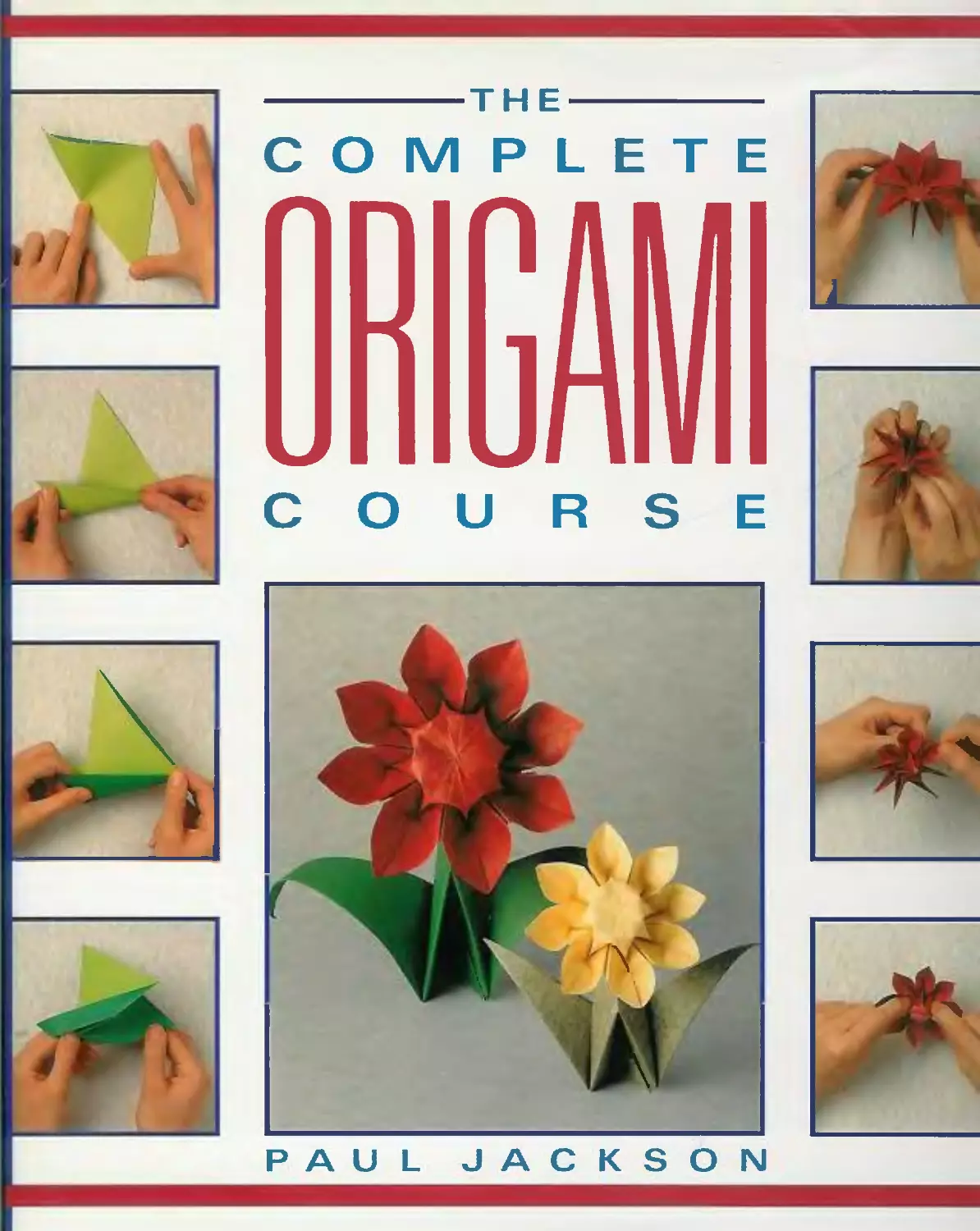


Автор: Jackson P.
Теги: origami handicrafts paper crafts handicrafts and creativity
ISBN: 0-831-727-926
Год: 1989


Текст
                    THE
PAUL JACKSON


THE COMPLETE
ORIGAMI
COURSE
Paul Jackson
AL
CALLERY BOOKS
An imprint of W.H. Sm th Publishers Inc.
112 Madison Avenue
New York City 10016
CONTENTS
First published in Great Brita in in 1989 by
The Hamlyn Publishing Group L’mited,
a division of the Octocus PublishingGroup,
Michelin House. SIFu'ham Road,
London SW36RB
This edition published in 1989 by Gal lery Books
An imprint of W.H. Smith Publishers Inc.
112 Madison Avenue,
N ew Yo rk C i ty 10 016
Text © 1989 Paul Jackson
I lustrations and design © 1989
The Hamlyn Publishing Group Limited
ISBN 0-831-727-926
Produced by Mandarin Offset-printed in Hong Kong
ACKNOWLEDGMENTS
Editor Mary-Clare Jerram
Art Editor Bob Gordon
Copy Editor Suzy Fowling
Designer Patrick Nugent
Production Controller Garry Lewis
Photographer Mark Harwood
Artists Anthony Duke. Steve Pearse. Dave Sexton
Howto use this book 6
About origami	7
Papers	8
Getting started 11
Howto make a square 12
Starting to fold 15
How to fol low the
diagrams	20
Valley/mountain
designs	23
Chinese glider	25
Multi box	27
Swan	33
Christmas decoration 36
Fan	38
Back-to-front serviette 40
Letterfold	42
Flying eagle	43
Pistol	46
Japanese box	48
Robot	51
Santa Claus	57
Mouse	60
Bracelet	62
Weave patterns	64
Goldfish	68
Squash fold designs 71
Puppy	75
Crown	78
Flower	80
False nose and
moustache	82
Strawberry	84
Inside and outside
reverse fold designs 87
Four feeding bi rds	93
Snail	95
Butterfly ring	96
Monkeys	98
Reverse fold
alphabet	100
Six-pointed star	105
Fallen leaves	108
Petal fold designs	109
Two flapping birds	113
Moustache	115
Pentagonal flower	118
Pre-crease designs	121
Bookmark	122
Cubic box	123
Bugatti	125
Sink fold designs	131
Three boats	136
Hyperbolic parabola 138
Ten-pointed star	142
Projects	145
Sprung frame	146
Heads	148
Yacht	150
Octagonal flower
and stem	152
Keys on a ring	155
Mouse	161
Cassette case	163
Sweet dish	166
Spectacles	168
Sleigh	170
Table of symbols	173
Acknowledgments	176
6
о
R
I
G
A
HOW TO USE THIS BOOK
Unlike previously published books on origami,
this one is a complete course on paperfold-
ing. It begins by carefully explaining the rudi-
ments of folding, then takes the reader through
the basic techniques and ends with a chapter of
difficult designs. Each chapter presents a new
technique illustrated with exercises and
designs to fold.
To get the most pleasure from the book, it is
important to start at the beginning. You are
advised not to jump backwards and forwards
too much unless you can follow the instructions
without much guidance. If you do not want to
make all the designs in every chapter, at least
make the basic examples and do the exercises
so that you are familiar with the techniques.
Learn the symbols and refer to the Table of sym-
bols at the back if you forget what they mean.
Not everyone will be able to fold the more
complex designs. For this reason, the opening
chapter of valley/mountain designs is extended
so that the less able student can fold a lot of
simple designs and appreciate the pleasures of
folding paper.
Before starting to fold, read the introductory
sections giving advice on which papers to use
and explaining the best methods of folding.
When you come to the end of this book, you
may want to find out more about origami. Most
libraries and book shops stock booKS on the
subject. However, be careful. Some of the
books are badly written and should be avoided.
Disregard those which cannot explain simple
designs in a simple way. Avoid books for chil-
dren written in poor English which look as if they
came from the Far East. The designs are usually
very complicated and badly explained.
Thankfully, though, there are a large number
of wonderful origami books, many in English, by
authors such as Harbin. Kenneway and Rand-
lett. More and more books are being published
and the standard is consistently high. Some
containa large number of very complex designs
so if you want to make simple models, sift
through the pages with care.
Japanese and Oriental import shops in large
cities often sell very good books, usually in
Japanese. Remember that even though the lan-
guage may be foreign, the symbols are the
same as in English books, so you should be
able to follow the instructions. Ask for books by
Yoshizawa, Kasahara, Takahama, Momotani or
Fuse. They are all superb and some are in
English translations.
If you want to join a club, two addresses of
origami societies are given below. They are
both friendly, inexpensive and caterwell forthe
inexperienced enthusiast. The BOS in Britain is
more international than the Friends in the
United States, and is a major publishing house
for new designs, information and theory. The
Friends are concerned more with the learning
and teaching of origami. Both organize annual
conventions, send out informative newsletters
and carry a wide range of books and papers for
sale to members only.
The British Origami Society
253 Park Lane
Poynton
Cheshire SK121RH
The Friends of the Origami Center of Amei ica
15 West 77th Street
New York City
NY 10024
USA
7
ABOUTORIGAMI
Tne art of paperfolding begins with the inven-
tion of paper. The Chinese were the first to
make paper, certainly during the 2nd century
AD and perhaps before, but no folded designs
have survived from these earliest times. The
process of papermaking remained a secret un-
hl the Chinese invaded Korea, and later Japan,
in 610 AD, after which the knowledge spread
westwards through Asia and the Middle East,
eventually reaching Europe in about 1150.
The Japanese quickly refined and extended
tne process of making paper until the material
became an integral part of their everyday lives.
There has been much speculation as to why this
was so. It has been suggested that the humidity
of the Japanese islands is particularly favour-
able to the drying of paper; other possible con-
tributory factors include its soft water, the
avalJability of particular reeds and bushes with
remarkably long fibres which bond to form very
strong paper, the lack of other natuial
resources on the islands with which to make
clothes, sacks, screens and other essentials
and the enthusiasm of the Japanese people for
intense physical activity (papermaking can be
exhausting). Whatever the reasons for its adop-
tion by the Japanese, paper became and
remains more important and more revered than
it has ever been in the West.
The oldest known designs of folded paper are
of Japanese origin, from an uncertain date
before 1000 AD, perhaps much earlier. Several
dozen designs have survived into the modern
era and were important in establishing the
basic vocabulary of the art. In acknowledgment
of this. Western paperfolders have adopted the
Japanese word ’origami' fortheir art.
For several generations, however, between
the mid-1800s and the 1930s. origami almost
became a lost art. The imposition of Western
values on Japanese culture, brought about
through Japan's new policy of open trade,
meant that many indigenous arts declined. Ori-
gami survived by mothers teaching it to their
children, but the symbolic meanings behind
many of the designs were lost and origami
became no more than an amusement.
In the West, simple folded shapes had been
known for many years, perhaps even for centur-
ies; no one can be sure. The Victorians certainly
knew the Triangular hat that becomes a boat,
the Paper dart. Fortune teller and a few others,
and were introduced to more complex Japanese
designs by a troupe of Japanese conjurors who
toured Europe in the 1860s. In Spain, the tradi-
tional Pajarita (Sparrow). folded from a square,
had been known for many years.
In Japan during the 1930s. a young engineer,
Akira Yoshizawa, experimented with traditional
designs and found that he could invent many
designs of his own. His belief that origami was
a creative art with boundless possibilities
gained an increasing number of followers. To-
day origami is a respected creative art form in
Japan. There are hundreds of books, dozens of
creative designers, a numberof regular periodi-
cals and spectacular exhibitions of new work.
Fittingly. Yoshizawa has been made a Living
Treasure, the highest honour that Japan can
give an artist, though he remains somewhat
aloof.
In the West, a slow trickle of books or chap-
ters in books appeared during the first half of
this century, giving instructions for the simple
folds that were then known. In the early 1950s a
South African-born stage illusionist and magi-
cian resident in England, Robert Harbin,
became very interested in paperfolding. His
new creative work led to the first serious book to
appear in the West, Paper Magic. The book
inspired others to create, and established a
network of creative paperfolders outside Japan.
Contacts were soon made with Japan and the
word 'origami' replaced 'paperfolding’. Further
books by Harbin and the American Sam Rand-
lett popularized the art and its new name. In
1967 the British Origami Society was formed,
the first of ten or more societies now found
outside Japan.
Today, origami has a wide appeal far
removed from its old image as an inconsequen-
tial diversion for bored schoolboys. It is used in
the media, taught in schools, employed as a
therapy for people with damaged hands and is
studied by mathematicians and designers.
There are many books devoted to the subject
and a growing number of courses. A few people
even earn thei r I i vi ng from origam i.
What is its appeal? Most importantly, it is an
art that anyone can do anywhere, anytime. All
that is needed is a piece of paper and a pair of
hands. What could be simpler? Therein lies the
fascination of the art — making something
beautiful or clever from a substance as every-
day as paper, using no tools or machinery. The
richness of the art comes from its purity.
0
R
/
G
4
о
R
I
G
A
PAPER
Origami paper would seem to be the natural
choice for paper folding. However, it is not
always possible to find packets of origami
paper (the sheets of which are coloured on one
side and white on the reverse), particularly if
you live away from a large city. Japanese import
shops usually sell it, as do good art and craft
shops and the occasional toyshop, but it is not
widely available. If you can find a shop that
sells it then buy some, but it is better not to
depend on it. In any case, origami paper is rela-
tively expensive and has the unnerving ability to
make almost everything folded with it look
rather gaudy. Nevertheless, origami paper can
somelimes be appropriate, particularly for
geometric designs where strong colour is often
important.
Instead, think of paper in two ways: paper for
practice and paper for display. For practice, any
cheap paper that will take a crease without
cracking is ideal. The list could include typing
paper, photocopy paper, computer paper, writ-
ing paper, brown wrapping paper and even
pages cut from a magazine if nothing else is to
hand. Avoid folding newspapers, paper towels,
soft lavatory paper, tissues or paper used in
duplicating machines None of these papers
holds a crease very well and they all crack or
tear easily. Typing, photocopy and computer
paper can be bought very cheaply in bulk from a
printer and a batch will keep you in practice
paper almost for ever. Use practice papers
when you aie unfamiliar with a design and want
to understand howto make it.
The fun starts with choosing display papers!
The introductory paragraphs to each design
PAPER
suggest papers to use and you should follow
the advice, or you might fold with a paper that is
too thin or too thick for that design. However,
there is room for experimentation and you may
w ish to try papers other than those suggested.
The best place to look for these more exotic
types of paper is in an ad: or craft shop. Large
cities sometimes have shops which specialize
in selling paper and these are definitely worth a
visit. A good art or craft shop will stock a sur-
prisingly wide range of papers. In particular,
look for capers that have a textured or decora-
tive surface Other good papers include pastel
paper, drawing paper, thin watercolour paper,
coloured printing papers and any other paper
that can hold a crease without cracking or tear-
ing. Paper with a coloured coated surface that
flakes off at the crease when folded is unsuit-
able. If you want a paper with a different colour
on the two sides, buy gift-wrap paperfrom a sta-
tionery shop. Here you may also find paper-
backed metallic foil, either by the sheet or in a
long roll. Use it very sparingly, never for ani
magazine cover
Two-toneori garni paper (Cl has
different col ours on the front and
reverse sides: decorahve origami
paper (D) has traditional Japanese
patterns on one side and is white
on the other side: and origami
paper<E) is coloured ononeside
but white on the reverse.
mais. Experiment also with hand-made paper,
wallpaper, old posters and any other paper that
looks interesting. However, avoid papers which
are too beautiful or which have a very' strident
pattern on them - the folded design is over-
powered by such papers, so that the eye takes
in the paper, not the origami. Also avoid fold-
ing card, papers coated on one side with a col-
oured pigment (poster paper) and papers with a
shiny surface. They all crack.
Sometimes, the introductory paragraphs to
the designs suggest that you use thin, medium
or heavy (thick) paper. Paper weight is a com-
plex subject, made doubly so because the
United States has a system different to that of
other countries, using pounds as opposed to
grammes. So, to keep it simple; thin means
paper such as airmail paper, undercopy (bank)
typing paper or tissue: medium means any
paper about as thick as a page in this book, or
slightly thinner or thicker, but not by much;
thick means any paper as thick as a glossy

0
R
I
G
A

GETTING STARTED
Before trying the various origami folds and projects, it pays to master
a few very basic techniques The first of these is making a square.
Most of the designs in this book are folded from squares of paper but
few types of paper can be bought i n this shape so it helps to be able to
make a square accurately.
Next you can move on to the technique of folding. An origami design
will never look attractive if it has been folded badly—it is important to
learn how to move your hands correctly. And finally there is the origami
language itself-understanding how to follow the diagrams used in
this book, and indeed the vast majority of origami publications around
the world.

GETTING STARTED
0
R
I
G
A
HOW TO MAKE A SQUARE
Here are four methods that enable
you to make a square from any
oblong. Whichever you choose,
trim off the excess paper with
great care-nothing in origami is
SIMPLE METHOD
11 Bring the top rignt-nai id corner
down to the left-hand side of the
paper to form a triangle with an
oblong strip beneath it . . .
j
[3J Removetheoblongmoneof
the ways described below and
ooen up the triangle . .
more frustrat ng than trying to fold
a nearly square square! If the
diagrams are a little confusing,
check the symbols against the
Table of symbolson pages 173-5.
[2I . . like this
[4] . .togiveaperfectsquare.
In Step 2 there are four basic ways
to separate the triangle from the
remainder of the paper beneath it:
Scissors
Use a large pairand cut very
carefully along the bottom of the
triangle.
Craft Knife
Lay one edge of a ru ler along the
bottom edge of the triangle and
cut through the paperwith a craft
knife, pressing against the edge of
thornier. Make sure you place the
paper on a suitable cutting
surface, such as a sheet of thick
card - or your best polished table
might be sliced to shreds!
Non-serraied Ki ichen Knife
This is the neatest and quickest
method. Make a fold across the
bottom of thetriangle. Lay the
paper against a hard, level surface
and slice along the length of the
fold in a few bold strokes of the
knife, with the blade up between
the layers. This method may take a
little practice, but is the best. A
serrated knife wil I not cut the
paper cleanly.
Tearing
Not recommended, but
acceptable if none of the above
methods are possible. For best
results, bend the crease
backwards and forwards several
times before tearing, creasing
very'firmly each time. Thiswill
considerably weaken the paper
and make tearing easier
HOW ТО МАЙЕ A SQUARE
13
NO-CREASE METHOD
The S'rnple method described
cbove is very efficient, but leaves
a diagonal crease on the paper
which you may not want. There is
an alternative, ingenious method
that leaves the paperquite
smooth.
О
R
I
G
Л
[2| Layitagainstthesideofthe
sheetand mark the sheetwhere it
touches corner В
5 The square is uncreased.
4 Make a crease across the
paper from X and trim off the lower
portion using any of the
suggestions in the Simple
method.
14
GETTING STARTED
0
R
I
G
A
DAMAGEDSHEET
METHOD
Some large sheets of paper will
have damaged edges, which
means that the square has to be
formed entirely within the sheet.
Щ Trimofftheexcess, usingany
of the techniques suggested in the
Simple method.
[I Unfold.
GUILLOTINE METHOD
This is the easiest method
because you don't need to cut the
paper at all - somebody else does
itforyou!
The smart way to buy paper is
not to get a thin packet of 20
sheets from a stationery shop. but
to buy a ream (500 sheets) of
photocopying or typing paper from
a photocopy shop or small printer.
Buying these sorts of paper in bulk
is much less expensive and the
shop or printer will guillotine it
perfectly square for a small
additional sum. A ream costs
about the same as five or six
packets of 20 sheets.
E
STARTING TO FOLD
15
STARTING TO FOLD
S: ~ - people say they cannot use
--- '-gnos. They believe that
. z paoerwill be difficult and
~::o easurable. This isn’t true!
эт folding as a ‘paper ballet’
- л~ ch the hands move
g =:е;иИу in large, controlled
-: .ernents. Try not to let your
-gersoattlewith the paper.
-e =  tnem. Let them move slowly
=- с л th deliberation. Pape'is
se-suousandyieldingand
•esoonas to a caring touch, so do
e: your hands move in an
-sensitive way.
-eople start to practise origami
: e cause they want to make
 .-.ers and gifts for friends. orfor
S-. г umber of other reasons. Few
can because they want to enjoy
—ecrocess of folding, almost
-=ga rd I ess of th e f i n ished design.
vest expens would agree,
 -.-.ever, that with experience and
t-e understanding that it brings,
i' garni becomes a folding art, not
a ‘olced art. To quote the familiar
ocrase. 'it is better to travel than to
.e‘. With this in mind, givea
n etimeand thought to the
process of folding.
For folding to give you pleasure,
t $ important not only that you
- now howto fold. but also that the
sequence itself should be
о easurable. It should be direct,
e. egant flowing and contain no
"elevant creases, bulky layers or
clumsy techniques Agooo design
seems ’obvious' when it has been
folded. Somehow it seems to have
been in the paper al I the time,
.•siting to be discovered, rather
•.ran created. By comparison, a
boordesign seems contrived,
emerging from the paper only with
some effort.
The quality of the sequences
can be assessed when you come
to fold the designs later in the
book. This chapter starts by
zutl in i ng some of the basic ways in
.••nich the paper should be
nandled. It is important to learn
them-they will simplify folding for
.ou and make it a pleasure.
Folding is often made simpler if
. ou rest your paper on a hard, level
surface, such as a table drawing
board or hard-backed book.
Folding on a soft surface such as
on your lap or on a carpet, is not
recommended. Having said that,
experts like to fold everything in
the air. Manipulating paper
entirely within the hands is
certainly very enjoyable, but it can
also be very difficult. Nevertheless
there will be times when, even asa
beginner, you will need to pick up
the paper to fold it. particularly
towards the end of a design when
you are putting in the smal ler
folds. These smallerfoldsare
usuallyeasytomakeintheair, but
the long, early folds which are a
feature of most designs are more
difficult. Here are some
suggestions for howto crease
them. Study the hand positions
carefully and practise the
exercises. Sit comfortably. These
are the basic folds.
CREASING A DIAGONAL
[1] Rest the paper on a hard, level
surface so that a corner is pointing
towards you. Pick up the corner
and move it up to the top
corner . . .
fa] . . . like this. Move it about
until the two corners are exactly
aligned. Don't rush!
0
R
I
G
A
3 Hold the corners together with
one hand. With the other, run the
forefinger down the triangle.
pressing hard . Continue . . .
0-  . to the bottom edge. then
run the finger along to the right,
making a crease.
|5] Run the finger back a long the
bottom edge to the other corner...
6 . . . completing the crease.
Check that the top corners are still
aligned.
GETTING STARTED
CREASING A BOOK FOLD
0
R
I
G
A
ГГ A book fold is so cal led
because it folds the paper in naif
to look like a oook. Rest the paper
on a hard, 'evel surface so that an
edge is near you With a hand at
each corner, bf: up that edge and
move it to the top edge . . .
,2, . . like this. Handsortop.
move the top layer to and fro until
both the left and right corners are
exactlyaligrcd Don’trush!


, 31 With one hard, hold the top
edges firmly together and sl.de the
foref nger of the other f rmiydovvn
the centre of the paper . .
1 . . to the bottom edge. Run
yourfingeral ongthe bottom edge
to the left and right . .
TIPS
с Махе a crease in one flowing sequence of
hand movements, rather than a lot of stop-
start. jerky ones. The crease will look better
and you will enjoy the activity more.
о Press each crease firmly.
о Being able to make a good diagonal or
book fold is very important If they are made
inaccurately, every/other crease that follows
willalsobe inaccurate. Take your time with
these folds. Get them right.
[5^ . . completing the cease.
Checkthat the top corners are sti I
aligned.
STARTING TO FOLD
17
THE HORIZONTAL-FOLD RULE
Always pick up the paper by the
nearest edge or corner and fold it
away from your body, making the
crease across the bottom of the
paper. This is quicker and more
accurate than folding the paper
from left to right, right to left or in
any other direction.
To see foryourself, tryfo.ding
diagonal creases by moving the
paper in tour different directions
as shown here. The one label'ed
'correct' should be the easiest.
0
R
I
ncomect
incorrect
18
GETTING STARTED
О
/?
/
G
А
The diagrams in the cook wil I not
always show a horizontal crease
like this:
Practise the turning exercise
shown below. Make the diagonal
and book foldcreasesfollowing
the methods which were shown
on pages 15-6.
The crease might he shown
So the rule is: turn the paper
around from one crease to the next
so that you can always make the
next crease horizontally across the
bottom of the paper.
HI
STARTING TO FOLD
FINAL CHECKS
Before starting to fold a design or
designs, check that you'
preparations are coi rect.
В
Paper
Is the sheet the correct weight and
size for your chosen design'’
Where it is important, the
instructionswill specify precisely
what you need. Iftheydorot.
choose your own paper
Shape
Is the paper exactly square? If not.
re-trim it.
Surface
Is the surface you are fold irg on
level and flat"7
Folding
Are youfamiliarwith the correct
ways to make the diagonal and
book folds and do you know howto
rotate the paper following the
Horizontal fold ru‘e?
Posture
Are yousittirgcomfortab y? This
may seem a silly question, but a
comfortable chair a table at a
good he>ght and a straight back al I
help to make fo’dlng more
enjoyable.
Од]
An EXT ION
To get the most pleasure *rom
folding, you must give it close
attent.on. Gentte music in the
background may not be
distracting, but the television
almost certainly wil be Turrito'f

GETTING STARTED
HOW TO FOLLOW THE
DIAGRAMS
Diagrams are a* the heart of a
book about origami. No matter
how simple a design, a confusing
sequence of diagrams can make it
unintelligible. Whata good
diagra n must do is show a three-
dimensional sheet of folding
paperwhichisalwaysmoving, ina
small number of two-dimensional,
static diagrams.
During the last few decades, a
system of terms and symbols has
evolved which, as a result of much
experimentation, has been shown
to be both clear and concise. This
system is now standard and is
used m almost al I good origami
books. If you learn the symbols
and techniques in this book you
will be able to fold fromalmost any
origami book in any language.
Each step in a diagram contains
al I the information yo j need to
progiesstothe next ore. If you
becomestuck. don t panic! Unfold
the paperback to a point that you
feel confident is correct. Refold
from that point, paying very close
attention to all the symbols and
readmgaf/ihe instructions Have
you perhaps folded two layers
when it should have been one?
Have you made a mountain when it
should have been a reverse? Did
you forget to turn the paper over? If
you are still stuck, unsold the
paper to a point even further back
n the scoucnce: the most
mystifying errors are often made
near the start of a sequence.
This chapter i ntroduces the
basic diagrammatic conventions.
When a new symbol is introduced,
a few examples wil I be given to
clarify its meaning. If you skip a
few designs and come across an
unfamiliar symbo' which is rot
explained, turn to the Table of
symbols at the back of the book
(pages 173-5). Here the
unfami liar symbol wil be listed
with a page number showing
where it first appeared and was
explained.
THE VALLEY FOLD
The foid is cal led a valley because,
unfolded, the crease resembles a
valley indented into the paper, its
symbol is a dashed line.
It is the simplest technique in
origami and the most common.
Often it is referred to simply as a
fold or crease. So in this book you
will read instructions such as fold
A to B‘ rather than 'val ley fold A to
B. The word val ley is only used
when it is necessary to clarify
whether a fold is a val ley rather
than a mountain. (A mountain, the
opposite of a val ley, is i introduced
in the next chanter)
THE ARROW
The valley fold symbol of dashed
lines is often shown with an arrow
to indicate the direction in which
the paper moves when the fold is
made (seebelow):
Fold the paper upwards (or
downwards if the arrow points in
the opposite direction).
Fold the paper to the right (or to
the left if the arrow points in the
opposite direction).
HOWTO FOLLOW THE DIAGRAMS
21
THE LOOK-AHEAD RULE
sen following a sequence of
cgrams. before making a new
a it is often necessary to look
s-ead to the next diagram to
what the new folded shape
: >.s ike.
0
R
/
G
A
S-о. before making the fold in
Step 1. it ishelptul to lookahead
:: Step 2 to see what the shape of
:-epaperwill beafterthefoldhas
teen made. Then look back to
Step land make the fold. The
sequence may continue as fol lows:
Look at Step 4 before making the
•o d in Step 3. What shape are you
trying to make?
took at Step 6 before making the
•old in Step 5. Whatshaoe are you
trying to make?
in the six diagrams above right.
Steps 2 and 4 contain no symbols
to move the sequence forward. To
save space, these diagrams can
□e omitted, leaving just four
aiagrams.
\otice how Step 2 shows both the
new shape of the paper after the
Step 1 fold has been made, and
contains the instructions for the
new fold to make the Step 3
shape. Learn to look ahead.
22
GETTING STARTED
0
R
I
G
A
PAPER DART
Make a Paper dart to familiarize
yourself with the valley fold.
fl] Fold BD across to AC.
f3~| Fold corners A & В to the centre
crease. making a new corner at E.
|S, Fold edge El to EJ, folding
corner E in half . . .
141 Fold edges EF and EG to the
like this. Turn the paper
E
over.
centre crease. narrowing corner E.
181 Repeat on this side, folding EH
toEJ.
9 Open the wings.
Balance the dart in your hand and
throw gently.
VALLEY/MOUNTAIN DESIGNS
The mountain fold is the opposite ofthe valleyfold that was
introduced in the previous chapter. While a valley crease indents into
the pape>, a mountain crease rises up like a mountain ridge.
A mountain fold is the same as a valley the one is the other seen from
tl le revei se side of the sheet.
VALLEY/MOUNTAIiN DESIGNS
BASIC EXAMPLE
0
R
I
G
A
This is the mou Hainfeld symbol, a
long dash followed by two dots:
Like the val eyfold.it is often
accompanied by an arrow to
indicate the direction in which the
paper moves wnen the fold is
made. Note that the arrow is
different from the val ley fo d
arrow;
[2]. . . like this.
When a val ley fold is being made,
the part of the paper which moves
during folding moves to the front
but when a mountain fold isberng
made, the part which moves,
moves behind, see right.
A mountain fold is often
awkwa'dtomake bending the
paperbackwards is not easy. The
trick is to turn the paper over and
make a simnle va.leyfoid instead,
then turn it backovertothe front.
In the example (bottom right),
try to imagine the extra steps that
would beneedeo usingonlyvailey
fold symbo’s. if Step laid not
contai n a mountain fold symbol.
Though fundamentally the same
as a valley fold and awkward to do.
the mountain fold is primarily used
to reduce the number of diagrams
needed to explain a sequence of
folds.
CHINESE GLIDER
CHINESE GLIDER
T iis classic Ch nesegl derisone
/a smah number of similar
simpic gliders wh ch have short
oodies and wide wings These
characteristics make such a shape
’teat gracefully and slowly through
• he air. Compare its stately
oerformance with that of the
s eeker Paper dart (see page 22).
Use an oblong of strong, thin
.•.riting paper, typing paper or
similar paper.
TIP
0
R
I
G
A
Look carefully at all the steps
Follow the symbols and read
all the captions.
F 0
Make a mountarn crease down
the middle (or make a valley fold,
unfold, then lum the paper over so
that it becomes a mountain
13 Fold down E along GH
2 Fold in corners A&В to the
centre crease, making a
corner at E.
crease).
2в
VALLEY/MOUNTAIN DESIGNS
о
r
м
в Mountainfo'd in half. Notethe
direction of the arrow.
[ 71 From comer I. make a crease
which slopes gently away from
comer F. If you aren't sure exactly
where the crease should go. draw
a line on your paper copying the
diagram, then foldalongthe line.
й Repeatbehind withcornerj. To
fomn the crease, turn the paper
overand make a valley fold.
[9- Open out the wings . . .
10 . . tothisposrtion
111] The Chinese glider complete.
Ho'd at the point of ba lance and
throw level.
MULTI BOX
27
MULTI BOX
-ew origam. designs arc as
adaptable as this simolc
traditional box. Though the
sequence of stepswill remain the
same, the placement of some of
•fie folds can be changed to
produce an array of differently
proportioned boxes, some
sensible and practical, others very
зкагге. Learn the Basic box, then
experiment with some of the
.ariations which fo low. Use a
square of strong paper, even
paper-backed metallic foil.
BASIC BOX
f~3~| Fold AC & BD to the centre
crease.
[41 Turn back edges AC & BD. to
make two narrow hems identical in
width. Look ahead to Step 5 to see
what you are trying to fo'd.
5
'61 Turn in corners E: FG & H to
touch Step 4 creases Donotfo'd
them into the middle.
21
VALLEY/MOUNTAIN DESIGNS
0
R
I
G
A
17~| Crease and unfold across the
bottom of the EF triangles and
across the too of the GH ones.
[81 Refold the hems on top
OfEG&FH.
'16] likethis.	1111 Squeeze the corners to make
them square.
1121 The Basic box complete.
9
VARIATIONS ON THE
BASIC BOX
The crease pattern of the Basic
box can be summarized likethis
(see right).
Step 1 of the Basic box locates
the centre crease. It does not
matter whether this crease is
horizontal or vertical bccausea
square has four equal sides
However, if an oblong of paper is
used, the direction of the centre
crease does matter. The next two
projects show how you can create
different shaped boxes by altering
the direction of the centre crease.
T/P
Make a few more basic boxes
before trying the variations on
the following pages. Fix the
sequence in your mind so that
you can fold from memory.
This is easier than you might
think.
Made from waterproof
paper or kitchen foil, the box
will hold liquids without
leaking. Experiment, making
the box m a variety of weights
and sizes of paper, even
dampened card.
MULTI BOX
29
LONG CREASE BOX
0
R
/
G
A
30
VALLEY/MOUN7AIN DESIGNS
0
R
I
G
A
SHALLOW БОХ
In Step 3 of the Basic box, the
edges are folded to the centre,
but this need not be so. Here arc
three examples:
I
DEEP BOX
MULTI BOX
LEANING BOX
e
'?! The long sloping creases are
made only on the underneath
layer, noton the top.
DEEP HEMS
in Step 4 of the Basic box, the
nems are folded back by a shon
distance, but this need not
always be so. Here are three
exa pies:
32
VALLEY/MOUNTAIN DESIGNS
BOXON LEGS
О
R
I
G
A
41 If the 'legs' are weak, can you
think of a way to strengthen
them, perhaps by making them
two layers thick?
11 The long sloping creases are
made only on the underneath
layer, noton the top.
CREATIVE SUGGESTIONS
О Having seen that it is
possiole to move the folds on
a square of paper, or to use an
oblong of paoer instead of a
sauare. try to make other
boxes by combining two of the
above categories. For
example, can you create a
shallow box using the short
crease of an oblong sheet, a
leaning box with the long
crease. ora tall box rather like
a cereal packet? Experiment
as broadly as possible. Don 't
just try to make sensible
boxes, but see to what
extremes you can push the
Basic box, even to the point
where it isn't a box at all!
Perhaps also try turning it
upside down to make a hat.
What is the best shape fora
tightly fitting hat? Square?
Oblong? Deep? Can you make
a box with a slightly larger lid?
If so. is there a principle to
follow so that the lid will
always be a good fit over
the box?
c Origami is a truly creative
art. By asking yourself
interesting or awkward
questions like those above,
an ordinary design such as the
Multi box can be transformed
into an infinite variety of box-
like shapes. The most
intriguing results are often
achieved when you set out to
follow a theme, but do not
know what the end result will
look like. For example, what
would happen if the four
corners of rhe paper were not
all right angles?
SWAN
33
SWAN
The Swan is a popular subject
a m ong ere a t i ve oa per- fo I de rs.
This version is traditional and
per .apsthesimp.est.
Concentrate or maki ng a neat
point at the beak, so that the Swan
retains its elegant shape. It is
almost impossible to make a
perfectly neat point —the paper is
too thick and the spike too sharp - -
bet take your time in making it as
reat as possible. Use a square of
good quality white paper, not too
thick, for best results.
|~El] Crease and unfold a diagonal.
|21 Bring edges AC & AB in to the
centre crease .
diagonal crease. Keep A as sharp
as possib c.
[F Fo d A d<>wr to D.
0
R
I
G
A
г
34
VALLEY/MOUNTAIN DESIGNS
I 6 Fold backAa little way. (1 he
next drawing is bigger.)
3 Mountain fold in half through
all layers . .
NEW SYMBOL
/ NEW \
1 SYMSOU
< У
Ф
[si. . like this. Rotate the paper
to look like Step 9.
[s] Lift up the beak withafinger.
then . . .
means: the next drawing is bigger
NEW SYMBOL
means: rotate the paper
SWAN
35
10J . . squeeze the top of the
heaa flat to make a new crease.
The head will stay away from the
neck.
111J Similarly. hold the bottom of
the paperwith one hand and with
the other lift up theneck . . .
1З1 The Swan complete.
[141 A vacation is to open out the
nead and makea mountain/valley
pleat as shown, to create a
separate beak . .
1121. .like this. Squeeze the
bottom of the neck flat nearGH to
keep the neck in an upn ght
position.
15	. likethis Th.sisnot
particularly easy, but worth trying.
VALLEY/MOUNTAIN DESIGNS
CHRISTMAS DECORATION
Many geometric designs car' be
made from two or more identical
units. In origami th>s is known as
‘Mocfular folding' Purists argue
that us ng more than one sheet is.
strictly speaking, not origami but a
form of collage and that anything
made from a number of sheets can
also be maoe from a single sheet
Many enthusiasts would disagree
with this narrow definition of
origami and in recent years some
remarkable modular systems have
been created. Some systems arc
very complex, but the one here is
quite simple. The knack of locking
the two modules together is in
Step 8 arc is not immediately
obvious since t rel ies on tensions,
not flaps be ng tucked into
pockets, as is usual n modular
origami Use two pieces of
different coloured paper about 10
cm (4 in': square. This is one of my
own designs.
1 Beg-r with two squares as
described above
л) Crease and unfold the vertica I
diagonal.
3 Fo I d the othe r d i agona I. Leave
it folder!.
CHRISTMAS DECORATION
37
4] Folding both layers together,
start a valley crease at corner AD
so that edge ADC is brought to Iie
alongcreasrADE . . .
|_5|	. like this. Similarly,
mountain fold edge ADB behind (or
turn the paper over and make a
valley fold)
t The completed module. Make
another. Check that C & В and
G & H are neatly butted together -
this is important f ’nemodulesare
to merlock strongly.
8 htow the important part! The
decoration will not lock unless the
;our triangles В, C G and H area»
correctly positioned. Push corne-
H upwards so that it rests on top of
edge ADBand pushes backdown
against it Similarly push В
forwards to ie in front of edge HF.
Repeat behind with G & C. locking
the corners beh'nd the edges
Make sure the modu les are kept at
right angles to each other Whe n
all triangles are locked ir position,
the decoration wi I hold a stable
cross shepe under tension.
9 J The Christmas decoration
complete St spend by a thread
from one corner.
38
VALLEY/MOUNTAIN DESIGNS
О
R
I
G
A
FAN
This practical design is included
as an exercise in careful folding.
Make each crease very precisely,
taxi ng your time. Properly done.
Step 11 should be a neat row of
eciual cleats. In Steps 4-11. look
closely at the dots and decide
which edge is to be folded to which
crease before making a fold, as a
mistake at this stage may confuse
you later. Use an oblong of paper,
any size between 20 x 30 cm
(8 x 12 in) and 30 x 45 cm
(12 x 18 in). The paper should be
thin or of medium weight and will
look very attractive patterned or
□ecorated. I adapted this design
from the traditional fan.
A E
1 Fold edge AC across to BD
making crease EF. Unfold.
[з] Fold Eand Fin to the centre
crease Unfold both.
4^ Fold F up to the quarter crease.
Unfold, then . . .
[б]. . . fold Fup to the three-
qua-tercrease Unfold.
16! Similarly, fold E down to the
quarter crease. Unfold, then . .
FAN
39
Г?]. . foid Edown to the three
quarter crease. Unfold
[s] Th s is the crease pattern. The
paper is divided into eight equal
divisions, all valley creases.
Turn over
[9]. . . so that the creases areal'
mountains.
lo] Carefully place valley folds
midway between each mountain,
so that the paper pleats . . .
Ilj . likethis. Pull downedge
CD. unfolding the first valley.
1131 Fo d in F. Fold r the double
layer corner DC. locking together
the two halves of the pleats.
to the <ine of pleats.
40
VAL LEY/MOUNTAIN DESIGNS
0
R
I
G
A
BflCKTOFRONT
SERVIETTE
Sen/ietle-fo'dinggoes back
several centuries to an age when
European court banquets were
often decorated wi th very
elaborate pleated and starched
fabric des.gn$. some representing
animals. Since scant
documentation of these designs
has survived, we unfortunately do
not know how they were mace.
Serviette-fold mg was reinvented
in the nineteenth century by cooks
and restaurateurs and today
perhaps a hundred designs are
Known The- design shown here is
one of the lesser known folds. Like
al I serv ette folds it hoids its shape
betterwhen mace from thick 3-ply
paper serviettes, rather than the
thinner 1- or 2-ply ones. Tne key to
the design is a: Step 6-look
carefu ly at the lettered corners
and check Step 7 to see how the
shape transforms.
i An opened paper serviette will
already have a centre crease
Fold edges AB and CD to that
crease
[2] . . like this. 1 urn over.
Гз1 Fold up the bottom right-hand
corner, taking C and A with the
crease.
BACK-TO-FRONT SERVIETTE
41
0
R
/
G
A
4 Similarly, fblddown the top
left-hand corner. takingBand D
with the crease .
5 j likethis. Take careful note
of А. В. C. and D Turn over .The
next drawi ng is o.gger i
[б]	Fold edge EH up to GF. but
a 11 ow c or n er G to swi ve I
downwards. Look at Step 7 to see
where the lettered corners are.
[7]	Tuck F under corner G by
creasing from I to H. Leave corner
Cat the right. Lookahead'
f8j This 6 the new shape Turn
over.
[9]	Similarly, tuck E under corner
ri. by c teas- n g fro m К to J. Lea ve
corner В at the right.
[toj Pul I open the pocket between
I and K. Turn the design ups.de
down.
t-i I The Back to-frnni serviette
complete.
42
VALLEY/MOUNTAIN DESIGNS
О
к
I
G
A
LETTERFOLD
Many letterfolds and envelopes
have been developed in origami.
perhaps because it is an intriguing
technical challenge to try to create
pockets into which loose flapscan
be tucked. Some designs are too
fussy, others rathe rojll. out the
one shown here is simple and
wonderfulyelegant. Usean
oblong sheet of wri’ing paper. A
picture of the Letterfold appears
on page 1.
The DtsiGh isTpaditional
[T] Fold edge AC across to BD
Unfolo.
2 Fold in corner В to lie along the
centre crease
[з] Simi arly. fc id in cornerC.
[4] Fold one dot on tn tne other,
top left and bottom right.
sj Fold the dot at D on to the
other .
|6|	. I ike this. Unfold.
corner E
J5 Repeal Steps 510 7 with corner
A. tucking it under F. iThenext
drawing sbigger.)
[9] The Letterfoldcomplete.
1101 For extra safety, place a piece
of adhesive tape across the
middle.
CREATIVE SUGGESTION
Some paper-folders send
their mail using this
letterfold. . . so could you.
Write your letter on the inside
of the paper, fold it up and use
a printed name and address
sticker to hold the edges
together, as suggested in
Step 10. Write the recipient's
name and address on the
other side and stick on a
stamp. Voila!
FLYING EAGLE
43
FLYING EAGLE
Careful ly made, this design wil I
'lual a surprisingly long way. It
Goes not. of course, lookquitc like
a real eagle, but its slow glide
captures the grace of the bird.
Exper;inert with different ways of
holding the design for launch,
altering the speed at which it is
pushed and the angle of release,
as they will all affect its
performance. Use a sheet ofth n
paper, between 10 cm (4 in) and
20 cm (8 in) square.
Design e*John Smith (Engi /*п)
0
R
I
G
A
4, Tu rn over. rThe next drawing is
bigger.)
44
VALLEY/MOUNTAIN DESIGNS
[в] Refold the Steps crease.	Го] Unfold corner A (ifting it right
a 11 о wi n g A D t о f I i p flow n a ga i n	a wa у f ro m D
FLYING EAGLE
45
[ic Pleat D to be tne same width
as the thick bard behind it . . .
0
R
I
G
A
|T4 The Flyingeagle complete.
Hold as shown.
1151 Hold the bird h ghabove
you-" head and release it with a
gentle push ratherthan a throwing
action
46
VALLEY/MOUNTAIN DESIGNS
О
к
I
G
А
PISTOL
Few origami designs include
rolbngand bending-most arc
made only from straight creases.
This unusual traditional pistol also
has a unique lock which holds the
handle to the barrels, more akin to
macrame (st" ng knotting) than
origami Use two sheets of writing
paper, or a sim lar paper such as
typing paper or photocopy paper,
aoout20 x 30cm (8 x 12 in).
Start with two identical oblongs.
[1, Told one oblong m half.
bringi ng the long edges together
Then . . .
[2] . . . fold in half again . . .
[3] ..andagain!
[4] Bend A & В to the front, rather
like a shirt collar.
|~5~] Bend in the outer faces of the
collar marked X. so that the two X‘s
touch . . .
PISTOL
47
0
я
/
G
A
Fl | With the other oblong, lay a
pencil across a corner, and roll it
to the opposite corner to form a
tube, taking the pcncilwith it.
13~| Fold in half. This will slop the
tube unrolling
14 Feed barrel F through the front
twist in the handle and E through
the rear twist .
[б] . likethis. Push the barrels
through the handle as far as they
will go.
[~6~| The Pistol complete.
48
VALLEY/MOUNTAIN DESIGNS
О
R
I
JAPANESE BOX
Boxes abound in origami! Most are
basic, straight-sided boxes like
the Multi box ipages 27-32) held
together by an ingenious lock, but
this box is more decorative than
most. Use a square of strong paper
or paper-backed metallic foil
about 20 cm 18 mi square. I
designed this box with a shape the
same as a trad itiona I Japanese
box made from a 3 x 2 oblong, it is
folded by a completely different
method, however, and is an
adaptation of a traditional design
fora crown hat.
centre . .
2 Crease the other diagonal.
Unfold.
pt] . . like this. Turn the paper
over iThe next drawing is bigger.
JAPANESE BOX
49
Е
NEW SYMBOL
means: X-ray view
t \
I NEW \
ISYMBOl/
0
R
I
G
4
[5^ Fold the bottom edge hg up to
the centre crease. 1 ne dotted lines
show D behind When making the
crease, allow□ to flip downwards.
See the shape of Step 6.
71 Fold in the small triangles
[8] Unfolothem.
[б] Sim larly. fold edge FE to the
centre crease, allowing A to fl p
upwards.
111 Turn over.
|91 Refold, tucking the small
triangles unoerr.eath the b g
triangles.
10 Fold A&D to the centre
VALLEY/IV OUNTAI N DESIGNS
0
R
A<
[131 . . . likethis. Turn the paper [14] Open the pocket beneath
over. Rotate it. (The next drawing AD . .
s bigger.)
"12 ] Fold corners C & В to the
outside
&5]	. pulling it with a finger at
each side. As the pocket becomes
have separ ated Compare the
shape of the paper with Step 14.
1181 Open the pocket to a shape
midway between Steps 14 and 17.
The Japanese box complete
ROBOT
51
ROBOT
Don't be discouraged from making
this design just because it has a
great numberof steps All the
folds are easy to make and the
result is definitely worthwhile
keep a carefu I note of where you
are m a sequence. Watch the
lettered corners. Use three
squares of medium-weight paper.
The body and legsare made from
dentical squares. the head from a
square whose side shaifaslong
as the other squares. For example,
the body and legsquarescould
be 20 cm (8 in) and the head
square 10cm (4 in).
Design by Yoshihisa Kimura (Japan) .
BODYANDARMS
Begin with three squares as
described above.
[1] Take one square and fold A
down to D.
VALLEY/MOUNTAIN DESIGNS
[5] Fold C across to B. Unfold.
[3j Fold AD to the top edge
141 Turn the paper over.
th rds of the way down the crease.
Bring AD with it.
,7. Turn the paper over.
FolddownC&B (Thenext
drawing is bigger.)
9 Tuck the triangles inside.
[id] Foid uoC & В as shown . .

. and down again.
53
181 . . I ike this. Turn paper over
19 The Bodycomp'ctc.
D
VALLEY/MOUNTAIN DESIGNS
LEGS
f 11 Us.ng the second square.
begin with Step 1 of the body. Fold
C & В down to comer AD.
|~2~| Turn the paper over.
3 Fold AD to the top corner, but
pinchon'yatthecentre to locate
the middle of the shape.
5 Fold the (eft and right corners
to the centre.
ROBOT
55
0
R
I
G
A
| tn] Mountain fold the ver .ical
edges behind at 90
fl . . so that the completed
Legs can stand.
HEAD
В C
[1] Using the third, smallest,
square, begin. with Step 3 of the
Legs. Unfold AD.
crease just unfolded. Do not
[3] Fold up along the unfo’ded
crease.
В C
4 Fold the left and r ght corners
to the centre . . .
[5] . . .then fold the corners back
out to the edge
3 Turn the paper over.
5в
VALLEY/MOUNTAIN DESIGNS
Гв] Fold in c & B. folding one dot
on to the other, as shown.
[9] Fold up D to the centre.
10] Fold down the top corner as
shown, to a point a little below D
llj Fold the corner backup.as
shown
ASSEMBLY
12] Turn m the bottom corners.
113 j The back of the Head should
looklikethis Turn never.
114] The Head complete.
Body up between the layers at the
bottom of the Head. Balancethe
Body on the Legs. It might help to
glue them together.
2 The Robot complete.
SANTA CLAUS
57
SANTA CLAUS
This charming design makes full
use of both sides of the paperto
create a contrast between the red
costume and the white face and
edging. Many designs use this
two-colour effect, such as the False
nose and moustache (pages 82-3)
and the Bugatti (pages 125-30).
Use two identica I squares of thin
paper, red on one sioe and white
on the other, if such paper is not
available, folda red sheet and
white sheet back-to-back
Design by Yoshihide Momotani
(Japan).
0
/?
/
G
A
Щ Red side up, make a vertical
valley crease down themiddle.
Unfold.
2 Fold in edges AB & CD by a very
small amount.
13l Make crease EF one-third of
the way down the paper from edge
AB. Unfold.
NotepointX.Turn the paper
over.
5 Fold В to edge AC. so that the
crease passes through point X.
58
VALLEY/MOUNTAIN DESIGNS
0
R
A
M
7 Fold A across
6 Similarly fold F across to the
edge below X. so that the crease
runs into X. The next drawing is
[~8~| Fold dot to dot. Note that the
top o' the crease disappears
beneath the hood.
'~9~| Fold Г back across to create a
nose
'io' The Head and Body complete.
LEGS
1 Wnite sioe up. make a vertical
valley crease dcwr themiddle.
Untolc
2, Make crease EF one third of
the way down the paper from edgr
AB. Keep itfoloed
3 Mountain fold eoge CD
behind, in the same p ace as the
creases made i i Step 2 of the
Head and Body.
SANTACLAUS
59
5 Again fold dot to dot.
16 Tuck Ebehind.
CREATIVE SUGGESTION
The two halves of the
design can be brought
together in a variety of lively
positions. Make a frieze of
different Santas.
ASSEMBLY
[ 11 Tuck the Legs between the
layers of paper behind tie ch in.
21 The Santa Claus complete.
60
VALLEY/MOUNTAIN DESIGNS
0
R
/
G
A
MOUSE
Animals are often diff cult to
create using simple folds because
most have legs which have to be
engineered out of the paper
square. However, a mouse is a
compact shape and easier to fold.
Not surprisingly. it is a popular
subject among origami creators.
For my design here, use a square
of thin paper which has the same
coiour on both sides. A15 cm
(6 ir', square of paper wiI. make a
ife-sized mouse.
14] Fold C& В up to comer E.
[5 Fold single layer A to the
position shown.
Гз] Fold C & В down to AD. 'The
next drawing is bigger.)
Fold A up on top of CB.
MOUSE
61
1 NEW \
isymbol!
0
r
G
A
M
|~7~1 Mountain fold the 1ower edges
behino to make a sharp corner
atD. The easy way-you may
remember-is to turn the paper
over and make a valley fold. then
turn over aga.n to the front.
1101 Fold D back to the left, with
a crease rising vertica lly from
point G.
E Mountain 'old in half. Rotate
tne paper. (The next drawing is
bigger.)
[9] Fol JDacFoss to the right. so
that the crease drops vertically
from point F. forming a rignt angie
withedge DG.
12]	. likethis. FoldoackB&C.
14j The Mouse complete
13 Fo'dB&Cupwards. Curl the
mouse tail.
VALLEY/MOUNTAIN DESIGNS
0
R
I
G
A
BRACELET
The origins of tnis design are
obscure, but it is known that the
same lock Jbut made f'om a longer
strip) was used by poor children in
the Fast End of London early this
century to make large floor mats
out of old sweet wrapoers. This
version locksomy ina line and will
not expand widthways to form a
mat. Use sma II8 x 1 oblongs of
thin paper or foil, aoout
1C x 1.25cm (4x Уа in). Begin with
a number of 8 x 1 ob.ongs of two
colours, as described above
"11 Establish a centre crease
Lnfc d it. Fold A&Btopointsa
little way from the centre crease.
Do not ford them exactly to the
centre.
[2. FoldC across to D.
131 Th sis the completed modu c.
Simple!
4] Make another mod Je, but n
the second colour. Fold edge F in
between the layers at C, and F
in between the layers at D . . .
5 . . likethis.PulldownE&Fas
far as they wih go.
BRACELET
63
0
R
I
G
A
161 With a module of the first
colour, push G through the layers
atF. and H through the
layers at E . . .
G. and J through the layers at H.
pattern as often as necessary to
make the band the correct length.
[ tn| To lock the band into a ring,
fold a module to Step 3. then
unfold the creases at C & D.
leaving the centre crease folded.
Push this long module through an
ordinary module, asdescribed in
Step 4 tucking the ends of the
long module right into another
ordinary module Th s wil I lock the
band. Tucking the loose ends right
in can be difficult, so you may find
it easier to trim the ends of the
module, leaving less paner to tuck
n If the lock is weak, glue them in.
fli' The Bracelet complete
64
VALLEY/MOUNTAIN DESIGNS
0
R
I
G
A
WEAVE PATTERNS
Many people would like to create
their own designs hut th ink it
would be too difficult. This may be
true for some, but for many it is
possible to adapt an existing
technique to create new designs.
This is easier than creating a
brand new technique and often
leads to it Here then is a
traditional technique for creating
woven patterns which is infinitely
adaptable. Learn the basic
technique first, then progress to
the patterns suggested later,
before experimenting with your
own ideas or those in the Creative
Suggestions box. Use a strip of
duo paper (with different colours
or patterns on the two sides) about
2cm (% in) wide. Glue pieces
together to таке a strip as long as
is needed.
BASIC WEAVE BOOKMARK
11] Midway along the length of the
strip, fold AB at 45' to the strip so
that . . .
,4 .. like this. Valley fold the
coloured part of the strip to the
right along CE.
|2~i . . . the two parts of the strip
are at right angles (90: i to each
other. Do this by eye. or fold the
strip around the outside of a
square corner on a piece of paper.
Valley fold thecoloured part of the
strip across to the right, along AC
|~5~| Mountain fold from D. placing
the white part of the stripon top
otE
|31 Mountain fold a long CD.
bringing the white part of the strip
on top of corner C . .
va I ley f о I d i n g f i rst the co I ou red
pail to the right. then mountain
folding the white part on top.
WEAVE PATTERNS
5
TIP
Keep checking that all
angles are 90'
19] Fold up the white triangle.
glueing t to the coloured triangle.
IQ] The Bookmark complete.
3-D DECORATION
Hi Make a Bookmark as described
above. Fora longer decoration
weave a longer sti ip. Valley fold C
up to D and mountain fold D down
toC. A&Balsoswitcb position in
effect, the end square swivels
back-to-fronr. Look at Step 2.
[21 Similarly, swivel the second
square back-to-front. folding F up
to E and E down to F. CAand DB
switch position. Look at Steps.
[3~| RepeatwithG&H. Note that a
conti nuous slit is grow; ng along
the length of the strip.
66
VALLEY/MOUNTAIN DESIGNS
0
R
I
G
A

4 Repeat the swivel technique
along the length of the strip. Then
twist each swivel to I ie at 90’ to its
neighbours on either side . . .
[б| .to look like thisseen from
the end.
[б] 1 he 3-Ddecoration complete.
Hang it from a thread with lots of
others.
TURNING A CORNER
Weaving a straight strip is fur out
I imited. so here is an idea for
making the strip turn a corner.
Once you have mastered it, you
Mountain fold as shown.
121 Mountain fold the same part of
the strip again. Discing it on top of
the one beneath.
4	. then mountain . .
3]Valleyfoldasshown . .
WEAVE PATTERNS
67
2 This complex mat is made from
one continuous strip The mat is
five souares wide; odd-number
widths are easier to weave than
even-number widths.
ПГ, This mat is made using two
separately woven strips, notone.
Can you see the pattern?
15] . . .and repeal the
conventional valley/mountain
‘olding pattern to weave a straight
strip. Toturn another corner,
repeat Steps 1-4. A woven strip
can contain any number of
corners, regularly or irregularly
soaced.
WOVEN MATS
Strips, straighter zig-zag. are
I inear weaves-thai is. the weave
expands in just one direction.
forwards. Woven mats weave in
two directions, forwards a nd
sideways H ere a re * wo wo ve n
mats They are easier to make
than you might think. The key is to
fold them neatly.
CREATIVE SUGGESTIONS
о Weave a square frame.
c Weave a mat which bas
one corner elongating into a
strip.
о Weave a decorative snake.
о Weave fabric or tea ther
and make a belt to wear.
6 The example here shows a
woven strip contain! ng three
corners.
c /mprovise a fabulously
elaborate weave. combining
straight strips, cornersand
mats, all from one strip.
о Try to find a way of weaving
3-D patterns, not just flat ones,
c Weave a cube.
0
R
A
M
VALLEY/MOUNTAIN [ ESIGNS
0
R
I
G
A
GOLDFISH
There is someth ng undeniably
satisfying about making an
origami design wh ich inflates
when blown into, but sadly there
are very few of them. The best-
known is the waterbomb, which
children are apt to inflate, fill with
water and drop from a window' The
Goldfish has no such aggressive
purpose, though it does fol low the
same sequence as the waterbomb
up to Step 11. Use a 15-20 cm
(6—8 m) souare of thin or medium-
weight paper.
The DesignisTraoitional
D
[б! Fold В down to C.
Г4~| . . . so that the creases are
mountains, not valleys. Fold A over
to D. to makeavalleydiagonal
crossing the two mountain book
folds . . .
я . as propcrlf diagrammed
here Unfold
GOLDFISH
69
9 . . like this. The paper has
col lapsed to form four double-
layer triangles. Flatten В & D to the
left and A & C to the right
[ loj In or garni, this shape is
known as the waterbomb base,
from which many different designs
can be made. FoldB&AuptoE.
1111 Fold dot to dot as shown
Note that the rn'ddle dot sa ittle
above the centre.
IT Tuck corners В & A r ght into
the pockets formed between the
layers of each triangle . . .
VALLEY/MOUNTAIN DESIGNS
18 . . . to make a 3-D fish shape.
120 The Goldfish complete. For
display. hang it from a thread
attached to the top of the tail.
119 j To inflate the goldfish, blow
between the layers above C. To do
this put C into your mouth and
exhale, so thatallyouroreath
goes । nto the f ish. Try not to wet
the tail! If the fish does not inflate
fi rst time. check that the opening
into the fish really isopen.
1171 Swivel F to the front and G
behind . . .
SQUASH FOLD DESIGNS
The squash fold technique is one step more advanced than a basic
mountain or valley fold. Other advanced techniqueswill follow in
subsequent chapter. It is more complex because while mountain or
valley folds are s.ngle creases, a squash fold Is more than one
crease and requires preoaration.
It is not a difficult technique. To help you understand howto make it
and also howto recognize and reproduce a squash fold when you see
one in the diagrams, it's important to begin with a detailed cxpl ar.ation
of tne technique. Make the squash fold si lown mthe Basic example,
then do the Exercises before *olding the designs which follow.
72
SQUASH FOLD DESIGNS
BASIC EXAMPLE OF THE SQUASH FOLD
J21 Fold В back along the crease
towards A. Its exact placement is
unimportant.
|3 Fold so that crease BC stands
upright . .
4_	. like this. Put pressure on
crease BC. separating the layers
between В & D and opening the
pocket. . like this. Continue to
push so that В drops to touch 0.
SUMMARY
The squash fold sequence above
has taken six steps to expla in This
is unacceptably long so it is
condensed into before' and after'
diagrams, see right.
Note that Step 1 of the
condensed system shows a valley
crease, a mountain crease and the
pressure arrow. These three
elements are common to all
squash fold notations. To make
the squash fold from such
notation, follow the symbols in
this order. First make the valley
fold, then partly unfold it. leaving
В standi ng up as in Step 4 of the
Basic example. Second, put
pressure on crease BC. Lastly
squash the pocket flat, making the
mountain fold.
15~| Flatten В against D and crease
CE&CF.
6 The squash foldcomplete. It is
called s ‘squash because a pocket
is opened and squashed flat.
NEW SYMBOL
means: apply pressure to this
folded edge
EXERCISES
73
EXERCISES
Here are a number of squash folo
Exercises included to illustrate the
versati I ty of the technique and to
help you relate the 'before'
diagram to the after". Work
through them slowly, observing
the rules of folding so far
explained in the book and
followmgthe'valley-pressure-
squash’ sequence explained
previously.
11 Souash.
2
EXERCISE TWO
EXERCISE THREE
74
SQUASH FOLD DESIGNS
EXERCISE f IVE
EXERCISE SIX
EXERCISE SEVEN
PUPPY
75
PUPPY
This is a simple squash fold design
of my own. much liked byyoung
children. The mountam/valley
folds should be easy to make if you
nave worked your way through the
preceding chapter, but refer
closely to the Basic example of the
squash fold when folding the cars.
Use two identical squares of
paper, not too large. The Puppy
made with the first Body will stand
upright.
0
к
I
G
4
ПГ Crease diagonal AD and
unfold.
12. Fold A down to D. (The next
drawing is bigger).
j 3 i Fold corners C and В down to
DA
[41 Squash fold as shown.
5 ’ Mounts in fold behind the top
half of each squash fold.
[б1 Fold the top of the Head
behind. Blunt the tips of the ears
Told upcorner Aa little way.
76
SQUASH FOLD DESIGNS
1 Begin with Step 3 of the Swan
(see page 33). Fold >n edges ED&
FD to lie along the centre crease.
,_2J Fold A oown to EF. (The next
drawing is bigger.)
Гз_ Fold A out to the right . . .
likethis. Turn the paper
[51 Body One complete.
over and rotate.
PUPPY
77
ASSEMBLY
111 Begin as Body One. but fold |2, Repeat Steps 2-4 of
only edge RD to the centre crease. BodyOne . . .
(The next drawing is bigger.)
| li Tuck Body One jp in between
the layers of the Head . .
over and rotate.
|~3~| luck Body Two up in between
the lay ers of the Head ... to
complete a Sleeping puppy.
78
SQUASH FOLD DESIGNS
О
К
/
G
А
CROWN
An origami hat is often an adapted
box turned upside down This hat
looks likean upturned Japanese
box (see pages48-50). without
the triangular teer turned
outwards - but the folding method
is totally different! In origami,
there are often many ways to fold
identical shapes, which means
that the beauty of a design can be
in the ingenuity of its sequence,
not the attractivenesss of the
final model. Compare the two
sequences and decide which
you prefer. Use a double page from
a broadsheet (large format)
newspaper cut square, or another
th n to medium-weight sheet
37-45 cm (15- -20 m) square,
depending on the size of head it is
to fit. I made this design as a
variation on a traditional American
Gl paper-folded hat
Unfold
(The next drawing is bigger.)
[з. Fold edges FA & FB to the
centre crease. Unsold
4 Squash fold bnngngA&Bto
the centre crease
CROWN
6 Fold in the bottom corners .
f?1. . . then fold up the new
corner I.
[g~| Open the pocket a ong the
bottom eage and push down on
crease GH.
8 Repeat Steps 6 & 7 on the
back, to make the paper shape
symmetrical front and back. (The
next drawing is bigger.)
110J Continue to open the pocket
and to flatten the crease against
G & H unti the crown shape
emerges . . .
ill likethis. The Crown
complete. Crease down the four
sides of the Crown to make it
more ike a square
SQUASH FOLD DESIGNS
0
R
I
G
A
FLOWER
Most three-dimensional origami
flowers (such as the one on pages
118 20) are complex because of
the need to engineer a number of
sharp, free points from the paper.
This flower which I nave designed
is perhaps the simplest that could
be made-a bold claim! The
squash folds that it uses are only
half creased, which allows the
petals to fall outwards in curved.
uncreased shapes. Hold the paper
exactly as shown in Steps 7-8 and
practise forming the petals. Use a
small square of paper. The flower
will hold a better shape if the
paper is dampened before folding
so that it dries stiff. Good papers
to use for this are those designed
to hold water without cockling
(wrinkling) such as Ingres paper
iSrathmore) orwatercolour
paper.
ГГ] Begin with Step 10 of the
Goldfish (sec page69 I. This
shape is the waterbomb base. Fold
B&Dacross to theleft.
[2] With a crease starting at F. fold
B& D back across to the right . . .
|~3~| . . . like this. Similarly,
mountain fold A&C behind.
(4 Rotate the paper to the Step 5
position.
|~5~| Pul IВ away from D. A & C.
6 Squash fold 8. out only crease
half way towards BF. Todo
this . . .
FLOWER
,/] . . hold the paper as shown.
Push into the paper with your
thumb, al lowing В to come
forwards, opening the
pocnet BF
0
R
A
M
. like this. The pocket will
remain open when your fingerand
thumb are removed.
I id] The Flower complete
[91 This is the completed petal.
Repeat Steps 6-8 with the other
three petals, being careful to
make wide pockets, so that the
four petals wedge tightly together
around F Make sure that the
horizontal crease formed in Step 7
is strong and not too small.
CREATIVE SUGGESTION
Make eight of these flowers
and wire them together fora
bouquet, using florists'wire
and some gutta tape (avail-
able from most florists).
Cut the florists' wire with
pliers, one cut length for each
flower, so that each cut length
is about twice the height of a
bloom. Bend one end of each
wire right over to make a hook.
Push the straight end down
into the bloom and out
through point E /Step 10). so
that the hooked endcatches
the paper deep inside
Wrap gutta tape around the
wire starting at the straight
end. going up to the point
where the wire meets the
bloom, making a neat turning
on the tip of the paper and
winding back down the stem
Repeat with all the other
blooms except one.
Hook the one remaining
bloom to a full-length wire and
tape up as already described.
To attach the short
stemmed blooms to the long
main stem, twist a short wire
around the long wire near the
bloom, binding the two tightly
together until both blooms arc-
only a short distance away
from the twsted stem. but still
on their own separate stems.
Repeat, twisting short wires
on to the long one and
alternating them so that if one
bloom comes off on the left,
the other comes off on the
right, then left, then right and
soon.
Place the main stem inside
a vase and bend the wires so
that every bloom can be seen
at its best.
SQUASH FOLD DESIGNS
FALSE NOSE AND
MOUSTACHE
This is a marvel lous example of
impromptu origami nonsense.
Made quickly, it is a useful ice
breaker a; awkward business
meetings, parties, lectures and so
on and is guaranteeo to raise a
giggle Try to memorize it. Wear
one next time you open your front
door to a friend, or hand out a few
ata boringmeeting! Usea 10cm
(4 in) square of duo paper.
Design tw Gabriel Alvarez (Spain,
[Д Begin with Step 9 of the
Butterfly. Fold A & В to the centre
crease . . .
|~2l . . . like this. Turn over.
[з] NoteE. F &G. Vai ley fold EF
and mountain fold EG. Unfold
both
FALSE NOSE AND MOUSTACHE
0
14] Pull up corner E
[T Refold the Step 3 creases,
fold 1 ng dot to dot and makings
V-shaped pleat to the left of
centre. The paper will become
three-dimens onal and wil not lie
flat.
Refold Еоаск on top of the
plea:, trapping it in place Let
E touch H.
7 Mountain fold as shown. Turn
over.
8] The False nose and moustache
complete.
[9] This is the view from the sfde.
showing the overhang formed by
the _ose. It a Iso shows flaps A & В
which will grip your nose to he d
t te design firmly n place. I' it fa Is
off. tuck the top of the nose under
tne bridge of a pair ofspectacles,
where it will stay
SQUASH FOLD DESIGNS
STRAWBERRY
1 he shape at Steo 8 is the
wateroomb ease fsee pages 68-9)
turned inside out. with the crease
pattern remai ning the same. This
new shape is ca lied the
prel minaryfold, so-called
because other bases are
developed fro" it. This Strawberry
appears to contain many steps,
but from Step 8 onwards
everythi ng is simply repeated four
t.mes. The design has eight layers
at Step 17. so it is important to
keep turning over the correct
number of layers to find the next
face to be folded. Try to keep four
layers either side of the centre -
thiswi I balance the th ckresses
of papera nd make folding more
accurate Use a small square of
red/green duo paper, or red and
green squares folded back to
back.lt s easier to fold them
separately, then slot one ntothc
other at Step 17. than to fold them
back to back from the start.
Design tw Rae Cooker (USA)
pT Fold one diagonal. Unfold.
Crease the other Unfold.
,21Turn the paper over.
", All creases are now mountains.
Makea vadeyboo>< fold through
the centre. Unfold.
|~4] In diagram form, tris is I ow it
wou d be notated.
[5' Foid BA down to DC
|~6! Hold as shown, and swing your
hands towards eacn other
STRAWDERRV
0
R
I
G
A
'Y1 . . .like this. The shape will
have four double layer triangles,
all meeting at E. Flatten the paper,
so that l &G ie or the right and
E&Gleon the left.
[9] Inmoredetc'i liflcreaseEG
Put your finger or the crease and
"si This shape fs called the
preliminary fold. Squash fold
crease EG. here shown in
condensed notation. Refer back to
the Exercises if you need to refresh
your memory.
push .
fiol-- . like this. Keep
pushing
E
1111 . . to flatten the squash
foid .This shape is the resui t of the
condensed notation shown back in
Step 8. Turn the pppe" over
of the squasned triangle over to
the right.
[12] Repeat Steps8-H with
crease EH
[151 . . . like this. Fold four layers
on the r ght across to inc ir'l
16
SQUASH FOLD DESIGNS
1171 . . . like (his. Fold one layer
on the left across to the right, to
expose
A
Fold up point A .
[19] Repeat on (he other three
blank faces contained within the
layers, turning tne layers to find
them. There are eight layers: try
to keep four on eitherside of the
centre.
E
BBC
[21 likethis. RepeatwithD В
&C. turning the layersagain as in
Step 19.
[22] Mounts in fold the bottom
front layer corners into the blank
faces behind.
125j Hold the paper as shown.
Blow into the hole to inflate the
Strawberry. Allow it to look a little
irregular, not too neat.
[23] Repeat with the other six
corners, turning the layers as
described in Step 19. Instead of
mountain folding the corners, it
may be easier to turn to the blank
facesand valley fold them.
1241 Lift out A, B.C&D. Rotate the
paper.
INSIDE AND OUTSIDE
REVERSE FOLD DESIGNS
The reverse fold is perl laps the most common origami technique after
the basic mountain/vahey folds and, likemountain/valley folds, the
inside and outside variai its ai e identical but opposite.
Like the squash fo'ds described in the previous chapter, reverse
folds requii e preparation. Dlease make tne inside and outside Basic
examples described on the next page then work through the Exercises
before folding the designswhich follow.
f
INSIDE AND OUTSIDE REVERSE FOLD DESIGNS
BASIC EXAMPLE OF THE INSIDE REVERSE FOLD
/
G .
A
M
/
[П Fold AB down to CD.
Unfold.
Mountain fold corner E behind.
along the Step 2 val ley crease.
[7]. . EFisa mountain crease.
Make creases IG & GH also
mountain creases, forming each
in turn.
18~] Let crease EG become a val ley.
Fold the sheet in half along EF, so
that H is brought towards I . . .
[9,. like mis Let edge AB lie
along edge CD. Note corner E
between AC.
[io] The inside reverse fold
complete-so-called because the
paper being folded moves inside
and crease EF is reversed from a
mountain to a valley between EG.
SUMMARY
This is how the inside reverse fold
is notated: a pressure arrow paired
with a mountain fold. Prepare each
inside reverse fold by first folding
the crease backwards and
forwards, as described above in
Steps 2 6
EXERCISES
EXERCISES
EXERCISE ONE
[i~] Reverse.
2
fii Reverse.	,2
EXERCISE FIVE
[1~ Reverse.
INSIOEAND OUTSIDE REVERSE FOLD DESIGNS
BASIC EXAMPLE OF THE OUTSIDE REVERSE FOLD
(see page 33). Fold В across to C.
the Step 2 crease.
fe] Full C round the back to the
right, to give the Step 1 shape
seen from the other side.
17 Hold as shown, creasing FE&
EG as valley creases, forming each
in turn. Pull A forward .
| В]. . creasing CD as a
mounts in. so that the paper folds
in half right down the middle. Keep
pulling A forwards along the Step 6
creases.
[91 The outside reverse fold
complete - so-cal led because the
paper being folded (in this
example, point A) moves outside
the remainder of the paper and
crease AD is reversed from a
mountain to a val ley between AE.
EXERCISES
91
SUMMARY
This is how an outside reverse told
is notated: a pressure arrow
against the central folded edge
with arrows swinging to the front
and the rear to show the outward
directions in which point A is
pulled when the reverse fold is
made. Prepare each outside
reverse fold by first folding
backwardsand forwards, as
described in Steps 2-5.
0
к
I
G
A
EXERCISES
EXERCISE THREE
92
INSIDE AND OUTSIDE REVERSE FOLD DESIGNS
0
R
I
G
A
EXERCISE FOUR
IDENTICAL BUT
OPPOSITE
In some instances, a reverse fold
may equally well be folded as ar
inside reverse or an outside
reverse. because Hie result is the
same, whichever technique is
used. Consider this example:

[1~] Inside Reverse.
Outside Reverse
EXERCISE FIVE
However, inmost instances, one
has preference over the other.
In this example, the inside reverse
is easier to make than the outside
reverse, because less paoer has to	12
be manipulateo. So. Although the
inside and outside reverse folds
are fundamentally identical, one
will usual ly be easier to make than
the other. Ibis is the ore given m
the diagrams.
FOUR FEEDING BIRDS
93
FOUR FEEDING BIRDS
These birds are perhaps an
extreme example of just how
stylized origami car become. With
on у a few fo.ds the representation
of a 1 eeding bird can be made.
rather in the way that a cartoon st
can draw a likeness of a person
w'th just a few oeft strokes of a
pen. Some would say that because
these biros are so simple they are
hardly origami at aII. wh'le others
would argue that to capture the
pose of a bird with a few folds is
more elegant than to do so with
many folds. Whatever their status,
the birds a-e -nciuded here
because they use the inside and
outside reverse folds to good
effect. I designed all the birds
except Method Two. which is
traditional Japanese. Use small
squares, the same colour both
sides, or duo paper.
0
/?
/
G
A
te.
belrnd. Rotate the paper
with D.
INSIDE AND OUTSIDE REVERSE FOLD DESIGNS
|~2~| Fold C to В (The next drawing
is bigger.}
[3~] Squash fold E. Outside reverse
corner 0. following the pre-
creasing method descn bed above
4 Fold F behind to create a foot
either side of the Bird.
1 Begin with Step 3 of Method 2.
Rotate the paper.
21 Outside reverse fold corner Ato
the position shown in Step 3. This
maybe a little tricky-unfolding
the paper will help.
3 Note the X-ray position of E.
Reverse A.
beh.nd with B.
SNAIL
91
SNAIL
Like the Mouse (see pages 60-1).
snails are a popularorigami
subject because of their compact
shape. This version is one of the
simplest snai Is yet designed.
Some of the more complex
versions include two long
antennae and thrce-dimensiona1
shellscompletewithspiral -all
that’s missi ng is the slime: Use
small squares of thin paper, or
experiment with thicker, textured
papers.
Design by Alfredo Giiimta (Italy)
L| Begin with Step 2 of the Puppy
Body One (see page 76). Fold D to A.
(The next drawing is bigger.)
3j Reverse fold AD to the dot near
C The next drawing is bigger.)
|41 Reverse fold A with a crease
made inside the shell. Look at the
next step to see the shape you are
trying to achieve. Note that D does
not move.
[б] Reverse A &E.
6 Round off lhe sneil at tne
bottom. Reverse A back up to
suggest the antennae ano the
snail is complete.
INSIDE AND OUTSIDE REVERSE FOLD DESIGNS
BUTTERFLY RING
TheJaoanese paoerfoiderwho
designed this delightful fold was
blinded at an early age. Herolds
paper because it is an activity he
can do independently of others. A
masseur by profession, he travels
widely, teaching his numerous
creations to sighted and blind
pupils al ike. He is one of origami's
great ambassadors and a true
inspiration toall paperfolders.
Make the ring from a strip of thin
paper about 1 2x 10cm (’/2x4 in).
Design bvSaburo Kasf (Japan)
[1, Fold AB to CD. a long crease EF.
Note that the drawing shows a
crease down the centre of the strip
which has already been made.

Reverse E&F.
fl] Fold up the front strip along a
crease which follows the bottom of
the triangle. Repeat behind.
BUTTERFLY RING
97
^4] Fold mcornersH& I. Repeat
behind with J & K.
b Fold the strip back down along
LM. Repeat behind.
_6 Fold the width of the strip into
thirds. Repeat behind.
[7]	Fold up the strip along a crease
made where the third creases
made in the previous step cross
the triangle hidden inside {shown
by the X-ray dots). Repeat behind.
g] Fold in the sides of the strip,
squashing the bottom edges to
make triangles. Repeat behind.
Separate the strips
IO] Tuck one eno of the strip into
11] The Butterfly ring complete.
the other and adjust to fit.
CREATIVE SUGGESTION
The Butterfly ring is a
particularly appropriate gift to
give to your partner or
sweetheart. Choose an
exquisite paper and fo‘d it
with great care. You might
even memorize the design so
that you can fold it while he or
she watches.
INSIDE AND OUTSIDE REVERSE FOLD DESIGNS
О
R
I
G
A
MONKEYS
Double subjects, such as this
mother monkey carry! ng her baby,
are rare i n origami and are usua IIy
very difficult to make. This design,
however. is remarkable for its
relative simplicity. Some origami
creators have argued that to fold
double subjects which are not
normally joined - such as a one-
piece horse and cart - should not
be done because it is unnatural
This may be true, but the design
presented here is included for its
outstanding simplicity and
originality. Usea 15-20cm
(6-8 in) square of paper, the same
colour both sides.
DcsiGh'j'i Du J. P. Wvsfur(Bfi.gilv1
_1 Begin with Step 3 of the Swan
(see page 33). Mountain fold P>
behmo
121 Outside reverse fold corner D
as shown.
13, Fold down C. dot to dot. Repeat
behind with B.
MONKEYS
О
R
G
Д
M
-4] Squash A & D
[5,. . . likethis. Refer back to the
previous chapter if you need a
squash fold refresher. [The next
drawing is bigger i
6
7
8
19j Repeat Steps 6-8 with 0
[£o] The Monkeys complete
100
INSIDE AND OUTSIDE REVERSE FOL D DESIGNS
0
R
A<
REVERSE FOLD ALPHABET
Tnisisoneof tnose designs with a
great capacity for variation. Learn
the basic principle by folding the
letter A. thenB. then attempt
some of the letters in the rest of
the alphabet. Use a strip of thin
paper, at least six ti mes as long as
it is wide for the simpler letters
i.e.g. L.V.T), or about 10 times as
long as it is wide for more complex
letters (e.g. B. E.W). Computer
tape is good for large letters, as is
till or tally' tape - the tape used in
cash registers on wh ich your
receipt is printed Smaller letters
can be made from 2.5 cm (1 in)
wide strips cut from sheets of
writing or typing paper, or indeed
a Imost any other type of paper.
The designs are my own. but many
others have been invented.
Forall letters valley fold the strip in half.
LETTER A
11| Mear end AB. make crease CD.
bringing the remainder of the strip
across to the right . . .
i2; . . like this. Crease EtoF
across the strip.
131 Crease G to H. swinging the
remainder of the strip across to
the left in the correct position to
form the horizontal bar of the A
pT Cutoff the excess paper.
5] Unfold back to Step 1
6j Outside reverse the strip at CD.
REVERSE FOLD ALPHABET
101
of paper between EF & CD. then
reverse along GH to form the
horizontal oar. Tuck it behind the
left-hand upright.
[8]	The letter A complete. Note
that up to Step 5 all the creases
are valleys or mountains These
creases establish the basic shape
of the letterbefore the reverse
folds arc made. This is the
procedure for every letter.
LETTER В
|Z| Near end AB. make crease CD
to double the paper back over AB.
r~4~| Continue to foldthestrip
backwards and forwards with a
series оf va 11 ev f о Id s a s shown.
until the shape of the letter is
complete. Take care to do it
accurately, so that the letterform
looks attractive. Note that the top
naif of the letter is more
condensed than the bottom half
Cutoff the excess paper when the
strip has returned to AB. Unfold
back to Stepl.
102
INSIDE AND OUTSIDE REVERSE FOLD DESIGNS
0
к
I
G
A
|~5~] Squash alongexisting
creases flattening out the centre
crease (?own the stop, then .
[б. . mountain fold in half
aga:n.
LETTERS C-Z
Al I these letters are made in ‘.he
same way as the A and В' etters:
Fo I “.he strip in half.
Val ley fold the str pbackwaros
and forwards in the shape of the
required letter.
Cut off the excess paper.
Unfold back to a long strip
folded down the middle.
[5] Form inside and outside
reverse folds at the valley creases,
to cor plete each letter.
Note: Itism'portant thatthe
crease that folds the strio in half is
placed either to the left or right of
the stripwhen the valley creases
aremade For example, the central
crease runs down the left hand
vertical edgeof the letterC. If it
were on the right, alltheoutsde
reverses would be ins.de reverses
and vice-versa. 1 he silhouette of
the letter would be unaffected, but
the layering of the caper at the
corners would be different,
creating a ditferent surface
design.
TIP
To ensure that all the letters
are the same height, draw [wo
parallel lines on a sheet of
paper which are the same
distance apart as the height of
the letter you wish to fold.
Valley fold tne strip against
the sheet—not in the air—so
that you can measure the
height of the letters against
the lines and so put each fold
in the correct place.
[7 Reverse alongFG.
Is] Continue to make inside and
outs demverscfoldsatthe
existing val ley folds. Tuck the
horizontal bars in between the
layers of the strip between AB &
CE The letter В is complete.
REVERSE FOLD ALPHABET
103
104
NSIDE AND OUTSIDE REVERSE FOLD DESIGNS
О
R
I
G
A
VARIATIONS
The alphabet shown above is an
example of basic folding design.
With more sophisticated folding,
the letter formscan become more
complex. Here are three
examoles:
.1 Add codec ends to some of the
letters, oarticularly those at the
begmnmgofaword These
decorative elements can be
elaborates to become very ornate,
rather tike medieval calhgraohy
[21 Fold some of the strokes in half
to narrow them, but do so in a
consistent way. For example, fold
all the right-hand verticals in half
{as shown here), or all the left-
hand ones, or even all the
horizontals.
] 3, Use very long strips and make
large, thin letters.
CREATIVE SUGGESTIONS
о Create numerals and
punctuation marks to add to
the alphabet. Make sure that
everything is in the same
style.
0 Create a lower case
alphabet without any capital
letters. Capital tetters are
uppercase.
о Using a very long strip of
computer tape or til) tape, fold
all the letters in a word from
just one piece! This will be
very1 effective on the front of a
birthday card, spelling out
someone s name. Fora child,
fold the age.
о The strip-folding
technique can be applied to
any shape which can be drawn
without taking the pencil off
the paper, even if it means
doubting back along a line,
like some of the letters do
Thought of in this way, it is
possible to fold any shape
from a strip, such as a face, a
building, a space station, a
horse, a radish . . to name
but a few. Anything goes!
Draw them first using a
continuous line, then fold.
о One continuous strip idea
is the word 'Origami', drawn
here with a capita! 0 and the
remaining fetters lowercase.
See if you can fold it, first by
folding large thin letters, then
oy folding smaller, chunkier
ones, which is more difficult
о Rather than making
reverse folds all the time, yust
fold the initial mountain/
valley creases. This will not
create as stable a structure as
a reverse folded strip, but it is
much easier.
SIX-POINTEDSTAR
SIX-POINTED STAR
The natural angles that can be
maoe by folding a square are 90 .
45:. 22.5; and so on. while the
angles used in the Six-poi nted star
are 120:’ and 60 . The problem is
to find a way to fold these angles
from a square. Fortunately, there
is a simple and elegant way to do
this, which can be seen in Steps
1-4. In fact, there are many
wonderful methods to make
geometric shapes or
constructions by folding, which
would otherwise have to be made
using a protractor, ruler ano pairof
compasses. See, for example, the
method for making a Pentagon on
pages 118-20. The geometry of
folding is a profound and beautiful
subject, currently being explored
by many creative paperfolders.
Use a square of thin paperor
paper-backed metallic foil.
Design byShlzo Fujimoto (Japan)
[2? Fold A on to the book fold
crease, so that the crease
originates at C. Repeat with D.
Keep it neat
Гз] Fold dot to dot. so that crease
EE passes through corner A and
crease FB passes through D.
[ 41 Fold edge EB across to lie on
edgeCF .
151 . . like this. Unfold
[б] Repeat, folding edge CE
across to EB. Unfold.
106
INSIDE AND OUTSIDE REVERSE FOLD DESIGNS
0
R
I
G
A
[?] Fold C&Bto the midd e.
UnfOid
8 Th s is the crease pattern
Turn over
[9]	Put В on E. but press and
crease only where the crease
passes across crease BC. if
continued, the crease would run
from I to F. Repeat, puttir g C on E.
then press and crease across BC.
These are location points used in
Steps 10& 11.
101 Told В & C to the location
creases just made. Lnfo d.
[11J Fold corner E to each locatior
crease m turn. but creasing only
from the edge to the crease
running between E & Г. Repeat,
folding corner F to each location
crease m turn
[121 Fol low existing creases to
таке a mourtain/val ey pleat
ncarC.
SIX-POINTED STAR
107
[Й]
. . like this. Allow it to
0
R
/
G
A
1131 Strengthen the marked
creases, look ng carefully to see
which creases are mountains and
which are valleys The paper will
start to coll apse . .
col laose so that HI moves to i ie
behindJG Asthcpape'col'apses.
allow the layers to pass by each
other beneath K.
CREATIVE SUGGESTIONS
о Make a large numberot
stars using metallic foil and
suspend them from the ceiling
at different heights to create a
spectacular 'sky at night'.
Invent a man in the moon or
space ship to complete the
scene.
с Маке a star, attach ft to a
length of thin thread and write
a message on one side Give it
to a friend as a novel
Christmas card which can be
hung on the tree.
1151 Pleat as in Step 12. tucking
the pleat i nto edge JG. This wi II
lock the star shape and hold it flat.
161 The Six-pointed star
complete. Note that the reverse
folds used inthisdesign are made
in Steps 13-15. along creases
IKG &HKJ. Smaller reverse folds
are made nearer E & F, so that the
two together form a type of pleated
reverse fold, rather like the lineof
pleated reverse folds seen in the
Fallen leaves which follow.
INSIDE AND OUTSIDE REVERSE FOLD DESIGNS
FALLEN LEAVES
This design of mine features a line
of inside reverse folds made all
the way from the stalk to the tip of
the leaf. Avoid spacing them too
regularly and neatly, because this
will not accurately represent the
rreguiar shape of a fallen leaf
Use a small square of paper.
Experi meet with thick sheets
ghtly dampened before folding
Маке soft creases.
ft
|2 Outside reverse Das shown.
[з] Inside reverse A. close and
parallel to the outside reverse just
made, then . .
[jL Begin with Step 2 of the Puppy.
Body One (see page 761 Mountain
foldBbehino. Rotate the paper.
F atten the stalk to one s.de.
[б" Conti nue to form parallel
pleatsright upto A. alwaysmaking
just one at a lime Keep the
reverse folds close together and
go right up to A with them.
CREATIVE SUGGESTION
Fold a number of reaves and
use them to decorate the
table at an autumnal dinner
party, buffet or function. The
more (eaves the merrier.
PETAL FOLD DESIGNS
The petal fold is a special.st technioue often used not to create part
of the final shape of a design, but to create a basic shape of paper
which can then be folded into a number of designs. This is in contrast
to, say, the inside reverse fold, which often constitutes part of a final
shape, such as the heads on the Feeding oirds (see pages 93- 4J or the
ve ins on the Fallen leaves (see page 108). The petal fold is most
frequent ly seer when making a shape called a bird base. This is tne
most versatile of all origami oases, from which thousands of designs
have been created. The Flapping birds and Moustache which follow
are maoe from the bird base.
Fold the Basic examole - which is the bird base - then work through
the Exercises, before fold" ig the designs which follow.

110
PETAL FOLD DESIGNS
BASIC EXAMPLE: THE BIRD BASE
Г11 Beginwiththepre im nary fold. ^2j FolddownAoverC&B
which isStepS of theStrawberry
isee page 85) Theclosed corner A
istobeat'hetop. Fold in corners C
& B. so that the creases meet at D.
4| . . like this.
6 .. like this. AllowD to pivot
along the crease between E & F, as
it is pulled further upwards overA.
Watch C & В begin to swing
inwards . . .
5 Hold the top layer of corner D
between finger and thumb. With
your other hand. hold flat the
rema nder of the layers beneath D
and swing D upwards over A . . .
17 . . . to form a fiat diamond
shape Press down nr the creases
and make a neat po nr at D. Turn
ove<
Repeat Steps 1 5 on this side
of the preiimmaryfo.d.Then . .
repeating Steps 5-7.
EXERCISES
111
To summarize, a petal fold
consists of three preparatory
creases; two forming a V-shapc.
and a third as a horizontal crease
across the top of the V. This is how
the petal fold made above would
be diagrammed
1111 . and flatten neatly. The
bird base complete. Apetal fold
has been made on each side of the
preliminary fold.
L earn to recognize the triangle of
preparatory creases in
anticipationof makings petal fold.
EXERCISES
All these Exercises begin with the
completed squash fold Exercises
made on pages 73-4. A petal fdo
isoften preceded by a squash fold,
and any squash fold can be
petalled. Foi each Exercise, follow
the three-crease pattern shown in
the Basic example.
0
R
I
G
A
EXERCISE ONE
A
112
PETAL FOLD DESIGNS
О
я
/
G
A
EXE RCISETHREE
In this Exercise tnetopoomtof
thepeta issmailerandsquatter
than the lower part. but A still
terms a neat comer Crease and
unfold the long creases first, then
crease and unfold the hoiizonta I
fold, before hftingcorner Aand
formi ng the short V-creases to A
while petatling.
T Petal.
EXERCISE FOUR
2
[T] Petal.
EXERCISE FIVE
In this common peta I variant, the
V-creases have become para llel.
Crease and unfold the parallel
creases, then crease and unfold
the horizontal crease before
lifting A and pcta'hng.
113
TWO FLAPPING BIRDS
TWO FLAPPING BIRDS
Here are two versions of the
traditional Japanese Flapping
bird, thought by many
knowledgeable paperfolders to be
one of the finest designs yet
created. Its structure is
wonderfully direct and simple. and
the wing movements a del ightful
surprise. The first version is the
belter known. The second is a less
familiar variant, which has a
different and more reliable
mechanism. Usea 15- 20cm
(6-8 m) square of thin paper.
|з] One Flapping bird complete

1 Begin with the bird base.
Inside reverse fold Л & В to the
position shown in Step 2. Note
12 Inside reverse fold В to form
the head Vai ley fold and unfold
the front wing as shown. Repeat
Repeat.
pETAL FOLD DESIGNS
[T Begin with the bird base,
inside reverse fold A & B. a short
distance below С. II' is distance is
mportant as it influences the
flapping mechanism. Don't make
it toe large or too small.
2 Inside reverse fold B.
3 Another Flapping bird
complete.
4 Hold the bottom cornersof the
bird with both hands as shown
□ nd gently swing tnem apart .
15
downwards! Bring your hands
togetherand the wingswill spring
upright. Repeat.
CREATIVE SUGGESTION
I hose ni-ds make ideal
impromptu gifts, particularly
for children. Thev are also an
ideal way to introduce
someone to the delights of
origami-the flapping action
of the wings is always a great
hit. Practise one of the
birds until you can fold it
automatically, then be
prepared 10 make it at the
slightest provocation, orwith
no provocation at all!
MOUSTACHE
MOUSTACHE
Compar e this delightful fold with
the False nose and moustache on
pages 82-3. It uses a
development of the bird base
called, for obvious reasons, the
stretched bird base-see Step 6.
As with the bird base, the
stretched version is a Iso a base
from which many designs can be
created, particularlysimple
animals and birds. Use a 10 cm
i4 in) squareotthin paperand
don't forget to blow your nose first’
Design by J-remy Adamsox (England)
| i] Turn the bird base upside
down.
rise gracefully . . .
141 likethis. With enough
force, the crease will suddenly pop
into shape. Pull hard orEwill not
rise enough. Allow the edgesof
the paper to collapse towards E.
C&Dwill begin to rise.
| ? | Hold tightly as shown. Swing
your hands apart. allowingC&Dto
3 .. likethis. Note E in the
centre of the paper. Hold on to the
A & В corners very tightly and pull
your hands quickly apart. The aim
is to make diagonal crease AEB
into a continuous mountain
fold . .
f 5~] Flatten the paper, making new
creases. Lot C touch D. (The next
drawing is bigger.)
не
PETAL FOLD DESIGNS
0
R
G
A
M
the left, flattening it dot to dot
bird base. Маке three creases
simultaneously as shown,
bunging together the edges
meeting at C .
18 Fold in corner F with a crease
that runs between E & B. Keep it
neat.
'9 Similarly, fold in corner E,
tucking it under the arm nearC.
1121 Repeat Steps 6 11 on th s
side, flattening D to the left.
[13] Swing Cupwards, unfolding
crease BA.
MOUSTACHE
117
0
R
/
G
A
|15| Note that this shape is
Step 13 terneci inside out. Make a
gentle mountain fold down the
middle. This will help lock the
prongs together and will also bend
the Moustache backwards to
follow the backward slope of the
1171 One possible variation is this.
A & В are folded inside to blunt the
tips. Or . .
CREATIVE SUGGESTION
Steps 17 & 18 show two
ideas for the shape of the
Moustache. Starting from
Step 16, invent your own
shapes, perhaps altering the
placement of the creases in
Steps 8-9.
118] . . with a senes of r everse
folds, curl the ends!
118
PETAL FOLD DESIGNS
О
R
A
M
PENTAGONAL FLOWER
Thispentagonaldesi gn is the first
in the book not to be made from a
square or oblong. The first nine
steps illustrate an elegant way to
construct a pentagon from a
square. Perhaps surprisingly,
there are many other methods.
The designer has spec alizedm
fold ing creations which emerge
from seemingly unpromising
patterns of geometric creases-
see also hisTen-pointed star on
pages 142- 4. The Pentagonal
flower is one of his finest. Its
simple crease pattern reveals a
flower shape of great beauty- the
haro-edged central pentagon
contrasting with the softness of
the curved petals Note too how it
ingeniously locks itself into shape
undertension. Dr Shen folds this
design from stiff parchment which
begins as a 15 cm (6 i n) square
then cut down to become a
pentagon, but it is easier for
beginners to fold thinner paper.
Design by Dr Ph hip Shfn (Homo Kong}
A I-------И-------1	_
A
E
D
1 Rook fold a square in half, so
tnat the crease runs along edge
CD. Locate the mid-point of open
edge AB. then pinch the edge at
the quarter-point near A. Pinch the
mid-point of edge BD.
[2] Fold dot to dot. placing the
mid-point or edge BD exactly on
the quarter-point near A.
151 Mountain fold edge GF behind
to lie behind edge EF.
|4, Fold edge CF to butt exactly up
against the folded edge.
PENTAGONAL FLOWER
119
0
к
I
G
A
161 Three edges should line up one
behind the other on the left, and
three on the right.
[7I Cut in from corner D. making
the cut reach the opposite edge at
an exact rght-angle .
8 . . . likethis. Discard the upper
portion and unfold the lower
9 .to reveal a pentagon!
Crease as shown.
[lOj Carefully crease an inner
pentagon with five short creases,
as shown Do not crease beyond
the pentagon, as this will scar the
completed design. Take your time!
Note where the creases would
terminate if they went right across
the sheet.
13?! Carefully crease a five-
pointed star within the inner
pentagon. Once again take your
time and locate the creases
meticulously. Note that they are
mountains (the pentagon creases
are valleys).
[13] Fold corner F to the crease
running to corner C, so that this
new crease touches the bottom
corner of the inner pentagon
120
PETAL FOLD DESIGNS
0
R
I
G
A
151	. like this. Petal fold,
similar to Exercise Fouron
page 112 . . .
pattern Form the inner pentagon
with val leys and press in a
V-shaped pair of mountain creases
from the inner five-pointed star
formed in Step 11. The crease to A
Should be a mountain. This
combination of creases will forma
wedge-shaped lock . . .
1211 Re-form all the petals . . .
|1б] . . like this.Mountain fold
the right-hand portion of the petal
behind.
1171 Unfold all the creases to
return to the flat pentagon of
paper. Repeat Steos 13-17 at G.
H. I &J. makingano unfolding four
C. D&E, so that the five locks form
simultaneously. It may take a little
time to press them all in and then
balance themso thattheyall have
equal strength and the paper is a
symmetrical shape.
[~22~1 . - like this, so that each
petal looks like Step 17.
Simultaneously pull down А. В. C
D&E allowing the five dotted
corners at the bottom to meet
underneatn. Strengthen the
creases in the centre. This wilI
help the paper to hold its shape
under the tension now existing.
PRE-CREASE DESIGNS
This technique is very different to the others so far explained. While
squash, reverse and petal folds alter the shape cfthe paper, pre-
creasing merely prepares the open sheet for these-and other-
techniques The distinctions between designs are not always
ciearcut, however. For example. theTen-pointed star (see pages
142-4) could be included in this chapter because it is pre-creased.
Pre-creasing is a very common technique, particularly in the USA
and in Europe, where the so-called 'engineering' style of folding has
its origins. In this style, the sheet is covered with a grid of creases
which act as location points for later creases, or which become
combined with short diagonal creases to collapse the paper into
three-dimensional box like shapes. The Bugatti on pages 125-30 is a
fine example of thistechnique.
Because of its strict geometry, pre-creasing does not readily lend
itself to the creation of animals and other living creatures. It is better
suited to geometric shapes and man-made objects or machines.
This chapter contains no Basic example or Exercises. Pre-creasing
is done on the open sheet, so there can be no preparatory steps or
method to learn. Every crease is a basic mountain or valley. It is
essentia1 that al I creases are made with great accuracy.
122
PRE-CREASE DESIGNS
0
R
I
G
A
BOOKMARK
This is a delightfuly simple design
with an unusual pattern of pre-
creases. The key stages are at
Steps 1 and 5. when the creases
have to oe formed and collapsed
with accuracy. Use a 10-cm (4-in)
square of thin duo paper, such as
origami paper.
Design bvTec Nopminton (England)
 2l Mountain fold corner В behind
into the middle.
|~±j Pre-crease as shown, coloured
side up.
l4' fold corner C to the centre.
RT . . . likethis. Collapse further,
foloingAtoDandGtoE& F.
5 Col lapse al I the creases
exactly as shown, folding
71 This is the resu’t. TuckAright
up under the white tr angle.
8 Reverse fold I Tuck D right up
inside the white triangle over the
top of A. locking the pocket.
Rotate the paper.
I The Bookmark complete. The
long diagonal edee below H forms
the pocket into which the corner of
a page can be tucked. The
coloured shape will protrude from
the book.
CUBIC BOX
123
CUBIC BOX
The conventional pre-creasing
pattern of small squares read ly
lends itself to the formation of box
corners, and four box corners can
be combined to form a complete
box. This design is a variation on a
traditional Japanese box. As with
most boxes, the choice of pacer
largely depends on the size of the-
box and the pu-pose for which it
is being made. The basic rule is
thatsmall boxesshoulo be made
from thin paper, and larger ones
from thick paper, though small
boxes can be made from
surprisingly thick paper. If no thick
paper is to hand, experiment by
folding two or three layers of thin
paper together.
(7
R
I
G
A
corners into the
,1_ Book fold and unfold two
mountain creases.
[2] Valley the
middle.
S Divide horizontally and
vertically into thirds. Unfold
[~4~| Unfold corners A & B.
[5] Re-crease asshown. Unfold.
This completes the pattern of
r re-creases.
6 Collapse as shown, forming
three separate creases and
folding dot to dot. The paper
becomes three-d mensional . . .
124
PRE-CREASE DESIGNS
0
R
I
G
A
[7] . . . likethis. Repeat Step 6.
but now collapsing from the left to
cover corner F and making another
corner.
18 Lock by wrapping A over the rim
of the box. so that it comes to rest
on the bottom of the box between
corners C & B, as in Step 4.
,9; Repeat Steps 6-7 withG&H.
then . . .
[101. . . repeat Step 8 to lock the
rimofthebox. CornersA.B,C&D
lie together at the bottom of the
box. as in Step 4
111| The Cubic box complete.
CREATIVE SUGGESTIONS
c Make a box, then make
another but from a slightly
larger sheet. This second box
will act as a lid for the first.
Choose two contrasting
colours or textures of paper
for the box and its lid. Sturdily
made, the box and lid would
be an excellent gift box for
chocolates, sweets, pot-
pourri. handkerchiefs and
other small items.
о The placement of the
creases at Step 3 can be
altered. Bvplacing them
further apart the box wilt
become progressively
shallower, though it will still
lock in the way described in
Steps 6-8
о Make two shallow boxes
from squares of equal size,
but make one slightly
shallower than the other (i e
make the Step 3 creases a
little further apart). This will
make a shallow box with a
slightly larger lid.
BUGATTI
125
BUGATTI
Even though this is certainly the
most complex design so far
presented in the book, it is si it pier
than it looks The difficult stages
are at Steps land 14-16, but they
are manageable if you take your
time and observe every symbol,
particularly at Step 14. The other
steps should present little
difficulty if you have worked
through most of the preceding
designs. Nevertheless, the
Bugatti is a challenge. The pre-
creased grid estab ished nStepl
is used to optimum effect-
.magine the problems that would
be caused if the Step 14 creases
were made without reference to a
grid. The design would be
imposs ble! Take each step
slowly, remembering to follow the
instructions very carefully. Look
ahead. Use a 2 x 1 oblong of
paper-backed metal lie foi I. abou I
20x40cm(8x16 n.i.FoihS
recommended because it holds its
shape better than paper. The
designer has produced a large
numberofcars, trainsand
aeroplanes from single pre
creased sheets, some
astomshingly comp.ex.
Design ex Holme (England)
0
R
I
G
4
-t-----{---r
t---------f-------l-l
tl Very carefully crease a 32 x 16
grid of squares, following the
system deser bed for the Fan (see
pages 38-9) to divide into six-
teenths horizontally and vertically,
then dividing vertically once more
to create thirty-seconds. Cutoff
two squares horizontally and
vertical ly. to leave a 30 * 14 grid
remaining.
L? | Foid in the top and bottom
edges along creases nearest to
theedges.
PRE-CREASE DESIGNS
,3l Form five pleats as shown,
courting a long rhe pre-creases to
locate the creases. Note that the
central pleat is larger than the
other four.
l4 Turn in the top and bottom
edges at 90:, along creases which
fi Re-crease asshown.addinga
short valley diagonal and a longer
horizontal valley at В and again at
C as a mirror image of B. This
col lapses the pleats . . .
[У, . . like this. Add a straight
diagonal fold across two squares,
starting at B, so that A swings
across to the right and twists to the
vertical. Repeat as а тигог image
atC.
8 Fold BC behind, so that A
swings back to its position in
Stop 4.
BUGATTI
127
0
R
I
G
A
[9] This is tne result. The paper is
flat once agai 1 Repeat Steps 5-9
on the other three pairs of pleats
near the other three corners ot the
sheet. . .
10	. likethis. Fold in the
edges between the pleats.
Turn over.
il] This is the snape so far The
sma I oblongs become the wheels.
112] Pul I out the hidden layer
beneath edgeFG . . .
l33| . . to create ar. extra portion
of wheel, sloping at the sides.
Mountain fold the top corners
behind to complete the wheel
shape. Repeat Steps 12-13 on
the other wheels.
1Д This is the complex step! 1 he
nd:vidual creases are simple to
make, the complexity comes from
there beingso many of them. Re-
crease a11 the horizontal and
vertical creases shown here and
add the short diagonals. Note that
edge HI lifts up to separate the
bonnet Ihood I from the cockoit
Start to col lapse the creases . . .
128
PRE-CREASE DESIGNS
15
0
R

ЯПГ
116] This cut-away step shows the
paper inside the bonnet (hood);
and the next step .
. . like this. Fold dot to dot.
collapsing the sides of thecockpit
so that they are one square high
and forming a sloping back at each
side of the cockpit, which follows
the outline of the rear wheels At
the same time lift edge HI. and
inside the bonnet (hood) form
diagonal creases similar to those
at the back of the cockpit. This will
form a square box of empty space
beneath the bonnet (hoodj. where
the driver's feet wou Id rest. It also
helps to square off the overall
shape of the body
1171	. shows the underside of
the vehicle. Note the central box
shape which is the cockpit. This
collapsingsequence is complex
but not toodifficult ifyou follow all
the symbols and arrows. In
particular, try to resolve the box
Shape that needs to be formed
under the bonnet (hood) by folding
the paper this way and that, and
trying to visualize the result. It
w'on’t form itself, so try out some
ideas if you aren't sure how to do
it. Even if they are wrong they will
probably suggest other ideas and
eventually you will be successful.
Remember that short diagonal
creases need to be added to the
square grid, both at the back of the
cockpit ano'under the bonnet
(hood) of the car
BUGATTI
129
20 then similarly collapse
on the right, tucking К right up
inside the pleats at J to lock the
front shut.
‘21J Mountain fold all the pleats
underneath to gather up the layers
at the front edge and neaten its
appearance.
[22] Col lapse at the back along
the creases shown, bringing the
three dots together
130
PRE-CREASE DESIGNS
1231 Inside reverse the paper to
the right of P.
124] To lock the back edge, valley
fold M over and over back
towards P.
[261 The Bugatti complete. Well
done! A design as complex as this
really needs to be made a few
times before it begins to look
[25 [ Make a curved crease
between the front wheels to make
the bonnet (hood) cylindrical m
shape. Create a windshield at the
front of the cockpit. Make a curved
crease between the rear wheels to
indent the back of the cockpit and
round out the back to look like the
bonnet (hood).
good. So. if your first attempt
rooks ragged, find the time to
make it again. It will be very much
improved and you wd I justly be
proud of your achievement.
SINK FOLD DESIGNS
The sinkfold is perhaps the most advanced of all origami techniques,
but with correct preparation and practice it is actually no more difficult
than any other technique. It takes many guises, ranging from its
classic application sinking the top of a waterbomb base or preliminary
fold, to the complex multi-sink of Exercise Four and the eight-sided
sink in Steps 2-3 of the Octagonal flower and stem on page 152. This
variety is more diverse than, say, how one inside reverse fold might
differ from another, and each variation has to be learnt. It is therefore
particularly important to fold the Basic example, then work through
the Exercises, before folding the designs which follow.
132
SINK FOLD DESIGNS
BASIC EXAMPLE OF THE SINK FOLD
0
R
M
with equal ease. Unfold the
waterbomb base so that point E
page 70). Va lley fold dot to dot.
creasing firmly. Unfold.
4 The horizontal crease has
formed a square around the
centre. Carefully crease each of
the four s.des of the square to be
mountain folds . . .
151 . . . like this. The centre
square will flatten itself to
resemble a table top. Change the
diagonal folos within the square
from mountains to valleysand the
book folds from val leys to
mountains. Press down on the
centre of the square, then push in
the sides of the square, so that
they start to collapse towards the
centre along the changed
creases . . .
IjJ .. like this. Keep pushing,
observing the crease pattern
described in Step 5, so that the
square fully collapses Note how
the centre of the square inverts
itself inside the lower portion of
the waterbomb base.
EXERCISES
133
EXERCISES
fold (see Step 8 of the Strawberry,
page 85).
Г4] Flatten triangle FHG with
mountain creases along the three
sides The sink wil I have three
sides not four as seen in the Basic
example and Exercise One.
[5] Form va.ley creases as shown.
Push В downwards into the paper
and push the middle of the long
edge GH towards F. The triangle
will collapse . . .
'6	.. likethis. Continue to push
Binside Flatten the paper so that
G&H touch.
7 The sink complete. In
condensed form .the sequence of
diagrams would go di rect from
Step 2 to Step 7.
134
SINK FOLD DESIGNS
EXE ROSE THREE
[1] Sink the top of a waterbomb
base.
In this mstance. the sink is larger
than the remainder of the paper’
When this occurs, it is easier not to
sink the middle as shown above,
but to -ift up and outside reverse
fold the four edges of the
waterbomb base, as below:
3 Unfold.
12J Form a valley crease along the
four sides of the creased square
and lift up the rim of me paper . .
,3 .. likethis. Push inonthe
middle of the four sides to return
to a waterbomb base-type shape.
This rim inversion technique is
also h-ghly useful for complex
sinks, such as the one in Steo 2 of
the Octagonal flower and stem on
page 152.
[d] Complete. Turn the paper
upside down.
|~5~| The'sink'complete, except
that a sink has not actual ly been
performed.
EXERCISES
135
EXERCISE FOUR
13 Pinch the largest square at
opposite corners, then work
towards the middle, co.lapsing the
middle square . . .
0
R
Strengthen the square
creases. Note that the outer and
inner squares are mountainsand
the middle is a valley.
. I ke this. Finally, collapse
the smallest square by pushing
down on the centre.
|~5~| Themulti-sinkcomplete. Note
the strong resemblance of each of
the four arms to the line of reverse
folds made in the Fal len leaves on
page 108. A multi-sink is actually
four lines of reverse folds,
arranged r a square format. The
multi-sink technique is an
excellentway to achieve long: tin
arms from waterbomb base
configurations of paper. It is
The multi-sink is really three sinks
in ore. It can be made with ary
number of sinks one inside
another, the smallest number
being two and the largest number
being as many para 11 e I creases as
car be fitted on to a given sheet.
Below is a more detailed
explanation of the example just
diagrammed in condensed form
left I:
M
possible to fold a number of these
configurations from a single
square, or 2x1. 3x l.etc.
oblongs, wh ch can then be mul ti-
sunk to create many long th in
arms. This techniq je is
particularly useful for creating
h'gh'ydetai led i nsects. complete
with a full set of legs, wings arid
antennae!
136
SINK FOLD DESIGNS
0
R
/
G
A
M
I
THREE BOATS
Here are three simple ways to use
the triangular sink technique
shown above in Exercise Two. The
des gns look particularly effective
in duo paper, but are best made
from smal lish squares - if the
paper is too big the boats become
floppy and lose their shape. A
good size is 10-15cm (4-6 in).
The Designs are Traditional
[T] Beginwithasquareofduo
paperfolded in halfalonga
diagonal, darkside in. Outside
reverse fold corner D
2] Sink the bottom corner, as
described in Exercise Two.
[3] The Boat complete. Note that it
is the same shape as the
completed Exercise Two!
THREE BOATS
,1; Begin as above, but outside
reverse fold corner D so creases
do not qu :te reach corners В & C.
Г1| Begin with Step 3 of the Swan
isee page 33). dark side in. Fold in
half, cringing В across to C.
3 The Boat complete.
CREATIVE SUGGESTIONS
о Three sailing boat versions
are shown here out many more
designs exist. The sinking
technique can be applied to
many shapes of hull,
depending on where the
outside reverse fold is placed,
invent your own boats.
c Create other sorts of boat
by pleating and-'or reverse
folding the sails to make a
steamboat complete with
protruding funnel, a tug. a
liner or a motor cruiser.
4 The Boat comolete.
138
SINK FOLD DESIGNS
О
R
1
G
4
HYPERBOLIC PARABOLA
The basic structure of this
remarkable form is 16 concentric
sinks, one inside another from the
edge of the square to the centre. It
is very similarto Exercise Four, but
without the book folds which
spread the arms into a cross
shape. Of all folded designs it is
perhaps the most beautiful.
combining rigio stra ight-edged
geometry with delicate three-
dimensional curves (or rather, the
illusion of curves). to make a
structure which is only ever one
layer thick but is immensely rigid.
However, its beauty can only be
attained with very accurate
folding. Steps 1-14 show howto
crease 16 concentric squares.
Fol lowthis method diligently! It is
notd.fficult. butfoldwith great
care and concentration to ensure
that each crease is placed in its
correct position and does not stray
beyond the diagonals. Use a
20-cm (8-in) square of good
quaiity paper, such as bond paper
or any thinpaperthatcan hold a
crease wel I. The design is of
uncertain origin, but knowledge of
how to distort a plane into a
Hyperbolic parabola dates back
many centuries. In contemporary
origami, the principle was re-
discovered by an Englishman
Design by John Emmet (England)
Unfold.
L I Mountain fold both diagonals.
Unfold. The diagonalscan now flex
backwardsand forwards.
ГЗ. Fold the top and bottom edges
to centre point A. Crease only
be*ween the diagonals, not
beyond This is important! Take
your time.
HYPERBOLIC PARABOLA
139
0
R
/
G
A
|4~j Fold the bottom edge to
creasesC&Binturr. making
creases E&D. Do not crease
beyond the diagonals.
[б] Similarly, fold the top edge to
creases В & C in turn. making
creases F & G. Do not crease
beyond the diagonals. This rule
applies to all creases made, so tl ie
instruction will not be repeated.
AI Fold the bottom eoge to
creases E D.G&F in turn. maHng
creases K, J l&H Keep
everything very neat. Crease
firmly.
|_7] Similarly, fold the top edge
to creases, F, D. G & E. making
creases L, M, N&O.
looks at present. All horizontal
uncreased triangular sections, to
create .
creases are valleys and are
equally spaceo. Rotate the paper
through 90'.
101 . . this pattern of creases.
Every souare crease isa valley and
meets another at the intersection
with a diagonal. Turn the paper
over. (The next drawing is bigger.)
140
SINK FOLD DESIGNS
0
R
I
G
A
[11| Note thatallthe existing
creases are mountains and that all
new creases wilI be valleys. Fold
the bottom edge to the nearest
existing crease (a mountain).
Crease and unfold, then fold up to
the third crease. Crease and
unfold, then repeat, folding to the
5th, 7th. 9th. 11th. 13thand 15th
creases (the 15th is the crease
nearest the top edge). This will fill
the lower triangle with a series of
creases which alternate mountain/
valley/mountain/valley and so on.
Г12] Repeat Step 11, but now with
the right hand edge, foldingitto
the 1st, 3rd, 5th, 7th, 9th. 11th.
13th and 15th creases.
1131 Repeat Step 11 again, but
with the top edge. Remember to
fold the edge to alternate
mountain creases, ignoringthe
confusing val ley creases made in
Step 11. Repeat again with the
left-hand edge, folding it across to
the right, as before.
[£4] This, finally, is the complete
crease pattern! There are 16
concentric squares which
alternate mountain/valley/
mountain/valley and soon
HYPERBOLIC PARABOLA
141
0
R
I
G
A
13 51 Form the vai ley creases for
the outermost square and crease
the four very short diagonals from
the corners of the square to the
corners of the paper. The paper
will pinch al the corners and will
not lie flat.
1171 Repeat, forming the next
concentric square (a val ley) and
pinching the corners along the
diagonals. Repeat with the next
square, then the next and the next,
and soon, right to the middle.
After the first four or five
outermost squares have been
co'lapsed. the paperwill start to
twist into an awkward three-
dimensional shape that will not lie
flat.
13 6j Form the mountain creases
for the next square and pinch the
diagonal creases as mountains,
between the corners of this new
square and the corners of the
IS |	. like this This is a natural
contortion: one pairof opposite
corners lifts towards you and the
other pair bend behind. Don't try to
flatten the sheet. The more
squares that are formed, the more
it will contort, until it becomes
possible only to press in the
central squares, rather than
crease them fi mlyaswas
possible with the outer creases.
Persevere, pressing the creases
into shape with careful finger work.
outer valley square. Theeffect
along eacn diagonal begins to
look like the completed Fallen
leaves (see page 108).
[191 Eventually, the creases wil
go in to complete the Hyperbolic
parabola. The result wiII be more
beautiful than photographs or
drawings can possibly show, such
is the elusive three-dimensional
structure of its curves.
142
SINK FOLD DESIGNS
О
R
I
G
A
TEN-POINTED STAR
The structure of this geometric
design issimilarto thatofthe
I lyperbolic parabola, in that it
contains concentric sinks and has
many creases which do rot reach
the edge of the sheet. As with the
Pentagonal flower (designed bv
the same man) on pages 118-20,
the Star is made in three stages:
pre-creasing, collapsing and
opening out to lock itself into
shape under tension. Step 16 is
the awkward step, butfollowing
the crease pattern carefully
should resolve any problems. Use
a pentagon made from a 15-20
cm (6-8 in) square of thin or
medium-weight paper.
Design, by Philip Shen (I Iong Kong)
over.
constructing a pentagon as
described in the Pentagonal flower
on pages 118-20. Fold the middle
of edge DC to the centre point, and
crease only between the creases
running to D & C. Repeat with the
mid-points of the other four edges,
to form an inner pentagon . . .
the furthest edge of me inner
pentagon, creasing only where
shown. Repeat with theotherfour
corners, to form a smaller
pentagon . .
TEN-POINTED STAR
143
l~4| . . I ike this. Note that the
corners of the innermost pentagon
do not quite touch the edges of the
larger one. Turn the paper over.
5, Form a pentagon midway
between the pentagon formed in
Step 3 and the centre point. It is
awkward to make these creases,
but be accurate.
Г& The crease pattern so far Turn
the paper over.
A
[7i Fold comer D to the mid-point
of edge BA. Crease as shown, then
repeat with the other four corners
to form a very small pentagon.
[в] This is the basic crease pattern
which will be multi-sunk. The four
creased pentagons should (must!)
alternate mountain/valley/
mountain/valley from outerto
inner. Turn the paper over.
[?] Collapse along creases AF FH,
&FGoniy. lifting corner Л . . .
|1O] . . I ike this. Flatten over
towardsG, making a new crease.
Then . . .
[11] . . . lift upAand flatten it
towards H. making another new
crease.
112] It is now possible to lift A
upright {The next drawing is
bigger.)
144
SINK FOLD DESIGNS
0
R
I
G
A
1131 Put pressure on edge AF and
squash A flat. Refer back to the
squash fold chapter if your
technique needs refresh! ng.
|14| Squash fold complete.
Repeat Steps 9 14onB. C.D&E,
squashing each in turn. (The next
drawing is bigger.)
1151 A B.C.D&Earespuashed.
Turn the paper over.
16~| This side is flat, except forthe
concentric pentagons. Form the
valley creases on the largest
pentagon, while lifting corners F,
J. I. H&G to the vertical Continue
to sink and press the same corners
against the middle (mountain)
pentagon . . .
19| Note А. В, C. D & E and the
other five points between them.
Simultaneously flex all ten points
downwards and outwards to open
the star, while pushing up on F. G.
H. I & J to assist the movement.
This can be somewhat frustrating,
because the Star has a knack of J
springing shut unless the five r
mountain ridges that radiate from
the centre button are
strengthened with considerable
force. Nevertheless, when all the
creases are strengthened, the
Star will hold itsshapewithease.
1171 . . . like this. Note that A. B.
C. D&Ewhichweretogetherin
Step 15 will hang vertically below
F.G, J. I&H. This Step 17 shape
will only form if the mountain/
valley pattern of creases in Step 16
is correctly followed. Collapse
the final inner pentagon along
val ley creases, so that the centre
point risesup.
[201 fhe Ten-pointed star
complete
|18] This completes the sequence
of multi-sinkingthe pentagons.
Strengthen the creases. Rotate
the paper upside down.
PROJECTS
In the previous chapters designshave been explained slowly, so that
unfamiliar techniques and the occasional difficult step could be made
clear. Asa result some of the sequences were rather long. A design
that took 20 diagrams to explain could be compressed to 10 or 12,
enabl ing me re designs to be presented on the same number of pages
In orderto understand these compressed sequences, though, you
need to be an experienced paperfolder.
Asa rough guide, if you have successfully folded at least half the
designs in every chapter, then you are experienced enough to attempt
the designs that follow. The compressed sequences mean that some
steps include more information than those in earlier chapters. If you
have worked through most of the book, you will have enjoyed
Interpreting the symbols and spending more time on some of the
steps should not deter you.
148
PROJECTS
О
R
I
G
A
SPRUNG FRAME
There are many different ongami
frames designed to hold a
photograph, picture or name-card
Thisparticulardcs.gn has been
selected for two reasons. First,
because of the ingenious way in
which, at Steps Sand 9. the frame
traps the card and the card traps
the frame, each holding the other
flat, and second because of the
way that tne crease across the top
cannot unfold itself, keeping the
frame uprght. The proportions of
the paoercan bcaltered tosuitthe
shape of the photograph, card or
picture that it is to hold. Use thin or
medium-weight paper.
Design by John CuMjFfE (England)
|1. P'ace the card (or picture or
photograph; in the middle of the
caper and crease as shown.
21 Fold the corners over the card
[з1 Fold the top edge nehind.
Locate point A with a diagona.
crease.
SPRUNG FRAME
147
[4] Mountain fold the bottom
corner of the paper behind along a
crease through point A.
[5 Fold in the bottom corners.
They should touch the corners of
the card.
i~61 Fold over again.
7 Reverse fold the edges msioe,
along Step 1 creases.
IЭ' Lift out the bottom edge of the
card and tuck it into the triangu ar
pockets at tne corners. Turn
upsidedown.
PROJECTS
HEADS
It is difficult to capture the
likeness of a particular person by
folding paper, perhaps because
the nature of origami is to
generalize. Nevertheless, many
origami creatorshave attempted
to fold portraits, often
successfully. Here is a system
which can create many different
heads in a theme-and-variation
manner. It may not help you to
produce portraits of friends, but it
will provide you with a lot of fun
trying to invent heads of your own.
Use duo paper.
Design в* Thea Anting (Engi and)
_ 1 Colour or darker side up. book
fold.
|2, Crease AC &BC separately,
then col lapse . . .
c>ease at the back. Fc Id down D &
E. Fold Facross.
|Д I Fold downG&H. helped by a
small tuck at the top edge.
HEADS
149
0
R
I
G
A
[б] Narrow the sides of the face.
Fold up the whi te corners of the
eyes. Fold F back across.
_6j The Head complete. There are
many variations. For example, fold
in half . . .
[8] Alter some of the creases to
create this balding man with ears.
CREATIVE SUGGESTION
There ere very many
different heads that can be
invented using the basic folds
shown here. One way to
increase the number of new
designs that can be made is to
change the placement of the
major creases in Steps 1
and2. rather than tochange
the minor creases made in the
later steps. Try also changing
the shape of the paper. The
square could become an
oblong.
150
PROJECTS
О
И
I
G
A
YACHT
Use a small square of duo paper to
fold this elegant design, based on
a classic mountain/valley yacht by
the Japanese paperfolder Toshie
Takahama. Note hew the eight or
nine steps create a design with just
three shapes-one earn for the
two sails and one for the hull This
Simplicity captures perfectly the
grace of a yacht in full sail.
Compare it with the three boats on
pages 136-7.
Design ev Dave Bpil_ (England)
top.
YACHT
151
О
R
I
G
A
41 Mountain fold a crease which
connects E&C . . .
[5] . likethis. FoldDbehind.
Squash fold a val ley crease
running away from E to edge BA,
narrowing D. Tuck the new corner
under the edge above E.
Turnover.
Г&1 This is the complete Yacht, as
d es i gn ed by i ts c reator
 9' To make it stand up. folo the
bottom corner behind at 90:' . . .
1101 . . . likethis.
152
PROJECTS
О
R
I
G
Л
OCTAGONAL FLOWER
AND STEM
The most difficult part of this
des'gn should come at the very
beginning! Steps 2-3 produce an
eight-sided sink, but made using
the inversion technique described
in Exercise Three on page 134,
where the top is not sunk ins.de,
but the edges lifted uparound it.
The flower and the stem are folded
from squares of identical size The
stem should be green. Use thin to
medium-weight sheets of paper
10-15 cm (4—6 in) square.
DcsiGVKriHeAuHOH
j~l| Begin with Step 8 of the
Strawberry (see page 85). Cutoff
the four bottom triangles. This
creates an octagon.
2 Locate the horizontal crease
as shown and crease very firmly
through all layers. To further
strengthen it. fold it backwards,
then separate the layers and fold it
sideways. Keep separating the
layers in differcnt combinations
until al I eignt sides of the crease
conta i n a sha rp c rease that ca n
become a valley. Unfold the paper
to an octagon, then overt the
eight edges of the paperalong
val ley creases. Col lapse flat . . .
[з] - . . to form thisshape. This
technique is not easy, but
persevere Valley fold one layeron
the right as shown, and mountain
fold another layer on the left as
shown.
OCTAGONAL FLOWER AND STEM
153
0
R
I
G
A
[4] Repeat Step 3 with the other
three layers on the r-ght and on the
left.
5 Reversefoldasshown.by	6	. like this. Repeat with the
folding dot to dot . .	other seven sides.
171 Open out and round off each
petal as described in Steps 5-9 of
the Flower (see page 80 1).
[в | Fu ly opened, the petals will fi I1
the space around the centre. Place
a finger on the apex and inflate!
9I The Octagonal flower
complete. Do not squash the
centre flat by blowing too hard.
STEM
III Va ley.
[2/Уа ley.
3 On the front triangle on y, form
the three val ley creases
separately so that they meet at the
centre Collapse along these
creases, folding dot todot
154
PROJECTS
О
R
I
G
A
pT . . . likethis. This technique is
commonly known as a rabbit ear
(three creases are formed within a
triangle ar^ collapsed together).
l7j Outsider verse the hidden
central spikeA. Valleythe bottom
corner upwards.
Гб~| Inside reverse.
110j Toassemble. pushspikeA
through the hole at the back of the
flower. The Stem with Flower
attached w-lI stand in a stable
position If it tips over, alter the
angles ol the outside reverse folds
made in Steps 7-8 of the Stem,
so that the Flower is positioned
centrally above it. TheFlowerand
stem complete.
CREATIVE SUGGESTION
Make a spectacular
display of origami flowers by
foidmg many examples of this
flowerwilh (be one described
on page SO. Wire up the
Octagonal flower as described
on page 81. Invent a good
folded leaf to accompany the
blooms.
[S| Outside reverse fold the tip at a
shal low angle .Tuck the corner i nto
KEYS ON A RING
155
KEYS ON A RING
This is a highly original design
and, despite the 32 steps, not very
difficult. Follow the steps
carefully, giving close attention to
proportions, anglesand
distances, particularlywhen
fornrng the key heads. Use paper-
backed meta 11 i c f о i I — pa per is too
springy to hold the compressed
shapes made in this design. The
foi I should be a 13 x 1 oblong. A
good size is 65 x5 cm (26x 2 in),
but you may work to a larger scale
if preferred.
Design byTed Darwin (England)
0
R
I
G
A
1 Begin w th the strip white side
up. Маке one mountain ano two
valley foids as shown.
2 Fold the left-hand edge across,
assnown.
3 Fold in the corners.
4 Narrow the strio. taking the
rear layer of each triangle
behind . . .
fsl. . . I ike this. A pretty move!
Similarly, fo'd the right-hand edge
across where shown
156
PROJECTS
О
R
I
G
A
IВ Make a mountain fold on the
rear layer so that the top section
swivels across to the right.
lOj Widen the left and right
sections by unfolding the edges.
Note: the torn edges down the
centre are not instructing you to Step 28.
tear the paper. They are a
diagrammatic device to shorten
[ill Pleat as shown. Note that the
pleat on the left is as wide as a
1121 Valley fold the central section
in half, while mountain folding the
left and right sections in half and
f о rm । n g V-s h a ped rcve rse fo I ds
where shown The result .
coloured triangle, whereas the
one or the right is only half the
width. Be accurate.
and so condense the drawings to
exclude inactive sections of the
paper. This device continues up to
KEYS ON A RING
157
Г13] . .is this. Anticipate this
shape wnen making the creases in
Step 12. Sink the central section
to half its width. To do this, crease
backwards and forwards to loosen
the crease, then unfold the central
section to push the central crease
inside Refer back to the sink
Exercises on pages 133-5.
114] Narrowthe lettand nght
sections, unfolding the triangles.
1151 Outside reverse. Note that
the white bar is in the middle of the
crease. not at its top or bottom
ends
1161 Inside reverse, taking the
white bar with it. . .
[171	. like this Pleat the white
bar . Fold in the ends of the
coloured strip.
18] Tuck the white bar inside the
layers of the coloured strip.
1191 Outside reverse immediately
below the level of the bar.
158
PROJECTS
О
R
I
G
A
1201 Inside reverse through the
middle of the vertical section seen
in Stea 3 6
121| Inside reverse.
1221 Key X is complete. Outside
reverse on the left, level with the
top of the bar.
123 j Fold in theends of the
coloured strip. Inside reverse as
shown.
'241 Outside reverse.
[25] Inside reverse through the
middle of the vertical section seen
in Step 23.
KEYS ON A RING
159
О
R
I
G
A
1271 Key Y complete Note Key X to
the right-
128] Ar ra 'ige X & Y as shown. Itis
essential to remember which is
which and easy to forget! Find a
way to differentiate one from
another. Unsold the head ofX
(notY).
PROJECTS
30] The Keys should look Lkethis
Unfold the head of Y . .
31	.. likethis. Push the shank
of ¥ through the white loop behind
X, then refold.
132] This is the result. If you
become a bit lost, start again from
Step 27.
136] Val ley fold across
13т] Close up the shank... likethis
MOUSE
161
MOUSE
Compare this design wrth my own
on pages 60-1. They both look I ike
mice, but are very different.
Remen' ber, there is no such thing
as the origami mouse: everyone
can ir vent his or her own. For
examole, somebody has co'lected
and exhibited over 80 different
ongami elephants, al I made by
different creators! Every creator
hasan individual style and the
more styles there are the better.
bsealO 15 cm (4- 6 in) square of
paper, brown or grey, the same
colour on both sides.
Design by DavfBaill (England)
11 Crease and unfold
12] Fold dot to dot.
14. Valley fold across.
5
Fold dot to dot.
§ Rabbit ear fold isee Steps 3 5
of the Octagona I flower stem or
pages 1э2 3’ormetnou).
162
PROJECTS
О
К
/
G
А
[Т Release the trapped layer. A
pretty move!
101 Squash.
1121 Fold dot to dot, top and
bottom. Note that the crease from
•op to bottom is not a straight line.
butaveryshallowV. Turnover.
1111 Valley fold back across,
unfolding Step 4.
1131 Pleat as shown, top and
bottom. Note that the creases do
not meet at the middle. This gives
the Mouse some width across its
back. Pull the ears back.
114] Inside reverse fold twice as
shown, ratherlike making two of
the reverse folds in the Fallen
leaves (see page 108) Valley fold
the hidden layer to lock the rear
leg to the body. Repeat behind.
[151 Narrow the tail, squashing
the body where shown to allowthe
tail crease inside the body to
collapse flat. Repeat behind.
ie
The Mouse complete
CASSETTE CASE
163
CASSETTECASE
Don't be tempted to sk'p this one
just because Step 1 looks
complicated. It isn't! It is certainly
time-consumingtomake. but the
results are oefinitely worth the
effort. Fold t te crease pattern very
carefully and the later creases w-ll
fall easily nto place. Fora full size
tray, fold a 4 x 1 oblong of thm
paper measuring 88 x 22 cm (35 x
8-У-. in).
Design ar Teo NormuiTom (England)
0
R
I
G
4
[~±1 Pre-crease as shown. The stri p
is divided into 48 equal divisions,
including the fewm ssing near the
bottom. which are probably best
creased. The easiest way to
crease 48equal divisions is to
divide into three by measurir g.
then halve to sixths, halve again to
twelfths, again to 24 uivis-onsand
again to 48. fo lowing the location
systems described in the I an (see
pages 38-9). They can al I be
valleys or a Mixture of valleys anc
mountains, it doesn't yet matter.
Crease a series of diagonals down
the strip and ‘old the quarter
creases.
Foid n by a twelfth along each
long edge.
Гз] Turn m the top corners along
the quarter creases. Fold up two
divisions at the bottom Turn over
164
PROJECTS
|~4| Crease as shown, being
careful to keep the pattern
regular. Note A&B. The sheet will
col lapse along the marked
creases to form . . .
[б]. . . this three-dimensional
shape. Note the triangular spikes
aiorgthesidesofthecase Fold
backalongthe mountain creases
at A. Swing В upwards Turn the
paper upside down and move A to
the left.
161 Fold the triangular spikes into
the gaps between the
compartments. Crease as shown
at A. to form . . .
'J_' . . atriangularhoodwhich
covers the first two compartments.
Collapse along these creases very
carefully, following the arrows
CASSETTE CASE
165
181 Mountainalongthequarter
creases at 8. Turn the paper
upside down and move В to
the left.
[91 Collapse as shown, so (hat В
swivelsupright.
i 1O| Tuck В insidethe nearest	11J The Cassette case complete,
compartment.
166
PROJECTS
О
R
/
G
A
SWEET DISH
This is another design made by
pre-creasing basic geometric
creases and then collapsing tnern
to form thcfinal shape, sirnilarto
the Pentagonal flower (see pages
118-20) and the Ten-pointed star
(see pages 142-4). The d iffcrence
is that this design is made from a
hexagon, not a pentagon as
before. It hasan unusual
construction fora hexagonal
design, because the creases
made in Step 10areat45l to the
edge, not 60°or ЗСГas might be
expected. Use thin or medium-
weight paper, beginning with a
10-20 cm (4-8 in) square.
Desigs by Francis Ow (Singapore)
|11 Establish a vertical book fold
crease, then fold the bottom edge
uptoinetop.
,~2] Establish a short quarter
crease left of centre
3 Fold the bottom left-hand
corner to the quarter crease. so
that the new crease originates
exactly at A.
|T Mountain fold behind.	[б] Cutalonga line connecting	[б] Open out . . .
B&C.
SWEET DISH
167
a . to reveal a hexagon! Pre-
crease asshown
[«] Locates horizontal crease as
shown. Note where each end
terminates.
[9] Repeat five more times, to
make . . .
110 ] . . .a star pattern. Fold dot to
dot twice, as shown.
111J Repeat five more times, to
make . . .
12	. the complete crease
pattern. Re-crease at Das shown.
1131 Reverse fold D. The locations
for the mountain fo dsarethe
val ley creases on the underside of
the paper. Turn >t over to see them
and strengthen them through both
layers to form the rove rse fold
Vereases.
1 is] The Sweet dish complete
14] Repeat Steps 12-13 with G
then with the otherfour
corresponding points on the rim of
the hexagon.
168
PROJECTS
О
R
/
G
A
SPECTACLES
Here is another light-hearted
design to add to your fashion
collection! Fora full-size pair, use
a 2 x 1 oblong of paper-backed
metallic foil measuring 45x22-5
cm (18x9 in). Foil is used in
preference to paper because the
design becomes very thick at Step
11, and paper would unfold itse lf
Desig v by Dave Brill (England)
111 Colour sideup. valley as
shown.
[21 Pre-crease and col lapse as
shown. so that E stands upright.
g] PulloutC&D ..
[4]	. . like this. Squash E.
5 Valley fold dot to dot.
| 61 Turn the paper over.
SPECTACLES
169
[Ill F old the top edge down twice
towards edge BA. Fold in the
bottom corners. Turn the paper
over.
1121 Narrow В & A. Fold back the
arms at 90'.
1131 Reverse fold each arm in the
correct place for the ends to fit
neatlybchindyourears. The
position of the reverse may differ
from that shown depending on
yourheaoshape.
[14 The Spectacles complete.
170
PROJECTS
О
R
I
G
A
SLEIGH
The technique used to make this
design is similar to that of the
Bugatti (see pages 125-30): the
sheet is first covered with a grid of
squares to which are added a few
diagonal creases that collapse the
sheet into box-like shapes. Use a
2x1 oblong of red paper-oacked
metallic foil, measuring perhaps
50x25 cm (20 x 10 in).
DrsiGts by MarcusCoov-4m (Bn giuv)
1 Folda2xloblongintoa
32 x 16 square grid, fol lowing the
location system described in the
Fan (see pages 38-9) Make a
mountain crease mid-way
between each edge and the first
crease. Strengthen the first
crease to become a val ley, then
collapse alongdiagonalsto the
corners as shown
[2 . . . . to make this shape. Make
the creases shown, so that the
paperbecomcsthree-dimensional.
Look ahead to Step 3.
SLEIGH
171
О
R
I
G
4
Гз] Observe the new creases
carefully, collapsing the paper to
look Ике Step 4. Repeat behind.
| 4 Separate A from C and В from
D. so that AC &BD become straight
edges.
НГ Tuck the top edge under the
hem.
[б] Lift up AC. Atthcback. fold dot
to dot, allowing BD to swivel
upwards.
[8] Fold AC & BD through 907'.
E Folo dot to dot, opening the
vertical panels with diagonal
folds. Repeat behind.
172
PROJECTS
[9 At the front near C&A. tuck the
white triangles inside to lock.
Repeat near D&B.
[12] Shape D. Repeat with 8 . .
fll| Curl the front edge of the
sleigh. Curl the back of the-seal
over. Curve the edge to the side of
the seat and repeat behind.
1101 Fold up A&C at a shallow
angle. Streamline the ledges
above A&C. Lower the seat.
Narrow the support at the back of
the seat and repeat behind. Fold
up D at 45" and repeat with B.
1131 . Ilkethis.
14| The Sleigh complete.
173
TABLE OFSYMBOLS
All the symbols used in the book are shown here. Referto this table
when you are folding a design and come across a symbol that you do
not recognize. The page number next to a symbol refers you back to
the page where that symbol was first used and where it was-in most
cases-explained in some detail.
0
R
I
G
A
MOUNTAIN FOLD (page 24)
MOUNTAIN FOLD ARROW (page 24)
HOLD CIRCLES, PULL IN ARROW DIRECTION
(page 35)
ROTATE (page 34)

ACKNOWLEDGMENTS
The author wishes to thank those
creators whose origami designs are
presented in this book, for generously
giving permission to use their work. In
most cases, the illustrations in the book
were developed from a creator's own
drawings. The exceptions are: Robot,
drawn by the editorial staff of the Nip-
pon Origami Association magazine;
Keys on a ring and Cassette case, drawn
by Mick Guy; Bugatti, by Dave Venables,
and Six Pointed star, by Dave Brill.
Thanks also to Dave Brill. Mick Guy
and John Smith of the British Origami
Society for their encouragement and
support since 1976, and a special thank
you to the late Eric Kenneway whose
insights into origami so stimulated my
interest in the art that it became a way of
life and of making a living.
A heartfelt ‘thank you’ to the many
members of the public I have taught,
whose reactions to origami and the way
that it is presented formed a large part
of this book. Their contribution was
invaluable.
Fina lly, thanks to Sue for her patience
and support.