/





















Текст
                    Saideh Saidi

Saideh Saidi

Juggling Between
Two Worlds
Sociocultural Change in Afghan Immigrant
Women’s Identity in Germany

Juggling Between Two Worlds

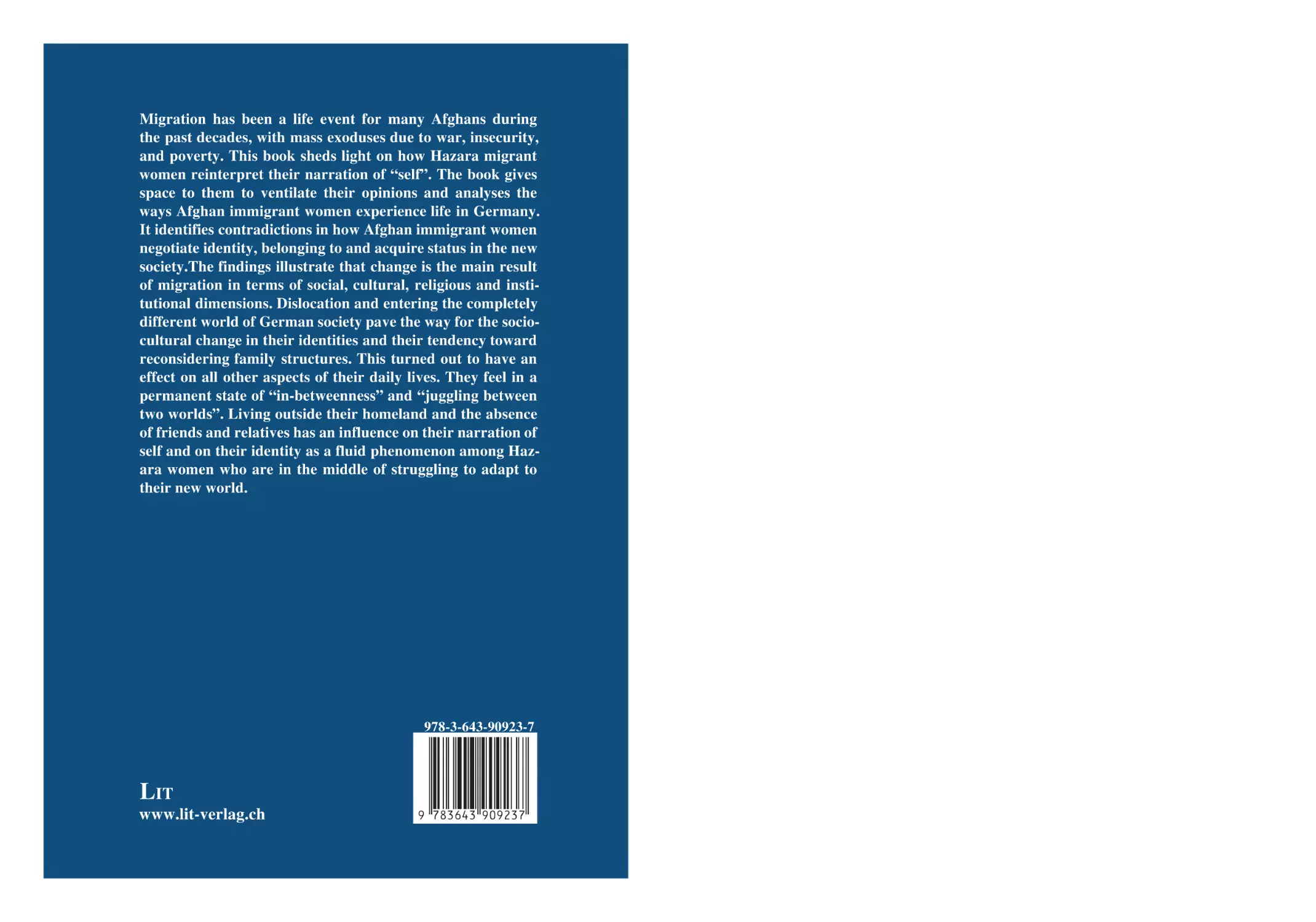
Migration has been a life event for many Afghans during
the past decades, with mass exoduses due to war, insecurity,
and poverty. This book sheds light on how Hazara migrant
women reinterpret their narration of “self”. The book gives
space to them to ventilate their opinions and analyses the
ways Afghan immigrant women experience life in Germany.
It identifies contradictions in how Afghan immigrant women
negotiate identity, belonging to and acquire status in the new
society.The findings illustrate that change is the main result
of migration in terms of social, cultural, religious and institutional dimensions. Dislocation and entering the completely
different world of German society pave the way for the sociocultural change in their identities and their tendency toward
reconsidering family structures. This turned out to have an
effect on all other aspects of their daily lives. They feel in a
permanent state of “in-betweenness” and “juggling between
two worlds”. Living outside their homeland and the absence
of friends and relatives has an influence on their narration of
self and on their identity as a fluid phenomenon among Hazara women who are in the middle of struggling to adapt to
their new world.

978-3-643-90923-7

LIT
www.lit-verlag.ch

9*ukdzfe#.-.xcm*

LIT

Ethnologie / Anthropology

LIT

Saideh Saidi

Juggling Between Two Worlds

ETHNOLOGIE
ANTHROPOLOGY
Band / Volume 65

LIT

Saideh Saidi

Juggling Between Two Worlds
Sociocultural Change in Afghan Immigrant Women’s
Identity in Germany

LIT

Bibliographic information published by the Deutsche Nationalbibliothek
The Deutsche Nationalbibliothek lists this publication in the Deutsche
Nationalbibliografie; detailed bibliographic data are available on the Internet at
http://dnb.d-nb.de.
ISBN 978-3-643-90923-7
Zugl.: Bremen, Univ., Diss., 2017

©

LIT VERLAG Dr. W. Hopf

Berlin 2018

Verlagskontakt:
Fresnostr. 2 D-48159 Münster
Tel. +49 (0) 2 51-62 03 20
E-Mail: lit@lit-verlag.de http://www.lit-verlag.de
Auslieferung:
Deutschland: LIT Verlag, Fresnostr. 2, D-48159 Münster
Tel. +49 (0) 2 51-620 32 22, E-Mail: vertrieb@lit-verlag.de
E-Books sind erhältlich unter www.litwebshop.de

To my sun, my beloved son
Sepehr

Acknowledgements
I would like to take this opportunity to thank all those who helped this book
become a reality. First and foremost, I would like to thankfully
acknowledge my advisor, Professor Dorle Dracklé, who has been a tremendous mentor for me. Her enthusiastic words, academic rigor and commitment were contagious and motivational for me. I would like to express my
appreciation to Professor Dracklé for encouraging my research. Her valuable advice on both research as well as on my career have been invaluable.
This book would have been impossible without her encouragement and
commitment. My heartfelt appreciation also goes out to Dr. Graham Taylor,
Associate Professor of Sociology at the University of the West of England,
Bristol, U.K. who encouraged me to start out on this long journey.
Scholarly support for my research was not limited to the supervision committee and my many friends and colleagues in Germany, the U.K. and Iran,
who were more than kind to sincerely provide me with their feedback. I am
thankful to BIGSSS (Bremen International School of Social Sciences) for
giving me the valuable opportunity of visiting fellowship under the supervision of Professor Michael Windzio, allowing me to do research in a vibrant academic atmosphere. This period enabled me to be in the field of
migration and refugee studies and, personally, I gained so very much from
the weekly “Doctoral Colloquium,” which created an intellectually stimulating opportunity with other Ph.D. candidates in the field of migration research.
And the biggest thanks is dedicated to all those Afghan immigrants who
shared their experiences with me, without whom this research clearly could
not have been done.
Last but not least, I would like to thank my family for all their love and
encouragement. Words cannot express how grateful I am to my mother and
my father who raised me with a love of science and supported me in all my
pursuits; for the presence of my loving sister and my brothers for all of the
sacrifices that you have made on my behalf. I would also like to thank my
encouraging, beloved husband, Dr. Foad Ghaderi for his constant understanding and faithful support for everything all through this experience. His
loving encouragement has had a tremendous impact on my achievements.
To my sun, my beloved son, Sepehr, I would like to express my thanks for
being such a great inspiration, always cheering me up.

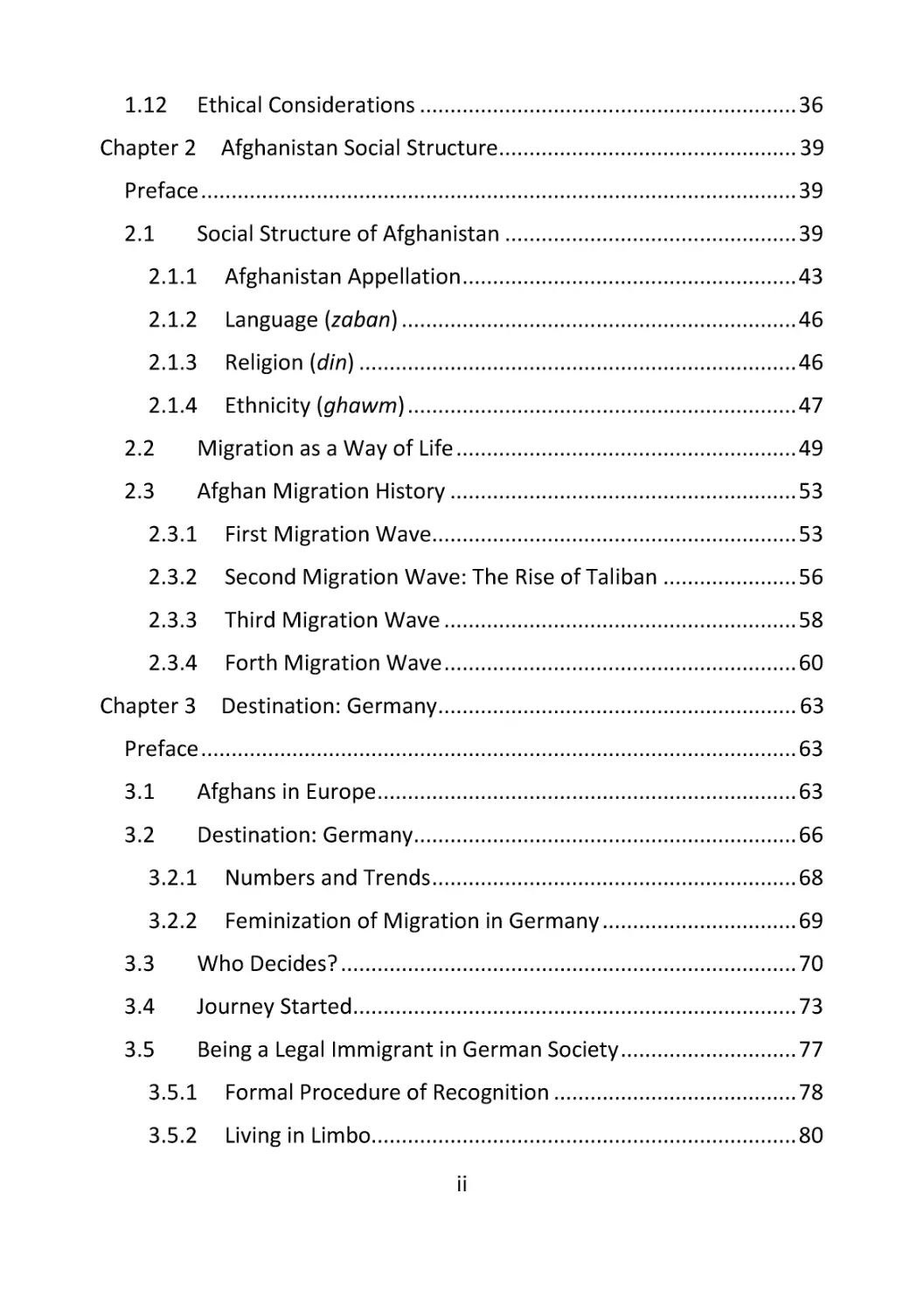
Table of Content

Chapter 1

Theoretical and Conceptual Framework ................................ 1

1.1

Migration Theory ........................................................................ 3

1.2

Assimilation Theory: Old and New ............................................. 6

1.3

Segmented-Assimilation Theory................................................. 8

1.4

Transnationalism: a New Theoretical Framework...................... 8

1.5

Defining Diaspora in the Migration Domain ............................. 10

1.6

Place-Attachment Theory ......................................................... 10

1.7

Research Goal and Questions ................................................... 12

1.8

Outline of the Book................................................................... 13

1.9

Empirical Research Setting ....................................................... 14

1.9.1

Research Techniques for Data Collection ............................ 14

1.9.2

Qualitative Method .............................................................. 14

1.9.3

Finding Respondents via Snowball Sampling ....................... 15

1.9.4

Interviews............................................................................. 17

1.9.5

Profile of the Respondent Group ......................................... 21

1.10

Research Strategies .................................................................. 23

1.10.1 Fieldwork .............................................................................. 23
1.10.2 Participant Observation as a Data-Collection Method ........ 26
1.10.3 Internet as a Data-Conducting Tool ..................................... 30
1.10.4 Transcription ........................................................................ 31
1.11

Interview Challenges Encountered ........................................... 32

1.11.1 Notion of Trust ..................................................................... 32
1.11.2 Hidden Control upon Afghan Women at Home ................... 35
i

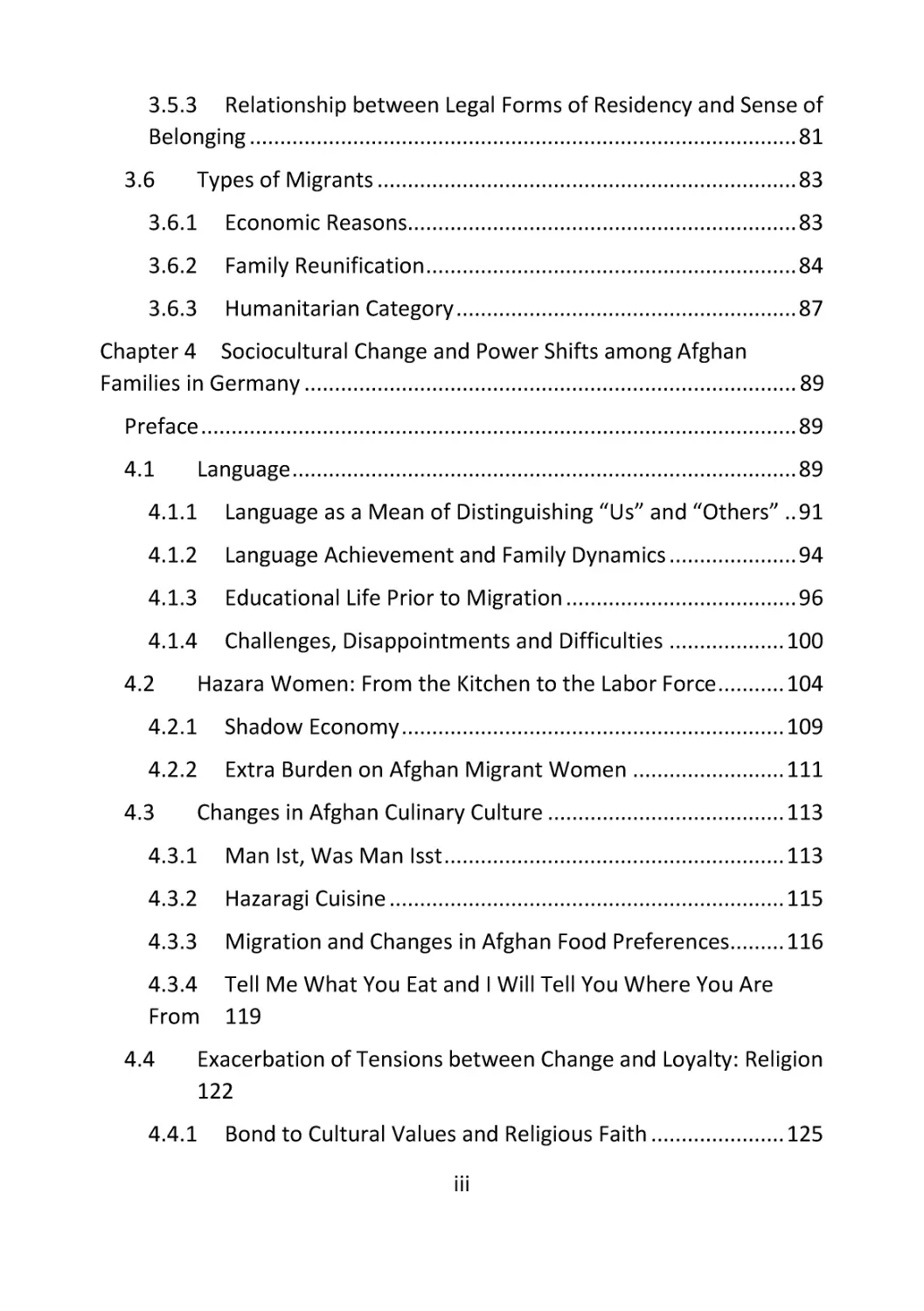
1.12

Ethical Considerations .............................................................. 36

Chapter 2

Afghanistan Social Structure................................................. 39

Preface .................................................................................................. 39
2.1

Social Structure of Afghanistan ................................................ 39

2.1.1

Afghanistan Appellation ....................................................... 43

2.1.2

Language (zaban) ................................................................. 46

2.1.3

Religion (din) ........................................................................ 46

2.1.4

Ethnicity (ghawm) ................................................................ 47

2.2

Migration as a Way of Life ........................................................ 49

2.3

Afghan Migration History ......................................................... 53

2.3.1

First Migration Wave............................................................ 53

2.3.2

Second Migration Wave: The Rise of Taliban ...................... 56

2.3.3

Third Migration Wave .......................................................... 58

2.3.4

Forth Migration Wave .......................................................... 60

Chapter 3

Destination: Germany ........................................................... 63

Preface .................................................................................................. 63
3.1

Afghans in Europe..................................................................... 63

3.2

Destination: Germany............................................................... 66

3.2.1

Numbers and Trends ............................................................ 68

3.2.2

Feminization of Migration in Germany ................................ 69

3.3

Who Decides? ........................................................................... 70

3.4

Journey Started......................................................................... 73

3.5

Being a Legal Immigrant in German Society ............................. 77

3.5.1

Formal Procedure of Recognition ........................................ 78

3.5.2

Living in Limbo...................................................................... 80
ii

3.5.3 Relationship between Legal Forms of Residency and Sense of
Belonging .......................................................................................... 81
3.6

Types of Migrants ..................................................................... 83

3.6.1

Economic Reasons................................................................ 83

3.6.2

Family Reunification ............................................................. 84

3.6.3

Humanitarian Category ........................................................ 87

Chapter 4 Sociocultural Change and Power Shifts among Afghan
Families in Germany ................................................................................. 89
Preface .................................................................................................. 89
4.1

Language ................................................................................... 89

4.1.1

Language as a Mean of Distinguishing “Us” and “Others” .. 91

4.1.2

Language Achievement and Family Dynamics ..................... 94

4.1.3

Educational Life Prior to Migration ...................................... 96

4.1.4

Challenges, Disappointments and Difficulties ................... 100

4.2

Hazara Women: From the Kitchen to the Labor Force ........... 104

4.2.1

Shadow Economy ............................................................... 109

4.2.2

Extra Burden on Afghan Migrant Women ......................... 111

4.3

Changes in Afghan Culinary Culture ....................................... 113

4.3.1

Man Ist, Was Man Isst ........................................................ 113

4.3.2

Hazaragi Cuisine ................................................................. 115

4.3.3

Migration and Changes in Afghan Food Preferences......... 116

4.3.4
From

Tell Me What You Eat and I Will Tell You Where You Are
119

4.4

Exacerbation of Tensions between Change and Loyalty: Religion
122

4.4.1

Bond to Cultural Values and Religious Faith ...................... 125
iii

4.4.2 The “Unadjusted” Women: Shifting and Negotiating
Religious Identity ............................................................................ 134
4.4.3
4.5

In-Between Grey Zone: Having an Elastic Religious Identity
139

Sociocultural Change and Power Shifts: Marriage ................. 144

4.5.1 Exacerbation of Intergenerational Tensions among Afghan
Immigrant Families ......................................................................... 148
4.5.2

Endogamy/Exogamy in Hazara Decision-Making............... 152

4.5.3

Hazara Marriage Arrangements ......................................... 153

4.5.4 Additional Expenses in Afghan Marriage: Bride Price
(shirbaha) and Dowry (mahr) ......................................................... 154
4.5.5

Lavish Receptions Curbed: A Shift in Values ...................... 155

4.5.6

Marriage Fraud: Another Reason for Divorce .................... 158

4.5.7

Power Shift within the Household and Marital Stability.... 160

4.6

Divorce: Problem or Opportunity? ........................................ 162

Chapter 5 The Experience of Afghan Immigrant Women in Germany:
Between Social Involvement and Sense of Belonging ............................ 167
Preface ................................................................................................ 167
5.1

The Spatial Dimension of Afghans in Bremen ........................ 168

5.2

Friendship ............................................................................... 173

5.3

Religious Communities: The Mosque as a Social Meeting Place
175

5.4

Other Social Networks ............................................................ 181

5.4.1

Afghan Civil Society in the Diaspora .................................. 182

5.4.2

German Agencies for Migrants .......................................... 186

5.5

Links with Country of Origin ................................................... 189
iv

5.5.1

Media ................................................................................. 189

5.5.2

Contacting Home ............................................................... 190

5.5.3

Money Transfer (Remittances) .......................................... 192

Chapter 6

Conclusions ......................................................................... 195

Bibliography ............................................................................................ 202

v

Abstract
The primary aim of this book is to explore the situation of Afghan women who
migrated to Germany and show how migration experiences and exposure to German society has had an impact upon their narrating about themselves and conceptualizing sociocultural change in their own identity. It also aims to provide insight
into how their sociocultural involvement in the broader German society has had an
impact upon their identity and sense of belonging. The women I worked with predominantly belong to the Hazara ethnic group and their situation, as a minority
group both in Afghanistan and Germany, is under-researched. For the majority of
the research population, migration is a life-changing event which can be considered
their destiny. Gender and age are two main variables having an impact upon the
process of integration of Afghan immigrant women into Germany. It will be shown
that migration to Germany has a dual impact upon their situation. In some cases, it
leads to significant discrimination and downward mobility in social and professional terms and, on the other hand, German urban life empowers some other Afghan women and enables them to exert their agency and power to reconstruct their
identity and voice their objections.
The methodology used for this research is based on an ethnographic, qualitative
method (semi-structured interviews and expert interview), secondary analysis, and
participant observation, all of which helped to provide a robust explanation of sociocultural change in the trajectories of Afghan immigrant women’s lives in Germany.
Research findings illustrate that change is the main result of migration in terms of
social, cultural, religious and institutional dimensions. Due to specific social, cultural, economic and political circumstances which prevail in the country, as well as
those which surround it from the outside world, Afghan immigrant women are going through a combination of adaptation processes. The findings also demonstrate
there are various patterns of sociocultural involvement in German society among
Afghan immigrant women, with strongly differentiated patterns of multidimensional embeddedness of integration experiences. This research draws on three different, but related, theoretical frameworks: assimilation theory, transnational approaches and place-attachment theory to investigate the concept of change among
Afghan immigrant women in Germany. It also suggests that there is room for a
broader and more comprehensive role for Afghan immigrant women in broader
German society.
Keywords: Germany, female migration, Afghan (Hazara), identity, sociocultural
change, gender roles, social involvement, family dynamics, diaspora.

vii

Chapter 1

Theoretical and Conceptual Framework

Preface
“As an Afghan, migration is our destiny; we are always on the move. Because of several years of war and poverty, we are always on the road. We
are all immigrants, like the bird, a bird without legs. You will never be at
home here and you will never be at home in Afghanistan either.”
(Sima1, 45 year-old Hazara woman in Bremen)
More than fifty civil wars have occurred during the past two decades (Gurr
2000), causing 244 million international migrants2 as of 2015. This includes
almost 20 million refugees3 (UN 2015), which means that one person in 28
is an immigrant (ICMPD 2016). Female refugees make up almost fifty percent of the refugee population.
The prolonged civil war in Afghanistan creates one of the world’s largest
chronic refugee and displacement problems. The on-going “exodus” of Afghans continues to make this country one of the main sending countries
globally. Many Afghans are settling in neighboring countries, a growing

Please note that I have decided to delete any references to the Afghan women’s person or
background in order to fully guarantee their and their families’ personal privacy and security.
Furthermore, when the research participants asked me in some contexts not to reveal their
names regarding a particular issue, I have respected their wishes.
2 Persons living in a country other than where they were born.
3 The 1951 Refugee Convention spells out that a refugee is someone who “owing to a wellfounded fear of being persecuted for reasons of race, religion, nationality, membership of a
particular social group or political opinion, is outside the country of his nationality, and is
unable to, or owing to such fear, is unwilling to avail himself of the protection of that country.”
1

1

number making the hazardous journey toward European countries or Australia. Decades of war and discord made Afghanistan one of the world largest producers of refugees and asylum seekers. Having been forced to flee
from danger and misery and resettle in a new country, loss of family and
friends, and the normality of life create controversial challenges in their
identity. They live in a strange country with a different language, culture
and heritage. The circumstances under which they live motivate them to
construct a new narration of “self” which is probably different from what
they had foreseen in their early lives.
This research is based on my ethnographic research on Afghan (Hazara
ethnic group) migrant women in Germany and their strategies to redefine
their identity through social networks in their new country and their experiences as an immigrant. This research is a holistic, cross-dimensional examination of social and cultural factors hindering the effective reintegration
of Afghan migrant women into German society. It provides a coherent collection of informative overviews, perspectives on the phenomena of change
and main angles of reconstruction of their “identity” through a scholarly
attempt at using a gender lens and applying it to a practical context. As a
migrant woman myself, I became involved in the topic from the first day of
my arrival in England. I moved from England to Germany in the middle of
my Ph.D. studies. All questions and challenges stayed with me until the last
day of my stay in Germany. Afghan migrant women come from a violent
society and have experienced a large number of traumatizing life events
such as discrimination, grief, deprivation and abuse. I was curious to explore the life of an Afghan woman who migrated to Germany and the way
she deals with her new experiences, which have an impact on her new definition of “self.” Despite the long history of migration and refugee movements of Afghans to Germany, female migration is under-researched and
ethnographic studies about their social networks are still rare4.
Although various outstanding researches had been conducted about the situation of Afghan
migrant women in the United States (Dupree 2007; Omidian 1996; Nawa 2001; RostamiPovei 2003, 2007; Zulfacar 1998; Oeppen 2013) and their situation in Islamic Republic of
Iran and Pakistan as one of the largest host for Afghans (Abbasi-Shavazi & Sadeghi 2014;
Monsutti 2005, 2007; Marsden 1998) there are handful of researches about Afghans in general and migrant women in particular in Germany. Braakman (2005) in her ethnographic
work did a research on Afghan migrants generally which is mainly dealt with the situation
of Pashtun ethnic group in Hamburg. On the other hand, Gaur Sing (2012) had a research
on the situation of Afghan families in diaspora, especially Germany and India. There is surprisingly little research that is entirely focused on Hazaras (Bacon 1951; Canfield 1998) in
general and (Glazerbrook 2005; Glazerbook & Shavazi 2007; Monsutti 2004) which provide
4

2

This section begins with a review of the different theoretical perspectives
on migration. There is a diverse range of existing theoretical approaches to
explain migration as dislocation and the impact it has on an individual’s
sociocultural lives. Migration theory, as a complex phenomenon, is an enormously vast field and no single method or technique is capable of capturing
all aspects of it. The problem with theory is that it often lacks reference to
a specific context. Does a theory play out the same way in Germany, Turkey
and Iran?
A full understanding of the subject cannot be reached by relying on a single theory. Rather, I opened up my research to a multi-disciplinary approach
in order to explain the phenomenon. I think, in anthropological studies, researchers are usually not strictly tied to a single theory, so that they use
combinations of different approaches based on what they are observing.
With the help of an initial review of the literature, I point out solely those
theories and concepts that are directly linked to my research objectives and
try to utilize relevant theories and research methods to develop a comprehensive picture of the Afghan diaspora in Germany.
1.1

Migration Theory

Migration, as a dynamic phenomenon, has been explored by different theoretical and empirical approaches and is an interdisciplinary concept involving geography, sociology, political science, psychology, anthropology,
economics, etc. Scholars in various fields have shown a great deal of interest in developing tools and levels of analysis for a comprehensive explanation of the initiation and perpetuation of international migration. In conducting the research for this study, I found a whole body of valuable literature presenting vibrant discussions of the social and cultural adaptations of
refugees and immigrants all over the globe. By embarking on this research,
I was determined to contribute to this literature by considering the impact
of migration on Afghan women’s definition of self and, furthermore, the
sociocultural change in their identity (especially within the Hazara ethnic
group) settling in Germany. However, many migration theories do not focus
on the migrants as actors, but pay attention only to migration movements

some insight about the situation of Hazaras in Australia and Iran respectively a comprehensive research about the situation of Hazara immigrant women in Germany is not available.

3

on a larger scale (Righard 2012; Vertovec 2004). It is the anthropologist’s
task to go beyond the surface and explore migrants’ stories.
In the last quarter of a century, migration theory has undergone fundamental changes (Gans 1997; Malkki 1995a). The interdisciplinary field of
refugee studies emerged in the 1970s and 1980s. There are several theories
and frameworks that have tried to explore migration patterns since Ravenstein (1889), conceptualizing migration as a relocation of human beings
across space, within or between countries. Every migration is an enormous
challenge: for individuals migrating and their families, and for both the
sending and receiving societies. It has a huge impact on all aspects of a
migrant’s life. For many Afghan women, migration is not an exciting journey to discover new places, but the only way to survive.
In the 1970s, researchers in the field of migration theory focused on labor
migration (Castles & Kosack 1973; Böhning1972). These studies addressed
emigrants mainly as workers who were on the move as a labor force,
scarcely acknowledging other categories of migrants. This approach, in addition to neo-classical ones, emphasizes the role of economic factors like
GDP, unemployment rates and labor demands. These theories are great
tools for analyzing Afghan Hazara immigrants’ situations in Iran, since Iran
is one of the main destinations for those Afghan refugees in the Middle East
who predominantly migrated to seek a better livelihood. I was familiar with
their lives prior to starting my research, having lived in Tehran for years
and having met many Afghan people of different levels. The majority of
Afghans in Iran belong to the lower class, were undocumented, with a large
family and high fertility rate. They could only work at specific jobs in the
low-income sector, predominantly at building sites. I got a completely different idea from Afghan immigrant women in Germany, since those who
lived in Tehran remained at home and the majority of Afghans seen about
in the society were men. In my initial perception, Afghan refugee women
could be categorized as helpless, victimized, marginalized and passive
members of the society. Gradually, I acquired a more realistic idea of my
research population, which shows the diversity, agency and resourcefulness
of these women in the diaspora.
Based on the interests of this research, there are different motivations for
Hazara women to migrate to Germany (see Chapter 3). Despite the general
supposition, which considers money as the main engine for migration, in
the case of Afghan migrant women, my research shows that the economic
aspect of Hazara migration to Germany is but one factor and that there are
many other important aspects to be considered. Every migration is a highly
4

personal experience and every trajectory of a migrant is a unique story. Migration, as multi-faceted concept, is more than a physical relocation between borders. It has an impact on the social, legal and cultural aspects of
a migrant’s life. It is a challenging and often dangerous journey which, in
the case of some Afghan asylum seekers, is a destination unknown. There
are hopes, fears and plans, but there is no obvious certainty.
Although human mobility goes back in history, nowadays, the migration
and dislocation of people take place in various ways: temporary migration,
refugees, asylum seekers and internally displaced persons (IDPs), international retirement immigrants, illegal and undocumented migration, highly
skilled and unskilled low-wage labor migrants (for the case of Afghan immigrants, see Chapter 3). This diversity is reflected in the variety of migration-theory approaches. Therefore, there is no single migration theory (Esterberg 2002). I believe that a combination of theoretical perspectives and
approaches would allow for a more realistic and complex insight into migration movements, their reasons and dynamics (Grieco & Boyd 1998; Castles 2006). In this regard, I must select theories which are relevant links to
my research questions. In order to analyze how Afghan migrant women,
construct their identities and negotiate their sense of belonging in Germany,
I have made use of the following theories: transnational approaches, assimilation theory, segmented-assimilation theory and place-attachment theory.
These theories have the potential to help us to understand the complexity of
migration.
Putting Gender into Migration Discourse
For a number of years, research in the field of migration studies tended to
neglect the role of gender issues and the experience of female migrants. In
the past, women occasionally had been seen as dependent (mother or wife)
or highly invisible independent actors (see Chapter 3) which increased
within traditional societies. Afghan emigration was a male phenomenon for
decades, but the percentage of Afghan female migrants has increased gradually over recent years.
At present, a new wave of studies tries to address this imbalance, because
migration is not a gender-neutral subject. Therefore, gender became a preferred topic in migration literature (Carling 2005; Boyd & Grieco 2003;
Nawyn 2010; Rostami-Povey 2007; Anthias1982; Morokvasic 1983; Zlotnik 2003). Gender is a complex, multi-level, non-solid concept and, along
with race, ethnicity, class and sexual orientation, they all play roles in how
5

Afghan women behave, interpret and redefine their identity during their
lives as immigrants (Binder & Tosic 2005; McCormick & Bunting 2002).
In Afghanistan, similar to other countries, women are a crucial factor in
constructing the national ideology. They influence their specific culture
through their involvement in childrearing and in social and religious practices. They continue to carry out these responsibilities as immigrants. There
are significant differences between Afghan males and females in how they
interpret the notion of self as immigrants. This research tries to find out how
settling in a new society enables them to redefine their identity. It also looks
for how social involvement of immigrant impacts their identity in the diaspora. Simply, analyzing the topic based on the gender does not simply mean
dividing statistics by sex. Within the scope of this research, I try to empower
Hazara women and give them a voice to speak out on their social lives from
their own perspective. The objective of including gender theory into my
research is to enrich the analysis by increasing knowledge on the variety of
social parameters affecting the role of women and men, as well as on the
availability of resources, social facilities and services.
1.2

Assimilation Theory: Old and New

Narrating the self, the sense of belonging and the level of adjustment, are
main elements in identity formation (Tamang 2010; Castles & Davidson
2000; Yuval-Davis 2006; Reisigl & Wodak 2001; Fortier 2000; Favell &
Geddes 1999; Mulgan Young 2009). Assimilation theory is a great tool for
providing a better insight into the sociocultural experiences of Hazara migrant women in German society. Assimilation describes a process of change
in which immigrants and members of the receiving society come to resemble one another and become more similar over time with regard to norms,
values and behavior (Shayo 2009; Song 2005; Zhou 1997; Nagel 2002;
Phinney et.al 2001; Alba 1990; Wodak & Krzyzanowski 2007). The term
assimilation can be used interchangeably for integration which deals with
the cultural-transmission process.
This does not mean immigrants should give up their own culture, values
and language. They ought to keep their own culture and thoughts, while
learning how to reside together and adopting different strategies that help
them live inter-culturally in plural societies (Park 1914, McKee 1993; Alba
& Nee 2003; Gordon 1964; 1978; Sam & Berry 2006; Kymlicka 1995;
Gans 1997).
6

There are several definitions of assimilation based on early work by Park
and Burgess (1969, p. 735), describing it as “a process of interpenetration
and fusion in which persons and groups acquire the memories, sentiments,
and attitudes of other persons and groups and, by sharing their experience
and history, are incorporated with them in a common cultural life.” In another context, assimilation means “a process of becoming alike” (Taft 1953,
p. 45). In his valuable research, Gordon (1964) summarized the existing
literature and made a clear distinction between different levels of assimilation, ranging from acculturation, structural assimilation, marital assimilation, identification assimilation, attitude-reception assimilation, behaviorreception assimilation, to civic assimilation. For Gordon, acculturation involved the process of a minority group adopting the “cultural patterns” of
the dominant culture. Some aspects of culture, such as religion, proved
more resistant to acculturation than others (see Chapter 4). According to
Gordon’s assimilation model (1964), the acquisition of language skills and
a certain acculturation refer to acquiring a basic understanding of the receiving society, constituting a first step of integration. Subsequently,
schooling and formal education, or positioning in the labor market, should
inevitably follow. Former foreigners should develop an emotional commitment to the host society, for example, interethnic cohabitations and marriages. This leads to withdrawal from the country of origin and the acquisition of host-country citizenship. I will apply Gordon’s model to Hazara migrant women’s lives in Chapters 4 and 5. According to Gordon’s framework
(1964), structural assimilation, as a broad involvement of immigrants into
associations and clubs of the receiving country at a group level, automatically perpetuates further integration, which I want to apply in the case of
Hazara immigrant women’s socio-structural involvement in German society (see Chapter 5).
Different ethnic groups have substantially different patterns of assimilation and all the aforementioned assimilation levels do not appear to be valid
for all groups. Some researchers have shown that ethnic minorities are still
less integrated than the majority population in higher social areas such as
the work force and educational system (Gowricharn 2002; Vermeulen
2010).

7

1.3

Segmented-Assimilation Theory

Assimilation as a concept or as a theory has undergone criticism and many
recent studies indicate this sequential framework cannot present a comprehensive overview of immigration patterns and experiences for the modern
era (Alba 1997; Waldinger & Feliciano 2004; Portes & Zhou 1993; Ford &
Jampaklay 2015). However, more suitable models are still scarce. The segmented assimilation proposed by Portes and Zhou (1993) tries to fill the
gap and describes various patterns of adjustment and adaptation among second-generation immigrants. This theory, an important framework in migration studies, tries to analysis different patterns of incorporation into host
societies (Valdez 2015; Alba, Kasinitz & Waters 2011; Waters et.al 2010;
Haller, Portes & Lynch 2011).
By reviewing a variety of research and debate on segmented-assimilation
theory, I came to conclude that this theory provides an insightful and comprehensive view of the notion of sociocultural change in Hazara migrant
women’s lives in the diaspora, as well as having a great ability to analyze
the process of incorporating Hazara migrant women into German society.
In the interest of this research, Germany is a stratified society. Therefore,
Afghan immigrants can benefit from some segments of the broader society.
Both assimilation theory and segmented-assimilation theory follow the
same line, with the latter trying to fill the gap by considering the process,
outcomes and constraints of the integration process. Another important issue in segmented-assimilation theory is the role of mobility ladders in integration patterns. If large and diverse ethnic networks exist in the host society, newly arrived migrants should find it easier to integrate (Portes &
Sensenbrenner 1993). I will apply this theory to Hazara migrant women’s
networks in Chapter 4.
1.4

Transnationalism: a New Theoretical Framework

With massive changes in international migration dynamics, leading to new
types of border-crossing practices and varying patterns of migrant-origin
ties, transnationalism is probably the most used theory to define contemporary migratory phenomena, especially through the lens of anthropology
and other qualitatively-oriented social sciences. Definitions of transnationalism vary, but generally center on exchanges, connections and practices
across borders (Al-Ali, Black & Koser 2001; Grillo & Mazzucato 2008;
8

Wahlbeck 2002; Mazzucato, Kabki & Smith 2006). Portes and his colleagues (1999), in their outstanding work, tried to cast the notion of transnationalism, providing a definition of “persons who live dual lives, speaking two languages, having homes in two countries, and making a living
through continuous regular contact across national borders.”
The transnational approach, as one the most challenging and promising,
is not a single, homogeneous, theoretical approach, but encompasses different perspectives, methods and objectives (Kivisto 2001; Vertovec 1999;
Brettell 2000; Remennik 2003). A transnational perspective proves to be a
very fertile and proactive one for the study of refugee populations worldwide. In transnational approaches, migrants are analyzed as the main actors
of the migration process and how they maintain ties with the country of
origin. Migration is studied as an intersection of micro and macro levels
(Glick-Schiller, Bash & Szantos Blanc 1999). To a greater or lesser degree,
every migrant can be an agent as well as a subject of transnationalism. Previous theories on migration, such as push-pull models and neo-classic theory, have a dualist perspective toward migration, clearly distinguishing between sending and receiving countries. Transnational approach serves as a
different angle of analysis for the broader issues of migration and social
changes.
To have a better understanding of Afghan migrant women’s daily lives and
how they negotiate their identity, we apply transnational perspectives to
migration. For a number of years, Afghans have been scattered over two or
more countries and, with the expansion of globalization and the accompanying technological advancements, they maintain cross-border ties, networks and fluid activities that affect their identities. It is therefore a reasonable strategy to use transnational approaches for further analysis. Hazaras,
as a disparate ethnic community in Germany, maintain regular, sustained
links and interactions with their home country by exchanging ideas and values, sending back remittances, visiting kin and investing in businesses (for
a comprehensive discussion of Afghan migrants, see Chapter 5). One theme
that repeatedly emerged from all interviewed participants concerned the nature of their connections with Afghanistan: “being connected to several
places at once” or “being neither here nor there” came up in research participants, as a defining feature of their experience as a migrant woman in
Germany. I was interested in the extent to which Afghanistan figured in the
daily lives of Afghan immigrant women.

9

1.5

Defining Diaspora in the Migration Domain

During the course of this research, the notion of being scattered over a large
area, which can be theoretically known as diaspora, is evident from the
narrations of respondents. Members of Afghan migrant women’s families
leave at different times, settle in different countries or in different cities
within Germany. The word diaspora is based on the Greek speiro, meaning
“to scatter,” and dia, meaning “over, around.” Later, written with a capital,
Diaspora, came to be used to describe the exile of Jews from Babylon in
586 B.C. (Cohen 1997). In the public domain, diasporic communities refer
to groups having experienced dislocation from their homeland and being
scattered over two or more host-lands, but they have collective memory and
also strong ties to the homeland. The myth of returning to an idealized
homeland is strong among diasporic communities, somehow causing a certain level of alienation to the society receiving them. The level of interethnic relations is significantly high among these communities, making for
a challenging relationship with the host society (Cohen 1997; Safran 1991;
Ting-Toomey 1988, 2001; Braziel & Mannur 2003; Reis 2004). Globalization, expansion of new technologies and media have fostered increased connectivity with the homeland and different parts of the diaspora.
I heard remarks on “where we come from” or “what is our root” quite often
during fieldwork. It seems it was very important for Hazara families in Germany to link themselves and especially their children to their imagined
homeland. I assumed the experience of these women could be labeled victim diaspora, formed as a result of political instability or persecution in Afghanistan (Cohen 1997). By conducting 51 interviews, my purpose was to
better understand the diasporic lives of Afghan immigrant women and their
sociocultural change during their time in German society, their ties to their
homeland, and their expectations of relationships in the diaspora. It seems
that community is not inherited from the homeland, but constructed anew
in the diaspora.
1.6

Place-Attachment Theory

Concepts such as place attachment and place identity have been researched
quite broadly and so have been defined in a variety of ways. In this research,
I try to explore the influence and intensity of migration trajectories in the
development of place attachment in Hazara women in Germany. Place-attachment theory examines the role that attachment to places plays a role in
10

the development of identity and its impact on the sense of community
(Manzo & Devine-Wright 2014; Williams & Vaske 2002; Low 1992; Elder,
King & Conger 1996; Brook 2003; Dixon & Durrheim 2004; Lewicka
2011). Basically, place-attachment theory belongs to environmental psychology and tries to analyze existing ties and connections between individuals and particular places (Williams & Patterson 1999). From the lens of
the anthropologist, places and locations have cultural meaning and bounds,
impacting people’s daily lives (Gupta & Ferguson 1997; Rodman 1992;
Trentelman 2009).
There are several definitions of place attachment. Hummon (1992, p. 256)
considers it an “emotional involvement with places.” Similar terms such as
community attachment (Kasarda & Janowitz 1974) and place identity exist
in Proshansky’s work (1978).
In a variety of disciplines in recent years, there is increasing interest in
understanding the attachment people develop toward the places where they
were born and brought up, and the function these places fulfill in their identity formation. Accordingly, there are different ways that one is attached to
a particular place: memories, close acquaintance with the place, and frequency of visitation (Williams & Vaske 2002). For many Afghans, some
places (both in Afghanistan and Germany) have become important to them,
forming a strong attachment and cognitive relationship, since they are
spaces filled with emotions, memory and symbolic meanings. This positive
bond or association between individuals and places vary and differ in scale,
from the smaller objects such as the house, neighborhood and even children’s playgrounds, to the community center, mosque or nation (Altman &
Low 1992; Chawla 1992).
Place and identity can be powerfully connected emotionally and physically. For many Afghans, attachment to place is a very important factor in
their decisions about life choices. Based on my research, all Afghans in the
diaspora have an emotional attachment, with strong sentiment, to the place
they came from, symbolizing their sense of identity. The degree of attachment to places varies with age, sex, experiences and tendencies. Women
show greater place attachment than do men. Attachment to place increases
with age (Hidalgo & Hernandez 2001). I could also notice a great sense of
place attachment among Hazara women in Germany to their neighborhoods
and community networks, especially the local mosque influencing their
identity. This can be perfectly analyzed by place-attachment theory (see
Chapter 5).
11

From the lens of place-attachment theory, I will explain the notion of
home as a place of origin for Hazara women in Germany. I want to examine
the emotional attachment of Afghans to the place they came from, where
their roots are located, and also the place they choose to live in as their new
home. The extent to which this is also relevant to understand each of my
research participants’ situations in Germany will be elaborated in later
chapters.
1.7

Research Goal and Questions

This research is not undertaken to prove or disprove a particular hypothesis,
but to develop an understanding of the role immigration plays in the sociocultural change in Afghan women in Germany and what their strategies
are to overcome the challenges and adversities faced during their migration
journey. During fieldwork, the notion of sociocultural change emerged as
a reflection of their migratory experiences. This research revealed their preimmigration and post-immigration lives to have a holistic and comprehensive look at their identities. I also propose to study the main dynamics underpinning the sense of belonging among immigrant women in Germany as
regards their social networks. This study is undertaken with the following
major objectives:
Main goal:
i. What are the main parameters of sociocultural change in immigrant
families?
Case study: Afghan immigrant women in Germany (Bremen/Hamburg)
ii. To explore their experiences in German society and the challenges
encountered
iii. To explore the main dynamics underlying the integration process
and the formulation of identity among Afghan migrant women in
their new society
iv. To explore the role of social involvement with regard to the sense
of belonging among Afghan migrant women in Germany
More in-depth:
i. To develop more detailed demographic, social and economic profiles of the Afghan women population in Germany
ii. To explore the development of German immigration policy toward Afghan immigrants
12

iii. To explore the concept of sociocultural change in Afghan migrant
women’s identity and narration of self
iv. To explore the role of social networks and immigrant social involvement in the process of integration of Afghan immigrant
women in Germany
The research questions were designed on the basis of the theoretical background, a review of the literature, and the objectives of the study. The major
research questions are:
i. What is the situation of Afghan migrant women in Germany?
(Types, statistical data, etc.)
ii. How has German immigration policy toward Afghan migrants developed and changed over the years, especially in the case of migrant women?
iii. How do Afghan migrant women define their social identity within
the parameters of Afghanistan and Germany, and construct such
within their host culture and community? What role does migration experience have in sociocultural change among Afghan
women in Germany?
iv. To what extent are Afghan immigrant women socially involved
in German society? What role does civil society play in the formulation of migrant women’s adaptation to their new “home”?
1.8

Outline of the Book

The chapters of this book are steps toward answering the research goals and
questions, with each chapter addressing one of the sub-questions of this research.
The first chapter deals with the following: the research context and theoretical framework, research goals and questions, and the research methodology to access data. In this chapter, I try to elaborate on relevant theoretical
approaches that suit the research questions and guide the study, and also on
how I did fieldwork using qualitative-research techniques. Chapter 2 describes the background information on Afghanistan as one of the important
sending countries of the world. Chapter 3 explores Afghan immigration
trends to Germany, so as to create a better perspective of migratory trajectories to the host society. Research findings are set forth in Chapters 4 and
5. In Chapter 4, I start with explaining how the notion of change is creeping
into Afghan immigrant women’s lives in the German society. I zoom in
13

further into sociocultural change in terms of educational attainment, language proficiency, work experiences, culinary habits, religious practices,
and gender roles in their nuclear-family setting (patterns of marriage and
divorce). Chapter 5 offers an analysis on the impact that Afghan immigrant
women’s social involvement in German society has on their identity.
Lastly, Chapter 6 offers a conclusion, summarizing the main findings of the
research and discussing their implications.
1.9
1.9.1

Empirical Research Setting
Research Techniques for Data Collection

Having reviewed the conceptual and theoretical framework of the book, research goal and the questions that arise, it is now time to discuss the methodological framework adopted to meet that overall goal and answer those
questions. In this section, I will discuss the development of the research
design and describe how the fieldwork was done, and how and why contacts
were set up with potential participants. That will be followed by some of
the dilemmas and challenges I faced during fieldwork.
While my best intention was to carry out the research enthusiastically, I
should openly admit it has not been an easy task to fulfill. Although there
are a large number of Afghan migrants living across Europe, little is known
about the social and demographic characteristics, or the economic behaviors of Hazara women in particular. To explore the sociocultural changes
that take place during the course of a Hazara migrant woman’s life in German society, I have looked at the pattern of her normal everyday life under
very particular circumstances both inside refugee camps and in the city.
1.9.2

Qualitative Method

The first phase of this research consisted of collecting mainly secondary
quantitative data about where Afghan migrants are located in Germany.
This was through a review of secondary data sources, including the Annual
Population Surveys and Census, especially UNHCR5, IOM6 and BAMF7
monthly and annual reports. This part of the research proposed to review a
The United Nations High Commissioner for Refugees (UNHCR).
International Organization for Migration (IOM).
7 Bundesamt für Migration und Flüchtlinge (BAMF).
5
6

14

variety of information from a wide range of resources. It involved orienting
myself on the research topic by reading relevant documents, literature and
websites, and also by introducing myself to members of the community.
Interpretive, qualitative research was the most appropriate choice, because
my main goal was to understand someone else’s world from her point of
view (Weiss 1994; Mays & Pope 2000; Esterberg 2002; Strauss & Corbin
1998). The notion of identity and the sociocultural changes a respondent
might face as an immigrant is complex. One must bridge inside the respondent and immerse oneself in her daily life and experiences.
This research is based on qualitative-ethnographic participatory research
which is explorative in nature. This method is the best way to learn about
Hazara migrant women’s lives in their own culture and their journey
throughout the transition process, from leaving their country of origin to
living in Germany. Life stories and personal experiences of the participants
helped me understand the changing experiences and perceptions of individuals in their daily lives. Ethnographic methods (Spradley 1980; Clifford &
Marcus 1986; Abu-Lughod 1993, 2000) such as observation and interaction
with case studies were a valuable tool that allowed me to enter into the Afghan community in Germany and enhanced my general understanding of
and learning from people in their natural setting. Qualitative methodology
is commonly used for providing in-depth description of beliefs and behaviors through participant observation, field notes and both informal and indepth, semi-structured interviews with a sample of Hazara migrant women
from a variety of backgrounds in Germany. Documents and materials were
analyzed. It was also followed by taking part in their community events
(Marshall & Rossman 1999; Creswell 2009; Newman 2012).
1.9.3

Finding Respondents via Snowball Sampling

Finding the proper interviewee was one of the hardest phases of my research. Sometimes I felt I could not make my intentions clear, especially
the notion of identity itself, quite a vague subject. Sometimes, the reason
for the unwillingness on the part of some Afghan families was that the interview aims were not clear enough to them. Some Afghan people did not
understand the purpose of my research and suggested I should find my data
through academic participants or Afghan institutions. On the other hand,
there were Afghan participants who enthusiastically offered their help.

15

They brought me Afghan books and food, invited me to their places on various occasions, and showed me their traditional Afghan dress and family
photos.
In order to find Afghans with diverse backgrounds and experiences in
Germany, a variety of strategies were used to reach potential interviewees.
Snowball sampling was a useful method that helped me find potential research participants (Handcock & Gile 2011; Goodman 1961; Bryman
2016). This method is especially suitable for explorative studies. In snowball sampling, recruitment of research participants took place by word-ofmouth in Bremen and Hamburg. In addition, I went to the international office at Bremen University and asked them to introduce Afghan students to
me. I went to the Jacobs University’s dormitory and found Afghan students.
In some cases, I found Afghans through Iranian friends living in Bremen. I
also used Hazara facial features such as pointy cheeks and characteristic
lack of eye folds. Therefore, I could also find some participants by observing facial features. I went to Iranian shops in Bremen and Hamburg and
asked them to let me know about possible Afghan families as potential interviewees. Based on these initial explorations and further participant observation, the foundation for later interviews was created.
In general, each of interviewees has unique and valuable knowledge and
experiences. Participants were selected for specific characteristics such as
age, ethnicity and legal status, based on considerations from the search
questions. Of course, I asked each person I interviewed whether they knew
other Afghan migrant women who would fit my criteria and would be willing to tell their story in an interview. This way, I was able to find interview
partners from a variety of backgrounds.
One of the greatest difficulties of this research was being accepted by Afghan migrant families. With snowball sampling, I overcame to this obstacle
easily. I used the snowball method to find entry points or hooks into the
Afghan Hazara community in Bremen and Hamburg. At the end of most
interviews, I asked the respondent whether he or she could put me in touch
with other possible respondents. This was of great benefit, especially in refugee camps. For instance, I went to see one Afghan family at the Reinsberg
Camp in Bremen and, after the interview, I felt I was successful in gaining
their trust since they introduced me to two more Afghan families and convinced them to do the interview.
In case of Afghan families who are still seeking asylum and waiting for
their official interview appointment at the Bremen/Hamburg Bundesamt, it
was very hard to gain acceptance, enter their camps, maintain a relationship
16

with them and get them to talk about their lives, since they were in constant
fear and trying to survive in a precarious situation. Therefore, the snowball
method turned out to be very useful in getting me introduced to a person
whom they know, thereby alleviating their fear and resulting in a relatively
productive dialogue.
Snowball sampling was employed at different starting points. Since the
majority of the research population was Shia Muslim, acquaintances from
previous visits to Hamburg and Bremen mosques played a particularly important role in meeting more people. Participating in Friday prayers and
weekly gatherings enabled me to meet more Afghans and discuss my research with them.
1.9.4

Interviews

Qualitative research is the best method for issues related to humans in natural settings and interviews are at the heart of that type of research. In the
next phase of methodology, qualitative data collection was undertaken primarily through interviews with 51 Hazara women in Bremen and Hamburg.
I believe that open-ended questions during in-depth interviews allowed me
to discover the nature of this migrant population in Germany. The majority
of interviews were conducted in person but, to have a better perspective
about Afghan women’s lives in exile, I had telephone interviews with other
Hazara immigrants in the Netherlands, France, Iran and Canada.
In order to follow the research questions, I needed to have a clear agenda.
Therefore, I created interview questions and used semi-structured interviews. Through these semi-structured interviews and informal conversations, I explored various aspects of their lives, customs and future aspirations. This method allows an interviewer to seek further elaborations and
clarifications on answers to the given questions (Hollan 2005; May 2011;
Lewis & Porter 2004; Mack et. al 2005). In semi-structured interviews, research participants could answer questions more on their own terms. As
Reinharz (1992) stated in her valuable work, interviewing is an essential
access point to learning about women’s “hidden knowledge.” Although I
have tried to emphasize semi-structured interviews, in many cases they
changed to “naturally-formed focus groups,” with other family members,
especially males, entering into the discussions (the pros and cons of this
will be dealt with in the following section). I followed an interview guide
which had been developed and reshaped several times both before and during the data-gathering process. With semi-structured interviews, I had the
17

ability to clarify the challenging questions and follow along according to
the research goal and questions. During fieldwork, I aimed to improve the
credibility of the study in different ways. Before data collection, I familiarized myself with the activities informants participated in through publications and relevant Internet websites. Therefore, interview questions were
formulated in a neutral and open way, permitting the interviewees themselves to define the meaning of such activities.
However, every interview had its own dynamics based on the specificities
of the respondents and their family-life events. I had many talks and discussions with foreigners of all nationalities living in Germany and in other
countries. This helped me to gain insight and a deeper understanding of
migrants’ lives in their host societies and their experiences through narrative.
Narrative is a method of retelling events and experiences that help construct identities (Jordan & Düvell 2002; Riessman 2008; Wood 1981; Temple 2008). I must admit that, since my research subject is about human beings and their life stories, it was hard to make clear-cut questions. In most
of the cases, it shifted to a narrative interview and conversation, enabling
me to get an insight into the migrant’s personal life story.
During the semi-structured, ethnographic interviews with Hazara women,
I asked about my informants’ daily experiences throughout their lives, described through their interpretations, expressions, mental frameworks and
personal feelings. As a good listener, I always tried to give the interviewee
enough time to present those topics she regarded as important in her life. I
usually let the informant talk about what she considered an immigrant to
be, and how she saw herself in terms of place, network and ethnic identity,
exposed to the new society.
I did my best to position myself as close as possible to the research population, earn their trust and get to know their personal experiences. In this
regard, I tried to keep interviews as relaxed as possible. This implied I had
to open myself to a significant degree and be willing to talk overtly about
my own migration experiences. During interview, I told the women much
about myself personally, which helped earn closeness and trust. I think our
“shared foreignness” in Germany really helped build mutual identification.
I tried to gently guide discussion towards interview questions and, at the
same time, tried to not interrupt the interviewee’s narrative flow. In some
cases, conversations with Afghan migrant women were interrupted or not
fully accomplished for a variety of reasons. I overcame this by taking time
for visits and coming back for a follow-up session. Not only were my results
18

via interview questions, but also via photographs, diaries and gestures. The
body language of the participants helped me to have a better understanding
about their lives.
In some other cases, I distributed interview questions to selected Afghan
women at the Ehli-Beyt Kulturgemeinde Bremen e.V.8, Belal mosque and
the Imam Ali mosque in Hamburg and then invited them to my place for
brunch. Among the 10 Afghan migrant women who got the interview
guideline, eight came to my home and we had a great time talking about so
many subjects in a friendly atmosphere. Two women brought their children
and they played nicely with my son. It was a helpful trust-building method.
I also interviewed respondents elsewhere, such as in public places, the
Domsheide (Bremen city center), national park, railway station, a library
and a restaurant.
In addition to these semi-structured interviews, I did 10 expert interviews
with: local government officials, voluntary-service representatives in Bremen and Hamburg, immigration lawyers working with Afghan migrants,
immigration activists, NGOs working with migrants, especially Afghan
women, as well as official institutions such as the Bremen Bundesamt. This
was to see structural factors, such as legal and political attitudes, affecting
the performance of migrant networks and their integration process. In some
cases, valuable information was gained from expert informants who are
well-informed about various subjects in the field and helped with broad areas of inquiry (Marshall & Rossman 1999; Bogner, Littig & Menz 2009).
Interviews with Afghan migrant women in Germany consisted of four
main sections:
i.

ii.

Migrant profile: The first phase covered personal information, including date of birth, marital status, ethnic/religious background and
education. The objective of this first section was to identify the profile of Afghan migrants in selected cities in order to see the impact
of their migratory experiences on their sociocultural characters,
whether excluded or included.
Migration journey and further migration plans: In the second part
of the interview, following Plummer (2001), interviewees were
asked to freely tell their story about immigration toward Germany
and were encouraged to give detailed descriptions of events and personal encounters. They were encouraged to describe their lives as a

I shall use the term “Bremen mosque” in this book when referring to the Ehl-I Beyt Kulturgemeinde Bremen e. V.

8

19

book, dividing their life story into different chapters. In this section,
I wanted to know why and how they left their homeland and why
they chose Germany, whether they have relatives and friends in Germany. This helped me to understand the impact of social networks
on further migration plans (see Chapters 2 and 4), as well as their
destination preferences that motivate them to migrate. The objective
was to present itineraries, patterns and modes of migration.
iii. Life in Germany and a notion of belonging: With the questions in
this part, I mainly attempted to understand Hazara women’s experiences as a migrant in Germany and their survival strategies in the
host society. I wanted to evaluate how the research population negotiated their belonging to and involvement with social networks in
Germany. Also, a couple of questions focused on the possibilities of
return and the challenges.
iv. Identity and notion of change: In this section, with the help of interview questions, I immersed myself so as to try to understand Afghan migrant women’s identity and possible changes from different
angles. The findings of this section are used to get a better perspective about Afghan families’ strategies to deal with intergenerational
dilemmas stemming from possible sociocultural changes in their
identity, power shifts within the family, and the challenges they may
face as immigrants. I focused on their attitudes toward female education, marriage, hijab9, family life, and also the meaning of home
and belonging in the diaspora. During my research, there were important questions on my mind: how should societies integrate newcomers? What are the main adaptation patterns among Hazara families in Germany? What are the main indicators of change in Afghan
immigrant women’s habits and lives in the new society?
Most of my interviews were conducted between March 2012 and June
2014. Doing ethnographic research on a population dispersed across such a
large urban area greatly shaped the focus of my research and the nature of
my observations. I always tried to stay in touch with some of the respondents in between interviews, especially in July 2014, when I decided to return

The Arabic word hijab means barrier or partition. It has a broader meaning in the Islamic
code governing the covering worn in public by Muslim women. I will have a comprehensive
look at Afghan Islamic dress code in Chapter 4.
9

20

to Iran. I kept contact with them via phone and other virtual social-networking tools like Skype, Telegram, Viber, Facebook and Instagram. I developed a relationship with five families, in which we saw each other regularly.
Whenever they came to Iran or Istanbul, we arranged a reunion. In June
2016, I went to Bremen for a conference and hoped to be able to search out
and meet up again with my research participants to know how they were,
how their situation had changed, and what their plans and dreams were. I
went directly to the Bremen mosque and I was enveloped by the pure love
that the Afghan women gave me during Ramadan10, and I was happy to see
many of my respondents. It was a real pleasure to hear their stories and the
possible changes they had faced since the last time we met in 2014. It was
a productive follow-up which expanded my knowledge in writing the book.
1.9.5

Profile of the Respondent Group

In this section, I present their profiles as to main characteristics. Within the
group of people meeting the research criteria, my goal was to achieve a high
degree of variety with regard to their degree of religiosity, civil status, age,
marital status, legal status, employment status, motivations to migrate, cultural and social affiliations.
I focused on Hazara women and other interviewees, including all categories of migrants such as refugees, students and those who have lived in Germany for a long time. This research includes women of different age groups
and different levels of education who came to Germany at different points
in time. They are from middle- and upper-class backgrounds in terms of
income and status. The majority of informants have lived, prior to Germany, three to twenty years in other countries for asylum or as a migrant,
predominantly Iran, Tajikistan, Greece, Pakistan and Turkey.
Potential interviewees had to meet minimum requirements such as being
at least 15 years old and having been settled in Germany for at least one
year by the time of interview. They must also intend to stay in Germany for
at least 3 years, otherwise they would have little incentive or even opportunity to integrate into society. All respondents arrived in Germany between
1977 and 2013. The majority (31 respondents) came between 1998 and
2013. However, I contacted two Afghans (one boy and one girl) who resided in Iran. I found them via Facebook. They paid smugglers to get them

10

The ninth month of the Islamic lunar calendar, a period of prayer and fasting.

21

to Europe and updated me regularly on their situation and experiences during their hazardous journey. I will keep their identity anonymous for reasons of safety. It was valuable and rich information regarding their challenges in transit countries, allowing me to have a better understanding about
the Afghan journey toward Europe.
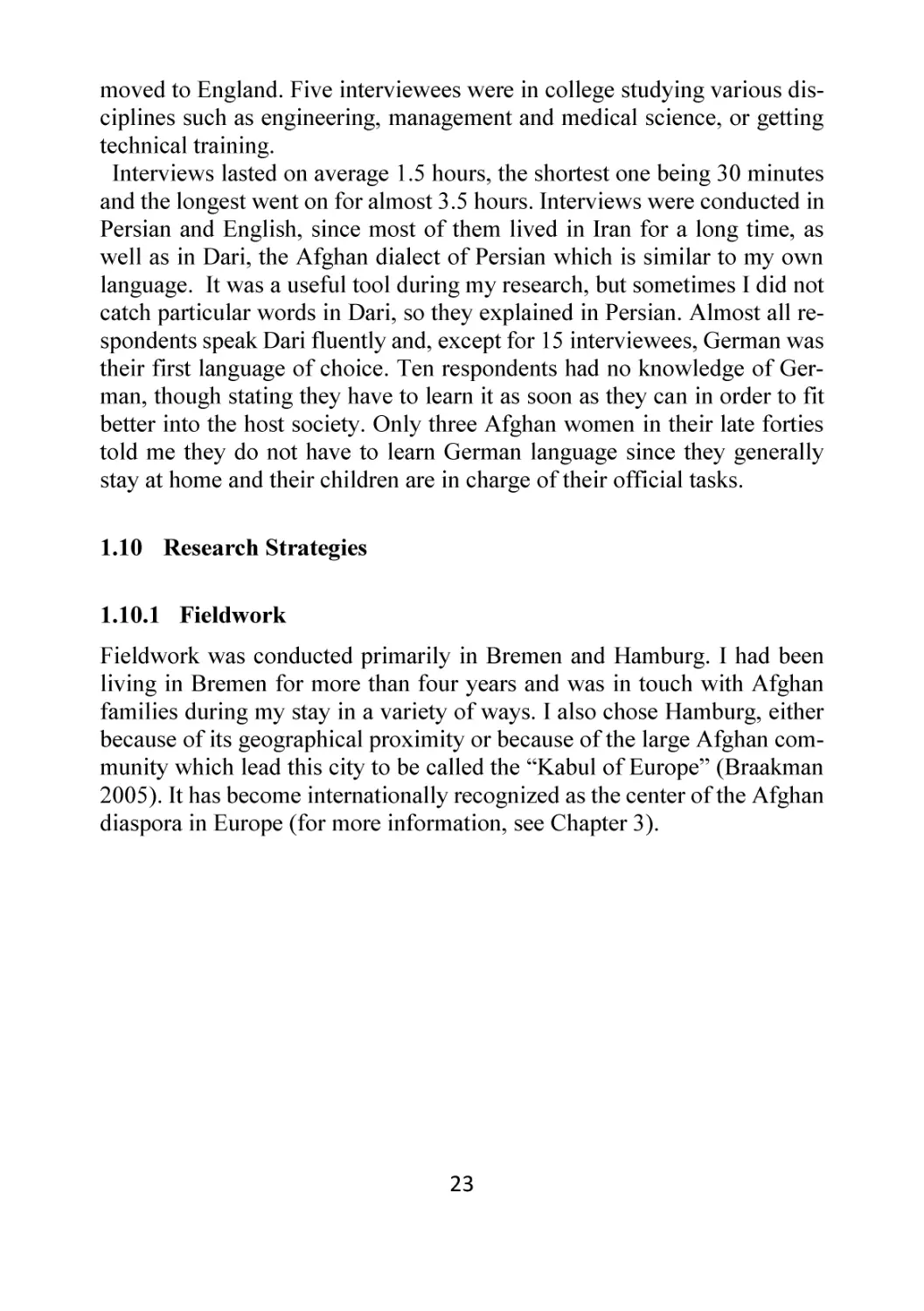
Research Population Demographic
Victim of domestic violence
Rejected asylum seekers
German passport holders
unmarried
Divorced
Married
Age 45-75
Age 30-45
Age 15-30
Work in black market
Student
Legally employed
0

5
10
15
Research Population Profile

20

25

30

35

The majority of interviewees were born in Afghanistan, but a few of the
younger generation were born in Iran or Pakistan and had never been to
Afghanistan. Informants ranged from 15 to 70 years of age. Of the respondents, 18 already had German nationality and 25 Afghan women had uncertain legal status since their application for asylum had been rejected.
Thirty-two of those 51 interviewed are employed legally. Eight of the interviewees are working in professional fields (surgeon or university professor), while five own small businesses. I met 9 Afghan women whose asylum request had been rejected. However, they work illegally as travelling
hair dresser and nanny. Seven Afghan females have never worked outside
the home to earn money. Of the 51 interviewees, 28 were married, all having 2-7 children. I made a conscious effort to involve marginalized refugee
women by including 11 divorced women and 10 victims of domestic violence. During the time of my research, the situations of Afghan informants
sometimes changed. Children were born, three marriage ended in divorce
and two Afghan girls got married (they invited me to their weddings), two
families moved to other countries, one headed to Canada and one family
22

moved to England. Five interviewees were in college studying various disciplines such as engineering, management and medical science, or getting
technical training.
Interviews lasted on average 1.5 hours, the shortest one being 30 minutes
and the longest went on for almost 3.5 hours. Interviews were conducted in
Persian and English, since most of them lived in Iran for a long time, as
well as in Dari, the Afghan dialect of Persian which is similar to my own
language. It was a useful tool during my research, but sometimes I did not
catch particular words in Dari, so they explained in Persian. Almost all respondents speak Dari fluently and, except for 15 interviewees, German was
their first language of choice. Ten respondents had no knowledge of German, though stating they have to learn it as soon as they can in order to fit
better into the host society. Only three Afghan women in their late forties
told me they do not have to learn German language since they generally
stay at home and their children are in charge of their official tasks.
1.10 Research Strategies
1.10.1 Fieldwork
Fieldwork was conducted primarily in Bremen and Hamburg. I had been
living in Bremen for more than four years and was in touch with Afghan
families during my stay in a variety of ways. I also chose Hamburg, either
because of its geographical proximity or because of the large Afghan community which lead this city to be called the “Kabul of Europe” (Braakman
2005). It has become internationally recognized as the center of the Afghan
diaspora in Europe (for more information, see Chapter 3).

23

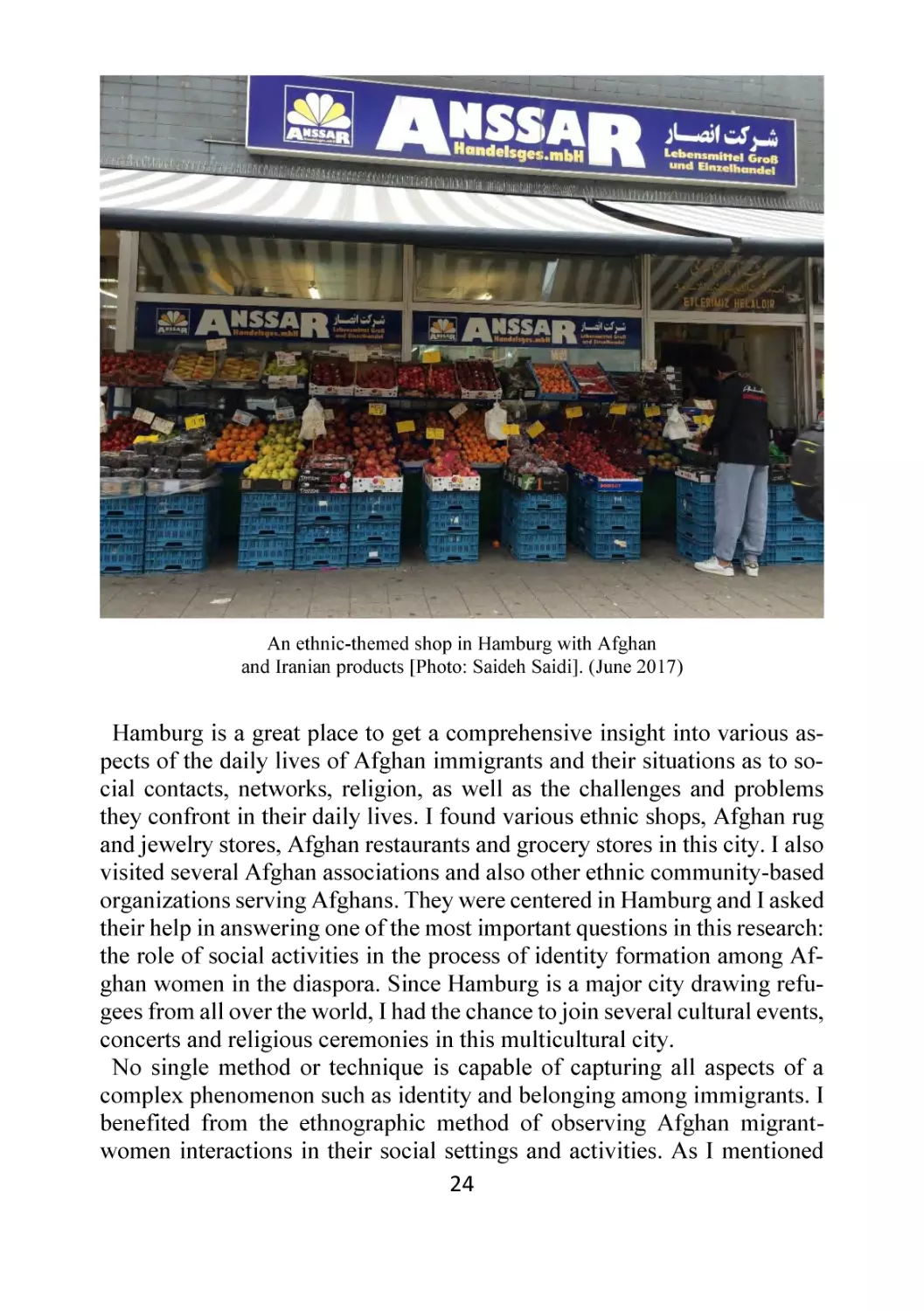
An ethnic-themed shop in Hamburg with Afghan
and Iranian products [Photo: Saideh Saidi]. (June 2017)

Hamburg is a great place to get a comprehensive insight into various aspects of the daily lives of Afghan immigrants and their situations as to social contacts, networks, religion, as well as the challenges and problems
they confront in their daily lives. I found various ethnic shops, Afghan rug
and jewelry stores, Afghan restaurants and grocery stores in this city. I also
visited several Afghan associations and also other ethnic community-based
organizations serving Afghans. They were centered in Hamburg and I asked
their help in answering one of the most important questions in this research:
the role of social activities in the process of identity formation among Afghan women in the diaspora. Since Hamburg is a major city drawing refugees from all over the world, I had the chance to join several cultural events,
concerts and religious ceremonies in this multicultural city.
No single method or technique is capable of capturing all aspects of a
complex phenomenon such as identity and belonging among immigrants. I
benefited from the ethnographic method of observing Afghan migrantwomen interactions in their social settings and activities. As I mentioned
24

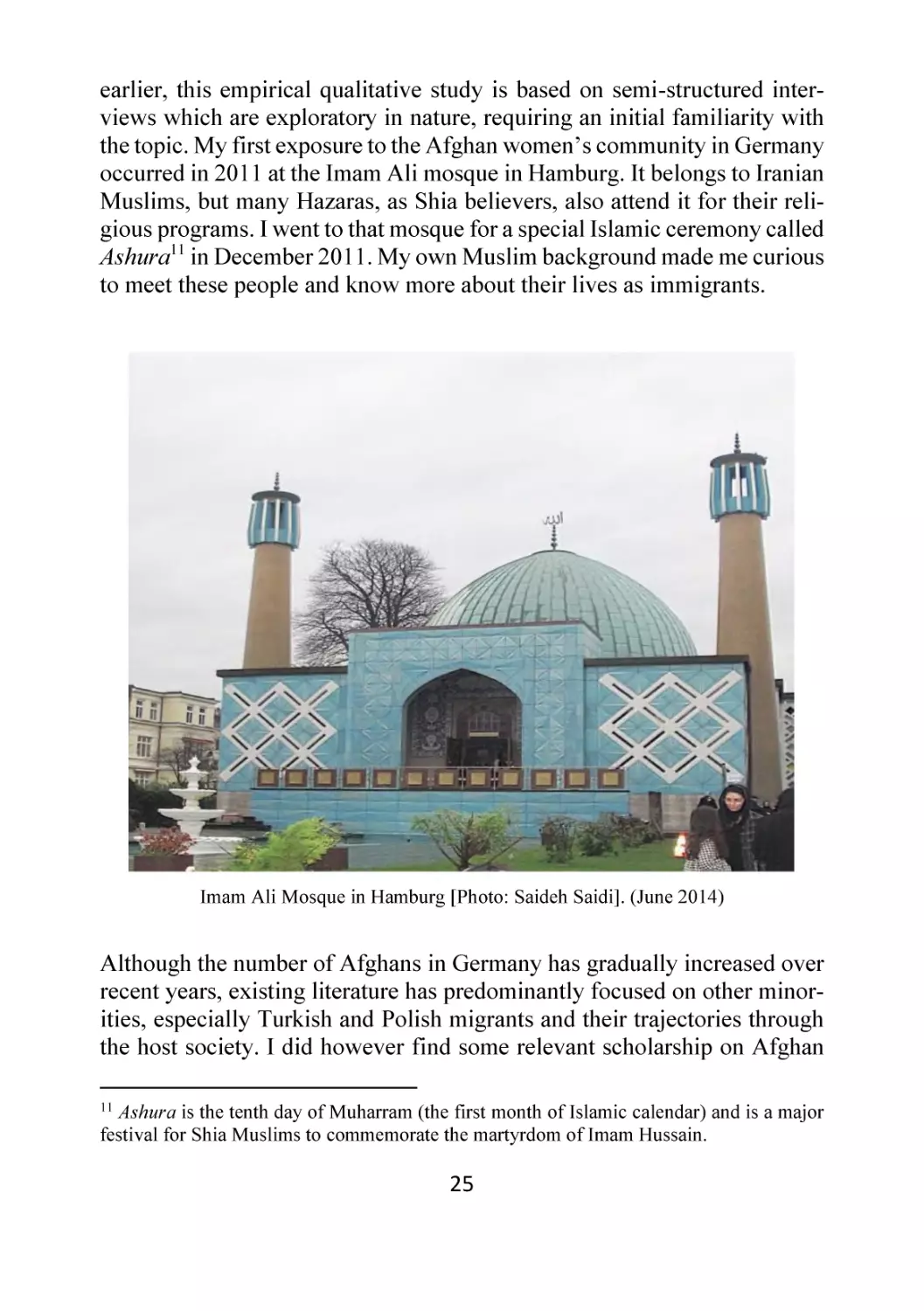
earlier, this empirical qualitative study is based on semi-structured interviews which are exploratory in nature, requiring an initial familiarity with
the topic. My first exposure to the Afghan women’s community in Germany
occurred in 2011 at the Imam Ali mosque in Hamburg. It belongs to Iranian
Muslims, but many Hazaras, as Shia believers, also attend it for their religious programs. I went to that mosque for a special Islamic ceremony called
Ashura11 in December 2011. My own Muslim background made me curious
to meet these people and know more about their lives as immigrants.

Imam Ali Mosque in Hamburg [Photo: Saideh Saidi]. (June 2014)

Although the number of Afghans in Germany has gradually increased over
recent years, existing literature has predominantly focused on other minorities, especially Turkish and Polish migrants and their trajectories through
the host society. I did however find some relevant scholarship on Afghan
Ashura is the tenth day of Muharram (the first month of Islamic calendar) and is a major
festival for Shia Muslims to commemorate the martyrdom of Imam Hussain.
11

25

migrants in Germany, especially Hamburg (Singh 2010; Braakman &
Schlenkhoff 2007).
To be more familiar with the field, I gathered information to deepen my
insight into Afghan migrants’ daily lives. There are photo galleries, especially in big cities like Hamburg, either by Afghan or German photographers. This is an important way of visualizing “authentic” Afghan culture.
These photos were taken of Afghanistan’s natural landscape and the daily
life of the Afghan people. I went to Oslo in the Summer of 2012 for vacation
and had an opportunity to visit a photo gallery on Afghan women’s daily
lives over the past decade. It was inspiring for me personally and I had a
better insight into the ordinary lives of Afghan women.
I tried to keep myself up-to-date about Afghan news. I subscribed to numerous Afghan pages on Facebook, Twitter, Telegram and Instagram,
which Afghans all around the world access to discuss all kinds of matters
regarding their identity and different aspects of their lives. I read all the
novels I could find which have been written by Afghans in the diaspora. I
also followed daily news about Afghanistan and watched Afghan documentaries, especially those related to Afghan women. I enjoyed the way Afghan
women have been portrayed in Afghan Women behind the Wheel by Sahraa
Karimi (2009), Syngué Sabour [Patience Stone] by Atiq Rahimi (2012) and
Shahada by Burhan Qurbani (2010).
These films enhanced my perspective about Afghans’ post-war life. All
these films shed light on the situation of women in Afghanistan. It seems
the world has witnessed how Afghan girls and women struggle to obtain
their basic rights and avoid being victims of a patriarchal and patrilineal
society. They have a voice and they are not passive, vulnerable members of
that society anymore (Abu-Lughod 1993; Omidian 1996).
1.10.2 Participant Observation as a Data-Collection Method
Participant observation (Bernard 2011; Kawulich 2005; Spradley 1980;
DeWalt & De Walt 2002) was a great tool, enabling me to enter into the
Afghan community. Potential interviewees were accessed through personal
referrals, as well as participant-observation activities. In the next phase of
the research, expanding my knowledge and understanding of the identity
formation of Afghan immigrants in general and Hazara women in particular, I spent time with people who were connected with associations partially
working with Afghans. Not only were the social workers in these associations crucial to facilitating my introduction to a wider network of people,
26

but the parties, meetings and social gatherings at these associations were
the principal spaces in which I could “hang-out” and observe what went on.
I attended many events in different cities in Germany where Afghans from
the diaspora came together. I went to two Afghan weddings in Bremen and
Hamburg, their religious celebrations at the mosque, and also three Afghan
concerts, observing how they interact and redefine their identity in the host
society. Throughout my participant observations, I strove to maintain myself neutral. During participant observations, I was cautious enough that the
Afghan migrants I observed and interacted with did not feel my presence
comprised their privacy or disrupted their normal activities.
As the writer of this book, I have a different identity and several aspects
of my own history somehow affected my relationships with Afghan migrant
women. My background, values, feelings and experiences have shaped the
way I understand my respondents’ life stories. First of all, I am an Iranian
immigrant myself, living in Germany, who is deeply engaged with Middle
Eastern/Islamic culture. Afghan women feel freer to express their anger and
frustration depending on how they have been treated in host society. As a
foreigner and stranger in Germany, it was easier to start up conversations
on such topics as homesickness, roots and belonging. Some research participants told me openly they would have never revealed so much about
themselves, in all detail, to a German because “a Western woman cannot
understand how tradition and religion shape our entire lives as an immigrant. They were raised with completely different values. But you are Iranian, you are familiar with Islamic upbringing” (Ahou, 45 year-old from
Kabul). I believe too that Afghan migrant families would have been much
more careful and cautious with a German researcher. They did not perceive
me as a member of German society and saw themselves and me to be outsiders. In their view, there are similar experiences they and I have, and they
saw this as something positive connecting us.
Also speaking Dari, quite similar to my own language (Persian), was an
advantage. Although there are differences in vocabulary, both languages
derive from the same root and are very similar. As I mentioned in Chapter
1, the Hazara ethnic group has many similarities with Iranians based on
language and religious rituals. I have used my interviewees’ own words as
the most effective way of presenting my arguments based on Afghan migrant women’s experiences.
In yet another way, it made a difference that I was married and had a son,
and he often played with their children, resulting in a comfortable and
friendly atmosphere. It also meant I could legitimately participate in
27

women’s conversations about marital and sexual relationships, talking
more freely with them. My Muslim background also made for a greater understanding of respondents’ narratives. As an Iranian woman who was in
good contact with Islamic centers in Germany, I had several advantages in
conducting research on Afghan women’s lives, such as easy access to participants, especially in Bremen, since there is a small population of Shia
Hazaras living in the city and most of the Afghan people know each other.
In order to find a different group of potential research participants, the
mosque was the best place as a social meeting point for Hazara women. It
was a great opportunity for me to build friendships with Afghan women
and chat about ordinary topics such as cooking, childrearing and homesickness.
During this phase, I frequently started to build a network with them, asked
them for their telephone numbers and arranged a time for an interview. The
women’s reactions were friendly and most were willing to meet me and talk
about their experiences as an immigrant in German society. Most Afghan
women said they were glad that, finally, someone was interested in listening
to them and they could open up about their problems, dreams and challenges.
I observed women as they engaged in daily chores and participated with
them, for example, in going to the park or mosque, walking children to
school, going out to shop, cooking for religious nazri12 ceremonies. This
gave me the chance to be directly involved in the daily activities of the
women whose lives I was trying to understand. I believe that the study of
the ordinary and everyday life of Afghan female in Germany reveals valuable information about their sociocultural change.

Nazri is a religious celebration held when a wish has been granted. For Afghan Muslim it
is a food ritual and alms for specific religious occasions for poor people usually have been
made in their places or in Bremen mosque.

12

28

Women-only festive Sofre Abolfazl in honour of a beloved Shia saint at
Ehli-Beyt Kulturgemeinde Bremen e.V. [Photo: Saideh Saidi]. (December 2014)

29

Participant observation took me to variety of places, groups and meetings,
I went to Afghan folk parties and poetry nights, and also to Afghan shops
in Bremen and Hamburg. In addition, I attended meetings where I hoped to
come across migrant women from Afghanistan. I went to the Barbat Organization13 and posted a call for interview partners, posting notices in
places that might be seen by Afghan migrants, such as bookshops, free German language classes at ASTA and also at the Bremen University’s restaurant (Mensa). During this phase, I chose the main participants of my research and tried to meet them informally as often as possible.
1.10.3 Internet as a Data-Conducting Tool
The growing numbers of Internet-based studies enable researchers to immerse themselves in various fields of social research (Herring 1996; Tapper
2001; EunKyung 2013). In modern times, the Internet and hybrid forms of
communication become an important instrument having an impact on the
Afghans scattered across the globe. I use the Internet to expand my
knowledge of the field and I used several Afghan chat rooms, discussion
forums, virtual-telephone links, online press, and also several weblogs and
websites to get a better understanding about the lives of Afghan women.
I regularly visited Afghan discussion forums and chat rooms. I tried to
remain an invisible observer. However, in some cases, I was an active participant as well. I benefited from lots of Facebook pages and their content
on Afghan identity, Afghan women NGOs and Afghan culture. At first, I
shared my research goal and questions on their page and asked whether
somebody could help me in this regard. Several friendships and contacts
were established.
I used this method extensively to communicate with Afghans who still
were in Turkey or Afghanistan, since I did not have a chance to meet them
personally due to the physical distance (Hiller & Franz 2004). However,
emotionally, I felt a bit far from my respondents since I could not witness
the love, anger, pain and frustrations in their faces.
Topics like relationships between men and women, marriage and religion
are explicitly talked about over the Internet. It has given Afghan migrants,
13 Barbat – Deutsch-Persischer Kulturverein e.V. is a cultural organization which was
founded in 1992 for Iranians in Bremen. It has various music, paining, calligraphy and dance
lessons for Iranian and other Persian immigrants in Bremen; they also have monthly poetry
nights. Hazara population in Bremen also participated in this organization because of cultural and language similarities (see Chapter 5).

30

especially the younger generation, more autonomy in pursuing their demands, for instance, finding a partner of their own choice, which may be in
contradiction with family values (see Chapter 4). I have the impression that,
exactly because they are able to remain anonymous, they can be more open
about their opinions and feelings than in real life, where speech is curtailed
by social control and the duty to uphold family honor. I found different
narrations about Afghan women and girls’ lives in rural areas in Afghanistan via the Internet and contacted some social networks working with Afghan refugees all over the world.
1.10.4 Transcription
In order to get Afghan women to open up about their lives and experiences
as immigrants, it was important to establish rapport through casual conversations and informal meetings (Fontana & Frey 2000) prior to our discussion of the topic. About 9 interviews were tape recorded and I tried to transcribe them verbatim. However, most of the respondents had concerns
about the use of a tape recorder and camera over the course of the interview.
In many cases, research participants objected to being taped and their decision was respected. Therefore, I was unable to tape all our conversations
and, during such interviews, only took notes.
With the tape recorder, our conversation did not go well. The tape recorder
was an imposition for some, who did not reveal their feelings and thoughts
until I turned it off. Although consent was asked before recording interviews, I had the impression that whenever I taped our talk, I sensed artificiality in the Afghan women and they talked differently than when recording. I always emphasized the informants’ identities would be protected and
I would only use the information for my university research, but I noticed
quickly that, in some cases, they changed their statements after turning off
the recorder. I was aware these people had gone through continuous war
and conflict in Afghanistan, and it was stressful enough to trust me. They
did not want to open up old wounds by talking about it. So, I developed a
quick way of writing down interviewees’ words as literally as possible immediately afterwards since, in many cases, they did not allow me to record
their voice. This meant I needed to have a very clear head, with a high level
of concentration and intense effort to listen to their narratives. I tried to train
my memory by memorizing and repeating their quotations. Thus, I needed
to immediately write up my field notes and responses, with all the details,
observations, impressions, feelings, fears and hopes. Notes were dated and
31

titled, and I wrote down any activities taking place and interactions occurring during the interview. After meeting with my respondents, I often had
plenty of opportunity to write down the most important quotes and recorded
the information in my car, on the bus or at home. Sometimes I went to my
favorite cafés in Bremen (Munte Café or Café Knigge) and tried to write
down as much as I could for hours, mingling the women’s life stories and
my research goal and questions.
As data was collected, a way to manage such massive amounts of information was needed. I began the analysis when one third of the interviews
were done, transcribing and producing an initial set of categories and making some adjustments to the interview guide. Based on valuable research on
content analysis (Charmaz 2003; Gibbs 2007; Mason 2013; Schreier 2011),
I applied this to reduce the large volume of data to more manageable content
categories. After transcribing, writing and extracting key statements separately, they were grouped together on the basis of conceptual similarities
and resulting categories were given collective themes.
I tried to identify significant patterns and construct a framework using row
data based on my research questions. A list of relevant codes has been excerpted from Afghan women’s narrations which reflect the objectives of the
research. I then started to compare and analyze the material. I wrote all
codes in Persian and then translated them into English. While various codes
emerged, data analysis started in order to provide defined patterns for all
the stories and narrations I heard during the course of interviews, leading to
distinctive themes based on the research goal and questions, as well as my
analytical framework.
1.11 Interview Challenges Encountered
1.11.1 Notion of Trust
One of the most challenging aspects of this research was the difficulty getting rid of the fog of suspicion among Afghan families and establishing a
relationship based on sufficient trust so as to start a conversation on their
sensitive and private experiences during their journey toward Europe. As
an Iranian immigrant myself, I was familiar with this obstacle. However, I
was also warned by Afghan friends in advance.
Among Afghans, there is a strong sense of mutual mistrust in interpersonal relationships (Pazira 2005) and individuals are always on guard to
32

protect themselves and their family. Afghans are hesitant to share their private lives with outsiders. I had many cases of people who did not cooperate
and fearfully cancelled interview appointments. Needless to say, Afghans
have been raised in a society with a long history of conflict. People learn to
trust a close circle of ethnic and family members and to distrust outsiders.
People were therefore raised with the idea of keeping their problems to
themselves, within the family. Afghan girls traditionally have been trained
over the centuries to keep silent about problems at home and not talk about
their personal problems in public. Some males felt uncomfortable talking
about conflicts. They tried to hide the reality of their relationship by painting a perfect image of their lives. Most of them were afraid to talk to an
outside researcher, whose work was unclear and dubious to them. I had to
explain my objectives over and over again in order to convince them I was
only a university researcher and quotes from them would only be used for
research purposes.
I met an Afghan woman who was in her late thirties who did not give me
permission to say her name in Burger Park in Bremen in April 2014. She
migrated to Germany with the help of smugglers from Kunduz in northern
Afghanistan. When I described my research objectives to her, halfway
through the conversation she backed out and refused to cooperate in the
research. I understood her anxiety concerning the asylum procedure, which
generates on-going fear and suspicion towards interviews in general
(Ghorashi 2007). She elaborated:
Thank you for asking me to respond to your important questions. But I am
afraid of an interview because I am in the middle of my asylum procedure
and I am interviewed all the time. My family is in an anxious situation of
waiting for the outcome of the asylum plea. I do not want other Afghan
families to be aware of our political problems, which forced my family to
flee from our homeland and seek refuge in European countries. I must protect my teenage girls from people’s judgments. Talking about our family
lives in Afghanistan inevitably also produced painful memories of loss and
separation and, at the moment, I feel enough.
As I mentioned earlier, I had the advantage of speaking the same language
(Dari) as my respondents, creating an environment of confidence. Being a
“foreigner” and having the same religion and language, I could easily build
a bridge of trust. Although religious, linguistic and cultural similarities be33

tween Iran and Afghanistan had a great impact on the progress of this research, on the other hand, for historical and political reasons, Afghans do
not have a positive image about Iranians. They think the Iranian government has had played a great role in Afghanistan’s current, miserable situation. The main negative result of these similarities was that they assumed I
was an “Iranian agent,” because some interviewees had spent many years
in Iran and had negative memories forcing them to escape. This problem
came up during some of the interviews because of misunderstanding about
my research goal. In my first experience with an Afghan student, she jokingly called me an “Iranian agent and spy” and told me not to expect too
much cooperation from Afghans, since they may think any statements
would affect their plea. She informed me that, as an interviewer, I might be
perceived differently–both negatively and positively–by Afghans in the diaspora as: secret agent, healer, stranger, and lawyer helping them with their
asylum plea, and so on. Some Afghan families assumed I was working for
the Bundesamt or another German authority working with refugees and
came “for choosing the ones to be granted acceptance.” Therefore, I tried
to be as clear as possible about the goal of the research.
In the process of building trust between researcher and the research population, an insider/outsider binary situation may occur (Hesse-Biber &
Leavy 2007; Merton 1972; Bruner 1984). I tried to “be friendly but not too
friendly” (Oakley 1980, p.34) and keep a balance about my involvement
during our conversations with Afghan migrant women. In anthropological
research, the anthropologist himself or herself is the most important instrument in both data collection and analysis (Bernard 2011; Matsuoka &
Sorenson 2001; Abrams & Hogg 1999). I should also note that I am an
engaged and sympathetic participant-observer in the processes described in
this book. Goffman (1989) excellently describes this involvement as follows: “Data is gathered by subjecting yourself, your own body and your
own personality, and your own social situation to the set of contingencies
that play upon a set of individuals” (Goffman 1989, p. 125).
My identity as a female Iranian migrant, educated and Muslim, also influenced how Afghan women viewed me. I was an insider from the Afghan
community in Germany in terms of our shared religious and linguistic identity. We had similar issues from our migration to the West, such as homesickness and our stance toward German society. I was open about my own
family life and personal experience as a migrant woman from the Middle
East. Sometimes I had a struggle with finding a balance between distances,
my involvement being a friend and, at the same time, a researcher. In some
34

cases, I supposed such an intense effort may also have limited the scope of
observation, resulting in “going native” or triggering reactivity. I found it
very hard to find a delicate balance and tried to shift between roles according to the context. However, in the final analysis, I was an outsider who was
afforded a measure of trust.
1.11.2 Hidden Control upon Afghan Women at Home
My main research strategy was creating an informal interview setting which
put people at ease in a friendly atmosphere. Therefore, I interviewed respondents at their home or at another location of their own choosing. Some
interviews took place at their refugee camps in Wardam, Reinsberg or Ludwig Heim in Bremen. Most conversations and contacts followed the same
pattern. After a careful start, building up trust, there was a quite a lot they
wanted to say and obviously enjoyed talking about their family life back in
Afghanistan.
Interviewing people at their home yielded various positive results. Besides
creating an informal atmosphere for talking about their migratory experiences, it also enabled me to see their living conditions and observe interactions between family members, so as to evaluate how Afghan women negotiate their identity within the family structure. These visits gave me the
opportunity to learn about the perspectives of other family members as well,
because husbands and other members of the family gradually joined in on
the conversation. During my visits, I also enjoyed Afghan meals, snacks
and drinks, and became more aware of their daily rituals, watching Afghan
television channels, and I also had a chance to see their family photos from
their past lives prior to settling in Germany.
Conducting interviews at someone’s home has obvious disadvantages as
well, because other family members, especially husbands, exert a hidden
control over their wives, either by repeatedly interrupting their responses
and guiding the interview, or by directly forbidding them to be interviewed.
These patriarchal rules are widely observed in Afghan families. Some Afghan women, particularly those who entered Germany recently and are still
fully dependent on their husbands or fathers, have experienced problems
and tensions that make them feel vulnerable. While our talk was on their
terrain, most of the time all the family members were in the same room
listening to our conversation. Some Afghan women were reluctant to discuss their own family matters with me. In many cases, male members of the
35

family suddenly interrupted the discussion and started to share their points
of view.
In practice, I talked with the Afghan woman first and after a while of getting a comprehensive view of Hazara migrant women in Germany, I shifted
the interview questions so as to include male members’ opinions as well.
However, I must admit male respondents always shifted the conversation
to the political situation in Afghanistan. It was a bit challenging to discuss
private questions about their experience as a woman in a traditional society
like Afghanistan. They talked hesitatingly while husbands or other male
members were in the room. Gradually, I changed my interview plan. To get
a better understanding of my case studies’ daily lives, I tried to give ample
space to them to ventilate their opinions and the ups-and-downs of their
migratory lives. To create a comfortable atmosphere for Afghan women, I
invited them to a café or at my place. It created a level of reciprocity in my
relationship with Afghan families and also enabled them to talk openly
about the problems and insecurities respondents face as immigrants and the
strengths and weaknesses of their own social networks. They opened up
about their lives without the hidden influence of their husbands, and our
productive conversations went smoothly.
1.12 Ethical Considerations
Since the major components of this research involved fieldwork and human
subjects, ethical considerations became central to the whole process. Therefore, the ethical guidelines laid down by the British Sociological Association (2002), a prominent and specialized institution in the field of social
science, were adopted. Among the various ethical principles, some issues
were of particular relevance and importance, especially with regard to “respecting the autonomy and anonymity of the participants” and “confidentiality and privacy.” To ensure these elements, I acted according to various
paragraphs of the Statement of Ethical Practice for the British Sociological
Association, to wit:
i. Participation in the research was based on the freely-given informed consent of those studied. (Paragraph 16). I explained (both
in writing and verbally), with appropriate detail, and in terms meaningful to the participants, what the research was about, who was
doing it, why it was being undertaken, and how it was to be disseminated and used.
36

ii. Participants were made aware of their right to refuse participation
whenever and for whatever reason they wished (Paragraph 17).
This was also explained (both in writing and verbally) at various
stages of the interview.
iii. Participants were able to reject the use of data-gathering devices
such as tape recorders and video cameras (Paragraph 18).
Since my research goal is about a sensitive issue involving identity with
an ethnic group such as the Hazara, who came from a war-torn country and
underwent trauma and hardship in their lives, it is important for me to be
truthful and straightforward about the objectives of the study and any anticipated risks and benefits to individual participants and the community.
When I arranged interviews with Afghan migrant women, I tried to establish rapport and inform them about my research topic, goal and main questions. I made it a personal commitment to assure them their participation
was voluntary and that the collected data would be confidential, changing
their names to further mask any connection between their statements and
my findings. I always emphasized that I was an independent academic researcher who chose this topic based on my own intentions. I tried my best
to describe the aim and content of the interviews, motivations for doing so,
possible outcomes and how the collected data would be published.
As I mentioned earlier, given the inherent mistrust existing among the Afghan community in the diaspora, guaranteeing the full anonymity of research participants was as important as the above concerns. A couple of
interviewees explicitly asked me to keep their narrations and statements
anonymous. First of all, I have given pseudonyms to all names, unless I had
the permission of my respondents otherwise. For instance, three Afghan
women said they did not mind if I mentioned their names in the book. Hesitation to be recognized was more obvious among rejected asylum seekers,
undocumented migrants, and women who had undergone trafficking during
their journey toward Europe. They were more cautious about any information being published with real names, making their situation even worse.
In contrast, some Afghan women, especially the younger generation, were
informed about my research goals and ambitions to expand knowledge on
Afghan women in the diaspora and enthusiastically talked about their experiences, contributing actively to my research. They expressed their hope
to further change in the situation of Afghan women by helping me to find
relevant participants, advertising my research agenda on the networks they
used, and inviting people for discussion groups at their own places.
37

Chapter 2

Afghanistan Social Structure

Preface
In this chapter of my dissertation, I want to draw a picture of Afghanistan’s
social structure and migration profile over the past decades. This will give
a better perspective on which to base research questions and a more comprehensive knowledge of the sociocultural changes that are due to their transition to German society. A brief background is provided on Afghanistan’s
social structure, followed by a detailed discussion on different waves of
Afghan refugees. A contextual and historical understanding of Afghans (especially the Hazara ethnic group) will facilitate our understanding of the
multi-dimensional nature of Afghan migrant women’s identity in German
society.
2.1

Social Structure of Afghanistan

Migration is a life event. Mobility has been an essential part of Afghan history and Afghanistan has been the focal point for the greatest and most
complex refugee crisis in modern history. According to official reports, 76
percent of the population has experienced some displacement during their
lifetime (ICRC 2009).
Afghanistan was formally established as a State in the last quarter of the
nineteenth century. It is one of the poorest countries in the world, with decades of international and civil war, consecutive years of drought, unstable
political governments and poverty, spreading Afghan refugees all over the
world. The Afghan people have historically been underway, in group and
in person, legally and illegally, within the region and beyond.
The Islamic Republic of Afghanistan consists largely of rugged, mountainous terrain at the crossroads of Asia, located in Southwestern Asia on
the Iranian Plateau, which is part of greater Middle East and Central Asia.
39

It covers an area of 647,500 square kilometers. It is surrounded by Tajikistan, Turkmenistan and Uzbekistan to the North, the Hindu Kush Mountains running from the eastern border with China and India on East. The
longest stretch of border is with Pakistan to the South, some 2430 kilometers, and there is a long, porous boundary of roughly 940 kilometers to the
West with the Islamic Republic of Iran. In fact, the distance between border-crossing posts makes border control difficult. Therefore, most Afghan
refugees around the globe have gone through Afghanistan’s border with
Iran and Pakistan.
The capital city is Kabul, located in the eastern part of the country. The
toppling of the Taliban14 in 2001 attracted many people displaced by war in
the countryside who were looking for a better life in the capital. It is faced
with unequal and unregulated urbanization (The World Bank 2016).
Twenty-six out of 51 respondents came from Kabul. Rural/urban differences and contradiction between the city and countryside played an important role in tensions about Afghan women’s situation in society. Kabul,
similar to other large cities such as Herat and Mazar-e Sharif, offer education, employment and health services, while most villages are still isolated
due to poor infrastructure and lack of security. Rural Afghanistan consists
mainly of people with traditional rural backgrounds. Only a fraction of the
total population of Afghanistan belongs to the middle and upper classes.
Afghanistan is among those countries most threatened by climate change
(UNDP 2016). It has a continental, arid to semiarid climate, characterized
by steppes and desert. Rainfall is limited, with cold winters and hot summers, which has led to several droughts over the years (Karimi 2014). Rural
Afghans, especially males in the family, have had to adapt their livelihood
strategies to deal with the impact of drought (Stigter & Monsutti 2005). A
large part of Afghanistan is subject to soil erosion. Nearly three-quarters of
the country is covered by mountains with little or no vegetation. No doubt,
Afghan topography and harsh climate have had a great impact on prolonged
out-migration, social mobility and internal displacement.

The Taliban is a Pashtun, Islamic fundamentalist group ruled Afghanistan from 1996 to
2001.
14

40

Kabul, the Capital, [Photo: Ali Abdi, Iranian blogger based in New York]. (October 2016)

Afghanistan’s population is estimated at between 15.5 million people in
1979 to over 32 million in 2015 (CIA World Factbook 2015). In recent
years, due to the expansion of health regulations and public awareness, the
number of births surpassed the number of deaths and the population is starting to increase. The average number of children per woman fell from 8 in
the 1990s to 6.3 in the mid-2000s, and to 5.43 in 2014 (Ibid). Generally, for
decades, the Afghan fertility rate was one of the world’s highest. Childbirth
remains the main cause of death for women and the rate of Afghan maternal
death is one of the highest in the world.
In recent years, education and health planning for women has made a huge
difference and childbearing dropped substantially.

41

Kabul. There is an increasing trend in public awareness among Afghan families about family planning and mother’s health. This sign asks families to let 3 years between each pregnancy for the sake of mother and children’s health. [Photo: Ali Abdi Iranian blogger based
in New York]. (May 2017)

For my research, I found an Internet forum inside Afghanistan which Afghan youth use for social communication. One of topics was about “Afghan
women’s rights” and several people left comments on different aspects of
this topic. An anonymous 24 year-old female from Herat left a note as follow:
Traditionally, Afghans respect large families, especially loving to have
son. People feel that the bigger the family, the more influential you are.
Therefore, you can earn more income with a greater number of children
and also, in time of conflict or war, with a large family, especially having
boys, your future will be insured. You have insurance for the future. Also,
as a Muslim society, most Afghan families give religious reasons for wanting more children. But nowadays, with the expansion of telecommunication
and urbanization, these trends appear to be changing and Afghan women
achievements in education and the workplace consequently delay a
woman’s decision to start a family. It seems that Afghan society is in the
process of transforming itself.

42

Unlike the once-stable pattern of rapid population growth, with the expansion of knowledge and health-care facilities, the population rate should be
more reasonable in the future.
2.1.1

Afghanistan Appellation

The region of Afghanistan has long been part of the Persian Empire and has
had a turbulent history at the heart of Asia. In ancient times, it was called
the Land of Aryana while, in medieval times, it was called Khorasan. Today, Afghanistan means Land of the Afghan (Qazi 2016). The word Afghan,
from Persian, first appeared in 982 AD in Hudud-al-alam15 (Vogelsang
2002, p. 18), meaning “to shout” or “to whine.” Historically, it has designated the Pashtuns, the largest ethnic group in country. The Indo-Iranian
suffix -stan means “place of,” a prominent ending in many languages of the
region.
Before Afghanistan was used, there were other historical names for this
region such as Kabulistan, Zabulistan, Aryana and Khorasan. Before the
eighteenth century, there was no definite political entity. In 1747, the land
was controlled by the Pashtuns and Ahmad Shah Durrani (elected king by
a confederation of tribes16 after the assassination of the Persian ruler Nadir
Shah at Khabushan that the same year) established the first independent
Pashtun-controlled region in central Asia. Today, he is known by some as
the Father of Afghanistan (Encyclopedia of Islam Afghanistan; USA International Business Publications 2013, p. 26). Afghanistan became politically
recognized by the international community in 1919, when it gained independence from the British.
The word Afghan is pronounced differently in other languages, for instance, people from India call them Pathan. Some Pashtun tribes still call
themselves Pashtun and Afghans living in the South of the country call
themselves Pakhtun. In fact, even the name of Afghanistan itself has been
influenced by its cultural and ethnic diversity.

Hudud al-Alam from Arabic literally means the Boundaries of the World is a 10th century
geography book written in Persian by an unknown author.
16 Tribes is a group of people related by economic, religious, or blood ties which is an influential parameter in understanding of Afghan identity dimensions.
15

43

Nostalgic Impression of the Word Afghanistan
If we consider Afghanistan as the Hazara homeland, it can be a means of
self-expression and identity among migrant women. There was a separate
section of my interview questions regarding “the meaning of home” in eyes
of Afghan migrant women. What is home, what does home mean? For some
Hazara refugee women who fled their homeland for whatever the reason,
even pronouncing the name Afghanistan can make them emotional. It represents their ideal homeland, watan or sarzamin (“-place”). However, it is
highly ambiguous and might be imaginary rather than real (Brah 1996).
Ava, a 48-year-old divorcee who migrated to Germany in 1989, commented:
I fled Afghanistan to Pakistan during the Mujahedeen. After spending
three hectic years, I re-immigrated to Iran for 15 more years and finally I
headed to Germany in 1989. Although my mind is filled with the picture of
Afghanistan which is rife with struggle, fear and war, but I feel my heart
crushed, like someone squeezed it, whenever I hear the name of Afghanistan
anywhere on T.V or in the newspaper. Afghanistan is the country that I was
born in. I will always relate to it. Although, as an Afghan you are khane be
doosh, “scattered,” you see, but my children who were born outside Afghanistan do not have the same feeling about the name of Afghanistan. For
my children, here is the only home they can ever imagine. They did not live
in Afghanistan. They were born and raised in Germany. My children enjoy
living in Germany, they have German friends. I found myself like a fish out
of water. In my heart, there is the magical land of my ancestors, the motherland, and the place where I grew up and fell in love. Unfortunately, the
same word Afghanistan does not have the same feeling for my children who
were born in Iran and Germany. They have never set foot on Afghan soil
and Afghanistan is just a country on the map which suffers from prolonged
insurgencies.
Besides the official names for a country, the way it influences people’s
feelings varies. While a passionate feeling towards Afghanistan’s name is
very common among first-generation Afghans, for some second- and thirdgeneration Afghan migrants, it can be the equivalent of “misery, deprivation and war.” During the interview, I asked my research population to react
to the name Afghanistan. Some of 40 out of the 51 interviewees became
emotional, recalling happy memories of the past. The interviewee Ava said
44

that, for many Afghans living outside their beloved homeland, the image of
Afghanistan is often glorified, nostalgic and associated with the “good old
days,” their formative years, youth, and beloved family and friends. Evidently, they choose to nurture only the happy memories, living off a fantasy
and not seeing the present-day realities of their homeland.
On the other hand, the importance of “community” is obvious in Afghan
social life in exile, especially when they have lost family and friends. During my interviews, I noticed that Hazara family life in Afghanistan was intense in terms of proximity and contacts. Family members generally lived
in the same house or close-by and met often. The khane be doosh, which I
heard quite often during interviews, is a way of speaking about migration
and also is a term that emerged as a way of describing the Afghans scattered
about the world, with a loss of traditions and extended families. Ava did not
seem happy about the dispersal of her close family all over the world:
When I was a child, I lived together with my extended family in a beautiful
house. I lived with my parents, grandparents, cousin, my married brother
and his wife, and their three kids. There was love among people. Now we
are all scattered, like a broken string of pearls. That is lost. When the parents got old, we took care of them. I mean there was a spirit of sacrifice
there. But in Germany, we were divided. By the massive out-migration of
my family, I don’t have my immediate family members or close relatives
and friends neither here nor there. Most of them are out. Well, I don’t like
it here. In Afghanistan, we were together. Here we are broken up. Even my
own family, my children and I, are in Germany. My mother is in Paris, two
brothers are in Canada, other family is elsewhere, scattered all over the
world.
The internal emotion brought out by Afghanistan is not just a bond with
Afghan territory, but can be traced back to the emotions of childhood memories, familiar places, where they experienced security, social warmth and
heritage. There are the feelings toward loved ones who are still in Afghanistan. Nostalgic images of Afghanistan are invoked in the music, clothing,
media, poetry, home decorations, praises of a pristine countryside, and in
the food. While the image of Afghanistan as Heaven on Earth is in the back
of first-generation Hazaras’ minds, for second- and third-generation
Hazaras, Afghanistan is a horrifying place of death, destruction and poverty.

45

2.1.2

Language (zaban)

To get a better insight into identifying Afghan women of the diaspora in
Germany, it would be a good idea first to understand the rich social structure of their homeland, an integral part of every Afghan’s daily life. Identification of their ethnicity, religion and language is crucial to understanding
their behavior and attitudes during their migratory journey. They are strong
indicators of identity and are crucial to understanding how they are perceived and associated with by outsiders.
Language is a conduit of cultural expression and a medium by which human beings convey the feelings, desires and thoughts which appears in
one’s mind. Although Afghanistan has two official languages, Dari and
Pashto (Afghanistan Constitution of 2004, Article 16), as a multilingual
country, 20 to 40 other languages and dialects exist throughout Afghanistan
(Nojumi 2002; Ethnologue 2015). In fact, chronic war and instability over
the decades has hindered getting accurate numbers regarding Afghan social
structure. Attempts to gauge the percentage of each spoken language vary
widely and, at present, are based on estimates.
Around 50 percent of people speak Dari, the most widely spoken language
in Afghanistan. It is often referred to as Afghan-Persian (CIA Factbook
2014), which is also spoken in Iran. People in the northern and central areas
of Afghanistan usually speak Dari. It has always been considered the prestige language and is written in Persian/Arabic script, left to right, and has
many loanwords from both Persian and Arabic. All of my interviewees
spoke Dari, which enabled me to build a better rapport with them. The pros
and cons of similarities between the researcher and participants were discussed in Chapter 1.
Pashto or Pakhto is spoken throughout the Pashtuns in the South and
Southwest of Afghanistan and in Pakistan, an ethnic group making up approximately 35 percent of the Afghan population. There are other minor
languages: the largest, Turkmen and Uzbek, are spoken by about 11 percent
of the population. Other minor languages include Arabic, Azerbaijani, Balochi, Brahui, Darwazi, Pashai, Tatar, Tirahi, Uyghur, Waigali, etc.
2.1.3

Religion (din)

In particular, the terms ghawm, watan and din are used as a basis for Afghan
identity (Tapper 1986). Adherence to Islamic religion is the most important
46

symbol of Afghan identity. Although Afghan people embody various ethnicities and languages, with sectarian differences, they are the same in religion and culture. Islam in Afghanistan has deep historical roots. Although
no official figures exist, it is commonly estimated that about 80-85 percent
are Hanafi Sunni and the rest are Shia followers, consisting of Twelver Shia
Islam and Ismailia sects (mazhab) (Roy 1986). There are also minorities of
Jews, Buddhists, Zoroastrians, Hindus and Sikhs residing in Afghanistan.
Afghanistan is a conservative society heavily dependent on Islamic traditions and norms which are quite determinative for women. Since religion is
one of the major factors affecting Afghan women’s identity, either in their
homeland or during their lives as migrants, in many cases, misinterpretations of the Quran has affected the status of female members of society
negatively, more than the religion itself (Stowasser 1996, p. 3). For centuries, women remained uneducated, completely submissive to their husbands, and marginalized. Afghan women who have had experience outside
Afghanistan have encountered a more liberal interpretation of Islam, greatly
influencing their identity, as will be discussed in Chapter 4.
2.1.4

Ethnicity (ghawm)

Afghanistan, with its rich, intricate history, is made up of myriad sub-cultures and backgrounds (Dupree 1973; Blood 2001; Saikal 2004). The world
ghawm (also transliterated as qawm, qowm and qaum) or “ethnicity” is perhaps the term most widely used among researchers working on Afghan social identity (Tapper 1986; Dupree 1990). Afghanistan is a heterogeneous
nation and, ethnically, a quite diverse country consisting of several ethnic
groups. The concept of ethnic group, extended family, clan (tayefeh) and
religious sect have a great impact on the formation of Afghan women’s
identity. For Afghans, ghawm refers to a common myth of descent, kinship,
a shared history and culture and patron-client relationships (Entezar 2008;
Roy 1986; Nawa 2001). In Afghan society, ghawm is based on an individual’s relationship with the extended family and kin, establishing closeness
between members of the ethnic group.
Similar to previous parts of the chapter, in the absence of accurate data,
the exact relative percentage of ethnic groups is quite problematic. According to Afghanistan’s national anthem, there are 14 ethnic groups in this
country (Siddique 2012; Dupree 1973). The four major, mostly Islamic,

47

ethnic groups are: Pashtuns, Tajiks, Hazaras and Uzbeks. There are a handful of other smaller groups, such as Nuristanis, Baluchis, Ghizilbash, Gujars, Turkmens, etc.
The Pashtuns are Sunni Muslims and, as the dominant ethnic group in Afghanistan, account for over half of the population. Historically, they have
been the most powerful ethnic group, living in the South and Eastern parts
of the country and consisting of two main tribes: the Durrani and the Ghilzay (LaDelle Bennett 2012). Their official language is Pashto.
The Tajiks, with 27 per cent of population, are the second largest ethnic
group in Afghanistan, primarily Sunni Muslims. They speak Dari, occupy
the Northeast and West of Afghanistan and are closely related to the people
of Tajikistan.
The Hazaras form a religious minority that lives in Hazarajat, located in
central Afghanistan (Zulfacar 1998). They fervently adhere to the Shia sect
of Islam and speak Dari (Bacon 1951 a; b). They are the most economically
disadvantaged among Afghan ethnic groups. According to the linguistic
and cultural similarities, by chance, the majority of interviewees belong to
this ethnic group, who predominantly re-immigrated from Iran to Germany.
Although Afghanistan has modernized its economy recently, it still has its
traditional, informal social structure and is committed to traditional values.
In general, when asked to describe their identity, Afghans may start describing family ties, ethnicity and, finally, country. Due to Afghanistan’s geography, with numerous mountains and deserts, many ethnic groups preserve
their identity without interference from the central government (Braakman
2005). Ava elaborates:
Afghan people are first loyal to their family, ethnicity, sect or ideology and
lastly to the country. I think Afghanistan has not been a nation-state for
decades, although recently the role of state has become more important in
the country. But for centuries, Afghans have been recognized by their ethnic
group first. Afghanistan is a patchwork of ethnicities much like colorful Afghan carpets, which makes it hard to understand our identity. I am proud
of being Afghan, but I always mention my ethnicity to everyone.
Being away from their immediate family and friends reinforces their Afghan ethnic identity and strengthens the sense of family and tribal loyalty.
By migrating to a totally foreign society like Germany, loyalty binds some
Hazara families to their cultural traditions and leads them to live in settlements with people from the same ethnic background. This popular pattern
48

among Afghan migrant women in Germany will be discussed in detail in
Chapters 4 and 5.
2.2

Migration as a Way of Life

International migration is a well-established feature of contemporary global
life, resulting in social and cultural changes. For Afghan families, migration
was a stressful decision and the only way to survive, though it led to massive cultural and social dislocation. By moving to Germany as a mere necessity for survival, they sought a place where they would be able and allowed to live. It brought about many changes in their lives. More recently,
there is an increasing number of people who migrate just to find a more
fulfilling way of life elsewhere and make a fresh start.
Afghanistan is a leading country sending refugees. More than 30 years of
conflict, war, tension, and insurgent violence have wreaked a heavy toll on
its population, resulting in large-scale, forced migration, both internally and
internationally. As one of the poorest countries in the world, Afghan people
have among the lowest living standards in the world. According to the
UNDP’s Human Development Report 2015, Afghanistan ranks 171 out of
the 188 countries surveyed (UNDP 2016). Life expectancy is 50.9 years
(CIA World Factbook 2015) and the Word Bank estimates economic grow
will remain low in 2016, at 2 percent (The World Bank 2016).
Prolonged conflict internally and internationally has had its toll on the
country’s citizens, especially unarmed civilians, women and children
(Kaufmann 1996). Between the Soviet invasion in 1979 and the present day,
one in four Afghans has been a refugee at some point in their lives (Ruiz
2004). Many Hazaras have left their country in the past three decades in the
hope of leaving the incessant violence behind. For some Afghan families,
out-migration is a rational choice for having a “better future” for their children. I met several Hazara families in Germany who had left their homeland
to escape persecution at the hands of local politicians, warlords, criminal
groups and militia. Some of them migrated to protect teenage daughters
from the local militia, who they often referred to as Taliban. For instance,
Zahra Hosseini’s family, who came to Germany early 2008 to seek asylum,
left Herat because the Taliban-style local militia threatened to kidnap their
daughter if her husband refused to be their accomplice in criminal activities.

49

I do not return because of my daughter. She must not go through the same
things that I did. Definitely, my children will have problems in the Afghanistan. I left my homeland, my family and friends to protect my children. If I
didn’t have a daughter, I would have returned a long time ago. Children
can’t go back. You can bring people out of a bad situation into a good one,
but not the reverse.
Although during our conversation she showed strong feelings about belonging to Afghanistan and voiced a desire to die in the motherland, on
Afghan soil, for the sake of her children’s amenity and prosperity, she was
hardly willing to volunteer to return permanently.
Among women who had migrated later as a consequence of the brutal civil
war or the Taliban regime of the 1990s, some were educated, professional
women, and their move had been an act of desperation. Migration for them
meant experiencing new and different forms of social stratification. I met
Azizeh, a 32 year-old Hazara immigrant, at the Hamburg mosque. She was
born and raised in Badakhshan, had lived in Iran for a while, before she and
her family finally came to Germany. She believes:
We really had a good life in Afghanistan, much better than in Germany.
We had a very big house. My father was a carpet dealer and earned a lot
of money. But during the war, my father died. My mother stayed alone with
me, my sisters and two little brothers. In Afghanistan, a woman alone cannot survive. We immigrated to Iran. Unfortunately, I could not work the
same as my previous career as a teacher. I must stay at home all the times.
I chose to come to Europe to pursue my dreams, continue my education, see
another culture and people, and find myself. I know that I can have a better
life in my home country today, but “better” has different meanings for different people. Although I live in a small studio flat, for me, having the freedom to live your life is the best thing that I have in Germany. I paid a lot
for my new life. I pay my youth instead.
Afghan women were forced to choose emigration as a rational choice for
a variety of reasons. Historically, they have faced vulnerability and deprivation leading them to seek out new experiences in exile.

50

2.3

Immigration as a Gendered Experience

International migration has undergone some recent trends and one of these
consists of an increase in female migration. There is extensive literature on
gender and migration which tries to look at the notion of movement through
a gender-based lens, analyzing how women’s and men’s migration experiences differ regarding aspects such as adaptation strategies, remittances and
the decision-making process (Trager 1988; Curran 1996 & 2001; Zlotnik
1993; Mills 1997; Grieco & Boyd 1990; Omidian 1996). Females outnumber male immigrants in some parts of the world, such as Europe, with 52.4
percent (United Nations 2015). Women face numerous obstacles to basic
rights in Afghanistan and still are facing widespread discrimination and human-rights abuse. Afghan women’s situation was more progressive before
1978 and the Soviet invasion. In 1919, King Amanullah began a rapid development of all aspects of the country’s system, with a particular focus on
expanding education for women. The first Afghan girls’ school was during
that era. They got the right to vote in 1919 and, based on the country’s first
constitution in 1923, had equal rights with men. In 1921, King Amanullah
introduced a new family code, giving more freedom to women, banning
child marriage and requiring judicial permission for polygamy (PBS 2016).
Since then, the situation of Afghan women has worsened day-by-day.
Women’s social and political participation became limited and harassment
widespread. A secure environment deteriorated daily. So, for many Hazara
families, migration became a strategy ensuring their livelihood (Stigter &
Monsutti 2005).
People decide to migrate for different reasons. Every migrant has had a
very personal and unique experience. My work focuses on Afghan (particularly, Hazara) women’s motivations for coming to Germany (whether
coming directly from the homeland or new migration from other countries),
as well as their experiences and problems in the host society. As the following material will show, my research sheds light on Afghan migrants’ lives,
searching for their desires, hopes, and struggles, their reasons for coming
to Europe and how they maintain their identity in Germany. Based on my
research, we will have better insight into the complexity of a woman’s migration story, her challenges in society which she arrives, and how she
struggles to live. Leaving the country and adjusting to life in European society was a traumatic experience for many Hazara women, involving challenges and sacrifices. Afghan refugees, as a vulnerable group, are considered to be information-poor when heading to Germany with the help of
51

smugglers. They know almost nothing the place they are going to and face
a distressing situation. They feel uprooted and dislocated from their homeland.
Poverty and gender inequality are strong determinants for women to migrate. In some cases, widespread systematic violations of human rights,
economic reasons, and the systemic failure of government to improve national welfare may lead to migration. Reyhaneh, a 28-year-old woman migrated to Iran in 2000 with the help of a smuggler. She repeatedly told me
about the fear of her daughter being kidnapped. She lived in Mashhad for 7
years. There was a large Hazara community in the city, but most were undocumented. She got in touch with the Hazara community to find support
for a more secure life. As a single refugee mother, life was hard in a traditional city like Mashhad. With the support of a cousin who had been in
Hamburg for a long time, she came to Germany in 2007. She describes her
reasons for migrating as follows:
Afghans are not fleeing by choice. The resurgence of the Taliban militia
terrified me. I sold my property in order escape with my daughter. I wanted
her to be able to continue her studies in medicine and live a good life in
peace. After years of conflict and unrest in Afghanistan, this has become
impossible. Poverty and insecurity, political and social intolerance are the
main reasons for me to leave my homeland. I felt isolated both in Afghanistan and Iran and could not find a proper place in those societies. For me
and many others, migration is not simply moving from one country to another. It is a challenging and perilous journey. For us, as women, it is a
long and endless process. When I decided to leave Iran, there were hopes
and plans, but there was no certainty. I had hard time to acquaint my
daughter in advance about migration, an unsettling life experience.
As I mentioned earlier, migration is a key survival strategy for Afghans.
The search for a better and more secure livelihood drives many Afghan to
migrate. Nowadays, improved telecommunications and transportation infrastructure has made the migration process much easier compared to the
past.

52

2.4

Afghan Migration History

Migration as a life event has a long history in Afghanistan. Afghans migrated in 1890 for political reasons or to flee from natural disasters, in particular to India, Iran and Central Asia. Historically, Afghanistan has held a
strategic location in the region, a buffer zone between Russia and the British
Empire in the 19th century. During the 1970s, the great emigration started
from Afghanistan to its neighbors, especially Iran and Pakistan. Chronic
internal and international conflicts in Afghanistan showed that it was on the
historic trade and invasion routes between Central Asia and Western Asia.
Afghanistan is among the top producers of displaced people in the world,
both internally and internationally (UNHCR 2015). Successive waves of
Afghan immigrants did not follow the same patterns. In this section, I will
discuss the main waves of Afghan migration in order to have a better perspective about Afghan migrants’ profile in the diaspora. We have to be
aware of the circumstances framing the lives of Afghan women prior to
their settlement in Germany.
2.4.1

First Migration Wave

For Afghans, mobility has been a fundamental strategy for coping over the
past decades. The history of monarchy in Afghanistan ended in the era of
King Zahir Shah (ruling from 1933 to 1973). His brother-in-law and expremier Sardar Mohammad Daoud’s led a coup. Daoud Khan formed the
Republic of Afghanistan in 1973. Daoud Khan had progressive programs
for women. In his period, Afghan women and girls had more freedom to
choose how to dress in public.
Refugee outflows from Afghanistan began 1979 with the Soviet invasion
(UNHCR 2009). In 1978, the Saur Revolution took place with the joint collaboration of the People’s Democratic Party of Afghanistan (PDPA)17 and
the Afghan National Army. Daoud was overthrown (Dupree 1990; Ashrafi
& Moghissi 2002; Kakar 1995). The new government took a Marxist approach and brought a secular regime to power, trying to sweep aside the
nation’s Muslim tradition, promoting female emancipation and changing
the educational system. Afghan women did get some basic freedoms and
could even actively participate in university programs. During this time,

17

Hezb-e- demokratik-e khalgh-e Afghanistan.

53

women made gradual inroads into the political sphere. Women’s participation in the workforce continued until early 1990, with women holding positions in Afghan public life despite the country’s conservative cultural and
religious authorities. However, some Afghan groups, such as Shia believers, as well as the Hazaras, journalists and academician who had personal
and ideological axes to grind with the Soviet Union, felt disengaged from
local society and migrated.
Afghans who migrated because of the Soviet invasion were somehow welcome all around the world. As Kunz (1973) stated: safe neighboring countries are overwhelmingly the first choice for the majority of refugees. More
than 96 percent of Afghans were to be found across the borders in Pakistan
and Iran (Abbasi-Shavazi & Sadeghi 2014). Ironically, since the 1979 revolution, Iran has frequently topped the list of refugee-hosting countries. Afghans in Iran have predominantly belonged to the Hazara ethnic group,
speak Dari (a dialect akin to Iranian Farsi) and typically have a mixed Central Asian phenotype, with Mongolian, Turkic and Persian ancestry (Jamshidiha & Babaei 2002; Mousavi 1977; Marsden 2002; Glazerbrook & Abbasi-Shavazi 2007). The aforementioned interviewee Ava had migrated to
Iran when Marxists governed Afghanistan. I met her at the Bremen mosque
quite often. She got divorced in 2000 and lives with her children in an Afghan/Turkish apartment complex in the Walle district of Bremen. Her two
brothers died during the Soviet invasion in Kabul and almost all her family
is scattered the world over, some living in Iran, Europe and also the United
States. Her memories give us a better insight into the rapid changes that
took place, leading to so many Afghans fleeing their homeland:
When the Marxist came to power, on one side we did not have security
and safety in the city. I was frightened by the rockets. It was dangerous to
leave the house to buy basic needs. My father was a devote Muslim. He also
suffered mentally from the expansion of Communist ideas. He assumed
Communist principles were like poison for Afghan Muslim youth. Therefore, he decided to migrate. He called it hejrat [a spiritual call to migrate]
and it happened when our country was taken over by people who were not
Muslim.
Since Afghanistan was a Muslim country, such radical changes indirectly
induced many devoted Muslims to join the Mujahedeen (holy warriors).
They were fighters in the mountainous rural areas using Islamic values as a
54

justification for their fight. They declared a jihad18 leading to continuous
fighting with other Mujahedeen supporting the Soviet forces. This led to
civil war and internal conflict, and then to a massive exodus by Afghans,
predominantly to neighboring Pakistan and Iran (Stigter 2006).
Although there is no clear-cut, accurate data on IDPs in Afghanistan, they
were the biggest group of displaced persons in the world at that time, representing almost half of the total IDP population in the world (Monsutti
2005). At the peak of the first wave, more than 6 million Afghans were
forced to migrate. Since the Hazara people belong to the Shia sect, they
always felt marginalized from the rest of the society of Sunni believers.
Other reasons for the Hazaras to flee was to escape the prolonged civil war
and frustration about the limited opportunities for their livelihood. Because
of religious, linguistic and cultural similarities, Iran became the first destination for more than 2.6 million Afghans. Most of the research population
in this study lived in Iran for at least one year. Afghan migration to Iran
has a long history. Before 1979 and the Soviet invasion (coinciding with
the Islamic Revolution in Iran), migration flows to Iran from Afghanistan
were predominantly seasonal and temporary. They were treated very well
in Iran, with access to health care and education, and particular respect.
Only 5 to 10 percent lived in refugee camps (down to 3 percent in 2016),
while most settled in the rural and urban areas of Tehran, Mashhad and
Qom in Iran (Abbasi-Shavazi & Sadeghi 2014). Shadab, a 32 year-old
mother, came to Germany in 2012. During the Soviet war in Afghanistan,
which forced millions of Afghans to flee, her immediate family migrated to
Iran. I met her at the Reinsberg camp, designated for asylum seekers in
Bremen. She describes the Afghan situation during those years as follow:
The Iranian government called us mohajer [immigrant] and had an Islamic duty to provide help to other Muslim brothers and sisters. We had
kopon–blue-card vouchers–which enabled us to have food and basic needs.
As Shia Muslims, we had been treated by Iranians in a good manner. But
the situation became worse eventually. In response to the influx and the
Iran-Iraq war, having a heavy toll on Iran itself, Iran hardened its policies
on refugees.
On the southern Afghan border, there were around 1.5 million refugees,
mostly belonging to the Pashtun ethnic group who are Sunni Muslims,
18

Jihad means a holy war and a religious duty of Muslims to maintain the religion.

55

crossing the Pakistani border between 1979 and 1980 to escape the bombing and conflict. They were settled in designated camps (Government of
Pakistan and UNHCR 2005 a). Afghans who belonged to the wealthy, middle-class, educated elite and had a good knowledge of the language and did
not support the Marxist regime fled to Western countries like Germany
(Braakman 2005).
The Soviet invasion during the Cold War lasted over 10 years. In 1986,
Mohammad Najibullah, former chief of the Afghan secret police, was
elected president of Afghanistan. Mikhail Gorbachev came to power in the
USSR and announced troop withdrawals in 1988, thereby ending ten years
of massive war. Mujahedeen leaders created the United Northern Front,
which became known as the “Northern Alliance,” under the leadership
of Ahmed Shah Masoud. They fought against the Taliban. Finally, in April
1992, they seized control of Kabul and killed Najibullah. With the end of
Najibullah’s government, the Mujahedeen captured Kabul and Burhanoddin Rabbani19 became president of Afghanistan (1992-1996). These 4 years
were filled with continual fighting between Mujahedeen factions with military hardware, turning ethnic divisions into personal rivalries. The rule of
law had completely broken down, with tribal or customary law being applied by those in power, leading to a corrupt official government (Maley
1998; Rashid 2001). The Taliban and the on-going battles with Mujahedeen
militia created instability in society. In addition, three successive years of
drought intensified a second wave of internal displacement and forced outmigration (Stigter 2006).
2.4.2

Second Migration Wave: The Rise of Taliban

To help overcome so many problems in a war-torn country, international
organizations focused their work on reconstruction, providing assistance to
rural and urban areas of Afghanistan. Despite the fact that the on-going civil
war made for an unstable society, many Afghans returned to their country.
In the massive repatriation between April and December 1992, around
900,000 Afghans returned home (Ruiz 2004). During this time, religious
schools called madrassas were set up in refugee camps in Pakistan. In many
cases, they were the only form of education and discipline for children.
These schools were funded by fundamentalist groups and taught Quranic

19

He was the leader of Jamiat-e Islami (Islamic Society) of Afghanistan.

56

studies very conservatively. The madrassas proved to be a ripe breeding
ground for the Taliban movement (Ibid.).
They also enjoyed financial support from Pakistan and some Arab countries. The Taliban were one of the Mujahedeen factions belonging to rural
Pashtun. They first became prominent in 1994 and eventually gained control over several Afghan cities, capturing Kabul in 1996. They established
an Islamic state and imposed repressive policies towards Afghan girls and
women, as well as non-Pashtuns, leading to further massive displacement.
The number of refugees shot up again to approximately 3.8 million in 2001,
making Afghans the main group in Europe seeking asylum (UNHCR 2005
b).
A large number of Afghan families sought refuge because of the radical
religious situation imposed by the Taliban, who believed in a very fundamental version of Sharia20 that outlawed many forms of food, music and
television. This strict implementation of Islam limited women’s rights and
female members of the society experienced widespread gender violence.
Restrictive dress codes were introduced for both men and women. Educational programs were denied and access to health-care facilities restricted.
Even kite flying was banned for a while in Afghanistan. Saghar, who migrated with her family when she was 15, told me her story. Her dream was
to have a kite and go to school during the Taliban era. She wanted to play
with her friends at the park, but everything was banned during the “blackdepressing” years, especially for females. They were forced to escape from
their beloved homeland. The strict dress code enforced by the Mujahedeen
regime had not existed earlier, and women had the right to choose their own
outfits. Women chose to use burka21 as a matter of individual or personal
preference, not because of fear of punishment. Shazia, a 48 year-old poet
who migrated to Germany on 1992, remembers the changes in women’s
dress code:
I have a clear memory of my childhood. I remember my mother and my
aunts wearing miniskirts and none of our female member of family wearing
chadari. My cousin went to the university. I think the worse impact of the
Soviet invasion was on women and girls right afterward. It became bitter
with the Taliban regime. I had a very sad memory of their torturing my
Sharia is the religious legal system governing members of the Islamic faith.
The burka is a voluminous, enveloping outer garment worn in public by Muslim women,
covering their bodies from head to toe.
20
21

57

younger sister who painted her nails. I can name our life during the Taliban
era as a nightmare. Women imprisoned in their home. We have lost our
freedom until today unfortunately and stay marginalized in many aspects
of the public domain.
Things became worse when the Taliban took over. Rigid interpretation of
Islamic norms had a major influence on the situation of female members in
society. The Taliban closed the women’s university, women were forbidden
to work and forced to quit their jobs as teachers, doctors and nurses. Girls
and women always had to be accompanied by a male member of the household, which caused further problems in cases of emergency since they had
to wait to find a male escort (Skaine 2000). The new government brutally
enforced a restrictive dress code and forced women and girls to cover themselves up with a full-body veil covering their eyes. There were harsh punishments for any insubordination, including flogging, rape, abduction,
forced marriage or stoning. Therefore, mass migration took place, since
many Afghan families were forced to send female family members abroad
to protect them. Human trafficking significantly increased during this period.
Afghan refugees consisted mainly of the educated, religious minorities
and political moderates fleeing Taliban persecution. It is widely acknowledged that the Taliban’s strict fundamentalist theology and its intolerance
of Shia Muslims, branding all Shias as infidels. Because of these religious
tensions between Sunni Pashtuns (Taliban) and Shia Hazaras, many Hazara
families became victims of repression, again deciding to leave the devastation of their country. Many less educated, middle-class Afghans also migrated to the West to join relatives there. The situation also led thousands
more to flee to Pakistan and Iran, mostly from the ethnic Hazara who feared
discrimination. At the same time, a lengthy drought hit Afghanistan, creating widespread food and water shortages and resulting in overlapping political and economic reasons to flee Afghanistan. Although the civil war
intensified instability in Afghanistan, with the fall of the Taliban in 2001,
massive repatriation from neighboring countries took place.
2.4.3

Third Migration Wave

The September 11, 2001 attack on the World Trade Center’s twin towers
and Pentagon focused instant attention on Afghanistan, since the Taliban
and especially Osama Bin Laden were linked to the attack. The tragic event
58

marked the beginning of a new era in Afghanistan’s security. The “War on
Terror” began against the Taliban regime, aimed at dismantling Al-Qaeda.
The U.S. and the Western alliance, known as Coalition Forces, invaded
Afghanistan. Since removing the Taliban from power, a new exodus of Afghans migrants started. In 2000-2001, Afghan refugees constituted the largest refugee population in the world (Jazayery 2002). Forcing the Taliban
out of power brought many civic leaders back to Afghanistan. According
to the Bonn Agreement, an interim authority began work in December
2001, aiming to set up a multi-ethnic government and also acknowledging
the right of the people to freely determine their own political future in accordance with Islamic principles. This was led by Hamed Karzai, who returned from Pakistan. In June 2002, a national council, the Loya Jirga, was
convened to give political legitimacy to the peace process.
One of the main justifications for the U.S invasion of Afghanistan in 2001
was to give women more freedom. Since the overthrow of the Taliban, their
situation has improved as to health-care facilities and education. Since late
2001, enrollment in schools has significantly increased. The Afghan government and NGOs have initiated programs improving the public participation of girls and women. There were major achievements in female social
participation in Afghan society, such as increasing number of seats for
women in the National Assembly and appointing Afghan female ambassadors to other countries. A dedicated Ministry for Women’s Affairs
(MOWA) was established after 2001, responsible for spreading gender equity and establishing programs for women’s empowerment (CARE 2013).
However, persistent insecurity, the absence of any national or international
forces to enforce the rule of law have been major causes for further migration among Afghans. Between 1994 and 2005, conflict, poverty, smuggling
and drug issues caused a new outflow of Afghans, with Afghan migrants in
Europe increasing steadily. In 2002, there were 400,000 Afghans in Europe
(OCHA 2002). Furthermore, around 6 million Afghans were repatriated
from Iran and Pakistan in particular. In 2004, based on official reports from
the German Federal Ministry of Economic Cooperation and Development
(BMZ), Germany had the largest Afghan diaspora community in Europe
(Vadean 2007), with approximately 100,000 Afghans, reaching 130,000 in
2016 (see Chapter 2). Since the Afghan situation continued to be characterized by misery and poverty during late 2000s, figures illustrate major inflows and outflows among Afghans. They were always on the move to seek
safety, jobs and basic needs.
59

2.4.4

Forth Migration Wave

From 2006 on, insecurity and insurgency spread through Afghanistan.
Many Afghans were continuously disappointed in the Karzai administration’s ability to ensure security and address corruption, there being limited
visible sustainable change in people’s lives.
In 2011, there was a rapid increase in conflict-induced, internal displacement, impacting the civilian population. It created nearly 100,000 new IDPs
and, based on figures, prompted a fresh wave of migration. Afghanistan,
with three million refugees, continued to be the prime country for refugees
around the globe. In fact, one out of three refugees worldwide was an Afghan (The Guardian Online 2011).
As the U.S. tried to wind down its decade-long involvement in Afghanistan, 2014 became an important year of transition, creating a sense of fear
and massive concern among Afghans, again intensifying the rate of outmigration. Afghans made up 16% of asylum seekers in Turkey and Europe,
surpassed only by the Syrians (The Guardian 2015). The scale of internal
displacement has also been rising over the past couple of years: there were
631,286 IDPs inside Afghanistan in December 2013 (UNHCR 2013). With
the expansion of the Islamic State (ISIS) over huge areas of Afghanistan, it
seemed that the situation in Afghanistan had never been worse. In 2015, the
battle between the Taliban and Afghan security forces turned out to be the
bloodiest on record since 2001 (Felbab-Brown 2015), with more Afghan
civilians injured or killed in this year than in any other. In 2015, every fourth
victim was a child, and one in 10 was a woman (The Guardian 2016). An
atmosphere of uncertainty regarding security, as well as political and economic transitions, have pervaded Afghanistan over recent years. Fozia, a
33 year-old Hazara migrant woman, had been a teacher in Kabul. She came
to Germany with the help of smugglers in 2015. She describes her journey
to Europe as a “nightmare”:
When I decided to leave Afghanistan, I felt completely disappointed and
helpless. Everybody had fear of the rise of the Taliban after the U.S. withdrawal. The Islamic State [ISIS] and the Taliban militia have taken advantage of the huge vacuum caused when Coalition Forces withdrew from
Afghanistan, placing security in the hands of the corrupt and overstretched
Afghan government. The young generation in Afghanistan did not have any
hope for their future. I saw many families saying goodbye to their loved
ones for the last time, so did I. Many Afghans including my cousin and
60

schoolmates fled their homeland from spiraling violence and uncertainty.
Many of them had university degrees and worked with international organizations. My brother fled Afghanistan in 2014, although he did not want to
leave his home, but he did not have any other choice. He loves his family,
but he had to try and stay alive for them. He decided to leave toward Germany and hoped to obtain residency there and eventually bring his wife and
son to Germany. With the expansion of the Taliban and ISIS presence in
many Afghan cities, people worried that they could be kidnapped or arrested or killed. On the other hand, if you had any connections to the Taliban, then the government militias would kill you. Therefore, you did not
have any option except leaving Afghanistan. Things were getting worse
every day. I came to Germany after a very dangerous journey, claimed asylum and am taking German language classes to settle here permanently. I
speak with my family almost every day and there is hardly any day they do
not tell me a new sad story. I know there is no future in Afghanistan.
In April 2014, Ashraf Ghani Ahmadzai, Afghanistan’s former finance
minister and a former World Bank official, succeeded Hamed Karzai as
president. Although the Ghani administration made a massive endeavor to
enhance security and economic development in war-torn Afghanistan, unfortunately, uncertainty and the country’s deep and broad wounds and political divisions culminated after 2014. Women’s rights still remain a matter
of widespread debate and, although there is a gradual pattern of change occurring in Afghan society, the rights of female members of society are violated on a daily basis.
While the long civil war was coming to an end, Afghan emigration in all
forms continued at the same pace. After decades of widespread war and
instability, the Hazara dispersion resulted in new communities forming
across the world, still a religious and ethnic minority. The next chapter elaborates on the situation of Afghans within the context of the German asylum
system and considers some demographic and social characteristics of the
Afghan population in Germany.

61

Chapter 3

Destination: Germany

Preface
There are various factors which have made Germany the largest recipient
of Afghan immigrants over the past decades. This chapter explores Afghan
immigration trends in Germany and provides a profile of Afghan immigrants, more specifically in Bremen and Hamburg. First, I will look at the
situation of Afghans in Germany, as well as the policies applying to them.
However, I must admit it is beyond the scope of this research to provide a
detailed history of immigration policy in Germany. In the next phase, I will
look at their journey toward Europe and also the different categories into
which Afghans may be divided.
3.1

Afghans in Europe

There are different waves of immigration toward Europe starting from the
post-war reconstruction of Europe and the recruitment of guest workers
from developing countries, especially Turkey and Eastern Europe. This
trend was followed by their descendent reunification and then asylum seekers from all over the world (Spencer 2003; Bartsch, Brand & Steinvorth
2010).
Prolonged conflict in Afghanistan, which created an uncertain economic
and political situation, motivated many Afghans to leave their homeland in
pursuit of a better life and flee the on-going bloodletting in their homeland.
Generally speaking, Afghans migrated to their neighboring countries, Iran
and Pakistan, not considering Europe as a first choice due to distances. Most
of my respondents used Iran as a pathway, hoping to travel through Iran
toward Europe. In 2016, based on the UNHCR annual report, around 41
63

percent of Afghans seeking asylum in Europe came from Iran22. Since it
was an expensive and difficult process for Afghans to get Canadian or
American visas, and impossible to get across the Atlantic, many Hazaras
found that Europe was reachable over land. For them, Germany was just
meant to be a way station on route to England, the U.S. or Canada (Zulfacar
1998; Monsutti 2010).
Due to the upheavals in Middle Eastern countries since 2015, many European states opened their borders to people fleeing the crises. In 2015, the
European Statistical Office (Eurostat) announced that 1,255,600 first-time
asylum seekers applied for international protection in E.U. states, double
that of the previous year (Eurostat 2016 a). In 2015, Afghan refugees made
up about one-fifth of arrivals from the Mediterranean Sea (Strickland 2015)
and, with 178,200, are now the second-largest group of migrants in Europe
after the Syrians (July 2016).
Generally, the popular destinations in Europe for Afghans are Germany,
France, Sweden and Britain. With such a massive entrance of refugees from
all over the globe into Europe, there were repeated security crises and terrorist attacks in European cities raising doubt about the success of years of
military intervention and financial support for reconstruction in Afghanistan (Koelbl 2015). Since Western countries have poured money and troops
into Afghanistan, they expected fewer refugees. Massive immigration of
any kind poses special problems, which it is legitimate to pay attention to.
Problems are compounded if newcomers are culturally quite different, not
socialized according to the same cultural traditions. This raised collective
concern among people and politicians.
Although Germany had a welcome strategy toward refugees in 2015 and
was once generous toward them, it began to tighten rules toward immigrants and took strong steps to deport rejected asylum seekers. The German
interior minister, Thomas de Maizière, took a tougher line on the recent
crisis of refugees in Europe (2015), stating “we cannot accept all the people
who are fleeing conflict zones or poverty and want to come to Europe or
Germany” (Neukirch & Pfister 2015). Other European countries, struggling with a proper response to the massive arrival of people, also start closing their doors to keep Europe safe and secure (Ilsley 2015). Nadia, who
migrated to Germany in 2013 with her entire family, was unsure about her

Based on Mr. Sivanka Dlaplanka’s talk during the commemoration of “the Refugee Day”
In Tehran, July 2016.
22

64

future since their asylum request was rejected and they feared deportation
at any time. We met in Hamburg’s Imam Ali mosque:
Although European countries spent billions of euros and dollars in our
country, unfortunately still there is no security and there have been various
push factors that increased out-migration flows. I wanted to save my family
from being kidnapped and tortured, but I must admit that many Afghans
have unrealistic expectation about destination countries. I saw photos of
my siblings who were in Europe with a very prosperous life. They had beautiful cars and they throw a perfect birthday party for their kids. My friends
in Amsterdam and Hamburg repeatedly told me they are comfortable, they
are safe and there are many job opportunities. It kept me motivated to come
to Europe no matter how dangerous it will be. But in reality, when we came
to Germany, life is very different. My husband aimlessly hanging out with
other Afghans in the refugee camp and not able to find a job, and living
conditions are expensive here in Bremen. He feels useless. When we were
in Iran, he was a taxi driver and worked all day, I know it is much more
painful for him, since he feels useless. Our asylum request was rejected and
any time German authorities can deport us. We live in complete uncertainty.
With a large Afghan diaspora all over the world, all my respondents have
a strong links to exiled family and friends scattered all over the globe (Kennan & Walker 2012), triggering them to leave their homeland. In some
cases, they have an incomprehensive and incoherent image of the world
outside their war-ravaged country, far from reality. For many refugees going to Europe, there is a huge difference between the pre-immigration hope
for prosperity and the post-immigration reality of being marginalized at the
bottom of the social hierarchy (Ewing 2007). Adding that some of Nadia’s
friends were destined for other European cities, what she expresses indicates the role of transnational networks in spreading information about the
situation at different destinations, thereby affecting Hazara migratory preferences. Ties of family and kinship are a global phenomenon and a highly
important component in Afghan culture. More than half of my respondents
had a strong transnational network to close family and friends in destination
countries encouraging them to start and follow a route to European countries. The network provides information related to refugee applications and

65

logistical support. These networks result in chain migrations and are an additional factor in an on-going flow of migrants, even when the original
cause for migrating are no longer present.
3.2

Destination: Germany

Germany has a long history of immigration and is a destination for millions
of people from politically turbulent and economically-unstable countries
around the world. But, recently, its migration system has undergone a radical transformation due to changes in the volume and modalities of waves
of migration toward Europe. One of the biggest waves to Germany was
during the Economic Miracle (Wirtschaftswunder), in which the German
government recruited foreign laborers, known as guest workers (Gastarbeiter), especially from Turkey, Greece and Russia, to work in its industrial sectors, in response to massive shortages of laborers between 1955 and
1973 (Pischke 1992). They were motivated and hardworking, usually satisfied with low wages.
In 2005, a new immigration law came into effect, making Germany an
“immigration country” for the first time ever (Deutsche Welle Online
2005). In spite of the global recession, Germany remains Europe’s largest
economy, dynamic and with a secure future (Constant & Tien 2011). Therefore, many people chose to come to Germany to meet their basic needs. The
country’s declining birth rate is a real issue for its social-security system,
consequently leading to a reduction in working-age population and human
capital, and potentially reducing productivity. Therefore, Germany’s first
over-reaching goal may be to develop a population strategy and immigrants
are often viewed as a solution to this problem.23 Germany needs immigrants
to help boost its economy. As I will mention in the next section, Germany
accepted 1.1 million migrants in 2015, the majority of which were working
age (Nardelli 2016).
Gradually, not only the direction of the influx changed, but also the nationality of new arrivals. No longer was it from Southern and Eastern Europe. Afghans became one of the main sending countries to Germany, especially from late 1990s to this day. There is an assumption among Afghans
about preferences for certain destinations. Ava migrated several times. During the Taliban regime, she fled Kabul to Islamabad in Pakistan and voluntarily worked for humanitarian organizations dealing with refugee issues.
23

Interview with an official at Bremen Bundesamt.

66

In 1993, she decided to go to Iran, but could not get a good job and remained
at home. Thereupon, she decided to migrate to Germany, since most of her
family and friends were scattered in European countries. She says:
There is an expression among Afghans in Iran about their preferences to
choose the country they might go to. They believe Afghans prefer to go to
Germany and Iranians intend to go to the U.K. and Canada. It seems that,
historically, Afghans have good memories about Germany. They have had
a good relationship over time. The majority of Afghans perceive Germans
as a supportive and reliable country in international relations that helps
Afghanistan financially. Germany has made a great contribution to the recent reconstruction of Afghanistan after 2000. Our nation has a positive
perception about Germany and, since there are many Afghans living in
Germany for decades, there is a strong Afghan network established which
works as a magnet for further out-migration and attracts more Afghan immigrants towards Germany.
Networks and pre-existing migration patterns (Zetter et al. 2003) play a
major role among Hazaras when choosing where they want to migrate to.
Ava emphasized the role of the Afghan diaspora in Germany, motivating
other Afghans all over the world to come to Germany. This will be discussed in Chapter 5. In the Afghan mind, as she stated, German society has
never been hostile to immigrants and is famous for its proactive system of
asylum seeking, a key reason why so many Afghans chose Germany. It is a
second home to many Afghans. Germany had no colonial intervention in
Afghanistan. Therefore, Afghans looked upon Germany as a “benevolent
country” (Shah 2012, p.108). Over the past century, Germany has always
supported Afghanistan financially, within a bilateral relationship based on
respect and aid.
The socio-economic characteristics of Hazara women in Germany vary
considerably with regard to motivation, legal status, and religious, political
and educational backgrounds. The Afghans who arrived during the Soviet
invasion were from the upper classes, wealthy and highly educated. They
were integrated into the host society and gained German passports fairly
rapidly. Consequently, they found good jobs and involved themselves in
the labor market. In contrast, recent waves of Afghan immigrants are much
more diverse and met up with different restrictions on entry into the German
labor market. Newcomers vary from less-educated Afghans to highly professional ones, usually coming as a large family. Another significant fact
67

about Afghan migrants to Germany has to do with age. According to my
research, 80 percent of interviewees are between 15 and 40 years of age.
They marry at a younger age and the fertility rate is significantly high
among Afghan women.
3.2.1

Numbers and Trends

Germany had a total population of 81.8 million inhabitants in 2016 (Statistiche Bundesamt 2016 a). In 2015, almost 16.4 million people in Germany
had foreign-migrant backgrounds, Ausländer, one-fifth of all families living
in the country (Ibid.). Although there are no official figures on undocumented immigrants, in March 2016, the number of undocumented migrants
in Germany totaled about 500,000 people (SPUTNIKNEWS 2016).
In 2015, Germany faced an unusually large immigration of foreigners.
Based on Federal Statistical Office reports, almost 1.1 million immigrants
entered Germany, the highest net-immigration in its history (Statistisches
Bundesamt 2016 b).
The number of immigrants in Germany started to rise after World War II
due to demand from labor and the service industry. Germany continues to
be a country of preference and, among EU member states, Germany hosts
the highest proportion in the world of refugees and asylum seekers. While
the number of first-time asylum applicants increased by more than 13 percent in the fourth quarter of 2015, with over 162,000 applicants, 38 percent
of total applicants in EU member states, Germany had the highest rate, followed by Sweden (87, 900, 21%), Austria (30, 800, 7%) and Italy and
France (both with over 23, 500, 6% each) (Eurostat 2016 c).
In 2016, the German government estimated the number of people of Afghan descent entering Germany at around 150,000 persons (ICMPD 2016),
making it the largest Afghan community in Europe. According to data from
the Federal Ministry for Economic Cooperation and Development, approximately 5,000 Afghan migrants have settled in Bremen. In 2013, the number
of Afghan asylum seekers in Germany increased to 7,209, followed by
Serbs, with 423 people allocated to Bremen24.

24

Interview with an official at Bremen Bundesamt.

68

3.2.2

Feminization of Migration in Germany

Usually the number of males is higher than that of women in such immigration flows, there being fewer economic resources available to women
and they encountering more dangers during transit. For a long time, women
have remained under-represented and rarely analyzed in migration studies,
the general assumption being that most migrants are male. Recently, the
term feminization of displacement (Boyd 1999; Gusman 2013; Zlotnick
2003; Hondagneu-Sotelo 1994; Hyndman & Giles 2011) has come to be
commonly used and observed the world over. Only some research has focused on women or the gender dimension of migration to Germany (Braakman 2005; Gaur Sing 2012).
In general, the stereotypical image of Afghan immigrants continues to be
male, with women as merely wives and dependents who follow their husbands. The war had a catastrophic effect on the women of Afghanistan. Violence against civilians, mass murder and gang rapes have taken a specific
toll on women and children. The number of Afghan women fleeing chronic
conflicts has increased in recent years. Many women decided to migrate as
a private solution to a public problem (Castles & Miller 2003).
According to U.N. data, the number of female migrants grew faster than
the number of males between 1965 and 1990 (Chammartin 2002). Today,
there is a gender shift in the discourse on global migration, with women
accounting for approximately half of all international migrants (UNDP
2015). This same pattern happened in Germany. By the government’s inserting a category for family reunification, the number of migrant women
has increased significantly over the past two decades.
Gender is an integral part of migrants’ experiences and an important indicator in analyzing Afghan women’s lives in destination countries, answering the question: “Who is an Afghan immigrant?” It has a huge impact upon
migration patterns and the role of Hazara migrants in the transnational network. Women and men face different opportunities and challenges during
their migration and have different strategies for coping with the problem
that spring up during the refugee process. Migration is not a “gender-neutral” phenomenon (Boyd 1999). Moreover, they have different experiences
regarding identity formation in their host society which will be discussed in
the next chapters.

69

3.3

Who Decides?

Migration, as a dynamic situation, has had a tremendous impact on Afghan
women’s lives. During my fieldwork, I tried to explore the complexity of
women’s decision to leave their own country, resettle in a new life in a
complete different society, and how they negotiate their identity. In the
case of Afghan migrants in Germany, the decision to migrate is not made
solely by one person, but is made jointly by the household unit (Adepoju
2000; Stark 1991; Boyd 2006). According to the new approach called economics of migration (Castles 2002, p. 1149), migration is part of family and
community survival strategies ensuring long-term security and sustainability. In case of Afghan migrants in Germany, this approach is tried-andtested, since deciding to migrate to Europe is not usually acknowledged in
public and the decision to migrate is made within the context of broader
Afghan-household strategies.
Although there are economic and non-economic factors affecting the decision to migrate (Kofman et.al 2000), for many Afghan women, the possibility of better upward social and economic mobility can often be a driving
force in their decision to migrate to Germany. Although the political and
economic situation in Afghanistan is not good and many Afghan families
fled for survival, for some Afghans, leaving Afghanistan was a matter of
“choice” and migration was an “option.” They did not have to leave their
homeland, since they had a prosperous life-style there. They admitted that
coming to Germany may have helped them “live better.” By analyzing their
lives before getting to Germany and their reasons for emigrating, we can
see they were not victims of a war-torn society, but rather active agents who
wanted to steer the course of their lives. Some of the Hazaras in Bremen,
especially single women studying, interpreted migration in terms of their
individual agency based on their desires. However, sometimes they made
reference to the economic and political conditions that had made it necessary for them to seek their livelihood elsewhere. Zaran, is a M.A. student at
Jacobs University who believes the educational opportunities are also better
abroad:
I had a good job at the Office of the President of Afghanistan, but I thought
it is better to emigrate for a better future. I had educational concerns. I
could not access the Internet with high speed and we did not have good
libraries in Afghanistan. We did not have new books, new technical books.
70

Here in Germany, I have a good access to the Internet without any censorship. I know that I can pursue my dreams here.
For some Afghan women whom I met in Germany, the decision to migrate
was made to get out of a bad and abusive marriage, fleeing domestic violence. For some educated Afghan women who had been in Iran or Pakistan
for years, educational and job discrimination were the main reasons for deciding to re-emigrate to the West, better utilizing their skills and enjoying
better-paid jobs.
Decades of war have created a generation that is used to war and violence
and intends to leave its homeland. It is popular decision to send one family
member to a more developed and stable region. Some Afghan families believe they will have a better chance of going to Europe if one member migrates first, usually the eldest boy of the family. Some young Afghans migrated even without a clear European destination country in mind. Since
Afghanistan is a traditional society and there is inequality between men’s
and women’s access to information on migration, few female family members decide to go alone, often lured by smugglers (ghachaghbars). More
recently, the number of Afghan girls heading to Europe without their families has increased slightly. I must emphasize that the majority of Afghan
women I met during the course of my research were usually dependents,
not agents, of migration. They generally faced more drastic decision-making and financial restrictions than did men, posing obstacles to their freedom of movement.
It is widely accepted that male family members are the main decisionmakers on migration, but during my fieldwork in Germany, it seemed that
female family members also strongly influenced the decision-making process. For some Hazara families, although the initial interest in re-immigrating to a European country came from a female member of the family, it was
finally decided by the father or elder son.
Some respondents came to Germany under a family-reunification category
to join one of their immediate family members, reducing risk during the
journey and during settlement with the help of social networks. Sometimes
friends or relatives, already settled in Germany for some years, were an
important factor in research participants’ decisions to migrate, providing
direct access to the migration process. I met Matina in the Bremen city center (Domsheide) in June 2012. As a 24 year-old woman, she looks older
than her real age due to the hardships in her life. She talked about her motivation to leave Afghanistan:
71

In Afghanistan, every day we lived war. Every day there was another suicide attack. It was all scrambled up. I was frustrated by the horrible situation in Kabul. My nephews lived in Hamburg. They sent nice photos to me
and encouraged me to migrate to Germany. Dreaming to have a life similar
to them was one of the important motivations for me to leave Afghanistan,
which is not the same now, because I must wait for the result of my asylum
plea and must live in a refugee camp. I don’t want to be imprisoned in a
camp for years or so. The first month of my arrival to Germany was full of
particular disappointments and gradually I realized that everything else
was different from my friends’ description and I was very unhappy.
In many cases, relatives and friends promise a certain life, which, in Matina’s case, entails a risk that such a promise may not be fulfilled. There were
frequent changes in opportunities promised by a friend or relative before
departure. Upon arrival in Germany, some interviewees found that the job
they came for was no longer available. This happened to Zohreh. Her decision to migrate was triggered by her cousin in Hamburg, who called and
offered her employment. When Zohreh arrived she found out that job was
not available anymore. She tried to find another job, but it turned out to be
as kitchen help in a restaurant for a while. She felt annoyed since she was a
primary-school teacher in Kabul.
Most often, Afghan female members are accompanied by husband, father
or other distant family members. However, recently (after 2014), the number of young Afghan girls heading to Europe as students to study has increased. After graduation, some Afghan youth apply for asylum to stay in
Germany. Afghan girls must obtain the consent of their parents before leaving their country. However, I met one Afghan girl who wanted to remain
anonymous. I will call her Ashraf hereafter, since she fled Afghanistan in
2012 without informing her family. She had been deceived by a smuggler
who tempted her with the prospect of a modern and secure life in Europe.
She finally made it and applied for asylum. She was in her late thirties, with
a determined and confident personality. I met her at the Nowruz Festival in
Bremen in 2014, bringing together many Afghans and Iranians in the Unisee district to celebrate Persian New Year. She was easy to talk to and open
about sharing what she had to say. Although she grew up in a well-educated
family in Herat, her father did not allow his daughters to go abroad alone.
I was raised in a modern family in Afghanistan. I could not remember that
we had financial problems and my parents never let us experience economic
72

hardship. But I wanted to expand my experiences. Even if you have an openminded family, it is very hard to be a girl in Afghanistan, because society
does not let you to be yourself. I decided to allocate all my personal belongings and savings to the journey toward Europe. I did it without my parents’
permission, which has had a long-term negative result on our relationships,
and I have not contacted them since 2014. Although I miss them so much,
at least I enjoy my freedom.
I must admit that the case of Ashraf is very rare among the Afghan migrant
women whom I met during my research. As I mentioned earlier, the majority were accompanied by male members of the family.
3.4

Journey Started

Over one million refugees and migrants fled to Europe by sea in 2015. This
is a dangerous way of being smuggled in and Afghans account for 20 percent (UNHCR 2016) of these. Thousands of Afghans, especially children
and teenagers, embark on this long, often dangerous and perilous, journey
to Europe every year, many by human traffickers and smugglers. Some of
my respondents preferred to chance dying rather than stay in Afghanistan.
Each and every one of them has their own reasons for setting out in search
of a new future abroad. The IOM reported at least 5,350 migrant fatalities
at sea in 2015 (IOM 2016).
All of my respondents arrived between 1979 and 2014. More than half of
them had entered Germany directly from Iran. Although Iran has been a
popular destination for Afghans over the past decades, the majority of
Hazaras whom I met in Bremen had lived couple of years in Iran before
Germany. Others chose complicated routes involving more than one transit
country.
Sometimes, they had to stay months or years at way stations before reaching European Union territory. They started their precarious journey to Turkey as a first stage through smugglers. Then crossed the Mediterranean Sea
to Greece. After buying fake identity documents, some of them tried taking
an airplane. Others tried to board ships headed for Greece. Still others
bought bus tickets to Sofia or Athens. If they survived the journey by boat,
the next stage was entering either Macedonia or Bulgaria, then crossing into
Serbia, before heading north to Hungary, Austria and, for many, Germany
as the final destination.
73

Although for all Afghan women I met, Germany was the best destination
for asylum, for some, the initial destination changed during the journey for
a variety of reasons. Others did not know exactly where they were heading.
To have a better insight into Afghan trafficking networks to Europe, I noticed that a highly professional structure of smugglers has emerged among
Afghans. Ethnicity and language similarities play an important role in Afghans’ decisions to choose a preferred smuggler. The latter hang out in diverse social networks and operate Facebook, Instagram and Viber groups
with names like Fly to Europe or Ghachagh be Alman [Smuggle to Germany], giving telephone numbers and announcing prices for smuggling.
Smugglers offer different packages, depending on what their clients can afford. I found different rates depending on departure dates. For instance
(May 2016), an overland journey via Konduz to Munich, including vehicle
rent, commissions and bribes, costs around 9,000 euros. Flying to Tehran
and continuing overland is almost 8,000 euros.
The main parameter here is money. If somebody has money, everything is
possible. They can get fake passports. Agents arrange for visas and instruct
them on what to do when they arrive at their destinations. They pay in installments and when they reach the destination, they lose their documents
intentionally and go to the police at the airport. It is better for their application if they do not have a passport25. If they indicate illegal entry to German
authorities immediately by applying for asylum, according to the 1951 Refugee Convention, they may not be penalized.
Based on my interviews, the hardest part of the journey for the research
population was crossing the Iranian border. The majority of Afghans
crossed it with smugglers. Recently, Iranian authorities have tightened control over their border. Many Afghans get caught or even shot by Iranian
security officers, but, even so, some 2,500 Afghans make it to Iran illegally
every day (Interior Minister of Iran 2016)26. While they have no basic rights
in Iran, they plan to head to Europe and still choose this horrifying journey.
I met the Hasanzadeh family at the Bremen mosque during a religious festival in May 2014. Tayebeh came to Bremen in 2012 from Mashhad, Iran
with her husband and three boys. She gave birth to her fourth boy in Bremen
in 2013. When I described my research to her, she was very welcoming and
invited me to her house located in the Reinsberg refugee camp in Bremen.
Based on an interview with an Afghan girl in Bremen, June 2012.
The International Conference on Migration: Patterns, Consequences and Politics, October
2015, Tehran, Iran.
25
26

74

She relates her story with an expression of unbelief on her face. She says it
never occurred to her that she would be a refugee one day. She speaks
openly about the risks her family had to face during their journey to Germany:
Human smuggling in Afghanistan and Iran is a booming business. Most
of our family and friends sold their possessions to pay smugglers to go to
Europe. Since it is impossible to do it legally, we must hire a smuggler to
do so. We decided to leave Iran and join our relatives in Germany. It was
a very hard journey, especially when you have a family with young children.
We did not have much luggage, just a backpack of medicine and necessary
items. We had a long walk through the mountainous terrain between Iran
and Turkey, with little access to food and water. It was so cold. It was so
hard for my children. I begged the smuggler to start a small fire to stay a
bit warm. Then we travelled the long distance by car to reach Istanbul.
While she described her journey to Bremen, her husband kept silent. Suddenly, Tayebeh began crying out loud and her husband continued their story
of their journey:
We had a very tough time in Istanbul. Talking about our situation in Istanbul always brings up painful memories for Tayebeh. When we reached
Istanbul, it was the first time our boys had seen the sea. We were so thirsty
and we had to drink water from the sea. Then we boarded a boat headed
for Greece. We were all scared of the moving boat. Although our boat did
not sink, water kept getting in the boat and we made a lot of effort to get it
out with help of other families in the boat. We went to Bulgaria with the
help of the smugglers, but waited for months to cross the borders. We are
lucky to reach to Germany at least. After several hectic days before our
arrival, we had to force ourselves to rest for two days to get back on our
feet. Although it was so hard for my family, as a father, I have to keep
fighting for my family’s survival and safety.
The Hasanzadeh family painfully described the journey by boat from Turkey to Greece as one of the most traumatic experiences for their Afghan
children on their way to Europe. As airline flights are often far too expensive and it is hard for Afghans to get Schengen visas, migrants tend to come
75

by bus, minivan or organized cars. Istanbul became a smuggling hub, especially the Aksaray (named for a city from the Central Anatolia region of
Turkey) neighborhood which is the main place to meet smugglers and pay
for the trip. Migrants stay there between one month to several years to be
able to pay the smugglers cost to continue on to Europe. People are handed
over to other smugglers at different hubs. For illegal migrants who intend
to go to Europe, the Greek border serves as a back door. According to my
interviewees, I found the patterns of these journeys as follows:
Afghanistan, Iran, Turkey, Greece, Germany
Afghanistan, Tajikistan, Greece, Germany
Iran, Turkey, Greece, Germany
Many Afghans go over the mountains from Iran into Southeast Turkey.
Istanbul is the connection between the two continents, Asia and Europe,
through which most refugees are obliged to pass. Turkey and Greece have
a 126-mile border. Since Greece is a member of the European Union, on
the outer reaches of the Schengen zone, and relatively easily to reach from
Turkey (Kennedy 2012), it provides the best opportunity for migrants, especially from Middle Eastern countries, who wish to go to Europe. Since
Istanbul has become the main hub for asylum seekers in the region, the rate
of violence and disputes increases among people in the refugee camps.
Their problems continue at further destinations such as Greece and Bulgaria. The problem of irregular migration crossing Turkish borders en route
to European countries became a hot issue for EU-Turkish relations and, in
2016, EU leaders had to pledge 6 billion euros in financial assistance to
Turkey, requesting the Turkish government close its borders to mass migration fleeing from war in the region (Loveluck 2016).
Almost every Afghan family has a story about their flight and the dangers
encountered along the way to Germany. All respondents know the hazards
of the journey. They sell their property and go in debt to pay for their goal.
The hard journey often lasted for months but, as the Hasanzadeh story
shows, they thought it worth spending their savings to escape the neverending war in their homeland. However, some Afghan women told me that,
in many cases, smugglers took the money and fled, or took off on them at
way points, leaving the Afghan family behind in misery. There were no
guarantees in this type of contract.
Migrant women experience a number of challenges and hardships, creating a stressful relocation journey (Khan & Watson 2005). Loss of financial
resources and uncertainties about the future intensify the emotional, cultural
76

and social distress among Hazara migrant women. In Turkey, illegal Afghan migrants face many restrictions. They could not even buy spices for
food without legal documents. During my interviews, Afghan women described their experiences during their journey as having a great impact on
who they are now. Such hardships during their journey to Germany made
their identity stronger and enabled them to overcome further challenges at
their destinations. Although talking about their intimate experiences as a
refugee on their way to Europe is a very sensitive issue, especially for Afghan women, when I turned off the voice recorder, some of the respondents
described their heart-breaking experiences as an undocumented, vulnerable
woman during their journey to Europe with smugglers. In comparison to
men, Afghan women face more obstacles to reach Germany because of
fewer economic resources and networks in undertaking such a journey.
Another issue came up during my interviews: the high rate of sexual harassment, abuse and exploitation of Afghan women living in Turkey. Their
undocumented status gave rise to massive economic deprivation, exposing
them to sexual harassment. Recently (2016), the media and international
humanitarian agencies helping refugees in Turkey and Greece have focused
more on Syrian refugees, discriminating against Afghans twice, since they
are no longer the first priority. Based on evidence, in every city where refugee women have settled, prostitution has increased dramatically. Undocumented women are forced into prostitution just to buy basic foodstuffs to
live. Since they must earn cash to afford the smugglers quotas, they also
have to work illegally in harsh workplaces, for low wages and strenuous
work. They are stuck in transit countries without a permanent legal status,
paving the way for possible sexual exploitation. Unfortunately, in this very
hazardous journey to Europe, it is the women and children who are treated
as less than human beings from the smugglers’ point of view. This lack of
human dignity has a harmful, long-term effect on their identity.
3.5

Being a Legal Immigrant in German Society

The majority of Afghans who come to Germany want to apply for asylum
and must be prepared for a time-consuming process with many restrictions.
The average waits to process an application for asylum in Germany is
around ten months, and the acceptance rate for Afghans in 2016 was about
75 percent (ICMPD 2016). In the first year, their lives come to standstill
since applicants are not allowed to have a job and, in the region of Saxony
(where Bremen and Hamburg are located), they may not leave the district
77

they are assigned to without permission from the authorities. Therefore,
they often find themselves spending a long time with an uncertain future.
Acceptance rates have varied over time, depending on a variety of factors
such as political priorities, diplomatic relations with sending countries, and
the number of applicants. Based on my observation of Hazara women talking about their lives in Germany, they were somewhat ambivalent, with a
strong relationship to their legal status. Accepted asylum seekers praised
the German system and expressed gratitude to the German government for
granting them asylum, giving them financial aid, provisions for living and
education for their children. On the other hand, rejected Afghans felt frustrated to live in limbo, with no future.
3.5.1

Formal Procedure of Recognition

All asylum requests are processed according to the Asylum Procedure Act
(AsylVfG) (Federal Ministry of Interior 2015). When Afghan asylum seekers arrive to Germany, they must register at the ZAST27. Afterward, asylum
applications have to be submitted to the competent authority, the Federal
Office for Migration and Refugees (BAMF)28. Asylum seekers may also
contact other governmental agencies, such as the police or local aliens’ offices. Until the application has been registered at the BAMF, the applicant
has no legal status as an asylum seeker. After applying, officials allocate
them to a specific reception center. Sometimes, BAMF officials ask about
their preferences but, in the end, officials decide where they should go
based on possibilities and resources.
The Federal States (Länder) are responsible for placing asylum seekers in
accommodations (BAMF 2015). Reception centers provide accommodations at an “initial aid facility” and take care of basic needs of those granted
legal stay in Germany during the asylum-application process. The camp has
various facilities, such as a doctor and police. People receive three meals a
day, clothing and hygiene items (Deutsche Welle Online 2016 a). The Federal Criminal Police Office at reception centers takes fingerprints and photos of asylum seekers older than 14 to confirm their identity. In this initial
phase of the application process, Afghans receive an identity card (Aufenthaltsgestattung), giving them temporary permission to stay.

27
28

Zentrale Aufnahmestelle für Asylbewerber und ausländische Flüchtlinge.
Bundesamt für Migration und Flüchtlinge.

78

Then Afghans are scheduled an interview with a BAMF official (with the
help of interpreter) on their reasons for coming to Germany, their route and
asked to show supporting documents. The interview consists of two parts.
First, the officer lets the applicant freely describe his or her story uninterrupted. In the second part, the official asks relevant questions to further
clarify29. All interviews are recorded and transcribed later on. A decision
will be made based on the interview and further investigation.
If the Afghan asylum request is accepted, he or she is granted refugee status (Groβes Asyl), with permanent residency. This status entitles them to
social welfare such as public-transportation vouchers, child-raising benefits, language courses, insurance for medical needs, and other forms of integrative assistance. There is other classification with fewer benefits, such
as subsidiary protection (under Section 4 (1) of the Asylum Procedure Act)
and humanitarian protection (BAMF 2015).
The percentage of rejections has increased dramatically, with around 98
percent of asylum applications being rejected during the first interview30.
Those who are not eligible as refugees must leave Germany, but are given
a chance to appeal the decision of the Federal Office in court. Germany
does not have specialized asylum courts or tribunals, but asylum cases are
decided by the Federal Administrative Court (Bundes Verwaltungs
Gericht). Khalida is an active Afghan woman at Bremen University. She
was born into a Muslim family in Badakhshan. We met quite often at a café
or at the Mensa (Bremen University cafeteria). She has a strong character
and we had fruitful conversations about various aspects of life for a Hazara
woman in German society. She has a warm, kind, gentle character, with a
classic Hazara look. From the beginning, Khalida made it explicitly clear
she did not leave Afghanistan for financial reasons. Although financial concerns and aspirations did exist, they were less than secondary for her decision to migrate. Therefore, she wanted to distinguish herself from other Afghan migrants to Europe for whom economic hardship is a major reason for
migrating:
There is a common expression among Afghans which says: “Germany
gives money to foreigners to claim against it.” Can you believe it? The German government helps us financially hire a lawyer to defend our plea in the
29 This data was collected from my interview with an interpreter in Bremen Bundesamt
which wanted to be anonymous.
30 Based on interview with Mr. Mark in AWO Bremen, September 2012.

79

court to gain refugee status. This country is just a haven for human rights.
Since there is a huge back-log of applications in the courts, generally the
appointment will take a long time to be processed, even more than 5 years.
It is an important motivation for many Afghans to come to Germany, since
they think, even if their asylum requests are refused, their families can enjoy
various social supports provided by the German government until the court
decides on their deportation.
3.5.2

Living in Limbo

Since only a small percentage of Afghans are granted full asylum status,
most are offered “tolerated” status, a temporary resident permit. The term
Duldung refers to a statutory, temporary suspension of deportation. It must
be renewed occasionally, but they are not deported due to a variety of reasons. In this regard, they enjoy social services partially and are expected to
leave Germany as soon as possible. One-fifth of my respondents granted
Duldung status were not allowed to study at the university, attend a vocational school or even take language-training courses. They were also subject to work restrictions. Consequently, their ability to establish themselves
in German society is limited, making it difficult to enter the mainstream.
Zhila worked at AWO Bremen for 10 years and had extensive knowledge
of Afghan migrants in Germany, especially Hazara women. She believed
there were a large number of Afghans with Duldung status living in Bremen
and Hamburg:
During all these years working with Afghan asylum seekers and refugees
in Bremen, I must admit they live in limbo. With Duldung status, albeit they
are protected based on humanitarian grounds and can live in refugee
camps and have social benefits, but they are still forced to leave the country
once their Duldung status expires, often against their will. Therefore, they
live in complete uncertainty. For many Afghans, these years with Duldung
status were wasted years. They are like plants, just standing around and
waiting to be watered. They must return once the situation gets better in
their homeland. They are forced to leave the country once their Duldung
status expires.
As Zhila illustrates, Duldung is a permanent state of suffering for many
Afghans. I heard quite often from my informants that being in Germany is
like being in barzakh, a state of purgatory.
80

3.5.3

Relationship between Legal Forms of Residency and Sense of
Belonging

Research shows there is a strong relationship between legal forms of membership and a sense of belonging (Wodak & Krzyzanowski 2007; Jones &
Krzyzanowski 2004; Boyd 2006; Castles 2002; Jones & Krzyzanowski
2007; Bibler Coutin 2003). Nineteen out of 51 research respondents had a
German passport. Since a lack of German citizenship involves certain restrictions as to access to political, social and financial organizations in the
host country, almost every Afghans intends to get a German passport in the
end. Some Hazara migrant women praised their German identification, enabling them to pursue their dreams in a reliable way. Khalida elaborates:
As a human being, we don’t have any choice to where we are born, but we
can change it in some way. I insisted a lot to have a German passport. When
you are an Afghan citizen, you are automatically pointed in the direction of
a troubled category or refugee and somebody in need. I prefer to have better opportunities all over the world, especially in Europe. When I want to
apply for work or travel anywhere, I will say I am German. My German
passport is really valuable to me.
Nationality and citizenship are known to be important aspects of belonging (Hartnell 2006). As Babacan and Singh (2010) stated in their valuable
work: “membership in a nation state denotes both civic belonging in the
political community and cultural belonging in the national community.”
German citizenship gives Afghan women legal, political and social rights
which have a major influence on their identity formation. Although many
still introduce themselves as Afghans, it is a special achievement for them
to gain a “European identification.” While a passport strengthens their legal
residency and gives them the peace-of-mind to stay in Germany or travel
around the world, for some Hazara women, especially first-generation, they
continue to be Afghan at heart, no matter what their passport says. Ahou, a
45 year-old Hazara woman who was a school teacher in Jalal Abad and
migrated to Germany in 1989, describes her feelings as follows:
I know that I am Afghan in my heart, especially when I am with Germans,
but I cannot say that Afghanistan is my home anymore. Afghanistan has
become like an illness that has no cure. Although I paid my youth to have
this piece of paper [referring to her German passport] and I know it is an
ultimate dream for most of my family and friends in Afghanistan to have a
81

European passport, but I am German only according to this piece of paper
[az ruye kaghaz] not according to my heart. I always feel like a foreigner,
especially when I was in Karlsruhe in the 1990s. Although I was officially
a German, my German friends did not care about my German passport and
saw me as Muslim foreign women. I had been asked every single day where
I came from or when I wanted to return to my homeland. In the beginning,
I answered them patiently. Finally, I was fed up with this question. A German passport did not bring more social acceptance. It was just a piece of
paper. I would have been legitimated, but still excluded. Even with a German passport, I was a foreigner in Karlsruhe. I think in Northern Germany
the situation is different and society is much more welcome to foreigners.
My children had fewer problems in Bremen.
Being legal does not necessarily result in “real” integration. Ahou’s story
clearly emphasizes it is wrong to assume legal status alone speeds up the
process of integration. For many Hazara migrant women, the simple fact of
being a foreigner (Ausländer) involves exclusion from society. Ahou, always dreaming of returning, goes on:
Believe me, if tomorrow they would tell me Afghanistan is peaceful, I
would leave the same day. I am not happy here. Watan [country] is watan.
Afghanistan is my motherland. I don’t know if I have any loyalties here. All
my memories are rooted in Afghanistan, going to school, falling in love,
being who I am now… My loyalty is there. I have lots of positive memories
of my uncles and my aunts. When the whole family was sitting together, we
talked about how beautiful Afghanistan was. We talked about the salient
seasons, about the summers that were extremely hot and about the winters
that were icy-cold, about the towering mountains and the pure air. But in
particular we missed the warmth of people. Afghanistan is my home, my
family is there, I am here for living and because I wanted a better future,
but I do not belong here. Everything in me says I am not German and I
would not like my kids to become German either. All these years, I’ve been
standing on the sideline, one leg here and another there.
In line with previous research (Braakman 2005; Muller 2011; Nawa 2001;
Vadean 2007 a), my research findings illustrate a strong tendency to return
home among Afghans with dual citizenship, facilitating transnational
82

household savings and investments. With a secure legal situation in Germany, giving Afghan families inner confidence, they can afford to take the
risk of returning and starting their lives all over again. They already know
that, if things do not work out in Afghanistan, they have a legal right to head
back to Europe.
3.6

Types of Migrants

Migration takes on various forms and can be categorized in different ways.
It can be temporary or permanent. In this section, I will discuss the different
categories of Afghan migrants living in Germany. Generally speaking, people migrate for economic reasons (Engbersen et.al 2013), as skilled or manual workers. Other types of migration involve brain drain, guest workers,
seasonal migrants and so forth.
Since forced migration is the pre-dominant reason for Afghan migration
to Germany, a substantial percentage of Afghans in Europe can be considered asylum seekers. Within each category, migrants may enter as “tied
movers,” meaning they enter as an independent, principle applicant. Later
on, other members of the family may join them (Hondagneu-Sotelo 1994).
This typology helps us encapsulate the key characteristics of Afghan migration to Germany: their settlement patterns, their motivations for migration, and any further sociocultural change that may have an impact on their
identity. Within the Afghan community, there are three primary reasons for
migration, as discussed below:
3.6.1

Economic Reasons

Those going to Germany for economic reasons can be divided into two
groups.
3.6.1.1

Temporary Workers

Migration for reasons of work is a major reason for voluntary migration,
based on the need for skilled and lesser-skilled workers. Afghan migrants
constitute a small percentage of this category, since most Afghans come to
Europe to seek refuge from a country plagued by war and political persecution. As victim diasporas (Cohen1997), it is impossible for them to return
to their homeland. As the German population shrinks, the German economy
is dependent on immigration and Afghan immigrants are a major source for
83

low-wage service jobs. However, this trend is seen more in Afghan migration to neighboring countries (Iran and Pakistan). In European countries
such as Germany, the majority of temporary workers come from Eastern
Europe but, in recent years, some Afghan skilled migrants have come to
Europe to seek jobs for a better life. While the majority of full-time workers
in Germany are male, the proportion of female workers has been rising
gradually over the past few years. Less-skilled job is an important field absorbing women, generally in the personal and service economy, as well as
in the domestic economy.
3.6.1.2

Students

Afghan students in German universities are another type of temporary migration. The German government has policies welcoming international students to pursue their dreams for higher education under DAAD scholarships. There was a significant increase in the number of international students from developing countries: 301,350 in 2014 (Mayer et.al 2012). The
number of Afghan students in Germany has increased in recent years, but
still they migrate predominantly under the category of asylum seekers.
There are numerous ways for Afghan students to obtain a scholarship to
study in Germany and the German embassy in Kabul advertises them annually. The number of Afghan students in Germany has increased slightly.
Neda is a 22 year-old Hazara woman and M.A. student at Jacobs University. She came to Germany in 2008. She was a social activist who worked
hard for Afghan women’s right in Kabul and Herat. Finally, she got fed up
with an “encapsulated society with traditions” and decided to settle in a
European country. During our meeting in the Jacobs University cafeteria,
she enthusiastically appreciated German educational policy, giving Afghans, especially women, opportunities to get scholarships for their education. This attracts high-skilled Afghan youth to come to Europe and gain
valuable experience for rebuilding their country later.
3.6.2

Family Reunification

Afghan women and children tend to dominate the immigration category of
family unification or family formation. Historically, this category has been
considered a consequence of labor migration. Since, in many cases, it is
impossible for the entire family to migrate to Germany, Afghan household
members migrate first in order to pave the way for the remaining family
84

members, while they settle and earn money to bring their family members
to Europe (Lipson & Omidian 1997; Zulfacar 1998). Afghan women also
migrate as wives or brides and, therefore, their migration status is linked to
that of their spouses.
New Trend in Reunification
There is a new trend in the Afghan migration pattern to Europe in the 2000s.
Although Afghan society has a tangible connection with tradition, recently,
there has been a shift in Afghan women’s migratory behavior. They are now
migrating independently, rather than as family dependents.
For Afghan women who arrive alone in Germany and do not have extended family at the destination, the first problem upon arrival is a safe
place to stay. As I mentioned earlier, since Afghans have dispersed globally, Hazara women use friendship networks to quickly settle down. Later,
in Chapter 5, I will analyze the role of social networks to maintain their
lives as newcomers in Germany. They have always felt anxiety about the
safety of those left behind, particularly their children. I met Zohreh, a 38
year-old divorced Hazara mother, at the Imam Ali mosque in Hamburg in
June 2013. She describes herself as “desperate mom” since she left her 3
daughters in Tehran, Iran. She left there in 2012 for Germany with the help
of a smuggler. The smuggler promised to bring her daughters in 6 months.
She paid all the expenses, but the smuggler was killed at the Iranian border
with Turkey two months ago, and she has no other connection. Zohreh is
so desperate, she repeatedly asks me whether I can find a solution for her.
She relates:
To increase my chance for my asylum plea, I assumed if I leave my child
behind in Iran, my asylum request might be tolerated and accepted on humanitarian grounds by the German government. It is very hard for me and
also for my children. I left them alone. I will go crazy. I have suffered a lot
in my life. I have no nerves left. If my children cannot join me soon, I will
go insane. It is a miracle I am still alive. Whenever I think about my daughters’ situation in Tehran, I feel sick. I have a bad feeling that my children
will judge me and frequently have doubts about why our mother had left. I
have suffered a lot for their future. I hope my family will be reunified as
soon as possible.

85

In addition, the issue of “unaccompanied minors” came up during my interviews, showing that many Afghan families send their children to Europe
illegally without adult companions through smugglers. These children
come to Europe, apply for humanitarian protection as a refugee and, when
their plea has been accepted, invite their extended family to Europe
(Bokhdinews 2012). Their journey is full of hardships, endangering the
children. However, the majority of Afghans children in this category were
male. It was very rare to find Afghan girls in Germany and, if so, they
mainly travelled with an older brother. Generally, the oldest son makes the
journey with little prior planning. In many cases, they leave for Europe
without a clear idea of their final destination (Kunz 1981). Zohreh mentions:
Since some Afghans, no matter a mother or unaccompanied child, are uneducated, they have never heard of individual countries in Europe before
beginning their journey. They assumed Europe is one country, a destination
to seek refuge, a utopia. They do not have any knowledge about what will
happen to them. They just have misleading information from other Afghans
by word-of-mouth. Many children living in the shadows are, without a
doubt, the most at risk.
To deter an increasing number of unaccompanied children, the EU Action
Plan on Unaccompanied Minors (2010-2014) was published, with 3 indicators (UNHCR 2010):
i. Prevention of unsafe migration and trafficking and increasing protection in third countries.
ii. Reception and procedural guarantees in the EU.
iii. Finding durable solutions.
A large number of European countries reported a sharp increase in the
number of unaccompanied children in their territory from war-torn countries like Afghanistan, Somalia, Syria and Iraq, all fleeing alone toward Europe. Germany officially reported (April 2016) 5,835 refugee minors from
all over the globe went missing in Western European countries in 2015
(PRESSTV 2016). There are devastating consequences from long periods
of separation between children and families. Studies reveal that children
who undergo a dangerous journey and live alone in refugee camps become
ill more often and face emotional deprivation from a lack of fondness, love
86

and affection. It will have a long-term effect on their behavior. Their vulnerability increases due to the lengthy, uncertain and deprived circumstances at their destinations.
3.6.3

Humanitarian Category

As I mentioned earlier, Afghans predominantly seek permanent residency
as refugees or for humanitarian reasons. Around 1.1 million people sought
refuge in Germany in 2015 (Deutsche Welle Online 2016 b), more than
150,000 of which were Afghans (ICMPD 2016). Afghan women asylum
seekers want to escape gender-based persecution, rape, widow burnings,
domestic violence, sex assault, forced marriages and female genital mutilation. Since their home country is often not able to protect them, they migrate. They make a hazardous journey to European countries to seek refuge.
The majority flee to Iran and Turkey illegally. The definition of irregular
migrants is problematic and complex. It typically refers to the cross-border
flow of people who enter a country without legal permission. They may
also have fake documentation. Terms such as non-status or undocumented
migrants also refer to an irregular population. Trafficking and smuggling
are major aspects of irregular migration and can be analyzed as a gender
aspect of illegal migration (Boyd 2006). Trafficking and smuggling are
among the oldest professions in the world and can be called a modern form
of slavery. Based on the United Nations Office on Drugs and Crime’s report
(UNODC 2014), most trafficking victims are women and children.
Often, people refer to refugees and immigrants interchangeably. However,
it is important to recognize the key differences between the two groups.
According to international law, if someone flees his or her country and
meets the criteria to be granted asylum in a country, he or she is eligible to
be known as a refugee (UNHCR 2013). According to the U.N. Refugee
Convention 1951, a refugee is someone who “owing to a well-founded fear
of being persecuted for reasons of race, religion, nationality, membership
of a particular social group or political opinion, is outside the country of his
nationality, and is unable to, or owing to such fear, is unwilling to avail
himself of the protection of that country” (The 1951 Refugee Convention).
Article 16a of the German Basic Law states that “persons persecuted for
political reasons enjoy the right of asylum” (Deutscher Bundestag 2012).
Thus, an immigrant makes a conscious choice to settle in a country other
than his or her own and can safely return whenever he or she wants.
87

In case of Afghan migrants to Germany, refugees who often entered irregularly or with false papers hardly have any chance to earn refugee status on
the basis of the 1951 Refugee Convention of Geneva. There is an additional
problem for Afghan asylum seekers. Since the fall of the Najibullah regime
in 1992, and especially during the Taliban regime, there was a lack of authoritative government and many documents were lost. This makes the situation for Afghan asylum seekers more complicated because they cannot
not add past formal documents to their applications. Therefore, they have
fewer chances of being accepted as a refugee. This can ruin their chance to
enter a university or the job market. For example, Zakieh a 50 year-old
Hazara surgeon working at the Bremen hospital explained:
I was a medical student at Kabul University in 1990, but after the Taliban
regime, I could not continue my study as an Afghan woman. When I came
to Germany, I did not have any documents from the university which
showed my past professional life and nobody responsible had any documents at Kabul University. Therefore, I had to start over once again from
the first step of college.
There are several stories similar to Zakieh, persons faced with obstacles
because of a lack of documents. This will be discussed more in-depth in
Chapter 4. In the next chapter, I present research findings and their implications.

88

Chapter 4

Sociocultural Change and Power Shifts among Afghan
Families in Germany

Preface
Migration as a transformative parameter in a physical and social setting,
and exposure to a new society leads to curiosity, enabling an immigrant to
observe, learn new things and reflect upon one’s own traditions vis-à-vis
the new living and social settings. It creates the conditions for potential,
significant sociocultural change. As Afghan women who migrated to a
strange land, almost all of the research participants mentioned on-going
pressures such as loss of status, identity confusion, isolation and disappointment, leading to a huge change in their identity and in who they are.
In this chapter, I want to explore the significant changes taking place in
the self-perception of Hazara women’s lives as a result of migration to Germany. Sociocultural change in language proficiency, educational achievement, entering into the German workplace, as well as changes in level of
religiosity and family dynamics (marriage, divorce and inter-generational
relations) are major themes and each will be discussed in further detail.
None of these categories were present in my mind when I started fieldwork.
They emerged during the course of interviews and field observation.
4.1

Language

Language as a reflection of culture and a kind of human capital for describing things and expressing internal feelings and emotions. It is a key factor
in the immigrants’ socioeconomic advancement when integrating (Temple
2008; Nayak 2003; Esser 2006; Ley 1981). One group of scholars emphasized the importance of foreign-language learning in achieving better positions in the host-country labor market (Usunier 1999; Boyd 1986; Dumon
1981; Temple 1997; Kutluer Yalim 1981; Dustmann 1993). Most research
89

participants (49 out of 51) perceived lack of German language skills as the
hardest challenge in adjusting to Germany. They said that learning German
was the most significant obstacle to finding a good job at their own level.
Research informants often stated that, with the language requirement, they
are obliged to postpone entering not only the labor market but also society.
This is possible only after obtaining an adequate level of language proficiency. As long as Afghan immigrant women cannot express themselves
well in German, they cannot be fully absorbed into the new society.
Hazara migrant women, especially first-generation, face difficulties with
regard to learning the German language and finding employment at the
level they aspired to. In order to establish themselves in German society,
they have to start all over again, learning a new language and new skills, in
order to revalidate their former qualifications, a major challenge for adjustment.
Dislocation to a different society is a stressful experience for many
Hazaras. As I mentioned earlier (Chapter 2 and 3), for some Afghans, the
journey to Germany was planned. They tried to learn German ahead of time
and, with the help of close family and friends, ameliorated the dangers in
their journey. But, for the Afghans wishing to seek asylum in a country in
the European zone, smugglers decided where their next home was to be.
So, they arrived in Germany without any German-language skills and no
idea about life at the destination. For Farahnaz, who migrated to Germany
in 2000, her first confrontation with German society was unsettling:
We left Afghanistan because of the war and had no choice. I just packed,
took my children and left. I did not even get the chance to say bye to my
mum and brothers. To tell you truth, I did not feel anything, because my
daughters were injured and I was just thinking of getting my kids out of
there. When we arrived in Germany, everything was new for us and we had
financial concerns to meet our basic needs. It was almost like Adam and
Eve, when they were expelled from the Garden of Eden and were now
thrown on themselves. I did not know a single word of German and I remember that one day I went for shopping and depicted myself buzzing like
a bee to the store clerk when I needed to find the honey. It was an embarrassing moment for me. People were treating me like a stupid child.
With an intermediate level of German, newly arrived immigrants can
manage smoothly in the new society. Similar to many other Afghan fami90

lies, Farahnaz decided to flee for reasons of health in the early 2000s. Although she worked in Kabul as a secondary-school teacher, now she feels
useless due to her limited knowledge of German. She cannot express herself
in Germany. How can she belong to her new society if she cannot speak?
This issue came up several times during my interviews with Hazara families.
4.1.1

Language as a Mean of Distinguishing “Us” and “Others”

Individuals construct their identity through their choice of linguistic forms
categorizing them as part of a particular social group (Harris 2006; Sterling
2000; Fillmore 2000). Language has a pervasive position in identifying and
acting as a symbol of group identity. By using Dari, Hazara immigrant
women try to show their distinctiveness from others in Germany. I met
Shahnaz at a poet night in Hamburg. She is a 38 year-old writer, who wrote
3 novels in Dari. She tells me about her feeling of cultural alienation in
German society:
I have lived in Hamburg for 6 years. I was forced to restart my education
at eighth grade, and I was closed and self-conscious and scared in the new
society. Everything was new for me, especially the language. It was the
hardest thing in my life at that moment. I was in Pakistan prior to my life in
Germany and I had a good knowledge of English, but you know the German
language is not common in Asian countries. Everybody tries to learn English or French. I did not know any word of German. I felt excluded from
society and, due to my language deficit, I had not integrated into German
culture. Therefore, to seek peace of mind and comfort, I immersed myself
in my mother tongue, Dari. I read and wrote almost every day in Dari so
as to find refuge, which resulted in 3 outstanding novels.
Her statement clearly illustrates the role of language in erecting an invisible barrier between “us” and “others.” For some Hazara women in Germany, speaking Dari is more out of nostalgia for the mother language than
anything else, aiding in forming a strong social network among the ethnic
group in the diaspora. Tahereh, for example, fondly remembers an Afghan
family she befriended. She speaks Dari with them whenever she has the
opportunity:

91

It is a relief for me to be in an Afghan atmosphere. No worries, no concern
about any misunderstanding, especially due to my language level. I feel one
with the people, a part of the society, because everyone knows my language.
It is hard to get German friends, because they do not understand us. It is
easier to establish friendships with Afghan or Iranian immigrants, because
we know each other, we talk the same language, and we know about each
other more than the Germans do. However, I am always concerned about
my communications in Germany. People cannot speak my language. We
have to find a way to understand each other.
It is understandable that Hazara women feel comfortable using a language
which is more expressive for them, given the psychological changes and
pressures they already face. They have to express themselves without stumbling. However, this then affects their assimilation into the host society by
slowing down the process of integration (Grave & Grave 1974; Punekar
1974; Olwig 2003).
Among the research population, 10 women could not speak German.
There are various reasons for their resistance to learning the host language.
In addition to German being difficult to learn, especially in terms of cases,
conjugations and vocabulary, and its dissimilarity to the languages of their
homeland, many Afghans had only primary education in Afghanistan or
Iran, making them hesitant about their ability to learn a new language in a
classroom setting. Moreover, on the average, Hazara women have 2-7 children and, given the lack of childcare facilities, they do not have the time to
take part in language courses. Also, the traditional family power dynamics
exerted by male members of Afghan households prevents women from participating in social activities such as language courses. Some women experienced difficulty taking transportation to lessons. “Age” was also mentioned as a discouraging factor. Sima Alazadeh was married at 15 and could
not continue her education after grade 5. She has been struggling to learn
German from the first day of her arrival. She jokingly told me “life is too
short to learn German.” She said:
Learning German is a nightmare for me, I can only read Quran because
my parents took me to maktabkhaneh [religious school]. I got married when
I was 15 and have 4 children. I did not have the time, motivation and energy
to continue my studies, but to obtain a German passport, I must have a B2
level in German language. I don’t know how I can overcome to this goal?
92

Since many refugees are involved in their own inter-ethnic networks,
their exposure to urban life is therefore limited and there are fewer opportunities to practice the host language. I can see a difference between elderly
Afghans who have spent a considerable part of their lives in Afghanistan
and have many defining memories of both the good-old days and the war,
fighting and loss, as opposed to the young people who were born in Germany or came as children, receiving their education in Europe. Although
Saghar, a 27 year-old Hazara woman, is fluent in both German and English,
and studies at Bremen University, her mother had quite a different experience in her migratory life:
My mother, even now, after almost 18 years of being an immigrant, cannot
adjust herself into the new society. She prefers our mother tongue, Dari,
and she always tells me “our mother tongue makes us feel us.” She has
dreams and worships in Dari. She uses it when she gets happy, sad and
when she talks to herself. It is way of resilience for her to cope with hardship as a refugee woman in exile. I was 9 when I left Afghanistan. I could
barely remember little memories of my childhood. I went to school in the
Netherlands and continue my education here in Germany. It quickly
changed to Dutch and then it changed to Deutsch. I feel I am an expert in
Dutch, Deutsch and English languages, more than Dari. It is sometimes
embarrassing for me that I am not one hundred percent fluent in Dari, and
prefer to switch the language to any other international languages. It feels
like my thoughts and my feelings are ruled by a language that is not my
heritage language.
Having lived in Afghanistan during childhood, Saghar considers her
mother tongue to be Dari, though she no longer speaks it fluently. But, it
remains in her heart symbolically. Dari was inherited from her parents, but,
over the course of migration, she was more pragmatic in conceptualizing it.
Her statement shows a common strategy among second- and third-generation Afghans in the diaspora, acquiring both Dari and German in turn. Her
mother’s approach to the new language is common among first-generation
Afghan immigrants. They use the mother tongue as an instrument of communication and a way of self-interpretation. Fleeing from her native motherland and resettling in a strange land, she was faced with an overwhelming
number of questions and challenges, dampening any motivation to be absorbed into the new society. She kept her distance from the mainstream and
went about in silence. Although her own mother was a social activist in the
93

field of women’s rights in Afghanistan and had educated people there about
gender equality, both aboveground and underground, with the experience
of forced migration, the mother now lives a relatively segregated life from
mainstream society. Similar to Saghar’s mother’s experience, some of the
other Hazara respondents do not interact much with people outside their
own Afghan social network, especially during leisure time. They live in
housing populated by other Afghans and socialize almost exclusively with
other Afghans and Iranians.
4.1.2

Language Achievement and Family Dynamics

In the process of change regarding language achievements, Afghan families
are affected by the transformation of roles within the nuclear family. Hazara
men in particular experience a certain loss of authority, compared to their
former positions within the extended family and the community. They experience difficulties with the transformation of roles taking place in their
family. The hierarchy which placed the older generations at the top, as final
decision-makers, providers and protector, can be turned upside-down as
parents become dependent on their children, who master the language of
the host country much quickly, are more likely to interact with non-Afghan
peers, and be exposed to different norms and values (Pike 1967; Centlivres
& Centlivres-Demont 1994).
Since the pace of learning German differs considerably between Afghan
parents and their children, in many cases, the ability to translate and communicate through German empowers children, thereby creating challenges
within the Afghan household. Afghan parents often feel they are “being left
behind” and the children are “getting ahead” of their parents. This is the
experience of many Afghan parents. Their children are quickly empowered
and outdo their parents in their command of German as soon as they enter
the educational system. Some Afghan parents who cannot keep up with
their children’s language level assume that, being in a German educational
system, will have an influence on their children’s behavior and they will
become too “Westernized.” On the other hand, children are often given responsibilities that weigh heavily on them. Many parents become partly dependent on children’s help to translate and communicate in German and
explain to them how German society works. In these cases, the children can
become mediators between the parents and the city. They take the lead in
contacting the outside world, including with doctors, the municipality and
the neighbors.
94

While some Afghan parents keep their distance from broader German society, second- and third-generation Afghans adjust to the host society much
faster. They prefer to watch German TV programs and use German language to communicate. I observed this quite often during Afghan events at
mosques or gatherings. Even young Afghan kids who were born outside of
Germany and only started school a couple of months ago, communicate
with each other only in German.
Since the German language has gained priority among Hazara youngsters, it was common for teenage participants in this research to express a
feeling of anxiety, regret and guilt about their lack of fluency in their heritage language. This causes dilemmas in their identity and self-expression. It
also forms an obstacle to having more informal contact with fellow Afghans
back home, thereby complicating their lives. Zinat, who came to Germany
in 2001 from Kandahar in Afghanistan, speaks Dari, German and a little
English. While she can hold a conversation with her sisters living in Australia, her children cannot. Similar to Zinat’s children, the younger generation of Hazaras born outside Afghanistan shows a tendency to give up learning the mother tongue. With German as their primary language and not being fluent in Dari, Zinat’s children find it difficult to communicate with kin.
For many Afghan families, there is always a concern about losing contact
with Afghanistan. Therefore, some make their children to learn Dari as
well. Based on my findings, there are some Hazara women who try to take
an active role in the lives of their children and encourage their entire family
to improve their language proficiency and educational achievements. They
have tried to convince their husbands of the importance of female education
and learning both German and Dari. In Hamburg, there are several places
offering Dari language courses, but in Bremen there is only the one Iranian
school, run informally by Iranian volunteer teachers. Afghan children also
can attend it to learn the language. This has a bearing on their opportunities
to communicate with relatives who stayed behind in Afghanistan, Turkey
or Iran.
Although life for a single woman can be more challenging, due to the lack
of support from family and friends, it can also accelerate the need to learn
the new language. Azadeh, a 17 year-old teenage Afghan who came to Germany in 2011 from Kunduz in northern Afghanistan, has some cultural and
religious differences with her “conservative” parents. She speaks German
fluently and, in her opinion, it was the only way for her to survive in her
new adventure:
95

As many other Afghan migrants, I did not speak a single word of German
when I arrived first in Bremen. I always ask myself what is my situation?
What can I do here? Finally, I found the answer; I first need to learn the
language. I brought a German-Dari dictionary. In the initial days of my
arrival, I could not communicate with the wider German society due to my
lack of German language. Gradually, I started to learn Deutsch. With the
expansion of my contacts with the German environment, such as watching
German programs, talking with my German neighbors, conversing on the
tram or bus with other nationalities, the German language is the only way
to talk. It helped me to enhance my knowledge about the German language.
I am happy to be in Germany, because I know I will be safe. Also I always
want to learn a language and live my life. I have to learn the language
because I think there is no way to survive without speaking Deutsch.
To start her new life in a new society, she was completely responsible for
managing herself. She could not rely on her parents or close friends who
remained in her homeland. So that the only way she could build her new
life was empowering herself through a good command of German to communicate with outer world. Through such interactions, she learned German,
becoming bilingual, which is the first stage in developing a bicultural identity. Learning German requires far more than just learning grammar or language skills. It encompasses adopting new norms, values and social behavior (Williams 1994), impacting Hazara immigrant women’s identity.
4.1.3

Educational Life Prior to Migration

The situation of women in Afghanistan has always been controversial, undergoing many ups-and-downs over the past century. As for education, they
are less educated than Afghan men, with 21% illiteracy compared to 7% for
men (Groenewold 2013). In the past, Afghan women usually were not
given an education. Prior to the establishment of formal schools in Afghanistan, education was in the hands of the mullah [religious clergy], predominantly involving giving Islamic advice and teaching verses of the Quran
(Wilber 1962). In rural and urban Afghanistan, literacy still is low and the
number of school dropouts high. Therefore, many Afghan girls stay at home
and marry at an early age. In a traditional society like Afghanistan, for village children, the meaningful education took place in the fields, where sons
learned from fathers and, at home, girls learned from mothers.
96

In traditional families, managing the home as a good wife and mother was
all Afghan girls needed to know. Male family members have the dominant
role in decision-making, while women were traditionally responsible for
childrearing, including religious instruction, meal preparation and home
management. Afghan women are treated as commodities and the property
of men, and embody the honor of the family (Marsden 1998; World Bank
2005).
For some Afghan women whom I met, migration was a major way of
getting access to education and employment. They emigrated to have better
educational opportunities, especially for their children, and also a better
workplace for themselves. For most of the research population, the lack of
educational infrastructure and dignity at school was a major reason to migrate. During my conversations with Afghan families, they told stories
about injustice in educational system in Afghanistan, leading them to consider emigrating for the sake of their children’s future. Sima Alazadeh’s
older son experienced corporal punishment several times at school in Herat.
He was always aggressive at home and tried to convince his family to emigrate. In Afghanistan, he dropped out of school two years because of his
“Western way of clothing and behavior.” When I met his mother at the
Reinsberg camp in Bremen, he insisted sitting in a same room where we
talked. He interrupted his mother several times and contributed greatly to
our conversation. He told me about his school time at Mazar-e Sharif and
his critical point of view about everything back home which forced them to
migrate. He added:
According to government regulations for pupils, punishment is allowed by
staff. If pupils dressed themselves according to TV stars or Western singers,
or girls color their hair and wear makeup, they will get punished. Students
cannot bring anything related to movies or actors. Girls cannot use perfume
or nail polish. It was a challenging time at school for me. By emigrating to
Germany, I feel that I am the most fortunate person on this Earth.
Harsh restrictions in Afghan schools are a major reason why many Hazara
families decide to emigrate. With the expansion of telecommunications, Afghan youngsters get familiar with new ways of dressing and thinking, forbidden in the public domain, especially the schools. These daily challenges
motivate many Afghan minors to head alone to European countries so as to
experience freedom. While Afghans who migrated to Germany after the
Soviet invasion belong to the political and social elite, who are relatively
97

well-educated professionals and intellectuals, the profile of the recent Afghan exodus to Europe includes more lower-middle class people, less- educated or less-skilled refugees, and asylum seekers.
Migration to a European country has an enormous effect on their lives.
The majority of my interviewees have had positive experiences in Germany
and their quality of life has improved. They view their residency in German
society as an opportunity to enrich their lives by combining traditional values and new resources. Needless to say, for a refugee, after being displaced
from what he or she once considered a natural habitat and home, the world
seems a bitter, cruel place. Feelings of nostalgia, the difficulties of life in
exile, and the humiliation of being reduced to the category of “refugee” can
be overwhelming. In the initial days of their exodus, Afghan refugees were
concerned only with survival. Education was not an immediate priority.
Once settled in the new society, they came to see its importance for their
economic welfare and saw education as a necessity of life, the key to a better future. They tend to give great importance and priority to the education
of their children to accelerate acculturation (Smokowski et.al 2008; Pasch
et.al 2006). Based on my observations, I think one of the highest achievements has been in the area of education, especially female education. Compared to the levels of education back in Afghanistan and Iran, migration to
Germany has proven to have raised the level of education among Afghans.
Hazara migrant women in Germany began to understand the importance of
education by relating it to economic well-being and prosperity. Based on
my informants’ observations, the surrounding environment they live in has
a direct influence. Everybody in and around them attends school. They see
how living standards are higher among families with better education. Some
of the interviewees blame their families and also successive governments
in Afghanistan with depriving them of education. They realize that, in exile,
there is no excuse for not getting more education. I think interest in education came from a new awareness on the part of Afghan migrants, directly
related to their reasons for migrating. Based on my interviewees’ narrations,
especially those who spent some years in Iran, getting to a Western/European educational system is a strong reason to endure the dangers of migrating to Europe.
Tahereh left school when she was in 3rd grade and married a close relative
in Afghanistan. Soon after the extravagant wedding party, she gave birth to
daughter. She says this about her daughters with a hopeful smile: I want my
daughters to go to school and have a better opportunities and future. She
continues:
98

Children are used to the luxurious life in Germany. Girls would face a
dire future in Afghanistan. They have few educational opportunities in Afghanistan and are predominantly illiterate. They also run the risk of being
kidnapped, sexually abused or killed for their organs. In my family back
home, girls worked at home, learning how to bake bread, sew and cook.
They occasionally accompanied their mothers to visit relatives and participate in Quranic lessons, but never learned how to read or write. Education
in Afghan villages was oral. Very few knew how to write. I am grateful and
happy for my daughters to be here in Bremen, going to public school, learning the German language, and hopefully they will find their way. I did everything to save my children. I don’t go back to the darkness, where there is
no security.
It seems that, among younger generations, there is an interest and willingness to see their daughters learn how to read and write, as long as they
also help their mothers with housework. Tahereh’s way of thinking on female education reflects a change in attitude towards education by the
younger generation of women. She encouraged her daughters to continue
their education and pursue their dreams. She recently started German language courses and, although it is really hard for her to learn another language at her age, since she never had much schooling in Afghanistan, she
seems very determined to learn German. Tahereh had no say in her parents’
decisions over her education, but she is certain she wants her own children
to attend school. She remembers:
When I lived in Afghanistan, my parents criticized education for girls and,
for instance, always asked what the benefit of math or geography is for
girls. Girls should stay at home and learn to be a good cook. My parents
believed that no one dies from not studying. They always worry about other
Afghans judgmental behavior about the female education. But I have come
to realize that there is nothing wrong with female education. It is good for
girls to learn how to run a home, but I want my daughters to be educated
and have a social life as well, especially with migration to Germany, I am
one hundred percent sure my daughters must enhance their education in
order to find a proper place in society.
All the Afghan migrant women I interviewed that went through the German educational system (26 out of 51) spoke positively about it and the
opportunities the system opened up for them, which they most likely would
99

not have had if their parents had stayed in Afghanistan, Iran or Pakistan.
Younger women in the community showed a great deal of enthusiasm toward learning and education.
4.1.4

Challenges, Disappointments and Difficulties

Almost all research participants had at least one story about hurdles they
had to overcome as immigrants within the new educational system in Germany. They had to familiarize themselves with college preparatory courses,
applications and forms. Instruction for the children is almost always in German, hindering parents from active participation and engagement. German
schools rely heavily on parental involvement in homework. In many cases,
Hazara parents suffer from a lack of formal education, in addition to no
German language proficiency. Therefore, parental support and involvement
in school cannot be counted on.
Most interviewees found themselves feeling inadequate and helpless. In
a case of a diaspora, there is, however, also considerable resistance to
change on the part of refugees, who must deal with a complex set of problems at the same time that they fear losing their own culture. This fear has
a particularly strong impact on women, since they are the major bearers of
traditional values. Monireh, for instance, went from being an independent,
professional nurse to a helpless, dependent housewife at the same time she
was struggling to learn to communicate in German. What was even more
frustrating for her was that she could not help her children with their education while they were attending German-language schools, an alien tongue
to her. Being in a German school supposes a bilateral relationship between
the school and the parents. In the case of some Afghans in this study, it was
a one-way road that had an impact on their children’s achievements. This
was a traumatic, life-changing situation for a woman who had herself been
an educator. She had to watch her own children being educated in a completely different culture and language that was really far from her heart.
Since the public-education system provides the most direct and prolonged
contact Afghan children have with other German youth, I heard about the
difficulties of the cultural gap between Afghan children’s home life and
their school life from the mothers I interviewed. I had not planned to explore this area, but it kept coming up in the interviews. There are many
cases that speak positively about cultural adjustment and change, but there
also ought to be a limit. Here is another example of how living in the diaspora can change Afghans’ attitudes toward education. Monireh relates:
100

In general, Afghans in Bremen have been Germanized. They have adapted
themselves. They didn’t do it by themselves. Society made them do so. You
have to adapt yourself, otherwise you are an outsider. In all sectors, in the
labor sector and in school, for example, you have to obey rules. Children
have to go to school every morning, they have to do their homework. It’s
impossible to imprison your children at home. They come from a different
world or civilization into another. It is a battle between two cultures, two
civilizations. Afghans will be Germanized as time passes. But that’s not
such a big deal. It’s a positive point. One has to take the positive side from
both. The children that have been born here are somehow German. They
behave like Germans. Parents, also those who have lived here for more than
twenty years, will always be in between two cultures and struggle to adjust.
However, I must admit that there are Afghans who want to forget everything, their culture and religion. For me, that is unacceptable.
Some Hazara migrants resist the changes happening in their lives. There
is much discussion among elderly Afghan migrants about families who
send their children, especially girls, to school and about the supposedly bad
effects of girls’ education. Zinat observes:
I just discovered that a lack of interest among some of my friends in the
education of children is in part due to the fact that the Afghan Hazara ethnic
group is predominately Shia. In the meantime, German school authorities
have a completely different approach. Afghan refugees fear that through an
educational system, their children are going to lose their Afghan identity.
And also resistance from the older generation is inspired by fear that they
will lose control over their children. They say that teachers are brainwashing our children. The older Afghan generation says that teaching in German schools is designed to change our language and religion. Life in exile
is hard and we already have enough problems to worry about.
The majority of the research population is Shia Muslim, while Christianity is the dominant religion in Germany. Such resistance may lead them to
think about returning to their homeland. For some Afghan families, the educational system in Germany is trying to liberate women, which is quite
challenging to them. This provokes anger, even among moderate families,
when women appear on television as dancers, actresses and singers. This
encourages the belief among Afghan conservatives that women’s education
101

leads to sexual anarchy. In Afghan men’s minds, even those living in Germany, women’s public activities outside the home may lead to a similar
type of sexual freedom, causing chaos within the family. I found that some
Afghan families want to go back home, among other reasons, because they
cannot accept their daughters will receive a liberal sex education in German
schools. Maliheh has two girls and describes her daughter’s experience at
school when the teacher taught them about sex:
It was one of the worst moment in whole my life. The teacher asked students to draw a penis. I remembered I cried all day and called my mum in
Kabul and described everything to her. She was just shocked. I always try
to keep sexual relations away from my daughters until they are 16 years
old, but it is very common in German schools for children to learn everything about sex even when they are only 9 years old. It is really shocking
for me as an Afghan Muslim. I remember the first months of our arrival in
Germany, watching TV was a challenging experience for us, since sexual
relations are very obvious and clear, and it made us uncomfortable watching TV with the girls. We always keep issues related to sex and love between
parents private and try to tell our children as late as we can, but here in
Germany, it is completely different and it takes a long time for us to cope
with it.
Another challenging issue coming up repeatedly during interviews with
Hazara migrant women was the lack of recognition of their professional
backgrounds and experience. It results in downward mobility for those immigrants employed far below their level of skill and knowledge. I met many
Afghans working as taxi drivers or at restaurants, or working as illegal hairdressers or cleaning people’s homes, especially in Hamburg. Although
some educated Afghan women had high qualifications in Afghanistan or
other neighboring countries, due to their language deficiency or lack of
training skills, they had to earn money at more exhausting jobs. Some of
my interviewees do not trust their hosts. They feel they are a threatened
minority. Ahou explains:
Although Afghans usually assumed Germany is a land of opportunities
and tried their best to enter this utopia, I believed it is a segmented society.
With regard to entering the German labor force, no matter what your qualifications and skills are, a wide range of ethnic, linguistic and religious
102

segmentation is observable in society. If you walk down on the street, you
can observe some nationalities placed into certain work areas because, in
the end, they are foreigners, strangers. My children can’t move forward
here. Because of their black hair, they’re not given a good job. This is even
the case when we have a German passport. My son is a law student, but he
has fewer chances. Because Germans are born in their own watan, “land,”
they are given good jobs. That’s why it is better people live in their own
homeland. In Germany, we are always a foreigner, but Afghanistan is our
watan, country. Only the khak, the “soil” of Afghanistan can accept you.
According to my interviews, many Afghan immigrants were not able to
find a job at the level they envisioned. If immigrants belonged to an upper
level in their homeland in terms of education and wealth, their feeling of
marginalization is probably stronger. In their eyes, by migrating to Germany, they have thrown away what they “were” before. I met a former
school chancellor who worked as a cashier, a former university lecturer who
did volunteer work for a small kindergarten, and a former nurse working as
a waitress in an Afghan restaurant in Cologne. One Afghan woman, wishing to remain anonymous, said:
I was an M.A. student in chemistry at the University of Kabul. I have
studied in Iran and Tajikistan. When I finally received a work permit, I applied for number of jobs but, after a while I gave up. It makes me crazy to
stare at the mailbox every day. I am stranger here. I think that is normal
when you are a stranger, but still, I developed serious physical and mental
problems during those anxious years. I feel deeply humiliated since I have
to do work far below my own level. The only thing I did was sit by the window site and stare outside. It puts a lot of pressure on me. My main issue
was that German authorities did not recognize my qualification in Tajikistan. They told me an Afghan or Tajik diploma was considered to be of
lower level by German authorities. Therefore, I tried to change my direction to find a place in line with the German educational system. I started
vocational education. It was an expensive way of adapting to my new life. I
had financial responsibilities for my two children and it was difficult for me
to invest money and time instead of making money. I had to pay rent and
daily expenses for the whole family and also send remittances to my mother
in Afghanistan. I assumed German authorities give little value to my past
qualifications and experiences. Finally, I gave up my plans for studying and
became a full-time nanny at people’s places. The price is far below average
103

prices in town. Most of my clients are Iranian and Afghan women. It is a
good opportunity for me to earn money, because I work illegally and do not
pay taxes.
Some respondents react negatively to the attitude of some German institutions not recognizing the qualifications they achieved in other countries.
Therefore, they either continue their education from the start again or find
a job beneath their level of knowledge and skills, often referred to as brain
waste (Brandi 2001; Ozden 2006; Bhagwati & Hamada 1994). Migrants are
forced to take up jobs underutilizing their skills. Their knowledge might go
to waste if they are unable to find employment in the new country based on
their qualifications.
During my fieldwork, the changes in the educational pattern of Afghan
migrant women’s lives were significant. They are faced with a new world
full of opportunities, enabling them to learn new things, a new language,
upgrade their qualifications and, finally, get a proper job. Being part of a
social domain improves their self-confidence and independence, empowering them to pursue their dreams. However, during this new experience, they
have many obstacles to overcome from family restrictions: husbands’ or
fathers’ disapproval, lack of social support such as childcare facilities, and
the cultural barriers that still continue, even in the diaspora.
While Afghan families have been educated traditionally with the idea that
the social order is secure when women limit themselves to housework, in
Germany, as a developed country, female members of the society are equal
to the males. This leads to further changes in family dynamics, while they
struggle to broaden the realm of their possibilities. Hazara women want to
be equal to men. They are becoming aware of their social and economic
role, spurring change by claiming their space within the family and community. These women strive for better opportunities and are fully aware of
their social and cultural limitations. After this awakening moment for Afghan women, the roles of husbands and wives must change as well, with
men losing their function as sole or main provider of income and, in some
cases, wives becoming the breadwinner instead. This will be discussed in
the next section.
4.2

Hazara Women: From the Kitchen to the Labor Force

Displacement and migration have had a powerful impact upon gender roles,
generating major changes in the accepted values and relationships among
104

Hazara family members. Migration to a European country like Germany
enabled many Afghan women to improve their education by though the
German educational system. Based on Hazara cultural norms, men are still
the masters and responsible for providing for the family’s material demands. During my fieldwork in Bremen and Hamburg, several interviewees
mentioned formal employment was not even an option for many rural
women in Afghanistan. That was always seen as part of a man’s world
which they could not even dream about. It was generally regarded as against
a man’s honor to let his wife, mother or sister work (Marsden 1998; Nawa
2001; World Bank 2005). When Hazara women gradually become empowered and independent, it can affect traditional gender roles within the family. It could imply that the man himself cannot support his family and has
to “sell his honor” instead. As I mentioned earlier, traditionally in Afghan
culture, the place of girls and women has been focused inside the home,
particularly children’s upbringing. Women’s economic contribution is
never valued as work. Women’s most valued attribute is silence and obedience. The role of a wife is to maintain the household, meet the husband’s
needs and support him with domestic and sexual services. Even after the
Taliban era, the Karzai government legalized this “sexual responsibility” of
Afghan women in 2009. According to Article 132: “Women [are required]
to obey their husbands’ sexual demands and stipulates that a man can expect
to have sex with his wife at least once every four nights while traveling.”
(Davaine 2016) This law allows a man to force his wife to provide sex.
By learning German and studying in the German educational system,
Hazara immigrant women are tempted to get into the German labor force
and be paid for their knowledge and skills, making them feel appreciated
and valued. Sonya migrated to Germany in 2001 with her three children.
Her husband was a taxi driver in Iran. She is in her late forties. I met her
during a poetry night at the Barbat Center. She is a very confident, determined women, easy to talk with and always willing to share whatever she
has. After several years living in Iran, they decided to move to Germany to
join their family members. As with many immigrants, Sonya and her family
experienced quite the opposite of what she expected. She found that entering the professional German community was not going to be easy. She did
not know a single word of German and started to learn it after couple of
months of settling down in Bremen. Her husband, Ali, in contrast, was not
willing to start a social life in Germany. He wasted his time in front of Afghan television and followed the horrible news from his homeland. Sonya
always felt angry about Ali’s disinterest toward their family life in the new
105

society. She told me with an anxious expression that she always wanted to
free herself from the unjust and thoughtless husband. In Afghanistan, Sonya
got a diploma in social sciences, but her qualifications did not help her get
a good job in this “land of opportunity.” She changed jobs five times in
three years and now works long hours at Penny Shop in Bremen:
In Afghanistan, a house is like a big kingdom: the husband is a king and
wife is the queen. Afghan men are traditionally seen as the protectors and
providers of the family. It reflected negatively on a man when a female
member of his household worked for an income. Recently Afghan women
are also working outside the home, depending on their cultural, social and
economic conditions, and working outside the house has become an urban
phenomenon. Afghan women are like sleeping lions who, when awakened,
can play a powerful role in any social setting. After migration, we redefined
our identity. As a woman, I feel I am as equal as my ex-husband and I can
decide on my life, I am free from his orders to tell me what I need to do.
After I started working, and going and organizing everything, my husband
started nagging and giving orders. I was fed up with his negative behavior.
Sonya found a job and earns money, questioning Ali’s dominant power
as head of the household, thereby intensifying violence among the partners.
She was no longer able to tolerate her husband’s demands and pressures,
and asked for a divorce.
Entering to a labor force has enabled many women to question some of
the commonly-held, conventional views on marriage, religion and education, and to start rethinking the common beliefs of Afghanistan. Asa is a
volunteer at the Mütter Zentrum. I met her at her office in Huchting, Bremen in 2013. She has been an expert in working with refugee women for
almost 15 years. She says:
Inside the cooking class, it is a different story. These Afghan women who
take part in these classes have been given an opportunity to leave their
homes, to meet, to share their grievances, frustrations, wishes and dreams.
The everyday journey to and from the course has given them exposure to
city life, and they have been given a skill that can empower them in the
household unit. They feel happy that they learned something new and they
think they are now more appreciated by their own family and relatives.

106

As the hardships of life in exile pose more and more difficulties, there is
pressure to change. According to my observations, some Hazara men have
welcomed the contribution of their wives and daughters toward the family’s
financial needs. In addition to all the challenges they face in their new lives
in Germany, it is very hard for male family members to let females go out
and work in a non-Muslim society. As I mentioned earlier, changes in family dynamics have led to more stress and anxiety for all family members.
The employment situation is insecure and incomes are unstable, makings
many Afghan men feel powerless in the face of the harsh reality, damaging
their self-esteem. I heard, from male members of the households during my
home visits to Afghan families, that their new situation as refugees in Germany has changed their gender identity. Afghan men regarded themselves
as protectors of the family, but in exile they are forced to stay at home,
damaging their feeling of self-worth and leaving them with a feeling of
guilt. One Hazara man anonymously told me:
As an Afghan man, I was the leader of my family. I used to control everything: finances and all decisions were made with my acceptance. I was a
farmer and had a big wheat farm. Now I am unemployed and feel useless.
I do not feel that I am a real man after all the hardships my family encountered during our journey to Germany. I have psychological problems now.
I am ashamed when my wife wakes up early every morning to go to work
and I stay at home watching television. I do nothing and I cannot handle it
anymore. Our relationship has become a disaster. We have aggressive disputes almost every day and our marriage is in danger.
It hurts him to see their relationship filled with deep unhappiness and
mental stress. He is ashamed that he is unemployed as a result of lack of
language proficiency and proper education, and his wife is the only breadwinner for the entire family. During my interviews, many refugees talked
about how unemployment tramples Afghan men’s self-esteem. Tensions
rise in relationships when the males suffer from a loss of power and leadership, while the females have gained more independence and greater selfawareness. This leads to a major shift in responsibilities and gender roles.
Some Afghan men react negatively and violently in order to reassert their
power. Many research participants described how they have had to deal
with their husband’s hostile attitude after embarking on their social careers.
In the case of Sonya, she found it challenging to secure work in her profes107

sion in the new country. However, the day-to-day challenges could not dissuade her from a more active agency in her life. Finally, after five years of
living in Germany, she was fed up with tolerating Ali’s attitude towards
their lives. When he was unemployed, he sat around all day at home, feeling
depressed and leading to increased domestic violence and arguments. Their
marriage was constant arguing and Ali was angry with her because of her
social activities and career. He also abdicated his role as main provider and
protector of the family because he did not learn German and could not find
a job. This created tension within the family and the marriage. It was unsustainable in the long term. Sonya was empowered by education, a new
language and financial self-sufficiency. They were divorced in 2006. She is
a very strong and autonomous woman, determined in her quest to survive.
Being a foreigner, from a different culture or country, and a single mom
with three children could not prevent Sonya from being actively involved
in searching for opportunities.
I repeatedly heard similar stories. Atieh got married at 15. At the time,
she was in fifth grade, but could not continue her education because she got
pregnant soon after the wedding. To help the family financially, she registered in a training program when they lived in Iran. The women’s sewing
program was operated by the UNHCR office in Tehran. It does not pay
directly, but teaches them sewing skills, enabling her to work as a seamstress. Her husband and in-laws considered it a dishonor for a woman to go
out to work, especially if they have to share a workplace with men. During
the course of my research, it became evident that, while there was much
resistance toward women’s work, change creeps in, gradually and subtly,
and Afghan women are fully aware of the challenges and obstacles. Atieh
migrated to Germany in 2006. However, against his will, her husband lets
her works as a seamstress at home in order to improve the family’s income.
Atieh, like other Afghan women, have come to realize they can play a valuable economic role on a regular basis. Atieh comments:
Right after I started working, I feel stronger than my husband. In a way,
I become a woman of my words. I can give my opinion and be financially
useful for my family. I feel responsible for my family’s survival. While my
job conditions are exhausting and energy-consuming, I feel useful and valued, thus mentally comfortable. I have the ability to go out without his permission. It is a great relief for me.

108

Afghan migrant women in Germany closely observe women’s lives in
Germany and learn about the important economic role they play in the
household. This has enabled them to compare themselves with German
women. It has brought about a greater sense of confidence and the belief
that they can work, that their labor is valued, and that they deserve respect
for it. Paid work and the financial involvement of immigrant women give
them a place in German society (Grinberg & Grinberg 1989). Hazara
women’s economic insertion into the German labor market is an important
reason for sociocultural change among Afghan families, having an impact
on how they talked about themselves and further accommodating gender
roles within the household.
4.2.1

Shadow Economy

When Afghan refugees enter Germany, they are not allowed to work right
away and have to wait until their asylum applications have been processed,
which takes months. Although Germany has restrictions on foreigners
working, around one-fifth of my research population works outside the regular job market, in the “shadow economy” or “work off the books.” It is big
business and constituted about 14.3 percent of GDP in 2009 (Deutsche
Welle 2016). Most often, these workers are undocumented and work without a contract protecting basic rights. Most of the jobs in the informal labor
market are found on the basis of trust, recommendations and via personal
networks. This works well for the Hazaras, who work unofficially, finding
their job opportunities via the solid ethnic-support network, recommendations from family, friends and neighbors.
Rejected asylum applicants live in constant insecurity, stress and fear, under threat of deportation. For many Afghan women, seeking illegal employment is the last thing on her mind, because it could endanger their asylum
application. Khalida tells her sisters’ story:
My sister, Atefeh, came to Hamburg in 2010. She called me in Bremen to
come to pick her up. She applied for asylum here in Bremen. The Bundesamt
argued that she could not prove having arrived by air. She spent four
months in a refugee camp in Bremerhaven before she could join me in Bremen. She has a Duldung that has to be renewed every month. She is struggling to find a job, as she fears losing her permission to stay in Germany
and will be deported to Afghanistan. Although she needs money, while her
109

asylum application is being processed, it is reasonable for her not to risk it
by entering the black market.
To have a safe and secure stay in Germany, immigrants have to submit a
variety of document for various reasons. It is very challenging to stay in
Germany illegally and work for a long time, creating severe anxiety among
undocumented immigrants. In pursing work and residence permits, legal
immigrants have to deal with German public authorities, the Behörden31.
Some Hazara women I interviewed did jobs for a while as domestic workers, particularly nannies, cleaning restaurants and hotels, or as supermarket
cashiers. Although these jobs were considered paid ones, earnings are relatively low and can only cover the cost of basic needs like rent or food. They
are always concern about their legal status in case someone reports their
illegal work. Esmat, who migrated to Germany from Iran in 2009, is a divorced woman working at a supermarket. She was born to a Muslim family
in Kunduz. Esmat is petit woman with a kind and soft personality, reflecting
typical Hazara women who are usually modest and remain silent in the presence of others. I met her in at an Afghan birthday party to which my son
had been invited. She comes from an extended family in which the eldest
member makes the decisions on behalf of the family. In respecting her family tradition, Esmat agreed to an arranged marriage with her cousin, chosen
for her by her parents. However, this marriage ended in divorce. With a 7
year-old son, she had financial difficulties maintaining her child as a single
mother. Although she is a determined woman, full of hope and dreams, she
could not obtain a job commensurate with her experience and qualifications. She accepted a part-time job in a local shop and earns less than what
they spend. She talks about how migrant women in exile shoulder the entire
burden, describing her general work life as follow:
In Afghanistan, it is a man’s job to buy food. Women do not concern
themselves with income or spending. It was the responsibility of men to
make sure their family was provided for. But with migration, everything
changed. Now I need to work for my family. I carry everything on my shoulder, always feeling that I’m under exhausting daily pressures. I feel humiliated in my workplace by the employer. His behavior is annoying, without
any respect. My friend works as a nanny for a British family. She has such
good luck. She must stay at home, but I feel collapsed, both physically and
31

The public authorities.

110

mentally. Sometimes I wish to have a better workplace like her. I am always
concerned about every single aspect of my child’s life. I have a teenage son.
He gets scared of me and does not want me to get involved in his things. I
am always angry at home because I am not happy with my workplace. Being
a refugee means you are under constant hardship.
Esmat found herself at the lowest rung of the social ladder. She gets frustrated and loses her temper with her son quite often and shouts at him. The
constant worry in their daily lives affects their family relations. She is socially isolated. Living in seclusion makes her frustrated, but she is determined to achieve her goals.
The problem of lack of social and legal protection for women working on
the black market came up several times during the interviews. Afghan
women who had to earn money for their families frequently had problems
at their workplaces. They were vulnerable, socially and emotionally and,
because they were undocumented, they could not claim their rights as a
worker in German society. They have to work under difficult and unsafe
conditions, paid poorly, which creates a sense of marginalization. They feel
excluded from broader German society, dampening their process of adjustment. It becomes evident that the discriminatory treatment of migrant
women is commonplace. Many Hazara women active in the shadow economy are categorized as “foreigners” or “the others.”
4.2.2

Extra Burden on Afghan Migrant Women

During their migration, Hazara women experience significant changes, both
internally and also externally. Their new circumstances lead to changes in
beliefs, values, dress and even their bodies. I read Hellerman’s (2012) excellent work on Eastern European immigrant women in Portugal and how
migratory trajectories impact their appearance. I did not intentionally deal
with this subject regarding Afghan immigrant women, but it came up during
our conversations with some employed interviewees. As an immigrant
woman myself, I was curious to see how dislocation to the German society
can have an impact on an individual’s shape and body. Some informants
mention how their shape and appearance changed during their life in Germany. Working outside the immediate family almost every day take a physical toll on them. They lose weight and have stronger arms. They get back
pain, headaches and eczema from workplace conditions. Roshan, a 38-yearold woman, migrated to Germany in 2002, works as an assistant at a refugee
111

camp in Bremen. She seems to be an energetic, clever employee who works
enthusiastically. Her marital relationship is a disaster and her husband does
not take care of the family’s basic needs. She lost 21 kilograms in a year:
When I came to Germany, I was a young woman with so many aspirations
about my future. I married when I was 13 years old but, with the help of my
husband, I continued my education in Iran. Although he encouraged me to
better my education, his attitude changed significantly after I started my
job. It seems that he could not tolerate my becoming an independent, empowered woman in a Western society. Here, it is an azad, a free society,
and my husband is a devout Muslim. We had so many arguments from that
moment on. When I started my job in Bremen, I was a chubby woman
[laugh]. Honestly, in Afghanistan it is OK to be a fat woman, because I wore
a burka, so I was not really bothered about my weight, having a big bum or
big bust, or anything like that. It was not showing. But in Germany, the
majority of females are between size 8 and 12. Gradually, I lost almost 21
kilograms. My own clothes did not fit anymore and my sister gave me some
clothes. Because of my working conditions, it is very challenging to work
full-time and also try to manage the house with two children. It seems that
our womanhood has disappeared. I think in Germany, as a woman, you
must work hard, equal to man. Women are now both a woman and a man.
In my case, I am both a mother and father at the same time. My family
depends on me financially and emotionally. There is no femininity anymore.
It has gone. I think, as an Afghan woman, I have a double burden. I face
challenges both emotionally and physically in my work life. You see European women who are much freer at home, but I am mostly the one responsible for the household and the children. I suffer from domestic violence
too.
Roshan’s statement reflects the fact that many Afghan women initially
lose weight when they come to Germany, due to the change in routines and
the pressure to conform to Western societal norms about body image. She
considered Western women individuals who act without any self-restraint
and place their desires above that of their families. Afghan migrant women
carefully position themselves between these different models of womanhood and consider themselves to be women who are both more morally
virtuous and more advanced than their counterparts in Afghanistan. They
have faced new roles outside their traditional gender roles. Their migration
to Germany had changed these roles. Patterns of mobility and lifestyles
112

have changed, and both Afghan women and men are being forced to redefine core aspects of their identities.
I met with Roshan quite often at the Bremen mosque. One night during
our conversation, she pointed out how the German workplace has an impact
on aspects of her identity, both mentally and externally, shape and body (in
the next section, I will discuss changes in food habits among Afghan families in Germany):
I must admit German culinary habits are completely different from Afghans’. I used to eat rice almost every day. When I started my job, I noticed
the change in my culinary patterns. I always copy my colleagues and bring
salad for lunch and do not eat dinner every evening. However, in Afghan
culture, it is so different. We would spend the evenings with our extended
family and friends, and there would always be some food too.
Migrating to the new society, Hazara women have empowered themselves by learning the host language, expanding their knowledge through
education and by entering the German work force. Although they carry on
their traditional gender roles as a wife and mother within the household
unit, in German society they also expand their responsibilities outside the
house and can identify their own capacities. This makes them feel appreciated and valued. Despite the circumstances of their lives as immigrants,
many Afghan women have accepted these changes as part of the refugee
experience, trying to “make the best of it.” Some Hazara women have taken
advantage of the circumstances of migration to take up the new reality they
always wanted for themselves. However, this causes shifts in power within
the family core, generating challenges and problems. This will be discussed
in detail in the following sections.
4.3
4.3.1

Changes in Afghan Culinary Culture
Man Ist, Was Man Isst32

Food, the consumption of certain nutrients and characteristic dishes, along
with language, folklore and dance, are important in forging social identities
and can be called emblems of cultural identity (Fischler 1988; Harbottle
32

A common German expression which means: one is what one eats.

113

1996; Cook & Crang 1996; Cordesal 2010; Sutton 2001; Tuomainen 2009).
Migration and war have been recognized as important agents of dietary
change, leading to broader sociocultural change (Monsutti 2010; Mintz &
Du Bois 2002; Watson 1977; Caplan 1997).
In this section, I will try to look at the culinary practices of Hazara migrant
families in Germany as a symbolic way of enunciating their diasporic presence. The food choices made by people can reveal family histories, views,
passions, personalities, resistance and changes over time. An Afghan
woman’s food choices in the diaspora offer insights into how “ethnicity” is
involved in women’s domestic food-work. Food as a social language and a
valued artifact is more than just eating, and has an influence on a woman’s
perceptions of herself and on her tendency to adapt to or distance herself
from German society.
Claudia Roden writes “there is a lot more to food than eating and cooking,
behind every dish lays a world. Dishes have social meaning; they have emotional and symbolic significance; food is about power. It is an expression
of identity and ideology” (Roden in Zubaida &Tapper 2000).
During my fieldwork, I had a question in mind about how a Hazara migrant woman adapts to her life in Germany through food and commensality,
and how her new life in exile influences her culinary culture. In conducting
interviews, I went to Afghan homes and they were very welcoming by inviting me there. Warm-hearted, cordial and enthusiastic hospitality,
mehman navazi, is one of the most valued traditions of Afghan culture, as
is feasting (Tapper & Tapper 1986). It is customary to prepare special foods
for guests and to honor them with the best seats during mealtime.
With migration to Europe and exposure to German society, change creeps
in, as do new habits, new cultures and new experiences. In terms of food
and drink preferences, my informants’ responses varied depending on a
combination of family background, status and the number of years they
lived outside Afghanistan. Since the majority of respondents had lived in
Iran for a couple of years, their culinary patterns were influenced both by
Iranian and German cuisines, according to their host county’s tastes and
food terminology. By migrating to Germany, another wave of change entered Afghans’ food options.

114

4.3.2

Hazaragi Cuisine

For Afghans, some foods are linked to special occasions, but many others
are meaningful because they are eaten or drunk every day, such as rice,
bread, lamb and tea. It seems that ghabli palao,33 bulani or pirki34 and
mantu35 are the most widely-known and popular dishes among Afghan families and were commonly mentioned in interviews. However, in rural Afghanistan, bread is the main staple, especially tandoor (similar to flour tortillas). Tahereh is a woman strongly loyal to Afghan traditions. This was
evident by the way she dresses her family. Tahereh displays traditional Afghan values regarding culinary habits:
Some foods are essential for Afghans, no matter where they are living.
They have so many memories with those foods. Because I think foods like
ghabli palao is our traditional food. However, maybe there are some little
differences. For example, my husband likes carrot in the dish, but my children do not like it.

I was invited at Ahou’s place in March 2013 and she perfectly cook Hazara dishes for me.
[Photo: Saideh Saidi].

Pilaf rice with meat, carrots and nuts.
A flat bread baked or fried, with a vegetable filling.
35 Pasta dumplings filled with mincemeat or vegetables like leeks, in a tomato sauce, topped
with yogurt and dried mint.
33
34

115

All my informants eat rice two to five times a week. However, typical
Afghan dishes are consumed during ceremonies when families receive a
guest or for religious and national festivities. Although dishes like ghabli
palao is consumed by the majority of Afghans, different styles of cooking,
with different ingredients and spices, are served according to regional, ethnic and family background. For instance, Tajiks add saffron and Hazaras
cardamom to rice. Not only in Afghanistan, but also in Germany, chai, an
especially strong black tea, is the preferred drink. Chai is the drink for every
social encounter (Mortenson & Relin 2007) and is taken several times during the day. The kettle boils all day. In mosques or at homes, they always
made black tea for me with a sugar cube, ghand. At mourning feasts, tea is
served along with dates covered in coconut powder and walnuts. For more
cheerful ceremonies, sugared almonds, noghl-e-badomi, are popular, quite
tasty and very moreish.
It is very rare for Afghan families to offer you coffee to drink at home.
Tea is often served in small, porcelain glasses, called estekan36. I found a
gradual change in drinking habits among Afghan families in Germany.
While first-generation Afghans’ favorite drink is black tea, younger generations are more interested in green tea, fruit tea, coffee or sparkling water.
Ava comments:
There is special drink [tea] for formal occasions like weddings, engagements and birthdays called qaimaq chai. Qaimaq is similar to clotted cream.
It contains baking soda, milk, sugar and cardamom. I personally add some
nuts at the end. At typical Afghan receptions, your glass or cup is constantly
filled by your host. It is an important way to show respect for and hospitality
to guests.
4.3.3

Migration and Changes in Afghan Food Preferences

Traditionally, Hazaras in Afghanistan eat food with their hands, but because
of migration, their way of eating has been changed to using cutlery and
dining utensils such as forks, knives and spoons. Food was often served on
a cloth, sofre or dastarkhan, spread out on the floor. But in Germany, they
sit around a carefully-arranged dining table with chairs.
Another example of change in Afghan culinary habits has to do with traditional remedies for illnesses. Many Afghan families use herbal remedies
36

Small porcelain.

116

such as dried flower seeds or leaves as the perfect remedy for stomach
aches, sore throats and fevers. In Germany, Afghan families gradually give
priority to Western medicine, considering it more powerful than traditional
treatments. Ava continues:
When I had any kind of pain, my mother always gave me a special dried
herb. I do not believe it works well now. I think, for my children, when they
catch a cold or have a pain, I have to go to the doctor. I cannot find those
specific herbs here in Germany. However, even if I can find them, I prefer
to use German medicine instead.
For many second-generation Afghans, even in Afghanistan, they regard
traditional treatments and dried herbs and leaves, instead of patented medicine, to be outdated and to be based on superstition, ideas belonging to the
older generations. This is partly due to an awareness and expansion of
knowledge among second-generation Afghans that scientific facts are more
persuasive to them.
Afghan families in exile keep in touch by organizing feasts. Through hospitality and commensality, they organize their social lives and foster their
social ties. Food and drink are main components on these occasions. There
are major occasions during the year which bring Afghan people together
and, even in exile, serve to organize festivities to deify the concepts of home
and family and to reinforce their sense of religious and ethnic belonging.
Some are Eid al-Fetr,37 Ashura,38, Eid al-Adha,39 Nowruz,40 as well as engagements and weddings. In Germany, Ramadan, Moharram and Safar (2
months of the Islamic lunar calendar), are important times on the Hazara
calendar. Mosques have almost daily programs. I went to the Hamburg and
Bremen mosques several times during these celebrations. Many Shia Muslims, including Afghans, Iranians and Turks, participated in the programs.
There are different food preparations. For instance, during Ramadan, for
iftar,41 they often have feta cheese, halim,42 ash43 and dates. Generally
End of Ramadan.
When the Shia commemorate the martyrdom of Imam Hussain.
39 Held during the annual Muslim pilgrimage to Mecca.
40 New Year, celebrated on March 21.
41 The meal eaten by Muslims after sunset during Ramadan.
42 A sweet dish of wheat, sugar and cinnamon.
43 Meat noodle soup with vegetables and garlic.
37
38

117

speaking, Afghan families take advantage of this time to organize a religious nazri ceremony, while others may join in efforts to prepare it. These
programs play an important role in their identity. Such occasions are celebrated mostly in mosques (see Chapter 5). In the past, they were held at
home with close friends and family.
Since many Hazara families in Germany lived in Iran for some time, they
also have Iranian tastes in food. I had the opportunity to try different Afghan
foods, especially at religious events at mosques, which tasted Iranian to me.
Tahereh is a very good cook. Whenever I saw her at the mosque, she
brought a well-made dish for everybody such as halva,44 sholezard,45 and
cake. She is mother of three kids and was born in Iran. She does not visit
her homeland at all, but speaks Dari with her children and always cooks
Afghan food at home:
I always prepare the food at home, for the whole family. It is usual among
Afghan women to cook at home while, in Germany, many women do not
cook and they always have fast food. We use spices similar to Iranians like
turmeric, cardamom and cinnamon. Oil, tomato and salt are the secret to
delicious flavors. We use spices in our dishes, but not so much like Pashtuns. Our food and drink taste is similar to that of Iranians, while Pashtuns
cook similar to Pakistan and Indian cuisine. Another impact of these long
years of living in Iran is that even our culinary terminology is changing as
well. We pronounce our food like Iranians, such as khoresht for qhorme or
abgusht for shurwa. Recently, Afghan housewives try to recreate old tastes
and mix them with new food. My children like more to have spaghetti and
sausage than rice and bulani.
Afghan women are regarded as largely responsible for day-to-day food
preparation within the family. As Tahereh emphasized, preparing various
foods is considered to be an intuitive ability, born and bred into Afghan
women. During my conversations with Hazara families in Germany, I noted
that one of the main things by which Afghans are able to define who they
are is through specific food-preparation and consumption practices. For
them, their food is now heavily influenced by the German-Iranian cultural
and social context. Increasingly globalized foods, like pasta, canned food
Halva is any of various dense, sweet, gelatinous confection made from grain, flour, sugar
and oil.
45 Persian saffron rice pudding.
44

118

and sandwiches, can be found in many migrants’ diets. As Tahereh observed, food preferences follow ethnicity. While Afghan Pashtun ethnic
groups typically tend to have more Indian and Pakistani spices in their
dishes, Afghan Hazaras’ food tastes more similar to Iranian food, and the
impact of Iranian culture is noticeable. With migration to Europe, German
cuisine has become another important factor influencing how they cook.
Hazara women in Germany try to recreate their traditional taste in new recipes. In preparing food, Afghan women express their individual agency
(Dossa 2008). They learn to shop, enter urban life, and be creative in making sense of home and solace. They become familiar with different type of
supermarkets and find new products in Germany, leading to new recipes
and dishes. Sometimes they combine original recipes with German products, creating new dishes with both Afghan and Western roots.
4.3.4

Tell Me What You Eat and I Will Tell You Where You Are
From

For many Afghans far from Afghanistan, food is a way of expressing nostalgia for the lost homeland (Monsuuti 2010). I met with Ahou quite often
during my research. She is an active member of the Bremen mosque and
always volunteered for religious festivals, enthusiastically helping other
women at the mosque with food preparation. In August 2013, we met each
other at the mosque to celebrate Eid al-adha. She showed me some crunchy,
dried fruit and special candy, saying:
They come from home, from our land and indeed we may feel the land.
They remind me of my family and friends. When I smell them, ehsase del
tangi mikonam [I feel homesick].
Ahou has two children who were born in Germany. They are more interested in German food. She comments:
They do not like eating rice and lamb which are my favorite food and a very
important part of Afghan cuisine. They prefer German food like Kartoffelsalat [potato salad] and sausage or cold sandwiches. So over these years
living in Germany, I had to adapt my cooking style to the culinary demands
of my children, which is quite different from the tastes of my husband and
mine. Our preference for rice is clearly be part of us that is not German but
Afghan. I have a collection of jars with a variety of spices from my visits to
119

Afghanistan. Even with just opening these jars for a whiff of the aromatic
spices and feeling their textures reminds me of the sights and smells of
home.
Research on the relationship between food and memory (Harbottle 1996;
Sutton 2001; Holtzman 2006) shows that food habits help immigrants retain
a significant part of their sense of ethnic identity, establishing a symbolic
connection with the country of origin. As Monsutti (2010) pointed out, the
place of origin can be recalled by the basic senses of taste, smell, sight and
hearing (Monsutti 2010, p. 214). For some Afghan immigrants, familiar
food habits and the smell of food can evoke memories of the “good old
days,” helping them feel a stronger connection to their homeland.
According to my interview findings, food preferences have had an impact
on intergenerational relations in Hazara families in the diaspora. By adopting new habits of food and drink, Afghan youngsters signal their differences
from older generation and express their autonomy and closeness to the new
host society. I met Homeira in an Afghan shop in Hamburg. She was born
in Herat and came to Germany in 1995. Her husband is a taxi driver and
they have a taxi company. I went to her place for dinner. She cooked ghabli
palao, as well as sausages and lasagna. I liked her Afghan dish very much.
It was full of flavor and spices. Her teenage daughter preferred the latter
two dishes, while her father complained about the loss of control over the
younger generation and the “negative effects of the Western diet.” It seems
that adopting new food can be a way for Afghan youth to distinguish themselves from adults, signaling how much they have integrated German values into their lives.
Just like Iranian immigrants in Sweden (Khosravi & Graham 1997), Afghans’ longing for the cuisine of their homeland is a part of exile nostalgia.
There are many Afghans who say they deliberately want to get a job related
to food for the sake of their strong desire to enjoy “home cooking.” Financial restraints and lack of language proficiency are often the main reasons
preventing them from carrying this out. It is not, therefore, surprising that a
major sector of the Afghan community in Germany invests in the food business: restaurants, bakeries and grocery stores. A large number of Afghans,
especially in large cities such as Hamburg, have ethnic shops like small
pizzerias, kebab diners and take-away kiosks. There are also various kinds
of shops selling vegetables, spices and sweets imported from Afghanistan
or Iran. Many Hazara families yearn for delicious home cuisine, which
makes them feel like being back in Afghanistan again. Some pointed out
120

they go to Afghan/Iranian restaurants weekly to heal their sense of nostalgia. Homeira remarks:
We go to Hamburg almost every week to enjoy being in an Afghan restaurant. They have a cozy atmosphere, with Afghan food and popular music
videos on a screen. In Hamburg, which hosts one of the largest centers of
Afghan migrants in Northern Europe, there are several shops to buy Afghan
spices, bread, sweets, handicrafts, books, posters and music DVDs from
Afghan singers, imported directly from Afghanistan or Iran. However, my
daughter always orders pizza and she just likes the music and nice decoration, not the food. But I like to go there as much as I can, since it reminds
me of my beautiful homeland.
Another topic that comes up often during interviews is about the opportunities the German government gives to ethnic minorities. Germany has one
of the largest Muslim populations in Western Europe. All of my respondents feel happy about the freedom to follow their religious rituals and have
access to halal46 meat. Sima Alazadeh, who lives in the Reinsberg camp
with her family, describes her appreciation of the German system, which
offers the opportunity for any religious sect to follow their own rules:
When I was in Iran, one of my main concerns was about finding halal
products in a kafar, non-Muslin, country like Germany. I remember that
one the first things we found upon our arrival in Bremen was a halal butcher
shop. It was a great relief for the entire family. Now every week my husband
or my older son accompanies our friends to buy halal products. It is like a
social activity for them as well. Many Afghan and Iranian families, especially male members, are in the shop and they talk and have fun for a while.
It became like a social meeting point for them. My husband enjoys shopping
there since it is a good opportunity for him to meet other Afghan men and
talk in Dari.
In Islamic beliefs, food must gain spiritual health as well and must be permitted to be halal. In my research, 32 out of 51 participants strictly eat
halal meat, avoiding pork and ham. Based on my fieldwork, Afghan men
are responsible for obtaining halal meat, getting together every so often at
Halal meat is one that has been slaughtered according to Islamic law as laid out in the
Quran. This particular type of slaughtering is called dhabiha.
46

121

the Islamic (predominantly Turkish) butcheries, while the women cook it.
Young female adults bake the kind of sweets and breads they like. Hazara
women teach their children to be careful about what they eat outside the
house. Children must be aware of the type of animal and how it is killed
and prepared. Maliheh, as a devout Muslim, is cautious about the food and
drink her children get outside her home:
My children are very careful. They never share any food from other classmates. They know that we do not know how it is prepared, so we cannot eat
it.
Food and drink can be key ways of incorporating Afghan cultural identity.
Afghan women, by engaging in their everyday household practices of managing the family’s culinary habits, exert their guidance, redefining and
modifying their ethnic identity in the diaspora. Some Hazara families try
more to reproduce their Afghan identity than do others, and food is the easiest aspect of Afghan culture to show off and tie them to their homeland.
This, combined with some German culinary habits, illustrate their social
reproduction in the diaspora.
4.4

Exacerbation of Tensions between Change and Loyalty: Religion

Islamic religious identity often plays a crucial role in reaffirming and reconstructing an Afghan immigrant’s identity. As a Muslim immigrant
woman myself, during my research I was curious how, over time, Hazara
women negotiate and sift through their religious understandings and identities in a secular society? In this section, I want to illustrate the notion of
acceptance and reaction to change among Hazara immigrant women in their
lived religion (Orsi 1997; Hall 1997; Bender 2010) in the diaspora and the
degree and kind of changes they experience.
In the Islamic Republic of Afghanistan, as a religious country, the majority
of the population is Muslim and religious affairs are deeply rooted in every
single aspect of family connections and cultural traditions. To have a better
understanding about women lives in a religious society like Afghanistan, I
will refer to three narrations from different women about their experiences
prior to living in Germany. Khalida elaborates on how life would be for a
woman in Afghan culture:

122

I was born in a small town in Afghanistan. I spent my childhood in a culture which was richly family-oriented, based on Islamic values. I am not
sure of my age because I am a girl and no one knows my date of birth. When
a girl is born, different treatment is arranged for a girl. The birth of a son
is cause for a day-long celebration, as is a son’s circumcision. Girls are
not allowed to communicate with boys and they must wear a head scarf
after the age of 9. Society and the family inculcate girls’ minds that they
are weak and dependent. In contrast, boys are the future leaders and main
decision-makers. It caused massive gender discrimination in Afghanistan
and it is complicated to be a woman in my motherland.
Even today, having a boy is considered a fortunate event for Afghan families. I noticed that the joy of having a son is still prevalent among Afghans
in Germany. Shazia is a surgeon at the Klinikum Bremen-Mitte. She decorates her home Afghan-style. I had a lovely afternoon at her place. She made
me a delicious cardamom tea and showed me photos from her life in Badakhshan. Shazia showed me her daughters’ photo who dress in a Western
style with jeans, but their long black hair and black eyes show their Afghanness. Shazia is happy to live in Germany and, for her, Afghanistan is precious gold, but just in her heart. When Shazia showed me her photos, she
commented on the photos:
I had several bitter stories about my life in Afghanistan during Taliban
regime. It was a nightmare for every woman. I remember every moment of
those dark years. The Taliban militia endorsed severe punishment for any
insubordination from their fundamentalist rules. Women and girls had to
wear burka, which covered their head to toe. Any place with women present
had to paint over the windows. Life for women in the Taliban period was
like a living in a grave while you are still breathing.
According to a fundamentalist view of Sharia law, girls and women had
to stay at home and women were subjected to more severe restrictions of
mobility and dress code. Both Afghan men and women thought that, with
these structures, when they came to a secular, multi-faith society like Germany, where religious freedom is legislated and women have an equal position in society, they would experience a sense of disorientation and culture
shock. When I arranged a meeting with Saghar at a cafe in Bremen, I found
her to a beautiful Afghan girl with a nice style, mixing Western casual
123

clothes with beautiful Afghan make-up. She was born in Kabul but raised
in the Netherlands, moving to Germany in 2011. She told me about her
mother who wore burka during the Taliban regime. Her mother lives in the
Netherland now, but she was an active social worker even back at that time.
Her mother gave indoor classes to Afghan women and girls, educating them
in basic reading and writing skills, but always quite fearful of the Taliban
militia:
I was a child during the Taliban. It was a horrible part of my life. It made
my mother think about emigrating to Iran. Imposing such severe restrictions on women caused them many health problems. Women’s fears of
being beaten in the streets deterred them from seeking health care. I remember our neighbor could not go out to get health care because she had
no money to pay for a burka. This harsh situation apart, the burka itself
could contribute to health problems, like eye problems, poor vision and
hearing, skin rash, headaches, asthma, hair loss and depression. I am very
grateful to my brave mum for her decision to leave Afghanistan. Now I can
choose what kind of clothes to wear according to my desire. Nobody forces
me to choose my lifestyle.
There are plentiful accounts of oppressed women in Afghanistan. The majority of my respondents saw their homeland as a place of difficulty and
complexity. Many Afghan families frowned upon such harassment, violence, abuse and discrimination against women and decided to emigrate.
After conducting my interviews and personal observations, I found that
the level of religiosity varies greatly among the research population, ranging from devout believers to seculars ones. Some respondents mix religious
and cultural factors, yielding a new form of religious life. There were 49
out of 51 participants who were Shia and the remaining two persons had no
religious affiliation. During the course of data collection from the Hazara
community in Germany, in order to have a better insight into their religious
identity, it was important for me to know what they mean by being a “religious person” and how they react to new living conditions in a secular society like Germany.47
In the third section of interview questions there are various questions asked of the women
with regard to how religious they considered themselves. Also, I asked questions about fasting through Ramadan, the frequency of their attending the mosque or other religious associations, their view on wearing a headscarf, and so on.
47

124

Based on my respondents, roughly 30% would consider themselves devout Muslims and to be 40 % culturally Muslim. The rest fall somewhere
in the middle. I must admit that, since the sample size was relatively small,
it is not possible to come to any strict conclusion about the level of religiosity among Hazara women in Germany. Based on my fieldwork, there are
three tendencies, divided along religious lines, within the Afghan diaspora.
In the first group, the level of religiosity intensified among some Hazara
women during their process of adjustment to German society and their religious involvement with existing Islamic associations and mosques increased. The second group consists of those women who have shifted in
religious attitude and removed their hijab. They consider themselves
largely “secular” These are Muslim women who do not use the hijab and
do not follow Sharia law, but do participate in religious programs in order
to feel connected to the Afghan community. The third group belongs to
those migrant women who have an elastic religious identity, culturally
Muslim, but who blend their religious understandings to their new position
in the German society. They blend Islamic values with the New Age beliefs
suited to themselves.
4.4.1

Bond to Cultural Values and Religious Faith

Migration as a life-changing process has a huge impact on every aspect of
an immigrant’s life, from clothing preferences to personal beliefs. Dress is
an ethnic symbol and a form of ethnic expression, distinguishing one group
from another (Sommervile 2008). After conducting interviews, I came
across meaningful examples of style in clothing among the Afghan women
in Germany. These differences indicate personal preferences and also express a broad range of religious-political beliefs. The concept of the hijab48
varies from Islamic culture to culture, as well as person to person (Persad
& Lukas 2002). Although in Afghanistan women wear the hijab nowadays
by choice not by law, generally all women wear the hijab according to orf,
the mainstream social and religious custom. Shazia explains:

Hijab is the Arabic word for “curtain, cover or shelter” and according to verses of the
Quran, women and girls have to wear the hijab.
48

125

Although you were not obligated by law to wear a headscarf in public, predominantly every female members of Afghan society wears a headscarf because they get more stares if they do not wear it, sometimes angry stares.
When it’s off, it feels like it screams.
In the German media, Afghan women wearing the veil are referred to as
passive, oppressed and homogenous members of the society. Many participants voiced concerns regarding media bias, often perpetuating clichéd images of Muslims. Although Muslims believe the hijab is an Islamic symbol
of modesty, in the West, it is simplistically interpreted as inflicted by patriarchal Muslim men (Rostami-Povey 2007; Noelle-Karimi 2002; McAuliffe
2007). In German society, immigrant women have more options in choosing clothing, so traditional dress can be transformed into fashion. Typical
Afghan dress is reserved for special occasions and community events.
Based on my observation, there are various types of clothing used. Some
interviewees wore a burka before migrating to Germany. Those who lived
in Iran for a long time continue covering their hair and body with an Iranian
city-style headscarf and fashionable black manteau,49 replacing the chadari.50 Among Afghan girls in Germany, casual Western clothing, without
a headscarf is evident. Western-style dress for these women seems to signify freedom, choosing their own identity.
Afghan youth clearly differentiate themselves from their parents by expressing their transnationality and “German-ness.” They create their own
fashions by mixing German and Afghan in their clothing, makeup and hair
styles. In this regard, fashion serves as a cultural tool for building a bridge
between their two different worlds and fashion trends can be used as an
expression of this multi-belonging. Another participant explained how she
selects and modifies symbolic parts of herself through her use of fashion:
My Afghan roots are embedded in all aspects of my life. My wardrobe, my
makeup and my clothes reflect that as well. When there is an Afghan party
to go to, I wear those clothes. I do everything I can to be involved in liking
clothing and stuff when we go out. I always try to choose something that is
kind of a mix [of German and Afghan]. However, in my German communications, I always feel that I am over dressed, since they dress very simply
A thin coat or button-up tunic, knee-length.
A long, thin length of cloth covering the head and falling to the ground, wrapped and tied
around the body.
49
50

126

without any makeup or hairstyle. But when I am at an Afghan party, I always feel my makeup and clothes are very simple and I’m too much on the
German side. That is my life, always in-between [laugh].
Hazara youth, by taking to dressing in the European fashion, try to express
their simultaneous belonging to two countries and two cultures. Shady is a
19 year-old Hazara girl who was born in Germany. She describes her mixed
feelings as follow:
Anything that makes me feel more German is kind of a German cultural
thing. There is a surface-level culture, like watching football with other
Germans, that always makes me feel more German. But there are definitely
times I feel more Afghan, like, I guess, if I am in a place that is more, like,
if I am at a mosque, I would absolutely feel more Afghan. I guess that, any
place that is culturally Afghan, I am with other Afghans. I have a mixed
feeling that I am blend of two cultures, Afghan and German.
Although the Bremen mosque is a small three-bedroom flat in Walle, it is
the main focal point for Hazaras in the city for attending different religious
occasions or for marriage rites. During the festivals, it is too crowded and
many Afghan women complain about the size and furnishings of the
mosque. For Hazaras in Hamburg, it is different story, since they have several mosques and associations belonging to Shia followers in the Afghan
community, Iranian embassy, as well as Lebanese or Shia Turks. Shadab,
who is a regular at the Bremen mosque, migrated to Germany in 2012 with
her family from Mashhad, Iran. She helps me get a better perspective of
Hazara Shia followers in Bremen:
Although Afghans describe themselves as Muslim, they follow the Islamic
practices differently. I think less than 10 percent of Hazaras in Bremen are
regulars at the mosque, especially first-generation Afghans. The majority
prefer to continue their religious practices at home. It is in contrast to our
memories back home. I remember that going to the local mosque was a duty
for my parents and they did it almost every day. But with migration to a
secular society like Germany, everything changed. I need to add, another
group of Afghans who are regulars at the mosque are Afghan youth, who
just started practicing Islam. They are excited about their new dress with
headscarf and are sensitive about Islamic practices at the mosque.
127

After several conversations with Afghan teenage girls at the above-mentioned mosques, I found that some Afghan women and girls have started
wearing the hijab because they have friends who do so or because they felt
more closely connected to the Hazara ethnic community by doing so. Following the community’s norms gives Afghan women a kind of place, status
and belonging (Ruby 2004). According to Berry’s framework (2006, 2002,
1997), some Afghan immigrant women experience a kind of “separation,”
in which they try to preserve origin values and cultural traditions, not being
attracted to German culture and rejecting the values of the host society.
They maintain contacts with their ethnic community and enthusiastically
follow their own religious practices.
In Germany, some major mosques were also associated with educating
children as to their Muslim heritage. The Imam Ali Mosque and also the
Belal Mosque in Hamburg are the most important Shia centers in Northern
Europe. They have various Islamic programs for Iranian and Afghan migrants in Germany. Based on my observation, these religious centers serve
as a place to educate the youth on religious traditions. I had a strong connection with Mrs. Hasani, who is closely involved in the Bremen Shia
mosque. I had her telephone number and she informed me about possible
events at the mosque via e-mail. Some Hazara parents also described the
Bremen mosque as a place for children to delve into their own culture. One
young mother, probably in her late twenties, whom I met at the Bremen
mosque explained that she made every effort to take her children to the
mosque as often as possible, even though they lived in Cuxhaven, almost
one hour away from Bremen, and travelling to the mosque took time and
effort. She describes more explicitly how the mosque preserves and promotes Afghan culture:
At least they will learn something. We are living in a completely different
society. We are Muslim and our children must learn their heritage. Let them
learn something good. Our children do not know their history. Here in Germany, our religion, our customs and our culture are unknown to them. They
should be able to explain our customs and traditions when someone asks.
If we don’t take them to the mosque, they have no way of learning. They
don’t know any Dari, they only know German. To get familiar with our
Islamic tradition and heritage, I insist in participating at our local mosque.
That is why we are making every effort to bring them to the mosque to show
them these things, so that they can know their people, know their own
selves, their religion. I personally am really afraid that they are absorbing
128

all the wrong things from society and, if they are not in contact with their
own culture, very soon they will be completely lost.
As Omidian & Lipson (1996) illustrated in their valuable work on Afghans
in California, many Afghan families migrate to Western countries to save
the lives of their children, but, at the same time, they feel they have lost
everything that makes their children Afghan. Concern for future generations was a driving force behind various religious-community boards and
other members I met. In this remark, an anonymous respondent emphasized
the importance of children knowing their history, customs, traditions and
religion. In Afghanistan, going to mosques was a part of everyday life. This
“contact with their own culture” did not require any special effort because
Afghan Muslims live together in one area and keep in close contact. But in
Germany, they have to make a special effort to keep children in contact to
their culture and people. Additionally, the respondent expresses a fear that
the children are “imbibing the wrong things from the society” and that the
Bremen mosque is there to counteract such influences. This same concern
is articulated by Ahou:
When I leave Afghanistan, gradually I became aware of the fact than being
an Afghan had a particular meaning. I became aware of my national identity in a sense I had not thought of before. I was a refugee from another
land who faced an unequal social and economic status and must spend the
rest of my life in a complete different society with different way of life, language and culture. Since then, I feel much closer to my Afghan culture,
Islamic values and any other symbol which represent me as an Afghan in
my new society. It has a great impact upon my responsibilities as a mother,
since Afghan mothers in Germany are always caring about the work of preserving what they define as Afghan identity for their children, cooking Afghan food, taking them to weddings and funerals, and teaching them.
Migration can shift the level of religiosity in some women. One group of
the research population described a massive change in the way they abide
by Islamic practices and living in a secular society somehow strengthens
their religiosity. They are more involved in religious groups and are regulars at mosques. They wear a headscarf in public as a distinctive symbol
within the broader German society, as a sign of Islamic identity and openly
129

introduce themselves as “devout believers” by saying “When I came to Germany, I really became a Muslim.” For them, wearing the hijab is an act of
faith that provides solace and a sense of renewal into their lives. Participants
feel that maintaining “back-home” values were important because wholly
accepting a Western lifestyle would cause their Muslim identities to disappear.
With strengthening their level of religiosity, Hazara women seek security
and comfort from the outer world. Some of participants mentioned that they
are often on the margins of German society precisely because of the hijab.
Muslim women are considered “the others,” which exacerbates feelings of
alienation. Hamila considers herself lucky to have a job. For the past four
months, she has been working at the Bundesamt as a local contact in Bremen. Several months ago, she joined a training program to help other
women in the camps, providing basic information on health and education.
A mother of five, she studied up to grade seven at one of the schools in
Bamyan. Then she was married to the son of the next-door neighbor, an
army officer. After living for a long time in Germany, she identifies herself
as an outsider to German society:
You’ll never be a German and, in the eyes of my German friends, I cannot
be one of them. I grew up here in Germany and have a German accent, but
my skin color and dark hair set me apart. I think I even acquired the culture
and lifestyle of Germany and became familiar with it. I am not entirely free
from a periodic feeling of non-belongingness. We are guests in a luxury
hotel, but so is everyone else. A hotel is where you stay, not where you belong. You feel no loyalty to a hotel. You don’t put down roots here. It doesn’t
become part of your identity. That is, society as a hotel. When I go to the
mosque, I feel finally I land in serenity, in my home. I feel being wrapped
emotionally by my ethnic community. Therefore, I became more religious,
unconsciously, during my settling in Germany.
In her account, Hamila was acutely aware that she was looked upon as an
outsider, so she sought comfort by tightly participating in her ethnic and
religious community. Many respond to the radical openness of the German
life by emphasizing their hereto-neglected faith, leading to a partial alienation toward the host society. They express their ethnic identity by using the

130

hijab as a positive tool to confer power and status on the Afghan community. The hijab also gives them both a sense of belonging to Ummah51 and
the appreciation of family members and friends. Somehow it connects them
to their past life in their homeland and they want to hold on to this part of
their identity as much as they can. I met one family who was open, azad, in
Afghanistan and, after migrating, have undergone a major religious change.
Beygom, a 20 year-old Hazara woman who migrated in 2005 with her family to Bremen relates how her parents made them practice Islamic values in
order to preserve their “Afghan-ness” in exile:
After we got settled down in Bremen, my parents kept telling us: “we are
Afghan and must behave based on certain standards. We have to be careful
and follow religious practices regularly. We should always speak Dari at
home all the time and a German word is not allowed.” My parents applied
several restrictions for us in order to lessen our involvement with international friends. They always throw parties with our Afghan Muslim friends.
It seems that they became more conservative in a secular society and have
a constant fear of losing their Afghan identity.
Beygom’s remark is in line with Shaffir’s (1978) excellent work describing how people usually become more loyal to their traditions and customs
when their identities are threatened by a larger society. Despite her unhappiness about the rigid interpretation of Islam at home by her parents, Beygom still follows Sharia, predominantly because of the direct and indirect
pressures of her parents and friends (Read & Bartkowski 2000). Beygom
continues:
The majority of our contacts in Bremen can be categorized as devout believers. I think migration caused this massive shift in their level of religiosity. They abide the Islamic values carefully and become stricter in using the
headscarf or praying salat than do their compatriots in Afghanistan. Most
of them participate in the local mosque almost every week and hold several
religious events at their homes. I think they seek refuge in religion and it is
a good way to heal their pain of homesickness, and practicing the religion
is a great way to help them in this regard.

51

The broader idealized Muslim community bound together by ties of religion.

131

In the case of this type of Hazara immigrant, the mosque is a place bringing the people of the community together, creating not only a religious
space, but also a social one for the elderly to meet, for youth activities, for
young children to learn their culture, and for family members to meet with
each other. Tahereh, an Afghan woman who migrated in 2008 with her family from Herat, lives in Bremen. I saw her with her 4 children at mosque
almost every Thursday for recitation of the Dua Komeyl52. She explains:
Before we got the mosque, children did not even know what a mosque was.
My own daughter, she was only 4 when we came here [from Iran]. What
would a 4 year-old remember? Later, when we had a mosque and the first
time we went to the Bremen mosque, she had no idea what to do, how to
bow, how to pray. Everybody’s children that have grown up here were like
that. Now my daughter knows everything. If this mosque hadn’t been there,
it would not have happened. Here the mixing with Germans is okay. We
need it to live here, but still our customs are different.
I met many Hazara women whom think similarly to Tahereh. They want
their children to follow their faith in order to remain Afghan. In their perspective, immigration to Germany has had an impact on practicing their
religion. Being with families from their ethnic community helps them to
face their day-to-day challenges and speeds up their adjustment to a new
society.
Religious Practices as a Tool for Refuge for Elderly Immigrants
Practicing a religion offers psychological comfort to immigrants, while
helping them create new friendships. Another group for whom migration
strengthened their religious habits is the elderly. There is a huge effect on
the elderly after migrating, intensifying their loneliness and need for companionship (De Jong Gierveld , Van der Pas & Keting 2015; Aartsen &
Jylhä 2011; Menjivar 2003). The mosque also serves as a space for elderly
men and women to meet one another. It is a place that enables connections
with friends, thereby alleviating some of the loneliness they experience at
Dua Komeyl is a weekly religious program which is recited every Thursday night at almost
every Shia mosque. This program includes Maghreb and Esha prayers, Ahkam, recitation of
Quran, and sometimes Farsi and Turkish talks by the Imam. Refreshments and dinner is
served at the end of the program.

52

132

home. During my visits to the mosque in Bremen, I often met elderly
women who visited the mosque regularly. These women spoke about how
eagerly they looked forward to Tuesdays for Dua Komeyl and Friday prayers when they come to the mosque. Behjat migrated to Germany in 2010
from Kabul with her extended family. She had 7 children and when her
husband died, she lived with her oldest son in the same house. When they
decided to emigrate, she could not disobey. She accompanied her family
unwillingly because she said she “loves to die in my own khak [soil] and
watan [land].” I met her at an event for Ashura at the Bremen mosque. She
commented:
As a 60-year-old grandma, I long for what I have left behind: my cherished
family life in my beautiful homeland. It is even challenging for me since I
must pass the rest of my life in a foreign land. I so look forward to Friday,
when I can just get out of the house and come here. I am almost the first
one to enter the mosque for any event [laugh]. I get peace of mind from
praying here. This is one outing I look forward to. Since we cannot go other
places because we don’t know the language. Our children are afraid that
we might get lost, so they don’t like us going out on our own. We know how
to get to the mosque and back. It is so nice because we get to meet each
other.
For Hazara migrant women, the mosque is not just a place for prayer, but
for meeting friends, and it has a major influence on their identities. Moreover, visiting the mosque was an “outing” for these women, who had little
opportunity for social life because of their language limitations. A younger
woman who accompanied her mother-in-law told me:
Having the mosque is so nice for us. We come here, meet our friends, worship and celebrate our festivals. Sometime I seek solace in times of loneliness or anger among my friends at the mosque. I come to the mosque not
only for praying and seeking some comfort, but also to see other Afghan
women and gossip [laugh]. I love talking in Dari about my daily life with
my friends and the mosque is a unique place that several Afghan and Iranian families come to weekly. It is a great opportunity for us as an immigrant, especially for those who cannot speak German and feeling isolated.
The mosque is like a home, a place of comfort. I love baking and every week
133

think about a well-decorated dish to bring to the mosque. It keeps me motivated to have a plan in my life.
For some Hazara women, going to the mosque is intrinsically a way of
“outing,” getting away from work and meeting other Afghan women. It is
a way of expanding their social involvement, rather than for religious intentions. I met several secular Afghan families who took part in religious
programs at mosque. They want to be in an Afghan environment for a while,
their children play with Afghans, they can enjoy Afghan food and the serenity of these places.
Among the many challenges Hazara immigrants face in the new society is
late-life loneliness. According to my interviews, they are more lonely than
native Germans. Many elderly Hazara women face unpleasant memories
about the “life they had before migration” and about their families being
dispersed outside their homeland. By participating in local organizations,
especially the mosque, they maintain a sense of belonging which heals their
loneliness and their religious identity has been strengthened.
4.4.2

The “Unadjusted” Women: Shifting and Negotiating Religious Identity

Migration, as a continuous process of experiences, has an impact on Hazara
women’s identity. They eventually find ways of overcoming existing limits,
moving on to and acting as autonomous subjects (Gray 2004). As I mentioned earlier, according to Afghan traditions, maintaining family stability
and cohesion is the main responsibility of women. It is done through their
daily decisions on how to mother, how to look after the children and teach
them. Migrating to a modern society like Germany, their daily exposure to
a new urban lifestyle, new forms of gender responsibilities, and the diasporic impact on their religious identity (Yasmeen 2010) in order to feel
“at home,” they have to blend into German society.
When I met Afghan immigrant families at festivals, restaurants, mosques
and associations, I found that there is another group of Afghan families in
the diaspora who have undergone significant changes in their religious outlook. They were reevaluating their way of dressing, shedding their veils and
headscarves, and strongly following a secular worldview. They started
drinking alcohol (completely prohibited in Islam), they went to discos and
night clubs, and preferred to experience a different way of life. Some Afghans are open to new ideas and beliefs, even though they contrast with the
134

old values they accepted. Some Hazara women exert their personal will to
“change” their religious beliefs, somehow reconstructing or restructuring
an identity that now clashes with the religion of their ancestors. For some
respondents, these religious changes started when they were still in the
homeland. Dorreh is in her early thirties, a filmmaker and a M.A. student
at Jacob University, who migrated in 2007. She is slender woman with a
long dark hair. At first glance, one notices her elegant European outfit. She
dresses in casual German-style jeans. She appears to be a well-informed
person and always gives a friendly smile. She is a fun-loving and cheerful
person. She explains to me:
Although I have educated parents, they always try to control me. They
supported me financially but, on the hand, they use money as a controlling
instrument to force me to behave according to their norms. They kept telling
me: “remember you must wear a headscarf and do not sit with your male
classmates and laugh.” I remember when I was a teenage girl, they did not
let me dye my hair or wear makeup. They always reminded me we are Afghans and we need to behave in a certain way.
Girls like Dorreh shock their parents by removing their headscarves. The
changes in their religious identity can ruin their relationship with the nuclear family:
I always have been told by my friends at the university that I am overdressed. But I do not really care. When I was in Kandahar, I had to wear
chadari. I had to go to the mosque every week with my mother and sisters.
I had to memorize the Quran. All female members of my family wore burka.
Therefore, I had to obey and wore a burka; I hate burkas. I had a different
way of thinking. I did not want to marry when I was 15 years old. In their
eyes, I was a gharibeh [stranger]. Can you believe it? I was a stranger in
my family and in my homeland… My family did not accept my way of life. I
wanted to have a boyfriend and it was completely a sin, not only in my
family, but also in society. I decided to flee from all those restricted values.
I am very grateful now to be in Germany. It is a huge relief. Now I have a
handsome Iranian boyfriend. I took off my hijab and it is a great pleasure
to feel the wind in my hair.

135

As is often the case, identities often begin to change in Afghanistan when
soon-to-be migrants feel as if they are strangers in their native land. Some
Hazara youth increasingly find themselves in a strange and antagonistic atmosphere in their homeland. They flee not only from persecution and civil
war, but also from the increasingly-dominant religious culture of everyday
life. They find themselves in exile at home (Abu-Lughod 1986; Braakman
2005). Nazira, a 32 year-old Hazara engineer in Hamburg migrated to Germany in 2001. For a long time, even back in the small city of Bamyan in
central Afghanistan, she did not want to live according to traditional Afghan
norms. After all these years living abroad, she does not feel excluded. It is
a relief for her. She was glad nobody expected her to wear a headscarf.
Although she described her early life as simple and her parents as loving,
caring and passionate, she believes they only protected their children financially, while she wanted more mental and emotional care from them.
Hani was a devout Muslim in Afghanistan. But when I met her in 2014,
she was dressed in a casual German-style outfit, without a headscarf. When
she came to Germany in 2006 with her husband and son, she suffered a lot
to find a job or have a close friend “because of her Muslim outfit.” They
could not even find a proper place to rent since, whenever landlords saw
her with her headscarf and found out they were Muslim, they refused to rent
them a place. After 6 months of struggling to adjust to her new society, she
finally took off the headscarf and “it was a great relief” for the entire family.
She comments:
After that moment I felt that I am the same as others, I could find international friends and they invited me to their places. I still do not drink alcohol,
but from the moment I uncovered my head, the world became more welcoming towards me. My parents are devout Muslim, who tried hard to teach
us Islam, but in a traditional way. They always criticized me for not wearing
a headscarf and they did not talk to me for a couple of weeks. As a mother
myself, I think we need to redefine our tradition in a modern way. We need
to understand our children are in a totally different country and culture,
and they cannot obey Afghan traditions one hundred percent, and we must
respect their personal decisions about their religious preferences.
By abandoning the religious preferences of the family, some Hazara
women, especially new arrivals, experience a double marginalization from
both their ethnic community and from any legal, social and civil involvement in the broader German society. They feel Germany is gripped by anger
136

and mistrust toward Muslim immigrants and other ethnic groups. They often feel discriminated against by German society in their everyday lives,
facing direct and indirect discrimination in the fields of employment, education and the housing market. Because of widespread Islamophobia in Europe, some refrain from wearing clothing that is central to their faith and
their identity. For some Hazara girls, it can be a justifiable reason to forsake
their religious habits and shed their headscarves. I met Reyhaneh, who married an Iranian in 2007. I met her quite often at the Afghan cultural nights
at the Barbat Center in Bremen. She repeatedly told me stories of isolation.
Immigration to Germany created a sense of emptiness and alienation within
her. In addition, she has some personality problems leading to feelings of
guilt, suspicion and disappointment. She was very sociable and always surrounded by many friends, and her friends were the source of her amusement. Reyhaneh still remains in touch with them on the Internet. She says:
I am a very sociable person and love to communicate. When I immigrated
to Germany, I lost all my past connections with my family and friends.
Therefore, I tried to find new friends and connections here. After the first
months of my arrival to Bremen, I had a headscarf. It was hard for me to
find friends. I had a feeling that, since I did not go to bars, clubs, and did
not dance at their events, gradually they left me out of the group. They did
not invite me anymore. It was a very hard time for me. I could not even have
an opportunity to practice my German language, since all of my friends
were Afghan and Iranian. I could not enhance my contacts because of my
religious restrictions. Finally, I took my scarf off. I think okay, it is not a
big deal. It is inside me. I think some other religions can adjust more with
each other. For instance, in Hindu, the religion is able to achieve both assimilation and tolerance due to its own diversity and inclusiveness. But Islam has many differences with German lifestyle.
Life in Germany is not easy for new immigrants. According to what Reyhaneh said, German society indirectly poses cultural challenges to Afghan
families. It has totally different values for everyday life, contrasting with
Islamic values for Afghans. Gradually, there are clashes between German
values and Afghan ones, exacerbating Afghan family tensions. Some Afghans, like Reyhaneh, adopt a new survival strategy, leaving aside previous
religious practices in order to fit better into German society. Thus, often,
137

the visible signs of being an immigrant Muslim no longer exist. As she enthusiastically looks to the promise of the future, hopes for a better life and
looks for ways to make it happen.
I met Fariba one afternoon in Bürger Park in Bremen. She was a divorced
nanny who migrated in 2000 directly from Kabul to Germany with her 2
children. She wanted to follow her dreams. She accompanied her son on the
playground and, with her dark hair and black eyes, I thought she might be
Afghan. I told her about my research and while our kids were playing, we
had a good conversation about her experiences as an immigrant. For her,
the decision to go to Germany was not so much about escaping poverty,
Fariba tells me at some point in our conversation. She had a good life in
Afghanistan but, since she had a different religious point of view, it was
very hard for her to live and work there. Her brother, already in Germany,
sent her a letter that included the following: “It’s really nice here. German
women go to cafés and talk to men. Here is heaven for women. You should
come too.” She added:
I was 21 and just finished my course at Kabul University. Of course, that
letter aroused my curiosity. I was very good-looking girl in those days and
figured I had good prospects.
To prove this to me, she digs out a photograph of herself, a beautiful young
woman:
I wanted to work and have a social life. But I did not follow my parents’
religious values. I wanted to have more freedom for my life that enabled me
to choose at least my outdoor clothes. When I wore the headscarf, I changed
myself into a person who was not me, which bothered me and carried a dual
identity. As you see, I do not use the hijab here in Germany, but, actually, I
live in a predicament. It means that whenever I send photo with the hijab to
my parents and family, I leave my real identity with the wisp of a headscarf.
With the hijab, I realized I was not who I am anymore. I do not want to
break their heart with my new changes. They assume I am still with the
hijab and whenever they ask me to send my photos, I wear a headscarf. I do
not like these contradictions. But I cannot change myself based on others
values, especially when we are so far from each other. They are still my
family, my beloved mom and dad, and I do not want to bother them to face
the new version of me. But I always try to hide myself from public and carry
138

on with the fear that someday they will find out everything and it will destroy their ambitions about me.
Her experience reveals how modern life can be for some Afghan immigrant women. Fariba sacrificed her ambitions in public life to please her
parents, but benefited from migrating to Germany, enabling her to continue
with her desired life in hiding. Fariba is a courageous and strong-willed
woman who looks to future with hope and optimism. She has endured tremendous hardships, but did not give up and is determined in her quest to
overcome the hurdles she faces living in Germany. In her words, everyone
should be able to decide about their own outfit. But, as long as she has
strong emotional ties to her family back home, the issue of the hijab will
always remain in her mind. Some Hazara women, like Fariba, have no desire to return home (Safran 1991; Madsen & Naessen 2003; Bammer 1992).
They have planted roots in Germany, try to make it a home, adapt to another
environment, and then assimilate into the culture of the receiving country.
Links and ties to the home country gradually fade away and what remains
is perhaps the (unlikely) dream of returning upon retirement.
I met some Hazara youth who told me their stories about always trying to
hide their “new” identity from their family and friends back home. Some of
them have different Facebook pages: one for family and friends back in
Afghanistan and Iran, and another for socializing with new friends after
migrating to Germany. They always have a guise to prevent any further
judgments by their loved ones. Although they want to live in a modern
country like Germany, with its freedom and vast opportunities for their
lives, they love their parents and families back home and want to satisfy
them as well. But it is a very challenging and energy-consuming process
for them.
4.4.3

In-Between Grey Zone: Having an Elastic Religious Identity

Based on my findings, there is another group of immigrant Afghans who
are culturally Muslim but follow New Age beliefs. They are Muslim in their
heart, in many cases not visible externally. While identity is a fluid and
hybrid phenomenon, religious affiliation can also be fluid in nature. I was
curious about how Afghan immigrant women negotiate their religious identity within the new society and how they manage the notion of “change”
within their religious identity in their new lives as immigrants. In the words
of Dorreh:
139

For some Afghan young women who change after their migration to Germany, it is the case that they want to keep their religious roots in their heart,
not just by showing it in their outfit, or in their appearing with a headscarf,
or going to the mosque to pray. They want to raise their children based on
moral codes which do not completely belong to Islamic values and may be
general in every culture.
During my research, I found a group of women that, in the process of exploring a new religious identity, redefine and reconstruct it in an in-between, grey zone. It is not one hundred percent based on Sharia law nor is
it a secular approach. It may include additional belief systems and practices
outside formal Islamic tradition, combining traditions and modernity. These
women regain a sense of power, self-determination and possibility for autonomous agency regarding their interpretation of Sharia in their own
terms. They retain their new religious identity, which could be called New
Age beliefs, according to their own spiritual desires and their own new circumstances in the diaspora. There are considerable differences in how
some Afghan immigrants and their remaining family members back home
abide by Islamic practices (Ewing 2008; McAuliffe 2007a, 2007b; Mishra
& Shirazi 2010; Jeltoft 2011).
During my conversations with women attending mosques, I met people
with varying characters who were in a double-bind. Although, inside the
mosque they were obliged to wear headscarves, outside the mosque was a
different story. They took off the hijab and drank alcohol. During our conversations, they believed that, for them, religion is not a uniform, codified
phenomenon. It is a “fluid and manifold” subject which is highly “elastic”
in nature. It seems that, the longer they were in Germany, their confidence
grew and they found greater possibilities for making decisions on redefining their religious practices according to their own needs in the diaspora.
They want to get involved in forming a new society and making life comfortable as an immigrant. Hazara women fall into this sub-category when
mixing their Shia norms with the modernity of German society, redefining
their traditional values in a modern way. However, they may face severe
pressure to reconstruct a new model of religious identity. Shiva is in her
late forties, but looks quite younger. She is from the northern part of Afghanistan, Badakhshan. She is a beautiful Hazara woman who always
dresses elegantly, with a friendly demeanor and grace. She comes to the
Bremen mosque regularly. She took off her headscarf three years after ar140

riving in Germany in 1990. She speaks with confidence and describes herself as a “spiritual woman” and very affectionate to her family, her faith
helping her to remain strong and motivated in exile. Her husband, Jalil, decided to migrate during the Mujahedeen, since they had problems being
Shia Hazara in Afghanistan. Jalil was a thoughtful husband and wanted to
secure a better future for his family. Germany is a developed country with
resources offering a high quality of life for their children. They settled well
into the new society, continued their education, found proper jobs and could
be called a good example of successful immigrants. Shiva wore a chadari
in Afghanistan, but in Germany finally decided to take it off.
I think my religious practices are the main area which has changed considerably due to my migration experiences. I was a devout Muslim when I
came to Germany. I thought the quality and quantity of my social interactions went down when I wore the hijab. People had reservations about coming to talk to me, to ask me anything. Gradually, I found every religion to
have same rules. I prefer to settle easier in my new society and make it
home. However, I want to continue Islamic practices. My own emotional
attachment to the hijab gradually faded. I took off my headscarf, but the
inner conflict has not stopped. I am a regular at the Bremen mosque. It
keeps my spirits up. Sometimes I feel I have created a new religion for my
family. We drink alcohol, dance in front of male friends, eat pork. On the
other hand, we pray salat, fast during Ramadan and are active at Islamic
rituals at the mosque. It sounds a bit strange [laugh]. Somehow I remain
detached from both our native and German cultures. However, according
to my family in Afghanistan, I am more integrated into German culture. It
hurts me how my family thinks. I wish I had the ability to tell them: before
you judge me, please try to understand my struggle first. However, my husband is not a devout Muslim either. He does not fast and pray, but spiritually follows moral practices.
According to what Shiva said, some Hazaras experience change in their
religious identity by exerting their agency to choose from among Islamic
concepts, abandoning some practices and abiding by other spiritual principles. Having their lives judged by other Afghans sometimes makes them
uncomfortable, but, gradually, they stop caring anymore.
Based on quite different migration experiences, some Hazara families in
the diaspora go through a kind of individualization of religious practices
(Beck 2010; Bhabha 2004; Pollack & Pickel 2007). Many try to mix both
141

their cultural heritage and that of the host culture, their feelings as Muslims
and as someone living in a non-Islamic society like Germany. However, it
makes for a “fluid identity” which involves a certain level of ambivalence.
In the earlier stages of her life, Shiva experienced more anxiety, guilt and
internal pressure to change. Gradually, she has adapted to the elastic religious identity she decided to practice. From her point of view, Islam has
enough room for negotiation, interpretation and transformation. These
women apply an interpretation of the Sharia law. They do not strictly follow Islamic practices in public and try to interpret Islamic norms in accordance with their new conditions as immigrants and the requirements of living
in German society. In June 2016, I had an opportunity to travel to Bremen.
I was amazed by the changes in the younger Afghans in terms of fashionable clothing and headscarves. They invited me for to iftar at Hasani’s home.
It was a great reunion for us after almost 2 years. I had the chance to talk to
my previous informants and recent friends. Roya is a quiet, reflective and
sometimes shy girl. She took off her headscarf when she started college.
She remarks:
As a shy person, I prefer to stay unnoticed in any place, but, when you
have a headscarf, everybody notices you, stares at you and makes assumptions about you. I was going through a lot of difficult things. The hijab became a heavy burden to carry. When you wear a headscarf, both Muslim
community and German society expected you to behave in a certain way. I
want to be myself. So, I took it off. But as an internal Muslim, I continue my
religious desires. I follow Shia practices. I fast, pray. I dance and drink. My
religious identity is like a melting pot [laugh]. These challenges can also
involve making these daily, multiple decisions about even what we wear,
how we adorn our bodies, what we do with our hair and clothes. I feel I
have low self-esteem.
Roya sees herself the perfect daughter for her parents, believing in Afghan
modesty. She is fervently proud of it. She does not necessarily see the hijab
as a constraint, but she emphasized the dilemmas and uncertainties of leading a double life. Afghans like Roya are poised between two different social
and cultural worlds. They undergo various challenges in reconciling two
antagonistic worlds. Roya has found she does not fit perfectly into either.
I met Saghar at the swimming pool. There is only one pool in Bremen
which has a separate time for women once a month for three hours. When
I went there, it was very crowded and the majority of swimmers were Turks,
142

Afghans and Iranians. If anyone wants to go swimming any other day, it
will be a mixed session. This is one of the main problems for Afghan
women in Bremen. This obviously goes against traditional and religious
values of swimming in a mixed pool with men. I did some of my interviews
at the swimming pool. Saghar was born in Afghanistan and, when she was
15, migrated with her mother to Germany. We continued our talk in the café
after swimming. This young girl did not seem to belong anywhere anymore.
She feels in-between. Saghar describes her feeling of in-between-ness,
which is somehow challenging for her:
I feel in-between two culture and two countries. I guess it kind of depends
where I am and who I’m with. Sometimes I feel “other” when I attended my
German peer’s parties. I do not want to typecast myself as one, so I’d say
I’m a mix of Afghan and German. I am a mixture of everything. I am Afghan, but I’m not totally like my parents. I’m a mix of the East and the West
in the way I think and even the way I dress. But at the same time I’m loyal
to Germany because it has been good to me. It’s a struggle because my
parents are so Afghan.
These on-going struggles create a sense of individual religiosity for some
Afghans, blending different religious and cultural identities. It can be summarized as “juggling between two worlds” (Gedalof 2009). Many Afghans
youth decide to create a new culture, mixing German and Afghan values,
language, and an interaction which is somehow unique to them. I saw photos of my Afghan Muslim friends on Facebook. Some of them had photos
with a Christmas tree, their kids dressed as ghosts or pumpkin at Halloween,
symbols of Western Christianity. I thought I was seeing an adaptation of
Western traditions by Afghans. It made me think about how immigrants
adapt to mainstream culture for their own purposes, creating something entirely new. Schools, German peers and the media exert powerful influences
on Afghan migrant youth. This new trend among Afghan families in the
diaspora underlies their adjustment to life in Germany and has an impact on
their definition of religious identity as well. Some Hazara women are no
longer constrained by Islamic restrictions and have chosen to be “more spiritual” and abide by moral values in various ways, such as helping others
and donating. According to their own life experiences, they try to negotiate
and reconstruct their religious and cultural desires.
Needless to say, Islamic practices are an important tool for Hazara woman
to meet the challenges as immigrants in Germany. For one group of
143

Hazaras, migration intensified their religious desires and strengthened their
Islamic identity. Others abandon practicing their Islamic values and reject
or discard previously accepted religious practices. Still others blur their religious boundaries and decide to adopt a new way of worship, according to
their individual needs, and to follow an individual religiosity woven from
their personal experience, blending their Islamic values with European
ones, leading them to be more spiritual than religious.
4.5

Sociocultural Change and Power Shifts: Marriage

In this section I will shed some light on how migration and modernization
can influence Hazara families in the areas of marriage and family relations.53 Changing ideas about marriage and family structure reflect Afghan
migrants’ adaptation strategies, status, identity and belonging. Marriage,
one of the major transitions in people’s lives, is likewise customary among
Afghans and an extremely critical social and religious institution in Afghan
society. Marriage is traditionally viewed as the only way to continue the
family as a modest person. It is generally seen as a union between families
rather than between individuals. It is a route to adulthood, respect and status. Pressure to marry intensifies as Afghan girls and boys become older,
so as to sustain their families’ honorable reputation of modesty and dignity.
Weddings are one of the most important celebrations in the Afghan tradition, involving much feasting and merry-making.
It is unusual for Afghan girls (Lipson & Miller 1994; Nawa 2001) to remain single after age 15. In a traditional, patriarchal, tribal society like Afghanistan, women are considered men’s property and the man is the ultimate decision-maker for the entire household. Interestingly enough, many
Afghan women completely accept the higher position of men. Maliheh is a
Ph.D. student at Bremen University and has two daughters. She always emphasized that her husband is the main decision-maker in their family. Although she is an educated middle-class woman, living in Germany since
2001, it seems that the traditional order is carved into her mind. Maliheh
believes a man is “sanctified and head of the family. He is strong and powerful.” She married her cousin based on an arranged marriage by her parents:

I benefited from previous work on Afghan marriage and family relationships in the diaspora, especially Nawa 2001, Rostami-Povi 2007, Muller 2010 and Omidian 1996.
53

144

Big decisions are made by my husband and he must be aware about every
single issue at home. I do not even go out of the house without his permission. This is how my parents’ life was as well and I teach to my daughters
to obey their future husbands. I have not gone to Afghanistan since the day
I came here and have not seen my family back home since my husband has
not let me. Although I have a scholarship and earn money from the university, and I can book a flight to Afghanistan, it is against my religious beliefs
to disobey my husband’s commands.
As I mentioned earlier, Afghan women raise their daughter to be modest,
obedient and a good cook. Disobedience may exclude them from family
and community. In Germany, some are labeled “Germanized” or bi asl va
nasab (“without root and origin”). Gisoo, an engineer, a 42 year-old single
Afghan who lives in Hamburg:
In my family, a date or even conversation with boys was a total sin. In
Afghan culture, marriage is for life, which is different from German culture,
who are with a different person every day. It is common for Hazara girls to
be married within the family circle. I have a feeling that Hazara men prefer
to marry an Afghan girl who was raised in Afghanistan, and who are considered good, righteous and pure. Single Afghan men in Germany participate in German social life. They date other girls and experience pre-marital
sex. But when they want to choose their wife to be, they prefer an untouched
girl, especially from their homeland. My brother thinks Afghan mothers in
Afghanistan or Iran will teach their daughters better to be an obedient
housewife, but Afghan girls who have been raised outside Afghanistan do
not have the basic skills of childrearing and cleaning house. Afghan girls
in Germany are not interested in traditional roles anymore. Personally, I
think it is not fair.
In traditional societies, wanting to choose one’s own partner could be
taken as a form of rebellion against parents and family reputation, famil
(family). In a traditional society like Afghanistan, boys and girls rarely have
the opportunity to meet each other. However, Afghan boys are usually allowed more freedom than girls. In Germany, there is greater opportunity
for young Afghans to meet each other. What Gisoo explained is that there
is a gradual change in Afghan upbringing in the diaspora. Like other immi145

grant groups, second and later generations are more assimilated into German culture than their parents, and they want to choose their own soul mate.
They want to match their desires and capacities in building their own lives.
In their homeland, marriage laws are based both on the Afghan civil code
and on Sharia law, which covers issues not contemplated by the civil code.
Based on Article 5 of the marriage law, child marriage is prohibited. Article
6 sets the minimum age at 13 for a legal marriage, but many brides are under
the legal minimum age. Many marriages are at age 8 or 9 (when their bodies
might not be ready) and, for boys, 14, even when the age of puberty generally occurs between 13 and 15. This happens predominantly in rural areas
in Afghanistan. Early marriage is one of the main reasons girls suffer in
Afghanistan. Insecurity, poverty and religious faith are the main reasons
Afghan girls are married off young.
Based on my interviews, one of the biggest changes was in the age for
marriage. People tend to marry late in industrialized societies, due to urban
life. This is mainly due to educational requirements and the labor market.
Eighty percent of Hazara women interviewed agreed that between 23 and
27 is a better age for marriage. Even those who married younger said the
same. It was considered positive for the boy to be a few years older, so that
he would be better able to “take care of his responsibilities.” Ava told me
about her daughter’s experience. One day, her teenage daughter sat down
next to Ava and said calmly:
I want to apply for a Master’s course in London to gain more experience.
I am not thinking of marriage right now. I cannot even think of marrying a
cousin. With them, I really have the feeling of their being my brothers.
For Ava, it could be taken as rebellious action. It also hints of free will and
indicates her daughter’s distance from traditional Afghan values. Ava reacted nicely and encouraged her daughter to follow her dreams. She recounts:
I married when I was 11 years old. I did not agree with all my parents’
principles but I never disobeyed them. As an Afghan girl, if you wanted to
be within the family, you had to obey the parent to the fullest. I always behaved as a proper Afghan girl according to my parents’ obligations. My
arranged marriage was a nightmare, which made a horrible feeling inside
146

me. My first exposure to the womanhood started without any love or passion. It was my destiny. I felt my husband did not like me either, and we just
put together by two families. I did not have any idea what I would be going
through as a wife. I was a child and preferred to play with my friends. I had
so many hardships in my life. So, I want to take advantage of being in Germany and let my children to be free to follow their own lives.
Generally, Hazara families have distinct rules about choosing marriage
partners. For them, marriages are almost always arranged or semi-arranged
by family elders rather than between the bride and groom, predominantly
between cousins. Arranged marriages still tend to emphasize the parents’
interests and sometimes these arrangements are settled before they are even
born. In this kind of marriage, families knew each other and share the same
blood. They do not worry about finances or the match of the couples. Zinat’s daughter was married when she was 11 years old to her cousin. I asked
her whether she was not too young to be married. She replied:
Oh, no. My husband’s brother had only one son and we had one daughter.
We wanted them to marry because my husband and his brother wanted to
make sure our children’s names were put together. So when they grew up
they wouldn’t marry someone else. We feared for their future. Maybe, when
my daughter become older, she wants to marry to total stranger or her
cousin might not want to marry her when he is a little older and would make
his way to the nearby city to work. He would have been independent and
could have refused to obey the family, which would have been an unmendable rupture between two families. Nowadays, parents fear losing control
over their children’s marriage and future life. Nobody can control an unfortunate economic situation, but we wanted to control other aspects of life
such as the choice of a spouse. So, both families act and act quickly.
It is unthinkable for many Hazara parents that their child would marry a
non-Afghan. During my conversations with Hazara families, they overtly
told me that marrying a cousin was better because families know each other
and it easier to establish trust between couples, thereby reducing the divorce
rate. Some respondents said they did know who their husband was to be
before the wedding day. Ahou explains:

147

Within the village community, all families knew each other. There was
trust and loyalty. There was also harsh punishment for those who betrayed
tribal code. Here in Germany, the next door neighbor is a total stranger.
For my daughter there have been proposals, but we did not know them and
therefore I have said no. It is very hard for traditional Afghan families to
let their girls end up marrying a total stranger. You can call this a type of
boundary that existed in Afghanistan. Here, that boundary is gone. There
is endless freedom here for individuals to do whatever they want and go
wherever they want to go. When children turn 18, they become independent
in this country. Parents don’t have any control over them.
Arranged marriages between Hazaras represents a symbolic function of
trust between kin. Usually, the bride and groom knew each other well because they had lived together in the same extended family household during
infancy. However, due to decades of out-migration, which has led to the
dispersal of Afghan families all over the globe, the number of arranged
marriage is decreasing. Many parents are worried about whether they will
find a suitable marriage candidate for their children, because they have lost
their former circle of acquaintances when they fled. In the diaspora, nonarranged marriages, which are also referred as love marriages, in which
both have gotten to know each other based on their interests and desires’
gradually becoming a trend for Afghans. This is outside their family setting
and they make independent decisions to marry (Abbasi-Shavazi et al.
2012). Forty-two research participants expressed a positive opinion about
love marriages. Only 3 opposed this type of marriage, believing that arranged marriage provide a stronger basis for couples. In Germany, Afghan
marriages tend toward individual decision-making, combining a mixture of
Afghan norms and German beliefs. Young Afghans juggle between living
up to the demands and expectations of their family and those of the nonAfghan environment where they also want to fit in. Now it is focused on
young adults’ choices. So, chose a partner and then seek the family’s blessing.
4.5.1

Exacerbation of Intergenerational Tensions among Afghan
Immigrant Families

Migration is a life-changing situation impacting every aspect of a family.
The clash between the parents’ social world and that of their children is the
148

most commonly-cited problem of intergenerational relations within the immigrant community. One of the main topics that comes up frequently during conversations with Afghans in Germany is intergenerational conflict.
Such conflict derives from mixing Afghan norms with German practices,
causing tensions between older and younger Afghans in the diaspora. Saghar thinks some older Hazaras cannot imagine how life changes in German
society, especially for younger generation:
Afghan youth raised in Germany learn to take care of their own life, to
live for themselves, which it is hard for the older generation to accept. In
the German society, everybody can follow her desires, which is not acceptable to elderly Hazaras. They are more resistant to change in comparison to
Afghan youngsters. Sometimes I feel they cannot understand how life in
German society would be.
Afghan young people are slowly but surely building new identities for
themselves and envisioning new kinds of family make-ups. As a result of
the acculturation of second-generation Afghans, we see more open relationships. Although pre-marital contact and sex are still prohibited by conservative Afghan families, I heard several stories by interviewees about their new
experience of having a boyfriend and secretly dating a European. Thirtytwo out of 51 respondents thought children have “too much freedom” in
Germany and have become too “Westernized,” leading them to pre-marital
sex and drugs. Hazara first-generation immigrants think there is a lack of
respect for elders in Germany, motivated by the German media. Some 25
out of 51 respondents stated their concern about the diminishing notion of
respect for elders as a consequence of living in European society. There is
much more respect for Afghan parents in their homeland.
In a Muslim society, it is not acceptable for boys and girls to participate in
mixed parties or engage in sexual activities outside of marriage. Afghan
girls face stricter value judgments, limits and boundaries regarding premarital relations than do boys. For Farahnaz, a divorced Hazara woman,
couples should have some type of relationship before the wedding to get to
know each other. She says:

149

Generally, girls are isolated from boys in our culture. You have to be a
dokhtar54 e khub, a good girl, to save your family’s honor. In Afghan culture, girls were raised to be a good mothers and tolerant housewives. Stories about love and passion between a man and a woman are not good stories to know, and they are only in our ancient books. I didn’t even understand that I had emotional feeling about love. I only see expressing love
between couples in movies. I know it is unbelievable for many German girls.
I saw cases of Hazara youth who deliberately went against their parents’
wishes and ran the risk of being banished from the family. Because of their
exposure to German culture, these children are likely to develop expectations of life much higher than those of their parents. They face a gap between their own desires and the expectations of their families. Being in Germany, a modern and free society, has given them more autonomy in finding
partner of their own choosing. In spite of the protection and control exerted
on their lives, some girls manage to have a relationship without their parents’ knowledge. Parents worry about losing their grip on their daughters’
lives. Girls try hard to keep such a matter secret from their parents. Saghar
tells:
I think many Afghan immigrant women act as a pendulum, moving between traditions and modernity. Most Afghan young people lead a double
life. Some Afghan girls have non-Afghan boyfriend. They have to pretend
around the family that they don’t, because they are not allowed to. And even
if they are, they don’t talk about it and keep quiet about it. If the family finds
out you have a boyfriend, you would be completely rejected.
There are enormous social risks involved in leading a “double life,” requiring careful skill. Hazara youngsters communicate on the Internet or by
mobile phone, meeting in another part of the city. New technological devices have increased children’s opportunities to go their own way. These
women are pushing the limits of what fellow countrymen would consider
decent behavior for a “proper Afghan girl.”
For some Hazara women, marriage is an escape from parental dominance
(Nawa 2001). They accept marriage to emancipate themselves from the traditional customs followed by their families. Marrying a young Afghan, they
The word dokhtar, girl, is used for unmarried females. As soon as they marry, they are
referred to as a zan, woman.

54

150

become free and try to put forth their own desires in their life as a wife.
They can choose how their live is to go on as a married woman. They get
an opportunity to say, do and go places which are taboo for single girls. I
met Akram, 34, from Herat, who has lived in Hamburg since 1999. Her
father was a devout Muslim, made her wear a headscarf and did not let her
talk to boys. Even when she was engaged, she was not permitted to wear
makeup or go out with her husband-to-be. For Akram, marriage was emancipation:
My marriage is the highlight of my life. My parents were behaving fundamentally in terms of religious and cultural norms. Every change in my life
was bad and taboo for them. But as a married woman, I feel free from all
the rigid obligations exerted by my parents. With the help of my husband, I
continue my education and he motivated me to learn German. I am so proud
of him, who does not follow the same patriarchal way his father did. He
welcomes modern ideas about gender roles in the home and he is a caring
husband. Marriage was an instrument of relief for me.
Similar to other ethnic immigrant groups, there is a widespread contention
between Hazara parents and children in the diaspora. Some have chosen to
subvert their “home” values. Gisoo comments:
As the only single woman in my entire family, I feel outcast by them. In my
family, girls mostly married too early. Almost everybody in our community
back home follows traditional costumes and marries before the age of 20.
Forced and arranged marriage is coercion for many Afghan girls, without
considering their desires. Everybody wants to tempt me to marry, especially
my father. He asked me several times to marry my cousin, but I want to find
my soul mate by myself. Living in German society has empowered me financially and personally, and I can express freely what my desires for the
rest of my life are. Although I am sure it is against my parents will and
sometimes I feel guilty about my disobedient behavior, we live at a distance.
I love myself and prefer to build my future based on my preferences. I’m
happy the way I am.
As Gisoo observed, there is an inner challenge inside her which intensifies
her feelings of guilt and shame but, on the other hand, she continues living
151

according her desires and will not compromise her own desires for her parents.
4.5.2

Endogamy/Exogamy in Hazara Decision-Making

Similar to other ethnic groups in Afghanistan, for Hazaras, endogamy is the
rule in marriage. Among this research population, more that 95% of marriages were within the same community. Any out-marriages have to be socially sanctioned by elder Hazaras. During my visits to the Hamburg’s
Imam Ali Mosque, I heard frequent exhortations by the Imam asking people
to make sure their children did not marry outside the community. According
to my findings, as a result of urban living in German society, there is a slight
increase in marriages outside the Afghan community. Sometime the elders
of the community forewarn people to boycott such marriages by not attending the wedding. Khailda argues that it is not acceptable to the second generation to change their path in life because of the older generation:
It is not their business to interfere in people’s personal matters. In their
view, this type of practice should not be tolerated in the community. Older
Afghans are attempting to apply social pressure as a way of discouraging
such marriages. But I think we should take steps to prevent this sort of thing.
If you look at it in a democratic way, we shouldn’t be interfering in this
matter, because it is every individual’s right to decide whom to marry.
The range of Hazara responses about exogamy varies. For some respondents, marrying a German man is totally out of the question. For others who
migrated almost a decade ago, other factors such as love and passion are
more important that nationality and ethnicity. For migrants in Germany, one
change already underway is an increasing preference for exogamous marriages. Among second generation and grandchildren of Hazaras, this is a
visible sign of acculturation. Young women want to have more freedom in
finding the right love. It seems that Afghan younger generations are aware
of issues the earlier ones are not. Their formal education in German schools
and seeing other women follow their dreams with a different way of life has
had its mark. However, some of young women and men who violate the
cultural rule of endogamy have found it difficult to maintain a peaceful relationship with their families or the Hazara community. With migration to
Germany, change is creeping in Hazara families’ lives. Many parents no
152

longer expect to arrange their children’s marriages. They give more leeway
to their children’s ideas about their prospective partner.
4.5.3

Hazara Marriage Arrangements

Matchmaking (khastgari55) and engagement are major premarital stages
and common traditions in Afghanistan. The choice of a potential wife or
husband is predominantly controlled by Afghan parents. They see it as an
important responsibility to find a good marriage partner and ensure the happiness of their children. The main criterion for choosing a partner is belonging to a respectable family. When an Afghan son becomes eligible for marriage, his family takes him to the houses of several eligible girls. It is the
female members of a household who are responsible for proposing and obtaining permission from potential brides’ parents. Although a young man
might have expressed his interest in a particular girl, the women in the family initiate picking out a potential fiancé for the girl. Potential marriage partners are judged according to a combination of family and personal characteristics. When a young man wants to marry a young woman from an unknown family, first his parents do a kind of background check, not only on
her, but also on other members of her family, trying to get to learn more
about morals of the entire family. Eligibility is largely based on customary
preferences such as religious affiliation, wealth, network, tribe, geographical considerations, appearance and the cultural-political preferences of
both families. Sagahr’s brother observes:
It is unusual among Hazaras to date girls or speak with the wife-to-be in
advance. My parents are the main decision-makers to find a compatible girl
for me and I trusted my mom. Migration makes it complicated. Nowadays,
we are scattered families all over the globe, our kin and friends dispersed.
We do not know our neighbors, which reduces our choices.
As I mentioned earlier, the dispersal of families over different countries
makes it challenging to find a “proper” bride for Afghan families. The same
55 The official marriage proposal by a man to a woman who is able to marry him. Khastgari
involves the women of the family (the man’s mother and sisters) first going to talk to the
bride’s family. In a second, pre-arranged visit, the father, grandfather and other male elders
of the suitor’s family accompany them with bags of sweets and gifts for the bride to-be, so
that their son can propose to her.

153

for extended family scattered about Germany. Moreover, in the first stage
of refugee life, they are at camps and therefore do not have much of an
opportunity to keep up with their network, further reducing their chances of
selecting from among different options.
With migration to the new society, some open-minded Hazara families ask
their child’s approval when choosing a partner. Even if young Hazaras
choose a prospective mate themselves, based on their wishes, they would
seek family approval for the marriage. Migration to Germany has led to an
increasing number of disagreements within Hazara households. In some
cases, the choice of a future husband or wife creates conflict between parents and child. In contrast to the situation in Afghanistan, in Germany, children’s decisions gradually prevail.
After finding a “proper” candidate, parents and other elders from the
suitor’s family go to the girl’s house to propose. If the proposal is acceptable to the girl’s parents, the time and date for announcing the match and
celebrating the engagement (namzadi) are set. In Afghan culture, there are
various customs and rituals involving singing and dancing, attan,56 and
serving specific foods and sweets. For instance, the takhte khina57 (henna
night), is arranged one night before the wedding, with both families participating and celebrating. In the traditional wedding, a circle of women play
musical instruments called dairah (drum), with people dancing in the middle. In Afghan culture, the very sound of dairah announces a wedding. It is
also believed that it wards off the evil eye (Doubleday 2007). Migration to
the West has brought Westernized music into Afghan homes. For many
Hazara families in Germany, the dairah has fallen out of fashion. Almost
every home had one in Afghanistan, but, in the diaspora, the dairah have
become rather scarce. During more modern wedding ceremonies, Westernized pop music and dancing can be seen.
4.5.4

Additional Expenses in Afghan Marriage: Bride Price
(shirbaha) and Dowry (mahr)

The financial aspect of marriage is an important part of the families’ discussion before the engagement. The javab-e-shirini,58 the bride price
Afghan traditional dance.
Henna or khina. A dark-red colored dye that leaves an orange-red tint to the skin.
58 An additional amount of money suitor’s family has to pay the bride to-be’s family to get
a “yes.”
56
57

154

(shirbaha)59 and determining a dowry (mahr)60 are important parts of the
wedding expenses that are discussed during the toybori or meeting after an
engagement festivity. At this important gathering, the elders of both families participate, with small bags of sweets and tea being distributed among
participants. The fiancé’s family presents jewels and clothes to the fiancée.
With regard to the topic of marriage among Afghan families in Germany,
from my field research, I found the economic aspects of marriage to be another area where there is possible change. The practice of giving a dowry is
based on Islamic tradition and is an essential part of an Islamic marriage
contract. It strengthens the social bonds between extended Hazara families.
The fiancé’s family pays a considerable sum of money to the fiancée’s family as bride price. There is no legal basis for the bride price (shirbaha) in
either Islamic or State law, and it varies between families, somewhere between 300 and 18,000 euros. In many cases, it places a heavy financial burden on the future husband. Hazaras take part in these customs, but adapt
them to their new environment. In Germany, the economic pressures of refugee life have modified what were once customs. In this case, traditional
marriage expenses such as the amount of dowry, bride price and so on, have
been foregone in favor of economically less burdensome celebrations. The
economic restraints of refugee life make it hard for the fiancé’s family to
pay a bride price. In exile, since both families have the same financial problems, they both know the limitations imposed upon them by the reality of
their lives. Such traditional practices are coming to a halt, not by refugees’
choice, but rather by the “imposed difficulties” of life in exile. Some respondents were aware of these obvious changes in ceremonial practices in
the diaspora.
4.5.5

Lavish Receptions Curbed: A Shift in Values

Another important change among Hazaras in Germany is in terms of the
wedding period. This was again brought about by their migration experience. Typically, the number of days for wedding rituals has been reduced
from a three to four-day affair in Afghanistan to a one-day ceremony in
Germany. This reduces the cost of observing rituals. Although these pracShirbaha is a gift to the bride’s mother for having nursed her. It is the value of milk the
bride’s mother fed her when she was an infant.
60 Mahr is an asset the bride gets from her husband, providing a kind of insurance and certain
guarantee for the wife paid upon divorce or the husband’s death.
59

155

tices are symbols of continuity and tradition, they have also been Germanized. However, differences do still exist among Hazara families in the diaspora.
Traditionally, wedding expenses are borne by the fiancé’s family. Weddings, as one of the only source of entertainment, especially for women, are
considered a public affair. They are a time for great celebration at the
groom’s house, with singing, dancing and playing games. In the diaspora,
wedding rituals have to place in restaurants or public halls instead. In Afghanistan, professional cooks are hired for the wedding night. Most weddings in Afghanistan take place during the Spring and Summer, since the
weather is better for outdoor parties. But in Germany, no matter what time
of year, a wedding ceremony can be scheduled.
I went to Shadab’ home and enjoyed great hospitality. She was eager to
show me her photos of life back home. When I asked about Afghan wedding rituals, she showed me her wedding film. It was great to see the film.
It reminded me of Iranian-style weddings, which are similar to Afghan
ones. When she described the Afghan wedding ceremony, I could hear and
sense excitement in her voice during our conversation, which brought back
her glorious days in the motherland:
Traditionally, in Afghanistan, on the wedding day, the real party is held
in the groom’s house, where a large number of people are invited for lunch.
Dish after dish, which have taken the whole day to prepare, are brought out
on beautiful crockery. Women are all dressed in brightly-colored, embroidered clothes, with head coverings, lots of jewelry and heavy makeup. In
Germany, since our furnishings are scarce and we do not have many family
and friends, everything is abbreviated. The couple goes to the local mosque
for the nikah61 and they will have a dinner party for their friends and families at their house or at a restaurant. In Bremen, we go to Ehli-Beyt Kulturgemeinde Bremen e.V. and a Turkish Mullah gives a speech and advises
the couple to build a perfect life for themselves. When he speaks, all the
audience present in the mosque hang on his every word. The mullah then
asks the bride and the groom to sign the contract. Two witnesses are also
required to sign it. Then everybody asks Allah for blessings for the couple
and prays. In the beginning, just after the marriage, usually the bride and
groom start out living together with the parents. If the newlyweds move out

61

Religious ceremony.

156

right after the wedding, the whole community talks about the woman separating the man from his family.
When a son gets married, he brings the bride home to live with his family.
She will contribute to domestic activities and duties. In many cases, this
means the bride become the servant of the entire family. A new bride loses
the social support of her own family, often causing a feeling of isolation
and depression according to some respondents. But, in Germany, that all
changes. Afghan families tend to be nuclear, with the newlyweds generally
moving into their own place and starting their new life, especially those
living far enough away from their extended families. They have the possibility of making independent decisions about family matters. As Shadab
observed, Afghan families try to keep up their traditions even in a completely different country like Germany, but change cannot be avoided.
Afghan brides generally wear striking dresses in colorful patterns and also
use heavy make-up with a dazzling series of facial embellishments. In Germany, I attended three Afghan weddings in Bremen and Hamburg. When
women enter the women’s area, headscarves are shed, revealing colorful
Western or Afghan dress. Although I have seen all stages of theses ceremonies and it seems Hazaras still make a display of wealth and fashion, things
have changed significantly in terms of both quality and quantity. In Germany, the tendency of having a lavish wedding has been subdued. Rituals,
including marriage ceremonies, are shorter to fit in with time constraints.
Houses are small, families are dispersed all over and, especially for refugees
and newcomers, wedding cost are high. Ahou says:
Unfortunately, in Afghan society, there is shameful pace of throwing big
wedding parties. People compete with each other to pretend they have more
status and wealth. In Germany, everything is expensive. Everybody is
trying to find money and get married. You must pay a huge amount
of money in euros. The dress, beauty salon and food are heavy burdens on the groom’s shoulders. In Afghanistan, generally brides
change their outfits up to ten times, with heavy make-up. But they
cannot experience such a lavish wedding in Germany. That is why
many Afghan boys postpone their marriage to find a secure job first
which can cover the wedding expenses. I remembered my cousin’s
wedding in Afghanistan. Thousands upon thousands attended the
wedding. It was so crowded and lots of food was wasted. But in Ger157

many, the story is different. We do not have so many relatives, especially we do not have such an amount of money to invite thousands of
guests to the wedding.
Grooms have to cover gold jewelry, the beauty salon, pre- and post-wedding dinners and lunches, live music, photographers, bridal car and flowers,
etc. It can “break the back of the groom and his family financially.” As I
noticed by watching the Afghan wedding rituals of my respondents and listening to their stories, I came to the conclusion that weddings are an exceedingly expensive ritual in Afghanistan and the cost can be astronomical,
in most cases resulting in lifelong debt and wiping out savings. In Germany,
the custom of luxurious weddings has decreased significantly due to the
financial aspects of living in an expensive country. Or, it may also be because of changes in Hazaras’ attitudes toward life. Families cannot afford
to exchange expensive gifts. There is more work to do, more bills to pay,
more money to earn, pay taxes and fewer people to meet. For Hazara families in Germany, there is a conflict in values between simplicity and their
desire to appear rich and spend money. Hazara youngsters in the diaspora
are shifting the public’s attitude toward marriage and wedding festivities,
propitiating a culture of savings within their community. The majority of
them have convinced their parents to agree to a small evening reception,
instead of a large buffet dinner.
4.5.6

Marriage Fraud: Another Reason for Divorce

Marriage to a German citizen is one the quickest ways of achieving a highly
desirable immigration status. Some Afghans think marrying a German will
be their ticket to Germany. During the last three decades, some Afghan
families prefer the man be a citizen of a Western countries. This kind of
marriage is the opposite of those entered into for love or the purpose of
close family relations. Afghans who look for this kind of marriage start relationships thinking about “their partner’s passport.” Usually the groom is
older and a bit richer than his proposed spouse.
There is another type of arranged marriage among families back in Afghanistan. In choosing a future husband who works in another country,
some Afghan families intentionally concentrate on political and financial
aspects. Usually, the suitor is not present during khastgari and the women
bring a photo of him to show to the prospective bride’s family, describing
158

as best they can their son’s skills, manners and job in the West. It is not
until the engagement had been confirmed that the fiancé arrives.
For some of my respondents who lived in Iran and Afghanistan before
Germany, combined economic and social pressures persuade girls to marry
someone in another country. It is common practice, considered “very dashing and attractive” to consult daughters. For them, the idea of “get married
first, love will come later” was the agenda. I must emphasize that one important drawback of an arranged marriage can be when the bride’s family
realizes, sometime after the wedding night, that this “ideal husband” is not
quite what was claimed. It may be that he has a wife in the West or even
children. Or he may not have the financial means to bring her out of Iran
or Afghanistan. Such discoveries, known as “his lies,” often become a sort
of dark wall on which the young woman sees herself hanging for the rest of
her life. Once the marriage has been consummated, divorce in inconceivable. Pari, a middle-age Afghan woman who is a cashier at REWE and a
nanny in her spare time, has lived in Bremen for 20 years and had the same
experience:
Our families arranged our marriage 25 years ago, when I was a student
in Iran. My fiancé lived in Germany and this marriage was compatible in
our parents’ eyes and also solidified family ties. I did not even have a
chance to talk to him before our telephone engagement. He did not come to
see his bride. When I came to Germany as a happy bride who wanted to
live in a modern Western country, I was very happy about my new life, but
it did not take too long for me to find out he had another Arab wife and a
daughter. It was a shocking moment for me. He wanted to abide by his parents’ desire to marry an Afghan girl. I kept it a secret to myself for 6 months.
I always played the happy bride to please them, but I was so devastated. I
did not want to hear their daily gossip about my painful situation. I tried to
avoid being a dishonored divorced woman, but three months later we divorced. I continue my act for my family, since divorce is an unforgiveable
sin in our culture. But one day my sister found out everything. I always
blame my parents for this arranged marriage, although I am happy that
because of this reason I came to Germany for rest of my life.
Although there is a strong tendency among Hazara women to suffer
through the hardship of a bad relationship in order to avoid divorce, with
migration to Germany, there has been a gradual change, enabling many Afghan women to overcome the fear of divorce as a means of self-liberation.
159

Pari was a brave woman who faced with the bitter side of life and decided
to get divorced, freeing herself from an arranged relationship.
4.5.7

Power Shift within the Household and Marital Stability

Migration is a stressful life event which may lead to marital instability and
divorce, and have an impact of immigrants’ lives from a variety of angles.
Although divorce does exist in Islam, it is discouraged (Dupree 1973). In
Afghan culture, divorce is seen as impossible for women and is considered
a nightmare. By migrating to Germany, the rate of divorce has increased
significantly among Afghan couples. Many Hazara respondents in this
study underscored the fundamentally different and sometimes opposing
value systems in German society compared to their Afghan culture. During
data collection, I was invited by many Afghan families to take part in their
meetings and events (see Chapter 1). I noticed significant divorce and separation among Afghan couples. As a married woman myself from a similar
culture, I was curious to analyze the causes and effects of this new pattern
among Hazara women in Germany. As I mentioned earlier, divorce is a
sensitive issue for many Afghan families, making it difficult to talk about
and build up trust to ask about such private experiences and challenge (see
Chapter 1). They find life after divorce to be a challenging experience,
problematic and painful, as well as opportune and comforting. During my
interview, Shazia spoke directly about gender relations in Germany and
compared them to her experience in Afghanistan:
In Afghanistan, men have all the power. While we worked there and had
professions, we had to follow whatever our husbands said. They think
women are their property. Men think we have more freedom here [in Germany]. My husband always tells me: women in Germany can do anything
they want. Men are suspicious of women.
As I mentioned earlier, Afghan women face major gender-role changes in
the diaspora. By adopting new roles, women are taking the initiative in demanding divorce. Access to social resources, education and gainful employment can empower women to be more independent. With empowerment, women’s expectations and desires go up. In many cases this is unacceptable to their partners. This challenges the traditional patriarchal position of men within the realm of the family. Based on interviews, problems
related to money, religion and children are main reasons for disagreement
160

between Afghan couples in the diaspora. The women in this research complained about financial and psychological pressures due to language barriers and working conditions, both as women and as immigrants in the new
society. The cultures are different, thereby exacerbating marital tensions
(Ghorashi 2007; Potter 2005; Tsuda 2004; Buchstein & Göhler 1990).
Hazara women bring home new practices and ideas, which can cause tensions in their relationship with nuclear family members who have not yet
readjusted at the same pace. Applying Berry’s framework (1997) to Hazara
immigrant women, I conclude that some Hazara migrant women show more
attachment to German values, having distanced themselves from their own
ethnic group and culture. This is, in part, reflected in a very high divorce
rate among Afghan couples in Germany. According to Afghan forums on
the Internet, it seems there is a sharp increase in divorce among youngergeneration Afghans in Germany. Tahereh observes:
Divorce was a painful experience for me. I think I lost many things. After
separation, you become very alone. You must do everything by yourself,
shopping, paperwork, and so on. It will be worse in Germany, since you do
not have close family and friends to rely on both emotionally and financially. My parents always advised me to stay in my relationship and not
think about breaking up, since arguments between couples are normal and
do not necessarily mean divorce. Marital breakup is a growing trend
among Afghan couples nowadays. I think it is attributed to the influence of
mainstream German culture, a culture in which children have the freedom
to do as they please. Sex education occurs at an early age in schools and
pre-marital relationships are OK to their families. I think, as a result of the
huge freedom they have in Germany, they are not as committed to their
partners as before.
Tahereh believes that living in German society speeds up the rate of divorce among Hazaras, since they belonged to a traditional society. But, also
in Germany, there is gradually some kind of “awakening” for women about
their rights as a human being. At the same time, Afghan men often cannot
tolerate such challenges and, quite often, marriage ends up in divorce.

161

4.6

Divorce: Problem or Opportunity?

In Hazara culture, there is an overriding tendency to avoid divorce. Separation can be a two-way street to either possibilities or further disaster. It depends on which society it has occurred in. In Afghan society, it is definitely
a problem, since divorced women are discriminated against with widespread limitations. Therefore, Afghan women in their homeland try to remain silent within the marriage. In Germany, the story is different. For the
majority of divorcees, it is a form of self-liberation from an unequal relationship. It provides an opportunity to gain power in decision-making and
attain independence in rebuilding their lives. With the legal support of the
German government, they can gradually rebuild their lives based on their
desires. However, in the long-term, divorce has led to psychological stress
and loneliness among both Afghan men and women. Maryam, 30 year-old
Hazara woman born in Kunduz came to Germany at age 20. She went
through the Iranian educational system as a child and worked as a social
worker in an Afghan NGO for a while. She got married and, in 2002, they
immigrated to Germany. Her marriage ended up in divorce, since her husband cheated on her. She explains:
When I migrated to Germany, I was invited to different events by my
Hazara family and friends and one of the word I repeatedly heard was
Ehescheidung [divorce]. My husband abused me emotionally, physically
and verbally. He had a secret relationship with his co-worker. At that time,
I was pregnant. The woman was his favorite, while I was beaten and my
body was bruised. I was thinking of killing myself. I was fed up with my
miserable situation. I just tolerated his abusive behavior and did not separate because of my family. My parents told me “do not do it. We are Afghan.” When I found out that he had slept with his girlfriend, I thought it is
over. We live in a modern and different society like Germany and nobody
cares about my divorce. I must do something with the rest of my life.
For some Hazara women, divorce results in a significant loss of control, a
lack of agency. They imagine such a drastic shift in their family life may
leave them feeling more lonely and desperate than before. Divorce is a damnable act in Islam and many Muslim women prefer to remain in a relationship, even if a disaster, because they assume that, in separation, women
have the most to lose. As Maryam beautifully elaborated: if couples have
162

children, it makes a huge difference in their decision to postpone a breakup. She adds:
I was frustrated, angry and fed up with my marriage. My parents repeatedly told me: “Separating is not good. Children will come and it will be
okay.” I thought there was nothing left in my relationship. Respect, love
and passion all faded away. So, I stood my ground and requested a divorce.
I was an educated, young, employed woman and, with my German passport,
I will benefit from German social protection. Therefore, I let myself be free.
Having the support of the legal system is an important factor motivating
many Afghan women to think about divorce. German law guarantees gender equality and allows separated parents to have joint custody of their children. This involves both parents in every aspect of their children’s lives,
quite an achievement for Afghan women, who traditionally have no right
to their children after divorce. It seems Afghan migrant women in the diaspora have become aware or their rights and newfound freedoms in this new
society. Women like Maryam believe migration to Germany enabled them
to follow their desires and objections. If they had remained in Afghanistan,
they could not even imagine such things. Divorce is frowned upon in her
family. Although they did not accept her decision, they kept in touch with
her and supported her financially and emotionally during initial months after the break-up.
4.7

“I Want to Control You”

Afghan immigrants experience German society differently according to
gender. While Hazara women try to integrate into the new society, Hazara
men seem to have a particularly more difficult time since they face downward mobility socially, having to accept lower-skilled jobs due to their lack
of language proficiency. Therefore, some Hazara males, usually middleaged ones, feel their position as ultimate breadwinner comes under attack
as they try to keep their place as head of the household. For them, migration
to Germany involves “a loss in identity and manhood.” Men have found
this loss of status particularly hard to deal with, since German society gives
far less status to male heads of household than does Afghan society. They
recommit themselves and their families to more traditional and conservative mores. Male members of the household try to exert control over the
females. One middle-aged man remarks:
163

Everything was nice until we came to Germany. Since then, my wife has
left me and my children do not listen to me. There is no order in this society.
Here, it is like a free and loose jungle. I did not feel comfortable about
letting my wife and my daughters attend mixed parties.
Control is a coping mechanism for many Afghan men in the diaspora. It
can involve either keeping an eye on what other family members are doing
or preventing them from doing the “wrong” things with the “wrong” people.
In the Hazara community, men exert control over their women, zan, and
define protection so as to control and interfere. In their opinion, they take
care of female family members (Zulfacar 1998; Nawa 2001). In Germany,
this mechanism for Hazara families to cope is less extensive, less influential
and, therefore, less effective. Ava observes:
My husband always restricted my going out. Although he was a businessman and had high income, he did not let me to spend his money for myself.
When we came to Germany, I wanted to change my way of life. I did not
continue wearing a headscarf and it was the first tension in my relationship.
My husband wanted me to use a headscarf as a mean of controlling me. For
him, I was his property, even in a modern society like Germany. He did not
help me with household chores even when I worked. I think Afghan men,
especially the older generation, are more patriarchal in the West than Afghan men in their homeland. He wanted to continue his dominant role
within the family, but I was changing too. While I gained power as an employed educated woman, he suffered from loss of status and power caused
by tension in our marriage. He wanted to continue embracing the power
and authority given him by Afghan tradition. But I could not tolerate it anymore. I heard several stories from my friends in Germany and the U.K.
about their experiences with abuse even in exile. I could not tolerate it any
more. I met many women in my neighborhood, workplace, on TV and even
on the tram and bus. I found different ways of life which I was not aware
of. I wanted to have a social life too, but it made him scared to lose his
control over me and our children.
Migration to Germany injected change into traditional, patriarchal Afghan
families. To be more precise, migration to Germany resulted in a significant
loss of control for men over their family life. According to Ava, financial
dependency is a key reason many Afghan women marry at an early age or
164

remain in a painful relationship. Once women empower themselves through
education, skills and income, they are able to voice their opinions about
their lives. Immigrant women participate in the family unit financially and
construct a new model in the Afghan domain as dual breadwinners. This
enables them acquire individuality and status (Giddens 1991; Kosack
1976). This model turns on its head the eternal belief about Afghan males’
dominant role as the sole possible breadwinner for the family. This causes
a shift in gender roles. For the majority of divorced respondents, separation
is perceived as an act of emancipation, an “opportunity” for a better life.
When moving to a democratic society like Germany’s, Afghan women
experience equality with men in both the media and society. Afghan women
undergo acculturation faster than their male counterparts, integrating into
the new society by learning German, getting educated and earning a wage.
Empowering themselves, they can take on the responsibility of what is to
come after the separation and file for divorce.

165

Chapter 5

The Experience of Afghan Immigrant Women in
Germany: Between Social Involvement and Sense of
Belonging

Preface
Identity and belonging are defined in terms of social networks, namely ties
of family, friendship and association (Brewer & Hewstone 2004; Byron
2002). The term “identity” refers to the unique quality of individuals to differentiate themselves from others. Migration is a life event, resulting in a
sudden change in the everyday routine of immigrants and their definition
of “self.” When Afghan immigrants are asked to describe themselves, they
reply by talking about their relationships to people and places: as mothers,
daughters, as members of ethnic groups, religious/social associations or political parties. Therefore, their lives as individuals only become meaningful
through their sense of sameness through the groups with whom they affiliate (Vertovec 2000; Fortier 2001; Malkki 1995b; Sword 1996; Werbner
2002).
In this chapter, I want to examine social involvement and its impact upon
the identity formation of Afghan women in Germany. The first part of this
chapter addresses migrant’s tendency to build friendships and social networks in their own neighborhood, and their religious and cultural involvement, since social fields having an impact on their identity. This section
draws on narratives from Hazara women in Germany, focusing on their efforts to create their identity. According to traditional views, politicians decide and civil servants implement. But, in reality, public servants accumulate a great deal of power through their professional knowledge and time
dedicated to issues within their sphere of responsibility. The activities offered by sociocultural organizations range from education and language
classes (Dari, Arabic and German), for adults and children, legal consultancy and protection, as well as cultural activities like concerts, poetry
167

nights and festivals. There are also special programs celebrating both national and religious events. In the second part of this chapter, I will analyze
different social aspects of their migratory lives in Germany, especially the
many ways in which Afghan women maintain ties with their country of
origin via the media, travel and remittances.
5.1

The Spatial Dimension of Afghans in Bremen

When Afghan asylum seekers arrive in Bremen, they are settled in designated refugee camps by the Bundesamt. After one year, they can move out
of the camp and live privately (in 2013).

Ludwig Camp, Bremen, June 2014 [Photo: Saideh Saidi]. (June 2016)

168

Reinsburg Camp, Bremen [Photo: Saideh Saidi]. (June 2016)

There are 5 refugee camps in Bremen62 and 2 in Bremerhaven (based on
fieldwork in 2012-2014). I supposed that refugee camps were located in
remote, politically-marginal border areas, setting off refugees from citizens.
However, visiting these camps changed my perception. For instance, the
Reinsberg camp was near Bremen University and hosted 5 Afghan families
(March 2013) whose asylum requests had been rejected but they were being
protected for humanitarian reasons by the German government. I met three
families. They lived in separate, two-floor furnished-houses. Ziba has lived
with her family in this camp for the past 10 months. She seems to be happy
with her new place:

Ludwig Heim, Reinsberg Heim, Wardam Heim and the newcomer refugee camp next to
the Bundesamt.
62

169

I don’t have any difficulties [in the refugee camp]. The camp is relatively
new and we received a hearty welcome. In the camp, there are Afghan children who are as old as my boys. The women gather every evening for a chat
and tea. There is a lot of cordiality, both from the Afghans and from the
camp caretakers. They are very tolerant. The Afghans are just delighted to
be out of the war zone.
It seems that they have built up their friendship with other Afghans during
their stay in the camp and continue their contact afterward, helping them to
find their preferred resident area. When asked about their preferences for
the type of neighborhood, the majority of participants (78%) in this research
said they preferred settling into certain mixed neighborhoods with a larger
percentage of Afghan/Iranian residents.
Place, location, geographic proximity and prolonged residential connections between migrants are significant components of their identity formation (Brah 1996; Temple 2005; Field 2003; Morawska 1994; Galster,
Metzger & Waite 1999; Myles & Hou 2003; Neto 2001). Based on the literature, the ethnic composition of a particular neighborhood may be important in how immigrants acculturate and adapt to the host society (Abbasi-Shavazi 2014; Neto 2002; Berry et al. 2006; Ahmed 2011).
The fact that most of these migrants were refugees reinforced their segregation, since there was little opportunity, or indeed, reason to integrate with
German people. They tend to live in ethnically-concentrated neighborhoods, emphasizing the link between place, networks and ethnic identity
(Blunkett 2002; Dixon 2004; Winford 2003; Jaspal & Coyle 2010; Fishman
2001; Harris 2006). Afghans in Germany tend to prefer living in a locality
with people belonging to their own culture, creating a sense of “home” for
them. For the majority of Afghans, home means being with family and
friends. For Pari, a divorced Afghan woman in her mid-50s, family, famil,
and any other blood relations are the ultimate meaning of home:
Generally, in Germany, there are certain neighborhoods where you can
find many Afghans. In my opinion, Afghan migrants, especially first-generation, have a kind of ethnic closure. They trust other Afghan immigrants, to
whom they relate through family ties, rather than to German families. I am
happy that we live in a city and even district in which many of our family
and friends live. For me, home is where my family and friends live. I am
happy to have my mother, my brothers and cousins, as well as friends, close
to me.
170

Growing up in a culture so richly family-oriented means Pari still relies on
family ties for her emotional resilience in Germany. As she illustrates, the
experience of Afghan migrant women in their ethnic neighborhood contributes significantly to their integration. I noticed this phenomenon among
those Afghan women with little German language proficiency. They tend
to settle in Afghan ethnic neighborhoods in Bremen and Hamburg. They
share a sense of belonging with others from the same ethnic group and use
their social networks to bond rather than bridge outside the Dari-speaking
network. These Hazara women spend most of their time with members of
their nuclear families and friends. Razieh came with her family to Bremen
in 2010 directly from Iran. She lives in Gröpelingen with her close friends
and some families. Since they live nearby, they always get together by bus
as a large group at the Bremen mosque. She comments:
My daughter wished to live in Schwachhausen, which is more beautiful
and modern, but, since I wear a headscarf and we are Afghan, we could not
find any place in those balashahr, posh- areas. I choose where I live because, since many Afghans live around, making it more, well, you feel you
are a bit safer. When we found a house in Gröpelingen, since we know the
area and also prices are reasonable, our friends and family one-by-one
moved to Bremen and came here. Almost every week, we come together.
When we first came to Bremen, my Turkish and Iranian neighbors helped
us so much to adapt to our new country and new way of living. With them,
we got used to Bremen quite easily. But sometimes I am wondering if I
would have German neighbor, maybe I could speak German better. However, I know two Russian families in our apartment, but we do not have
anything in common. I can trust my Afghan and Iranian neighbors more,
since they are Muslim and speak the same language, but it is very hard for
me as a mother to build a connection with foreign families since I have two
teenage girls at home. With my family and friends, we talk on the phone at
least one time in a day. We always go for shopping or to the mosque with
each other. I think the bus driver knows more about our religious events,
since whenever we want to go to the Bremen mosque, the bus is full of Afghan/Iranian people. Since we talk loudly on the bus, my husband jokingly
said maybe the driver will learn Dari pretty soon.
However, the fact that the area she lived in is so heavily populated with
Afghans made her think Afghan culture was being imported by Afghan migrants into Germany. Needless to say, living in an Afghan ethnic enclave
171

accelerates the process of friendship-building and integration among
Hazara women. They have more chances to meet at the different focal
points like local supermarkets, bus stops and children’s school. With these
acquaintances, especially if they speak the same language, there is more
chance for immigrants to establish friendships. Belonging to networks reinforces their ethnic identity and speaking Dari shapes the kinds of networks people become a part of.
Another issue that came into my discussion with Afghan women in Bremen was the challenge of finding a place to rent. Some participants speak
about the high and widely-accepted level of public discrimination in the
housing market. For some respondents, as an Afghan migrant, it was hard
to find a good flat in a “proper” area in Bremen, since unequal treatment is
permitted by law. Landlords are allowed to refuse non-German tenants in
order to balance the sociocultural mixture in housing and neighborhoods.
Based on my informants, a large number of Afghan migrants who had lower
per-capita household incomes were more likely to live in subsidized housing in more crowded, low-income, poor or middle-class residential areas,
primarily migrant-dominated neighborhoods (predominantly Turks, Poles
and Middle Eastern immigrants) such as the Gröpelingen, Walle and Huchting districts in Bremen. These parts of the city are most apparent in terms
of cuisine, provisions, culture and language. It is more obvious in big cities
like Hamburg, which is called “Kabul of Europe” (Braakman &
Schlenkhoff 2007). Some interviewees talked about this as a positive phenomenon, whereas others did not consider it such. For instance, Soraya is a
21 year-old engaged Afghan woman from Jalal Abad who migrated in
2010. Despite her asylum request being rejected, she is trying to file her
application at a regular Administrative Court. She is less happy about the
predominance of Afghan networks in her life and deliberately wants to experience German society:
I think what I do is lead an Afghan life in Germany. It is not for me the
ideal thing. I wanted to be more integrated with the Germans. That is the
way that people live. You tend to be happier with your own culture. We do
tend to mix with Afghan people. Most of my friends are Afghans or Iranians.
We have weekly parties at our places with Afghan food and drinks, but it is
not my aim for emigration. I want to improve my German language and
learn more about other cultures and people. Whenever my language is better, I will move from Bremen to a city where the population of Afghans is
not that big.
172

From Soraya’s statement, we can see that, for most people, migration is a
life event and Afghan migrant women in Germany endure many challenges
in their daily lives, such as language barriers and obstacles to establish
themselves in German society. Levels of education, age and gender are the
main elements having an impact on the type of social activities Afghan immigrants undertake. Younger-generation Afghans tend to socialize more intensely with the broader community.
5.2

Friendship

Life as an immigrant is not easy, therefore loyalties and friendships, especially with immediate family and relatives, are very important in Afghan
culture in the diaspora. Social connections are predominantly within their
ethno-cultural and religious community, indicating the importance of ethnic-group solidarity (Windzio 2012; Quillian & Campbell 2003). Friendship, or dusti, is one of the important forms of social contact for Afghan
women in Germany that seems to be undergoing transformation. Lack of
family and friends, loss of homeland and supportive networks make Hazara
migrant women vulnerable to emotional strain. By moving to Germany,
they felt an enormous emptiness from the loss of social ties back home.
Friendship is a crucial element in their migratory life, and many Afghan
women share their hopes and fears with others. Their closeness helps them
cope with the difficulties in exile.
Based on my observation, through their friendships, especially with Afghans and Iranians, Hazara migrant women try to overcome the new challenges as immigrants and seek support. This helps them feel less alone and
builds hope and dreams about a potential future for them and their children,
keeping them going and not giving up on life.
To have a better idea about the extent of contact or interaction of the
Hazara within their ethnic community, as well as with outsiders, my research population was asked how often they participated in such activities
as picnics, visiting each other for meals, visiting friends, religious ceremonies and also cultural events. The majority of those interviewed during the
course of this study mentioned the importance of weekly gatherings and
picnics to build a locally-rooted identity in German society. Such events
remind many immigrants of the all-day Friday picnics they enjoyed in Afghanistan. Afghans head toward local parks because parents and grandparents gather on a paved lot for cups of tea and conversation. They chat, share
173

news and exchange their experiences about various topics ranging from
childrearing to tips on affordable housing.
There are organized public events such as Nowruz, Afghan and Persian
New Year, or Chaharshanbe Suri, the Festival of Fire, which are held in big
parks, with many Afghan and Persian-speaking communities, such as Iranians and Tajiks, taking part. At these public events, people barbeque, play
soccer, listen to music and dance. This makes Afghans in Germany experience themselves as a visible ethnic group and negotiate a sense of “self”
and “other.” Outdoor spaces are often the only way large numbers of people
can gather without the expense of rented facilities, and all Afghans with
different ethnic, linguistic, religious practices or political ideology can participate under the rubric of Afghanistan.
Based on my observation, I got a clear sense of their identity being located
primarily within the family. Afghan families in Bremen use weekends for
their social activities, especially with other Afghan or Iranian families. For
Ahou, a 45 year-old Hazara woman, who was a schoolteacher in Jalal Abad,
the importance of family is central to her identity. She emphasizes the
strong role of family ties and kinship in her life:
I have a quite a large network of family and friends. Despite the distance
to travel, we get together usually every weekend. We make a party which
always contains Afghan food, dance and games. These gatherings and activities on the weekends are very lively and cheery and certainly help to
keep our spirits up. My family and friends are the most important things I
have ever had in my life.
Afghan women try to compensate the lack of socializing in a very social
way. These “in-house” activities, especially on weekends, help keep their
spirits up. They gain strength from their mutual support and enjoy the hours
spent together. On the other hand, some Hazaras are more willing to integrate into German society; Shazia is one of the few research participants
who has established friendship with both migrants and natives. She speaks
positively about her international friendships:
My daughters are in an international school and I have the chance to meet
new people from all over the globe. I have a qualified job as surgeon that
allows me to make use of my skills and knowledge. Additionally, my residence is legal. Of course I like communication with other people, and all
these elements make for a rich atmosphere of friendship for my family.
174

As Shazia mentions, having legal status is an important factor in Afghan
migrants’ lives. With an unrecognized legal status, they live in limbo and
complete uncertainty. For some Afghan women whom I met, language barriers, time restrictions, work responsibilities, religious considerations and
unfamiliarity with German culture kept them from making friends with
Germans. It was hard to start friendships with European women, especially
Germans, due to a lack of confidence, especially in early years of their migration. Somehow they hesitated to make connections outside their ethnic
group, and they remained disconnected and isolated in the society in which
they wanted to build their new lives.
As I mentioned in the previous section, educated and second-generation
Afghans have a greater potential to make connections and social ties with
Germans, enabling them to adopt to the German behavioral routines faster
(Martinovic, Van Tubergen & Maas 2008; Mouw & Entwisle 2006;
Giordano 2003). They pay little attention to ethnic origin as a criterion for
friendship, while their Afghan parents might remain marginalized from
broader German society and maintain their social ties with co-ethnic immigrants. Thus, pivotal interpersonal relationships (family, friends, and peers)
emerged as the most important source of information for Hazara women for
all of their various needs in pre-migration, migration and adjustment to their
new land.
5.3

Religious Communities: The Mosque as a Social Meeting Place

Immigrant’s participation in religious communities, sports and other cultural associations is a sign of successful integration (Ager & Strang 2008;
Budhu 2001). Shia practices are a central, pervasive influence throughout
Hazara ethnic group in the diaspora. In the following section, I will look
closer at the role of faith and religious communities in the process of identity formation among Hazara migrant women in Germany.

175

Sofre, [Photo: Saideh Saidi] (April 2014)

During this research, I visited three main Shia mosques belonging to the
Hazara ethnic group: the Imam Ali Mosque in Hamburg, an institution
largely financed and equipped by the Islamic Republic of Iran’s embassy in
Germany and the most important Islamic center in Northern Europe; the
Belal Mosque, which is of Afghan Shia Muslims; and also the Ehl-I Beyt
Kulturgemeinde Bremen e.V., which is the Islamic center for Shia Muslims
in Bremen. Mosques offer women a welcomed possibility for meeting regularly and getting help if needed. Mosques as a community hub extend their
outreach and serve not only as a social meeting point for Afghan families,
but also offer support in many aspects such as legal questions, marriage and
divorce issues, as well as Arabic, Persian and Quranic lessons. There are
also special events for Muslim women at the Bremen mosque. For example,
the Green Sofra, in which women recite the Quran with the hopes their wish
or desire will be fulfilled. They are eagerly involved in special times of the
year, like Ashura and Ramadan. I attended the Bremen mosque regularly
both for my own personal spiritual desires and also participant observation.
The Bremen mosque has weekly program for children to learn to recite
Quran every Saturday. Every Thursday night, a Dua Komeyl recitation is
held and, every Friday, a Salat-al-Jome as well. I found that the main source
of information about this mosque’s programs is passed on by word-of176

mouth. However, in 2016, I found a Viber link announcing news about programs at the mosque. It is a useful way for Afghans to become aware of the
time and date of mosque events.

An advertisement for registration for pilgrimage to holy shrines in Iraq for the Arbaeen
(a sacred Shia Muslim ritual to commemorates the end of the 40-day mourning period after
the killing of Imam Hussain, the Prophet Muhammad’s grandson, in a battle in 680 AD.).

Most Afghans in Bremen are informed by friends and family. Hasani, as
teacher and main coordinator for religious events at the Bremen mosque,
explains:
Although the initial perception about mosques in Afghan culture is a place
dominated by the older generation, but in Bremen, we try to cater for wider
range of community needs and attract women and younger generation as
well. In the Bremen mosque, everybody is equal and we do not pay any
attention to individuals’ gender, ethnicity or age. Many Afghan people in
Bremen approach me and ask about the mosque’s programs for children.
They want their children to be in an Islamic environment. Some Afghan and
Iranian children come every week to learn the Quran and how to do prayer.
Their parents are keen about putting their children in these classes because
they are devout Muslims and want to protect their children with Islamic
values in a Western country such as Germany. It makes them feel at home
instead of at a maktabkhane, an Islamic school. Their children come to the
mosque and learn Islamic lessons.

177

As Hasani clearly mentioned, with migration to a non-Muslim society,
many Hazara families struggle to maintain their Muslim identity and values, deriving agency therefrom, and often falling back on Islamic values for
child rearing so as to seek peace of mind. Voluntary participation in religious organizations can foster social belonging and enable Hazara women
to build upon a common sense of power and solidarity through their shared
experiences of isolation and alienation. They work voluntarily at Bremen
and Hamburg mosques on various occasions, helping others in difficult situations. This volunteer work and the friendly atmosphere give Afghan
women a sense of identity outside the home, while being connected to their
role as mothers. This involvement has given many of these women space to
expand the discourse around women’s rights. Everybody is responsible for
a task, for instance, cooking, baking, advertising, etc. In terms of identity,
each of these women thinks of herself as being a member of a group of
women who share a task fostering on-going emotional ties. It is an allwomen environment that the men are happy with as well. Ahou expresses:
I was new in Germany and felt desperate and depressed. I went to the
Bremen mosque. I met lots of other migrants. You know, God helped me.
The metaphor of family applies to the mosque for me. Sometimes I feel the
Bremen mosque is an extended family for me. I find the only way to deal
with separation from all my family and friends back home, as in any other
sad and hard thing in life, is to resort to rituals, ceremonies and the things
that bring comfort and remind you of pain that got better in the past. I regularly go to the Bremen mosque for Friday prayer and pass on information
to other migrants regarding their work, visa policies and even financial
problems. I even help them with translation when needed. During the first
months I came to Germany, I enjoyed lots of support from the ladies at the
Bremen mosque. They cooked for me and brought me food, they helped me
to find doctors for my children and drove us, they helped me to find life
equipment to settle in Bremen. I want to do that for newcomers. It is important for me and my husband to teach Islamic faith to our children. I want
them to practice their religion.
Mothering is a stressful responsibility for Hazara women in exile. They
have the extra role of intermediaries between their children’s desires and
their traditional culture. They understand the pressures on their children
growing up in a different society, with different educational institutions.
Ahou, as an Afghan mother, found a solution by increasing contact between
178

her children and Afghan-community group, trying to participate regularly
in events with all her family. During my contacts with Afghan families who
are regulars at the mosque, I heard quite often that they bring their children
to Islamic centers for a wide range of reasons. They stay in touch with the
religious community to practice Afghan culture, to get blessings on occasion, and to use the mosque as a place to find friends. The mosque is a social
meeting point for Afghan women in exile to take up community-related issues. Afghan women seek stimulation, support and solace from such communities in the diaspora. According to my observations, for some Hazara
women, going to the mosque is more for social reasons than religious ones.
Hasani has been an active member of the Afghan community in Bremen
and Hamburg for the past two decades. She has valuable experience with
the Hazara group and helped me understand why Hazara migrant women
continue their religious involvement through the mosque:
For many Afghan who are regularly at the Bremen mosque, being with
their co-ethnic friends that speak the same language and have similar memories are the main reason for their attendance. They want to escape from a
different world and maintain a place where they feel at home. They want to
connect the two cultures [Afghan/German] in such a way that no harm
comes to their children. Since in their homeland family problems were resolved through the arbitration of tribal leaders or mullahs [Islamic leaders], several Afghan families in Germany come to consult their legal and
family issues with the Islamic Imam at the mosque.
As Hasani clearly mentioned, the mosque is a focal point for Shia Hazaras
regardless how religious they are. It provides a place to expand immigrants’
spiritual comfort and also develop civil and material supports. In exile, the
role of Islamic Imams in Afghan mosques can be highlighted. They try to
solve family problems and mediate between couples. Some Afghan immigrant families use technology and especially the Internet to seek advice
from Imams on the Web (Vertovec 2003). Needless to say, the Muslim
community is not homogenous, but quite heterogeneous (Norquay 2004).
As Hasani points out:
It is a community of communities. Although in Islam we have two major
branches, Sunni and Shia, they have also various Islamic schools and
179

branches. We have a long way to go to overcome linguistic and ethnic barriers. You have Turkish centers, Arab-Lebanese, Afghan and Iranian centers. There are mosques referred to as an Afghan mosque or a Turkish
mosque. There is another issue that comes up for Afghans regarding the
different ethnic and linguistic differences that led to creating different religious meeting places. We have to do a better job of being more inclusive.
For Shia Hazaras, mosques and other faith-based organizations are significantly rare. They have only one small flat used as a mosque. During public
events, it is overcrowded and there is not enough place for everyone. Matina
described this situation:
We were going to the Bremen mosque for Ramadan and other religious
events because this place belongs to Shia Turks in Bremen. They can decide
which event shall take place, which can be a kind of discrimination. In the
past, the Imam just spoke Turkish and definitely no Afghan can understand
his words. We asked the administration several times for some celebratory
occasions such as gathering for Nowruz or marriage rites, but they refuse
to accept. We need a space for our religious events.
For some Afghans, the discriminatory behavior of an Imam or the
mosque’s administration led them to keep their distance, since they found
no comfort and spirituality anymore. I have the impression that some Afghan Muslim families living in Germany do not want to participate in any
religious activities in exile due to administrative and inter-personal challenges. They do not feel any link to the established religious communities
and, from their past experiences, such institutions have distanced them from
pure Islam. Zaran, who came to Bremen in 2000 and is a student at Bremen
University, illustrates this:
I went to the mosque regularly the first years I came to Germany, but I
found a strong hierarchical organization which led to a huge mistrust in
many families. Sometimes, I felt that the atmosphere in the mosque is just
politicized, rather than religious. I did not feel comfortable with all the gossip and judgments from other Afghan women during the time we were at
the mosque. Now I prefer to follow my religious faith at home rather than
at the mosque, and keep more distance from other religious communities
and individuals.
180

I found different points of view from older Afghan women in Germany
concerning religious communities. Some of the respondents think that a
mosque is a primarily a place of worship, a place that should promote
“peace of mind” and must only focus on Islamic prayer. They come to the
mosque for regular worship. Ava, who is a regular at the Bremen mosque,
talked to me once as we were walking from the bus stop to the mosque. She
told me some stories about the youth who come there and, instead of worshiping, used the space to “flirt,” which is unacceptable in her view and she
finds it “offensive.”
Overall, Afghan migrants redefine their identity in the diaspora in various
dimensions. Mosque and any other faith-based organizations are agents of
community formation among Afghans, having significant impact on immigrant women’s identities in German society. For some, going to these places
is a way of finding solace and reliving the “good days of past.” For other
Afghans, they keep their distance since they assume these ethnic/religious
centers paint an invisible line in migrants’ life, hindering further assimilation into the receiving society (Portes & Jensen 1987; Wilson & Martin
1982). In the next section, I will focus on other forms of Afghan migrantwomen’s social involvement in Germany.
5.4

Other Social Networks

Migration is a fertile ground for research involving the role of civil society
(NGOs63and voluntary associations) on migrants’ lives. Their operational
settlement services and advocacy play a significant role in helping both immigrants and communities to adjust. Programs by formal and informal associations foster a sense of belonging to a group and boost the feeling of
well-being for newcomers. The feeling of contributing to a common goal
can be very strong and provides a great sense of individual involvement,
which can help reduce the feelings of isolation in society.
Based on ethnographic fieldwork and expert interviews, there are three
different types of civil-society organizations in Germany involved with immigrant and refugee issues.
Firstly, there are “private-informal” networks of co-ethnic Hazaras who
speak Dari and have mutual interests. They meet weekly or monthly at

63

Non-Governmental Organizations.

181

homes or cafés on interests such as politics, poetry or Quran recitation. Although not many expenses are involved, all programs have to be funded by
the participants themselves.
Secondly, more formal community organizations for refugees have to be
officially registered before German authorities and somehow are partially
funded by local governments. These local and national NGOs focus their
work on all kinds of issues relevant to immigrants, such as legal advice,
protection, free language classes (Dari, German), and also organizing cultural events. They offer a wide range of social activities, including translations, assistance in documentation and legal advice.
Thirdly, there are several institutions that have been organized by the German government or international organizations such as the UNHCR, IMO
and Bundesamt for refugees and immigrant groups. They provide various
programs to promote the better utilization of immigrant skills in German
society, including language-training courses, fast-track citizenship, humanrights activities and life-skills training for families. However, there is a
slight overlap in the above-mentioned social networks and organizations.
5.4.1

Afghan Civil Society in the Diaspora

Afghan civil societies are initially a response to the religious, social and
cultural needs of Afghan immigrants in Germany, such as housing, education, employment and legal enquiries. Afghan community organizations
also serve as a source of information for people who have recently arrived
in Germany and who are unfamiliar with the services available to refugees
and asylum seekers.
I must make a distinction between the numbers of and structure of Afghan
communities in big cities such as Hamburg compared to smaller cities such
as Bremen. While I found many Afghan associations, NGOs, ethnic delicacies and ethnic shops in Hamburg, there are few of them in Bremen. Therefore, the majority of Afghan migrants tend to gravitate toward big cities
such as Hamburg, Cologne, Frankfurt and Berlin. In small cities like Bremen, public recognition of established institutions dealing with refugees
and immigrants is quite limited. My interviewee Khalida is the only exception, working voluntarily for pro-refugee and asylum-seeking groups in
Bremen. None of the other research participants were involved in any migrant organizations in Bremen.
Based on my research, there are several Afghan student groups in Hamburg and Bremen. They have promotional programs for students back in
182

Afghanistan, introducing different European, especially German, universities there and helping them to find places to further their education abroad
via the DAAD or other scholarships. Other Afghan student groups are virtually active on the Internet. They have Facebook pages and are just like a
friendship-networking tool.
There are also some informal immigrant groups, usually set up and run by
migrant organizations or mosque administrations, that offer migrant women
and children language classes for free, both in German and Dari. These language classes aid Afghan migrant women to acquire the official language.
They also give Quran and art classes, with teachers who are experts on these
subjects. In big cities like Hamburg, there is a specific school teaching in
Persian, following the curriculum of the country of origin. They receive an
official degree for further education which is acknowledged by the German,
Afghan and Iranian ministries of education. In Bremen, there is an informal
Persian School, Madreseh Farsi, run by Iranian immigrants to teach Persian. Some Afghan children also participate in it. Some Afghan women believe that learning both German and Persian is necessary for their children’s
integration. As one respondent explains:
The Bremen mosque and the Belal mosque in Hamburg are my two favorite places which help me in childrearing in the German society. I seek support and advice from the teachers at mosques. They provide a place to teach
Islamic values, language and Afghan traditions to our children who were
born in Germany and have no idea about their heritage country. It is a great
place to meet other Afghans and communicate. I know that every week on
Thursdays we will have tea and cake at the Persian school with other Afghan and Iranian moms until classes finish.
Some Afghan women in Germany tend to eschew established social networks and prefer to create their own in order to foster contact with their
ethnic compatriots. For some Hazara migrant families, close connection
with ethnic networks may hinder the process of integration and assimilation
by creating ethnic enclaves (Edin, Fredrisson & Aslund 2003; Turner
2007).
Notwithstanding all the cultural and social pressures, Afghan women in
Germany try to apply their agency to bettering the situation of women and

183

girls in their homeland. In Bremen, the IAWA64 is a non-governmental association whose aim it is to improve the situation of Afghan women, girls
and especially children in Afghanistan, helping them to have a brighter future. I met Leila Noor, president of IAWA, in Bremen in March 2013. She
was born in Afghanistan but grew up in Germany. She is a fashion designer
who has contributed to the image of Afghan-ness within the German context and has dedicated her life to making known Afghan traditions and legacy. She is quite and energetic woman, who is actively pursuing her dream
for her beloved motherland. She was refugee herself in the 1970s in Pakistan and then Germany. I arranged a meeting with her at a café at the Bremen city center. For me, this was one of the most inspiring meetings during
the course of my research. She has an interesting point of view about Afghan women in Afghanistan. She talked about her work with IAWA:
Our mission in IAWA is empowerment for Afghan women and girls back
home. All members work voluntarily and their main goal is to advance education and the building and developing schools with ultimate access for
girls. We have also tried to promote education for widows and handicapped
girls and women in Afghanistan. I am a fashion designer and, by my work,
try to introduce Afghan culture into German society. I want to familiarize
German people with the various aspects of Afghan culture. We have several
fashion shows all over Germany, especially in Bremen, and we invite many
German and international people to see our Afghan heritage. We use these
fashion shows as a fundraising event for building schools in Afghanistan.
There is an increasing tendency among wealthy Afghans in the diaspora
to aid in building and developing peace in Afghanistan, especially involving girls’ and women’s empowerment, through charitable activities such as
fashion shows, concerts, culture nights and photo galleries.
The financial shortcomings of some civil-society actors working on refugee issues are a constant problem. Because of limited resources, they often
face difficulties in carrying on their work and eventually close down for a
variety of reasons. Some of them continue to work as self-funded organizations. After all is said and done, there are no permanent planned, effective
programs. For instance, I just discovered a refugee organization in Kiel on

64

Independent Afghan Women Association e.V.

184

the Internet and tried to contact the number posted on the website. An Afghan girl answered and said they no longer existed due to budget deficits
and financial constraints.
5.4.1.1

Afghan Associations: Continual Confrontation in the Diaspora

The heterogeneity of Afghans’ ethnic, religious, linguistic and political interests has led to associations catering to special groups across Germany.
The level of development of the civil-society structure in the diaspora is
directly related to the development of the same in the sending countries. As
a result, the Afghan community in Germany, especially Bremen, has remained fragmented, poorly-funded and without any strong representation
before or links to public authorities.
Some Hazara women deliberately emphasized their distancing themselves
from Afghan migrant associations. They assume that, although Afghan or
Iranian social networks can offer help and support, in most cases, they are
judgmental, time consuming or an instrument of control. As Nawa (2001)
stated in her valuable work on Afghan families in the United States: Afghan
migrant families stopped attending public events such as concerts due to the
annoying behavior of boys and young men, I heard this concern quite often
in Hazara families in Germany, especially those who had young girls and
were afraid for their safety and honor. Farahnaz is a single mother of two
teenage girls living in Bremen. In Herat, she was a secondary-school
teacher. In 2000, she decided to accompany her husband and migrate to
Europe. She divorced her alcoholic husband and told me that the main goal
in her life was to raise her daughters as “proper Afghan girls.” She thinks
public gatherings and concerts regularly end up in fights:
We always used to go to Afghan-Iranian events to celebrate occasions.
Unfortunately, with Afghan boys and young men losing respect for religion,
family, community and culture, this is no longer an option. As a result of
widespread odd behaviors from some drunken Afghan boys, most Afghan
families avoid these events. As of recent, I am very skeptical about any contact with Afghan networks in Bremen and try to keep my distance from Afghan associations. Their constant arguing is somehow confusing to me. I
heard quite often about daily disputes among Afghan associations, which
have a bad impact on the performance of Afghan social networks.
185

According to research, lack of oversight and structure, financial deficits,
as well as the vast fragmentations of Afghan organizations, are the main
reasons for their failure. Since there are several Afghan associations and
networks, especially in big cities like Hamburg, many groups just duplicate
each other’s programs and there is a lot of conflict between them. Some
ethnic and religious communities actively maintain different facilities for
their people. For instance, there are several organizations available to Sunni
Muslims or Turks in Bremen. In this regard, for a Shia Hazara woman, it is
hard to find a group which has relevant programs. In Bremen, the majority
of my respondents travel regularly to Hamburg to follow their religious and
cultural interests in the diaspora.
5.4.2

German Agencies for Migrants

The last look at social-community services in Germany deals with those run
by the German government. These agencies already play a central and official role in protecting refugees, internally displaced persons (IDPs), migrants and other vulnerable groups. There are several traditional, advocacy
INGOs whose mandate covers a specific aspect of migration policy. For
instance, Amnesty International65 has specific projects such as the “Forced
Migration Project.” Human Rights Watch66 deals with aspects of migration
policy, including challenges filed by refugees and asylum seekers all over
the world (Thouez 2003). There are numerous associations in Bremen attending to refugee family matters and offering free counseling. The organizations Arbeiterwohlfahrt (AWO)67 and Refugio in Bremen68 handle
providing settlement services for newcomers from diverse racial and cultural backgrounds, getting most of their funding from the German government. The purpose of the majority of German associations for immigrants
and refugees is to improve their prospects of integration and successful settlement in society. They try to help newcomers settle down in German society and learn how things work. During my research, most migrants I met
tended to be very cautious or even suspicious of official institutions of any
kind. Since Afghans are a close-knit and very cohesive group of people, the
vast majority of migrants preferred to rely on information obtained through
http://www.Amnesty.org
http://www.hrw.org
67 http://www.awo-bremen.de
68 http://www.refugio-bremen.de
65
66

186

family and friends. Consequently, German associations have had a hard
time building trust in the Afghan community and attracting Afghans to seek
the help of these organizations. I met an expert on refugees and migrants in
Bremen69 who gave me a great overview about the situation of Afghans in
Bremen. She pointed out that:
In practice, associations established by the German government give immigrants an introductory booklet in their native language providing some
basic information about German society and telling them about the practicalities of everyday life in Germany. What to do first upon arrival [e.g., how
to register and where], how to find housing and how to take care of your
flat when you move into one, how to get a bank account or use the library,
how to find a dentist or day care for your children, etc.
There are various organizations fully or partially funded by the German
government to support refugees in Bremen. For instance, the Mutter
Zentrum in Bremen has several programs for mothers and kids, for instance,
baking and cooking classes, yoga, free language classes and painting. I met
with Ms. Sommer, head of the Huchting Mutter Zentrum. She talked about
some of the cultural constraints in Afghan women participating in their programs:
It is important that no men be working alongside the women. This assures
a context acceptable both to the women and their husbands. We want to
encourage female migrants in Germany to spend more time outside their
home and communicate with other immigrants, and familiarize themselves
with German society. In this context, they are able to explore gender boundaries in a culturally-safe environment. Their experiences with these other
immigrants and their children, other immigrants’ experiences with them,
and having a role in the community outside the home, all serve to shape
their identities.
She continues:
The German government has a big concern for the position of Afghan female migrants in Germany. According to our latest reports, more than 50
69

An official at Bundesamt für Migration und Flüchtlinge, Bremen.

187

percent of Afghan immigrant women were not allowed to participate in
German classes by their husbands’ refusal. Therefore, since 2012 we, as
policymakers, decided to oblige all refugee families to attend German language courses in the “integration program” as compulsory. It increased
the participation of female migrant members in the public domain. I want
to highlight the openness of German society for different cultural and social
groups, and Afghans, like other nationalities, are welcome to integrate into
their new home. They must learn not only the German language, but also
learn everything about German society.
In many cases, I observed and heard that being in a mixed environment is
the main reason some Afghan families prevent their girls and women from
social participation. I had an interview with Mr. Ewert, a German community worker at the Bremen’s Refugio in March 2012. He repeatedly gave
examples of Afghan male disapproval of any public social engagement of
female household members:
With lack of language proficiency, dislocation and further distance from
their close social networks, many Afghan women are isolated from the
wider German society: Therefore, they cannot act independently and are
docile to other male members of the household. There are many cases in
Refugio about domestic violence among Afghan families which were not
reported for years because many Afghan immigrant women did not have
any knowledge about their basic rights. Personally, I engaged myself enthusiastically to build trust with Afghan families to motivate them for public
participation in cultural events. Unfortunately, in any events we had, Afghan male outnumbered the females. I had a case about an Afghan woman
whose husband did not let her go out of the house. She desperately came to
Refugio last month. She asked us to convince her husband to give her permission to participate in the German language course.
Domestic violence against Afghan women often continues even when in
a democratic country like Germany. While Afghan migrant women have a
better chance to seek support from German governmental and non-governmental organizations, they prefer to keep silent about their experience.
They assume talking about their private life is still taboo, due to cultural
restraints, social norms and religious beliefs, and continue to be plagued by
violence and deadly abuse. They have not learned to claim their basic rights.
188

5.5
5.5.1

Links with Country of Origin
Media

Afghan media has a profound influence on Afghans’ images of their homeland. Of the 51 respondents, 48 considered television to be their main
source of information. During all my in-house interviews, the TV was blaring and all of them were tuned to either a channel from Afghanistan or to
an Iranian one. I met an Afghan girl at her home and her Afghan boyfriend’s
mobile was tuned to Afghan music during our conversation. Some Turkish
and English shows were also dubbed in Persian and beamed from Afghanistan and Iran, watched by the whole family, including younger members.
While the level of German proficiency was low among Hazaras, they
tended to follow Afghan or Iranian media. Although Afghan/Iranian media
are very popular among Hazara families in Germany, needless to say, these
programs intensify the feeling of homesickness among elder Afghans, reminding them of the imagined homeland and the “glorious” days’ back
home, further creating a sense of alienation to their new society. Saghar
expresses her concern about her mother’s “addiction” to watching Afghan
channels:
My mum always listens to Afghan radio and just watches Afghan TV. It is
like a way of comfort for her feeling of homesickness for her imaginary
home, which may not real anymore. She cannot forget her life in Afghanistan. She follows programs describing in detail the streets, bazaars and
gardens. I think it makes her belong to her homeland and increases hope of
return to Afghanistan, but it made her German language remain weak, because she does not listen to any German programs.
Watching Afghan national channels fosters nostalgia for the homeland
and helps maintain connections to Afghanistan. Some older respondents
prefer Afghan radio programs, especially those who cannot read Dari script.
However, second-generation Afghans and those Afghans who left Afghanistan at a young age preferred to follow the media in German.
Some respondents expressed their negative feeling about the way German
media portrays Afghans in public. Shazia, a poet and pharmacist in Bremen,
criticizes Western media for portraying Afghan women as passive victims
of violence:
189

The international, especially Western, media has created a wrong picture
of Afghan women. The spectrum in media here produces a wrong perception about Afghan women wearing the veil and Afghan men going to the
mosque and beating female members of his household. People in German
society do not know the reality of Afghan women. When you look at Afghan
women through German media, you see them as victims…weak, suffering
members of a society. But when you go to Afghanistan, women are strongwilled agents of change and development.
There are radio programs in Dari and Persian called Del-Abad radio and
Radio Javan, popular among youngsters, as well as television channels such
as Ariana Afghanistan and TOLO, which carry Afghan music and news.
Newspapers and magazines were more popular as a source of information
than were radio programs among the research participants. In the research
population, 29 Hazara women read Dari magazines on a weekly basis.
There are several weekly and monthly newspapers and magazines in Dari
and Persian languages published in Germany. They are available at Afghan/Iranian restaurants and groceries. Some have a relatively short life,
with just a few issues. Others have been published for years. There also
numerous on-line newspapers such as the Afghan Daily.70 Pezhvak is published monthly and has been distributed to over 800 Afghans throughout
Germany. The magazine Ghasedak is considered to be widely read among
those whose asylum request was rejected. There are many articles from persons in the same situation regarding their Duldung status.
Websites and the Internet are more popular among young Afghans. I
asked Afghan women about their access to the Internet to obtain information. According to my research, 85 percent of interviewees can use the
Internet and go on-line at home. For younger Afghans, their expression of
identity finds an outlet on chat rooms and forums, and in using social-networking websites such as Facebook, Twitter, Viber and Instagram.
5.5.2

Contacting Home

One of the main features of Hazara women’s social participation in Germany is the contact they have with their families and friends back home.
With the expansion of modern communication technology, even mobile

70

www.afghandaily.com

190

phones can be used to spread information about local problems almost instantly around the globe. Immigrants are able to keep up a close connection
to their country of departure. Other links include travelling to the homeland,
sending remittances to family, calling them and doing charity works. Many
Afghan families in the diaspora often have a “myth of return” and they want
their children to be aware of their country of heritage and keep up their ties
with Afghanistan. Having the skills and the means, they are well-placed to
make use of free mobile-phone apps, low-cost international phone calls,
cheap Internet access, discounted pay TV and satellite subscriptions. They
tend to buy cheap off-season fares to visit relatives at home and elsewhere.
All Hazara women I interviewed have some contact with relatives and
friends around the globe, especially in Afghanistan, Iran and Canada. Extended family networks remain important for Afghan women in the diaspora (Marsden 2005). The majority of respondents prefer to call from a
landline phone using international calling cards. Recently, there are some
software apps like Viber and Imo which reduce costs, and migrants can take
advantage of the low rates to call. In the case of Ahou, although she has
lived in Germany for more than 20 years, she still keeps in contact with
family, one the main reason she survives depression. She spends about 40
euros every month on phone calls home, decreasing significantly as of late:
I keep in contact with my family in Afghanistan every 3 to 4 days. I want
my children to be close to their family. I spend a lot to buy international
phone cards. My husband asked me to write letters instead. During the first
months, I wrote long letters. In my letters, I wrote about my new life in
Germany, the kids’ progress, weather and new things I purchased in detail.
When I feel lonely, especially Sundays, when all my work is done and I am
free, I feel for my family back home and my other relatives, and most of the
time I make a phone call. I want my family to feel that we are with them.
But in recent years, I enjoy the Internet. It’s free and I can chat via the
Internet with my family and friends back home. However sometimes unfortunately it does not work well, because the connection in Afghanistan is too
bad and we can hardly understand each other. But contact with my family
is necessary and very important to me.
Maintaining connection to family remaining in their homeland is an effective means of providing solace and comfort to the majority of research
participants. Contact with home is very crucial for Afghan women living in
exile and these connections are invaluable for them to continue resilient in
191

their loneliness. Every time I met up with Shadab at the Bremen mosque,
she complained about being far away from her family in Mashhad, Iran.
She contacted them every day by e-mail and this allowed her to have regular
contact with her sister.
With the increased ease and reduced cost of travel between Kabul and Germany, almost all legal immigrants indicated they frequently travel back
home. Some of the Afghans with legal status even go back two or three
times a year. There are direct flights from Hamburg to Afghanistan and
Iran, and Afghans in Bremen can use a Turkish airline, with one stop in
Istanbul en route to Afghanistan or Iran. Most of women interviewed in this
research had visited Afghanistan or Iran in recent years to renew their connection with the family left behind. Since the fall of the Taliban, Afghans
have the possibility to travel to Afghanistan and travelling back home has
become easier.
Modern communication and travel technology have increased the ability
for immigrants to act on their desire to retain links with Afghanistan. Transnational communication and moving back and forth between one or more
countries of origin and settlement influences the way they identify their
sense of “self” (Levitt 2001; Faist 2000). Undocumented and rejected asylum seekers cannot cross borders. So, they use other forms of contact with
family: letters, e-mails, telephone calls, Skype and mobile phones have become crucially important tools for maintaining regular contact with dispersed families. These contacts are paramount in their lives, enabling them
to be resilient. Some professional and wealthy Afghans have made a great
contribution to expanding and developing infrastructure in their homeland
by setting up transnational communities in the diaspora. So they forge and
sustain multi-stranded social relations linking together their societies of
origin and settlement (Basch, Glick-Schiller & Szanton 1994). Since they
have secure, legal status in the receiving countries, they are able to maintain
dual lives and establish a home in both countries, having an impact on both
societies.
5.5.3

Money Transfer (Remittances)

Remittances (Ramamurthy 2003; Glytsos 1997; Piper & Bergstraesser
2012; Monsutti 2008) are one important aspect of the transnational lives of
Hazaras in Germany, linked to their stay-behind family. Although Afghanistan does not report data on remittances (Vadean 2007), they are a key to
the survival of families in Afghanistan and a possible engine for economic
192

growth there. Afghan migrants vary as to the amounts, purpose and regularity of these transfers.
There is no fixed pattern of remittances, varying as does the research population. Some regularly remit part of the income they earn to ensure the
daily living expenses of their family back home. Family is, moreover, not
only the small nuclear one (wife, children), but can include also their parents, as well as siblings and cousins. In some cases, some Afghan migrants
financially support their friends. It has been argued that gender affects the
volume of remittances, with women sending more than men, but this very
much depends on other elements, such as migrants’ marital and migration
status, as well as age and the intention to return (UN 2004). Women who
have education, earn wages and have gained economic power in Germany
make a point of sending money to their family back home. Khalida comments:
There are various patterns of allocating remittances among Afghans. I
send almost half my monthly income to my sisters in Herat. But these expectations may cause some difficulties for those not earning enough money
here in Germany. One of my friends does not want to travel to Afghanistan
to visit her family because she is unemployed now and travel takes a lot of
money both for the ticket, souvenirs and money to be given to her family.
Her family always thinks that she has lots of money. If I had children, I
could not remit this amount of money to my family back home, since I would
be responsible and my own children would have priority.
As I mentioned in previous chapters (1 and 2), the majority of Hazaras in
this research had lived in Iran and Pakistan for a couple of years beforehand.
Most of the Afghans who emigrated to Iran or Pakistan were the breadwinners (AREU 2005). The term is used to describe persons who are wage
earners and their earnings are the primary source of the family’s income.
By migrating to Germany, their story has changed, as have their financial
responsibilities, due to the unique situation of living in a European country.
All respondents involved in remittances, due to their economic situation in
Germany, perceived their duty of sending them money as a heavy burden.
Generally, they have modest incomes. They have higher living costs, struggle with unemployment and financial problems and, because of high taxes
in Germany, there is a difference in remittance levels between those in Germany and their fellow countrymen in Iran and Pakistan. Afghans who live
in Europe are considered rich by their families and friends in Afghanistan.
193

They are expected to bring them money, medicine and souvenirs, soghati,
when returning home. It leaves a good feeling for those receiving money in
the homeland and, for some Afghans, it is a way of displaying their economic success in exile.
The majority of respondents transfer money using hawala (from the Arabic, hawala or ‘‘transfer’’ and, by extension, a letter of credit or check), an
easy and informal remittance system. For many Afghan migrants, commercial services are too expensive (Monsutti 2008; Timberg 2003). In this system of transferring money, a dealer, hawaladar, often belonging to the same
ethnic and family origin, receives cash and transfers it directly. Matina, who
sends remittances regularly to her family in Herat, describes how hawala
works:
When my asylum request was rejected, I did not have any official identification. I asked a hawaladar to transfer my money to my sister and brothers
back home. It was a time- and energy-consuming process to find a proper
person who can be trusted. I found him by word of mouth from other Afghans in Bremen. The hawaladar passed a letter to his partners stating the
details of the transaction and gave another copy to me. His partners in Afghanistan sent the money to my family. The commission charged was low.
My main concern at that time was trust, since, in the absence of any external
control from the Afghan government, it was important the transaction happen in a respected and safe way.
Because of all the instability and insecurity in Afghanistan, the financial
support of wealthy Afghans abroad is a major factor in their homeland.
Some wealthy Afghans in Germany, as organized groups, send collective
remittances with the intention of setting up a factory or business in their
homeland, or supporting particular projects because they feel they “owe it
to their country.” But, the main issue to be considered in this regard is the
unstable situation in the Afghan economic and political system. Therefore,
they often still hold off, waiting for a better-established political system and
better infrastructure.

194

Chapter 6

Conclusions

Through a qualitative study, this research aimed to explore the different
ways Afghan immigrant women experience life in Germany and their strategies to integrate into the new society. Afghan immigrant women feel in a
permanent state of “in-betweenness” and “juggling between two worlds,” a
heavy burden on their shoulders. This study attempts to understand how
Afghan immigrant women experience sociocultural change as a consequence of their migratory experiences and their involvement in a broader
German civil society. Migration has been a life event for many Afghans
during the past decades, with mass exoduses due to prolonged war and conflict, insecurity, natural disasters and poverty. Although Afghans tend to
migrate to neighboring countries, predominantly Iran and Pakistan, Germany is the top destination for Hazaras in Europe. For the majority of the
research population, issues of safety and amenity, educational opportunities, new experiences and their children’s prosperity are the overwhelming
reasons for choosing Germany as their final destination. While the native
German population is shrinking, its economy may come to depend on immigration, and immigration has become a permanent feature of German society.
Using ethnographic, participatory research methods that are exploratory
in nature, this research tries to understand how Afghan immigrant women
reinterpret their narration of “self.” This method is the best way to get to
know Hazara immigrant women’s trajectories and their journey throughout
the transition process, from leaving their country of origin to living in Germany. With the help of an in-depth review of the empirical literature, my
fieldwork and observations, as well as comprehensive interviews with 51
Hazara immigrant women, I was able to get an insight into the complexity
of their life experiences as immigrant within the broader German society.
195

The research identified contradictions in how Afghan immigrant women
negotiate identity, belonging to and acquire status in the new society. When
I began my research, I realized that the issue of identity and how to continue
being Afghan during long years in Germany was of central importance to
migrants. Dislocation and entering the completely different world of German society pave the way for the sociocultural change in their identities and
their tendency toward reconsidering family structures. This turned out to
have a great effect on all other aspects of their daily lives. Living outside
their homeland and the absence of friends and relatives has an important
influence on their narration of self and on their identity as a fluid phenomenon among Hazara women who are in the middle of struggling to adapt to
their new world.
Sociocultural change in educational achievements, language, work experience, culinary habits, religious practices and gender roles in the setting of
their nuclear families (patterns of marriage and divorce), and levels of social involvement among Afghan immigrants in the new society are major
topics that emerged. Each topic was discussed in detail in Chapters 4 and 5.
None of these categories were present in my mind when I started fieldwork
and came into light during the course of interviews and field observations.
Chapter 4 clarified the choice of linguistic forms used by immigrants.
They can categorize themselves as part of particular group, a meaningful
instrument to put up an invisible border between “us” and “others.” By using Dari, Hazara immigrant women try to show their distinctiveness from
others in Germany. On the other hand, being in the German educational
system, the language preferences of Afghan youth shift toward using German. Afghan youngsters mark their differences from the older generation,
thereby expressing their autonomy and closeness to the host society.
It has also been shown that migration to Germany has a dual impact on
their situation. In some cases, it leads to significant discrimination and
downward mobility in social and professional terms. Their educational
backgrounds are often not recognized by German institutions. Therefore,
they cannot find a job at the level they envisioned and, in their eyes, have
to throw away what they “were” before. For some Hazara women, living in
urban German society is an important means of accessing education and
upgrading their skills, empowering them and exerting their agency and
power to reconstruct their identity and voice their objections. Although, in
the traditional definition of family in Afghanistan, the place of women and
girls has been concentrated inside the home and limited to childrearing, being a good cook and meeting their husband’s needs, migration to Germany
196

has led some Afghan men to welcome their wives’ and daughters’ contribution to the family financial needs. Migrating to the new society, some
Hazara women have empowered themselves through learning the host language, expanding their knowledge by achievements in the German educational system, and entering the German job market. Although they carry on
with their traditional gender roles as a wife and mother within the household
unit, within German society, they can also extend their responsibilities outside the house and identify their capacities. This makes them feel appreciated and valued.
As a social language, food and culinary habits are another significant aspect of change treated in detail in Section 4.4. Culinary practices by Hazara
migrant families in Germany were identified as a symbolic means of enunciating their diasporic presence. Food and drink can be key incorporators of
Afghan cultural identity. Afghan women, by engaging in everyday household practices and managing their family’s culinary habits, exert their
agency and try to redefine and modify their ethnic identity in the diaspora.
Food is the easiest aspect of Afghan-ness to exhibit and a significant link to
the homeland. By mixing in some German culinary habits, they show their
social reproduction in the diaspora.
Change in the level of religiosity among Hazara immigrants was discussed in Section 4.5. I demonstrated that the particular change experienced
by female immigrants in the diaspora was due to their religious identity. I
must admit that, since the sample size for this research was relatively small,
it is not possible to reach any strict conclusion about their level of religiosity
in Germany. Based on the fieldwork, there are three different trajectories
along religious lines in the Afghan diaspora: 1) the level of religiosity intensified among some Hazara women during their process of adjustment to
German society and their religious involvement in existing Islamic associations and mosques increased; 2) the second group consists of those women
who have undergone a change in their religious attitudes and have taken off
their hijab. They consider themselves as largely “secular” Muslims, not using the hijab and not following Sharia law, but indeed participating in religious programs in order to feel connected to the Afghan community; and 3)
change is a welcome phenomenon for the third group, who have an elastic
religious identity, are culturally Muslim, and who combine their own understanding of religion with their new exposure to the German society,
blending Islamic values with New Age beliefs that suit themselves.

197

In the dominant German discourse, Afghan women are cast as passive
victims of war, violent conflict, and people in need of help, with little education or skills. This view of women is simplistic and stereotypical. But,
over the years, Afghan migrants have increasingly shown their capacity to
overcome problems and stereotypes. They are serious, committed and dedicated, having their own way of doing things (Rostami-Povey 2003;
Zulfacar 1998). It seems that change is the result of certain living conditions
resulting from living out of their homeland. Hazara migrant women themselves do not intentionally initiate change. They do so as a necessity of life
in exile. I want to emphasize that, during the course of my conversations
with Afghan migrant women, I observed that, in exile, they began to understand the importance of their social role in society. A strong sense of selfawareness prompted them to take more initiative, getting more directly involved both at home and in the community. Living in Europe, and especially a modern country such as Germany, has enabled a majority of Hazara
women to pursue their dreams, get more education, jobs and learn German,
because they need all that to prosper. They try to break out of traditional
limitations and gain more autonomy.
In Section 4.6, I shed light on how migration trajectories and modernization can influence Hazara families in the area of marriage and family relations. Family is the most important institution in Afghan culture. I found
that the importance of family emerged as a central focus for Afghan
women’s identity. It would really be hard to imagine an individual outside
of the context of the family. Analysis clearly shows there is a strong relationship between migration to Germany and marital issues. There are various signs of change in terms of marriage among Afghan immigrants in the
diaspora. Although a wedding is a far-reaching institution in Afghanistan,
one obvious change is in ceremonial practices in the diaspora, due to economic constraints, families scattered all over the globe, and exposure to the
streamlinedness of the new society. Based on my interviews, one of the
biggest changes was in the age of marriage. People tend to marry later in
industrialized societies due to requirements of the education and jobs in an
urban environment. Eighty percent of Hazara women interviewed agreed
that 23 to 27 is a better age for marriage. Increasing numbers of non-arranged marriages (love marriages) and exogamy are other observable dimensions of change in the Afghan community in Germany. Since there is a
historical tendency to arrange marriages and endogamy among Hazara families, these new patterns of change tend more toward individual decision198

making, thereby mixing Afghan norms and German beliefs. Young Afghans juggle with living up to the demands and expectations of their families and those of the non-Afghan environment they want to fit into.
Upon arriving in Germany, Afghan migrant women confront new and
difficult circumstances, leading to a major change in terms of gender roles
and challenging questions about what kind of mothers, spouses and women
they should and could be. Empowering themselves through education, job
and income, women can voice their objections to their lives. Their expectations and desires increase which, in many cases, is not acceptable to their
partners. They challenge the traditional patriarchal position of men within
the family. This new change exacerbates tensions within Afghan families,
leading to disputes within the couple and an increasing number of divorces.
Migration to Germany injects change into the traditional, patriarchal Afghan family. To be more precise, migration to Germany leads to a significant loss of control for men over their own family life. There are gender
differences in Afghan immigrants’ exposure to German society. While
Hazara women try to integrate into the new society, Hazara migrant men
often seem to have a particularly difficult time since they face social downward mobility, having to accept lower-skilled jobs due to their lack of language proficiency. Afghan women acculturate more quickly compared to
their male counterparts insofar as integrating into the new society by learning German, studying further and earning wages. Through their self-empowerment, Afghan women in Germany assume responsibility for the outcome of the break-up and file for divorce.
Another topic coming up during the course of interviews is a more active,
transnational social life. With the expansion of telecommunications, Hazara
immigrants can communicate frequently with their country of origin, having a great impact on their identity.
For some Afghan women whom I met, it was hard for them to start up
friendships with European women, especially Germans, due to a lack of
confidence, especially in the early years of their migration. They hesitated
to make connections outside their ethnic group, remaining disconnected and
isolated from the surrounding society. The existence of pre-existing networks is the key instrument for Afghans, before, during and after their migration, to have a smoother transition when settling and accessing the labor
market in Germany. For most of the research population, social ties are instrumental in making migration happen. All the research participants in
Bremen and Hamburg had some prior link in the city via family and friends.
199

The latter provide a strong source of solidarity, protection and support, aiding them to identify and get access to community resources in Germany. I
have found that most Hazara migrant families head to neighborhoods and
associations of immigrants with similar backgrounds. This, in turn, reinforces their ethnic identity and cultural practices. They must often rely on
group-oriented strategies to survive in exile. They have a tendency to seek
support from informal social networks rather than formal ones in order to
overcome difficulties. The words relative and friend are quite flexible in
this context, ranging from a close friend, intimate family member, to a
friend of a friend, or work colleague. Based on my research and insights
gained from my analysis, I believe that, despite their hardships and loneliness in their new society, Hazara migrant women try to adapt socially
through network building and social involvement in organizations. They
adjust personally and go from being a participant in their ethnic group to
being an active participant in the institutions of the host society (Keller
1975; Hoff 1958; Cohon 1981). I have to emphasize that the number of
Afghan migrant associations in Germany and their activities are quite small
compared to better-established Turkish and African associations. According to findings from interviews, the Afghan community in Germany is, to
some extent, not a closed entity of representatives, but rather a microcosm
of the same difference in languages, cultures and beliefs that exist in Afghanistan itself. Consequently, Afghan associations in Germany are fragile
organizations with differing political fractions and ethnic characteristics
setting them off from other groups.
Although, within the scope of this research, I tried to create a comprehensive overview of the migratory lives of Afghan women in Germany, the
path to knowledge is long and never-ending, and there is always room for
further study. Upon return to my homeland, I became engaged pragmatically in the field of Afghan refugees and immigrants in Iran, thereby enhancing my knowledge of their lives. As I mentioned earlier, the majority
of Hazaras come through Iran (see Chapter 3). Therefore, I think it would
be important to study their migratory trajectories prior to settlement in Germany. It would be challenging to study what their main motivation is for
re-emigrating to the West and what types of change they encountered compared to migrating to Iran itself. Would these changes be similar to those
found in this research? In the case of Hazara immigrants, it would be important to see how their identities changed from the sending country to the
transit countries first, and compare this to the new way of narrating about
self once in German society. During their hazardous journeys to Germany,
200

they lived in in-between countries, especially Turkey and Greece. A study
about their migratory trajectories to Turkey would be another important dimension for further research. Since their daily lives in these two countries
is somehow similar that of Germany, due to different language and religious
aspects, it would be important to compare how they negotiated their identity
and status in the above-mentioned countries and compare that with the results revealed from this research in Germany.

201

Bibliography
Aartsen, MJ & Jylhä, M 2011, ‘Onset of Loneliness in Older Adults: Results of a 28 Year
Prospective Study’, European Journal of Ageing, vol. 8, no. 1, pp. 31–38
Abbasi-Shavazi, MJ & Sadeghi, R 2014, ‘Socio-cultural Adaptation of Second-generation
Afghans in Iran’, International Migration, vol. 53, no. 6.
Abbasi-Shavazi, MJ, Sadeghi, R & Mahmoudian, H & Jamshidiha, G 2012, ‘Marriage and
Family Formation of the Second-Generation Afghans in Iran: Insights from a Qualitative
Study’, International Migration Review, vol. 46, no. 4, pp. 828-860.
Abrams, D & Hogg, MA (eds) 1999, Social Identity and Social Cognition, Blackwell Publishers, Oxford and Malden, MA.
Abu-Lughod, L 1986, Veiled Sentiments. Honor and Poetry in a Bedouin Society, University
of California Press, Berkeley, Los Angeles, London.
Abu-Lughod, L 1993, Writing Women’s World: Bedouin Stories, University of California
Press, Berkley.
Abu-Lughod, L 2000, ‘Locating Ethnography’, Ethnography, vol. 1, no. 2, pp. 261-267.
Adepoju, A 2000, ‘Issues and Recent Trends in International Migration in Sub-Saharan Africa’, International Social Science Journal, vol. 52, no. 165, pp. 383–394.
Afghanistan Population, 2016. Available from:http://worldpopulationreview.com/countries/afghanistan-population. [20 August 2016].
Ager, A & Strang, A 2008, ‘Understanding Integration: a Conceptual Framework’, Journal
of Refugee Studies, vol. 21, no. 2, pp. 166-191.
Ahmed, A 2011, ‘Belonging out of Context: the Insect on of Place, Networks and Ethnic
Identity among Retired British Migrants Living in the Costa Blanca, Thematic ArticlesExperiences of Migration’, Journal of Identity and Migration Studies, vol. 5, no. 2, pp. 219.
Al-Ali, N, Black, R & Koser, K 2001, ‘The Limits to Transnationalism: Bosnian and Eritrean Refugees in Europe as Emerging Transnational Communities’, Ethnic and Racial
Studies, vol. 24, no. 4, pp. 578-600.
Alba, R 1997, ‘Rethinking Assimilation Theory for a New Era of Immigration’, IMR, vol.
47, no. 1. Available from: http://www.jstor.org/stable/2547416. [13 June 2016]
Alba, R, Kasinitz, P & Waters, MC 2011, ‘The Kids Are (Mostly) Alright, Second-Generation Assimilation’, Social Forces, vol. 89, pp. 763-774.
Alba, RD & Nee, V 2003, Remaking the American Mainstream: Assimilation and the New
Immigration, Harvard University Press, Cambridge, MA.
Alba, RD 1990, Ethnic Identity: The Transformation of White America, CT: Yale University
Press, New Haven.

202

Allen, S 1980, ‘Perhaps a Seventh Person’, Women’s Studies International Quarterly, vol.
3, no. 4, pp. 325-338.
Anthias, F 1982, Ethnicity and Class Among Greek Cypriot Migrants: A Study in the Conceptualization of Ethnicity. Ph.D. thesis, University of London.
AREU (Afghanistan Research and Evaluation Unit), 2005, Afghans in Karachi: Migration,
Settlement and Social Networks, Case Studies Series. Available from:
http://www.areu.org.af/Uploads/EditionPdfs/509E-Afghans%20in%20Karachi-CSweb.pdf. [29 September 2015].
Article Sixteen of the Constitution of Afghanistan 2004. Available from: http://www.afghan-web.com/politics/current_constitution.html. [20 March 2013].
Ashrafi, A & Moghissi, H 2002, ‘Afghans in Iran: Asylum Fatigue Overshadows Islamic
Brotherhood’, Global Dialogue; Autumn 2002, vol.4, no.4, pp.89
Babacan, A & Singh, S 2010, Immigration, Nation State and Belonging, Cambridge Scholars Publishing, Newcastle Upon Tyne.
Bacon, E 1951a, The Hazara Mongols of Afghanistan. A study in Social Organization, University of California, Berkeley.
Bacon, E 1951b, ‘The Inquiry into the History of the Hazara Mongols of Afghanistan’,
Southwestern Journal of Anthropology, vol. 7, no. 3, pp. 230-247.
BAMF 2015, The Asylum Process in Germany –Explained in Detail, October. Available
from:
http://www.bamf.de/SharedDocs/Anlagen/EN/Publikationen/Broschueren/dasdeutsche-asylverfahren.pdf?__blob=publicationFile. [08 October 2016].
Bammer, A 1992, ‘A Question of Home’, New Formations, no. 17, pp. vii-xi.
Bartsch, M, Brand, A & Steinvorth, S 2010, ‘Turkish Immigration to Germany: A Sorry
History of Self-Deception and Wasted Opportunities’, SPIEGEL, 07 September 2010.
Available from: http://www.spiegel.de/international/germany/turkish-immigration-togermany-a-sorry-history-of-self-deception-and-wasted-opportunities-a-716067.html. [18
July 2016].
Basch, L, Glick-Schiller N & Szanton Blanc C 1994, Nations Unbound: Transnational Projects, Postcolonial Predicaments, and Deterritorialized Nation-States, Gordon and
Breach, Langhorne, PA.
Bauralina, T et al. 2007, ‘Egyptian, Afghan, and Serbian Diaspora Communities in Germany: How Do They Contribute to Their Country of Origin?’, GTZ Discussion Paper,
Deutsche Gesellschaft für Technische Zusammenarbeit (GTZ), Eschborn.
Beck, U 2010, A God of One’s Own, Polity Press, Cambridge, UK.
Bender, C 2010, The New Metaphysicals: Spirituality and the American Religious Imagination, The University of Chicago Press, Chicago, IL.
Bernard, HR 2011, Research Methods in Anthropology. Qualitative and Quantitative Approaches, AltaMira Press, Walnut Creek.

203

Bernard, RH 1995, Research Methods in Anthropology: Qualitative and Quantitative Approaches, Second Edition, Walnut Creek, Altamira Press, London, New Delhi.
Berry, J W, Phinney, JS & Sam, DL & Vedder, P 2006, Immigrant Youth in Cultural Transition: Acculturation, Identity, and Adaptation Across National Contexts, Lawrence Erlbaum Associates, Mahwah, NJ.
Berry, JW 1997, ‘Immigration, Acculturation, Adaptation’, Applied Psychology: An International Review, vol. 46, no. 1, pp. 5–33.
Berry, JW 2002, ‘Acculturation and Adaptation in a New Society’, International Migration,
vol. 30, special issue: Migration and Health in the 1990s, pp. 69–85.
Bhabha, H 2004, Location of Culture, Routledge, London.
Bhagwati, J & Hamada, K 1974, ‘The Brain Drain, International Integration of Markets for
Professionals and Unemployment: A Theoretical Analysis’, Journal of Development Economics, vol.1, no. 1, pp. 19–42.
Bibler Coutin, S 2003, ‘Cultural Logics of Belonging and Movement Transnationalism, Naturalization, and U.S. Immigration Politics’, American Ethnologist, vol. 30, no. 4, pp. 508526.
Binder, S & Tosic, J 2005, ‘Refugees as a Particular Form of Transnational Migrations and
Social Transformations: Socio anthropological and Gender Aspects’, Current Sociology,
vol.53, no. 4, pp. 607-624.
Blood, PR (ed) 2001, Afghanistan: A Country Study, GPO for the Library of Congress,
Washington.
Blunkett, D 2002, ‘Integration with Diversity: Globalisation and the Renewal of Democracy
and Civil Society’, in M Leonard & P Griffith, (eds), Reclaiming Britishness, London:
The Foreign Policy Centre, pp. 66-78.
Bogner, A, Littig, B & Menz, W (eds) 2009, Interviewing Experts, Methodology and Practice, Palgrave Macmillan, Basingstoke England.
Böhning, WR 1972, The Migration of Workers in the United Kingdom and the European
Community, The Institute of Race Relations, Oxford University Press, London.
Bokhdinews 2012, Unaccompanied Afghan Children in Germany. Available from:
http://bokhdinews.af/human-rights [10 July 2016].
Boyd, M & Grieco, E 2003, ‘Women and Migration: Incorporating Gender into International Migration Theory’, Migration Policy Institute: Migration Information Source.
Washington, D.C. Available from: http://www.migrationinformation.org/feature/display.cfm?ID=106. [20 August 2016].
Boyd, M 1986, ‘Immigrant Women in Canada’, in RJ Simon & CB Brettell (eds), International Migration: The Female Experience, pp. 45-61, Rowman & Allanheld, Totowa,
New Jersey.

204

Boyd, M 1999, ‘Gender, Refugee Status and Permanent Settlement’, Gender Issues, vol.
17, Winter. Available from: http://homes.chass.utoronto.ca/~boydmon/research_papers/immigrant_women/Boyd_Women_Refugees_1999.pdf. [20 April 2016].
Boyd, M 2006, Women in International Migration: The Context of Exit and Entry for Empowerment and Exploitation, United Nations. Available from:
http://homes.chass.utoronto.ca/~boydmon/research_papers/immigrant_women/CSW_March_2006.pdf. [20 June 2010].
Braakman, M & Schlenkhoff, A 2007, ‘Between Two Worlds: Feelings of Belonging While
in Exile and the Question of Return’, Asien, vol. 104, pp. 9-22.
Braakman, M 2005, Roots and Routes. Questions of Home, Belonging and Return in an
Afghan Diaspora, MA thesis, Leiden University.
Brah, A 1996, Cartographies of Diaspora: Contesting Identities, Routledge, London and
New York.
Brandi, MC 2001, ‘Skilled Immigrants in Rome”, International Migration Quarterly Review, vol. 39, no. 4, pp. 101-131.
Braziel, EJ & Mannur, A 2003, ‘Nation, Globalization: Points of Contention in Diaspora
Studies’, in JE Braziel & A Mannur (eds), Theorizing Diaspora. A Reader, pp. 1-22.
Malden Oxford: Blackwell Publishing.
Brettell, CB 2000, ‘Theorizing Migration in Anthropology, The Social Construction of Networks, Identities, Communities and Global Spaces’, in CB Brettell & FJ Hollifield (eds),
Migration Theory: Talking Across Disciplines, pp. 97-135, Routledge, New York.
Brook, I 2003, ‘Making Here Like There: Place Attachment, Displacement and the Urge to
Garden’, Ethics, Place and Environment, vol. 6, no. 3, pp. 227–234.
Bruner, EM 1984, ‘Text, Play and Story: The Construction and Reconstruction of Self and
Society’, American Ethnologist, vol. 12, no. 2, pp.375-377.
Bryman, A 2016, Social Research Methods, Oxford University Press.
Buchstein, H & Göhler, G 1990, ‘After the Revolution: Political Science in East Germany’,
Political Science and Politics, vol. XXIII, pp. 668-673.
Budhu, C 2001, ‘Research Project on Visible Minority Communities in Canada’, Final Report of the National Reference Group on Visible Minorities - voluntary sector initiative.
Byron, R 2002, “Identity” In Encyclopedia of Social and Cultural Anthropology, A Barnard
& J Spencer (eds), Routledge London.
Canfield, R 1975, ‘Suffering as a Religious Imperative in Afghanistan’, in MB Brewer & H
Miles (eds) 2004, Self and Social Identity, Wiley-Blackwell.
Caplan, P 1997, Food, Health and Identity, Routledge, Oxon.
CARE, 2013, From Resolution to Reality, Lessons Learned from Afghanistan, Nepal and
Uganda on Women’s Participation in Peacebuliding and Post-Conflict Governance.

205

Available from: http://www.care.org/newsroom/specialreports/UNSCR-1325/CARE1325-Report-Women-Peace-Participation.pdf. [20 January 2016].
Carling, J 2005, ‘Gender Dimensions of International Migration’, Global Commission on
International Migration (GCIM), Global Migration Perspectives, No. 35. Available from:
http://gender.gcim.org/attachements/Carling%20Gender%20dimensions%20of%20international%20migration.pdf. [06 July 2016].
Castells, M 1975, The New Structure of Dependence and the Political Processes of Social
Change in Latin America, University of California, Los Angeles.
Castles, S 2002, ‘Migration and Community Formation under Conditions of Globalization’,
International Migration Review, vol. 36, issue 4, pp. 1143-1168.
Castles, S 2006, ‘Guestworkers in Europe: A Resurrection?’, International Migration Review, vol. 40, no. 4, pp. 741-766.
Castles, S & Davidson, A 2000, Citizenship and Migration: Globalization and the Politics
of Belonging, Palgrave Macmillan, Basingstoke.
Castles, S & Kosack, G 1973, Immigrant Workers and Class Structure in Western Europe,
Oxford University Press, London.
Castles, S & Miller, MJ 2003, The Age of Migration (3rd ed.), Guilford Press, New York.
Centlivres-Demont, M 1994, ‘Afghan Women in Peace, War, and Exile’, in M Weiner & A
Banuazizi (eds), The Politics of Social Transformations in Afghanistan, Iran, and Pakistan, pp. 333-365, Syracuse University Press, New York.
Chammartin, G 2002, The Feminization of International Migration, International Migration
Program, ILO, pp. 39-47. Available from: http://www.ilo.org/wcmsp5/groups/public/--ed_dialogue/actrav/documents/publication/wcms_111462.pdf. [07 March 2016].
Charmaz, K 2003, ‘Grounded Theory’, in JA Smith (ed), Qualitative Psychology: a Practical Guide to Research Methods, SAGE, London.
Chawla, L 1992, ‘Childhood Place Attachments’, in I Altman & S Low (eds), Place Attachment, Plenum, New York.
CIA World Factbook 2015, ‘Afghanistan Total Fertility Rate 2014’. Available from:
http://www.indexmundi.com/afghanistan/total_fertility_rate.html. [18 July 2015].
Clayton, J, Holland H & Gaynor, T 2015, Over One Million Sea Arrivals Reach Europe in
2015, UNHCR. Available from: http://www.unhcr.org/5683d0b56.html. [07 April 2016].
Clifford, J & Marcus, GE (eds) 1986, Writing Culture: The Poetics and Politics of Ethnography, University of California Press, Berkeley and Los Angeles, CA.
Cohen, R 1997, Global Diasporas: An Introduction, University College London Press, London.
Cohon, JD 1981, ‘Psychological Adaptation and Dysfunction Among Refugees’, International Migration Review, vol. XV, pp. 255-257.

206

Constant, A & Tien, B 2011, ‘Germany’s Immigration Policy and Labour Shortages’, IZA
Research Report, no. 41, IZA, Bonn.
Cook, I & Crang P 1996, ‘The World on a Plate: Culinary Culture, Displacement and Geographical Knowledge’, Journal of Material Culture, vol. 1, no. 2, pp. 131-153.
Cordesal, DM 2010, ‘Eating abroad, Remembering (at) Home’, Anthropology of Food
[Online]. Available from: https://aof.revues.org/6642#quotation. [29 October 2016].
Creswell, JW 2009, Quantitative & Qualitative Research, Sage Publication, Thousand Oaks,
CA.
Curran, SR & Saguy, AC 2001, ‘Migration and Cultural Change: A Role for Gender and
Social Networks’, Journal of International Women’s Studies, vol. 2, no. 3, pp. 54–77.
Curran, SR 1996, ‘Intrahousehold Exchange Relations: Explanations for Education and Migration Outcomes’, Seattle Population Research Centre Working Paper, no. 96, University of Washington.
Davaine, C 2016, ‘Political instability and Patriarchal Society to Drive Women’s Rights in
Afghanistan’. Available from: http://www.internationalwomensinitiative.org/news/2016/6/14/political-instability-and-patriarchal-society-to-drive-womensrights-in-afghanistan. [10 October 2016].
De Jong Gierveld, J & Van der Pas, S & Keating, N 2015, ‘Loneliness of Older Immigrant
Groups in Canada: Effects of Ethnic-Cultural Background’, Journal of Cross-Cultural
Gerontology, vol. 30, no. 3, pp. 251–268.
Deuche Welle Online 2005, ‘First German Immigration Law Takes Effects’. Available
from: www.dw.com/en/first-german-immigration-law-takes-effect/a-1442681. [18 October 2014].
Deutsche Welle 2016, German Job Growth Shrinks Shadow Economy. Available from:
www.dw.com/en/german-job-growth-shrinks-shadow-economy/a-19020108. [07 July
2016].
Deutsche Welle Online 2016 a, ‘Germany Guide for Refugees’, September. Available from:
www.dw.com/en/top-stories/germany-guide-for-refugees/s-32486. [13 September 2016].
Deutsche Welle Online 2016 b, ‘Germany Sends Afghan Refugees Home’. Available from:
www.dw.com/en/germany-sends-afghan-refugees-home/a-19070750. [13 April 2016].
Deutscher Bundestag 2012, Basic Law for the Federal Republic of Germany. Available
from:
https://www.bundestag.de/blob/284870/ce0d03414872b427e57fccb703634dcd/basic_law-data.pdf. [16 October 2016].
DeWalt, K & DeWalt, B 2002, Participant Observation: a Guide for Fieldworkers, Walnut
Creek, AltaMira Press, CA.
Dixon, J & Durrheim, K 2004, ‘Dislocating Identity: Segregation and the Transformation of
Place’, Journal of Environmental Psychology, vol. 24, no. 4, pp. 455-473.

207

Dixon, K 2004, ‘Place, Language, and Identity in Afro-Costa Rican Literature (review), Meridians: feminism, race, transnationalism, vol. 5, no.1, pp. 264-266.
Dossa, P 2008, ‘Creating Politicized Spaces: Afghan Immigrant Women’s Stories of Migration and Displacement’, Journal of Women & Social Work, vol. 23, no. 1, pp. 10-21.
Doubleday, V 2007, ‘The Role of Women and Children’s Amateur Music-Making’, Conference on Music in the World of Islam, Assilah, 8-13 August 2007. Available from:
http://ligne13.maisondesculturesdumonde.org/sites/default/files/fichiers_attaches/doubleday-2007.pdf. [28 September 2016].
Dumon, WA 1981, ‘The Situation of Migrant Women Workers’, International Migration,
vol. 19, no. 1-2, pp. 190-209.
Dupree, L 1973, Afghanistan, Princeton University Press, Princeton, NJ.
Dupree, NH 1990, ‘A Socio-Cultural Dimension: Afghan Women Refugees in Pakistan’, in
EW Anderson & NH Dupree (ds), The Cultural Basis of Afghan Nationalism, pp. 121133, Pinter Publishers, London, New York.
Dustmann, C 1993, ‘Earnings Adjustment of Temporary Migrants’, Journal of Population
Economics, vol. 6, pp. 153-168.
Edin, P, Fredriksson, P & Aslund, O 2003, ‘Ethnic Enclaves and the Economic Success of
Immigrants-Evidence from a Natural Experiment’, The Quarterly Journal of Economics,
vol. 118, no. 1, pp. 329-357.
Elder, GH, King, V & Conger, RD 1996, ‘Attachment to Place and Migration Prospects: A
Developmental Perspective’, Journal of Research on Adolescence, no. 6, pp. 397-425.
Engbersen, G, Leerkes, A, Grabowska-Lusinska, I, Snel, E & Burgers, J 2013, ‘On the Differential Attachments of Migrants from Central and Eastern Europe: A Typology of Labour Migration’, Journal of Ethnic and Migration Studies, vol. 39, pp. 959-981.
Entezar, E 2008, Afghanistan 101: Understanding Afghan Culture, Xlibris Corporation.
Esser, H 2006, Migration, Language and Integration - Programme on Intercultural Conflicts
and Societal Integration (AKI), Social Science Research Center, Berlin.
Esterberg, KG 2002, Qualitative Methods in Social Research, McGraw-Hill, Boston; Toronto.
Ethnologue Languages of the World 2015, Afghanistan Country Report. Available from:
http://guides.is.uwa.edu.au/c.php?g=380288&p=2575703. [27 January 2016].
EunKyung, L 2013, ‘Formation of a Talking Space and Gender Discourses in Digital Diaspora Space: Case of a Female Korean Immigrants Online Community in the USA’, Asian
Journal of Communication, vol. 23, no. 5, pp. 472-488.
Eurostat 2016 a, Asylum in the EU Member States, Record Number of Over 1.2 Million
First Time Asylum Seekers Registered in 2015. Available from: http://ec.europa.eu/eurostat/documents/2995521/7203832/3-04032016-AP-EN.pdf. [1 March 2016].

208

Eurostat 2016 b, Asylum Statistics. Available from: http://ec.europa.eu/eurostat/statisticsexplained/index.php/Asylum_statistics. [20 April 2016].
Eurostat 2016 c, Asylum Quarterly Report, 02 March 2016. Available from: http://ec.europa.eu/eurostat/statistics-explained/index.php/Asylum_quarterly_report.
[29
May
2016].
Ewing, K 2008, ‘Between Cinema and Social Work: Diasporic Turkish Women and the
(Dis)Pleasures of Hybridity’, in J Inda, & R Rosaldo (eds), The Anthropology of Globalization, A Reader (2nd ed), pp.184-211, Blackwell Publishing, Oxford, UK.
Ewing, KP 2007, ‘Immigrant Identities and Emotion’, in C Casey & RB Edgerton (eds), A
Companion to Psychological Anthropology: Modernity and Psychocultural Change, pp.
225-240, Blackwell Publishing Ltd, United Kingdom.
Faist, T 2000, The Volume and Dynamics of International Migration and Transnational Social Spaces, Oxford University Press, Oxford.
Favell, A & Geddes, A (eds) 1999, The Politics of Belonging: Migrants and Minorities in
Contemporary Europe, Aldershot, Ashgate.
Federal Ministry of Interior 2015, ‘Asylum and Refugee Policy in Germany’, Available
from: http://www.bmi.bund.de/EN/Topics/Migration-Integration/Asylum-Refugee-Protection/Asylum-Refugee-Protection_Germany/asylum-refugee-policy-germany_node.html. [12 July 2016].
Felbab-Brown, V 2015, Blood and Hope in Afghanistan: A June 2015 Update, Available
from: http://www.brookings.edu/research/papers/2015/05/26-isis-taliban-afghanistanfelbabbrown. [26 April 2016].
Field, J 2003, Social Capital, Routledge, London.
Fillmore, L 2000, ‘Loss of Family Languages: Should Educators be Concerned?’, Theory
into Practice, vol. 39 no. 4, pp. 203–210.
Fischler, C 1988, ‘Food, Self and Identity’, Social Science Information, vol. 27, pp. 275292.
Fishman, J 2001, Handbook of Language and Ethnicity, New York: Oxford University
Press.
Fontana, A & Frey, JH 2000, ‘The Interview: From Structured Questions to Negotiated
Text’, in NK Denzin & YS Lincoln (eds), The Handbook of Qualitative Research, pp.
645-672, Sage, Thousand Oaks, CA.
Ford, K & Jampaklay, A 2015, ‘Segmented Assimilation: A Comparison of the Factors Related to the Adjustment of Domestic and International Muslim Migrants to Bangkok’,
Journal of Population and Social Studies, vol. 23, no. 1, pp. 34 – 46.
Fortier, AM 2000, Migrant Belongings: Memory, Space and Identity, Berg, Oxford.
Fortier, AM 2001, ‘Coming Home, Queer Migrations and Multiple Evocations of Home’,
European Journal of Cultural Studies, vol. 4, no. 4, pp. 405-424.

209

Galster, GC & Metzger, K & Waite, R 1999, ‘Neighborhood Opportunity and Immigrants’
Socioeconomic Advancement’, Journal of Housing Research, vol. 10, pp.95–127
Gans, H 1997, ‘Toward a Reconciliation of Assimilation and Pluralism: The Interplay of
Acculturation and Ethnic Retention’, The International Migration Review, vol. 31, no. 4,
pp. 875- 892.
Gaur Sing, D 2012, Afghan Women in the Diaspora: Surviving Identity and Alienation,
NTS-Asia Research Paper no. 4, Centre for Non-Traditional Security Studies. Available
from: https://www.rsis.edu.sg/wp-content/uploads/rsis-pubs/NTS/HTML-Newsletter/Report/pdf/NTS-Asia_RP_Deepali.pdf. [12 April 2016].
Gedalof, I 2009, ‘Birth, Belonging and Migrant Mothers: Narratives of Reproduction in
Feminist Migration Studies’, Feminist Review, vol. 93, pp. 81–100.
Ghorashi, H 2007, ‘Giving Silence a Chance: The Importance of Life Stories for Research
on Refugees’, Journal of Refugee Studies, vol. 21, no. 1, pp. 117-132.
Gibbs, G 2007, Analyzing Qualitative Data, SAGE, London.
Gidden A 1991, Modernity and Self Identity, Published by Cambridge. Polity press.
Giordano, PC 2003, ‘Relationships in Adolescence’, Annual Review of Sociology, vol. 29,
pp. 257–281.
Glazebrook, D 2005, ‘Resettlement After Detention: Hazara Refugees from Afghanistan In
Australia’, in Waxman & Colic-Piesker, Homeland Wanted: Interdisciplinary Perspectives on Refugee resettlement in the west, pp. 165-189, Nova Science, New York.
Glazebrook, D & Abbasi-Shavazi, MJ 2007, ‘Being Neighbours to Imam Reza: Pilgrimage
Practice and Return Intentions of Hazara Afghans living in Mashhad Iran’, Journal of
Iranian Studies, vol. 40, no. 2, pp.188-201.
Glick-Schiller, N & Linda Bash & Szantos Blanc, C 1999, ‘From Immigrant to Transmigrant: Theorizing Transnational Migration’, in P Ludger (ed), Migration and Transnational Social Spaces, pp. 73-105, Aldershot and Brookfield VT: Ashgate.
Glytsos, NP 1997, ‘Remitting Behavior of Temporary and Permanent Migrants: The Case
of Greeks in Germany and Australia’, Labour, vol. 11, no. 3, pp. 409-435.
Goffman, E 1989, ‘On Fieldwork’, Journal of Contemporary Ethnography, vol. 18, no. 2,
pp. 123-132.
Goodman, LA 1961, ‘Snowball Sampling’, Annals of Mathematical Statistics, vol.8, no. 32,
pp. 148-170.
Gordon, MM 1964, Assimilation in American life: The Role of Race, Religion, and National
Origins, Oxford University Press, New York.
Gordon, MM 1978, Human Nature, Class, and Ethnicity, Oxford University Press, New
York.
Gowricharn, R 2002, ‘Integration and Social Cohesion: The Case of the Netherlands’, Journal of Ethnic and Migration Studies, no. 28, pp. 259–73.

210

Grave, NB & Graves, TD 1974, ‘Adaptive Strategies in Urban Migration’, Annual Review
of Anthropology, vol. 3, pp. 117-151.
Gray, B 2004, Women and Migration, Palgrave, London.
Grieco, EM & Boyd, M 1990, ‘Women and Migration: Incorporating Gender into International Migration Theory’, Working Paper Series, College of Social Science, Florida State
University.
Grieco, EM & Boyd, M 1998, ‘Women and Migration: Incorporating Gender into International Migration Theory’, Center for the study of Population, Florida State University,
College of Social Sciences, Working Paper, pp. 98-139. Available from: http://www.migrationinformation.org/Feature/display.cfm?id=106. [04 March 2016].
Grillo, R & Mazzucato, V 2008, ‘Africa, Europe: A Double Engagement’, Journal of Ethnic
and Migration Studies, vol. 34, no. 2, pp. 175-198.
Grinberg, L & Grinberg, R 1989, Psychoanalytic Perspectives on Migration and Exile, Yale
University Press, New Haven and London
Groenewold, G 2013, ‘Millennium Development Indicators of Education, Employment and
Gender Equality of Afghan Refugees in Pakistan’, UNHCR Country Report. Available
from: http://www.unhcr.org/45adf4122.pdf. [14 August 2016].
Gupta, A & Ferguson, J (eds) 1997, Culture, Power, Place: Explorations in Critical Anthropology, Duke University Press, Durham, NC.
Gurr, TR 2000, ‘Ethnic Warfare on the Wane’, Foreign Affairs, vol. 79, no. 3, pp. 52-64.
Gusman, J 2013, ‘Recognizing the Feminization of Displacement: a Proposal for a GenderFocused Approach to Local Integration in Ecuador’, Pacific Rim Law & Policy Journal,
vol. 22 no.2, pp. 429-467. Available from: https://digital.law.washington.edu/dspacelaw/bitstream/handle/1773.1/1237/22PRLPJ429.pdf?sequence=1. [20 March 2016].
Hall, D 1997, Lived Religion in America – Toward a History of Practice, Princeton, NJ:
Princeton University Press.
Haller, W, Portes, A & Lynch, SL 2011, ‘Dreams Fulfilled, Dreams Shattered. Determinants
of Segmented Assimilation in the Second Generation’, Social Forces, vol. 89, no. 3, pp.
733-762.
Handcock, M & Gile, K 2011, ‘Comment: On the Concept of Snowball Sampling’, Sociological Methodology, vol. 41, no. 1, pp.367–371.
Harbottle, L 1996, ‘‘Bastard’ Chicken or Ghormeh-Sabzi? Iranian Women Guarding the
Health of the Migrant Family’, The Sociological Review, vol. 44, no. S1, pp. 204-226.
Harris, R 2006, New Ethnicities and Language Use, Palgrave Macmillan, Basingstoke.
Hartnell, H 2006, ‘Belonging: Citizenship and Migration in the European Union and in Germany’, Berkeley Journal of International Law, vol. 24, no. 1, pp.330-400.
Herring, SC (ed) 1996, Computer-Mediated Communication, John Benjamins, Amsterdam.

211

Hellerman, C 2012, Migrant Breadwinning: Experinces of Eastern European Women in Portugal, Ph.D. thesis, Bremen University.
Hesse-Biber, S & Leavy, P 2007, Feminist Research Practice: A Primer, Sage, Thousand
Oaks, CA.
Hidalgo, MC & Hernandez, B 2001, ‘Place Attachment: Conceptual and Empirical Questions’, Journal of Environmental Psychology, vol. 21, no. 3, pp. 273-281.
Hiller, HH & Franz, TM 2004, ‘New Ties, Old Ties and Lost Ties: The Use of Internet in
the Diaspora’, New Media & Society, vol.6, no. 6, pp. 731-752.
Hoff, H 1958, ‘Home and Identity’, in Uprooting and Resettlement, World Federation for
Mental Health, London.
Hollan, D 2005, ‘Setting a New Standard: The Person-Centered Interviewing and Observation of Robert I. Levy’, ETHOS, vol. 33, no. 4, pp. 459-466.
Holtzman, JD 2006, ‘Food and Memory’, Annual Review of Anthropology, vol. 35, pp. 361378.
Hondagneu-Sotelo, P 1994, Gendering Transitions: Mexican Experiences of Immigration,
University of California Press, Berkeley.
Hummon, DM 1992, ‘Community Attachment: Local Sentiment and Sense of Place’, in I
Altman & S Low (eds), Place Attachment, Plenum, New York.
Hyndman, J & Giles, W 2011, ‘Waiting for What? The Feminization of Asylum in Protracted Situations’, Gender, Place and Culture, vol. 18, no. 3, June 2011, 361-379.
ICMPD 2016, Budapest Process: 8TH Silk Routes Working Group Meeting, October 2016,
Tehran, Iran.
ICRC, 2009, ‘Our World: Views from the Field, Afghanistan Opinion Survey and In-depth
Research’. Available from: https://www.icrc.org/eng/assets/files/2011/afghanistan-opinion-survey-2009.pdf. [12 August 2015].
Ilsley, N 2015, ‘After Welcoming Refugees, Europe is Saying No More’, Newsweek Online,
25 November 2015. Available from: http://europe.newsweek.com/after-welcoming-refugees-europe-saying-no-more-398261?rm=eu. [12 February 2016].
IOM 2016, ‘IOM Counts 3,771 Migrant Fatalities in Mediterranean in 2015’. Available
from: https://www.iom.int/news/mediterranean-migrant-arrivals-2016-204311-deaths2443. [24 August 2016].
Jamshidiha, GR & Babaie, A 2002, ‘Determinants of Afghan Migrants in Iran: Case Study
Golshahr Mashhad,’ Journal of Social Sciences, vol. 20, no. 1 –2, pp. 71-90.
Jaspal, R & Coyle, A 2010, ‘My language, my people': language and ethnic identity among
British-born South Asians’, South Asian Diaspora, vol. 2, no. 2, pp. 201-218.
Jazayery, L 2002, ‘The Migration-Development Nexus: Afghanistan Case Study’, International Migration, vol. 40, no. 5, pp. 231-254.

212

Jeldtoft, N 2011, ‘Lived Islam: Religious Identity with ‘Non-Organized’ Muslim Minorities’, Ethnic and Racial Studies, vol. 34, no. 7, pp. 1134-1151.
Jones, PR & Krzyzanowski, M 2004, ‘Belonging’, in R Wodak, G Delanty, PR Jones, M
Krzyzanowski & F Ulsamer (eds), ‘Voices of Immigrants in Europe’, Research Report
within the EU-FP5 Research Project ‘The European Dilemma: Institutional Patterns and
Politics of Racial Discrimination’, Liverpool/Vienna, unpublished.
Jones, PR & Krzyzanowski, M 2007, ‘Identity, Belonging and Migration: Beyond Describing ‘Others’, in G Delanty, R Wodak & PR Jones (eds), Migrant Voices: Discourses of
Belonging and Exclusion, Liverpool University Press, Liverpool.
Jordan, B & Düvell, F 2000, Irregular Migration, The Dilemmas of Transnational Mobility,
Edward Elgar: Cheltenham, Northampton.
Kakar, MH 1995, Afghanistan: The Soviet Invasion and the Afghan Response,1979-1982,
University of California Press, Berkley.
Karimi, A 2014, ‘Afghanistan’s Demographic Drought’, Foreign Policy, Available from:
http://foreignpolicy.com/2014/10/22/afghanistans-demographic-drought/. [26 April
2013].
Kasarda, JD & Janowitz, M 1974, ‘Community Attachment in Mass Society’, American
Sociological Review, vol. 39, pp. 328-339.
Kaufmann, C 1996, ‘Possible and Impossible Solutions to Ethnic Civil Wars’, vol. 20, no.
4, pp. 136-175.
Kawulich, B 2005, ‘Participant Observation as a Data Collection Method’, Forum Qualitative Sozialforschung / Forum: Qualitative Social Research, vol. 6, no.2. Available from:
http://www.qualitative-research.net/index.php/fqs/article/view/466/996. [03 March
2016].
Keller, SL 1975, Uprooting and Social Change: The Role of Refugees in Development, Manohar Book Service, Delhi.
Kennan, J & Walker, J 2012, ‘Modeling Individual Migration Decisions’, University of
Wisconsin-Madison and NBER. Available from: http://www.iza.org/MigrationHandbook/02_Kennan_Walker_Modeling%20Individual%20Migration%20Decisions.pdf.
[03 October 2016].
Kennedy, M 2012, ‘For Illegal Immigrants, Greek Border Offers a Back Door to Europe’,
The New York Times Online, 14 July 2012. Available from:http://www.nytimes.com/2012/07/15/world/europe/illegal-immigrants-slip-into-europe-by-way-ofgreek-border.html. [20 March 2014].
Khan, S & Watson, JC 2005, ‘The Canadian Immigration Experiences of Pakistani Women:
Dreams Confront Reality’, Counselling Psychology Quarterly, vol. 18, no. 4, pp. 307317.
Khosravi, Sh & Graham, M 1997, ‘Home is Where You Make It: Repatriation and Diaspora
Culture among Iranians in Sweden’, Journal of Refugee Studies, vol. 10, no.2.

213

Kivisto, P 2001, ‘Theorizing Transnational Immigration: a Critical Review of Current Efforts’, Ethnic and Racial Studies, vol. 24, no. 4, pp. 549-577.
Koelbl, S 2015, ‘The Next Wave: Afghans Flee to Europe in Droves’, SPIEGEL ONLINE,
30 October 2015. Available from: http://www.spiegel.de/international/world/crisis-inaghanistan-leads-wave-of-migrants-to-head-to-europe-a-1059919.html. [20 June 2016].
Kofman, E, Phizacklea, A & Raghuram, P & Sales, R 2000, Gender and International Migration in Europe: Employment, Welfare, and Politics (Gender, Racism, Ethnicity),
Routledge, London.
Kosack, G 1976, ‘Migrant Women: The Move to Western Europe, a Step Towards Emancipation?’, Race and Class, vol. XVII, no. 4, pp. 369-380.
Kunz, E 1981, ‘Exile and Resettlement: Refugee Theory’, International Migration Review,
vol. 15, no. 1, pp. 42-51.
Kunz, EF 1973, ‘The Refugee in Flight: Kinetic Models and Forms of Displacement', International migration review, vol. 7, no. 2.
Kutluer Yalim, O 1981, ‘Migrant Women Not Gainfully Employed’, International Migration, vol. 19, no. 1-2, pp. 210 -218.
Kymlicka, W 1995, Multicultural Citizenship, Oxford University Press, Oxford.
LaDelle, BC 2012, No Land an Island: No People Apart, Xlibris Corporation.
Levitt, P 2001, ‘Transnational Migration: Taking Stock and Future Directions’, Global Networks, vol. 1, no. 3, pp. 195-216.
Lewicka, M 2011, ‘Place Attachment: How Far Have We Come in The Last 40 Years?’,
Journal of Environmental Psychology, vol. 31, no. 3, pp. 207-230, Available from:
ftp://ftp.wsl.ch/ALR/Chapter_3_SocialScience_Approach/Papers/further%20literature/Lewicka%202011.pdf. [29 June 2016]
Lewis, A & Porter, J 2004, ‘Interviewing Children and Young People with Learning Disabilities: Guidelines for Researchers and Multi-Professional Practice’, British Journal of
Learning Disabilities, vol. 32, no. 4, pp. 191-97.
Ley, K 1981, ‘Migrant Women: Is Migration a Blessing or a Handicap? Situation of Migrant
Women in Switzerland’, International Migration, vol. 9, pp. 83-89.
Lipson, J & Miller, S 1994, ‘Changing roles of Afghan women in the United States’, Health
Care for Women International, vol. 15, pp. 171-180.
Lipson, JG & Omidian, PA 1997, ‘Afghan Refugee Issues in the U.S. Social Environment’,
West J Nurs Res February, Vol. 19 no. 1, pp. 110-126.
Longworth Dames, G & Morgenstierne, R & Ghirshman, ‘Afghanistan’, in Encyclopedia of
Islam, Online Edition.

214

Loveluck, L 2016, ‘EU-Turkey Deal: It Is ‘Cruel’ of Europe to Close Its Borders to Syrian
Refugees, Erdogan Says’, Telegraph, 09 May. Available from: http://www.telegraph.co.uk/news/2016/05/09/eu-turkey-deal-it-is-cruel-of-europe-to-close-its-bordersto-syr. [04 April 2016].
Low, S & Altman, I 1992, ‘Place Attachment: A conceptual Inquiry’, in I Althman & S Low
(eds), Place Attachment, Plenum, New York.
Low, S 1992, ‘Symbolic Ties that Bind: Place Attachment in the Plaza’, in I Altman & S
Low (eds), Place Attachment, Plenum, New York.
Mack, N, Woodsong, C, MacQueen, KM, Guest, G & Namey, E 2005, Qualitative Research Methods: A Data Collector’s Field Guide, Family Health International, the U.S.
Agency for International Development (USAID). Available from:
https://www.fhi360.org/sites/default/files/media/documents/Qualitative%20Research%20Methods%20-%20A%20Data%20Collector's%20Field%20Guide.pdf. [18
June 2016].
Madsen, K & Naessen 2003, ‘Migration, Identity, and Belonging’, Journal of Borderlines
Studies, vol. 18, no. 1, pp. 61-76.
Maley, W 1998, Fundamentalism Reborn? Afghanistan and the Taliban, Hurst & Co., London.
Malkki, LH 1995a, ‘Refugees and Exile: From “Refugee Studies” to the National Order of
Things’, Annual Revue of Anthropology, vol. 24, pp.495-523.
Malkki, LH 1995b, Purity and Exile, Violence, Memory, and National Cosmology among
Hutu Refugees in Tanzania, The University of Chicago Press, Chicago/ London.
Manzo, LC & Devine-Wright, P (eds) 2014, Place Attachment: Advances in Theory, Methods and Applications, Routledge; London and New York.
Marsden, P 1998, The Taliban: War, Religion and the New Order in Afghanistan, Zed
Books, New York.
Marsden, P 2002, The Taliban: War and Religion in Afghanistan, Zed Books, London.
Marsden, P 2005, ‘The Importance of the Regional Diaspora to the Afghan Economy’,
Workshop report from ‘The Dynamics of Migrant Diasporas: Comparing the Afghan and
Somali Experience’, Global Commission on International Migration. Geneva: GCIM.
Marshall, C & Rossman, GB 1999, Designing Qualitative Research, SAGE Publications,
London.
Martinovic, B, Van Tubergen, F & Maas, I 2008, ‘Dynamics of Interethnic Contact: A Panel
Study of Immigrants in the Netherlands’, European Sociological Review, vol. 25, no. 3,
pp. 303-318.
Mason, J 2013, Qualitative Researching, 2nd Edition, SAGE Publications, London, Thousand Oaks, New Delhi. Available from: http://www.sxf.uevora.pt/wp-content/uploads/2013/03/Mason_2002.pdf. [07 June 2016].

215

Matsuoka, AK & Sorenson, J 2001, Ghosts and Shadows: Construction of Identity and Community in an African Diaspora, University of Toronto Press, Toronto.
May, T 2011, Social Research, Issues, Methods and Process, McGraw-Hill, London.
Mayer, MM, Yamamura, S, Schneider, J & Muller, A 2012, Immigration by international
students to Germany, Working Paper 47, Federal Office for Migration and Refugees.
Available from: http://www.bamf.de/SharedDocs/Anlagen/EN/Publikationen/EMN/Nationale-Studien-WorkingPaper/emn-wp47-studierende-drittstaatenen.html?nn=1450238. [17 December 2015].
Mays, N & Pope, C 2000, ‘Qualitative Research in Health Care: Assessing Quality in Qualitative Research’, BMJ, vol. 320, no. 7226, pp. 50-52.
Mazzucato, V, Kabki, M & Smith, L 2006, ‘Transnational Migration and the Economy of
Funerals: Changing Practices in Ghana’, Development and Change, vol. 37, no. 5, pp.
1047-1072.
McAuliffe, C 2007, ‘A Home Far Away? Religious Identity and Transnational Relations in
the Iranian Diaspora’, Global Networks, vol. 7, no. 3, pp. 307-327.
McCormick, KM & Bunting, SM 2002, ‘Application of Feminist Theory in Nursing Research: The Case of Women and Cardiovascular Disease’, Health Care for Women International, vol. 23, pp. 820-834.
McKee, J 1993, Sociology and the Race Problem: The Failure of a Perspective, University
of Illinois, Urbana.
Menjivar, C 2003, ‘Religion and Immigration in Comparative Perspective: Catholic and
Evangelical Salvadorans in San Francisco, Washington, D.C., and Phoenix’, Sociology of
Religion, vol. 64, no. 1, pp. 21–45.
Merton, R 1972, ‘Insiders and Outsiders: A Chapter in the Sociology of Knowledge’,
American Journal of Sociology, vol. 78, issue 1, pp. 9–47. Available from:
http://www.d.umn.edu/cla/faculty/jhamlin/4111/Readings/MertonKnowledge.pdf. [23
July 2016].
Mills, MB 1997, ‘Contesting the Margins of Modernity: Women, Migration, and Consumption in Thailand’, American Ethnologist, vol. 24, no. 1, pp.37-61.
Mintz, S & Du Bois, Ch. M 2002, ‘The Anthropology of Food and Eating’, Annual Review
of Anthropology, vol. 31, pp. 99-119.
Mishra, S & Shirazi, F 2010, ‘Hybrid Identities: American Muslim Women Speak Gender’,
Place and Culture, vol. 17, no. 2, pp. 191-209.
Monsutti, A 2004, ‘Cooperation, Remittances, and Kinship among the Hazaras’, Iranian
Studies, vol. 37, no. 2, pp. 219-241.
Monsutti, A 2005, War and Migration: Social Networks and Economic Strategies of the
Hazaras of Afghanistan, Taylor and Francis, Oxon.

216

Monsutti, A 2008, ‘Afghan Migratory Strategies and the Three Solutions to the Refugee
Problem’, Oxford University Press, Available from: http://graduateinstitute.ch/webdav/site/executive_education/shared/executive_education/summer_international-affairs_faculty-IA_professors/A%5B1%5D.MONSUTTI-RSQ-AM.pdf. [7 May 2012].
Monsutti, A 2010, ‘Food and Identity among Young Afghan Refugees and Migrants in Iran’,
in D Chatty (ed), Deterritorialized Youth: Sahrawi and Afghan Refugees at the Margins
of the Middle East, pp. 213-247, Berghahn, New York, Oxford.
Monsutti, A, Naef, A & Sabahi, F 2007, The Other Shiites: From the Mediterranean to
Central Asia, Peter Lang AG.
Morawska, E 1994, ‘In Defense of the Assimilation Model’, Journal of American Ethnic
History, vol. 13, no. 2, pp. 76-87.
Morokvasic, M 1983, ‘Women in Migration: Beyond the Reductionist Outlook’, in A
Phizacklea (ed), One Way Ticket: Migration and Female Labor, pp. 13-31, Routledge,
London.
Mortenson, G & Relin, DO 2007, Three Cups of Tea: One Man’s Mission to Promote Peace
- One School at a Time, Penguin.
Mousavi, SA 1977, The Hazaras of Afghanistan: An Historical, Cultural, Economic and
Political Study, St. Martin’s Press, New York.
Mouw, T & Entwisle B 2006, ‘Residential Segregation and Interracial Friendship in
Schools’, American Journal of Sociology, vol. 112, no. 2, pp. 394–441.
Mulgan Young, G 2009, Feedback and Belonging: Explaining the Dynamics of Diversity,
Migration Information Source. Washington, DC: Migration Policy Institute. Available
from: http://www.migrationinformation.org/USfocus/display.cfm?ID=718. [14 September 2016].
Muller, P 2010, Scattered Families: Transnational Family Life of Afghan Refugees in the
Netherlands in the Light of the Human Rights-based Protection of the Family, Antwerp;
Portland Or: Intersentia.
Myles, J & Hou, F 2003, ‘Neighbourhood Attainment and Residential Segregationamong
Toronto’s Visible Minorities’, SSRN Electronic Journal, no. 29. Available from:
http://www.statcan.ca/english/research. [29 September 2015].
Nagel, CR 2002, ‘Constructing Difference and Sameness: The Politics of Assimilation in
London’s Arab Communities’, Ethnic and Racial Studies, vol. 25, no. 2, pp. 258-287.
Nardelli, A 2016, ‘Refugee Influx Helps Halt Decline in Germany’s Population’, The
Guardian, 06 January 2016. Available from: http://www.theguardian.com/news/datablog/2016/jan/06/refugee-influx-helps-halt-decline-in-germanys-population. [1 June
2016].
Nawa, F 2001, Out of Bounds: Afghan Couples in the United States, A study of Shifting
Gender and Identity, Aftaabzad Publications, San Francisco.

217

Nawyn, SJ 2010, ‘Gender and Migration: Integrating Feminist Theory into Migration Studies’, Sociology Compass, vol. 4, no. 9, pp. 749-765.
Nayak, A 2003, Race, Place and Globalization: Youth Cultures in a Changing World, Berg,
Oxford.
Neto, F 2001, ‘Satisfaction with Life among Adolescents from Immigrant Families in Portugal’, Journal of Youth and Adolescence, vol. 30, no. 1, pp. 53–67.
Neto, F 2002, ‘Acculturation Strategies among Adolescents from Immigrant Families in
Portugal’, International Journal of Intercultural Relations, vol. 26, no. 1, pp. 17–38.
Neukirch, R & Pfister, R 2015, ‘German Interior Minister on Refugee Crisis: 'We Want
Clarity on the Refugee Crisis by Spring’, SPIEGEL ONLINE, 29 January 2015. Available
from: http://www.spiegel.de/international/europe/interview-with-german-interior-minister-on-refugee-crisis-a-1074630.html. [12 January 2016].
Newman, L 2012, Basics of Social Research: Qualitative and Qualitative Approaches, Upper Saddle River, Pearson Publishing, NJ.
Noelle-Karimi, C 2002, ‘History Lessons: In Afghanistan’s Decades of Confrontation with
Modernity, Women Have Always Been the Focus of Conflict’, The Women’s Review of
Books, vol. 1, no. 3.
Nojumi, N 2002, The rise of the Taliban in Afghanistan: Mass mobilization, Civil War, and
the Future of the Region. New York, NY: Palgrave.
Norquay, R 2004, ‘Immigrant Identity and the Nonprofit A Case Study of the Afghan
Women’s Organization’, CERIS Working Paper, no. 29, Joint Center of Excellence for
Research on immigration and Settlement- Toronto.
Oakley, A 1980, ‘Interviewing Women: A Contradiction in Terms’, in H Roberts, (ed) Feminist Research, pp. 30-61, Routledge and Kegan Paul, London.
OCHA in 2002, Activities and Extra Budgetary Funding Requirements. Available from:
https://docs.unocha.org/sites/dms/Documents/OCHAin2002.pdf. [29 September 2014].
Oeppen, C 2013, ‘Afghan Americans’, in CE Cortés (ed) Multicultural Americans: a Multimedia Encyclopedia, SAGE.
Olwig, KF 2003, ‘Transnational Socio-Cultural Systems and Ethnographic Research: Views
from an Extended Field Site’, International Migration Review, vol. 37, no. 2, pp. 787–
811.
Omidian, PA & Lipson, JG 1996, ‘Ethnic Coalitions and Public Health: Delights and Dilemmas with the Afghan Health Education Project in Northern California,’ Human Organization, vol. 55, no. 3, pp. 355-359.
Omidian, PA 1996, Aging and Family in an Afghan Refugee Community, Garland Publishing, New York, London.
Orsi, R 1997, ‘Everyday Miracles: The Study of Lived Religion’, in D Hall (ed) Lived Religion in America – Toward a History of Practice, pp. 3-21, Princeton University Press,
Princeton, NJ.

218

Ozden, C 2006, ‘Educated Migrants: Is There Brain Waste?’, in Ç Özden & M Schiff (ed),
International migration, remittances and the brain drain, pp. 227–244, World Bank,
Washington, DC.
Park, RE & Burgess, EW 1969, Introduction to the Science of Sociology, 1921, Reprint,
University of Chicago Press, Chicago.
Park, RE 1914, ‘Racial Assimilation in Secondary Groups with Particular Reference to the
Negro’, American Journal of Sociology, no.19, pp. 606-623.
Pasch, LA & Deardorff, J & Tschann, JM & Flores, E & Penilla, C & Pantoja, P 2006,
‘Acculturation, Parent-Adolescent Conflict, and Adolescent Adjustment in Mexican
American Families’, Family Process, vol. 45, pp. 75-86.
Pazira, N 2005, A Bed of Red Flowers: In Search of My Afghanistan, Free Press, New York,
London, Toronto, Sydney.
Persad, JV & Lukas, S 2002, No Hijab is Permitted Here: A Study on the Experiences of
Muslim Women Wearing Hijab Applying for Work in the Manufacturing, Sales and Service Sectors, Women Working with Immigrant Women, Toronto.
Phinney, JS, Horenczyk, G, Liebkind, K &Vedder, P 2001, ‘Ethnic Identity, Immigration,
and Well-being: An International Perspective’, Journal of Social Issues, vol. 57, pp. 493–
510.
Pike, K 1967, Language in Relation to a Unified Theory of the Structure of Human Behavior,
Mouton, The Hague.
Piper, N & Bergstraesser, A 2012, ‘The Gender-Migration-Employment Nexus’, Paper
Presented at the International Symposium on ‘Migration, Family and Dignity’, Doha,
Available from: http://www.globalmigrationpolicy.org/articles/Events/Paper1.Draft_PIPER%20copy.pdf. [04 April 2016].
Pischke, JS 1992, ‘Assimilation and the Earnings of Guestworkers in Germany’, ZEW
Discussion Paper Series, no. 92-17. Available from: http://ftp.zew.de/pub/zewdocs/dp/dp9217.pdf. [13 February 2016].
Plummer, K 2001, Documents of Life 2: An Invitation to Critical Humanism, SAGE, London.
Pollack, D & Pickel, G 2007, ‘Religious Individualization or Secularization? Testing Hypotheses of Religious Change – the Case of Eastern and Western Germany’, The British
Journal of Sociology, vol. 58, no. 4, pp. 603-632.
Porets, A 1997, ‘Immigration Theory for a New Century: Some Problems and Opportunities’, IMR, vol. 31, no. 4, pp. 799-825.
Portes A & Jensen L 1987, ‘What’s an Ethnic Enclave? The Case for Conceptual Clarity’, American Sociological Review, vol. 52, pp.768–771.
Portes, A & Sensenbrenner, J 1993, ‘Embeddedness and Immigration: Notes on the Social
Determinants of Economic Action’, American Journal of Sociology, vol. 98, no. 6, pp.
1320-1350.

219

Portes, A & Zhou, M 1993, ‘The New Second Generation: Segmented Assimilation and its
Variants’, The ANNALS of the American Academy of Political and Social Science, no.530,
pp.74-96.
Portes, A, Guarzino LE & Landolt, P 1999, ‘The Study of Transnationalism: Pitfalls and
Promise of an Emergent Research Field’, Ethnic and Racial Studies, vol. 22, no. 2, pp.
217-237.
Potter, RB 2005, ‘Young, Gifted and Back: Second-generation Transnational Return Migrants to the Caribbean’, Progress in Development Studies, vol. 5, no. 3, pp. 213-236.
PRESSTV 2016, ‘Around 6,000 Refugee Children Missing in Germany: Report’, 2016, 12
April. Available from: http://www.presstv.ir/Detail/2016/04/12/460314/Germany-refugee-minors-missing-unaccompanied-Afghanistan-Syria-victims-criminal-gangs. [19
May 2016].
Proshansky, HM 1978, ‘The City and Self-Identity’, Environment and Behavior, vol.10,
no.2, pp. 147-170.
Punekar, VB 1974, Assimilation: A study of North Indians in Bangalore, Popular Prakashan,
Bombay.
Qazi, A 2016, ‘General Information about Afghanistan’, Afghanistan Online. Available
from: http://www.afghan-web.com/facts.html. [10 April 2016].
Quillian L & Campbell ME 2003, ‘Beyond Black and White: The Present and Future Multiracial Friendship Segregation’, American Sociological Review, vol. 68, no. 4, pp. 540–
566.
Ramamurthy, B 2003, ‘International Labour Migrants: Unsung heroes of globalization’,
Sida studies no. 8, Stockholm: SIDA.
Rashid, A 2001, Taliban, Pan Macmillian, London.
Ravenstein, EG 1889, ‘The Laws of Migration’, Journal of the Royal Statistical Society, vol.
52, pp. 241-305.
Read, GJ & Bartkowski, PJ 2000, ‘To Veil or not to Veil? A Case Study of Identity Negotiation among Muslim Women in Austin, Texas’, Gender & Society, vol. 14, no. 3, pp. 395417.
Reinharz, S 1992, Feminist Methods in Social Research, Oxford University Press, New
York.
Reis, M 2004, ‘Theorizing Diaspora: Perspectives on “Classical” and “Contemporary” Diaspora’, International Migration, vol.42, no. 2, pp. 41-60.
Reisigl, M & Wodak, R 2001, Discourse and Discrimination, Routledge, London.
Remennik, LI 2003, ‘A Case Study in Transnationalism: Russian Jewish Immigrants in Israel in the 1990s’, in R Münz & R Ohliger (eds), Diasporas and Ethnic Migrants: Germany, Israel and Post-Soviet Successor States in Comparative Perspective, pp. 370-384,
Frank Cass, London.

220

Riessman, CK 2008, Narrative Methods for the Human Sciences, SAGE Publications.
Righard, E (ed) 2012, ‘Theories and Typologies of Migration: An Overview and a Primer,
Willy Brandt Series of Working Papers’ in International Migration and Ethnic Relations
3/12, Malmö Institute for Studies of Migration, Diversity and Welfare (MIM) Malmö
University, Sweden. Available from: https://www.mah.se/upload/Forskningscentrum/MIM/WB/WB%203.12.pdf. [26 July 2016].
Rodman, MC 1992, ‘Empowering Place: Multilocality and Multivocality’, American Anthropologist, New Series, vol. 94, no. 3, pp. 640-656.
Rostami-Povey, E 2003, Women in Afghanistan, Passive Victims of the Borga or Active
Social Participants? Development, Women, and War: Feminist Perspectives, Development in Practice, Oxfam, Oxford.
Rostami-Povey, E 2007, Afghan women: Identity and Invasion, Zed Books Ltd, London,
New York.
Roy, O 1986, Islam and resistance in Afghanistan, Cambridge University Press, Cambridge.
Ruby, T 2004, ‘Immigrant Muslim Women and the Hijab: Sites of Struggle in Crafting and
Negotiating Identities in Canada’. Available from: http://www.usask.ca/cuisr/sites/default/files/Ruby.pdf. [28 February 2016].
Ruiz, H 2004, Afghanistan: Conflict and Displacement 1978 to 2001, Available from:
http://www.fmreview.org/sites/fmr/files/FMRdownloads/en/FMRpdfs/FMR13/fmr13.3.pdf. [18 October 2015].
Safran, W 1991, ‘Diasporas in Modern Societies: Myths of Homeland and Return’, Diaspora, vol. 1, no.1, pp. 83-99.
Saikal, A 2004, Modern Afghanistan: a History of Struggle and Survival, IB Tauris, London.
Sam, DL & Berry, JW (eds) 2006, Cambridge Handbook of Acculturation Psychology, Cambridge University Press, Cambridge.
Schreier, M 2011, ‘Qualitative Content Analysis’, in F Uwe (ed), 2012, The Sage Handbook
of Analyzing Qualitative Data, SAGE, London.
Shaffir, W1978, ‘Canada: Witnessing as Identity Consolidation: The Case of the Lubavitcher Chassidim’, in H Mol (ed), Identity and Religion: International, Cross-Cultural
Approaches, pp. 39-57, London.
Shah, I 2012, ‘An Overview of Relations between Afghanistan and Germany’, Journal of
European Studies, pp. 107-122. Available from: http://www.asce-ku.com.pk/journals/2012_2/8_Islam_Shah.pdf. [1 September 2015].
Shayo, M 2009, ‘A Model of Social Identity with an Application to Political Economy: Nation, Class and Redistribution’, American Political Science Review, vol. 103, no. 2, pp.
147-174.
Siddique, A 2012, ‘Afghanistan’s Ethnic Divides’, CIDOB Policy Research Project, Available from: http://www.observatori.org/paises/pais_87/documentos/ABUBAKAR_SIDDIQUE.pdf. [29 September 2014].

221

Skaine, R 2000, ‘The Women of Afghanistan under the Taliban’, McFarland &Company,
Inc.
Smokowski, PR & Rose, R & Bacallao, ML 2008, ‘Acculturation and Latino Family Processes: How Cultural Involvement, Biculturalism, and Acculturation Gaps Influence
Family Dynamics’, Family Relations, vol. 57, pp. 295-308.
Somerville, K 2008, ‘Transnational Belonging among Second Generation Youth: Identity in
a Globalized World’, Journal of Social Sciences, Special Issue on Youth and Migration,
no. 10, pp. 23-33.
Song, S 2005, ‘Majority Norms, Multiculturalism, and Gender Equality’, American Political
Science Review, vol. 99, no. 4, pp. 473-89.
Spencer, S 2003, The Politics of Migration: Managing Opportunity, Conflicts and Change,
Blackwell, Oxford.
Spradley, JP 1980, Participant Observation, Holt, Rinehart and Winston, New York.
SPUTNIKNEWS 2016, Undocumented Immigrants in Germany. Available from:
http://sputniknews.com/europe/20160405/1037492226/germany-undocumented-migrants.html. [29 May 2016].
Stark, O 1991, The Migration of Labor, Basil Blackwell, Cambridge MA and Oxford.
Statistisches Bundesamt 2016 a, Press Release Number 281, Available from:
https://www.destatis.de/EN/FactsFigures/SocietyState/Population/Population.html. [18
May 2016].
Statistisches Bundesamt 2016 b, Net immigration of foreigners in 2015 amounted to 1.1
million, 21 March 2016. Available from:https://www.destatis.de/EN/PressServices/Press/pr/2016/03/PE16_105_12421.html. [29 May 2016].
Sterling, P 2000, ‘Identity in Language: an Exploration into the Social Implications of Linguistic Variation’, AGROA Journal, vol. 1, no. 2, pp. 1-17.
Stigter, E & Monsutti, A 2005, Transnational Networks: Recognizing a Regional Reality,
AREU (Afghanistan Research and Evaluation Unit) Briefing Paper.
Stigter, E 2006, ‘Afghan Migratory Strategies- An Assessment of Repatriation and Sustainable Return in Response to the Convention Plus’, Refugee Survey Quarterly, vol. 25, no.
2, pp. 109-122.
Stowasser, B 1996, ‘Women and Citizenship in the Quran’, in A Sonbol, Women, the Family
and Divorce Laws in Islamic History (ed), Syracuse University Press, New York.
Strauss, AL & Corbin, JM 1998, Basics of Qualitative Research: Techniques and Procedures for Developing Grounded Theory, Sage Publications, Thousand Oaks.
Strickland, P 2015, ‘Afghan Refugees Aren’t Fleeing by Choice’, Aljazeera, 17 December.
Available from: http://www.aljazeera.com/indepth/features/2015/12/refugees-aren-fleeing-choice-151217032338362.html. [1 May 2016].

222

Sutton, D 2001, Remembrance of Repasts: An Anthropology of Food and Memory, Berg,
Oxford.
Sword, K 1996, Identity in Flux: The Polish Community in Britain, London: School of Slavonic and East European Studies, University of London.
Taft, R 1953, ‘The Shared Frame of Reference Concept Applied to the Assimilation of Immigrants’, Human Relations, no. 6, pp. 45-55.
Tamang, R 2010, ‘Dynamics of Citizenship and Identity: Obstacles to Sustainable Immigration in a Small Canadian City’, Journal of Identity and Migration Studies, vol. 4, no. 1.
Tapper, R & Tapper, N 1986, ‘Eat This, it’ll Do You a Power of Good; Food and Commensality Among the Durrani Pashtuns’, American Ethnologist, vol. 13, no. 1, pp. 62-79.
Tapper, R 1986, ‘Ethnic Identities and Social Categories in Iran and Afghanistan’, in Tonkin, E, McDonald, M & Chapman, M, History and Ethnicity (ed), pp. 232-245, Routledge,
London.
Tapper, R 2001, ‘Anthropology and (the) Crisis: Responding to Crisis in Afghanistan’, The
Journal of the Royal Anthropological Institute, vol. 17, no. 6, pp. 13-15.
Temple, B 1997, ‘Watch Your Tongue: Issues in Translation and Cross-Cultural Research’,
Sociology, vol. 31, no. 3, pp. 607-618.
Temple, B 2005, ‘Nice and Tidy: Translation and Representation’, Sociological Research
Online, vol. 10, no. 2. Available from: http://www.socresonline.org.uk/10/2/temple.html.
[20 August 2016].
Temple, B 2008, ‘Investigating Language and Identity in Cross-Language Narratives’, Migrations and Identities, vol. I, no. 1, pp. 1-18.
The 1951 Refugee Convention. Available from: http://www.unhcr.org/pages/49da0e466.html. [25 May 2016].
The British Sociological Association, 2002, Statement of Ethical Practice for the British
Sociological Association [online]. Available from:
http://www.britsoc.co.uk/about/equality/statement-of-ethical-practice.aspx. [23 June
2016].
The Guardian 2015, Afghan Exodus Grows as Taliban Gains Ground and Hope for Future
Diminishes. Available from: http://www.theguardian.com/global-development/2015/oct/29/afghan-exodus-grows-taliban-gain-ground-refugees. [13 May 2016].
The Guardian 2016, U.N. Reports Stark Rise in Number of Afghan Civilian Casualties in
2015, Available from: http://www.theguardian.com/world/2016/feb/14/un-reports-starkrise-in-number-of-afghan-civilian-casualties-in-2015. [20 April 2016].
The Guardian Online 2011, UNHCR Refugee Statistics: Full Data2011. Available from:
http://www.theguardian.com/news/datablog/2011/jun/20/refugee-statistics-unhcr-data.
[17 November 2015].

223

The World Bank 2016, ‘Leveraging Urbanization in Afghanistan’. Available from:
http://www.worldbank.org/en/country/afghanistan/publication/leveraging-urbanizationafghanistan. [22 October 2015].
The World Bank 2016, Afghanistan. Available from: http://www.worldbank.org/en/country/afghanistan. [03 June 2016].
The World Factbook: Afghanistan 2014. Available from: Cia.gov. [20 May 2015].
Thouez, C 2003, ‘The Role of Civil Society in Shaping International Migration Policy’.
Available from: http://www.hrw.org/ [20 December 2015].
Timberg, T 2003, ‘Informal Remittance Systems and Afghanistan’, Available from:
http://www.nathaninc.com/sites/default/files/Informal%20Remittance%20Systems%20and%20Afghanistan.pdf. [04 September 2012].
Ting-Toomey, S 1988, ‘Rhetorical Sensitivity Styles in Three Cultures: France, Japan, and
the United States, Central States Speech Journal, vol. 39, pp. 28-36.
Ting-Toomey, S 2001, ‘Self-construal Types and Conflict Styles’, Communication Reports,
vol. 14, pp. 87-104.
Trager, L 1988, The City Connection: Migration and Family Interdependence in the Philippines, Ann Arbor, Mich, University of Michigan.
Trentelman, CK 2009, ‘Place Attachment and Community Attachment: A Primer Grounded
in the Lived Experience of a Community’, Sociologist Society and Natural Resources,
vol. 22, pp. 191-210.
Tsuda, T 2004, Migration and Alienation: Japanese-Brazilian Return Migrants and the
Search for Homeland Abroad, University of Chicago, Chicago.
Tuomainen, HM 2009, ‘Ethnic Identity, (Post) Colonialism and Food ways: Ghanaians in
London’, Food, Culture & Society, vol. 12, no, 4, pp. 525-553.
Turner, B 2007, ‘The Enclave Society: Towards a Sociology of Immobility’, European
Journal of Social Theory, vol. 10, no. 2, pp 287-304.
UN 2004, ‘World Survey on The Role of Women in Development’, Women and International Migration, New York: UN. Available from: http://www.un.org/womenwatch/daw/public/WorldSurvey2004-Women&Migration.pdf. [02 August 2016].
UNDP 2015, Human Development Report 2015, Overcoming Barriers: Human Mobility
and Development, p. 25. Available from: http://hdr.undp.org/sites/default/files/2015_human_development_report.pdf. [14 April 2014].
UNDP 2016, About Afghanistan, Available from: http://www.af.undp.org/content/afghanistan/en/home/countryinfo.html. [29 November 2015].
UNHCR 2005 a, Census of Afghans in Pakistan, in collaboration with Ministry of States &
Frontier Regions Government of Pakistan. Available from: http://www.unhcr.org/431c7b1a2.pdf. [18 September 2016].

224

UNHCR 2005 b, Afghan Refugee Statistics. Available from: http://www.unhcr.org/421316072.pdf. [24 December 2014].
UNHCR 2009, Afghanistan Situation Operational Update. Available from: http://www.unhcr.org/cgi-bin/texis/vtx/page?page=49e486eb6. [14 July 2016].
UNHCR 2010, ‘Trees Only Move in Wind, A Study of Unaccompanied Afghan Children
in Europe’. Available from: http://www.unhcr.org/4c1229669.pdf. [02 April 2016].
UNHCR 2012, ‘Internally Displaced Persons (IDPs). Available from: http://www.unhcr.org/pages/49c3646c23.html. [20 November 2015].
UNHCR 2013, Asylum-Seeker, Available from: http://www.unhcr.org/statistics/country/45c06c662/unhcr-statistical-online-population-database-sources-methods-data-considerations.html. [08 March 2016].
UNHCR 2015, Worldwide Displacement Hits all-time High as War and Persecution Increase. Available from: http://www.unhcr.org/558193896.html. [19 September 2015].
UNHCR Afghanistan 2013, Conflict-induced internal displacement, Monthly Update,
Available from: http://www.refworld.org/docid/518cfd9e4.html. [21 May 2016].
United Nations Population Division 2015, Trends in International Migration. Available
from: 10 March 2016 PBS, 2016, Timeline of Women’s Rights in Afghanistan, 2011.
Available from: http://www.pbs.org/wnet/women-war-and-peace/uncategorized/timeline-of-womens-rights-in-afghanistan/ [03 July 2016].
United Nations Report 2015, Available from: http://www.un.org/sustainabledevelopment/blog/2016/01/244-million-international-migrants-living-abroad-worldwide-newun-statistics-reveal/. [20 February 2016].
UNODC 2014, Global Report on Trafficking in Persons. Available from:
https://www.unodc.org/documents/data-and-analysis/glotip/GLOTIP_2014_full_report.pdf. [03 April 2016].
USA International Business Publications 2013, ‘Afghanistan Constitution and Citizenship
Laws Handbook: Strategic Information and Basic Laws’, World Business Law Library.
Available from:
https://books.google.com/books?id=FVGaAAAAQBAJ&pg=PA26&lpg=PA26&dq=Na
dir+Shah+at+Khabushan&source=bl&ots=P0AIPRRc_3&sig=hvOxg51sXxQfQVbktYx_7j7nvQ4&hl=en&sa=X&ved=0ahUKEwjYhbGNoa_MAhWIWRQKHTl3DHEQ6AEINDAD#v=onepage&q=Nadir%20Shah%20at%20Khabushan&f=false. [29 September 2015].
Usunier, J 1999, ‘The Use of Language in Investigating Conceptual Equivalence in CrossCultural Research’, in G Albaum & SM Smith (eds), Proceeding of the Seventh Cross
Cultural Consumer and Business Studies Research Conference, Cancum, Mexico, 12-15
December 1999.
Vadean, FP 2007 a, ‘Citizenship Status and Remittances: Evidence from German Micro
Data’, ARI Working Paper no. 89, Singapore: Asia Research Institute/National University
of Singapore.

225

Vadean, FP 2007, ‘Skills and Remittances: The Case of Afghan, Egyptian and Serbian Immigrants in Germany’, Asia Research Institute, National University of Singapore, Working Paper Series No. 92.
Valdez, Z 2015, ‘Intersectional Differences in Segmented Assimilation: Skill and Gender in
the Context of Reception’, in JA Vallejo (ed), Immigration and Work (Research in the
Sociology of Work, vol. 27, Emerald Group Publishing Limited, pp. 101 – 128.
Vermeulen, H 2010, ‘Segmented Assimilation and Cross-national Comparative Research on
the Integration of Immigrants and Their Children’, Ethnic and Racial Studies, vol. 33, no.
7, pp.1214-1230.
Vertovec, S 1999, ‘Conceiving and Researching Transnationalism’, Ethnic and Racial Studies, vol. 22, no. 2, pp. 447-462.
Vertovec, S 2000, The Hindu Diaspora: Comparative Patterns (Global Diasporas),
Routledge, London.
Vertovec, S 2003, ‘Diaspora, Transnationalism and Islam: Sites of Change and Modes of
Research’, in S Allievi & J Nielsen (eds), Muslim Networks and Transnational Communities in and across Europe, pp. 312–326, Brill, Leiden.
Vertovec, S 2004, ‘Migrant Transnationalism and Modes of Transformation’, International
Migration Review, vol. 38, no. 4, pp. 970-1001.
Vogelsang, W (ed) 2002, The Afghans, Wiley-Blackwell.
Wahlbeck, Ö 2002, ‘The Concept of Diaspora as an Analytical Tool in the Study of Refugee
Communities’, Journal of Ethnic and Migration Studies, vol. 28, no. 2, pp. 221-238.
Waldinger R & Feliciano, C 2004, ‘Will the New Second Generation Experience ‘Downward Assimilation’? Segmented Assimilation Re-assessed’, Ethnic and Racial Studies,
vol. 27, no. 3, pp. 376–402.
Waters, MC, Tran, VC, Kasinitz, P & Mollenkopf, JH 2010, ‘Segmented Assimilation Revisited: Types of Acculturation and Socioeconomic Mobility in Young Adulthood’, Ethnic and Racial Studies, pp. 1-26. Available from: http://scholar.harvard.edu/files/tran/files/tran_2010_segmented_assimilation_revisited_0.pdf. [27 March
2016]
Watson, JL 1977, ‘The Chinese: Hong Kong Villagers in the British Catering Trade’, in J.L.
Watson (ed), Between Two Cultures: Migrants and Minorities in Britain, pp. 181-213,
Blackwell, Oxford.
Weiss, RS 1994, Learning from Strangers: The Art and Method of Qualitative Interview
Studies, The Free Press, New York.
Werbner, P 2002, Imagined Diasporas among Manchester Muslims-The Public Performance of Pakistani Transnational Identity Politics (World Anthropology), Santa Fe, New
Mexico: School of American Research Press.
Wilber, D 1962, Afghanistan: its People, its Society, its Culture, HRAF Press.

226

Williams, DR & Patterson, ME 1999, ‘Environmental Psychology: Mapping Landscape
Meanings for Ecosystem Management’, pp. 141-160. Available from:
http://www.fs.fed.us/rm/value/docs/environmental_psychology_mapping_landscape_meanings.pdf. [10 March 2016].
Williams, DR &Vaske, JJ 2002, ‘The Measurement of Place Attachment: Validity and
Generalizability of a Psychometric Approach’. Available from:
http://www.fs.fed.us/rm/pubs_other/rmrs_2003_williams_d001.pdf. [04 June 2016]
Williams, DR &Vaske, JJ 2003, ‘The Measurement of Place Attachment: validity and Generalizability of a Psychometric Approach’, Forest Science, vol. 49, no. 6, pp. 830-840.
Williams, M 1994, ‘Motivation in Foreign and Second Language Learning: an Interactive
Perspective’, Educational and Child Psychology, vol. 11, pp. 77-84.
Wilson, KL & Martin, WA 1982, ‘Ethnic Enclaves: A Comparison of the Cuban and Black
Economies in Miami’, American Journal of Sociology, vol. 88, pp. 135–160.
Windzio, M 2012, ‘Integration of Immigrant Children into Inter-ethnic Friendship Networks: the Role of “Intergenerational Openness”’, Sociology, vol. 1, no. 4.
Winford, D 2003, An Introduction to Contact Linguistics, Oxford: Blackwell.
Wodak, R & Krzyzanowski, M 2007, ‘Multiple Identities, Migration, and Belonging: Voices
of Migrants’, in C Caldas-Coulthard & R Iedema (eds), Identity Troubles, pp. 95-119,
Palgrave Macmillan, Basingstoke
Wood, D 1981, On Paul Ricouer: Narrative and Interpretation, Routledge, New York.
World Bank 2009, Afghanistan Economic Update. Available from:
http://www.worldbank.org.af/WBSITE/EXTERNAL/COUNTRIES/SOUTHASIAEXT/AFGHANISTANEXTN/0,contentMDK:22373539~menuPK:305990~pagePK:2865066~piPK:2865079~theSitePK:30598
500.html. [20 September 2016].
World Bank Report, 2005, Afghanistan: National Reconstruction and Poverty Reduction,
the Role of Women in Afghanistan’s Future. Available from:
https://openknowledge.worldbank.org/bitstream/handle/10986/8486/356061English01stan0Report0on0women.pdf?sequence=1. [12 March 2016].
Yasmeen, S 2010, ‘Understanding the Exclusion/Inclusion Dynamics, Relevance for Muslims in Australia, in S Yasmeen (ed), Muslims in Australia, The Dynamics of Exclusion
and Inclusion, pp. 1-10, Melbourne University Press, Melbourne, Vic.
Yuval-Davis, N 2006, ‘Belonging and the Politics of Belonging’, Patterns of Prejudice, vol.
40, no. 3, pp. 197–215.
Zetter, RG, Griffiths, D, Ferretti, S & Pearl, M 2003, An Assessment of the Impact of Asylum
Policies in Europe 1990–2000, Home Office, London.
Zhou, M 1997, ‘Segmented Assimilation: Issues, Controversies, and Recent Research on
the New Generation’, IMR, vol. 31, no. 4, pp. 975-1008. Available from:
http://www.jstor.org/stable/pdfplus/2547421.pdf?acceptTC=true. [17 July 2016].

227

Zlotnik, H 1993, ‘Women as Migrants and Workers in Developing Countries’, International
Journal of Contemporary Sociology, vol. 30, no. 1, pp. 39-62.
Zlotnik, H 2003, ‘The Global Dimensions of Female Migration, Migration Information
Source’, MPI, Washington, D.C.
Zubaida, S & Tapper, R 2000, A Taste of Thyme: Culinary Cultures of the Middle East,
Tauris, London, New York.
Zulfacar, M 1998, Afghan Immigrants in the USA and Germany. A comparative Analysis of
the Use of Ethnic Social Capital, Münster, LIT Verlag.

228

Ethnologie / Anthropology
Xujie Jin
Gender and Diasporic Identities in Transnational Migration
An Ethnographic Study of Mainland Chinese Female Expatriates in Britain
The book analyses contemporary transnational migration through a group of mainland Chinese female expatriates in Britain. The author adopts a multi-sited approach by following individual migrants
and moving between different fieldwork sites. Contextualised in the light of both British and Chinese
economic, political, and socio-cultural perspectives, the findings reflect the active role that China’s
massive economic rise has played in promoting Sino-British bilateral cooperation, as well as its influence on the lives of these Chinese female migrants in Britain. In brief, transmigration strategies have
become indispensable for their economic integration into the British middle-class.
vol. 63, 2016, 304 pp., 34,90 €, br., ISBN-CH 978-3-643-90699-1

Veronika Bernard
Images of Istanbul
Images of Istanbul is a photographic album devoted to the permanently changing urban face of Istanbul, trying to catch the manifold character of the city whose regular vistor and guest Veronika Bernard
has become.
The 63 photos were taken in the years 2005 – 2014 as part of her digital arts projects Ornamental Abstractions and Snapshots and also as part of her academic projects Breaking the Stereo––Type and
Images, the latter of which she developed together with Serhan Oksay, an Istanbul based photographer, in 2010.
vol. 62, 2015, 134 pp., 29,90 €, br., ISBN-CH 978-3-643-90687-8

Kulturwissenschaft / Cultural Studies / Estudios Culturales / Études
Culturelles
Lorraine Kelly; Tina-Karen Pusse; Jennifer Wood (Eds.)
Gender. Nation. Text.
Exploring Constructs of Identity
vol. 55, 2017, 268 pp., 34,90 €, br., ISBN-CH 978-3-643-90940-4

Olena Prykhodko
Consumer Citizen as a Media Project
Dreaming the reality
vol. 53, 2017, 452 pp., 34,90 €, br., ISBN-CH 978-3-643-90834-6

Gender-Diskussion
Thomas Kruessmann (Ed.)
Gender in Modern Central Asia
vol. 26, 2018, ca. 182 pp., ca. 29,90 €, br., ISBN-CH 978-3-643-90676-2

Susanne Kranz
Between Rhetoric and Activism
Marxism and Feminism in the Indian Women’s Movements
vol. 25, 2015, 360 pp., 39,90 €, br., ISBN-CH 978-3-643-90648-9

LIT Verlag Berlin – Münster – Wien – Zürich – London
Auslieferung Deutschland / Österreich / Schweiz: siehe Impressumsseite

Saideh Saidi

Saideh Saidi

Juggling Between
Two Worlds
Sociocultural Change in Afghan Immigrant
Women’s Identity in Germany

Juggling Between Two Worlds

Migration has been a life event for many Afghans during
the past decades, with mass exoduses due to war, insecurity,
and poverty. This book sheds light on how Hazara migrant
women reinterpret their narration of “self”. The book gives
space to them to ventilate their opinions and analyses the
ways Afghan immigrant women experience life in Germany.
It identifies contradictions in how Afghan immigrant women
negotiate identity, belonging to and acquire status in the new
society.The findings illustrate that change is the main result
of migration in terms of social, cultural, religious and institutional dimensions. Dislocation and entering the completely
different world of German society pave the way for the sociocultural change in their identities and their tendency toward
reconsidering family structures. This turned out to have an
effect on all other aspects of their daily lives. They feel in a
permanent state of “in-betweenness” and “juggling between
two worlds”. Living outside their homeland and the absence
of friends and relatives has an influence on their narration of
self and on their identity as a fluid phenomenon among Hazara women who are in the middle of struggling to adapt to
their new world.

978-3-643-90923-7

LIT

www.lit-verlag.ch

9*ukdzfe#.-.xcm*

LIT

Ethnologie / Anthropology

LIT