/



Текст
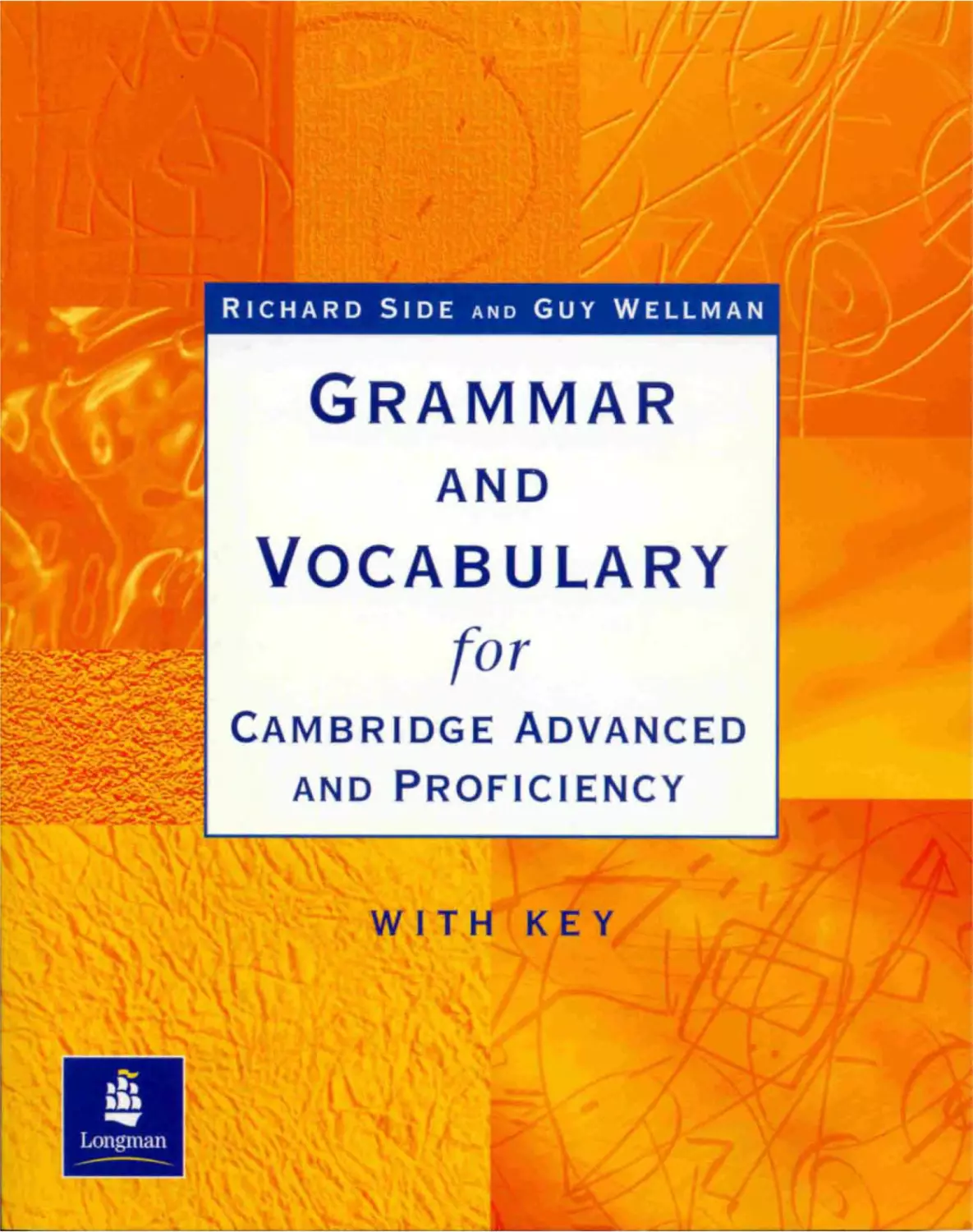
Richard Side and Guy Wellman
Grammar
AND
Vocabulary
for
Cambridge Advanced
and proficiency
Pearson Education Limited
Edinburgh Gate
Harlow
Essex CM.20 2JE
England
and Associated Companies throughout the world
www.longman-elt.com
© Pearson Education Limited 1999
The right of Richard Side and Guy Wellman to be identified as
authors of this Work have been asserted by them in accordance
with the Copyright, Designs and Patents Act 1988
All rights reserved; no part of this publication
may be reproduced, stored in a retrieval system,
or transmitted in any form or by any means,
electronic, mechanical, photocopying, recording,
or otherwise without the prior written permission
of the Publishers.
First published 1999
Second impression 2000
ISBN 0 582 41963 8
Acknowledgements
Designed by First Edition
Illustrations by Noel Ford
Cover design by Andrew Oliver
Project managed by Christina Ruse
The publishers would like to thank the following for their kind
permission to adapt excerpts from original texts:
Oxford Today (passage, page 29); The Independent, from article by
William Hartson, 13.12.97 (passage on global warming, page
133); Newsweek 23.11.1987 (passage on twins, page 151); Quartet
Books, from Sudan by N Worral (1980) (passage, page 153);
Seeker and Warburg, from Neither Here Nor There by Bill Bryson
(1991) (passage on travelling in Europe, page 155); Penguin,
from Citizens by Simon Schama, p.21 (passage, page 194).
Set in Monotype Dante
Printed in Spain by Graficas Estella
Contents
Syllabus map 6 Vocabulary
Introduction 11 SECTION 4 Possibility probability and 56
certainty
H Unit one 16 section 5 Obligations 58
Problem tenses Exam practice 3 60
Entry test 16 H Unit four 62
OVERVIEW 17
section I Present Perfect 18 Modal verbs 2
section 2 Other Perfect forms 20 Entry test 62
section 3 Continuous forms 22 overview + Meanings of modals 63
SECTION 4 The future 24 section 1 Intention, willingness, frequency 68
habit
Vocabulary SECTION 2 Ability, permission 70
section 5 Stative verbs 26 section 3 Special uses of should; modals in 72
SECTION 6 Collocation: an introduction 28 the past
Exam practice 1 30 Vocabulary
И Unit two 32 SECTION 4 Frequency section 5 Ability, quality and achievement 74 76
Passives Exam practice 4 78
Entry test 32
OVERVIEW 33 H Unit five 80
section I Agents and objects with the passive section 2 Infinitives and -ing form passives 34 36 Subjunctives and Unreal Past;
section з Structures with get and have 38 Conditionals
SECTION 4 Not using the passive: transitive 40 Entry test 80
to intransitive OVERVIEW 81
Vocabulary section I Subjunctives and Unreal Past 82
SECTION 5 Verbs we commonly use in SECTION 2 Likely conditionals in the past, 84
42 present and future
the passive section 3 Unlikely conditionals in the 86
SECTION 6 Phrasal verbs; verb + preposition 44 present and future
Exam practice 2 46 section 4 Past conditionals 88
И Unit three 48 Vocabulary
section 5 Metaphor 90
Modal verbs i section 6 Word formation: prefixes and 92
Entry test 48 suffixes
OVERVIEW 49 Exam practice 5 94
SECTION i Predicting 50
section 2 True, untrue, possible: present 52 Progress test 1 96
and past (testing contents of Units 1 -5)
SECTION з Necessity, duty and advice 54
Unit six 100 Vocabulary
Linking clauses section 5 Singular, plural uncountable: common phrases 138
Entry test 100 section 6 Compounds 140
OVERVIEW section i Time and Reason 101 Exam practice 8 142
102
section 2 Result and Purpose 104 И Unit nine 144
section 3 Concession clauses 106
Vocabulary Determiners and pronouns Entry test 144
section 4 Expressing purpose and effect 108 OVERVIEW 145
section 5 Agreeing or not 110 section i All, both, the whole, neither, either, 146
Exam practice 6 112 no, none
section 2 Each and every 148
И Unit seven 114 section з Ones, another, other(s), one 150
another, each other
Adjectives and adverbs section 4 Quantifiers: much, many, a lot of, 152
Entry test 114 (a) few, (a) little, most
OVERVIEW 115 section 5 Any, some, somewhere, anywhere, 154
section i Adjective structures; adjective 116 etc.
or adverb? Vocabulary
section 2 Inversion after negative adverbs 118
section 6 Amount and extent 156
section 3 Making comparisons 120 section 7 Groups of and parts of 158
Vocabulary section 4 Differences and similarities 122 Exam practice 9 160
section 5 Sentence adverbs 124 И Unit ten 162
Exam practice 7 126 Noun clauses
Unit eight 128 Entry test 162
OVERVIEW 163
Nouns and articles section i Thdt-clauses 164
Entry test 128 section 2 Wh-clauses 166
OVERVIEW 129 section з То-infinitive and -ing clauses 168
section i Using the or no article 130 section 4 Reference: this, that, these, those; 170
section 2 Singular, plural, uncountable 132 such; so
section 3 Classifying 134 Vocabulary
section 4 Adjectives and verbs as nouns 136 section 5 Nouns from phrasal verbs 172
section 6 Lack, shortage and excess 174
Exam practice 10 176
Progress test 2
(testing contents of Units 1-10)
H Unit eleven 182 И Unit fourteen 224
Relative clauses Verb complementation i
Entry test 182 Entry test 224
OVERVIEW 183 OVERVIEW 225
SECTION i Words used with relative 184 section i Reflexive and reciprocal verbs 226
pronouns section 2 Verbs followed by that-clauses 228
SECTION 2 Omitting relative pronouns 186 and adjectives
section з Nominal relative clauses 188 section з Verbs used with prepositional and adverbial phrases 230
Vocabulary
section 4 Reference words 190 Vocabulary
section 5 Problems and solutions 192 section 4 Dependent prepositions and 232
prepositional phrases
Exam practice 11 194 SECTION 5 Expressing knowledge and belief 234
H Unit twelve 196 Exam practice 14 236
Emphasis И Unit fifteen 238
Entry test OVERVIEW section i Fronting 196 197 Verb complementation 2 Entry test 238
198
section 2 Introductory There and It 200 OVERVIEW 239
202 SECTION i Verbs followed by -inv and 240
section з Emphasis using What, All and It infinitive
section 4 Nominalisation 204 section 2 Verbs followed by infinitive 242
Vocabulary section з Verbs followed by as 244
section 5 Substituting one phrase for another 206 Vocabulary
section 6 Intensifying and emphasising 208 section 4 Competition, opposition, disagreement 246
Exam practice 12 210 SECTION 5 Starting and ending: creating 248
1 Unit thirteen and destroying
212 Exam practice 15 250
Reported speech
Entry test 212 Progress test 3 252
OVERVIEW 213 (testing contents of Units 1-15) / Si
section i Tenses in reported speech 214
section 2 Report structures 216 Key 257
Vocabulary section з Quoting, reporting and 218
interpreting
section 4 Communicating 220
Exam practice 13 222
Syllabus map
И Unit one Grammar Problem tenses OVERVIEW Perfect tenses; continuous tenses; the future page 16 £ Present Perfect Present Perfect with other tenses; idiomatic phrases 2 Other Perfect tenses Past Perfect / Future Perfect; Perfect infinitives and -ing forms 3 Continuous Perfect Continuous; Past Continuous for plans, polite requests; Continuous infinitives; Perfect Continuous passive 4 The future Future forms; will in time and ij-clauses; common phrases to refer to the future
Vocabulary 5, Stative verbs Uses in Continuous and non-Continuous tenses
И Unit two 6 Collocation Meaning; fixed and open; grammatical forms page 32
Grammar Passives OVERVIEW Form, and reasons for using, the passive i Agents and objects Mention of agents; verbs with two objects; limitations of passive 2 Passive and infinitive Infinitives after certain passive verbs; passive infinitives; report verbs 3^ Get and have Causatives; Get + -ed; I’ve had my car stolen, etc. 4 Transitive to intransitive Changing subject without using passive; meanings of ergative verbs
Vocabulary 5^ Verbs common in the passive Verbs with no agent; -ed adjective or passive?;
И । Unit three prepositions with passives; phrasal verbs 6 Phrasal verbs Prepositions and particles; position of object; prepositions after passives page 48
Grammar Modal verbs 1 OVERVIEW Basic grammar; main uses of modals i; alphabetical list of modals I Predicting Certainty; possibility; expressing opinions 2 Truth and possibility True / untrue; expressing opinions; giving reasons; expressing annoyance 3 Necessity, duty, advice Must, have to, should, needn’t, don’t have to etc.; other verbs for necessity and advice
4 Possibility, probability, certainty Likelihood: bound to, etc.; improbability
Unit four 5^ Obligations Legal / institutional, moral, personal obligations; freedom of choice page 62
Grammar Modal verbs 2 OVERVIEW Main uses of modals 2; key difficulties with meanings £ Intention, frequency, habit Intention / refusal; offers / requests; frequency 2 Ability, permission Can / Could v. was / were able to; theoretical possibility; permission; register 3 Should; modals in the past Special uses of should; modals in the past; modal Perfects
Vocabulary I 4 Frequency Adverbs and phrases; adjectives; habits and trends
5 Ability, quality and achievement Dependent prepositions; collocation; connotation; metaphor
Unit five page 80
Grammar Subjunctives and Unreal Past; Conditionals £ Subjunctives and Unreal Past Present and Past subjunctive; Unreal Past 2 Likely conditionals Verb forms; will / won't in if-clauses;
OVERVIEW Subjunctives; Unreal Past; conditionals; when and if; alternatives to if mixing time references; false conditionals 3^ Unlikely conditionals Verb forms; would in if-clauses; If., are to / were to 4 Past conditionals Verb forms; would have... would have; omitting if etc.
5 Metaphor Compound adjectives and nouns; single words; idiomatic phrases 6 Prefixes and suffixes Changing meaning; prefixes in non-existent words; suffixes and part of speech; suffixes changing meaning
Unit six page 100
Grammar Linking clauses £ Time and Reason Time clauses: Ever since, etc.; Reason clauses: because, etc. 2 Result and Purpose Result clauses: so, etc.; Purpose clauses: in order to, etc.
OVERVIEW Types of clause; reasons for use; position 3 Concession clauses Position of linking words; background information; unexpected contrast
4 Purpose and effect Purpose / intention; result, cause and effect 5 Agreeing or not Not giving in; weighing things up; giving in
Unit seven page 114
Grammar Adjectives and adverbs i Adjective structures Adjectives after nouns; structures after adjectives; late, lately, etc.
OVERVIEW Position of adjectives and adverbs; adverbs from adjectives; adverbial phrases 2 Inversion After negative adverbs; uses 3 Making comparisons Comparatives; similarities; double comparatives; preferences; as / like; as if / though
4 Differences and similarities Collocation; synonyms; modifiers; linking phrases; idiomatic phrases 5 Sentence adverbs Definition; uses
Unit eight Grammar Nouns and articles page 128 I The or no article The with nouns always singular; nouns without articles; general or specific: adding the
OVERVIEW Countable / uncountable: 2 Singular, plural, uncountable Always plural; uncountable with -5; collectives; There is / are; uncountable / countable
a / an, the, or no article; other determiners Classifying Referring to groups: plural, the, a / an; special groups 4 Adjectives and verbs as nouns The unemployed, the supernatural, etc.; gerunds with / without the
Singular, plural and uncountable Common phrases: on foot, in all weathers, etc. 6 Compounds Noun + noun; adjective + noun; adjective + adjective; other combinations
Unit nine page 144
Grammar Determiners and pronouns i_ all, both, the whole, neither, either, no, none Uses; common phrases 2 Each and every Differences in meaning / use; singular / plural;
OVERVIEW Pronoun v determiner; using determiners together; singular, plural, uncountable; common phrases common phrases 3^ One and another, other(s), one another, each other Uses; common phrases 4 Quantifiers: much, many, (a) few, etc. Articles; use in negatives / questions; formality; common phrases 5 Any, some, somewhere, anywhere, etc. Uses; common phrases
6 Amount and extent Extent and degree; words expressing quantity 7 Groups of and parts of Describing groups; informal phrases; collocation
Unit ten page 162
Grammar Noun clauses Thot-clauses After nouns / adjectives / report verbs; as subject;
OVERVIEW Definition; types; position omitting that; comparison with relative clauses 2 Wh-clauses Uses; with prepositions; with infinitives; whether and ifi exclamations 3^ То-infinitive and -ing clauses Sentence position; differences; adding subjects; common phrases 4 Reference: this, that, these, those; such; so Time / distance; referring back; common phrases
Nouns from phrasal verbs Position of particle; transitive / intransitive; noun v phrasal verb 6 Lack, shortage and excess The haves; The have nots
Unit eleven page 182
Grammar Relative clauses Words used with relative pronouns Prepositions;
OVERVIEW Defining / non-defining; relative pronouns; position of pronouns relatives after pronouns / determiners / wh- words 2 Omitting relative pronouns When to omit; replacing clauses; descriptive clauses j? Nominal relative pronouns Definition; uses; followed by to-infinitive; what before a noun; contact clauses
4 Reference words Types of reference: specifying, arranging, focusing, etc. 5 Problems and solutions Facing problems, finding solutions, etc.; collocation; idiomatic phrases
Unit twelve page 196
Grammar Emphasis _i Fronting Definition; uses; fronting noun clauses; introduction phrases
OVERVIEW Stress / intonation; stronger words; repetition; sentence adverbs; passives; other grammatical changes 2 Introductory There and It Dummy subjects; it + clause / + report verb; referring forward 3^ Emphasis using What, All and It What / All I am going to do is ... etc.; It was Tim who ran into the office. 4 Nominalisation Definition; uses; have a talk, make a comment, etc.
2 Substituting one phrase for another Using adverbs / nouns / adjectives / phrases; multiple changes 6 Intensifying and emphasising Adjectives; collocation; adverbs of degree; exaggeration; adverbials, etc.
Unit thirteen page 212
Grammar Reported speech i_ Tenses in reported speech Tenses of report verb; reporting past / present
OVERVIEW Grammar / vocabulary changes; orders / questions; flexible changes tenses; reporting modal verbs 2 Report structures Types of clause; infinitive and -ing; impersonal reports; summarising; personal comments Vf w
3 Quoting, reporting^and interpreting Referring directly; doubting; interpreting 4 Communicating Ways of speaking; phrasal verbs; idiomatic phrases
Unit fourteen page 224
Grammar Verb complementation i £ Reflexive and reciprocal verbs Use; verbs always / commonly reflexive; meaning changes
OVERVIEW Transitive / intransitive; structures after verbs; link verbs 2 Verbs + that-clauses and adjectives Verb + that-clause; verb + describing noun / adjective 3 Verbs + prepositional / adverbial phrases Verbs of movement / position; verb + phrase / + adverb / + way 4 Dependent prepositions Verb / adjective / noun + preposition; prepositional phrases 5_ Expressing knowledge and belief Collocation; common phrases
Unit fifteen page 238
Grammar Verb complementation 2 £ Verbs followed by ing or infinitive Differences; perfect -ing; verb + -ing or bare infinitive 2 Verbs followed by infinitive Verb + to-infmitive / to be / Perfect Infinitive /
OVERVIEW Using two verbs; preposition + -ing bare infinitive; for + object 3^ Verbs followed by as Defining a role or function; as + noun / adjective; defining objects; similar structures
4 Competition, opposition, disagreement Collocation; word formation; prepositions 2 Starting / ending; creating / destroying Common phrases; phrasal verbs
Acknowledgements
This book is dedicated to John Eckersley.
The authors would like to thank the following:
Sue and William, Sally and Claire for their untold patience.
John Eckersley for his generosity and support.
Clive, Judith and the staff and students at BEET Language Centre, Bournemouth.
The staff and students of The Eckersley School of English, Oxford.
Introduction
ABOUT THIS BOOK
Who is this book for?
This book is for any advanced student of English but
it is particularly relevant to people studying for the
Cambridge Certificate in Advanced English (CAE) or
the Certificate of Proficiency in English (CPE)
exams. We assume that anybody using this book has
a reasonable knowledge of and ability to use English,
at least up to Cambridge First Certificate standard.
What sort of grammar is in
this book?
This book covers the main areas of English grammar
at advanced level and concentrates on areas you need
to pass the exams. It looks, for example, at verb and
noun structures, adverb and adjective structures, and
ways of linking complex sentences and texts. It also
provides information on style and register, for
example whether some structures are more typical of
written or spoken English. Although grammar and
vocabulary are obviously important in all areas of the
advanced exams, special attention is given to
structures which are frequently tested in Paper 3 -
Use of English. For example, modal verbs (see Units
3 and 4) and relative clauses (see Unit 11) have
occurred in virtually every Paper 3 in the CPE exam
in recent years. Some areas of grammar, such as
relative clauses and determiners (see Unit 9), occur
most frequently in the cloze test (see page 14 below),
while modal Perfects are very common in sentence
gapped sentences - the practice exercises in the book
reflect this. Other areas of grammar, such as articles
(see Unit 8), may cause you more difficulty in
Paper 2 - Composition. Again, the practice exercises
in the book reflect this.
What sort of vocabulary is in
this book?
At advanced level, there is an enormous amount of
vocabulary to learn. No book can hope to cover it
all. It is also much more difficult to predict
vocabulary which will occur in the exams. This book
focuses on areas of vocabulary that are useful in a
wide range of situations, e.g. agreeing and
disagreeing, frequency, problems and solutions,
starting and ending, etc. Words that combine
frequently with others are a particular focus. This
involves a consideration of collocation (see Unit 1.6)
as well as what grammatical structures we can use
with certain words.
Each Unit has two Sections dedicated to vocabulary,
but there is also a lot of vocabulary in the Grammar
Sections: groups of words often share similar
grammatical patterns, e.g. verbs that are commonly
followed by thdt-clauses or to-infinitive structures (see
Unit 14.2), or verbs that are commonly followed by it
+ clause (see Unit 12.2). The Sections often end with
examples of common phrases and idioms which use
the grammatical structures. Vocabulary Sections
complement the preceding Grammar Sections where
possible, whilst others deal with separate topics. The
Syllabus map (pages 6-9) shows this.
Some of the grammar or vocabulary in the book
may be formal or used in limited contexts, though
language that would normally be considered
specialised, such as legal or technical jargon or
academic or literary usage, is not included because it
is not tested in the exams.
How can I use this book?
There are many different ways to use this book.
You can use the Contents or Syllabus map to look
up a particular area of grammar or vocabulary that
you want to study. Or, you may want to study
complete Units in the order in which they appear.
Several options are available to you. References
within the Sections will point you in the direction
of explanations of related areas of grammar or
vocabulary in other Sections or Units.
THE ENTRY TEST
Each Unit begins with an Entry test. Each exercise
in this test is related to one of the Grammar Sections
within the Unit. If you have difficulties with an
exercise, there is a cross-reference to the relevant
Section which will provide all the explanation and
practice you need. On the other hand, if you find the
exercise easy, it may mean that you are perfectly
competent in that area of grammar and you may
wish to ignore that Section.
THE OVERVIEW
The Overview provides a summary of the grammar
which students in advanced classes should already be
familiar with. For example, with relative clauses (see
Unit 11) you should already know about the
differences between defining and non-defining
relative clauses - these are summarised in the
Overview. The Watch Out! boxes highlight areas that
often continue to cause difficulty. If you have any
difficulties with the points covered in the Overview,
look at Grammar and Vocabulary for First Certificate by
Luke Prodromou (Longman).
THE GRAMMAR SECTIONS
Each Unit has between two and five Grammar
Sections which deal with aspects of a particular area
of grammar. These Sections contain explanations and
descriptions with many of example sentences. The
page ends with a short exercise so that you can
check whether you have understood the main
grammar points.
PRACTICES
Opposite is a page of related practice exercises. The
first practice is always a straightforward test of
understanding the main grammar points in the
Section; the later practices are more complicated and
reflect the level and style of the advanced exams.
These practices can be done in class or for
homework. If you are doing them in class, you may
want to discuss your answers with other students or
with your teacher before checking the correct
answers in the Key at the back of the book (in 'with
Key’ editions). Discussion helps everybody to
understand and remember the main facts or issues.
THE VOCABULARY SECTIONS
Each Unit has two Vocabulary Sections. These deal
with a particular area of vocabulary such as words
connected with differences and similarities (see Unit
7.4) or competing (see Unit 15.4). Lexical areas such
as collocation, word formation, phrasal verbs,
prepositions and idiomatic phrases are also covered,
specifically in particular Sections and generally in
other Vocabulary Sections. There are several short
Pre-practices within the explanations. The main
Practice exercises contain much of the vocabulary
presented in the explanations but also add other
related items.
THE EXAM PRACTICES
At the end of each Unit there is an Exam practice
which revises the grammar and vocabulary in the
whole Unit using CAE and CPE-type exercises.
Each paper has the same score so that you can
monitor your general progress as you work with
different Units.
THE PROGRESS TESTS
After Units 5, 10 and 15 there are Progress tests in
CAE and CPE-exam format. They revise the
grammar and vocabulary of the previous five Units
together with any other previous Units.
Will I pass Proficiency if I do
everything in this book?
One textbook is never enough to become fluent.
We recommend that you read widely in English
(books, magazines, newspapers...) as well as take
every opportunity to listen to English (satellite
television, film, radio...) and speak the language, so
that you can use it naturally and easily. Everybody
can learn a language (we have all already learned at
least one!), but it takes time, patience and hard work.
ABOUT THE EXAMS
What level are CAE and CPE?
CAE is an advanced exam at a level between
Cambridge First Certificate in English and CPE. It is
recognised by many British Universities for English
Language entry requirements at undergraduate level.
CPE is more widely recognised for the same purpose
as well as being a qualification in many countries to
teach English. A pass at CPE is an indication that
you should be able to follow lectures in English,
write essays, understand the books you need to read,
and contribute effectively in undergraduate seminars
and classes. In other words, it is quite a high level.
For both exams, grades A, В and C are passes. D is a
narrow fail and E is a fail.
Both exams consist of five papers. The first three
papers are normally taken on the same day Papers 4
and 5 may be on different days within a week or two
of the other papers.
PAPER 1
CPE - Reading Comprehension (1 hour)
The first part, Section A, consists of twenty-five
multiple choice vocabulary questions. The second
part, Section B, consists of fifteen multiple choice
comprehension questions on three texts.
CAE - Reading (1 hour 15 mins)
There are four texts followed by a total of
approximately fifty matching and multiple choice
questions.
PAPER 2
CPE - Composition (2 hours)
You must complete two writing tasks of 350 words
each out of a choice of five topics. These usually
include a discussion of a topic, a description of
something such as a festival or city a story and a
letter. You also have the option to write about one of
three prescribed reading texts, usually novels.
CAE - Writing (2 hours)
You must complete two writing tasks usually
including a letter, report, memo, infomation sheet,
review, article, etc., but not a story Section A is a
compulsory task based on reading information with
a maximum of 450 words. Section В consists of one
task from a choice of four.
PAPER 3
This book concentrates on grammar and vocabulary
needed for Paper 3, although this information is
essential for all the other Papers in the exams.
CPE - Use of English (2 hours)
The first part of this paper, Section A, consists of
four different grammar and vocabulary tasks based
on a short text and sets of sentences. The second
part, Section B, asks you to read a passage, answer a
number of comprehension and vocabulary questions,
and summarise a specified aspect of it.
CAE - English in Use (1 hour 30 mins)
This paper focuses on grammar, vocabulary and
register, and includes tasks such as gap filling, proof
reading and text completion.
PAPER 4
CPE - Listening Comprehension (approximately
40 mins)
CAE - Listening Comprehension (approximately
45 mins)
Both CAE and CPE consist of recordings of three or
four different spoken situations, such as
conversations, interviews, extracts from radio
programmes, recorded telephone messages, etc., and
a variety of matching, completion and multiple
choice tasks.
PAPER 5
CPE - Speaking (approximately 15 mins)
CAE - Speaking (approximately 15 mins)
This part of the exam consists of a conversation with
an examiner. You are asked to talk about some
photographs, give opinions and discuss some issues.
The examiner will assess your pronunciation, fluency,
range of vocabulary, grammatical accuracy and
general ability to hold a natural conversation in
English. CAE interviews are conducted in pairs -
you will be asked to discuss things both with the
examiner and the other candidate.
What types of questions can we
expect in CPE?
PAPER 1
Multiple choice
In Section A, there are twenty-five multiple choice
vocabulary items in a question like this example:
In this section you must choose the word or phrase
which best completes each sentence. On your
answer sheet, indicate the letter А, В, C or D
against the number of each item 1 to 25 for the
word or phrase you choose. Give one answer only
to each question.
1 Even the tiniest ..... of dust can damage
delicate electrical equipment.
A piece В portion C shred D speck
(Answer: 1 D)
This question tests your knowledge of the different
meanings of words, collocations, etc.
PAPER 3
Cloze test
In Section A there is a short passage (under 200
words) in which twenty words are missing. You must
decide what the words are. Example:
Fill each of the numbered blanks in the passage
with one suitable word.
THE HERRING GULL
The herring gull’s ability to eat almost (1) .,
from fish to the young of its own kind, has made it
one of the (2) ....... species in Britain to be
actually thriving at this time. Its (3) . have
multiplied in recent years because of the increasing
(4) ....... of edible refuse which is a by-product
of modern life. ...
(Answers: eat almost (1) anything from fish to...
one of the (2) few species... etc.)
Words typically gapped include pronouns (including
relative pronouns), articles, determiners and linking
words such as however, but, such...that. It can also test
collocation and prepositions.
Sentence transformation
In the second part of Section A, there are eight
sentence transformations which ask you to rewrite a
sentence using a different beginning. Example:
Finish each of the following sentences in such a way*
that it is as similar as possible to the sentence
printed before it.
(a) All the people I have contact with disapprove of.JI
the changes. ij
None ........................................'*&
(Answer: None of the people I have contact with
approve of the changes.)
Areas tested include conditionals, reported speech,
inversion, changing verbs to nouns, etc.
Gapped sentence
Section A continues with six gapped sentences where
several words are missing in each gap. Example:
Fill each of the blanks with a suitable word or phrase
(a) You should ..... that into account before you
went and spent all your money.
(Answer: You should have taken that into account
before you went and spent all your money.)
li
Areas commonly tested in this question include
modal verbs, conditionals and idiomatic phrases.
Word transformation
Section A ends with eight sentences which must be
rewritten using a given word that cannot be changed
in any way. Example:
For each of the sentences below, write a new
sentence as similar as possible in meaning to the
original sentence, but using the word given. This
word must not be altered in any way.
(a) Nobody else in the country possesses his skills
on the trumpet.
unmatched
(Answer: His skills on the trumpet are unmatched by
anybody else (or anyone else) in the country.)
This question tests your knowledge of common
phrases and changing verbs to nouns, etc.
What types of questions can we
expect in CAE?
The CAE has been revised from December 1999. In
CAE, specific grammar and vocabulary questions are
all in Paper 3 - English in Use. The Paper includes
six Parts and a total of 80 questions.
MULTIPLE CHOICE CLOZE
This consists of a passage with fifteen gaps. For each
gap you must choose one word from a choice of
four.
OPEN CLOZE
The only exercise that is similar to CPE is the cloze
test (a gapped passage). There are fifteen gaps in the
CAE exam.
ERROR CORRECTION
A text about sixteen lines long is provided. Most lines
have either an extra, unnecessary word which you
must find, or a spelling or punctuation mistake
which you must correct.
WORD FORMATION
This new task is similar to FCE but the base words
are more difficult and may involve more changes.
There are two passages in which you are required to
write the missing word in the correct part of speech
using the word given. For example, transform
becomes transformation. Remember to check whether
you need to make a noun plural, an adjective
negative, etc. There are fifteen gaps.
INFORMATION TRANSFER
This consists of a gapped text in which you are asked
to rewrite information from another text in a
different style or register. For example, you may have
to fill the gaps in an informal letter with information
taken from an advertisement. You must make any
necessary changes in vocabulary and grammar so
that the style is appropriate. There are thirteen gaps.
DISCOURSE CLOZE
A text is provided from which various phrases have
been omitted. From a list of these phrases, you are
asked to put back the correct phrase in each gap.
there are six gaps and three distractors.
What about the other exercises
and papers in CAE and CPE?
In addition to the above tasks, you will need to be
able to recognise and use a wide range of grammar
and vocabulary in order to:
• understand the reading passages in Paper 1
• write letters and compositions in the Paper 2
• answer the questions in Paper 3 Section В
• understand what is being said in the Paper 4
• understand and speak to the examiner and other
candidates in Paper 5.
The grammar and vocabulary in this book will be a
great help.
Problem tenses
Entry test
1 Finish each of the following sentences in such a
way that it is as similar in meaning as possible to
the sentence printed before it.
example: I’ve never had to work all through the
night before.
This is the/ir5t time I've had to work all through
the night.
a Most of us became salesmen when we left
university.
Most of us have .................................
b Our current manager started working here ten
years ago.
Our current manager has .........................
с I haven’t heard from Sarah for a couple of months.
The last ........................................
d I used to find computers difficult before I started
taking these lessons.
Since ...........................................
e Michael Owen is the best player I’ve seen so far in
this competition.
I’ve yet.........................................
FOR PRESENT PERFECT, SEE SECTION 1.
2 Fill each of the blanks with a suitable word
or phrase.
example: As soon as he saw what had happened,
he switched off the electricity.
a When I started working for this company, I .......
an architect for six years.
b She’d ...... studying marine biology but she
finally decided on geography.
c They........ on the road for a mere five minutes
when they had a puncture.
d It’s almost half past nine: I would think they ...
got there by now.
e My intention is...... finished my studies by June.
3 Fill each of the blanks with a suitable word
or phrase.
example: I have been writing this composition
all evening.
a What........ doing with yourself over the last
couple of days?
b I ...... to fix the engine all morning, but finally
had to admit defeat.
c Next summer, I ...... living here for ten years.
d He claimed ......... meaning to tell me about it but
somehow forgot.
e I was....... asking her if she’d like to come to the
races on Saturday.
ЯИЧ5И
FOR CONTINUOUS TENSES, SEE SECTION 3.
4 Fill each of the blanks with a suitable word
or phrase.
example; Look out! We’re going to hit the car in
front!
a At this rate, we’re......:. be exhausted by the time
we finish.
b The minute the train ..... standstill, get on and
try to find a seat.
c By December, he’ll ...... working there for
eighteen months.
d They claim to be virtually on ..... achieving
everything they set out to do.
e We were just about....... the house when Sue
called.
FOR FUTURE FORMS, SEE SECTION 4.
FOR FUTURE PERFECT, PAST PERFECT AND OTHER PERFECT
FORMS, SEE SECTION 2.
[TOTAL SCORE
PROBLEM TENSES
OVERVIEW
1 USES OF PERFECT TENSES
Present Perfect
We use Present Perfect to talk about things that
took place:
• during a period that includes past and present:
They’ve been waiting here for an hour
• in the past, but we're not saying exactly when:
Don’t tell me he’s bought another new car!
• in the past with an effect or result in the present:
Гт afraid I’ve forgotten my key.
• with the time adverb just meaning "a short time
ago' (American English uses Past Simple here):
She’s just gone out.
Past Perfect
We use Past Perfect to talk about things that took
place:
• before something else in the past (see Section 2.1):
I took the decision after I had spoken to John.
• during a period before an event in the past:
All day I’d been feeling nervous but the feeling
vanished as soon as I saw her.
Future Perfect
We use Future Perfect to talk about:
• something that will be finished before a specified
time in the future (see Section 2.2):
I’ll have signed nearly a hundred letters by tonight.
For, since, already, yet, still, often, etc.
We often use Perfect tenses with these time words.
• Note important variations in their position:
We still haven’t heard from Olga. We’d still not
heard from her by the time evening arrived. (= more
formal) I haven’t heard a convincing explanation of
her absence yet. She’s phoned already. Has she
phoned already? She’s already phoned. She hasn’t
already phoned, has she?
2 USES OF CONTINUOUS TENSES
We use Continuous tenses to talk about things:
• continuing over a period, and temporary
Continuous tenses show that we either view the
event as incomplete, or that we don't know or
don't need to say when it started or finished:
We’re studying Shakespeare at school at the moment.
(= temporary activity during these weeks)
It was raining when we left the building. (— we don't
know or aren't interested in when the rain started
or when it will finish)
• that are in the process of changing:
William’s piano playing was improving every day
I think I’m getting more forgetful as I grow older
• With verbs that describe a short action, e.g. hit,
knock, blink, the action is repeated rather than
continuous:
I’ve been ringing him all morning but he never seems to
be in.
• We often use Past Continuous and Past Perfect
Continuous to set the background to narrative
events. Because it may not be clear when the
activity begins or ends, they give the impression
you are arriving in the middle of a scene:
Jo had been working all morning and was now
spending a happy half hour doing nothing more taxing
than staring into space. She was looking forward to
her holiday in Scotland in a few days’ time.
3 EXPRESSING THE FUTURE
English does not have one future tense. Instead, we
use other tenses and modal verbs to refer to the
future (see Section 4):
This time next week we’ll be sitting our exams.
(— we'll be in the middle of them)
When you arrive, you are to go straight to the
registration desk.
watch out!
We don't use Present Perfect when an exact past
time is mentioned and there is no connection with
the present:
X We’ve been to London in 1997.
/ We went to London in 1997.
• But we can use the Present Perfect if the period
mentioned includes the past and present:
We’ve been here since half past six.
I haven’t done much work today.
It’s been raining for ages.
• We use Past Perfect for something that
happened before something else. We can only
use it with another Past tense:
I went to see him because his wife had asked me to.
• We omit will in time clauses (see Sections 1.4
and 4.2):
X Til phone you as soon as we will have arrived.
/ I’ll phone you as soon as we have arrived.
SECTION I
Present Perfect
Present Perfect often combines with other tenses in
the same sentence.
1 USES WITH OTHER PRESENT TENSES
We use Present Perfect with other Present tenses:
• with report/comment verbs or phrases (guess,
imagine, suppose, etc.):
I reckon Gloria's been held up in traffic. Do you
suppose they’ve forgotten they're meant to be here?
• with the phrase This is / It's / That's the first/
second /only, etc. time ...:
This is the first time he’s been late It’s the only
time I’ve ever really got angry with him.
• when an event is unusual or unique in your life
(often with a superlative and ever or never):
I’ve never met anybody who is so absent-minded.
However, we commonly use a Past tense to refer to
somebody who is dead:
Princess Diana was the most extraordinary person I’ve
ever read about.
• when commenting on the present results of
something in the past (usually with appear, seem,
sound, etc.):
He sounds as if he has run all the way here.
It seems they’ve already decided without consulting us.
2 USES WITH PAST TENSES
We use Present Perfect with Past tenses:
• to describe states or events that have continued
since a time in the past (with since, ever since, etc.):
He’s been a bit more careful since he had that warning.
Ever since I first heard it I’ve been trying to find a
recording of that song.
• to describe long-term or repeated feelings and
thoughts about past events:
I’ve often wondered why he decided to become a
teacher. I’ve always felt we did the wrong thing when
we took her on as an assistant.
3 USE WITH ANOTHER PRESENT PERFECT
We use Present Perfect with another Present Perfect:
• to describe two states that have existed since a
time in the past:
Since I’ve known him, he's always worn the same
sweater.
4 USE WITH FUTURE FORMS
In time clauses (after when, as soon as, until, before,
etc.) we don't use will, and so the Future Perfect will
have done is not possible. In these cases we use the
Present Perfect to refer to the future:
We’ll continue the meeting when he’s recovered his
composure.
5 USE WITH SINCE AND YET
Note the position and emphatic uses of since and yet:
There was no news this morning but we’ve since
learned that she's in Rome.
I haven’t met anyone yet who can run as fast as him.
or: I’ve yet to meet anyone who ...
6 COMMON PHRASES
They've made it! (- They’ve succeeded) I've had
enough. (— I’m fed up. I don’t want to do any more)
You've had it! (= You’re in trouble) That's torn it!
(— You, we, etc. have done something that someone
else will complain strongly about) Now you've done
it! (— You’ve done something seriously wrong)
She’s arrived. (= She’s achieved fame, success,
acceptance, etc. at last) He's lost it. (= He’s lost his
patience or self-control) You've got me there!
(= Good point: I’ve no idea what the solution is)
? check
Correct these sentences.
a It’s the third time he missed a meeting.
b As soon as he will finish, he’s goin^ home.
c This is the best lasagne I ever have.
d Since we’ve known each other, he always shows
impeccable manners.
e Since I’ve met her, I’ve never seen her lose her
temper.
Practice
Q Tick (/) the sentences that are correct. Correct those that
are not.
a Do you think Vicky’s always known the truth about us?
b That’s been the second time you’ve forgotten to post something
for me.
c
d
e
f
g
h
i
J
I haven’t seen Peter since he begins seeing his new girlfriend.
Ever since we met, you never asked me what I prefer to do.
In all my life, I never spoke to someone who is quite
so stupid.
I don’t think Paul and Carol have seen much
of each other of late.
This is the only occasion that I’ve seen him
wearing a tie.
Since he’s lived here, he was usually
extremely friendly
They’ll join us after they’ll get a bite to eat.
He says he hasn’t yet come to a final
decision.
occasion that I've seen
This is the- onq
him wearing a tie.
Q Fill each of the gaps in this passage with one suitable word.
I’ve often.......(1) that Stefan’s success as a teacher is due to his
eccentricity as much as his knowledge of the subject. From the first
time he ever.........(2) into a classroom, students have always loved
him. They’ve probably.......(3) met anybody who displays such an
extraordinary mixture of enthusiasm and great personal warmth. It
......(4) also probably the first time they’ve....(5) somebody
who always wears a leather jacket and a scarf even at the height
of summer.
Q Fill each of the gaps in this passage with one suitable word.
‘When did you really begin to feel at home here?’ Paul asked.
‘Oh, you’ve.......... (1) me there!’ John replied. ‘Let’s just say you
won’t feel you truly belong until you’ve.......... (2) out with your
colleagues and then made it up several times. Over the summer I’ve
........ (3) it with all of them countless times, often over quite trivial
things. I’ve lost......... (4) of the times I’ve said to myself - That’s it!
I’ve had.......... (5)! But I come back the next day, time after time.
I’ve often.......... (6) why I do. As far as the boss goes, just wait until
you make a major mistake. Your colleagues will go “Oooh, now you’ve
........ (7) it!” or “Um, that’s.......... (8) it!”, and the boss comes in
and just smiles at you. Then you’ll know you’ve............. (9) it. Then
you’ll definitely have......... (10).
Q Fill each of the blanks with a
suitable word or phrase.
Example: I’m not going to go out
again until the storm has blown
over.
a I’ll phone him just as soon as
......... typing all these letters.
b I looked for that book everywhere
but I’m afraid........ across it yet.
c This isn’t the first time he......
away from home.
d I spoke to Sylvia last night: she
sounds.......... had a hard time
recently.
e I went to the new pizzeria last
night: it does the......... eaten.
f I’ve never understood what........
football so popular.
g Since he got home from the camp,
he.........but sleep.
h I’ve yet......over the shock of
seeing her there.
ф Finish each of the sentences in
such a way that it is as similar in
meaning as possible to the sentence
printed before it.
Example: Make sure you finish this
book before you start on the
others.
Don’t start the other books until you
have finished this one.
a Nobody has seen Jo for over a
month.
Jo was .........................
b Bergkamp’s goal was the most
extraordinary one I have ever seen.
I’ve yet .........................
c No one has asked me that before.
This is the first time ...........
d The journey to Paris took much
longer before they built the
Channel Tunnel.
Since the.......................
e It’s almost a year since I stopped
smoking.
I gave......Z...................
f This cafe used to be a lot more
popular before they opened the
new one next door.
Since ..........................
SECTION 2
Other Perfect forms
1 PAST PERFECT
Not always necessary
Past Perfect emphasises that we are talking about a
period before a time in the past. If the time sequence
is clear (e.g. because we use after), both Past Simple
and Past Perfect are possible. At other times Past
Perfect is essential to understanding the sequence,
and we often add already, as soon as, or until:
I got to work after Simon arrived / had arrived.
When I arrived, they'd already started. (= they
started before I arrived) When I arrived, they
started. (= I arrived before they started)
With definite time
Unlike Present Perfect, we can use Past Perfect with
a definite time reference:
I arrived at nine o'clock but he had got there at eight.
With before
There is one exception to the time sequence rules on
Past Perfect. When we use before, the verb in Past
Simple can refer to something that takes place before
the verb in Past Perfect. The first action may prevent
the second from happening:
The waiter took my plate away before I'd finished
eating
I was blamed for it before I'd even had a chance to
defend myself
Unfulfilled plans
We use Past Perfect with report verbs and with hope,
intend, expect, etc. to talk about plans that have not
yet been fulfilled. Had is usually stressed in speech
with this use:
I had hoped to talk to him but he was too busy
to listen.
I had thought of phoning him but decided against it.
2 FUTURE PERFECT
With by
We can often use Future Perfect with the preposition
by or the phrase by the time meaning "at some point
before the time mentioned or indicated":
It's taking her so long to write that book that by the
time she's finished it people will have forgotten the
incident it's based on.
Predicting
We can also use will have done to say what we think
has probably happened:
There's no point phoning: they'll have gone out.
• We can use should / ought to or may / might instead
of will if there is some uncertainty about the
prediction of present or future:
I should have finished making this cake by the time
Sue comes home. (= I think I will have, but Гт not
sure. See Unit 4, Section 3.2 for modal Perfects)
3 USES OF PERFECT INFINITIVES
We use Perfect infinitives:
• after link verbs like seem and appear to refer to a
previous time period (an ordinary to-infinitive will
usually refer to the present or future):
There seems to have been some sort of mistake.
• after phrases expressing emotions and feelings:
I'm sorry to have kept you waiting.
She was felt not to have met the standards required.
4 PERFECT -ING FORMS
When talking about results and time, we can use a
Perfect -ing form to emphasise that one thing
happens before another:
I didn't remember having met her before. Having
finally grasped what I meant, he got down to work.
watch out!
Perfect passives can sometimes be confusing
because we use both be fr passive) and have
(= Perfect) as auxiliaries:
The refugees have been prevented from entering the
country. This picture is thought to have been painted
by a pupil of Rembrandt's.
ЯГ"_____________________________________________
Which of the points in this Section do these
examples illustrate?
a 'How did you become a teacher?" Td intended to
be an actor, but things didn"t work out." J.
b I turned on the computer, but before I had /
managed to log on there was a power cut.
c After he told me what he wanted, we talked £
about the plans for the next day
d The exhibition will have finished by the time I get
around to seeing it.
e They appear to have accepted most of your terms.
Practice
Q Match the beginnings (1-8) with a suitable ending (a-h).
Example: 0 + i
(0 After rd finished teaching
earlier that morning)
1 He told me that
2 I asked him
3 He explained how a young
man
4 John had immediately
assumed
5 So, before the young man had
had a chance to say anything
6 John, who was in a terrible
hurry, then left the man to it, 1
7 It wasn’t until he returned ten
minutes later
8 He was actually a school
inspector
О Correct any sentences that are unacceptable.
a By the time he is 50, he will live in this country for half his life.
b It’s a surprise party and they won’t know anything about it until
they got here.
c They’re probably planning a quiet evening together; I know they
won’t have guessed what we’re doing.
d The other seventy guests should be arrived before Mikis and Maria.
e By the time we wilf have finished, everybody will have eaten and
drunk as much as they can.
Dear Sir>
[J/ c
I had"recently been on a two-week holiday with your company to the
island of Thassos.
I am sorry to have said say that it was the worst holiday I've ever
had. Over the years I went on many holidays to Greece, a country I
have now come to know quite well. I think I can safely say that, until
this year, all of those holidays were wonderful. For example I have
once spent six weeks on Crete, which I had not visited before. I had
loved that holiday so much that I returned every spring for the last
four years.
This year, however, was different. I honestly consider this to had
been the worst holiday of my life. This is not the fault of Thassos: the
fault lies entirely with your company whose inability to organise the
simplest thing is quite unbelievable.
As both the outward and return flights have been delayed for
several hours, there was nobody to meet us at the airport or transfer
us to our hotel, and when we eventually did reach the hotel, we
discovered it had been built over a mile from the beach. Reading
your brochure carefully, we feel this was not what we have expected.
ф Cross out and correct eight errors in this extract from a
composition. A ninth error has already been corrected.
a and had come to ensure that
the school was run efficiently.
b he had made a terrible mistake,
c that he wanted to enrol as a
student.
d had come to reception.
e that the man was able to
explain there had been a
misunderstanding.
f what had happened.
g John had given him an
application form.
h wondering why he looked so
puzzled.
(i I found John standing outside
my classroom.)
ф Finish each of the following
sentences in such a way that it is
as similar as possible to the
sentence printed before it.
Example: Don’t use that milk until
you’ve finished this carton.
Make sure you’ve/inished this
carton before you use that milk.
a I’m sure he will arrive before you
get there.
By the time ...................
b I reckon the journey to Cornwall
is over 200 miles.
By the time we get.............
c After keying that report, could
you perhaps check this order for
me?
When that .....................
d I’m sure Helen will have got
there before everyone else.
Helen is..........................
e We will fax you further details
on receipt of your completed
application form.
Having.........................
О Fill each of the blanks with a
suitable word or phrase.
Example: All the best things will have
gone if we don’t get to the sale
soon.
a I was really happy when they
announced.......... decided to get
married.
b She proceeded to fix the faulty
wiring, having first.......been
switched off.
c It wasn’t until he mentioned the
conference that I........ met
before.
d By next Christmas we.........
decorating the house.
e He is planning....... completed
all his coursework by next week.
f It’s six o’clock: I imagine they
........for the airport by now.
g The suspect is believed......
fled the country.
h After he had lost his glasses, he
........but to buy another pair.
SECTION 3
Continuous forms
1 USES OF PERFECT CONTINUOUS TENSES
Like other Perfect tenses, Perfect Continuous tenses
focus on a past period that leads up to a later one.
Perfect Continuous tense^, as with other Continuous
tenses, show that an event continues and/or is
temporary:
I’ve been meaning to tell you about it since the
weekend. Next October Гll have been playing with
this team for ten years. He’d been driving for hours
and he needed a rest.
• We use Past or Present Perfect Continuous to talk
about something that is incomplete, just finishing
or about to change. The Past and Present Perfect
Simple can suggest the action is finished:
I’d been staring at the computer screen all evening
when a solution suddenly struck me. I’ve been reading
"War and Peace" again. (= I may not have finished)
I’ve read War and Peace again. (— I’ve finished)
• The Continuous can emphasise the action; the
Simple focuses on the result:
What have you been doing? (~ tell me about your
activities) What have you done? tell me the
result of your activities)
• The difference between choosing Continuous or
Simple may only be a matter of emphasising that
something is continuing and/or temporary.'
I’ve been waiting here for over an hour.
(= emphasising that I still am)
2 USING PAST CONTINUOUS FOR PLANS
We can use Past Continuous to talk about plans in
the past:
We were meeting at 8 о "clock and I was already late.
• We use was going to to talk about plans in the past
that we still haven’t carried out or that we no
longer intend to carry out:
I was going to phone you but I forgot*
• We can use I was thinking... to introduce vague
future plans:
I was thinking of going to London this weekend.
3 USING PAST CONTINUOUS FOR POLITE
REQUESTS
We often use Past Continuous to introduce polite
requests, suggestions or inquiries so that they
become more an invitation to discuss the subject
than a demand for a yes or no answer:
I was thinking - would you mind swapping seats?
I was wondering if you wanted to go out this evening.
Were you looking for anything in particular?
watch out!
Note we can’t use I was thinking with whether or if
X I was thinking whether you"d like to come round to
my place for coffee?
J1 was thinking - would you like to come round to
my place for coffee?
I was wondering whether you "d like to come round
to my place for coffee?
:
4 CONTINUOUS INFINITIVES
Verb and other structures that can be followed by a
to-infinitive can also be followed by a Continuous
infinitive to emphasise that something is still
continuing or is temporary:
It"s ridiculous for him to be driving in central Athens
at his age.
Several cyclists are thought to have been taking drugs
during the race.
5 PERFECT CONTINUOUS PASSIVE
The Perfect Continuous passive is very uncommon
because it involves two forms of be:
The Botley Road has been being widened for the past
six weeks.
? check
Match the example sentences (1-5) with the
explanations (a-e) of the uses of the Continuous.
1 I was going to try to finish this this evening.
2 I was wondering whether you’d thought of going
to see that new film?
3 He was blinking rapidly in the unaccustomed
sunlight.
4 I was thinking of meeting Suzette later.
5 I’ve been thinking a lot recently about your idea.
a repeated action
b plans you no longer have or are no longer sure
about
c vague future plans
d polite suggestion
e emphasising the continuing activity
Practice
ф Tick (/) the correct sentence, a or b.
Example: Which sentence would be said after one particular meal?
a I’ve eaten too much. 7 b Ive been eating too much.
Which sentence refers to a temporary । уОц*Ге sitting "V
situation?
a That lamp sits on that table over there.
b You're sitting in my seat.
Which activity is probably not completed?
a Ive been writing this essay all evening,
b Ive written to him asking for an appointment.
Which is a gradual process?
a The increase in traffic noise is becoming a real nuisance,
b John becomes President of Oxford Rotary Club in July
Which would you say when you look out of the window early
one morning?
a It’s been raining, b It was raining.
Which is a more certain plan?
a I was thinking of spending the weekend at my sister’s.
b I’m planning to spend the weekend at my sister’s.
You saw a colleague waiting for a bus on your way to work. Which
would you say to your other colleagues when you get to the office
to explain why she was there?
a She might have gone to see her dentist.
b She might have been going to see her dentist.
Q Tick (/) the most suitable underlined verb. Sometimes both
may be possible. The first has been done for you.
I don’t normally go to the cinema. Not because I don’t like it but
because it’s just a habit I have never got into. However, on this
occasion I decided (Z) / was deciding to go because my friends
had been constantly going / had constantly gone 0) on about this film
all week and eventually wore me down. It starred / was starring
some ephemeral Hollywood actor whom I had vaguely heard of but
couldn’t put a face to. We got to the cinema early to find people
were already waiting / already waited outside which suggested that
my friends weren’t the only ones who thought it was worth seeing -
although I could still think of several other things I would rather
having been doing / do <4) at that moment.
In the end, the film turned out / was turning out <5) to be not half as
bad as expected, though I would have preferred / would have been
preferring something with a bit more action. The plot centred on
two men who were planning to carry out some immensely
complicated robbery, though what they completely failed to realise /
were completely failing to realise was that all the time their plans
were being closely monitored / were closely monitored W by the
police. Somewhat unpredictably, however, they got away with it
because they changed / were changing their plans at the last
minute. It was okay but I’m not thinking / I don’t think (l°) of
going again.
ф Match the questions (1-8) with
suitable answers (a-h).
1 Why didn’t you call?
2 When do you think they’ll be
here?
3 Why did they look so hot and
sweaty?
4 Why couldn’t we use the rooms?
5 Why are they so exhausted?
6 Why didn’t the students respond? ;
7 Why were they apprehended?
8 What time are they setting off
tomorrow?
a They could be arriving at any
moment.
b I think they’d been working out in
the gym.
c They must have been doing
something wrong.
d I was going to, but I clean forgot.
e They weren’t listening.
f Well, they hope to have been
driving for five hours by
lunchtime.
g They were being cleaned.
h They’ve been working all day up
in the attic.
ф Write a new sentence as similar
as possible in meaning to the
original sentence, but using the
word given.
Example: My original intention was
to drive all the way. going
I was going to drive all the way.
a It occurred to me that you might
like to come round this evening,
wondering .........................
b Our arguments over politics go
back years.
arguing ........................
c My son has finally come to accept
that there’s no such thing as a free
lunch.
dawning ........................
d Who is the organiser of this event?
running ........................
e I think he’s at last beginning to
agree with me.
round ..........................
SECTION 4
The future
1 WAYS OF REFERRINGTO THE FUTURE
The following table summarises the different structures we use to talk about the future.
Form Example Meaning
will I'll just go and get my coat. = an immediate decision about what you are going to do
will You'll be sick if you eat more chocolate. = a general prediction
be going to I'm going to stop in a minute. = a personal intention
be going to Look out! We're going to hit the car in front. — a prediction after looking at what is happening now
Present Continuous We're going to the cafe. Wont you join us? = fixed plans / arrangements
Present Simple The coach leaves in ten minutes. = an unalterable arrangement or fact
will + Continuous Don’t phone too early because I'll be putting the baby to bed. = an action that will be in progress some time in the future
will + Continuous We'll be working on this until the end of the year. * = an activity that will be happening during a period in the future
will + Continuous I’ll give your letter to him - I'll be seeing him later. = an action that will happen because it is regular or decided
will + Perfect We'll have driven over five hundred miles by the time we get there. = an event that will be finished before a specified time in the future
will + Perfect We'll have been living here for ten years — a state of affairs in progress for a
Continuous next May. period up to a specified time in the future
be + to-infinitive He is to be given an award. = an official arrangement or order
You're to stay here until you’ve apologised.
• We use shall with I or we with the same meaning as
will. However, it is becoming increasingly formal -
its most common current use is in polite offers or to
ask advice (see Unit 3, Section 1.1):
Shall I open the door for you? What shall we do now?
2 WILL IN TIME CLAUSES AND /F-CLAUSES
We omit will in time clauses after when, as soon as,
until, before, etc:
Гт not going to speak to her until she’s apologised.
However, with conditional clauses (after if, unless,
providing, etc.) we can use will, but only:
• when we want emphasis and will makes an intention
or promise stronger:
If you will insist on the best, then you must expect to pay
more for it.
• in polite requests - will means Ъе willing to":
If you'll hold these bags for me, I can open the door.
• We use would instead of will in reported speech
and conditionals:
They promised they would work on it all weekend.
Harry asked me if I would help him out.
3 COMMON PHRASES
I'm (just) about to go out. (= in a very short time)
We were on the point of leaving when the bell rang.
We're due to meet in half an hour.
fiEBS
Match the examples with the meanings in the table,
a Are you going to the match tomorrow?
b Are you going to go out this evening or not?
c My driving licence expires in 2030.
d I’ve had enough. Г11 finish this tomorrow
e We'll be sending you more details in the post.
Practice
О Tick (/) the most appropriate of the
underlined words.
a She looks very pale. I think she’ll / she’s going to
faii^L
b Г11 / Гт going to do that for you, if you like.
с I’ll be / Гт going to be a rocket scientist when I
grow up.
d ‘Somebody’s at the door.’ Til / Гт going to see
who it is.’
e I need to be home early today so I leave / am
leaving at 4.00.
f We’ll be in plenty of time providing the traffic
is not / will not be too bad.
g She asked if I would / will be so kind as to give
her a lift.
h What sort of job do you think you will do / will be
doing in a few years time?
i By the time you get back, all the food will have
gone / will go.
j The two Prime Ministers are to / shall discuss the
current economic crisis.
Q Fill each of the numbered gaps in this passage
with one suitable word.
‘Remember that by the terms of the contract you
are to leave before midday’ the voice said.
‘Yes. Yes, I know I was........(2) about to pack
when you rang.’
‘Midday,’ the voice repeated.
‘I know. As I said, I was on the
- packing, then leaving.’
(3) of leaving
‘That is....(4) you want to pay for another
Jfidl week,’ the voice continued.
‘No. No, 1’11..(5) out by twelve,’ 1 stammered.
rjj ‘It does say very clearly on your door that all
JO guests are.......(6) vacate their rooms by midday,’
the voice went on, quite unnecessarily, I thought.
«‘Look. I’ve told you,’ I shouted, ‘I’ll have.....(7)
before the clock strikes twelve! I’m...(8) in less
than fifteen minutes. The flies, ants and
cockroaches will soon......(9) partying in a
punctually vacated apartment. Have no fear.’
Д‘Kindly remember that the new occupants
.........(10) in at ...’
‘I know! Midday!’ I screamed, and threw down the
phone.
ф Fill each of the gaps in the following sentences
with a suitable word or phrase.
Example: I was just about to have a cup of coffee when
Sue called.
a He was......... resigning when the news of his
promotion came through.
b Our builder told me he.........best to get the
materials as soon as he could.
с I think we’d better leave this restaurant as soon
......... the bill.
d If that little boy carries on like that, he....
accident before long.
*e By the time I qualify, I...... law for six years.
f Our company is.......... over by a multi-national.
О A word is missing from most of the numbered
pairs of lines in the passage. Mark the place with a
line /, and write the missing word on the right. If
a pair of lines does not need a word added, put a
tick (/). The first two have been done for you.
Despite all the lessons we have learned
from history, У
it is difficult to conceive what people are
likely/be doing ...to.
1 a hundred years/now During this century,
so many changes have ....
2 taken place that any idea as to what new
invention is about become ....
3 an integral part of our lives has
become more of a guessing game ....
4 than ever. For a start, in ten
years’ time, today’s ....
5 innovations will probably have
out of date. ....
6 There/little doubt that many of our
habitual, taken-for-granted ....
7 activities such as shopping and going to
school will disappeared by ....
8 the year 2100, largely due to the growth
of electronic media. But what ....
9 we have little idea about is how this affect
our personal relationships. ....
10 Or rather, not ours as this will be long after
we left this earth. What ....
11 concerns us is how our great-great-
grandchildren/be living. ....
12 Will people stiff talking to each other face
to face, or ....
13 only via computers? Will they still be able
to find a friendly shoulder ....
14 to cry on when they feeling low? In the
long run, who knows? ....
Vocabulary
SECTION 5
Stative verbs
1 NOT NORMALLY USED IN THE CONTINUOUS
Some verbs are not normally used in the
Continuous. They describe states that stay the same
rather than actions or events that change. The most
common stative verb is be. Others include:
• emotional states (e.g. love, doubt, care), and senses
(e.g. smell):
I only want to ask you a simple question.
Do you prefer to travel by bus or by train?
• mental processes (e.g. believe, feel, remember):
Do you realise / Are you realising what they're doing?
I suspect /am suspecting we're not making as much
profit as we should. I understand
understanding everything you're saying.
• verbs that describe a sense of permanence because
they are not actions:
How many cars does / 4s your family own / owning?
I think what we need / are needing for the trip
depends / is depending on the weather. Who 4s- / does
this book belonging / belong to? This dress fits /
is-fitting me perfectly. What is-/ does that lorry
containing / contain?
• We use can or could with see, hear, taste, smell,
understand and remember to describe what is or was
happening at the time:
That's strange: I couldn’t smell anything burning
when I went to bed last night.
1 Tick (/) the verbs underlined below if they are
stative.
a The summary included all the main points
contained in the article.
b In my opinion she deserves all the criticism
she gets.
с I prefer to use my old computer at home to
the ones at work.
2 WHEN STATIVE VERBS CAN BE USED IN THE
CONTINUOUS
We can use some stative verbs in the Continuous:
• when they have an active meaning:
Tm tasting this to see if there is enough salt.
She’s being rather obstinate at the moment.
• when they emphasise change or development:
More schools *will be including Shakespeare on their
syllabuses.
• Sometimes using Simple or Continuous involves a
change in meaning:
Tm thinking about going to see Hamlet. (= trying to
reach a decision) I think Shakespeare's brilliant.
(= my opinion)
Tm seeing her later. ( ~ I have an appointment)
I see what you're on about. (= I understand)
• We use verbs that refer to physical feelings (e.g.
hurt, ache, feel) in the Simple or Continuous with
little or no difference of meaning:
My head aches / is aching. How are you feeling / do
you feel now?
2 Tick (/) if the verb forms in these sentences are
acceptable:
a I think I’m now recognising the extent of the task ~
we have taken on.
b Shakespeare’s plays are involving a relatively
small number of female parts.
watch out!
A small group of verbs with meanings related to
mental activity e.g. admit, agree, deny, promise, etc.,
act like stative verbs. We don’t use them in the
Continuous except for emphasis:
Are you actually denying that you took my pen?
Practice
Q In the following pairs of sentences decide if
one or both are acceptable. Tick (/) those that
are and put a cross (X) by those that are not.
Example: I’m owning over 200 CDs. X
I own over 200 CDs. /
1 а Гт not liking ice-cream.
b I don’t like ice-cream.
2 a The verdict depends on whether the jury
believed the key witness.
b The verdict is depending on whether the jury
believed the key witness.
STATIVE VERBS
3 a I can see somebody moving in the trees over
there.
b I keep seeing somebody moving in the trees
over there.
4 a He is believing that aliens kidnapped his daughter,
b He believes that aliens kidnapped his daughter.
5 a She has a baby boy.
b She’s having a baby boy
6 a Are you still feeling sick?
b Do you still feel sick?
7 a Ive been thinking about you for some time.
b I think about you all the time.
8 a This box is containing all the relevant documents,
b This box contains all the relevant documents.
9 a He’s an idiot.
b He’s being an idiot.
10 a Understanding how to use the computer is
essential in this job.
b I understand how to use computers and so I can
do this job.
Decide whether the underlined verbs are in the
best tense. Tick (/) those that are acceptable and
correct those that are not.
Topic: Describe someone you like or dislike
I don’t like to admit to disliking anyone, but 1 have to
confess that there is one of my classmates who 1 am
particularly disliking (1). We have studied (2) together in
the same class for the last few years and I begin (3) to feel
that 1 have been having (4) enough. It’s not that he is an
unpleasant person, in fact in other circumstances I am
feeling (5) sure that we would get on fine. It is just that
when you have sat (6) next to someone for so long in
such an artificial environment as a classroom, you find (7)
that the smallest thing can start to get on your nerves. I
thought (8) about this only the other day after the person
in question - let us call him George, though that is not
his real name - had been trying (9) to help me with an
exercise in our text book. I was realising [10] immediately
that he really wasn’t knowing (11) what he talked (12)
about. This was not a problem but what annoyed (13) me
was the fact that he refused (14) to listen to my
explanations. The exercise was consisting (15) of reading
a text and answering questions on it and I am not
thinking (16) that he had been reading (17) the text. I
didn’t know what to say. I was going to tell (18) him
to stop being so stupid but that would have been
sounding (19) rude. So in the end I just sat (20) and
said nothing.
For each of the following sentences, write a
new sentence as similar as possible in meaning to
the original sentence but using the word given.
This word must not be altered in any way.
Example: I may go to work overseas.
thinking I'm thinking ongoing to work
overseas.
a I was wondering whether to ask Richard to help
me out.
suppose ........................................
b Reading between the lines, I think the
honeymooners are enjoying themselves.
sounds .........................................
с I can’t possibly finish this work without your help.
depending.......................................
d The new receptionist certainly has plenty of
confidence.
lack ................*..........................
e My young niece was always tired because she was
found to be without enough iron.
lacking ........................................
ф Tick (/) the word or phrase that best
completes each sentence.
1 After so many years, it is great to see him .
his ambitions.
a get b realise c possess d deserve
2 The review committee....... three practising
lawyers and a retired businessman.
a consists b comprises c is made up
d encloses
3 Don’t worry: this is nothing that.... you.
a matters b entails c concerns d complicates
4 As always, I am......with everything you say.
a agree b agreeing c agreeable
d in agreement
5 I..... doubt whether he will actually carry out
his threats.
a highly b deeply c absolutely d seriously
6 It may be raining, but I’m.... enjoying myself.
a thoroughly b highly c extremely
d desperately
7 I..... hope there won’t be a repetition of these
unfortunate events.
a deeply b strongly c sincerely d thoroughly
8 That voice sounds.....: I’m sure I know her.
a known b usual c familiar d remembered
9 He finally got the reward he so richly.....
a owes b earns c deserves d justifies
10 What happens next....... entirely on you. D
a depends b revolves c trusts d relies
VOCABULARY
S'
SECTION 6
Collocation: an introduction
1 WHAT IS COLLOCATION?
Words that occur together frequently ‘collocate*.
Words that don’t collocate never occur together. If we
try, they sound unnatural and wrong:
X Time speeds / travels / rides / moves. (= they don’t
collocate)
/ Time flies /goes by/wears on/passes. (— they collocate)
• There are no rules we can use to learn collocations.
There is often no logical reason why some words
are possible and others are not:
We can talk about an academic year, (but not
a studying year) Discussions can be productive or
fruitful, (but not^wltftr)
• We learn a collocation by discovering it, learning it
and using it - in the same way as other vocabulary.
2 FIXED COLLOCATIONS
In ‘fixed’ collocations, particular words occur
together, and the combination has a special meaning.
Other words are not possible and so we can learn
these compounds and common phrases as a
combination of words. We can also think of idiomatic
expressions and dependent prepositions as types of
collocation:
I had to go on a crash course to learn Spanish. The
children arrived safe and sound. My boss usually
arrives at 8 o'clock on the dot. I'll be back in a flash.
• We can sometimes choose between fixed
collocations that mean the same thing:
She was back in a flash or: She was back (as) quick as
a flash.
• Fixed collocations can be changed by using different
grammatical forms or making additions:
You're in danger of pricing yourself out of the property
market. I want you back here on the precise dot of
eleven. Will they honour their election pledges?
1 Circle the only word that completes the fixed
collocation in this sentence.
Please arrive in. time for the meeting.
a fine b great c best d good
3 OPEN COLLOCATIONS
In ‘open’ collocations, we can choose from a limited
set of words to combine with another word. We need
a full understanding of the meanings of individual
words, but there is often no logical reason why some
words collocate and others don’t:
We can talk about a fragile peace, or an uneasy
peace, (but not a tender peace, an unsteady peace or
a weak peace)
• Sometimes choosing which collocation to use
depends on the position of the word in the
sentence:
We may agree unconditionally, but we don't normally
unconditionally agree.
2 Circle any words we can combine with timing in
this sentence:
The police arrived with timing just as the gang were
leaving the bank.
a best b perfect c immaculate d total e exquisite
4 GRAMMATICAL FORMS
• adjective + noun: I remember my formative years.
• adverb + adjective: I'm hopelessly addicted to coffee.
• noun + noun: The government have just unveiled
their policy review.
• verb + noun: We will honour our pledge to reduce
unemployment.
• dependent preposition: Personally, I think they
should be ashamed of themselves.
• part of a longer phrase: It's always interesting to
delve into the past.
3 Circle the word which fills the gap.
1 People were..... moved by the photographs in
the newspapers.
a genuinely b totally c earnestly d lovingly
2 Nothing you say will make a........ of difference
to my decision.
a fragment b scrap c gram d grain
3 Paul is a real introvert in contrast....his
brother Andrew
a with b by c to d against
Practice
Q Underline the words (a or b) that collocate in
these sentences.
1 There’s a time..for completing this task,
a barrier b limit
2 Wine growers in Bordeaux recorded a..harvest
this year.
a bumper b boom
COLLOCATION: AN INTRODUCTION
3 I’d better.you on the latest developments.
a update b acquaint
4 I recall learning about such things in the. and
distant past.
a dark b dim
5 1989 was a... year for Europe,
a monumental b momentous
6 They all... watches before setting off in different
directions.
a standardised b synchronised
7 I.. agree with everything you said.
a whole-heartedly b unconditionally
8 I’m satisfied..your progress so far.
a for b with
9 I think her performance was.... affected by the
behaviour of the crowd.
a adversely b wrongly
10 Гт.... committed to the idea of equality of
opportunity.
a lovingly b passionately
0 Put one of the following words in each of the
sentences below.
next time-consuming matter surely
twinkling nick immemorial kill
long-standing time
1 Let’s leave it at that for the.being and
continue tomorrow
2 Slowly but..... the band is becoming more and
more popular.
3 In the..... of an eye the swindler had vanished,
never to return.
4 In..... to no time they had become the best of
friends.
5 The Whittington family have lived there since
time..........
6 I arrived in the... of time to prevent a
potential disaster
7 I wandered around the city centre to.... time
before my appointment.
8 Cooking good French food can be a very......
job.
9 They had a..... agreement to keep each other
fully informed of developments.
10 In a...... of minutes the whole building had
been razed to the ground.
Q In the following text, circle the underlined
word that collocates with those around it.
For the past eight years or so, Lecturer in Zoology
Tim Guilford and his colleagues have spent / used (1)
a lot of time anxiously scrutinising / scanning (2) the
horizon, stopwatch in hand, waiting for the return of
a pigeon to the loft at the University Field Station in
Wytham. The research is devoted / allocated (3) to
understanding the clues that pigeons use to enable
them to navigate around their home land /
territory (4). The experiments involve releasing /
discharging (5) pigeons from a variety of sites up to
35 kilometres away, and measuring how long it takes
them to get home / go home (6) under different
conditions. They are not studying the pigeon for
what it’s traditionally famed in / for (7), which is its
navigation abilities from unfamiliar areas. Rather, it
seems there is a huge space / gap (8) between what
we know about birds and other large vertebrates .
migrating over very long distances, and what we
know about how rats and birds get their bearings /
positions (9) in small areas. It seems we do not know
much about what most animals fill / pack (10) their
time with - that is, finding their direction / way (11)
around their familiar area in relation to each other
and to home.
0 Underline the word or phrase that best
completes each sentence.
1 The team won the championship four years
a running b passing c following d rotating
2 I still see my old classmates now and..7.. .
a occasionally b then c sometimes d here
3 My watch seems to be........ several minutes a
day.
a forwarding b gaining c progressing
d moving on
4 Гт afraid Гт really.....for time at the
moment.
a hurried b short c pulled d pressed
5 This iniquitous system of taxation is unlikely to
change in the........ future.
a far b close c predictable d foreseeable
6 The music increases in...... towards the end of
the movement.
a tempo b time c rhythm d beat
7 He was wounded in the....... stages of the
battle.
a closing b middle c intermediate d end
8 The performance will start..... on six.
a exactly b punctually c dead d just
1 Finish each of the sentences in such a way that
it is as similar in meaning as possible to the
sentence before it.
a It’s only after a few weeks that you begin to feel
at home here.
You won’t .......................................
b He’s almost certain to leave before we do.
By the time .....................................
c Lucas was last heard of a week ago.
Nobody ..........................................
d Theo is the most infuriating person I’ve ever
met.
I’ve yet .......................................
e Never before have I seen Anita with her hair in
such a mess.
This is .........................................
f This type of car used to sell very well before
the more modern 306 was produced.
Since ...........................................
g It appears that they sent us the wrong
information.
They ............................................
h It seems we made a mistake.
We ..............................................
i The President clearly felt the ministers he
sacked had not acted swiftly enough.
The ministers sacked ............................
j I’m glad I got out of there: it was hell.
I’m glad to ........................................
SCORE
2 Fill each of the blanks with a suitable word or
phrase.
a Our train ...... if we don’t get to the station
soon.
b By next month we .......... paying for the car.
c He is thought........ deeply depressed at the
time, but recovered later.
d As soon as he came through the door, he
realised .......... to the wrong room.
e This isn’t the first time people....... aback by
his behaviour.
SCORE
3 Fill each of the numbered blanks with one
suitable word.
Many towns and cities around the world
....... (1) up a particular image or memory as
soon as they ....... (2) mentioned, whether it is
due to a catastrophic earthquake that shattered it,
an aeroplane that came down just outside it, or a
madman with a gun ........ (3) amok through the
streets in the dim and ...... (4) past.
Glastonbury is now established as ..... (5) to
this group. ‘Have you been to Glastonbury?’ will
rarely be a query as to whether you have
....... (6) passed through the town on your
travels. Almost certainly it will be a reference to
the twenty-odd-year-old Festival of Music whose
home it is. What is ...... (7) in the media as ‘an
instant town the size of Oxford’ appears there for
three days in late June and ..... (8) inhabited
by around 100,000 people, most of whom will
have....... (9) up to £100 a ticket for the
privilege.
In the last year or so, a sometimes quite heated
argument has .......(10) out along the lines of
Are you too old for Glastonbury?’ As we milled
yesterday amongst the crowds, opinion seemed
evenly divided. Never....... (11) been to such a
festival before, 1 7-year-old Nathalie Worsnip failed
to see why 40-somethings who ......... (12) had
their day should spoil things for people like her
who ....... (13) going to Glastonbury for the first
time. She suspected the former would be
‘...... (14) like mad for middle-aged has-beens’
and ignore up-and-coming young bands who had
....... (15) to break into the big time. On the
other hand, reformed hippie and university lecturer,
David Stone, pointed out that it was his generation
who had .......... (16) Glastonbury on the map.
There had ........ (17) nothing like it before, and
he failed to see why they could not follow through
what they had ......... (18) in the late seventies.
The Festival’s future and its ethos seem uncertain.
Will grandfathers still ..... (19) attending in
ten years’ time, or will they...... (20) been
banned in the interests of today’s (and
tomorrow’s!) music?
[SCORE
EXAM PRACTICE 1
4 Circle a letter А, В, C or D that best fills each numbered gap.
As time ....... (1), the power of newspapers seems to be on the ......... (2). This is
odd because in the relatively....... (3) past people were predicting that the influence
of the written word would diminish in ....... (4) proportion to the rate of increase of
the spoken word and moving image through TV and video. The Internet, cable and
satellite television, Teletext and multi-media computers in .... (5) other home should
surely have ....... (6) for newspapers by now, particularly alongside a perceptible
resurgence in the audiences for news-carrying radio stations. How have these organs
survived, let alone ...... (7), particularly on a Sunday? Why do people who have
seen a football or tennis ...... (8) live or on the small screen rush the next day to
read a........ (9) version of it in four or five columns which surely cannot mean more
to the reader than that self-same viewer of the previous afternoon or evening? Why
would anyone who has seen a film and formed a............ (10) impression of it the
following day read a review of the....... (11) film in a newspaper? To see if s/he is
right? Isn’t that what friends are for? Don’t we have colleagues for just that purpose -
to see if our ideas on any ........ (12) song, film or programme tally with others’?
What is this product that....... (13) of not much more than outrageous headlines,
wayward comment, subjective editorials and hyperbolic sports pages still doing in our
lives? It seems for the time ...... (14) to be leading a charmed life. When it finally
goes, though, many may come to mourn its .......... (15).
1 A flies В passes C goes D drags
2 A increase В rise C expansion D build
3 A latest В distant C immediate D recent
4 A exact В direct C precise D equal
5 A all В any C every D one
6 A done В gone C stood D set
7 A flourished В bloomed C flowered D rooted
8 A game В set C match D meeting
9 A curtailed В cut C reduced D potted
10 A vivid В coloured C bright D direct
11 A above-mentioned В aforesaid C latter D previous
12 A given В taken C subjected D written
13 A comprises В contains C consists D informs
14 A out В being C given D present
15 A perishing В dying C falling D passing
[total score
Pn it two
Passives
Entry test
1 Finish each of the following sentences in such a
way that it is as similar as possible to the
sentence before it.
a The car completely destroyed my motorbike.
My motorbike ..............................
b Second prize was awarded to an unknown author
from Patras.
An unknown author from Patras .............
c The judge refused him permission to appeal
against the decision.
He .....:..................................
d Blur have earned several million pounds from their
new album.
Blur’s new album ..........................
e They suggested we try a new method of checking
how much we were spending.
We ........................................
SCORE
FOR OBJECTS AND AGENTS WITH THE PASSIVE, SEE SECTION 1.
2 Fill in each of the blanks with a suitable word
or phrase.
a My proposals were rejected and I was ..........
back down.
b I think he needs ........ told to keep his nose
clean.
c The problem was ........... been told where the fire
escapes were.
d His son is believed ......... kidnapped by
separatist guerrillas.
e Under the old proposals, candidates were ...........
been given an extra 1 5 minutes to complete their
papers.
3 Fill the blanks with a suitable word or phrase.
a The video machine is behaving strangely but we’re
.......... fixed next week.
b The lights keep flickering: we must.......... to look
at the wiring for us.
c Ian’s not the easiest person to get on with; that’s
something you’ll have ............ to.
d I ........ car broken into the other day and the
radio stolen.
e Elderly people can get.......... in by conmen going
from house to house.
FOR STRUCTURES WITH GET AND HAVE, SEE SECTION 3.
4 Finish each of the following sentences in such a
way that it is as similar as possible to the
sentence before it.
a Leaving that dress in the sun has made it fade.
That dress .........................................
b We watched the men sail the boat into the
harbour.
We watched the boat .............................
с I dropped the glass and cracked it.
The glass cracked ...............................
d I added flour to the sauce and thickened it.
The sauce .......................................
e They’re selling a lot of copies of that new single.
That new single .................................
FOR TRANSITIVE TO INTRANSITIVE WITHOUT USING THE PASSIVE,
SEE SECTION 4.
FOR INFINITIVES AND -ING FORM PASSIVES, SEE SECTION 2.
[TOTAL SCORE
OVERVIEW
1 FORM OF THE PASSIVE
We form the passive using be in an appropriate tense
or form + the past participle of a transitive verb:
A small sum of money was stolen from the cash box.
They ought to have been punished more severely.
Having been beaten in the semi-final, she flew home
the next day.
• In spoken English, we sometimes use get instead of
be in the passive:
They got told off for making so much noise.
• However, get + -ed is more common with an active
meaning similar to "become* in phrases like get
dressed, get married, etc. (See Section 3.2).
2 REASONS FOR USING THE PASSIVE
In English, the topic or subject matter is commonly
at the beginning of the sentence, and new
information about the subject is normally at the end.
In an active sentence, the "agent’ (the person or thing
that performs the action) usually comes first and is
the subject of the sentence:
Subject (Agent) Action Result
Olympiakos scored the first goal.
This active sentence is principally about Olympiakos.
• In the passive, the result or thing affected by the
action comes first and is the subject of the
sentence:
Subject (Result) Action Agent
The first goal was scored by Olympiakos.
This passive sentence is principally about the goal.
We choose between active and passive because of the
topic we are talking about, especially when reporting
information. An English newspaper, assuming its
readers are interested in the England football team,
makes the England team the topic. It is likely to
report:
England have been beaten by Germany in a penalty
shoot-out.
A German newspaper, more interested in their own
national team, is likely to report:
Germany has beaten England in a penalty shoot-out.
Other reasons for using the passive include:
% the agent is unknown or obvious (see also
Section 1):
I was born in 1982.
Coffee will be made available after the meal.
f the agent is "people or things in general*:
Some verbs cannot be used in the Continuous.
* the agent is a long phrase:
Helen was surprised by all the messages of sympathy
that she received.
♦ avoiding references to ourselves and making a
statement impersonal:
We can't possibly complete this work overnight.
becomes: This work can't possibly be completed
overnight. (= the work is the problem, not us)
» avoiding "you* in orders and rules:
You must give in your application before the end of the
week, becomes: All applications must be given in
before the end of the week.
• in factual writing when the focus is usually on
events, achievements, etc. rather than agents:
Vaccination had been pioneered two hundred
years earlier.
watch out!
• Not all be 4- -ed forms are passive. They may be
adjectives:
I was worried we would be late because of the traffic.
• We avoid passive constructions with be being or
been being, although they sometimes occur in
spoken English:
Avoid: The road will have been being repaired for
months.
/ They will have been repairing the road for
months, or: The road will have been under repair
for months.
SECTION I
Agents and objects with the passive
1 THE AGENT
Not mentioning the agent
In most passive sentences we have no interest in who
or what performs the action. We are interested in the
action itself, who or what is affected by the action, or
what is the result of it (see Overview). In fact, only
about 20% of passive sentences mention the agent:
That window has been broken again!
Mentioning the agent
We mention the agent when we think the
information is important, especially if we want to say
more about it, for example with a relative clause:
I remember being taken to the fair by my father, who
rarely showed any interest in such things.
The survivors were picked out of the water by a cruise
liner which had heard their distress call.
• The agent is usually introduced with by
(See Section 6.3 for prepositions after passives).
2 VERBS WITH TWO OBJECTS
Verbs that have two objects (usually a person and a
thing) in the active usually have two passive forms
because either of the objects can become the new
subject:
They gave the award to an unknown actress.
(— active)
The award was given to an unknown actress.
(= passive)
An unknown actress was given the award.
(= passive)
• We usually add a preposition before the personal
object. The preposition is usually to, but we
sometimes use^br:
A note was handed to the minister.
A slice of cake was cut for him.
• However, some verbs, e.g. allow, ask, cause, forgive,
deny, don’t normally take a preposition before the
personal object:
Permission was refused him.
3 VERBS WITH LIMITED USE IN THE PASSIVE
We can’t use some verbs as freely in the passive as
others.
• We can’t use intransitive verbs in the passive
because they don’t have an object that can be
changed into the subject:
X The Tasmanian tiger was died out early this
century.
/ The Tasmanian tiger died out early this century.
• Some verbs, e.g. suggest and explain, can’t change
the indirect object to subject:
X EFe explained the procedure.
We were suggested a new time.
/ The procedure was explained to him.
A new time was suggested for us.
• Some verb phrases with two objects can’t be
passive at all:
I bear him no ill will.
The book earned him a fortune.
Let me wish you luck.
• Some verbs are followed by two nouns, but the
second is not really an object. We can see this if it
is replaced by an adjective:
They declared him President.
He was declared President.
The doctor declared him dead.
He was declared dead.
? check
Correct the following sentences.
a Man and wife they were pronounced.
b I was explained what I had to do.
c His previous misdemeanours were forgiven to
him.
d He w4s earned a lot of money from his betting,
e We were suggested a good restaurant for lunch.
Practice
О Fill each of the gaps in the following sentences with one of the
passive verb phrases below.
is deemed could soon befitted were charged has been held
has finally been elected is expected being caused to be printed
is auctioned being considered
a High-tech ‘leg-irons’...... on violent suspects arrested by the
police, under plans.......by chief constables.
b Last week, police in Scotland called for the introduction of leg-
restraints following concerns about the number of injuries.........
during struggles in the back of police cars and vans.
c Four people........ last night with public disorder offences after
officers mounted dawn raids on suspected football hooligans.
d Hugh Hefner, founder of ‘Playboy’,........to the American Society
of Magazine Editors’ Hall of Fame.
e A first edition copy of Chaucer’s ‘Canterbury Tales’, the first book
......... 'in England,....... to raise at least £500,000 when it...
in July.
f A British woman released early from an attempted murder sentence
in the Unites States - a charge which she has always denied -........
in prison because she..... an illegal immigrant.
©Add the appropriate extra information (a-e) to the passive
sentences (1-5).
1 The news was leaked to the press by the minister ...
2 The minister was attacked by protesters, ...
3 I remember being sent a letter by a man in America ...
4 The winning goal was scored by Fausto Ferrini ...
5 A man was run over by a car, ...
a in his first appearance for the club.
b who had waited outside the building all day to voice their
opposition to the policies.
c in a deliberate attempt to boost his popularity.
d who complained my article was prejudiced against his country.
e which witnesses said was being driven at very high speed.
© Where possible, rewrite each of the following sentences in two
different ways, using a different subject each time. Some sentences
may be rewritten only one way.
a The police showed the victim a picture of the suspect.
b People used to sell the tourists fake antiques.
c Why didn’t they offer the customers a refund?
d They didn’t guarantee every participant a free lunch.
e They reported the incident to the police.
f People suggested to us that the Internet would be a good source of
information.
g They promised us full compensation if the scheme fell through.
h The referee declared the boxing match a draw
i We’ll give the new members of staff all the help they need.
j The incident earned him the reputation of being unreliable.
© Fill each of the numbered
blanks in the following passage
with one suitable word.
Twenty-four hours after arriving in
f j the country I..... (1) told to
g leave. The security police, the
f country’s largest employer, came to
f? my hotel, politely asked me what I
thought of the city and then
recommended that I leave on the
morning plane. I asked them why
S I was........... (2) expelled and they
said it was not a question of my
being ‘........ (3) out’, they were
simply recommending that I leave.
I refused and the problems started.
- My passport and plane ticket
....... (4) stolen from my room
after my key ‘disappeared’. The
police shrugged their shoulders and
1 decided not to interview the leather-
’ll jacketed youth who 1....... (5)
been pressed up against in the lift.
|| For three days I was......... (6) by
two not very secret policemen
everywhere I went. I visited a
fellow-journalist whose address I
had........ (7) given. He lived in
TJ: a beautiful old house which would
........... (8) demolished the
T: following year by the government to
r make way for a block of ‘modern’
flats. Everybody would be
........... (9) in it as soon as it was
ready but where they would live in
the meantime had not been
........... (10) out. Massive taxation
was........ (11) imposed on the
people to pay for these supposed
|| improvements. I went back to the
hotel, still......... (12) followed
by the two policemen, and felt
very depressed.
SECTION 2
Infinitives and -ing form passives
1 INFINITIVES AFTER CERTAIN VERBS
Make, see, hear, and help have different patterns in the
active and the passive. In the active, the verb is
followed by object + infinitive without to. In the
passive, we use a to-infinitive:
Active Passive
I heard him shout at He was heard to shout at
his brother his brother.
They've made him promise He's been made to promise
not to come before six. not to come before six.
watch out!
Let v. allow
We can't use let in the passive when it is followed
by a verb phrase. We use allow:
My parents let me do what I wanted. (~ active)
X I was let to do what I wanted.
Hlywas allowed to do what I wanted.
• But we can use let in the passive in phrases like:
The dog was let loose. I was badly let down.
2 PASSIVE INFINITIVES
We form the passive infinitive of verbs by putting
to be (sometimes to get) in front of the past participle:
Active Passive
There’s so much to do. There’s so much to be done.
I've got to write this essay This essay has got to be
before Friday. written before Friday.
If I'm going to do it by If it's going to be done by
then, I’d better get a then, I’d better get a
move on. move on.
• We use Perfect passive infinitives to emphasise that
something is or isn't completed (See also Unit 1,
Section 2 Watch out!):
My new car was to have been delivered today but there
was a problem with the paintwork.
Active or passive infinitive?
• If the subject is the agent, the sentence is active
and we use an active infinitive:
I’ve got so many library books to return.
• If the subject is not the agent, we use a passive
infinitive:
All systems are to be checked as soon as possible.
• We can use some active and passive infinitives
with the same meaning, especially after There:
There are so many rooms to paint/ to be painted.
• But, with something, anything and nothing + to do
there can be a change in meaning:
There’s nothing to do in the evenings. (= we’re
bored) I’m sorry, there’s nothing to be done.
(— there’s no action anyone can take)
3 REPORT VERBS
We often use report verbs, e.g. claim, mention, request,
point out, with impersonal passive constructions.
There are three main patterns:
It's thought by the press that the chairman earns too
much. The chairman is thought by the press to earn
too much. There are thought to be disagreements
among senior ministers.
• We often introduce a statement with They say,
think, believe, etc. or It is said... / One knows..., etc.
meaning ‘People generally think, believe, etc. ...’:
It's thought that carrots improve eyesight. (= Carrots
are believed to improve eyesight.)
4 PASSIVE -ING FORMS
We use passive -ing forms (being + -ed) and Perfect
passive -ing forms (having been + -ed):
• after verbs that are normally followed by -ing
forms (see Unit 15):
I love being given flowers. She recalled having been
taken there when she was young.
• as participles, usually with the meaning of
‘because’ (see Unit 6, Section 1):
Being paid monthly, I find annual bills hard to pay.
Having been stung by bees, she has no love of insects.
• as the subject of a sentence:
Being proved wrong is never a comfortable experience.
? check
Underline the passives in these sentences.
1 They are believed to have left the country
2 She is thought to have been smuggled out of the
country in the back of a lorry.
3 They were seen to leave the room together.
4 He is said to be recovering well.
5 The whole place was cleaned until there was not
a speck of dust to be seen anywhere.
Practice
Fill each of the blanks with a suitable word.
Example: New measures to combat crime are to be
introduced at the end of the year.
a We......... strongly advised...... reconsider our
position.
b He is known.................hidden large sums of
money in his orchard.
c They are understood.........have.......offered
over £5000 for their story
d I....... always made........ apologise to my
little sister after an argument.
e It's too late now: there's nothing more......be
f I left with the distinct feeling of.....been
.......for granted.
g I used to steal walnuts from my grandfather's
garden and never worried about..................out.
h There are...............................any
survivors from yesterday's aircrash.
e Finish each of the following sentences in such z
a way that it is as similar as possible to the
sentence before it.
Example: Many people believe that Stonehenge was
built as some kind of time-keeping device.
Stonehenge is believed by many people to have been
built Д5 5ome kind of time-keeping device,
a They made me tell them everything I knew.
I...............................................
b Nobody ever let me study the piano at school.
I ..............................................
c It is often said that Shakespeare never revised
anything he wrote.
Shakespeare ....................................
d There were once thought to be canals on Mars.
It .............................................
e From what we understand, there was an attack last
night in the vicinity of the beach.
There is .......................................
f It's a widespread assumption that George was
wrongly accused.
George .........................................
g You have to clean these football boots until they
shine.
These football boots are........................
h Under no circumstances should you cross this line.
This line is ...................................
Q For each of the sentences, write a new
sentence as similar as possible in meaning to the
original sentence, but using the word given.
Example: A lot of people are saying that he's working
undercover, rumoured
It 5 rumoured that he'5 working undercover. /
He'5 rumoured to be working undercover.
a She wants it to be clear to people that she's fair,
seen ..............................................
b He often says to people how much of his success
is down to you.
heard ..........................................
c The theory is that she fell overboard at night and
drowned.
fallen .........................................
d We certainly don't want any repetition of such a
ridiculous spectacle ever again.
repeated .......................................
e The plan was originally to complete the building
by June.
due ............................................
f When I was a child, I was never allowed to play
with the children next door.
let ............................................
Ф Finish each of the following sentences in such
a way that it is as similar as possible to the
sentence before it.
Example: He didn't remember that he had been
ordered to appear before the judge.
He had no recollection of being ordered to appear
before the judge.
a She vaguely remembers that she was knocked
down by a motorbike.
She has vague memories of ......................
b It's never very nice when people laugh at you.
Being...........................................
c Stewart was criticised for his extravagance and
was more careful after that.
Having..........................................
d I really wish I hadn't been pushed into giving a
speech.
I really regret ................................
e Because I was told it was quicker, I naturally took
the mountain road.
Having..........................................
f I can't tell you what it feels like because nobody's
ever given me £100,000.
Never ..........................................
SECTION 3
Structures with get and have
1 CAUSATIVES
We can use get and have in both active and passive
patterns.
• The active pattern, meaning 'cause or order
someone to do something , is get + person + to-
infinitive, or have + person + infinitive without to:
Fil get the waiter to bring you the menu.
Fil have the waiter bring you the menu.
Note that have is much more common in
American English; get is common in spoken British
English.
• The passive pattern, meaning 'arrange for
somebody else to do something , is get/ have +
object + past participle:
I’ll have/get the menu brought to you.
I had to get / have my jacket cleaned after the party.
I must go and get/have my photo taken for my new
passport.
Fil get /have those copies made for you immediately.
She’s getting/ having her teeth fixed.
2 GET + -ED: ACTIVE AND PASSIVE
We can sometimes use get instead of be in the
passive. This is usually informal:
They got punished by the Principal for making so
much noise.
Lucky Paul got promoted / elected / chosen / appointed
yesterday.
Poor Vassili -- his dog got run over last night.
• Get meaning 'become’ is also common with a
particular small group of past participles:
get dressed get married get used to get stuck
get lost get caught get burned get involved
• The meaning of these phrases can be active:
I got dressed as quickly as I could.
• We can use some of these active phrases with
an object:
I have to get the children dressed early every morning.
Don't get your family involved in the business.
3 THINGS THAT HAPPEN TO YOU
We use have + object + past participle to describe
things that happen to us, often misfortunes. The
subject is the person who experiences what
happened:
I've had my car stolen. (Compare: My car was
stolen.)
He’s had his application for citizenship turned down.
(Compare: His application for citizenship has been
turned down.)
My mother’s had her letter published in The Times.
(Compare: My mother's letter has been published in
The Times.)
• In spoken English we can sometimes use get
instead of have:
She’s got another letter published in The Times.
• Note that sometimes only the context will identify
precise meaning. Consider:
They had their fence pulled down. (= either: they
employed somebody to pull it down (causative); or
it was pulled down without their planning it, e.g.
by vandals.)
? check
Which of these sentences are causatives?
1 He tried to escape but got caught.
2 They were aiming to walk the entire route but
got tired in the end. r
3 I need to get my hair cut. Л
4 Гт going to have my portrait paintedy
5 I had my car broken into last week.
STRUCTURES WITH GET AND HAVE
Practice
Q Fill each of the numbered blanks in the passage
below with a form of have or be.
It was last May, while we were taking our annual late-
spring break on Lindos that we....... (1) our house
broken into. All our TV and video equipment
..... (2) stolen, but what was worse was when we
discovered that the final draft of my husband’s latest
novel....... (3)...... (4) torn into pieces and the
disks he........ (5).... (6) writing it on..... (7)
disappeared. Of course, you hear about people who
..... (8)....... (9) their properties vandalised and
others whose most prized possessions........ (10)
..... (11) taken, but it’s a terrible shock when it
happens to you, when you know that your home
.....(12)....... (13) invaded, and that you
...... (14)...... (15) your most intimate belongings
handled and examined by strangers.
ф Finish each of the following sentences in such a
way that it is as similar as possible in meaning to
the sentence before it.
Example: Hasn’t that film been developed yet?
Haven’t you had the film developed yet?
a Can it be true that you’re really going to deliver
my sofa today?
Can it be true that I’m ..........................
b One of the others agreed to post my letters for me.
I got ...............................................
c My dentist is supposed to be capping my two front
teeth this morning.
I’m...............................................
d My car really needs servicing.
I really .........................................
e Why did you let them go without signing the
receipt?
Why didn’t you ...................................
Q Fill the blanks with a suitable word or phrase.
Example: His arm is in a sling after he got it stamped on.
a I keep getting headaches so I’m going........ tested,
b It’s unpleasant for children when they.......names
by other children.
c I’ve just..... taken for my new passport.
d My handbag was completely flattened after it.......
on in the bus.
e My husband’s been to the hairdresser: I really wish
he.........so short.
f I know you don’t approve of my new hair colour
but you’ll just....... to it.
Ф For each of the following sentences, write a
new sentence as similar as possible in meaning to
the original sentence, but using the word given.
The words must not be altered in any way.
Example: Computing is just something you take for
granted after a while, get
Computing is just something you get used to after a
while.
a The whole of my sister’s class spent last weekend
redecorating her flat.
had
b We couldn’t find our way out of the woods,
got
c Do you think there’s any chance of this new party
winning the election?
get
d I can’t say I enjoy the teacher reading out my
work in front of the class.
having
e It’s quite simple for a locksmith to copy one or
more of your keys.
copied
Q Rearrange the words to make coherent
sentences inside the first and last words given.
Example: film to has just be
That.............. seen.
That/ilmjust has to be seen.
a your ever your house belongings into any and had
broken of you
Have....................................stolen?
b fingerprints police your on you never had files
have can put you
Once.....................................relax.
c something get got have done just about this to
You .....................................office.
d your I not passport help would got have my for
But ..................................... stamped.
e us organised get at can the everything of all same
All......................................... time.
f care any take to must such involved dangerous in
family your not get
You................................ situations.
g arrested taxed if will get you car be almost and
certainly don’t your
You....................................insured.
h interest government seems to never to brought
get under able rates be
The................................... control.
SECTION 4
Not using the passive: transitive to
intransitive
1 CHANGING THE SUBJECT WITHOUT USING
THE PASSIVE
With some transitive verbs we can change the
subject of a sentence without using the passive. We
don't mention or even imply an agent. Verbs that
allow us to change the subject to ‘the thing affected
by the action' without using the passive are called
‘ergative' verbs. By changing the subject of the
sentence in this way, the active transitive verb
becomes intransitive:
The dog opened the door. (= active) The door was
opened by the dog. (= passive) The door opened.
(ergative - as if the door opened by itself)
• Here are more examples of ergative verbs:
The whistle blew. That jumper does up at the neck.
The car crashed into a post. The soup thickened.
2 MEANINGS OF THESE VERBS
Describing change
Most verbs that we can use in this way describe
change of some kind:
Transitive Non-passive intransitive
This book will change
your life.
The sun had dried their
clothes by the time they
got home.
She broke her pencil
because she was pressing
too hard.
His life changed completely
when he moved to Denmark.
Their clothes had dried
by the time they got home.
Her pencil broke because
she was pressing too hard.
• Other examples include:
begin vary decrease expand increase open
close finish fade stretch crack smash
Describing movement Other verbs that we can use in this way describe movement of some kind:
Transitive Non-passive intransitive
He reversed the car A car reversed
into the garage. round the corner.
The pilot landed the plane The plane landed on time.
on only one engine.
He moved his chair That new restaurant
closer to hers. has moved.
• Other examples include:
turn stop fill shake spin sail tip
shift bounce
Cooking Another group of verbs that we can use in this way relate to cooking:
Transitive Non-passive intransitive
Dissolve the mixture in Stir until the sugar
a little water. has dissolved.
Simmer the stock for After the stock has simmered
an hour. for an hour, add seasoning.
• Other examples include:
bake boil cook fry melt toast thicken
burn heat up cool down warm brown
freeze thaw
3 OTHER EXAMPLES OF ERGATIVE VERBS
She photographs very well. (= she is photogenic)
Her voice records well. (= her voice sounds good
on tape)
Will this stain wash out? (= Will the stain disappear
with washing?)
Your composition reads well. (= your style is very good)
Black jeans are selling well. (= many people are
buying them)
This skirt creases so easily. (- the skirt becomes
creased very quickly)
watch out!
? check
We can't use all verbs describing change in this
way For example, destroy and demolish must stay
transitive:
X The old building demolished.
/ They demolished the old building. The old building
was demolished.
Which of the following sentences are incorrect?
a The light has destroyed the photograph.
b Raise your hand if you know the answer.
c The photograph destroyed because of the light,
d The photograph was destroyed in the fire.
e The treasure was raised to the surface.
f The hot air balloon raised quickly into the sky
Practice
Q In the following pairs of sentences, a, b or
both are correct. Put a cross (X) next to every
sentence that is incorrect. Write the correction.
Example: a Drop a line when you get there.
b He was upset to discover he dropped
from the team. (X) (had been/ was dropped)
1 a The Titanic was sunk by an iceberg,
b The boat sank without trace.
2 a This shirt dries extremely quickly.
b Her hair soon dried by the wind.
3 a The hole soon filled with water.
b The room was filled with hundreds of people.
4 a The western shore washed by warm currents,
b Fertile soil washes down into the valleys.
5 a My dress ripped when it caught in the car door,
b His newspaper had been ripped into shreds.
6 a The sacked workers compensated for the loss
of earnings.
b He was compensated for his injuries.
7 a My chair tipped backwards until it fell over,
b All the left-overs were tipped into a bin liner.
8 a Inflation was increased over the last six
months.
b My salary was increased by just over 5%.
9 a They’ve expanded production facilities at the
old factory.
b Metal is expanded when heated.
10 a The white Mercedes turned into the car park,
b The sign had been turned to face the opposite
direction.
Q Rewrite each of the following sentences
changing the object to subject without using the
passive. Add any prepositional phrases necessary.
Example: The sun has melted the chocolate.
The chocolate has melted in the sun.
a The DJ dimmed the lights during the last dance.
b Darren improved his performance in the 100
metres by a tenth of a second.
c An iceberg sank the Titanic in 1911.
d Tears filled his eyes.
e The committee gradually developed the plan.
ф For each of the following sentences, write a
new sentence as similar as possible in meaning to
the original sentence, but using the word given.
Example: The first act of your play is very well
written, reads
The first act of your play reads very well.
a Initially I think you develop the plot very
convincingly.
unfolds
b You step up the tension in the third scene.
increases
c But then everything seems different.
change
d You put in melodrama instead of real drama, don t
you?
replaces
e Why do you close the first act with only a vague
suspicion of murder in the air?
does
f Why don t you open the second act with the
actual killing?
doesnT
g And why does the third act end on such an anti-
climax?
do
h It’s difficult to see tickets being bought for a play
like this.
selling
Q Fill each of the gaps in these extracts from a
report with an appropriate word from the list.
Example: The amount we can spend on technical
equipment has fortunately increased.
grown expanded fallen contracted widened
intensified folded changed dried (increased)
a It’s sad that the number of students considering a
career in teaching has......... off a lot.
b Consequently, the teacher training faculty has
........ by about 25%.
c Attitudes towards the teaching profession have
........ considerably
d However, in other departments options have
........greatly
e Inevitably some departments have........
completely
f Interest in Latin, for example, has.....up.
g And competition with other colleges has, it must
be admitted,.........
h But, the curriculum has....... into new areas
such as media studies.
i Interest in computer studies has........beyond all
expectations.
Unit two
Vocabulary
SECTION 5
Verbs we commonly use in the
passive
1 VERBS WITHOUT AN AGENT
We use some verbs more often in the passive than in
the active because the agent is either unknown or
obvious, or not important to what we want to say:
I was born in Italy.
My neighbour's been arrested!
She was fined £100 for driving without insurance.
Stockholm has been dubbed the Venice of the North.
A reminder will be sent by post.
The stadium was built in 1983.
1 Add one of these passive verbs to the sentences
below. Make any necessary changes.
be deemed be earmarked be baffled be jailed
be strewn
a Their work.....to be of the highest standard.
b The murderer should.....for life.
c The floor had....with newspapers and old
magazines.
d I..... completely.... and had no idea what had
happened.
e The building has..... for demolition.
2 ADJECTIVE OR PASSIVE?
Some verbs are so commonly used in the passive,
without mentioning an agent, that they work in a
similar way to -ed adjectives (see Overview, Watch
out!):
I heard the news and was horrified.
Tuscan truffles are particularly prized for their pungent
aroma.
Tm gutted! (slang — Гт very upset)
3 PREPOSITIONS
Some common passive verbs collocate with
particular prepositions. Here are some examples:
The threat was couched in the vaguest possible terms.
We've been conditioned into accepting TV as essential.
The athlete was acclaimed as a national hero.
The old man has been indicted as a war criminal.
I don't think any of these remarks could be construed
as positive.
I've been swamped with requests to do concerts all
over Europe.
2 Add a suitable preposition to these sentences.
a The factory is scheduled........demolition next
year.
b The little boy was eventually reunited.......his
parents.
c These three chapters could be subsumed.......... a
new heading.
d Ive been shortlisted.......the Noble Prize for
Literature!
4 NO PREPOSITION
Some common passive verbs, e.g. be called, be named,
be deemed, be dubbed, are not commonly followed by a
preposition:
All his efforts were deemed a complete waste of public
resources.
I've been called many things in my life but never
'inspired'.
5 PHRASAL VERBS
We also commonly use particular phrasal verbs in
the passive:
This coat was handed down to me by my older brother.
I was so caught up in my book that I failed to realise
the time.
The get-out clause was written into their contract.
Practice
Q Match the beginnings of the sentences (1 — 10) with a suitable
ending (a-j).
1 The condemned man was
reprieved
2 I was completely mesmerised
3 The old man was paralysed
4 Both players were penalised
5 Ive been swamped
6 The meeting has been
scheduled
7 Ioannis was somewhat
disconcerted
8 His behaviour was in danger of
being construed
9 She was hospitalised
10 The factory is staffed
a for complaining to the
referee.
b by experienced machine
operators.
c as aggressive.
d at the last moment.
e for next Friday
f by his performance,
g by the lack of response,
h with offers of help.
i down one side after the
stroke.
j for three months after the
accident.
e Fill each of the gaps with the most appropriate word from
the list.
haunted touched locked earmarked buffeted possessed hounded
b lessed doomed des tined handicapped d ogged
Jack, he’s so unlucky:..... (1) by misfortune,..... (2) by fate at
every turn and....... (3) by memories of the past.......(4) in a battle
with his family,..... (5) by the police and severely.... (6) by facial
features straight out of a horror movie, he’s..... (7) to failure.
Jill is so different:.. (8) with an ability to get on with everyone,
......... (9) with genius, already. (10) by her company for a top job
and............................... (11) to be a success in whatever she does, she’s. (12) of
just about every quality Jack lacks.
О Fill each of the gaps in the following sentences with an
appropriate verb from the list. The verbs should be used in the
passive.
overcome deemed inundated dwarfed dubbed shrouded scheduled
baffled strewn short-listed
a The ex-champion.........by heat exhaustion in the final and was
unable to finish the match.
b How the intelligence services work........ in secrecy
c Since the film came out, I........with requests for my autograph.
d His house in the foothills........by the surrounding mountains.
e Their new CD.......... for release next January
f All the doctors we saw........by the reason for her illness.
g I’m afraid your recent work.......totally inadequate for the task.
h Believe it or not, last month a news reader........ the sexiest man
on television.
i Many people think a nineteen-year-old’s first novel should.......for
last year’s National Literature prize.
j When the police arrived, the victim’s clothes...... all over the
room.
ф For each of the following
sentences, write a new sentence
as similar as possible in meaning
to the original sentence, but using
the word given. This word must
not be altered in any way.
a Since the advertisement, we’ve
had more applications than we
can deal with.
swamped
b Do you feel it’s wrong that this
site is going to be redeveloped?
earmarked
c The Minister’s response really
took the interviewer by surprise,
aback
d The rain forced the protest
march to be cancelled.
rained
e There is someone in the office
twenty-four hours a day
staffed
f I wasn’t sure what to do when
the bereaved woman started
laughing.
disconcerted
g Each new generation is told the
secret recipe.
down
h The Trade Centre towers over
the surrounding buifdings.
dwarfed
i The Government’s fiscal policy
came in for sharp criticism in the
press.
pilloried
j You cannot easily put all this
information under one heading,
subsumed
SECTION 6
Phrasal verbs; verb + preposition
1 PHRASAL VERB, OR VERB 4- PREPOSITION?
Phrasal verbs are verbs which are always followed by
an adverb, e.g. cloud over, a preposition, e.g. come
across sth/sb, or an adverb and a preposition, e.g.
creep up on sth /sb. The meaning of a phrasal verb is
sometimes obvious from the meanings of its parts,
e.g./dll down. But the meaning is often more
idiomatic and so less obvious, e.g. put up with sb / sth.
Phrasal verbs can be either transitive or intransitive:
When you get to the next crossroads, turn off.
Would you turn off the radio, please.
• A preposition can sometimes follow a verb which
is not a phrasal verb. The preposition is part of a
prepositional phrase:
Who lives across the road?
• Some prepositions commonly follow certain verbs
because of meanings and collocation:
This broken plate will have to be paid for.
What are you looking at?
1 Which of these two sentences contains a
phrasal verb?
a The marathon runners ran over the bridge
towards the finish line.
b My friend’s cat was run over by an ambulance.
2 POSITION OF OBJECT
• When a phrasal verb is transitive, we can place a
noun object before or after the adverb:
Please turn the radio off Please turn off the radio.
• When the object is a pronoun, it is always placed
before the adverb:
Please turn it off
• With a verb + preposition, the preposition is
placed before its object. We can t put the object
between a verb and a preposition:
I’ve come into money
I came into it when my father died.
• Verbs + adverb + preposition behave in the same
way as verbs + preposition:
You’ll have to put up with them for a little longer.
2 Which of these sentences contains a phrasal
verb?
a I think somebody has been gnawing at this biscuit,
b If you don’t mind, we need to think this over.
3 PREPOSITIONS AFTER PASSIVES
Note that many prepositions can follow passive
verbs. However, the most common are by (used to
mention the agent), with (used to mention how
something is done or what it is done with) and in:
They’re being cared for by a neighbour.
It was prepared with great patience.
Man was first discovered in East Africa.
• We use other prepositions when the meaning or
verb + preposition collocation requires them:
Money has been contributed towards the costs.
3 Choose the preposition which best completes
this sentence.
Any gain must be balanced......... any potential
loss.
a towards b to c against d for
• Some prepositions of movement make passive
transformations difficult. In these cases, we use
other verbs:
They all ran laughing into the room.
X The room was run into.
f The room was soon filled with people laughing.
Practice
О Choose the preposition that best completes
each sentence.
1 My attention was drawn........ the picture on
the far wall.
a with b to c for d on
2 The stolen paintings were eventually restored
......... their rightful owner.
a for b by c to d with
3 Italy were knocked....... the World Cup.
a into b away from c out of d forward to
4 The argument is centred.......whether or not
to lower the age limit.
a on b towards c of d about
5 Emphasis is placed....... practical training.
a over b with c by d on
6 The younger sons consider themselves to have
been robbed........... their rightful inheritance.
a by b with c around d of
7 The discussion will be divided...... three parts
for the sake of clarity.
a to b for c into d with
8 The white Audi was eliminated.......police
enquiries at an early stage.
a with b from c of d for
9 A whole host of criticisms have been levelled
........the committee.
a against b towards c by d for
10 The final cost has been estimated...... anything
between four and five million dollars.
a against b to c at d in
ф Fill each of the gaps with a suitable passive
verb in such a way that the new sentence is as
similar in meaning as possible to the sentence
above it.
a They moved towards the piazza from all sides.
The piazza.......from all sides.
b The two sides came to an agreement after hours of
negotiation.
Agreement........ after hours of negotiation.
c The men poured concrete into the hole until it was
full.
The hole.........with concrete.
d People came into the room through a sort of
tunnel.
The room......... through a sort of tunnel.
e Everyone got out of the stadium as the fire spread.
The stadium........... as the fire spread.
Q Underline the word that best fits the sentence.
1 Do you think he could be........upon to make a
speech after the presentation?
a prevailed b impelled c urged d pressured
2 Гт afraid a penalty clause has been written
........your contract.
a out of b into c down d away for
3 I was completely....... over by their warm
reception.
a pushed b run c bowled d thrown
4 I think the implications have been rather quickly
........ over.
a painted b removed c sprayed d glossed
5 A number of very interesting proposals have been
put ..........
a across b down c forward d through
ф Finish each of the following sentences in such
a way that it is as similar as possible to the
sentence before it.
a The sports centre presents a certificate of
attendance to every student when they leave.
All ................................................
b I don't think they should have pressure put on
them to make a decision.
I don't think they should be ....................
c The price is exclusive of airport taxes.
Airport taxes ..................................
d The way the managing director behaved last night
really shocked me.
I ..............................................
e Several people came up to me to congratulate me.
I ..............................................
f I grew up in a little village on the Scottish border.
I was ..........................................
g The letters will have your name printed on them.
The letters will be ............................
h The couple didn't tell the police about the theft
until it was far too late.
The theft ......................................
i An old woman once tricked my father into giving
her several hundred pounds.
My father was once conned out...................
j Government guidelines really do emphasise the
importance of starting education early.
A lot of emphasis ..............................
ф For each of the sentences below, write a new
sentence as similar as possible in meaning to the
original sentence, but using the word given.
a An awful lot has been omitted from the final draft
of the agreement.
out
b There were thousands of sunbathers on the beach,
packed
c Our founder was given an honorary doctorate in
law by Edinburgh University. .• 4.
conferred
d My uncle underwent a five-hour operation to
remove the growth that had been diagnosed.
operated
e My watch and traveller's cheques were stolen
while I was abroad.
robbed
f The accused claimed he hit the police officer as a
result of provocation.
provoked
g Both parties ripped the contract to pieces.
torn
h Many of us were shocked when a former actor
took the oath as President of the United States.
sworn
i The present came as a complete surprise to me.
aback
j Trading activities in the war-stricken area have
been reduced.
scaled
Exam practice 2
1 Circle a letter А, В, C or D that best fills each numbered gap.
A popular character in the nation’s top television soap is ....... (1) for something of
which she was probably innocent. Having been ........... (2) guilty of a series of
fraudulent acts, she contemplates months of incarceration. A good story-line, but wait!
Within hours the television station is being ...... (3) with calls of protest. A national
newspaper soon ......... (4) up a campaign to have her freed. Thousands of T-shirts are
printed with slogans ....... (5) for her release. Offices and factory floors ..... (6) to
the sounds of animated debate. It is even mentioned in Parliament. It’s easy to
...... (7) off such idiocies as ‘a bit of fun’, but there’s surely a more serious side. A
fair proportion of viewers were obviously........ (8) in by the story to such an extent
that their perception of fact and fiction was clearly ..... (9). Everywhere, millions will
...... (10) over their 7-day TV guide to get a preview of the week’s soaps. If a
character is ....... (11) to be past his or her sell-by date, and the decision has been
taken to........ (12) him or her out, possibly to have them .......... (13) off in
spectacular fashion, viewing figures are likely to soar by up to 25%. A life-threatening
fire can be....... (14) upon to add millions to the ratings. A major wedding can find
half of Britain sitting (1 5) to the screen! It’s all very strange.
1 A jailed В prisoned c sentenced D charged
2 A arrested В called c found D discovered
3 A bombed В attacked c streamed D inundated
4 A opens В starts c puts D establishes
5 A demanding В calling c insisting D sounding
6 A echo В ring c fill D deafen
7 A laugh В smile c take D put
8 A thrown В carried c indulged D taken
9 A blurred В hampered c tampered D glossed
10 A flick В go c pore D sit
11 A decided В resolved c deemed D suspected
12 A write В cast c sort D work
13 A ridden В taken c driven D killed
14 A leaned В construed c relied D improved
15 A swamped В stuck c paralysed D glued
2 Fill each of the numbered blanks in the passage with one suitable word.
After living ... (1) the threat of extinction for more than 30 years, the national bird of
the United States has ...... (2) granted an official reprieve, as the bald eagle and
twenty-eight other animal and plant species have been earmarked ... (3) removal
from America’s list of endangered species. The bald eagle, also . (4) as the white-
headed sea eagle, took pride of place at the top of a list of species likely to. (5)
taken off the endangered register in the coming years. The proposed ‘delistings’ are
... (6) promoted ....... (7) the US interior secretary to counter a growing feeling
among Republicans that endangered-species laws do not work. Charges of
ineffectiveness have been ..... (8) against these laws before, but more recently it has
... (9) been suggested that the situation may actually have been ..... (10) worse by
them. The recovery of the bald eagle follows thirty-one years on the critical list. Its
numbers had been ..................................................... (11) to fewer than five hundred . (12) the use of
pesticides that reacted adversely .. (13) its reproductive system. The number of
nesting pairs is now estimated ..... (14) five thousand. The interior secretary claims
EXAM PRACTICE 2
that the new list was a vindication of the legislation
under which the eagle, a national symbol ........ (15)
originally from the Indians, and more than a thousand
other species ...... (16) protected. (A spokesperson
denied that it was simply a publicity stunt timed to
coincide ..... (17) the swearing ....... (18) of the
president for his second term.) Until now, few
species have ....... (19) been removed from the list.
When they....... (20), it was usually because they
had become extinct.
SCORE
3 Finish each of the following sentences in such a
way that it is as similar as possible in meaning to
the sentence above it.
a Do not switch off unless the screen shows ‘Ready
for Shutdown’.
This machine is only ............................
b It’s over a year since anyone saw William.
William .........................................
c It’s too early to send anything off to shareholders.
Nothing .........................................
d The calculation would have baffled me completely
if it had not been for your help.
I ...............................................
e We want justice and we need to see it carried
out.
Justice must not ................................
f I’d never let anyone use a photograph of my
children in an advertisement.
I’d never have ..................................
g The driver was fined especially heavily because of
his several previous convictions.
Having been .....................................
h The manageress often made us stay behind after
closing time to do extra work.
We ..............................................
i The investigators think a fault in the fuel lines
caused the crash.
A fault .........................................
j They’ve had to fax the insurance company three
times for a decision.
The insurance company ...........................
SCORE
4 Fill each of the blanks with a suitable word or
phrase.
a The origins of the tribe........ in mystery.
b Everyone ......... aback by the public reaction to
the news about the President.
c It’s six months since the tests, and she still
.......... the all-clear by her consultant.
d Mr Bennett’s office has ........ ‘the torture
chamber’ by his staff.
e In my family, a lot of furniture ....... down from
generation to generation.
f Look - it’s all over the papers. You should never
.......... be photographed in such a
compromising situation.
[score
5 For each of the sentences below, write a new
sentence as similar as possible in meaning to the
original sentence, but using the word given. This
word must not be altered in any way.
a The accused became very emotional.
overcome
b Naturally, they will deduct points if you arrive
late.
penalised
c The model’s clothes lay all over the floor.
strewn
d Our new Director wants you to call her ‘Madam’,
addressed
e I can’t say I enjoy it when people tear my writing
to pieces in front of me.
having
f We’ll have to make up our minds by the end of
the week, won’t we?
be
g It’s just possible the hotel may need more staff
in the summer.
ruled
h Surely nobody likes it when people make fun of
them in public.
being
i Never forget that the customer is always right,
borne
j This school-leaver’s qualifications are not
adequate for such a demanding job, are they?
sufficiently
^Vscore"
[total score
nit thre<
Modal verbs 1
Entry test
1 Fill each of the gaps in these sentences with an
appropriate word or phrase.
example: It’s highly unlikely that tve’ll get there much
before lunchtime.
a We ........ in touch until later this week regarding
your estimate.
b Do you think we ......... allowed to use calculators
in the exam?
c I’ve heard there’s a possibility that the match
......... called off.
d I don’t think anyone in their right.......
conceivably doubt that he’s guilty
e John phoned the box office and they say you
......... any trouble getting a ticket at the door.
f Presumably you .......... wanting to go out tonight
if you’re feeling ill?
3 Fill each of the gaps in these sentences with an
appropriate word or phrase.
example: I think we had better leave soon as it’s
getting late.
a Please, you really......... about clearing up
afterwards: I can do it when you’ve gone.
b You will really....... a move on if you’re going to
finish painting that room today
c In my opinion, you ......... as hard on him as you
were.
d You can’t go on like this - you simply.......... a
holiday sometime.
e You ......... gone to so much trouble just for me.
f You ......... to come and see me off, but I’m glad
you did.
g All visitors to this site are.......the reception
desk on arrival.
FOR MODAL VERBS USED TO EXPRESS NECESSITY,
DUTY AND ADVICE, SEE SECTION 3.
FOR MODAL VERBS PREDICTING THE FUTURE, SEE SECTION 1.
2 Fill each of the gaps in these sentences with an
appropriate word or phrase.
example: I suppose you could have a point when
you say wages are low.
a You ......... well think it’s possible, but I doubt it.
b You won’t.......... of me before but I used to live
next door to your sister.
c You’re a bit overweight; you ........... doing more
regular exercise.
d That.......... Vangelis over there - hasn’t he gone
away for the week?
e That’s absurd; they really........ taken your
motorbike by mistake, surely?
f They got here so fast, they....... run all the way
g I've been looking everywhere for you: you .....
me you weren’t going to be here!
FOR MODAL VERBS USED FOR TALKING ABOUT TRUE,
UNTRUE, POSSIBLE: PRESENT AND PAST, SEE SECTION 2.
[total score
OVERVIEW
watch out!
1 THE BASICS
The ten modal auxiliaries are:
can may must will should
could might ought to shall would
• Modals come before the infinitive form of a verb
without to (except ought to):
I may meet her tomorrow, (see Watch out! opposite)
• Modals never change form. They do not have -ed,
-s, or -ing endings:
Maria may join us.
• Modals never use do when forming questions or
negatives. To form negatives we use not after the
modal and before the verb:
Will you come?
You mustn’t worry so much.
• We can use modals with the Continuous form of
a verb:
She should be arriving soon.
• We can use modals with the passive form of
a verb:
The interview can be arranged for another day.
• Modals are used in short answers and question
tags:
You will apply for the job, won’t you? Well, I might.
• Modals usually refer to events in the present
or future:
I can come immediately, if you like. (= present)
I may ring you later. future)
. • However, some modals refer to the past:
I could read before I went to school.
• Other modals need the addition of have to make a
modal Perfect:
I should have realised earlier.
• Sometimes it’s necessary to choose another verb:
I was able to finish before I went out.
We managed to find the right address.
• We use other verbs with similar meanings to
modals. These verbs always use to. They include
be able to, have to, used to, are / is / was to, be allowed
to, be supposed to, manage to:
I’m supposed to have let them know my decision
by today.
Will we be allowed to bring our own food?
(For key difficulties with meaning, see the Watch
out!, Unit 4, p.63.)
Ought to always uses to. Other modals never use to:
X You oughtn’t speak to your mother like that.
You must to go-and see that film.
Z You oughtn’t to speak to your mother like that.
You must go and see that film.
• Dare and need sometimes act like modals
without to:
I dare say. I never need see her again.
• More often, they are ordinary verbs with to:
He dared me to jump over the edge. Do you need
to know now?
(For more on dare and need, see Unit 15,
Section 2.5)
2 MAIN USES OF MODALS 1
Here is a list of uses dealt with in this Unit with
examples. For other uses, see Unit 4, Overview.
Predicting See Section 1
I shall be in Piraeus next week. A live concert in Athens
would be extremely popular. You won’t like this food: it's
very spicy. They ought to/should win the next game
easily.
True, untrue, possible See Section 2
The fare may not be cheaper on Sundays but it's worth
checking. I'm afraid you may have broken your wrist.
Well actually, you could be right. He ought to have got
home by now. You’ll all know what I'm talking about,
I'm sure. She won’t have arrived yet.
Deduction See Section 2
It must be right: there's no other explanation. That
can’t be Monica: she's in Spain. You couldn’t have seen
her - she left three days ago.
Necessity See Section 3
You must leave immediately. We mustn’t be late.
You needn’t pay me now. I didn’t need to take so much
money. I have to get therefor eight o'clock.
Duty and advice See Section 3
What shall I do? Should I tell her she's made a mistake?
You should always pay your bills on time. You really
shouldn’t have done that. Ought I to tell him I can't
come?
(For an alphabetical list of modals with their
meanings, see pages 64-67.)
SECTION I
Predicting
1 SAYING WE ARE SURE SOMETHING WILL
HAPPEN
We can use will and shall to talk about what will
happen. (For other ways of talking about the future,
see Unit 1, Section 4):
Exports will continue to rise over the next few months.
I shall be staying in Tokyo for the next three days.
We shan’t stay long: we have to be at Mary's by six.
• We can emphasise our certainty by adding really,
(most) certainly / definitely, almost certainly, etc:
You definitely won’t like the exhibition.
You’ll certainly like their new CD.
• We can express doubt by adding presumably, (most)
probably, etc:
You probably won’t like their new single.
You’ll presumably be wanting some more.
Differences between shall and will
We use shall with I or we. It's old-fashioned with
other persons:
I shan’t have your X-ray results until next week.
You shall go to her party, I promise.
• When predicting something, or expressing
determination (see Unit 4, Section 1), there is little
difference in meaning between shall and will:
We shan’t / won’t arrive much before midnight, I'm
afraid. (- predicting) I shall/will succeed, just you
wait and see. (— determination)
• But we use only will, not shall, to ask for
predictions:
Will I get grade A, do you think?
• We commonly use shall to make polite offers (see
Unit 4, Section 1.2), or to ask advice:
Shall I turn the lights on?
Shall I wear the green or the blue tie?
2 SAYING IT IS POSSIBLE SOMETHING WILL
HAPPEN
We use may, might and could to say that something is
possible (See Watch out! in Section 2 for may not,
might not and could not):
It may/might/ could rain tomorrow.
• However, we commonly use will rather than may /
might / could in questions:
Will it rain tomorrow, do you think?
• We can also use would in conditional sentences to
predict what would happen if something else
happened, or to talk about things that are very
unlikely to happen:
He would get very annoyed if you rang him now.
A sunny holiday in Wales? Now, that would be a
miracle!
• However, we can use will if other words in the
sentence show that something is unlikely:
I doubt if we’ll ever again experience a winter quite as
cold as this one.
• We can emphasise the degree of probability by
adding other words:
She could conceivably come along a bit later. (~ it's
just possible) She may / might very well come along
a bit later. (= it’s quite likely)
• The situation, stress and intonation, and other
words we use in the statement can affect the
degree of probability more than the modal itself:
I suppose she might come, but I doubt it. (= it’s
doubtful) Actually, I think she might very well come.
(= high probability)
3 IN MY OPINION...
We can use should and ought to to make subjective
predictions. (See also Section 2.2) In the negative, we
avoid oughtn't to, and prefer shouldn't:
They ought to / should win the next round easily.
You shouldn’t have trouble with traffic.
• We use should and ought to to predict favourable
events:
X She should fail her driving test.
The-weather should be horrible tomorrow.
/ She'll probably fail her driving test.
She should/ought to do well in her driving test.
The weather will be horrible tomorrow.
It should be fine tomorrow.
? check
Which of the above points do these sentences
illustrate?
a My mother will most certainly object to my going
away over Christmas.
b We should qualify for the World Cup easily next
time.
с I suppose it is just conceivable that we could get
knocked out on penalties again.
d Soula would be furious if she found out what you
were doing.
e Will we get there before nightfall, do you think?
Practice
QTick (i/) the sentences that are acceptable.
Correct the others.
Example: You might as well come with us if you've
nothing better to do. S
1 I won't be in the country when you two are
tying the knot.
2 How much longer do you think that noise will
be going on?
3 I don't think I shall be able to join you until 8.30.
4 Shall I look OK if I wear this?
5 You shall have to put two first-class stamps on
this envelope.
6 I think a weekend away would be a good idea.
7 Presumably we would be laughed at if we tried it
in public.
8 If he maintains his current rate of progress, he
should sail through the exam.
9 Looking like that, he should compare
unfavourably with the other candidates.
10 According to statistics, smokers shouldn't live as
long as non-smokers.
О Which of the professions said what? Write the
number of the profession next to the letter for the
statement. Then, write what you think the ‘it*
refers to where it's underlined.
Example: i It may be necessary to take it away to
put more memory in.
You write: i 0 (computer)
(0 computer engineer) 1 lawyer 2 barman
3 hotel receptionist 4 gardener 5 sailor
6 dentist 7 teacher 8 pilot
a It may have to come out; we might well not be
able to save it.
b It should only be about ten minutes; then we
expect the all-clear for take-off.
c With any luck we'll get a centimetre or two over
the weekend. We could certainly do with it.
d Very light now, yes, but it might just get up later
on, in which case...
e We may be able to get it overturned on appeal.
f It certainly won't be ready until the maid has been
in.
g Is that it, or will you be wanting another?
h It will certainly improve if you try harder to
imitate the patterns that native speakers use.
(i It may be necessary to take it away to put more
memory in.)
9 Underline the option that can best complete
each of the following sentences. Sometimes only
one, sometimes both, are possible.
Example: They won't most certainly I most certainly
wont approve of the scheme.
a He'll no doubt be/He should be late for the meeting,
b She shall / She will go on to greater things, I have
no doubt.
c The whole team may as well / might as well give up
and go back to carpentry.
d Will / Shall I in any way be exploited in this new
position?
e I reckon they ought to / might just down tools and
go home.
f It shall / will be touch and go whether she survives,
g The outcome might / can rest on this last handful
of votes.
h I have to say that I won't definitely / definitely won't
attend the meeting.
О For each of the following sentences, write a
new sentence as similar as possible in meaning to
the original sentence but using the word given.
Example: It's pointless going home now: it would be
simpler to stay the night, well
You might as well stay the night.
a He's unlikely to have the common sense to ask for
directions.
suppose
b I wouldn't have thought there's much chance of
the package being here before Friday
doubt
с I don't think we could expect that much of him.
asking
d I suppose it's possible that she will break the
world record at the next meeting.
conceivably
e I can't see them finding the task insurmountable,
ought
f I think it's really quite likely that attitudes towards
sunbathing will have to change soon.
well
g Might it be an idea if we pay the deposit for you?
like
h I don't foresee there being any major problems,
think
SECTION 2
True, untrue, possible: present
and past
1 TRUE/UNTRUE
Present
In addition to predicting, we use may, might, could
and will to say whether we think something is true
or likely in the present:
You may / might / could very well be right. (- it’s
likely now) You may / might / could conceivably /
possibly have a point there. (- it’s not impossible)
That'll be my mother on the phone. (= I’m quite sure)
Nikos’ll be arriving in Brighton about now, I should
think. (- it’s probable) Surely he won't be there
already? (= I don’t believe he is)
Past
We use could have, will have, may have and might have
to speculate about the possibility of something
happening in the past (see Unit 4, Section 2 for
modals in the past):
They may have finished already, for all I know.
The doctor won't have had a chance to look at your
X-ray yet.
• Sometimes we speculate about something that
didn’t happen but we feel there was potential for it
to happen:
That wasn’t a good idea - you might have hurt him.
• Sometimes we speculate about what happened
without knowing exactly what did happen:
You may / might / could have done just enough to
scrape through.
watch out!
2 IN MY OPINION...
We use should and ought to to give our subjective
opinion about whether we think something is
possible or true (see Section 1.3 for should / ought to
for predictions):
I've fixed your video and it should/ ought to be
working all right now.
• However, we use should and ought to more
commonly to give our opinion about whether
something is right or not (see Section 3.2):
That table shouldn't be here. It should be over there.
There ought to be another packet of sugar in that
cupboard.
3 DEDUCTION
When we give good reasons for thinking something
is true or untrue, we use must and can’t as opposites:
He goes to Scotland every year for his holidays. He
must like it. (= I’m sure he does) John can't
possibly be seventy! He doesn’t look a day over fifty.
(= I’m sure it isn’t true)
• When we give reasons for making logical
assumptions about the past, we use must have and
can’t have:
You look very relaxed - it must have been a good
holiday. Where’s Dominic? He can't have left already,
can he?
• We can also use couldn’t and couldn’t have:
They couldn't be asking for me - no one knows I live
here. (— disbelief)
He couldn't have taken it by mistake, could he?
(- doubt)
4 EXPRESSING ANNOYANCE
We can use might have and could have to express
annoyance about something that happened:
He could/might at least have offered to pay! (= but
he didn’t)
• We use may not / might not to express possibility
(see also Section 4). We use could not to talk
about deduction (see 3 below) and ability (see
Unit 4, Section 2):
I might/may not have her new phone number; let
me check. (= possibility)
He couldn't be there already - it’s over thirty miles
away. (™ deduction)
'How far is to London from here?" T couldn't say.’
(= ability)
? check
Which one of these sentences does not illustrate one
of the points above?
a He’ll probably be getting off the plane now.
b They must be enjoying themselves; just listen.
c You could have done the car a lot of damage.
d He may well come along later.
e I think that socket should work now.
Practice
Q Combine each question and answer using for
to make one sentence.
О Tick (/) the pairs of sentences that express
approximately the same idea. Put a cross (X) by
those where there is a clear difference in meaning.
Examples: x I may well have been a little bit late in
arriving.
It’s quite possible I was a little bit late. /
у We may not get there in time for the
speeches.
We couldn’t get there in time for the
speeches. X
a This could be the chance we’ve all been waiting for.
This might be the chance we’ve all been waiting for.
b This may very well be the last chance for peace.
This might very well be the last chance for peace.
c That’s probably the postman dropping in the
weekly free newspaper.
That’ll be the postman dropping in the weekly free
newspaper.
d They won’t have read our fax yet.
I doubt if they’ve read our fax yet.
e The exam results should be here by now
The exam results should be here any day now
f They must have taken a short cut to get here.
They had to take a short cut to get here.
g You could have done yourself a nasty injury.
You might have done yourself a nasty injury.
h The washing machine shouldn’t be making such a
strange noise.
The washing machine couldn’t be making such a
strange noise.
О Tick (/) the modal verbs that complete each of
the sentences in this passage. One, two or all of
them may be possible.
Examples: ‘Was it a serious crime?’ ‘Well, the police
have put quite a lot of men on the case.’
It must have been quite a serious crime for the police
to have put so many men on the case.
‘Does he work many hours?’ ‘I don’t know, but I
do know his wages are very low’
He cant work very many hours for his wages to be
so low.
a
b
c
d
e
f
‘Was very much stolen?’ ‘Well, the bank’s offering
a reward of £50,000.’
‘Was it an exciting match?’ ‘Well, half the
spectators left at half-time.’
‘Is it a good show?’ ‘Well, people have
awfully long way to see it.’
travelled
an
‘Is it a big school?’ ‘Well, there are over sixty
teachers working there.’
‘Has something serious gone wrong?’ ‘Well, the
boss is ranting and raving like a madman.’
‘Was it a major operation?’ ‘Well, they let her out
of hospital the following day.’
О Fill each of the blanks with a suitable word
or phrase.
Example: I think you may very well have put your
finger on the problem there.
a
b
c
d
e
f
Our neighbours must......... fortune on that new
garden furniture of theirs.
It couldn’t......you spoke to; I wasn’t even in
the country at the time.
It’s well past dinner-time; surely the conference
should.......by now
She can’t
very well
to have left the
early.
I might.......like this would happen.
You could.......know beforehand that you
party so
couldn’t come.
There shouldn't/might not/ought not (1) be a comma
j|| before the ‘who’ in this sentence, Kostas. Oh yes, you
|$ may well/ might well /will well (2) say that writing
Ц English is not important for you. But you could/ may/
might (3) have to write a dissertation in English one day.
Punctuation and spelling should/ could/ may (4) be quite
M a serious problem for you. But it can/should/could (5)
always be possible for you to get full-stops in the right
"ft place. And it can't/shouldn't/mustn't (6) be that difficult
ft| to spell most short words more or less correctly You
ft may/must/might (7) not have realised how flexible
English is. For example, you may/should/ can (8) find
|8| ‘organisation’ spelt with an ‘s’ or a ‘z’. It makes life easier,
|| doesn’t it?
SECTION 3
Necessity, duty and advice
1 NECESSITY
We use must and mustn't when we decide for
ourselves what’s necessary:
You mustn't keep asking for my help all the time. (= I
don’t want you to) I really must be going: it's getting
late. (= I think I must)
• We can also use must and mustn't for impersonal
necessity:
The lead must be connected properly or it won't work.
• The strength of necessity varies with the situation:
All questions must be answered. (= order) You must
see the film - it's really good. (= advice) We must get
together sometime and talk this over. (= suggestion)
have to
Although not a modal verb, we often use have to and
have got to (more informal) before verbs to talk about
necessity Have to usually suggests that someone else
decides what’s necessary:
The notice says we have to report to the manager's
office.
I've got to go or my boss will wonder where I am.
• Because have to isn’t a modal, it has a past form,
-ing form, infinitive form, etc. This means we can
use it in more situations than must:
We had to break in because we'd forgotten our key.
They'll have to hurry if they're not going to be late.
I don't like having to wear a suit and tie.
He pretended to have to leave early.
2 DUTY AND ADVICE
We use should and ought to to express our opinion
about what’s right and wrong:
Drivers ought to be more considerate to other road users.
(= it’s their duty) You should take this responsibility
very seriously. (= it’s your duty)
You really shouldn't be lifting heavy furniture at your
age. (= strong advice / criticism)
• To talk about the past, we use should have and ought
to have. They suggest what happened in the past
was wrong or unfortunate:
The Government ought to have listened. (~ they didn’t)
You shouldn't have worked so hard. (— you did)
• We use shall as well as should and ought to to ask for
advice:
What shall I do? Do you think I should tell her?
3 NOT NECESSARY
To say there is no obligation to do something we use
needn't, don't need to or don't have to. In many
instances there is little or no change in meaning, but:
• We generally use needn't when the authority comes
from the speaker:
You needn't come this evening if you don't want to.
• We generally use don't need to and don't have to
when the authority doesn’t come from the speaker:
You don't need to/don't have to carry an identity
card.
• To talk about the past, we use needn't have or didn't
need to I didn't have to. Needn't have means you did,
but it wasn’t necessary’:
You needn't have cooked so much food.
• With didn't need to / didn't have to only the context
tells us whether it actually happened:
I didn't need to go shopping, but I did, just for fun.
I didn't have to do any extra shopping, so I didn't.
4 OTHER VERBS FOR EXPRESSING NECESSITY
AND ADVICE
Other verbs express necessity or advice:
Hard hats are to be worn on this site. (— necessity)
All guests will vacate their room before 11 o'clock.
(— necessity)
I wouldn't do that if I were you. (= advice)
You'd better phone home - they have news of your sister.
(= advice)
• We use had better for advice in a particular
situation. Should and ought to can be more general:
X Employees had better give three months' notice.
/ Employees should give three months' notice.
You'd better give in your notice if you plan to leave.
For other ways of expressing necessity, see Section 5.
ДЗЩД______________________________________________
Which one of these sentences does not contain the
idea of necessity, duty or advice?
a You’d better have a good excuse or you’re in
trouble.
b This film should be really good: it’s had great
reviews.
c You must try harder than that if you’re going to
make the team.
d You should have got up earlier - then you
wouldn’t be late.
e We may have to give in to their demands.
Practice
Tick (/) each of the sentences in which didn't
need to can be replaced with needn't have 4- -ed.
Q Tick (/) the sentences below which express
necessity, duty or advice.
Example: It must be hard work on an oil rig,
mustn’t it? X
I must be on my way if you don’t mind. /
a The filler must be hard before you can paint
over it.
b You must be joking.
c It must have been offside because the goal was
disallowed.
d Having to get up so early every morning is really
getting me down.
e A bike is sometimes worth having to beat traffic
jams in towns.
f Do you think I ought to give Dad a ring?
g Should you have any problems with your
computer, give me a call.
h Doctors should respect their patients’ wishes.
i Are you saying we needn’t have gone to all this
trouble anyway?
j He’d better not be late again!
a
b
c
a
e
It’s sweet of you, but you really 7
didn’t need to buy me flowers.
It’s a good job we didn’t
need to be here earlier.
It was strange that we
didn’t need to show
our passports.
You didn’t need to
come and pick me
up: I could have
got a taxi.
There was a sofa in the
Hi
other room: you didn’t need to sleep on the floor,
f I didn’t need to use cash; I had my credit card
with me after all.
Fill each of the gaps with must or a form of
have to followed by a suitable verb.
Example: I really dislike having to go shopping at the
weekend.
a
b
c
Just recently I...... down on my spending.
You really...... me to your wife
We
through
d
e
f
the window because
I had left my
key inside.
One day j
everyone......
at the age of fifty,
whether they like
it or not.
This exercise is so difficult one
..... a genius to do it.
I didn’t take the job because I .
week.
50 hours a
g Come on, you....... me drive you home.
h You...... at your desk at nine sharp or else part
of your salary....
i You...... for 26 weeks in the previous year to
qualify for unemployment benefit.
j I find I.... longer and
longer on my homework
at the moment just to keep up.
ф Finish each of the following sentences in two
different ways so that they are as similar in
meaning as possible to the sentence printed before
them.
Example: If I were you, I’d have the lobster,
a I think you ought to have the lobster,
b You really should have the lobster.
1 Why ever did you go to so much trouble with the
refreshments?
a You really needn’t ...........................
b It really ....................................
2 There is to be no talking whatsoever during the
examination.
a Candidates will not...........................
b Silence is to .................................
3 I really must be going now.
a I’ve absolutely ..............................
b I really mustn’t .............................
4 She should take some form of identification with
her, shouldn’t she?
a She’d ........................................
b It might be ...................................
5 It may be possible for you to go there without a
visa after all.
a It may not ...................................
b You might not ................................
6 Don’t you think it’s time we made our excuses
and left?
a Hadn’t .......................................?
b Oughtn’t .....................................?
Vocabulary
SECTION 4
Possibility, probability and
certainty
Instead of using modals (see Section 2), we can
express ideas of possibility, probability and certainty in
other ways.
1 LIKELIHOOD
We can use a number of words and phrases to say
how likely it is that something will happen. Here are
examples:
• verbs and verbal phrases:
I bet you never write to her. rd stake my life on his
honesty I don’t doubt that he could do the job.
I can’t see the situation changing much in the
foreseeable future. I assume he knows what he's doing.
• adjectives and adjectival phrases:
He's highly unlikely to arrive before 9.
He's bound / certain / sure to arrive at some point.
• noun phrases:
The chances are that interest rates will fall in the near
future. There’s every chance / likelihood of interest
rates coming down. There’s a strong/a distinct
possibility that interest rates will be reduced.
• adverbs and adverbial phrases:
Presumably, he'll be back. In all probability, today.
Maybe even this morning - conceivably within the next
half an hour. Doubtless he'll ring first.
1 Which of these sentences suggest that something
is likely to happen?
a She’s hardly likely to tell us what really happened,
is she?
b There’s an outside chance of a tornado hitting this
region.
с I presume we’ll be having our weekly meeting on
Friday
d I can’t see why they shouldn’t all pass.
2 IMPROBABILITY
We use a number of words and phrases to say how
unlikely it is that something will happen. Here are
some examples:
• verbs and verbal phrases:
I wouldn’t bet on her coming first. I doubt if we'll
meet again. In situations like that, climbers don’t stand
a chance of surviving. He hasn’t got a cat in hell’s
chance of winning. (— informal)
• adjectives and adjectival phrases:
She’s highly unlikely to have survived the earthquake.
• noun phrases:
The prospects of them surviving are slim. I have my
doubts. There’s very little/no chance/likelihood
that the exchange rate will improve. There’s a slight/
slim possibility of her coming back. Hopes are fading/
Fears are growing as to their chances of survival.
The odds are against them coming out of their comas.
2 Which of these sentences suggest that something
is unlikely to happen?
a It seems odds on their getting married before the
end of the year.
b There’s not much chance of us catching a bus at
this time of night.
c There’s every likelihood of the government doing a
U-turn.
d Don’t bet on him staying until the end of the week.
Practice
Q Tick (/) the sentences in which the speakers
are optimistic that the project will go ahead.
a I have little doubt that the project has great
potential.
b I must confess to a few reservations concerning the
ultimate success of the project.
с I have my doubts as to the wisdom of going ahead
with such a project.
d There’s every chance that the doubts being
expressed about the project will be unfounded.
e The odds are against such a project getting off the
ground.
f It’s odds on that the project will fall flat on its face.
g I do believe that, contrary to public opinion, the
project has every chance of success.
h There’s no way this project is going to see the light
of day, I assure you.
i I wouldn’t bet against this project being the best
thing to happen to us since the Euro.
j Barring a miracle, this project is bound to hit the
dust almost immediately.
© Tick (/) which two options in each item are
possible to complete the sentences.
Example: I reckon there’s a good possibility / /
chance / / likelihood / odds the match will be
cancelled.
a You’ll have the chance I possibility I occasion I
opportunity to look over the house tomorrow.
b I have my doubts I uncertainties I beliefs / reservations
as to this applicant’s suitability.
c The chances I odds I possibilities I probabilities are she
will reject him.
d I’d stake I offer/bet / invest my mortgage on the fact
that she’s honest.
e Our new gardener’s bound / convinced / hoped /
certain to make a good job of cutting the hedge.
f The new student’s bound / likely / sure / confident of
passing the initial test.
g She’s in any / little / no / full doubt as to the identity
of the intruder.
h It doesn’t look as whether / though / how / if the
meeting’s going to take place.
i There’s a distant / remote /far / distinct possibility
that I’ll be able to help after all.
j There will almost inevitably / probably / certainly /
inconceivably be some teething troubles initially
ф Write full sentences from the prompt words,
adding any necessary words and putting the verbs
into a suitable form. (All the sentences contain the
word chance(s), not always expressing likelihood.)
Example: I / never / chance / go / university /1 /
your age. I never had the chance to go to university
tvhen I was your age.
a He / no chance / ever / persuade / her / marry / him.
b They / stand / much chance / A grade / as /1 /
become / Prime Minister.
c There / a chance / that / my company / send /
United States / for a year.
d There / little chance / of / management / agree /
employees’ demands.
e No-one / have / a chance / yet / predict / outcome /
this dispute / certainty.
f Is / there / chance / of my borrow / your bicycle /
half an hour?
g The chances / that / the match / cancel.
h you / a chance / speak / the Personnel Manager /
yesterday?
О Fill each of the numbered blanks with one
suitable word.
This will now almost.......... (1) prove to have been the
driest April since the calamitous drought of 1924 and
forecasters say the current spell is very....... (2) to
continue well into next week and quite.......... (3)
beyond. A Met. Office spokesman suggested there was a
slight......... (4) of rain just after the weekend but
admitted there is every....... (5) that rain heading
across the Atlantic........ (6) miss Britain completely. If
it does,....... (7) of further rain within the next
fortnight are thought to be slim. John Field of the
National Farmers’ Union said that many farmers were
clearly........ (8) for the bankruptcy courts. ‘The past
few months.......... (9) have been easy for anybody,’ he
commented yesterday. ‘But here in the north, it’s been
without........ (10) the worst time anyone can
remember. I haven’t got the official figures but losses
........ (11) run into tens of millions of pounds. And
that’s.. (12) to affect prices in the supermarkets
very soon.’ A ban on hose-pipes in all gardens now looks
virtually...... (13) and the supply of general
household water may very.......... (14) have to be
rationed in some areas. The Government will, in all
........ (15), issue an official statement sometime in the
next twenty-four hours.
0 Rewrite these four sentences six times, each
time incorporating one of the words listed below
it. More than one sentence may be possible.
Example: in item a: The odds are against him passing.
He probably wont pass.
a I don’t think he’ll b I’m pretty confident
pass. of her passing.
odds odds
probably probability
unlikely doubt
likelihood bound
doubt prospects
doubts surprised
с I doubt if we’ll ever see d No one can be at all
him again. sure of the outcome.
likely
surprise uncertainty
chances unpredictable
chance certainty
prospects lap of the gods
well tell
SECTION 5
Obligations
1 LEGAL AND INSTITUTIONAL OBLIGATIONS
We can express moral and legal obligations with
verbs. Note that we often use the passive:
Visitors are not allowed / permitted to picnic on the
grass.
Smoking on these premises is strictly forbidden.
Chewing gum has been banned from the canteen area.
Jose has now been barred from five different clubs.
Guests are required to vacate their rooms by midday.
You’re breaking the law.
• We can express obligation or permission with
adjectives:
Military service is still compulsory in many countries.
Is her evidence permissible in court?
Joining the union is not obligatory.
• We also use many prepositional phrases to express
legal obligation:
Is this within or outside the law? Some people think
they are above the law. You're under no obligation
to say anything if arrested. It's in your contract.
2 MORAL OBLIGATION
• We can express obligation using nouns:
It's your duty to help them.
You have an obligation to support your family.
There’s no need to feel guilty.
• We can also express moral obligation using
adjectives:
He was sent off for illegitimate use of the elbow.
There has been talk of an illicit liaison.
Their demands were (totally) unreasonable.
• We can also use verbs:
You’re supposed to smile at all of your clients.
You’re not expected to leave a tip.
You’re not obliged to pay to go into the gallery.
3 PERSONAL OBLIGATION AND FREEDOM
OF CHOICE
• We use many common phrases to express personal
obligation:
It’s your job to make sure they all get back safely.
Isn’t it your turn to cook? It’s up to you to tell him;
after all, he's your brother. It’s all down to you to
decide if you're going. (= you must decide)
• We also use a number of common phrases to
suggest we have freedom of choice:
It’s up to you what you wear. You choose. Do as
you wish. It’s your choice. Nobody’s forcing you.
No one’s telling you what to do.
1 Which point above - 1, 2 or 3 - do these
sentences relate to?
a Please yourself.
b Do as you think fit.
c You needn’t feel obliged to stay more than a few
minutes.
d It’s entirely your decision.
e Parking outside this exit is prohibited at all times.
f It’s your life.
Practice
Q Fill in each of the following sentences with an
appropriate word from the list.
compulsory obligatory illegitimate permissible illicit
permitted illegal forbidden
a Psychologists maintain we are all tempted by the
concept of.......... fruit.
b The referee deemed the punch........... and
disqualified him.
c It’s...... for children to buy cigarettes.
d The driver was found to have above the..........
level of alcohol in his blood.
e Were......... affairs more or less common
centuries ago than they are now, do you think?
f There are three........ questions in the exam.
g Do you think fI didn’t see him yet’ would be
......... in a composition?
h Is the use of hyphens in ‘two-year-old child’......?
ф Tick (/) the underlined words or phrases that
can complete each of the following sentences.
Sometimes one will be possible, sometimes both.
a This sort of behaviour is not acceptable /
unacceptable.
b It’s always dangerous to take on unqualified /
disqualified staff
c The goal was disallowed / not allowed because of
handball.
d Contributions to the pension scheme are non-
compul sory / not obligatory.
e Smoking is disallowed / not permitted in the
school.
f This song has been barred / banned by several
radio stations.
OBLIGATIONS
g The evening activities are entirely optional /
compulsory.
h It is extremely unwise / forbidden to touch these
wires.
i He was disqualified / banned from driving for
two years.
j If you did but know it, you’re breaking the law /
the rules.
ф Rewrite each of the following sentences using
the two prompts that follow them so that it is as
similar in meaning as possible to the sentence
printed above it.
Example: You are responsible for ensuring that your
equipment is in full working order.
down / make
Its down to you to make sure your equipment is in
full working order.
a No one is going to force you to do anything you
don’t feel capable of.
compelled / up
b If he’s broken the law, he can expect to be
punished.
something / punishment
c You don’t have to pay now if you would rather
not.
under / prefer
d ‘You mustn’t pick things up and you really
shouldn’t touch anything at all,’ the curator told
us.
allowed / supposed
e The choice of restaurant for tonight’s meal is
entirely yours.
which / up
f Nobody’s going to push you to decide here and
now which college to go to.
pressure / choice
g 100% attendance on the course is not something
we ask of you.
expect / all
h There are several bars that Richard is not allowed
into any more.
number / barred
i The entertaining of guests in private rooms is
strictly prohibited.
you / allowed
j Because you’re the senior member of staff here,
you should make the presentation.
being / up
Write a prefix that makes the following words
negative. Then write the negative word, (see Unit
5, Section 6 for more information on prefixes)
Example: legal = illegal
a lawful g rational m essential
b permissible h consistent n acceptable
c reasonable i manageable о loyal
d reliable j pardonable P natural
e moral к necessary
f legitimate 1 ethical
Underline the word that can complete each
sentence.
Example: Referees must find it hard to decide what is
and isn’t legitimate use of the elbow.
a legal b illicit c legitimate d glaring
1 I’m..... to be outside the theatre before seven
thirty.
a supposed b expected c having d permitted
2 You are...... no obligation whatsoever to
respond.
a in b on c under d with
3 Don’t you feel you have a..... to yourself to
keep going?
a duty b pressure c reservation d compulsion
4 What is your attitude to the..... of
performance-enhancing drugs for athletes?
a legalising b legality c permission
d allowance
5 There really is no....for this kind of over-the-
top reaction.
a obligation b need c compulsion
d requirement
6 In future you will do as you are.....
a said b obliged c told d required
7 We don’t want to be seen to be.......
a compulsory b optional c obligatory
d inflexible
8 Far be it from me to..... down the law, but I
think we need to pull our socks up.
a put b lay c write d set
1 Fill each of the numbered blanks in the passage
with one suitable word.
How can you criticise somebody so that they
....... (1) do as you ask? The........... (2) are
that yelling at them is never going to work while
constant complaining, on the other hand,
......................................... (3) very . (4) sound like a victim-
like, poor-me moan that gives no incentive for
change. Of course, if you do feel ....... (5) to
have a go at someone, go ahead, but it is rarely
productive. Not only is it more or less....... (6)
to end in a row or a sulk, there’s also the
....... (7) possibility it...... (8) be ignored.
Constructive criticism really .. (9) to be adult,
rational and reasonable. No wonder so many of us
struggle with it: there’s no....... (10) it’s much
easier being unreasonable. But even if you
....... (1 1) manage to give criticism like an adult,
it..... (12) mean the recipient will feel under
any........ (13) to take it in the same way. In all
....... (14) you will be met by hurt eyes,
slumped shoulders and a sad face. And when it
comes to being on the receiving end yourself
beware of being too hard on yourself afterwards.
There is, admittedly, only a remote ....... (15)
that you will go over the top by saying something
like ‘Oh dear, I made a mistake, my legs are too
fat, I can’t cook and my children will ..... (16)
fail at school and I might as....... (1 7) go and
live in the garden and eat worms.’ This, to put it
mildly, is self-indulgent. Added to which you may
....... (18) persuade other people that you are
right. It’s absolutely..... (19) to learn from the
experience of being criticised. That way, when it’s
your turn to dish it out, you will, ..... (20),
make a better job of it.
_____________________________________________________
2 Finish each of the sentences in such a way that
it is as similar in meaning as possible to the
sentence printed before it.
a Getting the company to change their stand is
probably beyond our capabilities.
I doubt ........................................
b There’s every chance of industrial action being
taken by the union.
The union ......................................
c As he’s just gone on holiday, it looks as if the
managing director isn’t taking it seriously.
The managing director can’t ....................
d A lengthy dispute doesn’t seem inevitable.
It may .........................................
e An early solution is apparently not beyond the
bounds of possibility.
It might .......................................
f Financial hardship is certainly on the cards for
thousands of workers.
Thousands of workers ...........................
g It’s possible the looming crisis won’t ever
actually materialise.
It’s not beyond ................................
h It will come as no surprise, I’m sure, to learn
that there’s strong pressure to call it off.
I’m sure you ...................................
i The only explanation for him being so late is
that his train was delayed.
His train ......................................
j There is no way he got the news from me as
we haven’t spoken.
He .............................................
tS3i___________
3 Fill each of the blanks with a suitable word or phrase.
a The Prime Minister really ....... something now before unemployment gets too high.
b There’s only an outside....... match will be cancelled.
c Dominic.......... possibly get home in under half an hour, could he?
d You really....... out more: you can’t stay in with your computer all the time.
e You’d ........ me a call later to tell me how it’s going.
f I’m afraid I absolutely....... - I’m late as it is.
g It’s so cold in here: someone ....... the heating off.
h You really will ...... work a lot harder if you want to stand any chance of passing.
i But I’ve just been cooking for you. You ....... me you’d eaten already!
j It was very kind but you really ...... to so much trouble just for me.
SCORE
4 Circle the word or phrase which best completes each sentence.
1 The prospects of picking up any survivors are now A thin В narrow C slim D restricted
2 She may win and surprise us all but I wouldn’t on it. A guess В back C stake D bet
3 Hopes are of finding the missing boat. A darkening В going C fading D draining
4 The mayor expressed strong as to the necessity for the new ring road. A scruples В reservations C hesitation D proviso
5 His happy-go-lucky attitude means that on the field he exhibits a disregard for the rules. A required В glaring C permissible D flagrant
6 The silver medallist was later for running outside her lane. A banned В disqualified C disallowed D outlawed
7 Owen’s second goal was because he was off-side. A banned В disqualified C disallowed D outlawed
8 All commercial kitchens must satisfy the stringent of the health authorities. A requirements В needs C terms D qualifications
9 I think that Tolstoy should be reading for anyone interested in literature. A necessary В compelled C required D legal
10 I suppose he could have reached the summit on his own, but I doubt it. A conceivably В credibly C imaginatively D believably
я
Modal verbs 2
Entry test
1 Fill each of the gaps with a suitable word
or phrase.
example: Despite all our encouragement, the horse
would not come out of the box.
a I really ... you back soon, I promise.
b Rather annoyingly, my teenage son . insist on
playing loud music first thing in the morning.
c My grandfather always .... think that reading
books was a waste of time.
d You ..... a hand, could you?
e If I were to pay you more, .. to do the job
then?
f Would ..... as to pass me that spanner?
Г$СО»Е
FOR WILL, WOULD AND OTHER MODALS EXPRESSING INTENTION,
WILLINGNESS, FREQUENCY AND HABIT, SEE SECTION 1.
2 Fill the gaps with a suitable word or phrase.
example: I might be able to try and sort things out, if
I get time.
a Unfortunately, I ...... to get what I wanted in the
supermarket.
b I’d like...... to cook as well as my father.
c My mother.......... me some money if she’d wanted
to, but she didn’t.
d Even if I had known what time you were arriving, I
......... get to the station to meet you.
e The students asked if......... let off lessons that
afternoon.
f I wonder......... have everybody’s attention for a
moment, please.
3 Fill each of the gaps with a suitable word
or phrase.
example: If you ask me, we ou^ht to have got there
by now: we must be lost.
a I don’t really think it is absolutely.... all of us
should be there.
b We cleared all the furniture off the balcony for
........ should rain in the night.
c Just in ...... think that the job is finished, may I
point out that there’s all the washing up to do.
d I didn’t...... tall as you are.
e That was a close shave: it........ complete disaster
if she’d found out.
f You really....... me you weren’t going to be
there: I waited for you for ages.
g It turns out we....... about missing your
appointment as it’s not until next week.
h By the time we land, I reckon we......... in the air
for about fourteen hours.
SCORE
FOR SPECIAL USES OF SHOULD AND MODALS IN THE PAST,
SEE SECTION 3.
[SCORE
FOR CAN, COULD AND OTHER MODALS EXPRESSING
ABILITY AND PERMISSION, SEE SECTION 2.
OVERVIEW
For basic grammar information for modals, see
Unit 3, Overview.
MAIN USES OF MODALS 2
Here is a list of uses dealt with in this Unit with
examples. For other uses, see Unit 3, Overview
Intention, willingness See Section 1
If you would step this way.
Shall I help, or can you manage?
I’ll give you a hand with that.
I will finish this, I promise.
You couldn’t give me a hand, could you?
The horse wouldn’t jump the fence.
I’ll resist their attempts to take over for as long as I
have to.
Frequency, habit See Section 1
He will often stop to chat and see how we are.
When I was at university, I would sometimes work all
night.
I used to love cooking, but I never get the time nowadays.
Ability See Section 2
Can you swim? I could if I tried.
They thought they could persuade me, but they can’t.
Permission See Section 2
May I go? Yes, of course you can.
Could I possibly use your phone. Гт sorry, you can’t.
Special uses of should See Section 3
I suggested they should try again later.
I should imagine we'll be home in time for dinner.
(For an alphabetical list of modals with their
meanings, see pages 64-67.)
watch out!
Key difficulties with meanings:
• The same modal can express different
meanings or perform different functions:
; You must phone me as soon as you get back.
(= giving orders)
He's not here -- he must have left. (= expressing
certainty)
• Different modals can express similar meanings:
Shall I carry that for you? (= willingness)
Would you like me to carry that for you?
(— willingness)
• The exact meaning can change according to
context or intonation:
Would you open the window for me, please?
(— polite request)
Would you stop making that noise immediately!
(- order)
• Modals can affect the level of formality and
politeness (see Section 2):
"May I leave early today? ’ "Of course you can.’
Could I possibly use your phone?
I wonder if I might have your attention for a
moment.
• A sentence can have two possible meanings
according to the way it is spoken, or the
knowledge people have of the situation:
You might have told me. (— "Perhaps you did, I
can’t remember’ or: "Why didn’t you? You
||; should have’)
MEANINGS OF MODAL VERBS
Here is a quick reference to the meanings of modal verbs. For basic grammar information,
see Unit 3, Overview; for key difficulties with meaning, see the Watch out!, Unit 4, p.63.
Modal Meaning / Use Example
can ability theoretical possibility permission requests offers Can you play the piano? Anyone can make a mistake. Can I leave early, please? Can you give me a hand? Can I help you out?
can’t / cannot inability possibility prohibition deduction I can’t play the piano. Can’t you come any earlier? (= isn't it possible^ You can’t leave until I say so. This bill can’t be right.
can’t have deduction She’s gone to the wrong door - she can’t have seen the sign.
could past ability possibility requests asking for permission permission in the past deduction idiomatic The shop had nothing that I could afford. There could be trouble if the government tries to force this measure through. Could you give me a hand? Could I leave a bit early today? When I was young, I could stay up late at weekends if I promised to be good. That could be Johns car I can hear - he said he was coming. You could at least tell me what they said. (= I think you should...)
couldn’t past inability impossibility requests prohibition in the past deduction idiomatic I couldn’t walk until I was nearly two. I couldn’t eat another thing! Couldn’t you try again? My mum used to insist that we couldn’t go out until we’d tidied our bedroom. It couldn’t be Joe, could it? I thought he was away on business. I couldn’t agree more! (~ I strongly agree)
could have possibility in the past annoyance Your actions could have had serious consequences. You could have told me! (- I wish you had told me) I could have murdered him! (= I was very angry with him)
couldn’t have impossibility in the past idiomatic He couldn’t have taken your car by mistake because he didn’t have the keys. It couldn’t have been better. (= It was perfect)
may possibility expressing hopes permission offers concession We may go to France next year. May you both be very happy. You may go when you’ve finished. May I be of any assistance? They may live next door but we hardly ever see them.
may not possibility prohibition concession We may not go to France this year. You may not go until you’ve finished. I may not be very intelligent but I can work out the answer to that question.
may have / may not have possibility in the past concession They may not have left yet. He may have written books on the subject, but that doesn’t mean he’s a world expert.
Modal Meaning / Use Example
might We use might as the past form of may after Past tense verbs possibility suggestions requests annoyance concession He said he might come with us. This expedition might be quite dangerous. You might try phoning directory enquiries. Might I borrow some money? You might at least say you re sorry! He might seem rude, but he's not really.
might not We use might not as the past form of may not after Past tense verbs possibility concession He said he might not come with us You might not like it. He might not wear glasses, but his eyesight is not perfect either.
might have possibility in the past annoyance concession They might have been trying to contact us. You might have told me! (= I wish you’d told me) She might have worked hard, but you wouldn't know it from her results.
might not have possibility in the past concession They might not have noticed the sign. She might not have done all the work, but she certainly got good results.
must deduction obligation necessity What's that noise? It must be raining. You must take your shoes off in here. The wires must touch or it won't work.
mustn't prohibition You mustn't worry - you'll be fine.
must have deduction in the past necessity in the past I must have left my wallet in the car. In order to qualify for the job, you must have had several years' experience.
mustn't have necessity in the past You mustn't have had any driving convictions or you won't get the job.
shall prediction (J and we) intention (/ and we) offers (/ and we) official orders asking for advice I think we shall get back early next week. We shall give our final decision tomorrow. Shall I give you a hand? All the candidates shall remain in their seats until the end of the examination. What shall we do now?
shan’t prediction intention We shan't get back much before ten. I shan't let him do that again.
shall / shan’t have prediction We shall have finished by this evening. (= Future Perfect) We shan't have another opportunity if we don't win today.
(continued)
Modal Meaning / Use Example
should / ought to (those uses marked * are also appropriate to ought to) giving your opinion* expressing doubt advice* obligation* (duty) instructions conditional (see Unit 5, Section 3.4) with thdt-clauses after certain verbs with thdt-clauses after adjectives in purpose clauses expressing doubt The traffic should / ought to be lighter today. I should think it will rain today. You should / ought to go out more often. People should/ ought to treat each other better. All visitors should report to reception. If anyone should phone / Should anyone phone, tell them I'll be back this afternoon. / suggested that he should take a break. It is essential that you should contact us. They spoke quietly so that nobody should hear what they were saying.
shouldn't / oughtn't to (those uses marked * are also appropriate to oughtn't to) advice* obligation* (duty) giving your opinion* with that-clauses after certain verbs expressing doubt You shouldn't/ oughtn't to drive so fast. People shouldn't / oughtn't to be so aggressive. The traffic shouldn't / oughtn't to be too bad today. / suggested that he shouldn't work so hard. I shouldn't think he'd enjoy it.
should have / shouldn't have / ought to have / oughtn't to have advice in the past giving your opinion* about the past expressing doubt about the past obligation* (duty) in the past with that-clauses after certain verbs You should have told me before. The traffic should have/ought to have been lighter earlier today. I shouldn't have thought he'd have enjoyed it. You should have / ought to have been there hours ago. They shouldn't have driven so fast. I suggested that he should have taken a break.
will prediction predicting the present truths and facts obligation / orders habits annoying habits willingness intention They'll be here soon. They'll be there by now. This car will only run on unleaded petrol. All passengers will proceed to Gate 7 immediately. She'll always try to help you whenever she can. He will smoke when I'm trying to eat. I'll give you a hand if you like. I'll put the letter in the post this evening.
won't prediction predicting the present truths and facts refusal intention They won't be here for a while. They won't be there yet. This car won't start. He won't join in unless he's first. I won't come this evening, I'm afraid.
will have/ won't have prediction predicting the past I won't have finished this book by this evening. They'll have easily got there by now.
Modal Meaning / Use Example
would prediction predicting the present describing imaginary situations (For would in conditionals and after wish, see Unit 5, Sections 3.3, 4.2.) habits in the past annoying habits in the past requests intention in the past (we use would as the past form of will, e.g. in reported speech) typical (annoying) behaviour advice They said they would be here soon. I thought they'd be there by now. You'd look better with your hair shorter She would always try to help you. He would smoke when I was trying to eat. Would you open the door for me? He said he'd put the letter in the post later. It would start raining just as we went out. I'd talk to him about it if I were you.
wouldn't prediction predicting the present describing imaginary situations refusal in the past requests intention in the past (we use wouldn't as the past form of won't, e.g. in reported speech) advice They said they wouldn't be here for ages. I thought they wouldn't be here yet. You wouldn't say that if you'd met him. He wouldn't do what I asked. You wouldn't open the door for me, would you? He said he wouldn't be coming tonight. I wouldn't do that if I were you.
would have/ wouldn't have events in the past which didn’t happen or which did happen tentative thoughts deductions in the past (we use would / wouldn't have as the Past form of will /won't have, e.g. in reported speech after Past tense verbs) I'd have met you at the station if I'd known you were coming. I wouldn't have told you if I'd known you'd be so upset. I'd have thought he'd have jumped at the chance. I first went to Italy when I was at University; that would have been in 1982. He promised he would have posted it before five o'clock.
SECTION I
Intention, willingness, frequency,
habit
1 INTENTION AND REFUSAL
We use will and would (past or conditional) to
express willingness or intention to do something.
The precise meaning varies according to the context:
I really will be good, I promise. (= promise) I’ll leave
if you say that again. (= threat) I will get there in
time if it's the last thing I do. (= determination)
I won’t be staying long. (- intention or promise not
to) "Lend me five pounds.' ‘No, I won’t.' (= refusal)
My father wouldn’t help me out financially. (— past
refusal) I’d give you a hand with the washing up if I
wasn't rushed off my feet, (conditional willingness)
• We occasionally use shall with I and we:
I told you I'd succeed and I shall! (= strong
intention)
• We use won't and wouldn't to talk about machines
"refusing" to work properly:
This programme won’t work with your computer.
My car wouldn’t go this morning -1 think it's the
battery.
2 OFFERS AND REQUESTS
We can use will and would to offer to do something:
I'll do that for you - it's no problem. (— offer)
Markus said he would help me. (= past offer)
• We also use other modals to make offers:
Can I help?
Would you like a hand with your luggage?
Shall I carry that for you?
May I be of any assistance? (= formal)
• We can also ask if someone else is willing to do
something by making requests:
You wouldn’t mind giving me a hand, would you?
(= tentative) Would you mind giving me a hand?
You couldn’t give me a hand, could you? Do you
think you could give me a hand? Can you give me a
hand? Give me a hand, would you? (— more direct)
• Note that we don’t use May you... or Shall you... to
make requests.
• We can ask very politely or formally using:
Would you be so kind as to hold this for me?
Would you be kind enough to hold this for me?
• We can also use be willing to, especially if there’s
the possibility that the intention won’t be carried
out:
X I will help, but I don't have time.
/ I’m willing to help, but I don't have time.
• We use may, might, and would with be willing to,
be prepared to, etc. to make very tentative offers:
I might be willing to make a few contacts for you, at
a price.
• We can use would and might with be willing to, etc.
to make requests:
Would /Might you be willing to do the job if I offered
you another ten percent?
3 FREQUENCY
We use will to talk about habits and typical
behaviour in the present:
They’ll spend hours on the phone to each other every
night. (— they often do)
• We use would to talk about past habits and typical
behaviour in the past:
Every morning I would get up at the crack of dawn and
take the dogs for a walk.
• When stressed, will and would express the
speaker’s annoyance at the habits:
She will play her music loudly when I'm trying to
work. They would keep talking when I just wanted to
go home.
• Used to is similar to would. Note that words such as
never, always, etc. commonly change position:
My dad would always/always used to read me a
story before I went to bed.
• But, we only use used to, not would, to talk about
states:
X I would be much slimmer when I was a young child.
/ I used to be much slimmer when I was younger.
Write (I) next to any sentence which refers to
intention or refusal, (O) next to any which contains
offers or requests, and (F) next to any which refers
to frequency
a If all goes well, I’ll be there just before six.
b Shall I open the window?
c Tomorrow, as always, Г11 get up and do my
homework before breakfast.
d This door simply won’t open.
e Ian said he’d give us a hand to clear up.
INTENTION, WILLINGNESS, FREQUENCY, HABIT
Practice
О Match the direct speech (1-6) with the report (e-f).
Example: О Г11 give you a lift. у She offered to ...
You write: 0 у
(О I’ll give you a lift.)
1 I’ll write to you every day.
2 No, I won’t pay and that’s that.
3 Г11 report you to the authorities!
4 You’ll be sorry if you touch that.
5 Could you take the other end
of this for me?
6 Couldn’t you possibly for once
turn a blind eye, please?
a He begged me to ...
b They warned me not to ...
c She just asked me to ...
d She promised to ...
e He threatened to ...
f She refused to ...
(g She offered to ...)
О In each item below one or two options may be possible to
complete the sentence. Underline those that are possible.
Example: I may / might / will be willing to spare you half an hour this
afternoon.
a Might I Can / Would you mind lifting your feet for a moment while I
hoover?
b May / Could I Would you be so kind as to give me some advice?
c Shall I Will / Can I carry that rather heavy-looking case for you?
d Will I Could I Can you possibly come back a little later?
e May / Would / Might you be willing to refund the money we have
already paid you?
f Do you think you will / may / could stand a little further away?
О Fill each of the blanks with the appropriate animal from the
list. Write which use of will or would the sentences illustrate.
Example: Eels will often swim thousands of miles in the course of a
year. Typical behaviour
(eels) pigeons bees whales rhinoceroses cats
a Poachers will do almost anything
to get hold of the horn of
white..........
b ..... will usually lick their
kittens almost non-stop in the
early days of their lives.
c Hundreds of years ago, passenger
........would blacken the skies of
North America.
d ..... will occasionally be found
beached on a shore, having lost
the rest of the school.
e There’s a theory that.....will
never sting you unless provoked.
О Put a tick (Z) beside the
sentences in which would could
replace used to. Put a cross (X)
beside the others.
Example: Switzerland used to be part
of Austria. X
In the past several families used to
live in the same house. Z
a Family values used to be quite
different in those days.
b It used to be quite normal for
cousins to marry.
c Generally speaking, these
marriages used to succeed as well
as any others.
d People used to have different ideas
about family relationships then.
e The father used to farm and hunt
and the mother used to look after
the home.
Q Rewrite each of the following
sentences using the two prompt
words printed underneath it.
Example: I’d like to help but
unfortunately it’s not possible.
wish /1
I wish I could help but unfortunately
I can’t.
a Could you possibly help me with
the dishes?
possible / hand
b Our previous cat would only go
out if the door was opened
specially for him.
used/unless
c He threatened to tell my wife
unless I admitted to everything.
said / if
d Shall I pay by cheque or would you
rather I paid cash?
like / prefer
e I’d be very grateful if you could
forward any letters to the above
address.
appreciate / kind
SECTION 2
Ability, permission
1 ABILITY IN THE PRESENT AND FUTURE
Can is the most common modal we use to talk about
ability:
I can give you a lift this evening if you like.
Can you pick up spiders?
CAN OR BE ABLE TO?
We sometimes use be able to with the same meaning
as can:
I can't/am not able to give you an answer at the
moment.
• We use modals like will with be able to as a future
form of can:
One day people will be able to go for a holiday on the
moon. I might be able to help you.
• We also use be able to in the infinitive and -ing
form. We sometimes use verbs like feel and seem
instead of be:
rd like to be able to write as well as that. I like being
able to do exactly what 1 please. I don't seem able to
find the energy for playing football these days.
• We commonly use can, not be able to, with the
meaning fknow how to’, and with verbs related to
the senses like see, hear:
Can you read music? I can smell something burning
• Could, and sometimes would be able to, are common
in conditional sentences. Could is more tentative
than can:
I could come a bit earlier if that would be helpful.
2 THEORETICAL POSSIBILITY
Rather than expressing ability we sometimes use can
to say that something is possible in theory:
Speaking in public can be quite traumatic for many
people. It can still be very hot in Egypt in September.
3 ABILITY IN THE PAST
Could
We often use could as a past form of can:
I could hear a noise and went outside.
Could have or was able to?
We use could have to say we were able to do
something, but in fact we didn’t:
He could have helped me, if he'd tried. (= but he didn’t)
• For general ability in the past we also use was able
to, though could is more common:
I could/ was able to swim when I was five years old.
• For a specific event showing success after trying,
we use was I were able to, managed to or succeeded in,
but not could:
I was able to/managed to solve her problems for her.
• We can also express conditional past ability with
would have been able to:
I wouldn't have been able to find her in that crowd
even if I'd known she was there.
Couldn’t have
We use couldn't have to say we were not able to do
something so we didn’t:
He couldn't have helped me anyway. (= he didn’t)
4 PERMISSION
We use can and could as well as other modals to give
and ask for permission:
Can I go now? No, you can't. I won't let you.
They asked if they could go.
5 POLITENESS AND FORMALITY
When giving or asking for permission, or making
requests or offers, the degree of politeness or
formality depends strongly on the situation, stress
and intonation, and who is speaking to whom. As an
approximate guide, may and might are more polite
and formal; could and would are more polite than can
and will:
Can I leave early today?' ‘Of course you may.'
Could I possibly use your phone?
Visitors to the college may not enter private rooms.
• We often use might with wonder:
I wonder if I might have your attention for a moment.
• However, because may and might are formal, they
can sound aggressive or sarcastic:
Might I suggest that you talk to the manager about it?
And where have you been, may I ask?
? check
Which of these sentences does not express ability,
theoretical possibility or permission?
a You may leave the room when you have finished,
b May I be of any assistance?
с I can’t open this door: it’s stuck.
d I could have told him last week if he’d asked me.
e Believe it or not, crocodiles can make good pets.
ABILITY, PERMISSION
Practice
Q Rewrite the following sentences using a modal. More than one
modal may be possible.
Example: Is there any chance of me borrowing your Walkman
tomorrow afternoon?
Can/Could/Мау I borrow your Walkman tomorrow afternoon?
a Is it all right if I miss the first few minutes of tomorrow’s meeting?
b I wish my writing in English was better.
c One day soon, Internet access is sure to be available to every
schoolchild.
d I knew how to swim before I was three.
e A wasp sting was sometimes a cause of death in those days.
f These photocopiers have proved to be quite temperamental.
g The journey here took us twice as long as it needed to.
h Even if they’d wanted to land at Heathrow, it was impossible
because of the fog.
i And what is this baby doing sitting on my desk, if you don’t mind
my asking?
Arrange each of the following comments using can’t into five
groups according to their basic meaning. One group will have five
comments, the others two each. Two have been given as examples.
(I can’t believe it.) (I can’t take it in.) d e I can’t get over it. I can’t stop myself j I can’t put it out of my mind.
a I can’t understand f I can’t work it out. к I can’t stand it.
it. g I can’t bear it. 1 I can’t face it.
b I can’t manage. h I can’t cope. m I can’t put up
с I can’t help it. i I can’t take it. with it.
1 1 can't believe it. 1 can't take it in. 2 3 4 5
0 Fill each of the gaps with a form of be able to followed by an
appropriate verb.
Example: I don’t think I will be able to drive you to the airport.
a I....... never....... out the difference between a PC and a Mac.
b I would really love....... myself more interestingly on paper.
c You........him on this number, but I have my doubts.
d They.........just.......the drowning man to safety thank
goodness.
e If you don’t feel...... a contribution, just say so.
ф The outgoing President is in
bullish mood. Complete his claims
with could, was/were able to, have
been able to or could have plus an
appropriate verb.
Example: No one could have done
more than I have to increase this
country’s standing in the world.
a In my first term of office I....
this country back on its feet after
my predecessor’s mistakes.
b In this second term I..... in the
most exciting new legislation this
country’s seen for decades.
c With anyone else in power, there
......... economic chaos.
d I...... my head up high
throughout my presidency
e I...... any allegations you care
to make against me.
f I......new measures which will
eventually make the world a far
better place.
ф Rewrite the sentences twice
using the words given.
Example: He was only able to throw
a tantrum like that because he
was the boss.
couldnft wouldnft
He couldn’t have thrown a tantrum
like that if he hadn't been the boss.
He wouldn’t have been able to
throw a tantrum like that if he
hadn’t been the boss.
а I hope one day we can meet
again in more favourable
circumstances.
possible able
b Some supermarket beef tends to
be rather tough.
can tendency
c Would you be so kind as to send
this out to all your major clients?
enough wonder
d Maybe I could have helped you.
able possible
e In the end we were able to
communicate with sign language,
managed succeeded
GRAMMAR
Т
SECTION 3
Special uses of should; modals in
the past
1 SPECIAL USES OF SHOULD
We often use should in that-clauses after verbs
connected with suggestions, requests or orders:
I suggested that he should take a break.
They insisted I should take a pay cut.
• Other verbs we often use with should include:
demand propose urge require
recommend decide maintain warn
In more formal English, we can omit should in
thdt-clauses. (See Unit 5, Section 1.1)
• We also use should in that-clauses after adjectives
connected with importance, e.g. It is important
that..., or personal reactions, e.g. Iwas surprised
that... . We use should have to talk about the past:
It’s essential that you should contact us as soon as you
have any information.
He found it astonishing that anyone should have
wanted to buy such an ugly present.
• Other adjectives we commonly use with should in
this way include:
important necessary surprising normal
sorry horrified interesting worried
Again, we can omit should.
• We sometimes use should in purpose clauses (see
Unit 6, Section 2) after conjunctions like so that, in
order that, in case, for fear that, lest:
They spoke quietly so that nobody should hear what
they were saying He disguised himself lest he should
be recognised.
• We also use should before certain verbs, e.g.
imagine, think, say, hope, to express concepts about
which we are not certain:
I should imagine we’ll be home for dinner.
(See Unit 5, Section 1.1 for Present subjunctive and
alternative should.)
2 MODALS IN THE PAST
Could, would, might
Could and would are the only two modals we
commonly use on their own to refer to the past:
I could drive a tractor before I knew how to drive a car.
(= ability) We couldn’t leave the building during the
lunch break. (= permission)
Every morning I would get up early and feed the
chickens. (= habitual behaviour) I wouldn’t do
what I was told. (— refusal)
• We also use might occasionally:
In those days, they came for lunch and might stay on
for supper. (~ possibility)
Modal Perfects
Other modals may refer to the past when used with
the Perfect (have + -ed). We use modal Perfects in
three ways:
• to speculate about events, or imagine the opposite
had happened:
I would have talked to him but I didn’t have time.
You should have told me you were coming.
They ought to have informed us of the change.
We were lucky - the whole thing could have ended in
disaster.
You needn’t have gone to so much trouble.
You might have warned me.
• to talk about past events when we are not sure
whether they happened or not:
I can’t find my diary anywhere -1 suppose I could have
left it at home. (~ it’s possible) She may have
phoned my office after I left. (= it’s possible)
She can’t have left already! (= I don’t think she has)
She must have given it to someone else. (= Гт almost
certain) They might have gone home by now. (= it’s
possible) They should have got there by now. (— I
think so)
• to talk about possibility in the present and future.
This is a form of the Future Perfect (see Unit 1,
Section 2.2):
You should have already gone through immigration by
the time I get to the airport.
? check
Identify these uses of should in the following
sentences. Write the appropriate number.
1 after adjectives 2 after a verb 3 after conjunctions
4 referring to the past 5 before a verb
a For fear that they should ask him again, he
pretended to be deaf
b I’m worried that they should think I’ve not been
telling the truth.
с I maintain we should continue for the time being.
d I should think it gets quite cold at night here,
doesn’t it?
e I should have known you’d be involved somehow
SPECIAL USES OF SHOULD; MODALS IN THE PAST
Practice
Ф Rewrite each of the
following sentences in each pair
(a-b) using should and one of the
words listed. You may want to
change the form of verbs.
Example: incredible
a The new trainer wants to
hand in his notice already? I
just don’t believe it.
It 5 incredible that the new
trainer should want to hand in
i$ notice already.
1 important normal
a Some students tend to feel a little homesick in their first week
here. I can understand that.
b Children must be taught the difference between right and
wrong. I believe that strongly
2 odd bewildering
a Why has he complained now, right at the end of his course? I
just can’t work it out.
b I wonder why she left without saying anything. I’d really like to
know.
3 insisted warned
a "Don’t let your feelings run away with you, will you?’ said the
youth club leader.
b ‘We simply must go to the police about this latest attack,’ said a
bystander.
О Match each of the half-sentences (1-6) with (a-f) and connect
them using one of the following conjunctions.
Example: 0 so that у
lest so that in case
(0 Many people want to be
pop stars)
1 But the Spice Boys don disguise
when they go out
2 One group singer goes around
in a Mickey Mouse mask
3 They always lock their bedroom
doors at night
4 They never announce their
immediate plans
5 Girlfriends are out of the
question
6 They’re not allowed to read the
papers
a ... female fans should
become jealous.
b ... someone should try to
come in.
c ... fans should recognise
them.
d ... nobody should be able
to guess who he is.
e ... no one should know
where they’re heading.
f ... they should read a bad
review.
(g ... people will recognise
them in the street.)
О Rewrite each of the following
sentences using the two prompt
words given.
Example: He promised to be here by
ten o’clock without fail.
said/ definitely
He said he would definitely be here
by ten o’clock.
a Don’t you regret reacting in the
way you did?
think / should
b I bet she felt a bit of a fool when
she realised who she had been
speaking to.
must / dawned
с I expect you’ll be at Heathrow
before me.
should / do
d Do you think I should have given
her a set of keys?
ought / left
e Our stubborn young son always
refused to treat visitors to the
house with respect.
would / respectfully
f It’s possible that she put those
goods in her bag accidentally
may / mistake
О Fill each of the gaps with a
suitable word or phrase.
a It shouldn’t.....us more than
half an hour to get to the airport.
b Last night’s match could......
into a complete fiasco.
c The chairman insisted that all
shareholders should........ of the
board’s decision in writing.
d She just...... mind despite all
our pleas, would she?
e You should.......that into
account before you went and
spent all your money.
Unit four
Vocabulary
SECTION 4
Frequency
As well as using modal verbs and used to (see Section
1.3), we can express frequency in many ways.
1 ADVERBS AND ADVERBIAL PHRASES
We most commonly express the idea of ‘how often"
with adverbs of frequency:
I rarely / seldom go into the centre of town if I can help
it. John regularly / normally / often smokes more
than a packet a day. We were constantly/regularly
being criticised. I’ve told you repeatedly not to tip
your chair back.
• We can also use adverbial phrases - usually in
different positions in the sentence:
I still see my first girlfriend now and then / now and
again/every so often. We were being attacked all
the time/again and again. It's been raining on and
off all day. From time to time I check my e-mails.
I've been working non-stop since Friday.
• We can express frequency more precisely in
many ways:
This happens every four years/ twice a month/ on a
daily basis/40 times a minute. Buses leave every
hour on the hour. I cook once in a blue moon.
2 ADJECTIVES
We can often express frequency using adjectives:
It's uncommon/ unusual/ rare for anyone to disown
his parents. Some people are prone to headaches.
We are all susceptible to flattery. I'm liable to get
sunburnt. He won how much? That's unheard-ofl
3 HABITS AND TRENDS
Verbs, and verb and noun phrases, can express habits
and trends:
Many people tend to talk too much. Some are in the
habit of talking to themselves. Others have a
tendency not to listen to other people. The underlying
trend is towards low inflation. Do you follow the
latest trends in fashion? Parisian designers set the
trend for others to follow.
1 Which of the three sections above do these five
sentences illustrate?
a One to be taken three times a day
b Interest rates seem to be going up with alarming
frequency
c There’s nothing unusual about wanting a pay rise,
is there?
d There’s normally never this much traffic on the
high street.
e Don’t make a habit of locking yourself out, will
you?
Practice
ф Two or three of the options can complete the
sentences. Underline them.
1 I do question whether a seventeen-year-old will
be able to stand up to the......pressure of the job.
a non-stop b relentless c constant d liable
2 I... have problems when it comes to deciding
whether there’s a hyphen or not.
a all the time b unwaveringly c invariably
d frequently
3 It is... for babies to be born with hair, isn’t it?
a relatively rare b not unusual c quite often
d very seldom
4 I wish I could... the habit of drinking coffee
late at night.
a break b stop c avoid d get out of
5 The figures have to be calculated on a(n)....
basis.
a daily b fortnightly c annually d monthly
6 Spot-checks can be made anything up to three
times...... year.
a per b the c in a da
7 She’s... telling me where I’ve gone wrong in
my life.
a forever b all the time c on and off
d constantly
8 We still meet up for a drink and a chat once......
a in a blue moon b at a time
c in a black mood d in a while
9 We write to each other.... but not very often.
a occasionally b regularly c now and then
d rarely
10 He’s in the habit of.....
a interrupting me all the time b humming to
himself c making me happy d not saying what
he means
0 Fill each of the gaps in these extracts from students* end-of-
year reports with an appropriate word from the list.
Example: Unfortunately, she requires constant supervision.
again from unfailingly occasion prone (constant) consistently
sporadic fortnightly regularly now too course intervals uncommon
tendency regu larity clockwo rk
a She is...... cheerful and co-operative.
b His attendance at classes has been....... , to say the least.
c He has a(n)....... to drift off into his own dream world.
d His written work has earned him..........high grades.
e ...... time to time his powers of concentration wane.
f Every....... and then he comes to life and contributes,
g He is.......to lapses of concentration.
h Her performance in the....... tests has been impressive.
i He has been warned time and time....... about his behaviour.
j On the odd....... when homework is handed in it is unsatisfactory.
к It is not..... for his work to be handed in extremely late.
1 She is still..... late for lessons, despite frequent warnings.
m She is missing classes with alarming......
n She delivers her assignments as regular as.....
о She is able to produce in the..... of a single lesson what many
students require a week to produce.
p All...... often she is slow to respond and appears not be
concentrating.
q He needs a fairly stern word at regular.....
Fill each of the numbered blanks in this short letter with one
suitable word. The first one has been done for you.
Dear Marie,
Thank you for arranging this fortnight here for me. I know how busy
you've been with the day-...tfl.... (O)-day running of the office.
....... (1) usual, your choice of course for me has been inspired. I feel
my confidence is increasing day.......... (2) day but......... (3) time
.......... (4) time I do still wonder what Гт doing here. I know it's a
once-.... (5)-a-lifetime offer but day............. (6) day......... (7),
we're subjected to sessions in which, ......... (8) now and then, I feel
like screaming. Day......... (9) day, they try to get you to open up and
....... (10) in a while I feel I might be able to, but then ......... (11)
often than not, I clam up. The pressure is not just................. (12) and off,
it's constant...... (13) the odd occasion when we are free to relax -
like now - every....... (14) often someone comes by and asks 'Feeling
all right?' .... (15) and then I feel like saying: 'No, I'm thinking of
ф Rewrite each of the sentences
using the two words given in such
a way that it is as similar in
meaning as the sentence printed
before it.
Example: Every now and then there
tend to be violent storms in this
area, liable/ intermittent
There are liable to be intermittent
violent storms in this area.
a Every two months there will be ;
spot-check on how the business
is being run.
second / carried
b Terrorist attacks are happening
increasingly frequently.
place / frequency
c An employer striking an
employee is almost unheard-of.
extremely / physically
d Such assaults almost invariably
lead to criminal proceedings.
would / rare
e It’s not normal for people to
insure themselves against minor
accidents.
usually/ serious
f There are frequent occasions on
which the age of the offender
should be taken into account.
times/borne
g The pressure for the employees
here is non-stop.
working / under
h Employees are normally entitled
to two ten-minute breaks a day.
rule / twice
i It’s getting monotonous how
regularly junk-mail arrives on ou:
doorstep.
receive/ regularity
j It’s unheard-of for a student to
get a refund if they curtail their
course.
unprecedented / given
leaving’, but so far I’ve just stopped myself. Thanks again.
Lots of love
Julie
SECTION 5
Ability, quality and achievement
As well as using modal verbs and other verbs such
as be able to, managed to, succeed in, (see Section 2),
we can express ability, quality and achievement in
other ways.
1 DEPENDENT PREPOSITIONS
Prepositions often collocate with certain nouns or
adjectives. For example:
She has a talent / a gift / a feeling / an aptitude / a flair
for languages.
He has a head for figures / a nose for a deal / an ear for
accents / an eye for an opening
She is a person of rare charm / ability / grace.
1 Add appropriate prepositions to these examples,
a He has a sense...timing / a wealth...
knowledge / a range.. skills.
b She's brilliant / fantastic / great / hopeless /
terrible....making arrangements.
c He’s high / low..confidence / strong...
one-to-one contact.
d They’re experts..human relations / He’s an
expert.... 19th century history
3 CONNOTATION
It’s important to know if a statement has a positive,
negative or neutral meaning. For example:
Her marks were very reasonable. (— positive)
It’s a moderate achievement. (= a 50-50 statement)
It was a mediocre performance. (— negative)
3 Underline the sentences that are definitely
negative.
a She’s a has-been. e
b He’s a high-flier. f
c They’re over the hill.
d She’s definitely one g
for the future. h
He’s one to watch.
She’s destined for great
things.
It’s on the slippery slope.
He’s heading for a fall.
4 METAPHOR
Metaphor plays a big part when talking about ability,
talent and achievement. For example, we can speak
of a blossoming talent, fading powers and a tarnished
reputation. (For an introduction to metaphor, see
Unit 5, Section 5.)
4 Three of the following metaphors have a
negative connotation. Tick (/) them.
a a budding pianist
b a flourishing business
c a promising student
d a fading talent
e a rocketing success
f a meteoric rise to fame
g waning powers
h a shooting star
i a wooden performance
2 COLLOCATION
Here are some typical collocations describing people
who show great skill or ability. (For an introduction
to collocation, see Unit 1, Section 6):
a top lawyer
a leading journalist
a prominent consultant
an expert cook
a star player
a first-class orator
a great surgeon
a skilful negotiator
a quality performer
an effective communicator
a top-class sprinter
an important writer
a competent PA
an experienced examiner
a natural comedian
a talented singer
2 Fill the gaps below with one of these adjectives.
seasoned bom polished efficient eminent strong
a a(n)....historian
b a(n)....linguist
c a(n)....campaigner
d a(n)....speaker
e a(n)....swimmer
f a(n)....secretary
Practice
О Which of these school report comments would
parents be: A pleased with, В satisfied with, C
dissatisfied with? Put letter, A, В or C beside each
phrase.
1 moderate progress
2 reasonable attainment
3 outstanding achievement
4 mediocre test results
5 satisfactory work
6 sub-standard assignments
7 passable effort
8 exceptionally productive
9 considerably more effort needed
10 well above expected standard
11 has achieved virtually nothing
12 just fulfils minimum criteria
Q Here are excerpts from four reviews of a play:
Reviewer 1 "... the costumes were out of this world/ (= loved it)
Reviewer 2 ‘...a gallant attempt to get to grips with the language/
(= liked it but had reservations)
Reviewer 3 "... unconvincing performances/ (- didn't like it
very much)
Reviewer 4 *... pathetic attempts at humour/ (= hated it)
Write 1, 2, 3 or 4 beside the following comments from reviews.
ф We can use adjectives to
describe the quality of something,
for example a delicious drink, a
gripping story or an enjoyable day.
Underline the adjective which we
do not use with the noun given.
Example:
a unrivalled artistry
b rather heavy-handed treatment
c inexcusable sloppiness
d dreadful lighting
e lamentable acting
f a barely workmanlike display
g an undistinguished portrayal
h a second half that dragged a little
i a tremendous range of emotion
j a brave attempt to demystify 17th
Century English
к a plot that was unfortunately
on the predictable side
1 a fairly decent story-line
m unbelievably moving
n fabulous sets
о hilarious exchanges
p unbeatable value
q an amusing sub-plot
r appalling dialogue
s a somewhat corny ending
t unforgivable lapses
Q Underline the options that best complete the sentences.
One, two or three might fit.
Example: I thought it was going to be a(n)...ending, but there was a
clever twist in the final scene.
a predictable b appealing c nail-biting d thrilling
1 Only......people in their chosen profession are invited to attend
this prestigious event.
a prominent b infamous c fading d eminent
2 My mother has a peculiar......for making people feel at home.
a talent b present c gift d flair
3 Marta has developed a..... of experience over the past few years.
a feeling b wealth c range d sense
4 You must have...... success and failure in your time.
a known b made c tasted d sounded
5 The...... to listen while not being listened to should not be
underestimated.
a aptitude b ability c technique d skill
6 Just because he's getting on for seventy doesn't mean he's...
a lost it b past it c up to it d over the hill
7 She's.... of reducing a whole roomful of people to stunned
silence.
a able b talented c capable d likely
8 Our top scorer is just a little bit. on confidence at the
moment.
a lacking b low c missing d needing
9 The President was a man of.... vision, wasn't he?
a rare b frequent c distant d seldom
10 You'll be glad to know that Yuki's work is showing a...
improvement.
a marked b mediocre c minimal d pronounced
food
0
a delicious b mouth-watering
c tasteful d inedible
1 a drink a refreshing b thirst-quenching c warming d filling
2 a room’s decor a striking b soothing c tasteful d tasty
3 a football match a exciting b striking c thrilling d tedious
4 a film a gripping b moving c grasping d touching
5 a performance a dazzling b blinding c staggering d flashing
6 a(n) talent a natural b innate c God-given d wealthy
7 a piece of music a corny b skilled c catchy d haunting
8 an artist a budding b would-be c gifted d blossoming
9 a(n) journalist a prominent b eminent c prestigious d leading
10 a business a flourishing b successful c thriving d shooting
Цт^ Exam practice 4
1 Fill each of the numbered blanks in the passage
with one suitable word.
Most people I know....... (1) never go to a
martial arts movie, even if you paid them, but I
defy anyone not to enjoy 70 minutes in the dark
with Jackie Chan. For a start, Chan is simply
interested in evading the bullies who want to do
him over - and if he bumps into someone as he’s
running away he’s...... (2) apologetic. His
screen persona is never..... (3) to bombast.
Chan is a likeable, bumbling Everyman who tries to
extricate himself from scrapes with his astounding
athletic....... (4): as he leaps up the side of a
building, you ......... (5) swear he was on wires.
With the kind of...... (6) and agility...... (7)
limited to monkeys and flies, Chan seems
..... (8) of scuttering up any surface. And it is
extremely....... (9) for him to go on the
offensive. The films of lesser action stars like Jean-
Claude Van Damme provide a diet of relentless
violence, punctuated ...... (10) now and
..... (11) by some semi-moronic ‘witticism’, but
Chan’s balletic altercations with his enemies are as
a.... (12) oriented around the art of comic
evasion. True, nobody....... (13) ever win a
screen-writing Oscar for one of his films: they’re
the sort of film where villains..... (14)
frequently deliver lines like Tm sorry we didn’t get
the tape, four of our guys got blown up’. They
...... (1 5) to be a series of stunt sequences, all
devised by Chan himself, wrapped around the most
tenuous of plots. He uses no stunt double or state
of the art technology or computer-generated tricks.
He is simply a person of....... (16) charm with
an enormous flair....... (17) physical comedy.
2 Finish each of the following sentences in such a
way that it is as similar in meaning as possible
in meaning to the sentence printed before it.
a Do you think you could take charge of the
catering?
You ...........................................
b Every morning, my grandfather would always
get the 8.1 5 train to work.
Every morning, my grandfather always ..........
с I suppose it’s just possible that I can help you
out.
I might........................................
d The doctors couldn’t save her as they didn’t
have the right equipment.
The doctors wouldn’t ..........................
e I wish you’d told me you were coming!
You ...........................................
f Could you possibly get here before lunch?
Is there ......................................
And what is so .... (18) is that this . (19)
campaigner..... (20) still be making such films
at the age of fifty
[score
3 Fill each of the blanks with a suitable word or
phrase.
a Would you........ enough to step this way
please?
b The actor claimed he....... Hamlet if he’d
wanted, he simply never got round to it.
c If I promised to give you a lift home, .. to
meet me in town?
d My son asked if....... me back what he owed
the following week.
e It’s a good job our competitors didn’t discover
our plans, or........ disastrous consequences.
f We spent hours preparing the report but it
turned ........ have bothered as nobody read it.
g I don’t think I .... so much: I’m so full I feel a
bit sick.
h I ..... better than to have asked you for
money!
SCORE
4 For each of the sentences below, write a new sentence as similar as possible in
meaning to the original sentence, but using the word given. This word must not be
altered in any way.
a Could you possibly close all the doors as you go?
kind
b I said I was happy to lend a hand provided 1 could find the time.
willing
c It’s not unusual that people should feel discouraged by their first attempt at
wood carving.
tend
d I bet they felt silly when they realised they were at the wrong church.
must
e The chances are you’ll get laughed at if you go out looking like that.
liable
f Nobody takes time off in this company.
unheard
5 Circle the word or phrase that best completes each sentence.
1 He has a......... talent for mime.
A wealthy В natural C born D skilful
2 He was selected to play despite a string of...... recent performances.
A satisfactory В reasonable C outstanding D mediocre
3 He is a(n) ...... authority on the subject.
A eminent В expert C prominent D quality
4 She has a talent for all the things I’m hopeless......
A for В on C of D at
5 His parents like to think their eight-year-old is a... concert pianist.
A would-be В succeeding C budding D blossoming
6 You’ll be pleased to know that turnover is showing a....... improvement.
A medium В mediocre C minimal D marked
7 They wanted to know if our kitchen ........ the required standards of hygiene.
A fulfilled В met C reached D gained
8 I thought the film would have a(n) .... finish, but there was a clever twist
towards the end.
A thrilling В appealing C predictable D nail-biting
9 It was her....... powers at the keyboard rather than her age which eventually
forced her retirement.
A meteoric В waning C slippery D negative
10 She gave a/an ...... reading of the sonata that had the audience on their feet.
A impeccable В rocketing C eminent D heavy-handed
SCORE
SCORE
Hl
it five
Subjunctives and Unreal
Past; Conditionals
Entry test
1 Finish each of the following sentences in such a
way that it is as similar in meaning as possible to
the sentence before it.
a It’s getting late: I think we ought to leave.
It’s time ...............................
b The police are demanding the immediate removal
of all vehicles from the area.
The police are demanding that ...........
c What happens if the jury think he is guilty?
What happens if he be ...................
d It doesn’t matter what happens, we’ll still go
somewhere nice for your birthday.
Come ....................................
e Even if what you say is true, there is still no
reason to think it isn't her money
Be that .................................
SCORE
FOR SUBJUNCTIVES AND UNREAL PAST, SEE SECTION 1.
2 Finish each of the following sentences in such a
way that it is as similar in meaning as possible to
the sentence before it.
a We can get good seats providing it’s possible for
you to get there early enough.
As ...................................................
b It seems we are leaving so I’d better get my coat.
If ...................................................
c We’ll see you at seven, unless we run into very
heavy traffic.
Provided .............................................
d Those are Dominic’s keys, aren’t they? Has he
forgotten them?
If those .............................................
e Driving as fast as you normally do, it’s not
surprising you had an accident.
If you will ..........................................
3 Finish each of the following sentences in such a
way that it is as similar in meaning as possible to
the sentence before it.
a It’s lucky I know you or I’d be deeply offended.
If ................................................
b Fortunately, they’re on e-mail, otherwise they’d
never have received the news in time.
Were...............................................
c Could you hold my briefcase a minute so I can
move this table?
If you would be ...................................
d They may change their minds, in which case
they’ll let us know.
Should ............................................
e I don’t think we will, but if we did sell this flat,
how much do you think we’d get?
Were ..............................................
[score
FOR UNLIKELY CONDITIONALS IN THE PRESENT AND FUTURE,
SEE SECTION 3.
4 Fill each of the gaps with a suitable word or
phrase.
a Even if you ...... help you, I don’t think I would
have been able to.
b I ...... up so early this morning if I’d known you
weren’t coming until after lunch.
c If you’d known then what you know now, ...........
done?
d Had ........ your timely intervention, they’d have
given nearly all their money to that con man.
e If only....... to my father’s advice, I’d be a
successful lawyer by now.
SCOR
FOR PAST CONDITIONALS, SEE SECTION 4.
[score
FOR LIKELY CONDITIONALS, SEE SECTION 2.
OVERVIEW
1 SUBJUNCTIVES
The subjunctive has limited uses in English.
• The Present subjunctive consists of the infinitive
without to in all persons (see Section 1.1). In British
English, it is often very formal:
/ suggest he stop as soon as he becomes tired.
• The Past subjunctive exists only in were in all
persons - I were, he were, we were, etc. (see
Section 1.2):
I wish she weren’t so shy. (= but she is)
2 UNREAL PAST TENSES
The Unreal Past is similar to the Past subjunctive.
It involves using Past tenses to propose impossible,
unlikely or hypothetical conditions, to discuss
imaginary situations, to express wishes, and to make
proposals and polite requests (see Section 1):
I wish he wasn’t so shy. (= but he is)
I wish I didn’t have to go to work. (= but I do)
If only I hadn’t listened to you. (— but I did)
3 CONDITIONALS
We commonly express a condition using an if-clause
with a main clause. Conditional sentences are often
categorised as:
Zero Present + Present
If you press this button, the engine stops.
First Present + will
If she rings this evening, I’ll let you know.
Second Past + would
What would you do if you became President?
Third Past Perfect + would have
If I hadn’t seen her, she’d have drowned.
Note: the Past and Past Perfect in Second and Third
conditionals are "Unreal’ Pasts.
• These are useful patterns to learn when studying
conditionals, but they are not the only patterns.
In this Unit, conditionals are categorised as:
Likely conditionals
These refer to past, present and future (see Section 2).
They include "Zero’ and "First’ conditionals:
If you were working late last night, how come I didn't
see your light on? (= past) If you feel disappointed,
that's natural. present) If you do that again, Гт
going to tell mum. (— future) If you can meet me at
the car, that's easiest for me. (— future)
False conditionals
Included in likely conditionals are what we call false
conditionals. These are called "false’ because the
speaker knows that the condition has already been
fulfilled (see Section 2.5):
If you don’t like opera, why are you here?
If you didn’t like the film, you should have left.
‘It's locked.' "Well if that’s the case we'll have to go
round the back.'
Unlikely conditionals
• Unlikely conditionals also refer to the past, present
and future (see Sections 3 and 4). They include
what we call "Second’ and "Third’ conditionals:
It would be easier if Leeds were on a direct rail link
to Oxford. (= present) If you were going to travel
to Tibet, when would be the best time to go?
(~ future) If rd listened more carefully to his
directions, I wouldn't have got lost. (= past)
When and if
These words are similar in some languages but very
different in English:
If Sally comes this evening, we'll talk it over with her.
(= she may come) When Sally comes this evening,
we'll talk it over with her. (= she is coming)
• We sometimes use if and when as a phrase to say
we are fairly certain a condition will be fulfilled:
We'll buy it if and when our income improves.
Alternatives to if in conditionals
So / As long as you promise not to tell, you can come too.
You can drive this car provided /providing (that) you're
fully insured. Suppose/Supposing something goes
wrong, what then? I think I'll accept it, assuming the
offer’s still there. Mario can't come with us, even if he is
your best friend. If only we'd got there sooner, the
accident would never have happened. You can come in
on condition that you don't stay long. Unless Peter
changes his attitude, he's going to find himself in trouble.
watch out!
• Unless is close in meaning to "if ... not’. We can’t
always use it as an alternative to if not:
X I'd feel-happier unless she talked-so much.
/ I'd feel happier if she didn’t talk so much.
• We often use if only without a result clause:
If only we'd got there sooner!
SECTION I
Subjunctives and Unreal Past
1 PRESENT SUBJUNCTIVE
Present subjunctive (see Overview) is common in
formal British English. In less formal English, we use
a Present tense form (but not if the rest of the
sentence is in the past), and we can also use should.
(The examples below give alternative forms.)
We use Present subjunctive:
• in thdt-clauses after report verbs, adjectives or
nouns to express plans, urgency, intentions or
suggestions:
The police insisted the car (should) be moved
immediately. The police insist the car is / be moved
immediately.
Words often followed by a Present subjunctive are:
Verbs: insist, suggest, request, order, recommend,
propose, think
Adjectives: advisable, essential, desirable, preferable
Nouns: decision, insistence, demand, requirement,
condition
• after!/: If he (should) be found/is found guilty, he'll
be jailed for ten years.
• after whether: Whether she (should) agree/agrees or
not, we're going to have to go ahead.
• after whatever: Whatever his reasons be / are, they are
insufficient to excuse him.
• The Present subjunctive is common in particular
phrases:
Far be it from me... So be it. Be that as it may...
Suffice it to say... Come what may...
Heaven forbid! Long live the Queen.
2 PAST SUBJUNCTIVE
We use the Past subjunctive (were in all persons) in
formal English:
If the minister were here, he would no doubt refute the
allegations. (— formal)
• However, it’s more common to use was and were
in their usual ways:
I wish he wasn’t such a big-head. (— informal)
• Were is more common only in the phrase if I were
you, and for all persons in the pattern were +
subject + infinitive:
I wouldn't argue with her if I were you.
Were the vote to go against me, I'd resign.
3 UNREAL PAST
We use Unreal Past (including Past Perfect) to discuss
imaginary situations, to express impossible wishes,
and to make proposals and polite requests. We can
also use Past subjunctive:
• after if when we think it is unlikely or impossible
that the condition will be fulfilled:
If she were to eat/ ate fish more often, she might get to
like it.
• to replace an i/^clause when we imagine past,
present or future events being different:
Had he agreed, he'd have become the team captain.
Were he to agree, he'd probably become the next coach.
• after if only to express regrets and frustration:
If only he were / was more adventurous.
If only I hadn’t drunk so much coffee! (= but I did)
• after wish when we are wishing for the virtually
impossible. For more reasonable wishes, we
commonly use would or could:
I wish I weren’t / wasn’t having the injection tomorrow.
(— but I am) I wish I’d listened to you. (= but I
didn’t) I wish you wouldn’t shout all the time.
• after would rather and would sooner to express
preferences:
Do you mean you'd sooner I weren’t/ wasn’t here?
I'd rather you hadn’t spoken so rudely to him.
• After as if and as though we use Present and Present
Perfect forms to suggest something is likely to be
true. Past forms suggest it is unlikely or untrue:
The man speaks as if he has / had never heard of the
place. He acts as though he owns / owned the place.
• after imperative suppose and imagine (Present tense
is also possible):
Imagine he were to tell you / told you / tells you his
most personal secrets. Suppose she were to have
followed / had followed your advice. (= but she didn’t)
• after it's time...:
It’s time I wasn’t here. (Past subjunctive is not
possible)
It's time we left. /It's time to leave.
£2333_______________________________________________
Which sentence does not contain a Present or Past
subjunctive, or Unreal Past tense?
a I propose that this street be closed to cars.
b If I was in his shoes, I’d give up.
c I’m suggesting that he reconsider my proposals.
d Imagine you are going to fall asleep.
e You talk as if you really meant it.
Practice
Ф Add one of these common phrases to each of the sentences.
come what may suffice it to say be that as it may God forbid
Q Fill each of the gaps with one
suitable word. (In this exercise,
words such as didn’t and weren’t
count as one word.)
Example: Imagine we hadn't met all
those years ago!
a I can't tell you how much I wish
the architect........ here to see the
results of his work.
b It's time you....... able to take full
responsibility for your own
actions.
c If he...... so self-righteous, he’d
realise he was wrong.
d Imagine you......... completely
blind: how would it affect your
life?
e He looked for all the world as
though he..........been sleeping in
his clothes.
f I really wish 1..... always in so
much of a hurry these days.
g If only she...... so impossibly
beautiful.
h I'd rather you......talk so loudly
if you don't mind.
Q Rewrite each of the following
sentences using the Present
subjunctive.
Example: The commanding officer
gave the order for them to go
forward.
The commanding officer gave the
order that they go forward.
a Their decision that he should be
promoted is a good one.
b It is essential that we are kept fully
informed of any developments.
c The UN's insistence that he
accepts the terms of the cease-fire
seemed inflexible.
d Whether the referee is right or
not, the decision cannot be
overturned.
e Whatever she decides, we cannot
change our plans.
f She insisted that I didn't talk to
anyone else about what I saw.
so be it far be it from me
a If,...... , you were to die, who'd run the business?
b I don't want to explain......Aunt Sarah is coming to stay after all.
c If you really want to drop out of college, then.....
d ......, I'm determined to finish decorating my room this weekend.
e ...... to tell you what to do, but you'd be mad to marry him.
Q Fill each of the numbered blanks in the passages with one word.
f "This medicine tastes horrible!' ‘...., it will cure your cough.'
Ф Finish each of the following sentences in such a way that it is as
similar as possible in meaning to the sentence printed before it.
Example: 1*11 get annoyed if you keep asking me every time you have a
problem.
I'd rather you didn't keep asking me every time you have a problem.
a Should they strike the consultant off, she'll never work again.
If she be ..........................................................
b Our neighbour talks as if he owned half the county, doesn't he?
To hear our ........................................................
c That cocky new boy talks like someone with years' experience.
That cocky new boy talks as ........................................
d Could you work this out without that calculator?
Suppose ............................................................
e It's you not thinking carefully that caused us to have these problems.
If.....................................................................
Thank you for your e-mail. I agree that
it is essential you be fully......... (1) >
with the facts of the case. They are as i
follows. It was agreed six months ago
that, come what............ (2), the above
residence ......... (3) decorated inside
and out before the end of June. This j
has not happened and my solicitor has *
recommended I......... (4) with legal
action forthwith.
May I suggest that you ..... (5) me
j as a matter of some urgency.
0..........................
: JuSt....... (1) yOU
\ ...... (2) not eaten
i for a week or two and
: ...... (3) absolutely
; starving and the only
! food that.......(4)
= available to you was a
1 trapped rat that you
j ....... (5) no way of
j cooking anyway, would
j you be tempted?
fc] Dear Maria,
I'm afraid I've got some bad news. I know we agreed it was advisable
that Stavros....... (1) the summer holidays with you. Unfortunately
my parents have changed their minds and are now insisting he
....... (2) to Athens to stay with Aunt Sotiria....... (3) it to say,
they are not allowing any discussion! Athens it is, although he really
wishes he........ (4) at least share the period between you and his
aunt. Dimos is going to England for the summer. If only life....... (5)
so simple for all of us.
Kind regards,
SECTION 2
Likely conditionals in the past,
present and future
1 VERB FORMS IN THE /F-CLAUSE
Present or future
To talk about conditions in the present or future that
we think are likely to happen, we use Present tenses
or modals. This is the most common form of
conditional sentence:
If he comes into the room, don’t mention the party this
evening. 'Can I leave early today?’ 'If you must.’
• To talk about the future, we can also use going to
in the i/-clause.
Even if we’re not going to go swimming, we’d still
better take a towel.
• Can for ability is also common in i/-clauses:
Assuming you can leave work early, we’ll be able to
make the 6.30 performance.
Past
To talk about events in the past, we can use Present
Perfect or Past Simple / Continuous. This suggests
that either we are not sure if something happened,
or we are assuming it did and want to draw a
conclusion from it (see Overview for false
conditionals, and see Section 4 for unlikely
conditionals in the past):
If he’s read that report, he’ll know what all the fuss is
about.
If you’ve been telling the truth, we need to act quickly.
Provided that she caught her flight, she’ll be landing
any moment now.
2 WILL/WON’T IN THE /F-CLAUSE
We sometimes use will and won’t in the if-clause with
the meanings of refusal (won’t), polite request (will),
or strong disapproval at someone’s insistence on
doing something (will):
If he won’t go, there is nothing you can do about it.
(= refusal)
If you’ll hold this end, I’ll take the other one.
(— request)
If you will drive so fast, you must expect to have
accidents. (— insistence)
watch out!
Apart from the meanings above, we don’t normally
use will in if-clauses to indicate the future:
X Lfttke-weather will be fine tomorrow, we can go for a
a* 'iz* 1 /a.
VVTltfv-
/ If the weather is fine tomorrow, we can go for a
walk.
3 VERB FORMS IN THE MAIN CLAUSE
Verb forms in the main clause follow the normal
rules for tense and modal use. Some of the most
common are:
Present to indicate certainty of the result:
Simple If you mix blue and red, you get purple.
will to predict future events, make
promises, etc:
Provided I see him, I’ll tell him.
will have to predict what will have happened:
The train will have left if we don’t get there
soon.
can to express ability, permission, etc:
You can do it that way if you like, but I
wouldn’t recommend it.
going to for predictions or intentions:
If you do that again, I’m going to leave.
4 MIXING TIME REFERENCES
It is sometimes possible to have an if-clause referring
to the present or future, and a main clause referring
to the past, especially with must have and can’t have
for deductions:
If he’s here already, he must have set off very early.
5 FALSE CONDITIONALS
False conditionals (see Overview) are very common
when mixing time references:
T don’t eat red meat. ’ 'Well, if that’s a problem we’ll
have to find another restaurant.’
? check
Tick (/) the sentence that is incorrect.
a We’d better get ready if he’s coming round soon,
b If I have to, I’m going to tell him what I think of
him.
c If the film will be uninteresting, we can leave
before the end.
d If you don’t understand, why didn’t you ask me?
e If you’ll just wait a moment, I’ll see if he’s in.
Practice
О In each °f the following sentences, cross out any of the
underlined verb forms that we cannot use.
a If you leave / will leave your things lying around, you shouldn’t be
surprised if you lose / will lose them.
b If you wait / will wait here a moment, 1*11 tell Mr Brown you’re
here - assuming hej / will be in.
c If you trust / will trust me, I take / will take the money to him,
providing you have / will have it with you now.
d If the unit fits / will fit in the corner there, I think it is / will be the
best place, unless you can / will think of anywhere else.
e If you help / will help me work out whether we need to make
another order at the moment, I spend / will spend some time
tomorrow helping you with your statistics, if you like / will like.
Q Either two or all three of the main clauses (a-c) can complete
the sentences (1-6). Put a cross (X) next to those that cannot.
1 Do that again and a b c I’m leaving. I can’t help you. you would be sorry.
2 Assuming you’re going to see him, a b c tell him about the meeting. will you give him a message from me? he can’t be a complete recluse.
3 If the boss is feeling relaxed, a b c we all feel the same way. the inspection will go all right, it would be a bad sign.
4 If Paul’s been to Australia, a b c he’ll probably have acquired an accent. I think you should go there. he would certainly go to New Zealand.
5 If you’re still not sure, a b c you hadn’t been following. you can’t have been concentrating, it’s clear you weren’t listening.
6 If you will gossip about other people, a b c you’ve got to expect people to gossip about you. people are gossiping about you. you can’t expect others not to gossip about you.
Q Fill each of the numbered blanks in the passage with one word.
ф Finish each of the following
sentences in such a way that it is
as similar as possible in meaning
to the sentence printed before it.
Example: Having been to London,
you should be able to tell us
what it’s like.
If you’ve been to London, you should
be able to tell us what it 5 like.
a Assuming everything goes
according to plan, we’ll be with
you by six o’clock.
Unless .........................
b The Finn is almost certain to
win, unless his engine blows out
during the race.
The only way ...................
с ГП lend you my car for your
holiday on condition you get it
serviced afterwards.
If you’ll pay for ..............
d You giving him your number
suggests you did want to see him
again.
Why did you.....................
e You’ll find your dinner in the
oven.
If you .........................
f There’s clearly nothing I can do
to stop you leaving.
If you’re determined ...........
g I think I’ll go swimming after
school, despite the likelihood of
rain at that time.
Even if.........................
‘A cat? ... All right,’ I said, ‘on........ (1) that you look after it,
|| .......... (2) that you feed it and as........... (3) as you don’t expect me to
clear up after it.’ If...... (4) I had been more firm! The animal is never
fed........ (5) I do it;........ (6) for me, it would have starved to death
й months ago.............. (7) I known that the children’s interest in the beast
В would wane as soon as it arrived, I would have answered differently. The
П poor thing is ignored by them............... (8) if it springs into their laps.
........ (9) I to kidnap the thing, I don’t think they would notice. Should
they.... (10) ask for a dog, I think I’ve got my answer ready.
SECTION 3
Unlikely conditionals in the
present and future
1 VERB FORMS IN THE /F-CLAUSE
Present
When we talk about unlikely or impossible situations
in the present, we use Past subjunctive or Unreal
Past (see Sections 1.2 and 1.3) in the if clause to
indicate that the opposite is true:
If I didn't know you so well, rd say you were lying.
(= but I do know you well)
If only he weren't so stubborn, he'd agree with us.
(= but he is stubborn)
Future
When talking about the future, we use an Unreal
Past tense in the i/-clause to indicate that we are
talking hypothetically and think the condition is
unlikely to be fulfilled:
If you told him, he'd never believe you. (- I don’t think
you will tell him)
Suppose your car broke down, what would you do?
2 VERB FORMS IN THE MAIN CLAUSE
We commonly use would and could in the main
clause when there is an Unreal Past or Past
subjunctive in the ij-clause:
If I weren't so busy, I'd take a long holiday
If you lent me £10, I could buy it today.
• We also use might:
She might stay longer if you asked her nicely.
3 WOULD IN /F-CLAUSES
We use would and wouldn't in i/clauses for polite
requests and strong wishes that someone would do
something:
If you would be kind enough to lend me a hand, we
could finish this very quickly If you would just calm
down for a moment, you'd see what I'm talking about.
watch out!
We don’t use would in i^clauses to indicate simple
future:
X I think you'd be mad if you would give up your job.
Z I think you'd be mad if you gave up your job.
4 SHOULD IN /F-С LAUSES
We can use should in ^/-clauses instead of a Present or
Unreal Past. It suggests that the condition is possible
but unlikely We use will or would or other modals in
the main clause:
If they should agree the contract, we'd have to work
twice as hard.
• This structure is formal and roughly equivalent to
the phrase by any chance:
If by any chance they do turn up, we'd better tell them
what happened.
• In more formal contexts we can also omit if or
other conditional words and start the sentence
with Should:
Should you change your mind, please let me know
5 IF ... ARE TO/WERE TO
We use be to in a fairly formal way to express
conditions. It suggests that the speaker has no
influence over whether the condition will be fulfilled
or not. Are to, am to, and is to suggest the condition
may be fulfilled. Were to (or, informally was to)
emphasises that the condition is very unlikely:
If we are to get rid of him, who will tell him?
Supposing you were to win the lottery, how would you
spend the money?
• We can omit if or other conditional words and
start the sentence with Were. This is not possible
with are:
Were we to take on more staff, how could we afford to
pay them?
ДРВЯ__________
Which of the following sentences refer to conditions
in the present (P), and which to the future (F)?
present future
a If you asked him nicely, he’d let
you have the day off. О О
b If you were a bit more
considerate, you’d offer me a seat. О О
c Should you change your job,
what would you do? О О
d If I were to say what I really
think, I’d upset a lot of people. О О
e If I thought he was dishonest, I
wouldn’t have offered him the job. О О
Practice
Q Fill each of the numbered blanks with one
suitable word.
In accordance with your recent request, we are pleased
to supply the following reference. Miss Baiocci
...... (1), I am sure, be a real asset to your
organisation, knowing as she does a great deal about the
way a company such as yours operates. There are very
few duties here that I could........ (2) confidently
entrust her with, and if she were....... (3) join you,
you........ (4) soon come to........ (5) her
organisational and interpersonal skills. If it.. (6)
not clear that she is determined to move away from this
area, we would........ (7) everything we...... (8) to
keep her here. Assuming we........ (9) to lose her, I
...... (10) be happy to know that she......... (Il)
being taken on by a company with a reputation such as
you enjoy..................................... (12) any further information be
required, please do not hesitate to contact me.
0 Finish each of the following sentences in such
a way that it is as similar as possible in meaning to
the sentence printed before it.
Example: I don't know if we Те late because I don't
have a watch.
If I had a watch, I'd know whether we were late.
a Nico’s not very good at maths so he can’t become
an accountant.
Were .........................................
b Should anything happen to make you change your
mind, let me know.
If by.........................................
c Supposing the world was going to end tomorrow,
what would you do tonight?
Were .........................................
d Kindly calm down so I can explain what I mean.
If you would .................................
e I cant go and work in France because I can’t
speak French very well.
If............................................
f I think you should complain to the manager.
If............................................
g Supposing we do go ahead with the building, it
can’t be before June.
If we are ....................................
h I think not having school on Mondays and having
shorter holidays sounds quite a good idea.
I think it might be quite nice if.............
Q Fill each of the blanks with a suitable word
or phrase.
a If this scheme...... ground, everyone will have to
pull their weight.
b Your brakes are making an odd noise; I..... to if
I were you.
c Supposing someone told you that you weren’t fit
to do your job,....... react?
d Considering his age and the seriousness of the
operation, it would be a...... survived it.
e Should you ever..... of a helping hand,
remember where I am.
f If that wisdom tooth is giving you trouble, I...
out.
g If by any..... into Mrs Hebden while you’re out,
could you give her this note?
h If we...... Friday deadline, some overtime may
be necessary.
ф Match
response on the right (a-h).
Examples: q + j io + i
9 Would it be all right if
we sat here?
10 Should you need me,
I’ll be next door.
1 Would you mind if I
asked them along?
2 I’m sorry I couldn’t
make it.
3 Do you think it might be
best if I said yes?
4 Could you let me know
if you change your mind?
5 You’d feel better if you
got some fresh air.
6 Why didn’t you tell me?
7 Don’t you think it’s time
we were leaving?
8 I would if I could, you
know.
a sentence from the left (1-8) with a
i Thank you.
j Yes, please do.
a Well, actually, I’d
rather we didn’t.
b I wish you had.
c If only I had!
d I suppose it is.
e I’m sure you would.
f Far be it from me to
discourage you.
g Of course I will.
h Perhaps I would.
SECTION 4
Past conditionals
1 VERB FORMS IN THE /F-CLAUSE
We use Unreal Past Perfect in the i/-clause to indicate
that we know what happened but are speculating
about what would have happened if the opposite had
been true. This is sometimes called the "Third1
conditional:
If she’d known my number, she would have phoned.
(= but she didn’t know it)
If I hadn’t been standing outside the supermarket, we
might never have met.
• We can omit if and start with Had:
Had I believed her for one moment, I wouldn’t have
refused to help.
• Occasionally, something that is generally true -
although we wish it wasn’t - can have results in
the past:
If I wasn’t/ weren’t such an idiot, I wouldn’t have
done that.
If it hadn’t been for...
This phrase means "without her, your, etc. help,
interference, etc.’. We can use the phrase If it weren’t I
wasn’t for... to refer to the present, though if the time
reference is clear, it can occasionally refer to the past:
If it wasn’t for the parking problem, I’d drive to work.
If it hadn’t been for you, we’d never have got there on
time.
Had it not been for Wagner, modern classical music
would sound very different.
If it wasn’t for / hadn’t been for those delays on the
motorway we’d never have missed the wedding.
Were
In formal English we can use conditional structures
beginning with Were + Perfect infinitive:
Were you to have stopped and considered, you’d have
seen the error of your ways.
2 VERB FORMS IN THE MAIN CLAUSE
• For Past conditionals that have results in the past,
we use modal Perfects (would I could I might have,
etc.):
Had you told me earlier, I could have done something
about it.
• For Past conditionals that have results in the
present or future, we use mainly would, could or
might:
If you’d listened more carefully to his directions, you
wouldn’t be lost now.
If only I’d entered politics earlier, I could be Prime
Minister now.
• With false conditionals in the past, we use Past
tenses in the main clause. We don’t use Unreal
Past Perfect in the if-clause:
If you were in the area, why didn’t you come and visit?
3 WOULD HAVE ... WOULD HAVE
The use of would have in both if-clause and main
clause is becoming very common in spoken and even
written English. It’s still considered incorrect by
some people:
If I’d have known how expensive it was, I wouldn’t
have gone.
• It’s sometimes difficult to hear Past conditionals
spoken at speed because of short forms:
I’d’ve come at once if only you’d’ve rung me.
4 PAST CONDITIONALS WITHOUT CONDITIONAL
WORDS
We often use a Past conditional structure without
using a conventional "conditional word’ like if or
unless:
But for your help, we’d never have managed.
We’d have been completely lost without you.
You should have come - you’d have loved it.
The film would have been just as effective in black
and white.
? check
Tick (/) the sentence that has both an ij-clause and a
main clause which refer to the past.
a If I wasn’t so tired all the time, I wouldn’t have
made such an elementary mistake.
b If you had driven faster, we’d be there by now.
c I’d have rung you if I’d known you were at home.
d I wouldn’t be going to London if you hadn’t told
me about the exhibition.
e If you were right about the weather, we’re going
to get wet.
Practice
О For each of the following sentences, say whether a or b, or both,
can complete the sentence. Tick (Z) any that we can use, put a
cross (X) for any that we cannot use.
Example: If President Kennedy hadn’t been assassinated in 1963
a the Cold War might have ended sooner. Z
b America will be very different. X
1 If it hadn’t been for the a
awful weather, b
2 If I’d realised you a
weren’t coming, b
3 If he had told you a
the truth, b
4 If you liked Greece, a
b
5 Had they explained a
their reasons, b
we’d have spent more time sailing,
we would go there again.
I wouldn’t be so angry.
I can do something.
you shouldn’t have got angry with him.
you wouldn’t be in this predicament,
you should have come with us to Naxos,
why didn’t you come with us to Naxos?
they’re stupid.
you’d understand.
о Fill each of the blanks with a suitable word or phrase.
a If........ for the postal strike, the cheque would have arrived today
b In those days you would have been breaking.......... ID card on you at
all times.
c If you had been in my shoes,.........done?
d Had we......... misinformed about the bus times, we wouldn’t have
been late.
e In retrospect you might........ advised to get a lawyer.
f If Ioannis stayed that long at the party,.....been having a good
time.
g But.......fire alarm alerting us, the building would have gone up
in flames.
0 Finish each of the following sentences in such a way that it is as
similar as possible in meaning to the sentence printed before it.
Example: The young lad wasn’t looking where he was going and tripped
over that wire.
If the young lad had been looking where he was going, he would not have
tripped over the wire.
a The only thing that made the show worth watching was the visual
effects.
If it............................................................
b I would never have got so far if my parents hadn’t encouraged me.
Had it..............................................................
c You’re lying in this hospital bed because you forgot the most basic
rule of Safety First.
If you ..........................................................
d Taking that job would have meant her working from 8 till 8 every
day.
She..............................................................
e But for the goalkeeper’s brilliance, we could have lost by many more.
If the ..........................................................
f Turning left at the lights would
have got you here ten minutes
earlier.
Were you ........................
g The only reason the child hasn’t
been prosecuted is the fact that
he’s only twelve.
Were it..........................
h The police showed great restraint
and avoided a potentially very
ugly incident.
There could .....................
О Write sentences that are a part
of a chain, as in the examples.
Examples: I cheated from him in the
Entry Test. We finished up in the
same class.
If I hadn't cheated from him in the
Entry Test, we wouldn't have
finished up in the same class-
We used to do our homework
together.
If we hadn't finished up in the
same class, we wouldn't have done
our homework together.
a We started to find out quite a lot
about each other. (Begin: If we ...
homework together, ...)
b We discovered that we had a lot
in common.
c He invited me to go to the
National Gallery
d We saw the most incredible
paintings.
e I’m a true art-lover now.
f I went to the National Gallery
again yesterday
g I met another art-lover there.
h I’m going out to dinner tonight.
i I didn’t phone you.
j You haven’t warned me yet about
going out with art-lovers.
Unit five
Vocabulary
SECTION 5
Metaphor
A metaphor is a combination of vocabulary items we
use to express a particular feeling or encourage
imagination, e.g. her sunny smile, have a big head, purr
with delight, a sun-drenched beach, pull strings.
1 COMPOUND ADJECTIVES AND NOUNS AS
METAPHORS
Some compounds are always metaphorical - they
have a meaning that each part of the compound
doesn't have. A bloodbath is never ‘a bath full of
blood'; the compound has only the meaning of "a
massacre". Other examples of compounds that are
always metaphorical include:
mindgames nutcase thought-reader sun-trap
sinbin wine-lake narrow-minded warm-hearted
bone-dry hard-bitten green-fingered soul-searching
1 Underline the words that we always use
metaphorically.
clampdown summit dead-end rock-bottom
cold-blooded world-shattering
2 SINGLE WORDS USED METAPHORICALLY
We can also use many single words in metaphorical
contexts:
I hope this will have cushioned your loss. Seeing him
on stage fired my enthusiasm. She just froze when she
saw her ex-boyfriend. I didn't think she'd have the
bottle to ask.
2 Underline the verbs that best complete the
sentence.
‘Get out!' the boss barked / thundered /cooed /
squeaked / purred / roared / snapped / bleated.
3 IDIOMATIC PHRASES
Some idiomatic phrases are combinations of two
words connected with and or or, for example come
rain or shine. The pairs have a fixed order:
X She- was the soul and life of the party.
/ She was the life and soul of the party.
• Here are some examples:
It's a case of swings and roundabouts. Making
mistakes is part and parcel of growing up. I'll move
heaven and earth to achieve my goal. This selling
season is make or break for the car industry. She may
act strangely but live and let live is what I always say.
3 Underline any of the following combinations in
which the two words are given in the wrong
order.
flesh ... blood
hell... heaven
downs ... ups
ins ... outs
black ... white
shoulders ... head
lows ... highs
dance ... song
Practice
Q Write down the theme that the metaphors in
each set of sentences share.
1 a A wave of emotion spread throughout the
country on the news of her death.
b We were met by a sea of faces.
c Perhaps the tide has turned for our economy.
2 a He's now at a crossroads in his life.
b Successful businesswoman and company owner,
she's in the fast lane now.
с I wish he would stop going from one dead-end
job to the next.
3 a I think this attitude stems from the 1980s.
b But juvenile rebellion has its seeds in the 60s.
с I reckon our present-day youth culture has its
roots in the 50s.
4 a Alternative medicine is a flourishing business.
b My young nephew is a budding pianist.
c Our next-door neighbour's daughter is really
blossoming at secondary school.
5 a It would be easier if the boss didn't always want
to be at the hub of things.
b We need to get to the heart of the matter.
c It's time we reduced the size of our core-staff.
6 a If only he'd see the light and get a haircut!
b The tragic news cast a shadow over the
evening's events.
c After years of recession, there's light at the end
of the tunnel.
7 a She's been floating on air since her engagement,
b I'd be over the moon if I scored one goal, let
alone three.
c She'll be in seventh heaven if she’s passed.
8 a If you play your cards right, you could end up
Area Manager.
b rd rather we didn’t show our hand yet; let’s keep
them guessing.
c We’ve got one last ace up our sleeve.
9 a He’s rarely out of the spotlight nowadays.
b Keep scoring goals; there are some good young
players waiting in the wings.
c You never know what’s happening behind the
scenes in politics.
Underline the word or phrase that best
completes each sentence.
1 What happened in 1989 was a..... in European
political history.
a watershed b borderline c waterfall
2 That ghastly concrete block of flats is a real.
a eye-sore b eye-strain c eye-catcher
3 The bottom end of our garden is a real....
a sunshade b sun-trap c sunseeker
4 There was a(n)..... moment when the lorry
suddenly veered towards us.
a ear-splitting b earth-shattering
c heart-stopping
5 To succeed in this job you have to be utterly..
a hot-blooded b single-minded c kind-hearted
6 The poor boy was absolutely.....when she left.
a level-headed b short-sighted c broken-hearted
7 Having to rewrite a report that you thought was
pretty good can be rather.........
a back-breaking b soul-destroying
c mind-blowing
8 If you want a half-way decent standard of living,
there’s no escape from the........
a rat-race b brat-pack c jet-set
9 The authorities had been accused of conducting a
........ against non-conformists.
a manhunt b witch-hunt c treasure-hunt
10 We’ll have to wait and see if there’s a... after
this temporary peace agreement.
a backhand b backlash c backdrop
Ф Underline the word or phrase that best
completes each sentence.
1 The bride suddenly turned on her heels and.....
out of the church.
a soared b accelerated c flew
2 Don’t you think the British sometimes have a
rather........ sense of humour?
a creased b warped c chipped
3 There would be a....... of protest if they showed
the victims on TV.
a sea b stream c storm
4 There’s been a..... of public sympathy since
her death.
a wave b sea c river
5 I could have been one of the..... of the game
of golf
a monsters b mountains c giants
6 Mum’s so good to us; she’s an absolute......
a fairy b angel c nurse
7 My brother’s been a.... of strength through all
the problems I’ve had.
a tower b heap c mountain
8 I wish you would be absolutely..... with me.
a bent b crooked c straight
9 The Chancellor is trying to put the... on the
economy
a accelerator b brakes c gears
10 The boy in the flat above ours is becoming a real
........ for his parents.
a backache b toothache c headache
ф Choose the word or phrase which best
completes each sentence.
1 You’ll have to be on your.... if you want to
beat her.
a fingers b feet c toes
2 These girl pop groups are heading for a.....
a drop b fall c trip
3 A rise in interest rates at the time would have
thrown our plans out of........
a place b half c gear
4 With all these scandals, she’s never off the..
a front pages b headlines c tabloids
5 Why do you always walk at a......pace?
a snail’s b tortoise’s c snake’s
6 I wouldn’t marry him - not in a....years!
a hundred b million c billion
7 He’d have been over the...... if he’d been
selected for that management course.
a world b moon c sun
8 Aim for the.... and you’re bound to be a
success.
a planets b moon c stars
9 If you set your sights too high, you may fall flat
on your ..........
a back b nose c face
10 Sacked from one job, offered a better one; it
looks as if he’s landed on his..... again.
a feet b back c face
SECTION 6
Word formation: prefixes and
suffixes
1 PREFIXES CHANGE MEANING
A prefix at the beginning of a word has a meaning of
its own that changes the meaning of the word it is
joined to. Knowing what the prefix means can help
us to understand the word. For example, if you read
unpremeditated and know that meditate means "think
about something’ - you can work out the meaning
of unpremeditated: un- is a prefix meaning "not’; pre-
denotes "before’; meditated means "thought about’.
You can now work out that unpremeditated means
something like "not thought about in advance’.
We can use prefixes in front of
nouns underclothes underpayment
undersigned understudy undertaking
adjectives underdeveloped underground
undernourished underprivileged
underweight
verbs undercut underestimate undergo
understate undervalue
1 Underline the words that do not contain the
idea of ‘beneath* or ‘less*.
a undercut b undergo c understaffed
d underfoot e undertaking f underwrite
2 SAME PREFIX - DIFFERENT MEANINGS
Many prefixes can have more than one meaning.
• Before adjectives, un- means "not’:
unaware uncommon unconscious undecided
unimportant
• Before nouns, un- can indicate "without’:
untidiness unkindness unemployment
• Before verbs, un- means "to do the opposite’:
uncurl undo unplug unlock unwrap unzip
• In- and im- can sometimes indicate "not’:
indecisive infinite infallible impenetrable impolite
• They can also mean "in/inside’:
intake indoors implant imprison
2 Underline the words that mean cnot...\
a unfaithful b unpack c inhospitable
d impractical e impound f inside
3 PREFIXES IN FRONT OF ‘NON-EXISTENT’
WORDS
We use prefixes in front of many words where the
base form doesn’t exist by itself. For example,
incessant means "without stopping’ but there is no
such word as "cessant’ (although there is the verb
cease). Here are more examples:
inflect intact immune disparage
repeat impeccable impede unkempt unscathed
3 Underline the words that have no base form
that exists by itself.
indirect inept untie infinity unprompted
impromptu undying undue unduly insipid
4 SUFFIXES THAT SHOW THE PART OF SPEECH
A suffix changes the meaning of the word it is joined
to only by changing its part of speech; e.g., we can
add -ity to the adjective national to make the noun
nationality. We often need to change the spelling, for
example, urgent becomes urgency. Here are some
examples of suffixes:
• -ation/ -ition -ance -cy -er -ment -ness -ity
-ist form nouns:
inform (verb) becomes: information dance (verb)
becomes: dancer sweet (adj) becomes: sweetness
tour (verb) becomes: tourist
• -ous -able -ful -ing -ical -less -y form
adjectives:
danger (noun) becomes: dangerous
forget (verb) becomes: forgetful
• -ise -ify -en form verbs:
intense (adj) becomes: intensify
flat (adj) becomes: flatten
4 Write numbers next to these suffixes according
to which part of speech they usually indicate.
A few belong in more than one category.
1 adjective 2 noun 3 verb
-ist -hood -or -ese -ее -en -ision -some
-ship -ise -ical -ify -ible -y -ant -ive -ness
5 SUFFIXES THAT HAVE MEANING
A few suffixes, particularly at the end of adjectives,
have meaning; e.g. -less always indicates "without’:
meaningless useless homeless hopelessly
remorselessly
• Here are more examples:
-like -proof -tight ful -worthy -able as in;
childlike childproof watertight respectful
trustworthy understandable
WORD FORMATION: PREFIXES AND SUFFIXES
Practice
Q Match a prefix with a word to
make a new word. Then choose
the appropriate meaning for the
prefix from the list.
Example: 0 anti-theft/ against
Ф Complete the blanks with the corrected form of the base word
given (1-6). the first (0) is given as an example.
(0) Understand (1) Impress (2) Relevant (3) Consult
(4) Consider (5) Value (6) Worth
(0 1 anti-) inter- power author (against) not
2 super- hi-fi main
3 ex~ normal too much
4 mini- city very big
5 ab- continental before
6 over- view previous
7 co- enemy between
8 arch- wife small
9 trans- spend together
10 pre- (theft) across
& The solutions to all the
crossword clues are prefixes.
Write them into the grid below.
Across
The Crusades
The medieval crusades, when Western European knights and adventurers
attempted to seize Jerusalem from the hands of the Seljuk Turks, are widely
understood (0) by most people in the West, who think of them as
glamorous and heroic. True, the level of heroism was occasionally
..... (1), but in fact the crusaders were ignorant and misguided. For
example, they viewed the Byzantine Emperor, through whose lands they
had to travel, as an annoying.. (2), denying him even so much as a
..... (3) role in the proceedings. In reality, his long experience of the
Saracens had given him a not.... (4) knowledge of their fighting
methods and politics. His advice, had the crusaders chosen to follow it,
would have been absolutely.... (5). Instead, they repeatedly dismissed it
as...... (6) with the result that, despite initial success, the crusades
eventually dwindled to ignominious failure.
...................................... ........
ф Rewrite each of the following sentences using the two prompt
words given.
Example: The programme would only work if it was self-financing,
wouldn't it? viable / itself
The programme would only be viable if it could finance itself wouldn’t it?
a Unfortunately the optimism we all felt didn’t last very long, did it?
optimistic/ short-lived
b Her outstanding performance put everyone else bar none in the shade,
outshone / exception
с I don’t think you can have grasped what I was getting at.
misunderstood/ trying
d This has absolutely nothing to do with what we are discussing,
irrelevant / under
2 not a bilingual dictionary
3 just half a circle
5 talented in lots of ways
8 not as white as white could be
10 she isn't a believer
11 perhaps we rate her too highly
12 this centenary - a 200th
anniversary
13 not paid enough
17 courses for graduates
18 not a very sensitive thing to say
19 he spelt'accommodation'with
one'm'
20 before the war
21 it won't be productive; quite
the reverse
23 they played so much better
than us
25 a new kind of Romantic
26 this is not relevant
Down
1 get rid of the frost in the fridge
2 it's not functioning right
3 temperatures below zero
4 not practical or possible
6 bigger than the national
championships
7 clothes not discriminating
between the sexes
8 the process is still going
9 a taste in advance
12 make a friend of
14 he appeared and then he was
gone
15 heat it up again
16 if penultimate is second from
the end, what's third?
17 not as intellectual as he appears
20 in favour of
21 two roads or rivers coming
together
22 a bicycle with an extra wheel
24 hours to wrap the presents, ten
seconds for this
Exam practice 5
1 Finish each of the following sentences in such a
way that it means exactly the same as the one
printed before it.
example: The only way they're going to reject this
offer is if the price is too high.
They will certainly accept this offer if the price is not
too high. Or: They will certainly accept this offer
unless the price is too high.
a Let me know when you’re coming and I’ll be
able to book the seats.
Unless ............................................
b Without your help we couldn’t have got the car
started.
If it .............................................
c So long as you drive carefully, you should have
plenty of petrol to get you home.
Drive carefully or ................................
d ‘Don’t keep doing that or I’ll leave,’ she told
him.
She told him she ..................................
e You won't get there before four o’clock however
fast you drive.
Even if ...........................................
f We’ll start at three as long as you’re all on time.
Provided ..........................................
g But for his bravery, several people might have
been killed.
If it .............................................
h Even if you disagree with her, she’ll still carry
on.
You ...............................................
i If you hadn’t come at the right time, we’d have
been in trouble.
Had ...............................................
j We must be prepared, in case the worst
happens.
Should ............................................
к We really should be leaving, shouldn’t we?
It’s high .........................................
I It’s a pity you told everyone what we were up
to.
I’d rather ........................................
m An appeal against her conviction might change
everything.
Were ..............................................
n Inviting him to dinner would have meant my
cooking all afternoon.
If ................................................
о Should there be no qualified paramedic on the
premises, call this number.
In the ..............................................
SCORE
2 Fill each of the blanks with a suitable word or
phrase.
example: If it hadn’t been for the postal strike, the
letter would have arrived today.
a All the best bargains....... sold if we don’t get
to the market soon.
b If you don’t call me before 6.00 p.m., I ......
you are no longer interested.
c It’s high time ..... clean about what you were
doing last night.
d If you ....... socks up, you’re going to fail the
entrance test.
e I wish ....... my father’s advice because with
hindsight he was obviously wrong.
f I wish I ..... foot in this horrible city.
g If I’ve promised to do something for you, you
can be sure I ........ out of it.
h Had ........ your timely intervention, we could
have lost a lot of money.
i Even if....... to pay for her ticket, she wouldn’t
have gone with me.
j It’s high time they ..... minds on whether to
sack her or not.
к I ...... told you what Tony said if I’d known
you were going to gossip about it.
I If I had known they weren’t really getting
married, I ...... time preparing my speech,
m If you had been in my shoes, ........ said?
n If only ...... while the iron was hot! It’s too
late now.
SCORE
3 Underline the word or phrase that best completes each sentence.
1 Julia played a..... role in the planning of the millennium exhibition.
A consultation В consulting C consultative D consulted
2 Even the best medicines are not.........
A infallible В unfailing C fail-proof D falsified
3 In the event, we found your advice absolutely........
A unworthy В valuable C invaluable D impecunious
4 I parked in a restricted area and the police ..... my car.
A imprisoned В impounded C impaled D interned
5 He has been ...... for gross misconduct.
A impressed В impounded C impeached D impelled
6 In the end, I just lost my..... and started gabbling incoherently.
A head В mind C brain D intelligence
Г$СОЯЕ
4 Circle a letter А, В, C or D that best fills each numbered gap. The example (0)
is given.
Oxford is a city with such a....... (0) reputation that many who come here find
themselves intimidated by the place and can’t wait to leave, while others, taking to it
like a...... (1) to water, find themselves returning again and again. The college lawns
provide a gorgeous........ (2) to serious study, and in the right light, on a sunny
winter’s morning say, one feels as if one is....... (3) on air, such is the sense of
unreality. Oxford may like to...... (4) that it is at the intellectual ... (5) of things,
but in many ways it is no more than a sleepy.......... (6) where, to mix metaphors,
transitory students, the ..... (7) of their generation, wait in the... (8), allowing
their talents to...... (9) before moving off into the industrial or political ... (10).
Much of this is a myth, of course. Hardship and hard work are very much part and
...... (11) of student life. The....... (12) get through the three years’ hard
....................................... (13) by simply putting their shoulders to the. (14) before going on to
fairly average jobs. Only for the tiny minority is Oxford the first..... (15) on the
ladder to fame and fortune.
0 1 (A) mind-blowing A fish В clear-headed В duck C backhanded C boat D D broken-hearted swimmer
2 A backdrop В curtain C scene D screen
3 A flying В gliding C floating D swimming
4 A pretend В act C dissemble D produce
5 A wheel В engine C spoke D hub
6 A backwater В stream C tributary D watershed
7 A froth В cream C fat D caviar
8 A pavilion В dressing room C wings D foyer
9 A flourish В open C spread D float
10 A peak В abattoir C dead-end D fast-lane
11 A package В section C province D parcel
12 A level-headed В hot-headed C hot-blooded D kind-hearted
13 A push В pull C grind D roughage
14 A cart В wheel C engine D boat
15 A step В position C elevation D ascent
Progress test 1 (testing contents of Units 1-5)
1 Fill each of the numbered blanks in the passage with one suitable word.
Many cities can arouse excitement and a passionate response . (1) their visitors but Florence
is almost guaranteed to bowl..... (2) all but the most world-weary traveller. Its countless
museums and galleries..... (3) be overwhelming at first, and many people find it difficult to
.... (4) in and absorb the visual bombardment from the past. It is home to buildings that have
..... (5) famous .... (6) over the world and ... (7) now easily recognised by any tourist,
but you ...... (8) to look further than the obvious symbols of the city to discover its real
character. True, nowhere ....... (9) the relationship between the sacred and the worldly more
eloquently ...... (10) than in Florence’s major churches and palaces, but the whole city is a
phenomenon never again to be ....... (11) and one you will never......... (12).
The Ponte Vecchio, which ....... (13) the River Arno at its narrowest point, was once the most
important thoroughfare between the two sides of the city. ...... (14) in 1 345 to replace the
earlier twelfth-century wooden structure..... (15) away by flood waters, the bridge is lined with
jewellers’ shops which ...... (1 6) acted as a magnet for visitors... (1 7) this day. Few
.....(18) deny that if any city in Europe is worth visiting, Florence.... (19) be very near the
......................................................................... (20) of the list.
SCORE
2 Finish each of the following sentences in such a way that it is as similar as possible to the
sentence printed before it.
example: Maria shouldn’t have many problems with the administrative side of the job.
It’s unlikely that Maria, will, have, many,, problems, with, the, .side of, the job,,
(a) They only reimbursed us because we took legal advice.
We wouldn’t ................................................................................
(b) There’s a very good chance that the company ran up those debts intentionally.
The company could ..........................................................................
(c) My salary is half what it would be in the job I was offered in January.
If I had ...................................................................................
(d) It’s a long time since anyone gave my car a proper service.
I haven’t ..................................................................................
(e) It would have been common courtesy to let me know you were coming.
You might ..................................................................................
(f) She went before I realised what was happening.
By the .....................................................................................
(g) It’s time we were planning our next holiday, isn’t it?
Don’t you think we ...................................................................... ?
(h) We’ve had lots of arguments with that particular harbour master before.
This isn’t .................................................................................
SCORE
3 Fill each of the blanks with a suitable word or phrase.
example: But for the authorities’ recent intervention, the couple would have sorted out their
differences together.
(a) When he came in, his hands were covered in oil and grease because he................ on his car.
(b) Were the next World Cup ........... in your country, would you approve?
(c) That’s the last..... anything from a mail-order catalogue, I assure you.
(d) Had there ...... a special offer on that month, I would probably never have joined the club.
(e) These problems had........ out before the Annual General Meeting next month. >
(f) Fortunately, there is little . such a mistake being made again.
4 For each of the sentences below, write a new sentence as similar as possible in meaning to
the original sentence, but using the word given. This word must not be altered in any way.
example: I'd like to make a few suggestions.
forward
J'dJikG. to put, forward, a fe w, suggestions.,
(a) It was wrong of you to take what he said for granted.
shouldn’t
(b) His exam results will determine what choice he has for further education,
dependent
(c) If by chance you’re arrested, you don’t have to say anything,
under
(d) The new minister seems to be excellent at fielding awkward questions,
flair
(e) People often find their first experience of sky-diving rather sickening,
common
(f) We couldn’t hear most of what he said.
inaudible
(£) Their exclusion from union meetings stems from their shocking behaviour at the last one.
since
(h) Generally, the majority of the audience is made up of school children.
comprise
SCORE
5 Choose the word or phrase which best completes each sentence. Circle the letter
А, В, C or D for each sentence (1-25). Give one answer only to each question.
1 I’m afraid you may find the truth somewhat A inedible В unmanageable C indigestible D unpalatable
2 The youth team really themselves in the semi-final. A surmounted В excelled C beat D exceeded
3 I personally don’t believe you can of his support. A count В depend C rely D be sure
4 He opened the account with a(n) to running up a healthy overdraft. A aim В view C purpose D plan
5 The feeling at the meeting was that we should go ahead. A predicted В pre-eminent C predominant D prefabricated
6 The estate agent assured us that we could the house at any time. A look over В overlook C oversee D see through
7 There is little doubt that your daughter has a real with animals. A affinity В intuition C aptitude D flair
8 Your query unfortunately does not into this category. A fall В take C set D work
9 There is every of things going horribly wrong. A opportunity В chance C probability D opening
10 Your work falls well the required standard. A under В below C short D off
11 She came back with an answer as quick as a(n) A twinkling В lightning C flash D express
12 The government was finally down by a minor scandal. A brought В taken C come D pulled
13 It appears that the hostages were not to any unnecessary A subjugated В subjected C subsumed suffering. D subverted
14 The are against her winning a fourth consecutive gold medal. A chances В bets C prospects D odds
15 Her performance in the last scene was quite A describable В remarkable C notable D noticeable
16
17
18
19
20
21
22
23
24
25
Have you ever really.... up to your parents?
A spoken В reached C worked D stood
For years now it seems he has been ...... by bad luck.
A bugged В doomed C dogged D haunted
Unemployment figures have....... since the last election.
A lifted В raised C flown D soared
At last, I ... on him to help us out of our dilemma.
A persuaded В prevailed C laboured D convinced
The earthquake....... 6.5 on the Richter scale.
A weighed В measured C achieved D counted
You should be ....... ashamed of yourself for what you’ve done.
A thoroughly В hopelessly C entirely D earnestly
Wouldn’t you agree that the balance of power has...... recently?
A affected В swept C shifted D weighed
The referee's attention was drawn ..... a player lying prostrate in the centre circle.
A to В by C on D for
Despite a string of..... performances he retained his place in the side.
A promising В reasonable C satisfactory D moderate
Nobody from the President down should imagine they are......... the law.
A beyond В over C within D above
TOTAL SCORE
Linking clauses
Entry test
1 Finish each of the following sentences in such a
way that it is as similar as possible to the
sentence printed before it.
a Uncle Eric fell down the stairs a few years ago
and hasn’t felt right since.
Ever .......................................
b We might as well go for a coffee as the film won’t
start for another hour.
Since ......................................
c As soon as solemn music started to play on the
radio, I realised the President had died.
On .........................................
d The kids finished breakfast and ran to the beach.
Once .......................................
e You could give me a hand as you’ve nothing
better to do.
Seeing .....................................
f Your comments on the hotel are valid as far as the
poor quality of the service is concerned.
In that ....................................
FOR TIME AND REASON CLAUSES, SEE SECTION 1.
2 Finish each of the following sentences in such a
way that it is as similar as possible to the
sentence printed before it.
a Many people fell asleep during the extremely
boring speech.
The speaker was so ...............................
b The performance was so dreadful we left before
the interval.
It ...............................................
c Her formidable reputation meant that most people
were in considerable awe of her.
Such .............................................
d I think we should establish clear aims in case we
all get confused.
So that ..........................................
e The drug has such a powerful effect that many
doctors refuse to prescribe it.
So .................................................
f News of the explosion was covered up for fear of
upsetting the negotiations.
In order ...........................................
FOR RESULT AND PURPOSE CLAUSES, SEE SECTION 2.
3 Finish each of the following sentences in such a
way that it is as similar as possible to the
sentence printed before it.
a The accused still claims she was framed, though
all the evidence points to the contrary.
Despite ............................................
b It may be difficult to understand book-keeping, but
it’s certainly useful when it comes to running a
business.
Difficult ..........................................
c As an actress she is extraordinarily talented, but
she still doesn’t get the roles she deserves.
Talented ...........................................
d My mother is well into her eighties, but is still
remarkably active.
Even ...............................................
e You can try all you like to persuade me otherwise,
but I still think fashion is a waste of time.
However ............................................
f Your shoes are fine, but your clothes look a
complete mess.
While ..............................................
g The doctors couldn’t agree on a suitable course of
treatment for me, however much they discussed it.
No ....................................................
h I adore old films, but that one was a real turkey.
Much ..................................................
FOR CONCESSION CLAUSES, SEE SECTION 3.
TOTAL SCORE
LINKING CLAUSES
OVERVIEW
1 TYPES OF LINKING CLAUSES
Apart from conditional clauses (see Unit 5, Overview ‘
3), there are other types of clause we can use to show
the relationship between statements in a sentence.
Time clauses
Time clauses are adverbial clauses which state whether
one thing happened after, before or at the same time
as another. We introduce them using a conjunction,
e.g. when, after, while, once, etc. (see Section 1.1):
As soon as I’ve finished reading the newspaper, I’ll
wash up.
I’ll make the salad while you’re getting on with
the pasta.
Reason clauses
Reason clauses are adverbial clauses which state why
something is the case. We introduce them using a
conjunction, e.g. because, since, as, etc. (see Section
1.2):
Because this TV is old, we’re having problems with it.
You try to fix it since you think you’re so clever!
Result clauses
Result clauses state the result of a situation. We use so,
such, etc. (see Section 2.1):
My mobile phone wouldn’t work in the mountains so we
had to find a callbox.
His reputation is such that his competitors are in awe of
him.
Purpose clauses
Purpose clauses show why people do things, or what
their intention is when they do them. We use a to-
infinitive, or a conjunction e.g. in order to, so as to, etc.
(see Section 2.2):
They stopped to look at the map.
Vehicles have been fitted with catalytic converters in
order to reduce pollution.
Concession clauses
Concession clauses link statements which contrast
with one another in a surprising way, often expressing
something unexpected. We use conjunctions such as
however, although, etc. (see Section 3):
Even though it’s freezing cold, Pam insists on wearing a
miniskirt.
I love travelling, though I find airports tiring.
-ing clauses
We can also use -ing clauses to express time and
reason relationships (see Section 1):
Watching the advert for digital TV, Ben wondered
about the technology involved.
Having realised that you were going to be late, you
should have phoned to change your appointment.
2 REASONS FOR USING LINKING CLAUSES
Using different structures to show the relationship
between events allows us to be more precise about
the relationship. It also adds variety to simple or dull
language. Compare the following examples:
a She walked into the room with the stolen picture and
looked around carefully. She established that she was
alone and walked over to the window. She opened it
and immediately it started to rain heavily.
b Walking into the room with the stolen picture, she
looked around carefully Once she had established that
she was alone, she walked over to the window. Hardly
had she got it open when it began to rain heavily.
3 POSITION OF LINKING CLAUSES
The order of the two clauses can change as long as
the relationship remains clear. We commonly place
the more important information at the end:
I carried on working, although I felt really tired.
(= focus on feeling tired)
Although I felt really tired, I carried on working.
(= focus on working)
watch out!
• We don't normally use will after words like
when, as soon as, until, once and in case in time
clauses:
X I’ll wait-here until the repair man will come.
I’ll wait here in case he wiU-tum up later.
Z I’ll wait here until the repair man comes.
I’ll wait here in case he turns up later.
• We can sometimes use the same word to
introduce different types of linking clauses, for
example:
While you have a point, we can’t alter your contract,
I’m afraid. (= concession)
While you’re on the phone, let’s talk about next
weekend. time)
SECTION I
Time and Reason
1 TIME CLAUSES
We can use different linking words and phrases in
time clauses to be more precise about:
• when things started (since, ever since):
Ever since she read an article on dishonest hotel
owners, Fotini has found things to complain about.
• things happening at the same time (as, while,
whilst, when):
While the bath was running, she checked the state of
the towels. As she was doing so, she noticed a hole in
one of them. Whilst she waited for the bath to fill, she
switched on the TV. (= formal)
• one thing following another (after, before, as soon
as, when, once, etc.):
She began to get more irritated when she realised the
TV wasn't working. She decided to ring reception as
soon as she'd finished her bath. Once she'd had her
bath, she was feeling much better. Now that she was
relaxed, she could cope better with the problems.
After she'd waited half an hour for someone to mend
the TV, she became edgy.
• one thing following another very quickly (no
sooner...than, the moment/minute..., etc.):
On phoning reception yet again, she was told that the
repairman was on his way. She'd hardly put down
the phone when there was a knock on the door.
Immediately he'd finished, the repairman left.
She'd no sooner switched on the TV than there was an
enormous explosion.
• every time (when, whenever, every time):
When she sent letters to the hotel, they never replied.
Whenever she went back in person, they said the owner
was unavailable.
• when things finish (until, by the time..., etc.):
Fotini wrote and phoned for three months, at which
point she lost patience. She was determined to fight on
until she got some satisfaction. She finally contacted a
solicitor, by which time the hotel had closed down.
-ING CLAUSES
We can use an -ing form after (ever) since, after, before,
while, when, whenever:
Since reading that article, Colin's refused to eat red
meat.
After waiting for ages for a table, we decided to try
another restaurant.
seeing that
for
2 REASON CLAUSES
Ways of introducing reasons:
because is much more common than the others,
especially to answer Why...?:
I didn't say anything because you'd have
been angry.
Because I'll be in tonight, I'll baby-sit.
since, as often introduce reasons that the listener
or reader already knows:
Since you don't like pizza, let's buy fish
and chips.
As you've seen the film, let's go
somewhere else.
(just) in case is used to talk about things that may
possibly happen:
Don't leave him alone in case something
happens.
meaning ‘since’:
Seeing that we're agreed, we might as well
go ahead.
are used in fairly formal English to
justify what we have just said, often by
indicating why the statement is true:
He's rather untrustworthy, in that he
conveniently forgets that he owes you
money.
We're expecting a busy summer insofar as
bookings are already up for August.
This product is guaranteed inasmuch as
we'll replace it if you return it within
thirty days.
is used in very formal or literary
contexts only:
He was very nervous for he was being
videoed.
are used to express reason relationships:
We queued for over two hours, hoping to
get tickets to the concert.
Having passed my driving test, I thought I
could hire a car.
in that,
insofar as,
inasmuch as
-ing clauses
Which of the phrases can begin the sentence?
a Immediately he saw her
b On seeing her
c He had no sooner seen her he tried to attract
d Seeing that she hadn’t noticed her attention,
him
e The moment he saw her
Practice
Q Write a correct version for each of the following sentences.
Example: As soon as I will get the answer, Г11 let you know
As soon as I get the answer, I'll let you know.
a After 1997, exports have been booming.
b When I’ll get back, Г11 tell you all about it.
c When examining it more closely he realised that the ticket was for
the next day
d Once she will have understood the procedures, she’ll work
much faster.
e I’d no sooner taken my seat when the fire alarm went off.
f As our bus didn’t leave for another hour, so we didn’t have to rush.
О Match the first halves of sentences (1-5) with the second halves
(a-e) and connect them with one of the linking words listed below.
Example: 0 by vuhich timef
while on now that the minute once (by which time)
(0 We played tennis from three until six,)
1 I understand why you don’t like her
2 I think I must have dropped my keys
3 She was bound to contact the police
4 He phoned his wife immediately
5 I began to enjoy the novel
О Fill each of the numbered blanks with one suitable word.
1 had no...... (1) sat down and opened the menu than she came in,
smiling, slightly swaying, her arm outstretched.......... (2) catching sight of
her, 1 realised that all the time 1 had been half hoping for this,
....... (3) since I boarded the plane. And the......... (4) she sat down, it
was as if she had been expecting me, as if we had arranged to meet the
night before. We had....... (5) exchanged opening pleasantries when
behind me 1 heard the waiter, with remarkable intuition, ask whether he
should bring champagne. We began talking wildly, questioning and
answering, laughing between smiles........ (6) 1 complimented her on her
English, she pouted,..... (7) it was nowhere near as fluent as it had
been. It was not...... (8) the first bottle of champagne had been emptied
that the conversation drifted inexorably to the past and it was only
...... (9) that awkwardness and tentativeness crept in....... (10) time
passed, an air of unreality seemed to descend upon the proceedings. By the
...... (11) we had finished our starters, our bursts of conversation had
become shorter, less animated, and the pauses between them
correspondingly longer. We finished the second bottle in resigned silence,
at.... (12) point her eyes were clearly filling up with tears.
a I had read the first few
chapters.
b hearing the result of
the tests.
с I was walking to work
this morning.
d I’ve finally met her.
e she discovered her
diamonds missing.
(f I was exhausted.)
Rewrite each of the following
sentences using the words given in
such a way that it is as similar in
meaning as possible to the
sentence printed before it.
Example: The training covered all the
techniques and was therefore
pretty comprehensive, (insofar)
The training was pretty
comprehensive insofar as it covered
all the techniques.
a I’m half German and so can speak
the language fluently (being)
b The traffic may be heavy on the
motorway so let’s avoid it. (in
case)
c You’re not busy so come and give
me a hand, (seeing)
d Their failure to implement even
one item in their manifesto would
seem to indicate that this
government is ineffective.
(inasmuch)
ф Finish each of the following
sentences in such a way that it is as
similar in meaning as possible to
the sentence printed before it.
Example: When she finds out what
you’ve done, she’ll immediately
inform the police.
The moment she finds out what
you've done, she'll inform the police.
a Daniel was busy with his
computer game, giving me time
to look round his room.
While .........................
b Finish eating first. Then you can
watch television.
You can’t .....................
c The missing boy was last seen just
before Christmas.
Nobody ........................
d After the first few minutes, I
began to enjoy the film.
Once ..........................
e I turned on the TV and the
doorbell rang a moment later.
I’d no ...........................
SECTION 2
Result and Purpose
1 RESULT CLAUSES
Ways of introducing result clauses include:
so,.. (that)
So comes at the beginning of the result clause:
There were nine of us so we had to bring more chairs.
• We also use 50 before adjectives and adverbs
followed by a that-clause (we can omit that):
He was so fed up (that) he threatened to resign.
So disgusted were they by the bad language (that) they
walked out. (— formal)
such...(that)
We use such before a noun or an adjective 4- noun,
followed by a that-clause (we can omit that):
They had such a great time (that) no one wanted to go
home. Such was our annoyance (that) we refused to co-
operate further. (- formal)
• We use in such a way that and in such a way as to
meaning 'with the result that':
He designed the room in such a way that it looked
bigger than it actually was.
The city centre is signposted in such a way as to
completely confuse most tourists.
Other ways of expressing result include:
• Therefore, consequently, and as a result are adverbials
that help to express result:
Sales are down. Therefore there'll be no pay rise this
year.
We didn't eat the shellfish and consequently weren't as
sick as everyone else.
There was a shortage of lifeboats on the Titanic and
IS00 people died as a result.
• We can use otherwise and or else to express the
consequences of not doing something:
We need to speed up, otherwise we'll be late.
Let's put the price up or else we'll make no profit at all.
2 PURPOSE CLAUSES
Ways of introducing purpose clauses include:
to-infinitive
The most common way to express purpose is to
use a to-infinitive (called an 'infinitive of purpose’),
especially to express one particular purpose:
I phoned to find out if he was still there.
I didn't do it to annoy you.
in order to and so as to
We use in order to and so as to:
• to emphasise intentions or requirements:
I arrived early so as to / in order to appear keen.
• to express a negative motive or purpose:
In order not to be misunderstood, let me put it another
way.
I told him when he was alone so as not to embarrass
him in public.
• to avoid confusion with other uses of to-infinitive:
I helped him in order to make sure he arrived safely.
I helped him to get the answer. (— not an infinitive of
purpose)
in order that and so that
We use in order that and 50 that when the second
subject begins with a noun or pronoun:
X I've drawn a map for you in order to find the house.
/ I've drawn a map for you in order that you can find
the house.
Other ways of expressing purpose include:
• We use for in front of nouns to express purpose:
They did it for a laugh.
• We often use for 4- -ing with a similar meaning to
a to-infinitive:
We use this Allen key for tightening the screws.
We use this Allen key to tighten the screws.
• We use for fear of / that (and lest in very formal
English) to introduce possible consequences that
we are trying to avoid:
They left at night for fear of being followed.
He locked his drawer lest somebody should look in it
overnight.
See Section 4 for other ways of expressing purpose.
? check
Mark (P) next to sentences that contain a purpose
clause, and (R) next to those with a result clause,
a Such was their confusion that my parents ended
up getting totally lost.
b So brilliant a footballer was he that he played for
his country at the age of 18.
с I worked hard so that my mother wouldn’t
complain.
d We’d left early to make sure we got there in time,
e They played loud music every evening, so the
neighbours began to complain.
Practice
Q Rewrite each of the following sentences using
the word given.
Example: I've left this because I want you to finish it.
(for) I've left this for you to/inish.
a I felt really ill and had to leave, (that)
b It was a really boring film and I walked out half
way through, (such)
c If we don't get there soon there won't be any
seats left, (otherwise)
d Let's meet tomorrow to sort out any remaining
difficulties, (in order that)
e I took the country roads because I didn't want to
get stuck in traffic, (so as)
Q A word is missing from most of the numbered
pairs of lines in the passage. Mark the place with a
line/ and write in the missing word on the right.
If a pair of lines does not need a word added, put
a tick (/). The first two pairs have been done
for you.
Gone are the days when local inhabitants
would treat news that foreign investors
were intent / starting up operations in
their area with suspicion. Now such
1 announcements are greeted with joy by
the long-term unemployed see light ...
2 at the end of a long tunnel. The immediate
and most significant is a wage- ...
3 packet. The second is a lightening of the
depression that descends ...
4 on the town a result of years of stagnation.
Shops long boarded up ...
5 start re-opening, high streets become filled
with people - people ...
6 smiling. Used to empty streets and
half-empty shopping bags are ...
7 the citizens that they assume this will go
on for ever. Discos with ...
8 strange names open, restaurants serving
delicious Italian food that locals ...
9 dream they are in Umbria, do thriving
business, cinema owners lose their ...
10 frowns. Excitement is widespread that
pubs, having been used to three or four ...........
11 customers, take on extra staff. And this is
all as result of these wonderful ...
12 foreigners who decided to move here that
we could make more money and ....
13 lead a normal sort of life. And they've
done it in such a that everyone has ....
14 benefited. When they then say that, a
result of a stronger currency, high ....
15 interest rates, etc. they've decided that
they have to shed jobs else ....
16 close down completely, it comes as
a shock. ....
Q Fill each of the gaps with a suitable word
or phrase.
a The minister was forced to resign, such.......
weight of public opinion against him.
b We need to win at least one of our last three
matches or else........ to Division 3.
c My brother only dressed up as a girl......bet.
d The President's explanation was phrased in such
........ to various interpretations.
e Such fun.......by all that we decided to have
another party the following Saturday
f I'll give you this microphone in..... say can be
heard by everyone.
g I always take my mobile phone so as.......lost.
h The judge gave him so long........ out of prison
until he was 110 years old.
ф Finish each sentence in such a way that it is as
similar in meaning as possible to the sentence
printed before it.
Example: Nicholas hadn't worked there for long, so
not many people knew him.
Nicholas had been there for so short a time that
not many people knew him.
a Let's remind ourselves of the agenda before we
forget the purpose of this meeting.
In order that ...................................
b The elephant's strength means that it's in great
demand when any heavy work is required.
Such.............................................
c Bill had a very strong personality and many of us
were frightened of him.
So ..............................................
d I'll call you Phil, and you Philip, so that we don't
get totally confused.
So as to ........................................
e The illegal immigrants gave false names because
they didn't want to be identified.
For fear ........................................
SECTION 3
Concession clauses
Concession clauses give information that contrasts
with or opposes the facts in the main clause in an
unexpected way. These clauses can be introduced
with conjunctions such as although, (even) though,
however, etc. Some of these words and phrases
introduce the known or background information;
others introduce the unexpected contrast.
1 POSITION OF LINKING WORDS AND PHRASES
Concession clauses can come as the first or second
part of a sentence:
I stayed until the end, although I was very bored.
(— focus on being bored)
Although I was extremely bored, I stayed until the end.
(— focus on staying)
watch out!
i It*s important to use the conjunction with the
right part of the sentence:
X ft was muck too hot, even though I went out.
J Even though it was much too hot, I went out.
• We often express contrast or opposition by
starting a second sentence with an adverbial:
The weather was terrible. Nevertheless, we decided to
go ahead with the picnic. Personally, Гт dead against
the plan. However, I think Гт in the minority.
• Some adverbials and phrases can come at the end
of the second sentence:
I saw my ex-fiance last night. We didn't speak, though.
Гт afraid I can't come. It was nice of you to invite me,
all the same.
2 INTRODUCING BACKGROUND INFORMATION
We use many different patterns and structures to
express concession.
• We use the conjunctions although, though and even
though followed by a verb phrase:
Although she knew about his past, she couldn't help
loving him. She's decided to travel alone, even though
she's been warned.
• While and whilst (formal) can replace although:
While I see your point, I still think you're wrong.
Whilst Anne's usually pleasant, she can often be bad-
tempered.
• We use the pattern adjective / adverb + as or
though + subject + verb in emphatic sentences:
Hard as they tried, the two sides couldn't agree a peace
settlement. Difficult though it was, they finally
managed to reach a compromise.
• We use much as, meaning ‘although", with verbs
such as like, hate, etc. to talk about strong feelings:
Much as I detest the idea of punishing children, I can
see it has its uses.
• The prepositions in spite of and despite can be
followed by a noun phrase or -ing form:
In spite of the price, I've decided to buy the car.
Despite feeling dreadful, Max went swimming.
• We use a family of words ending -ever, e.g.
however, whatever, whoever, to express the idea no
matter how, what, who, etc.’:
However many times you ask me, I'm not moving.
Whichever day you visit, I won't be at home.
3 INTRODUCING THE UNEXPECTED CONTRAST
In everyday English, but is the most frequent word to
introduce a contrast:
She may be annoying sometimes, but I love her.
• We often add another word or phrase to
strengthen the contrast:
He left me in the lurch, but still I have tender feelings
for him. I know standards have changed, but even so
such scenes on TV aren't acceptable.
• We use a range of adverbs and adverbial phrases to
introduce a second sentence that introduces a
contrast. They follow a full-stop, a semi-colon or a
dash (-):
I felt really tired. Nevertheless I continued dancing.
I felt really tired. Even so, I went on dancing.
I felt really tired - however, I carried on dancing.
I felt really tired; all the same, I refused to stop
dancing.
Correct the following sentences.
a There were minutes left to the deadline, even
though we refused to panic.
b Our project is meeting with considerable success,
much as we might like it.
с I spent hours on the Internet even so I knew I was
wasting my time.
d Despite of his youth, he had a very mature
approach to life.
e Fines are a good way of punishing people,
however they are of no use if they cannot be paid.
.4*
Practice
Q Rewrite each of the following sentences using
the words given. Make any necessary changes to
punctuation.
a We’ve got no money but we’re very happy, (even)
b The wind blew all the time, but we still managed
to enjoy ourselves, (nevertheless)
с I like her new boyfriend but I don’t trust him.
(however)
d I know there’s an economic recession, but our
profits should still be higher, (all the same)
e Reorganisation is a good idea but it would cause
friction in this department, (while)
f I love Sting’s music, but I still thought his latest
CD was disappointing, (much)
g In spite of her inexperience, I still think we should
take her on. (and yet)
h My grandad’s over ninety, but still manages to
remain active, (even so)
Q Fill each of the numbered blanks in the
passage with one suitable word.
1 Human nature is a strange thing. This summer I
worked for a man my family know to be pleasant, the
type who’d agree to have coffee with you even..............
(1) he was terribly busy. Even....... (2), he turned out
to be the most impossible person to work for...........
(3) you do is always unsatisfactory,...... (4) hard you
work and........ (5) matter how many hours of
overtime you do, it’s never enough for him. Despite
....... (6) a quiet man, he manages to project such an
aggressive image in his cafe. His employees try to do
I their best, out of fear or a genuine desire to do a good
job, and............ (7) he tears them off a strip every hour
of the day. You may think I’m exaggerating.......... (8)
I’m not. During the height of the season he forced five
waitresses to hand in their notice........(9) though
they were perfectly competent. All the......... (10), I
carried on working there every evening. And he really
missed the staff who left........ (11), he’d never admit
it. I didn’t know what to do.......... (12) as I’d have
liked to, I didn’t think confronting him about his
temper would work,.......... (13) you might put that
down to cowardice. Incredible......... (14) it may
seem, in........ (15) of him, the cafe has a reputation
for being a very friendly place. Strange, isn’t it?
♦ .......... ............
Q Combine each pair of sentences using the
linking word given.
Example: Alan’s behaved terribly towards me.
Nevertheless, I still feel something for him.
even
I still feel something for Alan even though he’s
behaved terribly towards me.
a There has been strong European competition.
We have secured the order, all the same,
yet
b The future for rain forests looks bleak. However,
no one is giving up.
although
c There are many dissenters, yes. At the same time,
there are many who think as we do.
despite
d I’ve always been honest about my feelings. You, on
the other hand, have not.
whereas
e I know there is a moral code with regard to
customers. Even so, I think in this case we might
go ahead.
spite
ф Finish each of the following sentences in such
a way that it is as similar in meaning as possible to
the sentence printed before it.
a Grey is this year’s colour. Even so, I look dull in it.
Although .......................................
b It didn’t matter how hard we tried, we still
couldn’t get him to lower the price.
Hard ...........................................
с I love chips, but my doctor says they’re bad for
me.
Much ...........................................
d They’d never agree to sell their land even if you
offered them substantial sums.
However.........................................
e I’m not working overtime, however often they ask
me.
No..............................................
f My car still runs surprisingly well considering it is
over ten years old.
Even ...........................................
g I like the lyrics, despite the fact that I think the
music is dreadful.
While ..........................................
h His daughter has startling intelligence, though she
wastes most evenings playing computer games.
Intelligent........................................
Vocabulary
SECTION 4
Expressing purpose and effect
Apart from linking clauses, we can express purpose
and result in other ways.
1 PURPOSE AND INTENTION
We can use vocabulary items with meanings related
to purpose and intention in different parts of speech.
• We often express purpose and intention using
verbs:
I mean /plan / intend / aim / hope to retire before
Гт 45.
• We can also use nouns:
My goal/dream /(short-term) plan/(sincere) hope/
(ultimate) aim/(stated) intention / (overriding)
ambition is to jump over 16 metres.
• Adjectives can also express such ideas:
Гт eager/ keen /determined/ resolved / tempted to
see the world before I settle down.
• Noun and verbal phrases can likewise express aims
and intentions:
Pam has high hopes of winning. They’ve no
intention of backing down. John has no thoughts of
marrying. I’ve half a mind to resign. I’m toying
with the idea of moving. I’ve made up my mind to
leave. He’s set his heart on getting a moped. She
harbours a dream of getting married in the Seychelles.
• Prepositional phrases can also express purpose and
motive:
She did the course in the hope of getting / with a
view to getting/with the aim of getting a job in
graphic design.
1 Fill each of the gaps below with one of these
nouns.
aim point reason
a Surely the whole.of learning a language is to
be able to use it?
b The....for this broadcast is to announce
changes in taxation for the coming fiscal year.
c The ultimate..of the organisation is to
promote international understanding.
2 Fill each of the blanks with one suitable word.
a They Те....... to sell with a view....
making a quick profit while the going’s good.
b Ive every..... of completing the course because
Гт intent......becoming qualified.
с Гт of a....... to tell him that I’ve no thoughts
....giving in my notice.
2 RESULT, CAUSE AND EFFECT
Verb and noun structures, as well as adverbial phrases,
can express result, cause and effect.
Verb Noun
Money affects attitudes. Money has an effect on attitudes.
Peer pressure influences Peer pressure has an
teenagers. influence on teenagers.
Statistics will shape/ Statistics will have a bearing
determine / mould / dictate policy. on policy.
This will entail / involve/ There will be a need for
necessitate further further research as a result /
research. in consequence. This will have long-term repercussions / far-reaching implications.
Stress stems from many Stress has its roots in
things. many things.
3 Which of these words is not both a
noun and a verb?
influence result stem ajfect ejfect need mould
Practice
Q Fill each of the numbered blanks in the passage
with a verb from the list.
causes results means leads affects
< The recent rapid growth in the tourism industry
| ........ (1) that many beautiful towns and villages have
; ceased to belong to their inhabitants. This naturally
.......... (2) the way local people regard their visitors, and
j the latter’s arrogant dismissive behaviour often
j ........ (3) friction. Indeed, this friction sometimes
...... (4) to open hostility between ‘natives’ and
S ‘invaders’ which......... (5) in an inhospitable
'•* atmosphere that is to neither side’s advantage.
Q Tick (/) the verbs and phrases below that
express cause. Put a cross (X) against those that
describe result.
Examples: sets off X
is the source of Z
to
sparks (off)
can be traced back
gives rise to
is due to
derives from
dates back to
sows the seeds of
has its roots in
stems from /
fosters X
brings with it
engenders
breeds
has its origins in
brings about
springs from
originates from
О Complete each of the following sentences with
a suitable word or phrase.
a I have no intention...... out of my own home by
you or anyone.
b After his stupidity I have half.... lend him any
money
c In the hope......her mind, he sent her some
flowers.
d There’s not much point........if he’s not at home.
e The latest directive from above may give...... a
certain amount of discontent.
f Гт toying........ a bank loan.
g But surely the whole point......lose some weight.
h His arrogance probably stems.......father is a
diplomat.
i His rebelliousness dates......mother left home.
j His interest in acting can....when he was at
school.
О For each of the sentences below, write a new
sentence as similar as possible in meaning to the
original sentence, but using the word given. This
word must not be altered in any way.
Example: Paying for the damage seems to be the last
thing on his mind, thoughts
He seems to have no thoughts of paying for the
damage.
a She gave in her notice, planning to start her new
job in January
view
b If I offended you, it was certainly unintentional.
purpose
c The trouble all came about because our computers
crashed.
stemmed
d Stray goats on the motorway didn’t in itself cause
the massive tail-back.
due
e The changes in climate should have no effect
whatsoever on our coastline.
affected
f The large amount of cash in his pocket is totally
unconnected with the matter in hand.
bearing
g The question of medical costs often makes old
people become anxious.
common
h Even further confusion was caused by the
witness’s latest statement.
led
i The consequence of changing the venue for the
event was absolute chaos.
resulted
j Their insular attitudes date back to medieval
times.
roots
о Underline the option, a, b, c or d, that best
completes each sentence.
1 Was it just poor time-keeping that resulted.
his dismissal?
a from b to c of d in
2 Where do you think his new enthusiasm.......
from?
a sources b leaps c springs d traces
3 What were some of the things that brought...
the French Revolution?
a up b about c around d on
4 The whole problem has its.....in the late 1980s.
a stem b roots c cause d spring
5 The group’s had five consecutive No. 1 hits, as a(n)
.......of which they’re extremely rich.
a cause b reason c effect d result
6 Can you shed any light on the reason...his
appalling behaviour?
a why b for c of d about
7 References can have a considerable... on
employment prospects.
a cause b decision c weight d bearing
8 Accessing information from the World Wide Web
.......basic computer skills.
a engenders b arouses c entails d accompanies
SECTION 5
Agreeing or not
1 NOT GIVING IN
Here are phrases we use to show we are unwilling to
make concessions. There are many others:
standing firm not taking no for an answer
holding out for all you can get remaining adamant
rejecting compromise staying put
1 Fill the gaps with one of these words.
guns ground blank inch foot heels
a sticking to your.... e digging in your..........
b not giving an....... f putting your..........
c standing your....... down
d refusing point...... to
budge
I’ll allow you that. Just this once we’ll make an
exception for you. You’re being treated as a special
case. Well, have it your way. I give in. You win. I
admit defeat. She's thrown in the towel. I suppose you
want me to write you a blank cheque.
3 Which one verb do we use in all of these
expressions?
..... him your blessing .............up
.....the green light ......the go-ahead
.....clearance for something Г11........you that
.....ground ...... and take
.....them an inch and ......way
they'll take a mile
4 Fill each gap with one of these words.
let leave allow issue concede
a .... someone a free hand d ...ground
b .... a blank cheque e ... the door
c ....someone off the hook open
2 WEIGHING THINGS UP
Phrases we use to show we are undecided and are
considering issues include:
Гт sitting on the fence.
I must weigh things up/weigh up the arguments/see
both sides of the issue/get an overview.
We must bear in mind his lack of qualifications, but we
should take his experience into account / consideration.
We should also make allowances for his youth.
Considering his age, he’s done remarkably well.
He’s suitable, albeit rather young, for the job. (formal)
For a young salesman his track-record is good.
We can't ignore the specific requirements of the job, and
certainly not rule out the need for computer skills.
Perhaps we need to compromise.
We need to balance the pros and cons.
Let’s sleep on it/ponder a while.
Eventually we'll reach/make a decision, and I’m sure
we’ll arrive at a mutually satisfactory solution.
2 Fill the gaps with one of these words.
in up between at
a I can't make......
my mind,
b Гт.......two minds,
с Гт.......a loss,
d Гт....... a dilemma.
e Гт torn..... staying
until midnight and
going now.
f Гт...... a quandary
as to what to do.
3 GIVING IN
Here are some phrases we use when we decide to
agree. There are many more:
Practice
Q Rewrite each of the following sentences using
both prompt words so that it is as close as possible
in meaning to the sentence printed before it.
Example: I don't want to be dogmatic, but I don't
think we can give way on this point,
wishing / stand
Without wishing to be dogmatic, I think we have to
stand firm on this point.
a When you're judging him, you have to remember
he's only fourteen,
assessment / allowances
b Everyone is welcome, no matter what nationality,
irrespective / where
c All sorts come to these evening classes, from pupils
to graduates.
regardless / educational
d We’ll treat your child as a special case as he
already has a sister in our school,
exception / grounds
e I must have an en suite bedroom, in this hotel or
any other you can find me.
insist / whether
f Гт undecided as to whether I should stand firm
on this matter or not.
make / guns
g Be aware at all times of everyone's need for
occasional privacy.
require / borne
h You have to remember that not everyone is a
football fanatic.
account / mad
i We mustn’t forget the bad experiences he had as a
child.
What / overlooked
j Believe it or not, we still like each other in a way.
Strange / affection
& Fill each of the numbered blanks with one
suitable word.
| As you can imagine, my first day in my first full-time
job ever was somewhat less than idyllic............ (1) all
the preparatory mental work I had done, I arrived at
the office so nervous I was almost speechless. For the
first few hours I remained totally at....... (2). I had
| ....... (3) a mind to run out there and then. By
lunchtime I was absolutely shaking with nerves, but I
refused to....... (4) in the towel. I had studied hard
for this career; I just couldn’t bring myself to.....
(5) up quite yet,...... (6) unlikely my prospects of
survival appeared. Three days later things were still at
a low....... (7) but I refused point...... (8) to
admit defeat. It was clear my new colleagues were
...... (9) allowances for me and giving me the benefit
of the...... (10). They probably thought I was on my
last........ (11) anyway. The second week passed quite
uneventfully and....... (12) it or not, at the end of it
I was actually beginning to relax. Looking back after
: seventeen years, I’m glad I...... (13) it out and
didn’t buckle....... (14). I’m pleased and proud to
j hold the position of Director General in this multi-
national company,....... (15) only the third biggest in
the world.
О Finish each of the following sentences in such
a way that it is as similar in meaning as possible
to the sentence printed before it.
Example: We can’t be totally confident that we won’t
be defeated.
The possibility of our being defeated cannot be
discounted.
a I can’t decide whether to splash out on a holiday
abroad or not.
Гт in.........................................
b The part she has played in this project mustn’t be
overlooked.
We must bear..................................
c I’ve always thought it’s best to stand your ground
when there’s a dispute.
I’ve never believed.............................
d To everyone’s amazement, both teams won places
in the Champion’s League.
Totally against ................................
e She’s only twelve, but she’s remarkably mature.
For a .............................................
Fill each of the numbered blanks in this short
piece with one suitable word.
Ladies and gentlemen, boys and girls, friends - If we
can stand....... (1) and not give.. (2) to pressure,
if we can keep standing up..... (3) what we believe
in and not cave..... (4) to their demands, if we can
hold....... (5) to our beliefs and not... (6) like
trees in the wind, if we can stand our... (7) and
not give an..... (8) to those oppressors down below,
we will save this tree, believe me.
Q Underline the option, a, b, c or d, that best
completes each sentence.
1 No matter how much pressure you put on Simon,
he won’t budge a(n).........
a mile b inch c foot d metre
2 We can’t possibly make any...... for her,
however sweetly she asks.
a allowances b licence c permissions d liberties
3 Absolutely anyone is welcome here,..... of their
age, sex or creed.
a mindful b considering c regardless d devoid
4 The university might accept you,.......of your
disappointing exam results.
a irrespective b pending c expectant
d dependent
5 He was reluctant to meet her parents after all this
time for.......of saying something stupid,
a fear b chance c feeling d risk
6 Гт in a......as to how to use this CD Rom.
a loss b difficulty c quandary d mind game
7 There are still, however, rather a lot of obstacles
to........
a overcome b come over c solve d resolve
8 Don’t you feel the problem needs to be.....
head-on?
a solved b worked out c ironed out d tackled
9 It seems to me that such radical proposals should
be......... out from the beginning.
a wiped b ruled c removed d underlined
10 I’m not going to make an........just because you
are much younger than the others.
a impression b exception c upset d argument
Exam practice 6
1 In most lines of the following text, there is one unnecessary word. It is either
grammatically incorrect or it does not fit in with the sense of the text. For each
numbered line 1—16, write the unnecessary word in the spaces. Some lines are correct.
Indicate these with a tick (/). The exercise begins with two examples.
There is a very outspoken group of people who want to ban
hunting wild animals. Their argument is such that killing animals
1 is cruel and unnecessary while especially in those cases where .....
2 animals are hunted more for sport than for eating or for purposes .....
3 of such conservation. While there are others who find this total .....
4 opposition an example of blind prejudice, the majority of people .....
5 view the debate with somewhat mixed feelings such as the issue can .....
6 quickly become a moral minefield. Is hunting animals because of .....
7 they are pests, like foxes, less acceptable than killing them .....
8 for food? And where does fishing fit into the discussions? Not so that ...........
9 much as those who catch a few fish to eat or sell, but rather .....
10 those people who spend hour after hour immediately sitting on the .....
11 river bank with no intention of the killing or eating their catch. .....
12 On to a fish being caught, the ‘sportsman’ weighs it, photographs it .....
13 if it is large enough and worth boasting about, and then returns it to .....
14 the water, often with a so nasty wound in its mouth from the .....
15 hook, in order that to be caught again another day. Should this pastime .........
16 of millions of people, bizarre even though it may be, also be banned? .....
2 Finish each of the following sentences in such a way that it is as similar in meaning
as possible to the sentence printed before it.
a We may as well start the meeting, now that we’re all here.
As ....................................................................................
b We’ve made some progress in that we now have all the medical records on disk.
Inasmuch ..............................................................................
c As soon as Suzette heard the news, she rang all her friends to tell them.
On ....................................................................................
d The train was so slow we might as well have gone by car.
We made ...............................................................................
e It may be a good idea to arrange a rendezvous or we might get lost.
So ....................................................................................
f The main speaker spoke with enormous conviction and carried the audience with him.
Such ...............................................................................
g Anne stayed up to finish the work, even though she was exhausted.
Despite ...............................................................................
h The mountain route is obviously dangerous, but there is no alternative.
Dangerous ..........................................................................
i You can increase your offer by 20% but I’m afraid I still won’t sell.
Even ..................................................................................
j I’m sorry but I don’t understand your position, though I’d like to.
Much ..................................................................................
SCORE
3 Fill each of the blanks with a suitable word or phrase.
a So........ demand for tickets that they were all sold within minutes.
b Much ....... like to help you with your homework, Гт afraid I’m not allowed to.
c The boys claimed they’d only kidnapped her dog ....... laugh.
d The soil is carefully sifted ... of archaeological interest is not missed.
e Just...... it’s summer doesn’t mean you can stop studying.
f I think she’s toying ..... of setting up her own business.
g Far....... with what you say, I actually have quite strong reservations.
h Even ..... his driving test some time ago, I still think he is too young to drive.
i I think my insecurity stems....... I was sent away to school when I was only eight.
j Bearing ........ traffic at this time of day, I think we should leave now.
4 For each of the sentences below, write a new sentence as similar as possible in
meaning to the original sentence, but using the word given. This word must not be
altered in any way.
example: Getting married seems to be the last thing on his mind, thoughts
He seems to have no thoughts of getting married.
a I don’t think the police are going to drop your case so quickly.
hook .............................................................................
b Before you dismiss her, I think you should bear in mind her age.
consideration ....................................................................
c Don’t ignore those less fortunate than yourself.
spare ............................................................................
d The President was impeached because of his financial misconduct.
grounds ..........................................................................
e The new manager may be rather inexperienced, but he is highly qualified.
albeit ...........................................................................
f The miners decided against a strike because it might lose them public support.
fear .............................................................................
g I think we need time to consider the pros and cons of the arrangement.
weigh ............................................................................
5 Underline the word or phrase which best completes each sentence.
SCORE
[SCORE
1 I’m in a bit of a.. as to what to wear to the wedding.
A loss В quandary C problem D bewilderment
2 It seems our application has been refused ........
A point blank В bull’s eye C carte blanche D about face
3 It was a long dispute with neither side giving ... easily.
A clearance В ground C inch D hand
4 The..... of the trouble was the decision to allow non-members into the club.
A stem В mould C root D trigger
5 Van Gogh suffered from depression ............ by overwork and ill-health.
A brought on В coming about C taken up D put through
6 The current crisis should ...... as a warning not to be overconfident in the markets.
A link В serve C strike D intend
7 The shoplifter claimed she had every.......... of putting the goods back.
A purpose В aim C hope D intention
TOTAL SCORE
seven
Adjectives and adverbs
Entry test
1 For each of the sentences below, write a new
sentence as similar as possible in meaning to the
original sentence, but using the word given. This
word must not be altered in any way.
example: I understand his position in the civil
service is far from high-ranking, lowly
I understand he occupies a rather lowly position in the
civil service.
а I think the meeting should involve everybody who
will be affected by any decisions.
concern .......................................
b Sales just failed to reach their target.
short .........................................
c She felt so proud knowing he was the next
President.
elect .........................................
d In my opinion they are sure to get the gold medal.
confident .....................................
e Her lawyers ensured that she could not be
prosecuted.
immune ........................................
f This bus service may have unannounced changes
made to the timetable.
subject .......................................
g I really don’t want to employ anyone with so few
qualifications.
loath .........................................
. йжетаж
FOR ADJECTIVE STRUCTURES; ADJECTIVE OR ADVERB?,
SEE SECTION 1.
2 Finish each of the following sentences in such a
way that it is as similar as possible in meaning to the
sentence printed before it.
example: I have never before been so overwhelmed
by a piece of music. Never before have I been so
overwhelmed by a piece of music.
a The last time there was such a huge festival was
half a century ago.
Not since .....................................
b I refused to believe I’d won until the finishing line
came into sight.
Not until ..........................................
c Her first book succeeded in making a serious
point while at the same time being hysterically
funny.
Not only ...........................................
d The manager came through a period of sustained
criticism only to be implicated in financial
misdealings.
No sooner ..........................................
e It’s not often that the media devote so much time
and space to one topic.
Rarely..............................................
f Whatever you do, don’t trust insurance salesmen.
Under no circumstances .............................
g He broke every rule in the book but it ensured he
won the contract.
Only ...............................................
h You must never leave the premises without letting
the supervisor know.
On no ..............................................
FOR INVERSION AFTER NEGATIVE ADVERBS, SEE SECTION 2.
3 Fill each gap with a suitable word or phrase.
example: I have always preferred playing music to
listening to it.
a William doesn’t eat anything ...... as his elder
brother.
b The longer his speech went on, ....... animated
the crowd became.
c His tastes in music are much ...... as mine.
d I thought the film was great, as...... else I spoke
to about it.
e On full spin, our washing machine sounds a........
plane taking off.
FOR MAKING COMPARISONS, SEE SECTION 3.
[total SCORE
OVERVIEW
1 ADJECTIVES
Adjectives describe nouns. We normally use
adjectives in two positions - before nouns and after
"link* * verbs (be, seem, appear, become, feel, look, taste,
sound, smell, get, etc.):
What a pleasant man! He seemed pleasant.
• We can use many adjectives in both positions, but
we use others in either one position or the other:
It was an outright victory. Гт glad you could come.
• Here are more examples of adjectives commonly
used before nouns:
countless indoor neighbouring maximum
northern
• Here are examples of adjectives used after verbs:
awake content asleep aware glad
afraid alive sure alone alike
2 FORMING ADVERBS FROM ADJECTIVES
We can turn most adjectives into adverbs by adding
-ly (see Section 1.3). There may be spelling variations:
slow slowly quick quickly
possible possibly automatic automatically
easy easily satisfactory satisfactorily
true truly full fully
• We can also form some adverbs from nouns by
adding -ly:
hour hourly part partly
Adjectives and adverbs with the same form
Some adjectives have the same form when they are
adverbs:
Adjective Adverb
I was the first person there.
That’s a fine distinction.
The truck hit the low bridge.
I arrived first.
That suits us fine.
The plane swooped low.
• Some adjectives end in -ly, like monthly and early,
and have the same form as adjective and adverb.
Others can't be transformed into adverbs. Instead
we have to use a phrase:
He had a friendly attitude.
He behaved in a friendly way.
• Other adjectives like this include:
costly cowardly deadly likely lively lonely
silly ugly lovely
3 ADVERBIAL PHRASES
An adverbial phrase (an 'adjunct') is a group of
words that works like an adverb to say when, how,
etc. something happens. They can be:
• prepositional phrases:
Why don’t you leave all that on the table?
• noun phrases:
I wouldn’t have put it that way.
• adverb phrases:
I think you’ve all done very well indeed.
4 POSITION AND ORDER OF ADVERBS
We usually put an adverb after an object:
X I play very well the piano.
/ I play the piano very well.
• Adverbs and adverbial phrases usually go at the
end of the sentence, and usually in the order 'how'
-► 'where' -► 'when':
They were playing quietly in the garden last night.
• We can move one of these adverbs to the
beginning of the sentence for emphasis or focus:
Last night they were playing quietly in the garden.
(— focusing on 'when') In the garden, they were all
playing quietly. (— focusing on 'where')
• Adverbs of manner can also go before the verb:
The villagers slowly walked round the square.
OTHER ADVERBS
We usually put adverbs of frequency (always, often,
etc.) before the verb or at the end of the phrase:
I quite often drive past their house.
I drive past their house quite often.
• These adverbs usually go after the first auxiliary
verb:
I’ve just seen Dominic.
I’ve frequently been swimming with him.
Note the variety of positions of still, already, and yet:
I still haven’t finished. I’ve still not finished.
Is she still here?
They’ve already been here. They’ve been here already.
Are they here already? Are they already here?
I haven’t finished yet. Haven’t you finished yet?
I haven’t yet finished.
We use only and even in two main positions:
• before the subject they focus on:
I think only John really understands this point.
Even Simon is a bit confused.
• before the verb:
I only like the green ones.
I even think that the red ones are ugly.
SECTION I
Adjective structures; adjective or
adverb?
1 ADJECTIVES AFTER NOUNS
We can use some adjectives before and after nouns.
A change in position involves a change of meaning:
the present circumstances (= now)
the people present (— who are here)
an involved explanation (= complicated)
the people involved (— who took part)
a concerned expression ( = worried)
the people concerned (= affected)
a responsible person (= sensible)
the people responsible (= who did it)
• There are a very few adjectives that we can only
use after nouns:
presents galore the President elect
the Prime Minister designate
2 STRUCTURES AFTER ADJECTIVES
We use a to-infinitive after some adjectives following
"link" verbs, e.g. be, feel, etc:
IPs bound to rain later. Гт willing to try.
Гт loath to commit myself Гт inclined to agree,
The situation is liable to change. They don't seem
able to help at the moment. We're due to arrive
soon. I'm prepared to compromise.
• We use a thdt-clause after some adjectives referring
to people's beliefs and feelings. (As is normal in
thdt-clauses, we can omit that):
I'm pleased (that) you've found a good job.
Here are more examples of these adjectives:
aware certain afraid sorry
surprised upset worried sad
anxious sure frightened confident
• We use a prepositional phrase after some
adjectives. The preposition collocates with the
adjective:
Nobody is immune from criticism.
Here are more examples:
ashamed of devoid of integral to subject to
descended from lacking in compatible with
intent on filled with characteristic of
3 ADJECTIVE OR ADVERB?
We use some adjectives after link verbs (see
Overview, 1). We can normally distinguish between
an adjective, which describes the noun, and an
adverb, which usually adds information about the
verb:
Adjective Adverb
I got the answer right. It's easy, as you rightly say.
I think you're wrong. He was wrongly convicted.
Close the lid tight. Hold on tightly.
She looks pretty. She sang very prettily.
Now wipe it clean. It broke clean in two.
Some adverbs have two forms: an -ly form and one
that looks like an adjective. These two forms may
have different meanings:
He arrived late. (= not on time)
I haven't seen him lately. (= recently)
We're flying direct. (= by the shortest route)
I'll tell you directly. (= immediately)
The dancer leapt high.
It was raining hard.
I like diving deep.
You've got it all wrong.
He's highly thought of
It hardly matters now.
We deeply regret the move.
The letter was wrongly
addressed.
Be there at 12 sharp. I was sharply reprimanded.
• In informal spoken English, we use some
adjectives as adverbs with no change of form,
although an -ly version exists:
The boy shouted as loud as he could to a passing yacht.
• Adjectives we commonly use in this way include:
cheap quick slow kind real
• Here are some common phrases that use
adjectives after verbs:
He fell flat on his face. His jokes fell flat. He's still
going strong. Hold tight! Feel free to look around.
Take it easy! Turn sharp right.
_________________________________________
Tick (/) the sentences that contain adjectives.
a Malaria can be a deadly disease.
b He caught the ball cleanly and passed it to the
wing.
с I hit him as hard as I could.
d When are the results due to arrive?
e I think anyone involved in that deal should resign.
Practice
Q Fill each of the blanks with a suitable adjective from the list.
devoid free certain inclined liable concerned filled elect
a Those......with the political implications of the new policy are
very worried.
b The outgoing President was accompanied by the President.........
с Гт........ to think that it would be better to finish this later.
d These buildings are..... to collapse in a strong earthquake.
e I was absolutely...... I’d left it on the table.
f The landscape was completely........ of any sign of human
habitation.
g Please feel......to use the phone if you need to.
h The ex-prisoner is......with remorse for what he has done.
ф Put one of these words in each
of the gaps below, using each as
many times as you want to.
that to with at of on for
in by
a I am relieved....see that they
are pleased.....their
accommodation. It seems
entirely compatible.....their
wishes.
b I am almost embarrassed.....
admit that I feel extremely
ashamed
my fellow-
О Underline the appropriate adjective or adverb.
countrymen on occasions such as
this, particularly when they seem
any manners
a They drove under a low / lowly bridge.
b She has travelled wide / widely.
c Make sure you're here at seven o'clock sharp I sharply.
d She loved him dear I dearly.
e We'll be there short I shortly.
f Three-toed sloths live deep / deeply in the Amazon forest.
utterly devoid
at all.
Ф Circle the adjectives listed a, b, c or d, that can fill each gap.
One, two, three or all of them may be possible.
1 The...... child was comforted by his aunt.
a sick b afraid c frightened d ill
2 They had stories..... about their travels through India.
a unlikely b galore c a-plenty d countless
3 A speedy solution is......
a main b principal c chief d crucial
4 He was taken.......by the ferocity of the criticism.
a aback b unawares c surprised d unaccustomed
5 The......train is almost never on time.
a last b late c early d stopping
c I'm afraid...... speak to her
about this because I'm frightened
..... upsetting her.
d It is probable.....he will prove
to be the most likely person
.....the job and the one most
likely.... do it properly.
e I am aware.......your
deficiencies and the areas you are
lacking practice....just as I
am aware.......you share these
weaknesses with many others.
f I know he's very sure......
himself and is intent....
proving he can pass, but we are
not convinced.......his success
can be taken for granted.
g I was interested...... read that
many fans had expressed
amazement........the result. Isn't
it amazing...... so many people
take an interest.....such
obscure sports?
h I know I should be ashamed
........ admit that I am saddened
........young Paula's being
written out of my favourite soap.
It's a pretty awful thing......
have to admit, but I really am
upset......she’s leaving.
SECTION 2
Inversion after negative adverbs
(For inversion in conditionals after should, had, etc.
see Unit 5, Sections 3.4 and 4. For inversion in result
clauses after such, so, see Unit 6, Section 2.1)
1 WHAT IS INVERSION?
When we begin a sentence with a negative adverb or
adverbial phrase, we sometimes have to change the
usual word order of subject and verb (often using an
auxiliary verb such as do):
I had never seen so many people in one room.
(= normal word order)
Never had I seen so many people in one room.
(= inversion)
X Not-only he was good looking, he was also very
intelligent.
/ Not only was he good looking, he was also very
intelligent.
2 WHEN WE USE INVERSION
We use inversion when we move a negative adverb
(never, nowhere, not only, etc.) to the beginning of a
sentence. We do this because we want to emphasise
the meaning of the adverb.
Time relationships
• We use inversion after 'negative' adverbs which
emphasise a time relationship at the beginning of a
sentence:
No sooner had I put the phone down than it rang
again.
Hardly / Scarcely / Barely had I got my breath back
when it was time to go again.
• We use inversion with phrases that use not:
Not until he apologises will I speak to him again.
Not since I was little have I had so much fun.
Not for one minute do I imagine they'll come back.
• We use inversion with some time phrases that use
only:
Only after several weeks did she begin to recover.
Only later did she realise what had happened.
Only then did he remember he hadn't got his keys.
Only when I've finished this will I be able to think
about anything else.
Here are more examples:
only recently only in the last few days
only last week only five minutes earlier
watch out!
After not until, only when and only after, the
inversion is in the main part of the sentence:
X Not until did I see him I remembered we had met
UCJUiC,
/ Not until I saw him did I remember we had met
before.
Frequency
We also use inversion after 'negative' adverbs which
emphasise frequency at the beginning of a sentence:
Never have I been so taken aback. Rarely do they fail
to get away for a holiday. Seldom is that pop group
out of the news. Hardly ever did he wear a suit.
• We can also use inversion after 'negative' adverbs
at the beginning of a sentence to emphasise how
infrequently things happen:
Little did she realise what was about to happen.
Nowhere was a replacement to be found.
General emphasis
We often use inversion for general emphasis with
phrases that use only:
Only by patience and hard work will we find a
solution.
Only in this way do we stand any chance of success.
• and we can also use phrases with no:
In no way should this be regarded as an end of the
matter.
On no account are you to repeat this to anyone.
Under no circumstances can we accept the offer.
3 NOT USING INVERSION
We use inversion when the adverb modifies the verb,
and not when it modifies the noun:
Rarely seen during the day, the badger is a famously
shy animal. (~ no inversion)
Hardly anyone knows about it. (= no inversion)
flP*
Tick (^) the sentences which do not contain
inversion.
a Nowhere have I seen anything like this.
b Never give up until you have tried all the
alternatives.
c Only by paying the fees in full can we guarantee a
place on the course.
d Hardly anyone applied for the job.
e Not since the 1940s has there been such poverty.
Practice
Q Underline all the phrases (a-i) that can start
sentence 1 below.
a Rarely if ever
b Not only
c Only if it's convenient
d Hardly anyone expects that
e Under no circumstances
f Under such circumstances
g Only by asking her directly
h No way
i Unless something unusual happens
1 ... she will come.
Underline all the phrases (a-i) that can start
sentence 2 below.
a Little did anyone notice
b Only if he wasn't available
c Barely had I sat down when
d On no occasion I recall
e Only when it was convenient
f Not until we were all ready
g Never did she knock before
h Only then
i It was then that
2 ... did she come in.
Q Finish each of the sentences in such a way that
it is as similar in meaning as possible to the
sentence printed before it.
Example: The full story did not emerge until
somebody leaked information to the press.
Only when somebody leaked information to the press
did the full story emerge.
a He walked through the door and was immediately
met by a barrage of questions.
No sooner .....................
b He wouldn't agree to the changes until I pointed
out that his job depended on them.
Not until .....................
c You don't often hear of such selfless actions.
Seldom ........................
d I have never been so insulted.
Never .........................
e The only way he could get in was to break a
window.
Only ..........................
f You must never talk to the press about this,
whatever happens.
Under .........................
Match the first (1-10) and second (a-j) parts.
Examples: j + j 2 + 1
Inconsistent advice about a new husband!
(1 On no account should)
(2 Not only should he be allowed to give his
opinions,)
3 Under no circumstances is he to
4 Only by constantly nagging will he be
5 Only after weeks of rigorous training will he
6 Rarely will a man respond to a request the first
time unless
7
8
No way should his laundry be
done for him unless
Only very rarely should a garment be ironed
for him
9 In exceptional circumstances
10 But, only if he seems really desperate
a learn how to switch on the vacuum cleaner.
b should you try to solve his problems for him.
c without the assurance that next time he will do it
himself.
d you may take what he says seriously,
e it is in his own interests to do so.
f
g
he is prepared to lend a hand with the washing up
be disturbed while watching a football match on
television.
h persuaded to pick his clothes off the floor.
(i he should also be deluded into thinking you agree
with him.)
(j you let him realise he isn't the boss.)
ф Fill each blank with a suitable word.
Memo to teaching staff
We have a problem. Rarely........ (1) we had a student
population like this one..... (2) since the 1980s can
I remember so many troublesome students in our
school at any one time. Not only........ (3) some of
them treat the staff with absolute scorn,....... (4) they
are also clearly...... (5) on causing as much trouble
as possible among their peers.
On........ (6) account can such behaviour be allowed
to continue. And not for one....... (7) should the
ringleaders think they will not be punished. Only
...... (8) such punishment is carried out will
confidence return to the student body and....... (9)
then will school life return to some kind of normality.
Under no circumstances......... (10) we allow the
present state of affairs to continue.
SECTION 3
Making comparisons
1 FORMING COMPARATIVES
We can make adjectives and adverbs comparative with
-er... than or more / less + adj / adv ... than:
He was much older than I remembered him.
(— comparative adjective) He drove far less carefully
than he should have. comparative adverb)
• Some adverbs, have an -er comparative:
You should have come earlier.
• Adverbs ending in -ly (formed from adjectives) use
more or less:
He started to work even more hurriedly.
2 SAME OR DIFFERENT
We can use the following structures and phrases to
say that one thing is the same as, or different from,
another:
Ben has much the same mannerisms as his father.
He has different mannerisms from his sister.
They're not as intelligent as their father.
Neither are anything like as intelligent as I am.
This is nothing like as cold as it is in January.
Your first attempt is nowhere near as good.
• In the positive we only use as...as. In the negative,
we can also use so...as:
Grandad doesn't get about so easily as he used to.
• We use such + noun + as in negative sentences.
Note the change in position of a / an:
I didn't have such a good time as last week. (- I didn't
have as good a time as...)
• We can use as in a form of inversion with an
auxiliary verb:
People can no longer climb the tower at Pisa, as was
possible until a few years ago.
• We can also use superlatives with the; we often
follow these with a that-clause:
This is the best burger that I've ever tasted.
• When the superlative isn’t followed by a noun or
thdt-clause, we can omit the:
I think this one is (the) best.
3 DOUBLE COMPARATIVES
We use double comparatives with the to say that one
thing results in another:
The more we discuss this, the less I understand it.
The longer I carried the box, the heavier it became.
4 PREFERENCES
There are various ways to express preference:
I prefer (playing) basketball to football.
I would prefer to stay here than go out so late.
I'd sooner die than have to go through all that again.
I'd far rather do it now than leave it till later.
Rather than watch rubbish on TV, I'd prefer to go out.
5 AS AND LIKE
When followed by a noun, we use as to give a
description, and like to make a comparison:
Peter works as a waiter. (= he’s a waiter)
He works like a farm horse. (= comparison)
• When we make comparisons, like is followed by a
noun phrase. As is a conjunction and is followed
by a verb phrase. Although like is used very
informally with verb phrases, it is best avoided:
X He looks as me.
They get up early every morning like I do.
Z He looks like me.
They get up early every morning, as I do.
6 AS IF AND AS THOUGH
We use as if and as though to say what seems to be
true, happening, etc:
He looks as if/ as though he's going to be sick.
• We can use Unreal Past or subjunctive (see Unit 5,
Section 1) after as if or as though to emphasise that
the comparison is imaginary:
She looks as if she knew what's going to happen.
(— she doesn’t) She looks as if she knows what's
going to happen. (= maybe she does)
• We can use just or exactly + as if / though to
emphasise the comparison. Much or almost + as if /
though weakens the comparison:
He looks just as though he'd won a million dollars.
They look almost as if they didn't want to be here.
Match the two halves of these sentences.
1 I don’t think this is
much different
2 I’ve never seen such a
boring match
3 You seem to prefer
being independent
4 I’d sooner be
unemployed
5 It seems as if
a than do what you
do.
b to having to rely on
others.
c you needed a lot of
help.
d from what happened
last time.
e as this one.
Practice
Q Correct these sentences.
a They are quicker doing this as I am.
b I got there more earlier than everyone else.
c They are not as good at using a computer than
me.
d I don’t think this novel is so good than his last
one.
e I ate pretty the same much as the last time I went
to his restaurant.
f The longer I sit here, less I feel like moving.
g I prefer Tarantino’s films than Oliver Stone’s.
h He ran as the wind.
i He has worked like a clerk for the same bank for
most of his life.
j They seemed as they didn’t really understand
what was going on.
© Fill each of the numbered blanks with a
suitable word.
a I went to the conference but for most of the time
I felt......(1) a fish out of water. I knew nobody
there and everyone else behaved.....(2) if they
had all known each other for years. I left just
..... (3) soon as I could and arrived home
..... (4) than planned.
b I’ve always preferred classical music.... (1) pop
music. I’d much..... (2) listen to a 45-minute
symphony........(3) a three-minute song. Pop
songs seem so.......(4) less interesting,
harmonically and melodically, and the insistent,
repetitive drumming is about..... (5) much fun
..... (6) banging your head against a wall.
c My father was a jack of all trades in those days, as
........ (1) all village school headmasters: digging
holes for swimming pools......... (2) a full-time
labourer, marking out athletics tracks in the
manner...... (3) a professional, teaching
arithmetic to the top class in... (4) time as he
had free. The...... (5) he did, the more was
expected of him by the village community, as if he
should......(6) every waking hour to the well-
being of his pupils. And he did. Nowadays one
hears people talk of headmasters as if they
..... (7) accountants, balancing their.. (8) as
efficiently.............................(9) they can. I think I’d
.....(10) have been a headmaster in the old days.
Q Finish each of the following sentences in such
a way that it is as similar as possible to the
sentence before it.
a The Alps are a lot higher than the Pindus range.
The Pindus range is nothing.......................
b For me doing menial tasks from 9 to 5 would
certainly be preferable to being out of work.
I’d far .............................................
c We used to be much closer than we are now
We’re nowhere ....................................
d To hear him talk you’d think he owned the place.
He talks as.......................................
e They’re by no means as intelligent as their father.
They’re far.......................................
f Our special offer was taken up by as many as
70,000 people.
No ...............................................
g I’m not too keen on watching football but I really
enjoy playing it.
I much prefer.....................................
h Like many of my friends, I’ve given up smoking.
I’ve given up smoking, as.........................
Ф Fill each of the gaps in the sentences with a
suitable word or phrase.
a She looks much the.......did ten years ago.
b The longer I study.......I realise what an
interesting language it is.
с I don’t spend anything....... money as my
husband.
d I’d sooner have ten......children at all.
e They accepted their award much.........expected it
all along.
f He staggers around nowadays as.........weight of
the world on his shoulders.
Unit seven
Vocabulary
SECTION 4
Differences and similarities
1 COLLOCATION
We can use a number of adjective / noun or
adverb / verb collocations to say how different or
similar people or things are. Other adjectives may
have a similar meaning, but we can t use them
because they don t collocate (see Unit 1, Section 6):
X There's a noted/ wide/strong difference.
V There's a marked /perceptible / vast / clear difference.
1 Underline the following verbs that collocate
with the noun comparison.
This computer game makes /draws/puts/avoids /
bears / invites / takes comparison with the best on
the market.
2 Underline the following adjectives that
collocate with the noun similarity.
There’s a marked / striking / resonant / distinct /
weak/little similarity between the two boys.
3 Underline the following adverbs that collocate
with the verb compare.
The new product compares favourably /well/
closely/fairly / unfavourably with the old one.
2 SYNONYMS AND NEAR-SYNONYMS
Sometimes synonyms are virtually interchangeable:
This is one of the biggest / greatest days in our
country's history.
• However, in different contexts, differences may
emerge:
We need a bigger area / room / table / auditorium!
What a great idea /gesture /privilege / honour!
4 Underline the adjective that we can use in this
sentence.
His achievement in winning the silver medal was
matchless / peerless / unequalled / unique /
incomparable / outstanding.
3 MODIFIERS
We often want to comment on how big a difference
is. To do so we use modifying adjectives, adverbs and
adverbial phrases in comparisons:
Home-made pizza is miles better than the rubbish you
get in the supermarket.
There's still a substantial difference between the two
main Parties.
5 Underline the modifiers that we can use in
these two sentences.
a He was considerably / slightly / much /fairly / quite/
rather/ immeasurably /far better than when we
last saw him.
b They are nowhere near / nothing like / not quite / not
that / not virtually as efficient as when we last used
them five years ago.
4 LINKING PHRASES
We can use linking phrases to replace smaller than, as
big as, etc:
One teaspoon is equivalent to about 5ml.
6 Underline the words and phrases that we can
use in this sentence.
This year’s numbers were very small as against /
relating to / in contrast to / compared to / whereas /
tantamount to / equated to / in comparison with /
comparable to the vast numbers we had last year.
5 IDIOMATIC PHRASES
We can use a number of idiomatic phrases in
comparisons:
Using e-mail is as easy as falling off a log.
Don't go in there like a bull in a china shop and
upset everyone.
7 Fill the gap in the phrases below with one of
these words.
class streets peas head spots cheese
a Mozart and Wagner are as different as chalk and
b The twins are alike as two..... in a pod.
c United would knock.....off us.
d Theodorakis is in a.... of his own.
e I don’t agree that Americans are.... ahead of us.
f Armenian basketball players are..... and
shoulders above the rest.
Practice
Q Underline the option, a, b, c or d, that best
completes each sentence.
1 The celebrations were somewhat......by the
announcement of her resignation.
a outshone b overshadowed c overcast
d outweighed
2 What would be the.......qualification in your
own country?
a equivalent b same c similar d corresponded
3 I feel a(n)...better after a night's sleep.
a shade b degree c iota d note
4 Many would argue that modern pop compares
.......with that of ten years ago.
a closely b nearly c unfavourably d accurately
5 There is unfortunately a.....between the petty
cash slips and the actual money in the tin.
a difference b variance c discrepancy
d differentiation
6 Don’t you think she bears an..... resemblance to
his first wife?
a identical b uneasy c uncanny d indifferent
7 At 45, the ex-heavyweight champion is a(n).....
of his former self.
a reflection b image c shadow d miniature
8 Unfortunately they......us in the auction to the
tune of £500.
a outbid b outweighed c overdid d underwrote
О Fill each of the blanks with one of the words
from the list.
cheese similarities common against totally
opposed unlike whereas differ contrast
a The twins are as different as chalk and......
b They really haven't got a lot in..... at all.
c They’re........ different.
d There are very few.......between the two of
them.
e They....... in just about every way.
f You’ve got Paul’s generally pleasant acquiescence
as........ Peter’s open rebelliousness.
g There’s Paul, the model son, as...... to Peter, the
black sheep.
h You have Peter’s darkened brow in....... to Paul’s
open smile.
i ....... Paul beams, Peter glowers.
j But......... Paul, Peter is successful.
ф Fill each of the gaps with one suitable word.
a Letting them off with a suspended sentence is
....... to saying their crime is insignificant.
b I don’t think you can equate this crime.......what
is understood by 'aggravated burglary’.
с I would challenge your assumption that blame can
be attributed.........to both sets of lawbreakers.
d As far as I can see, both cases have a remarkable
number of details in..........
e I don’t think this case.....comparison with the
one you are referring to.
Q Fill each of the numbered blanks with an
appropriate form of a verb from the list. The first
(0) has been given as an example.
discriminate differ vary differentiate diverge liken
contrast (compare)
British v. American English
Millions of words have been written in an attempt to
compare (0) the two languages, pointing out how they
...... (1) but are still recognisably the ‘same’
language. Clearly no one should.... (2) against the
American species just because it is the younger partner.
Some people have....... (3) the difference to that
between a horse and a mule, but that does not go very
far towards..... (4) between the two languages.
They are rather two breeds of horse that have
...... (5) very slightly over the years. Some points of
British English grammar..... (6) quite sharply with
American English, but the fact remains that accent
...... (7) as much within each country as between
the two.
Q For each of the sentences below, write a new
sentence as similar as possible in meaning to the
original sentence but using the word given.
a It’s difficult to imagine her performance being
improved on by anyone.
bettering
b No one to this day has equalled her achievement,
unsurpassed
c Our rivals are a long way behind at the moment,
streets
d His performance made all the others in the cast
look quite ordinary
shade
e In my opinion she’s nowhere near as proficient as
she used to be.
anything
SECTION 5
Sentence adverbs
1 WHAT ARE SENTENCE ADVERBS?
Essentially, sentence adverbs are adverbs or adverbial
phrases that comment on a whole sentence or part
of a sentence:
By and large, they are separated from the rest of the
sentence by a comma. Generally speaking, they go at
the beginning of the sentence. However, some can go
at the end, apparently. Moreover, we can certainly
put some in the middle.
1 Underline the sentence adverbs or adverbial
phrases.
a We got to the airport with half an hour to spare
which, all things considered, was a miracle.
b I suppose with hindsight it would have been wiser
to take the bus.
2 WHEN DO WE USE SENTENCE ADVERBS?
Sentence adverbs have a number of uses including
organising information, commenting, giving
examples, changing the subject, rephrasing and
summarising:
Firstly, we use them to show how the sentence fits in
with the rest of the text. Alternatively, we may use
them to express our attitude to what we are about to say.
In other words, we use them to comment on what we
think or feel. On the whole, they make it easier to
understand what is going on. Funnily enough, the
two sentence adverbials that students of English get
most confused about are ‘On the contrary" and ‘On the
other hand".
2 Match the sentence adverbs in italics with the
functions (1-4) below
a It was a long journey but all in all I think it was
worth it.
b Our preparation was haphazard and ill-thought
out. Thus we were easily defeated.
с I was told to get here for nine o’clock, presumably
because something important has come up.
d I know how to do it. That is to say, I think I know
how.
1 Organising information
2 Expressing your attitude
3 Rephrasing
4 Summarising and generalising
Practice
Underline the sentence adverb that best
completes each sentence.
1 It is impossible to tell whether a man is married or
not. On the contrary / On the other hand, women
usually have "Miss’ or "Mrs’ before their name.
2 "Your parents didn’t want you to go abroad, did
they?’ "On the contrary / On the other hand, they
were all for it.’
3 These new computers are amazingly fast. On the
other hand, I On the contrary, they’re very
expensive.’
4 It took ages to get there but in the end / at the end it
was worth it.
5 He slept through the entire film and in the end / at
the end of it had the nerve to say he enjoyed it.
6 As a rule / Fundamentally, I find French films dull
and pretentious.
7 On balance I In contrast I prefer Crete to Rhodes,
though it’s a close run thing.
8 British and American English are characteristically /
to all intents and purposes the same.
О Underline the option a, b, c or d that best
completes each sentence.
1 She was caught cheating in the race....... she was
disqualified.
a Accordingly b Equally c Explicitly
d Fundamentally
2 She wasn’t allowed into the country;......
because her papers aren’t in order.
a subsequently b admittedly c presumably
d paradoxically
3 I wasn’t there myself but...... they had the most
almighty row
a broadly b apparently c conversely
d primarily
4 My shirt was covered in oil but.... I had a spare
one.
a hopefully b clearly c however d luckily
5 She invited me to a party and...... I said "yes’.
a naturally b lastly c overall d hopefully
6 The decision was a bad one and I think that,
........, we all recognise that.
a in contrast b in particular c in retrospect
d in consequence
7 It’s an interesting idea and,.. at least, has a lot
going for it.
a in theory b in fairness c in conclusion
d in reality
8 .... I dislike Hollywood films but this was an
exception.
a As a result b As far as I know c As a rule
d As it turns out
0 Fill each of the numbered blanks with one
suitable word.
a I think Kazantsakis' books are fascinating but at the
........ (1) time his ideas are not particularly easy to
understand............ (2) a result it takes me ages to
get through even one of his shorter works. It's hard
work but, all...... (3) considered, worth it.
b Strangely...... (4), the holiday was a great success,
though........ (5) a rule I get really bored lying on a
beach. On the...... (6), I prefer the type of holiday
where you are constantly discovering new things.
To me, lying around is, to all intents and.... (7),
a complete waste of time.
c As....... (8) as we know, there is no other
intelligent life in the universe. In . (9), of
course, there may well be intelligent forms out
there, but theory is one thing and proof another.
To...... (10) it bluntly, those who claim to have
seen aliens are,.... (11) and large, nutcases. In
the same....... (12), those who believe in the Loch
Ness monster are living in fantasy land. On the
other..... (13), the little green men may invade
tomorrow and these words will,..... (14)
hindsight, seem foolish. Though somehow I
doubt it.
ф Fill each gap with one of the words or phrases.
let alone to a certain extent predominantly notably
on the contrary
a Most of the people queuing at the Marriage
Counsellor's door were under 30,.......but not
exclusively women.
b I don't resent her being here;....., I'm delighted
she is.
с I would never want to hurt another human being,
........ my best friend.
d He was a strong candidate,........... in the listening
and speaking sections.
e I can’t vote for him but........I can see that
he's right.
ф Fill each gap with one of the words or phrases.
like it or not primarily believe it or not as regards
particularly
a They split up,......because they agreed they were
incompatible.
b It's always rather a bleak area,...... in the winter.
с I asked her to lend me £10,000 and,....... , she
agreed.
d ...... the weather, I just don’t know how you can
bear to live here.
e ...... , you're going to have to sell something just
to pay the rent.
Ф Fill each gap with one of the words or phrases.
when it comes to in some respects not to mention
in the main chiefly
a I have some misgivings but....... I'm not unhappy
I came here.
b I've got rent, a gas bill and road tax to pay..
what I owe my dear old dad.
c She's second to none....... cooking pasta.
d I'm glad I came here,......because of you.
e ...... I agree with him, but overall I think I would
have to side with her.
Q Fill each of the gaps in these sentences with
one suitable word.
Example: Broadly speaking, I agree that, come what
may we just have to persevere.
a ..... first sight English may seem a simple
language but.......reality that's far from true.
b ......you may know, she's leaving;........least I’m
pretty sure she is.
c Personally........ , and incredible..... it may seem
to you, I think chocolate is much overrated.
d ...... regard to arrival time, we should,.......
things being equal, be there by seven.
e ...... everyone's surprise,........ the end she lost
her nerve.
f To be........ , I think this whole project stinks from
..... to finish.
g At the....... of the day and....... the final analysis,
how many trophies we win is what's important.
h ......to a point I think he did very well,....his
lack of experience in that event.
i ...... a nutshell, we've got to work harder,....
question about it.
j ...... the top of my head, I'd say there were over
100 people there,...... I'm very much mistaken.
к
Exam practice 7
1 Fill each of the numbered blanks with one
suitable word.
Whether or not we are ......... (1) in the universe is
a question that has vexed humankind for centuries.
But we are ........ (2) to live in an era when the
technology exists to allow us to come ......... (3) to
giving an answer. Up to now, ......... (4) only was a
belief in the existence of extraterrestrial life often
...... (5) on personal rather than religious
conviction, ...... (6) was perhaps ........ (7)
much based on faith. But scientifically the
possibility cannot be discounted and, perhaps more
...... (8) at any other time in history, the subject
is no longer liable ..... (9) be dismissed as a
crank’s discipline. For example, can we estimate
the number of civilisations within our own Milky
Way galaxy? These days scientists believe that in
some ....... (10) they now have a not.......... (11)
knowledge of the factors involved in producing
such civilisations.
The rate of formation of suitable stars - that is,
ones........ (12) Earth which are hot.......... (13)
to sustain life and live long enough to allow life to
evolve - is a....... (14) starting-point.
Astronomers are confident......... (15) they can
assess this rate of formation at........ (16) one
star per year. However, these stars also need to
have habitable planets......... (17) in the last five
years have scientists found evidence that at least
some stars (other than our own star, the Sun) have
planetary systems. Broadly........ (18), perhaps
one in ten stars have planets orbiting them. But we
also require that these planets are warm enough to
have liquid water, a basic component integral
...... (19) life on Earth and presumably life
elsewhere, and are not lacking ......... (20) an
atmosphere that can both provide protection and
sustenance to developing life.
2 Finish each of the following sentences in such a
way that it is as similar as possible in meaning
to the sentence printed before it.
a It wasn’t until we got home that we found out
why the car was making such a strange noise.
Only when ..........................................
b In order to get to the solution, we had to start
again from the beginning.
Only ............................................
c Whatever you do, don’t try to open up the back
of the television.
Under no circumstances ..........................
d Such appalling incompetence is virtually unheard
of in this company.
Seldom ..........................................
e This is the first time that so many people have
died as a result of a signal failure.
Never ...........................................
f It was the biggest family gathering since
Alison’s wedding.
Not since .......................................
g The guard dogs refused to leave the kennel
before they had been fed.
Not until .......................................
h The day was unbearably hot until the sun went
down.
Only ............................................
i The plane had only just taken off when the
engine trouble started.
No sooner .......................................
j I don’t think the children have the faintest idea
what we have planned for them.
Little ..........................................
SCO
SCORE
3 Circle the word or phrase which best completes each sentence.
1 The painting bears a........ resemblance to El Greco’s earlier works.
A heated В fine C striking D comparable
2 I don’t think it’s fair to. a comparison between the two sisters.
A do В strike C draw D take
3 She gave a...... performance of the concerto that had the audience on its feet.
A matchless В suitable C listless D competent
4 Saying you enjoy rock music is ..... to admitting you are completely cloth-eared.
A bound В tantamount C liable D virtually
5 I think you’ll find that the Americans are. ahead of us when it comes to
space research.
A kilometres В streets C ages D inches
6 Adding salt at this stage is not going to make one.... of difference.
A gram В iota C measurement D shred
7 Most people think the 306 ...... favourably to earlier models.
A compares В matches C equals D draws
8 Considerations of safety were eventually... by those of cost.
A compared В outweighed C predominated D prevailed
9 The brothers remain ....... apart in terms of sporting achievement.
A streets В poles C totally D strips
10 As a poet, I think she..... comparison with the greatest this century.
A makes В stands C leads D matches
11 I enjoy swimming, but...... I avoid crowded pools.
A on the contrary В on the face of it C as a rule D in a nutshell
12 I have often helped my wife with the cleaning, though .... not for some time.
A in contrast В especially C alternatively D admittedly
13 They still haven’t made a decision ..... to the new colour scheme.
A on reflection В with regard C in view D by contrast
14 Everyone agrees that with ..... they shouldn’t have chosen pink.
A retrospect В fairness C practice D hindsight
15 ..... they seem to be in agreement, though there are still some details to be
settled.
A Shortly В Overall C Nonetheless D Subsequently
4 Fill each of the gaps in these sentences with a suitable word or phrase.
example: I have always preferred playing music to listening to it.
a Unfortunately, the restaurant next door is nowhere ...... as it used to be.
b I don’t find this new vacuum cleaner anything ....... as the old one.
c Prices here are much ........ as elsewhere in the country.
d I’ve often wished I could afford to work less, as .... people, I suspect.
e There are times when Harry seems almost ......... of common sense.
SCORE
[SCORE
1
Nouns and articles
Entry test
1 Correct the 6 errors in articles in this extract from
a composition:
Is war ever justified?
Every day there is news of another war breaking
out somewhere in world. Clauswitz claimed that
the war is a continuation of the government by
other means, but is it necessary? First World War
is often used, especially by pacifists, as an
example of an unjustifiable war: the European
powers allied themselves with each other and for
five years killed each other in appalling conditions.
What makes the society indulge in such
extraordinary behaviour? Is it simply in nature of
man to fight? Under any circumstances can the
violence ever be justified?
3 Fill each of the numbered blanks in the following
passage with one suitable word.
...... (1) violin has remained virtually unchanged
since the 1 6th century It evolved from........... (2)
viol, ...... (3) six-stringed instrument which is
played resting on or between ........... (4) thighs.
FOR USE OF ARTICLES WHEN TALKING ABOUT A GROUP OR CLASS,
SEE SECTION 3.
4 Fill each of the numbered blanks in the following
passage with one suitable word.
...... (1) reasoning behind high levels of taxation
is the redistribution of wealth from .. (2) rich
to the .... (3), for the common....... (4).
However, to do this in a way which satisfies
everybody is to ask the............ (5).
I
FOR THE USE OF THE OR NO ARTICLE, SEE SECTION 1.
2 Fill each of the numbered blanks where necessary
in the following passage with one suitable word.
I had a hard ...... (1) getting to work the other
day The police........ (2) blocking off the main
road after an accident. On the radio, the local
traffic news...... (3) talking about complete
chaos on the roads everywhere. I calmly sat in my
car with ..... (4) patience I never knew I had.
After all, the experience of sitting in a car going
nowhere is, I reflected, starting to play an
increasing part in all our..... (5).
FOR ADJECTIVES AND VERBS AS NOUNS, SEE SECTION 4
FOR DIFFERENT USES OF SINGULAR, PLURAL AND UNCOUNTABLE
NOUNS, SEE SECTION 2.
OVERVIEW
1 COUNTABLE AND UNCOUNTABLE NOUNS
We use uncountable nouns to talk about things we
think of as a mass, rather than countable individual
things. We use them with singular verbs.
• It may not be immediately obvious whether nouns
are countable or uncountable (see Section 2), and
some uncountable nouns in English are countable
in other languages. Logic and grammar seem to
produce contradictions. Here are a few examples:
Uncountable Countable
rice lentils
bread / macaroni four potatoes
advice a few suggestions
knowledge ideas
news / information these facts
hair a wig
money a dollar
marketing an advertisement
luggage two suitcases
flu / cancer / measles a cold / a headache /
a heart attack
strawberry jam a traffic jam
• Many nouns can be countable or uncountable
depending on the context (see Section 2):
Uncountable Countable
He's a danger to
society.
I never eat lunch.
Work is starting to
take over my life.
Britain is a multi-racial
society.
He's grown fat through eating
so many business lunches.
Beethoven's later works are
startlingly original.
AI an
We use a or an with singular countable nouns only
• A and an are indefinite articles. We use them to
talk about one of something when we assume that
the listener / reader doesn't know which specific
thing (but see Section 2.6):
A car drove past. (= we don't know exactly
which car)
The
We use the with countable nouns (singular or plural)
and uncountable nouns:
A man is coming round to fix the television.
Let's sit on the grass over there.
• The is the definite article. We use it to talk about a
specific example of something we think is known
to both ourselves and the listener / reader:
The cars were parked illegally in the city centre. (— we
know which cars and which city)
No article
To talk about things generally, we use uncountable
or plural nouns without a I an or the:
Money doesn't necessarily bring happiness. It's easy
to blame minorities for all the problems of society.
Paperclips were a brilliant invention.
In these examples we are talking generally, and not
thinking of an individual item or example.
• We never use a I an with nouns which are used
uncountably:
He shows an impressive understanding of the principles
of marketing.
3 OTHER DETERMINERS
Other determiners such as my, your, his, etc., this,
that, these, those, have a similar function to the and
make the meaning specific:
Your happiness is of great concern to me.
(= happiness specific to you) Those holidays we
had in the South of France were the best. (— specific
holidays) That money was meant for paying the
phone bill. (= a specific sum)
watch out!
2 A/AN, THE OR NO ARTICLE?
Al an are determiners. Determiners are words we
use before a noun to show whether the noun is
specific or general, singular or plural, etc. (For other
determiners, see Unit 9).
Singular countable nouns must always have a I an,
the or another determiner:
X Why don't you pull up ehair and sit-down?
Z Why don't you pull up a chair and sit down?
SECTION I
Using the or no article
1 THE WITH NOUNS THAT ARE ALWAYS
SINGULAR
We nearly always use the with some singular nouns
because we consider there is only one in existence:
the sun the moon the Earth the air
the ozone layer the past the future the countryside
the EU the UN the seaside the world
the Vietnam War the presidency the Government
• This category also includes superlatives because
there is usually only one thing or group that is
superlative:
He's the best accountant in town.
It's one of the noisiest bars in town.
watch out!
Logic is not always a reliable guide. We talk about
the atmosphere and the environment. But we usually
think of nature in a general sense and so omit the.
Although we talk about the universe, we consider
space as infinite and we use it without the:
X The oldest man in the space was John Glenn.
/ The oldest man in space was John Glenn.
2 NOUNS WITHOUT ARTICLES
We use uncountable and plural nouns without
articles to refer to general ideas and categories:
Cars and buses are a major source of pollution in
cities.
• We use many uncountable abstract nouns in this
way:
Intelligence is something you are born with, not
something you learn.
Laughter is good for you.
• Here are more examples of abstract nouns we can
use like this:
advice anger beauty chaos courage education
excitement fun hospitality happiness history
information knowledge laughter luck music
patience poetry progress violence
3 GENERAL OR SPECIFIC - ADDING THE
We can use the with uncountable and countable
nouns, including the abstract nouns above, to refer
to a specific example of something. To make clear
which specific example we are referring to, we may
have to add a qualifying clause with of (or another
preposition), a relative clause, or an adjective:
General Specific
I like all kinds of music.
Is there life after death?
We must fight for jreedom.
Truth is the first victim
of war.
You learn from experience.
She ought to be in jail -
she's a danger to society.
The music of Skalkottas is
virtually unknown
outside Greece.
It was a film about the life
of a polar explorer.
I was allowed the Jreedom
of the house and garden.
We'll never know the truth
about what really happened.
The terrible experience was
something he never got over.
The society which they set
out to create was based on
mutual trust.
• Sometimes the qualifying clause is implied rather
than stated explicitly This is especially true of truth:
I promise to tell the truth, the whole truth and
nothing but the truth. (= about what happened)
Tick (✓) the sentences which are correct,
a What will music sound like in the future?
b People's attitude to education reflect their attitude
to children.
c What exactly is the nature of your complaint?
d When it comes to depression, laughter is often the
best remedy
e The life is too short to waste time being angry
with people.
Practice
ф In the following sentences the is missing in one
or more cases. Write in the where necessary.
a There are countless varieties of English in use in
English-speaking world.
b Concepts of language vary from country to
country and from generation to generation;
English you hear spoken nowadays is in no way
recognisable as language used by last generation,
let alone in time of Shakespeare.
c Government is now insisting that mathematics is
taught with methods reminiscent of 1950s.
d Government is only possible if majority accept law
of land.
e When Julie walked into room, you could have cut
atmosphere with a knife.
f Music of today deserves a different name from
music of Beethoven, Bach and other comparable
geniuses.
g People living inside Arctic Circle have a very
different view of year from those living in, say,
Belgium.
h Many people in public sector of work are just
looking for sun, sand and relaxation when they go
on holiday, and why not?
О Correct the 8 errors in this extract from a
composition.
The war takes over when politics fails. It is always
(frightening and unpleasant and the society does
everything it can to avoid clashes between countries,
but there often comes a point where avoidance is no
longer an option. In the past, the mankind has fought
wars for many different reasons but the history shows
that one side always blames the other for starting it.
Aggression starts because one side accuses the other of
doing something aggressive. The other side denies it.
The argument gets louder and more heated until
suddenly patience are at an end, the time for talk is
over, and military power replaces spoken argument.
Wars can be justified if they are fought for good
reasons, but who is to say what is a good reason?
History is written by the winners, and it is their version
of the truth that we tend to work from. Our knowledge
of the whole history of any war are likely to be limited
by the lack of complete informations but if we are to
learn any lessons for future, we must try to understand
what happened.
О Fill each gap with one of the nouns. In three
sentences you will need to add the.
poetry chaos progress fortune strength dudgeon
beauty frustration violence advice
a ..... is said to be skin-deep.
b If you ask, I’m sure your uncle will give you sound
c Marta’s been known to dabble in lyrical......
d My next-door neighbour feels....... of not having
worked for three years.
e Domestic....... is a frightening concept.
f The protest meeting ended in total......
g Carlos has proverbial..... of a lion.
h Steady...... is being made.
i At the concert Anka had good.......to be sitting
close to the stage.
j The foreman stomped off in high.........
Q Rewrite these headlines as normal written
sentences, adding the as appropriate, and making
any other suitable changes.
Example: -j-y corrupts young Says
Minister of Education
The Minister of Education has said that television
corrupts the young.
[7] death of President leaves
country in chaos
P big business hit by inflation
0 United manager faces sack after
latest defeat
0 COMPUTERS BLAMED FOR RECORD
NUMBER OF JOB LOSSES
e I water people drink not fit for animals say
environmentalists
Ш level of unemployment highest since
mid nineteen nineties
SECTION 2
Singular, plural, uncountable
1 NOUNS THAT ARE ALWAYS PLURAL
Some nouns are always plural, often because they are
made up of two "parts'. This is especially true of
some clothes and tools:
trousers underpants pyjamas tights scissors
shorts pliers tweezers tongs glasses (= spectacles)
• To make them singular, we usually use a pair of.
These scissors are broken. This pair of scissors is
broken.
• Some nouns are always plural because they are
made up of many "parts':
belongings goods people police
2 UNCOUNTABLE NOUNS ENDING IN -S
Some uncountable nouns that end with -s look like
plural countable nouns but are not. We use a singular
verb:
X What are the news todayt
Z What's the news today?
• Here are more examples. Note that many end
in -ics:
news maths economics athletics genetics
linguistics mechanics politics aerobics rabies
3 SINGULAR OR PLURAL?: COLLECTIVE NOUNS
Some nouns referring to groups can be either
singular or plural. We use the with these collective
nouns:
The media is/are interested in this story.
• Here are more examples of collective nouns:
army jury family band press school union
community audience staff committee cast
4 THERE IS / THERE ARE
After there is / there are the first noun normally
determines whether the verb is singular or plural:
There's a chair and a table in the room.
There is a chair and two tables in the room.
There are two tables and a chair in the room.
5 UNCOUNTABLE OR COUNTABLE PLURAL?
Some nouns that are often uncountable can also be
countable singular or plural:
Uncountable
I was asked if I'd had any
previous experience.
Is there any truth in
what they're saying?
Death by chocolate -
what a great way to go!
Life was hard a hundred
years ago.
He has enormous strength.
Marriage is something
to be taken seriously.
He reported for duty.
Countable plural
He had many hilarious
experiences to tell us.
That's one of the world's
great truths.
The accident caused a number
of deaths.
Their lives were made a
misery by the disaster.
Patience is one of his great
strengths.
Many marriages end in
divorce these days.
His duties included cleaning
and cooking.
6 UNCOUNTABLE OR COUNTABLE SINGULAR?
We can use some nouns which are often
uncountable with a / an. In this case, the nouns are
usually qualified by an adjective or phrase (such as a
prepositional phrase or relative clause):
Life is short. (= uncountable)
He led a life of unimpeachable rectitude. (= countable
4- adjectival phrase)
• Here are more examples:
I felt really rotten at work the other day so I went into
the stockroom for a nap -1 thought I'd feel better after
a good sleep. Unfortunately my boss, who has a deep
distrust of most of his employees as well as a history
of suddenly firing his workers, decided there was some
work he needed me to do urgently. My colleagues told
him I'd been called out - lying is sometimes a necessary
evil - - but he had a better knowledge of the situation
than they realised, and I was summoned to his office. I
thought he would give me a hard time but he showed a
tolerance that surprised me. Even so, it was an
experience I wouldn't want to repeat.
(For common phrases with countable and
uncountable nouns, see Section 5.)
? check
Correct any errors in these sentences.
a Your reading glasses is by the bed.
b The jury are still considering their verdict.
c There are one locking nut and four bolts for each
wheel.
d I have a great deal of experiences in dealing with a
problem like this.
e That’s a really good advice.
Practice
ф Put a line through all the articles that are not
wanted in these sentences.
Q Correct any mistakes in these sentences.
Tick (/) sentences that are correct.
a Can you explain why my best trousers have a hole
in them?
b The scissors in the sewing box needs sharpening.
c This pair of binoculars have been in this drawer for
as long as I can remember.
d Half the audience were asleep by the interval.
e I can’t say that economics are a subject Ive ever
been very interested in.
f There’re one potato and two onions in the recipe.
g Where has those kitchen scales gone that we used
to have?
О Tick (/) the following sentences that are
acceptable. Correct the others.
a Did Mozart have an unhappy childhood?
b After interesting travel to Los Angeles, he wanted
to live in the USA.
c An undiagnosed illness in his twenties has left him
with virtually no hairs.
d We learn many things throughout the life,
e Her face shone with an unearthly beauty.
Q In the following old person's recollections,
articles are missing. Put in a/an and the as
appropriate.
I remember in dim and distant past my children being
: obsessed by man called Bob Dylan. I have no idea if
he’s still alive, but impact he had in sixties and seventies
:• was incredible. I remember one song called ‘Blowing in
Wind’; my son - he’s in his fifties now - sang it all day
: and all night, month in month out, for several years.
; And it was so silly: ‘How many times must man look up
| before he can see sky?’ I mean, question like that can’t
J be taken seriously, can it? And ‘How many times must
Я white dove fly before it sleeps in sand?’ And then
1 answer to profound questions: ‘Answer, my friend, is
1 blowing in wind’. Generation after mine didn’t know
Ц what life was all about, did they? We did, of course.
1 ‘Very thought of you’. ‘Just way you look tonight’,
j ‘Night they invented champagne’. They were real songs.
Ц But what came next? ‘How many years can mountain
Я exist before it is washed to sea?’ And there was whole
I generation singing along to song. Funny world we live
1 in, I say it’s funny world we live in.
a Thank a goodness that she has escaped without a
harm to a life or a limb.
b In the times gone by, the marriage was often a
matter of the luck.
It was a love at the first sight that brought the
couple together.
A man has
always struggled with the dichotomy
the security of the permanence and the quest for
the change.
Being on a duty for seventy hours certainly gives
you a taste of what the life as a doctor is like.
О Fill each °f the numbered blanks in the passage
with one suitable word.
One of the problems posed by the debate on global
warming is the lack of detailed weather data before
the second half of the 19th century. The main
argument........ (1) the anti-pollution lobby is that
...... (2) Earth’s average temperature........ (3) risen
by about half a degree since 1860 and the changes go
arm in arm with the rise of greenhouse gases in the
atmosphere. The fossil-fuels lobby, on the other hand,
say that...................................... (4) importance of greenhouse gases has
been overrated and that the.........(5) was warming
up anyway.
The question we have to answer, however,
is what the
Earth’s climate would have been doing without
......(6) interference, and to answer that we need
a...... (7) knowledge of what happened in the
distant.... (8). For the last thousand years, we have
..... (9) evidence of recorded history. While we
cannot rely on weather observations - there
......(10) great doubt over whether early
thermometers and other......... (11) were correct -
there are plenty of other data that provide a picture
of a changing....... (12). Tree rings, movement of
glaciers, accounts of frozen......(13) and pollen
distribution enable estimates to be made of average
temperatures during certain....... (14).
Some of the most reliable...... (15) comes from the
ice caps of Greenland and Antarctica. These are
formed from compacted..........(16), each year’s
deposit being squashed by the following one. By
drilling deep into..... (17) ice and analysing air
bubbles trapped inside it, a picture may be obtained
of......(18) atmosphere ages ago. One core recently
drilled in Antarctica reached..... (19) depth of a
mile and a half, to reach......(20) that had fallen
some 200,000 years ago.
SECTION 3
Classifying
1 WAYS OF REFERRING TO A GROUP
There are three ways of talking about the
characteristics of a group or class of things.
Plural noun without an article
This is the most common way of referring generally
to a whole group:
Seagulls are found close to the coast. seagulls
generally)
Singular noun with a/an
We use a singular noun with a I an to give a
definition, for example answering the question
What is...?:
What’s a seagull? A seagull is a large white and grey
bird. (= all seagulls are...)
• We can’t use a singular noun with a I an in phrases
that refer to the whole group:
X A tiger is in-danger of becoming extinct.
/ Tigers are in danger of becoming extinct.
• The singular with a/an also loses its general
meaning when it isn’t the subject of the sentence.
We use the plural ( or the..., see below):
I’ve been studying a seagull. (= one particular bird)
I’ve been studying seagulls. (= seagulls as a group)
Singular noun with the
We use the in academic or formal language, mainly
to describe typical characteristics. We always use a
singular verb (compare Section 4.1):
The seagull is a scavenging bird.
I’ve been studying the seagull, (possible, but formal)
2 SPECIAL GROUPS
There are three groups of things that we commonly
refer to as a general class with the.
Parts of the body
Some of these are common phrases:
I looked him straight in the eye.
He’s a pain in the neck.
Tve got this annoying tune on the brain.
• This happens especially when the noun is related
to the object of the sentence (or the subject of
passives), and especially in prepositional phrases:
The bird was shot in the wing.
She gave me a pat on the back.
• When the noun is related to the subject of the
sentence, possessives are more common:
That seagull had hurt its wing.
He’s had a lot of trouble with his heart.
Musical instruments
We often refer to musical instruments generically
with the:
The horn is one of the most difficult orchestral
instruments to play.
• However, when we talk about bands, orchestras,
recordings, etc. we can omit the:
I used to play trumpet in my school orchestra.
Does that recording have Clapton on guitar?
Scientific inventions
With some scientific inventions we use the:
It would be difficult to imagine life without the
telephone.
• However, we don’t use the with all inventions:
It would be very difficult these days to live life without
video / e-mail.
watch out!
We can’t refer to a whole group in general by
using a singular countable noun without an
article:
X SeagudT lives near the sea.
/ Seagulls live near the sea.
• However, this is the only possibility with
uncountable nouns:
Happiness is not an inevitable result of having
money.
? check
In these sentences, delete a / an or the if they are
not needed.
a He gained his doctorate with a thesis on the
seagull.
b Some types of the seagull have red spots on
the beak.
c I’ve always wanted a seagull as a pet.
d I used to play a piano in a jazz band.
e A cor anglais is a sort of oboe.
Practice
Q Tick (/) the underlined alternative that best
fits the meaning of each sentence.
a Accidents / The accident will happen, Гт afraid.
b A tortoise is a / the sort of reptile.
c My dog has hurt the / his leg.
d Look me in the / my eye and tell me what you're
saying is true.
e A / The liver is used to help purify the blood.
f Can't you think of anything else? You've got food
on the / your brain.
g Have you ever considered taking up a / the musical
instrument?
h What on earth is a / the CD Rom?
i I used to play a / the trumpet when I was younger,
j Frank Wittie invented a / the jet engine.
Q Underline and correct any errors in this
passage.
£ A Great black-backed gull is the largest of the North
T? Atlantic gulls. It can be a terrible killer in the seabird
Ц colonies, tearing its victims inside out. Formidable beak
If and great weight can be frightening, especially as it will
|| swoop low to defend its territory from a human
I intruder. A duckling which strays from its parents are
УГ among its favourite prey; it can gulp them down in a
single mouthful.
| Like its close relative, herring gulls, the Lesser black-
||| backed gull is a scavenger; it sometimes follows the
ship for offal thrown into the sea, and inland it searches
a rubbish tip for anything edible.
Here are key words for ten quiz questions.
Write out the questions in full, then see how
many answers you can find.
Example: What / call / mixture / beer / lemonade ?
What do you call a mixture of beer and lemonade?
(Shandy)
a What / name / cross / donkey / horse ?
b What / proper name / Tunny bone' ?
c What / another expression / "put / foot / it' ?
d What / call / young / of / kangaroo ?
e What / ostrich / emu / in common ?
f What / one word / "pain / neck' ?
g Where / human body / Temur' ?
Ф Choose one of these nouns to complete each of
the following sentences. (You will need to use one
of the words twice.) Write the or a possessive
before it.
Example: Their letting me go after ten years' service
was a real kick in the teeth.
back head stomach foot eye hair toes
throat (teeth)
a Now he's released from the responsibilities of
office, he can really let.....down.
b The new male supervisor will really have to be
on...........
c A lot of young vandals who go looking for trouble
are not right in........
d Can you do this calculation in..... ?
e Wasn't it Goethe who said that a meal should
please.......first and then.......?
f By having to go back on his tax pledges so soon,
the Chancellor has shot himself in........... ?
g He was obviously stabbed in........by some of his
so-called friends.
h My intended apology stuck in....... as I saw
him smirk.
Q Add the where necessary before the endings to
make complete sentences.
1 Dimitri plays...
a bass guitar in a rock group.
b balalaika in his spare time.
c goalkeeper for his school team.
d fool in class.
e lead in his new film.
2 Life would seem strange now without...
a telephone.
b video.
c camera.
d cinema.
e e-mail.
f computer.
g satellite television.
h Internet.
i aeroplane.
Q Add the where necessary to these sentences.
a I haven't got his address to hand.
b A bird in hand is worth two in bush.
c They lived from hand to mouth.
d He gained upper hand.
e They walked along hand in hand.
f On other hand, perhaps he was right.
SECTION 4
Adjectives and verbs as nouns
1 ADJECTIVES AS PERSONAL NOUNS
We can use the 4- adjective to refer to a group or
class of people:
The unemployed are calling for more government
spending
Other common examples include:
The wounded were taken to the nearest hospital.
I live next to a nursing home for the very old.
The young don’t seem interested in politics these days.
He gave all his money to the poor.
Here are more examples:
the rich the penniless the dead the well educated
the famous the very healthy the chronically sick
the terminally ill
• We use the same pattern for most nationalities:
the Swiss the British the French the Japanese
• There are a few examples that can refer to one
person, and we use a singular verb:
The accused is a young man with two previous
convictions for robbery.
The deceased has left a very detailed will.
2 ADJECTIVES AS ABSTRACT NOUNS
There are a few adjectives we can use as abstract
nouns:
Out with the old; bring in the new!
I believe in the supernatural.
You’re asking me to do the impossible.
This is the ultimate in chocolate cake.
Computer technology is moving into the unknown.
Of the two, the former is my preference.
In that case, the latter is fine for me.
• Some examples are common phrases:
into the open for the common good
out of the ordinary in the extreme on the loose
to the full
The good, the bad and the ugly (also a film title)
The survival of the fittest (= a saying)
Moving from the sublime to the ridiculous (= a
saying)
The evil that men do lives after them;
The good is oft interred with their bones;
(from Julius Caesar, Shakespeare)
3 GERUNDS
We can turn most verbs into nouns by adding -ing.
We usually refer to these as 'gerunds' but also as
‘-ing forms’. They can be the subject or object of a
sentence; we use a singular verb:
Spitting is a bad habit.
Another awful habit is picking your nose.
• As with other nouns, we can use the before
gerunds:
The waiting is the worst part of a visit to the dentist.
It’s all the standing around that I dislike.
The actual leaving is the worst part of a good holiday.
watch out!
• Adjectives as personal nouns use a plural verb.
Adjectives as abstract nouns use a singular verb:
X The rich doesn2t understand our problems.
The unknown are often very frightening.
Z The rich don’t understand our problems.
The unknown is often very frightening.
• We use the 4- gerund to refer to a specific
activity, not a general activity:
X I don’t understand what people see in the
swimming as a sport.
Z The swimming is probably the hardest part of the
triathlon event.
? check
Underline the adjectives or verbs functioning as
nouns in these sentences.
a As a zoologist, he has always been interested in
the unusual in the animal world.
b I don’t mind the airport - it’s the flying that I hate.
c Never speak ill of the dead.
d As far as my musical tastes are concerned, I’ve
always been attracted to the exotic.
e Bernstein conducted both Mozart and Haydn but
seemed to show a preference for the latter.
Practice
Q Tick (•/) the sentences which are acceptable.
Correct the mistakes in any that are not.
a The sick and elderly were helped out of the
building.
b A deceased has not been named until relatives
have been informed.
c
d
e
f
g
h
The extremely rich tends to live in one of the
suburbs in the hills
above the town.
This new research is
venturing into the
unknown.
You are asking me
to do the impossible:
I simply can't
find them.
I am asking you
to resign for the
good of the company.
For a Hollywood film,
it is definitely out of ordinary.
The supernatural are something Ive always been
interested in.
Q For each of the following sentences, write a
new sentence as similar as possible in meaning to
the original sentence, but using the word given.
Example: The plight of those in need of
accommodation has been given extensive exposure
in the media for some years, homeless
The plight of the homeless has been given extensive
exposure in the media for some years.
a You have to learn to accept the ups and downs of
life.
rough
b Pilots have to be prepared to be surprised.
unexpected
c Living away from home will do him an enormous
amount of good.
making
d Teams will not be allowed to broadcast their
national anthems at this tournament.
playing
e This should be returned to the sender of this letter
as soon as possible.
undersigned
f "Never mock those people who have serious
problems', my mother used to say.
afflicted
Ф Circle the word that best completes each
sentence.
1 He's a rumbustious character who always tries to
live life to the.......
a full b extent c fun d end
2 The escaped prisoner remained on the......in
the hills.
a free b liberty c loose d open
3 As computer games go, this one's not particularly
out of the..........
a normal b usual c average d ordinary
4 I found his remarks offensive in the......
a intense b most c extreme d whole
5 This ward has been reserved for the.......ill.
a terminally b deeply c terribly d deathly
ф Cross out the in the following sentences when
it cannot be used.
a The sending-off was the turning-point of the
match.
b The lying around in the sun is many people's idea
of the happiness.
c It's just the travelling that would put me off a job
like that.
d The accused was finally convicted of the breaking
and entering.
e I prefer the listening to opera to the watching it.
f It's not so much the washing of his shirts I mind,
it's the ironing of them.
g The fighting that occurred today broke out after a
three-day stand-off
h If there's one thing I hate, it's the shopping for
Christmas presents.
Q Fill each of the numbered blanks in the
passage with one suitable word.
Political correctness has made and continues to make
a significant impact on our language as we are all
encouraged, for the common......... (1), to make
increasing use of euphemistic paraphrase. We should
turn our backs on expressions like "the....... (2)' and
embrace "....
(3) economically disadvantaged'
"The
...... (4) challenged' is recommended in place of "the
blind'; "the chronically.......(5) of hearing' is
suggested as a substitute for "the
(6)'. This is all
very well and not asking the.....(7) of us. It is
rather when the trend is taken to the...... (8) and
"the.....(9)' find themselves referred to as "the
follically challenged' that there is a risk of things
getting out of hand. "Out with the..... (10) and in
with the new' may have its virtue as a saying, but so
does "Let sleeping dogs lie'.
Vocabulary
SECTION 5
Singular, plural, uncountable:
common phrases
1 COUNTABLE AND UNCOUNTABLE
In several common phrases nouns that are
commonly countable are used as uncountables, and
vice versa:
• Countable nouns used uncountably:
We went on foot.
He'll never set foot in my house again.
We don't see eye to eye.
They walked arm in arm / hand in hand.
• Uncountable nouns used as countable plurals:
He goes out in all weathers. The rains are early this
year. Where did you go on your travels?
1 Which sentence is correct?
a I think she has designs on you.
b I think she has the designs on you.
с I think she has a design on you.
2 SINGULAR AND PLURAL
Some nouns are commonly singular, but we use
them as plurals in common phrases:
• with the:
Гт sorry, I'll have to report you to the authorities.
He looked at the mess and raised his eyes to the
heavens.
• with possessives, such as my, his, etc:
We'll need to keep a close eye on their activities.
What do you know about his likes and dislikes?
• without an article:
She puts on ridiculous airs and graces.
Do you need to claim travel expenses?
2 Which sentence is correct?
a Гт going to see the sight.
b Гт going to see the sights.
с Гт going to see a sight.
d Гт going to see sights.
Practice
Q Put one of the nouns in each of the sentences.
heavens sights feelings authorities arms
terms talks expenses odds dislikes
a The shoplifter was arrested and handed over to
the...........
b The......... opened and we had to run for cover to
avoid getting wet.
c United think they can win but I suspect the.......
are heavily against them.
d "What are you going to do in Paris?" "Oh, just see
the...........’
e I think we need to negotiate the........ of this
agreement.
f Гт sorry I didn’t mean to hurt your..........
g The right to bear....... is written into the US
constitution.
h The peace........ have broken down again.
i Do you need to claim........ for the trip?
j As far as food is concerned, do you have any
particular likes or.......?
e Put one of the nouns in each of the sentences.
means interests powers hopes movements
sands travels basics matters waters
a They keep changing the aims of the project and I
feel Гт on shifting..........
b He told me all his...... and fears.
с I can’t give you permission Гт afraid: you’ll have
to ask the........that be.
d I hear he’s off on his.....again.
e What are your........ over the next few days?
f They discussed a range of important.........
g We have to get back to..... to understand why
the software won’t work.
h The oil rig was based in offshore......
i Camels are the main........ of transport in the
desert.
j In the..... of the neighbours, could you please
О Tick (/) the following sentences that are
acceptable.
а I'll do the job for you, but on my own term, not
yours.
b Are you taking the sides in this argument?
c He was arrested for knowingly receiving stolen
goods.
d Who did you meet on your travel?
e He became ill and lost his boyish good look.
f The old road goes on for miles after miles.
g Half the proceed of the auction went to charity.
h I don't think taking them to court would
ultimately be in your best interests.
i It's the same old story, day in to day out.
j Counter intelligence kept a close eye on his
movement.
к The powers that are decided to ban the
competition as it was too dangerous.
1 The boat sank in the treacherous waters off the
south coast.
Q For each of the following sentences, write a
new sentence as similar as possible in meaning to
the original sentence, but using the word given.
This word must not be altered in any way.
Example: All the money they made went to charity.
proceeds
The proceeds from the sale went to charity.
a Ben certainly wasn't as innocent as he pretended,
means
b As they grow older, models worry that they’ll no
longer be so good looking.
looks
c He got on extremely well with her parents,
terms
d The workers protested loudly against the pay cuts,
arms
e There's little chance of getting a ticket.
odds
f It was necessary to inspect the electrical systems
in order to make sure they were safe.
interests
g Educationalists don't agree on the value of
learning by computer.
eye
h He goes out fishing whether it's raining, snowing
or bright sunshine.
weathers
О Find the word missing in each of the ‘clues*
and complete the crossword.
Across
2 The constant ...... and goings next door never
cease to amaze me.
6 I have no wish to make....... with anyone, least
of all you.
8 I was absolutely lost for......
9 What shall we spend our........ on?
10 My former colleagues have all gone off to the
four.......... of the earth.
11 I'm not going to take...... ; you two sort it out
between you.
13 Players take...... to lay their cards face-down on
the table.
Down
1 What are they going to do with the... of
the sale?
3 I refused to compensate him for the damaged
4 Stop playing silly... and concentrate on
your work.
5 I do hope we can stay..... despite what's
happened.
7 I mean to succeed by fair.... or foul.
12 The police are just beginning to appreciate the
......... and outs of the case.
SECTION 6
Compounds
1 NOUN + NOUN
We often combine two nouns as a collocation. The
first noun is usually singular and qualifies the second:
a cookery book (= for learning cookery)
a computer game (— played on a computer)
• We use many of these collocations so often that we
consider them to be one word - they have become
compound nouns. Some are usually written as one
word {seafood). Others are written as two words
(brain drain) and others are hyphenated (T-shirt).
There are no fixed rules:
laptop city centre willpower evening class
flowchart animal rights phone-card watch-strap
• We can combine more than two nouns as
collocations:
a road tax disc (~ a printed notice proving that road
tax has been paid) a motorway service station
(= for petrol and food on a motorway)
2 ADJECTIVE + NOUN
We can also combine adjectives with nouns as
collocations or compounds:
mobile phone parting shot fizzy drink
loudspeaker musical instrument
1 Write A + N next to those compound nouns
that consist of an adjective + noun. Write N + N
next to those that consist of two nouns.
a pen friend
b social services
c general public
d nervous breakdown
e estate agent
f news bulletin
3 ADJECTIVE + ADJECTIVE
Some words combine to make compound adjectives:
absent-minded big-headed good-looking short-lived
• These may collocate with particular nouns:
cold-blooded murder clear-cut case run-down area
shop-soiled goods flat-footed all -around athlete
keep-fit fanatic
4 OTHER COMBINATIONS
We can combine other parts of speech, especially
several words, to make compound nouns:
grass roots opinion law and order bride-to-be
comrade in arms fork-lift truck
Z Underline the correct compound noun to
complete the sentence.
Throughout western Europe, there has been a rise
in the number of.....
a only-parent families c uni-parent families
b one-parent families d mono-parent families
Practice
Q In the following sentences, add the second
part of the compound noun.
a Old.......can be a pleasant time if you're
surrounded by grandchildren.
b I can’t stand back-seat......If Гт driving, I
don't need constant advice and instructions.
c Dad's got very high blood....... and the doctor
told him to take it easy
d In his summing........., the judge instructed the
jury on several points of law.
e He rose to become commander-in-chief of the
country's armed..........
f She suffered from chronic food......after eating
contaminated seafood.
g Most western European countries have abolished
capital.........
h As his mother had always been profoundly deaf,
he grew up fluent in sign.........
О Underline the word that best completes each
sentence.
1 The difference in their computer skills was
attributed to the generation........
a space b difference c gap d hole
2 Tony seemed remarkably devoid of.......sense
and did the most ridiculous things.
a common b ordinary c average d everyday
3 The cost of.....has risen dramatically.
a life b lives c alive d living
4 There is a strong movement supporting the
abolition of the death.........
a penalty b punishment c discipline
d condemnation
5 The trades unions called for a 5% pay increase
for all public.....workers.
a section b area c zone d sector
6 Why not take your case to the European Court
of Human...........?
a Entitlement b Allowance c Law d Rights
7 He gave up studying after suffering a nervous
a collapse b breakdown c failure
d malfunction
8 Concorde is the only commercial plane to have
broken the sound...........
a frontier b barrier c boundary d limit
9 The hospital called for volunteer blood....
after their supplies ran low
a givers b contributors c donors d suppliers
10 One of the most devastating weapons of modern
time is the......... missile.
a directed b instructed c programmed
d guided
Q Combine the words to make a compound.
Examples:
roses / bunch a bunch of roses
boots / ski ski boots
day / work a day's work
stick / walk a walking stick
two hands / backhand a two-handed backhand
cloud / sky a cloudy sky
building / four storeys bed / sea
price / gas coat / paint
prices / gas length / arm
edge / water hair / breadth
stone / throw film / popularity
door/car film / story
shirt / button room / corner
sentence / ten years bar / steel
world / end industry / car
pan / fry book / 200 pages
apple / core book / club
heart / matter degree / university
hesitation / moment shore / sea
ф Underline the word that best completes each
sentence.
1 He did very well in the...knowledge quiz,
a widespread b common c general
d ordinary
2 The government requires everybody to make a
financial contribution towards their.....
education.
a higher b high c highest d highly
3 Police are meeting members of the ethnic
community in order to improve race..........
a relationships b relations c relatives
d relativity
4 The.......state exists in order to provide free
education and health care to the less well-off
a social b benefit c welfare d nanny
5 Unemployment........is paid to people who are
unable to find any work.
a security b money c service d benefit
6 The factory made huge improvements in its
general management and..........control,
a quality b level c standard d equality
7 Industrial.... have improved with the
introduction of a shorter working week,
a relationships b relations c relatives
d relativity
8 Coal, oil and other similar..resources may
eventually be replaced by solar energy,
a nature b nature’s c natural d native
9 Arms...... was the main issue discussed at the
leaders’ summit.
a control b controls c controlling d controlled
10 The Prime Minister is an old..... at these
conferences, having been to so many.
a hand b man c time d goat
Q Fill each of the numbered blanks with one
suitable word.
I was reading an article in our sister newspaper the
other day in which an eminent columnist was
suggesting that as a nation we had been slow to
respond to the sea-.... (1) which our generation is
experiencing in all aspects of day-to-.(2) life.
As I devoured my take-......(3) pizza I started
making a simple list of words which, if they did exist
thirty years ago certainly had different connotations
and in most cases did not exist at all: ozone.(4),
greenhouse.......(5) ,......(6) ROM, mobile
.....(7),......(8) dish, (what was wrong with just
three TV channels?) community....... (9) (to avoid all
those prison riots?), remote....(10),......(11)
print-out, jungle....(12) - whatever has happened
to music?
Not so long ago a previous population had to
acquaint themselves with terms like brain.... (13)
as all the egg-heads headed across the Atlantic and
..... (14) power, as all the others started sticking
daffodils in their hair. And before that a generation
had to learn about the vacuum.......(15), the
assembly..... (16), the burglar.....(17), the
washing...... (18), the hair.... (19) and the fridge-
..... (20). New words are coming into the language
now at a frightening speed and, to respectfully
disagree with my colleague, I believe we are,
generally speaking, coping pretty well.
Exam practice 8
1 In most lines of the following text, there is one unnecessary word. It is either
grammatically incorrect or does not fit in with the sense of the text. For each numbered
line 1-14, write the unnecessary word in the space shown. Some lines are correct.
Indicate these lines with a tick (/). The exercise begins with two examples.
Beliefs which go back deep into the time lie behind many of our present day
attitudes to birds. People have often regarded birds as having close
1 affinities with mankind because, like the humans, birds go on two legs, sing, ...........
2 show off and construct homes. Dances from many different cultures are ......
3 copied from the courting displays of birds. Some birds were thought to warn ............
4 of disaster or foretell a good fortune, according to the circumstances ......
5 in which they were sighted. In the parts of Scotland, it is still lucky ......
6 to hear the cuckoo while you are out of walking, but not before you have ...............
7 eaten a breakfast. The Welsh used to believe that you would flourish ......
8 if you were standing on a grass or green leaves when the bird sang, but if .............
9 you were on to barren ground you would not live to hear its call another ...............
10 year. Children in many parts of Britain still believe that it is unlucky ......
11 to see a single crow or magpie, but lucky to see two. The birds were also .............
12 involved in medicine: the ancient Greeks and Romans for example believed in ...........
1 3 that the way to cure blindness was to eat the heart of a raven or owl ......
14 or eagle - all the birds well known for their keen eyesight. ......
2 Fill each of the numbered blanks with one suitable word.
The Grizzly bear, symbol of North America’s wilderness, is under severe threat in one
of...... (1) heartland habitats....... (2) Grizzly is...... (3) sub-species of the
Brown bear, but is bigger, stronger and fiercer. A Grizzly, for example, can kill
..... (4) deer with one blow of....... (5) paw. This animal is now concentrated in
Alaska and western Canada where it is being hunted in a way that will put it on the
road to extinction, according to...... (6) Environmental Investigation Agency, which
says the British Columbia government regards Grizzlies as a........ (7) to be hunted
without having a....... (8) knowledge......... (9) how many there are in the province.
This may be folly in the..... (10) as there is a danger that....... (11) species may
be dwindling faster than the ..... (12) can reproduce. Their forest..... (13) is also
under continual assault from clear-cut logging, road-building, and mining for.... (14)
resources. The agency has ........ (15) proven track
..... (16) in highlighting early warning ..... (17) of major declines in important
species, providing for example much of the ... (18) of large-scale ivory poaching
which led to the 1989 ....... (19) on commercial trade to try to save....... (20)
African elephant.
3 Circle the word or phrase which best completes each sentence.
1 The speeding car only missed us by a hair’s .........
A width В high C breadth D length
2 This room really could do with another...... of paint.
A coat В jacket C skin D sliver
3 The wrecked liner is still lying on the sea.....
A floor В bed C ground D bottom
4 I slept badly last night and am feeling particularly... this morning.
A slow-witted В far-reaching C off-hand D top-heavy
5 My parents always had a happily....... attitude to my staying out late in the
evening.
A cold-blooded В long-suffering C easy-going D thick-skinned
6 The sprinter paid the price of her misuse of drugs and died of heart....... at the
age of 38.
A attack В failure C stoppage D pressure
7 We took the children on a trip to the local natural .... museum.
A geography В history C zoology D phenomena
8 State enterprises face fierce competition from the private .....
A sector В province C department D zone
9 It is difficult to assess grass ... opinion on the subject of the President's actions.
A leaves В cuttings C stems D roots
10 How many planets are there in our....... system?
A solar В universe C sun D planetary
4 For each of the sentences below, write a new sentence as similar as possible in
meaning to the original sentence, but using the word given. This word must not be
altered in any way.
example: Going to and fro with all the cases is what I can’t stand about holidays.
toing
It5 all the toing andfroing with all the cases that I cant stand about holidays.
a I think my elder sister is planning to take over the family home when my mother
dies.
designs
b I think it would be best for you in the long run to negotiate a lower price,
interests
c The current national team is not anywhere near as good as the one five years ago.
means
d Once the reasons for his resignation are public knowledge, we’ll be able to judge for
ourselves.
open
e I really think my son is going to be a hugely successful businessman.
high
f You can’t expect everything to run on an even keel all the time
smooth
TOTAL SCORE
Determiners and pronouns
Entry test
1 Fill each of the numbered blanks with one
suitable word.
...... (1) two chefs agree on the definitive recipe
for paella, though ..... (2) without exception
agree it contains rice. Although originating in
Spain, it has spread throughout the........ (3)
world and all...... (4) have tasted it say it is a
dish for special occasions.
SCORE
FOR ALL, BOTH, THE WHOLE, NEITHER, EITHER, NO, NONE,
SEE SECTION 1.
2 Fill each of the blanks with a suitable word
or phrase.
example: I admired my university tutor and listened
attentively to his every word
a I think your cakes are every......... as those you
buy in the shops.
b I bought a kilo of apples and each and.......... of
them was bad.
c My wife does most of the cooking but I like to do
some every............ a while.
d I think you have every......... get angry about
that letter.
4 Fill each of the numbered blanks with one
suitable word.
Many...... (1) time I have thought about going
to live abroad. Only a very.... (2) people ever
get the chance to do this as... (3) of us think
we are being adventurous if we move to another
town. My father spent a..... (4) few years in
Germany and never regretted it.
SCORE
FOR QUANTIFIERS MUCH, MANY, A LOT OF, (A) FEW,
(A) LITTLE, MOST, SEE SECTION 4.
5 Fill each of the blanks with a suitable word
or phrase.
example: You couldn’t lend us $50 by any chance,
could you?
a These negotiations don’t........ anywhere at the
moment.
b My family is not........ means a rich one.
c My mother was talking .......... man or other about
the weather.
d Their train should be ......... moment now.
SCORE
FOR ANY, SOME, SOMEWHERE, ANYWHERE, ETC., SEE SECTION 5.
FOR EACH AND EVERY, SEE SECTION 2.
3 Fill each of the numbered blanks with one
suitable word.
The front door bell rang the...... (1) day and I
opened it to discover it was...... (2) other than
my Aunt Polly, whom I hadn’t seen for ages. She
said ..... (3) or other about finding herself
unexpectedly in the neighbourhood and we spent
the next couple of hours bringing ..... (4)
another up to date on family news.
[SCORE
FOR ONE(S), ANOTHER, OTHER(S), ONE ANOTHER, EACH OTHER,
SEE SECTION 3.
ГтОТАС SCORE
OVERVIEW
This Unit deals with
• general pronouns and determiners:
all, the whole, none, no, both, neither, either
(see Section 1)
each, every (see Section 2)
one(s), another, otherfs), one another, each other
(see Section 3)
• quantifying pronouns and determiners:
much, many, a lot of, (a) few, (a) little, most
(see Section 4)
some, any, somewhere, anywhere, somebody, nothing
etc. (see Section 5)
(For a/an and the, see Unit 8.)
1 PRONOUN OR DETERMINER?
We use most of the above words as either pronouns
or determiners.
Pronouns
We use pronouns:
• on their own instead of a noun:
'Which one do you want?’ 'Either is fine by me. ’
• with of before the pronoun:
They ate nearly all of it.
• with of before the, this, those, etc. 4- noun:
They haven’t looked at any of the alternatives.
Determiners
We use determiners:
• before nouns:
Have you got some money?
Both candidates were under-qualified for the job.
Most homes have a washing machine.
Have you seen my other glove?
I see no objection to doing it.
Note: no and every are determiners, never pronouns.
None and somebody, everyone, nowhere, anywhere, etc.
are pronouns, never determiners.
• While most determiners follow the same patterns
as pronouns with of, there are some exceptions:
X I don’t like either the films.
ZI like both the films, or: I like both of the films.
I don’t like either of the films, or: I don’t like either
film.
2 USING MORE THAN ONE DETERMINER
We can sometimes use more than one determiner
before a noun:
No other book gives quite so much detail.
They kept checking on us every few hours.
I’d like another five minutes, if you don’t mind.
• Many combinations of determiners are not
possible because they contradict or repeat each
other:
X I’d like another one ice-cream, please.
Hike seme most types of music.
Z I’d like another ice-cream, please, or: I’d like
another one, please.
I like most types of music.
3 SINGULAR, PLURAL, UNCOUNTABLE
We use some determiners before singular nouns,
e.g. neither, either, each, every, one, another, etc:
Neither type is particularly nice.
• others before plural nouns, e.g. all, both, other,
some, etc:
Both children are at school now.
• others before uncountable nouns, e.g. all, a lot of
a little, most, some, etc:
All chocolate tastes the same to me.
• We can use some determiners before more than
one type of noun, e.g. all, some, no, etc:
I dislike almost all green vegetables. (— plural noun)
All work and no play makes Jack a dull boy.
(= uncountable noun)
Some wines are best drunk young. (= plural noun)
There seems to be some doubt about it.
(— uncountable noun)
4 COMMON PHRASES
We use many determiners and pronouns in common
phrases:
We’ve been working on this all day.
They were late, each and every one of them.
All hell broke loose when the news first came out.
SECTION I
All, both, the whole, neither,
either, no, none
1 ALL AND BOTH
We can use all and both as determiners and pronouns
in the following ways:
Virtually all chocolate tastes the same. All children
love chocolate. Both types are disgusting. Both you
and I are agreed on that. Have you been eating
chocolate all this time? Have you eaten both those
pieces? All of the chocolate in this country tastes the
same. Have you eaten both of those pieces? They
ate almost all of it. Both of them taste the same to
me. It all tastes the same to me. They both look a
bit strange.
watch out!
• Although both can be a pronoun used on its
own, e.g. Both taste the same to me, we rarely use
all as a pronoun on its own, except when it is
followed by a relative clause:
X Give me all.
Z Give me everything, or: Give me all / everything
you’ve got.
• We don’t commonly use the phrases all the day
or all the people without a qualifying clause:
X We worked all the day-. I talked to^all the people.
Z We worked all day. I talked to everyone.
2 THE WHOLE
With singular countable nouns, especially with
places, we often use the whole instead of all the...:
X Afr the town was shocked by her death.
У The whole town was shocked by her death.
• We must use of with proper names and words like
the, this, these, those, etc:
I’ve travelled around the whole of France.
I was off sick for the whole of the week.
3 NEITHER AND EITHER
We use either and neither to talk about two things.
They can be pronouns and determiners:
Neither type is particularly nice. (— formal) Either
type is fine by me. (— one or the other, it doesn’t
matter which) I like neither type. (= formal)
I don’t like either type. (= less formal) Neither you
nor I like them. Either you or I will have to go.
Neither of the others liked them, either. I don’t think
either of these types is / are edible. To be honest, I
like neither. I’m not particularly fond of either.
• After neither and either a singular verb is usual, but
plural verbs are used in spoken English:
Neither of them is / are particularly nice.
Either is / are fine by me.
• Prepositional phrases like on either side, at either
end, mean on both sides’, ‘at both ends’:
There are shops at either end of the street.
4 NO AND NONE
No is a determiner. None is a pronoun. We use them
before singular, plural and uncountable nouns:
Bad chocolate is better than no chocolate. Bad
chocolate is better than none. No piece I tasted was
particularly good. Practically none of this stuff is as
bad as you say. No two bars were alike. None of us
could agree.
• In formal English, we can use a singular verb after
none. However, a plural verb is common:
None of the people I work with likes chocolate at all.
(= formal)
None of these brands taste the same.
5 COMMON PHRASES
Tell me all about it. They left me all alone. That's
all: there’s nothing else to add. All too often a sunny
day ends in rain. He could be listening outside for all I
know. She’s no friend of mine. There’s no reason why
you shouldn’t pass. It’s none of your business. It was
none other than George at the door. Haven’t you got
any?’ ‘None whatsoever. ’ Her leadership qualities are
second to none. On the whole, you’re probably right.
I’m afraid your excuses are neither here nor there.
? check
Underline the correct verb form in these sentences.
In some sentences, both may be correct.
a All the players are good but none is I are as good
as Giggs.
b No animals have / has been mistreated in the
making of this film.
c Monday or Tuesday Both are / is convenient for
me.
d Thursday or Friday Either of them are / is fine.
e All I’ve brought is / are over there.
ф Correct the following sentences.
Example: Guess who took my chocolate? No other
(None other) than Dimitra.
a All of chocolate comes from cocoa beans.
b Both of ordinary and white chocolate are made
from cocoa butter.
c There are very few people who like neither them,
d I have no particular preference: I'll eat the either,
e Yesterday, in fact, I ate all a 400 gm bar.
f My friends bet me I couldn't eat it whole,
g No one of them believed I could do it and not be
sick.
h Chocolate is eaten all over the whole America.
i All the people love chocolate.
j For everything we know, chocolate may be the
elixir of life.
Q Fill each of the numbered blanks with one of
the words listed.
all whole none no both neither either
Life has slowly changed for the..... (1) of our family.
We were......... (2) very close once, my wife and I and
our two daughters. Aged 12 and 11, they were.......
(3) angels, keen, enthusiastic, communicative,....
(4) of them, nearly..... (5) the time. When we meet
up nowadays......... (6) of us feels that comfortable. Oh
yes, there are a few moments when we........ (7) hug
and ask each other for an update. Then when we........
(8) sit down to either lunch or dinner -... (9) of
my daughters seems very keen to eat at the same time
as us anyway -...... (10) of us seems to have that
much to say......... (11) my daughters resent questions
about their activities and I can’t ask.. (12) of them
: about their current boyfriends without...... (13) of
; them ganging up on me and telling me to be quiet. On
) the......... (14), I find eating while watching a soap
; with them the best way out.
? ...... (15) of the girls seems at all interested in what
' ..... (16) my wife or I is doing...... (17) I can say
> is that life was much easier and more comfortable when
| ...... (18) of them could utter anything more than
‘goo-goo’ and ‘da-da’ and.... (19) my wife and I
? could settle down for a meal without feeling strangers in
? our own home. I suppose that time and tide wait for
I ...... (20) man.
ф In most pairs of lines there is one unnecessary
word. For each pair of numbered lines (1-16),
write the unnecessary word in the space. Indicate
correct pairs with a tick (Z). The exercise begins
with two examples.
If I say T always tell lies’, am I telling the truth?
This is known
as the Liar's Paradox. It has been around
for all millennia and is ...я.У...
1 usually attributed to Epimenides the
Cretan who said All of Cretans are liars'...........
2 Logicians call this a circular argument or
problem to which there is no the .....
3 solution. The quick answer is that while
either the question is valid from a .....
4 grammatical viewpoint, from both a
logical point of view it is a contrived ............
5 contradictory nonsense, though this
didn't stop the philosopher Bertrand ...............
6 Russell spending two whole of summers
trying to solve the contradiction. .....
7 The theological answer is that the human
race is made up of all three .....
8 types of people: neither saints who always
tell the truth, devils who always tell .....
9 lies and sinners who sometimes tell either
the truth and sometimes tell .....
10 lies. Logically a saint cannot say ‘I always
tell lies' since this would be .....
11 a lie. A devil cannot logically say T always
tell lies' since all this would be .....
12 the truth. Only a sinner can logically say
T always tell lies', and this would .....
13 be a lie. It is essentially both the same as
the dilemma faced by the barber .....
14 who shaves all the men who don’t shave
themselves. The whole question is: who .............
15 shaves the barber? Clearly he cannot shave
himself because he only shaves .....
16 those who don't shave themselves. However,
neither he cannot remain unshaven as he ............
would then have to shave himself.
SECTION 2
Each and every
Each can be a determiner and a pronoun. Every is
only a determiner.
1 DIFFERENCES IN MEANING
Each and every are similar in meaning and in some
contexts both are possible:
Every/Each person in the group was fit and healthy,
• We use each when we are thinking of all the
separate individuals in the group:
Each person chose a different route to the beach.
• Every refers more to the group as a whole (it is
closer in meaning to all):
Every route was of about the same length.
• We use each to talk about two or more things, but
we can only use every for more than two:
Two routes, each one avoiding steep hills, looked
particularly attractive.
2 DIFFERENCES IN USE
We use each and every as determiners with a singular
noun and a singular verb:
Every one of the walkers knows the area well. (Each
one of is also possible but less common)
Every
We use every:
• after a possessive:
I listened to his every word.
• with some abstract nouns to emphasise that
something is correct or necessary:
You had every right to say that.
I had every reason to be fed up.
• with plural nouns in phrases of frequency:
We go to the seaside every few weeks.
• with adverbs like almost, nearly, just about,
practically:
Practically every route was over two miles.
Each
We use each as a pronoun:
• with of 4- noun;
Each of them took far longer than expected.
Each of the walkers was well over sixty.
• on its own:
There were six people in the group, and each was
determined to win the race, (each one or each of them
is more common)
• after nouns and pronouns for emphasis:
John and Angela each had their own supply of biscuits.
They each took a map with them.
3 SINGULAR OR PLURAL?
Each and every are followed by singular verbs.
However, we commonly use a plural pronoun to
refer back:
Every person 1 asked says that they are going to enjoy
the walk.
• In formal English, after each, he / she is considered
more correct than they, although they is common:
Each person claimed he / she / they would get to the
beach first.
4 COMMON PHRASES
They were all late, each and every one of them.
It rains every single time I go to France.
Luckily, I only go there every now and then / every so
often / every once in a while.
On the other hand, I go to Belgium practically every
other week.
Brussels is every bit as romantic as Paris.
Decide whether each, every or both are acceptable in
these sentences.
a You have each / every right not to sign the contract,
b Each I Every of them gave their opinion in turn.
c Each I Every time I hear that music, it reminds me
of you.
d I can read your every / each thought.
e I like every I each one of them.
In some of the following sentences each and
every are possible; in others we can use only one of
them. Cross out any words we cannot use.
a You will each / every receive a name badge on
arrival.
b Not every / each participant will necessarily be
interested in each / every seminar.
c Nearly every / each time I see her, she’s wearing
that blue and yellow floral dress.
d You can record each / every event that takes place in
this little book.
e Each / Every of these containers contains
something, but not every / each one has something
valuable in it.
f You have every / each right to be dissatisfied with
every / each member of your team.
g If you don’t listen carefully to his every / each word,
he’ll twist you around his little finger.
h As every / each day passes, the situation seems to
grow worse.
Q Fill each of the blanks with one suitable word.
Example: He’s late practically every time we go out.
a I don’t go out....... evening. Every....... evening
perhaps.
b He bought a present for......... of the children.
c Every culture........ its own different customs and
traditions.
d Every so....... my sister calls from Australia.
e He bought an enormous cake and ate............ last
crumb.
f In fact he had three different kinds of cake, two of
g He gave us........ one slice and kept the rest for
himself.
h He had......... intention of going to the party but
in the end just fell asleep.
i He is every....... as good as you.
j I like going to the cinema every...... and then.
ф Would you choose each or every if you were
writing a song? Here are some lyrics to complete.
a ..... of us was mischievous
b I say "Please stay’ to you -. single day, I do.
c We were......out of reach.
d .....few years I remember your tears.
e .....once in a while I remember your smile.
f .....time I ever need a dime ...
О Fill each of the numbered blanks with one of
the words listed.
each every all whole none no
I was telling you about my family, wasn’t I? It seems
that not.... (1) family is having the same problems.
Since last week, I have spoken to nearly .... (2) my
colleagues and...... (3) other one says that... (4)
is sweetness and light in their family. . (5) of them
- the...... (6) family - sit down and.... (7) of them
takes turns to say something about what they’re doing
or have been doing and nearly...... (8) other member
of the family hangs on their... (9) word. There’s
..... (10) aggression;... (11) of the others shows
anything but total interest in the others’.. (12)
story...... (13) of them takes his or her turn and
....... (14) of them listen -.. (15) of them resents
it............................. (16) I can say is, they’re lucky. Almost
..... (17) meal we have together is spoilt because
there’s.... (18) contact with anyone else and.....
(19) of us remains a little island. (20) wonder my
daughters don’t come and visit very often.
Ф Fill each of the numbered blanks in the passage
with one suitable word.
д Some famous places are disappointing: dirty, cramped,
and a bit of a clichd. But there are others which, even
though you’ve seen............(1) television programme
ever made about it, are every....... (2) as wonderful
as you’d imagined. The Grand Canyon is one of these
< and so, despite being next door to a main road, is
; Stonehenge. Another is Venice which, in its entirety,
\ remains a great work of art,...... (3) decaying aspect
j revealing an unexpected glimpse of water or startling
J architecture,........ (4) individual building or piazza
Ц displaying an exquisite sense of proportion. I return to
Ц Venice every......... (5) often in the course of my work
Я and on each.......... (6) these occasions 1 have found
something new to marvel at. Alarm cries about how
long this can last are sounded...... (7) now and then
..... (8) time the water levels rise. But the fact that
this city is sinking into the sea seems to add to its
;| romantic atmosphere. Far more serious is the
depopulation, for it seems that......... (9) about every
week another family leaves. Since 1945 more than half
the population of Venice has moved to the mainland.
I The rich own the great palazzos along the Grand Canal
and visit every once in a........... (10), but leave the
windows dark for the rest of the time. Mass tourism
threatens the very structure of the city. It is a sad victim
of its own success.
SECTION 3
One(s), another, other(s), one
another, each other
1 ONE/ONES AND ANOTHER
We use one / ones to replace a countable noun:
They're all nice but I really like the red one.
What about the green ones?
• Compare the different uses of one I ones and another
as determiners and pronouns:
That's an interesting one. Have you got another?
One day, you'll see I was right. We'll have to leave
this for another day. Would you like another drink?
One of the buttons is missing. Is this another of those
computer games? One of us is going to have to go.
• We use one of the... with a singular verb:
One of the many / main / countless reasons I resigned
is that I can't stand the boss.
This is one of the few letters we received about him.
One of the other players is going to have to play in
goal.
• Sometimes another means ‘the same again" and
sometimes it means ‘a different one":
'That piece of cake was good.' Til get you another.'
This shop is no good - let's try another.
• We often use another with few or numbers + plural
noun:
I need another few minutes.
You owe me another ten pounds.
watch out!
Apart from plural phrases with Jew or numbers,
e.g. another few minutes, we use another only before
a singular noun. With plural nouns, we use other,
or some more or any more:
X Are there another trains coming soon?
Z Are there other trains coming soon? or: Is there
another train coming soon?
2 OTHER AND OTHERS
Other is a determiner:
Other people may come later.
I've got most of the other information already.
• We can also use other as a pronoun with the:
I've got one of the floppy disks. Have you got the other?
Others is only a pronoun:
It's his best book, though he wrote many others.
This computer's crashed. Use one of the others.
• Others sometimes means ‘people":
Go and tell the others to hurry up.
3 ONE ANOTHER AND EACH OTHER
We use one another and each other as objects of verbs.
They mean the same thing - each of two or more
people does something to or for the other(s):
They all tried to help each other/one another.
4 COMBINING TWO IDEAS
Other(s) and another often occur as the second item in
sentences that combine two ideas:
Some people like the red ones but others prefer
the green.
One man's meat is another man's poison, ("proverb)
Each member of the coach trip got on well with
the others.
On the one hand I appreciate what you're doing but on
the other I wish you wouldn't interfere so much.
5 COMMON PHRASES
I met Larry the other day. (= a few days ago)
One of these days you're going to get a nasty surprise.
(= One day in the future...)
I was talking to none other than the Prime Minister
yesterday. (— no less a person than ...)
They arrived one after another/ the other. (= in quick
succession)
They arrived one by one. (= not all together)
We were talking about something or other. (= I can’t
remember exactly what)
? check
Some of the words and phrases in this section are
used as pronouns, some as determiners, and one as
both. Tick (Z) the acceptable sentences.
Determiner Pronoun
a Go and tell the others Go and tell the others.
children.
b Let’s look at the other Let’s look at the other.
one.
c We must talk to each We must talk to each
other people. other.
d There’s only room for There’s only room for
one person. one.
e Are there another buses? Here comes another.
ONE(S), ANOTHER, OTHER(S), ONE ANOTHER, EACH OTHER
Ф Underline the best alternative.
a These trousers are better than the other one / ones.
b I don’t like them. Let’s choose another / the other
pair.
c Well, hurry up - the others I another are waiting.
d I suppose one pair is as good as another / one.
e You’ve tried on so many, one after the other / others.
f Can I try just one / another more pair?
g OK, but let’s stop arguing with each / one another.
h Give me another / the other few minutes.
О Fill each of the gaps with other, another, others,
or other’s.
Left-handedness is a fascinating phenomenon unless
you are trying to undo a knot that a left-handed person
has tied the...... (1) way round. It is surprising that
left-handers have not protested more about how the
physical world has been constructed around the
‘.....(2) lot’. Though the days have gone when
children were forced to change to the........ (3) way,
we still don’t make enough concessions. Surely lefties
should be encouraged to greet one......... (4) by
shaking the....... (5) left hand. Why don’t they
always stick out their left hand anyway and surprise all
us....... (6) once in a while? I’ve seen some lefties
writing like crabs and producing handwriting from
...... (7) planet and I’ve seen... (8) who
produce better writing than any... (9) person 1
know And........... (10) thing: why don’t left-handed
waiters tease us by laying the table ‘back to front’?
They’ve as much right as the right-handers.
ф Fill each of the numbered blanks with one
suitable word.
Raising...... (1) child at a time is hard enough;
parents of twins have an even more difficult job. It is
important that they don’t become so bonded that
..... (2) becomes merely a missing part of..... (3)
other. Parents have to help their children grow up
together, but realising that they are individuals first
and twins second. The sibling rivalry may be avoided
by encouraging them to develop different interests
from one.......................................(4) to help to preserve their
identities. But the special intimacy that twins share
can lead to problems. As they grow older they may
find it hard to develop close relationships with
..... (5) because they think no person will ever know
them as well as their twin. They think like..........(6)
other and do the same things, marry similar partners
and live in virtually identical houses. In one study, a
twin declared that losing the........(7) would be like
losing a part of her own body.
(8), a pair separated
In
at birth and brought up
in different towns,
unaware of
(9)
another’s existence,
moved into houses in
Florida with their
families, only to discover
that the person next door
was....... (10) other than
their twin.
Ф In most pairs of lines there is one unnecessary
word. For each pair of numbered lines (1—14)» write
the unnecessary word in the space. Indicate correct
pairs with a tick (/). The exercise begins with
two examples.
The intimacy between each twins can
sometimes be destructive. Psychologists
are trying to find out where closeness
ends and pathology begins. From the ........./....
1 time June and Jennifer Gibbons could
speak, they seldom did - except for one ..........
2 rare simple sentences to adults and some
words to the other children. Eventually ..........
3 they spoke only with the one another and
around their home town in Wales they .............
4 became known as the other Silent Twins,
developing a private language ....
5 that no another one else could understand.
Jennifer was so jealous of June, ....
6 whom she thought prettier one and more
loved by their parents, that she forced ..........
7 her into a childhood vow of silence. The
one acquaintance said that Jennifer ..............
8 seemed to have ‘possessed’ her sister:
with eye signals, she told June when .............
9 to talk, how to move, what to do. Each
one monitored of the other so that ...............
10 they could act in perfect unison. They
even fell off horses at the same time. ...........
11 Once Jennifer intoned to her other sister,
‘You are Jennifer. You are me.’ An ....
12 agonised June screamed back, T am June!
I am June!’ .....
SECTION 4
Quantifiers: much, many, a lot
of, (a)few> (a) IMe, most
These quantifiers act in a similar way. However,
there are a number of individual peculiarities.
1 ARTICLE PROBLEMS
We can use much of/ most of/а lot of / little of +
proper nouns without the:
I haven't seen a lot of Sarah lately.
I don't think much of London.
• With common nouns we use of with the, my, your,
etc., and this, that, etc.:
Much of my time is spent driving between jobs.
Far too much of the north is underdeveloped.
• With yew after very and quite, we use a I an in
different positions:
Quite a few people have complained about his
behaviour. A very few people have voiced their support
for him. (Very few... is more usual)
• When we don’t use a / an, few and little have
negative connotations:
A few people came. (= at least some people)
Few people came. (— not enough)
There's a little time left. (= perhaps enough)
There's little time left. (= probably not enough)
watch out!
Most is a determiner and a pronoun. We use the
most when we make a comparison, and most to talk
about quantity:
X Themost people liked his music.
/ Most people liked his music.
The most popular music to relax to is classical.
• Sometimes the distinction can be very small:
The third storm caused (the) most damage.
• We use most as an intensifier meaning "very’:
You're most kind. That's most interesting.
2 USES IN POSITIVE, NEGATIVE AND
QUESTIONS
We use much and many mainly in negative statements
and questions:
You haven't eaten very much food.
Are there many good restaurants here?
• Very much as a determiner is almost never used in
positive sentences. We use a lot of or a great deal of
instead:
X I've eaten very much food.
J I've eaten a lot of food.
• In positive sentences, quantifiers are common with
comparatives:
Bahrain was much better than I'd expected. There
were as many as two hundred people at the meeting.
3 DIFFERENCES IN FORMALITY
In positive sentences, many and much are typical of
formal written English. We generally use plenty (of),
a lot (of). Lots of, loads of, etc. are more informal:
Much rubbish has been written on this subject. (A lot
of... is more usual)
Loads of people have rather extreme views on it.
(Many... is more formal)
• Little and few can be fairly formal. We use not much
I not a lot of / only a little or not many to be more
informal:
Little is known about his private life. (Not much... is
more informal)
There is little time left. (There isn't a lot of time... is
more usual)
Few people know much about him. (Not many
people... is more informal)
4 COMMON PHRASES
I don't feel up to much today
I'm afraid I'm not much of a cook.
There's many a time that I've wished I could quit.
Many's the time I've had to talk to him about that.
Let's make the most of the good weather.
I'm not that old: I've got a good few years left in me yet.
He seems to have precious little idea of what's going on.
The weather was fine for the most part.
There's an awful lot of onion in this dish.
______________________________________
Tick (/) the sentences which can be considered
formal.
a Much has been said on this subject.
b I have little to say that is relevant.
с I don’t think there is much pasta left in the
cupboard.
d This is one of the few original paintings
remaining.
e We have received lots of letters on this topic.
ф Correct these sentences.
a Much of the Holland is
below sea level.
b Not many of people know
much about him.
c Don't hurry: we have little
time left before we have
to leave.
d The most of people
complain about the weather here.
e A quite few people came to his party
f He's had very much good luck in his life,
g I've been to visit him many the time,
h We've put in good many hours to get this work
finished.
Q Fill each of the numbered blanks in the passage
with one suitable word.
There is, remarked George Bernard Shaw, no subject on
which more dangerous nonsense is talked than
marriage. He was right:..... (1) paper has been
: wasted on the subject and.....(2) a newspaper
columnist has felt impelled to share with us their
thoughts on the subject, a.... (3) of which are
laughable rubbish. But the question still remains: why
do...... (4) of us still want to get married?
Traditionally, it has been seen as necessary to social
cohesion and inheritance, but today, these factors carry
...... (5) importance and it is the psychological aspects
which dominate....... (6) of the discussion. The
psychologist Carl Jung claimed that whereas man’s most
important business was his work, for a woman 'man is
: her work’. Home, continued Jung with the bland
confidence of a man who knows how to......... (7) the
Q In most pairs of lines there is one unnecessary
word. For each pair of numbered lines (1-15), write
the unnecessary word in the space. Indicate correct
pairs with a tick (Z). The exercise begins with two
examples.
Finding accommodation in Khartoum is a
bit of a nightmare. While I was
there I met people paying off no less than
£1000 rent a month for their houses. .off..
1 They reckoned that when they left, the
owners would ask half as much as again, ..........
2 and this would be paid. Few of Sudanese
can afford to build houses in the .....
3 city. Most the workers and office staff live
far out of the centre or in .....
4 Omdurman on the other side of the Nile.
Hotels are either very much expensive, .......
5 catering for visiting businessmen on little
expenses, or extremely cheap, .....
6 providing just a simple room and probably
no less food. Overland travellers .....
7 usually stay in the youth hostel. We were
lucky to be able to stay with .....
8 friends for the most of our time in
Khartoum; we could neither afford .....
9 the expensive hotels, where the many
standards are in any case usually low and ........
10 food indifferent, nor face the cheap ones
where the few conditions are generally ...........
11 primitive. Much of the Khartoum remains
little changed today from the time when ..........
12 General Kitchener reasserted British control
in 1898, though quite many of the .....
13 elegant buildings have faded and it is clear
that passing years have reduced .....
14 much of the city's former glory to squalor.
Most of all the time the streets are .....
15 stifling and oppressive. Only under the
many riverside trees is it cool and bearable......
most of his domestic arrangements, 'is like a nest - not
enough room for both birds at once. One sits inside, the
other perches on the side and looks about and attends
to all outside business.’...... (8) modern marriages
are more equal, involving partners who start out having
...... (9) in common, particularly social class and
educational attainment. Indeed it might even be said
that marriages that do not involve these stand
...... (10) chance of long-term success.
О Finish each sentence so that it is similar to the
sentence printed before it.
a No one knows a great deal about her private life.
Little............................................
b I'm not very good at gardening, I'm afraid.
I'm not much of...................................
с I didn't like that play very much.
I didn't think ...................................
d I've often thought of giving up and leaving.
Many a ...........................................
e Quite a lot of my friends feel the same as I do.
A good ..............................................
SECTION 5
Any, some, somewhere,
anywhere, etc.
1 SOME AND ANY
We generally use some and any to talk about
indefinite amounts:
I’ve got some good news. Have you got any news?
• With this meaning, we use some in positive
sentences, and any in negatives and questions.
Some and any as pronouns
We use some and any as pronouns:
• on their own to replace a noun:
7 didn’t bring my money with me. ’ ‘Don’t worry, I’ve
got some. ’
I’d love to meet a news reporter. Do you know any?
• with of + the, my, your, etc., this, these, etc:
Some of the information in last night’s broadcast was
incorrect.
I didn’t know any of the people at the party.
• with of + pronoun:
Can you be quiet? Some of us are trying to work.
Are any of them here yet?
Some and any as determiners
In addition to talking about indefinite amounts, we
use some and any as determiners in other ways.
ANY
We use any:
• in positive sentences, often meaning 'it doesn't
matter who, what, which’ or ‘if any exists’:
Any news you have could be useful.
• in conditionals:
If any news comes in while I’m away, let me know.
• intensified with at all or whatever I whatsoever:
I haven’t got any news at all/ whatever/ whatsoever.
SOME
We use some:
• in questions when we expect the answer ‘yes’:
Do you want to hear some good news?
• with expressions of measurement to mean ‘quite a
large amount or number’:
They’ve lived there for some time.
• meaning ‘approximately’:
The suspect weighs some 70 kilos.
• with singular nouns, to indicate we don’t know
exactly who or what is being referred to (this is
fairly informal). We can add ...or other for
emphasis:
Some idiot has tried to blow up the UN building.
I read about it in some book or other.
2 SOMEWHERE, ANYWHERE, ETC.
Somebody, anybody, nobody, everybody, someone, anyone,
no one, everyone, something, anything, nothing,
everything, somewhere, nowhere, and anywhere are all
pronouns though we can sometimes use some of
them as adverbs. They take singular verbs:
I think you’ll find everything you need to know is in
this report.
• They can be followed by else or by adjectives or
qualifying clauses:
I’m going to go somewhere else.
‘Going anywhere nice?’ Somewhere warm. ’
Everyone 1 spoke to seemed very friendly.
3 COMMON PHRASES
I’d love to go there some day.
There are reported to be few, if any, survivors.
Pass me a book: any old book will do.
I don’t think it’s true and in any case it’s not important.
You couldn’t lend me $10, could you, by any chance?
I am not by any means an expert in this subject.
He should be arriving any moment now.
This building dates from 1975 or 6. Sometime around then
at any rate.
Something like a hundred hectares was destroyed in
the fire.
He keeps on phoning me for some reason or other.
Come up and see me some time.
These discussions don’t seem to be getting anywhere.
? check
___________________________________
Which of the following sentences are unacceptable?
a Any of the people there last night knew who I
was.
b Any information you have would be really helpful.
c Do you want to hear something really funny?
d You didn’t see that documentary on the television
last night did you by some chance?
e I’ve never actually met anyone famous.
Underline the better alternative. Sometimes
both are possible.
Example: Have you heard any / some news today at all?
a The news should be on any / some minute now.
b I’d like to be a newsreader some I any day
с Гт not sure this one is any I some improvement on
the others.
d She appears to be having some I any difficulty
reading her auto cue.
e In fact she’s getting anywhere I nowhere.
f If she gets any /some worse, they’ll have to sack
her.
g Why doesn’t she do anything else / something else?
h Aren’t there any / some other jobs she could do
better?
i Any / Some old job would do, I’d have thought.
j Though I reckon few if any / some employers
would look on her favourably after this.
Q Fill each of the numbered gaps with one
suitable word.
The BBC World Service on radio claims a regular
worldwide audience of..... (1) 25 million for its
English language programmes. It is funded directly by
the British Foreign Office, though. (2)
Government attempt to control the content of
programmes is vigorously fought off. It is broadcast
around the world and...... (3) who has access to a
radio with short wave need be without it. The
archetypal listener today is under 30, male, likely to be
relatively well-educated, for whom English is likely to
be a second or even third language. Few women tune
in, which is why there is no women’s programme
..... (4) in its 24-hour service. The biggest and most
important of the news programmes is Newshour, a
60-minute survey of world news which goes out
..... (5) night at 10p.m. British time. This slot cannot
please..... (6) but is the optimum time to catch
...... (7) listeners having breakfast in Hong Kong or
settling down for the night in West Africa. It can be
recommended to....... (8) who wants to understand
the world, not just Britain. At....... (9) rate, that is its
aim and certainly by comparison,.......... (10) British
domestic news programmes seem trivial and parochial.
ф In most pairs of lines there is one unnecessary
word. For each pair of numbered lines (1-14), write
the unnecessary word in the space. Indicate correct
pairs with a tick (Z). The exercise begins with two
examples.
One of the marvellous things on my first
trip to Europe was the discovery ..Z...
that the world could be so full of any
variety, that there were so many any.
1 different ways of doing essentially identical
things, something like eating and ....
2 drinking and buying cinema tickets. It
fascinated me that any Europeans could be ..........
3 at once alike - that they could be so
bookish and cerebral, and some drive ...............
4 small cars, and live in little houses in
ancient towns, and nobody love soccer, .............
5 and have chilly hotel rooms and warm
inviting places to eat and drink - ....
6 and yet be so endlessly, unpredictably
different anyone from each other as well............
7 I loved the idea that you could never be
sure of anything else in Europe. ....
8 This is why I have never learned any more
language other than English. I don’t ....
9 want to know what other people are
talking about. I can’t think of anything ...........
10 that excites a greater sense of any
childhood wonder than to be in a country ...........
11 where you are ignorant of almost
everything else. Suddenly you are five years .......
12 old again. You can’t read nearly anything,
you have only the most rudimentary ....
13 sense of how any things work, you can’t
even reliably cross a street without ....
14 endangering your life. Your whole existence
becomes a series of some interesting guesses........
Ф Fill each of the gaps with one suitable word.
Example: Everybody has now received their orders.
a They didn’t give me any help at.........
b His dissertation amounted to........ 200 pages.
c Few if.......of those eligible to vote did so.
d You don’t have the time, do you, by....... chance?
e Everything, including all your orders this week,
........ now waiting to be collected.
f I heard the news on some satellite channel
or..........
g If calls, tell them I’ll be back by two.
Unit ne
Vocabulary
И SECTION 6
^B Amount and extent
1 EXTENT AND DEGREE
^^^B Many adjectives and phrases collocate with extent
^^^B and degree:
^^^B To some degree / extent she is right.
^^^B • Here are some more examples:
^^^B to a lesser /greater / large / small /great / considerable /
^^^B marked degree / extent
^^^B We use extent in common phrases:
^^^B The true/ full extent of her injuries only gradually
^^^B became apparent. I agree with you to a certain
^^^B Crime has risen to such an extent that it has become a
^^^B serious political issue.
^^^B • We can also use other phrases that have a similar
^^^B meaning:
^^^B That's true up to a point, but you're forgetting
^^^B something. They won by a substantial /
^^^B considerable/narrow margin.
^^^B 1 Choose the correct word to fill the gap.
^^^B They finally realised the full.of their
^^^B financial predicament.
^^^B a margin b degree c point d extent
Large reserves of oil have been discovered in the
Atlantic.
It is dangerous to exceed the recommended dosage.
2 Choose the correct word to fill the gap.
The supermarket claimed to have sold its entire
..... of French cheese.
a reserves b load c stock d pool
Practice
Q Match the quantity words with an appropriate
group of collocating words and phrases (a-o).
Use all the quantity words. Write down the
complete phrase.
Example: p a dose of antibiotics / cough mixture
(dose)
margin
reserves
extent
sum
load
point
volume
incidence
rate
proportion
5 proportions
StOCk
amount
quota
2 WORDS TO EXPRESS QUANTITY
We use many nouns to talk about quantity Here are
some examples:
The high incidence of violent crime is a major source
of worry.
We have one of the highest crime rates in the world.
What is the proportion of men to women here?
He was paid a nominal sum for his help.
This road was not built to carry this volume of traffic.
There is a new quota system for fishing in the
North Sea.
He's struggling with his enormous work load.
The company has a pool of cars to be used by the
workers.
I always have a stock of biscuits with me when
travelling.
a the......of men to women
b a substantial / fair / enormous.of
c the high / light.....of traffic
d a wide / narrow.......of error
e pay a nominal / lump.....
f sell the entire / complete..of
g to some / a marked / a considerable...
h a high / significant...of the disease
i to such an.....that
j a strict immigration....
к the crime / unemployment / exchange.....
1 agree up to a.....
m a tragedy of huge / immense.....
n adequate / ample / vast....of coal
о a.......of bricks / complaints
(p a......of antibiotics / cough mixture)
Q Circle the word or phrase that best completes
each sentence.
1 I simply couldn't cope with such an enormous
work.........
a amount b quantity c load d volume
2 Гт afraid we can only afford to pay you a......
sum for your services.
a nominal b titular c complete d calculated
3 The high...... of cancer was attributed to the
proximity of a nuclear power station.
a amount b dosage c extent d incidence
4 What was the sum........ of our takings for the
week?
a amount b final c total d quota
5 Its success seems to work in......proportion to
the number of people involved.
a inverse b opposite c contrary d retrograde
6 They won the election by the narrowest of......
a extents b margins c votes d degrees
7 If you don't get your full... of sleep, your work
will begin to suffer
a extent b quota c degree d ratio
8 I agree with you up to a certain....but there
are other considerations.
a extent b point c degree d level
ф Fill each numbered blank with a suitable word.
В
By the time the siege was lifted, the city had only
.......... (1) reserves of food left. The entire. (2) of
meat and bread had long since gone and there was a
high...................................... (3) of disease. Truck. (4) of food and
medicines were brought in but to a.. (5) extent it
was too late to do any good.
0
The........ (6) extent of the damage caused by the
earthquake soon became apparent. Although
many areas of the city had to a large............ (7)
escaped serious devastation, a substantial
..... (8) of homes were no longer safe to live in.
0
After most of the funds had been spent, there was
a small.... (9) of money left which we had to
decide what to do with. But, since the sheer
..... (10) of business generated by the fund's
success had left most of us out of pocket, it was
decided that we should each receive a one-off
lump....... (11) payment as compensation.
Ф In the following sentences, sometimes one and
sometimes both of the alternatives are acceptable.
Cross out those that are not acceptable.
a My parents have always given me a good /great deal
of encouragement.
b There seems to be masses / tons of stuff that we've
left out of the inventory.
c They sent me a considerable / huge quantity of
material to read.
d The fact that I wasn't born in this country added a
whole new dimension / size to the problem.
e There was widespread / across-the-board
condemnation of their behaviour.
f There are an awful / a horrible lot of soaps on TV
g A disaster of this scale / magnitude mercifully
seldom happens.
h Donations for the disaster fund have topped /
exceeded Sim.
Choose the word or phrase that best completes
each sentence.
1 These days the castle is swamped with......of
tourists.
a hordes b cliques c mobs d assemblies
2 The President denied they were......nuclear
weapons.
a hoarding b stockpiling c collecting
d reserving
3 By being rude to his superiors he is considered to
have........ the mark.
a transcended b outrun c surpassed
d overstepped
4 He always kept a...... of the number of goals he
scored each season.
a mark b sum c tally d calculation
5 The crowds....... the streets trying to catch sight
of their hero.
a flocked b thronged c overpopulated
d huddled
6 The stadium was filled to.....for the final
match.
a volume b entirety c capacity d magnitude
7 They continually tried to..... each other in
telling stories.
a outdo b surmount c excel d compete
8 The rules of the competition do not give much
.......for creativity.
a sweep b span c sphere d scope
SECTION 7
Groups of and parts of
1 DIFFERENT WAYS OF DESCRIBING GROUPS
We can link many different words using of +
uncountable and plural nouns to indicate quantity and
other categories of meaning:
Category_________Example__________
mass a mountain of work, a pile of washing
a small amount a part a fixed shape a portion of liquid speed of movement a group a container an example or part of an uncountable noun a spot of rain, a pinch of salt a portion of chicken, a segment of orange a ball of wool, a stick of dynamite a drop of milk, a pool of blood a jet of water, a gush of blood a flock of sheep, a SanS °f youths a bottle of beer, a packet of cigarettes an article of clothing, an item of news
1 Add these examples to the appropriate category above: a a piece of cloth e a gust of wind b a piece of information f a strip of land c a section of the newspaper g a slice of bread d a family of mice h a heap of rubbish
2 INFORMAL PHRASES
We use informal vocabulary in a variety of common
phrases:
a blob of glue a bit of land a heap of papers
piles of homework stacks of replies
mountains of washing
3 COMMON PHRASES IN CONTEXT
Some examples depend on collocation:
They couldn’t find a shred of evidence to support
their claim.
At last there’s a ray of hope.
There wasn’t a speck of dust to be seen.
He was greeted with a torrent of abuse.
Her enquiries were met with a wall of silence.
Their offer of help was my only crumb of comfort.
2 Add these words to the appropriate gaps below.
knob pinch dash
a Just add a..... of butter and a....... of lemon
juice.
b I think we should take that story with a....... of
salt.
Practice
Q Add one of the following nouns to complete
these sentences.
bread paper grass lunch flu sunlight
a He could eat only a morsel of.........
b I think I’ve got a touch of.....
c A shaft of..... came through the window.
d I think I’ll have a spot of.....
e How many sheets of......... do you need?
f Tufts of.......grew along the bank.
In the following groups, there is one noun
that we cannot use in the phrase, either for
reasons of meaning or collocation. Underline the
one that doesn’t fit.
1 a torrent of water abuse words snow 6 a touch of frost salt flu irony
2 a pool of water spilt milk blood strawberries 7 a ray of sunshine hope paper light
3 a bunch of flowers people bread bananas 8 a flock of birds sheep tourists grass
4 a trace of perfume blood smoke children 9 a gang of hooligans thieves actors kids
5 a lump of coal ideas sugar meat 10 a point of honour question order light
ф Add these phrases to the following sentences. Some phrases
can be used more than once.
Example: Football fans were acting like a herd of wild animals.
ball of column of spurt of spot of troupe of drop of team of
(herd of) band of
1 Once again, the......weapons inspectors were turned back at the
border.
2 The militia occupied a substantial... territory in the north of
the country.
3 I’m sure I just felt a.. rain.
4 A...... soldiers was marching down the road.
5 The aeroplane exploded in a.....flames.
6 A...... smoke rose into the air.
7 He got a sudden...... of energy going down the back straight.
8 I thought we were in a.....bother then for a minute.
9 Her first real job was managing a.... actors touring Europe.
10 Would you like a....... milk in your tea?
О Underline the word or phrase that best completes each
sentence.
1 Even the tiniest..... of dust can damage delicate electrical
equipment.
a piece b portion c shred d speck
2 Lawyers claim that there isn’t a.. of evidence that would stand
up to examination.
a touch b tuft c shred d segment
3 This particular species had..... of hair behind the ears.
a tufts b groups c morsels d pieces
4 The journalists approached her with a..... of insistent questions
about the new policy.
a jet b dribble c gush d stream
5 News of the stock market crash caused a...... of panic among
financial traders in the city.
a wave b piece c clump d column
6 The plane crashed in a..... of fire.
a pile b spurt c mass d ball
7 I’m afraid I’ve completely lost the.. of the argument.
a stream b trace c thread d idea
8 You need to mix equal...... of oil and lemon juice.
a segments b portions c piles d pools
9 Do you want to open another....... of orange juice?
a packet b sack c cask d carton
10 A piece of paper was caught by a....of wind.
a blow b spurt c gust d wave
О Fill each of the numbered gaps
with one of the nouns listed. Each
noun can be used once only.
stroke stream amount shock drop
trace stack torrent bout dash
Danny had a.......... (1) of red hair |
at the time and was at an age when |
a....... (2) of questions was the |
order of the day. I was tired of the |
....... (3) of answers I had been J
required to give all day and had |
anyway been suffering from a J
.......... (4) of ’flu. I decided that аЙдд
....... (5) of brandy with a "^1
....... (6) of soda might just help 1
my mental and physical condition, I |
worked my way through the j
....... (7) of empty bottles left in |
the kitchen after last night’s party I
and by a........ (8) of luck found
one with a tiny........ (9] of the
contents still remaining. I took a sip
and felt much better As 1 was 1
tucking Danny into bed he asked, j
naturally without a........ (10) of '
irony: ‘Why are you wearing Daddy’s S
perfume, Mummy?’ j
Exam practice 9
1 In most lines of the following text, one word is missing. For each numbered line
1-1 7, write the missing word in the space. Some lines are correct. Indicate these lines
with a tick (/). The exercise begins with two examples.
By and large I detest holidays. Every vacation paradise I have ever been
to has provoked in me strong desire to pack my bags and get out as soon as ...A...
1 the family will let me. The problem with paradise is that there’s never interesting ......
2 to do there except sit around experiencing eternal bliss. And all often it does .........
3 seem to me eternal. I don’t think of it and I can only put up with it for so long........
4 So every often, when the time comes for the family to sit around the table and ..........
5 plan where to go for the summer vacation I tentatively suggest that actually it .........
6 would be every as much fun to stay at home. Each and every time, of course, I ...........
7 am loudly overruled by others who set about planning some beach .....
8 holiday or of my nightmares. I have high hopes, however, that this year will be .........
9 quite a better than past holidays as we are going to visit my in-laws in Sweden..........
10 Sweden is no vacation paradise: cold in winter and rainy in the summer, .....
11 though on the few occasions the sun shines, it can be very beautiful. My .....
12 Swedish is also very basic, with the result that much of time I am there I .....
13 appear even more stupid than I do normally. I smile more, use every hand ...............
14 gesture I can, and am in respects nicer than I am in English, partly because ...........
1 5 I am not of a linguist and don’t know how to be rude in Swedish. .....
16 My wife nor I has been over to see her parents and, of course, the rest of her .........
17 family for a good years, so all of us are looking forward to it a lot. .....
2 Circle the option А, В, C, or D, that best completes each sentence.
1 I don’t think there’s a...... of truth in what either defendant said.
A gust В grain C shred D touch
2 One of....... days I’m going to give him a piece of my mind.
A our В those C these D the
3 I wouldn’t want..... of my parents to know I have a boyfriend.
A either В any C neither D none
4 The...... of people who attended the public meeting was surprisingly large.
A figure В number C amount D sum
5 The film ends with the sheriff lying in a..... of blood.
A bath В puddle C jet D pool
6 I gather there was ..... doubt as to who should pay the bill.
A any В some C the D every
7 Unfortunately....... too often one of our players gives the ball away.
A all В every C none D once
8 I have rarely seen such an impressive sight as a........ of buffalo roaming over the plains.
A flock В swarm C pack D herd
9 I can’t help thinking he offered his apology with a..... of irony.
A touch В spot C torrent D dash
10 Few, if..... of the current team can stand comparison with the 1995 eleven.
A none В any C many D some
11 It was a stroke of luck that he had always been able to write with ...... hand.
A both В each C every D either
12 ..... can make a mistake; no one is perfect.
A Nobody В Someone C Anyone D Each
Fscore
PRACTICE 9
1 3 The full ... of the damage done by the storm only became clear at daybreak.
A degree В amount C summary D extent
14 Thousands....... to see the opening night of Simon’s musical.
A trickled В flocked C thronged D swarmed
15 It is difficult to conceive of the vast... of energy required by top marathon runners.
A volumes В quantities C reserves D amounts
3 Finish each of the following sentences in such a way that it is as similar as possible
in meaning to the sentence before it.
a All the people I have contact with disapprove of the changes.
None .................................................................................
b I don’t blame you for being upset.
You had every ........................................................................
c There were hardly any tickets available for the Saturday matinee.
Practically all ......................................................................
d We expect everything to be all right at tomorrow’s tournament.
Nothing ...............................................................:..............
e Simply ask if you come up against any unforeseen problems.
All ..................................................................................
f My brother and I are both too young to drive.
Neither ..............................................................................
g Let’s take full advantage of the boss’ absence.
We ought to make .....................................................................
h Redundancy has caused a lot of domestic problems.
4 Fill each of the numbered blanks with one suitable word.
The herring gull’s ability to eat almost........ (1), from fish to the young of its own kind,
has made it one of the.......... (2) species in Britain to be actually thriving at this time. Its
...... (3) have multiplied in recent years because of the increasing............. (4) of edible
refuse which is a by-product of modern life; and it has extended its breeding range too.
A surprisingly ........ (5) years ago the herring gull more often than .......... (6) remained
close to the sea and nested on cliffs. Now many............. (7) nest can be found on buildings
in coastal ........ (8) and inland on bogs and lakes. In winter practically............ (9) British
fishing ports and harbours are home to the gulls while inland they either feed off farmland
...... (10) find ......... (11) of food on ....... (12) dumps, roosting at night on large
reservoirs.
At breeding colonies, loud with wailing and yelping calls astonishing...... (13) their
intensity, one of the parent birds,..... (14) the male or female, stands guard against
the....... (15) herring gulls from the moment the eggs are laid. Otherwise there is every
...... (16) that..... (1 7) of their chicks would get the opportunity to begin their
four-year growth to full maturity. In courtship, the male and female stand beside one
..................... (18); the male then turns and bows. Often, too, one - usually the male - will offer
..................... (19) other a ‘present’ of seaweed, which they will. (20) subsequently
proceed to devour.
[SCORE
SCORE
Noun clauses
Entry test
1 Fill each of the numbered blanks with one
suitable word.
It was, perhaps, only to be . (1) that the day
of my exam was cold and wet.... (2) it should
coincide with a bus drivers' strike was perhaps
less predictable but the . (3) that the exam
centre was on the other side of town made it
inevitable... (4) I was going to be late.
..... (5) was only when I realised the taxi
drivers were also on strike that I realised how late.
3 Fill each of the numbered blanks with one
suitable word.
Don’t listen to idle advice when it comes to
business....... (1) set up your own business
takes time and money and ....... (2) anyone
..... (3) claim otherwise is ridiculous. I was
always grateful to .... (4) been given the
opportunity when I was young to establish my
company from scratch and I really object to people
..... (5) that it is easy.
FOR TO-INFINITIVE AND -ING CLAUSES, SEE SECTION 3.
FOR THAT-CLAUSES, SEE SECTION 1.
2 Fill each of the numbered blanks with one
suitable word.
Our television just died a few weeks ago. It's
amazing ......... (1) a difference having no
television makes to a family like ours. At first, we
wondered ........ (2) we would spend our
evenings without it and..... (3) what form of
entertainment we could now turn. It was initially a
bit of a problem as we argued over...... (4) to
listen to the radio, play computer games or just go
out. After we got used to it, however, things
became easier and now we find we can’t decide
...... (5) we want it back or not.
4 Fill each of the numbered blanks with one
suitable word.
I became fascinated by motor-racing when I was
ten and have........ (1) so ever since. In my teens
I had an uncle who was as gripped as I was and
in...... (2) days I used to go to races regularly.
..... (3) days I have few........ (4)
opportunities. I had hoped to get tickets to the
Grand Prix here a couple of years ago but no
................................. (5) luck: they’d sold out within minutes of
going on sale.
FOR THIS, THAT, THESE, THOSE, SUCH AND SO TO REFER TO
WORDS AND CLAUSES, SEE SECTION 4.
FOR WH-CLAUSES AND EXCLAMATIONS, SEE SECTION 2.
OVERVIEW
1 WHAT ARE NOUN CLAUSES?
Noun clauses (sometimes called ‘nominal clauses')
are groups of words within a sentence referring to a
fact - they can sometimes be replaced by a noun.
We can use pronouns like it and that to refer to these
clauses:
I know that you didn’t mean to do it but Гт afraid
that’s not so obvious to everyone else.
To stop and think about things for a while is
something we all need to do, but it is something few of
us have time for.
I understand what you are saying but I disagree
with it.
Going shopping is something I hate; I always try to
avoid it.
How well we do remains to be seen. That depends
on you.
• Noun clauses normally refer to abstractions (ideas,
processes, events, facts) rather than to things or
people. (Nominal relative clauses are an exception;
see Unit 11, Section 3.)
2 TYPES OF NOUN CLAUSE
Noun clauses use these structures:
Type Example
that-clauses That he is not the best choice goes without saying.
wh-clauses Гт not really sure what he’s talking about.
exclamation clauses I can’t believe how quickly he learned the language.
to-infinitive clauses I like to get up early.
-ing clauses (gerunds) Driving too fast is something most new drivers tend to do.
nominal relative clauses That is exactly what I’ve been trying to tell you all day.
3 POSITION
We use noun clauses in these positions in a sentence:
Position Example
as subject of the Where we go next depends on you.
sentence (see To run as fast as that takes a lot
Section 1.4) of training.
as object of a verb He phoned me to ask what we should do. I love showing people my home town.
after be The question is who will take over when he retires. My first job every morning is getting the breakfast ready.
after some nouns His first excuse, that he had been caught in traffic, was untrue. I don’t like his claim that we have no freedom of choice.
after some I’d be very happy to be of any
adjectives assistance. I’m very disappointed that I didn’t get any promotion this year.
after prepositions The traffic warden came over to where I was parked.
watch out!
• Sometimes we can replace a noun clause with a
noun or pronoun:
He phoned to ask what we should do.
He phoned to ask something.
• However, this isn't always possible, especially
after adjectives:
Гт glad to have met you.
• We can always refer back to a noun clause using
it or that. If we can t, it's another type of clause:
I’d be very happy to help. It would give me great
pleasure. (~ noun clause)
Гт very disappointed that I didn’t get a promotion.
That is why Гт resigning. (= noun clause)
That’s the man to talk to about it.
(~ relative clause; see Unit 11, Section 2)
We need something to open the bottle.
(= purpose clause, see Unit 6, Section 2)
• Normally, we only use wh-clauses after a
preposition:
X Гт 50 pleased about that you got the job.
/ Гт so pleased that you got the job.
Гт very pleased about what you told me.
SECTION I
That-clauses
1 FOLLOWING NOUNS
We commonly use that-clauses to talk about facts or
beliefs:
The idea that we don’t care is simply untrue.
The fact that he isn’t here shouldn't be too surprising.
• Here are nouns commonly followed by that-
clauses:
danger evidence idea impression principle
risk experience view sign fact disadvantage
news opinion possibility tradition
2 FOLLOWING ADJECTIVES
That-clauses are common after certain adjectives:
It's sad that they couldn’t stay longer.
• We commonly begin these structures with It:
It was inevitable that they should find out eventually.
• Here are adjectives commonly followed by that-
clauses:
essential interesting likely sad inevitable
true probable lucky important awful possible
extraordinary
3 FOLLOWING REPORT VERBS AND NOUNS
That-clauses are also common after report verbs (see
Unit 13, Section 2) and related nouns:
He explained that the company policy was about
to change.
His explanation was that the company policy was
about to change.
• After some report structures we use the
subjunctive in the that-clause (see Unit 5,
Section 1.1):
I suggested he remove all reference to alcohol in the
article.
4 THAT-CLAUSES AS SUBJECT OF THE
SENTENCE
In formal English, we can use that-clauses as subjects
(without a preceding noun):
That we don’t care is simply untrue.
That he wasn’t there didn't come as a huge surprise.
• It's more common to use the structure with
It...that...:
It's simply untrue that we don’t care.
It didn't come as a huge surprise that he wasn’t there.
5 OMITTING THAT
When we use a that-clause as an object, for example
after report verbs, we often omit that:
He promised (that) he would come.
• With subject clauses beginning with It (see above),
we normally only omit that after the common
phrase It's a pity I shame...:
It's a shame (that) you couldn't come to the party.
6 RELATIVE CLAUSE OR NOUN CLAUSE?
After nouns, we use that to introduce both relative
clauses and noun clauses. There are important
differences:
In the following example, the noun clause extends
the meaning of the noun promise and tells us what
it is. We can't replace that with which:
He made a promise that he would return all the
money. (= noun clause)
In the following example, we don't know exactly
what the promise was. In relative clauses we can
usually replace that with which (see Unit 11,
Overview):
He made a promise that (or: which) he failed to keep.
(= relative clause) ____________________________
That she s still got a job as )
a waitress is a miracle! J
? check
Underline the noun clauses in these sentences.
a The assumption that we'll do all the preparations
annoys me.
b I'm convinced he didn't do it.
c They said it was a waste of time.
d It seems unlikely that they'll succeed the first time.
e That he is here at all is a miracle.
Practice
Q In some of these sentences, both the adjective
and the noun are possible. In others only one will
do. Cross out any options that cannot complete
the sentence.
a It’s ridiculous I a ridicule that he should be allowed
to get away with it.
b It’s factual la fact that she put colleagues’ backs up
in nearly everything she did.
c It’s legal I a rule that no-one under 18 should be
involved in such social activities.
d It’s absurd /an absurdity that men are permitted
into such clubs and women are not.
e It’s comfortable / a comfort that you are here in our
time of need.
f It’s inconvenient / an inconvenience that we have to
go up three flights of stairs for a bath.
О In each group below, cross out any sentences
that are not correct.
1 a Paul gave the impression that he hates pop
music.
b That he hates pop music is well known.
c He was talking about that he hates pop music,
d The thing is that he hates pop music.
e I’m certain that he hates pop music.
f He explained that he hates pop music.
g The thing that he hates is pop music.
2 a He explained that he had been held up.
b She excused that she was late.
c That he was late was really inexcusable.
d His excuse that he got lost was accepted.
e It wasn’t that surprising that she was late.
f The fact of the matter was they were both late,
g The fact that neither was on time that was
extremely annoying.
О Rewrite each of the following sentences with
that-clauses starting with the words given.
Example: It’s a complete waste of time, I think.
I think th a t it’s a complete waste of time.
a People have completely distorted views about the
European Union. That is my experience.
It’s ...............................................
b We may get there in time. It’s certainly possible.
It’s ...............................................
c New members have to buy the first round. It’s an
old tradition.
It’s ...............................................
d My brother completely forgot about my birthday,
which upset me.
The fact ......................................
e William believes in ghosts, which I find ridiculous.
I find it......................................
f The new government would make radical changes.
That is what people believed.
It.............................................
g They are not going. That was their answer.
Their .........................................
h The company runs at a loss. That is the truth.
The truth......................................
О bi the following passage, ten phrases have been
taken out and listed below. Decide where they have
been taken from and write the appropriate capital
letter in the numbered gap.
A the fact that so many people
В or at least an absence of rain
C it’s a pity
D that people have stopped caring
E that people have put up with it
F that action will be taken
G it’s absurd
H that good weather
I the fact that this has not happened here
J here we are
I sit here shivering in July. This is the month that should
see us prancing along beaches and complaining of the
1 oppressive heat. And........(1), contemplating whether
to turn the central heating on. No, that’s not an option.
Not in July. Yet we have suffered day after day of drizzle
„ mixed in with occasional thunderstorms. It’s amazing
| ........ (2). In any civilised country it would have led to
demonstrations. People would have marched with
posters demanding sunshine.......... (3). Is...... (4) a
. testimony to our resigned attitude to the weather? Can
: it be true....... (5) ? Surely not. And yet,....... (6)
j have been grinning and bearing it these past few weeks
’ suggests it may be so. How can any nation sit back and
accept the climate it is given year in, year out? We need
j motions passed......... (7) be shared about more evenly.
; We need assurances......... (8)........ (9) that some
people should go on ad nauseam about deforestation and
global warming and things like that......... (10) those
. same people don’t take our bitterly cold Julys more
I seriously. 1 can’t stand another one like this.
SECTION 2
Wh-clauses
1 USES OF IVH-CLAUSES
Wh-clauses are related to questions:
I don't know who is coming to the party.
(= Who is coming to the party?)
Why she disappeared remains a mystery.
(= Why did she disappear?)
• We commonly use wh-clauses in reported
questions. Note the word order:
X He-asked-me where had I been that morning.
/ He asked where rd been that morning.
2 PREPOSITIONS WITH IVH-CLAUSES
We can use wh-clauses after prepositions:
They consulted us on who they should invite.
• When the preposition belongs to the verb in the
wh-clause, it usually comes at the end of the clause:
He asked me where I got the coat from.
• However, in very formal English it may come at
the beginning:
He asked me from where I got the coat.
3 INFINITIVES WITH IVH-CLAUSES
We often use to-infinitives with wh-clauses, especially
when referring to possible courses of action:
I never know how to work out percentages.
I was wondering what to do.
• These clauses can often be rewritten with should:
I never know how I should work out percentages.
I was wondering what I should do.
4 WHETHER AND IF
We use whether and if when a yes / no question is
implied:
Do you know whether/if there's a good film on
tonight?
• We commonly use whether rather than if when
talking about a choice or alternative:
Whether it's necessary to tell her everything about
this is debatable. (= choice)
• If is common when the noun clause is the object of
a verb:
I don't know if there is anything we can do to help.
• In other positions, we commonly use whether. We
use if in informal spoken English:
Position Example
as subject Whether the extra work makes
any difference remains to be seen.
If we will do it again depends on
the weather. (= informal)
after be My worry is whether he's taken all
the risks on board.
The question is if we should risk it
or not. (- informal)
after a preposition We have to discriminate between
whether they really need the money
or are just being greedy. (Not
possible with if)
after nouns The decision, whether to wait
another year before spending the
money, will be taken at today's
meeting. (Not possible with if)
before a to-infinitive I can't decide whether to go or not.
(Not possible with if )
immediately We have to decide whether or not
before or not we are going. (Not possible with
if unless or not comes later in
the phrase: We have to decide if
we are going or not.)
5 EXCLAMATIONS
We also use what and how in exclamation clauses.
These are similar in structure to wh-clauses:
It's amazing how fast children grow!
• With singular nouns, what is followed by a/an:
I told him what a great time we had.
• With how, and with plural or uncountable nouns
after what, it is sometimes difficult to decide
whether the clause is an exclamation or an
ordinary wh-clause. The context is the only clue:
You'd never believe what problems I had. (—
exclamation meaning ‘You'd never believe what a
lot of problems I had/ or: = wh-clause meaning
"You'd never believe what the problems were/)
? check
Tick (✓) the sentence with an exclamation clause.
a How to start a composition is often the most
difficult thing.
b Гт not entirely certain which way to go next.
c It's surprising what a difficult question this is.
d The question of whether he is competent or not
can only be answered tentatively.
e He was sure what we had done was to blame for
the accident.
Practice
Q Fill each of the gaps in the following sentences
with two suitable words.
a It's not a question of how big your camera is; it's
............. do with it that counts.
b How soon they'll operate on you depends on.......
....your condition is.
c Annie was curious to know........ of the shops in
the centre I had bought my skirt......
d I wouldn't know who.............. to in an
emergency like that.
e Sometimes I don’t.............to express myself
f The game will definitely go ahead...........is
raining or not.
g Our cleaning lady told me about............
wonderful time she had had.
h ...........like it or not, you'll never play properly
unless you practise.
Q For each of the following sentences, write a
new sentence as similar as possible in meaning to
the original sentence, but using the word given.
Example: The editor wanted to know the earliest I
could let him have the proofs back.
soon The editor wanted to know how soon I could let
him have the proofs back.
a The landlord demanded to know the extent of the
damage done at the previous night's party.
much
b The book-keeper asked for consideration to be
given to the probable cost of such a venture,
how
c The board were unable to agree on the best person
for the job.
who
d No one seems too sure as to the actual frequency
of earthquakes in the area.
often
e The police need to establish the vehicle's precise
speed at the moment of impact.
fast
f How heavy the package is obviously determines
the postage required.
weight
g I wonder how Peter and Anne are related,
relationship
h Do you happen to know when trains leave from
here to Edinburgh?
departure
i I'd be interested to find out how badly she wants
the job.
strength
ф Rewrite the following as sentences starting
with the words given.
Example: I’ve no idea of the way there, I'm afraid.
How to get there I've no idea, I'm afraid.
a He didn't even phone me at Christmas which
made me really angry
What............................................
b We have a choice: either we can get it finished
now or we can leave it until Monday.
We have to decide ..............................
c When does our flight leave? I'm a little unsure of
the time.
I'm ............................................
d I've been wondering whether or not I should ask
her.
I've been wondering if..........................
e I don't mind going now: it's up to you.
When...............................................
f They accused me of something. I could only
describe it as an appalling crime.
They accused me of..............................
g He looked very well, which I was relieved to see.
I was relieved to see ..........................
h We might go there again or we might not. It's a
good restaurant, nevertheless.
Whether.........................................
ф Complete each of the following sentences with
a suitable word or phrase.
a
b
c
d
e
f
g
h
What the verdict hinges...... reliable the
landlady's testimony is seen to be.
Whether the imprisoned serial killer will ever
..... only the Justice Minister can answer.
They put the girl’s string of thefts... she had
been treated badly at school.
Why he suddenly threw........promising career in
the police is anybody's guess.
How.......becoming overcrowded is obviously a
consideration when judges are sentencing.
What to.......regular recidivists is clearly a
problem.
People are thinking constantly about how.......
punishment fit the crime.
The state really has to decide once and for all what
is to.....with juvenile offenders.
SECTION 3
То-infinitive and -ing clauses
• However, there are so many exceptions that such
distinctions are often not helpful:
I'm glad to have finished that. (= fulfilled aim)
Every night I dream about winning the Lottery.
(-an idea)
1 POSITIONS IN A SENTENCE
We can use to-infinitive clauses and -ing clauses in similar positions:
Position Example
as subject or To achieve so much by the age of 25
complement is wonderful. (= written / formal) It's wonderful to achieve so much by the age of 25. Achieving so much by the age of 25 is wonderful. It's wonderful, achieving so much by the age of 25.
as object I love to listen to music in the evenings. I love listening to music in the evenings.
after be My main ambition is to become a surgeon. My biggest nightmare is completely forgetting to turn up for the exams.
after nouns His plans to travel during the Christmas holiday fell apart. There could be a problem finding a suitable hotel.
after adjectives I was very sorry to have to tell her about the accident.
The children were all happy playing
in the garden.
after prepositions (Not possible with to-infinitive
clauses)
1 really object to driving on busy
holiday weekends.
2 DIFFERENCES BETWEEN -ING AND 70-
INFINITIVE
Many people have tried to establish differences in
meaning between to-infinitive and -ing clauses, e.g:
• that we use to-infinitive clauses to refer to
possibilities, ideas and aims:
To set up business in China was his long-term aim.
(= his idea)
• that we use -ing clauses to refer more to facts and
things that have already happened:
Setting up this business was really hard work.
(= fulfilled aim)
3 ADDING A SUBJECT TO 7O-INFINITIVE
CLAUSES
When there is a subject in a to-infmitive clause, we
normally add^or:
For him to complain about being overworked is
ridiculous.
• We also use for after some adjectives, such as easy,
keen, desperate:
He's very keen for us to go and visit him in Canada.
4 ADDING A SUBJECT TO -ING CLAUSES
When there is a subject in an -ing clause, the
pronoun is either possessive or objective. Possessives
are more formal:
I really object to his making so much noise.
I really object to him making so much noise.
5 COMMON PHRASES
To err is human; to forgive, divine.
To be or not to be, that is the question.
To travel hopefully is better than to arrive.
It is better to have loved and lost than never to have
loved at all.
I can't get used to losing you.
? check
Cross out the sentence that does not contain a to-
infinitive clause or an -ing clause.
a I dislike having to wake up early
b Being a politician is very demanding.
c Your suggestion to donate the proceeds to charity
is an excellent one.
d Laughing and joking, they walked out of the
building together.
e Гт sorry to tell you that your application was not
successful.
Practice
Q Change the verb in brackets to a to-infinitive
or -ing form as appropriate. Add any other
preposition that is needed.
a Have you ever considered (move) to York; it is
considered (be) one of the nicest cities in England.
b I like (leave) home before 8.15 in the morning. I
don’t like (sit) in traffic when I know I could be
doing something useful at work.
c We were meant (leave) at seven but that would
have meant (get) up at 5.30.
d Гт rather afraid (bring) the subject up with her
because Гт afraid (upset) her.
e As you’re so keen (follow) fashions, you’ll
probably be keen (visit) this exhibition.
f I regret (inform) you that I already regret (enrol)
for this course.
g Fortunately I remembered (bolt) the door, but to
be honest, I don’t remember (do) so.
h She stopped (shout) for a moment and he decided
(have) a cigarette.
i My intention was (stay) single; I really had no
intention (get) married.
j This guitar needs (tune) and you also need (do)
something about your piano.
Q Rewrite each of the following as one sentence
with a to-infinitive clause or -ing noun clause
starting with the words given.
Example: I wish he wouldn’t put that music on when
I’m trying to sleep.
I object to his putting that music on ivhen I'm trying
to sleep.
a I understood the plot. It wasn’t a problem for me.
Understanding.......................................
b The kidnapper said that he would shoot the
hostages if food wasn’t sent.
The kidnapper threatened.........................
c It’s not often that I get the chance of going to the
USA.
The opportunity .................................
d Seeing you again after all this time is wonderful.
It’s ...............................................
e The audience couldn’t understand everything she
said because the subject was so difficult.
For the audience ................................
f I think it’s brilliant that you’ve got such a good
job.
I think your.....................................
ф At the end of all these openings, add a form of
come/coming/for coming, etc. to England. Write out
the sentences in full using the opening given.
Example: At first I was reluctant to come to England.
a I had no desire...
b In fact I was dead set against...
c But my parents wanted me...
d Of course my boyfriend wouldn’t let me...
e But then my boss insisted on me...
f I wasn’t too keen...
g But he made me...
h Anyway, I began to have second thoughts about...
i And finally I came round to the idea of...
j And I must say I don’t regret...
Ф Fill each of the gaps with a suitable word from
the list. Some, but not all, of the words are given,
regret delight sue broadening entitles managed
pride resented objected protest subjected
Dear John,
It is with great..... (1) that I have to herewith give
you notice that I.... (2) to leave the organisation at
the end of next month.
I would like to say that it has been a... (3) working
for you and I have...... (4) being part of the team. I
know we have had our ups and downs and at times I
must confess I....... (5) being called a liar and being
...... (6) to apologise for mistakes I had not made.
However, overall, the experience has been good for me
and I have taken great...... (7) in...... (8) that
experience in many ways. As you know, I have never
...... (9) to being made the scapegoat whenever one
was needed and I think you will...... (10) that I have
...... (11) to keep up a brave face even when I was
being...... (12) of all kinds of heinous crimes. I have
taken great....... (13) in doing my work well, despite
your....... (14) that I was as much good as a fart in a
colander. But I know for me to........ (15) about your
treatment is pointless.
...... (16) the boss of such a department gives you the
right to be aggressive, boorish and ill-mannered. It
allows you to treat your employees as if they did not
exist. Whether it..... (17) you to call me an
incompetent twit only the courts will decide.
My......... (18) now are to have a holiday and then to
look for a position in which I will not be..... (19) to
continual abuse and bullying. My next step will be to
...... (20) you for constructive dismissal.
Thank you for giving me three wonderful years of
employment.
SECTION 4
Reference: this, that, these, those;
such; so
1 THIS/THESE V. THAT/THOSE: TIME AND
DISTANCE
We use this and these as both pronouns and
determiners, to refer to things that are closer in time
or distance. We use that and those for more distant
things:
In those days people only had radios whereas these
days, everybody watches television.
• The word we use may depend on how close or
distant we ТееГ to the thing we are talking about:
‘What do you think of these new digital televisions?’
‘Oh those are a waste of money. ’
2 THIS, THAT, THESE: REFERRING BACK
We use this and that to refer back to previously
stated ideas. In writing, this is more common than
that. We use this when we want to say more about
the subject:
Television was invented by Baird. This is news to most
people who assume that television just invented itself
• However that’s why is more common than this is
why:
I hate television. That’s why I haven’t got one.
• If a preceding paragraph contains several points,
we can use this as a pronoun rather than these to
summarise the general idea of the paragraph:
In the 1950s and 60s, watching television had a sense of
occasion. The whole family would gather round the
black and white set, waiting for it to warm up. There
were no remote controls, and only one or two channels.
This has all changed now.
• We use these more often as a determiner:
All these shortcomings have now become history.
3 SUCH
We can use such before a noun to refer back to a
fact, activity or concept, meaning ‘like this / that".
With singular nouns, such is followed by a / an:
Computers may eventually replace television, though
such a move seems a long way off.
• We can modify such with^ew / all / many or a
number:
People are predicting about the future of technology. Few
such predictions become reality.
4 SO AND NOT AS PRONOUNS
We can use so to replace adjectives or noun phrases
after a link verb in common combinations, e.g.
become so, remain so:
I was very happy but my wife was rather less so.
He was an enormous influence on me as a student
and remained so in later life.
• We use do so to replace a verb and its object or
complement:
‘Could you write up a report on the visit for me?’ ‘I’ve
already done so. ’
• So and not can replace a that-clause, especially after
be and the following report verbs:
appear seem believe expect hope imagine
think suppose guess reckon
T hope that you have a nice journey.’ ‘I hope so too.’
‘Have you got the flowers?’ I’m afraid not.’
• We say I don’t expect so, I don’t think so rather than
I expect not, I think not. We use I hope not and can't
say I don’t hope so.
• We can use some transitive verbs without so or an
object in responses:
I know. I understand.
• We can use so at the beginning of a phrase in
these types of sentence:
‘He’s late again. ’ ‘So it appears.’ or: So it would
appear.
We were convinced we would win and so it turned
out. ‘They’re here.’ ‘So they are!’
5 COMMON PHRASES
That’s that. We’ve finished. ‘What have you been
doing?’ ‘Oh, this and that.’ That’s it! I quit!
‘Did you get a pay rise?’ ‘No such luck. ’
Sea levels are rising, or so they say.
If you insist on doing it your way, so be it.
? check
Underline the most likely alternative.
a I don't like game shows. These / Such programmes
I find an insult to the intelligence.
b She didn’t even say "thank you’. That / This is the
last time I do her any favours.
c She told lies about me to the neighbours and she
even tried to steal my tools. These are / That is why
I refuse to speak to her.
d They were asked to sign a declaration condemning
the authorities but many refused to do such / so.
e It must be very difficult to become a ballet dancer,
or at any rate this / so I imagine.
Practice
Ф Match the five sentences (1-5), with the most
appropriate response (a-e).
Q Complete each of the sentences with so, such,
that, this, these or those.
Example: You were told to wear a tie. Why didn't you
do 50 ?
а Гт always out when my favourite TV
programme is on............’s why I bought a VCR.
b Different channels seem to have different weather
forecasts. How can......... things happen?
c Channel 4 is supposed to be for people who like
documentaries while Channel 3 is for........who
enjoy soap operas.
d Cheap programmes, amateur production values,
unimaginative programming: .......... are just some
of the reasons for the channel's failure.
e Videotape is a thing of the past - or..... they
say.
f Commercial television needs to satisfy the
advertisers with its programming. State television
has no......... obligation.
g Satellite and cable have led to a massive increase
in the number of channels. Many would say that
........has also led to a reduction in quality
h 'It looks like digital television will be taking over/
'It certainly seems........’
0 Match the five sentences (1-5), with the most
appropriate response (a-e).
1 Will it be all right to borrow his paper?
2 Thanks for putting me up at such short notice.
3 Would they dare to put us on a three-day
working week?
4 They’re finally going to get married then.
5 Sorry, they’ve decided to give the job to Anna and
not you.
a That’s all right.
b I should think so.
c That’s that, then.
d I sincerely hope not.
e So it seems.
1 I’ve been here getting on for a year now.
2 You’ve got a stain on your sleeve.
3 Could you lend me your bike this afternoon?
4 So you didn’t win the lottery then?
5 He can’t have left the office, yet, can he?
a Only too happy to.
b So have I.
c So I have.
d I wouldn’t have thought so.
e No such luck.
ф Fill each of the numbered gaps with one of the
words listed. More than one word may fit.
this that these those so such as
The events that have rocked Europe in the past fifty years
If and had a profound effect on.......... (1) who witnessed
' them have to a certain extent passed me by.......... (2) a
statement by a fifty-year-old man may seem rather silly
but....... (3) it seems to me. 1 was too young to
appreciate what was happening in Hungary in 1956. In
..... (4) days we had no television at home and I was
too young to read newspapers.........(5) was an event I
Д discovered through history books rather than the media.
Prague in 1968 found me on a remote island with no TV;
......... (6) is why the tanks in the square I only really
/ remember from black and white front-page photos. Even
< ....... (7) memories have faded to sepia, as it were.
/ Then there was Gdansk and the shipyards. Again at
g ........(8) time I was living without the benefit of
r moving pictures and gained a rather vague impression of
events from the radio. Many other............. (9) landmark
.j events have not left me with clear animated images. I
i never really 'saw1 the momentous Berlin Wall destruction
in 1989............ (10) with the other occasions,
......... (11) was one that I experienced through words
. rather than pictures, even more........ (12) than
I Czechoslovakia ’68. The effect was.......... (13) of reading
a novel as opposed to watching a play and, despite my
now having seen some news footage, has remained
......... (14) to....... (15) day. All... (16) events
have entered my subconscious,............ (17) have
countless others, but they have done...... (18) with my
own subjective impressions of them and in......... (19)
day and age, when truth and objective reality are so
; important, I’m not sure that I really like...... (20).
I^IH Unit ten
Vocabulary
SECTION 5
Nouns from phrasal verbs
1 PARTICLE FIRST OR SECOND?
Nouns derived from phrasal verbs sometimes have
the particle or preposition as the first part of the
word, sometimes the second. The stress is on the
first syllable whichever form the word takes. When
the particle comes second, there is often a hyphen
before it unless the compound is extremely common.
Here are some examples
overspill underpass intake output outbreak
upturn breakdown
break-up phone-in pay-out setback cut-off
• Some phrasal verbs allow both types of noun:
overspill spill-over breakout outbreak
offcut cut-off
2 TRANSITIVE OR INTRANSITIVE?
Nouns can be derived from transitive and intransitive
phrasal verbs:
intake outgoings output lock-out bystander
fry-up knockout breakout onlooker input
takeover takeaway lift-off income walk-out
freeze-up backwash print-out
1 Write down the nouns from 2 above that derive
from intransitive verbs.
• Sometimes there is a difference in meaning or use
between the phrasal verb and the noun:
Look out! There’s a bus coming The outlook is bleak.
He checked out of his hotel at dawn. There are 36
check-outs in our supermarket.
• Often the verb is less common than the noun, and
may have almost disappeared from current use.
Here are some examples:
feedback backlash outcome outcry drawback
offspring
• On the other hand, many common phrasal verbs
don’t have a corresponding noun. We use another
noun:
Money suddenly started flowing in. There was a
sudden influx of money.
Ring me up later. Give me a ring later.
4 OTHER POINTS
• We can use the -ing form of some phrasal verbs to
produce a noun. Here are some examples:
setting-up opening-up closing down sending-out
dressing-down
• The particle up, usually as the second part, is very
popular in recent colloquialisms:
hang-up send-up fry-up shake-up cover-up
wind-up
• Some phrasal verbs have forms that we use as
adjectives:
a stand-up comedian a put-up job
a get-out clause give-away prices throwaway lines
• There are only a few three-word noun phrases
deriving from phrasal verbs:
a put-you-up hand-me-downs a pick-me-up
3 DIFFERENCES BETWEEN NOUN AND
PHRASAL VERB
The noun may not have all the meanings of the
corresponding phrasal verb e.g. there is no noun
deriving from the verb work out meaning "calculation"
- I tried to work out how much I needed to live on each
month - but there is a noun, workout, from the verb
work out meaning "exercise":
He works out most mornings.
He had a gentle workout in the gym.
• The noun derived from a phrasal verb can have
more than one meaning:
He did a hilarious take-off of the boss’s wife.
(- impersonation) Flight LH496 is ready for take-
off (” act of a plane leaving the ground)
Practice
О For each of the sentences below, write a new
sentence as similar as possible in meaning to the
original sentence, but using the word given.
a Let’s hope so-called mad cow disease doesn’t
break out again.
another
b Scientists immediately recognised the problem,
outset
c As soon as the disease is contracted, the
symptoms become apparent.
onset
NOUNS FROM PHRASAL VERBS
d It’s rare for public dissatisfaction to be expressed
in this way.
outcry
e Many still think the government was guilty of
covering up the facts.
a cover-up
f Someone wrote favourably in The Times about the
latest government statement.
write-up
e Match the following nouns (1-10) with the
newspaper headlines (a-j). You may need to make
some nouns plural.
1 output 4 lift-off 7 rip-off 9 breakout
2 outcome 5 outcry 8 pile-up 10 setting-up
3 takeover 6 break-up
0 2 OUT OF 3 MARRIAGE TO
DO WITH MONEY
0 Another motorway........-
20 vehicles involved
|] .....UP BY 30%-BOOM
1 TIME AT CAR PLANT
Ы 'IT'S A...' SAYS HOUSEWIFE
L MAGGIE AS SERVICE COSTS ROCKET
MASS FROM
CALIFORNIAN PRISONS
0 Shuttle on schedule
0 PUBLIC AS 'LIFERS'
| ARE RELEASED
0 .........of negotiations
still in doubt
□ GOVERNMENT PROMISES OF
ASSEMBLIES IN MORE REGIONS
w
[J] Many....held up by
Monopolies Commission
Underline the option that best completes each
sentence.
1 Unless she makes a dramatic recovery, her...
will have to play the part.
a onlooker b outcast c stand-in
2 There was a sudden...... and we ran for cover.
a downpour b fallout c outburst
3 She gave her young son a real.....
a telling-off b shoot-out c offspring
4 There has been a welcome....... of peace in
Europe.
a outbreak b outcry c breakout
5 The President’s ultimate....was due to his
excessive arrogance.
a turnout b downfall c output
6 Some might say the telegraph was, indirectly, the
original.......to the Internet and beyond.
a breakout b breakdown c breakthrough
7 I don’t mind wearing my big brother’s.......
a pick-me-ups b turn-ups c hand-me-downs
8 How do you account for the manager’s fiery.....
yesterday afternoon?
a output b outburst c outcry
9 Management are threatening a......on
punctuality and dress code.
a backlash b whip-round c crackdown
ф Rewrite each sentence using the two words
printed below it.
a When do you think what we spend will stop
exceeding what we earn?
outgoings / income
b Out-of-town supermarkets are opening up just as
many high street shops are closing down,
opening-up / coinciding
c The collapse of those markets has seriously
damaged our prospects.
represents / setback
d Who was responsible for keeping the house in
order?
responsibility / upkeep
e All of us agree that the world’s economy will
recover.
We / upturn
f The role they gave him didn’t involve any lines,
given / walk-on
g The fact that talks broke down so early indicates
they’re about to wind up the business.
breakdown / imminent
h This will lead in quite nicely to the next section.
provide / lead-in
VOCABULARY
SECTION 6
Lack, shortage and excess
Read these two texts.
The haves
In Santa Maxima people were well-to-do, well-off and
well-heeled. They ate and drank to their hearts' content
and often to excess. They had plenty of delicacies to eat
and ample fine wine to drink. There was an abundance
of natural resources in the country and manifold crops
were plentiful. Most people wanted for nothing: they had
mountains of food, stacks of money, heaps of stocks and
shares and piles and piles of bonds and other assets.
The have nots
In San Minimo there was abject poverty. There were
insufficient crops and an acute shortage of drinking
water. Inadequate sanitation meant that standards of
hygiene fell well below an acceptable norm. Rice was
scarce and many were suffering from severe vitamin
deficiency. What food they got was lacking in protein
and low in nutritional value.
We can use a wide range of vocabulary to express
lack, need, sufficiency and excess:
• verbs and verbal phrases:
to need to require to be in need of
(could) do with (could) do without to lack
to stuff yourself to overdo it to be crying out for
to satisfy a need
• adjective + noun collocations:
in desperate need of a plentiful supply
in abject poverty an acute shortage
untold wealth / luxury dire need
untapped resources easy money
conspicuous consumption
• adverb + adjective collocations:
severely lacking in desperately short of
barely adequate fabulously wealthy
desperately poor filthy rich
• adverb + verb collocations:
badly need urgently require obviously lack
want something desperately
• idiomatic phrases:
well-heeled down-at-heel down and out
on the bread-line more than enough
to run short of be strapped for cash
to stuff yourself silly
Practice
Q The stories of Santa Maxima and San Minimo
continue below. Fill each of the numbered blanks
with one of the words given.
1 wine hard-up untold full butter need
overweight fleets brimming surfeit fraction
surplus excessive unimaginable overdid
In Santa Maxima no one knew what it meant to be
...... (1) . Santa Maximans were. (2) of
optimism and........ (3) over with confidence. When
they hit the big time, their wealth became..... (4)
and they lived in a...... (5) of luxury and - often -
with a...... (6) of fat........ (7) and over-indulgent,
with........ (8) riches and........ (9) wealth, they
............ (10) everything, with their. (11) of cars,
their................................. (12) mountains,. (13) lakes and
over-consumption, desperately in......... (14) of a
modicum of self-control to consume a.......... (15) of
what was theirs to use. That was how life was in Santa
Maxima before the revolution.
2 dire lack utter hardship short scraps
non-existent empty drop devoid basic bereft
scarcity clear lacking
...... (1) of medical supplies, San Minimo was in
................................................ (2) need of help and there was a............... (3)
need for urgent action. There was a serious
................................................ (4) of any kind of expertise and their
educational system was virtually................ (5). With the
...... (6) of food and... (7) commodities, babies
were being born.......... (8) of all hope and... (9)
in fundamental human rights. Whenever war broke
out, they suffered even greater...... (10). After each
war, when the country needed completely
restructuring, the government was....... (11) of
ideas. Survivors survived on...... (12) of food, hardly
a..... (13) of water and just crumbs of hope from
aid agencies. They existed in..... (14) degradation,
under-nourished, underfed, running on....... (15),
with more than enough dreams for the whole world.
That was how life was in San Minimo before the
revolution.
LACK, SHORTAGE AND EXCESS
e Rewrite each sentence using the two words
below it.
a We need somebody like you to help us.
in / assistance
b He may be inexperienced but he makes up for it
by being enthusiastic.
what / lacks
c The pay increase didn't come up to our
expectations.
short / hoped
d The company’s profits have nearly doubled.
up / 100%
e We don’t have to do anything about payment yet.
need / done
f The fact that they have so few vitamins in their
diet is their biggest problem.
vitamin / heart
g ‘I guarantee you’ll have everything you want/ the
old man said to her.
want/ nothing
h There don’t seem to be many talented athletes
around at the moment.
suffering / paucity
For each of the sentences below, write a new
sentence as similar as possible in meaning to the
original sentence, but using the word given. This
word must not be altered in any way.
a 1 believe that footballers are grossly overpaid.
much
b At the moment there are sufficient restaurants in
this area.
short
c There’s an acute shortage of vegetable crops in
the north of the country
desperately
d A few communities in the south are severely
malnourished.
enough
e She was allowed everything she wanted as a child,
nothing
f We can’t go on much longer without a stable
government.
urgent
g What we really need is someone with first-hand
experience.
could
h They kept on playing on the computer for as long
as they wanted to.
content
i Better education is something the country simply
can’t do without.
crying
j There was a mountain of food on each plate.
piled
О Fill each of the gaps with a suitable word or
phrase.
a We hoped to be better-off after the budget but in
fact.......ever.
b It was clear from their demeanour that they
.....help.
c This ugly old tree needs.....back a bit.
d Don’t you think there’s a clear.... the company
to be restructured?
e Nobody nowadays......... on £30 a week, can they?
f How anyone on such a high salary....... so down-
at-heel is beyond me.
g She has self-confidence......abundance.
h Until pay-day I’ve hardly....on.
1 Fill each of the numbered blanks with one
suitable word.
Some people have a touching faith in the
intelligence and sensitivity of dolphins. A long
scientific study has recently reported .... (1)
they are....... (2) highly intelligent that, given the
chance, they would spend their time reading The
London Review of Books and listening to Wagner.
As far as I am concerned, the height of
dolphinkind’s achievements are in a dolphinarium,
where they learn........ (3) to jump out of a poo!
to snatch a fish from a blonde in a wet suit. I
completely....... (4) to understand ...... (5),
armed with ...... (6) slender evidence, people
can make their extraordinary claims for the
swimming mammal’s superior brain power. Dogs,
after all, can be trained in much the same way but
...... (7) anyone to........ (8) similar claims of
massive I.Q. for a dog...... (9) a stick would be
clearly ridiculous. If dolphins are.... (10) clever,
how come they keep.......... (11) caught in those
tuna nets? I can’t understand ....... (12) they
don’t swim the other way Have they got highly
developed communication skills or haven’t they?
...... (13) dolphins are playful is indisputable, as
is the ..... (14) that...... (15) them to do
tricks is relatively easy. The purely coincidental fact
...... (16) their mouth structure makes them look
to humans........ (17) in normal critical awareness
as if they are smiling and thoroughly enjoying
themselves is not, however a........ (18) of
intelligence. During the Cold War, the US Navy
trained dolphins to...... (19) out highly
dangerous mine-clearing work. If anything,
...... (20) strikes me as conclusive proof of lack
of intelligence.
2 Fill each of the gaps with a suitable word
or phrase.
example: It's incredible that anyone should want to
live in an industrial area.
a What our decision depends............ the final cost
is likely to be.
b How........ her down after such a good
interview, I’ll never know.
c Why she.......... aback by our decision I don't
understand.
d That the police lied I........ believe.
e The........ been lying to us all along means we
should never trust him again.
f Whether.......... or not, you have to practise if
you want to be any good.
g My mother eventually came round............. that it
would be better to move in with us.
h I’ve never had any particular........ visit the USA.
i Realising just........ people in the world are
close to the poverty line is a shock.
j That shop in the High Street has closed down,
or............ appear.
3 Finish each sentence in such a way that it is as
similar as possible in meaning to the sentence
printed before it.
example: The landlord said he would evict us if we
didn’t pay the rent.
The landlord threatened to evict u$ if we didn't pay
the rent
a You shouldn’t complain about the service here:
it’s not worth it.
It would be absurd for .........................
b Her financial problems only became clear later.
That ...........................................
c His belief in ghosts is a bit of a mystery to me.
I find it.......................................
d My brother’s refusal to even discuss the issue
really annoys me.
What ...........................................
e Kingsley learned Russian in six weeks, which
wasn’t bad going for him.
To have ........................................
SCORE
EXAM PRACTICE 10
4 For each of the sentences below, write a new sentence as similar as possible in
meaning to the original sentence, but using the word given. This word must not be
altered in any way.
example: Why didn’t the Principal publish the exam results in the normal way?
purpose
What was the Principal's purpose in not publishing the exam results in the normal way?
a We need to think about how old the house is when making our decision.
account ...........................................................................
b If that’s the way it has to be, then we have to accept it.
so ................................................................................
c This factory needs to produce more if it is to survive.
output ............................................................................
d We are currently spending far more than we earn.
outgoings .........................................................................
e The public were up in arms over the proposed change to privacy laws.
5 Complete each sentence with the most suitable word or phrase.
1 I seem to be ..... in energy this morning.
A bereft В short C lack D low
2 Managers claim we are in desperate ....... of greater investment in our industries.
A requirement В excess C need D lack
3 This neighbourhood looks a little .... and tatty these days.
A well-heeled В well-off C run down D down and out
4 The builders told us that that pile of cement was...... to their requirements.
A excess В extra C surplus D spare
5 The discovery of oil brought...... wealth to the country.
A untold В unsaid C uncalculated D unannounced
6 Born into a rich family, he has....... for nothing all his life.
A needed В required C lacked D wanted
7 This area is absolutely.... for more investment.
A crying out В breaking down C better off D cutting back
8 The sudden ...... in viewing figures encouraged more advertisers to turn to
television.
A upshot В upturn C upkeep D uptake
9 I’m afraid my youngest son has never been particularly quick on the.........
A upshot В upturn C upkeep D uptake
10 That was a bit of a....... for the books: I never expected him to show up.
A turn-up В turn-out C turn-in D turn-away
SCORE
SCORE
Progress test 2 (testing contents of Units 1-10)
1 Fill each of the numbered blanks in the passage with one suitable word.
We have all seen .... (1) documentary or other on a..... (2) of elephants and cannot fail to
have been struck by the uniqueness of the beast.... (3) it uses its trunk to pull up a
.... (4) of grass to eat may not seem that remarkable but..... (5) is often not recognised is
just how versatile this appendage is. It employs............... (6) and every one of the sixty thousand
muscles in its two metre length to perform .. (7) delicate tasks as removing thorns or gripping
a thin stick...... (8) firmly, without breaking it, . (9) only another elephant can pull it away
It also serves.... (10) a snorkel as its owner swims for miles....... (11) a submarine.
..... (12) only does it do service as a food provider, though that it does....... (13) is one of
its most important functions; it also acts as a kind of sense antenna............ (14) that pythons
lurking nearby are readily detected. Extraordinary..... (15) it may seem, the trunk also acts as a
major means of communication, purring with pleasure, roaring to ....... (16) anger and trumpeting
in ..... (17) to draw attention to its owner’s plight. It is truly amazing . (18) sensitive this
trunk is and to....... (19) purposes the elephant puts it. It is.... (20) only living animal that
possesses such an extraordinary organ.
2 Finish each of the following sentences in such a way that it is as similar as possible to the
sentences printed before it.
example: Here’s my mobile phone number so that you can contact me if you need to.
In case you. need.to .contact me., here's. my.mobile.p.hQne number.,,
(a) The inhabitants were far worse-off twenty years ago than they are now.
The inhabitants are nowhere ...............................................................
(b) The chairman’s leaving just before you’re due to arrive.
By the ....................................................................................
(c) It was difficult to understand her colleagues’ open hostility towards her proposal.
That her colleagues .......................................................................
(d) The club owner became a media celebrity, as well as extremely rich.
Not only ..................................................................................
(e) If we delay too long, we are unlikely to clinch the deal.
The longer ................................................................................
(f) You just can’t compare the quality of her work with his.
There’s no ................................................................................
(g) We’ll let you know as soon as we have received the information.
The .......................................................................................
(h) This lead should not be disconnected except in cases of emergency.
Only ......................................................................................
И
3 Fill each of the blanks with a suitable word or phrase.
example: His excuse that he had. been .held. up in traffic just didn’t hold water.
(a) We are friends and I hope........... so for a very long time.
(b) She didn’t tell the librarian she had lost the book for....... to pay for it.
(c) He was so charming, I just had to tell him what a........... to meet him.
(d) Considering .... been through, he is still remarkably sane.
(e) I turned the stereo down so... able to concentrate on the work in hand.
(f) What no one beforehand could possibly...... the degree of public condemnation of
the scheme.
SCORE
4 For each of the sentences below, write a new sentence as similar as possible in meaning to
the original sentence, but using the word given. This word must not be altered in any way.
example: His incompetence caused us to lose the account.
due
We.lQSt. the.ac.CQ.unt,dyefo. his. incompetent
(a) I thought he might have forgotten our appointment so I faxed him.
case
(b) The intentions of the last government were far clearer than the present one’s,
like
(с) I have no idea how to respond to their letter.
loss
(d) A lot of people have said that the leadership is too inexperienced,
often
(e) We will of course take into account her comparative youth,
allowances
(f) He was driving so fast that there was no way he was going to stop,
such
(g) Ironically, the new mode) is nowhere near as reliable as the old one.
superior
(h) I still see my old college friends occasionally
while
[score
L
PROGRESS 2
5 Choose the word or phrase which best completes each sentence. Circle the letter А, В, C or D for each sentence (1-25). Give one answer only to each question.
1 I’m not at all put out by their decision , I welcome it. A All the same В On the contrary C In contrast D On the other hand
2 This is less satisfactory than the previous offer. A fairly В far C absolutely D somewhat
3 Wouldn’t you agree that there is excuse for what he did? A any В some C the D much
4 I think sooner or later I’m going to have to put my foot A down В up C through D off
5 The company’s has exceeded £1,000,000 for the first time. A output В outgoing C input D turnover
6 Most of the candidates suffer from a(n) of experience. A shortage В lack C absence D outgoing
7 Delinquency often results something that happened in the youth’s childhood. A in В to C of D from
8 I don’t believe there’s a of evidence that could be held against him. A shred В grain C drop D strain
9 These people are in need of help, I can tell you. A short В big C dire D full
10 We must be careful not to put the cart before the A bull В horse C pony D cabbage
11 There's a of stars below the Pole Star that has always fascinated me. A set В cluster C crowd D gathering
12 I think we should adopt her final words as our light A guiding В leading C flashing D gleaming
13 As expenses, we’ll be happy to compensate you up to a A concerning В regarding C regard maximum of £100. D regards
14 We are desperately of really experienced staff. A lacking В short C needy D light
15 Rows and silences are and parcel of any marriage. A package В stamps C part D packet
16 She clearly joined the firm with a(n) to improving herself professionally. A view В aim C plan D ambition
17 It’s inevitable that there will be in the workforce over the coming months. A takeovers В cutbacks C letouts D offcuts
18 Everyone is entitled to a ticket, of where they come from. A irrelevant В prerequisite C irrespective D incidental
19 This latest of meningitis eclipses any over the past few years. A breakout В outburst C offset D outbreak
20 I will only agree to help on my own A means В odds C demands D terms
21 The 5% wage increases they propose are A all for one В by and large C top to bottom D across the board
22 There were a few people rather disappointed with the result. A great В quite C good D fairly
23 Money appears temporarily to be in plentiful A supply В excess C quantity D amount
24 They quite simply dug their in and refused to budge. A feet В toes C heels D forks
25 I do hope this will as a useful reminder. A play В perform C act D behave
TOTAL SCORE
Unit eleven
Relative clauses
Entry test
1 Fill each of the blanks with one suitable word.
When I was at school, maths was a subject which
I could simply never get on ......... (1). This
dislike, the ....... (2) of which was that I failed
most exams in the subject, was a standing joke
amongst my friends,......... (3) of whom had the
slightest problem with the most abstruse
calculations........ (4) who did find themselves
struggling tended to all sit together at the back of
the class, which is......... (5) we gained the
nickname of ‘The back-row innumerates’. Nothing
....... (6) any teacher could do seemed to help
and little....... (7) they said stayed between my
ears. I left school at 16,........ (8) when I have
become a very successful accountant.
FOR WORDS USED WITH RELATIVE PRONOUNS,
SEE SECTION 1.
3 Finish each of the sentences in such a way that it
is as similar as possible in meaning to the
sentence printed before it.
example: The Manager will never be satisfied, no
matter what we do.
Whatever we do, the Manager will never be satisfied.
a This is precisely the sort of coffee-making machine
we need in the office.
This sort of coffee-making machine ................
b We have had very little rain over the past few
months and even the bit we did have didn’t
last long.
What ..............................................
c She gave the reasons for her sudden
disappearance at the weekend.
She explained why..................................
d It’s up to you to decide the way you want to live
your life.
How ...............................................
e Modern traffic and pollution problems are the
responsibility of the person who invented the car.
Whoever ..............................................
2 Fill each of the blanks with one suitable word.
My uncle nearly always turned up late to family
gatherings. The reasons ......... (1) gave,
....... (2) from exploding tyres to an escaped
tiger on the by-pass, were always inventive and
entertaining. He was a man .......... (3) of
convincing anybody of the most unlikely tales,
even my aunt, ........ (4) by many to be a
shrewd and no-nonsense character. In fact, the
only person ........ (5) realise the stories were
total fabrication was me. I remember one story
....... (6) told about an underground train
suddenly......... (7) out of the ground in front of
him and blocking the road. My aunt was
fascinated.
FOR NOMINAL RELATIVE CLAUSES, SEE SECTION 3.
FOR OMITTING RELATIVE PRONOUNS AND REPLACING RELATIVE
CLAUSES WITH OTHER STRUCTURES, SEE SECTION 2.
OVERVIEW
1 DEFINING AND NON-DEFINING RELATIVE
CLAUSES
A defining clause (also called ‘an identifying clause")
gives essential information about a noun:
People who talk too much annoy me intensely
rd like to marry someone whose star-sign is Libra,
• Without the clause, the meaning of the sentence is
different:
People annoy me intensely rd like to marry someone.
A non-defining (or ‘non-identifying") clause gives
additional information about a noun:
My younger brother, who is painfully shy, rarely
speaks to anyone.
This watch, which I was given for Christmas, keeps
perfect time.
• Without the clause, the main information of the
sentence remains the same:
My younger brother rarely speaks to anyone.
This watch keeps perfect time.
• In writing, we use commas to separate non-
defining clauses from the rest of the sentence.
That
We often use that in defining relative clauses instead
of which or (more informally) who:
It’s the dark blue top that really appeals to me.
There are loads of people that believe in UFOs.
(See Watch out! below)
2 PEOPLE OR THINGS?
We use who and whom for people, and that or which
for things, or for groups of people (a team etc.). We
use whose for both (see 6 below):
It’s usually the mother who has most influence on
young children.
Nepal is a country that / which has always
interested me.
3 WHO OR WHOM?
Whom is an object pronoun, who is a subject
pronoun:
I had further discussions with Andreas, whom I had
met the previous week. I don’t like men who wear
perfume.
• However, whom is now considered very formal and
we often use who instead:
I saw John, who I had met the previous week.
(See Watch out! below)
4 WHERE, WHEN AND WHY
With relative clauses of place and time, we can use
where and when instead of a preposition + which:
Tuesday is the day when ( or: on which) I go to the
fitness club. The school where (or: at which) I first
studied English is in Thassos.
5 POSITION OF RELATIVE PRONOUNS
Relative pronouns usually immediately follow the
noun they refer to:
X The film was very interesting that we saw.
/ The film that we saw was very interesting.
• A common exception, especially in newspaper
reports, is when the noun and relative clause(s) are
separated by another noun phrase:
Is Richard Branson, the Virgin boss, whose attempts
to fly round the world in a hot air balloon have all
ended in failure, a better businessman than pilot?
6 WHOSE
Whose is a possessive relative pronoun. It"s a
determiner and so can only be used before a noun:
My uncle, whose house we stayed in every summer,
never had any children of his own.
• We use whose with both people and things, but of
which is more common with things:
The house, the gardens of which sloped down to the
beach, was enormous. The house, whose gardens
sloped down to the beach, was enormous.
• We commonly use with:
The house, with gardens that sloped down to the beach,
was enormous.
watch out!
• We use whom, not who, after prepositions and
phrases like most of all of.
Ж That’s the man to who I sold my car:
Several people came, most of who I hadn’t met
before.
/ That’s the man to whom I sold my car. Several
people came, most of whom I hadn’t met before.
• We can t use that after prepositions or in non-
defining clauses:
X My father, that has recently retired, spends all
day reading the newspaper.
This is the house in that I grew up.
/ My father, who has recently retired, spends all
day reading the newspaper. This is the house in
which I grew up / that I grew up in.
SECTION I
Words used with relative pronouns
1 PREPOSITIONS IN RELATIVE CLAUSES
When a preposition is necessary, it can go before the
relative pronoun or at the end of the relative clause.
When it goes before, it is generally more formal:
X Chemistry is a subject which I always had problems.
/ Chemistry is a subject which I always had problems
with. Chemistry is a subject with which I always
had problems. (— more formal)
• We use many fixed prepositional phrases with
which (and when) in non-defining relative clauses:
It might rain, in which case we'll get back as soon as
possible.
The hero died, at which point the curtain came down.
There was a scandal, as a result of which all the
ministers resigned.
There was another scandal, the result of which was
that the President himself resigned.
He stopped playing in 1995, since when he hasn't
kicked a ball.
Plant them out in May, by when (or by which time)
the risk of frost will have passed.
2 RELATIVE CLAUSES AFTER PRONOUNS
Defining relative clauses often follow these
pronouns:
someone anyone something anything
everything all many those some nothing
little much
Many who saw the film were unimpressed.
• Instead of using which, we commonly use that, or
omit the relative pronoun, when the pronoun is
impersonal (anything, something, nothing, etc.):
I'm ready for anything that happens.
Anything you can do I can do better.
• After the personal pronouns we use relative
clauses only in formal or literary English:
He who laughs last laughs longest, (proverb)
...we that are young
Shall never see so much, or live so long. (Shakespeare,
King Lear)
• Those in structures like the following example
nearly always refers to people rather than things:
Will all those who want to go please raise their hands?
• Much that and little that are fairly formal:
Much that has been done here is of profound
significance. I will tell you the little that I know.
watch out!
The relative pronoun acts as both a linking word
and a pronoun. It replaces other pronouns:
X That was a very interesting film which we saw it.
The man who he called yesterday has just come in.
/ That was a very interesting film which we saw.
The man who called yesterday has just come in.
3 RELATIVE PRONOUNS AFTER SOME OF,
ALL OF, ETC.
Who, whom, whose and which frequently combine
with all of, some of, several of, both of and other
quantifiers:
I bought a load of apples, three quarters of which
were bad.
Thousands of people, none of whom realised what was
about to happen, had come to Dallas to see the
President.
4 WHICH WITH OTHER WH-WORDS
We can use which with other wh-words in non-
defining clauses:
He arrived at six, which was when the diamonds went
missing.
She left her address, which was how we contacted her.
All delegates are in the lecture theatre, which is where you
should be.
His fingerprints were all over it, which was what gave
him away.
She had become separated from her mother in the shop,
which was why she was crying.
? check
Correct these sentences.
a My sister, who I am always being compared, is
actually two years older than me.
b His second symphony, which I heard it last night,
is not nearly as good as his first.
с Гт afraid that under the circumstances there is
little which we can do.
d Many people were hurt in the explosion, several of
who were standing a hundred metres away
e SheJs always open to new ideas, that is what I
really like about her.
Practice
Q In each of the gaps in the following sentences,
write in as many of the five words as possible.
Example: The team who/which/that wins will qualify
for the final.
who whom that whose which
a Wasn't there some German or Czech author
beginning with a К in........ novels individuals got
lost in bureaucratic mazes?
b We are blessed with good health, for......we
should all be grateful.
c Anything......you want you can have.
d Anyone........wants to help should leave their
contribution in this box.
e Much........has been said will soon be forgotten.
f We bought six loaves of bread for the party, half of
....... weren't touched.
g My daughter invited five of her friends to dinner,
none of......... expressed any kind of thanks.
h We had quite an informal supper actually,...... is
what may not have pleased them.
О Rewrite each of the following sentences to
include the word which and another wh~ word.
Example: I had a holiday in Rome last year and that's
the place it all began.
I had a holiday in Rome la$t year, which is where it
all began.
a I met him in May and it was then that I fell in love
with him.
b We met because a friend introduced us.
c He had the most beautiful smile and that was
what attracted me initially.
d We spent a weekend in Venice and that was the
place we decided to get engaged.
e We had a big white wedding and that was
something I'd always wanted.
Q Underline the options that can complete each
sentence. In each case, one, two or three may be
possible.
1 My tennis-playing friend retired in 1996,.. he
had earned over £3 million.
a by which time b since when c at which point
d when
2 Over there are the 12th century dungeons,.....
hundreds of well-known people were tortured,
a when b where c in which d from whose
3 My parents,......speak fluent French, are off to
Paris for a week.
a that b neither of who c both of whom
d who
4 There is a company,...... escapes me, that sells
such things.
a the name of which b its name c whose name
d that
5 I was interested to see that...who felt strongly
about the issue were getting very worked up.
a many b all c those d these
Ф Complete each of the following sentences so
that it is as close in meaning as possible to the
sentence printed before it.
a There were a lot of survivors and most of them
were in pain.
There were a lot of survivors, the .............
b We are holding a series of meetings to acquaint the
general public with the facts.
We are holding a series of meetings, the .......
c When the fire spread, the theatre was cleared.
The fire spread, at ............................
d The full-time librarian will lend you up to five
books at any one time.
There is a full-time librarian, from ...........
e Numerous witnesses of the robbery were unable to
identify the two men.
Many who .......................................
О Rewrite each sentence using the words printed
below it.
Example: My thanks to my family, who made all of
this possible, without/none
My thanks to my/amity, without whom none of this
would have been possible.
a Since writing a best-seller in 1995, Joe has hardly
produced any good work at all.
wrote / since / very
b He hasn't written much recently that's been
appreciated by those attracted by his early style.
Little / who
c Not only his appearance but also his manners leave
great scope for improvement.
He / man / both / desired
d By the time he realised where his career was going
in the late nineties, it was too late.
In / which
e He now regrets writing the article because it was
that that caused him all the problems he's had.
now wishes / but for / not
SECTION 2
Omitting relative pronouns
1 OMITTING THE RELATIVE PRONOUN
In defining relative clauses, we often omit the
relative pronoun when it is the object of the clause:
The excuse he offered was unconvincing. (— that I
which omitted)
In other words: He offered the excuse
(subject + verb + object)
becomes: the excuse he offered
(object + subject + verb)
watch out!
• We can't omit the relative pronoun when it's the
subject of the clause:
X The people were sitting at the back couldn't see
anything.
У The people who were sitting at the back couldn't
see anything.
• We can't omit the relative pronoun in non-
defining clauses.
X My lawyer's excuse, he offered rather reluctantly,
-was that the law had recently changed.
/ My lawyer's excuse, which he offered rather
reluctantly, was that the law had recently changed.
2 REPLACING RELATIVE CLAUSES
-ing forms
We can use -ing forms after nouns and pronouns in a
'reduced' defining relative clause:
The people sitting at the back couldn't see anything
(sitting ~ who were sitting)
• With this structure, we can use stative verbs not
commonly found in the Continuous (see Unit 1,
Section 5):
Anyone wanting to go on the excursion should go to
Reception, (wanting — who wants)
They found several boxes containing explosives.
(containing — which contained)
• We can omit the -ing form when it's followed by a
prepositional phrase:
The people at the back couldn't see anything.
Past participles and adjectives
We can use past participles after nouns in a 'reduced'
defining relative clause:
All those selected will be informed by 5 o'clock on
Friday. (= who are I have been selected)
The man arrested last night has yet to be charged.
(— who was arrested)
• We can do the same with some adjectives:
I used to work for a man capable of all sorts of
dishonesty. (~ a man who was I is capable)
We will do everything possible to ensure you get your
money back. (— everything that is possible)
TO-INFINITIVES
То-infinitives can sometimes replace relative clauses
containing modal verbs:
The woman to talk to is over there.
(— who you should talk to)
I haven't got a thing to wear. (— that I can wear)
• We can also use to-infinitives after quantifiers and
anything, nobody, etc:
There is a lot to do. (— which we need to do)
Is there anything left to eat? (= which we can eat)
• We can also use to-infinitives after phrases like the
next, the first, etc:
He was the only man to believe us. (= who believed
us) The next person to walk through that door will
get a surprise. (= who walks)
3 NON-DEFINING DESCRIPTIVE CLAUSES
As well as non-defining relative clauses, we can add
participle or noun phrases to give extra information
about a noun:
The three men, laughing and joking, burst in through
the door. The town, devastated by three recent
earthquakes, has an almost unreal atmosphere.
Brazil, the largest South American country, is in many
ways different from its neighbours.
Tick (/) the sentences that are correct.
a The man was by the door beckoned me over.
b The annual fair, has been running for centuries,
brings the whole city to a halt for two days.
c The car in front is likely to break down any minute.
d John is the man to ask if you have any questions
about grammar.
e Thessaloniki, in the north of Greece, is the second
largest city in the country
Practice
Q In each of the following sentences there is one
word missing. Mark the place with / and write the
word in the space given.
Example: The third person / finish will get a
bronze medal. ..to...
a Most of the dates were suggested simply
weren’t practicable. ....
b The police are looking for a man a pale
blue denim jacket. ....
c Children up in this day and age are
surrounded by information technology ................
d Houses a hundred years ago are generally
sturdier than more modern ones. ....
e She’s such an honest girl, of ever telling a lie....
f The next pupil make that noise will be sent
out of the classroom. ....
g He’s the first rower to won four consecutive
gold medals. ....
h The match, by millions on television, was
not particularly good. ....
О Fill each of the numbered blanks in this
passage with one suitable word.
The first few days were some of the worst.... (1)
: I have ever experienced. I had known homesickness
before but nothing........ (2) was remotely like this.
The.......(3) of spending three months there,
..... (4) I loved - family and friends - nearly a
thousand miles away, filled me with absolute terror. 1
spent hours staring at notices in the corridors,
...... (5) desperately that no one would ask me what I
was doing....... (6) to bring myself to talk to anyone,
I lived completely cut off from the rest of the trainees,
...... (7) outsider..... (8) must have been a source
of great concern to the staff,.. (9) around like a
little boy....... (10). In my new ‘family’ I could only
• grin,....... (11) extremely embarrassed at my inability
to communicate. I left the house early each morning,
eager to get away from a situation in..... (12) I
could not express anything........ (13) I might want to.
I was always the first..... (14) arrive at the office
and always the last...... (15) left in the afternoon,
.......... (16) my way ‘home’ slowly,..... (17) the
moment of arrival. At my desk 1 just didn’t know what
to do with myself; I just sat there, hoping not to be the
one....................................... (18) be asked the next question, not
knowing where to put myself. As time wore on, it did
get slightly better.
ф Fill each of the gaps with one suitable word.
a The houses..........into last night had all had their
back doors forced open.
b Three youths........possession of firearms were
apprehended early this morning.
c Two other suspects........into custody were later
released.
d Four more men.......... the description.....by
witnesses are still at large.
e The occupants reported a number of valuable
articles to be....... this morning.
f In one house a jewellery box........ a priceless
diamond ring is known to have been taken.
ф In most pairs of lines there is one unnecessary
word. For each pair of numbered lines (1-13), write
the unnecessary word in the space. Indicate the
correct pairs with a (</). The exercise begins with
two examples.
We like to think this is a good school,
which offering a lot Avhjch
to many people. However, no school is
perfect, so we are
1 asking you to fill in this questionnaire
that about your .....
2 time here. We will be happy if you have
been happy, but .....
3 we will also be interested in that what
has not pleased you. .....
4 Looking back, do you think the homework
was given gave .....
5 you sufficient practice in the English
what you needed? .....
6 Did the students were studying in your
class have a level .....
7 of English similar abilities to what
you had? .....
8 Did you have sufficient guidance from
staff as to what .....
9 the best ways of developing your linguistic
skills? .....
10 Were the materials that presented to you
of interest and .....
11 of benefit, and bearing in mind you were
on a short course? .....
12 Did the lessons you had that really teach
you how to speak .....
13 English and help you how to understand
English better? .....
SECTION 3
Nominal relative clauses
1 WHAT ARE NOMINAL RELATIVE CLAUSES?
In nominal relative clauses, the relative pronoun acts
like a noun and a linking relative pronoun working
together. The most common nominal relative
pronoun is what meaning "the thing(s) which':
This is just what we need.
What I want is a bigger computer
• Note that a nominal relative pronoun replaces the
noun:
X Heir's the ticket what I was looking for.
/ Here's what I was looking for.
• Because a nominal relative pronoun replaces the
noun it refers to, we don't need another pronoun
or relative pronoun:
X They were referring to what that we discussed.
/ They were referring to what we discussed.
2 OTHER NOMINAL RELATIVE PRONOUNS
We can also use the following as nominal relative
pronouns:
whatever I'll do whatever the boss wants me to.
(“ anything that)
whoever You can invite whoever you like. (= anybody
who)
whichever Choose whichever you like: they're all good.
(= any one that)
when We just talked about when we'd first met.
(= the occasion on which)
where Believe it or not, this is where I first met my
wife. (= the place in / at which)
who Bernadette? That's not who I thought you
meant. (- the person who)
how Great coffee! Just how I like it. (= the way
that)
why I know you like chocolate; that's why I bought
you some. (= the reason that)
• We can use whoever, whatever and whichever as both
adverb phrases and nominal relative pronouns. In
the latter, we omit the noun or pronoun that the
relative pronoun refers to:
Whatever I do, it’s wrong. (- adverb phrase)
Whatever I do is wrong. (- nominal relative
pronoun)
Whichever computer you choose, it will be expensive
(- adverb phrase)
Take whichever you like. (= nominal relative clause)
3 NOMINAL RELATIVE PRONOUNS FOLLOWED
BY A TO-INFINITIVE
When, who, what, where and how can be followed by a
to-infinitive:
Good leadership is largely a question of deciding when
to take action.
I really did want to pay but I didn't know who to ask.
I just don't know what to do about this leak.
Where to sleep is my biggest problem at the moment.
I don't know how to tell you this.
4 WHAT BEFORE A NOUN
We can use what before a noun:
I gave the beggar what change I had.
What experience I have of carpentry is rather limited,
I'm afraid.
• When we use what like this, it means "all the
change' and ‘all my experience', but also suggests
that there wasn't or isn't much.
5 WHICH
We use which to refer back to a whole clause rather
than the preceding noun only (see Section 1.4):
He only did what anyone else would do in that
situation, which is panic.
The piano required several men to lift it, which was
perhaps not surprising.
? check
Tick (/) the sentences that contain a nominal
relative clause. Underline the clause - there may be
more than one in each sentence.
a That's exactly what I was going to say
b They first met in Paris, where they got married
fifteen years later.
c It's not what you know, it's who you know
d We need someone who knows something about
washing machines.
e I can't remember when he said he'd call back.
Practice
Q Fill each of the blanks in the following
sentences with one of the words listed.
who whoever what whatever which where how
whichever
a That's exactly.... I was going to suggest we
stayed.
b According to her,...... I do is wrong.
c We're not fussy here; we take on.... shows any
talent whatsoever.
d Putting an even heavier tax on petrol is...I
think we can solve our traffic problems.
e ..... hand she writes with, her handwriting is
perfectly legible.
f Can you advise me...... to go and see with this
problem?
g I offered her.....little I had.
h I spoke to John this afternoon,.....is
something I've been meaning to do for ages.
Q Rewrite each sentence using the words that
follow so that it is as similar in meaning as
possible to the one printed above it.
Example: I was so shocked I was lost for words.
aback / know
I was 50 taken aback, I didn't know what to s<ty
a She said something that was not at all polite.
what / extremely
b I can't decide on the best way of telling her what's
happened.
how / break
c No matter what the outcome of the general
election, things will go on more or less the same.
Whichever / change
d I'm not sure what level of difficulty to pitch the
test at.
decide / how
e You could write what I know about computers on
a postage stamp.
What / knowledge / written
f I always thought San Francisco would look and
feel exactly like this.
how / imagined / be
g Can you remember the subject of our
conversation last week?
recall / what / was / talking
Ф Fill each of the blanks with which, that or what.
a Do you remember..... he was found guilty of in
the end?
b Anything......goes wrong will be your
responsibility.
c The pace of life in the city is...... puts me off.
d I can't decide........ of these two CDs to buy
e I'd really like to be a tax inspector,......you may
think is a little foolish.
f ..... to do next is our main problem.
g The little.... remained was thrown away.
h .....little I happened to have I would give
someone like that.
i This isn't.... I expected at all.
j There's sport on all three channels; I don't know
....... to watch.
ф Underline the options that can complete each
sentence. One, two or three may be acceptable.
Writing - as an option means that no word is
necessary.
1 You can say.... you like, there's no substitute
for hard work.
a what b that c whichever d whatever
2 The only way....... you'll be able to contact her
is by e-mail.
a that b which c what d -
3 That's about all..I have to say.
a which b this c - d that
4 I can't believe... these students have learnt.
a how much b the little c what d whichever
5 I don't think he's... he claims to be.
a what b whoever c that d the man
6 They all passed... is considered an extremely
difficult exam.
a what b that c this d which
7 You can come......you like.
a the day that b when c whenever
d whichever day
8 ....you need is a holiday
a That b What c Which d That which
9 I'm beginning to think that.... people say
about him is true.
a which b things c what d -
10 .... we extricate ourselves from this with any
dignity is anybody's guess.
a However b That c Whenever d How
Unit
Vocabulary
SECTION 4
Reference words
1 SPECIFIC REFERENCE WORDS
We use a range of words and phrases to refer to
something that has gone before or is about to come:
The former is/ are not as complex as the latter.
The aforementioned incident took place on Monday.
The facts are as follows:...
Please note the following terms and conditions:...
Please return to the undersigned.
Send to the above address / to the address below.
2 INTRODUCING TERMS OF REFERENCE
We can use a number of common phrases to
introduce our terms of reference:
Regarding... As regards... With regard to...
As for the food,... As to whether...
In historical terms,... Linguistically speaking,...
In terms of cost,... Apropos of costs,...
1 Fill in the missing word in each of these
phrases.
a .... regards payment,
b .... regard to a discount,
c when it comes...... paying,
d with reference.....your invoice,
e .... the question of commission,
3 MAKING SPECIFIC REFERENCE
We can use a range of words and phrases to add
precise information to a general statement:
Our options, namely English for Business or Tourism,...
The Business students, in particular / particularly those
in the Marketing department,...
The town's student discos, notably Enfer, Alcatraz and
Diablo, are offering...
Some employees, or to be more specific, those in Section
A, are...
4 ARRANGING DATA
We use a number of words and common phrases to
express how information is arranged. For example:
I'd like to take every other Monday off.
I only want every alternate Monday.
I've worked on this three days consecutively.
Yuko and Yuki got an A and a C respectively.
List the battles in chronological order.
Are they arranged alphabetically or chronologically?
2 Fill in the missing preposition in each of these
phrases.
a according......your report d......... random
b .... oldest to youngest e............ order of merit
c alphabetically.....first name f......numerical
order
5 REFERRING TO WHAT HAS GONE BEFORE
We use many phrases - often sentence adverbials (see
Unit 7, Section 5) - that refer to what has gone
before. We can’t use them on their own:
in such circumstances at that time accordingly
be that as it may because of that consequently
3 Fill in the missing word in each of these phrases,
a in....days d as if that were not...
b .... is more e that.... the case
c to make matters.... f on the other.....
6 MOVING FROM TOPIC TO TOPIC
In conversation, we often move from one topic or
point to another in a haphazard way with common
phrases. Here are some examples:
Oh, by the way Before I forget Incidentally
Oh, that reminds me Speaking of which
Oh, and while I think of it
In writing, we move from one topic or point to
another smoothly and logically, often referring
directly or indirectly to what has come before. We
have several options:
• We use sentence adverbials (see Unit 7):
moreover furthermore in addition however
in the same way similarly likewise and yet
• We can also use introductory phrases:
The first point I’d like to make is... One further
point we’d like to bring to your attention is...
One final point which may have escaped your notice
concerns... Last but not least,... To summarise,...
In conclusion may I say...
• We can lead from one point to another within a
sentence, often with a phrase involving which:
..., at which point the debate reached stalemate.
..., as a result of which half the cabinet resigned.
REFERENCE WORDS
7 VERBS THAT FOCUS ATTENTION ON A
REFERENCE
There are many verbs we can use to focus attention
on a particular reference point. Here are some
examples:
highlight focus on make mention of refer to
point out pinpoint spell out pin down
emphasise lay stress on underline point up
specify
8 VERBS THAT FOCUS IN AN INDIRECT WAY
We can also use certain verbs to focus indirectly, but
so that the listener / reader can guess what we mean.
Her are some examples:
imply indicate hint at suggest insinuate
intimate
Practice
Q Fill each of the numbered blanks with one
suitable word.
Ц As a follow-up to our series on the two major football
1 clubs in Manchester,.......... (1) United and City, we
Ц ........ (2) attention this week on the big two North
Ц London teams,........... (3) Arsenal and Tottenham
8 Hotspur. For the uninitiated, the........ (4) are referred
to as 'Spurs’, while the.... (5) glory in the nickname
‘The Gunners’. In the 1997-98 season, they finished first
and seventeenth......... (6) in the Premiership. What is
1 ........ (7), Arsenal went on to win the Double, that is to
Il ....... (8) the League Championship and the FA Cup,
Я while Spurs struggled. To make matters even.......... (9),
J apart from......... (10) afore-mentioned titles going
Я Arsenal’s way, Tottenham fans had to watch as their West
Я London neighbours, Chelsea, carried off the European
ж Cup-winners Cup. And to............ (11) it all, their team
Ц finished below their East London rivals, West Ham, in the
« league. The reasons for....... (12) mixed fortunes are
Я hard to......... (13)......... (14) paper both first-team
squads looked strong. In financial...... (15), both were
reasonably secure and when it........... (16) to cash for
buying new players, the money was generally available.
So why did one team prosper and one all but give up the
ghost? Pundits make........... (17) of long injury lists,
unforgiving fans harp......... (18) about bad refereeing
decisions in key matches, others just........ (19) it down
to luck. As....... (20) the current season, Arsenal are
looking ominously strong again while Spurs look
distinctly vulnerable, to say the least.
Q Rewrite each of the sentences in a more formal
style using the prompt words in the order given,
a About this letter you wrote to us on 19 October
last, there’s no way we can agree.
reference / October / regret / inform / unable /
demands
b Well, first of all, you’ve got to realise that Rome
wasn’t built in a day, haven’t you?
first / make / such projects / time
c He spent a while trying to lay down the law and
then he walked out.
opening / half an hour / attempted / assert /
authority / after / left / room
d You know you were saying about the garage, well,
I think it’s all right as it is.
regard / we / opinion / action / necessary
e When it comes to experience you’ve got to plump
for Ian rather than Mike.
terms / obviously / stronger candidate
f So that you know what’s going on, Dimos and
Maria haven’t quite made it this term.
I! ought! make! clear / two / namely / failed /
expectations
О Underline the word, a, b, c or d, that best
completes each sentence.
1 The.......are of the opinion that they have been
badly treated.
a underwritten b undersigned c below
d initialled
2 As a partner I accept full responsibility but by the
same.........I feel others should too.
a sign b reference c token d meaning
3 When it.......to helping with the housework, he
is absolutely hopeless.
a refers b goes c comes d amounts
4 We........ to your communication of 5 May
a reply b respond c refer d answer
5 Be ....... as it may, I am afraid any kind of
financial compensation is out of the question,
a it b that c this d which
6 He had an awful crash when he was about 25,
since........he has been a model driver.
a this b when c that d then
7 It would be useful if we could.....the reasons
for our failure.
a pinpoint b answer c underline d focus
8 We need to....... the main points of our
argument.
a pin b highlight c spotlight d enlighten
» VOCABULARY
SECTION 5
Problems and solutions
1 WHERE DO OUR PROBLEMS COME FROM?
Many verbs collocate with the noun problem (see Unit
1, Section 6 for an introduction to collocation):
Problems can arise/crop up /present themselves /
recur. A recurring problem is one of the worst!
• We can also use other verbs and phrases;
We encounter/ experience difficulties. Sometimes we
hit a snag. We come up against a brick wall and find
something (like money) a stumbling block.
2 WHERE ARE WE WHEN PROBLEMS ARISE?
We use several common phrases to describe a
problematical situation. Here are some examples:
in a quandary in a dilemma in dire straits
in a predicament
• More informally we can use:
a bit stuck in a jam in a fix in a hole in trouble
3 HOW TO FACE PROBLEMS
We use many verbs and common verb phrases to talk
about how we face problems:
One solution is to run away from them, ignore them,
bury our heads in the sand, hope they’ll go away. We
may wash our hands of the matter, shirk our
responsibility, pass the buck. But then this may come
back to haunt us one day.
No doubt the best solution is to confront the problem
(head on), tackle it, deal with it, sort it out on the
spot / there and then. Perhaps we should take the bull
by the horns, say 'The buck stops here’, stand up and
be counted, shoulder the responsibility and sort it out
once and for all.
4 SOLUTIONS TO PROBLEMS AND THEIR
OUTCOME
We can also use many verbs and common verb
phrases to talk about how we deal with problems:
If there is uncertainty and doubts, we must dispel them.
Standards must be maintained.
Deadlines and demands must be met.
The mission must be accomplished and success must be
achieved.
Minor details can be ironed out later.
1 Fill each of the gaps with one of these verbs.
overcome averted reached struck restored
a Agreement can be...
b A deal can be...
c These obstacles must be...
d In this way a disaster would be...
e Confidence will be...
5 IDIOMATIC PHRASES
English is full of idiomatic phrases relating to
problems and solutions:
He’s been a fly in the ointment / a real headache/
a pain in the neck.
2 Underline the option that best completes the
idiomatic phrase.
a Let's bury the axe / hatchet.
b We’ve turned the corner I switch.
c You’ll rise above / over it.
d We’ve got our backs to the wall / sun.
e We’re in a tight corner I bend.
f Dorit put all your shopping/ eggs in one basket.
6 INSOLUBLE PROBLEMS
Sometimes problems can be so serious that there is
no apparent solution:
His behaviour is incomprehensible.
The operation is irreversible.
3 Use the following adjectives to complete the
collocation.
insurmountable unfathomable incurable irreparable
unavoidable indecipherable
a an.....delay d .....damage
b an.....disease e .....obstacles
c ....handwriting f .......reasons
Practice
Q Complete each sentence with a suitable
phrase.
a We must........these obstacles.
b I was at a loss....respond.
c You shouldn’t try to run........problems,
d I’m afraid she’s made a real....... life.
e Dorit bury sand; face facts.
f I’m confident these final details........out.
Fill each of the gaps with one of the adjectives
listed.
Example: 0 incomprehensible
unpronounceable incompatible unworkable insoluble
unmanageable (incomprehensible) inscrutable
unapproachable illegible unintelligible uncontrollable
irretrievable inconsolable
(0 His sudden outburst at the mention of ‘Linda’ was
totally.........)
1 I think you’ll find ultimately that your plan is
totally.........
2 With his grunts and sideways looks the boss gives
the impression of being extremely..........
3 What was written on the fax from Mongolia was
almost totally.........
4 Though they had a few hobbies in common, the
couple acknowledged that they were............
5 With the bad line, what she said was virtually
6 We tried our best but the problem proved to be
7 A Polish name with eight consonants and a ‘y’ is
practically........ for an English mouth.
8 I’ve been to almost every salon in town but my
hair is still......
9 I sometimes have this almost.......urge to run
down our street with no clothes on.
10 He just sat there throughout the whole
conference with an impassive,.........look on his
face.
11 She burst into tears when he left and was.....
for some hours afterwards.
12 Any...... expenses will have to be deducted from
the refund you receive.
Q Rewrite each of the following sentences in two
different ways using the prompt words that follow.
Example: He’s suffering from some sort of depressive
illness at the moment,
depression depressed
He’s suffering from some sort of depression at the
moment He’s very depressed at the moment
a He said that what I had was incurable,
cured cure
b This injection will be quite painless, I assure you.
hurt pain
c The ageing process is regrettably irreversible.
impossible reversed
d It’s high time this dispute was settled.
enough solution
e You can’t duck your paternal responsibilities,
back run
f In the event of something going wrong, just
contact me.
arises should
g
h
i
j
We’ll no doubt learn how to solve our problems.
difficulties answer
This pencil is too blunt to
write with.
sharpening being
This will only exacerbate
the problem.
worse worsening
Your direct intervention
might alleviate this
problematical situation.
improved better
ф Underline the option, a, b, c or d, that best
completes each sentence.
1 He’s been going through a bad.....for some
time.
a streak b mess c front d patch
2 I’m.....between two courses of action.
a stretched b torn c ripped d suspended
3 You really must.....yourself together.
a grip b pull c sort d draw
4 Perhaps we could try and..... our little
misunderstanding of last week.
a work out b polish off c clear up d wear off
5 The wound will......in a week or two.
a heal b cure c remedy d cover
6 You’ll be as good as...before you know it.
a rain b new c gold d an ox
7 He’s experienced something of a...in his
fortunes lately
a hole b snag c dip d hitch
8 Sooner or later you’ll have to..your
problems head on.
a tackle b overcome c clear d settle
9 I think there’s only one person who can...
with this problem.
a handle b solve c deal d tackle
10 One of us must ensure that standards are....
a accomplished b retained c maintained
d followed
Exam practice 11
1 Finish each of the following sentences so that it
is as similar as possible in meaning to the
sentence printed before it.
example: The male of the species is usually
responsible for providing food.
It is the male of the species ivho 15 usually responsible
for providing food.
a There were some complaints, most of them
concerning the food.
There were some complaints, the ...................
b A lot of people here should consider a healthier
life-style.
There .............................................
c You will be paid extra if you have to work on a
Sunday.
You may have to work on a Sunday, for .............
d The Principal will make a speech and present
you with your certificate.
A speech will be made by the Principal,
from ..............................................
e I’m speechless!
I don’t ...........................................
f A jazz pianist with a fantastic voice plays there
on Fridays.
A jazz pianist, whose .............................
g This is exactly the situation we were trying to
avoid.
This situation ....................................
h There were very few suggestions for improving
the working environment and most of those
came from the boss.
What ..............................................
i I met my wife in Athens while I was doing
research.
Athens is .........................................
j I prefer to leave most of the book-keeping to
the end of the month.
The end of the month ..............................
2 Fill each of the numbered blanks with a suitable
word or phrase.
In the spring of 1778, the French revolutionary
Talleyrand went to pay his respects to Voltaire.
Even in a society ...... (1) the worldliness of the
clergy was notorious, ...... (2) was a little
unseemly. The ink...... (3) hardly dried on his
theology degree from the Sorbonne before the
young priest, by....... (4) a delegate to the
Assembly of the Clergy, hastened to do homage to
the most notorious scourge of the Church. The visit
...... (5) was undertaking had a flavour of filial
impiety to it; Talleyrand ..... (6) undoubtedly in
search of a father figure ..... (7) satisfactory
than his natural parents. It was ..... (8) who
....... (9) placed him in the hands of a nurse and
she.... (10) had let him drop from a cabinet,
...... (11) a bone in his foot...... (1 2) would
never mend. Disgraced as a cripple, the young
Talleyrand was, .................... (13) effect, also
disinherited. For a boy ...... (14) could neither
fence nor dance could never hope to succeed
either at court or in the army, .... (15) only two
callings ...... (16) for someone of his
background. Only one possible course ....... (17):
a career in the Church, ...... (18) he might rise
in wealth and eminence, but......... (19) which,
...... (20) was plain early on, he had the
deepest aversion.
3 Fill each blank with one suitable word or
phrase.
a I don’t know who first thought of the solution,
but whoever............. brilliant.
b This painting, .......... anonymous benefactor, has
been in the possession of the museum for over
a decade.
c Will all ..... asked for theatre tickets please
collect them from the box office.
d I often used to travel to Thassos, which ..........
I first met George.
e George, ........ to as ‘the fat controller’, is a
model railway enthusiast.
4 Complete each sentence with the most suitable word or phrase.
1 I’m sorry to say that it seems you’ve been ....... your responsibilities.
A shouldering В dispelling C experiencing D shirking
2 Plans to build a new airport suffered a major...... when the government refused
to fund the project.
A challenge В withdrawal C setback D deflation
3 The committee’s ideas were deemed to be imaginative but in practical terms ..........
A incompatible В unavoidable C unworkable D insurmountable
4 Let me...... your fears by saying I envisage no further hitches.
A avert В restore C allay D hit
5 The judge found himself in a........ when he realised he was related to the
accused.
A dilemma В puzzle C loss D problem
6 I find the prose style of many American writers virtually .....
A illegible В impenetrable C impermeable D incorrigible
7 Her incredible energy and determination simply........ aside any problems placed in
her path.
A pulled В cleaned C moved D swept
8 The problem of finding transport to the outback was ...... by the recent torrential
rains.
A exacerbated В deepened C sharpened D fulfilled
9 Meanwhile, as .... payment, we will send you an invoice before the end of the
month.
A regard В regarded C regards D regarding
10 Our deliberations on .... staffing reached no clear conclusion.
A reference to В the question of C regard to D the interest of
11 The three winners were picked from a pile of entries entirely at.........
A order В random C chance D sequence
12 Because I was there, I feel responsible, which by the same ........ means you should,
too.
A matters В case C instance D token
1 3 The course seems to lay particular....... on learning the theory behind the practice.
A mention В point C highlight D stress
14 We were greeted in reception ...... to being shown round the factory.
A prior В earlier C preliminary D preceding
15 This afternoon, we are to ..... on the relationship between literature and
philosophy.
A emphasise В pinpoint C focus D spotlight
TOTAL SCORE
Unit twelve
в
Emphasis
Entry test
1 Finish each of the following sentences in such a
way that it is as similar as possible in meaning to
the sentence printed before it.
a Peter rushed into the room, looking hot and
flushed.
Into .........................................
b I can’t believe him opening a restaurant at his age.
That ............................................
с I would love to play tennis at international level.
To............................................
d Her never having used software like this before is
the problem.
Never ........................................
e My business partner’s ability to make money is
nothing short of incredible.
It ...........................................
[score
FOR FRONTING, SEE SECTION 1.
2 Finish each of the following sentences in such a
way that it is as similar as possible in meaning to
the sentence printed before it.
example: Catriona’s timely intervention prevented
the situation from descending into chaos.
It was thanks to Catriona that the situation didn't
descend into chaos.
a Not until after six o’clock did Carolyn get here.
It ....................................................
b I wasn’t surprised that we’d lost the match.
It ....................................................
с I don’t have to point out how late it is.
There .................................................
d Interest in digital television has grown over the last
year.
There .................................................
e Their recklessness is unforgivable, if you ask me.
I find it .............................................
3 Fill each of the gaps in these sentences with a
suitable word or phrase.
example: What I liked most about the film was the
fantastic ending.
a You look tired: what......... a good holiday.
b It’s not serious: all that...... I bumped slightly
into the car in front.
c It was Ruth......... to answering the phone
eventually.
d It....... visit to Oxford that I first realised I could
speak English quite fluently.
e It was only......... realised what the time was that
I understood why it was so dark.
[score
FOR EMPHASIS USING WHAT, ALL, AND ГГ, SEE SECTION 3.
4 Finish each of the following sentences in such a
way that it is as similar as possible in meaning to
the sentence printed before it.
a I’ve never been particularly interested in stamp
collecting.
I’ve never had ...................................
b Chris says she doesn’t really want to go to the
science museum at all.
Chris says she has................................
c That Tim is able to create chaos around him never
fails to astound me.
The...............................................
d I was surprised at the lengths he was prepared to
go to achieve his aims.
I found it .......................................
e Everyone condemned the decision to knock down
the historic building.
The decision to knock down the historic building
met...............................................
FOR NOMINALISATION, SEE SECTION 4.
FOR INTRODUCTORY THERE AND IT, SEE SECTION 2.
OVERVIEW
We can emphasise words or parts of sentences in a
variety of ways.
1 STRESS AND INTONATION
When speaking, we stress a word and give it a
higher pitch. In writing, we use italics or underline
the word:
I said I liked the blue ones, not the green.
Oh, for goodness' sake, what is it this time?
2 USING STRONGER WORDS
We can emphasise our feelings by using nouns,
adjectives, verbs, etc. with a much stronger meaning
than normal, neutral words:
Our team hammered the opposition 5-0. ( = defeated)
I found her life-story absolutely riveting.
(= very interesting)
3 ADDING OTHER WORDS
We can emphasise our feelings by adding words and
phrases. For example:
• by adding do:
But it's true! I did give it back to you!
• by adding intensifying words and phrases (see
Section 6):
My son's really good at basketball.
My hosts went to considerable lengths to make sure I
was comfortable.
• by adding reflexive pronouns (also called
‘emphatic’ pronouns) (see also Unit 14, Section 1):
He managed to do it himself.
• by adding other pronouns (see also Unit 9,
Section 1)
Fredricks and Boldon both finished with a time of
10.02 seconds.
• by adding link words and phrases:
Both Simon and Bemardine are pushing 60.
They not only look similar, they sound the same
as well.
4 REPETITION
We can also repeat words in order to emphasise
them:
That was the worst song I've ever heard or ever want
to hear.
The pile gave off a terrible smell, a smell which
reminded her of her husband's socks.
• We can repeat words linked with and or a
preposition:
He ran and ran until he could go no further.
• This is especially common with time phrases:
I've told you time and time again not to pick
your nose.
This question keeps coming up year after year.
5 SENTENCE ADVERBS
We also use adverbs that emphasise the whole
sentence (see also Unit 7, Section 5):
Above all, we must stay calm.
You look a complete mess, to put it mildly.
6 PASSIVES
By changing the order of subject and object, and by
sometimes omitting the agent, the passive helps us
change the emphasis of a sentence from who did it,
to what happened (see Unit 2):
Manchester United have beaten Arsenal again.
becomes: Arsenal have been beaten again.
7 OTHER GRAMMATICAL CHANGES
The following Sections of this Unit describe other
grammatical changes we make to emphasise words
or parts of a sentence:
fronting (see Section 1)
introductory it and there (see Section 2)
cleft sentences (see Section 3)
nominalisation (see Section 4)
(For inversion after negative adverbs, see Unit 7,
Section 2.)
SECTION I
Fronting
1 WHAT IS FRONTING?
Fronting involves moving an object, verb or adverbial
phrase to a position before the subject:
Usual Fronted
The door opened and The door opened and
Daphne came in. in came Daphne.
I don't know what we're What we're going to do
going to do. I don't know.
His second book was Particularly good was
particularly good. his second book.
The swimmers dived into Into the water dived
the water. the swimmers.
I waited all week for your All week I waited for
phone call. your phone call.
They walked slowly into Slowly, they walked
the garden. into the garden.
I've never seen anything Never have I seen
so awful. anything so awful.
(For inversion after negative adverbs, see Unit 7,
Section 2.)
watch out!
It's unusual to end a sentence with be as a result of
fronting. Therefore we invert the subject and verb:
X Eying in-the field three men were.
/ Lying in the field were three men.
• When we front a prepositional phrase of place
or movement, we normally invert the subject
and verb. This is not usual with other
prepositional phrases:
X At seven o'clock armed the removal van.
/ Out of the water jumped the penguins.
2 WHY DO WE USE FRONTING?
There are two main reasons for using fronting:
• In English the beginning of a sentence contains
the topic; new information normally comes at the
end (see Unit 2, Overview). Fronting changes the
order and so changes the emphasis:
I stopped work at four o'clock. (= the time is the
most important information)
At four o'clock 1 stopped work. (= stopping work is
the most important information)
• We may move information to the beginning of the
sentence to provide a clear link with what comes
before:
He planned to complete the painting in time for the
opening ceremony. This he did, but only just.
They looked out to sea. On the horizon he could see a
number of ships.
3 FRONTING NOUN CLAUSES
We can front noun clauses in fairly formal English
(see Unit 10):
Where he went I have no idea.
That he ran a marathon at his age is unbelievable.
To read all Shakespeare's plays is my ambition.
• More commonly we use a to-infinitive or that-
clauses after It ( see Section 2):
It is unbelievable that he ran a marathon at his age.
It is my great ambition to read all Shakespeare's
plays.
4 USING INTRODUCTION PHRASES
We often use introduction phrases, especially in
spoken English, to signal that what we're about to
say is important:
The thing is, I haven't got any money.
The fact remains that we've made a mistake.
The point is we should be there by now.
• We can also use phrases with the same pattern
(The + noun + be) to focus on the point of what
we are saying or writing. Here are examples:
The question is-are we ready for the radical changes
being proposed?
The truth is Гт just too tired to concentrate properly.
The problem is she just refuses to work with me.
The trouble is her attitude upsets just about everyone.
Tick (/) the sentences that include examples of
fronting.
a Up in the air went the balloon.
b Early the following morning we all got into the
car.
c That people should get angry nobody ever
anticipated.
d I rushed out of the room, grabbing my glasses
from the table.
e What happened next we shall find out next week.
Practice
Q Change the order of information in these sentences to emphasise a
different part. Make any other necessary changes.
a He burst in through the window.
b They crossed the Atlantic in record time.
c He destroyed the first letter.
d He put the second letter into his pocket.
e The letter was on the table.
f It is terrible that he was punished so severely
g It is very difficult to imagine him failing.
h It’s perhaps not surprising that he’s done so well.
i I can’t imagine how he got here so fast.
j He’s useless; that’s the problem.
Here is one side of a
telephone conversation. Fill each
of the numbered gaps with one
word.
rWell, the thing
(1), we
haven’t seen you at college
for a week now
^|j-But the whole.....(2) of
being a student is that you
study.
..... (3) you say I don’t
doubt is true, but the.......
e Match the prompts (a-f) with those (1-6) and write complete
sentences using all words in the order given.
Example: All films / last month’s / festival / good
best of all / Polish cartoon
All the films at last month's festival were good, but best of all was a
Polish cartoon.
(4) remains that your
attendance record leaves a lot
to be desired.
No, I think you’re missing the
..... (5), which is that unless
a Many qualities / required/
this job
b The pizza / excellent
c Ivan / range / linguistic skills
d Water-skiing / exciting
e All / dishes / good /
that restaurant
f All / departments / busy
1 particularly delicious /
lasagne
2 by far / hectic / casualty
3 exhilarating / still /
parascending
4 even better / cannelloni
5 absolutely vital / a / humour
6 exceptionally impressive /
letter-writing
you start attending more
regularly, what....... (6) you
had of passing your exams at
the start of the course is
much reduced.
But I’m afraid lazy
we cannot tolerate.
(7)
ф Rewrite each of the following sentences using two of the adverbial
particles listed with went and/or came.
Example: As the rain started, people opened their umbrellas.
Down came the rain and up went the umbrellas.
down up out in back over on off across
a When the value of the pound increased, the volume of exports fell.
b The new technocrats took over when the old guard retired.
c When she walked in, all those old forgotten feelings returned.
d The witches leave the stage and Macbeth enters.
e As the ball was crossed, the goalkeeper fell to the ground.
ф Rearrange the words in each line to make one sentence.
Example: that is incredible it it happened
It is incredible that it happened.
a incredible happened is that this
b amazing to want it so leave is soon she that should
c soon she leave want amazing that should so is to
d mystery party went after he a is where the
e escaped police mystify continues how the to he
f believed find that incredible I him you
SO... The..... (8) is whether you
are going to start taking
things seriously ... (9) it
difficult to get up in the
morning.......(10) don’t
accept as a reasonable excuse.
..... (11) is having too far to
walk to the college every
morning.
^"Two hundred........... (12) we
do not consider a long way.
Eleven o’clock we do not
..... (13) an unearthly hour
for lessons to begin. One
hour a day at college we do
not feel..... (14)
unreasonable imposition.
Please try to attend more
regularly or.....(15) you go
on your ear.
SECTION 2
Introductory There and It
1 THERE AS SUBJECT
We use There + be to introduce new information.
The word there has no real meaning in this structure
- it functions as a grammatical subject:
There were two men in the room. (= Two men were
in the room.)
Suddenly, there was a loud explosion.
There are sure to be casualties.
2 INTRODUCTORY IT
It often refers back to a noun or noun phrase:
Next year's sales plan is now available; it contains a
few changes.
• However, sometimes It doesn't refer back to a
noun. Instead we use it simply as a grammatical
subject:
It's very dark in here.
It was just unbelievable what they'd done.
• We use introductory It especially when describing
things, e.g. with adjectives that can’t normally
function as subjects. We commonly use It to talk
about the weather and the time:
It's raining.
It's nearly six o'clock.
It smells offish in there.
watch out!
All English sentences must have a subject. When
there is no obvious subject for the sentence, we
generally use There before nouns or noun phrases
and It before adjectives and noun clauses:
X Is cold, isn't it?
/ It's cold, isn't it?
3 IT + CLAUSE
Introductory It is often followed by a to-infinitive,
-ing, or that-clause. We do this especially if we want
to emphasise the adjective or avoid fronting a noun
clause (see Unit 10, Section 1):
It's difficult to understand a word he said.
It's fun working with you.
It turned out that he was lying to us all along
4 REFERRING FORWARD
Sometimes It refers forward to a noun clause in the
sentence:
It's amazing what you learn from hanging
around bars.
It frightens me that there are so many criminals
around.
• We use It especially with that-clauses, wh-clauses
and to-infinitive clauses that may be formal in
subject position. The sentences above could be
rewritten:
What you learn from hanging around bars is amazing.
That there are so many criminals around frightens me.
5 IT + REPORT VERB
Introductory It is common with report verbs used in
the passive (see Unit 2, Section 2.3):
It is thought that many people have been injured.
• The structure with It + seem I appear + that is
common in reporting events. We also use It would
seem / appear that:
It appears that he's been promoted.
It would seem that someone left the door unlocked.
6 VERBS FOLLOWED BY IT
Some verbs are commonly followed by it + clause:
I find it strange that they haven't told us.
• Here are more examples of verbs we use in
this way:
believe consider feel imagine think
suppose judge count reckon guess
? check
Write F next to the sentences where it refers forward
to a clause, В next to those where it refers back, and
X next to those where it doesn’t refer to anything in
the sentence.
a It’s getting crowded now
b It is astonishing how often I’ve been asked that
question.
с I bought a new car and it broke down almost
immediately.
d What time is it?
e Is it true that she’s run away?
Practice
Write there’s or it’s in each of the gaps to
complete the following sentences.
Example: It 5 a good job you told me when you did.
There's little point in going back over the same old
ground.
a ......just as well we brought our umbrellas.
b ...... a strong possibility of the Chairman not
making the meeting.
с I gather.....also doubtful
whether his deputy will
be there.
d ......not thought to be
any serious risk involved
in the operation.
e ......no use pleading
with me; I have no say in
the matter whatsoever.
f ......no shame attached
to being beaten by a player
of his calibre.
g Don’t you think.........any chance at all that he
was unfairly dismissed?
h ......no good feeling sorry for yourself; what’s
done is done.
i ......a lot to be said for vegetarianism, in my
opinion.
j ......a shame you won’t be able to see your own
son receive his degree.
к ......generally believed to be a good thing to get
eight hours’ sleep a night.
1 Wouldn’t you say......all a question of habit how
long you need to sleep?
For each of the sentences below, write a new
sentence as similar as possible in meaning to the
original sentence, but using the word given.
Example: It’s no good sitting feeling sorry for yourself.
point
There's no point in sitting feeling sorry for yourself
a I’ve only just realised what our director meant by
that comment.
dawned
b You should have been at the party; you would
have enjoyed it.
pity
c People are optimistic that this new drug will be a
success.
hoped
d I realised all of a sudden that we had been
stitched up.
occurred
e We discovered eventually that all the goods had
been stolen.
transpired
f The polls point towards a landslide victory for the
presidential party.
indication
Q Complete each of the following sentences with
a suitable word or phrase.
Example: It is common knowledge that superstitious
people live longer, isn’t it?
a I......absolutely amazing that in this day and age
superstitions are so rife.
b It strikes.....so odd that people still fret for days
over a broken mirror.
c Restaurants are half full of people.....necessary
to throw a few grains of any spilt salt over their
shoulders.
d Most of the people I know believe.......be an
unnecessary risk to walk under a ladder.
e It is widely......grown men and women that
cracks in the pavement should not be stepped on.
f But I must confess I consider.....be my major
ambition in life to find a four-leaf clover.
Q Finish each of the following sentences in such
a way that it is as similar as possible in meaning to
the sentence before it.
Example: Showers are known to be better for you
than baths.
It is common knowledge that showers are better for
you than baths.
a It looks as if there’s been an accident over there.
There ...........................
b I’m glad we decided to come by train.
It’s.............................
c The speed at which young children acquire
language is quite incredible.
It’s ............................
d No doubt there was a terrible row when the
mistake was discovered.
There is sure ...................
e Such behaviour is totally inexcusable.
There ...........................
f The choice of restaurant is entirely yours.
It’s entirely up.................
SECTION 3
Emphasis using What, All and It
1 EMPHASISING AN ACTION WITH WHAT
To emphasise an action, we can use a structure with
What + do. (The full structure is What + subject + do
+ be + infinitive with or without to.):
Usual What...
He put the pot on the table. Гт going to persuade him to come earlier. What he did was (to) put the pot on the table. What I'm going to do is persuade him to come earlier.
• We commonly use this structure when
demonstrating a procedure or telling someone
about a sequence of events:
What you do next is fold the top left corner back on
itself
2 OTHER WAYS OF USING WH-CLAUSES
We can emphasise a whole action or series of actions
with a similar structure using What + happen + be +
thdt-clause:
What happened next was (that) he dropped it.
What happened was (that) they all ran away as soon
as they saw the police car coming.
• We can also use fronted wh-clauses with be as a sort
of introductory phrase:
What I think is (that) she should resign.
What you need is a holiday.
What Clive is is a pain in the neck.
• Occasionally the whdt-clause comes at the end of
the sentence:
A good rest is what I need.
Your lateness is what I want to talk about.
3 USING ALL INSTEAD OF WHAT
We can use all instead of what to mean ‘the only
thing’. This suggests that what happens is not very
big or important:
All we are going to do is take your teeth out.
All that happened was that a window was broken.
4 EMPHASISING NOUNS WITH IT + BE +
THAT/ WHO
To emphasise nouns, we can use a structure with
It + be + that / who. These structures are sometimes
called ‘cleft sentences’:
Usual Cleft sentence
She threw the jug It was the jug (that) she threw
out of the window. out of the window. (= not, for example, the cup) or: It was the window (that) she threw the jug out of (= not, for example, the door)
Richard ran into the It was Richard who ran into
office- the office. (= not Bernard) or: It was the office (that) Richard ran into. (— not the kitchen )
• Cleft sentences allow us to stress a noun, often in
contrast to what we have already said:
I love going to Cornwall in summer, but it's in the
winter that it’s at its best.
5 EMPHASISING OTHER PARTS OF THE
SENTENCE
We can also use a cleft sentence to focus on other
parts of the sentence, not just nouns. We can use it:
• to emphasise an action by using a gerund:
It was learning to speak French that he found most
enjoyable at school, (not, for example, playing
football)
• to emphasise a prepositional phrase:
It was from Heather that I heard the news.
It was in London that he met his first wife.
• with because to give reasons:
It was because you're clever that I married you.
• with when or until to emphasise time:
It was only when he phoned that I realised what had
happened.
It wasn't until Tuesday that they finally delivered the
equipment.
? check
Write W next to the sentences that contain a what-
clause or all-clause, C next to those that contain a
cleft sentence, and X next to any that contain neither,
a What we did was to go back to the beginning and
start again.
b Your progress is all I’m concerned with.
c He promised to call me but it wasn’t until later
that week that he eventually phoned.
d It is unbelievable the lengths I had to go to in
securing the contract.
e I think it’s because we have the same sense of
humour that we work so well together.
Practice
Q In each sentence one of the underlined words
or phrases does not fit. Write the number beside it
in the space and the correct word or phrase.
Example: All you (1) have to do is tell me (2)
everything what (3) happened once you (4) left the
hotel, з that
a What you did (1) wrong was that (2) you started
on the top coat before (3) the undercoat
that was (4) dry .......
b All that (1) happened that I (2) told him what I
thought of (3) him in no uncertain (4) terms.......
c It was (1) while trying (2) to mend the window
when (3) I fell off the ladder......
d He claimed to like (1) music but it was (2)
literature what (3) he loved more than anything
else (4).........
e All (1)1 love most about the weather (2) in this
country is that (3) it is totally unreliable...
f He left the country at the age of (1) twenty and it
was (2) only after several years when (3) he
returned.........
g I mislaid my wedding ring once and it (1) wasn't
before (2) we eventually moved house that it (3)
came to light (4) again........
h It's (1) not learning (2) new words that I find (3)
difficult, and (4) remembering them.........
e Rewrite each of the sentences in such a way
that it is as similar as possible in meaning to the
sentence before it. The first word and one other is
given as guidance.
Example: I know what you did to her. You broke her
heart. (What / break)
What you did to her is break her heart.
a I know what happened. You lost your nerve, didn’t
you?
What / chickened ................................
b I know what she did. She upset all her colleagues
by being so arrogant.
What / arrogance ................................
с I know how you feel after getting your results.
Many others are feeling the same way
How / how .......................................
d I know where you made your mistake; you
underestimated the competition.
Where / appreciate ..............................
e I know why he was attracted to this job; he
wanted to give people orders.
What / authority.................................
О Rewrite each sentence in three different ways.
Begin with the words given.
Example: The rising tide frightened me.
a Whatyfiyhtened me was the rising tide.
b I was frightened by the Hsing tide.
c It was the rising tide that frightened me.
1 We took him to the hospital.
a Where... b It was... c The hospital is...
2 I went to see my GP.
a My GP... b It was my GP... c The person...
3 The spices are amazing.
a It’s the... b What... c The spices are what...
4 The location was important.
a It’s the... b What... c The location...
5 I spent £15 on the ticket.
a £15 was how... bit was £15...
c The amount I...
6 He looks amazing for his age.
a How... b What is... cltis...
ф Finish each of the following sentences in such a
way that it is as similar as possible in meaning to
the sentence printed before it.
Example: We only noticed the stain on the carpet
when all the guests had gone.
It wasn’t until all the guests had gone that we noticed
the stain on the carpet.
a In some organisations what you know is not
important; who you know is.
In some organisations it’s not ...................
b He took his hat off and then I recognised him.
It wasn’t ........................................
с I only realised she was a foreigner when she
opened her mouth.
It was............................................
d Your place of birth doesn’t determine your accent;
the place you spend your childhood in does.
It’s not where ...................................
e His actions didn’t bring about his downfall; lying
about them did.
It wasn’t what ...................................
f You don’t know who your real friends are until a
time like that.
It’s only ........................................
g His jokes in themselves are not funny; his manner
of telling them is.
It’s how .........................................
h The salary increase wasn’t why I stayed on; you
were the reason.
It wasn’t ........................................
SECTION 4
Nominalisation
1 WHAT IS NOMINALISATION?
It is often possible to use a noun group instead of
one or more verb or adjective groups. This is called
‘nominalisation’:
The boys laughed loudly and woke up the baby. (=
This sentence consists of two actions (verb
groups), one causing the other)
The boys' loud laughter woke up the baby.
(= This sentence has one thing - the boys’ loud
laughter (a noun group) - that causes an action)
2 WHY USE NOMINALISATION?
We use nominalisation for several reasons:
• It can change the emphasis of the sentence.
Compare:
I wasn't very well so I had to stay at home.
My poor health meant I had to stay at home.
(= nominalised)
The first sentence has two parts linked by so. Both
parts are equally important. In the nominalised
version, the action - stay at home - is the focus of
the sentence.
• Because a lot of information can be packed into a
noun group, it can make sentences shorter and
leave the rest of the sentence free to add new
information:
Usual
He had an insatiable
appetite for adventure
and because of this
he became involved
in a pioneering
expedition to
Antarctica.
Nominalised version
His insatiable appetite for
adventure led to his
involvement in a pioneering
expedition to Antarctica.
• It can refer back to processes already mentioned:
After several days they eventually reached the summit of
the mountain. The ascent left them tired and
exhausted. (= Here the ascent summarises the
whole of the process in the previous sentence)
• We often prefer to start a sentence with a noun
phrase rather than a verb phrase. Compare:
They looked at the evidence and realised that there had
been a miscarriage of justice.
The evidence revealed that there had been a miscarriage
of justice. (= nominalised)
• Nominalised language is especially typical of
formal, scientific and academic English:
This interesting Australian development was possible
because of the isolation of these primitive mammals.
• Nominalisation can make it easier to be
impersonal. Compare:
It's always painful when people criticise you.
Criticism is always painful. (= nominalised)
3 HAVE A MAKE A..., ETC.
We use a number of verbs, e.g. look, laugh, comment,
etc., as nouns with verbs such as give, have, make,
take:
He gave a short laugh. Let's have a quick look.
She made some remark about his smelly feet.
• We do this especially if we want to use an
adjective before the noun - this is more common
than using a verb and adverbial phrase:
We had a long talk about it.
• Sometimes there is no comparable adverbial
phrase:
She sat down and had a good cry.
• This is partly a matter of collocation:
give a shout / sigh / hug / welcome / look
have a look / belief/ chat /fall / sleep
have belief / respect
take a look / bath / walk / photograph / holiday
make a comment / start / claim make progress
? check
Underline the nominalised phrases in these examples.
a A sharp fall in the value of sterling followed
speculation about the government’s economic
policy.
(Sterling fell sharply in value because people were
speculating about what the government planned
to do about the economy)
b The total eradication of smallpox was the direct
result of an intensive programme of
immunisation.
(Smallpox was totally eradicated because everyone
was immunised in a programme that was very
intensive.)
c It is a truth universally acknowledged, that a
single man in possession of a good fortune must
be in want of a wife. (Pride and Prejudice, Jane
Austen: meaning ‘Everyone knows it is true that a
single man who has a good fortune must want to
be married/)
Practice
ф Rewrite these questions starting with What,
Example: How old do you have to be to hire a car?
What is the mini mum age for hiring a car?
a How big is the room exactly?
What...........................................?
b How fast are you allowed to drive on motorways
in Britain?
What .........................................
c How do you think you would react if such a thing
happened?
What .........................................
d How tall are you precisely?
What ............................................
e How far is it from your house to the school?
What ............................................
f Do you know how heavy this package is?
What ............................................
g Where does he stand officially in the firm's
hierarchy?
What .........................................
h Where do the government stand officially on
capital punishment?
What .........................................
Q Fill the gaps in these sentences with a form of
one of these verbs.
Example: The doctor wanted to have /take a look at
my chest.
give make take have
a Can I.......a word with you in private?
b The boy..........a deep breath and dived in.
c Come on,.........me a cuddle.
d Can I....... a suggestion?
e She.........me a telling-off.
f Гт sure he'll....a good account of himself in
the match.
g She always manages to....a success of things.
h Sometimes if you....a good cry you feel better.
i He.........the trouble to visit her later in hospital,
j They.......us a wonderful send-off.
Q Finish each of the following sentences in such a
way that it is as close as possible in meaning to the
sentence printed before it.
Example: My father finds much of modern society
incomprehensible.
My father has difficulty understanding much of
modern society.
a Any traveller to the sub-continent obviously has to
have a valid passport.
Possession.......................................
b Beethoven's late quartets have been very influential
on modern composers.
Beethoven's late quartets have exerted...........
с I wasn't at all surprised to find the builders had
already gone home.
It came .........................................
d One is constantly threatened by violence in some
large cities.
There ...........................................
e I explained what had happened but they totally
refused to accept what I said.
They found ......................................
f The article only referred briefly to the problem of
inner-city crime.
There ...........................................
g Everyone approved of the decision to implement
tougher parking restrictions.
There ...........................................
ф Rewrite each sentence using all the prompt
words printed below it.
Example: A lot of people have complained in writing
to us about how bad the food was.
received / number / written / standard
We have received a large number of written complaints
about the poor standard of the food.
a I'm shocked that most members have responded so
negatively to what we proposed.
shock / response / proposals / majority
b The mayor is reputedly proud of the way he looks.
reputation / pride I appearance
c A soldier must be brave, level-headed and obedient.
qualities I paramount importance
d What we spend doesn't always tally with what we
earn.
sometimes / discrepancy / outgoings / earnings
e It’s distinctly possible that she will not recover
from her illness very rapidly.
distinct / rapid
f You needn’t pay anything until you've received the
goods.
There / make / before / of
g She could do with being more confident.
suffers / of
h I really did intend to try harder this term, but I
haven't succeeded.
every / more / effort I met / no
JU Unit twelve
Vocabulary
SECTION 5
Substituting one phrase for another
We can use words or phrases to replace others with
more or less the same meaning. We may use one
phrase rather than another because it is shorter, more
precise or involves a change of emphasis.
1 ADVERBS
We can use adverbs to replace phrases:
Despite renovations, the building remains the same in
nearly every way. can become: Despite renovations,
the building remains substantially the same.
Some students use commas without taking much care.
can become: Some students use commas
indiscriminately.
I Replace the underlined phrases with one of the
adverbs listed. Make any other necessary
changes.
inevitably inadvertently
a Such military posturing is almost certain to lead to
war.
b I wiped the entire disk without meaning to.
2 NOUNS
We can use nouns to replace phrases (see Section 4
for nominalisation):
My brother knows nothing about chemistry, which is
why there was an explosion, can become: My
brother's ignorance of chemistry led to an explosion.
That the two sexes are not treated in the same way is
taken for granted in some quarters, can become:
Inequality between the sexes is taken for granted in
some quarters.
2 Replace the underlined phrases with one of the
nouns listed. Make any other necessary changes.
ma Inu tri tion inferiori ty
a His feeling that he just wasn't as good as other
people never went away.
b An alarming number of dieters are simply not
eating as much as their body needs.
3 ADJECTIVES
We can use adjectives to replace phrases:
Everyone agreed with the decision to complain to the
director, can become: The decision to complain to
the director was unanimous.
They were locked together in combat, trying to kill
each other, can become: They were locked together
in mortal combat.
3 Replace the underlined phrases with one of the
adjectives listed. Make any other changes
necessary.
partial painstaking
a It was an investigation that left no stone unturned.
b The driver of the second car accepted that she
wasn't wholly without blame for the accident.
4 PHRASES AND MULTIPLE CHANGES
When we make grammatical changes, we usually
need to change more than one word. These changes
may also be a matter of collocation:
I had fully intended to start this report this afternoon,
but I couldn't, can become: 1 had every intention of
starting this report this afternoon, but I couldn't.
The statue is extremely tall, can become: The
statue reaches a considerable height.
• We can also use common phrases and
prepositional phrases:
We've been trying to sell our flat for over a year.
can become: Our flat has been on the market for
over a year.
I was so shocked by her revelations I couldn't think
what to say. can become: I was so shocked by her
revelations I was lost for words.
4 Rewrite the following sentences using one of
the phrases listed.
all and sundry at sixes and sevens
a The leaflet was distributed to absolutely everyone
whether they wanted it or not.
b My filing system is hopelessly disorganised.
Practice
О Replace the underlined words with one of the
adverbs listed. Make any other necessary changes.
prematurely single-handedly conclusively consecutively
interminably concurrently scrupulously arbitrarily
a The leader's speech went on for hours and hours
until we were all nodding off
b I think they have proved beyond any doubt that
the painting is genuine.
c My father with extreme care avoided any mention
of the coming wedding.
d Ian completed the renovation of the house
entirely on his own.
e I worked on the farm for three summers in a row,
f My son was born three weeks before he was due,
g For the experiments, they selected several animals
at random.
h On this computer you can run several programs
at the same time.
Q Replace the underlined words with one of the
adjectives listed. Make any other necessary
changes.
antiquated cumbersome meticulous cursory
ingenious frivolous unwarranted exhaustive
a This is an extremely clever device for opening
bottles with no effort.
b The factory is still using old and out-of date
equipment on the production line.
c Your intrusion into my affairs is unjustified and
unnecessary.
d The inspectors merely gave a brief and not very
thorough glance at the records.
e The current administrative procedures are slow
inefficient and difficult to deal with.
f The conductor paid close and detailed attention to
the composer's instructions.
g I think your comments are silly and not to be
taken seriously.
h After a thorough and painstaking enquiry, the
conclusions remained unclear.
О Rewrite the sentences below using one of the
common phrases listed. There are more phrases
than you need.
with time on my hands grow on somebody
round the bend slow but sure cut and thrust
rule of thumb ins and outs too much of a good thing
lost his touch rank and file make a go of
by a hair's breadth at the best of times
a At a party you can reckon on one bottle of wine
for three people as a rough guideline.
b Even when things are going really well, I find it
hard to get on with my boss.
c As a pianist, he's not as good as he used to be.
d I've got plenty of spare time now the children are
at school.
e The ordinary soldiers don't get the same food as
the officers.
f I think we could try and make a success of this
business.
g That woman drives me completely mad!
h I’m no good at the quick thinking needed in a
debate.
i That car only just missed me.
j I really don't understand all the history and details
of the controversy
О Finish each of the following sentences in such
a way that it is as close as possible in meaning to
the sentence before it.
a What was being proposed was far-reaching in the
extreme.
It................................................
b The builders put in an enormous amount of work
to ensure their customers were happy.
The builders went to..............................
c The little girl looked remarkably like her
grandmother at the same age.
The little girl bore .............................
d The water is over 50 metres deep at this point.
The water reaches.................................
e The painter was greatly inspired by the Italian
masters.
The painter derived ..............................
f The boxer was severely injured by his opponent.
His opponent inflicted ...........................
О For each of the sentences below, write a new
sentence as similar as possible in meaning to the
original sentence, but using the word given.
Example: The campaign was at its most intense just
before the election.
peak
The campaign reached its peakjust before the election.
a Nobody died in the explosion.
fatalities
b The fact that I am the managing director’s niece is
beside the point.
neither
c My teacher is always criticising my paragraphing,
fault
d Solomon couldn’t stop crying when he lost his
favourite toy
floods
e The two lawyers worked in an atmosphere where
neither trusted the other.
mutual
SECTION 6
Intensifying and emphasising
We can emphasise the meaning of a statement in
many ways.
1 POWERFUL ADJECTIVES
The choice of a strong adjective is a common device.
Here are some examples:
It’s very hot in here, can become: It’s boiling in here.
It cost a lot. can become: The price was
exorbitant / extortionate / astronomical.
It’s a big problem, can become: It’s a monumental/
vast / colossal /gigantic problem.
2 COLLOCATION
Collocation is important when choosing strong
adjectives. For example, a number of intensifying
adjectives close to the meaning of ‘complete*
collocate with particular nouns but not with others.
Here are some examples:
an eternal optimist a comprehensive defeat
sheer stupidity arrant nonsense rank disobedience
utter madness unshakeable faith
an unmitigated disaster
1 Which two of the nouns listed collocate with
utter, which two with sheer and which two with
both?
a excellence c degradation e ruin
b panic d ecstasy f joy
3 ADVERBS OF DEGREE
• Adverb-adjective combinations are common to
give emphasis. Here are some examples:
absolutely ridiculous totally wrong
downright rude plain stupid thoroughly ashamed
dead right utterly defenceless
that's perfectly all right
• Adverb-verb combinations are also quite common.
For example:
I quite/ totally agree. I quite/fully understand.
I would much / greatly appreciate it.
4 CLICHES AND EXAGGERATION
We often hear or read cliches such as:
We’re running out of superlatives for this athlete.
• We often use phrases that contain exaggeration to
strengthen a meaning; because we use them so
much, the meaning becomes weaker. Here are
some examples:
indescribably beautiful incredibly talented
unutterably filthy unspeakably rude
inexpressibly sad infinitely better
incomparably superior
• If we want to add strength to a meaning we can try
to use less frequent collocations:
delightfully eccentric perfectly awful
2 Which of the five adjectives listed does not
collocate with the adverb purely!
hypothetical accidental correct incidental
coincidental
5 SENTENCE ADVERBIALS
Sentence adverbials (see Unit 7) can also lend
emphasis to a statement. Here are some examples:
Believe it or not, ... Amazingly enough, ...
Difficult as it is to believe, ... Incredible though it is, ...
To everyone's astonishment, ...
6 PHRASES THAT INVITE OR EXPRESS SURPRISE
We can also strengthen a statement, or question, by
adding a word or short phrase before or after a key
word in the sentence:
The same thing happened as recently as last week.
You can pay as much as £100 for a pair of jeans there.
No fewer than 90 students turned up for the lecture.
Bill Gates himself was at the conference. You mean the Bill
Gates? The very man. What in the world was he doing
there? Why on earth didn’t you give him my name? Why
ever didn’t you tell me before?
Practice
Q Underline one, two or three of the adjectives
that can complete each sentence.
Example: The runner collapsed in a state of....
exhaustion, sheer total full
a The fact I had done the exam essay a week earlier
was.........luck.
pure comprehensive sheer
b It was......will-power that enabled me to win.
sheer full utter
c This is the.....thing I was dreading.
one very sheer
d Deliberate handball is.... cheating.
outright out-and-out comprehensive
e The athlete has..... confidence in his ability.
unshakeable pure supreme
f 5-0 is a..... win in anybody's book.
comprehensive confirmed complete
g He was reprimanded for his...... stupidity.
crass very utter
h Giving his nephew the job was..... favouritism,
out-and-out outright downright
i Many a time he's proved to be a(n).... liar.
rank compulsive inveterate
j He carried off the role of Hamlet with... skill,
unadulterated consummate faultless
0 Arrange these adjectives into four groups
according to their meaning.
a ludicrous b excruciating i j laughable astounding q r preposterous agonising
c pathetic к unbearable s dazzling
d staggering 1 immense t stupendous
e huge m gigantic u vast
f absurd n gigantic V colossal
g ridiculous о tremendous w brainless
h giant P stunning X fatuous
2 silly
4 painful
3 surprising/
impressive
1 big
(physical
size)
ф Rewrite each sentence with the two prompt
words so that it is as close as possible in meaning
to the sentence before it.
a The sheer size of my opponent succeeded in
putting me off.
alone / enough
b As many as 85,000 people watched the Cup Final,
fewer / turned
c What they're asking of us is eminently reasonable,
nothing / whatsoever
d The party was an absolute washout from start to
finish.
unmitigated / beginning
e You don't have to pay more than £10 for a pair of
shoes there.
pick / little
f Are you saying it wasn't the boss who suggested a
pay cut for his employees?
themselves / idea
ф In each gap in the following sentences (1-6)
two of these adverbs could fit. Write the letters
for two adverbs in each gap.
Example: 0: d h
a sincerely f outright
b categorically g really к utterly
c strenuously (h fiercely) 1 faithfully
(d strongly) i patently m quite
e thoroughly j genuinely n wholly
(0 The terms of the will were contested.)
1 They both........ denied that they had been in any
way at fault.
2 It’s... obvious that the boy has no interest in
reading; why push him?
3 He promised.......that he would return my
camera before he left the country.
4 I reject.... the suggestion that I have been
negligent.
5 I......approve of sex education in schools.
6 I......hope that one day we shall meet again in
different circumstances.
Q Choose just one of the three adverbs given to
complete each of these sentences.
1 I found the whole experience.....
embarrassing.
blatantly hotly acutely
2 One or two of the class were..... rude.
perfectly downright entirely
3 I...... resent being called working class.
sharply fully bitterly
4 Their second goal was...... off-side.
seriously blatantly wholly
5 The whole team were........ confident.
abundantly downright supremely
6 I...... doubt whether we will ever see him
again.
seriously totally completely
7 He.....understands the seriousness of the
charges.
greatly deeply fully
8 She was..... absent from the staff meeting,
downright thoroughly conspicuously
9 I was..... disgusted by their behaviour.
thoroughly bitterly glaringly
10 It should be..... clear that we are all under
pressure.
conspicuously abundantly fully
1 Fill each of the numbered blanks in the passage
with one suitable word.
It was just before midnight, not the .... (1) of
times for thinking clearly, .. (2) there was a
knock on the front door. ..... (3) the doorstep
was a man in his late thirties, deeply apologetic
and in clear distress. He had noticed that my light
was on and hoped I would forgive him bothering
me........ (4) had happened was that his
daughter had been in an accident and was in
hospital. The .... (5) was he had no money for
a taxi to get there and desperately needed the £9
fare. He would be back the following morning to
repay it. I .... (6) it a bit strange because, not
long before ...... (7) had been a virtually
..... (8) story reported in the paper. On
..... (9) of that, and incredible .... (10) it
may seem, a colleague had recently been telling
me that a man had knocked on his door with a
story about... you’ve guessed it: accident, hospital,
no money, back tomorrow............... (11) it was the
same man was obvious: the same thing happening
three times had to be more than purely
..... (12). Like all conmen (they usually are
men), ...... (1 3) he relies..... (1 4) is the
victim’s compassion: ...... (15) pay up is a
natural thing to do because you feel sorry for him,
even if it is sometimes against your better
..... (16). You may have more than a sneaking
..... (17) that his story is false, but.... (18)
is the nagging doubt in your head that he may
actually be in genuine trouble, plus the fact that to
refuse would appear downright.............. (19),
..... (20) is enough to make you hand over
the cash.
FSCORE
2 Finish each of the following sentences in such a
way that it is as similar as possible in meaning to
the sentence printed before it.
a I fully intend to pay you before the end of the
month.
I have every ..................................
b I explained what had happened but they totally
refused to accept what I said.
They found ....................................
с I dislike journalists because I distrust their
motives.
My ............................................
d We would be extremely grateful if you could
reply as soon as possible.
A prompt ......................................
e People are constantly threatened by violence in
some large cities.
There is ......................................
f She recovered from her illness quite rapidly.
She made ......................................
g The stadium capacity has been considerably
expanded following the rise in the number of
spectators.
The rise in the number of spectators has led to
h You can find out more about the programme
schedules by writing to the BBC.
To obtain ....................................
i What persuaded me to resign was that I was
not being given credit for my achievements.
It ...........................................
j I’m enormously relieved you’re safe.
It ...........................................
EXAM PRACTICE 12
3 For each of the sentences below, write a new sentence as similar as possible in
meaning to the original sentence, but using the word given. This word must not be
altered in any way.
a I thought she looked rather unwell.
struck .......................................................................
b In the end we found out that we’d been in the wrong place all along.
turned .......................................................................
c Not until the following week did we realise what had happened.
wasn’t .......................................................................
d I can’t see very well as a result of the accident
poor .........................................................................
e So completely incompetent was this secretary that we lost heaps of invoices.
rank .........................................................................
f Only the fact that he was so determined enabled him to finish the race at all.
sheer ...........................................................................
g As a rough guide, use three parts oil to one part vinegar.
thumb ........................................................................
h I’ve never really been able to follow all the details of the argument.
outs .........................................................................
4 Choose the word or phrase which best completes each sentence.
1 The whole holiday turned out to be an ... disaster.
A unmatched В unmitigated C undiluted D unmindful
2 Any involvement in the accident was ..... denied by all the children.
A seriously В blatantly C conspicuously D strenuously
3 Her outgoing character contrasts..... with that of her sister.
A sharply В thoroughly C fully D coolly
4 It was.... clear to me what they meant by their cold manner.
A blatantly В fully C abundantly D acutely
5 Mozart’s mature compositions are..... better than his juvenilia.
A strenuously В utterly C flatly D significantly
6 The racing driver handled the corner with .. skill.
A consummate В comprehensive C confirmed D compulsive
7 Although the conditions weren’t ideal for the walk, we decided to .... a go of it.
A make В do C run D carry
8 The ...... and file supporters of the party were cheered by the election result.
A ordinary В rank C division D lowly
9 My father is forever finding ... with the way I dress.
A error В mistake C blemish D fault
10 I thought the bill for just two people was simply......
A exhaustive В exorbitant C execrable D exalted
11 There you are: the ..... person I was looking for.
A utter В correct C ever D very
12 In time-honoured ....., the chairman offered a toast to the shop-floor workers.
A protocol В way C fashion D procedure
SCORE
ГSCORE
Reported speech
Entry test
1 In the following extract from a composition, circle
the underlined verbs that are not in a correct form.
In a recent report on hygiene in shops and
restaurants, it is claimed (1) that over 40% of the
establishments involved in the survey fell (2)
below acceptable standards. One butcher quoted
in the report even boasted that several of his
customers have become (3) ill after eating chicken
bought at his shop. When one of the customers
complained, she was told that it can’t have
been (4) the chicken but anyway she should have
washed (5) it thoroughly under the tap before she
cooked it. The butcher conceded he had acted (6)
somewhat irresponsibly but seemed happy to
admit that he will sell (7) the same chicken in the
future if it was ever necessary. All this is rather
worrying. Of particular cause for concern is the
attitude expressed by a chef at an expensive
restaurant who related how he had once
served (8) food reheated from three-day-old left-
overs and sold it at a vastly inflated price. The
author of the report, interviewed on television, said
that as a result of his studies he came (9) to the
conclusion, that the more you pay (10) for a meal,
the more likely you are to get ill.
[score
FOR TENSES IN REPORTED SPEECH, SEE SECTION 1.
2 Finish each of the following sentences in such a
way that it is as similar as possible to the
sentence printed before it.
example: ‘Yes, that’s right. I’ve booked a room for
two nights,’ said the man on the telephone.
The man on the telephone confirmed that he had
booked a room for two nights.
a Tm sorry I shouted at you,’ Ruth said to Rita.
Ruth apologised ..................................
b ‘Look Tim, you really shouldn’t get so angry with
people,’ said the receptionist.
The receptionist told ............................
c Tm really grateful for all the help you’ve given me
over the last few days,’ the boy told his parents.
The boy told his parents he ......................
d ‘If you will agree to help me on this, I’ll see what I
can do about your working hours,’ my previous
boss told me.
My previous boss promised ........................
e ‘If you can’t get here today, what about
tomorrow?’ my mother asked me on my birthday.
My mother wondered ...............................
f ‘Do you think you might be able to get the money
by this evening?’ the shop owner enquired.
The shop owner asked me ..........................
g ‘I’d rather you didn’t tell anyone about it yet,’ my
wife said,
My wife asked me .................................
h ‘Don’t worry, I’m not really going to take all your
money,' laughed the man.
The man reassured me he had ......................
i Tm afraid I am not in a position to lend you any
money at the moment,’ said the manager, ‘though I
would if I could.’
The manager said that ............................
j ‘But you really must come and stay with us for the
weekend,’ said Philip.
Philip insisted ..................................
FOR TENSES IN REPORTED SPEECH, SEE SECTION 1. FOR REPORT
STRUCTURES, SEE SECTION 2.
OVERVIEW
1 GRAMMAR AND VOCABULARY CHANGES
When we report what somebody says or thinks, we
commonly make changes in vocabulary and
grammar:
Reason Changes Examples
We are change personal 7 love you/
reporting what pronouns, or becomes: He said he
somebody use other loved me.
else said. nouns to make 'You're being
the reference ridiculous/ becomes:
clear He told Roula she was being ridiculous.
We are change words 7 love it here.'
reporting the referring to becomes: She told
original saying place or other me she loved it by
or thought in things that are the sea.
a different no longer there 'Hey! Look at this!'
place. becomes: She drew
my attention to the headline in the
paper.
We are change tenses 7 only got here
reporting the and words yesterday.' becomes:
statement at a referring to She said she had only
different time. time got here on
Wednesday.
'I'm coming
tomorrow/ becomes:
He said he's coming
today.
2 REPORTING ORDERS AND QUESTIONS
• We usually report orders using verbs such as ask,
tell, forbid, etc. with a to-infinitive:
He told me to be there at nine o’clock sharp.
• We report questions using verbs such as ask, want
to know, etc. with wh-clauses or i/:clauses (see
Section 2):
He asked me where I’d been.
She enquired whether I wanted to wait for a reply.
3 FLEXIBLE CHANGES
The changes we make to tenses and vocabulary when
reporting are not fixed transformations. The possible
variations in who we are talking to, and where and
when we are speaking, mean we must be flexible. All
references to place and person and time, including
tense, must make sense to the speaker and listener at
the time and place in which they are speaking. Here
are some examples to show how report words and
structures can change according to the situation:
Situation Report Original
Person joins a 'Hello. I was just 'They've given
group of people saying to George the go-ahead for
chatting at a here that they’ve that new
party given the go-ahead airport.'
for that new
airport.'
Shouting to 'What did you say? 'Your dinner's
somebody in I can't hear you.' 'I ready!'
another room said your dinner’s
ready!'
Impatiently 'He said he would T promise Til be
waiting for be here at eight there at eight
somebody o'clock.' o'clock.'
Sitting in a cafe, 'Anyway then she 'I'm thinking of
telling a friend said she was leaving this
about a long thinking of leaving place. I may
discussion you work and going spend a year
had a couple of abroad for a year.' abroad.'
days ago with a
colleague
SECTION I
Tenses in reported speech
1 TENSES OF THE REPORT VERB
Because we usually report what was said in the past,
we normally use a Past tense for the report verb:
Last night in a television address, the President claimed
he'd done nothing wrong.
• We use a future form to guess the future:
Гт sure he’ll say he's too tired.
What do you think the judge's decision is going to be?
• We often use Past Continuous to report gossip, or
to repeat what somebody else has just said:
Nikos was saying you're thinking of leaving.
• We may use a report verb in a Present tense if we
feel the original statement is still relevant:
John says he's on his way and will be here in twenty
minutes. (= reporting a phone message)
2 REPORTING PAST TENSES
When reporting a statement or question that
referred to the past, we commonly use Past Perfect:
He told me he’d been working all day. (= original:
‘I’ve been working all day.')
• Where the time relationship is obvious, we can
report past events with Past Simple rather than
Past Perfect:
The palaeontologist claimed the world had begun /
began earlier than originally thought.
• Sometimes, we keep the original tenses, especially
if the report verb is Present tense. :
Oh, by the way, Tony says he’s going to be a bit late.
He told me he’s been working all day. (= reported the
same day)
3 REPORTING PRESENT TENSES
We may use Past tenses to report Present tenses if
they refer to things that are no longer relevant:
Jo said she felt sick. (= she isn’t any longer)
• But, we can use Present tenses if the statement is
still thought to be relevant:
Jo said she is feeling sick. (= she still is)
• There can sometimes be a conflict between logical
truth and grammatical habit when reporting
situations that are still true at the time of
reporting. If somebody asks your age, it is logical
to report it (a short time later) as:
He asked me how old I am.
• However, there is a strong grammatical tendency
to keep the tenses in a sentence in agreement:
He asked me how old I was. (and you are still the
same age)
• Both are acceptable and there’s no difference in
meaning:
They asked me where you live / lived.
She told me she hadn’t / hasn’t got much money
• If we don’t believe the speaker, we use a Past tense:
He claimed the Earth was flat.
He told me he was broke but I know he was lying.
4 REPORTING MODAL VERBS
For many modal verbs (see Units 3 and 4) there is no
difference between direct and reported speech:
T might go but I don't want to.' becomes:
He said he might go but he didn't want to.
‘You shouldn’t have eaten so much.' becomes:
My wife said I shouldn’t have eaten so much.
• Those that can change (if necessary) are:
Modal Changes Examples
can becomes: could (or would be able to) ‘Can I borrow your ball?' becomes: He asked if he could borrow our ball.
must becomes: had to or was /were to (to express obligation) ‘You must go back again later' becomes: They told me I had to go back again later.
will becomes: would ‘I’ll come later.' becomes: She told me she would come later.
may becomes: might T may come.' becomes He said he might come.
needn’t becomes: didn’t need to or didn’t have to/ wouldn’t have to ‘You needn’t go tonight.' becomes: He said I didn’t need to go last night.
What are the likely original statements which these
report?
a They said they would be at the station by ten.
b She said she had to wash her hair this evening,
c He tried to convince me that Goa was in Africa,
d She claimed she spent her childhood in Australia,
e She said she’d given up studying English and was
going to get married instead.
Practice
Q Put a cross (X) by any of the options below that
cannot complete the sentence. Put a question mark
(?) beside any that are possible but very unlikely.
a Tom just told me he is / was going home because
he doesn’t feel well.
b According to Shakespeare, life is I was nothing but a
walking shadow
c It’s reported that there has been / had been a massive
earthquake in Indonesia.
d Shakespeare wrote that all the world is I was a
stage.
e Would you believe it, he’s told the others he has I
had passed Proficiency.
f Ali says he'd / he'll see you later.
g He told me just now he is / was definitely going
to resign.
h My mother was always saying that you can I could
take a horse to water but you can't / couldn't make
it drink.
e Fill each of the numbered gaps with one
suitable word.
It was quite an emotional day, I.... (1) admit. A few
g of the younger clerks just...... (2) me good luck and
.......... (3) I would be happy in my new job. Some of
|| the farewells from older colleagues were quite touching;
II one said I...... (4) been a kind of model for him,
g ....... (5) 1..... (6) rather nice. The managing
В director made a speech at lunchtime, the usual gushing
f stuff about all I..... (7) done for the firm, how much
|| I had....... (8) to its ethos and how the place
...... (9) be the same without me. Fortunately he
omitted to recall a conversation in which he had
|| ....... (10) me an incompetent idiot who......... (11)
deserve to be working in a company as good as his.
When it was my turn to respond, I couldn’t believe the
I cliches I........ (12) out with: about what a pleasure
...... (13) had been to work in a firm that..... (14)
such high standards and......................... (15) stand comparison
with any company in the country; about how I
......(16) miss everybody and how 1 really
......(17) their kindness in presenting me with a pen.
Ф Write the appropriate form of the verbs in
brackets. More than one form is often possible.
Example: He asked me if I (be) going to the party
tonight, am, was
a William says he (want) to be a policeman when he
grows up........
b Jenny called after me to ask if I (be) going to the
party the following evening......
c At lunchtime my wife called to ask me where I
(be) all morning.......
d She called me on my mobile and asked me where
I (be)....
e She demanded to know why I (not come) home
last night......
f She demanded to know why I (not come) home
the night before.......
g Nikos asked if I (ever visit) Thessaloniki before.
h The teacher wanted to know if I (can take) his
class for him that evening......
Ф Report what the assistant said to you in each
shop when you were hunting for a particular piece
of computer software.
Example: John Brown’s Software Store: T’ve never
heard of that particular product. I’m not sure it
exists.’ In John Brown 5 Software Store the man said
he'd never heard of the product, adding that he wasn't
sure it existed.
a Softly Softly: "We don’t actually stock what you
want but there is a shop down the road that does.’
b Disk Jockey: ‘We normally keep them but we’ve
had a run on them and I’m afraid we’ve sold out.
We’re expecting some in sometime next week.’
c Apple Core: "We only deal with Apple Mac, so we
won’t be able to help you.’
d Surf’n Byte: ‘We’ve got something very similar but
I can’t guarantee that it will do what you want it
to do.’
e Graphics Unlimited: T think there’s a place not far
from here where they may be able to help you. A
friend of mine bought something similar from
them last week.’
f Softly Softly: ‘You were here a few hours ago. We
still don’t stock them.’
The cleaning lady was the last person.....(18) say
goodbye to me. She just said she’d always..... (19)
me as a gentleman. I thought that...... (20) sweet.
SECTION 2
Report structures
1 THAT-CLAUSES AND IVH-CLAUSES
We use thdt-clauses to report statements:
Jo suggested that I should go to see the film.
• We can also use thdt-clauses to report statements
which include wh-clauses:
She remembered that what was strange was that the
caller refused to leave his name. She claimed that
whether we stayed or not made no difference to her.
2 IVH-CLAUSES
We use wh-clauses to report questions with wh-
words (why, when, etc.):
The department manager asked me when I was thinking
of leaving. Our neighbours wanted to know where we
were going on holiday.
watch out!
The word order is normally subject- verb, not
verb-subject as in direct questions. There is no
question mark:
X'Hritskgd me how did I manage it?
/ He asked me how I managed it.
3 /F-С LAUSES
We use if clauses to report yes / no questions:
My mother just rang to check if I was coming.
• We can also use if/ whether in that-clauses to
report conditionals, or statements which talk
about alternatives:
She said that if we were staying, she'd have to make
up the spare bed.
4 INFINITIVE AND -ING FORMS IN REPORTING
We can report statements, orders and questions with
verbs followed by a to-infinitive, with and without an
object:
She promised / offered to come with us.
She advised me/warned us not to go with them.
• We can also use report verbs followed by -ing.
Sometimes we need a preposition:
He admitted / recalled her taking the money.
We apologised for / accused her of taking the money.
• Note we can use a number of structures:
He agreed that it was a good idea / to marry her / with
me / to her marrying him.
I advise you to go home / that your rent is due.
I advise taking the pills / against going there.
5 IMPERSONAL REPORTS
We can report what people generally say or think
using passive report verbs. There are two structures -
It + thdt-clause, or subject + to-infinitive:
It's reputed that he’s worth £100 million.
He's reputed to be worth £10 million.
• Here are report verbs we use in the same way:
know rumour report say believe suppose feel
• Some verbs, e.g. suspect and hint, can t be used with
a kvmfinitive structure:
He is suspected of being guilty of cheating.
It's been hinted that he’s worth even more.
• Here are examples of report verbs we can use only
in the structure It + thdt-clause:
suggest learn accept announce argue hope
6 SUMMARISING IN REPORTED SPEECH
When we report what people generally say or think,
we commonly summarise the original statement. The
aim is to report the meaning, not the exact words:
Original Report
T don't know. Maybe I'll give up Anyway, she said
work for a while. I'm fed up with she was thinking of
this job anyway What I really leaving her job and
want to do is to travel overseas going abroad, possibly
a bit. A year, maybe.' for a year.
7 ADDING PERSONAL COMMENTS
When reporting, we may add details and give our
reaction, e.g. by using a particular report verb. In this
example, these interpretations are in bold:
She was going on about leaving, which I thought was
strange. She even said something about travelling,
which in my opinion would be a complete waste
of time.
? check
Add the missing word in each of these examples,
a Sylvia said..... she hadn’t got enough time,
b We enquired....... or not they were staying,
c She asked....... I would stay long.
d The firemen told us......leave the building,
e My father asked me.......I intended to do.
Practice
Q Match the comments, (a-e) with the openings 1 (1-5). Make a
report combining the two.
Example: I didn’t know... Are you really going to Siberia?’
I didn’t know you were going to Siberia.
1 "The president wanted it to be
known ...
2 Fortunately Jane let me
know ...
3 The police wanted to
know ...
4 My angry boyfriend wanted
me to know ...
5 A client just wanted to check ...
0 Underline all the options that can
complete each sentence.
7 1 tried to..... Tara from having her nose pierced.
a persuade b discourage c encourage d dissuade
8 The actress....... to having had first-night nerves.
a admitted b agreed c accepted d confessed
1 My lawyer......me to be on time.
a wanted b offered c asked d told
2 Many people...... to help.
a offered b agreed c didn’t mind d promised
3 Their teacher..... against talking to strangers.
a advised b recommended c suggested d warned
4 My girlfriend suggested.... alone.
a I go b going с I went d to go
5 Many people...... on Rita’s new hairstyle.
a complimented b talked c commented d remarked
6 In the end they agreed to our.... two teams for the tournament.
a entered b enter c entry d entering
Q Finish each of the following sentences in such a way that it is
as similar as possible in meaning to the sentence printed before it.
a A man called Jorge is allegedly the ringleader..
A man called Jorge is suspected .................................
b People say the alleged terrorist is leaving the country tomorrow.
The alleged terrorist is believed ...............................
c People say the total amount collected is nearing £100,000.
The total amount collected is reckoned...........................
d It’s often said that science has done more harm than good.
Science is often ................................................
e The government has been dropping hints to the effect that
unemployment benefit may have to be cut.
In government circles it ........................................
a ‘Why haven’t you got a
road tax disc?’
b "I don’t care whether you
come or not.’
c ‘Do you know when we’re
meeting next?’
d "I won’t be able to pick you
up.’
e ‘I am definitely not resigning.
ф Rewrite each sentence in two
ways, a and b. You will need to
use that-clauses, wh-clauses,
infinitive clauses or -ing clauses.
Example: Tve done nothing to be
ashamed of,’ she sobbed.
a She denied having done
anything to be ashamed of.
b She refused to admit that she
had been in any way
responsible.
1 ‘I’ll be there with you lot before
you can blink,’ the sergeant told
them.
a The sergeant said.....next to
no time.
b The sergeant promised....... a
matter of minutes.
2 ‘I don’t think employees should
be forced to work overtime,’ he
said.
a He disapproved........made to
work overtime.
b He was opposed........
obligatory.
3 "Either you hand over those
photos, or I’ll tell the Tax Office
everything.’ В J said to her.
a В J threatened........
photographs.
b В J said that he......have the
photos.
4 'Do I really need to stay?’ she
said.
a She enquired......... stay
b She asked to be........leave.
5 "1 have been unfairly treated,’ the
number nine complained.
a The number nine felt......
treated.
b The number nine claimed to
..... treatment.
НЦ Unit thirteen
Vocabulary
SECTION 3
Quoting, reporting and interpreting
1 REFERRING DIRECTLY TO OTHER
PEOPLE’S WORDS
We can use a number of phrases or structures to refer
to what other people have said or written:
According to the Chancellor, a tax increase is
unavoidable.
In the words of Shakespeare, All the world's a stage'.
To quote Julius Caesar: T came, I saw, I conquered'.
As the Prime Minister has it, ‘Things can only get better'.
Beckett once wrote that people were ‘bloody ignorant apes'.
To paraphrase Abraham Lincoln, we're not all idiots all
the time.
2 INANIMATE OBJECTS CAN SPEAK
It's not only people who say and tell us things. We can
talk about written materials in a number of ways:
‘What came in the post, dear?' Oh, the usual stuff The
Sun says it's time to forget we're Europeans. And there
was a leaflet offering four CDs for the price of one. And a
letter from WD Autos reminding us that a service is due
on the car. And a circular from the Town Hall telling us
that our house is to be demolished. And a note from my
boss saying I've been fired.
3 CASTING DOUBT ON WHAT PEOPLE HAVE SAID
We may wish to cast doubt or uncertainty on what has
been said. We can use different phrasing:
If he's to be believed, he's on his way out. They're
saying that he's on his way out. I gather/
I understand/1 hear he's on his way out. He is
supposed to be on his way out. There's a rumour
going around that he's on his way out. The word is
that he's on his way out.
1 Fill each gap with one of the words listed.
unconfirmed spies rumour bird apparently
a .....has it that he's leaving.
b My....... tell me you’re going.
c A little.....told me you're emigrating.
d ...... this is her third marriage.
e ...... reports say she's resigning.
4 INTERPRETING THE MEANING OF WHAT HAS
BEEN SAID
Sometimes, as the listener or reader, we interpret
what we hear or read. We can use a number of verbs
and common phrases:
I infer from your letter that...
The only possible inference is that...
Your comments imply that...
From the tone of your letter I conclude that...
I feel bound to interpret your comments as...
Judging by your reply, you...
What you are saying in so many words is that...
2 Fill each gap with one of the words listed.
denote read signify dropping driving take
a What does this line from 'Hamlet'....... ?
b If I.....between the lines, ...
c A colon can........ a list is to follow
d I think he was..... a hint.
e I couldn’t see what he was...... at.
f .....what he said with a pinch of salt.
5 VERBS THAT INDICATE HOW SOMETHING
IS SAID
We can use a number of verbs (and related adverbs)
to indicate the purpose or effect of speakers’ or
writers’ words:
He stated categorically that he was innocent.
He maintained throughout that he had done nothing
wrong.
He challenged the authenticity of the papers.
He questioned the people's right to doubt his sincerity.
• Other verbs that indicate the person's attitude
include:
(utterly) repudiate assert confirm clamour (for)
(openly) confess (to) doubt demand recollect
allege reminisce (proudly) proclaim suspect
6 NOUNS THAT SUMMARISE WHAT HAS
BEEN SAID
If we know what was said previously, we can
summarise it with a noun:
He has repudiated all the recent allegations.
She continues to deny their accusations.
We cannot possibly meet their demands.
Their claims border on the ludicrous.
• Common nouns that act like this include:
comments remarks statements queries criticism
praise compliment attack recollections protest
Practice
Q Fill each of the gaps in the dialogue below with
one of the verbs listed in an appropriate form.
read imply quote put infer jump make judge
conclude interpret assume confirm
me If I....... (1) between the lines, you're
........ (2) that Гт incompetent.
boss No, I wouldn't say that. You're...... (3) a
false interpretation on what I said.
me So, I shouldn't........ (4) in any way from your
remarks that you want to get rid of me, then?
boss ..... (5) what you will of my comments.
me I ..... (6) from what others are saying that
you think things have been getting rather
slack. And your monthly report........ (7) that.
According to that, I'm useless.
boss I think you're being over-sensitive.
me But others have......... (8) your text in the
same way.
boss They're just...... (9) to conclusions.
me ..... (10) by your comments I think I can
safely.... (11) you wouldn't be averse to
losing me.
boss To..... (12) somebody or other: 'No one's
indispensable.'
me Enough said.
0 Underline the option, a, b, c or d, that best
completes each sentence.
1 The police.... me about my missing road tax
disc.
a suspected b accused c queried
d questioned
2 He will be hard pressed to.... these latest
allegations.
a refute b restrain c object d dissent
3 WeTl have to take what he says on......
a trust b faith c belief d confidence
4 Coming from him that is....... indeed.
a praise b congratulations c comment
d compliment
5 What did you infer..... what he said?
a from b up c of d out
6 Don't..... me, but I think most modern art is a
load of rubbish.
a report b paraphrase c quote d attribute
7 What...... does this word have in this context?
a connotations b purposes c meanings
d proposals
8 They say that under pressure from the authorities
Galileo..........
a repudiated b rebutted c recanted
d renounced
9 Under pressure from his peers, Big Billy.....
a denied b admitted c confessed d withstood
10 I think we can take what he says with a.....of
salt.
a grain b pinch c carton d speck
ф Fill each of the gaps in the following sentences
with one suitable word.
Example: I couldn't work out what his message was.
a What did you make..........what he said?
b I couldn't make.......what he had written.
с I think she saw.......his promises immediately.
d His assurances certainly didn’t take me.......
e I couldn’t make head nor....... of what he was
saying.
f I'm afraid his lecture on astrophysics went right
over my..........
g There was so much information being thrown out
I just couldn't take it all......
h How would you sum.......... what he said?
i I still have no idea what he was getting......
Ф Rewrite the following sentences using the one,
two or three prompt words that follow.
Example: My mother really scolded me. real
My mother gave me a real telling off.
a She insisted that I should be silent.
silence
b She talked to the others about me behind my back,
spread / gossip
c He denied categorically that he had been involved,
denial / involvement
d He issued an ultimatum that the others ignored,
paid / demand
e When she put her foot down regarding his time-
keeping, he acquiesced,
strong / toe
f When he announced the redundancies, everyone
was astonished.
announcement / caught
g He criticised us constantly until we just had to
retaliate.
kept / at / answer
h He mocked her mercilessly until she simply blew
her top.
merciless / resulted / temper
Е.
VOCABULARY
г
SECTION 4
Communicating
1 USING WORDS TO SHOW THE WAY WE SPEAK
We use many verbs to show how people say
something. They can often be used as nouns:
'It’s your fault,’ she sobbed / grinned / sneered.
• Here are examples of verbs we use in this way:
mutter shout scream whisper bark bellow cry
1 Tick (/) the verbs that suggest quiet speaking;
put a cross (X) beside those that sound loud.
mumble shriek mouth yell roar howl purr
2 ADDING WORDS AND PHRASES TO SHOW
HOW THINGS ARE SAID
As well as using particular verbs to show how people
say something, we can add adverbs and adverbial
phrases:
7 didn’t mean it to happen/ he said defiantly/
tearfully /grim-faced.
'It’ll be all right, ’ he said in a conciliatory manner/in
typical fashion / in a mysterious way.
'I’ve had enough/ he said in a whisper/in a strangely
muted tone of voice/ under his breath.
'Who cares?’ he said with a smirk/with a shrug of his
shoulders / with a shake of his head.
2 Write in the missing preposition.
'What?’ he said... the top of his voice/
.. ...... a high-pitched voice /.a joke /.afar /
....a frown/......himself/.....a whim.
3 USING PHRASAL VERBS
We can use many phrasal verbs to express how people
say or write something. For example, with the verb
come we have:
come out with (a rude word) come up with (a good
idea) come back with (a sharp response) come
across (as a coherent speaker) come in for (a lot of
criticism)
• With the verb put, there are even more possibilities:
put forward (a suggestion) put across or put over
(your message) put in (a claim) put someone down
(with a sarcastic comment) put out (a statement)
• Phrasal verbs are useful in showing how a speaker
expresses himself / herself:
She suddenly blurted out the truth.
He spoke out against her sacking.
He reeled off a long list of reasons.
He sounded off about the lazy students he had.
She only briefly touched on the heart of the problem.
3 Complete each sentence with a particle or
preposition.
a Speak....... ! I can t hear you.
b Do I need to spell it.....for you?
с Гт sorry I’d like to take.....what I said.
d He read..... a prepared statement.
e We shouldn’t dwell........ our mistakes.
f To sum...... , Гт calling..... a completely fresh
approach.
4 IDIOMATIC PHRASES
There are many idiomatic phrases associated with
communicating. Here are some examples:
Don’t beat about the bush. Give it to me straight.
She let the cat out of the bag. She gave the game
away.
He came clean. He let it be known that he was
unhappy.
He ad-libbed. He spoke off the cuff.
Off the top of my head, I’d say ...
4 Use one of the words to complete each sentence.
gab confidence secret point cross plain words
shop syllable spit
a Get to the.......
b .... it out!
c 1*11 tell you in words of one...
d He took me into his......
e Гт not going to mince........
f 1*11 tell you in. English.
g Do I have to dot the i’s and.... the t’s for you?
h She let me in on her.....
i They talked...... all evening.
j She’s got the gift of the....
Practice
Q Replace a ‘speaking* verb (underlined) with one
of the words or phrases listed. The meaning of the
sentence must not be changed.
Example: ‘Shoot as soon as they come round the
corner,’ Bond whispered, breathed
(breathed) said under his breath enquired snapped
roared chanted said with a smirk chortled declared
hinted admitted stammered shrieked
a 'Get out of my office!’ he bellowed.
b 'Can I help you in any way?’ she asked.
c 'Was it 20 or 25% you got in the test?’ he sneered.
d 'That’s so typical of my young grandson,’ the old
man chuckled.
e 'You’ll regret this,’ he muttered.
f 'I want you in my office in two minutes,’ he said
angrily and sharply
g She confessed that she had been economical with
the truth.
h 'You did what?’ he exclaimed loudly.
i 'Jobs not hand-outs! Jobs not hand-outs!’ they
repeated together.
j He insinuated that things had gone wrong because
of me.
к 'But, but, but. But surely not!’ he stuttered.
1 She announced that she would be leaving within
the month.
ф Fill each gap in the sentences below with
one word.
a 'Let’s not speak ill.... the dead.’ she said under
her breath.
b She poured......her heart to him.
c He blurted...... the names of his accomplices with
a shrug of his shoulders.
d The third candidate clammed....... , either through
nerves or stubbornness.
e Don’t keep me....... the dark any longer. Tell me
what’s going on.
f He reeled....... the names of all the people
involved by heart.
g They’ll be trying to build this group....as the
new Spice Girls, won’t they?
h It says here....black and white that you have to
give three months’ notice.
i How do you propose to put your message......... ?
j 'I just can’t get... to my parents any more,’ he
said with a shake of his head.
к I feel gratified that you have confided.. me.
1 Tm sorry, I’d like to take... what I said,’ she said
tearfully
m I think it’s time I put you all...the picture
regarding future prospects.
n The minister trotted....the usual assurances in
typical fashion.
о He dredged...... the normal accusations against
the opposition.
p He dwelt........ the past achievements of the
government rather too long.
q Do you mind if I butt...... ? It’s just that this is
item 17!!!
Q Rewrite each of the sentences using the prompt
word given. This word must not be changed in any
way.
Example: I’d like to make a few suggestions,
forward
I’d like to put forward a few suggestions.
a Can I give you an update on the latest figures?
fill
b The actor suddenly couldn’t remember what he
was supposed to say.
dried
c She found it impossible to apologise.
herself
d She specifically stressed the need for absolute
confidentiality.
emphasis
e I tried to dissuade him from making any rash
promises.
talk
f I finally managed to persuade her to sell her
collection.
talk
g I couldn’t work out what he was trying to say
driving
О PHI each of the numbered blanks in the passage
with one appropriate word.
; I’d like to..... (1) off by telling you some things to do
and some definitely not to do. First of all,
: ...... (2) up; don’t mumble. Speak at normal speed,
j perhaps slightly slower; don’t gabble. Don’t just trot
........ (3) a series of statistics............. (4) to your notes,
of course, but don’t just read them............. (5). Maintain
j eye contact with your listeners. Don’t go....... (6) too
long; no guest should overstay their welcome. In any
presentation there will be a number of points you can
just....... (7) on rather than go...... (8) great detail
: about. Don’t forget the need to paraphrase and
: summarise with expressions like ‘in....... (9) words’ or
: ‘if I could put it..... (10) way’. If someone calls
...... (11) or butts....... (12) while you’re in
...... (13) flow, don’t get tongue-tied. Wait, and then
: come back....... (14) a light-hearted response. Don’t,
’! whatever you do, get involved in a running....... (15)
of words or, worse, a slanging........ (16) with one
particular member of the audience. And don’t patronise
any questioner; no one likes being talked...... (17) to.
j When it comes to question and answer time, try to stick
to the point, try not to come out............ (18) too many
cliches. Be careful not to talk yourself............ (19) a
corner; it’s very easy to start going............ (20) in circles.
1 Fill each of the numbered blanks in the following
passage with one suitable word.
The chance to ‘get away from it all’ is often
.... (1) as a reason for choosing to live on an
island. Many feel .... (2) there is something
appealing about running up a metaphorical
drawbridge against the world. Experienced
islanders.... (3) uproariously at such idealism,
.... (4) off a long list of reasons why it is
nonsense. People, .... (5) is claimed, can feel
more isolated in deep countryside than they would
on an island. One hill farmer in the north of
Scotland, whose only company in winter was the
odd passing helicopter, ..... (6) to feeling
suicidally lonely at times, .. (7) his lifestyle to
living on the moon. By contrast, isolation tends to
bind island communities together. One old woman
who had spent her whole life on Easdale in the
Inner Hebrides, .... (8) out that there was no
place to hide on an island which meant that you
.... (9) to face your mistakes. (10) she
said, you can’t avoid people when you have to sit
next to them on a ferry the following day ‘You can’t
get away with anything,’ she laughed. On the other
hand, many claims are ................ (1 1) that the social life
is better than on the mainland, with people forever
popping into each others’ houses for a...... (12).
Off Scotland, though, the weather can be a problem
in winter, .... (13) to a resident novelist who
advises...... (14) to even think about moving to
an island if you are addicted to comfort. ‘Mind you,’
she said, ‘hundreds of people tried to ..... (1 5)
me from moving here and I’m very glad they failed.’
2 Finish each of the following sentences in such a
way that it is as similar as possible in meaning
to the sentence printed before it.
example: ‘Yes, that’s right. I’ve booked a room for
two nights,’ said the man on the telephone.
The man on the telephone confirmed that he had
booked a room for tivo nights.
a It was my uncle who managed to persuade me
not to study medicine.
I was ...........................................
b ‘I think your behaviour was at best ill-advised,’
the policeman said to me.
The policeman told ..............................
c Tm really fed up with all the fuss people have
made over the last couple of weeks,’ the actress
told the journalist.
The actress announced .........................
d ‘Will you be able to give me a lift in the
morning?’ Caryn enquired.
Caryn asked me ................................
e ‘If we can’t afford to go to the USA this year,
what about next?’ Sue enquired.
Sue wondered ..................................
f ‘If you promise to return it by the weekend,
you can use my car for a couple of days,’ Gina
told me.
Gina agreed ...................................
g Most people accept that something has to be
done about over-population.
It ............................................
h ‘I think it is extremely unlikely that you’ll be
asked to give evidence,’ said the lawyer.
The lawyer reassured me ..........................
i ‘I’d prefer it if you didn’t smoke while you’re in
the house,’ my mother said.
My mother asked me ............................
j ‘I deeply regret the fact that I caused so much
upset,’ said Helen.
Helen apologised ..............................
3 Complete the sentences with a suitable word
or phrase.
example: The referee was criticised for having
disallowed a perfectly good goal.
a The presenter annoyed me ........ on about how
wonderful the programme was.
b The accused man categorically....... had been
anywhere near the scene of the crime.
c Italy is generally.... being the birthplace of
the Renaissance.
d Stonehenge is reckoned ....... of the oldest
monuments in Europe.
e Several people are suspected ...... helped the
robbers escape.
pSCOfiE
EXAM PRACTICE 13
4 Circle the option, А, В, C or D, that best completes each sentence.
1 In his article, the writer..... about the changing attitudes to Europe.
A talks В speaks C refers D comments
2 The boy ...... to having been writing graffiti on the walls.
A agreed В confessed C denied D accepted
3 In the course of the conversation he let....... that he was going to be promoted.
A loose В float C drift D slip
4 If I were you, I’d .... everything he says with a pinch of salt.
A make В admit C take D accept
5 I kept trying to suggest to her it was time to go but she refused to ..... a hint.
A drop В give C take D accept
6 Please don’t...... a word of this to anyone else: it’s highly confidential.
A breathe В speak C pass D mutter
7 Reading between the lines of your letter, I ... you are unhappy with our standard
of service.
A imply В gather C interpret D maintain
8 The manager........ any suggestion that his team was facing bankruptcy.
A renounced В reminisced C responded D repudiated
9
10
There were one or two ......... voices, although the majority were in favour of the proposal.
A acclaiming В clamouring C refuting D dissenting
It was very difficult to..... what he was saying above the noise of the traffic.
A make out В make off C make of D make up
SCORE
5 For each of the sentences below, write a new sentence as similar as possible in
meaning to the original sentence but using the word given. This word must not be
altered in any way.
example: I’d like to make a few suggestions forward
Ed like to put/ortuird a few suggestions.
a The teacher realised immediately that his story was made up.
through
b I can’t understand a single word she says.
tail
c His analysis of the situation was far too complex for me to grasp.
head
d Most of all, the manager criticised his players for their attitude.
levelled
e I think most of her mistakes can be attributed to over-enthusiasm.
put
f Your assumptions are ill thought through and incorrect.
jumping
g We simply weren’t prepared for their announcement.
caught
h My parents always refused to listen to my complaints about my sister.
ear
i Come straight to the point.
beat
j There is no way you are going to persuade me not to go on holiday with her.
talk
Ftotal score
hit fourteen
Verb complementation 1
Entry test
1 Write a new sentence as similar as possible in
meaning to the original sentence, but using the
word given. The word must not be altered in
any way.
example: When the gun went off accidentally, the
bullet went through his foot, shot
The gun went off accidentally and he shot himself in
the foot.
a They got on with preparing the house for the
visitors.
busied
b The director is always extremely proud that he
takes time to listen to his employees’ complaints,
prides
c If you don’t want to join in, that’s fine by us.
suit
d You don’t have to make a definite decision yet:
think about it for a bit.
commit
e She stood up as straight as she could and looked
down on us with contempt.
FOR REFLEXIVE AND RECIPROCAL VERBS, SEE SECTION 1.
2 Finish each of the sentences in such a way that it
is as similar as possible to the sentence printed
before it.
example: I wanted to climb to the top of the tower
but the authorities refused.
I requested the authorities that I be allowed to climb
to the top of the tou/er but they refused.
a The only possible cause of her illness was felt to
be overwork.
It was concluded .................................
b I tried to find out the method they used to achieve
such a fine polish.
I asked ..........................................
c My intention was that the party should remain a
surprise until the last moment.
I meant the party ................................
d My great uncle was found to be of African
descent.
It was found ......................................
e They knew exactly what they were doing and that
is surely undeniable.
You surely can’t deny the .........................
FOR VERBS FOLLOWED BY THAT-C LAUSES
AND ADJECTIVES, SEE SECTION 2.
3 Write a new sentence as similar as possible in
meaning to the original sentence, but using the
word given. The word must not be altered in
any way
a Nobody noticed the contribution the stage hands
made to the production.
went
b I’ll go mad if that noise goes on much longer,
drive
c Personally, I think his refusal to co-operate
amounts to a breach of contract.
constitutes
d He wasn’t hurt at all in the accident.
emerged
e I don’t like to see so much machinery not working
because of the recession.
standing
FOR VERBS FOLLOWED BY DESCRIBING NOUNS
OR ADJECTIVES, SEE SECTION 2.
4 Fill each of the numbered blanks in the following
passage with one suitable word.
I dumped my bag .... (1) the floor and sat down
.... (2) the table. The work was going quite
.... (3) but we all realised we would have to pull
.... (4) as a group and stop all the arguments if
we were going to find a... (5) out of this
mess.
FOR VERBS USED WITH PREPOSITIONAL AND
ADVERBIAL PHRASES, SEE SECTION 3.
[TOTAL SCORE
OVERVIEW
1 TRANSITIVE AND INTRANSITIVE VERBS
Transitive verbs must be followed by an object. The
object is usually the thing or person affected by the
action. We can use intransitive verbs without an
object:
X Dominic kicked. When he fell flat on his back, I
laughed him.
/ Dominic kicked the ball. When he fell flat on his
back, I laughed.
• Here are more examples:
Transitive Intransitive
I think we ought to discuss this matter as soon as possible, don’t you? Can’t you control yourself just for five minutes? You really can’t expect him to stay silent for the whole trial. Does the Loch Ness monster really exist? I should sleep well tonight, after all that exercise. The man is believed to have disappeared shortly after leaving the night club.
• We can use some verbs both transitively and
intransitively, sometimes with different meanings.
Transitive Intransitive
After the match, he went He walked back from the
home and walked the dog penalty spot looking sheepish.
You ’re not really going to After checking all the doors
leave that mess all over had been locked, he turned
the floor, are you? and left.
2 STRUCTURES AFTER TRANSITIVE VERBS
As well as using nouns and pronouns as the object
of transitive verbs, we can use noun clauses (see
Unit 10):
I knew what he was going to say.
I think that it's a waste of time.
• Some transitive verbs can have two objects, the
first of which is usually a personal object:
Harry gave me a call later that evening.
Pass me the salt, would you?
I offered him what he had asked for but he didn’t
hear me.
• With some verbs, we can use either two objects or
an object + prepositional phrase:
I sent you the package. I’ve sent the package to you.
• With other verbs, e.g. explain, report, describe, we
can only use object + prepositional phrase:
X He explained me the procedure.
/ He explained the procedure to me.
3 STRUCTURES AFTER INTRANSITIVE VERBS
We can follow some intransitive verbs with
prepositional phrases or words referring to place
or time:
It occurs to me that my licence is due for renewal soon.
I used to live here.
They’re coming tomorrow, or so they say.
4 LINK VERBS
We can follow link verbs, e.g. seem, sound and be,
with adjectives and noun phrases:
I must say I feel a little nervous about the concert
this evening.
I’m frankly astonished that someone so mediocre can
end up as President.
The whole thing seems a waste of time to me.
Tones lobbed the- ball high and Vassily fell backwards
Vassily waited bact to the baseline. 'I should win
this game easily/ Tones thought.
Tm a little nervous but if I coneentrate, I'll win/
Vassily said to himself. He won the match
SECTION I
Reflexive and reciprocal verbs
1 GENERAL USE
We can use most transitive verbs with reflexive
pronouns (himself, ourselves, etc.) when the meaning is
appropriate:
The driver blamed himself for the accident.
The escaped prisoner turned himself in to the police.
• Behave is normally intransitive but we can use it
transitively with reflexive pronouns:
The boys behaved themselves very well.
2 VERBS THAT ARE ALWAYS REFLEXIVE
A very few verbs are always followed by reflexive
pronouns:
He busied himself cleaning the room.
You'll have to content yourself with second place.
They prided themselves on their performance.
They availed themselves of the free coffee.
3 VERBS THAT ARE COMMONLY REFLEXIVE
The following examples show verbs, including phrasal
verbs, that we commonly use with reflexive pronouns:
He proved himself to be unreliable. Don't kid yourself:
he's completely untrustworthy. Pull yourself together!
If you don't stop working for a bit you'll wear yourself
out.
• Other verbs that we commonly use reflexively
include:
assert distinguish commit exert repeat suit
4 VERBS THAT CHANGE THEIR MEANING WHEN
USED REFLEXIVELY
A few verbs change their meanings when used with
reflexive pronouns:
Meaning 1 Meaning 2
Bach composed an The witness took a deep
enormous amount of music. breath and composed himself.
Can you explain what I think you need to explain
you mean? yourself.
Have you applied for You'll have to apply yourself to
the job yet? the work more.
They expressed their disapproval. Doesn't he express himself well!
Do you enjoy watching Did you enjoy yourself last
golf on TV? night?
5 VERBS NOT USED REFLEXIVELY
Some verbs are commonly reflexive in some
languages but are generally used intransitively in
English:
He got up, washed and shaved.
• We may use these verbs reflexively for emphasis:
He got up and washed himself and got dressed.
• Other verbs we use in this way include:
adap t dress и ndress hide
6 RECIPROCAL VERBS
We use some verbs that involve two or more
participants (crash, marry) intransitively when it’s clear
who the participants are. In many other languages
these verbs have an object or reflexive pronoun:
We disagreed, we fought, then we kissed and made up.
• Here are more examples of verbs we use this way:
embrace argue touch fall out compete meet
cha t nego tia te q uarrel haggle divorce
split up talk collide shake hands
• We sometimes use with each other with some of
these verbs for emphasis or to make the meaning
clear, but it isn’t grammatically necessary:
We disagreed (with each other).
• With other verbs, we must always use a
prepositional phrase:
X I didn't see her coming and we bumped.
/1 didn't see her coming and we bumped into each
other.
__
Three of the following sentences are correct. Put a X
next to the one that is incorrect and a ? next to the
one that sounds unnatural.
a The whole platoon distinguished themselves in the
skirmish.
b I was so exhausted I just undressed myself and fell
into bed.
с I think the referee behaved in the only way possible
and showed him a red card.
d The French team asserted themselves early in the
match.
e She prides on her cooking.
REFLEXIVE AND RECIPROCAL VERBS
Practice
Q Rewrite each of the following sentences using one of the verbs
listed reflexively (in an appropriate form).
Example: 0 Do as you please. Suit yourself.
repeat distance assert exert draw up blame busy pride (suit)
a He took full responsibility for the contract being lost.
b He got on with various mundane tasks.
c She was very proud of her reputation as an old dragon.
d He keeps saying the same thing all the time.
e If you want to run 400 metres in under 48 seconds, you'll have to
make more of an effort.
f She stood as tall as she could in order to intimidate him.
g You really ought to be more forceful in situations like that.
h They claimed the project's failure was nothing to do with them.
Q Arrange these instructions into sensible pairs according to
meaning.
Example: Don't demean yourself. - Assert yourself more.
(Don't demean yourself.)
Don't belittle yourself.
Be yourself.
Keep calm.
Stop kidding yourself.
Don't push yourself so hard.
Pull yourself together.
Give yourself a break.
Stop deluding yourself.
Get a grip of yourself.
Stop putting on an act.
Don't put yourself down so much.
Don't get yourself worked up.
(Assert yourself more.)
Fill each of the numbered gaps with one of the verbs listed.
position ask let be make tell allow look rate control blame
distinguish limit put
You must......... (1) yourself that you are a winner. Don’t.......... (2) yourself
get dragged down by self-pity.......... (3) yourself in front of a mirror and
..... (4) yourself in the eye. Don’t......... (5) too hard on yourself, don’t
..... (6) yourself for things that have gone wrong, but at the same time,
don’t....... (7) yourself to be carried away; keep your feet on the ground.
..... (8) yourself why you don’t exactly........... (9) yourself in class. If you
feel you’re getting angry,....... (10) yourself. Never......... (11) yourself
down, but at the same time don’t...........(12) yourself above the others. As
for exercise,....... (13) yourself to a couple of sessions in the gym every
week and you won’t........... (14) yourself ill, I promise you.
ф Summarise each of the
following situations using one of
the verbs listed.
Example: Her lips met mine and
mine met hers.
We kissed.
split up (kiss) make up embrace
collide fight marry
a She was coming from the left. I
was coming from the right.
Bang!
b She held me. I held her.
c She threw a cup at me; I grabbed
her arm.
d She sent me an Tm sorry’ card; I
sent her flowers.
e She said ‘I do' in 1992; I said 'I
do' too.
f She said, 'You go your way and
I'll go mine,' in 1998; I said fOK'.
ф For each of the sentences
below, write a new sentence as
similar as possible in meaning to
the original sentence, but using
the word given. This word must
not be altered in any way.
a I couldn't face telling her what
had really happened.
bring
b Of course most heating systems
come on and off automatically
nowadays,
switch
с I simply lost all self-control when
I saw them together,
contain
d It's very difficult to put together
a convincing defence against such
allegations.
yourself
e You can all of you take what you
want from the fruit in that box.
help
f I'm so annoyed.
kick
SECTION 2
Verbs followed by that-clauses and
adjectives
1 VERBS FOLLOWED BY A THAT-CLAUSE
Many verbs can be followed by a that-clause (see Unit
10), especially report verbs and verbs referring to
mental processes such as thinking, feeling, realising:
I’ve decided that Гт going away for the weekend.
• Here are more examples of verbs we can use in
this way:
comment say forecast request write warn
assume consider infer conclude reckon
recognise presume
the fact that
We can use the phrase the fact that with some of these
verbs for additional emphasis:
I recognise the fact that she can't help it.
• Some transitive verbs can’t be followed by a that-
clause alone but only by the fact that:
We cannot ignore the fact that she lied to us.
• Other examples include:
quote can’t bear / stand enjoy express
investigate leave out face
THAT-CLAUSE OR TO-INFINITIVE
We can use a that-clause or to-infinitive after some of
these verbs (agree, hope, pretend, forget, etc.) with
practically no difference in meaning:
He agreed to come. He agreed that he would come.
I promise to remember. I promise that I’ll remember.
• A few verbs can be followed by an object + to-
infmitive (usually to be). This is usually more formal
than the alternative that-clause:
To-infinitive That-clause
I recognise her to be one of our best players. I know him to be scrupulously honest. They estimated costs to be in the region of £lm. I recognise that she is one of our best players. I know that he is scrupulously honest. They estimated that costs were in the region of £lm.
• Other examples include:
announce confirm discover pronounce feel
ivh-clauses
Many verbs commonly followed by a that-clause can
also be followed by a wh-clause:
I didn’t know what to do.
I can’t imagine why they did that.
• They are sometimes reported questions:
He asked what I was doing.
2 VERBS FOLLOWED BY DESCRIBING NOUNS
OR ADJECTIVES
Some verbs are followed by nouns or adjectives that
describe the subject. Verbs used in this way include
those connected with appearance and the senses
(appear, look, sound, seem, etc.) and those connected
with change (become, remain, grow, turn, etc.):
My father remained a member of the society even after
they criticised his behaviour.
• Other verbs (prove, appear, seem, etc.) are followed
by an adjective or to be + adjective:
The plan proved (to be) unworkable.
• Some verbs (make, constitute, form, comprise, etc.)
are followed by describing noun phrases:
You'll make a rotten teacher - you've no patience.
This represents a considerable increase in our profits.
• Some verbs are followed by object + complement.
We use most of these verbs in a limited range of
collocations:
The jury found him guilty of arson.
He knocked him unconscious in the third round.
You 're driving me crazy!
I hold you responsible for the damage.
I want him caught as soon as possible.
• A few intransitive verbs can also be followed by
adjectives:
lie empty /awake / helpless etc.
stand motionless/erect/firm/proud/idle etc.
sit quiet/silent/still etc.
die young/ happy / intestate etc.
escape unharmed etc.
pass unnoticed / undetected etc.
emerge unscathed/uninjured etc.
? check
Which points above do these examples illustrate?
a In your report you shouldn’t leave out the fact that
we are grossly understaffed.
b I warned you not to talk to him.
c Die young, stay beautiful.
d They seem to be upset for some reason.
e He politely enquired where I got the recipe from.
Practice
Q Underline every word that can complete each
of the following sentences. One, two, three or four
may be possible.
1 I..... the way certain birds make their way
home from miles away incredible.
a think b find c consider d make
2 She...... that she had had enough of that kind
of life.
a expressed b ignored c concluded
d recognised
3 I..... that she wasn’t totally honest with us.
a reckon b can t bear c question d couldn’t
stand
4 We....... that you intend to give less than the
statutory period of notice.
a conclude b infer c assume d estimate
5 I think his presence in the side will.. a big
difference.
a have b do c become d make
6 They..... him guilty of grievous bodily harm.
a said b found c told d charged
7 All of a sudden he went.......
a blind b deaf c mad d crazy
8 Perhaps in the end it was best that he died......
a suddenly b young c intestate d happily
9 Your presence here is..... me nervous.
a getting b turning c making d having
10 Everyone fell.....when the prince came in.
a silent b quiet c asleep d over
11 You do...... to have coped extraordinarily well,
a seem b feel c appear d sound
12 It is a fact that this kind of snakebite rarely.
fatal.
a proves b emerges c grows d turns
Q A judge gives guidance to the jury Combine
the pairs of sentences to make one that includes
the prompt words given.
Example: He’s only fourteen. Bear that in mind.
should / borne
The fact that he's only/ourteen should be borne in
mind.
a Maybe he didn’t do it alone. Don’t rule it out.
possibility / that
b He’s never had a real father. Please consider that.
The / consideration
c He’s had fifteen different homes. Don’t overlook
that.
fact / overlooked
d He’s of royal blood. I know that’s not important,
but all the same ...
It / importance
e People estimate his fortune as something in excess
of $2 billion.
estimated / more
0 Underline every word or phrase that can
complete each of the following sentences.
1 I consider this candidate.....
a unsuitable b a liability c to be the best
d as a risk
2 I felt ...
a a fool b like a stranger c odd d as you did
e strangely f out of place
3 You sound......
a like a foghorn b as if you agree c happy
d to be OK e as a foreigner
4 He turned......
a blue b into a frog c me a socialist
d me into a nervous wreck e me down
5 She went.......
a blind b red c an idiot d like a fool
e unnoticed f empty-handed
6 He died........
a happy b suddenly c unexpected
d a happy man e in his sleep
7 Just hold......
a on b conscious c me tight d responsible
e tight f silent
8 He proved......
a capable b a capable replacement
c that he was capable d to be capable
9 You make.......
a a terrible baby-sitter b like a fool c me laugh
d me to make mistakes e me nervous
f her afraid g me awake h everything all right
10 We agreed.......
a to go b with them c that they were right
d them right e to him coming f to the contract
g on the price h the fact that it was cheap
i about most things
SECTION 3
Verbs used with prepositional and
adverbial phrases
1 VERBS OF MOVEMENT
Most verbs of movement are commonly followed by
a prepositional phrase or an adverbial phrase:
The van skidded into the back of the car in front.
The rescue workers hurried towards the scene of the
accident.
The smell of something wonderful wafted through from
the kitchen.
• Other verbs we use in this way include:
drift pour speed slide stagger pull in set off
leap storm bound turn arrive float burst
limp race shuffle
watch out!
We use home as an adverb after verbs of
movement. We don t use a preposition:
X I’m going to home as soon OS' we’ve finished.
f I’m going home as soon as we’ve finished.
2 VERBS OF POSITION
Some verbs which indicate the position of things are
commonly followed by a prepositional phrase or an
adverbial phrase:
I grabbed my coat which was hanging behind the door.
We all sat at our desks and stared out of the window.
The sandy beach stretches for miles along this part of
the coast.
His land extends as far as the eye can see.
She turned his chair so it faced towards the sea.
• Other verbs we use in this way include:
remain end up occur stay settle stick
3 VERB + OBJECT + PREPOSITIONAL/
ADVERBIAL PHRASE
With some verbs, the prepositional or adverbial
phrase commonly follows an object:
I picked up the picture and replaced it on the table.
You need to plunge the tomatoes into boiling water to
help remove their skins.
Pop the pies into the oven for five minutes to heat
them through.
• Other verbs we use in this way include:
screw position load lean dump stuff thrust
toss lower transfer drag invite urge tempt
force steer
4 VERB + ADVERB
Some verbs are commonly followed by an adverb
describing a particular quality:
The car handles particularly well on corners.
Christoula’s English is coming along nicely.
You’ll find the section you need breaks off easily.
• Other verbs we use in this way include:
begin end sell progress dress react behave
ea t go burn sera tch cu t do
• A small group of verbs is commonly followed by
together:
We must all stick together if we’re going to survive.
• Verbs we use in this way include:
pull get knock around move in club live
5 VERB + WAY
Some verbs are commonly followed by a possessive
pronoun + way + prepositional / adverbial phrase:
Spiderman managed to smash his way into the
robbers' hideaway.
The advance guard slowly crawled their way across
no-man’s-land.
• Other verbs we use in this way include:
fight force blast dig find make edge inch
squeeze worm charm talk cheat trick buy
lie negotiate
? check
Match each of these sentences with one of the five
main points above.
a We were wandering around in circles for most of
the afternoon, trying to find the house.
b I can’t believe you’ve just munched your way
through a whole packet of biscuits.
c William is faring quite well after his illness, though
he still tires easily
d If I were you, I’d shove the whole lot into the back
of the cupboard and forget about it.
e The signpost pointed south, which was
unexpected.
Practice
Q A prison escape and each prisoner chose a
different escape route. Write the letter for the
appropriate verb (a-к) in the numbered blanks
(1-10) in the passage. The first (0) is given as an
example.
a dived (g climbed)
b leapt h strolled across
c ambled through i crept
d burrowed j got on
e dug к slid
f crawled
One prisoner ...g... (0) over the wall and.. (1) on
to the ground below Another.....(2) along the
length of the prison wall and... (3) into the river
below A third man........(4) a tunnel under the wall
of his cell and... (5) his way out of the prison.
The fourth prisoner......(6) up to the wire fence at
the back and...... (7) through a hole in it. The last
man to escape simply.....(8) the gate,.......(9) the
road and...... (10) a bus.
Q Fill each of the blanks with one of the verb +
adverb collocations listed. You may need to change
the form of the verb.
Example: x smiled sweetly' у records clearly
(smile sweetly) eat healthily run smoothly
fall dramatically crease easily react badly behave badly
rise steadily (record clearly) start promptly
(x She simply..... and left the room.)
(y Her voice always...... remarkably.........)
a This silk dress..... very.......
b I regret to say that orders..... over the past few
months.
c Unfortunately he....... to not getting the job last
week.
d More and more pressure is being put on people to
e We want the festival to...... through the whole
weekend.
f We mustn't get carried away yet but exports.......
g Fans who....... are something of a problem,
h Lessons will...... at 8.30 a.m.
Q Fill each of the blanks with one of the verbs
listed. You may need to change the form of
the verb.
worm find inch fight dig smash work lie
a She rapidly......her way up from Junior Assistant
to Head of Department.
b The couple were able to....... their way back to
their hotel with the help of the new moon.
c The doctor.......his way most convincingly out of
a potentially embarrassing situation.
d He cleverly...... his way into Sonia’s affections
with mock-humility and subtle flattery.
e The gang their way out of the gaol using
wooden poles stolen from the workshop.
f The fire officer.....his way along the ledge until
he could just touch the girl's outstretched hand.
g From 2—0 down, United bravely themselves
out of a hole and emerged 2-3 winners.
h The following week they their way back
from 3-0 to earn a well-deserved draw
ф Two of these verbs or verb phrases can fill each
numbered blank in the passage. Write the two
letters (a-r) for them in each space.
a ends g extends m stretches
b racing h stay n flooding
c meet i begins о racing in my direction
d don't die j stops p running towards me
e facing the к remain q looking out to
f starts 1 live on r converge
There is a point on the shore where paths seem to
...... (1) , where the land.... (2) and the sea
...... (3). The beach.......... (4) for miles on either
side. I stood there last night. (5) sea and all those
memories came......... (6) back. For a moment I saw
her....... (7). The memories....... (8). Such events
...... (9) with you forever, don’t they?
5...Unit fourteen
Vocabulary
SECTION 4
Dependent prepositions and
prepositional phrases
1 VERB + PREPOSITION
As well as verbs of movement and place followed by
prepositional phrases (see Section 3), we can use verb
+ preposition combinations:
The film consists of nothing but car chases.
Given the choice, I'll always opt for the cash prize.
• Sometimes, the verb and preposition are separated
by an object:
He played off one side against the other and lost.
They subjected him to fierce interrogation.
It is primarily its greater size which distinguishes the
raven from the common crow.
• Very often, verbs with related meanings are
followed by the same preposition. Here is an
example of such a group:
ask for appeal for hope for long for yearn for
• However, some verbs with similar meanings have
different prepositions:
accuse someone of blame someone for
1 Fill these gaps with a suitable preposition.
a Few men escaped / emerged / ran away /
vanished..... the prison cells.
b I'd like to swap / exchange / substitute / trade
this computer....a more recent model.
2 ADJECTIVE + PREPOSITION
Some adjectives are commonly followed by
collocating prepositions (see Unit 2, Section 1.4). As
with verb + preposition, the verbs can have related
meanings:
similar to related to characteristic of typical of
responsible for sorry for fraught with riddled with
deficient in lacking in upset about annoyed about
2 Choose the most suitable preposition to
complete these sentences:
a Is the program compatible.your computer?
b As a musicologist, he is completely steeped.
the music of that period.
3 NOUN + PREPOSITION
Some nouns are commonly followed by collocating
prepositions:
a prelude to a sequel to a taste for a craving for
an attack on a relationship with insurance against
a safeguard against an extract from
3 Choose the most suitable preposition to
complete these sentences:
a We eventually gained access...his computer files,
b Ive just had a blazing row....my line manager.
4 PREPOSITIONAL PHRASES
Prepositional phrases usually begin with a preposition
which may not be connected with the preceding
noun, verb or adjective:
I arrived at the checkout out of breath.
I find his arrogance beyond belief
Their luggage arrived in advance.
Please go to Gate 11 without delay.
4 Choose the most suitable preposition to
complete these sentences:
a The driver of the van was found to be...fault.
b Some people appear to be......the mistaken
impression that Scotland is part of England.
Practice
Q Link the openings of the sentences (1-10) with
their endings on the right (a-j).
Example: 0 к
(0 I think you should apologise) a with danger. b in adequately trained
1 I can’t suppress my staff.
craving c at 344.7 to the dollar.
2 Have you heard d to endless bullying as
3 I’m afraid I completely a child.
disagree e in persuading me to
4 We are alarmingly go with them.
deficient f with you about that.
5 I just think the whole g of such boys.
situation is fraught h about Jeremy’s new
6 I’m afraid this is typical job?
7 They eventually i for a bar of
succeeded chocolate.
8 The exchange rate now j for this type of
stands exercise.
9 I’m really getting a taste (k for your behaviour
10 He was subjected last night.)
e Match each group of verbs (a-j) with one of
these dependent prepositions. Each preposition
matches with two groups.
about against in over of
a boast b care c delight
brag bother revel
rave forget succeed
protest brood exult
enthuse dream bask
d advise e confide f rule
warn result prevail
argue culminate preside
protest persist triumph
demonstrate trust argue
g battle h cheat
compete strip
plot rid /
campaign deprive '
win starve л
i cure j skip 1
convict skate i \\
reassure gloss
persuade acquit haggle squabble
Ф Which two of the groups above (a-j) are
commonly used in either the passive or with an
object?
ф Fill each of the blanks with a suitable adjective
from the list.
devoid prone incumbent impervious conducive
inherent intent reminiscent inclined conversant
a I feel it is....upon me, as director, to inform
you of the company's financial difficulties.
b My mother used to be........ to sudden fainting
fits for no apparent reason.
c The animals seemed.......... on causing as much
damage as possible.
d My sister appears....... of even the most basic
common sense sometimes.
e My attempts at drawing are......... of those of an
angry child.
f I am more and more.......... towards the idea of
retiring early.
g There is a fundamental flaw........ in what you
propose and so it won't work.
h You seem to be..........to any criticism.
i I don't think the current climate is......to much
investment.
j Гт not fully........with the rules of basketball.
О Use a suitable word to complete prepositional
phrases in these sentences.
a I think that...... all likelihood this car's had it.
b ...... an extraordinary coincidence, we bumped
into each other again in Patras.
c You must get that application off........ delay.
d Their recording of the late Beethoven quartets is
really something......... of the ordinary.
e Do you realise that........ the new legislation you
could be arrested for doing that?
f Let’s not discuss pay differentials again, at least
not.........the time being.
g The media seem to have blown the whole story
up.......... of all proportion.
h I reckon George was........ the verge of tears
when he realised his job was...... the line.
i This film was produced........ collaboration.......
the Arts Council.
j They've forgotten to include my name again: it's a
case of......... of sight,... of mind.
ф Underline the word or phrase that best
completes each sentence.
1 I really can't believe that anyone would..... to
such underhand tactics.
a dabble b stoop c reach d conceive
2 The crowds all....... towards the stadium as the
time for kick off drew closer.
a gravitated b entered c embarked d aspired
3 The whole situation has now deteriorated to the
point where it is beyond a...........
a control b joke c belief d help
4 The team were in remarkably high........ despite
the appalling weather.
a shape b standards c spirits d terms
5 I've never had much of a(n)....... for languages,
unfortunately.
a capability b tendency c ability d aptitude
6 It occurs to me that we need to make sure there
are......... against potential abuse of the system,
a preventions b provisions c safeguards
d curbs
7 I think we should be...... of the potential
implications of building on such a sensitive site,
a conversant b mindful c answerable
d attuned
8 Your participation is.....to the success of the
whole project.
a dependent b indicative c desirous d integral
SECTION 5
Expressing knowledge and belief
1 WHAT SORT OF BELIEF?
We can modify how strong our belief is in many
ways. Here are some examples:
I firmly believe that... It is my firm belief that...
I believe wholeheartedly that...
I have an unshakeable belief that... I tend to
think... What things do you strongly believe in?
5 HAVING NO KNOWLEDGE
There are many ways to say we don’t know or
understand something. Some are colloquial such as:
I’m in the dark.
Search me. The police have nothing to go on.
1 haven’t (got) a clue. I haven’t (got) the faintest /
slightest / foggiest idea. I’ve no idea.
It’s beyond me. It all goes over my head.
• There are fewer formal common phrases we can
use to express ignorance:
I am not familiar with the facts.
I am not fully acquainted with the facts of the case.
I must confess to ignorance regarding...
2 BELIEF, TRUST AND FAITH
We use belief trust and faith - and their related verbs
in various ways:
I believe you.
I believe in you.
It’s my belief that...
You need self-belief
I trust you.
I trust in you.
Put your trust in me.
Have faith in me.
Keep faith with your ideals.
3 WHAT SORT OF BELIEVERS?
As in all topic areas, certain adjectives collocate with
certain nouns. Here are examples:
a devout Muslim a strict vegetarian a leading expert
a practising Christian a firm believer
a die-hard Conservative a staunch supporter
a fierce opponent
4 WHAT SORT OF KNOWLEDGE?
Note how adverbial phrases can be replaced by
adjectives used attributively and vice versa:
Adverbial phrase Adjective
We need an account of
what happened in full.
You'll have to report in
detail what happened.
He knows about his
subject in depth.
We only have an idea of
the plan in broad outline.
We need a full account of
what happened.
We'll need a detailed report
of what happened.
He has an in-depth
knowledge of the subject.
We only have a sketchy
idea of the plan.
• We also use a number of idiomatic phrases:
I know London like the back of my hand.
She knows the locking-up procedure inside out.
He knows the lyrics of at least twenty Beatles songs
by heart.
The fire and safety officer knows the regulations
backwards.
Practice
Q Are these pairs of sentences similar in
meaning or substantially different? Tick (/) those
that are very similar. Put a cross (X) by those that
are clearly different.
a Trust you to tell him!
Can I trust you to tell
him?
b To my mind,...
In my view,...
c He definitely didn’t
know about it.
He didn’t definitely
know about it.
d Believe me,...
Believe it or not,...
e If you ask me,...
In my opinion,...
f To the best of my
knowledge,...
As far as I know,...
g I believe you.
I believe in you.
h To my mind,...
To my knowledge;
О Underline the word or phrase, a, b, c or d, that
best completes each of the sentences.
1 He has an....knowledge of his subject.
a intense b intensive c extensive d extended
2 It’s.... knowledge that the Chancellor has not
been entirely discreet in his private life.
a universal b general c common d full
3 It’s a(n)... secret that the two of them spent
time together on the Caribbean tour.
a public b open c blatant d closed
4 I have a.... acquaintance with the facts of the
case.
a shaking b slight c nodding d tiny
5 I’m not all that well... the ways of the world
in economic terms.
a up on b up to c on with d off with
6 She’s not really well... in office procedures.
a acquainted b versed c dressed d done
7 I have a mere.... of German.
a smattering b knowledge c acquaintance
d command
8 I have all the information I need at my...
a toenails b fingertips c wits’ end
d arm’s length
9 We’re still trying to get the. of these new
computer systems.
a hook b leaf c hang d view
10 How could any company use someone whose
English and French are so........ ?
a tarnished b stained c rusty d faded
11 She has only a(n)....knowledge of the subject
under review, doesn’t she?
a scant b all-round c first-hand d common
12 Her knowledge of what we are trying to discuss
is only.........
a rudimentary b inadequate c common
d comprehensive
Q For each of the sentences below, write a new
sentence as similar as possible in meaning to the
original sentence using the two prompt words
printed below it.
a I firmly believe that students’ knowledge should
be tested otherwise than in formal examinations,
belief / know
b I had no reason to doubt that the taxi driver knew
London inside out.
willing / hand
c We are undecided as to whether to submit a full
account of what happened or just a brief
summary
two / in
d After all this time I can still get by in French but
I’m hopeless when it comes to German.
working / clue
e My feelings are unequivocal in favour of the
banning of blood sports.
wholeheartedly / banned
f He knows all about situations when employees
think they know more about the way the
company works than the boss does.
stranger / greater
g I can’t conceive of what
life will be like a
hundred years from now
conception / people
h I had no way of knowing
that the party would be
so shambolic.
possibly / shambles
Q Underline the word or phrase, a, b, c or d, that
best completes each of the sentences. One, two,
three or all four may be possible.
1 I know it......
a for a fact b for sure c for certain d for this
2 The professor knows........
a his stuff b what’s what c that’s that
d his subject
3 I know quite a lot of Shakespeare’s soliloquies
a by heart b in full c to hand d on end
4 He has an.....belief in life after death.
a unchangeable b unalterable c unshakeable
d unwavering
5 To my...... knowledge, he has no previous
convictions.
a certain b absolute c complete d personal
6 My...... of the issue is that he owes her rather a
lot of money
a belief b reading c understanding
d knowledge
7 You may say the boy should have known...... ,
but I don’t think he was entirely to blame.
a more b less c better d worse
8 Her latest actions will presumably leave you in
no......... as to her guilt.
a question b doubt c uncertainty d response
9 I’m..... convinced she had a part to play in the
crime.
a totally b quite c extremely d completely
10 I can still read you like a. , my dear.
a magazine b leaflet c book d paper
11 Have..... in your own abilities.
a confidence b trust c faith d persuasion
12 I am still.. of the way things work here.
a ignorant b unaware c unconscious
d unknown
Exam practice 14
1 For each of the sentences below, write a new
sentence as similar as possible in meaning to
the original sentence but using the word given.
This word must not be altered in any way.
example: In the end, our fears turned out to be
groundless.
proved
In the end, our fears proved (to be) groundless.
a The director claimed not to be involved in the
petty financial arguments over the film,
distanced
b You’ve got to accept that you are too old for that
sort of thing nowadays.
face
c My husband is enormously proud of his cooking,
prides
d Everyone stopped talking when he entered,
fell
e She wasn’t as reliable as we had hoped.
proved
f Senior management and representatives from the
shop floor go to make up the committee.
comprised
g None of us was hurt in the explosion,
unscathed
h We made sure we were in the best position to
watch the parade.
positioned
i We mustn’t become separated in the crowd,
stick
j There was hardly any movement in the traffic in
front of us.
inched
[score
2 Complete each sentence so that it is as similar
as possible in meaning to the sentence printed
before it.
example: All the buildings were razed to the ground
by the earthquake.
No building remained standing after the earthquake.
a Take another biscuit if you like.
Help .........................................
b Standing as tall as he could, he passionately
denied any involvement in the affair.
Drawing ......................................
c Julia and I met by chance in Gloucester Green.
Julia and I bumped ...............................
d ‘You really must take a holiday, Dad,’ said my
daughter.
My daughter insisted that ........................
e Getting the captaincy represented the pinnacle
of his career.
Being made ....................................
f I know that Andrew is one of our most hard-
working supporters.
I know Andrew to .................................
g The man was convicted on three counts of
dangerous driving.
The jury found ...................................
h It sounds as if a compromise has been reached.
A compromise appears .............................
i In my view, you are responsible for the delays.
I hold ...........................................
j Most people felt nothing but contempt for the
murderer.
The murderer was held ............................
3 Fill the blanks with a suitable word or phrase.
example: The bricks were loaded onto the lorry,
a You don’t need to commit........ this stage to
anything.
b Believe me, you are kidding ...... you believe
you can finish this by Christmas.
c Numbers attending last Sunday’s demonstration
are estimated ........ region of 100,000.
d Some diseases seem ........... dormant for months
before becoming active.
e The bombers managed .......... way undetected
through the security cordon.
f His land ...... far as the eye can see.
g By skilful negotiation, they managed to talk
........ of trouble.
h The bus was swaying dangerously......... to side
as it descended the hillside.
i During the selection procedure, the candidate
was subjected ........ of searching questions.
j The spin doctors tried ...... over the fact that
the Prime Minister had broken most of his
promises.
_______________________________________________
EXAM PRACTICE 14
4 Circle the word or phrase that best completes each sentence.
1 Her boyfriend has an impressive of German. A smattering В knowing C acquaintance D command
2 My niece claims to be a(n) vegetarian. A firm В devout C unshakeable D strict
3 Гт a supporter of proportional representation. A confirmed В strict C practising D staunch
4 I know Thessaloniki like the back of my A hand В head C book D wardrobe
5 I’ve read that report so many times I feel I know it A forwards В backwards C sideways D upside down
6 I think we’ve kept everybody in the about the arrangements for far too long. A gloom В dusk C dark D night
7 To my , winter is a daft time to go on holiday A opinion В belief C view D mind
8 This class seems to have only a knowledge of what they are supposed to achieve. A smattering В rudimentary C comprehensive D faded
9 Actually, I’m starting to the hang of this game. A get В achieve C obtain D keep
10 Carolyn is not really well with office procedures. A dressed В versed C acquainted D done
11 To my knowledge, he has no previous convictions. A certain В absolute C complete D definite
12 I really think there is no of her continuing to work here. A doubt В question C uncertainty D response
13 I have every in your ability to succeed. A confidence В trust C belief D persuasion
14 The weaker side managed to over the league champions. A compete В cheat C prevail D culminate
15 Everybody was about the latest production at the National Theatre. A revelling В triumphing C delighting D raving
16 I really can’t believe that anyone here would in such shady dealings. A dabble В stoop C reach D conceive
17 The current team are of a remarkably high , despite injury problems. A shape В standard C spirit D term
18 The government was forced to introduce on the sale of such controversial videos. A preventions В provisions C safeguards D curbs
19 I think everyone should be with the way office machinery works. A conversant В mindful C answerable D attuned
20 Your participation is.......... of the way we seek to involve everybody in our plans.
A dependent В indicative C desirous D integral
Г$СОК£
[total score
Verb complementation 2
Entry test
1 In the extract from a composition below, decide if
the underlined phrases are correct. Correct them
when necessary in the spaces below, or put a tick
(/) in the space if no correction is needed. The
first has been done as an example.
I dread thinking (1) what will happen if global
warming continues at the present rate. I remember
to go (2) on beach holidays when I was a child
and although it was hot I don’t recall it to be (3)
as hot as it has been for the last year or so.
Temperatures continue to soar (4) and scientists
anticipate it to get (5) worse. I dislike them
talking (6) like this and recommend to ignore (7)
them completely, though every day we watch the
debate become (8) even more heated than a Greek
island.
1 dread to think 2 . 3 .... 4 .....
5 ... 6 ..... 7 ...... 8 ...
FOR VERBS FOLLOWED BY -ING OR INFINITIVE, SEE SECTION 1.
2 Finish each of the following sentences in such a
way that it means exactly the same as the sentence
printed before it.
example: There was considerable public support for
clearing the man’s name.
The public clamoured for the man 5 name to be
cleared.
a The President finally gave way to demands that he
appear before a Grand Jury.
The President finally consented....................
b Please think again before taking such drastic action.
I urge ............................................
c It appears that the harvest workers think they were
underpaid.
The harvest workers claim to ......................
d The prosecuting counsel asked him for proof of his
alibi.
The prosecuting counsel challenged ................
e I would not eat shellfish under any circumstances.
Nothing would .....................................
f I’m never going to go near that place again as
long as I live.
I am determined ..............................
g I suppose you think that’s funny.
I dare .......................................
FOR VERBS FOLLOWED BY INFINITIVE, SEE SECTION 2.
3 For each of the sentences below, write a new
sentence as similar as possible in meaning to the
original sentence, using the word given. The word
must not be altered in any way.
example: Surprisingly, the front runner is now
clearly the most unlikely Presidential candidate.
emerged
Surprisingly, the most unlikely Presidential candidate
has emerged as the front runner.
a I can use this thing as both a mouse mat and a
frisbee.
doubles
b That must be one of his best performances this
season.
count
c His former colleagues said that he was a charlatan
and a freak.
denounced
d The pretender to the throne was eventually found
to be an impostor.
exposed
e The lecturer claimed my point had no relevance.
dismissed
f The police suspect the man was murdered.
treating
FOR VERBS FOLLOWED BY AS, SEE SECTION 3.
[total SCORE
OVERVIEW
1 TWO ACTIONS TOGETHER
When we want to talk about two actions together,
we can use two verbs. The first verb follows the
normal rules of person and tense, while the second
verb is either an -ing form, a to-infinitive, or a bare
infinitive:
I've always avoided visiting my cousins.
My parents will never agree to lend us that much
money.
My mother made me stay at home until I had finished
clearing up.
We're going to have to postpone visiting your
mother again.
Practise doing that every morning.
It looks as if we'll be forced to give in.
I challenge you to prove it.
I heard him talk to Colin.
Did you see that guy run?
• Verbs commonly followed by -ing include (see
Section 1 for fuller list):
imagine enjoy admit deny
• Verbs commonly followed by to-infinitive include
(see Section 2 for fuller list:)
ask promise agree expect
• Some verbs can be followed by more than one
form with little difference in meaning:
I hope they don't intend to visit/visiting me soon.
• Here are some more examples:
intend begin continue cease propose start
We can also use -ing or to-infmitive after love, prefer,
and like. The differences in meaning are sometimes
very small:
I love to lie on the beach, is virtually the same as:
I love lying on the beach.
• Like + to-infinitive usually suggests a preferred
routine; we use like + -ing to talk about something
that pleases us:
I like to listen to music. (= a pleasing routine)
I like listening to music. (= I enjoy it)
• To talk about conditional and hypothetical
preferences after would, we commonly use
to-infinitive:
rd prefer to wait a bit if you don't mind.
rd love to visit you.
rd like to think people trusted me.
(See Section 1 for other differences between verb +
to-infinitive / bare infinitive and verb + -ing. See
Section 2 for verbs followed by to-infinitive or bare
infinitive.)
2 PREPOSITION + -ING
Verbs that follow prepositions are always -ing forms:
I am totally fed up with having to cover for you when
you're away.
Gill and Stratis always insist on my visiting them
when I'm in the country.
watch out!
• Some verbs are followed by a to-infinitive and
others by the preposition to. When to is a
preposition, any following verb must be -ing
form:
I'm afraid I have to confess to (= preposition)
being completely ignorant about classical music.
I can't believe they intend to (~ to-infinitive)
demolish such a historic building.
• After some verbs, especially stop, the to-infinitive
may be an infinitive of purpose. We can replace
it with in order to:
I stopped to ask the way (- stopped in order
to ask)
SECTION I
Verbs followed by -ing or infinitive
1 VERBS FOLLOWED BY -ING OR 7O-INFINITIVE
We can use a number of verbs followed by another
verb in the -ing form:
I simply adore listening to music in the garden.
How can they can justify spending so much!
• Some of these verbs are related in meaning. Verbs
that we commonly use in this way include:
like* / dislike start* / stop* contemplate report
adore quit forget* mention detest resume
remember* suggest can't bear* / stand keep
recall describe (don't) mind go on* dread*
advise* resent carry on regret* recommend*
tolerate give up anticipate forbid* miss finish
risk admit fancy keep on consider* deny
(Those marked * can also be followed by to-infinitive
but with differences in meaning or use. See below)
2 PERFECT -ING FORM
With some verbs, we use a Perfect -ing form to
emphasise that one action happens before the other:
They denied having avoided me as well.
• We can usually rewrite this structure with a that-
clause and a Perfect tense:
They denied that they had avoided me as well.
3 WITH AN OBJECT
We can often put an object between the two verbs:
I don't like their/ them /people gossiping.
• We can use both object pronouns (them, him, etc.)
and possessives (their, your, etc.). The possessive is
considered more formal. If an adjective comes
before the -ing, we must use a possessive:
I dont like their spiteful gossiping.
4 DIFFERENCES BETWEEN -/Л/G AND
7O-INFINITIVE
With some verbs where it is possible to use both -ing
form and to-infinitive, any differences in meaning
depend on the preceding verb. Here are the most
common differences.
• Like, hate and can't bear are usually followed by
to-infinitive when we use would or could in a
hypothetical or conditional sense:
I'd like to hear that again, if possible.
I couldn't bear to go through all that trauma again.
• Dread is followed by to-infinitive in these phrases:
I dread to think / contemplate what will happen.
In other uses of dread we use -ing:
I dread getting ill when I'm abroad.
• Forget and remember: when these have meanings
that are 'forward looking’, we use to-infinitive:
Don't forget to send them a Christmas card.
When forget and remember have meanings that are
'backward looking’, we use -ing:
I remember their teasing me about my knobbly knees.
• Regret + to-infinitive is a polite or formal form of
apology:
I regret to inform you that you were turned down.
When we use regret with -ing it means 'wish it
had/hadn’t happened’:
I really regret speaking to Jack like that.
• Advise, recommend and forbid are followed by to-
infinitive when there is an object:
I advise you to stay out of their way.
They are followed by -ing when there is no object:
I advise staying out of their way.
• Go on + -ing means 'continue an action’:
I ignored her calling and went on reading my paper.
Go on + to-infinitive means 'do something after
you have finished doing something else’:
He left Oxford and went on to train as a lawyer.
5 VERB + -ING OR BARE INFINITIVE
One group of verbs connected with observation, e.g.
see, observe, sense, feel, hear, watch, perceive, can be
followed by either -ing or a bare infinitive:
I noticed him sneaking/sneak out at lunchtime.
We heard the alarm bell ring/ ringing and rushed out
to see what was happening.
• We normally use a bare infinitive when the action
is completed. We use the -ing form when the
action is still in progress - this is similar to
Continuous tenses (see Unit 1, Section 3).
Match these sentences with the main points above,
a I felt something brush against my arm in the dark,
b I regret to say your progress has been too slow
c As for my neighbours, I really can’t stand their
relentless quarrelling.
d Vasili didn’t mention going to the party tonight.
e My grandmother could remember having ridden
in one of the first cars on the island.
Practice
Q Match the first part (1-8) of each sentence
with the most appropriate ending (a-h).
Example: 0 i
(0 My four year old son
can t bear)
1 I only have to mention
2 The problem is he
dreads
3 Oddly enough, he
absolutely adores
4 Some friends advised
me
5 Somehow I didn't
fancy
6 Strange as it may
seem, I didn't want
to risk
7 I didn't think he would
appreciate
8 I dread
a doing this.
b swimming and playing
around in water.
c washing it and he goes
and hides.
d the water getting into
his eyes.
e dropping him on his
head in the bath.
f to hold him upside
down while washing
the shampoo off.
g having a bruise on his
head instead of water
in his eyes.
h to think what happens
to my friends’ children.
(i having his hair
washed.)
ф Tick (/) the correct form of the underlined
verbs that completes each sentence.
a I wouldn't advise any parent to take / taking their
children to a zoo.
b It was so horrible I couldn't bear watching / to
watch.
c I'll never forget to meet / meeting my all-time
favourite author.
d I dread to go / going back to see my dentist.
e I only just remembered to warn / warning her in
time.
f When his playing career finished he went on
becoming / to become a successful chat-show
host.
g You are recommended leaving / to leave your
valuables at Reception.
h It is strictly forbidden entertaining / to entertain
guests in these rooms.
i Your work is not up to standard, I regret to say /
saying.
j I saw him lose / losing his footing and fall / falling.
Q Fill each of the blanks with a suitable word
or phrase.
a I didn't remember......play before until the very
last scene.
b I don't anticipate your.... than a few minor
problems with Paper 3.
c If the boss goes.....himself under so much
pressure, he’ll crack before long.
d I resent...... all the menial tasks to do by my
immediate superior.
e I don't mind you ...... me as long as you
remember to pay me back.
f You can’t stop your.... grey, so why worry?
g My dear old mother regrets never..... to drive.
h He won't tolerate his employees...... in jeans.
i Have you ever considered...... ears pierced?
j We watched the two men in handcuffs........ away
by the police.
ф Underline the word or phrase that best
completes the sentences.
1 My cousin suggested........together this weekend,
a getting b to get c having got d to getting
2 They are.....to build a new by-pass around the
town.
a suggesting b planning on c proposing
d advising
3 I think he really... to go to the races last
weekend.
a enjoyed b wanted c appreciated d adored
4 How can you bear him....... to tell such obvious
lies to you, week after week?
a keeping b carrying on c continuing
d going on
5 By the weekend, people had.......to worry about
the volcano.
a finished b ceased c quit d given up
SECTION 2
Verbs followed by infinitive
1 VERBS FOLLOWED BY TO-INFINITIVE
We can use a number of verbs followed by another
verb in a to-infinitive form. The two verbs may be
separated by an object when the first verb is
transitive:
I agreed to do the lion's share of the donkey work.
I wanted her to take more responsibility for checking
the details.
• Some of these verbs are related in meaning. Verbs
that are commonly followed by a to-infinitive
include:
guarantee threaten want* arrange consent
demand wish* decide undertake plead
aim negotiate pledge ask* desire agree
swear beg* seek consent resolve prefer*
expect* volunteer
• Verbs commonly followed by an object and to-
infinitive (in addition to those marked * above)
include:
advise force oblige teach encourage command
order train help permit program inspire
expect tell brainwash invite forbid prefer
induce persuade urge challenge enable
remind allow condemn instruct warn
(For differences between -ing and to-infinitive for
certain verbs, see Section 1.4)
2 VERBS FOLLOWED BY TO BE
We can use a passive infinitive after some verbs,
especially report verbs (See Unit 2, Section 2.2):
He failed to be elected for the third time in a row
The silver was alleged to have been stolen from
the palace.
• Here are some more examples:
rumour assume reckon report understand
think prove estimate believe consider feel
• After these verbs we can often use to be and an
adjective or noun:
The judge instructed me to be more attentive to the
evidence. He originally wanted to be a gymnast before
eventually becoming a sprinter.
3 VERBS FOLLOWED BY PERFECT INFINITIVE
With some verbs, e.g. appear, seem, claim, pretend,
happen, prove, tend, and report verbs, we often use a
Perfect infinitive such as to have done to emphasise
that one action happens before the other:
He appears to have put on weight.
• We can usually rewrite this structure with
introductory It + that-clause and a Perfect tense:
It appears that he has put on weight.
4 USING FOR + OBJECT
With one group of verbs connected with wanting
we commonly use for + object + to-infinitive:
He appealed for help to find his missing wallet.
• Here are some more examples:
ask call plead press clamour long
yearn wish wait opt vote arrange apply
5 VERB + BARE INFINITIVE
After dare, need (in negative sentences) and help we
commonly use a bare infinitive, although a to-
infinitive is also possible with no change in meaning:
I didn't dare say what I really thought.
They stopped to help push the car out of the way.
I don't think you need (to) rewrite the essay.
• Note that need can't be followed by to-infinitive
when used as a modal in questions:
Need you be so offensive?
• We use dare in the common phrases I dare say
meaning ‘I suppose it's true' or ‘I expect it's true',
and How dare you said to show you feel offended:
I dare say you're off to Greece for your holiday again.
How dare you talk to me in that tone of voice!
• A few verbs are followed by an object + bare
infinitive:
I'll let you finish the rest of that cake. Do you want
to help me wrap these Christmas presents? They
made the whole family stand outside while they
searched the house.
• However, note the structure with to-infinitive in
the passive with make and help:
The whole family was made to stand outside.
? check
Match these sentences with the five main points
above.
a He claimed to be the rightful heir to the throne,
b They pretended to have met before.
c I’m waiting for you to make up your mind.
d Tell me what you know and I'll let you go.
e I absolutely forbid you to see that man again.
Practice
Fill each of the gaps in these sentences with a
correct form of the verb printed in bold and
another verb of your own choice.
Example: I once met Tom Cruise, who just........
..... on the same plane as me. (happen)
I once met Tom Cruise, who just happened to be
travelling on the same plane as me.
a It was my English teacher who....... me.......
acting, (inspire)
b He.......me........for drama school, (encourage)
c However I.............to University instead.
(decide)
d This............. the right decision, (prove)
e I was given parts in several student productions
because I.............. as a professional actor in the
past, (claim)
f This was obviously not true, but I still.........
professionally, (long)
g I............the attention of agents and directors
by inviting them to these student productions.
(hope)
h However, I didn’t............them I only had a
walk-on part, (dare)
Tick (Z) the options that can complete each
sentence; in some cases both are possible, in
others just one.
a My little nephew proved / proved to be quite a
handful throughout his stay.
b I once dared / dared to let my pet rabbit into the
house.
c Do you need to / Need you be so aggressive all
the time?
d Lying behind the sofa, I hardly dared / dared to
breathe.
e My parents never let us / let us to watch 'Star
Trek’ when we were young.
f Can you help me / help me to bring the washing
in?
g My teacher says I need / need to concentrate on
my pronunciation.
h We were made / made to go out of the room
when the programme started.
О Fill the gaps in the following sentences with a
suitable word or phrase.
a The builders undertook.... the whole job by
the end of the week.
b This computer is programmed.....your
password and nobody else’s.
c My father urged..... reconsider my decision.
d New Zealand...... most people to have the best
rugby team in the world.
e The government is seeking.... down the
rumours of mismanagement.
f The proposal was deeply unpopular and the
committee called...... rejected.
ф Complete each sentence in such a way that it
is as similar as possible in meaning to the sentence
printed before it.
a In my opinion, exercise is a waste of time.
I consider....................................
b Retreat was the only option open to the troops.
The troops were ..............................
c For their new chairman, the committee chose a
relatively inexperienced candidate.
The committee opted ..........................
d My next-door neighbour is looking after the house
while I’m away.
I’ve arranged.................................
e I get the impression that she didn’t understand
exactly what is required of her.
She doesn’t seem .............................
f Most people think Pacino is one of the finest
actors of his generation.
Pacino .......................................
g He requested the judge to take into account his
good behaviour.
He asked the judge for........................
h I can’t imagine why anyone would want to go on
a camping holiday
Nothing would induce .........................
SECTION 3
Verbs followed by as
1 DEFINING ROLE OR FUNCTION
A number of verbs are followed by a phrase with as
that helps to define the thing we are talking about:
• its role or function:
My father worked as a chef for many years.
• the role or function it pretends to have:
William loves dressing up as Batman.
• is perceived as having:
We viewed the whole activity as rather mundane.
2 AS+ NOUN
After some verbs we use as + noun (phrase):
He’s going to stand down as President at the next
election.
This gadget doubles as a bottle opener and corkscrew.
He started off as an ordinary sailor but ended up as
admiral.
To be honest, she comes across as a bit of a know-all.
• Here are more examples:
practise act begin rank qualify function
continue rate train operate emerge count
serve finish regard treat disguise see
3 AS + ADJECTIVE
We can also use an adjective after as:
The police have condemned the attacks as cowardly.
He has been depicted as shallow and brutal.
The lump was diagnosed as non-malignant.
• Here are more examples:
attack confirm characterise denounce reveal
brand expose categorise dismiss describe
Note that we can also use most of these verbs with
as + noun (phrase).
4 DEFINING THE OBJECT
We can use as + noun (phrase) to define the object
of some verbs:
I have always acknowledged my first teacher as a great
influence on me.
I see this year as a great opportunity to improve our
production rate.
They appointed the vice-president as chairman.
The dealer tried to pass various forgeries off as the
real thing.
• We can also use this structure in the passive:
I was regarded as a problem child.
The oldest man was identified as the main culprit.
• Here are some more examples of verbs we use in
this way:
name interpret elect proclaim label perceive
nominate treat classify keep recognise employ
define use select dismiss accept rate
5 SIMILAR STRUCTURES
• We use for, not as, after a few verbs similar to
those above:
Do you take me for ajbol?
1 was mistaken for a foreigner.
• We use like, not as, with some verbs:
She behaved like a child.
• Sometimes a verb can be followed by like or as:
He treated me like a child. (= Гт not a child)
Let's treat this as a lesson for both of us. (— It can be
a lesson)
• With some similar verbs, we don’t use like, as,
or for:
My teacher considers me a fool.
The youngest woman proved the best candidate.
He ended up unemployed. (End up can be followed by
as + noun. See 2 above)
watch out!
We use as if in a different way from as:
Ж He looked at me as I was an idiot.
/ He looked at me as if 1 was an idiot.
Which of the sentences below is not correct?
a Their music has been classified as techno-rock.
b An outsider has emerged as the front runner in the
presidential elections.
c The opposition leader dismissed the attack as
irrelevant.
d The Prime Minister acted as virtual Head of State
during the President’s recent illness.
e Many actors become as multi-millionaires if they
make it big in America.
Practice
Q Rewrite each of the following sentences using
a form of the verb given and as.
a People said she was happy and looking forward to
the future.
describe
b It's difficult to say whether the film is a comedy
or a thriller.
categorise
c I’d like you to carry on being my assistant if
you can.
continue
d I think The Avengers is the dullest film Ive ever
seen.
rate
e She was a doctor before she became a politician.
practise
f The papers called him a liar and a cheat,
dismiss
g In law, manslaughter means killing someone
without meaning to.
define
h People thought his behaviour was irresponsible,
denounce
i If you win the lottery it is not taxable income,
count
j The police think her disappearance is a serious
matter.
treat
Q Fill each of the blanks with one of the words
listed. Write a dash (-) if no word is needed.
as like for
a Accept this...... what it's worth.
b Don't let’s take anything.....granted.
c Accept it........ a tribute.
d Consider it...... done.
e He was treated....... a long-lost friend.
f He'll end up.....bankrupt.
g 1 felt.....unwanted.
h He took me....... a foreigner.
i Let’s treat this..... a one-off.
j He'll be remembered........ a great leader.
к She'll be remembered above all....... her smile.
1 He'll be remembered....... no other before him.
Q Rewrite each of the following sentences with
the prompt words given. You will need to change
the form of some of the words and add others.
a
b
A centre of learning and culture
town we should be striving for.
is the image
of the
We / should / look / promote / town / centre
There's no reason why you shouldn't be an
external candidate.
You / always / enrol / external
c Some people might have thought from the way he
behaved that he was arrogant.
manner / could / interpreted
d In more than one novel, writers have used pigs to
depict political leaders.
several / politicians / portrayed
e A failed musician, Noel thought he would have a
go at being an actor.
Having / as / musician / try / luck / actor
О Underline the options that can complete the
sentences. One, two, or three options may be
possible.
1 He has been............... as the third man in the affair.
a named b published c termed d identified
2 You ought to...... this as an opportunity to
better yourself
a view b regard c define d think
3 When he came to power, he was......... as a
saviour.
a thought b considered c hailed d classified
4 At a pinch this sofa could..... as a bed.
a double b act c serve d practise
5 Could you......... as a 'Don't know'?’
a notify me b put me down c note me down
d write me up
6 a friend.
a Consider me b Think of me as c Regard me
d Make me as
7
In many caricatures and cartoons he was
as
8
a donkey
a described b portrayed c depicted d treated
He emerged...... from his ordeal.
a a better man b unscathed c as a hero
d as undefeated
9 I don't think he'd.... two weeks as a commis
waiter here.
a qualify b last c end up d keep
10 I can never..... as ‘madam’.
a name her b think of her c refer to her
d call her
Unit fifteen
Vocabulary
SECTION 4
Competition, opposition,
disagreement
1 COLLOCATION
A number of verbs and adjectives collocate with
competition and opposition:
We encountered fierce competition in the opening stages
of the tournament.
The market economy is designed to stimulate
competition.
The proposal to allow heavy lorries on the narrow road
met stiff opposition.
The scheme aroused / came up against considerable
opposition.
Local residents voiced their opposition to the scheme.
• We can also use some adverb / adjective collocations
to describe competition and opposition:
My youngest son is fiercely competitive.
I am vehemently opposed to any alteration of the
original proposals.
1 Fill the gaps in the following sentences with the
most suitable word listed.
1 My father was.. opposed to my decision to
join the army
a extremely b formidably c bitterly
2 Unfortunately we are facing. competition
from our rivals.
a arm-breaking b cut-throat c one-armed
2 WORD FORMATION
Person Noun Adjective Verb
competitor competition A compete
В opposition oppose
rival C rival D
contender contention contentious contend
Example: fierce competition / opposition
c There was a long-standing........between the
sisters.
d In my view, football can never........ athletics for
sheer excitement.
3 PREPOSITIONS
Note the prepositions we use after these verbs and
nouns:
compete compete in a tournament / championship /
race
compete with/against somebody
compete for business
competition competition between rivals
opposition opposition to the idea
oppose Tm opposed to that idea.
I opposed the scheme. (= no preposition)
disagree disagree with you/your idea
disagreement have a disagreement with the others on
the team
have a disagreement over unimportant
issues
fight fight against the new road scheme
fight somebody (= no preposition)
beat I beat him. (= no preposition)
Practice
Q Put the words in brackets in a suitable form in
the sentences.
a There is a lot of friendly....between the two
teams, (rival)
b Our........ are still some way behind us.
(competition)
c He was implacably....... to the plan, (opposition)
d The match was fiercely........(competition)
e His achievement....... that of the world’s greatest
runners, (rival)
Q Underline one or both of the pairs of words
on the right that collocate with the words (a-j) on
the left.
2 Fill the gaps in these sentences with a word that
should fill one of the gaps А-D in the table above.
a Гт afraid I completely lack any sort of.....
instinct when it comes to sport.
b I think he will find that his... in the second
round is made of sterner stuff.
a close
b voice
c all-out
d take on
e strongly
f vehemently
g a fearsome
competition / opposition
competition / opposition
competition / opposition
the competition / the opposition
competitive / opposed
competitive / opposed
competitor / opponent
h raise an objection / a complaint
i head-on confrontation / difference
j sweeping condemnation / disapproval
Q Fill each of the blanks in the following
sentences with one of the words listed. Make any
necessary changes to word formation. More than
one answer is sometimes possible.
Example: It was a world-class field and the
competition was formidable / intense/fierce.
stimulate intense brush violent raise formidable
object fierce meet beat come up against
a I would like to...... a couple of objections to the
scheme.
b The local residents are.... opposed to the plans
to widen the road.
c It seems we are...... competition from several
other companies for the contract.
d As a team, they are..... competitive.
e They played so well they simply..... aside all
the competition.
f There is..... competition in the motor industry.
g We are going to...... stiff opposition in the next
round.
h We....... Real Madrid 3-2 in the final.
i The government’s policy is to....... competition
and therefore economic growth.
j You can’t really have any serious... to my
going away for the weekend, can you?
Q For each of the sentences below, write a new
sentence as similar as possible in meaning to the
original sentence, using the word given. The word
must not be altered in any way.
Example: I’m not at all in favour of longer prison
sentences, against
I am totally against longer prison sentences.
a The building development had to be abandoned
because the locals totally opposed it.
outright
b In the final they met strong competition from the
Danish side.
came
c Farmers have objected to the government’s new
agricultural policy.
voiced
d They beat Holland in the final match.
won
e Many people felt moved to oppose the building of
the new motorway.
aroused
f The defence lawyer convincingly proved the
allegations to be false,
rebuttal
g Their latest theories are
in complete opposition
to mainstream thinking.
fly
h We decided to get away
from the relentless
fierce competition and
retire to the country.
rat
ф Choose the word or phrase that best
completes each sentence.
1 The two countries have been...... for months
over the issue of trade.
a face to face b at loggerheads c eye to eye
d on tenterhooks
2 I find myself at....with most of my
colleagues on what is the best way forward,
a conflict b disagreement c odds d friction
3 The issue of European unity remains a bone of
....... among many political parties.
a discussion b controversy c division
d contention
4 There are still a number of apparently...
differences between the two sides in the dispute,
a irreconcilable b unopposable c wide
d narrow
5 The...... over pay that erupted over the
summer was both petty and prolonged.
a negotiation b disobedience c dispute
d talks
6 His ideas on urban regeneration run...... to
mainstream thought.
a counter b against c opposite d deviate
7 I feel I really must take.. with your assertion
that I am overpaid.
a dispute b differ c issue d discussion
8 Your results are at....with the official figures,
a difference b disagreement c variance
d non-alignment
9 The advancing army wreaked terrible......for
their previous defeats.
a vengeance b reprisal c retaliation
d vindictiveness
10 It was a furious argument and they...... into
each other without mercy.
a argued b laid c attacked d crashed
V
VOCABULARY
Mi
SECTION 5
Starting and ending; creating
and destroying
1 STARTING
There are many common phrases related to starting
things:
Mothers give birth to babies, farmers plant their
crops, gardeners sow the seed, businesses and funds are
set up, and bank customers open accounts.
1 Fill the gaps below with the verbs listed.
initiate found pass create evoke formulate
a .... an institution
b .... an impression
c .... memories of one’s youth
d .... proceedings against someone
e .... a response to a demand
f .... a new law
2 Do the same with these items.
form arouse instil conjure up adopt embark
a .... an image of peace and harmony
b ....feelings of bitterness
c .... a new policy
d .... on a solo career
e .... an alliance
f .... a sense of responsibility in someone
2 ENDING
There are also many common phrases related to
ending things:
People die, pass away and ‘go to meet their maker’,
crops fail, the seed falls on stony ground and bank
customers close accounts.
A newspaper reporter might write of whole communities
being massacred, annihilated, wiped out,
slaughtered, even butchered.
Reputations can be ruined, destroyed, forever
tarnished or stained, in tatters, in ruins.
Public figures can be cut down to size, brought down
to earth with a bump, stripped of their dignity,
reduced to ciphers, consigned to the scrap-heap, be
kicked out of office or just stand down.
Companies can close, shut down, cease trading, be
taken over, go out of business, go bankrupt, go to the
wall, go into liquidation or simply call it a day.
3 Match a first half (1-6) with a second half
(a-f) to make complete sentences.
1 His career took off with two successful films
2 They got engaged in spring
3 He was made skipper last season
4 He joined the fitness club in August
5 He took up the post in 1997
6 He set up the company in 1996
a but within weeks he had cancelled his membership,
b but then he faded into oblivion.
c but it folded in 1998.
d but within three months he was stripped of the
captaincy
e but he broke it off soon afterwards.
f but was relieved of his position six months later.
3 PHRASAL VERBS
There are many phrasal verbs related to starting and
ending. Note how particles and prepositions can have
quite different meanings according to the verb we use
them with;
start up open up sign up
close up finish up dry up
start out branch out open out
die out wipe out fade out
start off lift off shoot off
gooff wear off finish off
4 Which of the verbs above fit in the gaps in the
following sentences? Use an appropriate form.
a I think this milk has.....- smell it.
b It’s time the company....... into different areas.
c It would be awful if the great turtle were to......
d He suddenly........ in the middle of his speech.
e Don’t worry; the effects of the injection will.....
in a few hours.
Practice
Q Underline the words or phrases that can
complete each sentence. One, two, three or all
four options may be possible.
1 This old jacket of mine is.... out.
a wearing b throwing c fallen d worn
2 Our organisation was....... in 1960.
a found b established c set up d founded
3 I think we should...... this new policy of co-
operation.
a embrace b adopt c accept d introduce
STARTING AND ENDING; CREATING AND DESTROYING
4 Enthusiasm for the play-school scheme simply
a went out b extinguished c petered out
d dispelled
5 These old buildings next to the river should be
down.
a scrapped b pulled c brought d knocked
6 This painting.... an atmosphere of almost
total tranquillity.
a reminds b makes up c conjures up
d evokes
7 Nobody could quite believe the matron's.....
a dismissal b appointment c resignation
d sacking
8 My best friend was..... out of the team.
a kicked b put c thrown d sacked
9 In zoos many animal species are.... in
captivity
a made b breeding c bred d produced
10 Farmer John's been...... cows for nearly 40
years.
a breeding b giving birth to c raising
d growing
О Fill each of the numbered blanks with one
suitable word.
John D Martin.......... (1) bom in a little village just
; outside Chester in the year 1923. In his lifetime he
......... (2) up 154 companies, all of which........ (3)
out of business and had to.......................... (4) down with the
receivers being........ (5) in and the firm...... (6)
into liquidation. (He once ploughed thousands of
pounds........ (7) a business responsible for the......
(8) of a hundred seaside homes fifteen miles from the
beach.) He was declared.......... (9) in court seventy-
nine times and......... (10) up with fifteen suspended
prison sentences. Every single one of his ventures
......... (11), not one....... (12) off. All of his
/ businesses ceased....... (13) within six months of
wheels being set in........ (14); any scheme that he
tried to...... (15) into practice died a......... (16).
Asked late in life why so many of the projects he had
| ....... (17) life into had had to be....... (18) up, he
replied: ‘I quite enjoy....... (19) up in the morning
and I really like...... (20) to bed at night. It’s just
/= the bit in between I’ve never been able to come to
terms with.’
Q Rewrite each of the sentences using the two
prompt words given so that it is similar in meaning
to the sentence printed before it.
Example: What sometimes begins as a minor matter
can ultimately lead to a major policy issue.
off/up
What sometimes starts off as a minor matter can end
up as a major policy issue.
a There is a danger that many beautiful animals will
soon be extinct.
strong / facing
b No one thinks the new law that is being brought in
is very good.
welcomes / introduction
c They seem to think that a new supervisory body
will solve the problem.
creation / solution
d A special party was held to commemorate when
the company was set up.
setting-up / celebrated
e We've only had this situation since Ian's resignation
as chairperson.
being / stood
f There’s no way this area will be saved unless those
buildings are demolished.
demolition / save
g Our local MP was voted out barely six months
after he had been voted in.
seat / elected
Q Fill each of the blanks with a suitable word
or phrase.
a Tragically this is a disease very... from.
b In which year...... Nations founded?
c Billions of insects and small animals are wiped
.......pesticides every month.
d The new law will come......... as from January 1
next year.
e More cynical members of the committee don't
think our scheme will see....... day
f We remain unconvinced that the project will ever
get........ground.
№ Exam practice 1 5
1 Finish each of the following sentences in such a
way that it is as similar as possible in meaning
to the sentence printed before it.
a The journalist wanted to interview me and I
eventually agreed.
I finally consented ............................
b I told the Council that their decision ought to be
reconsidered.
I urged ........................................
c It appears that the harvest workers think they
were maltreated.
The harvest workers claim to ...................
d I could never stand up in front of so many
people.
Nothing could ..................................
e I suppose they’ll get the message eventually.
I dare .........................................
f Contemplating what will happen after the
merger fills me with alarm.
I dread ........................................
g Say the wrong thing and you’ll upset him.
You risk .......................................
h This must be one of the worst films ever.
This must rank .................................
i The depiction of the President in the
documentary was of a rather sad old man.
The President was .................................
j The outgoing chairman was called a liar and a
thief by the newspapers.
The newspapers denounced .......................
SCOKB
2 For each of the sentences below, write a new
sentence as similar as possible in meaning to
the original sentence, but using the word given.
This word must not be altered in any way.
a This kitchen table is also the desk where I work,
doubles
b I’ve never been on such a long and boring train
journey as that.
count
c The painting bought by the National Gallery was
found to be a forgery.
exposed
d Every contribution I made was thought to be
unrealistic.
dismissed
e His strategy of playing down the importance of
the incident failed.
sought
f The plan to extend the sewage works met with
strong opposition from local residents.
came
g The twins were in constant competition for their
mother’s attention.
vied
h His welfare reforms challenge conventional
thinking.
fly
i Diversification into other areas of business was
felt to be the way forward.
branching
j The company was closed down after failing to
raise profit levels.
liquidation
3 Fill each of the blanks with a suitable word
or phrase.
a I resent....... to as ‘a common thief’.
b I’ve always regretted ..... learned German
properly.
c Although the exam is difficult, I don’t anticipate
......... work as hard as I did last year.
d To my pleasant surprise, repairing the engine
proved ........ difficult as I thought it would.
e I dare ..... will find the calculation more
complicated than you thought.
f He was obliged ........ for his rudeness.
g The managing director welcomed me warmly
but realised too late that he had mistaken .........
someone else.
h Some newspapers are perceived ........... more on
entertainment than news.
i His reputation was ........ tatters as a result of
the scandal.
j The entire project has ....... to the scrap-heap
and we’ve been told to start again.
Fscoi
4 Circle the word or phrase that best completes each sentence.
1 My music teacher suggested ....... for an hour before breakfast.
A practising В to practise C having practised D to practising
2 I .... to have to inform you that your ticket is not valid.
A regret В sorry C apologise D resent
3 What the boy really..... was to go to the cinema with his father.
A enjoyed В wanted C appreciated D adored
4 How very young children acquire their linguistic skills never..... to amaze me.
A stops В finishes C ceases D ends
5 The incoming administration ...... to clean up corruption in the city.
A pledged В contemplated C suggested D resumed
6 Worried about the future of the family business, he...... for his sons to follow in
his footsteps.
A desired В yearned C considered D anticipated
7 Stockhausen’s early compositions have been ........ as ‘crash, bang, wallop’ music.
A dismissed В sent out C eulogised D dreaded
8 We rarely see ...... on most matters of business policy.
A face to face В at loggerheads C eye to eye D on tenterhooks
9 I frequently find myself in .... with the board of directors.
A conflict В rivalry C odds D friction
10 Their latest proposal runs ...... to everything they’ve been saying over the last
year.
A counter В against C opposed D competitive
11 I discovered that I was in complete ...... with everyone else in the office.
A difference В variance C disagreement D competition
12 In a fury he ...... into his detractors, denouncing them as shallow.
A argued В laid C attacked D crashed
1 3 We encountered particularly......... opposition in the second round of the
tournament.
A hard В iron C rigid D stiff
14 The complainant.......... libel proceedings against the magazine.
A founded В created C initiated D set off
1 5 My aunt........ on a long story about losing her night-dress down a manhole (or
something).
A set off В evoked C embarked D opened
16 After several disastrous matches, he was ...... of the captaincy.
A cancelled В removed C relieved D reduced
17 Her announcement was designed to.......... rumours of her imminent retirement.
A peter out В dispel C disperse D annihilate
18 The secretary was ..... to tears by the manager’s behaviour.
A brought down В diminished C reduced D belittled
19 The effects of the anaesthetic..... after a couple of hours.
A wiped out В finished off C dried up D wore off
20 We were forced to ....... our account because of financial pressures.
A end В fold C close D break off
fstORf:
[total score
Progress test 3 (testing contents of Units 1-15)
1 Fill each of the numbered blanks in the passage with one suitable word.
Around 290 вс, the most fashionable philosophical movement in Greece was Stoicism, ...... (1)
by a businessman ....... (2) settled in Athens and..... (3) to explaining his ideas in the
marketplace. He offered to deliver men from fears and desires.... (4) made them unhappy, by
accepting the world ....... (5) it was and seeking happiness within themselves. So long as
happiness....... (6) on others, or on anything over.... (7) men had no control, they
..... (8) be a prey to anxiety and disappointment. (Another Stoic called Chysippus is said
...... (9) have died (10) laughing at his own joke!) Release from fear and worry was also
.................................. (11) Epicurus, a native Athenian, offered. He argued that while pleasure was good, some
pleasures could be perceived . (12) potentially painful.......... (13) was the pursuit of
success, and such entanglements as marriage that were to be avoided. Other views were being
aired in the Lyceum, (14) ..... Aristotle had once lectured, and in Plato’s old Academy The
Academy had been taken over by a group ......... (15) themselves Sceptics, who said that
..... (16) argument might be produced in support of a belief, just as strong arguments
..... (17) be produced to refute it. The wise man had no opinion about anything other than
..... (18) which he had seen and felt. Meanwhile another group had also appeared that went
..... (19) the name of Cynics and professed indifference....... (20) all worldly things in their
pursuit of virtue.
2 Finish each of the following sentences in such a way that it is as similar as possible to the
sentences printed before it.
example: Our records indicate that you are two months behind with your rent.
According . .to. our records,. .уо.и.ого. Jwq , months behind, with. your.rent............................
(a) The director didn’t like the idea that his employees were arriving late.
The director objected .........................................................................
(b) The gun going off was the signal for everyone to panic.
As soon .......................................................................................
(c) As far as I know, this has never happened before.
To ............................................................................................
(d) I simply fail to understand some of my colleagues’ attitudes to work.
I have some colleagues ........................................................................
(e) You can only really master a language if you use it regularly.
Only by .......................................................................................
(f) In a nutshell, Joseph’s not up to the job.
The long and ..................................................................................
(g) What alienated the workforce was that management never consulted them.
It was the ....................................................................................
(h) The thought of what might happen next fills me with horror.
I dread .......................................................................................
SCORE
3 Fill each of the blanks with a suitable word or phrase.
example: It is widely believed, by many people that breaking a mirror can bring bad luck.
(a) We had originally planned to leave at 7, but that would ..... getting up at 5.30.
(b) The chef vehemently...... been in any way responsible for the food-poisoning scare.
(c) What you don’t seem able ....... long such arrangements can take.
(d) What mystified me ....... managed to make her way out of the jungle.
(e) He survived eighteen years in prison only...... of a heart attack the day after he was
released.
(f) I don’t think we should write her ideas .... unworkable at this stage.
4 For each of the sentences below, write a new sentence as similar as possible in meaning to
the original sentence, but using the word given. This word must not be altered in any way.
example: I realised all of a sudden that I didn’t know his address.
occurred
It suddenly, occurred, to. me that. .[didn’t, know his address,
(a) The final scene was so horrible I had to turn away.
bear
(b) She warned me not to get too angry about my in-laws’ comments.
against
(с) I know I don’t make clear what I mean sometimes.
express
(d) Why should anybody be proud of the fact that they got rid of 200 jobs?
pride
(e) I think it was his attitude that upset me more than anything,
what
(f) Would you believe that she spent a full £50 on her new hair-do?
less
(g) The police say that the circumstances of her death are suspicious,
treating
(h) We shouldn’t overstate the importance of finishing on time.
emphasis
5 Choose the word or phrase which best completes each sentence. Circle the letter А, В, C or D for
each sentence (1-25). Give one answer only to each question.
1 I couldn’t to live the way they do. A take В stand C bear D tolerate
2 Changing the departure time would have getting up two hours earlier. A resulted В led C caused D entailed
3 I never to be informed of their every movement. A asked В insisted C told D suggested
4 He knew well what he was doing when he went there. A absolutely В totally C perfectly D rather
5 I’m not sure how we can get the main thrust of our message to a few million people. A in В across C through D off
6 We are in two minds as to how to with these latest problems. A settle В tackle C deal D handle
7 I am the opinion that nothing we say wilt change anything at all. A in В after C with D of
8 We should have foreseen the consequences from the A outset В outcast C onset D offcut
9 It’s obvious that most of the trainees are still at when it comes to procedures. A sea В odds C trouble D probation
10 As far as costs , there’s little difference between the two options. A concern В matter C go D make
11 We were facing the competition imaginable. A stiffest В strictest C fullest D hardest
12 He was prepared to announce the news to all and A remainders В odds C sundry D select
13 I’m beginning to realise that Alan is just lazy. A glaringly В conspicuously C crass D downright
14 He seems of any humour whatsoever. A lacking В devoid C light D low
15 It’s not in my nature to over the price of something. A haggle В discuss C challenge D transact
j 16 We all wish you luck as you on a new career. A move В alight C embark D board
17 1 don’t think anything would me to leave this house. A induce В prevail C entail D instigate
18 Contributions to the charity are beginning to up. A end В finish C peter D dry
I 19 What if the committee take with you on the expenses calculations? A odds В exception C issue D umbrage
20 The idea that she might win a medal is fantasy. A crass В sheer C eminent D rank
1 21 He one last look at the house and then turned on his heels. A made В did C took D gave
1 22 There’s no point burying our heads in the , is there? A sand В ground C snow D earth
23 It’s that he forgot three consecutive appointments. A unintelligible В inscrutable C incompatible D inconceivable
24 It may have your notice, but it’s Mrs Hodges’ birthday today. A slipped В skipped C missed D escaped
25 regards the future, 1 think we’ll just have to wait and see. A With В As C In D What
TOTAL SCORE
Answer key
Unit 1
Entry test
1
a been salesmen since we left university.
b been working here for ten years.
c time I heard from Sarah was a couple of
months ago.
d I started taking these lessons, I haven’t
found computers so difficult.
e to see as (or: such a) good a player as
Michael Owen in this competition.
2
a had been working (or: training) as
b been thinking of (or: toying with the
idea of)
c had been
d will /should /ought to have
e to have
3
a have you been
b was trying/had been trying
c will have been
d to have been
e thinking of (or: toying with the idea of)
4
a going to b comes to a c have been
d the point of e to leave
SECTION I
check
a It’s the third time he has / he’s missed
a meeting.
b As soon as he finishes (or: has
finished), he’s going home.
c This is the best lasagne I have / I’ve
ever had.
d Since we’ve known each other, he has /
he’s always shown impeccable
manners.
e Since I met her, I’ve never seen her lose
her temper.
Practice
a /
b That’s the second time you’ve
forgotten to post something for me.
с I haven’t seen Peter since he began
seeing his new girlfriend.
d Ever since we met, you have / you’ve
never asked me what I prefer to do.
e In all my life, I have / I’ve never
spoken to someone / anyone who is
quite so stupid.
f /
g J
h Since he’s lived here, he has / he’s
usually been extremely friendly
i They’ll join us after they’ve got / had a
bite to eat.
j J
e
(1) thought (2) walked / stepped
(3) never (4) is (5) met
О
(1) got (2) fallen (3) lost (4) count
(5) enough / it (6) wondered
(7) done / had (8) torn
(9) made / cracked (10) arrived
©
a I’ve finished
b I haven’t come
c has run
d as if she has / she’s
e best pizza I’ve / I have ever
f makes / it is that makes
g has done nothing
h to get
a last seen over a month ago.
b to see as extraordinary a goal / such an
extraordinary goal as Bergkamp’s.
c anyone / someone has asked me that.
(or: I’ve been asked that.)
d Channel Tunnel was built, the
journey to Paris takes / has taken much
less time.
e up smoking almost a year ago.
f the new cafe next door was opened,
(or: they opened the new cafe next
door,) this one has been a lot less
popular, (or: hasn’t been nearly
so popular.)
SECTION 2
check
a unfulfilled plan
b Past Perfect with before
c obvious time sequence: use Past
Perfect or Past Simple
d Future Perfect with by the time
e appear + Perfect infinitive
Practice
P21 |
О
lb 2 f 3d 4c 5g 6 h 7 e 8a
e
a By the time he is 50, he will have
lived/will have been living in this
country for half his life.
b It’s a surprise party and they won’t
know anything about it until they get
here.
d The other seventy guests should have
arrived before Mikis and Maria.
e By the time we have finished,
everybody will have eaten and drunk as
much as they can.
О
I had recently = I have recently
I went — I have / I’ve been
I have once spent = I once spent
I had loved = I loved
I returned = I have returned
to had been - to have been
have been delayed - were delayed
we have expected = we expected / we had
expected
О
a you get there I’m sure he will have
arrived.
b to Cornwall I reckon we will / we’ll
have travelled / driven over 200 miles.
c report has been keyed, could you
perhaps check this order for me?
d bound / certain / sure to have got there
before everyone else.
e received your completed application
form, we will fax you further details.
О
a (that) they had
b checked / made sure that the
electricity had
c realised / remembered (that) we had
d will / shall / ’ll have finished
e to have
f will be leaving / heading
g to have
h had no alternative / option / choice
Practice
SECTION 3
check
lb 2d 3a 4c 5 e
| P23 |
О
(tick:) lb 2a 3a 4a 5b 6b
e
(tick:) (1) had been constantly going / had
constantly gone (2) starred / was
starring (3) were already waiting
(4) have been doing (5) turned out
(6) would have preferred (7) completely
failed to realise (8) were being closely
monitored / were closely monitored
(9) they changed (10) I’m not thinking
О
Id 2a 3b 4g 5 h 6 e 7c 8 f
©
a I was wondering if / whether you might
like to come round this evening.
b We’ve been arguing over politics for
years.
c It’s finally dawning on my son that
there’s no such thing as a free lunch.
d Who is running this event?
e I think he’s at last coming round to my
way of thinking.
SECTION 4
check
a fixed plans / arrangements
b a personal intention
c an unalterable arrangement or fact
d an immediate decision
e an action that will happen because it is
regular or decided
Practice
о
(tick:) a she's going to
b Г11
с Гт going to be
d ГП
e am leaving
f is not
g would
h will be doing
i will have gone
j are to
©
(1) due (2) just (3) point (4) unless
(5) be (6) to (7) left / gone
(8) leaving/ going/ off (9) be
(10) move
©
a on the point of (or: thinking of / toying
with the idea of)
b would do his
c as we've paid
d is going to have (or: will have) an
e will have been studying
f to be taken
О
1 years / from now
2 about / to become
3 /
4 /
5 have / gone out
6 There / is little
7 will / have disappeared
8 /
9 this / will affect
10 we / have left
11 grandchildren / will be
12 still / be talking
13 /
14 they / are feeling
SECTION 5
Pre-practice
1 c prefer /
2а/
Practice 1^31
©
1 aX b /
2 a / bX
3 a / b /
4 aX b /
5 a / b /
6 a / b /
7 a / b /
8 aX b /
9 a / b /
10 © a / b/
(1) I particularly dislike
(2) / (or: we have been studying)
(3) am beginning
(4) have had
(5) feel
(6) /
(7) /
(8) was thinking
(9) /
(10) realised
(11) didn’t know
(12) was talking
(13) /
(14) /
(15) consisted
(16) don't think
(17) had read
(18) /
(19) would have sounded
(20) /
©
a I suppose I could (always) ask Richard
to help me out.
b It sounds as if the honeymooners are
enjoying themselves.
с Гт depending on your help to finish
this work.
d The new receptionist certainly doesn’t
lack confidence.
e My young niece was always tired
because she was found to be lacking
in iron.
©
(tick:) lb 2b 3c 4 d 5 d 6a 7c
8 c 9 c 10 a
SECTION 6
Pre-practice
(circle:) 1 d
2 b, c
31a 2b 3c
Practice
P28~|
О
(underline:) lb 2a 3a 4b 5b 6b
7a 8b 9a 10 b
©
1 time 2 surely 3 twinkling 4 next
5 immemorial 6 nick 7 kill 8 time-
consuming 9 long-standing 10 matter
©
(circle:) (1) spent (2) scanning
(3) devoted (4) territory (5) releasing
(6) get home (7) for (8) gap
(9) bearings (10) fill (11) way
©
(underline:) la 2b 3b 4 d 5 d 6a
7 a 8 c
Exam practice 1
1
a feel at home here until after a few weeks
/ until a few weeks have gone by.
b we leave he will/he’ll almost certainly
have left.
с has heard of Lucas for a week.
d to meet as infuriating a person (or: such
an infuriating person) as Theo.
e the first time I’ve seen Anita’s hair (or:
Anita with her hair) in such a mess.
f the more modern 306 was produced,
this type of car hasn’t sold so well.
g seem to have sent us the wrong
information.
h seem to have made a mistake.
i were clearly felt by the President not to
have acted swiftly enough.
j have got out of there - it was hell.
2
a will have left/gone
b will have finished (or: stopped, etc.)
с to have been/become
d he had come (or: he had been directed)
e have been taken
3
(1) conjure (2) are / have been
(3) running (4) distant (5) belonging
(6) just / merely / simply (7) described
(8) is (9) paid (10) broken (11) having
(12) had (13) were (14) cheering/
clapping / rooting (15) tried (16) put
(17) been (18) begun/started (19) be
(20) have
4
(1) В (2) A (3) D (4) В (5) C
(6) A (7) A (8) C (9) D (10) A
(11) В (12) A (13) C (14) В
(15) D
Unit 2
Entry test
1
a was completely destroyed by the car.
b was awarded second prize.
c was refused permission to appeal against
the decision.
d has earned them several million pounds.
e were recommended (to try) a new
method of checking how much we
were spending.
2
a forced to/obliged to
b to be
c not having/that we hadn’t/that no
one had
d to have been
e to have (or: going to have)
3
a having it/getting it/going to have it/
going to get it
b get someone
c to get used (or: to get accustomed)
d had my (or: got my)
e taken
4
a has faded in the sun.
b sailing (or: being sailed) into the harbour.
c when I dropped it.
d thickened when I added flour.
e is selling a lot of copies, (or: is selling
\well.)
SECTION I
check
a They were pronounced man and wife.
b I was told (or: They explained (to me))
what I had to do.
c He was forgiven his previous
misdemeanours.
d He earned a lot of money from his
betting.
e We were recommended a good
restaurant for lunch.
Practice
P 35 |
о
a could soon befitted, being considered
b being caused
c were charged
d has finally been elected
e to be printed, is expected, is auctioned
f has been held, is deemed
О
1 c 2b 3d 4a 5 e
О
a The victim was shown a picture of
the suspect.
A picture of the suspect was shown to
the victim, (or: was shown the victim.)
b The tourists used to be sold fake
antiques,
Fake antiques used to be sold to the
tourists.
c Why weren’t the customers offered a
refund?
Why wasn’t a refund offered to the
customers?
d Not every participant was guaranteed a
free lunch.
A free lunch wasn’t guaranteed to
every participant.
e The incident was reported to the
police.
f It was suggested to us that the Internet
would be a good source of
information.
(formal: The Internet was suggested
to us as (being) a good source of
information.)
g We were promised full compensation if
the scheme fell through.
Full compensation was promised (to)
us if the scheme fell through.
h The boxing match was declared a draw
by the referee.
i The new members of staff will be
given all the help they need.
All the help the new members of staff
need will be given (to) them.
j He earned the reputation of being
unreliable through that incident.
О
(1) was (2) being (3) kicked/ thrown/
booted (4) were (5) had
(6) followed / pursued (7) been
(8) be (9) housed / accommodated /
installed (10) worked / thought / sorted
(11) being (12) being / closely
SECTION 2
check
1 are believed 2 is thought, have been
smuggled 3 were seen 4 is said
5 was cleaned, to be seen
p~37~|
Practice
a were / (are)... to
b to have
c to...been
d was... to
e to... done / said
f having... taken
g being found
h not known / thought / expected to be
e
a was made to tell them everything I
knew.
b was not / never allowed to study the
piano at school.
c is often said never to have revised
anything he wrote.
d was once thought that there were
canals on Mars.
e understood / thought to have been an
attack last night in the vicinity of the
beach.
f is widely assumed to have been
wrongly accused.
g to be cleaned until they shine.
h not to be crossed under any
circumstances.
О
a She wants to be seen to be fair.
b He is often heard to say how much of
his success is down to you.
c She is supposed to have fallen
overboard at night and drowned.
d We certainly don’t want such a
ridiculous spectacle
to be repeated ever
again.
e The building was originally due to be
completed by June.
f When I was a child, my family /
parents never let me play with the
children next door.
°
a being knocked down by a motorbike.
b laughed at is never very nice.
c been criticised for his extravagance,
Stewart was more careful (afterwards).
d being pushed (or: having been pushed)
into giving a speech.
e been told it was quicker, I naturally
took the mountain road.
f having been given £100,000 (before), I
can’t tell you what it feels like.
SECTION 3
check
3 4
Practice
p39 |
(1) had (2) was (3) had (4) been
(5) had (6) been (7) had (8) have
(9) had (10) have (11) been (12) has
(13) been (14) have (15) had
a
b
c
really going to have / get my sofa
delivered today?
one of the others to post my letters for
me. (or: my letters posted by one of
the others.)
supposed to be having my two front
teeth capped this morning.
d need to (or: must get/ must have) my
car serviced.
e get them to sign the receipt (or: get the
receipt signed) before you let them go?
(or: before they left?)
a
b
c
to have / get my eyes
are / get called
had a / my photo(graph) (or: some
photo(graphs)
d was sat / had been sat / was stood / had
been stood
e hadn’t had (or: wouldn’t have) his
hair / it cut
f have to get used
a My sister had her flat redecorated by
the whole of her class last weekend.
b We got lost in the woods.
c Do you think there’s any chance (that)
this new party will get elected?
d I can’t say I enjoy having my work read
out in front of the class.
e It’s quite simple to have / get one or
more of your keys copied (by a
locksmith).
a you ever had your house broken into
and any of your belongings
b you have had your fingerprints put on
police files you can never
c have just got to get something done
about this
d for your help I would not have got my
passport
e of us can get everything organised all
at the same
f must take care not to get your family
involved in any such dangerous
g will almost certainly be arrested if you
don’t get your car taxed and
h government never seems to be able to
get interest rates brought under
SECTION 4
check
c (The photograph was destroyed
because of the light.)
f (The hot air balloon rose quickly into
the sky)
I P41 I
Practice
2 b X (in the wind) 4 a X (is washed)
6 a X (were compensated) 8 a X (has
increased) 9 b X (expands)
a The lights dimmed during the last
dance.
b Darren’s performance in the 100
metres improved by a tenth of a
second.
c The Titanic sank in 1911.
d His eyes filled with tears.
e The plan gradually developed.
©
a Initially I think the plot unfolds
convincingly.
b The tension increases in the third
scene.
c But then you seem to change
everything, (or: But then everything
seems to change.)
d Melodrama replaces real drama,
doesn’t it?
e Why does the first act close with only a
vague suspicion of murder in the air?
f Why doesn’t the second act open with
the actual killing?
g And why do you end the third act on
such an anti-climax?
h It’s difficult to see tickets selling for a
play like this.
©
a fallen b contracted c changed
d widened e folded f dried
g intensified h expanded i grown
SECTION 5
Pre-practice
1 a was deemed
b be jailed
c been strewn
d was.,.baffled
e been earmarked
2 a for b with c under d for
Practice
P43 |
Id 2 f 3 i 4a 5 h 6 e 7g 8c
9 j 10 b
(1) dogged (2) buffeted (3) haunted
(4) Locked (5) hounded
(6) handicapped (7) doomed
(8) blessed (9) touched (10) earmarked
(11) destined (12) possessed
a was overcome
b is shrouded
c have been inundated
d is I was dwarfed
e is scheduled
f were baffled
g has been /is / was deemed
h was dubbed
i have been / not have been short-listed
j were / had been strewn
a Since the advertisement, we’ve been
swamped with applications.
b Do you think it’s wrong that this site
has been earmarked for redevelopment?
c The interviewer was really taken aback
by the Minister’s response.
d The protest march was rained off.
e The office is staffed twenty-four hours
a day.
f I was (rather/somewhat/ really)
disconcerted when the bereaved woman
started laughing.
g The secret recipe is handed down from
generation to generation.
h The surrounding buildings are dwarfed
by the Trade Centre.
i The government’s fiscal policy was
pilloried in / by the press.
j All this information cannot easily be
subsumed under one heading.
SECTION 6
Pre-practice
lb 2 b 3 c
P44 |
Practice
lb 2c 3c 4a 5 d 6 d 7c 8b
9 a 10 c
©
a was approached
b was reached
c was filled
d was entered
e was evacuated
(underline:) la 2b 3c 4 d 5c
a students at the sports centre are
presented with a certificate of
attendance when they leave.
b pressurised into making a decision.
c are not included in the price.
d was really shocked by the way the
managing director behaved last night.
e was approached and congratulated /
with congratulations by several people.
f brought up in a little village on the
Scottish border.
g printed with your name on.
h wasn’t reported to the police until it
was far too late.
i of several hundred pounds by an old
woman.
j is placed on government guidelines on
the importance of starting education
early.
a An awful lot has been left out of the
final draft agreement.
b The beach was packed with
sunbathers.
c An honorary doctorate in law was
conferred on our founder by
Edinburgh University
d My uncle was operated on (or: They
operated on my uncle) for five hours
to remove the growth that had been
diagnosed, (or: for the growth that had
been diagnosed to be removed.)
e I was robbed of my watch and
traveller’s cheques while I was abroad.
f The accused claimed he was / had been
provoked into hitting the police officer.
g The contract was torn up by both
parties.
h Many of us were shocked when a
former actor was sworn in as President
of the United States.
i I was completely taken aback by the
present.
j Trading activities in the war-stricken
area have been scaled down.
Exam practice 2
1
(circle:) 1 A 2 C 3D 4 В 5 В
6A 7 A 8D 9 A 10 C 11 C
12A 13D 14 C 15 D
2
(1) under (2) been (3) for
(4) known (5) be (6) being (7) by
(8) levelled (9) even (10) made
(11) reduced (12) by/through
(13) with (14) at (15) taken/
borrowed (16) were (17) with
(18) in (19) ever (20) have/were
3
a to be switched off if/when the screen
shows ‘Ready for Shutdown’.
b hasn’t been seen for over a year.
c can/should be sent off to shareholders
yet.
d would have been completely baffled by
the calculation if it had not been for
your help,
e only be done, (or: carried out,) it must
(also) be seen to be done, (or: carried
out.)
f a photograph of my children used in an
advertisement.
g convicted several times previously the
driver was fined especially heavily.
h were often made to stay behind after
closing time (by the manageress) to do
extra work.
i in the fuel lines is thought (by the
investigators) to have caused the crash.
j has had to be faxed three times for
a decision.
4
a are shrouded
b was (or: has been) taken
c hasn’t been given
d been dubbed/nicknamed/called
e has been/is/gets handed
f have let/have allowed yourself to (or:
have agreed to)
5
a The accused was overcome with emotion.
b Naturally you will be penalised (by
having points deducted) if you arrive late.
c The floor was strewn with the model's
clothes, (or: The model’s clothes were
strewn all over the floor.)
d Our new Director wants to be addressed
as ‘Madam’.
e I can’t say I enjoy having my writing torn
to pieces in front of me.
f A decision will have to be made by the
end of the week, won’t it?
g The possibility of the hotel needing new
staff in the summer can’t/cannot/
shouldn’t/should not be ruled out.
h Surely nobody likes being made fun of
in public.
i It should be borne in mind that the
customer is always right.
j This school-leaver is not sufficiently
qualified for such a demanding job, is
he/she?
Unit 3
Entry test
1
a (probably/certainly/definitely) won’t be/
are unlikely to be
b will be/may be/might be/should be/
ought to be
c will be/may be/might be/could be
d mind could
e won’t have/shouldn't have
f won't be
2
a may/might
b have heard
c should be/ought to be (or: should have
been/ought to have been; unlikely:
could be)
d can't be/couldn't be
e can’t have/couldn’t have
f must have
g might have/could have/should have/
ought to have told
3
a shouldn’t worry/needn’t think/needn’t
worry/don’t need to worry
b have to get
c shouldn't/needn’t have been
d must take / must have
e needn't have/shouldn’t have
f didn't need/didn’t have
g to report I go to
SECTION I
check
a emphasising that I am certain
b in my opinion...
c emphasising that it is just possible
d predicting what would happen
e asking for a prediction
Practice
P55 |
о
1 2 3 4 Will I...
5 You will... 6/ 7/ 8/
9 ...he will... 10 ...smokers won’t...
©
a 6 (a tooth)
b 8 (the wait or delay)
c 4 (rain)
d 5 (the wind)
e 1 (the verdict)
f 3 (a hotel room)
g 2 (your last drink)
h 7 (your intonation / spoken language)
©
a He’ll no doubt be
b She will
c may as well / might as well
d Will
e ought to / might
f will
g might
h won’t definitely (~ I’m not sure) /
definitely won’t (= I’m certain I won’t)
©
a I don’t suppose he will have / he’ll have
the common sense to ask for
directions.
b I (very much) doubt if / whether the
package will be here before Friday.
с I think that’s asking (or: that would be
asking) too much of him.
d I suppose she could conceivably break
the world record at the next meeting.
e I think they ought to be able to achieve
the task, (or: I don’t think the task
ought to be insurmountable for them.)
f I think attitudes towards sunbathing
may well have to change soon.
g Would you (perhaps) like us to pay the
deposit for you?
h I don’t / can’t think (that) there will be
any major problems.
SECTION 2
check
d (predicting)
Practice
b/ cX d/ eX fX g/ hX
О
(tick:) (1) shouldn’t
(2) may well / might well
(3) could I may / might
(4) could / may
(5) should
(6) can’t I shouldn’t
(7) may / might
(8) may! can
a Quite a lot must have been stolen for
the bank to be offering a reward of
£50,000.
b It carit have been a very exciting match
for half the spectators to leave (or: to
have left) at half-time.
c It must be a good show for people to
have travelled so far to see it.
d It must be a big school for there to be
over sixty teachers working there.
e Something serious must have gone
wrong for the boss to be ranting and
raving like a madman.
f It can’t have been a major operation
for her to have been let out (or: for
them to have let her out) of hospital
the following day
Practice
a have spent a
b have been me
c have finished / be over
d have been feeling
e have known/guessed something
f have let me
SECTION 3
check
b
I PS9 |
О
а/ ЬЛ сЛ ал еЛ f/ gX
h Z i Z j Z
©
a have had to cut
b must introduce
c had to climb / get in
d will / may / might have to retire
e would have to be
f would have had to work
g must let
h must be / must be sitting .. .will have to
be deducted
i have to have been working (or: have to
have worked)
j am/’m having to spend (or: am
spending)
©
(tick:) a d e f
1 a have gone to so much trouble.
b wasn’t necessary (for you) to go to
so much trouble.
2 a be allowed to talk (at all) during the
examination.
b be observed during / throughout the
examination.
3 a got to go now.
b stay any longer.
4 a better take some form of
identification with her, hadn’t she?
b best (or: a good idea) if she took
some form of identification with her,
mightn’t it?
5 a be impossible for you to go there
without a visa after all. (or: be
necessary for you to have a visa to
go there after all.)
b have to have / get a visa to go there
after all.
6 a we better make our excuses and
leave?
b we to make our excuses and leave?
SECTION 4
Pre-practice
1 c
2b,d
Practice
о
(tick:) a d g i
©
(tick:) a chance/ opportunity b doubts/
reservations c chances / odds d stake / bet
e bound / certain f sure / confident
g little /no h though / if i remote /
distinct j inevitably / certainly
©
a He has / had no chance of ever
persuading her to marry him.
b They stand as much chance of getting
a grade A as I do of becoming Prime
Minister.
c There is a chance that my company
will / might send me to the United
States for a year.
d There is little chance of management
agreeing to the / their employees’
demands.
e No one has had a chance yet of
predicting the outcome of this dispute
with any certainty.
f Is there any chance of my borrowing
your bicycle for half an hour?
g The chances are that the match will be
cancelled,
h Did you have a chance to speak to the
Personnel Manager yesterday?
©
(1) certainly*
(2) likely
(3) possibly
(4) chance / possibility
(5) likelihood / chance
(6) will
(7) chances / prospects
(8) heading
(9) can’t
(10) doubt
(11) could / may / might / will / must
(12) bound / certain / sure / likely
(13) certain / unavoidable / inevitable
(14) well
(15) probability
©
a It’s unlikely (that) he’ll pass, (or: He’s
unlikely to pass.) There’s little / no
likelihood of him / his passing. I doubt
if he’ll pass. I have my doubts as to
whether he’ll pass.
b The odds are on her passing, (or: It’s
odds on her passing.) In all probability,
she’ll pass. 1 have little (or: No) doubt
she’ll pass / I don’t doubt that she will
pass. (I feel) she’s bound to pass. Her
prospects of passing are very good, (or:
The prospects of her passing are very
good.) I would be surprised if she
didn’t pass.
c We are not likely to see (or: It’s unlikely
that we’ll) see him again.
It would be a surprise (or: come as a
surprise) if we saw him again. The
chances are we won’t see him again.
There’s little / no chance that we’ll see
him (or: of our / us seeing him) again.
There are few prospects of our (ever)
seeing him again. The prospects of us /
our seeing him again are slim. We
may (very) well never see him again.
d We are all far from sure of the
outcome, (or: The outcome is far from
certain.) There is (general) uncertainty
about the outcome. The outcome is
unpredictable. There can be no
certainty about the outcome. The
outcome is in the lap of the gods. No
one can tell what the outcome will be.
SECTION 5
Pre-practice
1 a 3 b 3 c 2 d 3 el f 3
Practice
| p62 |
a forbidden b illegitimate c illegal
d permitted e illicit f compulsory
g permissible h obligatory
©
(tick:) a not acceptable / unacceptable
b unqualified c disallowed / not allowed
d non-compulsory / not obligatory
e not permitted f banned g optional
h unwise i disqualified / banned j the
law / the rules
a You won’t be compelled to do anything
you don’t feel up to.
b If he’s done something wrong, he can
expect punishment.
c You’re under no obligation to pay now
if you’d prefer not to.
d The curator told us (or: said) we
weren’t allowed to pick anything up
and that we weren’t supposed to touch
anything at all.
e Which restaurant we go to for
tonight’s meal is entirely up to you.
f Nobody’s going to put pressure on
you / put you under pressure now
regarding your choice of college.
g We don’t expect you to attend all of
the components of (or: the lessons on)
the course.
h There are a number of bars that
Richard has been barred from.
i You are not allowed to entertain guests
in private rooms.
j Being the senior member of staff here,
it’s up to you to make the presentation.
О
a un = unlawful b im ~ impermissable
c un = unreasonable d un = unreliable
e im — immoral t il — illegitimate
g ir — irrational h in — inconsistent
i un = unmanageable
j un = unpardonable
к un - unnecessary 1 un — unethical
m in = inessential n un = unacceptable
о dis = disloyal p un = unnatural
О
(underline:) la 2 c 3a 4a 5b 6c
7 d 8 b
Exam practice 3
1
(1) will (2) chances (3) may (4) well
(or: (3) will (4) likely) (5) tempted/
inclined / obliged / compelled / driven
(6) certain/sure/bound (7) distinct/
definite/strong (8) may/will (9) has/
needs/ought (10) doubt/question
(11) do/can (12) needn't/won’t
(13) obligation (14) probability
(15) possibility / chance (16) all/both/
probably/certainly (17) well (18) even/
just/easily/well (19) essential
(20) hopefully
2
a if it is within our capabilities to (or: if we
will be able to) get the company to
change their stand.
b is/are (very) likely to take (or: will likely
take, is/are almost certain to take,
will probably take) industrial action.
c be taking it seriously because/as he’s
just gone on holiday.
d (well) not be (or: be possible to avoid) a
lengthy dispute.
e be possible apparently to find an early
solution.
f are certainly facing (or: will certainly
suffer, are certainly going to have to
endure) financial hardship.
g the bounds of possibility that the looming
crisis will never/not actually materialise.
h will not be surprised to learn that there's
strong pressure to call it off.
i must have been delayed for him to be so
late.
j can't/couldn’t have got the news from
me as we haven't spoken.
3
a should/ought to/needs to/has to/
must do
b chance that the
c couldn’t
d should/must/ought to/need to go/get
e better give/be wise to give
f must go/leave/be going/be leaving/be
on my way as/because
g must have turned
h have to/need to
i could have/might have/should have told
j didn’t have to go/need to go
О
(circle:) 1 C 2D 3 C 4 В 5D
6B 7 C 8A 9 C 10 A
Unit 4
Entry test
1
a will pay
b will
c used to
d couldn’t give me
e would you agree (or: would you be able/
willing / prepared)
f you be so kind
2
a wasn’t able/didn’t manage
b to be able
c could have given/lent/slipped/offered
d wouldn’t have been able to
e they could/might be
f if I could
3
a necessary/essential (that)
b fear (that) it
c case you (should)
d think you would/could be as (or: think/
realise you were as)
e would/could/might have been a
f should have/might have/could have/
ought to have told
g needn’t have worried/been concerned
h will have been
SECTION I
check
a (I) b (О) c (F) and possibly (I) d (I)
e(O)
I P69 |
Practice
Id 2 f 3 e 4b 5c 6a
a Would b Would c Shall / Can
d Could I Can e Would / Might f could
a rhinoceroses b Cats c pigeons
d Whales e bees
(All the sentences illustrate will and would
used to express frequency and habit.)
О
a X b Z cZ d X eZ
О
a Would it be possible (for you) to give
me a hand with the dishes?
b Our previous cat used to refuse to go
out unless the door was opened
specially for him.
c He said he would tell my wife if I
didn’t admit to everything.
d Would you like me to pay by cheque
or would you prefer (it if I paid (or: me
to pay)) cash?
e I would appreciate it if you would be
kind enough to (or: be so kind as to)
forward any letters to the above
address.
SECTION 2
check
b
Practice
P71 |
о
a Could I / May I / Can I miss the first
few minutes of tomorrow’s meeting?
b I wish I could write better in English.
c One day soon, every schoolchild will
be able to use (or: will have access to)
the Internet.
d I could swim before I was three.
e A wasp sting would sometimes cause
death in those days.
f These photocopiers can be quite
temperamental.
g We could have got here in half the
time.
h Because of the fog, they couldn’t have
landed at Heathrow even if they had
wanted to.
i And what is this baby doing sitting on
my desk, if I might ask.
О
1 a I can’t understand it.
f I can’t work it out.
2 g I can t bear it.
к I can’t stand it.
1 I can’t face it.
i I can’t take it.
m I can’t put up with it.
3 b I can’t manage.
h I can’t cope.
4 с I can’t help it.
e I can’t stop myself.
5 a I can’t get over it.
j I can’t put it out of my mind.
О
a have ...been able to work
b to be able to express
c may / might be able to reach / contact /
get
d were ... able to pull / drag
e able to make
О
a was able to put / get
b have been able to bring
c could have been
d have been able to hold
e could refute
f was able to introduce
a I hope it will be possible (for us) to
meet again one day in more favourable
circumstances.
I hope we will be able to meet again
one day in more favourable
circumstances.
b Some supermarket beef can be rather
tough.
Some supermarket beef has a tendency
to be rather tough.
c Would you be kind enough to send
this out to all your major clients?
I wonder if you would (kindly) send
this out to all your major clients?
d I may / might have been able to help
you.
It may/might have been possible for
me to help you.
e In the end we managed to
communicate with sign language.
In the end we succeeded in
communicating with sign language.
SECTION 3
check
a 3 bl c 2 d 5 e 4
I P73 |
Practice
1 a It’s normal that some students
should feel a little homesick in their
first week here.
b It’s important that children should be
taught the difference between right
and wrong.
2 a It’s bewildering that he should
complain / have complained now,
right at the end of his course.
b It’s odd that she should leave / have
left without saying anything.
3 a The youth club leader warned them
that they shouldn’t let their feelings
run away with them.
b A bystander insisted (that) they
should go to the police about the
latest attack.
e
1 in case (or: lest — formal) c
2 so that d
3 in case (or: lest - formal) b
4 so that e
5 in case (or: lest = formal) a
6 in case (or: lest - formal) f
О
a Dorit you think you should have
reacted differently from the way
you did?
b She must have felt a bit of a fool when
it dawned on her who she had been
speaking to.
c You should arrive at Heathrow before
I do.
d Ought I to have left her with a set of
keys, do you think?
e Our stubborn young son would never
treat visitors to the house respectfully.
f She may have put those goods in her
bag by mistake.
О
a take
b have turned into
c be informed
d wouldn’t change her
e have taken
SECTION 4
Pre-practice
al b 3 c 2 dl e 3
Practice
P74 I
о
(underline:) 1 a, b, c 2 c, d 3 a, b
4 a, d 5 a, b, d 6 a, c, d 7 a, d 8 a, d
9 a, c 10 a, b, d
a unfailingly
d consistently
h fortnightly
к uncommon
n clockwork
b sporadic c tendency
e From f now g prone
i again j occasion
1 regularly m regularity
о course p too q intervals
©
(1) As (2) by (3) from (4) to (5) in
(6) in (7) out (8) every (9) after
(10) once (11) more (12) on (13) On
(14) so (15) Now
О
a Every second month a spot-check will
be carried out on how the business is
being run.
b Terrorist attacks are taking place with
increasing frequency.
c It is extremely rare for an employer to
physically attack an employee.
d It would be rare for such an assault not
to lead to criminal proceedings.
e People only usually insure themselves
against serious accidents.
f There are many times when the age of
the offender should be borne in mind.
g The employees here are working under
non stop pressure.
h As a rule employees are entitled to a
ten-minute break twice a day.
i We receive junk-mail with monotonous
regularity.
j It is (or: would be) unprecedented for a
student to be given a refund if they
curtail their course.
SECTION 5
Pre-practice
1 a of b at c in, on d in, on
2 a eminent b born c seasoned
d polished e strong f efficient
3 (underline:) a, c, g, h
4 (tick:) d g i
Practice
[ p76 |
IB 2B ЗА 4 C 5B 6 C 7 В
8 A 9 C 10 A 11C 12 В
©
al b3 с 4 d 4 e 4 f 3 g 3 h3
i] j2 k3 12 ml nl ol pl
q2r4s3t4
o
(underline:) 1 a, d 2 a, c, d 3 b, c 4 a, c
5b 6 a, b, d 7c 8b 9a 10a, d
©
(underline:) id 2d 3b 4c 5 d 6d
7b 8 d 9c 10 d
Exam practice 4
1
(1) would
(2) always/invariably
(3) prone/given
(4) ability/physique
(5) would
(6) skill(s) / lightness
(7) normally
(8) capable
(9) rare
(10) every
(11) then/again
(1 2) rule
(13) will/would/could
(14) very / will
(1 5) tend
(16) great/rare
(17) for
(18) amazing I refreshing I impressive I
fantastic etc.
(19) seasoned
(20) should
2
a couldn’t take charge of the catering,
could you?
b used to get the 8.1 5 train to work.
c just be able to help you out.
d have been able to save her as they didn’t
have the right equipment.
e might/could/should have told me you
were coming!
f any way/any chance you could get here
(or: any possibility of your getting here)
before lunch?
3
a be kind
b could have played/done
c would you agree/be willing/be prepared
d he could pay/give
e else there might/would/could have been
f out (that) we needn’t
g should have eaten
h should have/might have known
4
a Would you be so kind as to close all the
doors as you go?
b I said I was/would be willing to lend a
hand provided I could find the time,
c (Some) people tend to feel discouraged
by their first attempt at wood carving.
d They must have felt silly when they
realised they were at the wrong church.
e You’re liable to get laughed at if you go
out looking like that.
f It’s unheard-of for anyone/people to take
time off in this company.
5
(circle:) 1B 2D ЗА 4D 5 C
6D 7B 8 C 9B 10 A
Unit 5
Entry test
1
a we were leaving (or: we left) - it’s
getting late.
b all vehicles be removed from the area.
c found guilty by the jury?
d what may, we’ll still go somewhere nice
for your birthday.
e as it may there is still no reason to think
it isn’t her money.
2
a long as you can get there early enough,
we can/will be able to get good seats.
b we are leaving, I’d better get my coat.
c (that) we don’t run into very heavy
traffic, we’ll see you at seven.
d are Dominic's keys, he must have
forgotten them.
e drive so/that fast, it’s not surprising you
had an accident.
3
a I didn’t know you, I’d be deeply offended.
b they not on e-mail, they’d never have
received the news on time.
c so kind as to (or: kind enough to)
hold my briefcase a minute, I can move
this table.
d they change their minds, they’ll let
us know.
e we to sell this flat, how much do you
think we’d get?
4
a had asked me to
b wouldn’t have got
c it not been for
d what would you have
e I had listened
SECTION I
check
d
Practice
I P 83 |
a was/were b were c weren’t/wasn’t
d were (‘went’ also possible) e had
f wasn’t / weren’t g weren’t / wasn’t
h didn’t
a Their decision that he be promoted is a
good one.
b It is essential that we be kept fully
informed of any developments.
c The UN’s insistence that he accept the
terms of the cease-fire seemed
inflexible.
d Whether the referee be right or not,
the decision cannot be overturned.
e Whatever she decides, we cannot
change our plans.
f She insisted that I not talk to anyone
else about what I saw.
О
a God forbid b Suffice it to say c so be it
d Come what may e Far be it from me
f Be that as it may
О
a struck off, the consultant will never
work again.
b neighbour talk, you’d think he owned
half the county, wouldn’t you?
c if he had had ten years’ experience in
the job.
d you didn’t have that calculator, could
you work this out?
e you had thought (or: had been
thinking) more carefully we wouldn’t
have these problems.
О
a (1) acquainted (2) may (3) be
(4) proceed (5) contact
b (1) suppose/supposing (2) had
(3) were (4) was/were (5) had
c (1) spend (2) go/goes (3) Suffice
(4) could (5) was/were
SECTION 2
check
c /
Practice
p 85 |
о
a will lose b will be c take, will have
d -will (think) e spend, will like
О
1 с X 3 с X 4 с X 5 a X 6 b X
О
(1) condition (2) provided / providing
(3) long (4) only (5) unless (6) but
(7) Had (8) even (9) Were (10) ever
a something goes wrong, (or: doesn’t go
according to plan,) we’ll be with you
by six o’clock.
b the Finn will lose is if his engine blows
out during the race.
c my car to be serviced afterwards, I’ll
lend you my car for your holiday
d give him your number if you didn’t
want to see him again?
e want your dinner, it’s in the oven.
f to leave, there’s clearly nothing I
can do.
g it’s raining after school, I think I’ll go
swimming.
SECTION 3
check
a F bP cF dF eP
Practice
I P87 |
О
(1) would (2) not (3) to (4) would
(5) appreciate (6) were (7) do
(8) could (9) are (10) would (11) was
(12) Should
a Nico (to be) good / better at maths, he
could be an accountant.
b any chance anything happens to make
you change your mind, let me know.
c the world (to be going) to end
tomorrow, what would you do tonight?
d (just / kindly) calm down, I'll explain
what I mean.
e I could speak French well, I could go
and work in France.
f I were you, I would complain to the
manager.
g to go ahead with the building, it can’t
be before June.
h we didn’t have school on Mondays and
had shorter holidays.
О
a is to get off the
b would have them seen
c how would you
d miracle if he
e be/feel in need
f would/should have it (taken)
g chance you bump
h are (going) to meet the / our / this
О
la 2b 3 f 4g 5 h 6c 7 d 8 e
SECTION 4
check
c /
I P89 I
Practice
1 a / b / 2 a / b X 3 a X b /
4 a/ b / 5 a Xb/
a it hadn’t been
b the law if you hadn’t carried/been
carrying / didn’t carry / weren’t
carrying your
c what would you have
d not been
e have been better
f he must have
g for the
a hadn’t been for the visual effects, the
show wouldn’t have been worth
watching.
b not been for my parents’
encouragement, I would never have
got so far.
c hadn’t forgotten the most basic rule of
Safety First, you wouldn’t be lying in
this hospital bed.
d would have had to work / would have
been working from 8 till 8 every day if
she had taken that job.
e goalkeeper hadn’t played / performed so
brilliantly, (or: hadn’t been so brilliant,)
we could have lost by many more.
f to have turned left at the lights, you
would have got here ten minutes
earlier.
g not for his age, (or: not for the fact
that he’s only twelve,) the boy would
have been prosecuted.
h have been a very ugly incident if the
police hadn’t shown such (great)
restraint, (or: but for the police’s
(great) restraint; or: if it hadn’t been for
the police’s (great) restraint.)
°
a If we hadn’t done our homework
together, we wouldn’t have found out
so much about each other.
b If we hadn’t found out so much
about each other, we wouldn’t have
discovered that we had a lot in
common.
c If we hadn’t discovered that we had a
lot (or: so much) in common, he
wouldn’t have invited me to go to the
National Gallery.
d If we hadn’t gone to the National
Gallery, we wouldn’t have seen the
most incredible paintings.
e If we hadn’t seen those incredible
painting, I wouldn’t be a true
art-lover now.
f If I weren’t / wasn’t a true art-lover
(now), I wouldn’t have gone to the
National Gallery again yesterday.
g If I hadn’t gone to the National Gallery
again yesterday, I wouldn’t have met
another art-lover there.
h If I hadn’t met another art-lover there
yesterday, I wouldn’t be going out to
dinner tonight.
i If I wasn’t / weren’t going out to
dinner tonight, I would have phoned
you before.
j If I had phoned you before, you would
have warned me about going out with
art-lovers.
SECTION 5
Pre-practice
1 clampdown rock-bottom world-
shattering
2 barked thundered roared snapped
3 lows...highs hell...heaven dance...song
downs... ups shoulders... head
Practice
P90~|
О
1 the sea
2 roads
3 plants
4 flowers
5 the centre
6 light
7 up in the air (for happiness)
8 playing cards
9 the theatre
e
la 2a 3b 4c 5b 6c 7b 8a
9 b 10 b
О
(underline:) 1c 2b 3c 4a 5c 6b
7a 8c 9b 10 c
О
lc 2b 3c 4a 5a 6b 7b 8c
9 c 10 a
SECTION 6
Pre-practice
1 (underline:) b undergo e undertaking
2 (underline:) a unfaithful
c inhospitable d impractical
3 (underline:) inept infinity impromptu
insipid
4 1 adj: -ist -ese -some -ical -ible
-ant -ive
2 noun: -ist -hood -or -ее -ision
-ship -y -ness
3 verb: -ее cn -ise -ify
Practice
I P 93 |
О
1 intercity (between) 2 superpower (very
big) 3 ex-wife (previous) 4 mini hi-fi
(small) 5 abnormal (not) 6 overspend
(too much) 7 co-author (together)
8 arch-enemy (main) 9 transcontinental
(across) 10 preview (before)
e
Across: 2 mono 3 semi 5 multi 8 off
10 non 11 over 12 bi 13 under
17 post 18 in 19 mis 20 pre
21 counter 23 out 25 neo 26 ir
Down: 1 de 2 mal 3 sub 4 im
6 inter 7 uni 8 on 9 fore 12 be
14 dis 15 re 16 ante 17 pseudo
20 pro 21 con 22 tri 24 un
О
(1) impressive (2) irrelevance
(3) consultative (4) inconsiderable
( 5) invaluable (6) worthless
О
a Unfortunately, the optimistic feelings
we had (or: our optimistic feelings)
were short-lived, weren’t they?
b She (completely) outshone everyone
else without exception.
с I think you must have misunderstood
what I was trying to say
d This is (quite) irrelevant to what is
under discussion.
Exam practice 5
1
a you let me know when you’re coming, I
won’t be able to book the seats.
b hadn’t been for your help, we couldn't
have got the car started.
c (else) you won’t have enough petrol to
get you home, (or: you’ll run out of
petrol before you get home.)
d would leave if he kept on doing that.
e you drive incredibly/very fast, (or: at a
crazy speed, etc.) you won't get there
before four o'clock.
f (that) you’re all on time, we’ll start at
three.
g hadn’t been for his bravery, several
people might have been killed.
h may disagree with her, but she’ll still
carry on.
i you not come at the right time, we’d
have been in trouble.
j the worst happen, we must be prepared,
к time we left, (or: were leaving,) isn't it?
I you hadn’t told everyone what we were
up to.
m there to be an appeal against her
conviction, it might change everything.
n I had invited him to dinner, I would have
been cooking (or: would have had to
cook) all afternoon.
о event of there being no qualified
paramedic on the premises, call this
number.
2
a will have been
b will/shall know (that)
c you came
d don’t pull your
e I had ignored (or: hadn’t listened to)
f had never set
g won't try and get
h it not been for
i I had agreed/offered
j made up their
к wouldn’t have
I wouldn’t have wasted/spent so much
m what would you have
n I/we had struck
3
(underline:) 1 С 2 A 3 C 4 В 5 C
6 A
4
(circle:) (1) В (2) A (3) C (4) A
(5) D (6) A (7) В (8) C (9) A
(10) D (11) D (12) A (13) C
(14) В (15) A
Unit 6
Entry test
1
a since Uncle Eric fell down the stairs a
few years ago, he hasn't felt right.
b the film won’t start for another hour, we
might as well go for a coffee.
c hearing solemn music (playing) on the
radio, I realised the President had died.
d they (or: the kids) had finished breakfast,
they ran to the beach.
e that/as you’ve nothing better to do, you
could give me a hand.
f the quality of the service is poor, your
comments on the hotel are valid.
2
a (terribly) boring that many people fell
asleep (during his/her speech).
b was such a dreadful performance that we
left before the interval.
c was her (formidable) reputation that most
people were in considerable awe of her.
d we don’t all get confused, I think we
should establish clear aims.
e powerful is the effect of the drug that
many doctors refuse to prescribe it.
f not to upset the negotiations, news of
the explosion was covered up.
3
a all the evidence pointing (or: the fact that
all the evidence points) to the contrary,
the accused still claims she was framed.
b as/though it is to understand, book-
keeping is certainly useful when it comes
to running a business.
c as/though she is as an actress, (or:
actress that she is,) she still doesn’t get
the roles she deserves.
d though my mother is well into her
eighties, she is still remarkably active.
e hard / much you try to persuade me
otherwise, I still think fashion is a waste
of time.
f your shoes are fine, your clothes look a
complete mess.
g matter how much the doctors discussed
it, they couldn’t agree on a suitable
course of treatment for me.
h as I adore old films, that one was a real
turkey.
SECTION I
check
a b d e
Practice
a Since 1997, exports have been
booming.
b When I get back, I’ll tell you about it.
c On/After examining (or: When he
examined) it more closely, he realised
the ticket was for the next day
d Once she has understood the
procedures, she’ll work much faster.
e I’d no sooner taken my seat than the
fire alarm went off.
f As our bus didn’t leave for another
hour, we didn’t have to rush, (or: Our
bus didn’t leave for another hour so we
didn’t have to rush.)
1 now that d 2 while c 3 the minute e
4 on Ъ 5 once a
(1) sooner
(2) On
(3) ever
(4) moment
(5) hardly / barely
(6) When
(7) knowing/realising/aware
(8) until
(9) then
(10) As
(11) time
(12) which
a Being half German, I can speak the
language fluently.
b Let’s avoid the motorway in case the
traffic is heavy (on it).
c Seeing (that) you’re not busy, come and
give me a hand.
d This government seems to be
ineffective inasmuch as they have failed
to implement even one item in their
manifesto.
a Daniel was busy with his computer
game, it gave me time (or: I had time)
to look round his room.
b watch television until you have finished
eating.
c has seen the missing boy since just
before Christmas.
d the first few minutes had passed, (or:
were over,) I began to enjoy the film.
e sooner turned on the TV than the
doorbell rang.
SECTION 2
check
a R b R cP dP e R
Practice
о
a I felt so ill that I had to leave.
b It was such a boring film that I walked
out half way through.
c We must/should get there soon;
otherwise there won’t be any seats left.
d Let's meet tomorrow in order that any
remaining difficulties can be sorted
out.
e I took the country roads so as not to
get stuck in traffic.
©
1 (unemployed) / who
2 (significant) / result / effect
3 Z
4 (town)/as
5 Z
6 (smiling.) / So
7 Z
8 (serving) / such
9 Z
10 (is)/so
11 (as) / a
12 (here)/so
13 (a)/way
14 (that,)/as
15 (jobs)/or
16 Z
©
a was the
b we’ll (probably)/ we might/may well
be relegated
c for a
d a way as to be open
e was had/had been had
f order that what you
g not to get
h a sentence that he would not
©
a we don’t forget the purpose of this
meeting, let’s remind ourselves of the
agenda.
b is the elephant’s strength that it is in
great demand when any heavy work is
required.
c strong was Bill’s personality that many
of us were frightened of him.
d avoid getting confused / avoid
confusion, I’ll call you Phil, and you
Philip.
e of being identified, (or: that they would
be identified,) the illegal immigrants
gave false names.
SECTION 3
check
a Even though there were minutes left to
the deadline, we refused to panic.
b Our project is not meeting with much
success, much as we might dislike it.
с I spent hours on the Internet even
though I knew I was wasting my time.
d Despite (or: In spite of) his youth, he
had a very mature approach to life.
e Fines are a good way of punishing
people. However, they are of no use if
they cannot be paid.
I P 107 |
Practice
a Even though we’ve got no money,
we’re very happy.
b The wind blew all the time.
Nevertheless, we still managed to enjoy
ourselves.
с I like her new boyfriend. However, I
don’t trust him.
d I know there’s an economic recession.
All the same, our profits should still be
higher.
e While reorganisation is a good idea, it
would cause friction in this
department.
f Much as I love Sting’s music, I still
thought his latest CD was
disappointing.
g She’s inexperienced, and yet I (still)
think we should take her on.
h My grandad’s over ninety, but even so
he manages to remain active.
©
(l)if/though (2) so (3) Whatever
(4) however (5) no (6) being (7) yet
(8) but (9) even (10) same
(11) However (12) Much (13) though
(14) as (15) spite
©
a There has been strong European
competition and yet we have secured
the order.
b Although the future for rain forests
looks bleak, no one is giving up .
c Despite there being/the fact that there
are many dissenters, there are many
who think as we do.
d Whereas I’ve always been honest about
my feelings, you have not.
e In spite of the / there being a moral
code with regard to customers, I think
in this case we might go ahead.
©
a grey is this year’s colour, I look dull
in it.
b as we tried, we (still) couldn’t get him
to lower the price.
c as I love chips, my doctor says they’re
bad for me.
d much you offered them, they’d never
agree to sell their land.
e matter how often they ask me, I’m not
working overtime.
f though it’s over ten years old, my car
still runs surprisingly well.
g I have a poor opinion of the music, I
love the lyrics.
h as his daughter is, she wastes most
evenings playing computer games.
SECTION 4
Pre-practice
1 a point b reason c aim
2 a planning/hoping, etc.... to
b intention... on c mind... of
I affect
| p 108 |
Practice
(1) means (2) affects (3) causes (4) leads
(5) results
©
sparks (off) X can be traced back to Z
gives rise to X is due to Z
derives from Z dates back to Z
sows the seeds of X has its roots in Z
brings with it X engenders X
breeds X has its origins in Z
brings about X springs from Z
originates from Z
©
a of being driven / kicked
b a mind not to
c of making/getting her to change
d in phoning / visiting / calling (on) him
e rise to
f with the idea of applying / asking for /
getting / taking out
g of going on a diet is to
h from the fact that his
i back to when his
j be traced back to
a She gave in her notice with a view to
starting her new job in January.
b If I offended you, it certainly wasn’t on
purpose.
c The troubled all stemmed from our
computers crashing.
d The massive tail-back itself wasn’t due
to stray goats on the motorway.
e Our coastline should not be affected by
the changes in climate.
f The large amount of cash in his pocket
has no bearing on the matter in hand.
g The question of medical costs is a
common cause of anxiety among
old people.
h The witness’s latest statement led to
even further confusion.
i Changing the venue for the event
resulted in absolute chaos.
j Their insular attitudes have their roots
in medieval times.
©
(underline:) id 2c 3b 4b 5 d 6b
7 d 8 c
SECTION 5
Pre-practice
1 a guns b inch c ground d blank
e heels f foot
2 a up b in c at d in e between f in
3 give
4 a allow b issue c let d concede
e leave
Practice
pno I
о
a When you’re making an assessment of
him, you have to make allowances for
the fact (that) he’s only fourteen.
b Everyone is welcome, irrespective of
where they come from.
c All sorts come to these evening classes
regardless of (their) educational
background.
d We’ll make an exception for your child
on the grounds that he already has a
sister in our school.
e I insist on having an en suite bedroom,
whether it’s in this hotel or any other
you can find me.
f I can’t make up my mind whether I
should stick to my guns on this matter
or not.
g The fact that we all require occasional
privacy should be borne in mind at
all times.
h You have to take into account the fact
that not everyone is mad about
football.
i What he went through as a child
mustn’t be overlooked.
j Strange as it may seem, we still have a
kind of affection for each other.
e
(1) Despite (2) sea (3) half (4) throw
(5) give (6) however (7) ebb (8) blank
(9) making (10) doubt (11) legs
(12) believe (13) stuck (14) under
(15) albeit
©
a two minds whether to splash out on a
holiday abroad or not.
b in mind the part she has played in this
project.
c in giving ground when there’s a
dispute.
d (everyone’s) expectations, both teams
won places in the European League.
e child/girl who is only twelve, she’s
remarkably mature.
©
(1) firm (2) in (3) for (4) in (5) on
(6) sway (7) ground (8) inch
©
lb 2a 3c 4a 5a 6c 7a 8d
9 b 10 b
Exam practice 6
1
1 while 2 / 3 such 4 / 5 such
6 of 7 / 8 that 9 as
10 immediately 1 1 the 1 2 to 13/
1 4 so 15 that 1 6 even
2
a we’re all here, we may as well start the
meeting.
b as we now have all the medical records
on disk, we’ve made some progress.
c hearing the news, Suzette rang all her
friends to tell them.
d such slow progress by train that we
might as well have gone by car.
e that we don't get lost, (or: as not to get
lost,) it may be a good idea to arrange a
rendezvous.
f was the conviction with which the main
speaker spoke that he carried the
audience with him.
g being exhausted, (or: her exhaustion,)
Anne stayed up to finish the work.
h as/though the mountain route obviously
is, there is no alternative.
i if you increase your offer by 20%, I'm
afraid I still won’t sell.
j as I’d like to understand your position, I
don’t.
3
a great was the
b as I would like/as I’d like
c for a
d in order that (or: so that) anything
e because
f with the idea
g from agreeing
h though he passed
i from the fact (that)
j in mind the
4
a I don’t think the police are going to let
you off the hook so quickly.
b Before you dismiss her, I think you should
take her age into consideration.
c Spare a thought for those less fortunate
than yourself.
d The President was impeached on the
grounds of financial misconduct.
e The new manager is very well-qualified,
albeit rather inexperienced, (or: is rather
inexperienced, albeit very well-qualified.)
f The miners decided against a strike for
fear of losing public support.
g I think we need time to weigh up the
pros and cons of the arrangement.
5
(underline:) 1 В 2A ЗВ 4 С 5A
6B 7 D
Unit 7
Entry test
1
a I think the meeting should involve
everybody who (formal = whom) these
decisions concern.
b Sales fell just short of their target.
c She felt so proud knowing he was the
President elect.
d I am confident of them/their getting/that
they will get the gold medal.
e Her lawyers ensured that she was
immune from prosecution.
f The bus service is subject to
unannounced changes to the timetable.
g I am loath to employ anyone with so few
qualifications.
2
a half a century ago has there been such a
huge festival.
b the finishing line came into sight did I
believe I’d won.
c did her first book succeed in making a
serious point, it was also hysterically
funny.
d had the manager come through a period
of sustained criticism than he was
implicated in financial misdealings.
e do the media devote so much time and
space to one topic.
f should you trust insurance salesmen.
g by breaking every rule in the book did he
win the contract.
h account should/may/must you leave the
premises without letting the supervisor
know.
3
a like as well/as much/as healthily
b the more/the less
c the same
d did everyone
e little/bit/little bit/lot like a
SECTION I
check
(tick:) d e
Practice
P 117 |
О
a concerned b elect c inclined d liable
e certain f devoid g free h filled
©
a low b widely c sharp d dearly
e shortly f deep
О
(circle:) 1 a, c 2 b, c 3d 4 a, b
5 a, b, c, d 6 a, b, c, d
О
a to...with...with
b to...of...of
c to...of
d that...for...to
e of...in...that
f of...on...that
g to...at...that...in
h to...by / ...to...that
SECTION 2
check
(tick:) b d
Practice
P'119 |
О
(underline:) 1 d, f, i (c is ‘unnatural’)
(underline:) 2 d, e, f, h (b is ‘unnatural’)
©
a had he walked through the door than
he was met by a barrage of questions.
b I pointed out that his job depended on
them (or: the changes) would he agree
to the changes (or: them).
c do you hear of such selfless actions.
d have I been so insulted.
e by breaking a window could he (or:
was he able to) get in.
f no circumstances should / must you
talk to the press about this.
©
3g 4 h 5a 6 e 7 f 8c 9d 10 b
©
(1) have (2) Not (3) do (4) but
(5) intent (6) no (7) moment (8) if
(9) only (10) will
SECTION 3
check
Id 2 e 3b 4a 5c
| P 121 I
©
a They are quicker doing this than I am.
b I got there earlier than everyone else.
Practice
c They are not as good at using a
computer as me.
d I don’t think this novel is so / as good
as his last one.
e I ate pretty much the same as the last
time I went to his restaurant.
f The longer I sit here, the less I feel
like moving.
g I prefer Tarantino’s films to
Oliver Stone’s.
h He ran like the wind.
i He has worked as a clerk for the same
bank for most of his life.
j They seemed as if they didn’t really
understand what was going on.
©
a (1) like (2) as (3) as (4) earlier
b (1) to (2) rather (3) than (4) much
(5) as (6) as
c (1) were (2) like (3) of (4) such
(5) more (6) devote (7) were
(8) books/accounts (9) as (10) rather
©
a like as high as the Alps.
b rather do / be doing menial tasks from
9 to 5 than be out of work.
c near as close as we used to be.
d if he owned the place.
e less intelligent than their father.
f fewer than 70,000 people took up our
special offer.
g playing football to watching it.
h many of my friends have.
a same as she
b (English, etc.) the more
c like as much
d children than no
e as if/though they had
f if/though he had (or: was carrying)
the
SECTION 4
Pre-practice
1 bears invites
2 marked striking distinct
3 favourably unfavourably
4 outstanding
5 a considerably slightly much rather
immeasurably far
b nowhere near nothing like not quite
6 as against in contrast to compared to
in comparison with
7 a cheese b peas c spots d class
e streets f head
Practice
P 123 |
©
(underline:) lb 2a 3a 4c 5c 6c
7 c 8 a
a cheese b common c totally
d similarities e differ
g opposed h contrast
f against
i Whereas j unlike
a tantamount b to
c equally
d common e stands/bears
©
(1) differ (2) discriminate (3) likened
(4) differentiating (5) diverged (6) contrast
(7) varies
©
a It’s difficult to imagine anyone
bettering her performance.
b Her achievement remains unsurpassed
to this day
c We are streets ahead of our rivals at
the moment.
d His performance put all the others in
the cast in the shade.
e In my opinion she isn’t anything like as
proficient as she used to be.
SECTION 5
Pre-practice
1 a all things considered
b with hindsight
2 a 4 bl c 2 d 3
Practice
P 124 |
1 On the other hand 2 On the contrary
3 On the other hand 4 in the end
5 at the end 6 As a rule 7 On balance
8 to all intents and purposes
(underline:) la 2c
7 a 8 c
3b 4 d 5a 6c
©
a (1) same (2) As (3) things
b (4) enough (5) as (6) whole
(7) purposes
c (8) far (9) theory (10) put (11) by
(12) way (13) hand (14) with
©
a predominantly b on the contrary
c let alone d notably e to a certain extent
©
a primarily b particularly c believe it
or not d As regards e Like it or not
a in the main b not to mention c when
it comes to d chiefly e In some respects
a At...in b As...at c speaking...as
d With...all e To...in
f frank/blunt/honest...start g end...in
h Up...given/considering i In...no
j Off...unless
Exam practice 7
1
(1) alone
(2) lucky
(3) close (‘near’ is also possible)
(4) not
(5) based
(6) it
(7) as
(8) than
(9) to
(10) ways / respects (‘way’ is also possible)
(11) inconsiderable (‘insignificant’also
possible)
(12) like
(1 3) enough
(14) good/reasonable
(1 5) that
(16) about
(1 7) Only
(18) speaking
(19) to
(20) in
2
a we got home did we find out why the
car was making such a strange noise.
b by starting again from the beginning
could we (or: were we able to) get to
the solution.
c try/should you try to open up the back
of the television.
d has there been such appalling
incompetence in this company.
e before have so many people died as a
result of a signal failure.
f Alison’s wedding has there been such a
big family gathering.
g they had been fed would the guard dogs
leave (or: were the guard dogs willing to
leave) the kennel.
h when the sun went down did the heat
become bearable.
i had the plane taken off than the engine
trouble started.
j do the children know what we have
planned for them.
3
(circle:) 1 C 2 С ЗА 4 В 5 В
6B 7А 8 В 9 В 10 В 11С
12 D 13 В 14 D 15 В
4
a near as good/popular/successful
b like as good/effective/efficient
c the same
d have/do most
e totally/completely devoid
Unit 8
Entry test
1
Delete the before war
Delete the before government
Insert The before First World War
Delete the before society
Insert the before nature
Delete the before violence
2
(1) time (2) were (3) was (4) a
(5) lives
3
(1) The (2) the (3) a (4) the/one’s
4
(1) The (2) the (3) poor (4) good
(5) impossible
SECTION I
check
(tick:) a c d
Practice
О
a the English-speaking world
b the English, the language, the last
generation, the time of
c The Government, the 1950s
d the majority, the law, the land
e the room, the atmosphere
f The music of today, the music of
Beethoven
g the Arctic Circle, the year
h the public sector
©
Delete The before war takes over
Delete the before society does
Delete the before mankind
Delete the before history shows is at an
end not are any war is not are
information for informations Insert the
before future
a Beauty b advice c poetry
d the frustration e violence f chaos
g the...strength h progress i the., fortune
j dudgeon
О
a The death of the President has left the
country in chaos.
b Big business has been hit by inflation.
c The Manager of United is facing the
sack after the latest defeat.
d Computers have been (or: are being)
blamed for the record number of job
losses.
e Environmentalists say the water people
drink is not fit for animals.
f The level of unemployment is the
highest since the mid-nineteen-nineties.
SECTION 2
check
a Your reading glasses are by the bed.
b /
c There is one locking nut and four bolts
for each wheel.
d I have a great deal of experience in
dealing with problems / a problem like
this.
e That’s really good advice.
Practice
a /
b The scissors in the sewing box need
sharpening.
c This pair of binoculars has been in this
drawer for as long as I can remember.
d /
e I can’t say that economics is a subject
I’ve ever been very interested in.
f /
g Where have those kitchen scales gone
that we used to have?
a /
b After an interesting trip/journey to Los
Angeles, he wanted to live in the USA.
c An undiagnosed illness in his twenties
has left him with virtually no hair.
d We learn many things throughout life,
e /
©
...in the dim and distant past...by a man
called...but the impact he had in the
sixties and seventies was incredible.
...must a man look up before he can see
the sky?’ I mean, a question like that...
‘How many times must a white dove fly
before it sleeps in the sand?’ And then the
answer to the profound questions: ‘The
answer, my friend, is blowing in the
wind’. The generation after mine... ‘The
very thought of you’, ‘Just the way you
look tonight’. ‘The night they invented
champagne’. ...can a mountain exist
before it is washed to the sea?’ And there
was a whole generation singing along to
the song... I say it’s a funny world we
live in.
©
a Thank-a-goodness that she has escaped
without -a- harm to life or a- limb.
b In the times gone by, -the marriage was
often a matter of-the-luck.
c It was a-love at the- first sight that
brought the couple together.
d A man has always struggled with the
dichotomy of the security of the
permanence and the quest for the
change.
e Being on a- duty for seventy hours
certainly gives you a taste of what the
life as a doctor is like.
0
(1) from/of (2) the (3) has (4) the
(5) Earth (6) our /man’s (7) deep/
deeper / sound /better (8) past (9) the
(10) is/remains (11) instruments
(12) climate (13) lakes/rivers
(14) periods / times / eras
(15) information / evidence (16) snow
(17) the (18) the (19) a (20) snow
SECTION 3
check
a /
b Some types of seagull have red spots
on the beak.
c /
d Also: I used to play piano (or: the
piano) in a jazz band.
e /
Practice
P 135 |
О
(tick:) a Accidents ba c his d the
e The f the g a h a i the j the
0
The Great black-backed gull is the largest
of the North Atlantic gulls. It can be a
terrible killer in seabird colonies, tearing
its victims inside out. Its / The formidable
beak and great weight can be frightening,
especially as it will swoop low to defend
its territory from a human intruder.
Ducklings which stray from their parents
are among its favourite prey; it can gulp
them down in a single mouthful.
Like its close relative, the herring gull,
the Lesser black-backed gull is a
scavenger; it sometimes follows a ship for
offal thrown into the sea, and inland it
searches rubbish tips for anything edible.
0
a What is the name for a cross between
a donkey and a horse? (a mule)
b What is the proper name for the
Tunny bone’? (the humerus)
c What is another expression for ‘put
your / one’s foot in it’? (say the
wrong thing)
d What do we / you call the young of a
kangaroo? (a joey)
e What have an / the ostrich and an / the
emu (got) in common? (they can’t fly)
f What is one word for a ‘pain in the
neck’? (nuisance)
g Where in the human body is The
femur’? (the thigh/upper leg)
0
a his hair b his toes c the head
d your head e the eye, the stomach
f the foot g the back h my throat
0
1 b the balalaika d the fool e the lead
2 a the telephone c the camera
d the cinema f the computer
h the Internet i the aeroplane
0
a ✓ b ...in the hand..., ...in the bush
ci/ d the upper hand e /
f On the other hand
SECTION 4
check
a unusual b flying c dead d exotic
e latter
| P 137 |
Practice
a / b The deceased c tend d /
e can’t do it f / g out of the
ordinary h The supernatural is
a You have to learn to take the rough
with the smooth.
b Pilots have to be prepared for the
unexpected.
c Living away from home will be the
making of him.
d The playing of national anthems will
not be allowed at this tournament.
e This should be returned to the
undersigned as soon as possible.
f ‘Never mock the afflicted’, my mother
used to say
0
(circle:) la 2c 3d 4c 5a
a /
b The lying around in the sun is many
people’s idea of+he happiness.
c /
d The accused was finally convicted of
-the breaking and entering.
e I prefer -the listening to opera to "the
watching it.
f /
g /
h If there’s one thing I hate, it’s -the
shopping for Christmas presents.
0
(1) good (2) poor (3) the (4) visually
(5) hard (6) deaf (7) impossible
(8) extreme (9) bald (10) old
SECTION 5
Pre-practice
1 a
2b
Practice
P 138 |
a authorities b heavens c odds
d sights e terms f feelings g arms
h talks i expenses j dislikes
a sands b hopes c powers d travels
e movements f matters g basics
h waters i means j interests
0
c / h / 1 /(also possible: ‘sank in
treacherous waters’)
О
a Ben was by no means as innocent as he
pretended.
b As they grow older, models worry that
they will lose their looks.
c He was on very good terms with her
parents.
d The workers were up in arms over the
pay cuts.
e The odds are against getting a ticket,
(or, but much less common: It’s odds
against getting a ticket.)
f It was necessary to inspect the
electrical systems in the interests of
safety.
g Educationalists don’t see eye to eye on
the value of learning by computer.
h He goes out fishing in all weathers.
Across: 2 comings 6 enemies 8 words
9 winnings 10 corners 11 sides
13 turns
Down: 1 proceeds 3 goods
5 friends 6 means 7 ins
4 beggars
SECTION 6
Pre-practice
1 a N+N b A+N c A+N d A+N
e N+N f N+N
2 (underline:) b
Practice
p 140 |
0
a age b drivers c pressure d up
e forces f poisoning g punishment
h language
0
(underline:) 1c 2a 3d 4a 5 d 6 d
7b 8b 9c 10 d
a four-storey building
the price of gas
gas prices
the water’s edge
a stone’s throw
a / the car door
a / the shirt button
a ten-year sentence
the end of the world
a frying pan
an apple core
the heart of the matter
a moment’s hesitation
the seabed
a coat of paint
(at) arm’s length
(by) a hair’s breadth
the film’s popularity
the story of the film
the corner of the room
a steel bar
the car industry
a 200-page book
a book-club
a university degree
the sea-shore
О
(underline:) 1c 2a 3b 4c 5 d 6 a
7b 8c 9a 10 a
(1) change (2) day (3) away (4) layer
(5) effect (6) CD (7) phones
(8) satellite (9) service (10) control
(11) computer (12) rock (13) drain
(14) flower (15) cleaner (16) line/
worker (17) alarm (18) machine
(19) dryer (20) freezer
Exam practice 8
1
1 the 2 / 3 / 4 a 5 the 6 of
7a 8a 9 to 10/ 11 The 12 in
13/ 1 4 the
2
(1) its (2) The (3) a (4) a (5) its
(6) the (7) species (8) good (9) of
(10) extreme (11) the (12) animals/
bears (13) habitat (14) natural
(15) a (16) record (17) signs
(18) evidence (19) ban (20) the
3
(circle:) 1 C 2A 3 В 4A 5 C 6B
7B 8A 9D 10 A
4
a I think my elder sister has designs on
taking over the family home when my
mother dies.
b I think it would be in your interests in the
long run to negotiate a lower price.
c The current national team is by no means
as good as the one five years ago.
d Once the reasons for his resignation are
out in the open, we'll be able to judge
for ourselves.
e I have high hopes of my son being a
hugely successful businessman.
f You have to learn to take the rough with
the smooth, (or: You can’t expect to have
a smooth run all the time.)
Unit 9
Entry test
1
(1) No (2) they (3) whole (4) who
2
a bit as good b every one c once in
d right to
3
(1) other (2) none (3) something
(4) one
4
(1) a (2) few (3) most (4) fair/good
5
a seem to be getting b by any
c to some d arriving (at) any
SECTION I
check
a is /are b have c are d are/is e is
Practice
a All chocolate comes from cocoa beans,
b Both ordinary and white chocolate are
made from cocoa butter.
c There are very few people who like
neither of them.
d I have no particular preference: I’ll eat
either.
e Yesterday in fact, I ate (the whole of) a
400 gm bar.
f My friends bet me I couldn’t eat all of
it.
g None of them believed I could do it
and not be sick.
h Chocolate is eaten all over America /
over the whole of America.
i All people love (or: Everybody loves)
chocolate.
j For all we know, chocolate may be the
elixir of life.
О
(1) whole (2) all (3) both (4) both
(5) all (6) none (7) all (8) all
(9) neither (10) none (11) Both
(12) either (13) both (14) whole
(15) Neither (16) either (17) All
(18) neither (19) both (20) no
©
1 of 2 the 3 either 4 both 5 /
6 of 7 all 8 neither 9 either 10 /
11 all 12 / 13 both 14 whole 15 /
16 neither
SECTION 2
check
a every b Each c Each /Every d every
e every /each
Practice
| p 149 |
a every b each..c each d -
e Every.. .each f each each h —...—
О
a every...other b each c has d often
e every f each g each h every
i bit j now
©
a Each b every c each d Every
e Every f Every
©
(1) every (2) all (3) every (4) all
(5) All (6) whole (7) each (8) every
(9) every (10) no (11) none (12) every
(13) Each (14) all (15) none (16) All
(17) every (18) no (19) each (20) No
О
(1) every (2) bit (3) each / every
(4) each/every (5) so (6) of (7) every
(8) every/each (9) just (10) while
SECTION 3
check
(tick:) a pronoun b determiner
c pronoun d determiner / pronoun
e pronoun
Practice
a ones b another c others d another
e the other f one g one another
h another
G
(1) other (2) other (3) other (4) another
(5) other’s (6) others (7) another
(8) others (9) other (10) another
О
(1) one (2) one (3) the (4) another
(5) others (6) each (7) other
(8) another (9) one (10) none
©
1 one 2 the 3 the 4 other 5 another
6 one 7 The 8 / 9 of 10 /
11 other 12 /
SECTION 4
check
(tick:) a b d
Practice
pi» |
О
a Much of Holland is below sea level.
b Not many people know much
about him.
c Don’t hurry: we have a little time left
before we have to leave.
d Most people complain about the
weather here.
e Quite a few people came to his party
f He’s had a lot of good luck in his life.
g I’ve been to visit him many times /
many a time.
h We’ve put in a good many hours to get
this work finished.
©
(1) much (2) many (3) lot (4) most
(5) little (6) much/most (7) make
(8) Most (9) plenty (10) little / no
©
1 as (before ‘again’) 2 of 3 the
4 much 5 little 6 less 7 / 8 the
9 many 10 few 11 the 12 quite
13 / 14 all 15 /
©
a is known about her private life.
b a gardener, I’m afraid.
c much of that play.
d time I’ve thought of giving up and
leaving.
e many of my friends feel the same as
I do.
SECTION 5
check
a (Few of...) d (...by any chance?)
Practice
pl» I
©
a any b some c any d some e nowhere
f any g anything else / something else
h any / some i Any j any
©
(1) some / about / around (2) any
(3) no one/nobody (4) broadcast/
included (5) at (6) everyone
(7) those/any (8) anyone (9) any
(10) most / many / some
©
1 something 2 any 3 some 4 nobody
5 / 6 anyone 7 else 8 more 9 /
10 any 11 else 12 nearly 13 any
14 some
©
a all b some / about c any d any
e is f other g anyone / someone
SECTION 6
Pre-practice
1 d
2 C
Practice
pl» I
©
a the proportion of men to women
b a substantial / fair / enormous amount
of (or: volume of)
c the high / light volume of traffic (or:
amount of)
d a wide / narrow margin of error
e pay a nominal / lump sum
f sell the entire / complete stock of
g to some / a marked / a considerable
degree (or: extent)
h a high / significant incidence of the
disease
i to such an extent that
j a strict immigration quota
к the crime / unemployment / exchange
rate
1 agree up to a point
ma tragedy of huge / immense
proportions
n adequate I ample / vast reserves of coal
о a load of bricks / complaints
©
(circle:) 1c 2a 3d 4c 5a 6b
7 b 8 b
©
1 (1) few (2) supply / stock
(3) incidence (4) loads
(5) large / great / (certain)
2 (6) full (7) extent / degree
(8) number
3 (9) amount (10) weight (11) sum
©
a / b / c / d siee e /
f a horrible g/ h /
©
la 2b 3d 4c 5b 6c 7a 8d
SECTION 7
Pre-practice
1 a a part b a small amount c a part
d a group e speed of movement
f a part g example or part of an
uncountable noun h a mass
2 a knob.,.dash b pinch
Practice
P»8 |
О
a bread b flu c sunlight d lunch
e paper f grass
©
1 snow 2 strawberries 3 bread
4 children 5 ideas 6 salt 7 paper
8 grass 9 actors 10 question
©
1 team of 2 slice of 3 drop of 4 column
of 5 ball of 6 column of 7 spurt of
8 spot of 9 troupe of 10 drop of
©
(underline:) id 2c 3a 4 d 5a 6 d
7c 8b 9 d 10 c
©
(1) shock (2) torrent (3) stream
(4) bout (5) drop (6) dash (7) stack
(8) stroke (9) amount (10) trace
Exam practice 9
1
1 anything 2 too 3 much 4 so 5 /
6 bit 7 / 8 other 9 lot/bit 10 /
11 / 12 the 13 / 14 many/some/
most 15 much 16 Neither 17 few/
many
2
(circle:) 1 C 2 С ЗА 4B 5 D
6 В 7A 8D 9 A 10 В 11D
12 C 13D 14 В 15C
3
a of the people I have contact with
approve (s) of the changes.
b right to be upset.
с (the) tickets for the Saturday matinee
had been sold/had gone.
d is expected to go wrong at tomorrow’s
tournament.
e you have to do is ask if you come up
against any unforeseen problems.
f my brother nor I is/are old enough
to drive.
g the most of the boss’ absence.
h domestic problem has been caused by
redundancy.
4
(1) anything (2) few (3) numbers
(4) amount (5) few (6) not (7) a
(8) areas/regions/strips (9) all
(10) or (11) plenty/bits/scraps
(12) rubbish (13) in (14) either
(15) other (16) chance (17) none
(18) another (19) the (20) both
Unit 1O
Entry test
(1) expected (2) That (3) fact
(4) that (5) It
2 (1) what (2) how (3) to (4) whether
Practice
(5) whether/if
3
(1) To (2) for (3) to (4) have
(5) saying/insisting etc.
4
(1) been (2) those (3) These
(4) such (5) such
SECTION I
check
a that weTl do all the preparations
b he didn't do it
c it was a waste of time
d that they’ll succeed the first time
e That he is here at all
I P 165 |
a a ridicule b factual c legal d /
e comfortable f /
о
1 (cross out:) c
2 (cross out:) b g
О
a my experience that people have
completely distorted views about the
European Union.
b certainly possible that weTl get there in
time.
c an old tradition that new members
have to buy the first round.
d that my brother completely forgot
about my birthday upset me.
e ridiculous that William believes in
ghosts.
f was believed that the new government
would make radical changes.
g answer was that they are / were not
going.
h is that the company runs at a loss.
О
(1)J (2) E (3) В (4)1 (5) D (6) A
( 7) H (8) F (9) G (10) C
SECTION 2
check
c /
Practice
P 167 |
a what you b how serious / grave / bad
c which...from d to turn
e know how f whether it g what a
h Whether you
a The landlord demanded to know how
much damage had been done at the
previous night’s party.
b The book-keeper asked for
consideration to be given to how much
the venture would probably cost.
c The board was unable to agree on who
was the best person for the job.
d No one seems too sure as to how often
earthquakes occur / happen in the area.
e The police need to establish how fast
the vehicle was travelling at the
moment of impact.
f The weight of the package obviously
determines the postage required.
g I wonder what the relationship is
between Peter and Anne, (or: what
Peter and Anne’s relationship is.)
h Do you happen to know the departure
times of trains from here to Edinburgh?
i I’d be interested to find out the
strength of her interest in / desire for
the job.
О
a made me really angry is / was that he
didn’t even phone me at Christmas.
b whether to get it finished now or leave
it until Monday.
c a little unsure about / as to when our
flight leaves.
d I should ask her or not.
e we go is up to you.
f what I can / could only describe as an
appalling crime, (or: a crime (that) I
can/could only describe as appalling.)
g that he looked very/so well.
h we go there again or not, it’s a good
restaurant.
a on is how b be released/freed
c down to the fact (that) d away a
e to avoid/prevent prisons/gaols (from)
f do with g to make the h be done
SECTION 3
check
(cross out:) d
Practice
I P169 |
a moving, to be b to leave, sitting
c to leave, getting d to bring, of
upsetting e to follow / on following, to
visit f to inform, enrolling g to bolt,
doing h shouting, to have i to stay, of
getting j tuning, to do
e
a the plot wasn’t a problem for me.
b to shoot the hostages if food
wasn’t sent.
c to go to the USA doesn’t crop up (or:
present itself/arise) very often.
d wonderful seeing you (or: to see you)
again after all this time.
e to understand everything she said was
hard / difficult (or: was not easy)
because the subject was so difficult.
f getting such a good job is brilliant.
О
a to come to England
b coming to England
c to come to England
d come to England
e coming to England
f to come to England
g come to England
h coming to England
i coming to England
j coming to England
О
(1) regret (2) intend/plan (3) pleasure
(4) enjoyed (5) resented (6) made /
forced (7) delight (8) broadening
(9) objected (10) agree (11) managed
(12) accused (13) pride (14) claims/
comments (15) protest (16) Being
(17) entitles (18) plans (19) subjected
(20) sue
SECTION 4
check
a Such b That c That is d so e so
Practice
P171 |
a That b such c those d these
e so f such g this h so
e
lb 2a 3d 4 e 5c
О
lb 2c 3a 4 e 5 d
О
(1) those (2) Such (3) so (4) those
(5) That (6) this I that (7) those (8) that
(9) such (10) As (11) that I this (12) so
(13) that (14) so (15) this (16) those/
these (17) as (18) so (19) this
(20) that
SECTION 5
Pre-practice
outgoings bystander breakout onlooker
lift-off income walk-out freeze-up
backwash
Practice
I P 172 |
О
a Let's hope there’s not another outbreak
of so-called mad cow disease.
b Scientists should/could have
recognised the problem from the
outset.
c The symptoms become apparent at the
onset of the disease.
d It is rare for there to be such a public
outcry.
e Many still think the government was
guilty of a cover-up.
f There was a favourable write-up in The
Times about the latest government
statement.
e
a 6 (break-ups)
e 9 (breakouts)
j 3 (takeovers)
©
1 с 2 a 3 a
b 8 cl d 7
f 4 g 5 h 2 i 10
4a 5b 6c 7c 8b
9 c
©
a When do you think our outgoings will
stop exceeding our income?
b The opening-up of out-of-town
supermarkets is coinciding with many
high street shops closing down.
c The collapse of those markets
represents a serious setback to our
prospects.
d Whose responsibility was the upkeep
of the house?
e We all agree that there will be an
upturn in the world’s economy
f He was given a walk-on part.
g The early breakdown of talks indicates
an imminent winding-up of the
business.
h This will provide quite a nice lead-in to
the next section.
SECTION 6
Practice.
p 174 |
1 (1) hard-up
(4) excessive
(2) frill (3) brimming
(5) surfeit (6) surplus
(7) Overweight (8) untold
(9) unimaginable (10) overdid
(11) fleets (12) butter (13) wine
(14) need (15) fraction
2 (1) Short (2) clear (3) dire (4) lack
(5) non-existent (6) scarcity (7) basic
(8) devoid (9) lacking (10) hardship
(11) bereft (12) scraps (13) drop
(14) utter (15) empty
©
a We are in need of assistance from
somebody like you.
b What he lacks in experience he makes
up for by being enthusiastic, (or:
makes up for with his enthusiasm.)
c The pay increase fell short of what we
had hoped for.
d The company’s profits have gone up by
nearly 100%.
e There’s no need for anything to be
done about payment yet.
f (A) vitamin deficiency lies / is at the
heart of their problem(s).
g ‘I guarantee you’ll want for nothing/
the old man said to her.
h We seem to be suffering (from) a
paucity of talented athletes at the
moment.
©
a I believe that footballers are paid too
much.
b At the moment we are not short of
restaurants in this area.
c They / People are desperately short of
vegetable crops in the north of the
country, (or: The north of the country
is desperately short of vegetable crops.)
d A few communities in the south have
not got nearly enough to eat.
e She was denied nothing (or: Nothing
was denied her / Nothing was forbidden
to her) as a child.
f We are in urgent need of a stable
government.
g What we could really do with is
someone with first-hand experience.
i The country is crying out for better
education (or: a better education
system / policy).
j Each plate was piled high / up with
food.
©
a we are worse-off than
b were in need of
c cutting
d need for
e can live I survive I manage / cope / get by
f can look
g in
h a penny / any money / anything to live
Exam practice 10
1
(1) that (2) so (3) how (4) fail
(5) how (6) such (7) were (8) make
(9) chasing (10) so
(11) getting / being (12) why
(13) That (14) fact (15) getting/
persuading/teaching/training (1 6) that
(17) lacking (18) proof/sign
(19) carry (20) this/that
2
a on / upon is what b they / he / she/you
turned/could turn c was taken
d cannot/just can’t e fact/ revelation /
discovery that he has f you like it
g to the idea h desire / inclination /
urge to i how many j so it would
3
a you to complain about the service here.
b she had financial problems only became
clear later.
c a bit of a mystery that he believes
in ghosts.
d really annoys me is my brother’s refusal
to even discuss the issue.
e learnt Russian in six weeks wasn't bad
going for Kingsley.
4
a We need to take into account how old
the house is (or: the age of the house)
when making our decision.
b If that’s the way it has to be, then so
be it.
c This factory needs to increase (its)
output if it is to survive.
d Our outgoings currently far exceed what
we earn, (or: exceed our income.)
e There was a public outcry over the
proposed change to privacy laws.
5
1D 2C 3 C 4C 5A 6D 7A
8 В 9 D 10 A
Unit 1 1
Entry test
1
(1) with (2) result (3) none/few
(4) Those/Any/Students/Pupils
(5) how/why (6) that (7) that
(8) since
2
(1) he (2) ranging (3) capable
(4) thought/reckoned (5) to (6) he
(7) coming / exploding/erupting etc.
3
a is precisely what we need in the office.
b little rain we have had over the past few
months didn't last long.
c she had suddenly disappeared at the
weekend.
d you want to live your life is up to you.
e invented the car is responsible for
modern traffic and pollution problems.
SECTION I
check
a My sister, to / with whom I am always
being compared, (or: who I am always
being compared to / with,) is actually
two years older than me.
b His second symphony, which I heard
last night, is not nearly as good as
his first.
с Гт afraid that under the circumstances
there is little we can do.
d Many people were hurt in the
explosion, several of whom were
standing a hundred metres away
e She’s always open to new ideas, which
is what I really like about her.
Practice
p 185 |
a whose b which c that d who / that
e that / which f which g whom h which
a I met him in May which is when I fell
in love with him.
b A friend introduced us, which is how
we met.
c He had the most beautiful smile, which
is what attracted me initially.
d We spent a weekend in Venice, which
is where we decided to get engaged.
e We had a big white wedding, which is
what I’d always wanted.
(underline:) 1 a, c, d 2 b, c 3 c, d
4 a, c 5 a, b, c
a majority of whom were in pain.
b purpose of which is to acquaint the
general public with the facts.
c which point the theatre was cleared.
d whom you can borrow up to five
books at any one time.
e witnessed the robbery were unable to
identify the two men.
a Joe wrote a best-seller in 1995, since
when he hasn’t produced very much
good work.
b Little he has written recently has been
appreciated by people who were
attracted by his early style.
c He is a man in whom both appearance
and manners leave something / much to
be desired.
d In the late nineties he realised where
his career was going, by which time it
was too late.
e He now wishes he hadn’t written the
article because but for that he would
not have had all the problems he has.
SECTION 2
check
(tick:) c d e
Practice
P 187 |
о
a .. .dates / which (or: that) were
suggested...
b ...a man/in (or: wearing) a pale...
c Children/growing up in this...
d Houses/built a hundred years ago...
e an honest girl, / incapable of...
f The next pupil / to make...
g He’s the first rower to/have won
four...
h The match, / seen (or: watched) by
millions...
©
(1) that / which (2) that / which
(3) thought (4) those (5) hoping
(6) Unable (7) an (8) who (that)
(9) wandering (10) lost (11) feeling
(12) which (13) that/which (14) to
(15) that/who (16) making
(17) dreading / postponing / fearing (18) to
©
a broken b in c taken
d answering/matching...given
e missing f containing
©
1 that 2 Z 3 that 4 was 5 what
6 were 7 abilities 8 what 9 Z
10 that 11 and 12 that 13 Z
SECTION 3
check
a Z what I was going to say
b (an adverbial clause)
c Z what you know...who you know
d (an ordinary relative clause)
e Z when he said he’d call back
Practice
P 189 |
о
a where b whatever c whoever d how
e Whichever f who g what h which
©
a What she said was extremely rude.
b I can’t decide how to break the news
to her (best).
c Whichever party wins the election,
nothing much will change (or: things
will not change much).
d I can’t decide how difficult the test
should be.
e What knowledge I have of computers
could be written on a postage stamp.
f This is exactly how/what I imagined
San Francisco would be.
g Can you recall what it was we were
talking about last week?
©
a what b that/which c what
d which e which f What g that
h What i what j which
©
(underline:) 1 a, d 2 a, d 3 c, d 4 a, c
5 a, b, d 6 a 7 b, c, d 8 b 9 c 10 d
SECTION 4
Pre-practice
1 a as b with c to d to
e on / concerning / regarding
2 a to b from c by d at e in f in
3 a those b what c worse d enough
e being f hand
Practice
P 191 I
О
(1) namely (2) focus (3) namely
(4) latter (5) former (6) respectively
(7) more (8) say (9) worse (10) the
(11) cap (12) these / such
(13) understand / fathom (14) On
(15) terms (16) came (17) much
(18) on (19) put (20) for
©
a With reference to your letter of 19
October, we regret to inform you that
we are unable to meet your demands.
b The first point to make is that such
projects take time.
c During the opening half an hour, he
attempted to assert his authority, after
which he left the room.
d With regard to what you were saying
about the garage, we are of the
opinion that no action is necessary.
e In terms of experience, Ian is obviously
a stronger candidate than Mike.
f I ought to make it clear that two
students, namely Dimos and Maria,
have failed to meet expectations this
term.
©
(underline:) lb 2c 3c 4c 5b 6b
7 a 8 b
SECTION 5
Pre-practice
1 a reached
b struck c overcome
d averted e restored
2 a hatchet b corner c above d wall
e corner f eggs
3 a unavoidable b incurable
c indecipherable d irreparable
e insurmountable f unfathomable
Practice
a overcome b as to how to c away
from your d mess of (her) e your
head/heads in the f will/can be sorted
1 unworkable 2 unapproachable 3 illegible
4 incompatible 5 unintelligible 6 insoluble
7 unpronounceable 8 unmanageable
9 uncontrollable 10 inscrutable
11 inconsolable 12 irretrievable
О
a He said that what I had couldn’t be
cured.
He said that there was no cure for
what I had.
b This injection won’t hurt (at all), I
assure you.
You will feel no pain from this
injection, I assure you.
c It is regrettably impossible to reverse
the ageing process.
Regrettable, the ageing process cannot
be reversed.
d This dispute has gone on long enough.
It’s high time a solution to this dispute
was found.
e You can’t back out of your parental
responsibilities.
You can’t run away from your parental
responsibilities.
f If anything untoward arises, just
contact me.
If anything should go wrong, just
contact me.
g We’ll no doubt learn how to overcome
our difficulties.
We’ll no doubt find the answer(s) to
our problems.
h This pencil need sharpening.
I can’t write with this pencil, it being
too blunt.
i This will only make the problem
worse.
This will only lead to a worsening of
the problem.
j Your direct intervention might lead to
the situation being improved.
Your direct intervention might make
the situation better.
(underline:) Id 2b 3b 4c 5 a 6b
7c 8a 9c 10 c
Exam practice 11
1
a majority of them concerning the food.
b are a lot of people here who should
consider a healthier life-style.
c which you will be paid extra.
d whom you will receive your certificate.
e know what to say!
f voice is fantastic, plays there on Fridays,
g is exactly what we were trying to avoid,
h few suggestion there were for improving
the working environment came from the
boss.
i where I met my wife, while I was doing
some research.
j is when I prefer to do most of the book-
keeping.
2
(1) where (2) this (3) had (4) now
(5) he (6) was (7) more (8) they
(9) had (10) who (11) breaking
(12) which/that (13) in (14) who
(15) the (16) available (17) remained
(18) where (19) to (20) as/it
3
a it
b presented / donated by an
c those who
d is / was where
e referred / who people refer
4
1D 2 C 3 C 4 C 5A 6B 7D
8 A 9 C 10 В 11 В 12 D 13 D
14 A 15 C
Unit 12
Entry test
1
a the room rushed Peter, looking hot and
flushed, (or: the room, looking hot and
flushed, rushed Peter.)
b he is opening (or: should open) a
restaurant at his age is unbelievable.
c play tennis at international level is
something I would love (to do).
d having used software like this before is
her problem.
e is incredible how my business partner
can make money.
2
a wasn't until after six o’clock that Carolyn
got here.
b didn’t surprise me (that) we’d lost the
match.
c is no need for me to point out how late
it is.
d has been a growth in interest (or: an
increased interest) in digital television
over the last year.
e unforgivable that they are so reckless.
3
a you need is b happened was (that)
c who got round d was on a visit/my
first etc. visit e when I
4
a much interest in stamp collecting.
b no real desire to go (or: no real interest
in going) to the science museum at all.
c way (or: fact that) Tim is able to (or:
ability Tim has to) create chaos around
him never fails to astound me.
d surprising how far (onto what lengths)
he was prepared to go to achieve his
aims.
e with universal condemnation (or: with
condemnation from everyone),
SECTION I
check
(tick:) a b c e
Practice
a In through the window he burst, (or:
Through the window he burst in.)
b In record time they crossed the
Atlantic, (or: It was in record time that
they crossed the Atlantic.)
c The first letter he destroyed.
d The second letter he put into his
pocket, (or: Into his pocket he put the
second letter.)
e On the table was the letter.
f That he was punished so severely is
terrible.
g To imagine him failing is very difficult,
h That he’s done so well is perhaps not
surprising.
i How he got here so fast I can’t
imagine.
j The problem is he’s useless.
a 5 Many qualities are required in this
job but what is absolutely vital is a
sense of humour.
b 4 The pizza is / was excellent but even
better is/was the cannelloni.
c 6 Ivan has / displays a (wide) range of
linguistic skills but (what is)
exceptionally impressive is his letter-
writing.
d 3 Water-skiing is exciting but more
exhilarating still is parascending.
e 1 All the dishes are/were good in that
restaurant but particularly delicious
is/was the lasagne.
f 2 All the (hospital) departments are
busy but by far the most hectic is
casualty.
a Up went the pound and down went /
came the value of exports.
b In came the new technocrats and out
went the old guard.
c In she walked and back came those old
forgotten feelings.
d Off go the witches and on comes
Macbeth.
e Across went the ball and down I over went
the goalkeeper.
О
a That this happened is incredible.
b It is amazing that she should want to
leave so soon.
c That she should want to leave so soon
is amazing.
d Where he went after the party is a
mystery.
e How he escaped continues to mystify
the police.
f That you believe him I find incredible.
(1) is (2) point (3) What (4) fact
(5) point (6) chance (7) behaviour
(8) question (9) Finding (10) I
(11) Neither (12) metres/yards
(13) consider/feel (14) an (15) out
SECTION 2
check
aX bF cB dX e F
Practice
P201 |
О
a It’s b There’s
e It’s f There’s
i There’s j It’s
c it’s d There’s
g there’s h It’s
к It’s 1 it’s
О
a It’s only just dawned on me what our
director meant by that comment.
b It’s a pity you weren’t at the party; you
would have enjoyed it.
c It is hoped that this new drug will be a
success.
d It occurred to me all of a sudden that
we had been stitched up.
e It eventually transpired that all the
goods had been stolen.
f The polls give every indication of a
landslide victory for the presidential
party.
О
a find it b me as c who think / find /
consider it d it to e believed / accepted
among f it to
О
a seems to have been an accident
over there.
b good (that) we decided to come
by train.
c quite incredible how fast (or: the speed
at which) young children acquire
language.
d to have been a terrible row when the
mistake was discovered.
e is no excuse for such behaviour.
f to you which restaurant we go to.
SECTION 3
check
a W bX cC d X eC
Practice
| p 203 |
a 4 was b 2 is that I c 3 that
d 3 that e 1 What f 3 that
g 2 until h 4 but
e
a What happened is that you chickened
out, isn’t it (or: didn’t you)?
b What she did is upset all her colleagues
with her arrogance.
c How you feel after getting your results
is how many others are feeling.
d Where you made your mistake is (in)
failing to appreciate the (strength of)
the competition.
e What attracted him to this job is
having authority over others.
1 a Where we took him was (to) the
hospital.
b It was to the hospital that we took
him.
c The hospital is where we took him
(to).
2 a My GP is who(m) I went to see.
b It was my GP who(m) / that I went
to see.
c The person who(m) / (that) I went to
see was my GP
3 a It’s the spices that are amazing.
b What is amazing are the spices.
c The spices are what is amazing.
4 a It’s the location that was important,
b What was important was the
location.
c The location is/was what was
important.
5 a £15 was how much I had to pay for
the ticket.
b It was £15 that the ticket cost.
c The amount I paid for / spent on the
ticket was £15.
6 a How young/old he looks!
b What is amazing is how young / old
he looks.
c It is amazing how young / old he
looks.
a what you know but who (you know).
b until he took his hat off that I
recognised him.
c only when she opened her mouth that
I realised she was a foreigner.
d you are born that determines your
accent, it’s where you spend your
childhood.
e he did that brought about his downfall,
it was / but lying about it.
f at a time like that (that) you realise
who your real friends are.
g he tells them (or: the jokes) that’s
funny not the jokes themselves.
h the salary increase that made me stay
on, it was you.
SECTION 4
check
a A sharp fall in the value of
sterling. speculation about the
government’s economic policy
b The total eradication of smallpox. ..the
direct result of an intensive programme
of immunisation.
c It is a truth universally acknowledged
...a single man in possession of a good
fortune., .in want of a wife.
Practice
| p 205 |
О
a size is the room exactly? (or: What is
the size of the room exactly?)
b is the speed limit on motorways in
Britain?
c would be your reaction if such a thing
happened?
d is your precise height? (or: What is
your height precisely?)
e is the distance from your house to the
school?
f is the weight of this package?
g is his official standing/position in the
firm’s hierarchy?
h is the government’s official policy /
position / stand on capital punishment?
О
a have b took c give d make e gave
f give g make h have i took j gave
О
a of a valid passport is essential /
obligatory for any traveller to the sub-
continent.
b great/enormous influence on modern
composers.
c as no surprise to find the builders had
already gone home.
d is a constant threat of violence in some
large cities.
e what I said / my explanation totally
unacceptable.
f was only a brief reference (in the
article) to the problem of inner-city
crime (in the article).
g was unanimous approval of/for the
decision to implement tougher parking
restrictions.
О
a It has come as a shock to me (or: I find
it a shock) that there was such a
negative response to our proposals
from the majority of members.
b The mayor has a reputation for taking
pride in his appearance.
c In a soldier, the qualities of bravery
level-headedness and obedience are of
paramount importance.
d There is sometimes a discrepancy
between our outgoings and (our)
earnings.
e There is a distinct possibility that she
will not make a rapid recovery from
her illness.
f There is no need (for you) to make any
payment before receipt of the goods.
g She suffers from (a) lack of confidence.
h I really had every intention of making
more effort this term, but I have met
with no success.
SECTION 5
Pre-practice
1 a will inevitably b inadvertently
2 a of inferiority
b suffering from malnutrition
3 a a painstaking investigation
b accepted partial responsibility
4 a The leaflet was distributed to all and
sundry b My filing system is
(completely) at sixes and sevens.
Practice
p 206 |
о
a interminably
c scrupulously
e consecutively
g arbitrarily
e
b conclusively
d single-handedly
f prematurely
h concurrently
a ingenious b antiquated
c unwarranted d cursory e cumbersome
f meticulous g frivolous h an exhaustive
О
a As a rule of thumb, you can reckon on
one bottle of wine for three people at
a party.
b Even at the best of times, I find it hard to
get on with my boss.
c As a pianist, he’s lost his touch.
d I’ve got plenty of time on my hands now
the children are at school.
e The rank and file don’t get the same
food as the officers.
f I think we could try and make a go of
this business.
g That woman drives me round the bend!
h I’m no good at the cut and thrust of
a debate.
i That car missed me by a hair’s breadth.
j I really don’t understand all the ins and
outs of the controversy
О
a was an extremely far-reaching proposal.
b to enormous lengths to ensure their
customers were happy
c a striking resemblance to her
grandmother at the same age.
d a depth of over 50 metres at this point.
e great inspiration from the Italian
masters.
f severe injuries on the boxer.
О
a There were no fatalities in the
explosion.
b The fact that I am the managing
director’s niece is neither here nor
there.
c My teacher is always finding fault with
my paragraphing.
d The boy was in floods of tears when he
lost his favourite toy
e The two lawyers worked in an
atmosphere of mutual distrust.
SECTION 6
Pre-practice
1 utter, c, e sheer, a, d both: b, f
2 correct
Practice
p 208 |
a pure, sheer b sheer c one, very
d outright, out-and-out e unshakeable.
supreme f comprehensive
g crass utter h out-and-out, outright.
downright i compulsive, inveterate
j consummate
О
1 e h 1 m n u v
2 acfgiqwx
3 d j о p s t
4 b к r
О
a The size of my opponent alone was
enough to put me off
b No fewer than 85,000 people turned
out to watch the Cup Final.
c There is nothing unreasonable
whatsoever about what they’re asking
of us.
d The party was an unmitigated disaster
from beginning to end.
e You can pick up a pair of shoes for as
little as £10 there.
f Are you suggesting it was the
employees themselves who suggested
the idea of a pay cut.
О
1 b, c 2 i, m 3 a, 1 4 f, к 5 e, n 6 g, j
О
1 acutely 2 downright 3 bitterly
4 blatantly 5 supremely 6 seriously
7 fully 8 conspicuously 9 thoroughly
10 abundantly
Exam practice 12
1
(1) best (2) when (3) On (4) What
(5) problem/thing (6) thought/found
(7) there (8) identical (9) top
(10) as/though (11) That
(12) coincidental (13) what (14) on
(15) to (16) judgement (17) feeling
(18) it (19) rude (20) that
2
a intention of paying you before the end of
the month.
b my explanation (s) of what had happened
totally unacceptable.
c dislike of journalists stems from my
distrust of their motives.
d reply would be greatly/much
appreciated.
e a constant threat of violence in some
large cities.
f a rapid recovery from her illness.
g a considerable expansion in the stadium’s
capacity.
h more information about the programme
schedules, (you can) write to the BBC.
i was not being given credit for my
achievements that persuaded me to
resign.
j 's/san enormous relief (to me) that
you’re safe.
3
a It struck me she looked rather unwell.
b (In the end,) it turned out that we’d been
in the wrong place all along.
c It wasn’t until the following week that we
realised what had happened.
d I have poor eyesight/My eyesight is poor
as a result of the accident.
e The rank incompetence of this secretary
meant that we lost/has lead to us losing
heaps of invoices.
f Only his sheer determination enabled him
to finish the race at all.
g As a rule of thumb, use three parts oil to
one part vinegar.
h I’ve never been able to follow the ins and
outs of the argument.
4
1B 2D ЗА 4 C 5D 6A 7A
8B 9D 10 В 1 1 D 12 C
Unit 13
Entry test
1
(circle:) (3) (had become)
(4) (couldn’t have been) (7) (would sell)
(9) (had come)
2
a to Rita for shouting at her.
b Tim not to get/Tim that he shouldn’t get
so angry with people.
c was really grateful for all the help they
had given him overvthe previous few days.
d to see what he could do about my
working hours if I would (agree to) help
him on that (particular) job.
e whether, if I couldn’t get there that day/
on my birthday, I could (perhaps) the
following day/the next.
f if/whether I might be able to get the
money by that evening.
g not to tell anyone about it yet.
h no intention of taking all my money.
i he was not in a position to lend me any
money at the moment, but that/though
he would if he could.
j on me / my going to stay/that I should
go and stay with them for the weekend.
SECTION I
check
a WeTl be at the station by ten.
b I’ve got to /1 must wash my hair this
evening.
c Goa’s in Africa (you know). (It is,
believe me.)
d I spent my childhood in Australia (you
know), (It’s true/1 really did.)
e I’ve given up studying English and I’m
going to get married instead.
Practice
|
о
a was going ? b was X c had been X
d was X e had f he’d X g was ?
h could, couldn’t ?
(1) must (2) wished (3) hoped (4) had
(5) which (6) thought / found (7) had
(8) contributed (9) wouldn’t (10) called
(11) didn’t (12) came (13) it (14) had/
maintained (15) could (16) would
(17) appreciated
(20) was
(18) to (19) regarded
a wants b was
d was / had been
c had been
e didn’t come
f hadn’t come g had ever visited
h could take
a In Softly Softly they / the man / the
woman said they didn’t actually stock
what I wanted but there was a shop
down the road that did.
b In Disk Jockey they / the man / the
woman said they normally kept them
but they’d had a run on them and had
sold out. They / He / She said they
were expecting some in sometime
next week.
c In Apple Core they / the man / the
woman said they only dealt with Apple
Mac, so they wouldn’t be able to
help me.
d In Surf’n Byte they / the man / the
woman said they had something very
similar but they couldn’t guarantee that
it would do what I wanted it to do.
e In Graphics Unlimited they/the man/
the woman said they thought there
was a place not far from there where
they might be able to help me and that
a friend had bought something similar
from them the previous week.
f In Softly Softly they / the man / the
woman said I had been there a few
hours before / previously and they still
didn’t stock them.
SECTION 2
check
a that b whether c if/whether d to
e what
P217 |
Practice
1 e ...that she/he was definitely not
resigning.
2 d ...that she wouldn’t be able to pick
me up.
3 a ...why I didn’t have/hadn’t got a tax
disc.
4 b ...that he didn’t care whether I went
(with him) or not.
5 c ...if/that I knew when we were
meeting next.
(underline:) 1 a, c, d 2 a, b, 3 a, d
4 a, b, c 5 c, d 6 d 7 b, d 8 a, d
©
a of being the ringleader.
b to be leaving the country tomorrow.
c to be nearing £100,000.
d said to have done more harm than
good.
e has been hinted (or: is being hinted)
that unemployment benefit may have
to be cut.
©
1 a he would be there (with them) in
b to be there (with them) in
2 a of employees being/to overtime
being (made)
3 a to tell the Tax Office everything if
she didn’t hand over the
b would tell the Tax Office everything
if she didn’t let him
4 a whether she really had/needed to
b allowed to
5 a (that) he had been unfairly
b have suffered unfair/been subjected
to unfair
SECTION 3
Pre-practice
1 a Rumour b spies c bird
d Apparently e Unconfirmed
2 a signify b read c denote d dropping
e driving f Take
Practice
p219 |
©
(1) read (2) implying (3) putting
(4) infer (5) Make (6) conclude
(7) confirms (8) interpreted (9) jumping
(10) Judging (11) assume (12) quote
©
(underline:) id 2a 3a 4a 5a 6c
7a 8c 9c 10 b
©
a of b out c through d in e tail
f head g in h up i at
©
a She insisted on my silence.
b She spread gossip about me behind my
back.
c He made/issued a categorical denial of
his involvement, (or: of any
involvement on his part.)
d The others paid no attention to his
final demand(s).
e When she took a strong line regarding
his time-keeping, he agreed to toe the
line.
f His announcement of the redundancies
caught everyone by surprise.
g He kept on at us constantly until we
just had to answer back.
h His merciless mocking of her resulted
in her losing her temper.
SECTION 4
Pre-practice
1 mumble Z shriek / mouth Z yell /
roar / howl / purr Z
2 at, in, as /for, from, with, to, on
3 a up b out c back d out e on
f up...for
4 a point b Spit c syllable
d confidence e words f plain g cross
h secret i shop j gab
Practice
| p 220 |
О
a roared b enquired c said with a smirk
d chortled e said under his breath
f snapped g admitted h shrieked
i chanted j hinted к stammered 1 declared
О
a of b out c out d up e in f off g
up h in i across j through к in 1
back m in n out о up p on q in
©
a Can I fill you in on the latest figures?
b The actor suddenly dried up.
c She couldn’t bring herself to apologise.
d She laid (specific) emphasis on the
need for absolute confidentiality.
e I tried to talk him out of making any
rash promises.
f I finally talked her into selling her
collection.
g I couldn’t work out what he was
driving at.
©
(1) start (2) speak (3) out (4) Refer
(5) out (6) on (7) touch (8) into
(9) other (10) another (11) out (12) in
(13) full (14) with (15) battle
(16) match (17) down (18) with
(19) into (20) round
Exam practice 1 3
1
(1) seen / regarded / quoted (2) that
(3) laugh (4) reeling (5) it
(6) admitted / confessed (7) comparing
(8) pointed (9) had (10) As
(11) made (12) chat (13) according
(14) not (15) dissuade / discourage
2
a persuaded not to study (or: dissuaded
from studying) medicine by my uncle.
b me that my behaviour had been at best
ill-advised.
c that she was really fed up with all the
fuss people had made over the past
couple of weeks.
d if / whether I would be able to give her a
lift in the morning.
e if we couldn’t go to America that/this
year, whether (perhaps) we could/might
the following /the next/ next year.
f to lend me her car for a couple of days if
I promised to return it by the weekend.
g is generally accepted (or: is accepted by
most people) that something has to be
done about over-population.
h that it was extremely unlikely that I would
be asked to give evidence.
i not to smoke while I was in the house.
j for causing / having caused so much
upset.
3
a by going b denied that he
c regarded / accepted / acknowledged as
d to be one e of having
4
(circle:) 1 A 2B 3D 4 C 5 C
6A 7B 8D 9D 10 A
5
a The teacher saw through his story
immediately.
b I can’t make head nor tail of what she
says.
c His analysis of the situation went (right)
over my head.
d The manager levelled most of his
criticisms at his players’ attitude.
e I think most of her mistakes can be put
down to over-enthusiasm.
f You are jumping to conclusions (which
are ill thought through and incorrect).
g Their announcement caught us by
surprise.
h My parents always turned a deaf ear to
my complaints about my sister.
i Don’t beat about the bush.
j There is no way you are going to talk me
out of going on holiday with her.
Unit 14
Entry test
1
a They busied themselves (with) preparing
the house for the visitors.
b The director always prides himself on
taking time to listen to his employees’
complaints.
c If you don’t want to join in, suit yourself/
yourselves, (or: Suit yourself / yourselves
as to whether you join in or not.)
d You don’t have to commit yourself/
yourselves (definitely) yet: think about it
for a bit.
e She drew herself up to her full height
and looked down on us with contempt.
2
a that the only possible cause of her illness
was overwork.
b what method they used to achieve such
a fine polish.
c to remain a surprise until the last
moment.
d that my great uncle was/had been of
African descent.
e fact that they knew exactly what they
were doing.
a The contribution the stage hands made to
the production went unnoticed.
b That noise is going to (or: will) drive me
mad if it goes on much longer.
c Personally, I think his refusal to co-
operate constitutes a breach of contract.
d He emerged unhurt/unscathed from the
accident, (or: He emerged from the
accident unhurt / unscathed.)
e I don’t like to see so much machinery
standing idle because of the recession.
4
(1) on (2) at (3) well (4) together
(5) way
SECTION I
check
e X b ?
Practice
p 227 |
a He blamed himself for the contract
being lost.
b He busied himself with various
mundane tasks.
c She prided herself on her reputation as
an old dragon.
d He keeps repeating himself.
e If you want to run 400 metres in under
48 seconds, you’ll have to exert yourself
more.
f She drew herself up to her full height in
order to intimidate him.
g You really ought to assert yourself in
situations like that.
h They distanced themselves from the
project’s failure.
©
1 Don’t belittle yourself - Don’t put
yourself down so much.
2 Be yourself. - Stop putting on an act.
3 Keep calm. - Don’t get yourself
worked up.
4 Stop kidding yourself. - Stop deluding
yourself.
5 Don’t push yourself so hard. - Give
yourself a break.
6 Pull yourself together. - Get a grip of
yourself.
©
(1) tell (2) let (3) Position (4) look
(5) be (6) blame (7) allow (8) Ask
(9) distinguish (10) control (11) put
(12) rate (13) limit (14) make
©
a We collided, b We embraced,
c We fought, d We made up.
e We married, f We split up.
©
a I couldn’t bring myself to tell her what
had really happened.
b Of course most heating systems switch
themselves on and off automatically
now.
с I simply couldn’t contain myself when I
saw them together.
d It’s very difficult to defend yourself
convincingly against such allegations.
e You can all of you help yourselves to
the fruit in that box.
f I could kick myself.
SECTION 2
check
a verb followed by that-clause; the fact
that
b to-infinitive
c adjective after intransitive verb
d verb followed by an adjective, or by
to be + adjective e wh-clause
Practice
| p 229 |
О
(underline:) 1 a, b, c 2 c, d 3 a
4 a, b, c, d 5 d 6 b 7 a, b, c, d
8 a, b, c 9 c 10 a, c, d 11 a, c 12 a
©
a Don’t rule out the possibility that he
didn’t do it alone.
b The fact that he’s never had a real
father should be taken into (or: should
be given) consideration.
c The fact that he’s had fifteen different
homes must / should not be
overlooked.
d It’s of no importance that he’s of royal
blood, but all the same...
e His fortune is estimated to be (or: It is
estimated that his fortune is) more
than $2 billion.
©
(underline:) 1 a, b, c 2 a, b, c, d, f
3 a,b, c 4 a, b, d, e 5 a, b, e, f
6 a, b, d, e 7 a, c, e 8 a, b, c, d
9 a, c, e, f, h 10 a, b, c, e, f, g, i
SECTION 3
check
a verb of movement
b verb + way
c verb + adverb
d verb + object + prepositional/adverbial
phrase
e verb of position
Practice
©
(l)b (2) f (3) a (4) e (5) d (6) i
(7) к (8) C (9) h (10) j
©
a creases... easily b have fallen dramatically
c (has) reacted badly d eat healthily e
run smoothly f are rising/have been rising
steadily g behave badly
h start promptly
©
a worked b find c lied d wormed
e smashed f inched g dug h fought
©
(l)c, r (2)a, j (3) f, i (4) g, m
(5) e, q (6) b, n (7) o, p (8) d, e
(9) h, к
SECTION 4
Pre-practice
1 a from b for
2 a with b in
3 a to b with
4 a at b under
Practice
I P232 |
2 h 3f 4b 5a
9 j 10 d
6 g 7 e 8 c
©
a about b about c in d against
e in f over g against h of i of
j over
©
h and i
©
a incumbent b prone c intent
d devoid e reminiscent f inclined
g inherent h impervious i conducive
j conversant
О
a in b By c without d out
e under f for g out h on
i in...with j out...out
©
(underline:) lb 2a 3b 4c 5d 6c
7 b 8 d
SECTION 5
Practice
I P234 |
©
aX b/ cX dX e/ f/ gX hX
©
(underline:) 1c 2c 3b 4c 5a 6b
7a 8b 9c 10 c Ila 12 a
©
a I have a firm belief (or: I am of the
firm belief) that what students know
should be tested in ways other (or: in
other ways) than formal examinations.
b I was willing to believe that the taxi
driver knew London like the back of
his hand.
c We are in two minds as to whether to
submit an account of what happened
in detail or just a brief summary.
d After all this time I still have a working
knowledge of French but I haven’t a
clue when it comes to German.
e I believe wholeheartedly that blood
sports should be banned.
f He is no stranger to situations when
employees think they have a greater
knowledge of how the company works
than the boss does.
g I have no conception of how people
will be living a hundred years from
now
h I couldn’t possibly know / have known
that the party would be such a
shambles.
©
(underline:) 1 a, b, c 2 a, b, d 3 a, b
4c 5 a, d 6 b, c 7c 8b 9 a, b
10 с 11 a, c 12 a (b is possible)
Exam practice 14
1
a The director distanced himself / herself
from the petty financial arguments over
the film.
b You’ve got to face (up to) the fact that
you are too old for that sort of thing
nowadays.
c My husband prides himself enormously
on his cooking.
d Everyone fell silent when he entered.
e She proved (to be) less reliable than we
had hoped.
f The committee is comprised of senior
management and representatives from the
shop floor,
g All of us escaped unscathed from the
explosion (or: emerged unscathed from /
after the explosion).
h We made sure we were well positioned
to watch the parade.
i We must stick together in the crowd.
j The traffic in front of us (just) inched
forward.
2
a yourself to another biscuit (if you like).
b himself up to his full height, he
passionately denied any involvement in
the affair.
c into each other in Gloucester Green.
d I (should) take/took a holiday.
e captain represented the pinnacle of his
career.
f be one of our most hard-working
supporters.
g the man guilty on three counts of
dangerous driving.
h to have been reached.
i you responsible for the delays.
j in utter/total contempt by most people.
3
a yourself/yourselves at
b yourself / yourselves if
c to be (or: to have been) in the
d to lie
e to make their
f extends / stretches / reaches as
g their way out
h from side
i to a number / a barrage / a torrent / a
stream / a lot
j to gloss/skate
4
(circle:) 1 D 2D 3D 4 A 5 В
6 C 7 D 8B 9 A 10 C 1 1 A
12 В 13 A 14 C 15 D 16 A
17B 18D 19A 20 В
Unit 1 5
Entry test
1
(2) I remember going (3) recall it being
(4) / (5) anticipate it getting (6) /
(7) recommend ignoring (8) /
2
a to appear before a Grand Jury.
b you to think again before taking such
drastic action.
c have been underpaid.
d him to prove his alibi, (or: provide proof
of his alibi.)
e make me eat shellfish, (or: induce/
persuade me to eat shellfish.)
f never to go near that place again as long
as I live.
g say you think that’s funny.
3
a This thing doubles as a mouse mat and a
frisbee.
b That must count as one of his best
performances this season.
c His former colleagues denounced him as
a charlatan and a freak.
d The pretender to the throne was
eventually exposed as an impostor.
e The lecturer dismissed my point as
(being) irrelevant / having no relevance.
f The police are treating the (man’s) case
as murder.
SECTION I
check
a verb + bare infinitive
b verb + to-infinitive (polite apology)
c verb + object + -ing form
d verb + -ing form
e verb + Perfect -ing form
Practice
I P241 |
lc 2d 3b 4 f 5a 6 e 7g 8 h
a to take / b to watch /
c meeting / d going back /
e to warn / f to become /
g to leave / h to entertain /
i to say / j lose, fall /
©
a having seen the
b having more
c on putting
d being given
e borrowing money from
f hair going
g learning (or: having learnt)
h- coming to work
i having / getting your
j being led (or: taken)
©
(underline:) la 2c 3b 4c 5b
SECTION 2
check
a verb + to be
b verb + Perfect infinitive
c verb + for + object + to-infinitive
d verb + bare infinitive
e verb + object + to-infinitive
Practice
p243 |
a inspired...to take up
b encouraged...to enrol / apply / sign up
c decided to go
d proved to be
e claimed to have worked
f longed to act
g hoped (or: was hoping) to attract /
gain / come to
h dare (to) tell
©
a proved / / proved to be /
b dared to /
c Do you need to / / Need you /
d dared / / dared to /
e let us /
f help me / / help me to /
g need to /
h made to go /
©
a to complete / finish
b to accept / recognise
c me to
d is thought / considered by
e to play
f for it to be
©
a exercise (to be) a waste of time, (or:
that exercise is a waste of time.)
b obliged to / forced to (or: left with no
option but to) retreat.
c for a relatively inexperienced candidate
as / for their new chairman.
d for my next-door neighbour to look
after the house while I’m away.
e to have understood exactly what is
required of her.
f is thought by most people to be one of
the finest actors of his generation.
g his good behaviour to be taken into
account.
h me to go on a camping holiday.
SECTION 3
check
e is not correct. (Right: Many actors
become multi-millionaires...)
Practice
I P245 |
a She was described (or: People
described her) as being happy and
looking forward to the future.
b It’s difficult to categorise the film as a
comedy or a thriller.
c I’d like you to continue as my assistant
if you can.
d I (would) rate The Avengers as the
dullest film I’ve ever seen.
e She practised as a doctor before she
became a politician.
f The papers dismissed him as a liar and
a cheat.
g In law, manslaughter is defined as
killing someone without meaning to.
h His behaviour was denounced (or:
People denounced his behaviour) as
irresponsible.
i If you win the lottery it doesn’t count
as taxable income.
j The police are treating her
disappearance as a serious matter.
©
a for b for c as d - e like f -
g - h for i as j as к for 1 like
О
a We should be looking to promote the
town as a centre of learning and
culture.
b You could always enrol as an external
candidate.
c His manner could have been
interpreted (by some people) as
arrogance.
d In several novels politicians have been
portrayed as pigs.
e Having failed as a musician, Noel
thought he would try his luck as an
actor.
О
(underline:) 1 a, d 2 a, b 3 c 4 a, b, c
5 b 6 a, b 7 a, b, c 8 a, b, c 9 b
10 b, c, d
SECTION 4
Pre-practice
1 c bitterly 2 b cut-throat
2 a competitive b opponent c rivalry
d rival
Practice
a rivalry b competitors c opposed
d competitive e rivalled / rivals
e
a competition
b opposition
c opposition
d the competition (where competition
means "all competitors'1) / the
opposition
e competitive / opposed
f opposed
g competitor / opponent
h an objection
i confrontation
j condemnation
a raise
b fiercely I violently
c coming up against I meeting
d fiercely / intensely /formidably
e brushed
f intense/fierce
g meet / come up against
h beat
i stimulate
j objections
a The building development had to be
abandoned because there was (or:
abandoned in the face of) outright
opposition from the locals.
b In the final they came up against
strong competition from the
Danish side.
c Farmers have voiced (their) objections
to the government s new agricultural
policy
d They won the final match against
Holland, (or: They won against
Holland in the final match.)
e The building of the new motorway
aroused a lot of opposition.
f The defence lawyer made a convincing
rebuttal of the allegations, (or: The
defence lawyer's rebuttal of the
allegations was convincing.)
g Their latest theories fly in the face of
mainstream thinking.
h We decided to get out of / away from
the rat race and retire to the country.
О
lb 2c 3d 4a 5 c 6a 7 c 8c
9 a 10 b
SECTION 5
Pre-practice
1 a found b create c evoke d initiate
e formulate f pass
2 a conjure up b arouse c adopt
d embark e form f instil
31b 2 e 3d 4a 5 f 6c
4 a gone off b branched out c die out
d dried up e wear off
~p 248~|
Practice
' (underline:) 1 a, d 2 b( c, d 3 a, b, c, d
4 4 c 5 b, d 6 c, d 7 a, b, c, d 8 a, c
* 9 b, c 10 a, c
О
(1) was (2) set (3) went (4) close
(5) calied (6) going (7) into
(8) construction / constructing / building
(9) bankrupt (10) ended / finished
(11) failed, • (12) took (13) trading
(14) motion (15) put (16) death
(17) breathed (18) given / wound
(19) getting / waking (20) going
°
a There is a strong possibility that many
beautiful animals are (or: will soon be)
facing extinction.
b No one welcomes the introduction of
the new law.
c They seem to think the creation of a
new supervisory body is (or: will be)
the solution to the problem.
d The setting-up of the company was
celebrated with/at a special party.
e These problems have only come into
being since Ian stood down as
chairperson.
f Only the demolition of those buildings
can save this area.
g Our local MP lost his seat barely six
months after he had been elected.
О
a few people recover from
b was the United
c out by (the use of)
d into effect
e the light of
f off the
Exam practice 1 5
1
a to the journalist interviewing me. (or: to
being interviewed by the journalist.)
b the Council to reconsider their decision.
c have been maltreated,
d induce me to (or: persuade me to/get
me to / make me) stand up in front of so
many people.
e say they’ll get the message eventually
f to think what will happen after the
merger.
g upsetting him if you say the wrong thing,
h as one of the worst films ever.
i depicted in the documentary as a rather
sad old man.
j the outgoing chairman as a liar and a
thief.
2
a This kitchen table doubles as the desk
where I work.
b I count that as the longest and most
boring train journey I’ve ever been on.
c The painting bought by the National
Gallery was exposed as a forgery
d Every contribution I made was dismissed
as (being) unrealistic.
e He sought to play down the importance
of the incident but (he) failed.
f The plan to extend the sewage works
came up against strong opposition from
local residents.
g The twins vied constantly for their
mother’s attention.
h His welfare reforms fly in the face of
conventional thinking.
i Branching out into other areas of
business was felt to be the way forward.
j The company went into liquidation after
failing to raise profit levels.
3
a being referred b not having
c having to d not to be as e say you
f to apologise g me for
h as concentrating / focusing i in
j been consigned
4
(circle:) 1 A 2 A 3B 4 С 5A
6B 7A 8 C 9 A 10 A 1 1 C
12B 13D 14 C 15 C 16 C
17 В 18 C 19D 20 C
Progress test 1 p. 96
1
(1) in (2) over (3) can / may (4) take
(5) become (6) all (7) are (8) have/
need (9) is (10) expressed / displayed
(11) repeated (12) forget (13) spans/
crosses (14) Built (15) swept/washed
(16) have (17) to (18) would/сап/
could (19) must/should (20) top
2
(a) have been reimbursed if we hadn’t taken
legal advice.
(b) well have run up those debts
intentionally
(c) taken / accepted the job I was offered in
January, I would be on twice the salary (I
am now), (or: be earning twice as much
(as I am now).)
(d) had/got my car serviced for a long time,
(e) have let me know you were coming.
(f) time I realised what was happening,
she’d (had) left (or: gone).
(g) ought to/should be planning our next
holiday?
(h) the first time we've had arguments with
that particular harbour master.
3
(a) had been working
(b) to be (held)
(c) time I order
(d) not been
(e) better be / get sorted
(f) chance of
4
(a) You shouldn’t have taken what he said
for granted.
(b) His choice (or: What choice he has) for
further education is dependent on/upon
his exam results,
(c) If by any chance you are placed (or: you
find yourself) under arrest, you don’t
have to say anything.
(d) The new minister seems to have a flair
for fielding awkward questions.
(e) It is common for people to find their first
experience of sky-diving rather sickening,
(f) Most of what he said was inaudible.
(g) They have been excluded from union
meetings since their shocking behaviour
at the last one. (or: Since their shocking
behaviour at the last one, they have
been excluded from union meetings.)
(h) Generally, school children comprise the
majority of the audience.
5
1 D 2B 3D 4B 5 C 6A 7 A
8A 9B 10 В 11 С 12A 13B
14 D 15 В 16 D 17 C 18 D
19 В 20 В 21 A 22 C 23 A
24 D 25 D
Progress test 2 p. 178
1
(1) some (2) herd (3) How (4) tuft/
clump / mouthful (5) what (6) each
(7) such (8) so (9) that (10) as
(11) like (12) Not (13) so (‘this’ is
also possible) (14) so (15) though / as
(16) signal / show / express (17) order
(18) how (19) what (20) the
2
(a) near as badly-off as they were twenty
years ago.
(b) time you arrive, the chairman will have
(just) left.
(c) should be/were so openly hostile
towards her proposal was difficult to
understand.
(d) was the club owner extremely rich, he
also became a media celebrity, (or: did
the club owner become a media
celebrity, he was also extremely rich.)
(e) we delay, the less likely (or: more
unlikely) we are to clinch the deal,
(f) comparison between his work and hers/
her work and his.
(g) moment / minute we have received the
information, we’ll let you know,
(h) disconnect this lead in an emergency
(or: in cases of emergency should this
lead be disconnected.)
3
(a) to / we remain
(b) fear she would have (or: fear of having)
(c) pleasure it was
(d) all / everything / what he has
(e) as to be (or: that I would be)
(f) have foreseen / predicted was / is
4
(a) I faxed him in case he had forgotten our
appointment.
(b) The present government’s intentions are
nothing like as clear as the last one’s.
(с) I am at a loss as to how to respond to
their letter.
(d) It has often been said that the leadership
is too inexperienced.
(e) We will of course make allowances for
her comparative youth.
(f) He was driving at such a speed that
there was no way he was going to stop.
(g) Ironically the old model is far superior to
the new one.
(h) I still see my old college friends once in
a while.
5
1B 2B 3B 4A 5D 6B 7D
8A 9C 10 В 1 1 В 12A 13D
14 В 15 С 16 А 17 В 18 С
19 D 20 D 21 D 22 С 23 А
24 С 25 С
Progress test 3 р. 252
1
(1) founded / created (2) who (3) took
(4) that/which (5) as (6) depended
(7) which (8) would (9) to (10)
from (11) what (12) as (13) It
(14) where (15) calling (16) any
(17) could / might (18) things/
phenomena/that (9) by (20) to
2
(a) to his employees arriving late.
(b) as the gun went off, everyone started to
panic.
(c) the best of my knowledge, this has never
happened before.
(d) whose attitudes to work I simply fail to
understand.
(e) using it (or: a language) regularly can
you really master a language (or: it.)
(f) the short of it is that Joseph's not up to
the job.
(g) fact that management never consulted
them that alienated the workforce.
(h) to think what might happen next.
3
(a) have meant / involved
(b) denied having
(c) to appreciate is how
(d) was how she
(e) to die / drop dead
(f) off as
4
(a) I couldn’t bear to watch the final scene
and (I) had to turn away, (or: The final
scene was too much to bear and I had
to turn away.)
(b) She warned me against getting too
angry about my in-laws’ comments.
(с) I know I don’t express myself clearly
sometimes,
(d) Why should anyone pride themselves on
the fact that they got (or: on getting) rid
of 200 jobs?
(e) I think (that) what upset me more than
anything was his attitude, (or: I think his
attitude is what upset me more than
anything.)
(f) Would you believe she spent no less
than £50 on her new hair-do?
(g) The police are treating (the
circumstances of) her death as
suspicious,
(h) We shouldn’t put too much emphasis on
(the importance of) finishing on time.
5
1 C 2D ЗА 4C 5B 6 C 7D
8A 9A 10 C 11 A 12 C 13D
14 В 15 A 16 C 17 A 18 D
19 C 20 В 21 C 22 A 23 D
24 D 25 В
ISBN
Grammar and Vocabulary
for Cambridge Advanced and Proficiency
Side and Wellman
✓ designed for all advanced students
an innovative approach particularly relevant to the Cambridge
Certificate in Advanced English (CAE) and the Certificate of Proficiency
in English (CPE)
✓ detailed grammar content
clear presentation, and a wealth of examples based on the Longman
Corpus
✓ special focus on vocabulary
concentration on words and common phrases that are useful in all papers
in the exams
✓ lots of opportunity to practise
a wide variety of exercises to confirm understanding and prepare for the
CAE and Proficiency exams, particularly Paper 3
✓ continuous testing in exam format
a diagnostic test for each Unit and exam practice sections to check progress
✓ a flexible approach
can be used in many different ways; clear cross-references point you in the
direction of related grammar or vocabulary areas
Also available for upper intermediate students:
Grammar and Vocabulary for First Certificate by Luke Prodromou
IN LINE WITH 1 999 CAE EXAM SPECIFICATIONS
Pearson
Education
www.longman-elt.com